Symphony Savvy Lesson Plan
Symphony Savvy
Concert Etiquette Lesson Plan
7th Grade Music
Duration: 30 Minutes
Why This Matters
Understanding concert etiquette enhances the experience for everyone, making classical music more accessible and enjoyable. It also teaches valuable life skills about respecting performers and fellow audience members in a shared cultural space.
Objective
Students will be able to identify and demonstrate appropriate audience etiquette for a symphony concert, ensuring a positive experience for themselves and others.
Approach
Interactive discussion and scenario-based learning.
Materials Needed
- Whiteboard or projector
- Symphony Savvy Slides
- Teacher Script
- Concert Etiquette Warm-Up
- Concert Etiquette Cool-Down
Teacher Preparation
- Review the Symphony Savvy Slides and Teacher Script.
- Prepare the classroom for projection or whiteboard use.
- Print or prepare for digital distribution the Concert Etiquette Warm-Up and Concert Etiquette Cool-Down.
Instructional Sequence
5 min
Warm-Up: What to Expect?
- Distribute or display the Concert Etiquette Warm-Up.
- Ask students to briefly jot down what they think a symphony concert might be like and what behaviors are appropriate.
- Facilitate a brief class discussion on their initial thoughts. (See Teacher Script for guidance).
10 min
Introduction to Symphony Etiquette
- Use the Symphony Savvy Slides to present key etiquette points.
- Follow the Teacher Script for talking points and questions.
- Cover arrival time, silence, device use, applause, and movement.
10 min
Scenario Practice
- Present hypothetical scenarios related to concert etiquette.
- Students discuss in pairs how they would respond appropriately.
- Examples: whispering during music, phone ringing, or not knowing when to clap.
- Facilitate whole-class share-out, reinforcing correct etiquette.
5 min
Cool-Down: My Concert Promise
- Distribute or display the Concert Etiquette Cool-Down.
- Students write down one key etiquette rule they learned and why it's important.
- Collect responses as an exit ticket to assess understanding.
PRO-TIPS
Classroom Atmosphere
Consider playing some soft orchestral music (e.g., a Mozart symphony) as students enter to set the mood for the lesson.
Checking Understanding
Watch for the "applause" section particularly – this is usually the most counter-intuitive part for students used to sporting events or pop concerts.
Symphony Savvy Slides
The Orchestra Experience
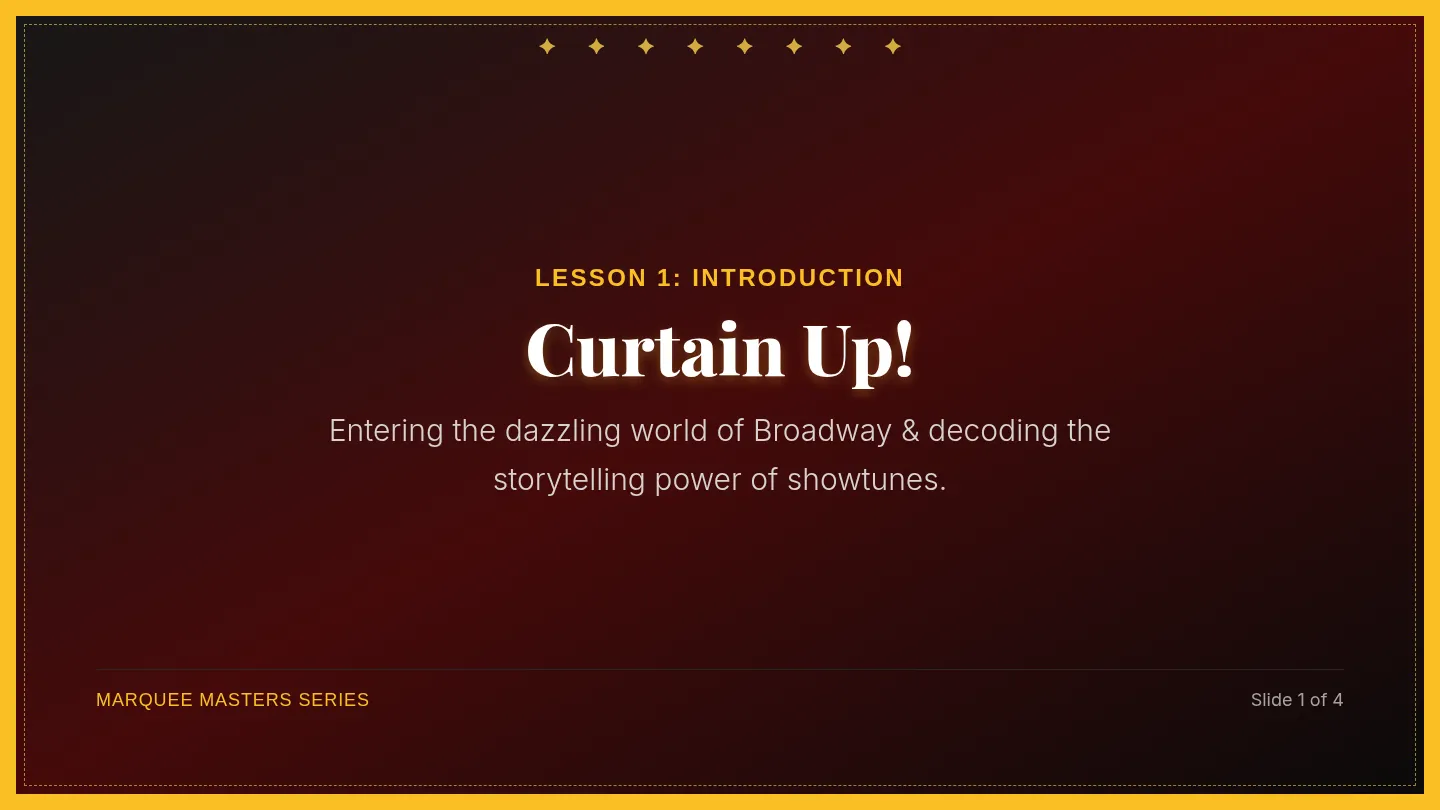
Symphony Savvy
Your Guide to Concert Etiquette
Why Etiquette Matters
1
Respect
For the performers who practiced for thousands of hours and for the music itself.
2
Enjoyment
Helps every single person in the audience focus completely on the performance.
3
Tradition
Classical concerts have a rich history of behavior that makes the event feel special.
"Etiquette is not about following rigid rules; it's about creating a space where everyone can experience magic together."
Before the Music Starts
Arrive Early
- • Find your seat and get settled.
- • Read the program to learn about the pieces and composers.
- • If you arrive late, you may have to wait in the lobby!
Dress the Part
- • Many concerts are formal, but "business casual" is usually great.
- • The most important thing? Be comfortable enough to sit still!
During the Performance: Silence is Golden
No Talking or Whispering
Even quiet whispers carry across a concert hall. Save your thoughts for the break!
Silence Your Devices
Phones completely OFF or on Airplane Mode. No ringing, buzzing, or screen glowing.
Avoid Distractions
Don't rustle programs, unwrap candy loudly, or tap your feet heavily.
When to Applaud?
This is the tricky part! Here's the pro tip:
🎼
Between Movements?
Wait until the very end of a full piece (all its movements) to applaud. Silence between movements is part of the music!
🕴️
Listen for Cues
The conductor will usually lower their hands completely and turn to the audience when the piece is truly finished.
👏
Encore! Encore!
If the performance is outstanding, stay for the applause! The musicians might come back for an extra short piece.
Respecting the Space
🎻
Stay Seated
Try not to leave your seat during the performance. Movement can be very distracting to the players and neighbors.
Exiting Early
If you MUST leave, do so quickly and quietly during applause or between pieces.
Being Present
Focus on the music. Close your eyes if it helps you hear better, but try to stay awake and engaged!
Symphony Savvy Teacher Script
Teacher Script
Symphony Savvy: Concert Etiquette
Total Time
30 Min
Bold: Spoken Text
(Parentheses): Actions/Instructions
Slide References
5
Warm-Up: What to Expect?
(Teacher displays or distributes Concert Etiquette Warm-Up)
"Good morning/afternoon, everyone! Today, we're going to talk about something a little different, but super important, especially if you ever have the chance to attend a symphony concert. Has anyone here ever been to a symphony concert or seen an orchestra perform live?"
(Wait for responses)
"That's great! Whether you have or haven't, imagine you're about to go to one. What do you think it might be like? What kind of music would you hear? And, perhaps more importantly, how do you think people are expected to behave? Take a few minutes to jot down or discuss with a partner what you think would be appropriate – or even inappropriate – behavior at such an event."
(After a few minutes, bring the class back together for a brief discussion.)
"Okay, let's hear some of your thoughts. What are some things you think would be great to do, or things you should definitely not do, at a symphony concert? Why do you think that?"
(Acknowledge student responses, affirm good ideas, and gently correct misconceptions.)
"You've got some fantastic ideas! Now, let's dive a little deeper into the unspoken rules that help everyone enjoy the incredible experience of live symphonic music. We're going to learn how to be 'Symphony Savvy'."
10
Introduction to Symphony Etiquette
Slide 1: Symphony Savvy: Your Guide to Concert Etiquette
"So, what exactly is a symphony concert? It's usually a large group of musicians playing classical music together, led by a conductor. It's a really special experience! Today, we're going to learn the 'do's and 'don'ts' so you can feel confident and enjoy the show."
Slide 2: Why Etiquette Matters
"First, why does etiquette even matter? It might seem like a lot of rules, but it really comes down to three main things: respect, enjoyment, and tradition. We want to show respect to the talented musicians who've practiced for countless hours, and to the composers who created this amazing music. When everyone follows a few simple guidelines, it helps everyone in the audience truly enjoy the performance without distractions. And finally, these traditions have been around for hundreds of years, making the experience even more special."
Slide 3: Before the Music Starts
"Let's start before the music even begins. It's always best to arrive a little early. Why do you think that might be important?"
(Allow for a few student responses, guiding them towards getting settled and reading the program.)