Culinary Shield Slides Level 3: Life Skills Academy Module 4: Culinary Safety
HAZARD PREVENTION PROTOCOLS
CULINARY SHIELD
Mastering industrial equipment, combatting foodborne pathogens, and establishing a professional-grade safe kitchen.
Advanced Culinary Safety & Autonomy
Slide 1 of 7
Biological Hazards
Culinary Shield
Salmonella
Bacteria
Often found in raw poultry, eggs, and unpasteurized milk. Survives if undercooked.
Kill Temp: 165°F (74°C)
Onset: 6 - 72 Hours
Avoid raw egg cross-contact!
E. Coli
Bacteria
Found in undercooked ground beef and contaminated leafy greens. Severe gut toxin.
Kill Temp: 160°F (71°C)
Onset: 3 - 4 Days
Wash greens meticulously!
Listeria
Cold-Hardy
Multiplies even inside cold refrigerators! Found in deli meats, soft cheeses, soil.
Kill Temp: Pasteurization
Onset: Up to 70 Days
Keep fridge below 40°F!
Pathogen exposure leads to severe foodborne illnesses.
Slide 2 of 7
Complex Equipment Operations
Culinary Shield
High-Risk Appliances
Commercial Slicer
Always use the food pusher/guard. Never hold the meat directly. Set blade depth to zero before cleaning.
Food Processors & Blenders
Ensure blade is locked before filling. Never insert hands or metal utensils while plugged in. Use rubber scrapers.
Commercial Gas Ranges
Confirm gas valves are completely shut off. Keep vents free of grease build-up to prevent combustion.
LOTO Safety Standard
Lock-Out, Tag-Out (LOTO) is a critical safety practice for maintenance. Always disconnect power sources completely before touching blades!
Unplug from the main wall outlet
Disassemble only *after* power is cut
Wear cut-resistant safety gloves
*Note: 80% of student mechanical cuts occur during high-haste cleanup.
Never bypass machine guards. No loose hair, clothing, or jewelry.
Slide 3 of 7
Spot the Safety Hazards!
Culinary Shield
Case Study Scenario
The Rush-Hour Breakdown
At 12:45 PM, the kitchen is frantic. Marcus, with long unnetted hair, uses the commercial slicer. The turkey slips, so he removes the plastic food pusher to hold it. Sarah drops a cutting board, picks it up, wipes it with a dry apron, and starts chopping lettuce. Below them, raw chicken juices drip from an upper shelf directly onto uncovered cookies.
Group Challenge:
Identify 4 safety failures in this scene and formulate an instant defense fix for each!
Hazard Tracker
Slicer food-guard removed
Unrestrained long hair
Board wiped, not sanitized
Cross-contamination of meat
Safe Kitchen Principles
One simple error can sicken dozens of patrons or cause permanent injury. Protect your guests and team with strict discipline.
Take 3 minutes with your team to formulate your safety defense plan.
Slide 4 of 7
The Critical Temp Scale
Culinary Shield
Danger Zone
40°F – 140°F
STOP
Bacteria double in number in just 20 minutes within this zone!
Required Cooking Temperatures
165°F Poultry & Reheated Foods
Chicken, Turkey
160°F Ground Meats
Beef, Pork, Lamb
145°F Seafood, Steaks, Chops
3-Min Rest Required
< 40°F Refrigeration Temperature
Slowing Growth
Keep food hot or keep food cold. Minimize exposure in the Danger Zone.
Slide 5 of 7
Emergency Action Protocol
Culinary Shield
Grease Fire
Hot grease catches flame. Never pour water! Water causes explosion.
ACTION PROTOCOL:
1. Smother with metal lid or baking soda.
2. Turn off heat source immediately.
3. Use Class K fire extinguisher if large.
WARNING: Water vaporization spreads fire!
Deep Cuts
Sharp knives or slicer blade contacts skin. Rapid response prevents shock.
ACTION PROTOCOL:
1. Apply direct, firm pressure with clean towel.
2. Elevate wound above heart level.
3. Notify teacher; wash & bandage immediately.
WARNING: Report all blood spills instantly!
Chemicals
Sanitizers or degreasers splash onto food surfaces or eyes.
ACTION PROTOCOL:
1. Keep chemicals stored *below* food lines.
2. Flush eyes at eyewash station for 15 mins.
3. Refer to Safety Data Sheet (SDS).
WARNING: Check labels before spraying!
Do not panic. Communicate immediately and execute instructions.
Slide 6 of 7
The Culinary Shield Oath
Culinary Shield
Safety is a Personal Defense Strategy
"I will respect the kitchen environment. I will run complex machinery only with permission, handle knives with focused awareness, enforce correct food temperatures, and protect my crew from foodborne illness."
Zero Accidents Goal
100% Preparedness
Your Signature is required on the Safety Contract. Slide 7 of 7
Culinary Shield Teacher Guide Professional Lesson Plan
Culinary Shield
High School Life Skills — Independent Safety & Autonomy
Teacher Guide
Pacing: 60-90 Mins
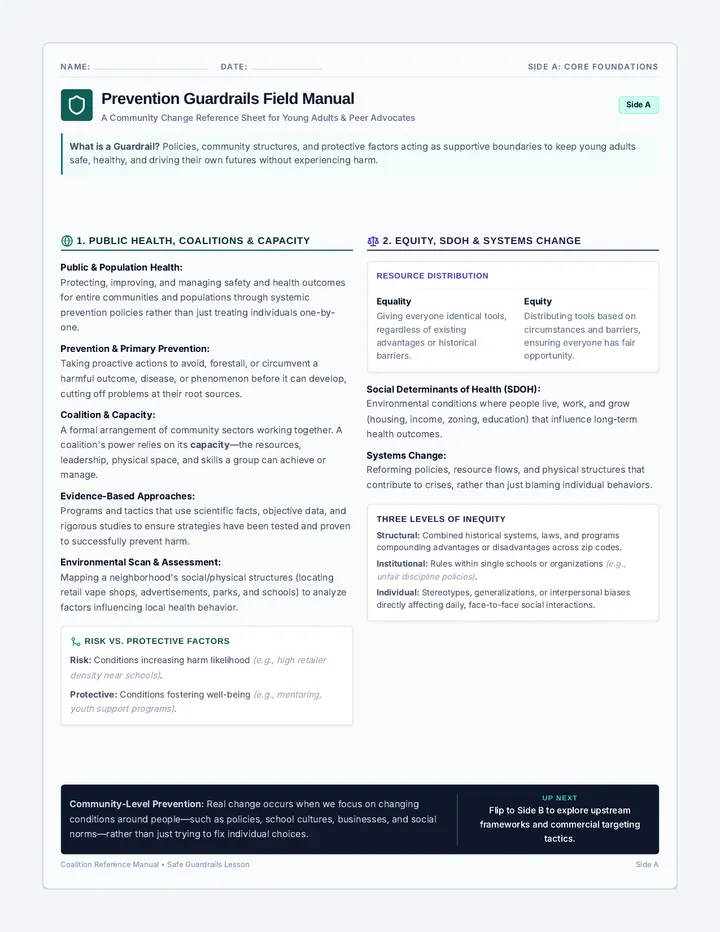
Lesson Objectives
Identify transmission pathways, onset times, and critical kill temperatures for the "Big Three" pathogens (Salmonella, E. coli, Listeria).
Apply Safe Machine Guards and Lock-Out, Tag-Out (LOTO) procedures when handling commercial slicers and food blenders.
Differentiate and monitor internal food temperatures according to safety zones (Danger Zone 40°F – 140°F).
Demonstrate direct emergency response procedures for grease fires, chemical spills, and lacerations.
Class Checklist
Slides loaded & visible
Safety Contracts (1 per stud.)
Slicer demo unit (unplugged!)
Practice/Asses. Worksheets
Classroom Posters hung
Timed Lesson Pacing
Duration Stage Key Teacher Actions 00 - 10 Min Anticipatory Set Pose the question: "Why is a commercial slicer more dangerous than a standard chef's knife?" Introduce Culinary Shield. 10 - 25 Min Direct Instruction Utilize the Culinary Shield Slides to cover Pathogens, Machinery Guards, and Temp Danger Zones. Ask students to repeat kill temps. 25 - 45 Min Scenario Discussion Run Slide 4 ("Rush-Hour Breakdown"). Have groups list safety failures. Distribute Culinary Shield Worksheets. 45 - 60 Min Independent Assessment Students complete safety assessment and sign the Culinary Safety Contract before practical kitchen entry.
PRO-TIP FOR HIGH SCHOOL LIFE SKILLS
Prioritize visual associations and tactile practice. For LOTO (Lock-Out, Tag-Out), physically practice tracing cords back to wall outlets to ensure true isolation. Do not let student confidence replace methodical routine.
CULINARY SHIELD LESSON SYSTEM PAGE 1 OF 2
Instructional Playbook
Culinary Shield
Advanced Facilitation and Differentiation Protocols
Teacher Guide
Section: 02
Discussion Prompts & Misconceptions
Q: "If food looks fine and smells fine, can it still sicken you?"
Key Answer: Yes. Pathogenic bacteria like E. coli and Salmonella are microscopic and do not cause rancid odors or spoilage indicators (which are caused by harmless spoilage microbes instead). Underline this distinction!
Culinary Shield Challenge Worksheet Culinary Shield Worksheet
High School Life Skills — Independent Safety Training
Name: _______________________________
Date: _________________ Period: ______
Part 1: Pathogen Patrol
Match each microscopic threat to its description or risk factor by writing the letter of the correct option on the blank line.
____ 1. Salmonella
____ 2. E. coli
____ 3. Listeria
A. Multiplies actively inside cold refrigerators; commonly linked to contaminated deli meats and soft cheeses.
B. Strongly linked to undercooked ground beef and raw leafy greens; can lead to severe gut illness.
C. Prevalent in raw poultry, unpasteurized milk, and eggs; destroyed completely at an internal temperature of 165°F.
Part 2: Safe Temp Ranges
Fill in the missing values or answers to secure your thermal shield defenses.
A. The temperature range known as the "Danger Zone" is from °F to °F. Why must food not sit in this zone for too long?
____________________________________________________________________________________________
B. Write the minimum safe internal cooking temperature for the following high-risk raw products:
Chicken & Turkey Breast: _________ °F
Ground Beef & Pork Burgers: _________ °F
Salmon Filet & Whole Seafood: _________ °F
Max Fridge Storage Temperature: _________ °F
"Clean, Separate, Cook, Chill — The core pillars of the Culinary Shield."
CULINARY SHIELD LEARNING SUITE PAGE 1 OF 2
Culinary Shield Practice
Part 3: Hazard Defense Analysis
Critical Scenario 1: The Slicer Rush
Daniel needs to slice raw ham quickly. The commercial slicer's plastic food guard feels clumsy, so he takes it off and holds the ham with his fingers. Since the slicer is dirty with grease, he plans to scrub the blade while it's still plugged in to save time.
1. State two major safety rules Daniel broke:
Rule A: ____________________________________________________________________________________
Rule B: ____________________________________________________________________________________
2. How should Daniel safety clean and maintain the commercial slicer? Mention LOTO.
____________________________________________________________________________________________
____________________________________________________________________________________________
Critical Scenario 2: Cross-Contamination & Heat Crisis
Culinary Shield Challenge Answer Key Culinary Shield ANSWER KEY
High School Life Skills — Independent Safety Training
TEACHER GRADING KEY
Total Score: ______ / 100%
Part 1: Pathogen Patrol
Match each microscopic threat to its description or risk factor by writing the letter of the correct option on the blank line.
__C__ 1. Salmonella
__B__ 2. E. coli
__A__ 3. Listeria
A. Multiplies actively inside cold refrigerators; commonly linked to contaminated deli meats and soft cheeses.
B. Strongly linked to undercooked ground beef and raw leafy greens; can lead to severe gut illness.
C. Prevalent in raw poultry, unpasteurized milk, and eggs; destroyed completely at an internal temperature of 165°F.
Part 2: Safe Temp Ranges
Fill in the missing values or answers to secure your thermal shield defenses.
A. The temperature range known as the "Danger Zone" is from 40 °F to 140 °F. Why must food not sit in this zone for too long?
Bacteria multiply exponentially in this temperature range, doubling their population size in as little as 20 minutes, leading to rapid pathogen buildup.
B. Write the minimum safe internal cooking temperature for the following high-risk raw products:
Chicken & Turkey Breast: 165 °F
Ground Beef & Pork Burgers: 160 °F
Salmon Filet & Whole Seafood: 145 °F
Max Fridge Storage Temperature: 39 °F / <40 °F
"Verify student answers are exact. Hand grading required for descriptive portions."
CULINARY SHIELD LEARNING SUITE PAGE 1 OF 2 (ANSWER KEY)
Culinary Shield Practice
Part 3: Hazard Defense Analysis
Critical Scenario 1: The Slicer Rush
Daniel needs to slice raw ham quickly. The commercial slicer's plastic food guard feels clumsy, so he takes it off and holds the ham with his fingers. Since the slicer is dirty with grease, he plans to scrub the blade while it's still plugged in to save time.
1. State two major safety rules Daniel broke:
Rule A: Removing the machine guard/pusher (never use fingers to hold items on a slicer).
Rule B: Cleaning or touching the machine blade while still plugged into the live power source.
2. How should Daniel safety clean and maintain the commercial slicer? Mention LOTO.
Daniel must execute Lock-Out, Tag-Out (LOTO): 1. Turn off power switch and unplug completely from the wall. 2. Set the slice blade depth to absolute zero. 3. Put on cut-resistant metal-mesh gloves before wiping or disassembling parts.
Culinary Shield Assessment Culinary Shield Safety Exam
High School Life Skills — Kitchen Safety Certification (100% Passing Score Required)
Name: _______________________________
Date: _________________ Period: ______
Section A: Safety Knowledge
1. What temperature must chicken and reheated items reach to kill Salmonella?
[ ] A. 145°F [ ] B. 150°F [ ] C. 160°F [ ] D. 165°F
2. Which foodborne pathogen is unique because it can actively multiply inside cold refrigerators?
[ ] A. Salmonella [ ] B. E. coli [ ] C. Listeria [ ] D. Norovirus
3. What should you immediately do if grease catches fire inside a pan on the stove?
[ ] A. Pour cold water [ ] B. Smother with lid [ ] C. Blow on flames [ ] D. Wipe with towel
Section B: Equipment Shield Code
Check TRUE or FALSE for each commercial machinery rule:
1. It is safe to use your hands to feed meat into a commercial slicer if you are wearing thick fabric cooking mitts.
[ ] TRUE [ ] FALSE
2. Lock-Out, Tag-Out (LOTO) requires unplugging a blender or food processor completely before touching or scrubbing the blades.
[ ] TRUE [ ] FALSE
3. When baking, keep commercial gas range hoods clean and free of grease to prevent grease vapors from igniting.
[ ] TRUE [ ] FALSE
Culinary Shield Safety Contract
I understand that operating kitchen tools requires absolute focus. I agree to unplug machines before cleaning, never remove machine guards, monitor cooking temperatures meticulously, and communicate grease spills or injuries immediately to the teacher. I recognize that safety is a mandatory criteria for kitchen privileges.
Student Signature: ___________________________
Instructor Sign-Off: ___________________________
CULINARY SHIELD ASSESSMENT PORTAL PAGE 1 OF 1
Culinary Shield Assessment Answer Key Culinary Shield Safety Exam ANSWER KEY
High School Life Skills — Kitchen Safety Certification (Teacher Reference Guide)
TEACHER GRADING KEY
Required Score: 100% Correct
Section A: Safety Knowledge
1. What temperature must chicken and reheated items reach to kill Salmonella?
[ ] A. 145°F [ ] B. 150°F [ ] C. 160°F [ X ] D. 165°F ( poultry target )
2. Which foodborne pathogen is unique because it can actively multiply inside cold refrigerators?
[ ] A. Salmonella [ ] B. E. coli [ X ] C. Listeria ( cold-hardy ) [ ] D. Norovirus
3. What should you immediately do if grease catches fire inside a pan on the stove?
[ ] A. Pour cold water [ X ] B. Smother with lid [ ] C. Blow on flames [ ] D. Wipe with towel
Section B: Equipment Shield Code
Check TRUE or FALSE for each commercial machinery rule:
1. It is safe to use your hands to feed meat into a commercial slicer if you are wearing thick fabric cooking mitts.
[ ] TRUE [ X ] FALSE
2. Lock-Out, Tag-Out (LOTO) requires unplugging a blender or food processor completely before touching or scrubbing the blades.
[ X ] TRUE [ ] FALSE
3. When baking, keep commercial gas range hoods clean and free of grease to prevent grease vapors from igniting.
[ X ] TRUE [ ] FALSE
Culinary Shield Safety Contract Verification
The student signature indicates full verbal agreement. The student must pass all 6 above questions with 100% accuracy to earn the final safety certificate. If the student answers any question incorrectly, they must participate in immediate scaffolded remediation prior to practical laboratory clearance.
STUDENT MUST SIGN THE SAFETY CONTRACT
INSTRUCTOR MUST COUNTERSIGN CONTRACT
CULINARY SHIELD ASSESSMENT PORTAL PAGE 1 OF 1 (ANSWER KEY)
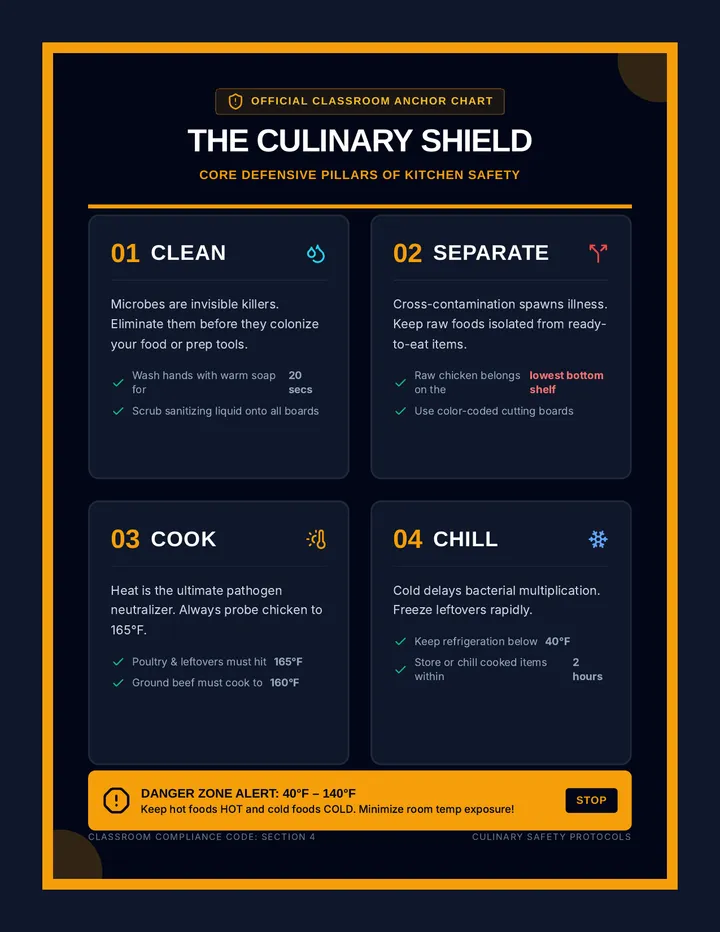
Culinary Shield Safety Poster OFFICIAL CLASSROOM ANCHOR CHART
THE CULINARY SHIELD
Core Defensive Pillars of Kitchen Safety
01
CLEAN
Microbes are invisible killers. Eliminate them before they colonize your food or prep tools.
Wash hands with warm soap for 20 secs
Scrub sanitizing liquid onto all boards
02
SEPARATE
Cross-contamination spawns illness. Keep raw foods isolated from ready-to-eat items.
Raw chicken belongs on the lowest bottom shelf
Use color-coded cutting boards
03
COOK
Heat is the ultimate pathogen neutralizer. Always probe chicken to 165°F.
Poultry & leftovers must hit 165°F
Ground beef must cook to 160°F
04
CHILL
Cold delays bacterial multiplication. Freeze leftovers rapidly.
Keep refrigeration below 40°F
Store or chill cooked items within 2 hours
Danger Zone Alert: 40°F – 140°F
Keep hot foods HOT and cold foods COLD. Minimize room temp exposure!
STOP
CLASSROOM COMPLIANCE CODE: SECTION 4 CULINARY SAFETY PROTOCOLS
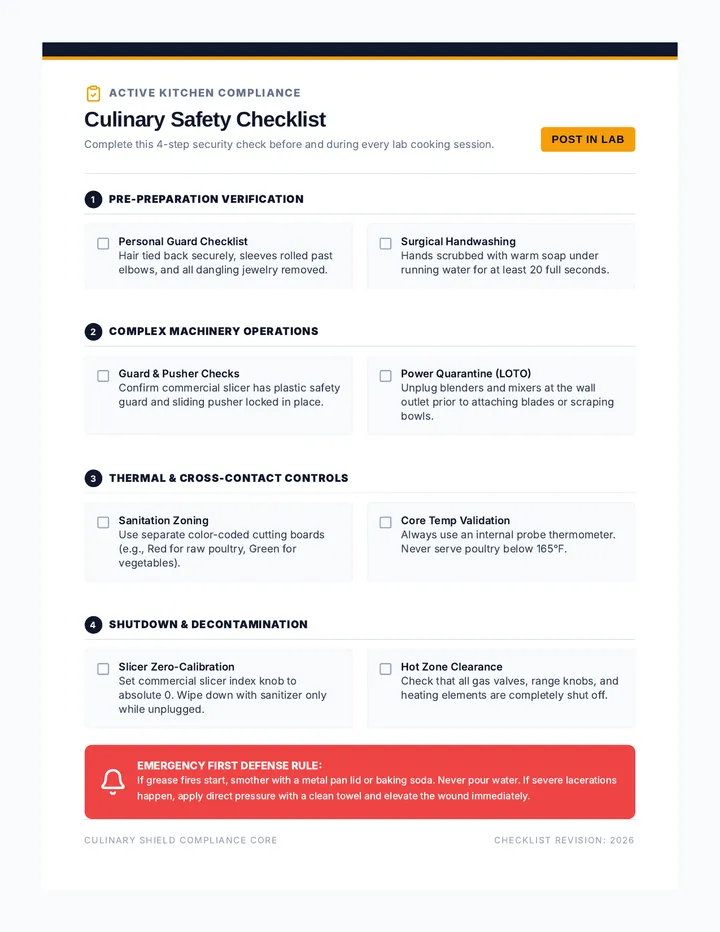
Culinary Shield Safety Checklist Active Kitchen Compliance
Culinary Safety Checklist
Complete this 4-step security check before and during every lab cooking session.
Post in Lab
1 Pre-Preparation Verification
Personal Guard Checklist Hair tied back securely, sleeves rolled past elbows, and all dangling jewelry removed.
Surgical Handwashing Hands scrubbed with warm soap under running water for at least 20 full seconds.
2 Complex Machinery Operations
Guard & Pusher Checks Confirm commercial slicer has plastic safety guard and sliding pusher locked in place.
Power Quarantine (LOTO) Unplug blenders and mixers at the wall outlet prior to attaching blades or scraping bowls.
3 Thermal & Cross-Contact Controls
Sanitation Zoning Use separate color-coded cutting boards (e.g., Red for raw poultry, Green for vegetables).
Core Temp Validation Always use an internal probe thermometer. Never serve poultry below 165°F.
4 Shutdown & Decontamination
Slicer Zero-Calibration Set commercial slicer index knob to absolute 0. Wipe down with sanitizer only while unplugged.
Hot Zone Clearance Check that all gas valves, range knobs, and heating elements are completely shut off.
EMERGENCY FIRST DEFENSE RULE:
If grease fires start, smother with a metal pan lid or baking soda. Never pour water. If severe lacerations happen, apply direct pressure with a clean towel and elevate the wound immediately.
CULINARY SHIELD COMPLIANCE CORE CHECKLIST REVISION: 2026