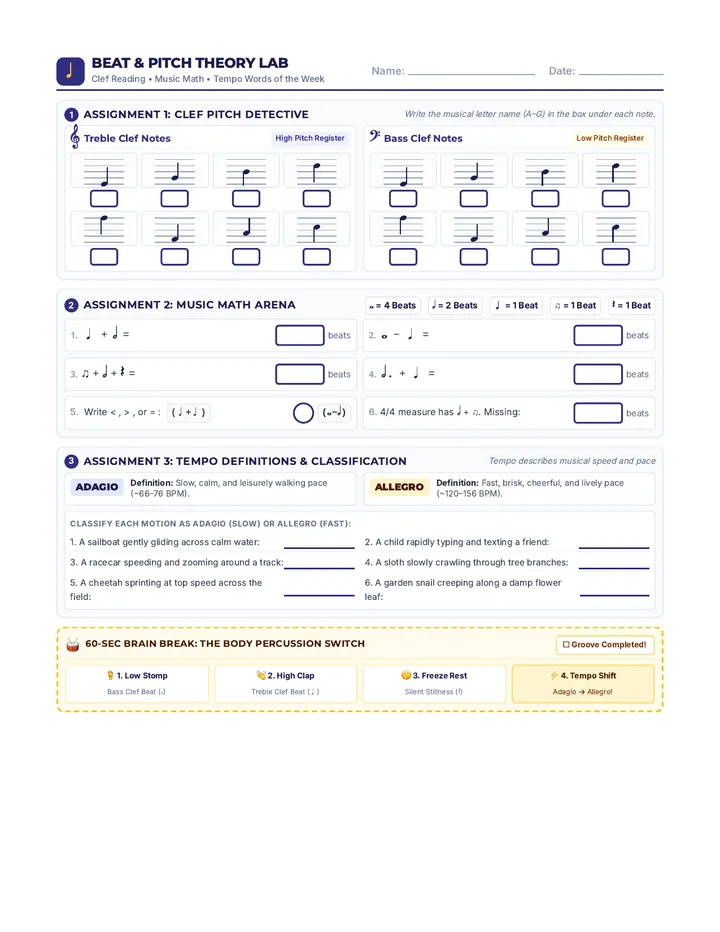
• All Cows Eat Grass
• All Cars Eat Gas
Teacher Guide • Page 1 of 3 Clef Quest Warmup Suite
Complete solutions and scoring criteria for Day 1 and Day 2.
Days 1 & 2
Day 1 • Monday: Staff Anatomy & Alphabet Answers 10 Points Total (1 pt each)
1. Core Reading Rule: Left to Right.
2. Staff Definition: A set of 5 horizontal parallel lines and 4 spaces used to write musical notes.
3. Staff Dimensions: 5 lines, 4 spaces.
4. Numbering Direction: Bottom to Top (Line 1 is the bottom line).
5. Musical Alphabet: A, B, C, D, E, F, G.
6. Alphabet Looping: a) After G: A | b) Before A: G.
7. Staff Drawing: 5 horizontal straight lines with lines 1–5 labeled from bottom to top and spaces 1–4 labeled.
8. Clef Function: It defines pitch names for the lines and spaces. Without a clef, notes have no assigned pitch.
9. Treble Instruments: Any 3: Flute, Oboe, Clarinet, Alto/Tenor Sax, Trumpet, French Horn, Bells.
10. Bass Instruments: Any 3: Trombone, Tuba, Euphonium/Baritone, Bassoon, Timpani, Bass.
Day 2 • Tuesday: Treble Clef (G Clef) Answers 10 Points Total (1 pt each)
1. Treble Clef Alias: G Clef; wraps around Line 2.
2. Line Mnemonic: Accept standard mnemonics (e.g., Every Good Boy Does Fine).
3. Treble Lines: L1: E | L2: G | L3: B | L4: D | L5: F.
4. Treble Spaces Word: F - A - C - E.
5. Treble Spaces: Sp 1: F | Sp 2: A | Sp 3: C | Sp 4: E.
6. Note Identification: Note A: G (Line 2) | Note B: C (Space 3).
7. Treble Drawing: Vertical line with bottom curl, upper loop crossing at line 4, inner spiral circling line 2.
8. Pitch & Clef Logic: These instruments play in a high pitch/frequency range; Treble Clef keeps notes mostly inside the 5 lines.
9. Reading Direction: Left to Right.
10. Line/Space Check: a) E4: Line (L1) | b) A4: Space (Sp2) | c) F5: Line (L5).
Rapid Scoring Tip
Have students swap papers on Tuesdays and Thursdays for a 60-second peer check, or spot-check drawing questions (Day 1 Q7, Day 2 Q7) with a quick teacher walk-through stamp during solo warmup time.
Teacher Guide • Page 2 of 3 Clef Quest Warmup Suite
Solutions for Days 3, 4, 5, Grand Staff challenge, and weekly scoring.
Days 3, 4 & 5
Day 3 • Wednesday: Bass Clef (F Clef) Answers 10 Points
1. Alias: F Clef; dots surround Line 4.
2. Lines Mnemonic: Accept Good Boys Do Fine Always, etc.
3. Bass Lines: L1: G | L2: B | L3: D | L4: F | L5: A.
4. Spaces Mnemonic: Accept All Cows Eat Grass, etc.
5. Bass Spaces: Sp 1: A | Sp 2: C | Sp 3: E | Sp 4: G.
6. Note ID: Note A: F (Line 4) | Note B: C (Space 2).
7. Bass Drawing: Dot on line 4, curve up to line 5 & down, 2 dots in spaces 3 & 4.
8. Symbols: Accurate drawing of sharp (♯), flat (♭), natural (♮).
9. Instrument Circle: Trombone, Tuba, Bassoon.
10. Alphabet Step Up: Space 4 is G (one step up from Line 4 F).
Day 4 • Thursday: The 3 Band Clefs Answers 10 Points
1. The 3 Clefs: Treble Clef, Bass Clef, Percussion (Neutral) Clef.
2. Neutral Clef Purpose: For non-pitched percussion; lines represent instruments, not pitches.
3. Percussion Clef Drawing: Two vertical parallel bars spanning middle staff lines.
4. Space 2 Comparison: Treble: A | Bass: C.
5. Line 3 Comparison: Treble: B | Bass: D.
6. Instrument Clefs: Clarinet: Treble | Tuba: Bass | Snare: Percussion | Bassoon: Bass.
7. Rule Recall: 5 lines, 4 spaces, read from left to right.
8. Dual Drawing: Treble clef on top staff, Bass clef on bottom staff.
9. Dual Clef Instrument: Euphonium/Baritone (reads TC or BC) or Piano / Mallets.
10. Reverse Alphabet: G → F → E → D → C → B → A.
Day 5 • Friday: Grand Challenge Answers 10 Points
1. Grand Staff: A brace/bracket and vertical line joining Treble and Bass staves.
2. Middle C Location: Exactly between the staves (one ledger line below Treble, one above Bass).
3. Treble Decoder: L3 (B) - L1 (E) - L1 (E) - Sp1 (F) = BEEF.
4. Bass Decoder: L2 (B) - Sp1 (A) - L1 (G) = BAG.
5. Sort: Treble: Flute, Clarinet | Bass: Tuba, Trombone | Percussion: Snare, Bass Drum.
6. Symbols: Accurate Treble, Bass, Repeat Sign (:|), Double Bar line.
7. Alphabet Loop: Forwards: A-B-C-D-E-F-G | Backwards: G-F-E-D-C-B-A.
8. Horizontal Axis: Time moving forward from past to future (pitch duration).
9. Ledger Lines: Short lines added above or below the staff to extend the pitch range.
10. Reflection: Student self-assessment of mastery and next week's goal.
Weekly Grading Standard (50 Points Total):
45–50 pts: Master Musician • 40–44 pts: Solid Sight-Reader • <40 pts: Needs Review
10 pts / Day
Teacher Guide • Page 3 of 3 • End of Key Clef Quest Warmup Suite
Turn to Page 3 of your Clef Quest Packet Quiet Solo Writing Time: 3:30
Day 4 • Thursday
Questions 1–10
1. Treble Clef
For high-pitched woodwinds and brass: Flute, Oboe, Clarinet, Saxophones, Trumpet, Horn.
Space 2 is Note A
2. Bass Clef
For low-pitched brass and woodwinds: Trombone, Tuba, Euphonium, Bassoon, Timpani.
Space 2 is Note C
3. Percussion Clef
For non-pitched percussion instruments: Snare Drum, Bass Drum, Cymbals, Triangle.
Two vertical parallel bars
Turn to Page 4 of your Clef Quest Packet Quiet Solo Writing Time: 3:30
Day 5 • Friday
Questions 1–10
Friday Challenge Checkpoints
• The Grand Staff: How are Treble & Bass joined together?
• Mystery Word Decoders: Decode BEEF (Treble) and BAG (Bass).
• Ledger Lines: Why do we need lines above and below the staff?
Weekly Goal Setting
Complete Question 10 with honesty: Rate your clef confidence and write one music reading goal for next week's rehearsal!
Final Packets will be stamped and scored out of 50 total points today!
Turn to Page 5 of your Clef Quest Packet Quiet Solo Writing Time: 3:30