Instrument Chronicles Dossier
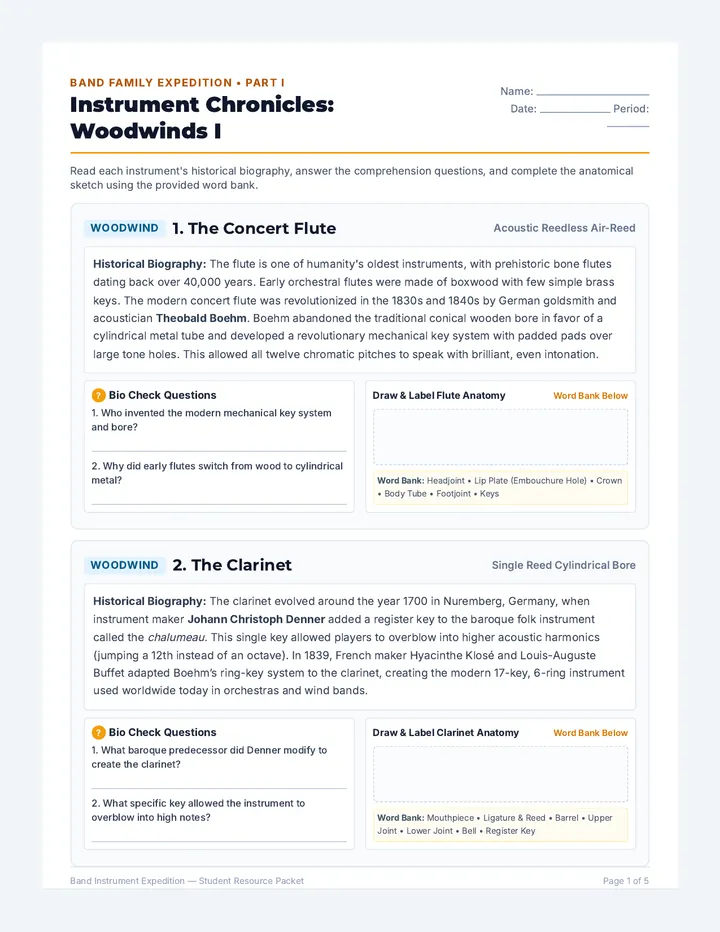
Band Family Expedition • Part I
Instrument Chronicles: Woodwinds I
Name:
Date: Period:
Read each instrument's historical biography, answer the comprehension questions, and complete the anatomical sketch using the provided word bank.
Woodwind
1. The Concert Flute
Acoustic Reedless Air-Reed
Historical Biography: The flute is one of humanity's oldest instruments, with prehistoric bone flutes dating back over 40,000 years. Early orchestral flutes were made of boxwood with few simple brass keys. The modern concert flute was revolutionized in the 1830s and 1840s by German goldsmith and acoustician Theobald Boehm. Boehm abandoned the traditional conical wooden bore in favor of a cylindrical metal tube and developed a revolutionary mechanical key system with padded pads over large tone holes. This allowed all twelve chromatic pitches to speak with brilliant, even intonation.
? Bio Check Questions
1. Who invented the modern mechanical key system and bore?
2. Why did early flutes switch from wood to cylindrical metal?
Draw & Label Flute Anatomy Word Bank Below
Word Bank: Headjoint • Lip Plate (Embouchure Hole) • Crown • Body Tube • Footjoint • Keys
Woodwind
2. The Clarinet
Single Reed Cylindrical Bore
Historical Biography: The clarinet evolved around the year 1700 in Nuremberg, Germany, when instrument maker Johann Christoph Denner added a register key to the baroque folk instrument called the chalumeau. This single key allowed players to overblow into higher acoustic harmonics (jumping a 12th instead of an octave). In 1839, French maker Hyacinthe Klosé and Louis-Auguste Buffet adapted Boehm’s ring-key system to the clarinet, creating the modern 17-key, 6-ring instrument used worldwide today in orchestras and wind bands.
? Bio Check Questions
1. What baroque predecessor did Denner modify to create the clarinet?
2. What specific key allowed the instrument to overblow into high notes?
Draw & Label Clarinet Anatomy Word Bank Below
Word Bank: Mouthpiece • Ligature & Reed • Barrel • Upper Joint • Lower Joint • Bell • Register Key
Band Instrument Expedition — Student Resource Packet Page 1 of 5
Band Family Expedition • Part II
Instrument Chronicles: Saxophone & Trumpet
Name:
Date: Period:
Study the hybrid acoustic design of the saxophone and the heraldic evolution of the brass trumpet.
Woodwind
3. The Saxophone
Single Reed Conical Brass Body
Historical Biography: Invented in Brussels and patented in Paris in 1846 by Belgian innovator Antoine-Joseph "Adolphe" Sax, the saxophone was deliberately created to bridge the sonic gap between agile woodwinds and powerful brasses. Although crafted from brass metal, it is classified as a woodwind because sound is generated by a vibrating single reed upon a mouthpiece. Its conical bore enables it to overblow at the octave, making fingerings in upper registers match lower registers.
? Bio Check Questions
1. Why is the saxophone classified as a woodwind even though made of brass?
2. Who invented the saxophone and in what decade was it patented?
Draw & Label Saxophone Anatomy Word Bank Below
Word Bank: Mouthpiece • Ligature • Neck (Crook) • Octave Key • Body Tube • Bow • Flaring Bell • Keys
Brass
4. The Trumpet
Lip-Vibrated Cylindrical Brass
Historical Biography: Ancient trumpets were crafted from animal horns, conch shells, and bronze as military signaling devices and royal fanfares. For centuries, orchestral musicians played the "natural trumpet," which had no valves and could only play the pitches of the natural overtone series. In 1818, Heinrich Stölzel and Friedrich Blühmel patented the first working brass piston valve, and by 1839 François Périnet perfected the modern three-piston valve system that reroutes air through extra tubing to provide a full chromatic scale.
? Bio Check Questions
1. What limited the pitches playable on early "natural trumpets"?
2. What mechanical invention in the 19th century made chromatic play possible?
Draw & Label Trumpet Anatomy Word Bank Below
Word Bank: Mouthpiece • Leadpipe • 3 Valve Casings / Pistons • Tuning Slide • Water Key • Bell
Band Instrument Expedition — Student Resource Packet Page 2 of 5
Band Family Expedition • Part III
Instrument Chronicles: French Horn & Trombone
Name:
Date: Period:
Examine the coiled hunting horn traditions and the Renaissance slide architecture of the trombone.
Brass
5. The French Horn
Conical Bore Rotary Valve Brass
Historical Biography: Descended from outdoor European hunting horns (cor de chasse), players initially wore the coiled tubing around their shoulders on horseback. In the 18th century, hornist Anton Joseph Hampel developed "hand-stopping," inserting the right hand into the bell flare to adjust pitch. In 1897, German maker Fritz Kruspe revolutionized the instrument by developing the Double Horn, combining an F horn (12 feet of tubing) and a Bb horn (9 feet of tubing) into one instrument operated by a thumb rotary valve.
? Bio Check Questions
1. What outdoor activity did the French horn originate from?
2. What two key lengths does a double horn combine with a thumb valve?
Draw & Label French Horn Anatomy Word Bank Below
Word Bank: Funnel Mouthpiece • Leadpipe • Rotary Valve Levers • Valve Tubing • Thumb Lever • Large Bell Flare
Brass
6. The Trombone
Telescopic Hand Slide Cylindrical Brass
Historical Biography: Emerging in 15th-century Renaissance Europe, the trombone was originally called the sackbut (from old French sacquer, to draw out, and bouter, to shove). Unlike other brass instruments that rely on valves to alter tubing length, the trombone uses a continuous telescopic hand slide with seven discrete slide positions. Because it can produce seamless glissandos and microtonal adjustments with exact intonation, Beethoven famously integrated trombones into his Symphony No. 5.
? Bio Check Questions
1. What was the Renaissance name for the early trombone?
2. How many numbered slide positions does a modern tenor trombone have?
Draw & Label Trombone Anatomy Word Bank Below
Word Bank: Mouthpiece • Outer Slide • Inner Slide Stocking • Slide Lock • Bell Section • Water Key
Band Instrument Expedition — Student Resource Packet Page 3 of 5
Band Family Expedition • Part IV
Instrument Chronicles: Baritone & Tuba
Name:
Date: Period:
Investigate the warm conical tubing of the baritone/euphonium and the deep harmonic anchor of the tuba.
Brass
7. The Baritone & Euphonium
Tenor-Bass Conical Bore Brass
Historical Biography: Developed in the 1840s as part of the saxhorn family created by Adolphe Sax and Ferdinand Sommer, the baritone and euphonium share identical pitch range with the tenor trombone (nine feet of tubing). The name euphonium derives from the Greek word euphonos, meaning "sweet-voiced." While the baritone has a narrower, more cylindrical bore, the euphonium features an expansive conical bore that produces a mellow, dark, singing tone often nicknamed the "cello of the concert band."
? Bio Check Questions
1. What Greek root word does the name "euphonium" come from, and what does it mean?
2. What string instrument is the euphonium often compared to in band music?
Draw & Label Baritone Anatomy Word Bank Below
Word Bank: Mouthpiece • Leadpipe • 3 or 4 Piston Valves • Conical Body Branch • Upright Bell • Water Key
Brass
8. The Tuba
Deep Bass Foundation Brass
Historical Biography: Before the tuba, ensembles used the serpent (a winding wooden snake with finger holes) and the ophicleide for bass brass sound. In 1835, Prussian bandmaster Wilhelm Wieprecht and instrument builder Johann Gottfried Moritz patented the modern bass tuba in Berlin. With up to 18 feet of conical coiled tubing, the tuba provides the low acoustic foundation for the entire ensemble. American march king John Philip Sousa later commissioned the marching circular sousaphone in the 1890s.
? Bio Check Questions
1. What unwieldy snake-shaped wooden instrument did the tuba replace?
2. Approximately how many feet of tubing are inside a concert BBb tuba?
Draw & Label Tuba Anatomy Word Bank Below
Word Bank: Large Cup Mouthpiece • Leadpipe • Valves (Piston/Rotary) • Bottom Bow • Huge Upright Bell
Band Instrument Expedition — Student Resource Packet Page 4 of 5
Band Family Expedition • Part V
Instrument Chronicles: Percussion & Bells
Name:
Date: Period:
Explore rhythmic membranophones with the concert snare drum and pitched metal idiophones with orchestral bells.
Percussion
9. Snare Drum & Concert Percussion
Unpitched Membranophone
Historical Biography: The snare drum traces its lineage directly to the medieval European tabor and military field drums used by Swiss infantry to coordinate battlefield maneuvers. Strung across the bottom resonant membrane (snare head) are coiled wire snares that vibrate crisply against the head when struck on top. The invention of the mechanical snare strainer/throw-off in the late 19th century allowed percussionists to toggle between crisp military snaps and deep tom-tom sounds instantly.
? Bio Check Questions
1. What early military rope-tension drum was the ancestor of the snare drum?
2. What mechanical component engages and disengages the coiled snare wires?
Draw & Label Snare Drum Anatomy Word Bank Below
Word Bank: Batter Head • Resonant Head • Shell • Counterhoop (Rim) • Tension Rods • Snare Strainer • Snare Wires
Percussion
10. Orchestral Bells (Glockenspiel)
Pitched Metallophone / Idiophone
Historical Biography: The word Glockenspiel is German for "bell play." It originated as a miniature keyboard mechanism attached to real church bell carillons in the 17th and 18th centuries. In the 1880s, the keyboard mechanism was discarded in favor of tuned high-carbon steel bars struck directly with hard mallets. Arranged in the two-row layout of a piano keyboard, orchestral bells sound two octaves higher than written, delivering crystalline, luminous brilliance to symphonies and concert bands.
? Bio Check Questions
1. What does the German word "Glockenspiel" translate to in English?
2. How many octaves higher than written music do orchestral bells sound?
Draw & Label Bells Anatomy Word Bank Below
Word Bank: Tuned Steel Bars • Accidental Upper Row • Natural Lower Row • Frame / Case • Resonator Bed • Mallets
Band Instrument Expedition — Student Resource Packet Page 5 of 5