⏱️
Around 120–156 BPM. Fast, lively, and crisp without turning into chaos.
⚡
Quick, brisk finger snaps or rapid toe-taps. Bounce your heels with happy, bubbling energy!
Keep the pulse sharp and steady!
Listening Example: Vivaldi's The Four Seasons: Spring (Allegro Movement)
Score Abbreviation: accel.
🏎️
Music does not always stay at one speed. Accelerando means gradually getting faster and faster, building thrilling excitement!
Key Rule: It is gradual! You don't jump to top speed instantly—you ramp up smoothly step-by-step.
🎬
Roll your hands over each other like bicycle wheels. Start slowly, then roll faster, faster, faster!
Classic Example: Edvard Grieg's "In the Hall of the Mountain King"—the trolls creep in slowly, then chase wildly!
Look for the symbol in sheet music: accel. ---------
Score Abbreviation: rit.
🛑
The opposite of accelerando! Ritardando means gradually slowing down, often leading to a grand finish or peaceful ending.
Key Rule: Gradually pull back on the reins like bringing a galloping horse to an elegant stop.
🚂
Choo-choo train arms rolling fast... then gently slowing down, down, down until the steam train halts at the station.
Conductor Secret: Watch the conductor's hands spread out wider as they slow the orchestra down!
Look for the symbol in sheet music: rit. ---------
Class Performance Challenge
Measure 1–2
🚶
Train leaves platform at steady walking pace
Measure 3–4
🏎️
Puffing faster and faster down the tracks!
Measure 5–6
⚡
Cruising at high speed through the countryside
Measure 7–8
🛑
Slowing down smoothly to stop at the station!
Chant Words: "Engine, engine number nine, going down Chicago line... If the train should jump the track, will I get my money back?"
Watch the Conductor! 🎼
C. How does the song end in Measure 5?
Imagine you are a conductor leading a locomotive train across Indiana. Choose a tempo term for each stop on your route!
Stop 1: Departs
Leaving Indianapolis Station
Tempo Choice
Stop 2: Open Fields
Cruising past cornfields
Tempo Choice
Stop 3: Steep Hill
Climbing up the slope
Tempo Choice
Stop 4: Arrival
Pulling into Gary terminal
Tempo Choice
Why do composers change the tempo (using accelerando or ritardando) instead of playing the exact same speed the whole song? How does it make the listener feel?
Tempo Trekkers Student Activity Sheet • Grade 3 General Music Page 2 of 2
Acceptable: "slow down", "step on the brakes", "decrease speed gradually".
C. How does the song end in Measure 5?
✓ Correct: It ends at an Adagio tempo (slow, majestic, or sustained).
Stop 1 (Departs)
Andante
Smooth walking pace as train departs platform
Stop 2 (Fields)
Accelerando → Allegro
Speeding up to cruise fast across the fields
Stop 3 (Hill)
Ritardando / Adagio
Slowing down under heavy load up steep hill
Stop 4 (Arrival)
Ritardando
Gradually braking to stop at the station
Note: Student choices may vary; award full credit as long as choices logically describe locomotive motion and use correct vocabulary terms.
Model Student Response:
"Composers change tempo so the music doesn't get boring. When music speeds up (accelerando), it makes the listener feel thrilled, excited, or like someone is being chased! When it slows down (ritardando), it creates suspense, relaxation, or lets you know the song is ending."
3 Points (Proficient)
Explains that speed changes build emotions/interest AND accurately names either accelerando or ritardando.
2 Points (Developing)
Mentions making music exciting or slow, but does not connect directly to mood or Italian terminology.
1 Point (Emerging)
Response is incomplete or only states personal preference without explaining musical reasoning.
Tempo Trekkers Teacher Assessment Key • Grade 3 Music Page 2 of 2
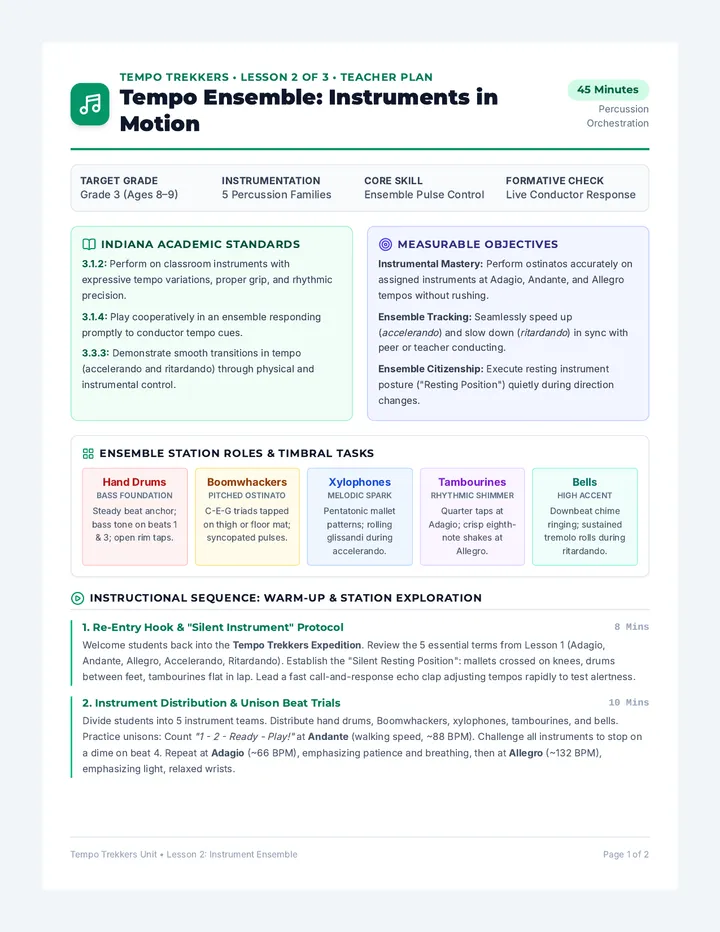
Tempo Trekkers Unit • Lesson 2: Instrument Ensemble Page 1 of 2
Lesson Plan Continued Tempo Ensemble • Grade 3
3. Score Study: "The Express Train Expedition" 15 Mins
Project the Tempo Ensemble Score Sheet. Walk students through the 3 connected movements:
Movement 1 (Adagio): "Morning Mist" • Heavy, majestic pulses. Drums play on 1 & 3; bells toll on 1; xylophones play sustained low rolls.
Transition A (Accelerando): "Engine Fires Up" • Conductor widens eyes and accelerates hand circle. Tambourines add shaking; Boomwhackers lock into steady 4-beat rhythm accelerating gradually.
Movement 2 (Allegro): "Full Steam Ahead" • Brisk, exciting ensemble groove! All 5 instruments interlocking cleanly without falling apart.
Transition B (Ritardando): "Slowing for the Station" • Conductor pulls hands down slowly. Volume softens, beats widen until final unified chord on cut-off.
4. Student Guest Conductors & Peer Assessment 12 Mins
Select 2–3 student conductors to stand on the podium holding the conductor baton. The guest conductor decides when to transition from Adagio to Allegro using clear accel. gestures, and when to bring the train into the station with rit.. Distribute the Tempo Ensemble Rubric for quick peer thumbs-up and written self-assessment.
Quiet Signals & Control Use the "Baton Freeze" visual cue: when the conductor's hands touch their shoulders, zero sound is permitted. Praise instant compliance with team bonus points.
Tier 2 / Motor Adaptations Assign hand drums or bells with velcro wrist straps for students with fine motor challenges. Boomwhackers can be tapped on soft foam blocks on tabletops.
High Ability / Leaders Appoint section leaders who signal the initial count-off or assign dual-mallet ostinatos on soprano xylophones during Allegro sections.
Announce that Lesson 3 is the Tempo Showcase Grand Finale! Students will compete in the "Tempo Speed Run" team challenge, review all 5 concepts, and complete the summative unit assessment.
Tempo Trekkers Unit • Lesson 2: Instrument Ensemble Page 2 of 2
Score Bridge A
Score mark: accel. - - - >>
The conductor begins with small circles and speeds up step by step. Do NOT jump to top speed!
Measure 5
76 BPM
Hand drums add beat 2.
Measure 6
96 BPM
Boomwhackers double tap.
Measure 7
116 BPM
Tambourines shake steady.
Measure 8
132 BPM
Glissando into Allegro!
Musician Cue: Watch the conductor's hands accelerate smoothly! Slide 5 of 9
Score Movement 2
Fast & Cheerful ~132 BPM
Hand Drums
Bass (Beat 1)
Rim (Beat 2)
Bass (Beat 3)
Rim (Beat 4)
Boomwhackers
C - C (1 &)
E - E (2 &)
G - G (3 &)
C' (Beat 4)
Xylophones
C - D (1 &)
E - G (2 &)
A - G (3 &)
E - C (4 &)
Tambourines
Shake (1 &)
Tap! (Beat 2)
Shake (3 &)
Tap! (Beat 4)
Bells
Ding! (Beat 1)
Rest (Beat 2)
Ding! (Beat 3)
Rest (Beat 4)
Full Ensemble Groove: Listen to each other so we don't speed out of control! Slide 6 of 9
Score Bridge B
Score mark: rit. - - - 𝄐 Cut!
The conductor pulls down the throttle. Each measure stretches wider until all instruments freeze on the fermata cut-off!
Measure 17
110 BPM
Soften drum dynamics.
Measure 18
88 BPM
Beats stretch out wide.
Measure 19
60 BPM
Roll into the station.
Measure 20
HOLD & CUT!
Silent resting position!
Conductor Cue: Watch the baton close and cut off the final ring cleanly! Slide 7 of 9
The Whole Performance
Movement 1 (M.1–4)
Station departure; slow and solemn bell chimes.
~66 BPM
Bridge A (M.5–8)
Coal in boiler; speed builds smoothly measure by measure!
accel. >>
Movement 2 (M.9–16)
Open rails sprint! Energetic, interlocking percussion!
~132 BPM
Bridge B (M.17–20)
Arrival at terminal; slow down to final fermata cut!
rit. || CUT
Check your printed score sheet for individual measure practice! Slide 8 of 9
Performance Goals
Keep Adagio from dragging and Allegro from running away into chaos!
Pulse Control
Change speed gradually during accelerando and ritardando with no sudden jumps.
Step-by-Step
100% silent resting position the moment the conductor signals the cut-off.
Clean Cut-Off
Tempo Trekkers Unit • Lesson 2 Ensemble Presentation Slide 9 of 9
C - C (1 &)
E - E (2 &)
G - G (3 &)
C' (4)
Xylophones
C - D (1 &)
E - G (2 &)
A - G (3 &)
E - C (4 &)
Tambourines
Shake-Shake (1 &)
Tap! (2)
Shake-Shake (3 &)
Tap! (4)
Bells
Ding! (1)
Rest (2)
Ding! (3)
Rest (4)
Bridge B
Tempo Transition: Ritardando rit. >> Fermata
The conductor pulls down the throttle! Each measure slows down smoothly until all instruments freeze together on the conductor's cut-off signal.
Measure 17
Apply Brakes
110 BPM
Soften dynamics
Measure 18
Widening Beats
88 BPM
Follow baton closely
Measure 19
Crawl into Station
60 BPM
Sustained roll
Measure 20
Grand Fermata 𝄐
HOLD & CUT!
Silent resting position!
Kept tempo steady at Adagio
Didn't rush during Allegro
Smooth accel. & rit. transitions
Which tempo transition (Accelerando or Ritardando) was the most challenging for our ensemble, and what helped you stay together?
Tempo Trekkers • Grade 3 General Music Percussion Score Page 2 of 2
Tempo Trekkers Unit • Lesson 3: Review & Test Page 1 of 2
Lesson Plan Continued Tempo Showcase • Grade 3
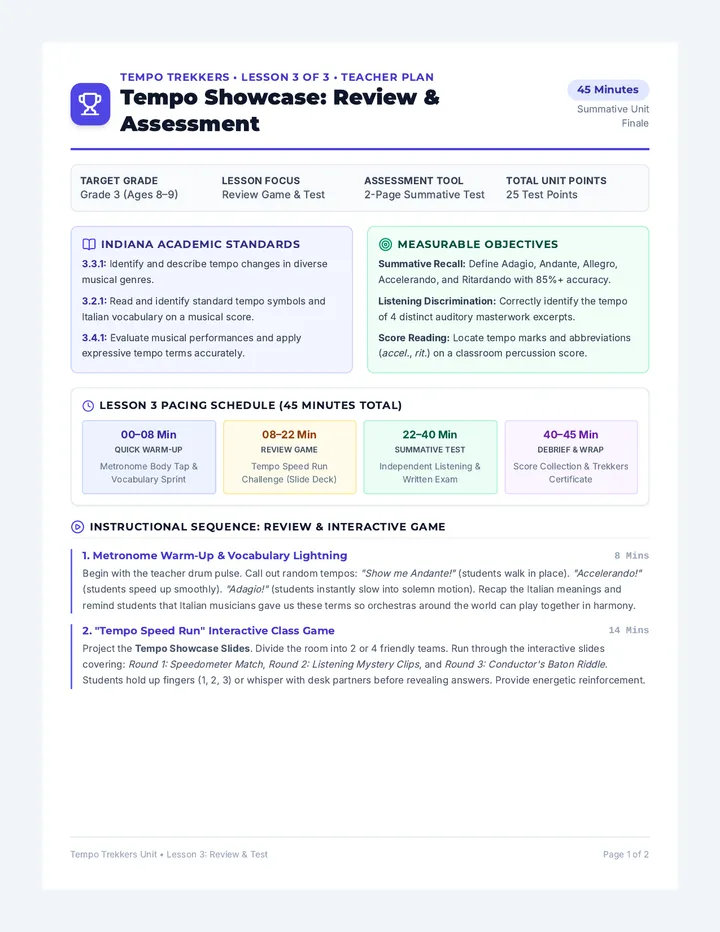
3. Summative Assessment Administration 18 Mins
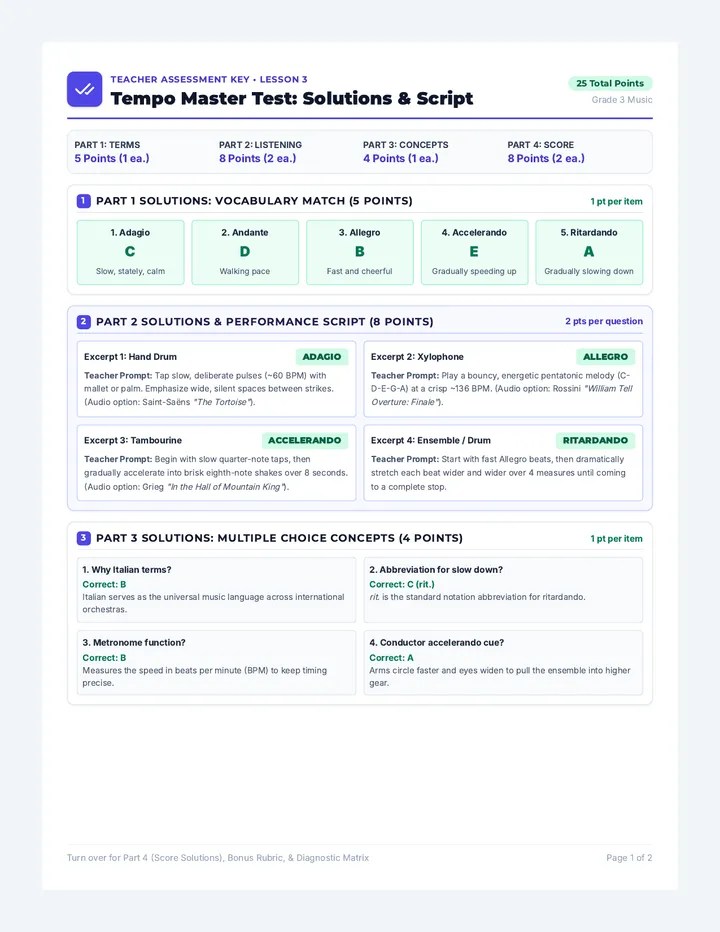
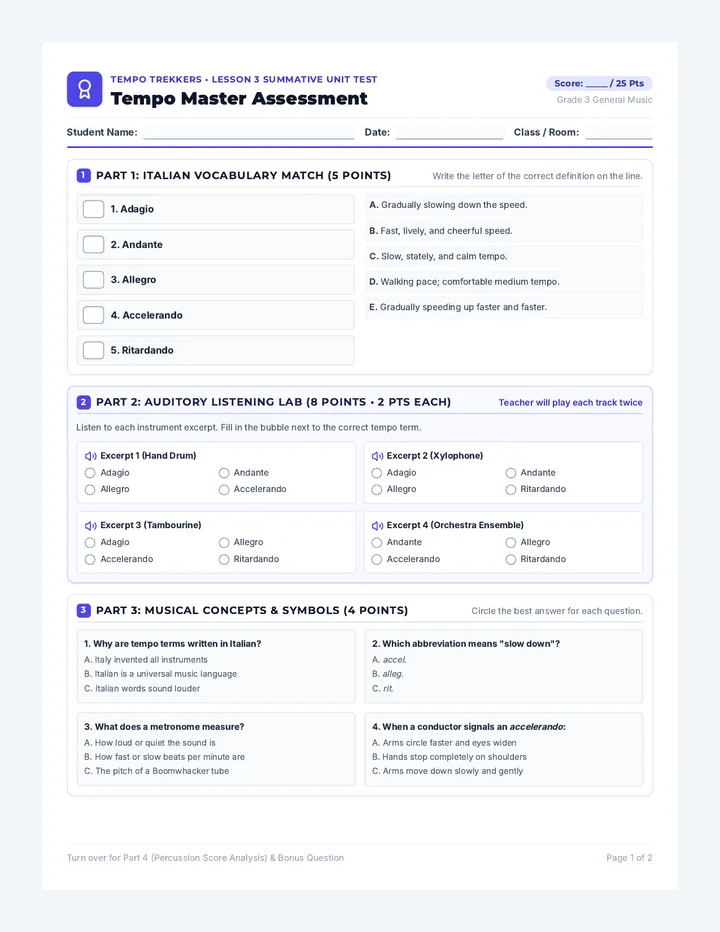
Distribute the 2-page Tempo Showcase Assessment. Explain testing conditions: silent, independent work, pencils out. Lead Part 2 (Listening Identification) as a whole class: play or perform each listening clip two times, giving 15 seconds between clips for students to bubble their choice. After listening, give 10 minutes for independent completion of Parts 1, 3, and 4.
Teacher Listening Script / Performance Cues:
• Listening Clip 1: Play hand drum slow, heavy beats (~60 BPM). Correct: Adagio
• Listening Clip 2: Tap xylophone light, cheerful running pulse (~136 BPM). Correct: Allegro
• Listening Clip 3: Tambourine starts slow, accelerates smoothly. Correct: Accelerando
• Listening Clip 4: Hand drum starts fast, slows down to crawl. Correct: Ritardando
4. Debrief & "Master Conductor" Unit Celebration 5 Mins
Collect tests. Have the entire class perform one final silent conductor salute: count off together, conduct 4 beats of Allegro, a dramatic ritardando, and freeze! Congratulate the class on mastering tempo terminology and orchestral musicianship across all 3 lessons.
Read-Aloud / Scribe Read test questions aloud for students requiring IEP/504 reading support. Allow oral responses for Section 4 open-ended prompt.
Visual Word Bank Support Allow struggling learners to reference the 5-term vocabulary cards or tempo icons (tortoise, strolling shoes, cheetah, gas pedal, brakes).
Bonus Score Analysis Offer the extra credit question on page 2 asking students to identify where a conductor would place a fermata (hold) in the train score.
Tempo Trekkers Unit • Lesson 3: Review & Test Page 2 of 2
Answer: Accelerando!
The bells ring slow, heavy, and spacious. You have to wait patiently between every single chime.
Answer: Adagio!
On the test, you will listen to live instrument examples twice! Slide 5 of 8
Round 4
Reading Real Notation!
Tempo markings are almost always written ABOVE the very first measure of a musical score or movement!
Adagio
Written at the top left to show starting slow speed.
accel. - - -
Written with a dashed line over measures speeding up.
rit. - - -
Written with a dashed line over measures slowing down.
Part 4 of your test will ask you to read a score just like this! Slide 6 of 8
Test Success
During listening questions, tap the beat silently on your knee or shoulder to feel the speed!
Feel the heartbeat
Remember to flip your test over! Page 2 has the percussion score and reflection challenge.
Page 1 and Page 2
You have plenty of time. Double-check your spelling and read every question carefully.
You've got this!
Pencils up! Tests are about to be distributed. Slide 7 of 8
Tempo Trekkers Complete
You've explored tempo through whole-body movement, percussion ensemble playing, and score reading. You are ready to conduct any orchestra in the world!
Adagio • Andante • Allegro • Accelerando • Ritardando
Tempo Trekkers 3-Lesson Unit • Grade 3 General Music Slide 8 of 8
Score: "Mountain Rail Express" (Grade 3 Percussion) 4/4 Meter
M.1
Andante
♩ = 92 BPM
Drums: ♩ ♩ ♩ ♩
Other: Silent
M.2
accel. - - - >
Speeding Up
Tambourine adds shakes
Drums play faster
M.3
Allegro
♩ = 136 BPM
Xylophones: ♪ ♪ ♪ ♪
Full Band Groove!
M.4
rit. - - - 𝄐
Slowing Down
Bells toll on Beat 1
Fermata Hold & Cut!
1. What tempo does the score start with in Measure 1?
2. Look at Measure 2. What musical instruction does accel. give to the musicians?
3. In Measure 3, which Italian term marks the jump to fast, cheerful playing?
4. In Measure 4, what should happen to the tempo when players see rit.?
Extra Credit
Imagine you are conducting our classroom percussion orchestra. Write one important tip you would tell your classmates so that everyone changes speed together without rushing or dragging:
How do you feel about your tempo skills?
Super Confident! Pretty Good Need More Practice
Tempo Trekkers Summative Assessment • Indiana Grade 3 Music Page 2 of 2
2 pts each (1 pt for term, 1 pt for explanation)
1. What tempo does the score start with in Measure 1? 2 Pts
Accepted Answer: Andante (Also accept: "Walking pace", "92 BPM").
2. Look at Measure 2. What musical instruction does accel. give? 2 Pts
Accepted Answer: Gradually speed up / play faster and faster. (Key concept: gradual increase in speed).
3. In Measure 3, which Italian term marks the jump to fast, cheerful playing? 2 Pts
Accepted Answer: Allegro (136 BPM / fast & lively).
4. In Measure 4, what should happen to the tempo when players see rit.? 2 Pts
Accepted Answer: Gradually slow down / decelerate until the final fermata hold and cut-off.
Max 2 Bonus Pts
Full Credit (+2 Pts): Student gives a concrete, practical performance tip, such as:
Partial Credit (+1 Pt): Student writes a vague tip without musical detail (e.g., "Play good" or "Listen to the music").
0 Pts: Left blank or incorrect concept (e.g., confusing dynamics with tempo).
Confusing Adagio & Andante
Remedy: Re-anchor to physical movement: Andante is a natural hallway walk; Adagio is slow-motion walking in knee-deep mud.
Confusing Allegro & Accel.
Remedy: Highlight that Allegro is a steady destination (high gear), while Accelerando is the motion of speeding up (pressing the pedal).
Score Symbol Recognition
Remedy: Use highlighter markers on student percussion scores to color-code steady tempo titles vs dashed transition lines (accel. - - -).
Tempo Trekkers Summative Assessment Key • Grade 3 General Music Page 2 of 2