Beat and Rhyme Slides Day 1 • 6th Grade Music
Rhyme & Flow
Beat and Rhyme
How rhythm, pulse, and wordplay turn everyday stories into rap and spoken word poetry.
Listen for the Pulse Spot the Rhymes Build Your Sound
Rap & Spoken Word: Cousins in Rhythm
Rap
• Performed over an instrumental beat
• Locks tightly into a steady tempo
• Uses rhyme and rhythm as percussion
Spoken Word
• Usually performed a cappella (no beat)
• Uses pauses, speed, and volume shifts
• Paints vivid pictures for the listener
Both use your voice as an instrument to tell a true or imaginative story!
Feel the Pocket: 4 Beats Per Bar
Most rap and rhythmic poetry moves in groups of 4 steady beats called a bar. Clap on beats 2 and 4!
1 Downbeat
2 CLAP!
3 Pulse
4 CLAP!
“Step in the hall with a notebook ready, heart in my chest keeping tempo steady.”
Three Rhyme Tools
1. End Rhyme (Classic Anchor)
Rhyming words land at the end of lines.
“Sneakers on the floor / walking through the door.”
2. Internal Rhyme (Hidden Bounce)
Rhyming words happen inside the same line.
“I write in the night when the lights get low.”
3. Slant Rhyme (Near Match)
Words share similar vowel or ending sounds—not exact!
“Chasing every dream / building up a team / finding what it means.”
Rhyme Detective: Your Turn!
1. “Bell rings loud, backpacks hit the ground,
2. “I spin a quick grin when the game begins,
Discuss with a partner: Which lines use End, Internal, or Slant rhyme?
Today’s Studio Mission
01
Analyze
Label end, internal, and slant rhymes on your worksheet.
02
Count
Mark the 4 main beats in sample spoken word bars.
03
Brainstorm
Build 3 rhyme families you can use in your own verse tomorrow!
Rhyme Detective Worksheet Rhyme Detective Worksheet
Day 1 • Beat & Rhyme
Name: ____________________________________ Date: ___________________
1 Spot the Rhyme Technique
Read each lyric below. Circle whether the underlined words show End Rhyme , Internal Rhyme , or Slant Rhyme .
A. “I lace up my sneakers and step out the door, / ready to see what the day has in store.”
[ ] End Rhyme [ ] Internal Rhyme [ ] Slant Rhyme
B. “My brain is a train that stays on the track.”
[ ] End Rhyme [ ] Internal Rhyme [ ] Slant Rhyme
C. “Writing in my notebook, chasing a dream, / trying to figure out what all of it means.”
[ ] End Rhyme [ ] Internal Rhyme [ ] Slant Rhyme
D. “The beat drops sweet as I tap my feet down the street.”
[ ] End Rhyme [ ] Internal Rhyme [ ] Slant Rhyme
2 Find the 4-Beat Pocket
Speak each bar out loud while clapping 1 – 2 – 3 – 4 . Write the numbers 1, 2, 3, 4 above the four main stressed words in each line.
Morning bell rings loud, backpacks hit the floor,
Friends laugh down the hall, walking through the door.
Rhyme Detective Worksheet — Page 2 Day 1 • Beat & Rhyme
3 Build Your Rhyme Bank
Fill each column with at least 5 rhyming words (exact or slant rhymes) to use in your spoken word piece later this week.
Starter: SOUND
Starter: LIGHT
Your Choice: ________
4 Drop a Two-Line Couplet
Use two words from your Rhyme Bank above to write a 2-line rhyme about your school day, a hobby, or a favorite sound.
Bar 1
Bar 2
Exit Check: Which rhyme style (End, Internal, or Slant) are you most excited to try, and why?
Rhyme Detective Answer Key Rhyme Detective Answer Key
Teacher Key • Day 1
Part 1: Spot the Rhyme Technique
A. End Rhyme
door / store are exact rhymes placed at the ends of two consecutive lines.
B. Internal Rhyme
brain / train (and near-rhyme stays ) occur inside a single line.
C. Slant Rhyme
dream / means share the long “ee” vowel sound and nasal ending, but end with different consonants (m vs. nz).
D. Internal Rhyme
beat / sweet / feet (plus street at the end) create a rapid internal rhyme chain.
Part 2: Find the 4-Beat Pocket (Sample Stress Placement)
Bar 1: (1) Morn -ing bell (2) rings loud, (3) back -packs hit the (4) floor ,
Bar 2: (1) Friends laugh (2) down the hall, (3) walk -ing through the (4) door .
Note: Accept slight natural variations as long as students place 4 steady pulses evenly across each bar.
Part 3 & 4: Sample Rhyme Bank & Couplet
SOUND family:
ground, round, found, loud (slant), crowd (slant), bounce (slant)
LIGHT family:
night, bright, write, sight, mic (slant), sky (slant)
Sample Couplet (4-point check: 2 lines, uses rhyme bank, clear rhythm):
“Headphones on, I block out every crowd, / Scribbling my truth until the beat gets loud.”
Beat and Rhyme Teacher Guide Day 1 of 4 • Rhyme and Flow Sequence
Beat and Rhyme Teacher Guide
Learning Objective
Students will distinguish between rap and spoken word, count 4/4 bars by ear, and identify end, internal, and slant rhymes.
Materials Needed
Beat and Rhyme Slides
Rhyme Detective Worksheet & Answer Key
Optional: 80–90 BPM instrumental lo-fi/boom-bap track
Flexible Pacing Options
Lesson Segment
Short (35 min)
Standard (50+ min)
Key Teacher Move
1. Hook & Beat Clap (Slides 1–3)
8 min
12 min
Have class clap on 2 & 4 while chanting the sample bar together.
2. Rhyme Tools (Slides 4–5)
10 min
15 min
Model saying slant rhymes aloud so students hear vowel matches.
3. Worksheet Practice (Slide 6)
12 min
18 min
Circulate during Part 2 (beat counting) to support steady tempo.
4. Share-Out & Exit Check
5 min
5–10 min
Invite 2–3 volunteers to read their Part 4 couplet over a soft beat.
Common Misconceptions
“Slant rhymes are mistakes”: Emphasize that professional poets and MCs use slant rhymes for natural storytelling.“Every line needs the same syllable count”: Explain that rhythm comes from stressed beats (4 per bar), not rigid syllable totals.
Differentiation & Supports
Support: Provide a starter word wall (day/way/stay , beat/feet/street ) and let pairs clap beats together.Extension: Challenge fast finishers to pack two internal rhymes into their Part 4 couplet. Verse Drafting Slides Day 2 • 6th Grade Music
Rhyme & Flow
Verse Drafting
Turn your ideas, memories, and favorite sounds into an original 8-to-12-line spoken word or rap verse.
Pick a Theme Add Sensory Words Draft 8–12 Bars
Step 1: Pick Your Spark
Great spoken word starts with something real to you. Choose one lane:
A Moment or Place
The bus ride to school, the basketball court, your kitchen on Sunday morning.
A Passion or Hobby
Skateboarding, sketching, gaming, cooking, playing an instrument.
Something You Care About
Friendship, standing up for others, protecting the planet, staying resilient.
Who You Are
Your family traditions, your goals, what makes you proud.
Step 2: Paint With Sensory Words
Plain Telling
“I like playing soccer after school because it is fun and exciting.”
Sensory Showing
“Cleats tear the grass, whistle splits the air, / Neon jersey flying like I’m walking on a stair.”
Use sights, sounds, textures, and action verbs—not just feelings!
Step 3: Choose a Rhyme Pattern
AABB (Couplets)
Lines 1 & 2 rhyme; lines 3 & 4 rhyme.
Pencil in my hand, I’m ready to start (A)
ABAB (Alternating)
Lines 1 & 3 rhyme; lines 2 & 4 rhyme.
Standing at the mic underneath the light (A)
The Golden Rule of Drafting
Whisper-Tap Every Line!
As you write each bar, tap your foot or desk 1 – 2 – 3 – 4 and whisper your line out loud.
• Too crowded? Trim extra filler words like really, very, just, that .
• Too short? Add a vivid detail or an internal rhyme!
Today’s Drafting Goal
1
Brainstorm
Pick your topic, 6 sensory words, and 4 rhyme pairs.
2
Draft
Write 8 to 12 bars on your Verse Builder Worksheet.
3
Tap Test
Read your draft softly to a steady 4-beat pulse.
Verse Builder Worksheet Verse Builder Worksheet
Day 2 • Verse Drafting
Name: ____________________________________ Date: ___________________
1 My Topic & Working Title
What story, moment, hobby, or message is your spoken word piece about?
2 Sensory Word Bank
List vivid sights, sounds, or action verbs that fit your topic.
Sights & Colors
Sounds & Beats
Action Verbs
3 Rhyme Pair Planner
Plan 4 rhyme pairs (exact or slant) to anchor your bars.
Pair 1:
/
Pair 2:
/
Pair 3:
/
Pair 4:
/
Verse Builder Worksheet — Page 2 Day 2 • Lyric Draft
4 Draft Your Verse (8–12 Bars)
Write one bar per line. Aim for at least 8 bars (up to 12). Tap a steady 1 – 2 – 3 – 4 beat as you write!
Bar 1
Bar 2
Bar 3
Bar 4
Bar 5
Bar 6
Bar 7
Bar 8
Bar 9
Bar 10
Bar 11
Bar 12
Draft Check: Did you include at least 1 internal or slant rhyme? [ ] Yes [ ] Not yet
Verse Drafting Teacher Guide Day 2 of 4 • Rhyme and Flow Sequence
Verse Drafting Teacher Guide
Learning Objective
Students will generate sensory vocabulary and rhyme pairs to draft an original 8-to-12-bar spoken word or rap verse.
Materials Needed
Verse Drafting Slides
Verse Builder Worksheet (Day 1 Rhyme Bank for reference)
Soft 80–85 BPM background beat during studio writing
Flexible Pacing Options
Lesson Segment
Short (35 min)
Standard (50+ min)
Key Teacher Move
1. Spark & Imagery (Slides 1–3)
7 min
10 min
Contrast “plain telling” vs. “sensory showing” aloud.
2. Rhyme Patterns & Brainstorm (Slides 4–5)
8 min
12 min
Have students complete Page 1 of the worksheet before drafting.
3. Studio Writing Time (Slide 6)
16 min
23 min
Play a low-volume beat; conference 1-on-1 with students who stall.
4. Partner Whisper-Read
4 min
5–10 min
Students read their favorite 2 bars to a partner to test rhythm.
Sample 8-Bar Model (Read Aloud if Students Need Inspiration)
“Orange basketball spinning on my finger tip, / Sneakers squeaking loud as I make a quick dip,
Stuck-Writer Prompts
• “Start with your last rhyming word first, then build the line backward!”
• Offer sentence starters: “Every morning when I…” or “You can hear me…”
Extension Challenge
• Try an ABAB rhyme scheme or add a 2-bar repeating hook.
• Extend to 12 full bars with at least two internal rhymes.
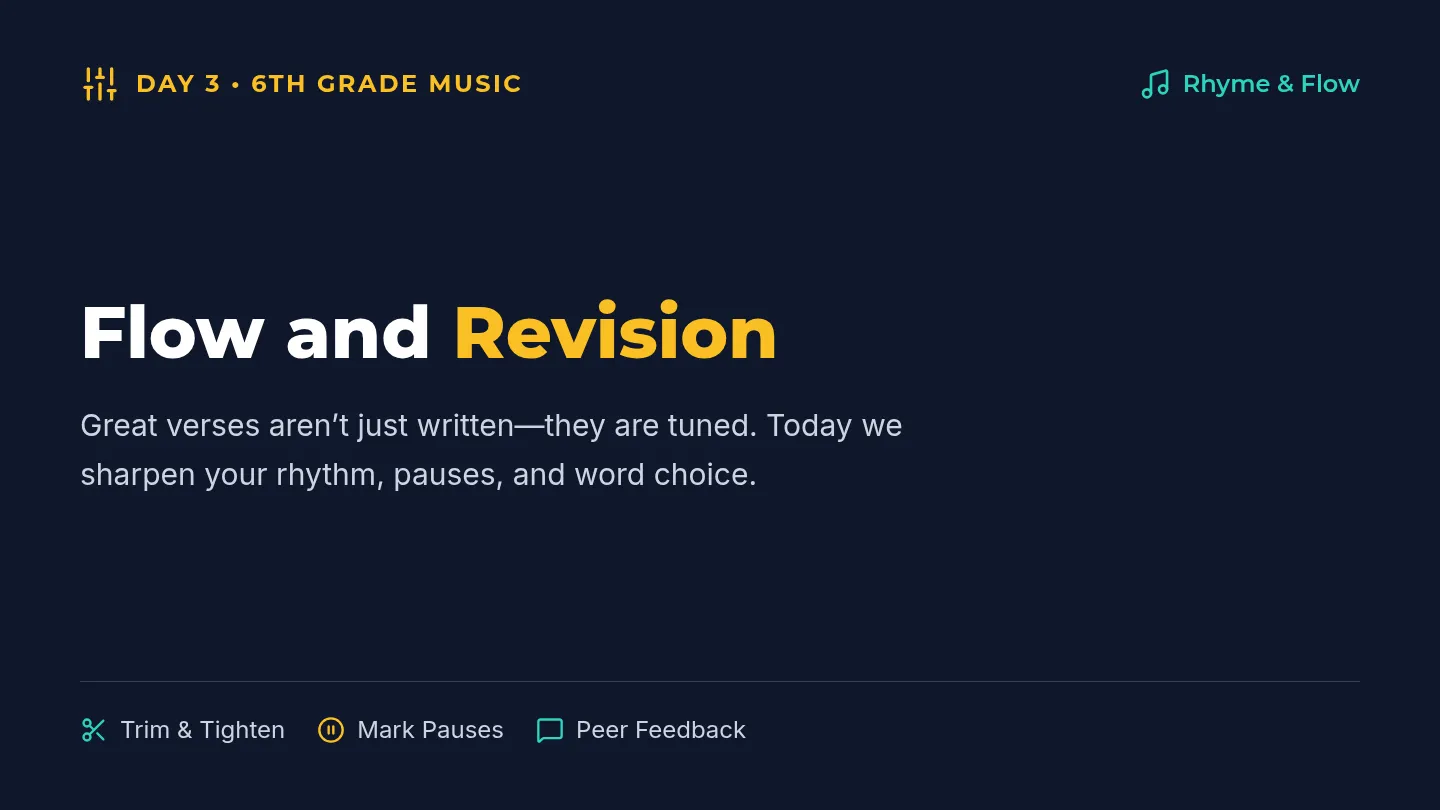
Flow and Revision Slides Day 3 • 6th Grade Music
Rhyme & Flow
Flow and Revision
Great verses aren’t just written—they are tuned. Today we sharpen your rhythm, pauses, and word choice.
Trim & Tighten Mark Pauses Peer Feedback
What Makes Flow Sound Smooth?
1. Breath & Space
Leave room to breathe! A short pause (/) makes the next word hit harder.
2. Emphasis
Underline key words to punch louder, softer, faster, or slower.
3. Word Upgrade
Swap generic words (good, nice, thing ) for vivid, rhythmic words.
Studio Tune-Up: Before & After
First Draft (Too Crowded)
“When I walk into the cafeteria it is really loud and everyone is talking so fast.”
Polished Flow (Marked for Delivery)
“Step in the lunchroom, / trays clatter and crash, /
Partner Protocol: Glow & Grow
1 Glow (Strength)
Name a specific line, rhyme, or image that hit the beat well:
“I loved how you rhymed ___ with ___ in bar 4!”
1 Grow (Suggestion)
Give one helpful idea to smooth out the rhythm or word choice:
“Bar 6 felt a little rushed—maybe cut one word or add a pause!”
Today’s Revision Mission
1
Read Aloud
Perform your draft softly for your partner.
2
Glow & Grow
Trade specific feedback on your Flow Check Worksheet.
3
Final Polish
Rewrite your clean performance copy with pause & stress marks!
Flow Check Worksheet Flow Check Worksheet
Day 3 • Flow & Revision
Name: ____________________________________ Date: ___________________
1 My Flow Self-Check
I have 8–12 complete bars with a clear topic. [ ] Yes [ ] Working on it
My lines fit a steady 4-beat pulse without rushing. [ ] Yes [ ] Working on it
I used at least 2 sensory words (sights, sounds, actions). [ ] Yes [ ] Working on it
I included at least 1 internal or slant rhyme. [ ] Yes [ ] Working on it
2 Partner Feedback (Glow & Grow)
Partner’s Name: ________________________________________
Glow — One strength in rhythm, rhyme, or imagery:
Grow — One line to smooth out, trim, or power up:
3 My #1 Revision Goal Before Final Copy
Flow Check Worksheet — Page 2 Day 3 • Final Performance Copy
Final Polish Performance Copy
Rewrite your revised verse cleanly. Mark breath pauses with / and underline words you want to punch louder!
Piece Title: ____________________________________________________
1
2
3
4
5
6
7
8
9
10
11
12
Flow and Revision Teacher Guide Day 3 of 4 • Rhyme and Flow Sequence
Flow and Revision Teacher Guide
Learning Objective
Students will evaluate rhythm and word choice through read-aloud testing and peer feedback, then revise their verse for vocal delivery.
Materials Needed
Flow and Revision Slides
Flow Check Worksheet + Day 2 Drafts
Highlighters or colored pencils for marking stress/pauses
Flexible Pacing Options
Lesson Segment
Short (35 min)
Standard (50+ min)
Key Teacher Move
1. Flow & Tune-Up (Slides 1–3)
7 min
10 min
Model reading the “Before” vs. “After” slide with a clear pause.
2. Self-Check & Peer Glow/Grow (Slide 4)
10 min
15 min
Pair students intentionally; set a 3-minute timer per partner.
3. Revision & Final Copy (Slide 5)
14 min
20 min
Check that students mark pauses (/) and stressed words before rehearsal.
4. Whisper Rehearsal
4 min
5–10 min
Have students stand and practice their opening 4 bars at low volume.
Revision Coaching Moves
If a student trips over a line: Have them circle the exact word where their tongue tangles and cut or swap it.If feedback is too vague (“It’s good”): Prompt them to point to one specific bar number and name a rhyme or image.
Differentiation & Pacing Note
Need an extra day? Split Day 3 into two shorter sessions: Day 3A for Peer Feedback & Edits, Day 3B for Final Copy & Rehearsal.Performance choice: Let students decide today whether they will perform solo a cappella, solo over a beat, or as a duo. Mic Drop Slides Day 4 • 6th Grade Music
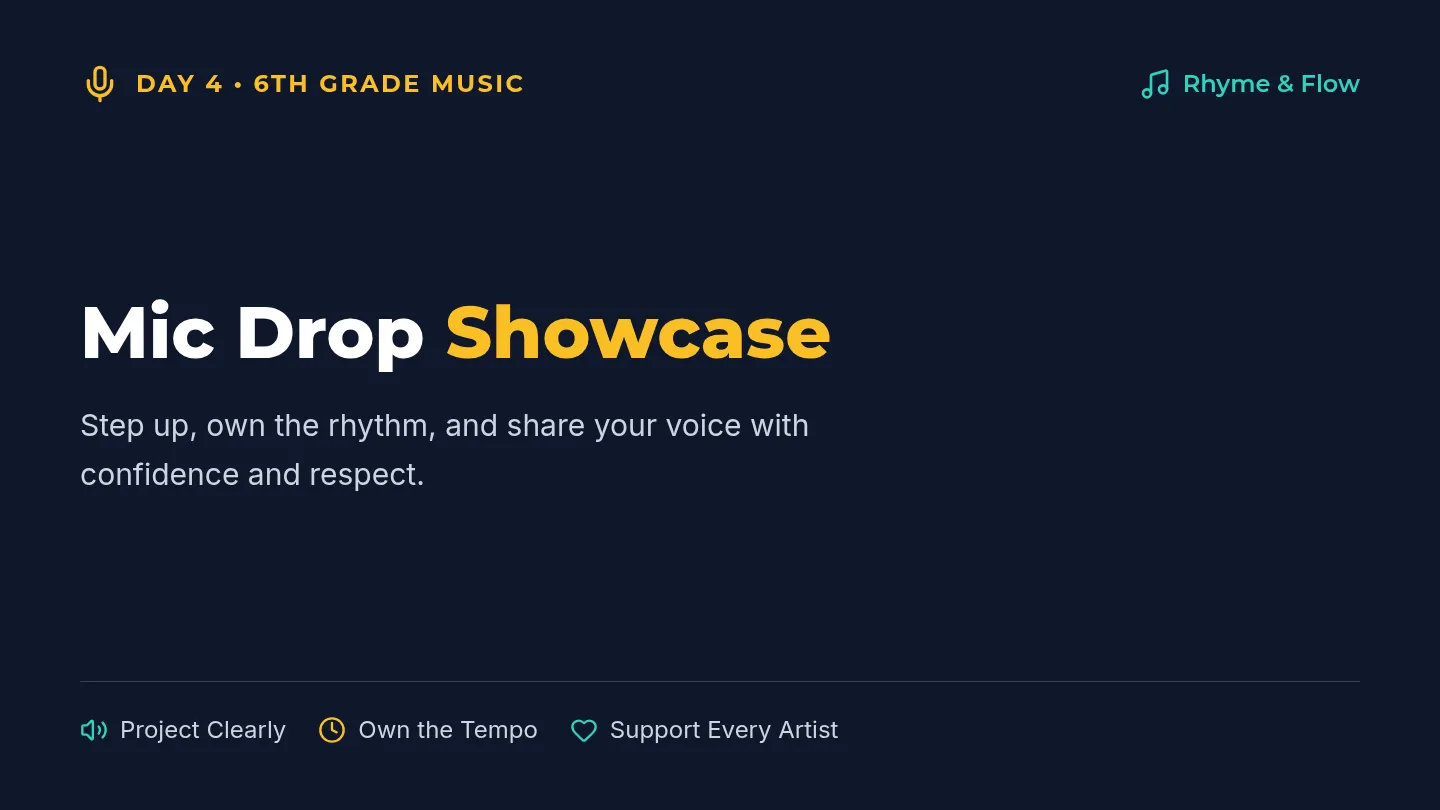
Rhyme & Flow
Mic Drop Showcase
Step up, own the rhythm, and share your voice with confidence and respect.
Project Clearly Own the Tempo Support Every Artist
4 Keys to Live Delivery
1. Stance & Breath
Plant both feet, hold your sheet at chest height, and take one calm breath before Bar 1.
2. Projection
Aim your voice to the back row—clear consonants make every rhyme land.
3. Steady Tempo
Don’t race! Trust your pause marks (/) and let the audience feel the beat.
4. Expression
Glance up on your final line and let your facial expression match your mood.
Coffeehouse Audience Code
1
Zero side talk while an artist is at the mic.
2
Snap or nod quietly if a line hits hard—save big applause for the end!
3
Write 1 shout-out for a classmate on your Showcase Sheet.
How Your Piece Shines
Rhythm & Flow
8–12 bars that stay steady on the pulse with purposeful pauses.
Rhyme Craft
Clear rhyme pattern plus at least one internal or slant rhyme.
Imagery & Voice
Sensory details that paint a picture and show your point of view.
Delivery & Presence
Audible projection, clear words, and supportive audience focus.
The Mic Is Yours!
Take 2 minutes for a final silent read-through, then let’s launch the Rhyme & Flow Showcase.
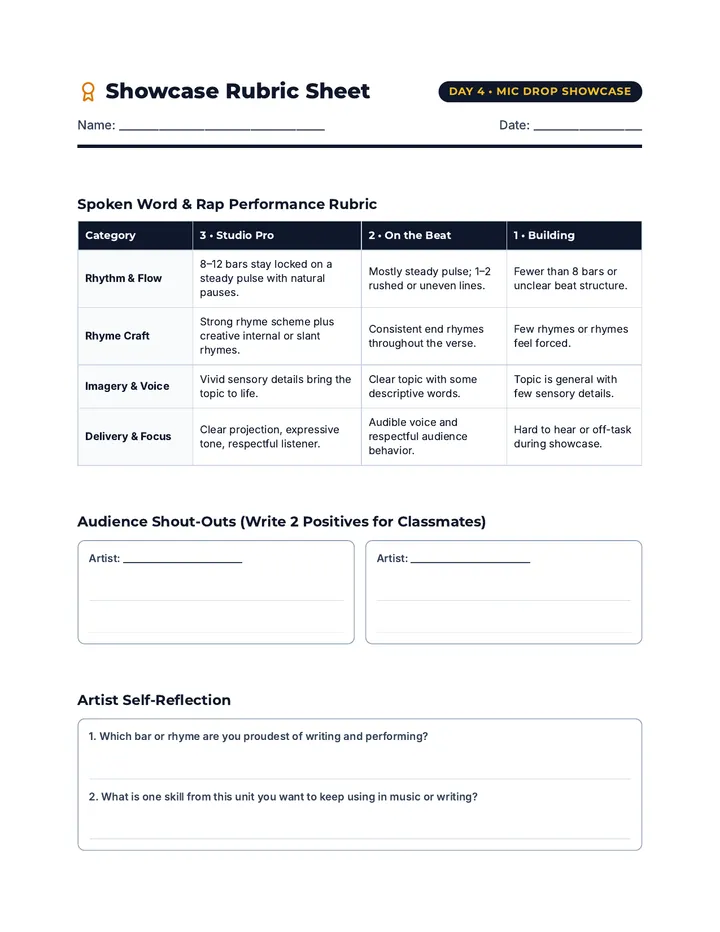
Showcase Rubric Sheet Showcase Rubric Sheet
Day 4 • Mic Drop Showcase
Name: ____________________________________ Date: ___________________
Spoken Word & Rap Performance Rubric
Category
3 • Studio Pro
2 • On the Beat
1 • Building
Rhythm & Flow
8–12 bars stay locked on a steady pulse with natural pauses.
Mostly steady pulse; 1–2 rushed or uneven lines.
Fewer than 8 bars or unclear beat structure.
Rhyme Craft
Strong rhyme scheme plus creative internal or slant rhymes.
Consistent end rhymes throughout the verse.
Few rhymes or rhymes feel forced.
Imagery & Voice
Vivid sensory details bring the topic to life.
Clear topic with some descriptive words.
Topic is general with few sensory details.
Delivery & Focus
Clear projection, expressive tone, respectful listener.
Audible voice and respectful audience behavior.
Hard to hear or off-task during showcase.
Audience Shout-Outs (Write 2 Positives for Classmates)
Artist: ________________________
Artist: ________________________
Artist Self-Reflection
1. Which bar or rhyme are you proudest of writing and performing?
2. What is one skill from this unit you want to keep using in music or writing?
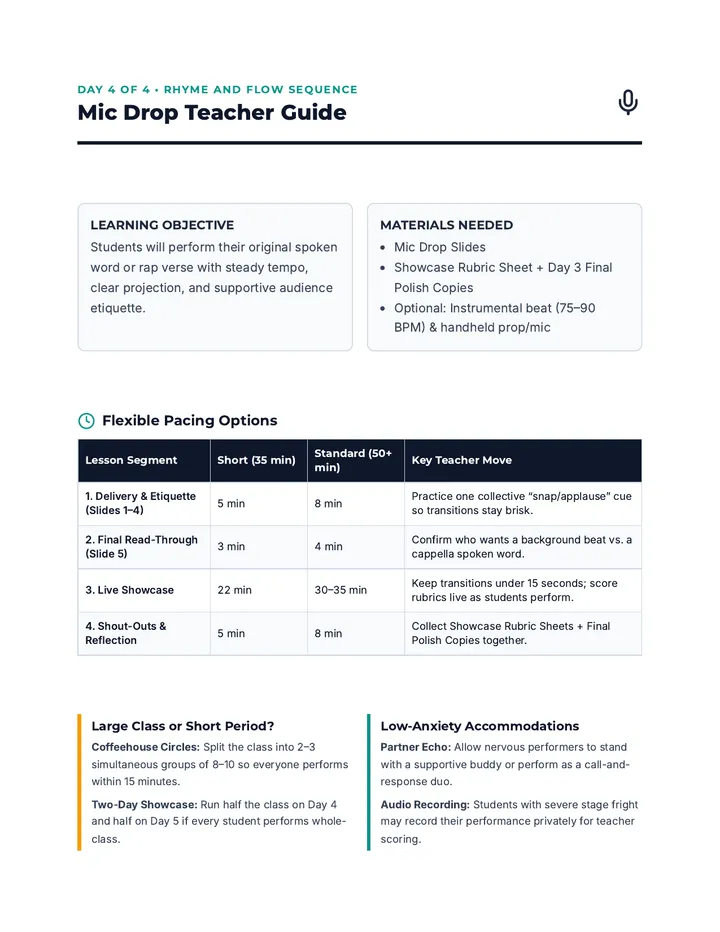
Mic Drop Teacher Guide Day 4 of 4 • Rhyme and Flow Sequence
Mic Drop Teacher Guide
Learning Objective
Students will perform their original spoken word or rap verse with steady tempo, clear projection, and supportive audience etiquette.
Materials Needed
Mic Drop Slides
Showcase Rubric Sheet + Day 3 Final Polish Copies
Optional: Instrumental beat (75–90 BPM) & handheld prop/mic
Flexible Pacing Options
Lesson Segment
Short (35 min)
Standard (50+ min)
Key Teacher Move
1. Delivery & Etiquette (Slides 1–4)
5 min
8 min
Practice one collective “snap/applause” cue so transitions stay brisk.
2. Final Read-Through (Slide 5)
3 min
4 min
Confirm who wants a background beat vs. a cappella spoken word.
3. Live Showcase
22 min
30–35 min
Keep transitions under 15 seconds; score rubrics live as students perform.
4. Shout-Outs & Reflection
5 min
8 min
Collect Showcase Rubric Sheets + Final Polish Copies together.
Large Class or Short Period?
Coffeehouse Circles: Split the class into 2–3 simultaneous groups of 8–10 so everyone performs within 15 minutes.Two-Day Showcase: Run half the class on Day 4 and half on Day 5 if every student performs whole-class.
Low-Anxiety Accommodations
Partner Echo: Allow nervous performers to stand with a supportive buddy or perform as a call-and-response duo.Audio Recording: Students with severe stage fright may record their performance privately for teacher scoring.