Critical Communication Lesson Plans
CAMDEN PREP ■ ESL / MLL
K-12 Multilingual Learner Daily Lesson Planner
High-Intermediate B2 · Critical Thinking & Structured Communication
WIDA Aligned Class 1 of 11 (50 Min)
ESL/MLL Teacher: Academic ELL Team
Lesson Date / Time: Day 1 · 50 Minutes
Grade(s) & Group: High-Inter. (Grades 9-12 / Adult)
Curriculum / Unit: Expressing Opinions & Nuance
Instructional Objectives
Content: SWBAT distinguish between verifiable facts and substantiated opinions, articulating their viewpoint on a contemporary social issue.
Language: Students will use opinion signposts ("From my perspective," "I contend that," "While it may be true...") to orally debate in partner turn-and-talks.
CCSS / ELD: CCSS.ELA-LITERACY.SL.9-10.1.D · WIDA ELD Standard 1 & 2
WIDA ELD Framework
☐ Narrate ☐ Inform ☑ Explain ☑ Argue
Domains:
LST ☑ SPK ☑ RED ☑ WRT ☑
ELD Focus: Argue (Level 4 Expanding)
Supports Quick-Check
☑ Visual Anchor Chart ☑ Sentence Starters ☑ Turn & Talk Pairs ☑ Strategic Grouping
Key Tier 2/3 Vocabulary: Perspective, substantiate, nuance, contend, subjective, verifiable evidence.
Lesson Phase
Pacing
Core Activities & Teacher Steps (I Do, We Do, You Do)
Scaffolds & CFU
Extension (Fast Finishers)
1. DO NOW & HOOK Activate knowledge
7 min
Headline Sorting Challenge:
Display 4 news headlines on screen. Students identify which 2 represent verifiable facts and which 2 express subjective opinions. Quick-write in chat or on warm-up log: "Headline A is an opinion because..."
Scaffold: Fact vs. Opinion visual cheat sheet.
CFU: Cold-call 2 students to justify choice using "because".
Write a third headline that transforms one opinion into an objective factual statement.
2. MODEL ("I DO") Direct instruction
12 min
Degrees of Opinion & Nuance:
Teacher introduces the "Nuance Thermometer" (Strongly agree → Qualified agreement → Respectful disagreement). Teacher think-aloud modeling: "Rather than saying 'Phones are bad in school,' I construct: 'While smartphones offer educational utilities, their unregulated presence diminishes focus.'" Break down signpost transitions.
Scaffold: Color-coded sentence frame matrix on board.
CFU: Choral repetition of 3 advanced signposts; thumb gauge check.
Identify modal verbs (may, might, could) that soften absolute claims.
3. PRACTICE ("WE/YOU") Guided / Solo application
23 min
We Do (8 min):
Class co-constructs a nuanced stance on "Remote Learning vs. In-Person Learning" using teacher-guided sentence stems.
You Do (15 min):
Speed-Debate Stations: Paired breakout turns. Students select 2 debate prompt cards (AI in art, 4-day workweek). Each partner must deliver a 1-minute substantiated opinion and respond with a counter-claim using target discourse markers.
Scaffold: Partner roles assigned (Speaker A / Speaker B); graphic organizer with required frame.
CFU: Teacher circulates with rubric checklist tracking target phrase usage.
Challenge fast pairs to introduce a counterargument starting with "Concurrently, critics argue..."
4. CLOSURE / CFU Exit ticket check
8 min
Digital / Index Card Exit Slip:
Students write a 3-sentence substantiated stance on: "Should school schedules begin after 9:00 AM?" Must include: 1 opinion marker, 1 supporting rationale, and 1 qualifying concession phrase.
Scaffold: Word bank with 3 required sentence starters on screen.
CFU: 85% mastery threshold on exit card rubric.
Underline the dependent clause in your qualifying sentence.
Teacher Reflection
Note student comfort level shifting from informal ("I think") to academic ("I contend/From my viewpoint"). Check which students over-relied on binary yes/no stances.
Reteach & Support
Pull Level 3 Expanding learners for 5-minute pre-writing conference before Lesson 2 to reinforce clause boundary punctuation.
Ellii Digital Extension
Assign Ellii "Expressing Opinions" digital grammar task and 5-item vocabulary flashcard drill for asynchronous review.
Camden Prep Multilingual Resources · Daily Planner Matrix Critical Thinking & Structured Communication · Class 1 of 11
CAMDEN PREP ■ ESL / MLL
K-12 Multilingual Learner Daily Lesson Planner
High-Intermediate B2 · Critical Thinking & Structured Communication
WIDA Aligned Class 2 of 11 (50 Min)
ESL/MLL Teacher: Academic ELL Team
Lesson Date / Time: Day 2 · 50 Minutes
Grade(s) & Group: High-Inter. (Grades 9-12 / Adult)
Curriculum / Unit: Coordinating & Subordinating Conjunctions
Instructional Objectives
Content: SWBAT combine simple opinion sentences into compound and complex sentences to establish logical relationships of addition, contrast, and cause/effect.
Language: Students will correctly position FANBOYS coordinating conjunctions and subordinating conjunctions (although, because, whereas, while) with accurate comma placement.
CCSS / ELD: CCSS.ELA-LITERACY.L.9-10.1 · WIDA ELD Standard 1 & 2 (Language Forms)
WIDA ELD Framework
☐ Narrate ☑ Inform ☑ Explain ☑ Argue
Domains:
LST ☑ SPK ☑ RED ☑ WRT ☑
ELD Focus: Explain Relationships
Supports Quick-Check
☑ FANBOYS Acronym Chart ☑ Color-Coded Clauses ☑ Sentence Strip Pairing ☑ Interactive Whiteboard
Key Target Conjunctions: For, and, nor, but, or, yet, so · Although, whereas, despite the fact that, because.
Lesson Phase
Pacing
Core Activities & Teacher Steps (I Do, We Do, You Do)
Scaffolds & CFU
Extension (Fast Finishers)
1. DO NOW & HOOK Activate knowledge
6 min
The "Robotic Paragraph" Repair:
Display a paragraph made of 5 choppy simple sentences: "Electric cars protect air quality. They are expensive. Batteries require rare minerals. Governments offer subsidies. People buy them." Students vote on how it sounds and brainstorm connecting words.
Scaffold: Read aloud with exaggerated pauses to emphasize choppy tone.
CFU: Ask: What logic connects sentence 1 and 2? (Contrast).
Combine all 5 sentences into exactly 2 cohesive sentences using 2 different conjunctions.
2. MODEL ("I DO") Direct instruction
12 min
Coordinating vs. Subordinating Punctuation:
Teacher demonstrates the architectural difference between compound (Independent + comma + FANBOYS + Independent) and complex sentences (Dependent clause with subordinating conjunction at front = comma needed; at end = usually no comma). Model: "Although public transit reduces emissions, many commuters still prefer personal vehicles."
Scaffold: Visual "Comma Bridge" rule card; clause color coding (green = independent, yellow = dependent).
CFU: Comma check hand signal (clap when comma is required).
Compare semantic nuance between although and whereas in expressing contrast.
3. PRACTICE ("WE/YOU") Guided / Solo application
24 min
We Do (8 min):
Interactive whiteboard sentence synthesis. Teacher provides pairs of clauses; students drag and drop target conjunctions (yet, so, because, while) and insert commas.
You Do (16 min):
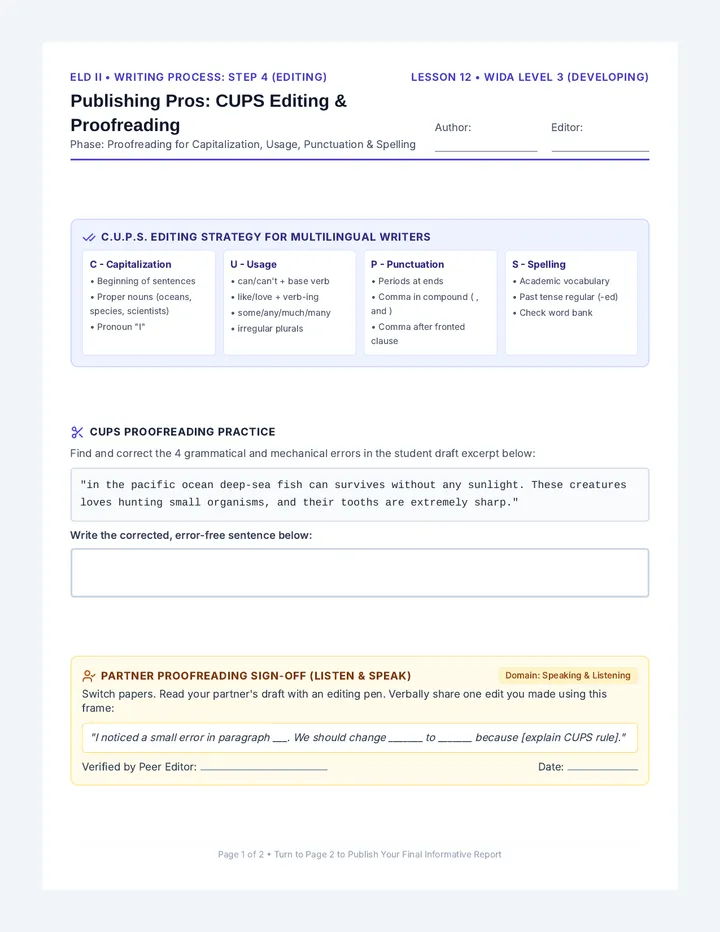
Sentence Expansion Worksheet: Students take 6 basic opinion premises on fast fashion / social media and combine them using assigned conjunction categories (1 compound, 2 complex with fronted dependent clause, 2 complex with trailing clause).
Scaffold: Table of conjunctions grouped by function (contrast, cause, addition).
CFU: Peer-swap editing: partners highlight conjunctions and circle commas.
Rewrite one complex sentence into a compound sentence using yet or for without altering the meaning.
4. CLOSURE / CFU Exit ticket check
8 min
Syntactic Fusion Exit Ticket:
Combine: (A) Online privacy laws protect personal data. (B) Cybersecurity breaches continue to escalate rapidly. Create: 1 sentence using although and 1 sentence using yet. Punctuate both with 100% accuracy.
Scaffold: Sentence skeleton for sentence 1: [Although ____ , ____ .]
CFU: Rapid check for comma after introductory clause.
Explain why no comma is needed if although is placed in the middle of the sentence.
Teacher Reflection
Evaluate comma splices versus legitimate compound sentences. Did students confuse so as a coordinating conjunction vs. so that (purpose)?
Reteach & Support
Provide tactile cut-and-paste clause strips for 3 students struggling with dependent vs. independent clause autonomy.
Ellii Digital Extension
Assign Ellii "Conjunctions: Coordinating & Subordinating" online interactive practice module (15 automated items).
Camden Prep Multilingual Resources · Daily Planner Matrix Critical Thinking & Structured Communication · Class 2 of 11
CAMDEN PREP ■ ESL / MLL
K-12 Multilingual Learner Daily Lesson Planner
High-Intermediate B2 · Critical Thinking & Structured Communication
WIDA Aligned Class 3 of 11 (50 Min)
ESL/MLL Teacher: Academic ELL Team
Lesson Date / Time: Day 3 · 50 Minutes
Grade(s) & Group: High-Inter. (Grades 9-12 / Adult)
Curriculum / Unit: Transitions & Conjunctive Adverbs
Instructional Objectives
Content: SWBAT organize paragraph-level arguments using conjunctive adverbs to signal contrast, cause, and emphasis between distinct sentences.
Language: Students will apply transition words (however, therefore, furthermore, in contrast) with correct semicolon/period and comma mechanics.
CCSS / ELD: CCSS.ELA-LITERACY.W.9-10.2.C · WIDA ELD Standard 2 (Cohesion)
WIDA ELD Framework
☐ Narrate ☑ Inform ☑ Explain ☑ Argue
Domains:
LST ☑ SPK ☑ RED ☑ WRT ☑
ELD Focus: Discourse Cohesion
Supports Quick-Check
☑ Transition Traffic Light ☑ Semicolon Demo Card ☑ Paragraph Cloze Activity ☑ Peer Error Hunting
Key Conjunctive Adverbs: However, nevertheless, consequently, therefore, furthermore, in addition, conversely.
Lesson Phase
Pacing
Core Activities & Teacher Steps (I Do, We Do, You Do)
Scaffolds & CFU
Extension (Fast Finishers)
1. DO NOW & HOOK Activate knowledge
6 min
Traffic Sign Disconnect:
Students view two statements: "Renewable energy investments reached record levels globally." [BLANK] "Fossil fuel reliance remains dominant in heavy industry." Which connector creates the correct turn: Therefore, In addition, or However? Quick thumbs poll.
Scaffold: Visual arrows showing logic flow (straight = addition, turnaround = contrast, down = result).
CFU: Cold-call 1 student to explain why Therefore fails.
Replace However with an advanced academic synonym (Nevertheless, Conversely).
2. MODEL ("I DO") Direct instruction
12 min
The Power of Conjunctive Adverbs & Semicolons:
Teacher contrasts coordinating conjunctions with conjunctive adverbs. Compare: "We prepared well, but we encountered delays" vs. "We prepared well; however, we encountered delays." Model punctuation rules: (1) Semicolon before, comma after; (2) Period, capital letter, comma after. Teach categories: Contrast, Cause/Result, Addition.
Scaffold: Formulaic math-style display: [Sentence 1; transition, Sentence 2.]
CFU: Whiteboard punctuation drill: students insert semicolon and comma on cue.
Analyze why writing ", however," between two independent clauses creates a comma splice error.
3. PRACTICE ("WE/YOU") Guided / Solo application
24 min
We Do (8 min):
Collaborative paragraph enhancement. Class repairs a draft paragraph on "Urban Green Spaces" by substituting generic and and but with furthermore, consequently, and nonetheless.
You Do (16 min):
Solo Argument Refinement: Students receive an unlinked 4-sentence stance on Artificial Intelligence in Medicine. They must insert 3 distinct conjunctive adverbs and re-write into a seamless cohesive paragraph.
Scaffold: Labeled transition bank organized by rhetorical intent.
CFU: Spot-check for required semicolon or period before conjunctive adverbs.
Write an additional sentence utilizing on the contrary to refute a common misconception.
4. CLOSURE / CFU Exit ticket check
8 min
Error Correction Challenge:
Identify and fix the punctuation and transition error: "The survey results were inconclusive, therefore the committee approved the project anyway." (Students must correct to semicolon/period + fix logic to nevertheless/however).
Scaffold: Hint provided: "There is 1 punctuation error and 1 logic word error."
CFU: Verify both punctuation and semantic fit on exit slips.
Explain in one sentence why therefore was logically contradictory in this context.
Teacher Reflection
Assess whether students internalize that transitions signal cognitive turns rather than just decorative filler words. Track semicolon mastery.
Reteach & Support
Conduct warm-up mini-drill on Day 4 targeting the exact difference between so (FANBOYS) and therefore (adverb).
Ellii Digital Extension
Complete Ellii "Transitions & Conjunctive Adverbs" reading comprehension and sentence alignment digital task.
Camden Prep Multilingual Resources · Daily Planner Matrix Critical Thinking & Structured Communication · Class 3 of 11
CAMDEN PREP ■ ESL / MLL
K-12 Multilingual Learner Daily Lesson Planner
High-Intermediate B2 · Critical Thinking & Structured Communication
WIDA Aligned Class 4 of 11 (50 Min)
ESL/MLL Teacher: Academic ELL Team
Lesson Date / Time: Day 4 · 50 Minutes
Grade(s) & Group: High-Inter. (Grades 9-12 / Adult)
Curriculum / Unit: Critical Reading & Evaluating Claims
Instructional Objectives
Content: SWBAT analyze an authentic persuasive editorial to identify the primary claim, evaluate supporting evidence, and detect rhetorical bias.
Language: Students will extract and explain concessions using conjunctions of contrast (despite, whereas, in spite of, even though) in oral pair summaries.
CCSS / ELD: CCSS.ELA-LITERACY.RI.9-10.8 · WIDA ELD Standard 2 (Evaluate Claims)
WIDA ELD Framework
☐ Narrate ☑ Inform ☑ Explain ☑ Argue
Domains:
LST ☑ SPK ☑ RED ☑ WRT ☑
ELD Focus: Critical Reading Analysis
Supports Quick-Check
☑ Annotated Text Margins ☑ Claim & Evidence Grid ☑ Visual Bias Scale ☑ Audio Read-Aloud Sync
Critical Thinking Terms: Assertion, empirical data, anecdotal fallacy, confirmation bias, credibility, counter-evidence.
Lesson Phase
Pacing
Core Activities & Teacher Steps (I Do, We Do, You Do)
Scaffolds & CFU
Extension (Fast Finishers)
1. DO NOW & HOOK Activate knowledge
7 min
Spot the Spin (Visual Literacy):
Display two graph charts showing the exact same company salary data: Chart 1 has truncated Y-axis (looks massive); Chart 2 has 0-scale axis (looks flat). Students discuss: "How can factual numbers be presented to mislead audience opinion?"
Scaffold: Visual side-by-side comparison with highlighted scale numbers.
CFU: Poll: Which chart seems biased? Why?
Define the term framing effect in one academic sentence.
2. MODEL ("I DO") Direct instruction
11 min
Think-Aloud Text Dissection:
Teacher models active annotation on paragraph 1 of short article: "Should Cities Ban Single-Use Plastics?" Highlight central claim in yellow, empirical data in blue, emotional loaded language in pink. Track how the author uses "Despite economic concerns from small businesses..." to dismiss counter-arguments.
Scaffold: Color-coded annotation bookmark for all students.
CFU: Cold-call: Did the author use facts or emotion in line 4?
Identify author tone words (urgent, catastrophic, transformative) signaling subjectivity.
3. PRACTICE ("WE/YOU") Guided / Solo application
25 min
We Do (10 min):
Class reads Paragraphs 2-3 together. Complete collaborative Claim-Evidence-Reasoning (CER) matrix. Debate whether the author's statistic is from a peer-reviewed source or an industry lobby.
You Do (15 min):
Paired Article Analysis: Partners analyze Paragraph 4 and write an evaluation using target connectors: "Although the author asserts that ____ , the evidence remains ____ because ____ ."
Scaffold: Leveled sentence stems with connector prompts; glossary in margin.
CFU: Teacher circulates, assessing accuracy of evidence citations.
Formulate a strong counter-claim the author failed to address in their argument.
4. CLOSURE / CFU Exit ticket check
7 min
Credibility Verdict Slip:
Students rate the article's credibility from 1 to 5 stars and write a 2-sentence rationale: "I rated this text ___ because while the author provides statistics, they rely heavily on ____."
Scaffold: Sentence frame provided on board.
CFU: Inspect for use of subordinating conjunction in explanation.
Suggest one specific piece of missing data that would increase credibility.
Teacher Reflection
Monitor how well MLLs differentiate between understanding vocabulary vs. evaluating logical validity. Ensure reading stamina was maintained.
Reteach & Support
Review difference between despite (+ noun phrase/gerund) and although (+ full clause) for 4 students with syntax errors.
Ellii Digital Extension
Students complete Ellii reading module: "Evaluating Arguments & Media Literacy" with interactive comprehension quiz.
Camden Prep Multilingual Resources · Daily Planner Matrix Critical Thinking & Structured Communication · Class 4 of 11
CAMDEN PREP ■ ESL / MLL
K-12 Multilingual Learner Daily Lesson Planner
High-Intermediate B2 · Critical Thinking & Structured Communication
WIDA Aligned Class 5 of 11 (50 Min)
ESL/MLL Teacher: Academic ELL Team
Lesson Date / Time: Day 5 · 50 Minutes
Grade(s) & Group: High-Inter. (Grades 9-12 / Adult)
Curriculum / Unit: Second Conditional & Hypotheticals
Instructional Objectives
Content: SWBAT articulate hypothetical, unreal present or future scenarios and deduce their probable outcomes.
Language: Students will produce second conditional structures using formula: If + past simple, [subject] + would/could/might + base verb in oral and written modes.
CCSS / ELD: CCSS.ELA-LITERACY.L.9-10.1 · WIDA ELD Standard 1 & 2 (Hypothetical Discourse)
WIDA ELD Framework
☐ Narrate ☑ Inform ☑ Explain ☑ Argue
Domains:
LST ☑ SPK ☑ RED ☑ WRT ☑
ELD Focus: Explain Hypotheticals
Supports Quick-Check
☑ Timeline Visual (Unreal Present) ☑ Color-Coded Formula Card ☑ "If I Were" Subjunctive Tip ☑ Pair Interview Prompt
Grammar Targets: Past simple (unreal condition), modal auxiliaries: would (certain outcome), could (ability), might (possibility).
Lesson Phase
Pacing
Core Activities & Teacher Steps (I Do, We Do, You Do)
Scaffolds & CFU
Extension (Fast Finishers)
1. DO NOW & HOOK Activate knowledge
6 min
The $10 Million Dollar Question:
Display prompt: "If you had 10 million dollars right now, what would you change about your community?" Students write 1 quick sentence. Teacher highlights students who used "past tense" after IF vs. those who used "will".
Scaffold: Prompt stem displayed on screen: [If I had... I would...].
CFU: Check: Is this a real present fact or an imaginary scenario?
Explain why we say "If I had" even though we are thinking about right now or tomorrow.
2. MODEL ("I DO") Direct instruction
12 min
Second Conditional Mechanics & Meaning:
Teacher diagrams: Form = If + past simple [Condition], Subject + would + verb [Result]. Crucial concept: Past tense here signals hypothetical distance, NOT past time. Teach inversion: "I would invest in solar energy if I owned a factory." (Note: no comma when IF is in middle). Introduce formal subjunctive: "If I were you..."
Scaffold: Physical anchor chart with movable clause cards showing comma rule.
CFU: Choral drill: "If she knew... she would help."
Contrast: First Conditional (real/likely) vs. Second Conditional (unreal/imaginary).
3. PRACTICE ("WE/YOU") Guided / Solo application
24 min
We Do (8 min):
Class "Hypothetical Chain Story": Teacher starts: "If humans could breathe underwater, we would build cities on the ocean floor." Next student continues: "If we built ocean cities, we would invent water cars..."
You Do (16 min):
Hypothetical World Leader Interview: In pairs, Partner A interviews Partner B on 4 societal issues: "If you had the power to eliminate one law, which one would you choose?" Record answers in second conditional format.
Scaffold: Question & response graphic organizer with verb forms highlighted.
CFU: Teacher monitors pairs, verifying "past simple" after if.
Substitute would with could or might to convey varied degrees of certainty.
4. CLOSURE / CFU Exit ticket check
8 min
Fill-and-Invert Exit Ticket:
Complete with correct verb forms: (1) If governments ____ (subsidize) green transit, air pollution ____ (decrease). (2) Rewrite the sentence placing the result clause first with proper punctuation.
Scaffold: Formula reference card visible on screen.
CFU: Check for "subsidized" and "would decrease" + no comma in inversion.
Write one original hypothetical sentence about an imaginary scientific breakthrough.
Teacher Reflection
Common pitfall noted: Students often say "If I would have..." instead of "If I had...". Emphasize that would never sits directly inside the if-clause.
Reteach & Support
Reinforce irregular past tense verbs (chose, knew, took, spoke) for students faltering on irregular verb stems in conditionals.
Ellii Digital Extension
Assign Ellii "Second Conditional" interactive grammar tasks and listening gap-fill conversation practice.
Camden Prep Multilingual Resources · Daily Planner Matrix Critical Thinking & Structured Communication · Class 5 of 11
CAMDEN PREP ■ ESL / MLL
K-12 Multilingual Learner Daily Lesson Planner
High-Intermediate B2 · Critical Thinking & Structured Communication
WIDA Aligned Class 6 of 11 (50 Min)
ESL/MLL Teacher: Academic ELL Team
Lesson Date / Time: Day 6 · 50 Minutes
Grade(s) & Group: High-Inter. (Grades 9-12 / Adult)
Curriculum / Unit: Moral Dilemmas & Critical Problem-Solving
Instructional Objectives
Content: SWBAT evaluate complex ethical and moral dilemmas, weighing competing hypothetical outcomes to justify an ethical decision.
Language: Students will integrate second conditional sentences with causal and contrast conjunctions ("If I were faced with... I would choose X because, although Y seems easier...").
CCSS / ELD: CCSS.ELA-LITERACY.SL.9-10.4 · WIDA ELD Standard 1 & 5 (Ethics & Decision Making)
WIDA ELD Framework
☐ Narrate ☐ Inform ☑ Explain ☑ Argue
Domains:
LST ☑ SPK ☑ RED ☑ WRT ☑
ELD Focus: Argue Ethical Stance
Supports Quick-Check
☑ Dilemma Scenario Cards ☑ Pros/Cons Matrix ☑ Discussion Protocol Role Cards ☑ Audio Listening Anchor
Key Ethical Vocabulary: Moral dilemma, ethical implication, integrity, compromise, whistle-blower, consequence.
Lesson Phase
Pacing
Core Activities & Teacher Steps (I Do, We Do, You Do)
Scaffolds & CFU
Extension (Fast Finishers)
1. DO NOW & HOOK Activate knowledge
7 min
The Autonomous Vehicle Paradox:
Students listen to a 1-minute audio scenario: An autonomous car faces an unavoidable crash: swerve left into a barrier (injuring passenger) or stay straight (injuring pedestrian)? Live four-corners or digital poll: "What should the program be coded to do?"
Scaffold: Visual diagram illustrating the two trajectory paths.
CFU: Cold-call 2 students: "What would happen if the car chose option A?"
Identify who holds legal and moral responsibility in this hypothetical accident.
2. MODEL ("I DO") Direct instruction
11 min
Synthesizing Conditionals with Conjunctions:
Teacher demonstrates how to build a multi-layered ethical defense: "If I were the lead engineer, I would program the vehicle to prioritize pedestrians; however, I recognize that consumers might refuse to purchase a vehicle that does not guarantee their own safety." Highlight: Second conditional + conjunctive adverb (however) + contrasting clause.
Scaffold: Color-coded 3-part sentence formula on board.
CFU: Identify the condition, the action, and the concession in teacher example.
Notice how modal might expresses realistic speculation compared to absolute would.
3. PRACTICE ("WE/YOU") Guided / Solo application
24 min
We Do (8 min):
Collaborative analysis of "The Workplace Whistle-blower" scenario (Discovering company fraud). Class charts out short-term vs. long-term hypothetical impacts.
You Do (16 min):
Small Group Ethics Council (Triads): Groups select 1 case study card (AI job replacement, environmental fine vs. factory closure). Each student must propose and defend a course of action using at least 2 second conditionals and 1 coordinating or subordinating conjunction.
Scaffold: Structured discussion cards with prompt starters: "If we allowed this, the result would be..."
CFU: Peer accountability: Peer counts target structures on group tally sheet.
Propose an alternative compromise solution that resolves both conflicting values.
4. CLOSURE / CFU Exit ticket check
8 min
Ethical Justification Slip:
Students write a 2-3 sentence policy stance: "If an employee discovered confidential data leaks, what should they do?" (Must use: If + past simple, would/could, and a transition word like therefore or although).
Scaffold: Sentence stem template provided for emergent writers.
CFU: Verify grammatical accuracy of conditional clause and transition.
Evaluate whether this decision would set a viable precedent for future cases.
Teacher Reflection
Observe how intellectual engagement in moral topics increases language output. Note if students naturally sustain English during passionate small-group deliberations.
Reteach & Support
Provide sentence frame strips focusing on concessive clauses ("Even if X occurred, I would still...") for Day 7.
Ellii Digital Extension
Complete Ellii course core video module and associated listening discussion prompts on societal dilemmas.
Camden Prep Multilingual Resources · Daily Planner Matrix Critical Thinking & Structured Communication · Class 6 of 11
CAMDEN PREP ■ ESL / MLL
K-12 Multilingual Learner Daily Lesson Planner
High-Intermediate B2 · Critical Thinking & Structured Communication
WIDA Aligned Class 7 of 11 (50 Min)
ESL/MLL Teacher: Academic ELL Team
Lesson Date / Time: Day 7 · 50 Minutes
Grade(s) & Group: High-Inter. (Grades 9-12 / Adult)
Curriculum / Unit: Conditional Variations: Unless, Even If, Provided That
Instructional Objectives
Content: SWBAT articulate nuanced restrictions and contingency stipulations in public policy debates.
Language: Students will employ conditional conjunction variants (unless, provided that, as long as, even if) with accurate syntactic subordination.
CCSS / ELD: CCSS.ELA-LITERACY.L.9-10.2 · WIDA ELD Standard 2 & 5 (Conditional Reasoning)
WIDA ELD Framework
☐ Narrate ☑ Inform ☑ Explain ☑ Argue
Domains:
LST ☑ SPK ☑ RED ☑ WRT ☑
ELD Focus: Qualify Arguments
Supports Quick-Check
☑ "Unless = If Not" Math Rule ☑ Contingency Matrix ☑ Paired Clause Scramble ☑ Live Sentence Editor
Target Connectors: Unless, as long as, provided that, on the condition that, even if, whether or not.
Lesson Phase
Pacing
Core Activities & Teacher Steps (I Do, We Do, You Do)
Scaffolds & CFU
Extension (Fast Finishers)
1. DO NOW & HOOK Activate knowledge
6 min
The Contract Fine Print:
Show a mock app license agreement: "The platform will not share your location data ____ you explicitly grant permission." Options: (A) because, (B) unless, (C) although. Analyze how "unless" operates as a negative conditional (if you do NOT grant).
Scaffold: Visual equation: [Unless = If ... not].
CFU: Ask: What happens if you DO grant permission?
Rewrite the sentence starting with "Provided that you grant permission..."
2. MODEL ("I DO") Direct instruction
12 min
Nuanced Conditional Connectors:
Teacher introduces 3 key variations: (1) Unless (condition of exception); (2) Provided that / As long as (stipulation / prerequisite); (3) Even if (concession that outcome remains unchanged regardless of condition). Model: "Even if we developed zero-emission airplanes, global tourism would still create ecological strain."
Scaffold: Concept check table with symbols (+ condition, - condition, neutral).
CFU: Rapid-fire concept check: Does "even if" stop the result?
Compare formality level of as long as (informal) vs. provided that (academic/legal).
3. PRACTICE ("WE/YOU") Guided / Solo application
24 min
We Do (8 min):
Policy Qualification Lab: Class reviews a broad claim: "Electric scooters should be permitted on city sidewalks." Together, add stipulations: "...provided that riders wear helmets" / "...unless pedestrian density exceeds safety thresholds."
You Do (16 min):
Contract Negotiation Activity: Students paired as City Council vs. Tech Developer. Draft 4 regulatory clauses using unless, provided that, and even if for drone delivery services.
Scaffold: Clause builder bank with required connector stems.
CFU: Teacher reviews drafts for double negative errors after "unless".
Invert one clause to place the connector at the beginning with appropriate comma.
4. CLOSURE / CFU Exit ticket check
8 min
Transformation Exit Ticket:
Rewrite this sentence using unless: "If cities do not invest in flood barriers, coastal flooding will destroy infrastructure." → "Coastal flooding will destroy infrastructure unless cities..."
Scaffold: Remind students to change "do not invest" to positive "invest".
CFU: Check for removal of the negative auxiliary verb.
Create an original sentence using even if regarding artificial intelligence.
Teacher Reflection
Watch for the persistent L1 transfer error: "Unless we don't study...". Reinforce that unless already holds the negative meaning.
Reteach & Support
Conduct a 3-minute warm-up translation contrast drill on Day 8 demonstrating how different L1s express negative conditionals.
Ellii Digital Extension
Assign Ellii digital grammar exercise: "Conditionals with Unless, Even If, and In Case" with automated feedback.
Camden Prep Multilingual Resources · Daily Planner Matrix Critical Thinking & Structured Communication · Class 7 of 11
CAMDEN PREP ■ ESL / MLL
K-12 Multilingual Learner Daily Lesson Planner
High-Intermediate B2 · Critical Thinking & Structured Communication
WIDA Aligned Class 8 of 11 (50 Min)
ESL/MLL Teacher: Academic ELL Team
Lesson Date / Time: Day 8 · 50 Minutes
Grade(s) & Group: High-Inter. (Grades 9-12 / Adult)
Curriculum / Unit: Academic Debate: Defending Hypothetical Policies
Instructional Objectives
Content: SWBAT engage in a structured parliamentary fishbowl debate defending or refuting a hypothetical civic policy change.
Language: Students will integrate rebuttal discourse frames ("My opponent asserts X; however, if we implemented this, the consequence would be...").
CCSS / ELD: CCSS.ELA-LITERACY.SL.9-10.1.C · WIDA ELD Standard 1 & 5 (Oral Debate)
WIDA ELD Framework
☐ Narrate ☐ Inform ☑ Explain ☑ Argue
Domains:
LST ☑ SPK ☑ RED ☑ WRT ☑
ELD Focus: Interactive Argumentation
Supports Quick-Check
☑ Fishbowl Discussion Protocol ☑ Rebuttal Sentence Frames ☑ Peer Listening Scorecard ☑ Visual Speaking Timer
Debate Signposts: I concede that, while that point holds merit, on the contrary, we must consider the unintended repercussion.
Lesson Phase
Pacing
Core Activities & Teacher Steps (I Do, We Do, You Do)
Scaffolds & CFU
Extension (Fast Finishers)
1. DO NOW & HOOK Activate knowledge
5 min
Hypothetical Bill Introduction:
Present "Bill 104": "If passed, all private gasoline vehicles would be banned in urban zones starting next year." Quick poll: Affirmative vs. Negative. Set the legislative chamber role-play norms.
Scaffold: Clear debate rules and time limits posted on screen.
CFU: Check: What is the core condition in Bill 104?
Predict the primary economic stakeholder most harmed by this bill.
2. MODEL ("I DO") Direct instruction
10 min
Modeling the 3-Step Parliamentary Rebuttal:
Teacher demonstrates: (1) Acknowledge opponent ("While the affirmative rightly notes air quality gains..."); (2) Pivot with conjunctive adverb ("...nonetheless..."); (3) Deliver conditional counter-analysis ("If low-income workers could not afford electric upgrades, they would lose employment access unless subsidies were provided.").
Scaffold: Display Rebuttal Flowchart (Listen → Acknowledge → Pivot → Counter).
CFU: Students identify the pivot word in teacher speech.
Formulate a potential rebuttal to the teacher's economic counter-argument.
3. PRACTICE ("WE/YOU") Guided / Solo application
27 min
Preparation Prep (7 min):
Affirmative and Negative caucuses outline 3 arguments using graphic organizers.
Fishbowl Parliamentary Debate (20 min):
Round 1: 4 speakers in inner circle debate for 8 min. Outer circle tracks target language on peer rubric. Round 2: Rotate new speakers; debate "Bill 205: Universal Basic Income for 18-Year-Olds" (8 min). Whole-group debrief (4 min).
Scaffold: Outer circle has specific listening tally for: Second conditionals and transition adverbs.
CFU: Teacher uses live rubric scoring oral syntactic complexity.
Outer circle participants draft an executive compromise amendment combining both sides.
4. CLOSURE / CFU Exit ticket check
8 min
Debate Reflection Slip:
Students write 2 sentences: "The most persuasive argument I heard today was ____ because if ____, then ____. However, they failed to account for ____."
Scaffold: Word bank with academic evaluative adjectives on screen.
CFU: Verify student captured both a conditional and a contrast marker.
Vote on whether Bill 104 would pass in a real democratic legislature.
Teacher Reflection
Evaluate oral fluency under timed pressure. Did quieter students speak when given the structured fishbowl protocol? Note transition quality between speakers.
Reteach & Support
Celebrate high-level discourse markers used during the debate and extract 3 authentic student sentences as anchor exemplars for Day 9 essay planning.
Ellii Digital Extension
Review Ellii "Debate Phrases & Opinion Signposts" vocabulary list in preparation for formal essay drafting.
Camden Prep Multilingual Resources · Daily Planner Matrix Critical Thinking & Structured Communication · Class 8 of 11
CAMDEN PREP ■ ESL / MLL
K-12 Multilingual Learner Daily Lesson Planner
High-Intermediate B2 · Critical Thinking & Structured Communication
WIDA Aligned Class 9 of 11 (50 Min)
ESL/MLL Teacher: Academic ELL Team
Lesson Date / Time: Day 9 · 50 Minutes
Grade(s) & Group: High-Inter. (Grades 9-12 / Adult)
Curriculum / Unit: Opinion Essay Architecture & Thesis Formulation
Instructional Objectives
Content: SWBAT formulate a complex thesis statement containing a concession and outline a 4-paragraph critical opinion essay.
Language: Students will construct concessive thesis structures ("Although critics argue X, governments should implement Y because if Z were enacted, W would occur.").
CCSS / ELD: CCSS.ELA-LITERACY.W.9-10.1.A · WIDA ELD Standard 2 (Written Argumentation)
WIDA ELD Framework
☐ Narrate ☑ Inform ☑ Explain ☑ Argue
Domains:
LST ☑ SPK ☑ RED ☑ WRT ☑
ELD Focus: Essay Structuring
Supports Quick-Check
☑ Essay Architecture Blueprint ☑ Thesis Formula Checklist ☑ Color-Coded Sample Essay ☑ Peer Review Protocol
Essay Architecture Lexicon: Concession thesis, topic sentence, empirical warrant, counter-claim, rebuttal, synthesis conclusion.
Lesson Phase
Pacing
Core Activities & Teacher Steps (I Do, We Do, You Do)
Scaffolds & CFU
Extension (Fast Finishers)
1. DO NOW & HOOK Activate knowledge
6 min
Weak vs. Strong Thesis Duel:
Display 2 thesis statements on screen: (A) "Artificial intelligence has pros and cons." vs. (B) "Although AI automates tedious administrative tasks, educational institutions must restrict generative software; otherwise, student critical thinking will decline." Students critique A vs. B.
Scaffold: Rubric criteria: specific claim, clear concession, roadmap rationale.
CFU: Why is Thesis A unacceptable for a high-intermediate essay?
Identify the transition/connector words embedded inside Thesis B.
2. MODEL ("I DO") Direct instruction
12 min
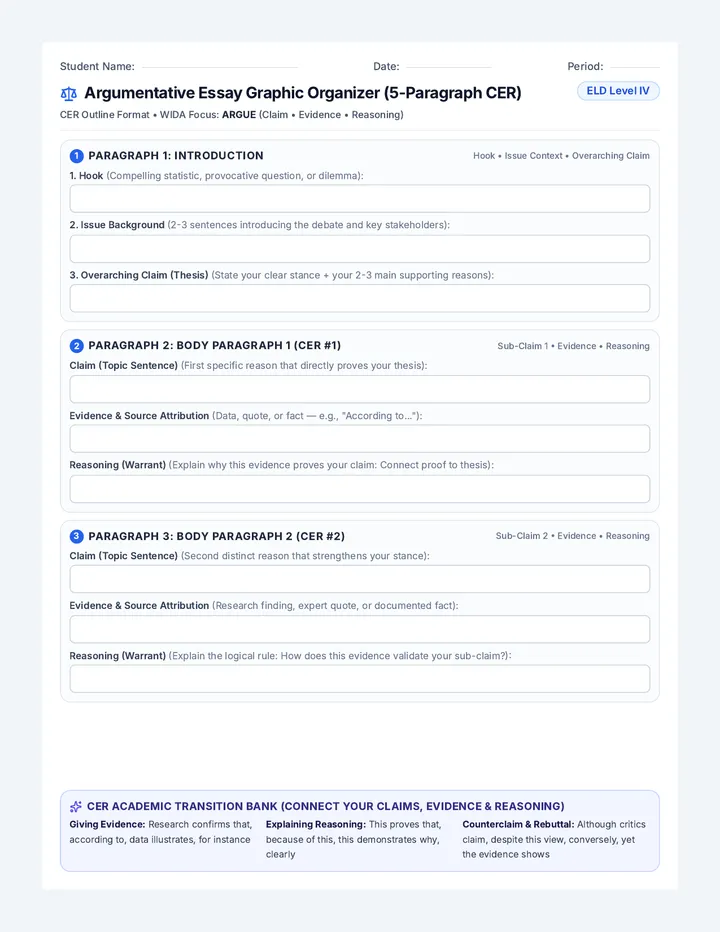
The 4-Paragraph Essay Blueprint:
Teacher diagrams structure: Paragraph 1 = Hook + Context + Concession Thesis. Paragraph 2 = Primary Argument + Evidence. Paragraph 3 = Counterargument + Conditional Rebuttal ("Critics contend that... however, if this occurred..."). Paragraph 4 = Synthesis Conclusion. Break down how conjunctions build the connective tissue between paragraphs.
Scaffold: Color-coded graphic organizer template handed out.
CFU: Cold-call: Where does the second conditional belong? (Rebuttal / Impact).
Explain how a concession thesis disarms opposing viewpoints before they arise.
3. PRACTICE ("WE/YOU") Guided / Solo application
24 min
We Do (8 min):
Class collaboratively engineers a thesis statement on "Implementing a 4-Day Workweek" using the formula: [Although + Counter-point, Main Stance + because + Hypothetical Future Benefit].
You Do (16 min):
Individual Essay Planning: Students choose 1 topic (Universal Healthcare, AI Automation, Plastic Tariffs). Draft: (1) Concession thesis; (2) Two topic sentences with target transitions; (3) One hypothetical impact prediction using second conditional.
Scaffold: Thesis formula frames: "Even though [X], governments should [Y] because if..."
CFU: Teacher conferences individually with 6 targeted MLL writers.
Draft an opening hook using an alarming rhetorical question or statistical contrast.
4. CLOSURE / CFU Exit ticket check
8 min
Thesis Quality Gate:
Students submit their finalized thesis statement on an exit card. Peer review check: Partner circles the concession word and underlines the main argument clause.
Scaffold: Self-check checklist: Has concession? Has specific stance? No run-on?
CFU: Teacher approves thesis cards before dismissal for Day 10 drafting.
Refine the vocabulary in your thesis by upgrading two informal verbs.
Teacher Reflection
Assess whether students can maintain grammatical agreement inside long, multi-clause thesis statements. Note any run-on or comma splice patterns.
Reteach & Support
Prepare pre-drafted paragraph outline templates with fill-in sentence prompts for 3 students needing structural scaffolding.
Ellii Digital Extension
Students complete Ellii writing module: "Writing Opinion Essays: Thesis & Outlining" digital prep module.
Camden Prep Multilingual Resources · Daily Planner Matrix Critical Thinking & Structured Communication · Class 9 of 11
CAMDEN PREP ■ ESL / MLL
K-12 Multilingual Learner Daily Lesson Planner
High-Intermediate B2 · Critical Thinking & Structured Communication
WIDA Aligned Class 10 of 11 (50 Min)
ESL/MLL Teacher: Academic ELL Team
Lesson Date / Time: Day 10 · 50 Minutes
Grade(s) & Group: High-Inter. (Grades 9-12 / Adult)
Curriculum / Unit: Drafting & Peer Calibration: The Critical Opinion Essay
Instructional Objectives
Content: SWBAT write a polished 250-word critical opinion essay resolving a societal controversy and evaluate a peer's text against a rigorous WIDA rubric.
Language: Students will incorporate at least 2 second conditional sentences, 3 conjunctive adverbs, and 2 subordinating conjunctions.
CCSS / ELD: CCSS.ELA-LITERACY.W.9-10.1 & W.9-10.5 · WIDA ELD Standard 1 & 2
WIDA ELD Framework
☐ Narrate ☑ Inform ☑ Explain ☑ Argue
Domains:
LST ☑ SPK ☑ RED ☑ WRT ☑
ELD Focus: Written Argumentation
Supports Quick-Check
☑ WIDA Level 4 Writing Rubric ☑ Target Structure Highlighter ☑ Live Individual Conferencing ☑ Error Correction Matrix
Editing Focus Areas: Comma splices, second conditional verb matching (if + past, would + base), semicolon accuracy.
Lesson Phase
Pacing
Core Activities & Teacher Steps (I Do, We Do, You Do)
Scaffolds & CFU
Extension (Fast Finishers)
1. DO NOW & HOOK Activate knowledge
5 min
The Rubric Unpacking Sprint:
Students review the 4-Level WIDA Writing Rubric checklist. Identify the "Gold Standard" criteria: 1) Logical coherence across paragraphs, 2) Accurate complex syntax with conditionals & transitions, 3) Academic register.
Scaffold: Student-friendly rubric anchor chart displayed.
CFU: Ask: How many target second conditionals are required in your essay?
Annotate the rubric for the difference between a Level 3 and Level 4 score.
2. MODEL ("I DO") Direct instruction
8 min
Live Counterargument Modeling:
Teacher models drafting Paragraph 3 live on screen: "Opponents often claim that eliminating tuition fees would overwhelm municipal budgets; however, if governments restructured defense subsidies, state revenues would comfortably absorb higher education costs. Furthermore, higher graduate earnings would ultimately expand the tax base." Highlight conjunctions and conditional forms.
Scaffold: Live teacher think-aloud color-coding clauses in real time.
CFU: Identify: Where did the conditional shift the argument?
Notice how ultimately enhances the predictive impact of the result.
3. PRACTICE ("WE/YOU") Guided / Solo application
29 min
Independent Drafting Block (20 min):
Students write their 4-paragraph critical opinion essay using their Day 9 outline. Teacher conducts rapid 2-minute desk-side conferences with prioritized students.
Structured Peer Review (9 min):
Partners swap essays with color highlighters: Yellow = Conjunctions, Blue = Transitions, Pink = Second Conditionals. Complete 3-item glow/grow feedback slip.
Scaffold: Timer displayed; desk-side word bank and grammar formula tent.
CFU: Peer reviewer confirms all 3 required elements are highlighted.
Enhance vocabulary by replacing repeated common words (good, bad, make) with academic Tier-2 verbs.
4. CLOSURE / CFU Exit ticket check
8 min
Draft Submission & Revision Log:
Students log their self-audit scores: 1) Word count reached (200-275 words), 2) Target structures validated, 3) Key peer suggestion recorded for tonight's final polish.
Scaffold: Digital submission portal with rubric checklist confirmation.
CFU: Teacher quick-scans submitted drafts for completion.
Prepare a 1-sentence teaser summarizing your thesis for tomorrow's speech.
Teacher Reflection
Review essays for synthesis. Do the second conditionals feel organic to the persuasive argument or artificially inserted? Address punctuation errors in comments.
Reteach & Support
Provide asynchronous recorded feedback on draft essays for 4 students with persistent verb tense calibration errors in the conditional clause.
Ellii Digital Extension
Complete Ellii Digital Assessment 1: "Grammar & Cohesion Checkpoint" (automated digital-only assessment).
Camden Prep Multilingual Resources · Daily Planner Matrix Critical Thinking & Structured Communication · Class 10 of 11
CAMDEN PREP ■ ESL / MLL
K-12 Multilingual Learner Daily Lesson Planner
High-Intermediate B2 · Critical Thinking & Structured Communication
WIDA Aligned Class 11 of 11 (50 Min)
ESL/MLL Teacher: Academic ELL Team
Lesson Date / Time: Day 11 · 50 Minutes
Grade(s) & Group: High-Inter. (Grades 9-12 / Adult)
Curriculum / Unit: Persuasive Mini-Speeches & Course Capstone
Instructional Objectives
Content: SWBAT deliver a 2-minute persuasive presentation proposing a hypothetical solution to a global challenge and defend their claim against peer inquiry.
Language: Students will synthesize all course targets (second conditionals, transitions, and subordinating conjunctions) in formal spoken presentation.
CCSS / ELD: CCSS.ELA-LITERACY.SL.9-10.4 & 9-10.6 · WIDA ELD Standard 1 & 2
WIDA ELD Framework
☐ Narrate ☑ Inform ☑ Explain ☑ Argue
Domains:
LST ☑ SPK ☑ RED ☑ WRT ☑
ELD Focus: Capstone Presentation
Supports Quick-Check
☑ Presentation Cue Card Template ☑ Audience Active Listening Form ☑ Visual Speech Timer ☑ Digital Portfolio Archive
Speech Signpost Toolkit: Imagine for a moment, if society chose to, consequently, let us examine the evidence, in conclusion.
Lesson Phase
Pacing
Core Activities & Teacher Steps (I Do, We Do, You Do)
Scaffolds & CFU
Extension (Fast Finishers)
1. DO NOW & HOOK Activate knowledge
5 min
Speech Delivery Warm-Up (P.E.P. Talk):
Students stand or sit upright. Quick choral warm-up practicing: Projection, Eye contact, and Pausing before transition markers. Review speech timekeeper protocol (green at 1:30, yellow at 1:45, red at 2:00).
Scaffold: Visual cue cards for delivery norms.
CFU: Check: What is the minimum and maximum speech length?
Practice delivering your opening sentence with deliberate vocal inflection.
2. MODEL ("I DO") Direct instruction
6 min
Anchor Mini-Speech Demonstration:
Teacher delivers a 1.5-minute model speech: "Imagine a world where food waste was criminalized..." Point out the deliberate oral pause before "however" and how the second conditional paints an immersive hypothetical picture of clean communities.
Scaffold: Printed transcript of teacher model with annotated pause marks (//).
CFU: Students count how many conditionals were voiced in model.
Note how the teacher concluded with a direct call to action.
3. PRACTICE ("WE/YOU") Guided / Solo application
31 min
Simultaneous Showcase Pods (25 min):
Class divides into 2 concurrent presentation pods (or staged whole-group rotation). Each student delivers their 2-minute persuasive capstone speech. Audience members record: (1) Main claim, (2) One conditional used, (3) One question for Q&A. 1-minute peer Q&A follows each speech.
Pod Consolidation & Commendations (6 min):
Group selects the most compelling hypothetical proposal from their pod to share out.
Scaffold: Bulleted index cards (no full scripts allowed, encouraging natural speaking).
CFU: Teacher scores oral performance on WIDA Speaking Rubric.
Respond to a challenging audience question using: "Even if that scenario occurred, my proposal would..."
4. CLOSURE / CFU Exit ticket check
8 min
Course Capstone Self-Reflection Slip:
Students complete a comprehensive reflection: "Before this course, I expressed opinions by ____. Now, I can substantiate arguments using ____ and describe hypothetical futures with ____."
Scaffold: Reflection prompts in student portfolio binder.
CFU: Students celebrate completion and self-assess growth from Day 1.
Write one educational or professional goal where you will apply these critical thinking skills.
Teacher Reflection
Synthesize oral presentation scores against Day 1 baseline. Assess growth in student confidence when articulating hypothetical solutions and responding to spontaneous questions.
Reteach & Support
Compile student portfolio artifacts (Day 1 baseline, Day 10 essay, Day 11 speech rubric) for semester language acquisition reports.
Ellii Digital Extension
Complete Ellii Digital Assessment 2: "Course Final Capstone Assessment" (digital-only cumulative exam).
Camden Prep Multilingual Resources · Daily Planner Matrix Critical Thinking & Structured Communication · Class 11 of 11 (Course Complete)