Lenny.com
Explore
Create
ActivitiesNewMathEnglish Language ArtsScience & EngineeringSocial StudiesGlobal LanguagesHealth & Physical EducationSpecial EducationCounseling & Life SkillsArts & CreativityESL
Lenny.com
Lenny.com
Explore
Create
ActivitiesNewMathEnglish Language ArtsScience & EngineeringSocial StudiesGlobal LanguagesHealth & Physical EducationSpecial EducationCounseling & Life SkillsArts & CreativityESL
Lenny.com
Lenny.com

Solutions

Lenny for EducatorsLenny for SchoolsLenny for Districts

Product

ExploreSign inCreateSupportAbout

Resources

Getting startedMTSS Acceleration Program

© 2026 Lenny Learning Inc.

TermsPrivacyAccessibility
LinkedInInstagramX
Lenny
ESLBeginner EnglishBasic VocabularyBasic GrammarBasic ListeningBasic SpeakingBasic ReadingBasic WritingIntermediate EnglishIntermediate VocabularyGrammarListeningSpeakingReadingAdvanced EnglishAdvanced VocabularyAdvanced GrammarAdvanced ListeningAdvanced SpeakingAdvanced ReadingAdvanced WritingAcademic English SkillsStudy SkillsTest-Taking StrategiesContent Area LanguageResearch and Information Literacy

SAT Launchpad

An introductory SAT preparation lesson tailored for beginner ESL learners, introducing test structure, fundamental sentence mechanics, and core reading strategies for identifying main ideas.

MMMohamed Mashaal

SAT Launchpad

An introductory SAT preparation lesson tailored for beginner ESL learners, introducing test structure, fundamental sentence mechanics, and core reading strategies for identifying main ideas.

MMMohamed Mashaal

ESL Word Bank:

  • Ecosystem: living plants/animals and their home
  • Vital: extremely important
  • Marine: related to the ocean
  • Coastal: land near the sea

Tip: Read the first & last sentence first!

Step 1 (Topic): In 2 to 4 words, what is the specific subject of this whole passage?

Step 2 (Main Idea): Which choice best states the main idea of the passage? Circle your choice.

A. Coral reefs cover less than one percent of the Earth's ocean floor.

B. Protecting coral reefs is critical because they provide essential protection for marine life and coastal communities.

C. Severe ocean storms frequently destroy coastal homes and coastal governments.

D. Scientists have already stopped ocean temperatures from rising around the world.

Step 3 (Evidence): Copy or explain one sentence from the passage that proves why choice B is the main idea.

4

Part 4: My Personal SAT Study Blueprint

My Daily Target 15 - 20 Minutes

Vocabulary Goal 3 New Words / Day

Golden Rule Never Leave a Blank

My preferred time to practice every day:

One friend or family member who will support my study habit:

SAT Preparation Course for ESL • Lesson 1 Page 2 of 2

Student reminder: Topic must be brief (2-4 words) and name the core subject without giving the full opinion yet.

Step 2: Correct Choice = B Correct Answer

B: "Protecting coral reefs is critical because they provide essential protection for marine life and coastal communities."

Why the Other Choices Are Wrong (Distractor Analysis):

A is incorrect (Too Narrow): True fact from sentence 2, but it is only a single background detail, not the whole passage's main argument.

C is incorrect (Distorted/Extreme): The passage states reefs shield towns from storms; it never claims storms have destroyed "most" coastal towns.

D is incorrect (Factually Untrue/Opposite): The text says temperatures threaten reefs; it does not say scientists stopped temperatures from rising.

Step 3: Best Evidence Sentences

"Because rising temperatures now threaten these fragile habitats, preserving coral reefs has become an urgent priority for scientists and local governments worldwide."

Acceptable alternative: First sentence ("Coral reefs are among the most valuable natural ecosystems on our planet.") paired with the barrier sentence.

4

ESL Coaching & Benchmark Goals

Lesson 1 Target Competency:

Students recognize that SAT Reading tests comprehension of main points, not vocabulary memorization in isolation, and SAT Writing tests grammatical structure.

Scaffolding ESL Beginners:

Encourage bilingual glossing in margins. Allow translation for single vocabulary words, but have students reason out sentence boundaries in English.

Weekly Milestone: 15 mins daily practice + 15 logged academic words in vocab notebook. Benchmark: 80%+ on Part 2

SAT Preparation Course for ESL • Instructor Key Page 2 of 2

When Explaining Sentence Fragments:

"This is a fragment because it begins with [conjunction] and lacks an independent clause showing the result."

When Justifying Main Idea Choices:

"I chose option [letter] because it summarizes the whole passage. Option [letter] is incorrect because it is only a supporting detail."

When Catching a Run-On Error:

"These are two complete sentences joined with only a comma, which is a comma splice. We must fix it using [period / semicolon / comma + FANBOYS]."

Common ESL Beginner Misconceptions & Fixes

Common Misconception Why ESL Students Think It Teacher Intervention

Long sentences must be run-ons. Students associate word count with grammatical correctness. Teach that a run-on is about punctuation boundaries, not length.

Semicolons are optional commas. Many world languages do not use semicolons strictly like English. Show the formula: Sentence ; Sentence = identical to period.

Main idea = first sentence word-for-word. Simpler ESL reading texts often place the thesis in line 1. Emphasize synthesizing the first sentence with the concluding sentence.

Diagnostic Check & Progression to Lesson 2

Ready for Lesson 2 if: Student scores 3/4+ on Part 2 & correctly identifies Option B on Part 3

Preview of Lesson 2: In the next lesson, we advance from sentence boundaries to Subject-Verb Agreement (singular vs. plural traps, prepositional phrases) and Reading Words-in-Context (using sentence clues to define academic words).

SAT Preparation Course for ESL • Instructor Guide Page 2 of 2
You might also like

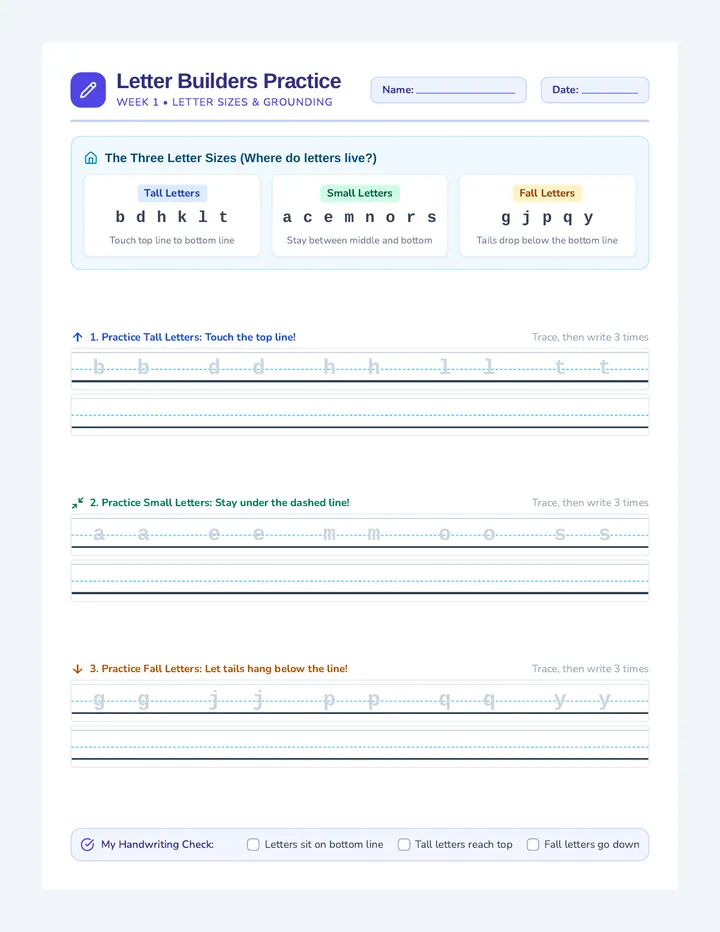
Letter Builders Practice Packet

Handwriting Heroes

A progressive multi-week handwriting curriculum created for second-grade English language learners. The sequence builds from foundational letter formation and spacing rules, through high-frequency school and home vocabulary, to fluent sentence composition with proper punctuation.

M

MlBeaumier

6
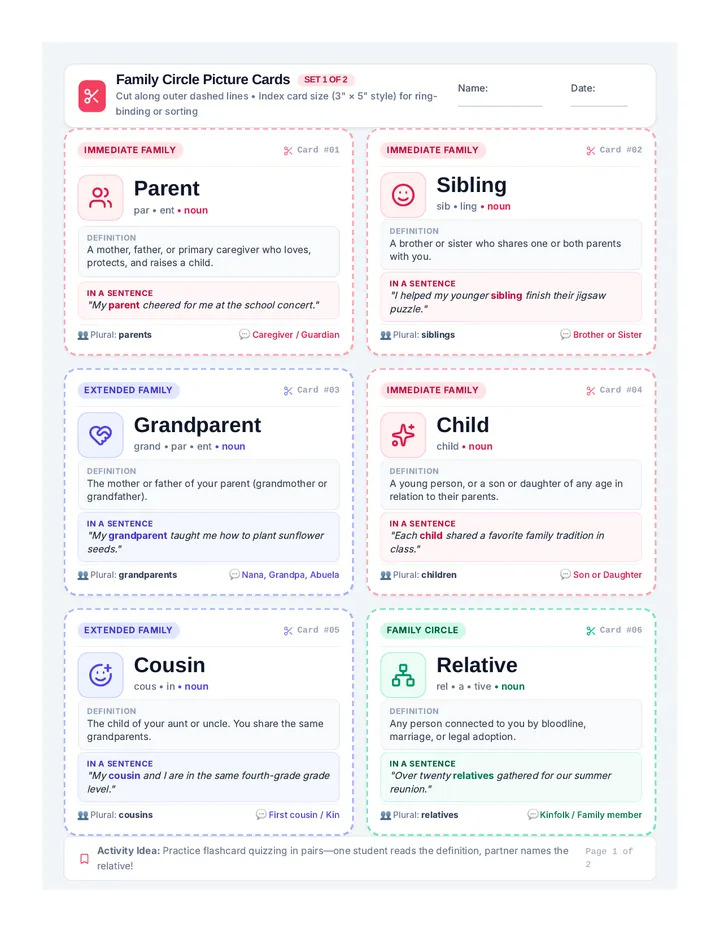
Family Circle Picture Cards

Family Roots

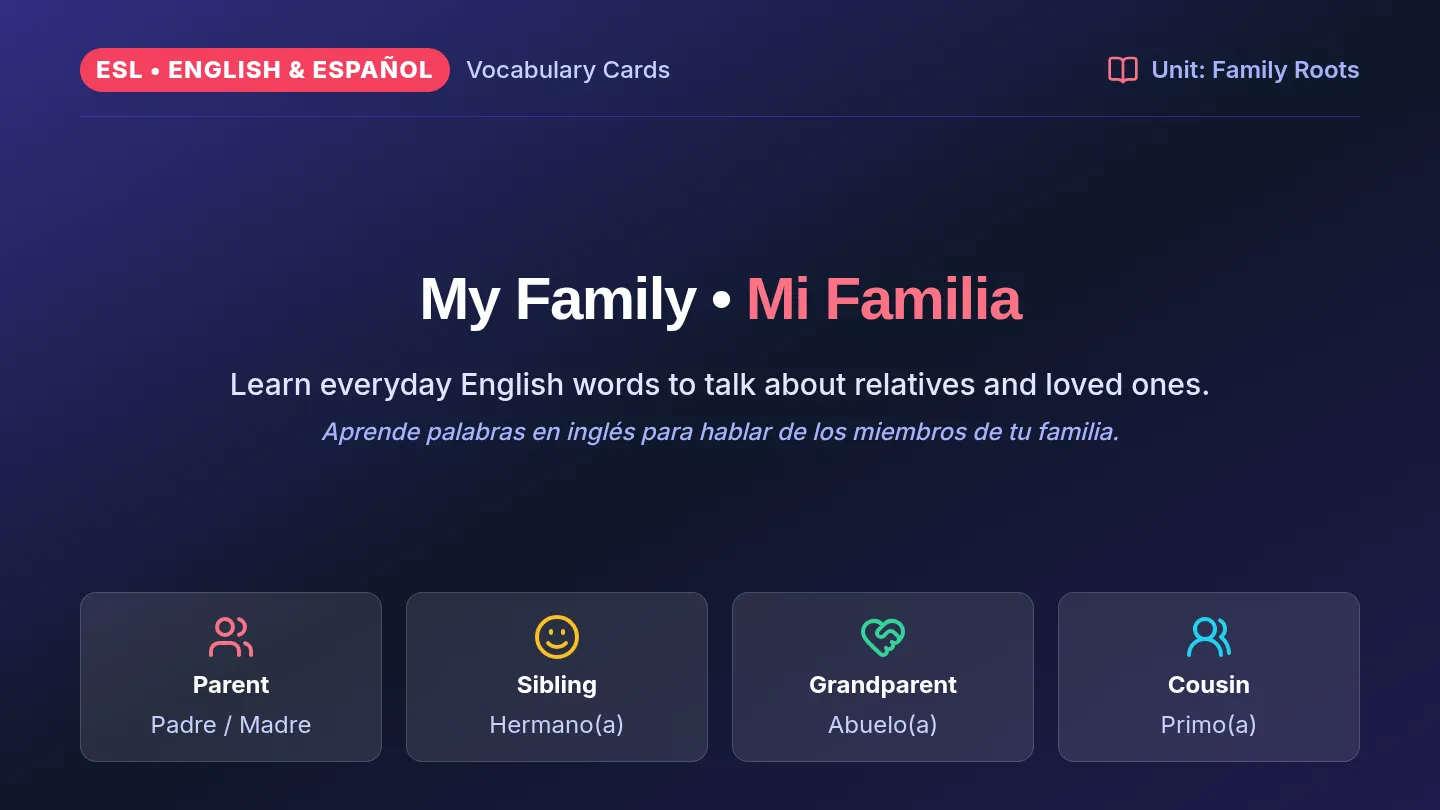
An introductory ESL family vocabulary lesson that builds English foundational terms for Spanish speakers. Students practice recognizing relatives through visual cues, Spanish translations, and bilingual speaking prompts.

MK

Mr. Katcher

2
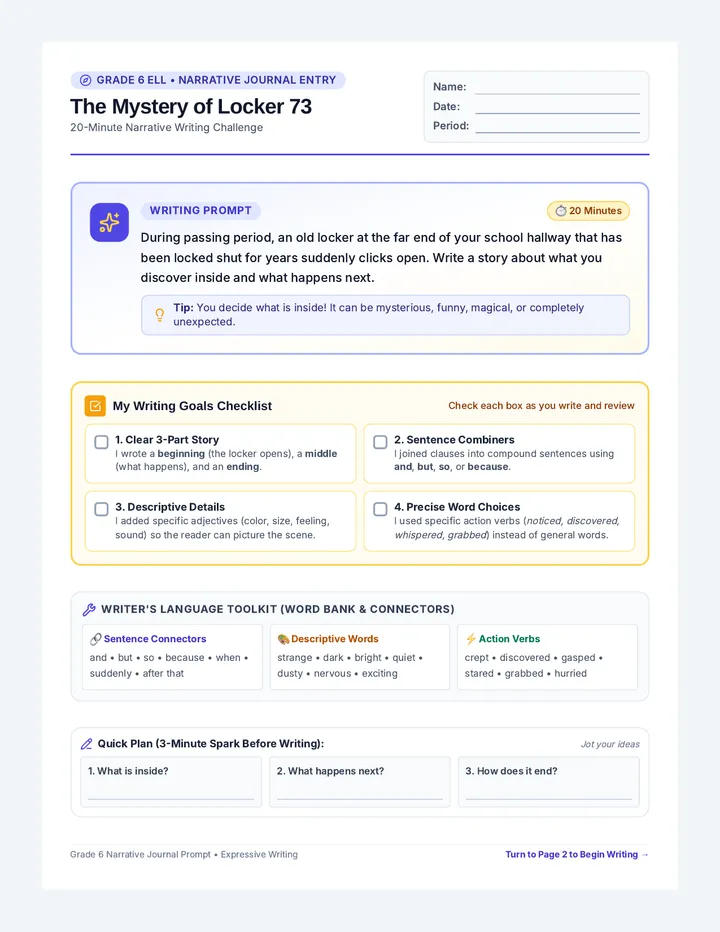
Mystery Locker Journal Prompt

Mystery Locker Journal Prompt

A streamlined 6th grade narrative journal writing prompt featuring a single, open-ended prompt with no pre-set clues, accompanied by sentence scaffolds and a student self-check list.

SM

Shalini Mitchell

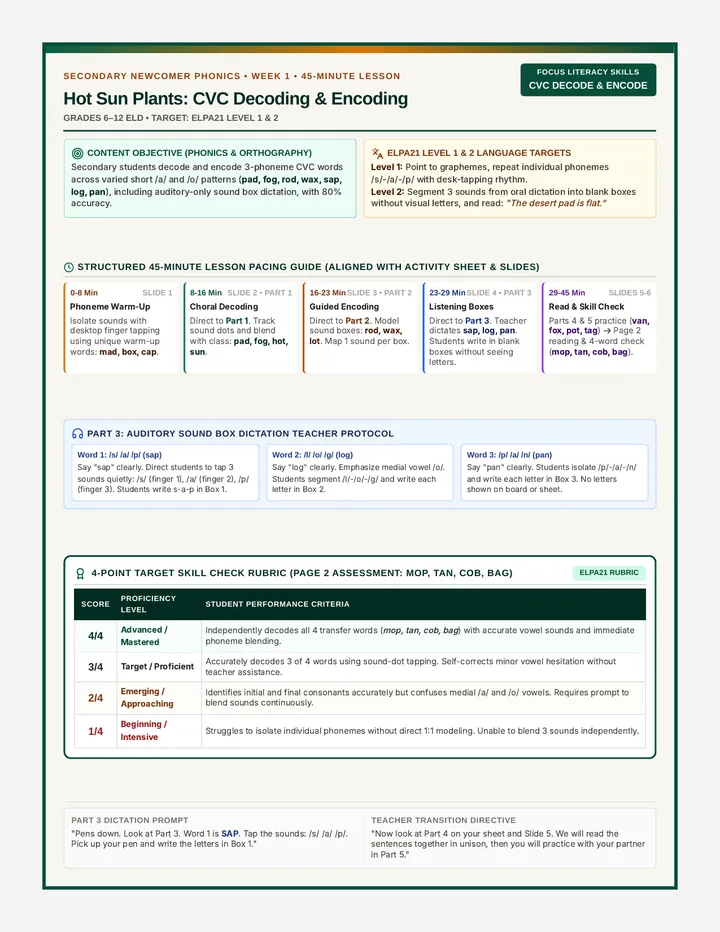
Hot Sun Teacher Guide

Reading 1 - T2 - UMS

A 5-week foundational phonics and early literacy unit (2 lessons weekly, 10 lessons total) for secondary newcomer English learners (ELPA21 Level 1-2), centered on desert wildlife and systematically building from CVC decoding and blends to silent e, r-controlled vowels, vowel teams, diphthongs, and inflected endings.

KJ

Katie Jordan

32
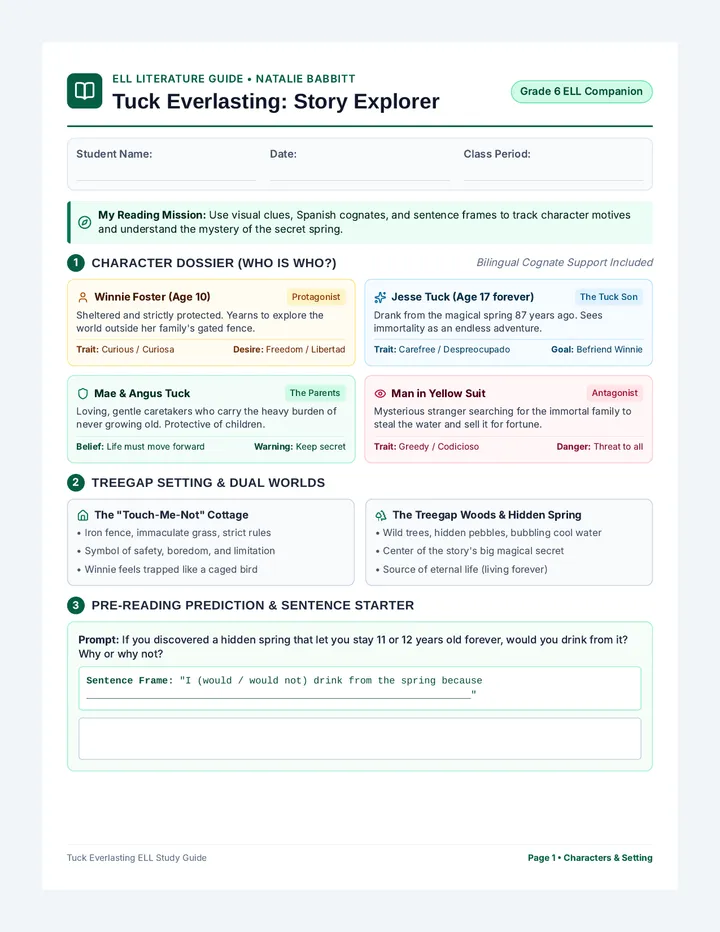
Spring Secrets Reading Guide

Spring Secrets

A comprehensive, language-accessible exploration of Natalie Babbitt's *Tuck Everlasting* designed for 6th-grade ELL students. The lesson equips learners with visual story maps, tiered vocabulary, sentence frames, and scaffolded comprehension checks.

AK

Abi Krebs

3
Family Words Slides

Family Words Slides

An 8-slide visual presentation designed for Spanish speakers learning English family vocabulary. Features bold English terms, Spanish translations, phonetic pronunciation, icon illustrations, and conversational sentence starters with strict 24px+ typography.

MK

Mr. Katcher

Sentence Parts Teacher Guide

Writing 1 - T2

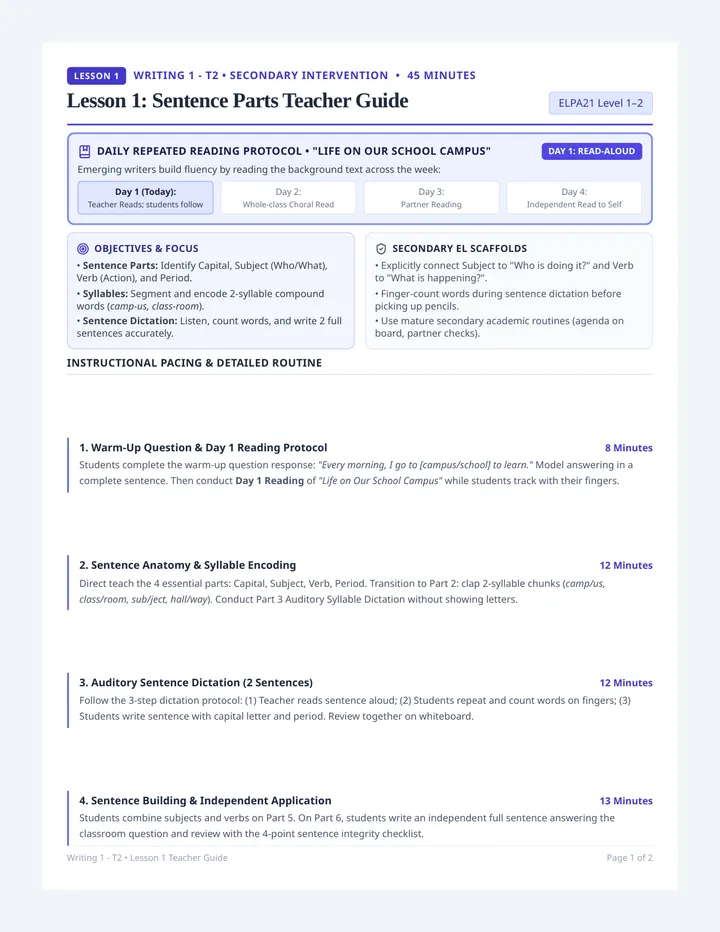
A 5-week foundational writing intervention for secondary emerging English learners focused on school and community themes, featuring syllable and affix encoding, 2 sentence dictations per lesson, sentence parts and building, and culminating in two-sentence question responses with reasoning.

KJ

Katie Jordan

17
Community Changemakers Weekly Plans

Community Changemakers

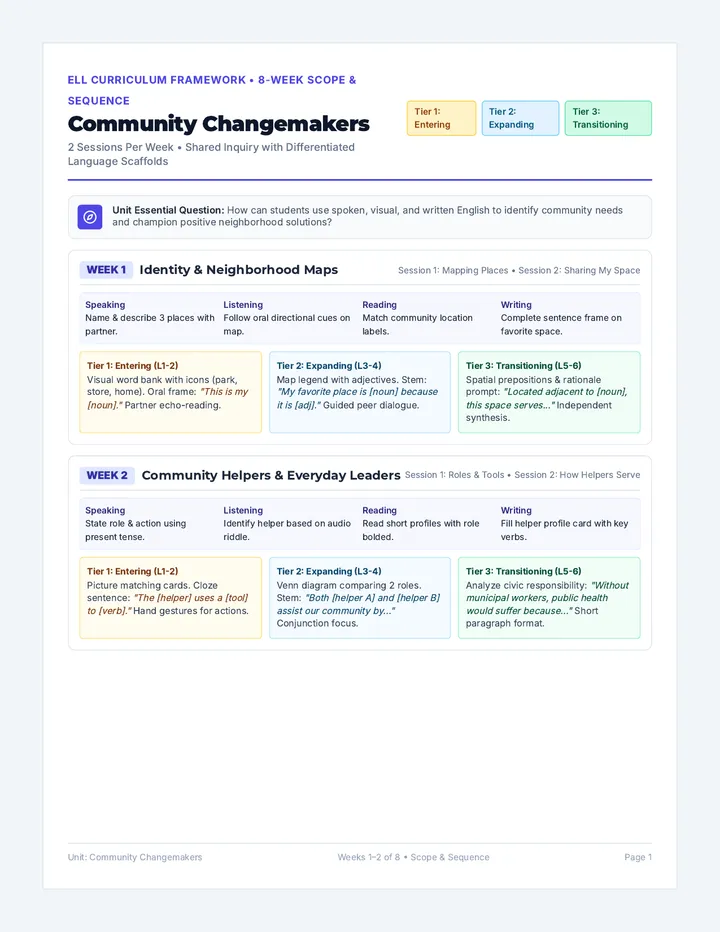
A comprehensive 8-week English Language Development bundle centered on community engagement and civic voice, featuring tiered scaffolds across Entering, Expanding, and Transitioning proficiency levels. Includes two sessions per week with explicit four-domain language targets, differentiated student worksheets, and teacher assessment frameworks.

S

soconnor

3
Family Circle Picture Cards

Family Circle Picture Cards

A two-page printable set of 12 vocabulary index cards for a family unit, featuring essential relatives, definitions, phonetic guides, and sentence frames. Designed with dashed cutting guidelines and visual cue icons for easy cut-apart classroom use.

MK

Mr. Katcher

Topic Words Teacher Guide

Writing 1 - Desert Survivors

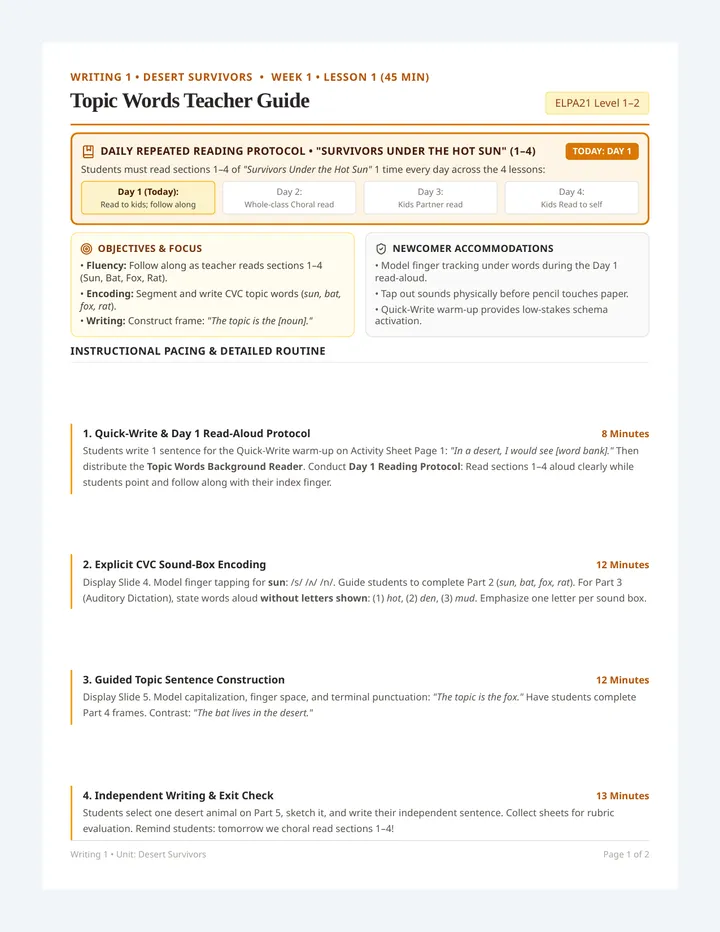
A 4-week foundational writing unit for ELPA21 Level 1-2 secondary English learners centered on desert wildlife, featuring 2 lessons per week with daily explicit encoding progressions, cumulative writing reviews, and structured academic sentence frames.

KJ

Katie Jordan

17
Peach Magic Teacher Guide

Peach Sensory Magic

A targeted English Language Learner lesson exploring sensory language (sight, sound, and touch) in Chapter 3 of *James and the Giant Peach*. Designed specifically for Entering and Emerging multilingual learners using Total Physical Response, visual scaffolds, and structured sentence frames.

AD

Angelina Damone

3
Essay Quizzes Answer Key

Essay Quizzes Answer Key

A comprehensive 2-page teacher answer key and scoring guide providing complete solutions, correct structural ordering, transition identification, and rubric notes for both the ELD Level II (Test #4) and ELD Level IV Bridging (Test #3) informational essay quizzes.

SF

Shirley Fung