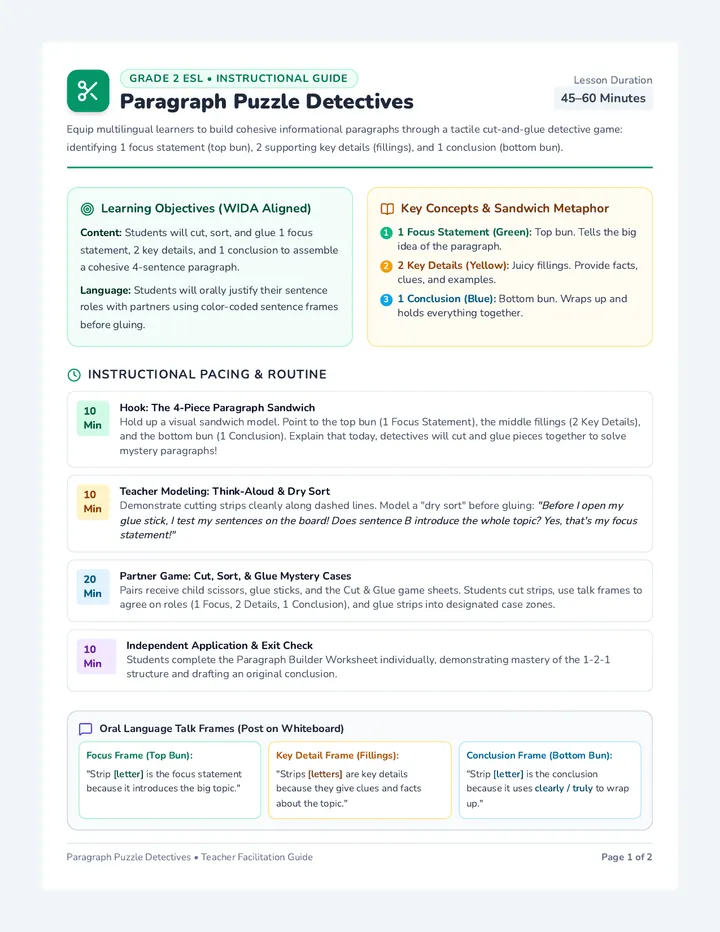
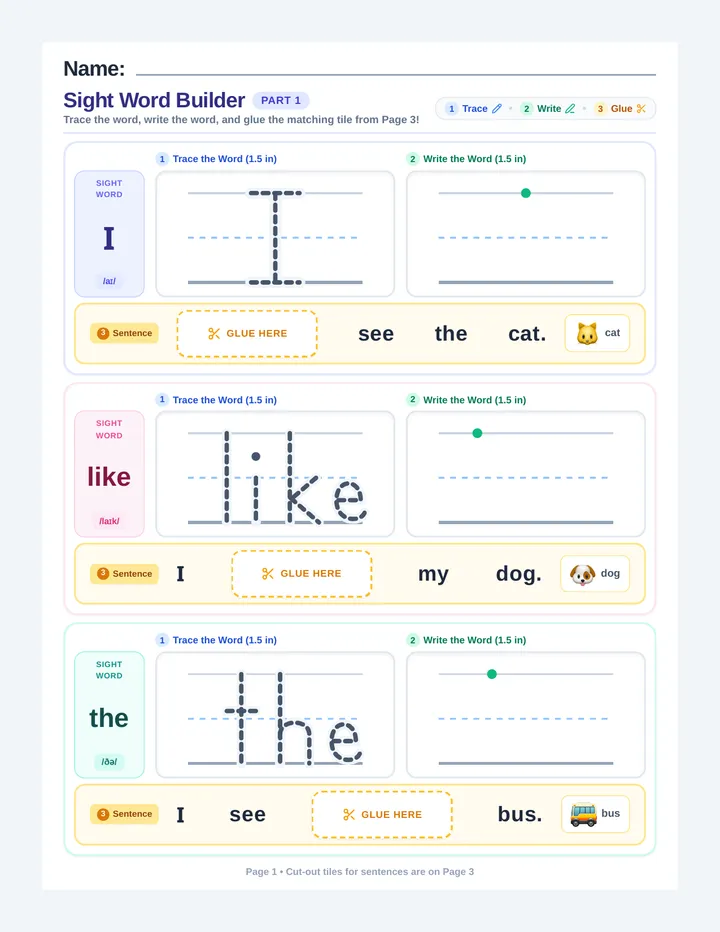
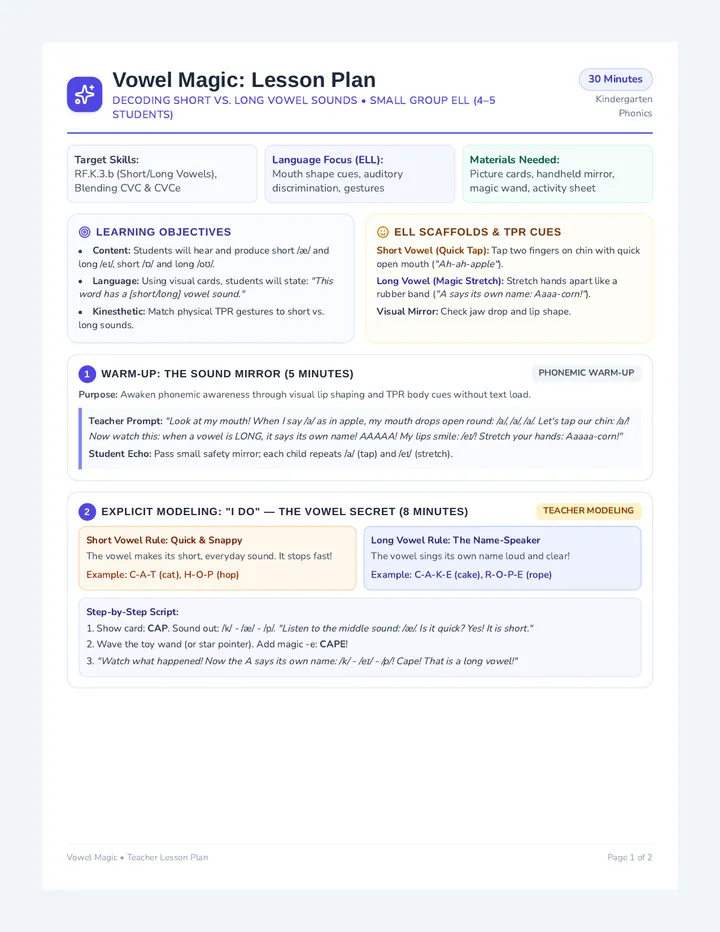
A scaffolded ESL lesson designed for entering and emerging multilingual learners to practice structured peer interviews and Think-Pair-Share routines. Students practice 12 targeted question frames with visual support, then organize shared and unique traits onto a collaborative Venn diagram.
✂️ Next step: Cut out the statement cards and glue them onto your Venn Diagram! Partner Detectives Activity
“Do you have a sister?”
Me: [ ] • Partner: [ ]
✂️ 11
🐕
Has a pet dog
“Do you have a pet dog?”
Me: [ ] • Partner: [ ]
✂️ 12
🍳
Ate eggs for breakfast
“Did you eat eggs?”
Me: [ ] • Partner: [ ]
💡 Safety Tip: Use kid scissors and share glue sticks with your partner! Venn Diagram Activity Sheet
Signal silent thinking time. Students fill in only their own checkboxes (“Me: Yes/No”) first so they are prepared to answer before talking.
Step 2: Pair (15 min)
Partner A asks question 1 while pointing. Partner B answers using thumbs up/down and sentence frame. Partner A marks the box, then roles flip for question 2.
Step 3: Share (10 min)
Partners compare their checkmarks. Any item with two “Yes” checks gets glued into the golden center circle: “Both of Us”!
Tiered Language Differentiation
WIDA Level 1: Entering
Visual & Non-Verbal Focus
• Allow pointing to picture badges while reciting single words (“Soccer?”).
• Use thumbs-up / thumbs-down gestures to accompany “Yes” / “No”.
• Pair with a supportive bilingual buddy or higher-proficiency peer.
• Provide pre-cut cards to reduce motor load and maximize language time.
WIDA Level 2: Emerging
Phrase & Sentence Expansion
• Require full auxiliary question frames (“Did you eat eggs for breakfast?”).
• Encourage short answers with auxiliary verbs (“Yes, I did!” / “No, I didn't.”).
• Challenge them to complete the written summary sentence on page 2.
• Encourage asking one bonus question of their own design!
Anticipated Challenges & Teacher Moves
Challenge: Students glue cards where neither said Yes.
Move: Emphasize: “If both say No, the card goes off the paper in the discard pile!”
Challenge: Students do not alternate speaking turns.
Move: Use a physical “talking token” (pencil or eraser) passed back and forth to mark whose turn it is to ask.