Creature Clues Slides Language Detectives • 3rd Grade
Lesson 1 of 2
Field Guide to Adjectives
Creature Clues
Learn how to describe amazing animals using exact adjectives for size, color, and texture.
Look Closely
Spot special body parts
Add Adjectives
Name size, color & texture
Stretch Sentences
Create vivid animal clues
Detective Toolbelt
Adjectives Tell Us Details
Word Bank
Size
How big or small?
tiny / massive long / short giant / wide
Color
What does it look like?
spotted / striped golden / bright dark / rusty brown
Texture
How does it feel?
fluffy / furry scaly / rough smooth / slimy
Parts
What special features?
sharp claws bushy tail curved beak
Detective Rule: Place the adjective before the noun (a fluffy tail) or after is / are (its tail is fluffy).
Modeling Strategy
The Sentence Stretcher
Watch Me Stretch!
1
Simple Noun Phrase
A frog.
Too plain!
2
Add Size + Color Adjectives
A tiny, bright green frog.
Getting clearer!
3
Add Texture + Feature Details
The tiny green frog has smooth, slimy skin and webbed feet.
Super Clue!
Now readers can create a sharp picture of the creature in their minds!
Guided Practice
Investigate the Red Fox
Let's Build Together
🦊
Red Fox
Habitat: Snowy Forest
rusty fur bushy tail pointed ears slender legs
Sentence Frame 1: Color & Coat
The fox has thick, rusty-red fur that keeps it warm.
Sentence Frame 2: Special Feature
Its tail is bushy with a white tip.
Sentence Frame 3: Action & Purpose
It listens with sharp, pointed ears for mice.
Notice how each sentence combines an adjective with a body part!
Speaking Routine
Partner Clue Quest
Turn & Talk
🦉
Creature A
Great Horned Owl
• Feather pattern: mottled, brown
• Eyes: huge, round, glowing yellow
• Claws: curved, sharp talons
"This creature has massive golden eyes..."
🐢
Creature B
Sea Turtle
• Shell: hard, greenish-brown, patterned
• Flippers: wide, paddle-like, powerful
• Skin: wrinkled, leathery
"This creature has a hard, patterned shell..."
Your Challenge:
Give your partner 2 clues using size, color, or texture. Can they guess your creature?
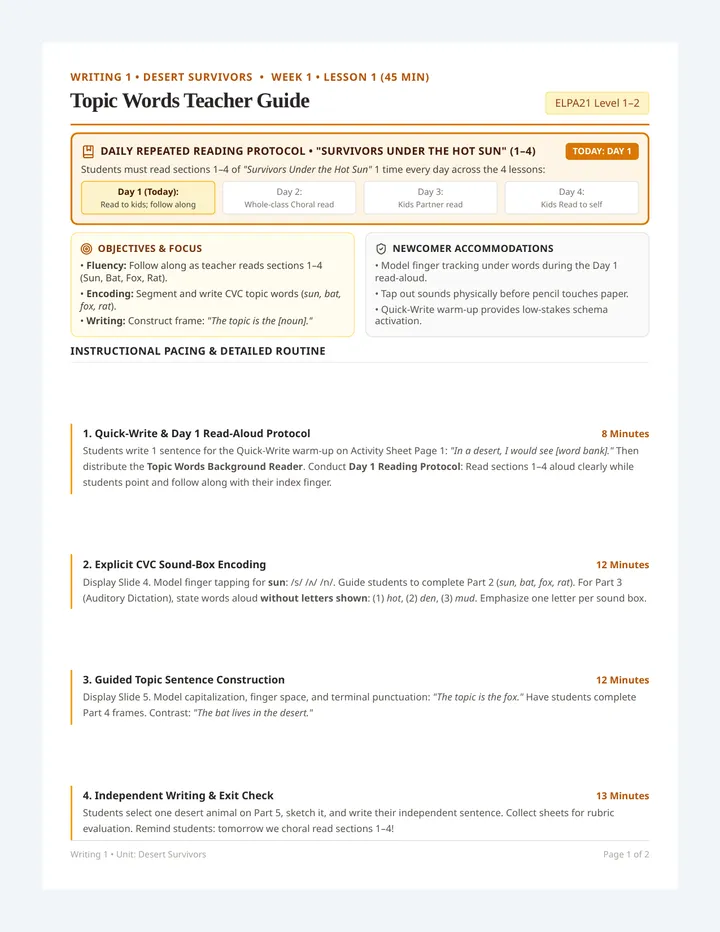
Creature Clues Teacher Guide Descriptive Detectives • Lesson 1 Teacher Guide
Creature Clues: Describing Animals & Objects
Grade 3 • WIDA Level 3 (Expanding)
Time: 45–50 Minutes
Content & Language Objectives
Content: Students will describe animal physical characteristics and adaptations using precise sensory attributes.Language: Students will speak and write descriptive sentences using the syntax [Adjective] + [Noun] and the frame "The [animal] has [adj] [feature] to [action]."
Target Vocabulary & Syntax Anchor
Size: tiny, massive, slender, broad • Texture: scaly, furry, prickly, smooth • Color: spotted, striped, golden, rusty.Syntax Alert: English places adjectives before nouns (unlike Spanish/Romance languages where adjectives often follow nouns).
Instructional Flow & Teacher Scripts
1. Hook & Warm-Up: Mystery Bag Reveal 7 mins
Show a hidden stuffed animal or object (e.g., a toy owl). Provide 3 mystery clues: "It is small. It has soft, speckled feathers and razor-sharp talons." Prompt students: "Which words told you what it felt like? Looked like?" Introduce the mission: Becoming descriptive detectives.
2. Direct Instruction: The Sentence Stretcher Model 10 mins
Present Slide 2 & 3. Model on chart paper: Start with a bare noun ("A bear." ). Add size and color ("A massive, brown bear." ). Add texture and action ("The massive brown bear has shaggy fur and sharp claws for catching salmon." ). Emphasize how adjectives make the mental image vivid.
3. Guided Practice: Investigating the Red Fox 12 mins
Using Slide 4 and Part 1 of the Student Activity Sheet, co-construct sentences. Call on students to identify parts (fur, tail, ears) and select strong sensory words from the Detective Word Bank. Practice choral repetition with gesture (e.g., cupping ears for "pointed ears").
4. Structured Partner Clue Quest & Independent Application 12 mins
Partners use Slide 5 and Part 2 of their Activity Sheet. Partner A gives 2 descriptive clues; Partner B guesses the creature, then they switch. Next, students complete their "Mystery Animal Dossier" independently using provided sentence starters.
5. Closure & Exit Ticket 5 mins
Distribute half-sheet exit tickets. Students observe the Chameleon prompt, supply 2 descriptive adjectives, and complete the scaffolded sentence frame.
EL Differentiation Matrix
Creature Clues Activity Sheet Creature Clues Activity Sheet
Part 1: Detective Word Bank & Sentence Stretcher
Name:
Date:
Field Guide Word Bank: Choose Describing Words
Use these adjectives in your writing!
Size / Shape
• tiny / huge
• slender / thick
• long / short
• wide / curved
Color / Pattern
• golden yellow
• rusty red
• spotted / striped
• snowy white
Texture / Feel
• soft / fuzzy
• scaly / rough
• slimy / smooth
• leathery / sharp
Animal Parts
• bushy tail
• sharp claws
• curved beak
• webbed paws
1
Clue Match: Draw a line to pair the adjective with the best animal body part.
Adjective (How it looks/feels)
A. fluffy and bushy
B. sharp and curved
C. hard and patterned
Animal Part (Noun)
1. turtle's protective shell
2. red fox's winter tail
3. eagle's hunting talons
2
Sentence Stretcher: Expand the short sentence into a detailed clue.
Example: "A snake." ➔ "A long, scaly snake slides quietly through the green grass."
A. Plain sentence: "The fox has fur."
Stretch this sentence! Add two adjectives describing the fur's color and texture.
The fox has
B. Plain sentence: "The owl has eyes."
Stretch this sentence! Add adjectives to tell the size and color of the eyes.
The owl has
Detective Tip: Always put your describing words before the noun (example: sharp claws , not claws sharp ).
Creature Clues Dossier
Part 2: Mystery Animal Challenge
Independent Writing
3
Select Your Mystery Creature:
🦉
Snowy Owl
🦦
Sea Otter
🐸
Tree Frog
Write the creature you chose:
Sketch Your Creature & Label 2 Parts
Example labels: curved beak, soft belly
4
Write Your Creature Clue Report: Fill in the lines to complete each sentence.
Sentence 1: Size and Body Type
This mysterious animal is and in size.
Creature Clues Exit Ticket Creature Clues: Exit Ticket
Formative Assessment • Lesson 1
Name:
Date:
🦎
Tree Chameleon
Notice its skin and tail
1. Circle TWO adjectives that accurately describe this animal:
bumpy giant emerald-green feathery coiled
2. Complete the sentence using your chosen adjectives:
The chameleon has skin and a tail.
3. Write ONE new sentence describing the chameleon's eyes or feet:
Cut Here (2 tickets per page)
Creature Clues: Exit Ticket
Formative Assessment • Lesson 1
Name:
Date:
🦎
Tree Chameleon
Notice its skin and tail
1. Circle TWO adjectives that accurately describe this animal:
bumpy giant emerald-green feathery coiled
2. Complete the sentence using your chosen adjectives:
The chameleon has skin and a tail.
3. Write ONE new sentence describing the chameleon's eyes or feet:
Picture Detectives Slides Language Detectives • 3rd Grade
Lesson 2 of 2
Field Guide to Settings & Scenes
Picture Detectives
Discover how to describe full scenes by combining location words with vivid sensory details.
Find Locations
Foreground & background
Use Senses
Sights, sounds & feelings
Build Paragraphs
4-sentence descriptions
Scene Navigator
Where Are the Clues?
Location Words
Far Away
Background
Sky, tall mountains, clouds, distant hills.
"High in the background, snowy peaks rise..."
Center Stage
Middle Ground
Walking paths, green trees, wooden cabins.
"In the middle, a cozy wooden cabin sits..."
Closest to You
Foreground
Smooth stones, wildflowers, bubbling stream.
"In the foreground, smooth rocks rest..."
Detective Order: Move your eyes from the big picture to the close-up details!
Sensory Bank
Make the Scene Come Alive
Step into the Picture
What You See
Colors, light & shapes
• sparkling sunshine
• deep cool shadows
• winding dirt path
What You Hear
Sounds in the air
• rushing river waters
• rustling green leaves
• cheerful birds chirping
What You Feel
Breeze & weather
• crisp mountain breeze
• warm golden sunlight
• damp, cool mist
Sensory words make your readers feel like they are standing inside your picture!
Modeled Walkthrough
The Waterfall Sanctuary
4-Sentence Strategy
🏞️
Mountain Waterfall
Back: Tall gray cliffs
Middle: Rushing falls
Front: Smooth stones
1. Big Picture
This scene shows a hidden waterfall deep in the woods.
2. In the Background
In the background, towering cliffs rise toward the sky.
3. In the Foreground
In the foreground, smooth stones rest in the clear stream.
Picture Detectives Teacher Guide Descriptive Detectives • Lesson 2 Teacher Guide
Picture Detectives: Describing Scenes & Settings
Grade 3 • WIDA Level 3 (Expanding)
Time: 45–50 Minutes
Content & Language Objectives
Content: Students will analyze visual settings to organize spatial details (foreground, middle ground, background) and sensory impressions.Language: Students will write a cohesive 4-sentence paragraph using introductory prepositional phrases ("In the foreground...", "In the background..." ) and sensory adjectives.
Spatial & Sensory Language Target
Spatial Prepositions: in the background, in the foreground, next to, underneath, towering above.Sensory Anchor: sight (colors/lighting), sound (imagined acoustic clues), feeling (weather/temperature).
Instructional Sequence & Facilitation
1. Hook: The Camera Zoom Challenge 7 mins
Hold up an empty paper photo frame or have students make a rectangle with their fingers. Have them "zoom in" close (foreground) to an item on their desk, then look far out the window (background). Introduce vocabulary: foreground (close up) vs background (far away).
2. Direct Instruction: Spatial Compass & Sensory Palette 10 mins
Review Slide 2 & 3. Model how English uses introductory prepositional phrases followed by commas: "In the background, ..." Model sensory imagination: "Even though pictures are silent, good writers imagine what the wind feels like or what the water sounds like!"
3. Guided Practice: Deconstructing the Waterfall Scene 12 mins
Examine Slide 4 and Page 1 of the Student Activity Sheet. Co-write the 4-sentence sequence on the board using the classroom anchor: (1) Big Picture Setting, (2) Background detail, (3) Foreground detail, (4) Sensory atmosphere. Choral read each sentence together.
4. Structured Turn-and-Talk & Independent Scene Writing 12 mins
Students pair up for the Slide 5 Campsite Challenge. Partner A describes background; Partner B describes foreground. Then, students transition to Page 2 of the Activity Sheet to write their "Harbor Market" or "Enchanted Forest" scene independently.
5. Synthesis & Formative Exit Ticket 5 mins
Students complete the Exit Ticket: identify foreground vs background on the Desert Oasis snapshot, then construct one spatial sentence and one sensory feeling sentence.
EL Differentiation Matrix
Entering/Emerging (L1-2): Provide labeled visual mats with pre-printed preposition cards (
Picture Detectives Activity Sheet Picture Detectives Activity Sheet
Part 1: Scene Inspector & Sensory Palette
Name:
Date:
Investigate the Scene: The Mountain Campsite
Observe the 3 layers!
Background: Snowy peaks & clouds
🏔️ ☁️
Middle Ground: Pine trees & green tent
🌲 ⛺
Foreground: Campfire & stone ring
🔥 🪵
Location Sentence Starters:
• "High in the background, ..."
• "In the middle of the scene, ..."
• "Right in the foreground, ..."
• "Next to the tent, ..."
Rule: Put a comma (,) after your location starter phrase!
1
Detective Sorting: Write each detail into the correct spatial zone.
• crackling fire • tall pine trees • jagged snow peaks • smooth river rocks • canvas tent
Background (Far Away)
Middle Ground (Center)
Foreground (Close Up)
2
Sensory Palette: Choose one vivid adjective for each sense.
Sight (Light/Color)
golden, sparkling, shadowy
Sound (Noises)
crackling, whistling, quiet
Feeling (Weather)
chilly, cozy, damp, warm
Turn the page to write your complete 4-sentence scene report using these details!
Picture Detectives Report
Part 2: The 4-Sentence Scene Description
Independent Writing
3
Draft Your 4 Clue Sentences: Follow the frames below.
Sentence 1: The Big Picture (Setting)
This peaceful picture shows a in the mountains.
Sentence 2: In the Background (Far Away)
High in the background, rise toward the sky.
Sentence 3: In the Foreground (Close Up)
Right in the foreground, there is a , campfire.
Sentence 4: Sensory Atmosphere (Sound or Feeling)
The crisp mountain air feels and smells like .
4
Final Scene Paragraph: Combine all 4 sentences into one paragraph!
Scene Detective Checklist: Check your work before submitting!
Named the setting
Background detail
Foreground detail
Commas after openers
Picture Detectives Exit Ticket Picture Detectives: Exit Ticket
Formative Assessment • Lesson 2
Name:
Date:
🌴 🏜️
Desert Oasis
Notice dunes vs pool
1. Look at the scene. Which location word matches each detail?
Giant dunes:
Shaded blue pool:
2. Complete the sentence using a location starter and adjective:
In the , sand dunes rise under the sun.
3. Write ONE new sentence describing the foreground water or palm trees:
Cut Here (2 tickets per page)
Picture Detectives: Exit Ticket
Formative Assessment • Lesson 2
Name:
Date:
🌴 🏜️
Desert Oasis
Notice dunes vs pool
1. Look at the scene. Which location word matches each detail?
Giant dunes:
Shaded blue pool:
2. Complete the sentence using a location starter and adjective:
In the , sand dunes rise under the sun.
3. Write ONE new sentence describing the foreground water or palm trees: