Geometric classification, measurement of area and volume, and the study of transformations and rigid motions. Builds toward complex proofs, trigonometry for general triangles, and the algebraic representation of conic sections.
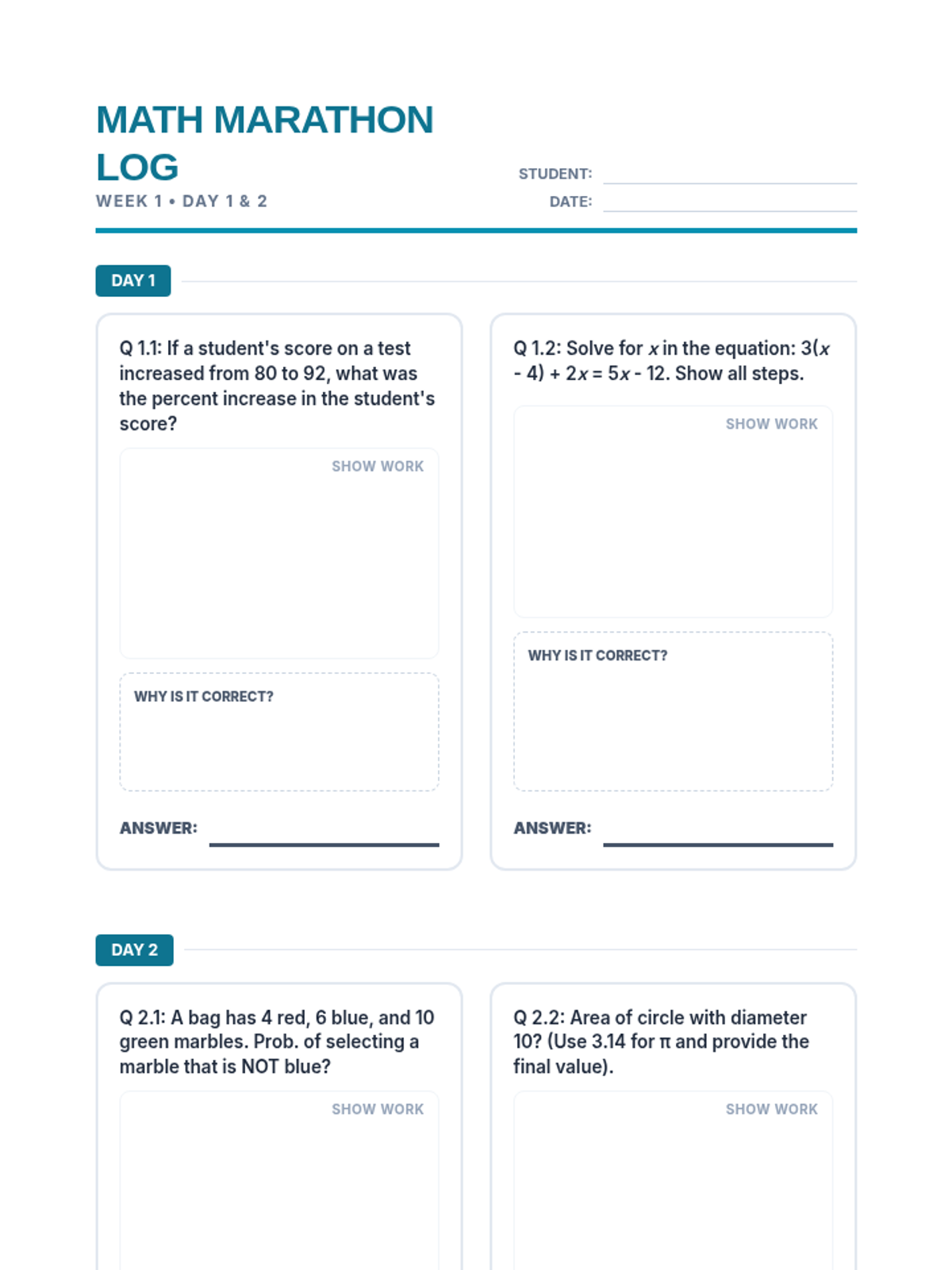
A comprehensive 15-day TSIA2 math review sequence featuring daily warm-up questions and weekly progress logs for students. The program covers all four TSIA2 domains through a "Math Marathon" theme.
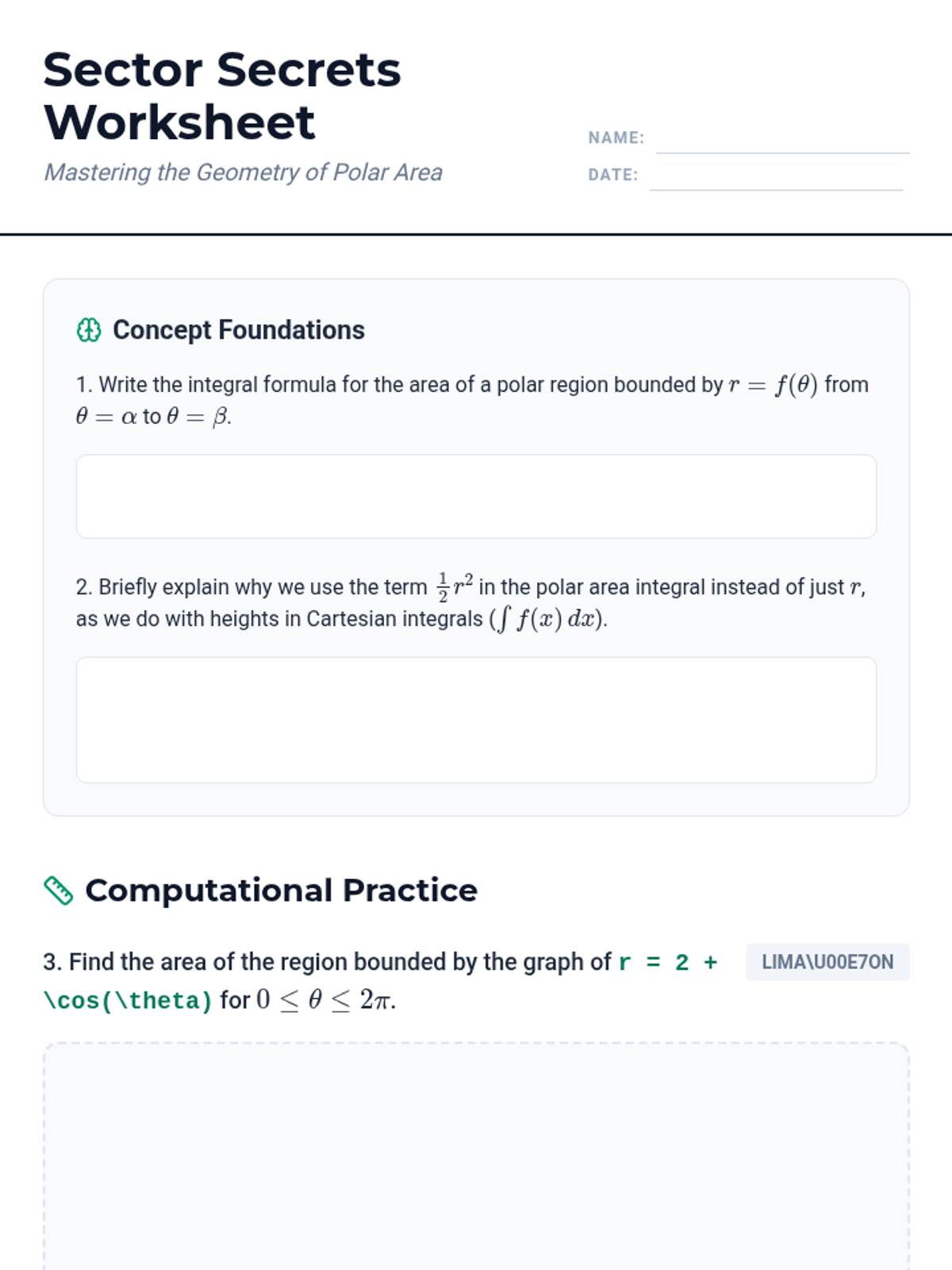
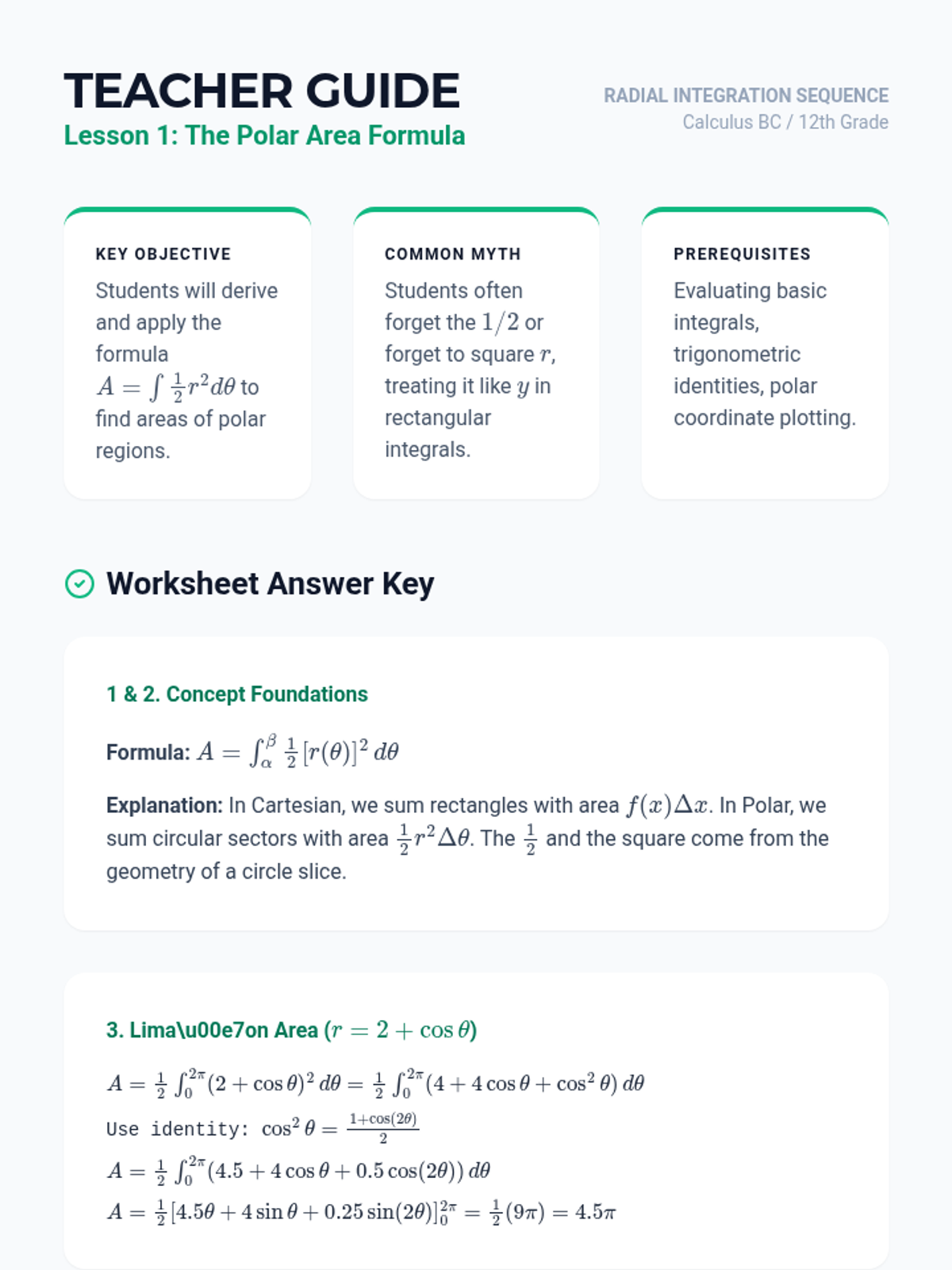
A comprehensive unit for 12th Grade Calculus students focusing on the integration of polar functions to find area, arc length, and surface area. Students transition from Cartesian thinking to radial accumulation, mastering the geometry of circular sectors and polar coordinate transformations.
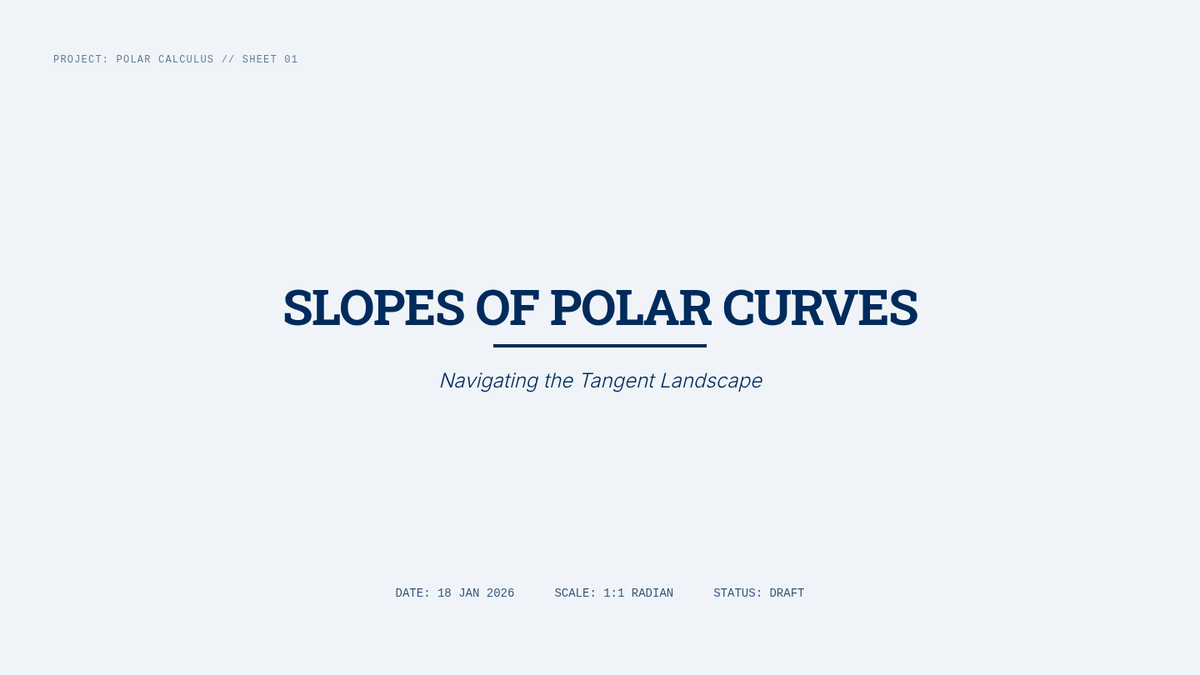
This sequence explores calculus in the polar coordinate system, focusing on differentiation and integration. Students will master finding slopes of tangent lines, calculating areas of polar regions and intersection areas, and determining arc lengths of polar curves.
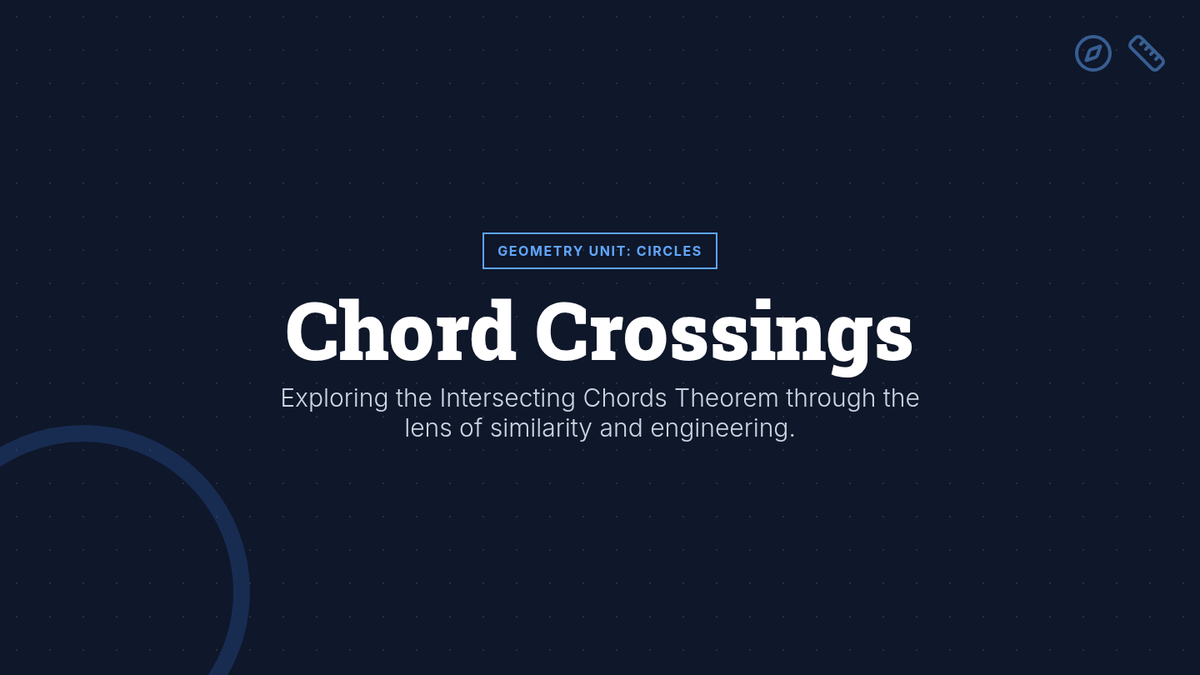
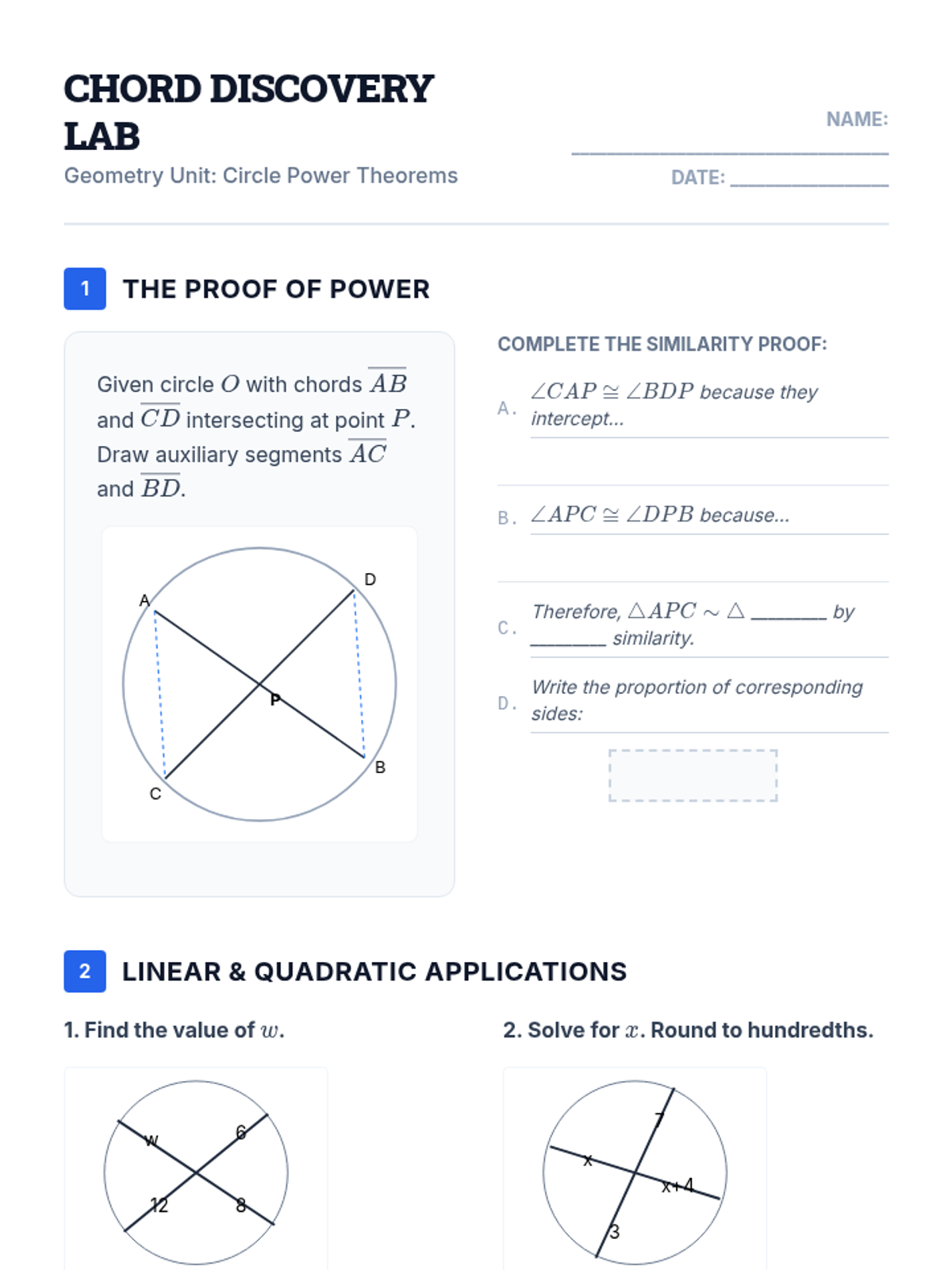
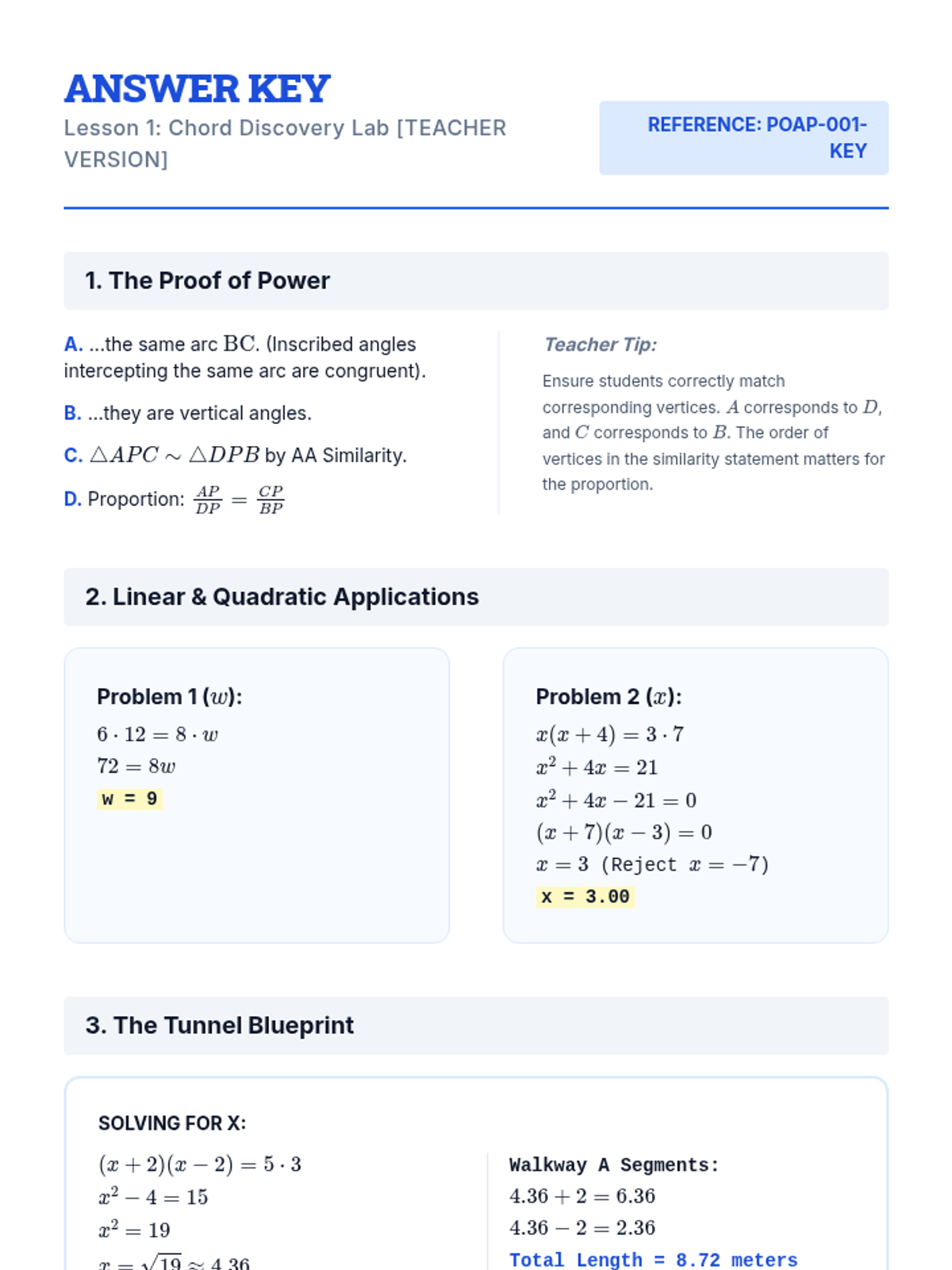
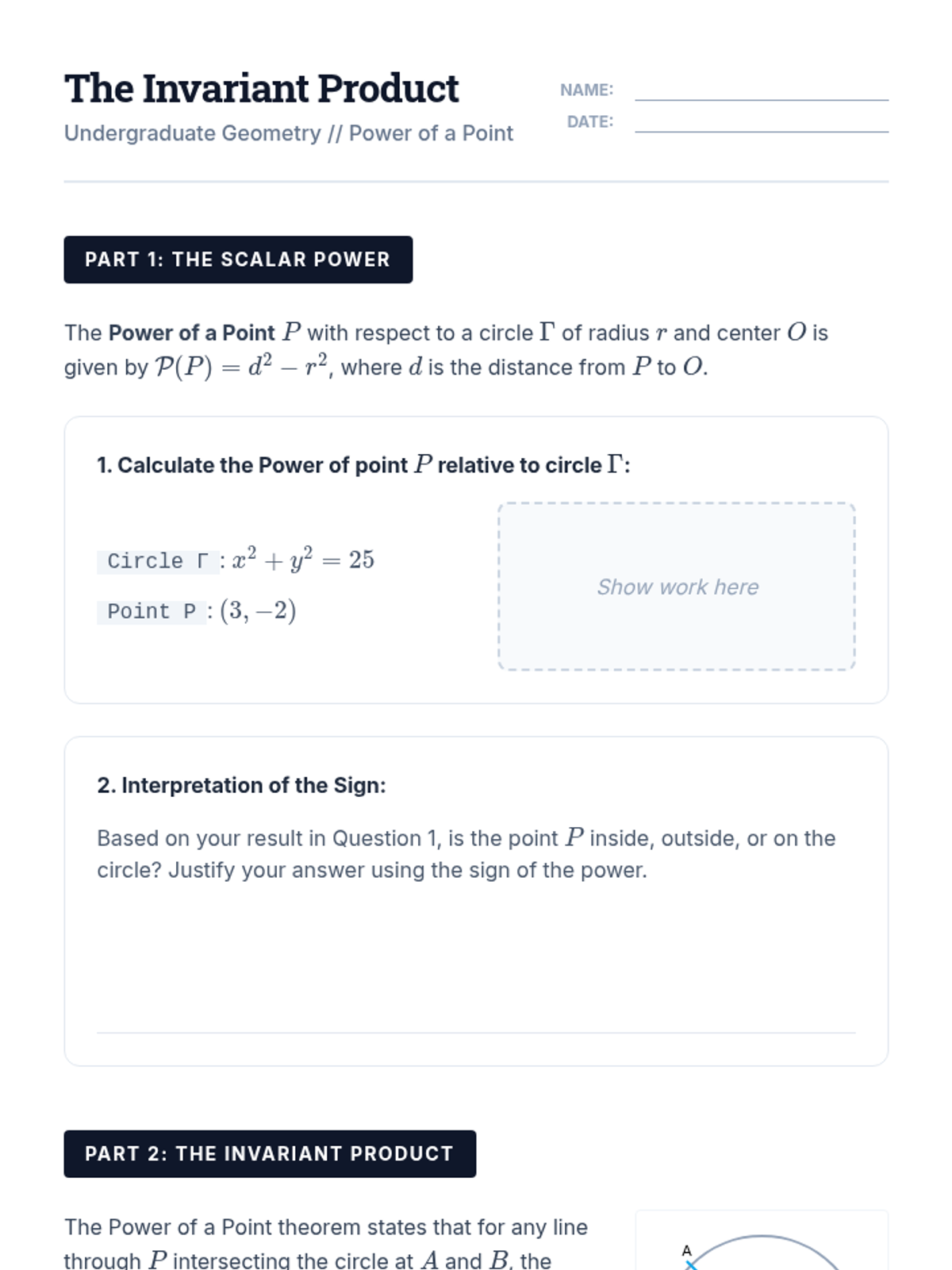
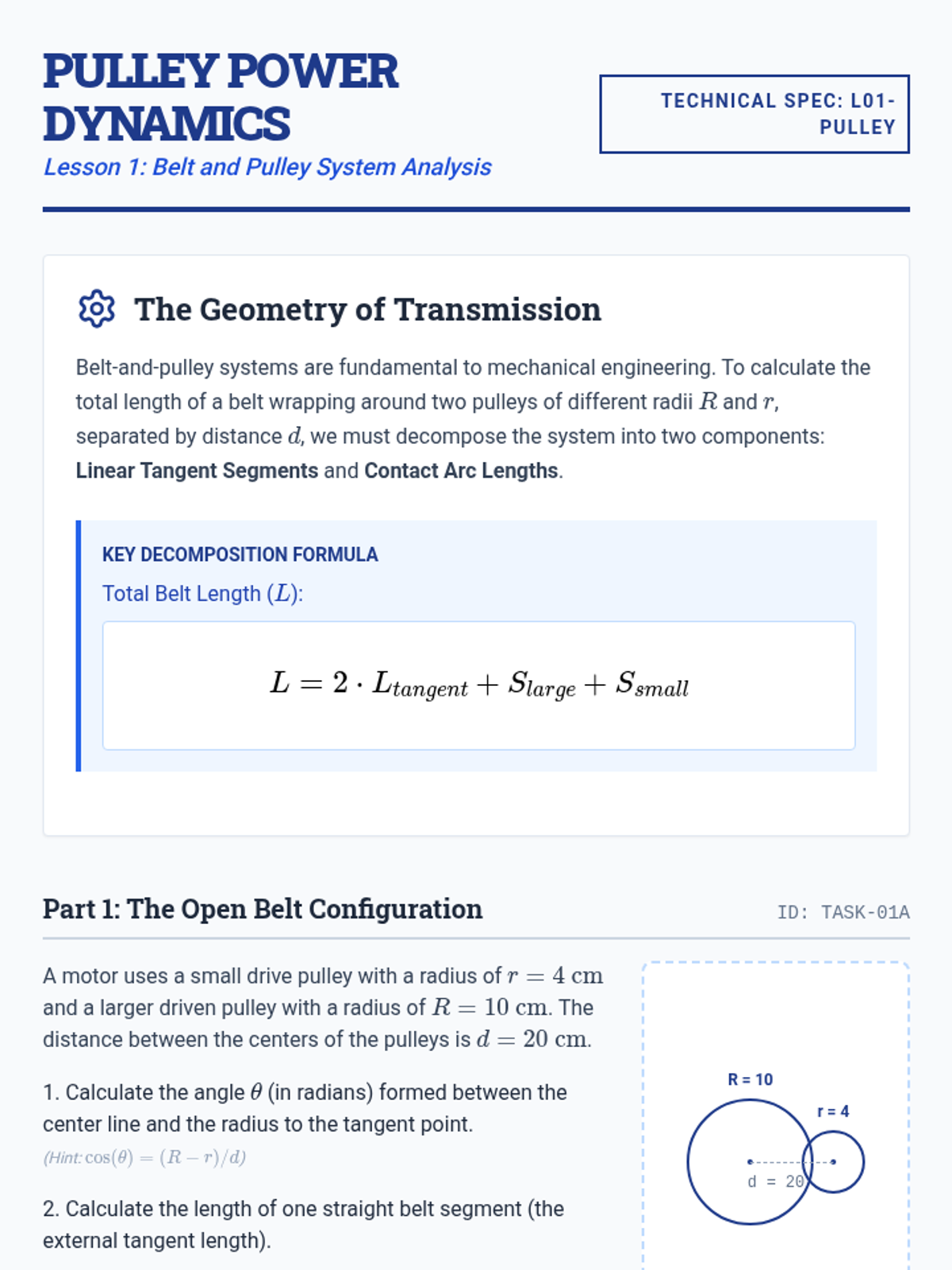
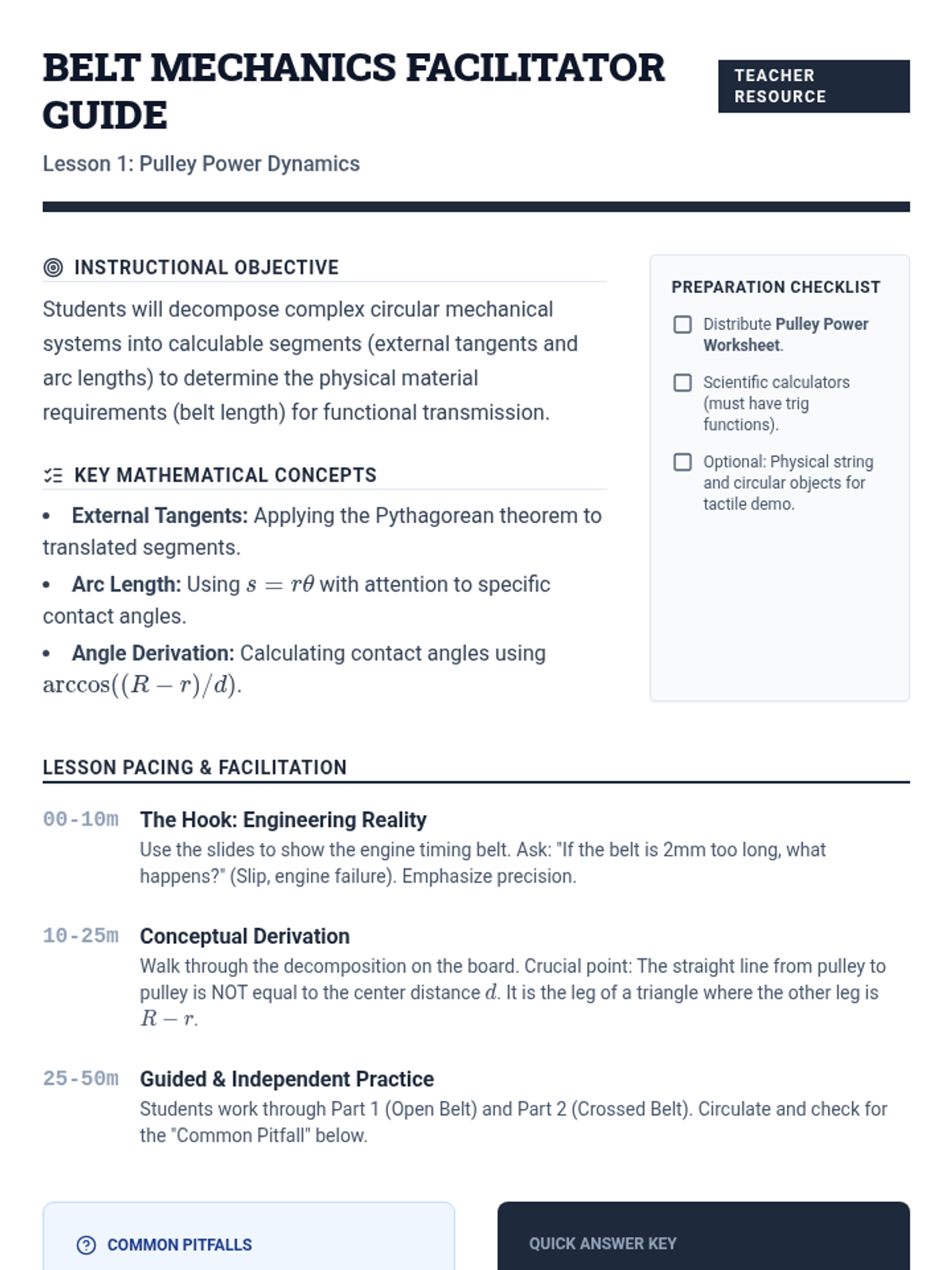
This sequence explores the metric relationships of circles, focusing on the Power of a Point theorems (chords, secants, and tangents) and their applications in engineering and geometry. Students will derive these relationships using similarity and apply them to solve complex algebraic problems, including common tangents in pulley systems.
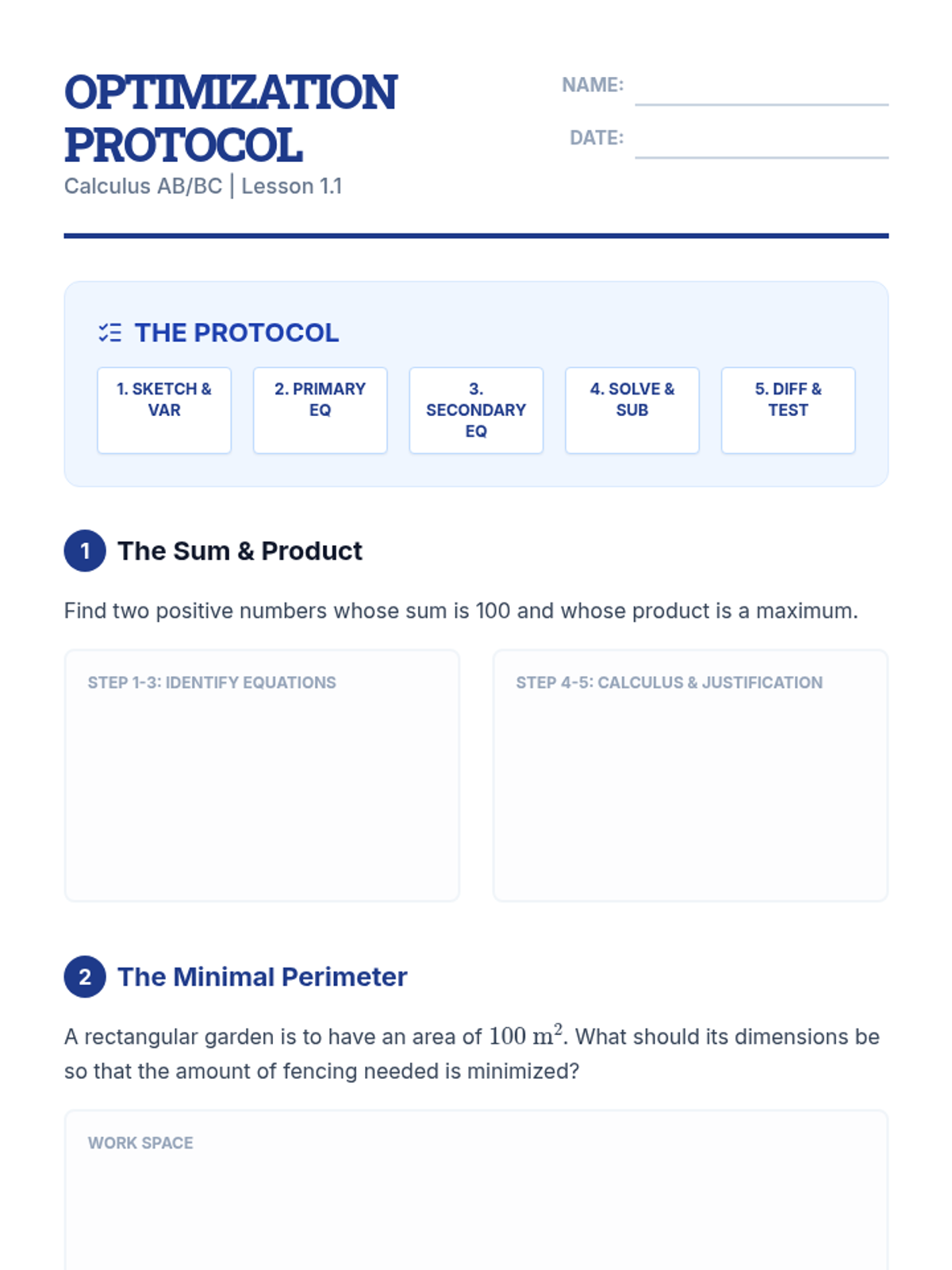
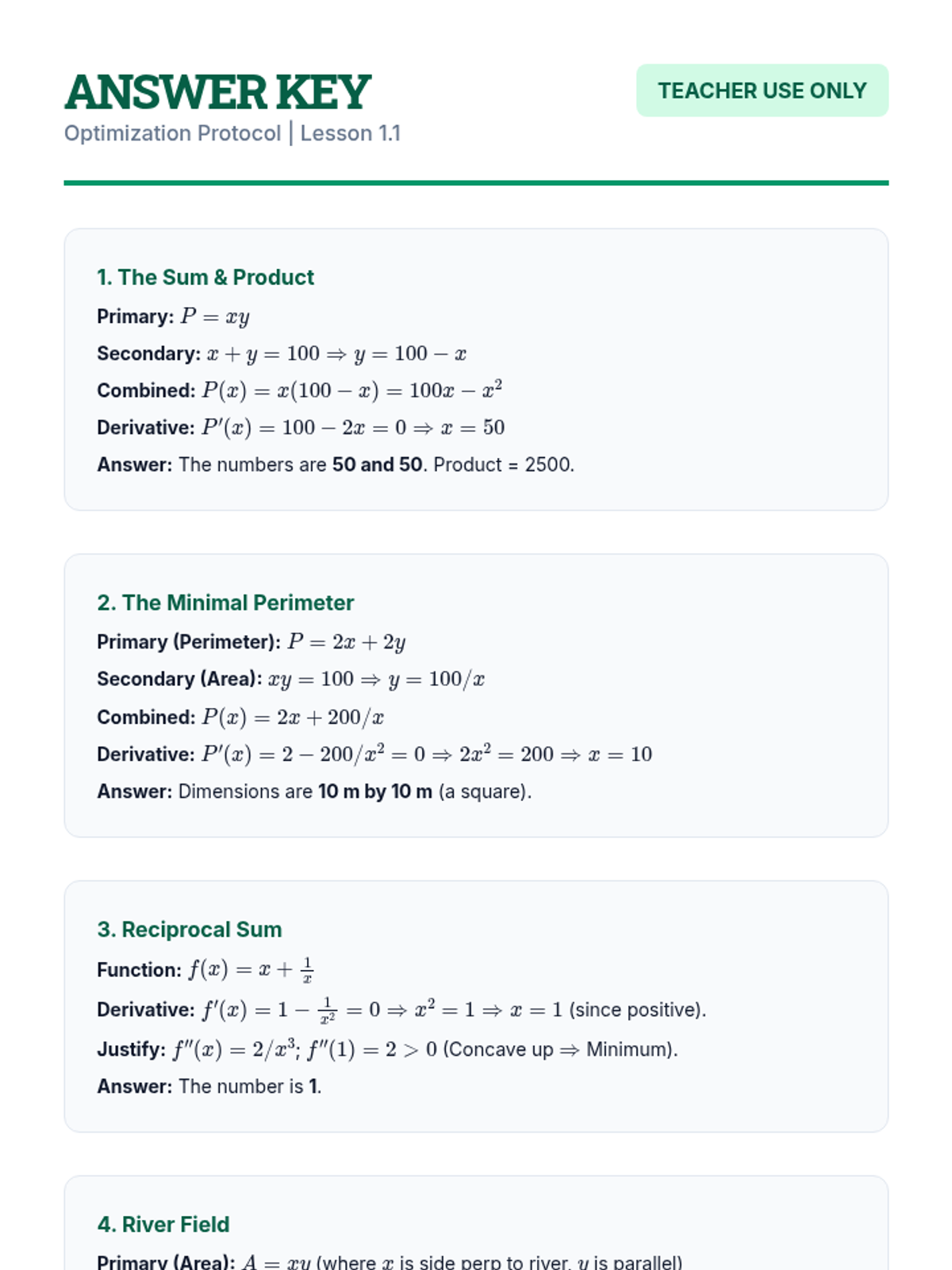
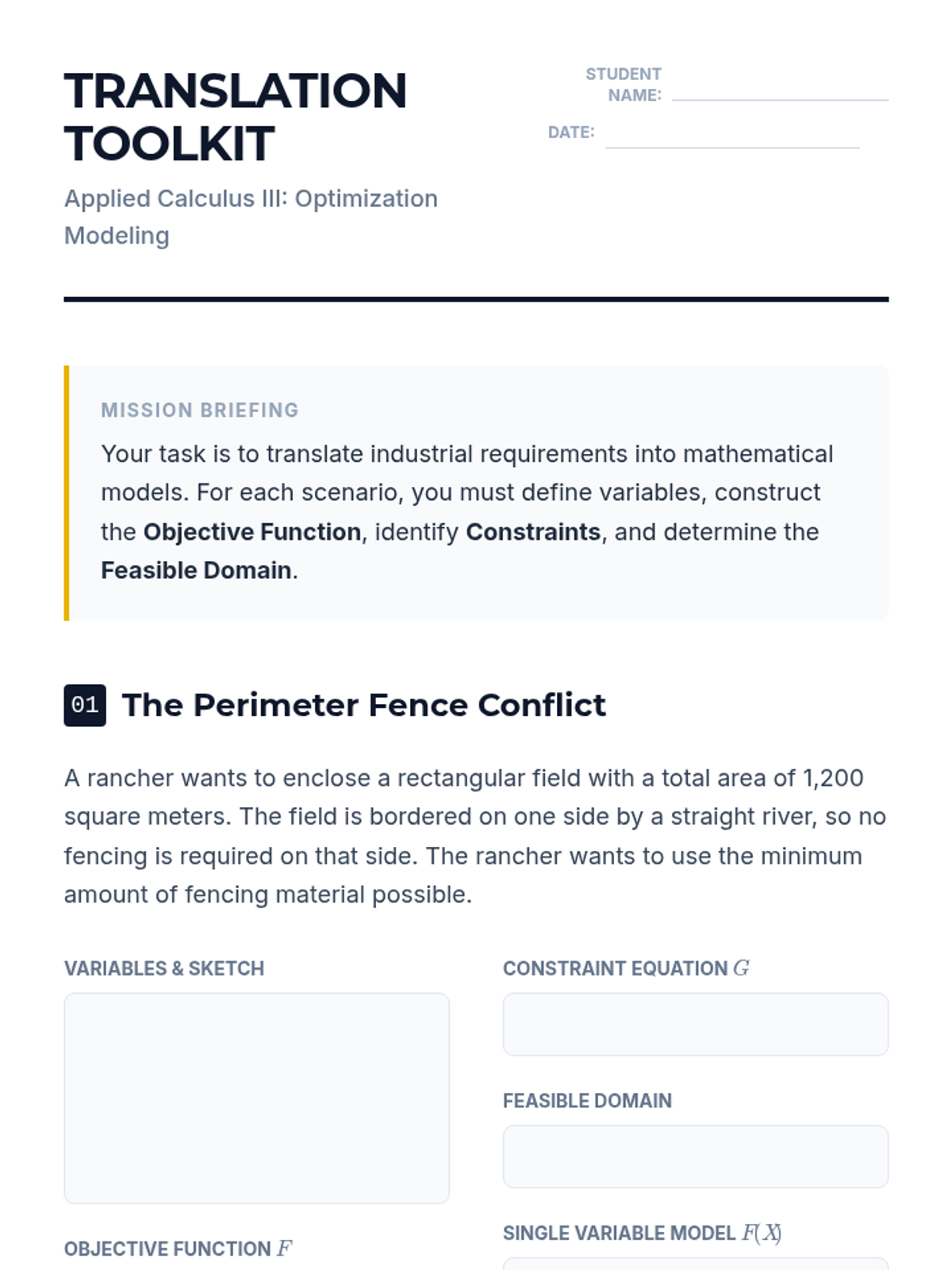
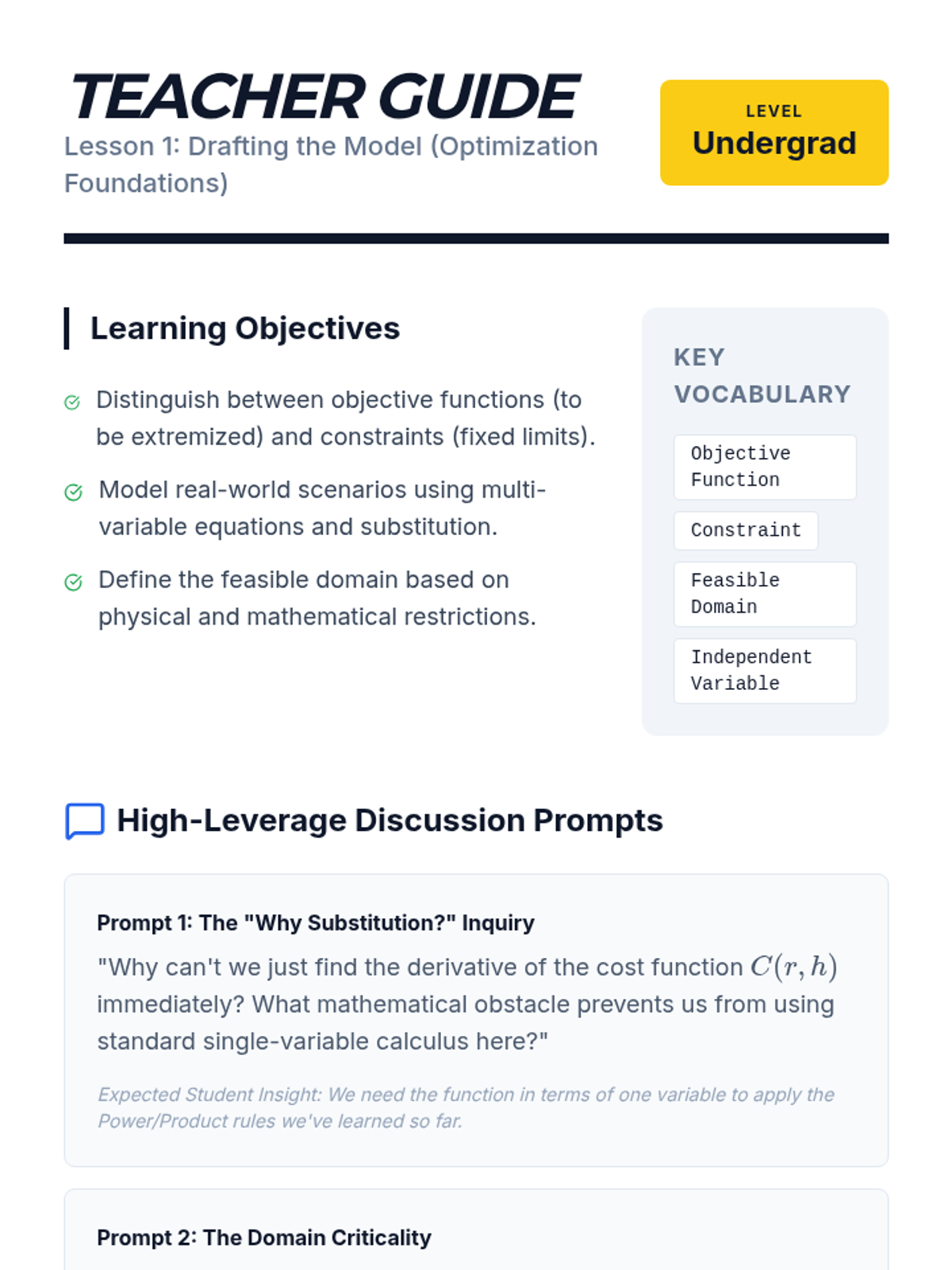
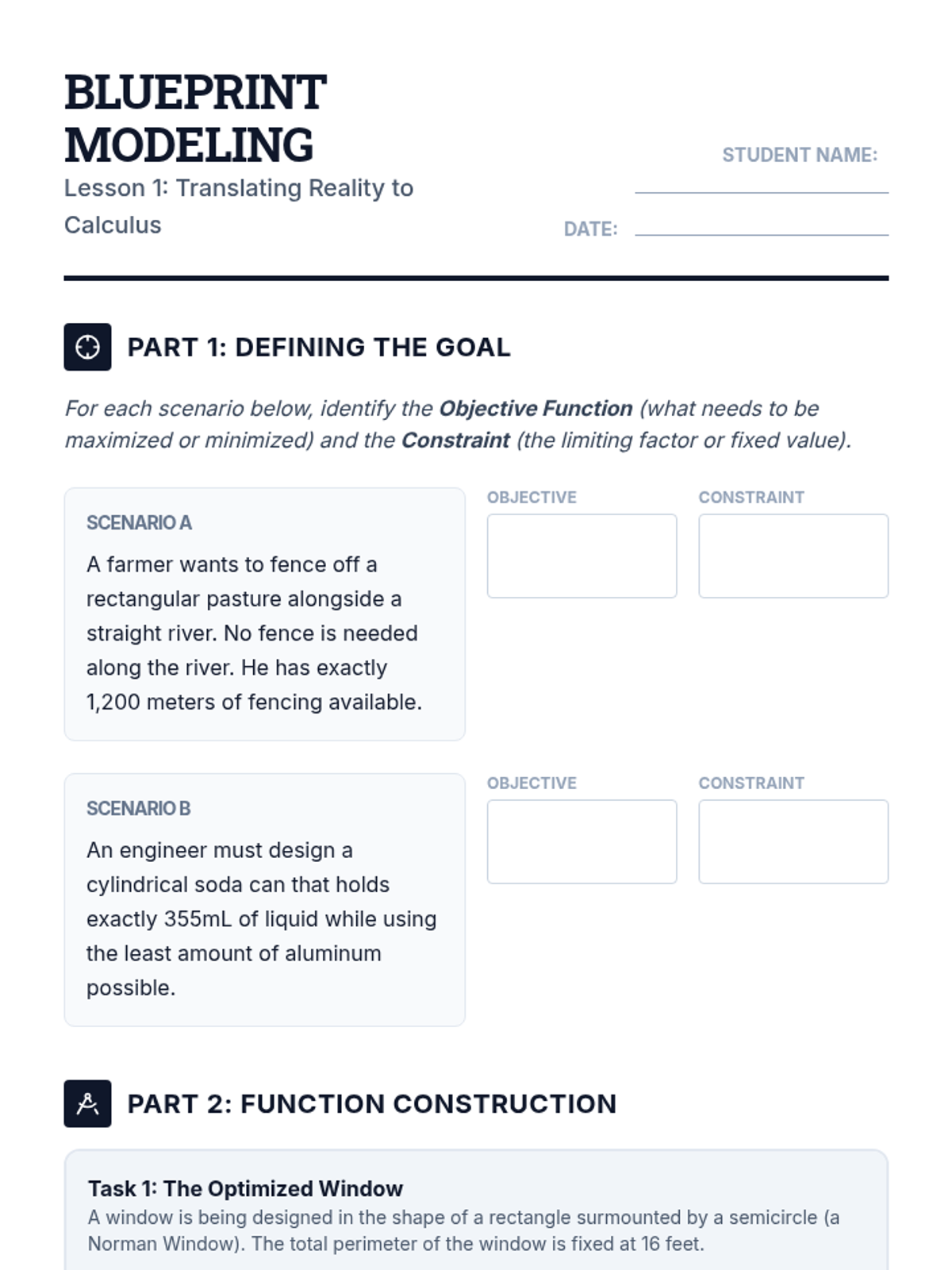
This sequence bridges the gap between theoretical calculus operations and applied problem-solving by focusing on optimization in real-world contexts. Students begin by mastering the 'modeling process'—translating verbal constraints into mathematical objective functions. Over five lessons, they progress from simple geometric maximization to complex economic minimization and physical efficiency problems. By the end, students will demonstrate proficiency in using the First and Second Derivative Tests to justify absolute extrema in manufacturing and design scenarios.
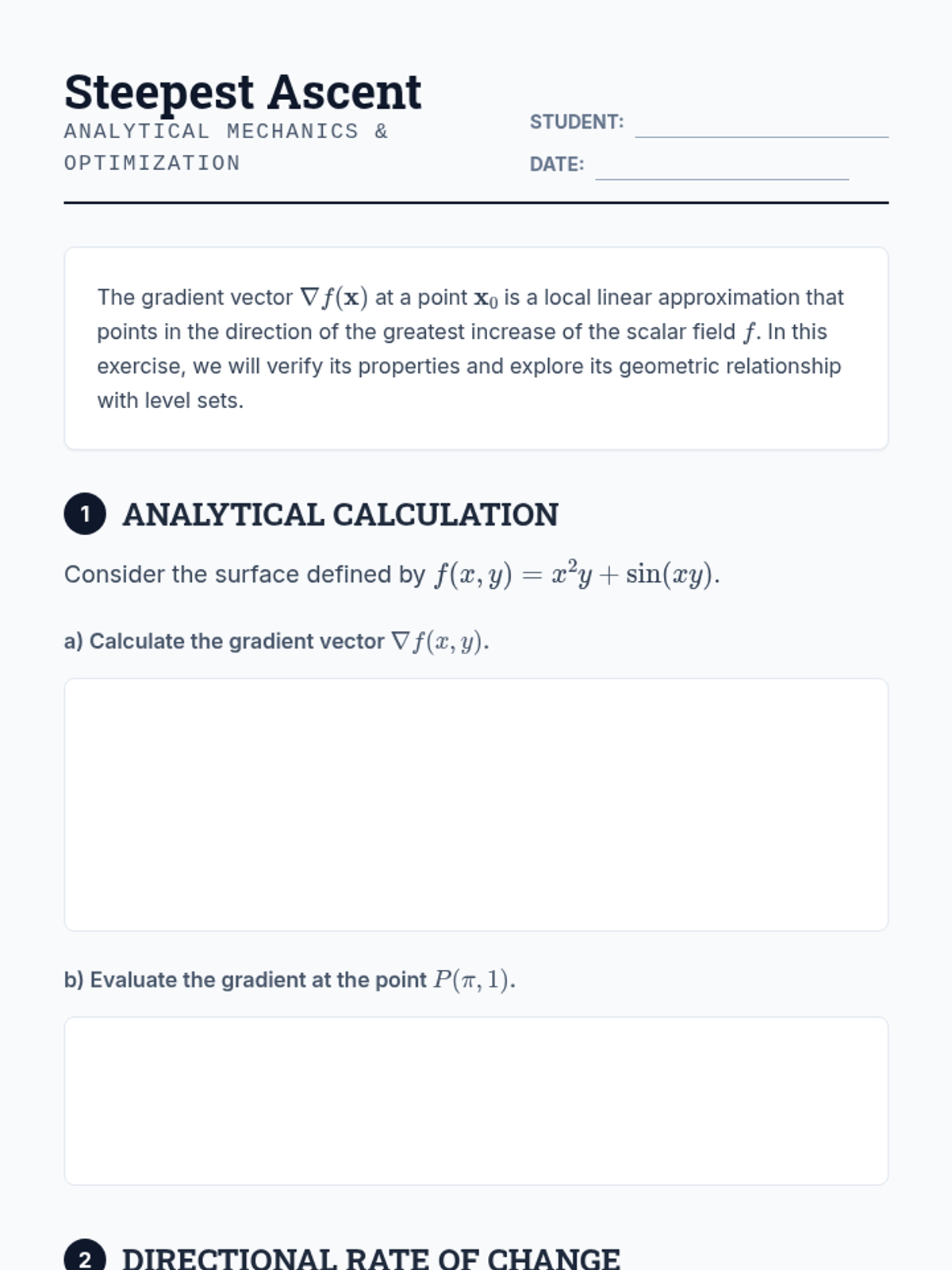
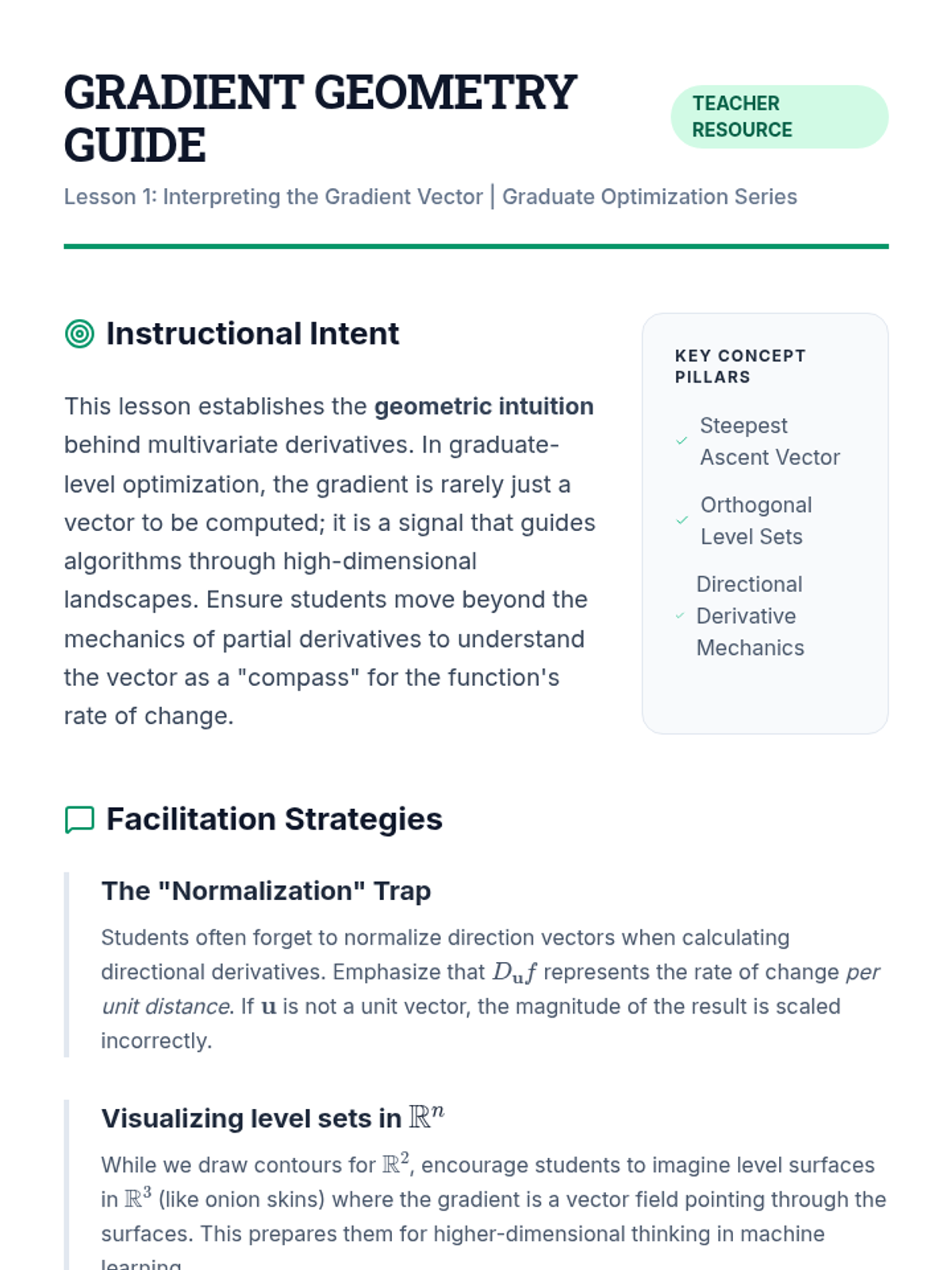
A graduate-level sequence exploring the gradient vector as the foundational tool for modern optimization. Students move from the geometric interpretation of multivariate derivatives to the implementation of stochastic algorithms used in machine learning.
A comprehensive 11th Grade Calculus sequence covering applications of integration including arc length, surface area of revolution, centroids, and the theorems of Pappus. Students explore the geometric properties of curves and regions using analytical methods.
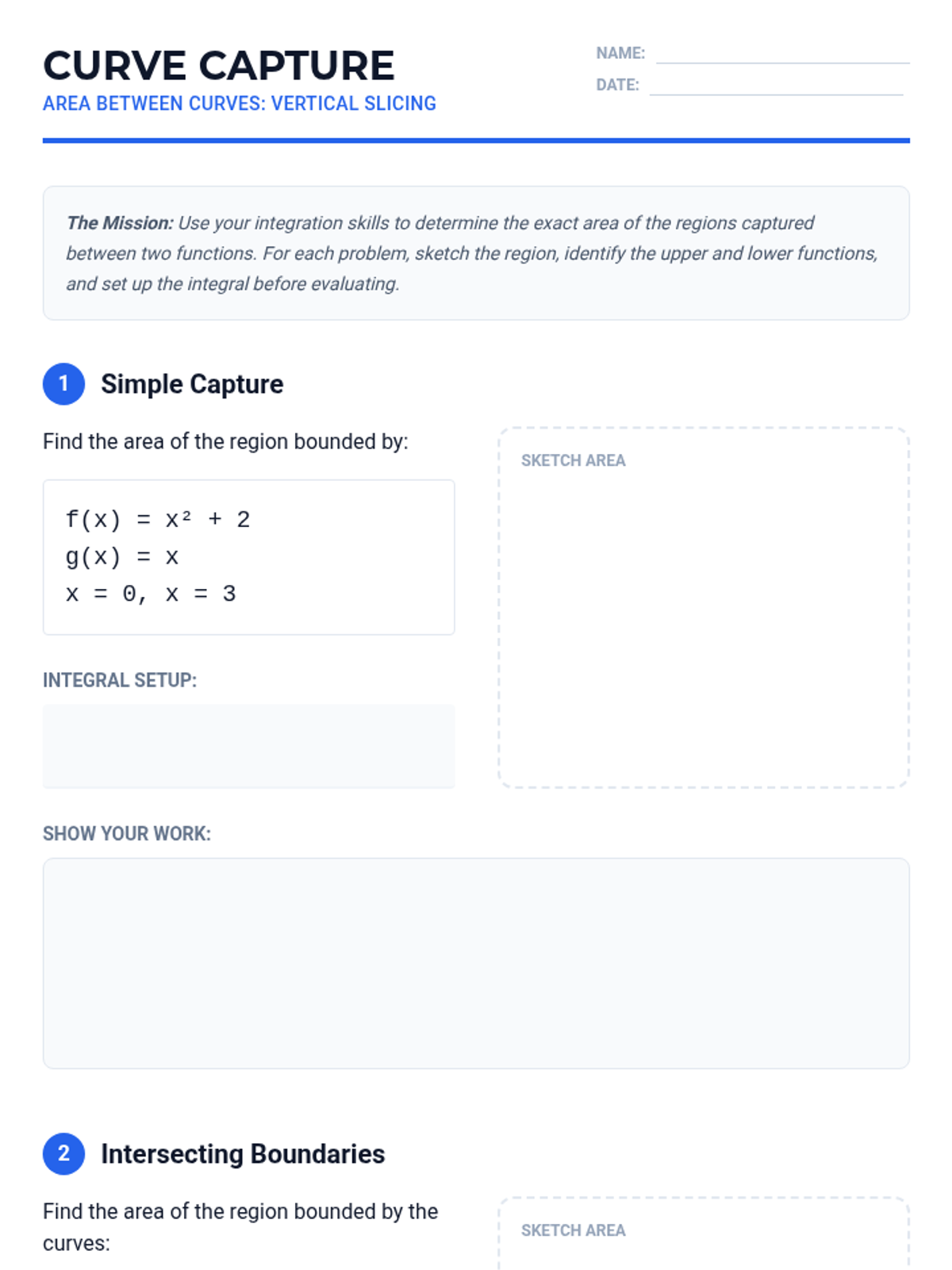
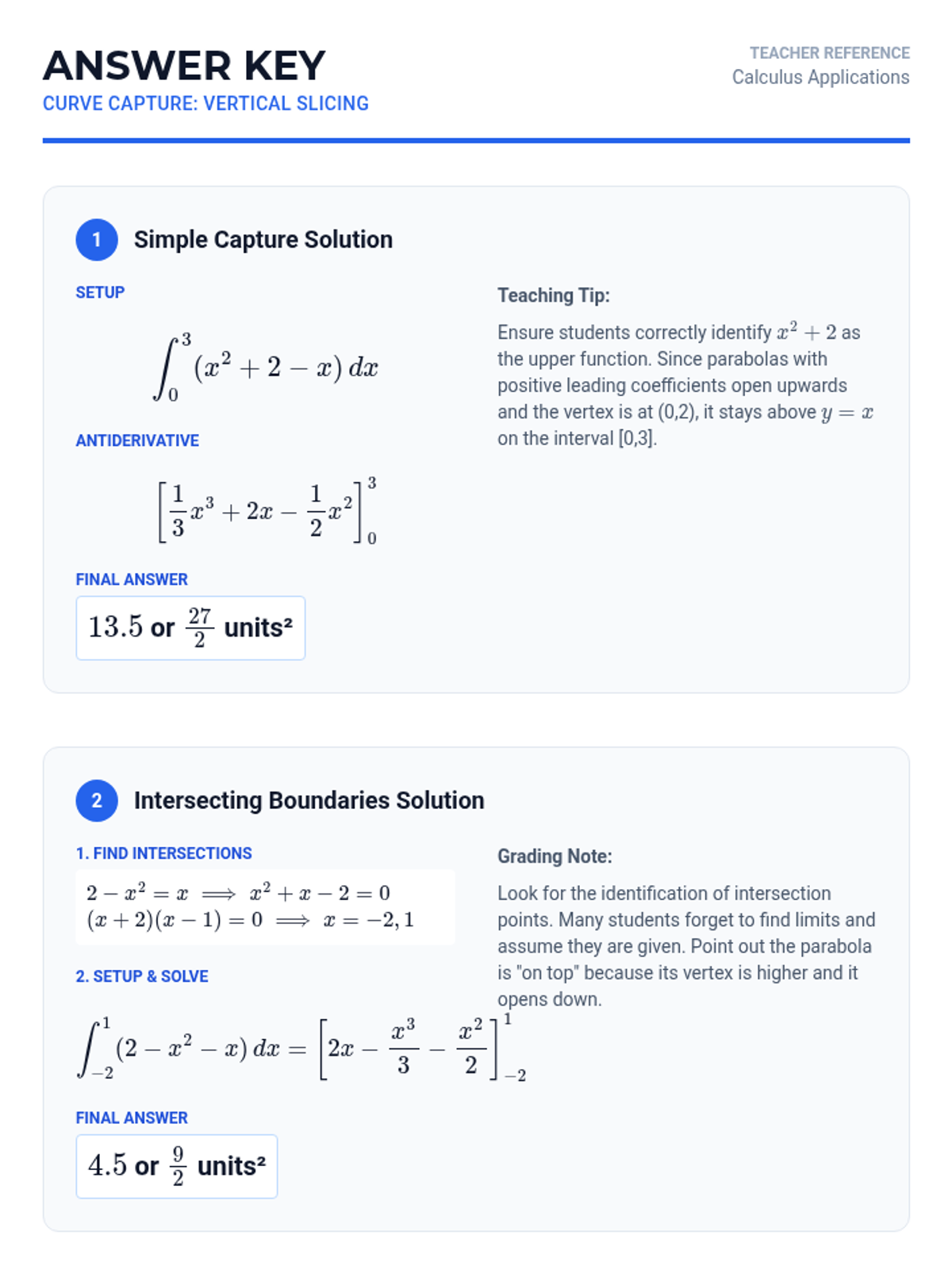
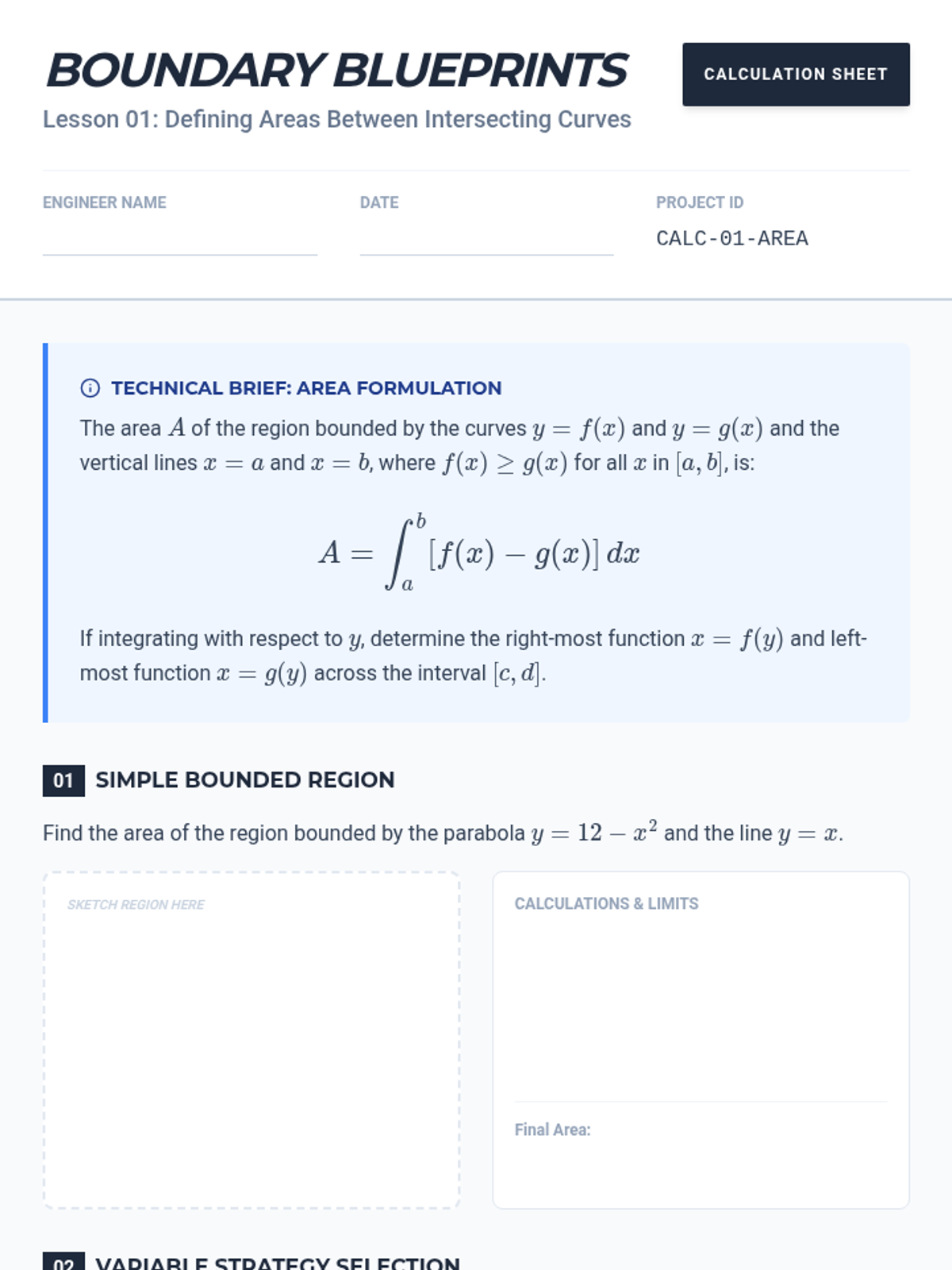
This sequence guides 11th-grade students through the transition from 2D area calculations to 3D volume determinations using integral calculus. Students will master vertical and horizontal slicing techniques for area, and progress to the Disk and Washer methods for rotational volumes.
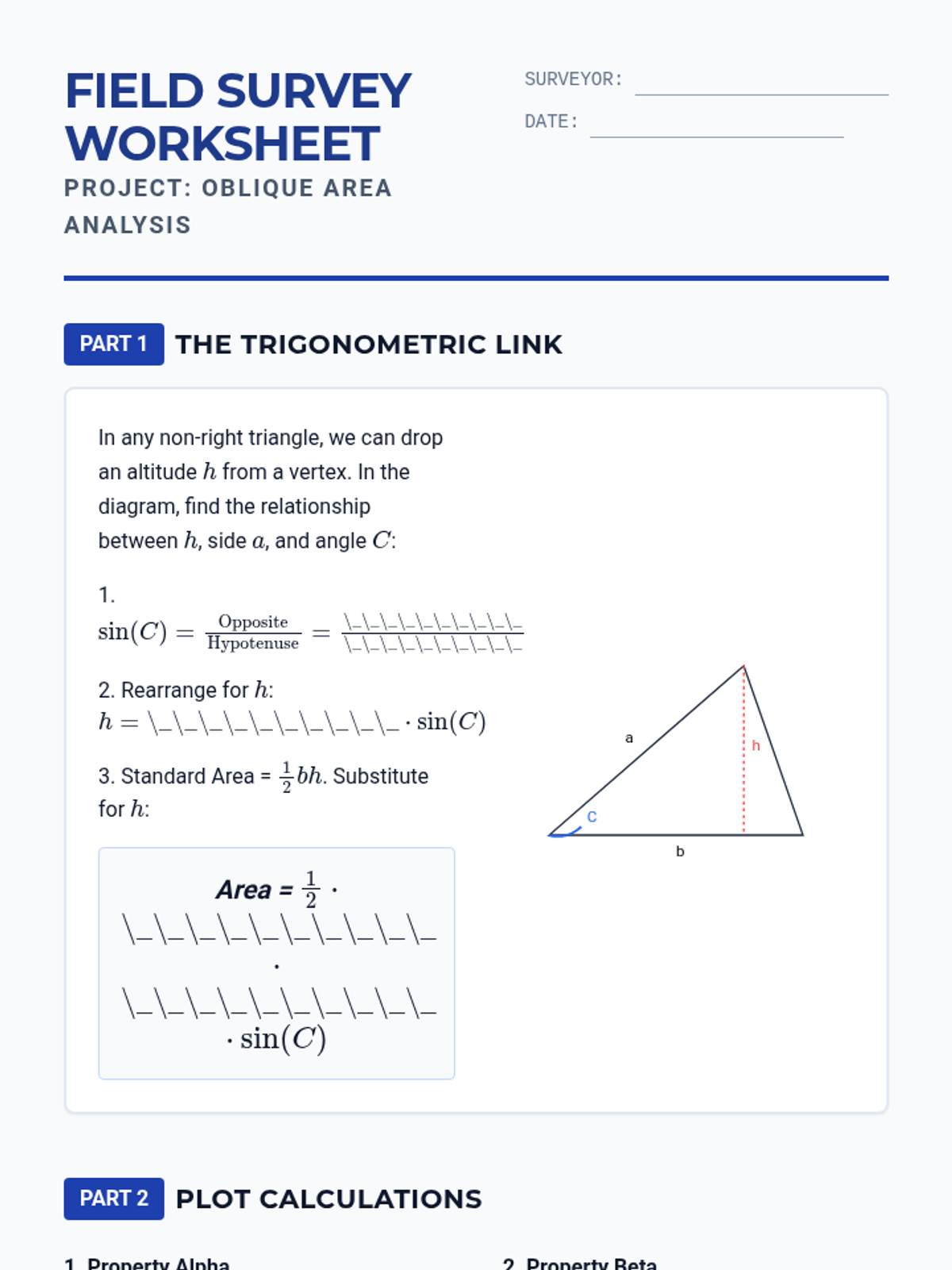
This sequence explores the measurement of area and the analysis of forces using general triangles. Students move beyond the basic 1/2 bh formula to discover how sine and perimeter can define area in oblique scenarios, specifically using Heron's Formula and vector analysis.
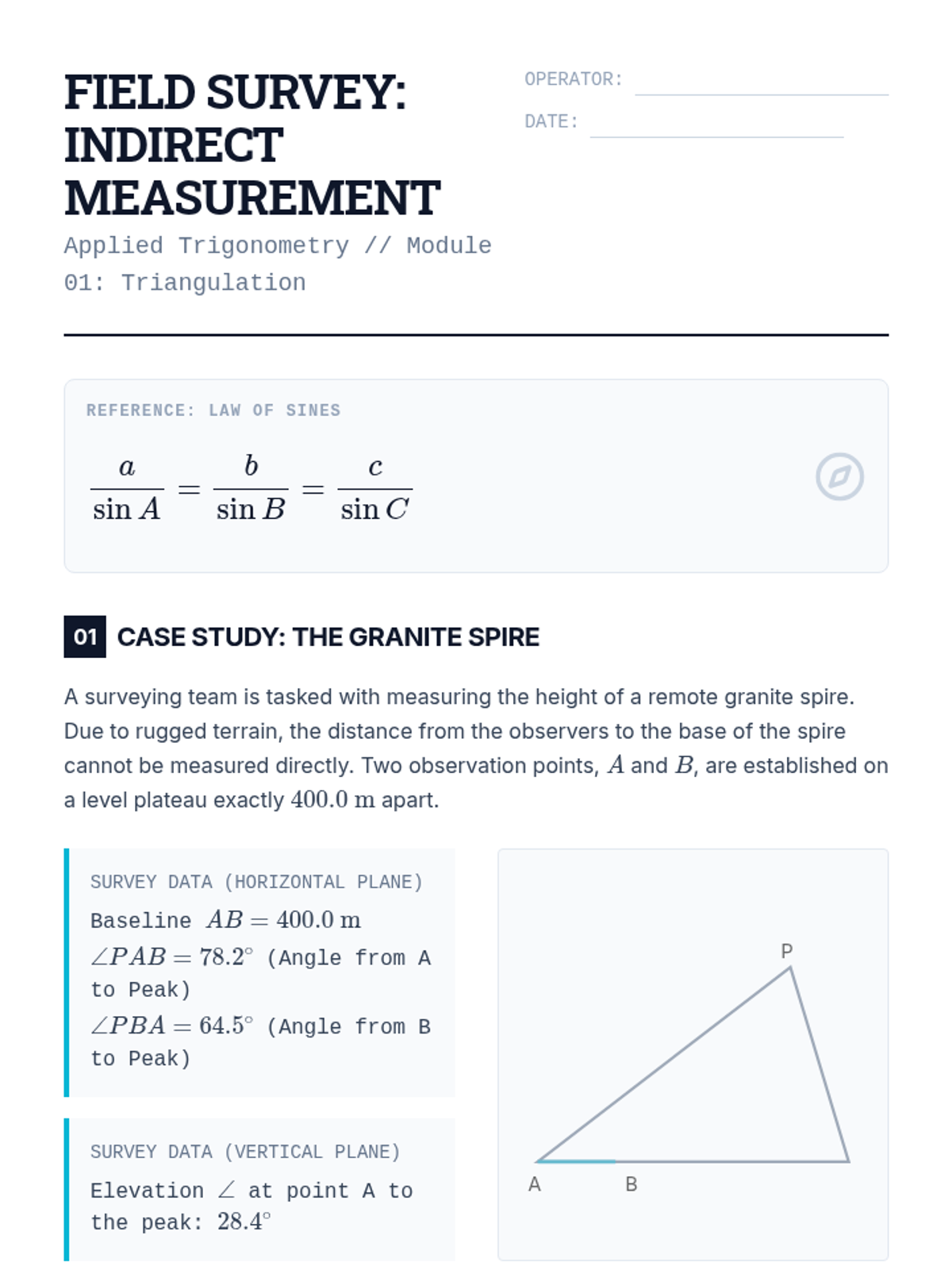
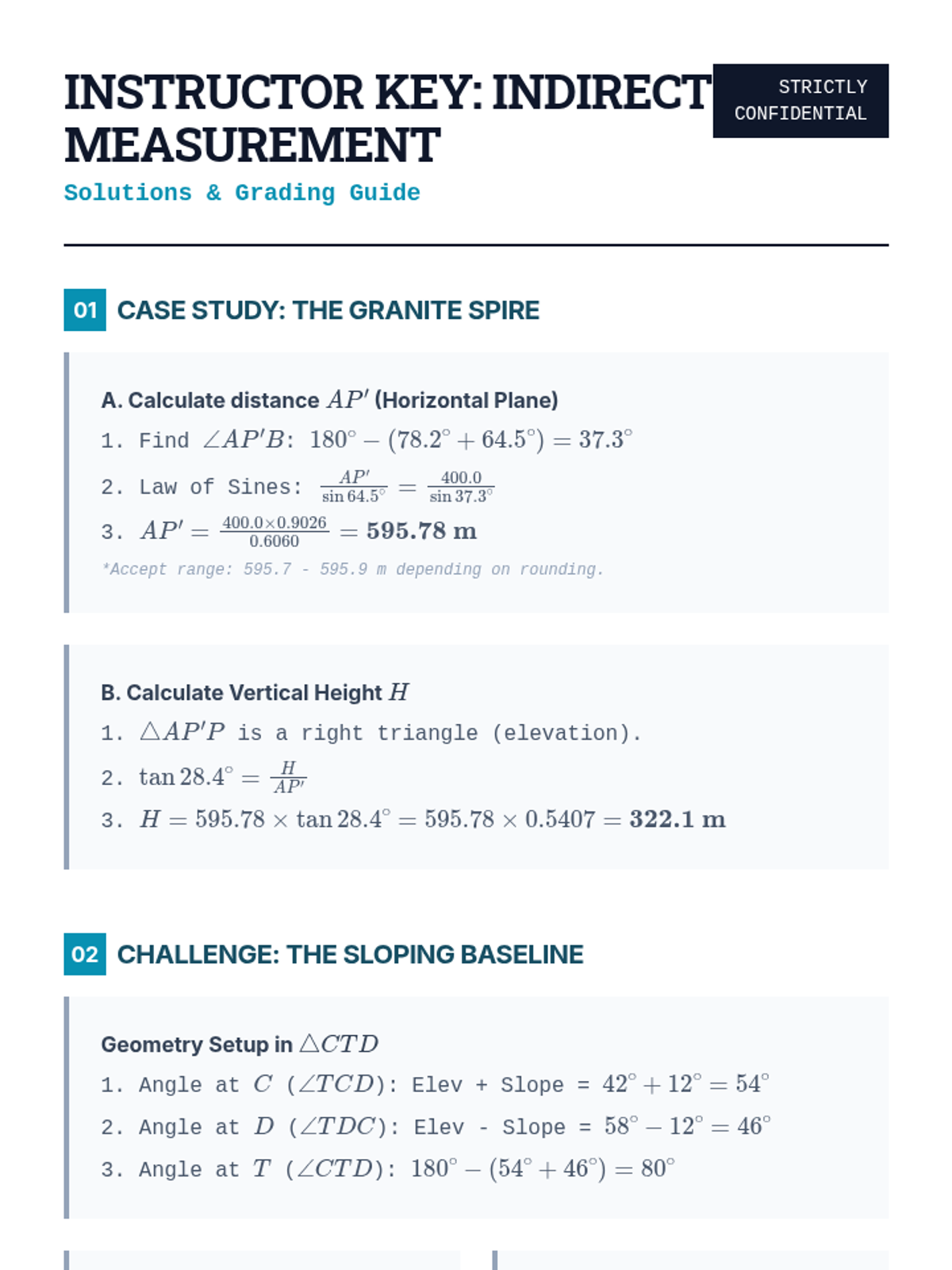
An applied trigonometry sequence for undergraduate students focusing on the Law of Sines and Law of Cosines through the lens of surveying, navigation, and engineering. Students transition from 2D triangulation to complex 3D spatial modeling and force analysis.
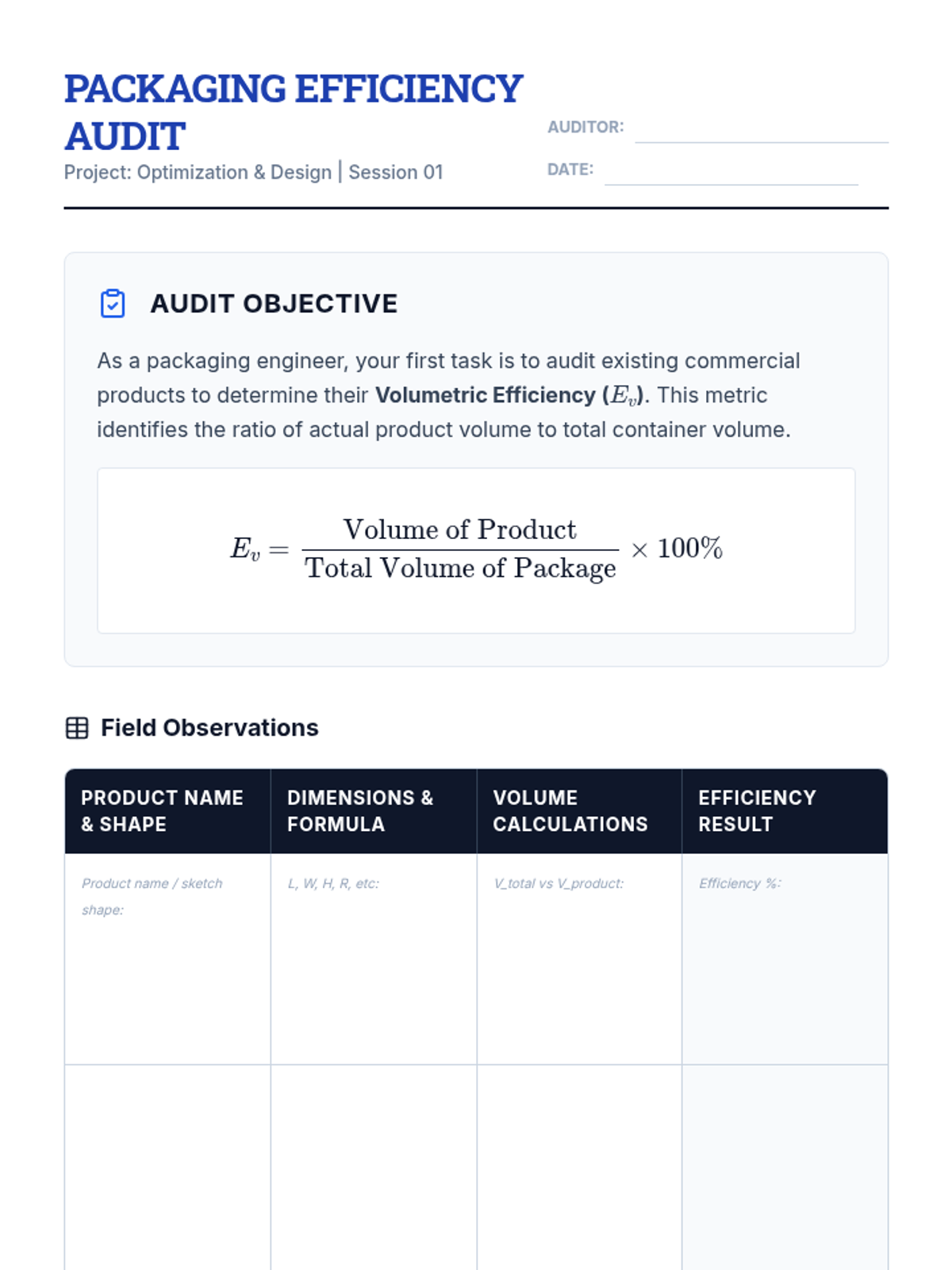
A project-based unit where students act as packaging engineers to optimize volume and surface area, balancing material costs and environmental impact through geometric modeling.
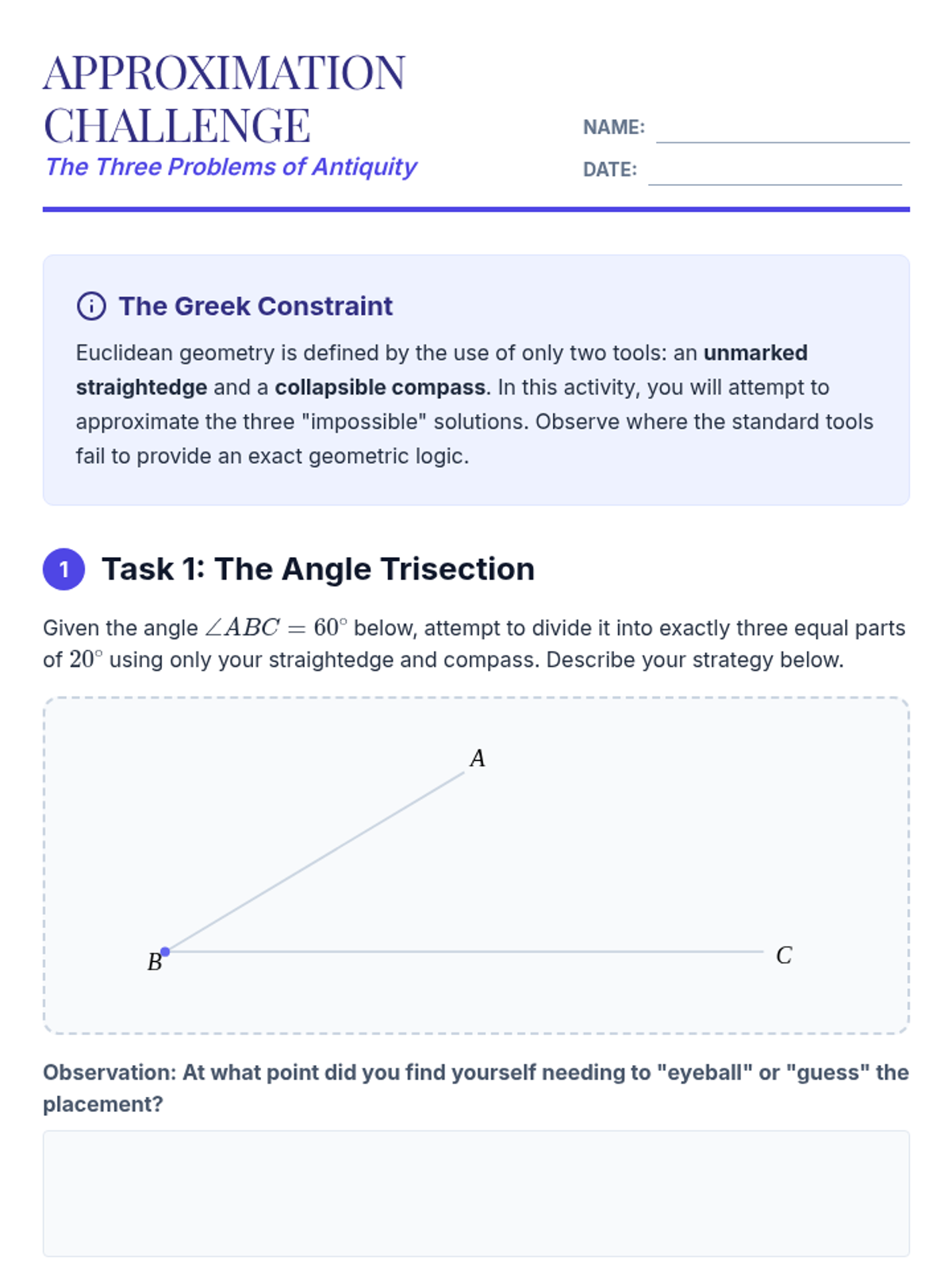
This sequence explores the three famous problems of antiquity (squaring the circle, doubling the cube, trisecting the angle) and the alternative construction methods that solve them. Students analyze why standard tools fail and experiment with 'Neusis' constructions, Origami (paper folding) axioms, and conic sections. It highlights how changing the axioms changes the solvable universe.
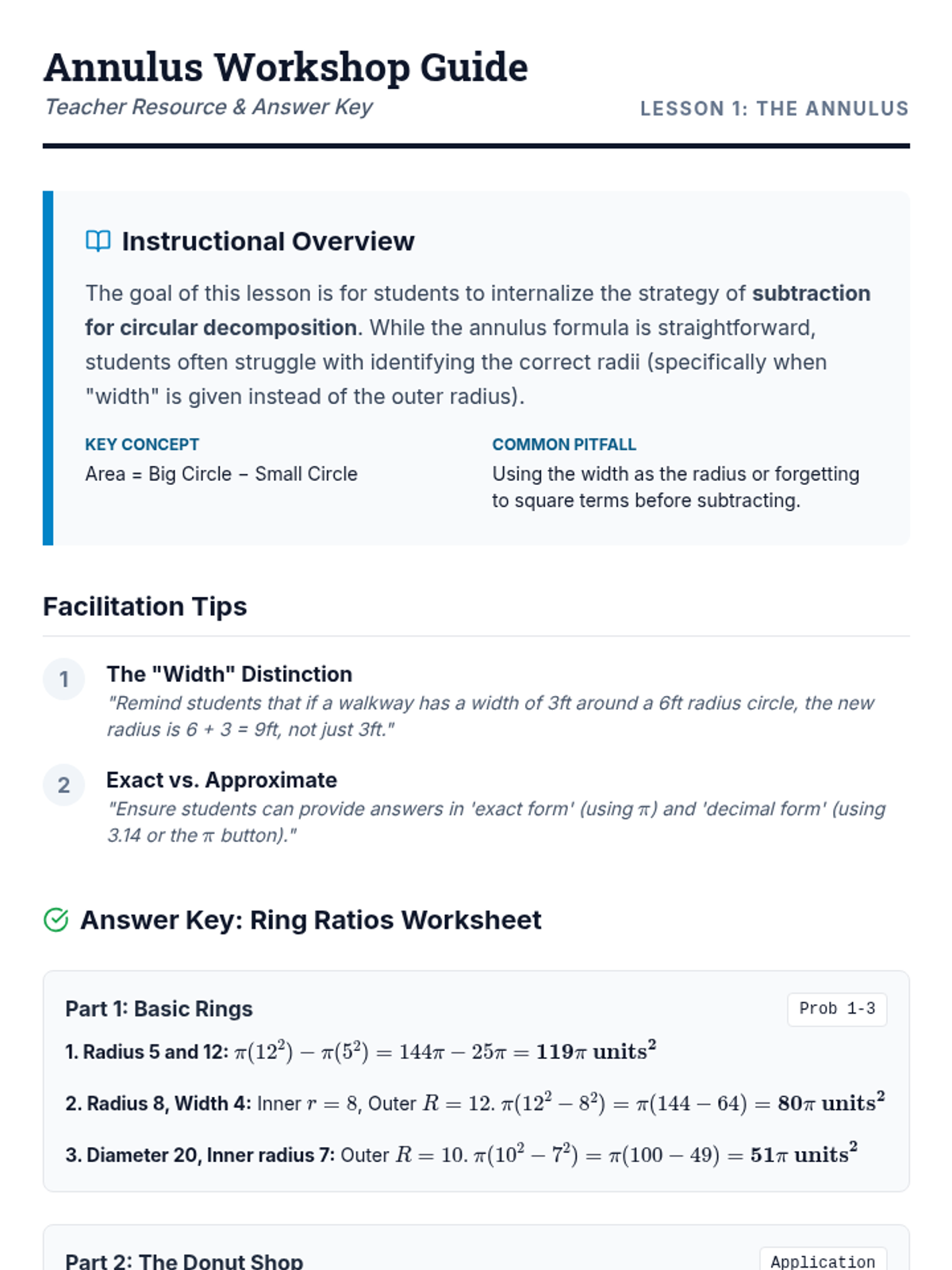
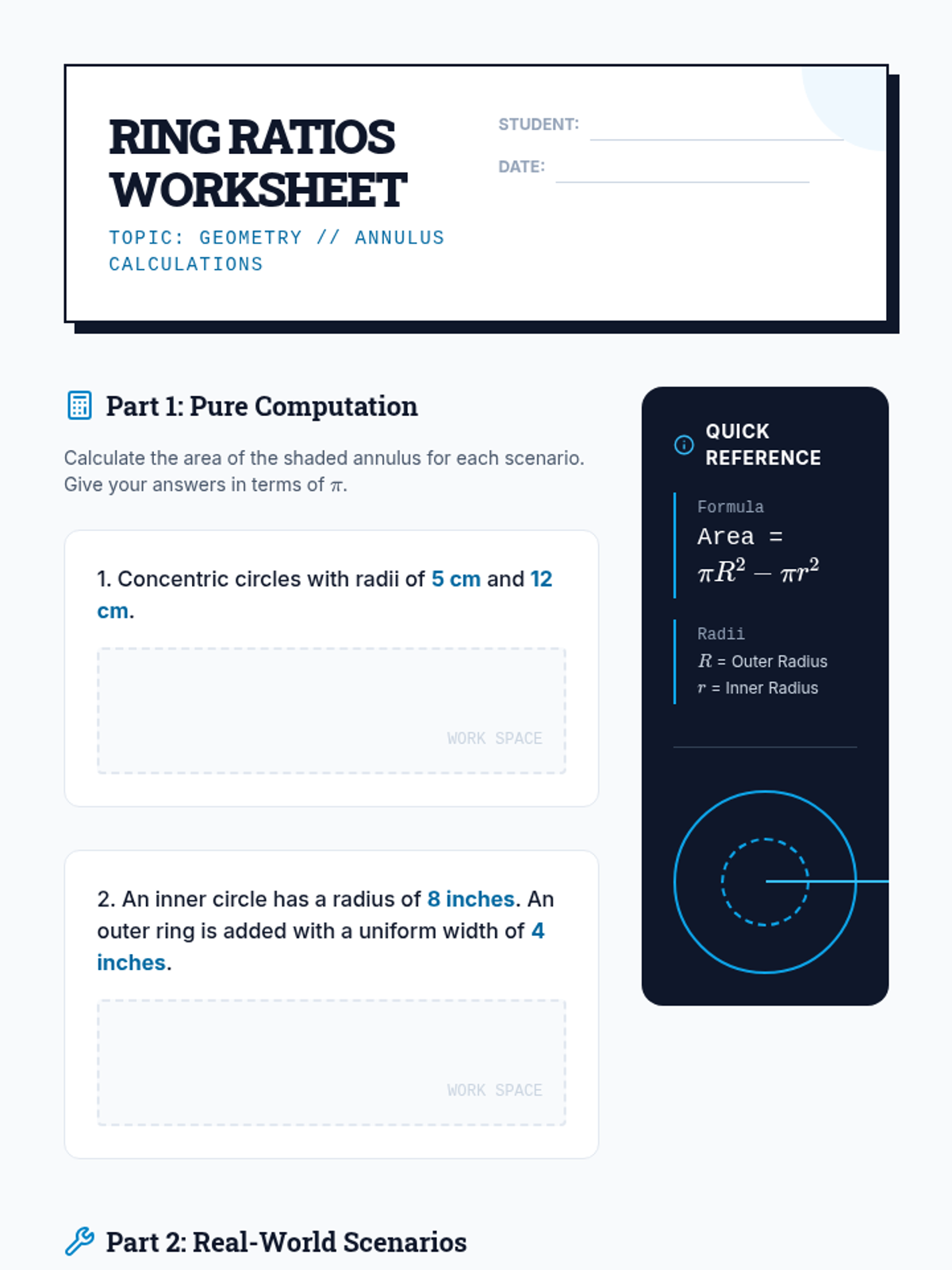
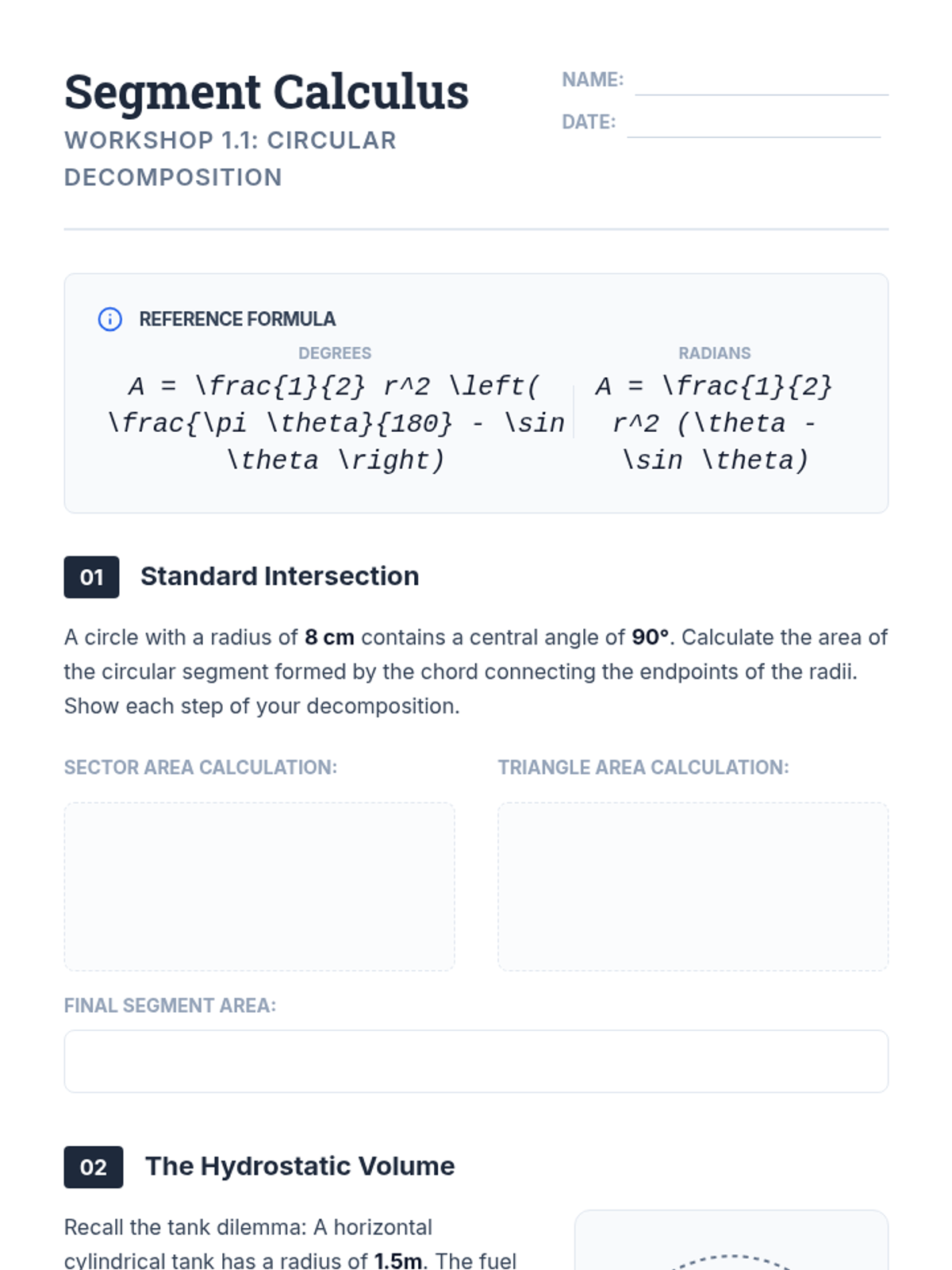
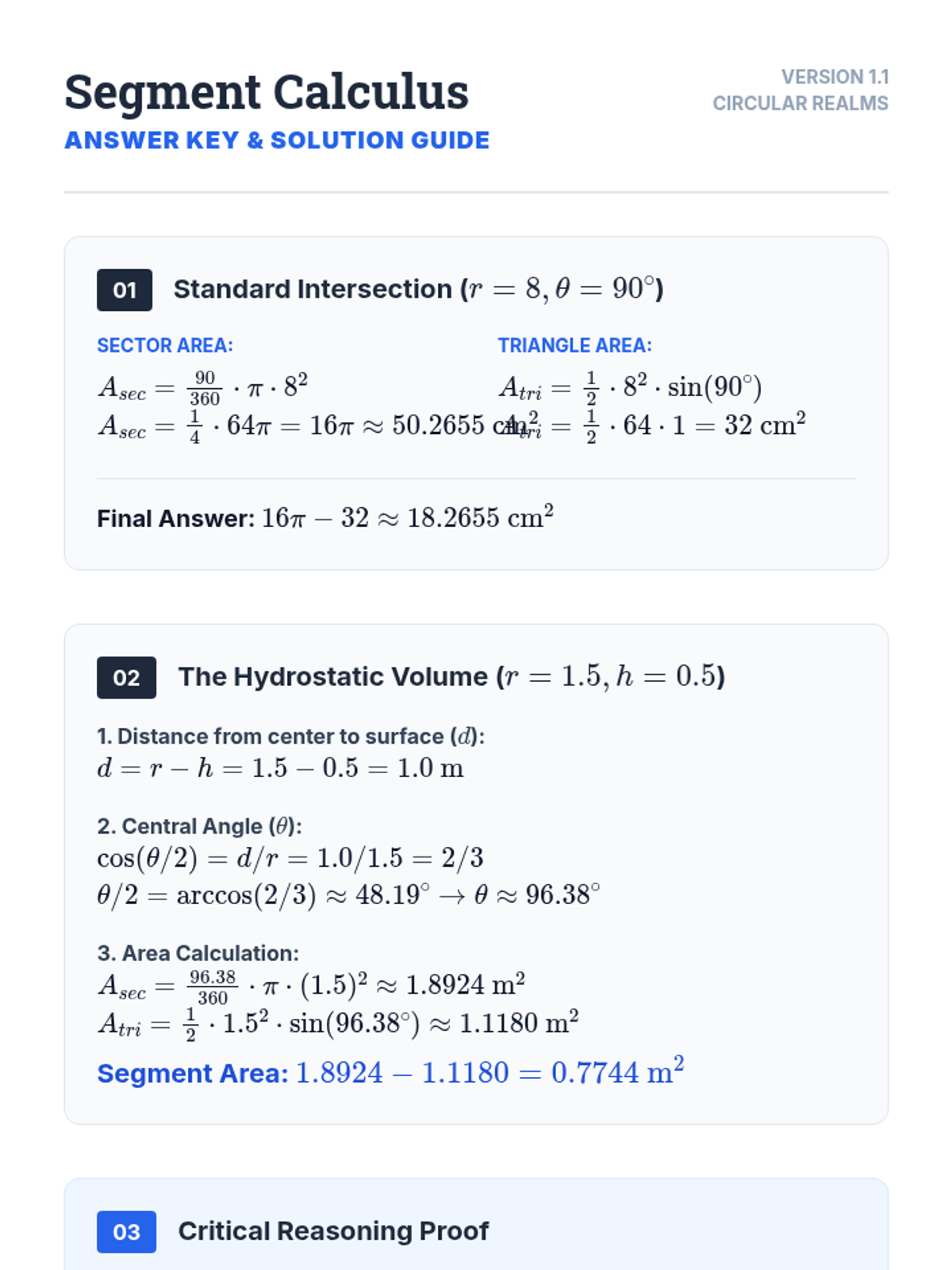
A high-level geometry sequence for 11th-grade students focusing on decomposing complex circular figures, including annuli, segments, and composite shaded regions. Students apply algebraic and trigonometric techniques to solve advanced area and perimeter problems.
A comprehensive geometry sequence for undergraduate students focused on advanced circular area calculations, including segments, annuluses, lenses, and geometric probability. Students apply trigonometry and algebraic decomposition to solve complex spatial problems.
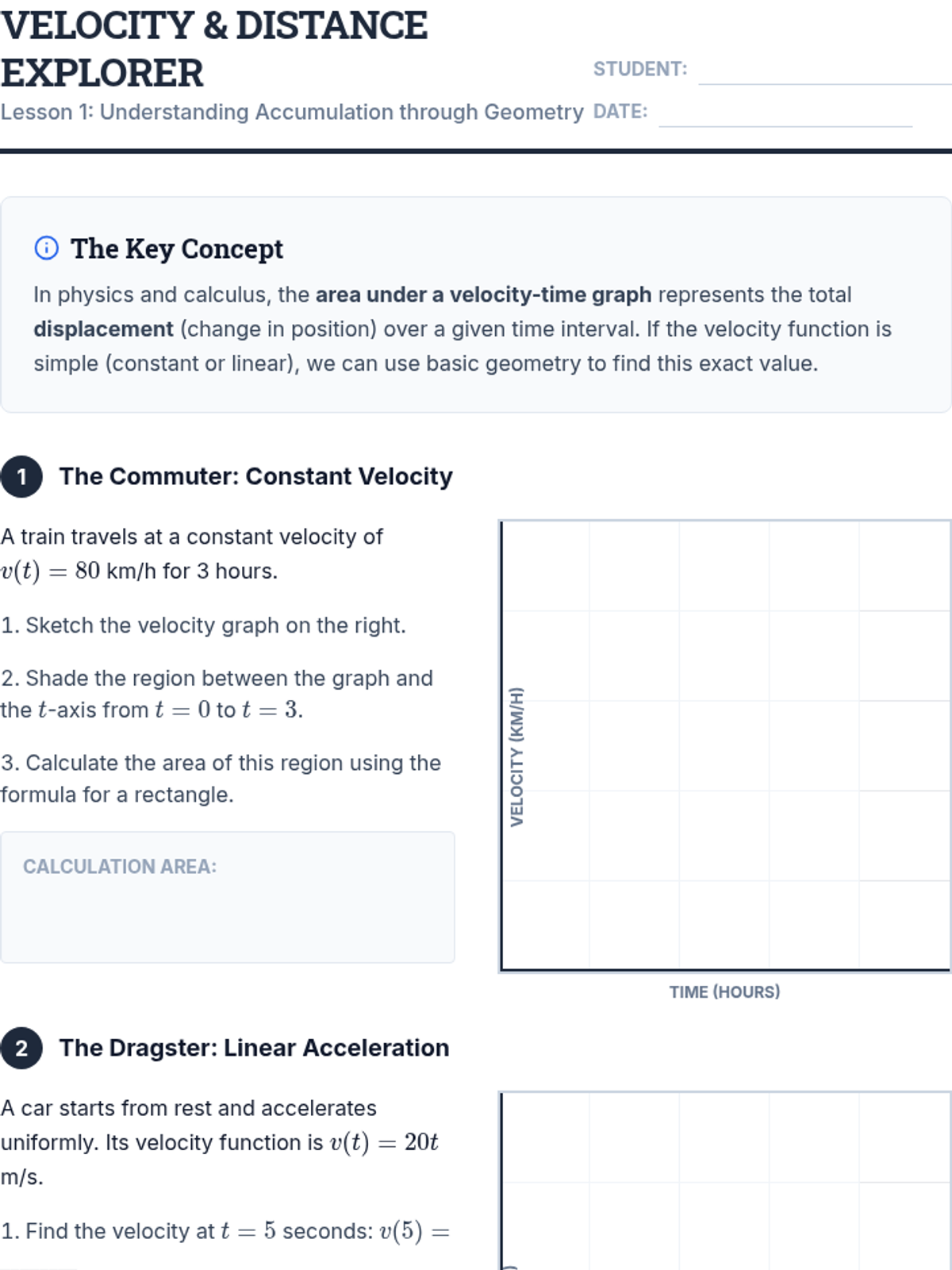
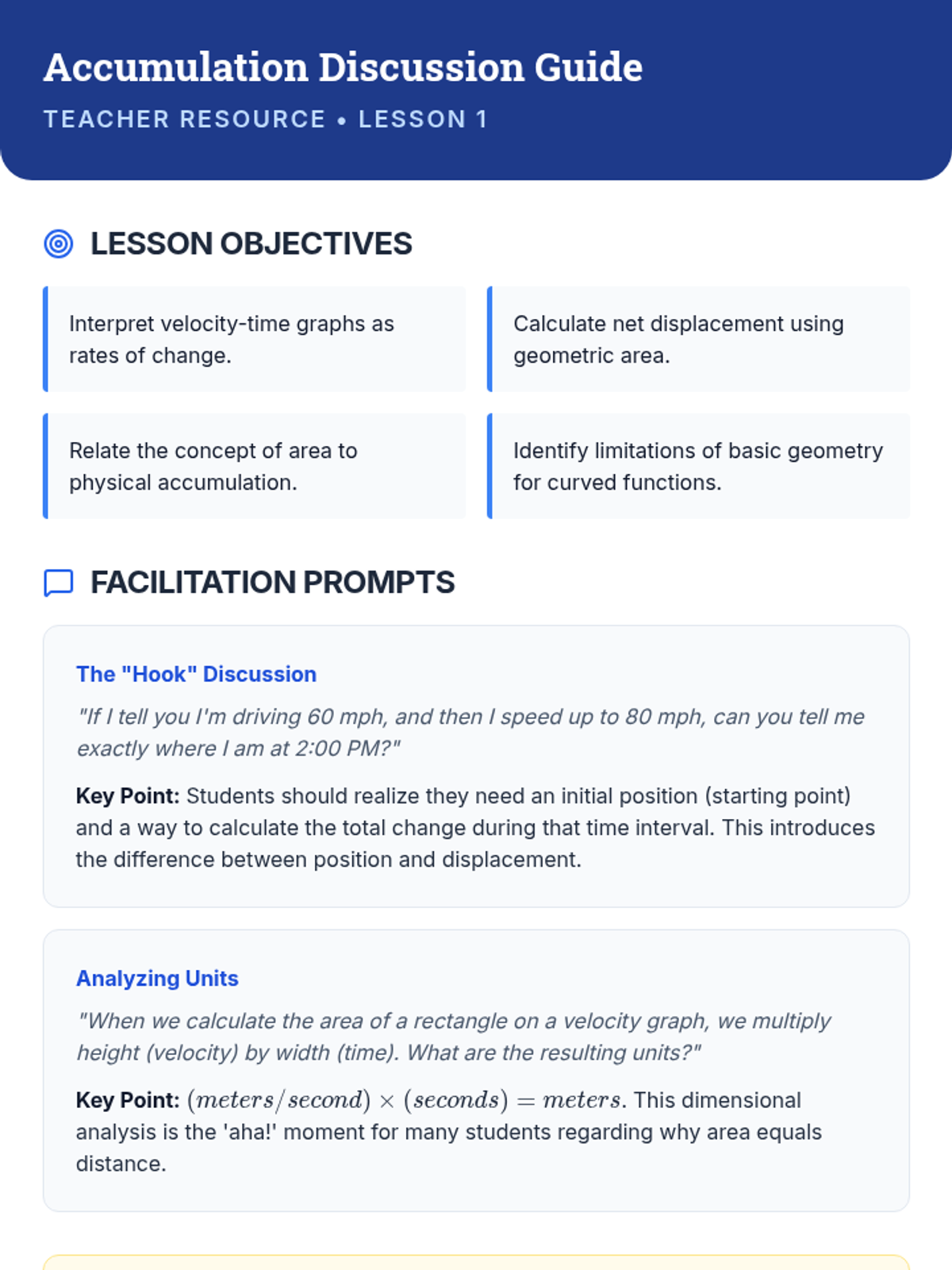
This sequence guides 12th-grade students from the conceptual understanding of area as accumulation to the algebraic precision of the Fundamental Theorem of Calculus. Students explore the 'area problem', formalize approximations via Riemann sums, define the definite integral through limits, and culminate in applying the Fundamental Theorem.
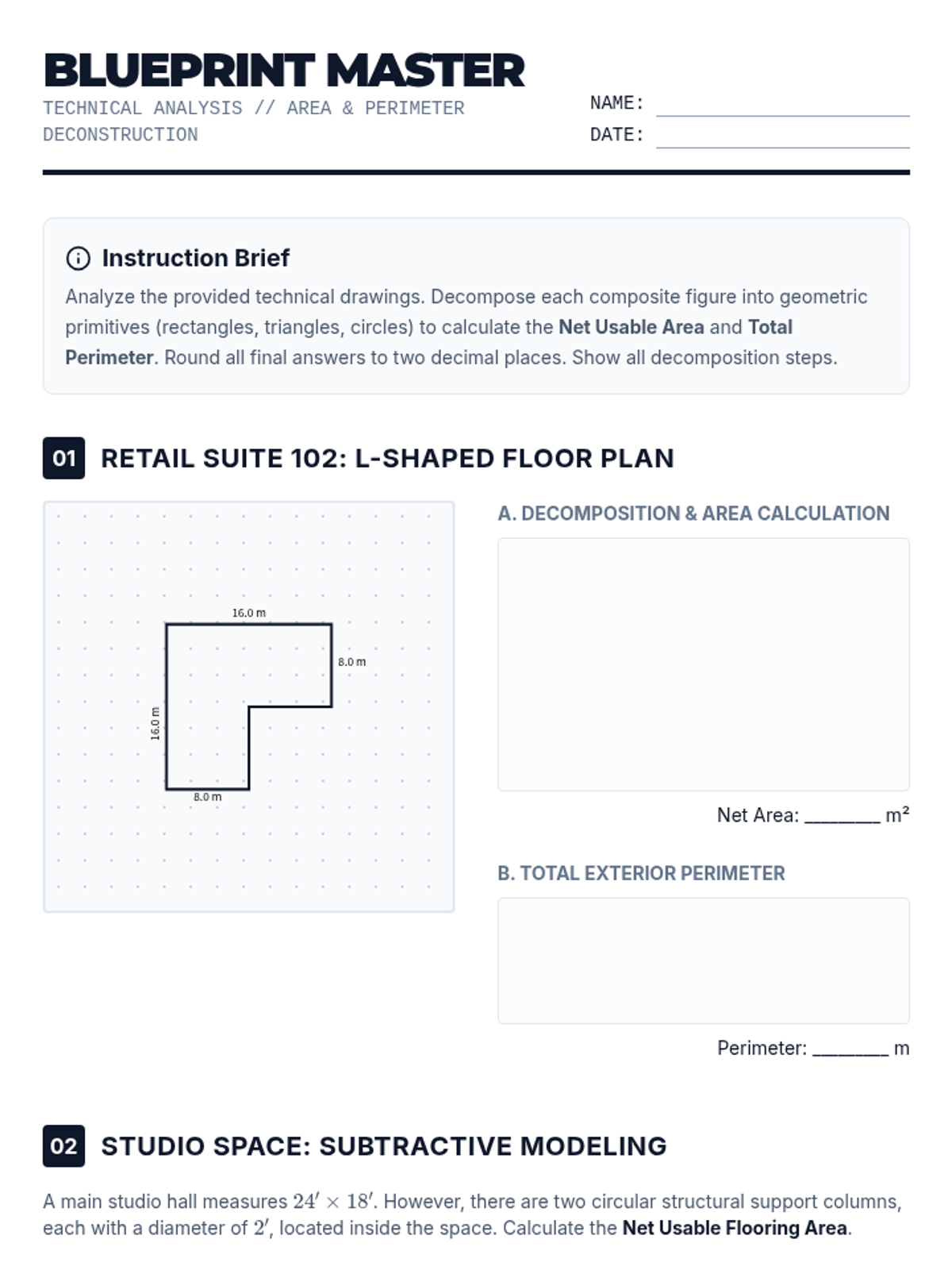
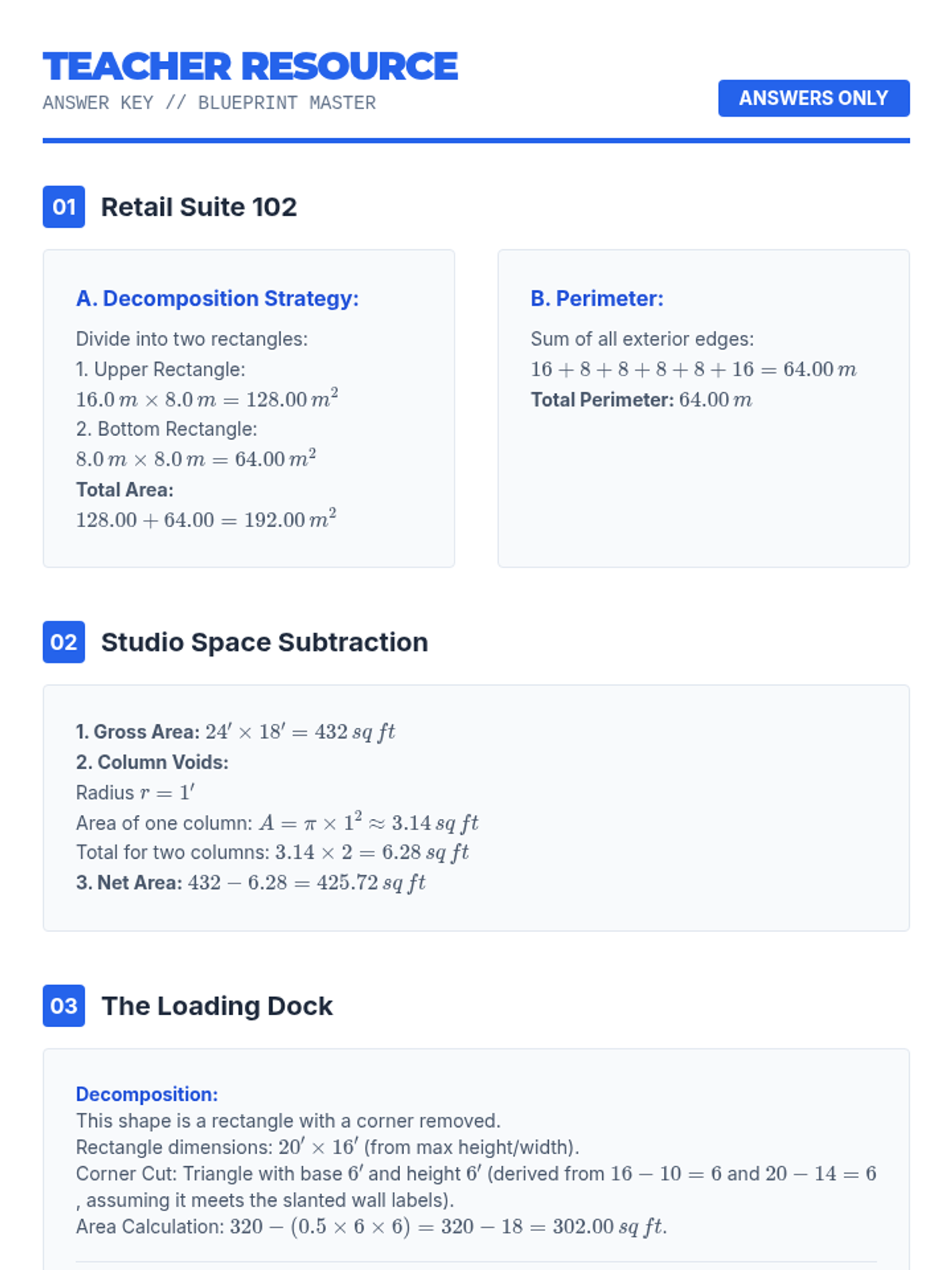
An undergraduate-level exploration of geometric modeling, progressing from composite figure analysis to complex optimization and irregular area approximation. This sequence prepares students for technical applications in architecture, engineering, and spatial design.
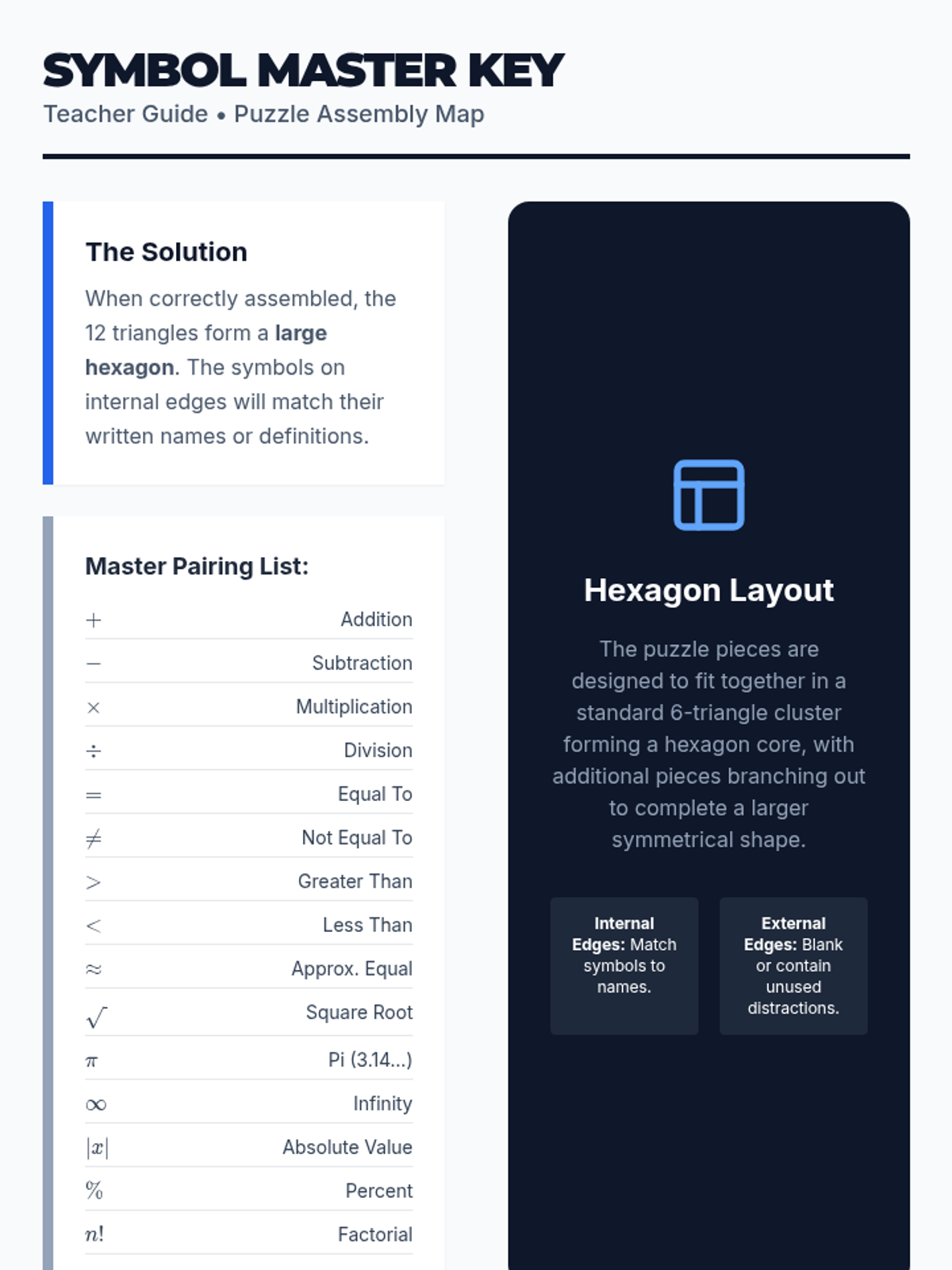
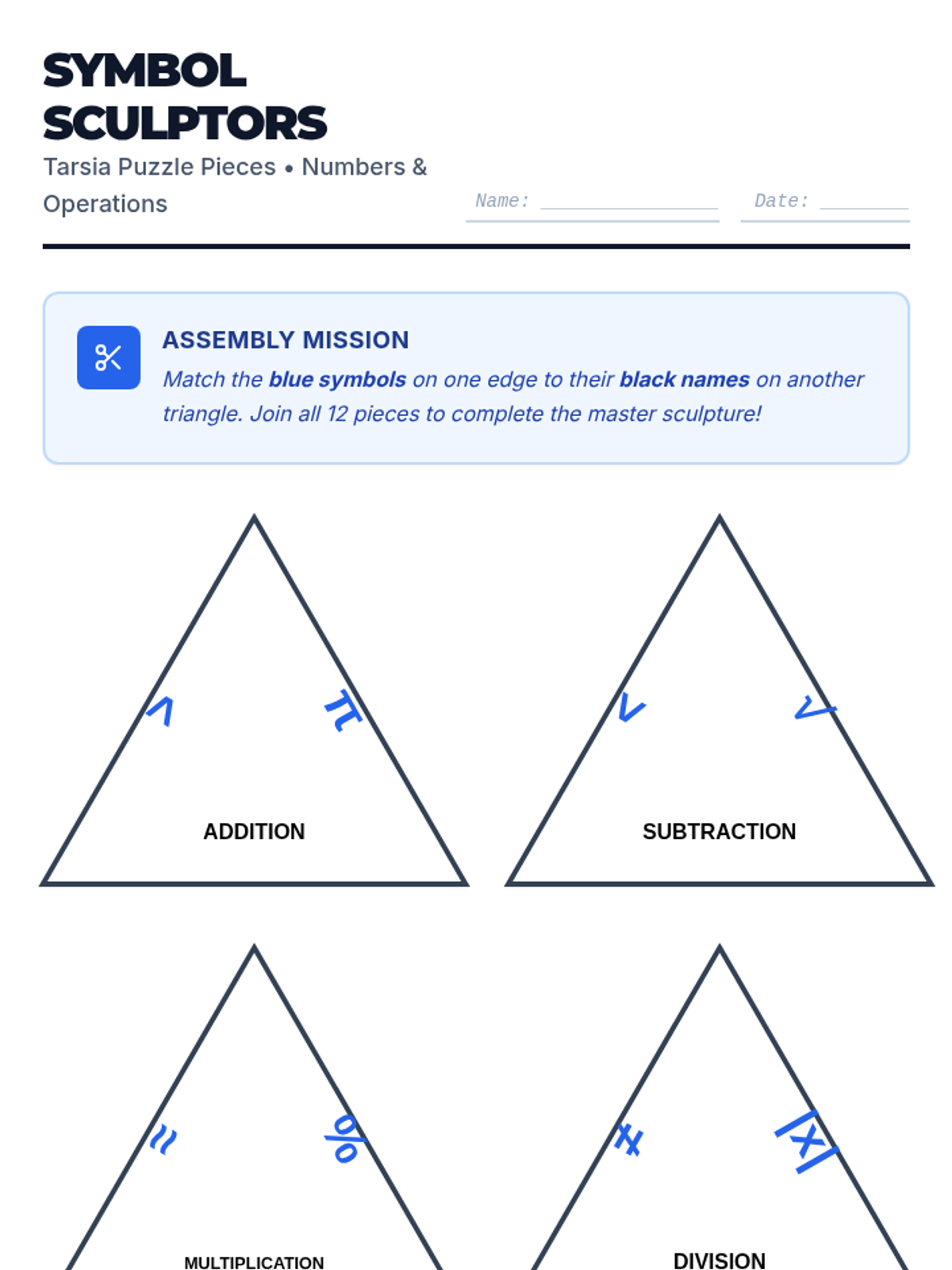
A series of lessons designed to build fluency in mathematical notation and operations through visual and tactile learning.
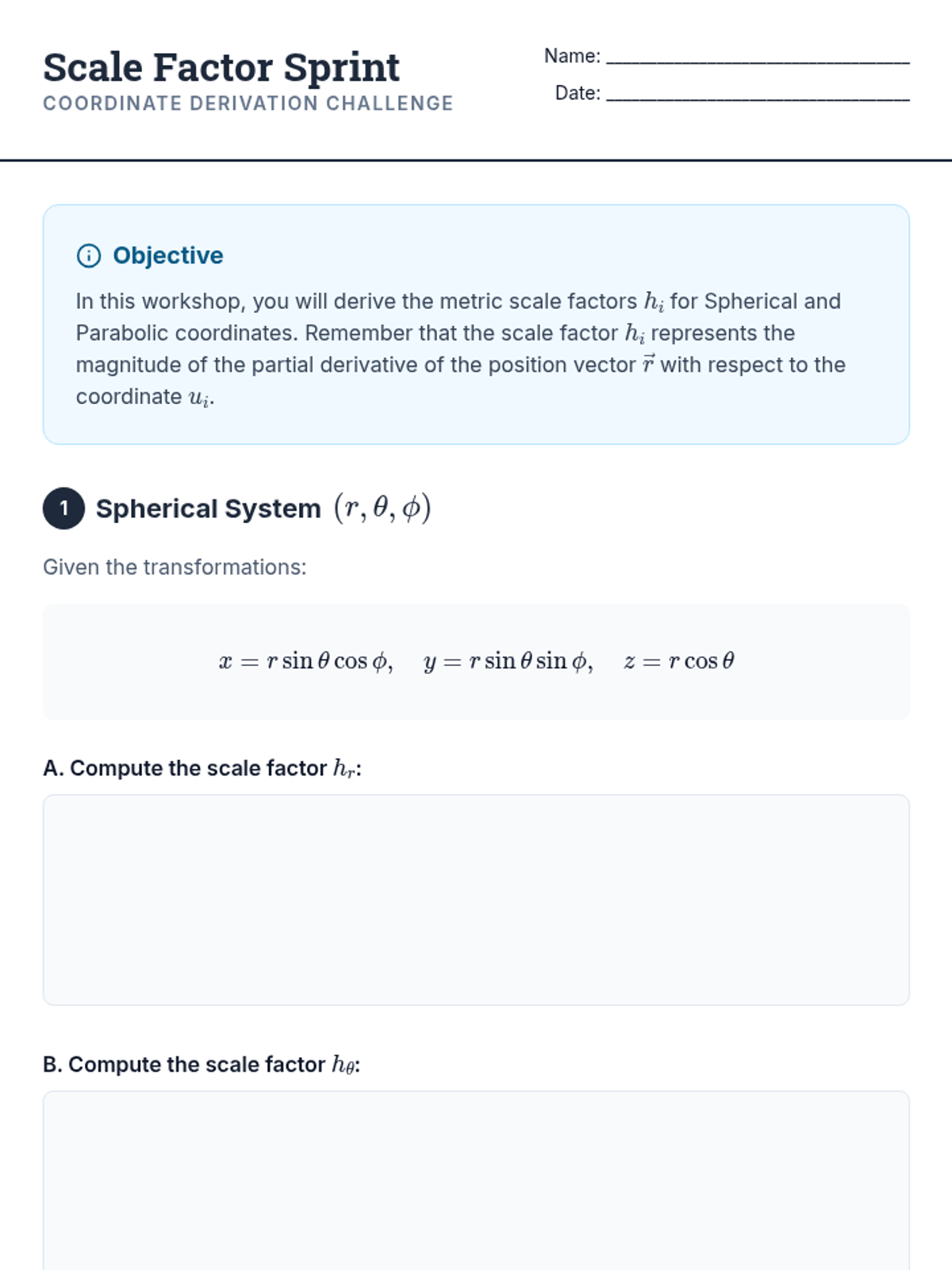
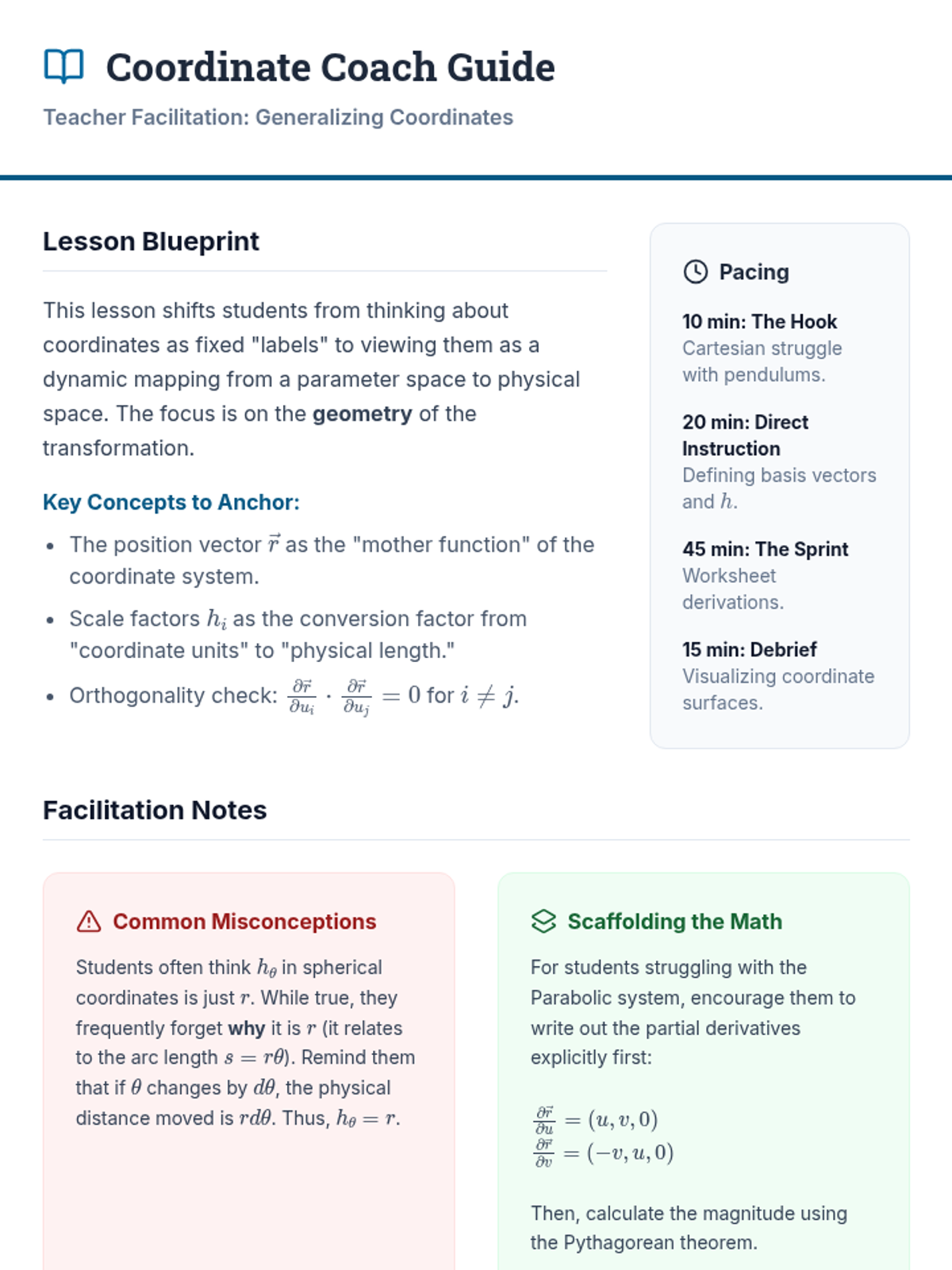
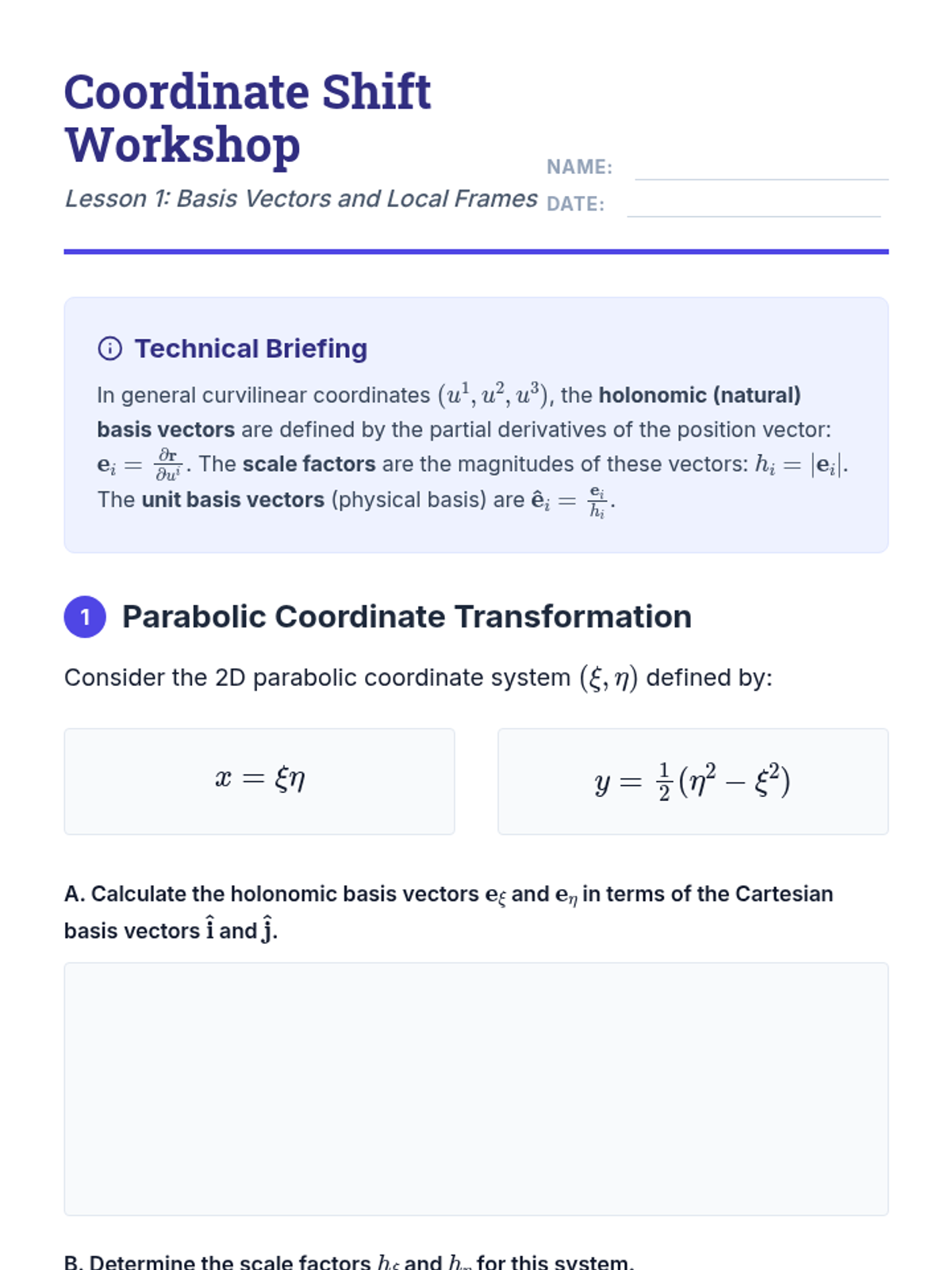
This mathematical physics sequence explores the coordinate systems necessary for solving problems involving complex shapes, moving beyond Cartesian coordinates to General Curvilinear systems. Students derive scale factors, volume elements, and differential operators, culminating in solving Laplace's equation and understanding metric tensors.
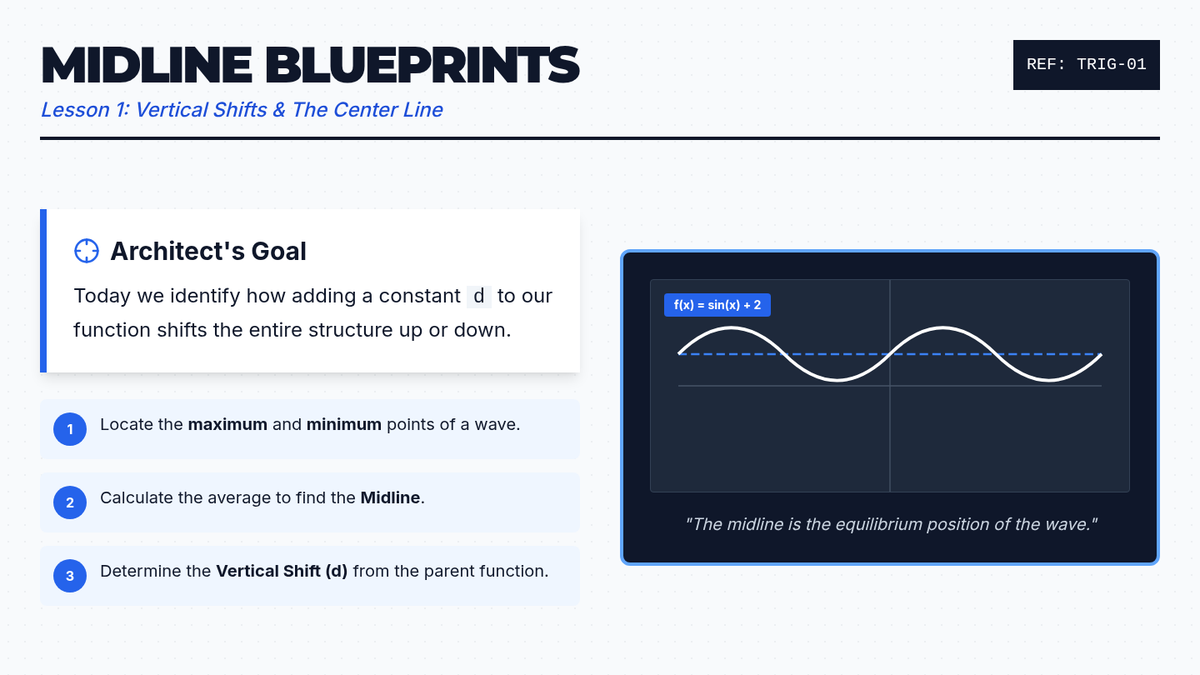
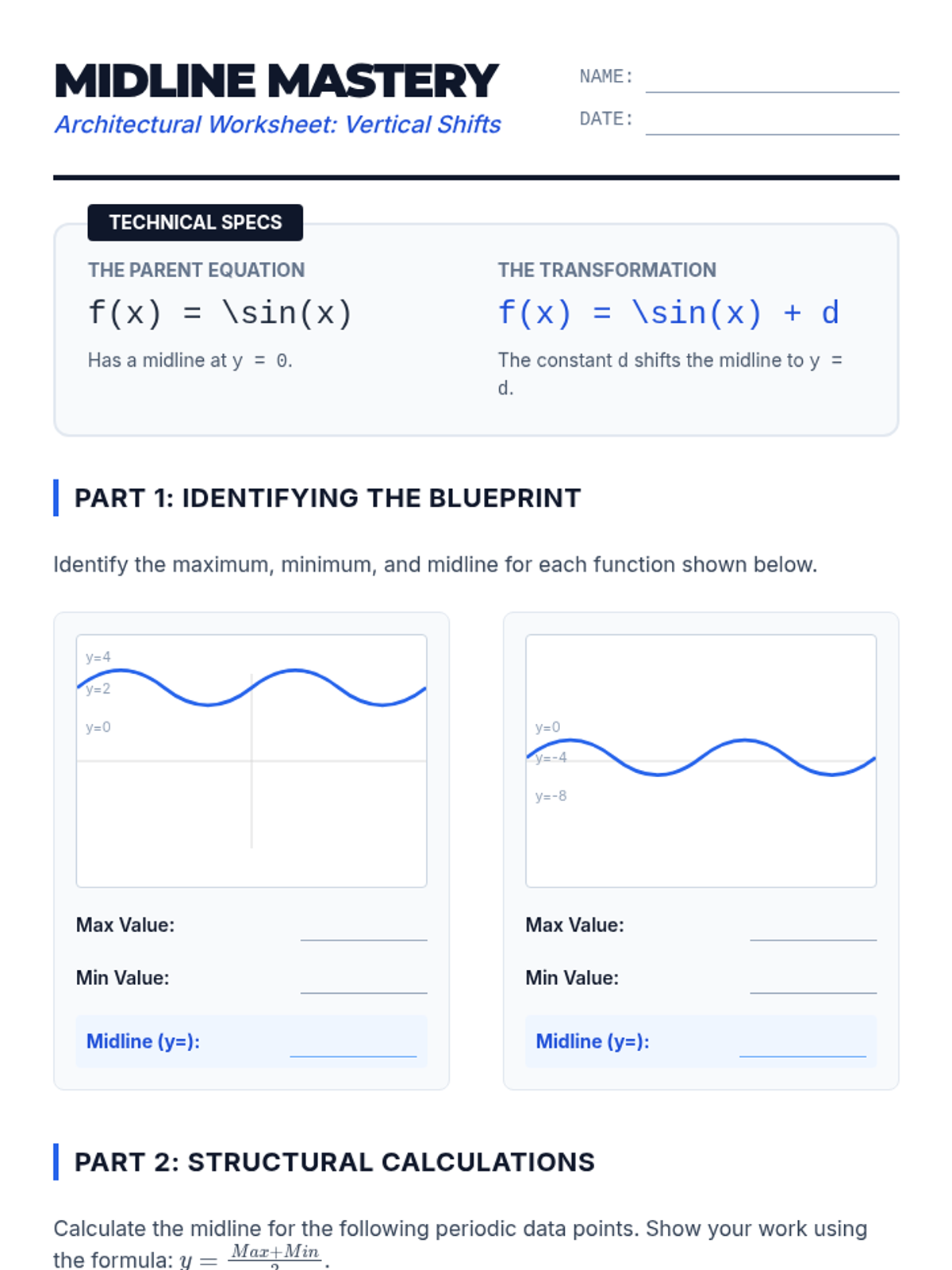
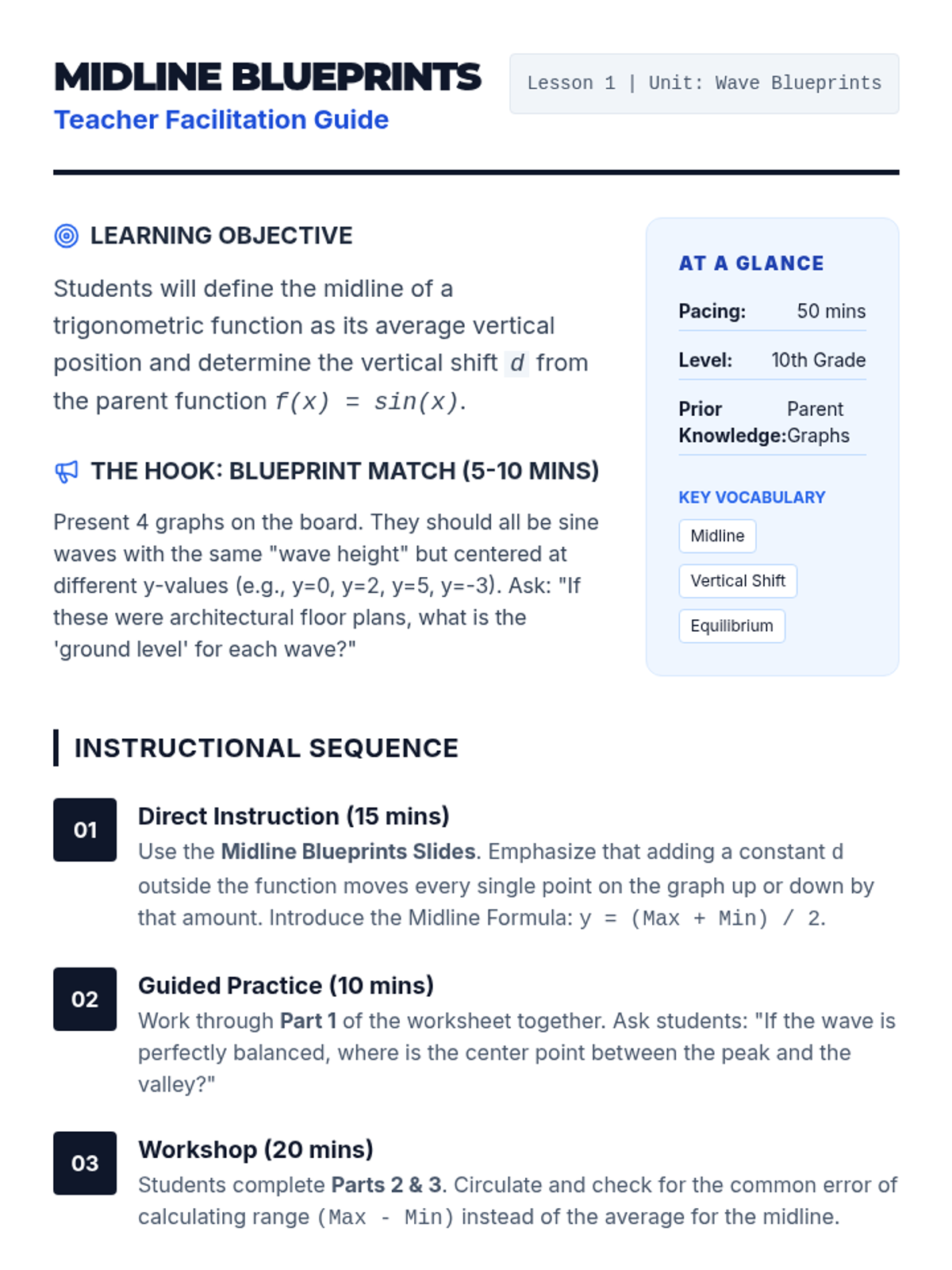
A comprehensive unit on trigonometric transformations, focusing on how parameters A, B, C, and D modify the parent sine and cosine functions. Students progress from simple vertical shifts to complex multi-parameter modeling.
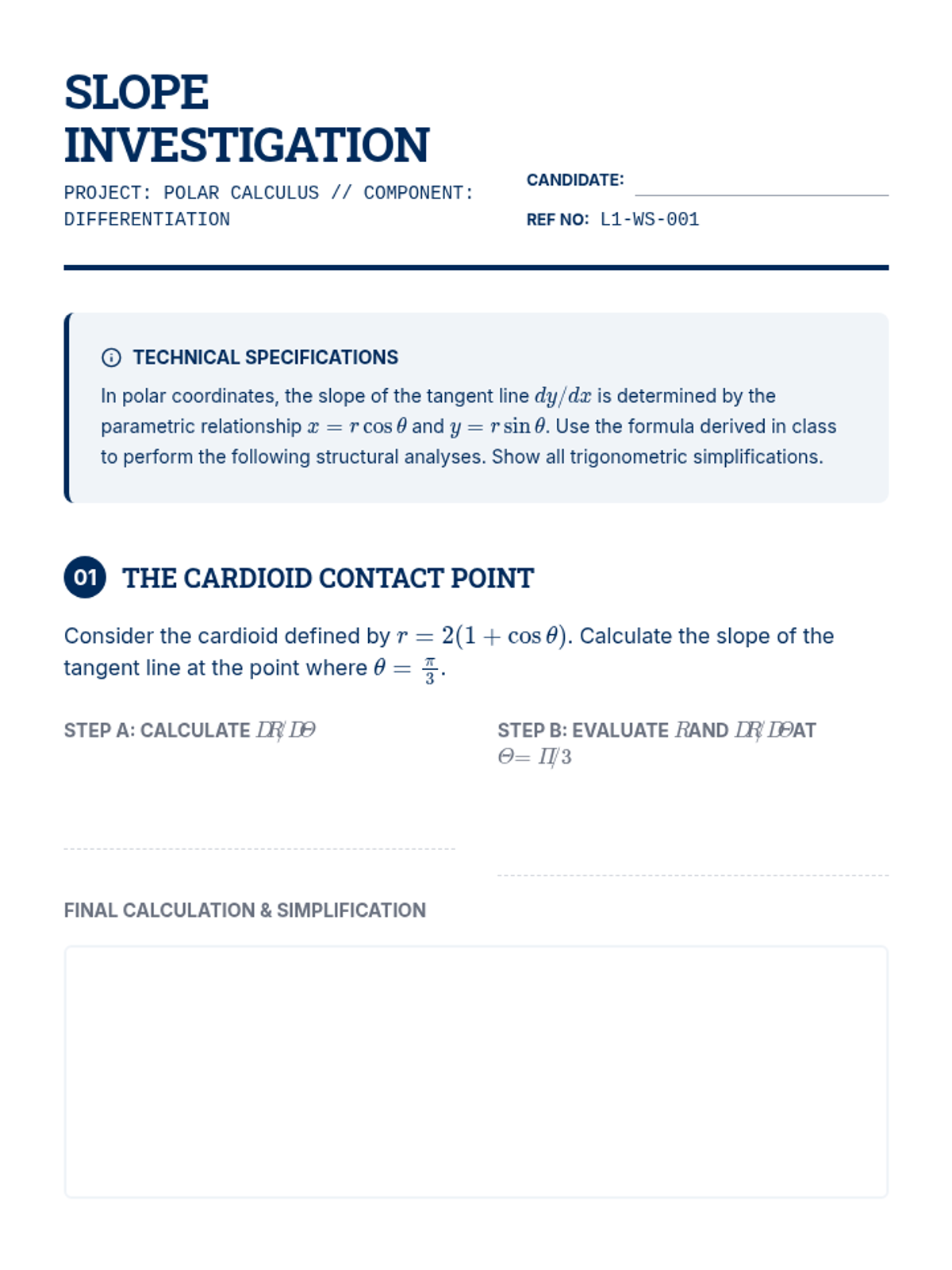
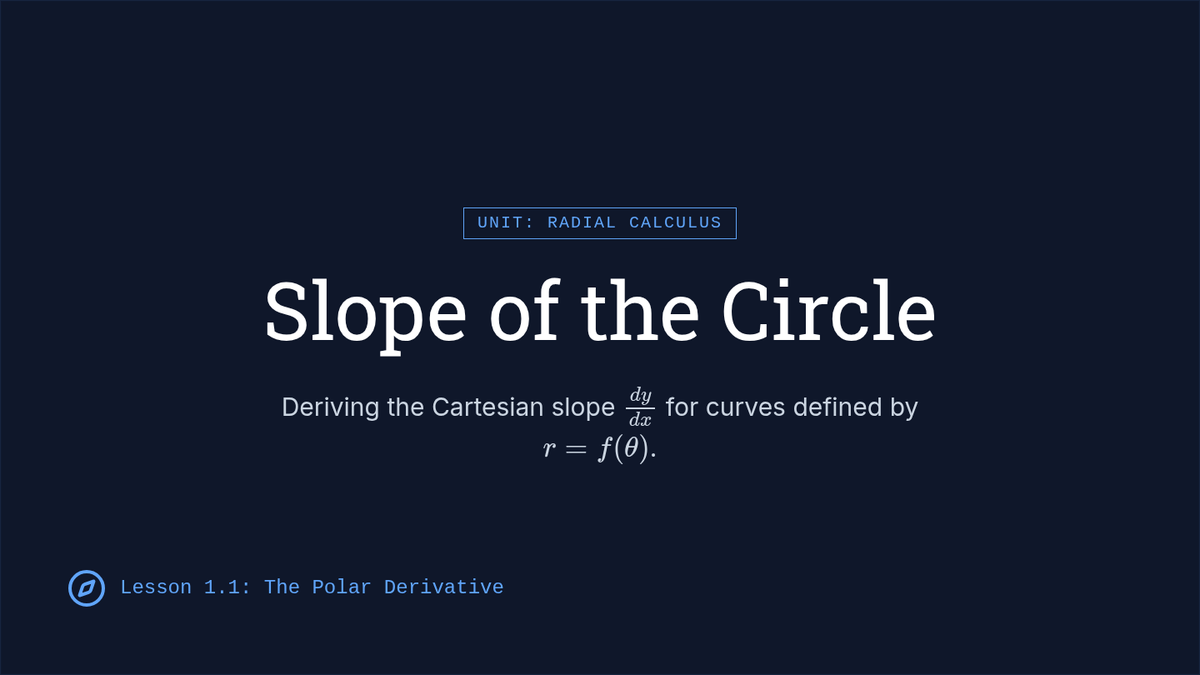
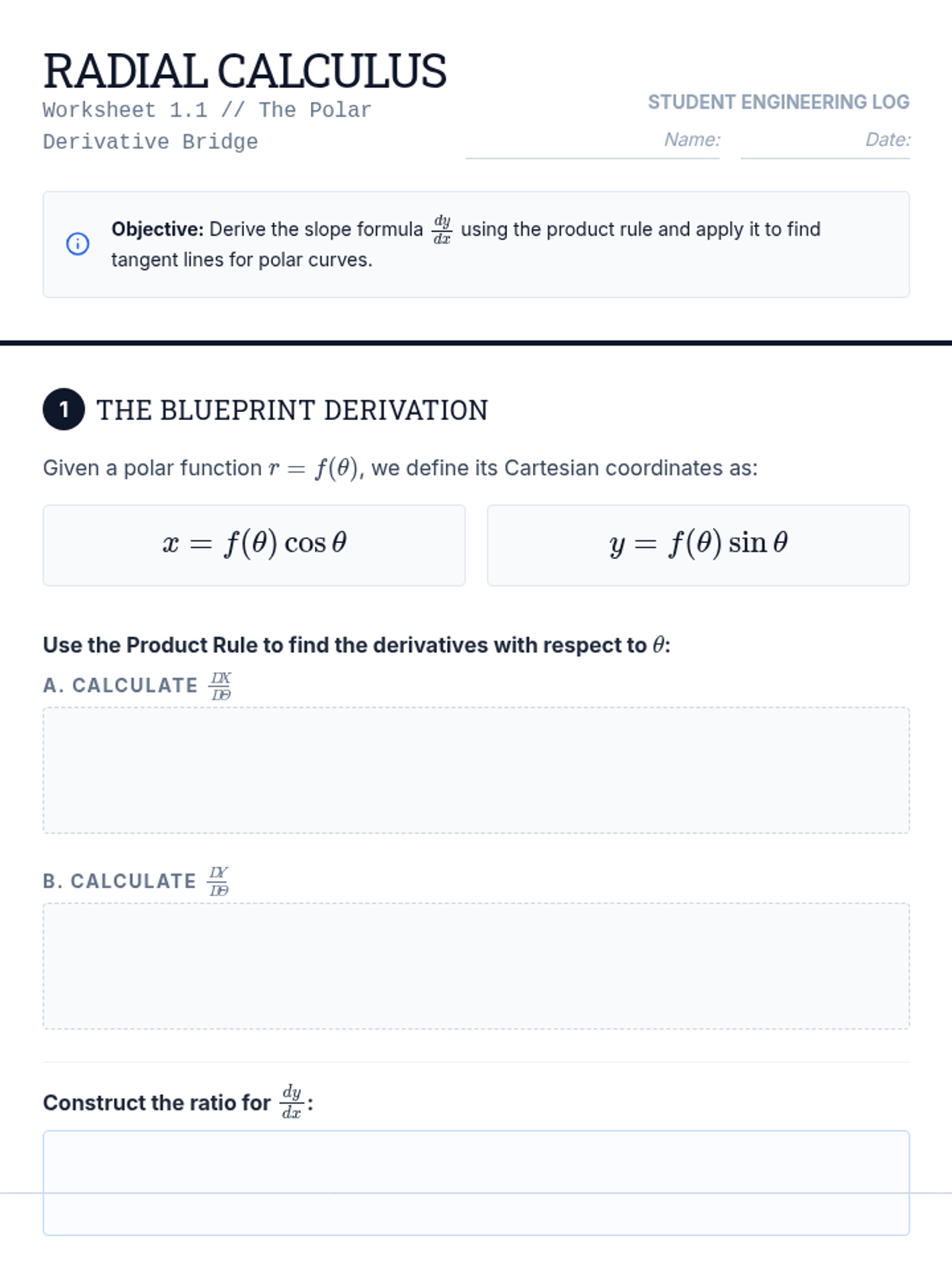
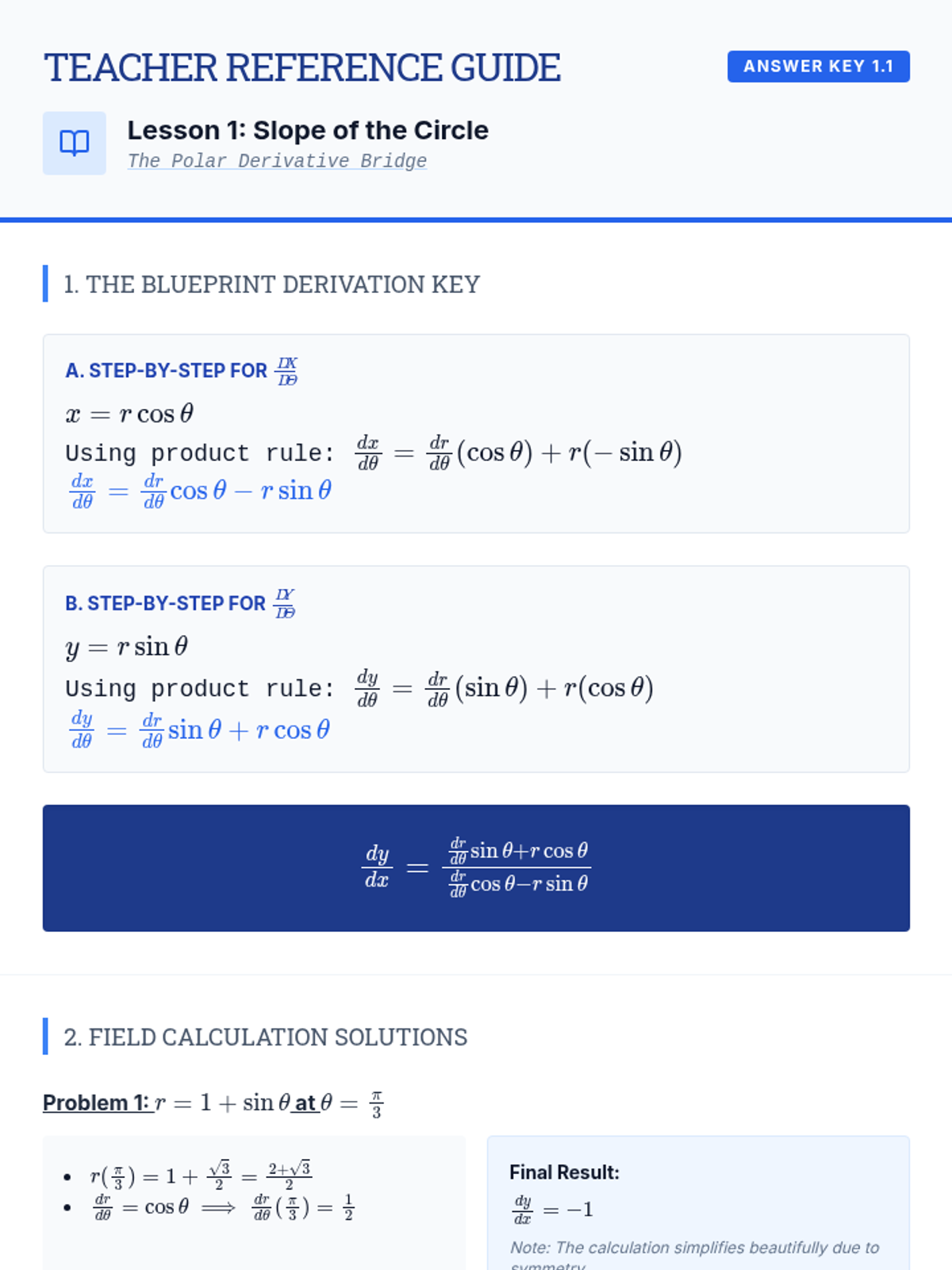
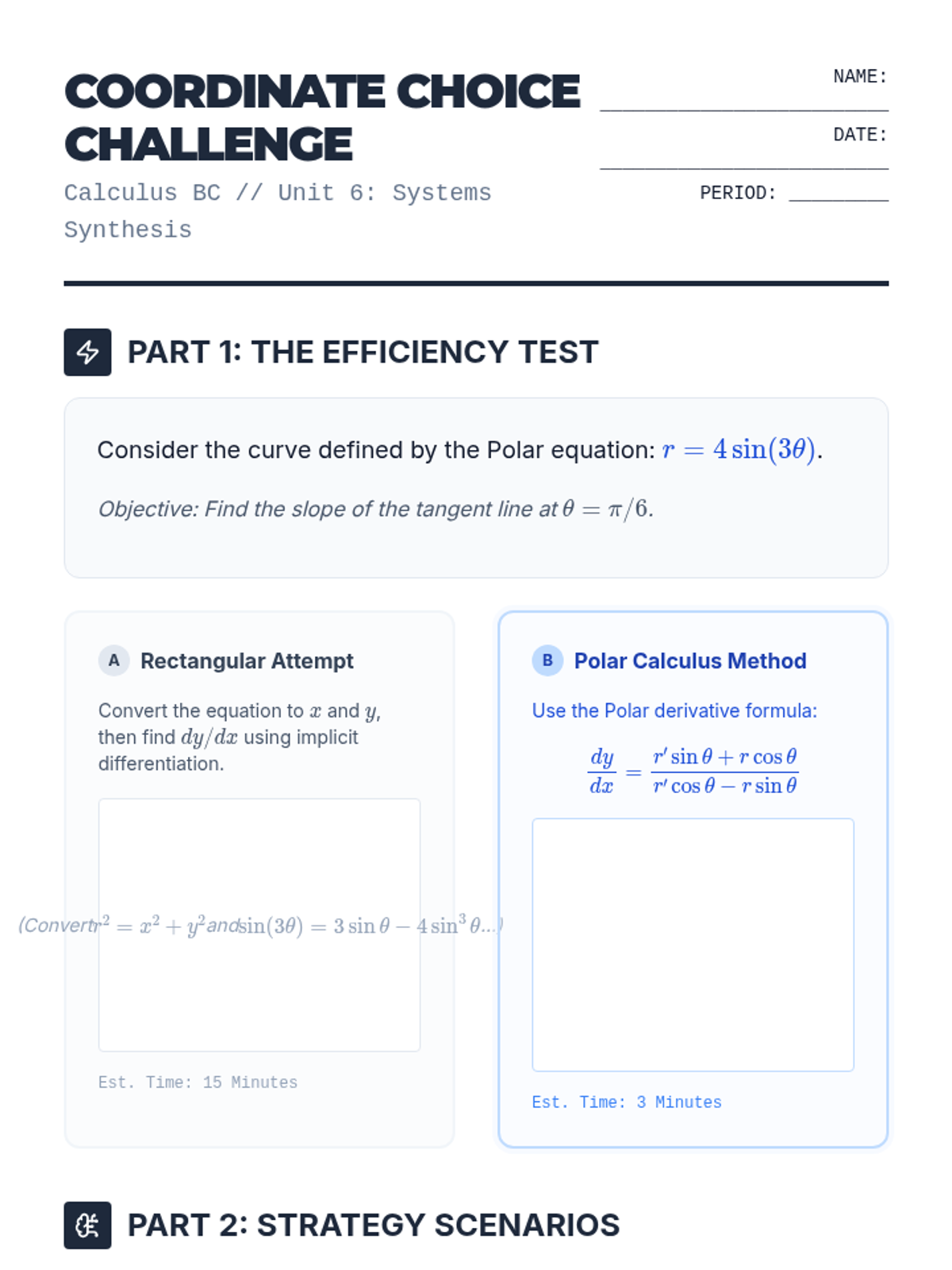
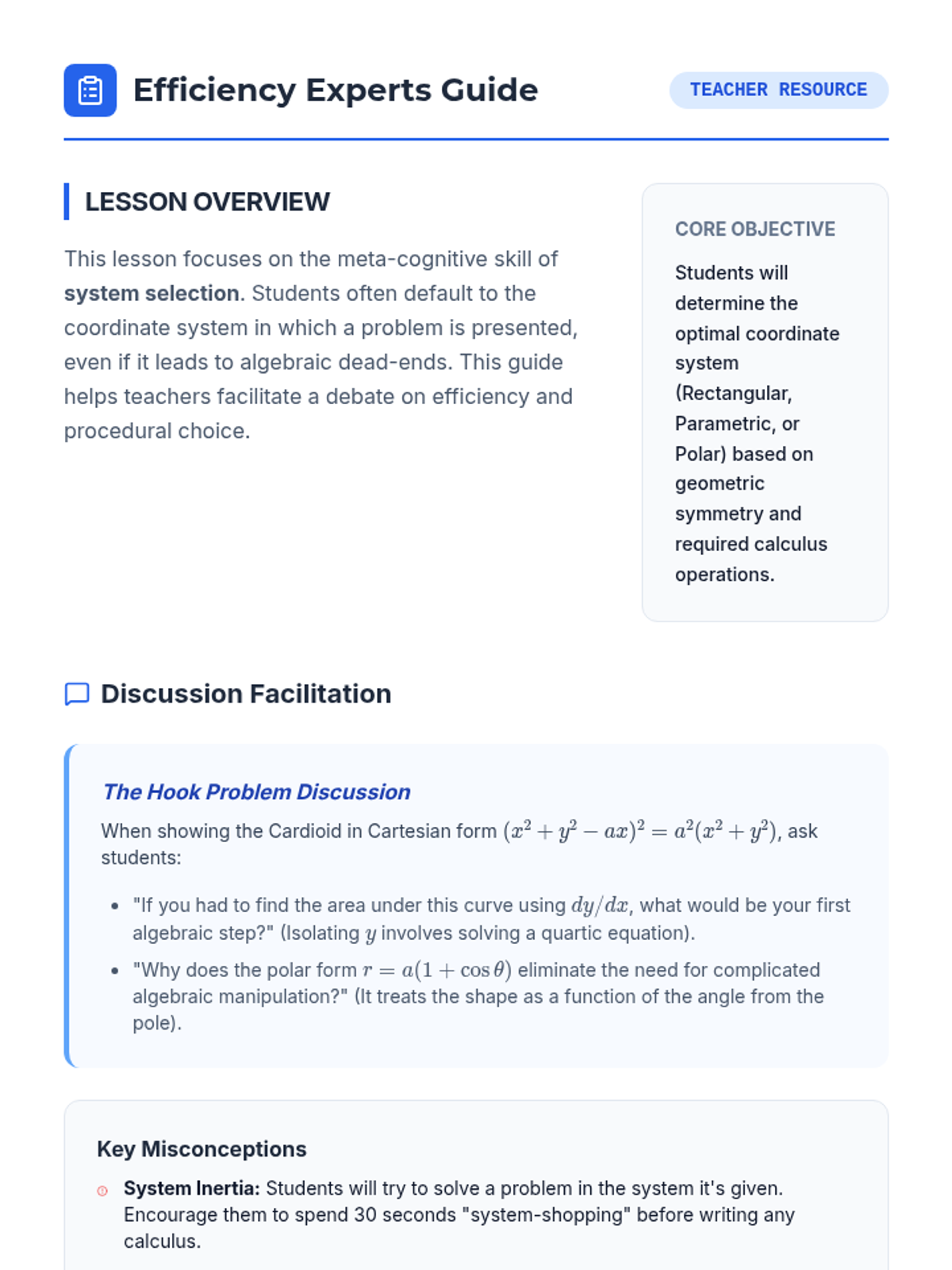
A comprehensive unit for 12th Grade Calculus students focusing on the derivation and application of derivatives in polar coordinates. Students transition from Cartesian slope to polar slope, analyze horizontal and vertical tangency, investigate behavior at the pole, and solve optimization problems involving polar curves.
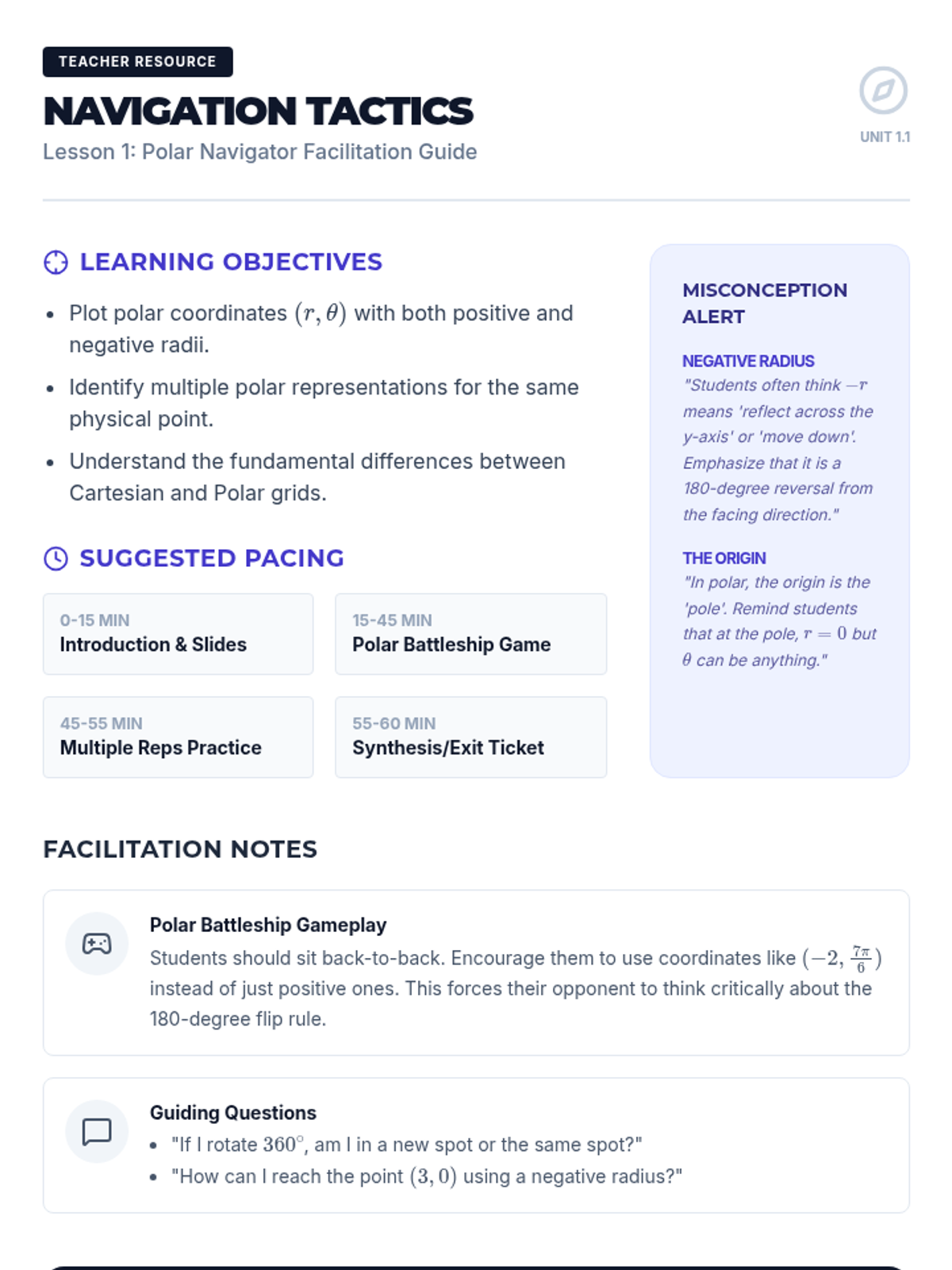
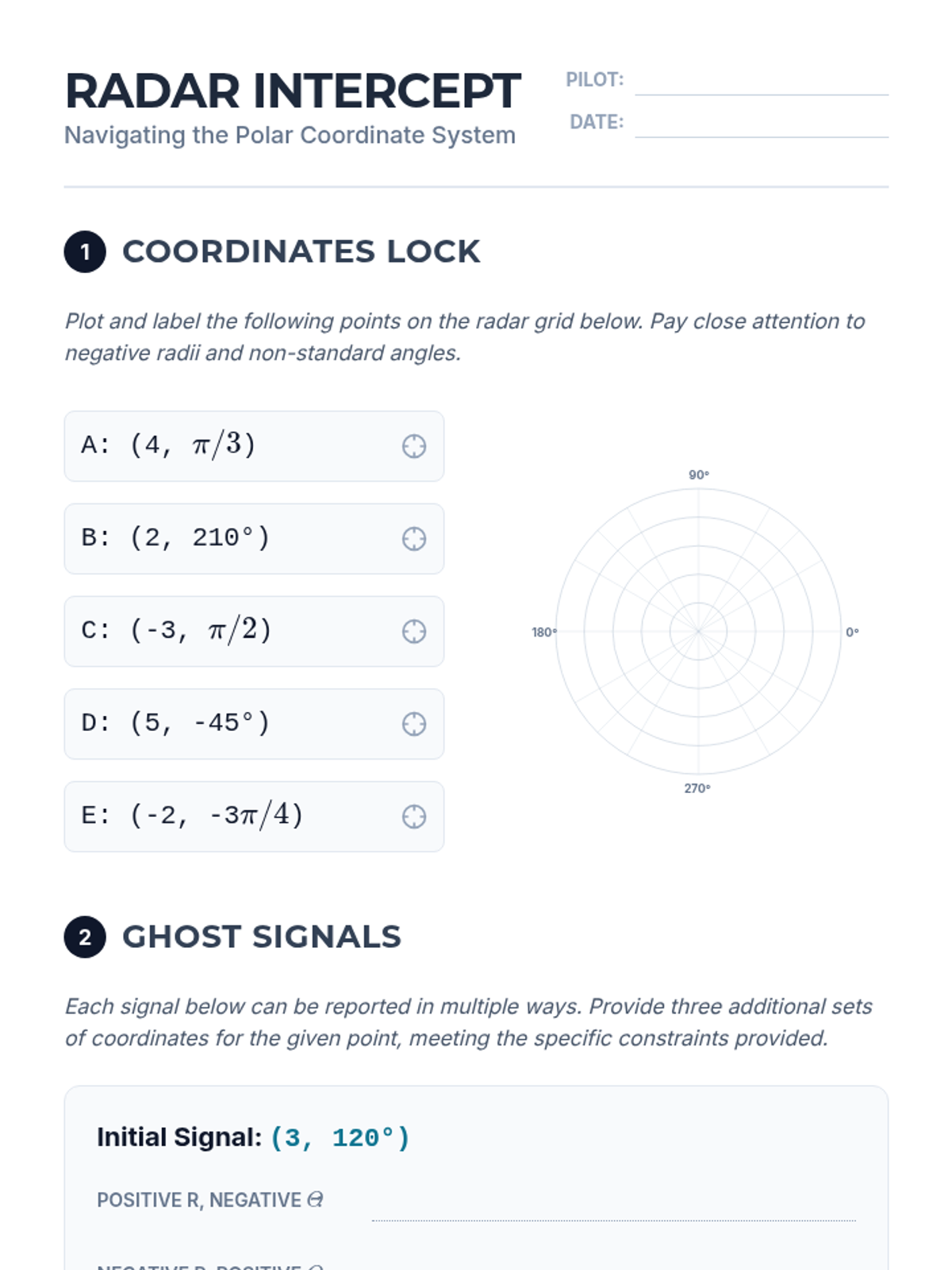
A comprehensive unit on polar coordinates and functions, moving from basic plotting to complex intersections and symmetry. Students explore the geometric beauty of curves like roses and lima\u00e7ons while mastering the algebraic conversions between rectangular and polar systems.
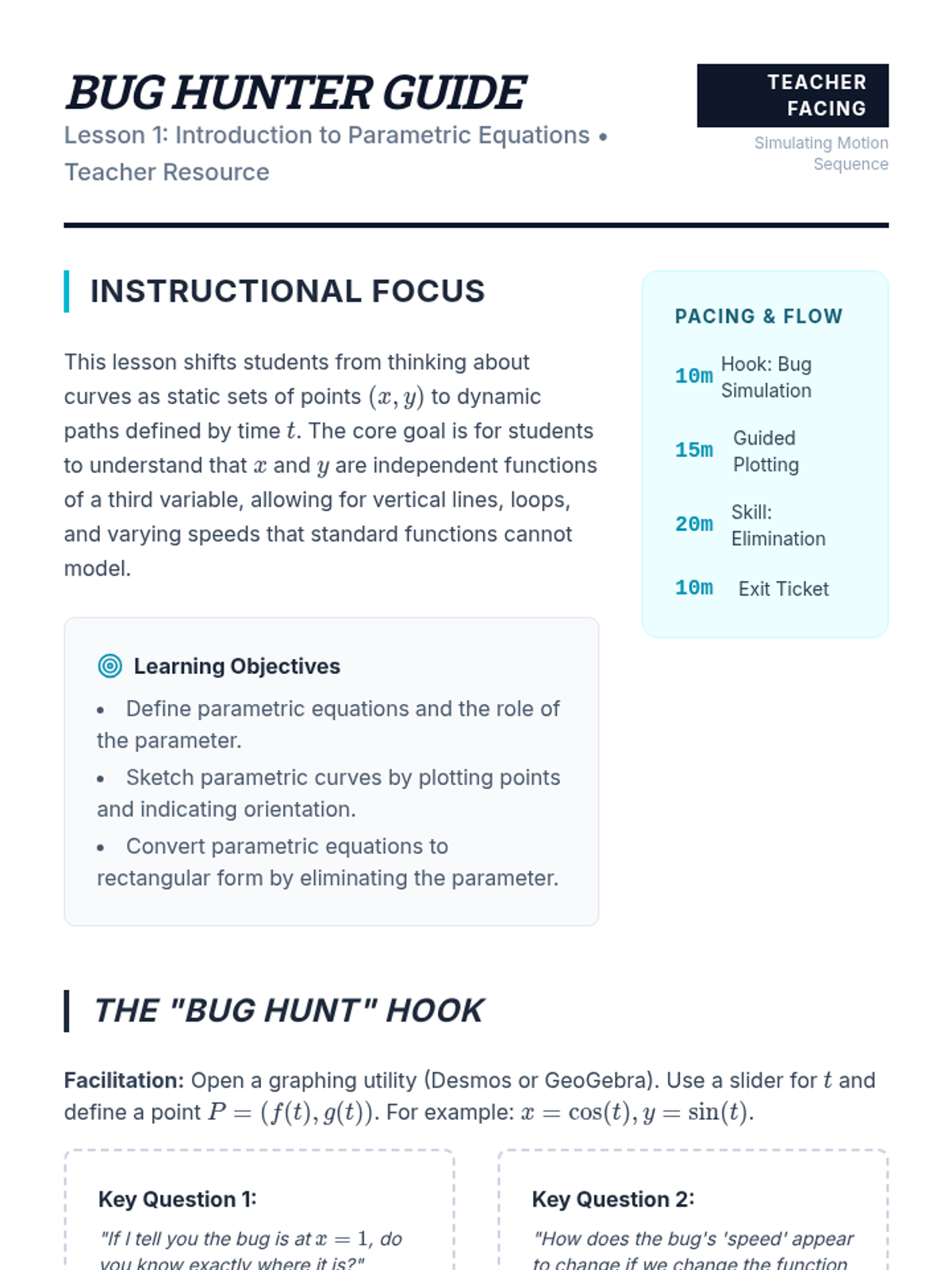
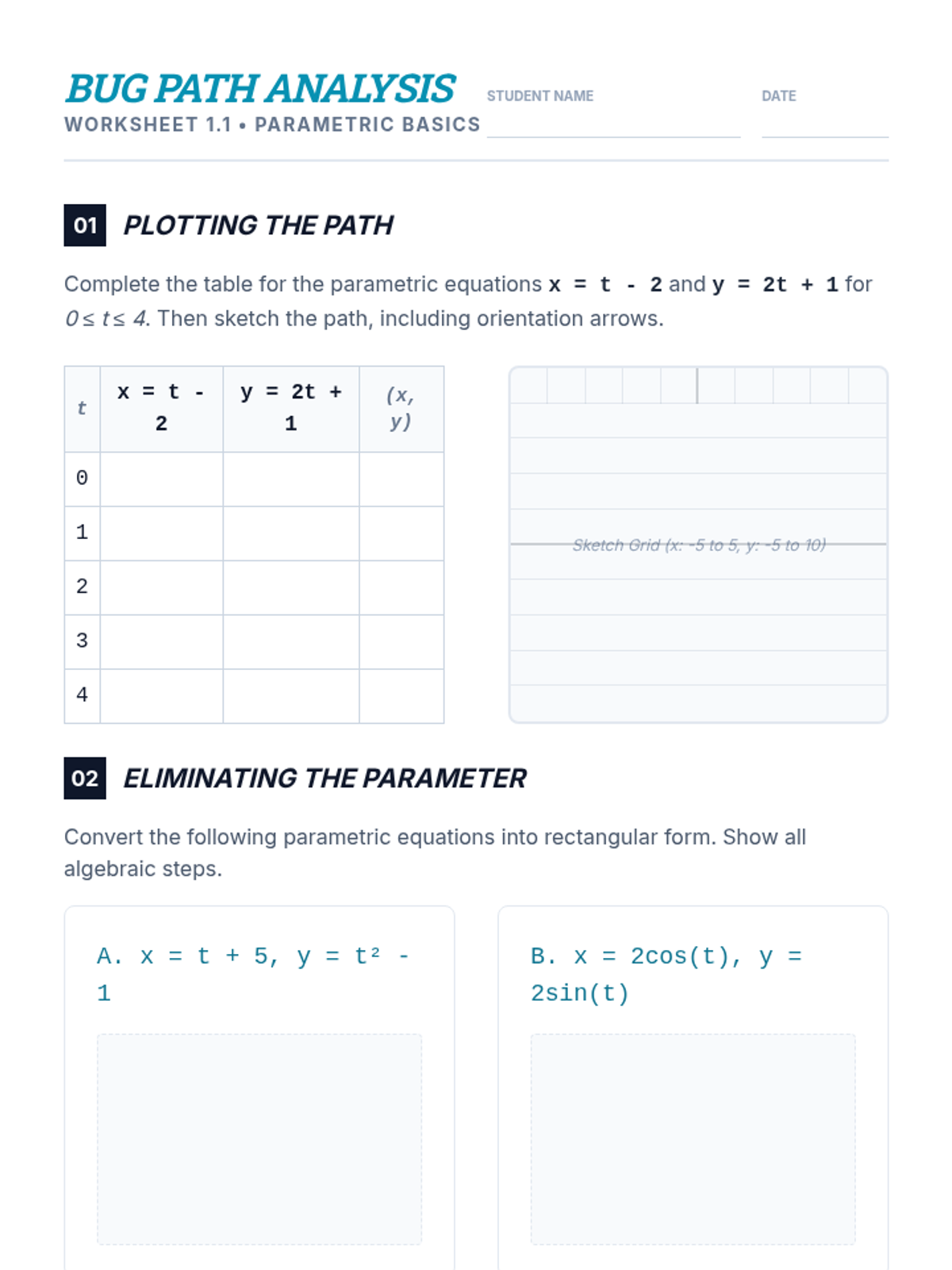
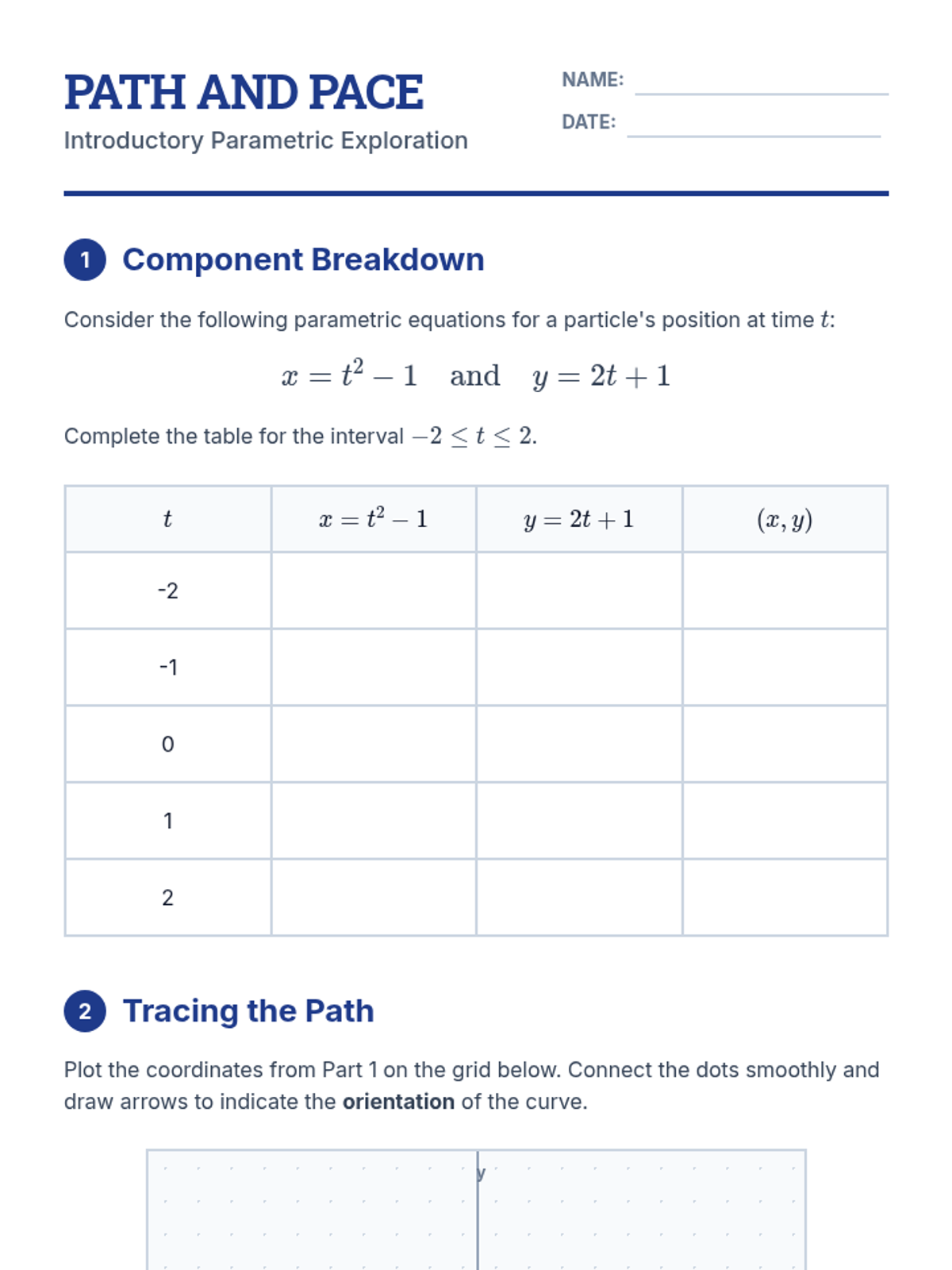
This sequence introduces students to parametric equations through the lens of particle motion and physics simulations. Students progress from basic plotting and parameter elimination to advanced calculus applications involving derivatives, vectors, and arc length.
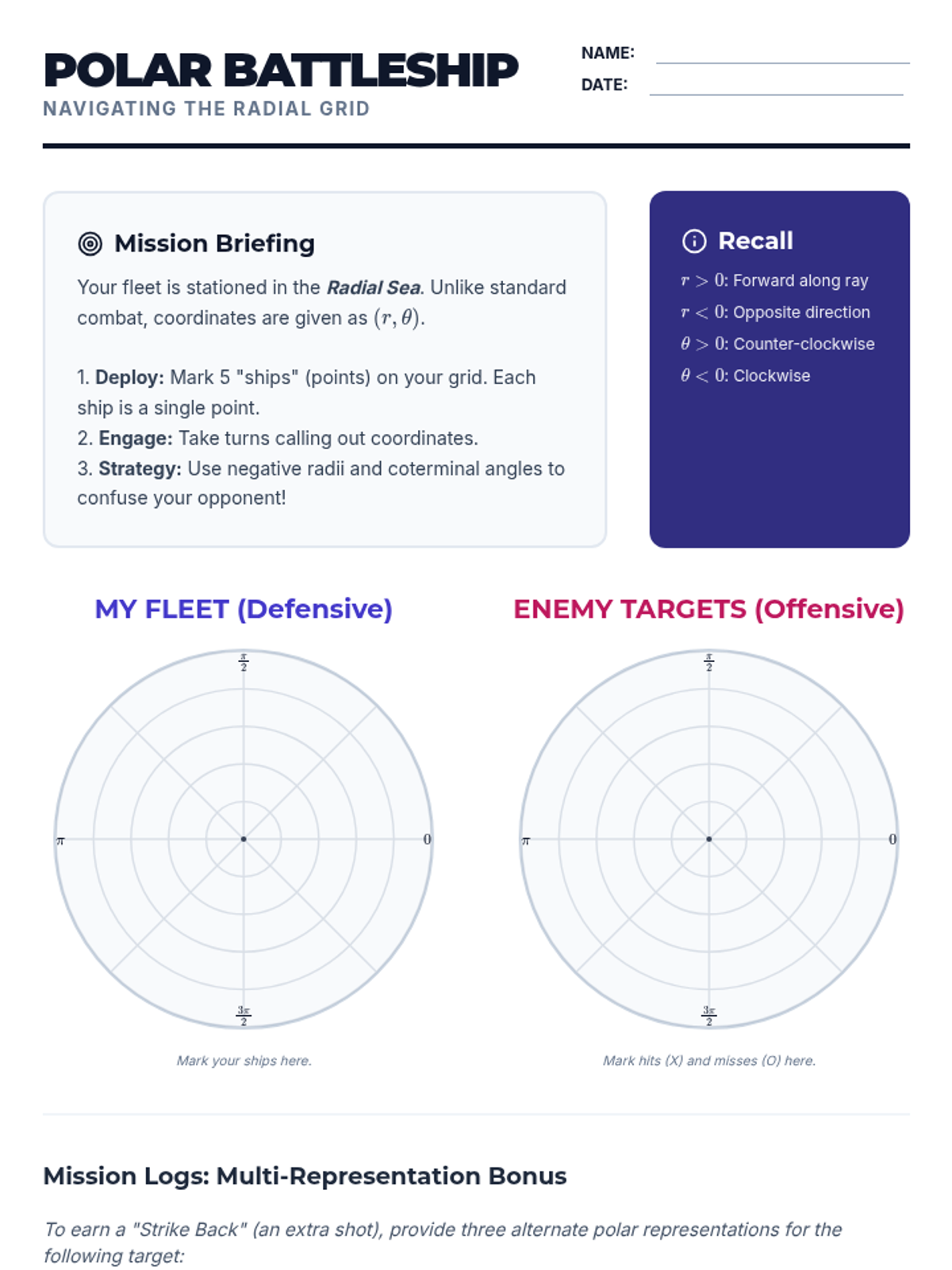
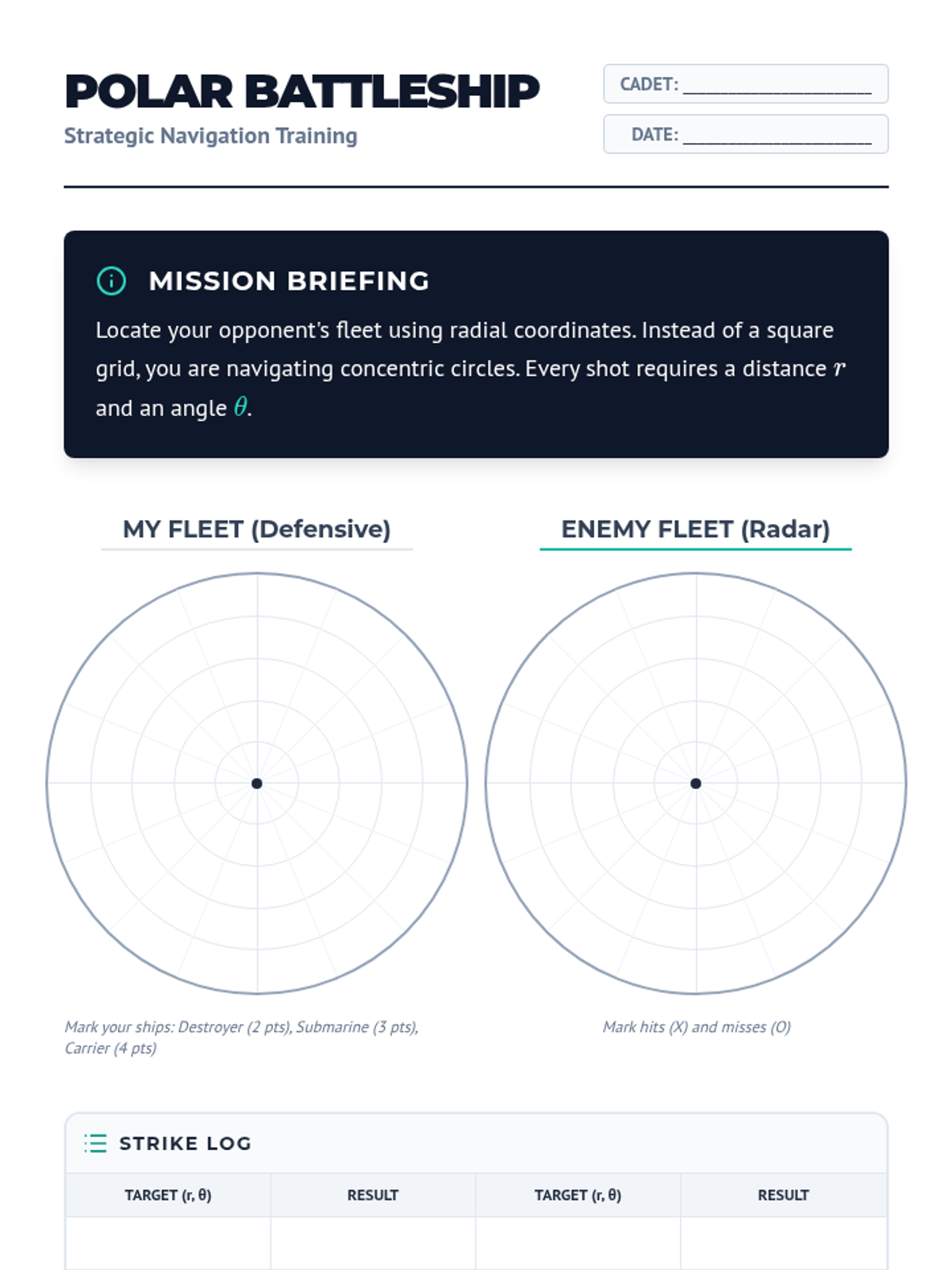
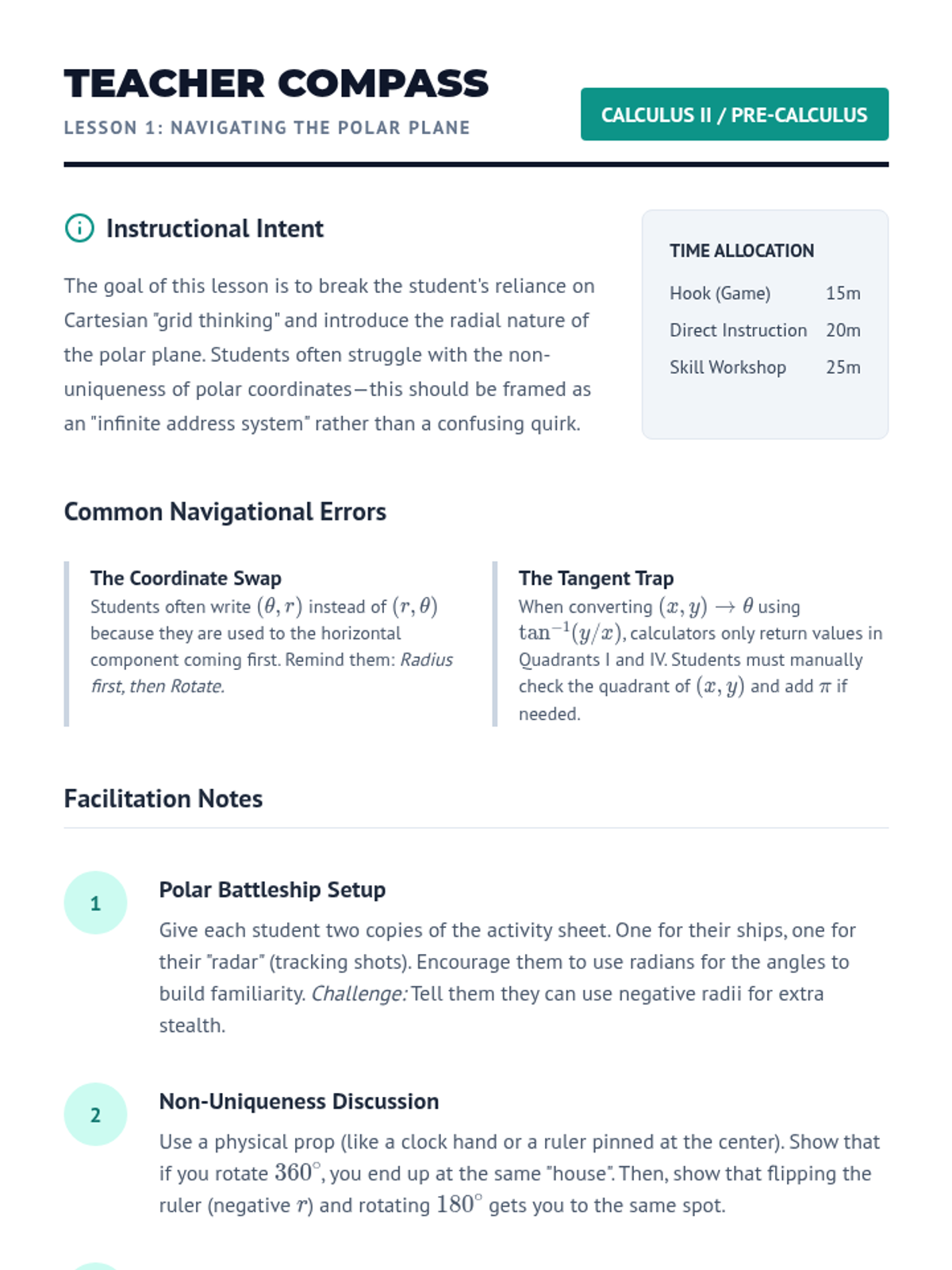
A comprehensive exploration of the polar coordinate system, covering point plotting, coordinate conversion, and the analysis of complex polar curves including rose curves, limacons, and spirals. Students move from basic radial positioning to deep geometric analysis of symmetry and periodicity.
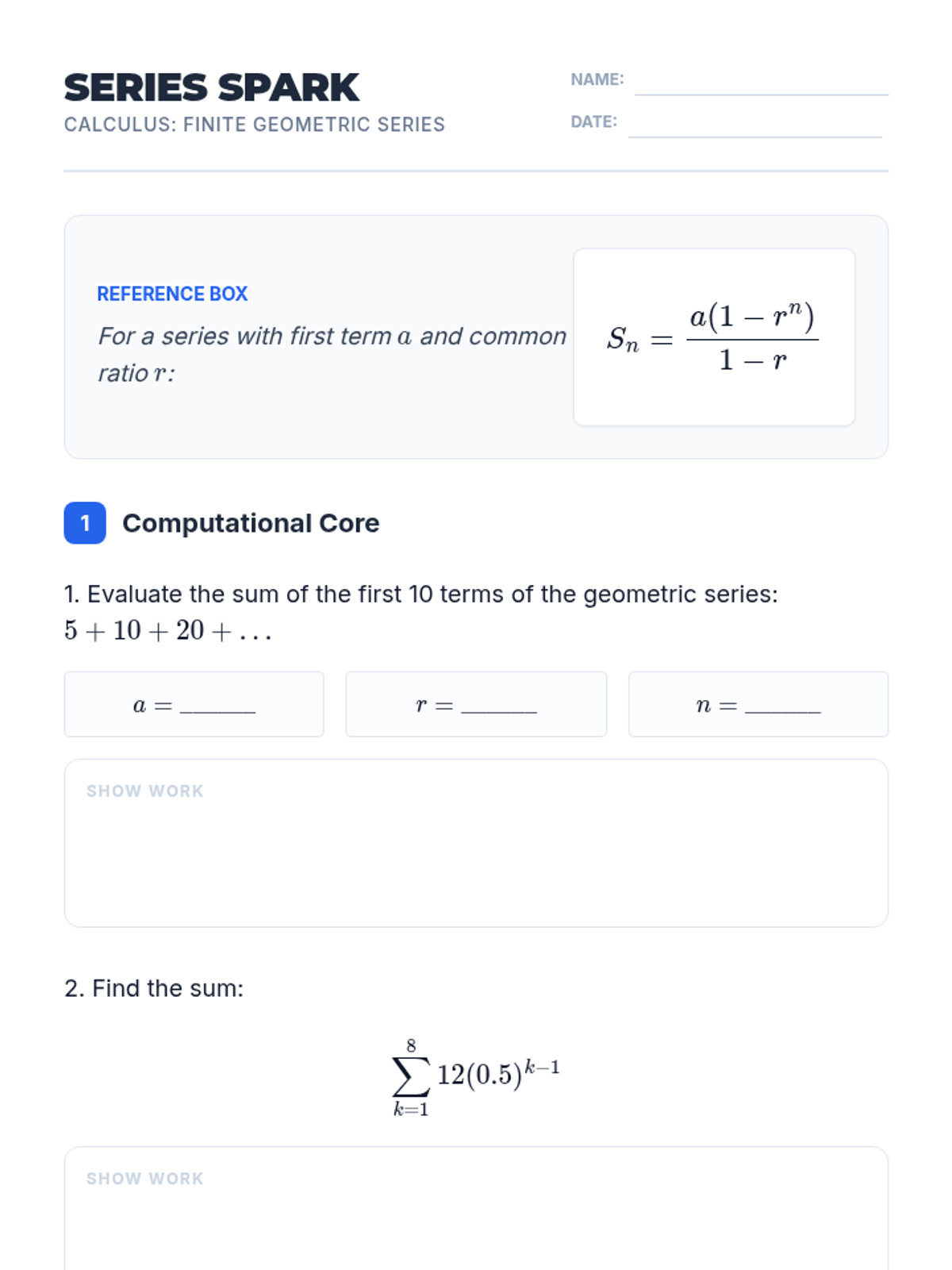
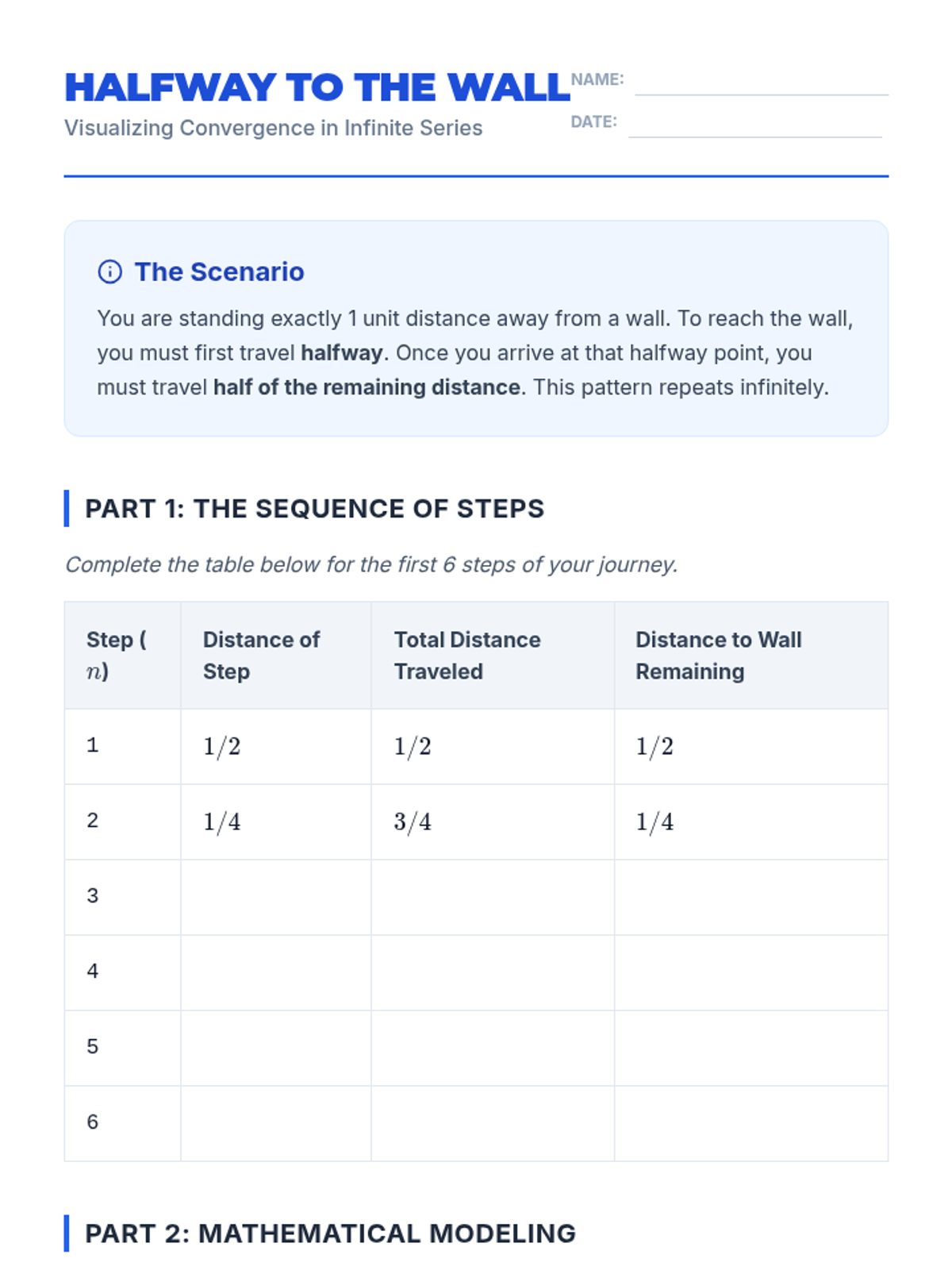
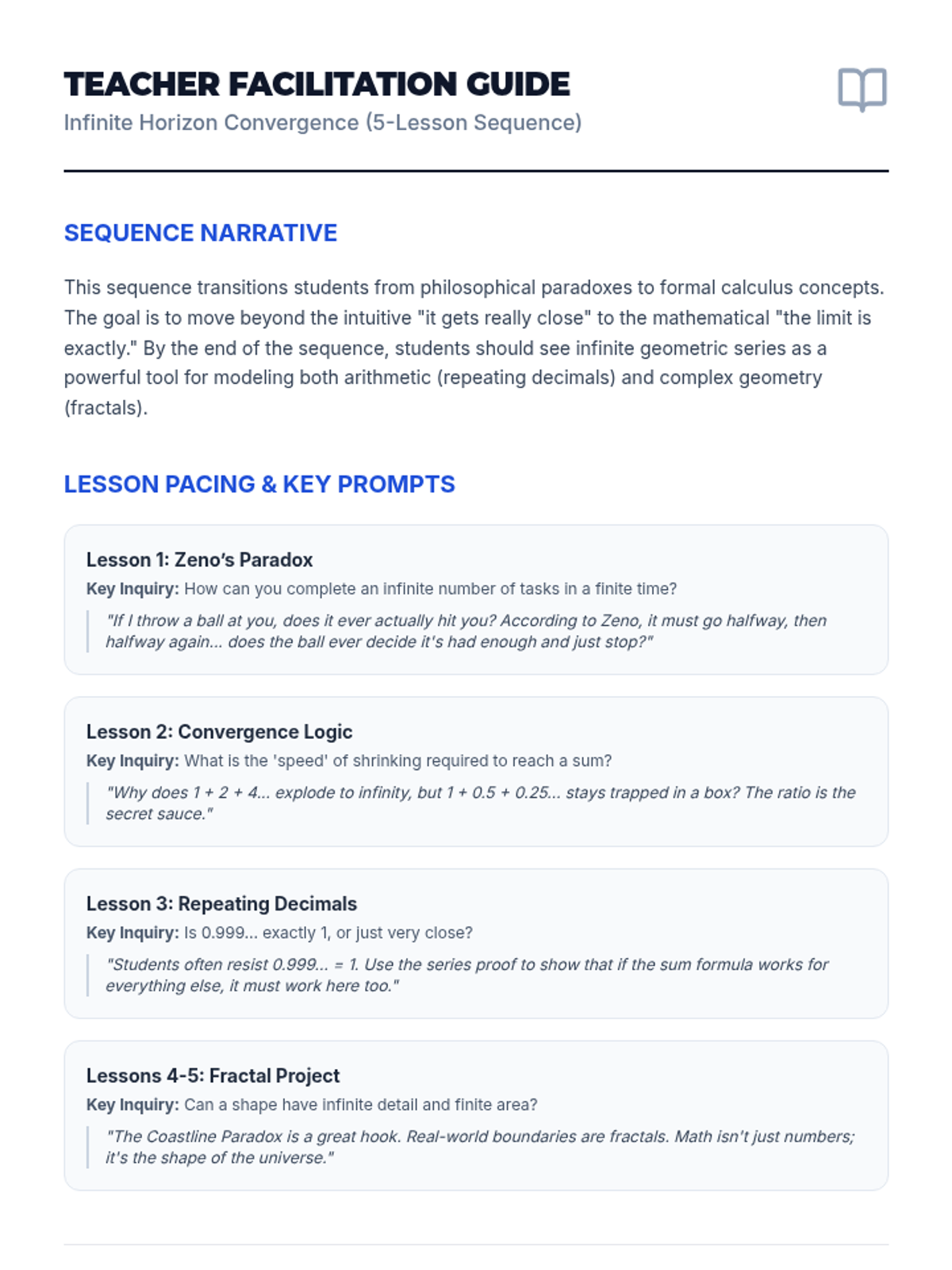
A comprehensive unit for 11th Grade Calculus exploring geometric series through the lens of financial literacy and fractal geometry. Students transition from finite sums to infinite convergence, applying these models to population growth, Zeno's Paradox, and complex loan amortization.
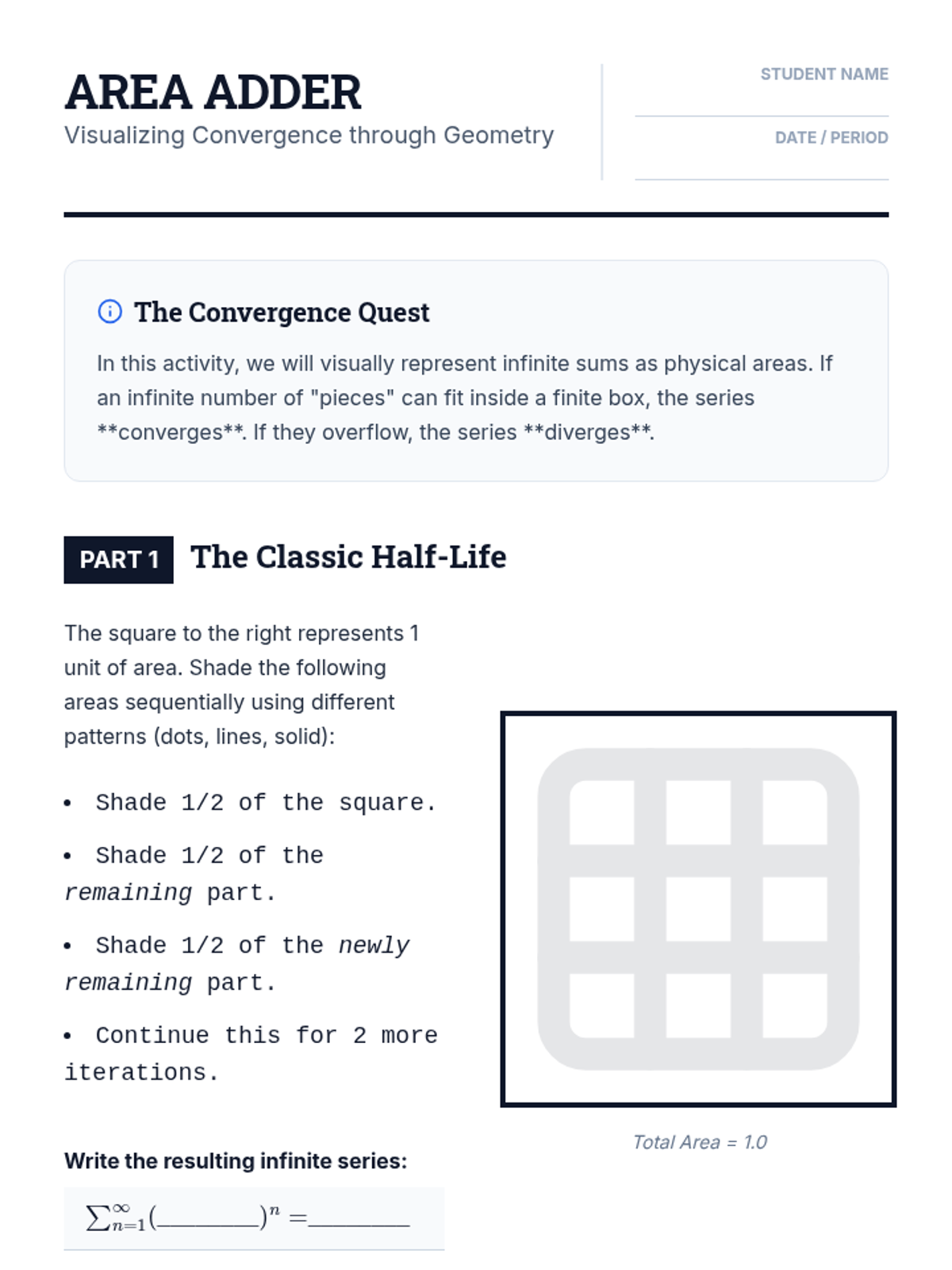
This sequence explores the intersection of calculus and geometry through infinite series and fractals. Students investigate convergence and divergence using visual area models, fractal dimensions, and physical simulations like block stacking.
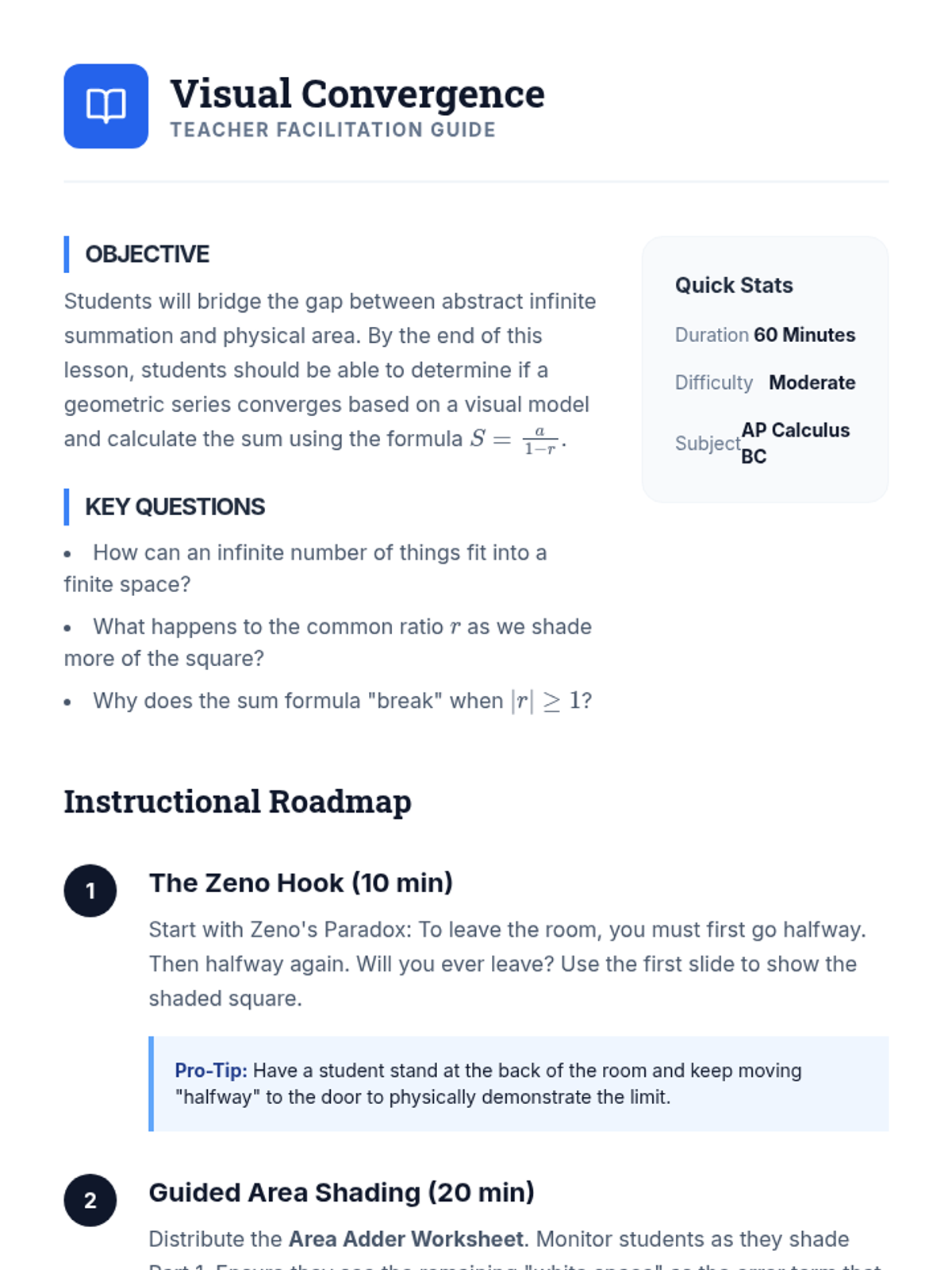
A project-based sequence exploring infinite geometric series through Zeno's paradox, algebraic proofs of convergence, and fractal geometry. Students investigate how infinite additions can result in finite sums and apply these concepts to real-world paradoxes and self-similar shapes.
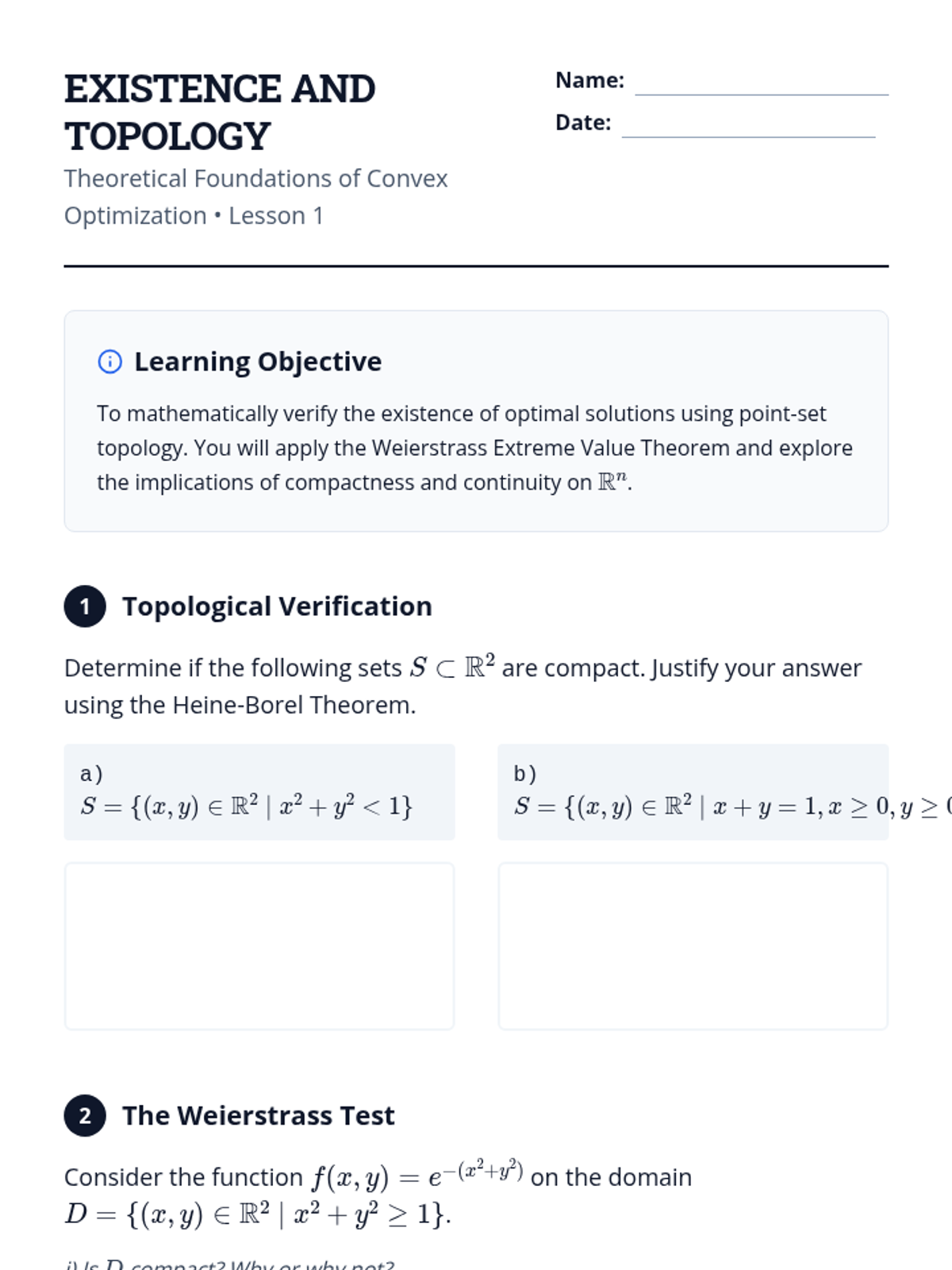
This sequence establishes the rigorous mathematical underpinnings necessary for advanced optimization work, moving beyond procedural calculus to analysis-based proofs. Students explore the intersection of topology, set theory, and multivariate calculus to determine the existence and uniqueness of optimal solutions.
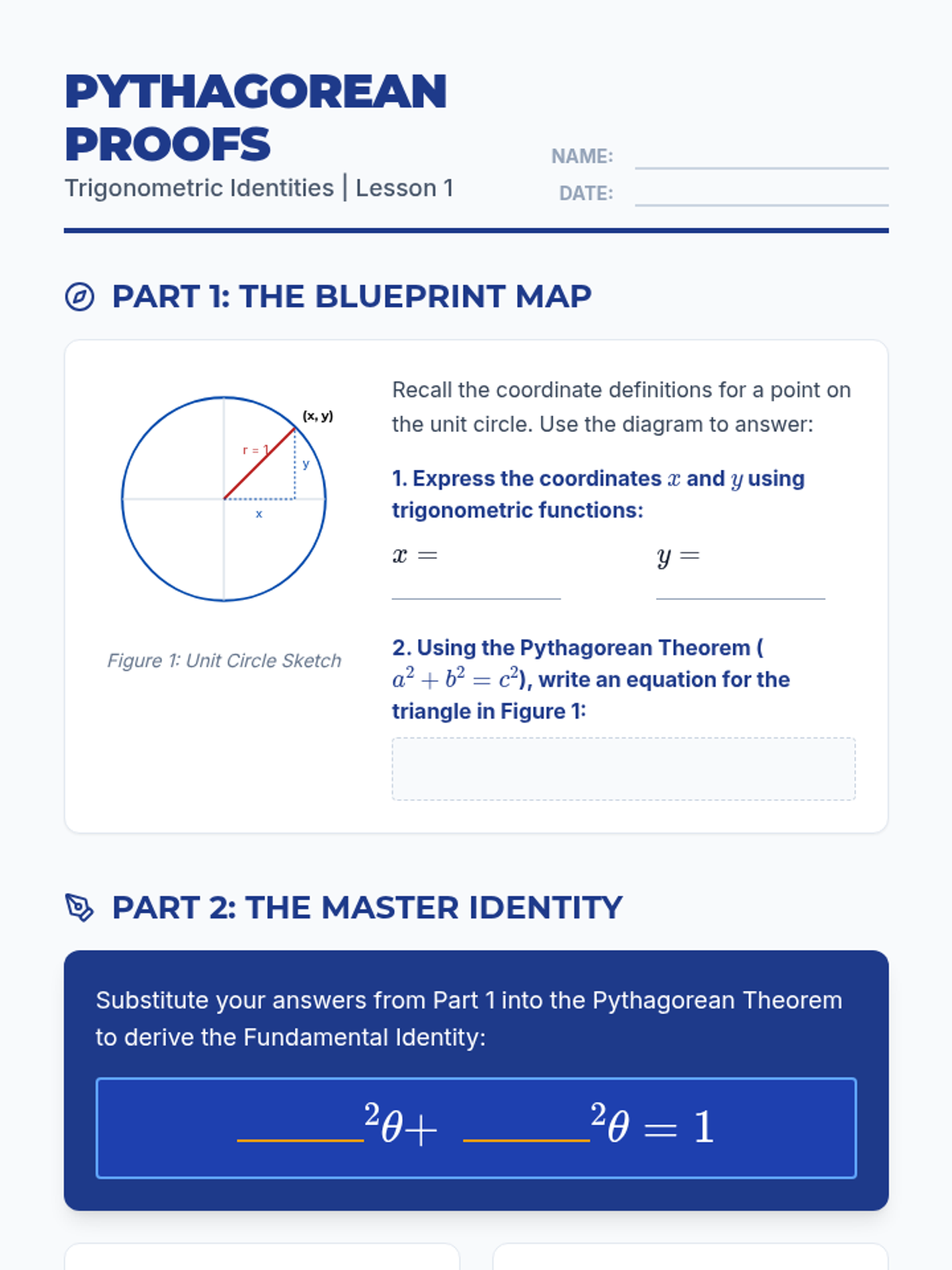
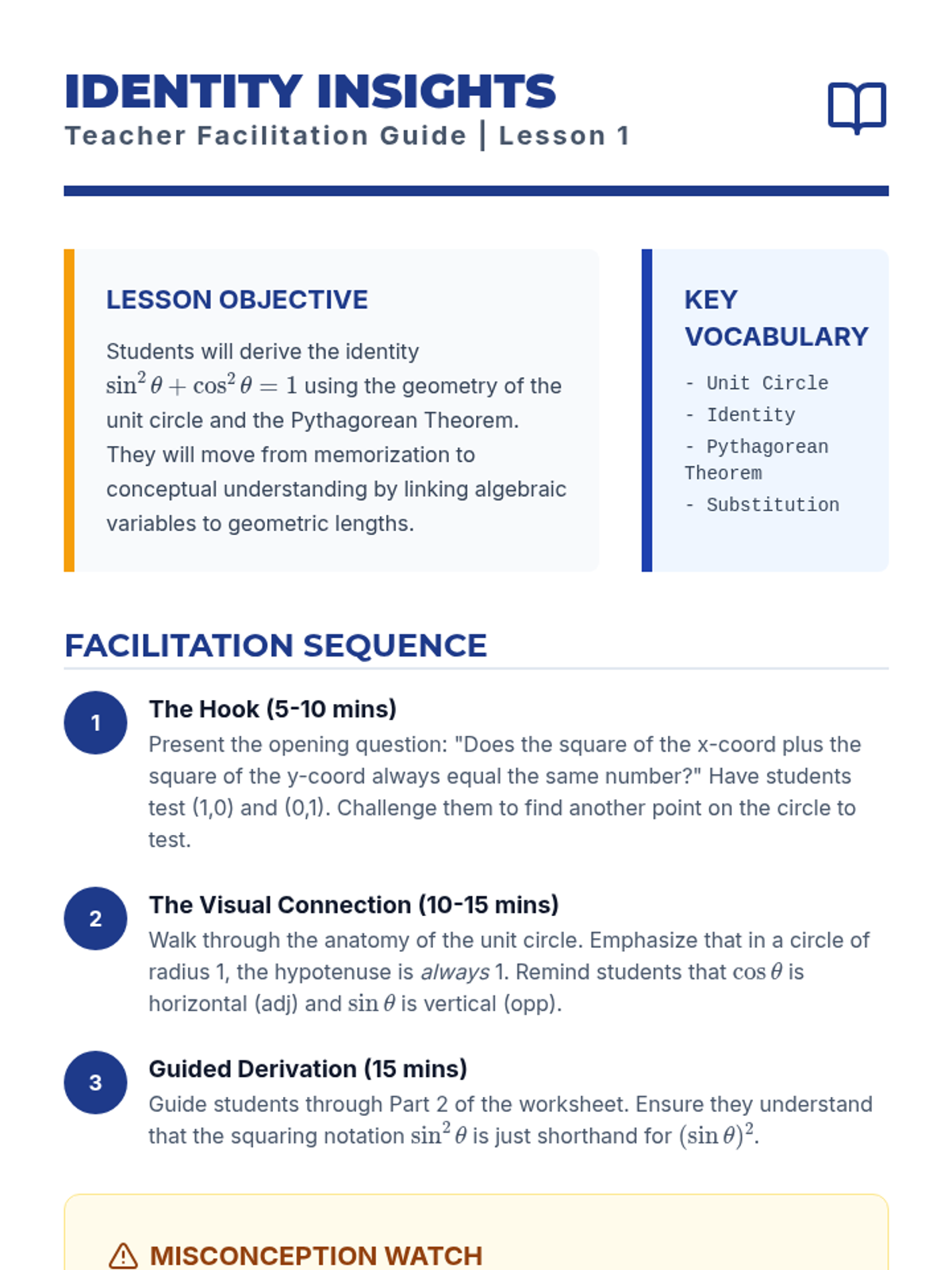
This inquiry-driven sequence connects the geometric definitions of the unit circle to algebraic trigonometric identities. Students derive Pythagorean, reciprocal, and quotient identities through visualization and algebraic proof to foster deep conceptual understanding.
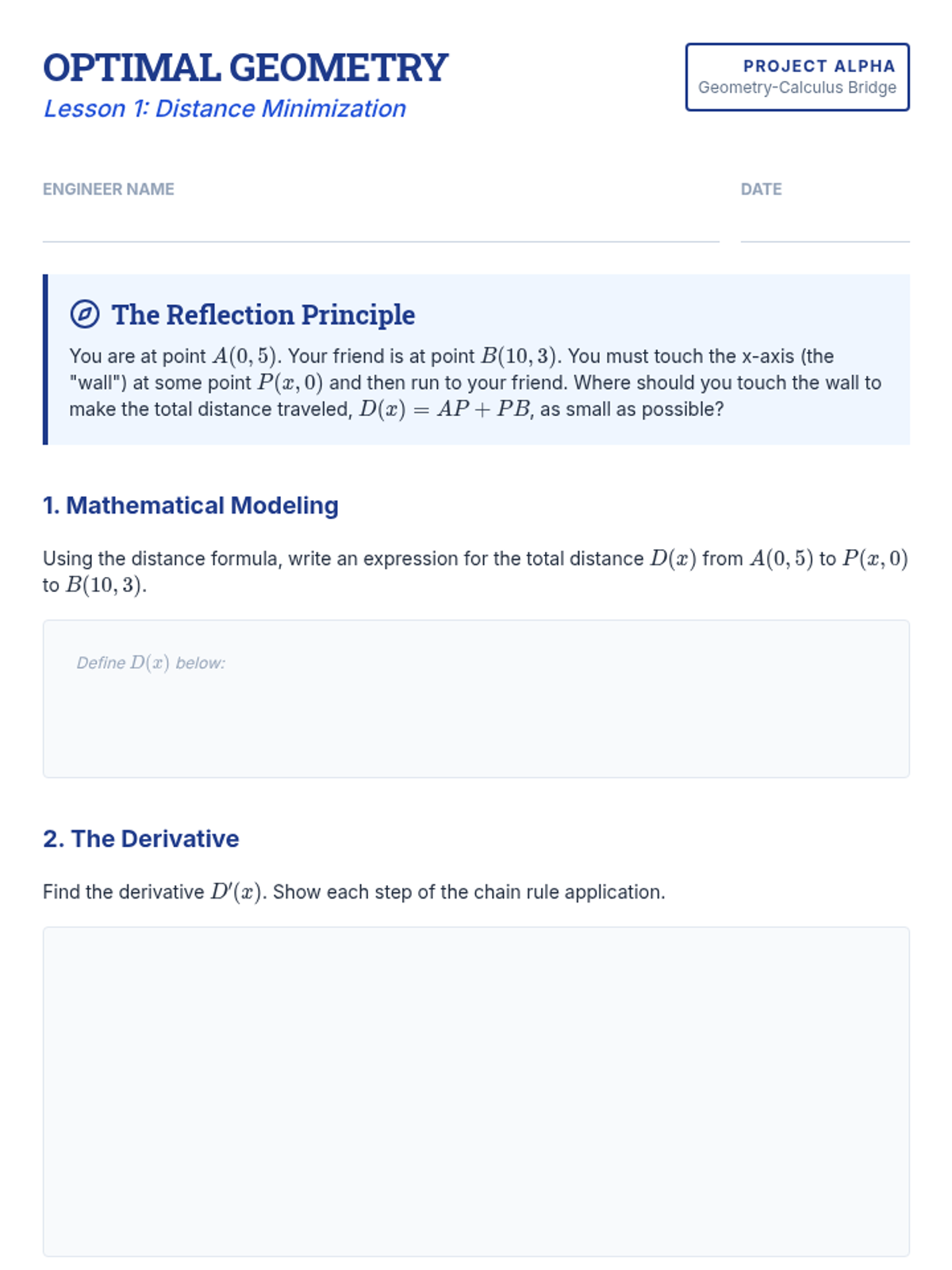
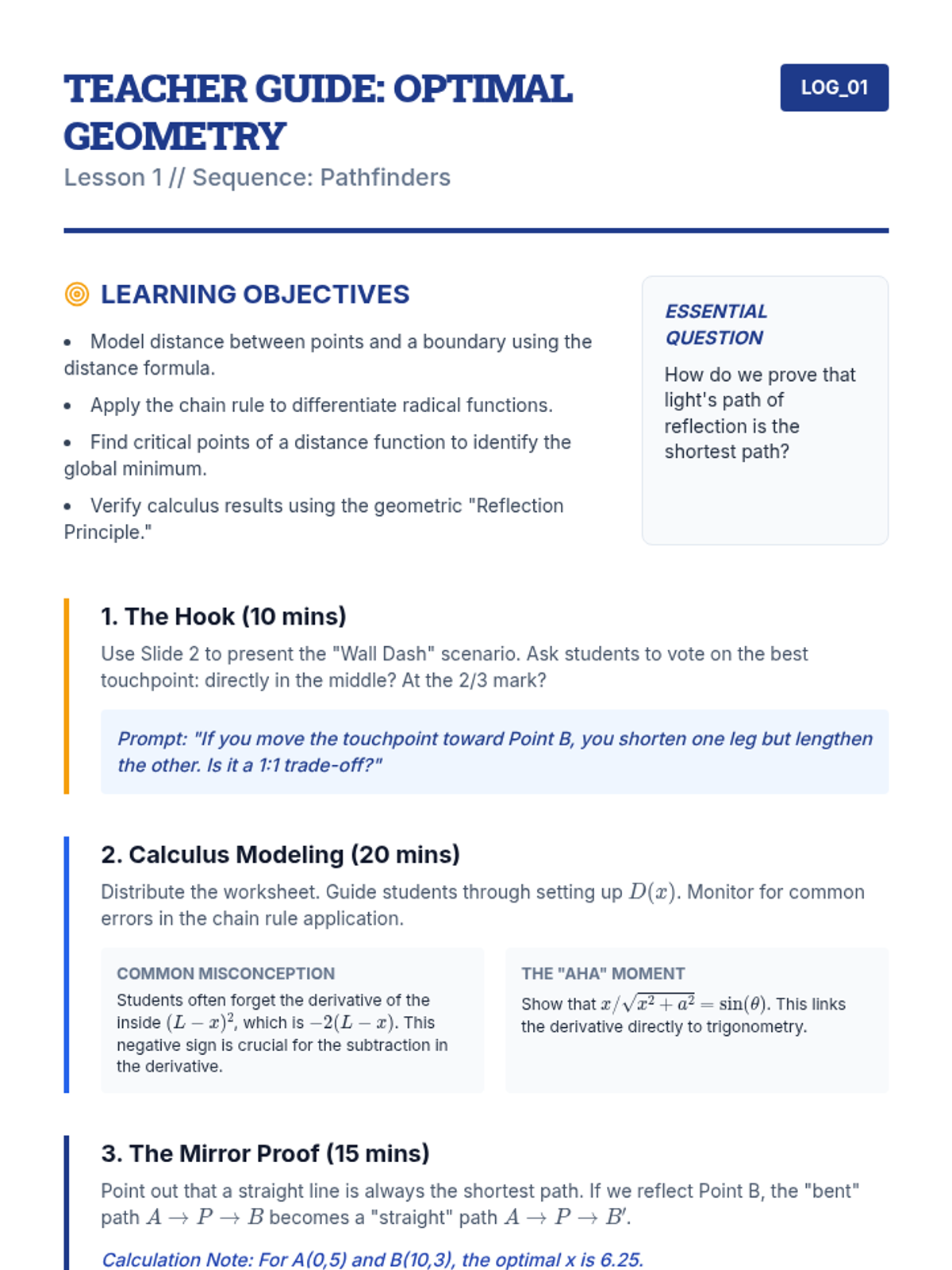
An inquiry-based exploration of calculus optimization, focusing on real-world efficiency in travel time, infrastructure cost, and business profit. Students progress from geometric shortest-paths to complex rate-based modeling.
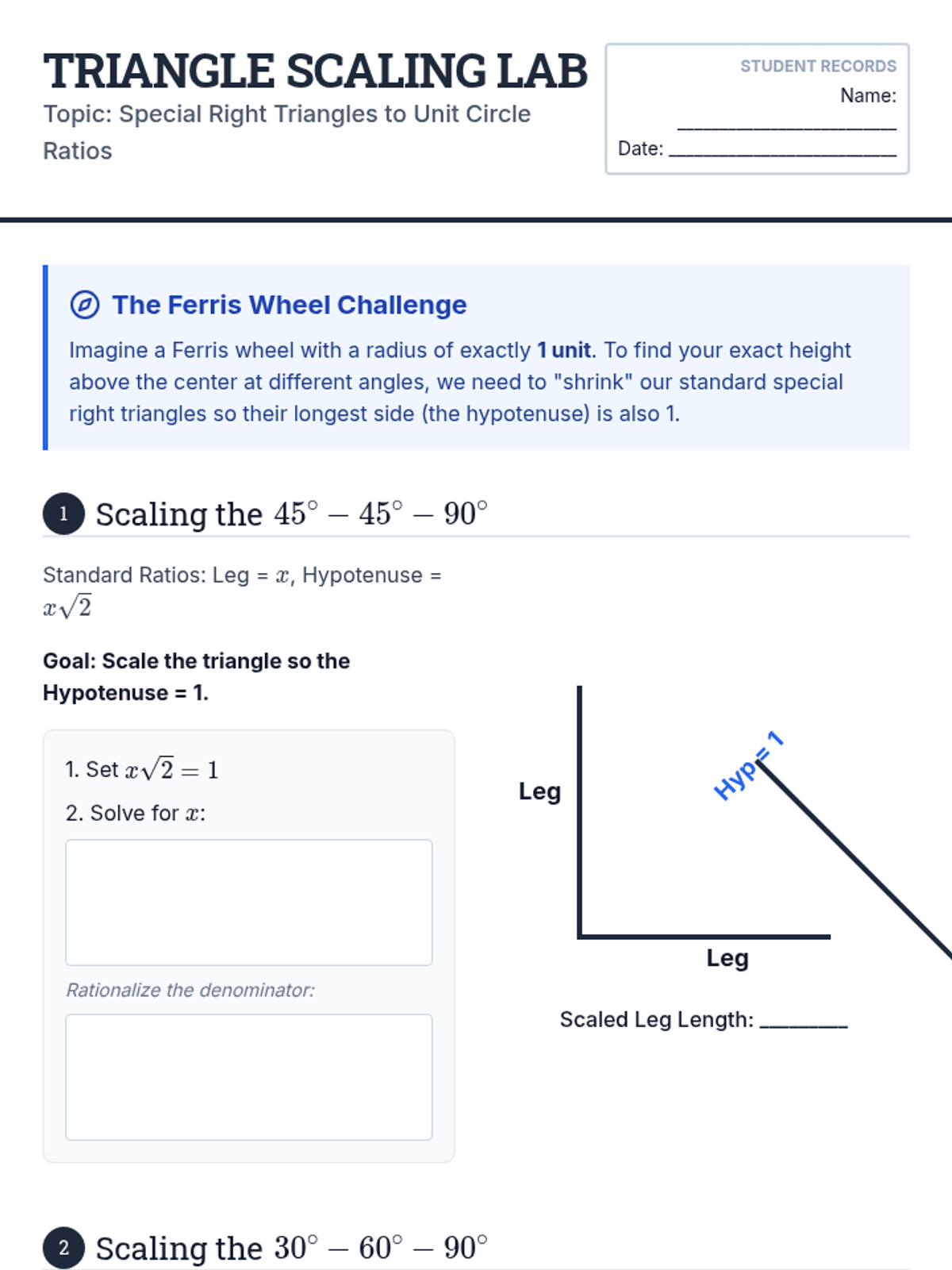
A comprehensive exploration of the unit circle, bridging geometry and trigonometry by scaling triangles, defining radians, and utilizing symmetry to evaluate trigonometric functions.
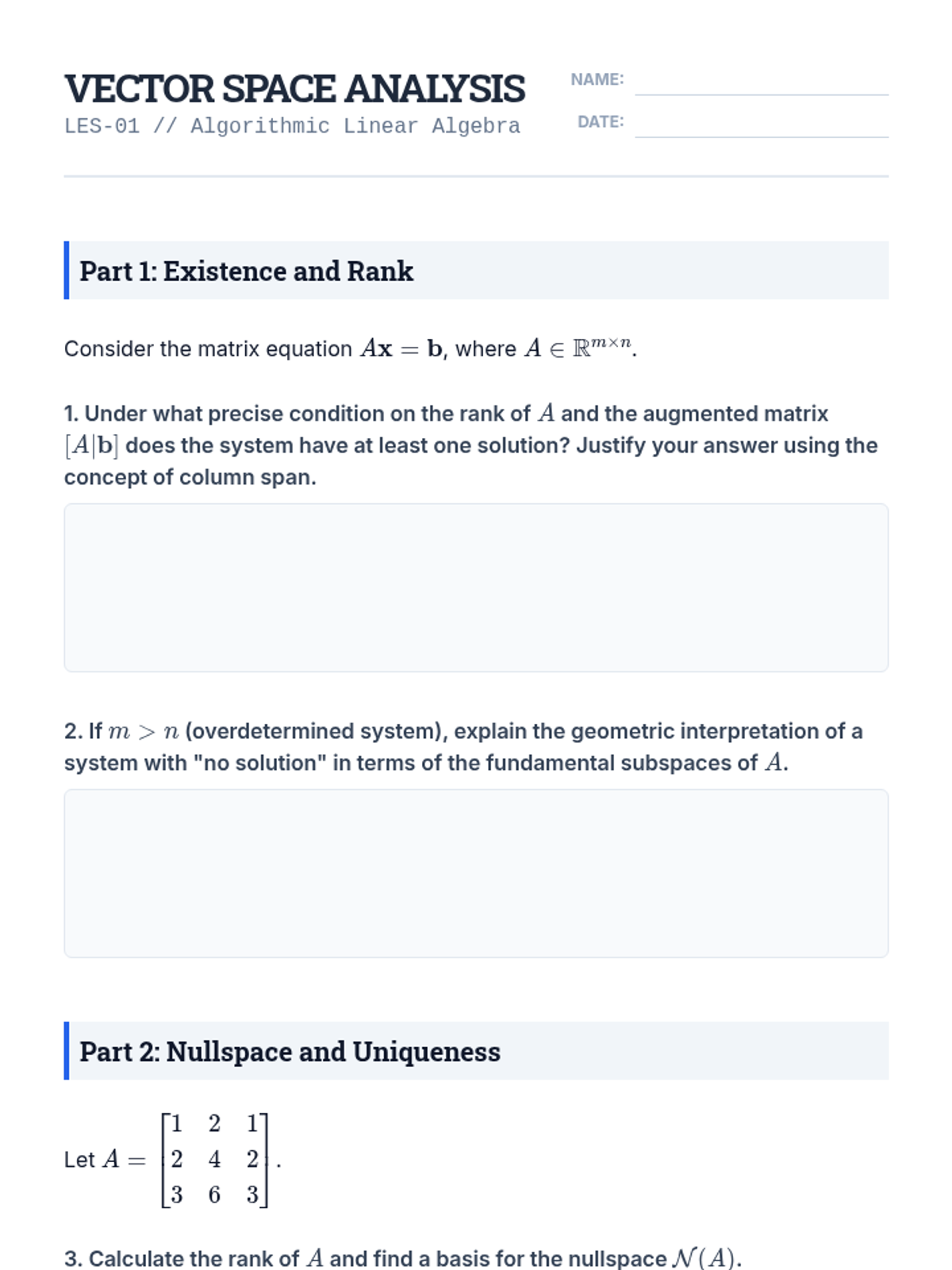
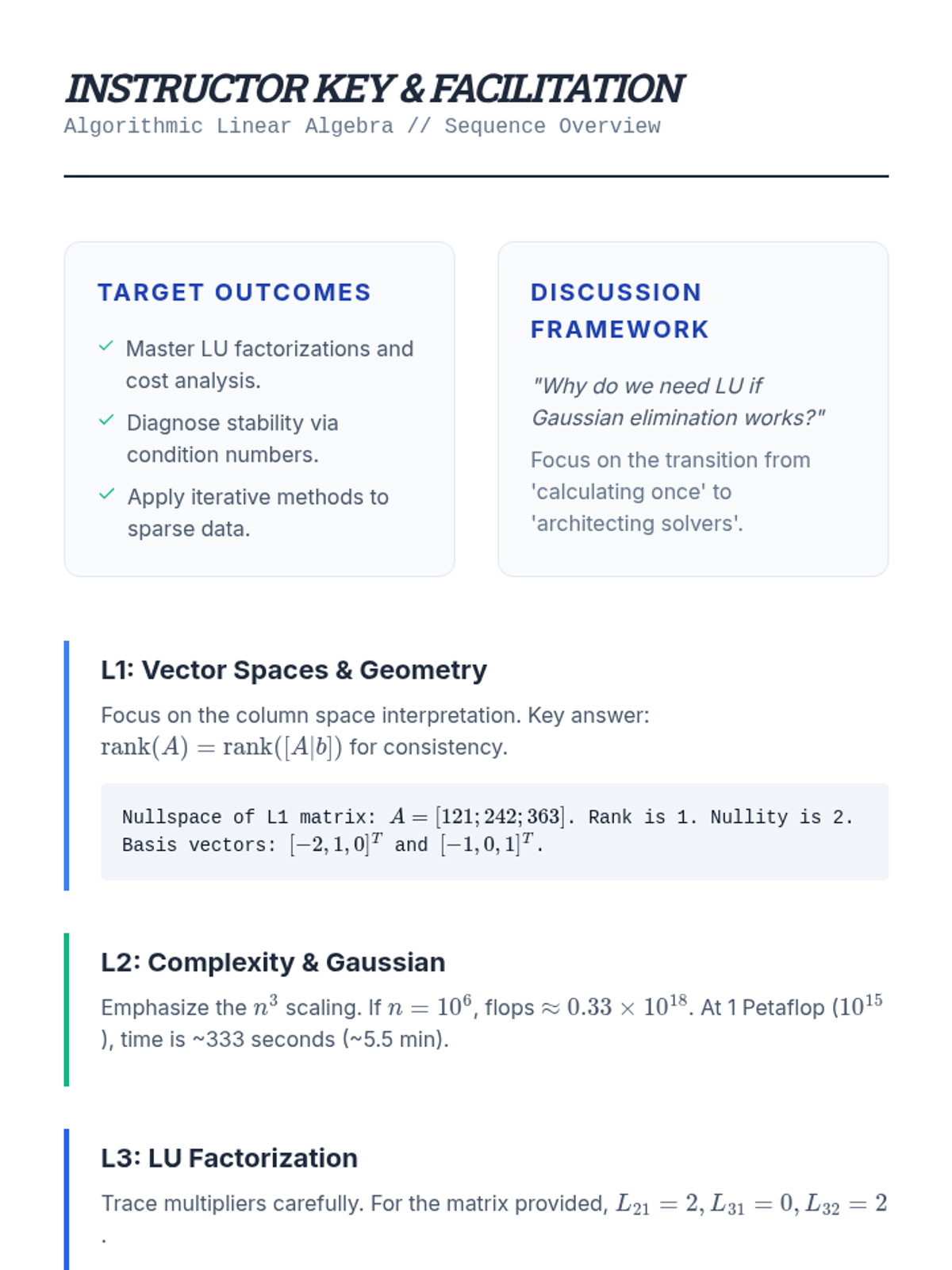
This advanced sequence explores systems of linear equations through the lens of computational linear algebra. Graduate students will move from theoretical existence and uniqueness in vector spaces to matrix factorizations, algorithmic complexity, numerical stability, and iterative methods for large-scale systems.
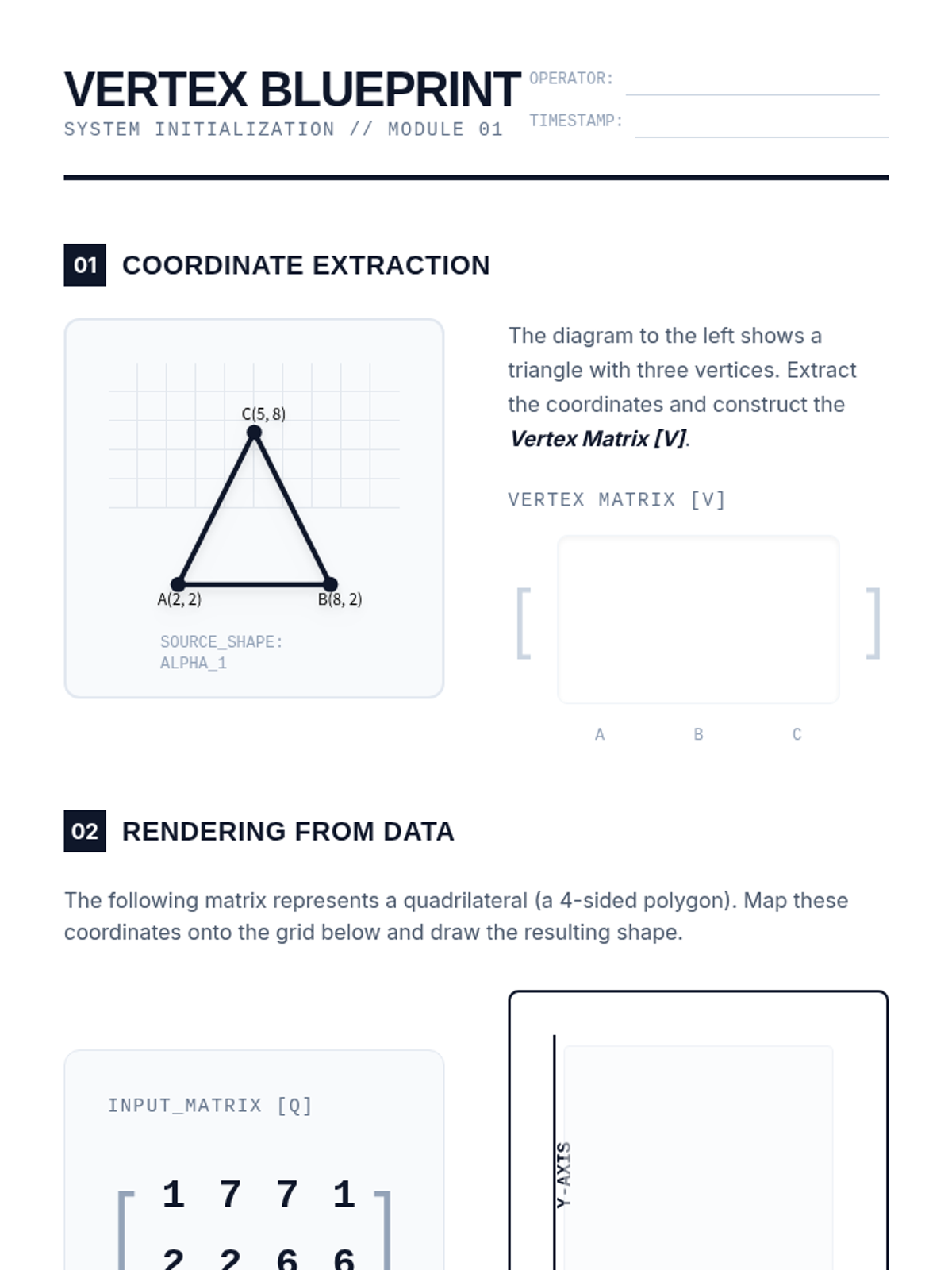
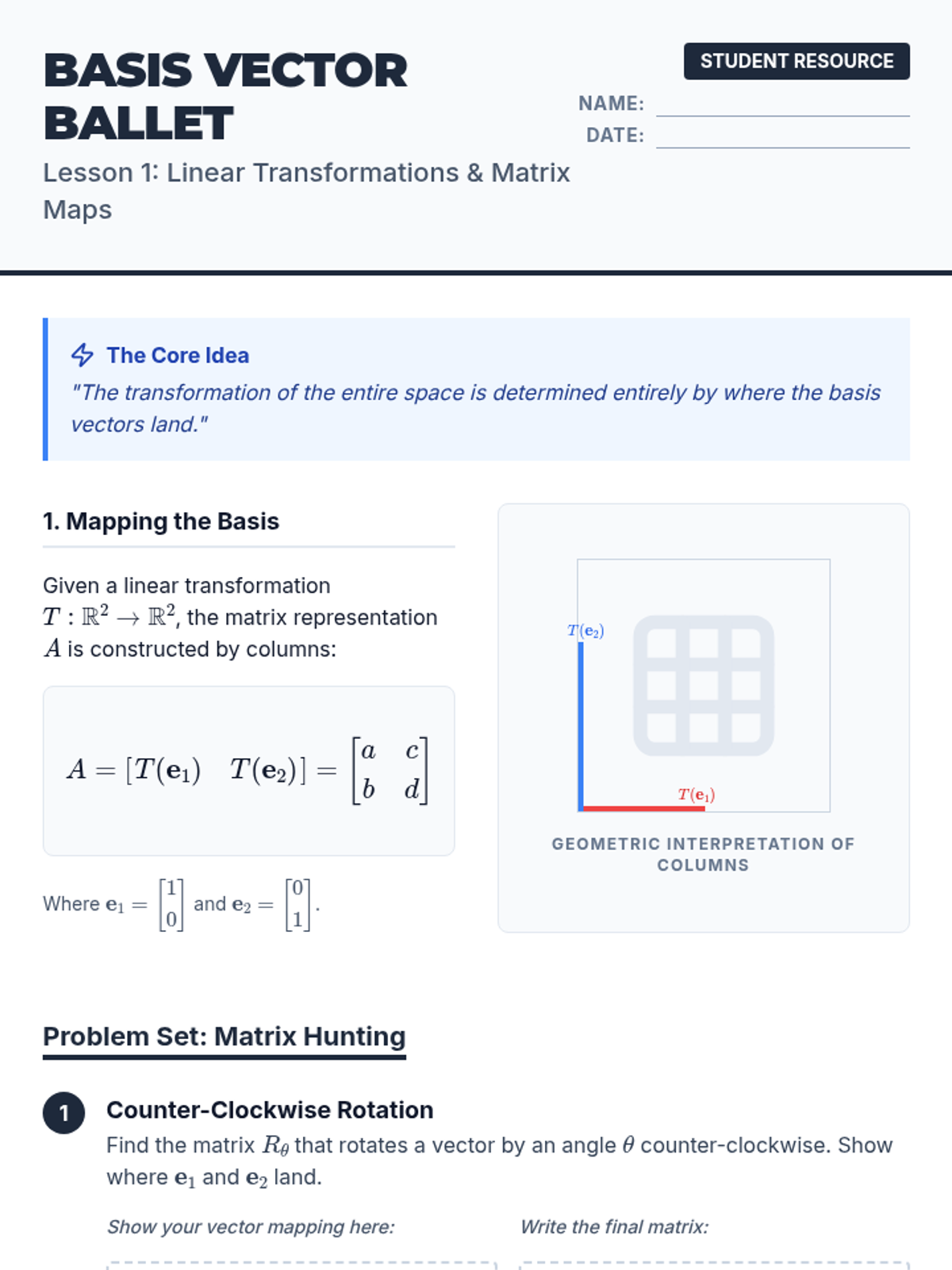
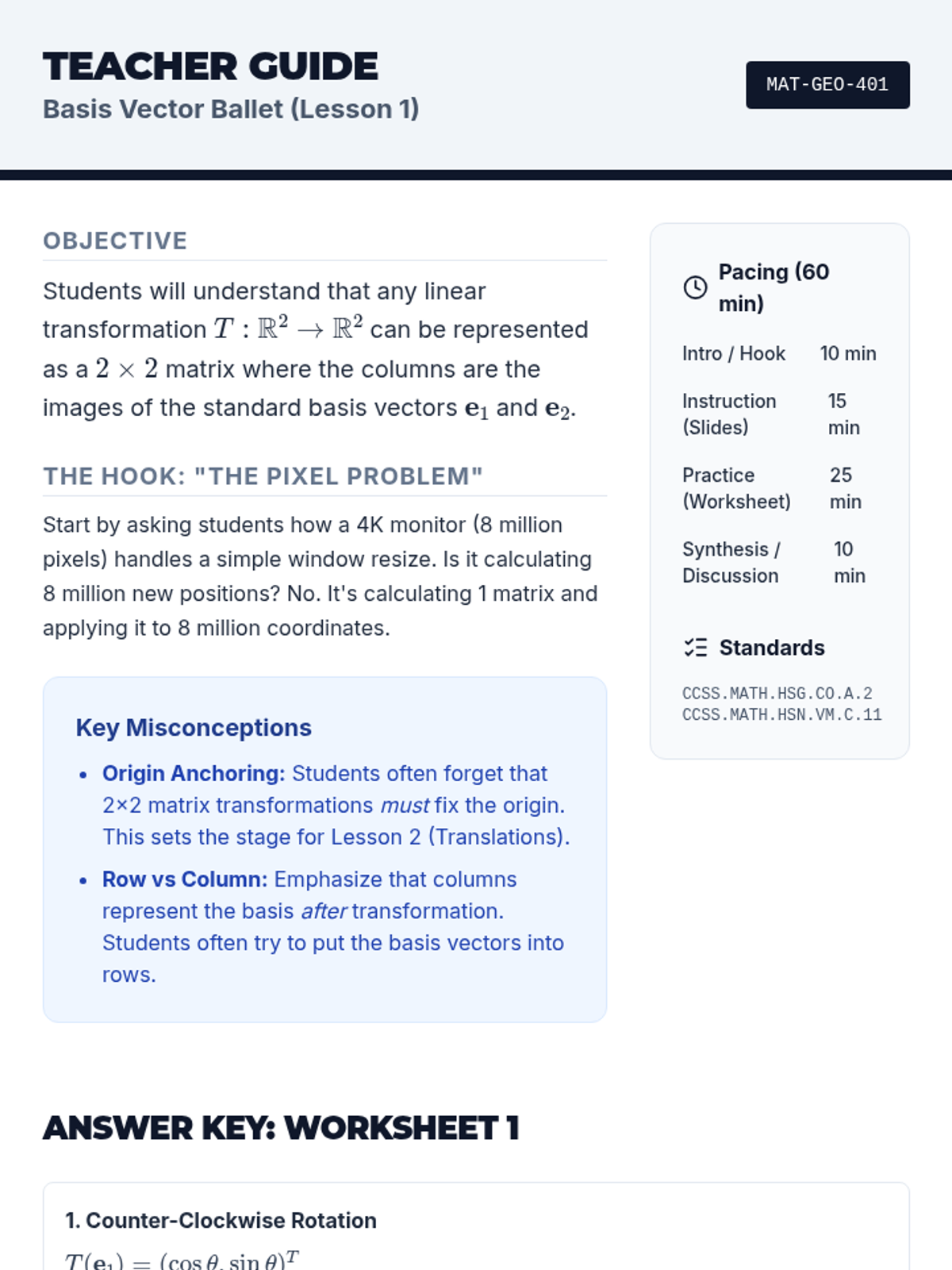
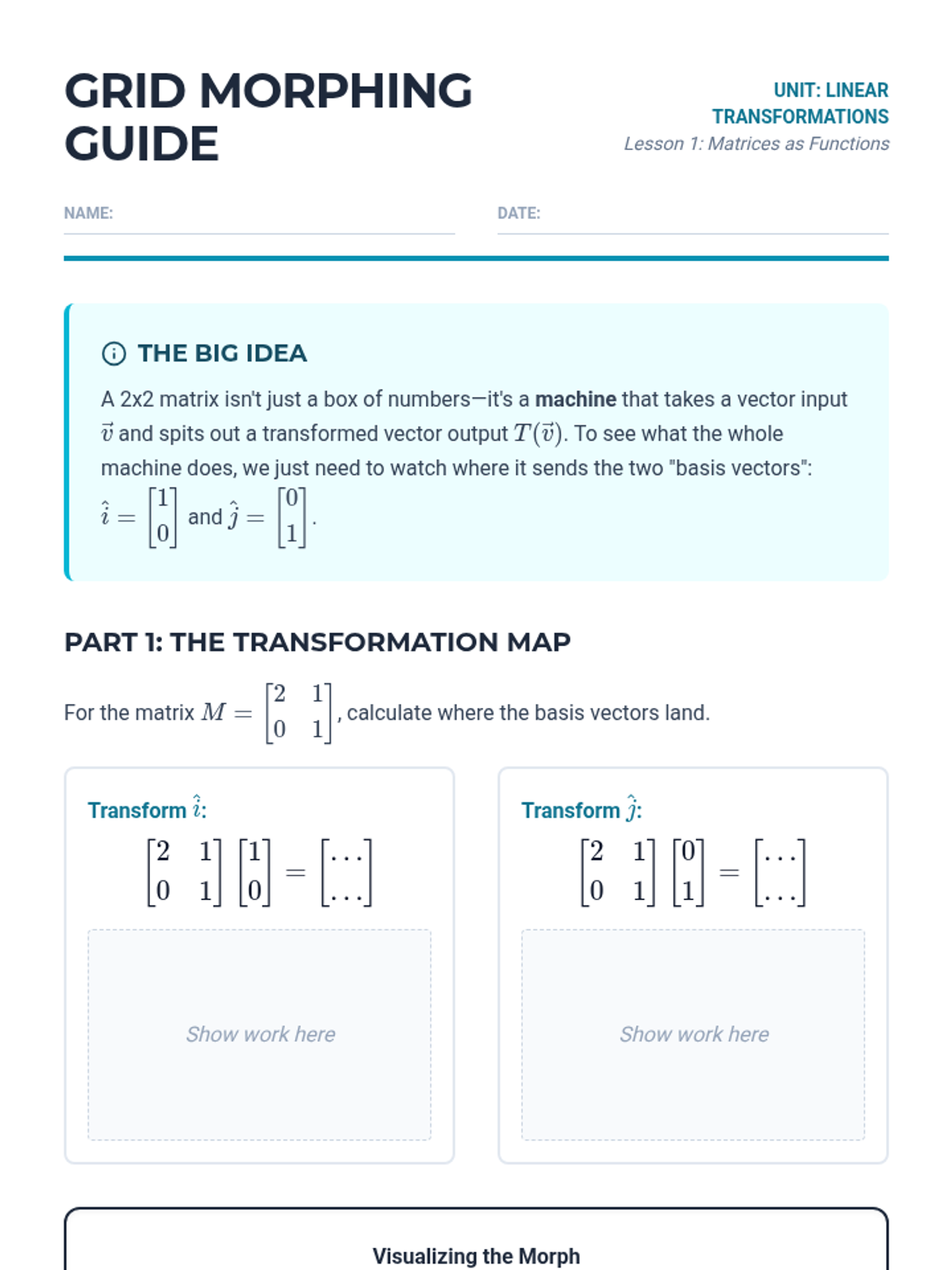
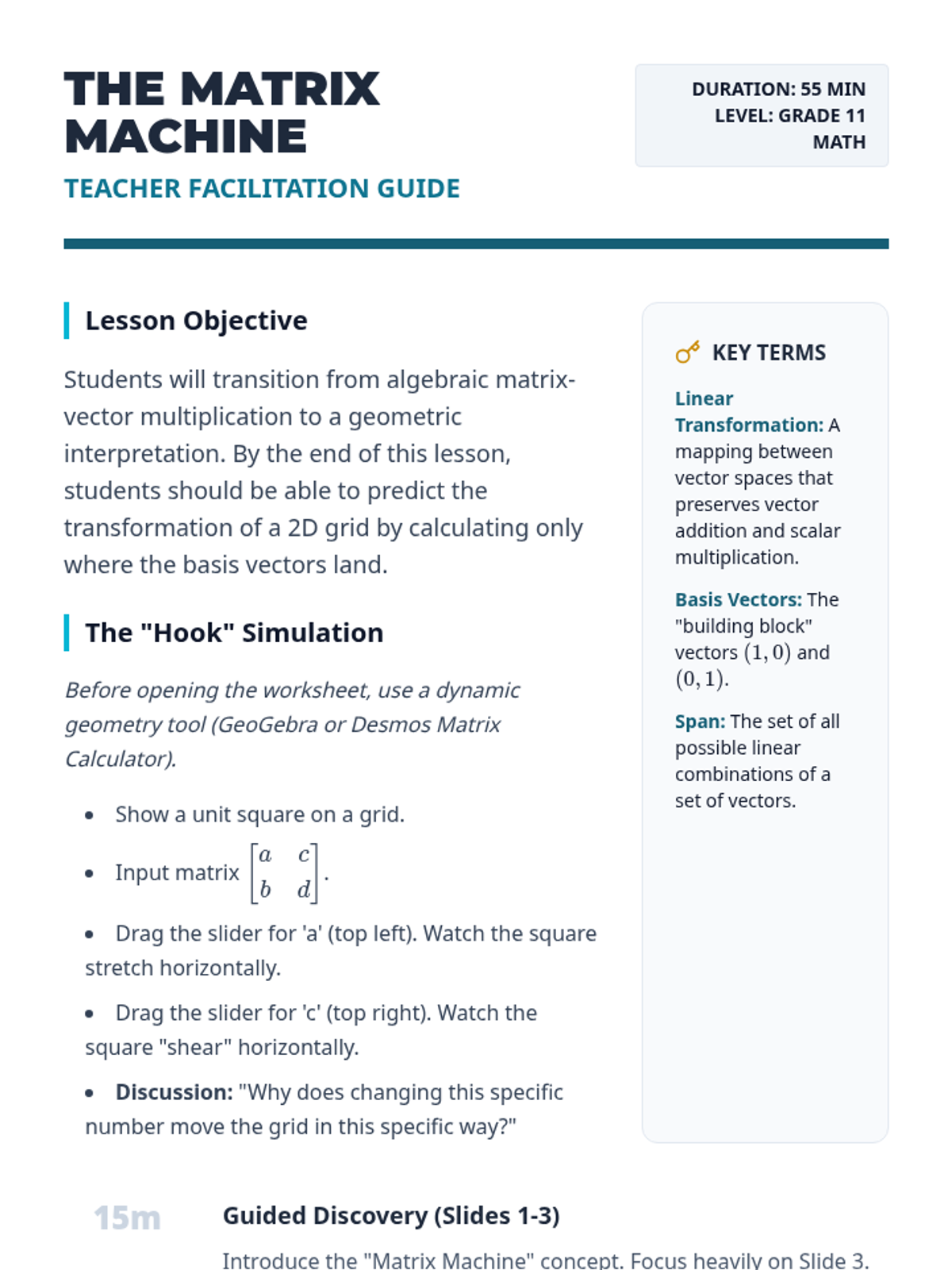
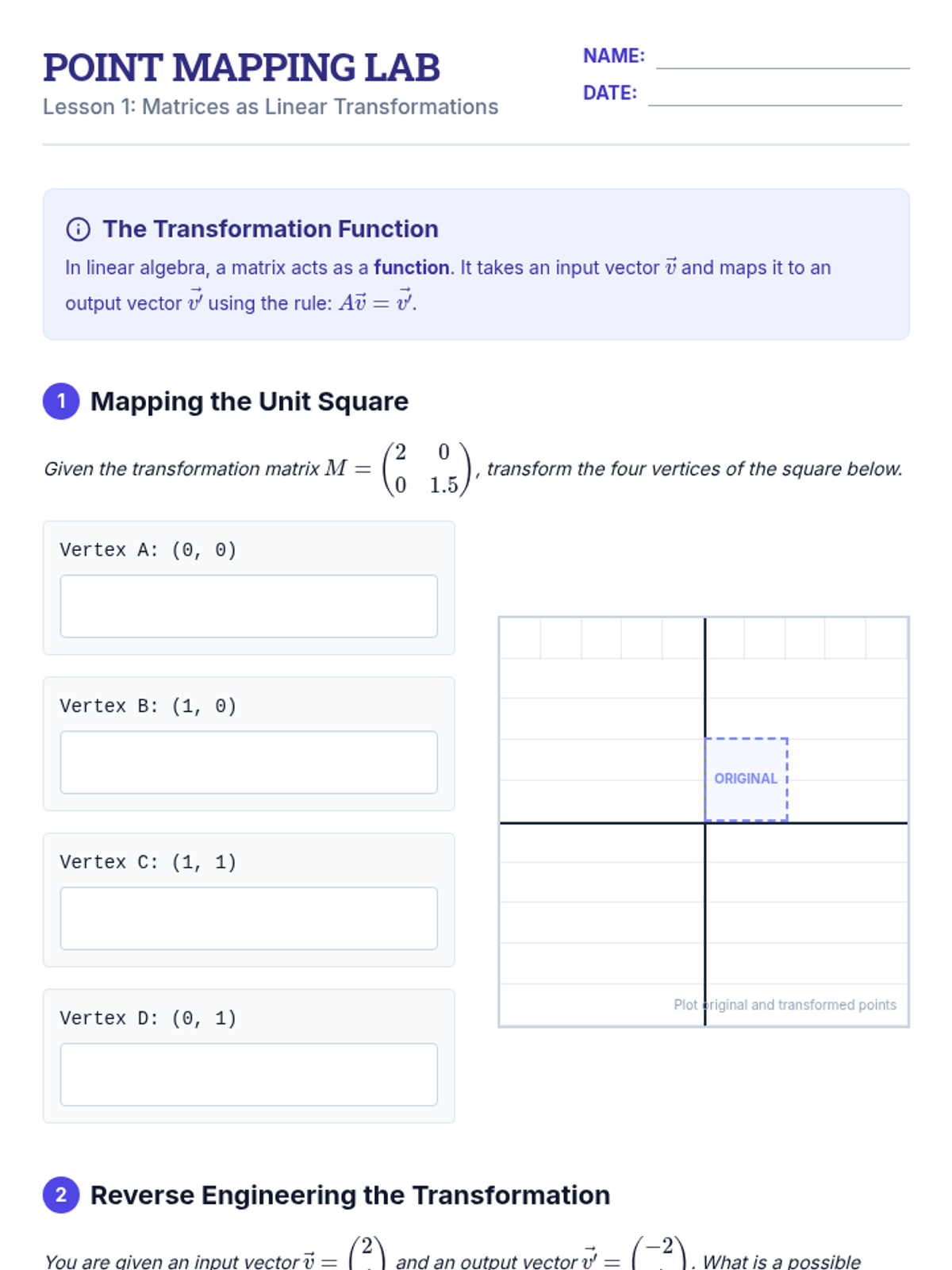
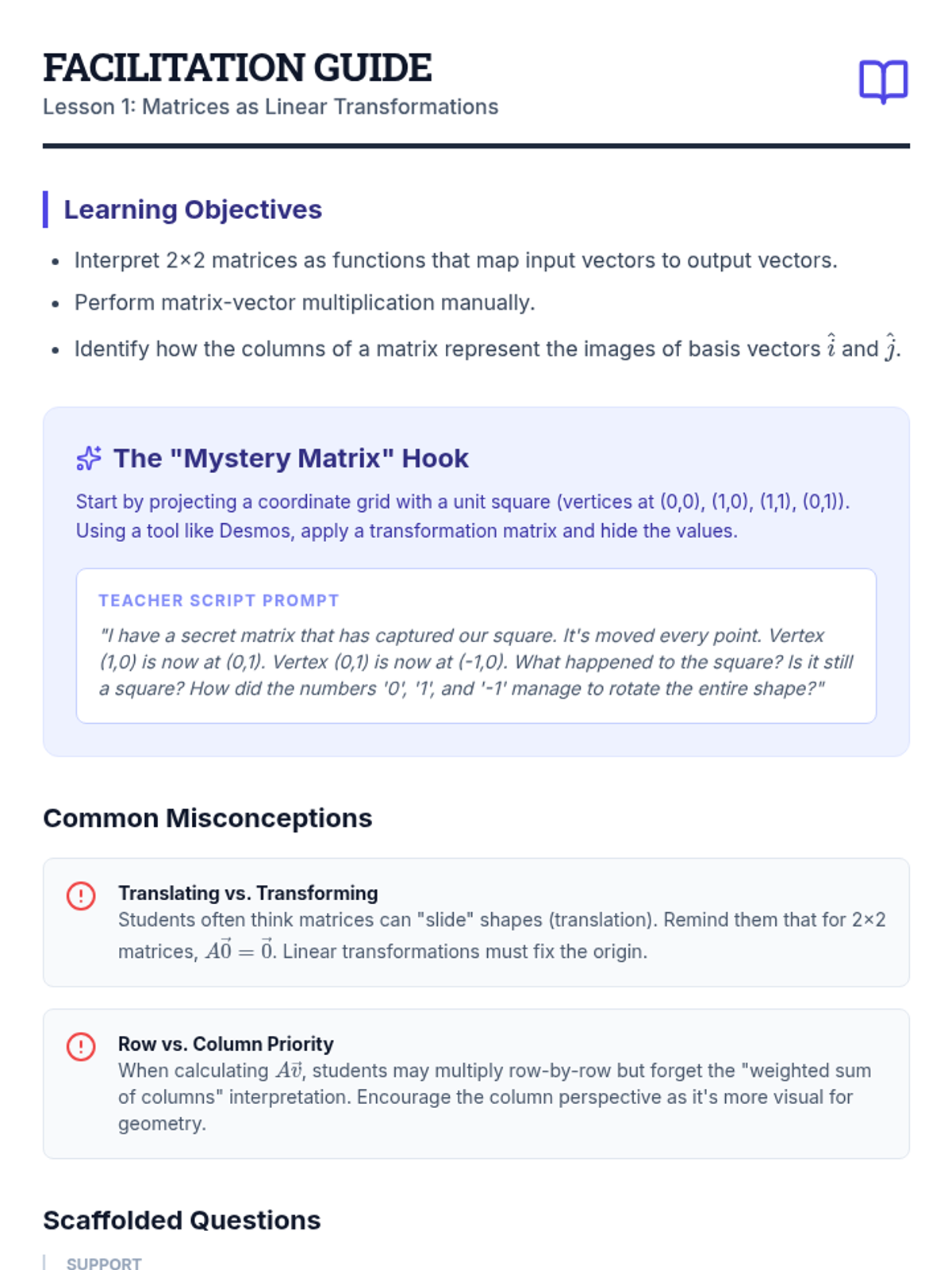
This sequence explores the geometric interpretation of matrices, treating them as operators that transform space. Students move from calculation to visual application, using matrices to represent coordinates, perform translations/dilations, and apply rotations/reflections via matrix multiplication.
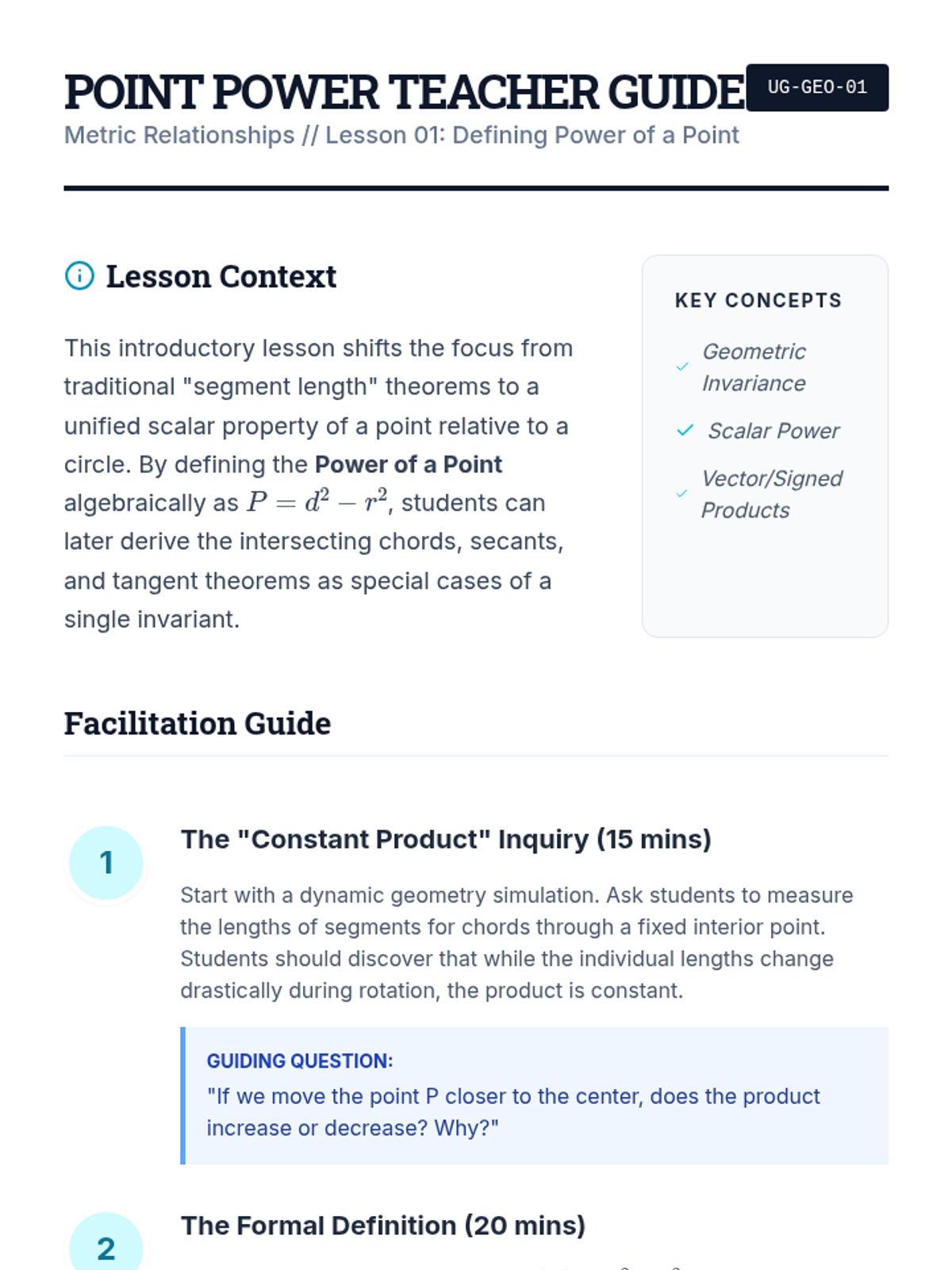
A comprehensive undergraduate sequence on the metric properties of circles, focusing on the Power of a Point as a unifying concept. Students progress from basic segment products to advanced topics like radical axes, radical centers, and geometric inversion.
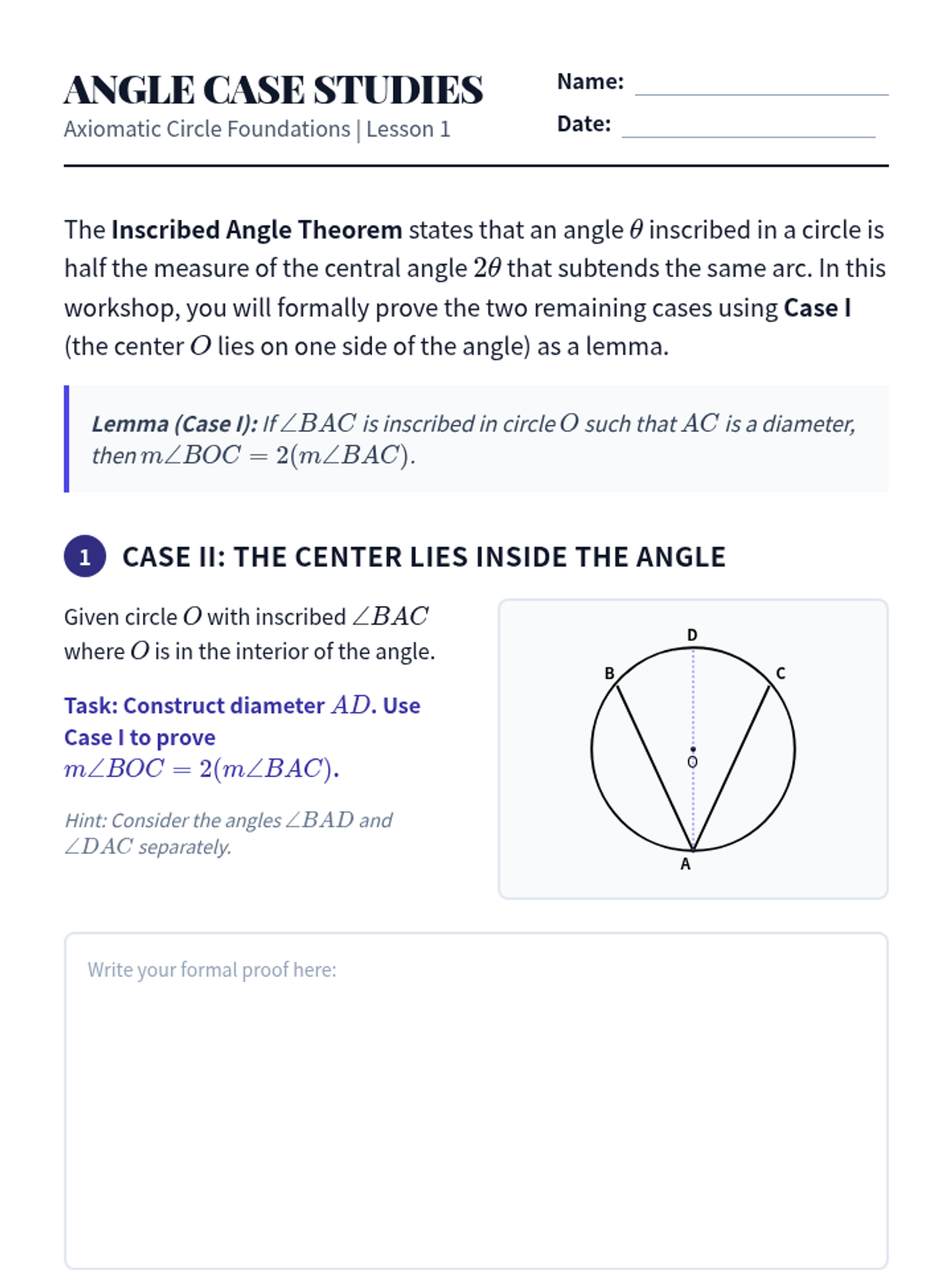
A rigorous undergraduate-level exploration of circle geometry, focusing on axiomatic proofs, inscribed angles, tangency, cyclic quadrilaterals, and advanced Euclidean theorems. Students transition from intuitive understanding to formal deductive reasoning.
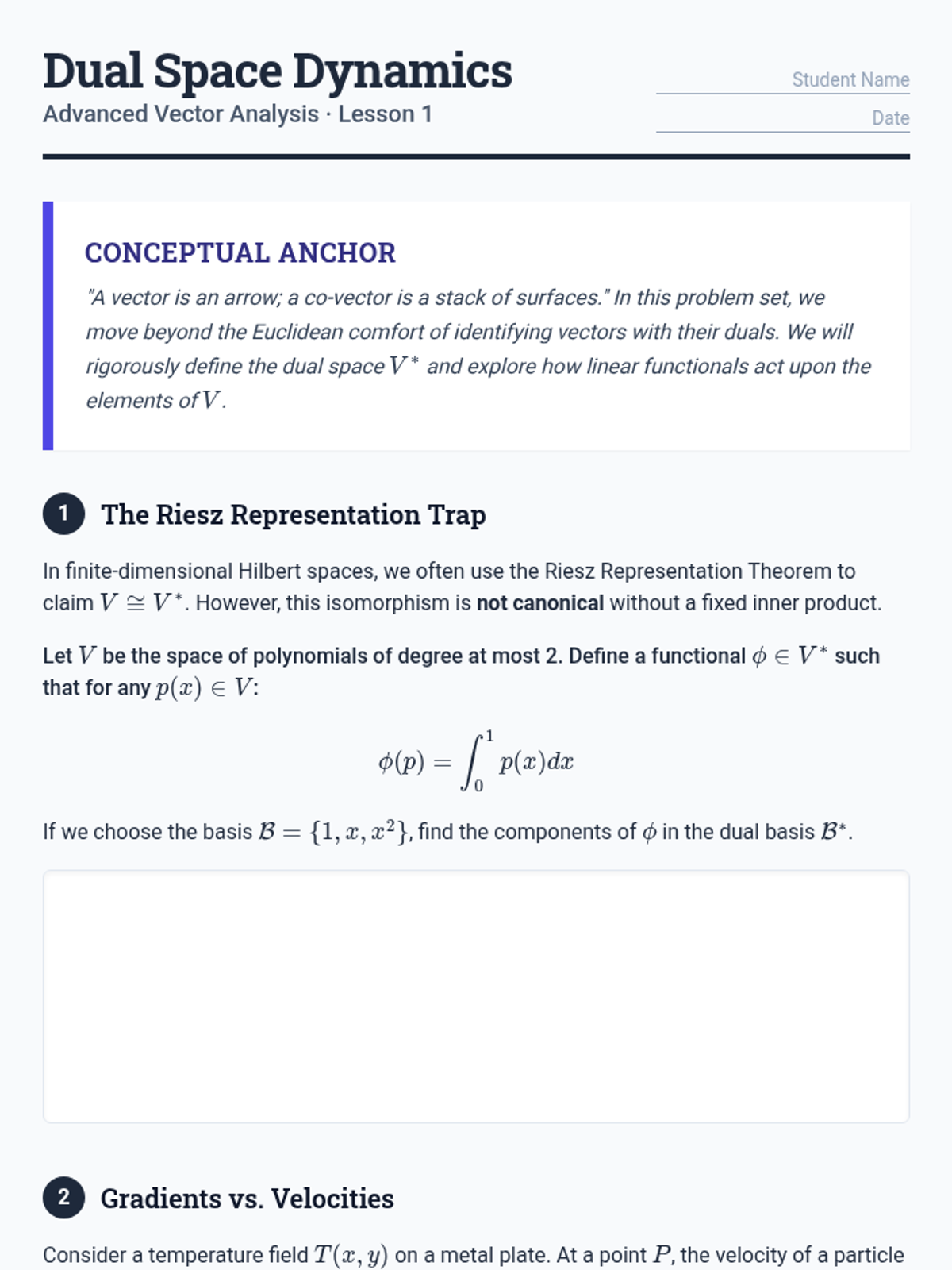
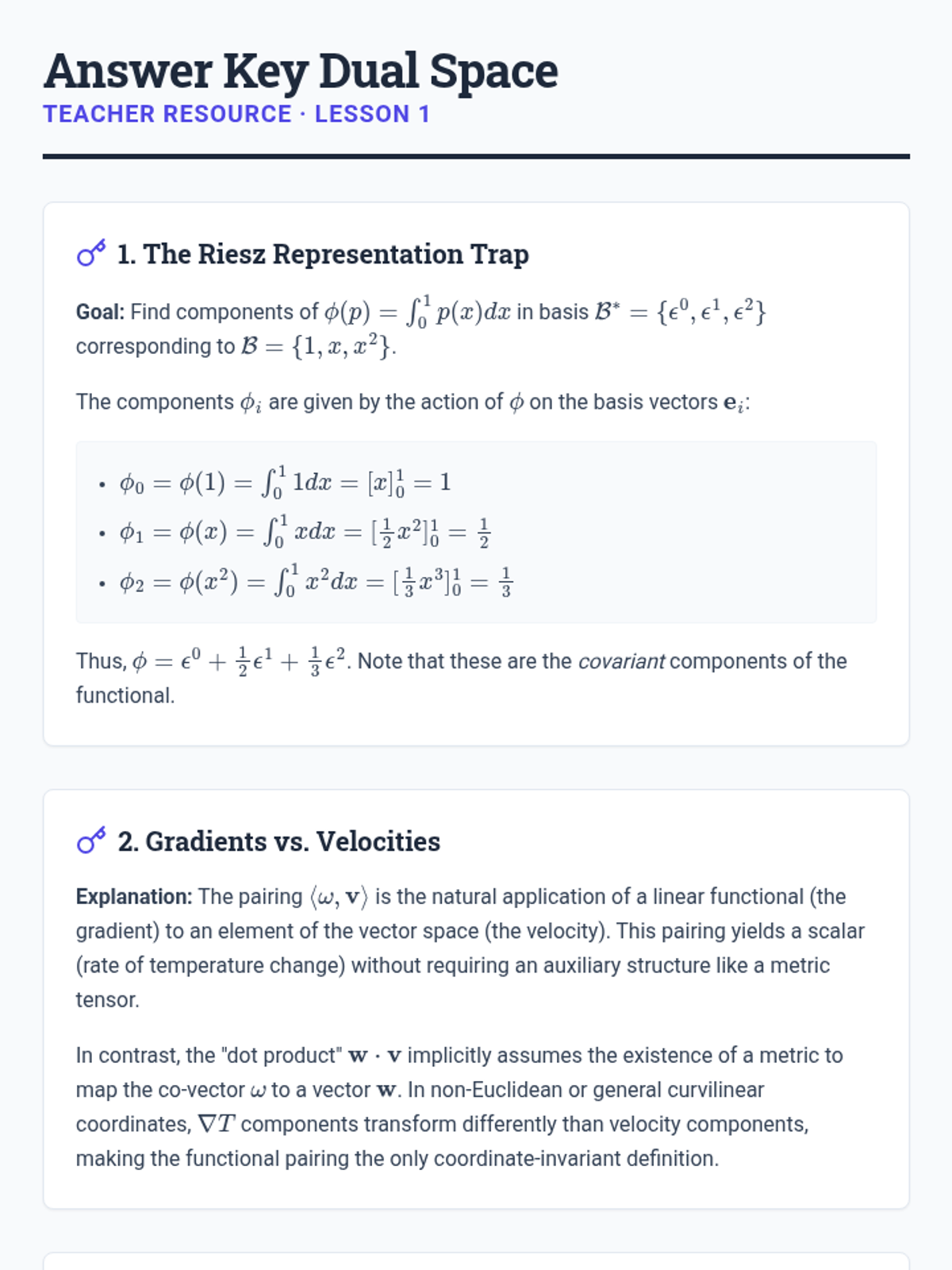
This graduate-level sequence explores the distinction between contravariant vectors and covariant co-vectors within the framework of dual spaces, metric tensors, and higher-rank tensor transformations. Students move from rigorous linear algebra definitions to applications in non-Euclidean geometry and physical systems like stress and strain.
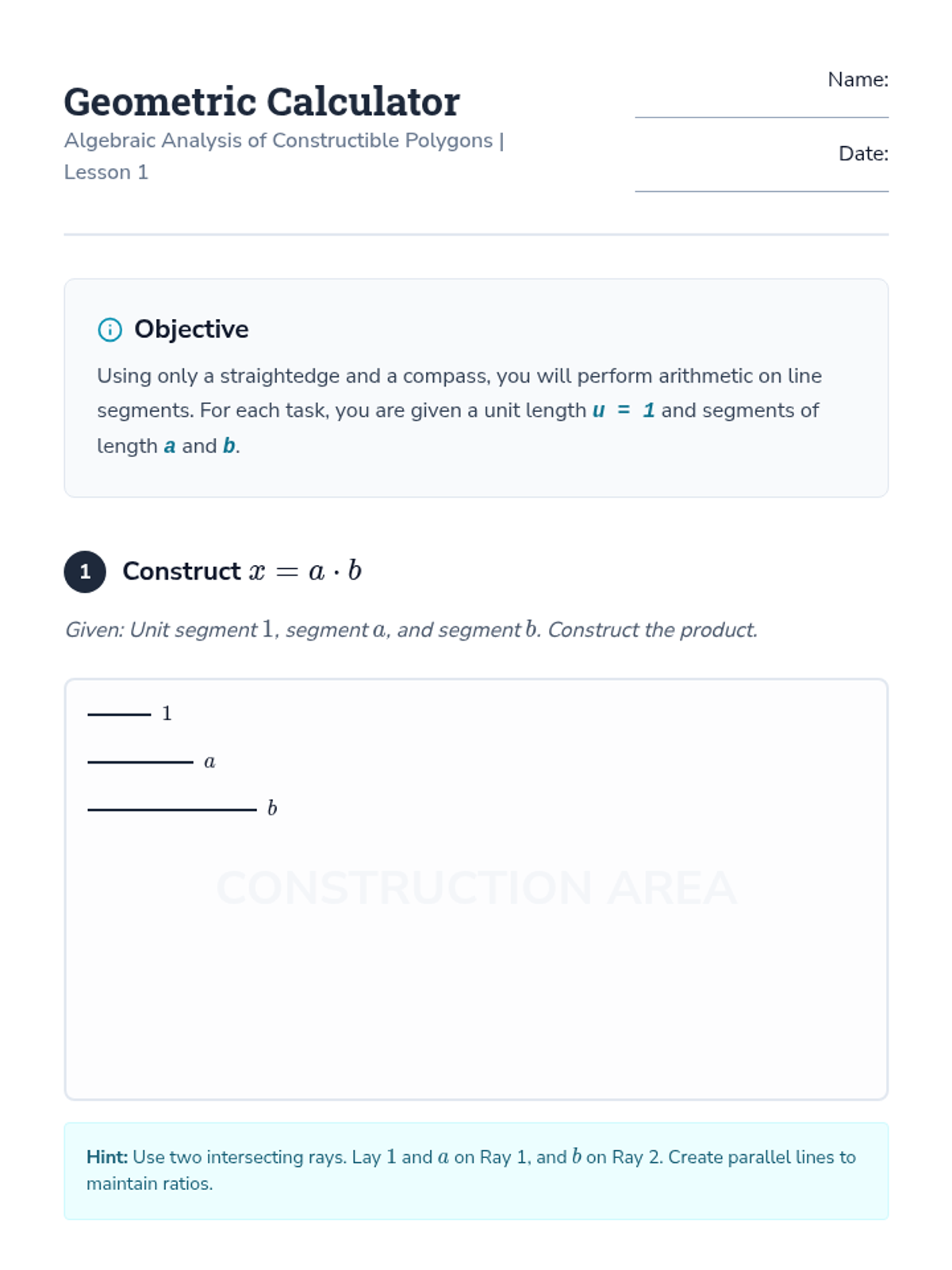
This sequence bridges Euclidean geometry with abstract algebra, investigating the field of constructible numbers and the Gauss-Wantzel Theorem to determine which regular polygons can be constructed using a ruler and compass.
This sequence explores geometric congruence and similarity through the lens of linear algebra. Students learn to represent and manipulate shapes using matrices, homogeneous coordinates, and composite transformations, bridging the gap between abstract geometry and computer graphics.
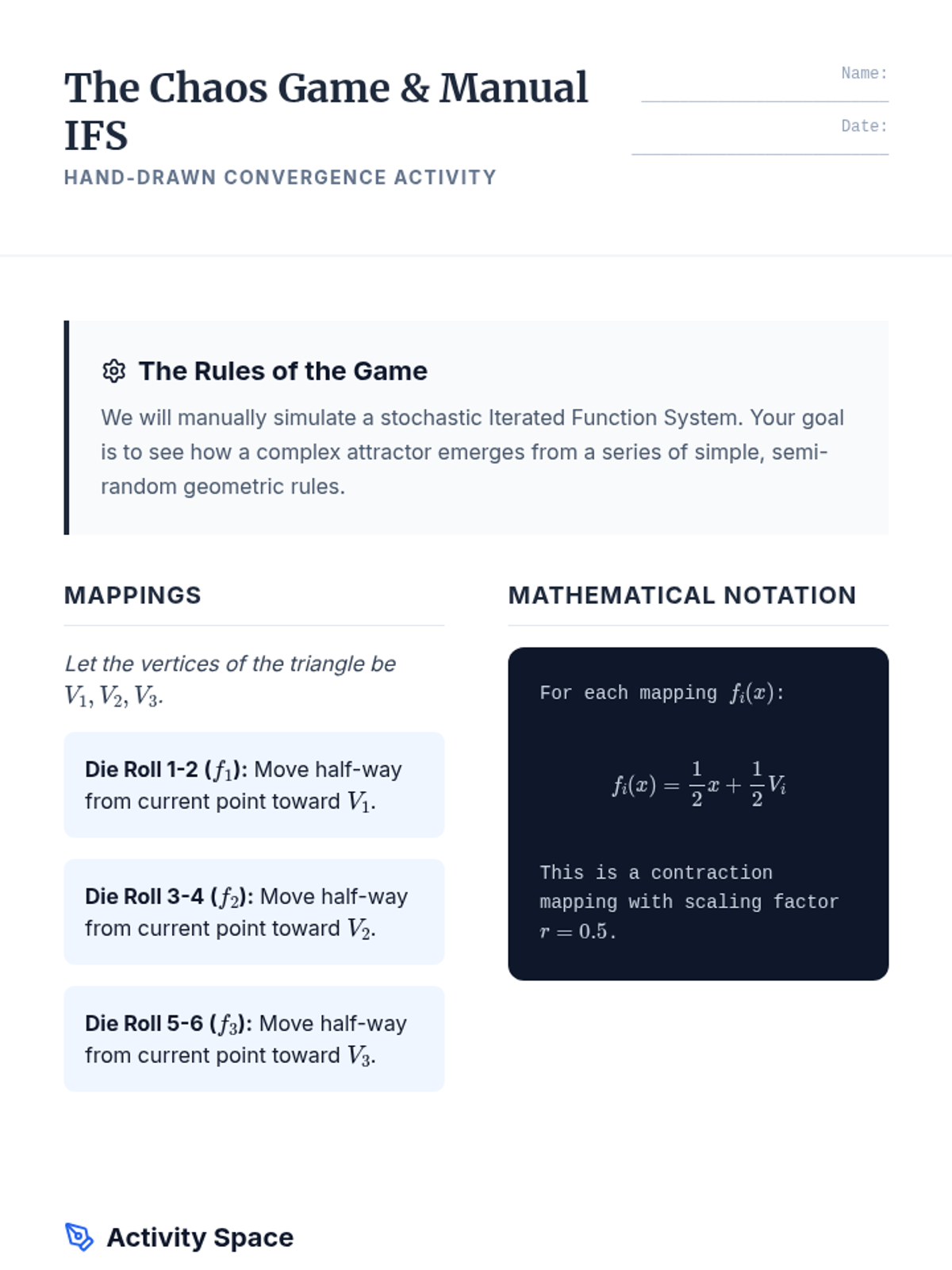
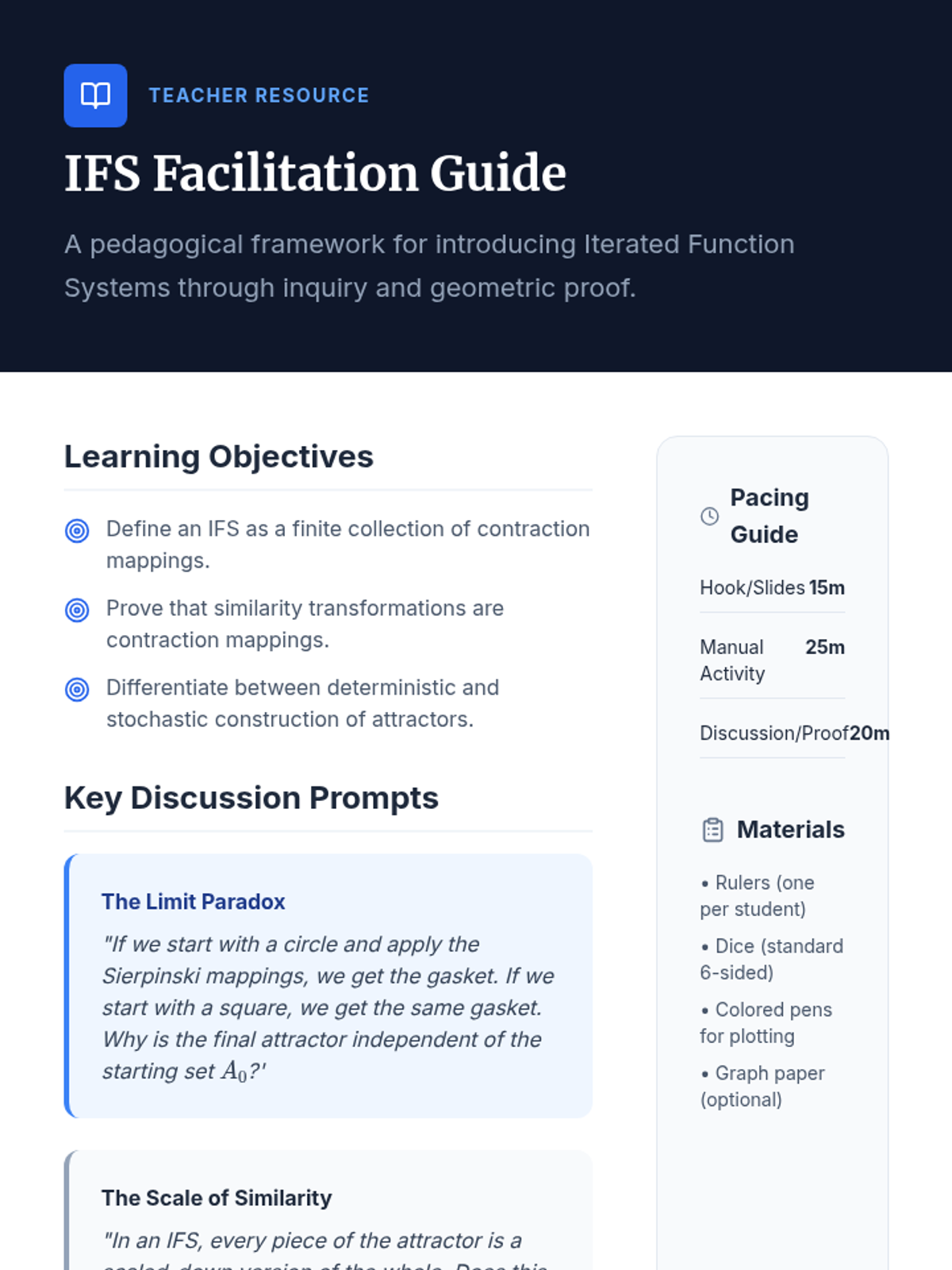
This sequence explores the abstraction of similarity into fractal geometry and iterated function systems (IFS). Undergraduate students will investigate contraction mappings, calculate fractal dimensions using logarithms, and apply the Banach Contraction Principle to understand why these self-similar structures converge to unique attractors.
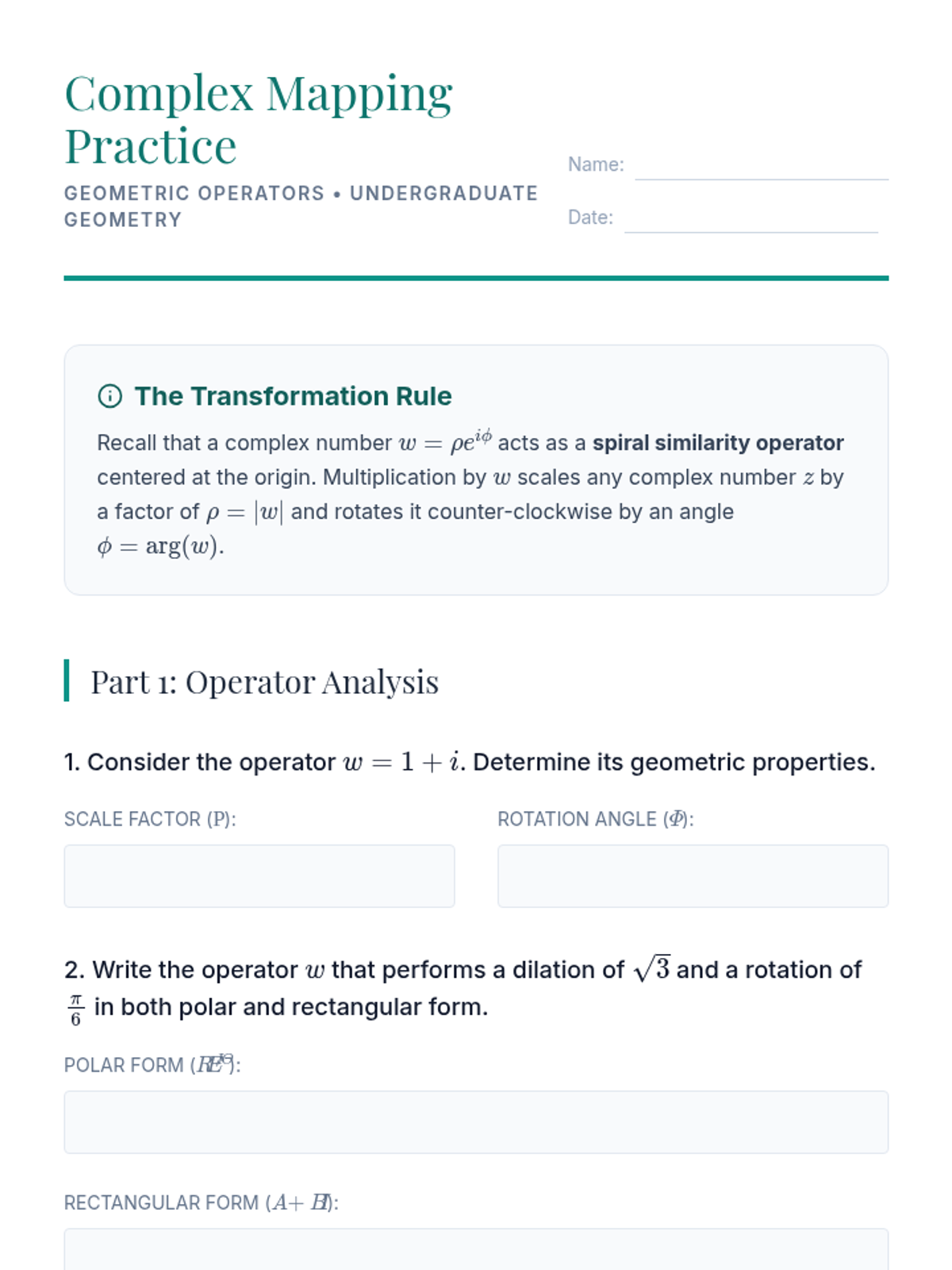
This undergraduate sequence bridges classical geometry and modern algebra by exploring similarity through the lens of complex numbers and linear algebra. Students will master spiral similarities, matrix representations of conformal mappings, and iterative fractal generation.
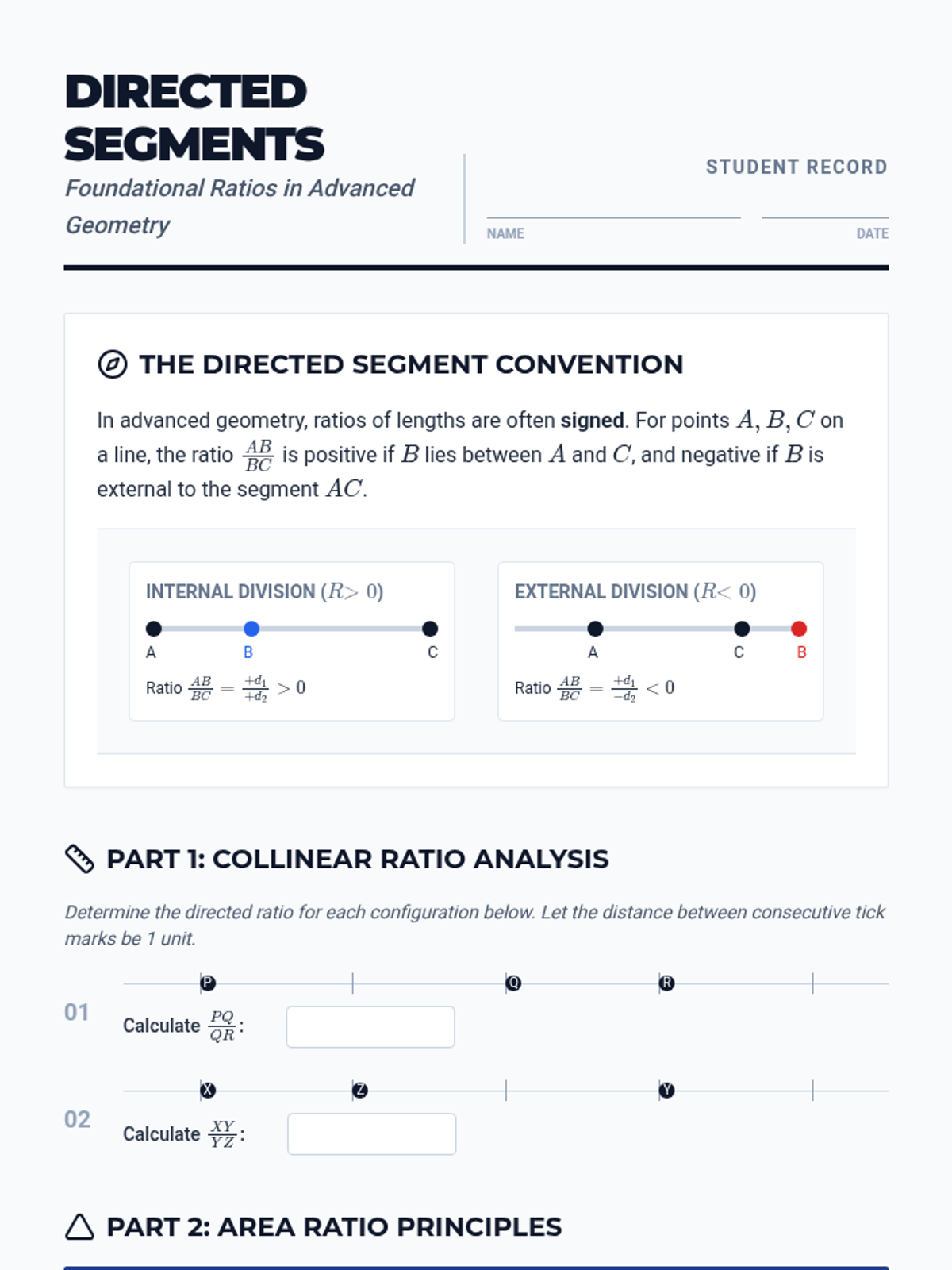
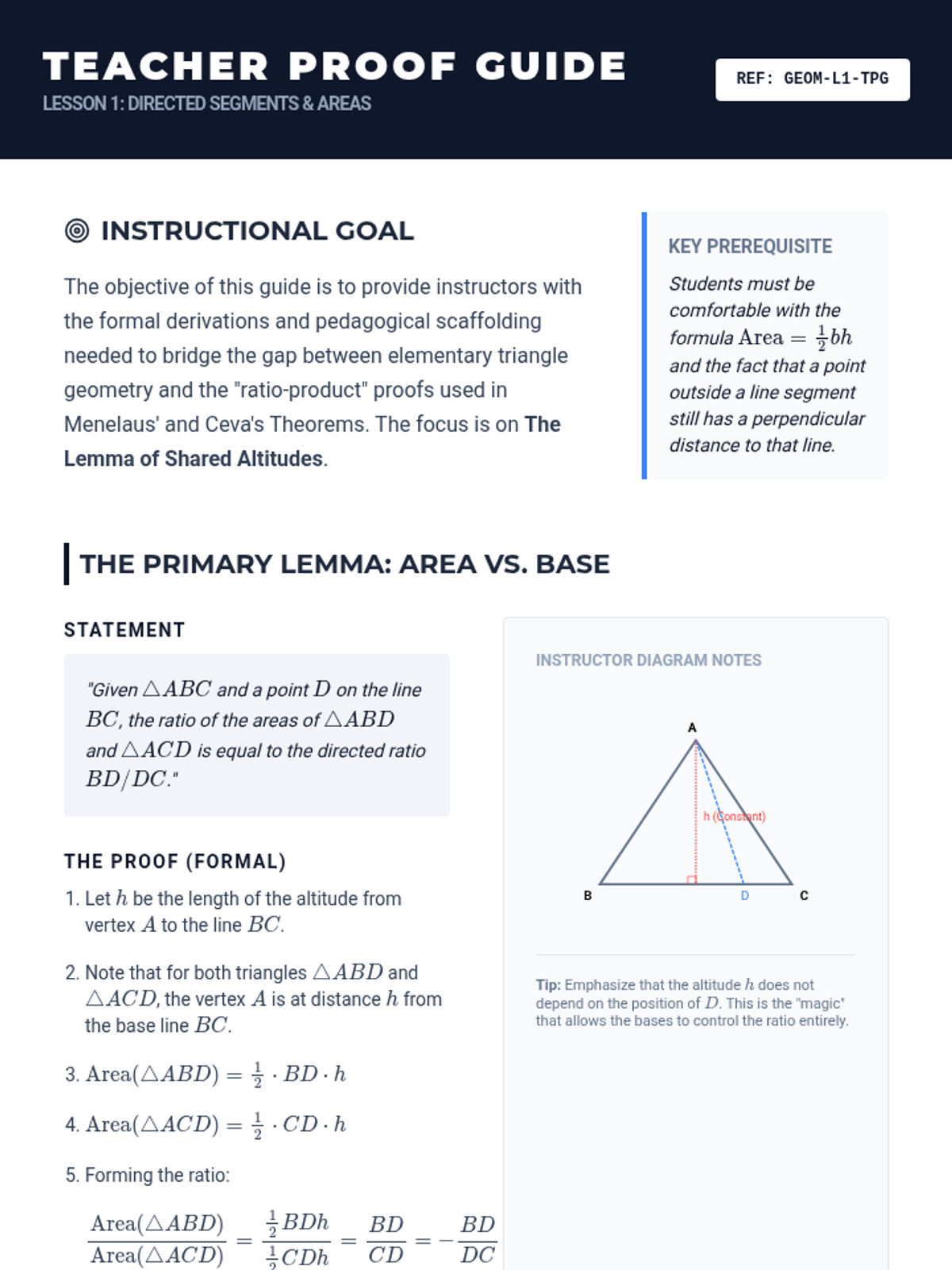
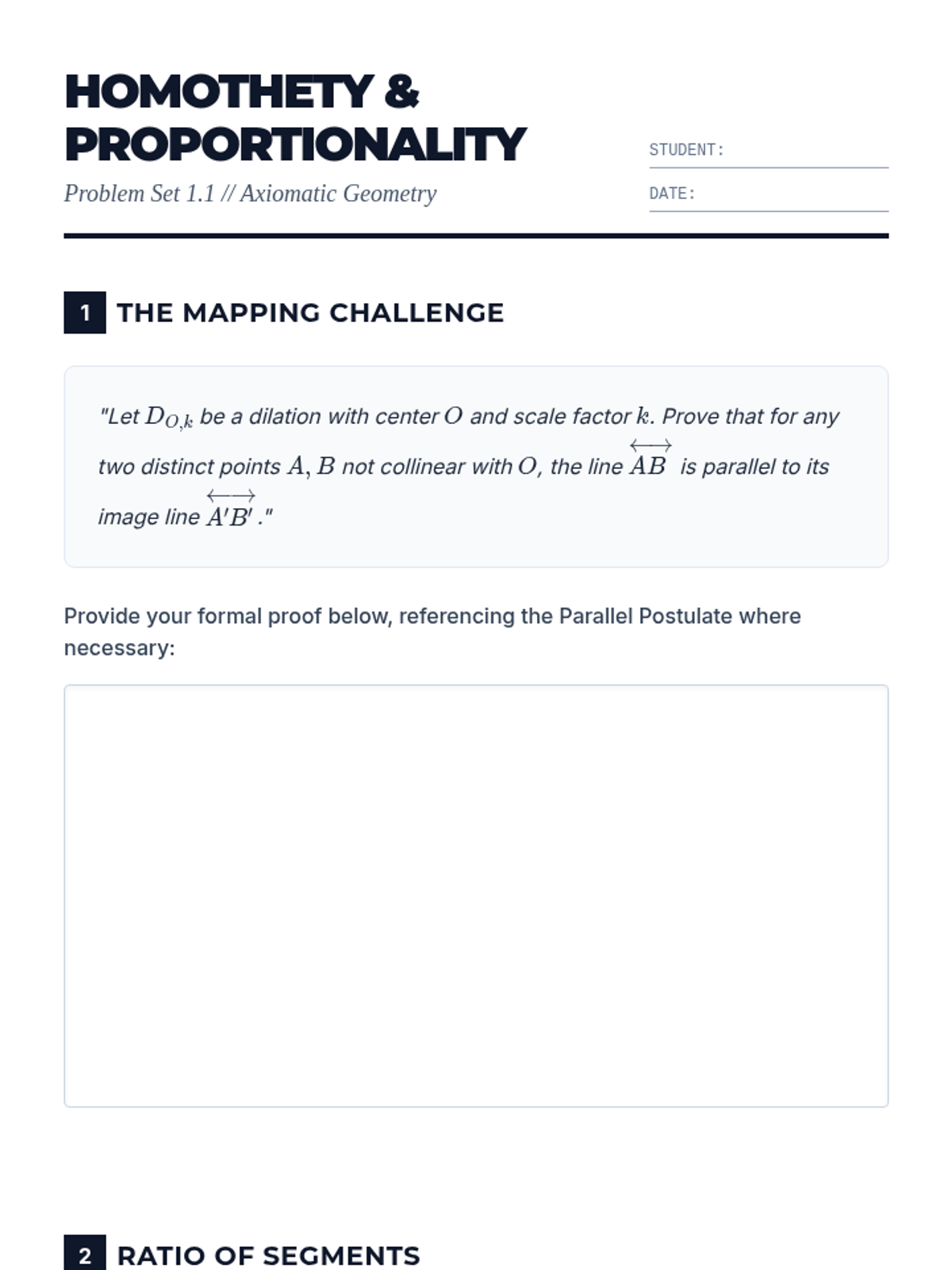
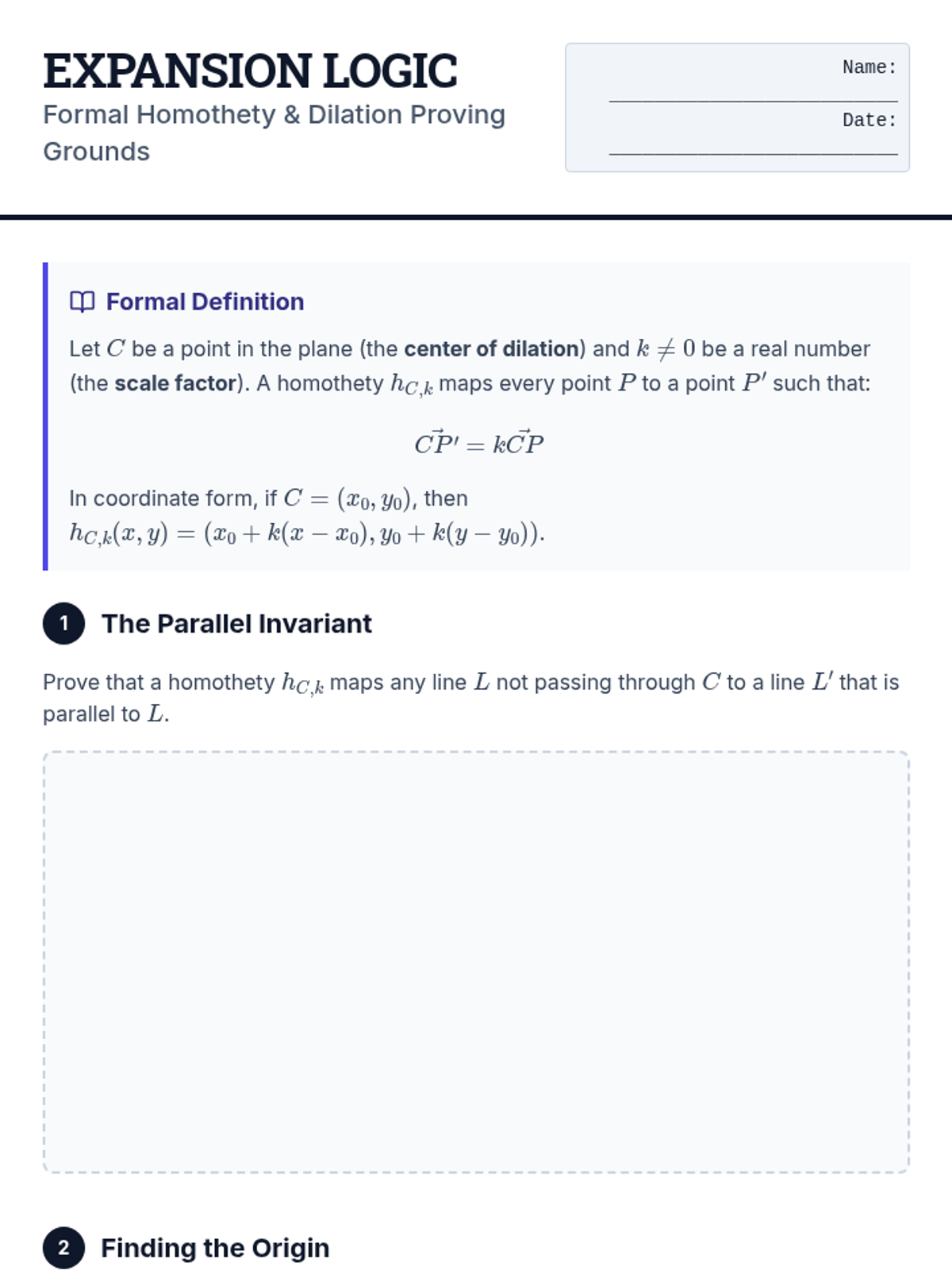
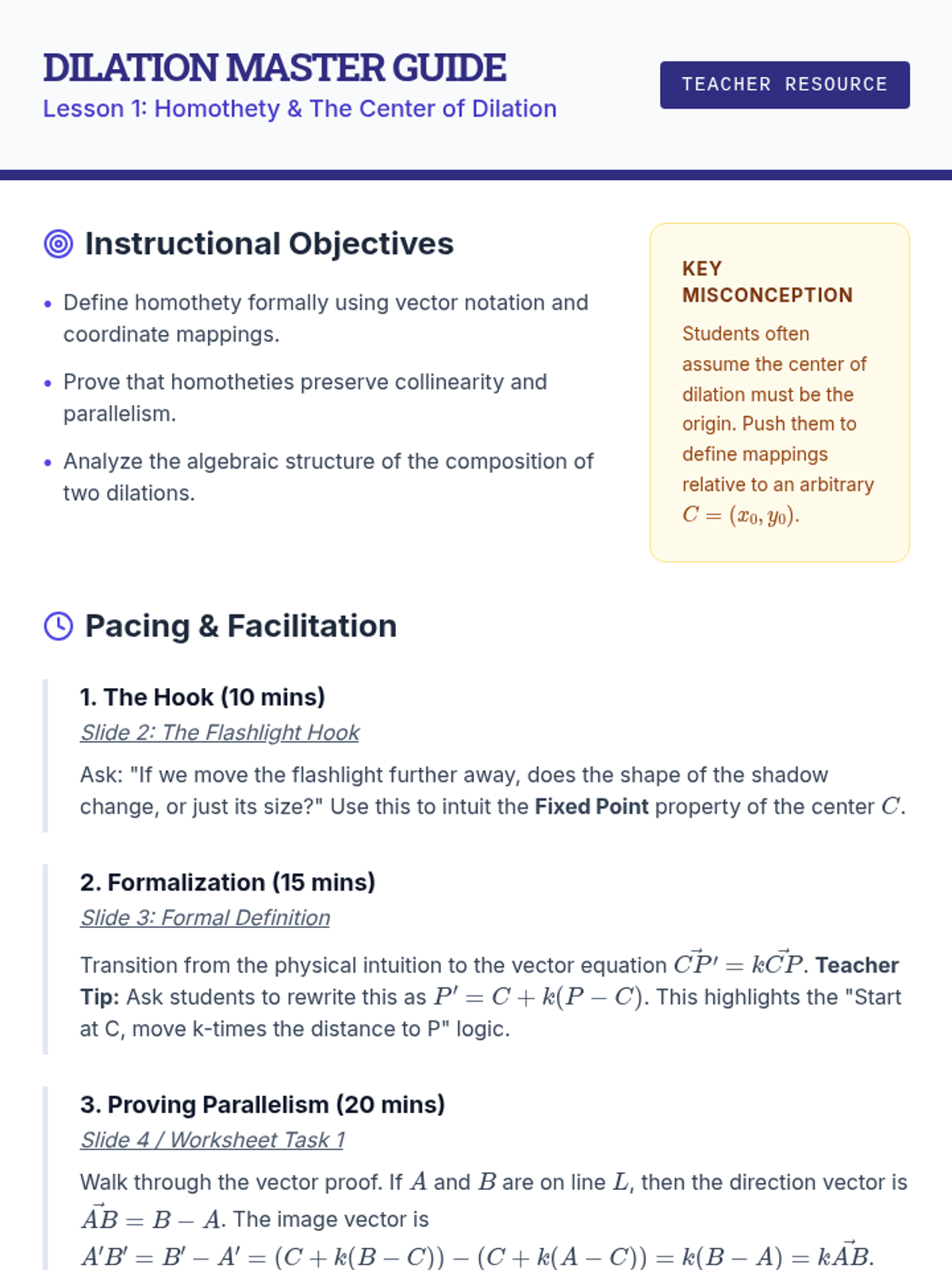
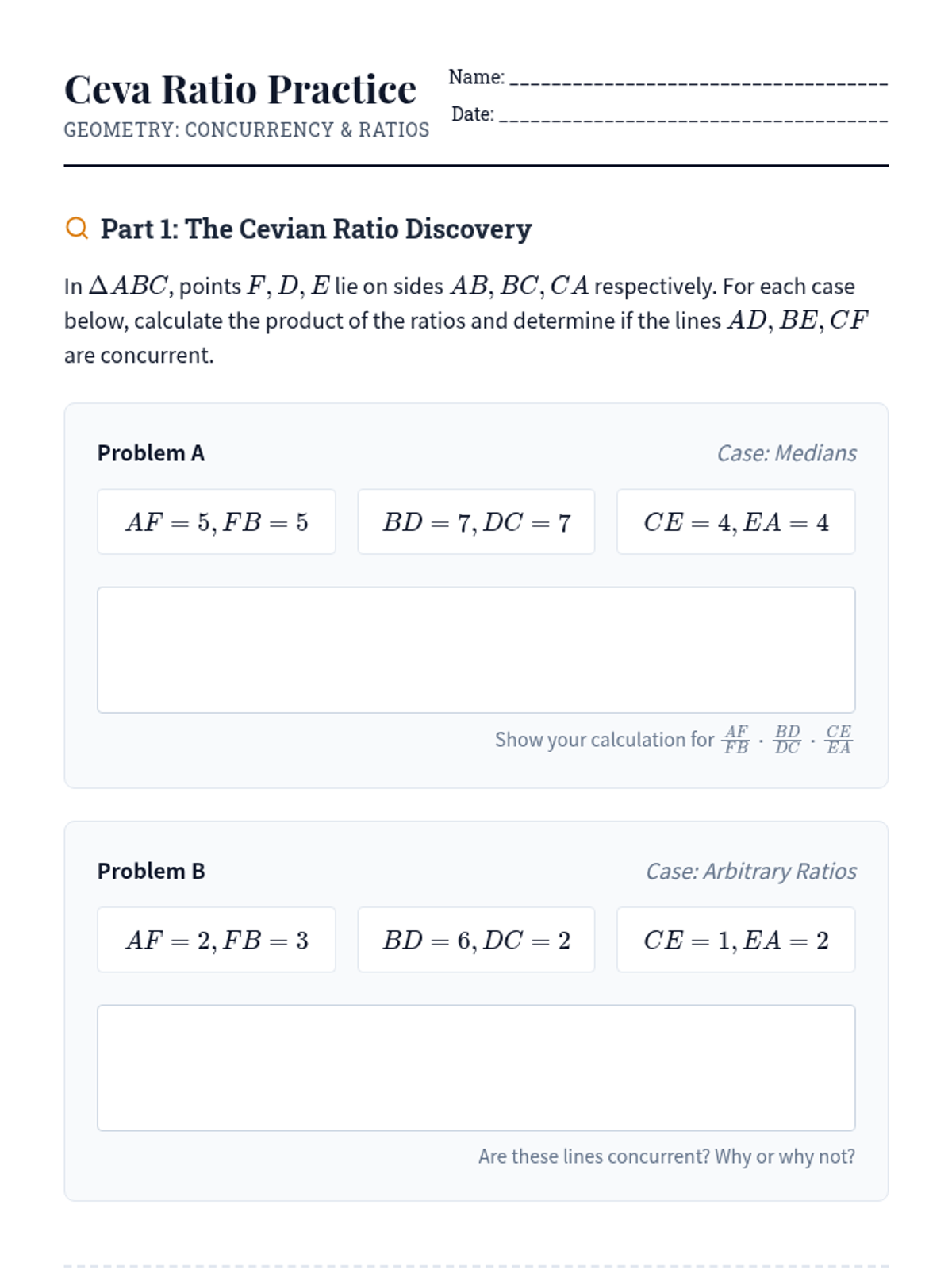
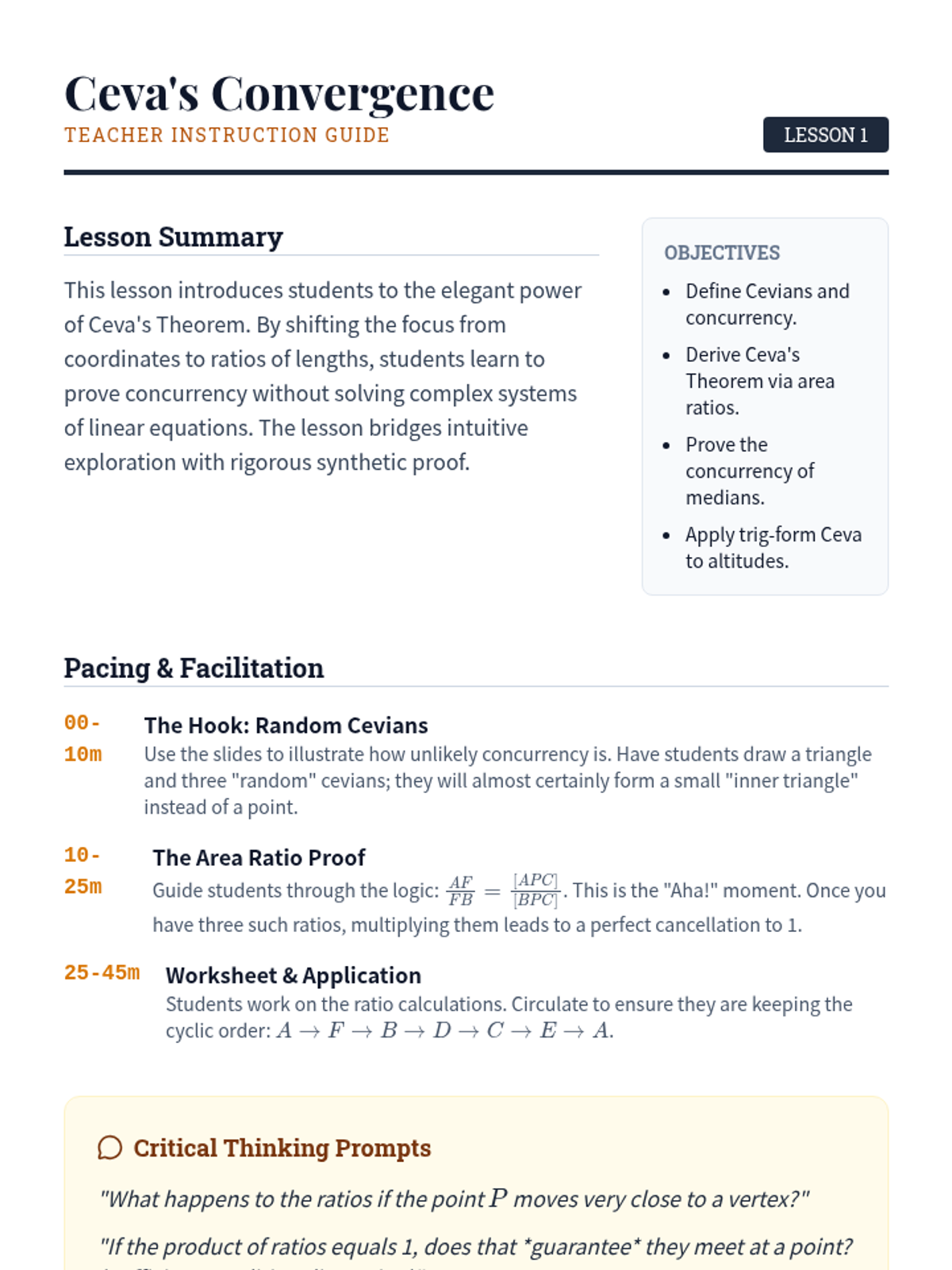
An advanced exploration of similarity and proportionality in Euclidean geometry, focusing on Menelaus' and Ceva's Theorems, homothety, and the Euler Line. Students move from directed segments and area ratios to complex proofs of collinearity and concurrence suitable for undergraduate mathematics.
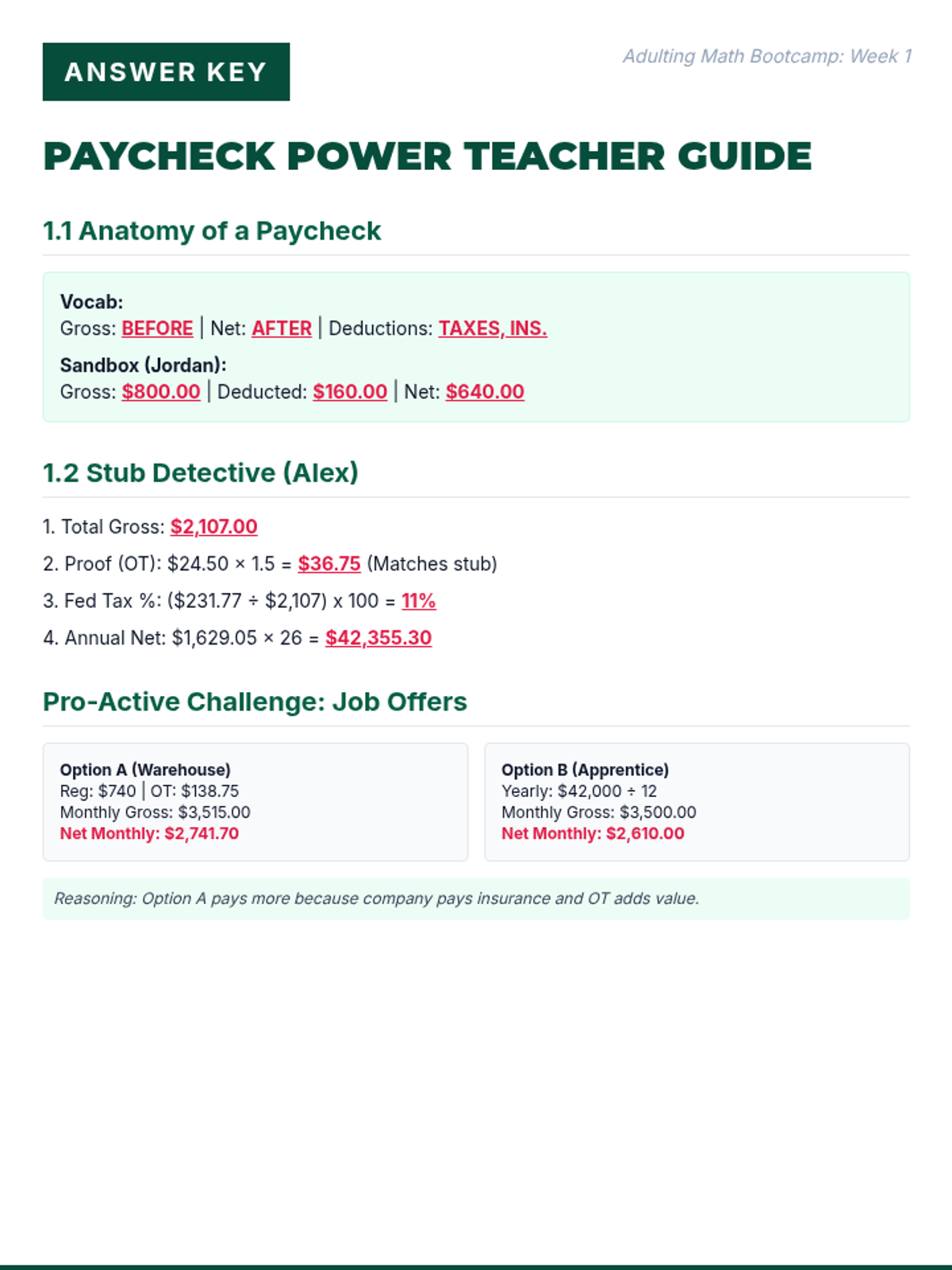
A 6-week curriculum designed to bridge the gap between high school math and real-world financial and practical independence, covering paychecks, budgeting, credit, shopping, housing, and measurement.
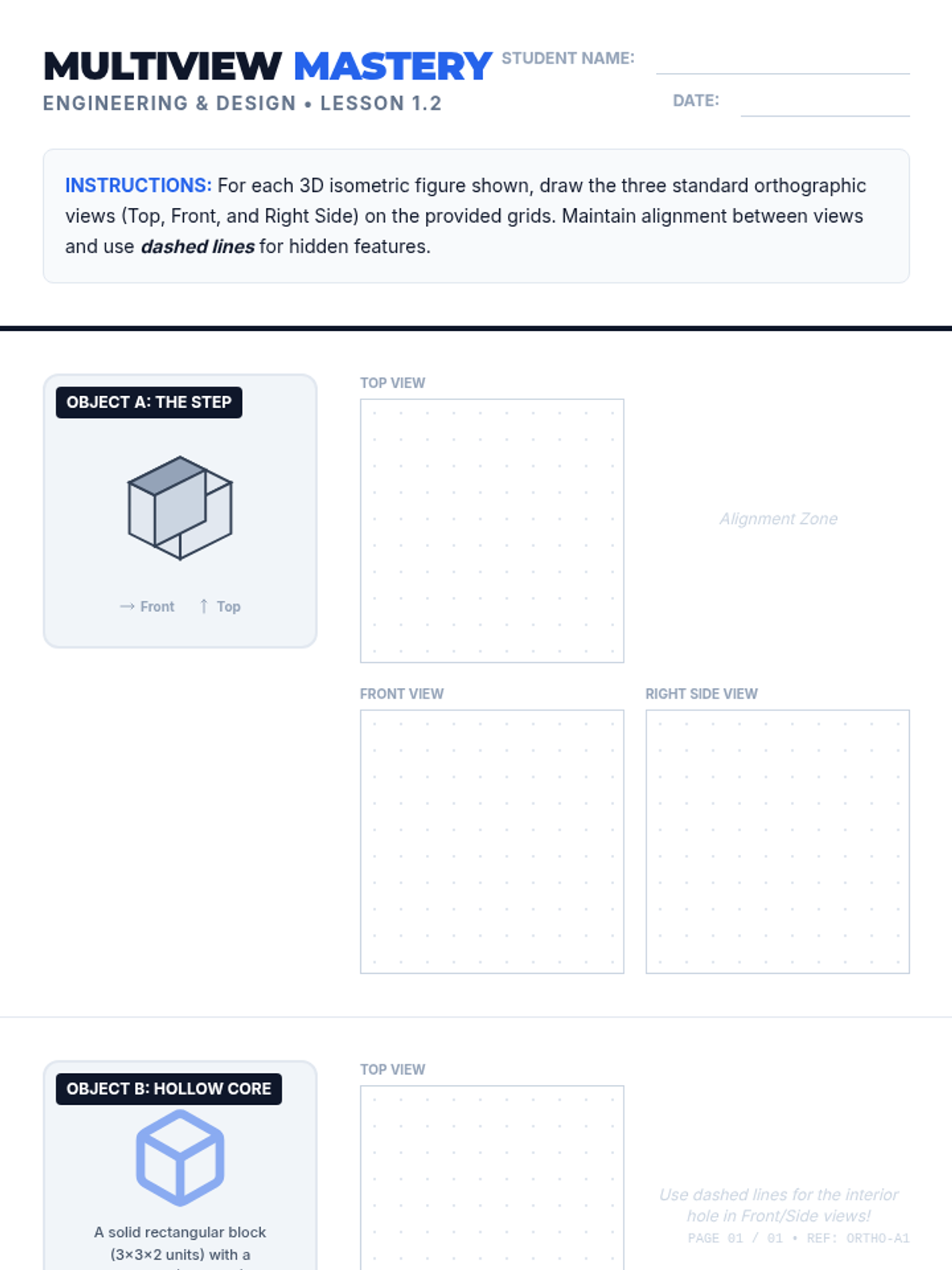
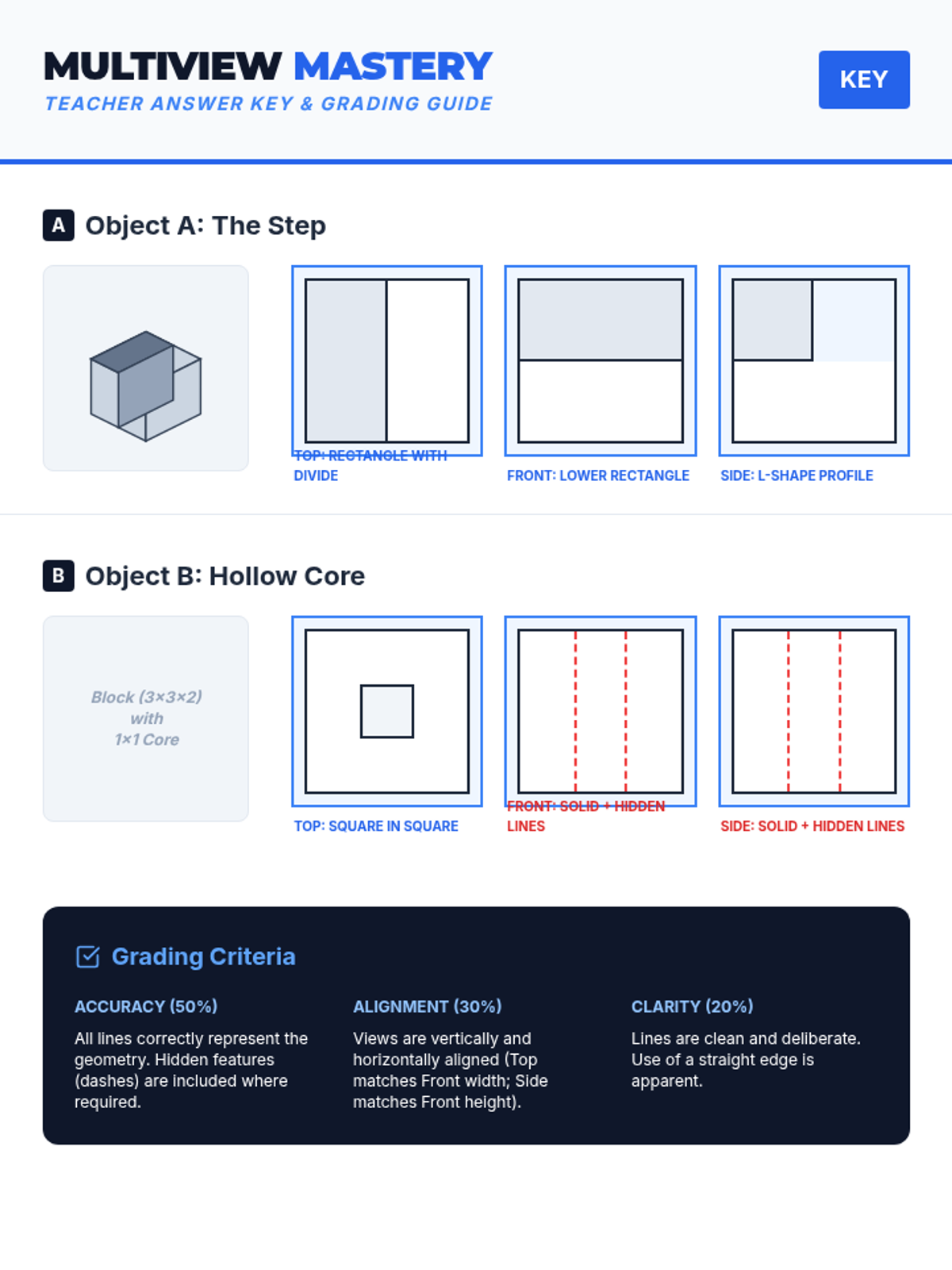
This sequence explores the intersection of geometry and engineering, focusing on 3D visualization, technical drawing, and the optimization of physical forms. Students develop spatial reasoning skills through orthographic and isometric sketching and apply geometric modeling to solve real-world design constraints.
An advanced 11th-grade Calculus unit focusing on the integration of parametric and polar coordinate systems. Students analyze motion, calculate complex areas, perform error analysis, and complete a final synthesis project based on particle kinematics.
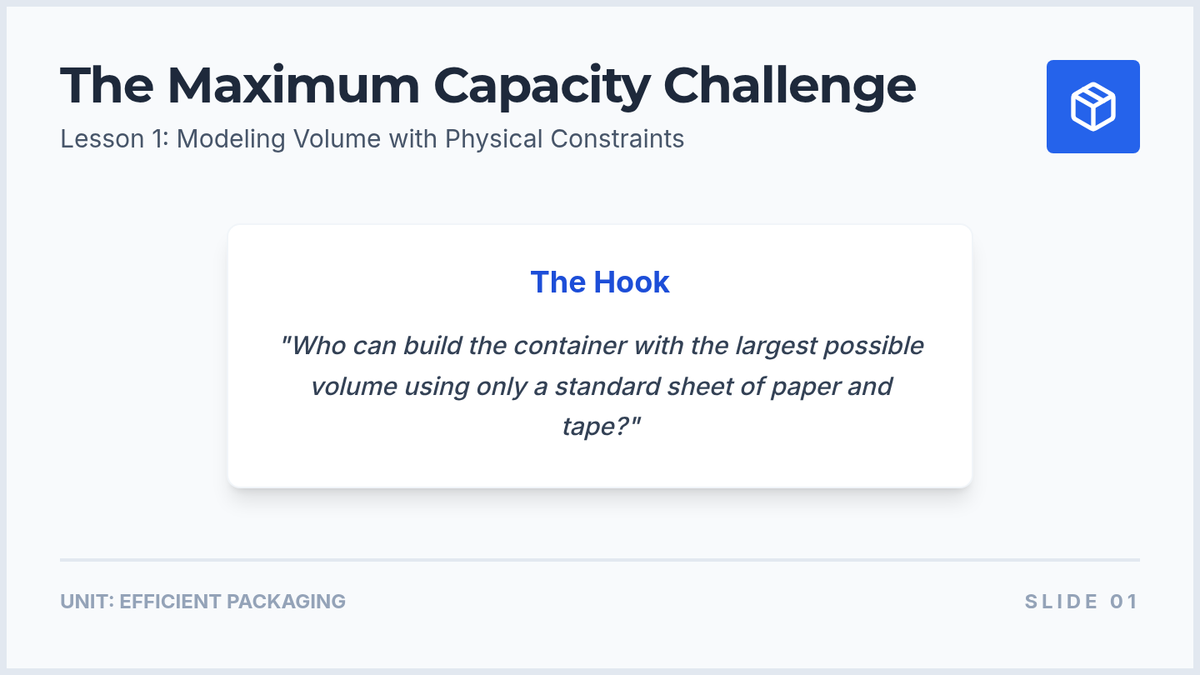
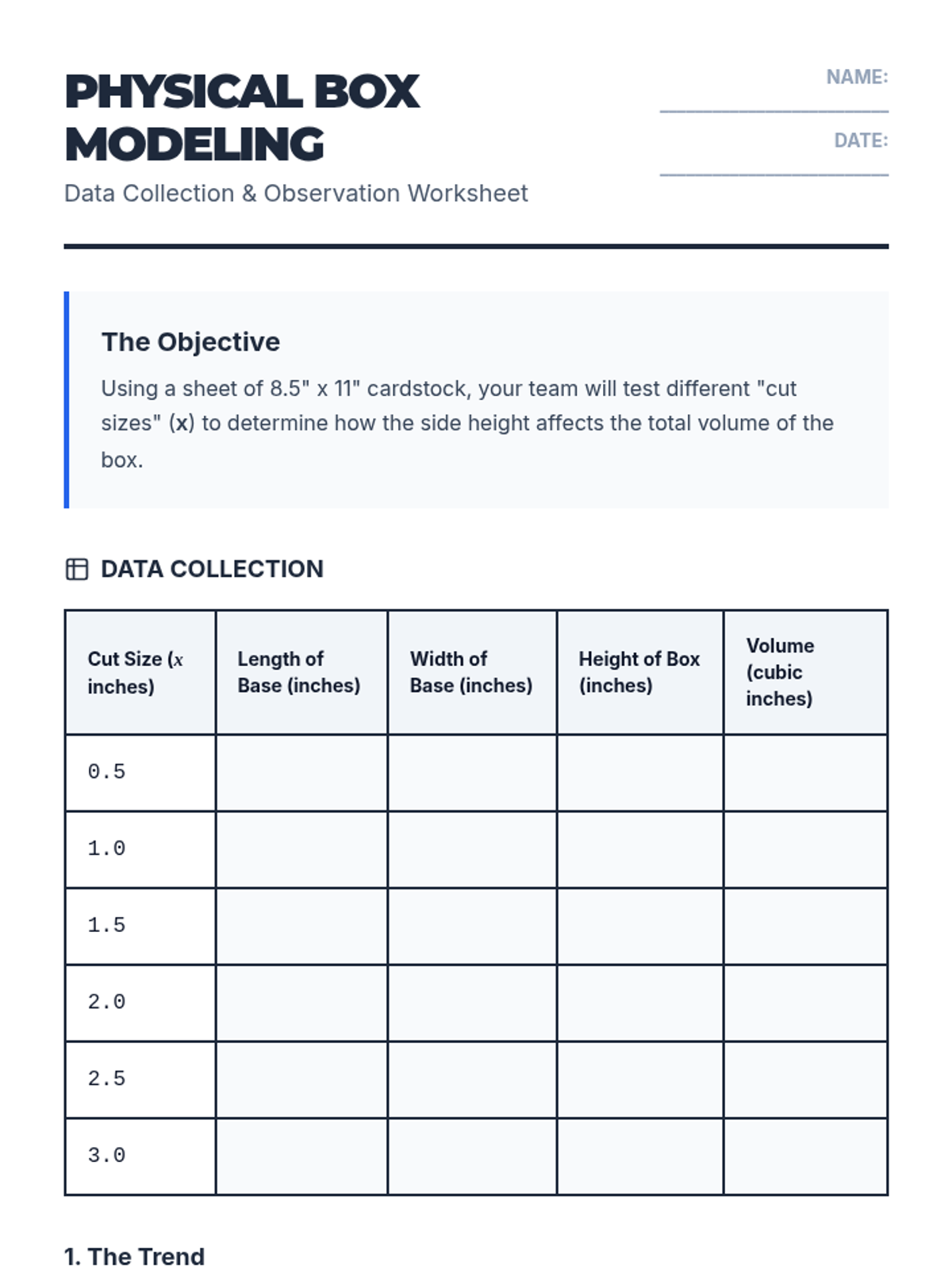
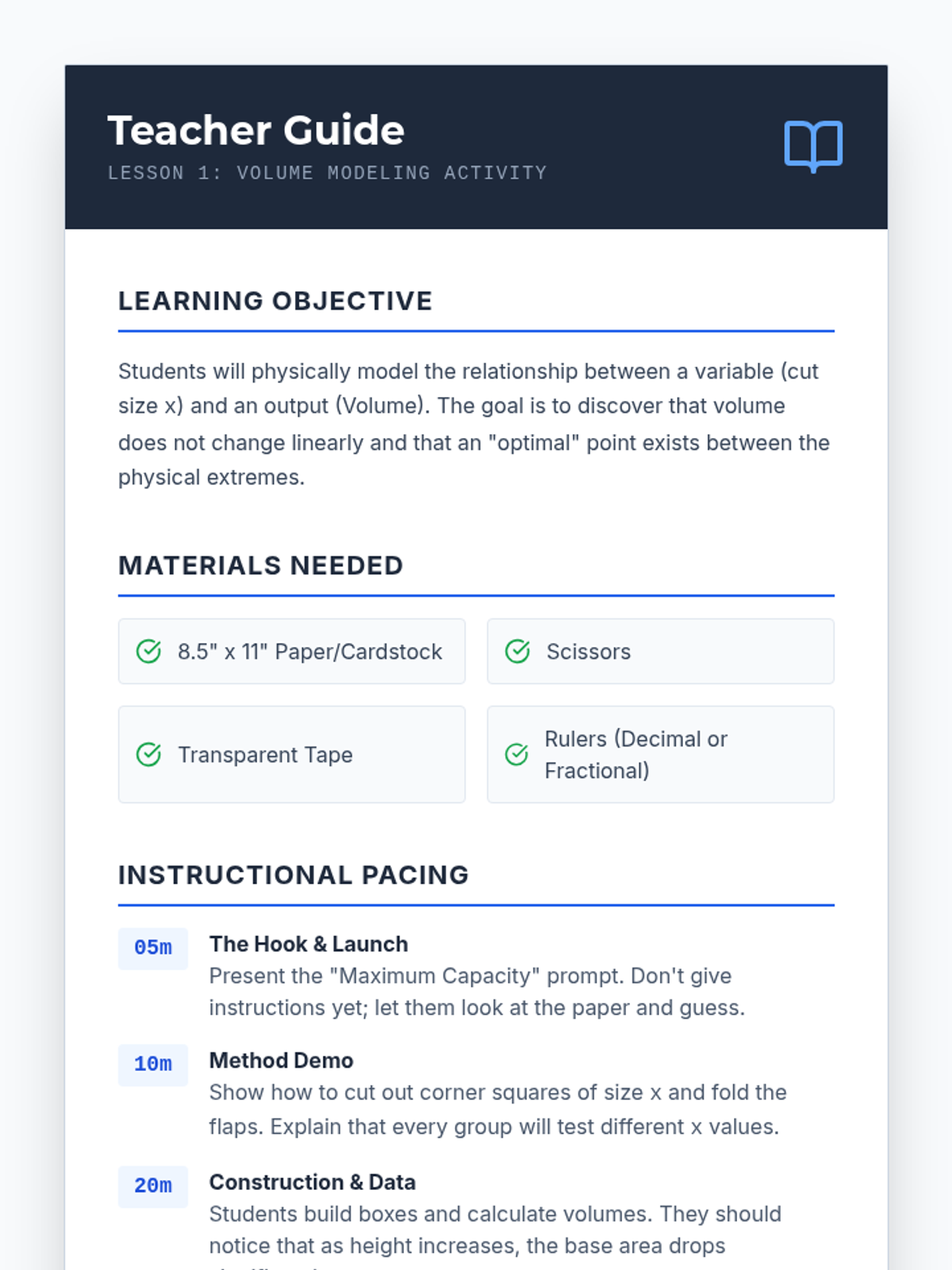
A project-based calculus sequence where students use optimization to design efficient packaging. They transition from physical modeling to algebraic functions and derivative-based solutions to maximize volume and minimize material costs.
A comprehensive calculus sequence for undergraduate students focused on the rigorous application of derivatives to industrial, geometric, and economic optimization problems. Students progress from basic modeling to multi-constraint capstone analysis.
This sequence anchors mathematical decomposition strategies in high-stakes, real-world transition skills. Students apply task analysis and breakdown strategies to complex financial and logistical scenarios relevant to independent living, moving from consumer math to a comprehensive life management simulation.
A project-based calculus unit where students apply curve sketching and derivative tests to real-world optimization problems, moving from modeling constraints to defending optimized designs.
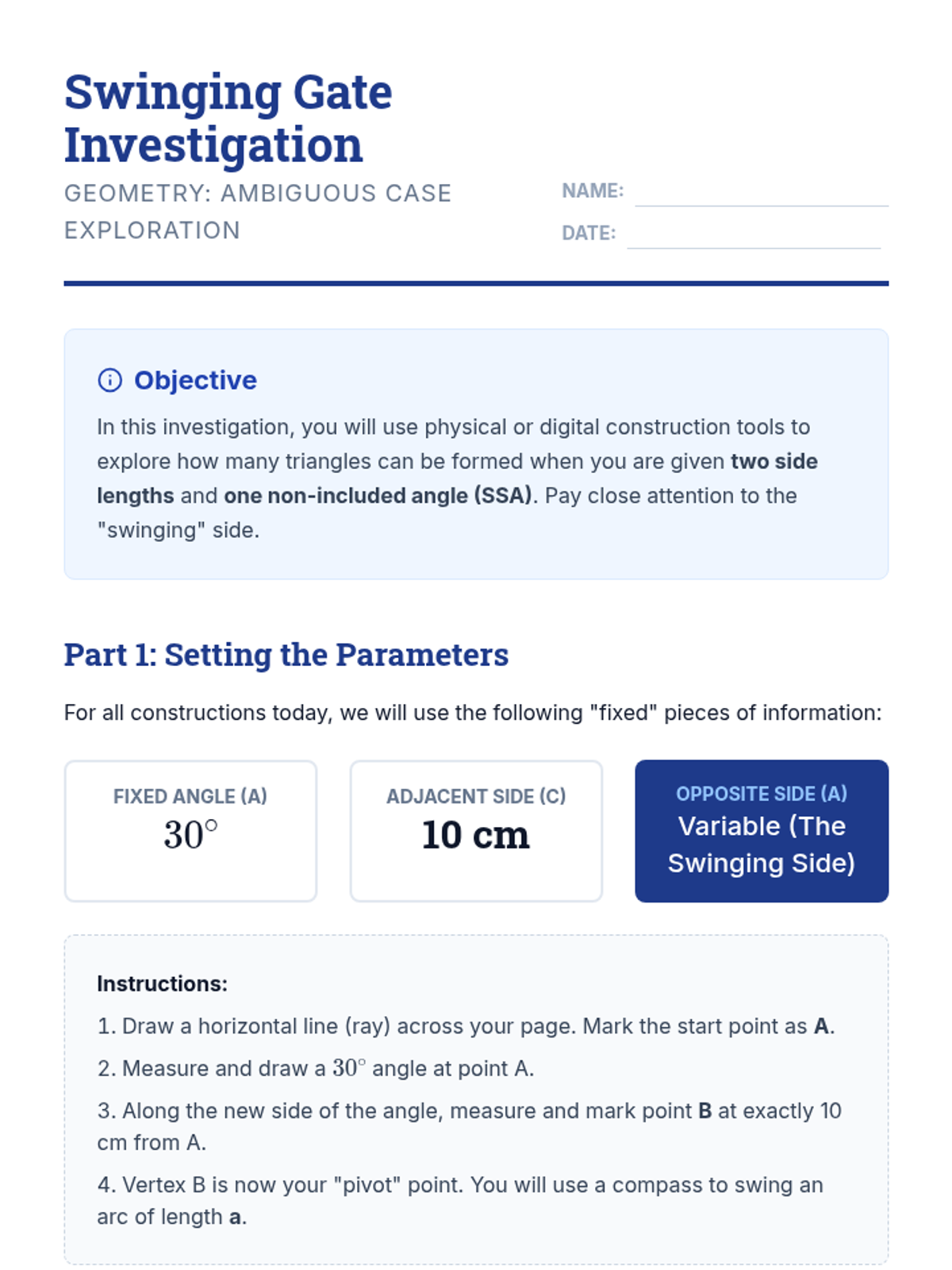
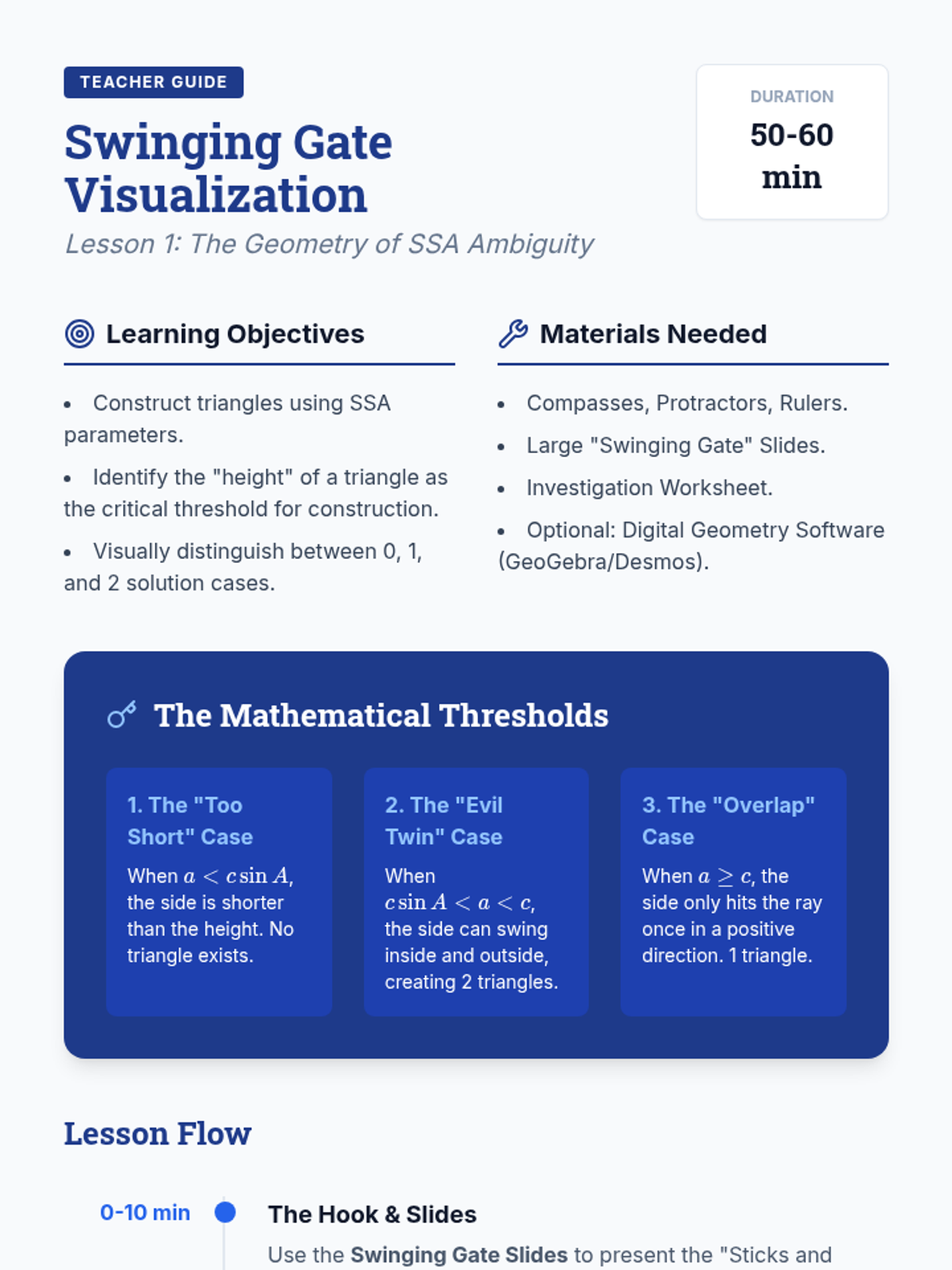
This sequence explores the 'Ambiguous Case' (SSA) of the Law of Sines through visualization, algebraic proof, and real-world application. Students move from physical constructions to systematic classification and problem-solving.
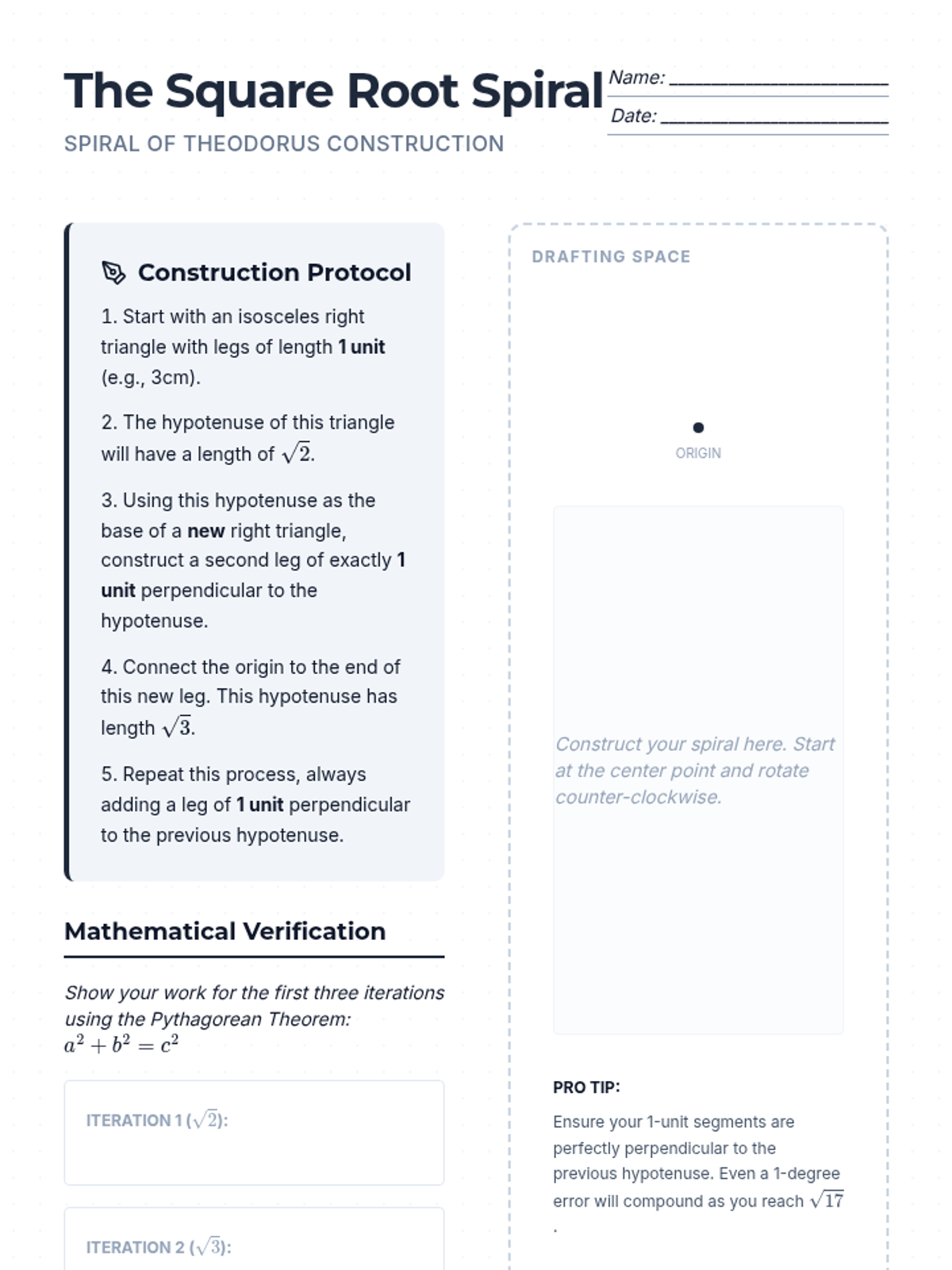
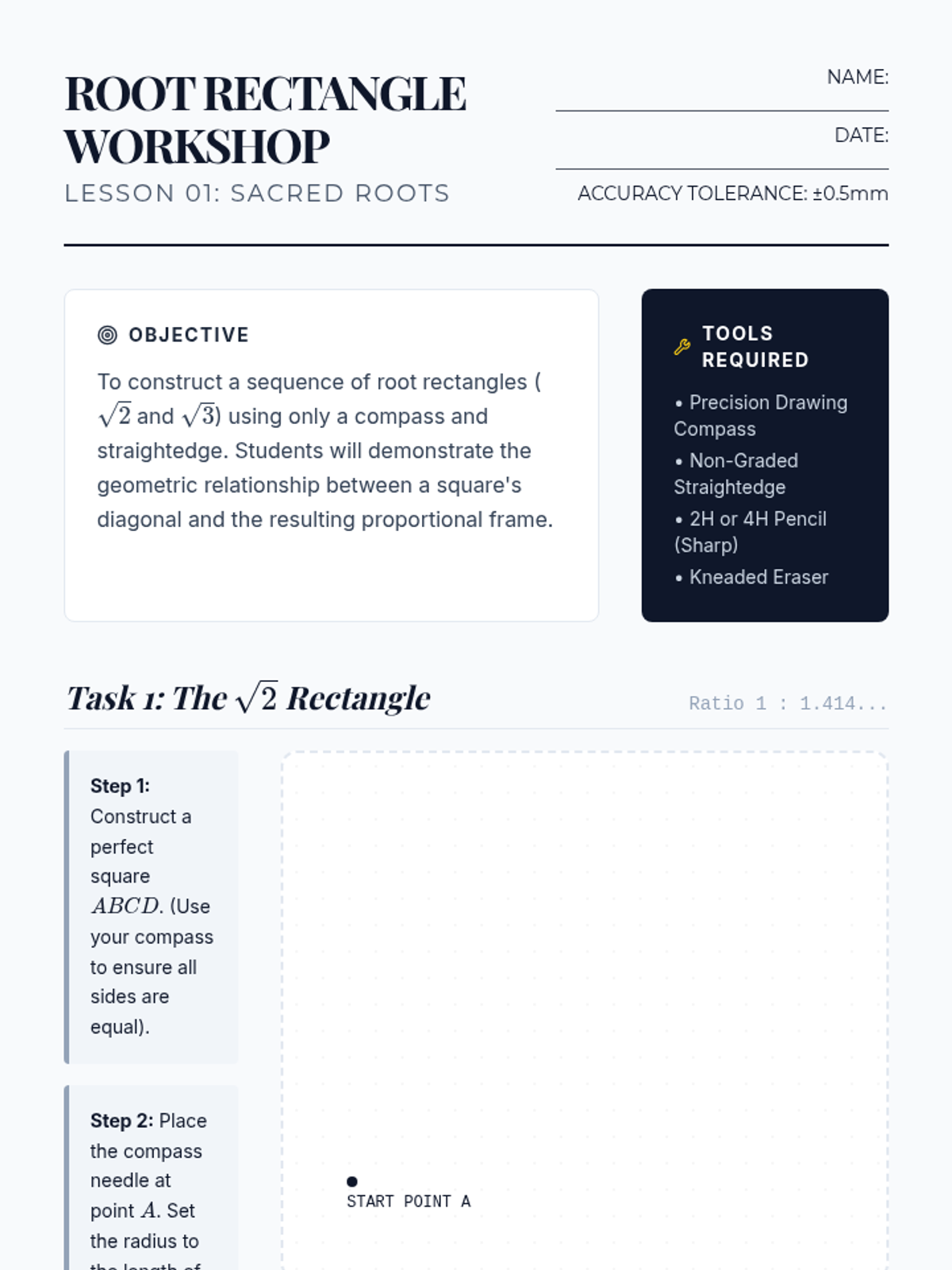
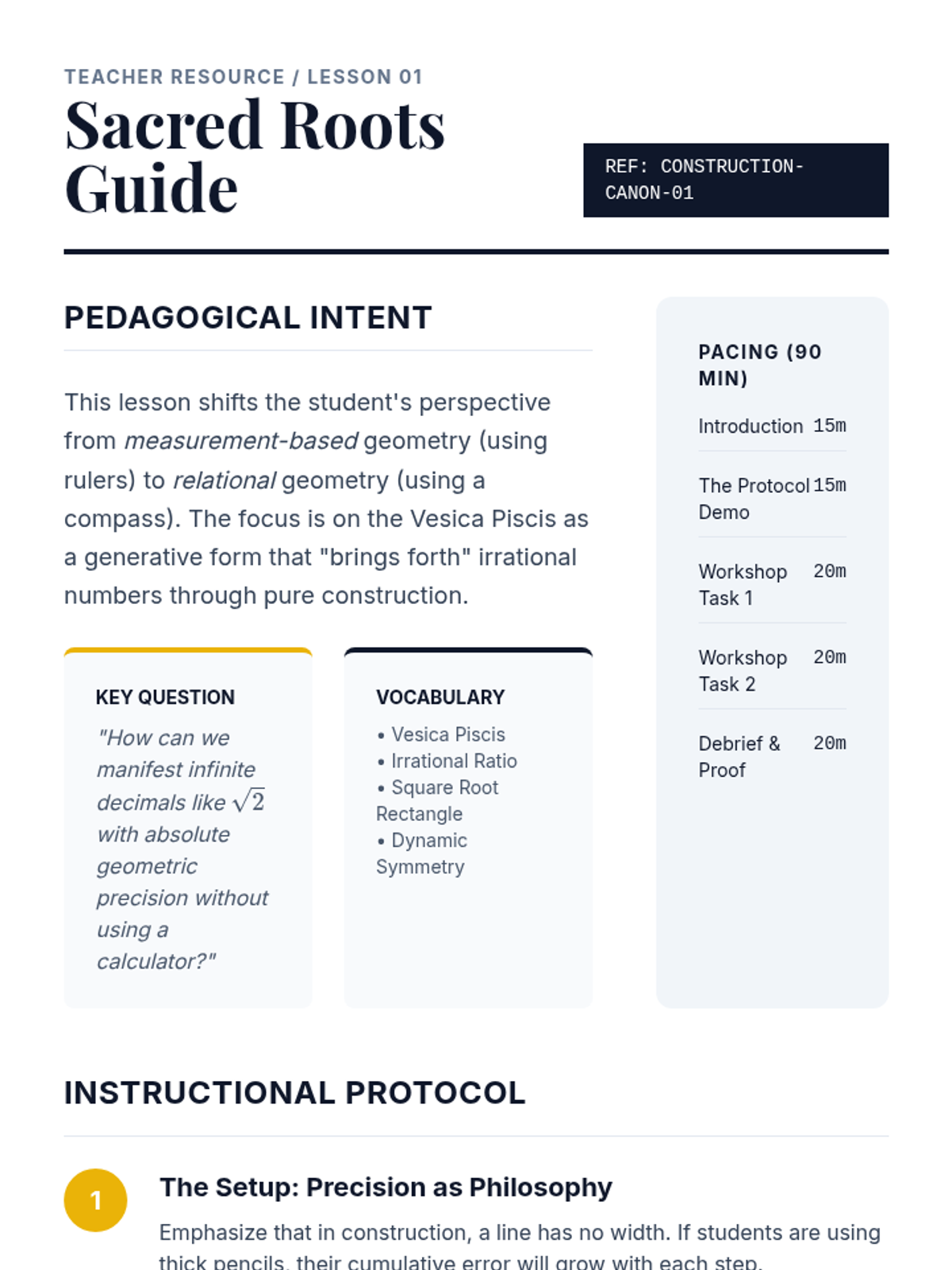
A project-based sequence for 12th-grade students exploring the spatial and structural applications of irrational constants like the Square Roots, Phi, Pi, and Euler's Number. Students connect geometric construction, probability, and continuous growth models to real-world design and natural phenomena.
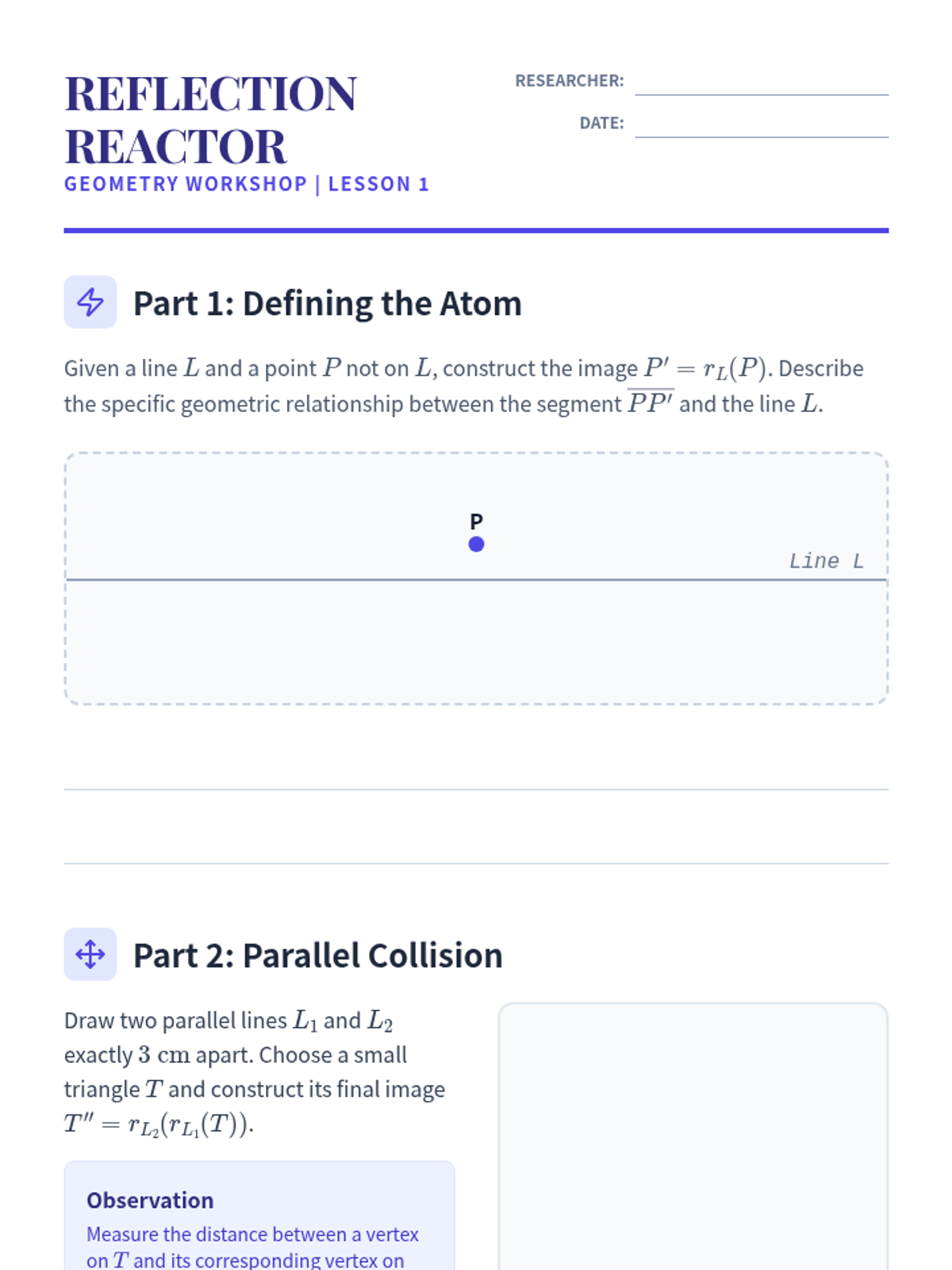
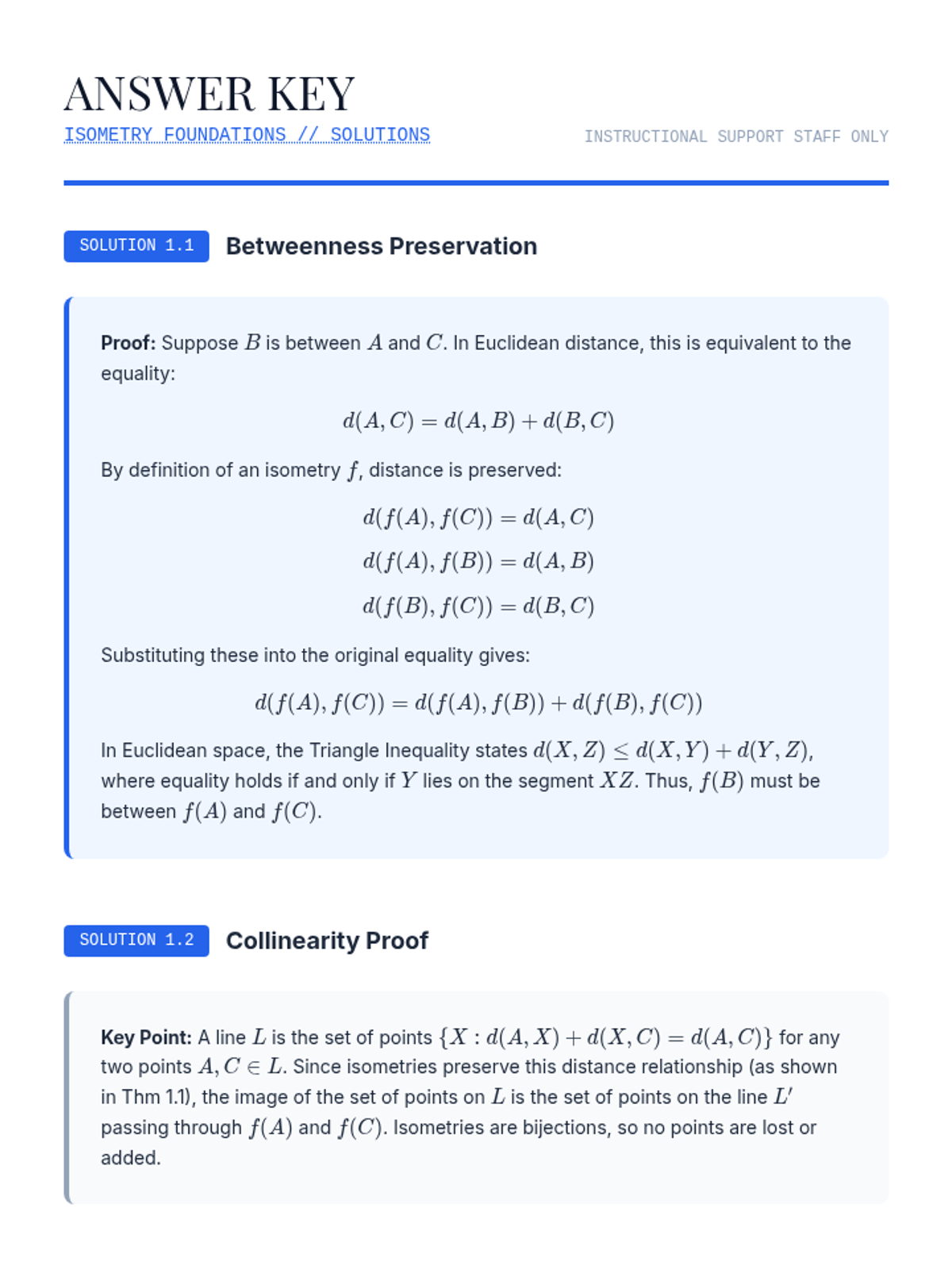
This advanced geometry sequence explores the algebraic structure of the Euclidean Group, focusing on reflections as generators and the classification of all plane isometries. Students will move from geometric constructions to formal group theory, culminating in the Three Reflections Theorem and non-commutative properties.
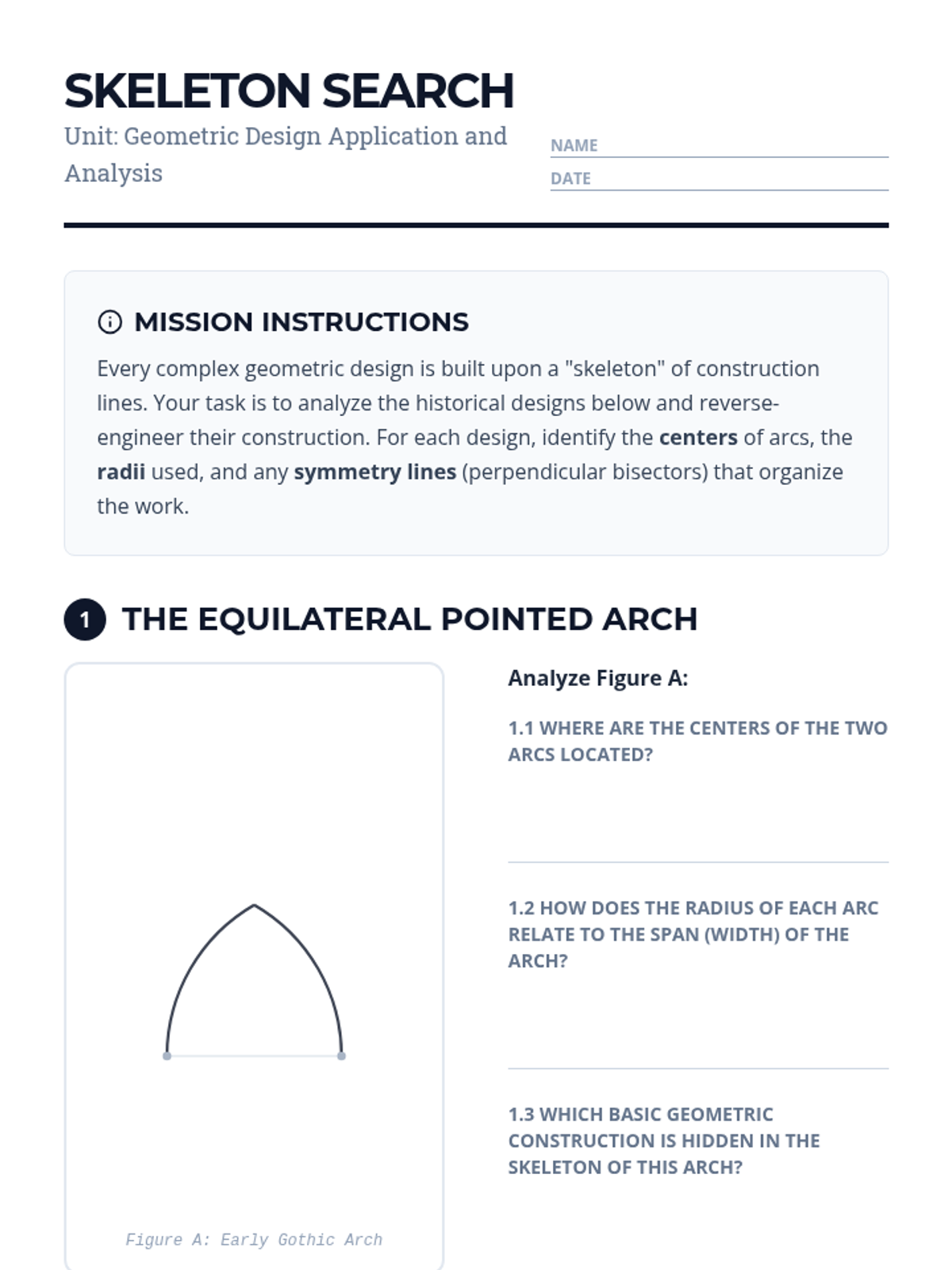
This sequence explores the intersection of geometry, art, and architecture. Students master compass and straightedge constructions to recreate historical designs from Gothic cathedrals and Islamic tilings while understanding the underlying mathematical principles of root rectangles and aperiodic tilings.
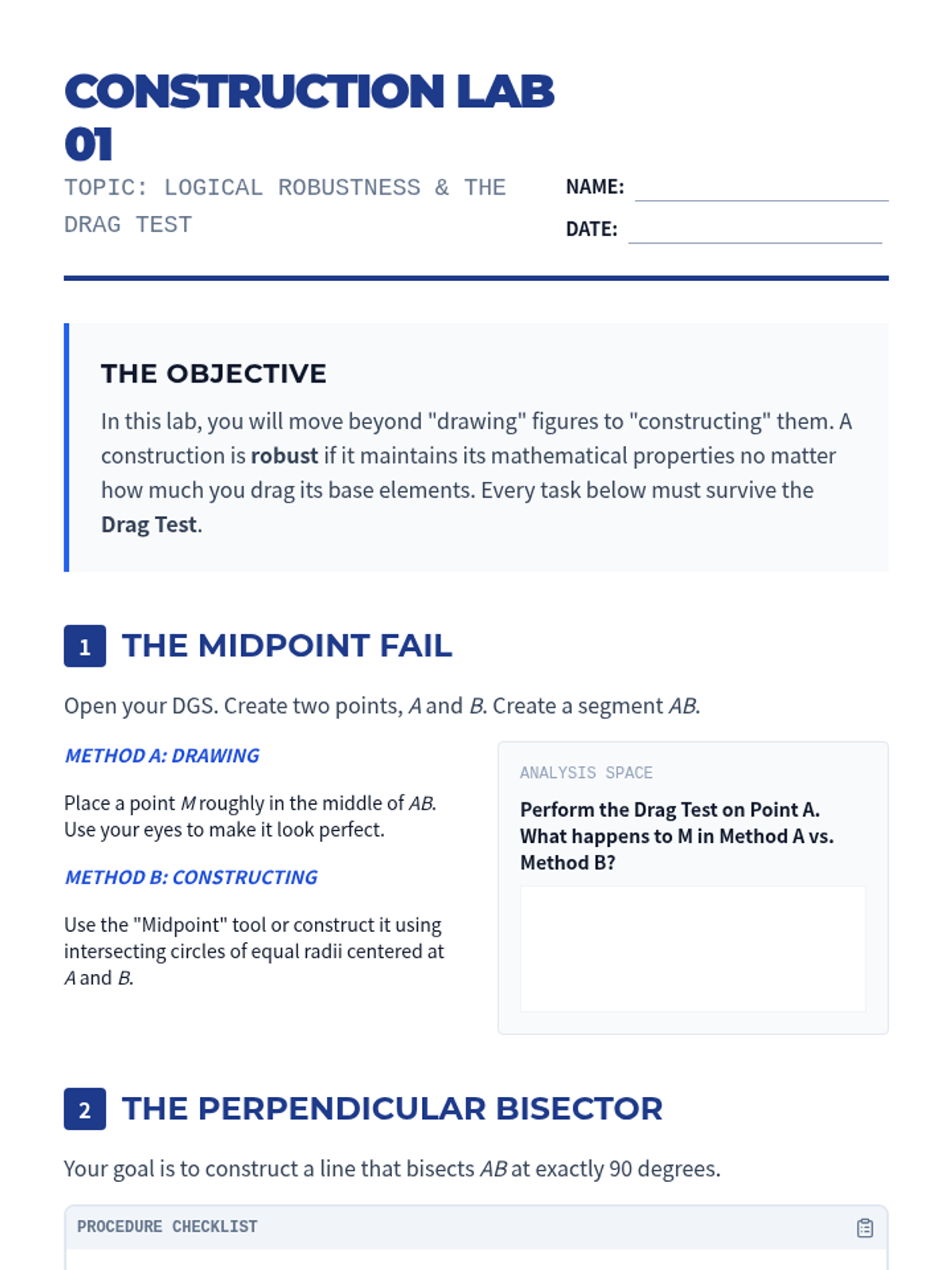
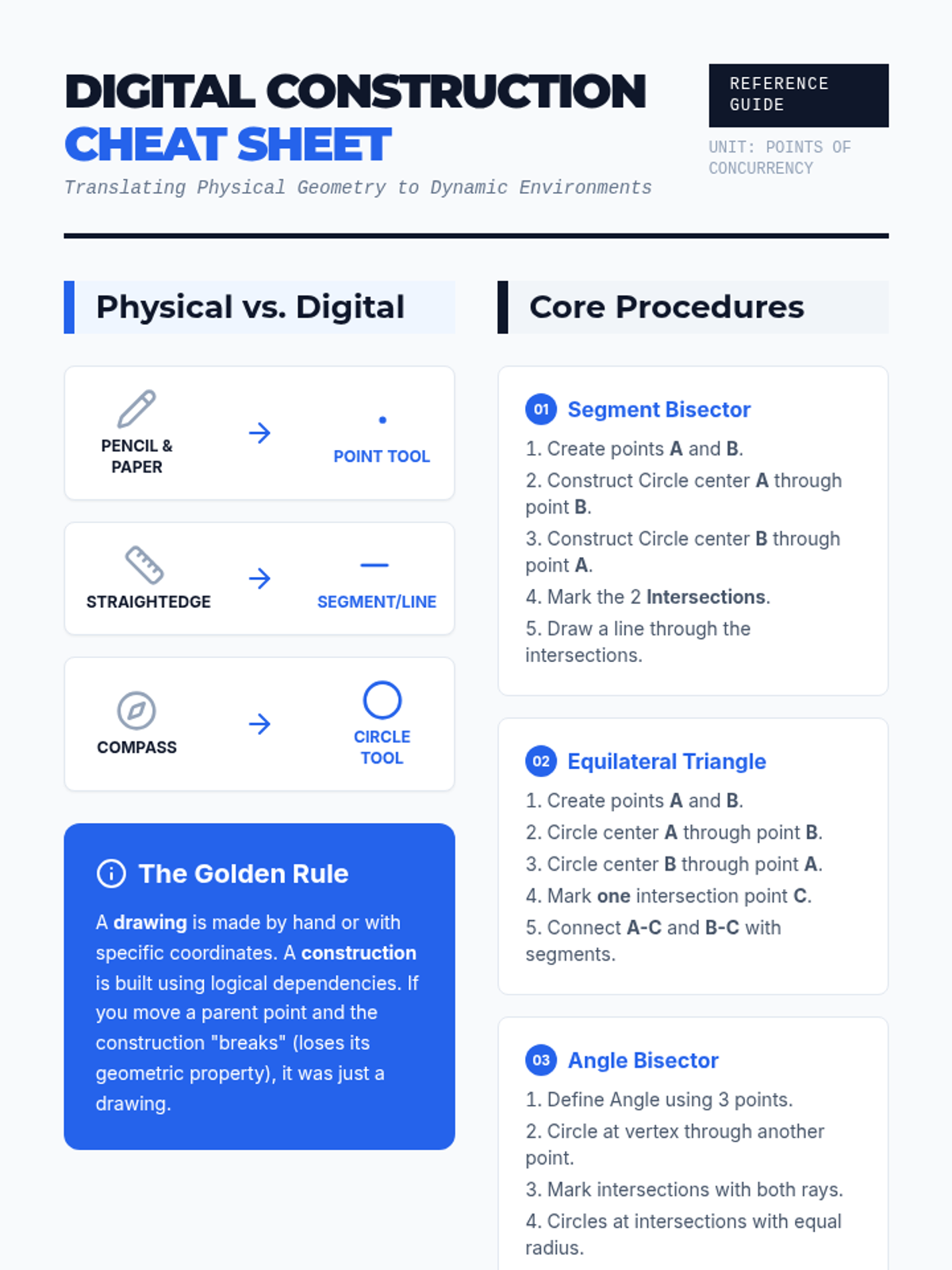
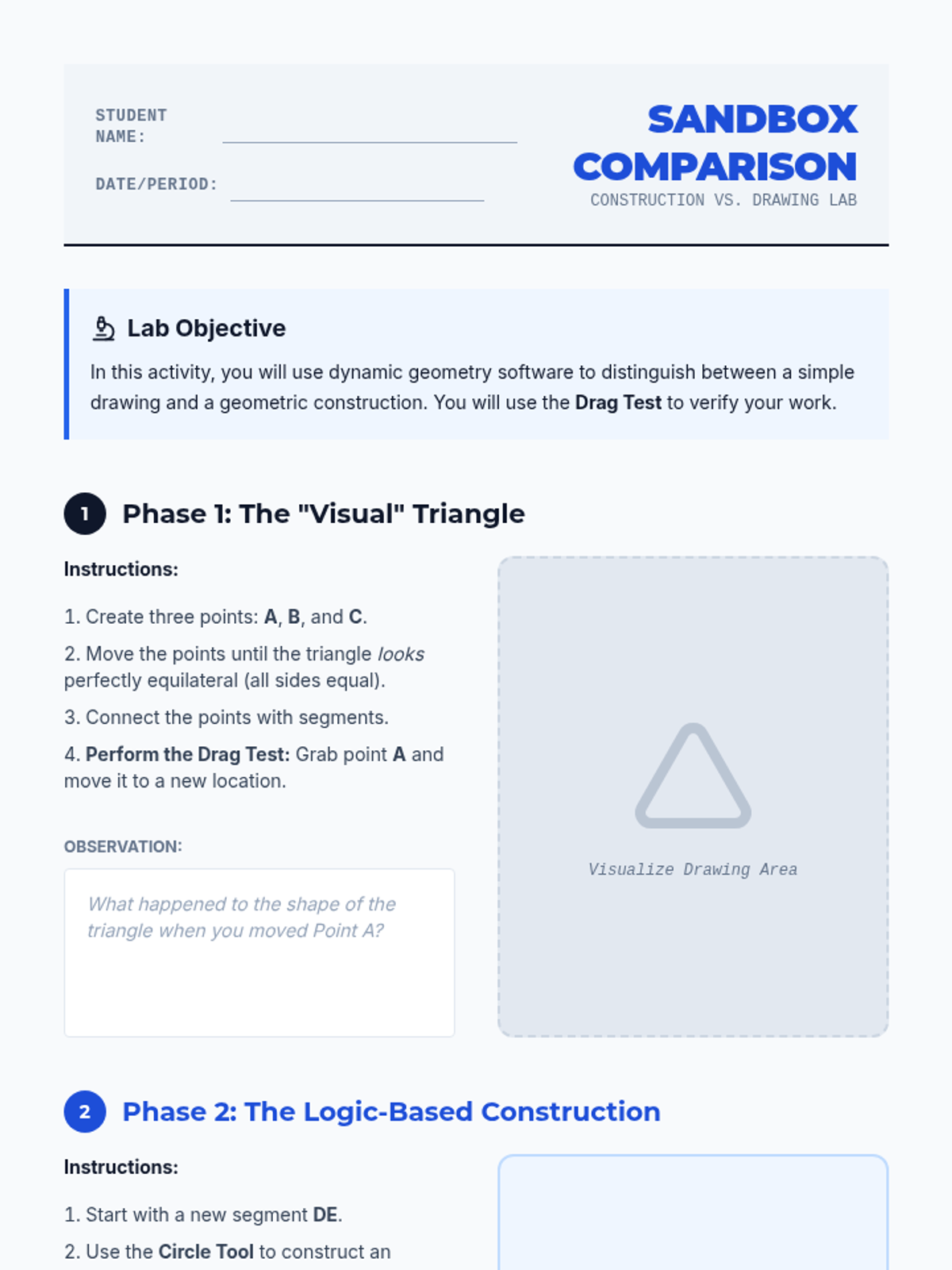
This sequence utilizes Dynamic Geometry Systems (DGS) to modernize the study of constructions, shifting focus from physical precision to logical robustness. Students explore dependencies, loci, transformations, and complex mechanical linkages through the 'drag test' methodology.
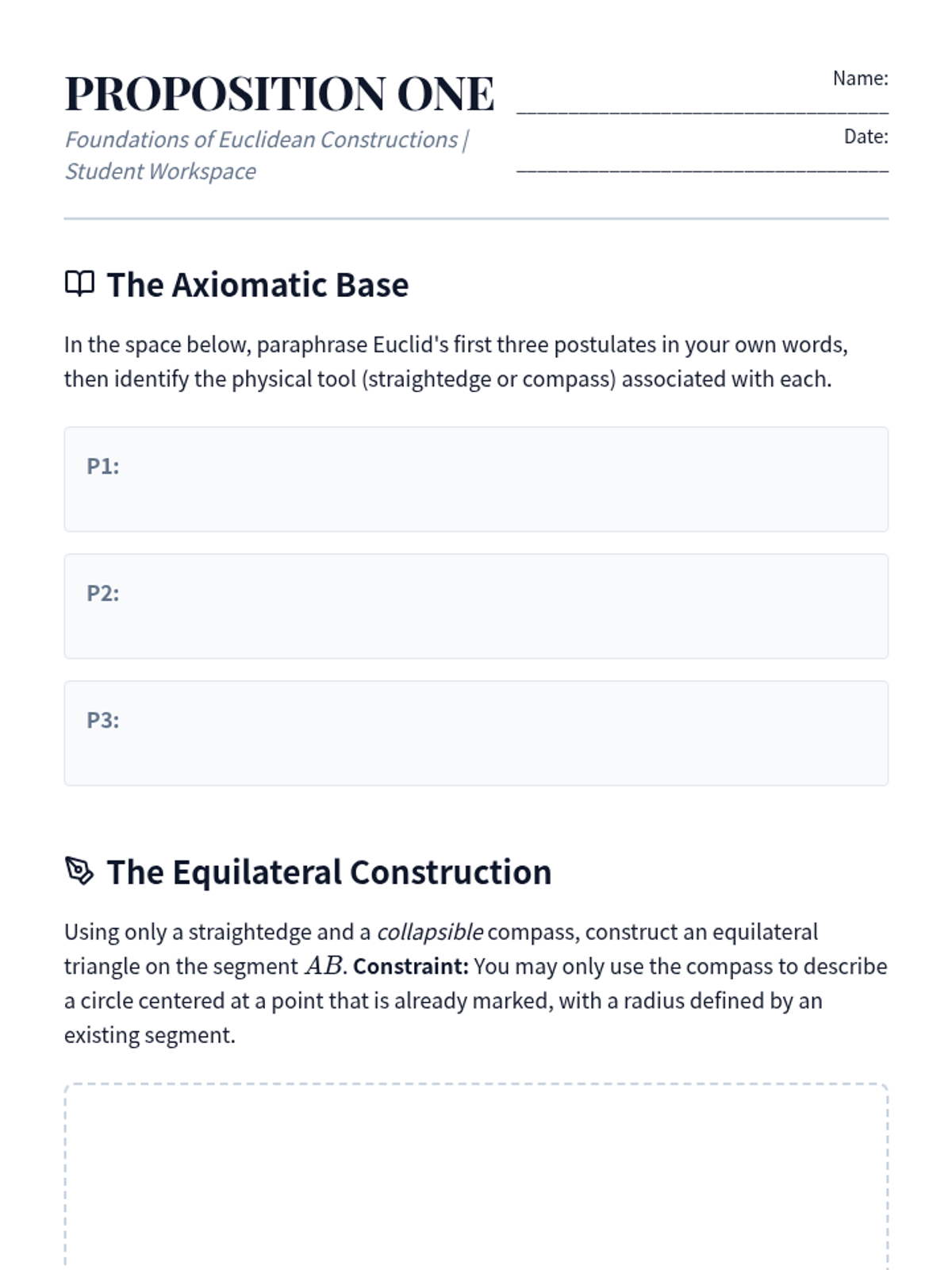
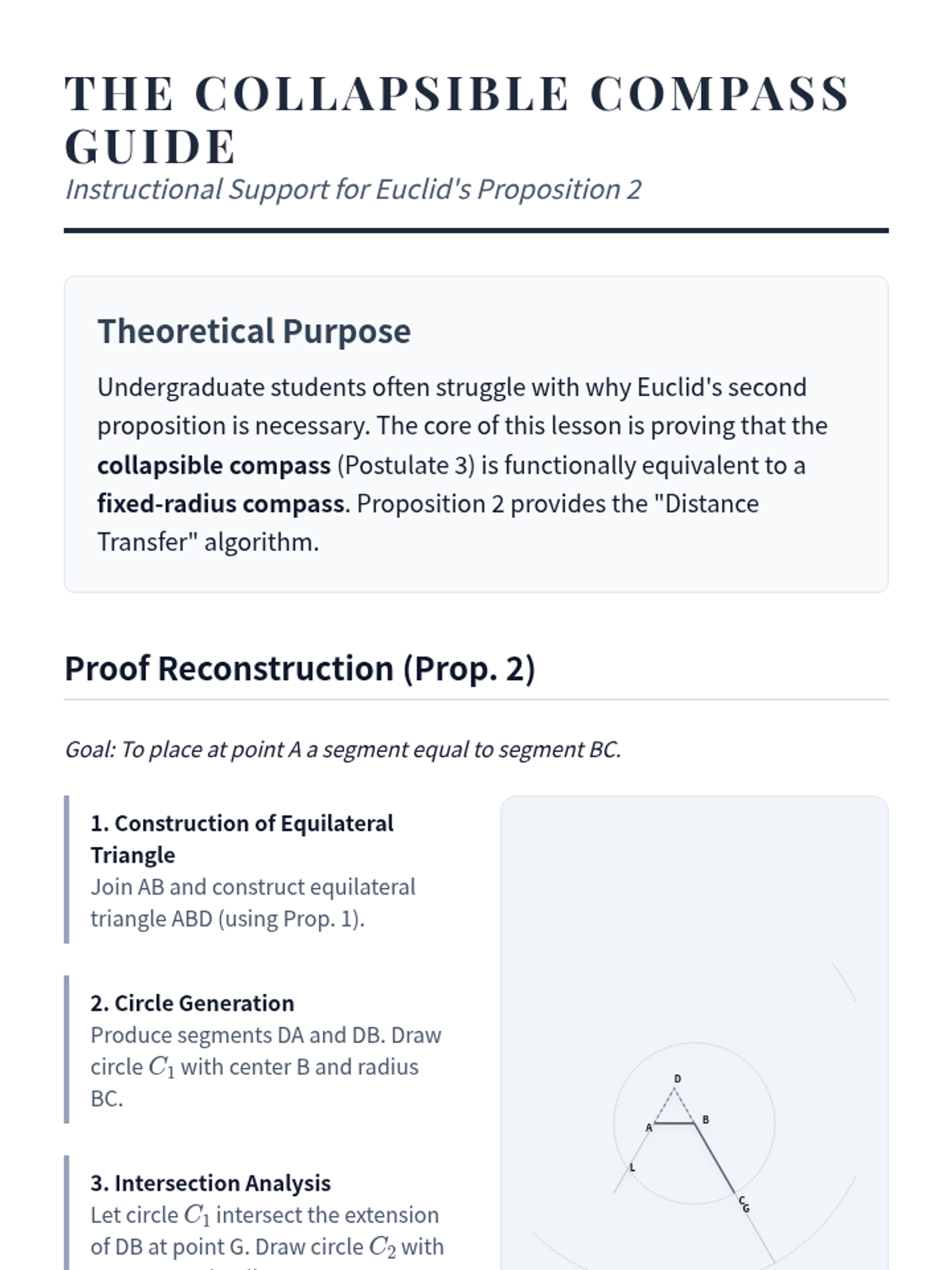
This undergraduate-level sequence explores the axiomatic foundations of Euclidean constructions. Students move from basic operations to complex theorems like the Nine-Point Circle, emphasizing formal proof and logical dependency over mechanical procedure.
This advanced geometry sequence explores the points of concurrency in triangles through geometric constructions. Students use physical and digital tools to construct and analyze the circumcenter, incenter, centroid, and orthocenter, culminating in the discovery of the Euler Line.
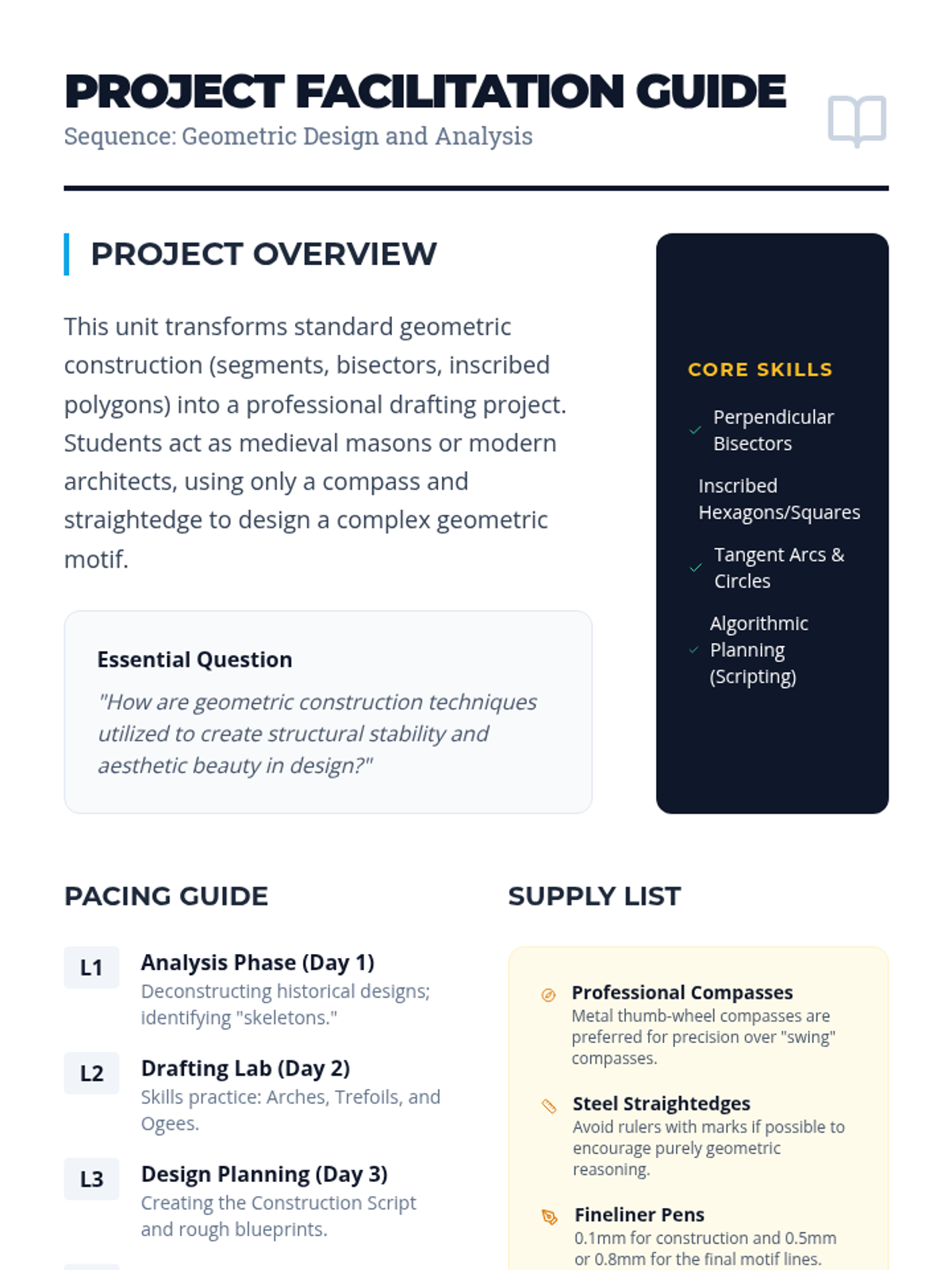
A project-based geometry unit where students apply construction techniques to architectural and artistic design, culminating in the creation and analysis of a complex geometric motif.
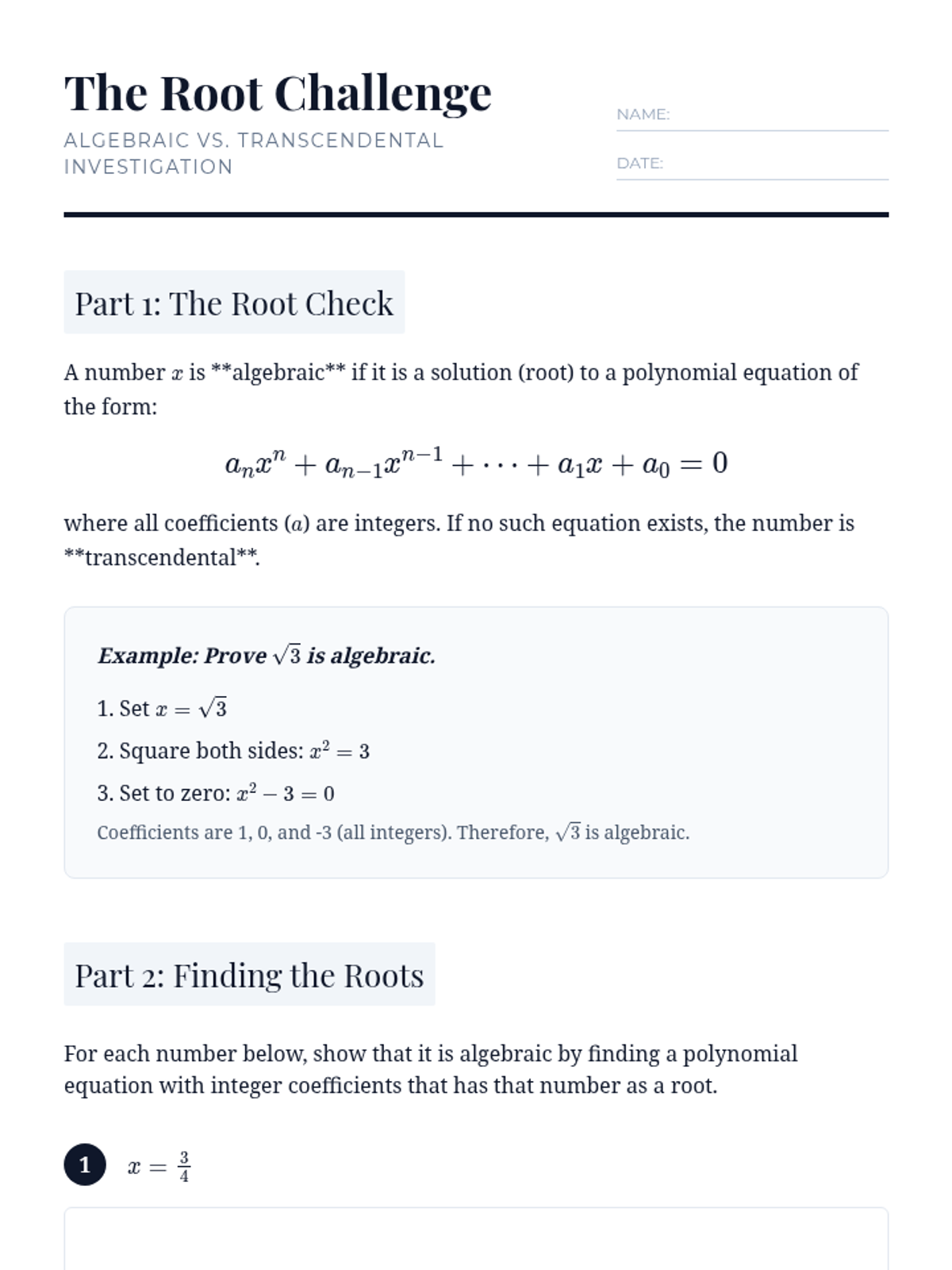
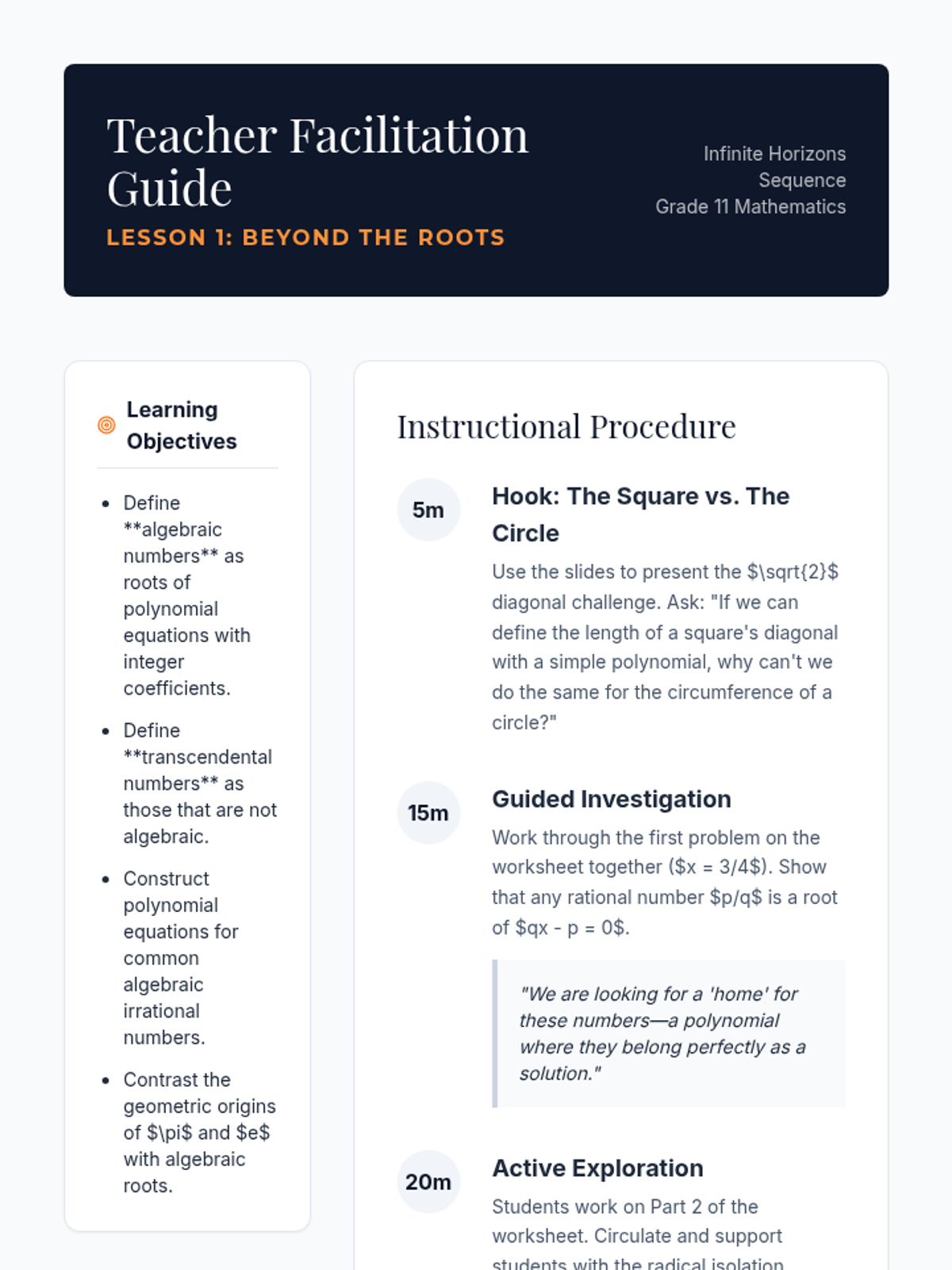
This inquiry-based sequence explores transcendental numbers like Pi and Euler's number (e) to connect irrationality with real-world phenomena and geometry. Students investigate historical methods of approximation and modern infinite series.
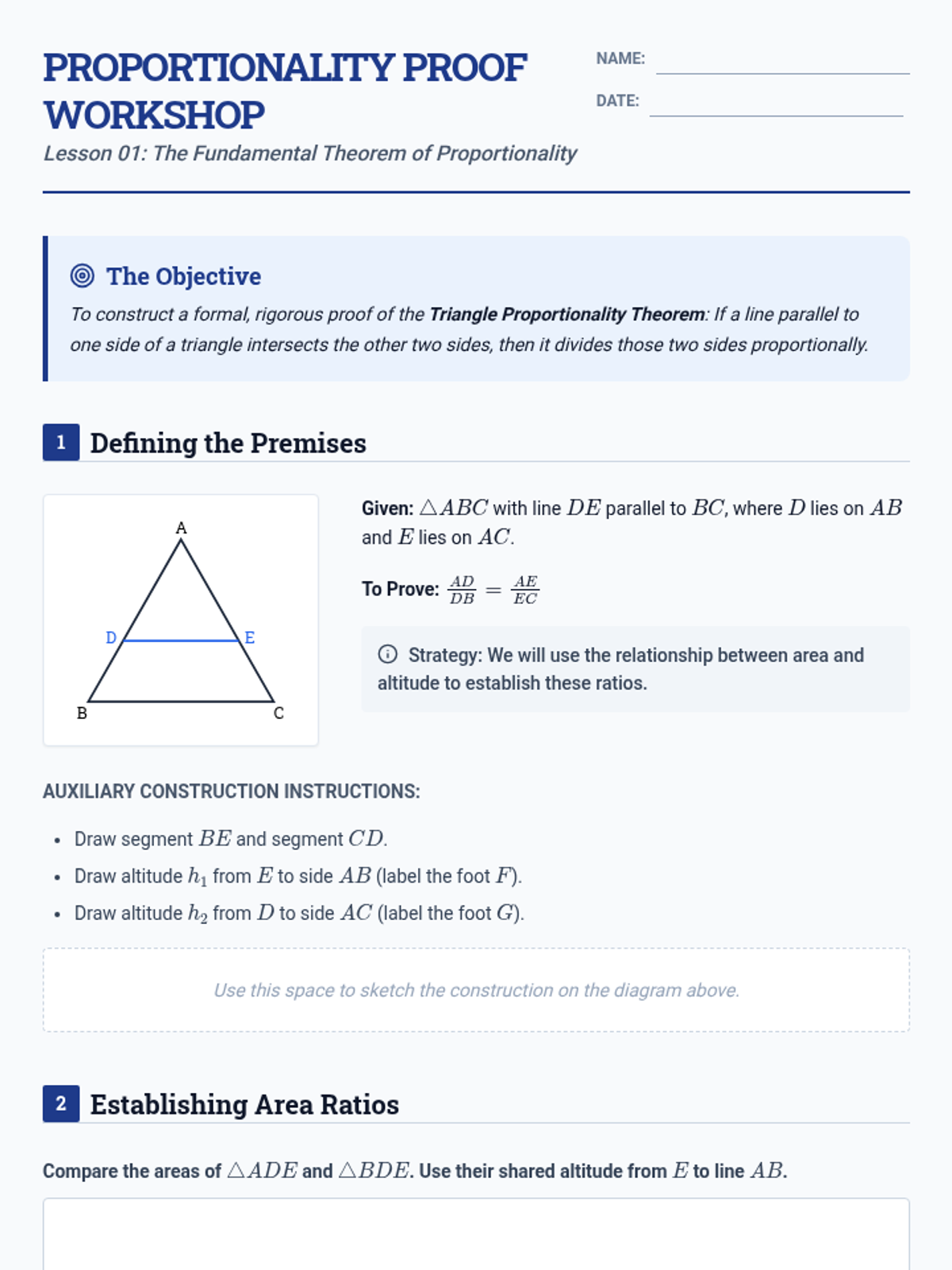
A rigorous undergraduate exploration of similarity theory, proportionality, and their applications in proving the Pythagorean Theorem and circle properties. Students move from dynamic exploration to formal proofs.
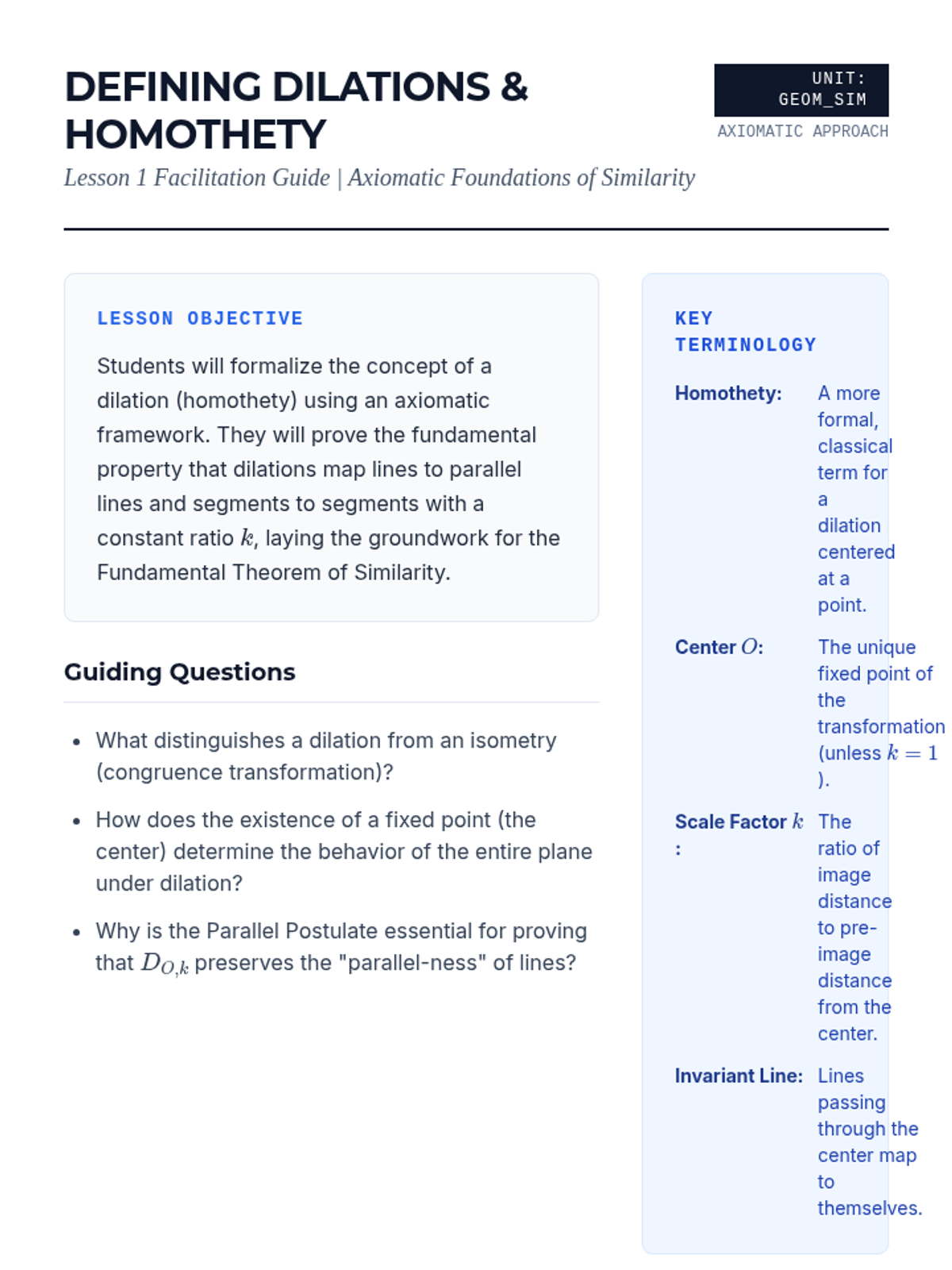
This undergraduate geometry sequence rigorously explores the axiomatic foundations of similarity, bridging the gap between transformational geometry and Euclidean proofs. Students move from the formal definition of dilations to proving major theorems like the Fundamental Theorem of Similarity, AA/SAS/SSS criteria, and advanced circle applications like Ptolemy's Theorem.
This undergraduate geometry sequence bridges classical Euclidean similarity with modern fractal theory. Students progress from formal proofs of homothety to calculating the Hausdorff dimension of self-similar sets, exploring how scaling laws govern both biological structures and infinite recursive shapes.
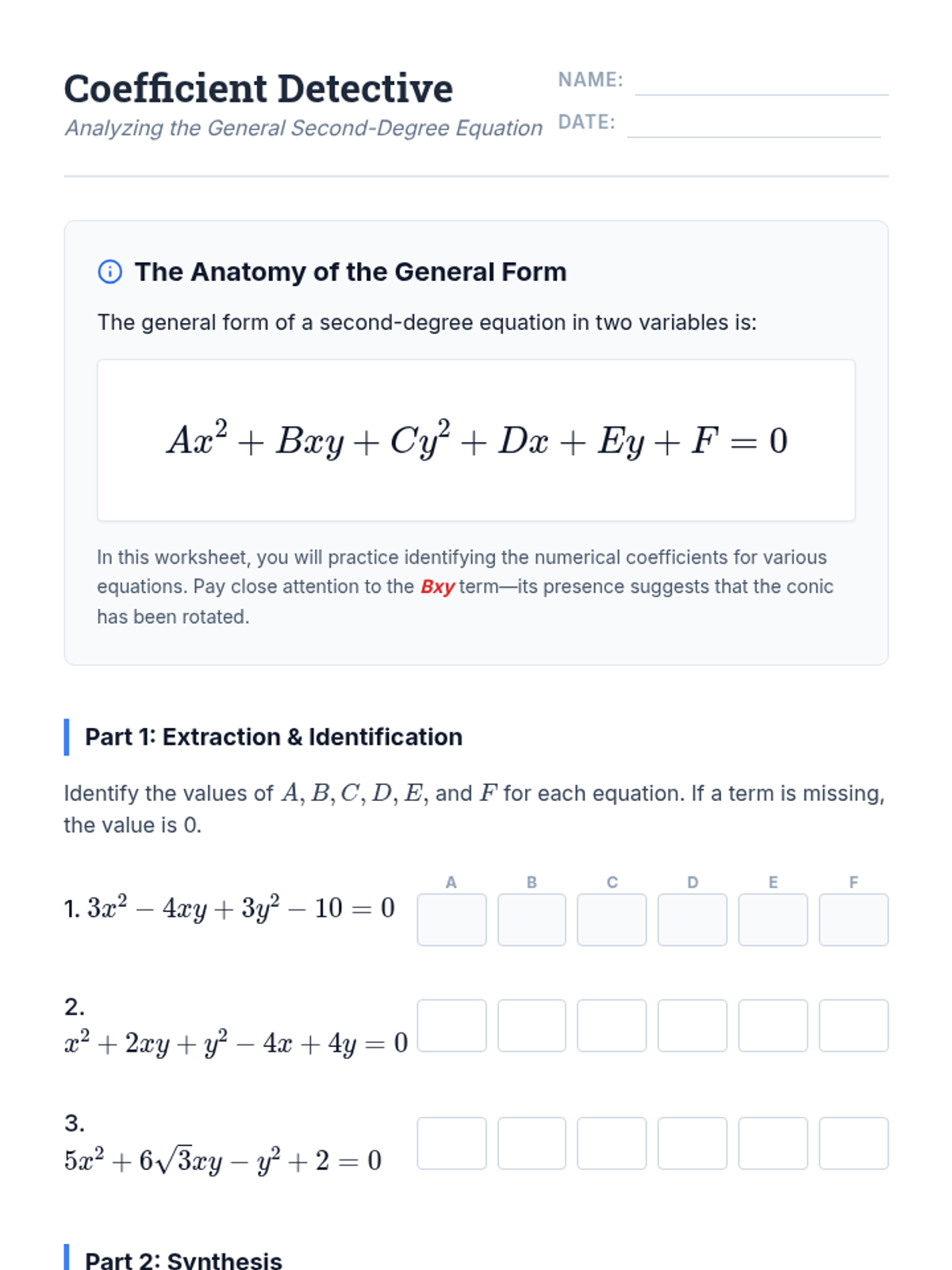
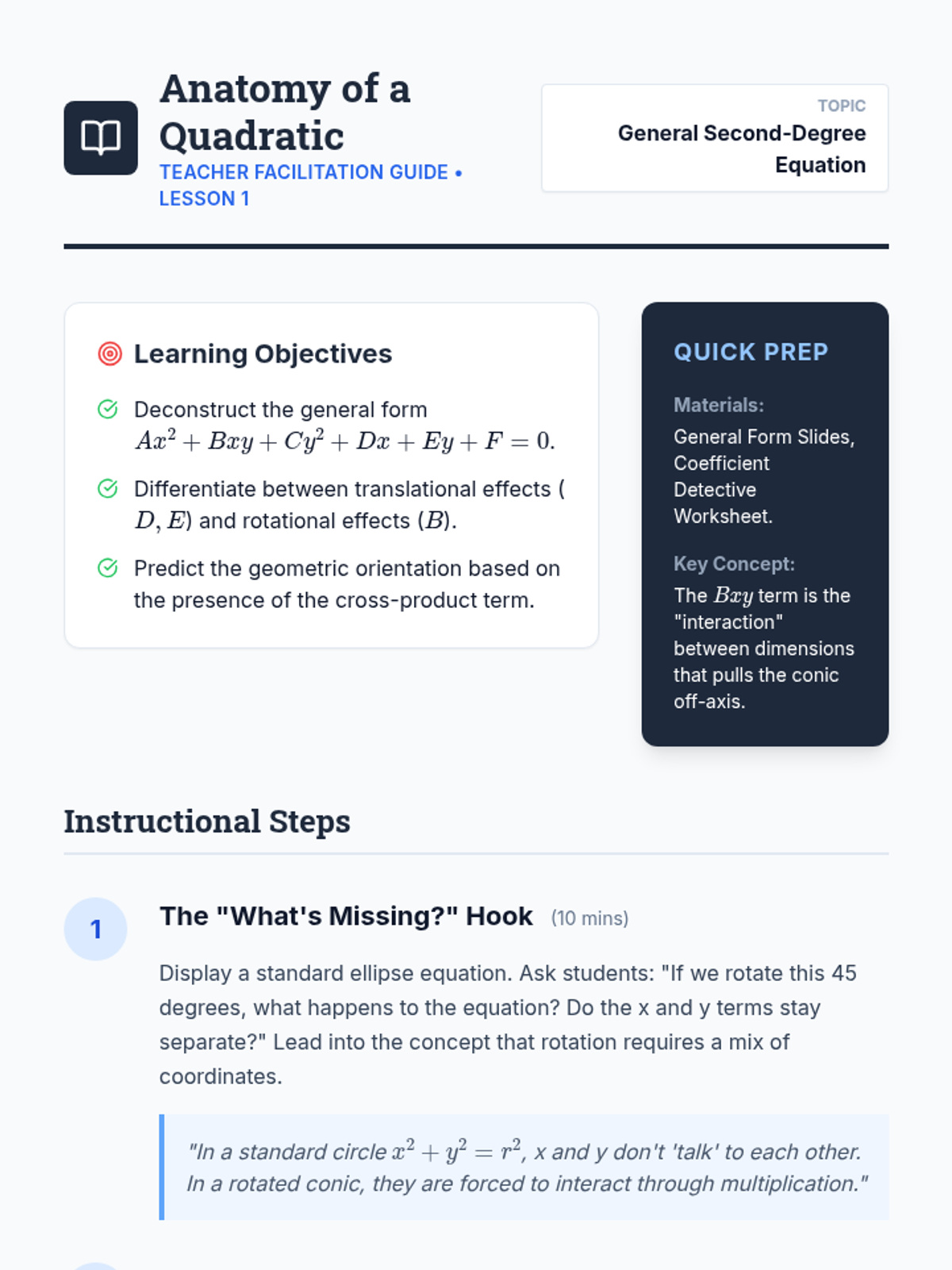
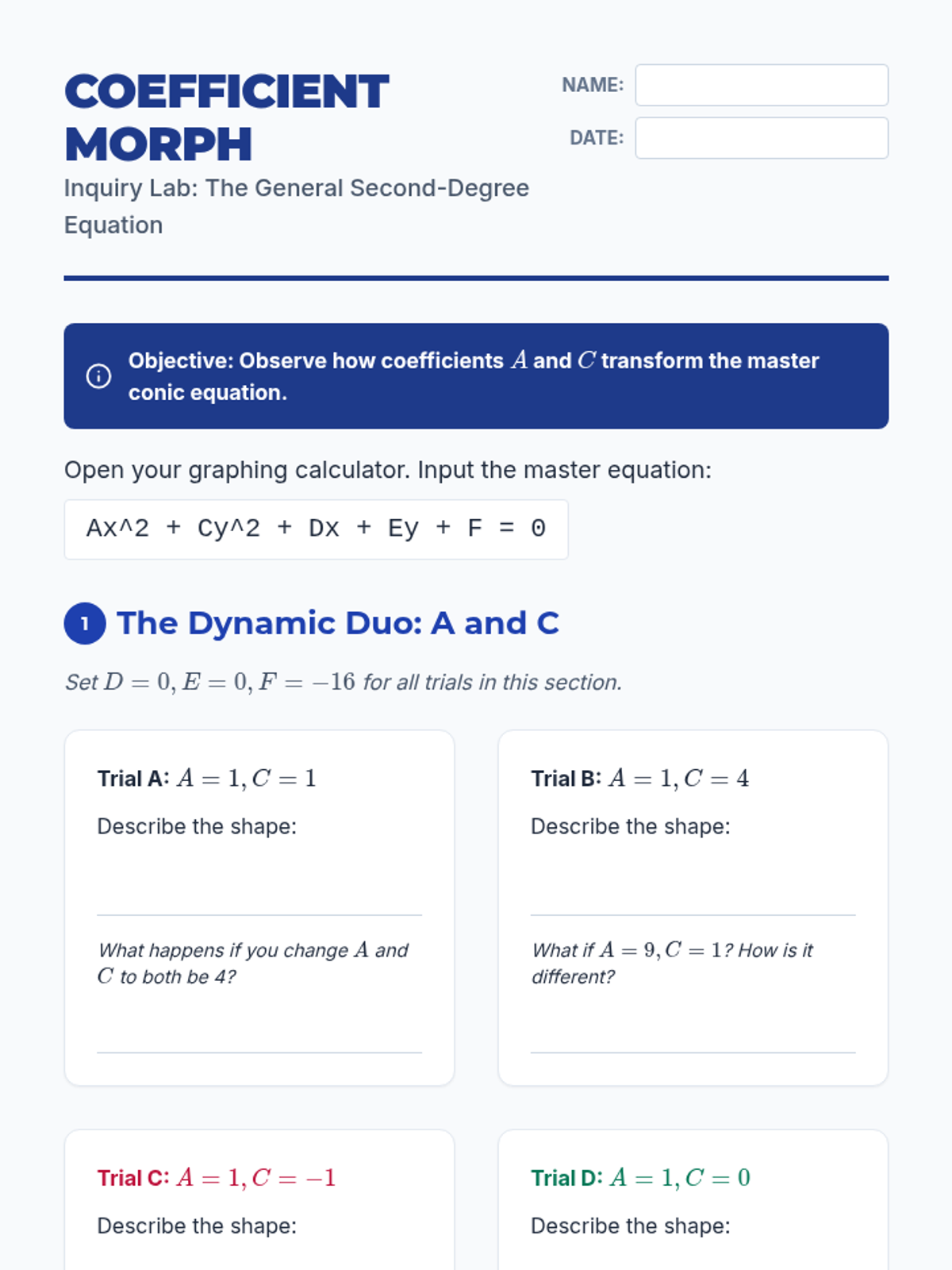
An advanced exploration of the general second-degree equation, focusing on identifying, rotating, and graphing conics with cross-product terms using both trigonometric and matrix methods.
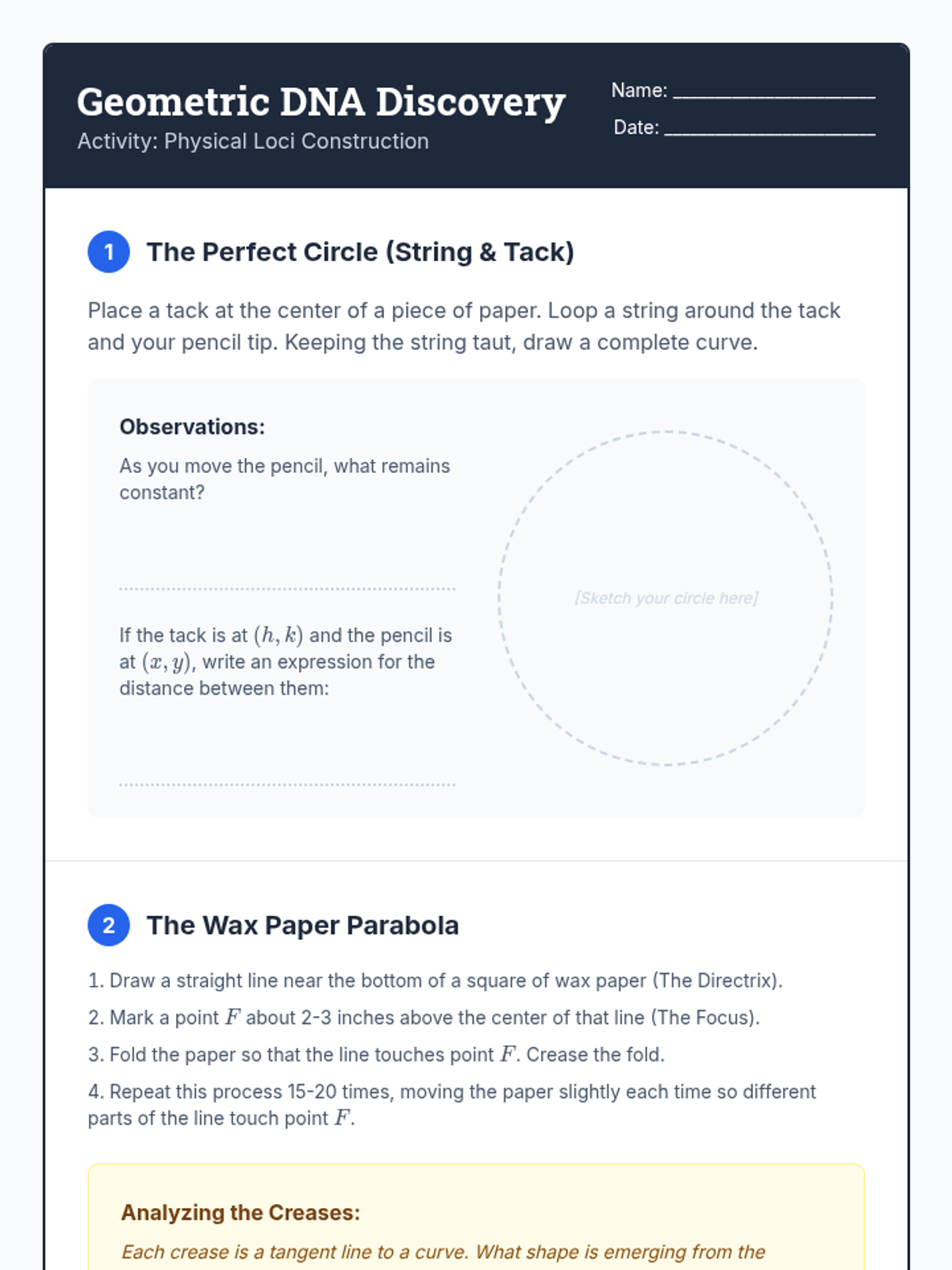
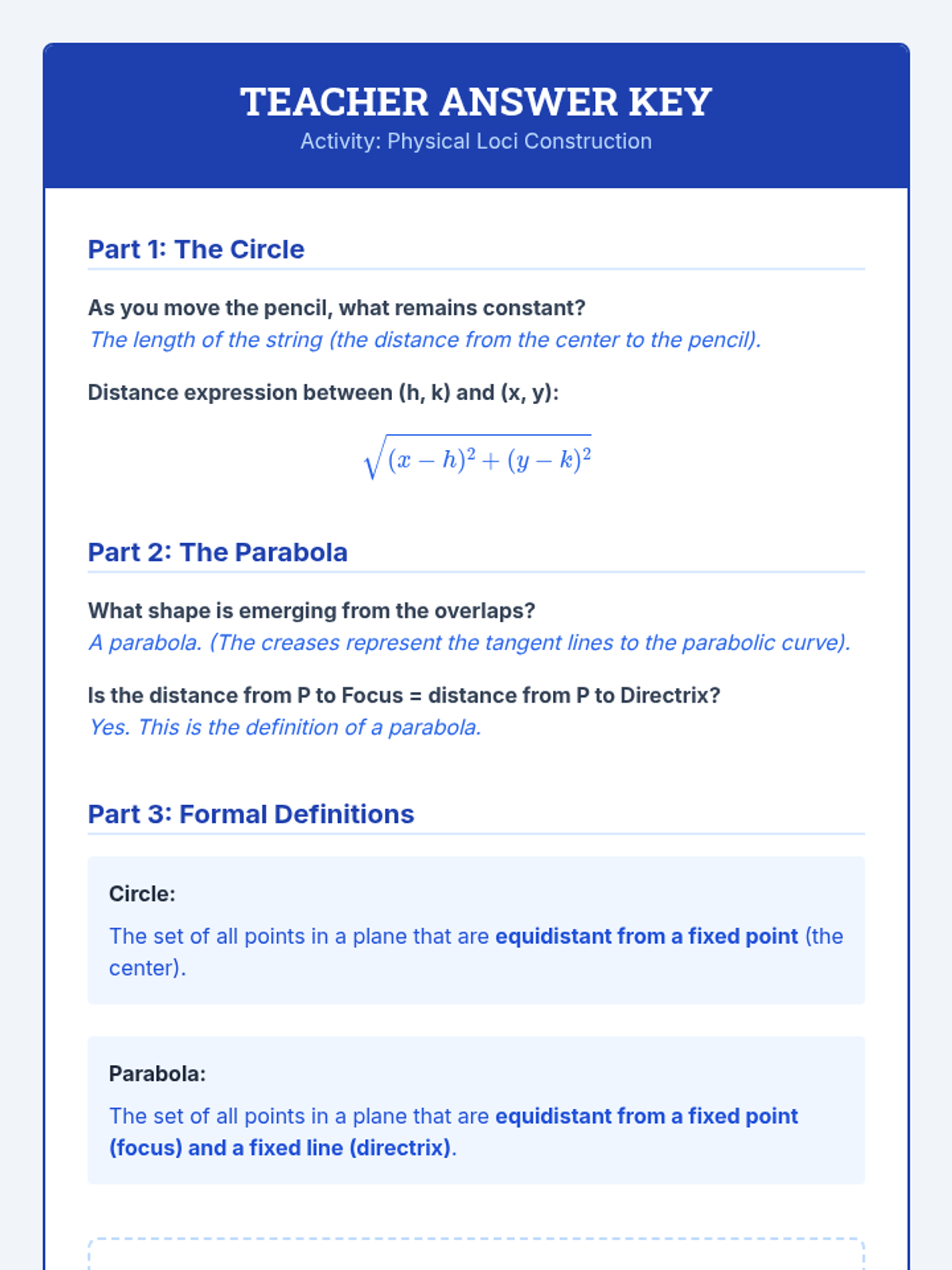
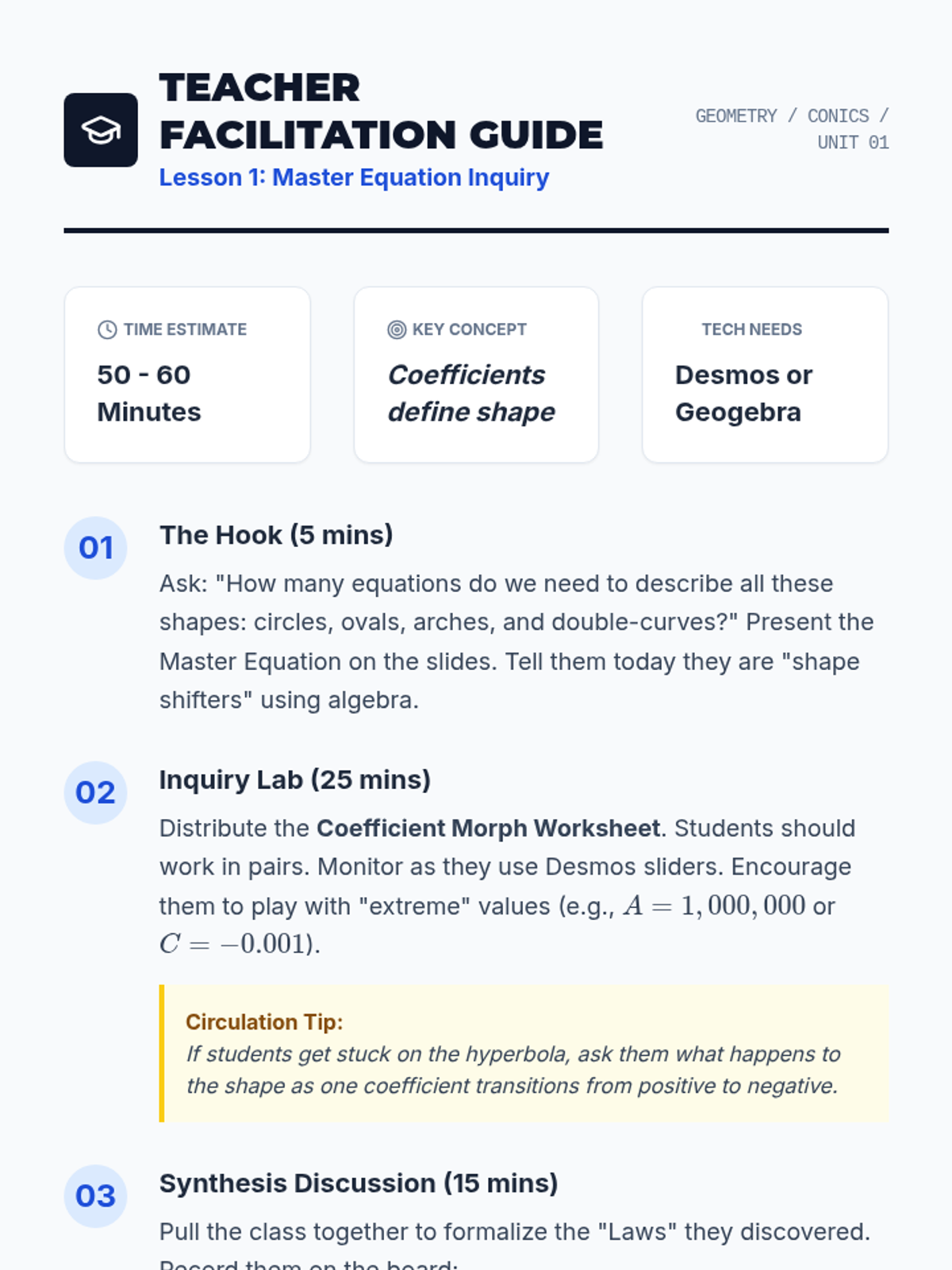
Students explore conic sections as geometric loci, deriving standard equations from distance-based definitions through inquiry, physical construction, and algebraic proof.
This mastery-based sequence focuses on the synthesis of all conic sections. Students learn to manipulate the General Second-Degree Equation to classify curves and transform them into standard forms.
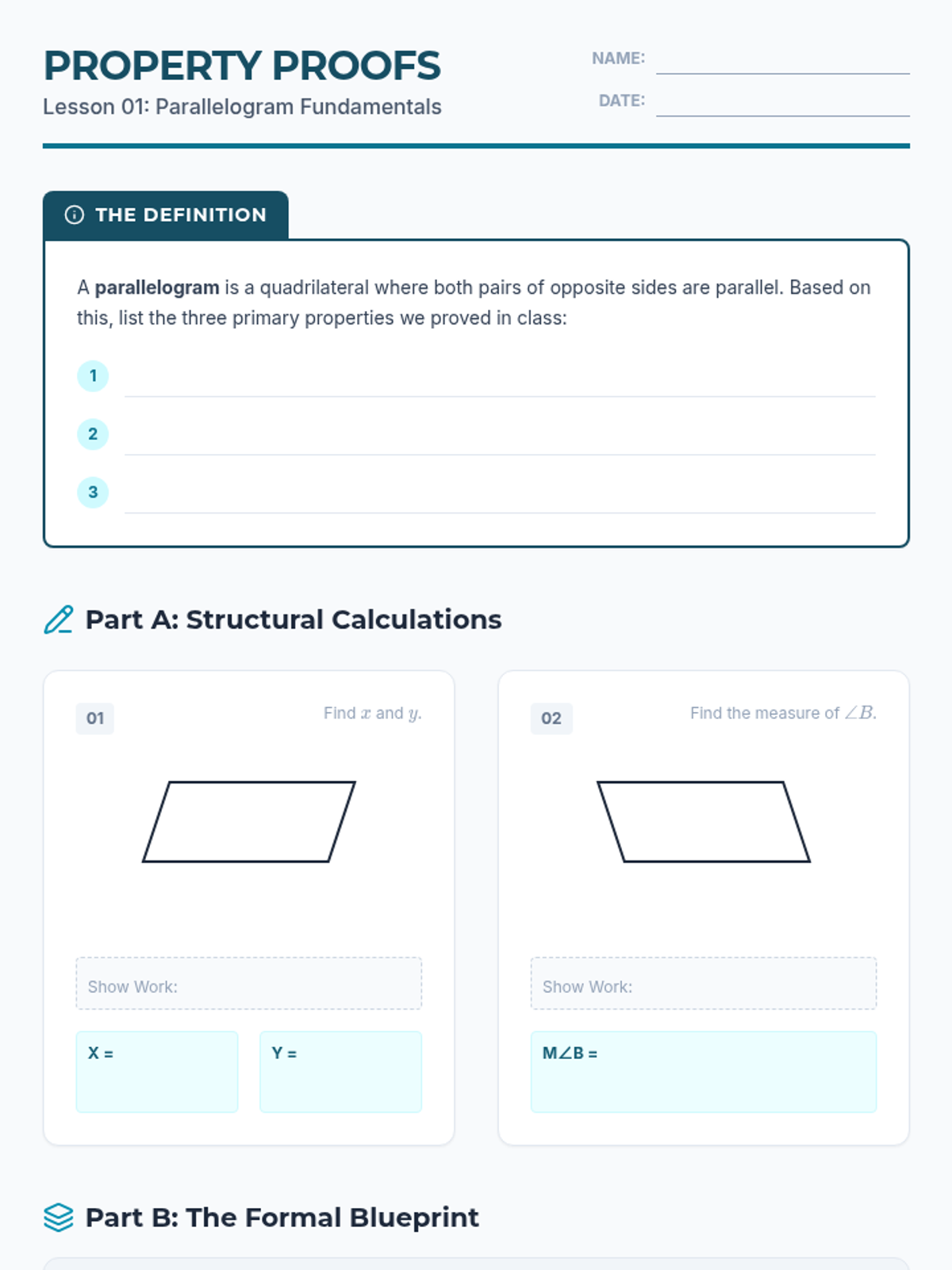
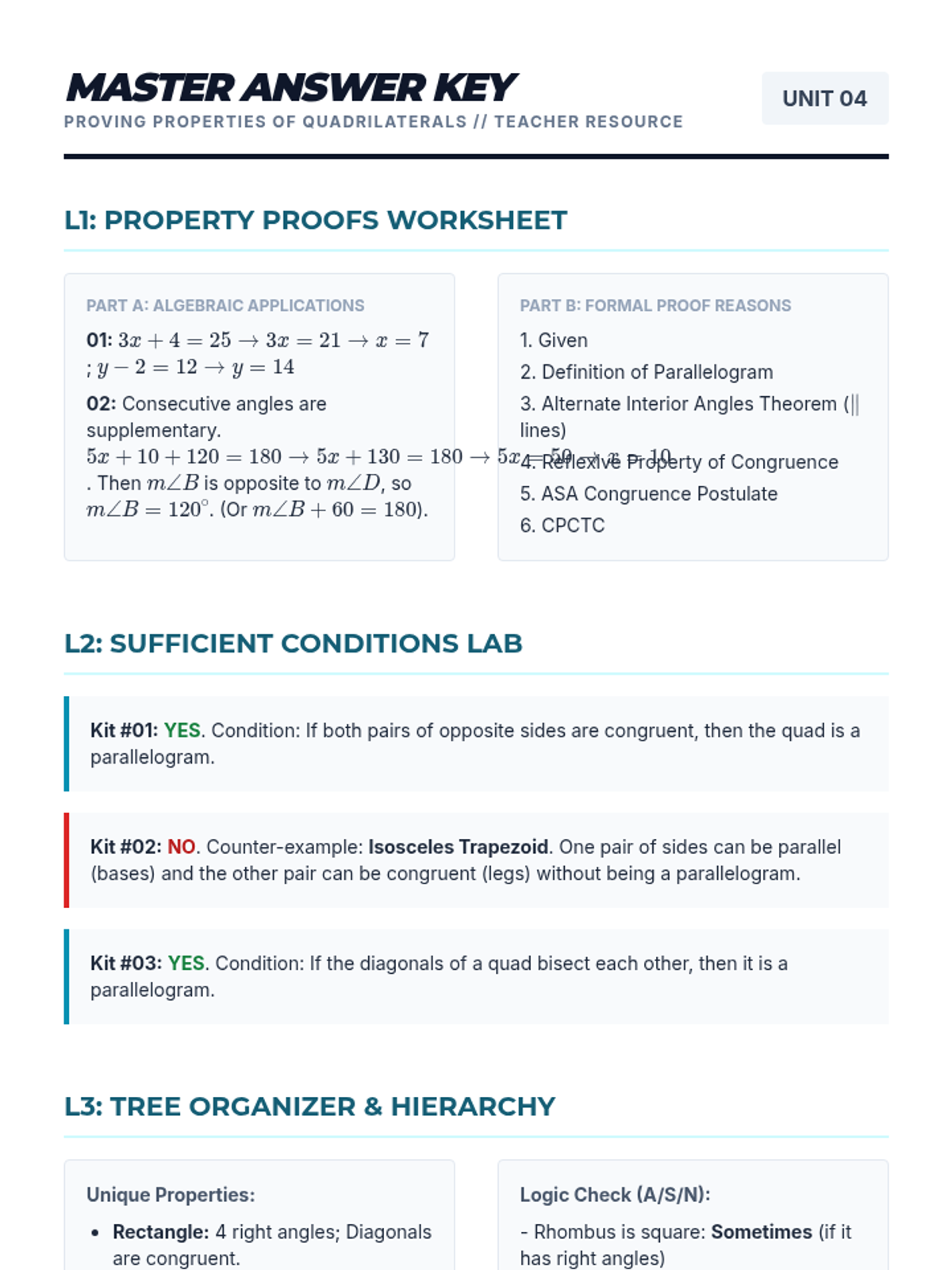
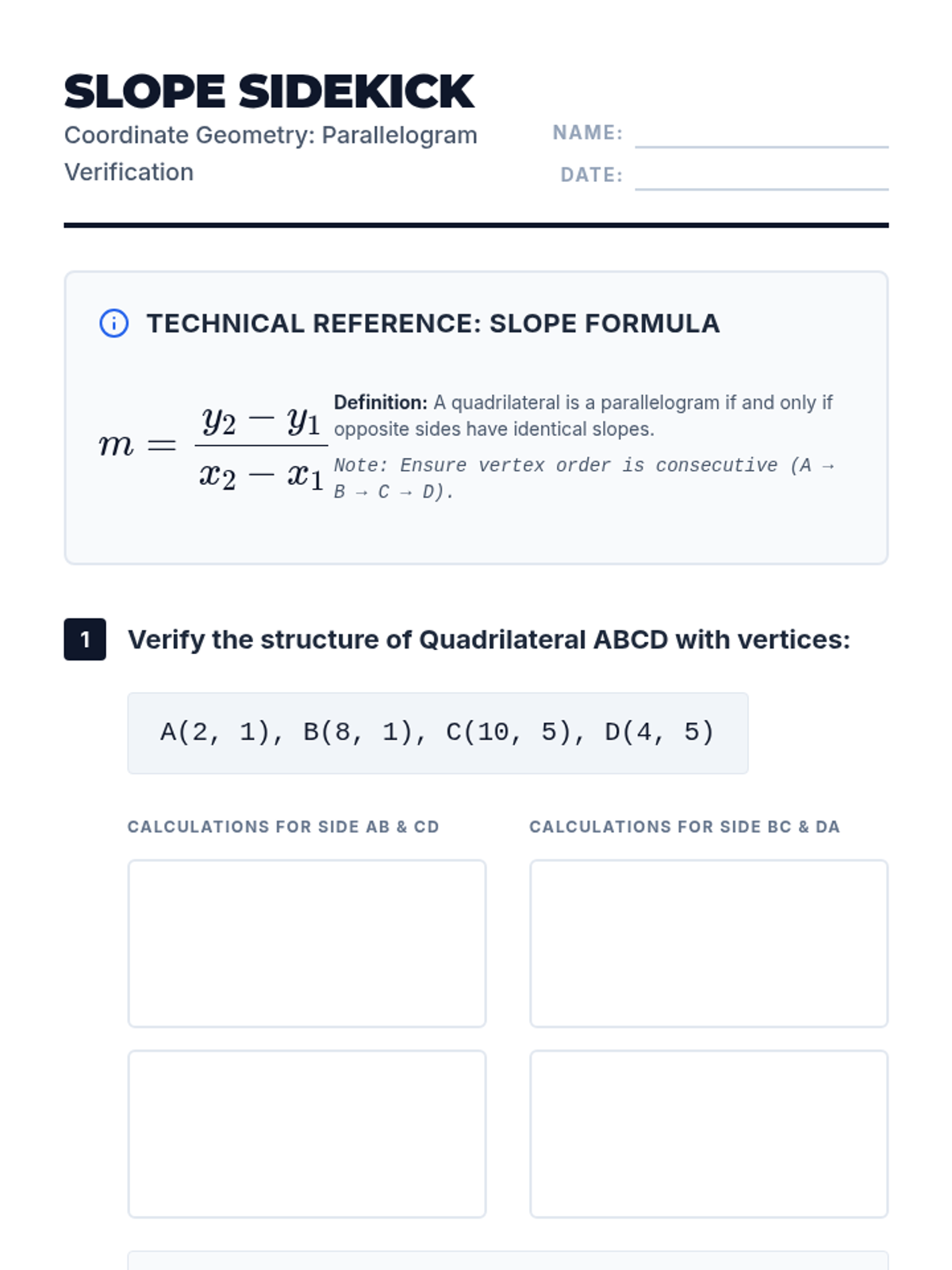
This sequence explores the geometric properties of quadrilaterals through formal proofs and coordinate geometry. Students progress from basic parallelogram properties to complex hierarchical classifications and algebraic verifications.
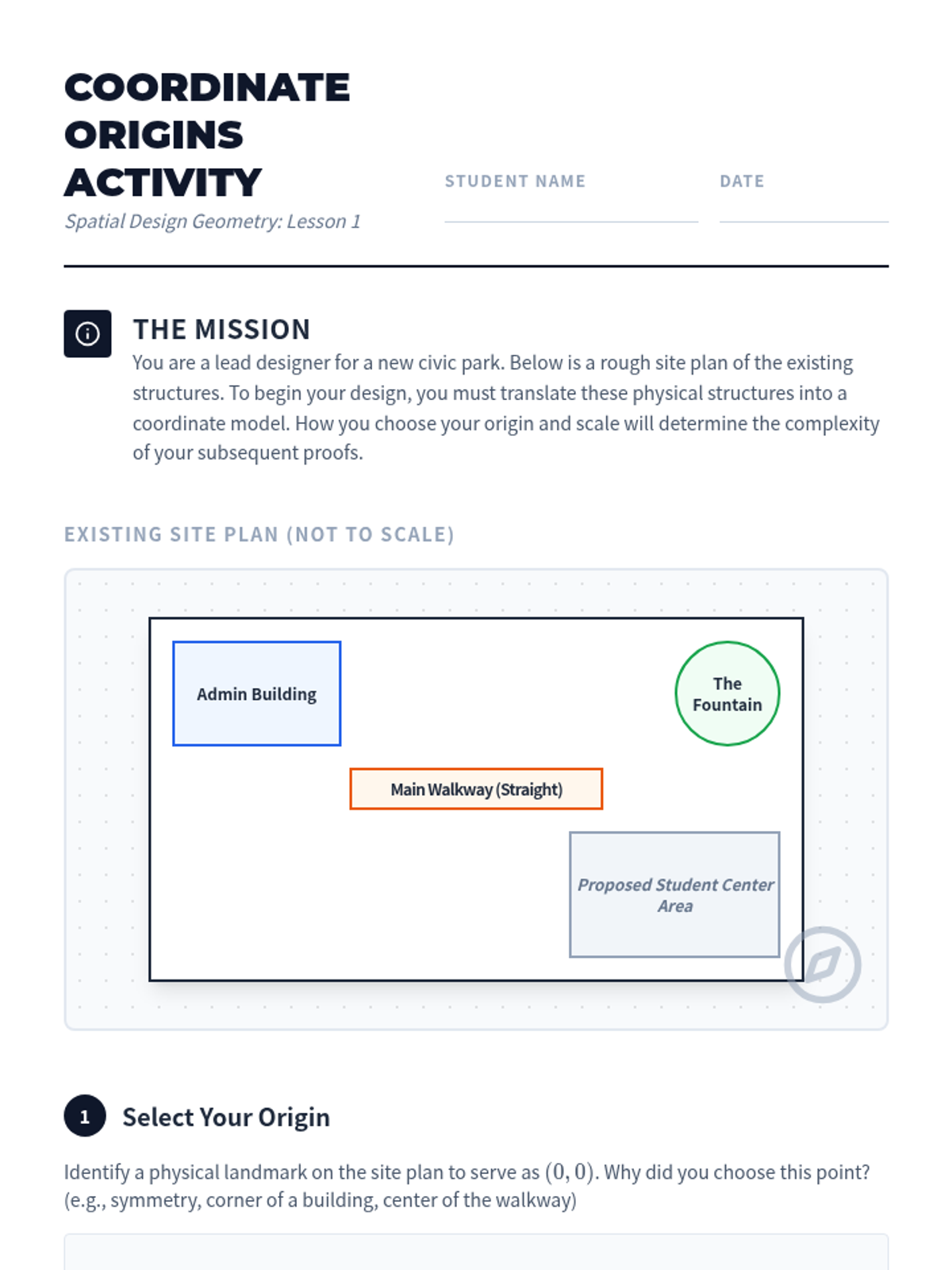
This undergraduate-level sequence explores the application of coordinate geometry in spatial design, surveying, and structural engineering. Students learn to translate physical spaces into algebraic models, use coordinate proofs to verify geometric properties, and optimize locations using distance-based functions.
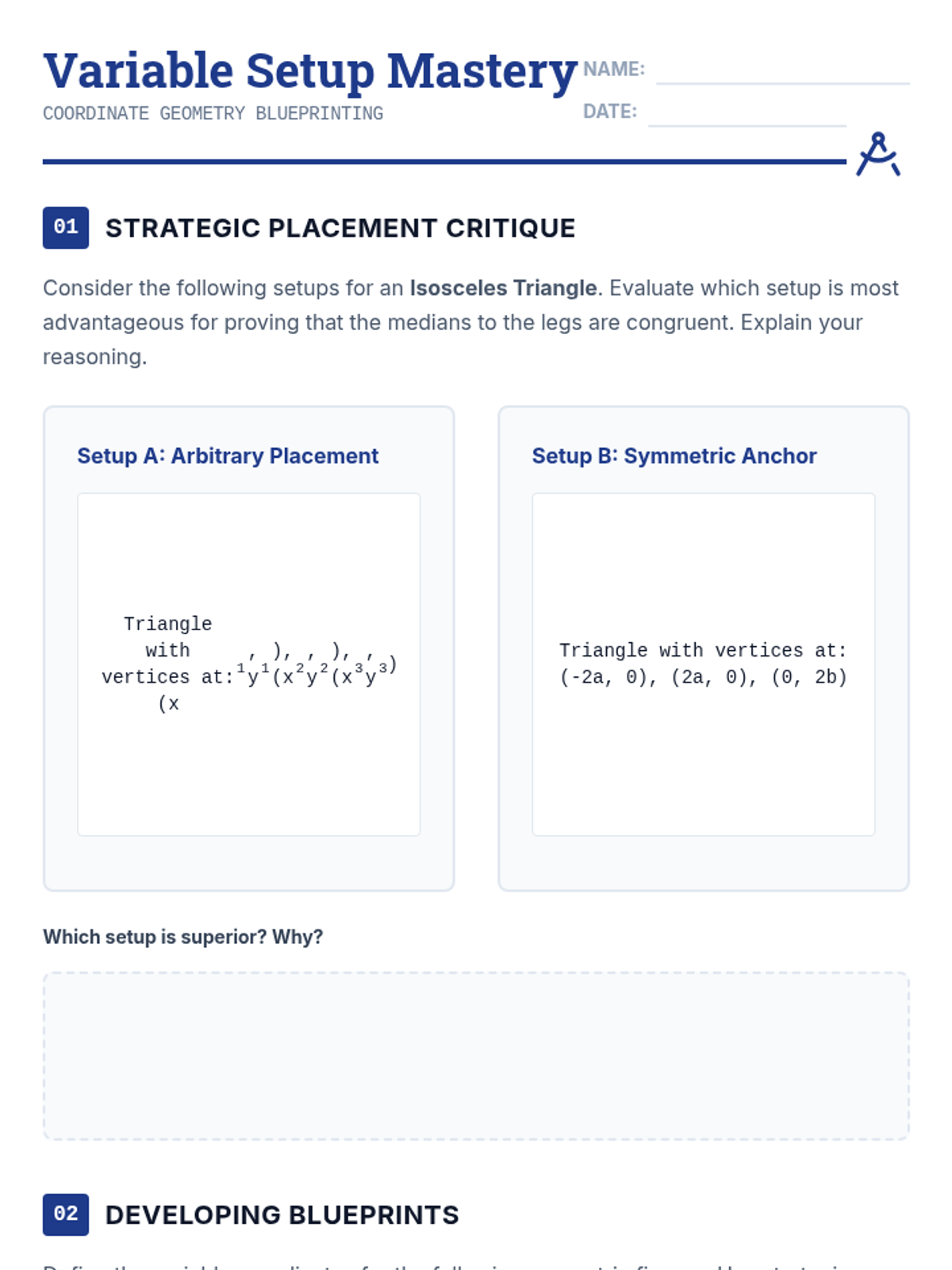
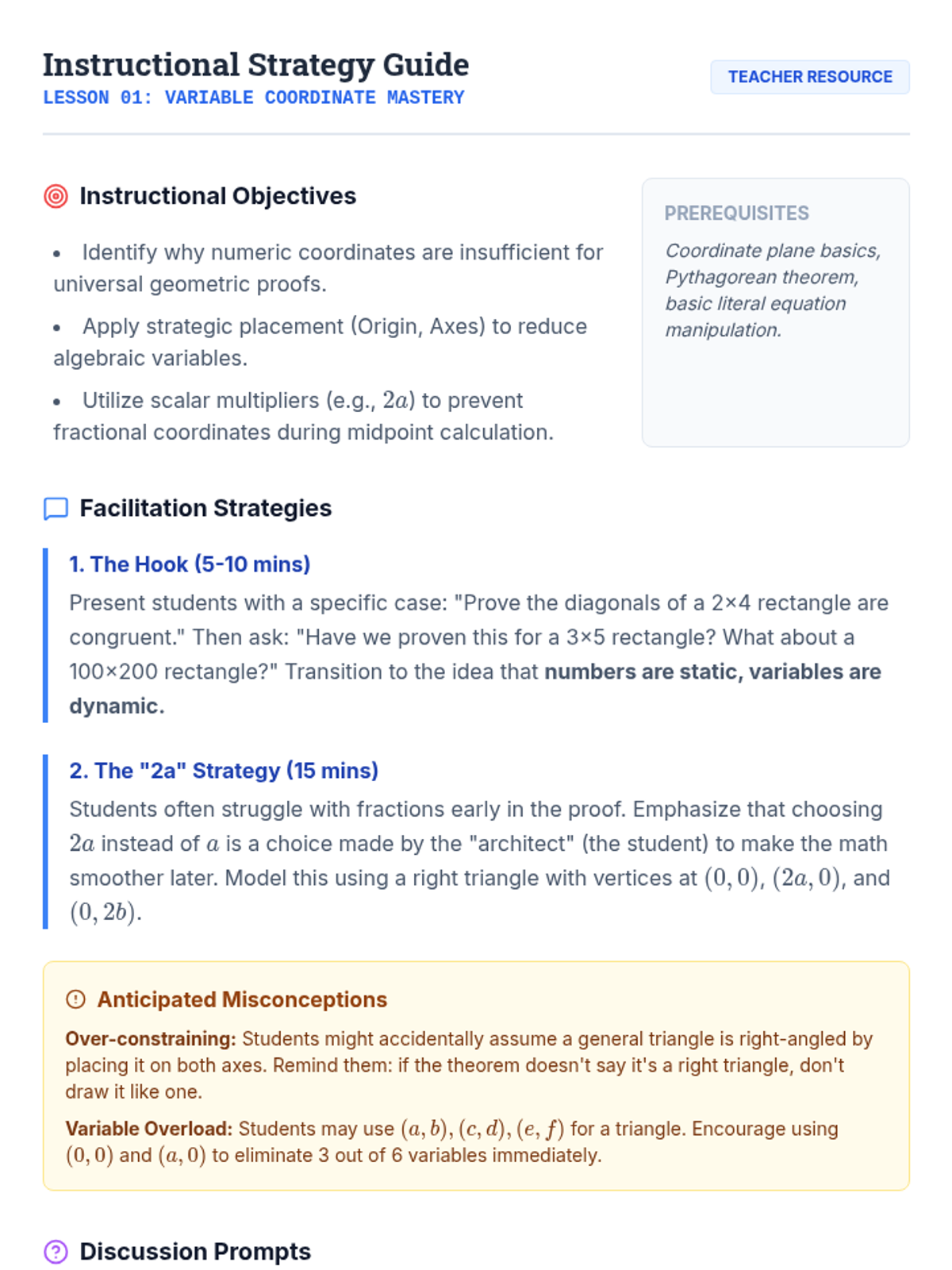
This undergraduate-level sequence focuses on the transition from numerical to algebraic coordinate geometry. Students learn to define shapes using variable coordinates, manipulate symbolic expressions to prove universal theorems, and handle complex concurrency proofs using literal systems of equations.
A rigorous undergraduate-level sequence exploring the algebraic classification of quadrilaterals using coordinate geometry. Students apply slope, distance, and midpoint formulas to prove properties of parallelograms, rectangles, rhombi, and squares.
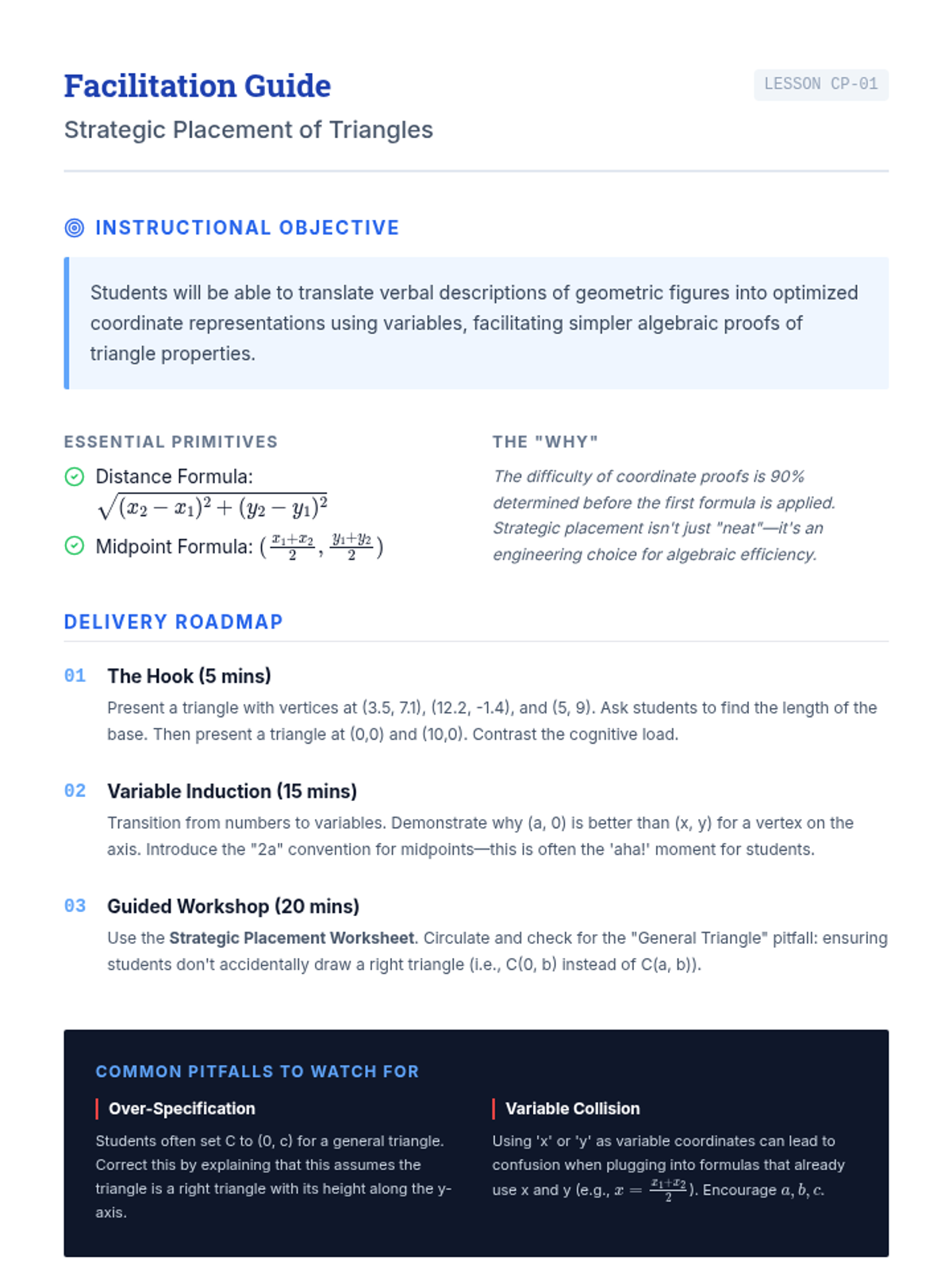
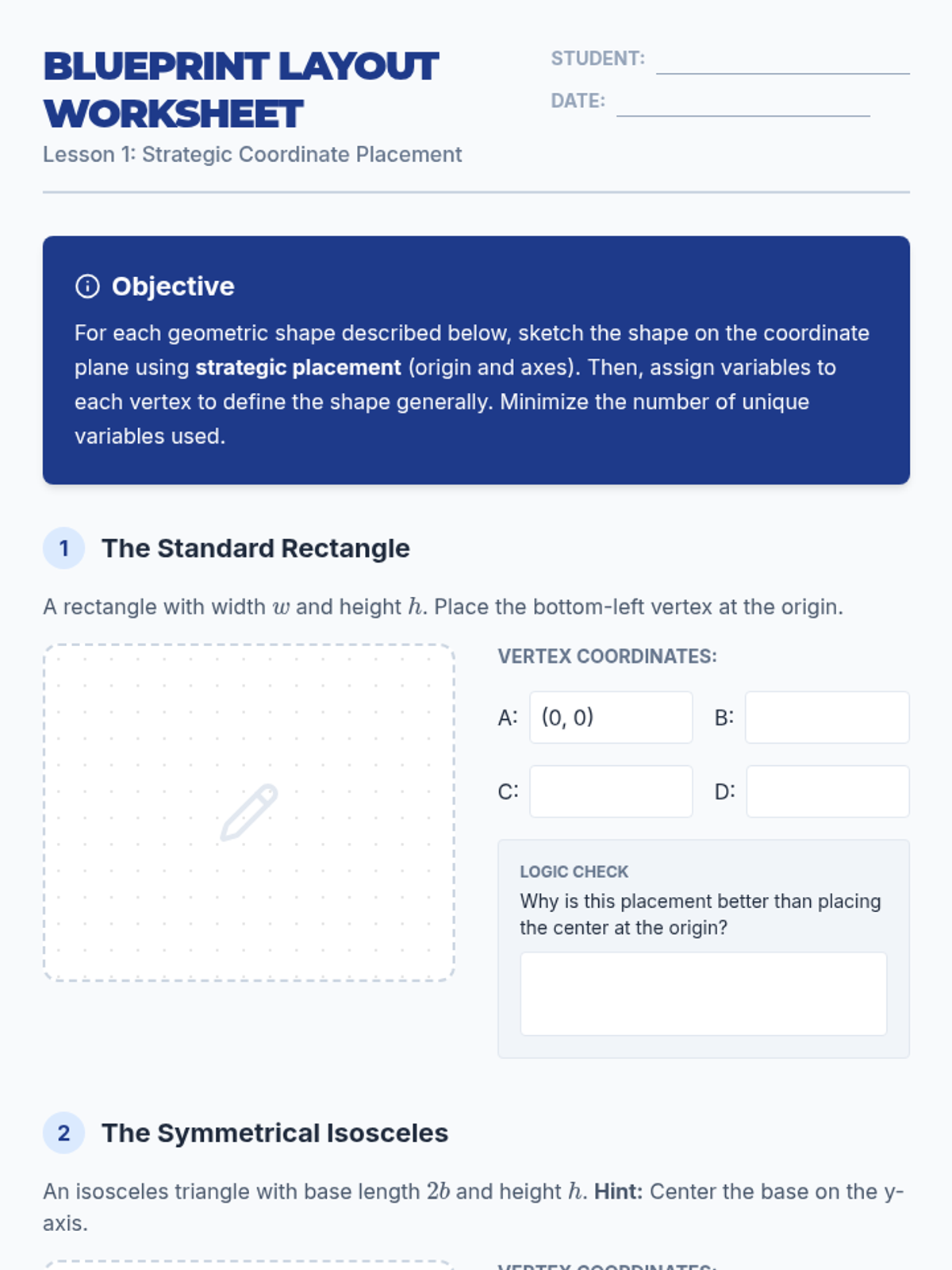
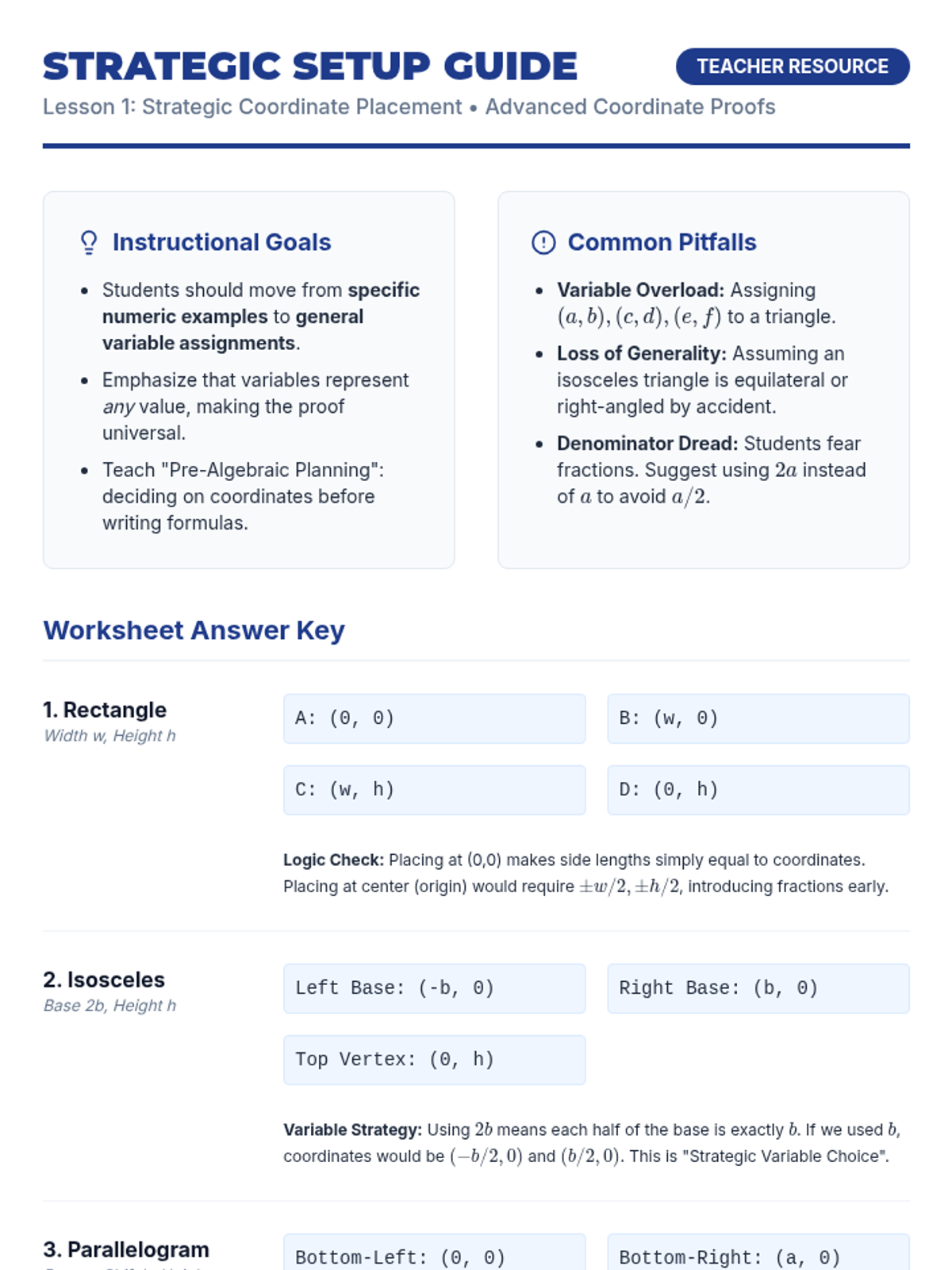
This sequence guides undergraduate students through the algebraic verification of geometric theorems using coordinate geometry. Starting with the strategic placement of figures, students progress through the Triangle Midsegment Theorem, classification of special triangles, and the properties of centroids.
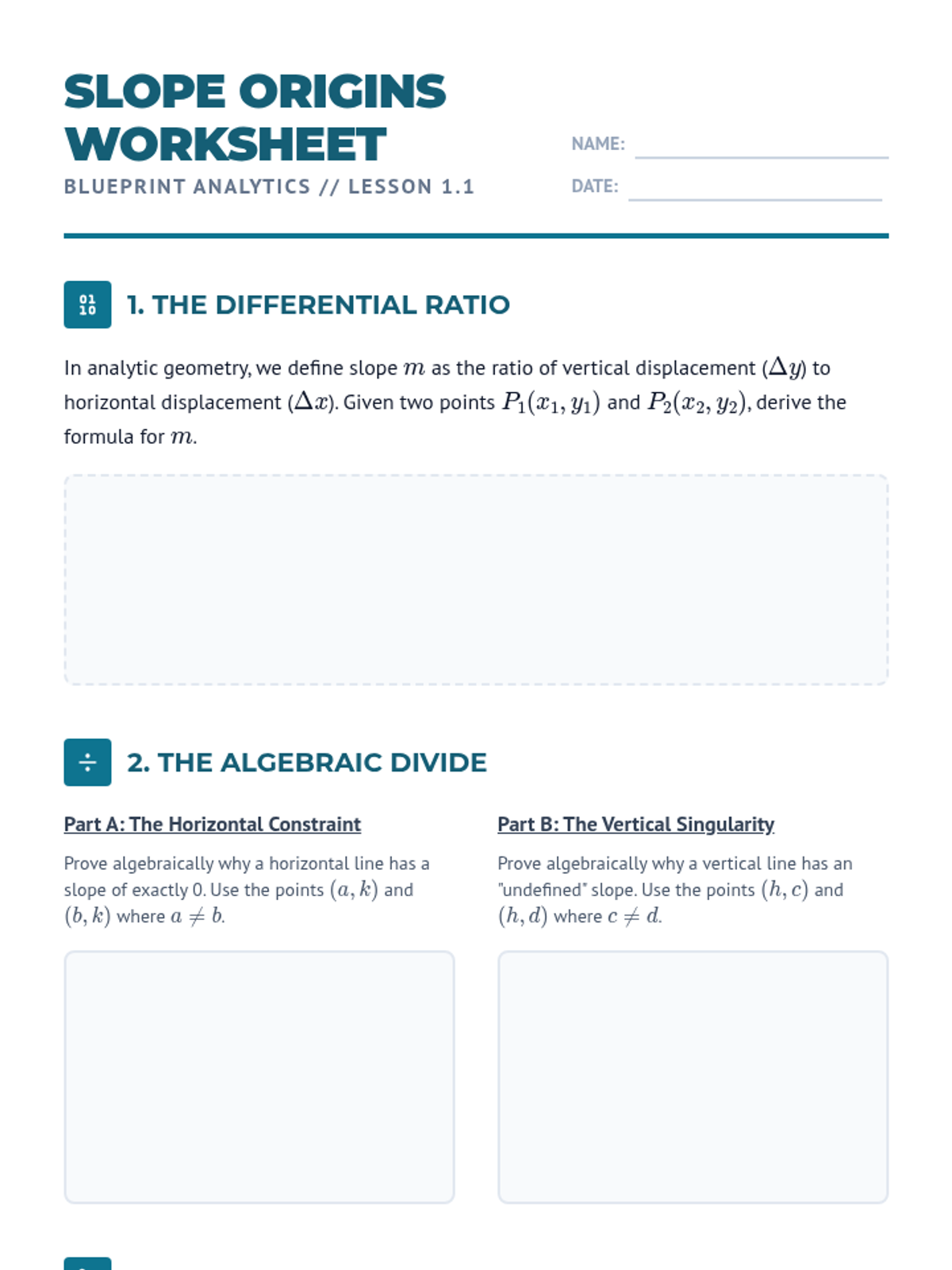
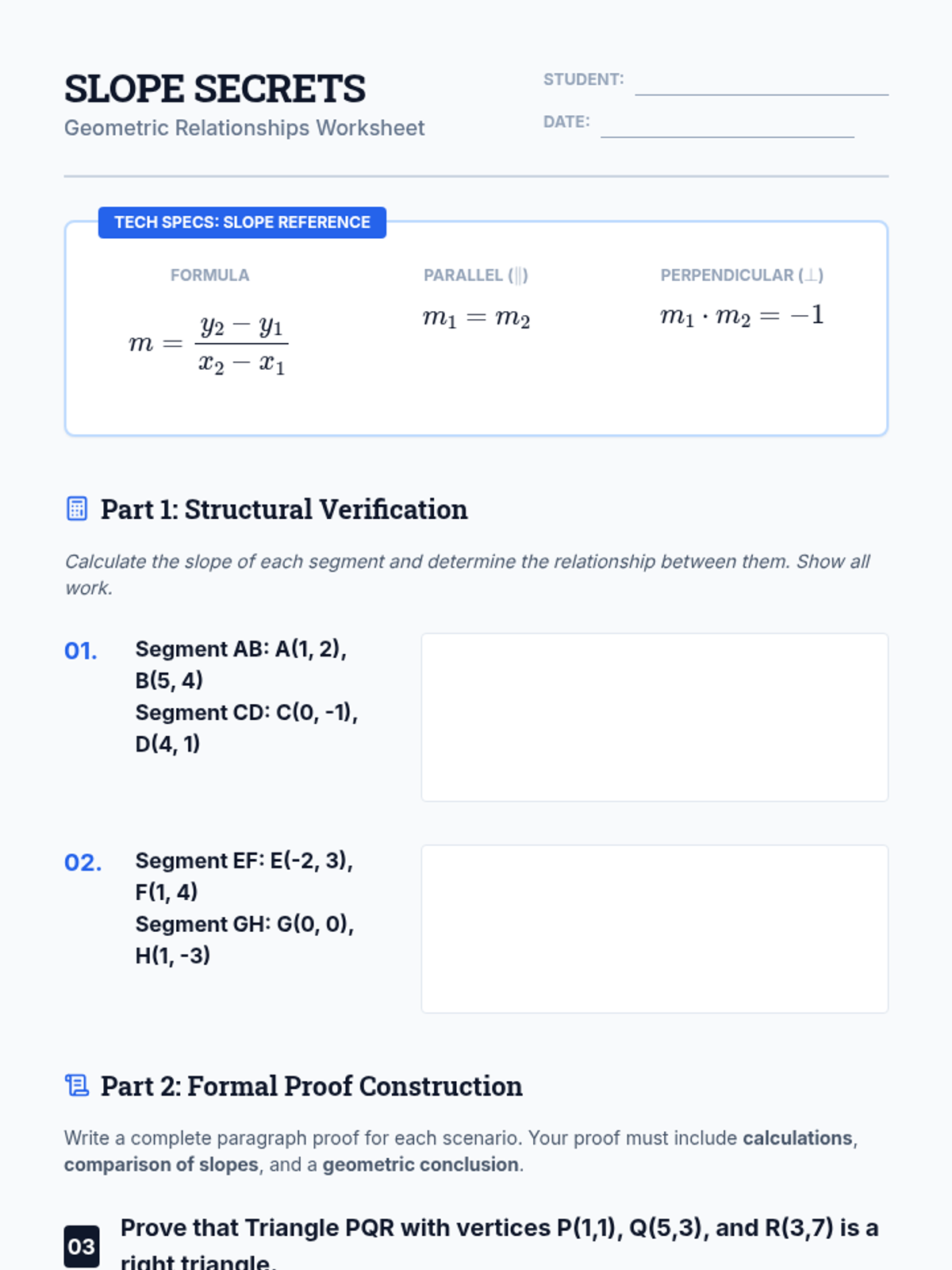
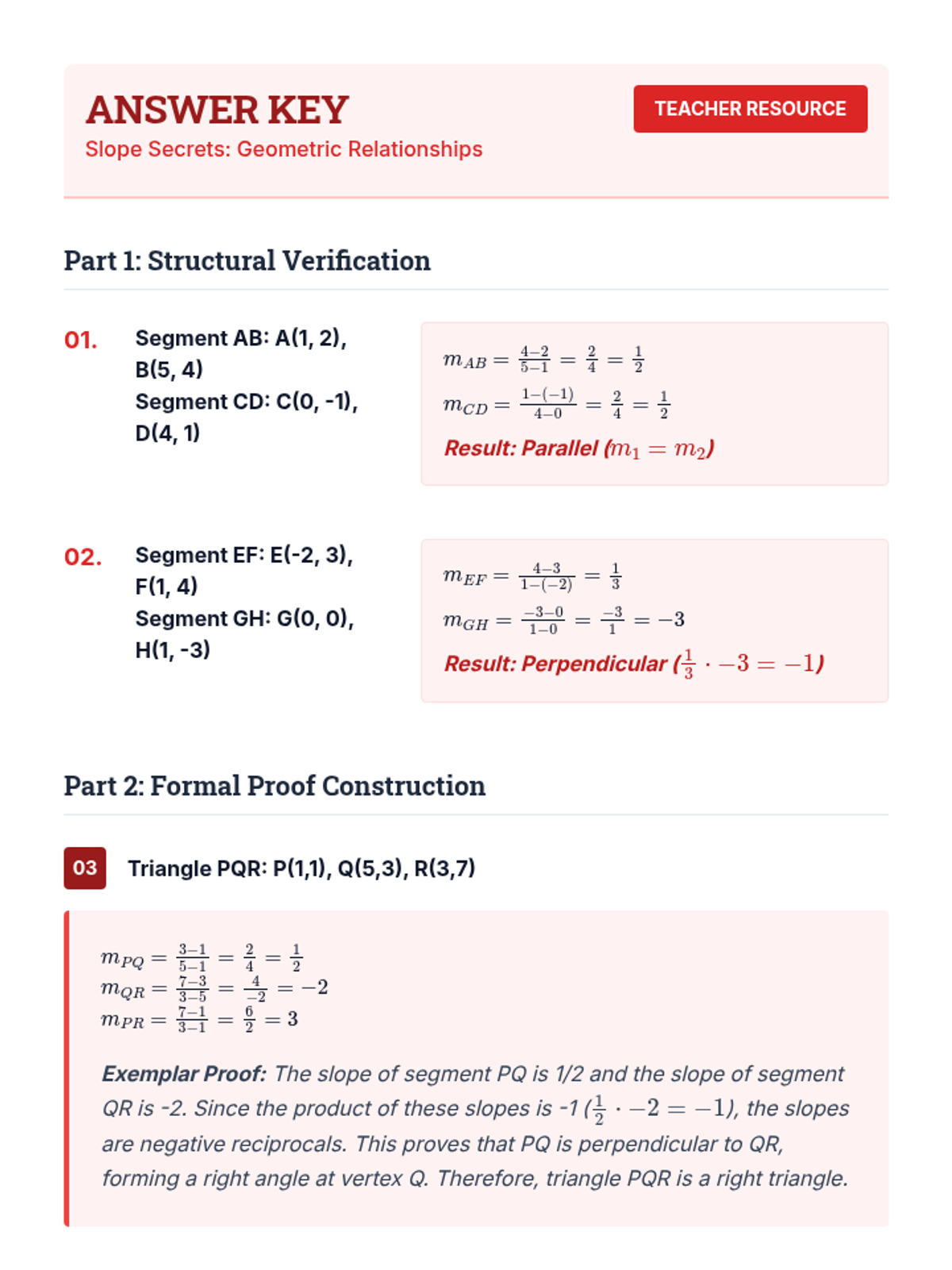
A rigorous undergraduate sequence bridging basic graphing and formal analytic geometry. Students derive slope properties, prove parallel and perpendicular conditions algebraically, and synthesize these concepts to verify geometric relationships using the distance formula and linear equations.
An advanced 12th-grade sequence on coordinate geometry proofs, focusing on strategic shape placement, algebraic manipulation with general variables, and proving classic theorems like the trapezoid midsegment and the triangle centroid.
This sequence bridges coordinate geometry and algebraic proof, teaching 12th-grade students to use slope, distance, and midpoint formulas to formally verify geometric properties and theorems, culminating in generalized proofs using variable coordinates.
Students transition from Cartesian to polar coordinates, exploring the geometry of circular grids and the equations that define complex curves like roses and lima\u00e7ons. The unit covers plotting, conversion, and advanced graphing analysis with a focus on symmetry and intersection.
This sequence introduces students to parametric equations as a tool for modeling dynamic systems. Students explore the relationship between independent components, algebraic conversion to Cartesian form, and real-world applications like projectile motion and cycloids.
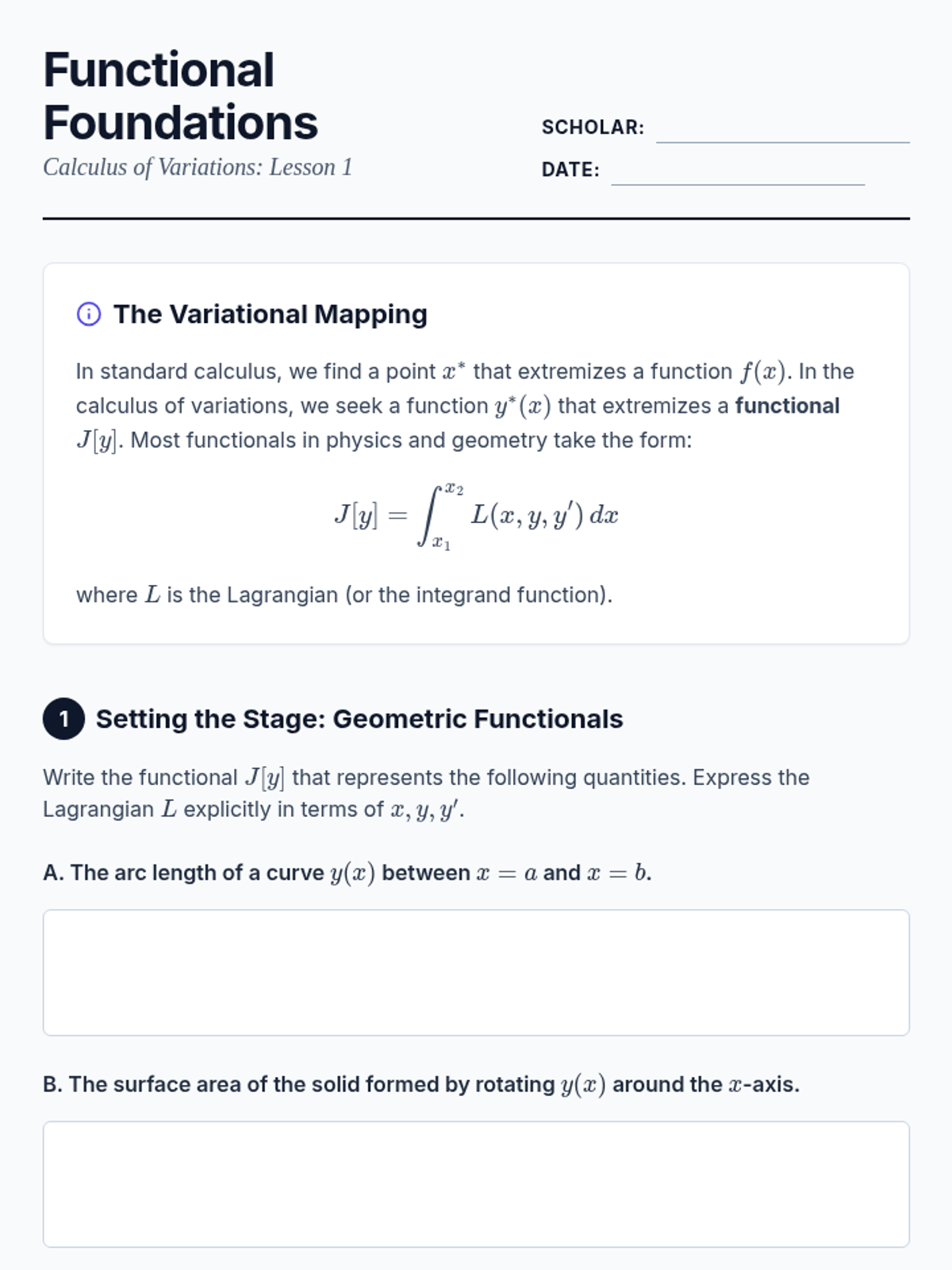
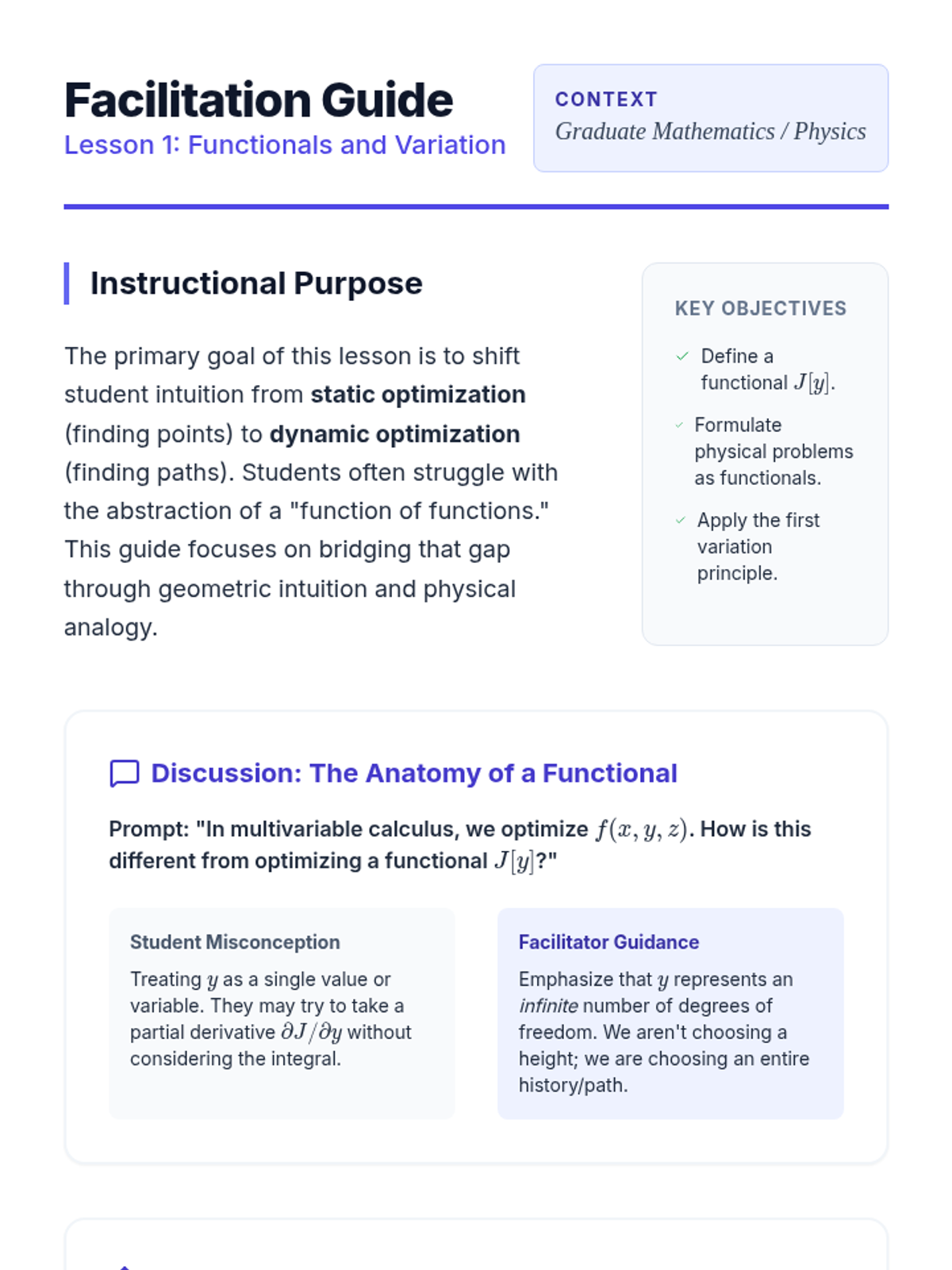
A graduate-level exploration of the Calculus of Variations, focusing on optimizing functionals. Students derive the Euler-Lagrange equation and apply it to physics and geometry problems like the Brachistochrone and Isoperimetric challenges.
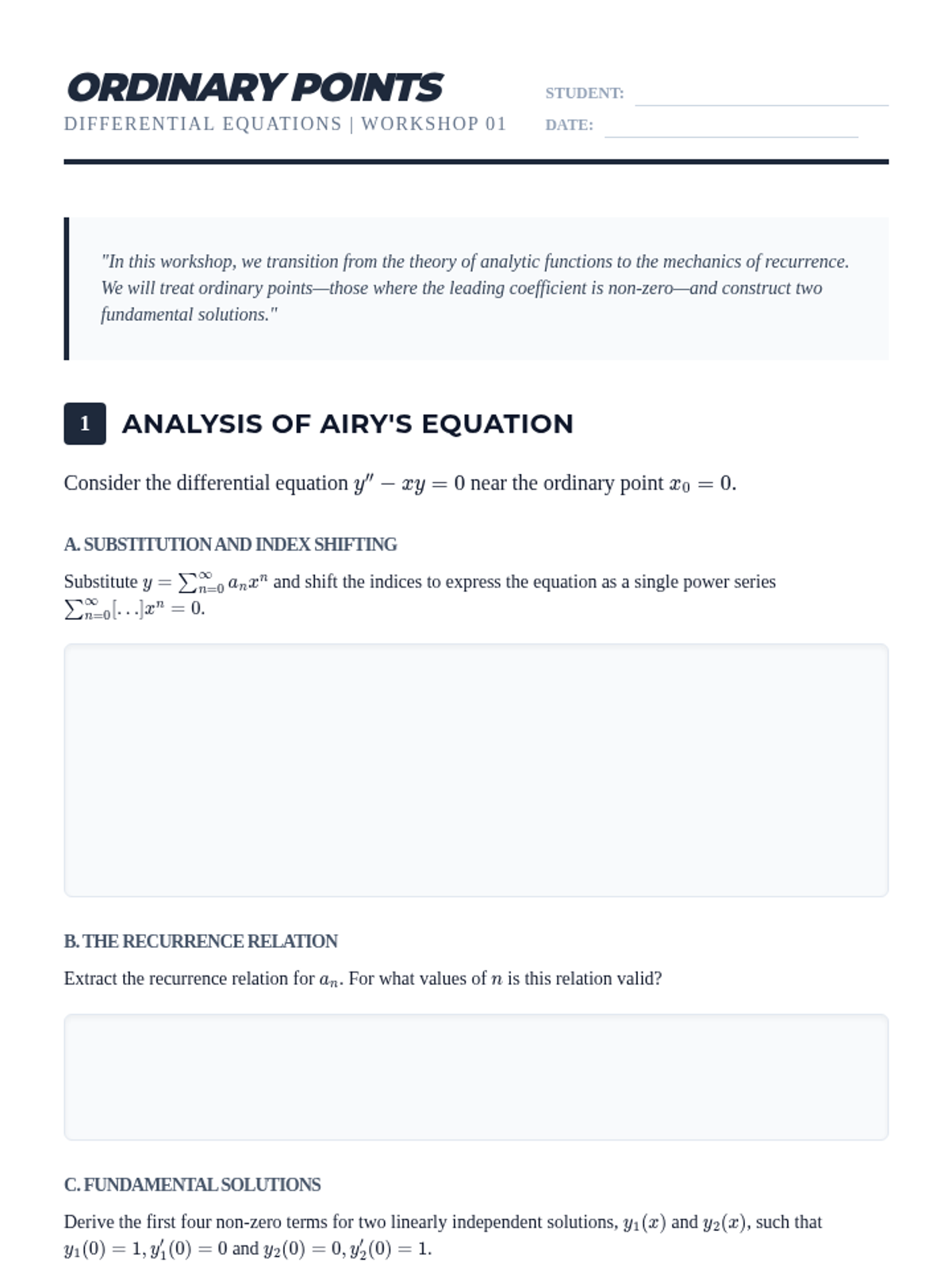
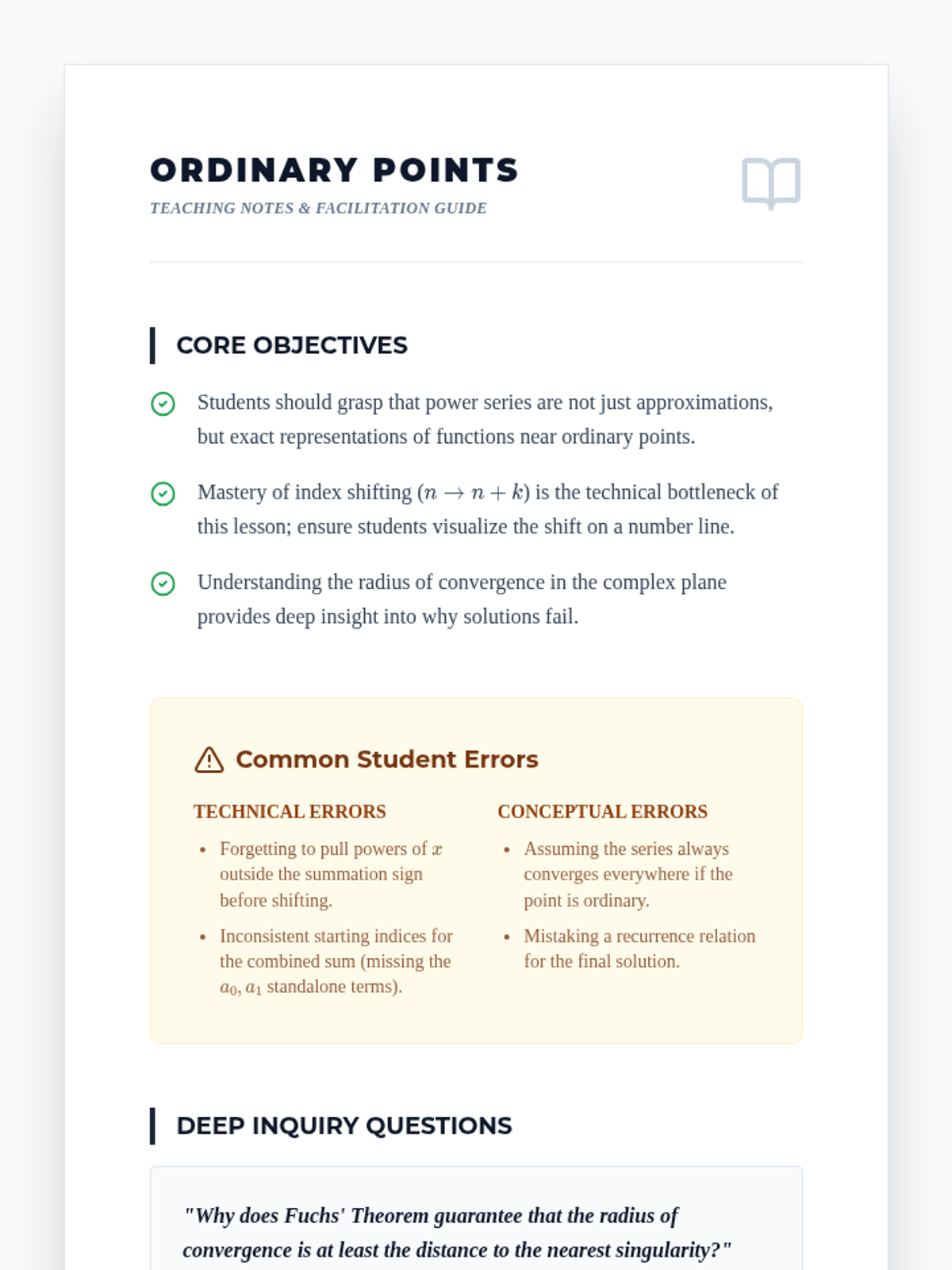
A comprehensive graduate-level exploration of series solutions for differential equations with variable coefficients, focusing on power series, the Method of Frobenius, and the properties of Bessel and Legendre functions within the framework of Sturm-Liouville theory.
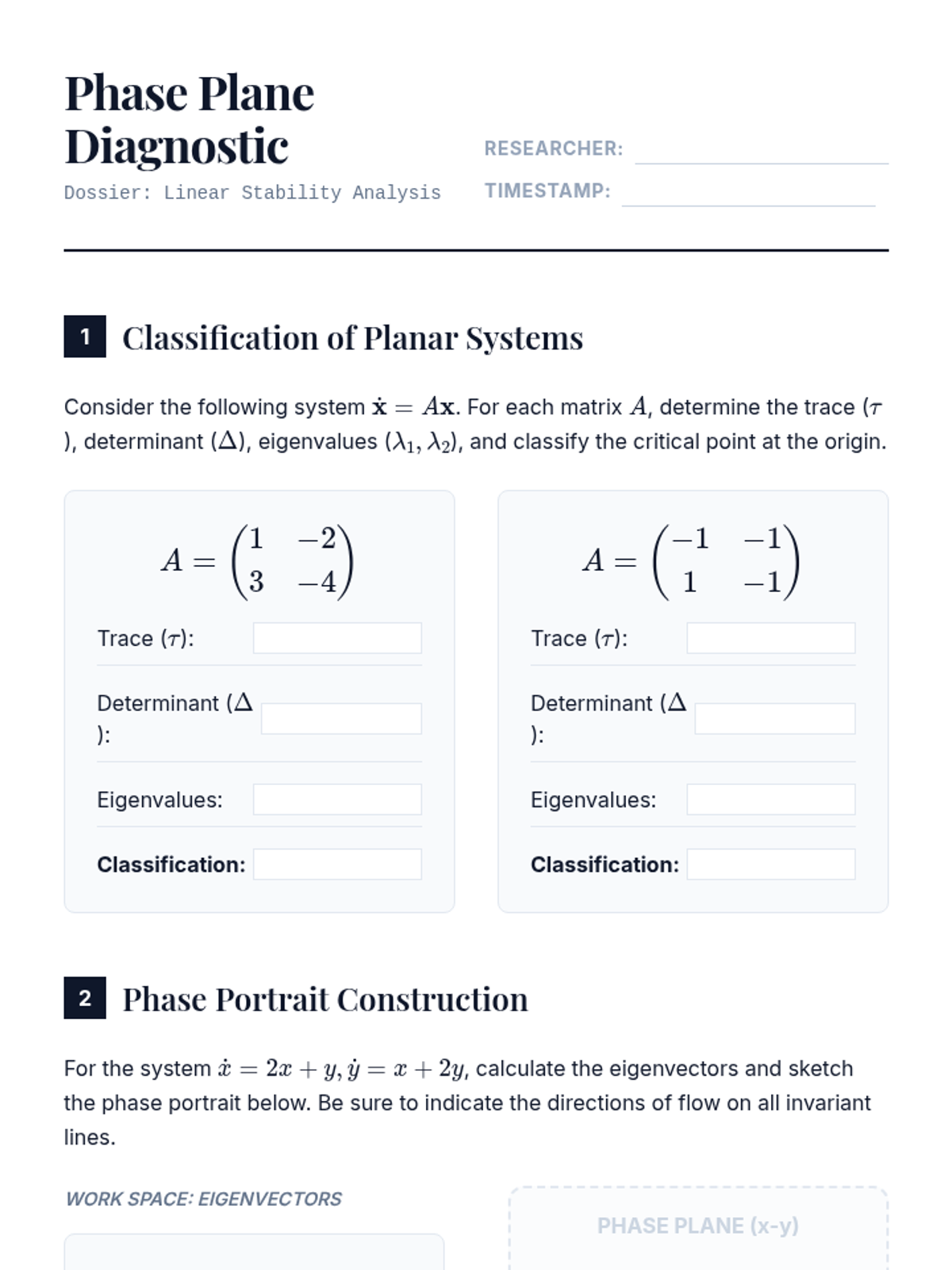
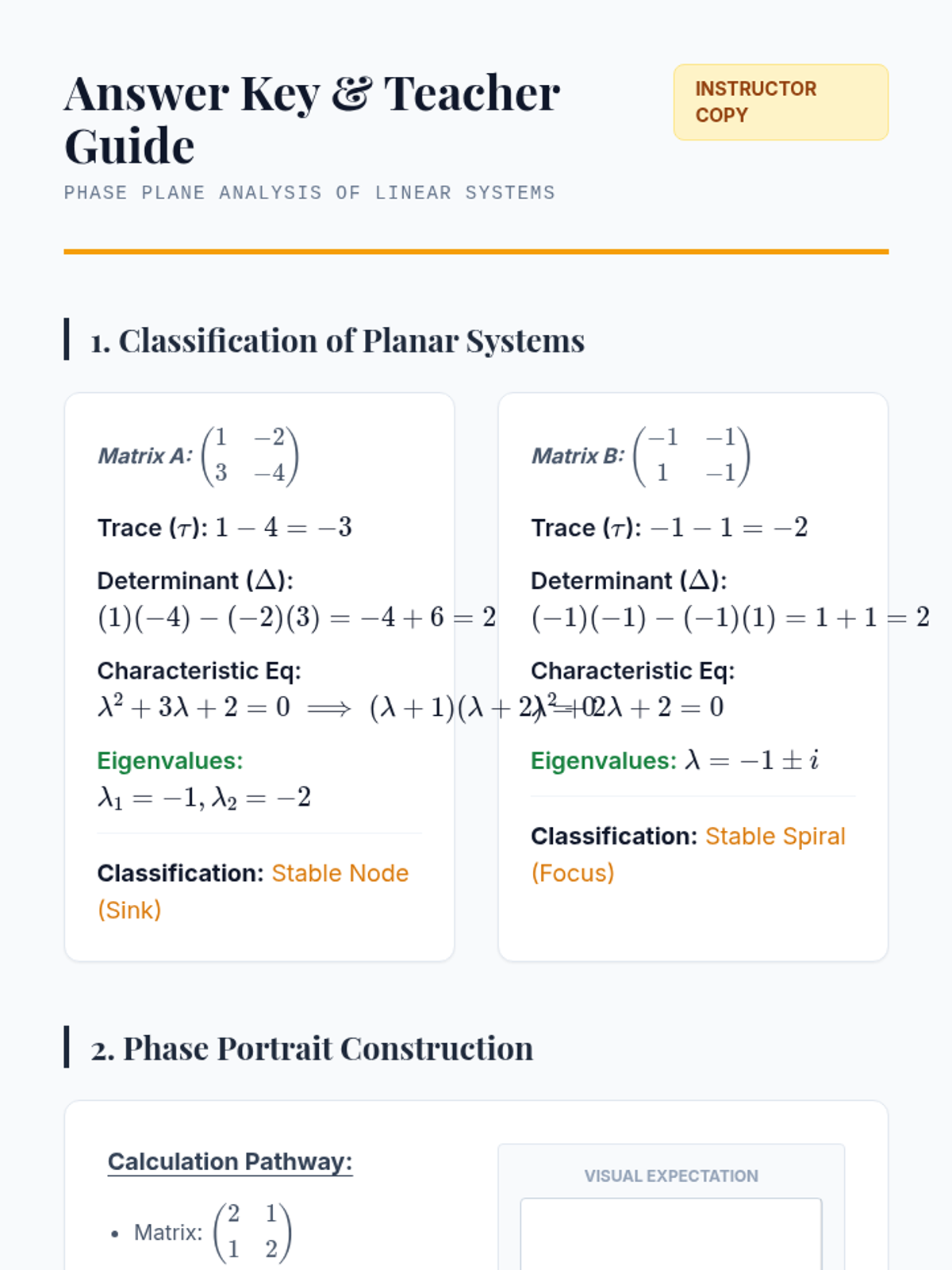
A graduate-level exploration of dynamical systems, focusing on the qualitative analysis of stability, phase portraits, and topological changes in nonlinear differential equations. Students move from linear classification to advanced stability proofs using Lyapunov functions and bifurcation theory.
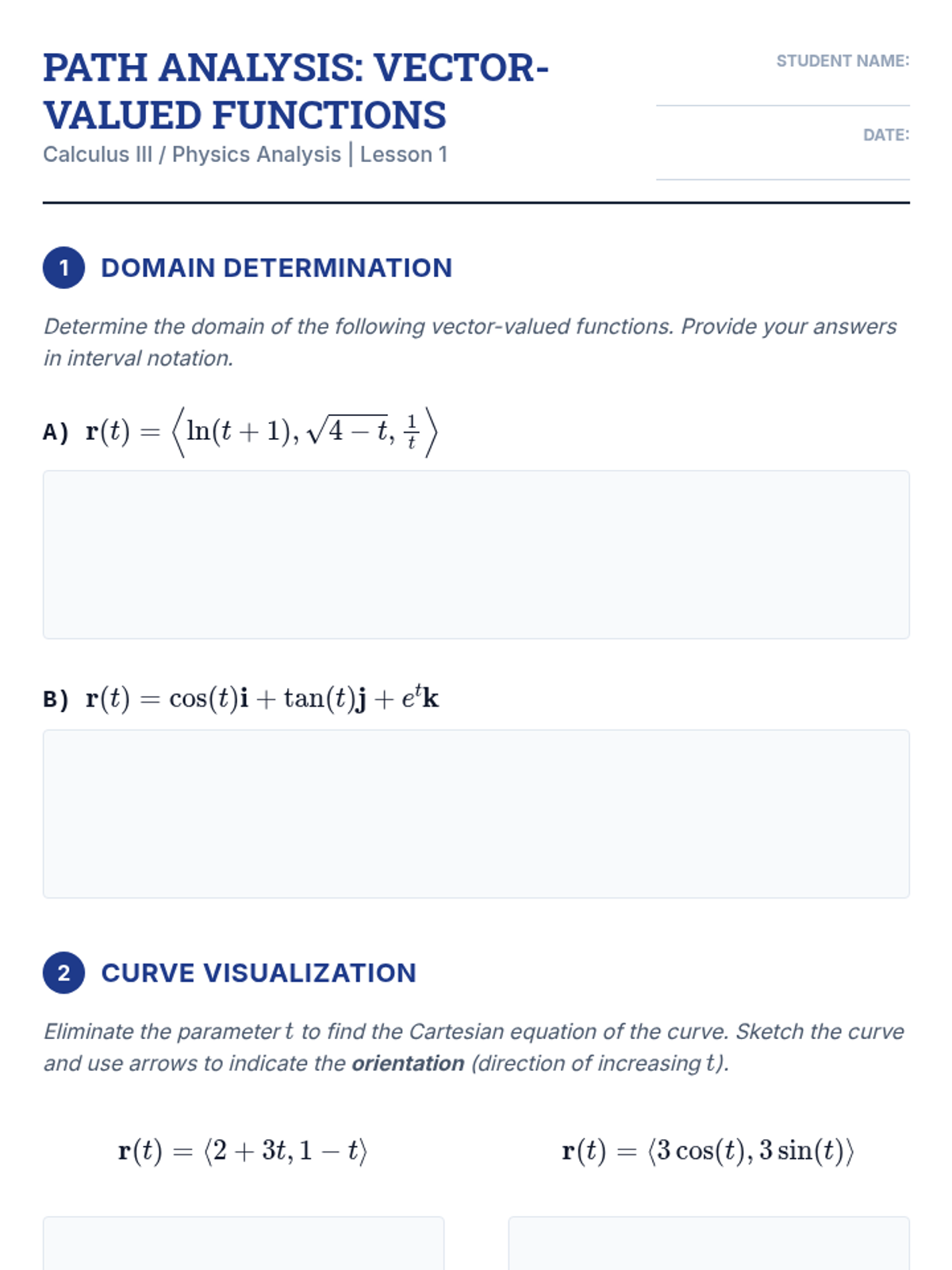
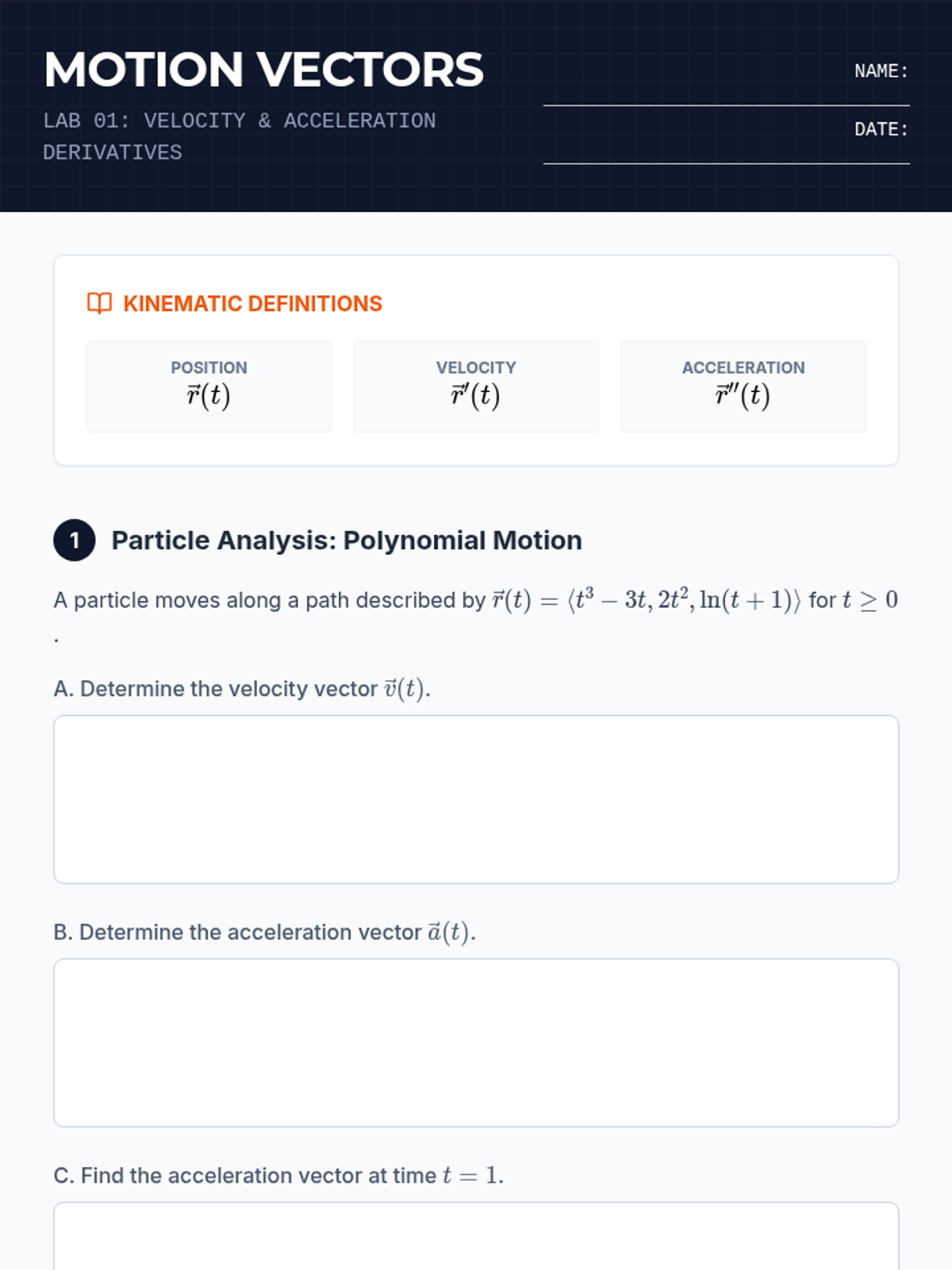
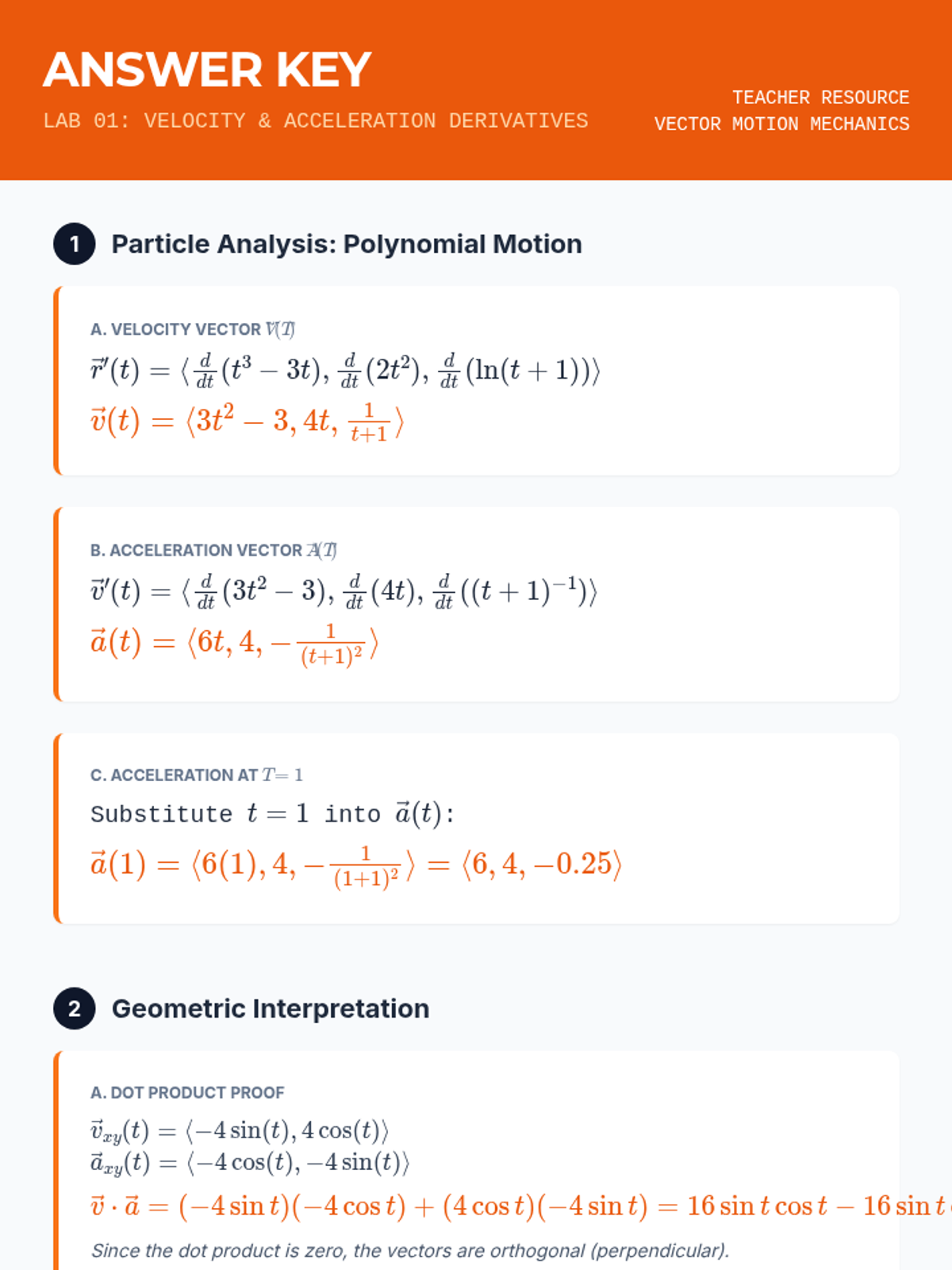
A comprehensive advanced calculus unit exploring the use of vector-valued functions to model and analyze motion in 2D and 3D space. Students will master differentiation, integration, and arc length calculations within a kinematic context, culminating in complex projectile modeling.
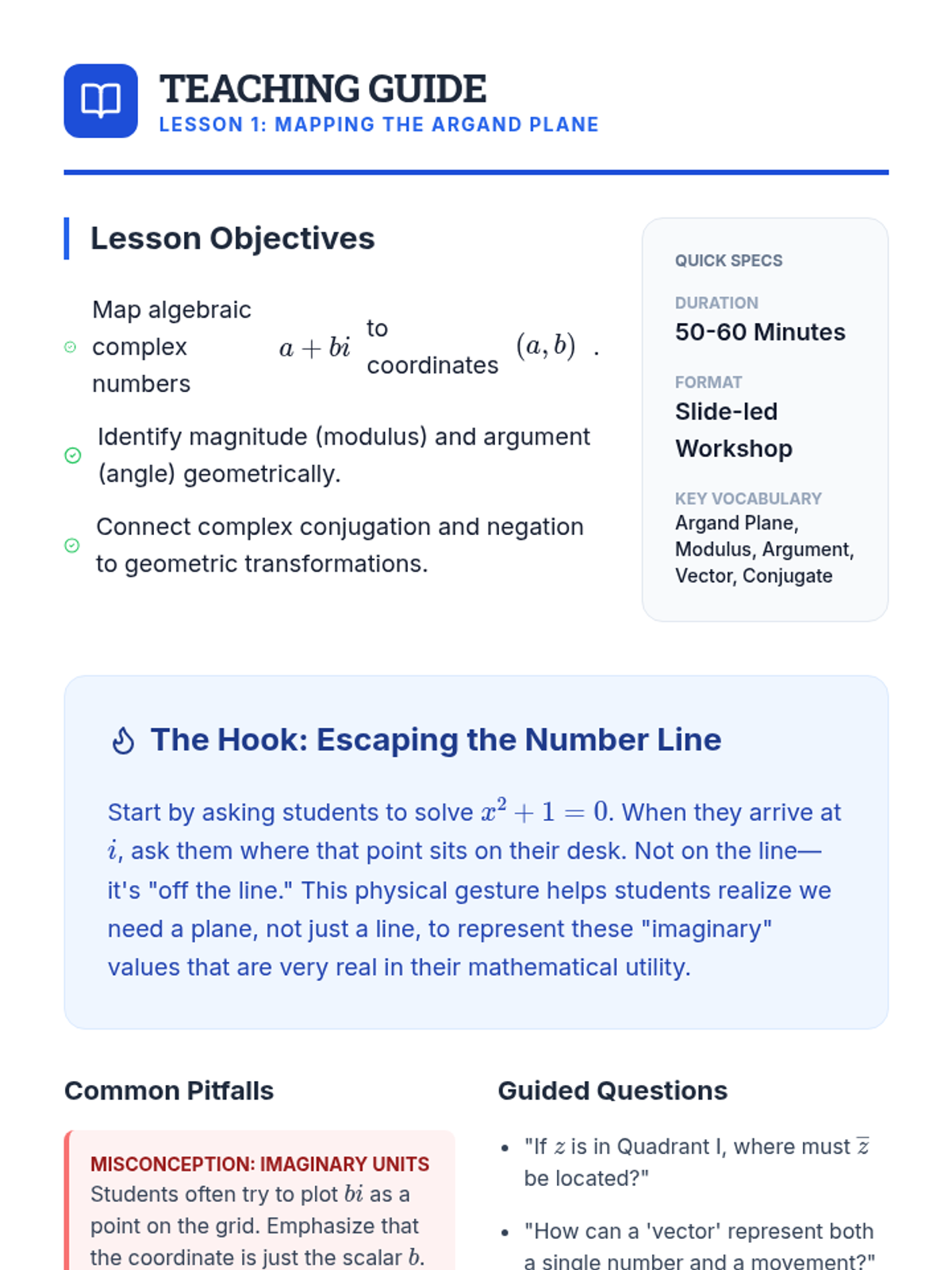
A comprehensive exploration of complex numbers through a geometric lens, bridging algebraic arithmetic with vector transformations and polynomial theory for undergraduate students.
This sequence explores matrices as geometric transformations of vectors. Students learn to visualize and calculate how matrices stretch, rotate, reflect, and shear space, culminating in a project where they design a computer graphics animation sequence.
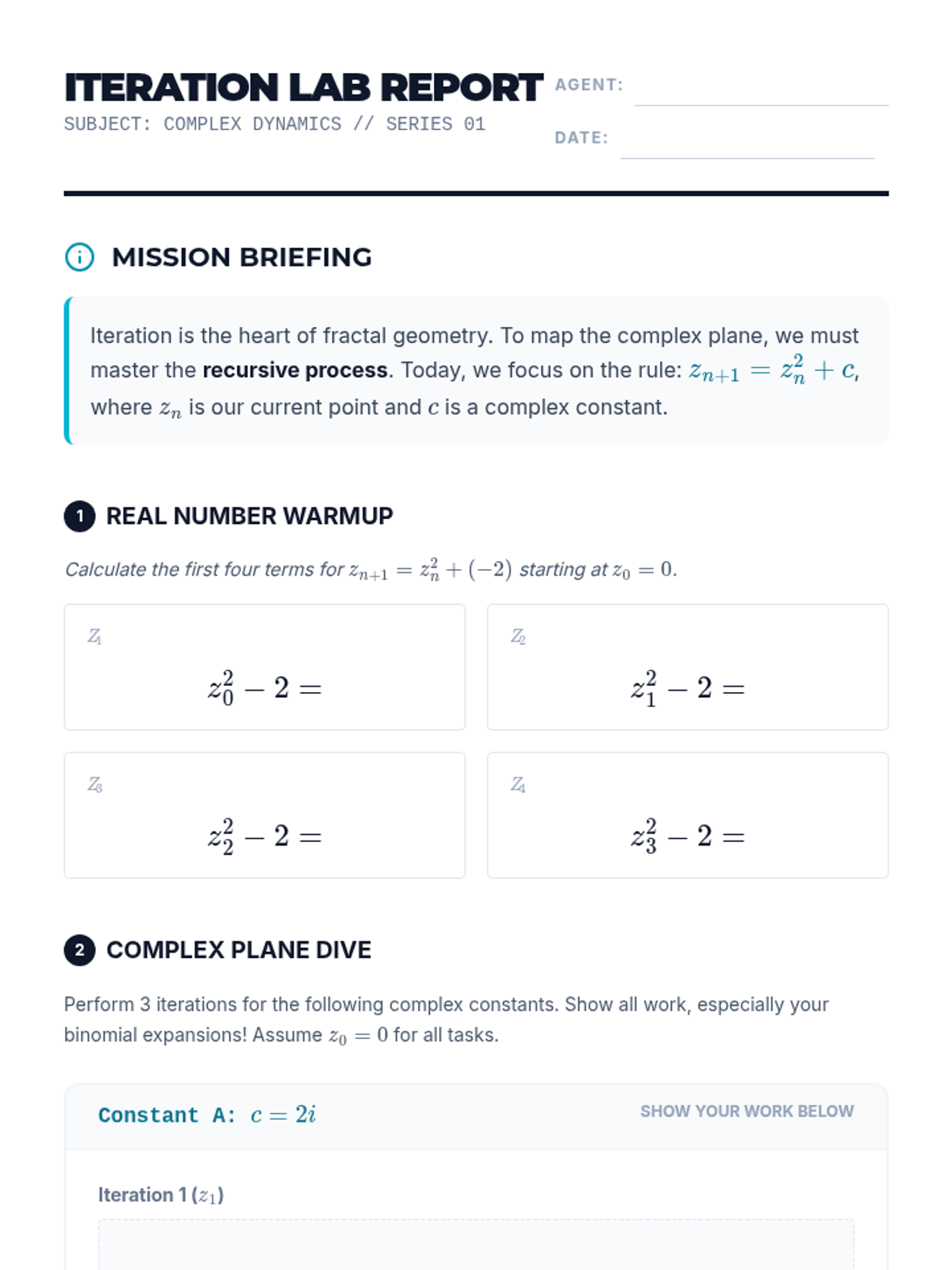
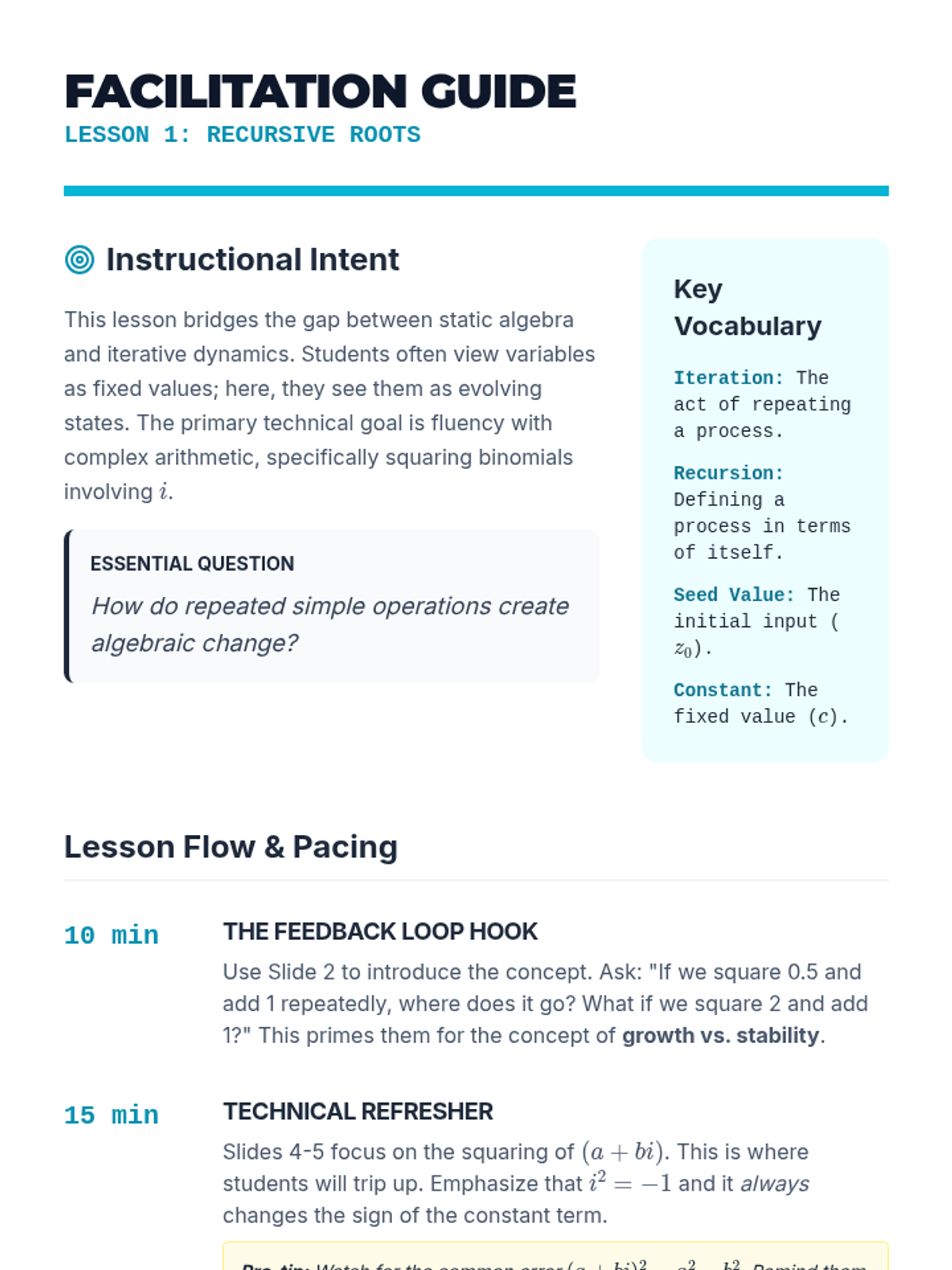
A project-based algebra sequence exploring complex number arithmetic through iterative processes and fractal geometry. Students transition from basic recursion to mapping orbits in the complex plane, culminating in a visual project exploring the Mandelbrot set.
A project-based sequence for 12th Grade students exploring linear transformations through the lens of computer graphics. Students learn to use 2x2 matrices to scale, reflect, shear, and rotate vectors, culminating in a retro video game animation project.
This sequence applies vector calculus to particle motion in two and three dimensions, interpreting derivatives and integrals as velocity, acceleration, and displacement to model real-world kinematics.
This sequence guides students through the fundamental operations of vector analysis, bridging the gap between geometric visualization and algebraic computation. Students progress from 2D component forms to 3D spatial analysis and complex products, applying their knowledge to physics-based problems like work and torque.
An advanced exploration of vector fields and tensor calculus for graduate students, bridging the gap between vector analysis and general relativity through curvilinear coordinates, transformation rules, and continuum mechanics.
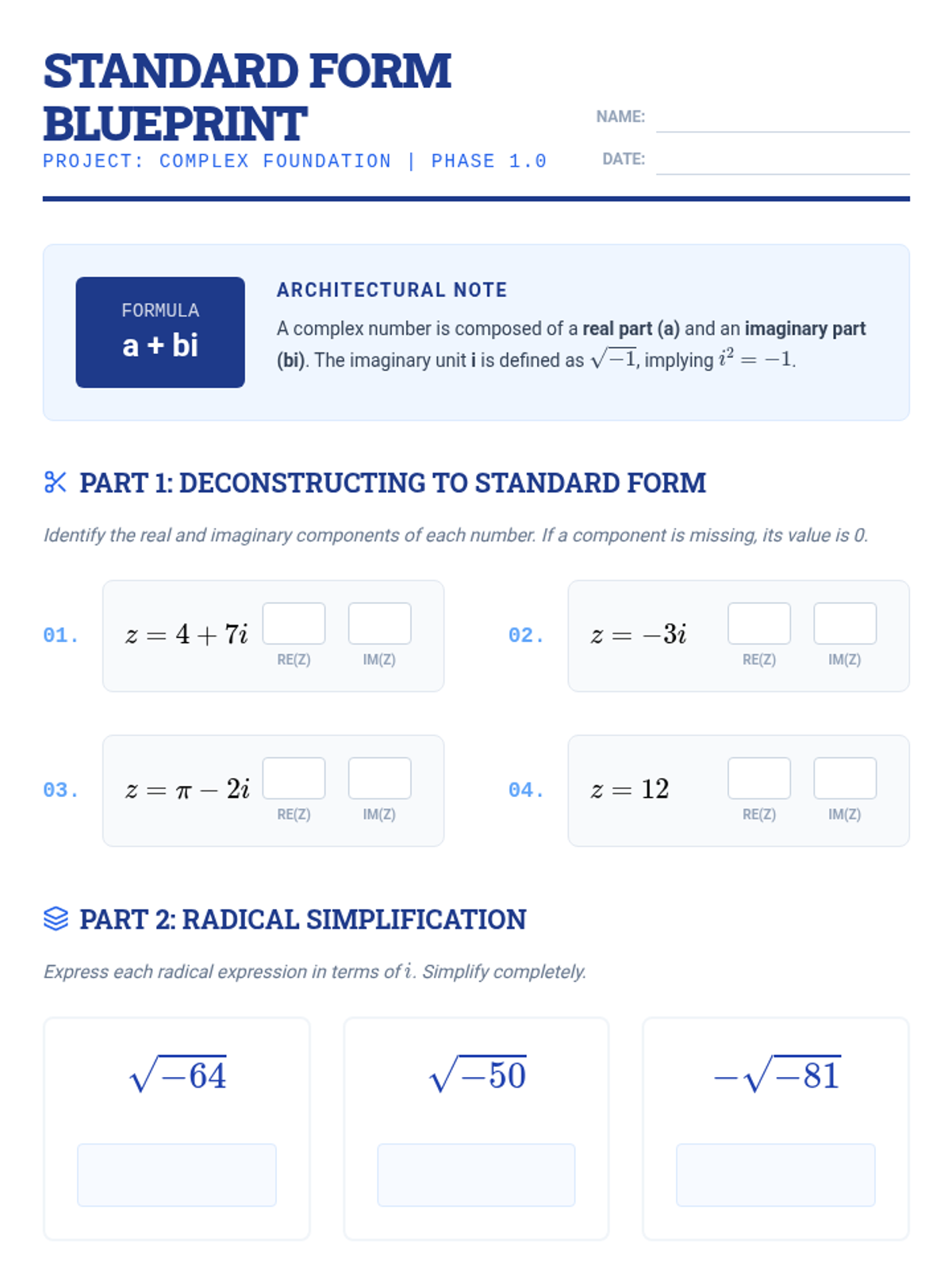
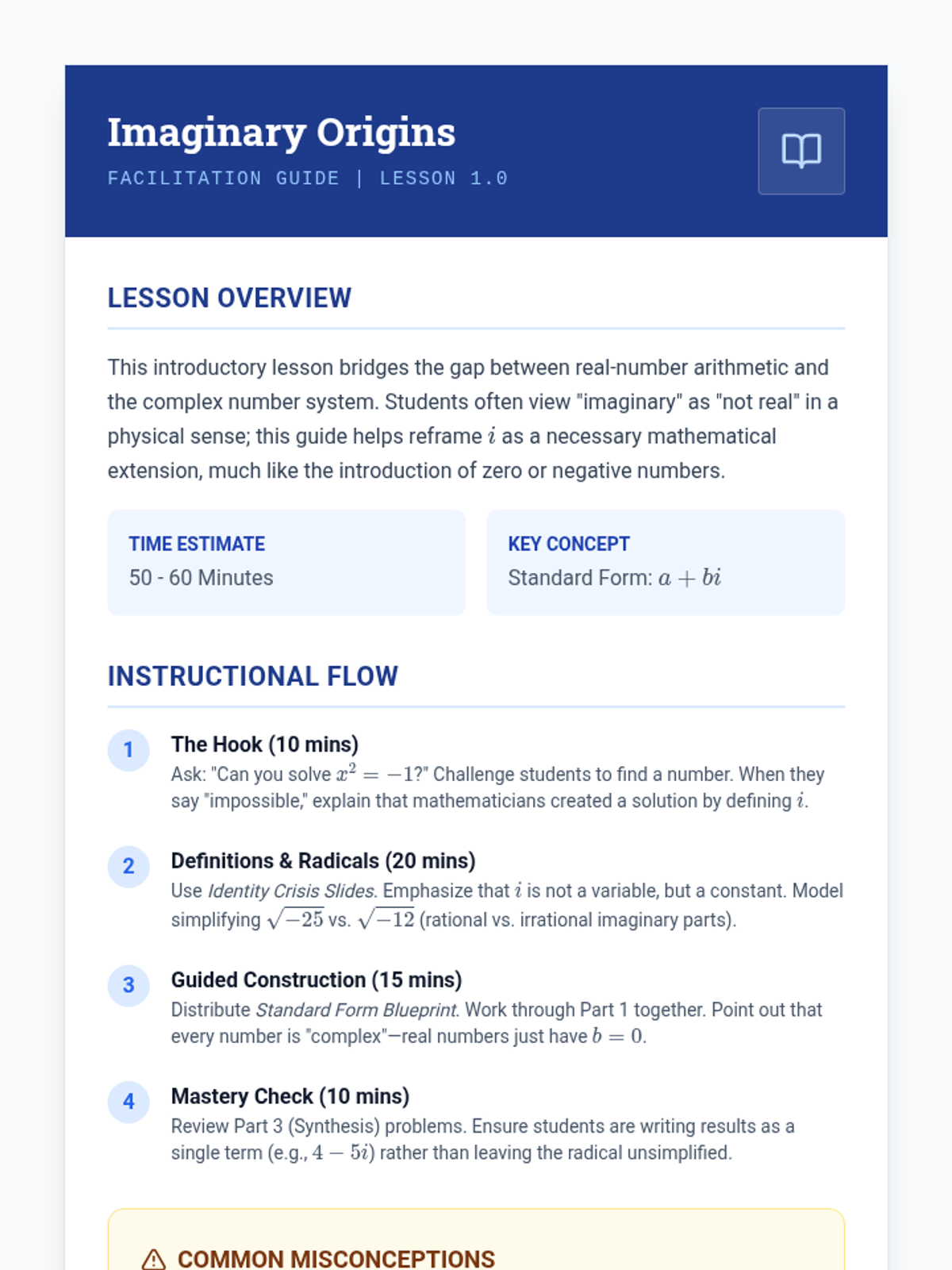
A foundational sequence for undergraduate students exploring the arithmetic, geometric, and algebraic properties of complex numbers, focusing on the imaginary unit, standard form, operations, and the complex plane.
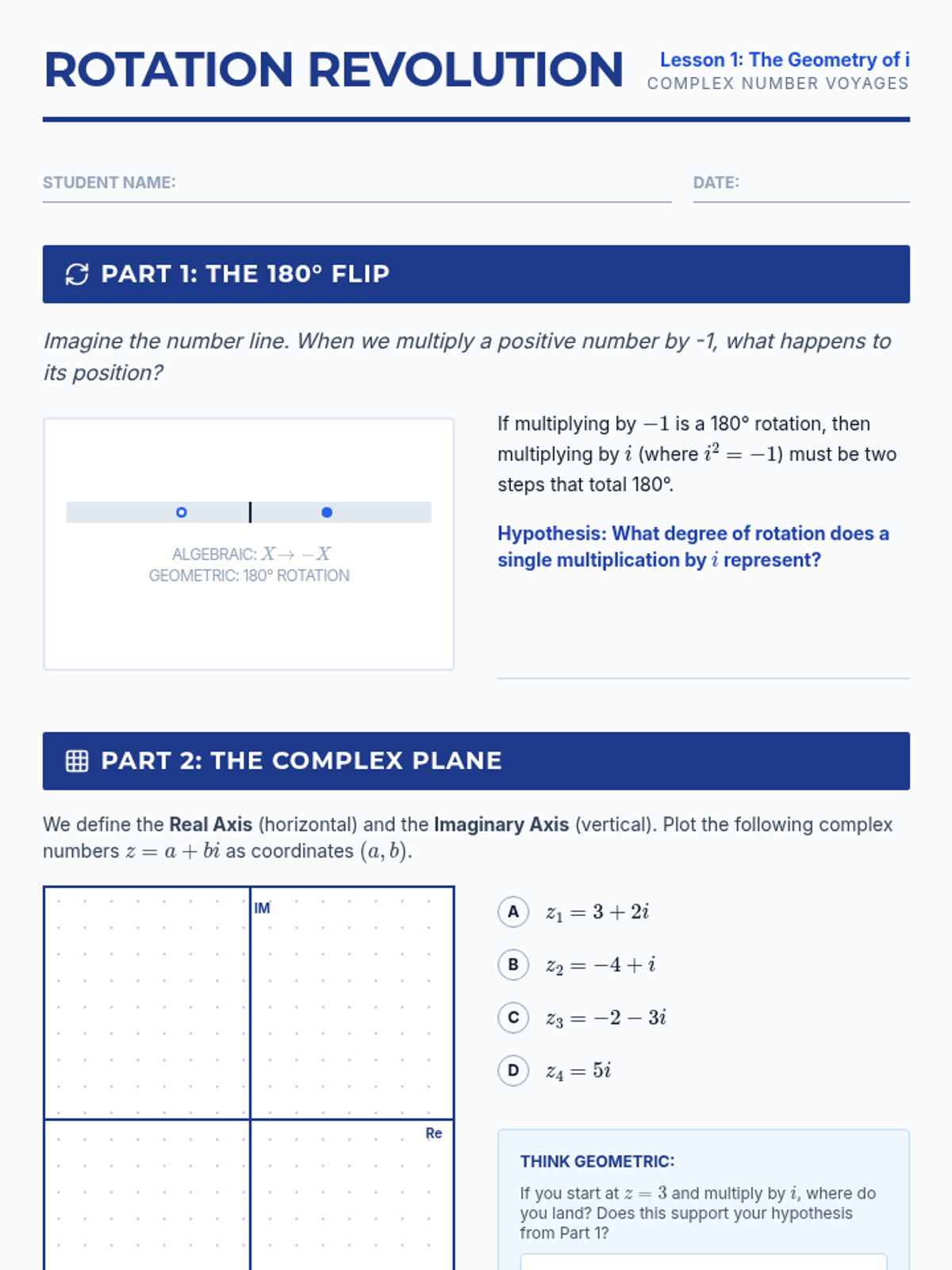
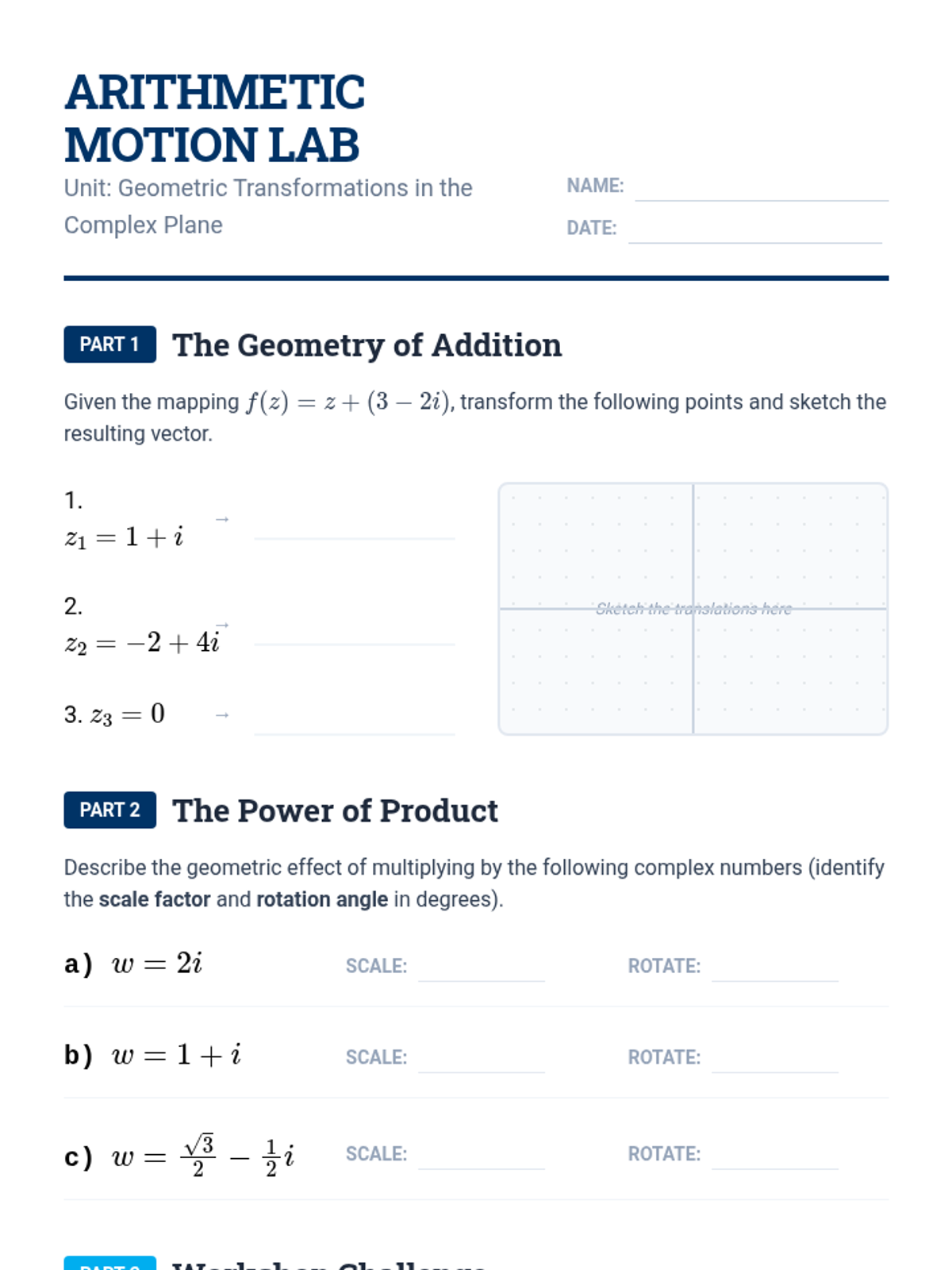
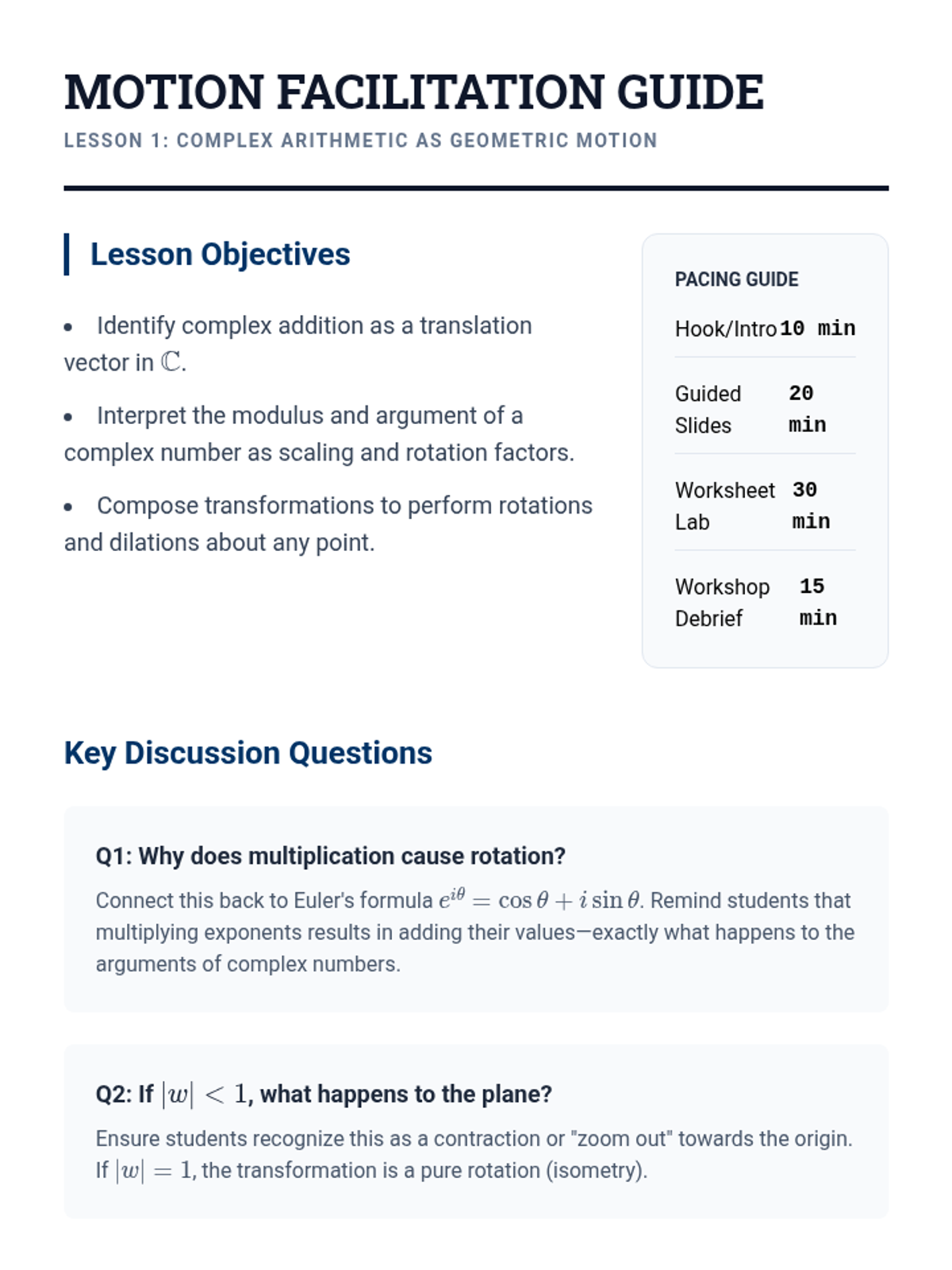
A 12th-grade inquiry into complex numbers through the lens of geometry and vector operations. Students transition from algebraic rules to visual intuition, exploring rotations, dilations, and translations in the complex plane.
This sequence explores geometric transformations using the complex plane as a primary framework. Students will learn how complex arithmetic maps to translations, rotations, dilations, and reflections, culminating in an investigation of non-linear mappings like circle inversion and Möbius transformations.
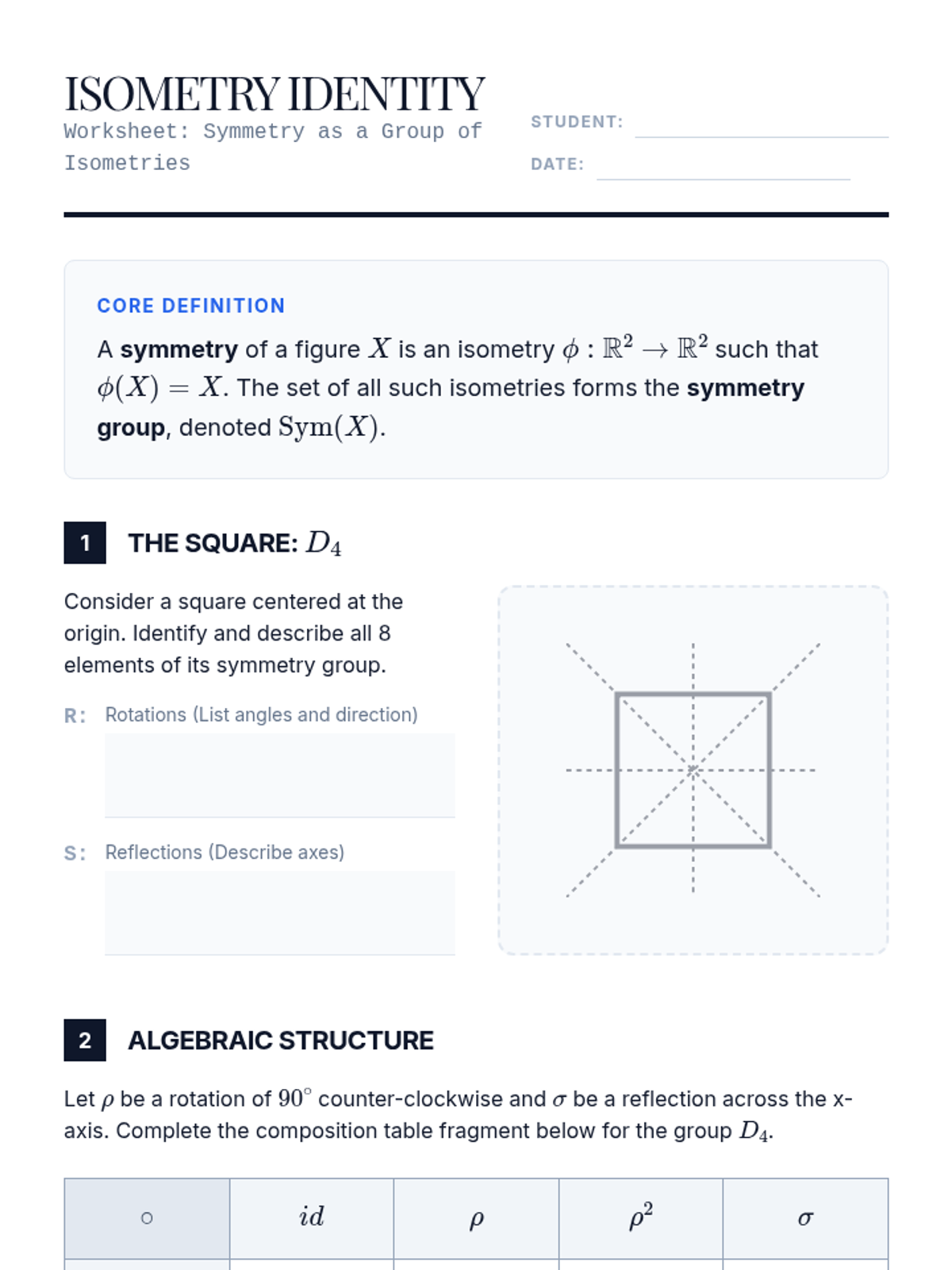
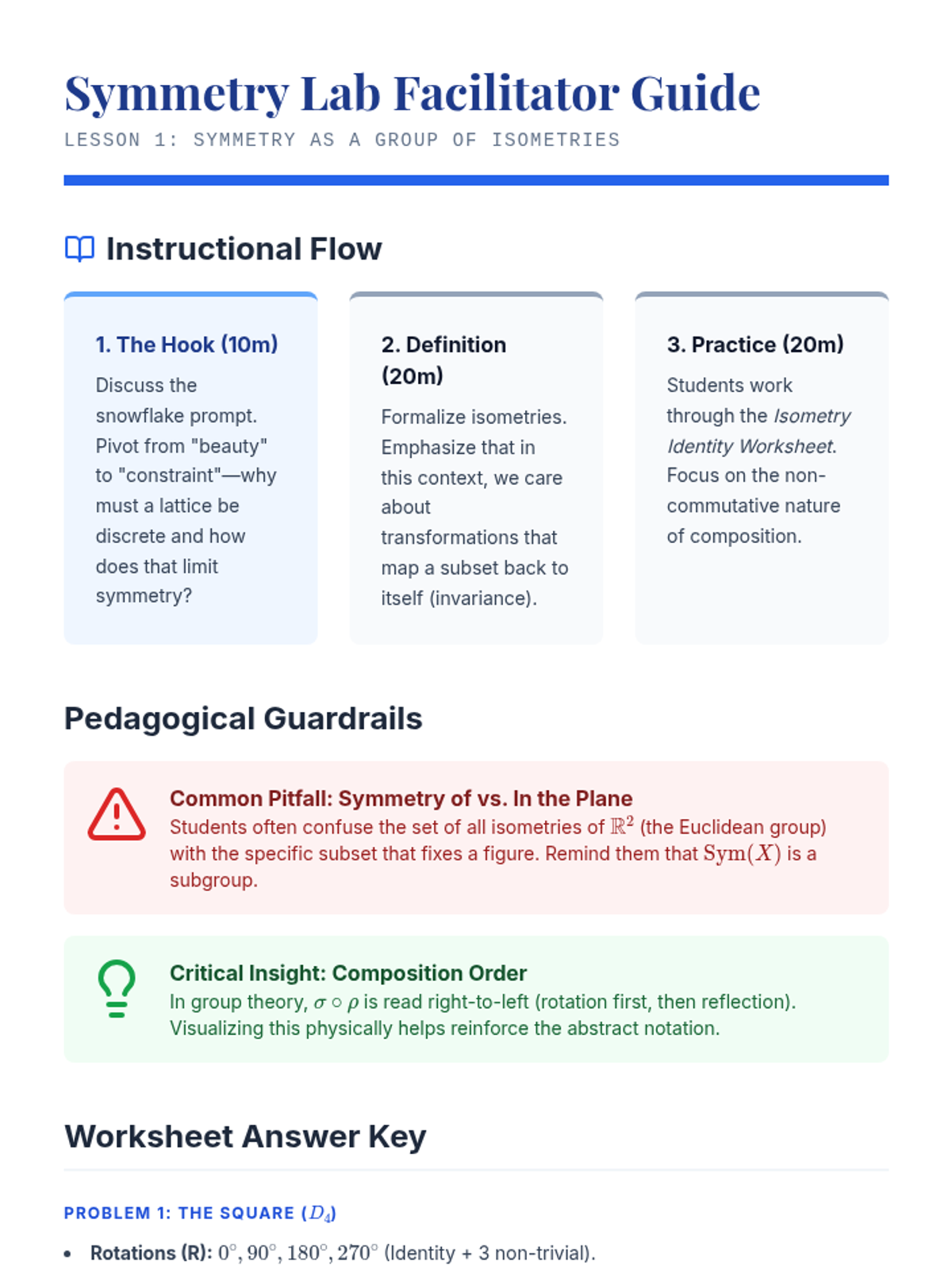
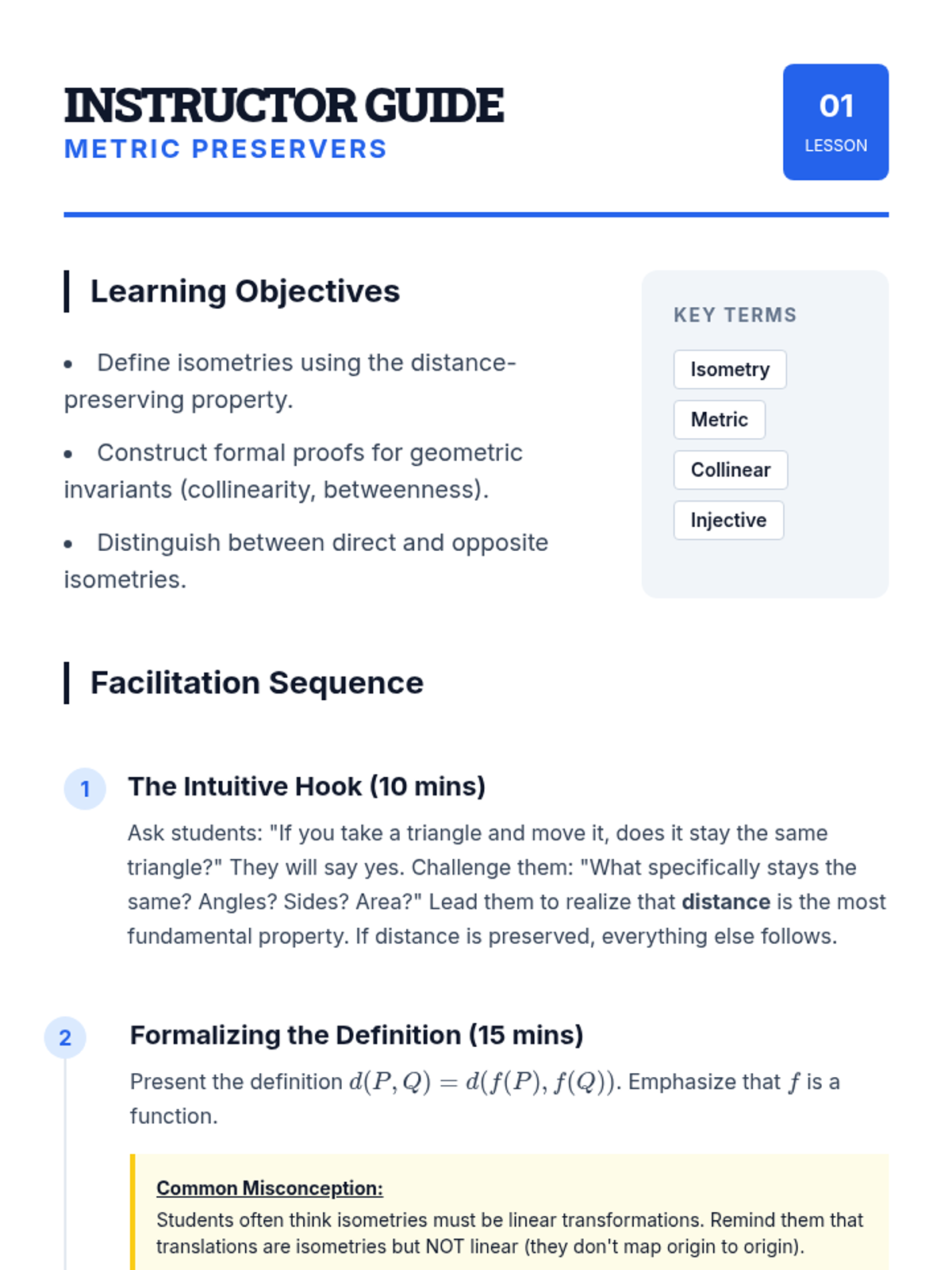
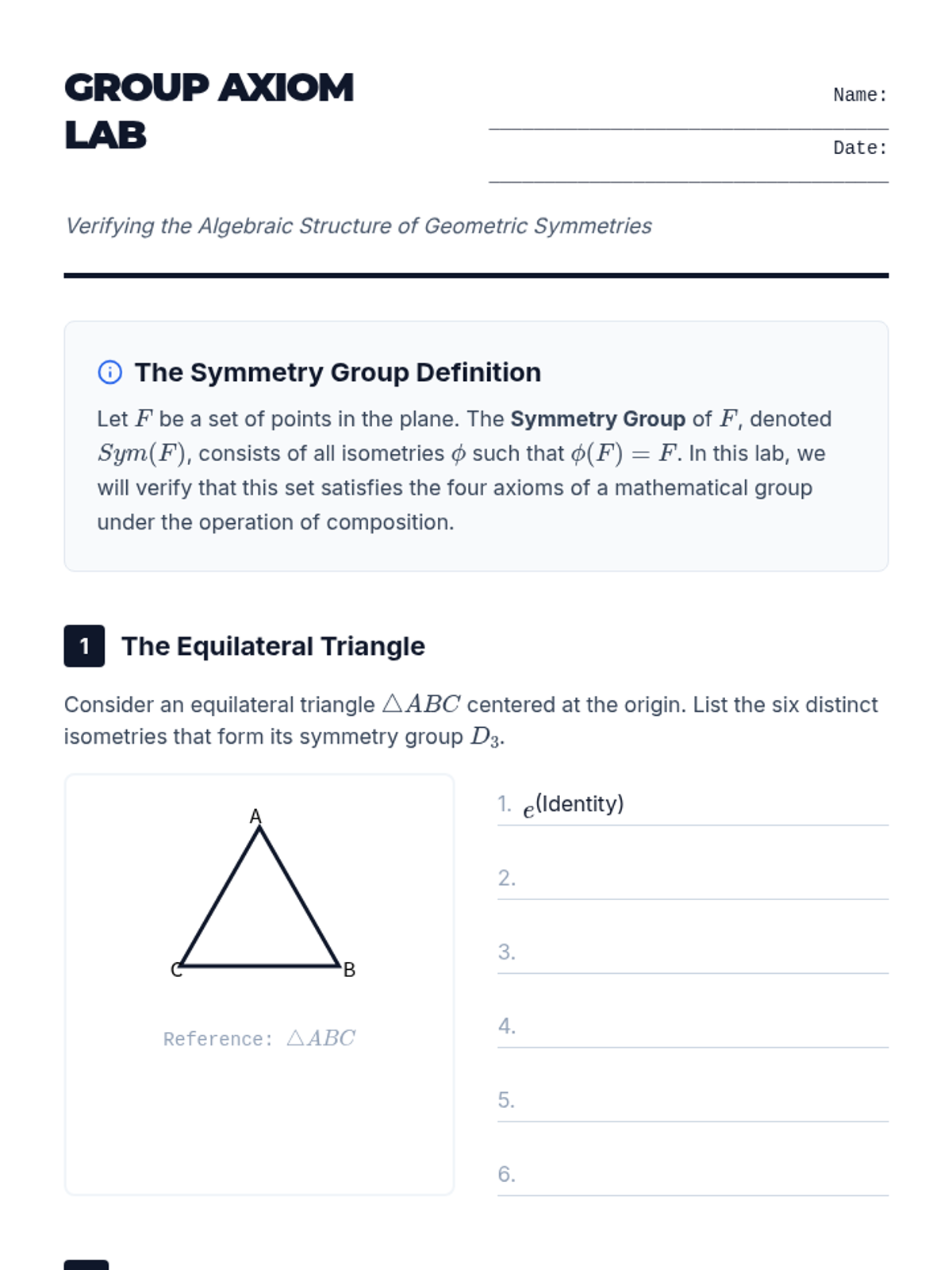
A rigorous exploration of planar geometry through the lens of group theory, covering isometries, the Three Reflections Theorem, and the classification of finite and infinite symmetry groups.
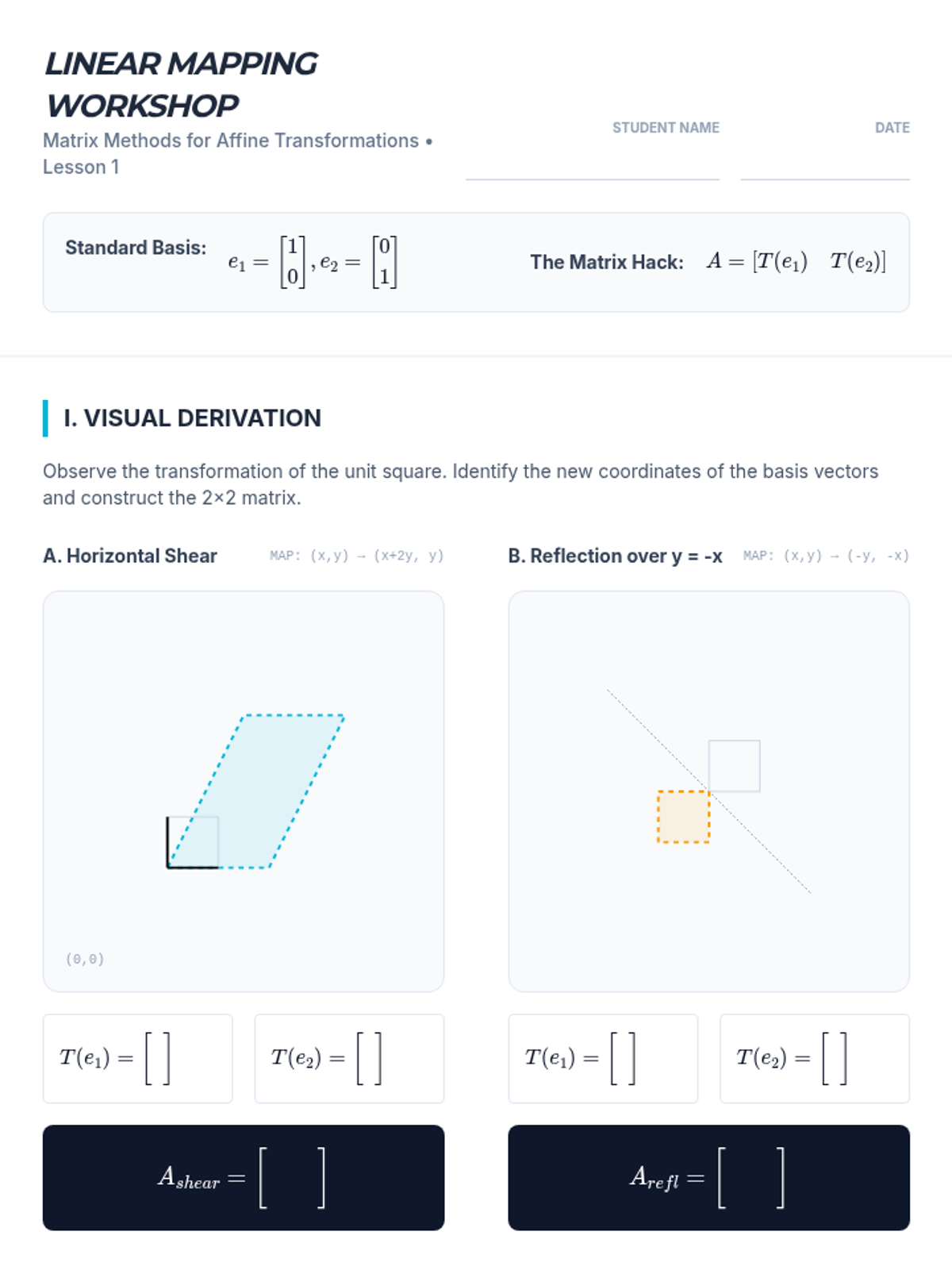
An undergraduate-level exploration of planar transformations using linear algebra. This sequence covers linear mapping, the necessity of homogeneous coordinates for affine transformations, matrix composition, and the geometric interpretations of determinants and eigenvalues.
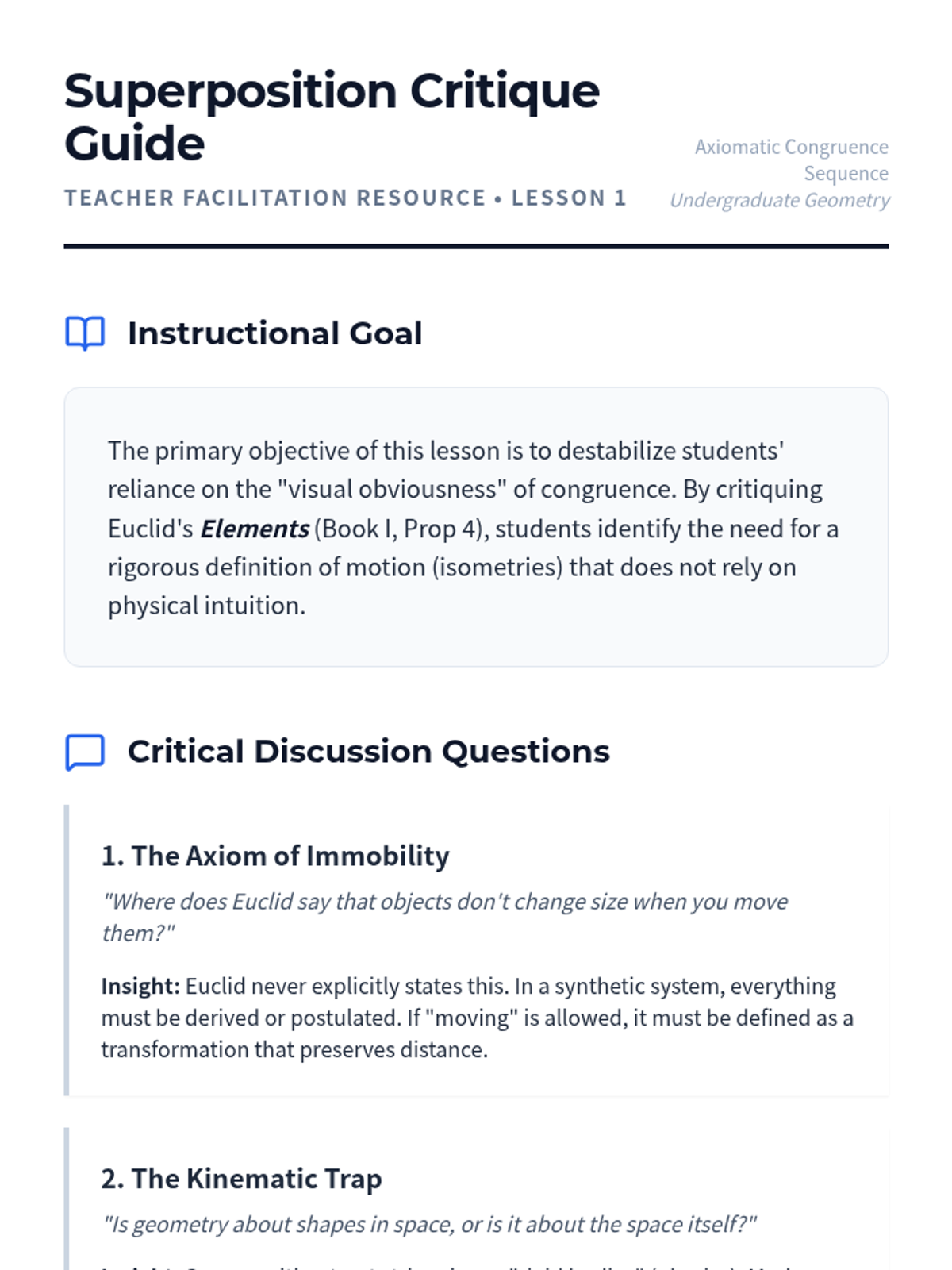
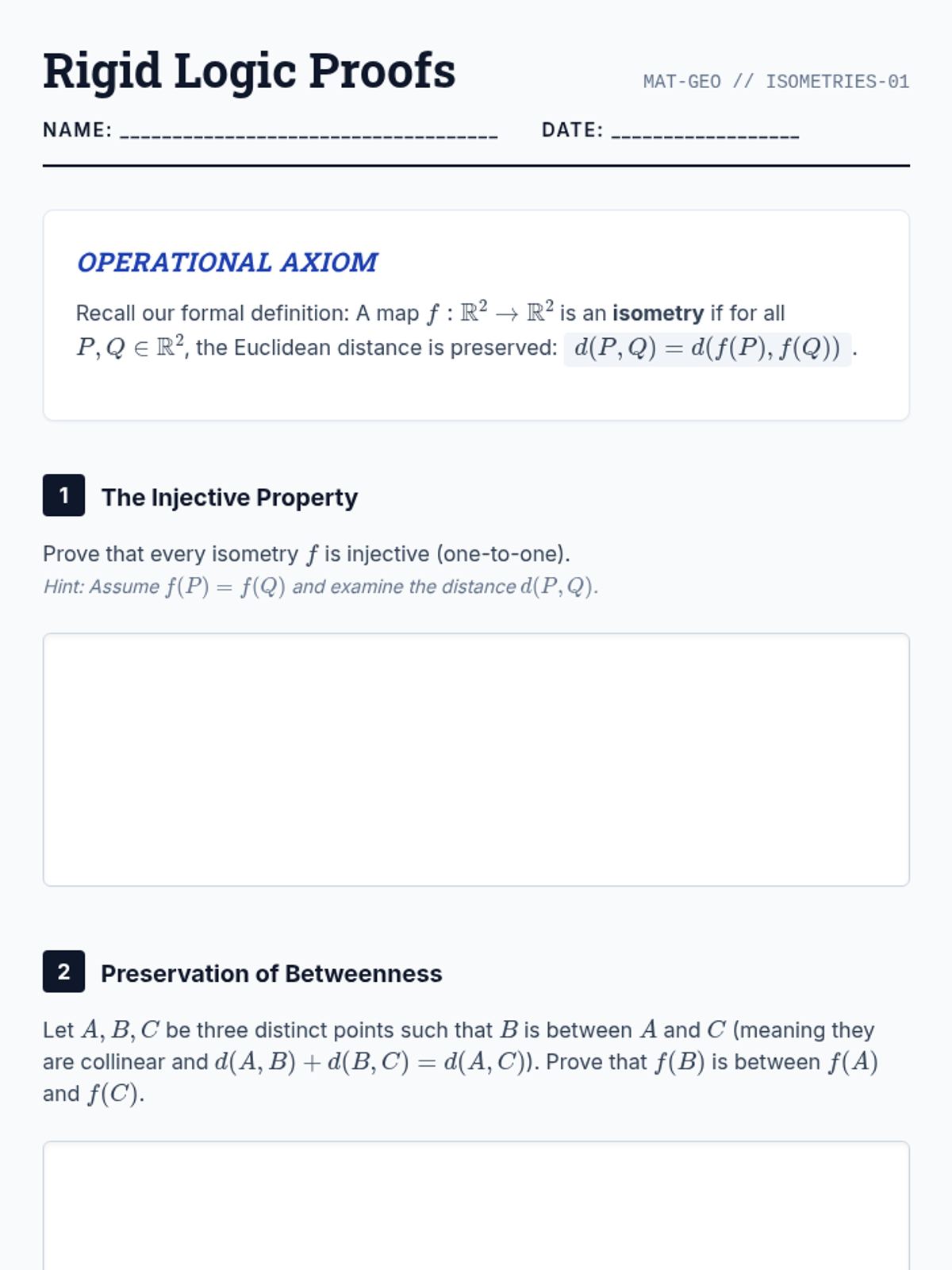
This sequence explores congruence through the lens of transformational geometry, moving from historical critiques of Euclid to rigorous proofs using rigid motions. Designed for undergraduate students, it bridges the gap between synthetic and analytical geometry.
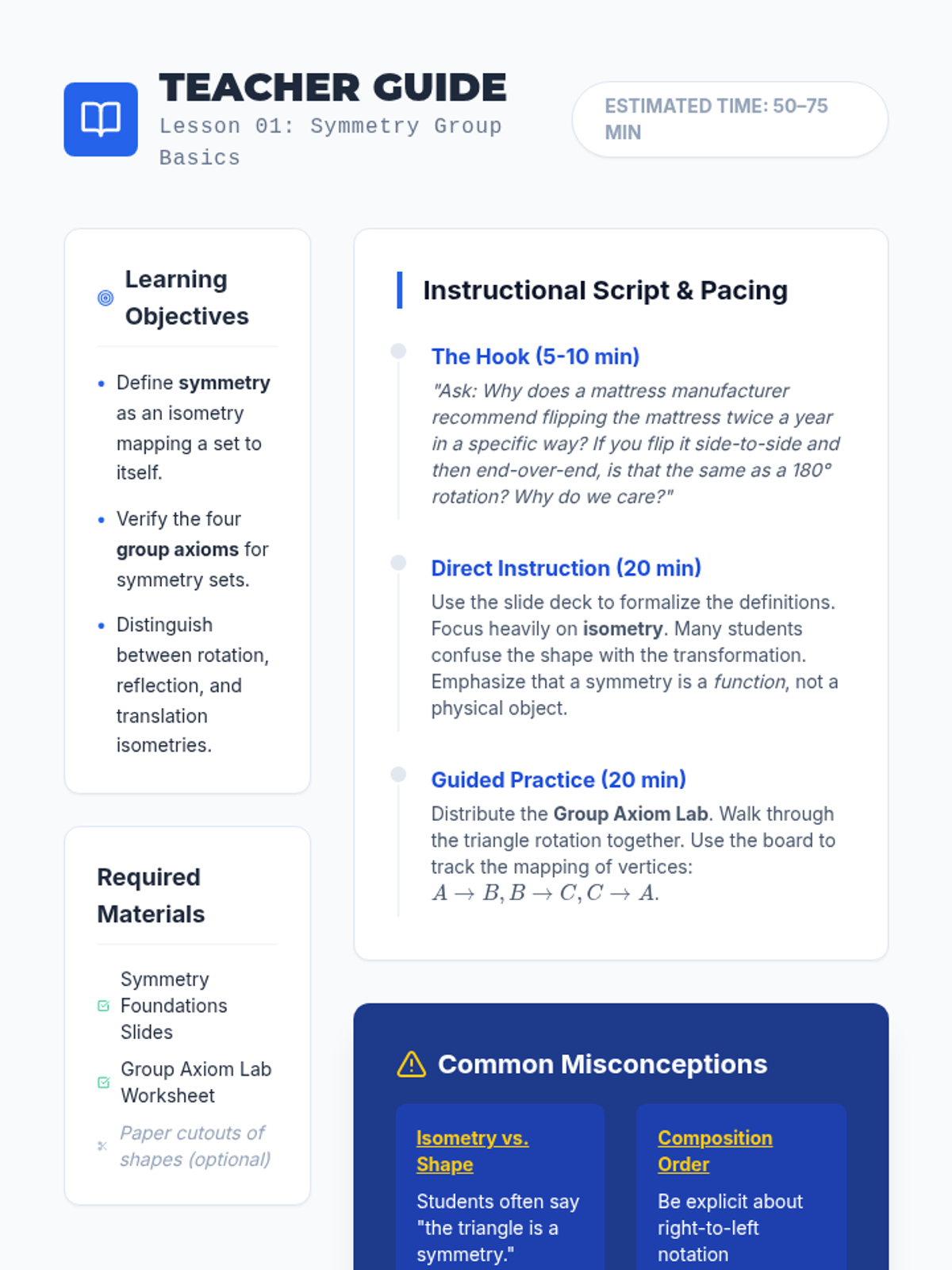
This undergraduate-level sequence explores the mathematical foundations of symmetry through the lens of rigid motions (isometries). Students transition from basic isometric groups to complex Frieze patterns, bridging the gap between geometry, abstract algebra, and real-world art and crystallography.
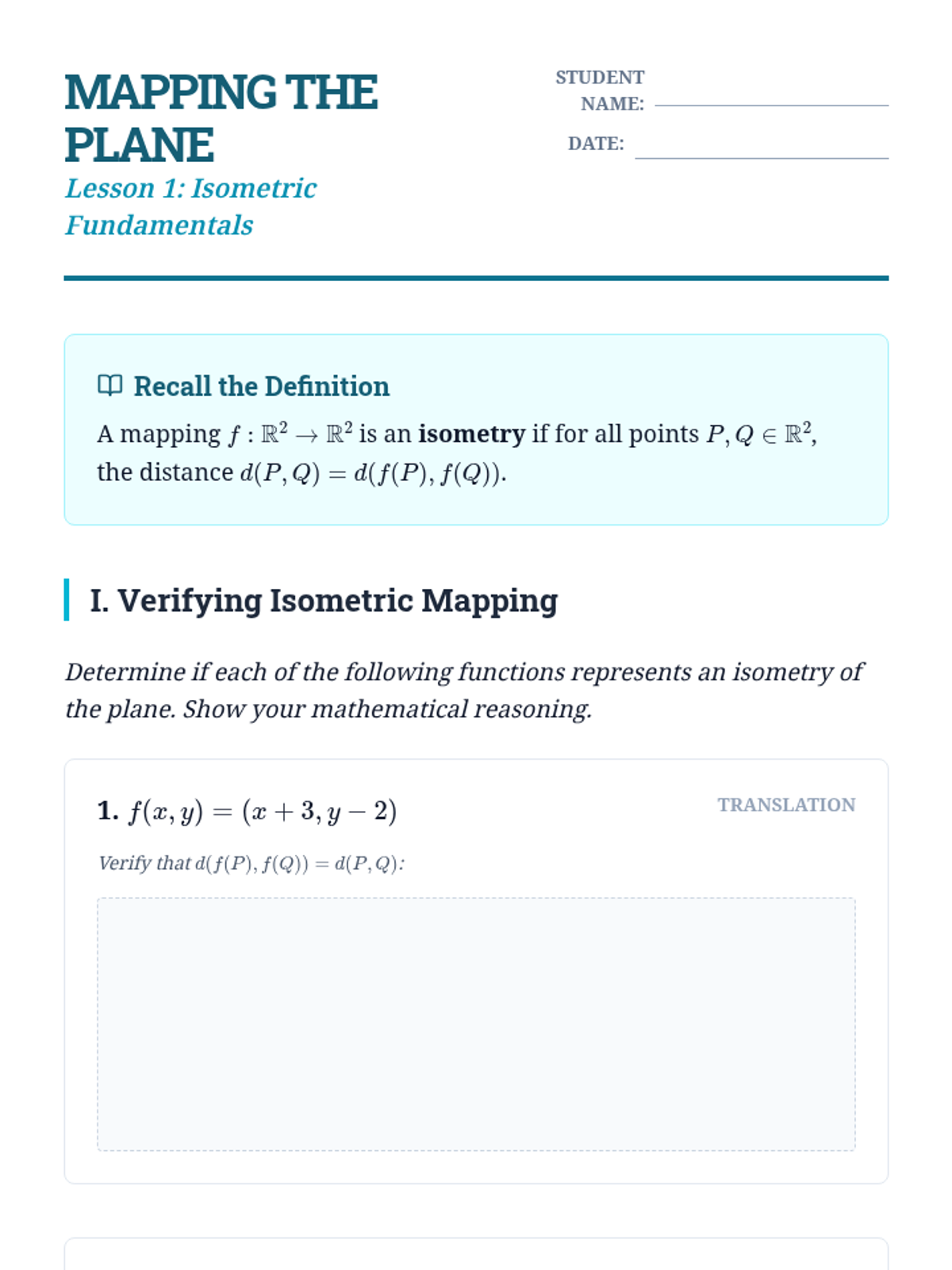
A rigorous exploration of rigid motions in Euclidean geometry, focusing on isometries, matrix representations, homogeneous coordinates, and formal proofs of congruence for undergraduate students.
This sequence bridges geometry and abstract algebra by examining symmetry through the lens of group theory. Students progress from finite shapes to infinite tiling patterns, culminating in the classification of frieze and wallpaper groups.
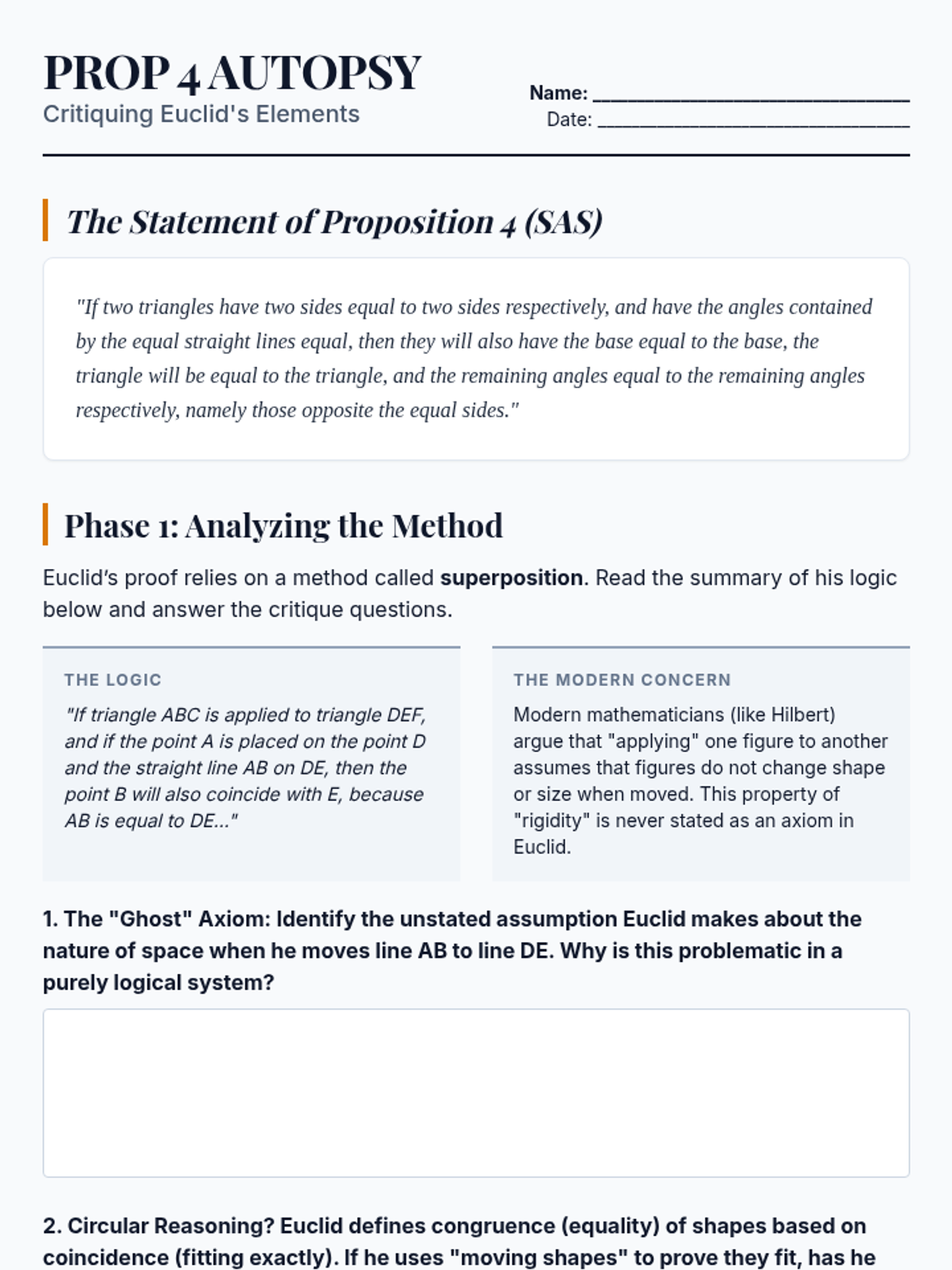
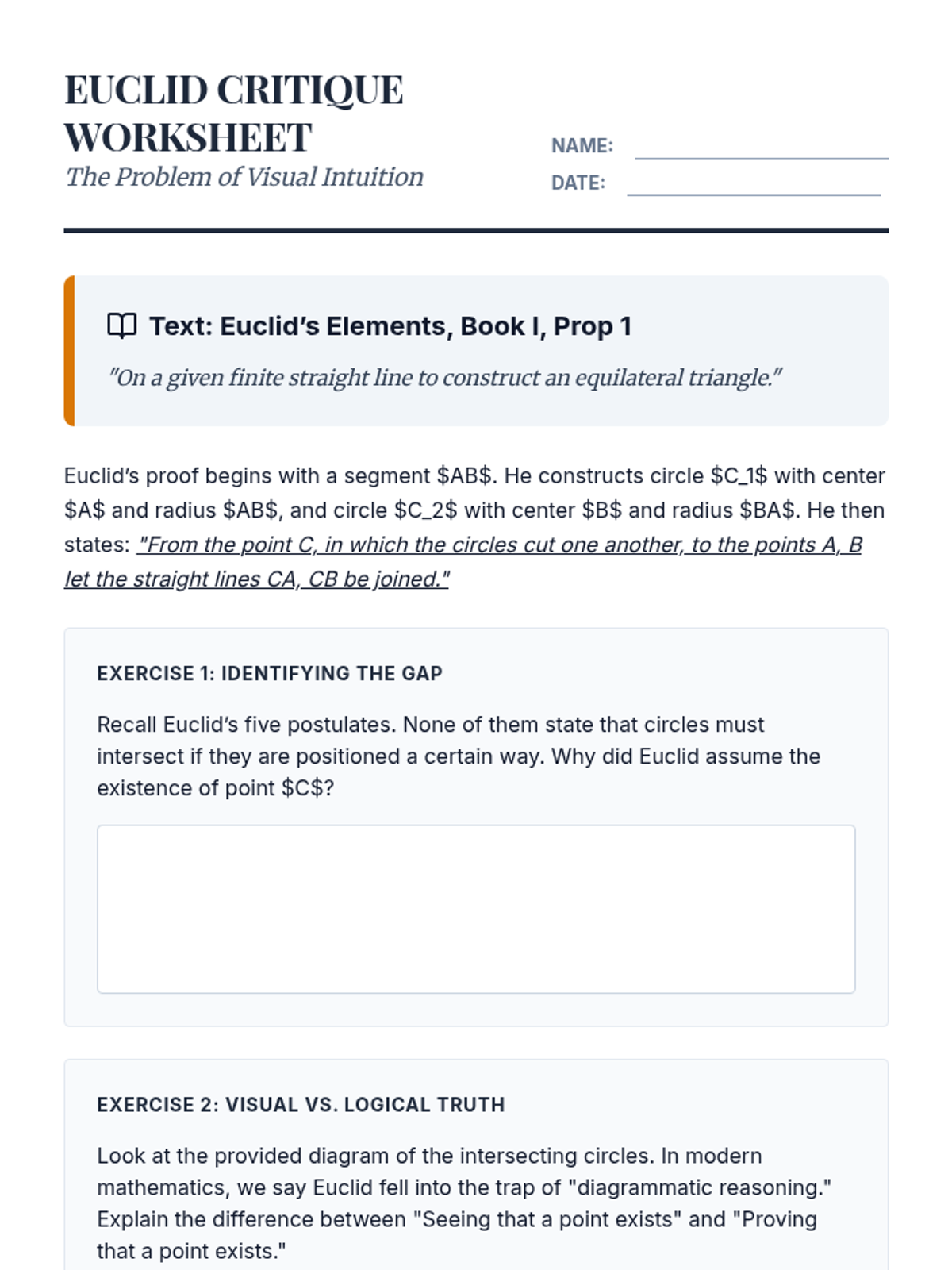
A rigorous undergraduate sequence exploring the axiomatic foundations of geometry, critiquing Euclid's 'hidden' assumptions, and constructing formal proofs for triangle congruence within various axiomatic systems including Hilbert's and non-Euclidean models.
A rigorous undergraduate-level exploration of Euclidean geometry through the lens of transformational geometry. Students analyze translations, rotations, reflections, and glide reflections as functions, culminating in the classification of all rigid motions of the plane.
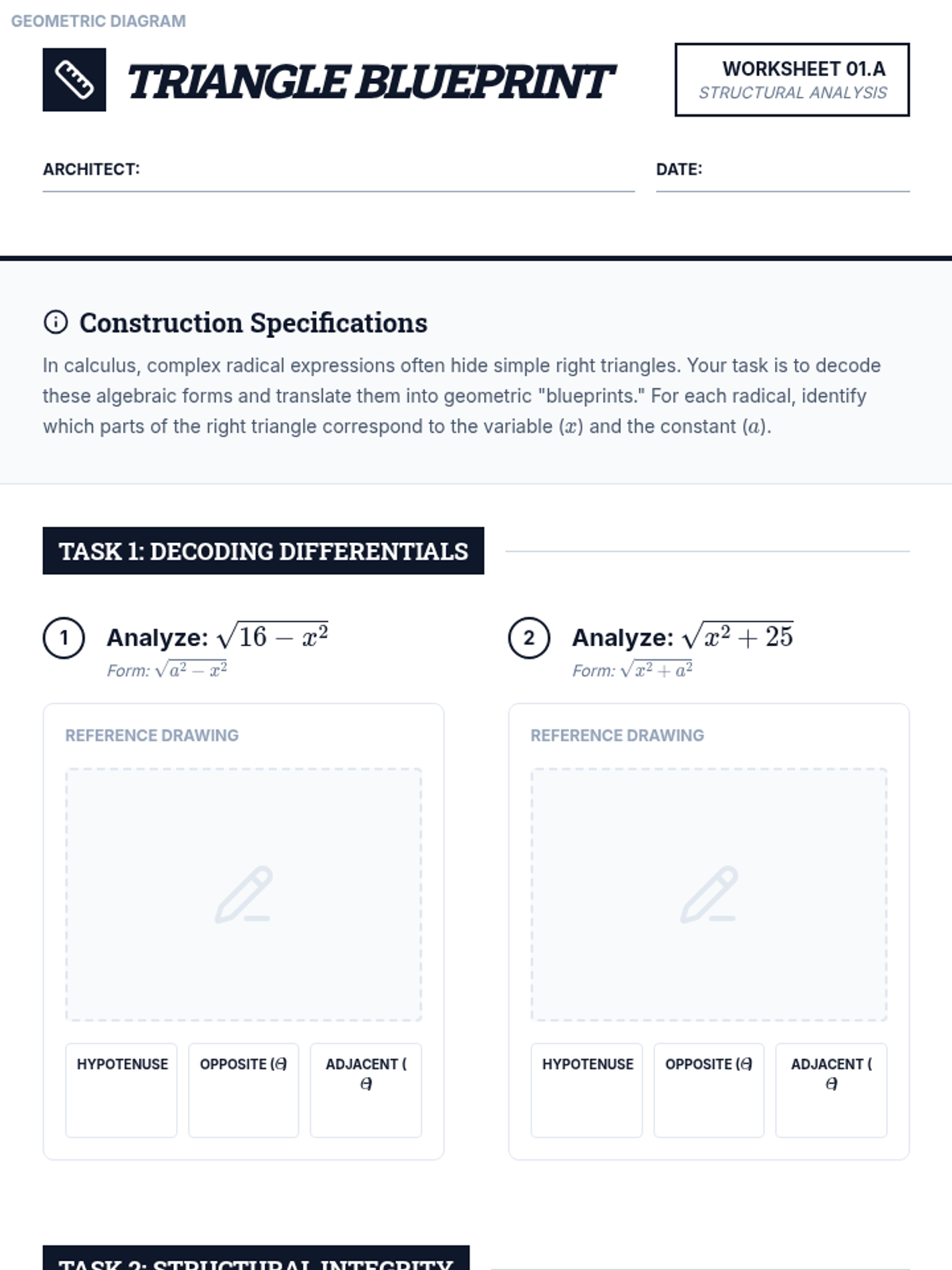
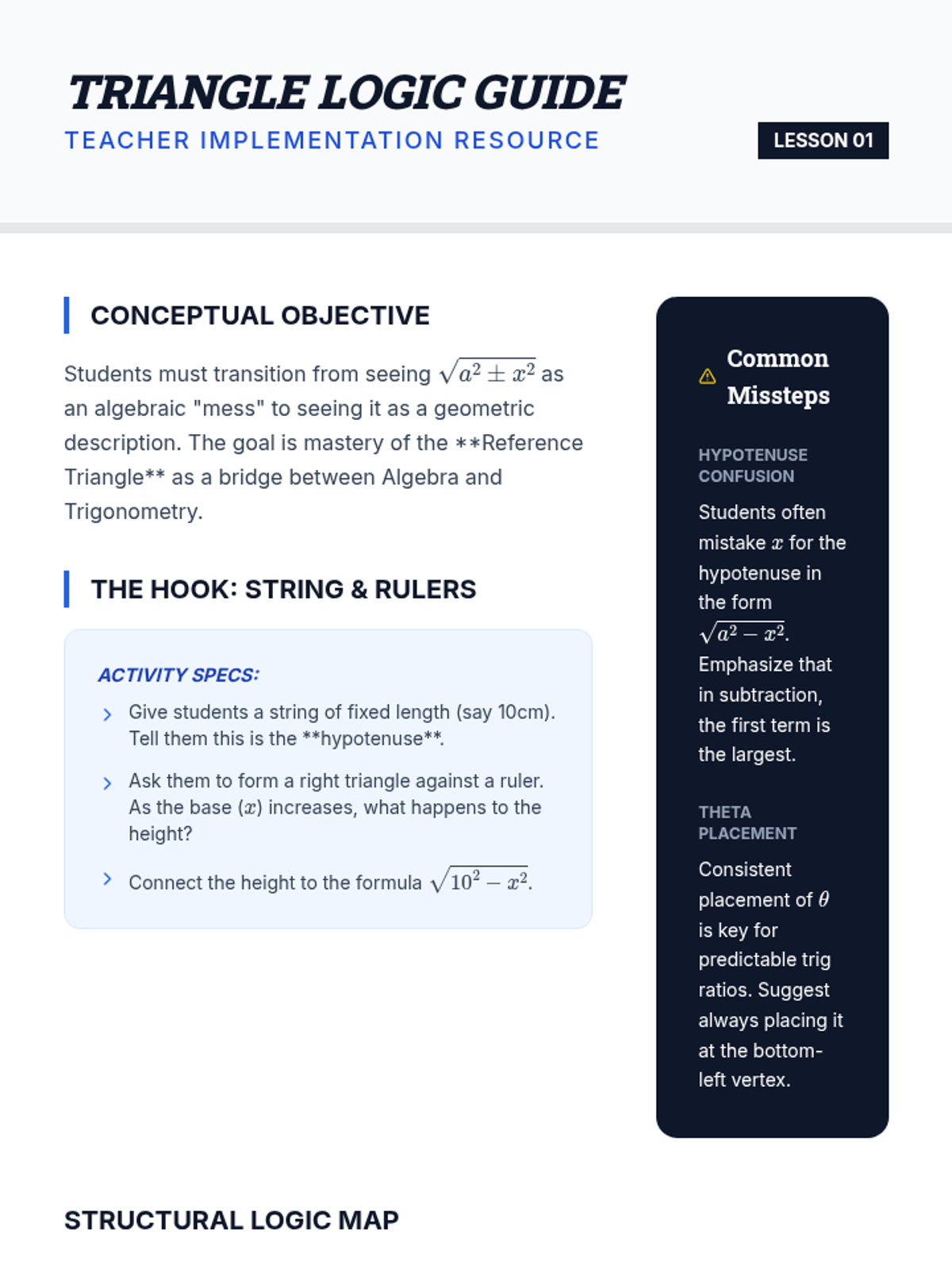
A comprehensive unit on trigonometric substitution in calculus, moving from geometric visualization of radicals to complex integration techniques and algebraic back-substitution. Students learn to map radical expressions onto right triangles and use trigonometric identities to simplify and solve integrals.
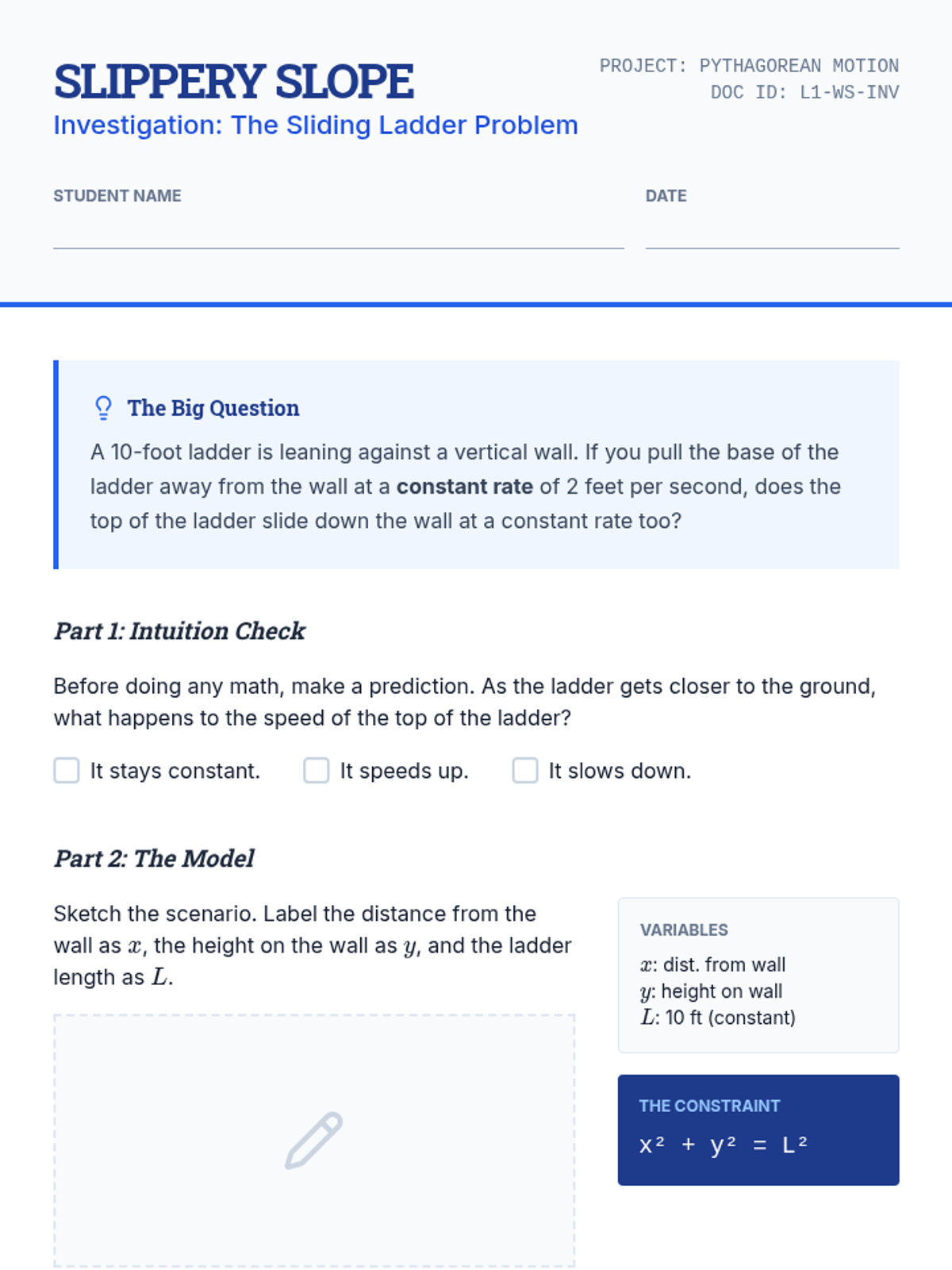
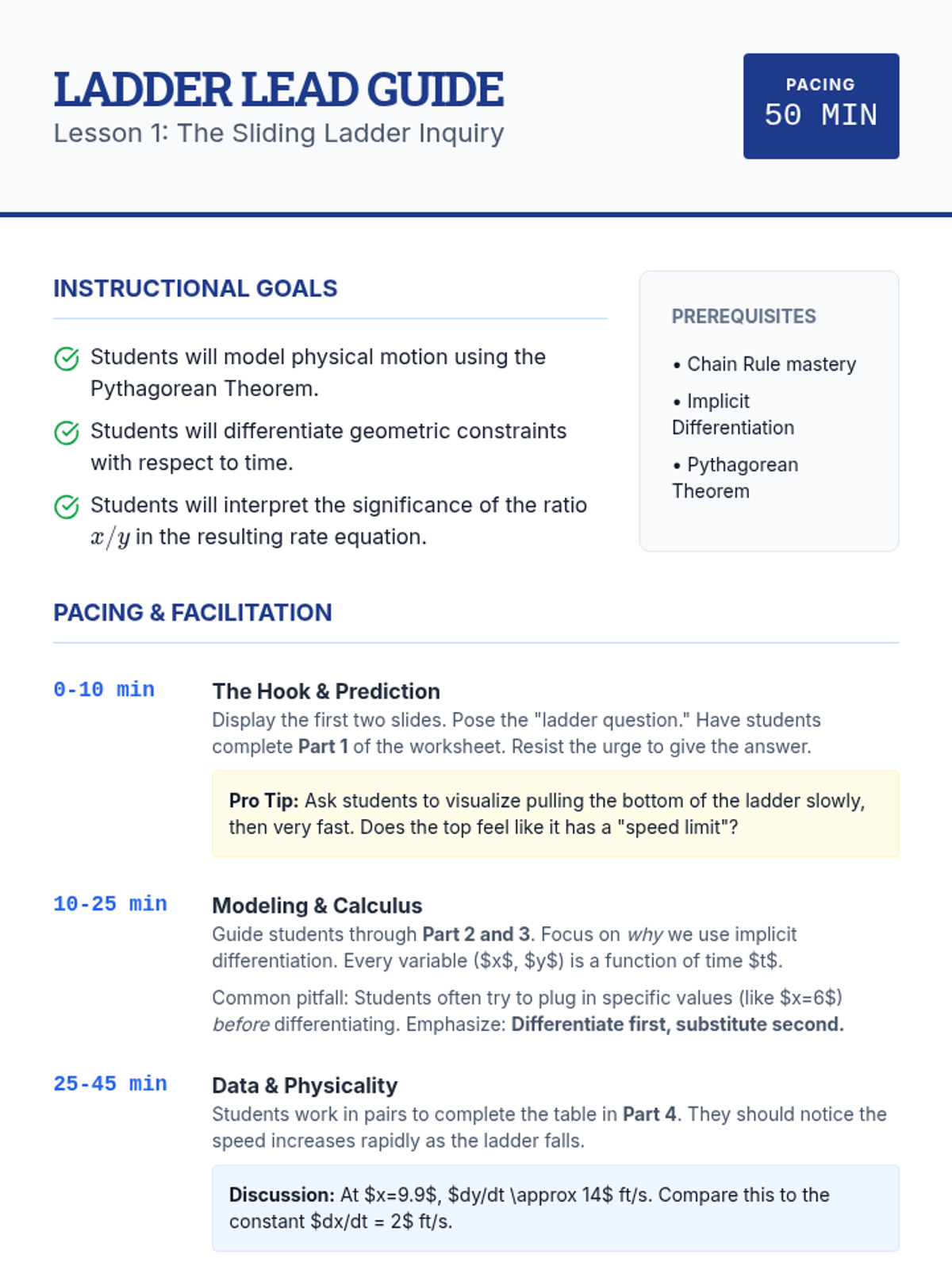
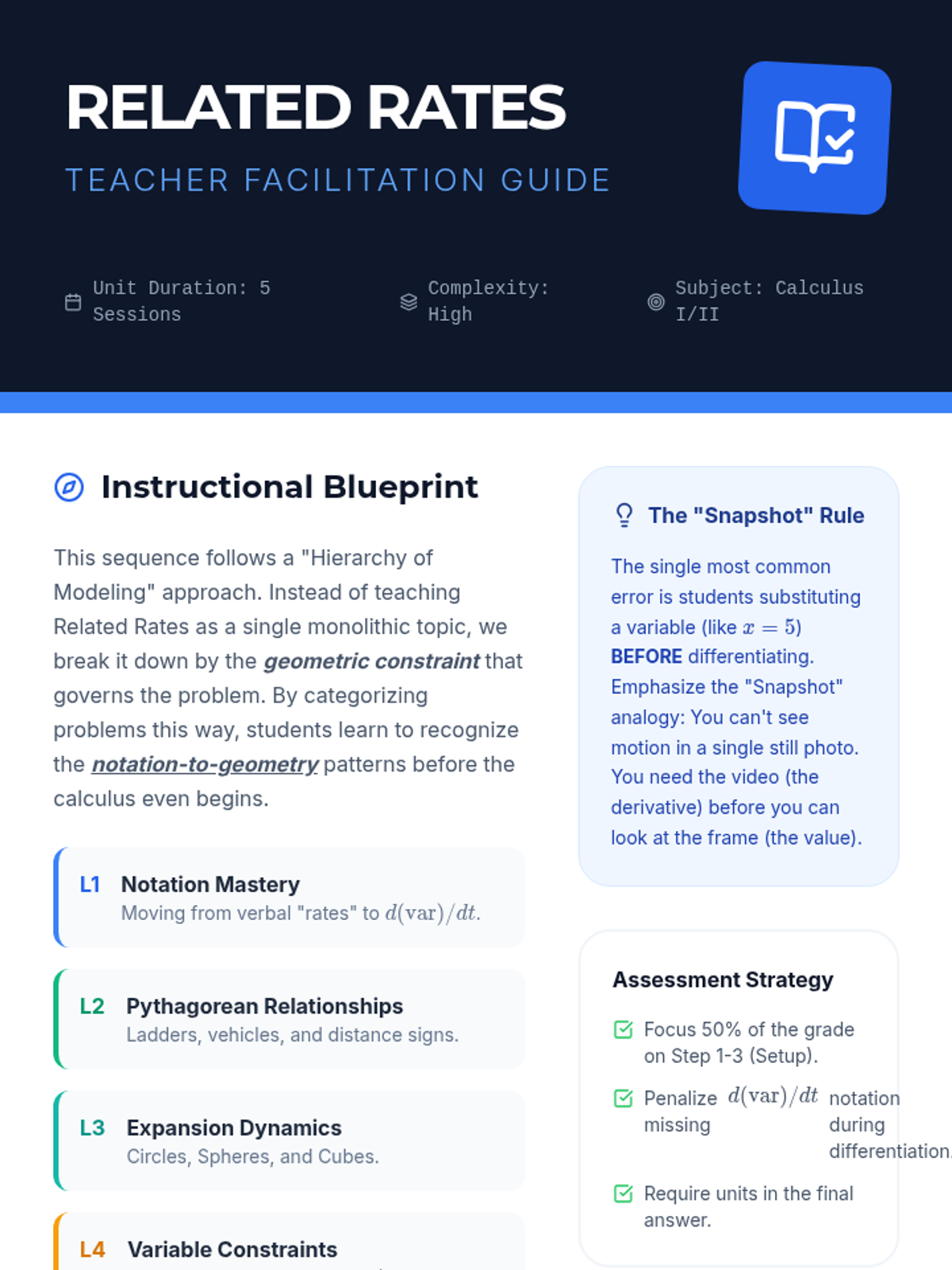
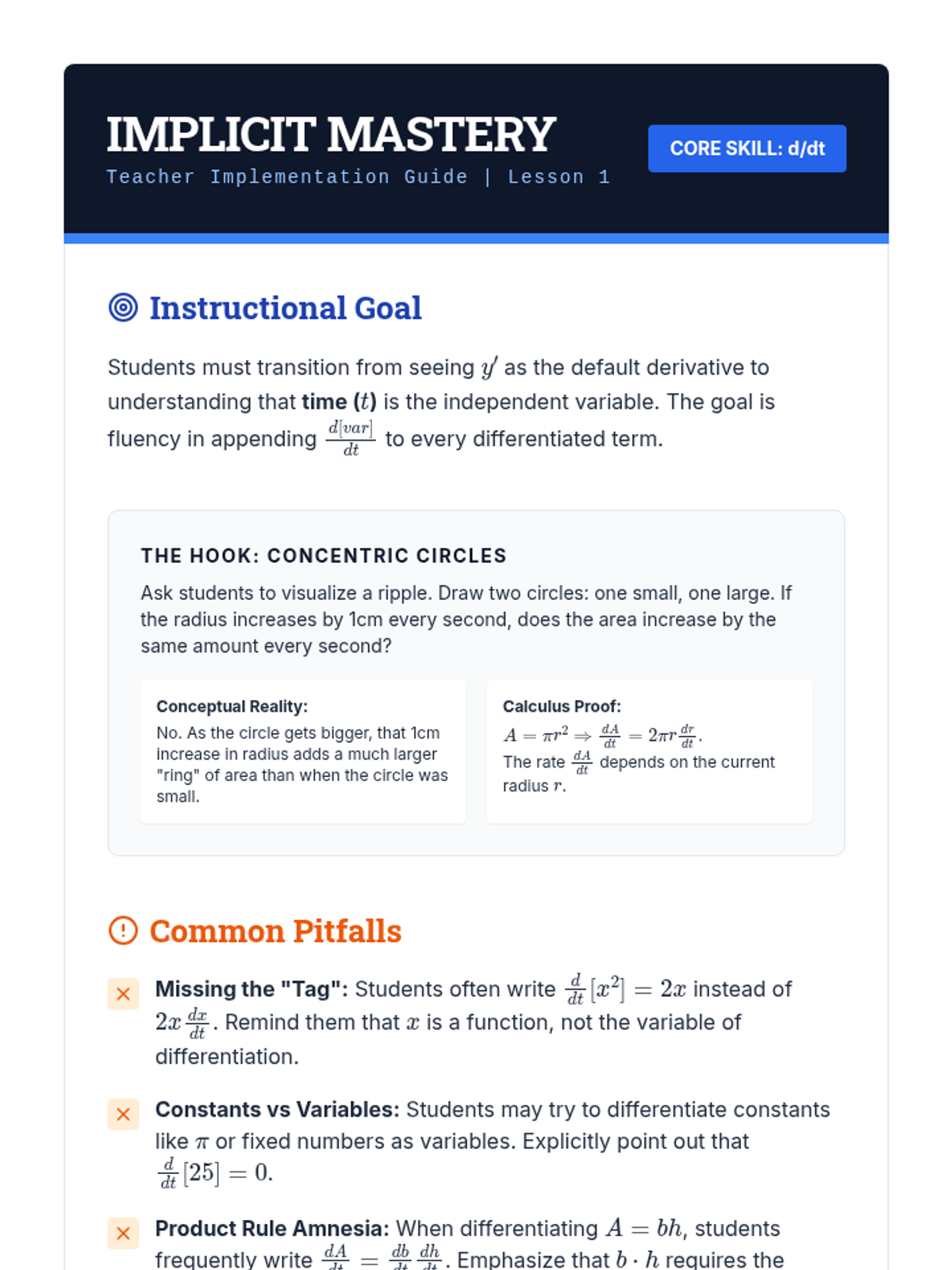
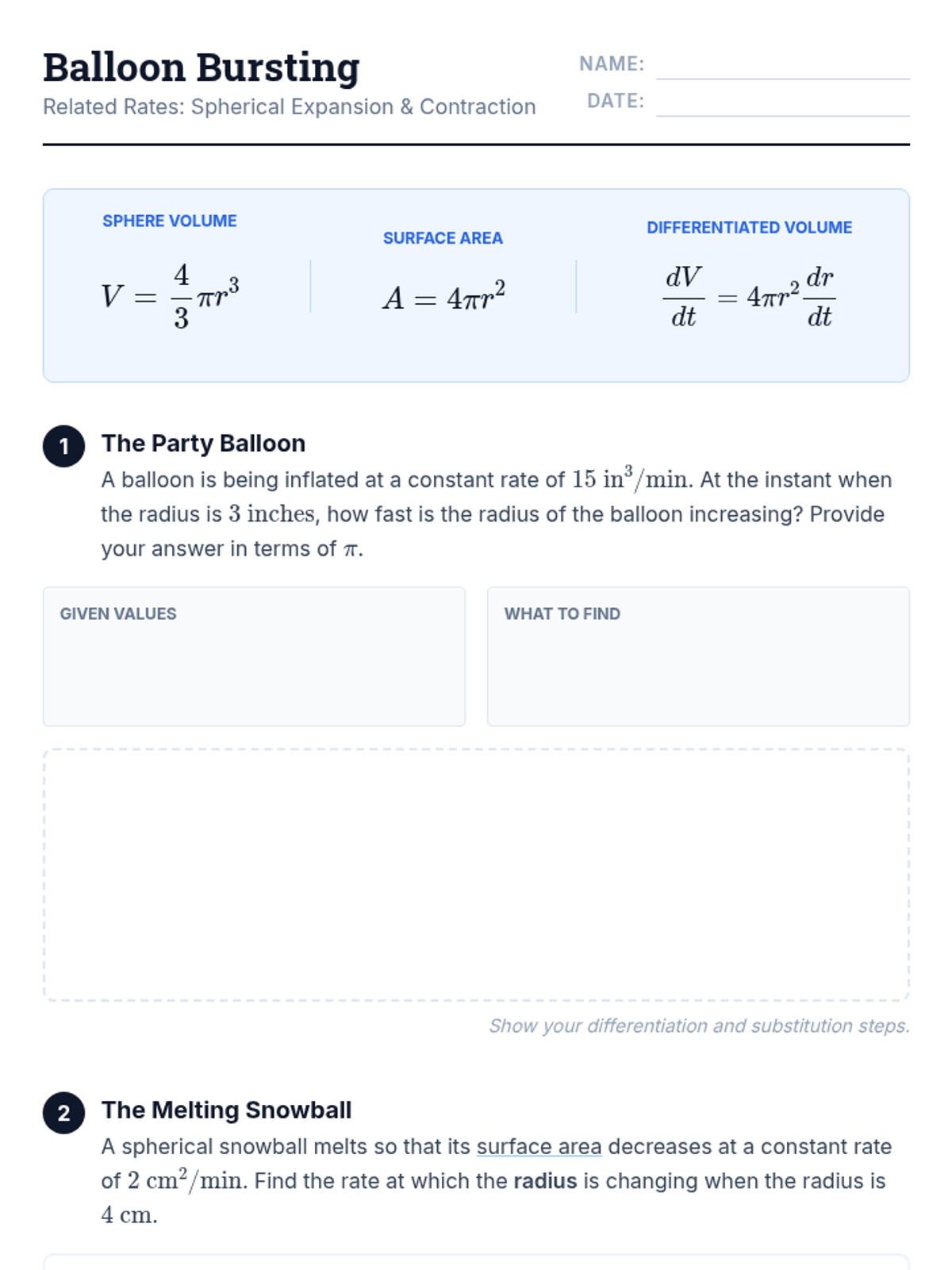
A comprehensive exploration of Related Rates using Pythagorean geometry, moving from basic ladder problems to complex multi-object motion. Students master the calculus of moving triangles through inquiry, digital modeling, and skill-building workshops.
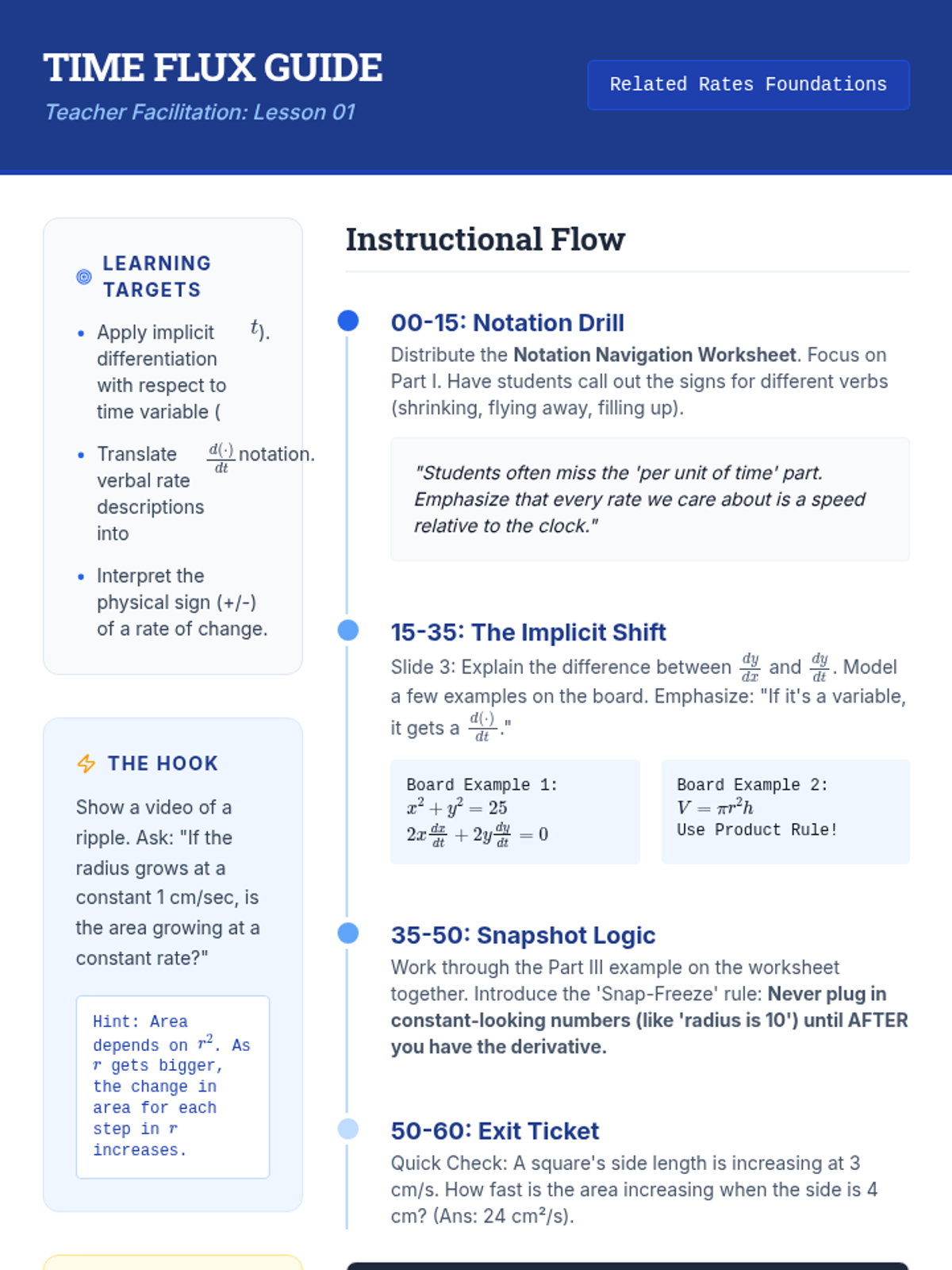
A foundational sequence for 11th-grade students on Related Rates in Calculus. Students move from static derivatives to dynamic, time-dependent rates of change, establishing a rigorous 4-step problem-solving protocol.
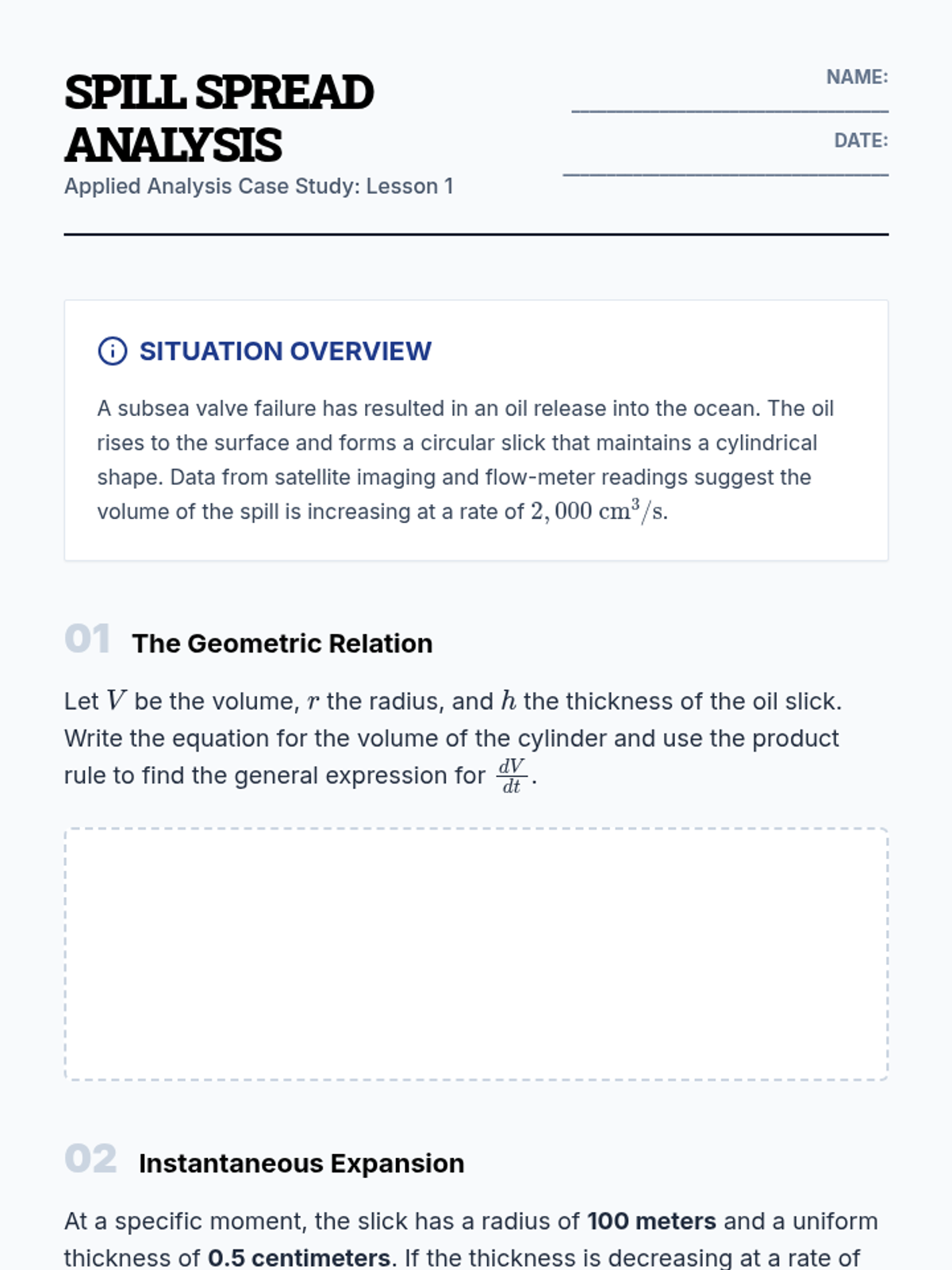
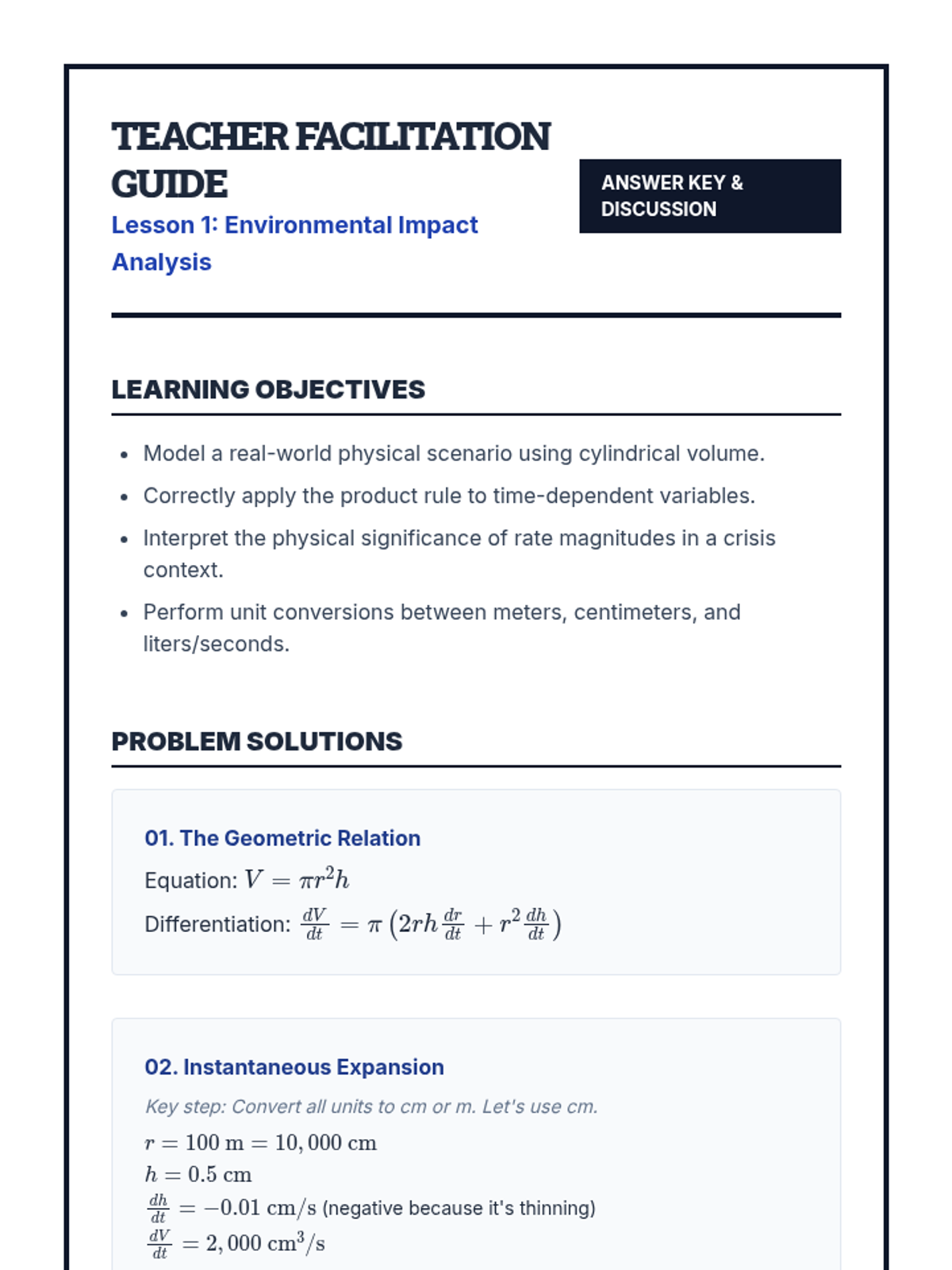
A calculus sequence for undergraduate students exploring related rates through environmental, engineering, and mechanical lenses. Students analyze dynamic systems like oil spills, reservoir drainage, and piston mechanics to understand the physical significance of time-dependent derivatives.
A systematic workshop-style approach to mastering related rates in Calculus. Students progress from foundational implicit differentiation to complex geometric modeling involving Pythagorean theorem, volume expansion, conical constraints, and trigonometric rates.
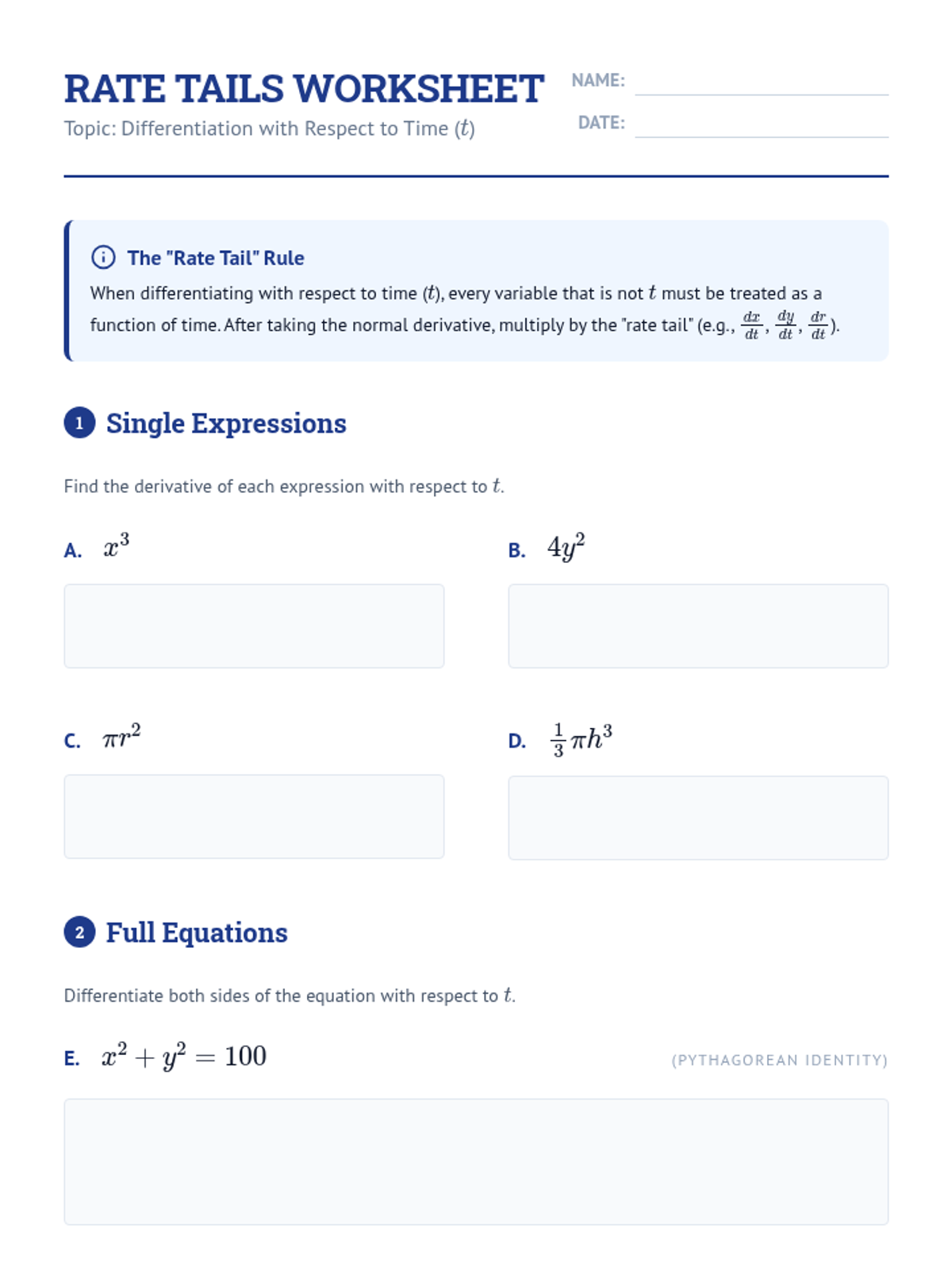
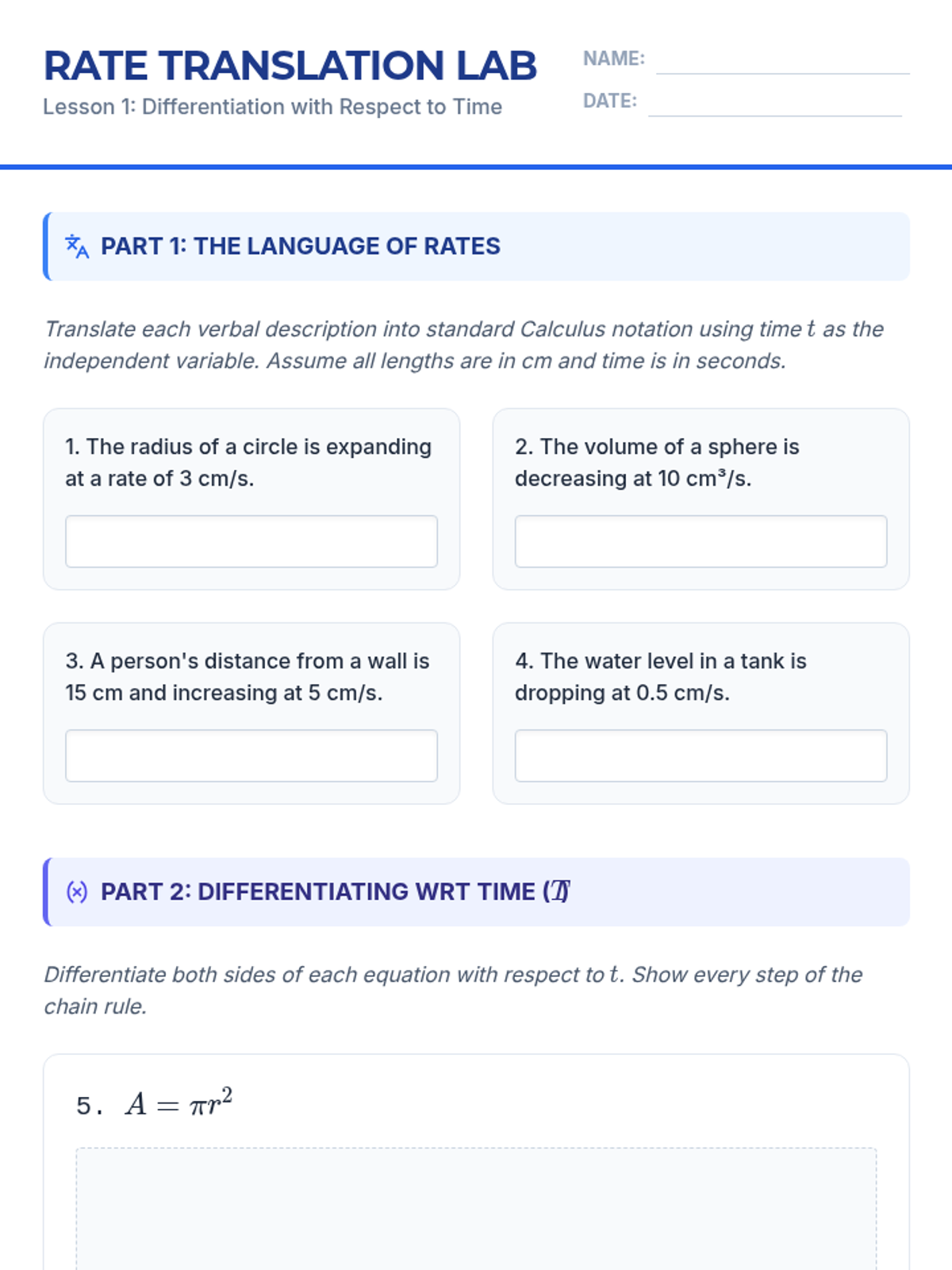
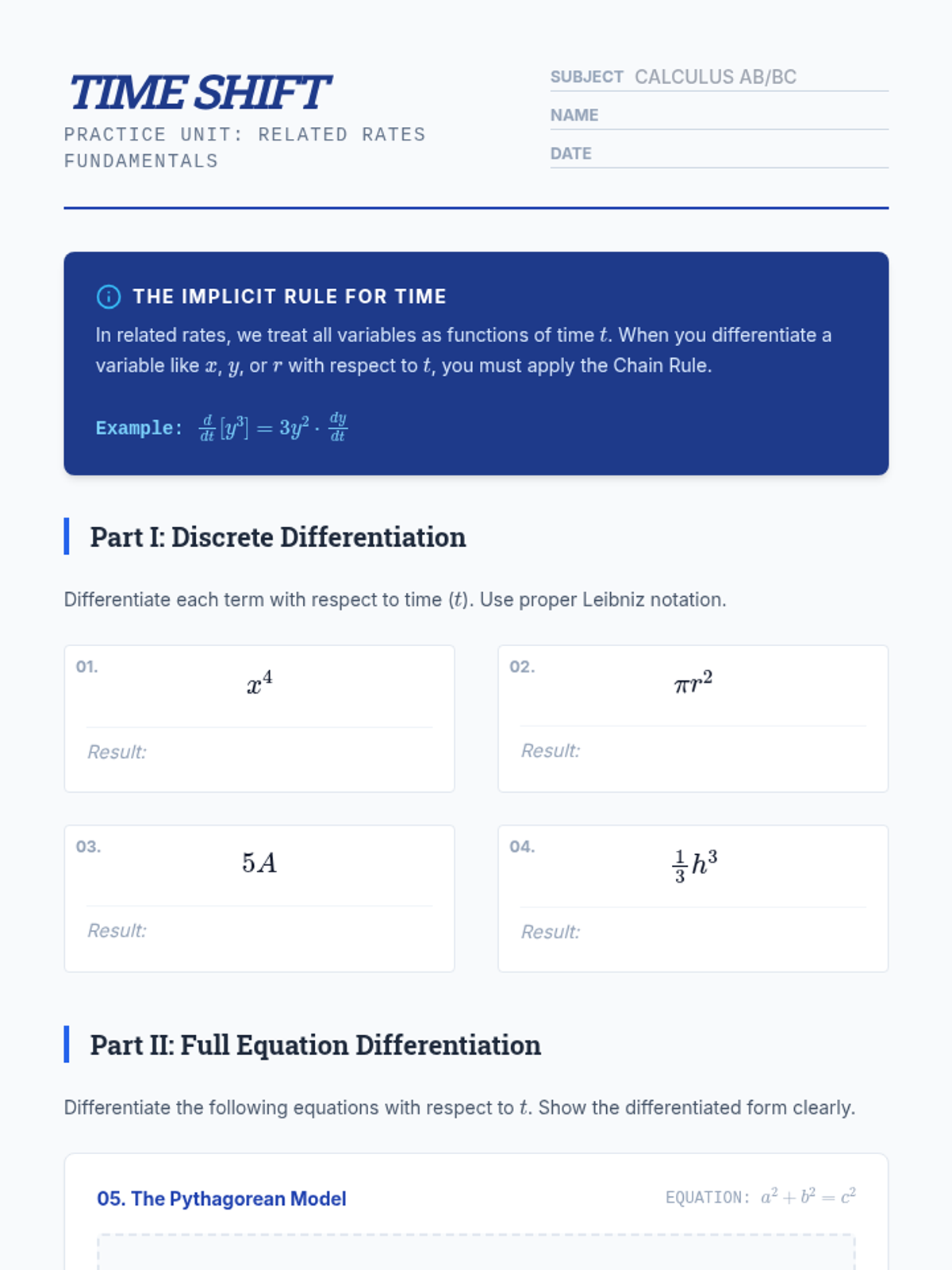
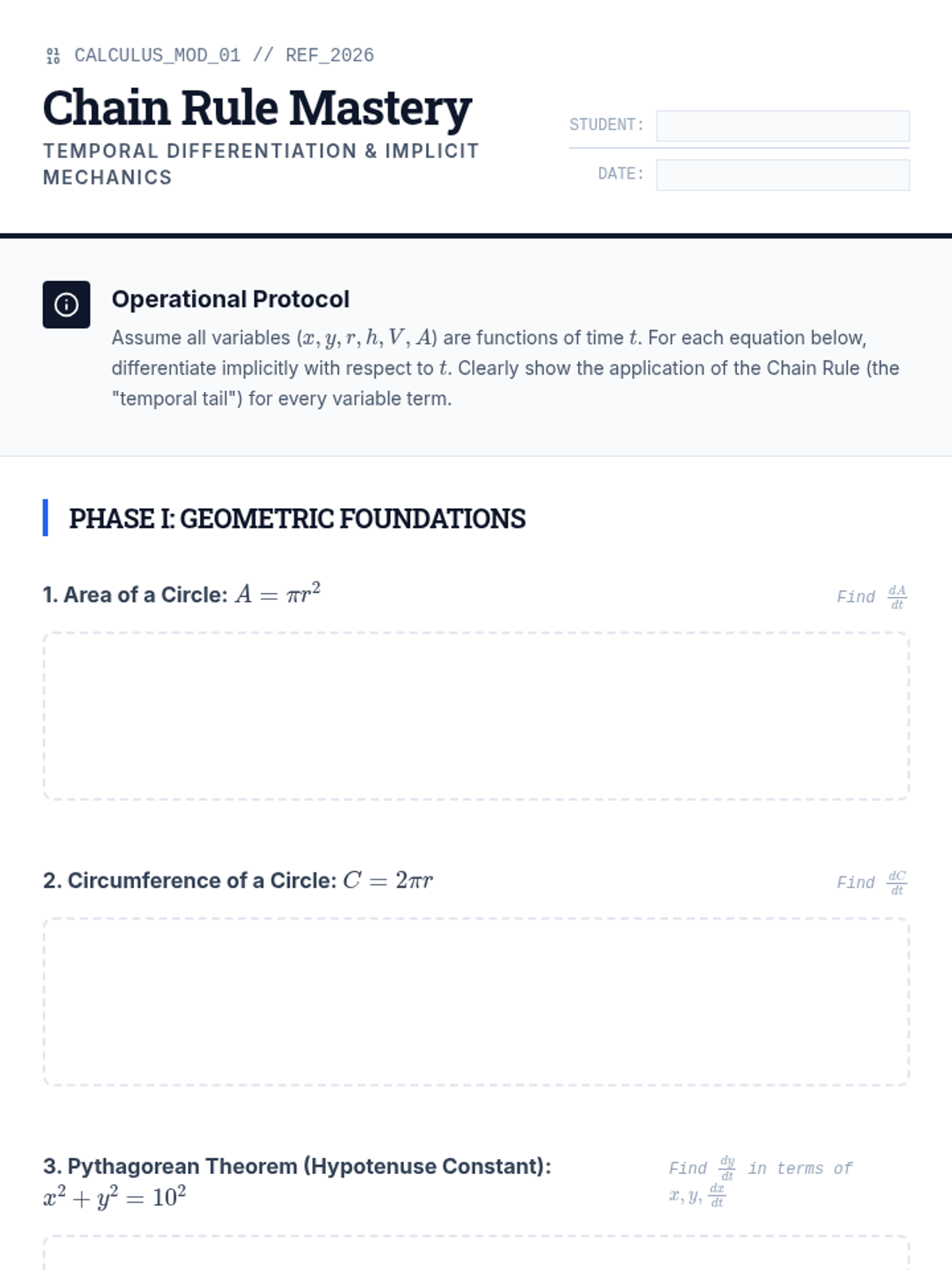
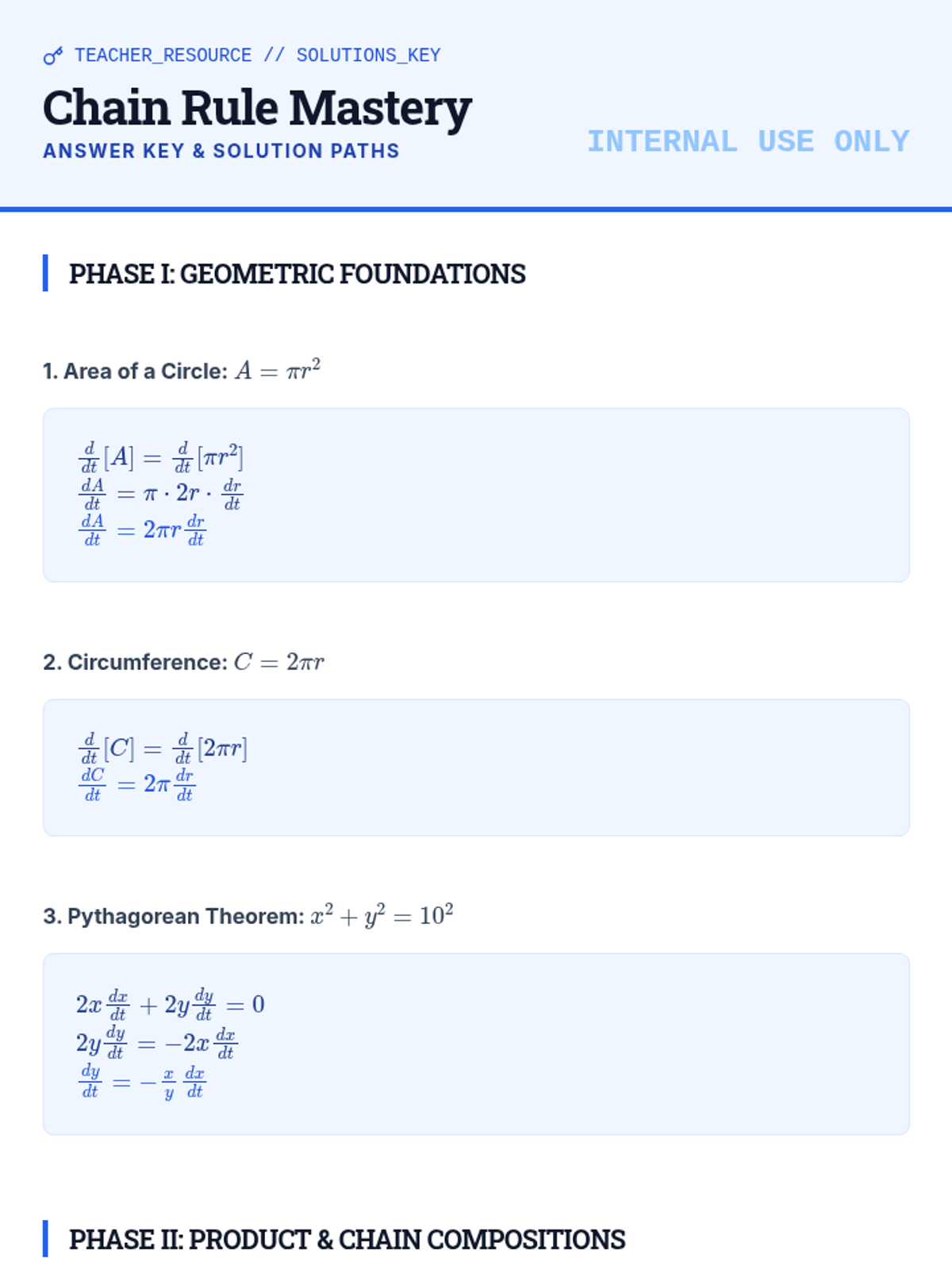
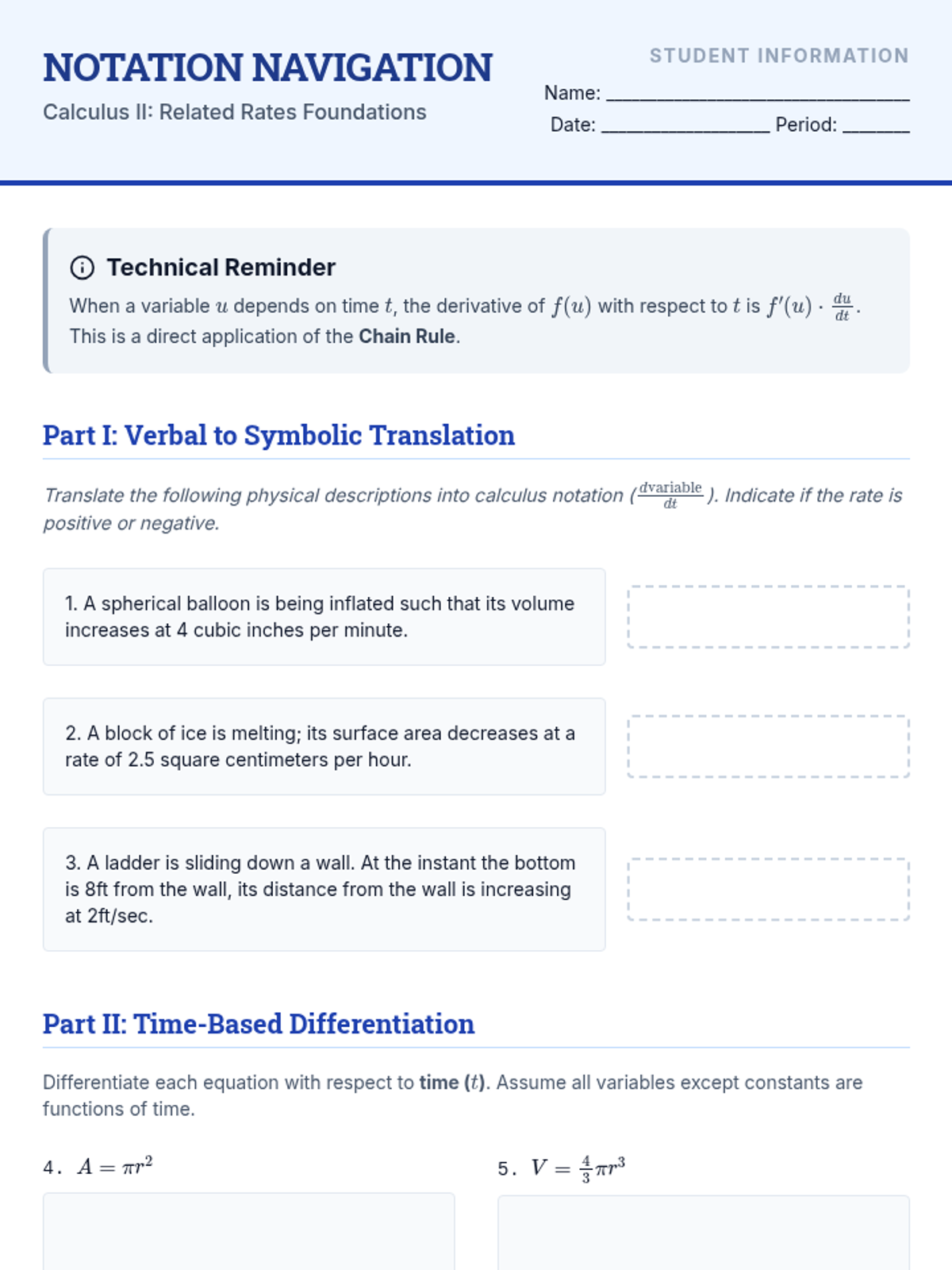
This sequence establishes the foundational skills for related rates in Calculus. It covers implicit differentiation with respect to time, translating word problems into notation, and solving problems involving Pythagorean relationships and geometric shapes.
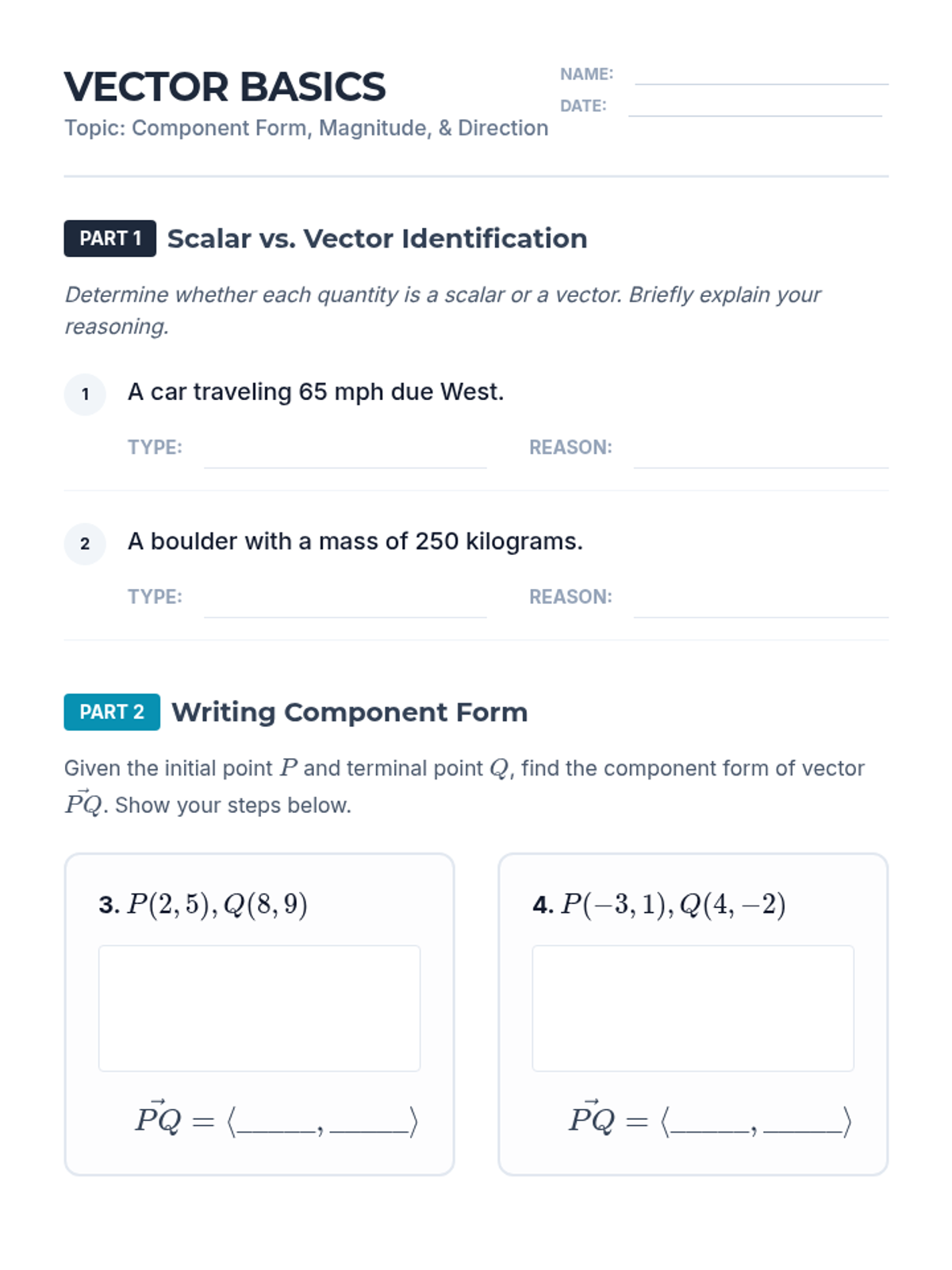
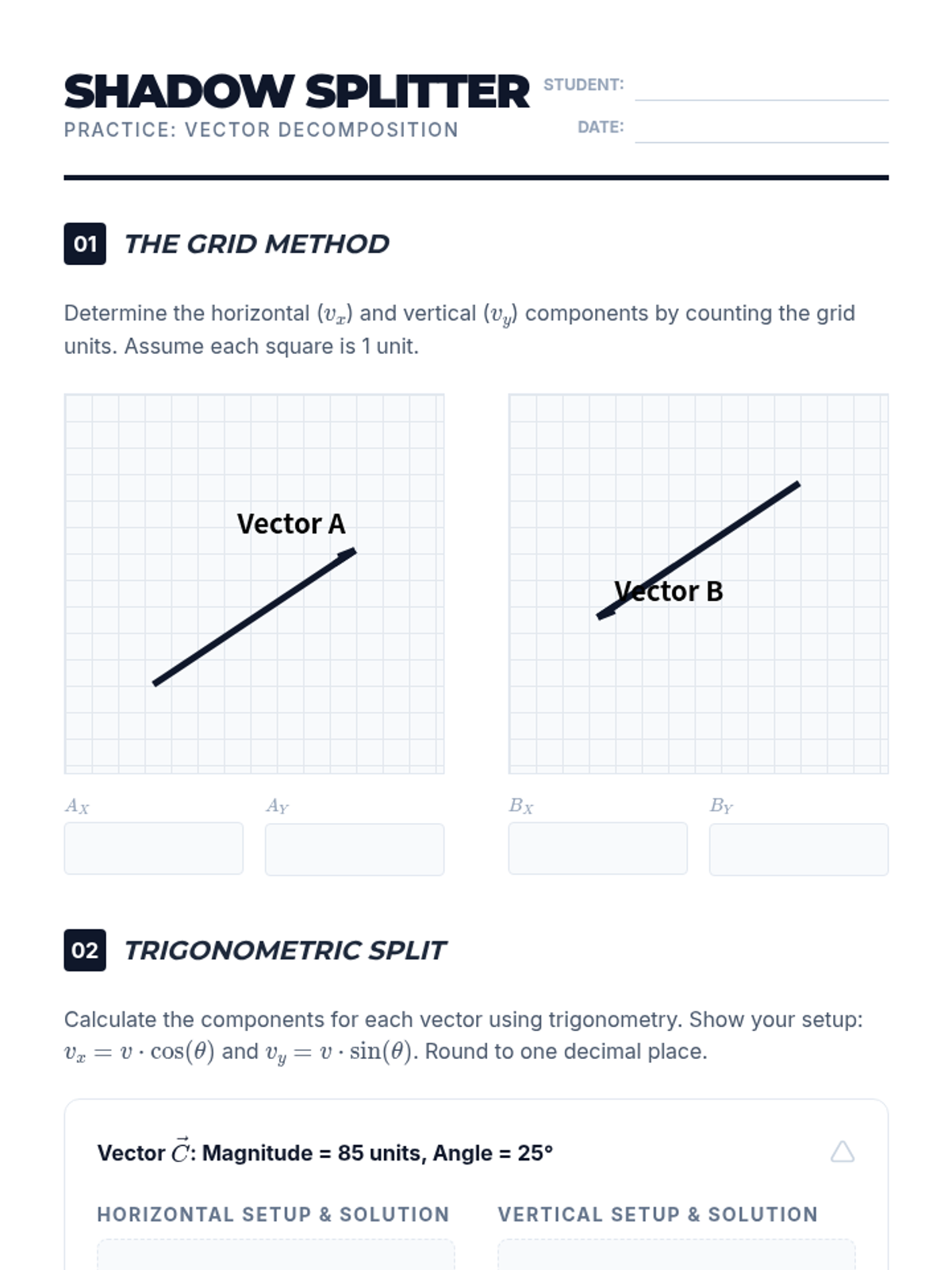
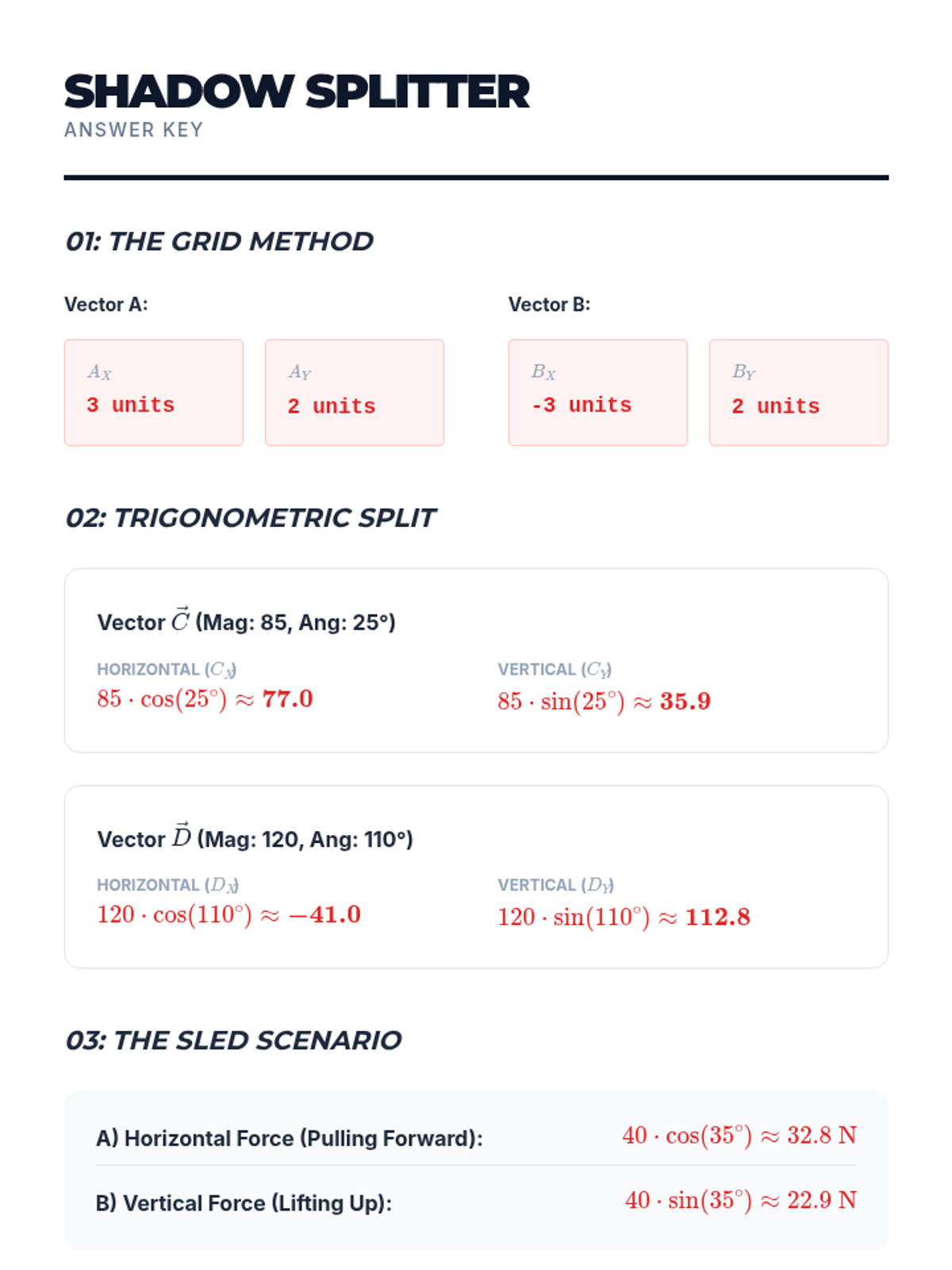
This sequence guides 9th-grade students through the algebraic representation of vectors. Moving from geometric drawings to coordinate components, students use trigonometry and the Pythagorean theorem to decompose, reconstruct, and add vectors with precision.
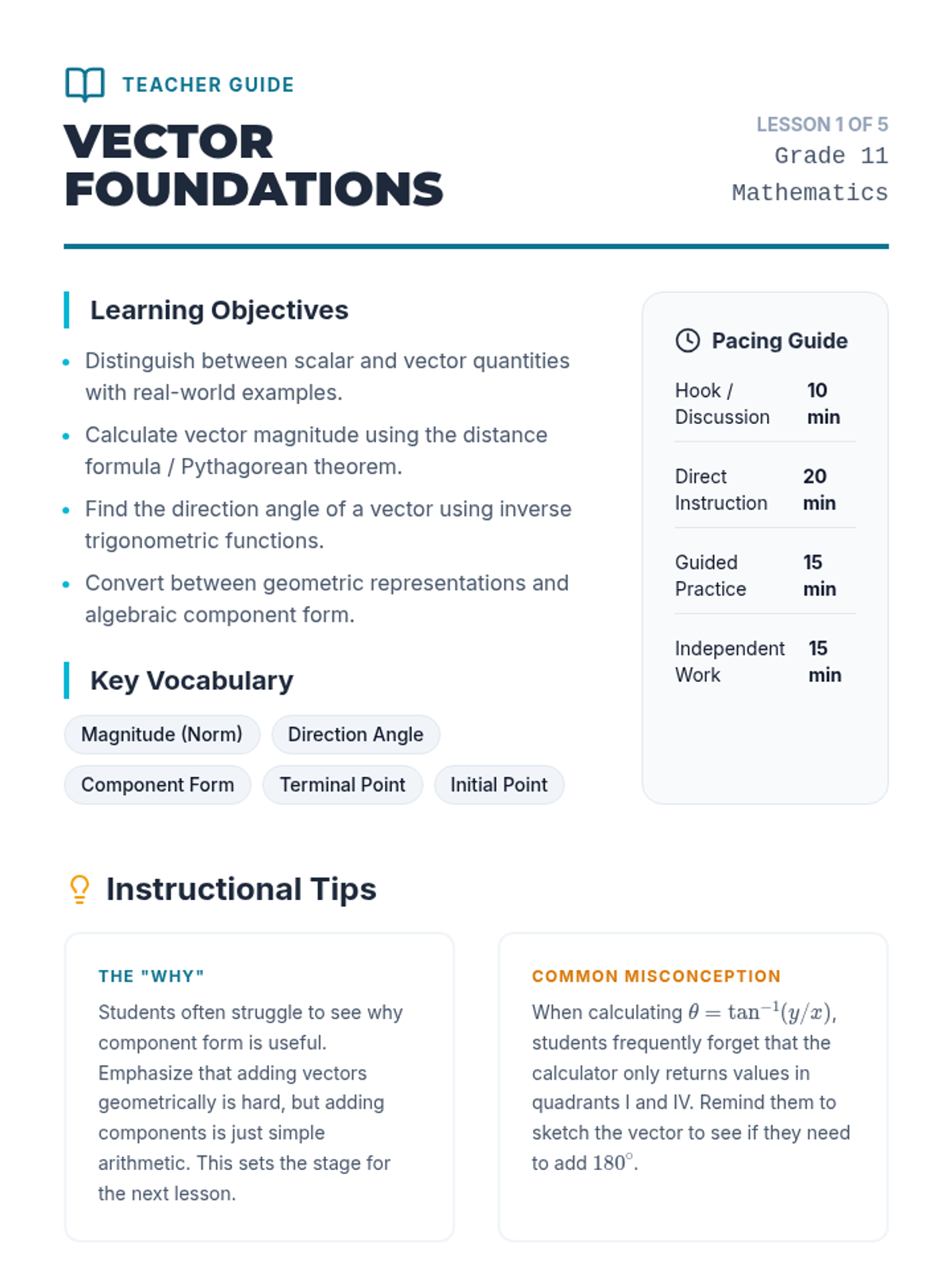
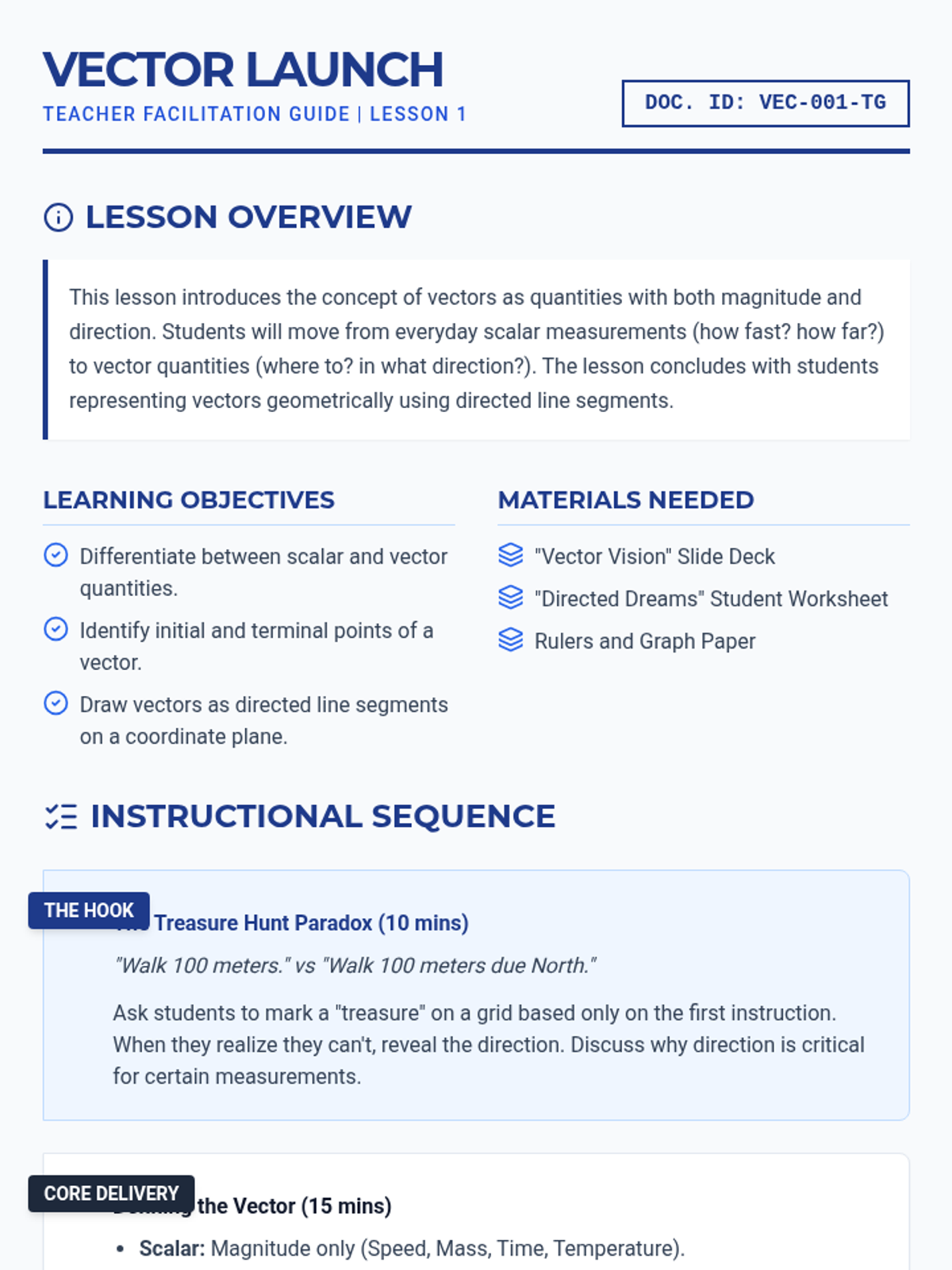
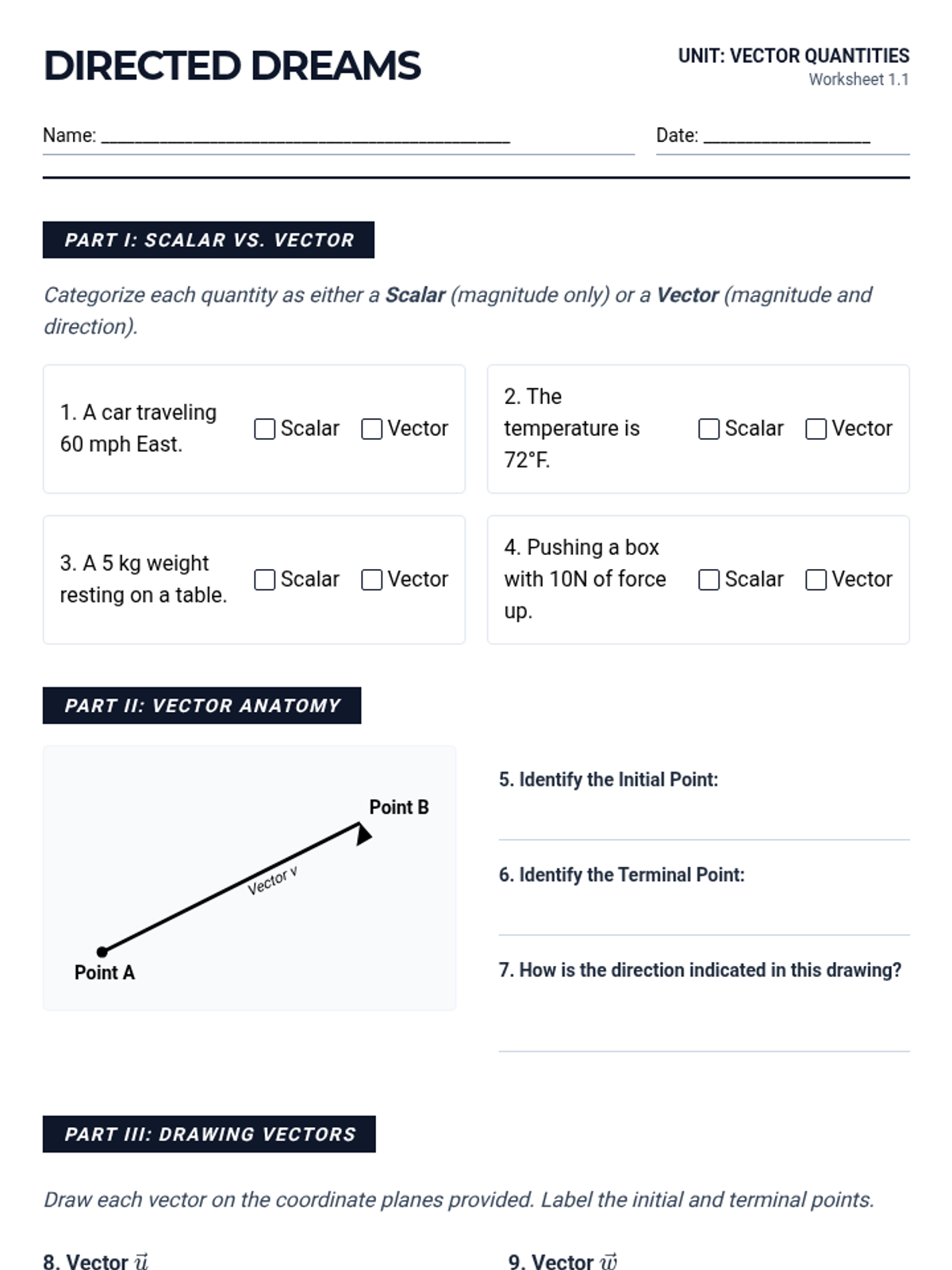
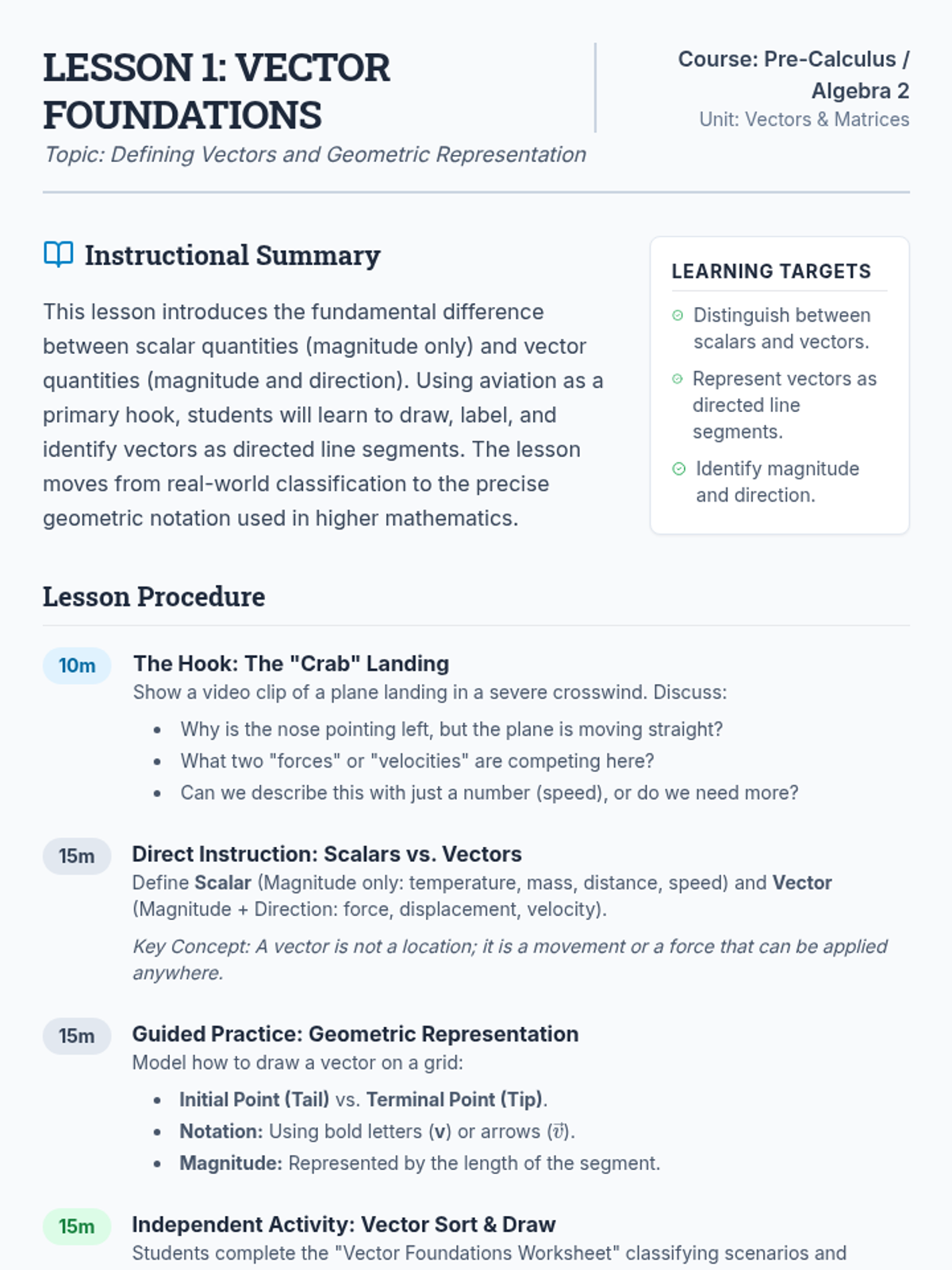
A comprehensive introduction to vectors through geometric representation, focusing on the distinction between scalars and vectors, visual addition/subtraction, scalar multiplication, and the transition to component form and magnitude calculation.
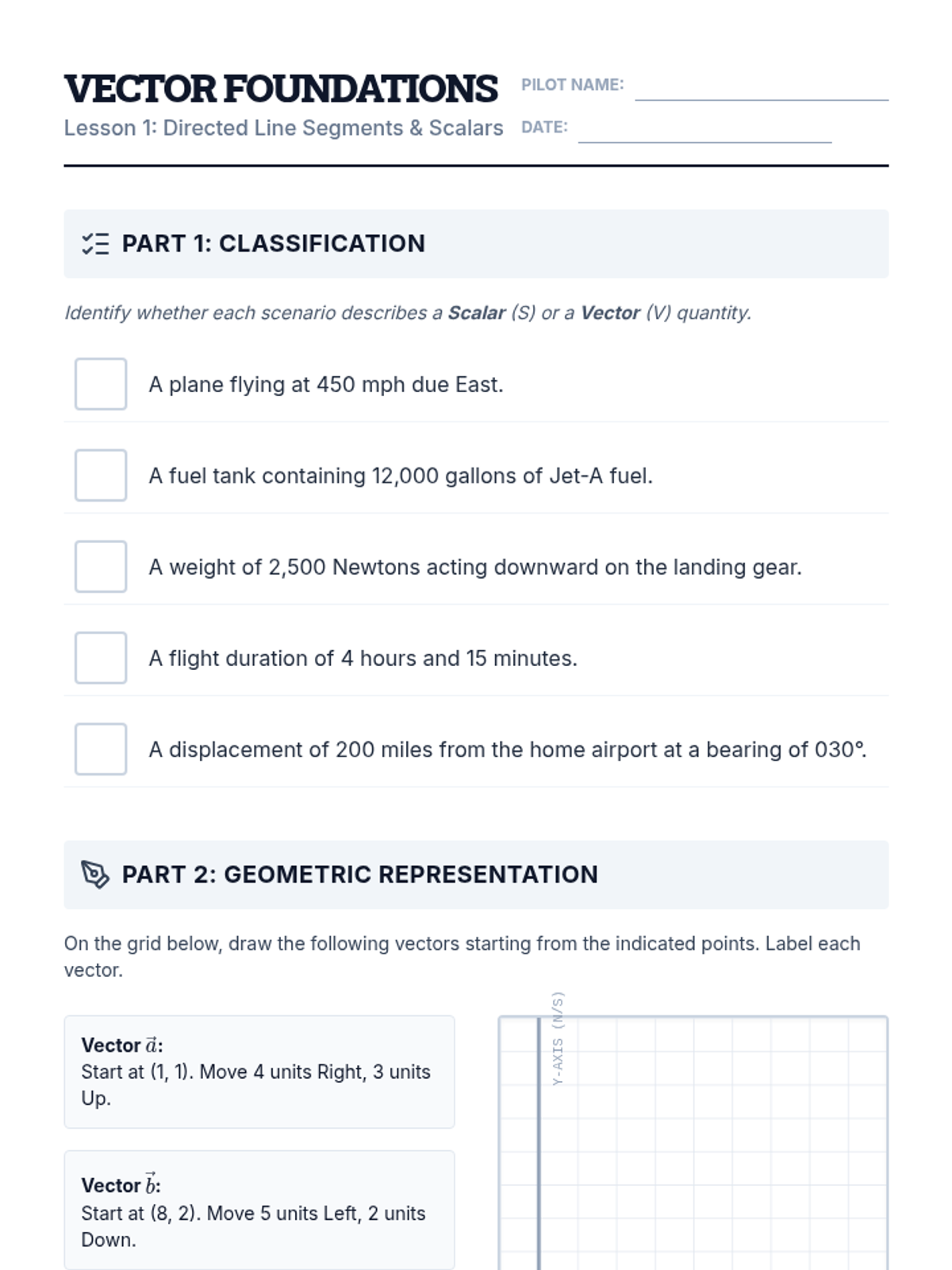
A comprehensive 11th-grade unit on vector quantities, moving from conceptual geometric representations to complex algebraic modeling in aviation and navigation contexts. Students master component resolution, vector arithmetic, and resultant force calculations.
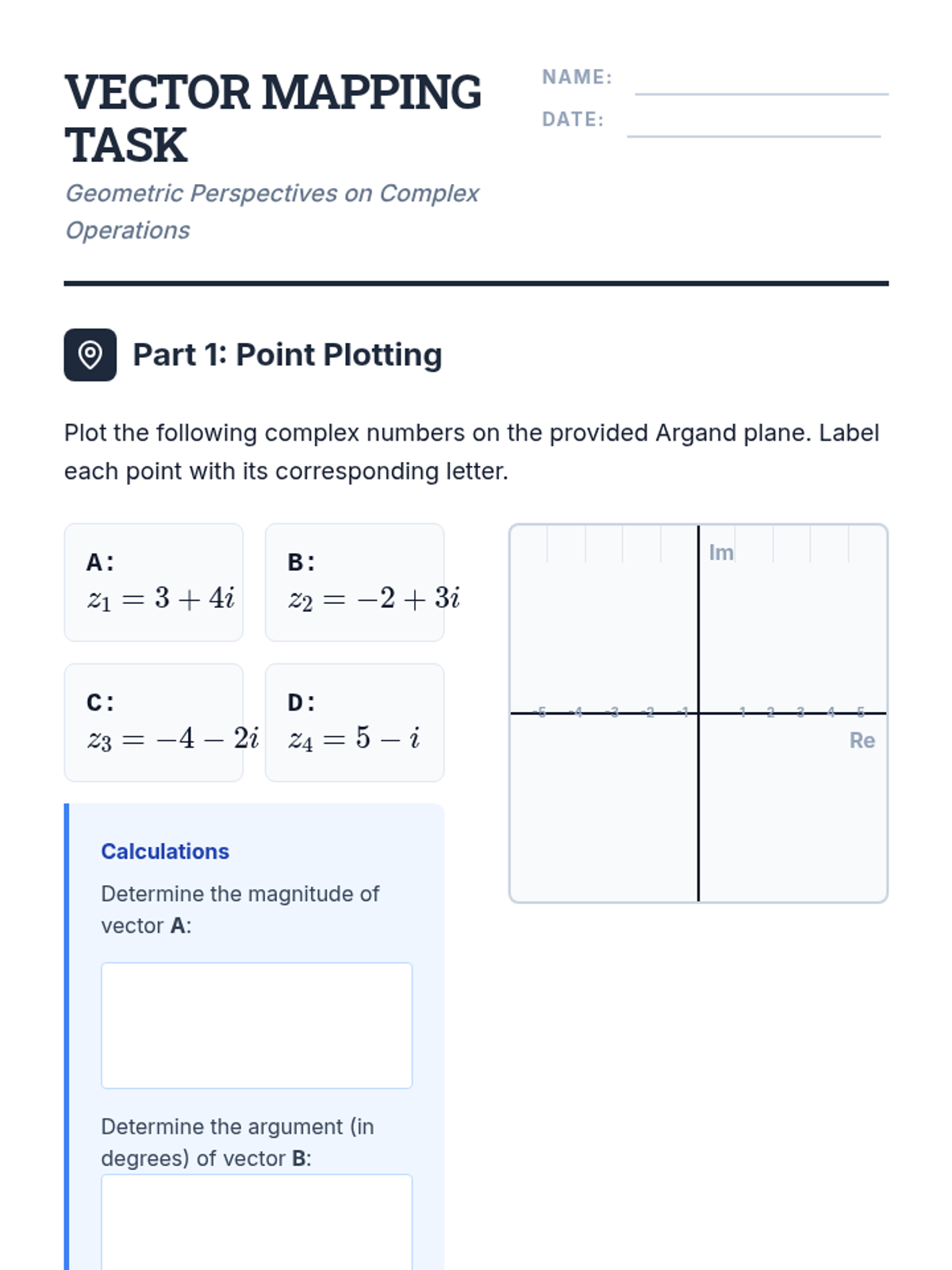
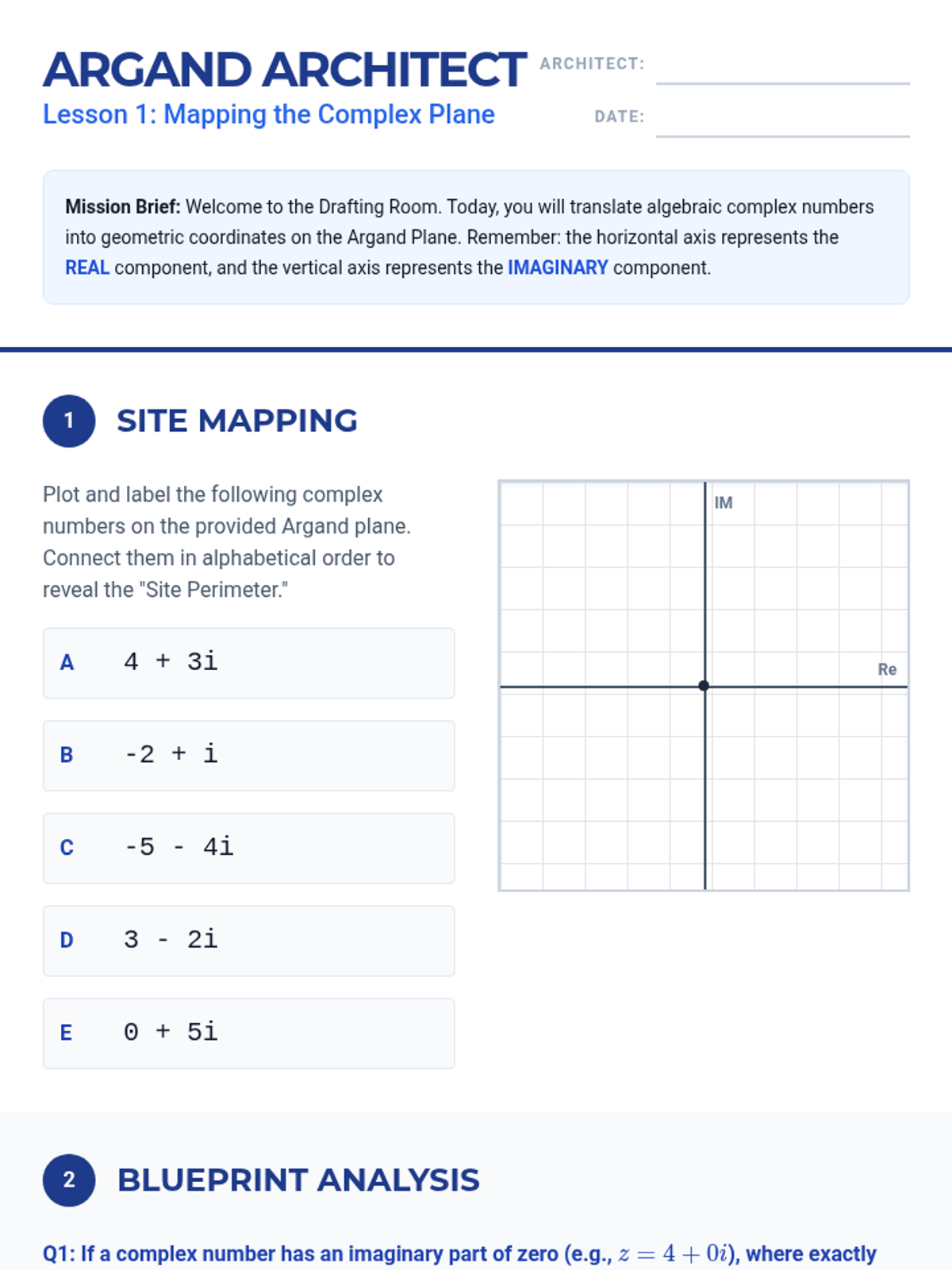
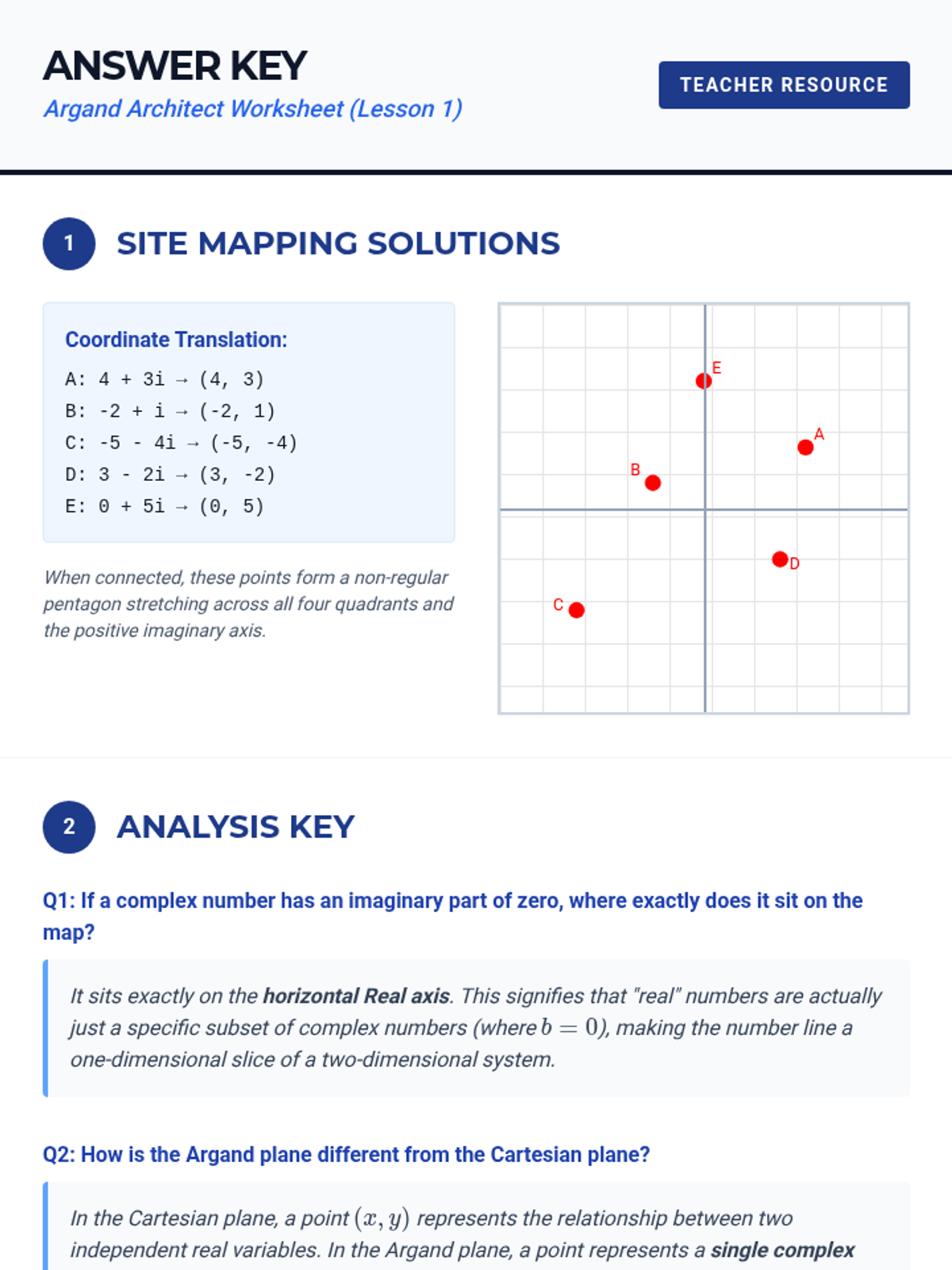
This 12th-grade mathematics sequence explores the geometric interpretation of complex numbers on the Argand plane. Students will master plotting, calculating modulus, visualizing vector arithmetic, and discovering the elegant symmetry of roots of unity, culminating in an exploration of complex iterations and fractals.
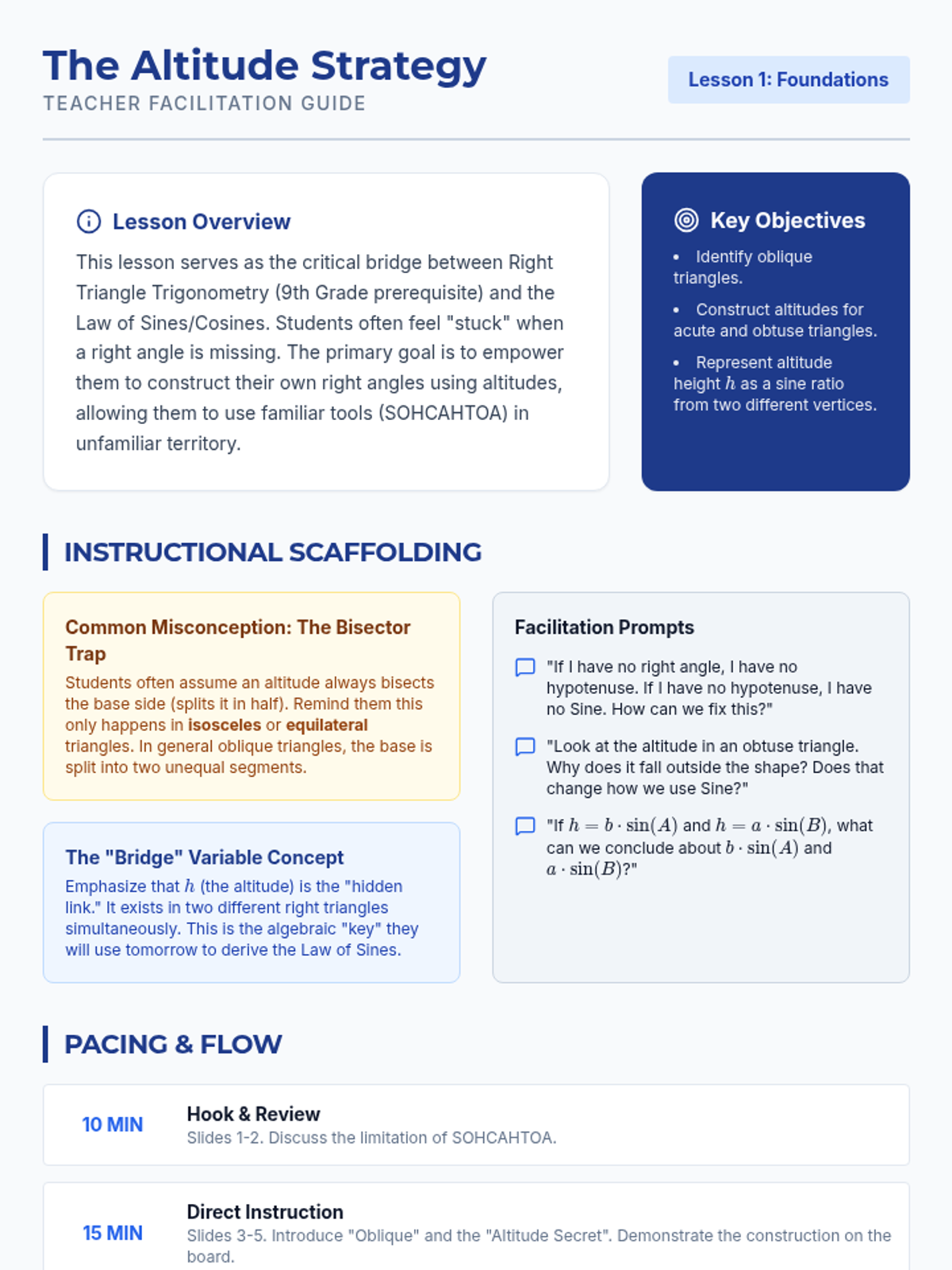
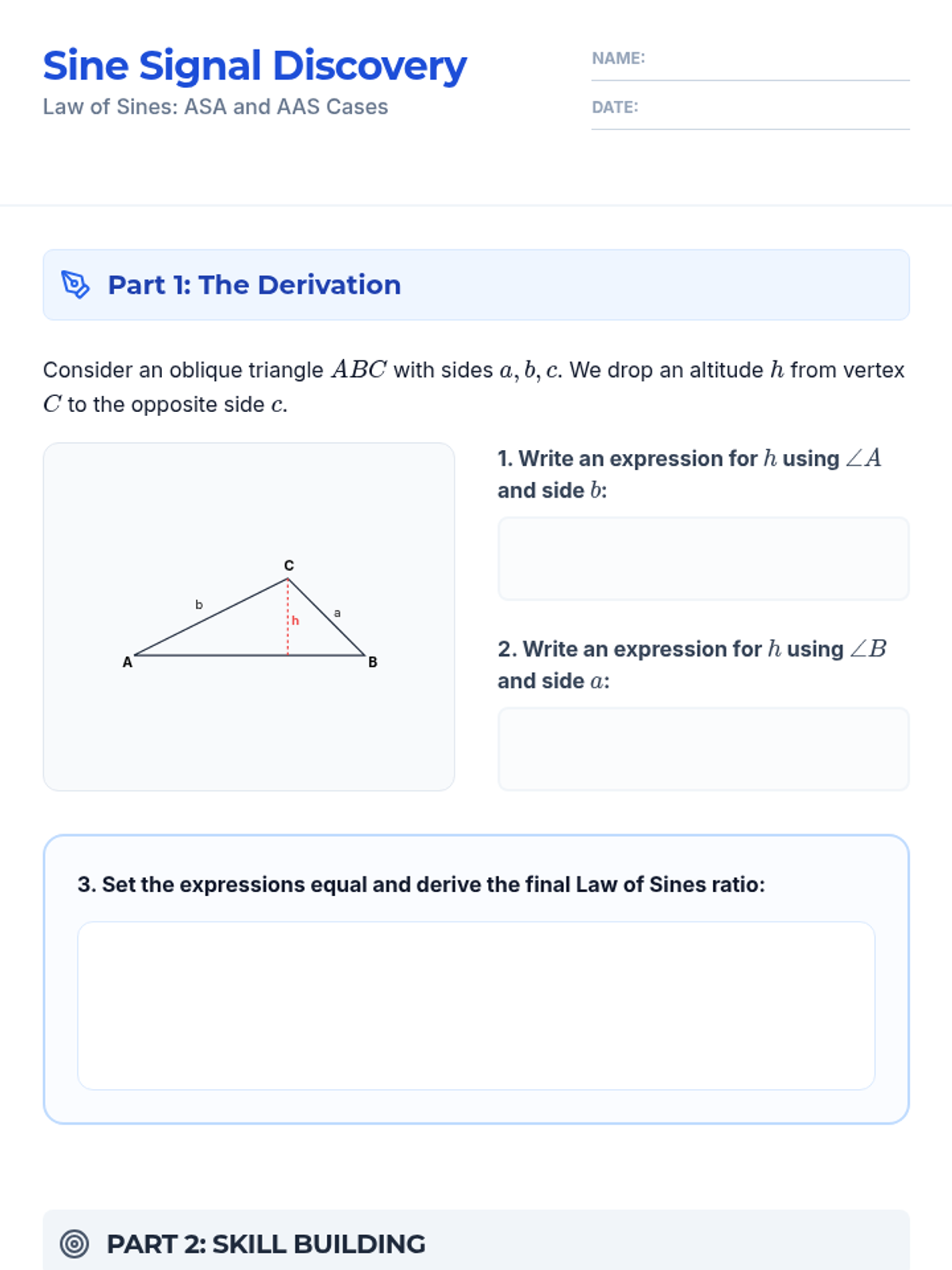
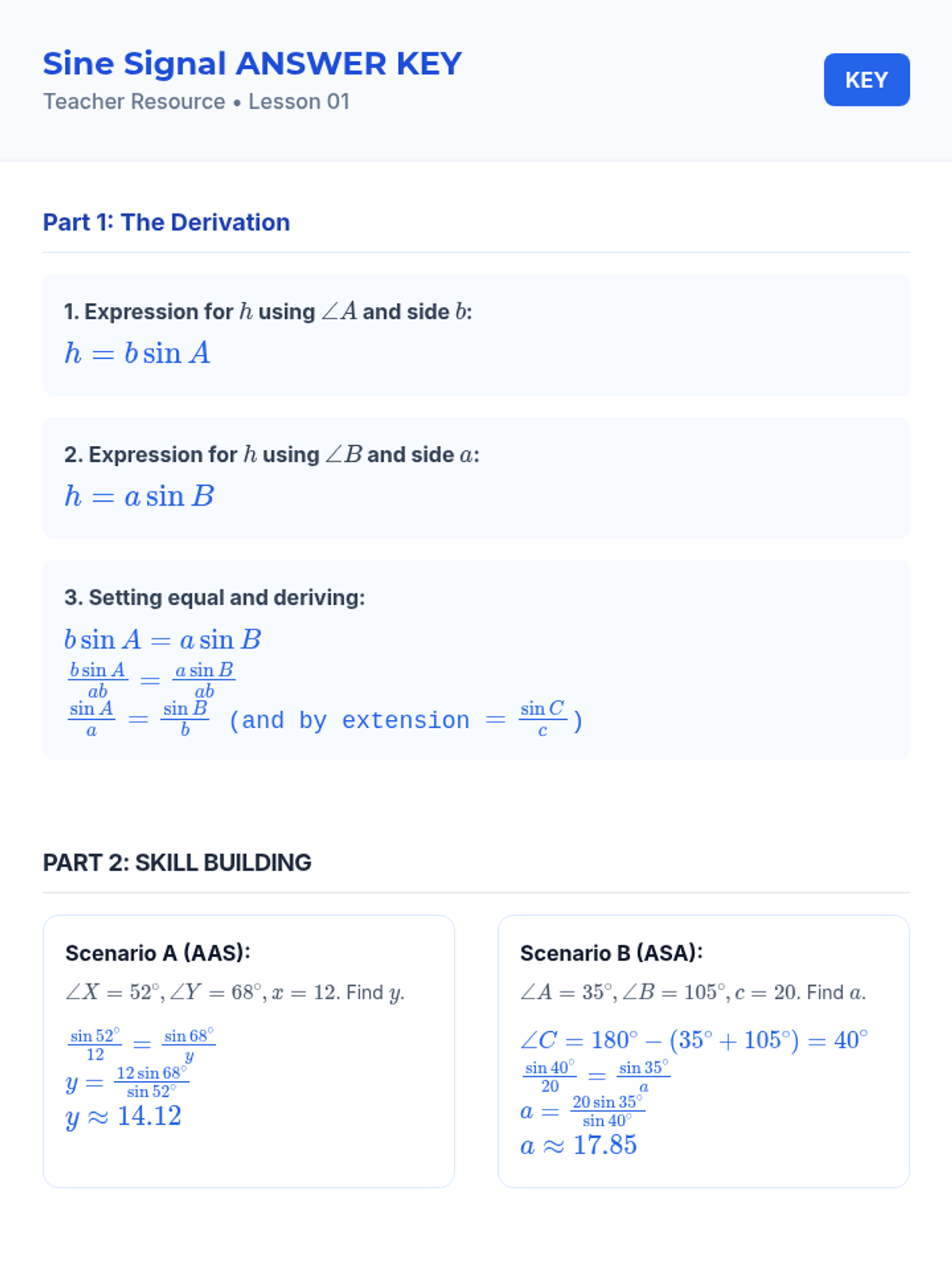
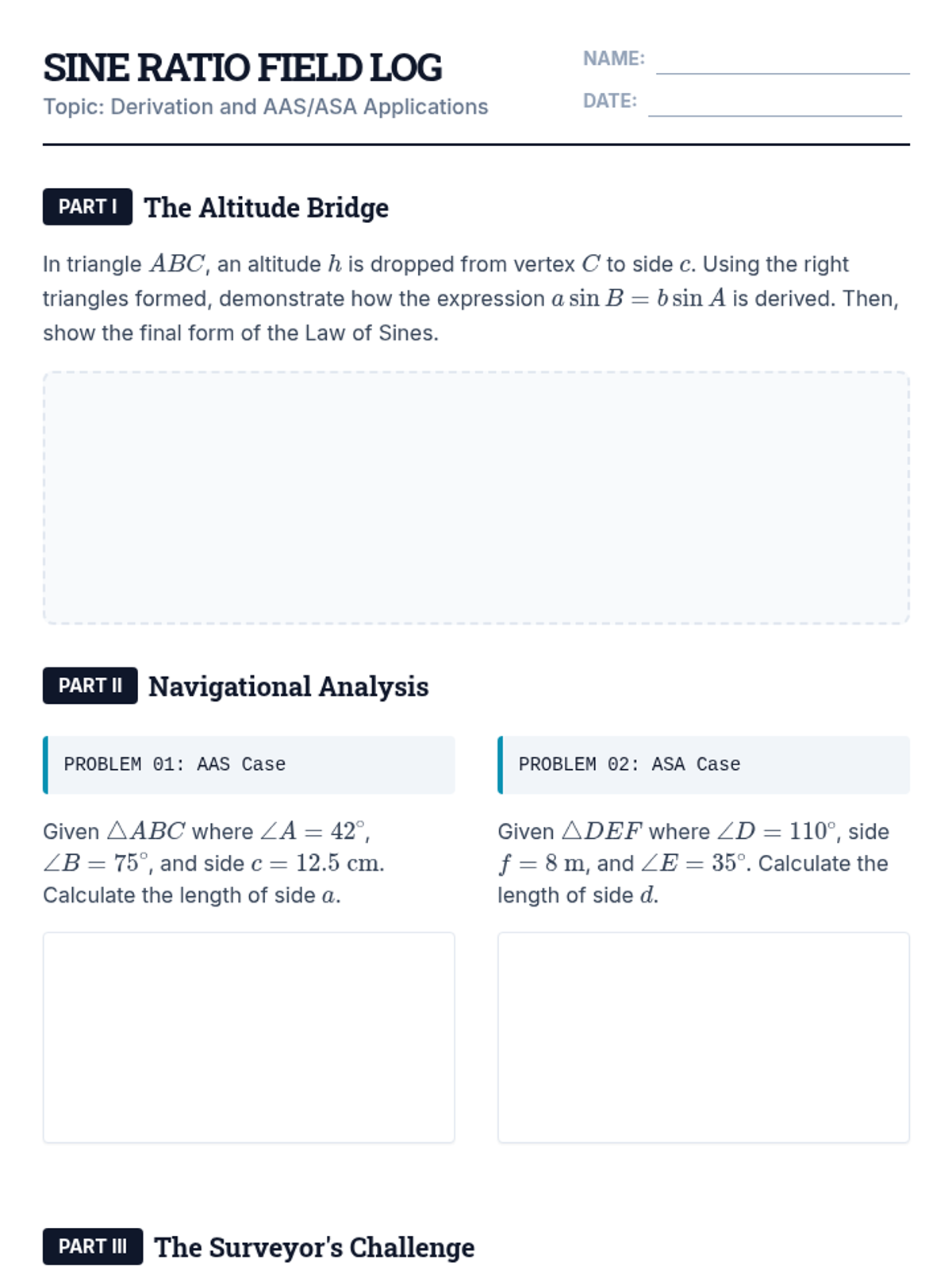
A 5-lesson geometry sequence where students move from right-triangle trigonometry to general triangles. They derive the Law of Sines and Law of Cosines through inquiry and verify their accuracy via a hands-on measurement lab.
This sequence guides undergraduate students through the modeling and solution of related rates problems, bridging the gap between static algebraic formulas and dynamic calculus concepts. Students will master implicit differentiation with respect to time and apply it to linear motion, geometric expansion, angular velocity, and fluid dynamics.
This sequence guides students through the rigorous process of modeling and solving related rates problems. Learners progress from simple geometric expansions to complex multi-variable systems involving fluid dynamics and angular displacement, emphasizing a structured problem-solving protocol.
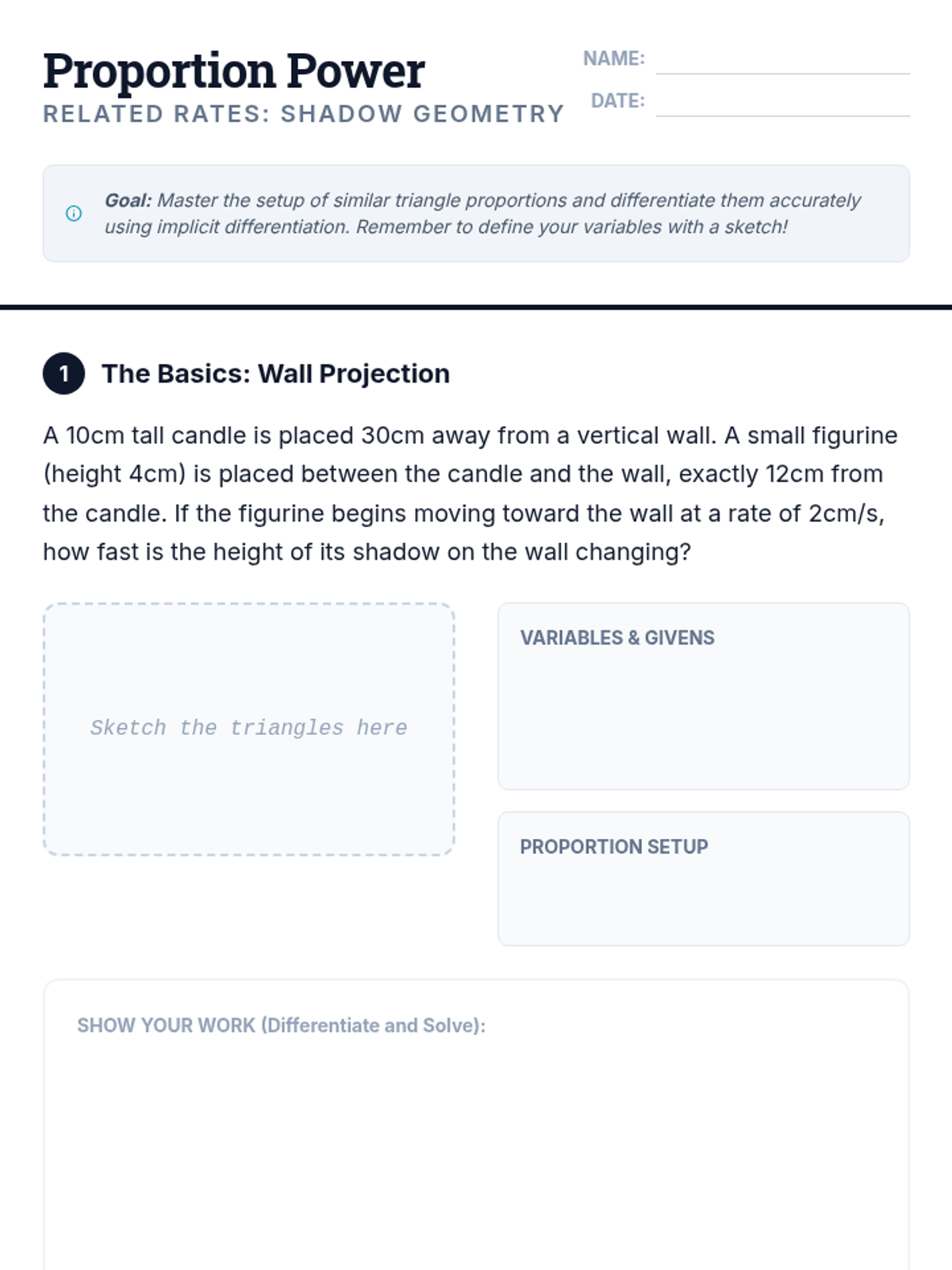
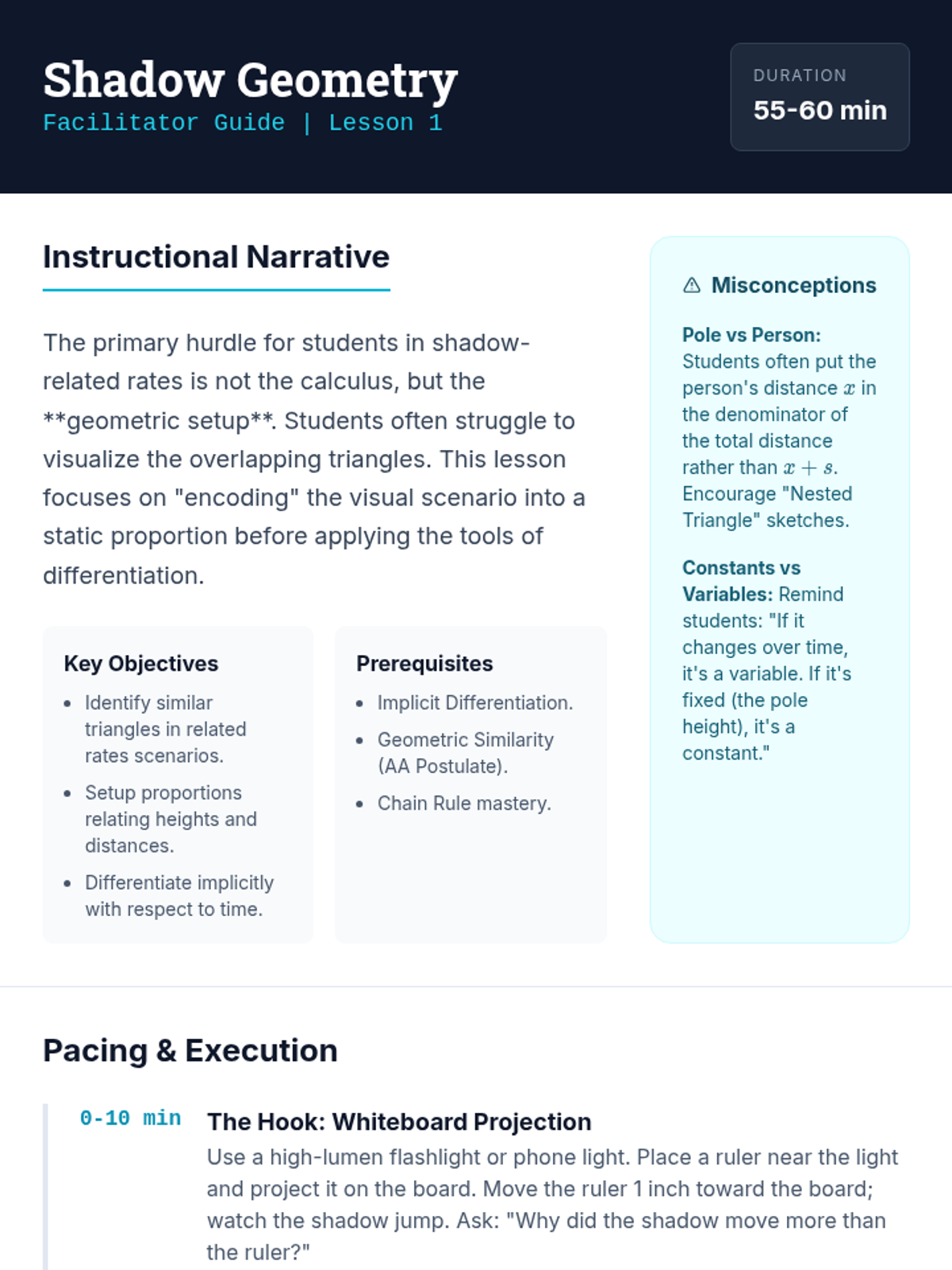
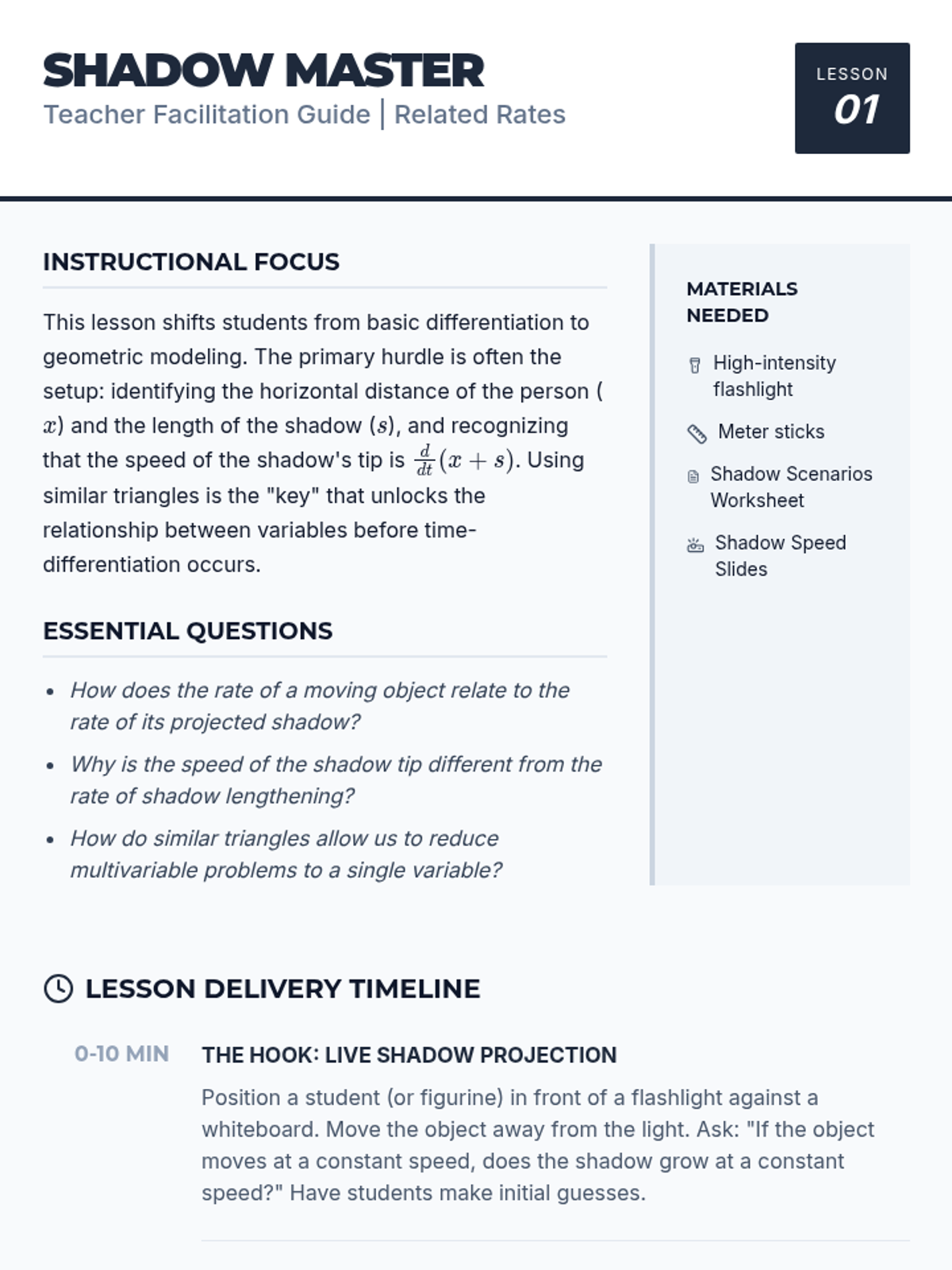
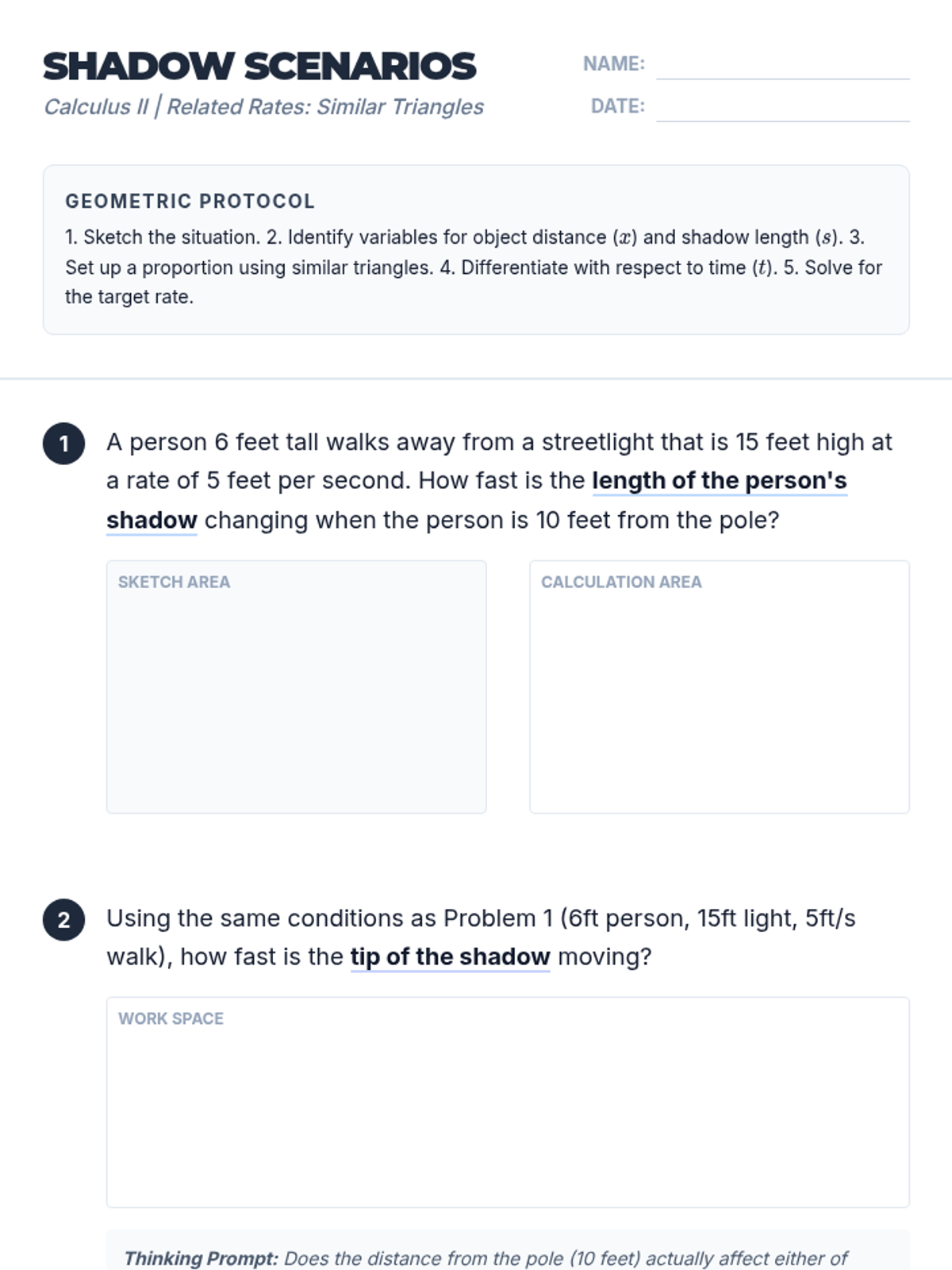
This advanced sequence explores related rates through the lens of geometric similarity and trigonometry, focusing on shadows and angular motion. Students move from linear proportions to complex angular derivatives, culminating in a mastery-based problem-solving seminar.
This sequence explores related rates in calculus through geometric modeling of 3D systems, including fluid dynamics and shadow propagation. Students progress from 2D similar triangle models to complex 3D variable elimination in conical tanks.
An advanced undergraduate geometry sequence focusing on the synthetic and metric proofs of concurrency and collinearity. Students master Ceva's and Menelaus' Theorems to explore the deep architecture of triangle centers and the Euler Line.
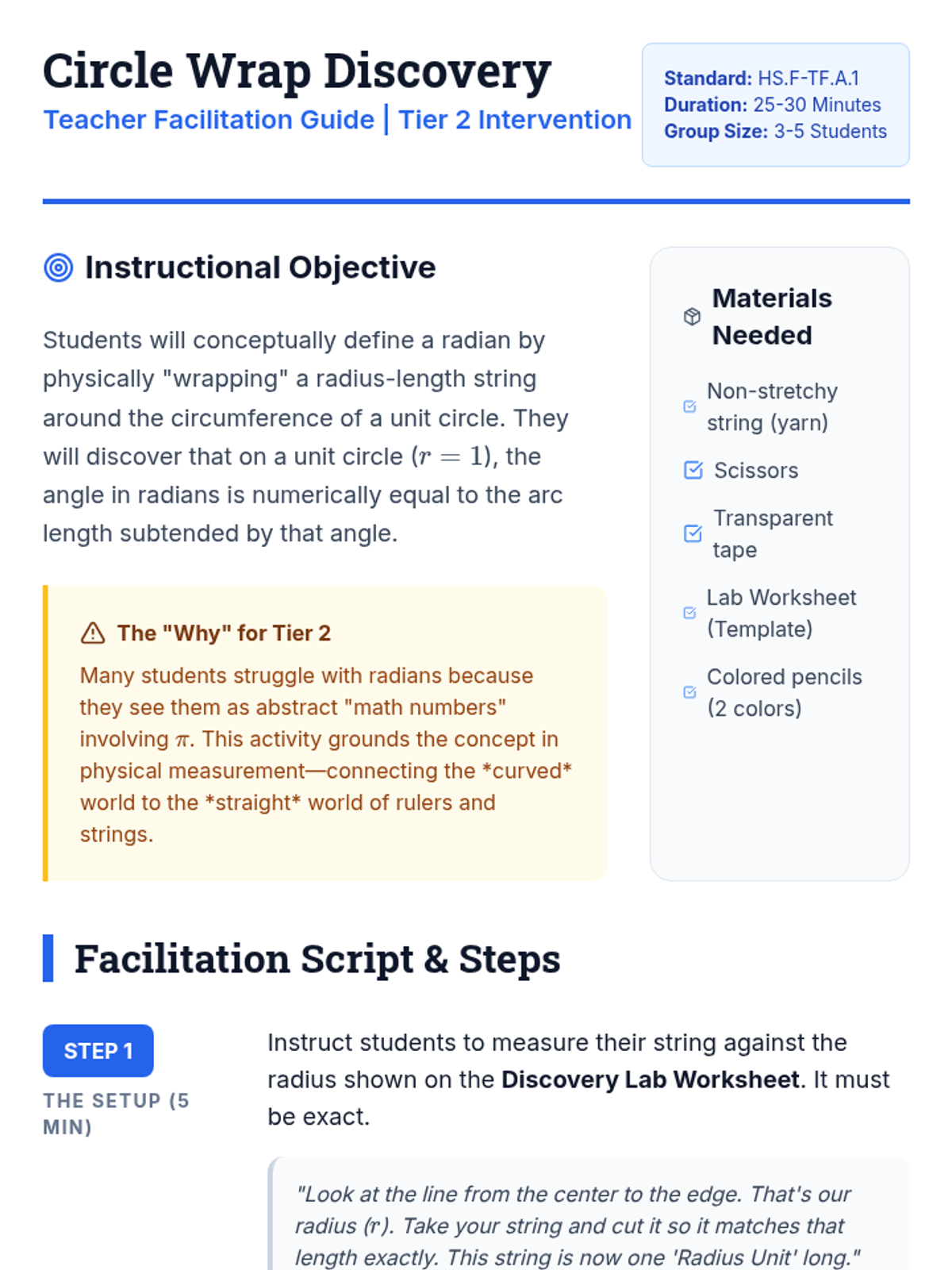
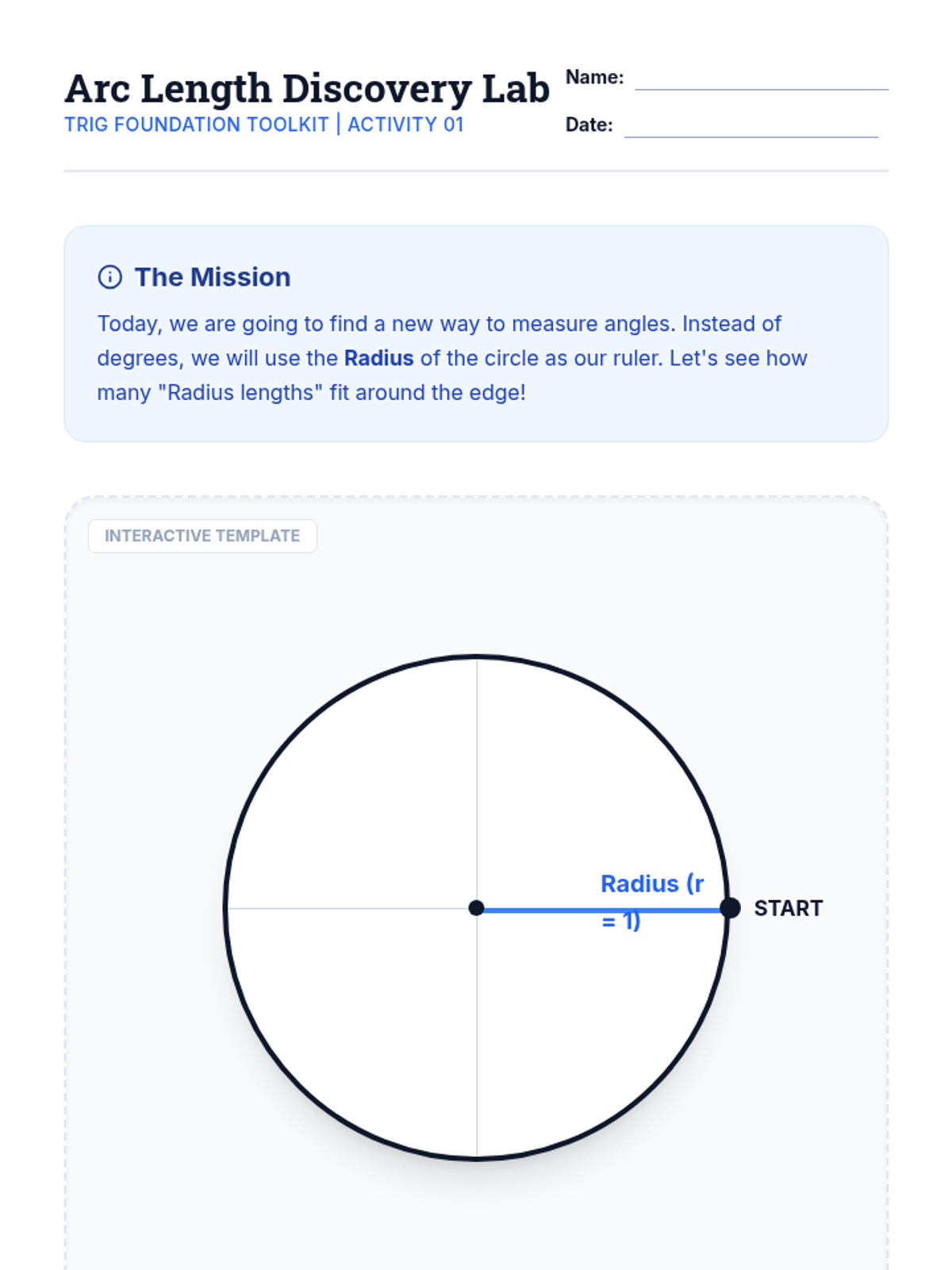
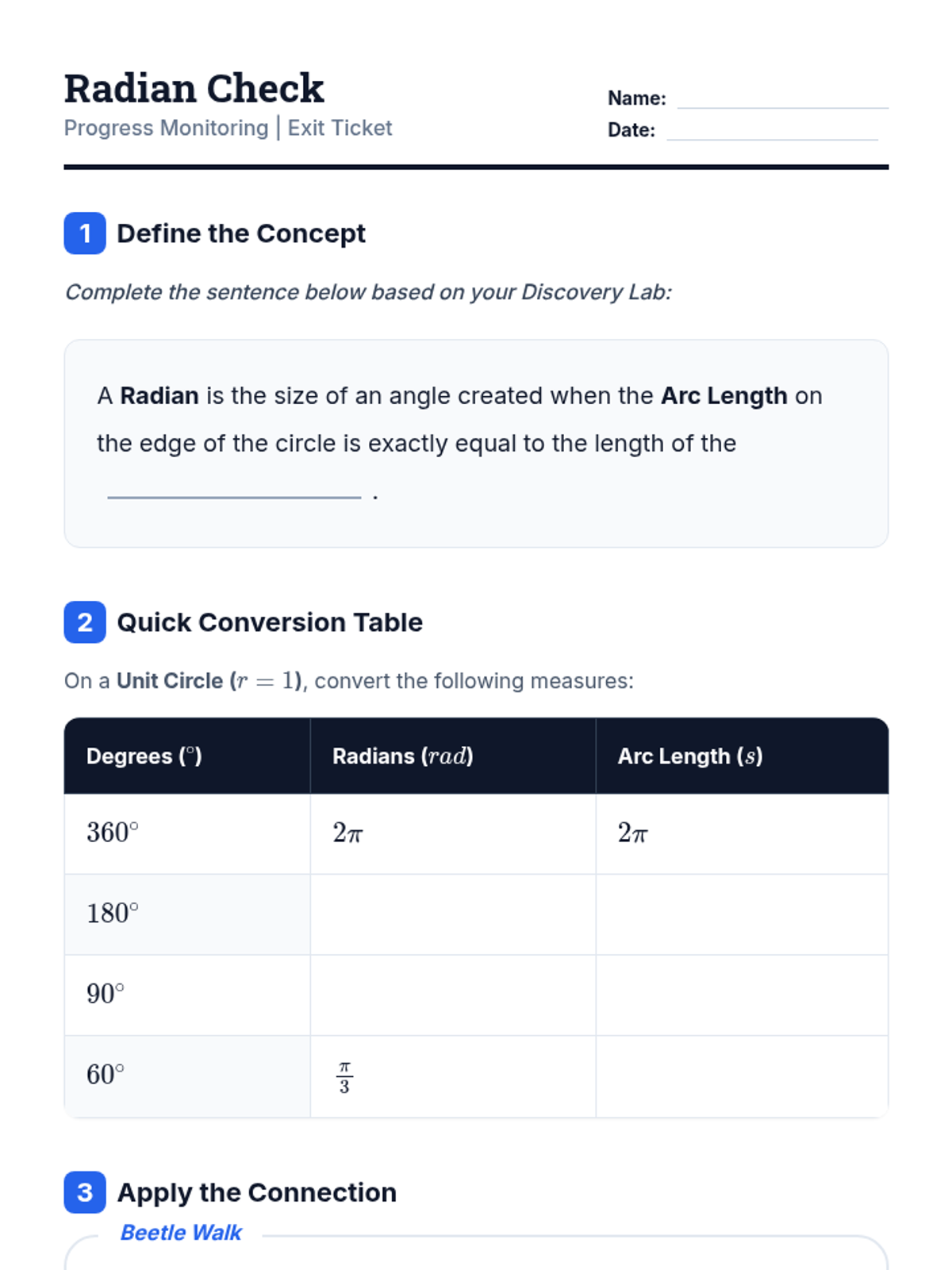
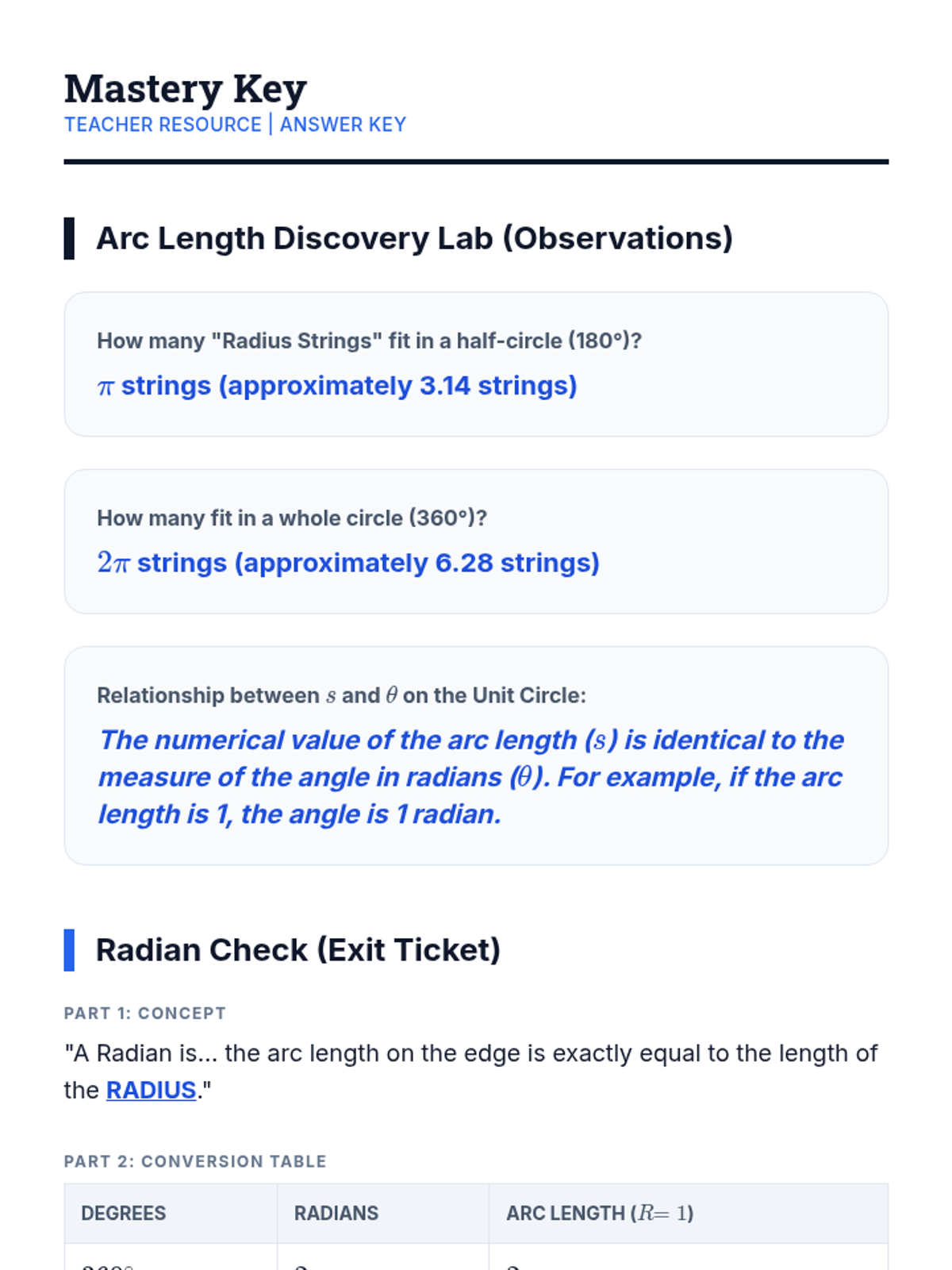
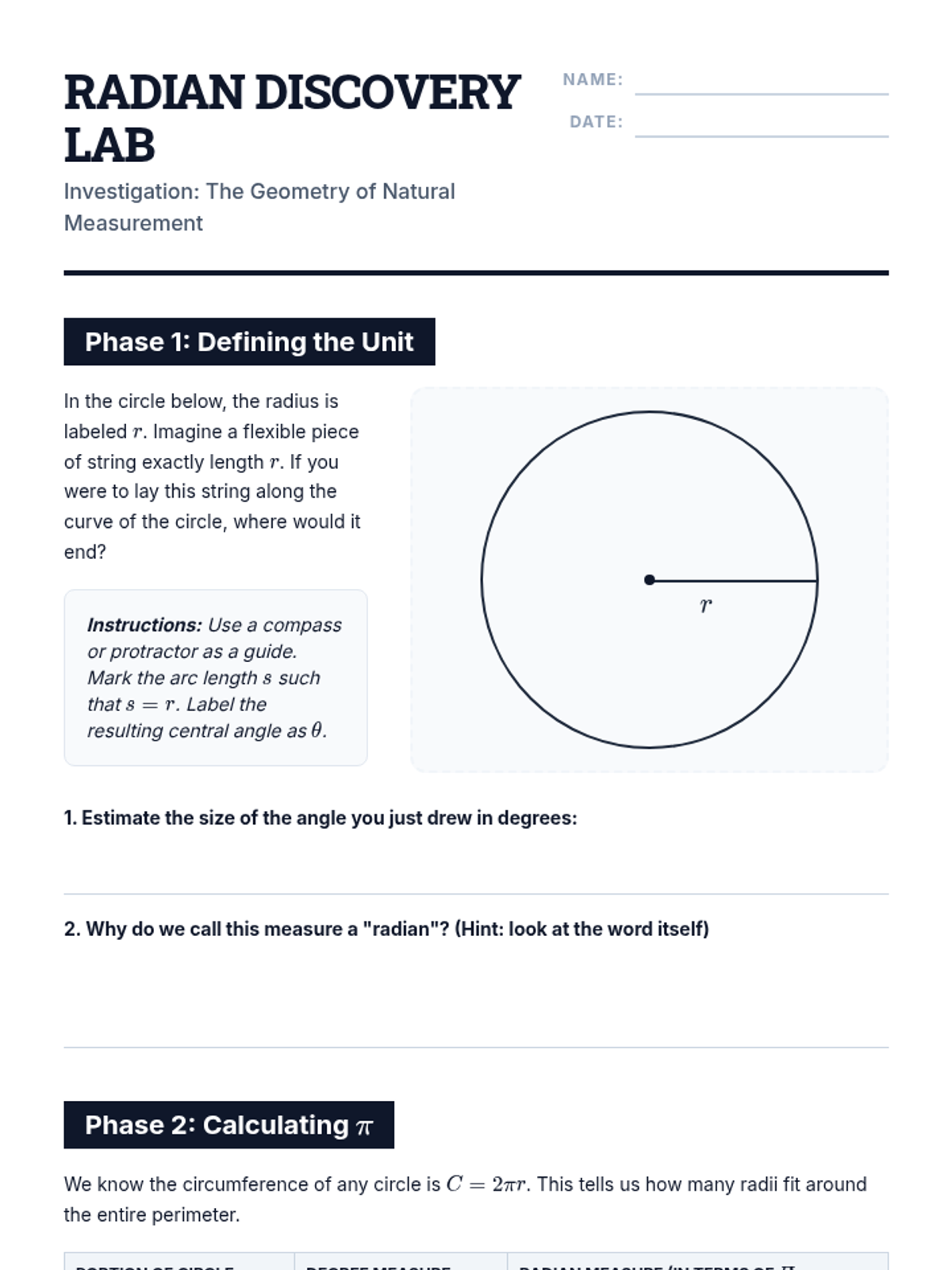
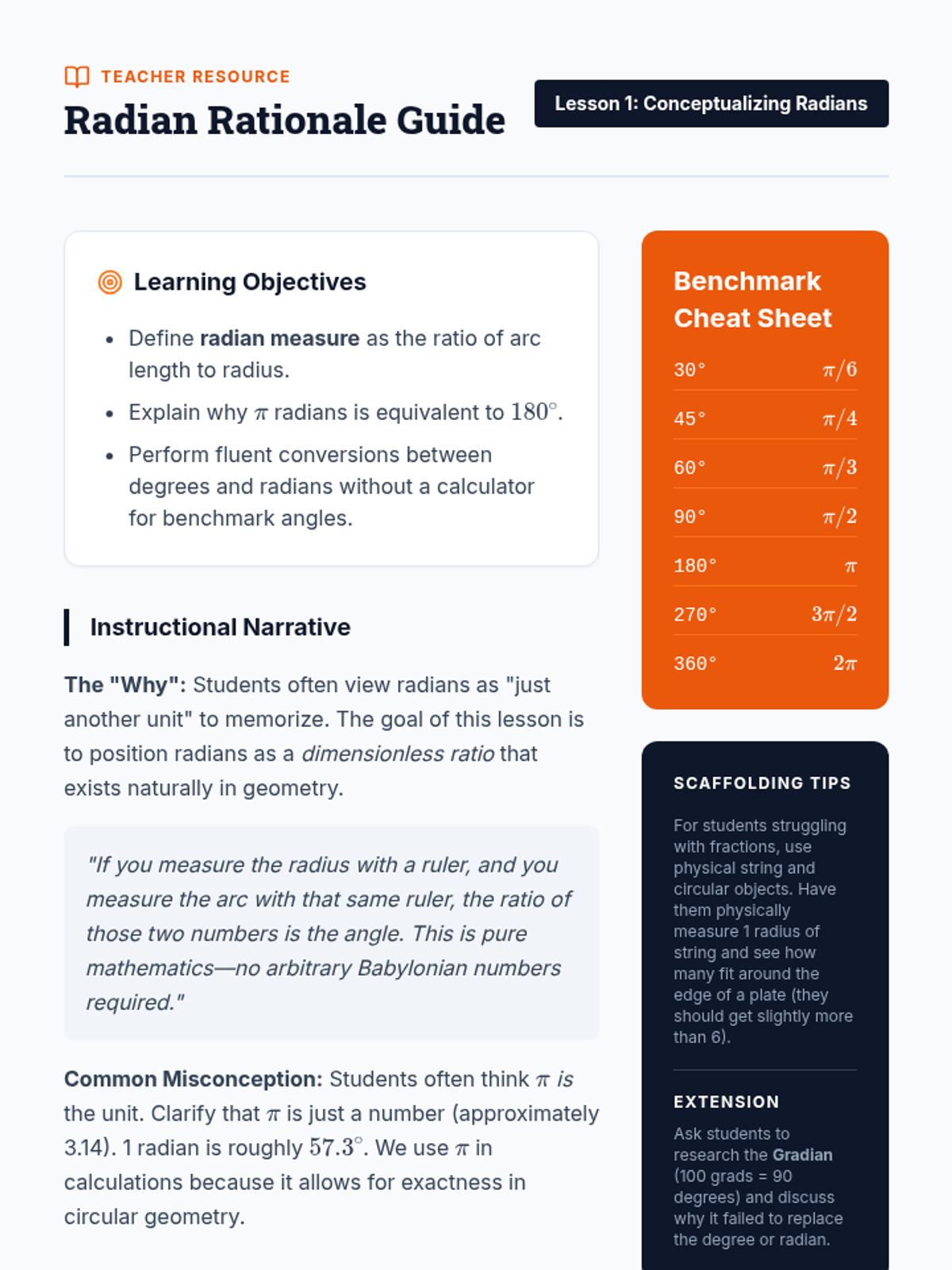
A Tier 2 intervention sequence focused on foundational trigonometry concepts, specifically the relationship between radian measure and arc length on the unit circle.
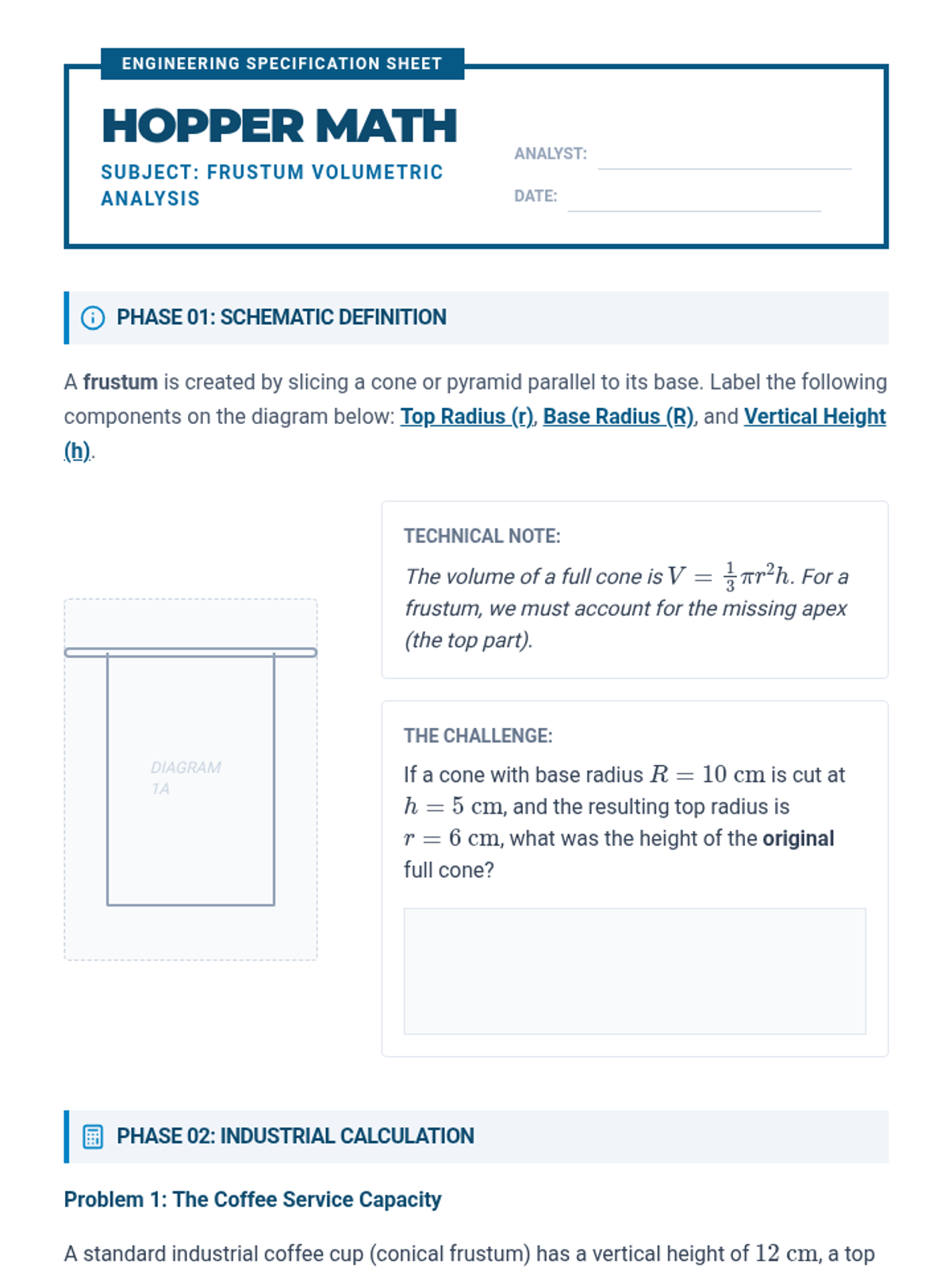
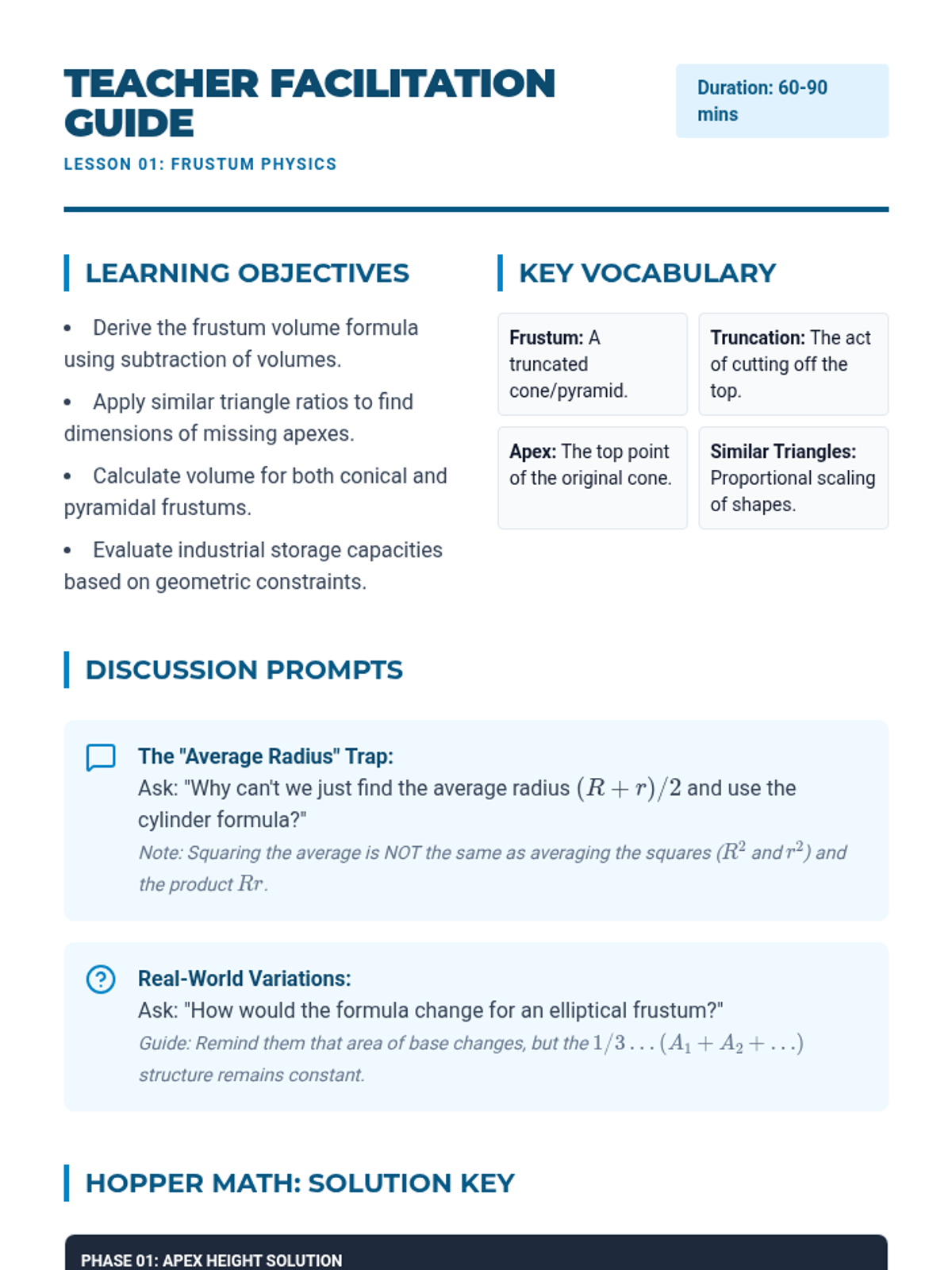
An advanced geometry sequence focusing on industrial applications of volume, including frustums, partial cylindrical volumes, displacement, and flow rates. Students integrate trigonometry and calculus-adjacent concepts to solve real-world engineering challenges.
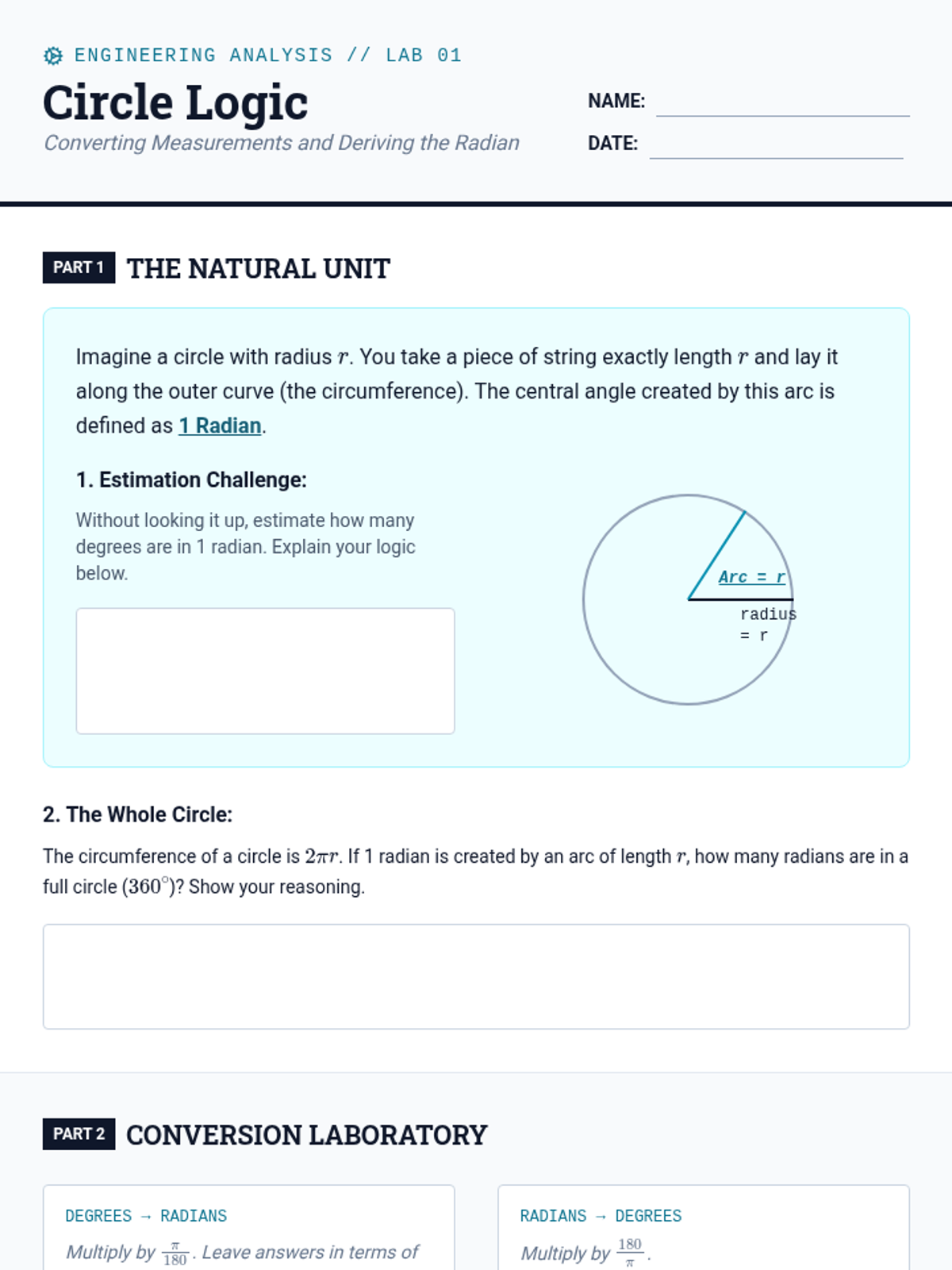
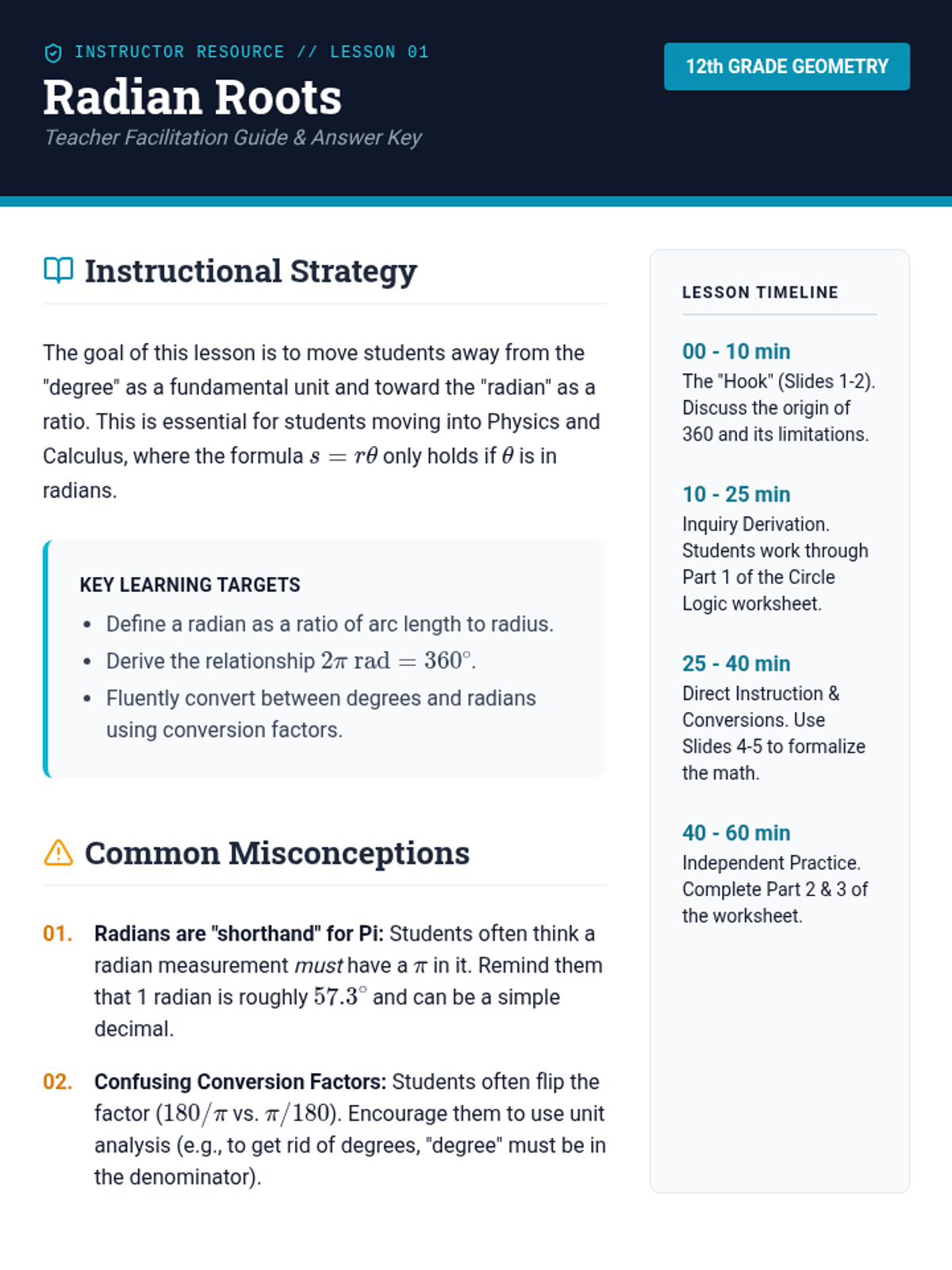
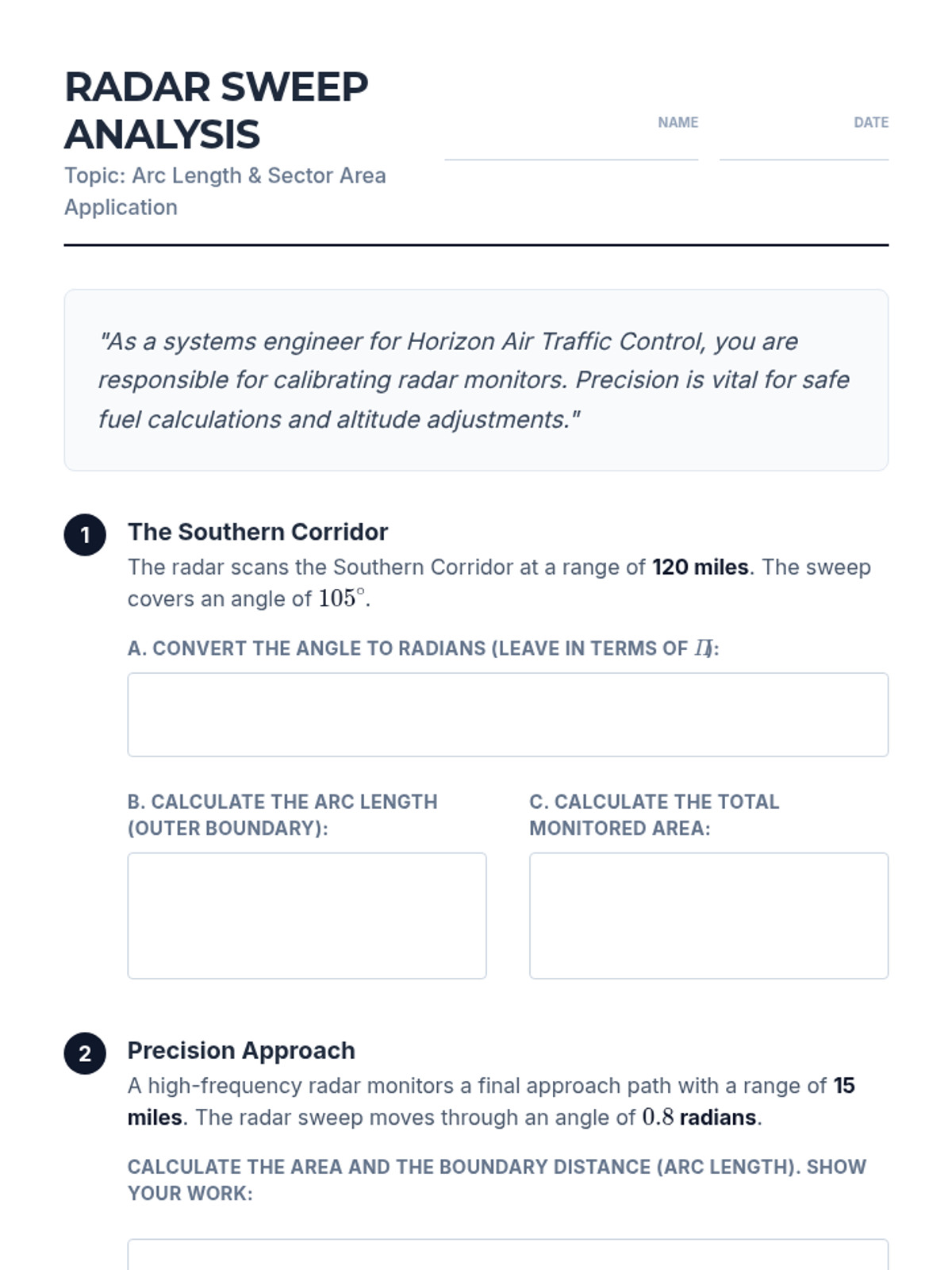
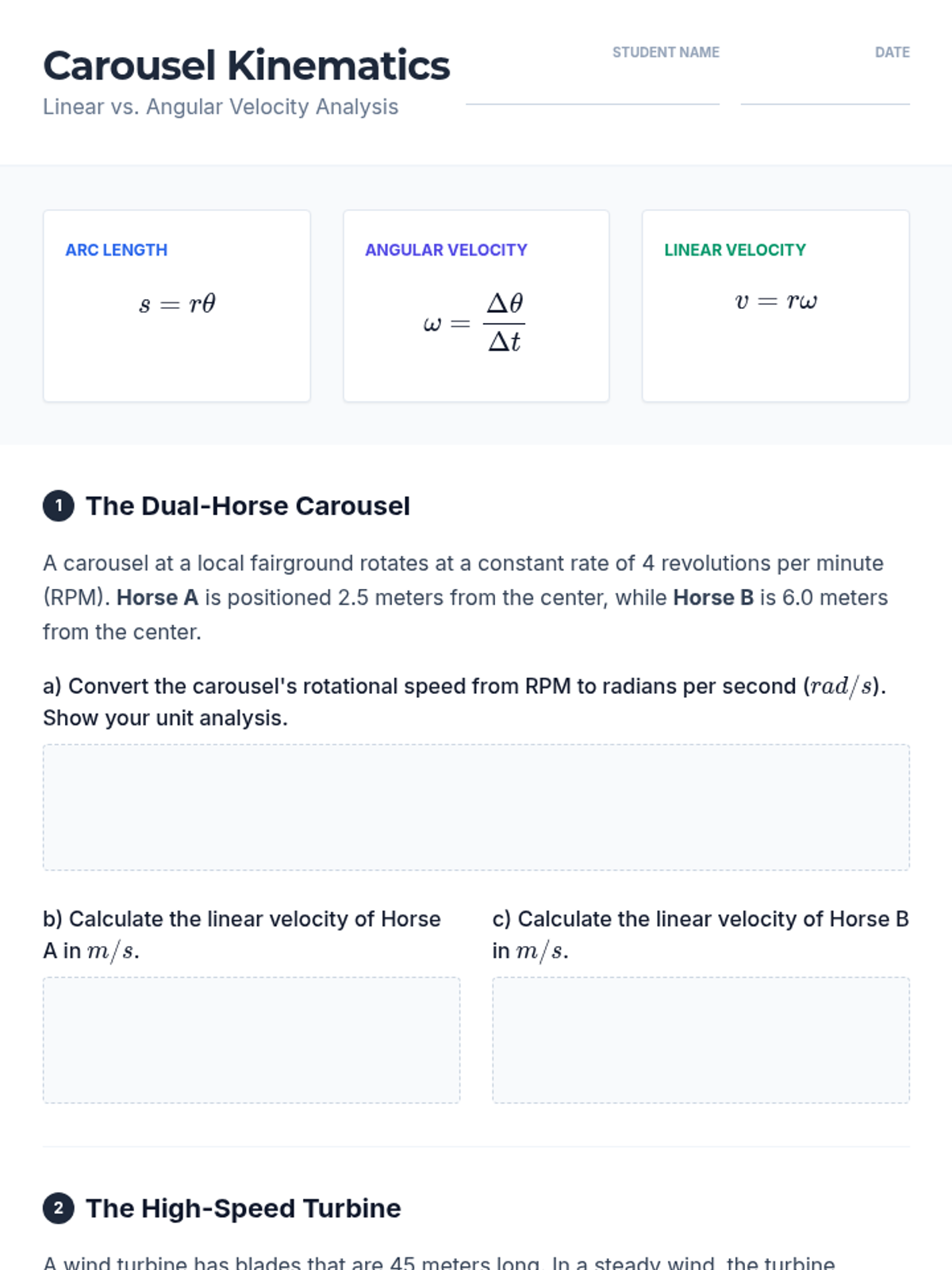
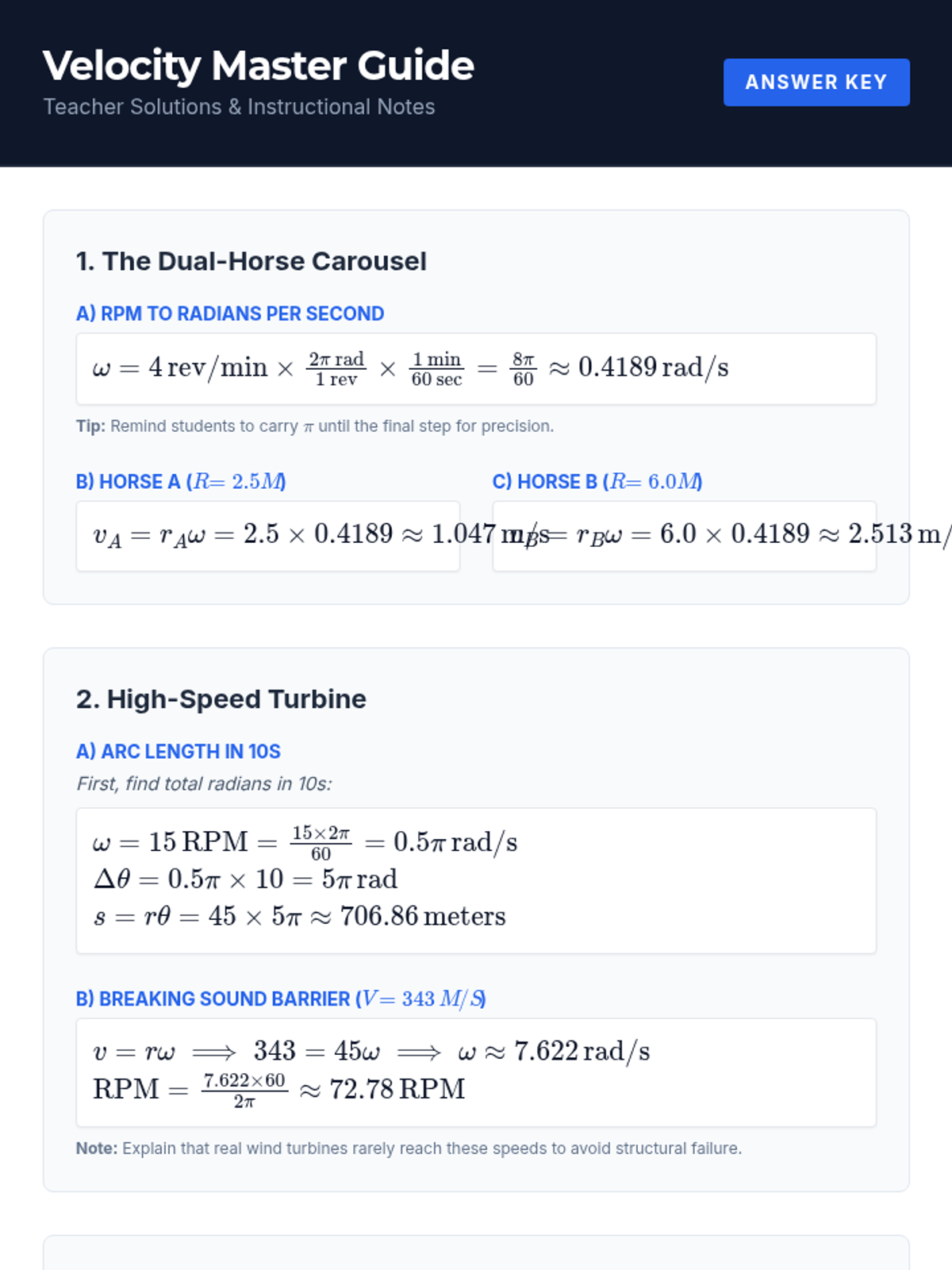
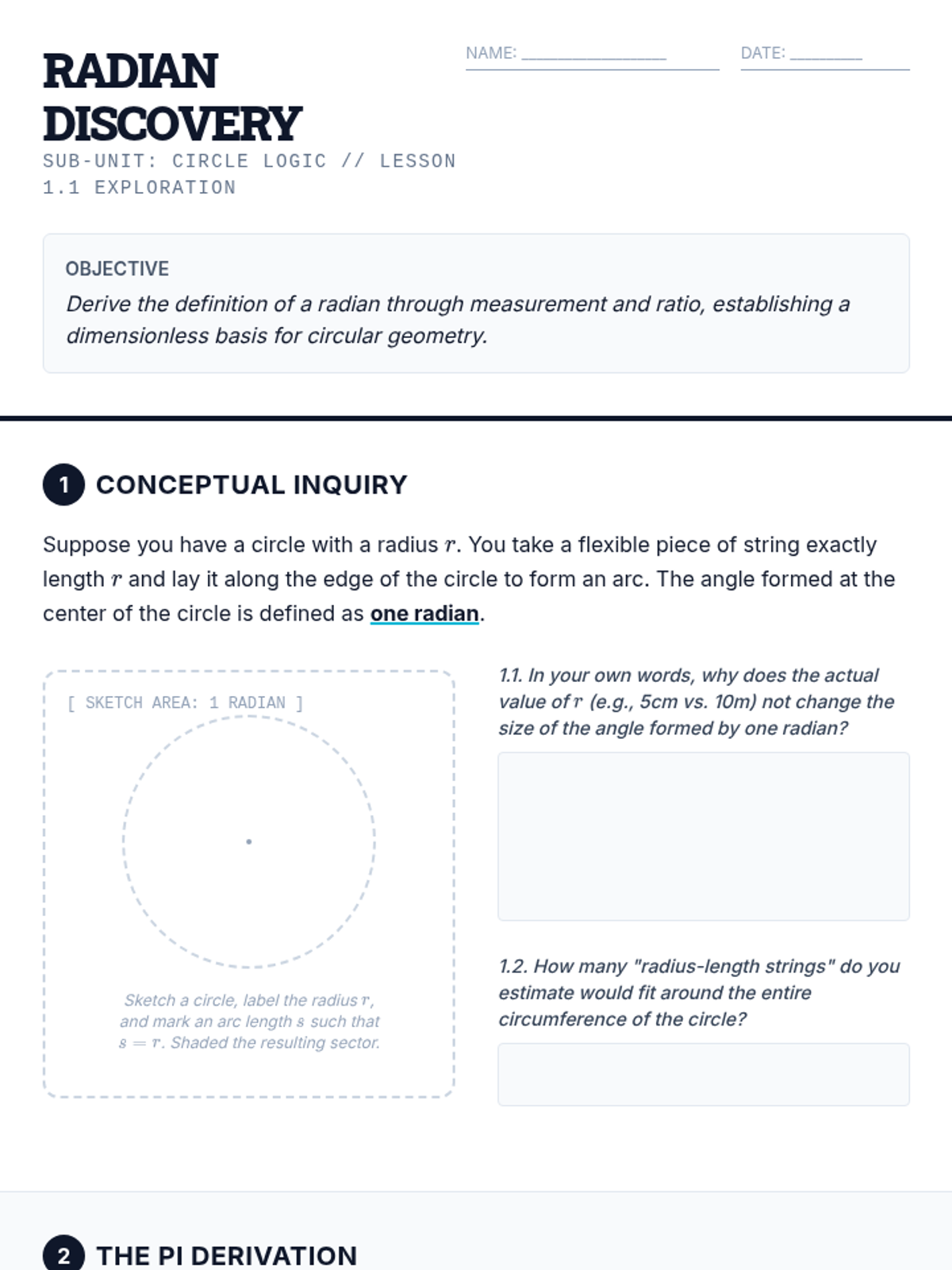
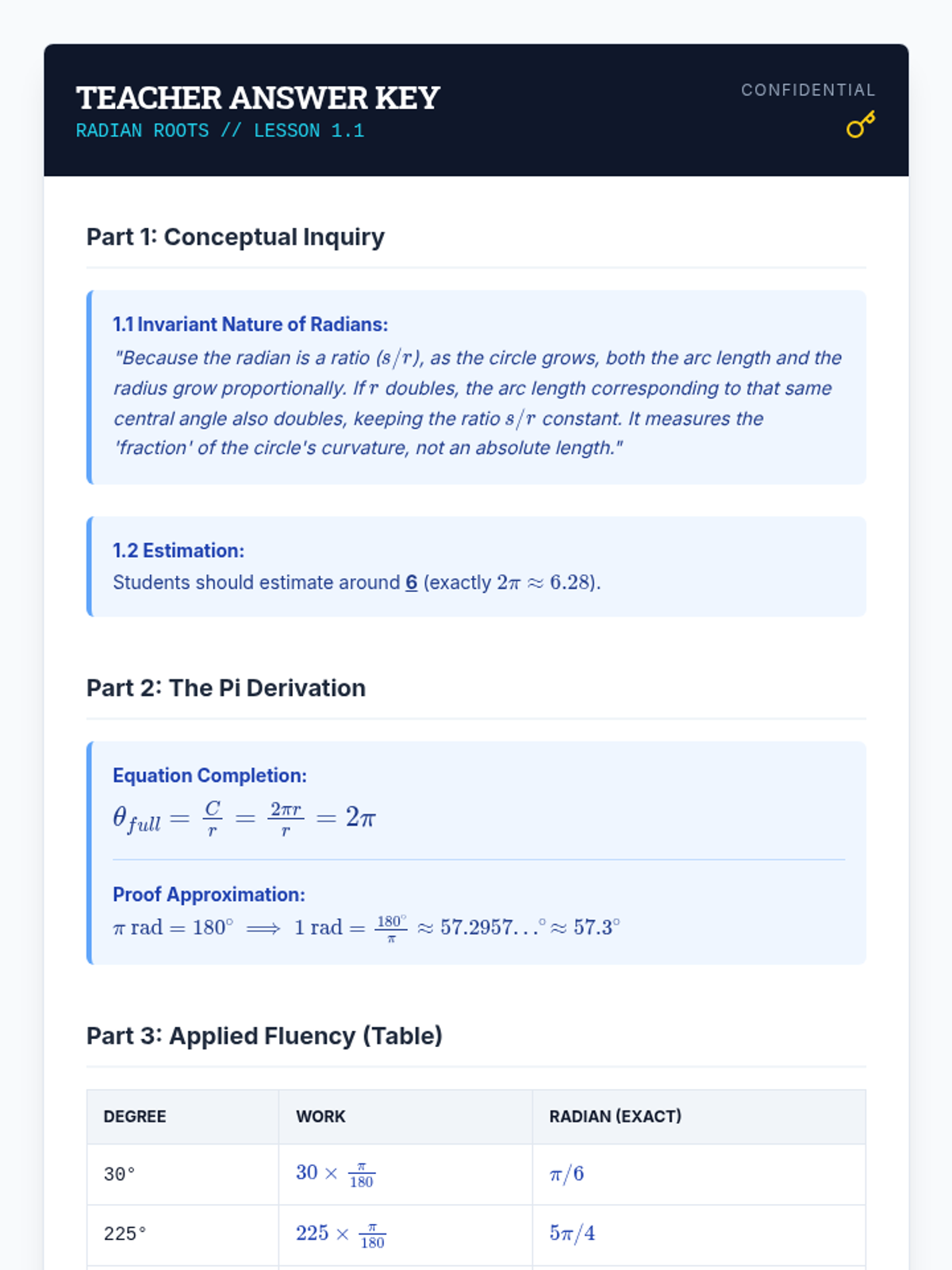
This sequence transitions 12th-grade students from degree-based measurements to radian measure, exploring arc length, sector area, and the physics of rotational motion through the lens of engineering and mechanical systems.
This sequence explores the relationship between angular measurement and spatial geometry, moving from radian-based circle analysis to 3D volume derivation using trigonometry, Cavalieri's Principle, and solids of revolution. Students apply these concepts to high-level engineering and architectural contexts.
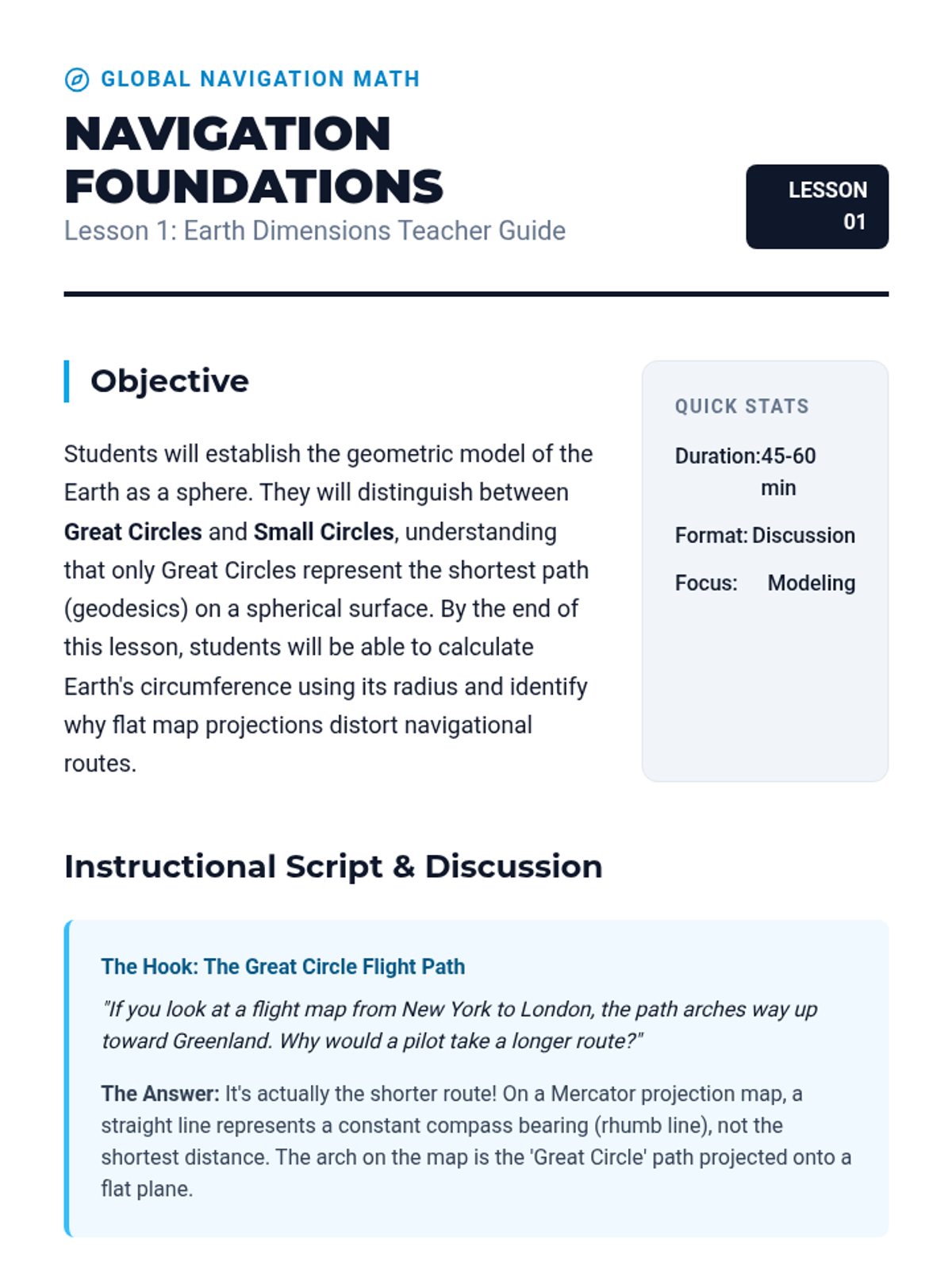
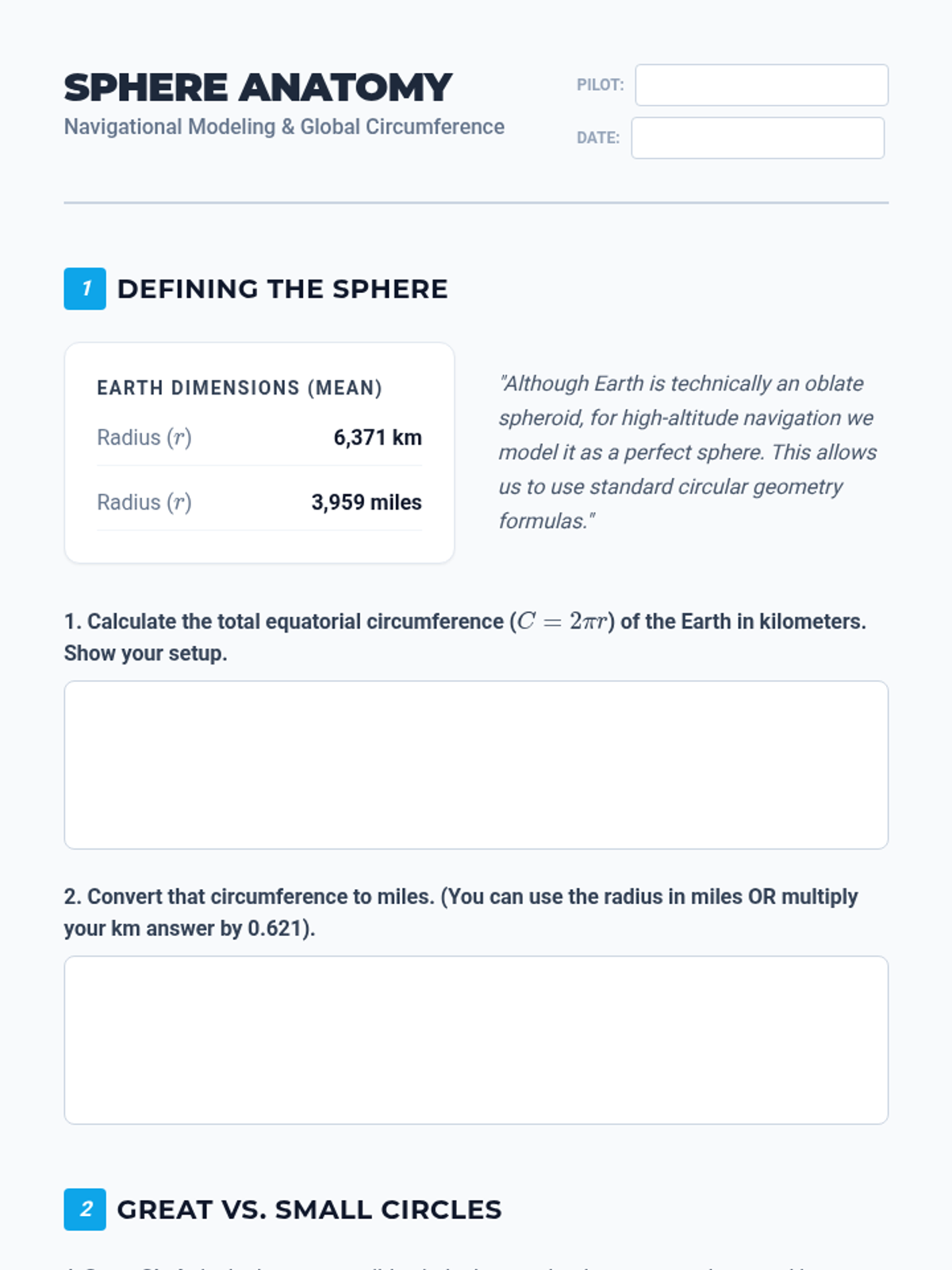
This sequence applies circular geometry to a global scale, introducing students to spherical geometry concepts used in navigation and aviation. Students treat the Earth as a sphere and use arc length formulas to calculate 'Great Circle' distances between cities, concluding with a flight path simulation.
A high-level geometry sequence for 12th-grade students focused on the transition from degree-based measurements to the mathematical efficiency of radians. Students will derive and apply formulas for arc length and sector area, building a foundation for calculus.
A sophisticated sequence for undergraduate students bridging the gap between static geometry (arc length and sector area) and dynamic circular motion. This unit explores linear and angular velocity, Kepler's Second Law, satellite communication footprints, and visual angles.
A specialized geometry sequence for undergraduate students exploring the practical application of arc lengths and sector areas in mechanical engineering, architectural design, and land surveying. Students decompose complex physical systems into fundamental circular components to solve real-world technical challenges.
This undergraduate sequence explores the transition from degree-based geometry to the more 'natural' radian measure, focusing on the derivation of arc length and sector area formulas through proportional reasoning. Students will connect these geometric concepts to calculus preparation, analyze engineering errors, and perform formal abstract proofs.
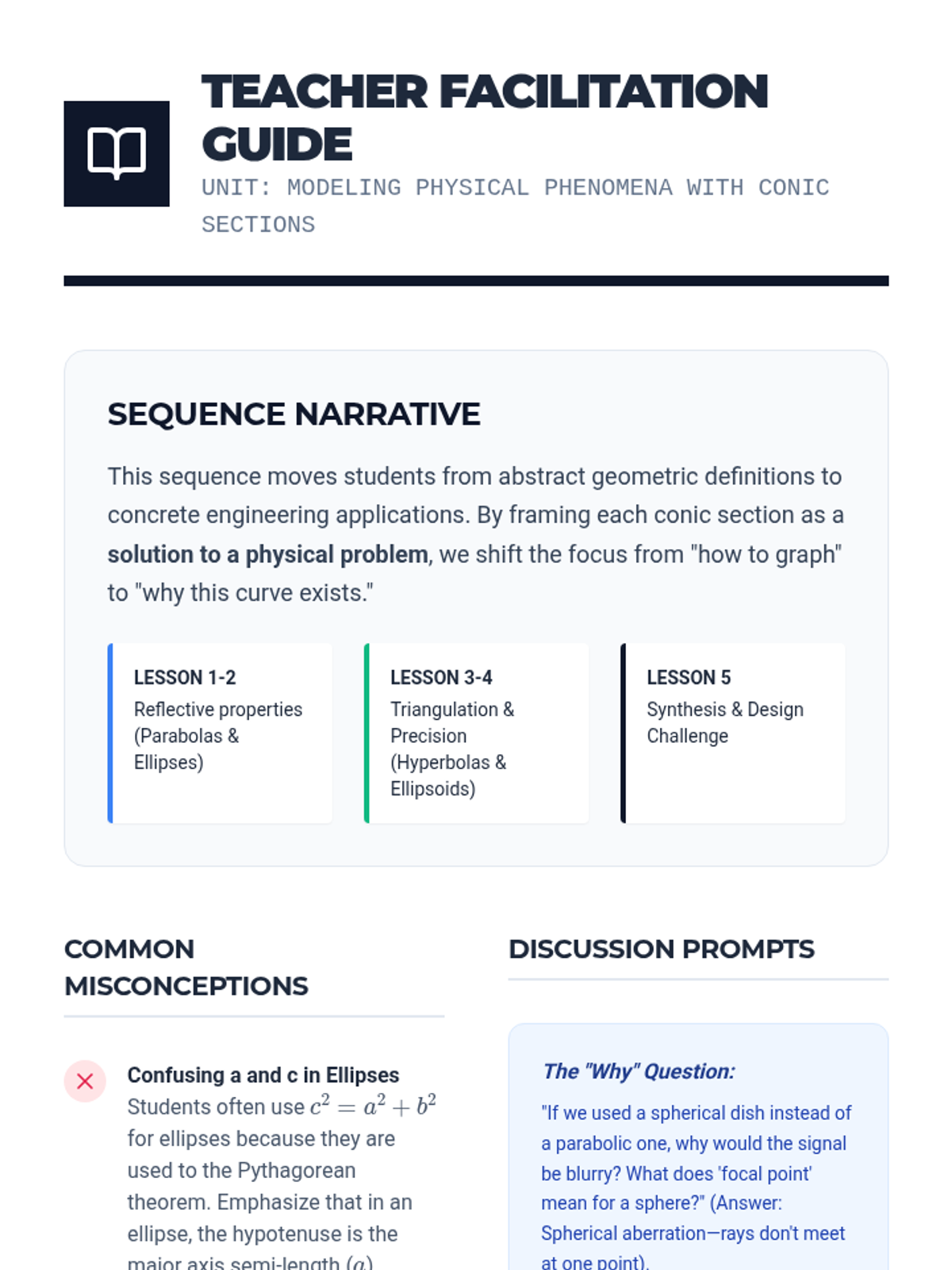
A project-based exploration of analytic geometry focusing on the physics and engineering applications of conic sections, including reflection properties, navigation, and optical systems.
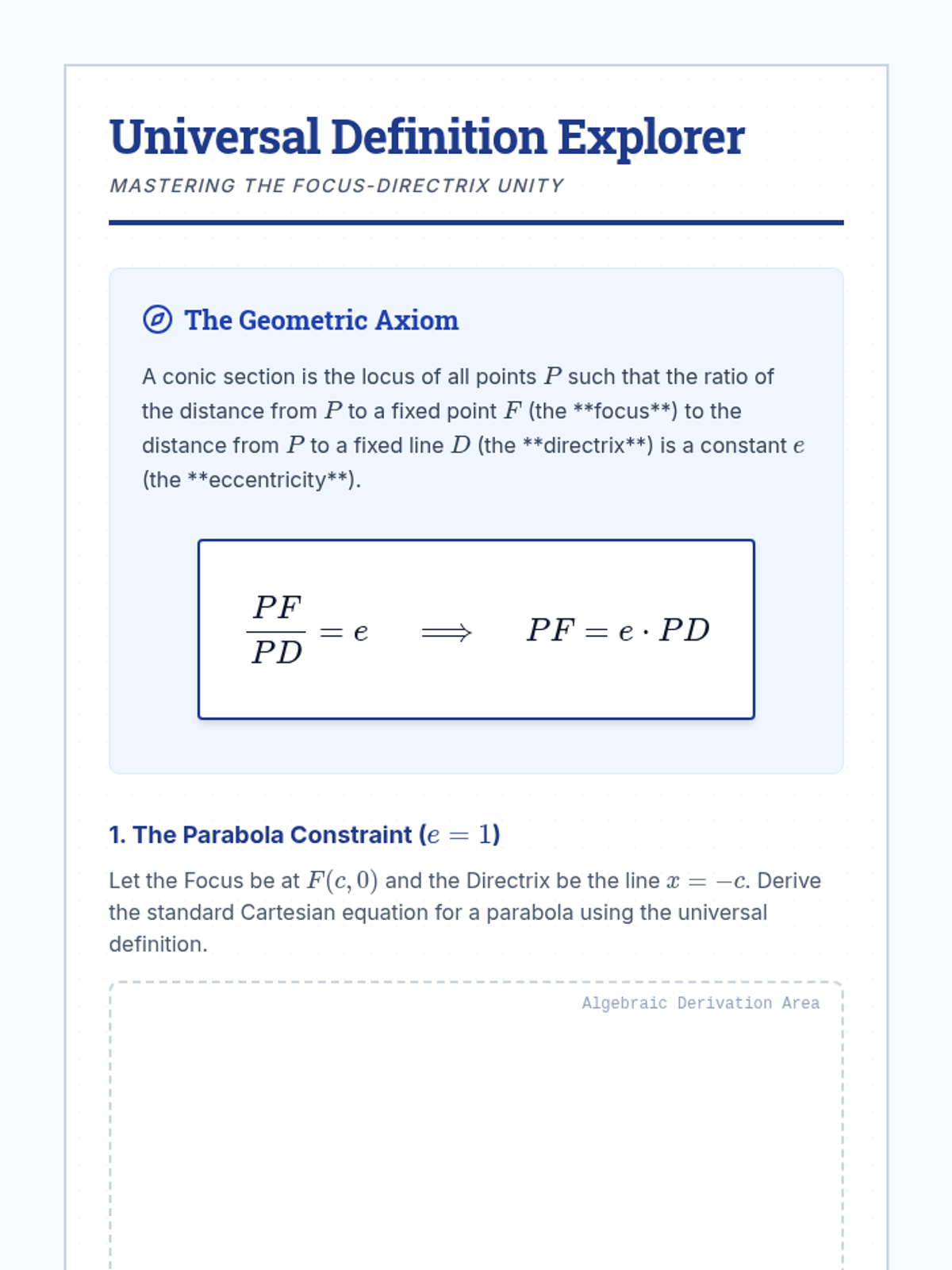
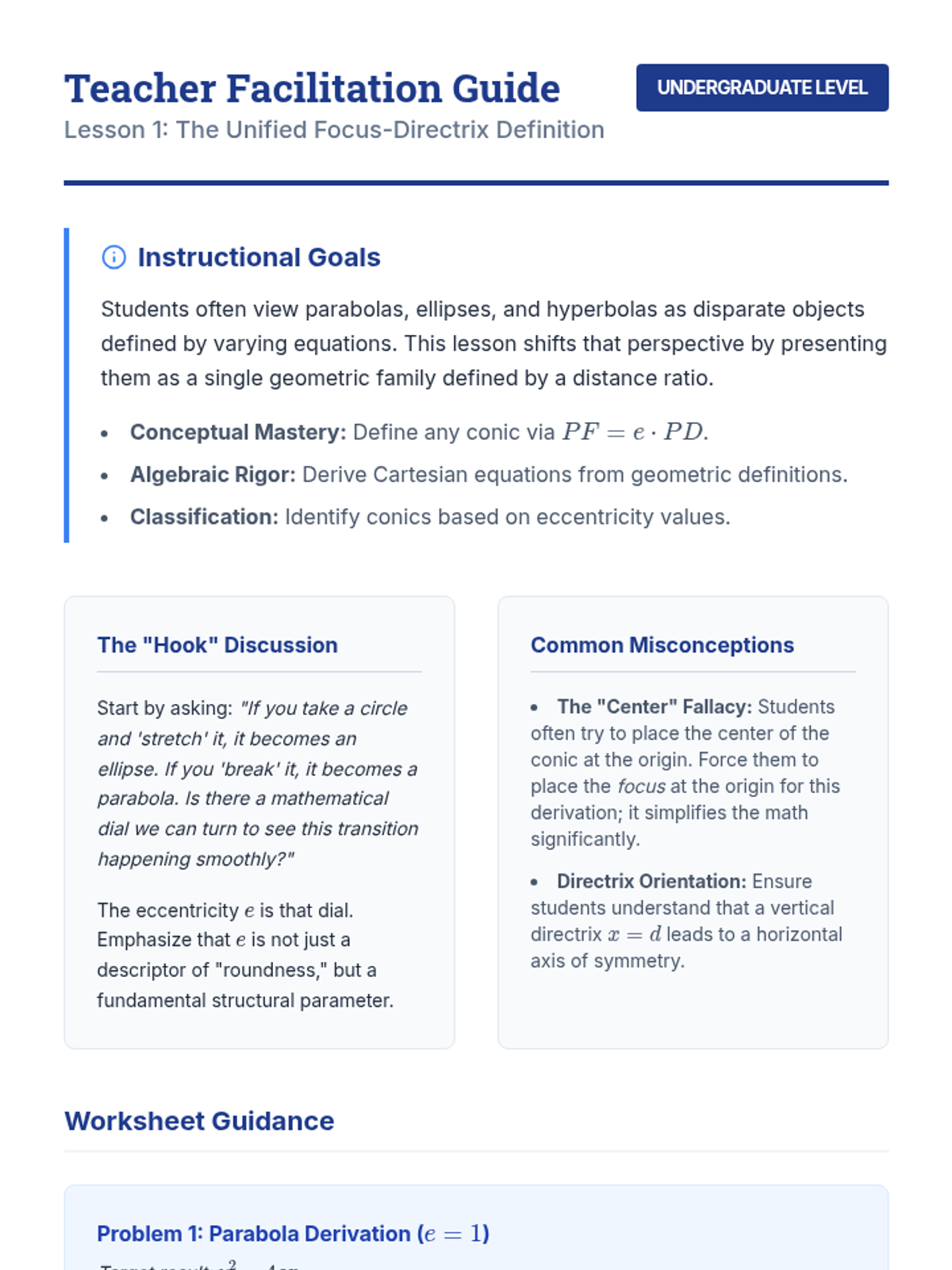
A rigorous undergraduate-level exploration of conic sections unified through the eccentricity parameter and polar coordinate systems. Students transition from traditional Cartesian definitions to a singular focus-directrix approach, concluding with the elegant 3D proof of Dandelin Spheres.
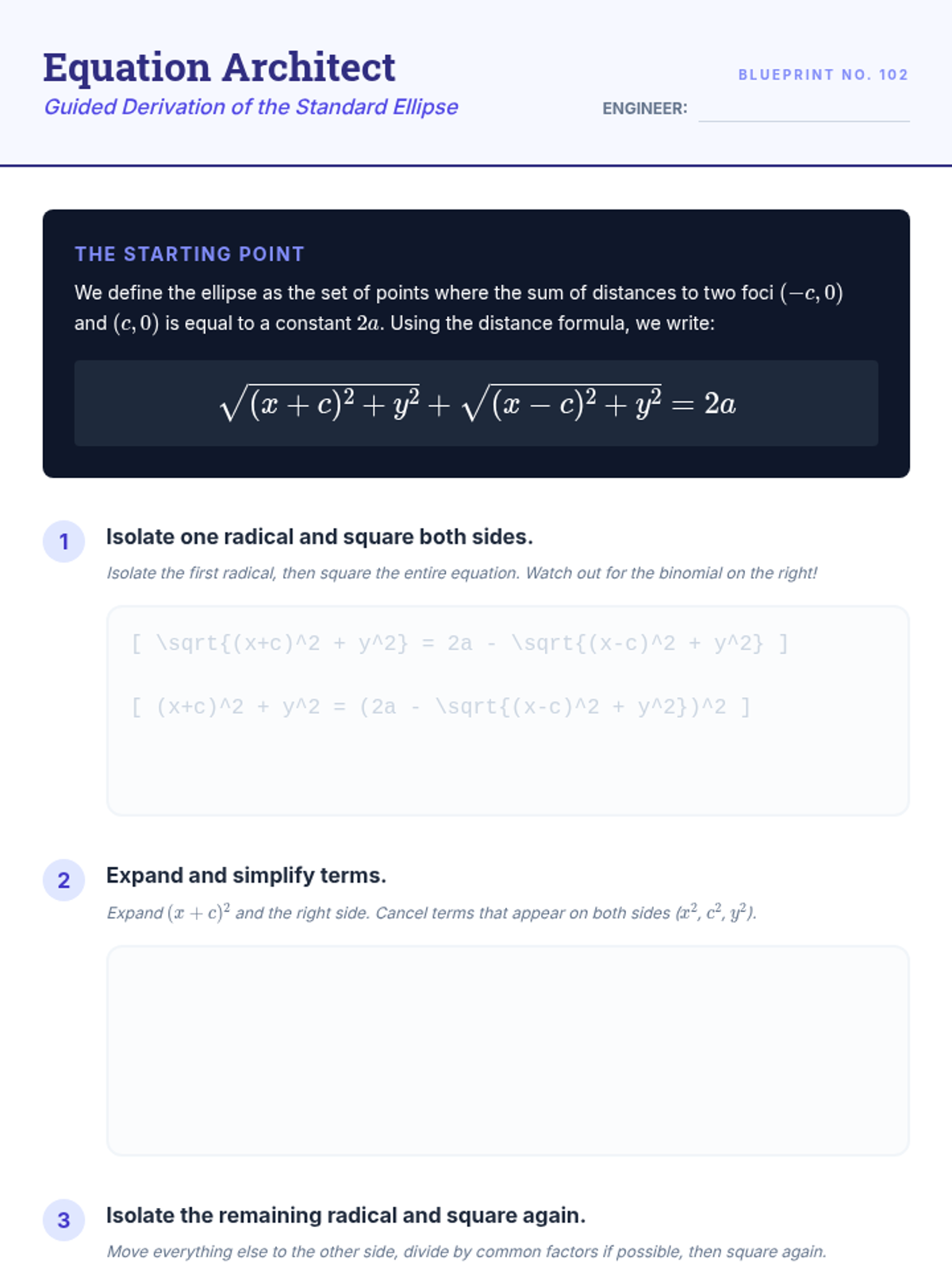
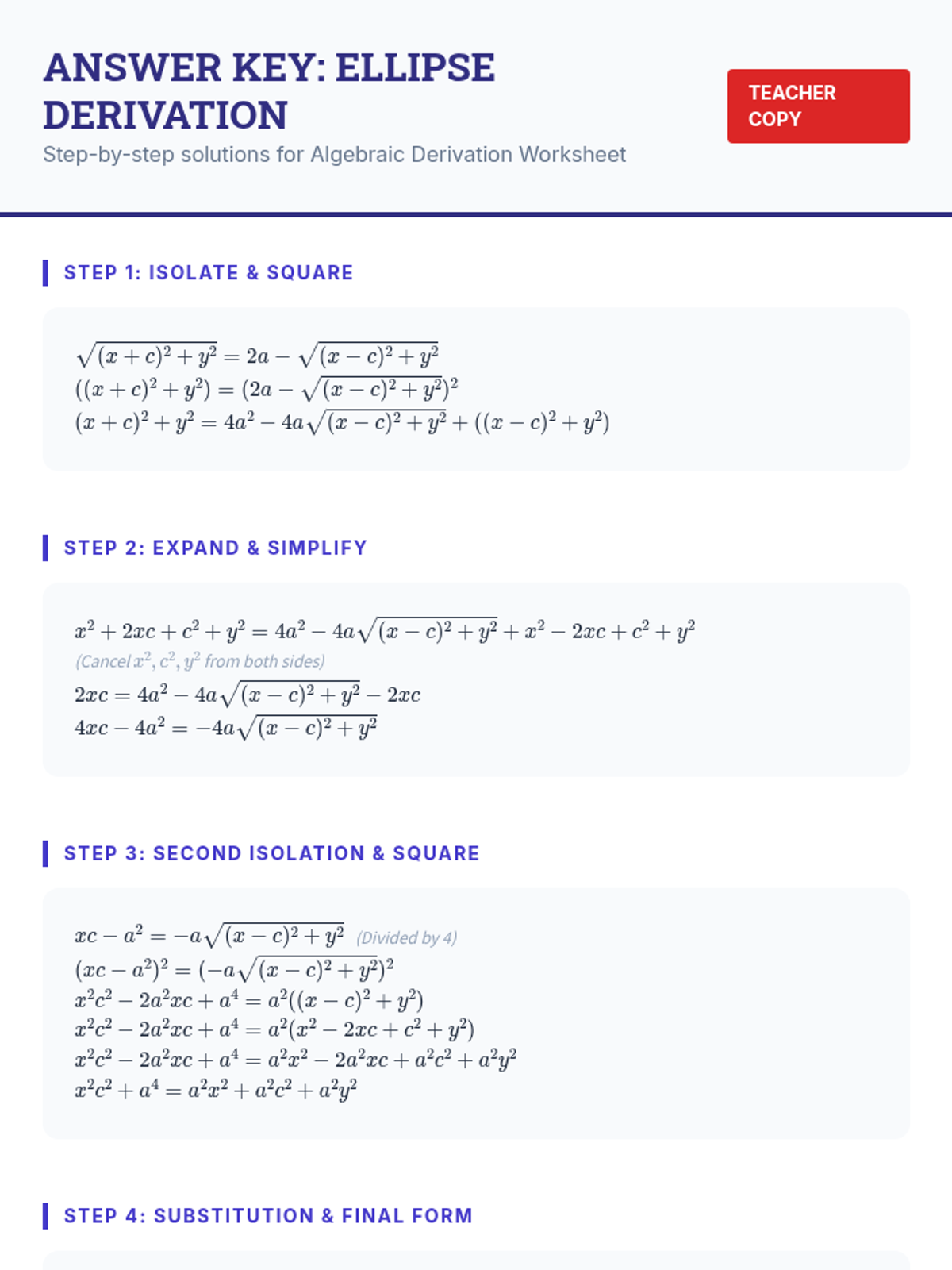
This sequence explores the geometric and algebraic foundations of ellipses and hyperbolas. Students move from locus definitions and dynamic simulations to rigorous algebraic derivations, parameter analysis, and comparative studies of central conics.
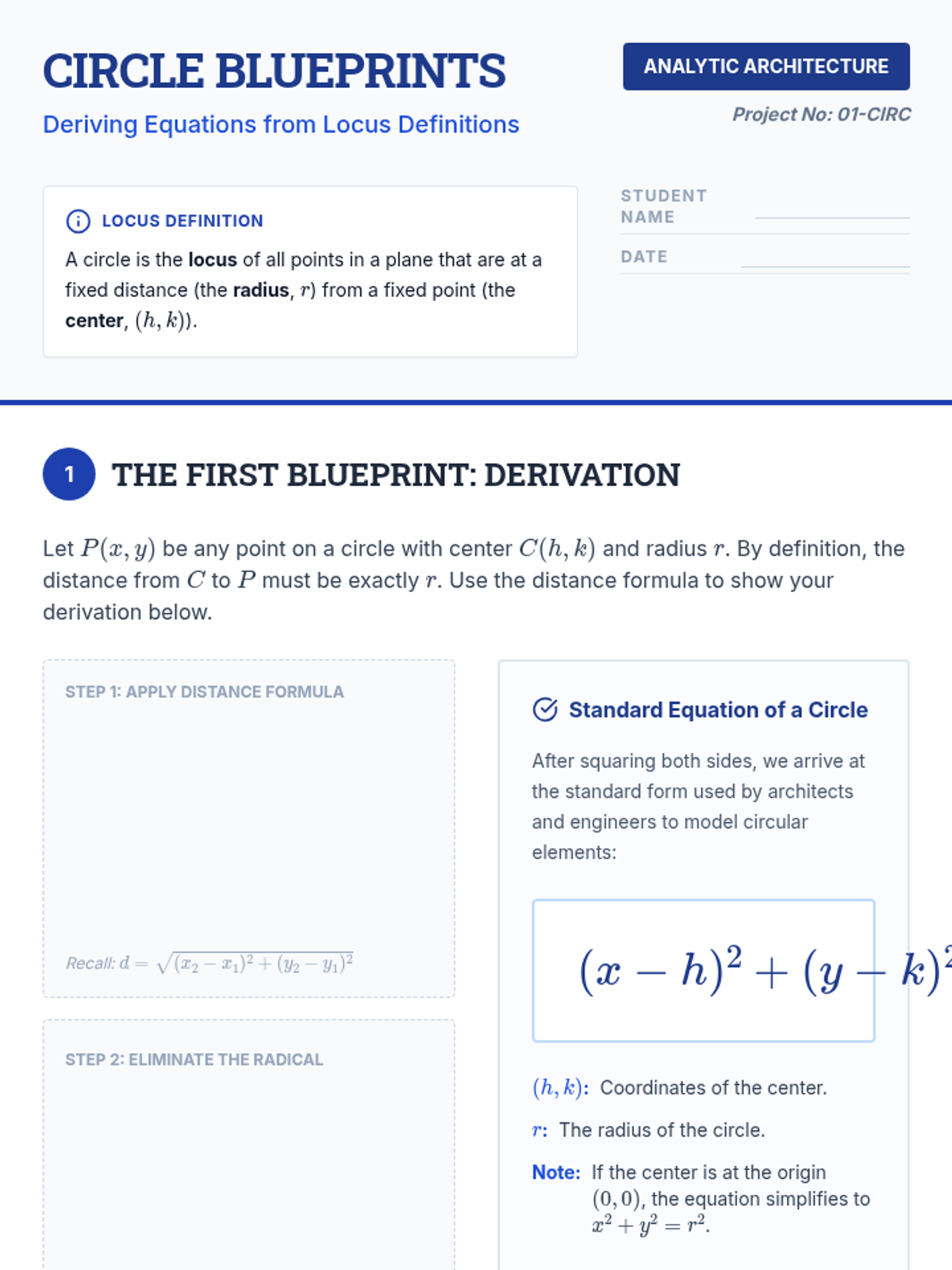
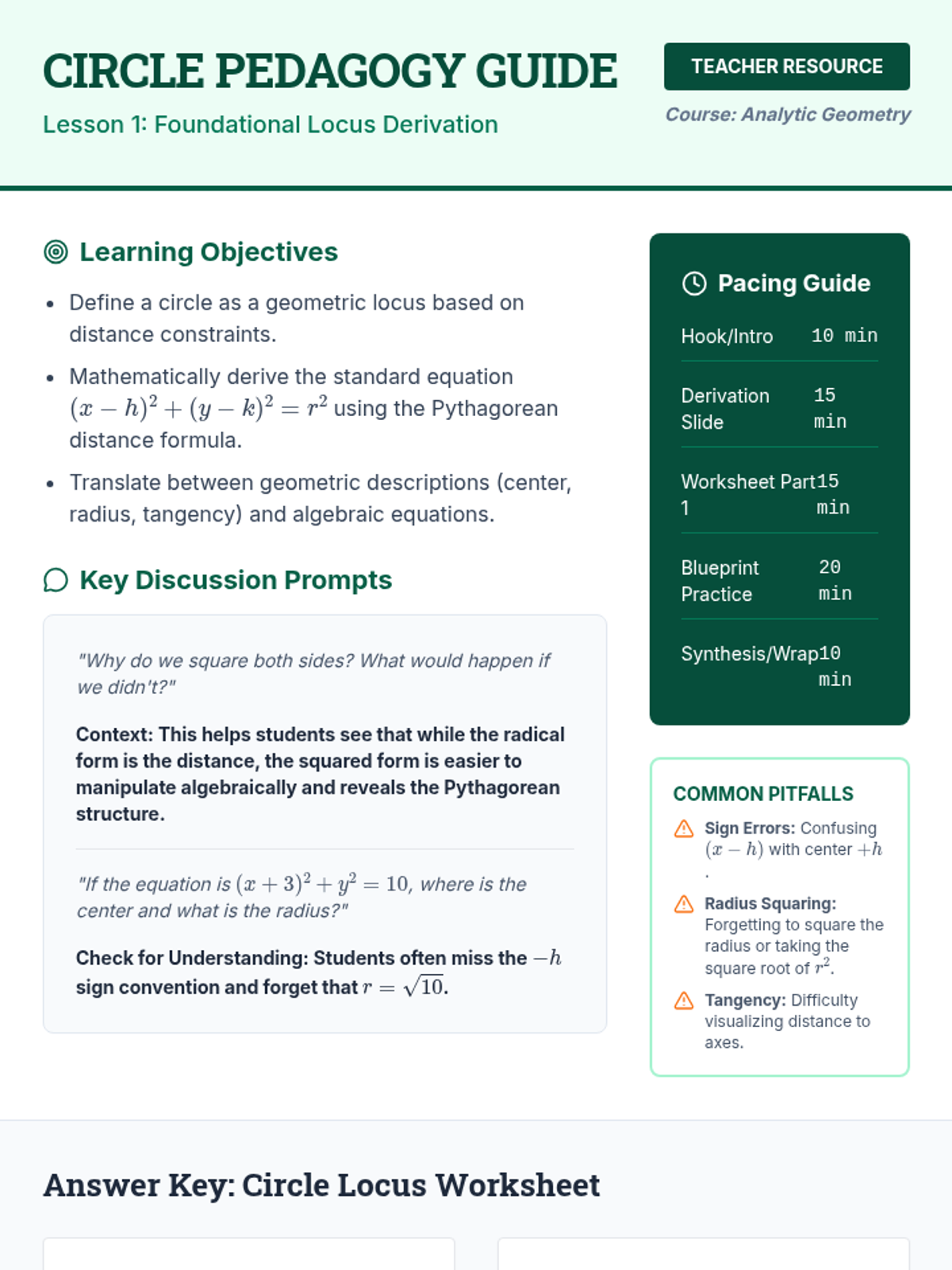
This sequence bridges the gap between geometric locus definitions and algebraic representations of circles and parabolas. Students will move from physical distance constraints to rigorous derivations, mastering the standard forms and their properties through an 'analytic architecture' lens.
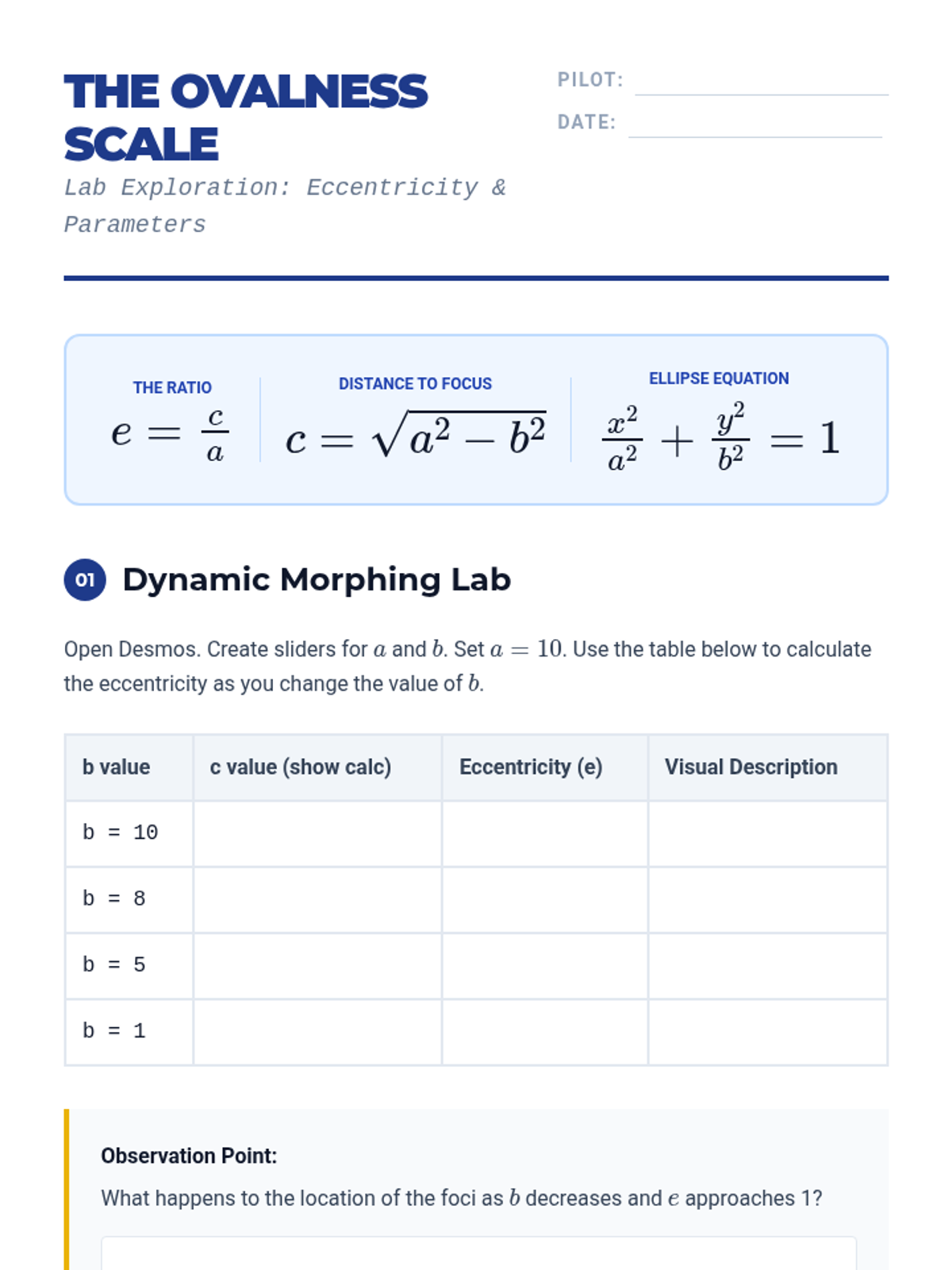
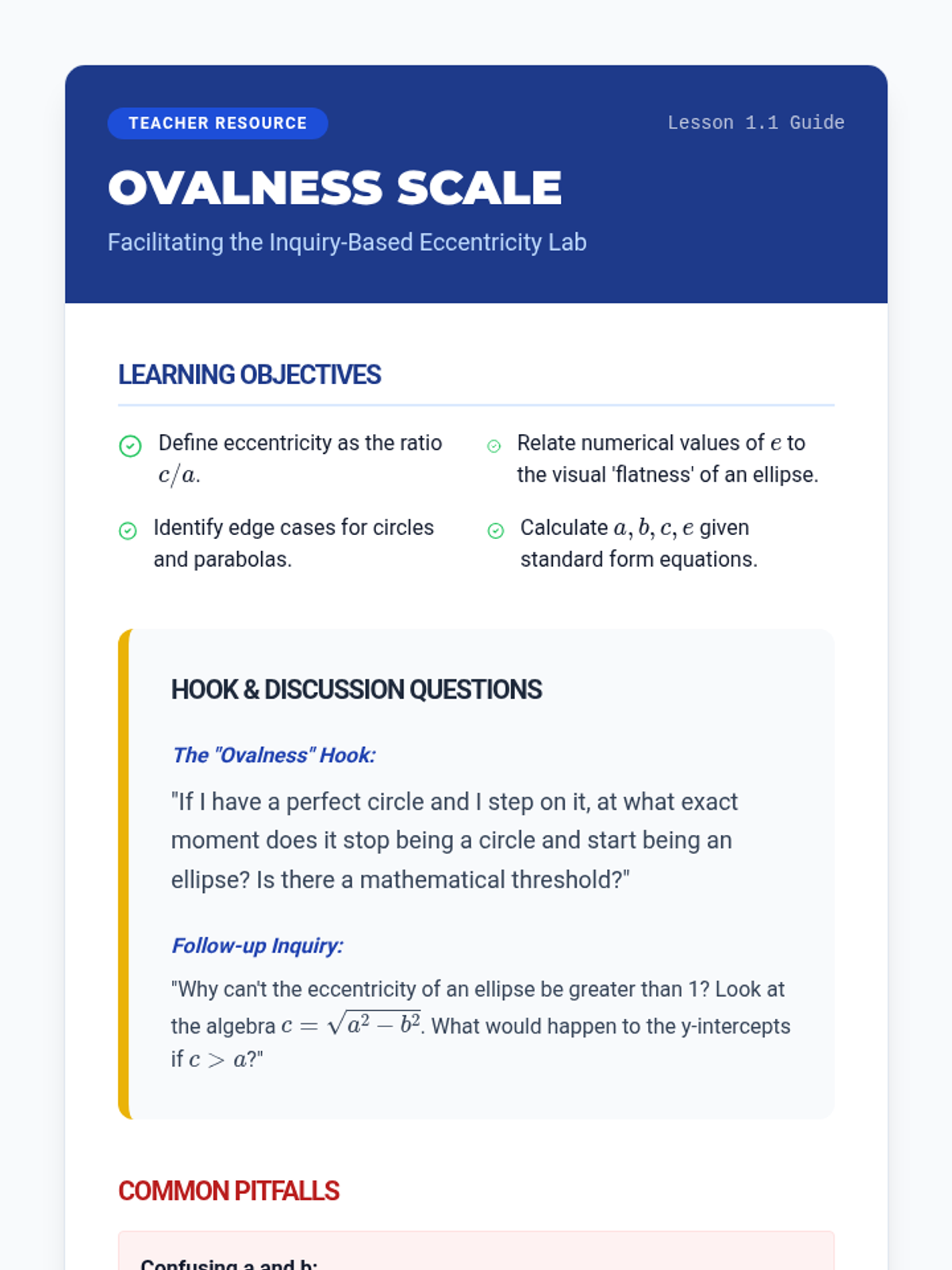
A 12th-grade advanced geometry sequence exploring the unified nature of conic sections through eccentricity, focus-directrix definitions, polar coordinates, and rotation. Students use dynamic software to visualize how algebraic parameters shift geometric reality.
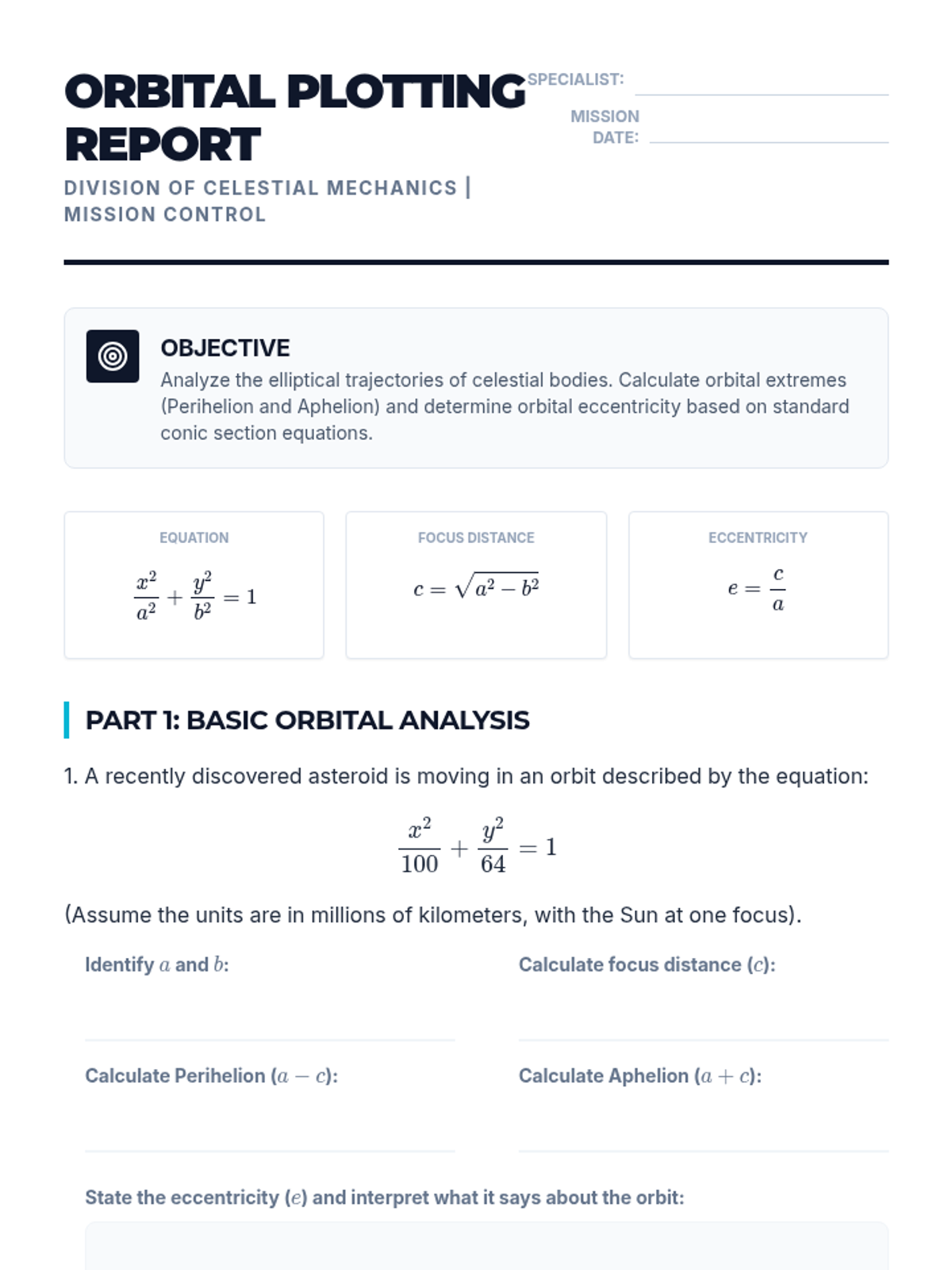
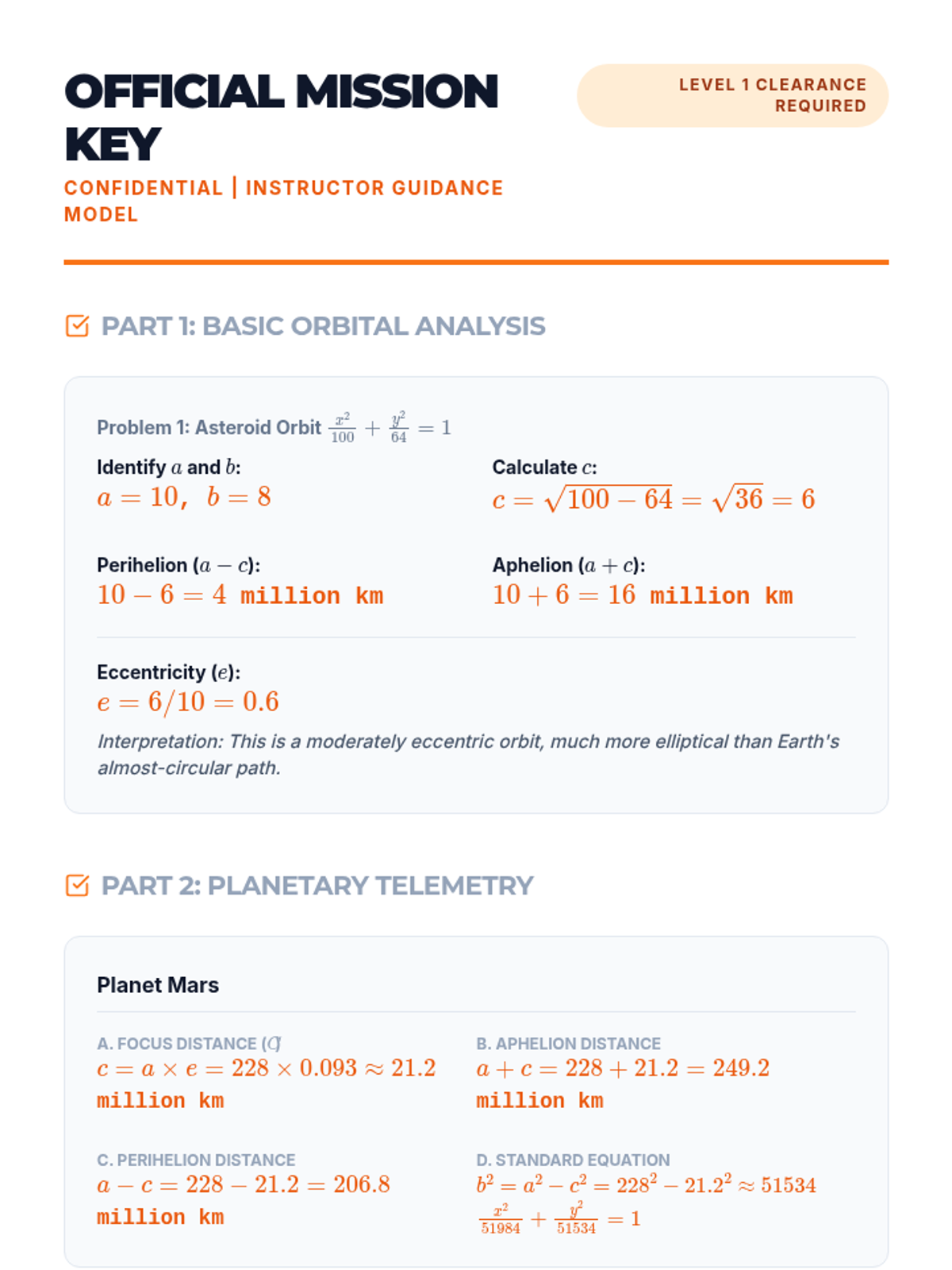
An advanced 12th-grade geometry sequence exploring conic sections through the lens of orbital mechanics. Students act as mission specialists analyzing elliptical orbits, parabolic escape trajectories, and hyperbolic gravity assists to determine the paths of celestial bodies.
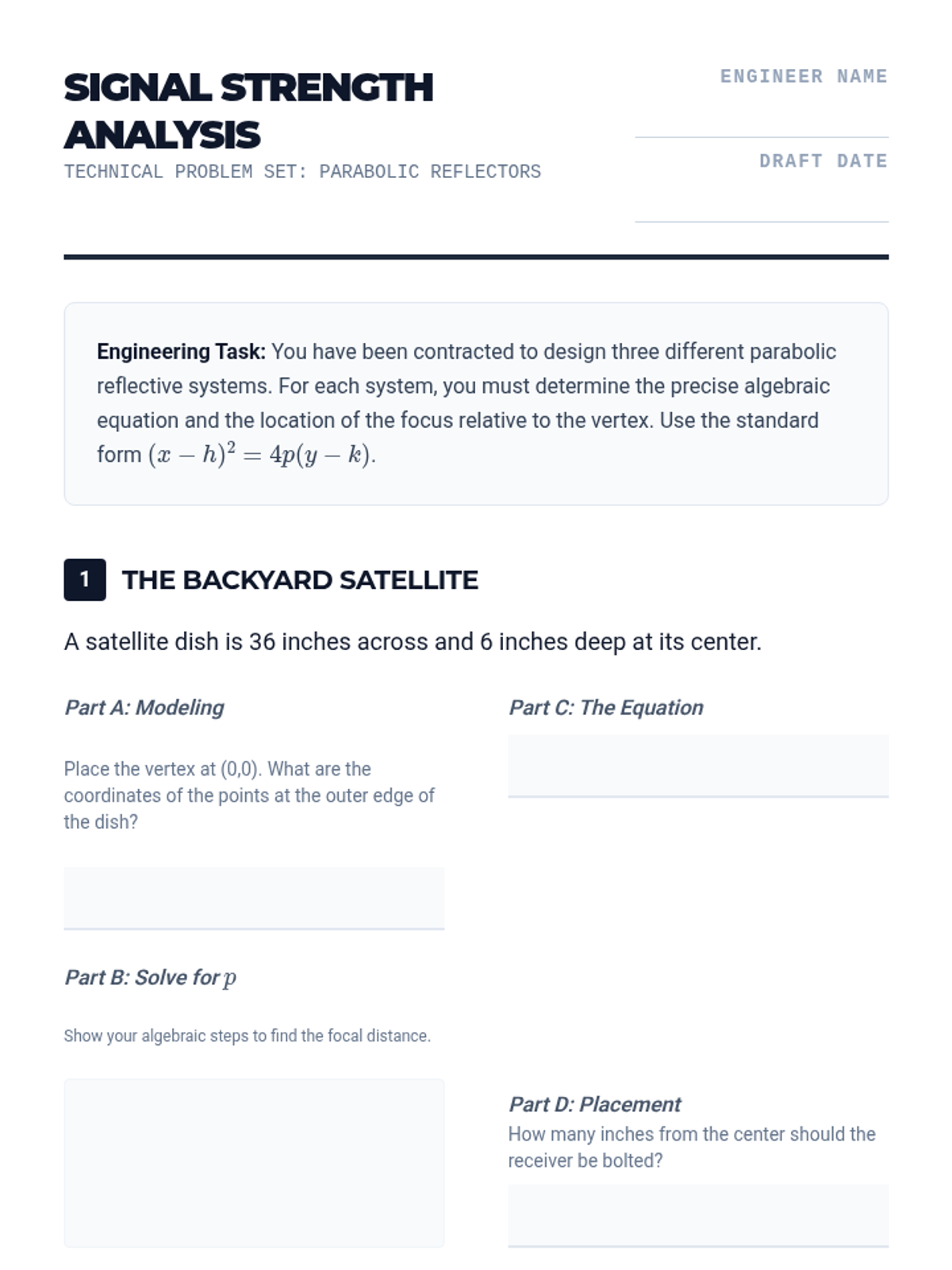
A project-based sequence for 12th-grade students exploring the real-world applications of conic sections in engineering, physics, and medicine. Students transition from geometric definitions to algebraic equations while solving practical problems involving satellite dishes, whispering galleries, and navigation systems.
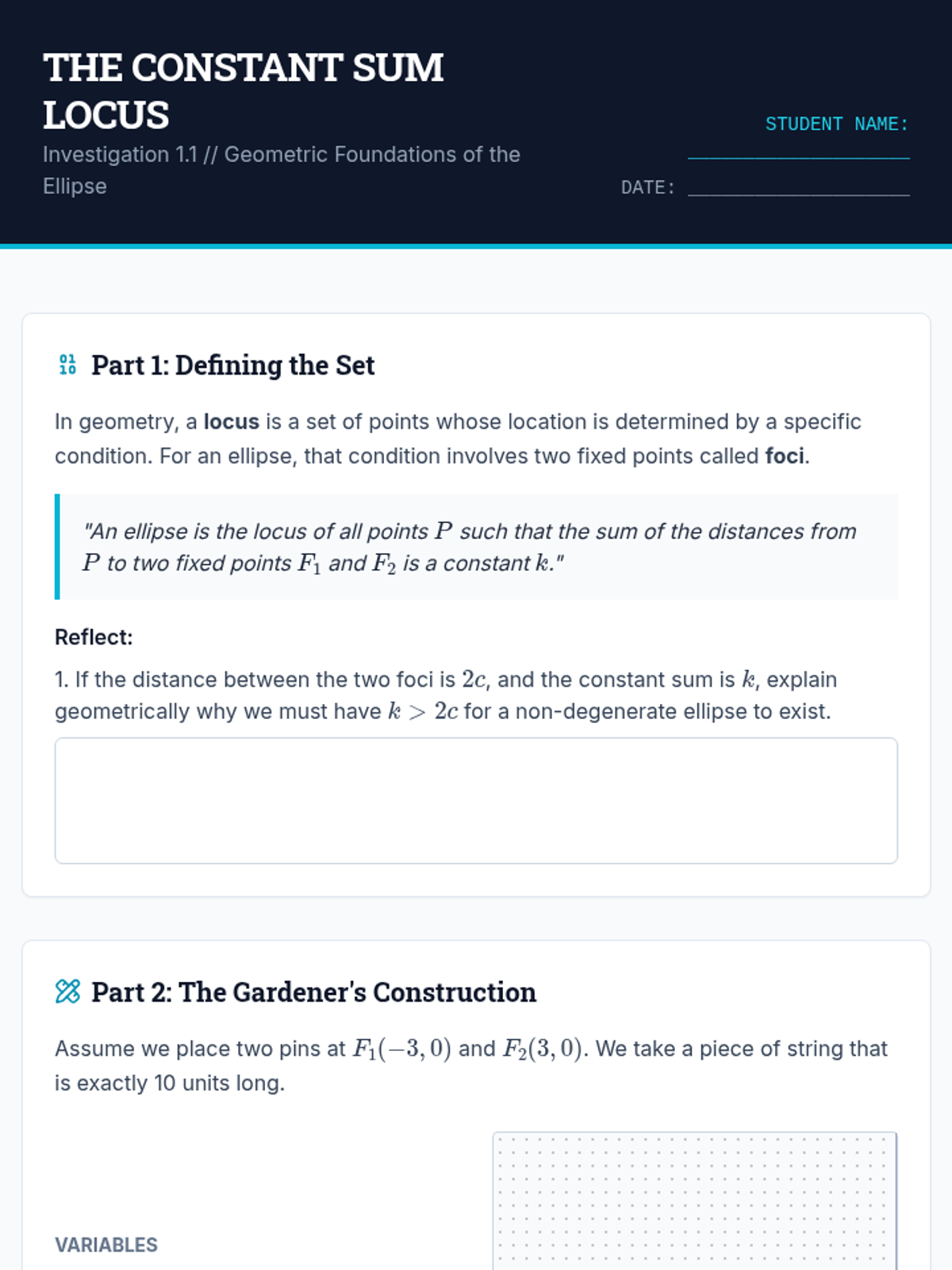
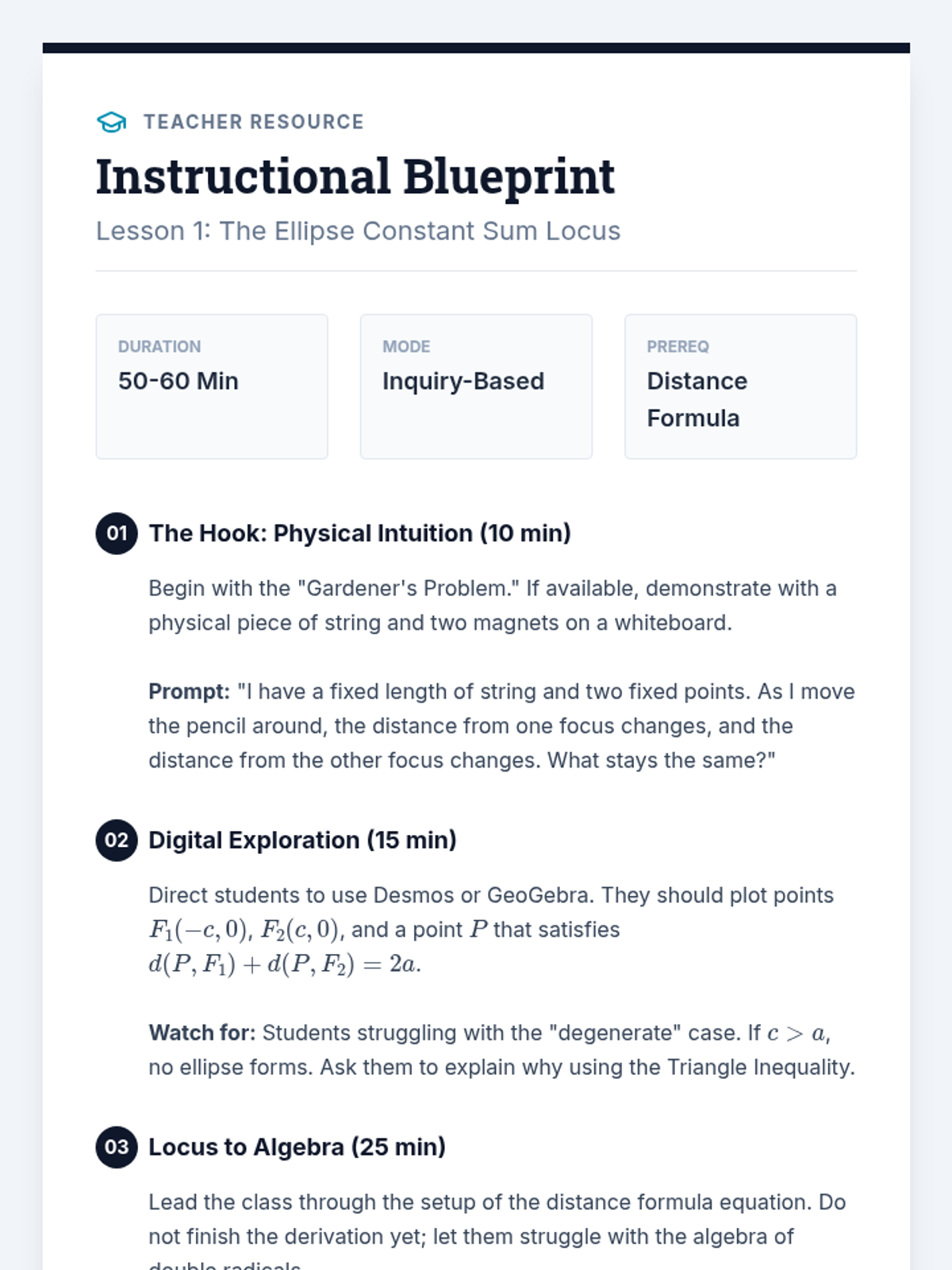
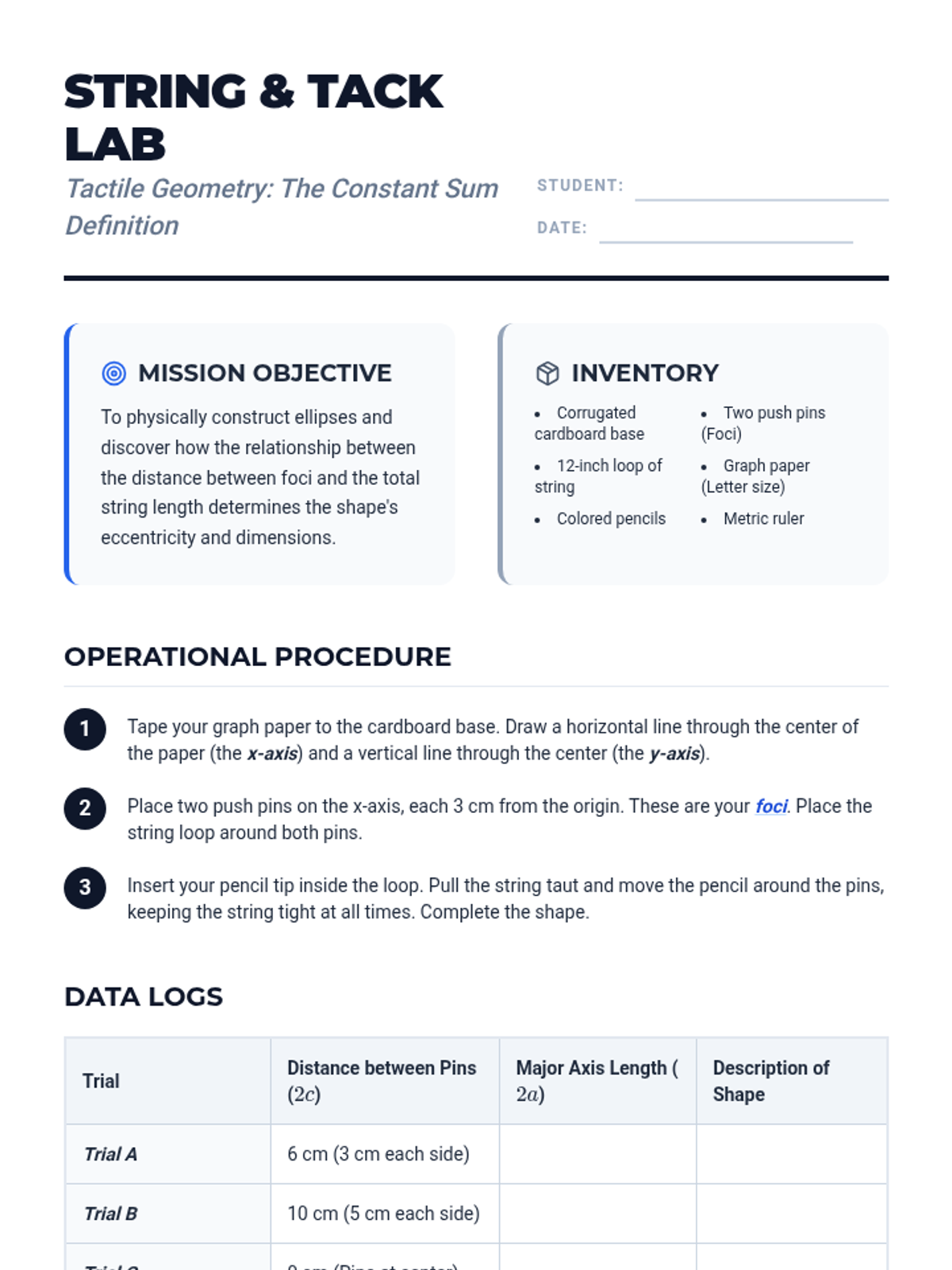
This sequence explores the ellipse as a geometric locus where the sum of distances to two foci is constant. Students move from hands-on construction to algebraic derivation and real-world applications in acoustics and astronomy.
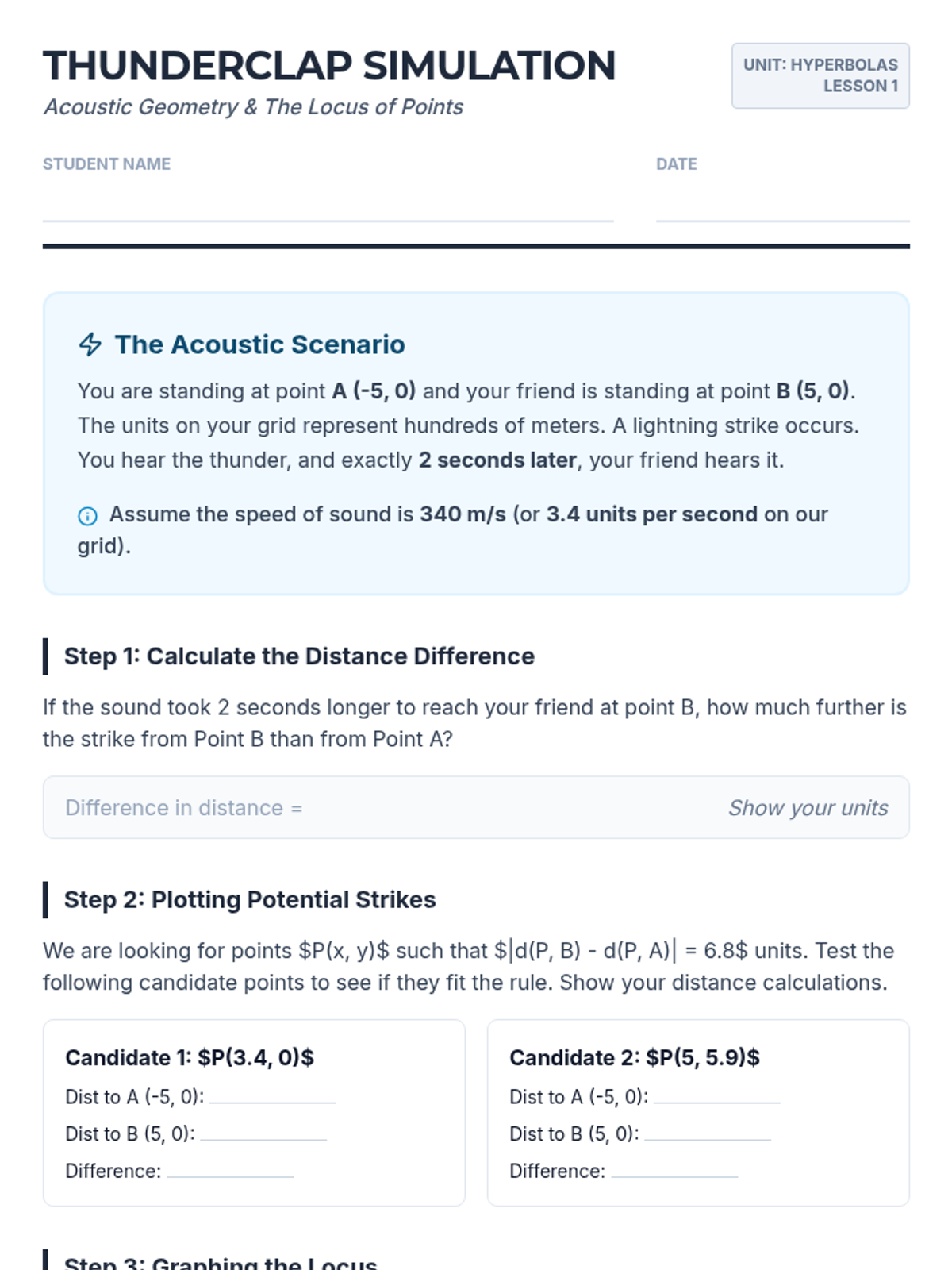
A comprehensive sequence exploring hyperbolas through their geometric definition, algebraic derivation, and real-world application in LORAN navigation. Students move from conceptual inquiry to rigorous graphing and complex problem-solving.
A comprehensive geometry sequence for 11th grade exploring the construction, algebraic derivation, graphing, and real-world applications of ellipses, including planetary orbits and acoustic architecture.
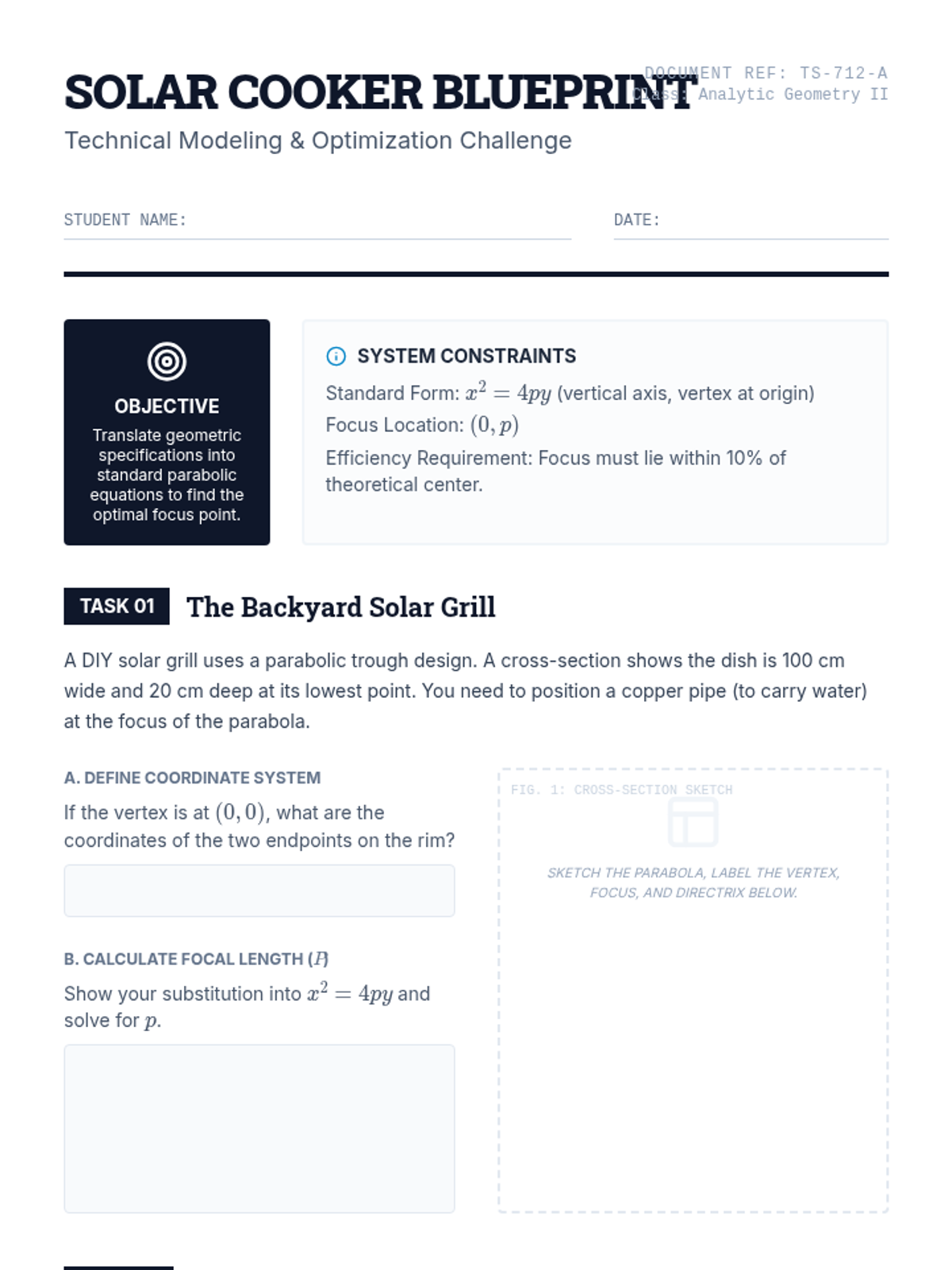
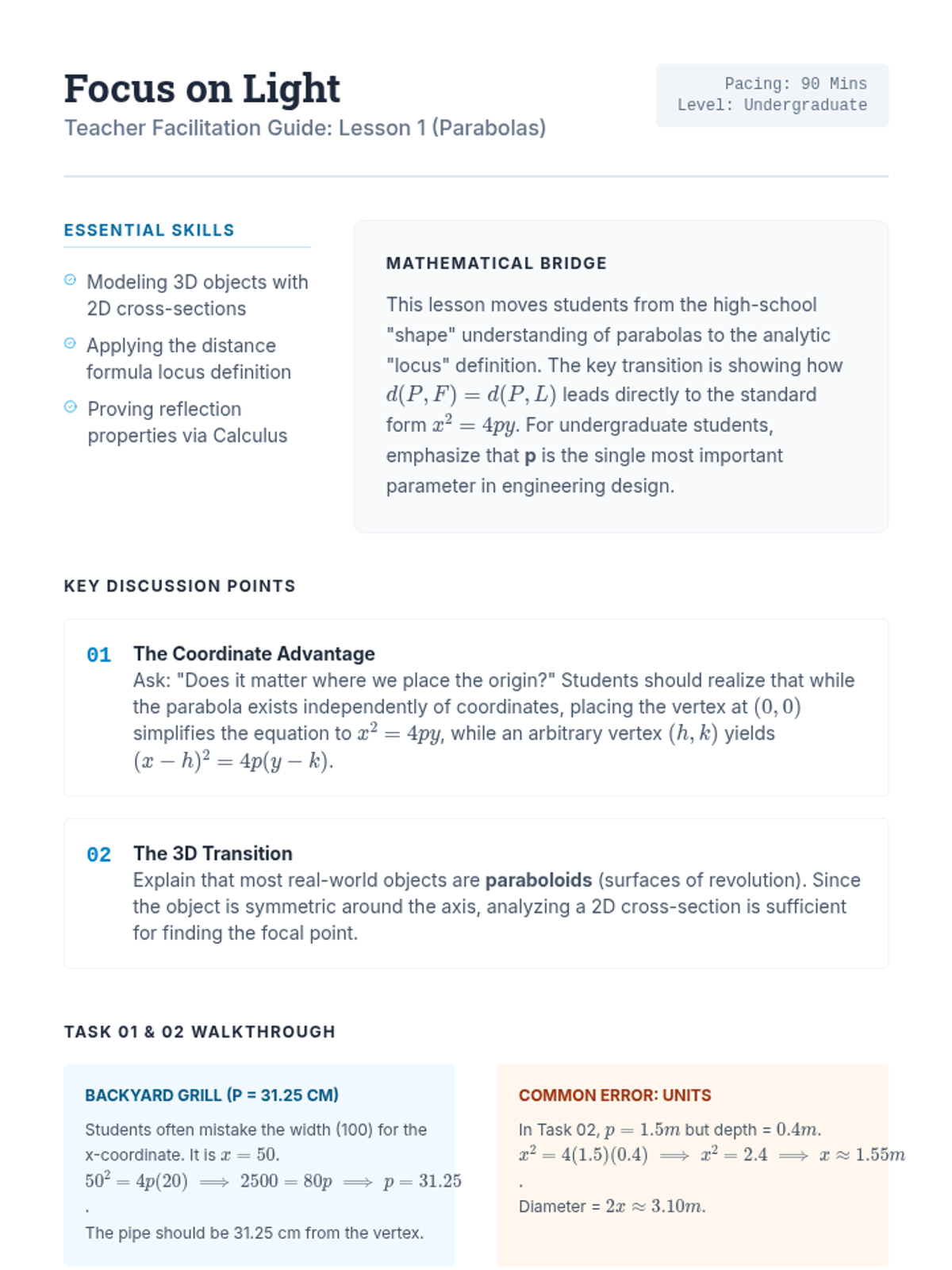
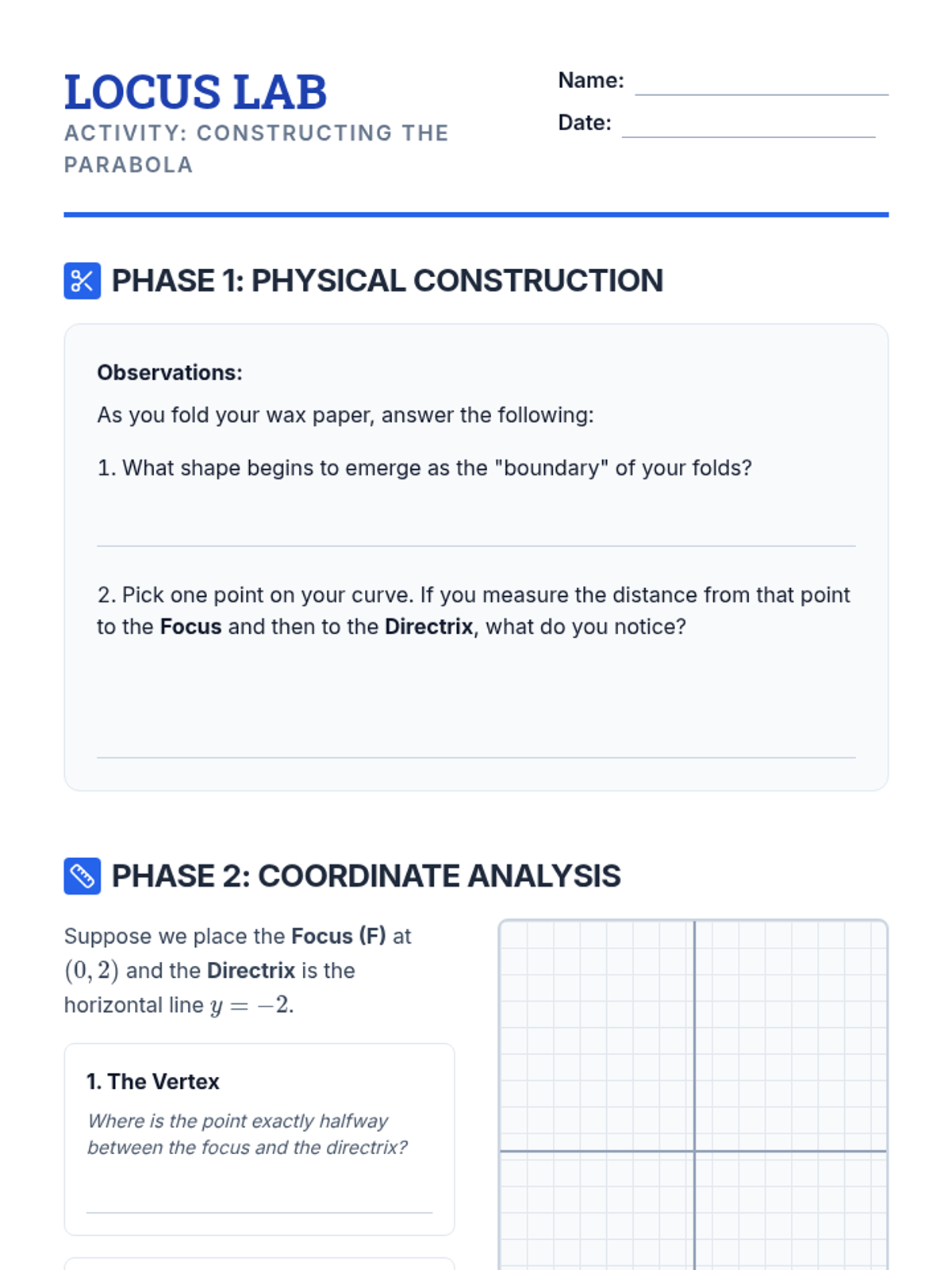
This sequence explores the parabola through its geometric definition as a locus of points equidistant from a focus and directrix. Students progress from physical constructions and algebraic derivations to analyzing various orientations and applying parabolic properties to real-world engineering challenges like satellite dishes and bridge design.
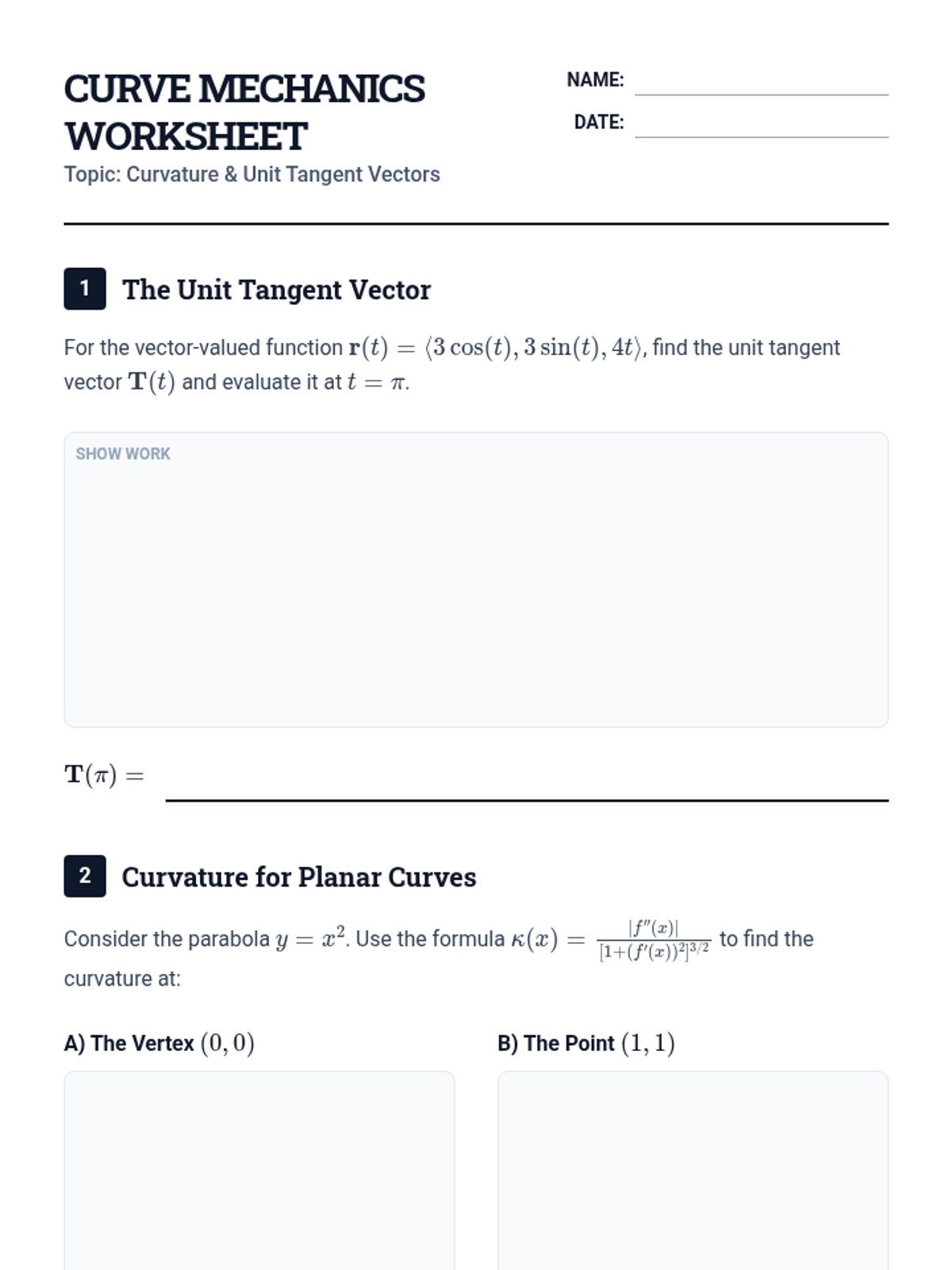
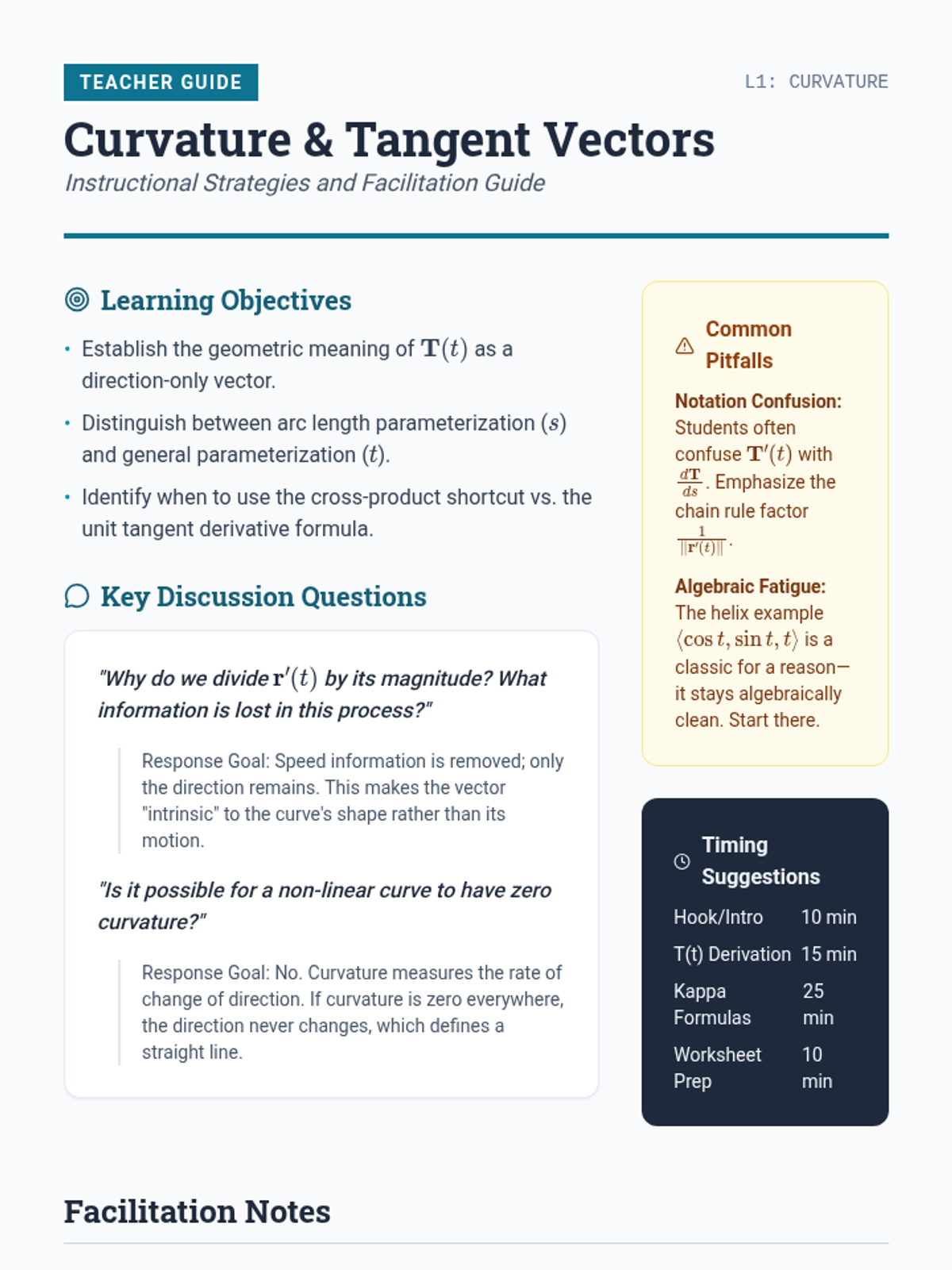
A comprehensive undergraduate-level sequence exploring the intrinsic geometry of space curves through the TNB (Tangent, Normal, Binormal) frame, curvature, and torsion. Students move from basic vector functions to advanced structural analysis of curves in 3D space.
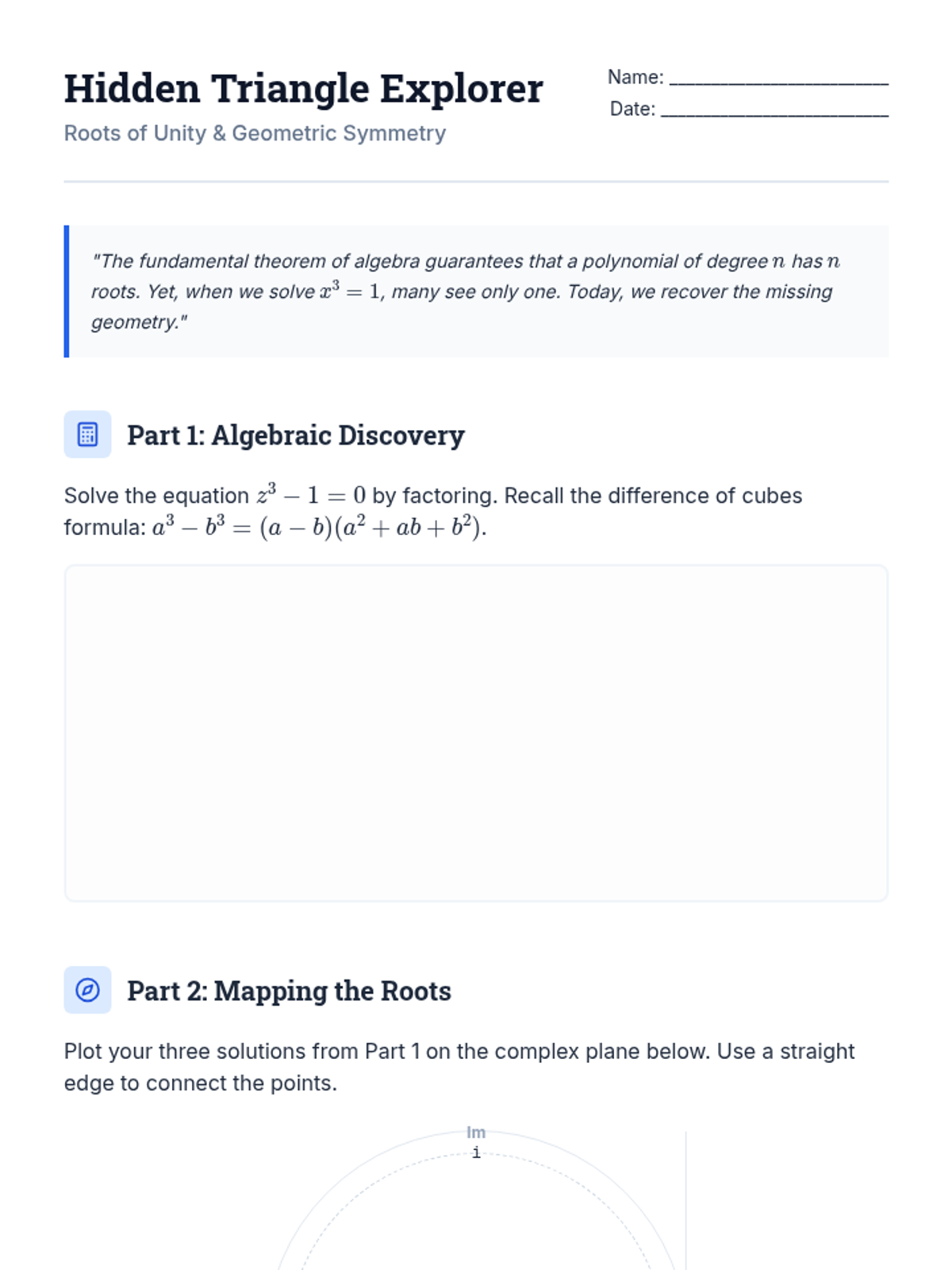
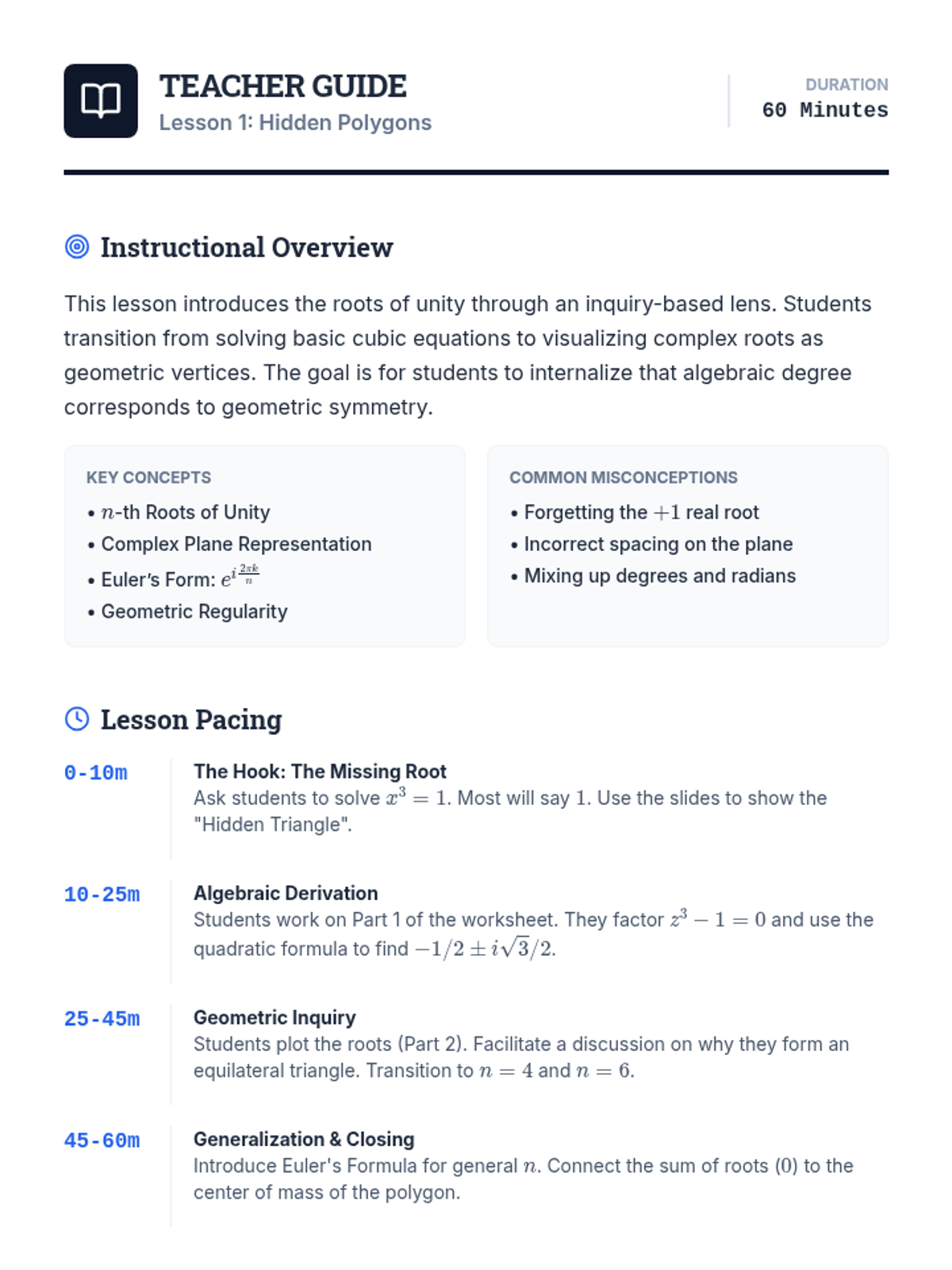
An undergraduate-level exploration of the roots of unity, connecting algebraic solutions of polynomial equations to geometric symmetry in the complex plane and the fractal nature of complex iteration.
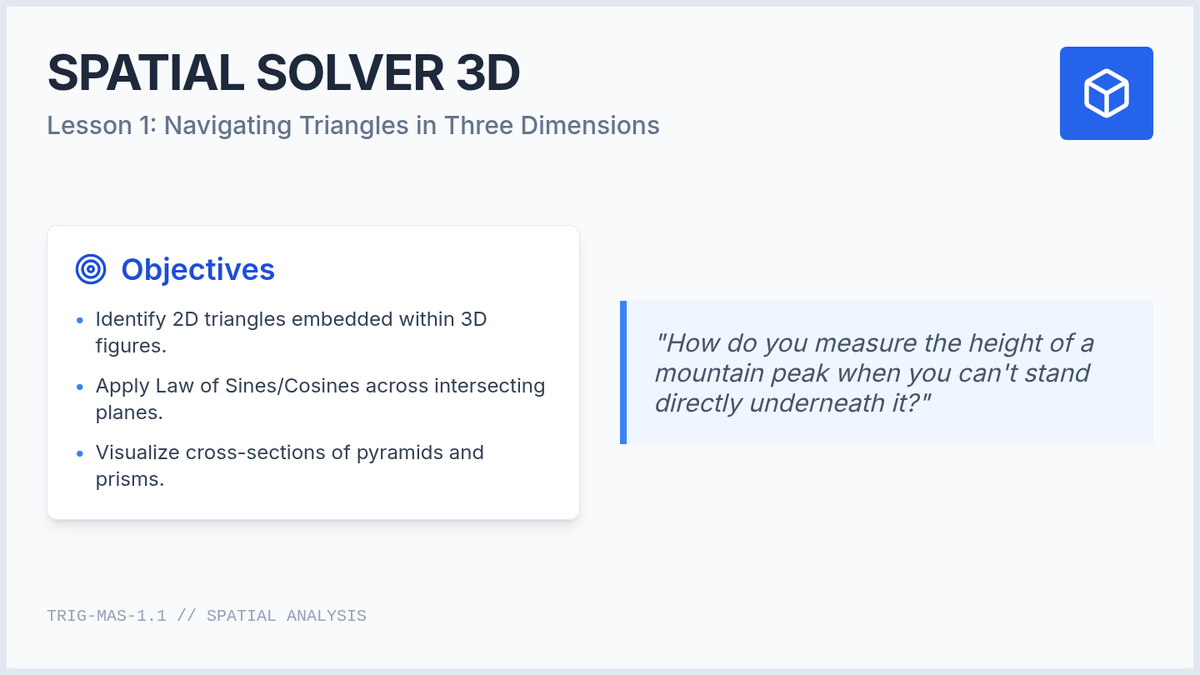
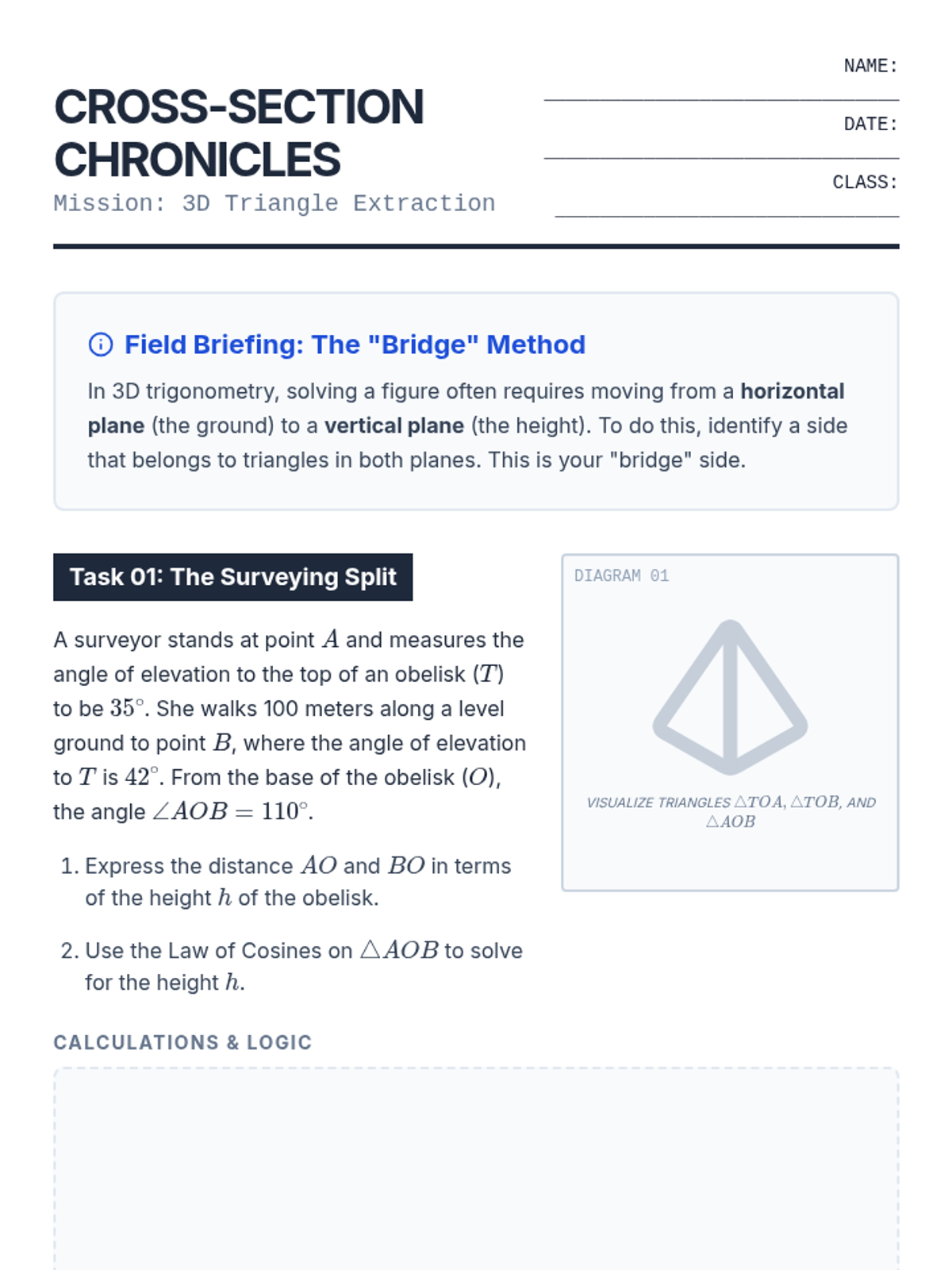
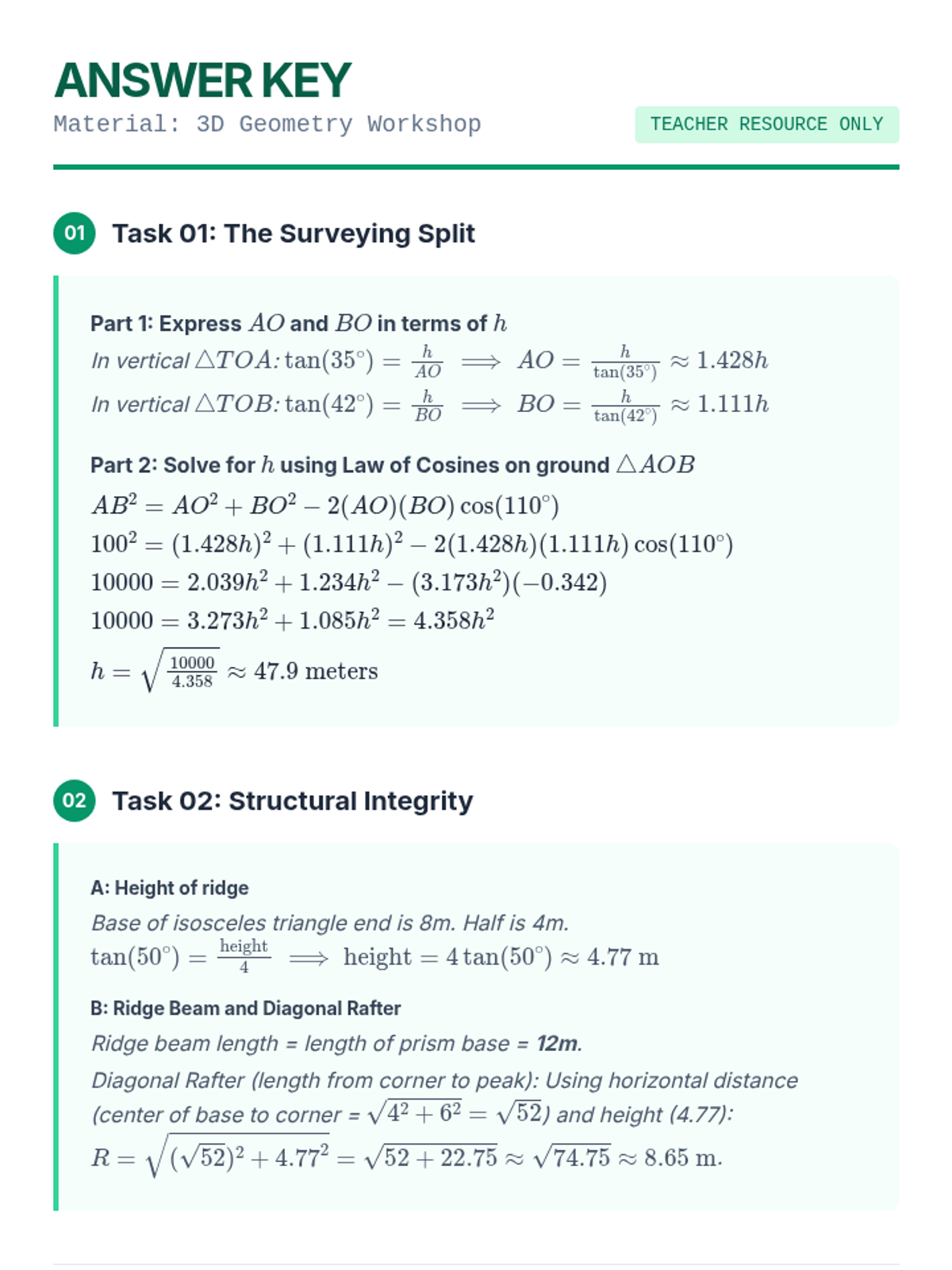
An advanced trigonometry sequence for 12th-grade students focusing on the Law of Sines and Cosines applied to 3D spatial problems, vector magnitudes, static forces, and structural engineering. Students transition from 2D calculations to analyzing complex 3D systems and physical forces.
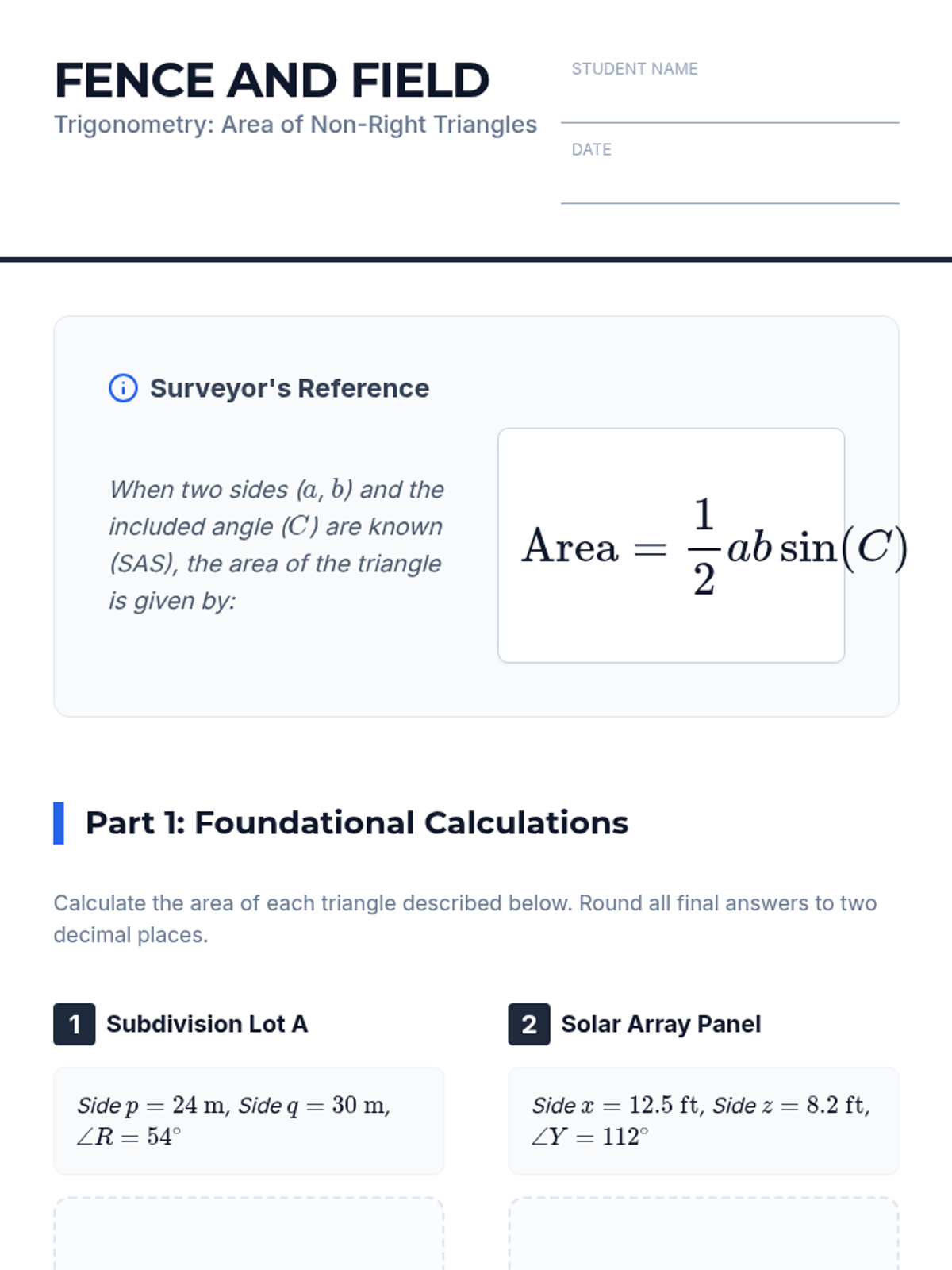
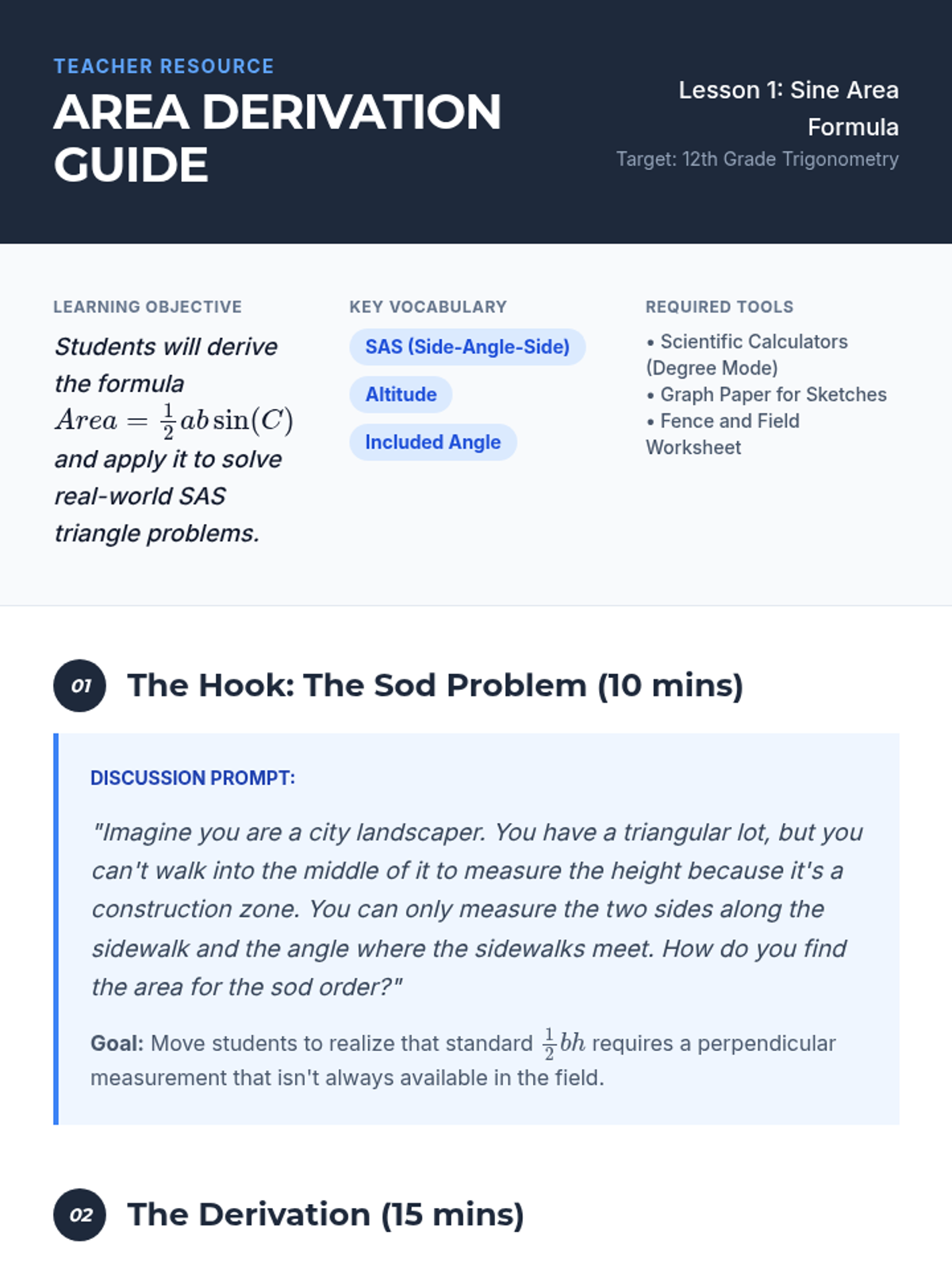
This 12th-grade trigonometry sequence explores area calculations for non-right triangles using the Sine Area Formula and Heron's Formula. Students apply these techniques to complex polygon decomposition, area optimization, and a real-world land partitioning case study.
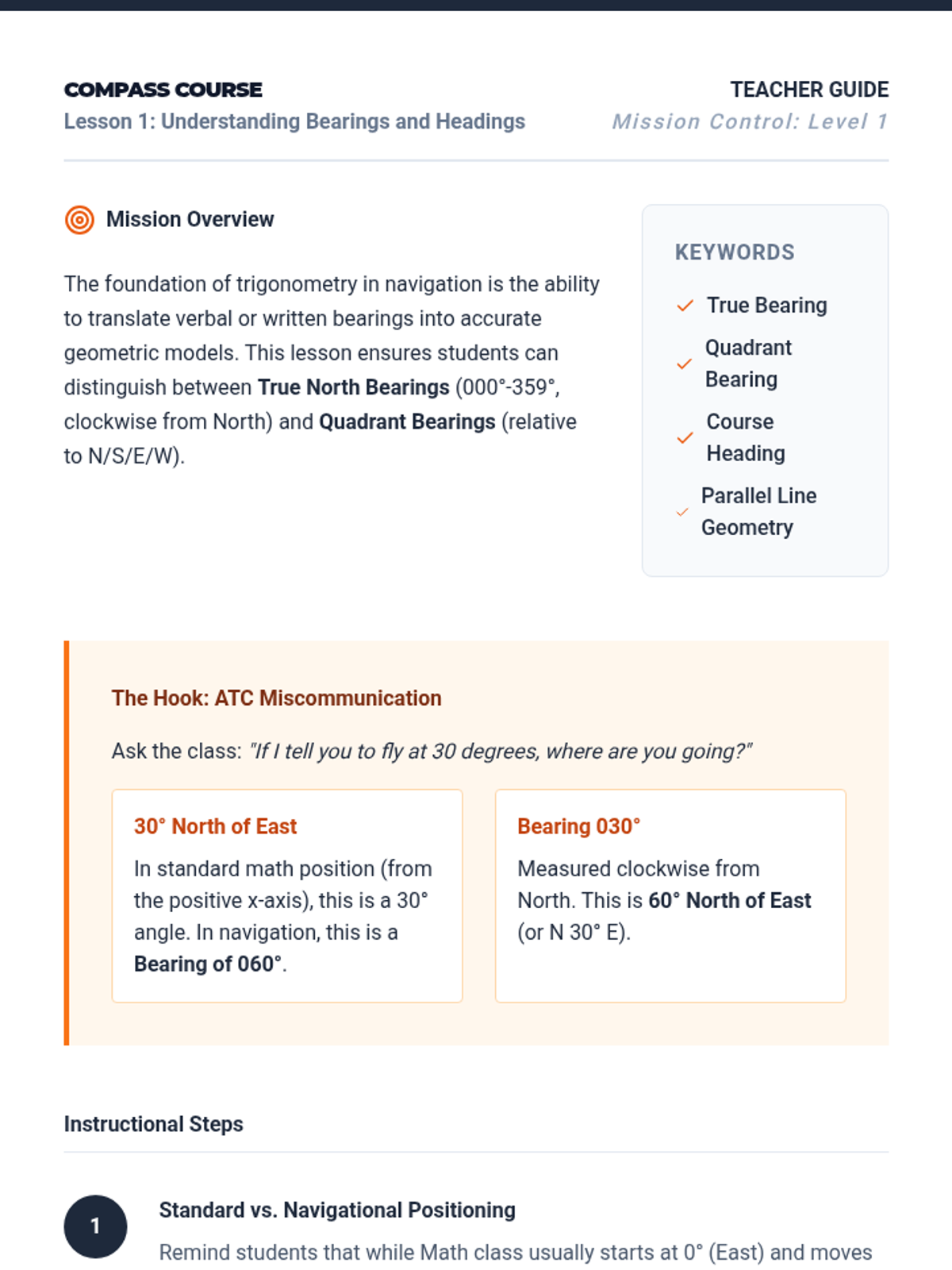
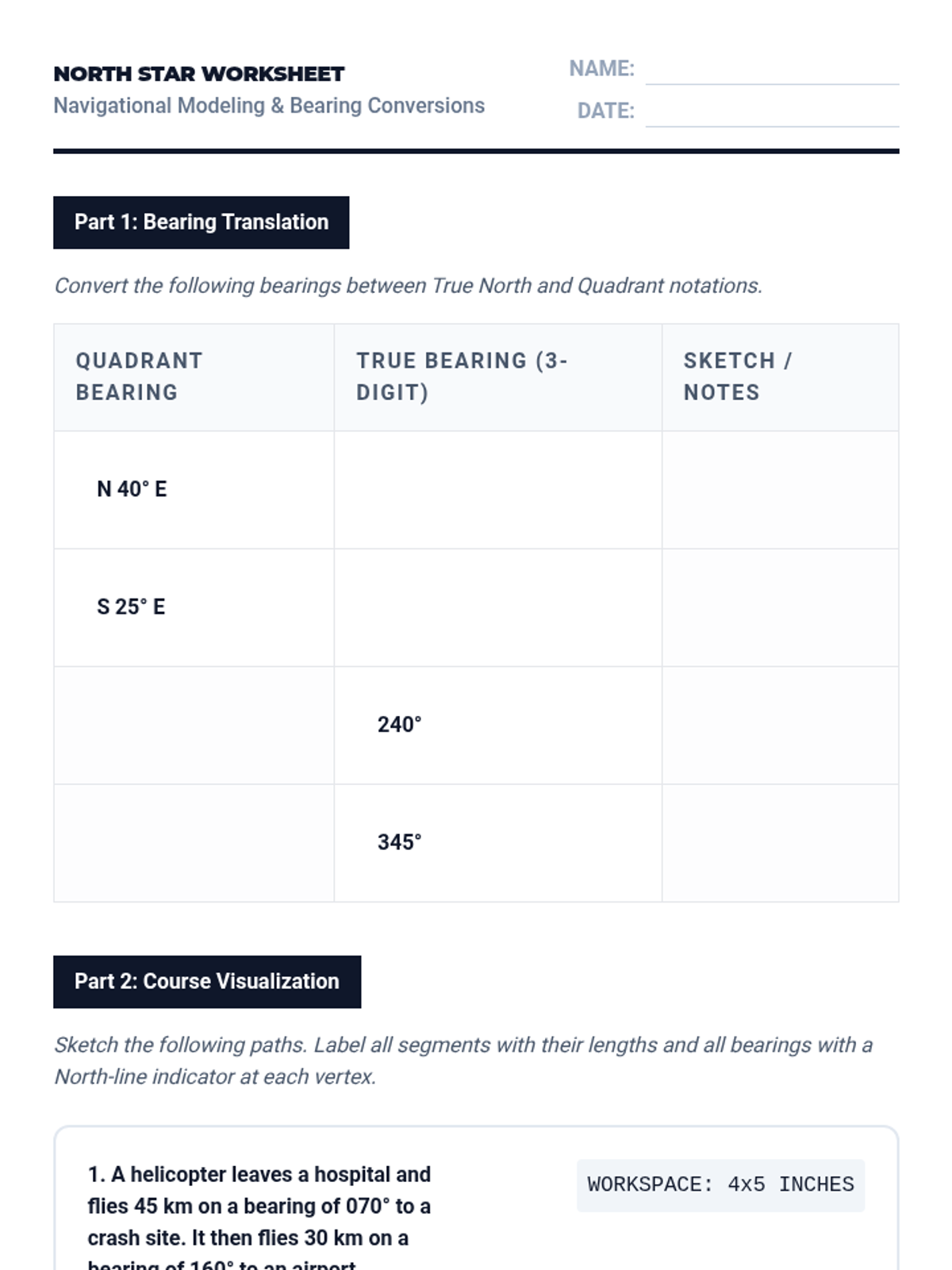
This project-based sequence applies general triangle trigonometry to real-world scenarios in navigation, surveying, and aviation. Students move from abstract geometric figures to interpreting word problems involving bearings, headings, and elevation angles, culminating in a simulated search-and-rescue operation.
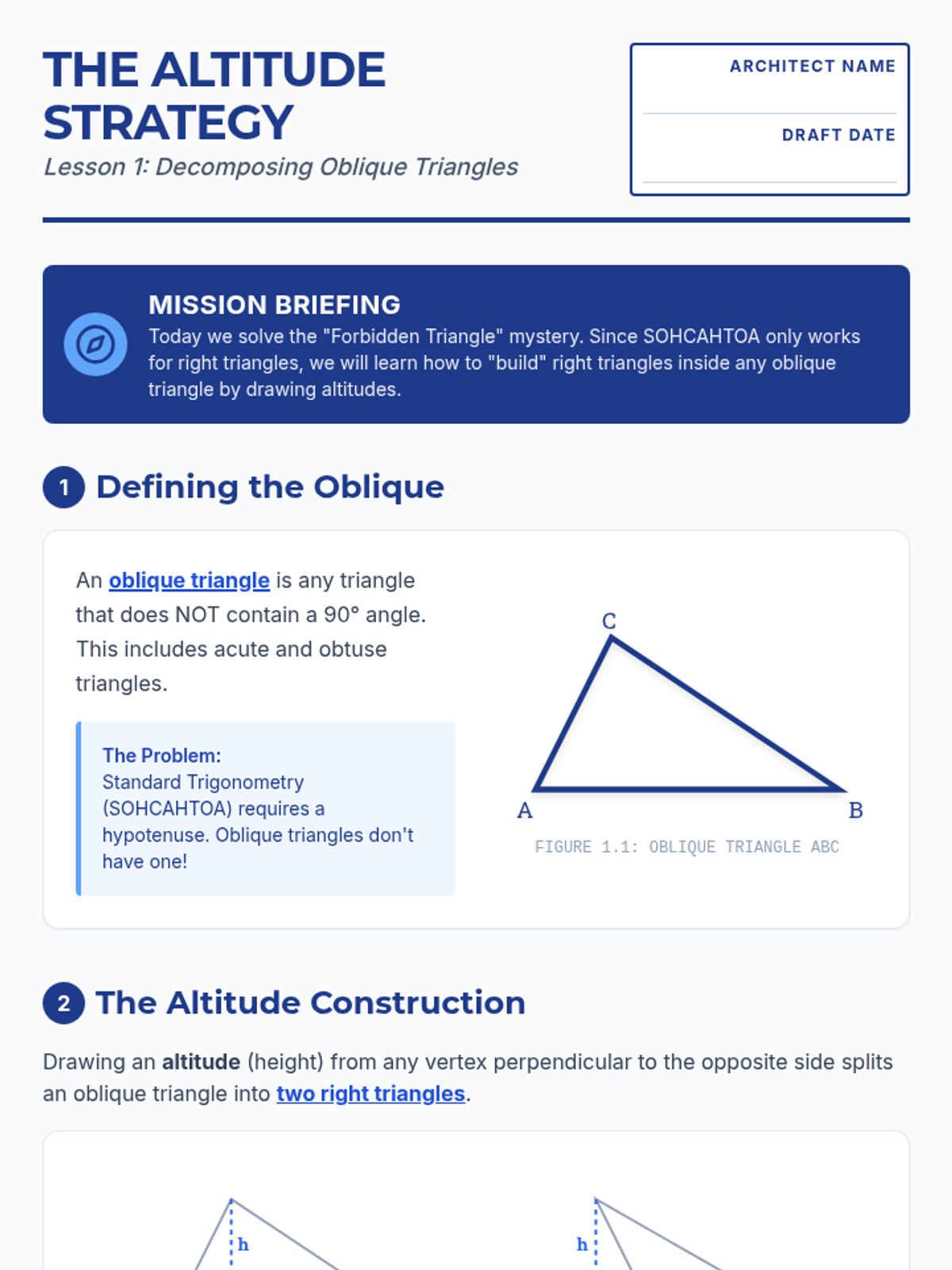
This sequence guides 11th-grade students through the derivation and application of the Law of Sines and the Law of Cosines. It focuses on solving oblique triangles, navigating the ambiguous case (SSA), and developing a strategic framework for selecting the correct trigonometric tool for any given triangle.
This undergraduate-level sequence explores the theoretical foundations and analytical applications of trigonometry for oblique triangles. Students derive the Law of Sines and Law of Cosines, analyze the geometric nuances of the SSA ambiguous case, and master advanced area formulas like Heron's, preparing them for calculus and physics.
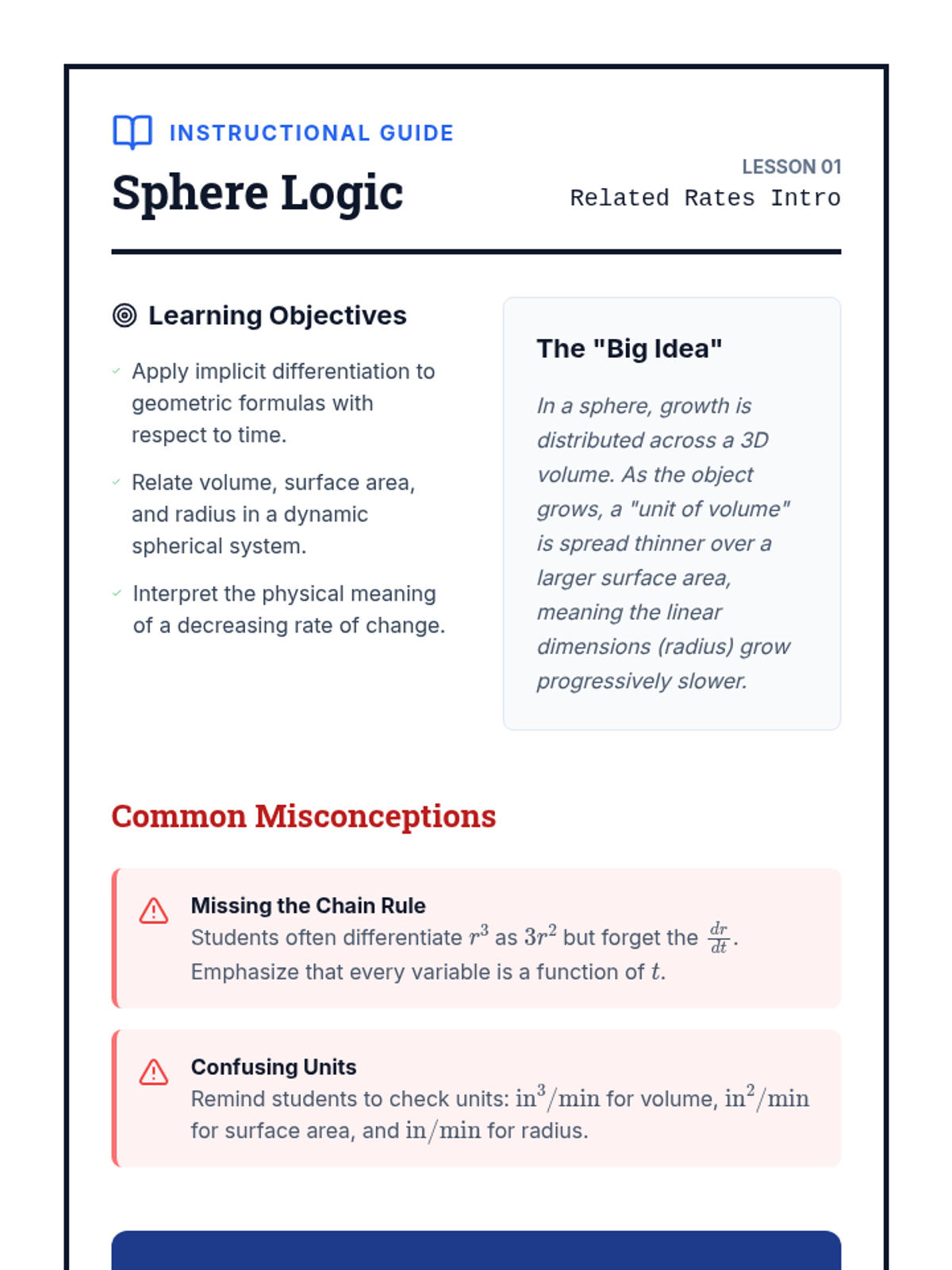
This sequence explores the calculus of related rates through the lens of 3D geometry and fluid dynamics. Students progress from simple spherical expansion to complex conical substitution and industrial net-flow applications.
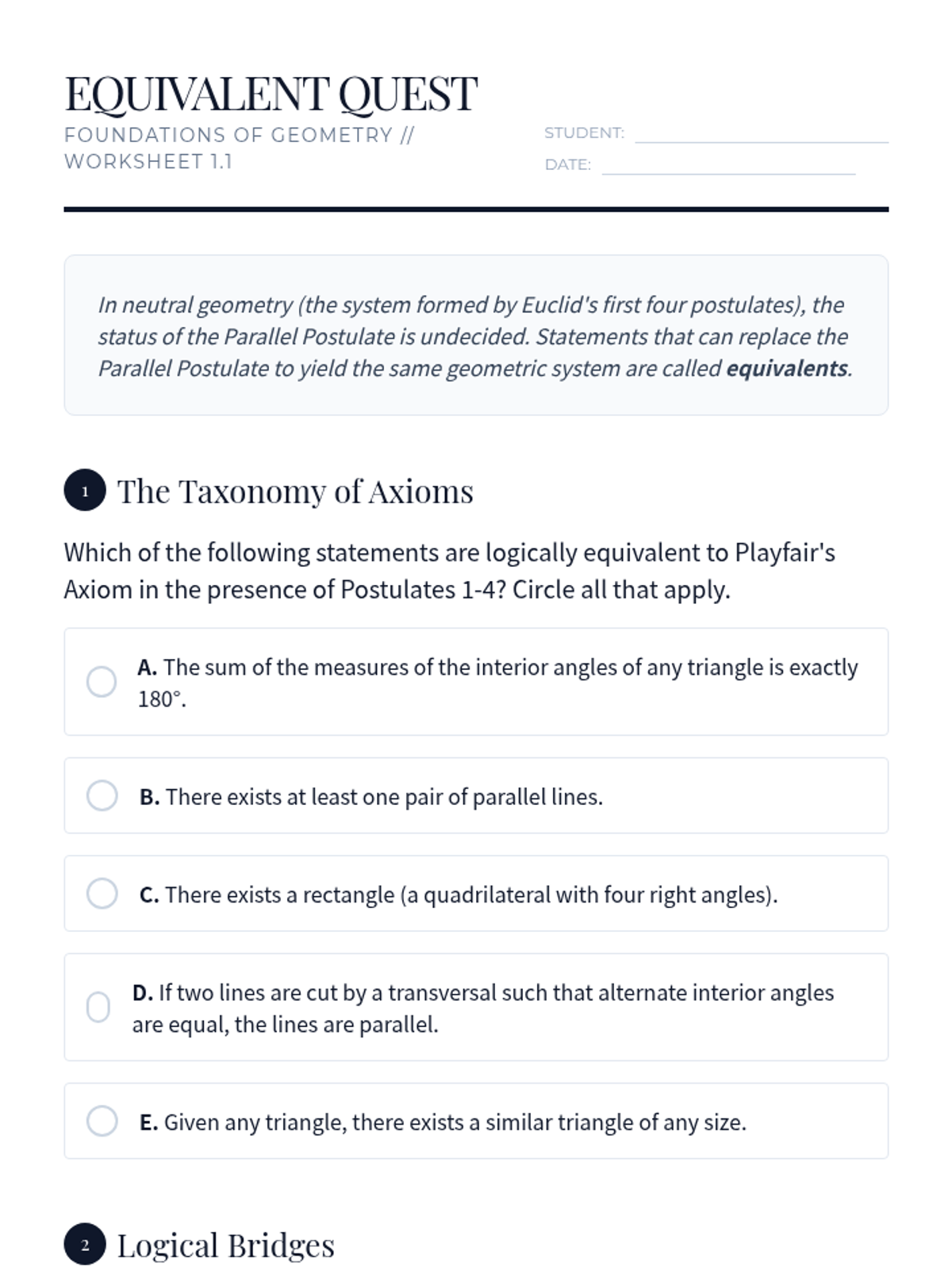
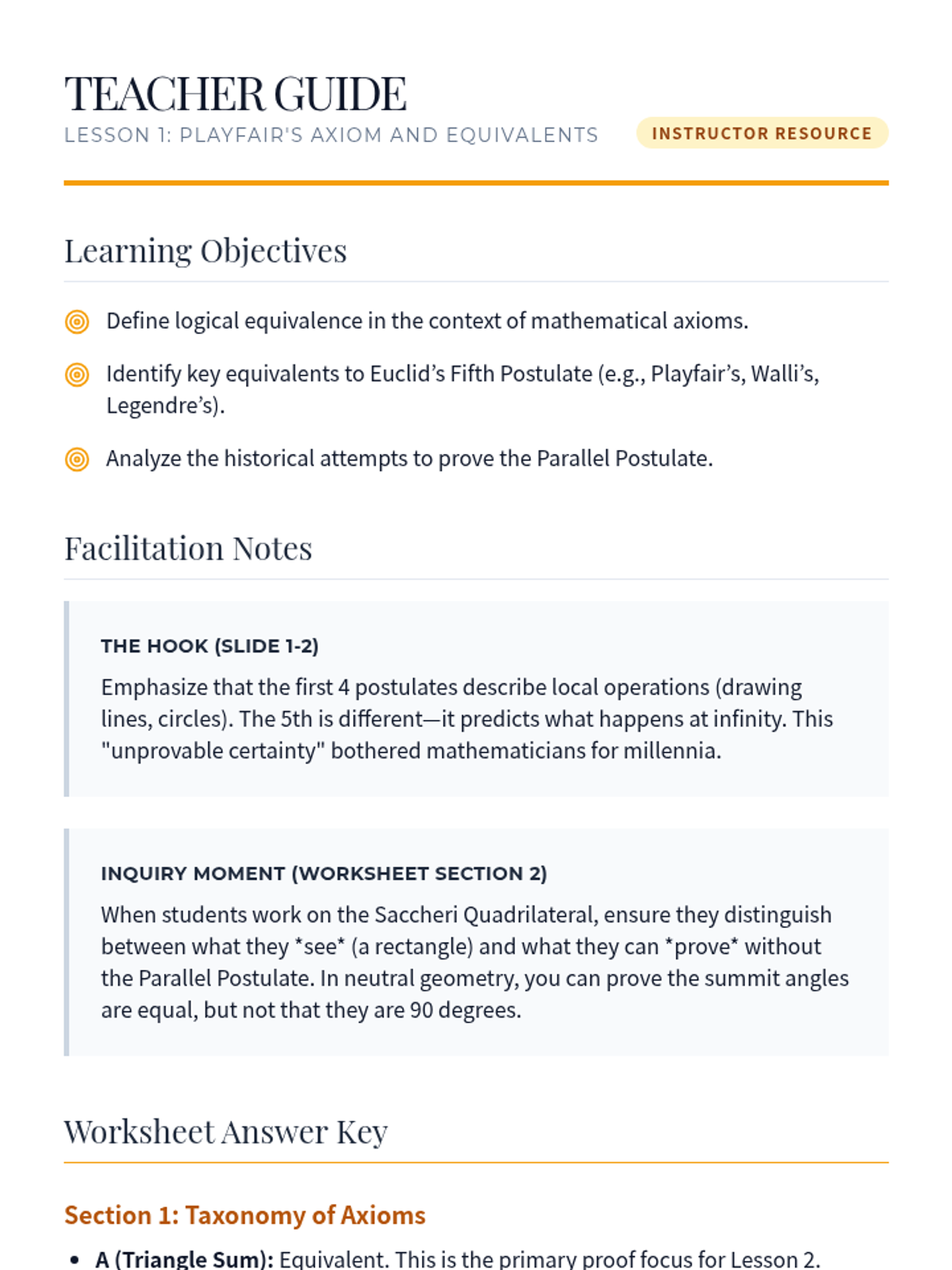
An undergraduate-level investigation into the logical foundations of Euclidean geometry, centering on the Fifth Postulate and its role in defining the properties of triangles, quadrilaterals, and area. Students transition from intuitive visual proofs to rigorous axiomatic logic.
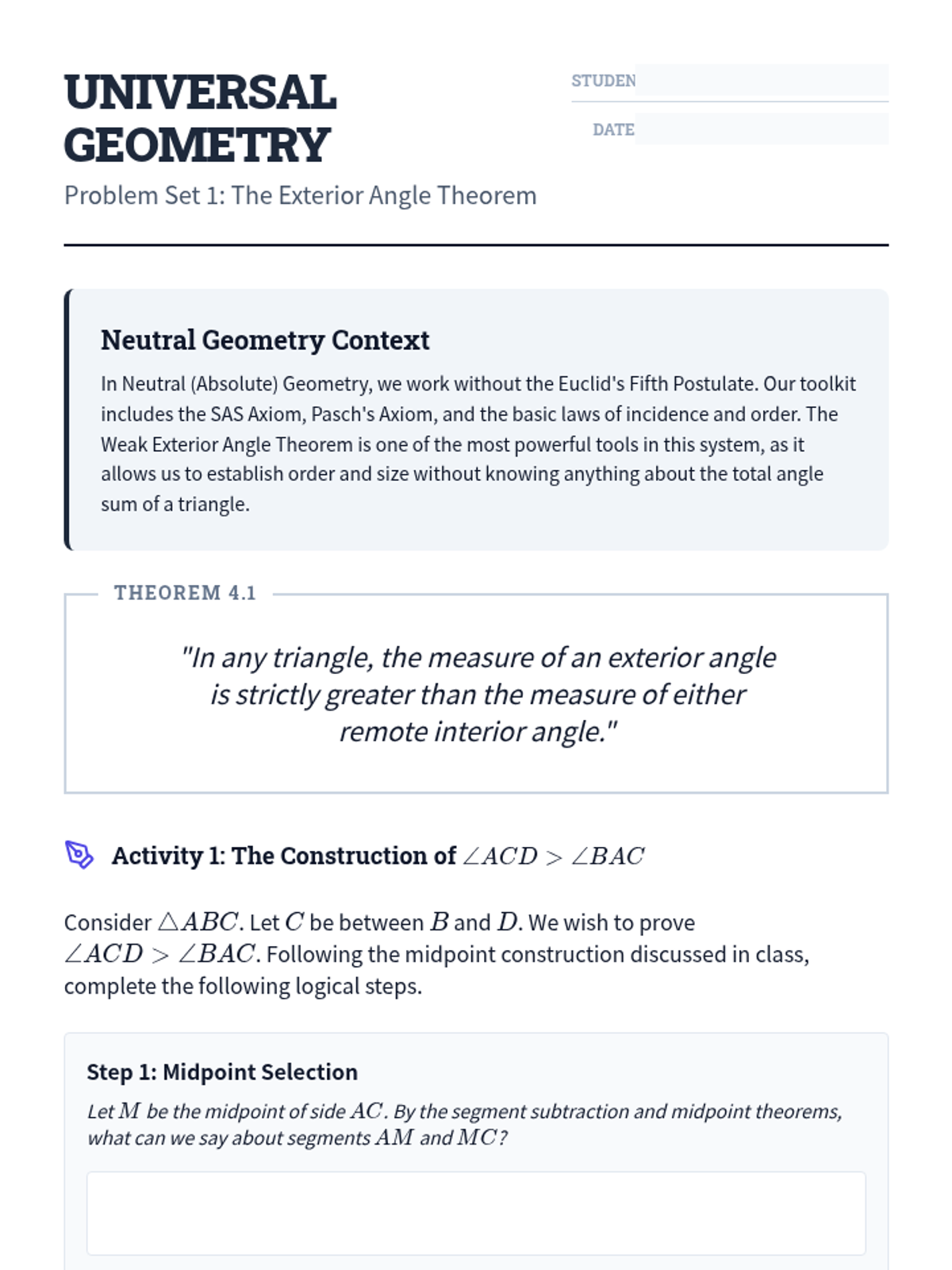
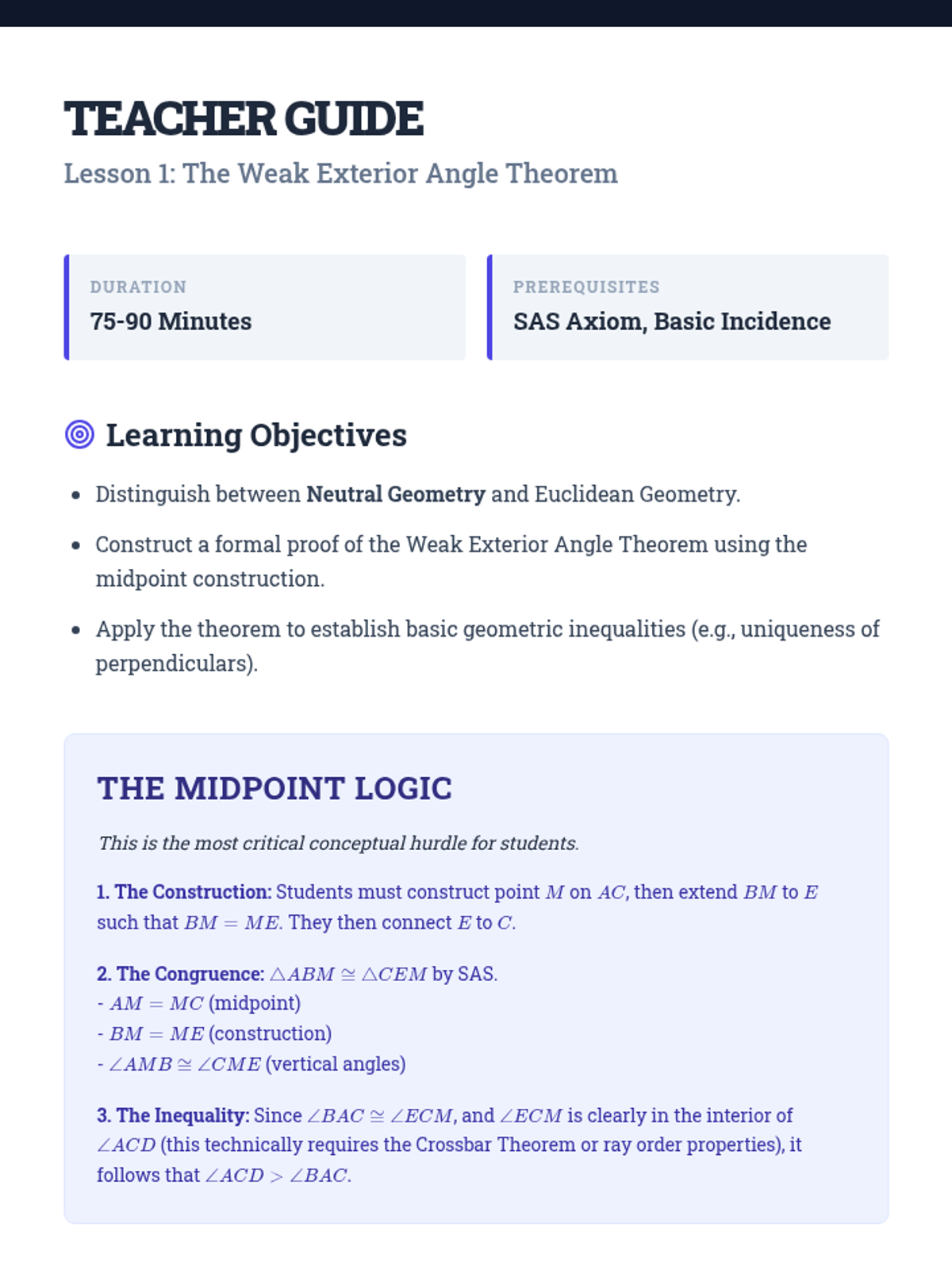
A rigorous exploration of Neutral (Absolute) Geometry for undergraduate students, focusing on theorems that hold without the Parallel Postulate, including triangle congruence, inequalities, and the Saccheri-Legendre theorem.
This undergraduate geometry sequence bridges the gap between high school intuition and formal mathematical rigor. Students transition from Euclid's historical 'Elements' to Hilbert's modern axiomatic system, learning to prove theorems about incidence, betweenness, and congruence while eliminating reliance on visual 'obviousness'.
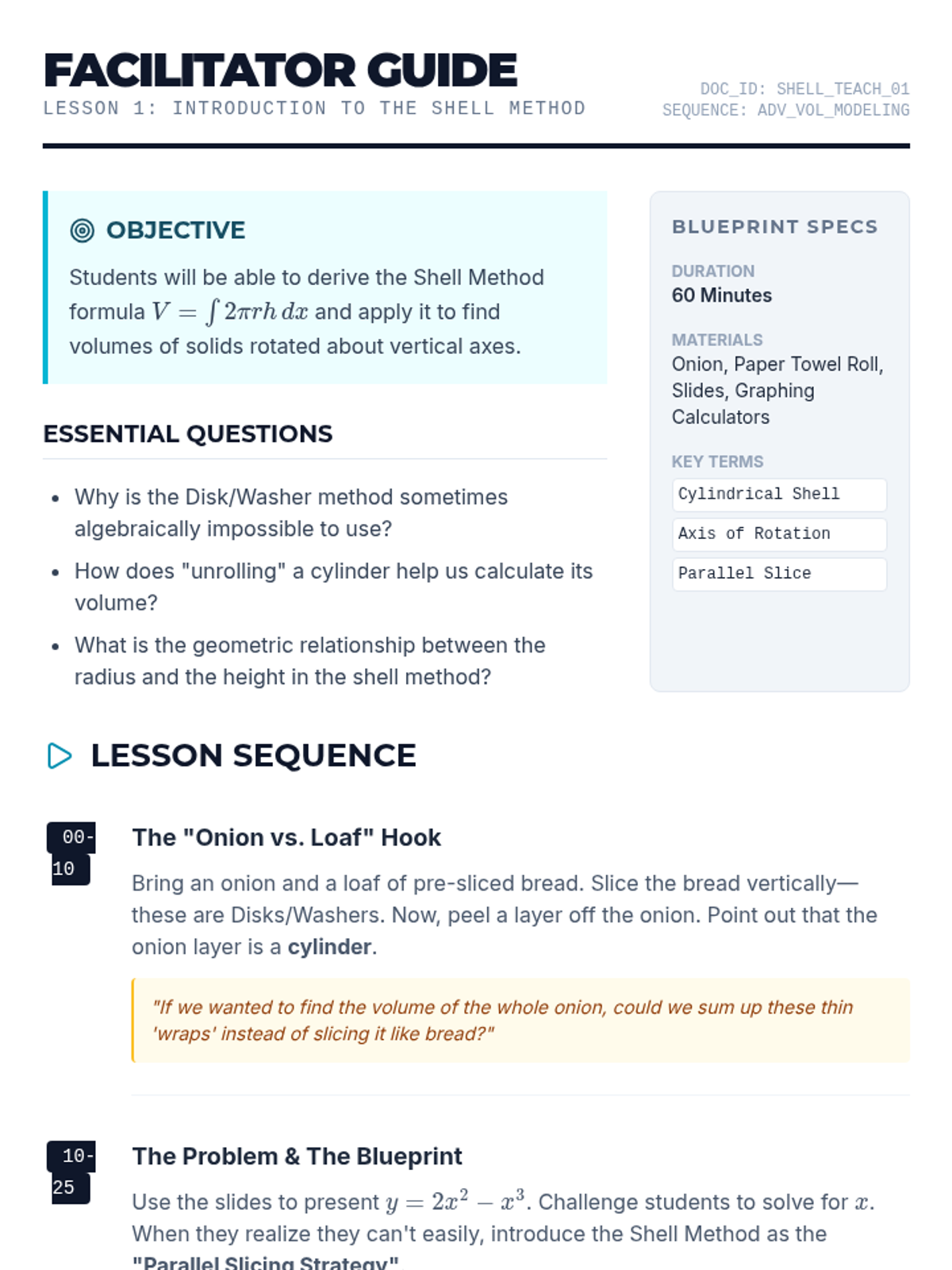
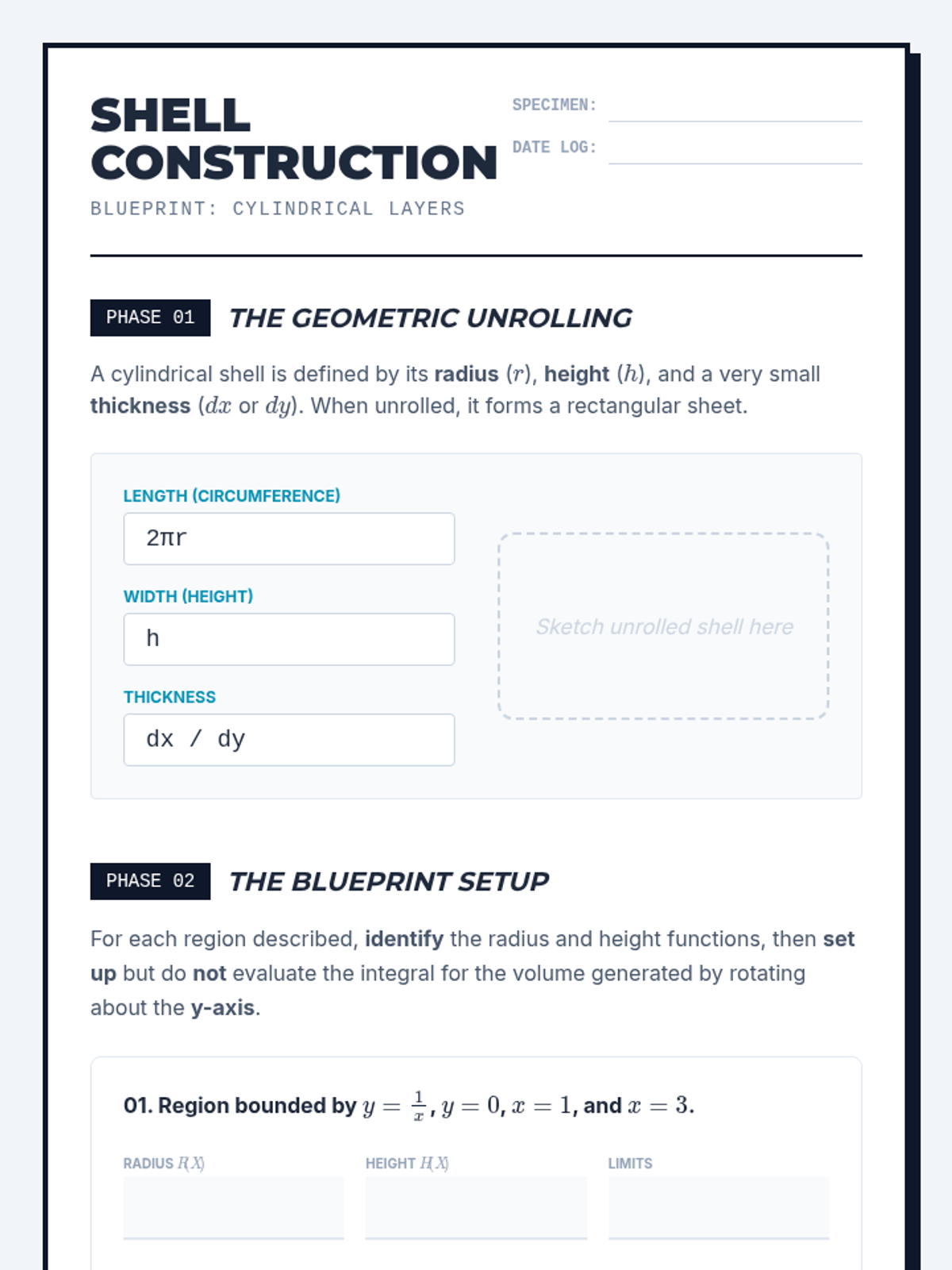
This sequence introduces advanced volume techniques in calculus, including the Shell Method and solids with known cross-sections. Students move from theoretical derivation to a project-based application where they model and calculate the volume of real-world objects.
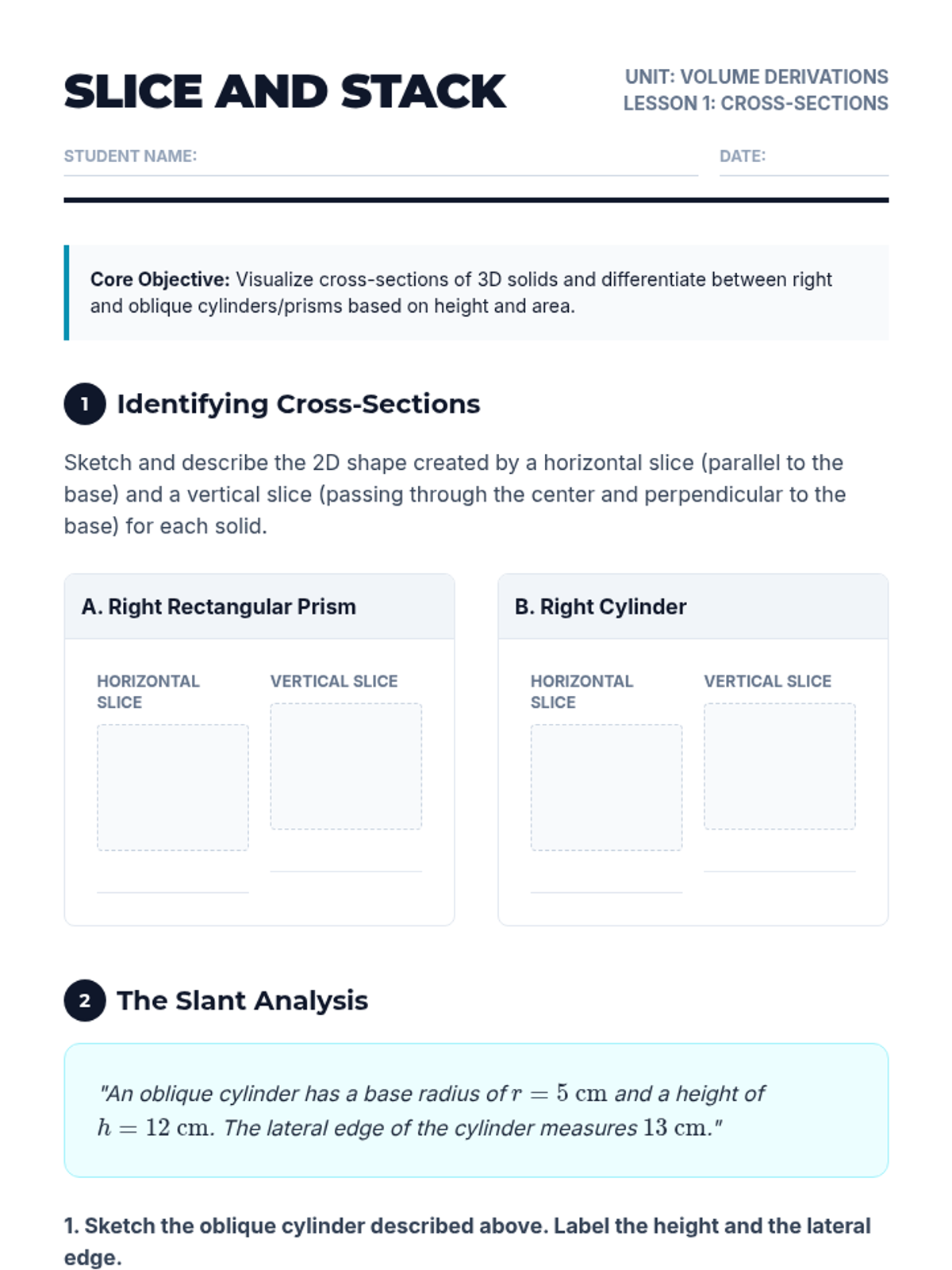
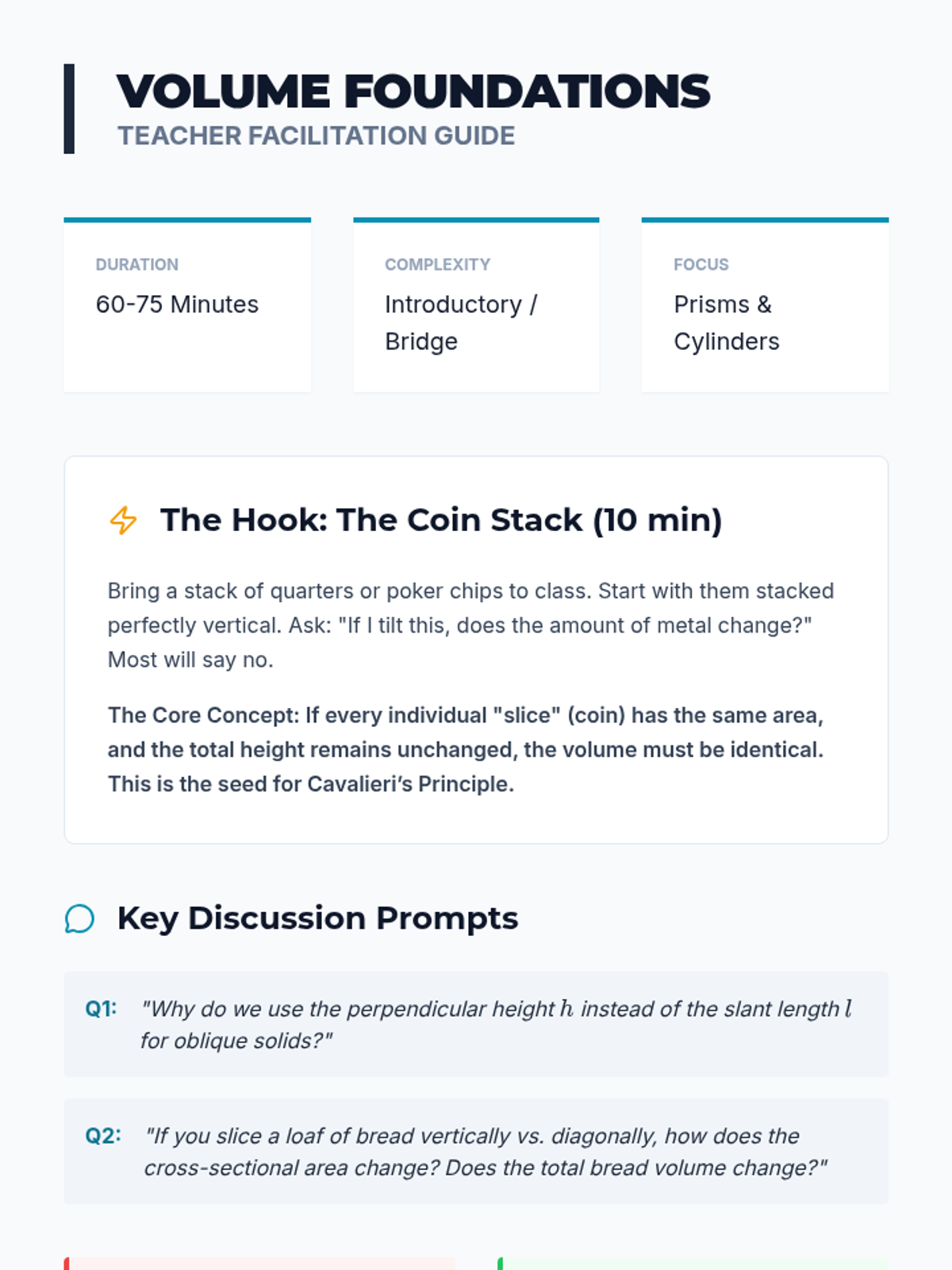
A 12th-grade geometry sequence exploring the derivation of volume formulas using Cavalieri's Principle, limits, and cross-sectional analysis to bridge geometry and calculus.
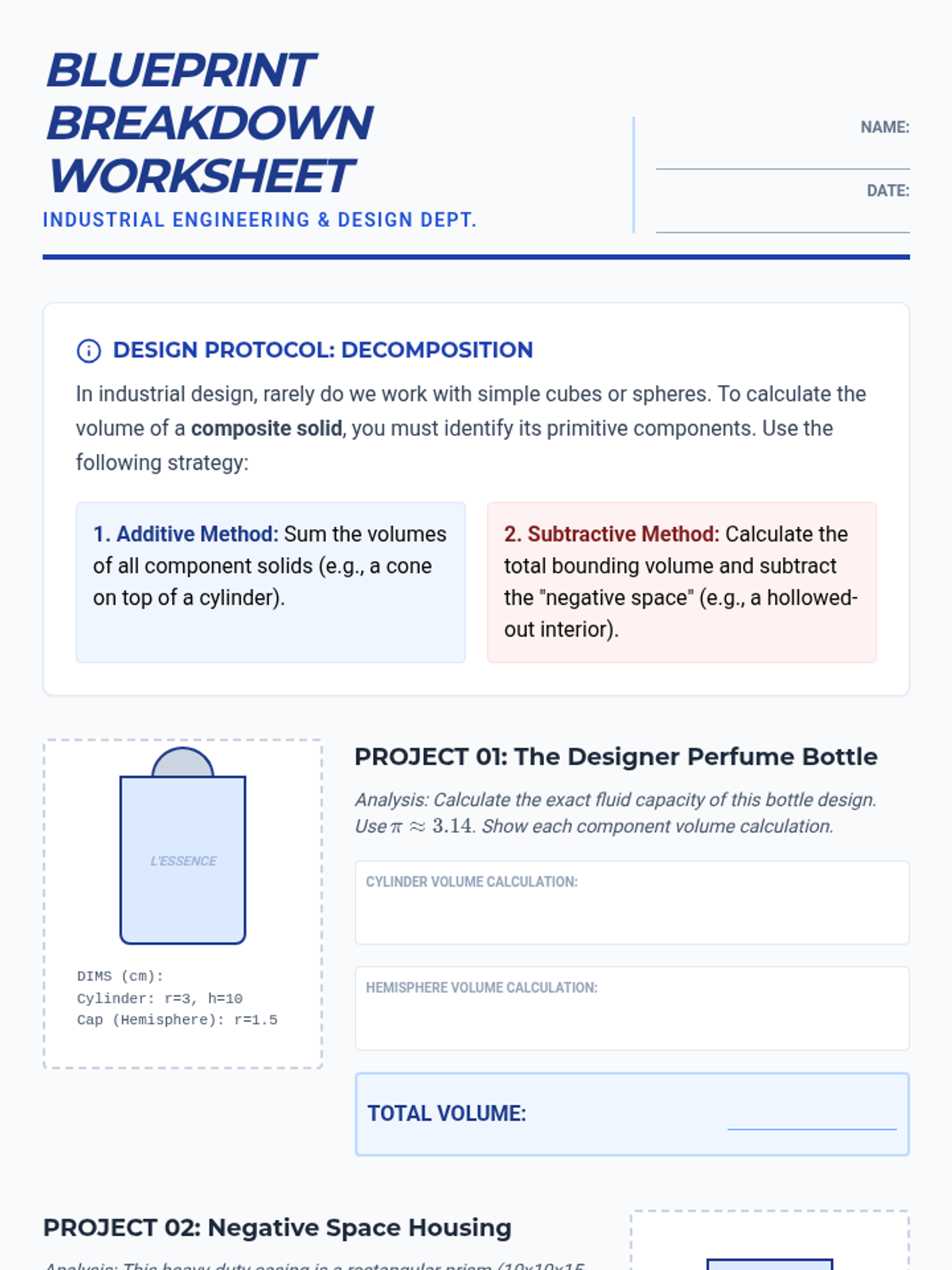
Students act as industrial engineers to optimize packaging by exploring the relationship between surface area and volume. They master composite solids, algebraic modeling of geometric constraints, and sustainable design principles through a project-based approach.
A comprehensive sequence for undergraduate students exploring the geometric and physical applications of definite integrals, from area and volume to work and centroids. The curriculum emphasizes spatial visualization and strategic selection of integration methods.
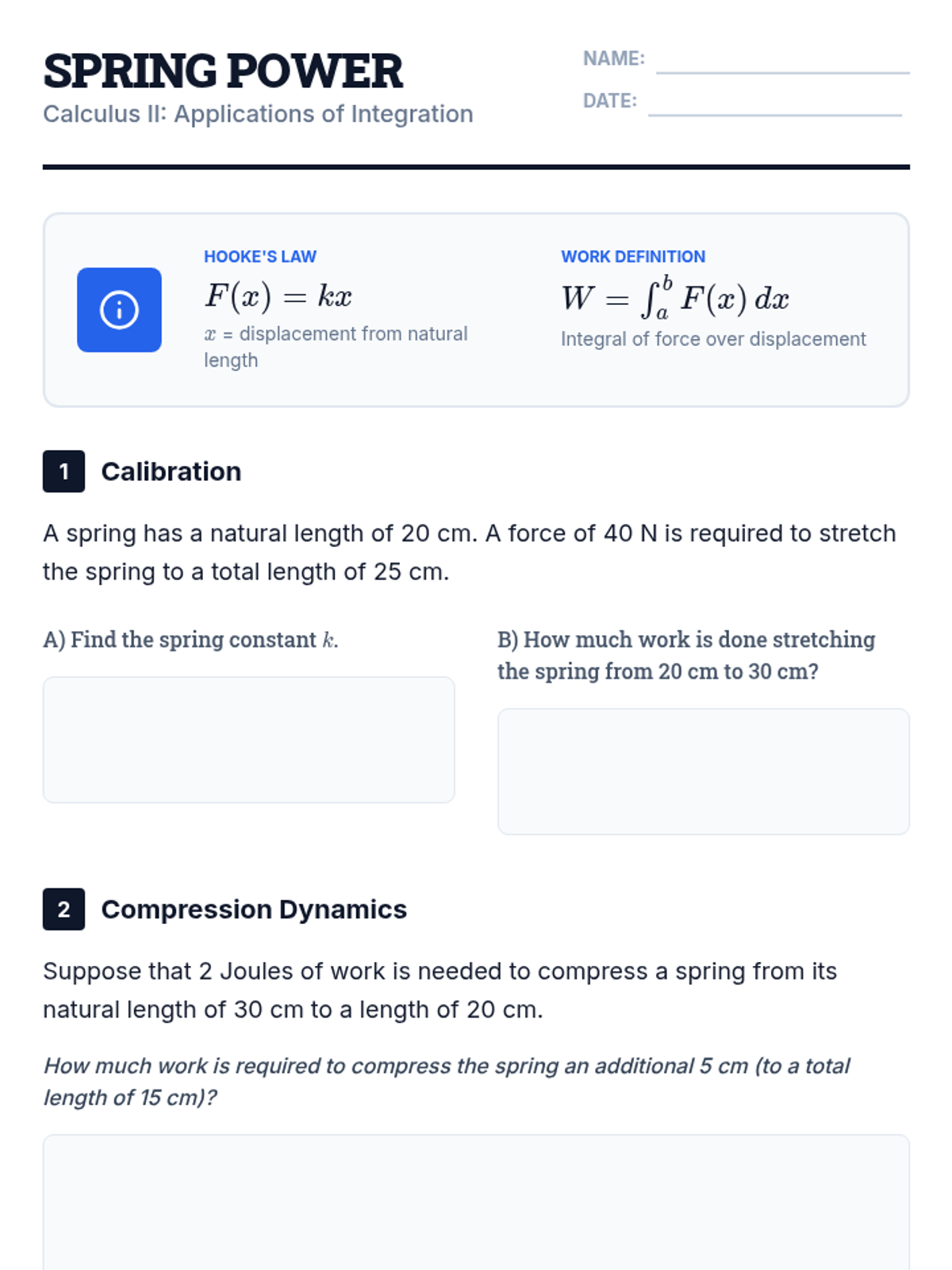
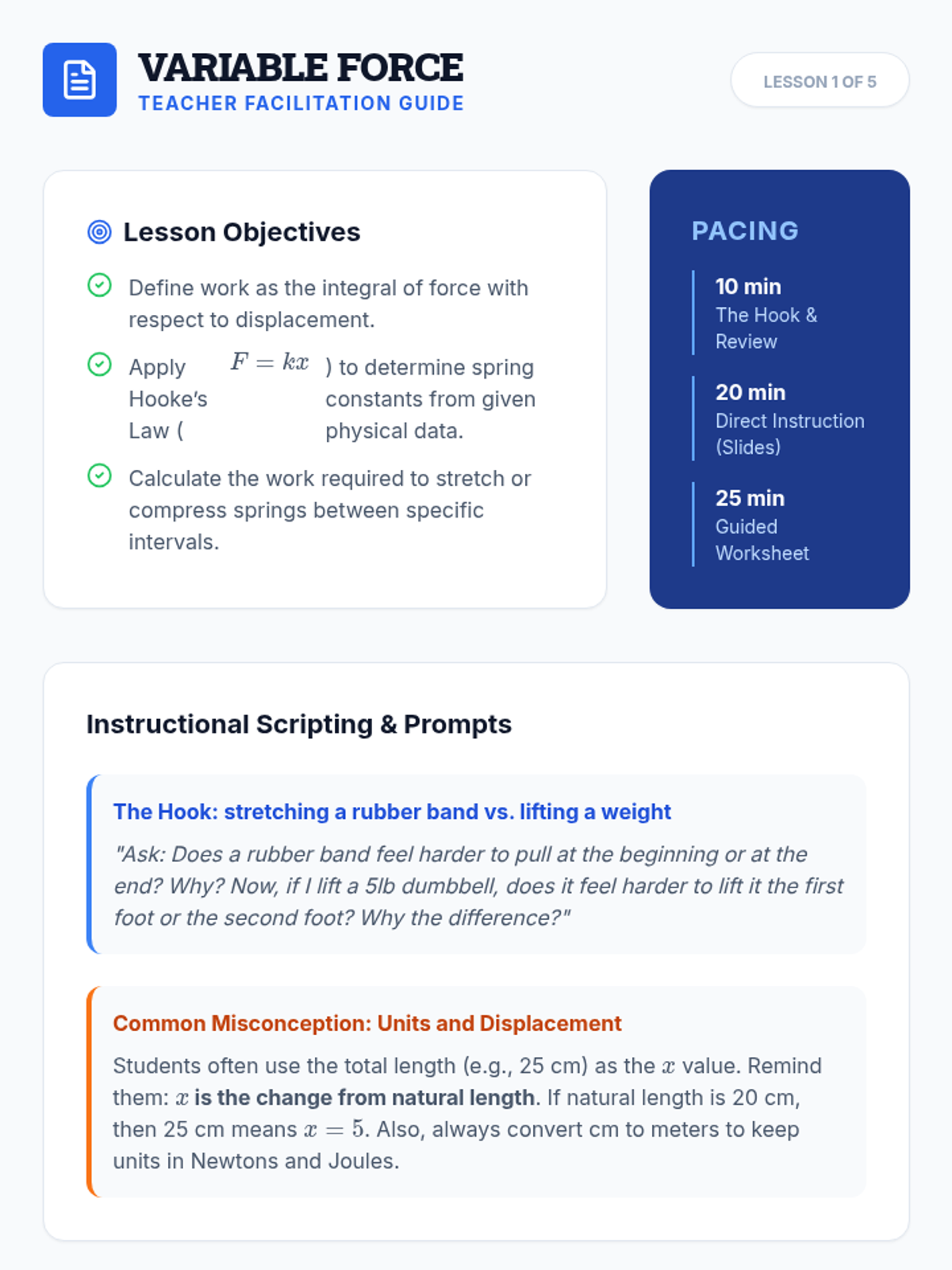
This sequence connects calculus to physics by applying integration to calculate Work and Force in variable systems. Students explore Hooke's Law, tank pumping, and lifting variable-mass objects, culminating in a mastery assessment of physical engineering applications.
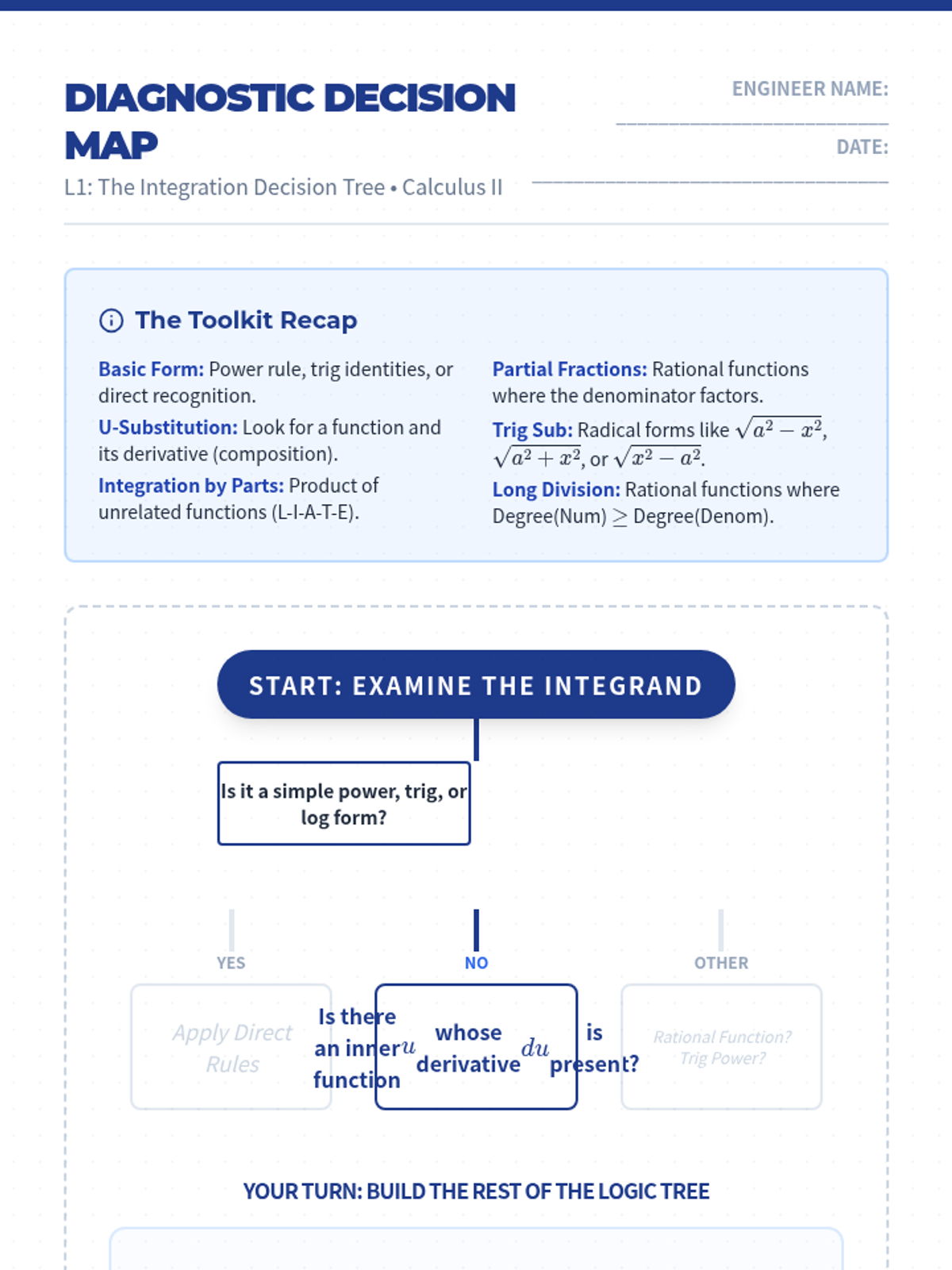
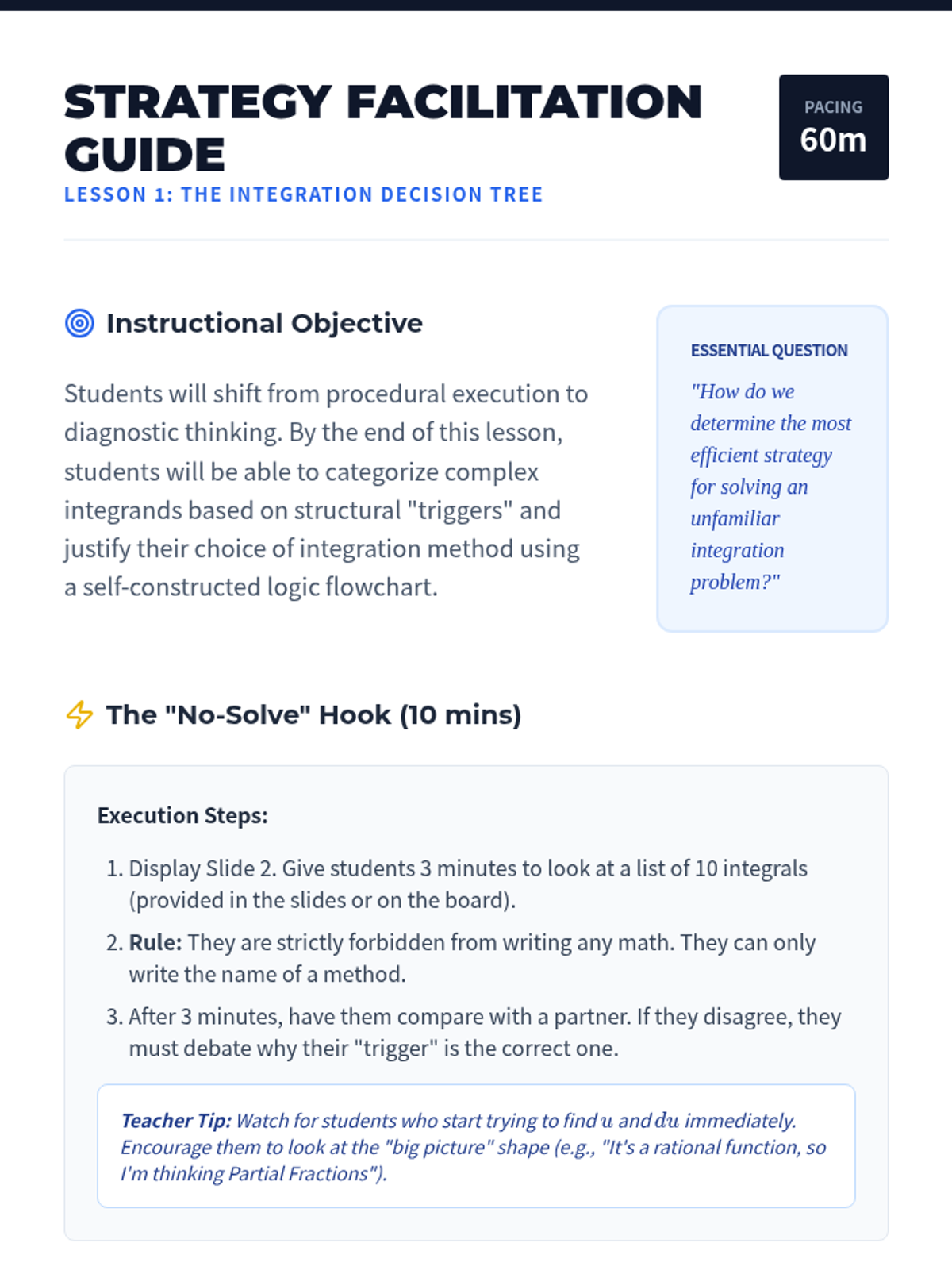
A comprehensive 11th-grade calculus unit focused on strategic method selection for complex integration. Students transition from basic procedural fluency to high-level diagnostic thinking and real-world applications in physics and engineering.
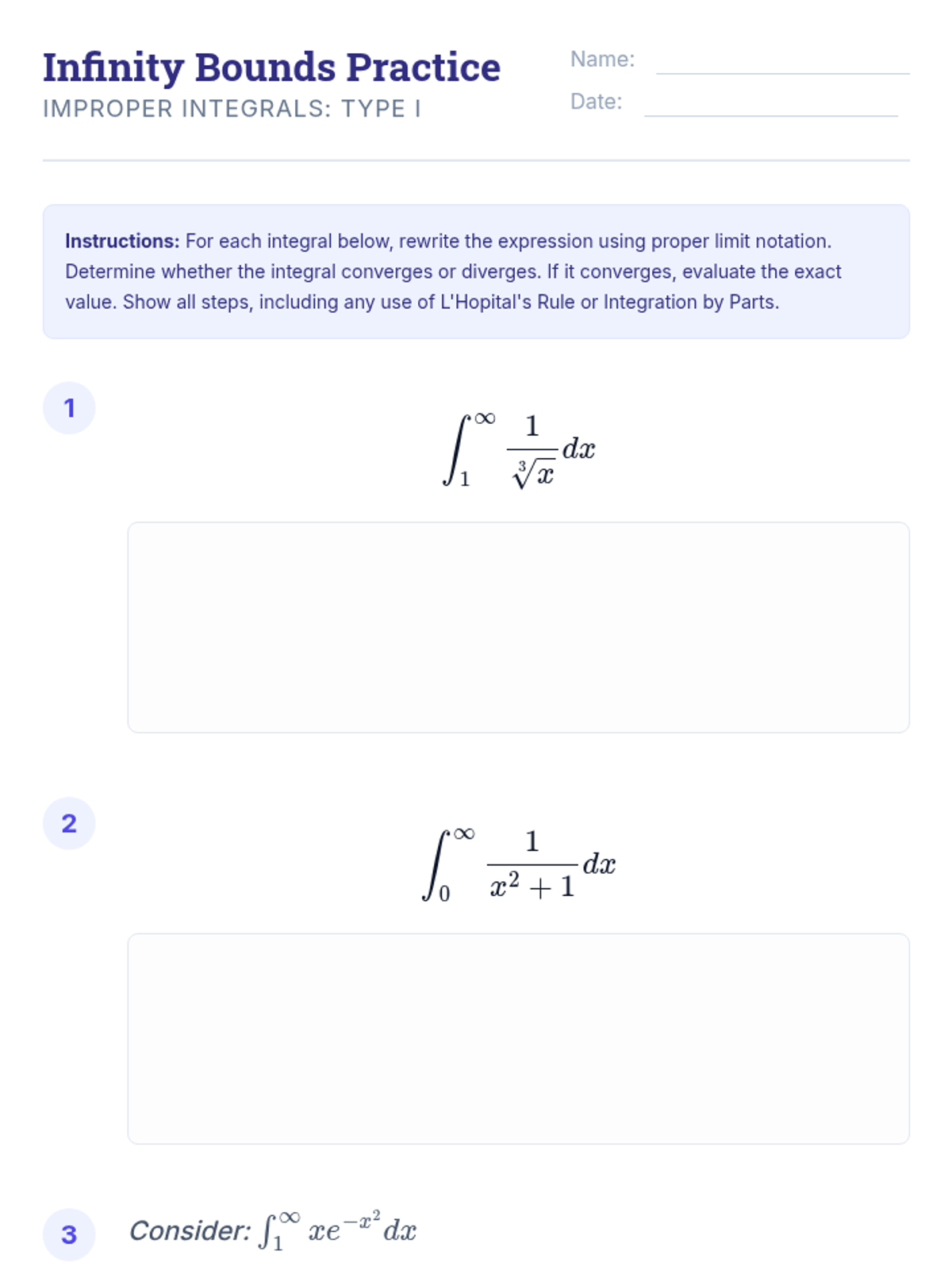
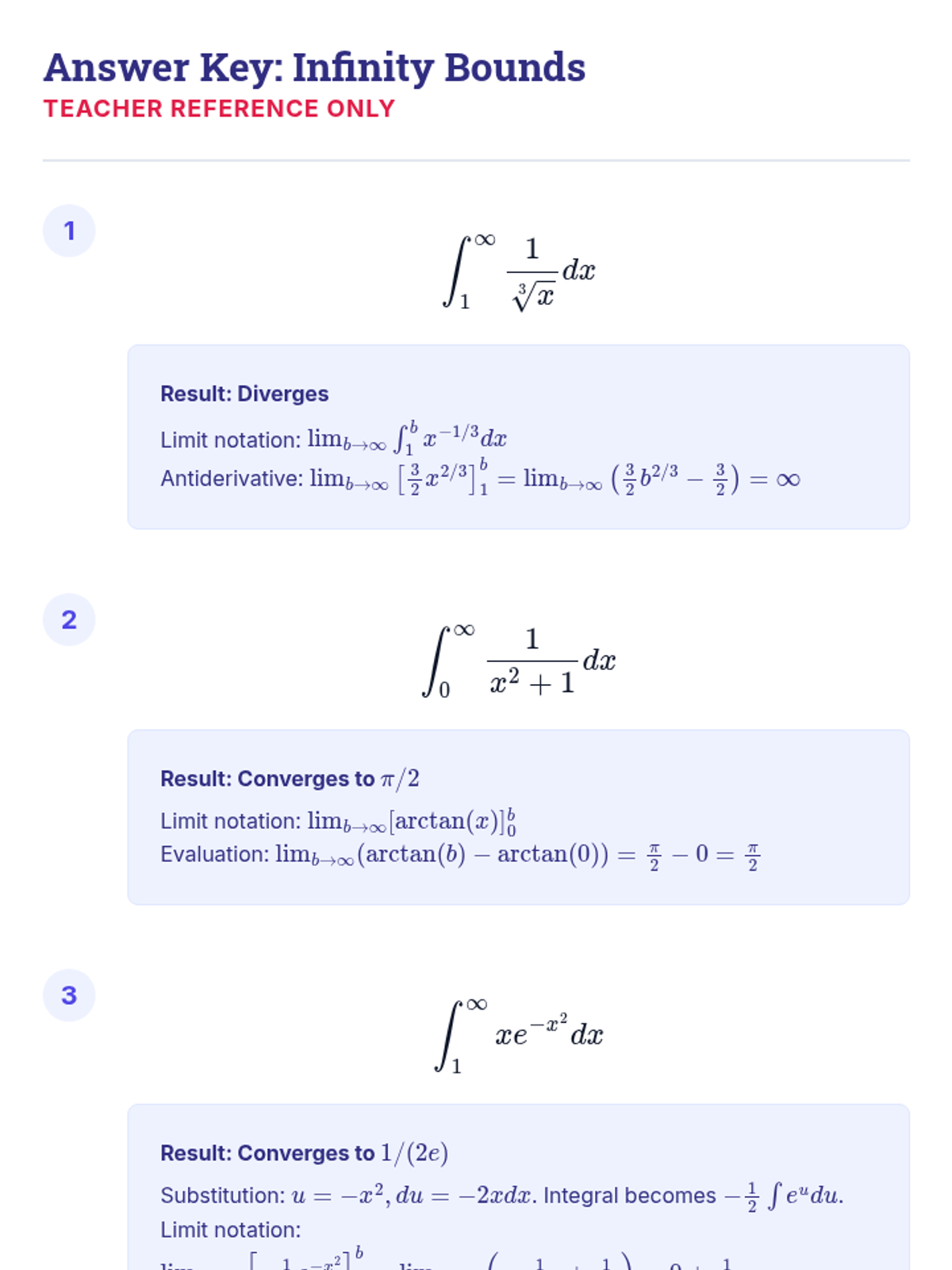
A 12th-grade calculus unit focusing on advanced integration techniques, including improper integrals, partial fractions, and trigonometric substitution, applied to real-world modeling scenarios like population growth and physics.
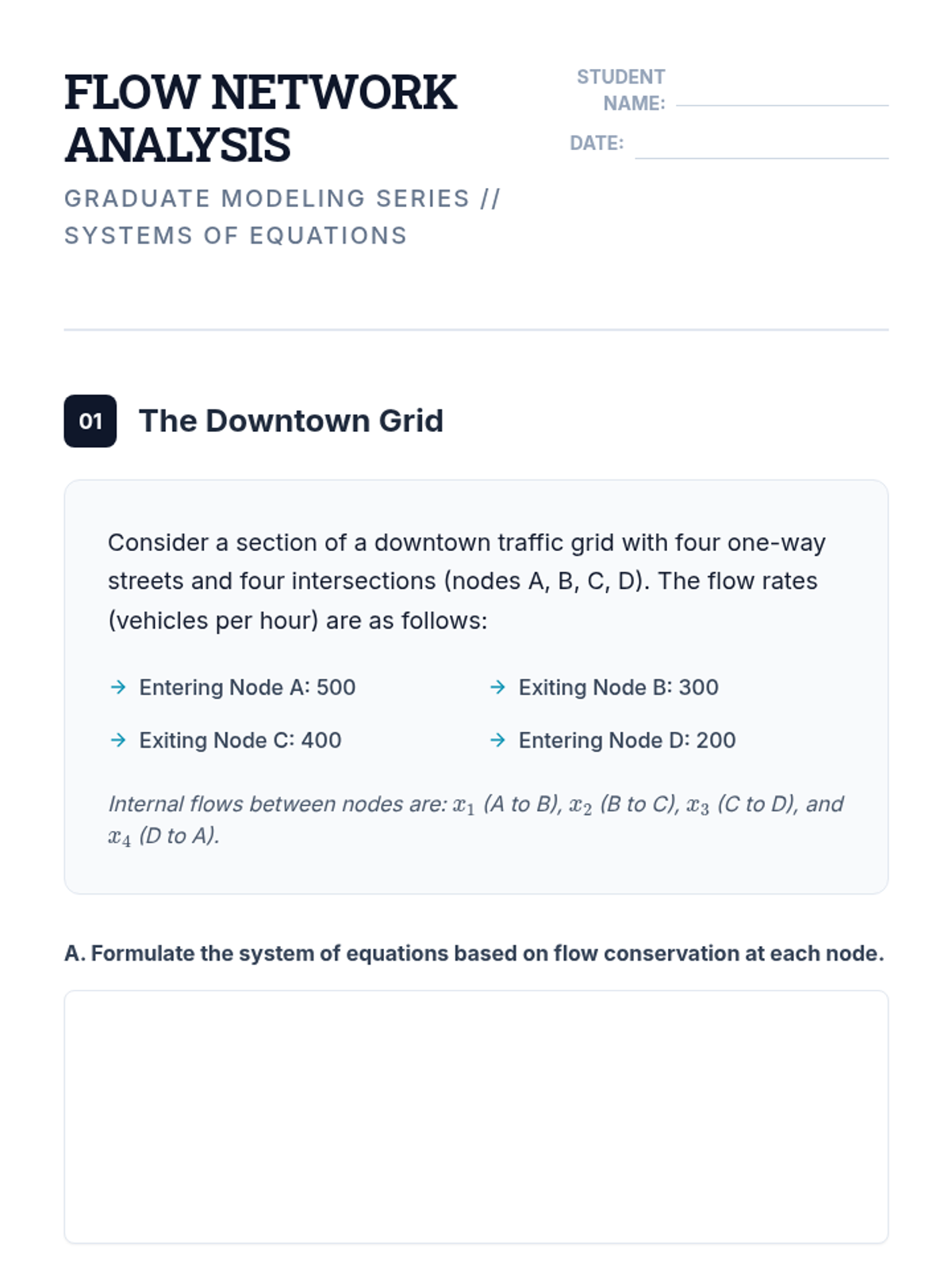
A graduate-level sequence exploring systems of equations through the lens of multivariate modeling, economic interdependence, and linear optimization. Students progress from network flow conservation to the conceptual foundations of the Simplex method.
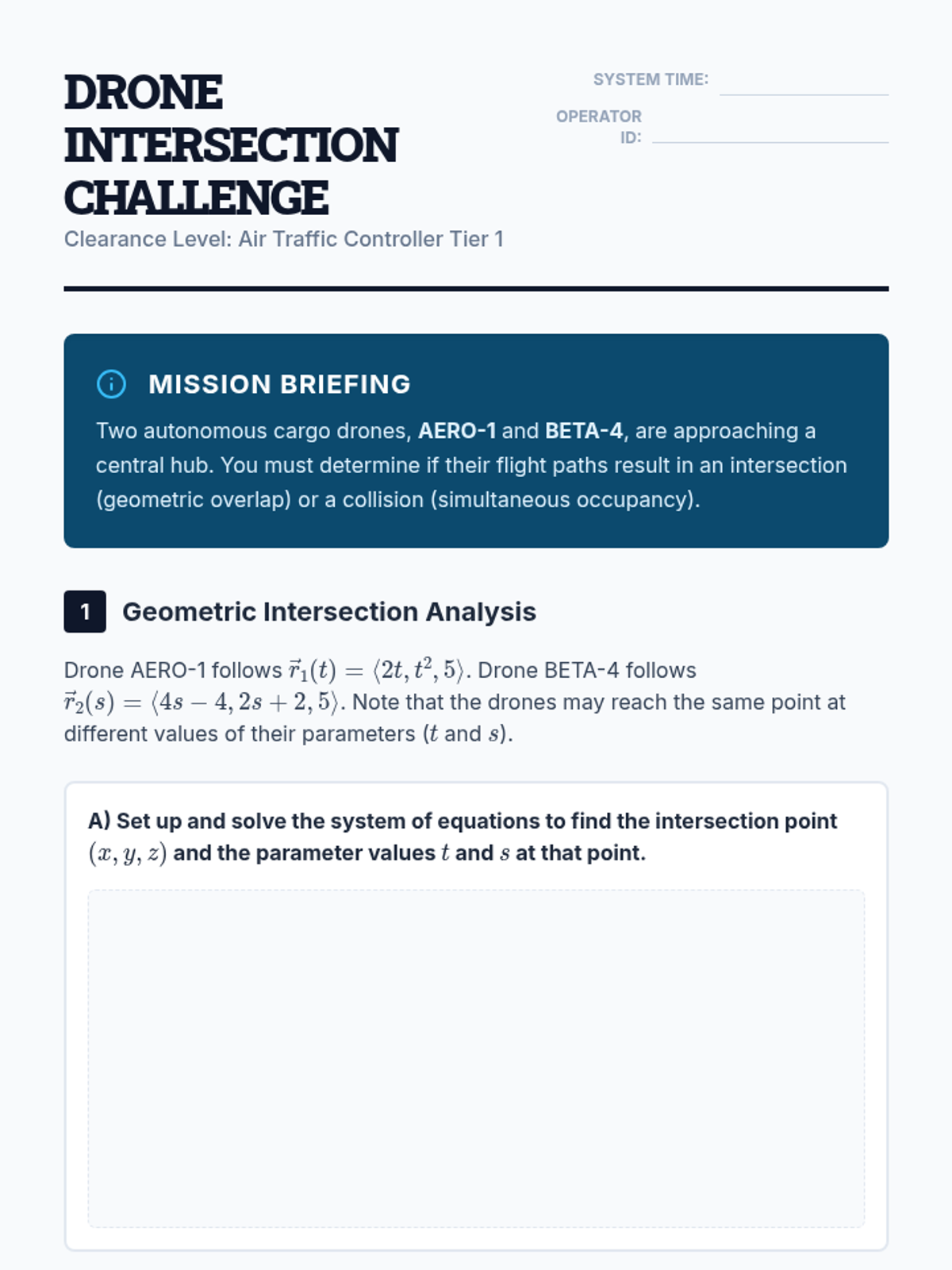
A project-based calculus sequence for 12th grade students focusing on the engineering applications of vector-valued functions, including path optimization, differentiability, and arc length.