Geometric classification, measurement of area and volume, and the study of transformations and rigid motions. Builds toward complex proofs, trigonometry for general triangles, and the algebraic representation of conic sections.
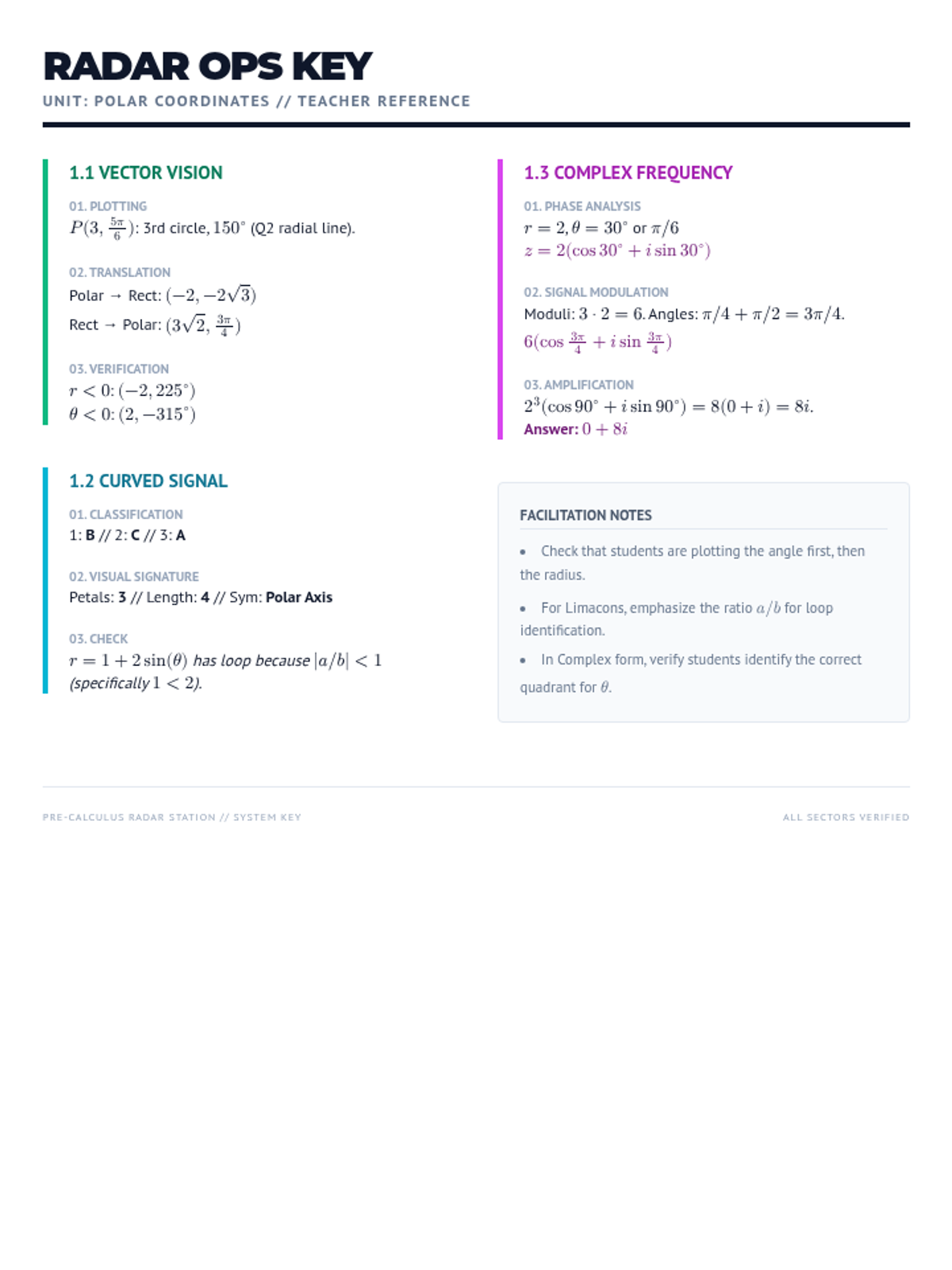
Comprehensive teacher answer key for the Polar Coordinates Exit Ticket series, including step-by-step solutions and conceptual explanations.
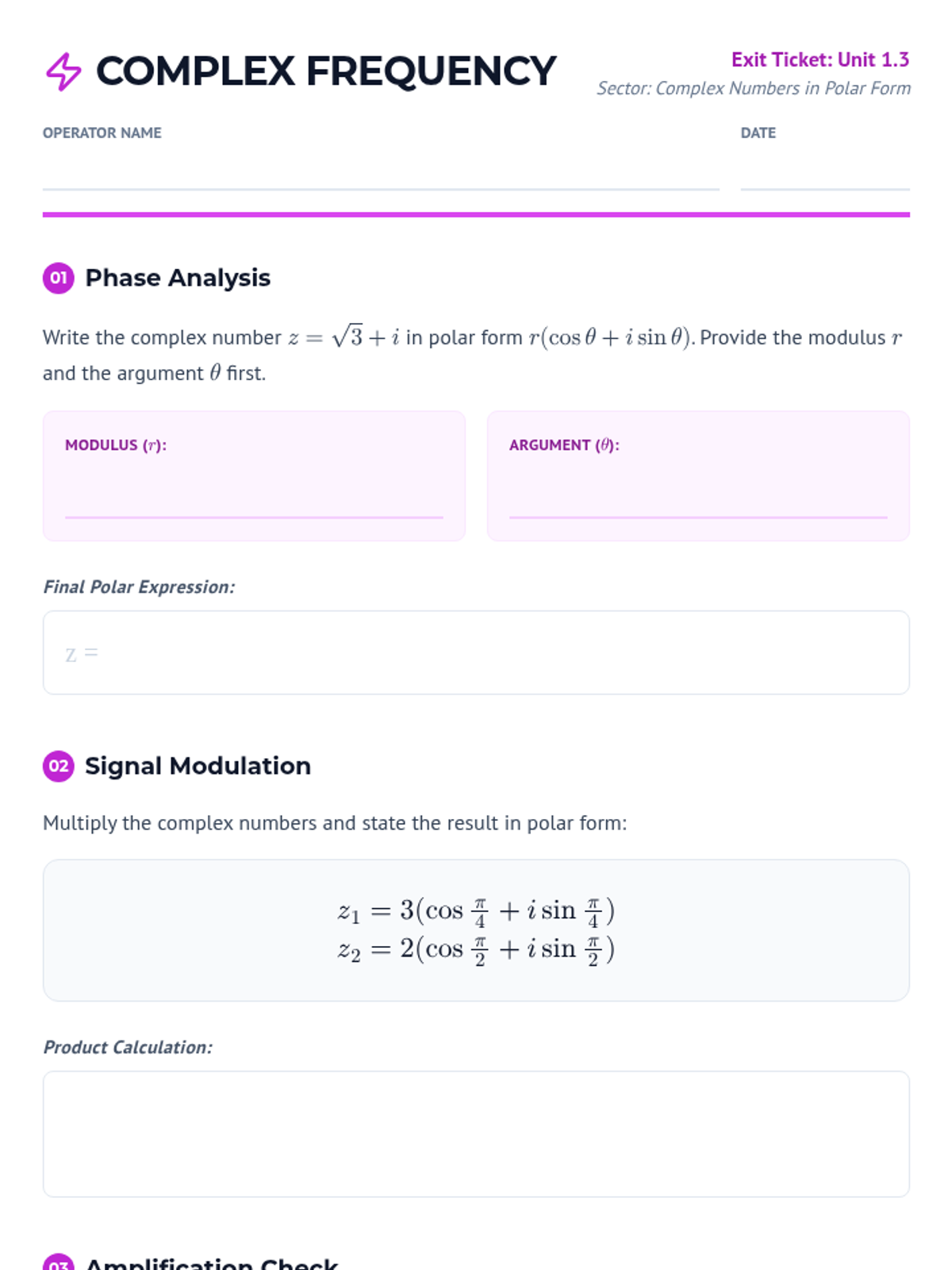
An exit ticket for representing complex numbers in polar form, performing multiplication in polar form, and applying De Moivre's Theorem.
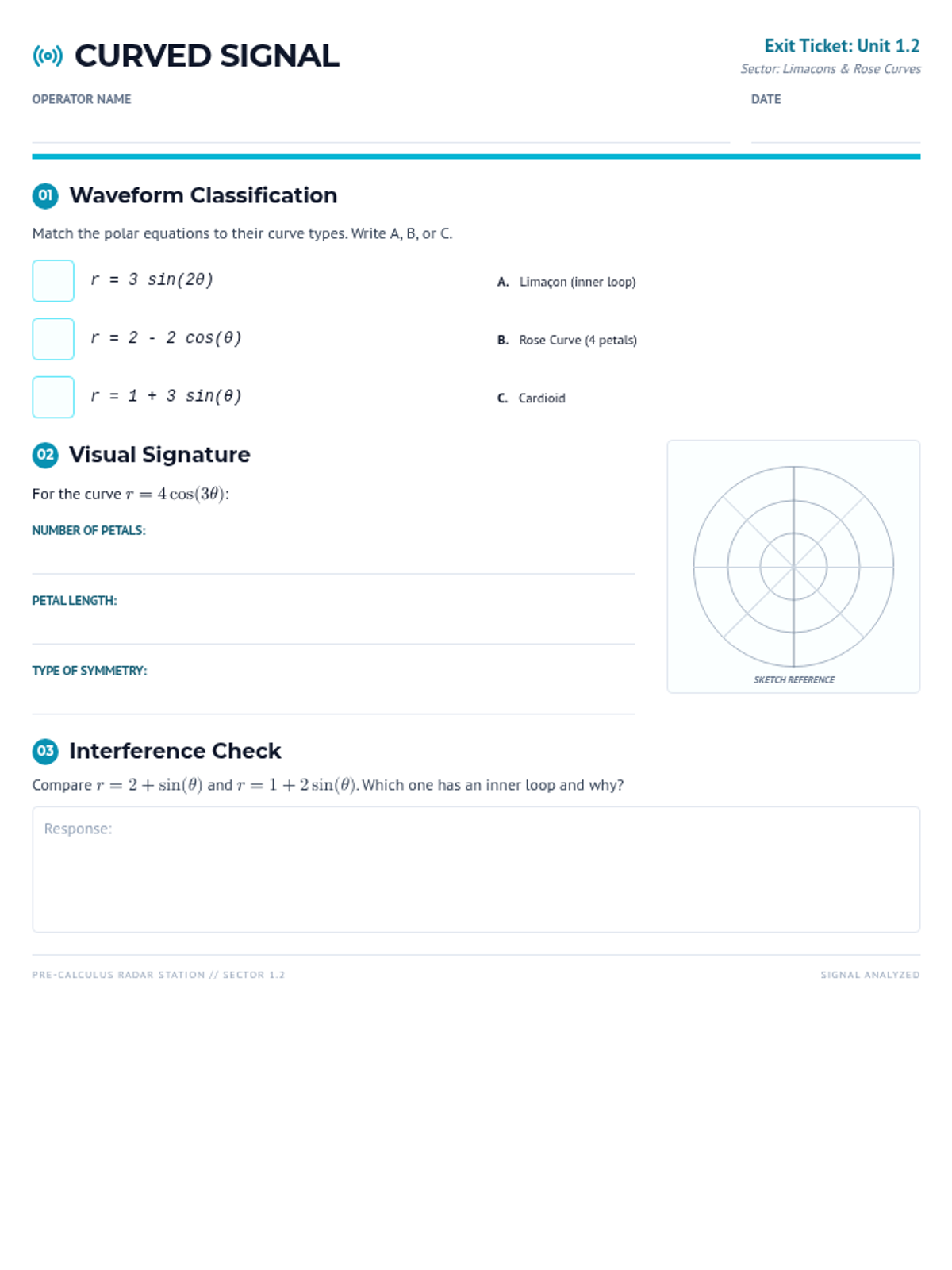
An exit ticket focused on identifying and analyzing polar graphs like limacons, cardioids, and rose curves, including matching and symmetry identification.
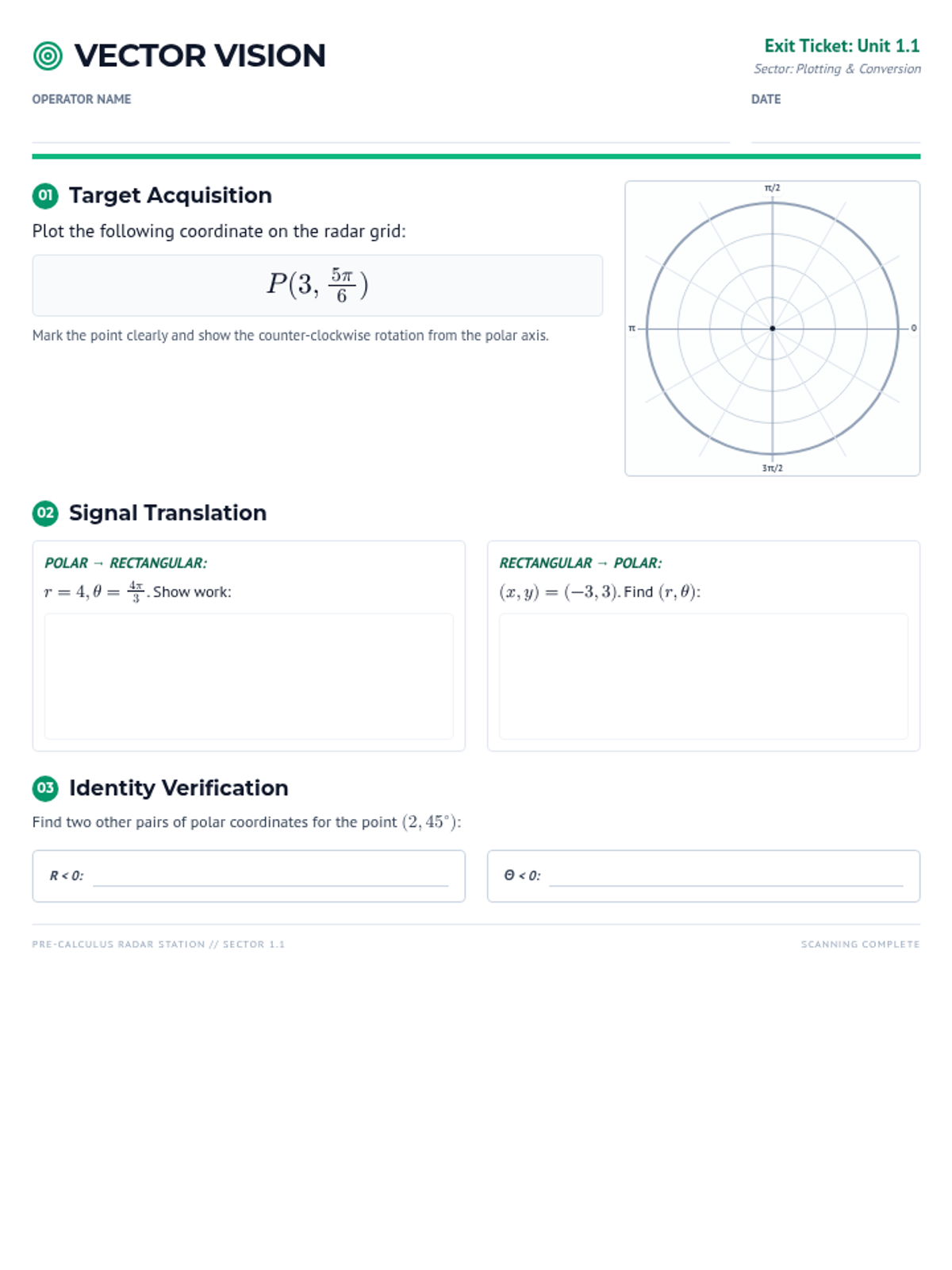
An exit ticket for polar coordinate plotting and conversions between rectangular and polar forms, featuring a clean radar-themed layout and a polar grid for graphing.
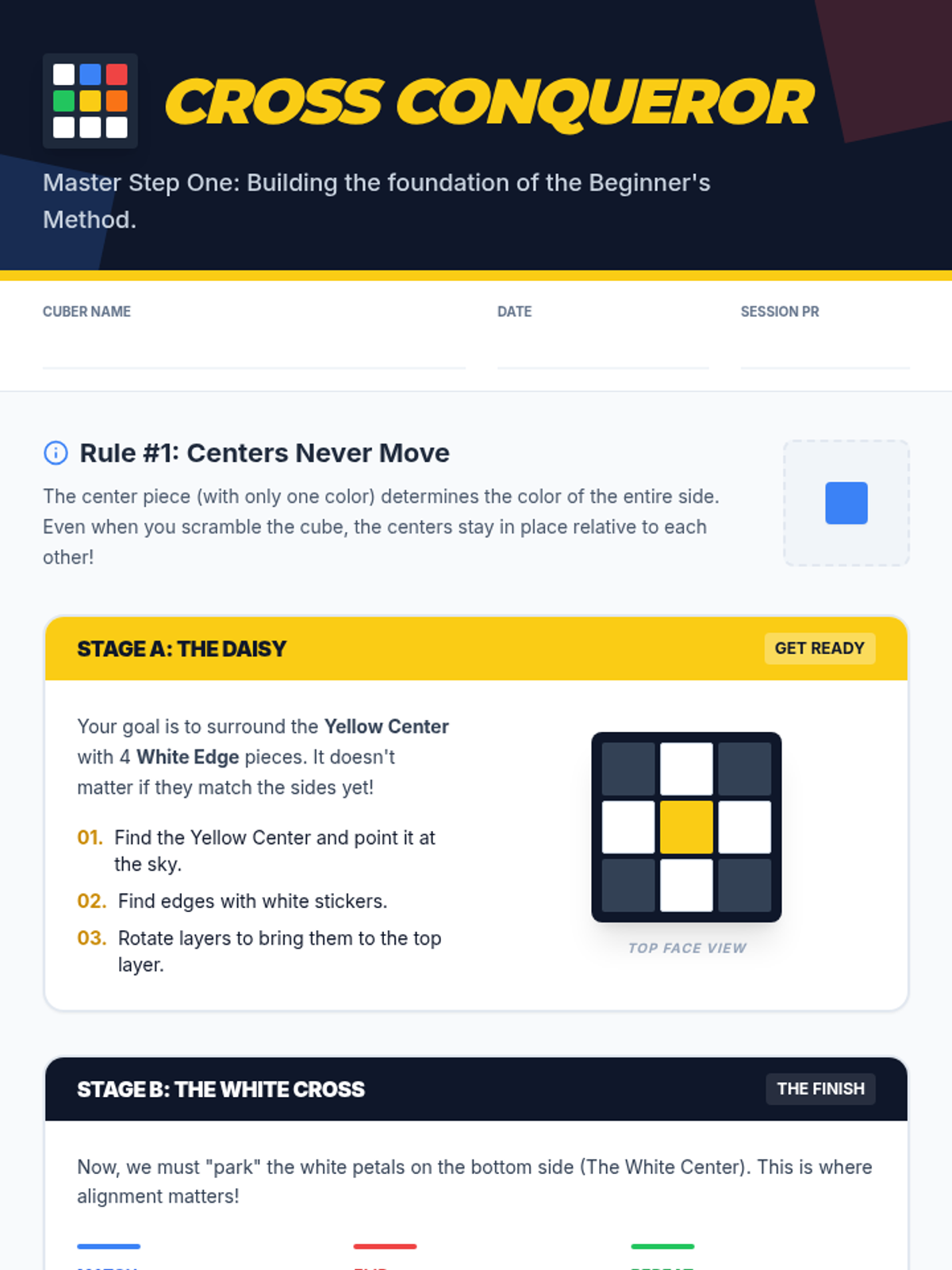
A step-by-step instructional handout for the 'White Cross' (Step 1) of solving a Rubik's Cube, featuring the Daisy method for beginners. Includes clear visual targets, checklists, and troubleshooting tips.
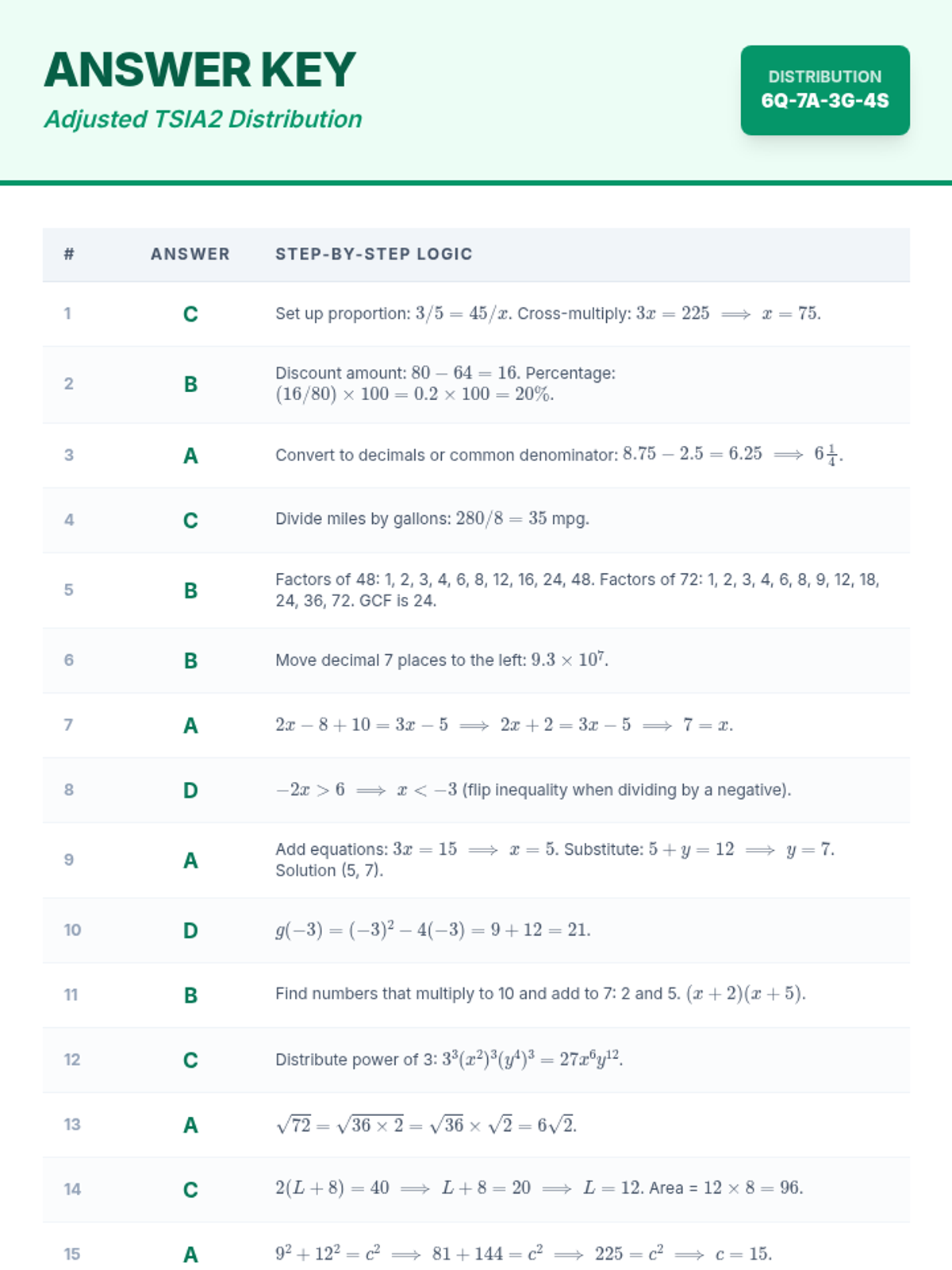
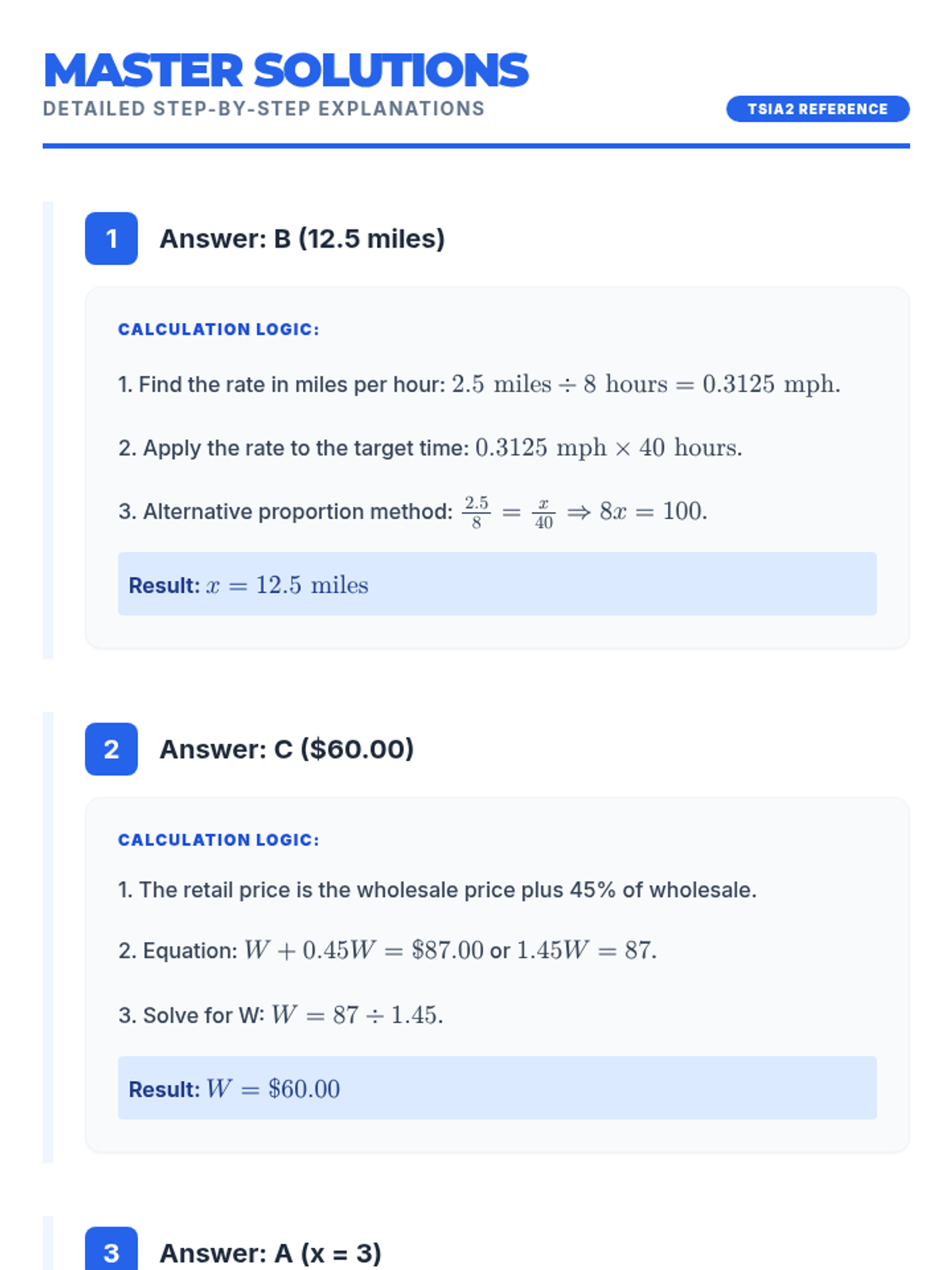
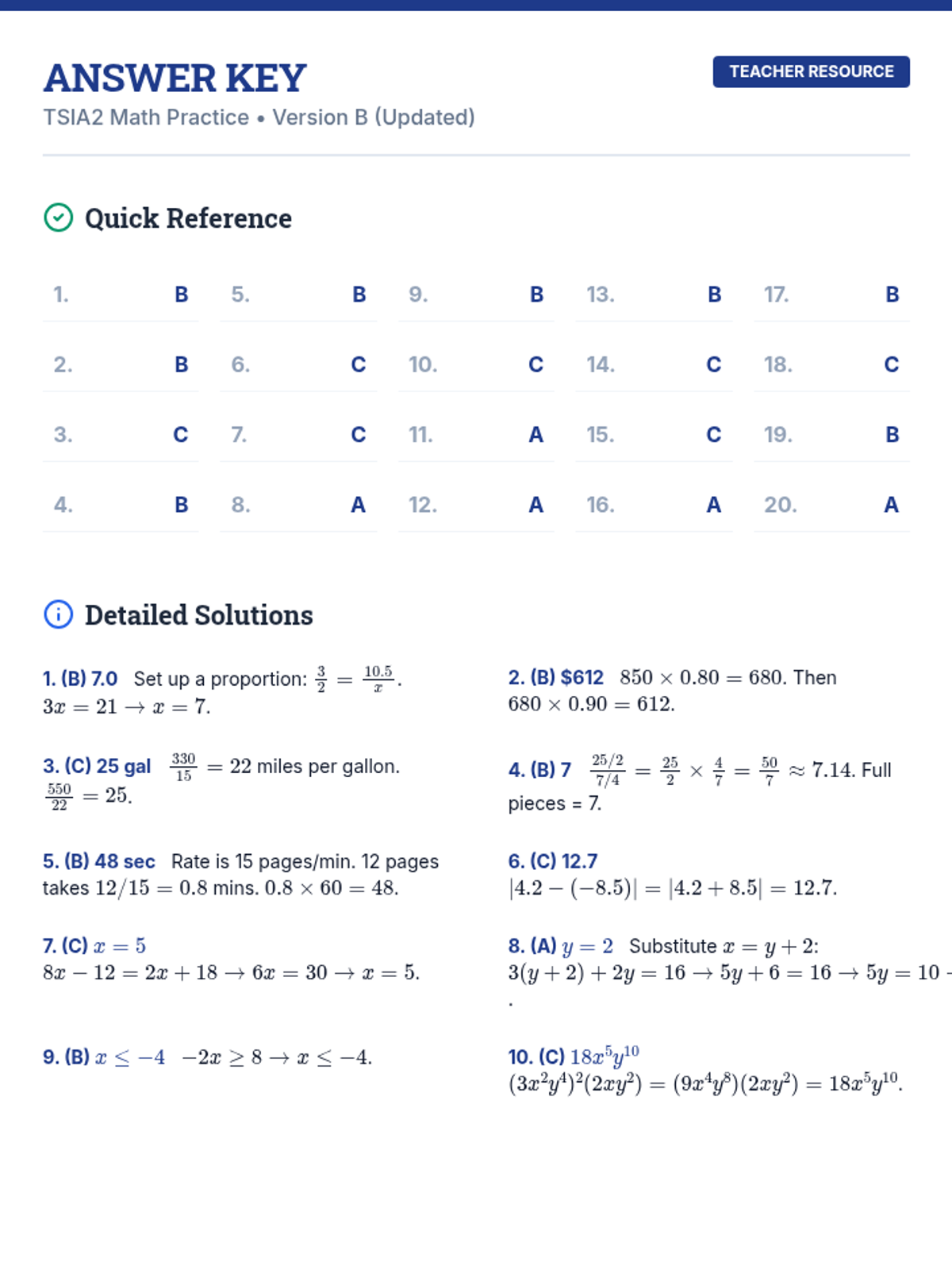
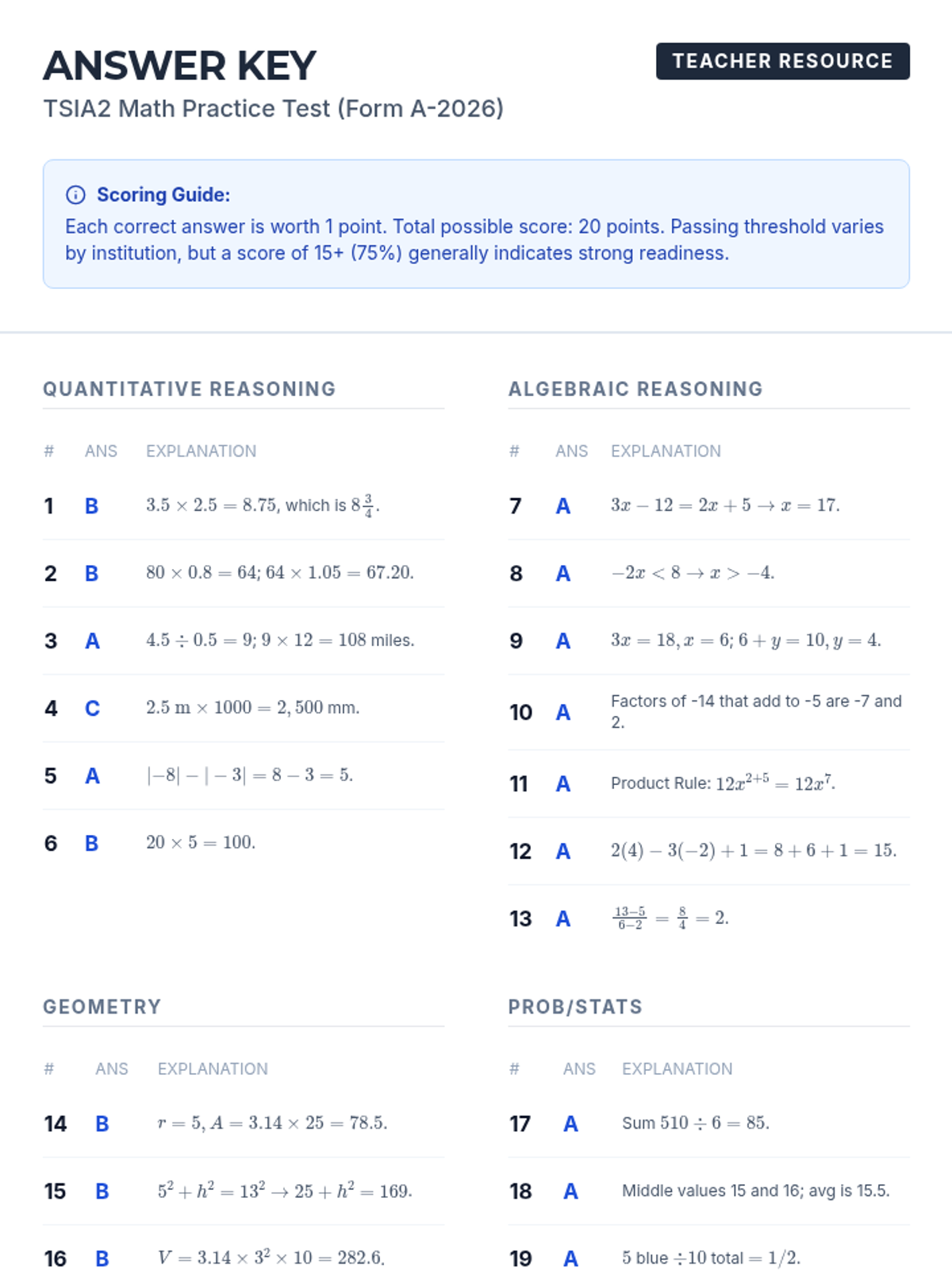
A detailed answer key for the adjusted TSIA2 Math practice test, featuring the new distribution of quantitative, algebraic, geometric, and statistical questions.
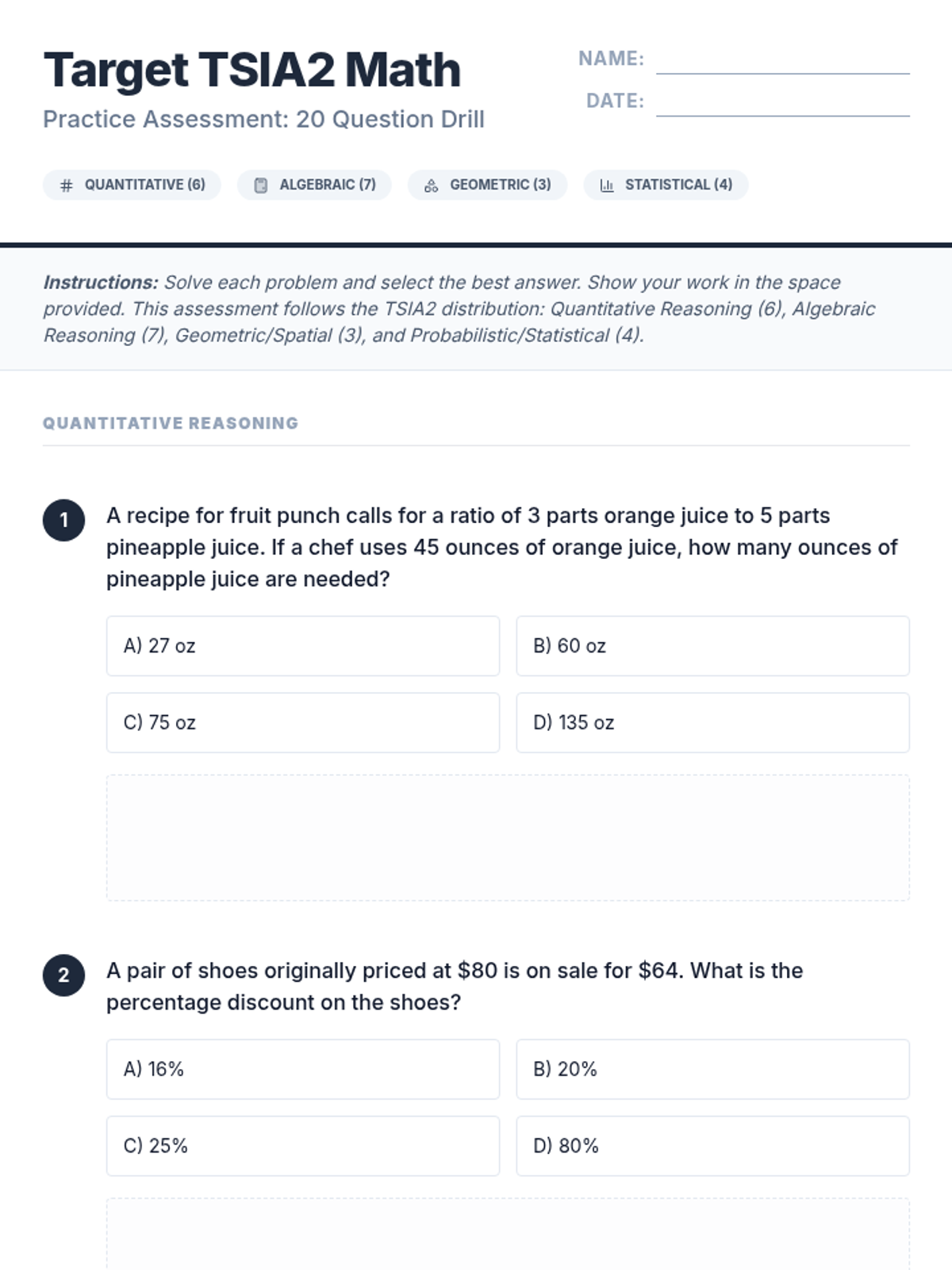
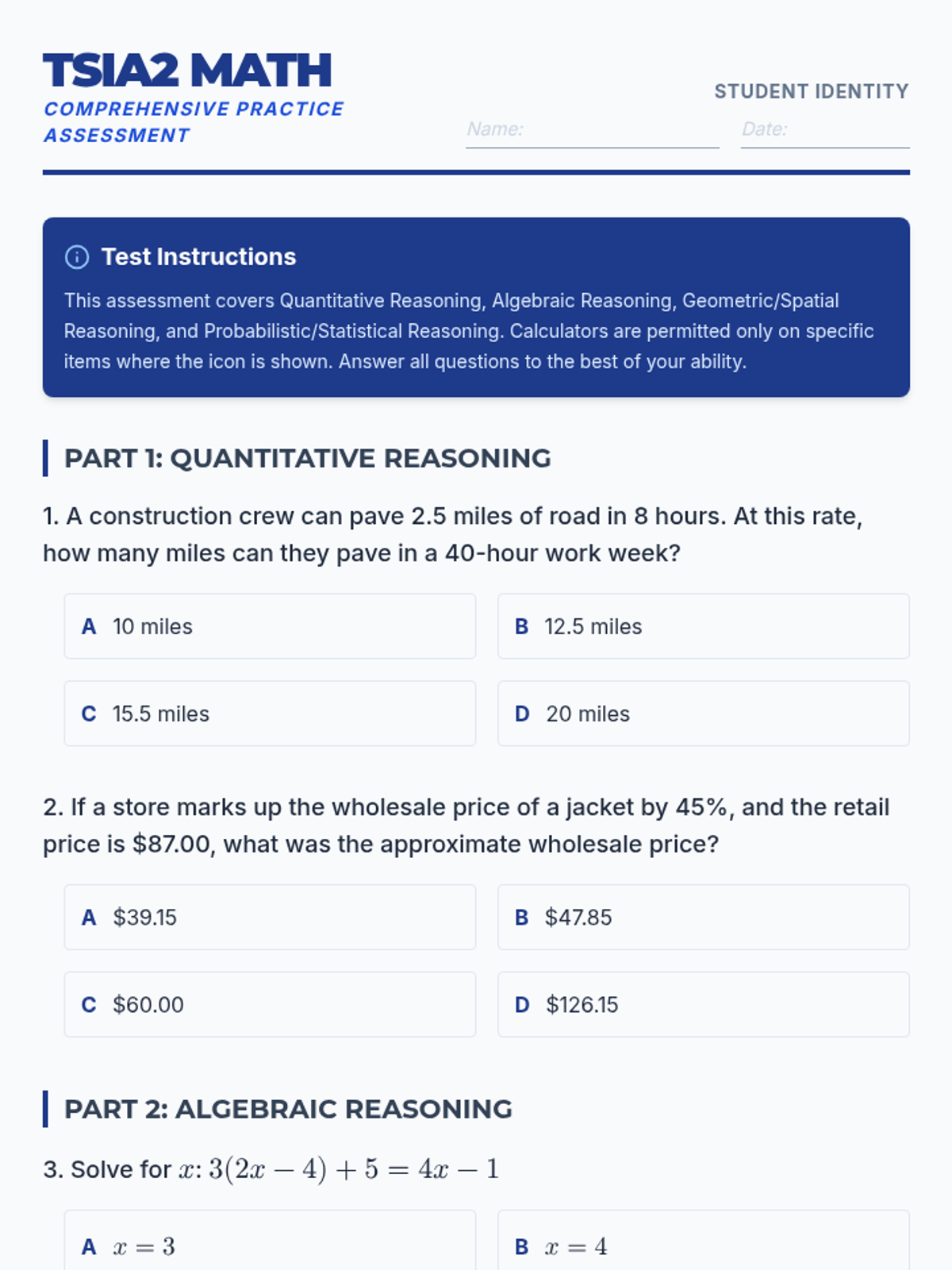
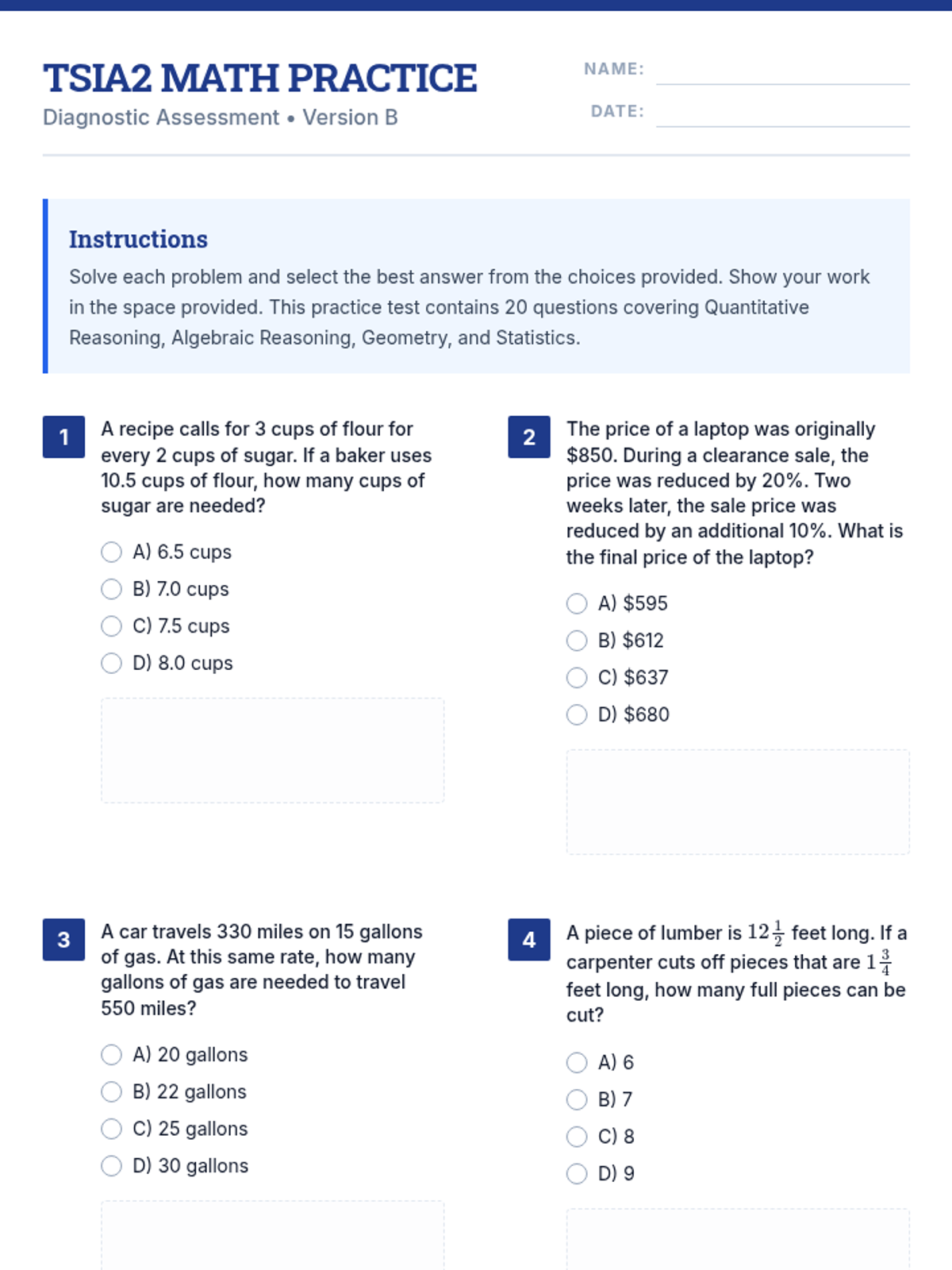
A 20-question multiple-choice practice test for the TSIA2 Mathematics assessment, with a specific distribution of quantitative (6), algebraic (7), geometric (3), and statistical (4) questions.
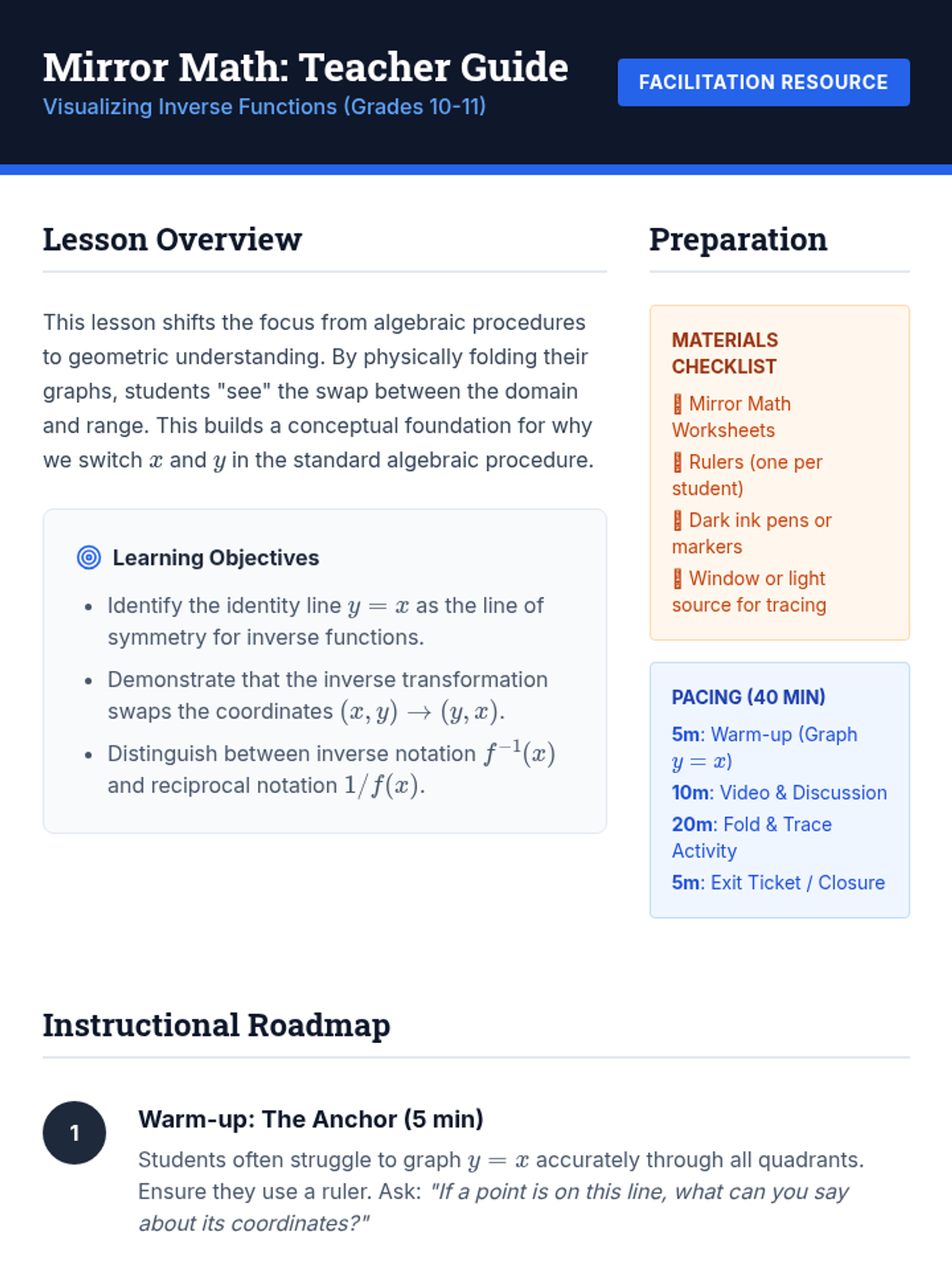
A comprehensive teacher guide for the Mirror Math lesson. Includes a materials checklist, pacing guide, strategic video pause points with discussion questions, troubleshooting tips for the hands-on activity, and a full answer key.
A comprehensive slide presentation for teaching inverse functions visually. Features conceptual diagrams, embedded video prompts, guided activity steps, and visual proofs of the coordinate swap property.
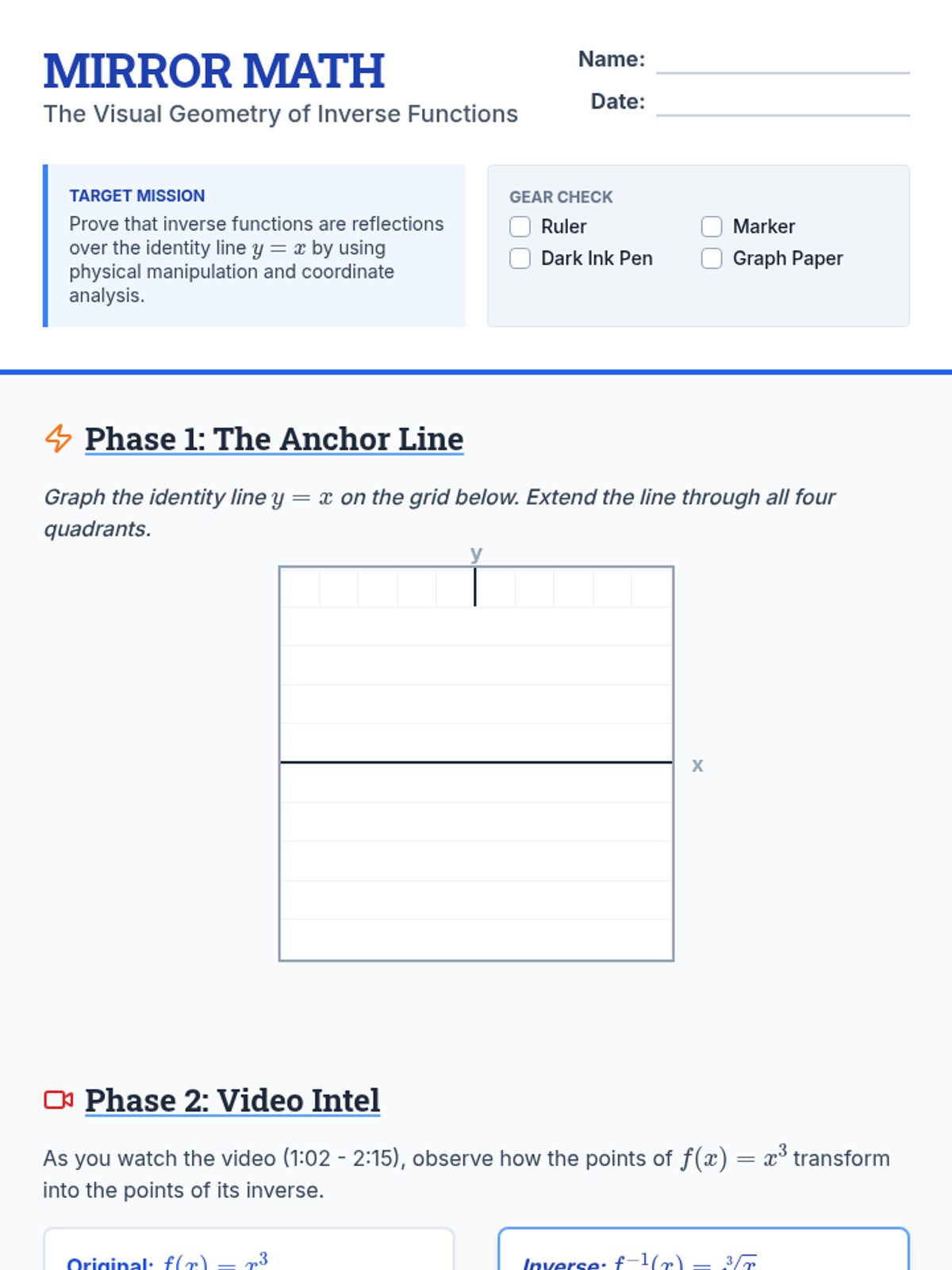
A hands-on student worksheet for exploring inverse functions. Includes a warm-up for graphing y=x, a video analysis table for cubic functions, a large grid for the 'Fold and Trace' activity, and an exit ticket for coordinate verification.
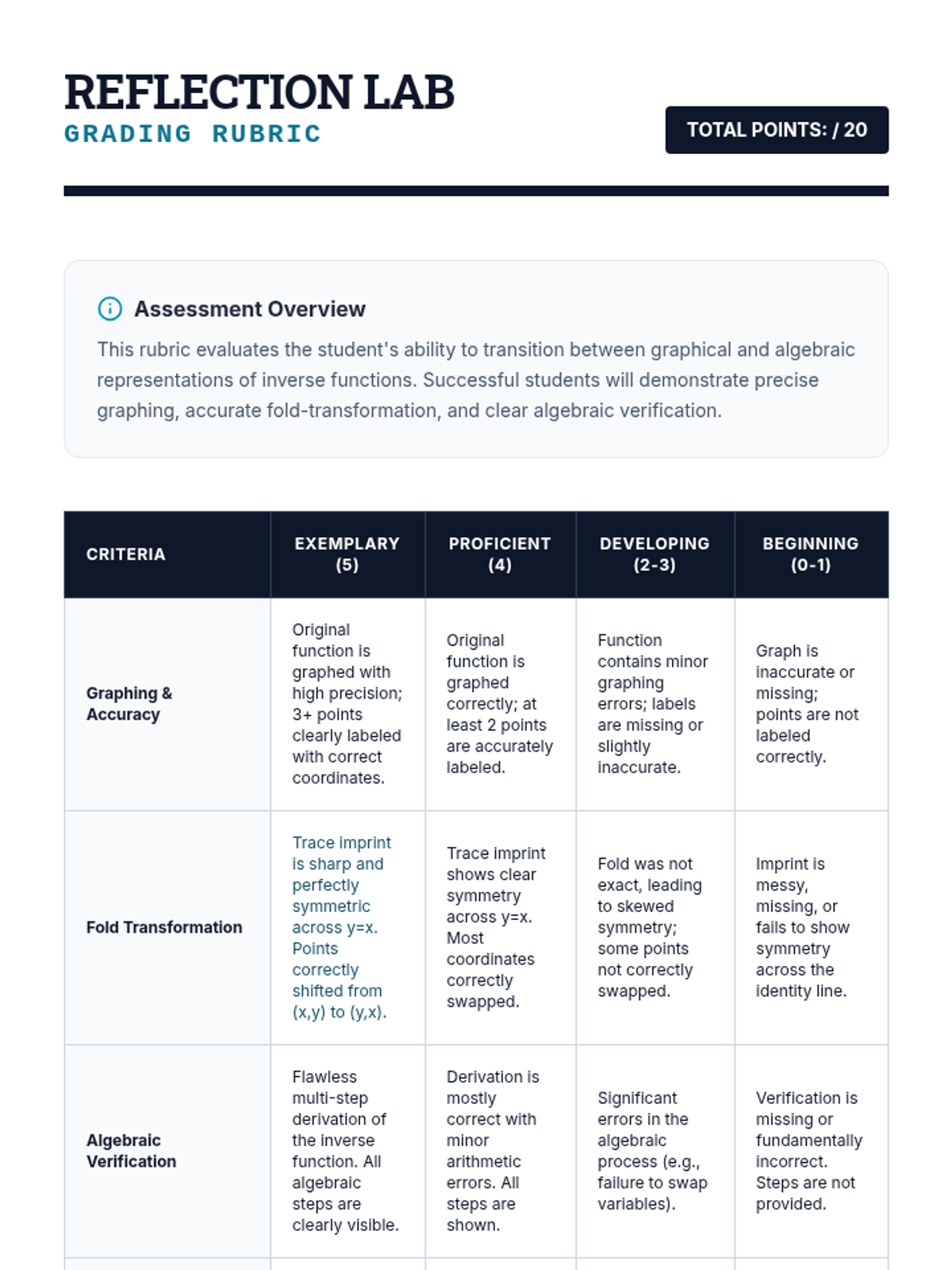
A formal grading rubric for the Reflection Lab. It evaluates students on graphing accuracy, the precision of their fold transformation, algebraic verification steps, and critical reflection on function invertibility.
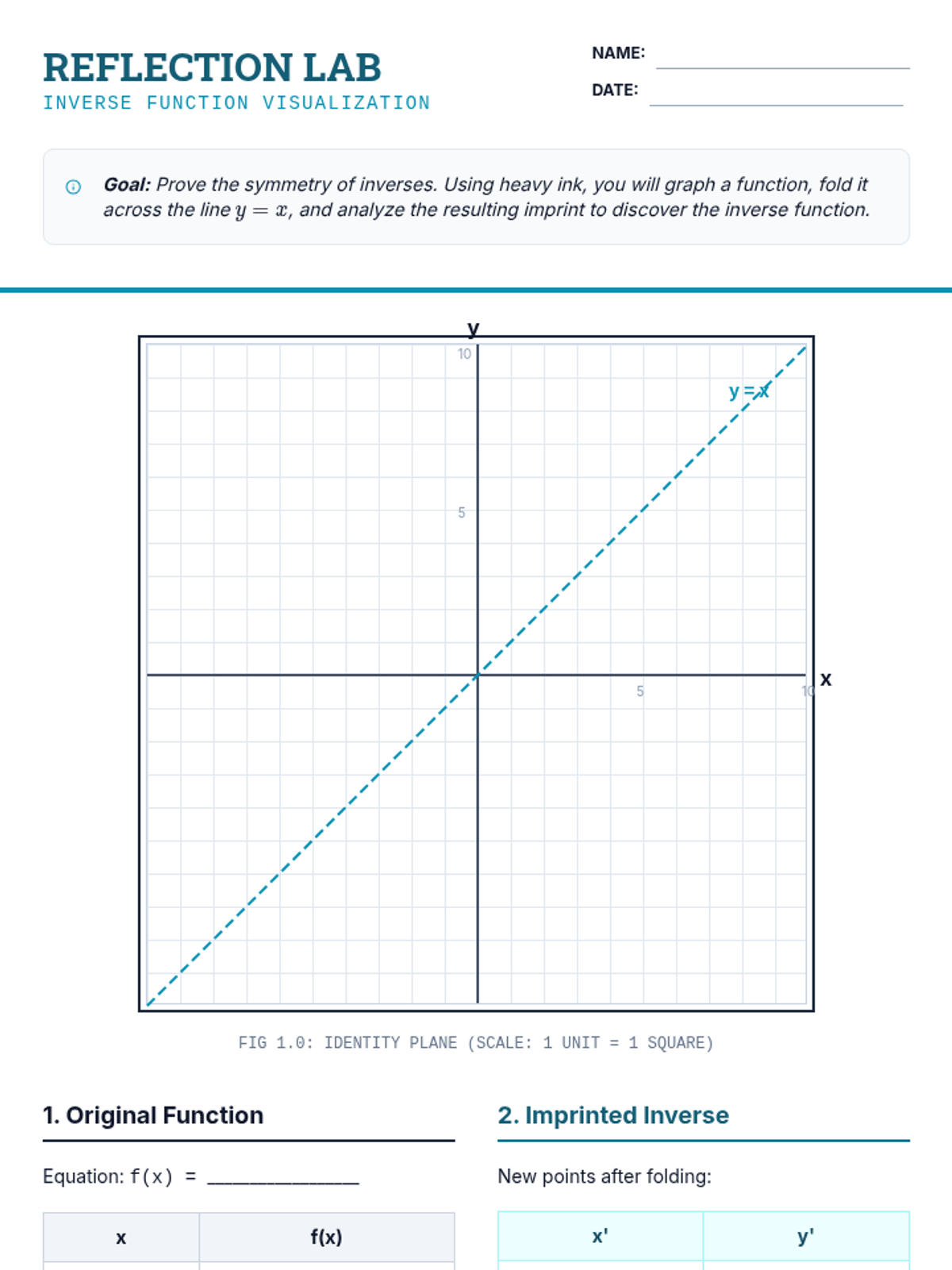
A specialized graph paper worksheet for the 'Fold and Trace' activity. Includes an identity line (y=x), data tables for original and inverse points, and a space for algebraic verification.
A comprehensive presentation for teaching the visual and algebraic properties of inverse functions, featuring embedded video instruction and step-by-step activity guides.
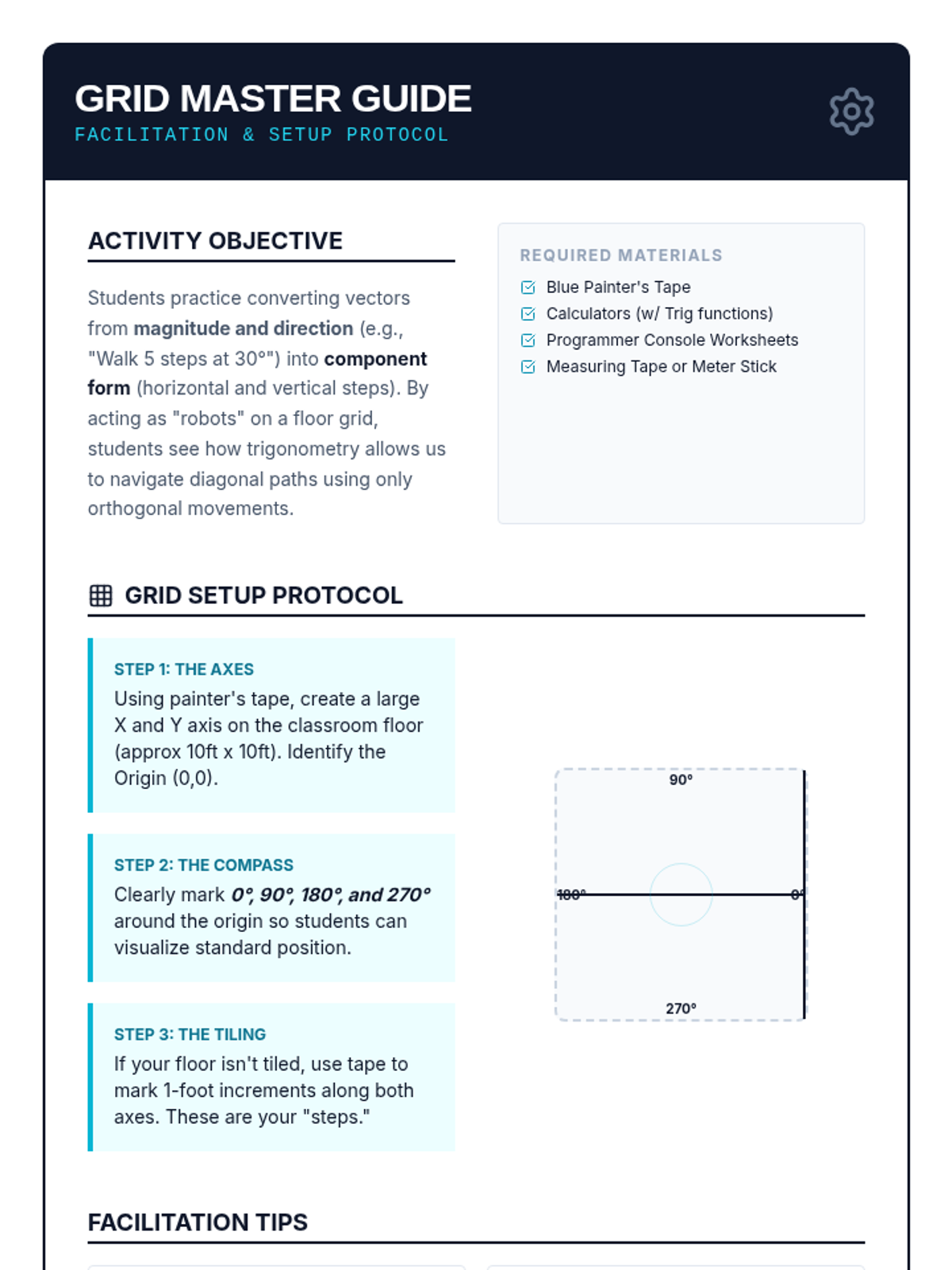
A facilitation guide for teachers leading the 'Robot Vector Commands' lesson. Includes floor setup instructions for the tape grid, activity facilitation tips, and a complete answer key for the student navigation log.
A visual presentation for the 'Robot Vector Commands' lesson. It includes a warm-up, the embedded vector video (magnitude-to-component segment), instructions for the robotics activity, and an extension on video game movement code.
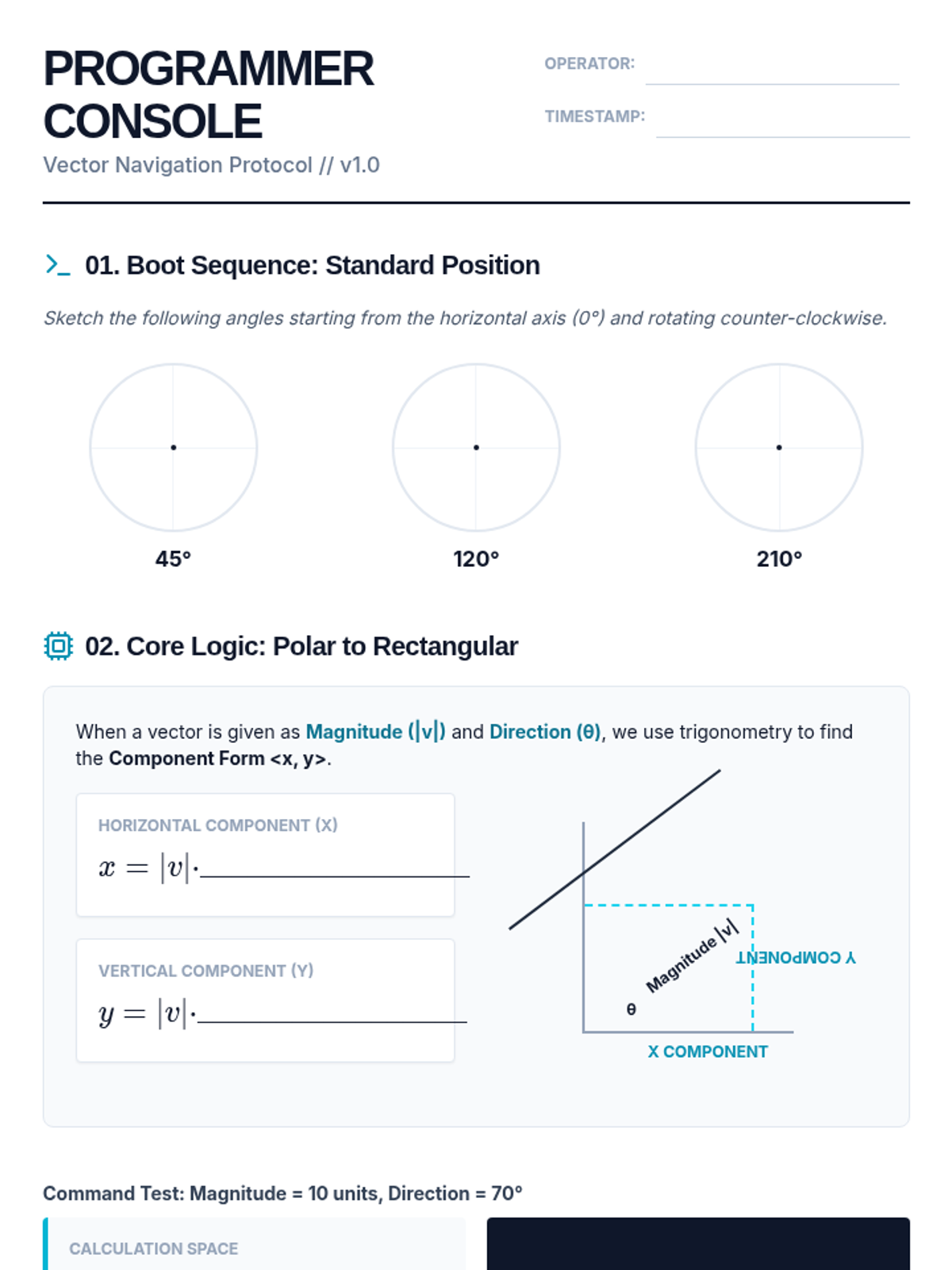
A student worksheet for the 'Robot Vector Commands' lesson. It includes a warm-up on sketching angles, notes for the magnitude-to-component video segment, and a log for the hands-on robot programming activity.
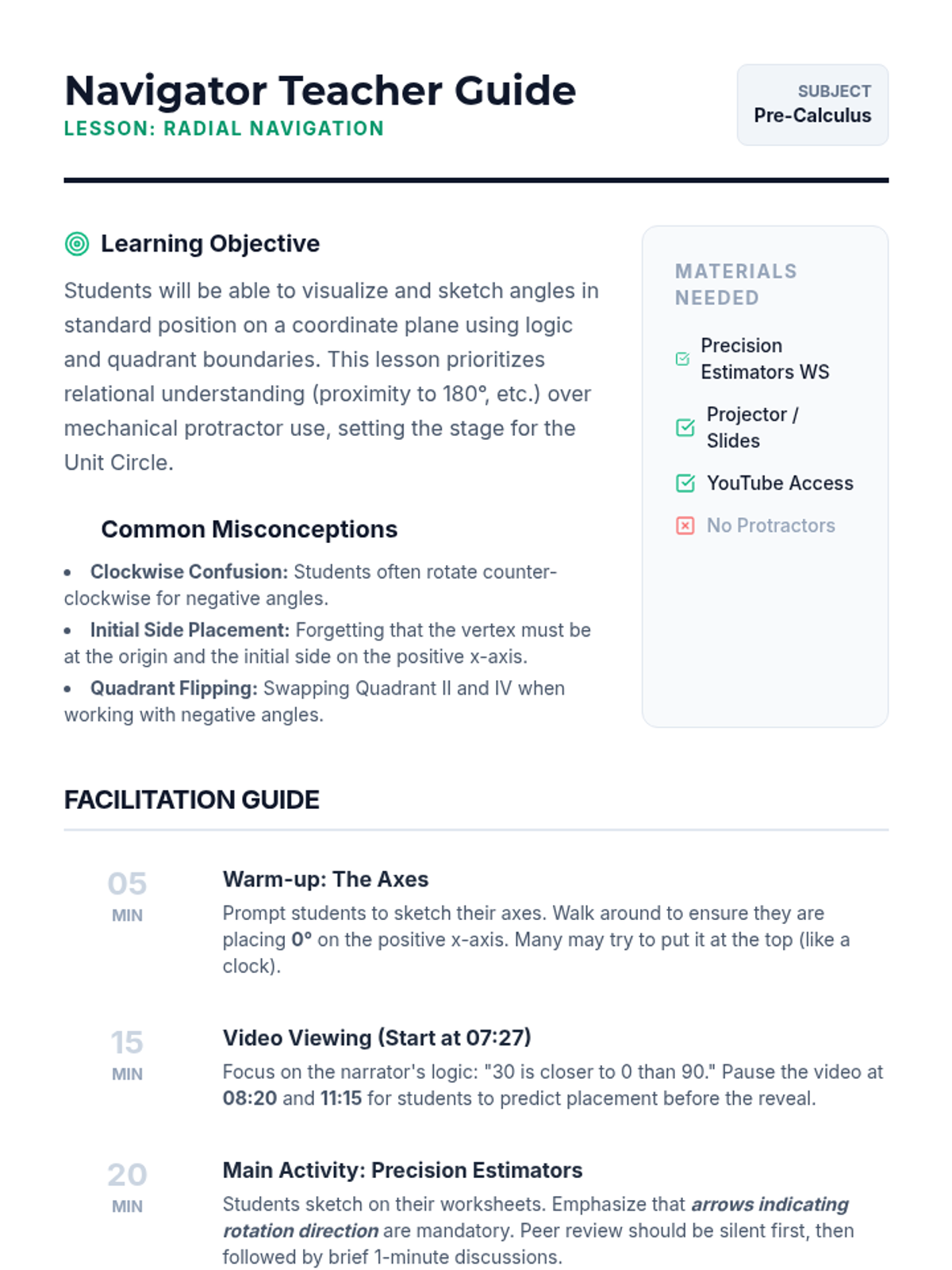
Facilitation guide for teachers, including a lesson overview, timing for video segments, discussion prompts, common misconceptions, and a visual answer key for the sketching activity.
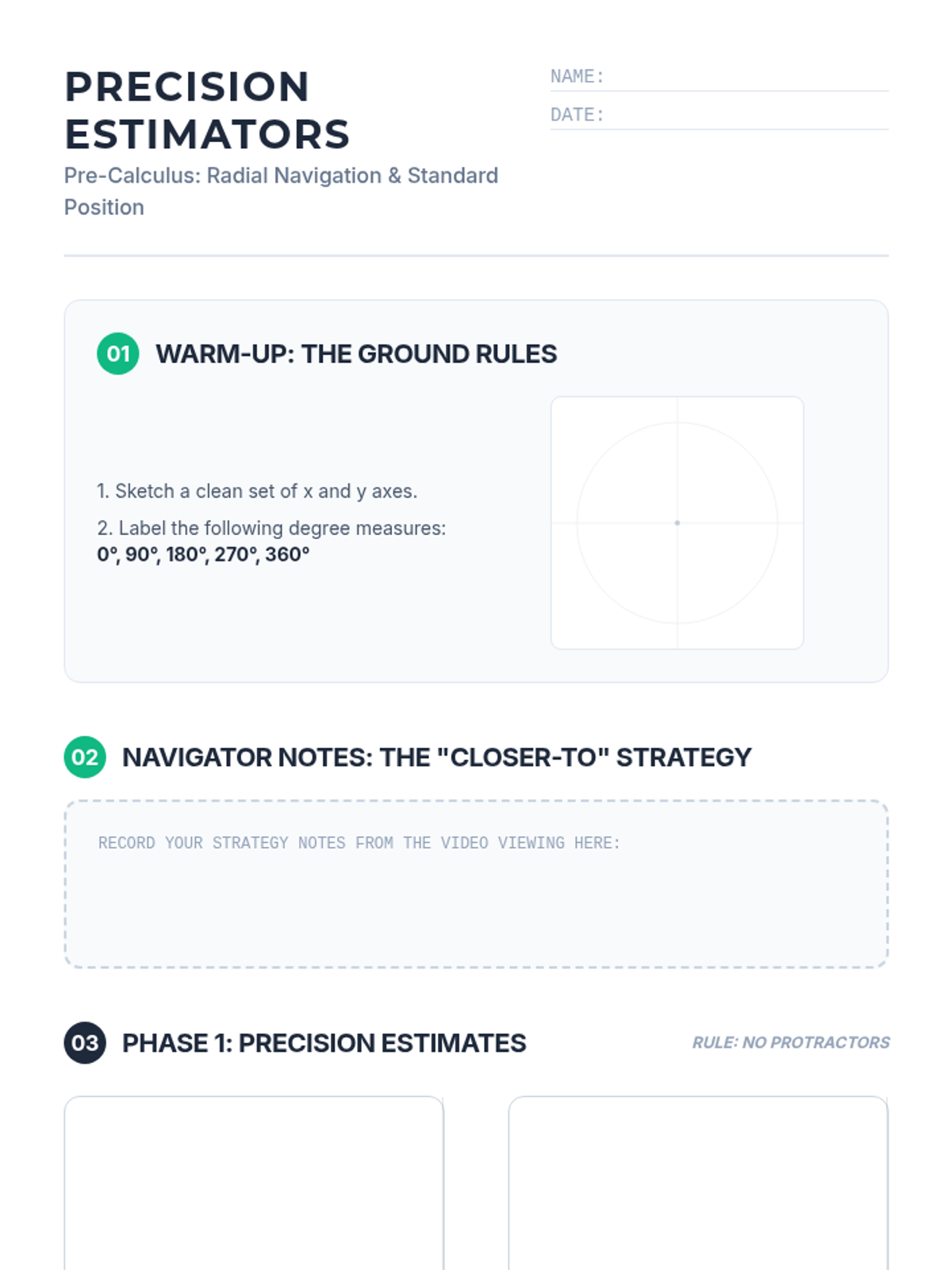
Student practice worksheet for estimating and sketching angles in standard position. Includes sections for warm-up, video note-taking, and peer-reviewed sketching practice.
Visual presentation for the 'Radial Navigation' lesson, featuring interactive warm-up instructions, a video placeholder for standard position angles, and the 'Closer-To' strategy for logical estimation.
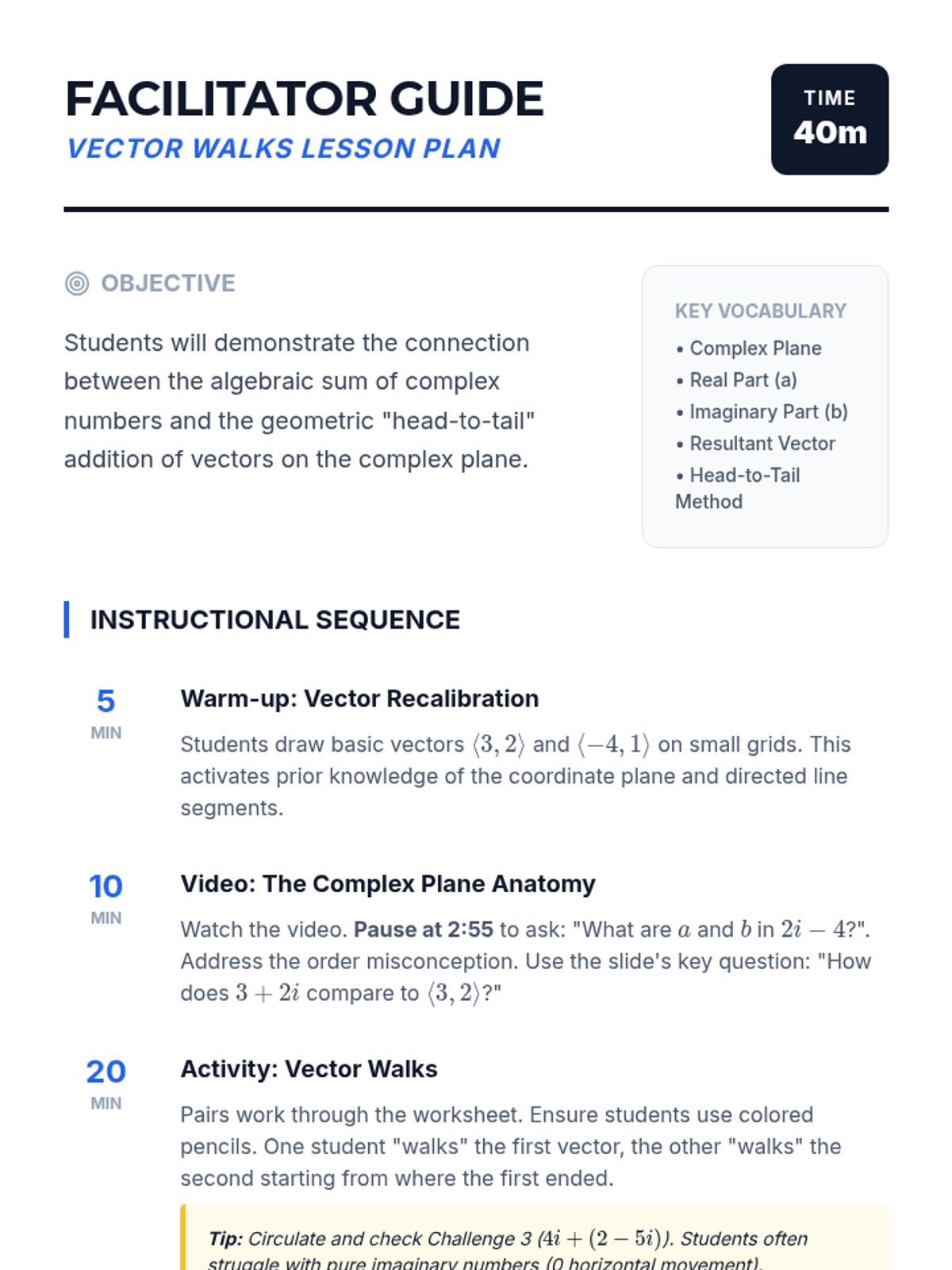
Comprehensive teacher guide for the Vector Walks lesson, including pacing, specific video timestamps for discussion, an answer key, and guidance on addressing common student misconceptions.
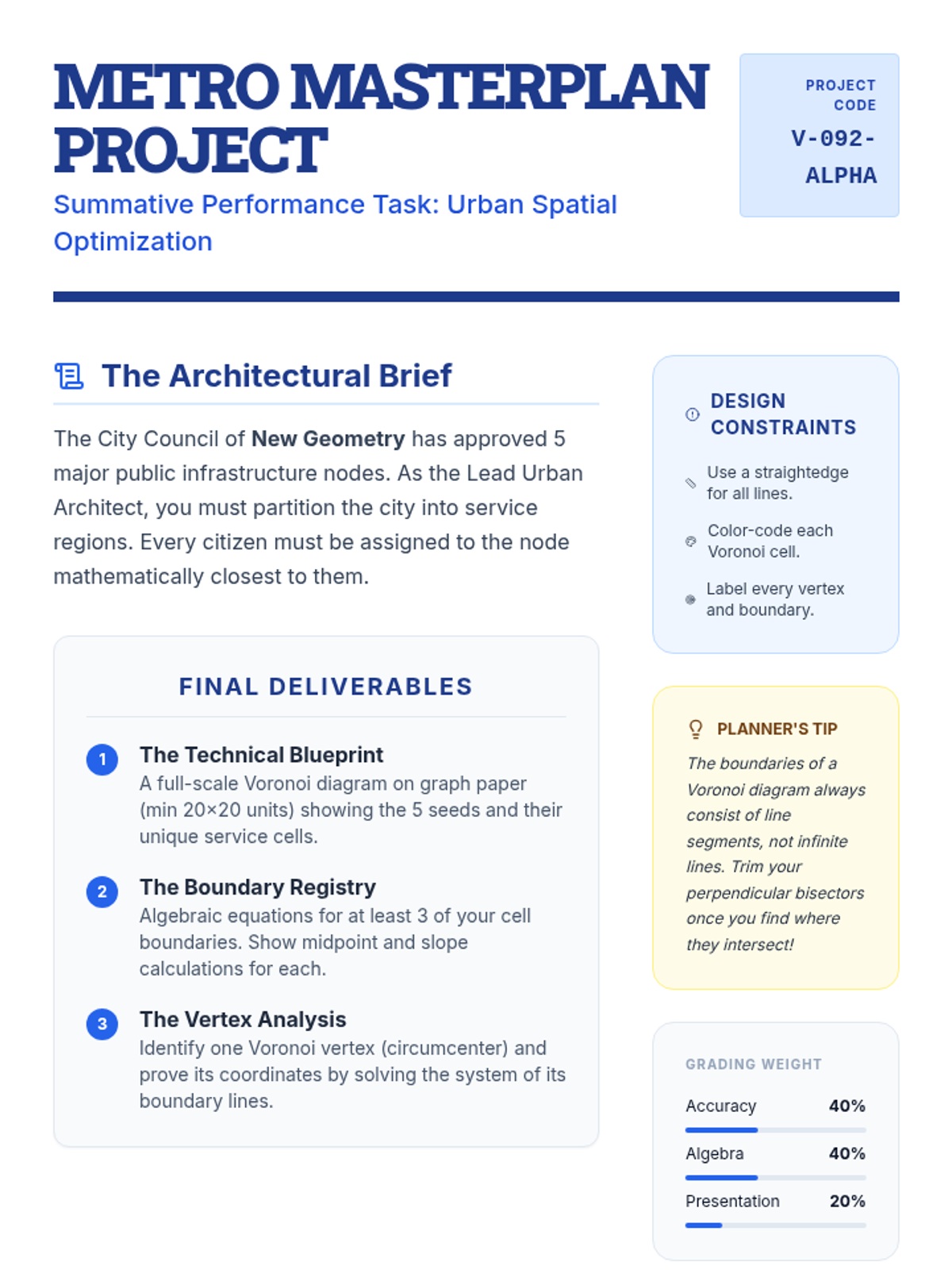
A summative project guide where students design a city's infrastructure layout, constructing a 5-seed Voronoi diagram and providing mathematical proof of its efficiency.
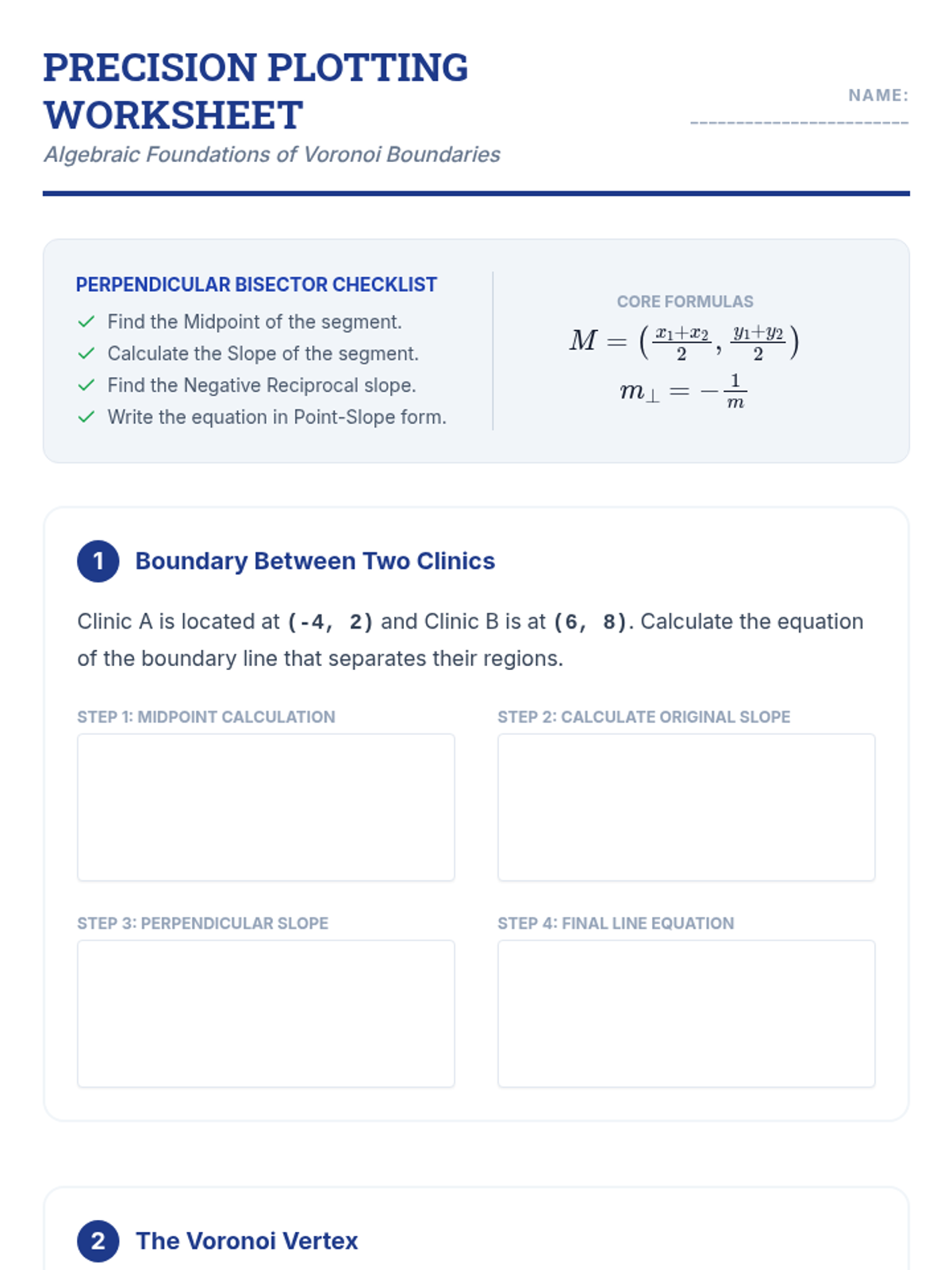
A math worksheet that combines geometry and algebra, requiring students to calculate the equations of perpendicular bisectors and find Voronoi vertices through systems of linear equations.
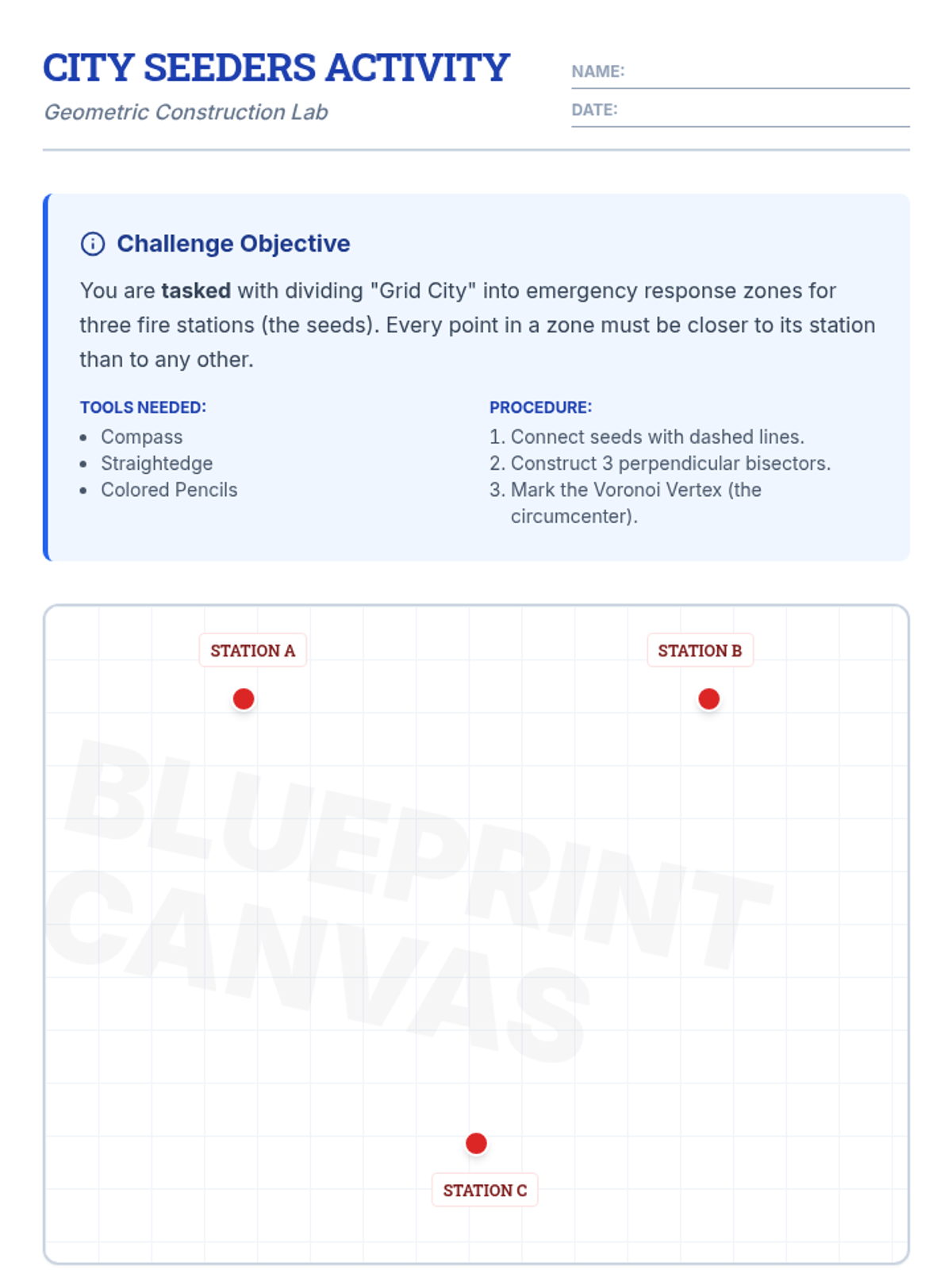
A hands-on activity sheet where students use a compass and straightedge to construct a Voronoi diagram for three "fire stations" on a grid, reinforcing the concept of the perpendicular bisector.
A visual slide deck that defines Voronoi diagrams, explains the construction algorithm using perpendicular bisectors, and shows real-world applications in urban planning and beyond.
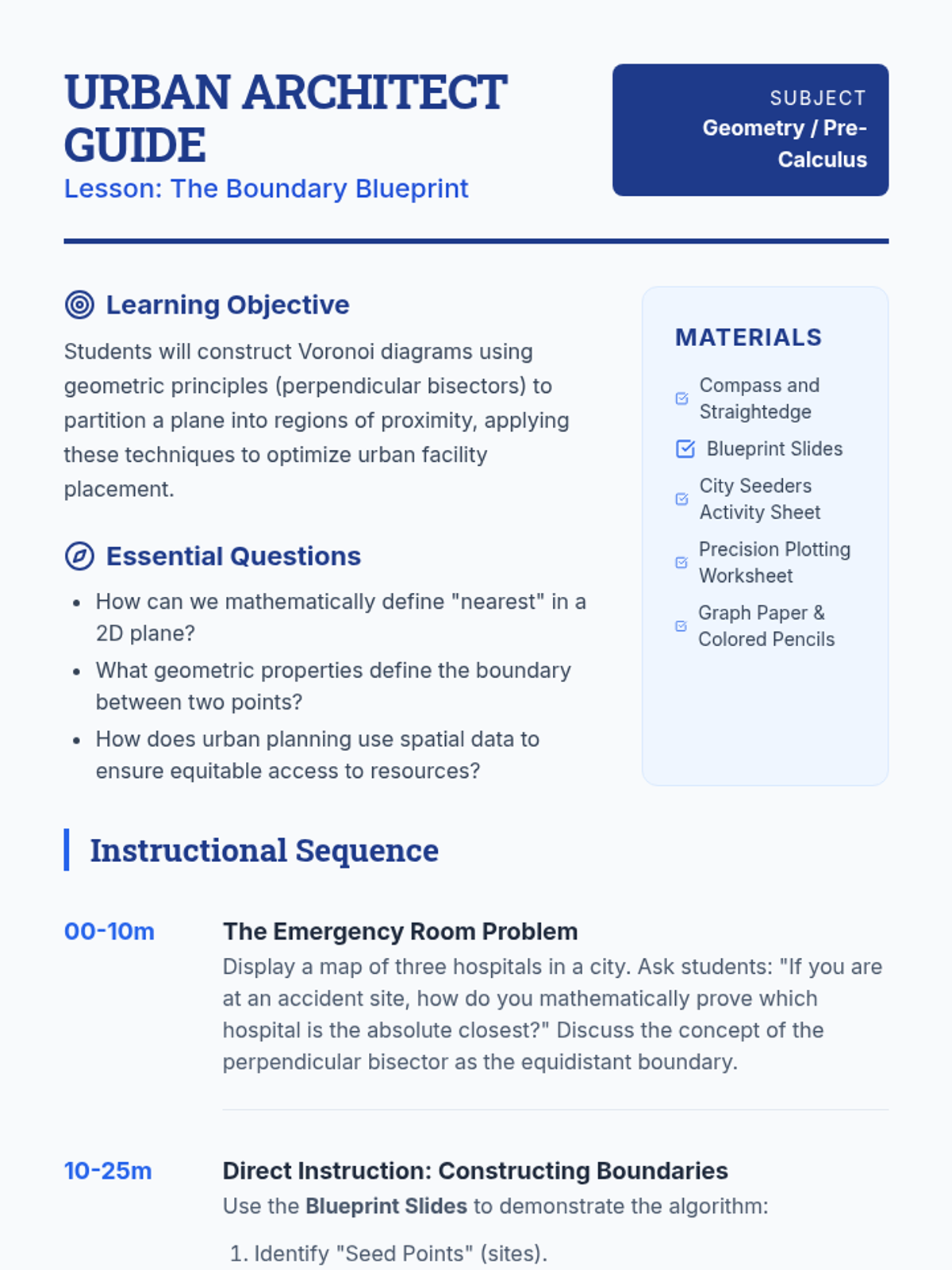
A comprehensive lesson plan for teachers, outlining the instructional sequence, learning objectives, and materials needed to teach Voronoi diagrams through an urban planning lens.
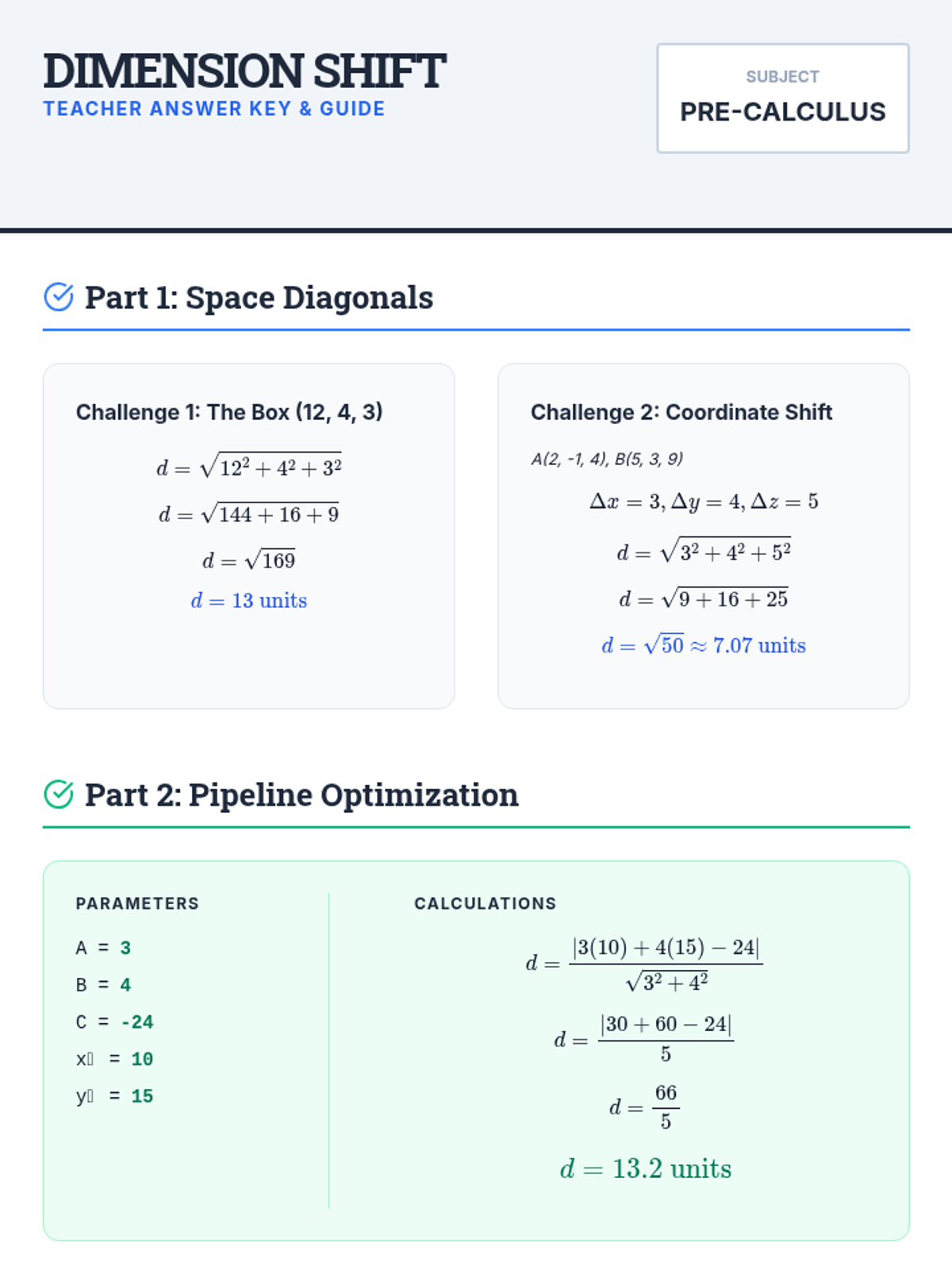
A detailed answer key and pedagogical guide for teachers, providing step-by-step solutions for 3D distance and optimization problems along with conceptual discussion prompts.
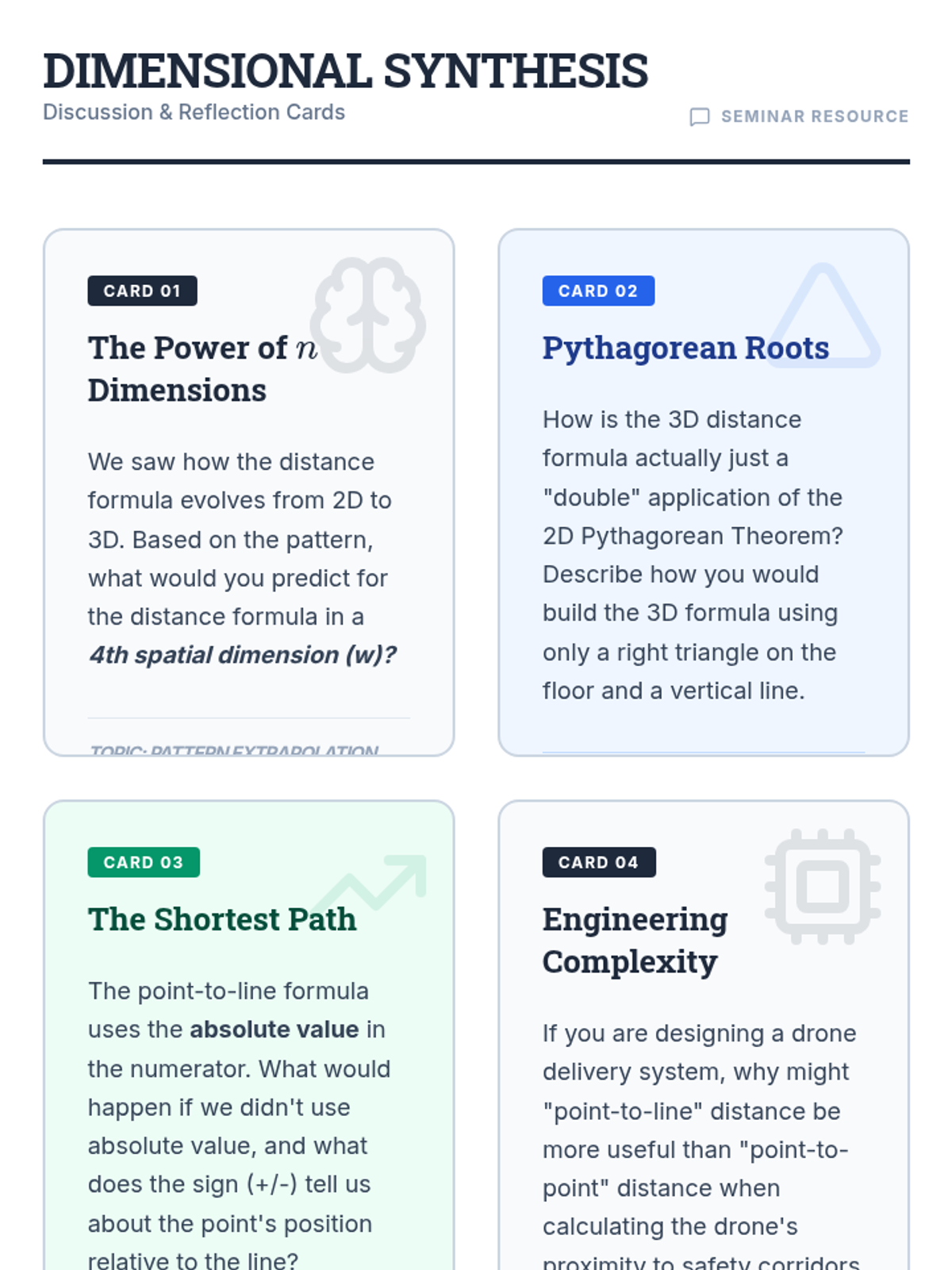
Thought-provoking discussion cards designed to facilitate deep synthesis of 2D/3D geometry concepts, pattern recognition, and real-world engineering applications.
A sleek, dark-themed slide deck for 11th-12th grade math instruction, featuring the embedded YouTube video and clear visual breakdowns of 3D distance and point-to-line formulas.
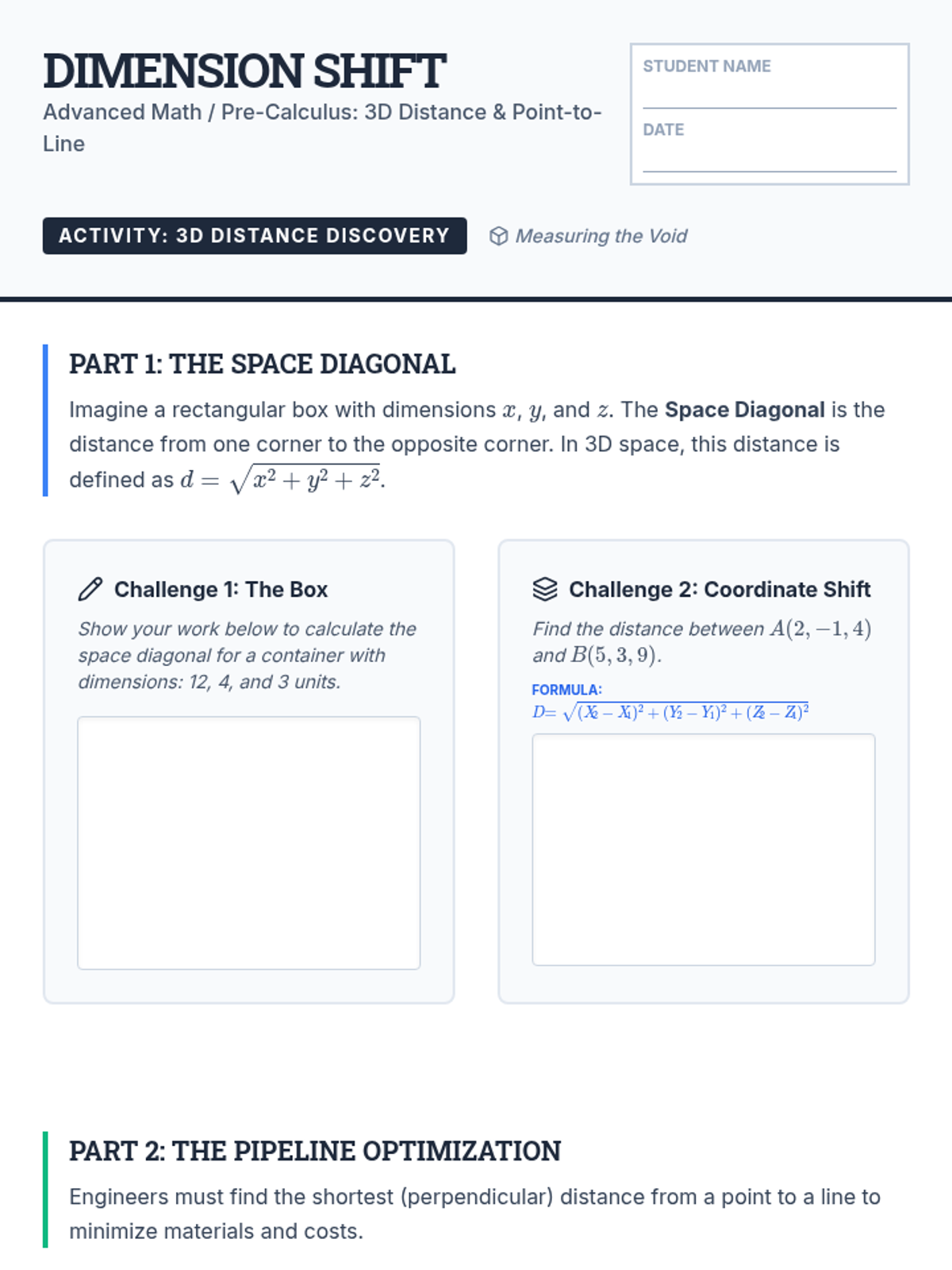
A technical, blueprint-style worksheet for 11th-12th grade math students focusing on 3D distance calculations and real-world point-to-line optimization problems.
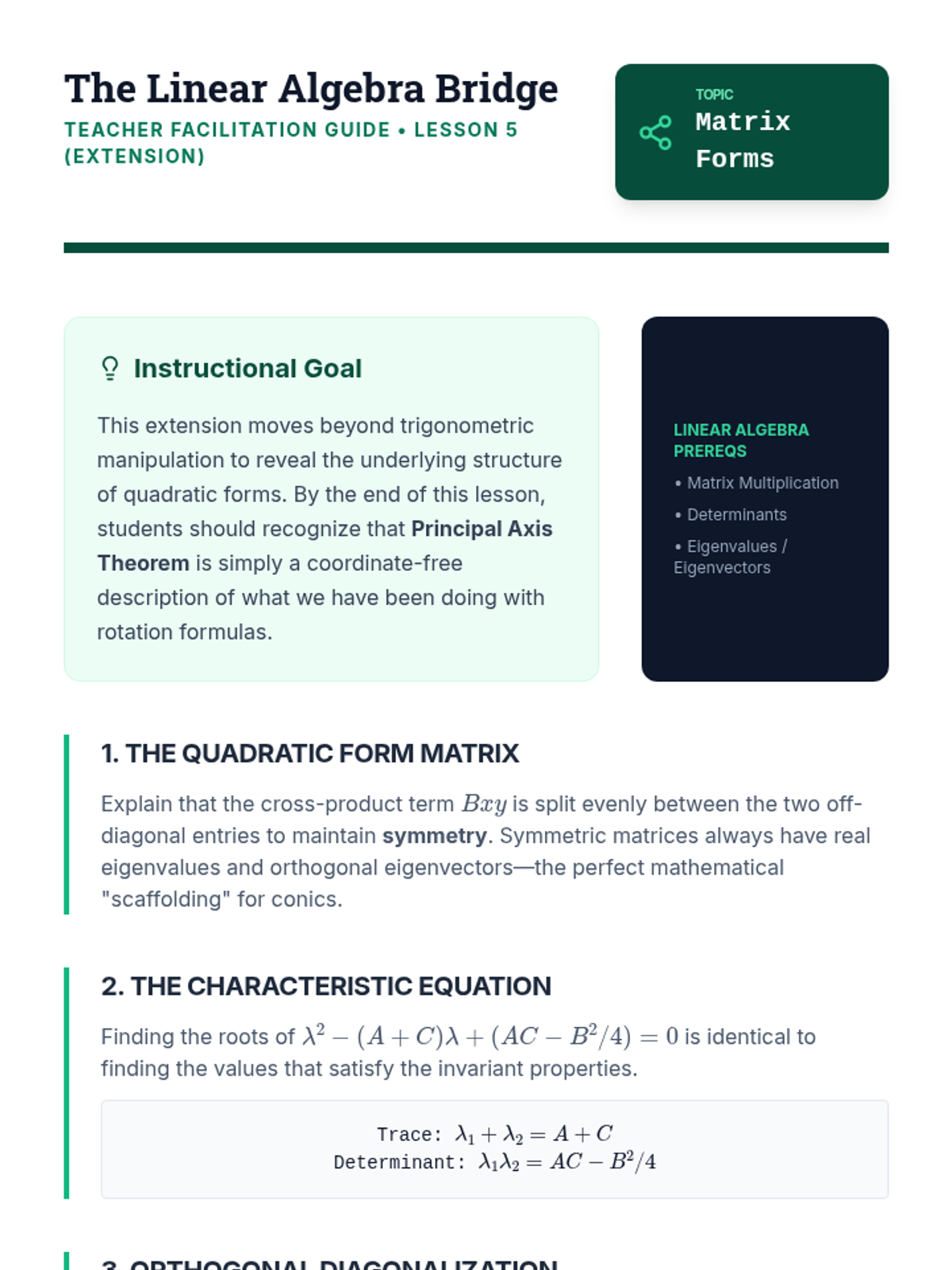
Teacher reference guide for connecting geometric rotation of conics to matrix representation and diagonalization in Lesson 5.
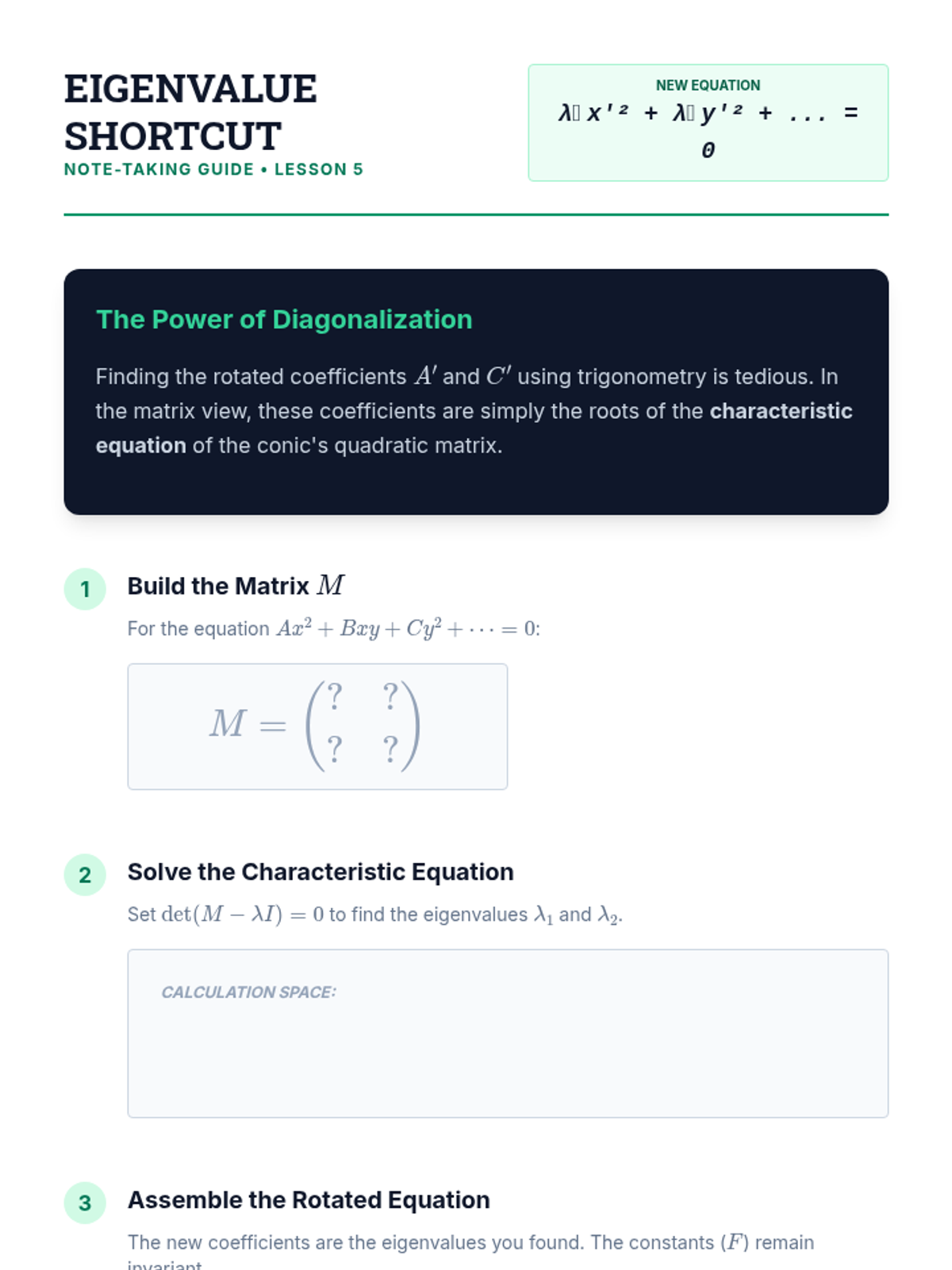
Student notes on finding eigenvalues to get A' and C', providing a linear algebra shortcut for rotating conic sections.
Slides introducing matrix representations and eigenvalues as a pathway to diagonalizing quadratic forms.
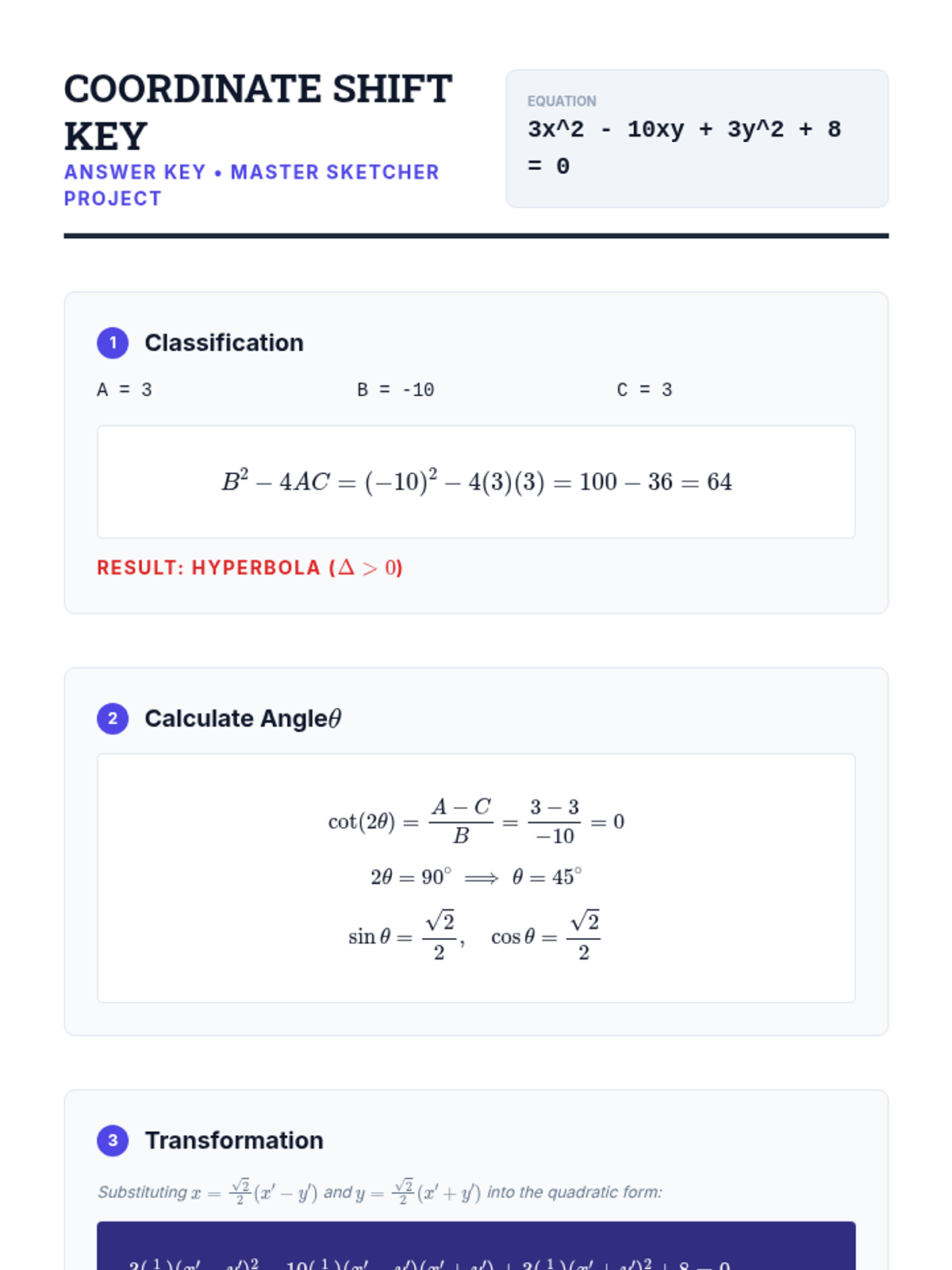
Answer key for the Master Sketcher project, detailing the full algebraic transformation and final standard form for the given hyperbola.
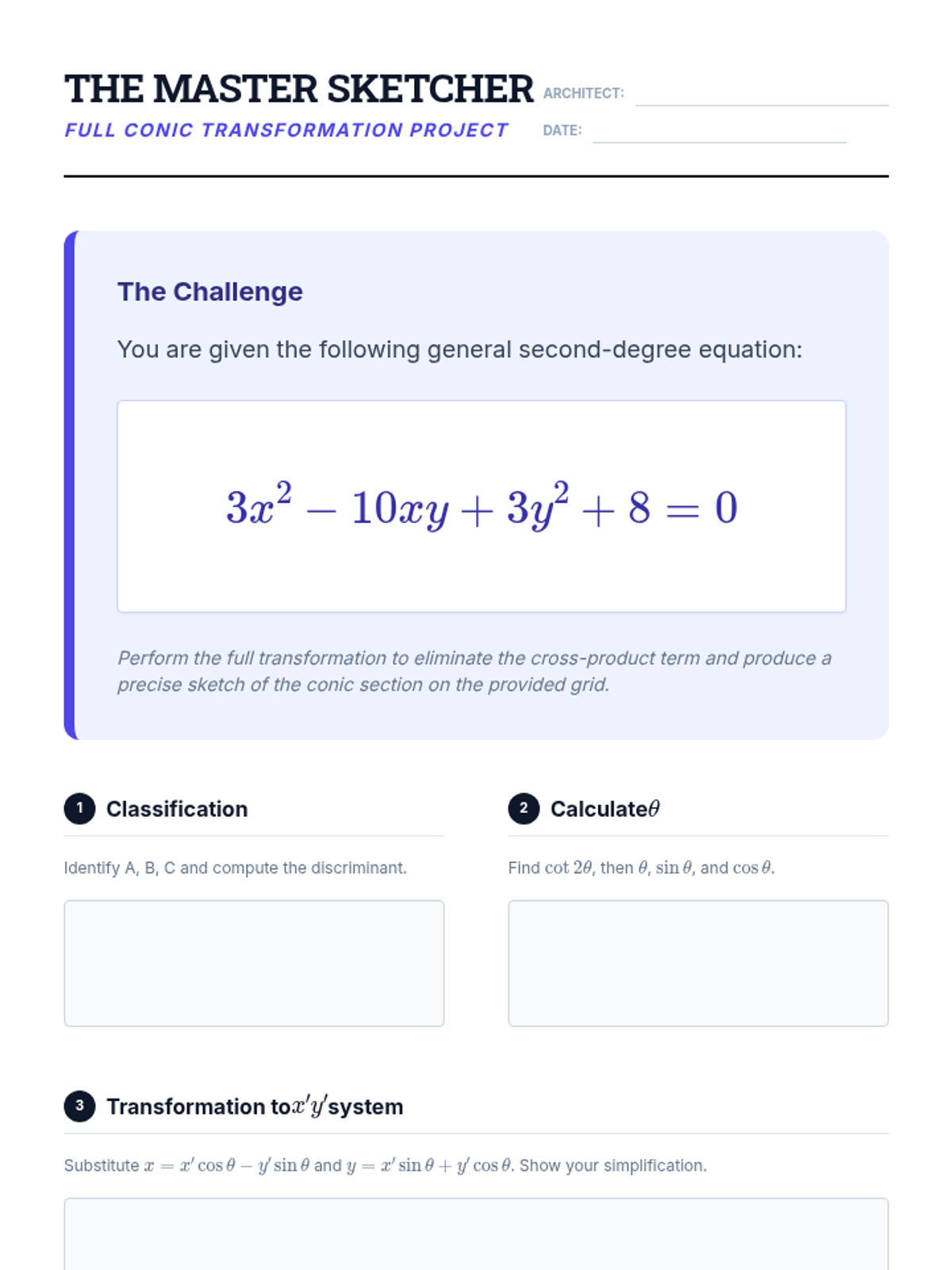
A comprehensive workshop activity where students perform a complete rotation of axes transformation and graph the resulting conic.
Slides providing a step-by-step example and procedure for graphing rotated conic sections.
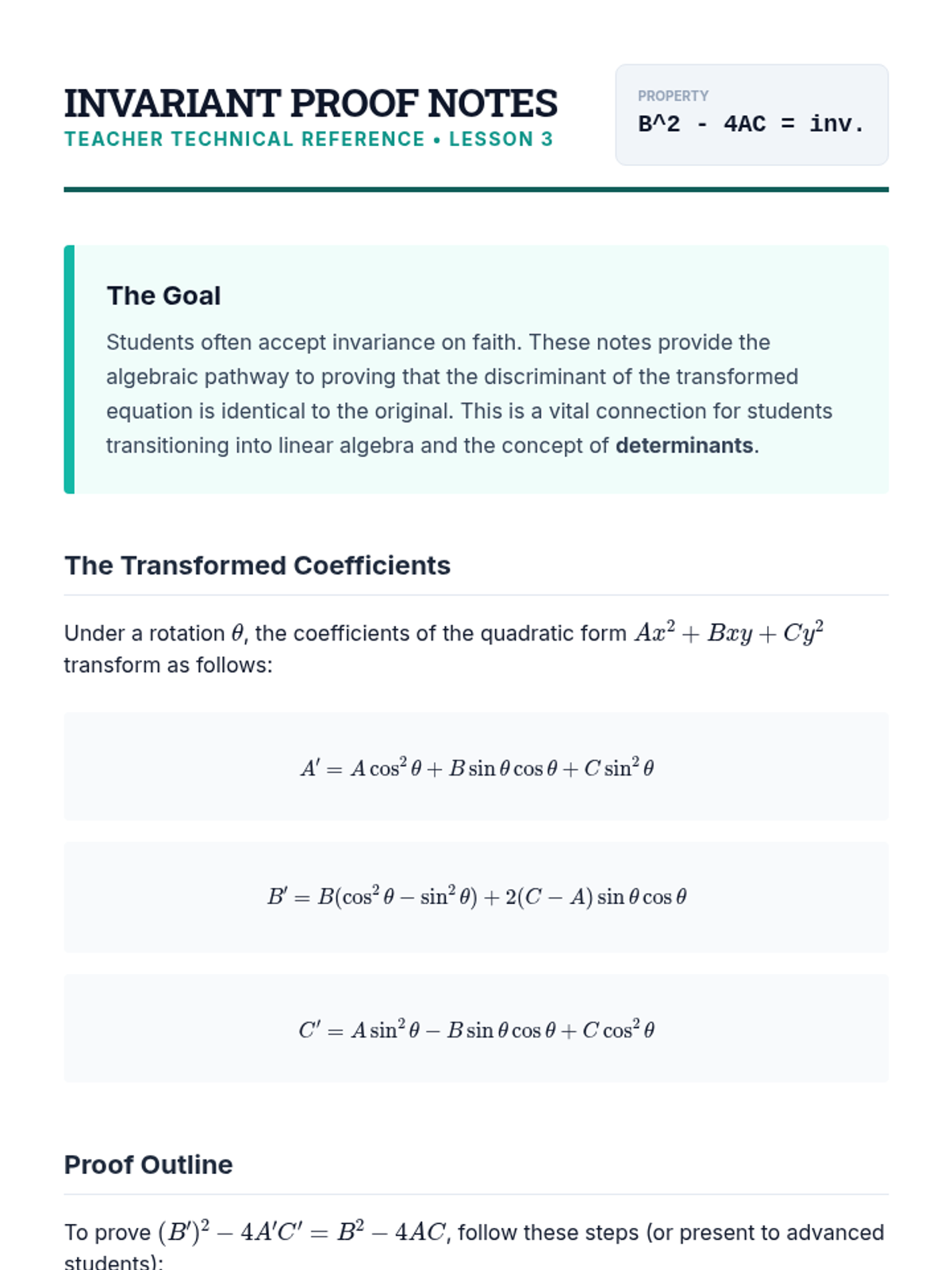
Teacher reference notes providing the algebraic and matrix-based proofs for the invariance of the discriminant under rotation.
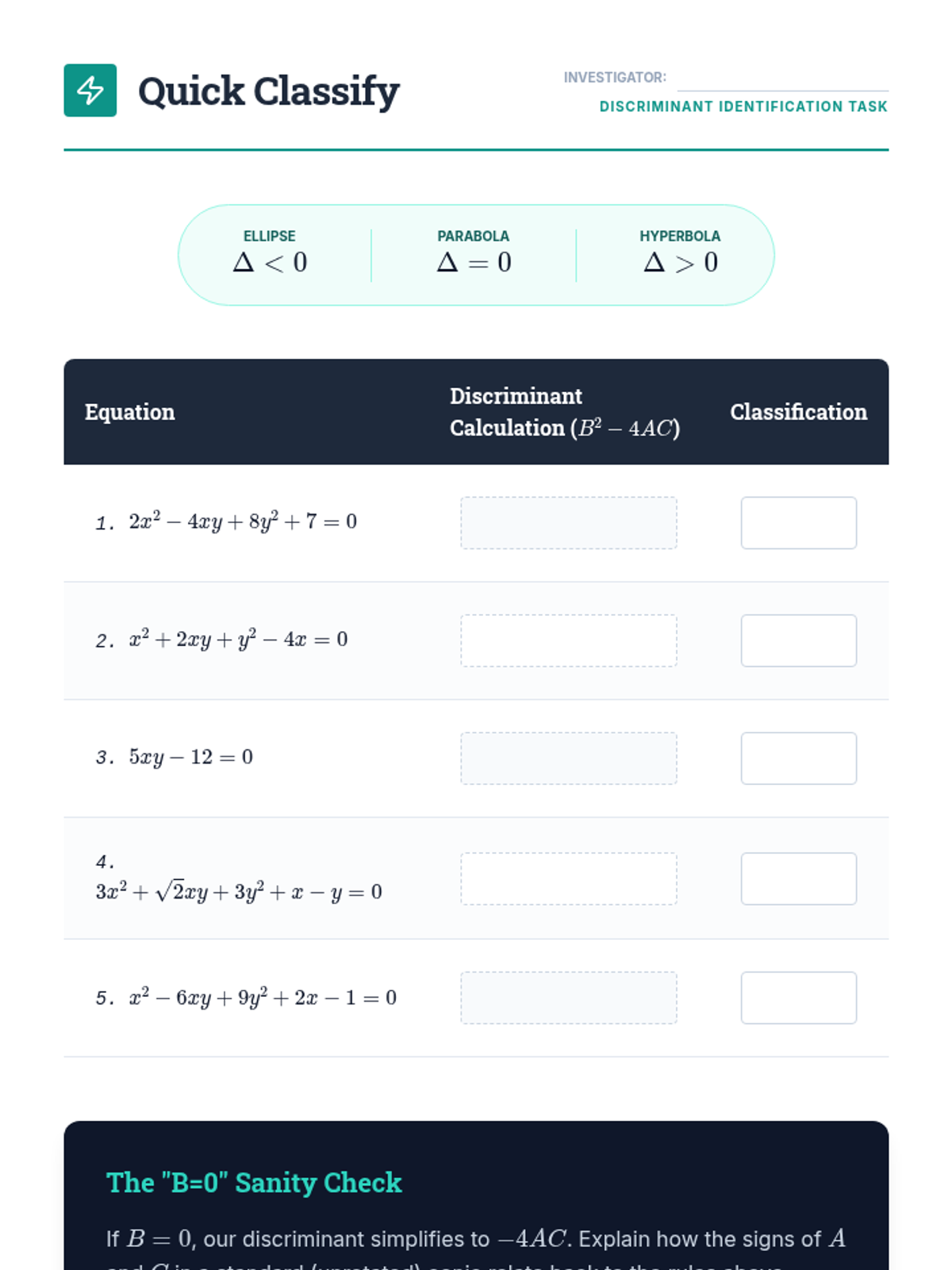
A rapid identification worksheet for classifying rotated conic sections using the discriminant B^2 - 4AC.
Slides introducing the invariant discriminant B^2 - 4AC and its use in classifying rotated conic sections.
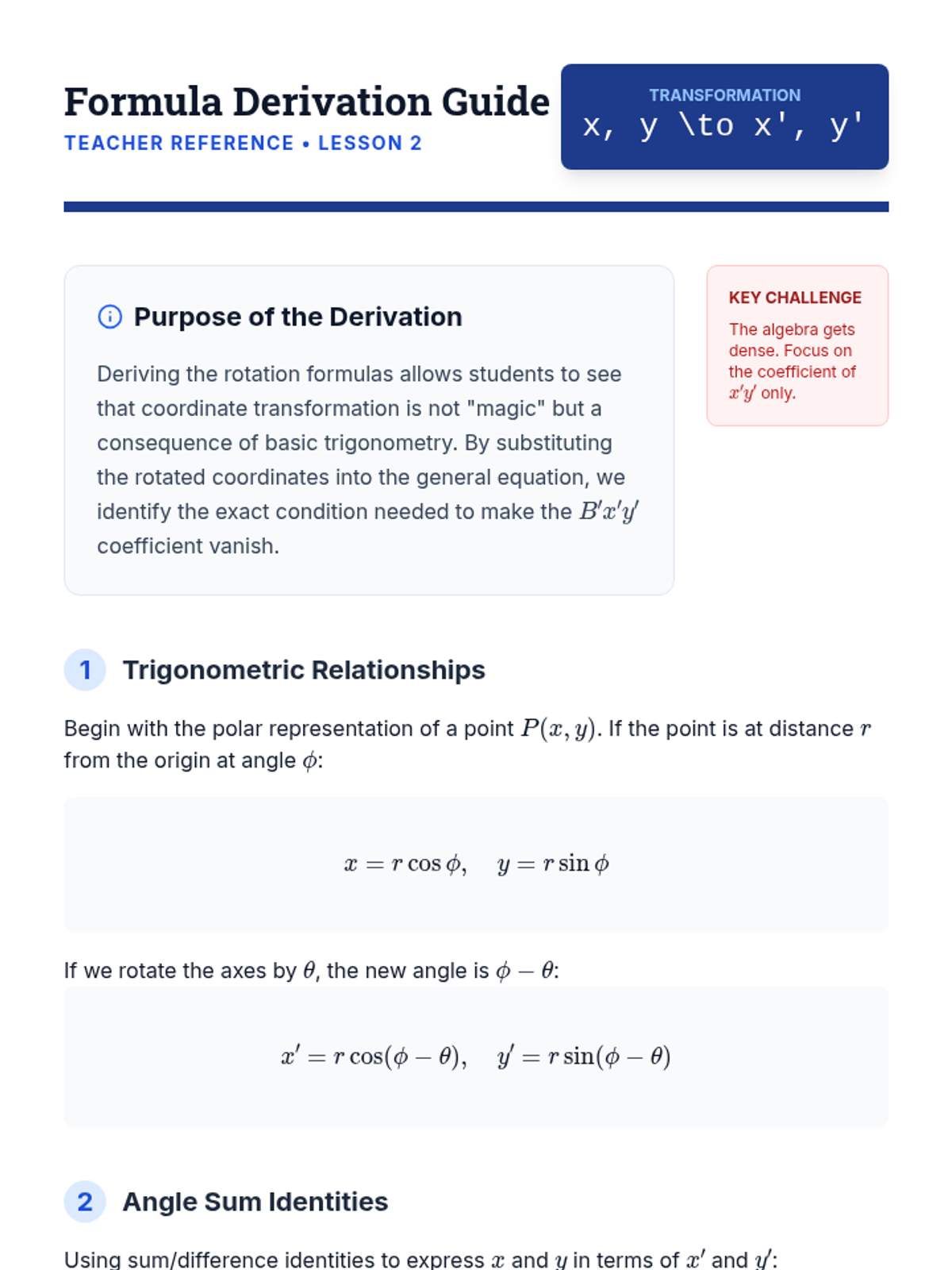
Teacher guide providing a step-by-step derivation of the rotation of axes formulas and the condition for eliminating the cross-product term.
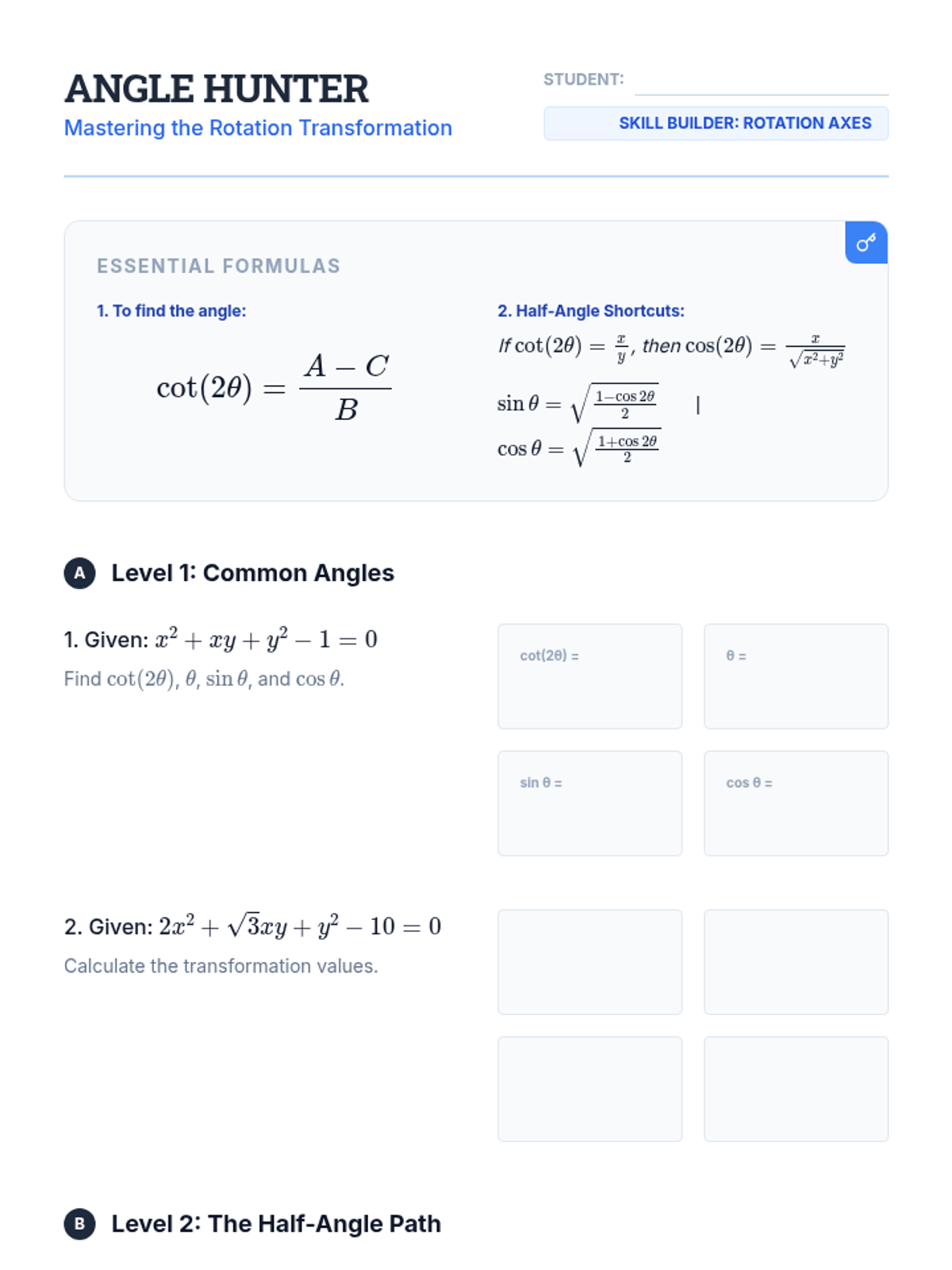
Student worksheet focused on calculating the rotation angle and exact trigonometric values for coordinate transformations.
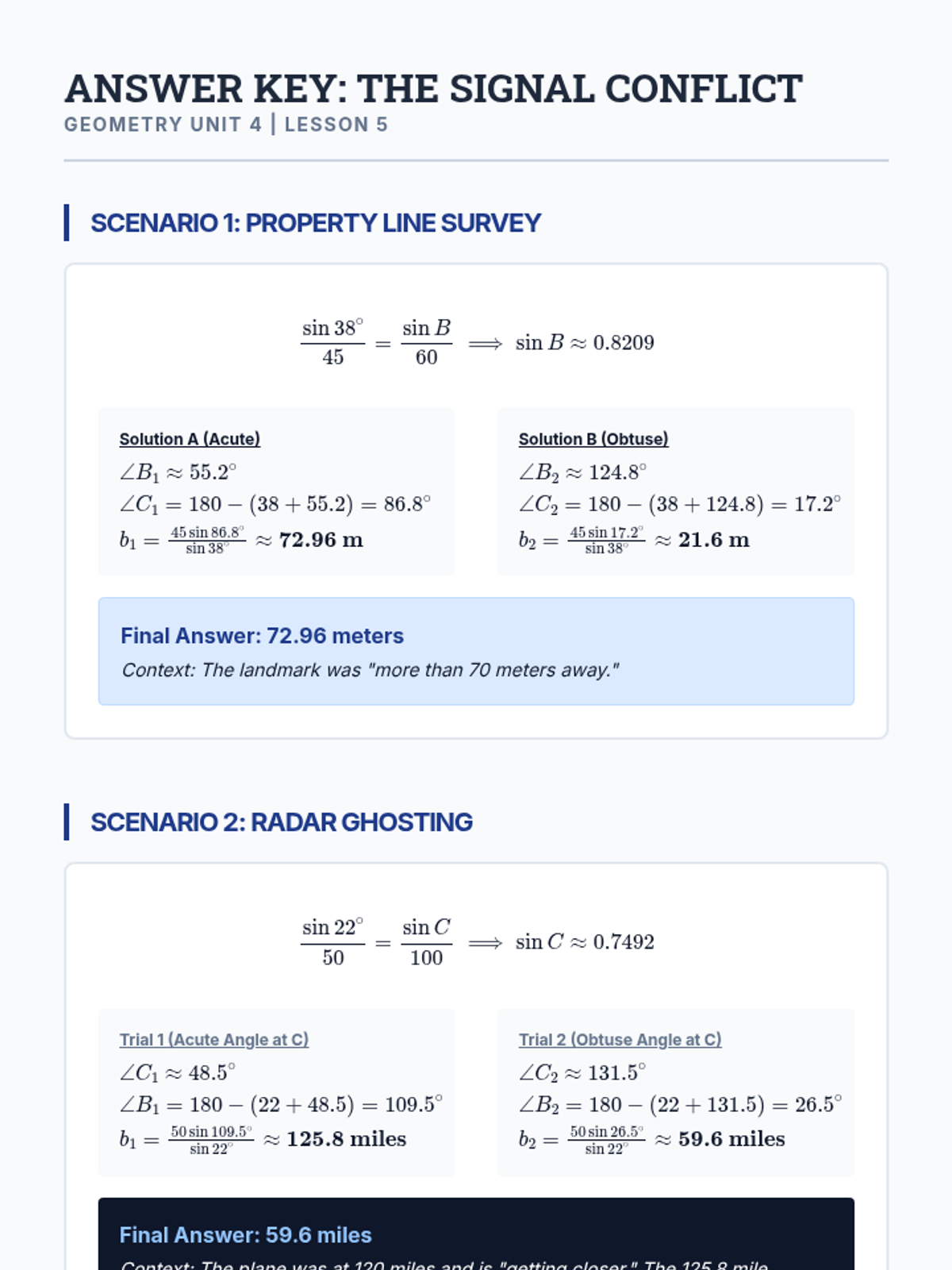
Teacher answer key for Lesson 5, providing worked solutions and contextual resolutions for the real-world word problems.
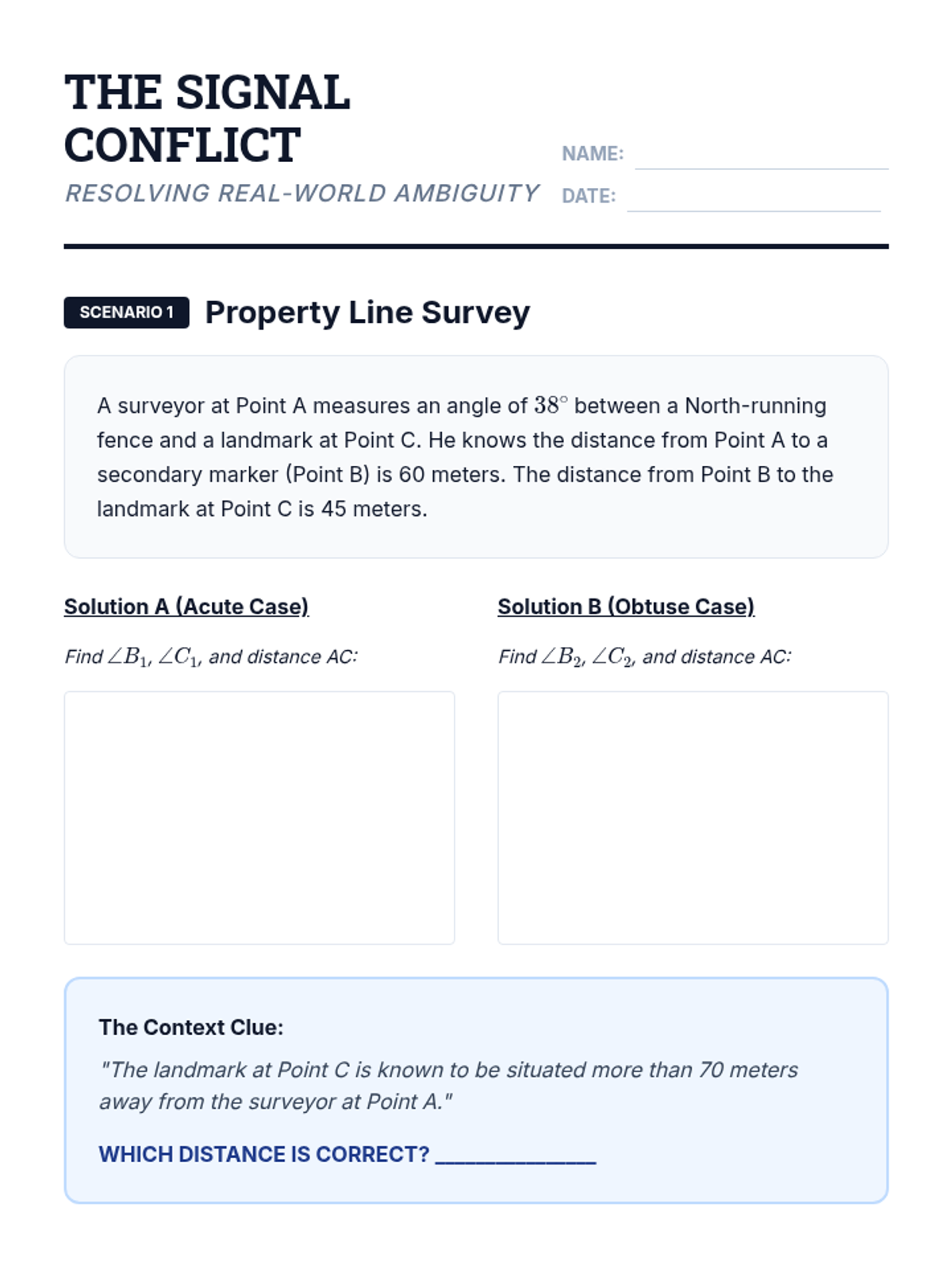
Student word problem set for Lesson 5 where they must solve for both ambiguous solutions and use context clues to determine the correct real-world answer.
Slides for Lesson 5 exploring real-world applications of the ambiguous case, such as radar and surveying, and how to use context to determine the correct solution.
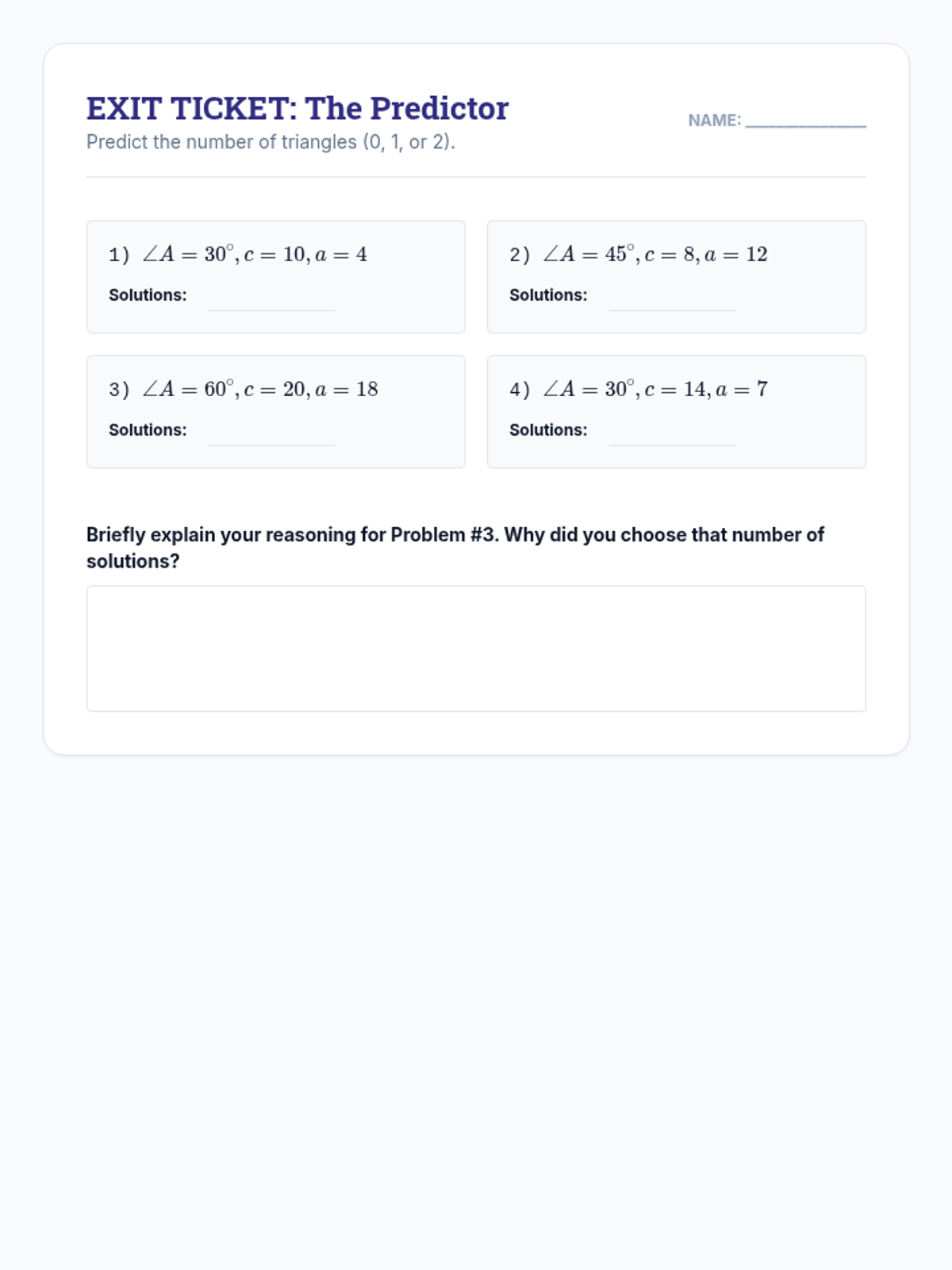
Quick check assessment for Lesson 4 to verify that students can correctly predict the number of triangle solutions based on given dimensions.
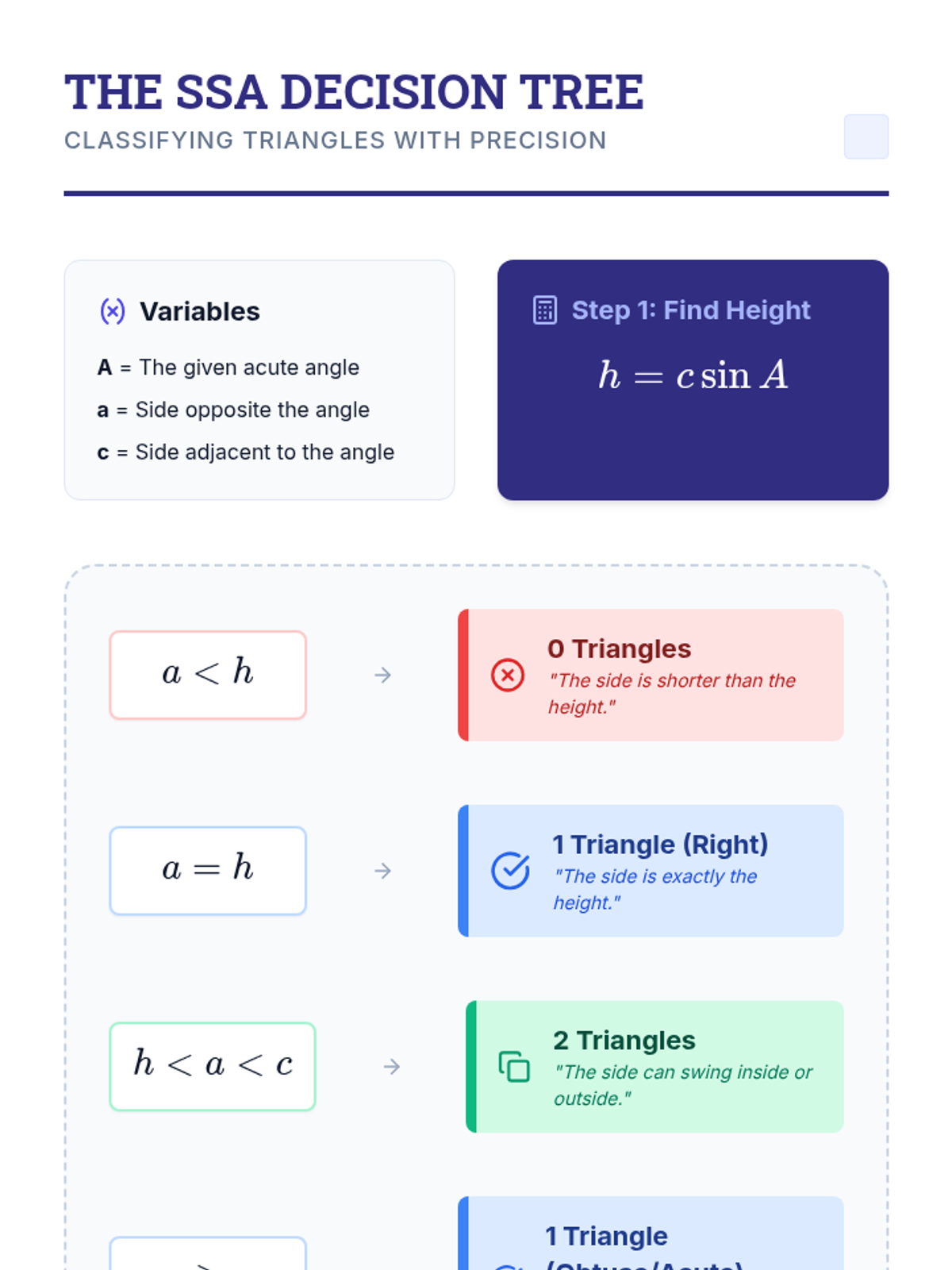
Reference flowchart for Lesson 4 classifying SSA triangle scenarios based on height and side length relationships.
Slides for Lesson 4 on predicting the number of solutions in SSA cases using side and height relationships.
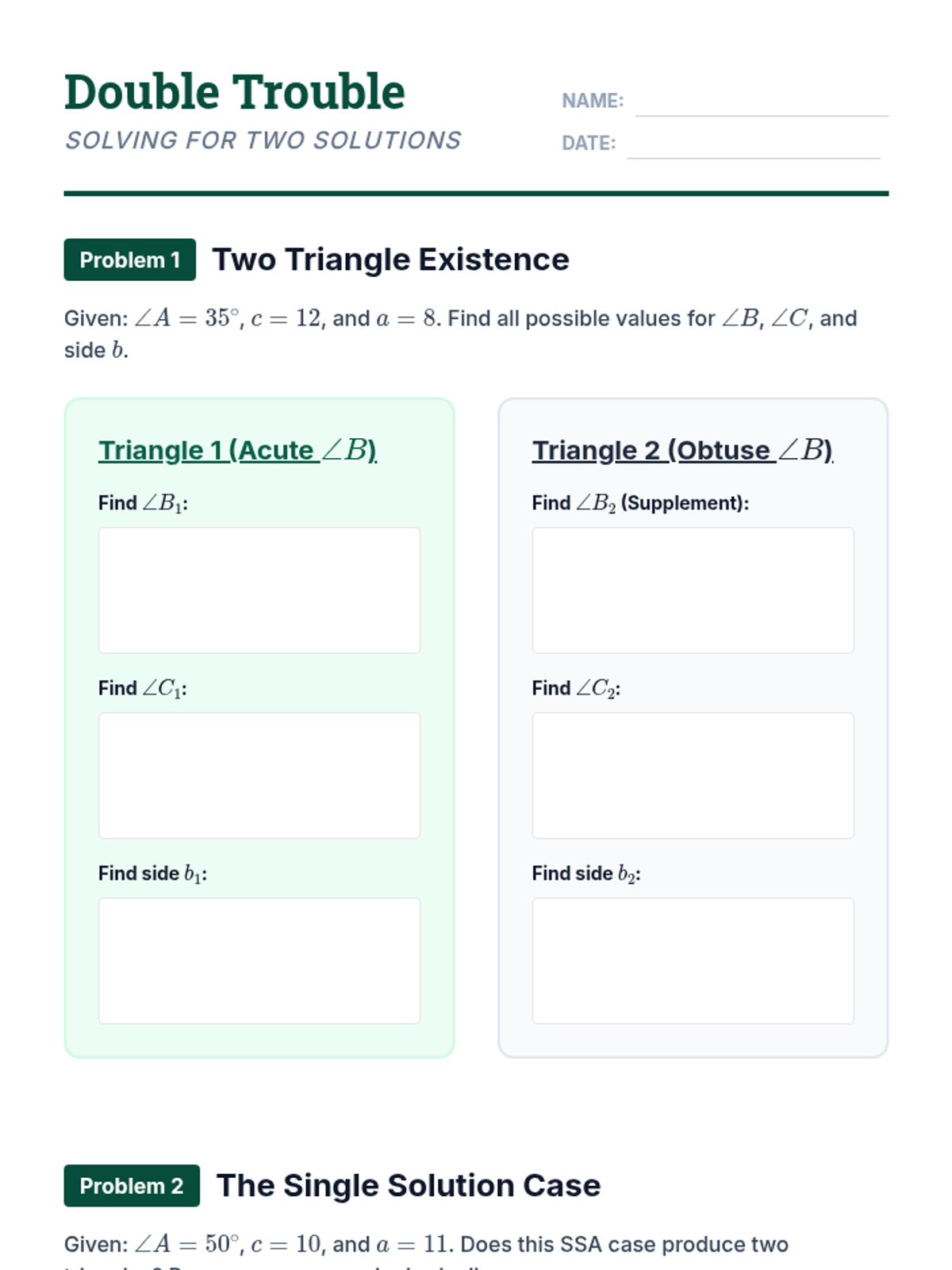
Practice worksheet for Lesson 3 where students solve for both triangles in the ambiguous case and verify the existence of the second solution.
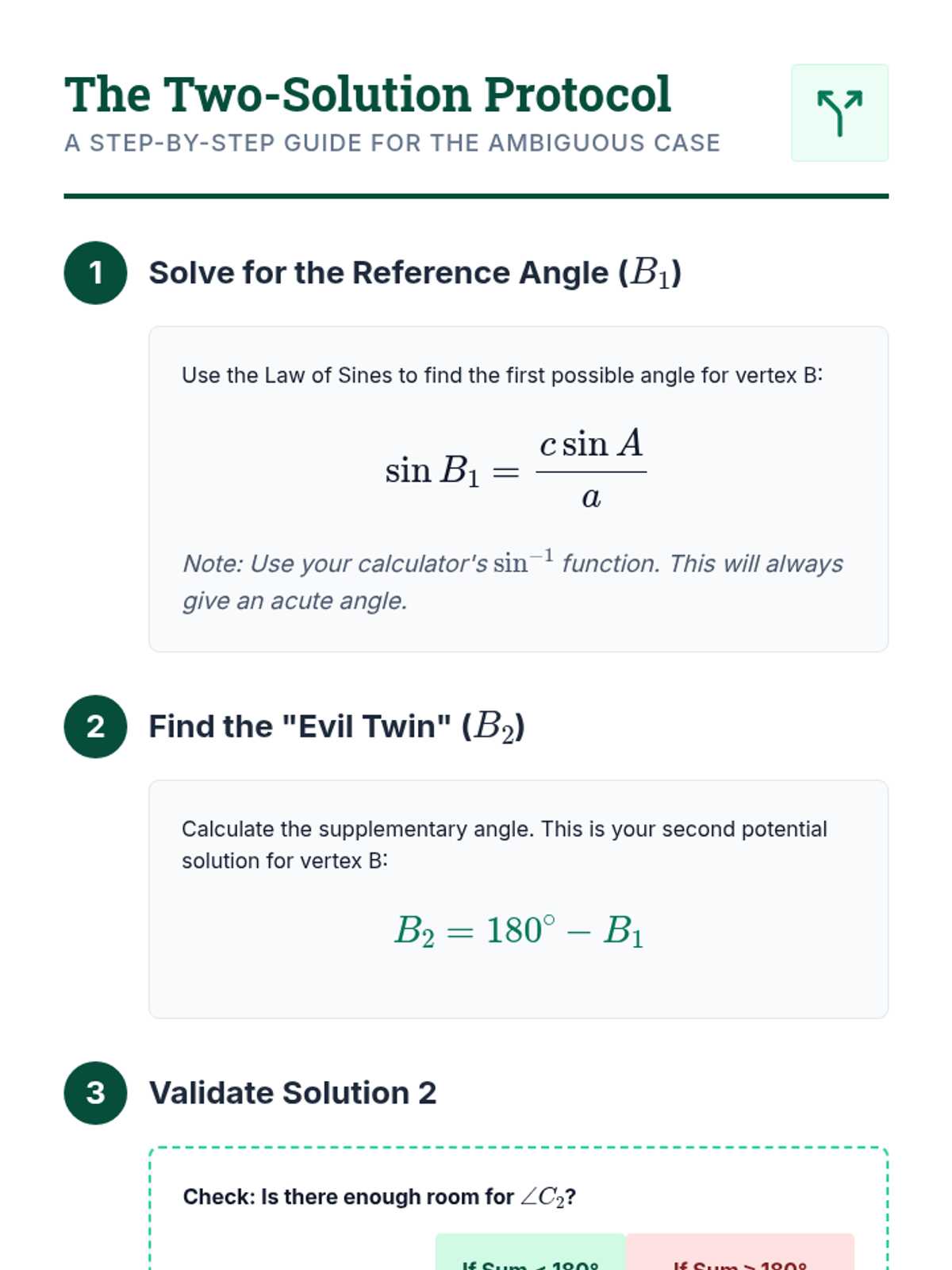
Step-by-step procedural guide for students on how to solve for both triangles in the ambiguous case (SSA).
Slides for Lesson 3 explaining the 'Two Solution' case of SSA. Introduces the concept of supplementary angles and the triangle validity check.
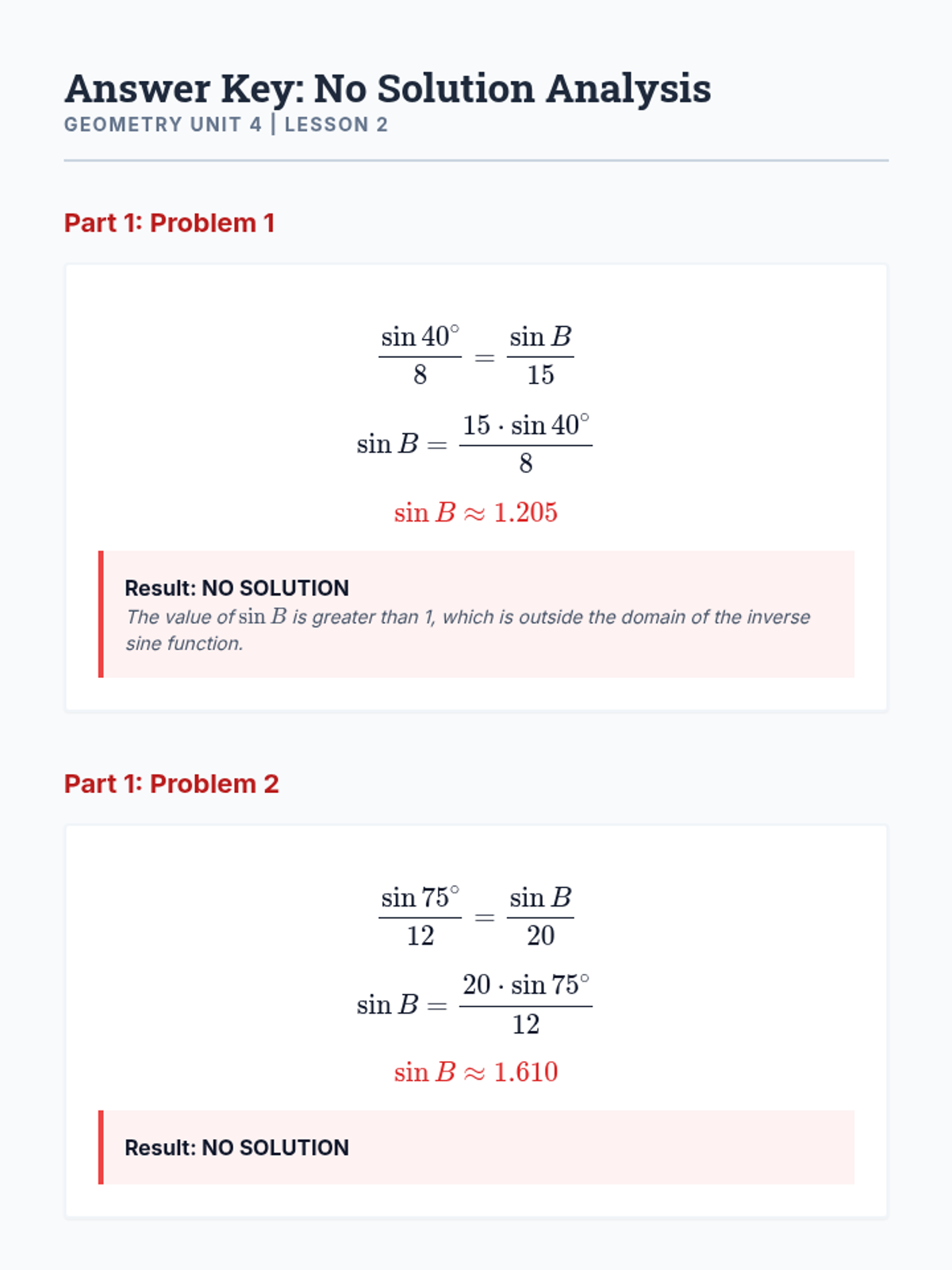
Teacher answer key for Lesson 2, providing worked solutions and geometric explanations for the 'No Solution' case.
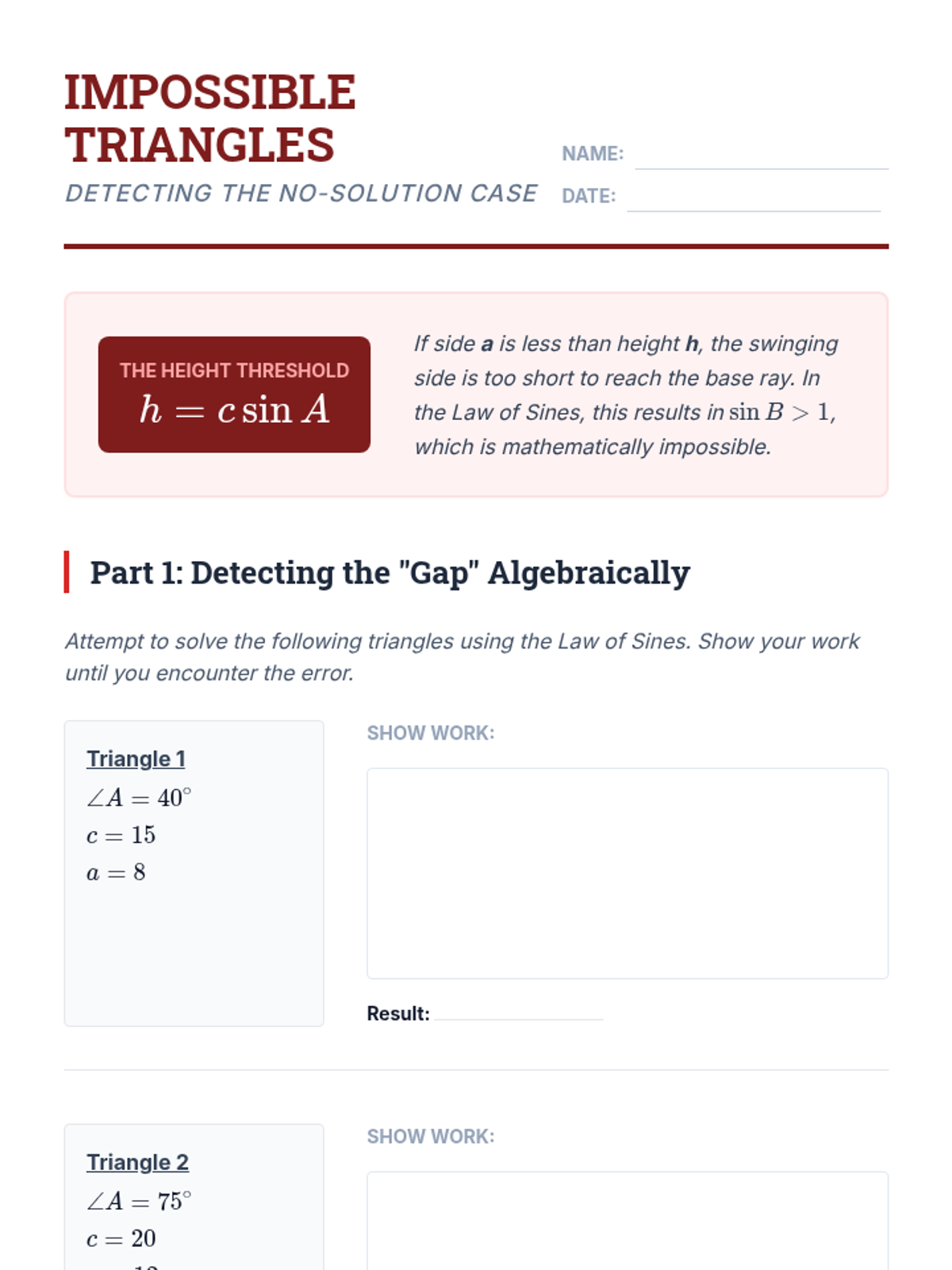
Worksheet for Lesson 2 focusing on calculating the height of a triangle to determine if a solution is possible, and explaining calculator errors.
Slides for Lesson 2 explaining the 'No Solution' case of SSA. Connects geometric impossibility (gap) to algebraic error (sin > 1).
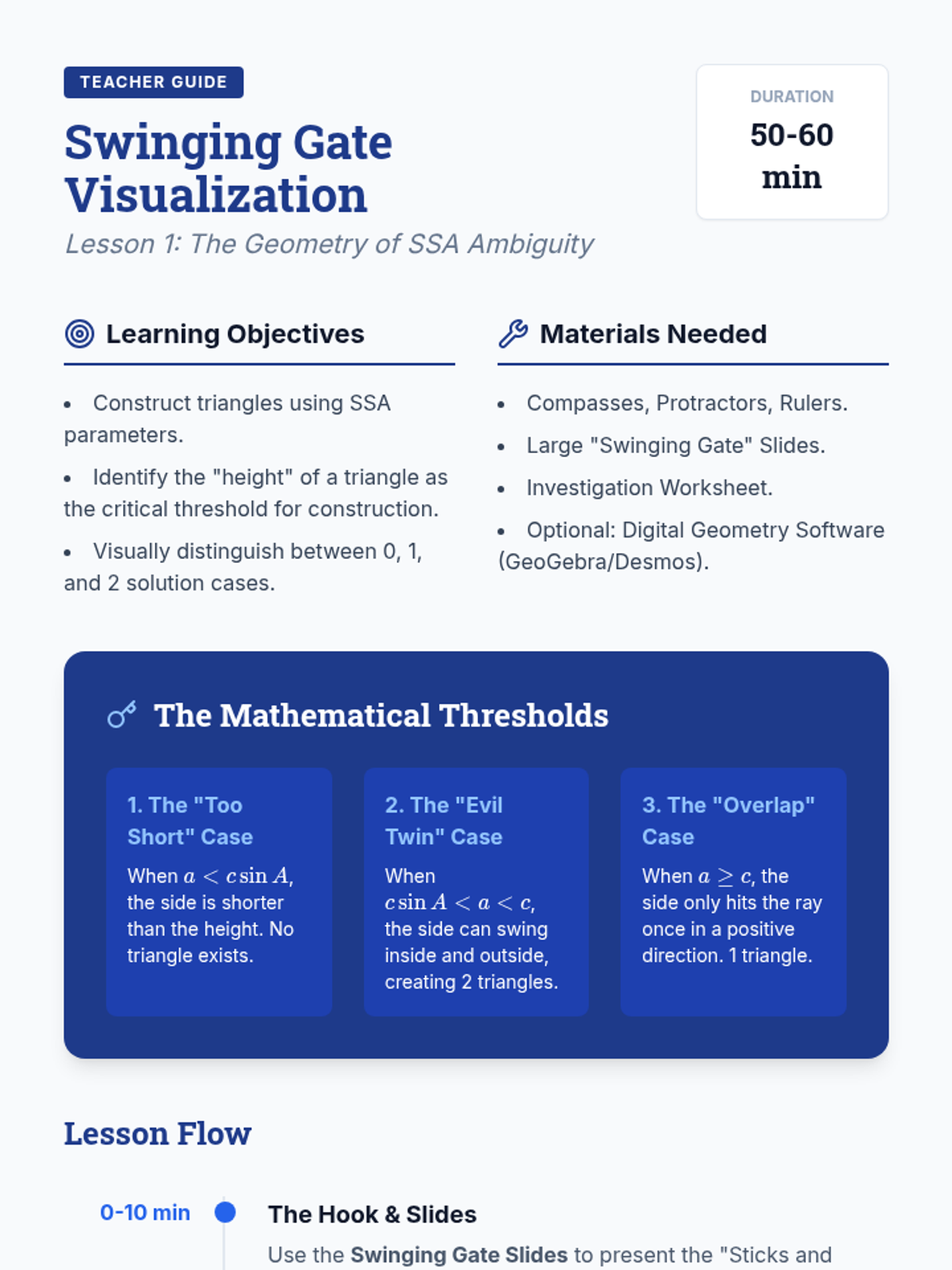
Teacher guidance and facilitation notes for Lesson 1, focusing on the visual discovery of SSA ambiguity and the mathematical thresholds for solutions.
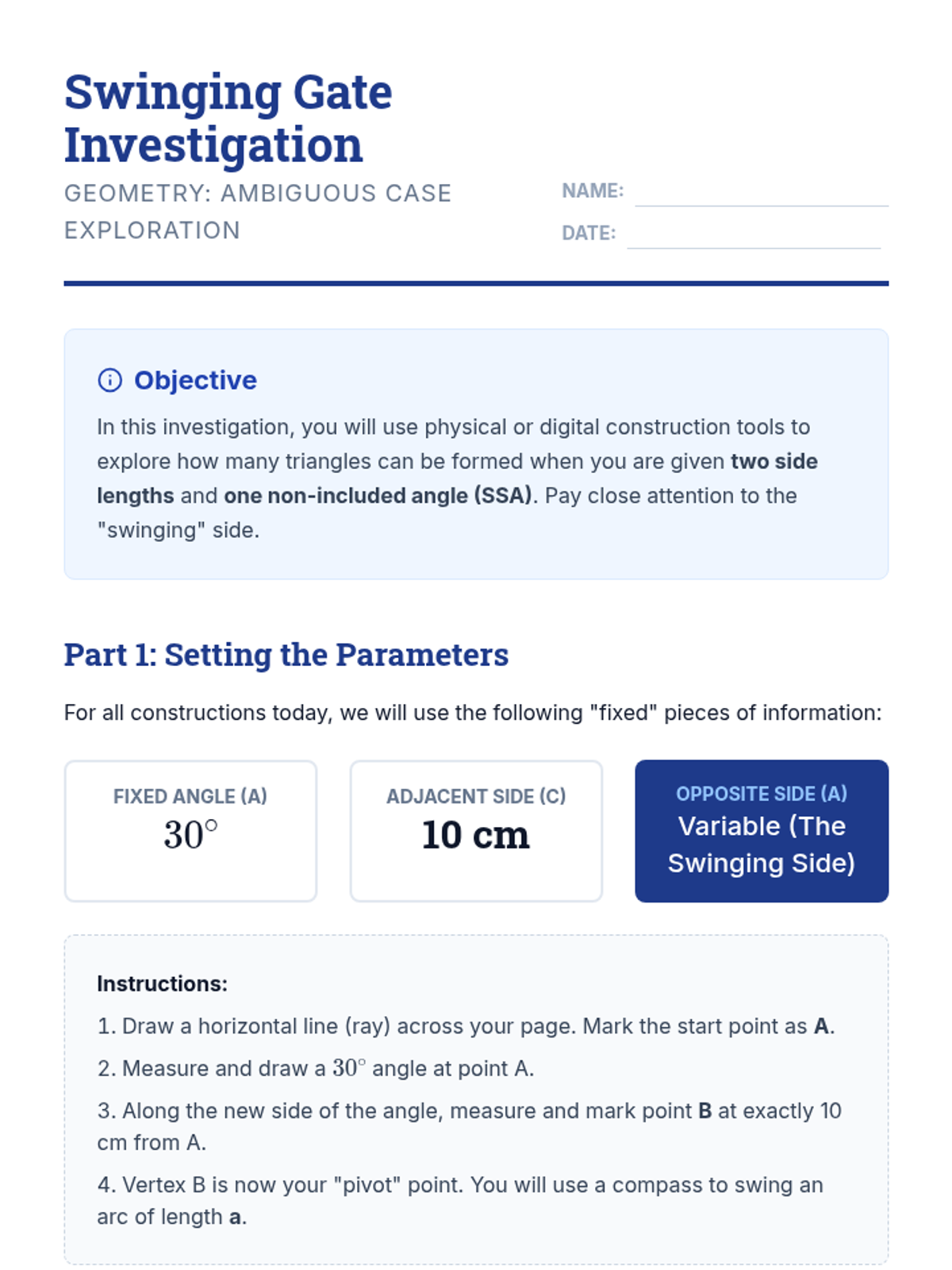
Student investigation worksheet for Lesson 1 where students construct triangles with specific SSA dimensions to discover the varying number of possible solutions.
Introductory slide deck for Lesson 1, introducing the concept of the 'Swinging Gate' in SSA triangle construction. Uses a blueprint/geometric visual theme.
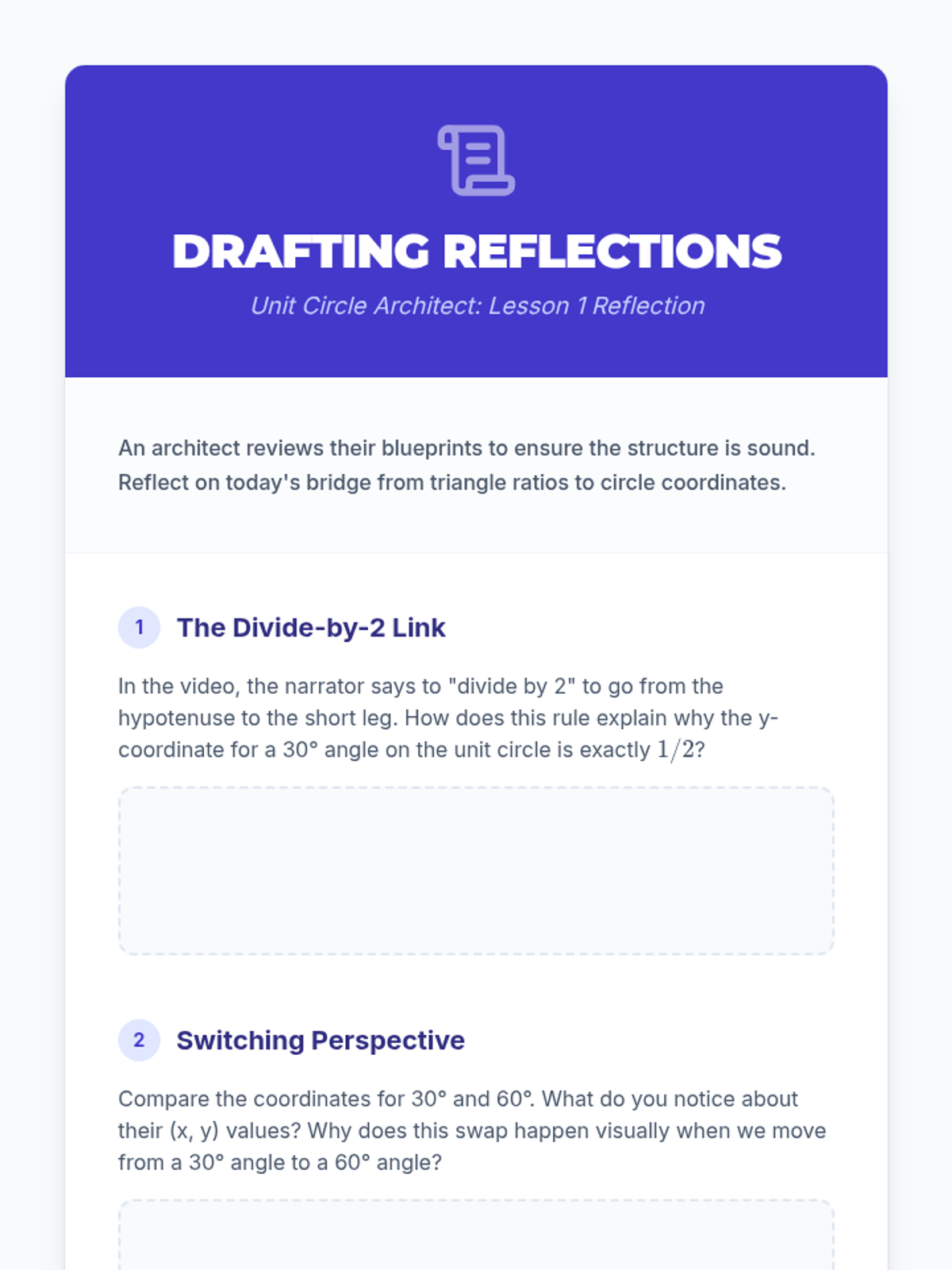
A set of reflective journal prompts designed for students to articulate their understanding of the connection between 30-60-90 triangles and the unit circle.
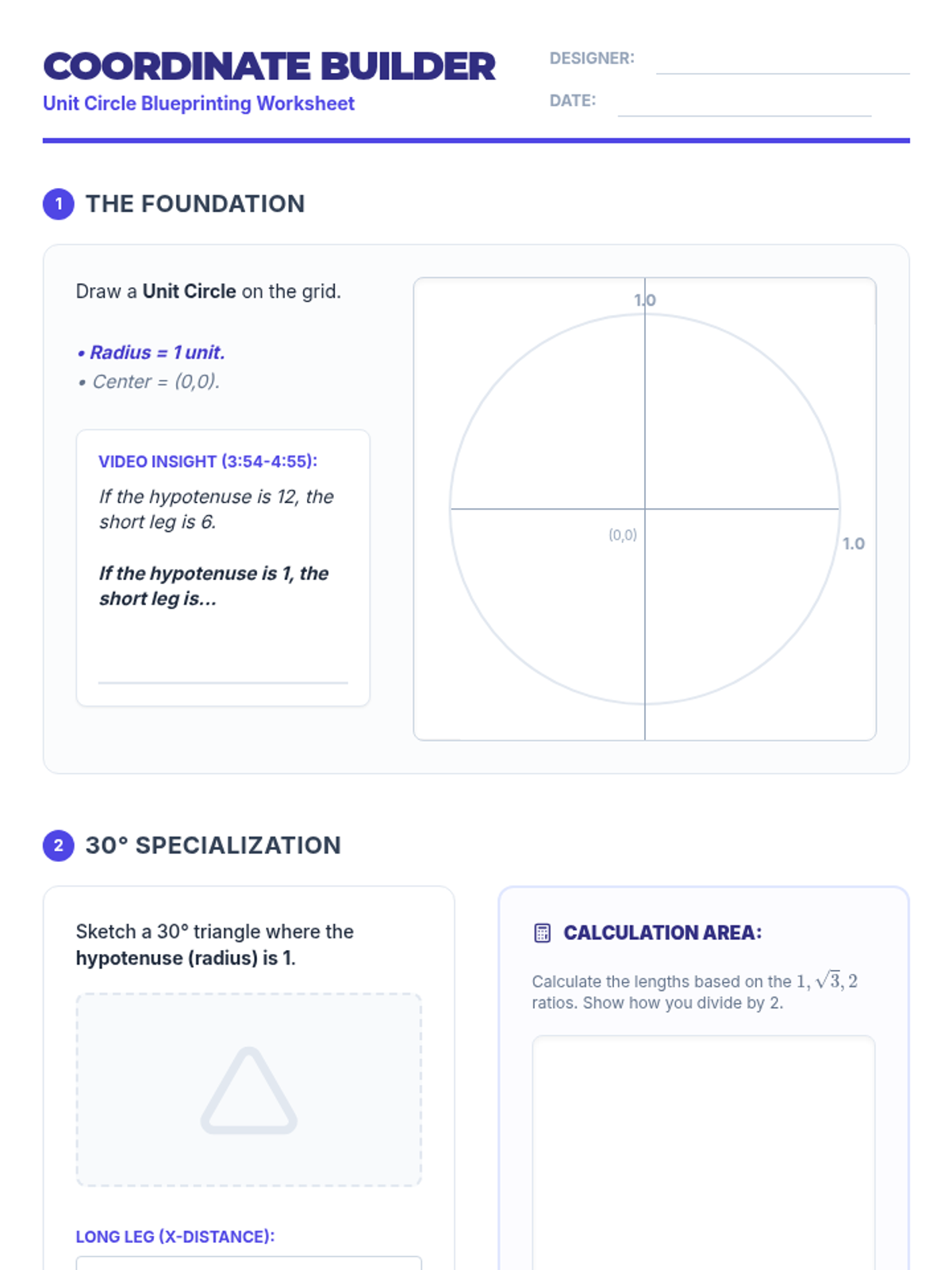
A specialized worksheet for students to 'build' the unit circle by calculating the x and y coordinates for 30° and 60° angles using special right triangle ratios.
A visual slide deck guiding students through the 'Unit Circle Architect' lesson, featuring video integration, warm-up prompts, and the main activity instructions.
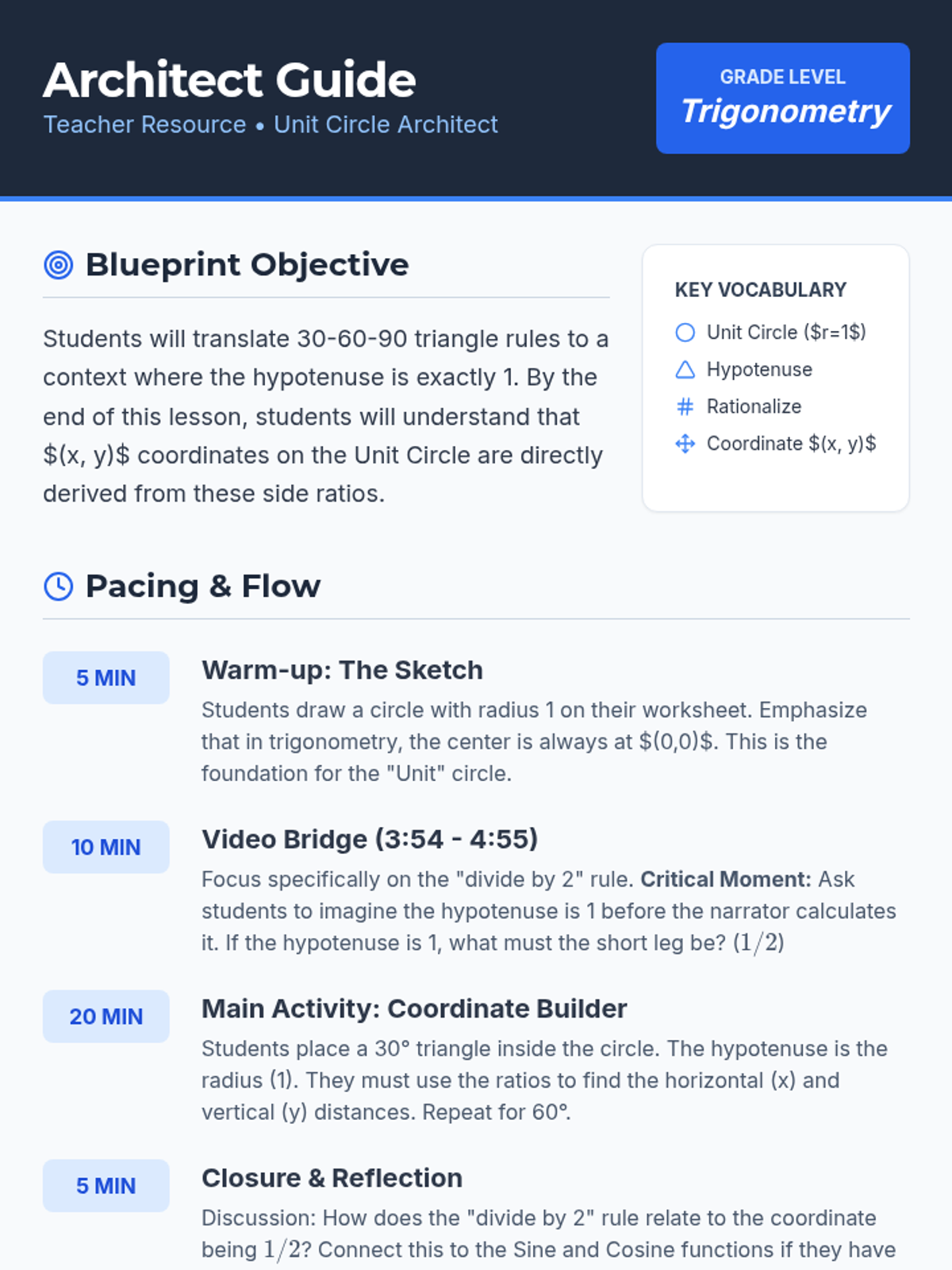
A comprehensive teacher guide for the Unit Circle Architect lesson, including timing, pacing, answer keys, and common misconceptions for connecting special right triangles to coordinates.
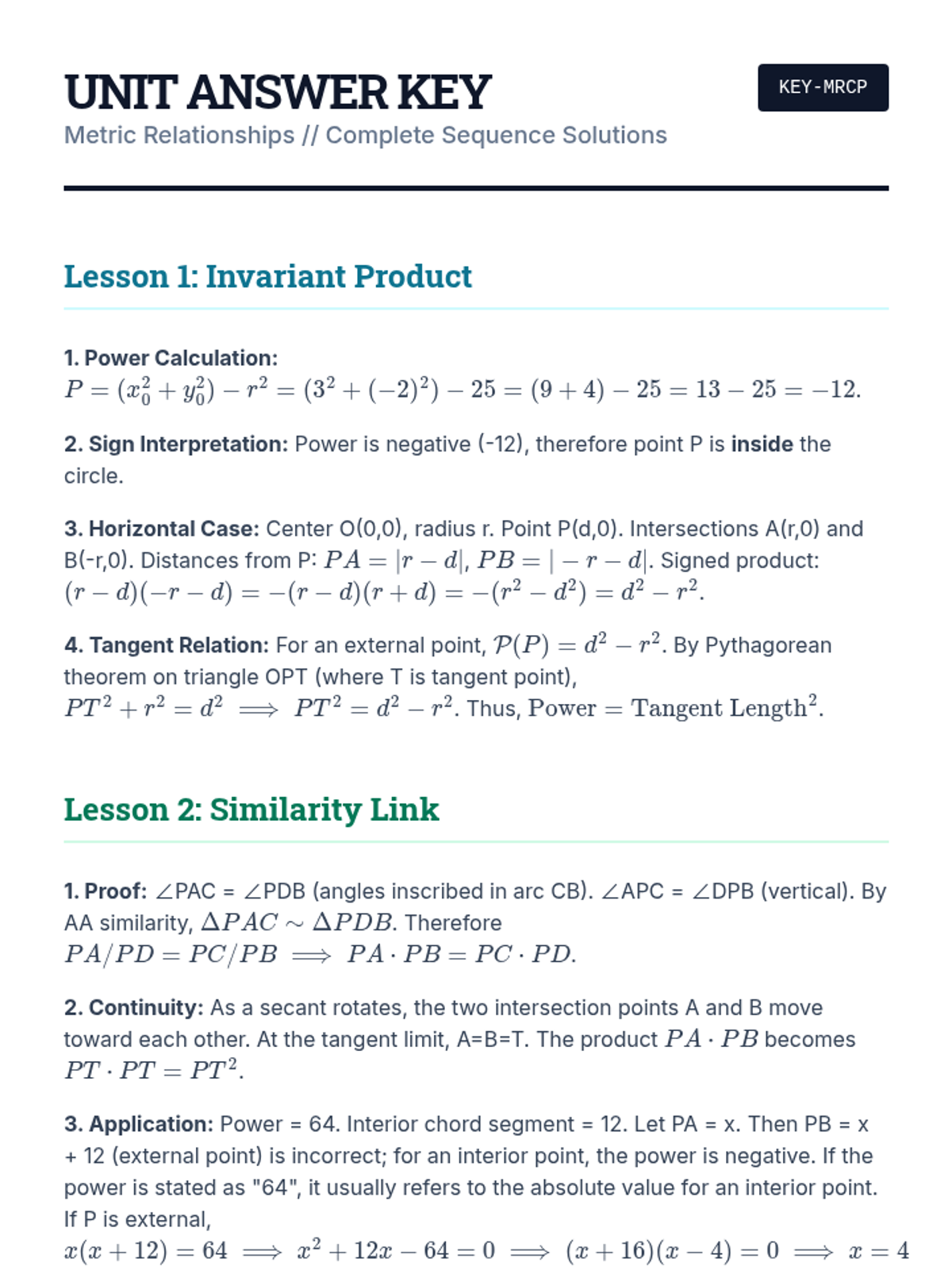
Complete answer key for all student worksheets in the Circle Power sequence. Provides step-by-step solutions for algebraic derivations, proofs, and numerical applications.
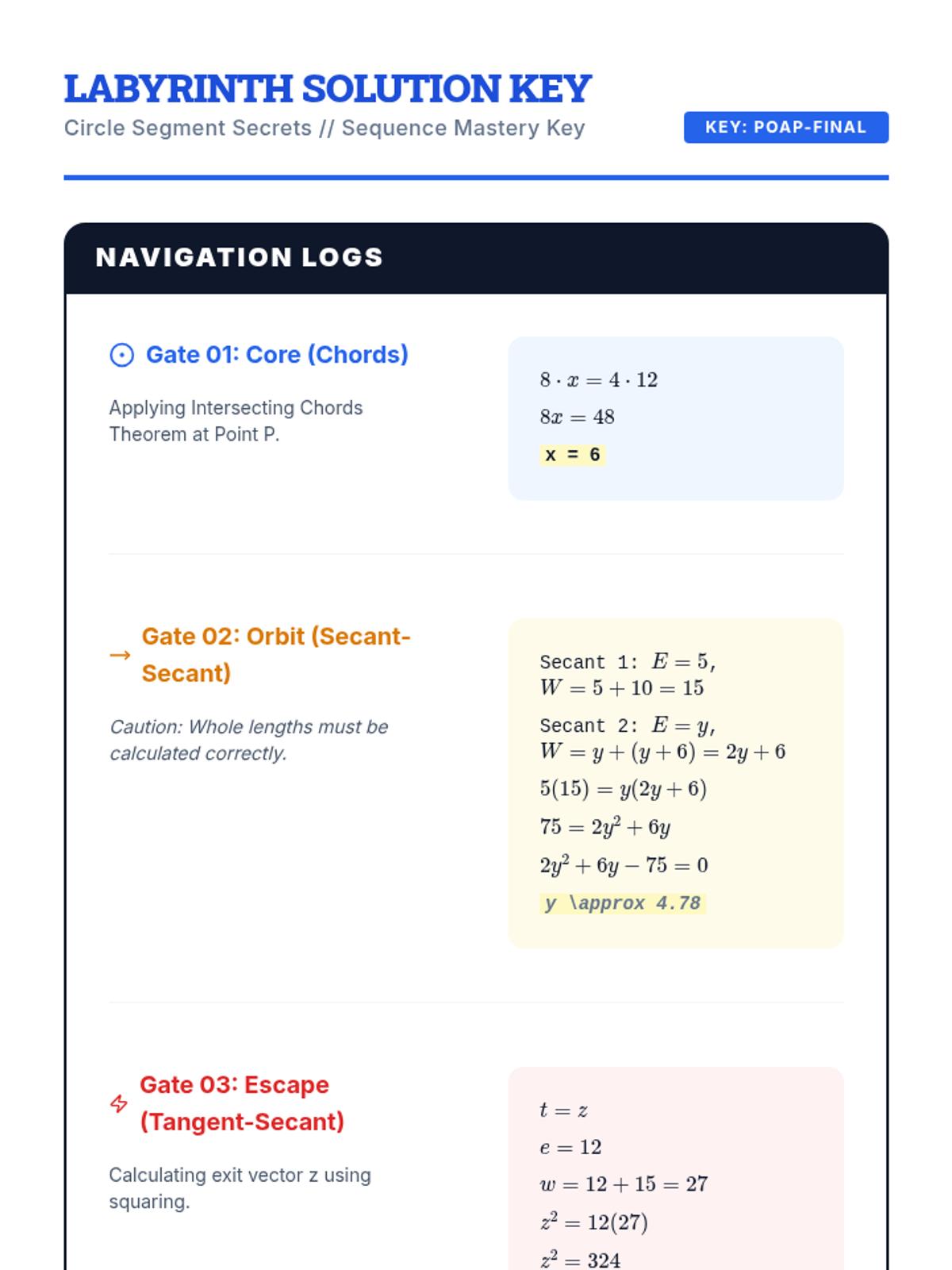
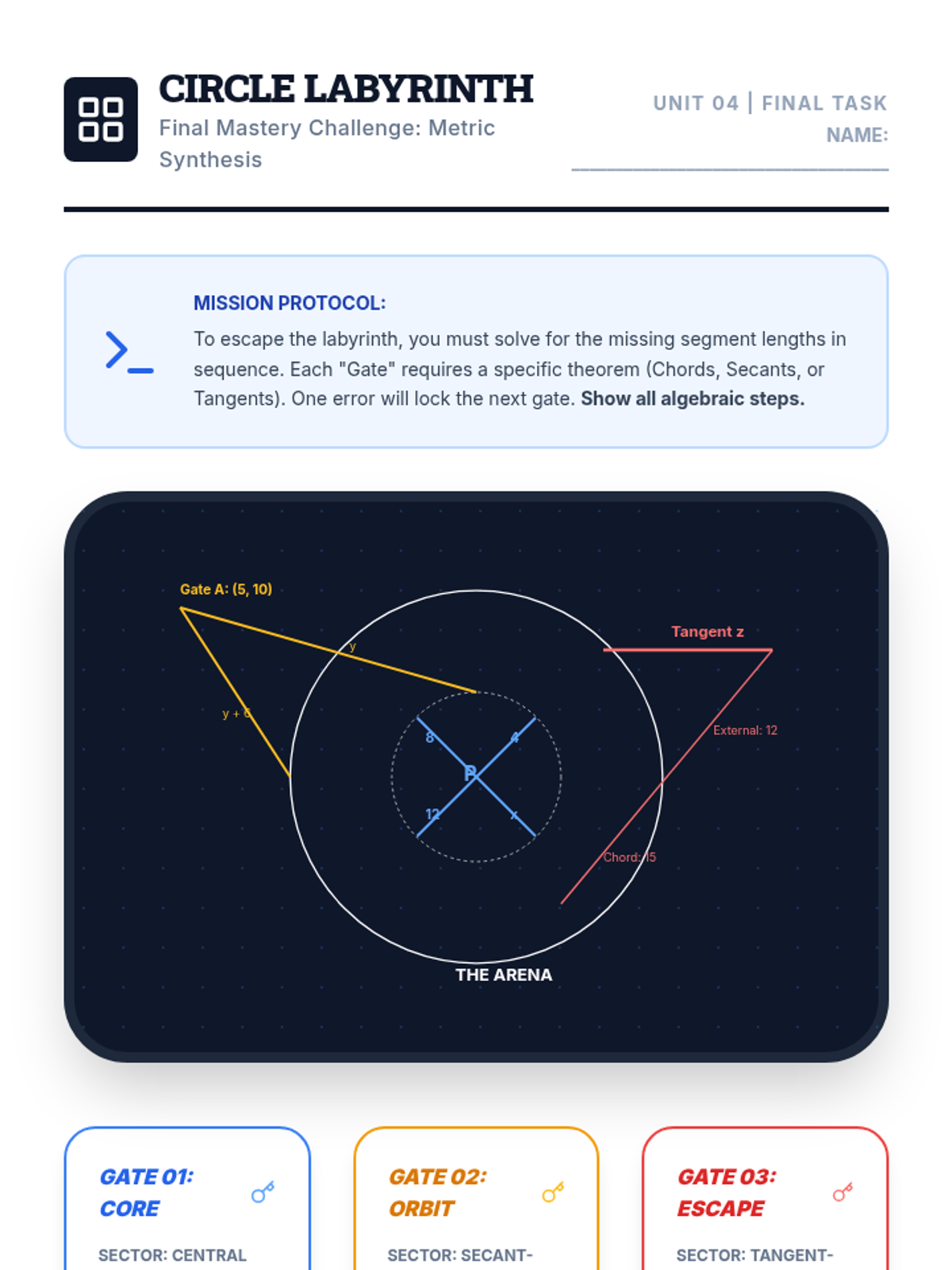
Detailed teacher answer key for the Lesson 5 Circle Labyrinth. Includes step-by-step algebraic breakdowns for all gates and explains the conceptual trick in the final internal tangent challenge.
Final slide deck for Lesson 5. Provides a strategy matrix for selecting circle theorems and offers master hints for avoiding common algebraic pitfalls in complex problems.
Inquiry-based mastery task for Lesson 5. Students navigate a "Circle Labyrinth" by solving a series of interconnected problems involving chords, secants, and tangents, culminating in a complex common tangent challenge.
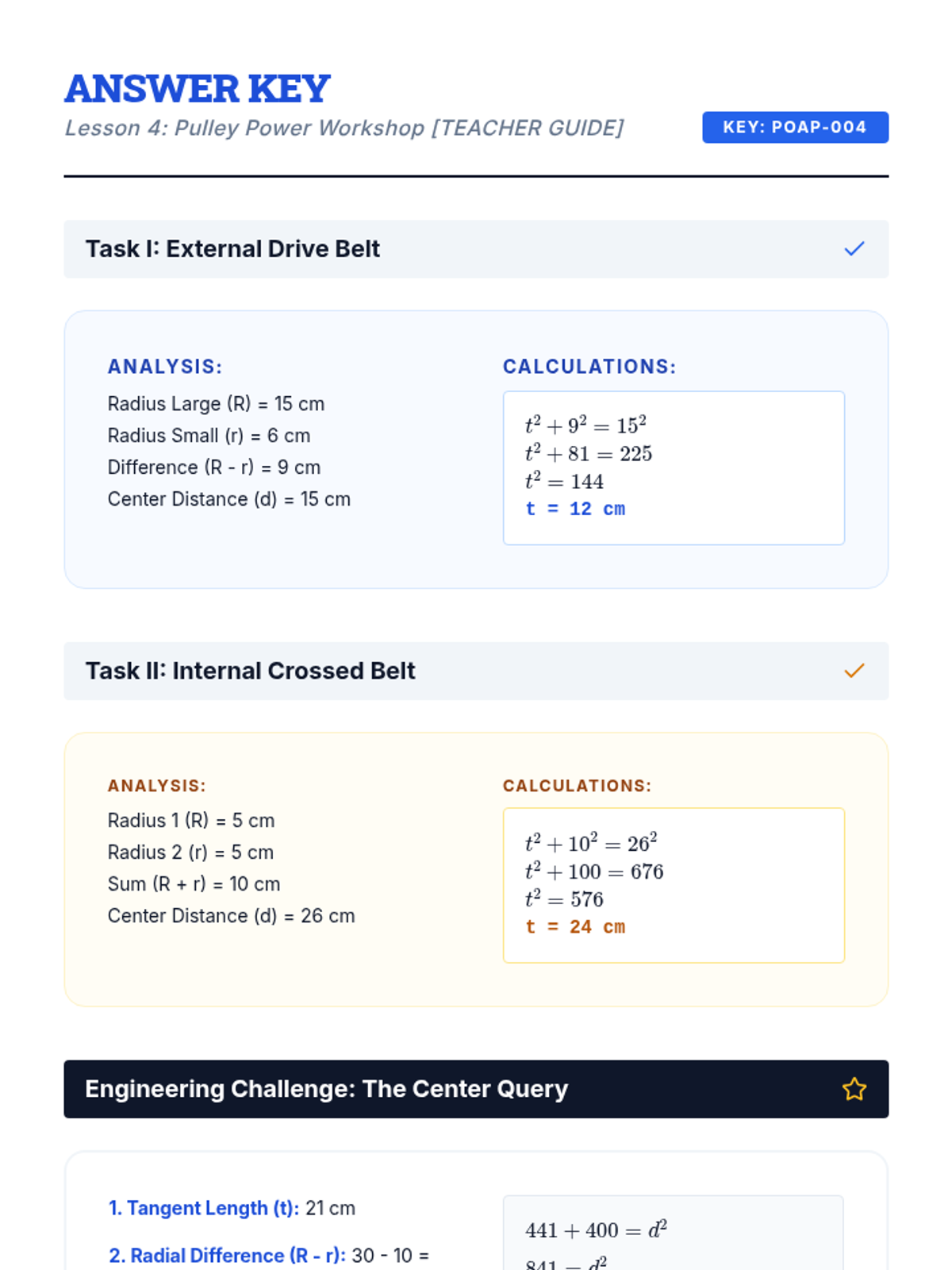
Teacher answer key for the Lesson 4 Pulley Power Workshop. Includes step-by-step solutions for external belt segments, internal crossed belts, and the final center-distance challenge using the Pythagorean theorem.
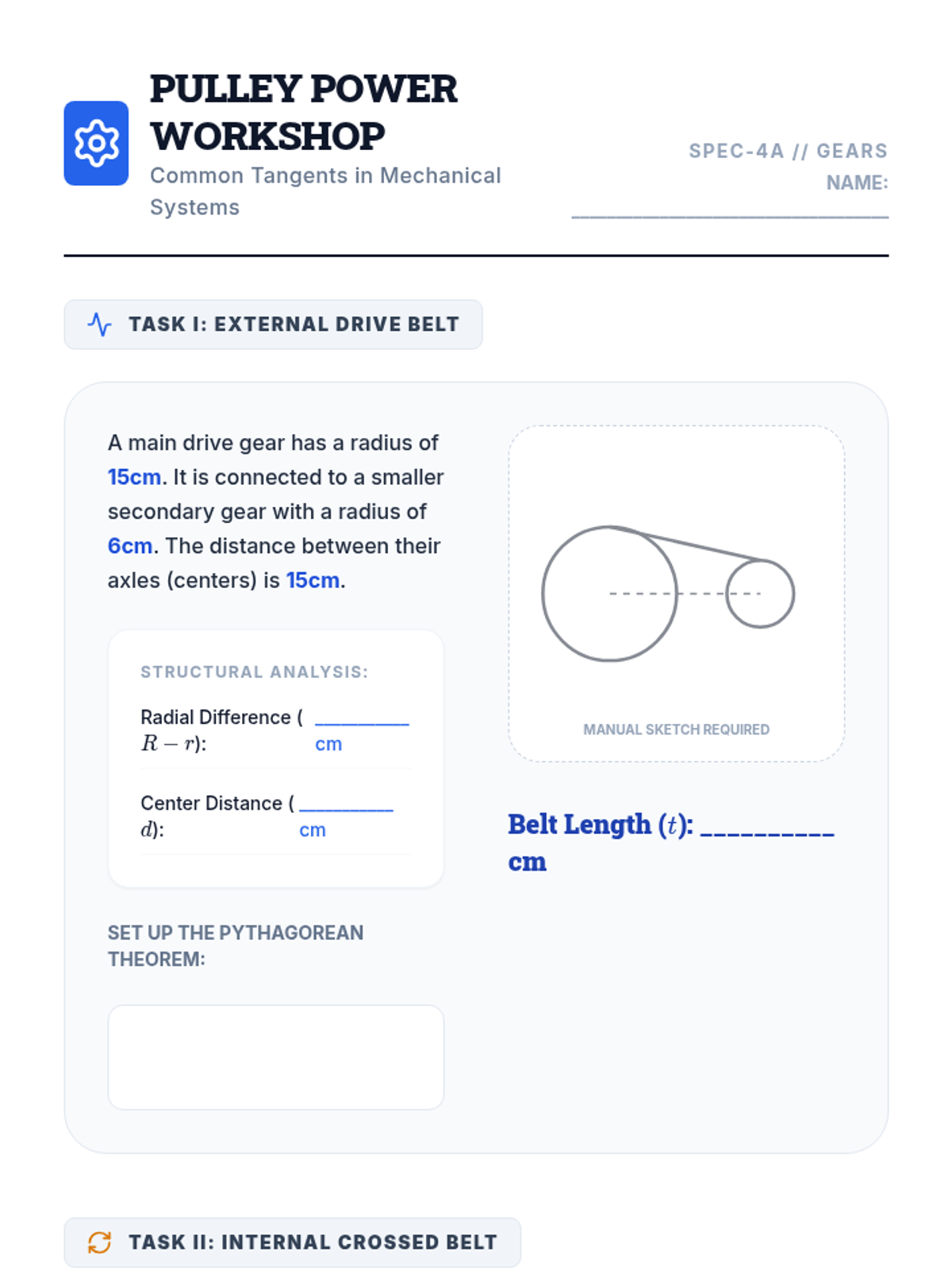
Worksheet for Lesson 4 on Common Tangent applications. It features real-world scenarios involving gear systems and belt drives, requiring students to apply the Pythagorean theorem through auxiliary right triangles to find tangent lengths and center distances.
Slide deck for Lesson 4 on Common Tangent relationships. It explains the translation strategy for both internal and external common tangents, utilizing auxiliary right triangles and the Pythagorean theorem.
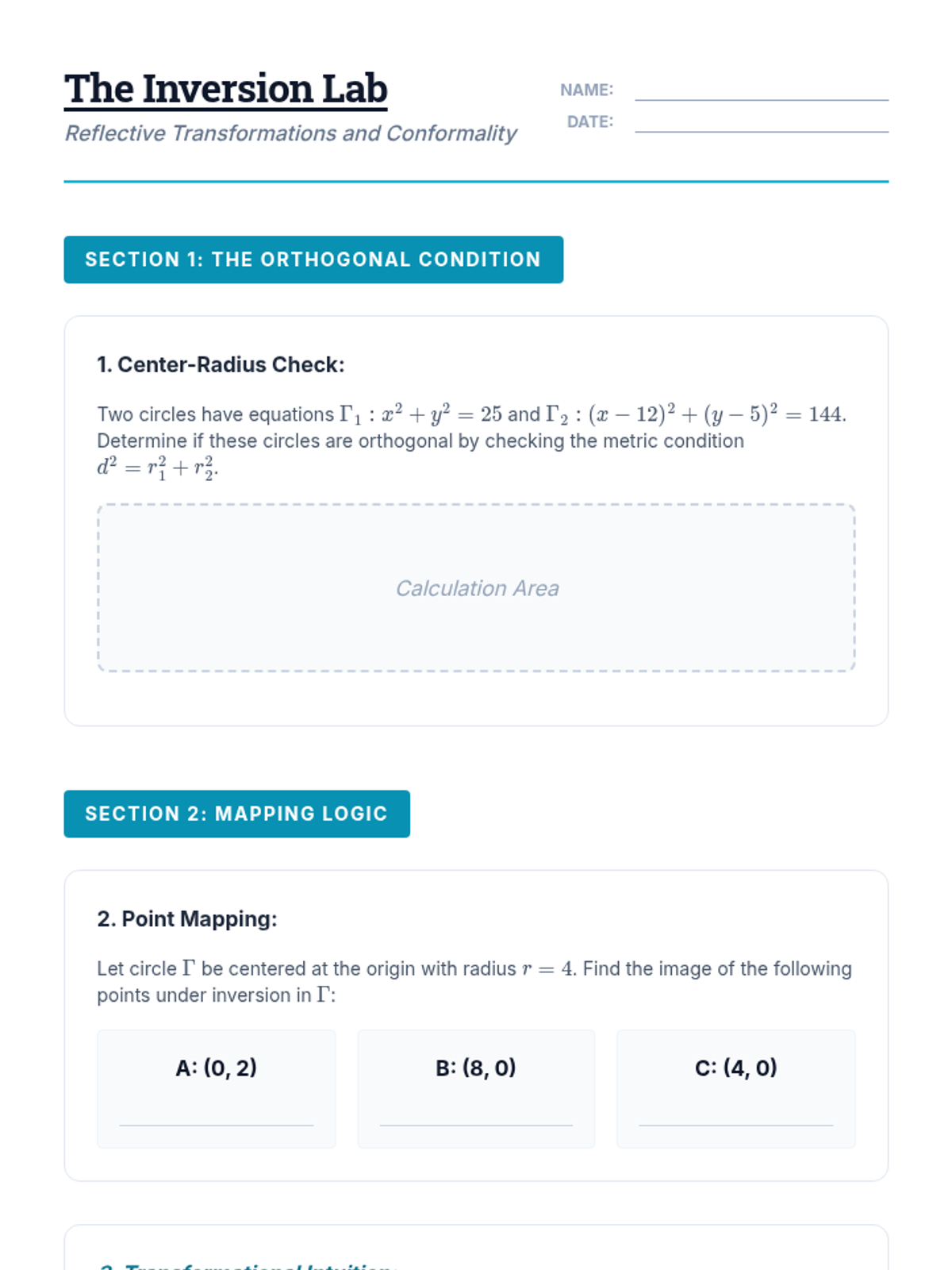
Student activity sheet focusing on the algebraic and geometric derivation of inversion, point mapping, and the relationship between inversion and orthogonal circles. Revised for improved readability and work space.
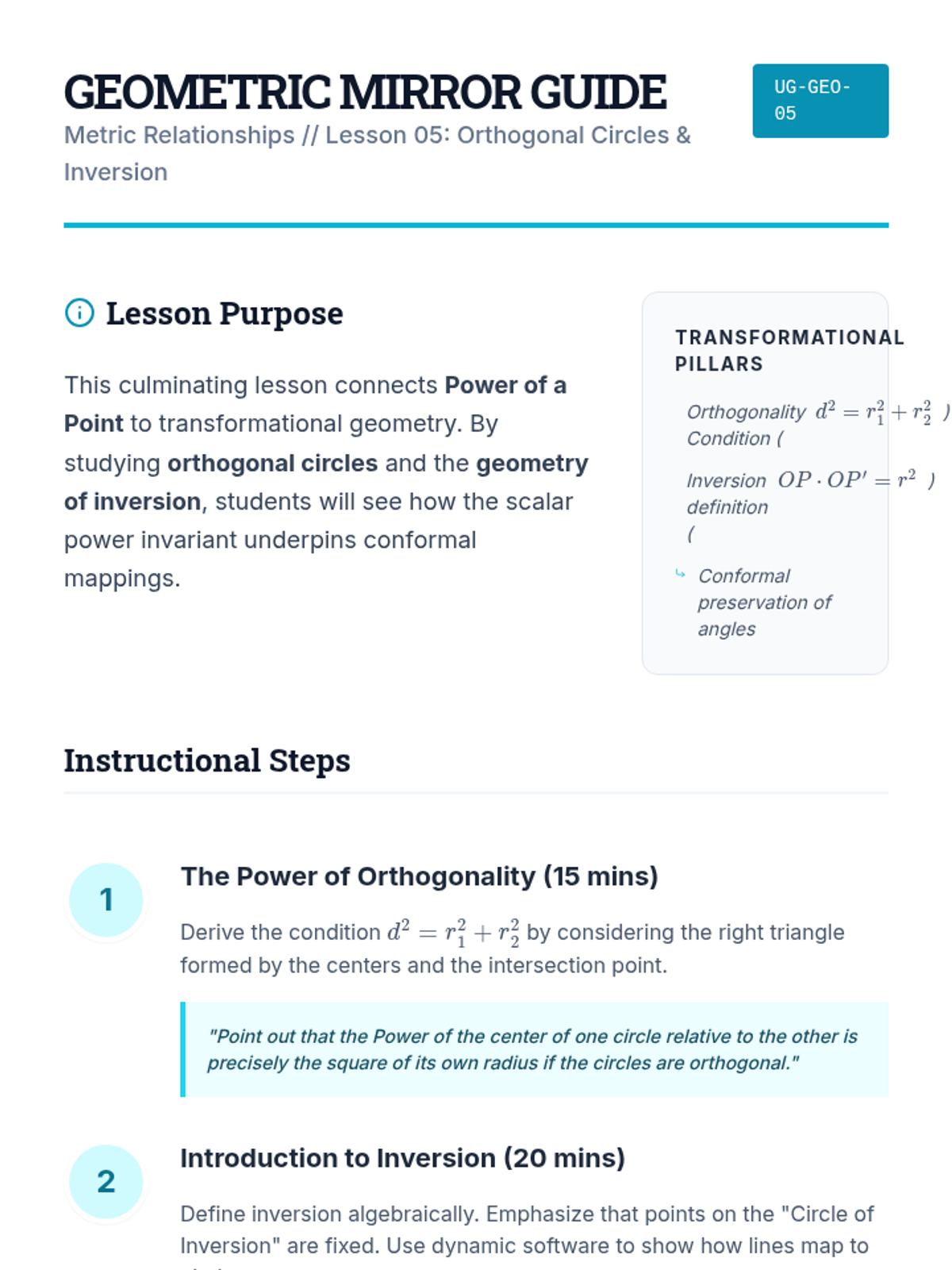
Teacher facilitation guide for the culminating lesson on orthogonal circles and geometric inversion. Includes metric conditions, mapping rules, and coordinate formulas.
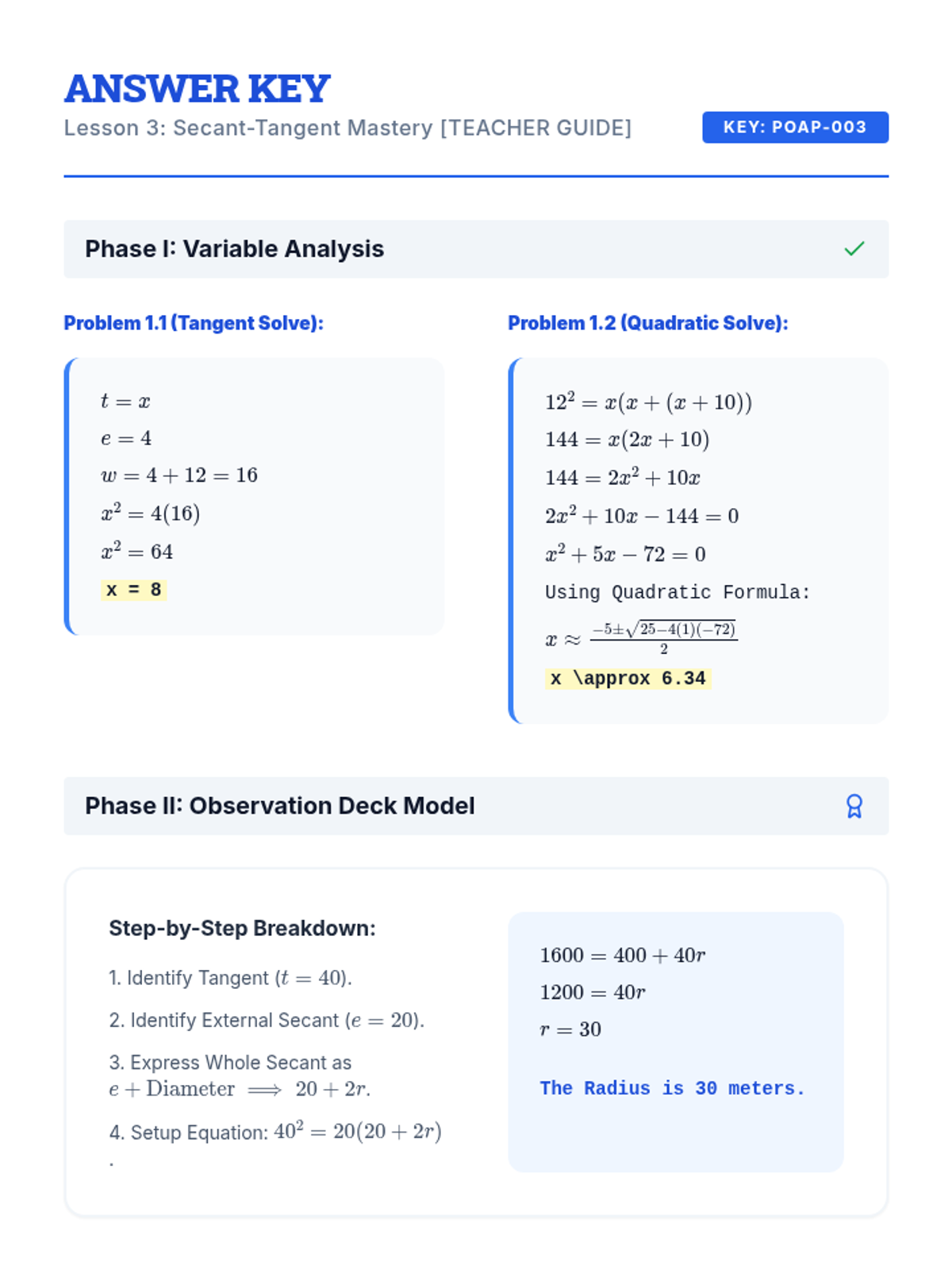
Teacher answer key for the Lesson 3 Secant-Tangent Modeling Task. Provides step-by-step algebraic solutions for all problems, including the quadratic case and the multi-step pool radius challenge.
Slide presentation on the condition for orthogonal circles and the transformational geometry of inversion. Explores mapping properties and conformal preservation.
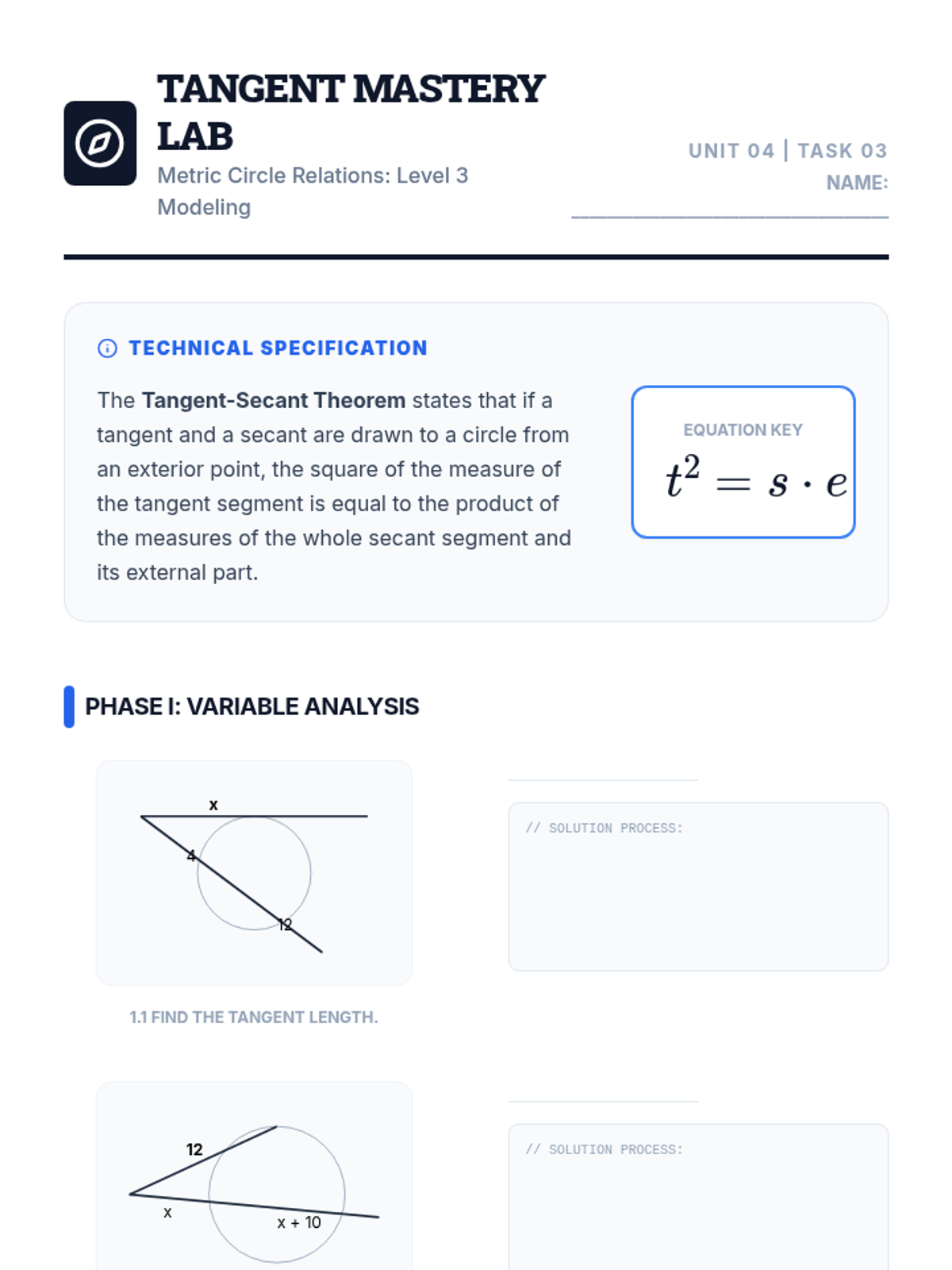
Inquiry-based mastery task for Lesson 3 focusing on Secant-Tangent intersections. Includes progressive algebraic problems and a complex real-world modeling challenge to calculate the radius of a circular pool using tangent lengths.
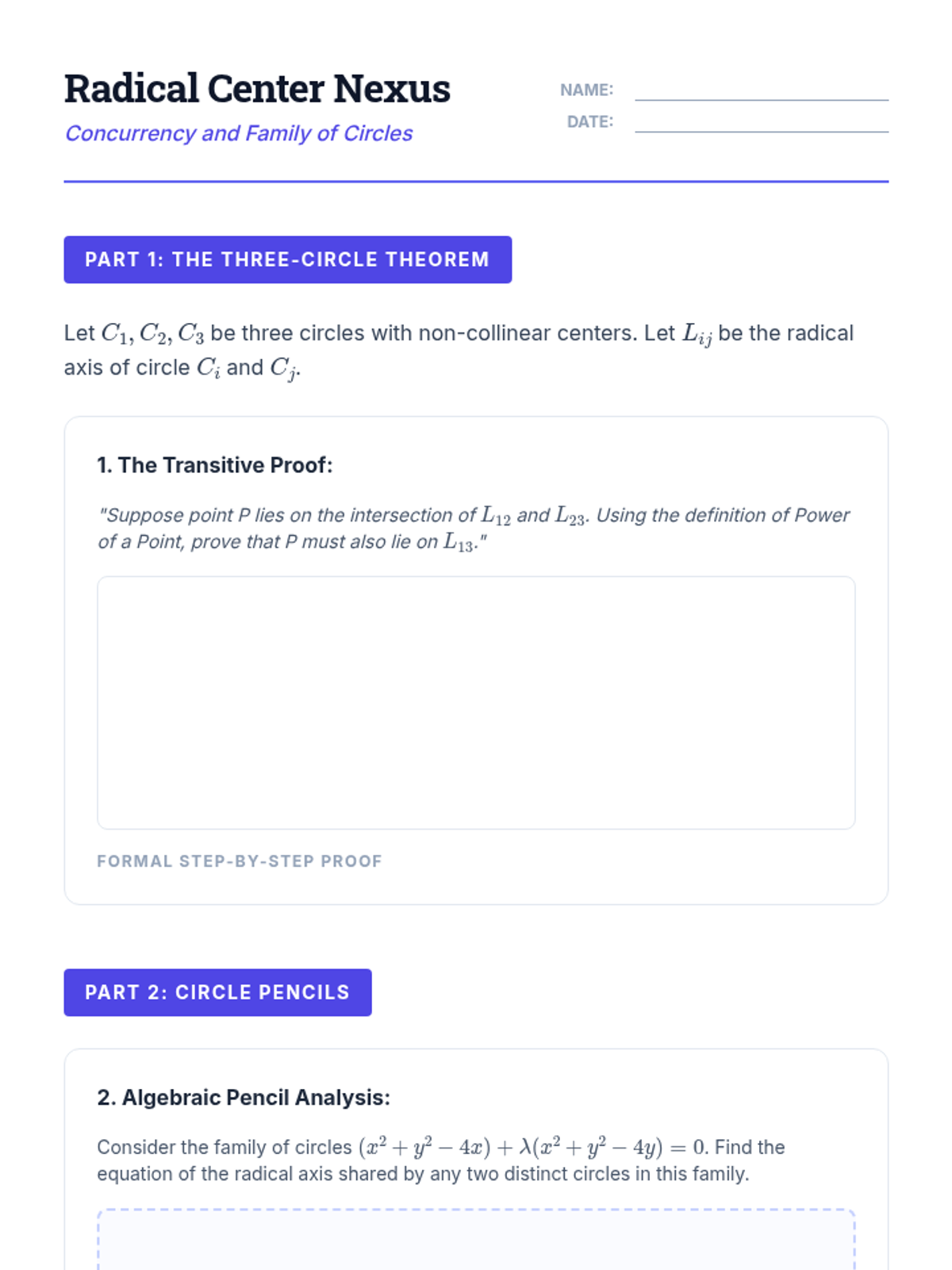
Student activity sheet focusing on concurrency proofs for radical axes, algebraic analysis of circle pencils, and the construction of orthogonal circles. Revised for improved readability and work space.
Slide deck for Lesson 3 on Secant-Tangent relationships. It explains the theorem as a limiting case, provides a similarity proof, and demonstrates real-world applications like calculating the distance to the horizon.
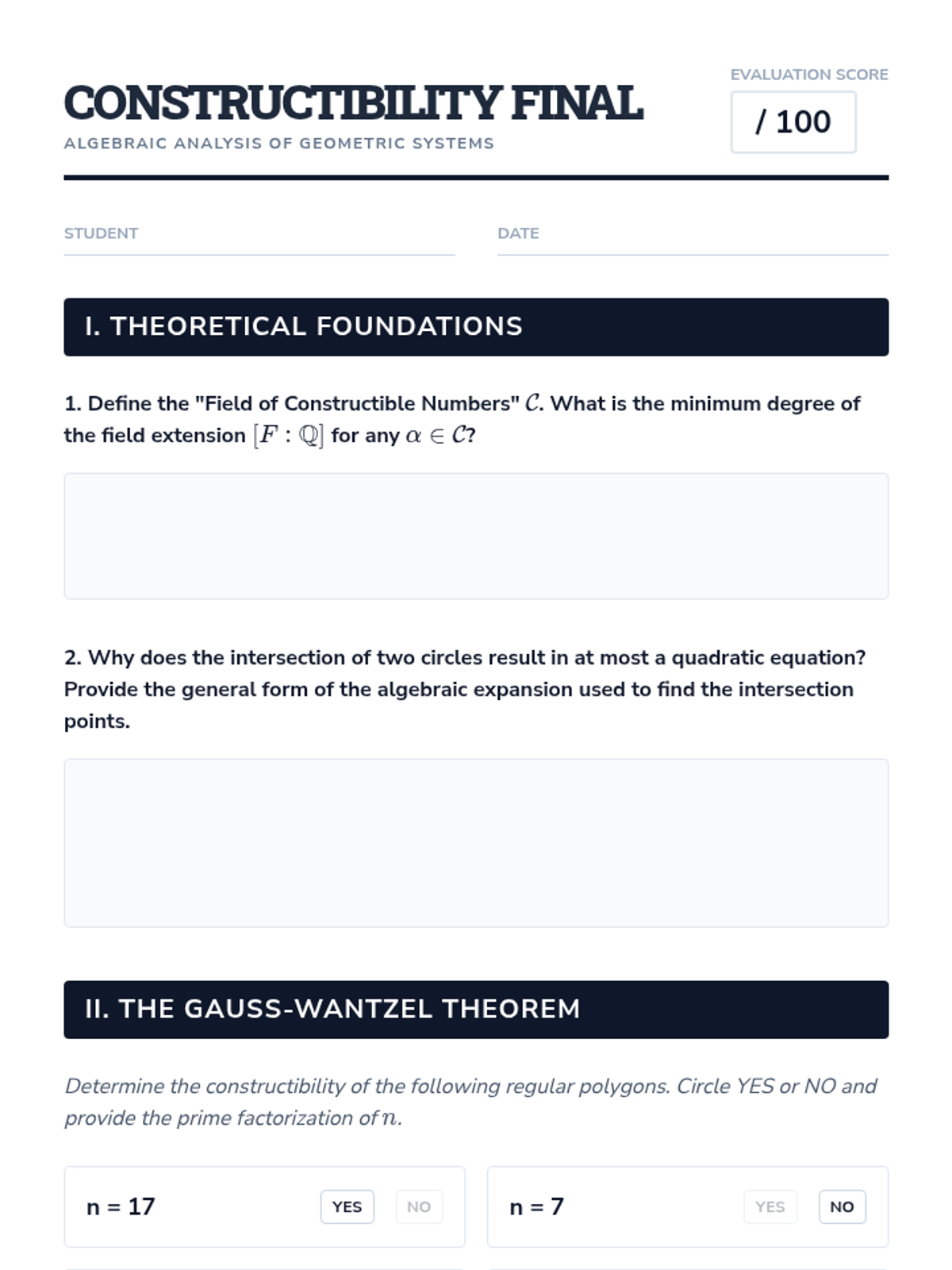
Cumulative assessment for the Constructible Polygons sequence, covering field theory, the Gauss-Wantzel Theorem, and impossibility proofs.
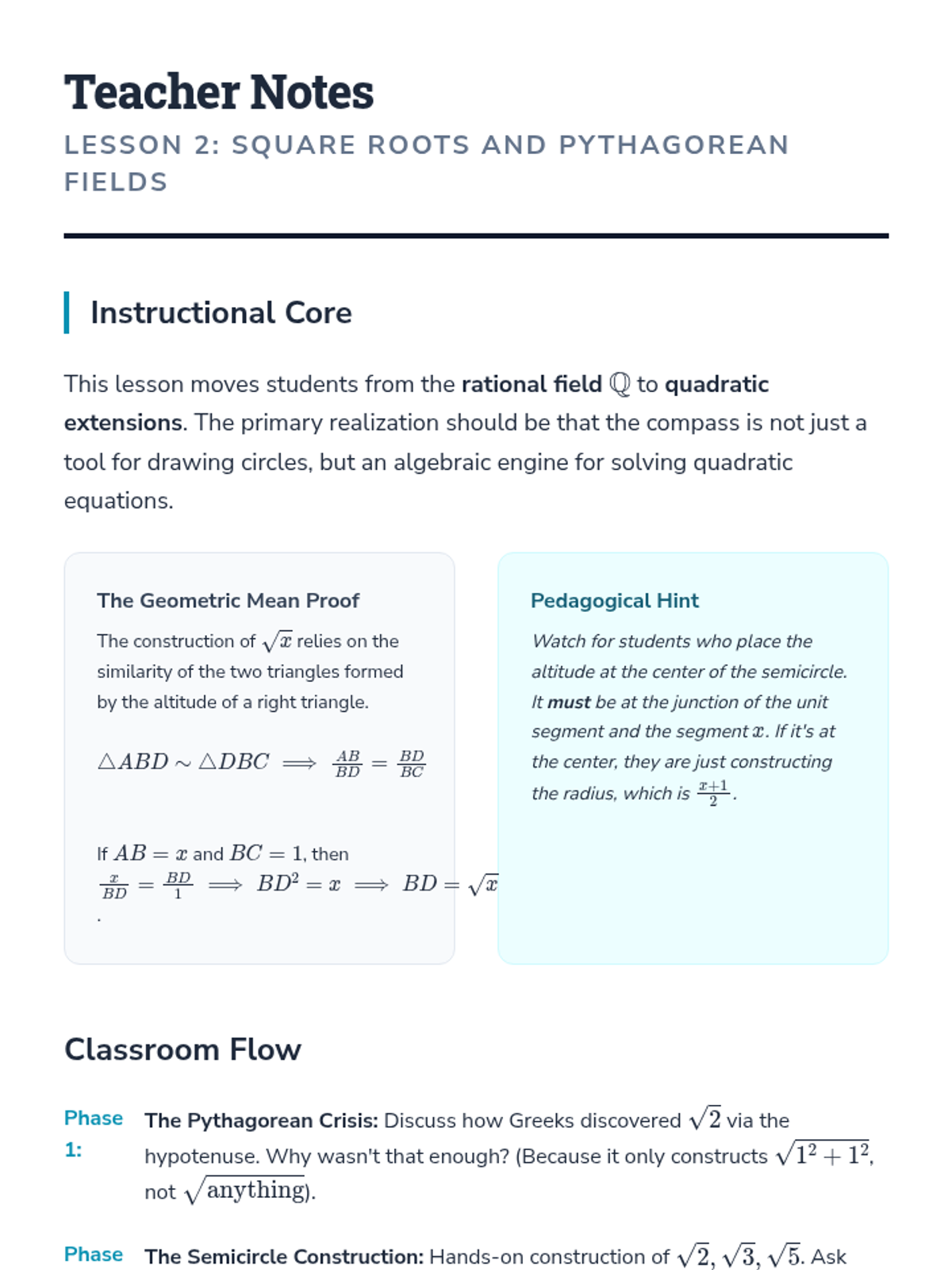
Teacher instructional notes for Lesson 2, detailing the construction of square roots, the algebraic proof of the geometric mean, and the concept of quadratic field extensions.
Slide deck for Lesson 5, explaining the impossibility of certain geometric constructions (angle trisection, doubling the cube) using field theory and cubic equations.
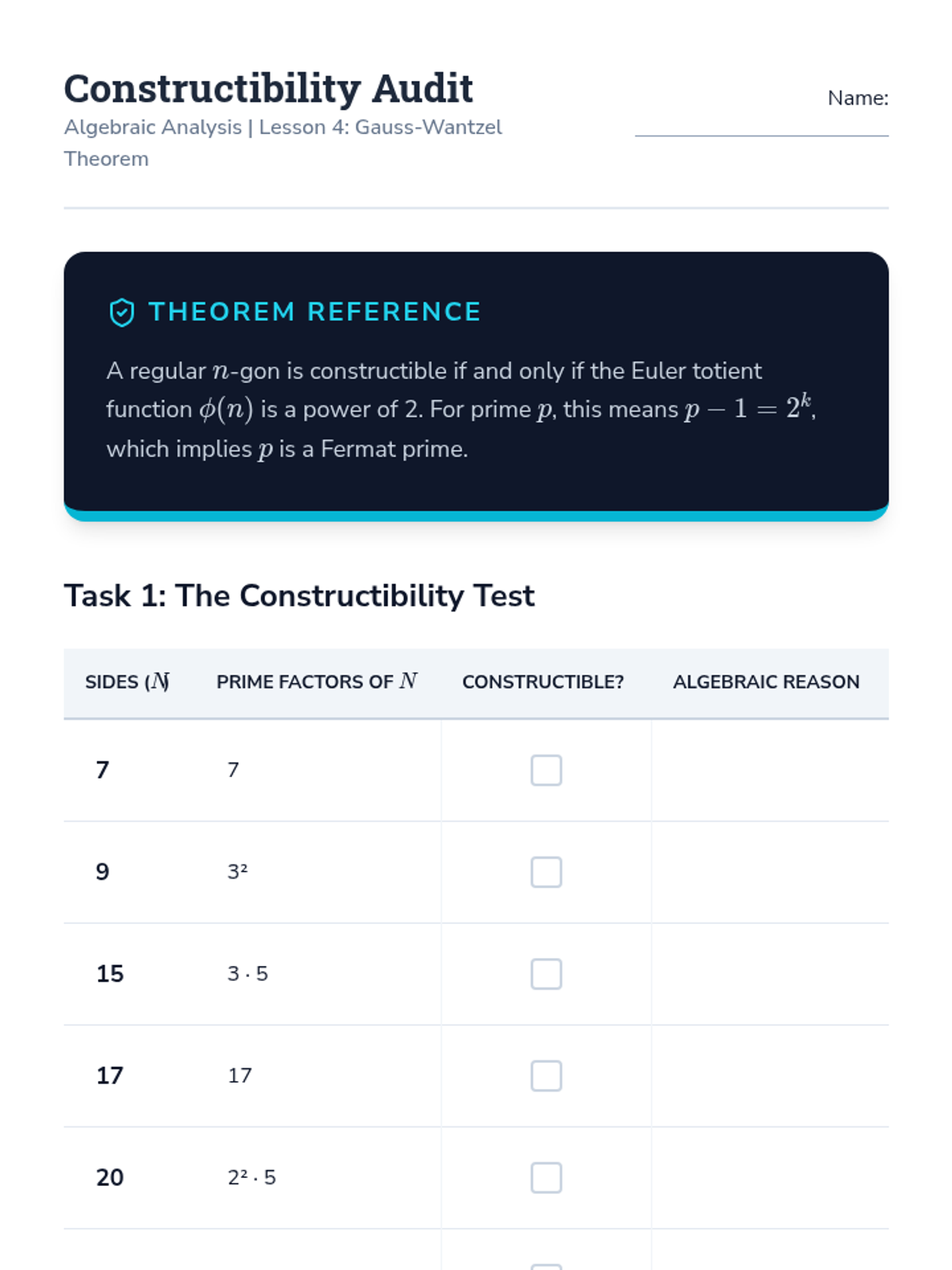
Worksheet for Lesson 4 where students apply the Gauss-Wantzel Theorem to determine the constructibility of various regular polygons and analyze the algebraic requirements.
Slide deck for Lesson 4, explaining the Gauss-Wantzel Theorem and Fermat primes, exploring the constructibility of the 17-gon and the tower of field extensions.
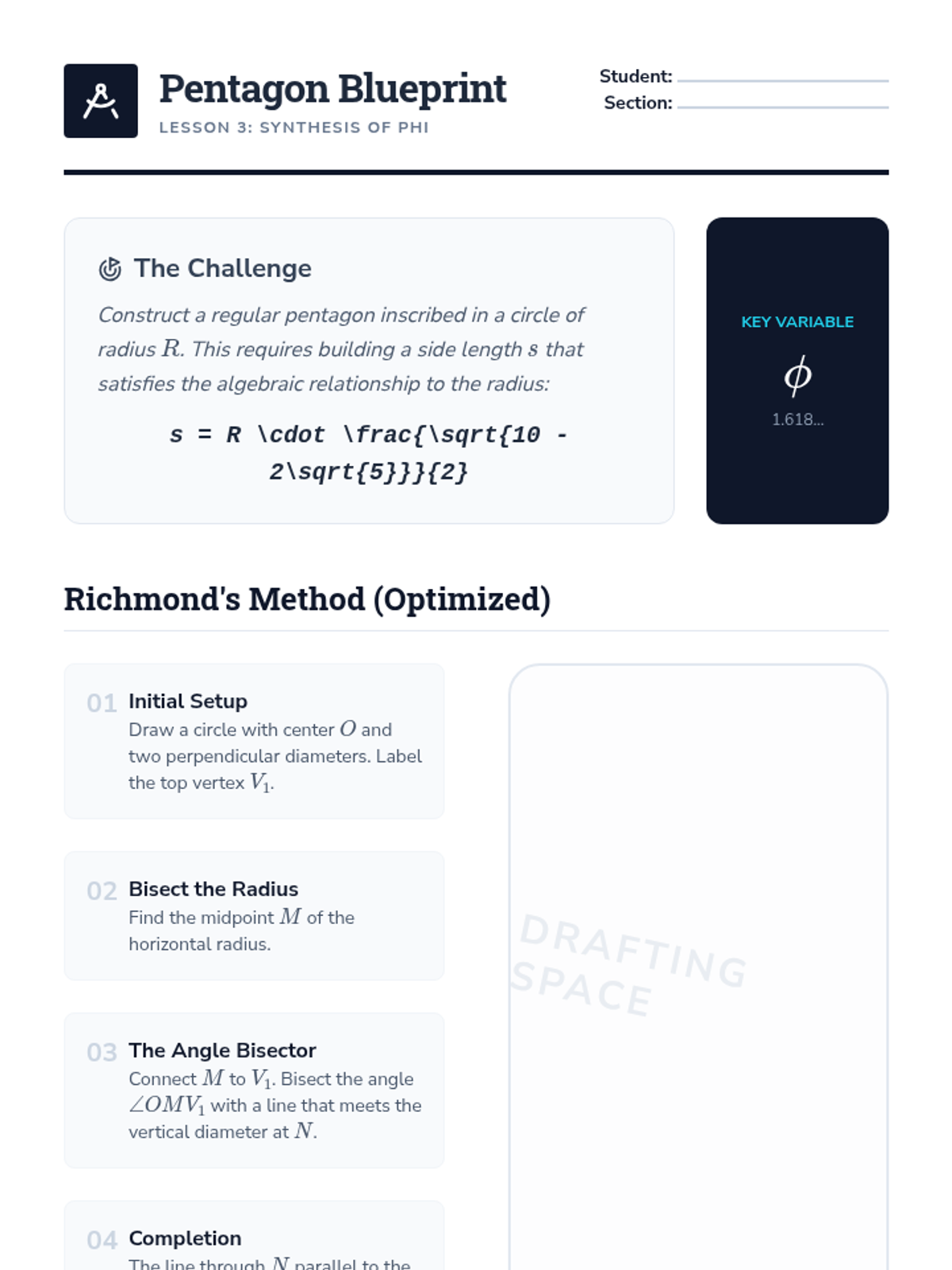
Construction guide for Lesson 3 detailing Richmond's method for constructing a regular pentagon and its algebraic justification.
Slide deck for Lesson 3, explaining the construction of the Golden Ratio and its application in building a regular pentagon, emphasizing the link to quadratic equations.
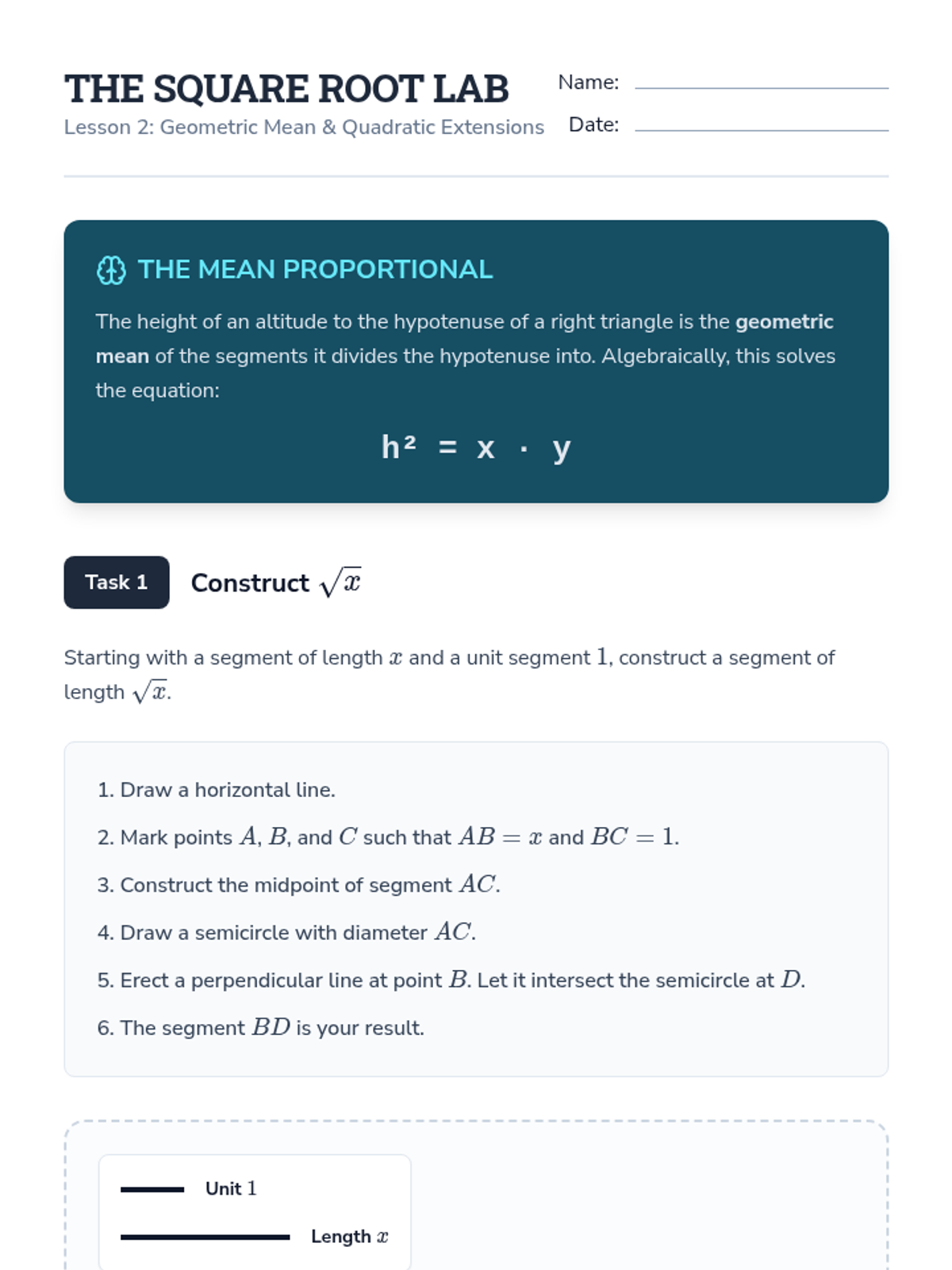
Laboratory handout for Lesson 2 guiding students through the geometric construction of square roots and the associated algebraic proofs.
Slide deck for Lesson 2, explaining the construction of square roots using the geometric mean and the concept of quadratic field extensions in constructible numbers.
Teacher instructional notes for Lesson 1, detailing the transition from geometry to arithmetic, common misconceptions, and discussion prompts regarding field theory.
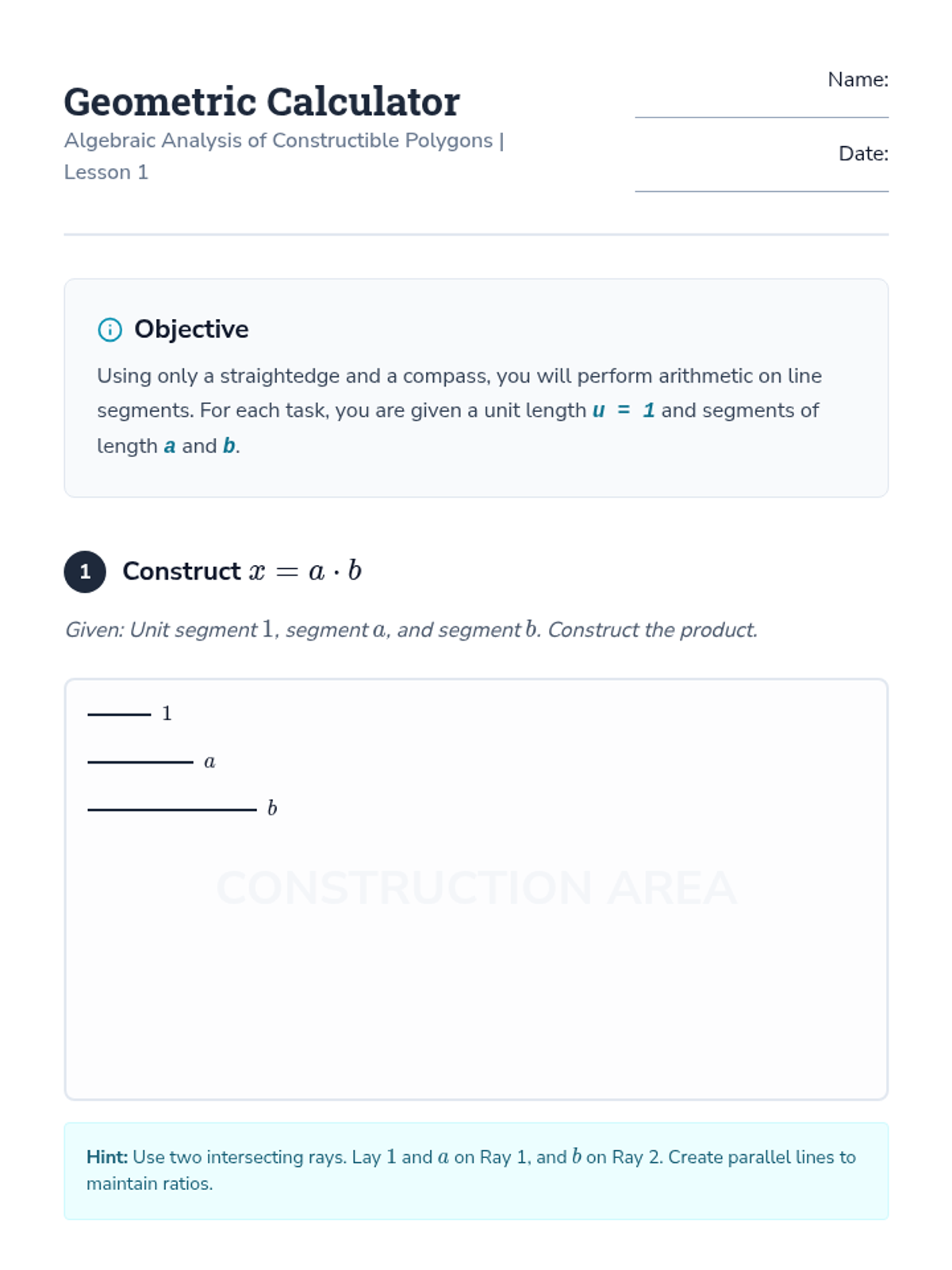
Student worksheet for Lesson 1 where students perform geometric constructions of multiplication and division using similar triangles.
Introductory slide deck for Lesson 1, covering the geometric construction of basic arithmetic operations (addition, subtraction, multiplication, division) and defining the field of constructible numbers.
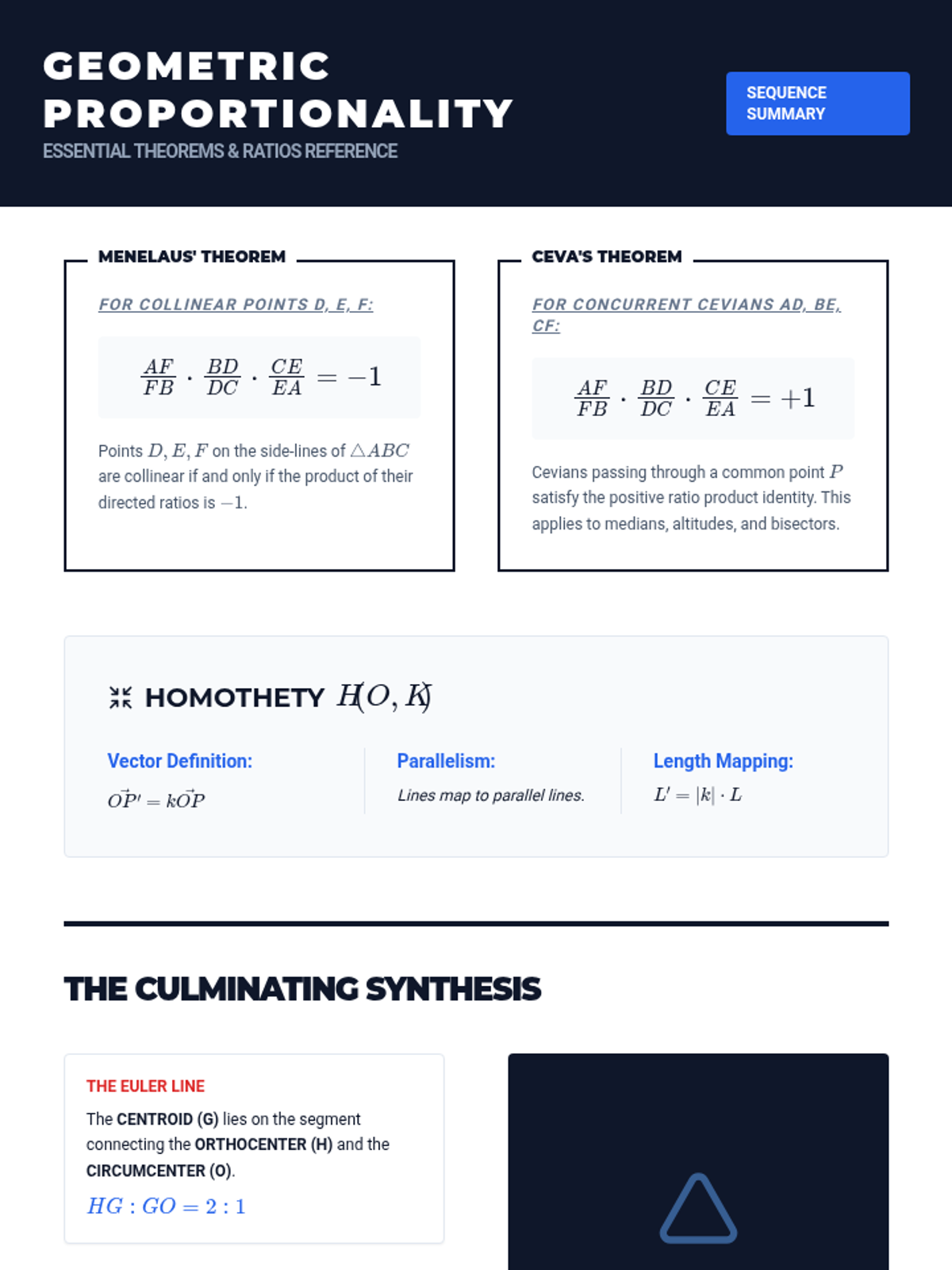
A comprehensive high-level summary of the whole sequence, covering Menelaus' Theorem, Ceva's Theorem, Homothety, and the Euler Line properties for quick student reference.
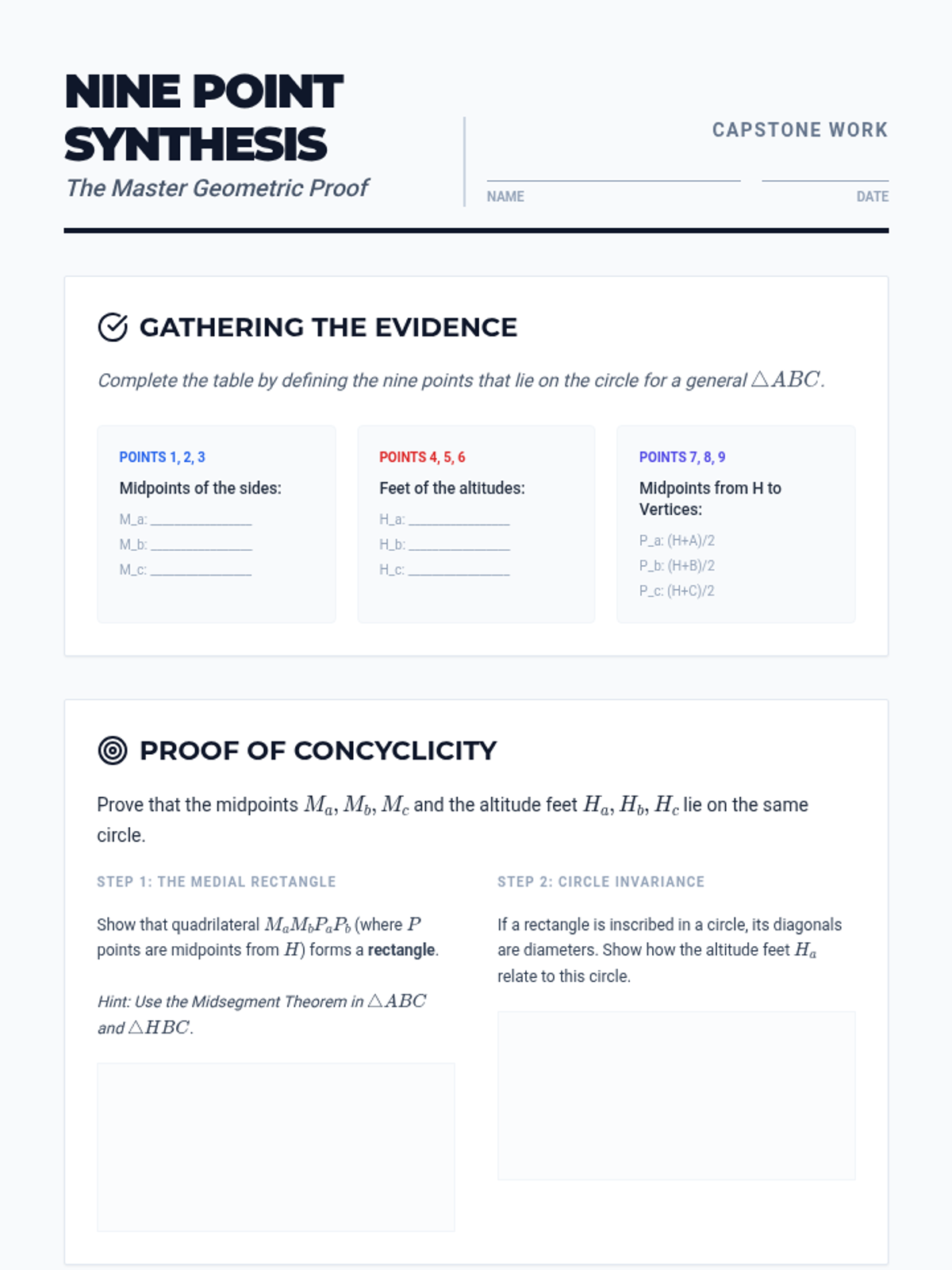
A student activity and proof guide for Lesson 5. It requires students to identify the nine points of the circle and outline the proof using medial rectangles and the Midsegment Theorem.
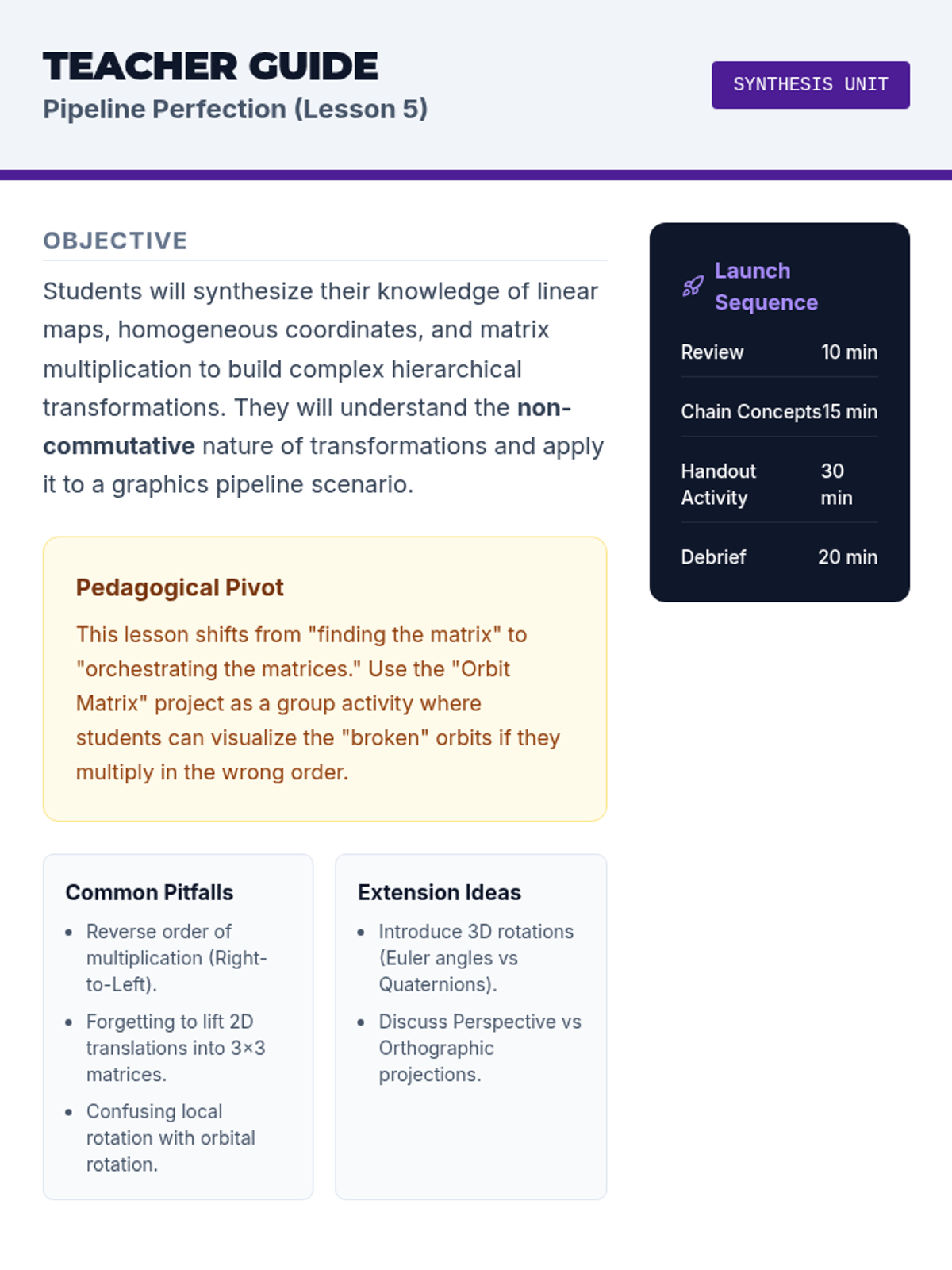
Teacher guide for Lesson 5, including strategy for the hierarchical transformation project and the final matrix solution.
Culminating slides for the sequence that synthesize all previous concepts (ratios, triangle centers, and homothety) to prove the existence of the Euler Line and the Nine-Point Circle.
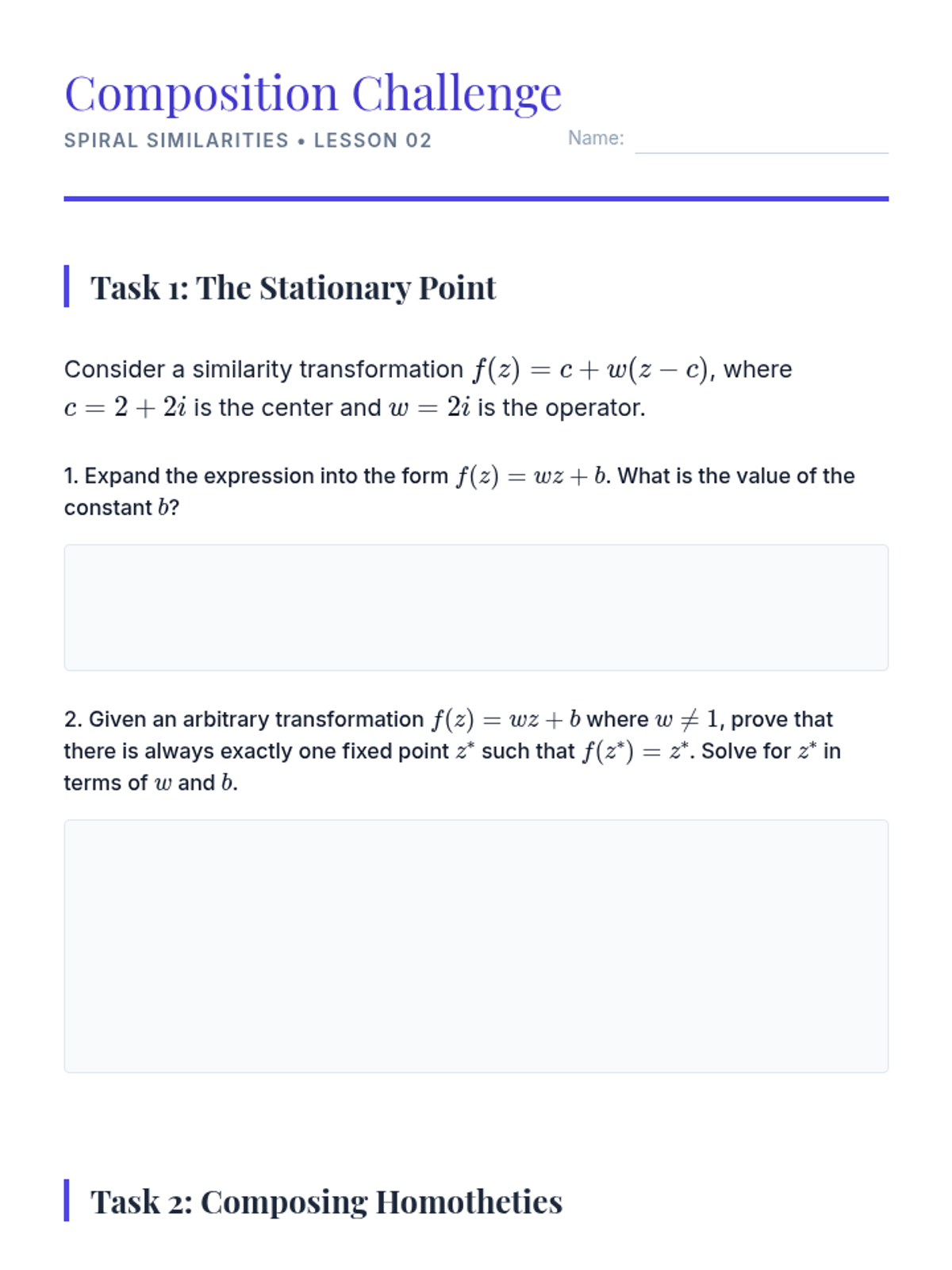
Inquiry-based activity sheet for Lesson 2 exploring fixed points and the composition of two homotheties with different centers. Includes algebraic proofs and conceptual reflection.
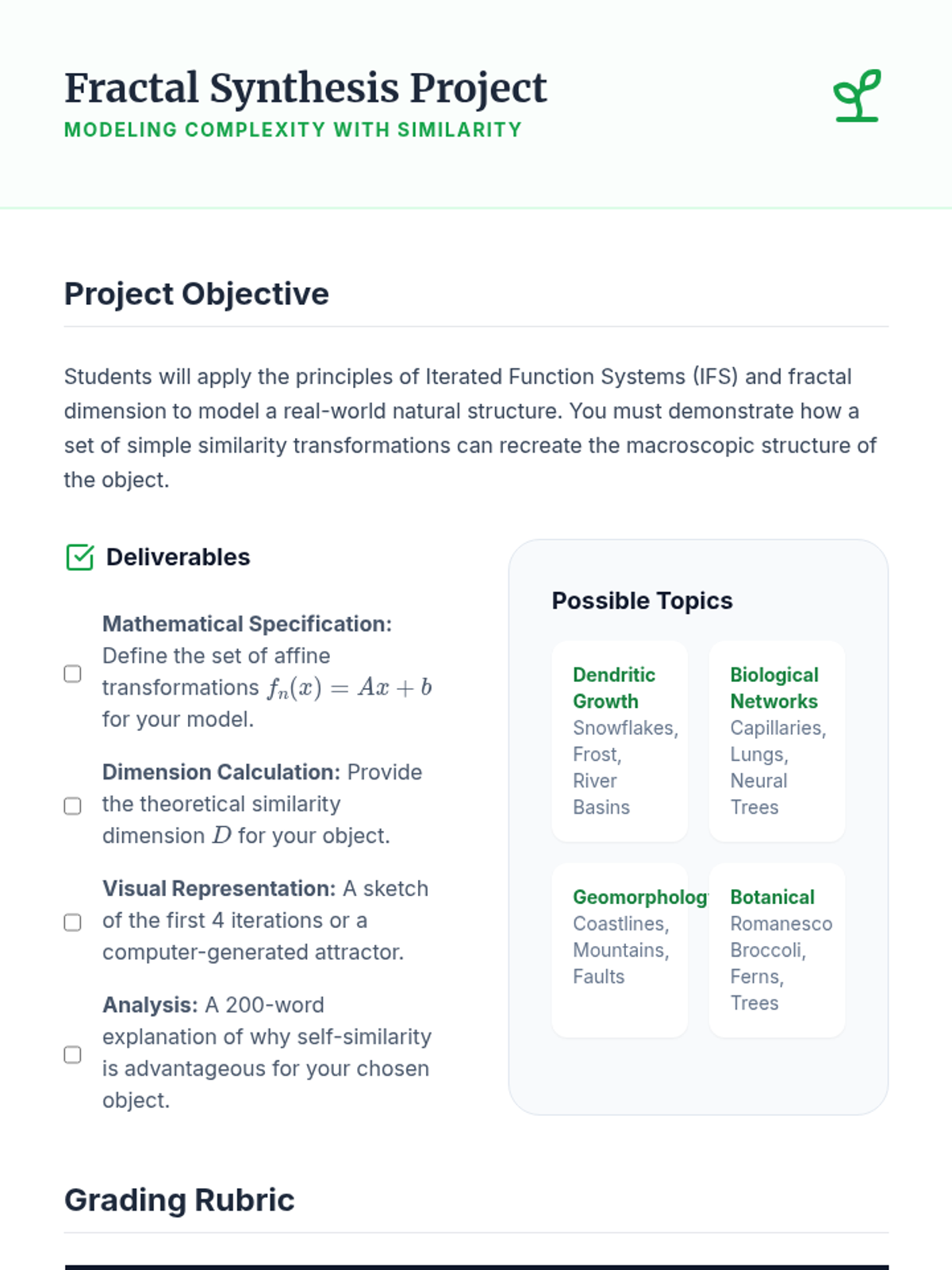
A comprehensive project guide and rubric for students to model natural phenomena using fractal geometry, including mathematical specifications and biological analysis.
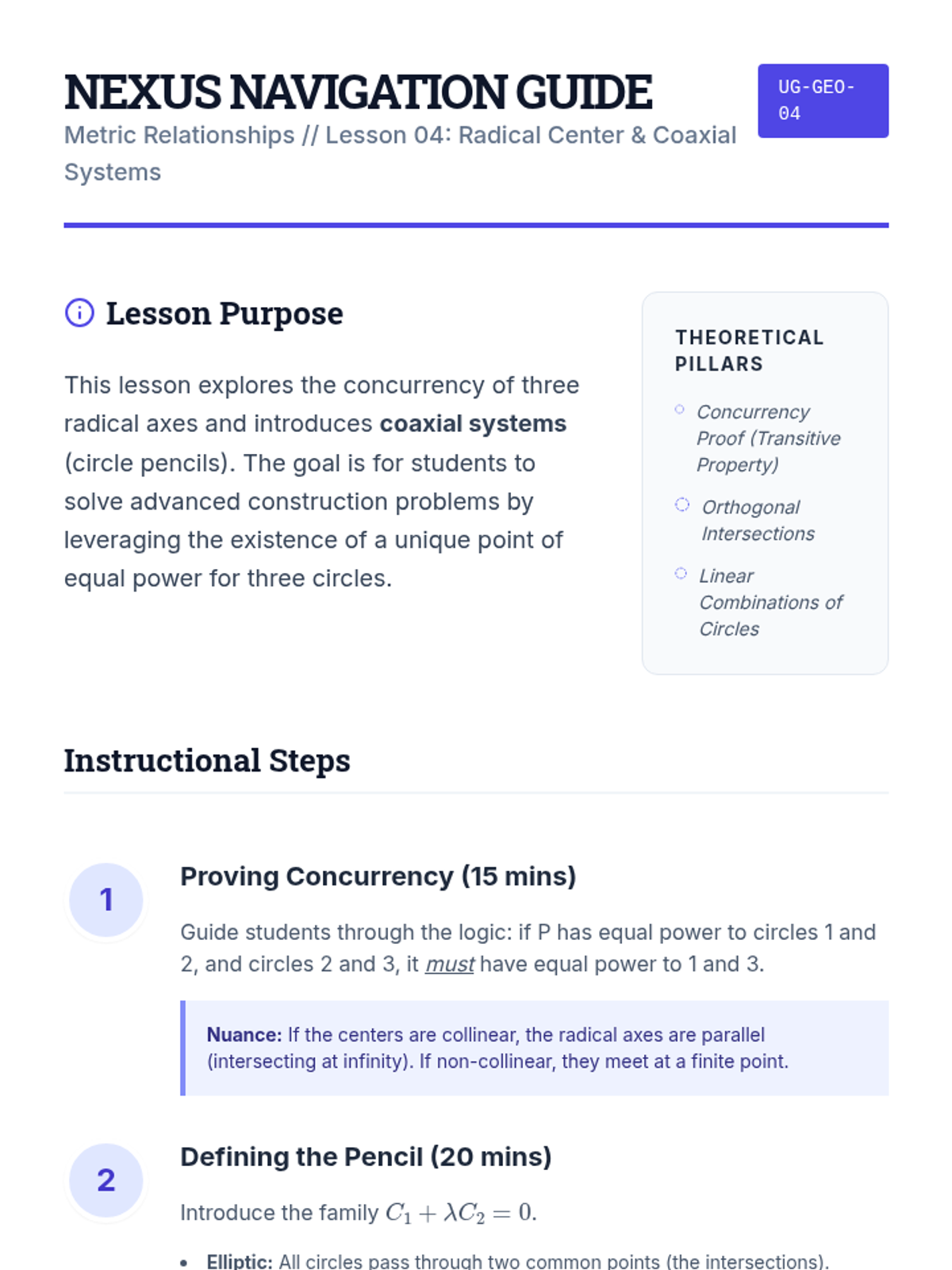
Teacher facilitation guide for the lesson on the Radical Center and coaxial systems. Includes concurrency proofs, discussion points, and orthogonal construction hints.
Slide presentation for undergraduates on the Radical Center and systems of coaxial circles. Covers concurrency proofs, types of circle pencils, and orthogonal intersection.
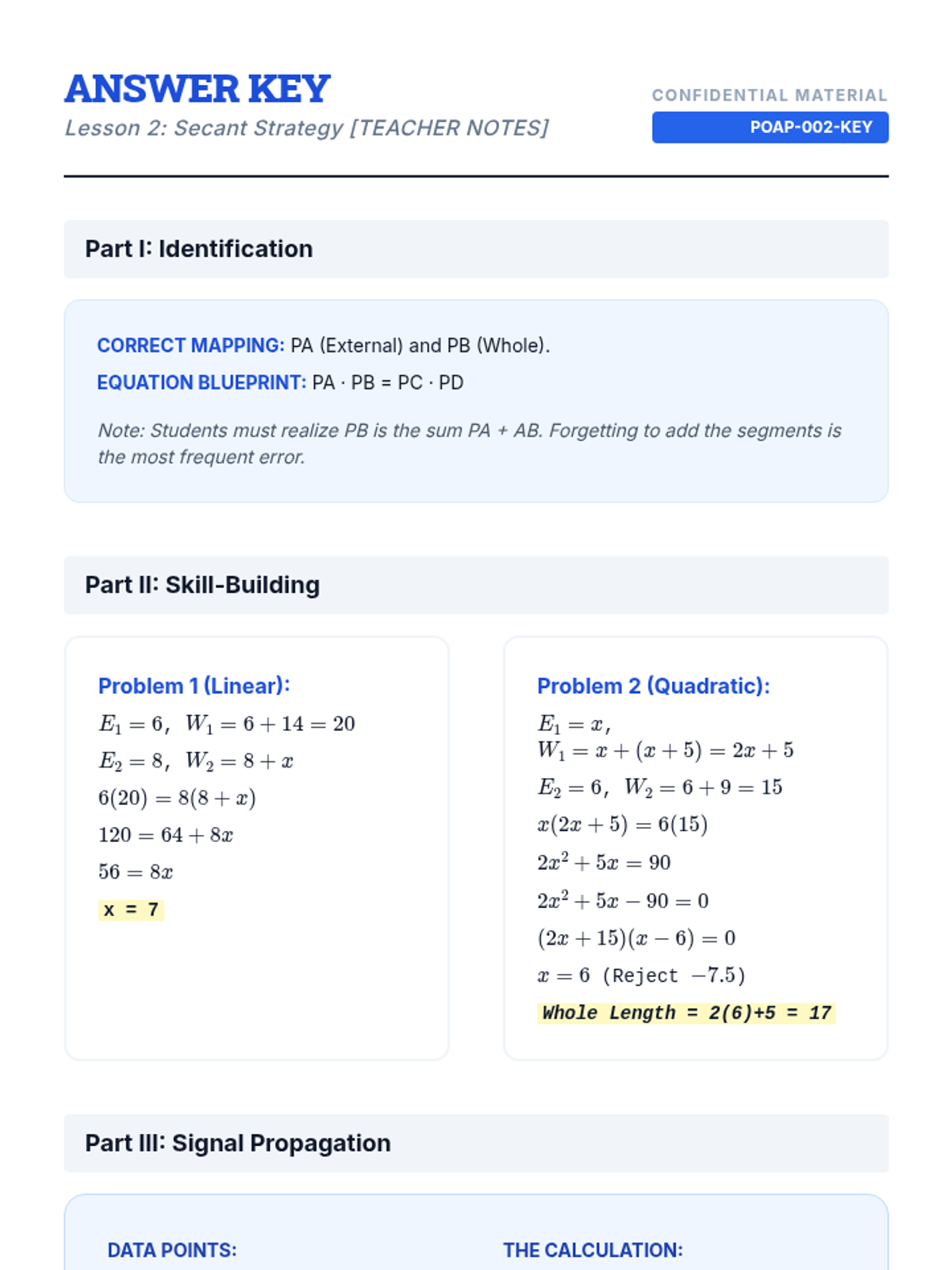
Teacher answer key for the Lesson 2 Secant Strategy Worksheet. Includes detailed walkthroughs for linear and quadratic cases, correct mapping of "Whole" vs "External" segments, and the final solution for the satellite propagation challenge.
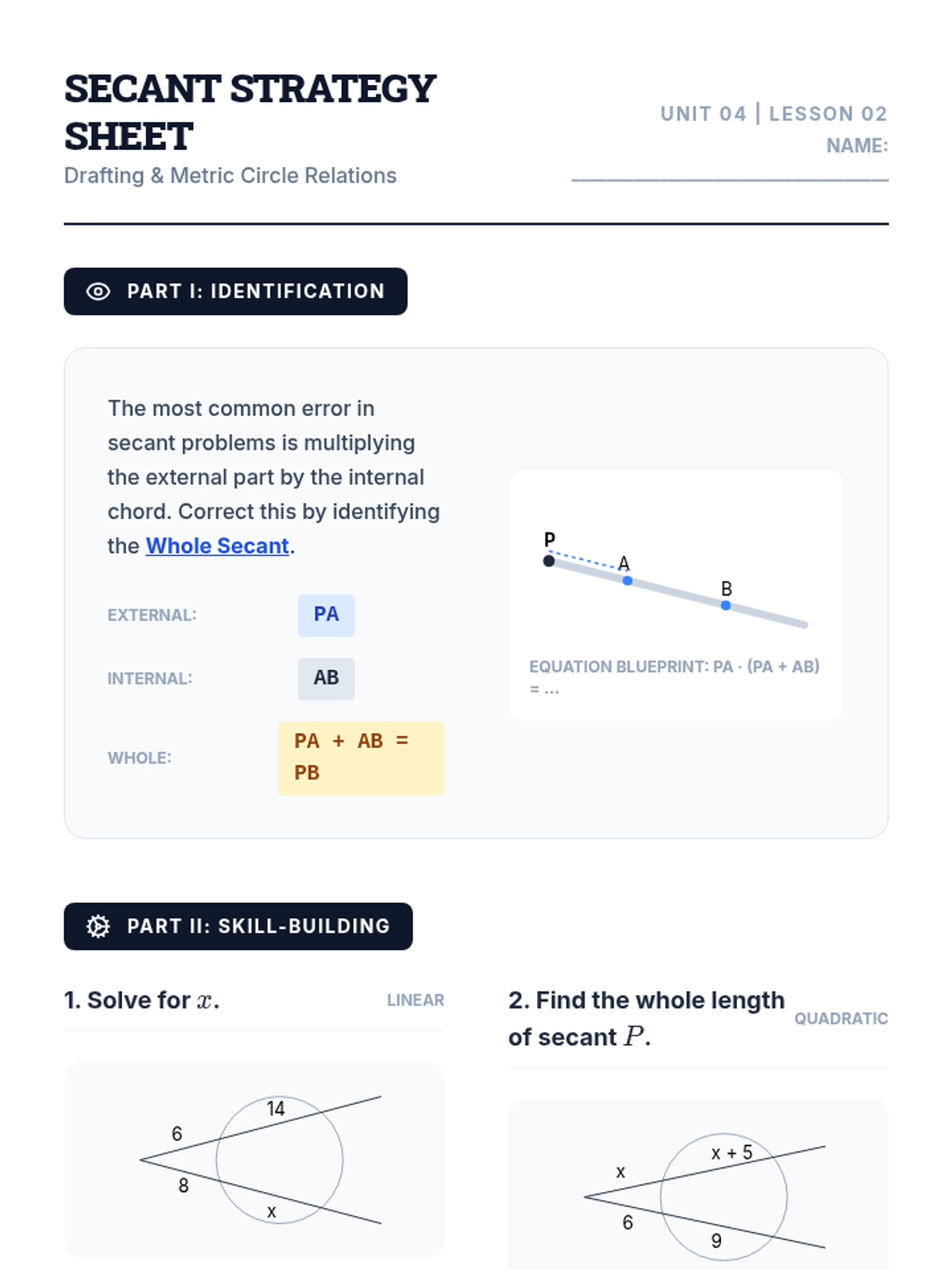
A skill-building worksheet for Lesson 2 focusing on Secant-Secant relationships. It includes conceptual identification of "Whole" vs "External" segments, progressive algebraic practice, and a real-world satellite signal application.
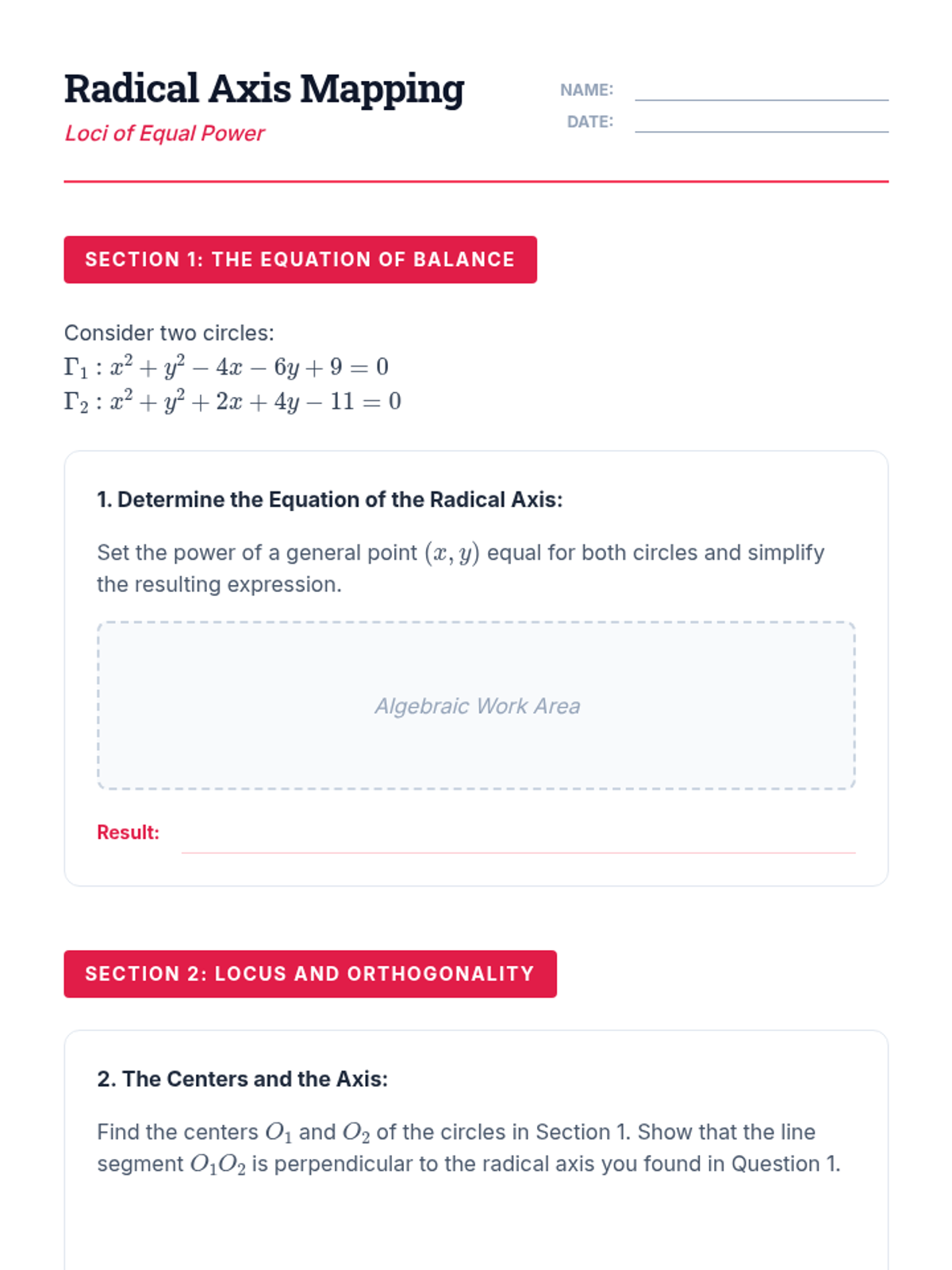
Student activity sheet focusing on the algebraic and geometric derivation of the radical axis, its orthogonality to centers, and its construction via common chords.
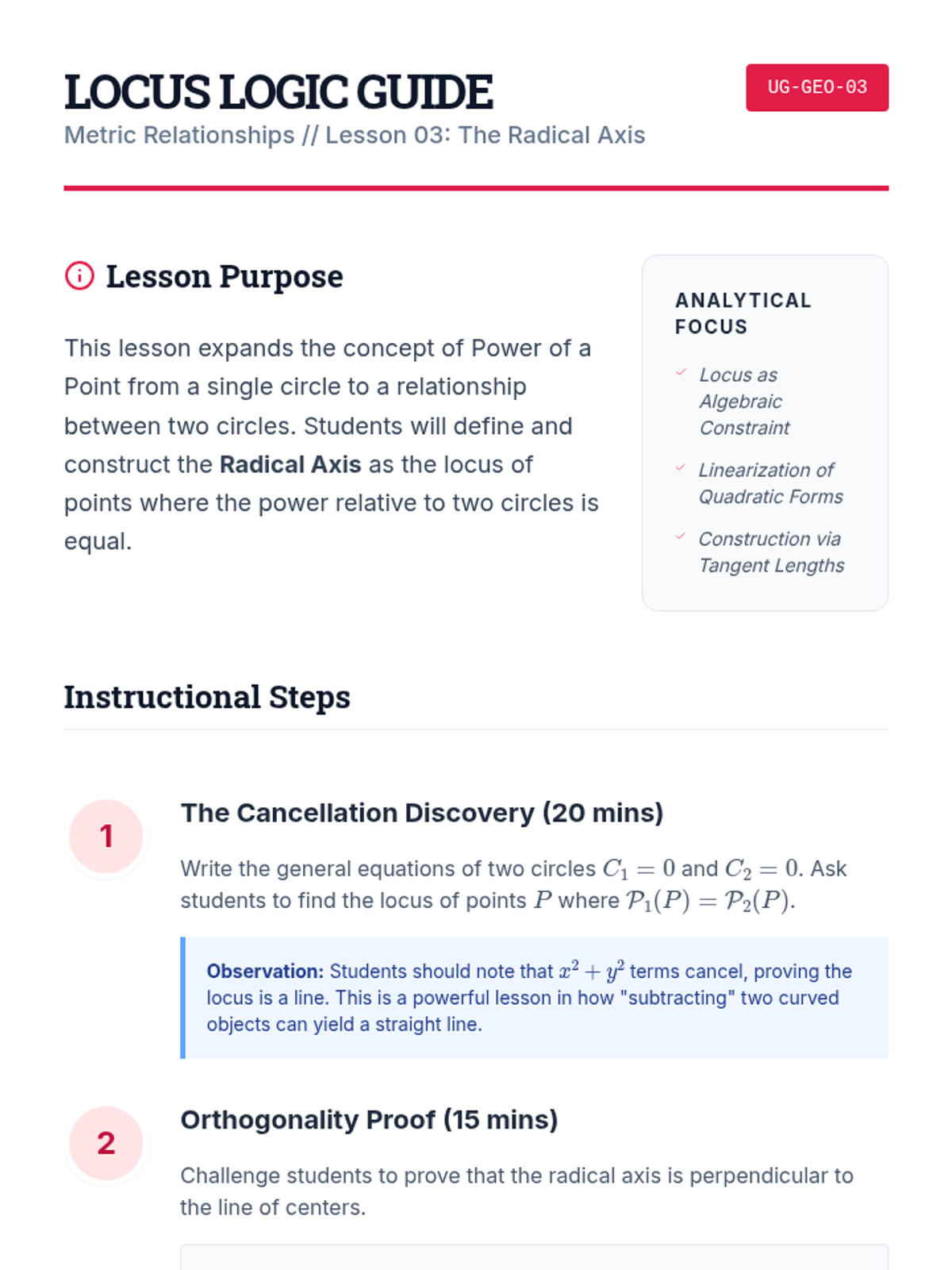
Teacher facilitation guide for the lesson on the Radical Axis. Includes derivation hints, geometric properties, and conceptual discussion questions.
A complete 20-question review presentation for the TSIA2 Math practice exam, featuring each question followed by a detailed step-by-step explanation slide with proper work areas. Rendering and overflow issues have been resolved. Full 20 pairs included.
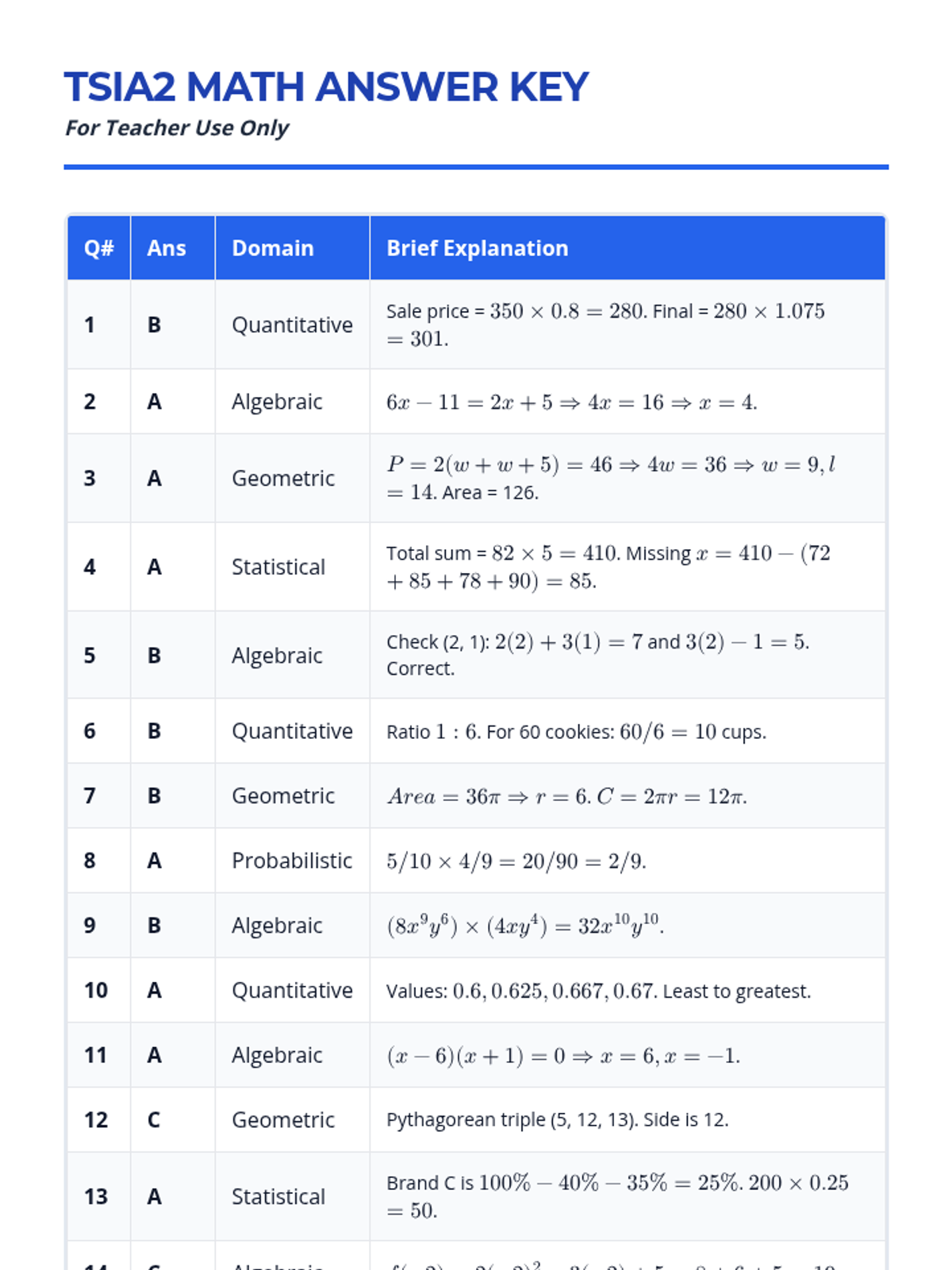
A detailed answer key for the TSIA2 Math practice exam, including correct responses, problem domains, and brief step-by-step explanations for all 20 questions. Table formatting refined for page breaks.
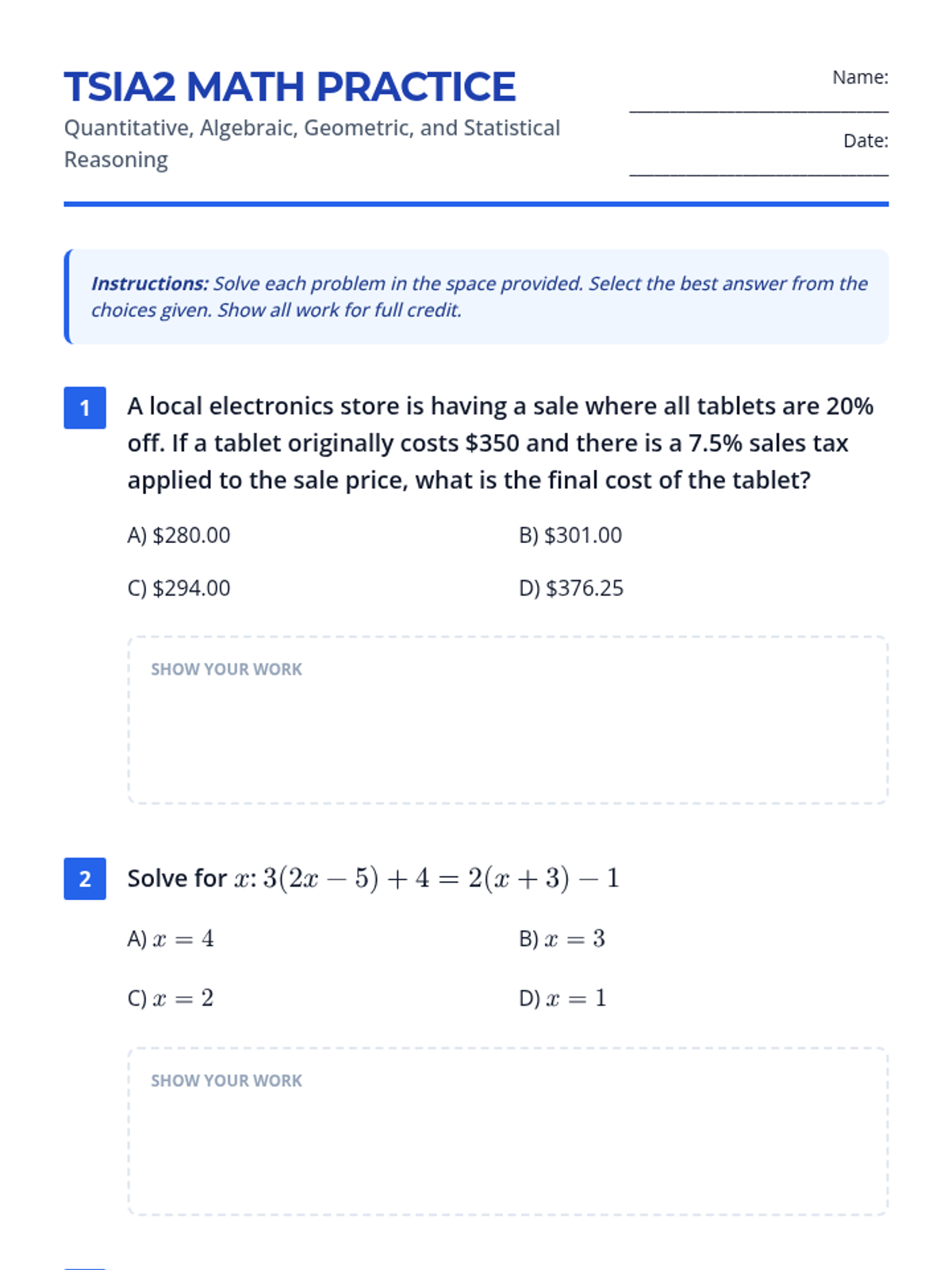
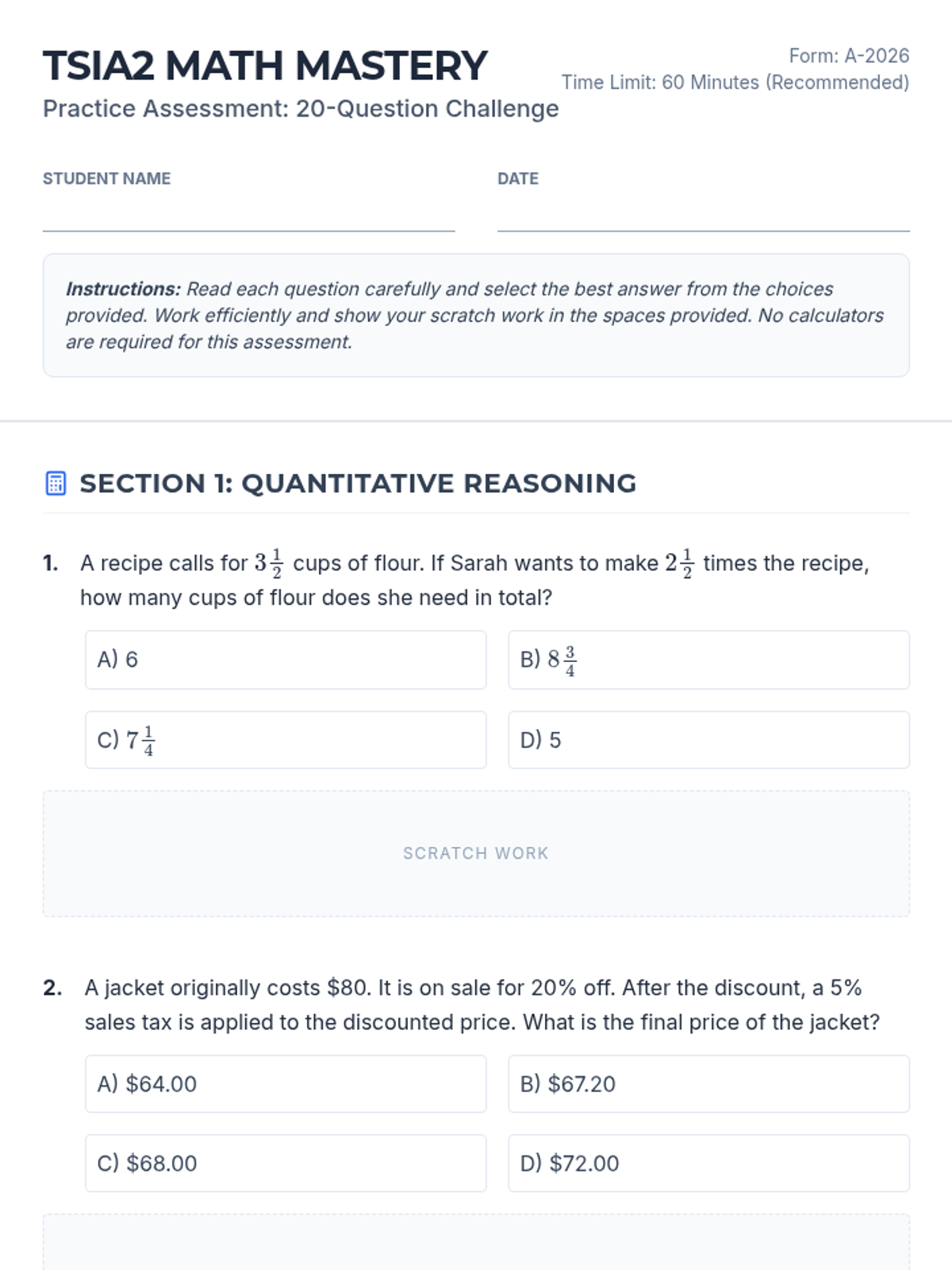
A 20-question practice exam for the TSIA2 Math assessment, featuring a balanced mix of quantitative, algebraic, geometric, and statistical reasoning problems with dedicated workspace for student calculations. Backgrounds are removed for clarity.
An engaging presentation that introduces the TSIA2 Math assessment and now includes a comprehensive 5-slide step-by-step solution guide for the mastery questions.
A detailed answer key providing step-by-step explanations for all 10 practice test questions, now with improved contrast and layout to ensure each solution stays on its own page.
A comprehensive 10-question practice test covering the core domains of the TSIA2 Math assessment, now featuring improved layouts, per-question work areas, and clear calculator icons.
A comprehensive 15-day slide deck for the TSIA2 Math Marathon. Features daily Warm-Up questions and detailed solution slides for all 30 practice problems covering all TSIA2 domains. Updated to be fully complete and fixed rendering issues.
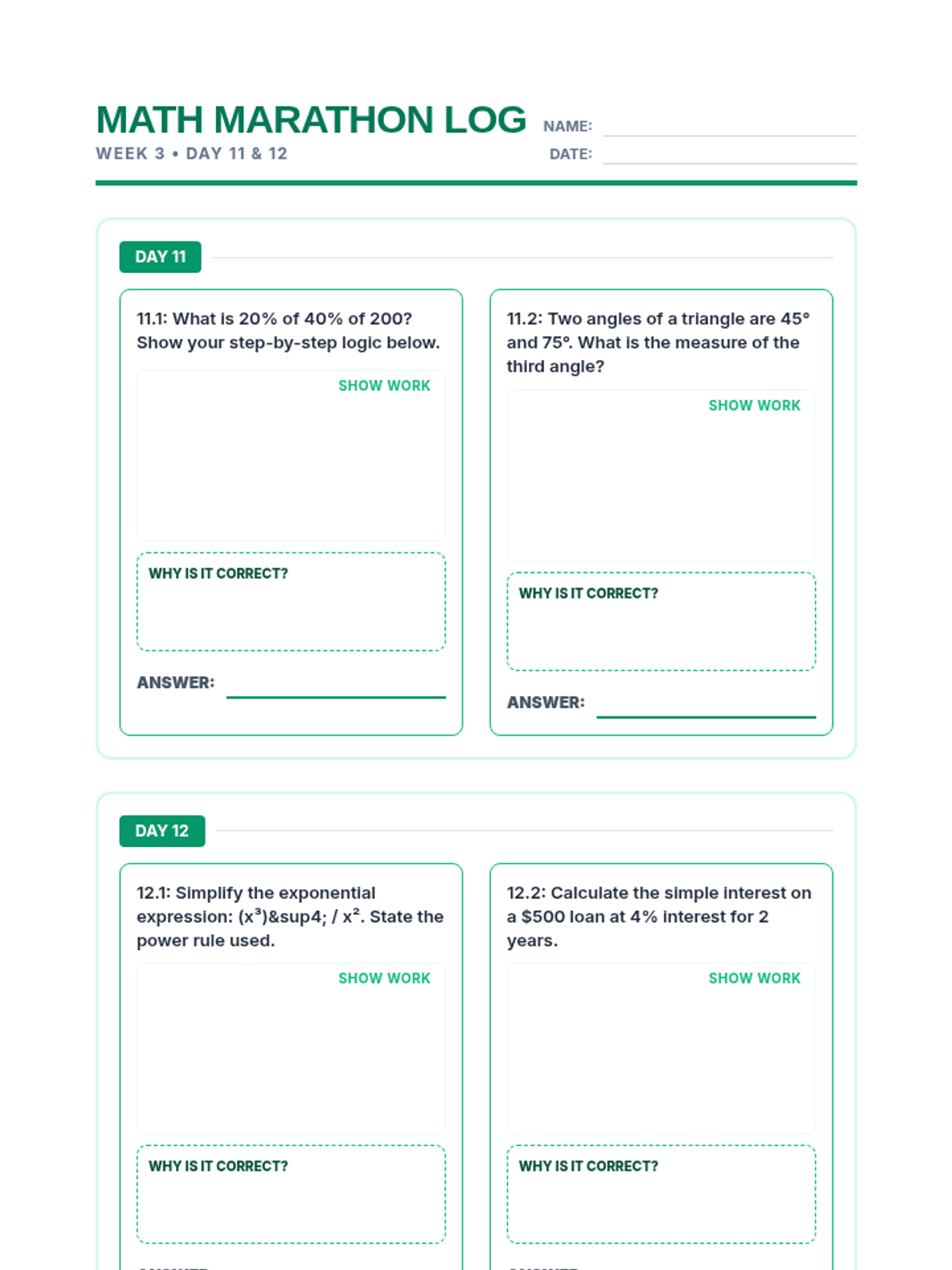
A 5-day student log for the final week of the TSIA2 Math Marathon. Covers days 11 through 15 with dedicated work areas, explanation boxes, and answer slots. Updated to optimize page breaks and increase work area size.
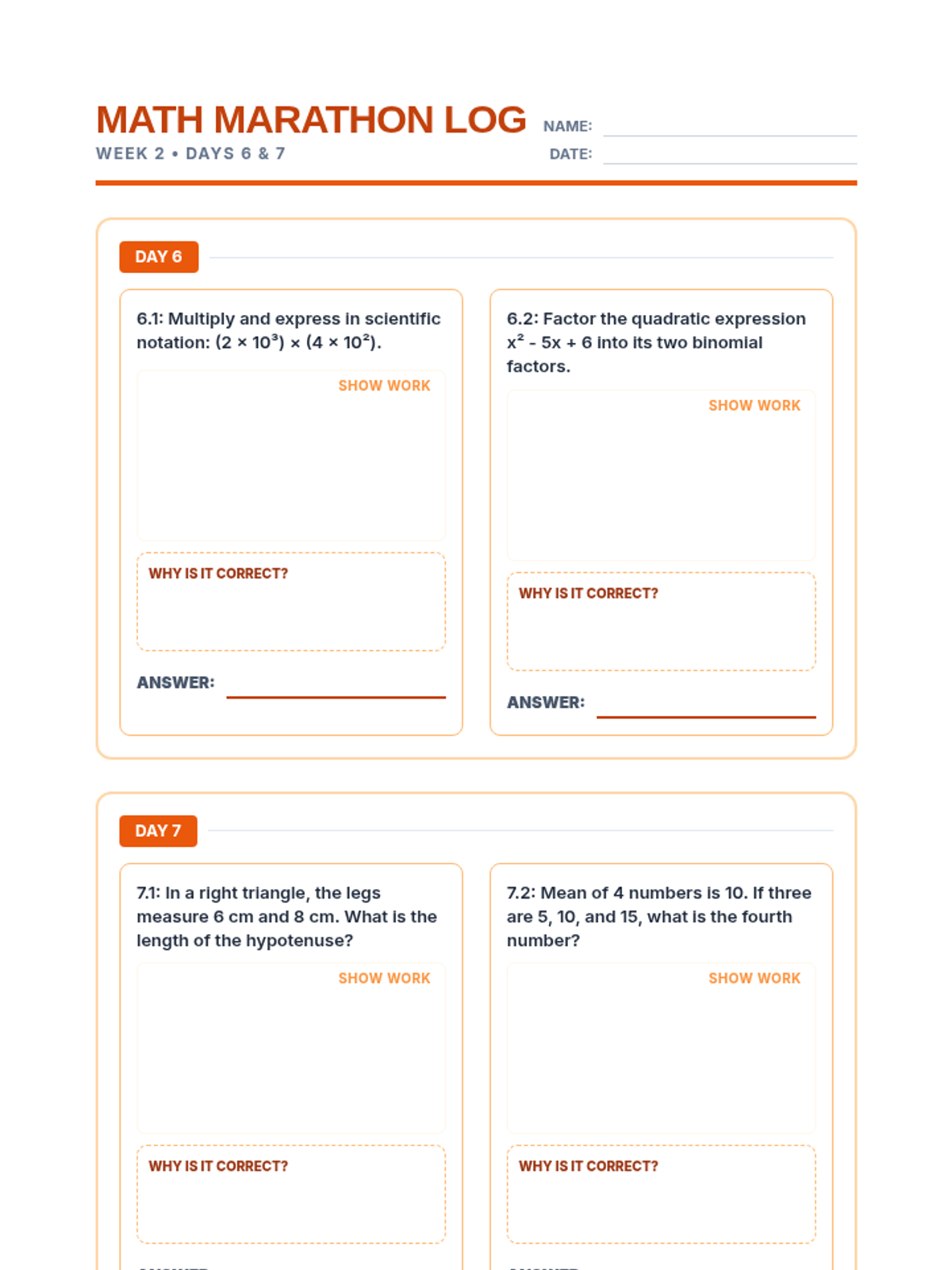
A 5-day student log for the second week of the TSIA2 Math Marathon. Provides space for daily problem-solving, work verification, and written explanations for days 6 through 10. Updated to optimize page breaks and increase work area size.
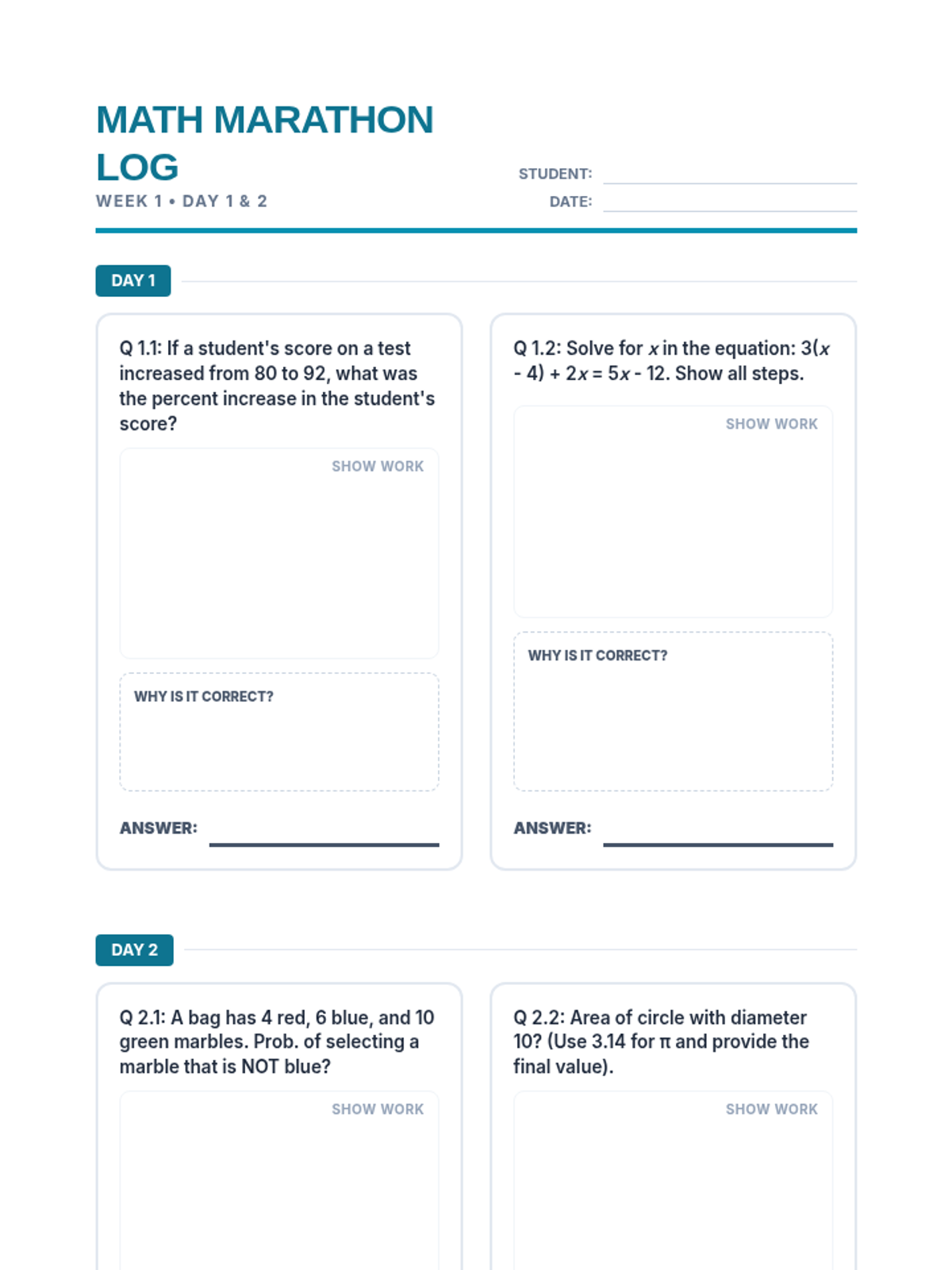
A 5-day student log for the first week of the TSIA2 Math Marathon. Includes dedicated spaces for showing work, providing a written explanation of the answer logic, and recording final answers. Updated to optimize page breaks and increase work area size.
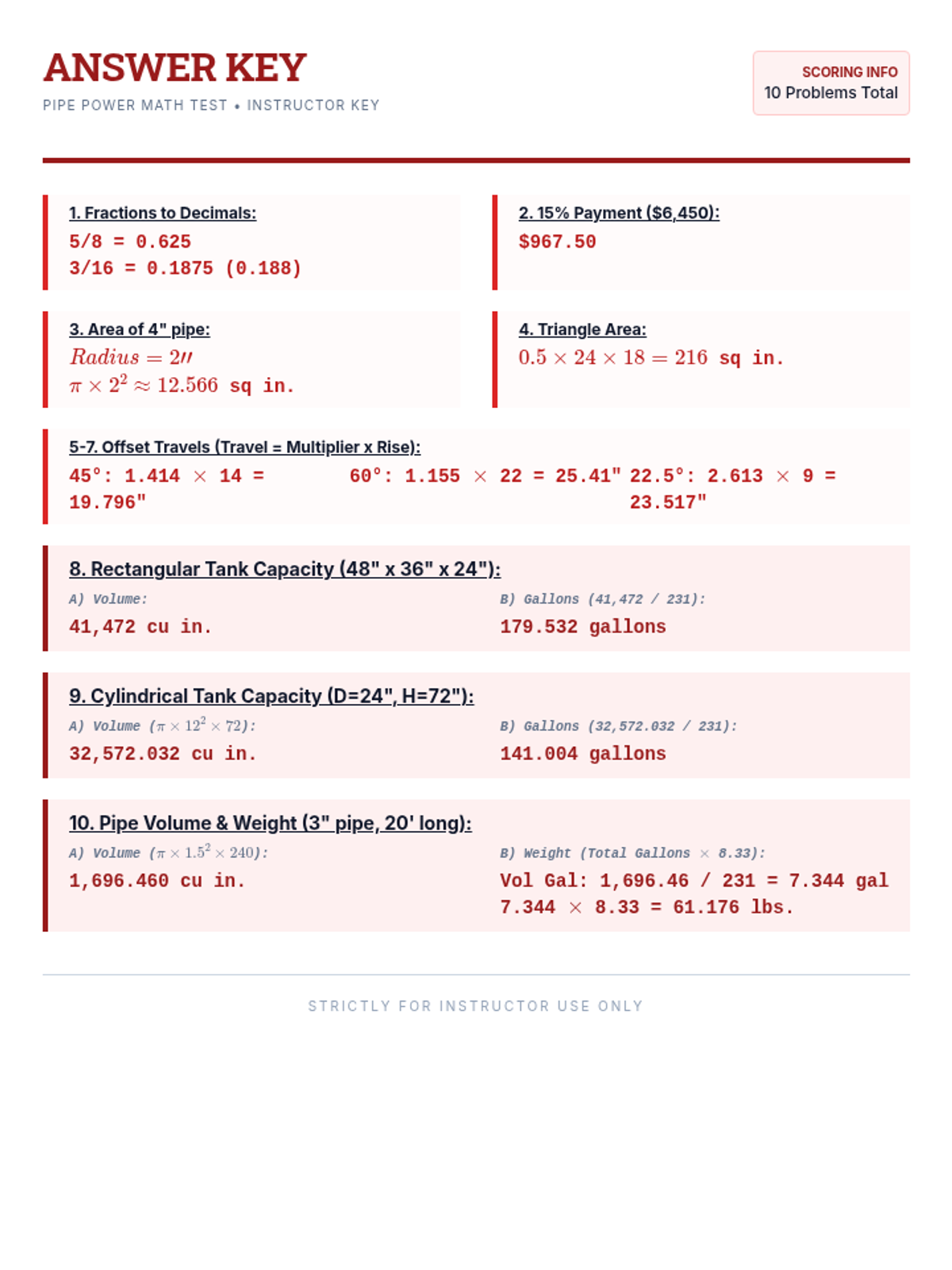
A detailed answer key for the Pipe Power Math Test, providing step-by-step solutions and scoring points for instructors.
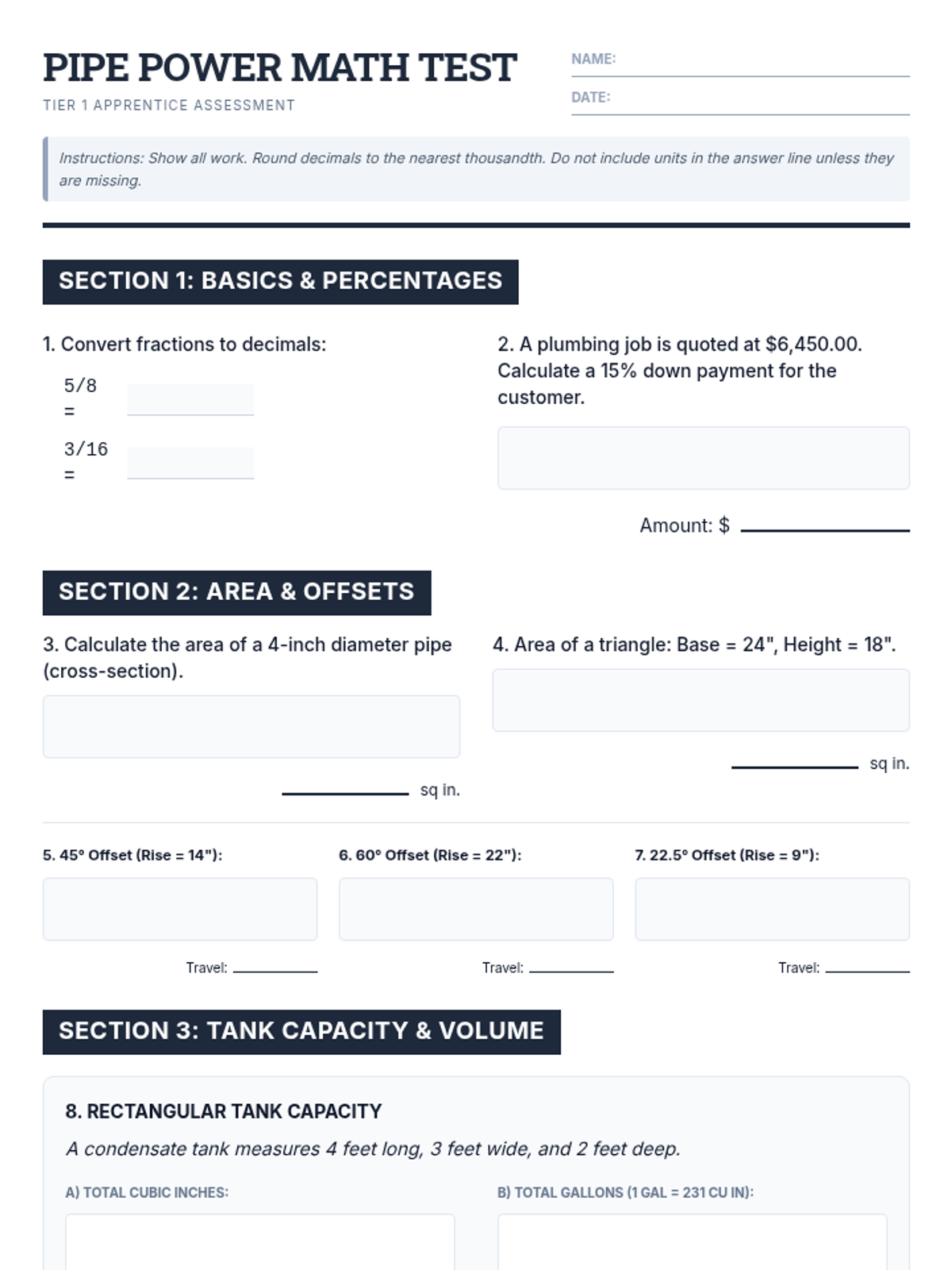
A revised math assessment for plumbing apprentices including specific problems for cylindrical tank capacity and pipe volume conversions.
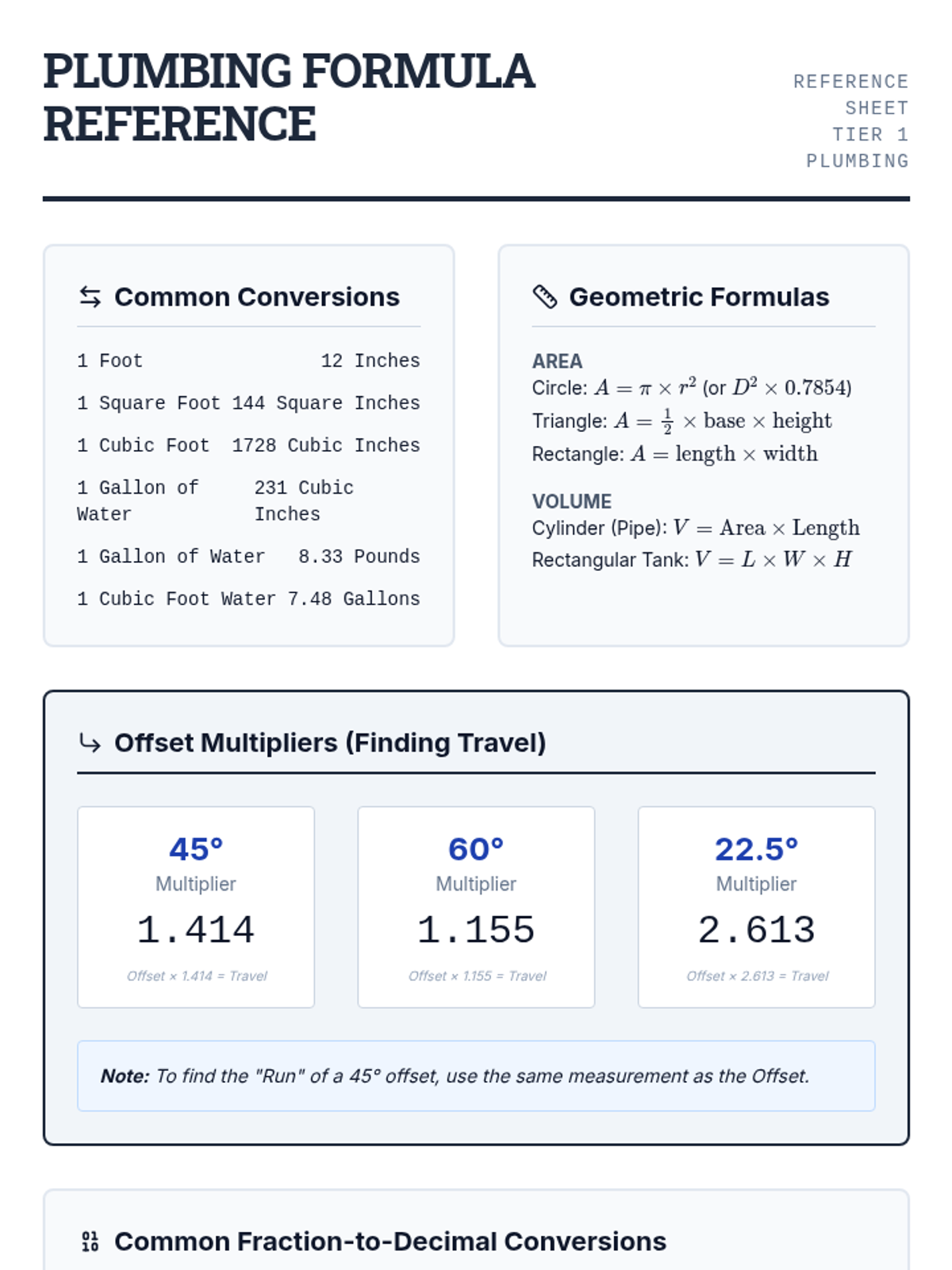
A essential reference sheet for plumbing apprentices featuring geometric formulas, offset multipliers, unit conversions, and fraction-to-decimal charts.
A detailed answer key for the TSIA2 Math Practice Test, including a quick-reference grading table, step-by-step solutions for all 20 questions, and a diagnostic scoring guide. (Updated to reflect changes in questions 3, 10, and 19).
A 20-question multiple choice practice test for the TSIA2 Math exam, broken down by topic area: Quantitative Reasoning, Algebraic Reasoning, Geometry, and Statistics. Includes space for student work. (Updated questions 3, 10, and 19).
An answer key for the TSIA2 Math practice test, including correct answers, brief explanations, and a domain distribution breakdown.
A 20-question TSIA2 Math practice test with questions across four domains: Quantitative Reasoning, Algebraic Reasoning, Geometry, and Probability and Statistics.
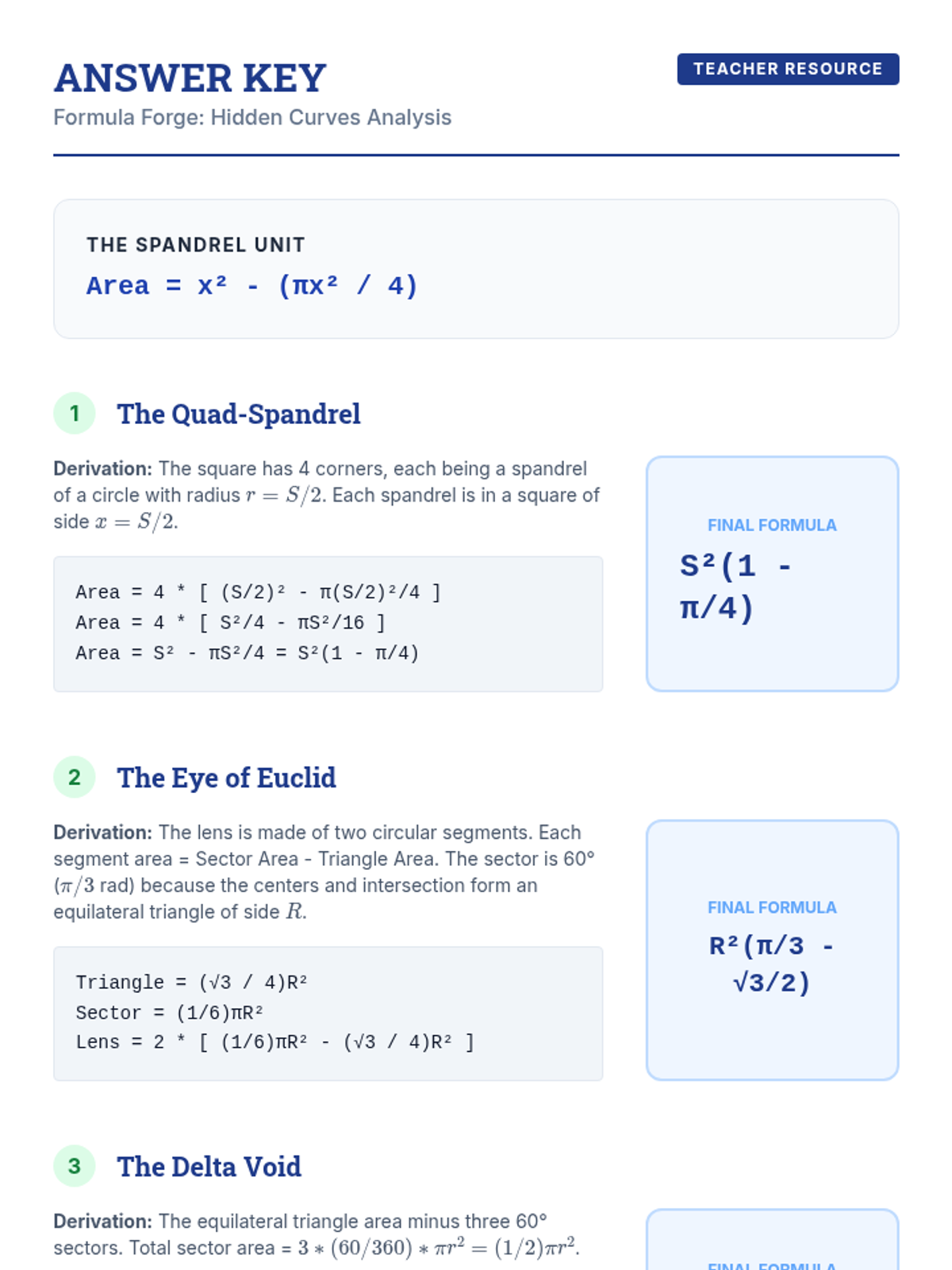
A detailed answer key for the Formula Forge challenge sheet, providing step-by-step algebraic derivations and final general formulas for all problems.
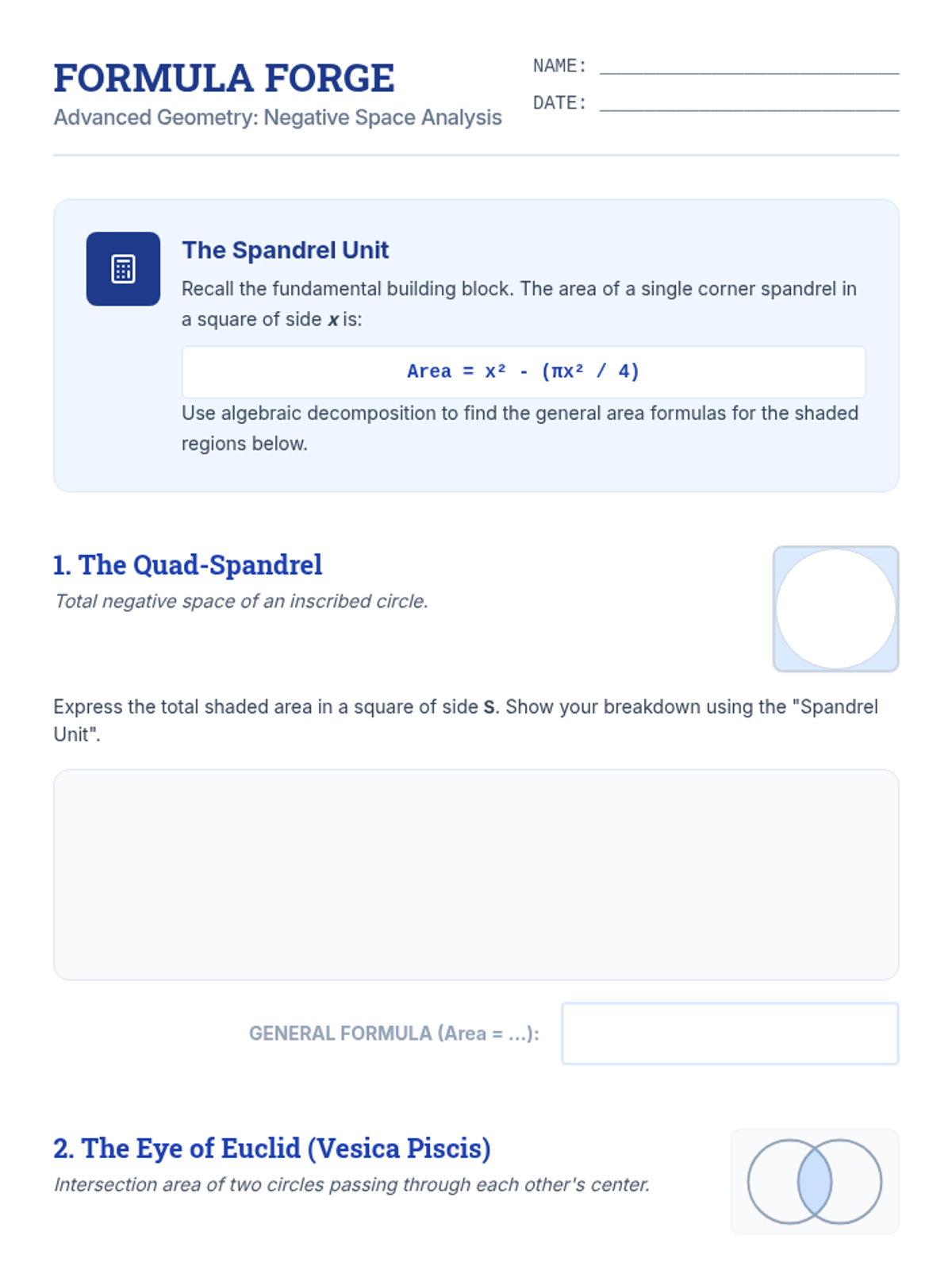
A challenge problem sheet for students to derive and generalize formulas for various 'leftover' shapes, including inscribed circles, overlapping lenses, and voids within triangles.
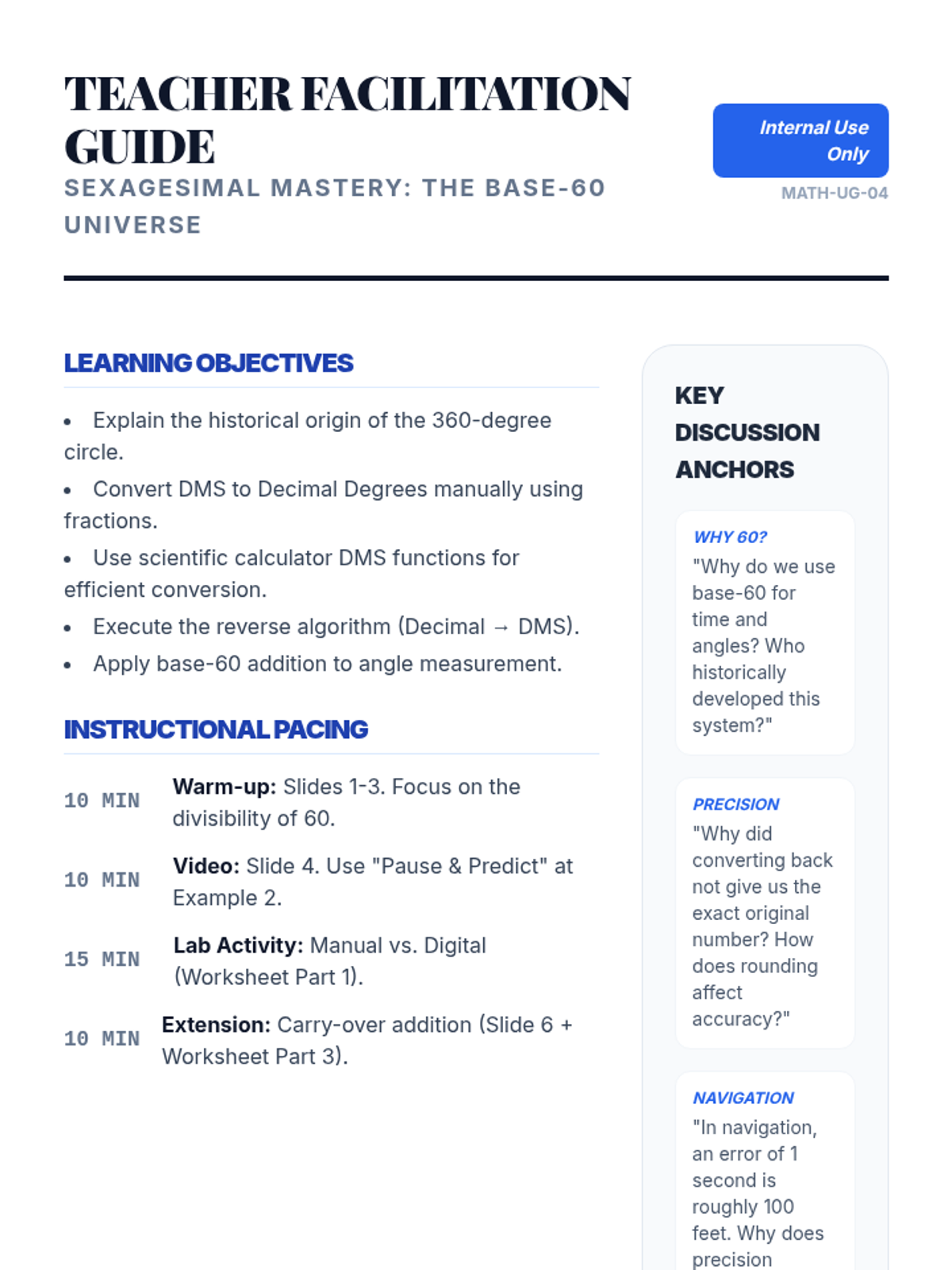
A comprehensive teacher facilitation guide containing lesson objectives, pacing instructions, discussion anchors, and a full answer key for the DMS practice materials.
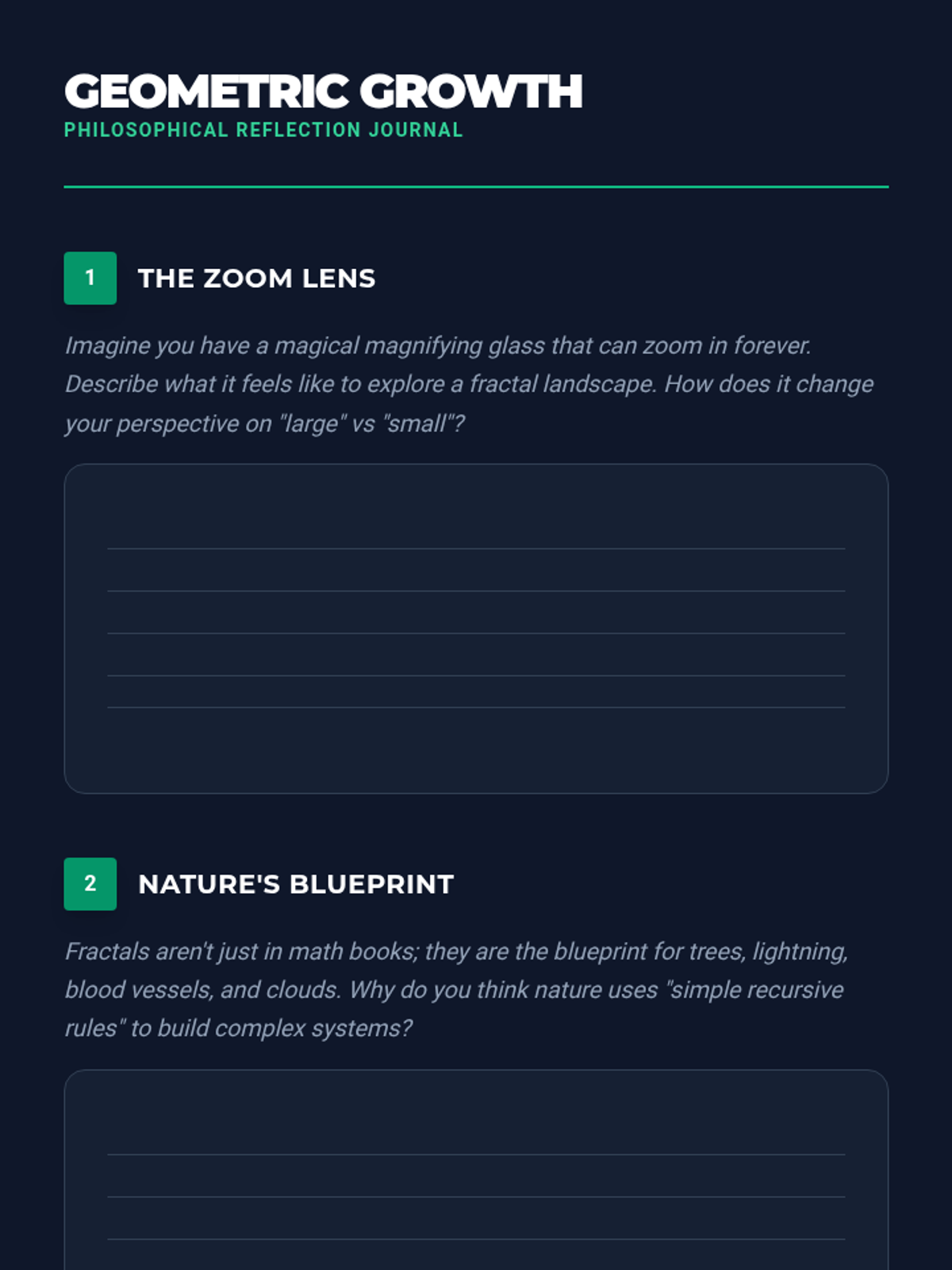
A reflective journal for students to synthesize their learning. It includes philosophical prompts on scale, nature's recursive patterns, and the infinite/finite paradox, with a dark-themed "night mode" aesthetic for focus.
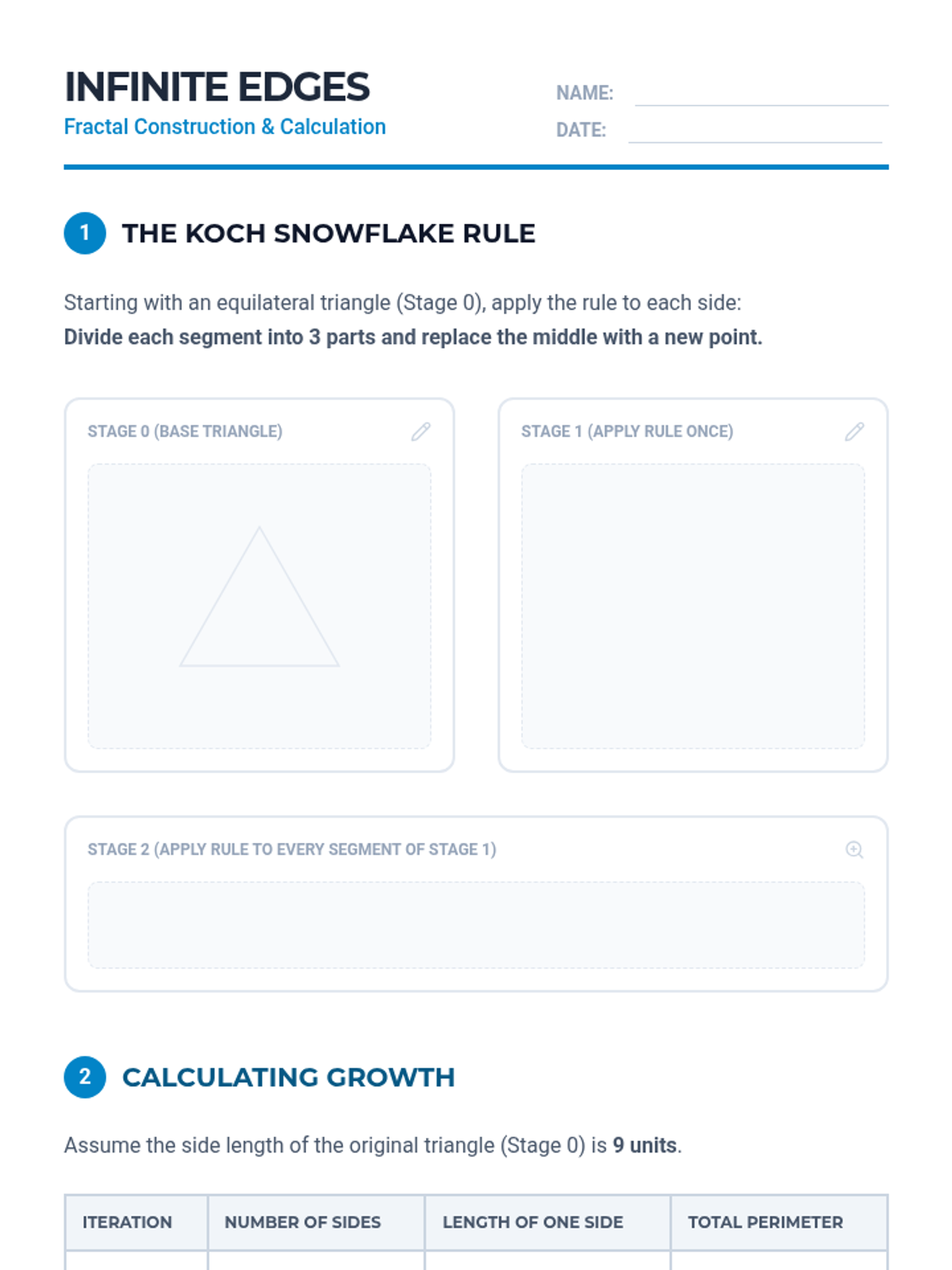
A two-page student activity worksheet for constructing the Koch Snowflake. It includes drawing areas for the first three iterations and a calculation table to analyze the relationship between sides, length, and total perimeter.
A visually striking slide deck introducing fractals, featuring the Coastline Paradox, definitions of self-similarity and recursion, and the construction rules for the Koch Snowflake.
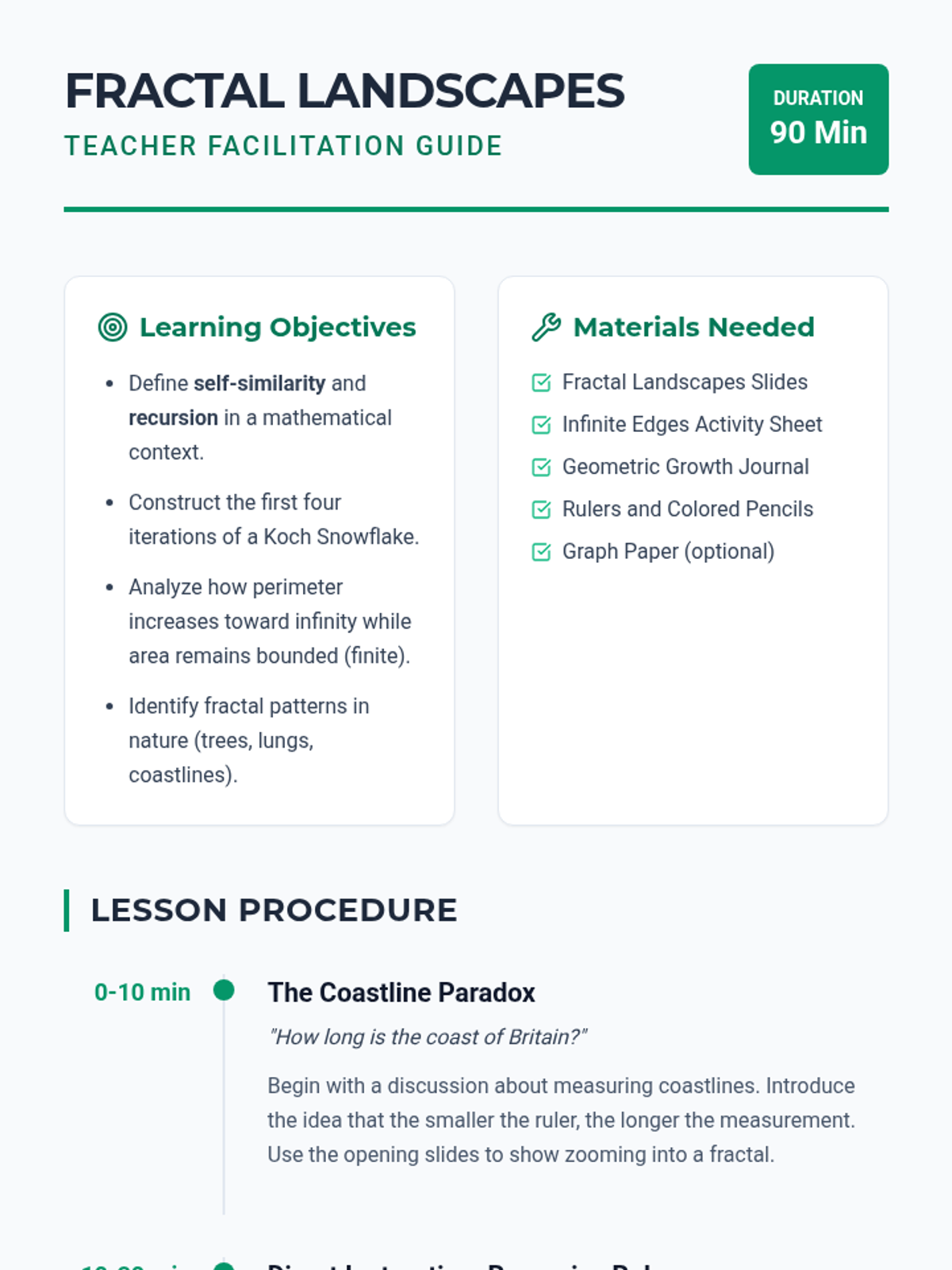
A comprehensive teacher facilitation guide for the Fractal Landscapes lesson, including learning objectives, a detailed 90-minute lesson flow, and key mathematical concepts like recursion and self-similarity.
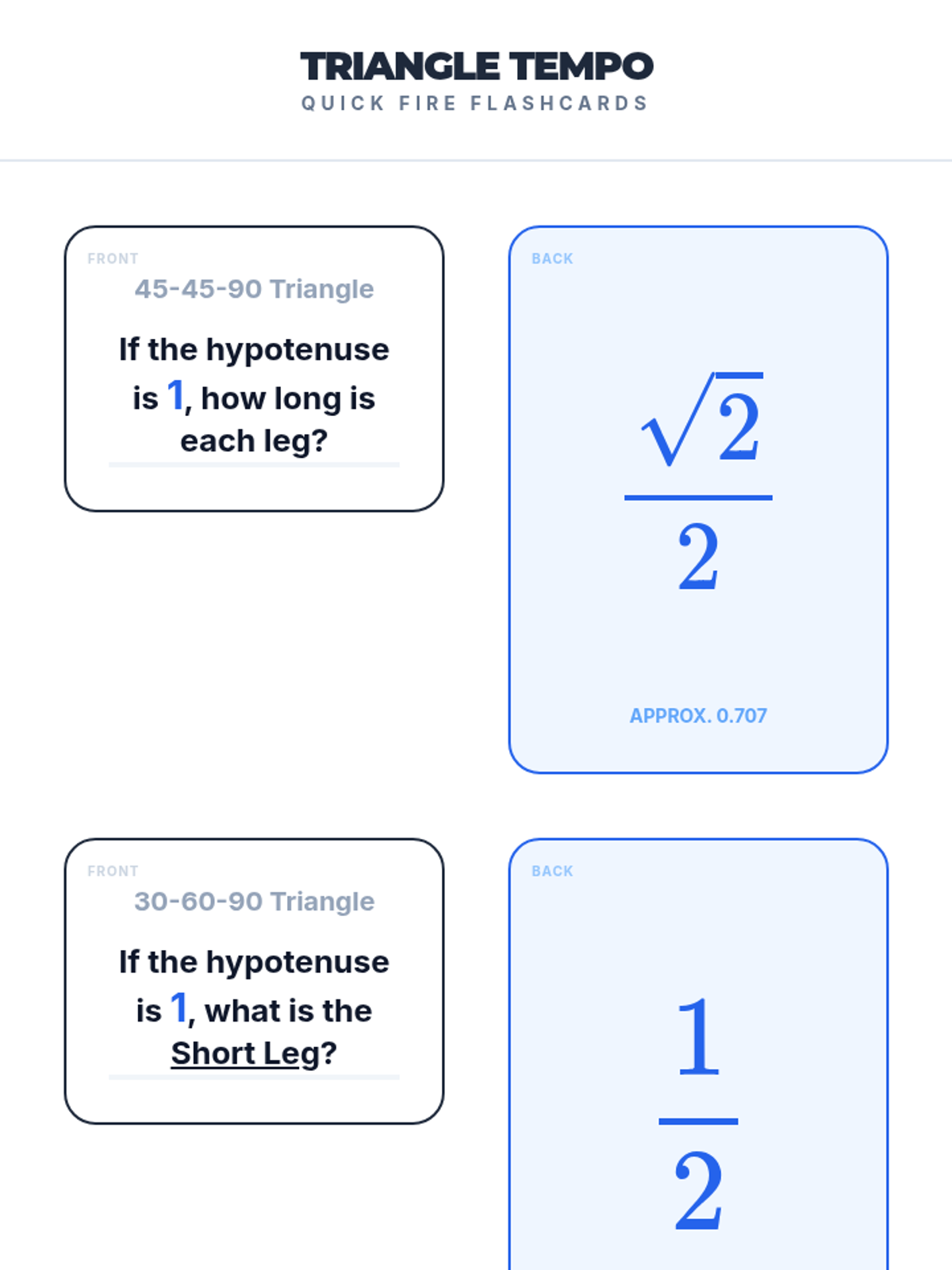
A set of quick-fire flashcards for students to build fluency with special right triangle ratios when the hypotenuse is 1. Covers 45-45-90 and 30-60-90 ratios and a key strategy for handling variable conflicts in problems.
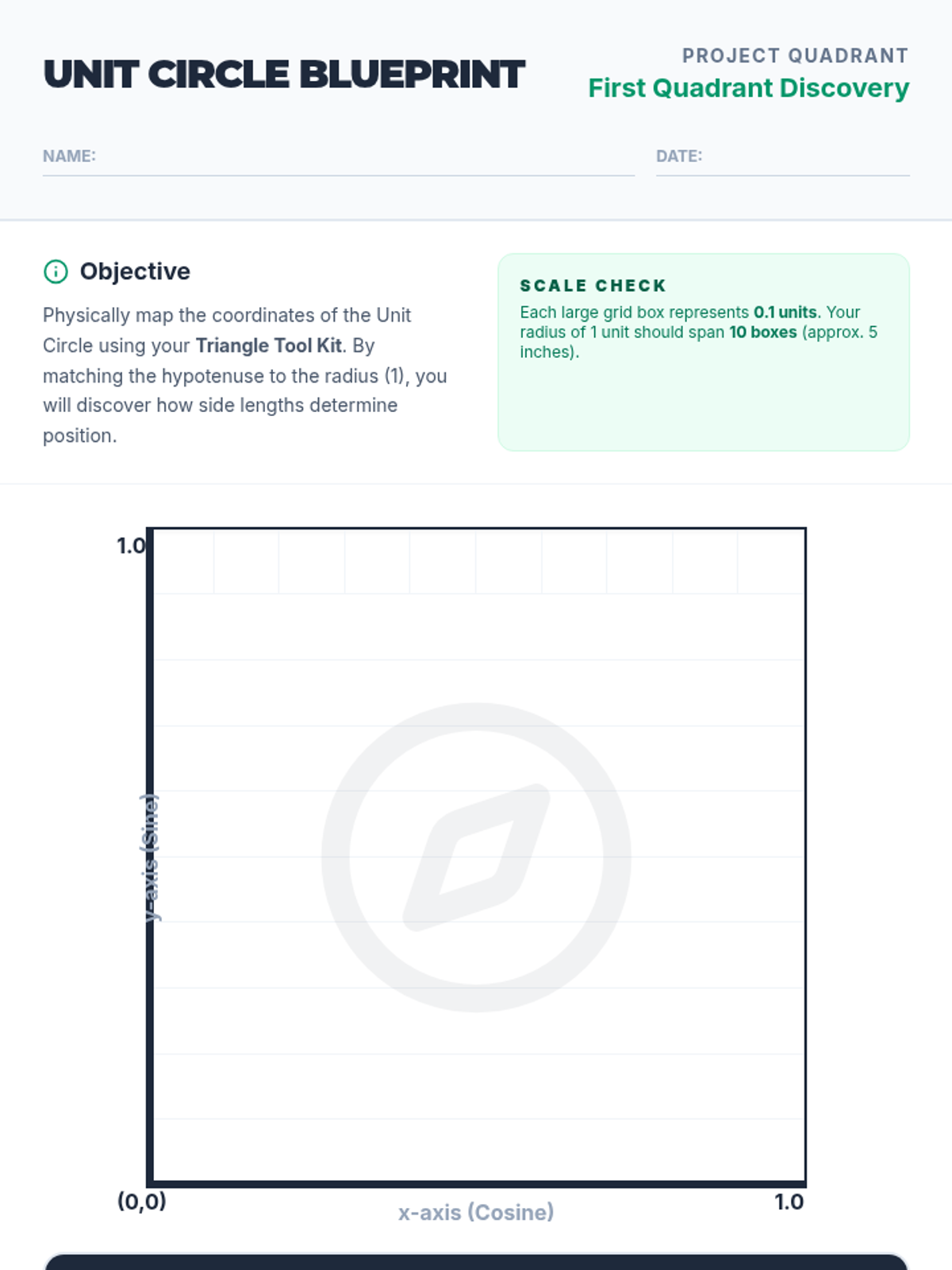
An activity worksheet for students to build the first quadrant of the unit circle. Features a large graph grid scaled for the Triangle Tool Kit, a coordinate mapping table, and a reflection prompt to connect triangle geometry to trigonometric functions.
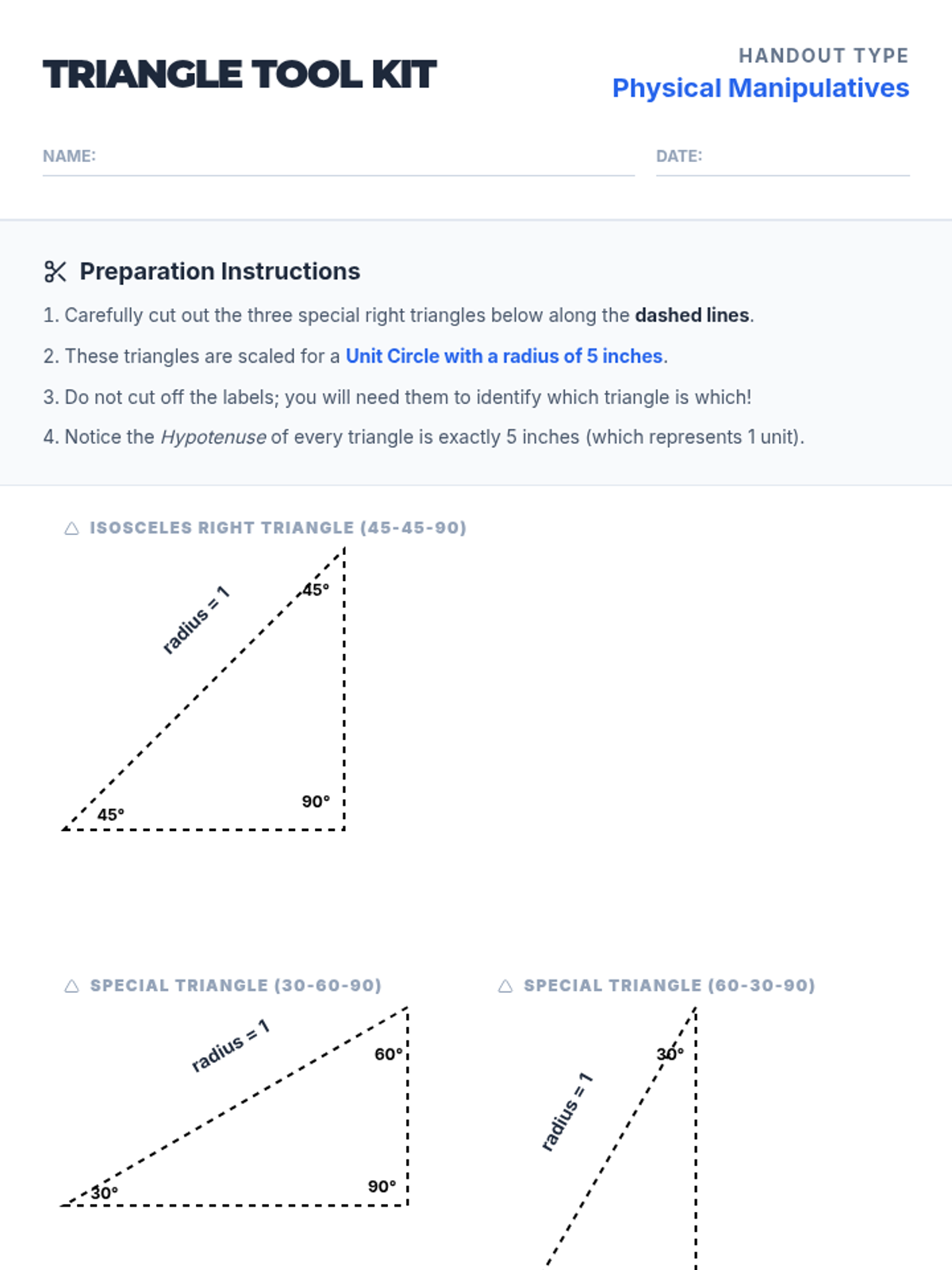
A set of printable, scaled special right triangles for hands-on unit circle construction. Includes 45-45-90 and 30-60-90 triangles with hypotenuse length 1, clearly labeled with their geometric ratios to facilitate coordinate discovery.
A vibrant, high-contrast presentation for a Trigonometry lesson connecting special right triangles to the Unit Circle. Includes a warm-up quiz, embedded YouTube video, conceptual discussion on radius-1 circles, and step-by-step activity instructions for students.
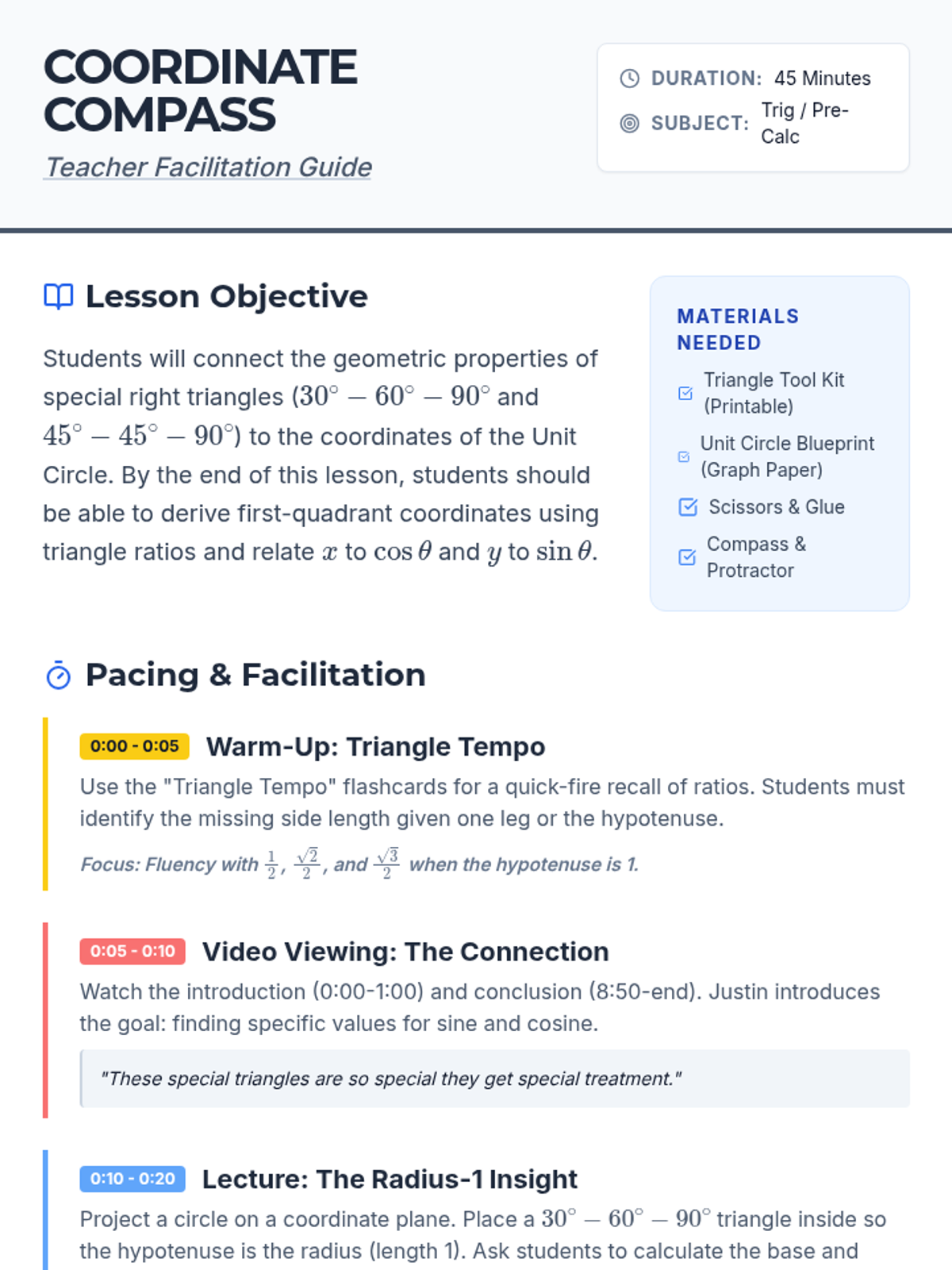
A comprehensive teacher guide for the Coordinate Compass lesson, featuring a 45-minute pacing guide, discussion prompts, an answer key for the unit circle first quadrant, and pedagogical tips on scale and common student misconceptions.
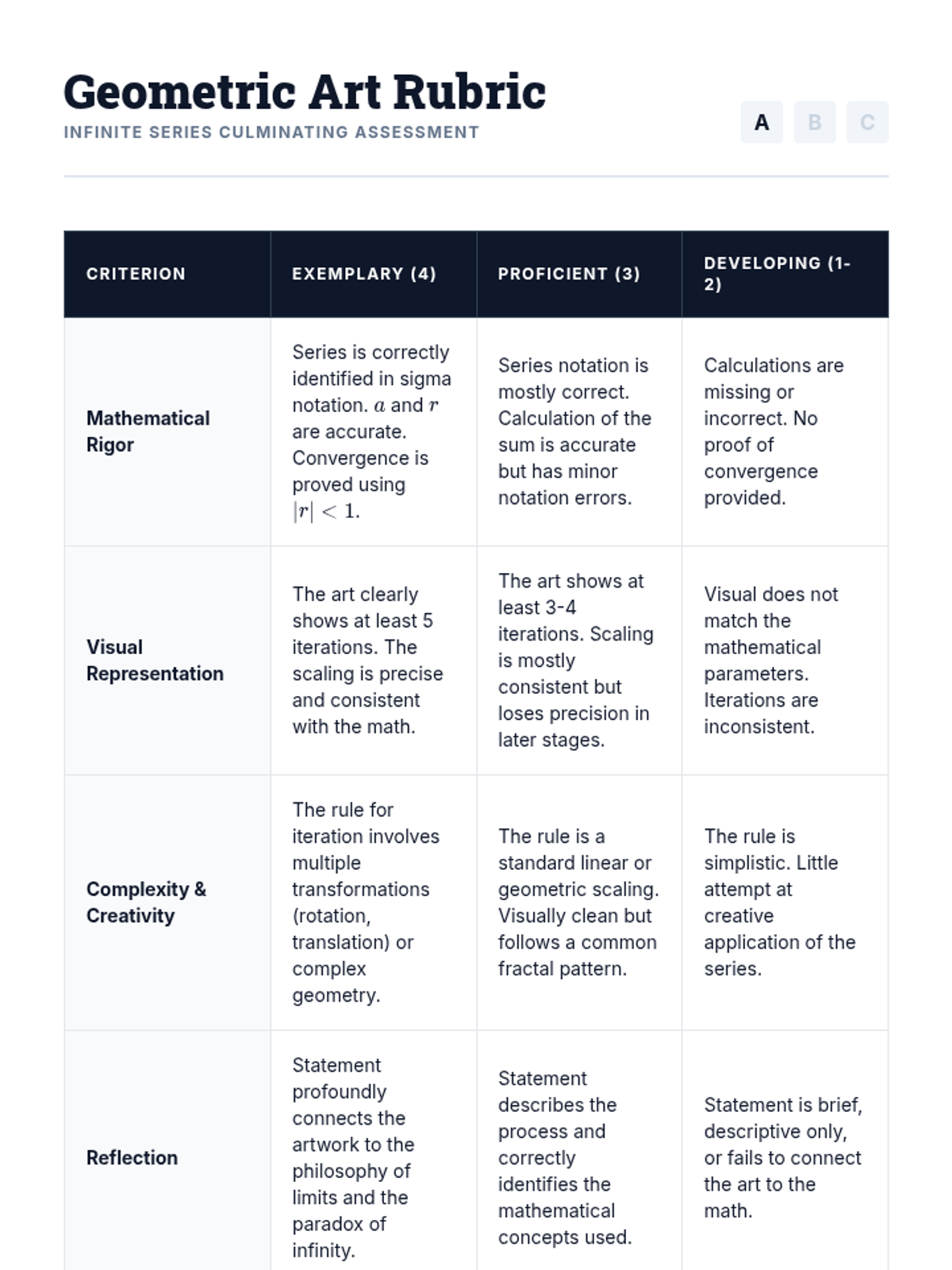
Assessment rubric for the Infinite Series Art project, covering mathematical rigor, visual representation, creativity, and reflection.
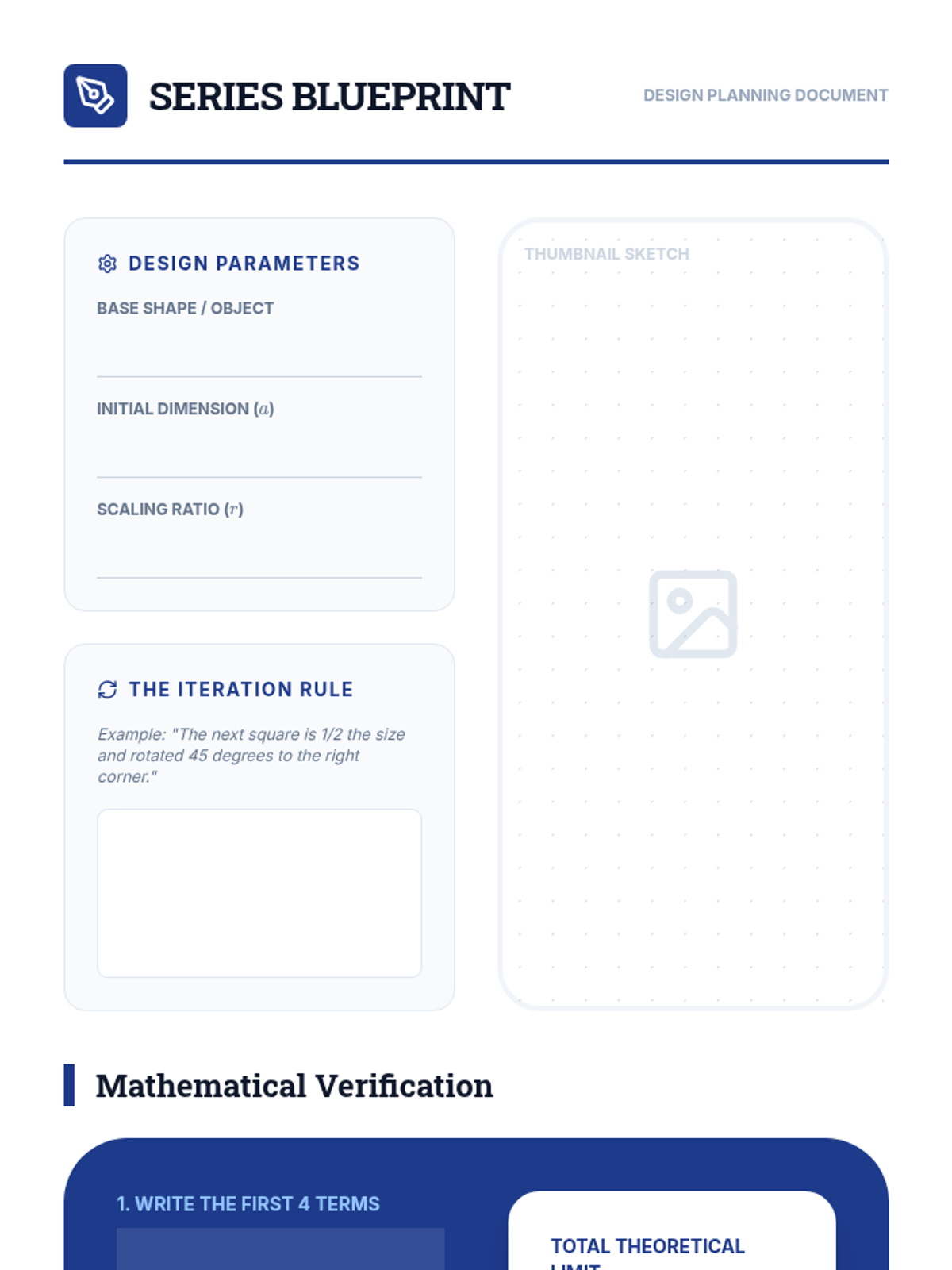
Planning worksheet for the final art project, where students define their series parameters, iteration rules, and verify convergence mathematically.
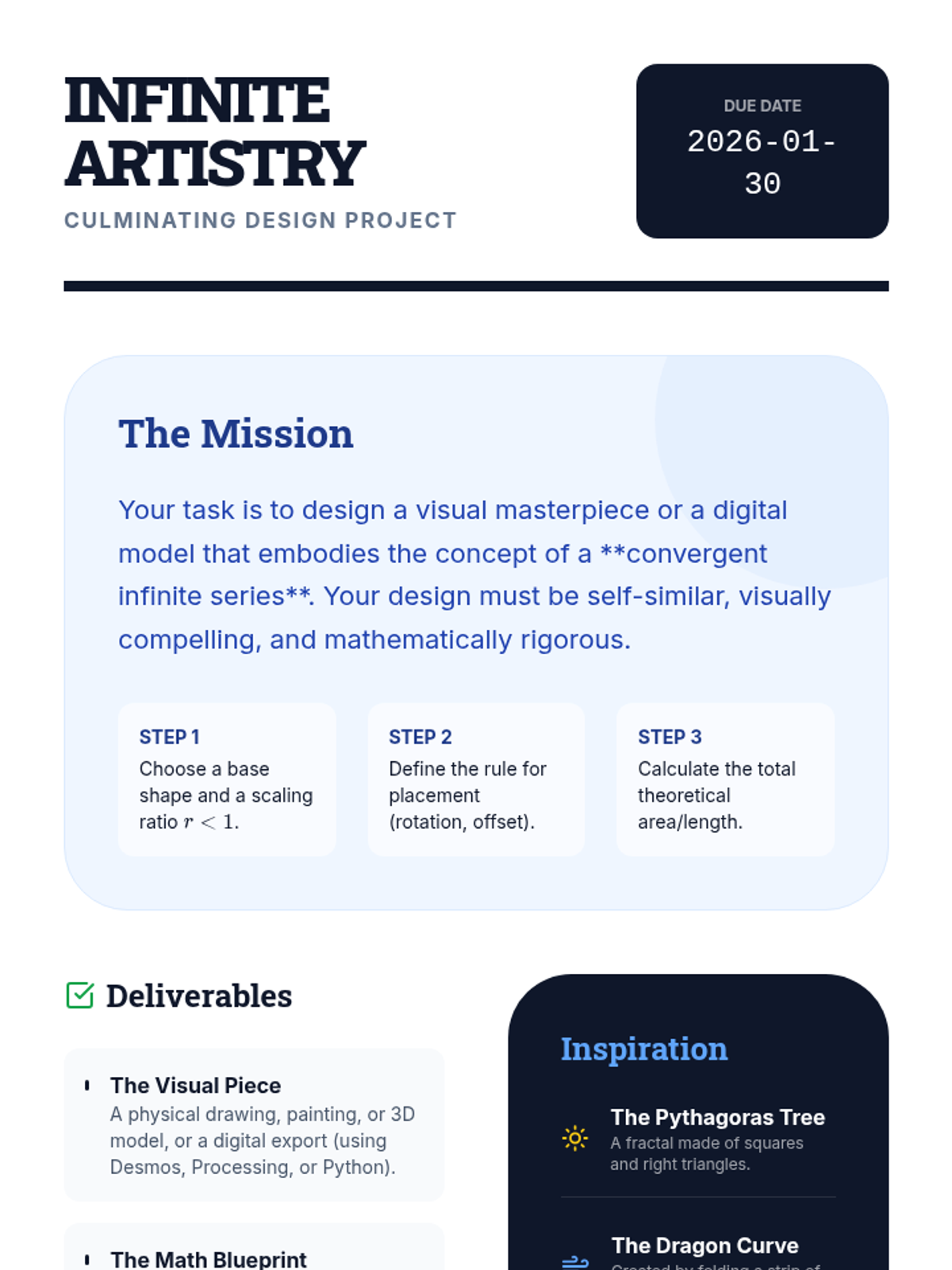
Final project prompt for students to create a convergent series-based art piece, including requirements, inspiration, and math deliverables.
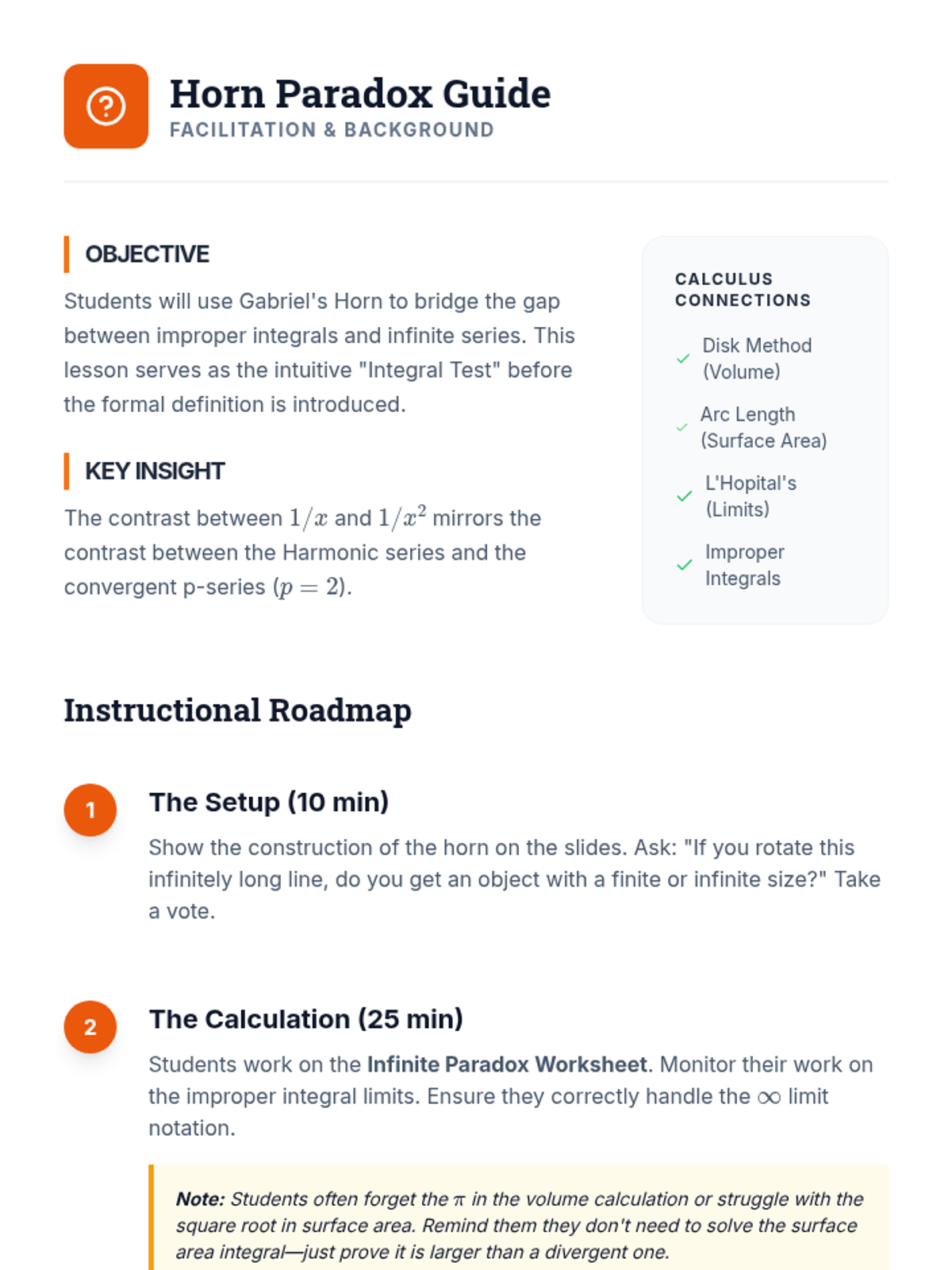
Facilitation guide for the Gabriel's Horn lesson, focusing on improper integrals, the painter's paradox, and the link to the Integral Test.
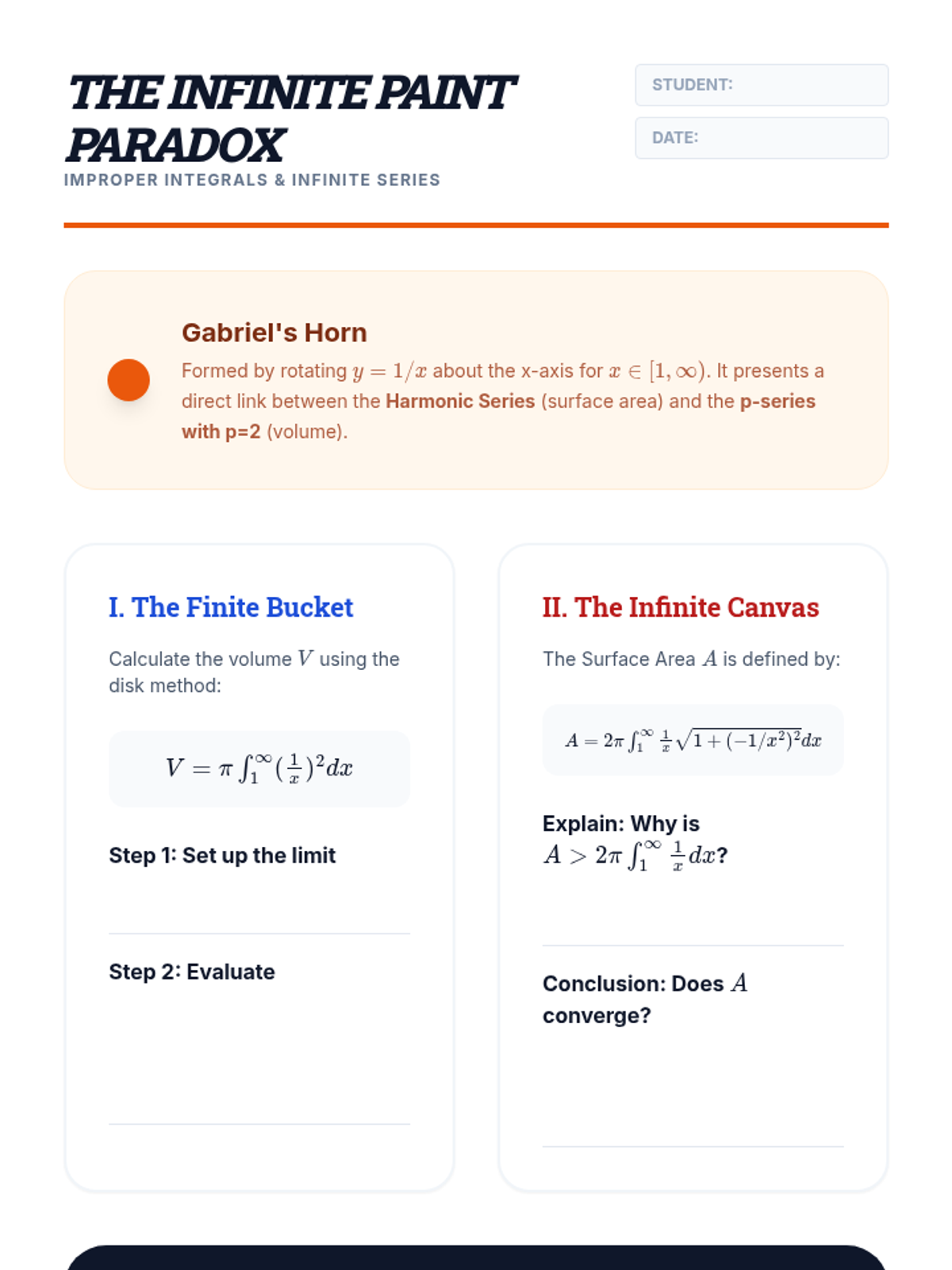
Worksheet for analyzing Gabriel's Horn using improper integrals and connecting the results to the harmonic and p-series (p=2).
Presentation on Gabriel's Horn, exploring the mathematical paradox of finite volume and infinite surface area through improper integrals and series concepts.
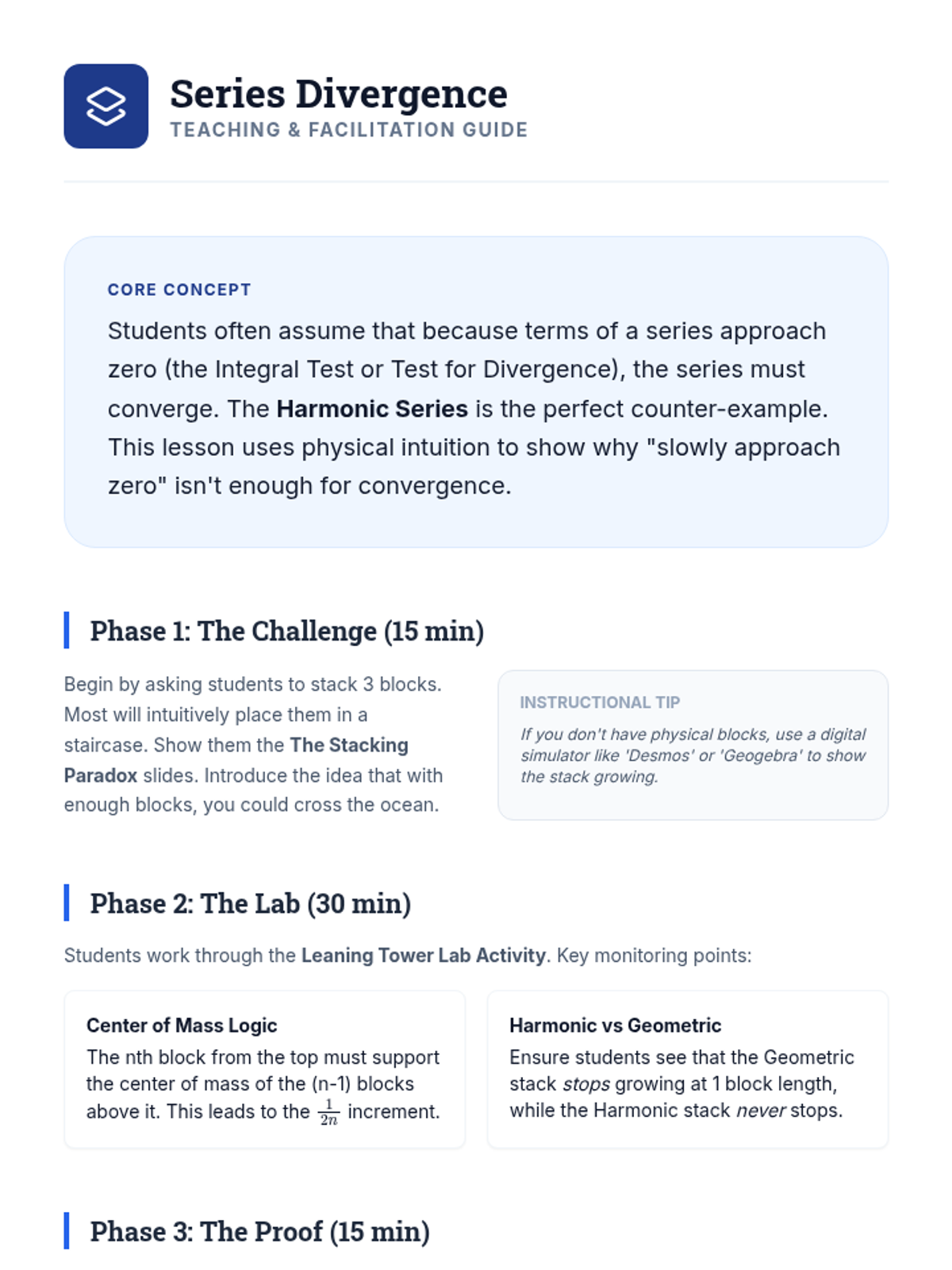
Facilitation guide for the Stacking Paradox lesson, including the physics of center of mass, Oresme's proof of divergence, and lab monitoring tips.
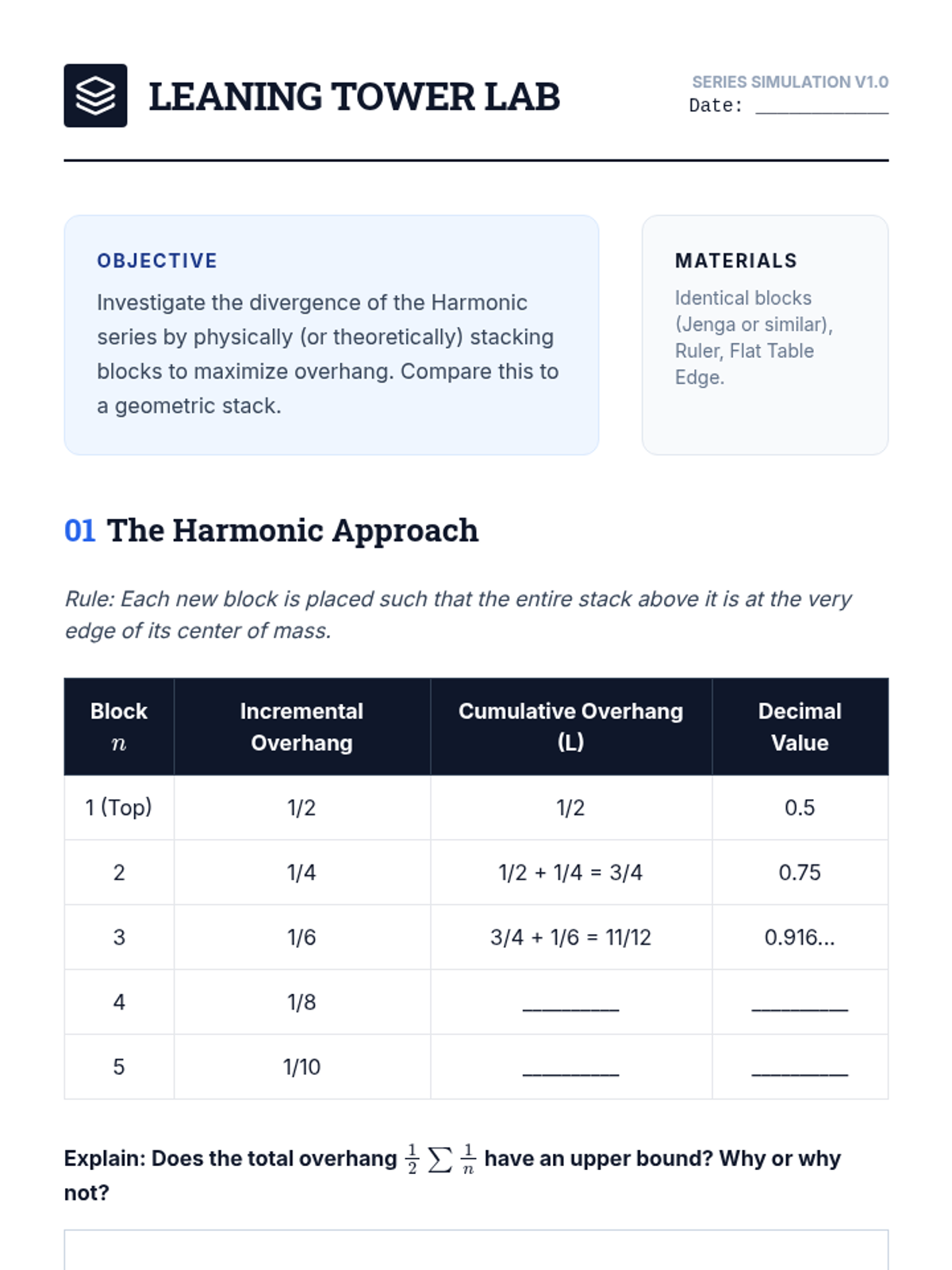
Hands-on lab activity comparing physical block stacking using harmonic series (divergent) and geometric series (convergent) models.
Presentation for comparing harmonic and geometric series through the physical paradox of stacking blocks off a table.
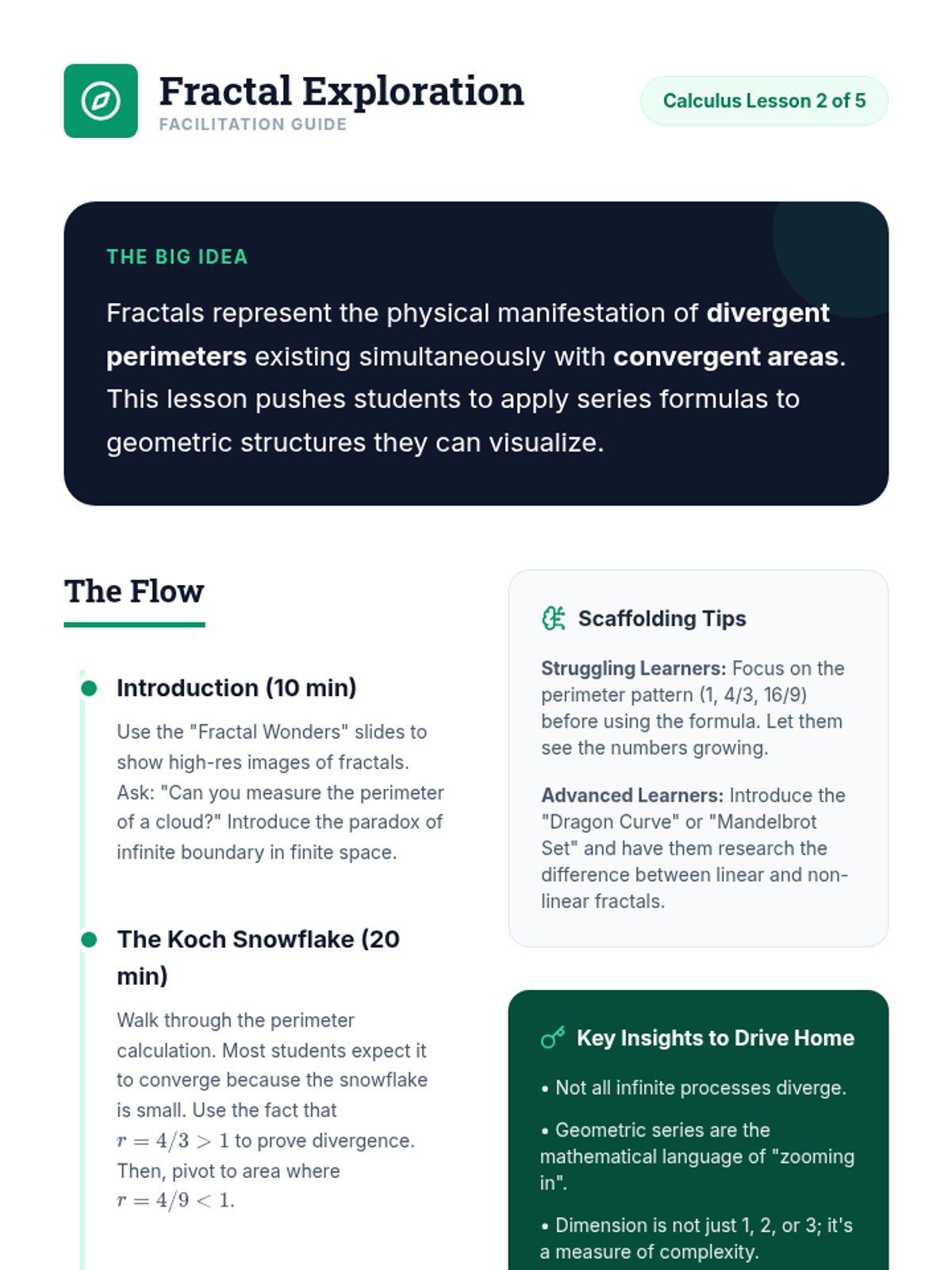
Teacher guide for exploring fractal geometry, including scaffolding tips, instructional flow, and key philosophical insights to share with students.
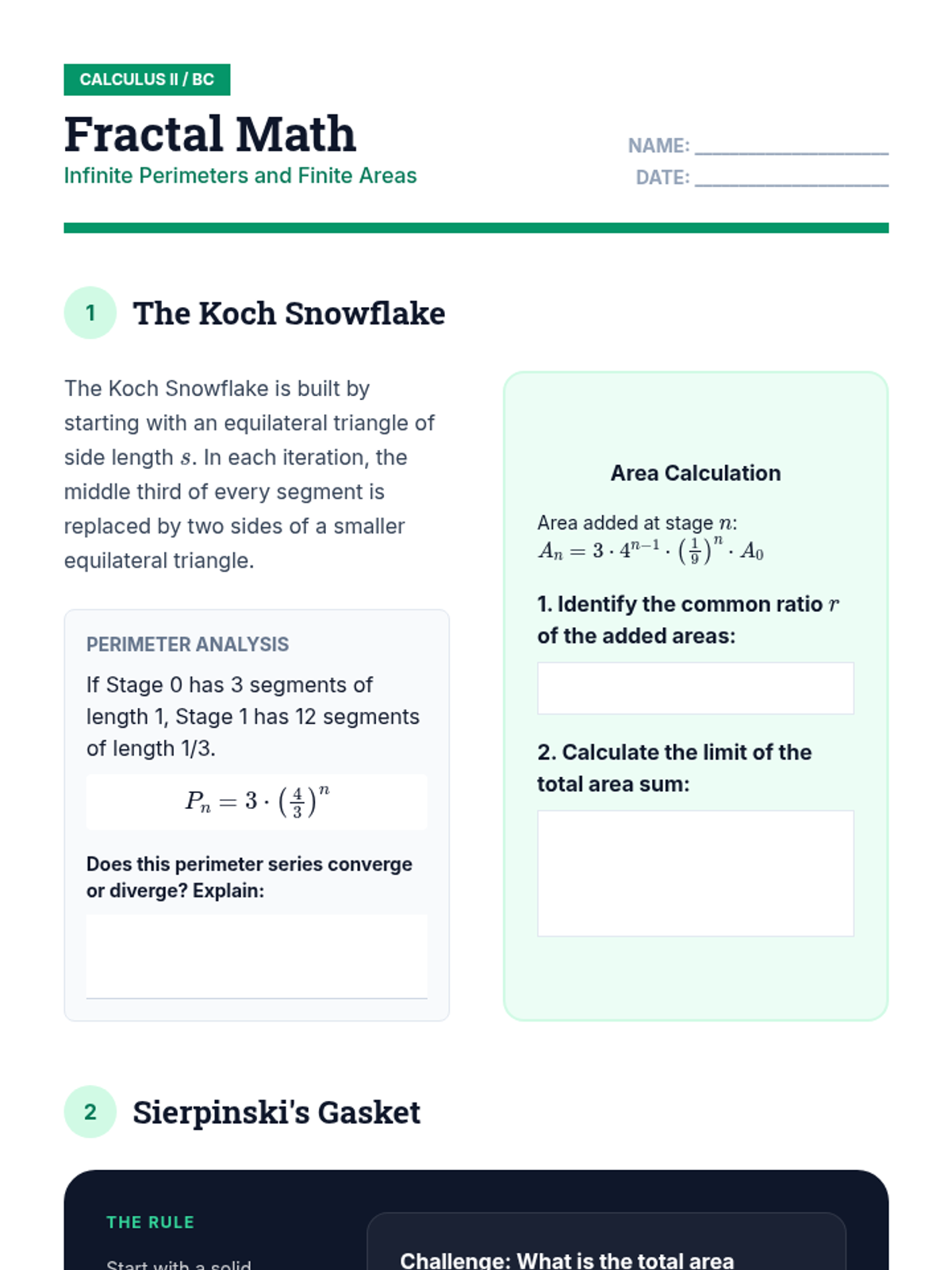
Worksheet for calculating perimeter, area, and fractal dimensions of the Koch Snowflake and Sierpinski Triangle using infinite series and logarithms.
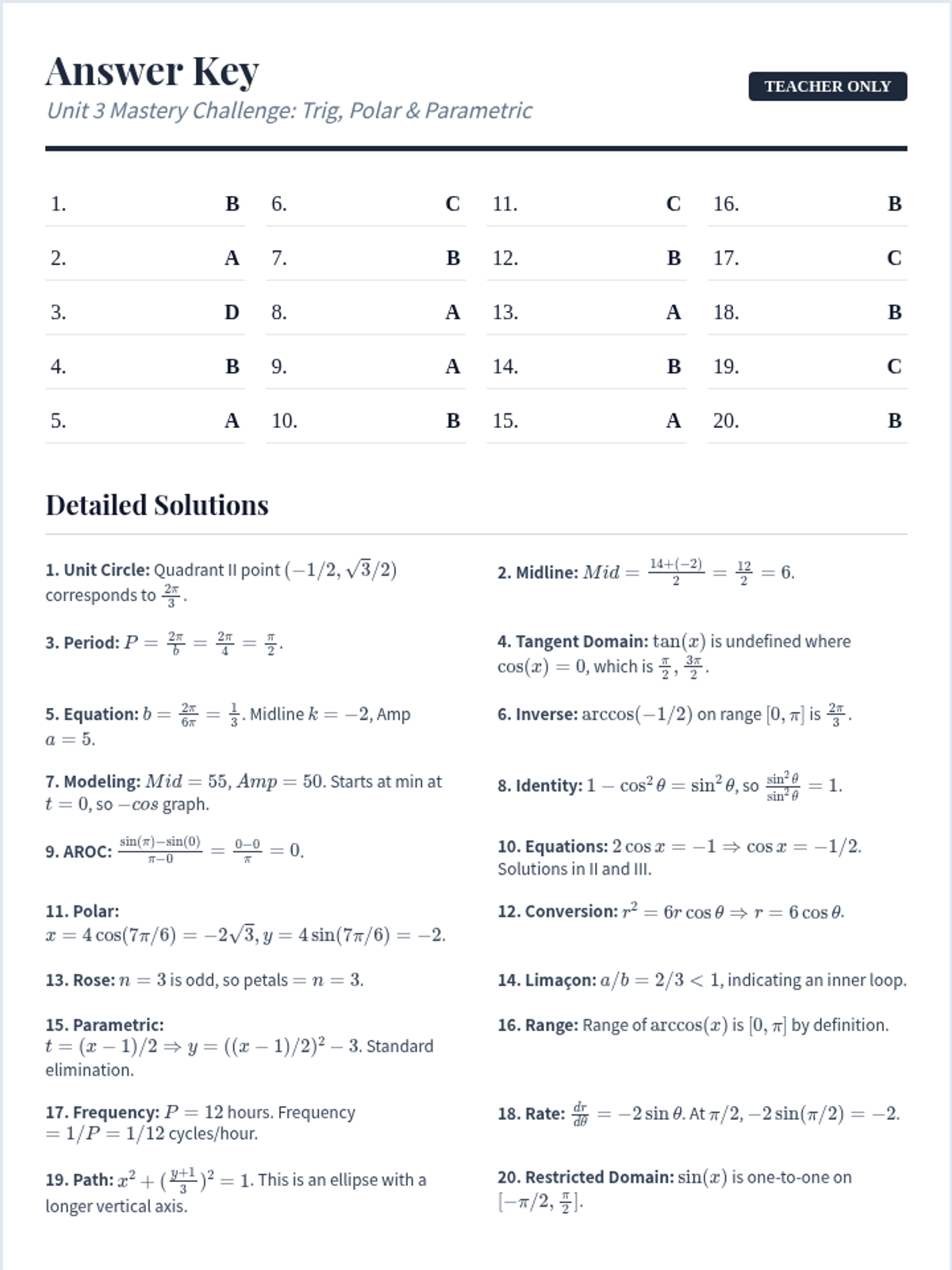
The answer key for the Unit 3 Mastery Challenge, featuring a quick-glance table and detailed explanations for all 20 questions.
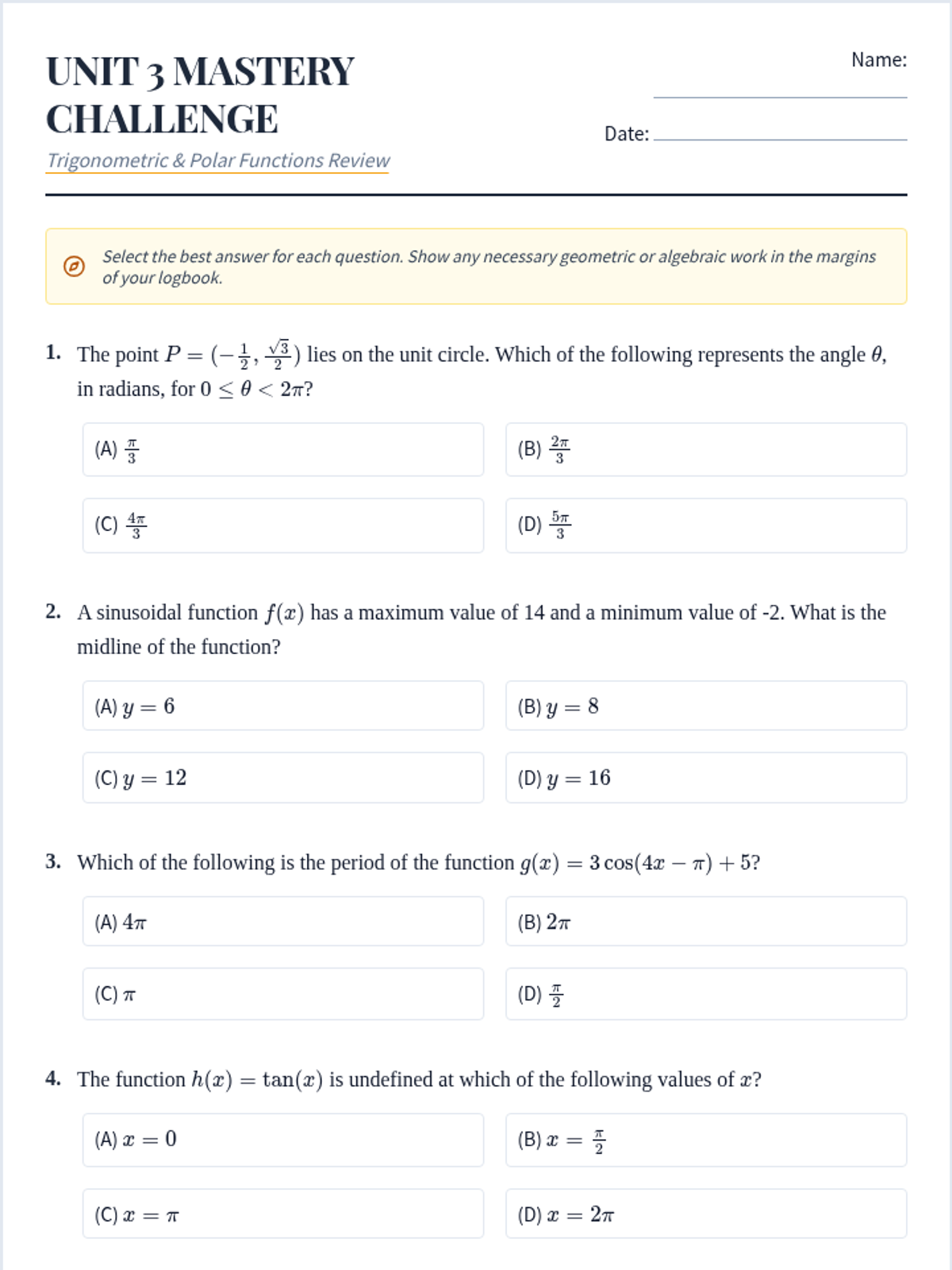
A 20-question multiple-choice assessment covering all Unit 3 topics including sinusoidal functions, inverse trigonometry, polar coordinates, and parametric functions. Designed with a nautical explorer theme and ample space for calculations.
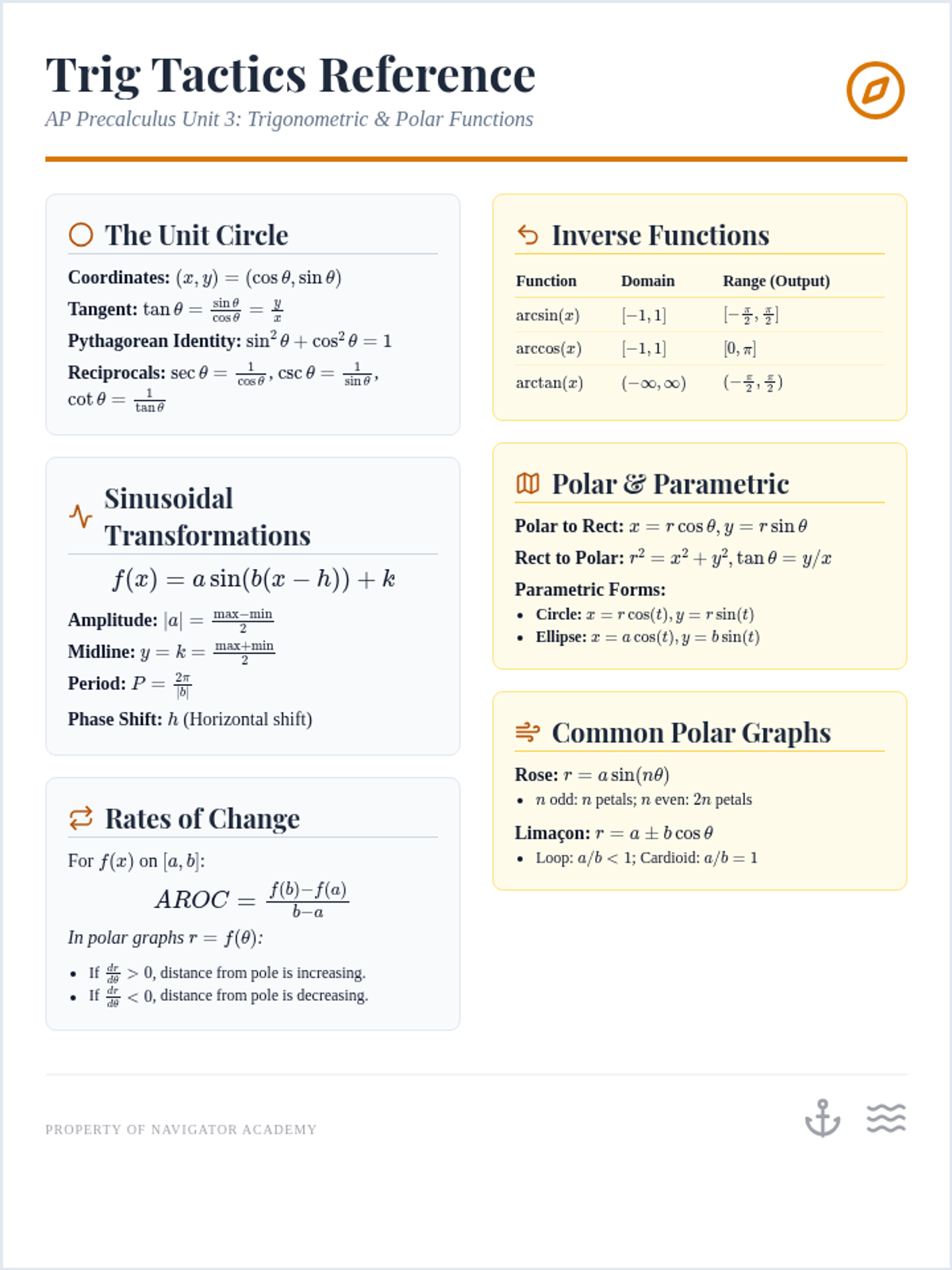
A concise one-page reference sheet covering the essential concepts of AP Precalculus Unit 3, including unit circle properties, sinusoidal transformations, inverse functions, polar coordinates, and parametric functions.
Instructional slide deck for the 'Hyperbola Hunt' lesson. Includes embedded video clips for Problem 3 and Problem 6 of the Conic Sections Quiz, focused key takeaways for foci and asymptotes, and a structured closure discussion.
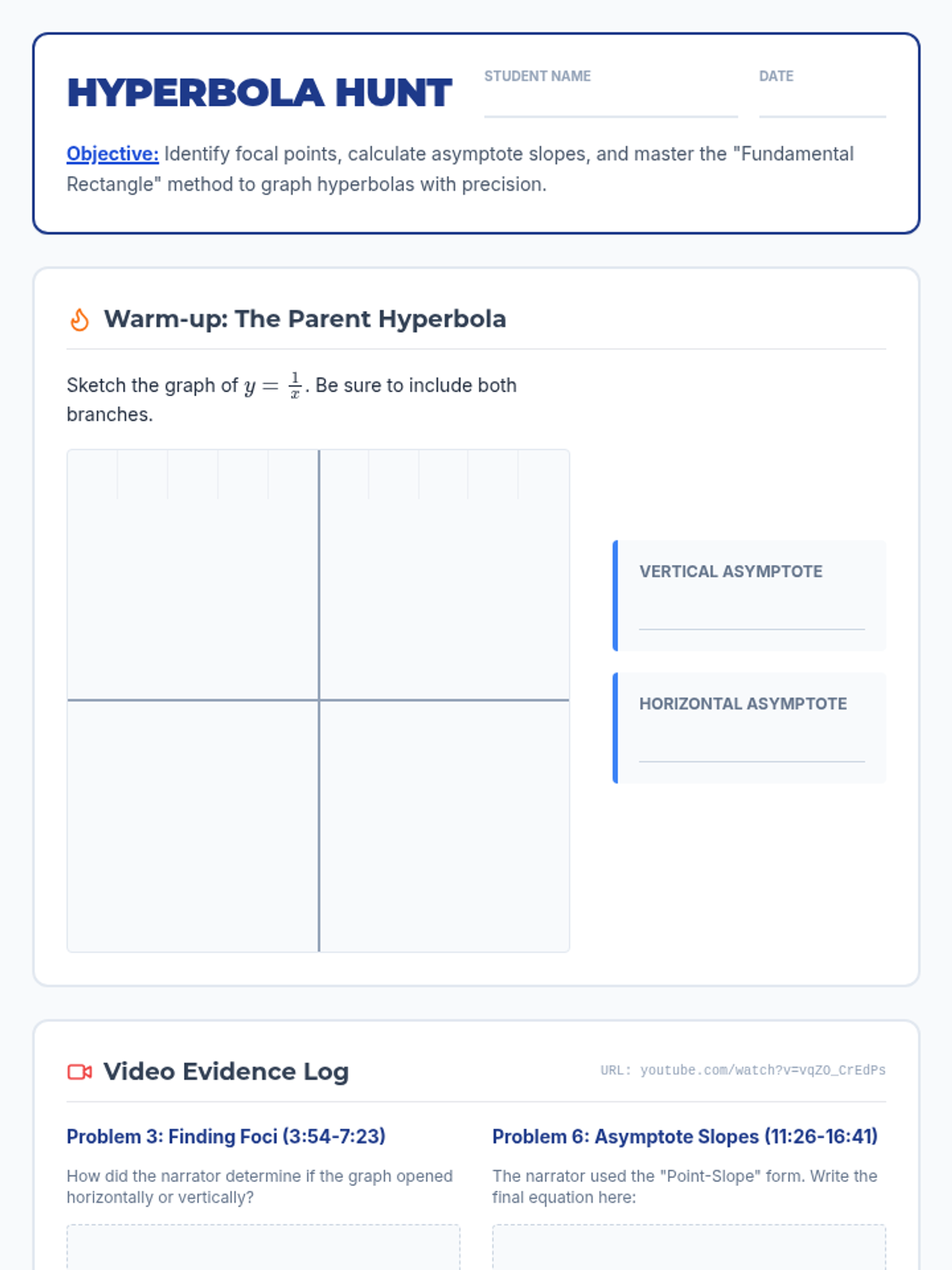
A student worksheet for the 'Hyperbola Hunt' lesson. Features a parent function warm-up, video note log for the Conic Sections Quiz video, a multi-case 'Hyperbola Hunters' graphing activity, and a closure section comparing conics.
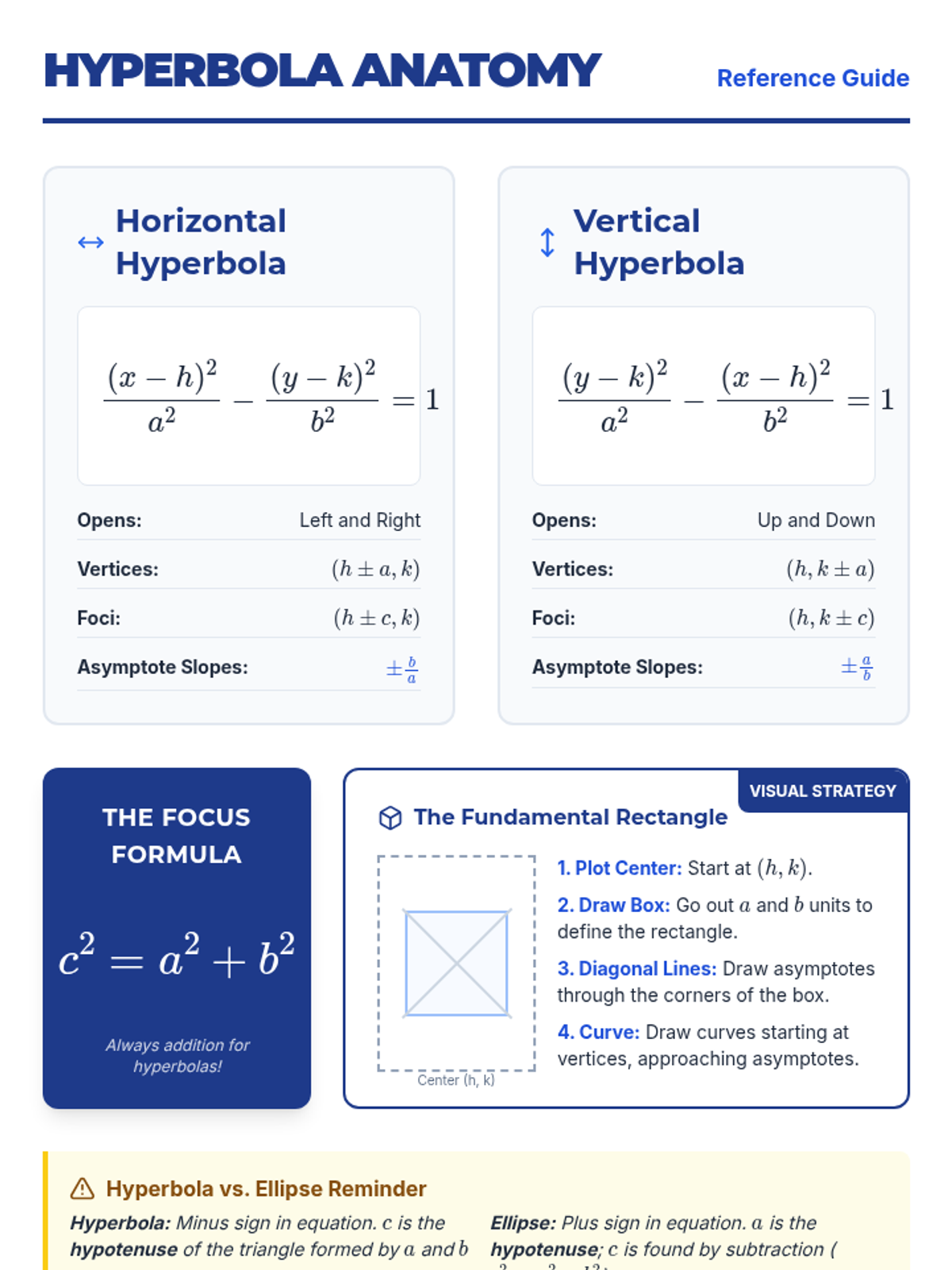
A technical anchor chart detailing the properties of horizontal and vertical hyperbolas, including standard form equations, focus calculation, and the 'fundamental rectangle' graphing strategy.
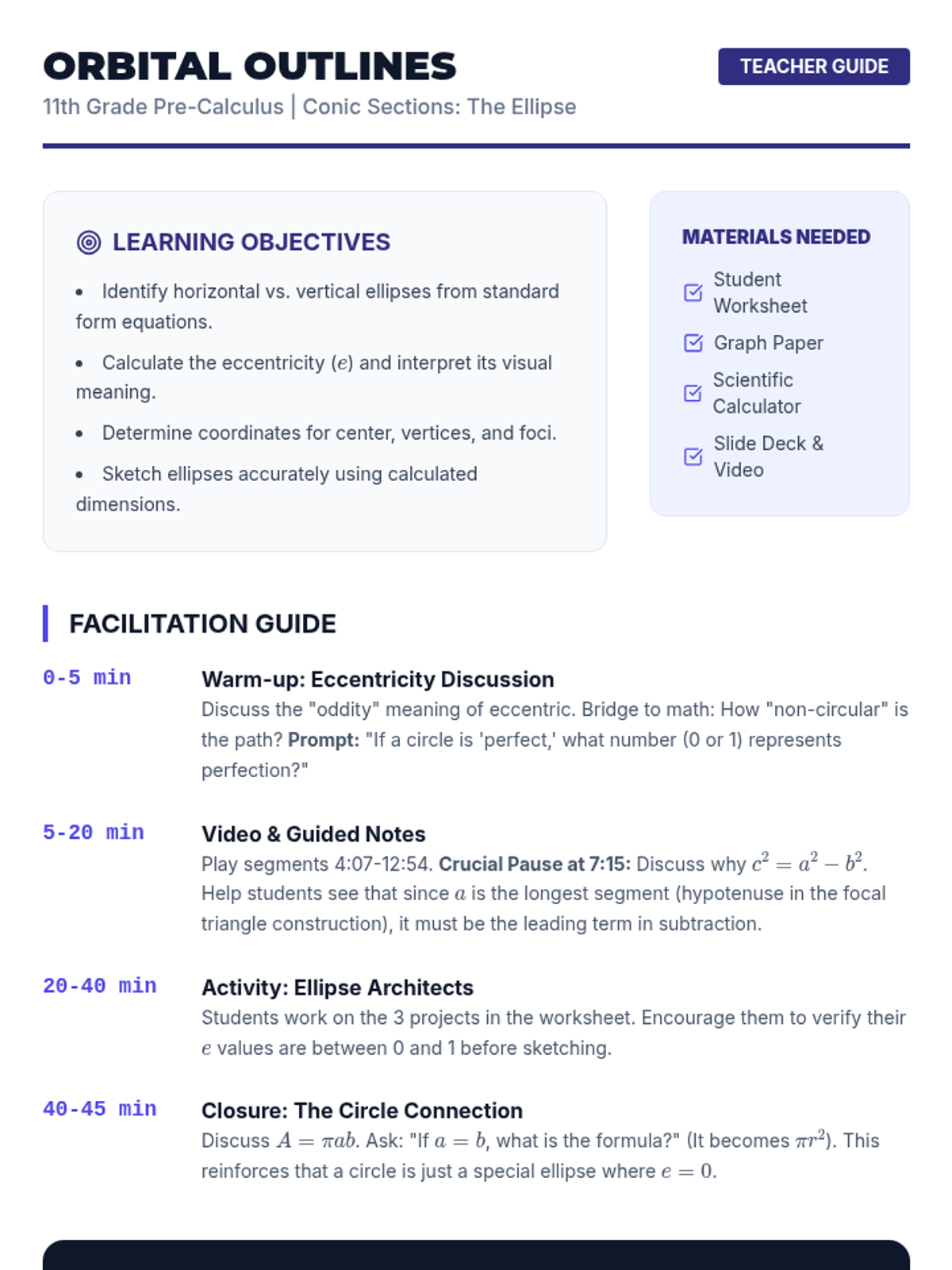
Teacher-facing facilitation guide for the Orbital Outlines lesson. Includes pacing suggestions, detailed background on the focal pause point, common student pitfalls, and a complete answer key for the worksheet and activity.
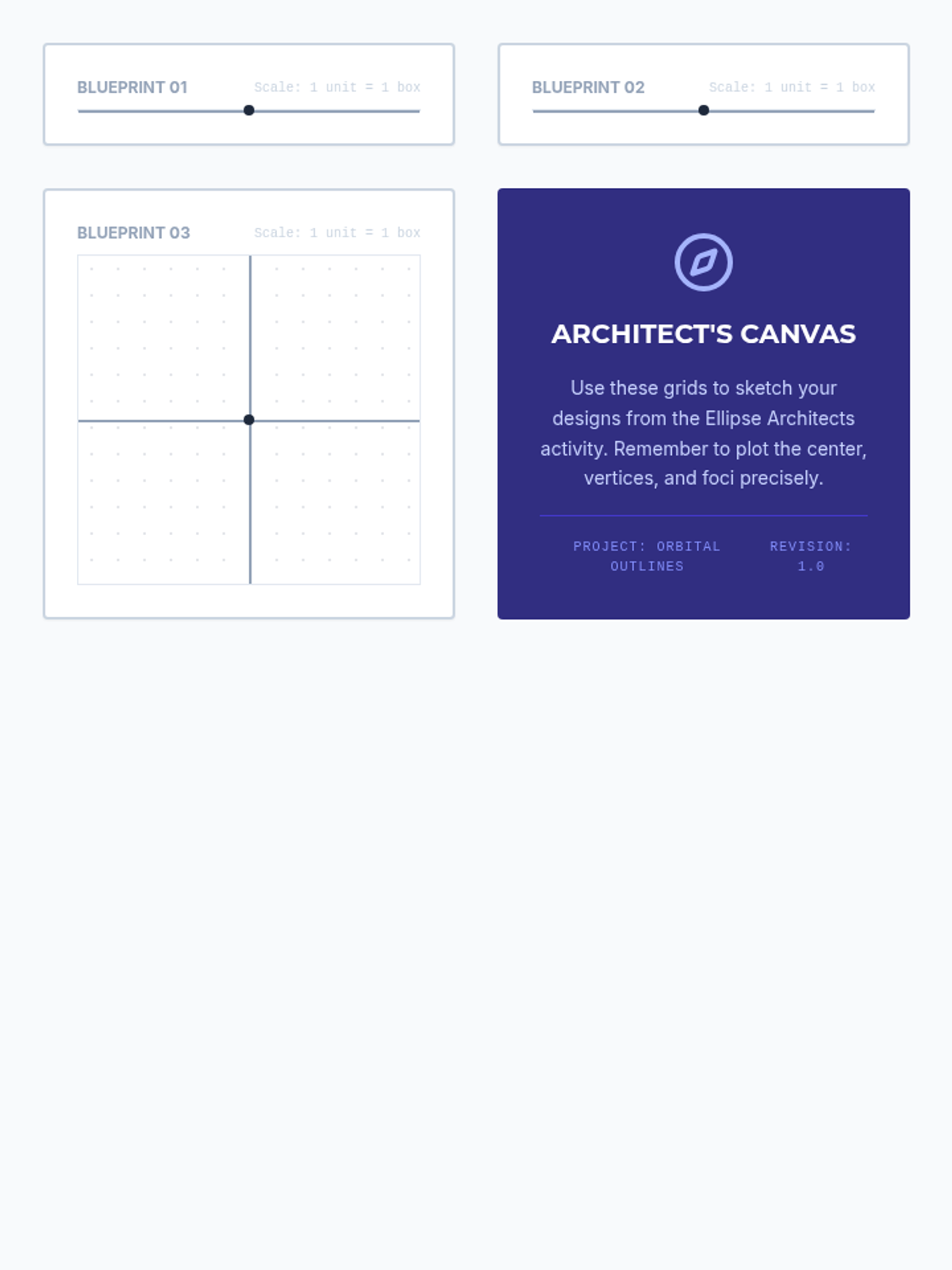
Custom-designed graph paper for the Orbital Outlines lesson, featuring three quadrant-aligned coordinate planes with scaled grid lines to support the sketching phase of the "Ellipse Architects" activity.
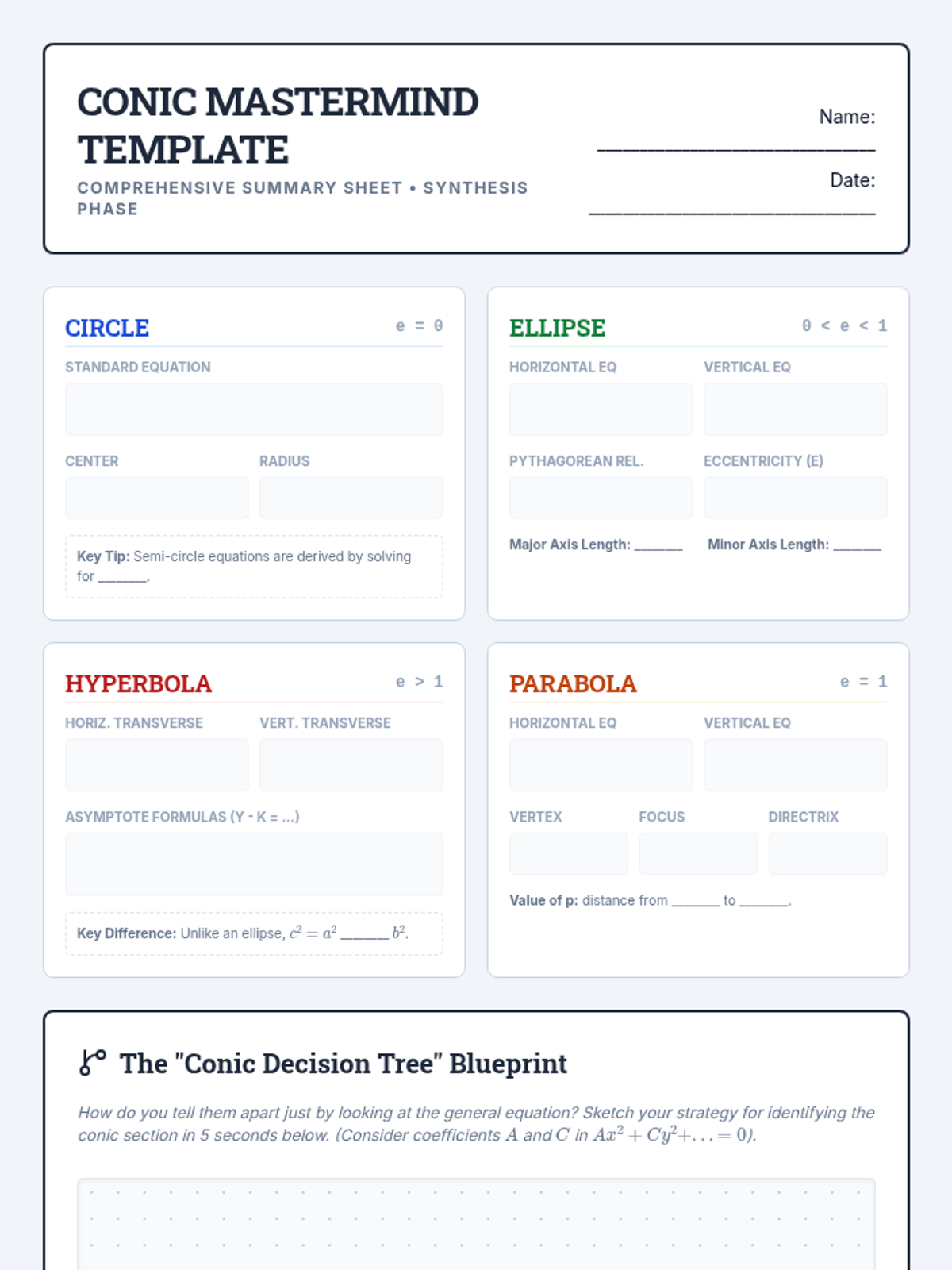
A structured note-taking template and synthesis organizer for students to capture key formulas, properties, and a "Decision Tree" for identifying conic sections.
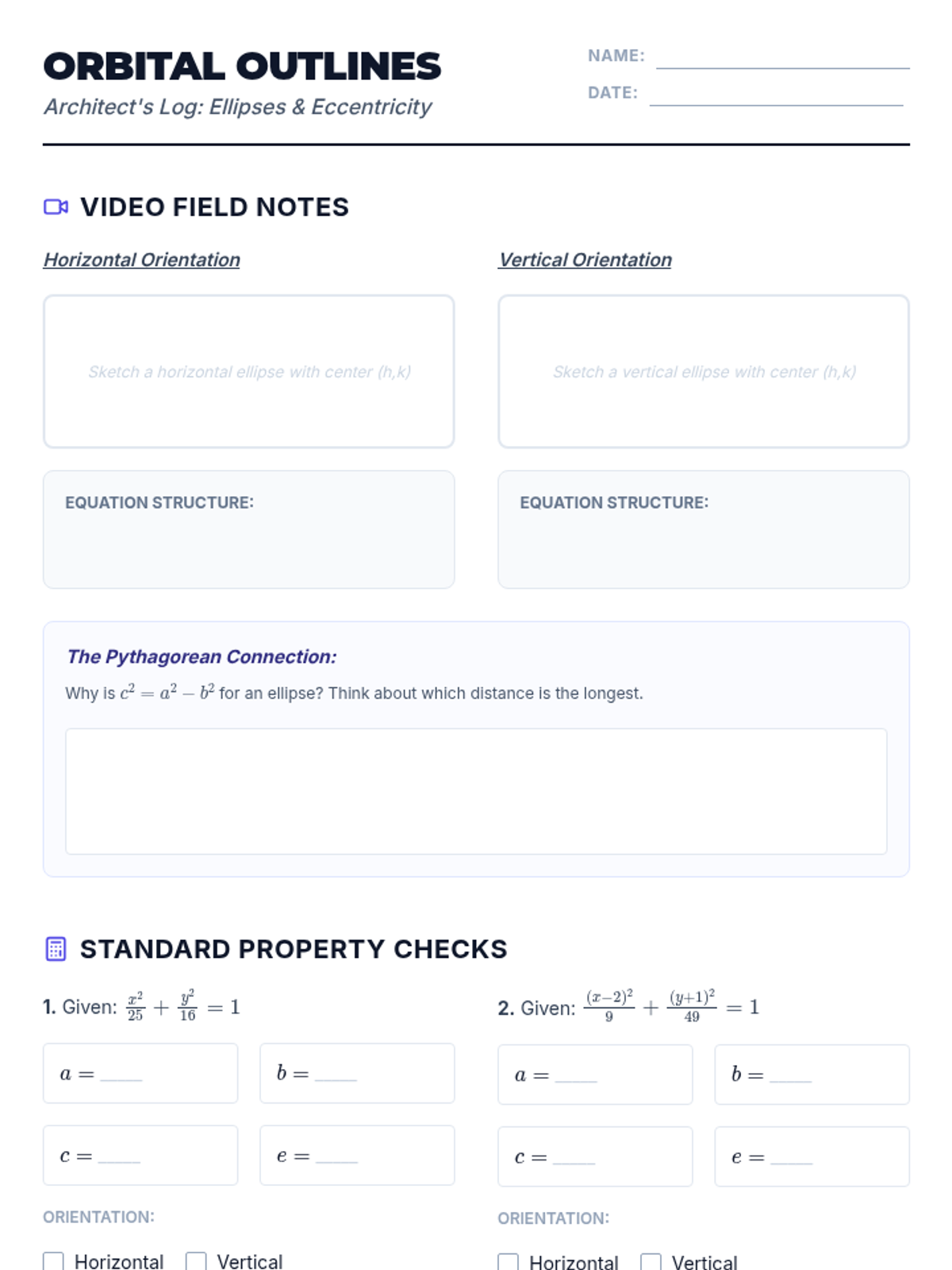
A structured worksheet for the Orbital Outlines lesson. Includes video viewing note areas, introductory practice for horizontal and vertical ellipses, and the multi-step "Ellipse Architects" activity where students design elliptical paths from specific mathematical parameters.
Dynamic slide deck for the Conic Clash lesson, including rapid-fire equation challenges, an embedded summary video, and group project instructions.
A comprehensive slide deck for 11th Grade Pre-Calculus students covering the standard equations of ellipses, horizontal vs. vertical orientations, and eccentricity calculation. Includes embedded video placeholders and discussion prompts for active learning.
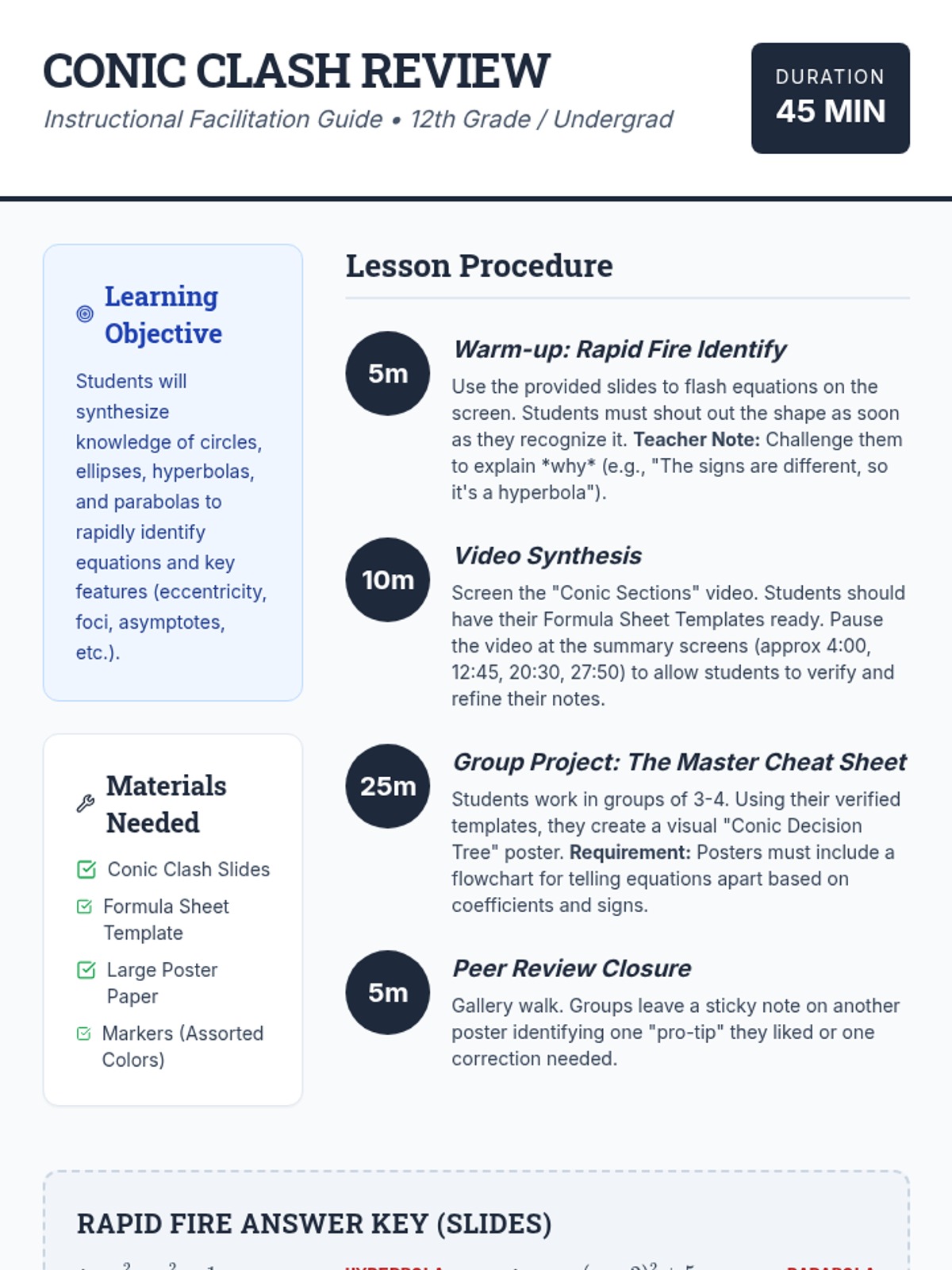
A comprehensive facilitator guide for the Conic Clash lesson, including objectives, materials, timed procedures, and an answer key for the warm-up activity.
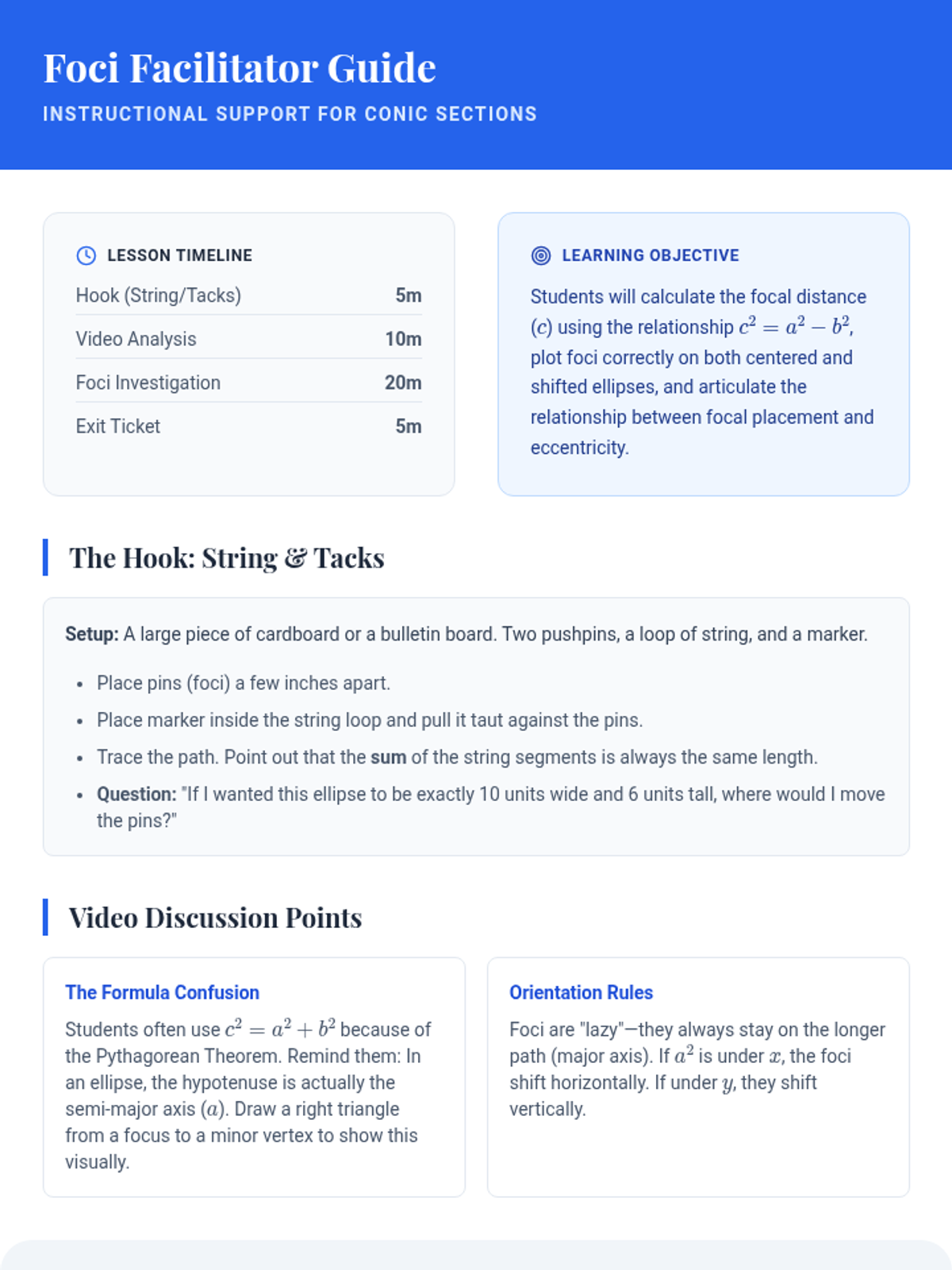
A teacher facilitation guide including a lesson timeline, instructions for the 'String and Tacks' demonstration, discussion points for the video, and a complete answer key for the worksheet and exit ticket.
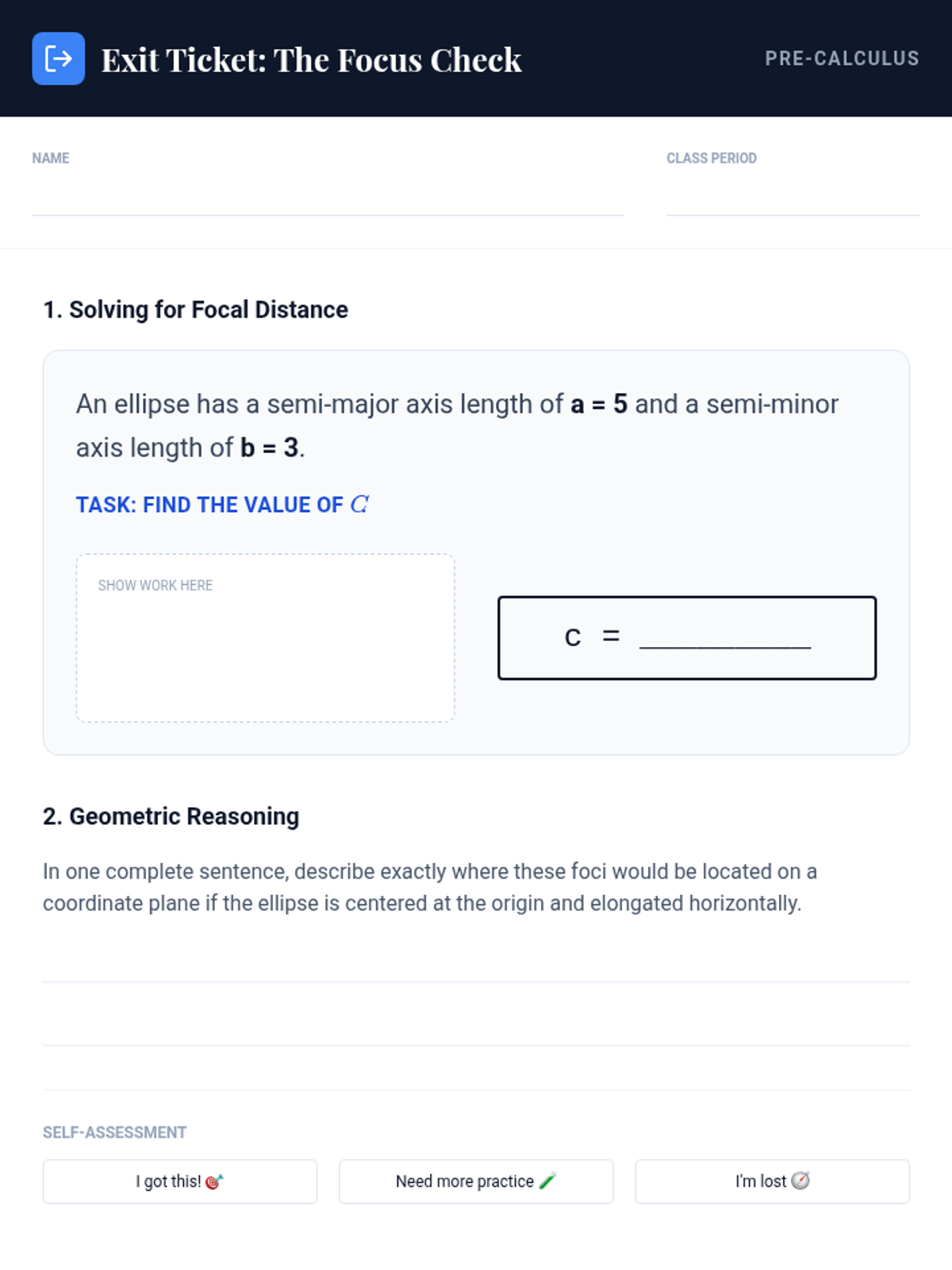
A concise exit ticket for students to calculate the focal distance 'c' given a and b, and to describe the geometric placement of foci in a horizontal ellipse.
A 5-slide visual presentation to guide the lesson. Includes the 'String and Tacks' hook, an embedded YouTube video tutorial on the foci formula, a comparison with the Pythagorean theorem, and instructions for the student investigation activity.
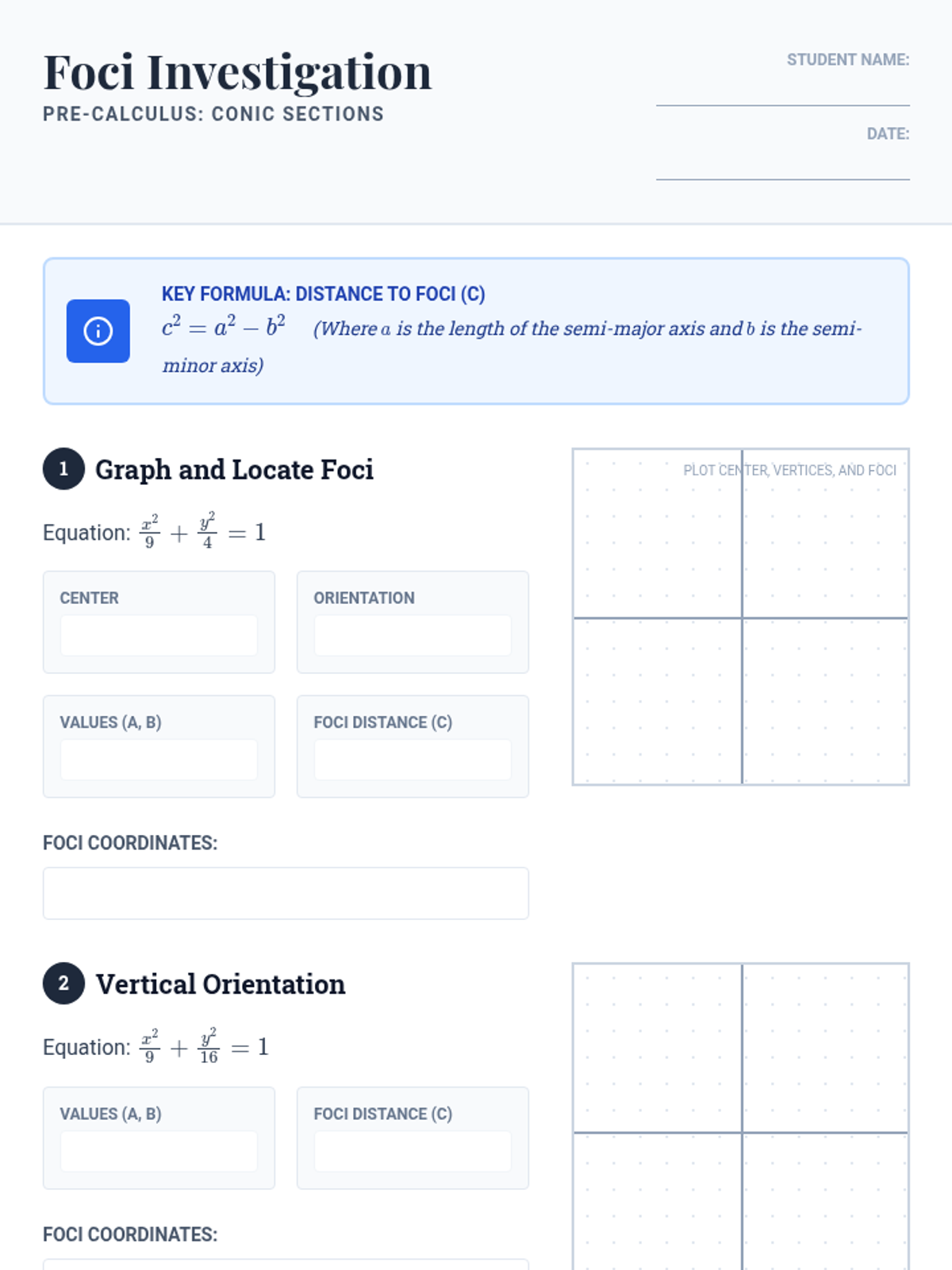
A 2-page student worksheet for investigating ellipse foci. It includes three progressive graphing problems (horizontal, vertical, and shifted) and a critical thinking question regarding the relationship between focal distance and eccentricity.
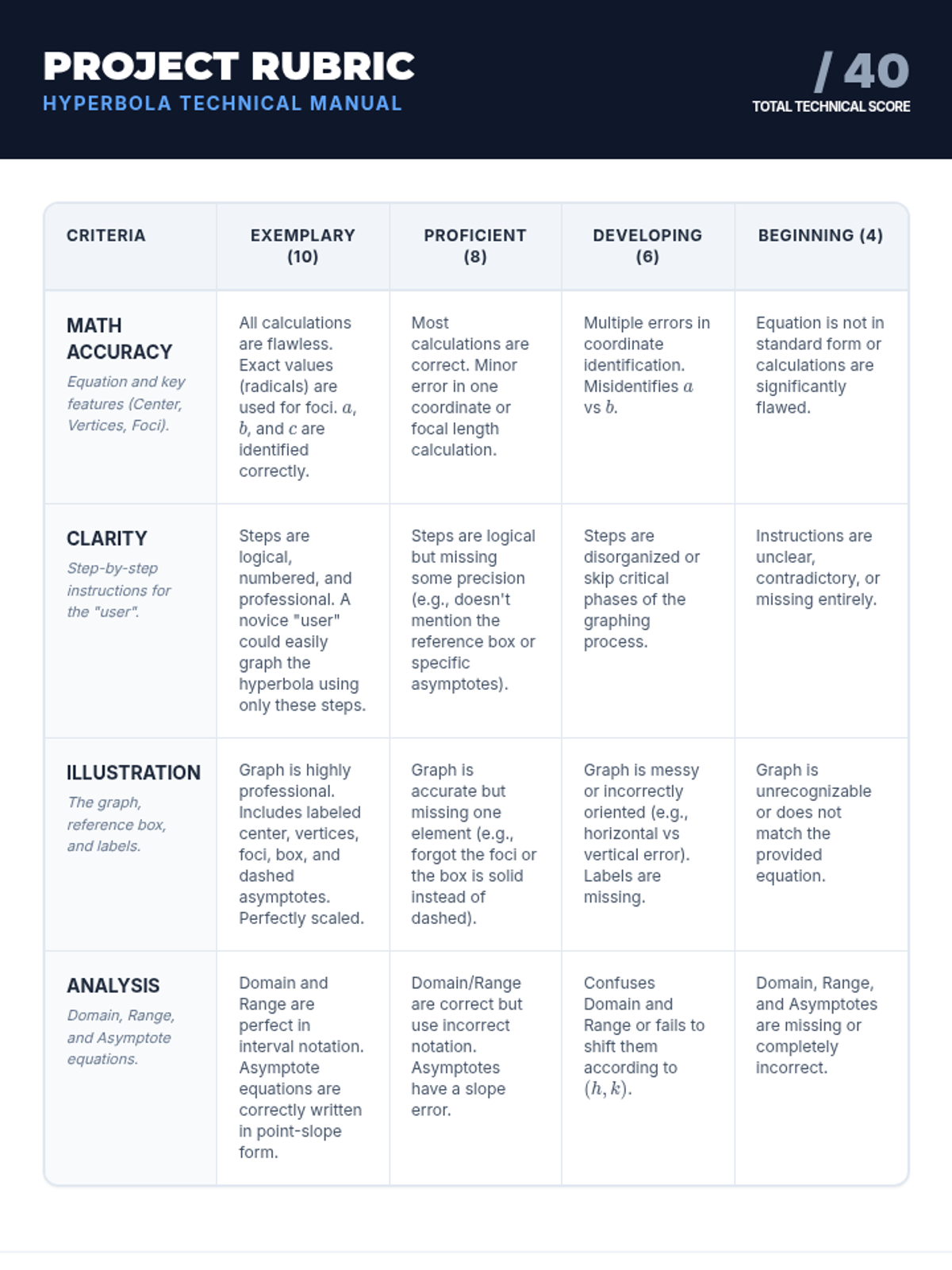
A comprehensive grading rubric for the Hyperbola Manual Project, evaluating mathematical accuracy, procedural clarity, technical illustration, and analytical depth.
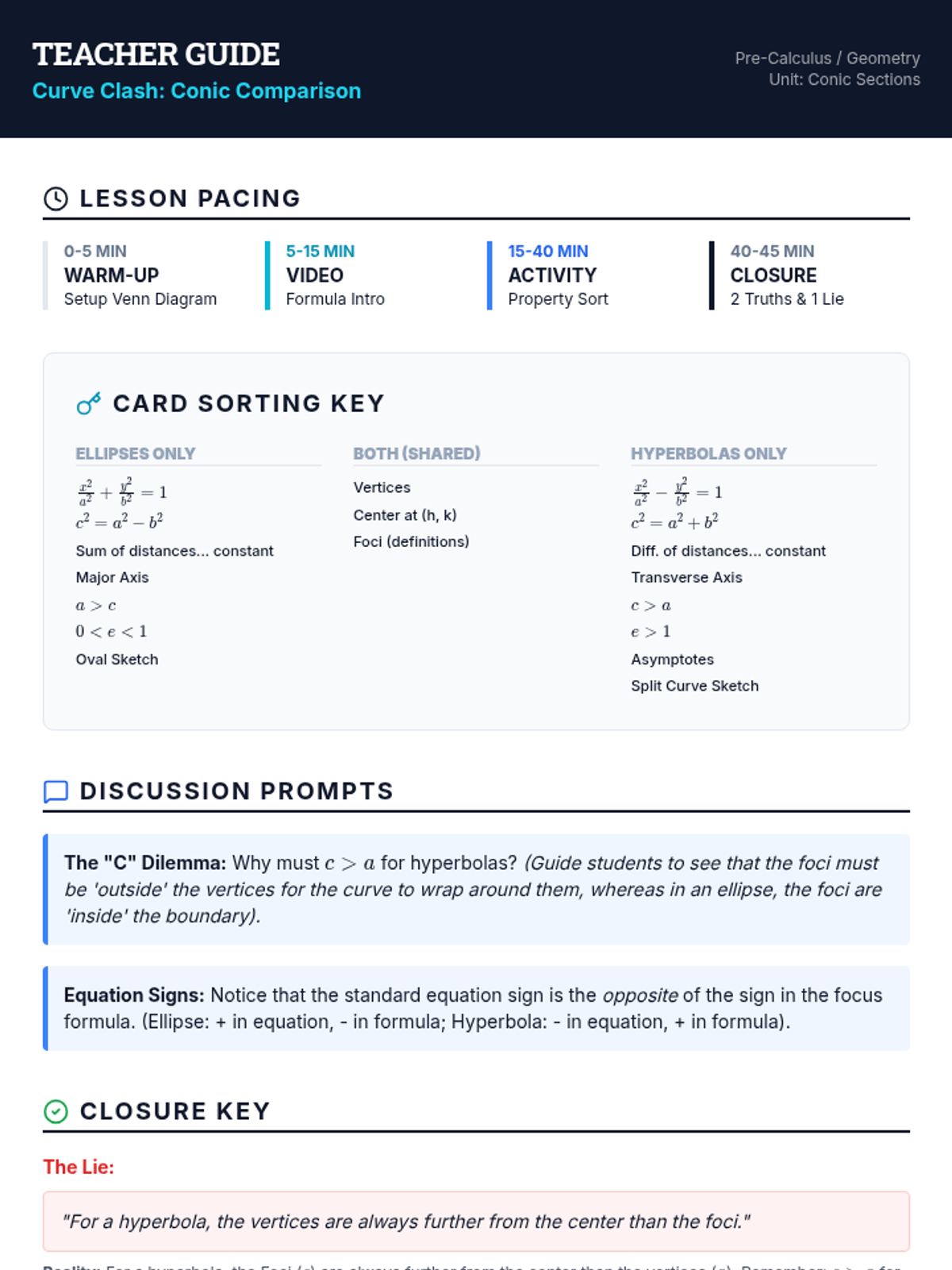
A comprehensive teacher guide for the 'Curve Clash' lesson, including pacing, sorting activity answer keys, discussion prompts, and closure guide.
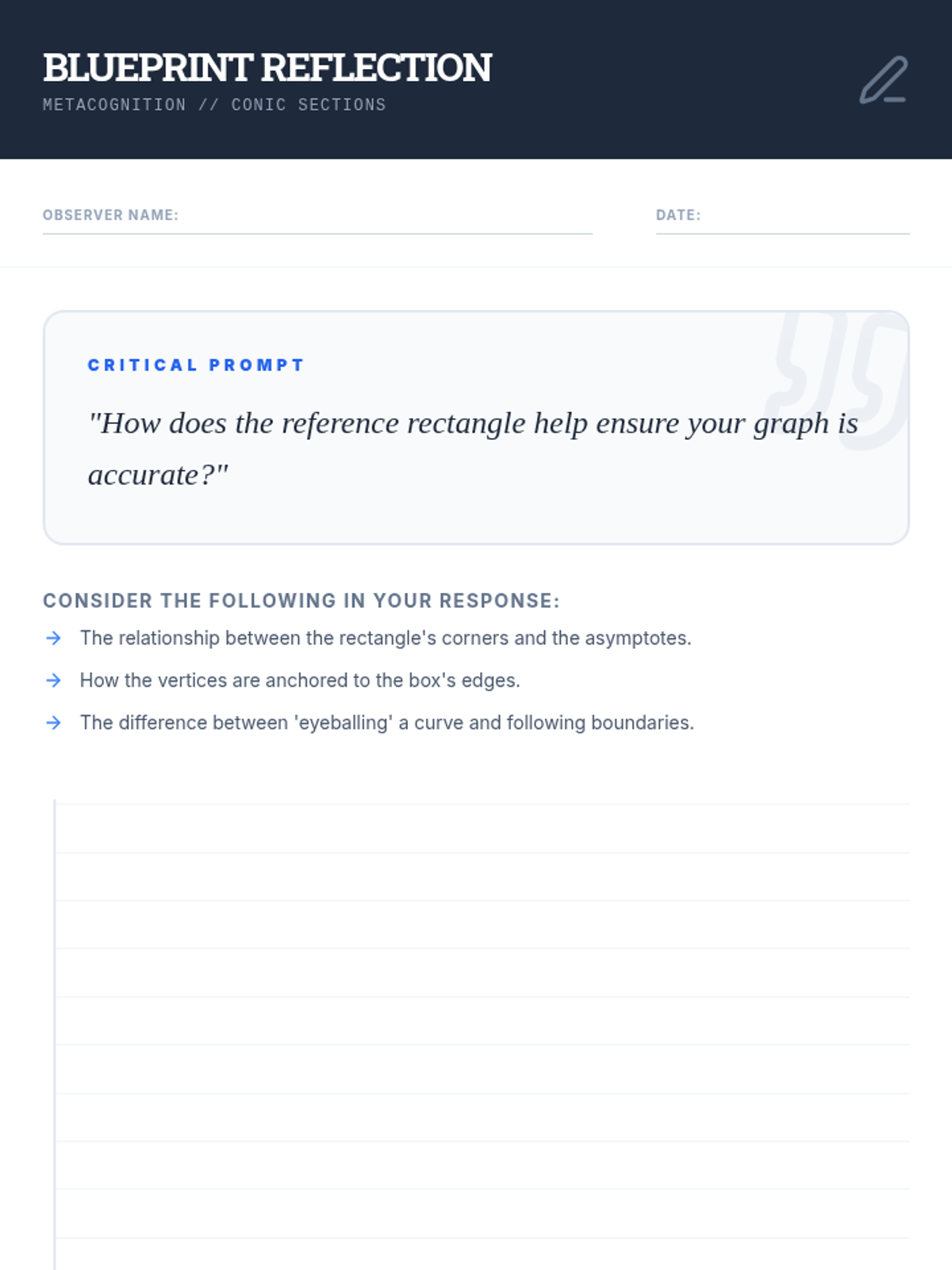
A dedicated reflection journal sheet for Pre-Calculus students. It prompts them to synthesize their learning by explaining the geometric utility of the reference rectangle in hyperbola construction, featuring a clean 'Blueprint' design and ample writing space.
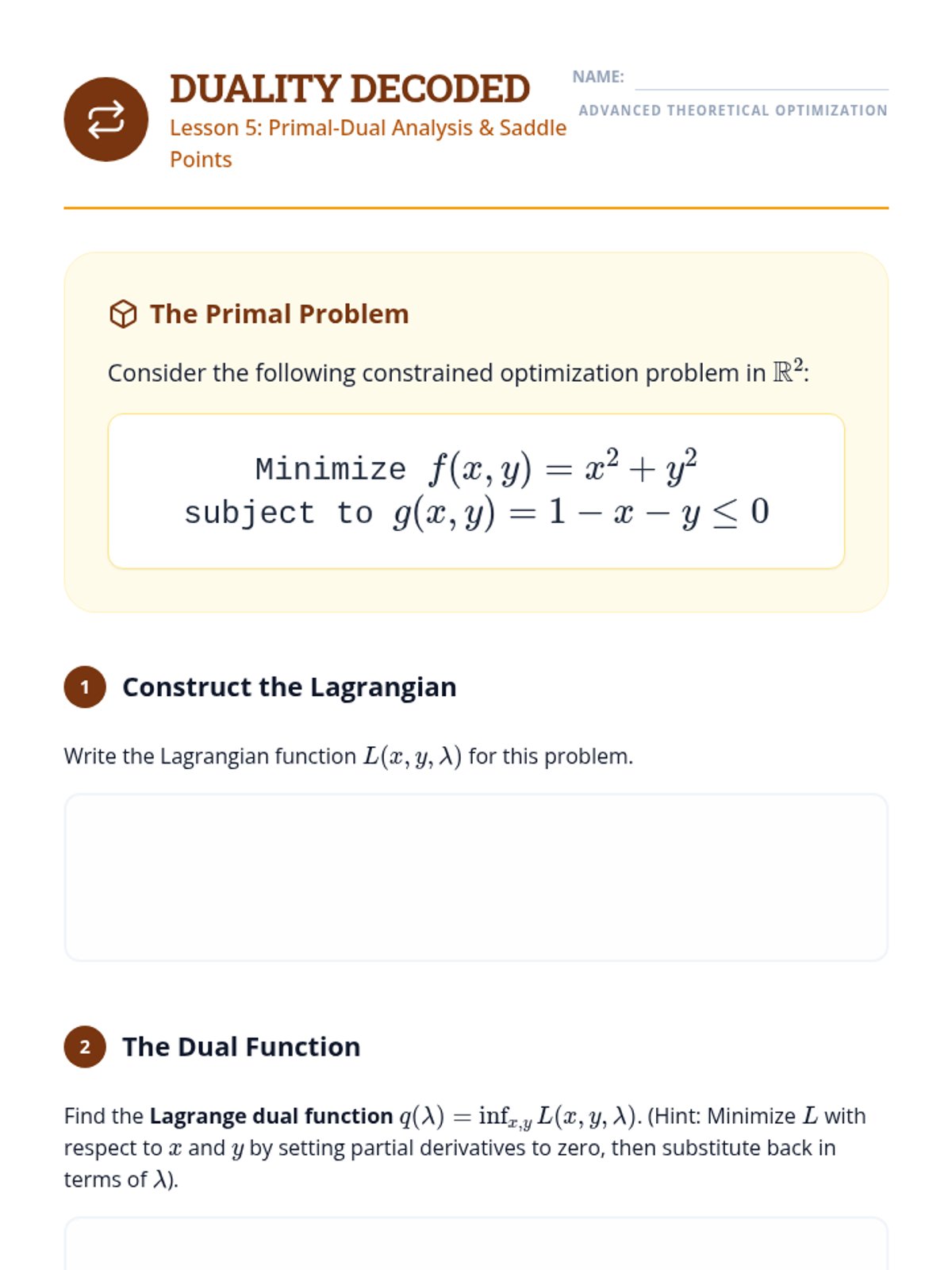
Case study worksheet for Lesson 5 focusing on deriving the dual function, solving the dual problem, and verifying strong duality and saddle point conditions.
Visual presentation for Lesson 5 covering the Lagrangian, primal and dual problems, weak/strong duality, and saddle point conditions.
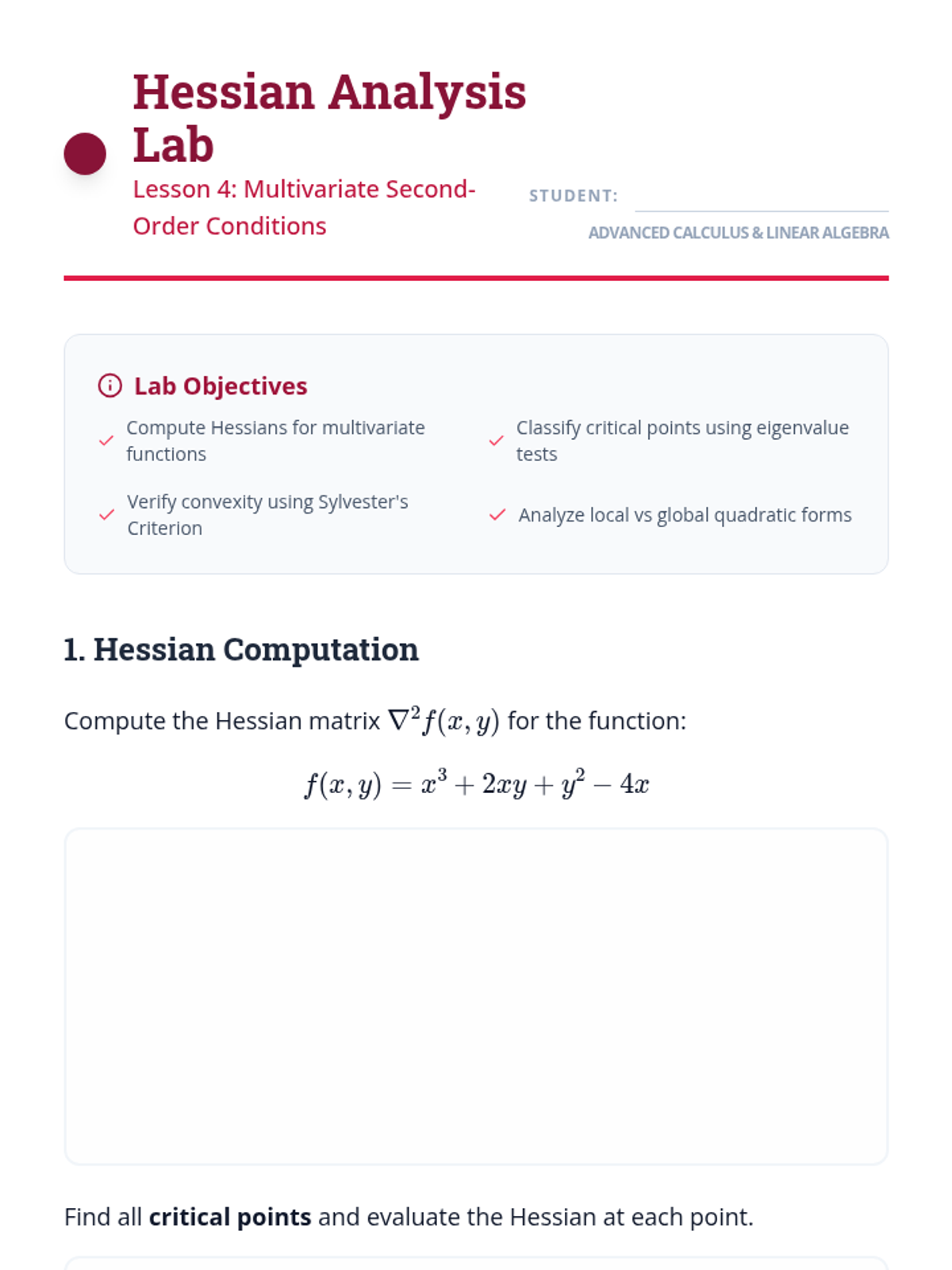
Problem set for Lesson 4 focusing on calculating Hessians, classifying critical points using eigenvalues, and applying Sylvester's Criterion for global convexity.
Visual presentation for Lesson 4 covering the Hessian matrix, Taylor expansion, and second-order conditions for convexity and optimality.
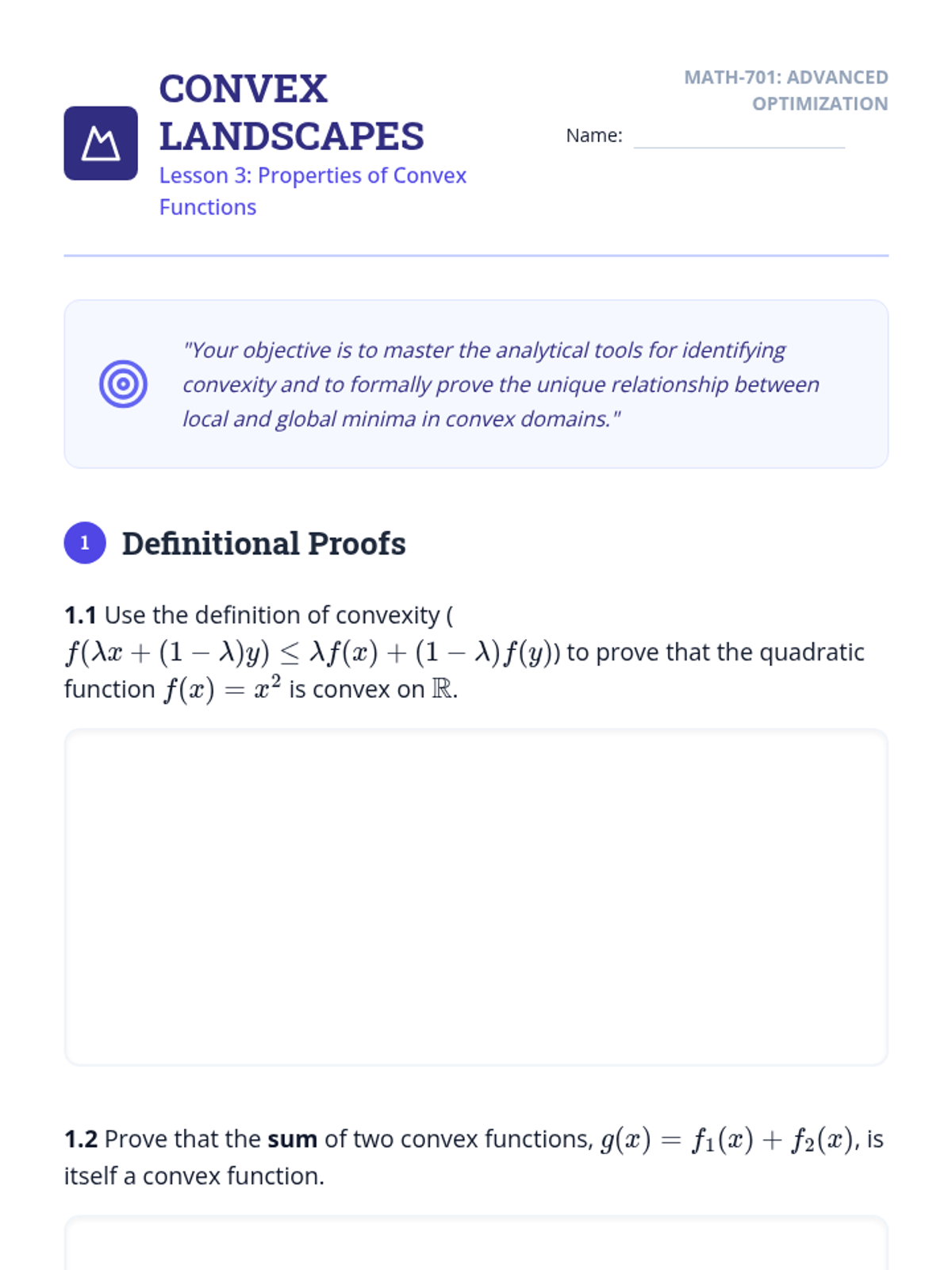
Problem set for Lesson 3 focusing on proofs of convexity, applying Jensen's Inequality to derive the AM-GM inequality, and proving the global minimum theorem.
Visual presentation for Lesson 3 covering the definitions of convex functions, Jensen's Inequality, epigraphs, and the global minimum property.
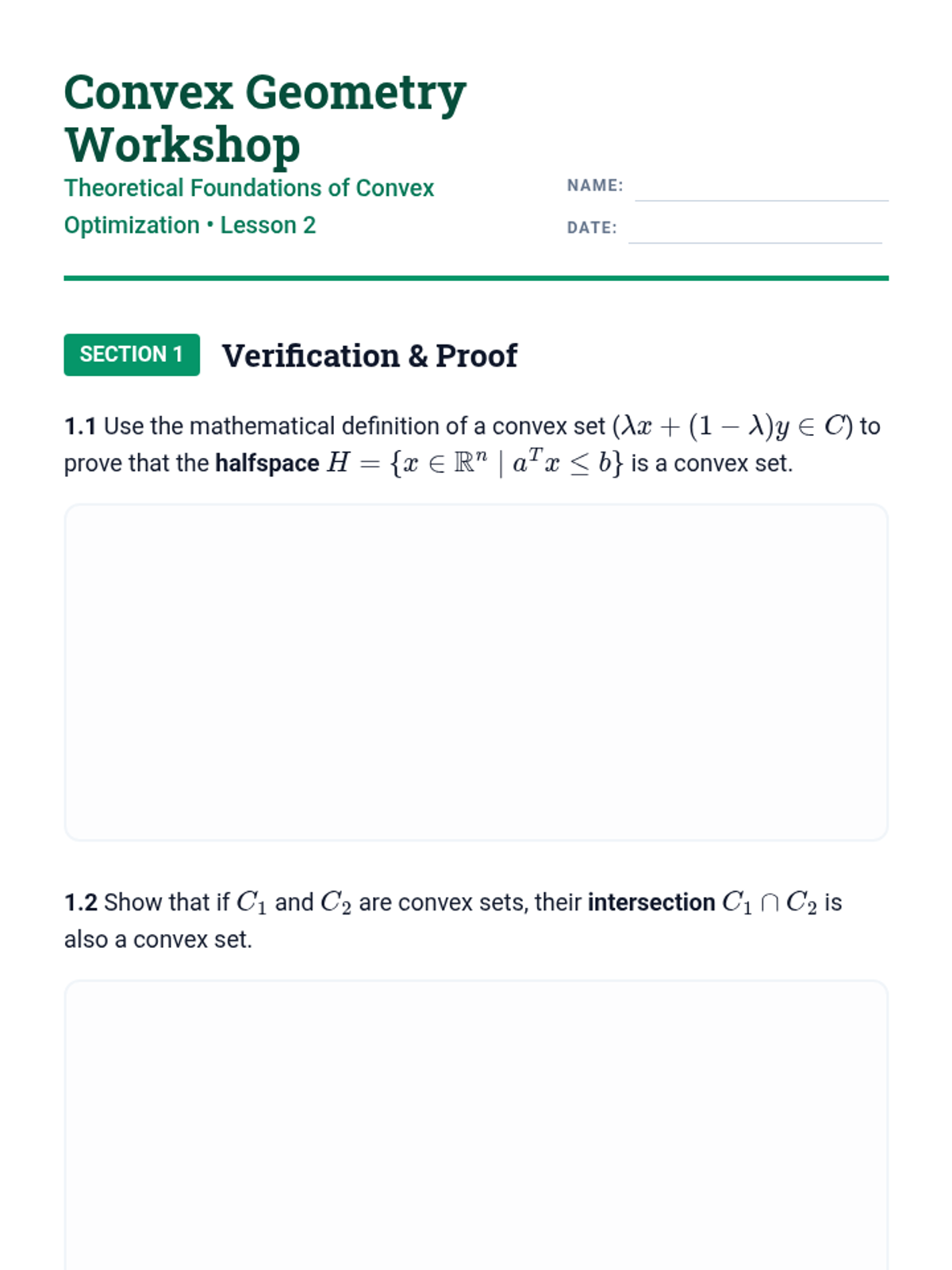
Inquiry-based workshop worksheet for Lesson 2 focusing on proofs of convexity, construction of convex hulls, and finding separating/supporting hyperplanes.
Visual presentation for Lesson 2 covering the geometry of convex sets, hulls, and separating/supporting hyperplanes.
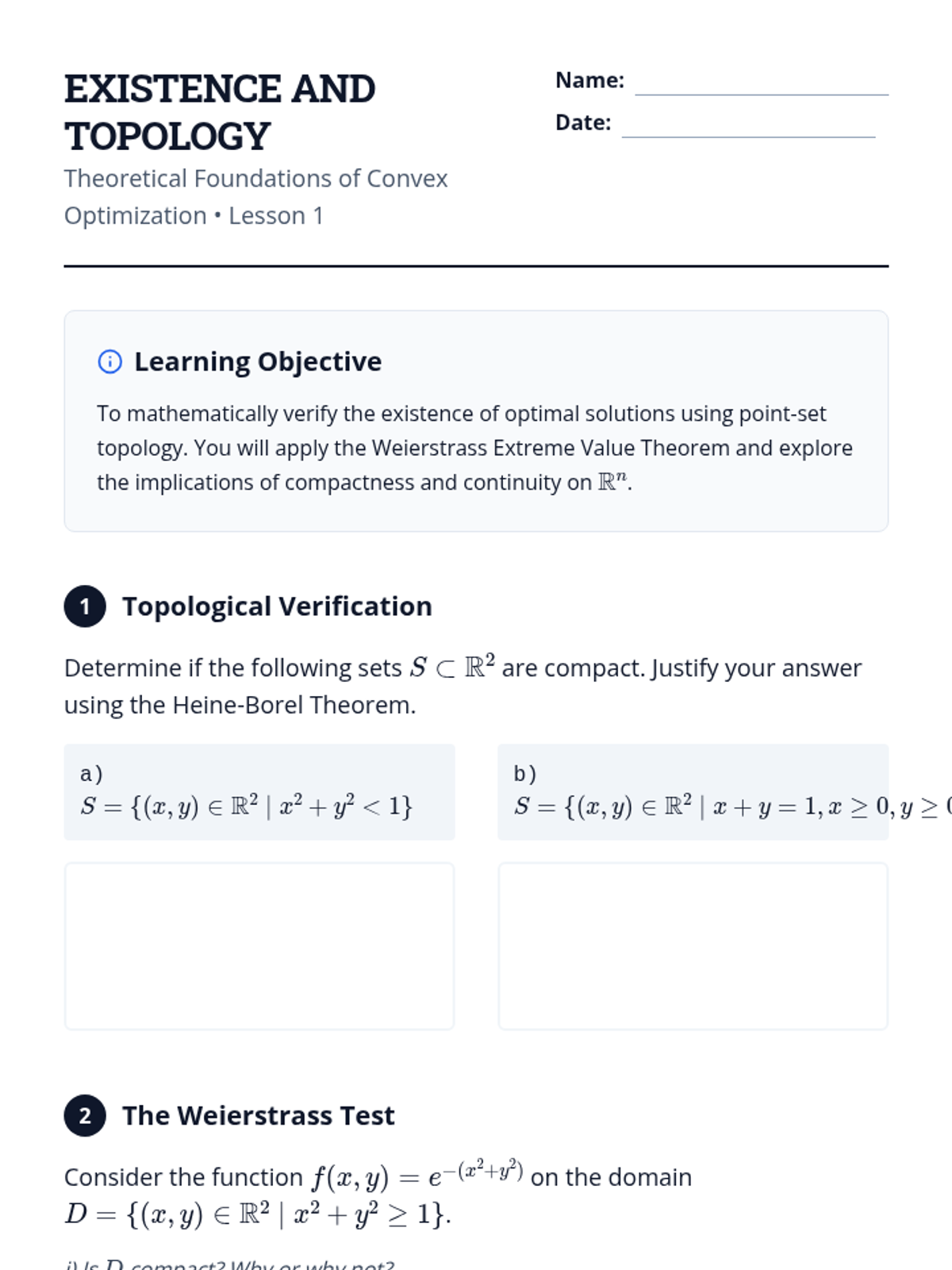
Advanced worksheet for graduate students to practice proving the existence of optimal solutions using topological properties like compactness and continuity.
Visual presentation for Lesson 1 covering the topological requirements for optimization, including compactness, Heine-Borel, and the Weierstrass Extreme Value Theorem.
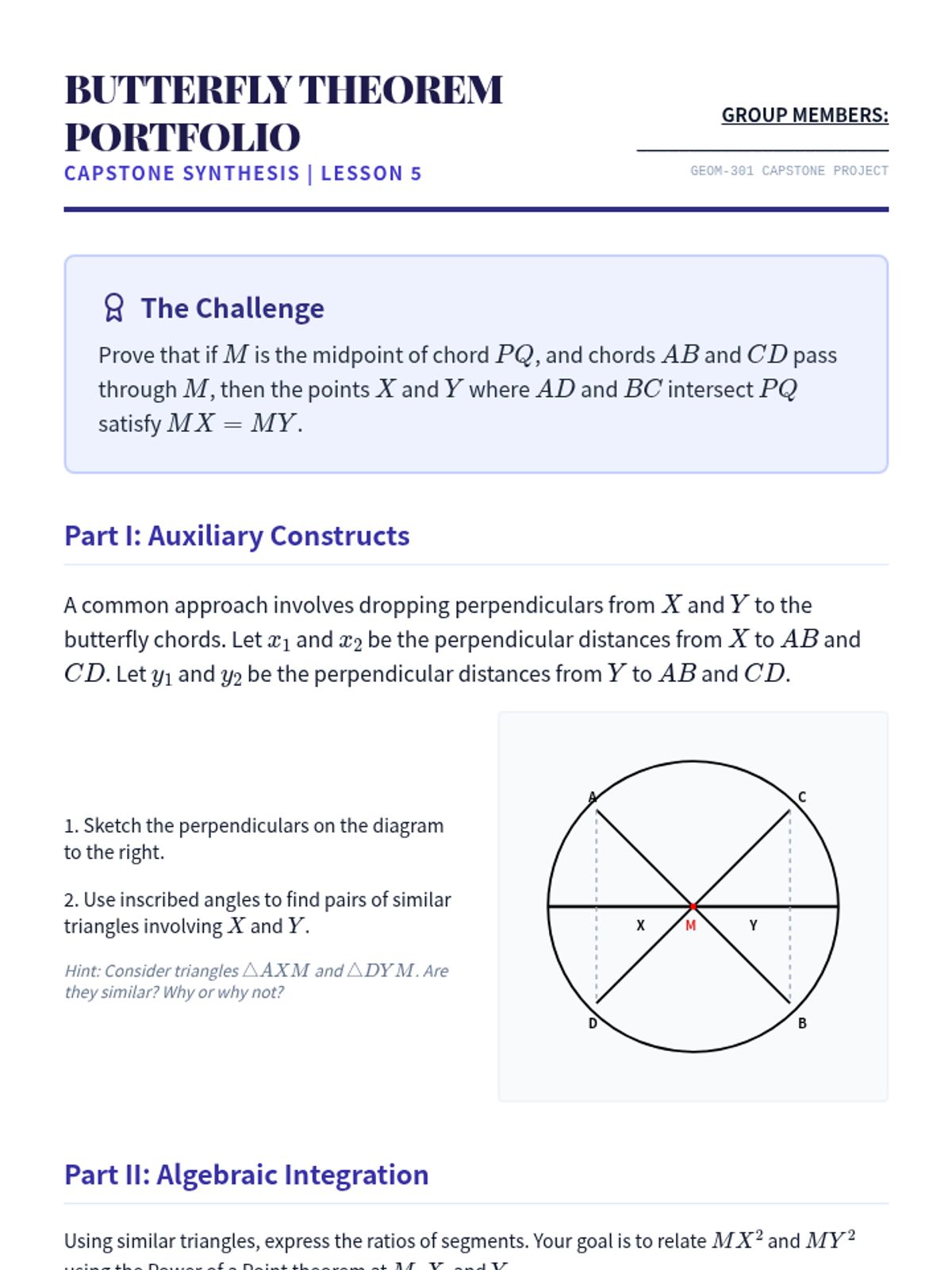
A multi-part guided synthesis document for the Butterfly Theorem capstone, requiring students to integrate similarity, inscribed angles, and algebraic reasoning.
Visual presentation for the capstone lesson on the Butterfly Theorem, covering its statement, necessary geometric tools, and historical context.
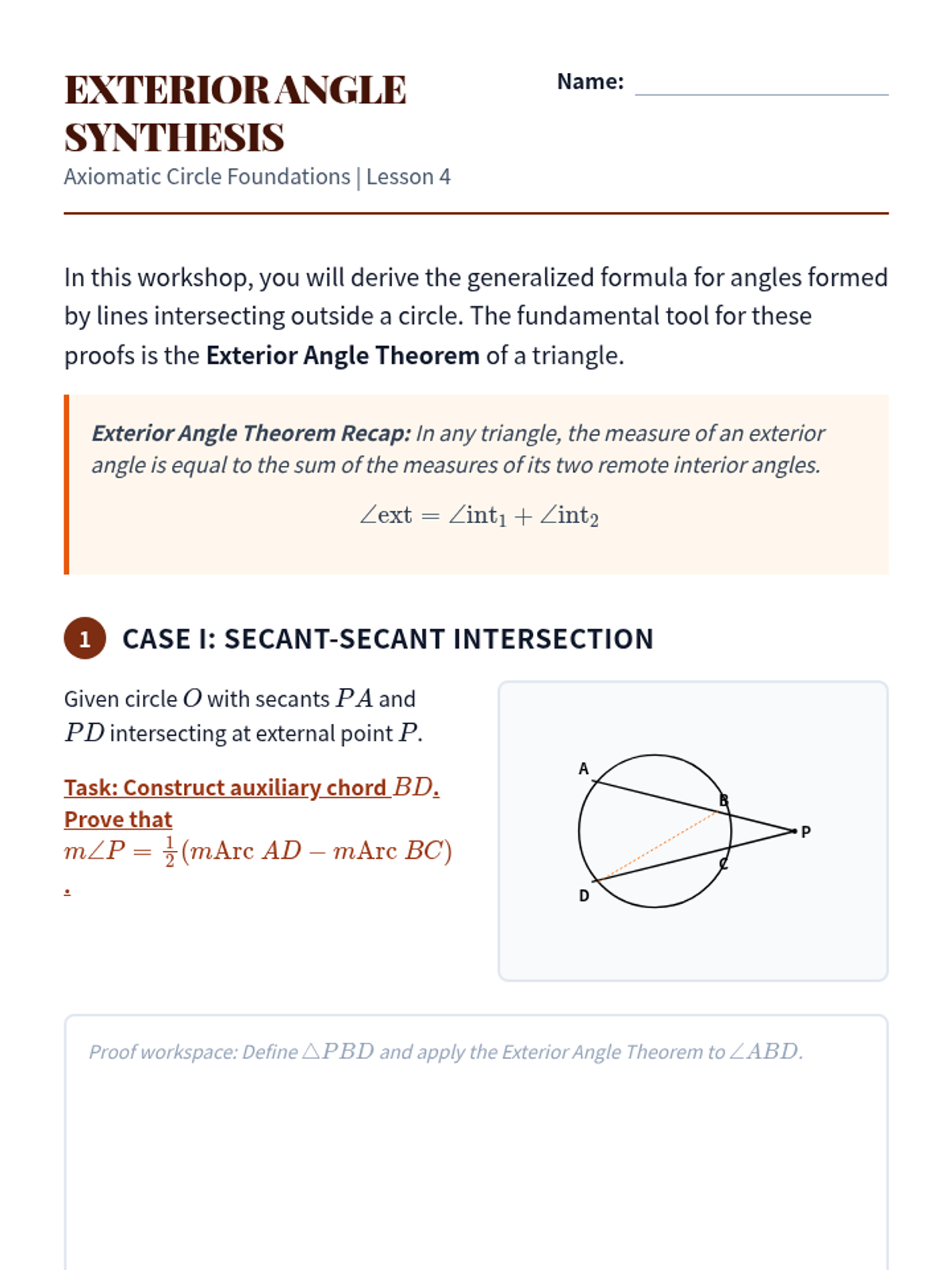
A workshop worksheet for proving the exterior intersection angle theorems using the Exterior Angle Theorem and auxiliary lines.
Visual slide deck for Lesson 4 exploring the Secant-Secant, Secant-Tangent, and Tangent-Tangent angle theorems using the Exterior Angle Theorem.
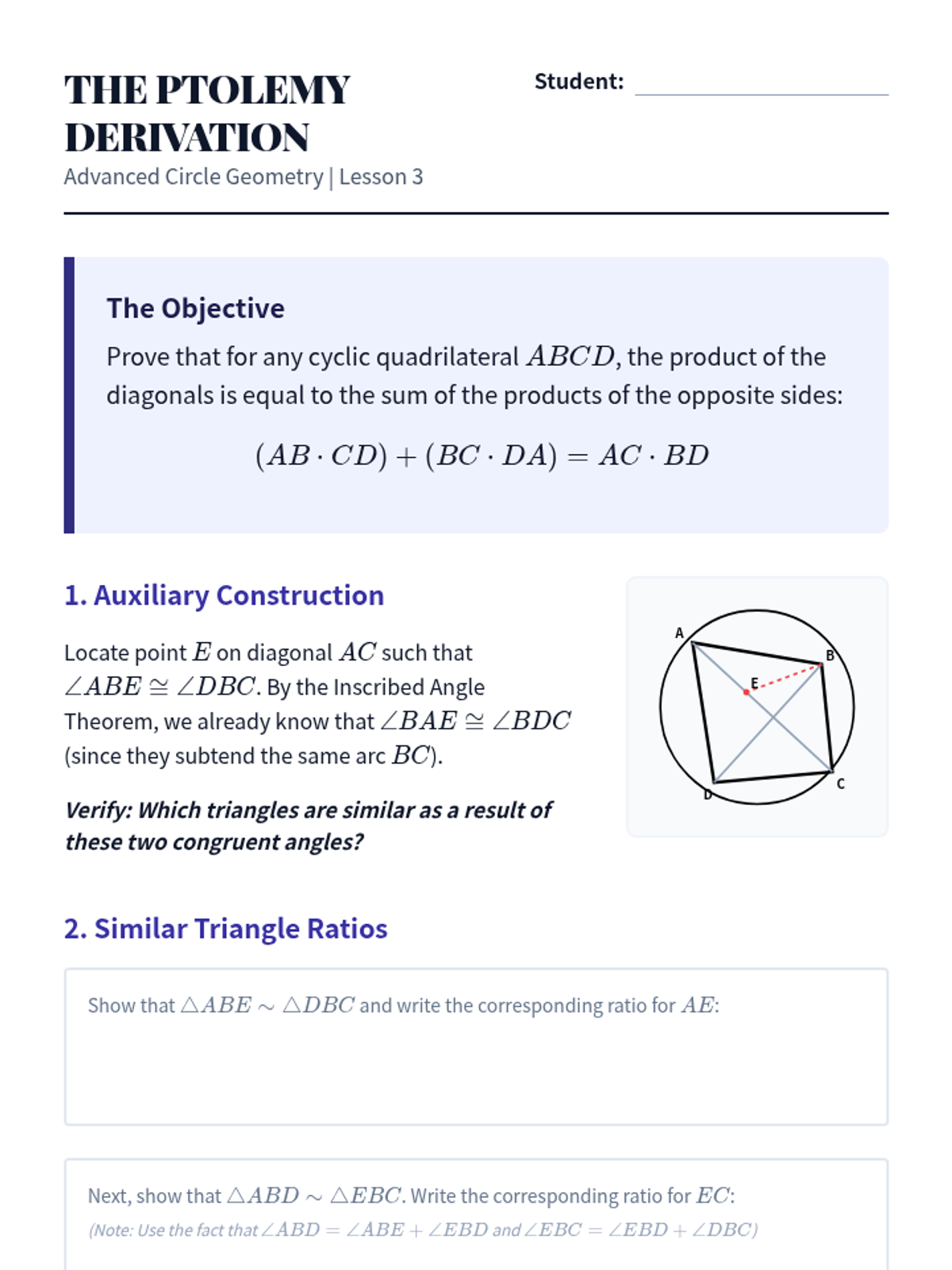
A guided proof-derivation worksheet for Ptolemy's Theorem using auxiliary points and similar triangle ratios.
Visual slides for Lesson 3 introducing cyclic quadrilaterals, the supplementary angle theorem, and the statement of Ptolemy's Theorem.
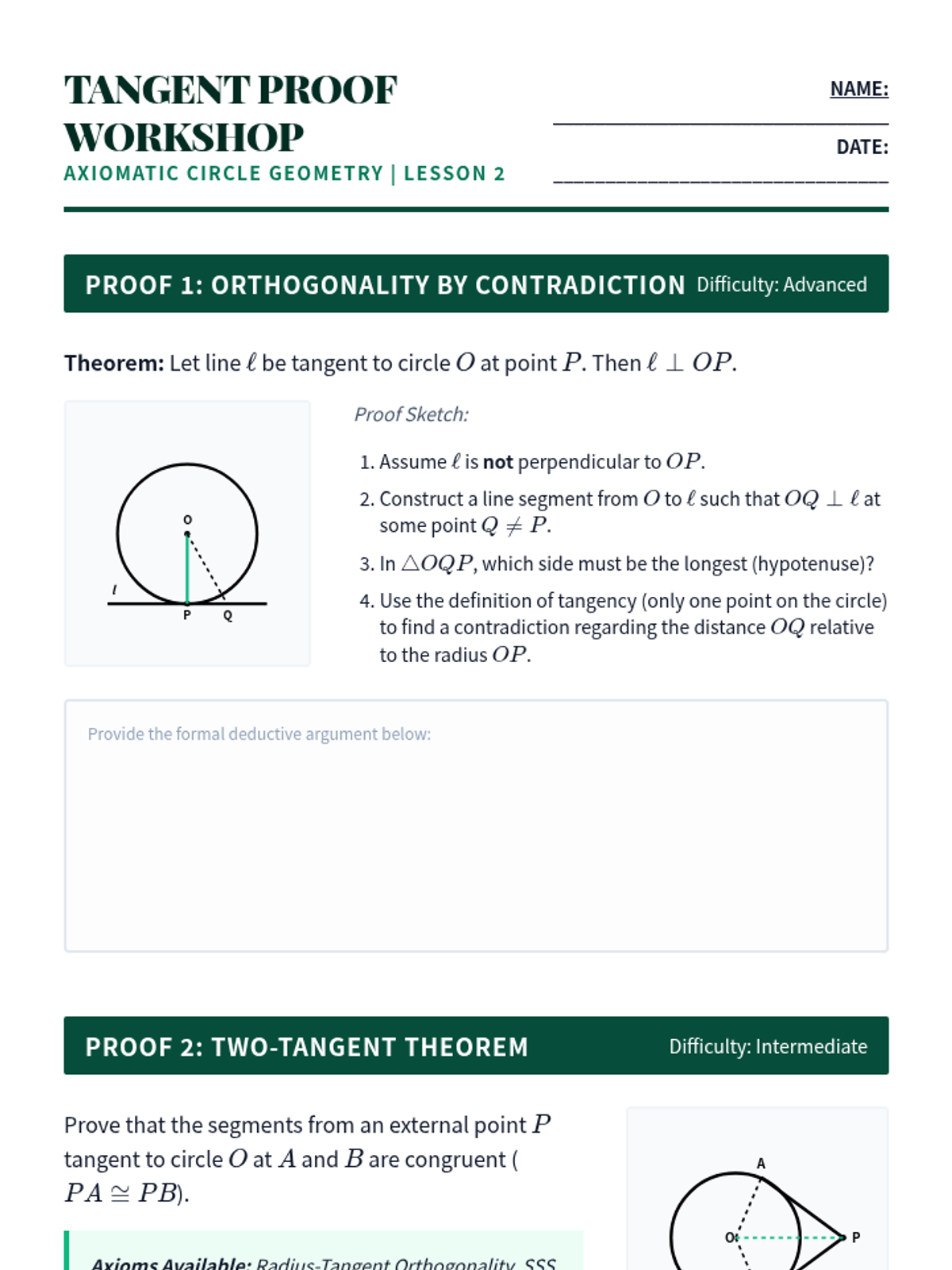
A technical proof worksheet for Lesson 2 focusing on contradiction methods for orthogonality and HL congruence for the Two-Tangent Theorem.
Visual slide deck exploring the axiomatic properties of tangent lines, their definition as limiting cases of secants, and the Two-Tangent Theorem.
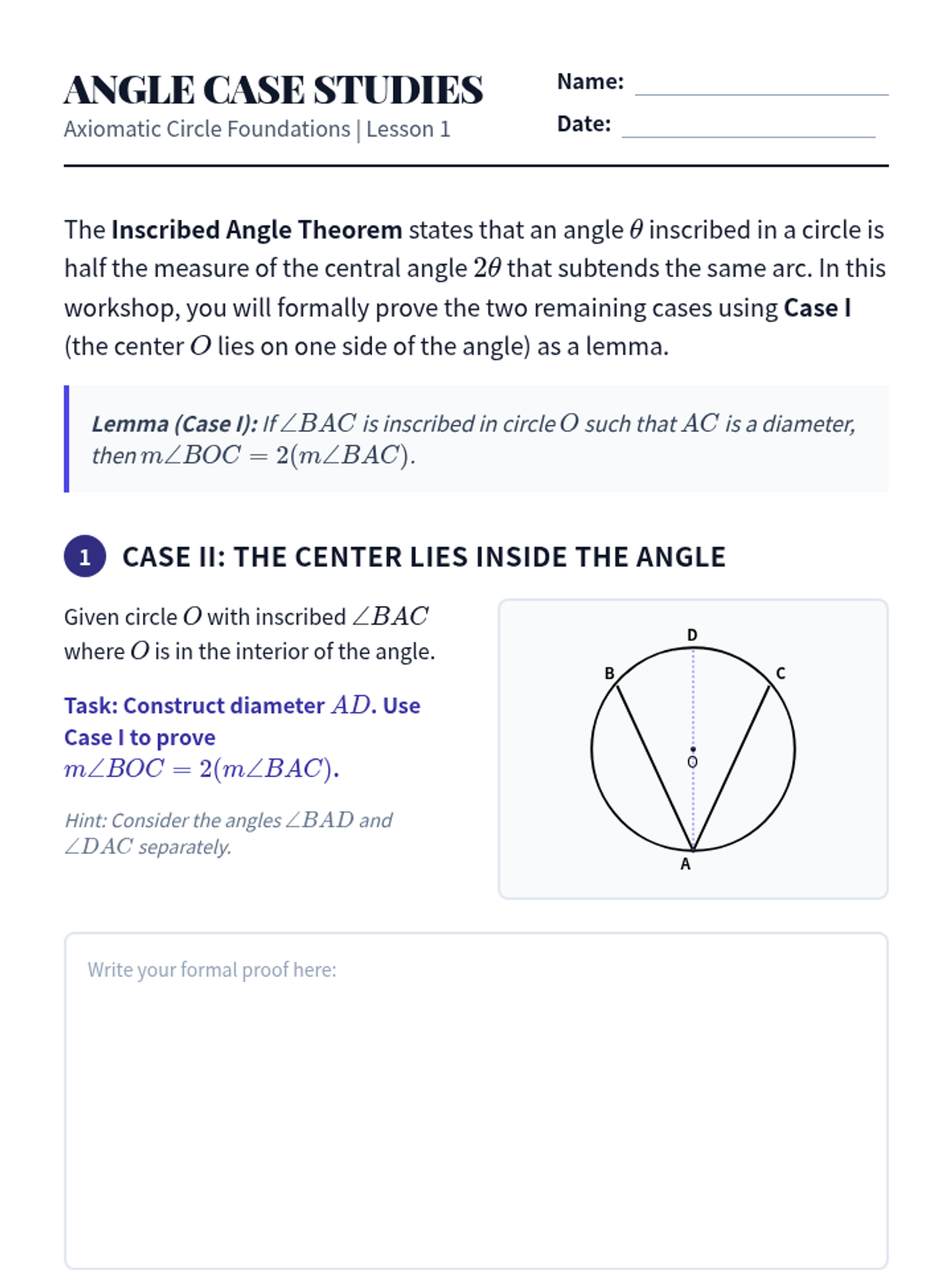
A formal proof worksheet for undergraduate students to derive the second and third cases of the Inscribed Angle Theorem using Case I as a foundation.
A professional slide deck for Lesson 1, covering the axiomatic proofs of the Inscribed Angle Theorem through case-based reasoning and auxiliary constructions.
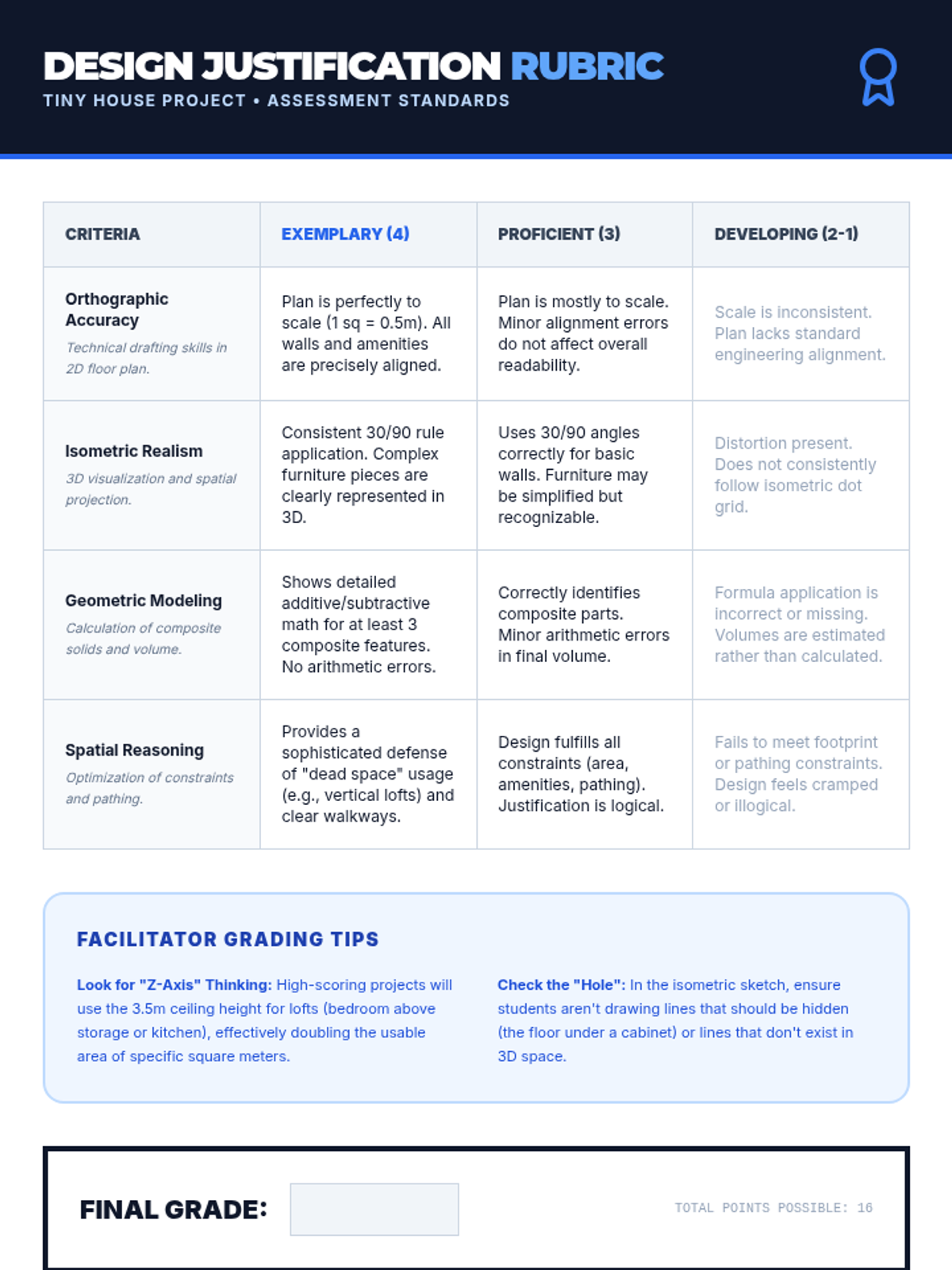
Grading rubric for the Tiny House project. Evaluates students on orthographic accuracy, isometric realism, geometric modeling (calculations), and spatial reasoning. Includes teacher grading tips for assessing high-level spatial designs.
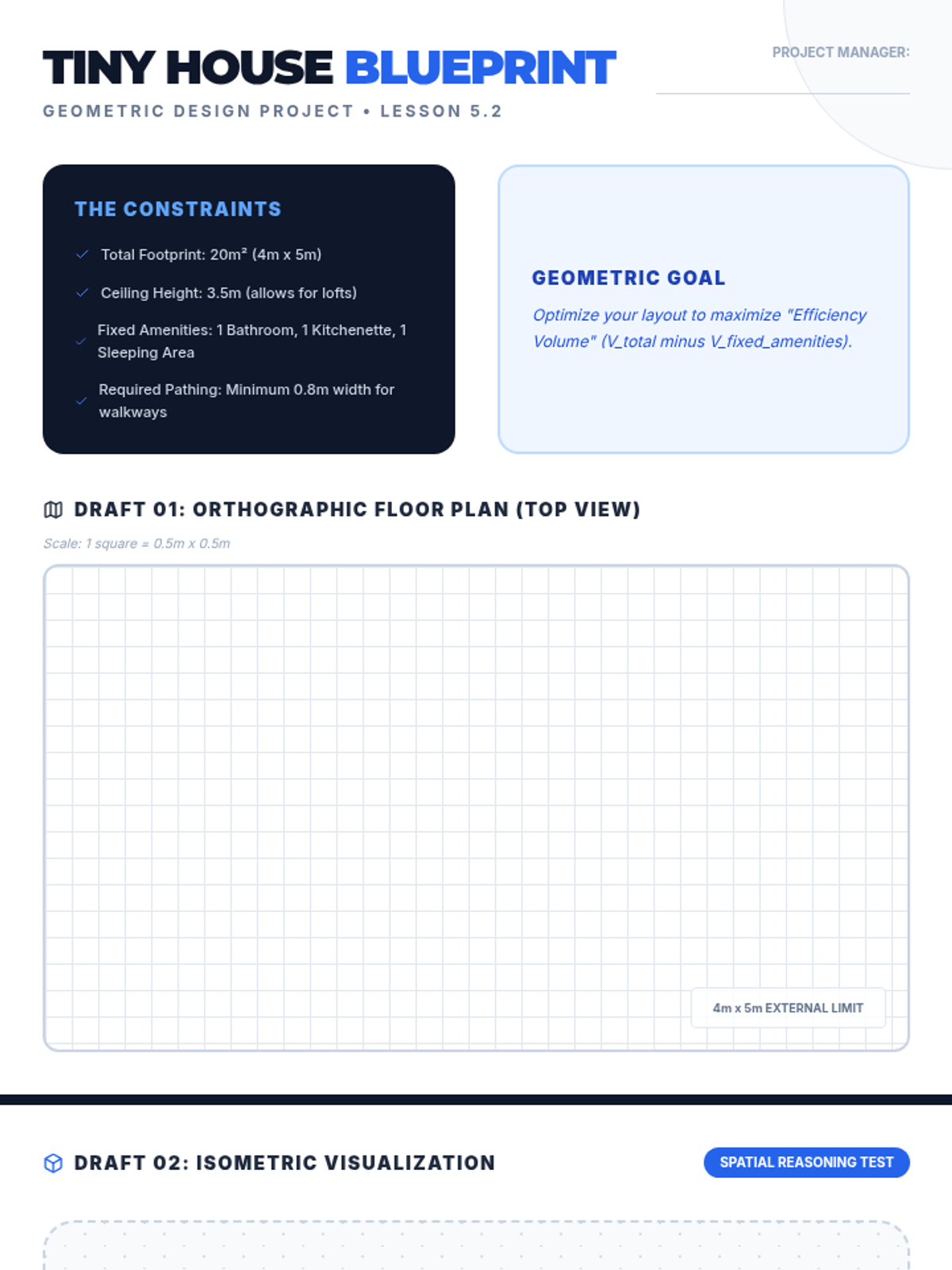
Final project workbook for Lesson 5. Students design a 20m² tiny house, creating a 2D floor plan and a 3D isometric sketch. The project requires them to calculate volume efficiency and provide a geometric justification for their design choices.
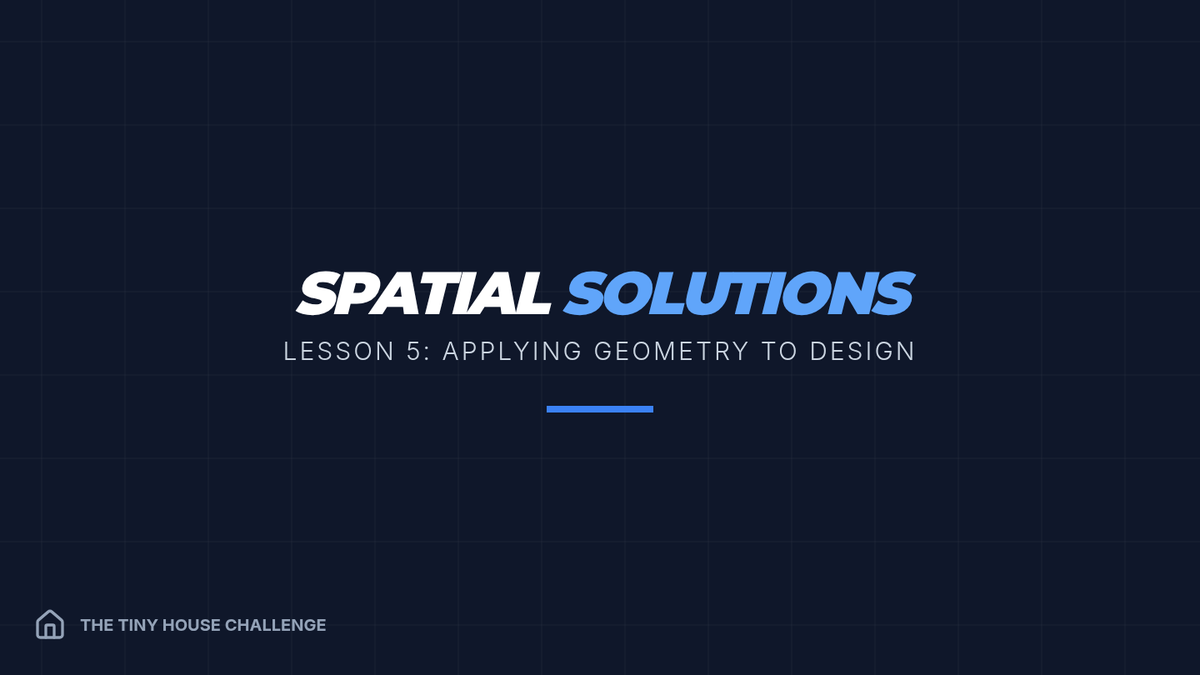
Culminating slide deck for Lesson 5. Introduces the "Tiny House Challenge," explaining the design constraints, the project brief, and the requirement for students to justify their spatial decisions using geometric modeling.
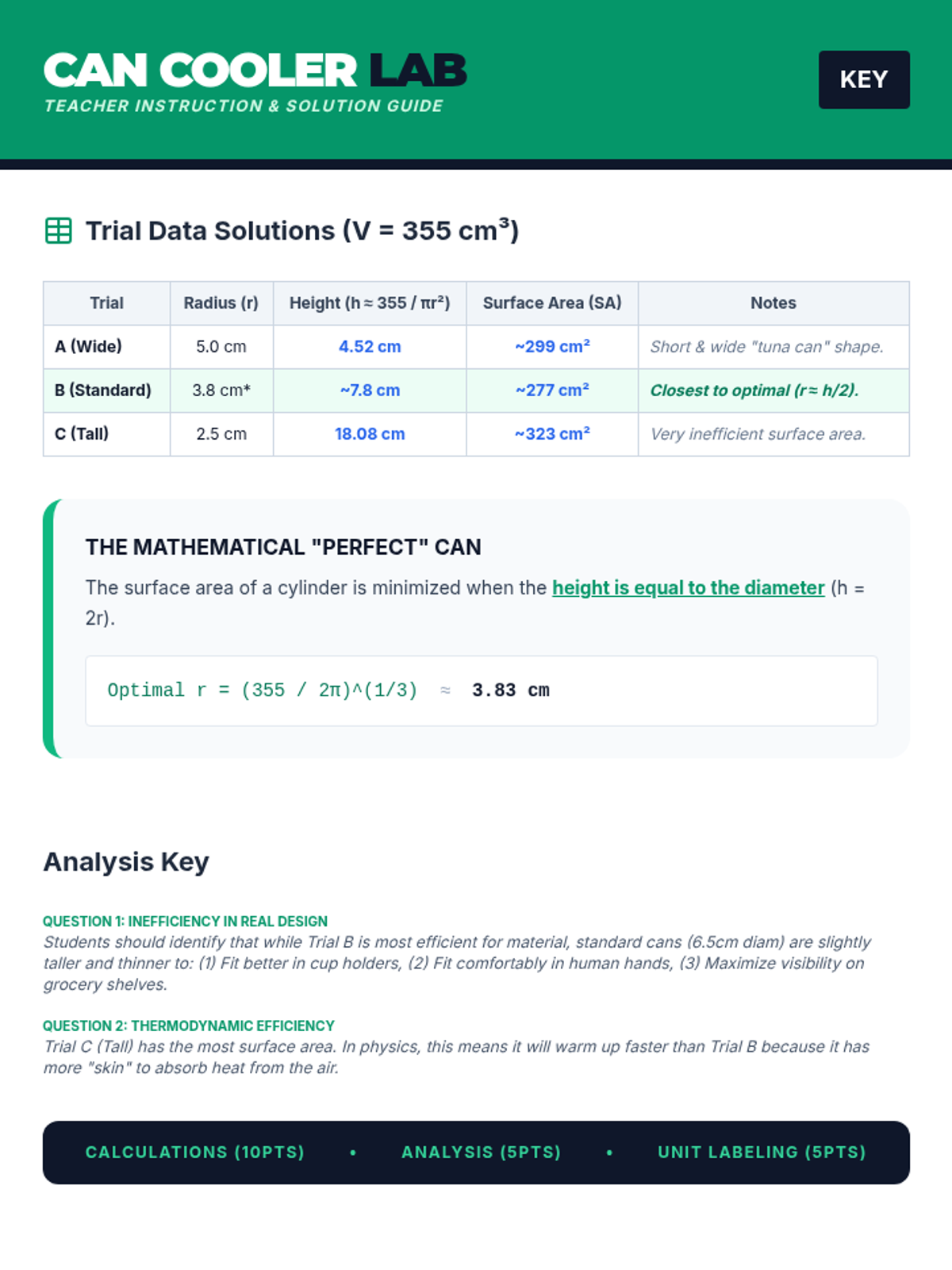
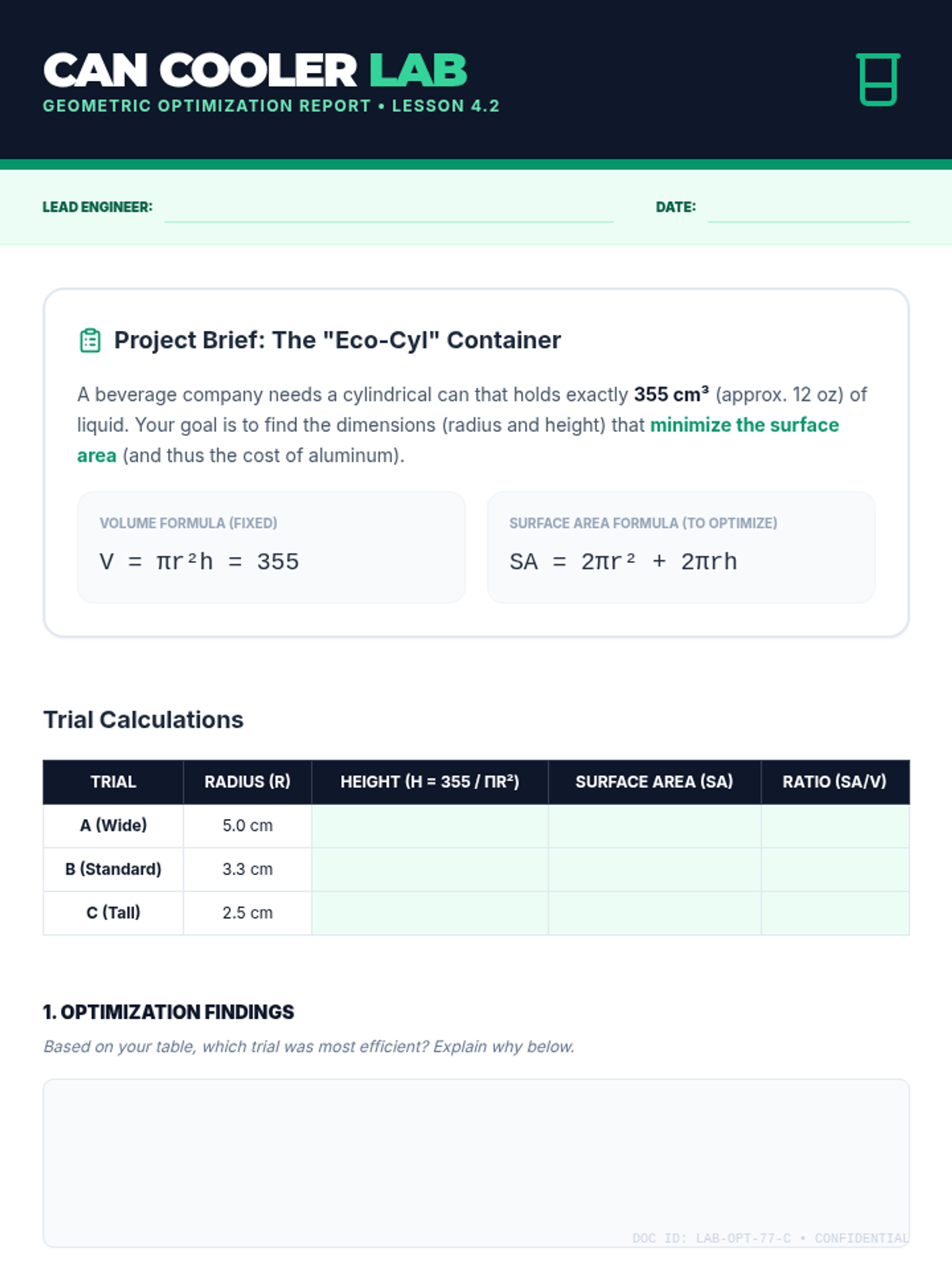
Answer key for the Can Cooler Lab. Provides the calculated values for various cylinder dimensions, explains the mathematical "perfect" cylinder ratio (h=2r), and offers discussion points for real-world design constraints.
Laboratory worksheet for Lesson 4 where students calculate dimensions for a 355ml soda can. They compare wide, standard, and tall dimensions to find the surface-area-to-volume optimization point.
Lesson 4 slides on optimizing surface area and volume. Explores the engineering logic behind soda can shapes, the SA/V ratio in thermodynamics, and natural optimization examples like spheres and fins.
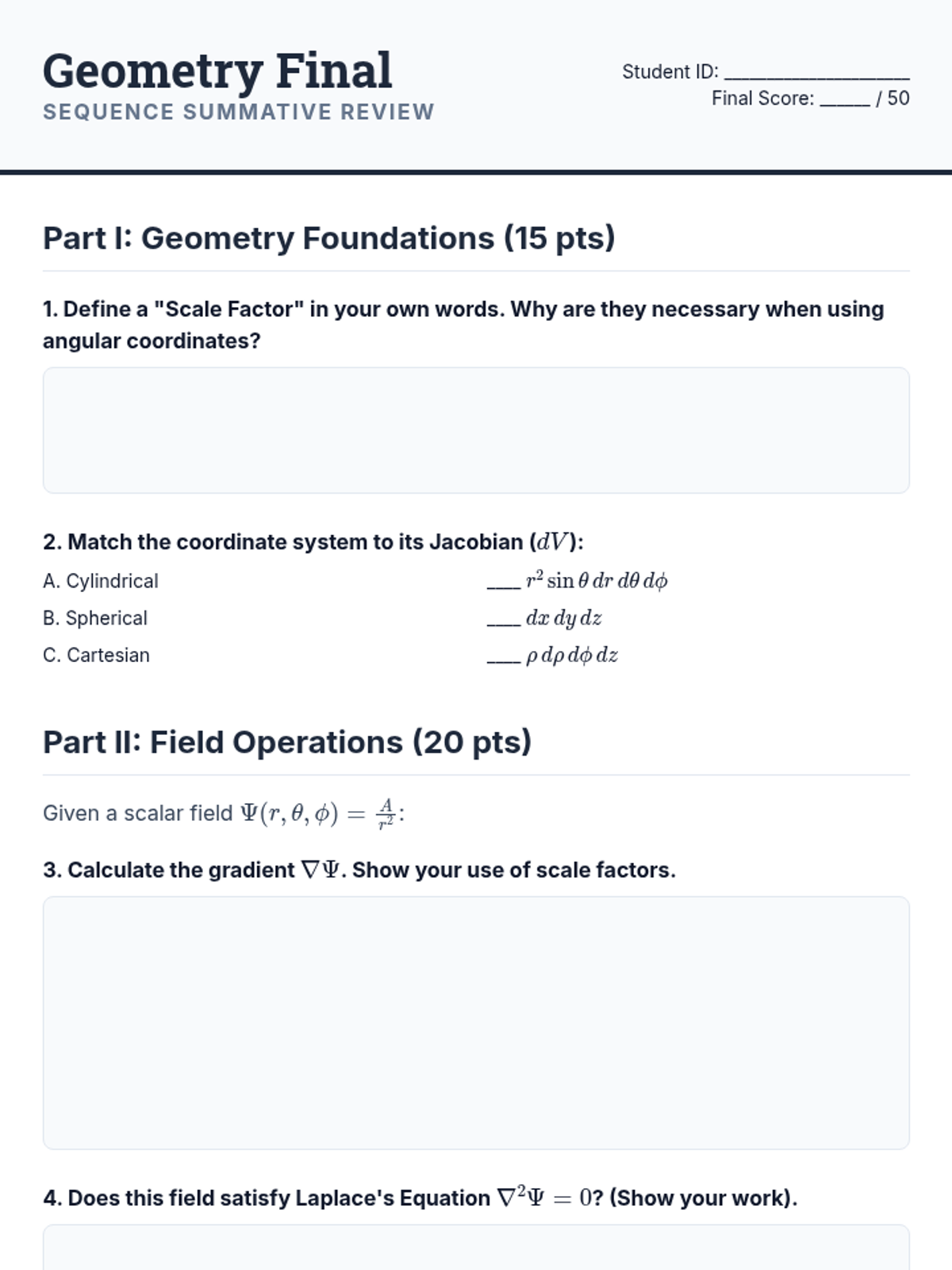
Summative assessment covering the entire sequence, including conceptual questions on scale factors, vector operator calculations, and applications to metrics and symmetry.
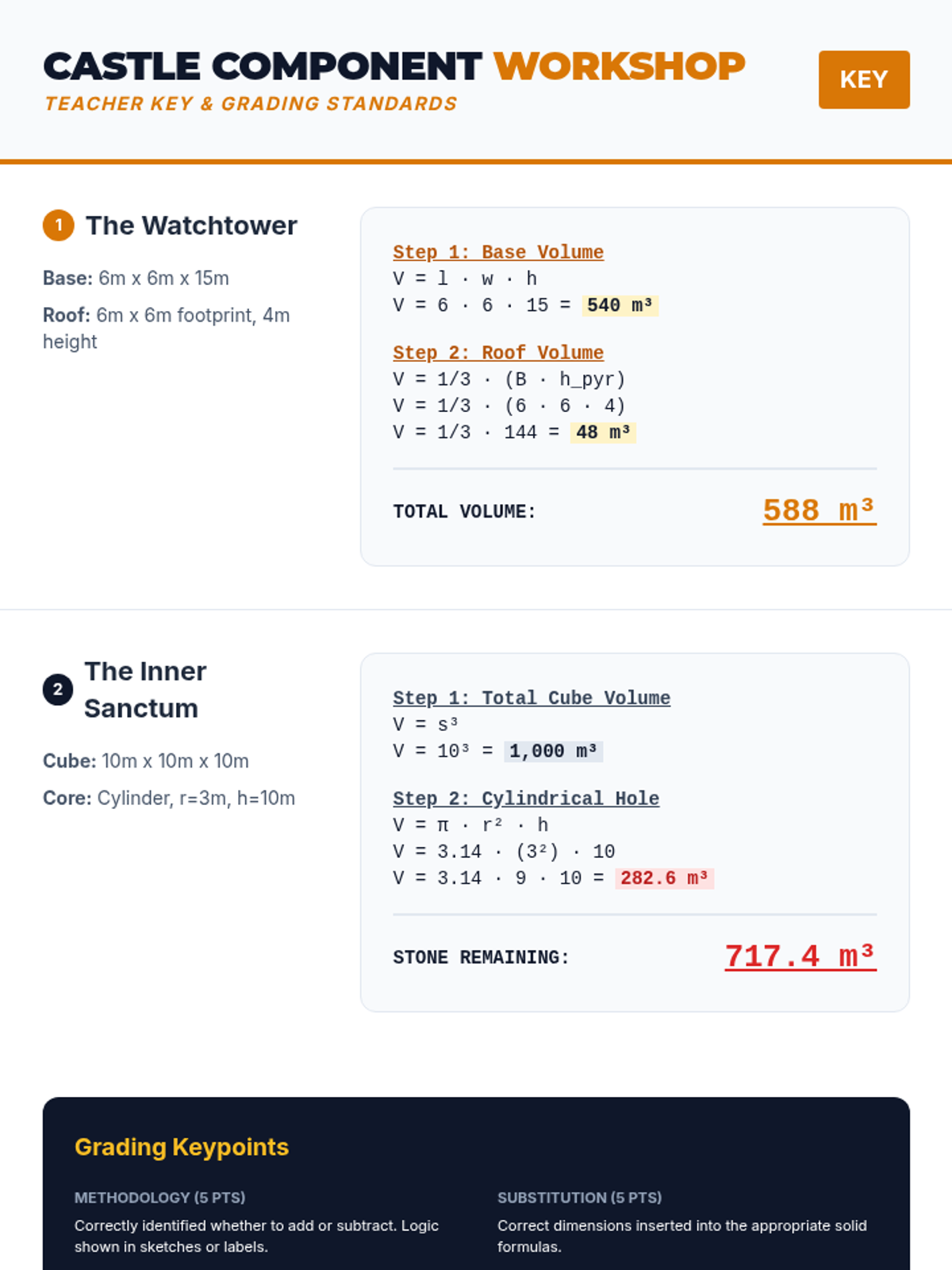
Answer key for the Castle Component Workshop. Includes step-by-step mathematical solutions for the watchtower (588 m³) and the inner sanctum (717.4 m³), plus a grading rubric.
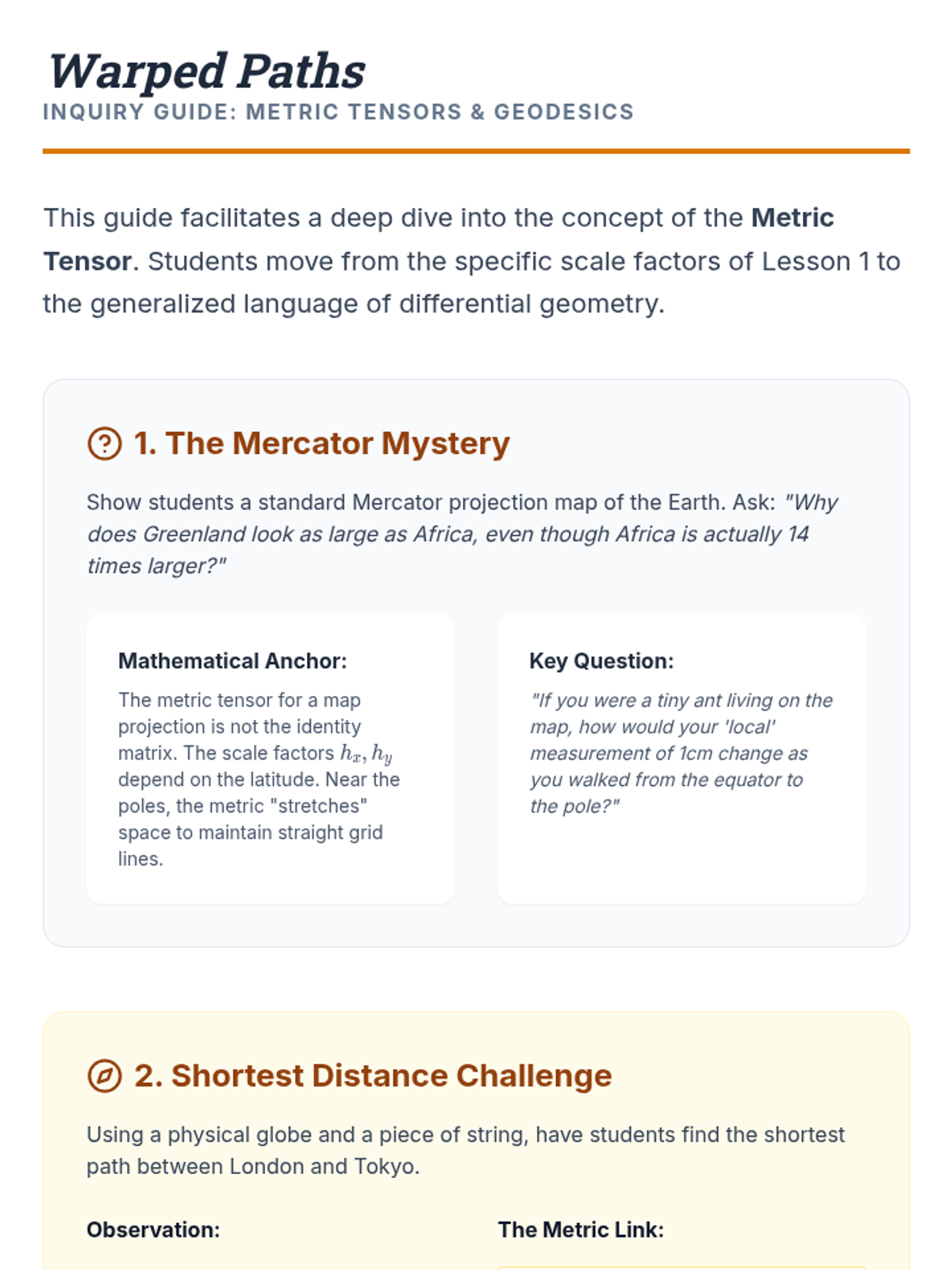
Discussion and inquiry guide for teachers to explore metric tensors, map distortions, and geodesics through thought experiments and physical demonstrations.
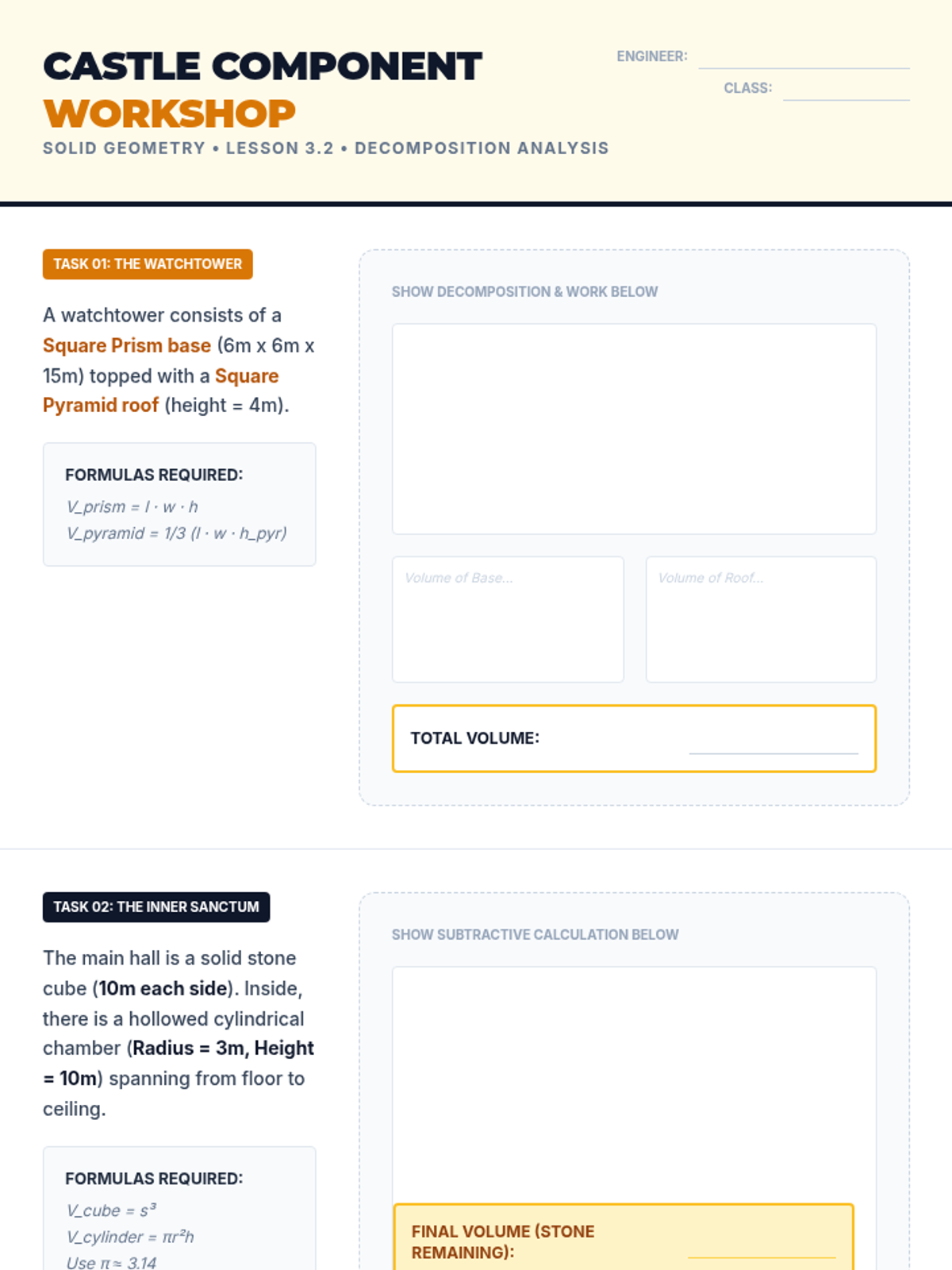
Worksheet for Lesson 3 on composite solid geometry. Features two engineering-style tasks: calculating the additive volume of a watchtower (prism + pyramid) and the subtractive volume of a stone hall with a hollowed core.
Introductory presentation on the metric tensor, non-Euclidean geometry, geodesics, and the conceptual foundation of General Relativity.
Lesson 3 slides on decomposing composite 3D figures. Covers additive and subtractive methods for volume calculation, real-world engineering applications, and a step-by-step workflow for solving complex solid problems.
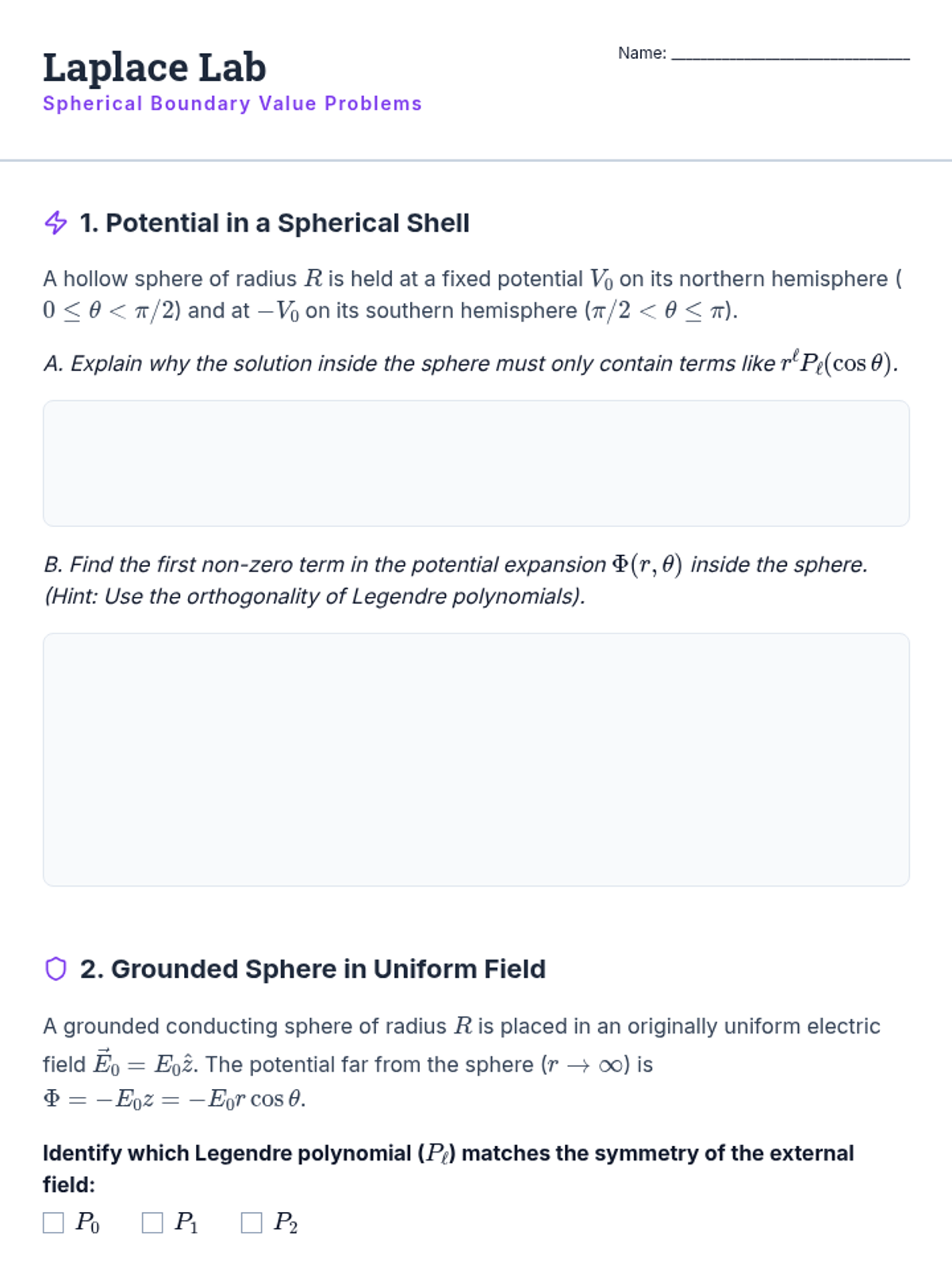
Problem set focused on solving boundary value problems using Legendre polynomials, including hemispherical potential and a sphere in a uniform electric field.
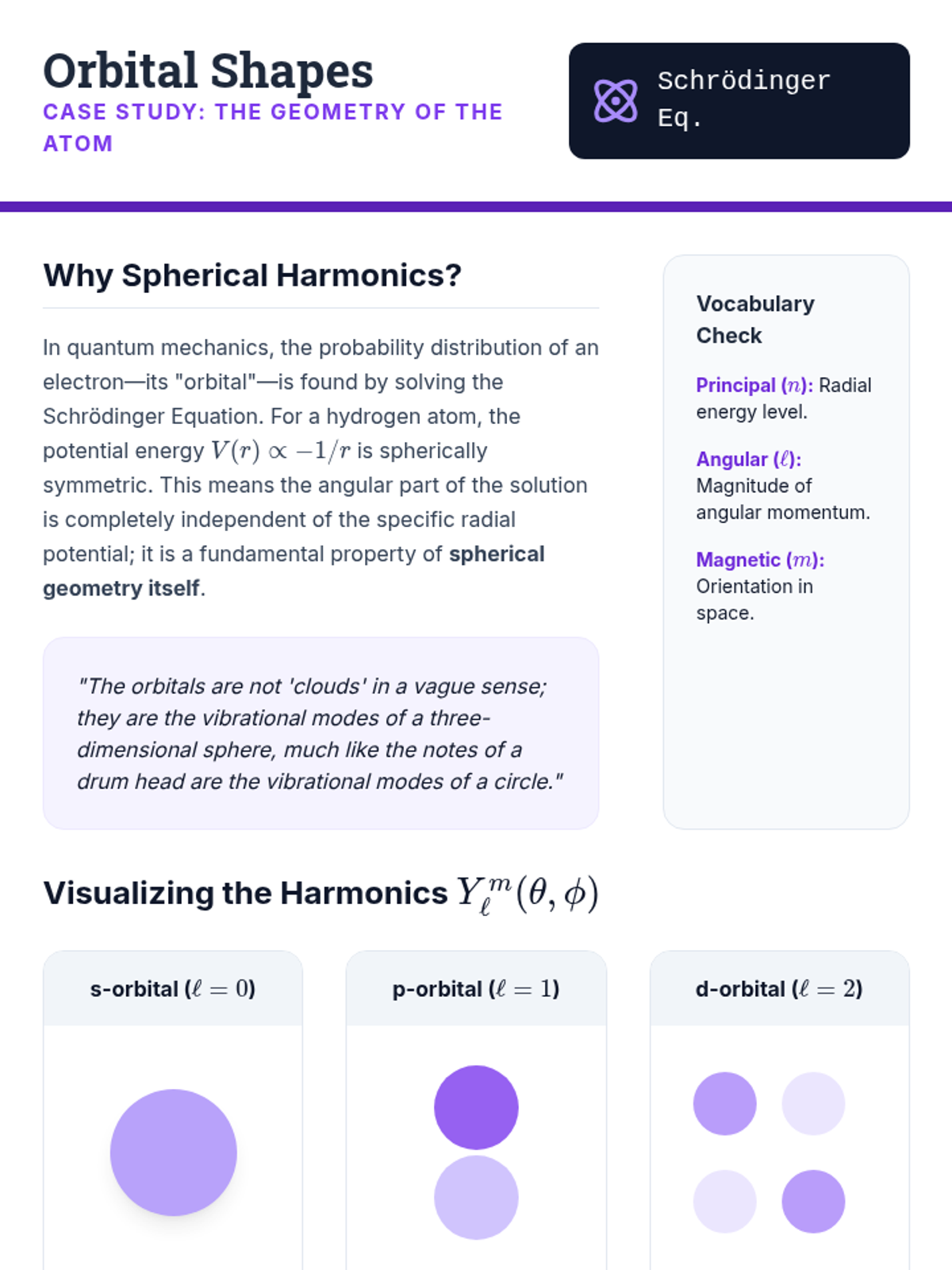
Case study handout connecting the mathematical solutions of Laplace's equation to the physical shapes of atomic orbitals in quantum mechanics.
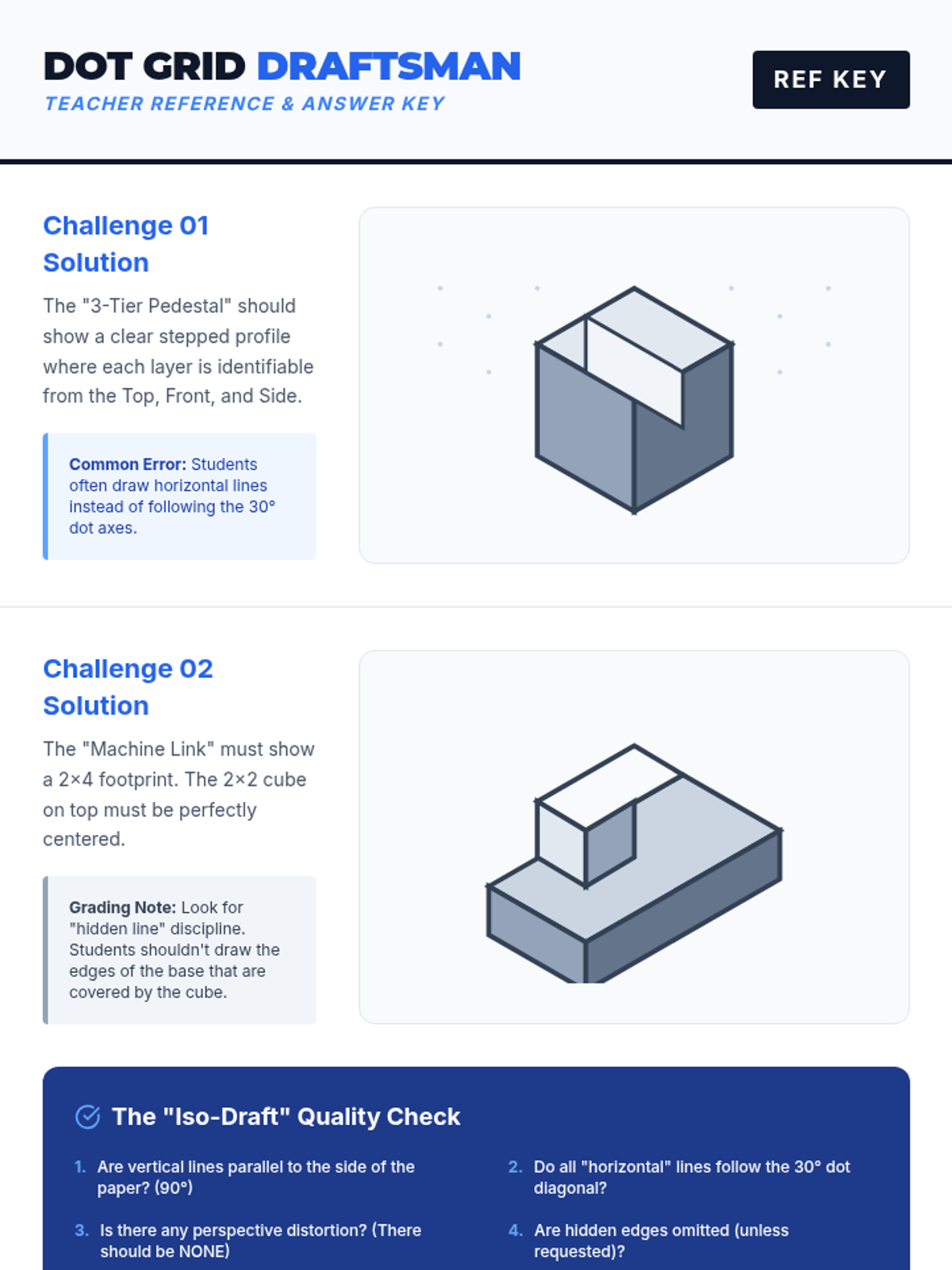
Teacher reference key for isometric drawing practice. Provides visual solutions for the pedestal and machine link challenges, along with common student error notes and a quality checklist for grading.
Presentation on solving Laplace's equation in spherical coordinates using separation of variables and Legendre polynomials, with physical boundary condition examples.
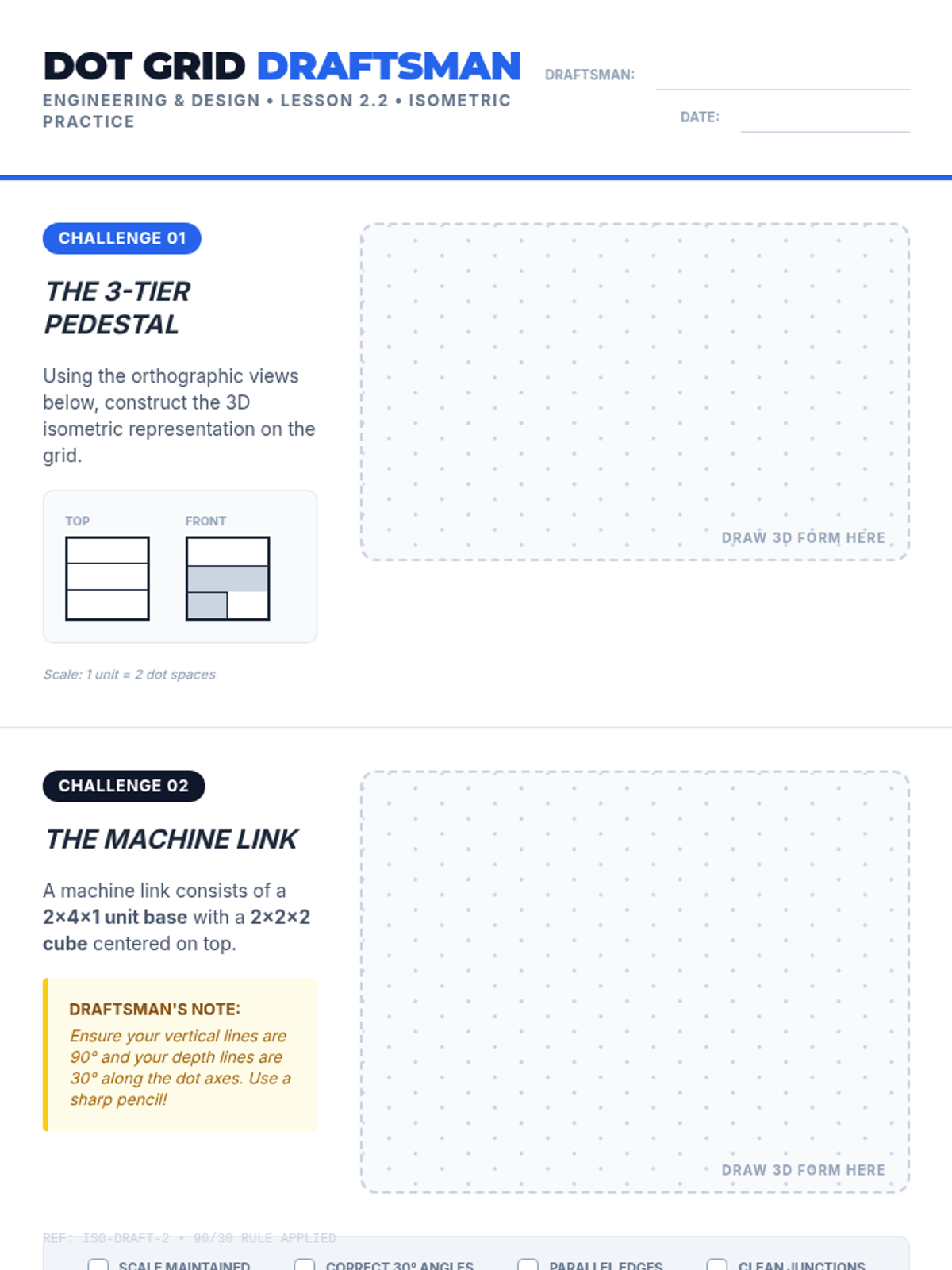
Isometric drawing practice sheet with dot grids. Students are challenged to translate orthographic views into 3D isometric models and to construct a specific composite machine link from textual descriptions.
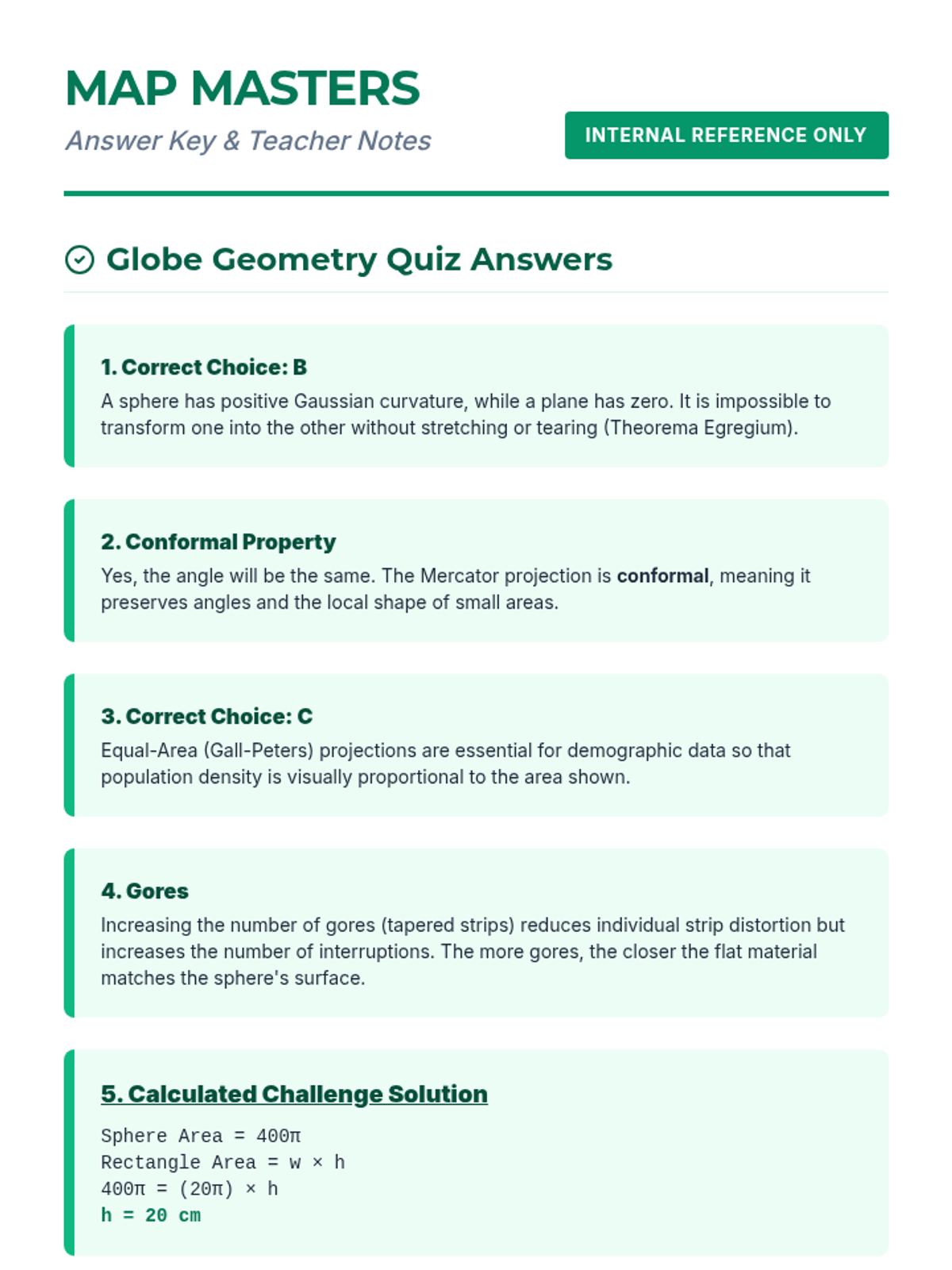
Teacher-facing answer key and instructional notes for the quiz and worksheet, including step-by-step mathematical solutions and tips for addressing common student misconceptions.
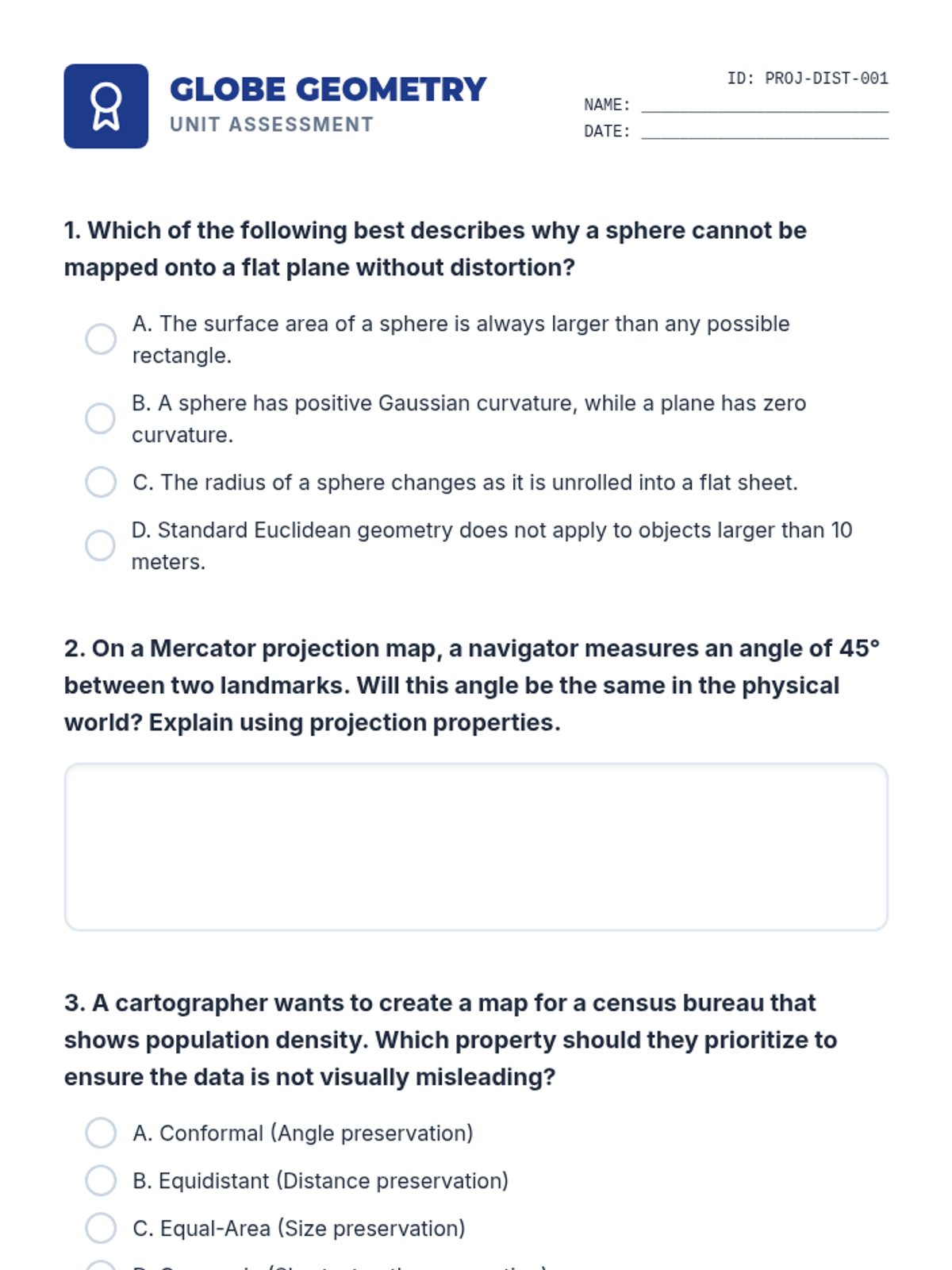
Assessment covering the mathematical principles of map projection, including Gaussian curvature, projection properties, and a calculation challenge related to surface area.
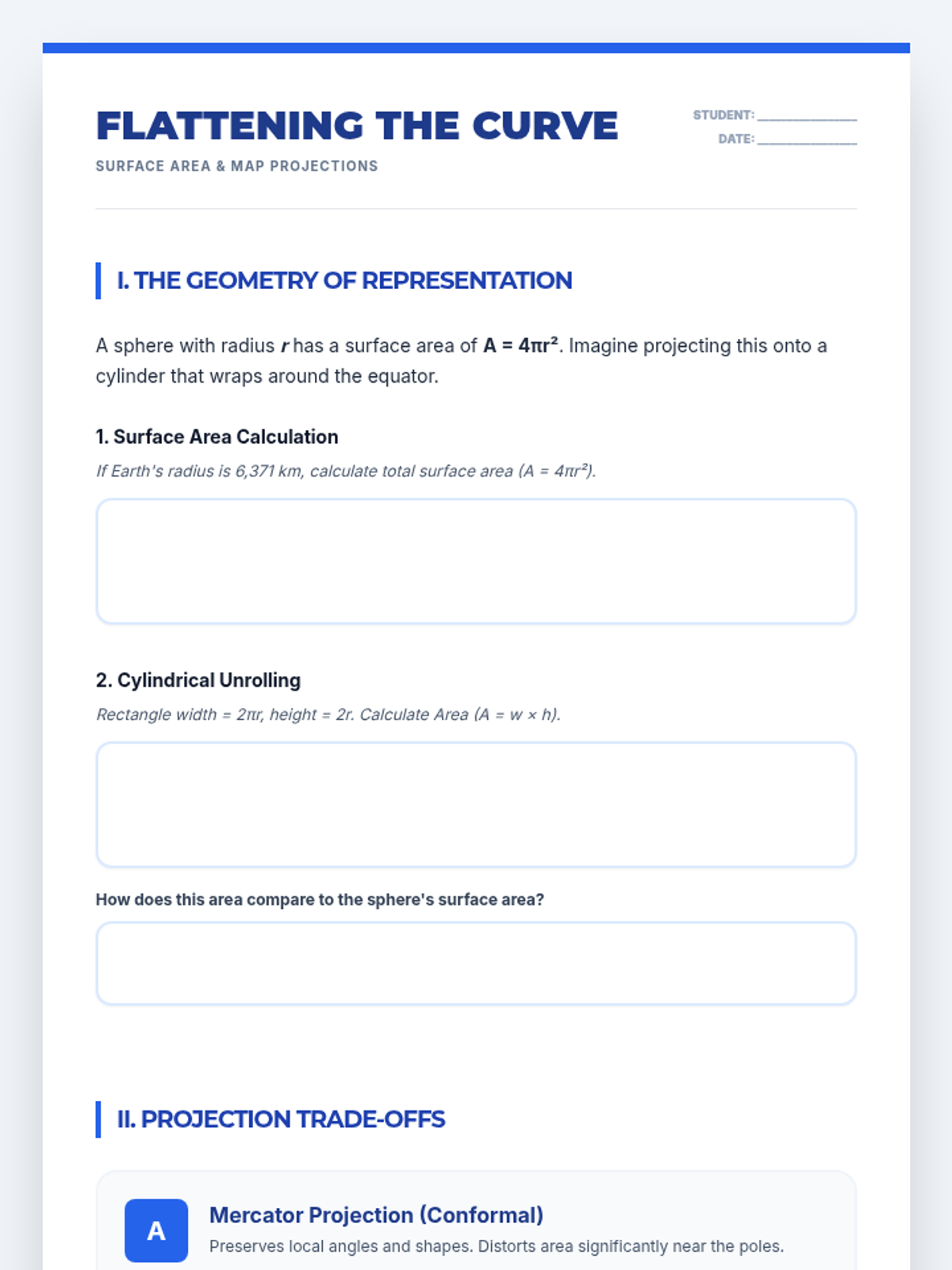
Mathematical worksheet analyzing surface area differences between a sphere and a cylindrical projection, requiring students to perform geometric calculations and evaluate projection trade-offs.
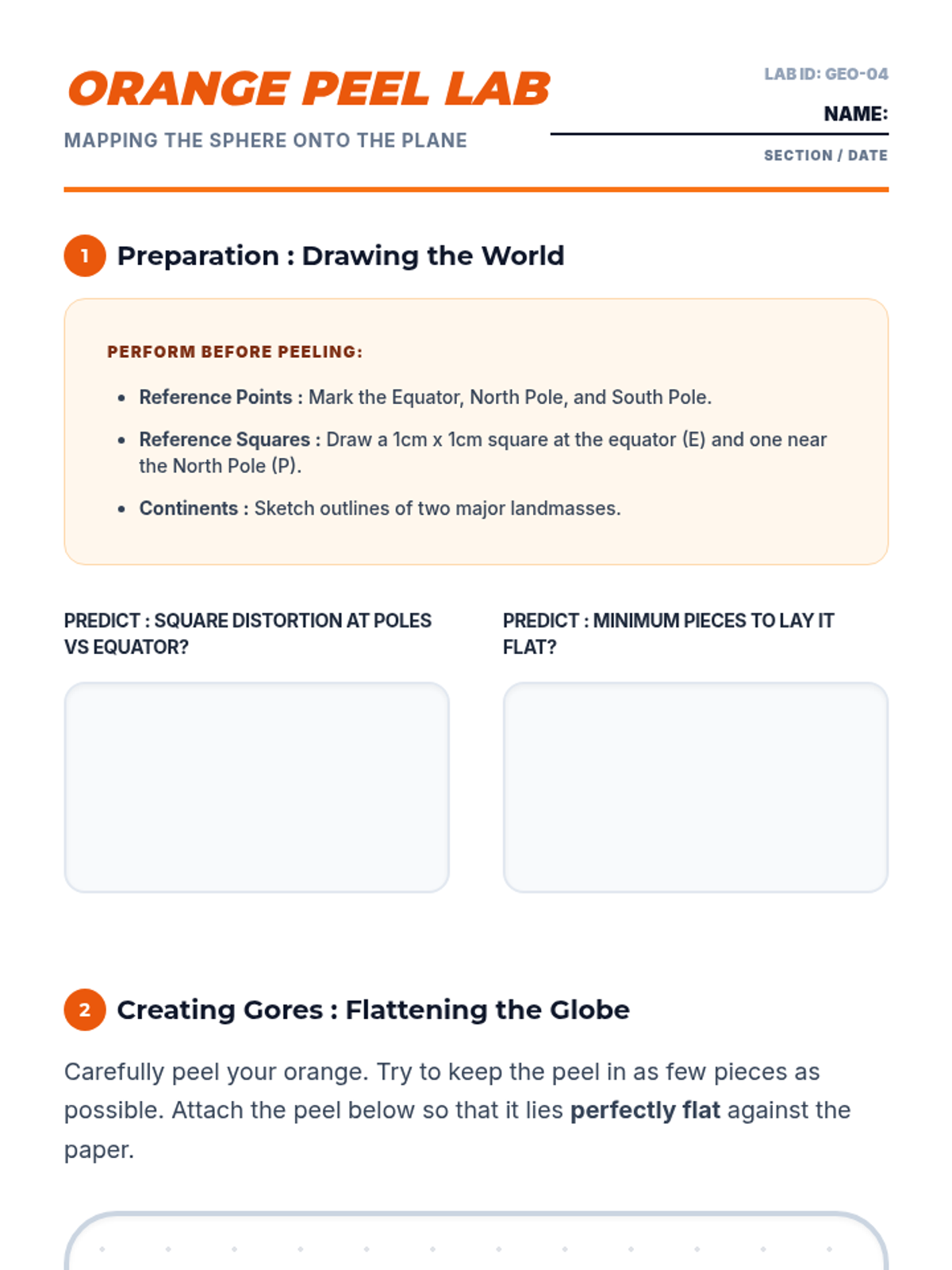
Hands-on lab activity sheet where students use an orange to model the Earth, draw geometric shapes on its surface, and attempt to flatten the peel to visualize map distortion.
Instructional slide deck for the Projection Problem lesson, covering the Mercator mystery, the geometry of curvature, the orange peel experiment instructions, and the trade-offs in map projections.
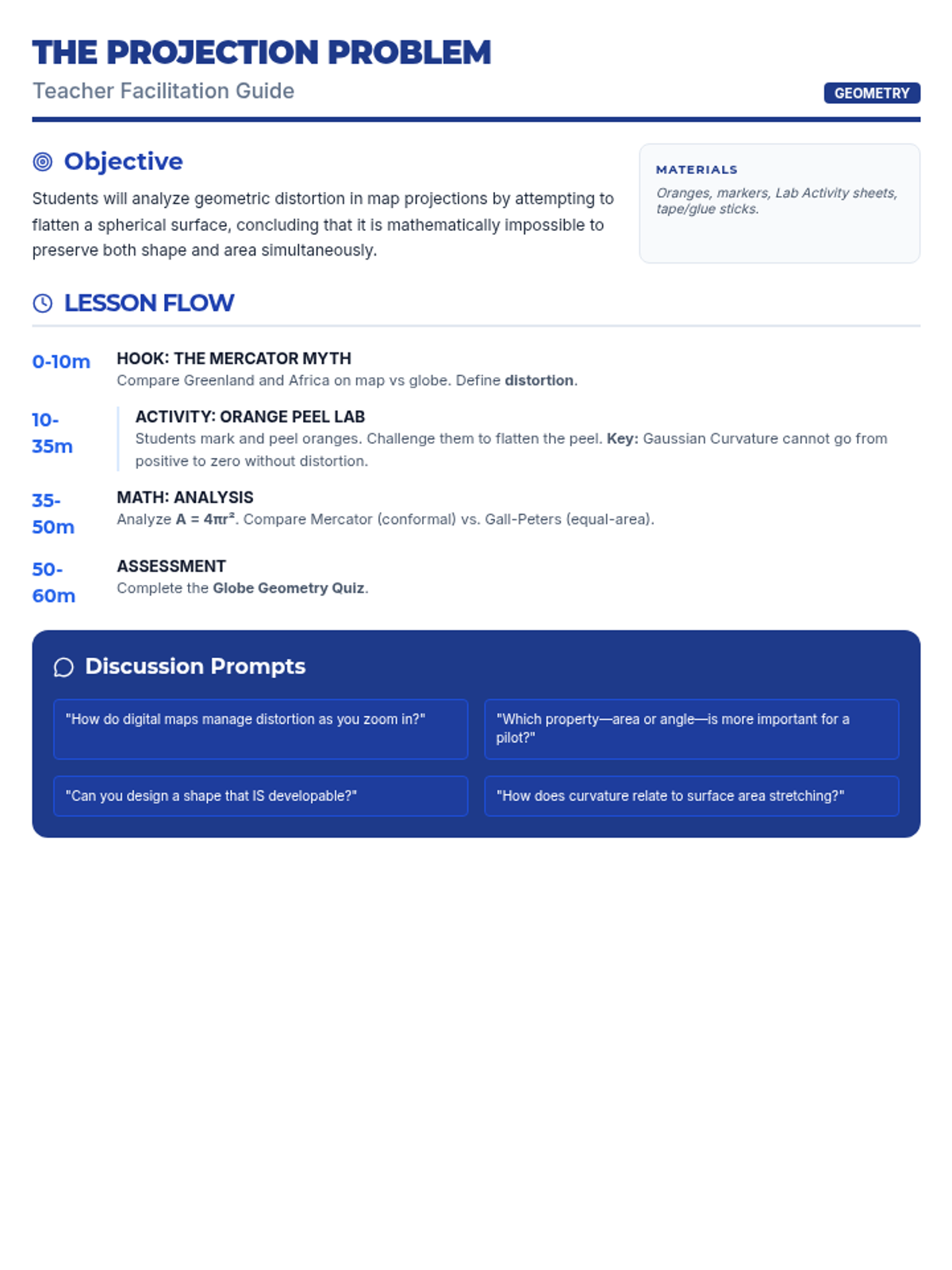
Comprehensive teacher facilitation guide for the Projection Problem lesson, including objectives, material lists, a detailed instructional sequence, and high-order discussion prompts.
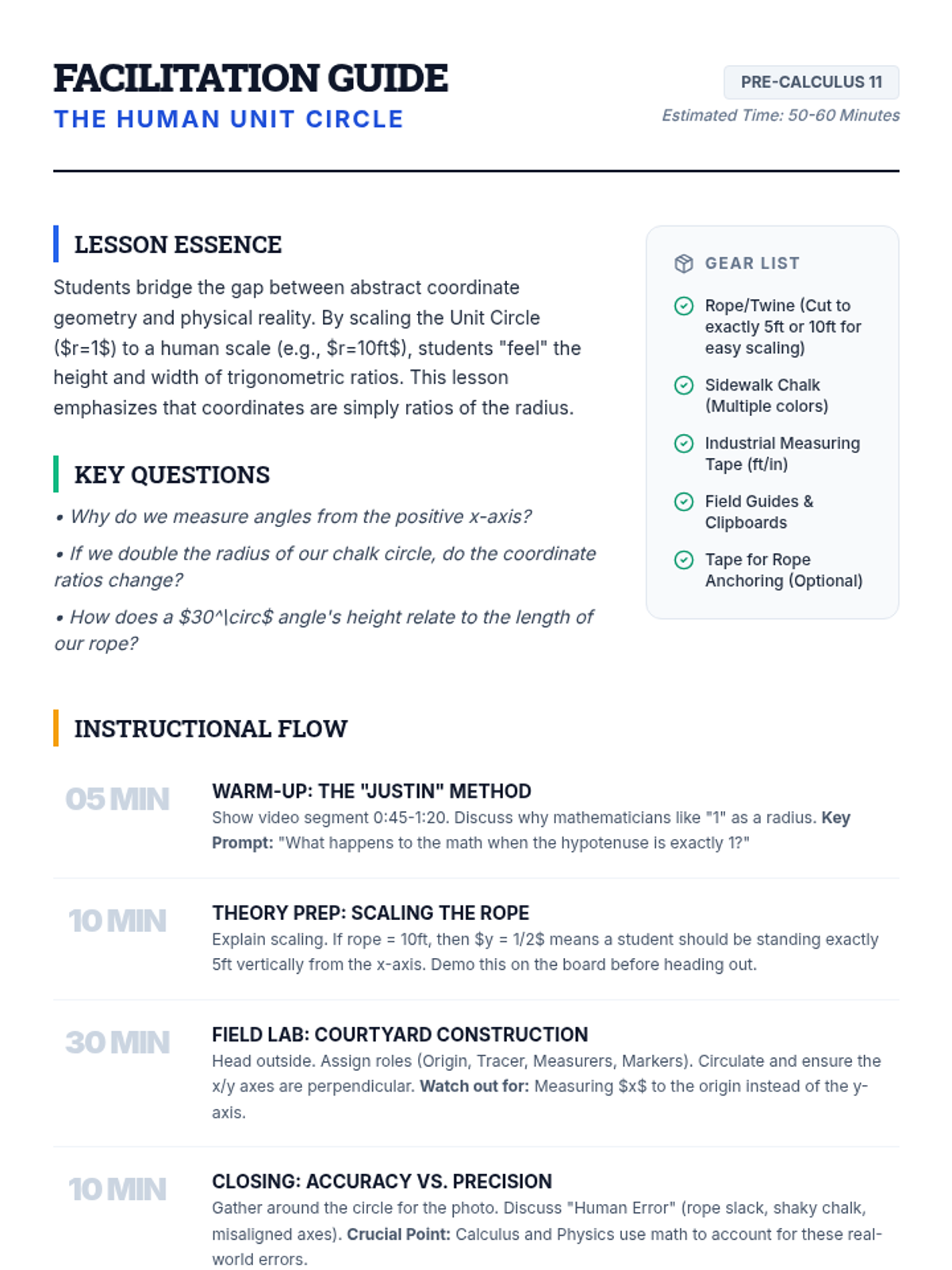
A comprehensive facilitator's guide for the Human Unit Circle lesson, including prep checklists, pacing, scaling guides, and common pitfalls.
A visual presentation for instruction, discussion, and guided activity instructions for the Human Unit Circle lesson.
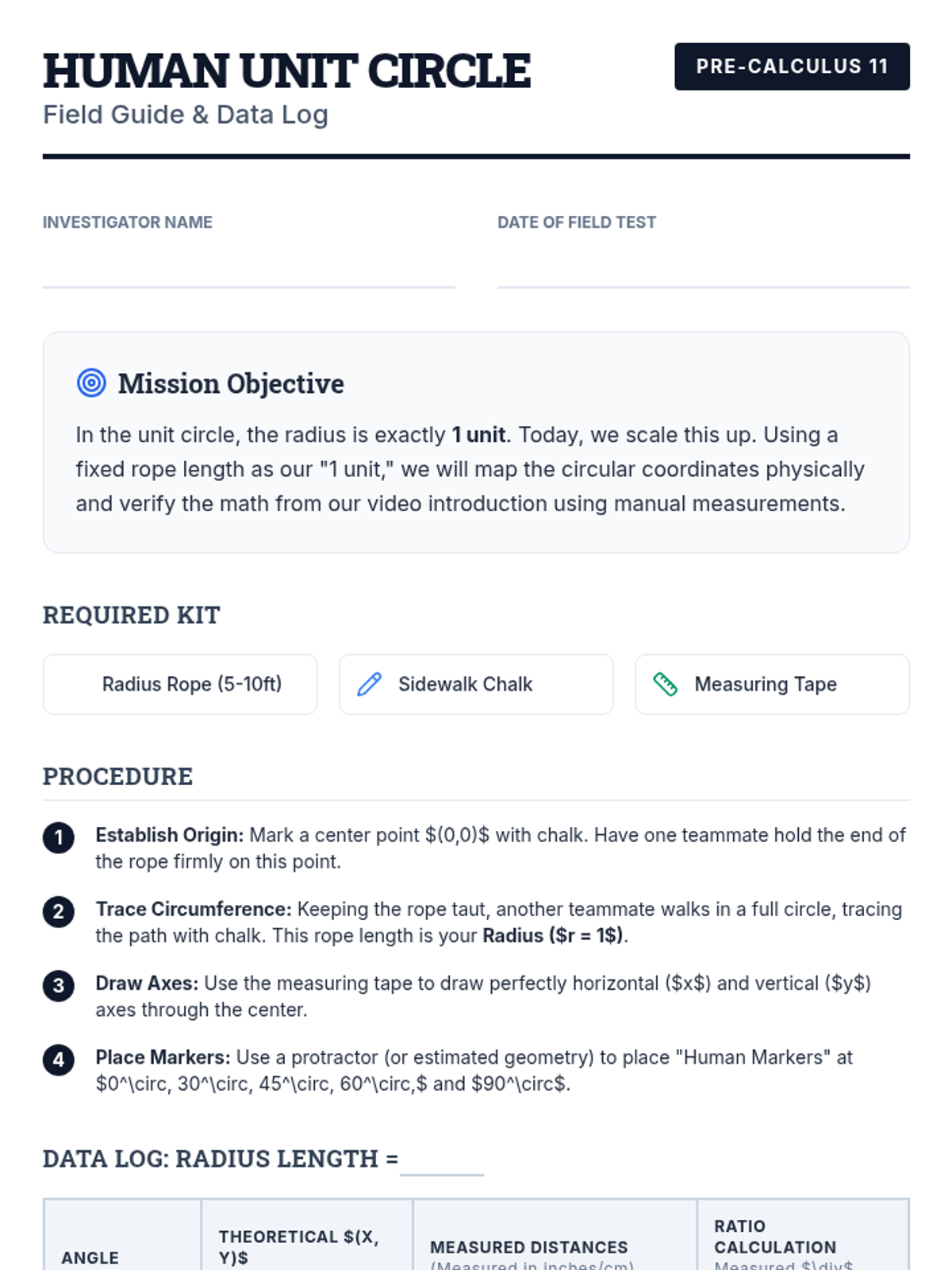
A field guide for students to use during the outdoor activity, including space for recording measurements, theoretical values, and reflection questions.
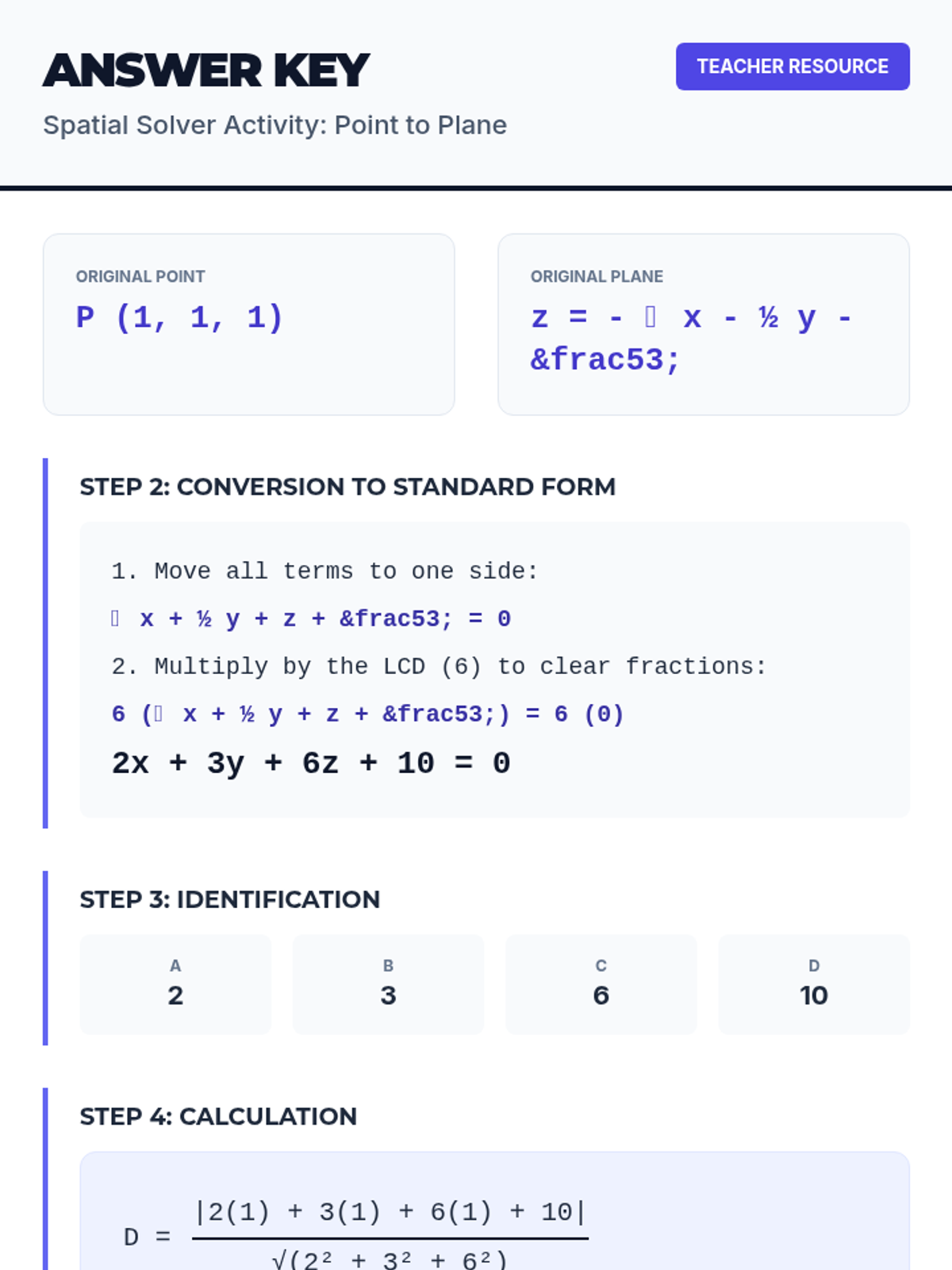
A detailed answer key for the Spatial Solver Activity, providing step-by-step algebraic solutions and final results for teacher reference.
A visual presentation for a Pre-Calculus lesson on point-to-plane distance, including a warm-up, embedded video slide, formula breakdown, and group activity instructions.
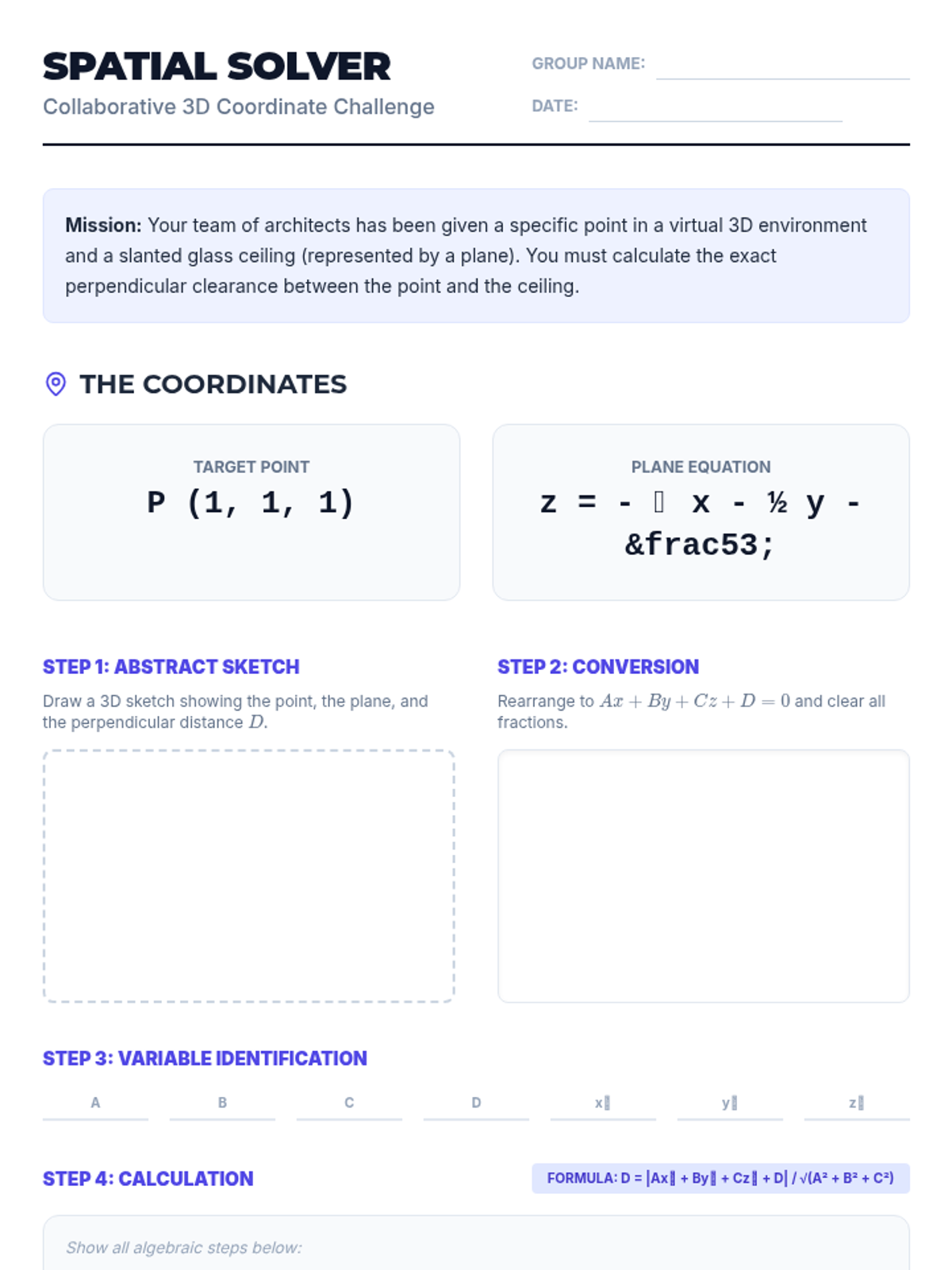
A collaborative group activity worksheet for Pre-Calculus students, guiding them through sketching, algebraic conversion, and final distance calculation for a 3D point-to-plane problem.
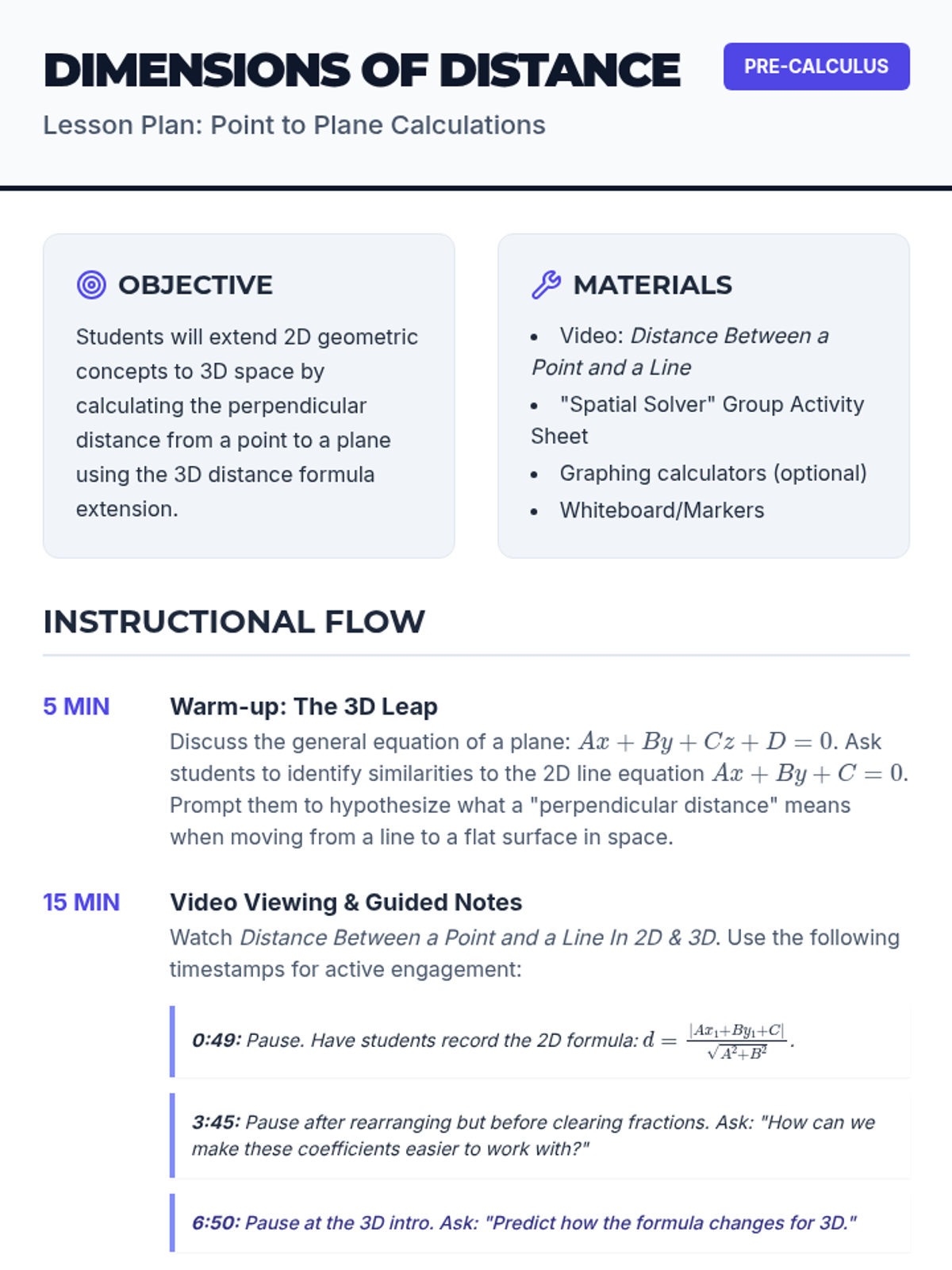
A comprehensive lesson plan for Pre-Calculus teachers covering point-to-plane distance calculations, featuring timed segments, video integration cues, and pedagogical notes.
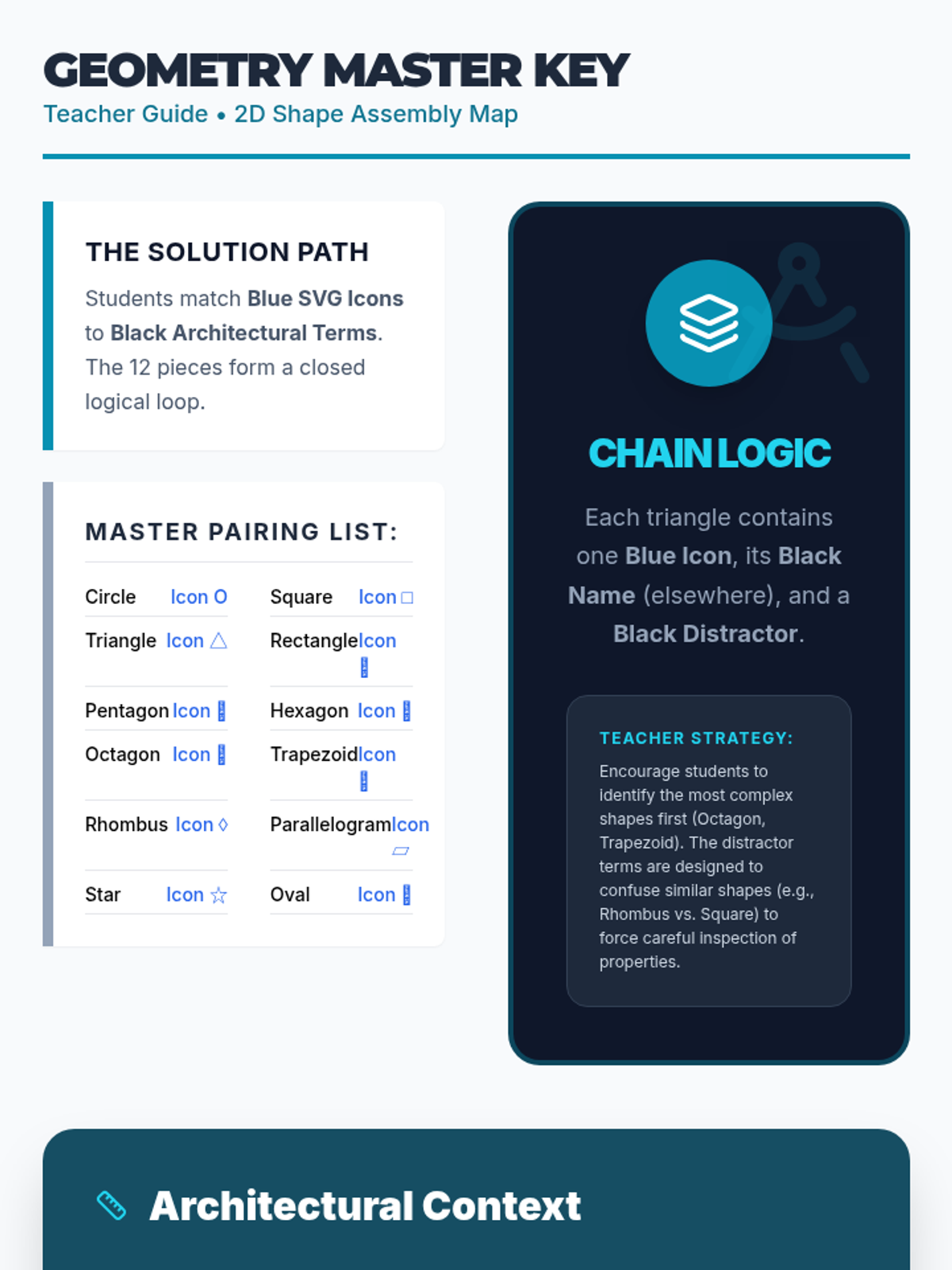
A teacher guide and answer key for the geometric shape Tarsia puzzle, providing a master pairing list and instructional strategies for identifying 2D polygons.
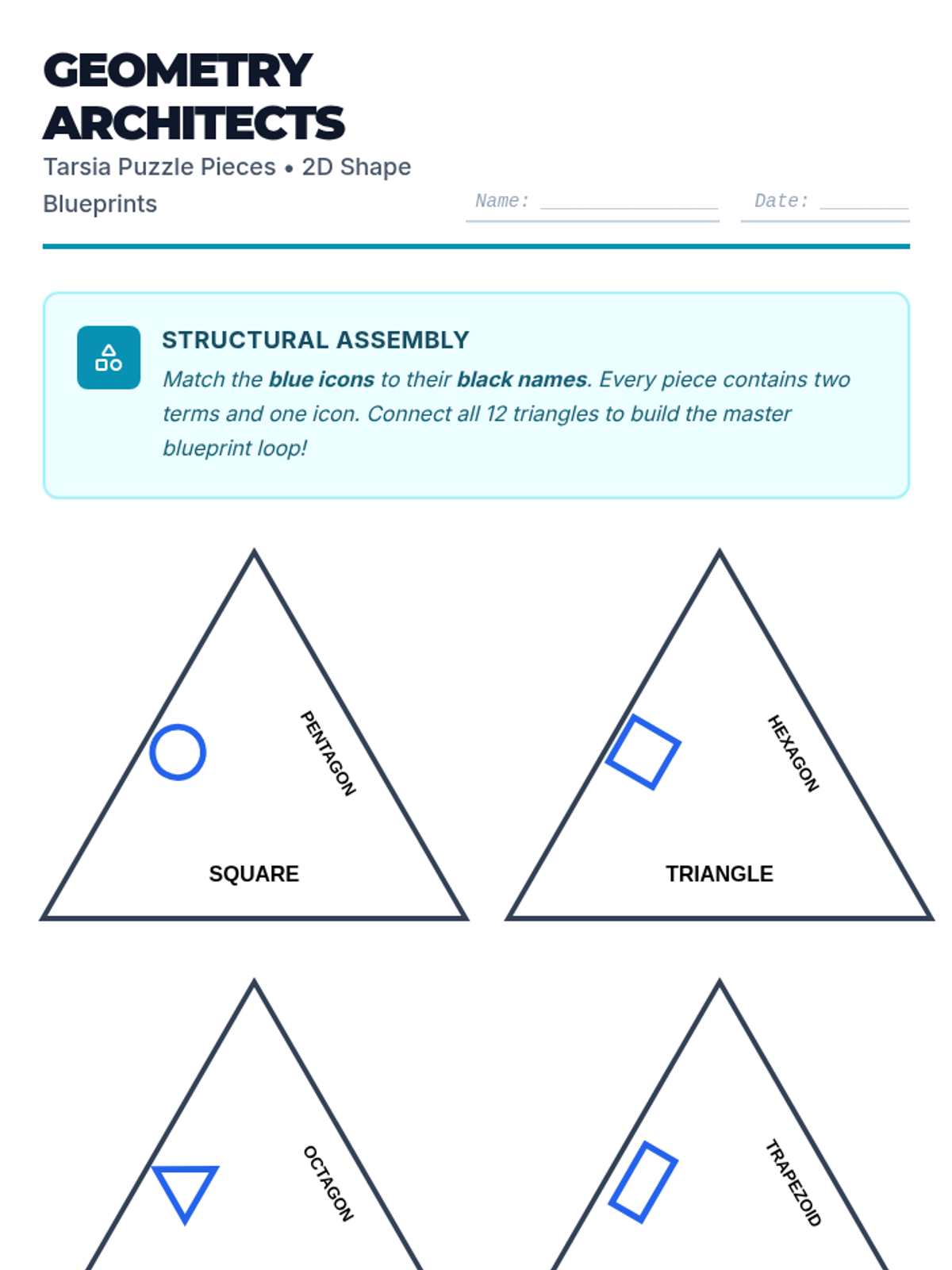
A geometric Tarsia puzzle challenge where students match blue shape icons to their black names. Includes 12 triangular pieces featuring shapes like octagons, trapezoids, and rhombuses. Designed with term dominance and precise SVG icon alignment.
A visual presentation for the Geometry Architects lesson, introducing 2D shapes with an architectural blueprint theme. Includes definitions and visual properties for polygons and circles.
A redesigned advanced Tarsia puzzle featuring a 2:1 ratio of terms to symbols on each piece. Each piece contains exactly one matching blue symbol and one black word, plus one distractor symbol. This ensures text dominance while maintaining a complex notation theme. Labels are precisely aligned inside triangle boundaries.
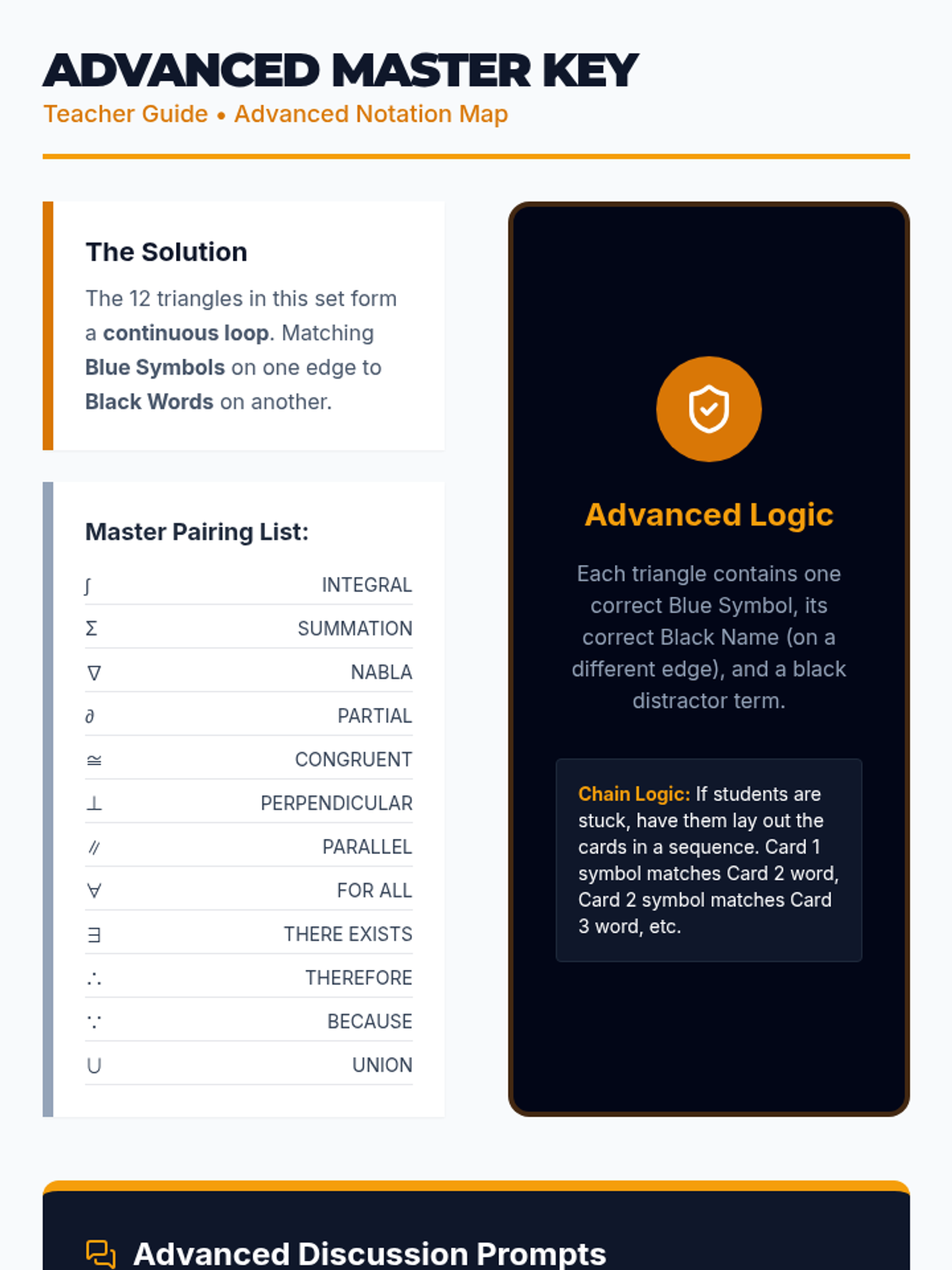
A teacher guide and answer key for the advanced notation Tarsia puzzle, including a master pairing list for complex symbols like Nabla, Integral, and Partial.
An advanced instructional slide deck introducing higher-level mathematical symbols from calculus, set theory, and geometry.
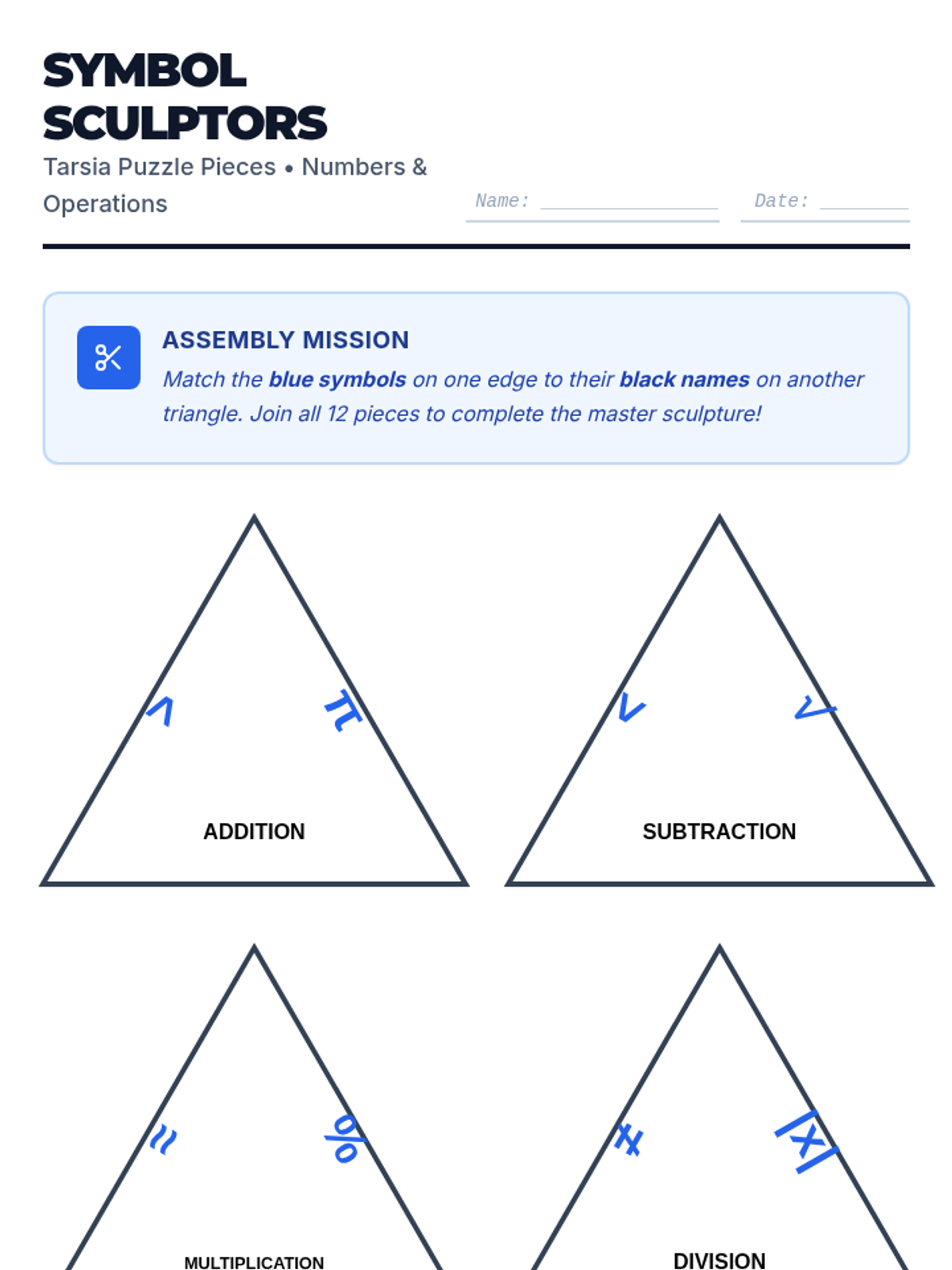
A student activity sheet containing 12 triangular puzzle pieces with mathematical symbols and their names. This is the finalized Version 3 with corrected alignment and logic. Match blue symbols on one piece to black names on another.
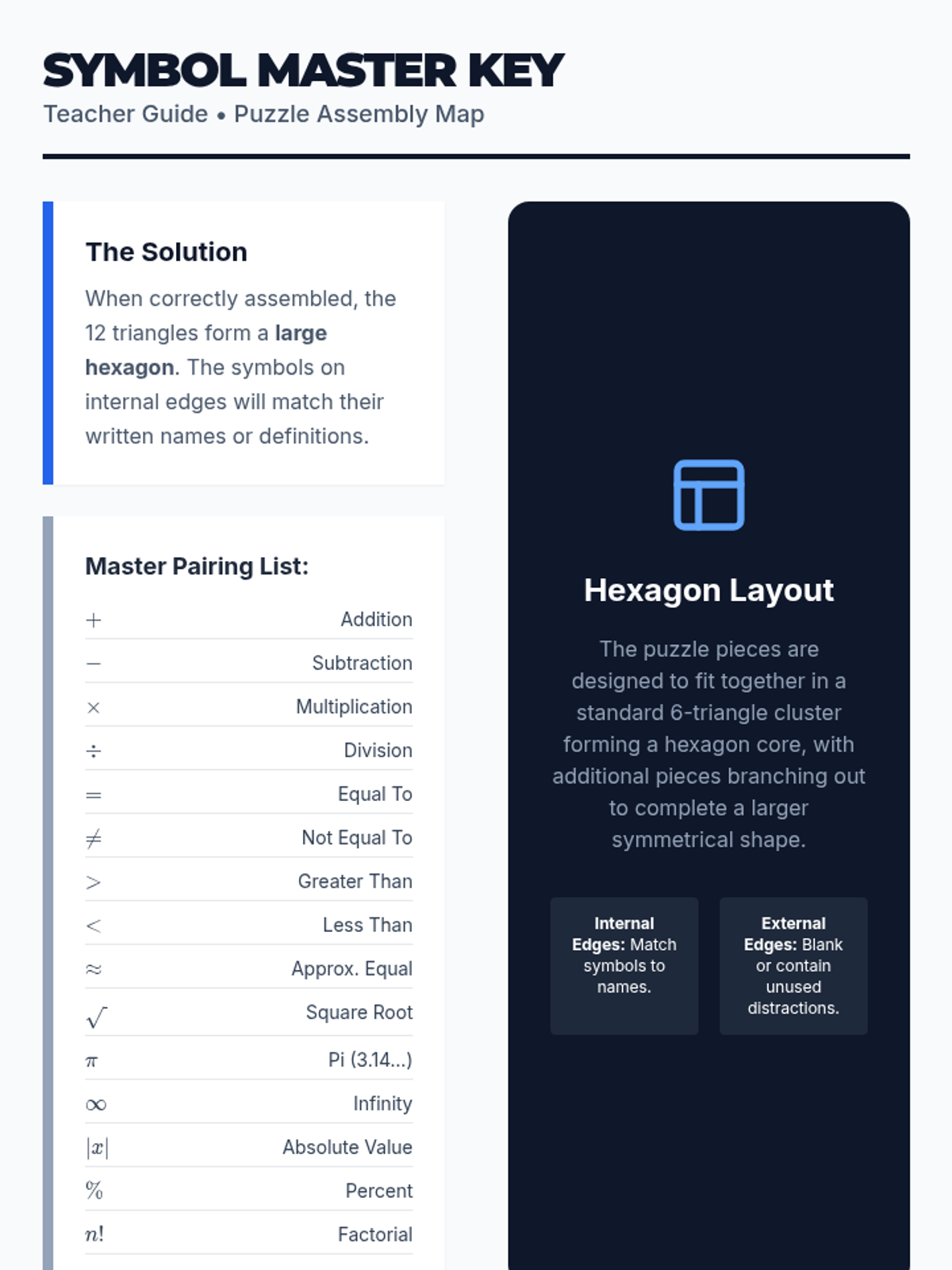
A teacher's answer key and facilitation guide for the Tarsia puzzle, including a master pairing list and assembly tips.
An instructional slide deck introducing common and advanced mathematical symbols used in operations and number relationships, featuring clear visual definitions and examples.
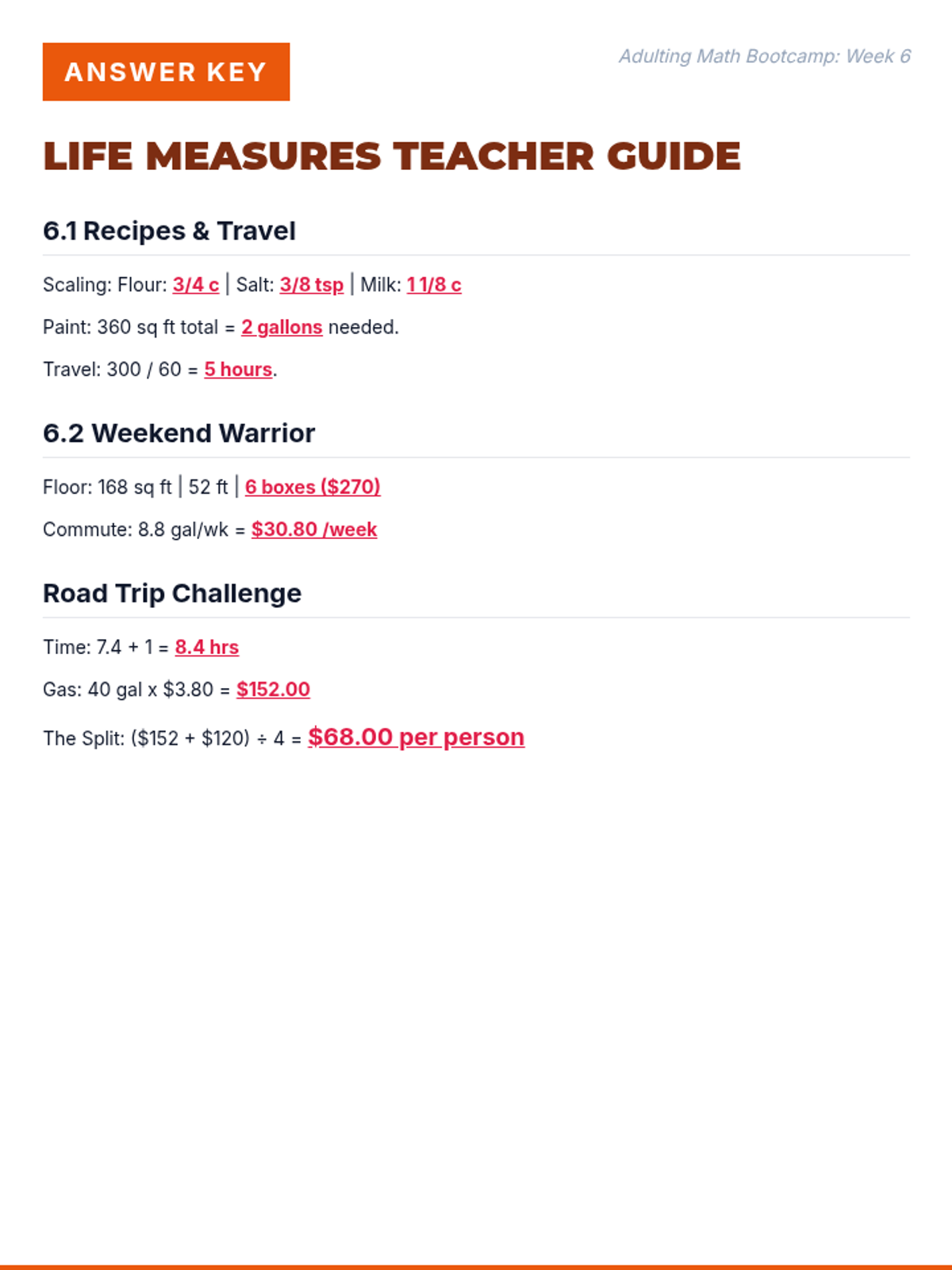
Teacher answer key for the Week 6 Life Measures workbook, including recipe scaling, flooring estimates, commuter gas costs, and road trip budgeting. Adjusted to prevent content overlap.
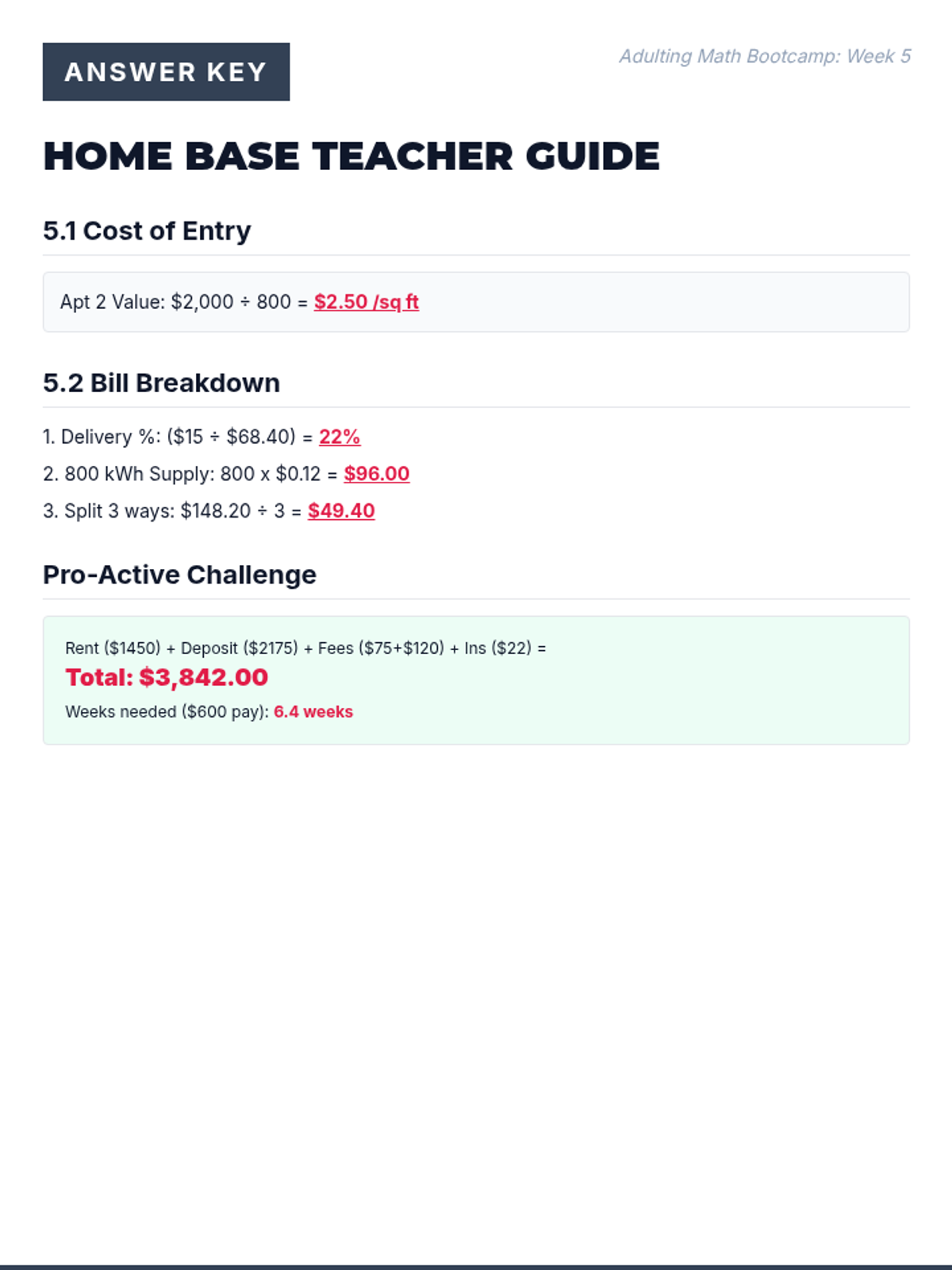
Teacher answer key for the Week 5 Home Base workbook, including total move-in cost calculations, utility bill analysis, and square footage value comparisons. Adjusted to prevent content overlap.
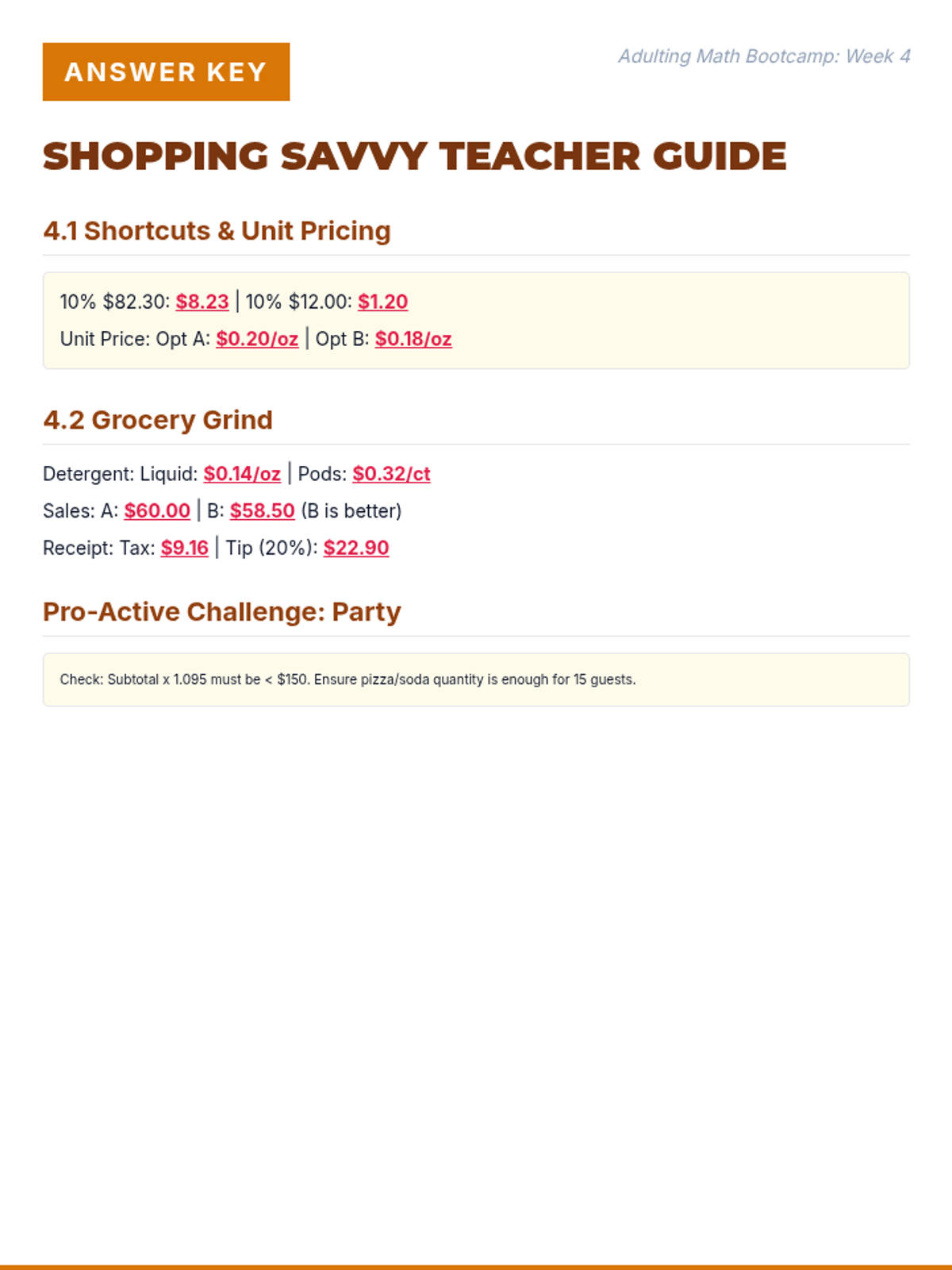
Teacher answer key for the Week 4 Shopping Savvy workbook, providing solutions for unit price comparisons, sales tax calculations, and party budget logic. Adjusted to prevent content overlap.
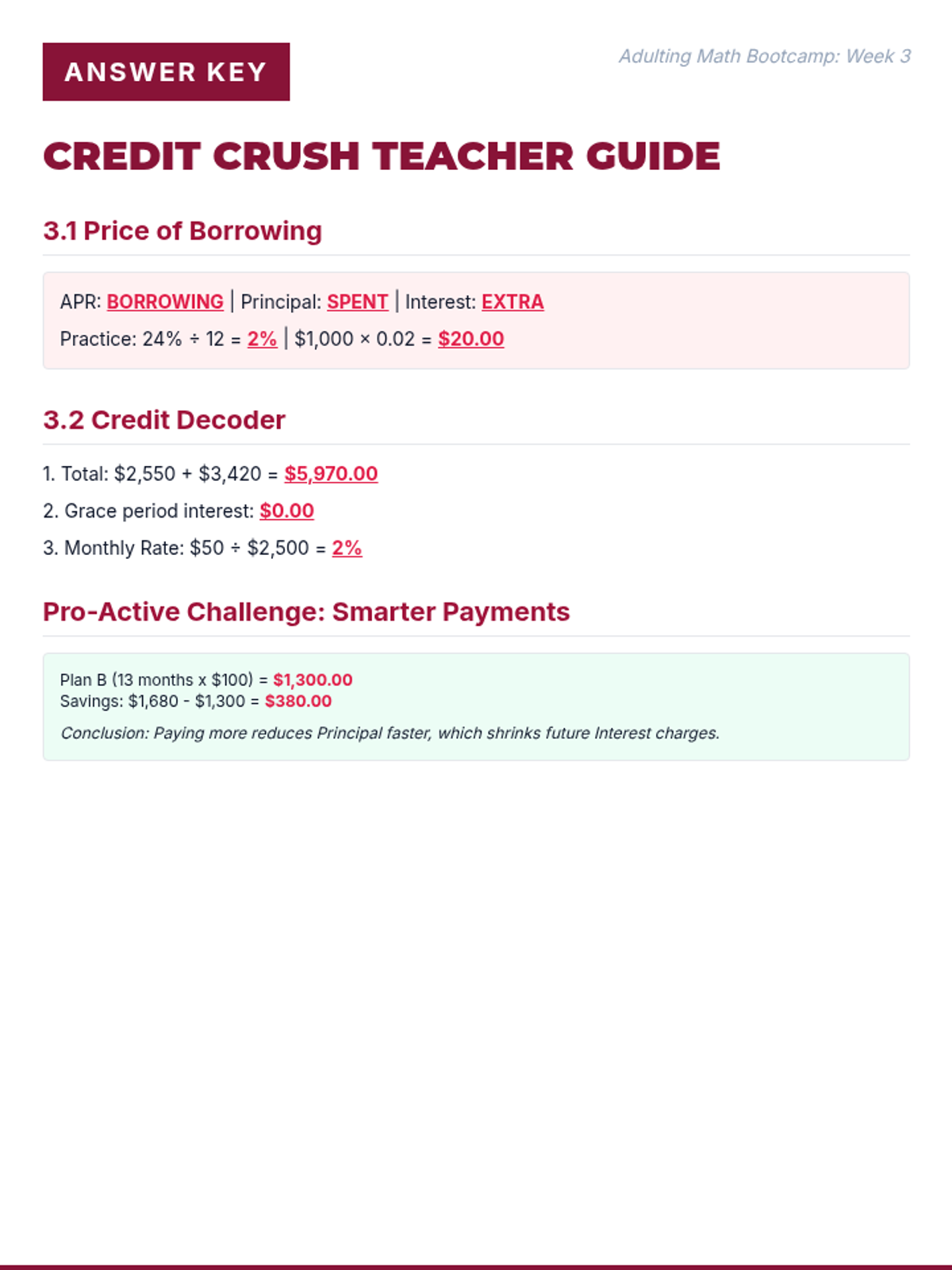
Teacher answer key for the Week 3 Credit Crush workbook, including APR calculations, statement decoding, and the total cost comparison of debt. Adjusted to prevent content overlap.
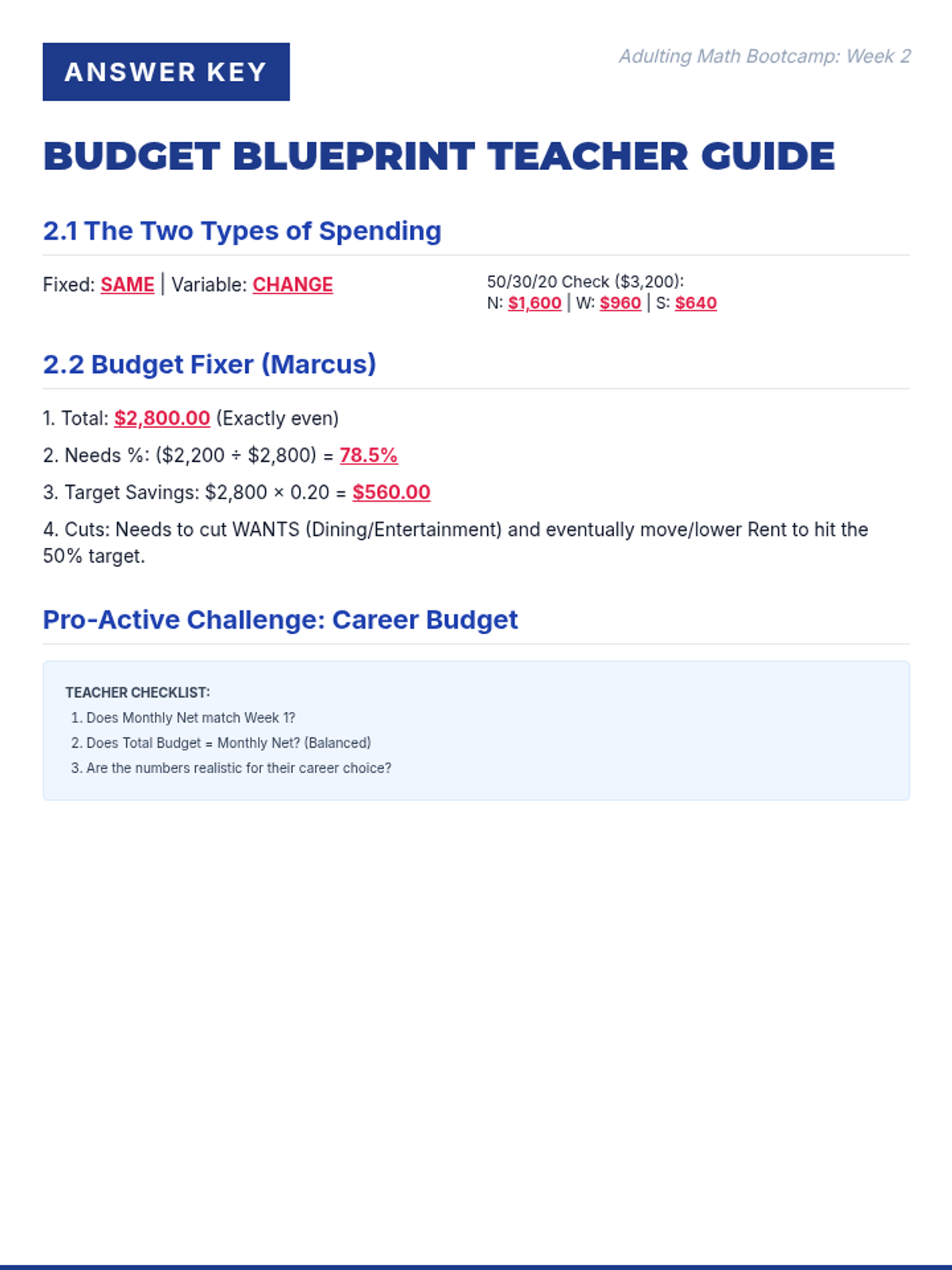
Teacher answer key for the Week 2 Budget Blueprint workbook, providing detailed solutions for fixed/variable expenses, the 50/30/20 rule, and Marcus's budget analysis. Adjusted to prevent content overlap.
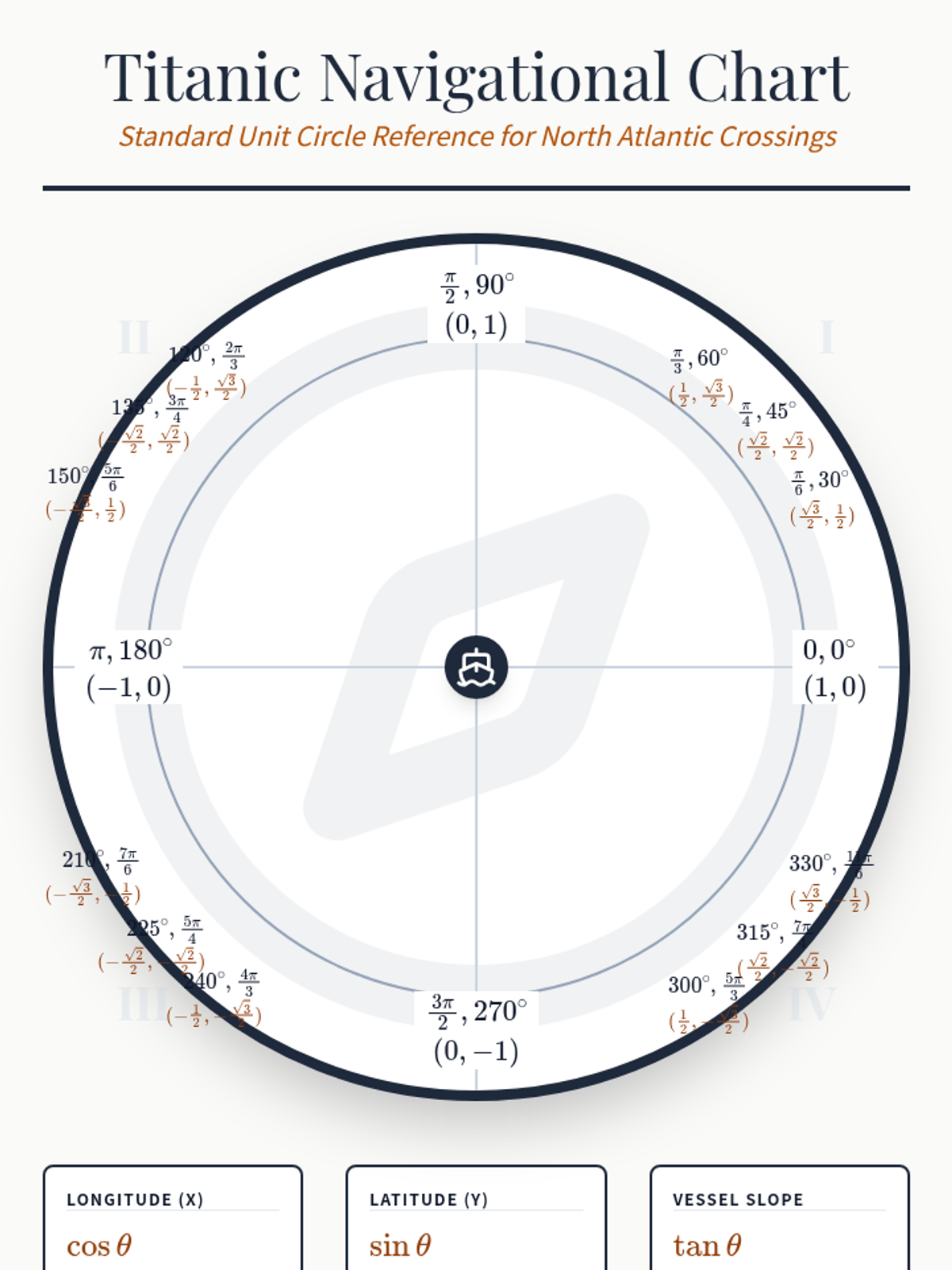
A visual unit circle reference chart themed as a Titanic navigational map. It features all special angles in degrees and radians with their corresponding (x, y) coordinates, styled as a maritime instrument.
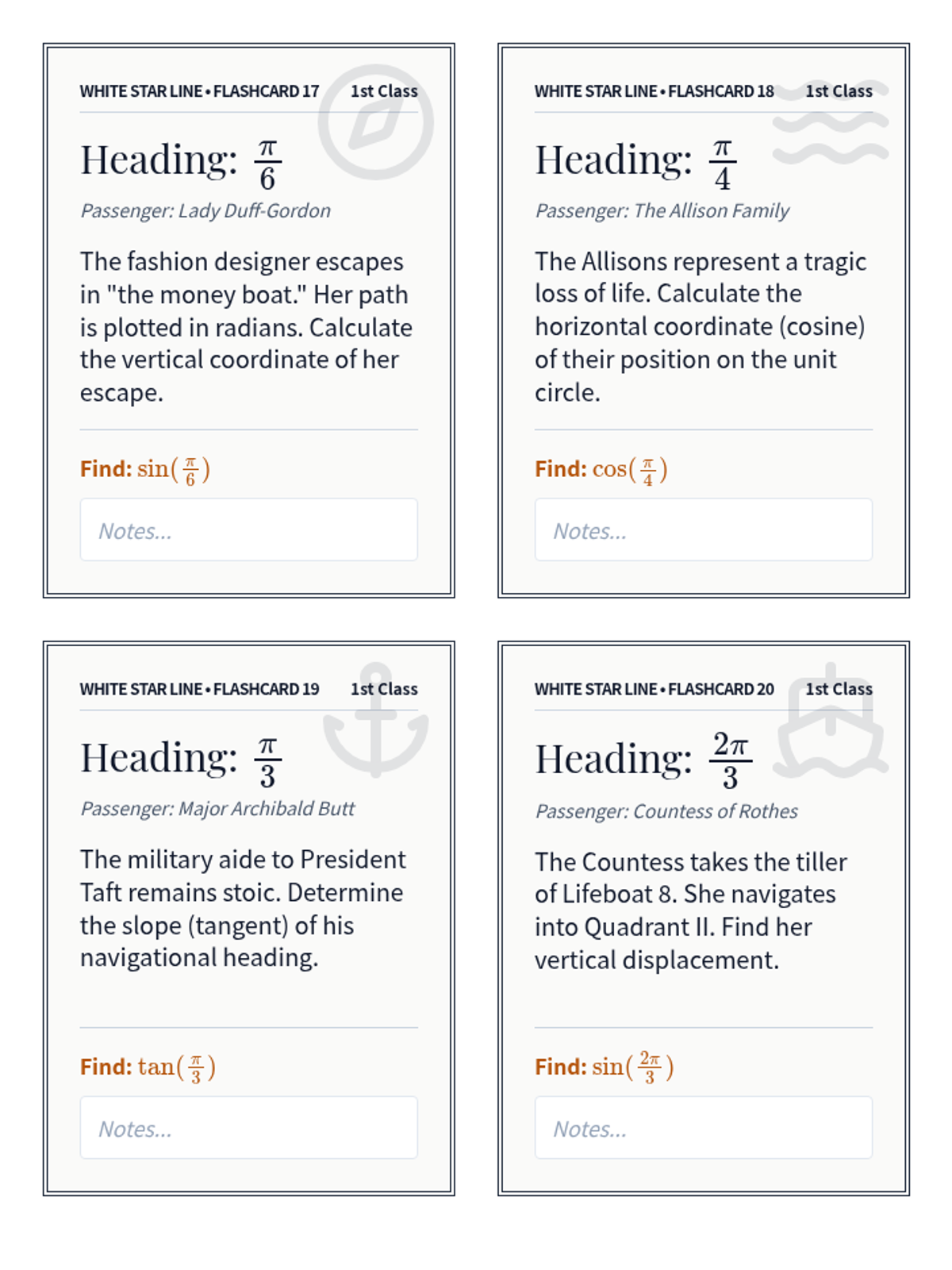
The second set of Titanic-themed trigonometry flashcards (Cards 17-30). This collection focuses on radian measures of special angles, featuring additional historical passengers like Lady Duff-Gordon and the Countess of Rothes.
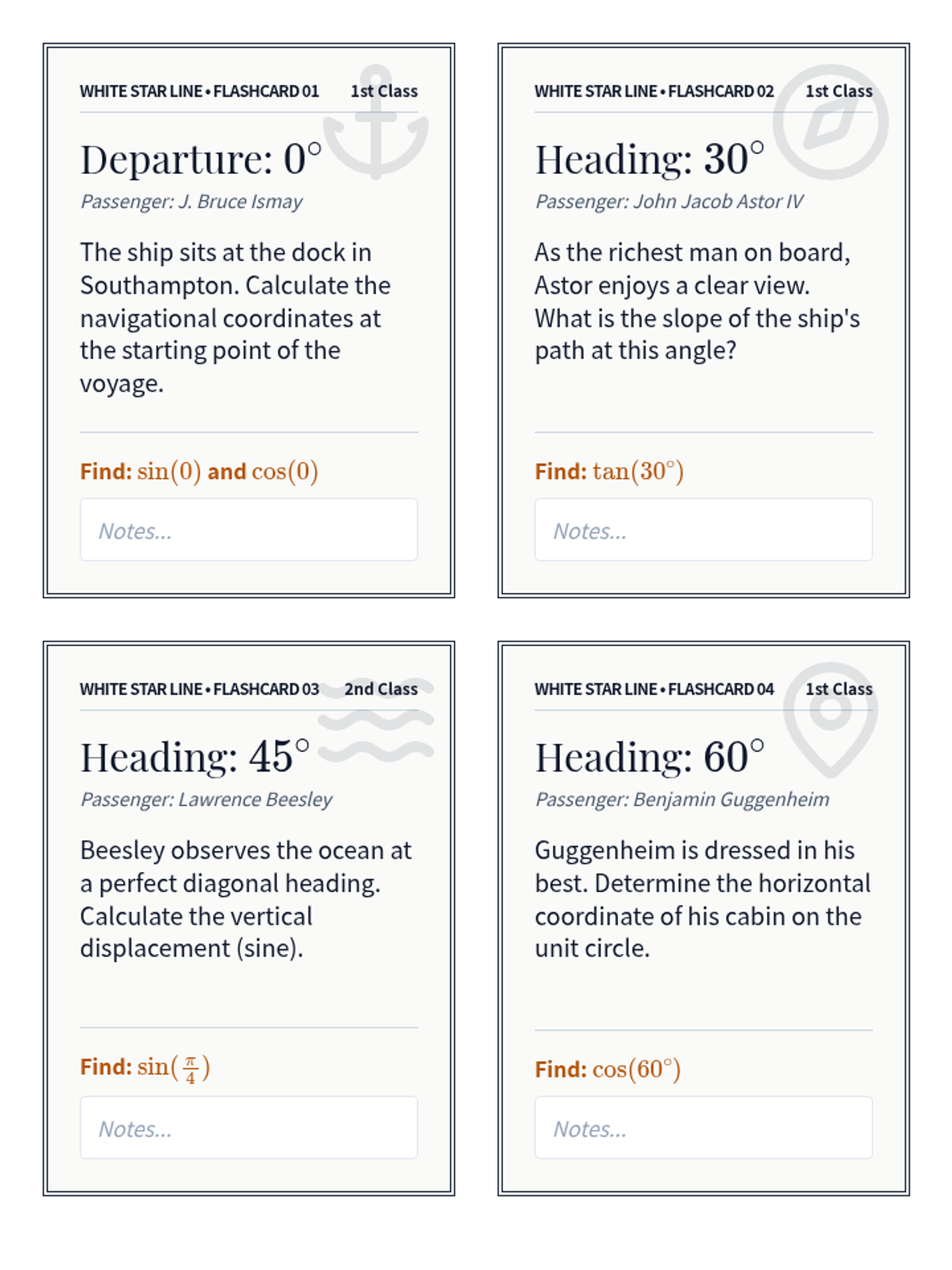
A set of 16 nautical-themed trigonometry flashcards featuring Titanic passengers and historical milestones. Each card challenges students to find sine, cosine, or tangent values for key unit circle angles within the context of the ship's journey.
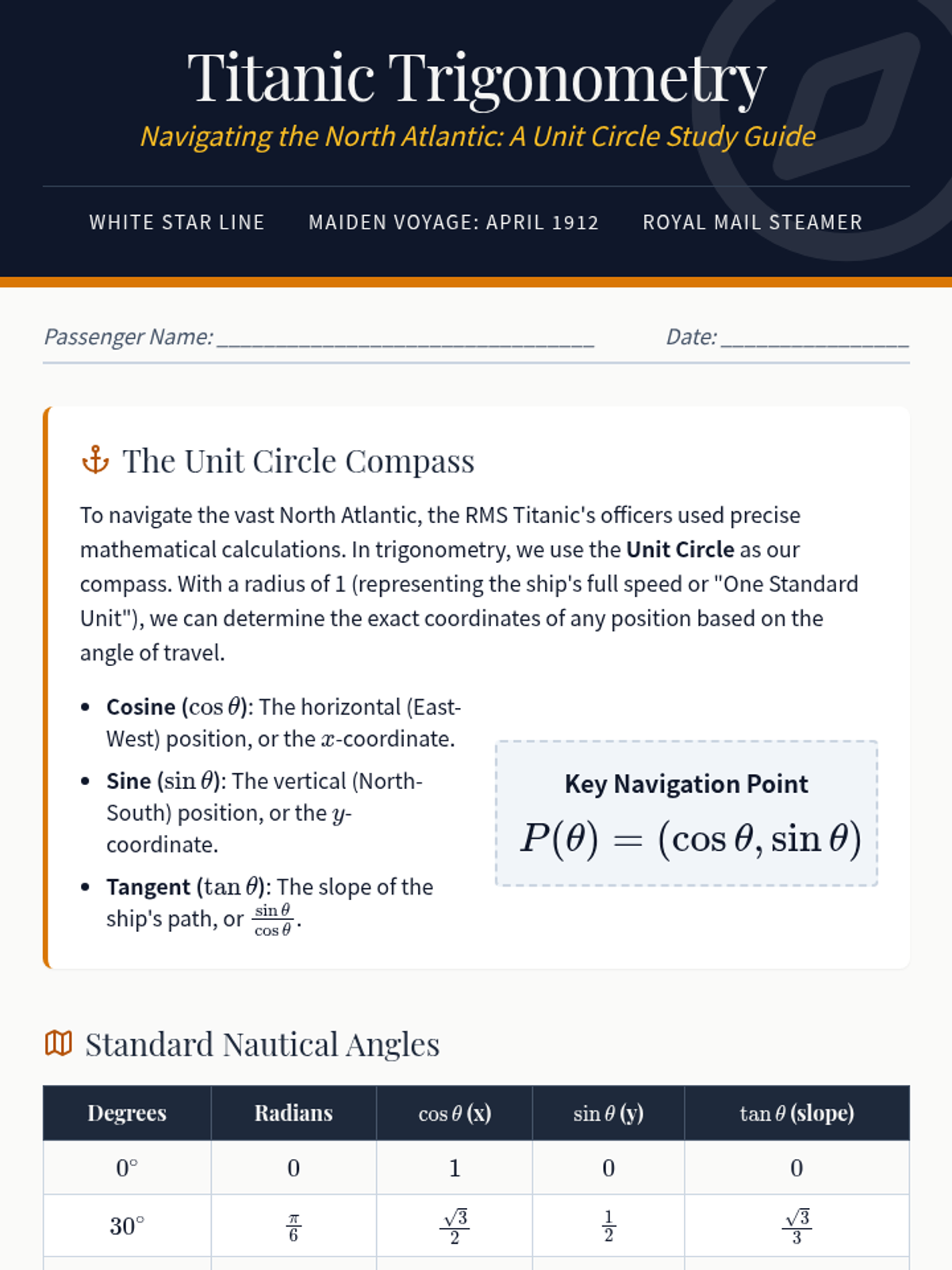
A comprehensive Titanic-themed trigonometry study guide featuring navigation metaphors, a special angles table, and historical passenger scenarios (Captain Smith, Molly Brown, Frederick Fleet) to practice unit circle coordinates.
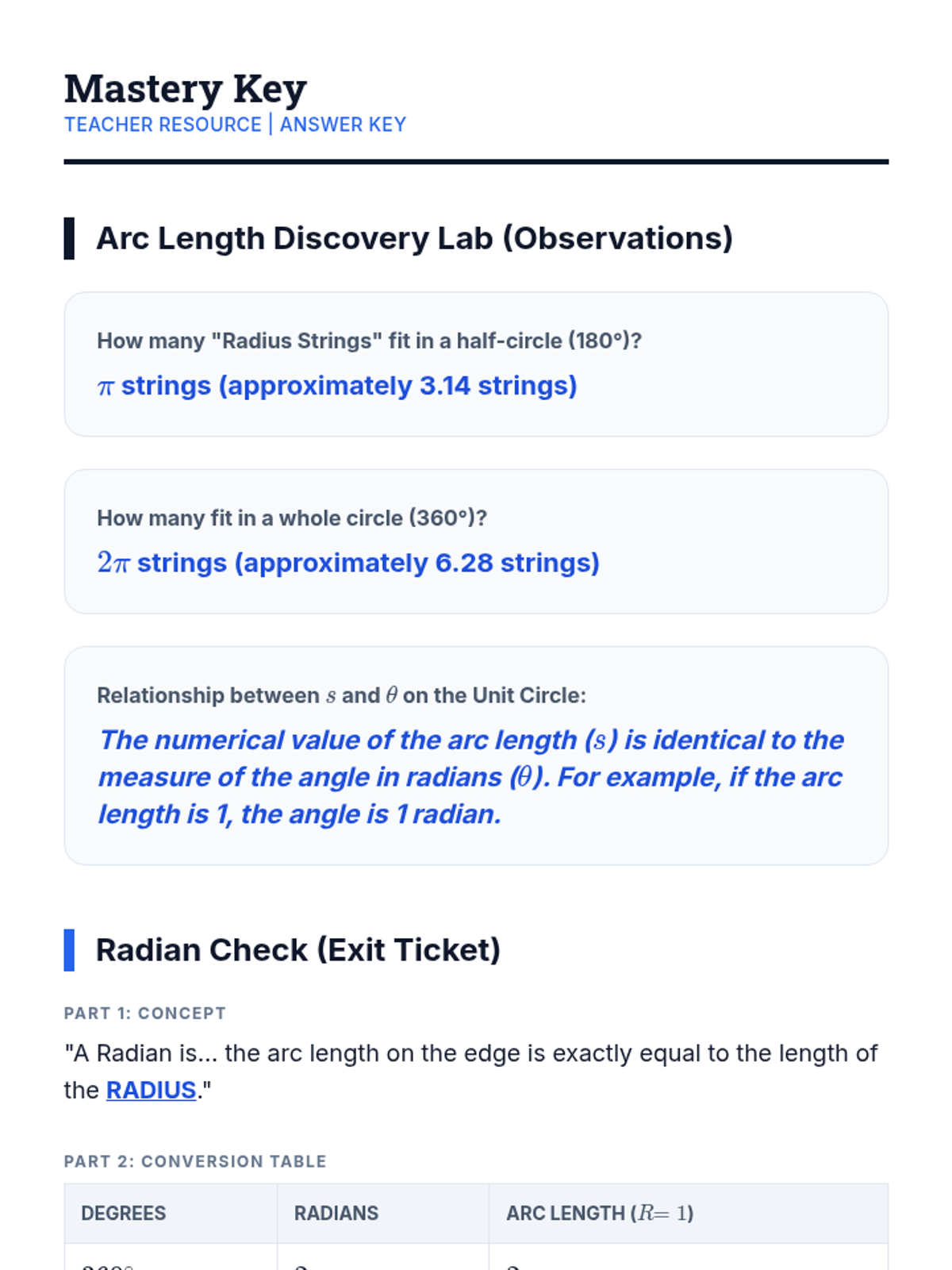
Answer key for the Radian Discovery lesson. Includes expected observations from the lab and full solutions for the exit ticket and conversion table.
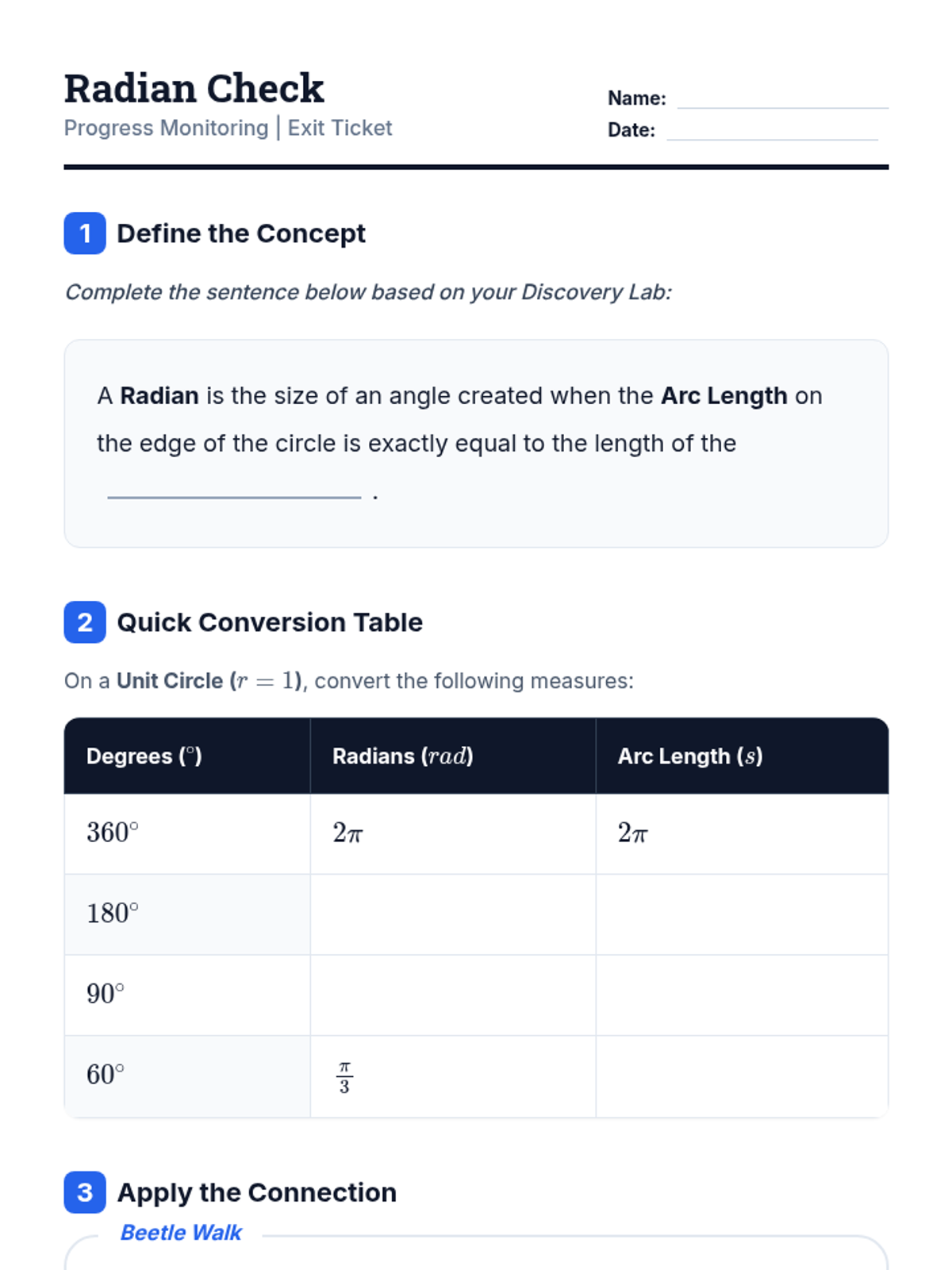
Progress monitoring exit ticket for students to demonstrate their understanding of radian measure and its relationship to arc length. Includes a conceptual check, conversion table, and an application word problem.
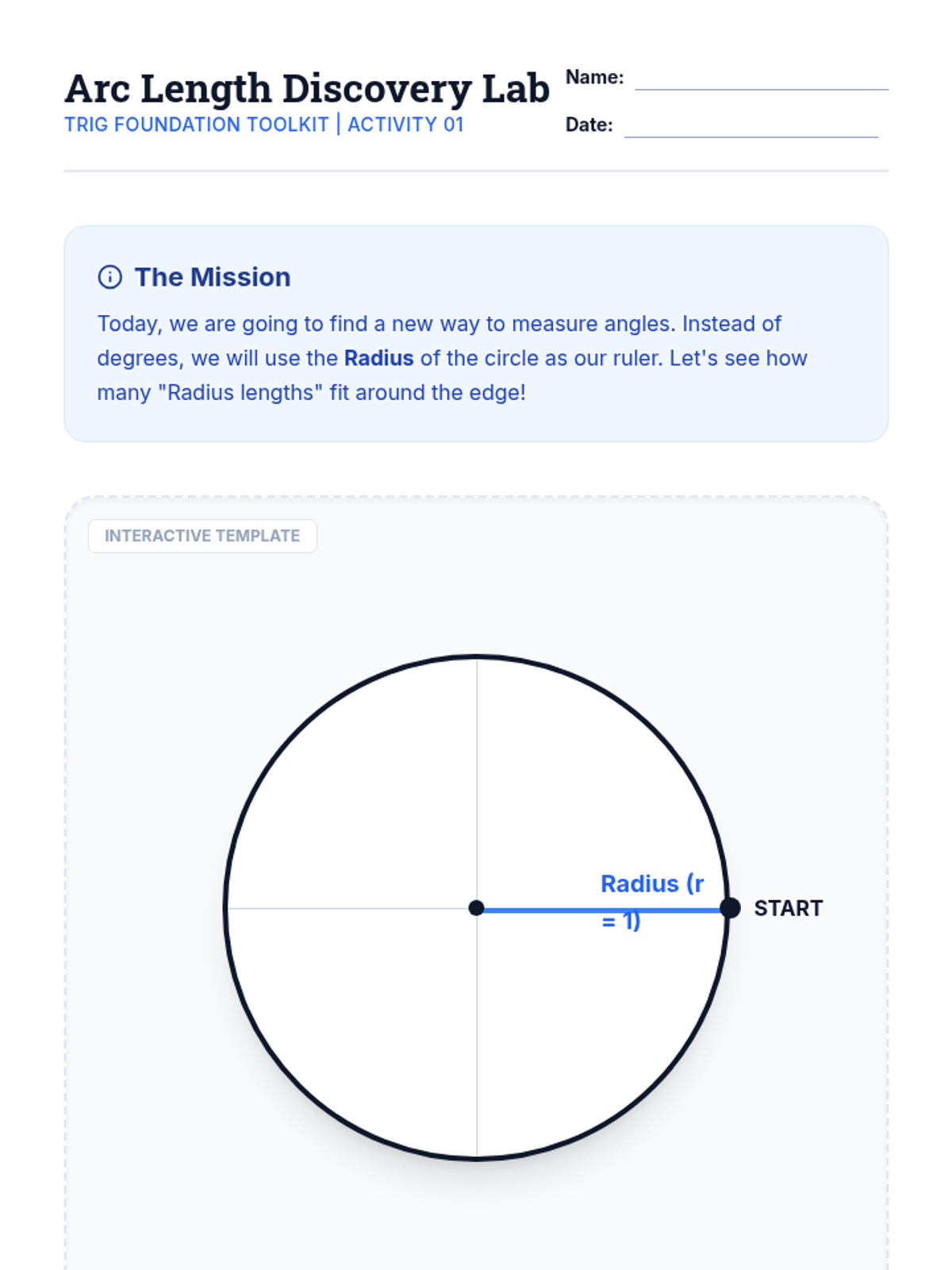
Student activity worksheet featuring a large unit circle template for the string-wrapping activity. Includes step-by-step discovery instructions and observation prompts to connect arc length to radian measure.
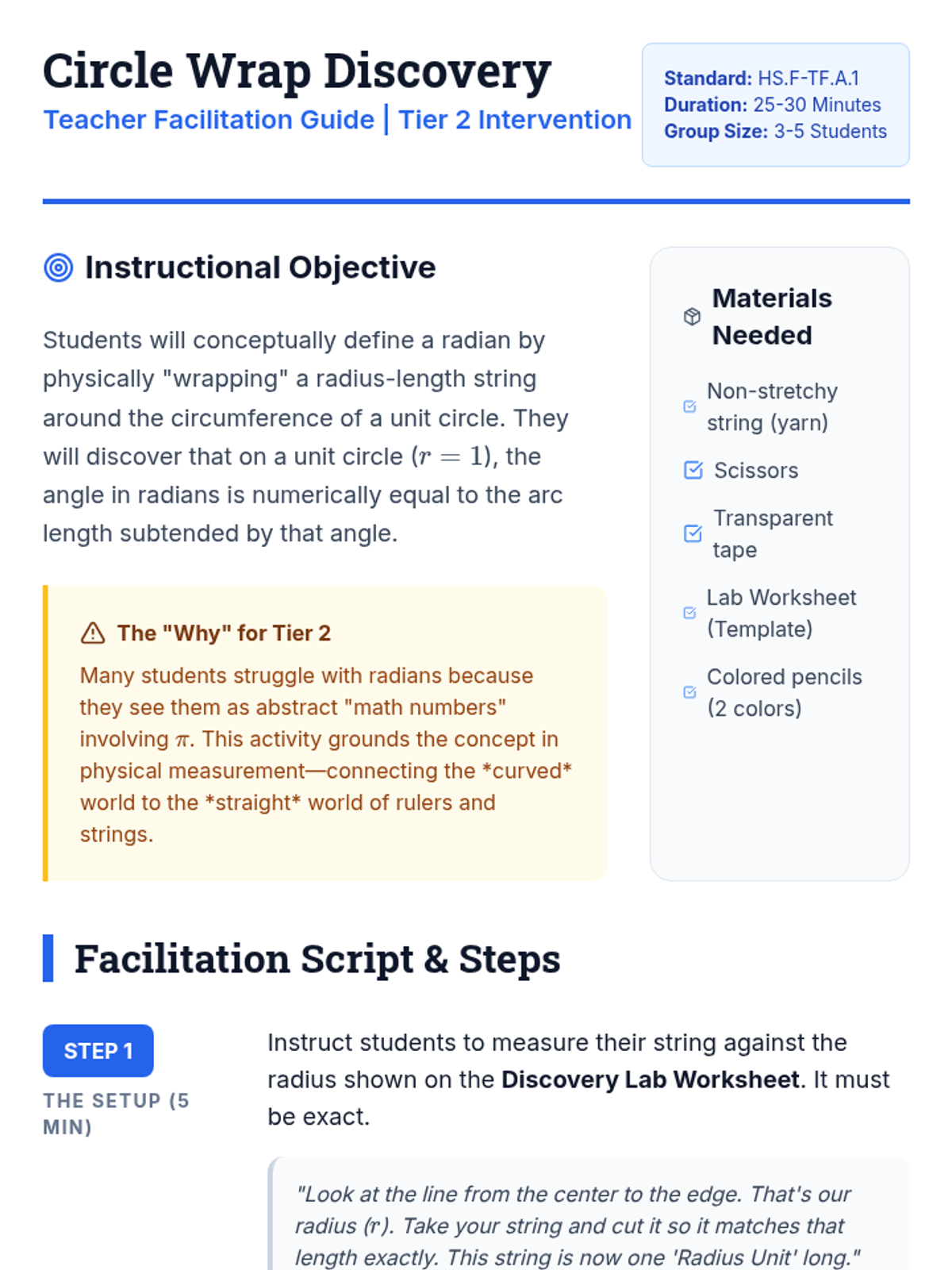
Teacher facilitation guide for the Tier 2 intervention lesson. Includes a step-by-step scaffolded script for the string-wrapping activity, key misconceptions to monitor, and specific instructional cues for small groups.
Visual slide deck for a Tier 2 intervention lesson on radians and arc length. Features a "Blueprint" theme with clear visual definitions, the "String Wrap" conceptual explanation, and basic radian-degree conversion highlights.
A visual presentation for the 'Hidden Curves' lesson, featuring the Matholia video embed, architectural definitions of spandrels, and step-by-step algebraic and visual solutions to negative space problems.
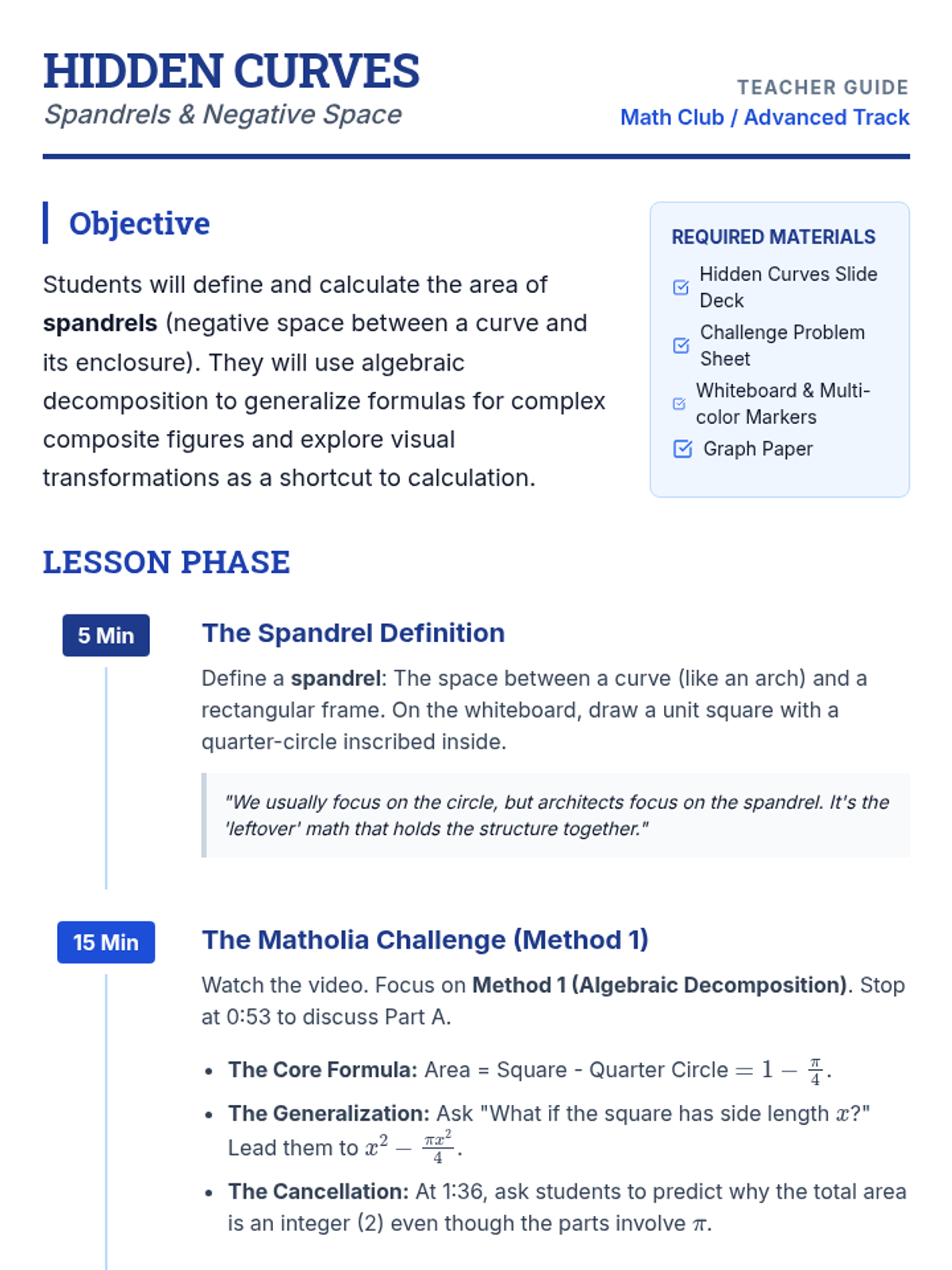
A comprehensive teacher guide for the 'Hidden Curves' lesson, detailing the timeline, whiteboard setup, and instructional prompts for exploring spandrels and algebraic decomposition.
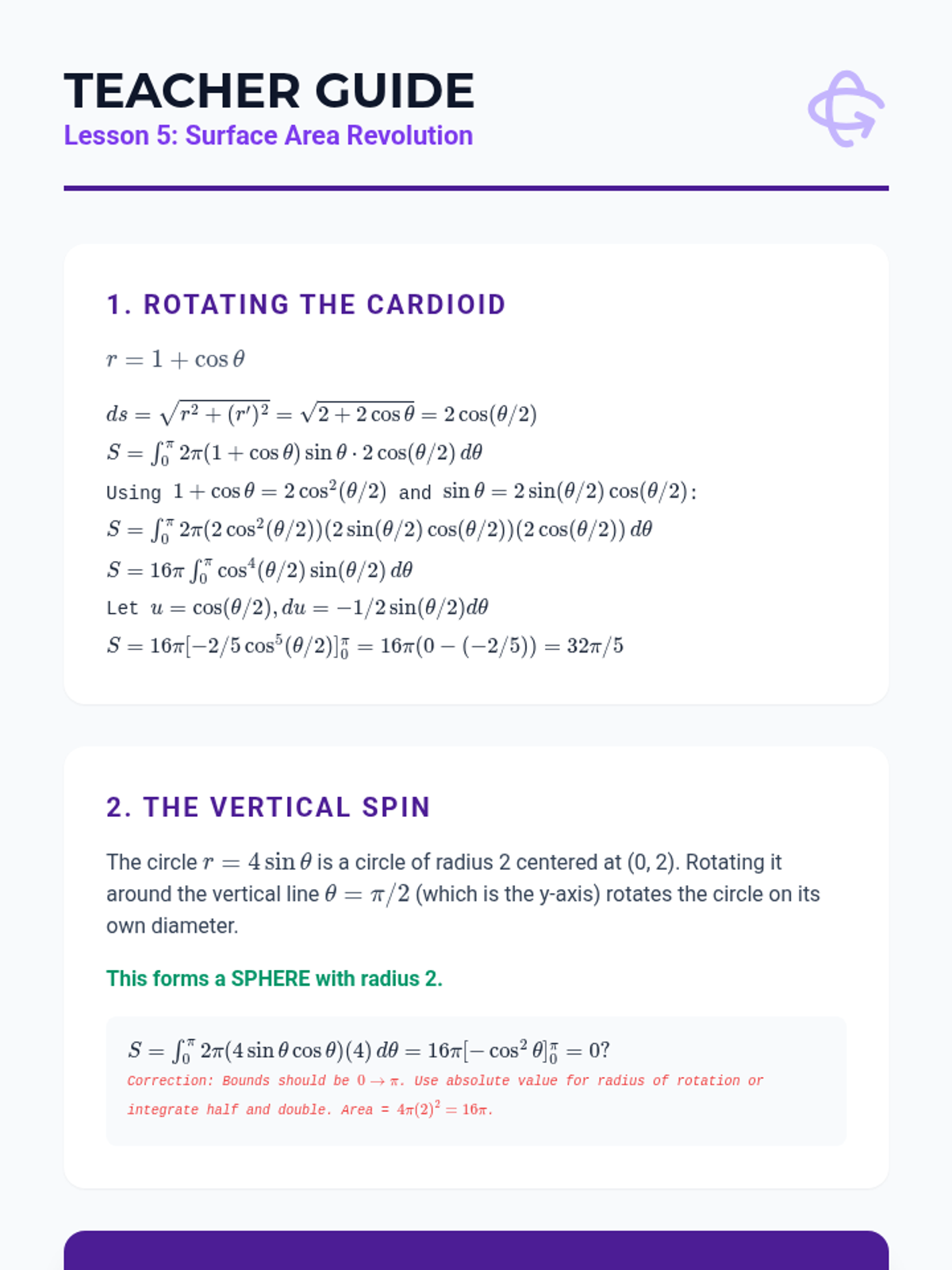
Teacher answer key for Lesson 5, including step-by-step trigonometric substitution for cardioid surface area and geometric verification for spheres.
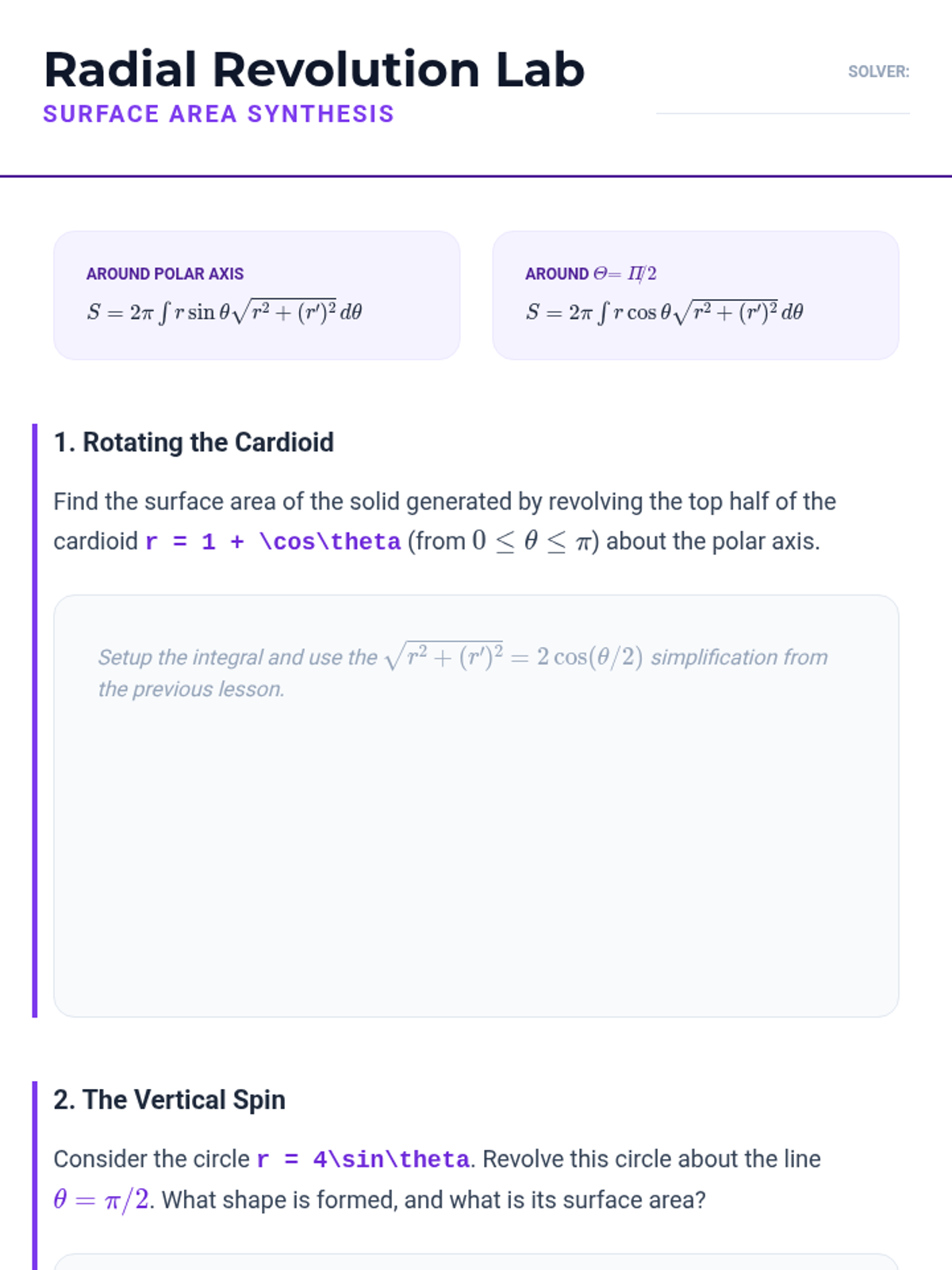
Student worksheet for Lesson 5, featuring surface area problems for cardioids and circles, plus a challenge involving rose curve rotation.
Slide presentation for Lesson 5 on surface area of revolution in polar coordinates, synthesizing earlier concepts of arc length and coordinate conversion.
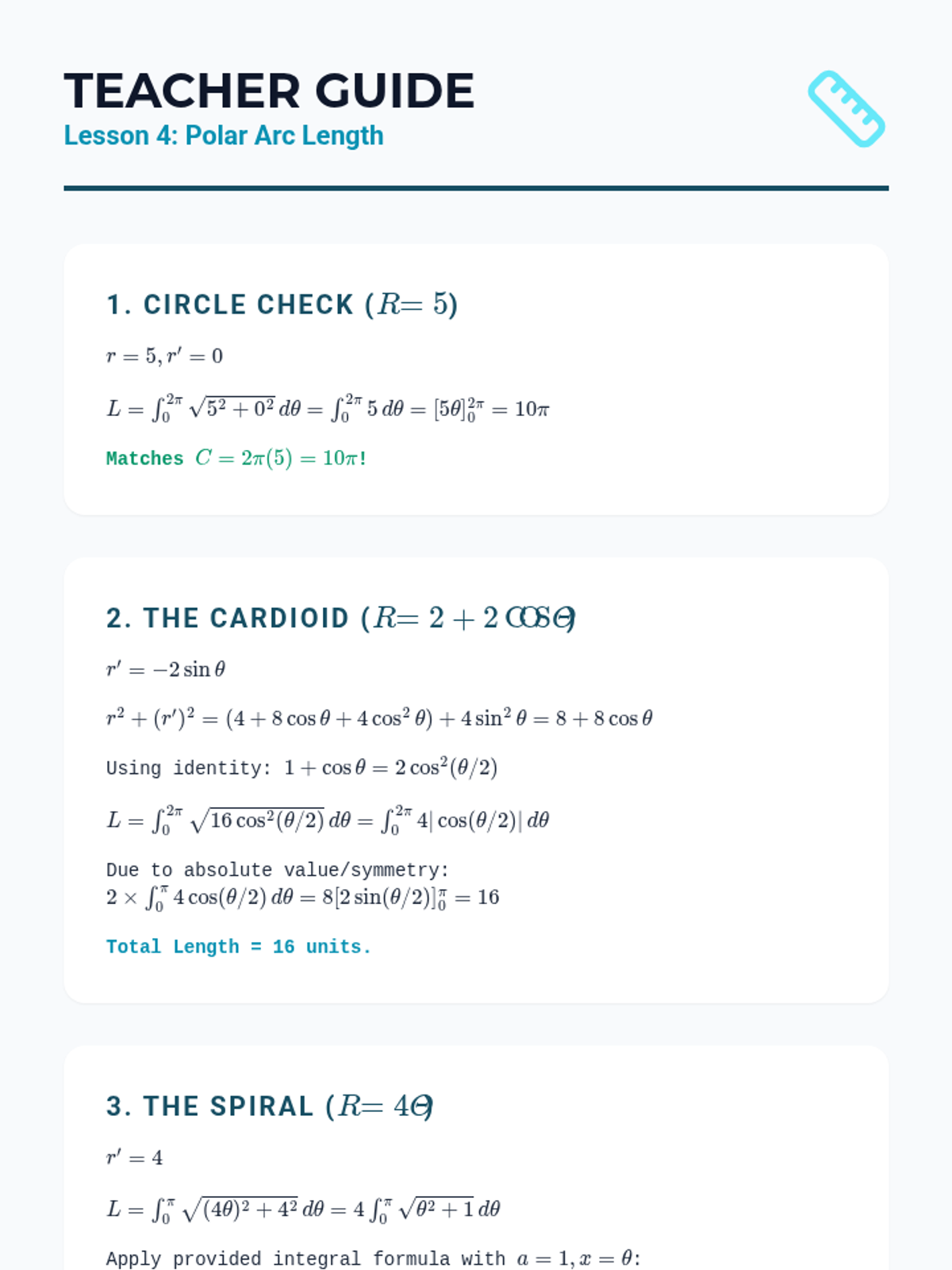
Teacher answer key for Lesson 4, featuring detailed trigonometric identity work for cardioid arc length and the formula application for Archimedean spirals.
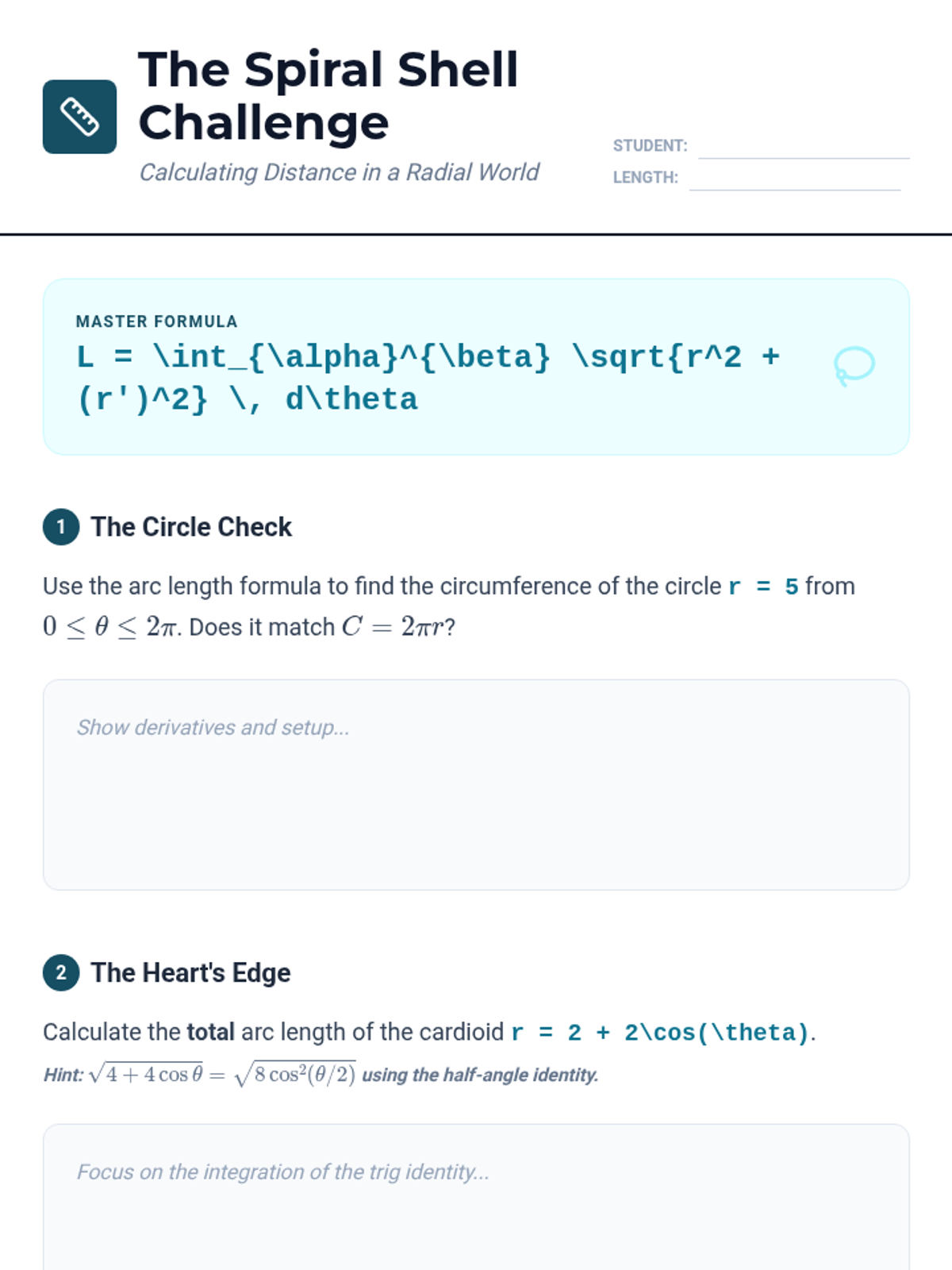
Student worksheet for Lesson 4, containing arc length problems for circles, cardioids, and spirals, plus a conceptual reflection on the formula's components.
Slide presentation for Lesson 4 on polar arc length, covering the derivation from parametric form and application to cardioids and spirals.
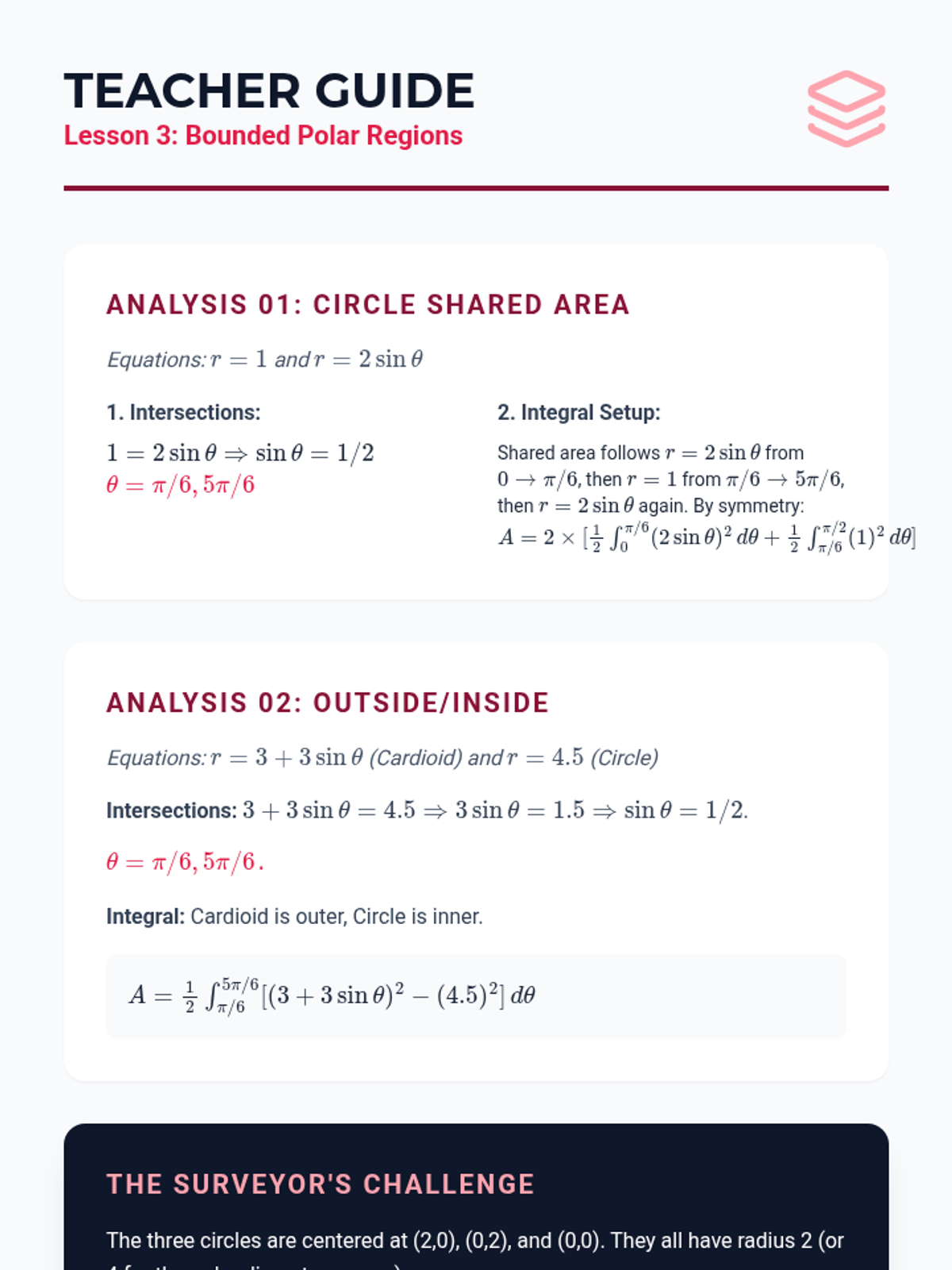
Teacher answer key for Lesson 3, providing detailed breakdown of compound integral setups and the "Surveyor's Challenge" triple-overlap solution.
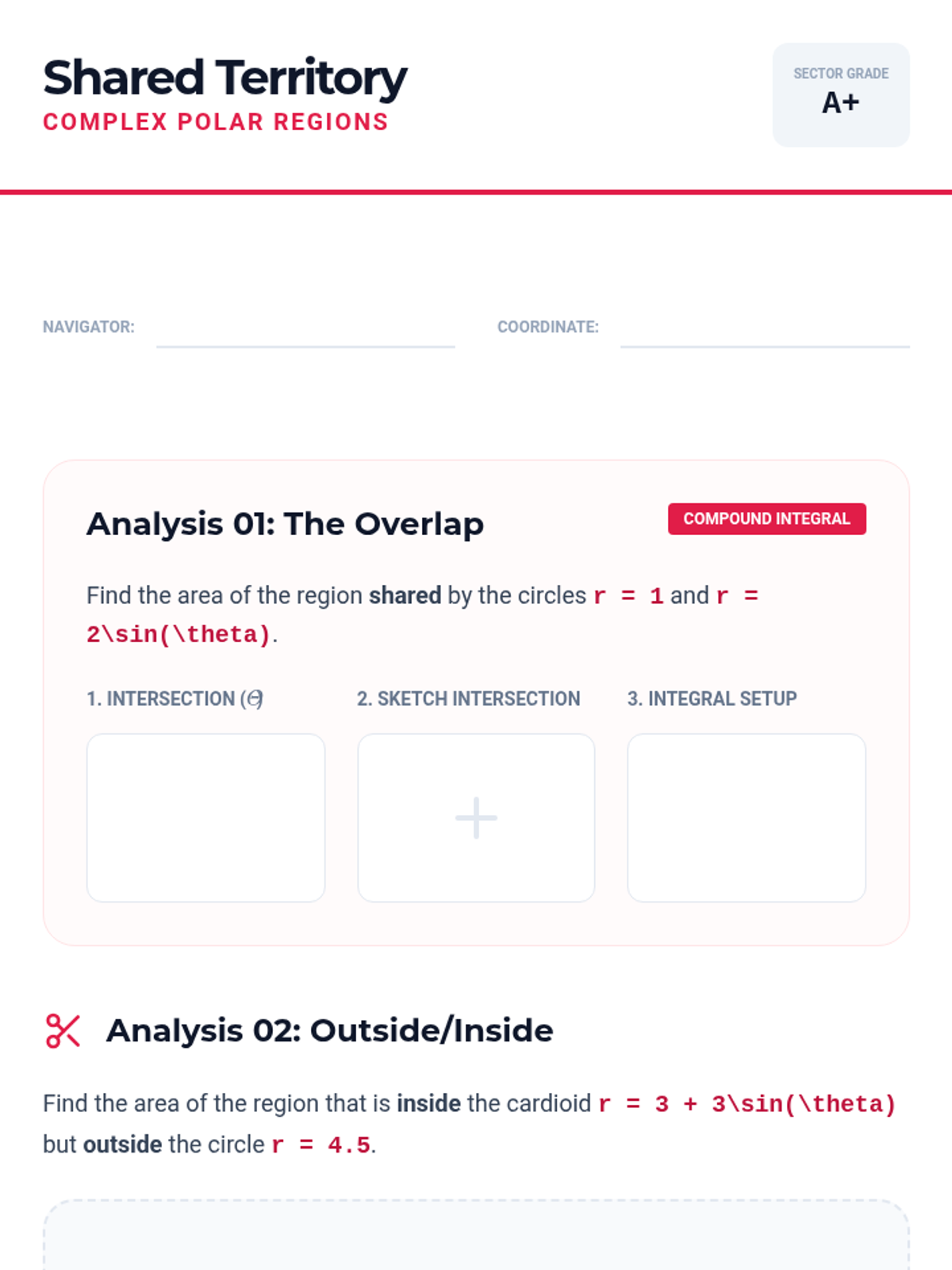
Student worksheet featuring problems on shared polar area and area between curves, including a multi-curve "Surveyor's Challenge."
Slide deck for Lesson 3 focusing on bounded polar regions, intersections, and the difference between "shared area" and "area between curves."
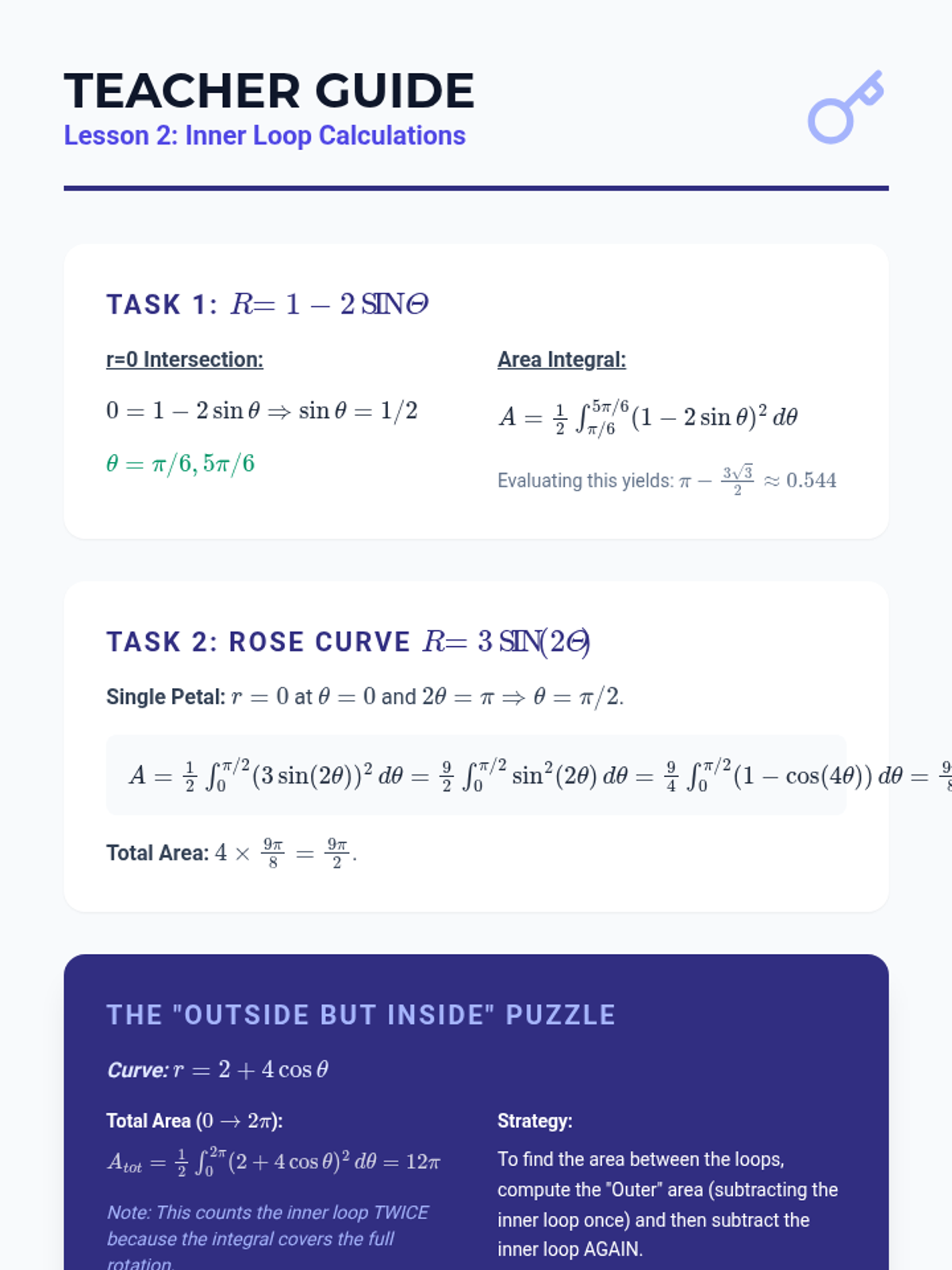
Teacher answer key for the "Lima\u00e7on Loop Lab," providing detailed solutions for loop boundary solving and compound area strategies.
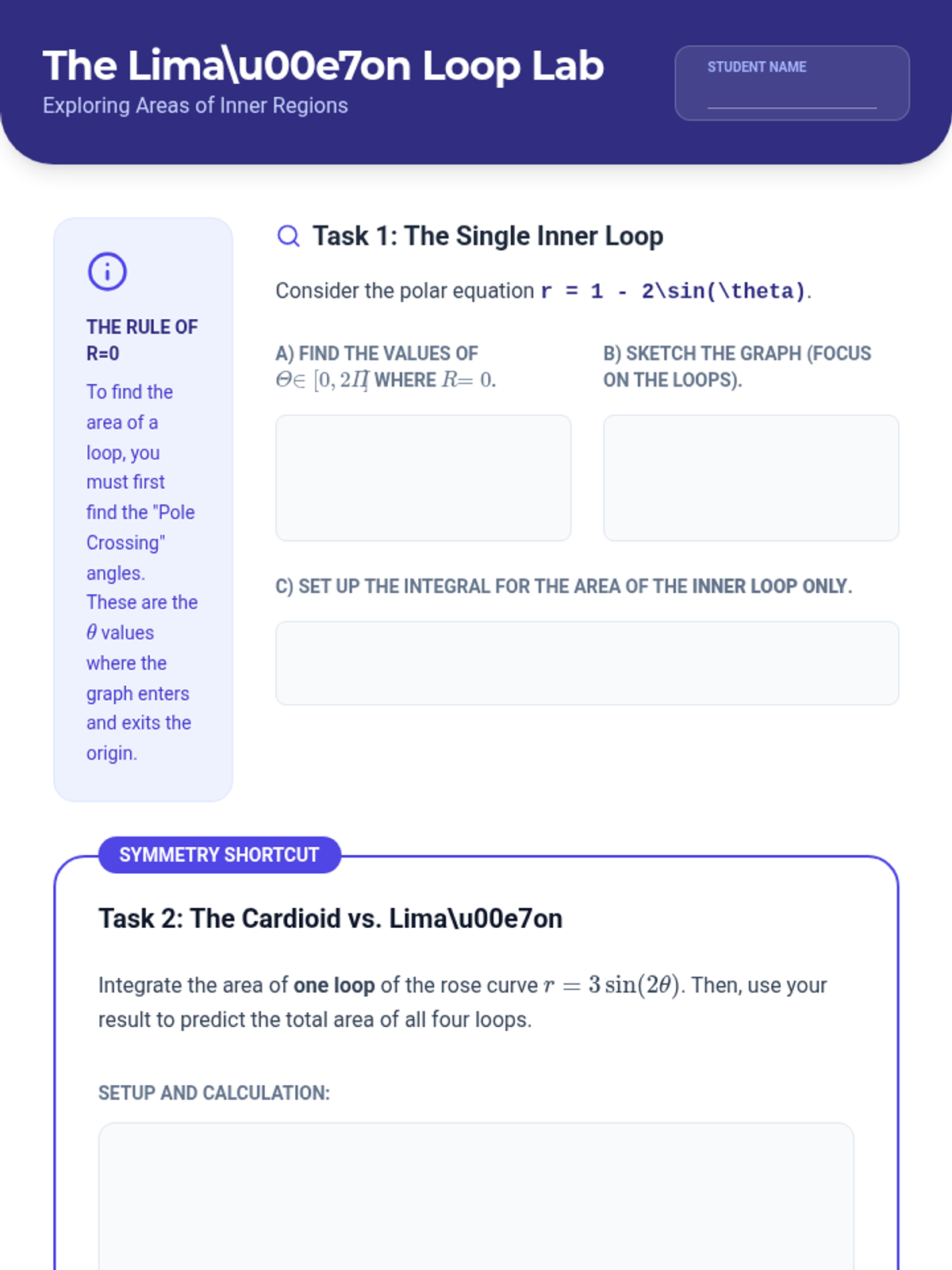
Student activity focusing on calculating inner loop areas of lima\u00e7ons and rose curves, requiring students to solve for intersection with the pole.
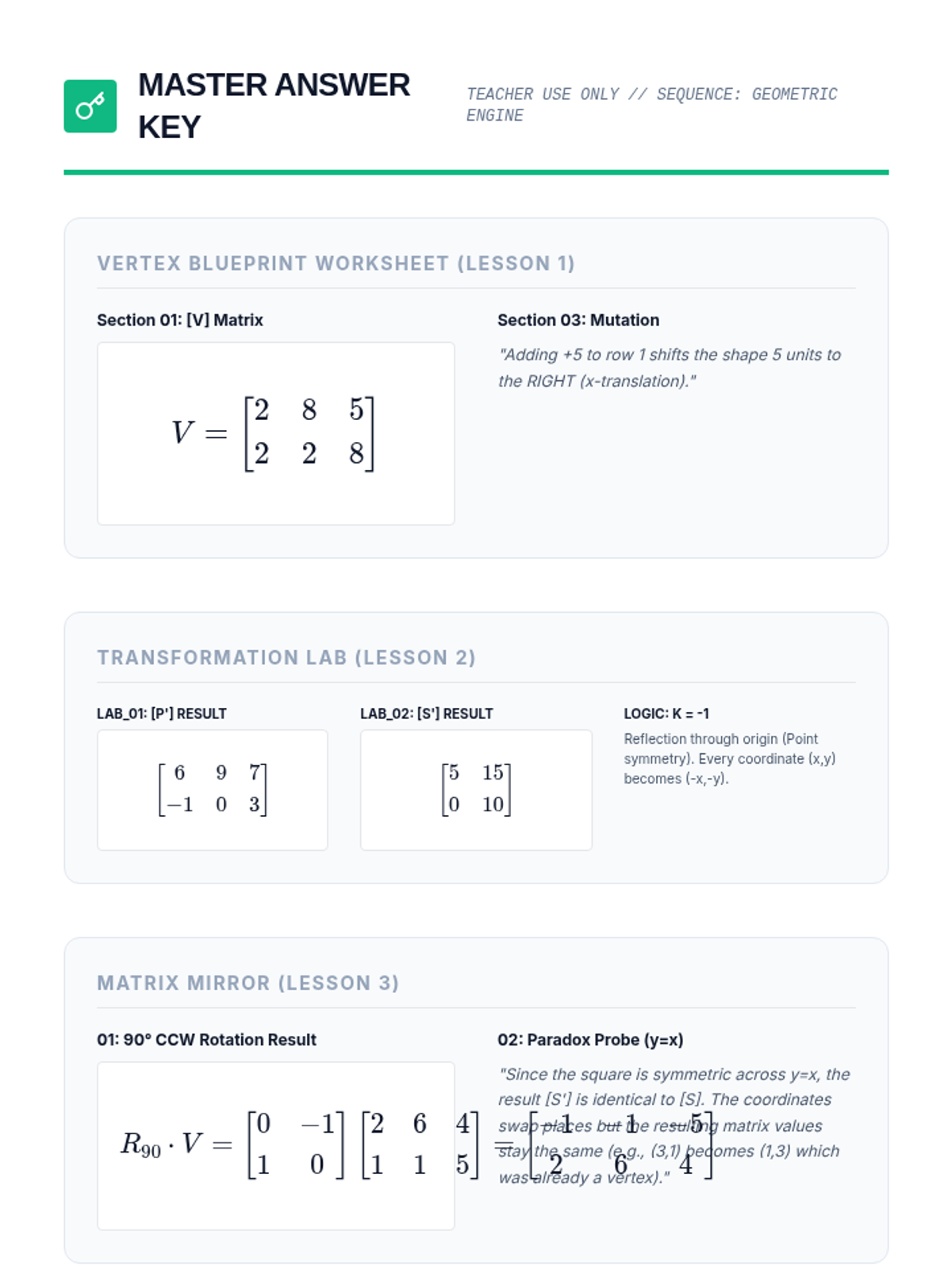
A comprehensive answer key for the "Geometric Engine" sequence, covering all worksheet problems and logic challenges from Lessons 1 through 4.
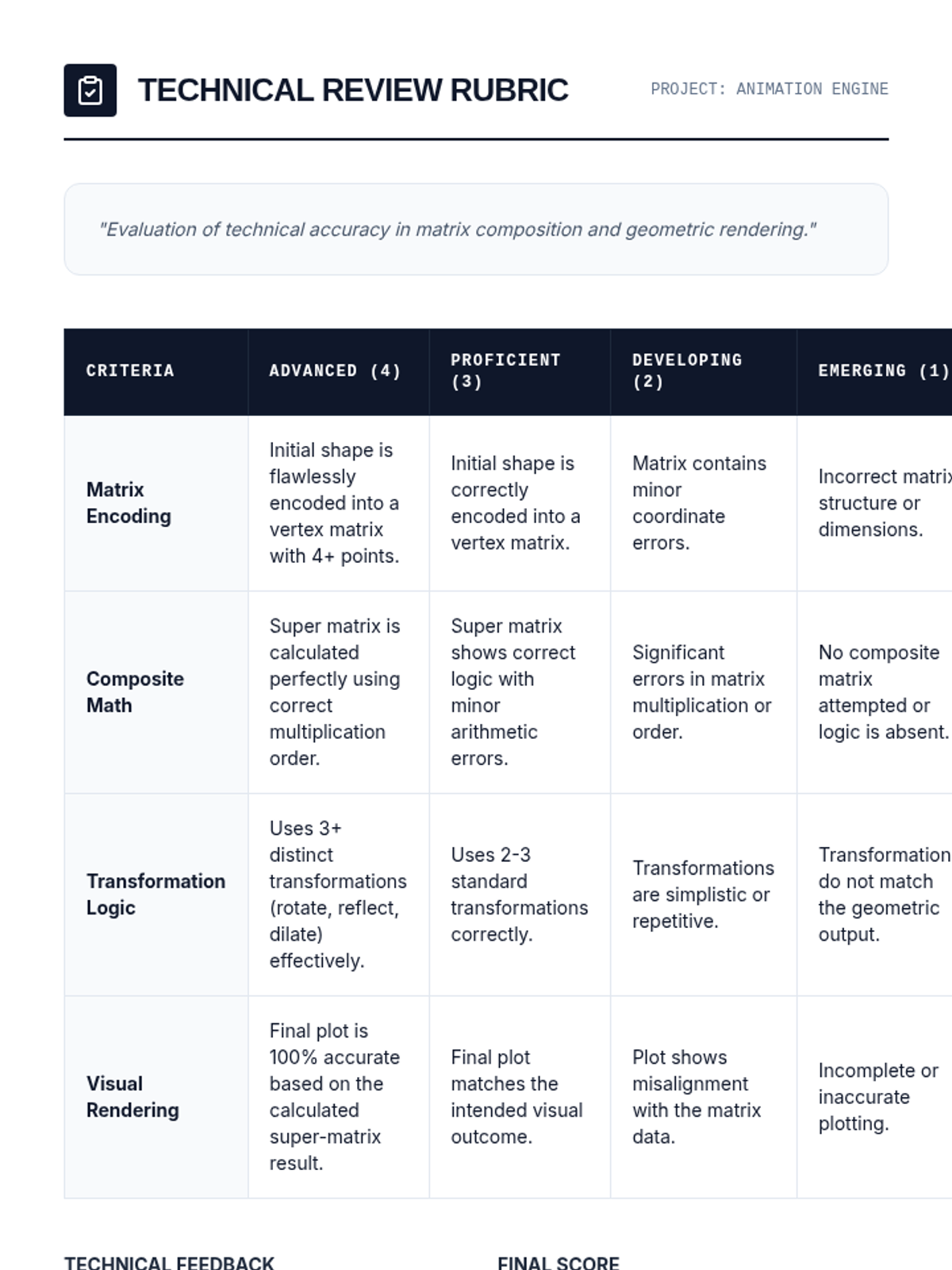
A technical rubric for evaluating the "Animation Engine Project," assessing matrix encoding, composite calculation, transformation logic, and visual rendering.
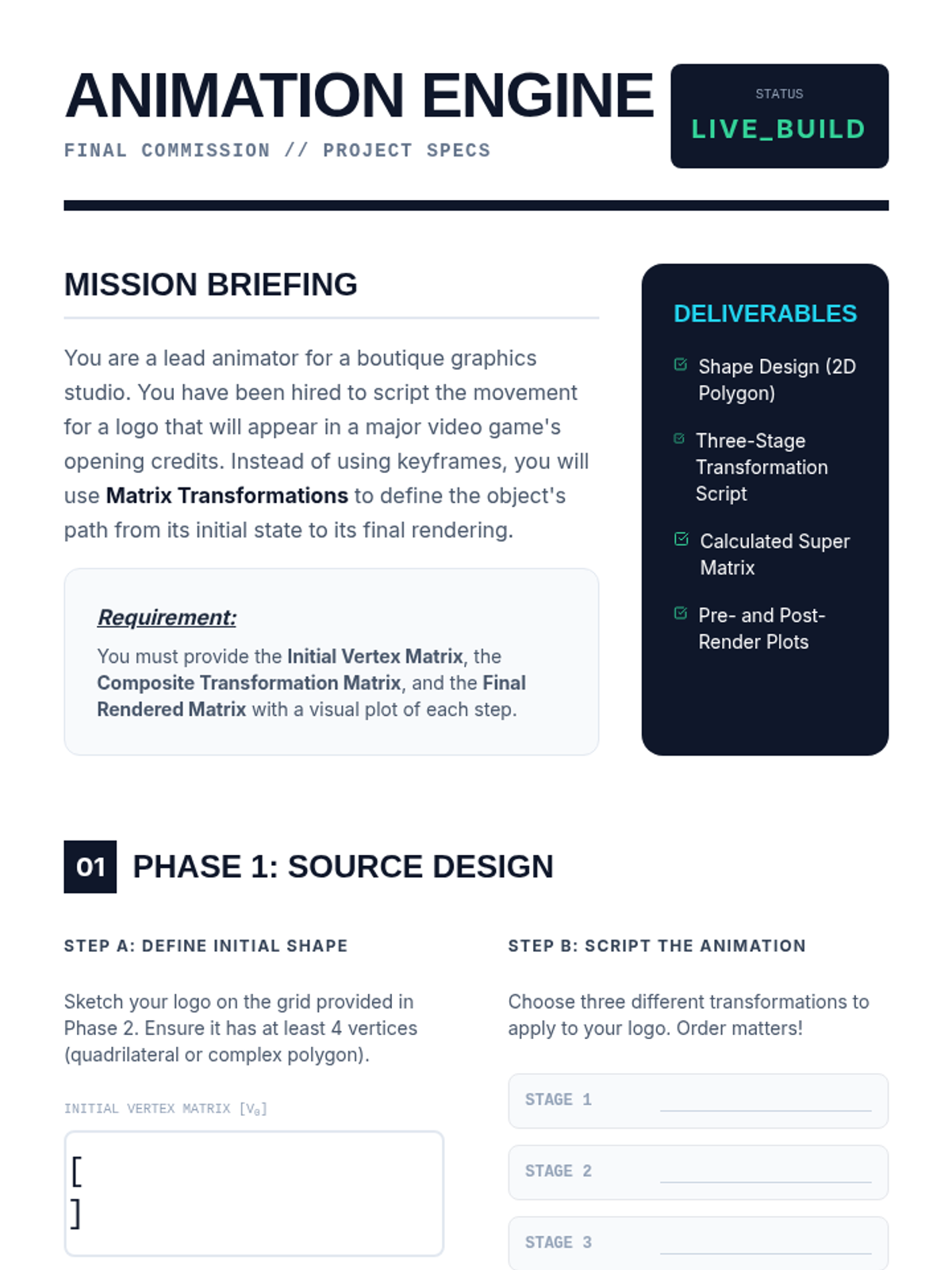
The final project guide for Lesson 5, "Animation Engine Project," where students design and calculate a sequence of matrix transformations for a geometric logo.
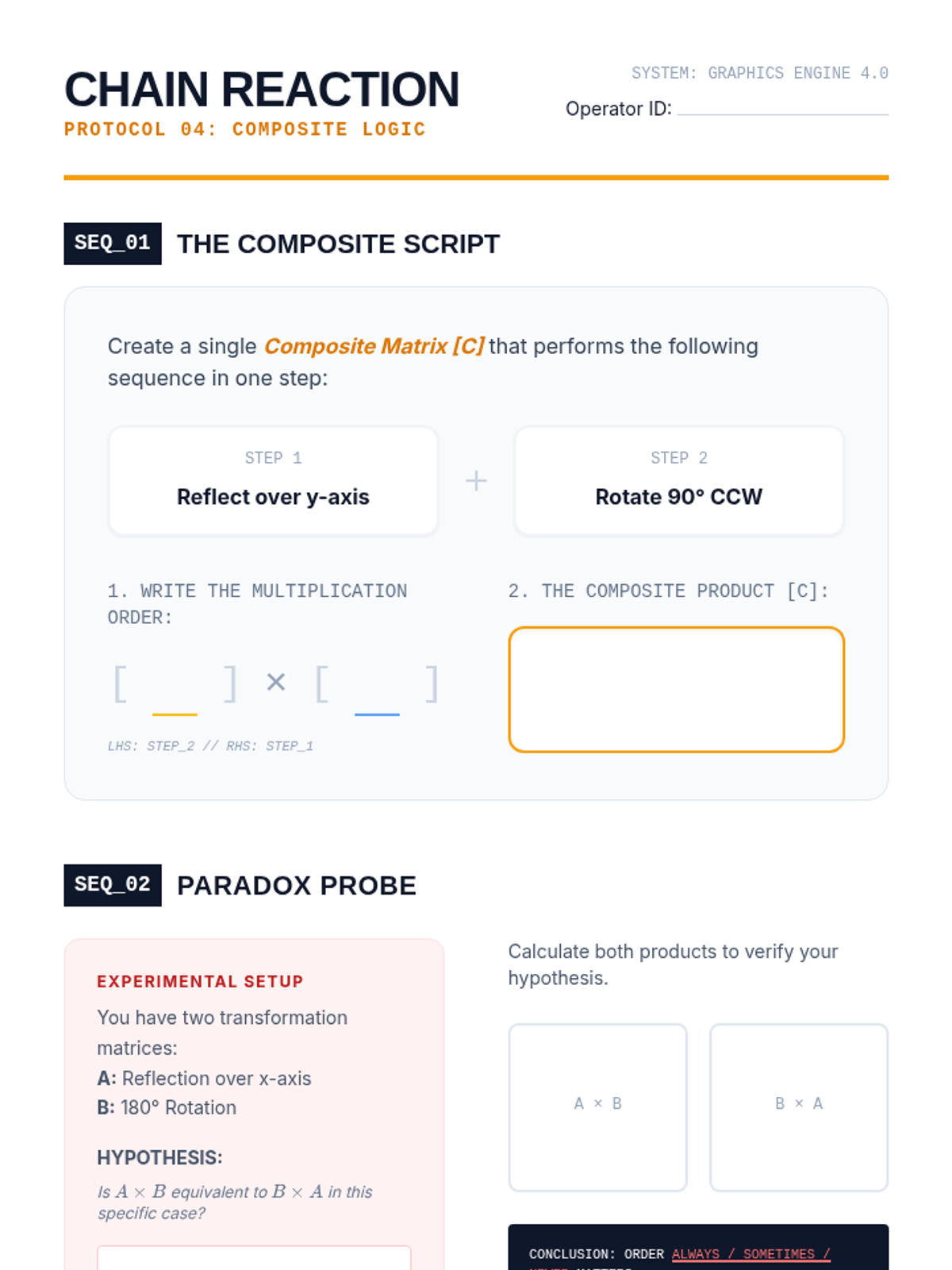
An activity worksheet for Lesson 4, "Chain Reaction," where students practice composing transformation matrices and exploring the importance of order.
A slide deck for Lesson 4, "Super Matrix Slides," explaining how to compose multiple geometric transformations into a single composite matrix through matrix multiplication.
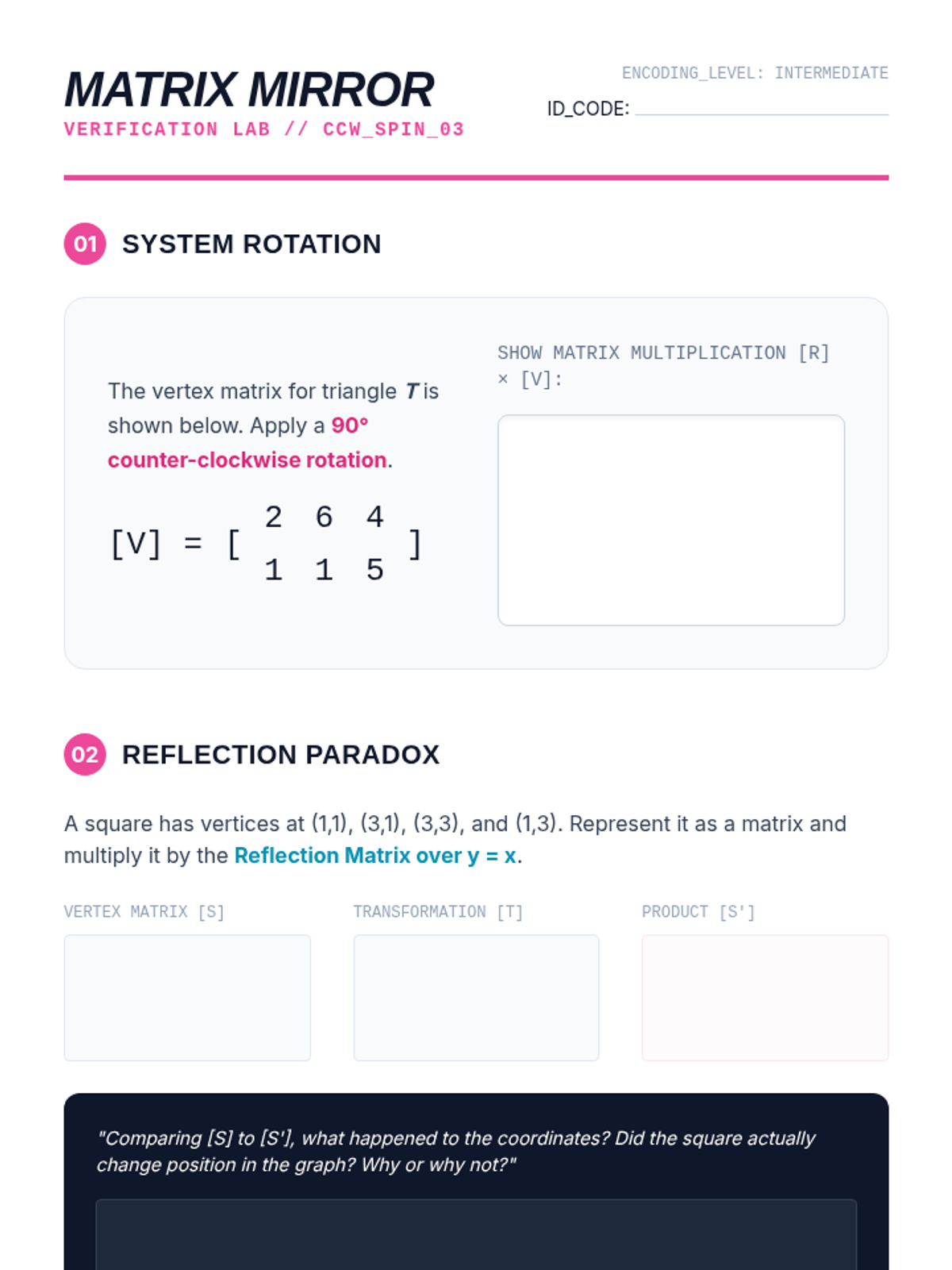
A student worksheet for Lesson 3, "Matrix Mirror," focused on performing matrix multiplication to achieve geometric rotations and reflections.
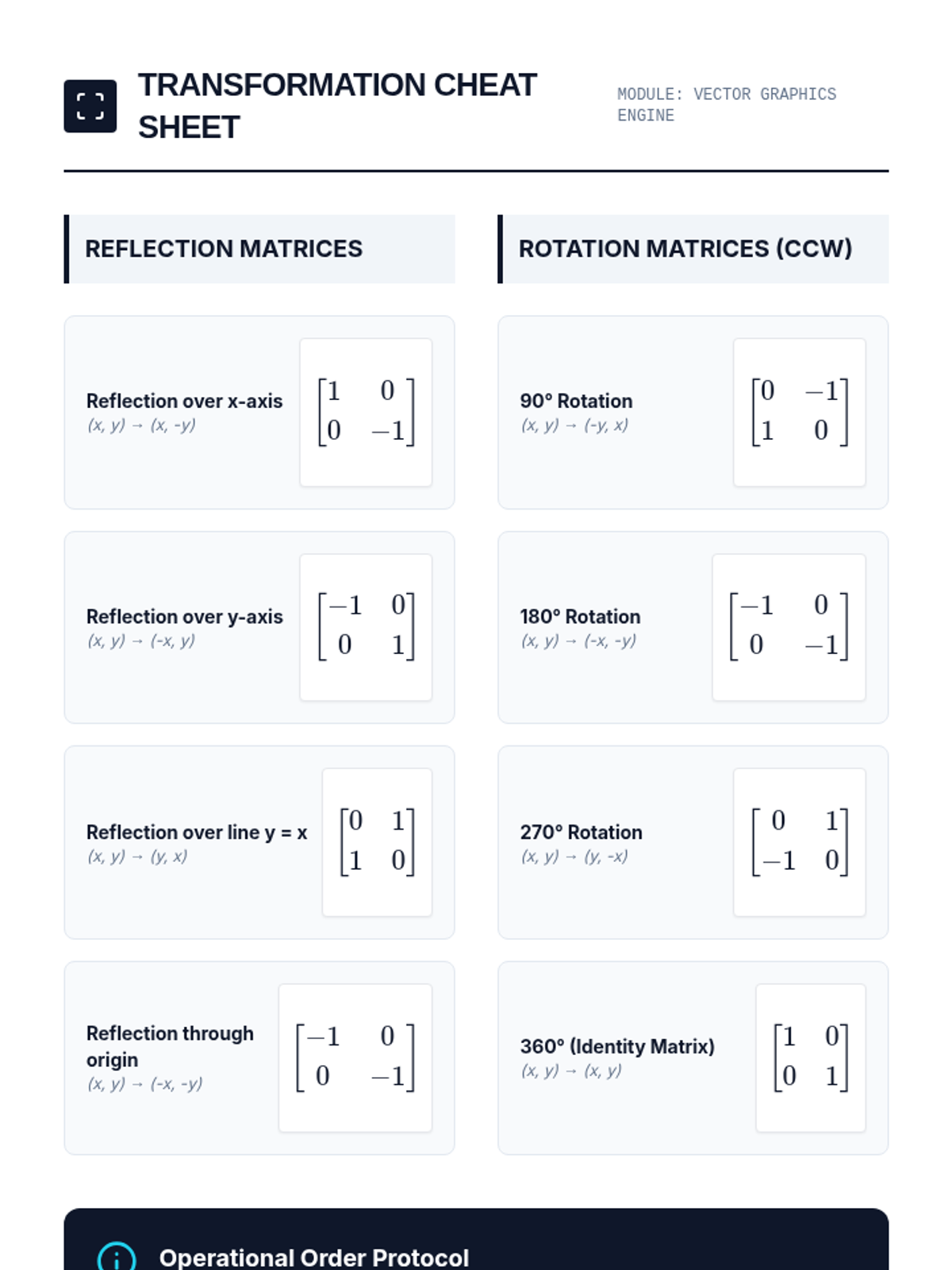
A reference sheet for Lesson 3, providing the standard 2x2 matrices for common geometric reflections and rotations.
A slide deck for Lesson 3, "Flip and Spin Multiplication," introducing rotation and reflection matrices and their application via matrix multiplication.
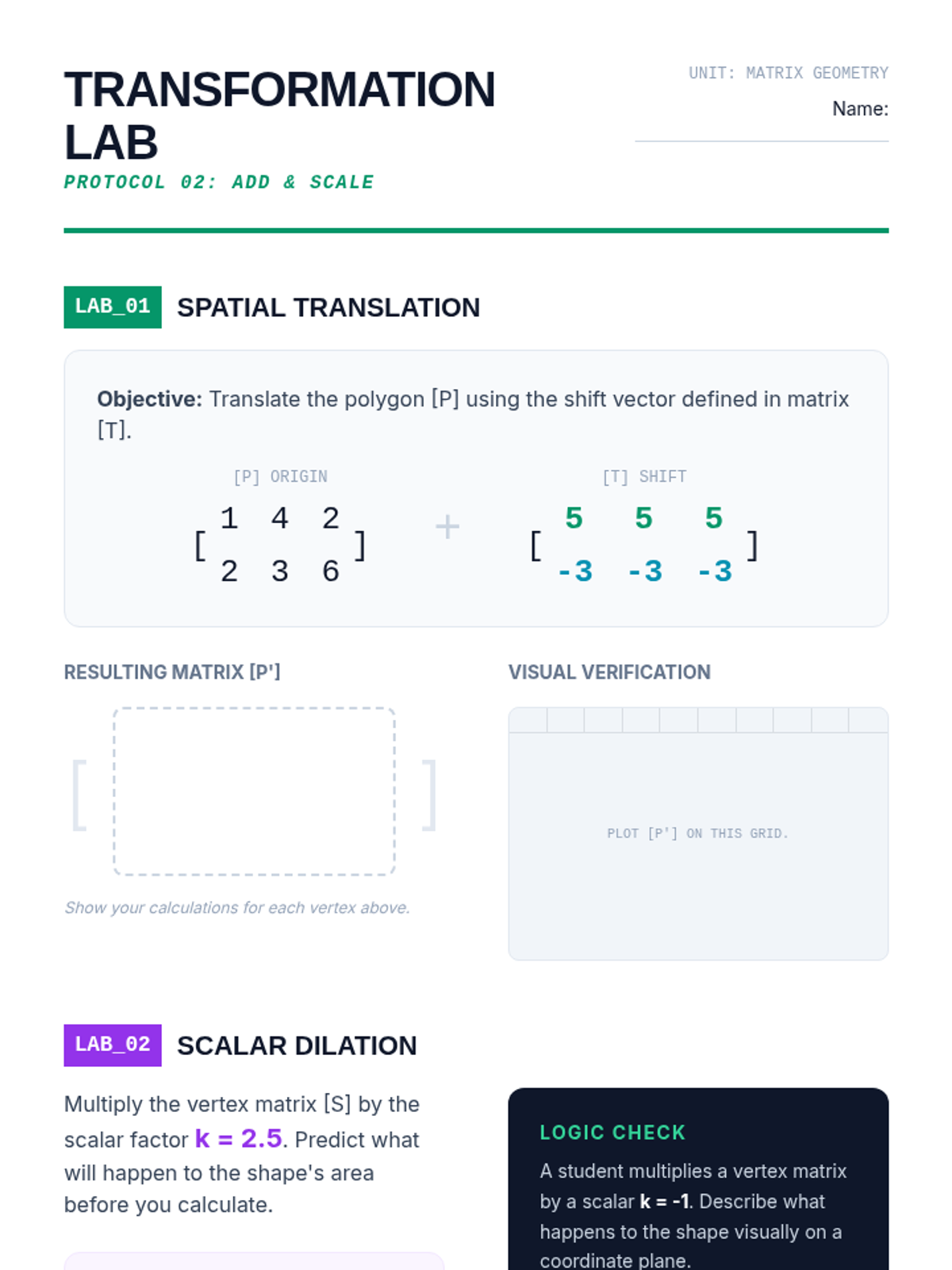
A student worksheet for Lesson 2, "Transformation Lab," covering matrix addition for translation and scalar multiplication for dilation.
A slide deck for Lesson 2, "Slide and Stretch Operations," explaining matrix addition for translation and scalar multiplication for dilation.
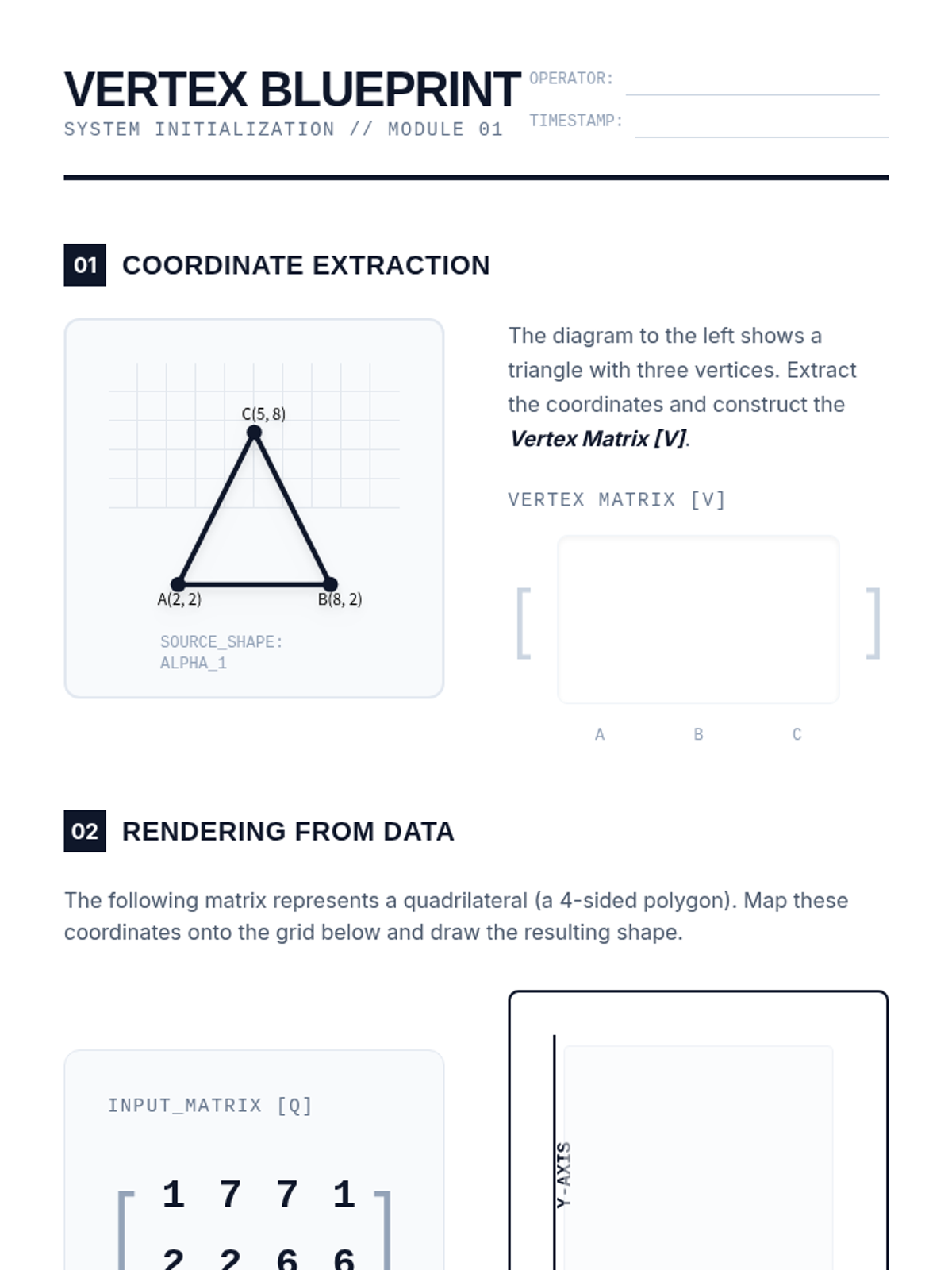
A student worksheet for Lesson 1, "Vertex Vault," focusing on the conversion between polygon vertices on a graph and their matrix representation.
An introductory slide deck for Lesson 1, "Vertex Vault", explaining how to represent 2D polygons as matrices where columns are vertices and rows are dimensions.
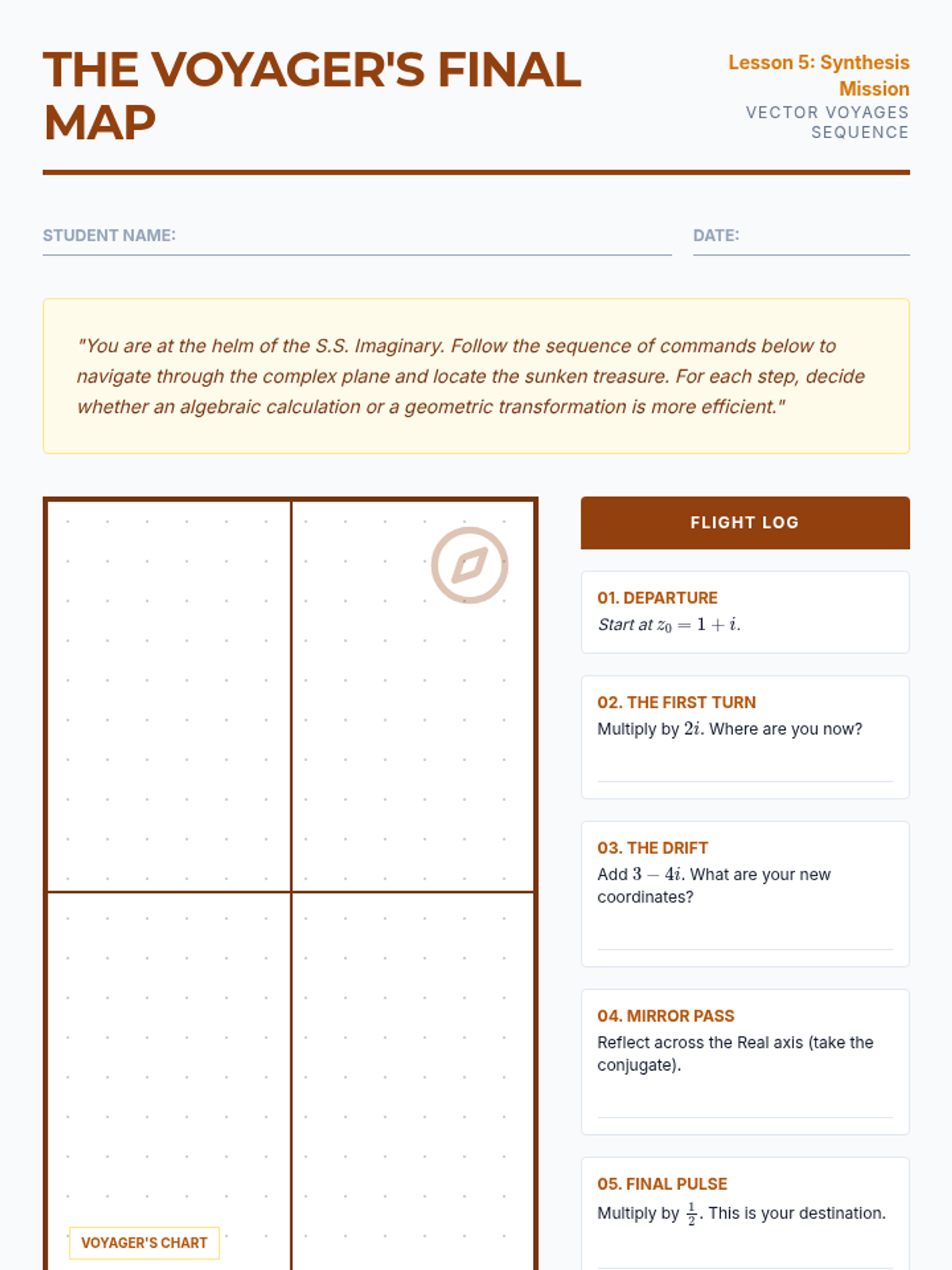
The capstone activity for the sequence where students solve a multi-step navigation puzzle using translation, rotation, dilation, and reflection in the complex plane.
A visual presentation for Lesson 5, setting up the "Complex Treasure Hunt" activity and reinforcing the strategic choice between algebraic and geometric methods.
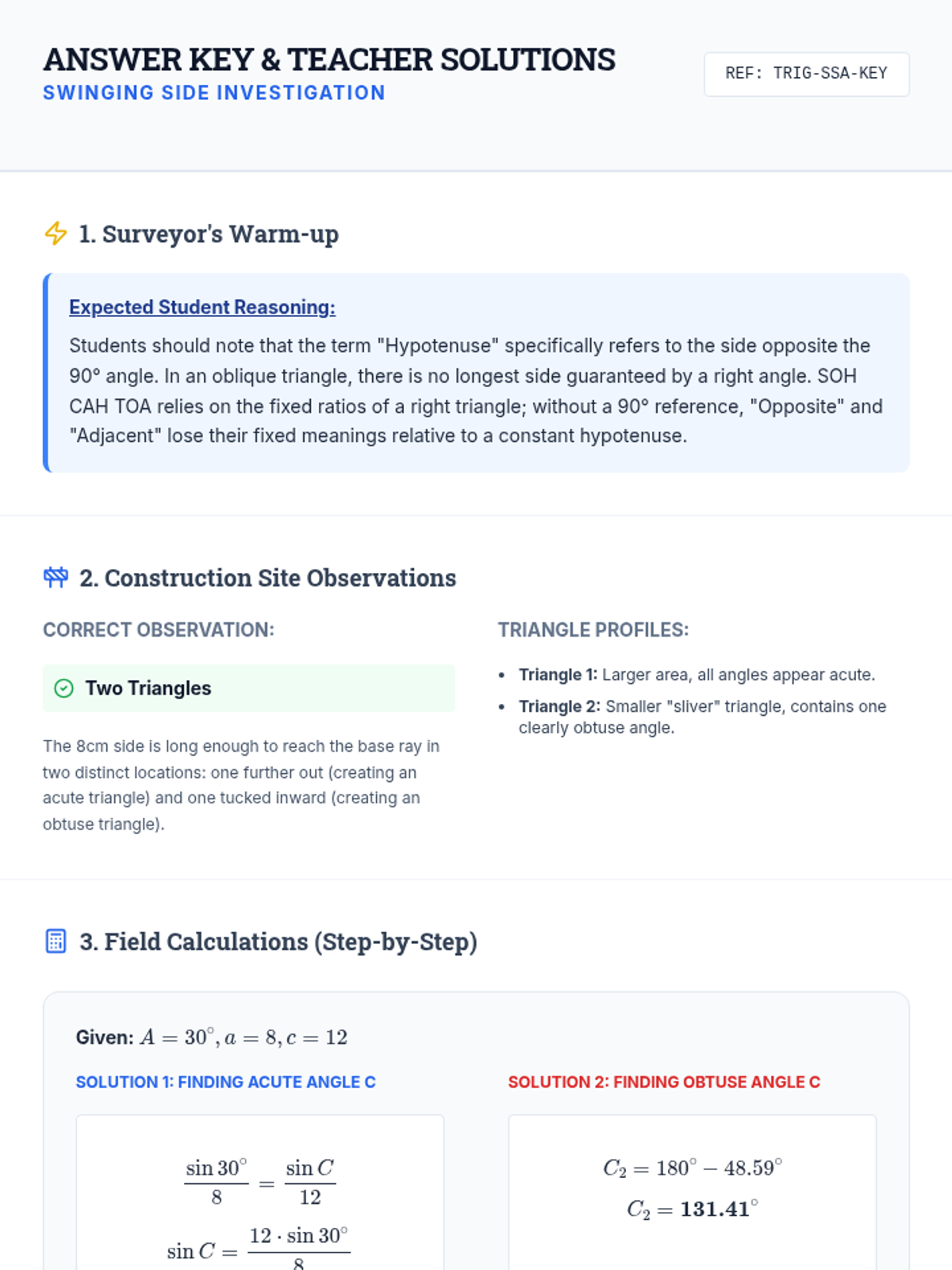
An answer key and teacher solution guide for the Swinging Side Investigation, providing step-by-step Law of Sines calculations and expected student responses.
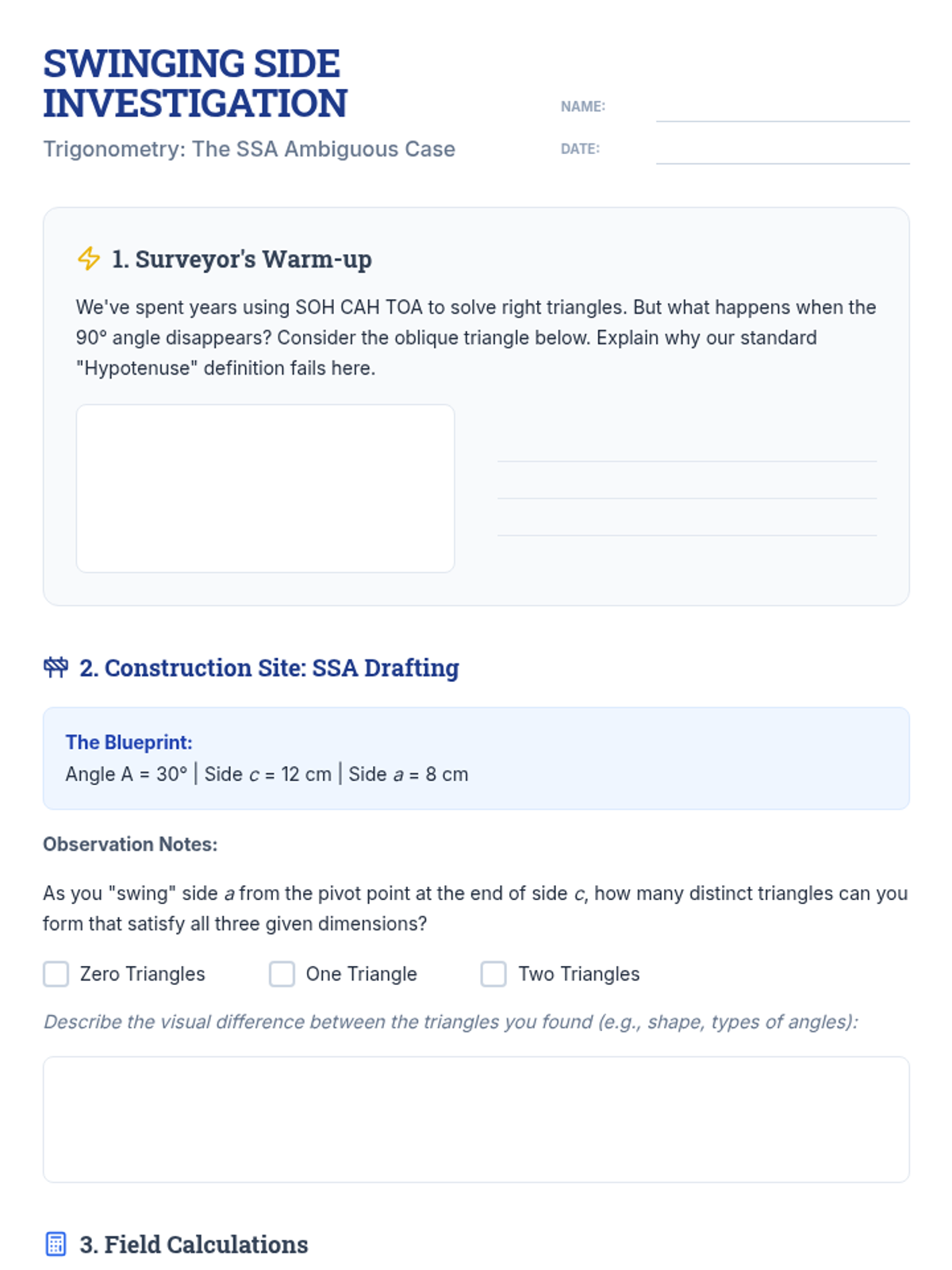
A student investigation worksheet for the physical SSA construction activity, including sections for warm-up, observations, Law of Sines calculations, and a final reflection.
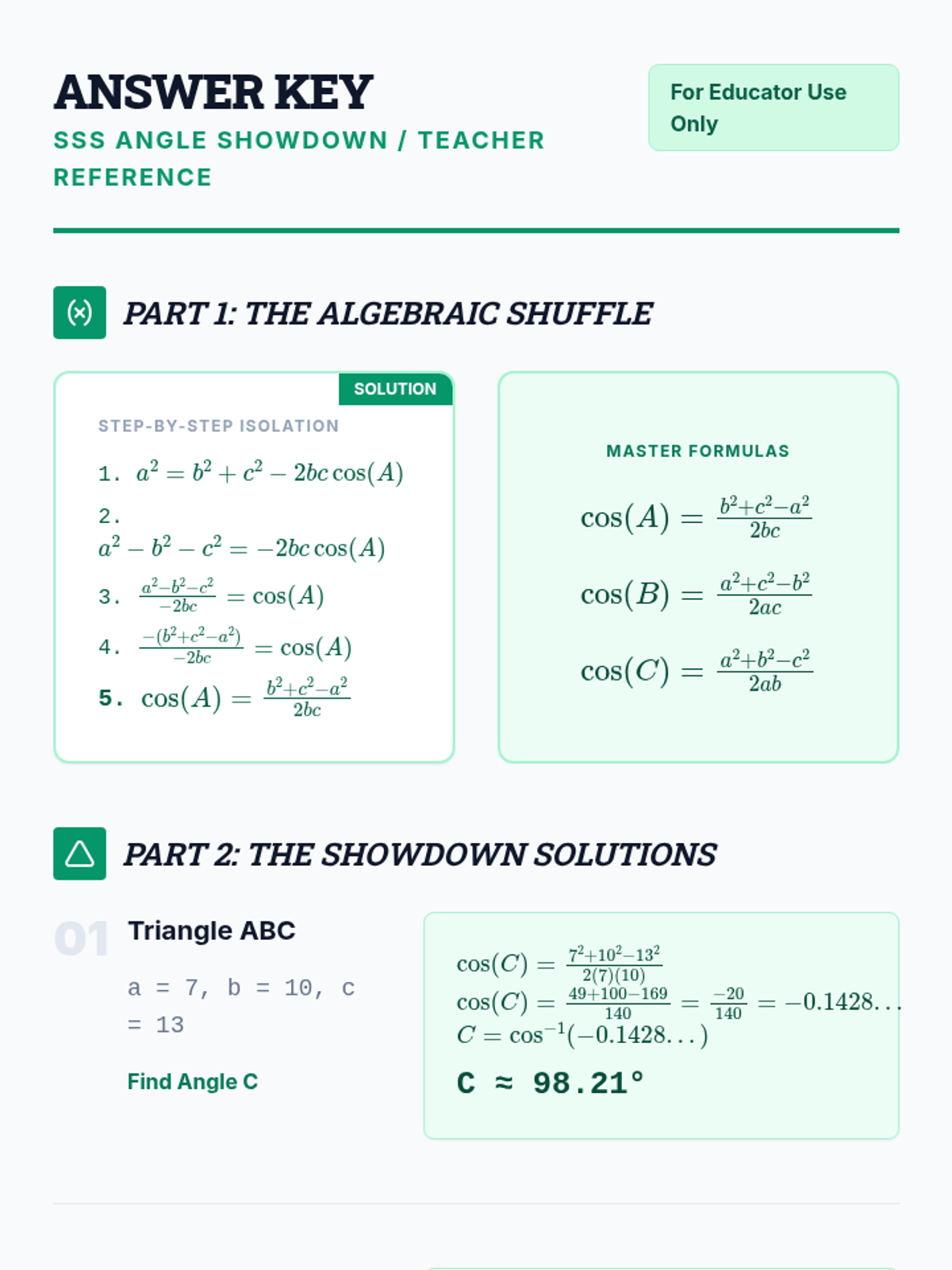
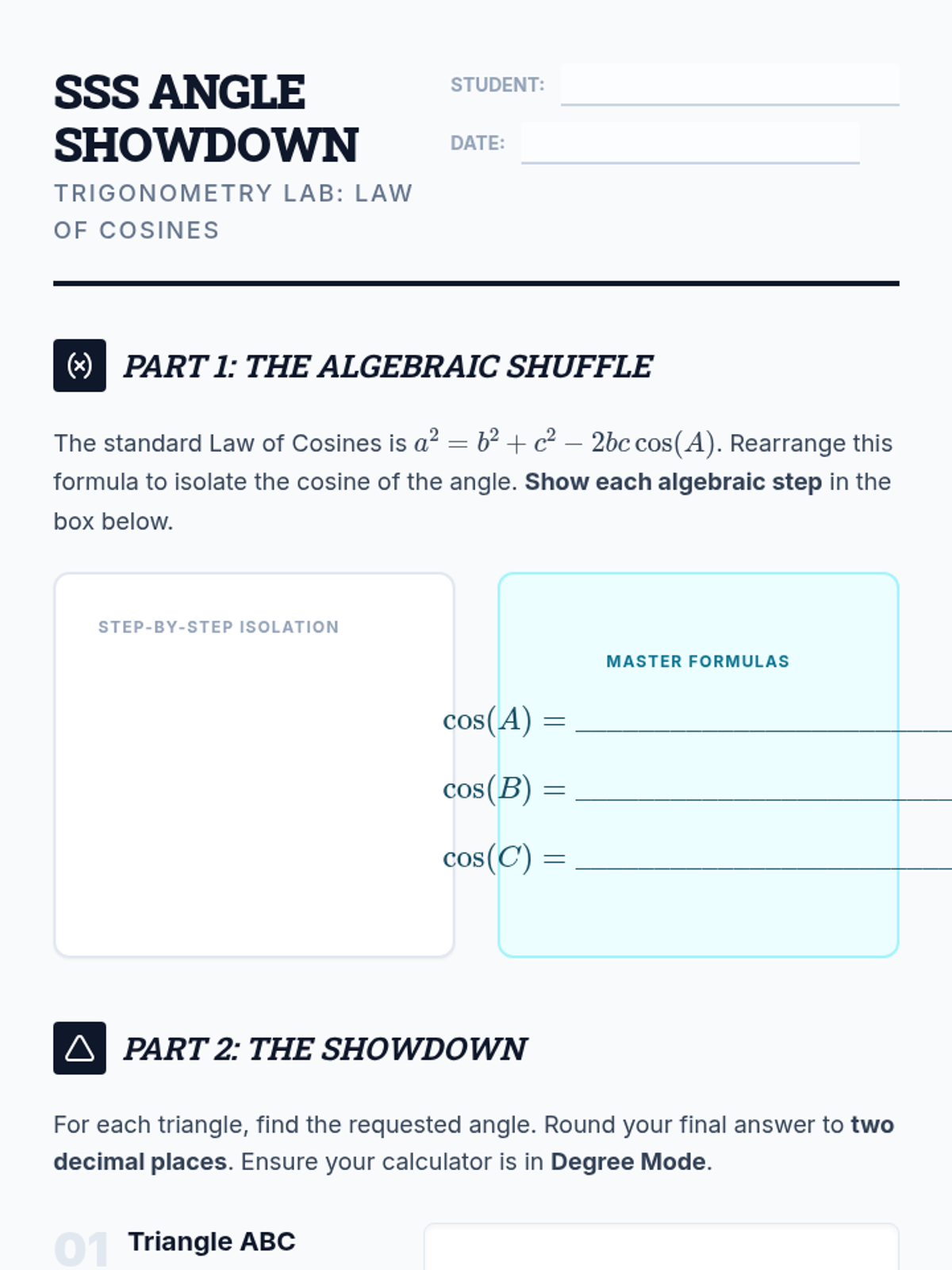
A complete answer key for the SSS Angle Showdown worksheet, including step-by-step algebraic rearrangement and full solutions for all problems.
A visual presentation for teaching the Law of Sines and the SSA Ambiguous Case, featuring embedded video prompts, technical diagrams, and investigation instructions.
A worksheet for students to practice rearranging the Law of Cosines formula and applying it to solve three SSS triangle problems, including a final logic check.
A presentation slide deck for teaching the Law of Cosines for SSS triangles, featuring an embedded video, algebraic rearrangement guides, and a final logic check slide.
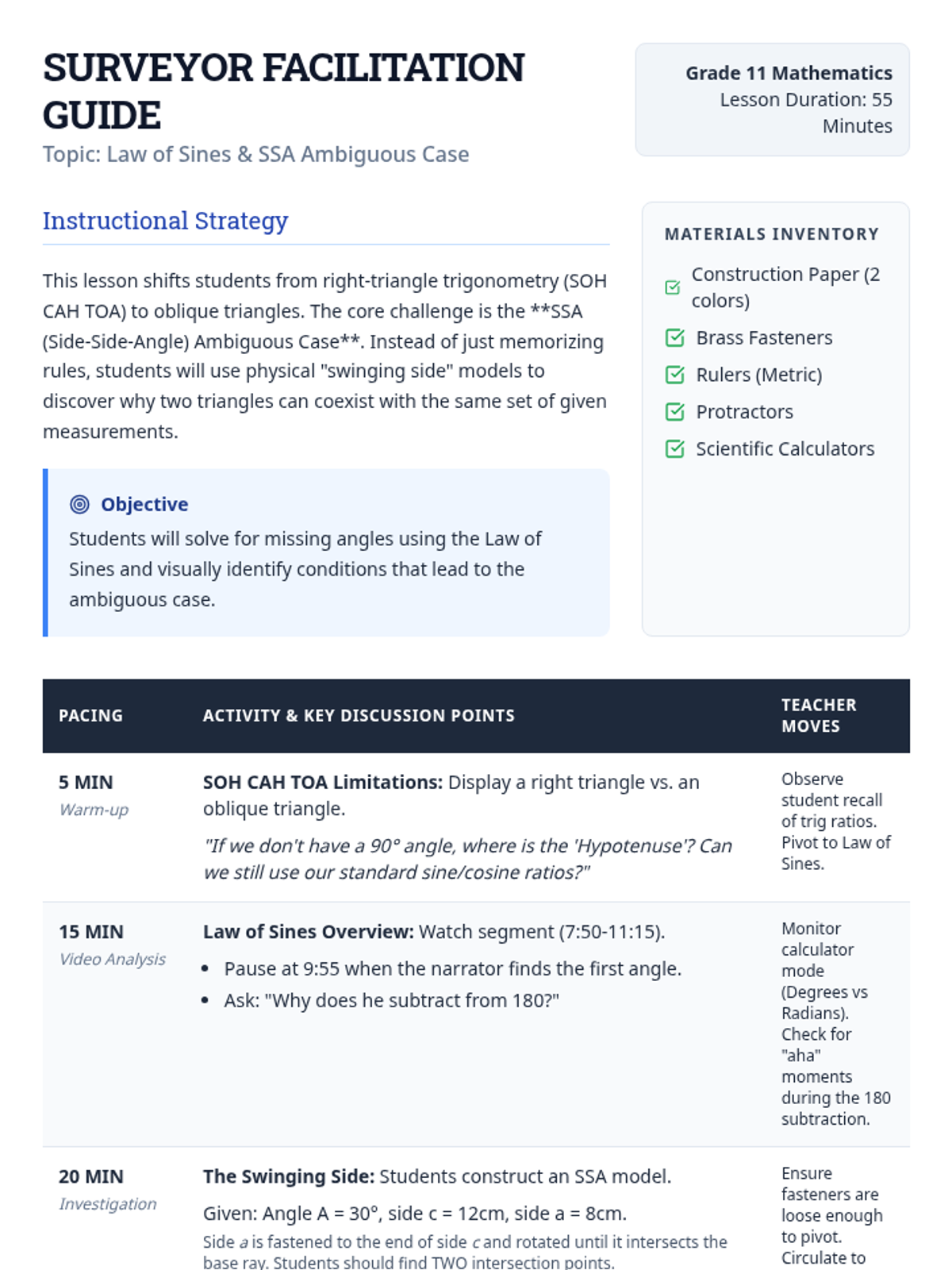
A comprehensive facilitation guide for teachers, outlining the lesson pacing, key discussion questions, materials needed, and common student misconceptions regarding the Law of Sines and the Ambiguous Case.
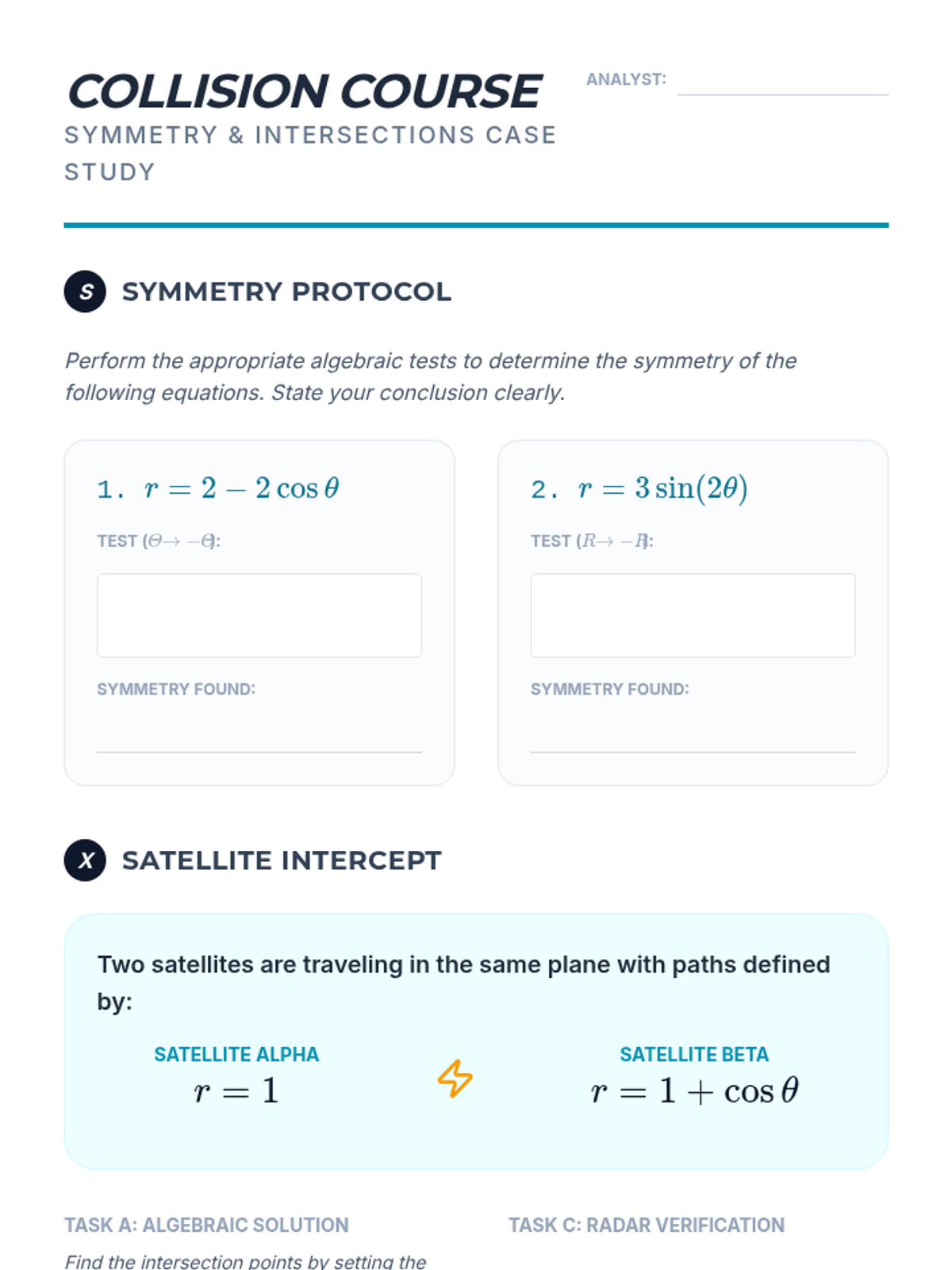
A case study worksheet for finding intersection points and testing for symmetry in polar equations, using a satellite orbit scenario.
A visual presentation focusing on advanced graphing analysis involving symmetry tests and finding intersection points in the polar plane.
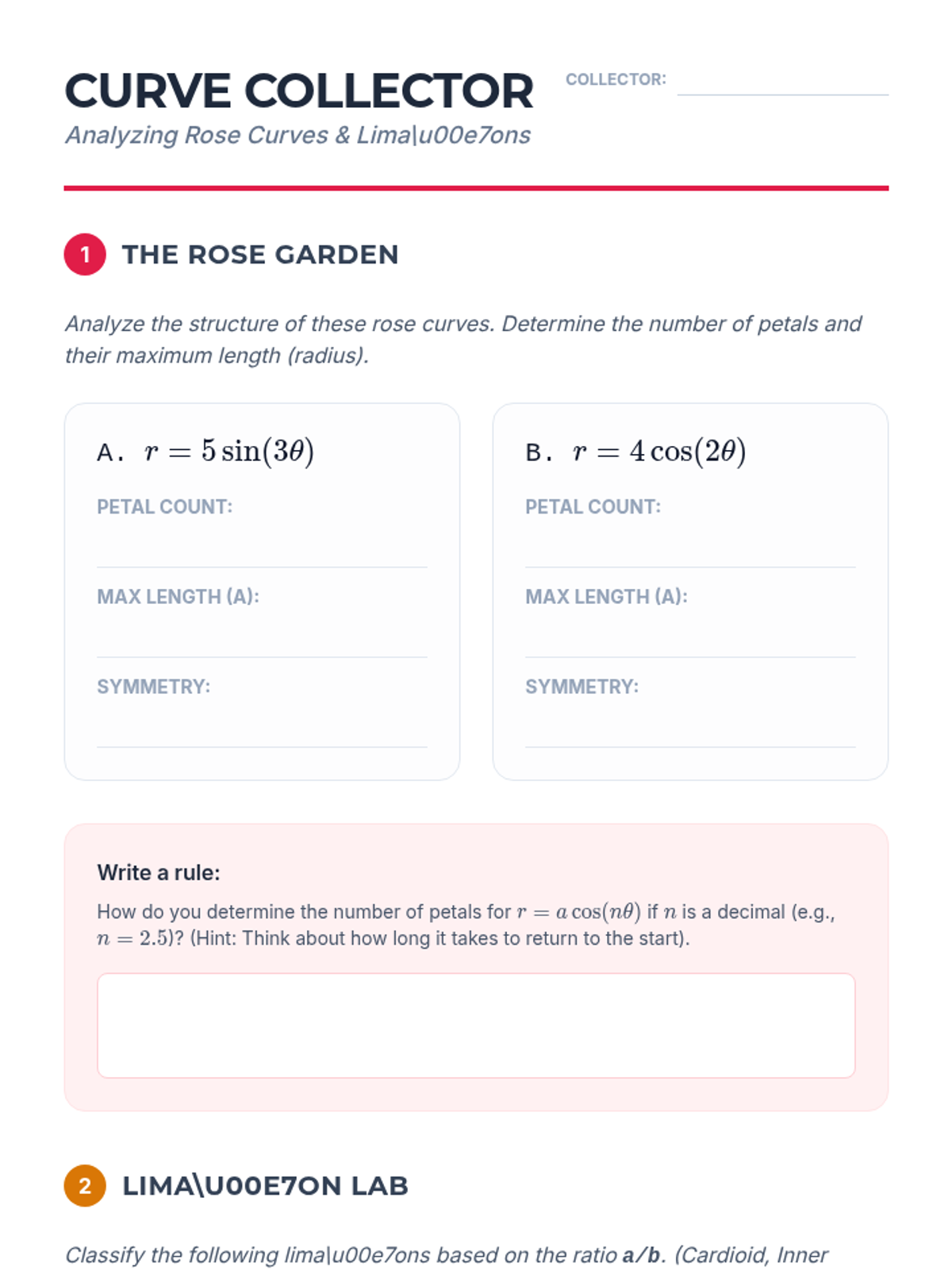
An exploration worksheet focusing on classifying rose curves and lima\u00e7ons based on their coefficients and ratios.
A visual presentation systematically exploring classical polar curves like roses and lima\u00e7ons, focusing on the effect of coefficients and ratios on their shapes.
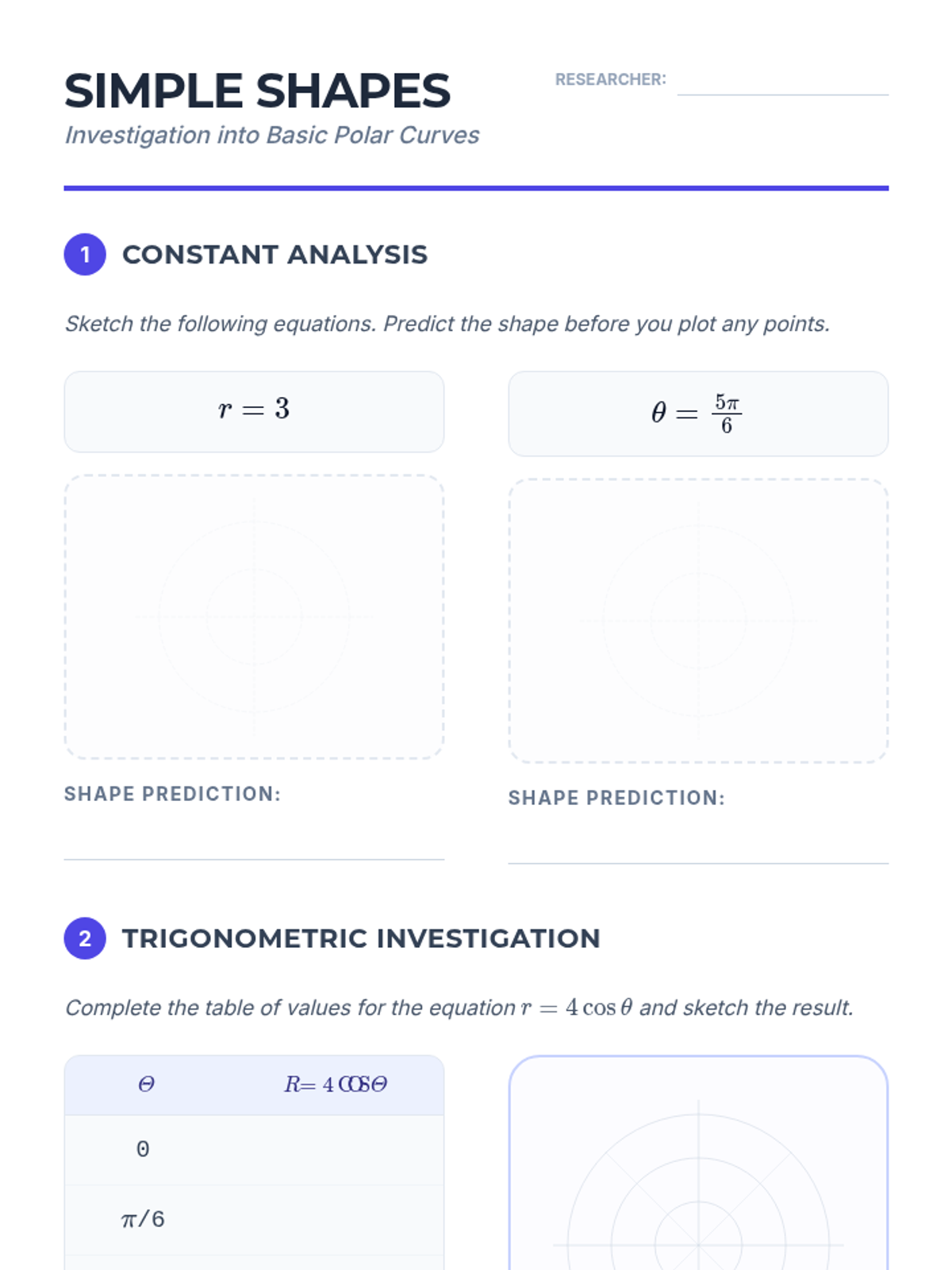
An inquiry-based worksheet for exploring basic polar curves like circles and lines through prediction, table completion, and sketching.
A visual presentation introducing the graphs of basic polar curves like circles and lines, with a focus on predicting and verifying shapes.
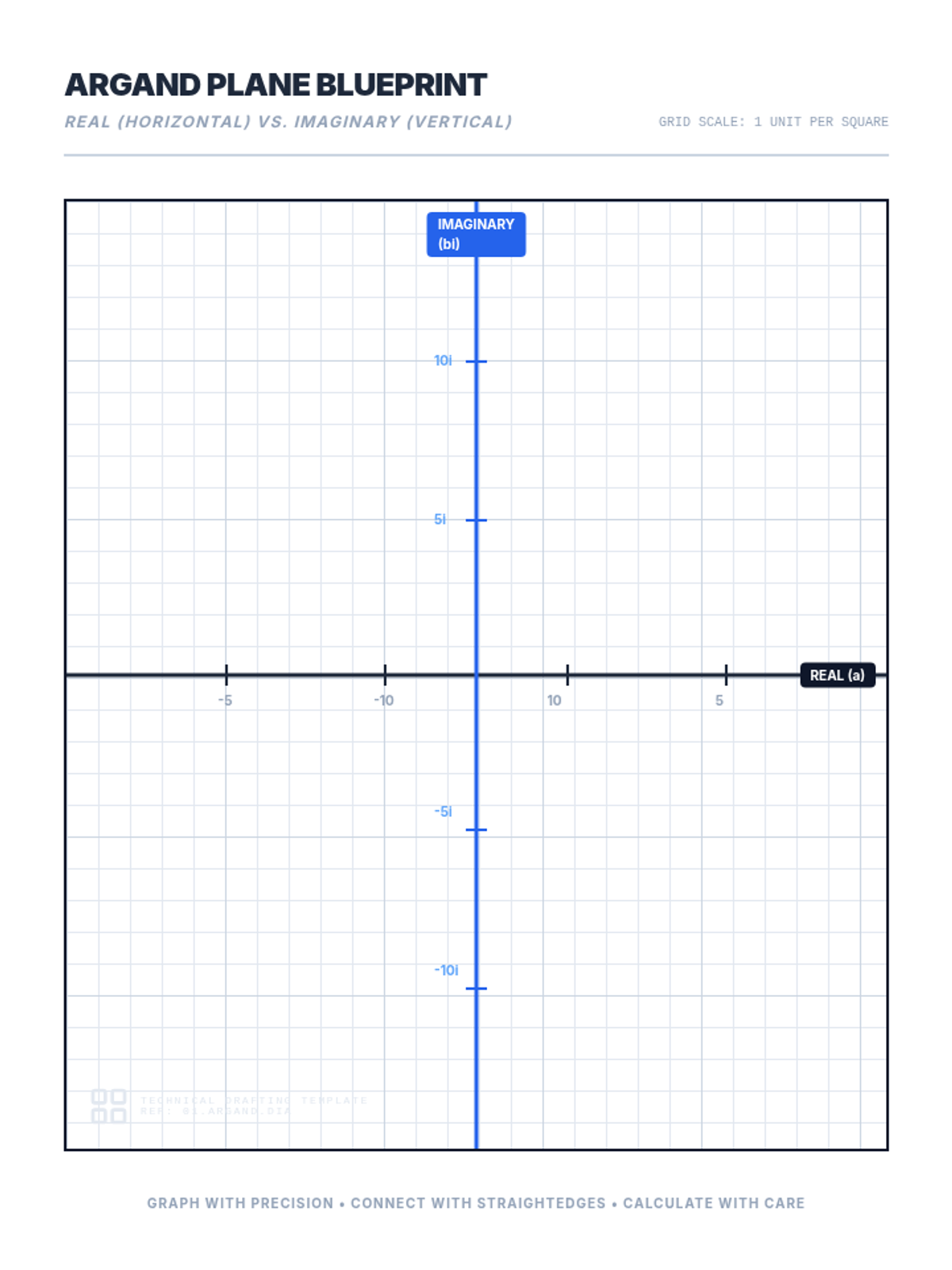
Customized graph paper for the 'Complex Blueprints' lesson, featuring labeled Real and Imaginary axes on an Argand plane template for students to plot complex numbers.