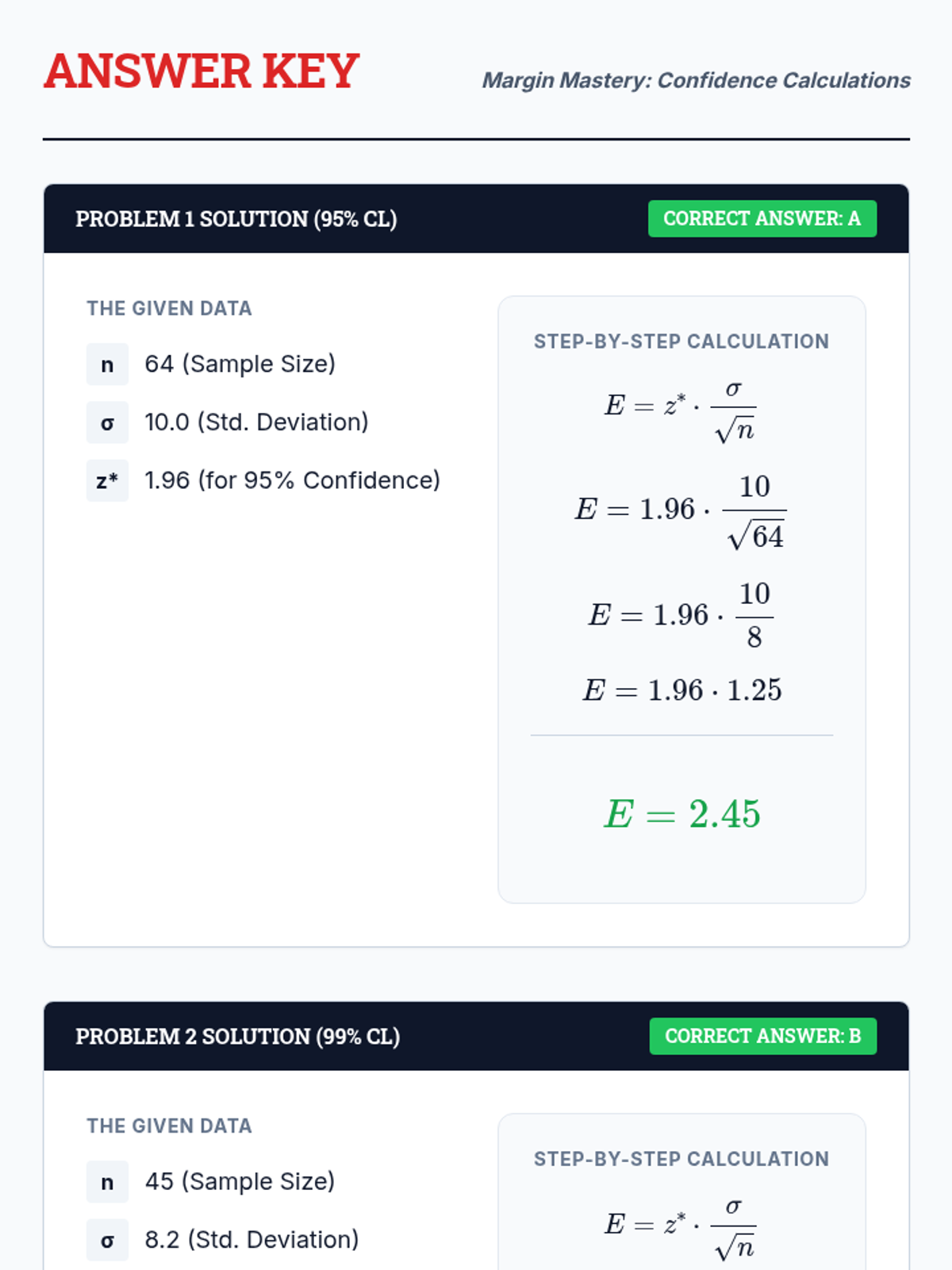
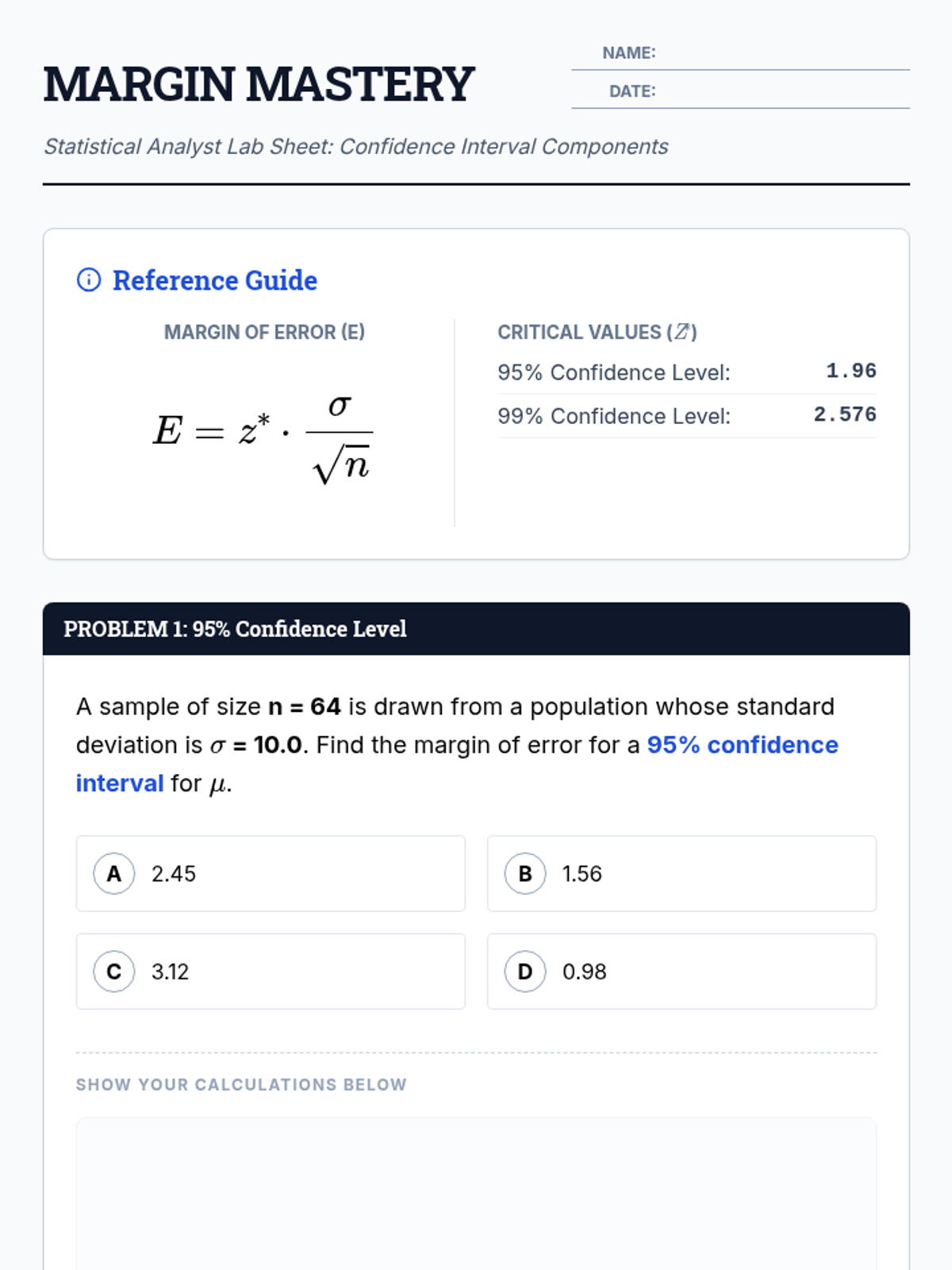
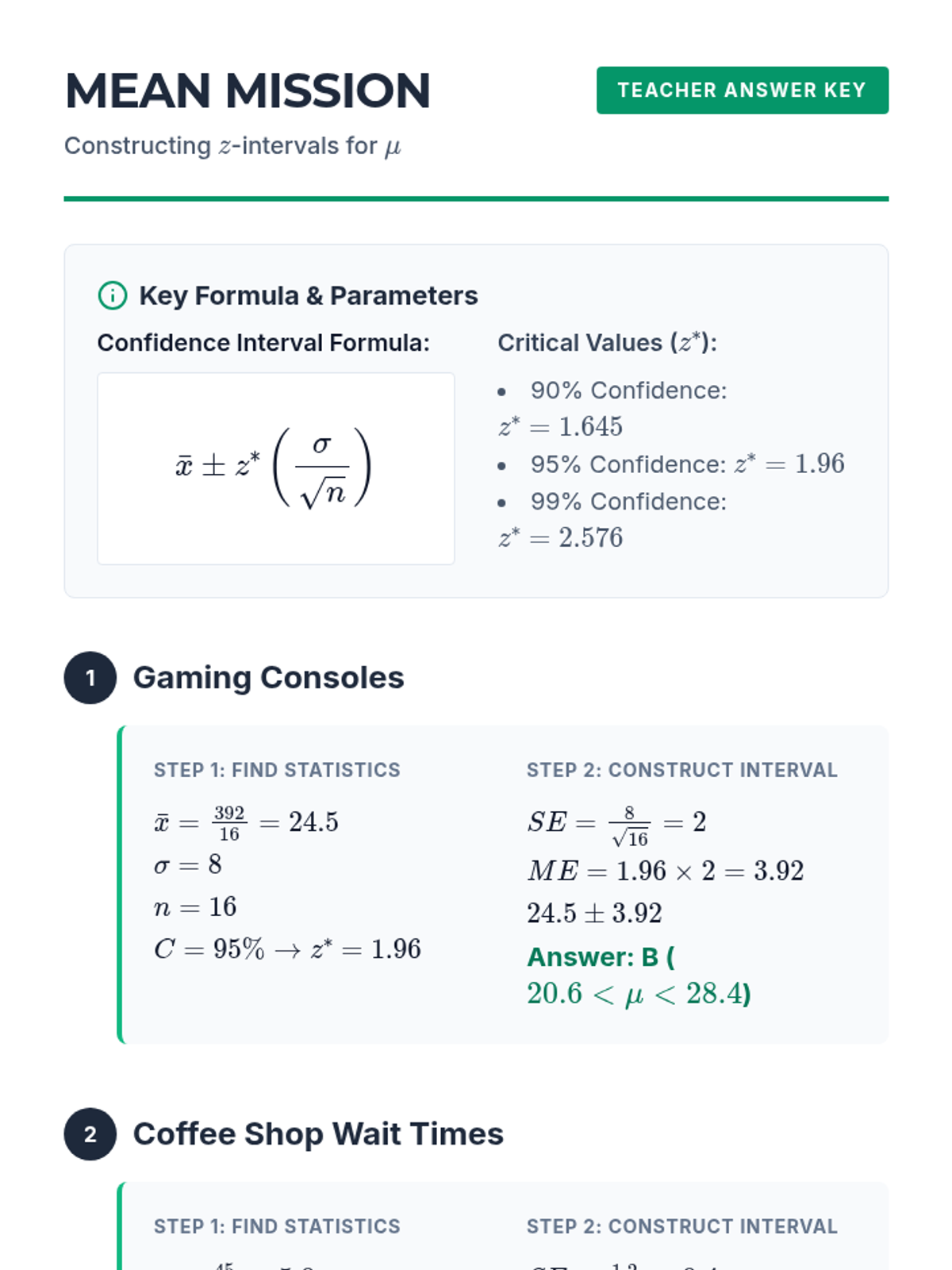
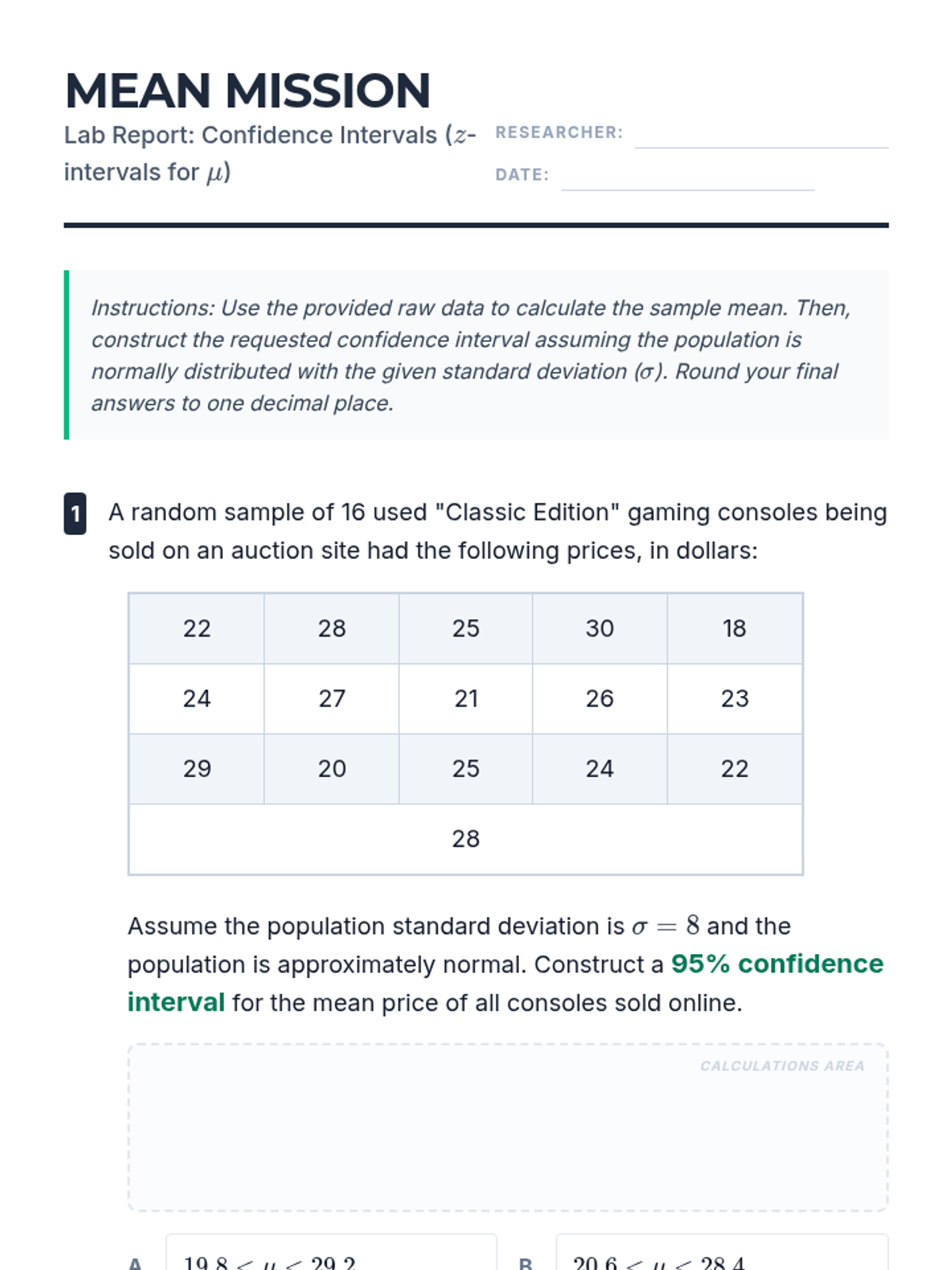
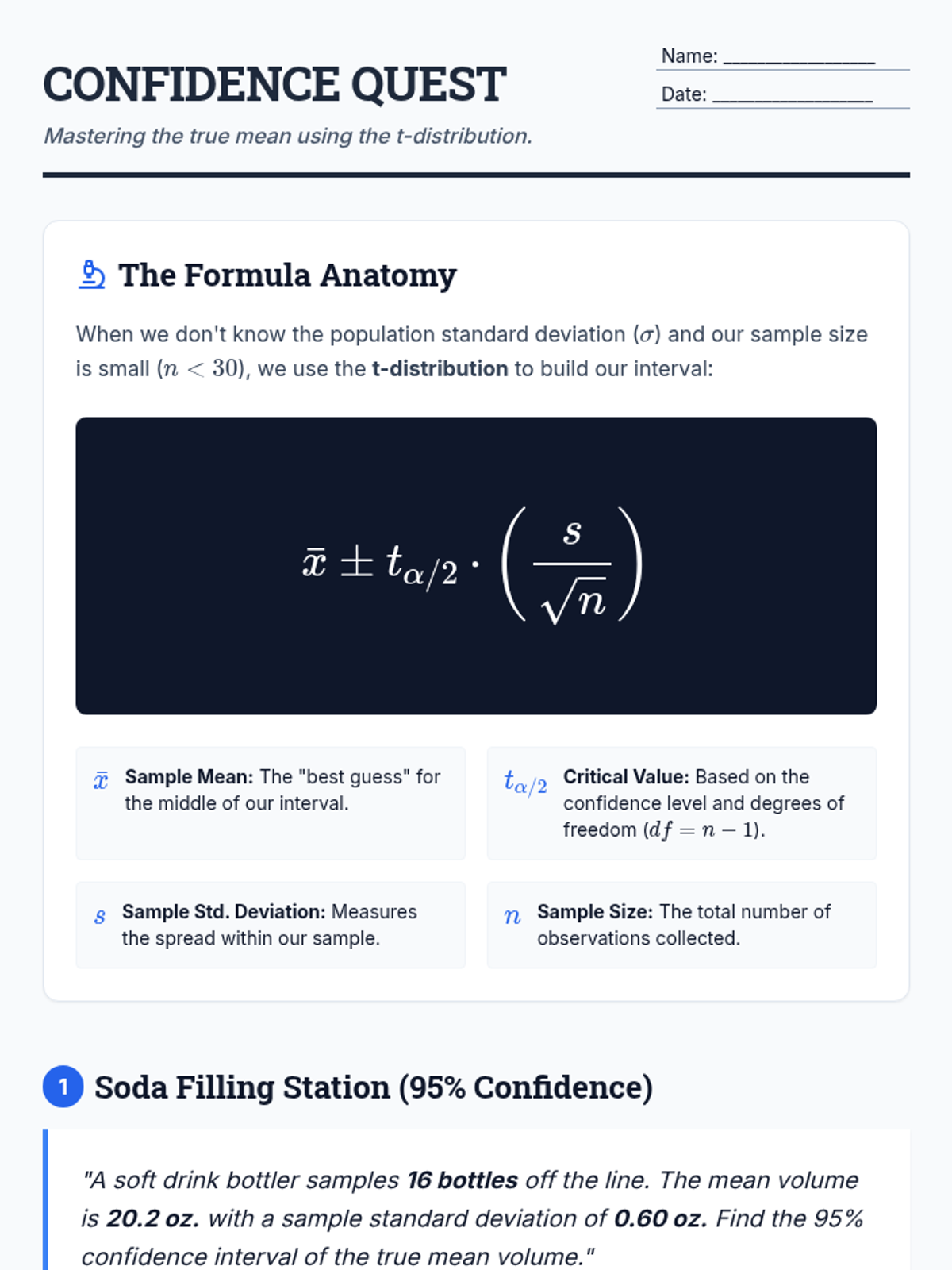
Data representation, distributions, and statistical variability using sampling and inference techniques. Integrates probability models, compound events, bivariate patterns, and linear models to guide data-driven decision making.
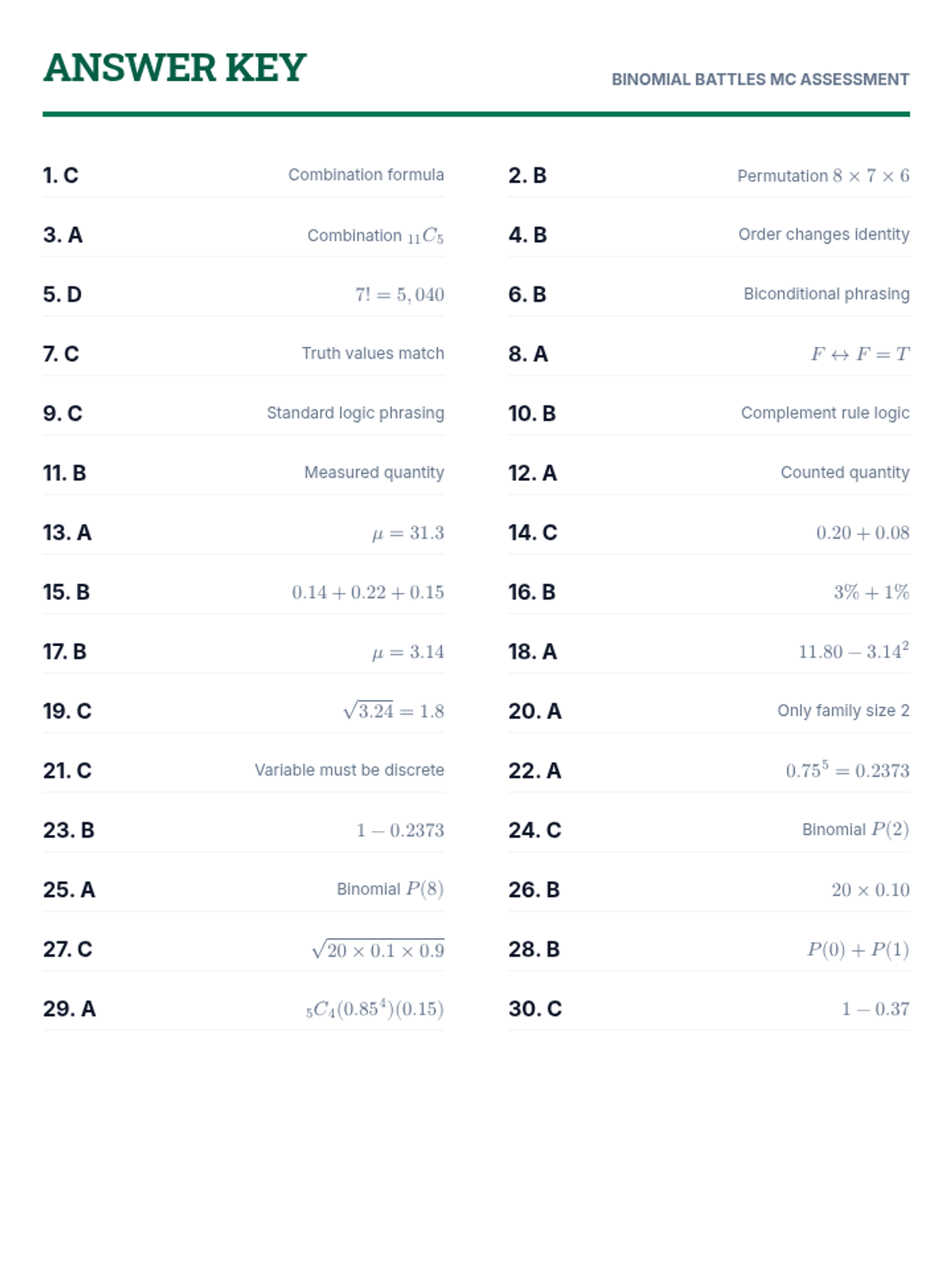
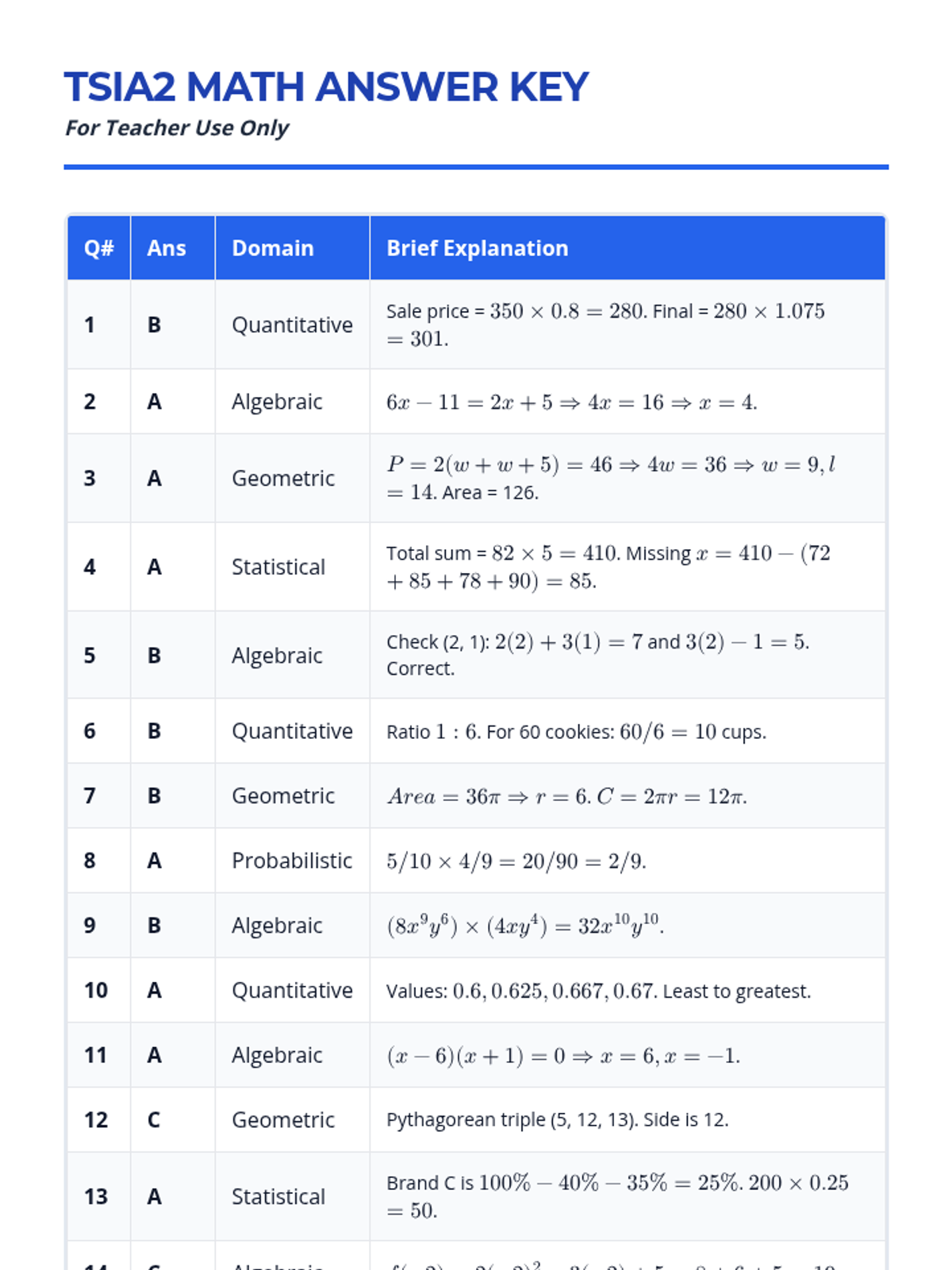
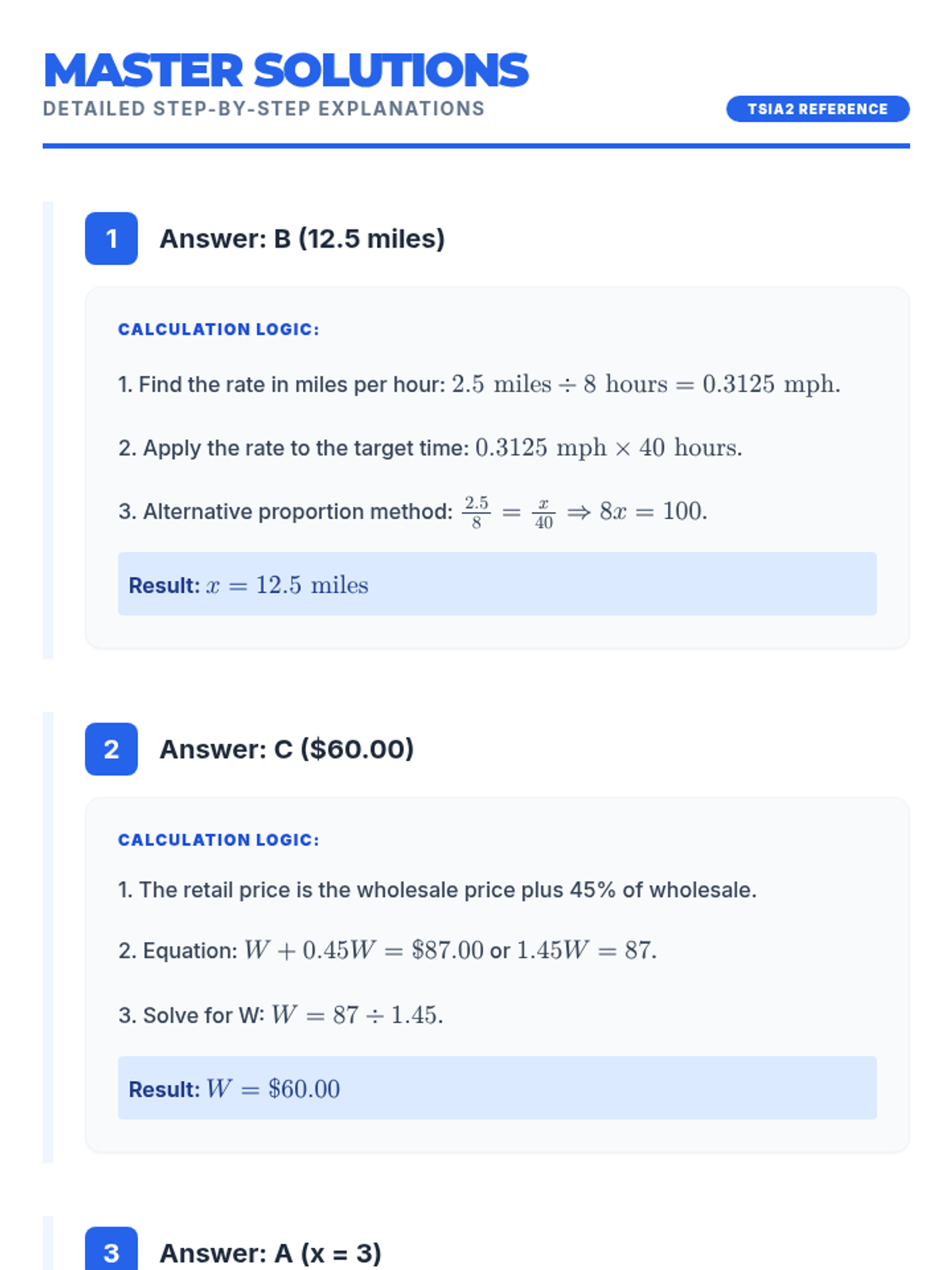
A detailed answer key for the TSIA2 Math Practice Test, including a quick-reference grading table, step-by-step solutions for all 20 questions, and a diagnostic scoring guide. (Updated to reflect changes in questions 3, 10, and 19).
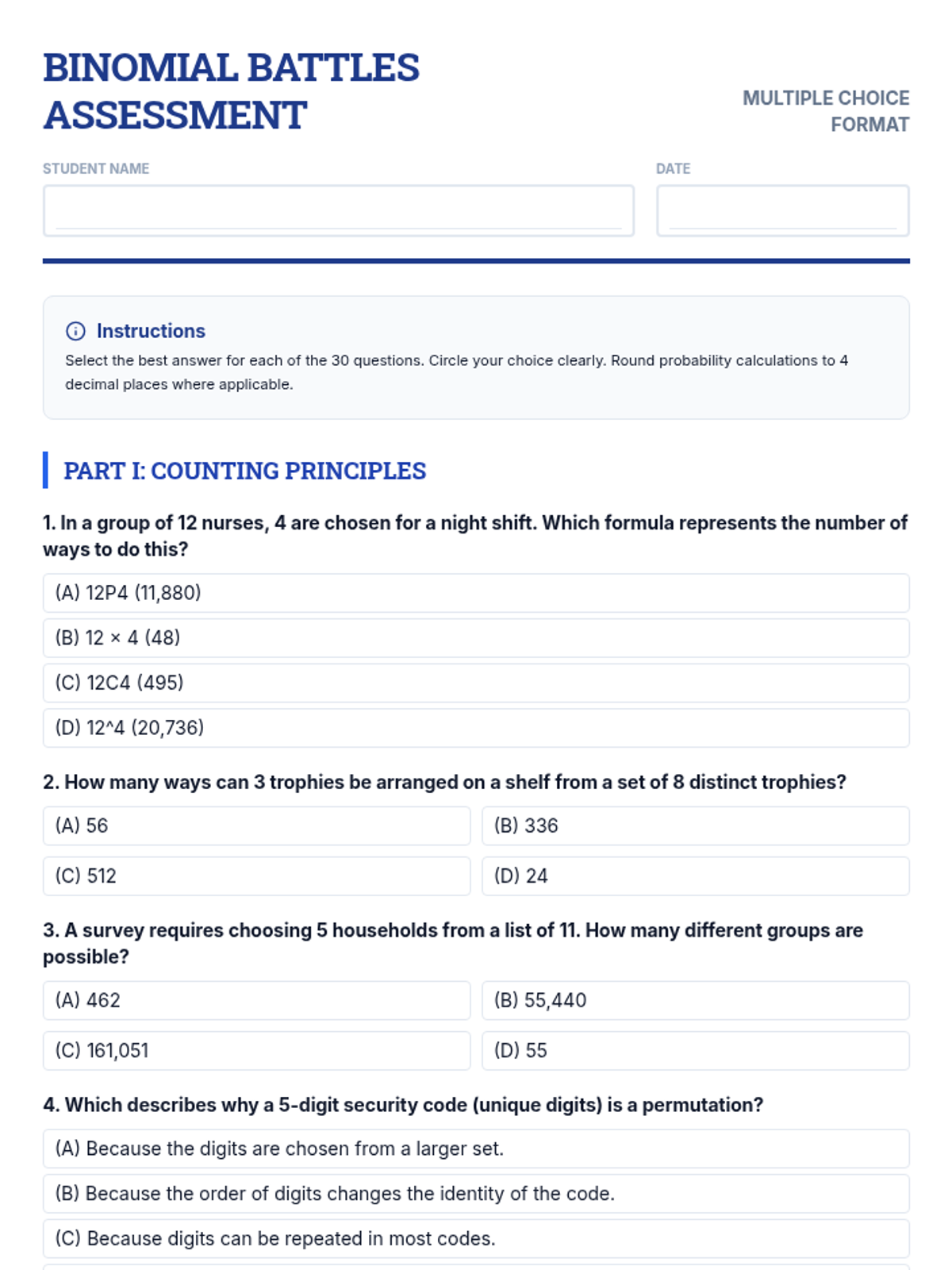
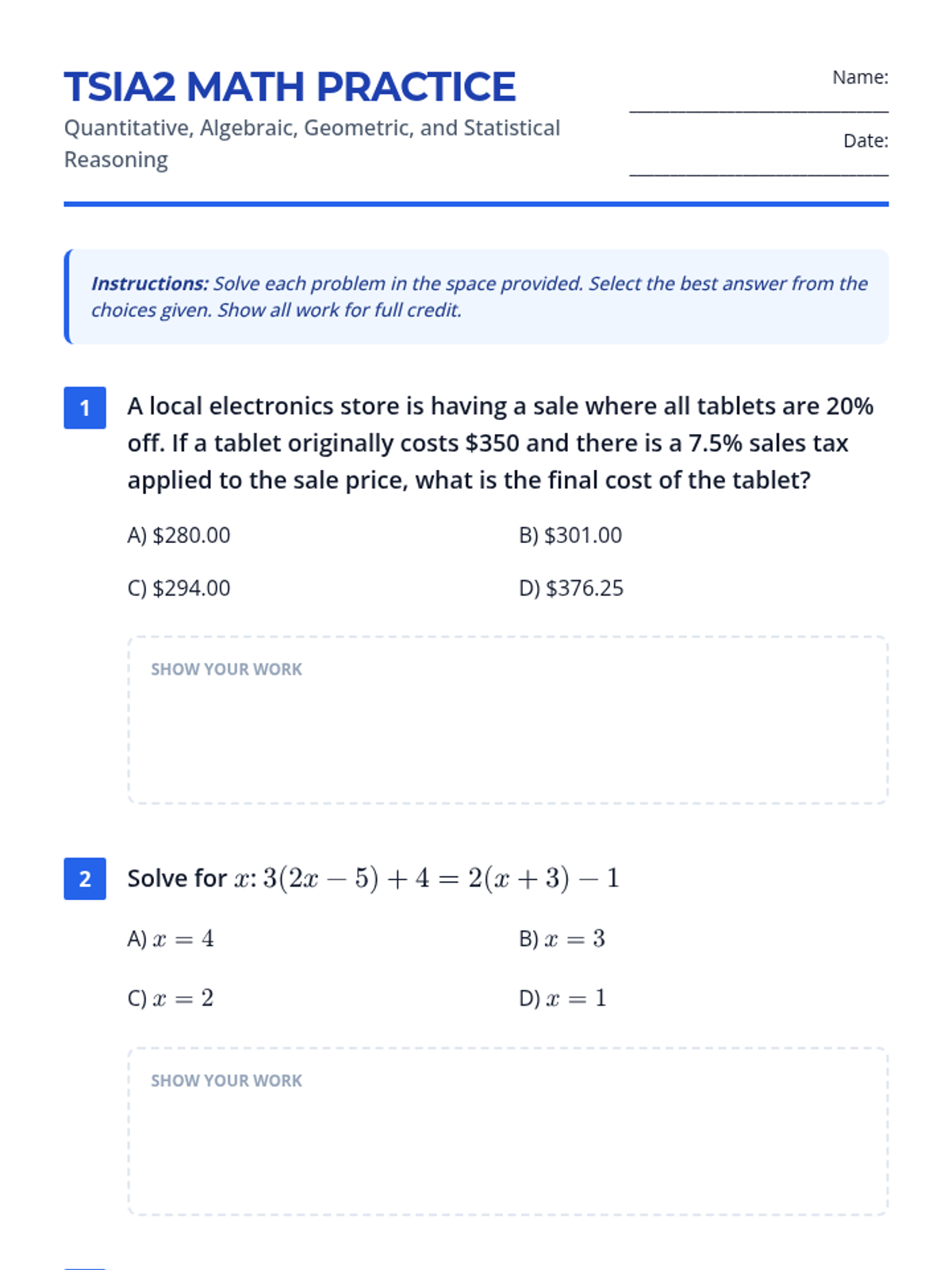
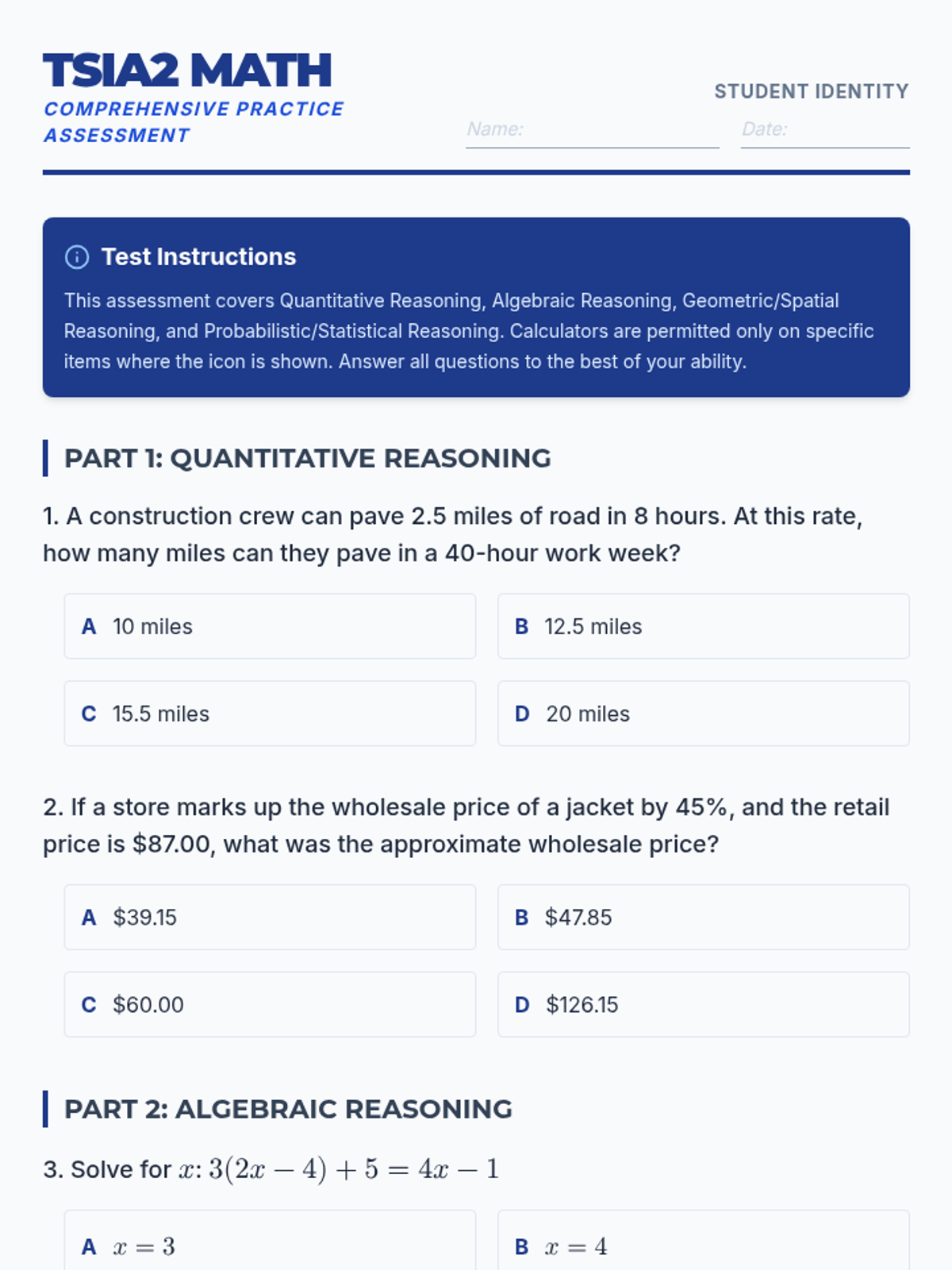
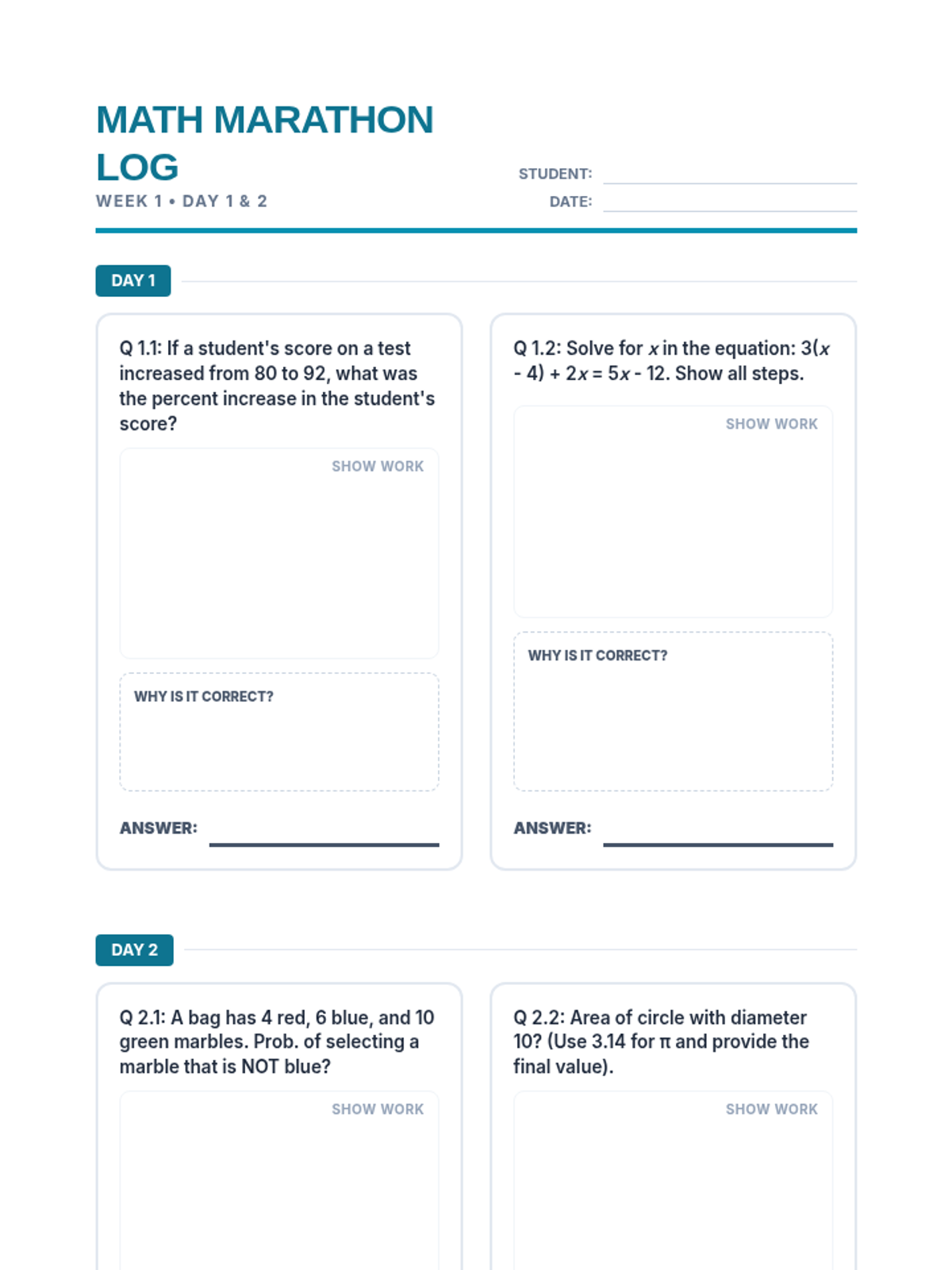
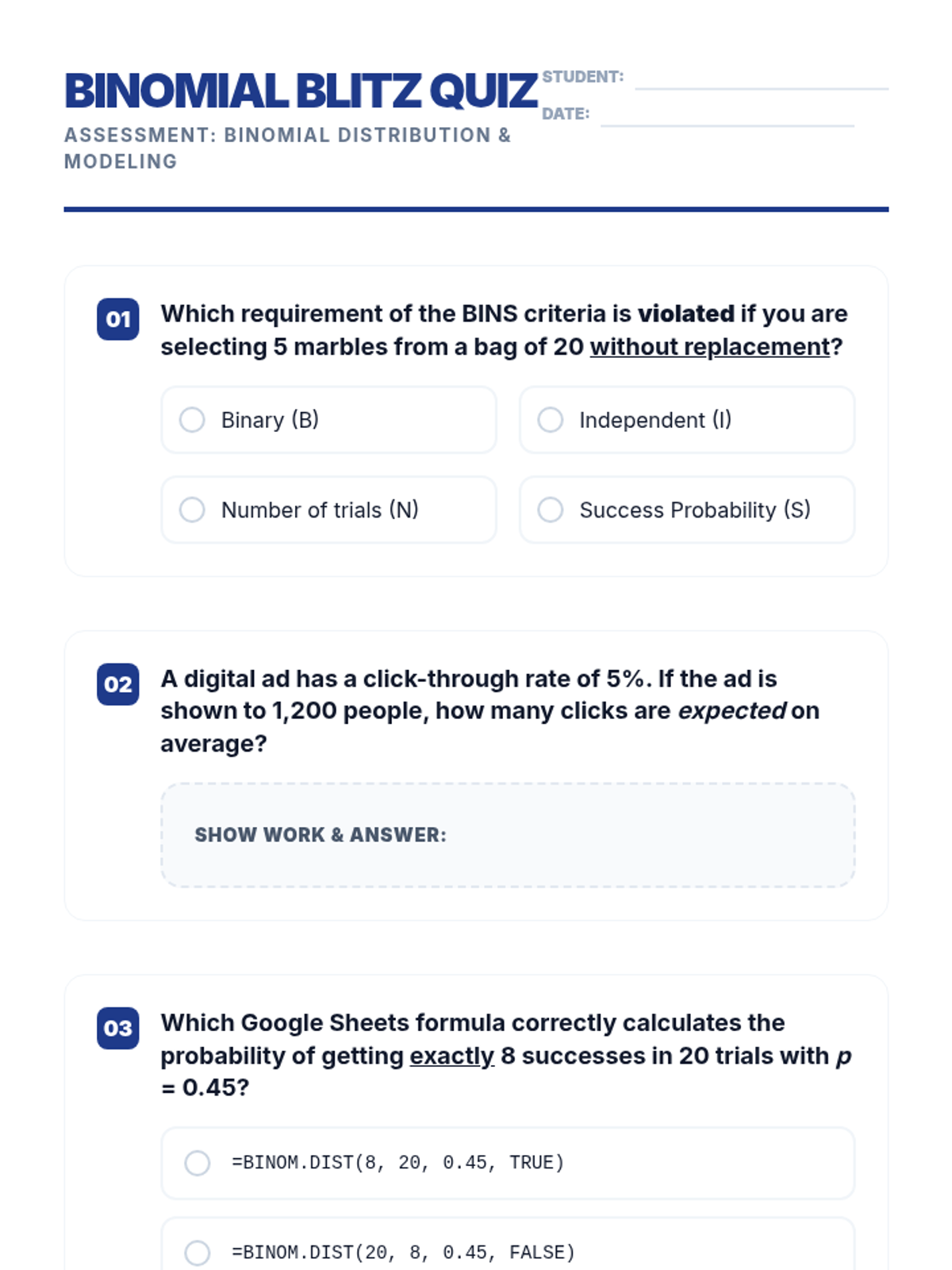
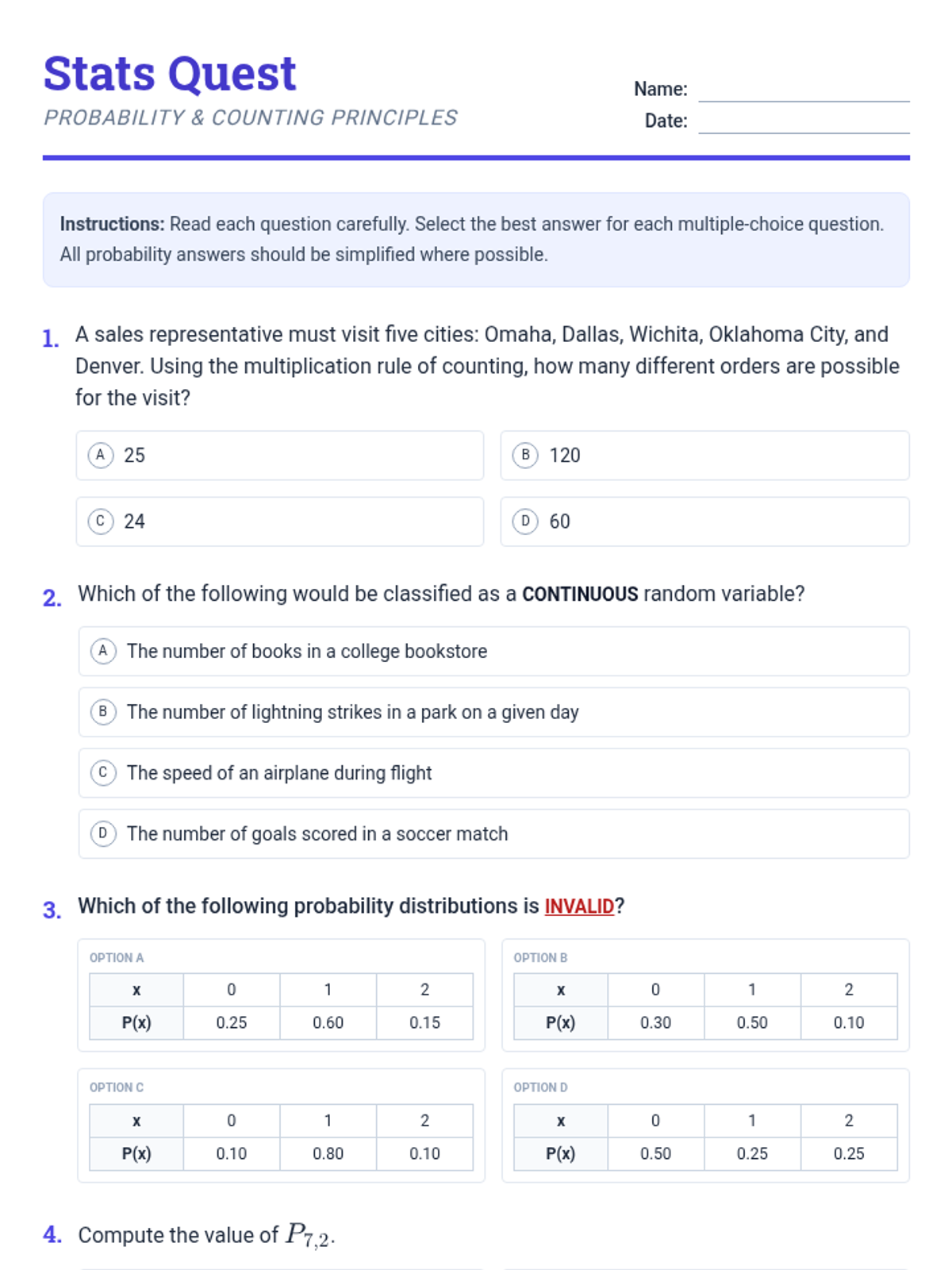
A 20-question multiple choice practice test for the TSIA2 Math exam, broken down by topic area: Quantitative Reasoning, Algebraic Reasoning, Geometry, and Statistics. Includes space for student work. (Updated questions 3, 10, and 19).
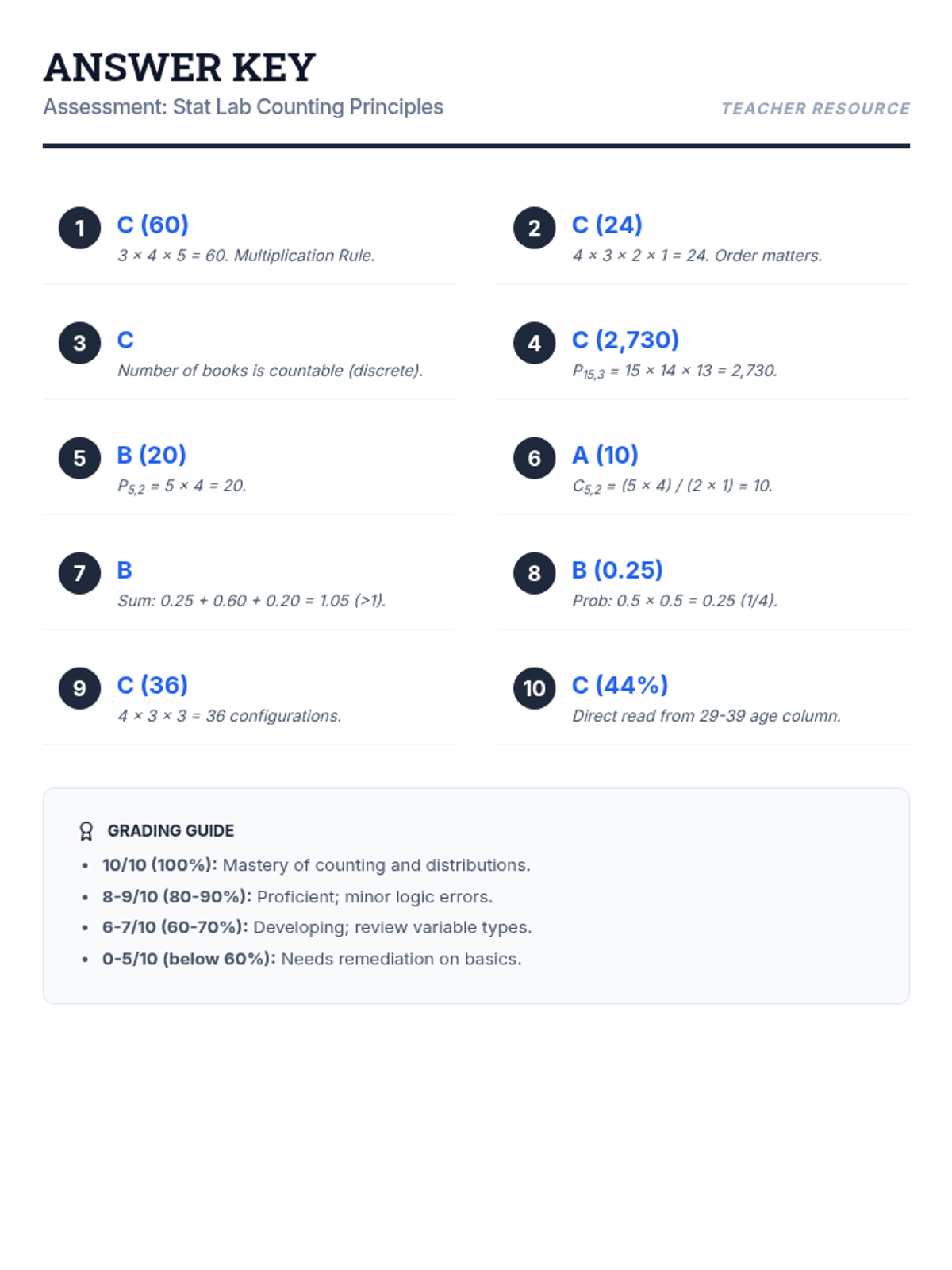
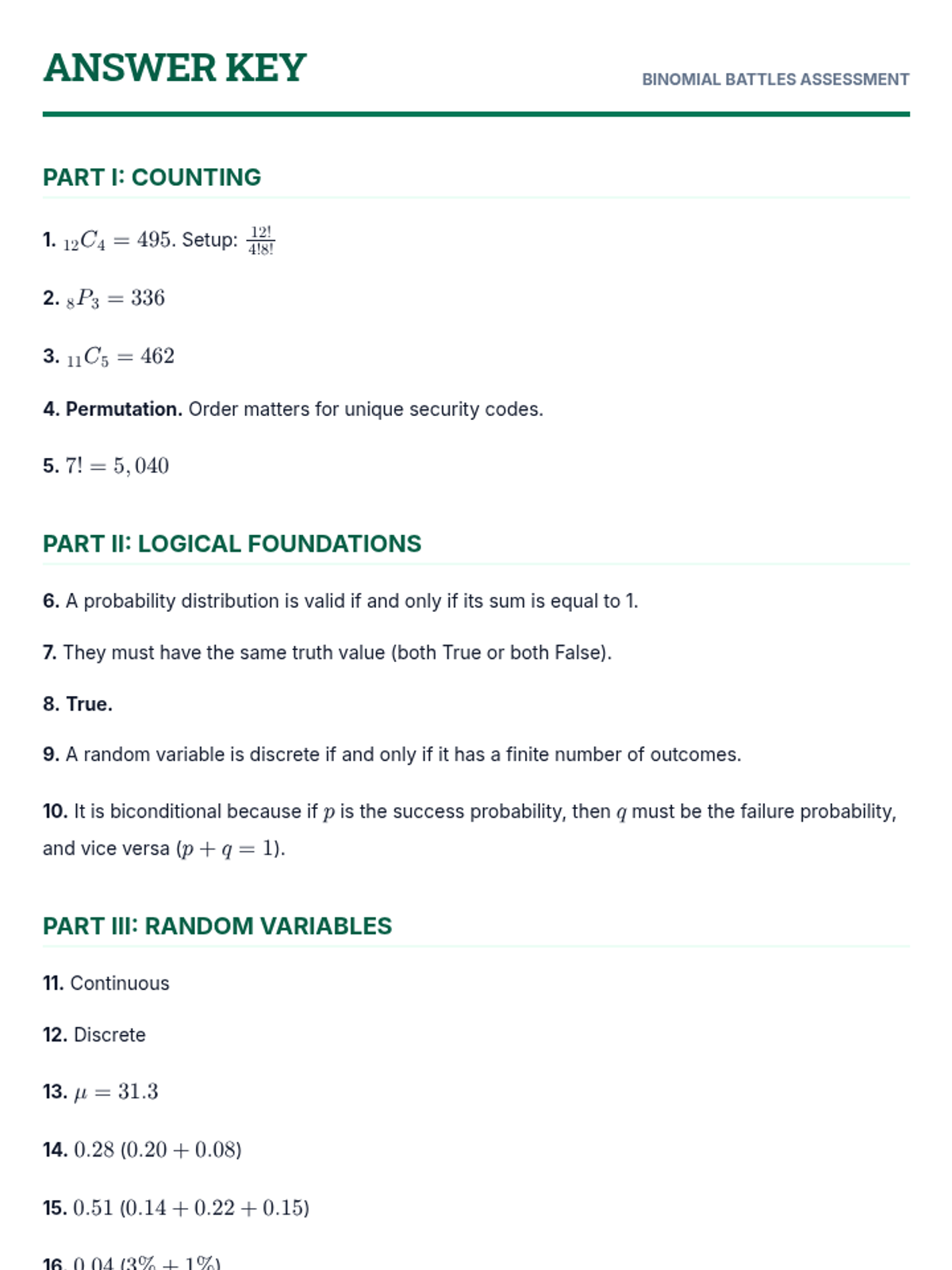
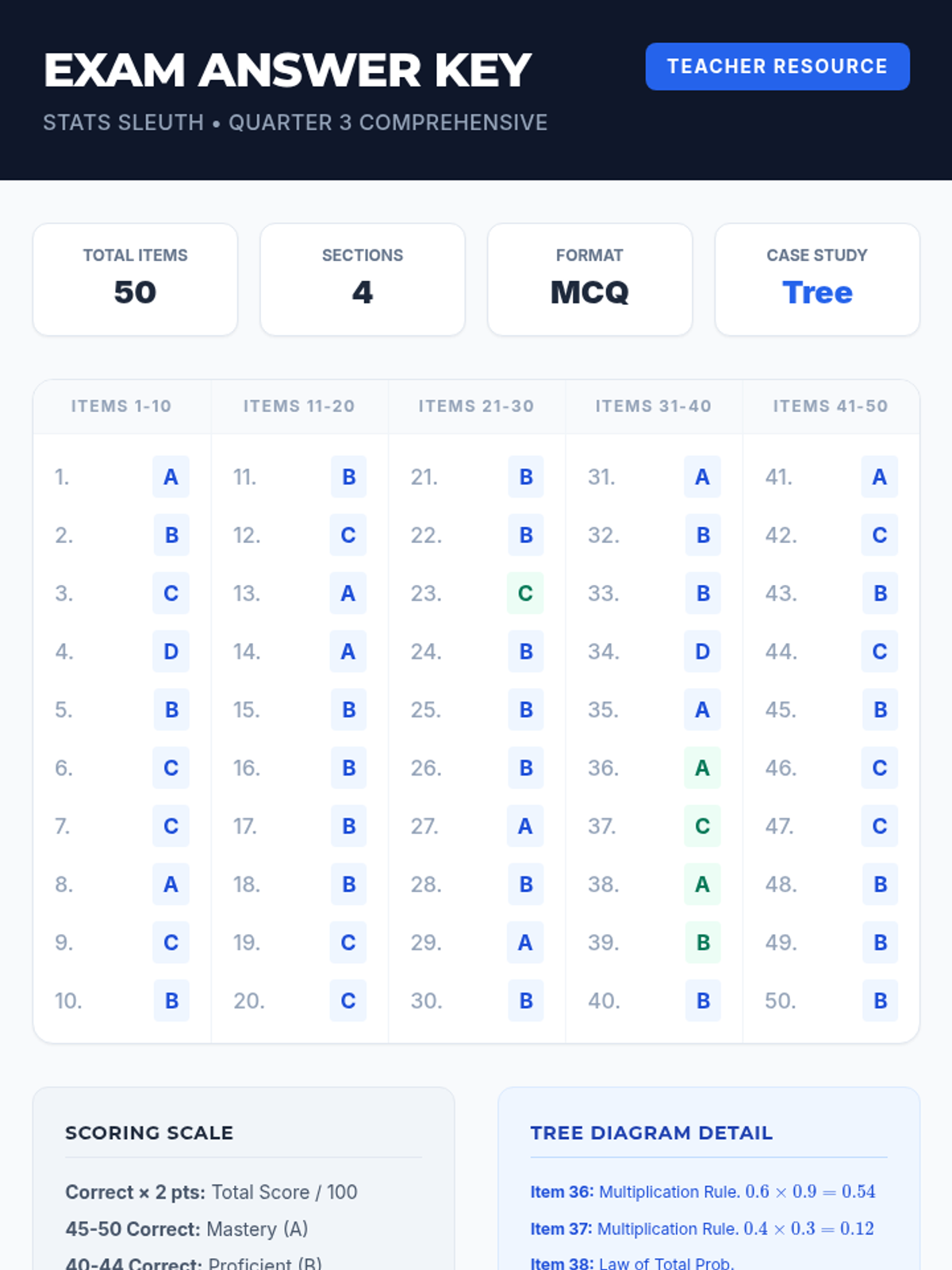
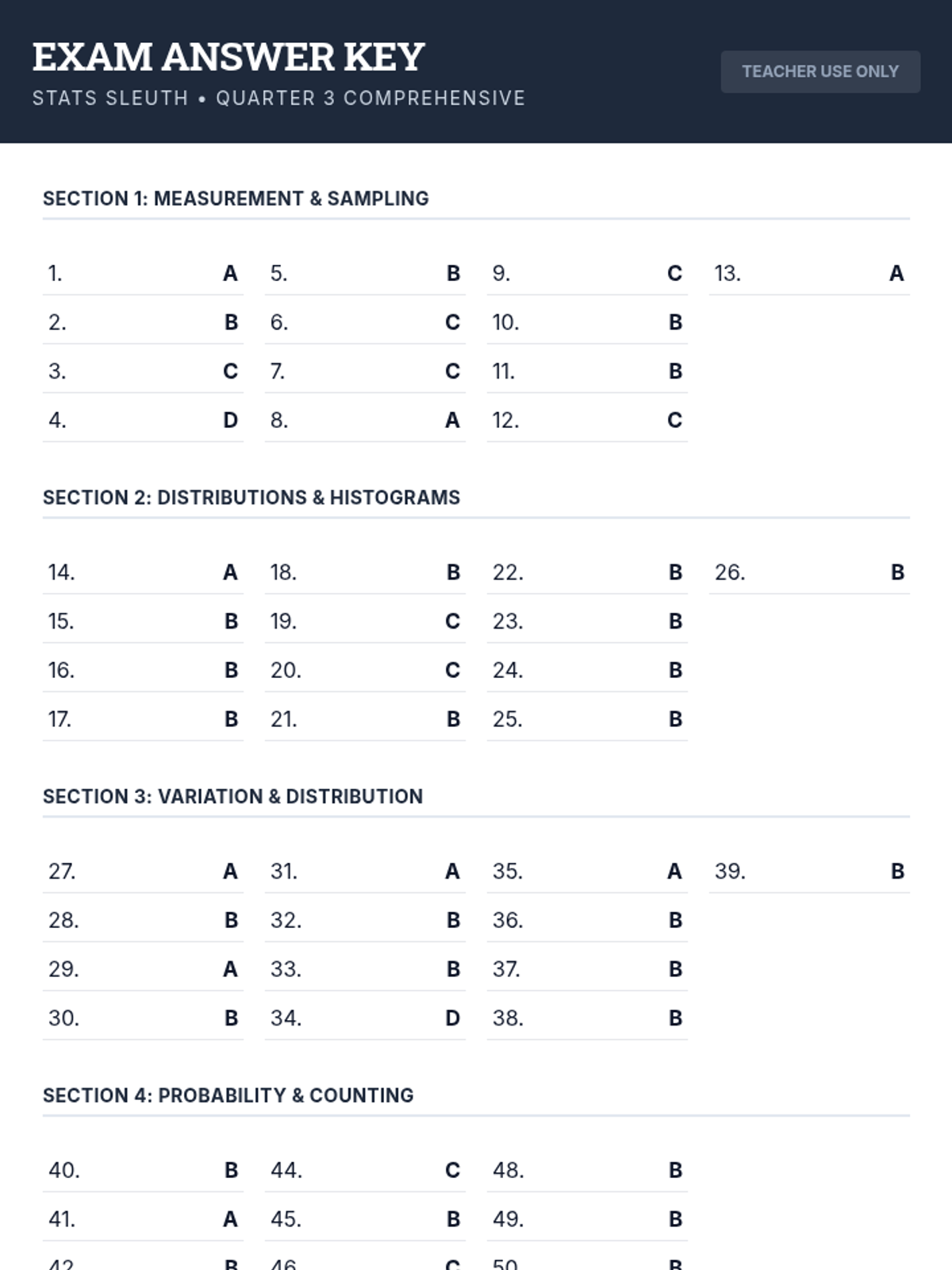
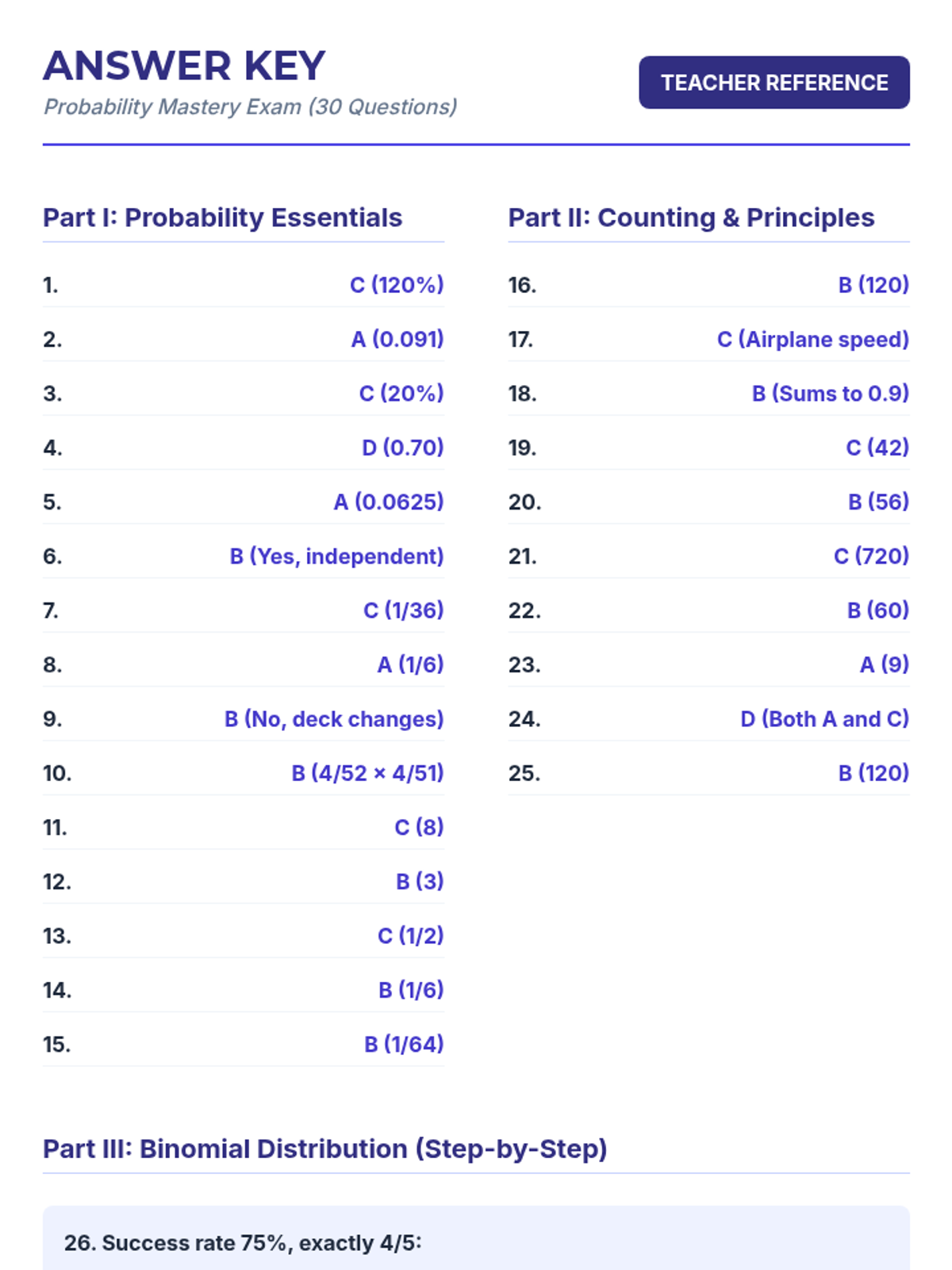
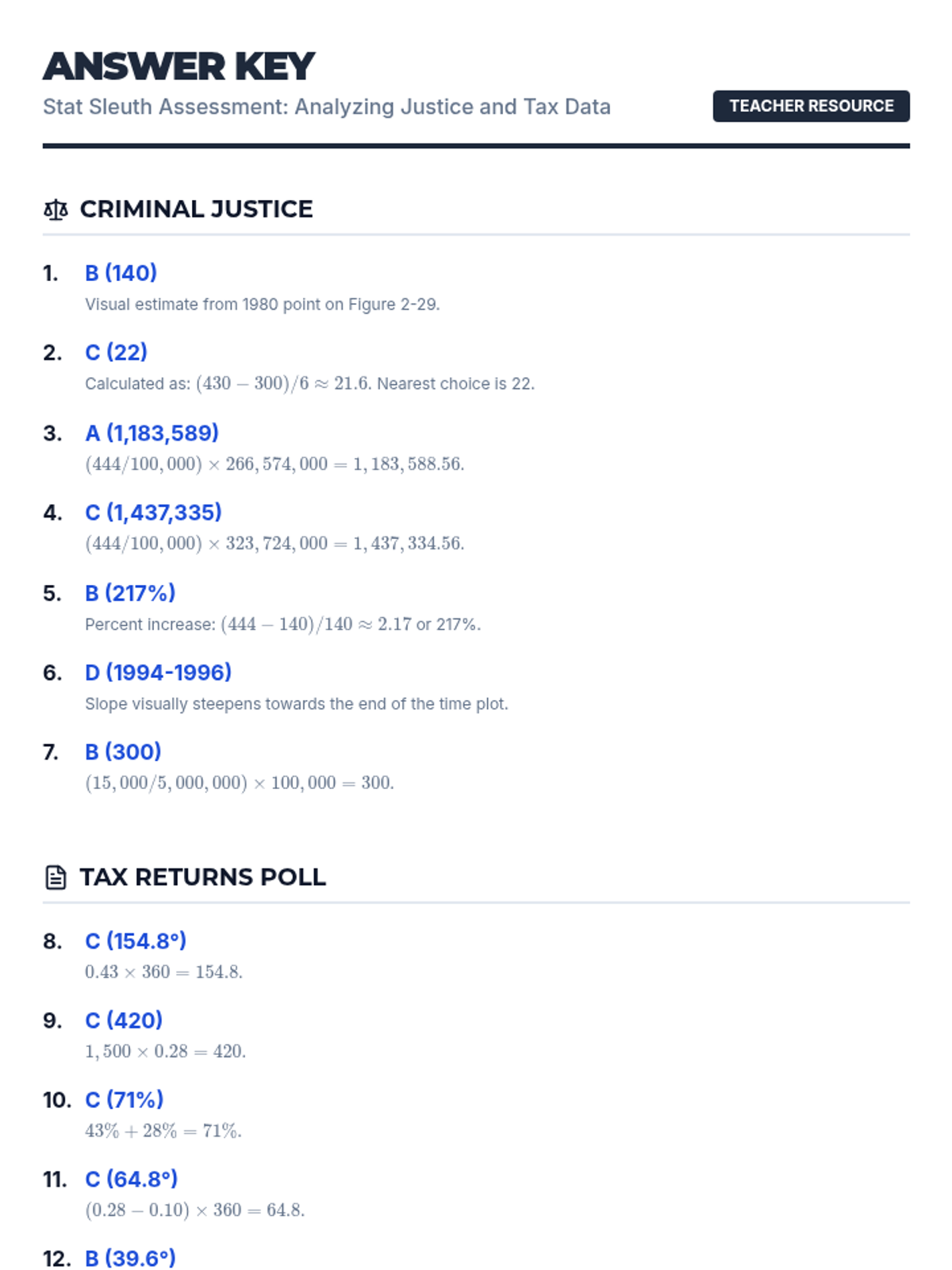
An answer key for the TSIA2 Math practice test, including correct answers, brief explanations, and a domain distribution breakdown.
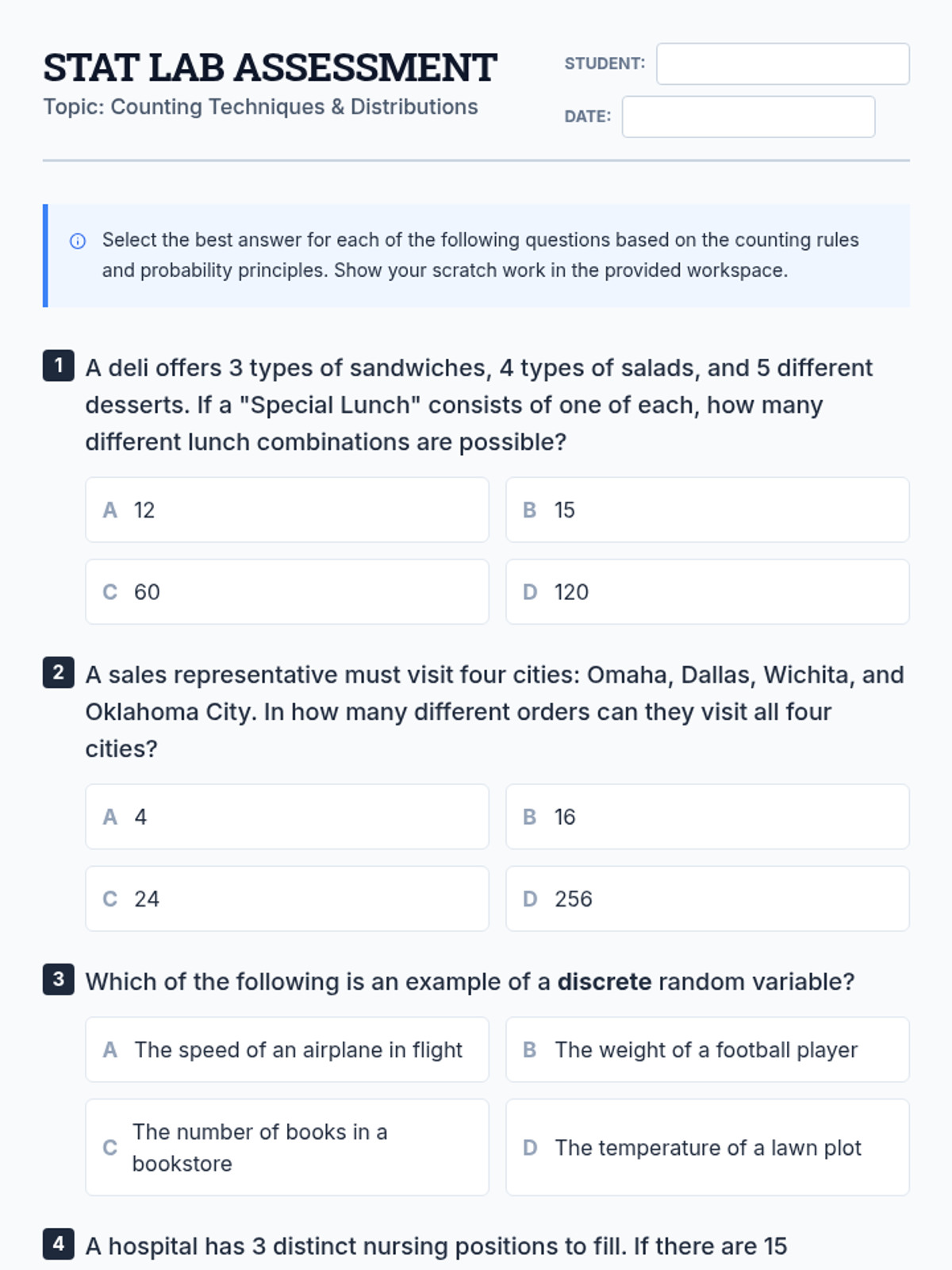
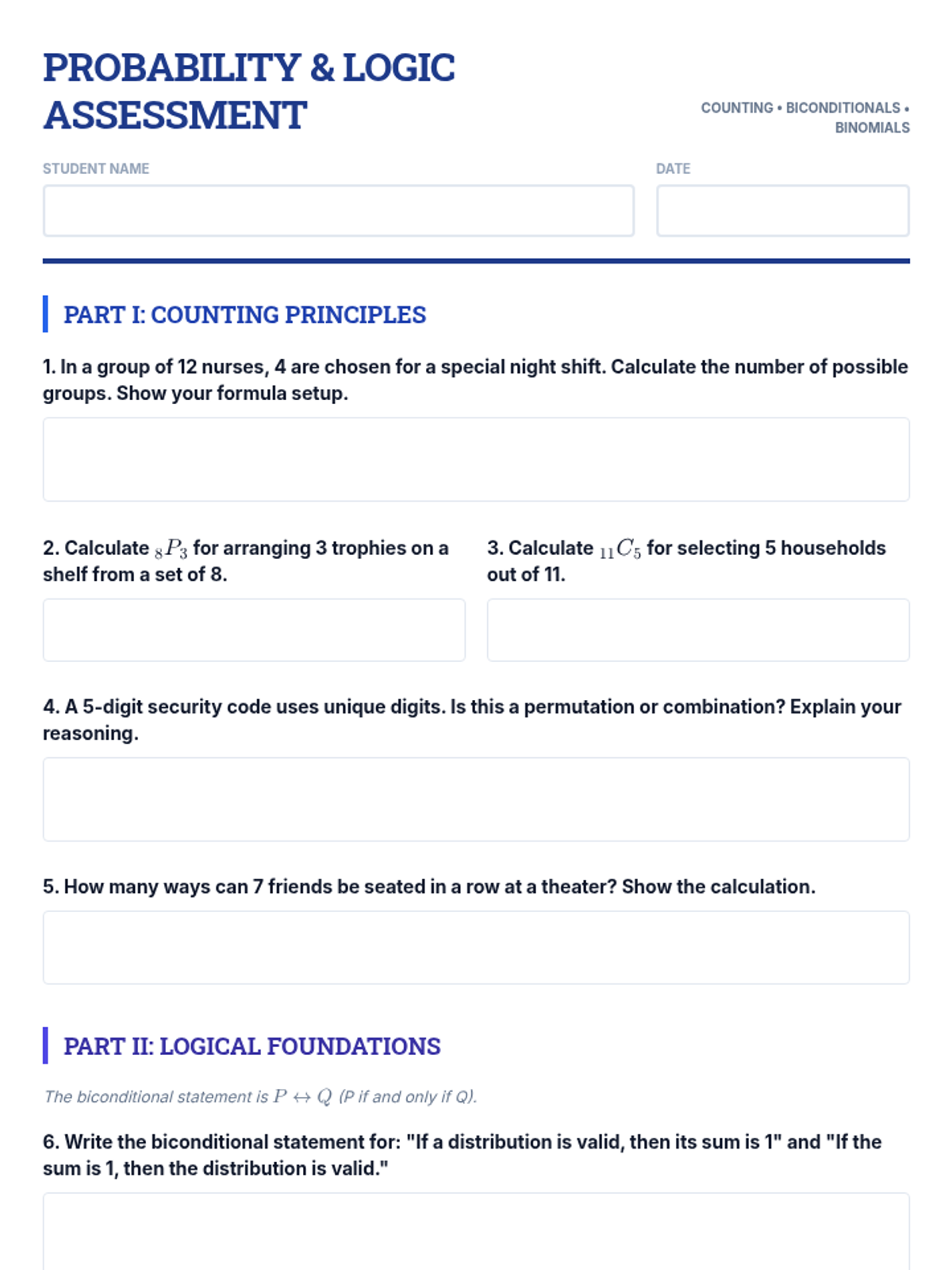
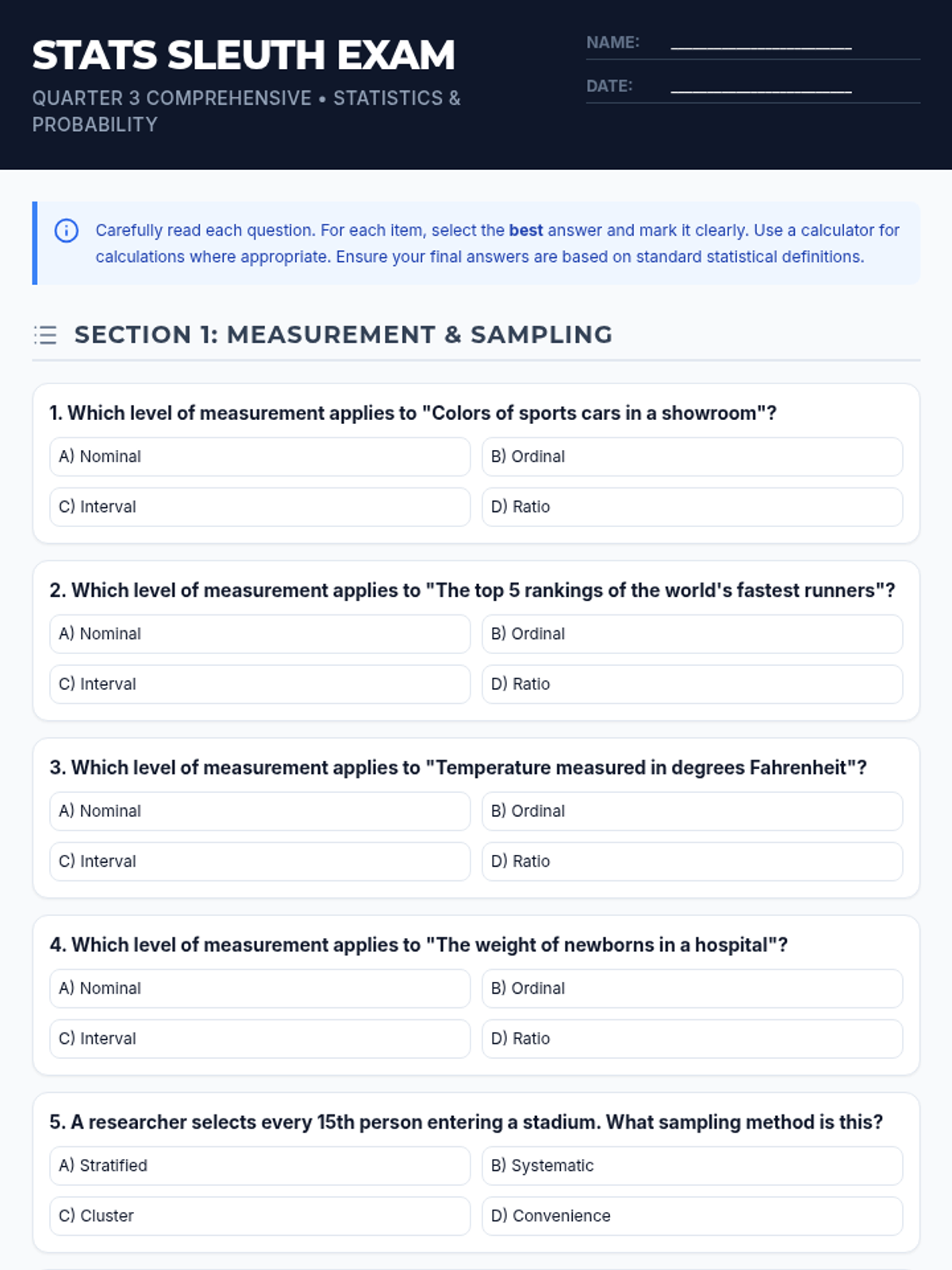
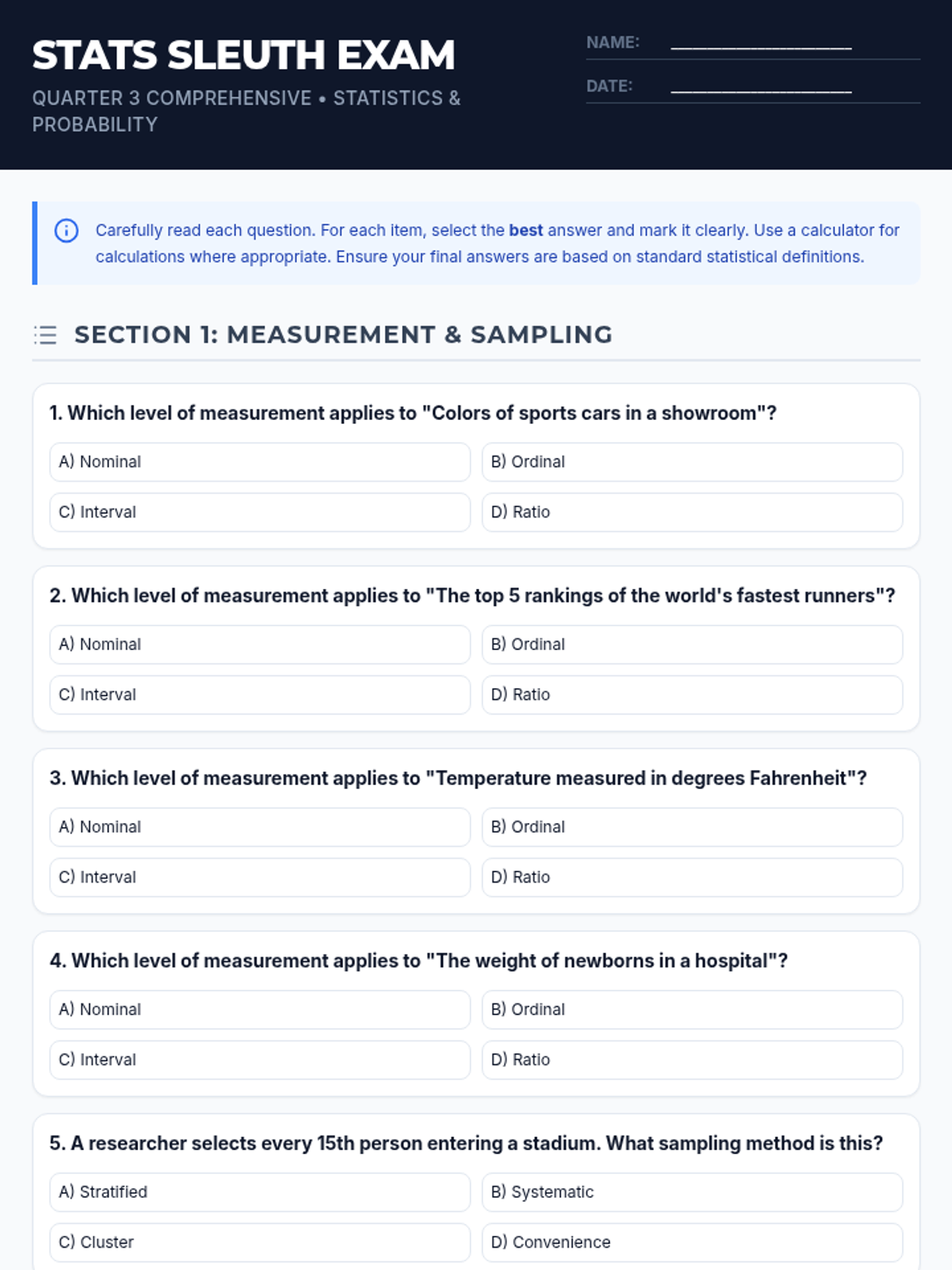
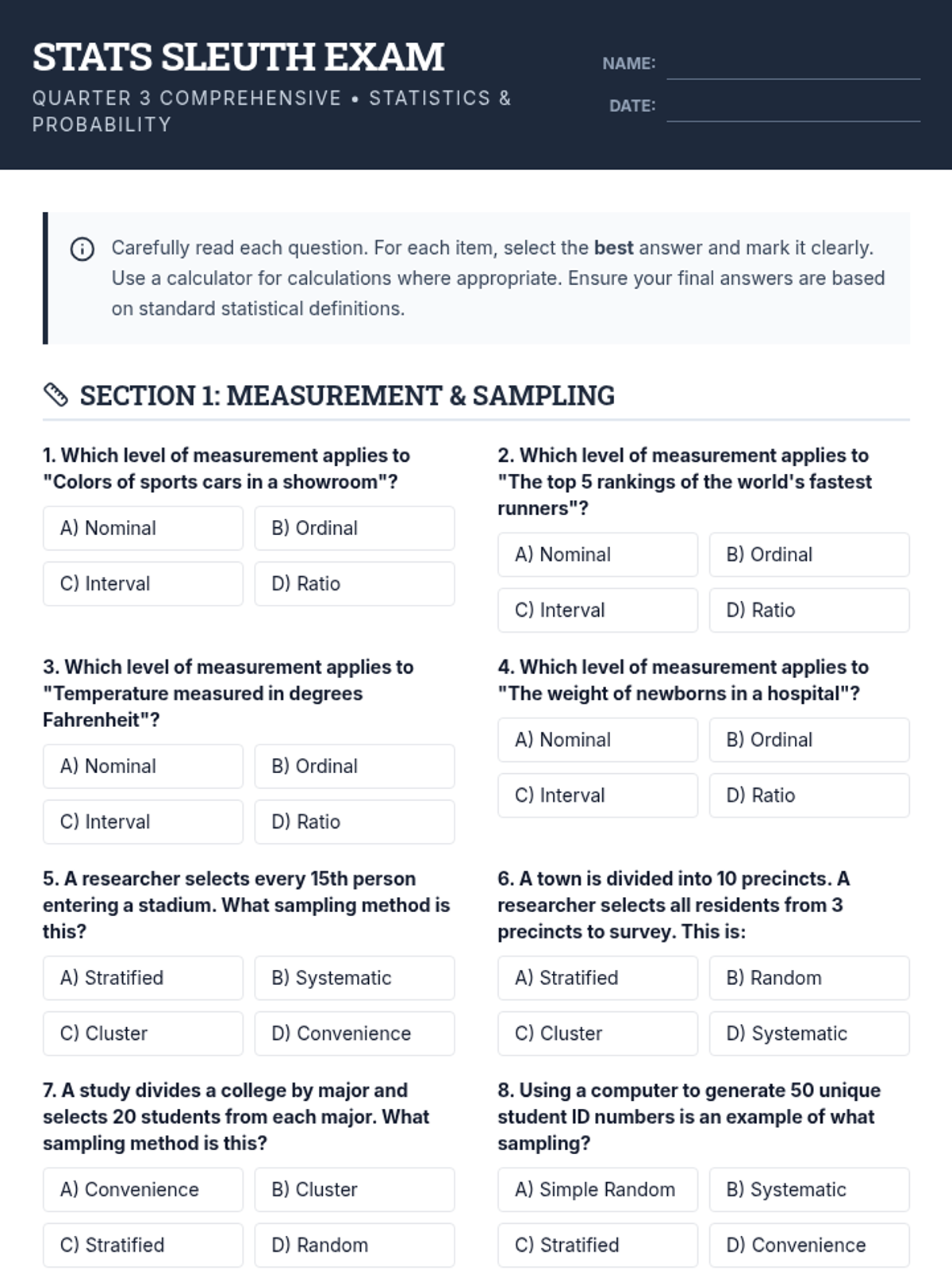
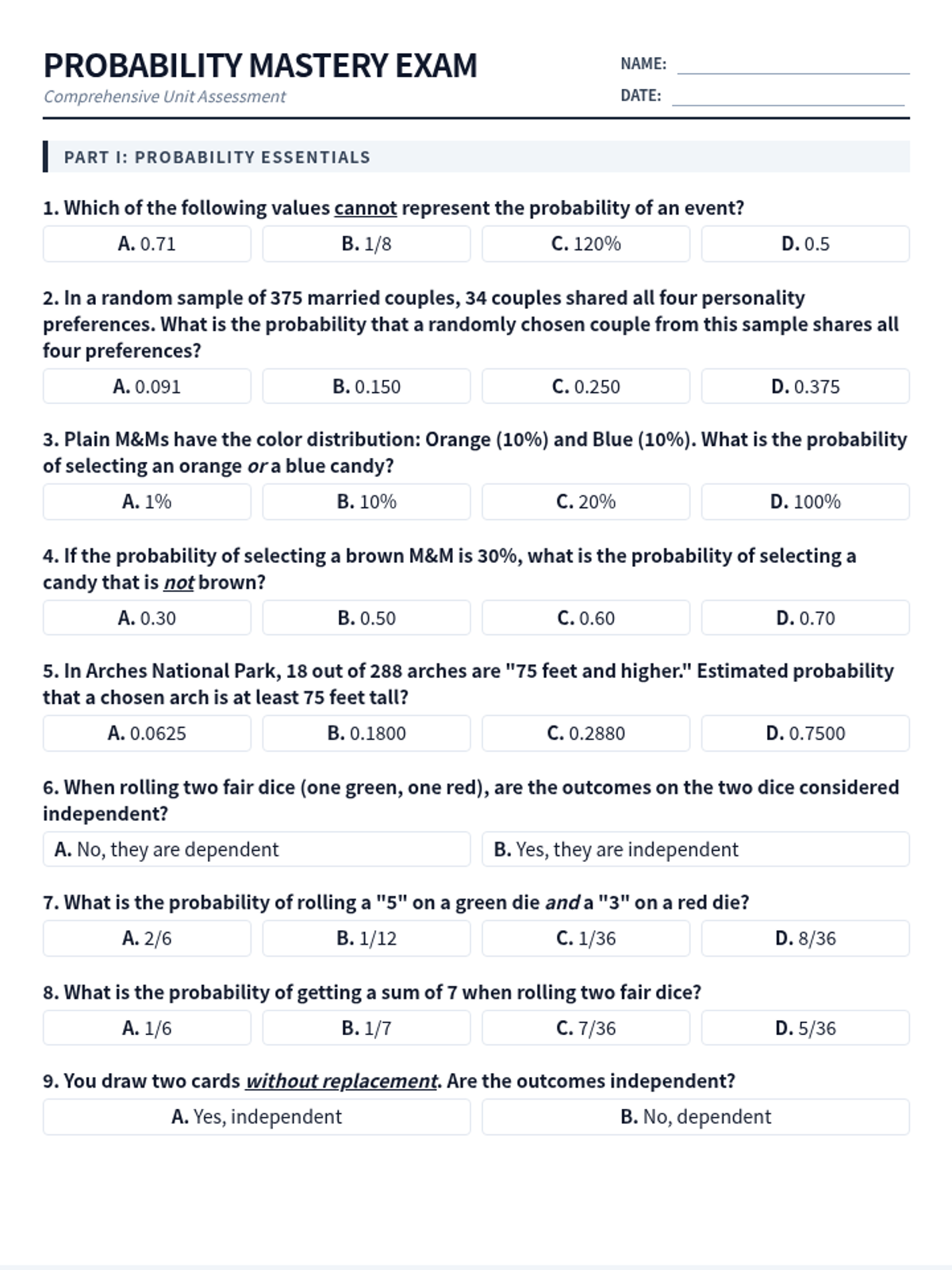
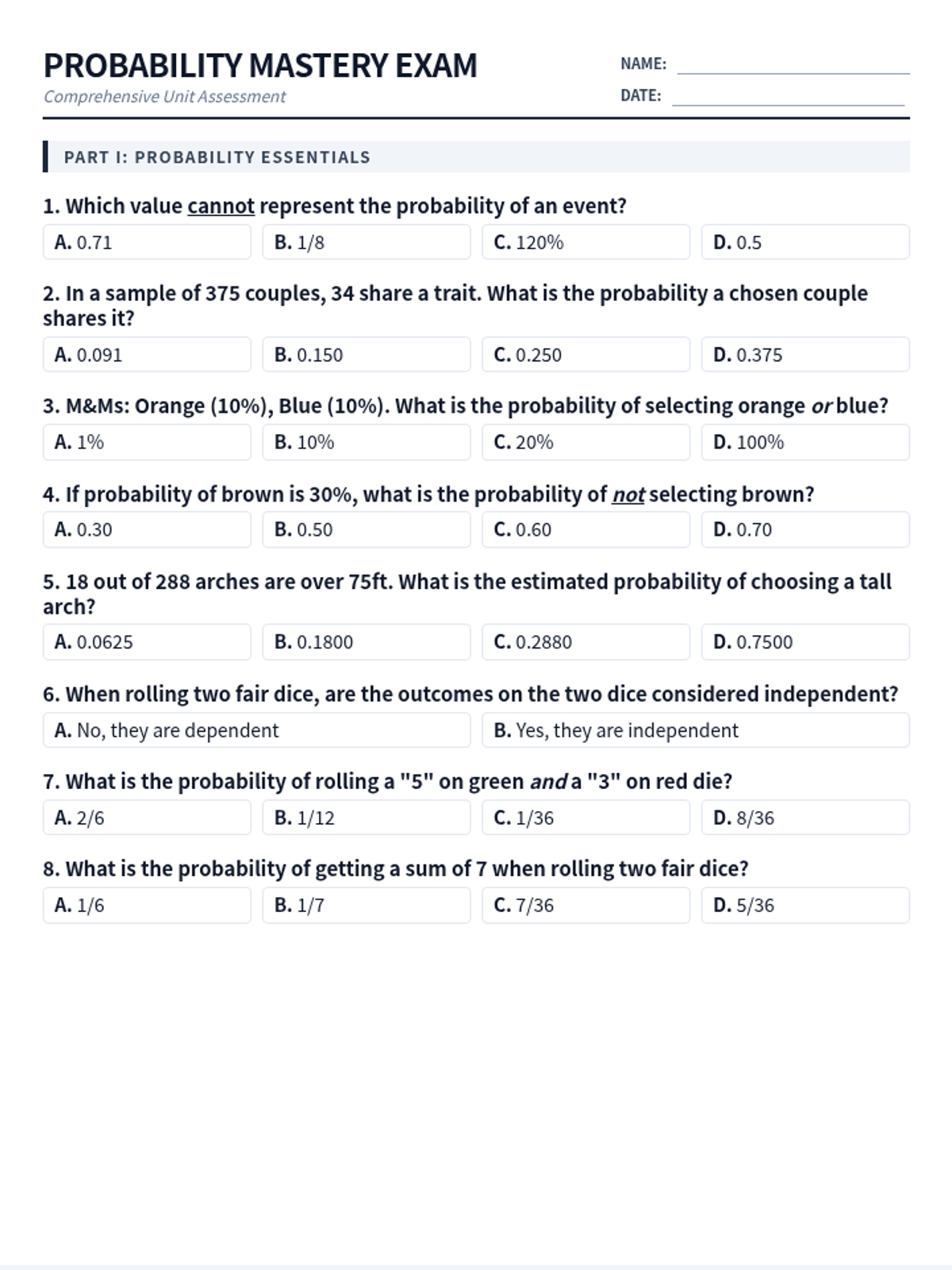
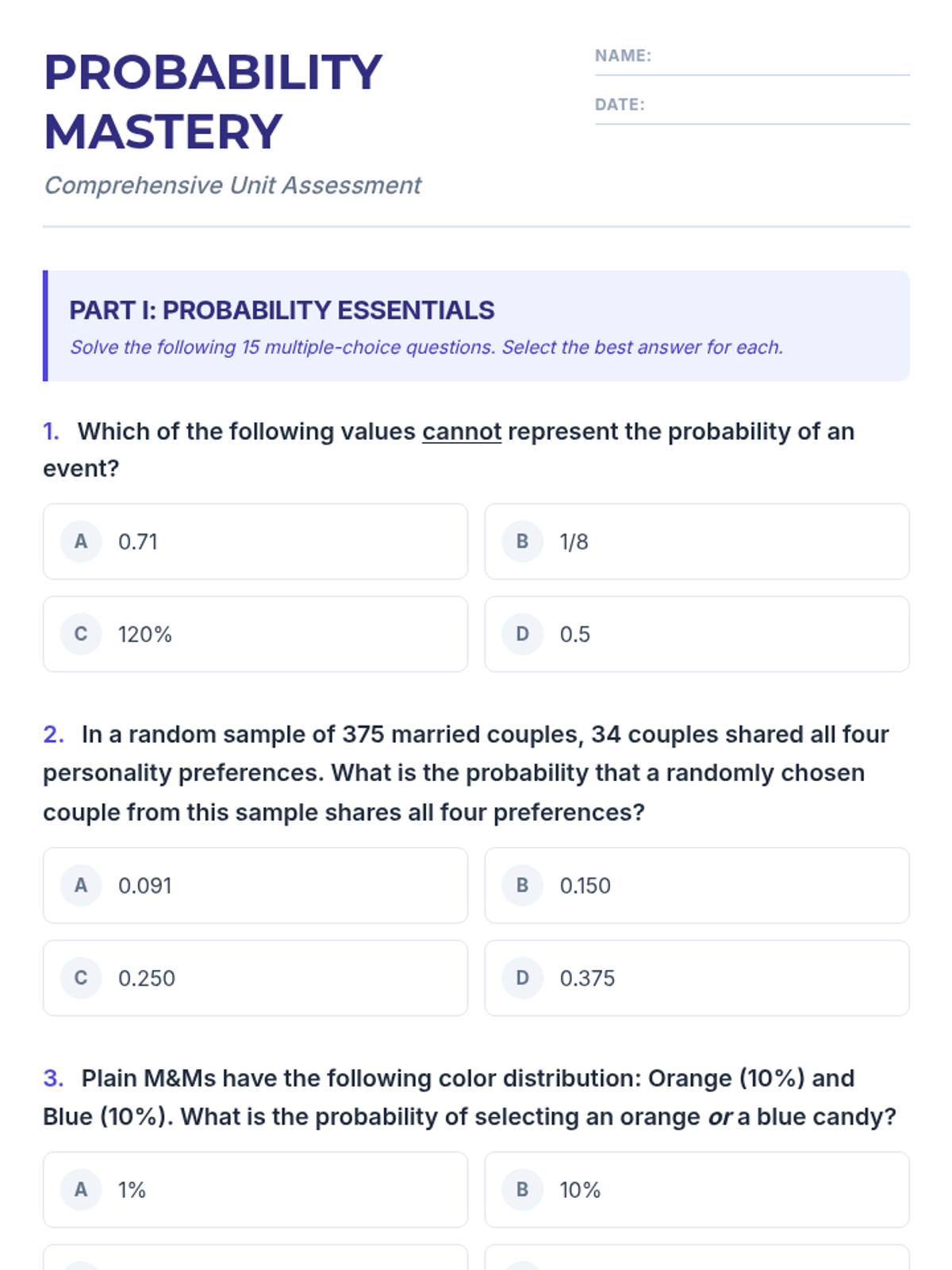
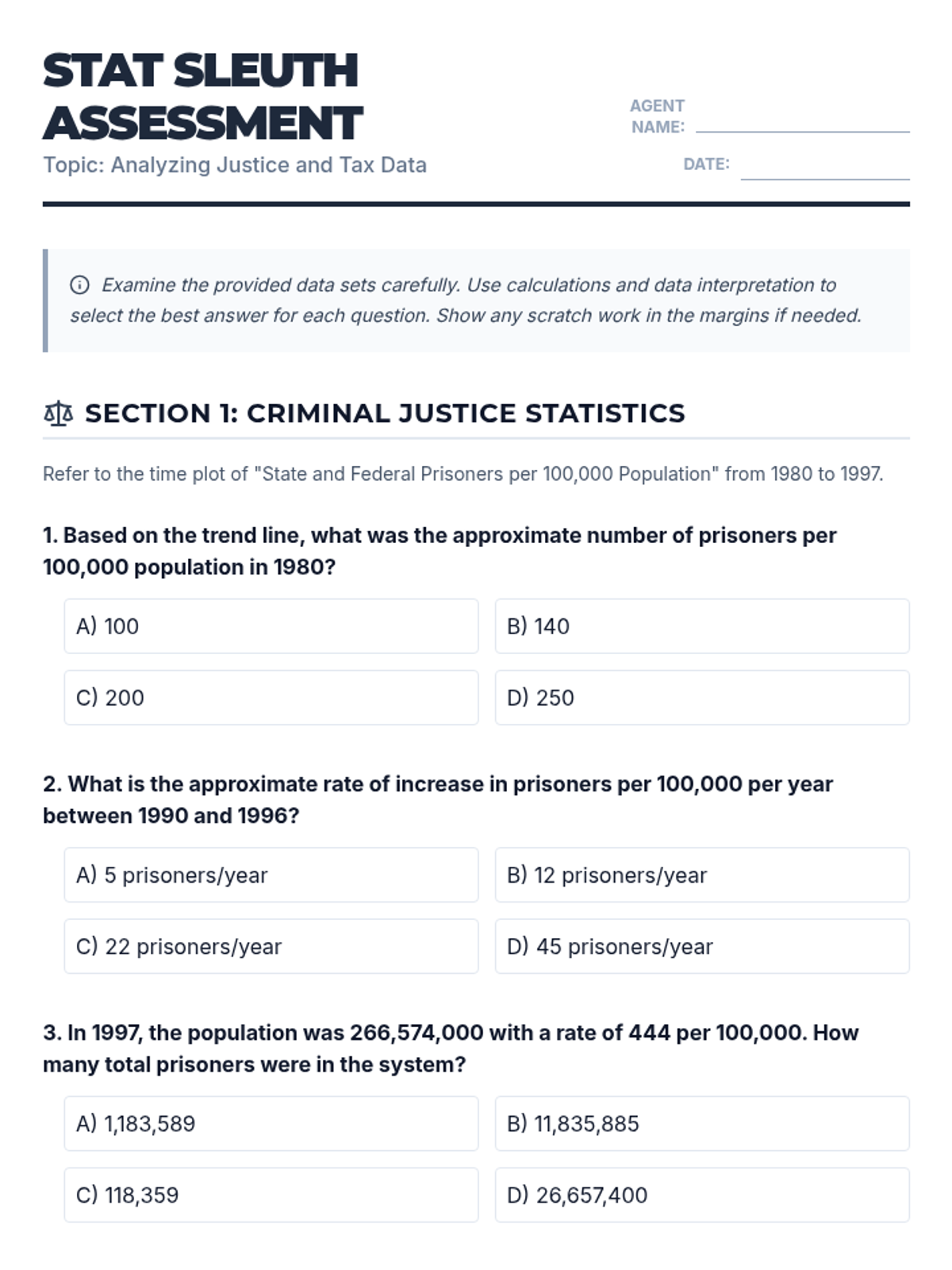
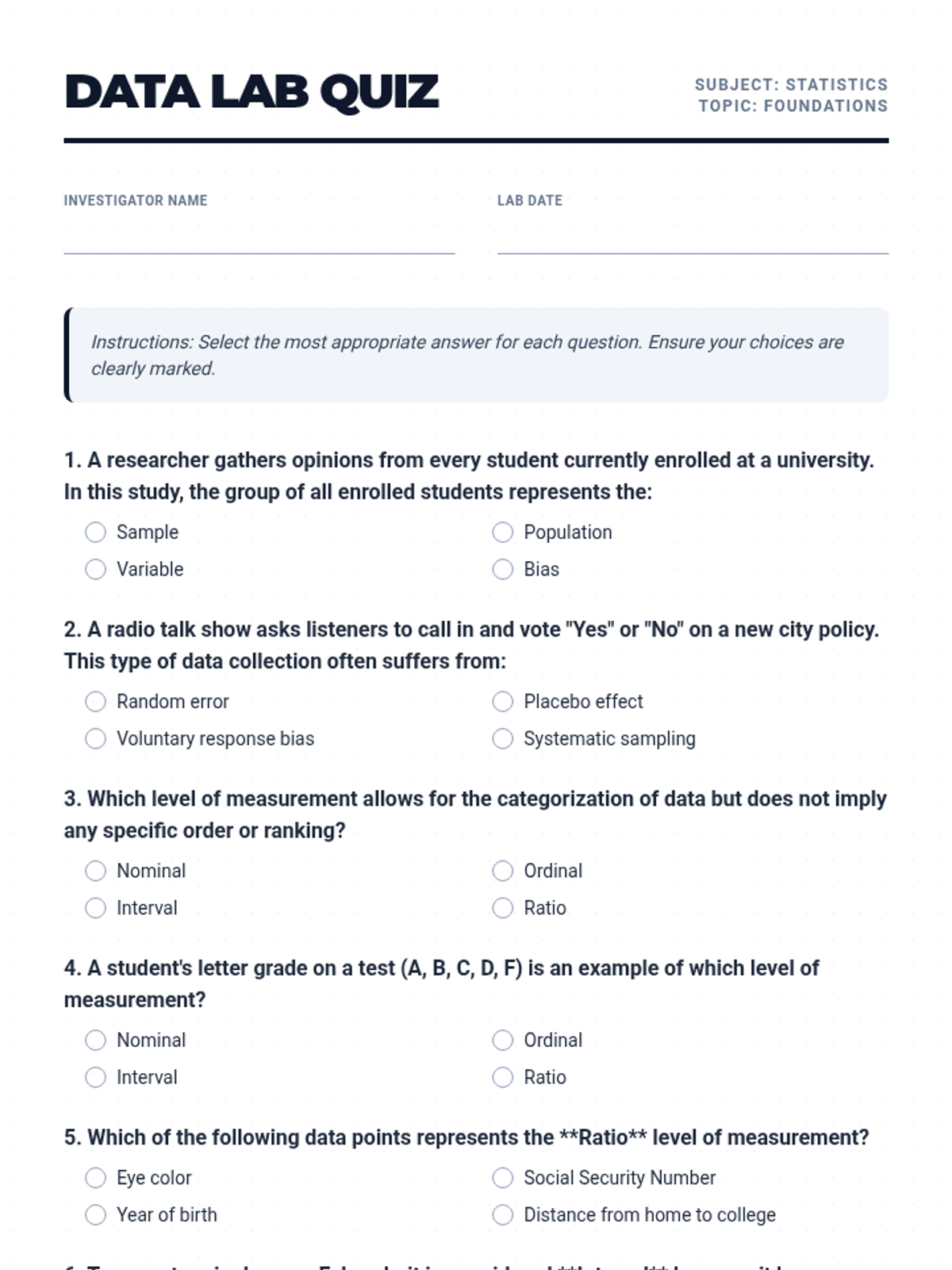
A 20-question TSIA2 Math practice test with questions across four domains: Quantitative Reasoning, Algebraic Reasoning, Geometry, and Probability and Statistics.
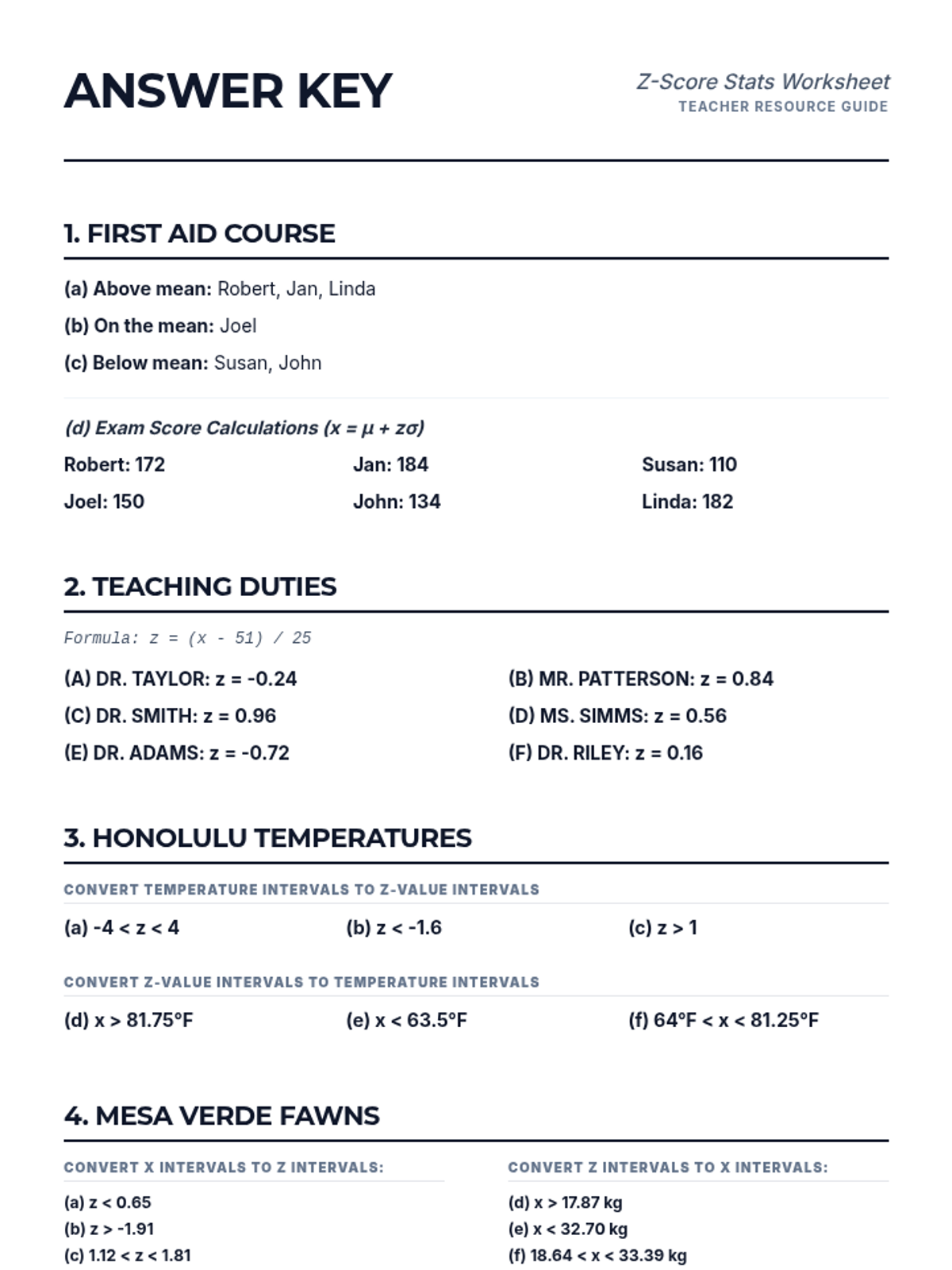
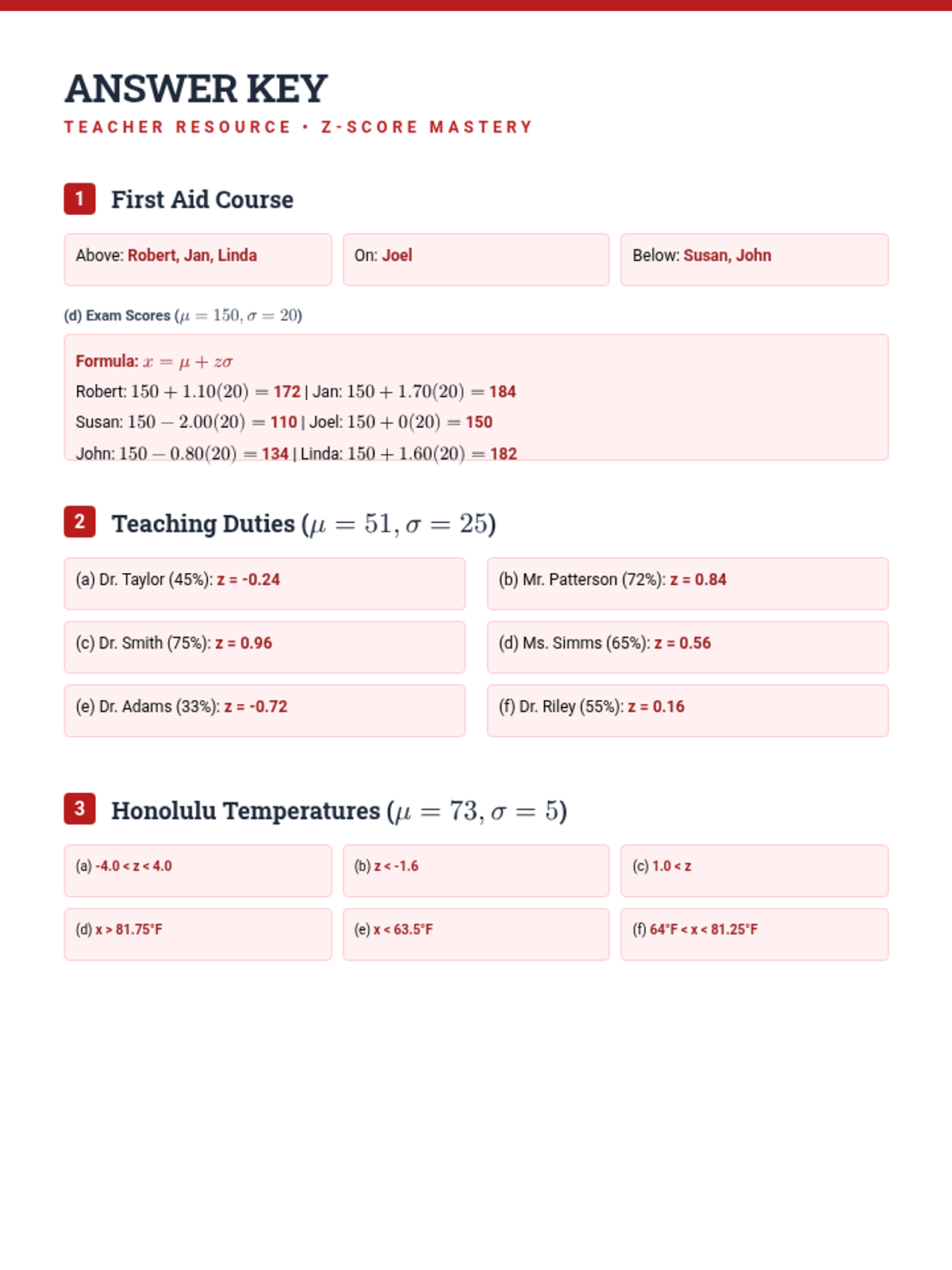
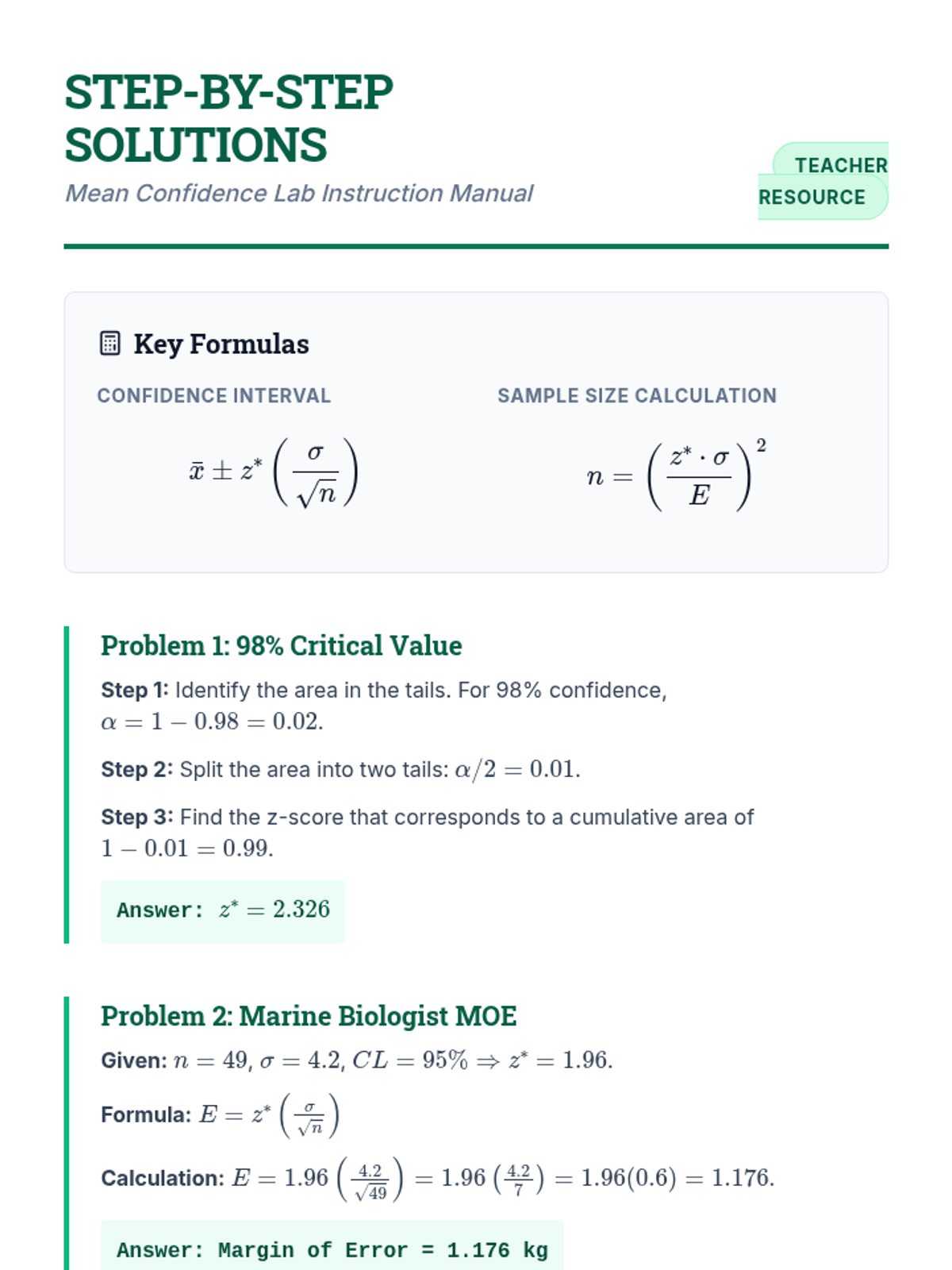
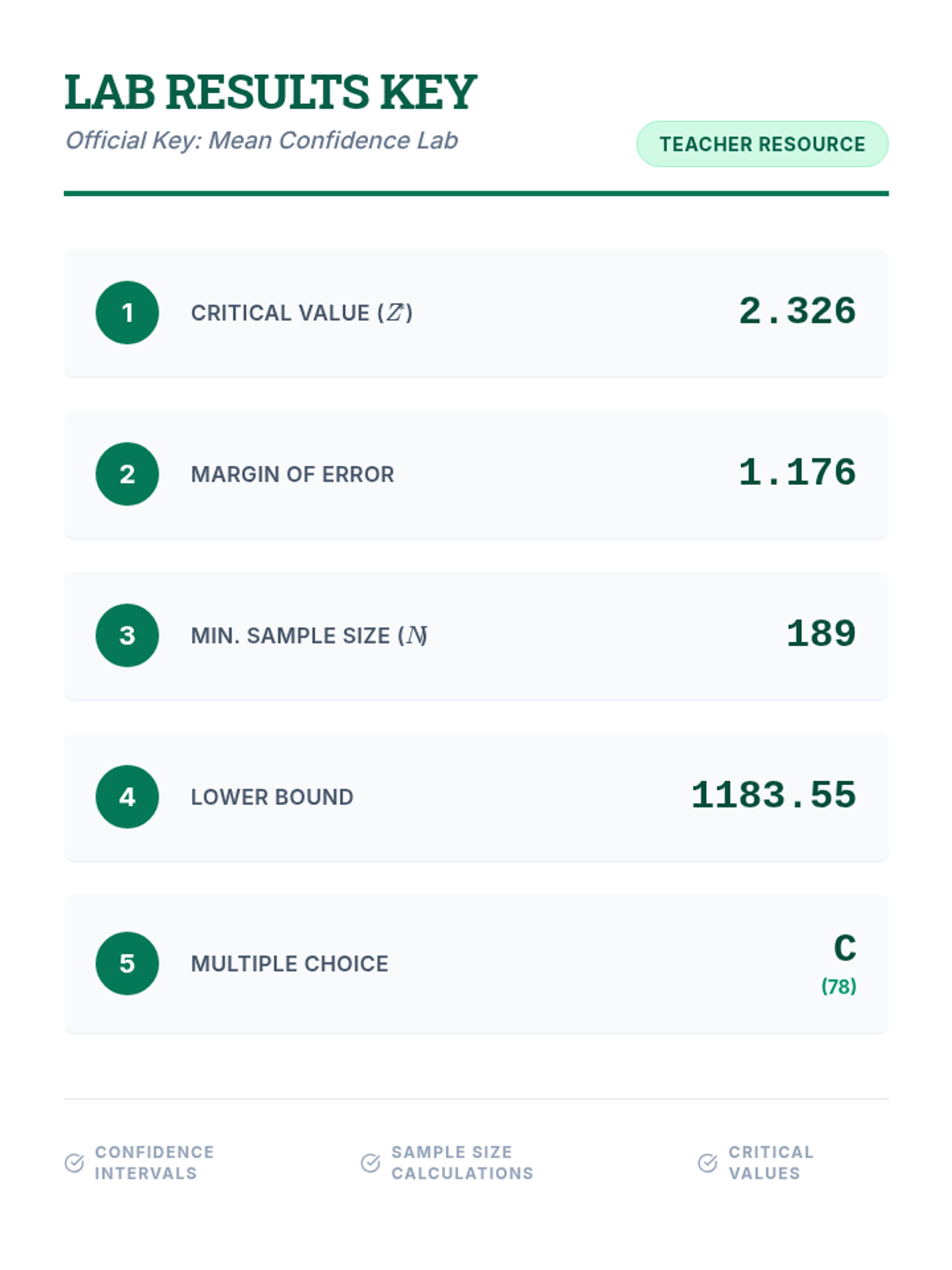
The answer key for the Data Detective Worksheet, providing solutions and step-by-step calculations for Empirical Rule and z-score problems.
Visual presentation slides for the normal distribution lesson, featuring clear explanations of the empirical rule, z-score calculations, and step-by-step guidance on reading a z-table.
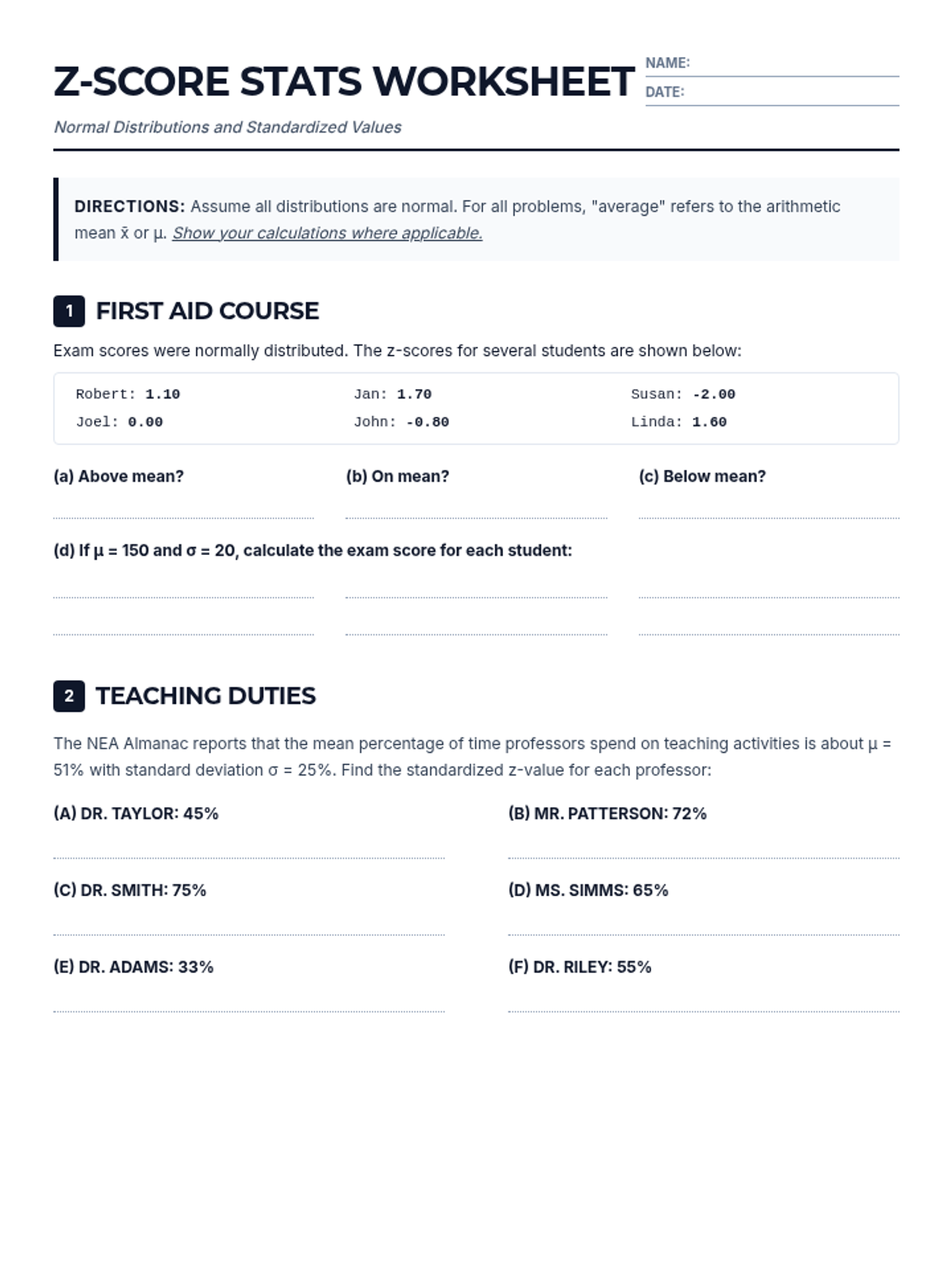
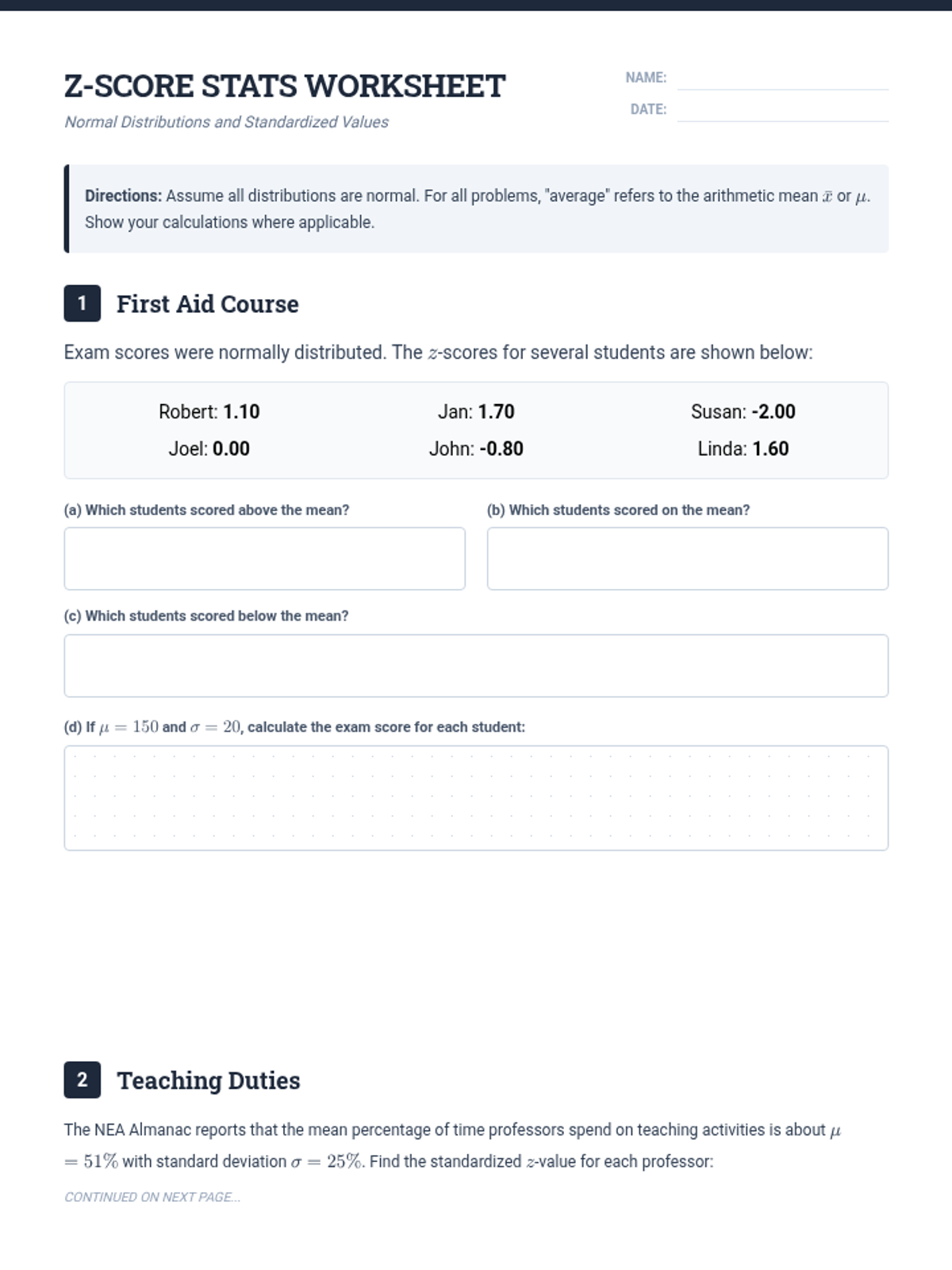
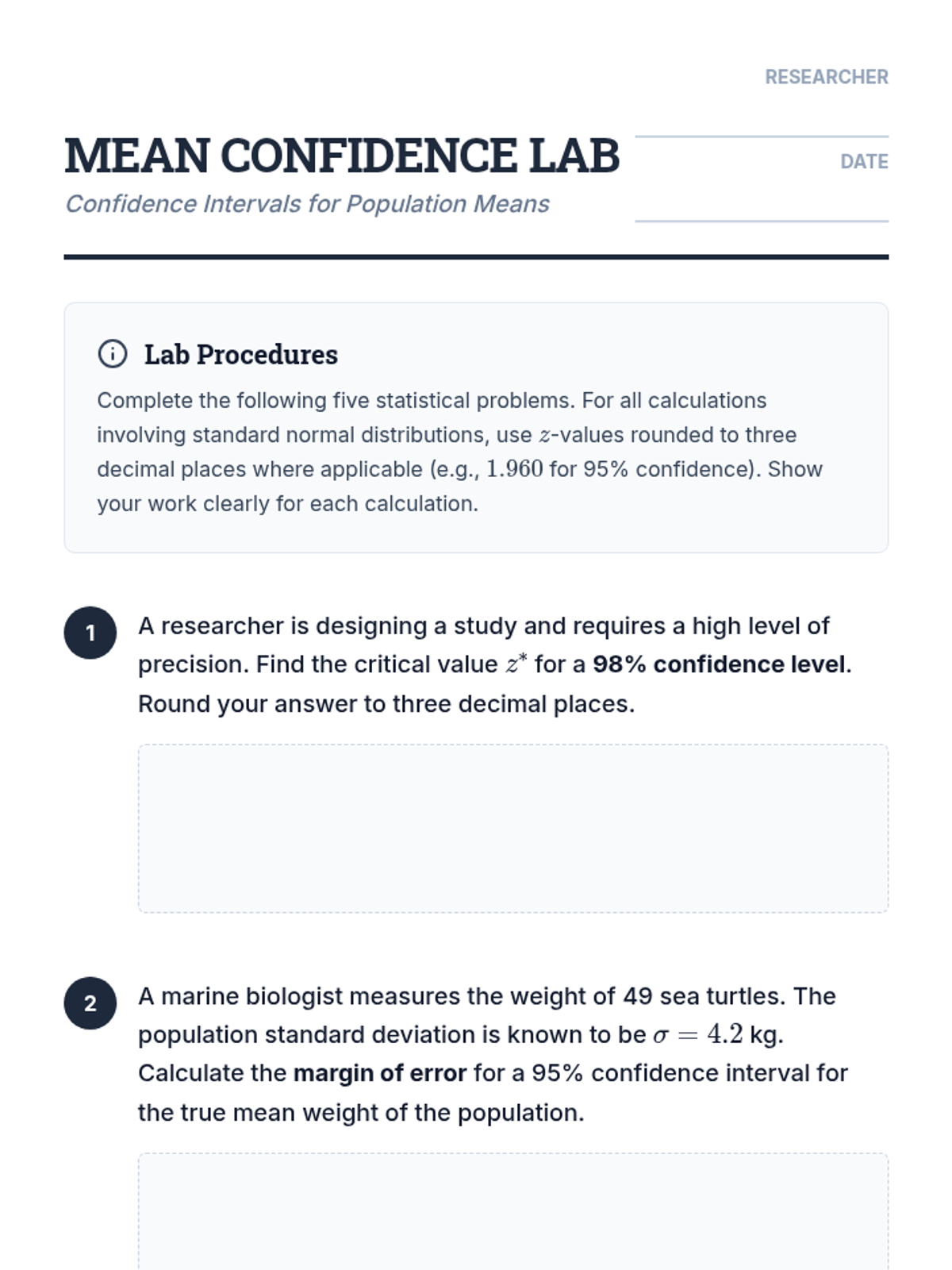
A practice worksheet for students covering the Empirical Rule, z-score calculations, and using a standard normal table with a real-world case study.
A detailed lesson plan for teachers, covering learning objectives, vocabulary, direct instruction scripts for the empirical rule and z-scores, common misconceptions, and differentiation strategies.
A professional teacher guide for instruction on discrete random variables, focusing on TEKS S.5(C) standards, common student misconceptions, and differentiation strategies.
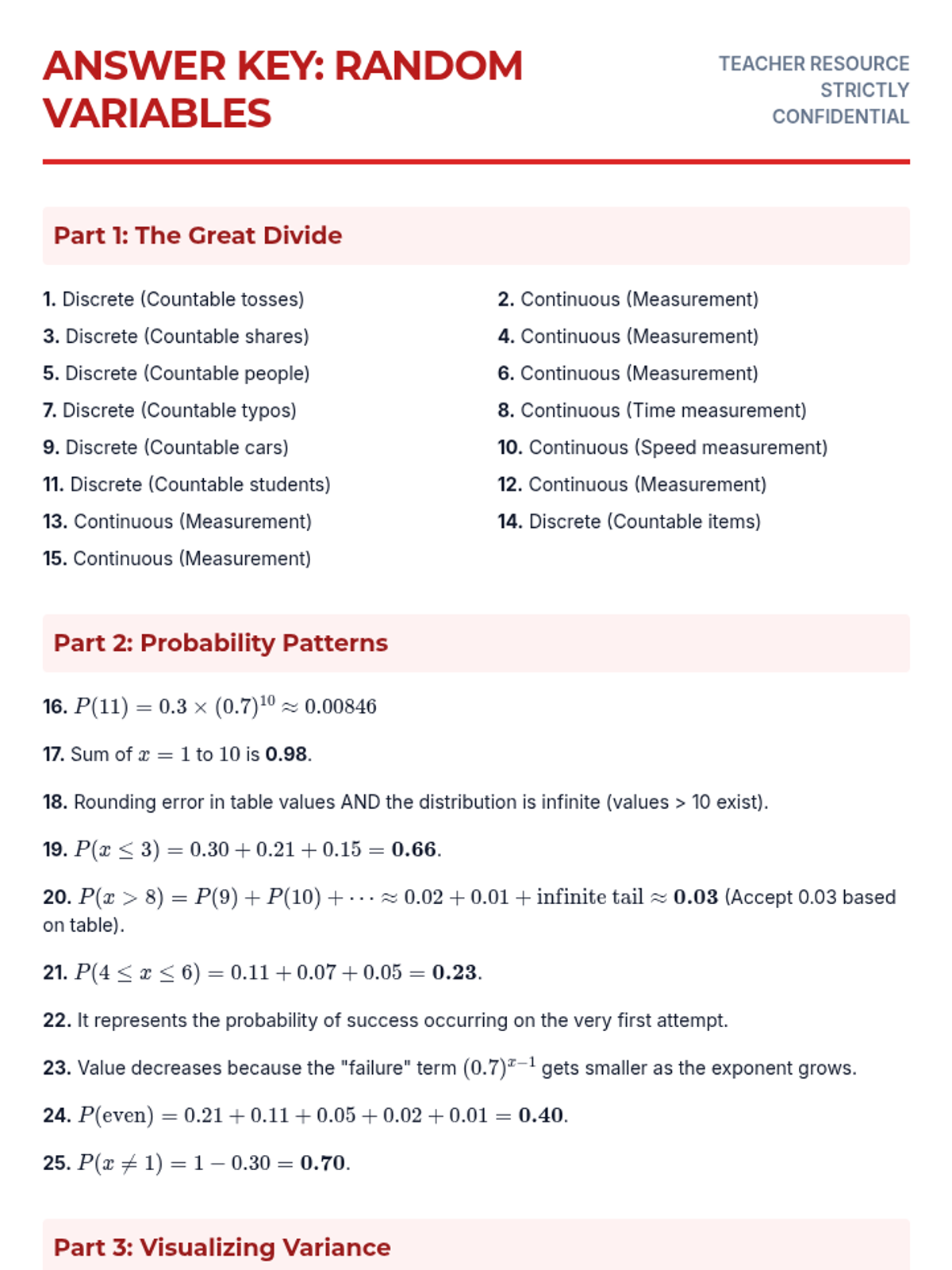
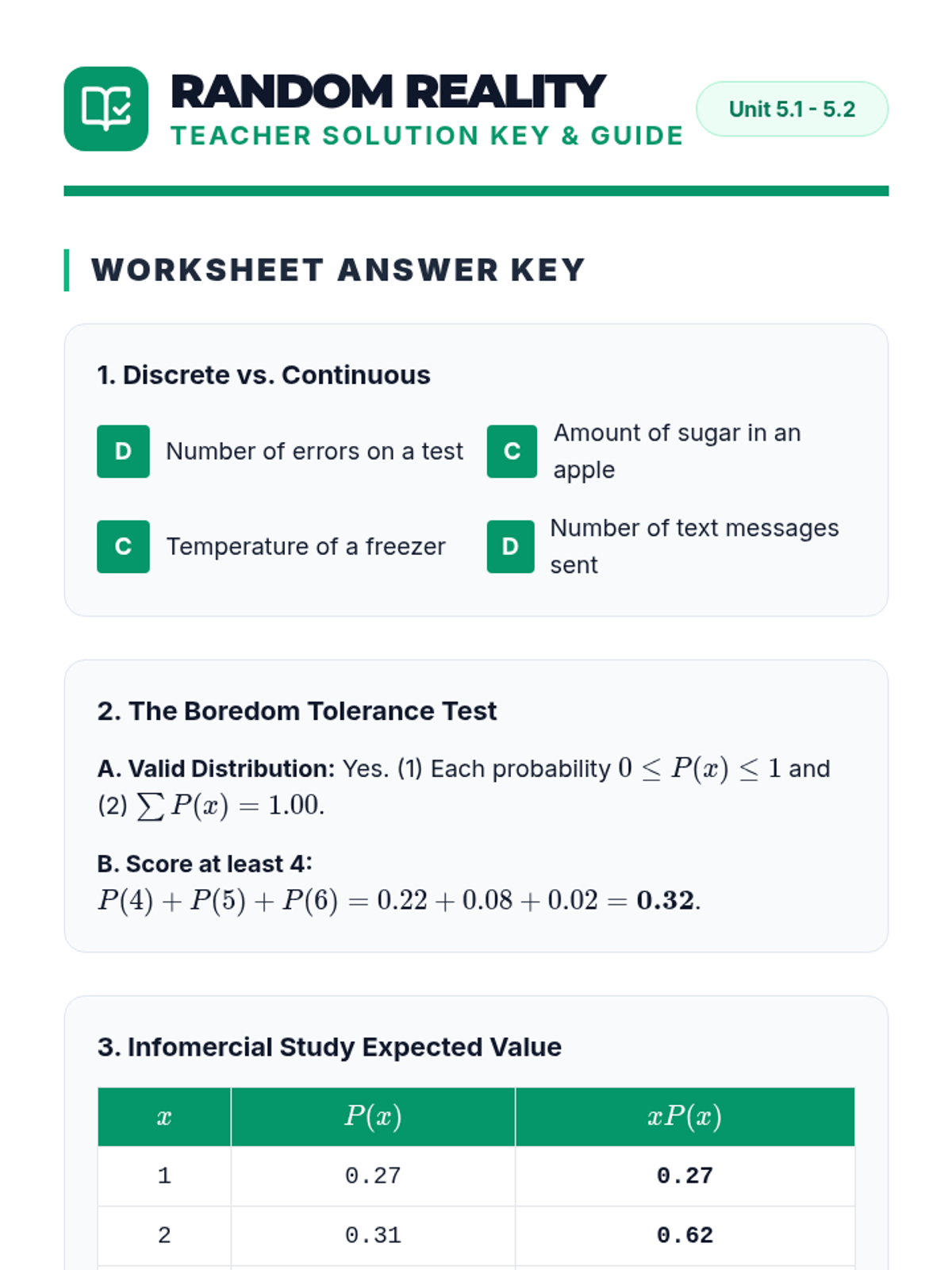
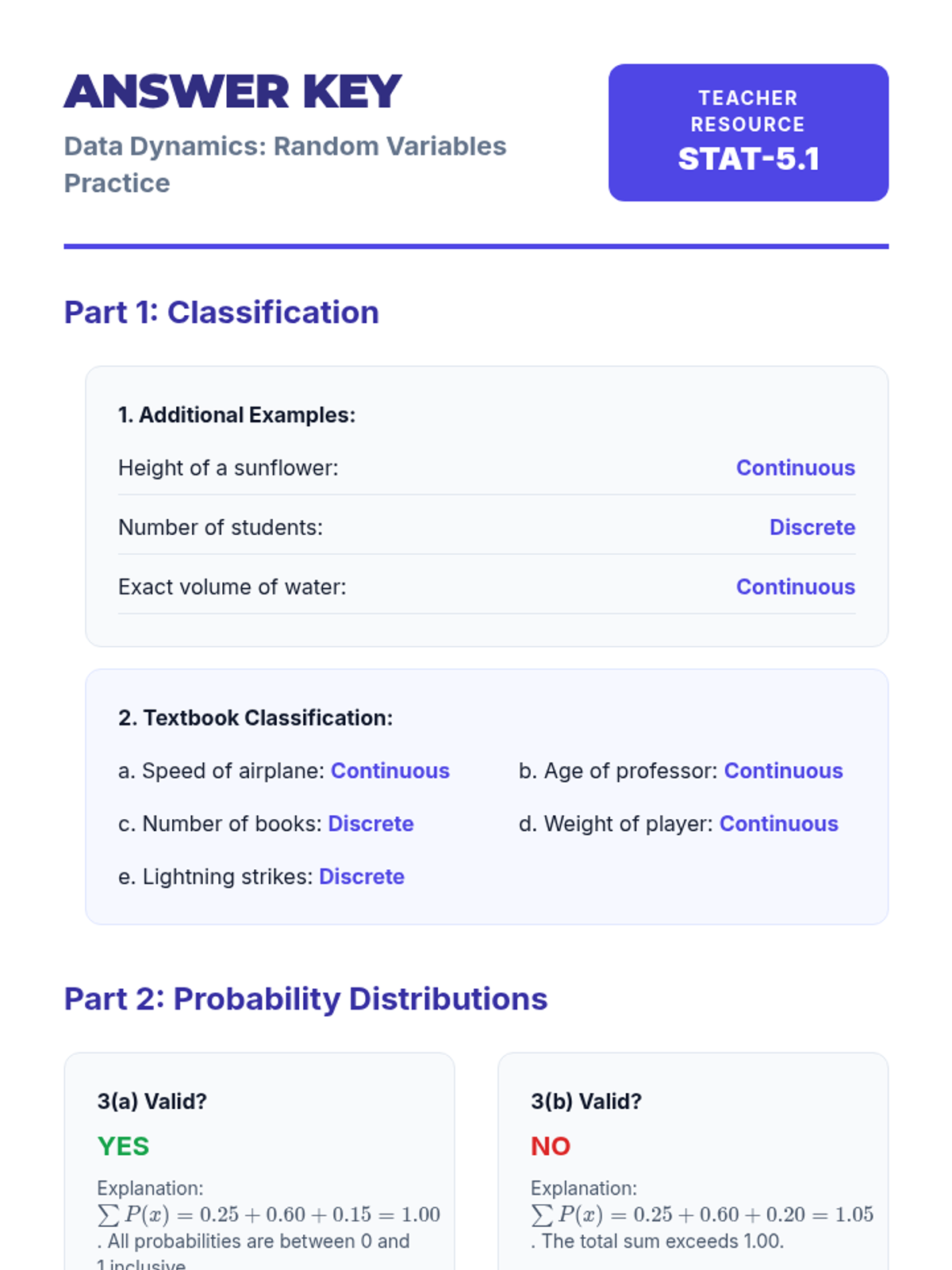
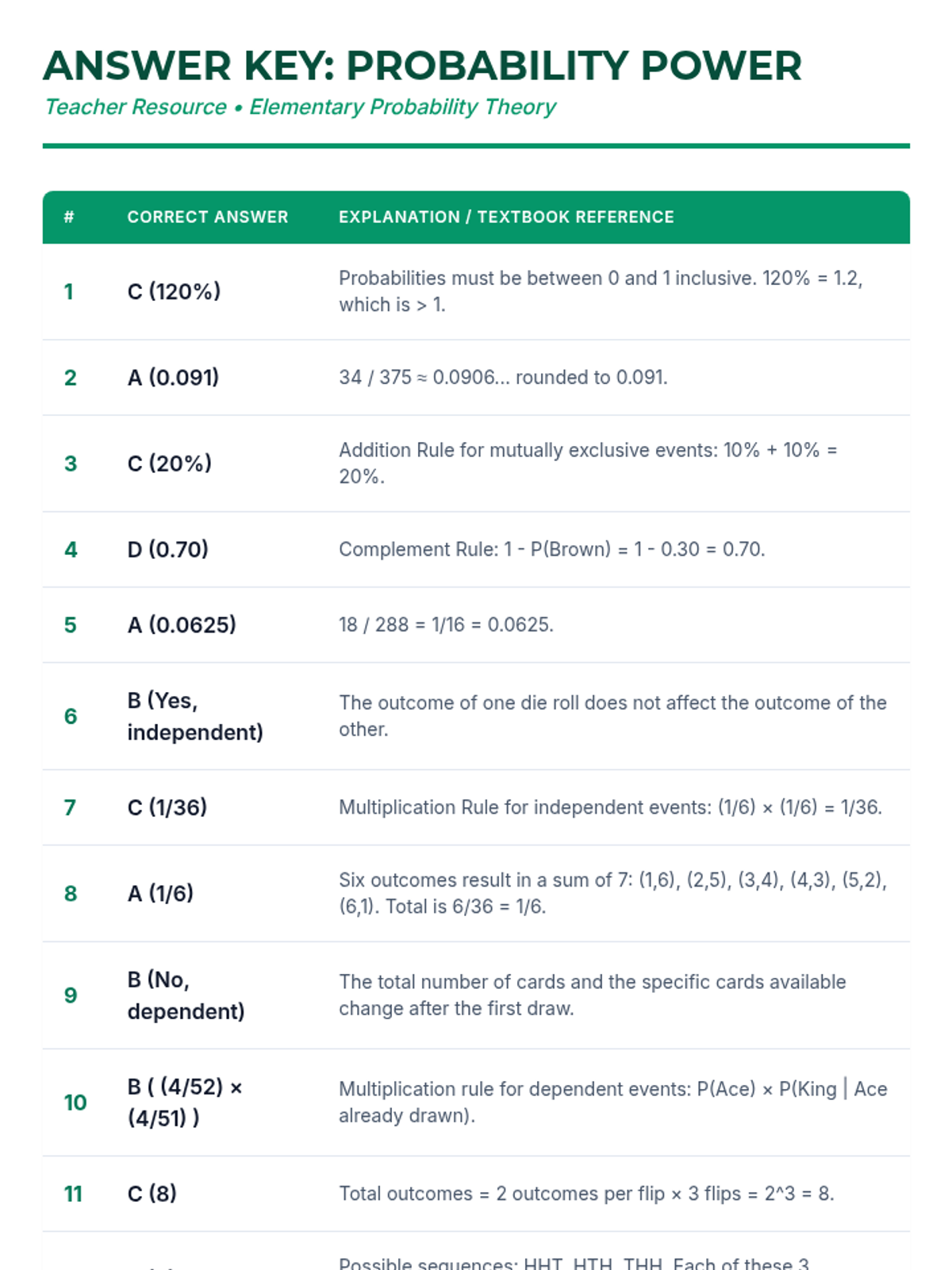
Updated answer key including solutions for the 10 classification problems in Section I, along with full calculations for the distribution construction and analysis problems.
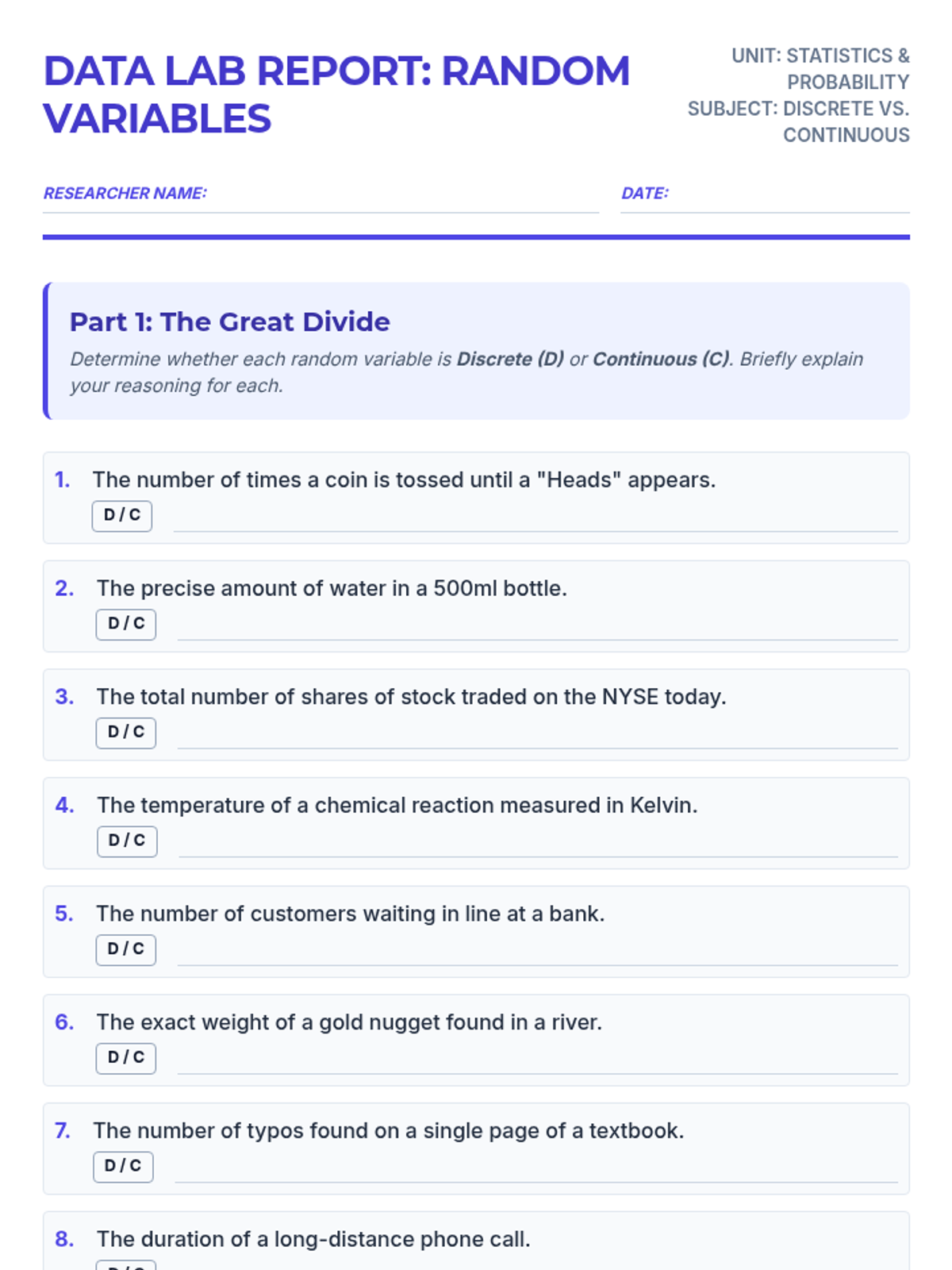
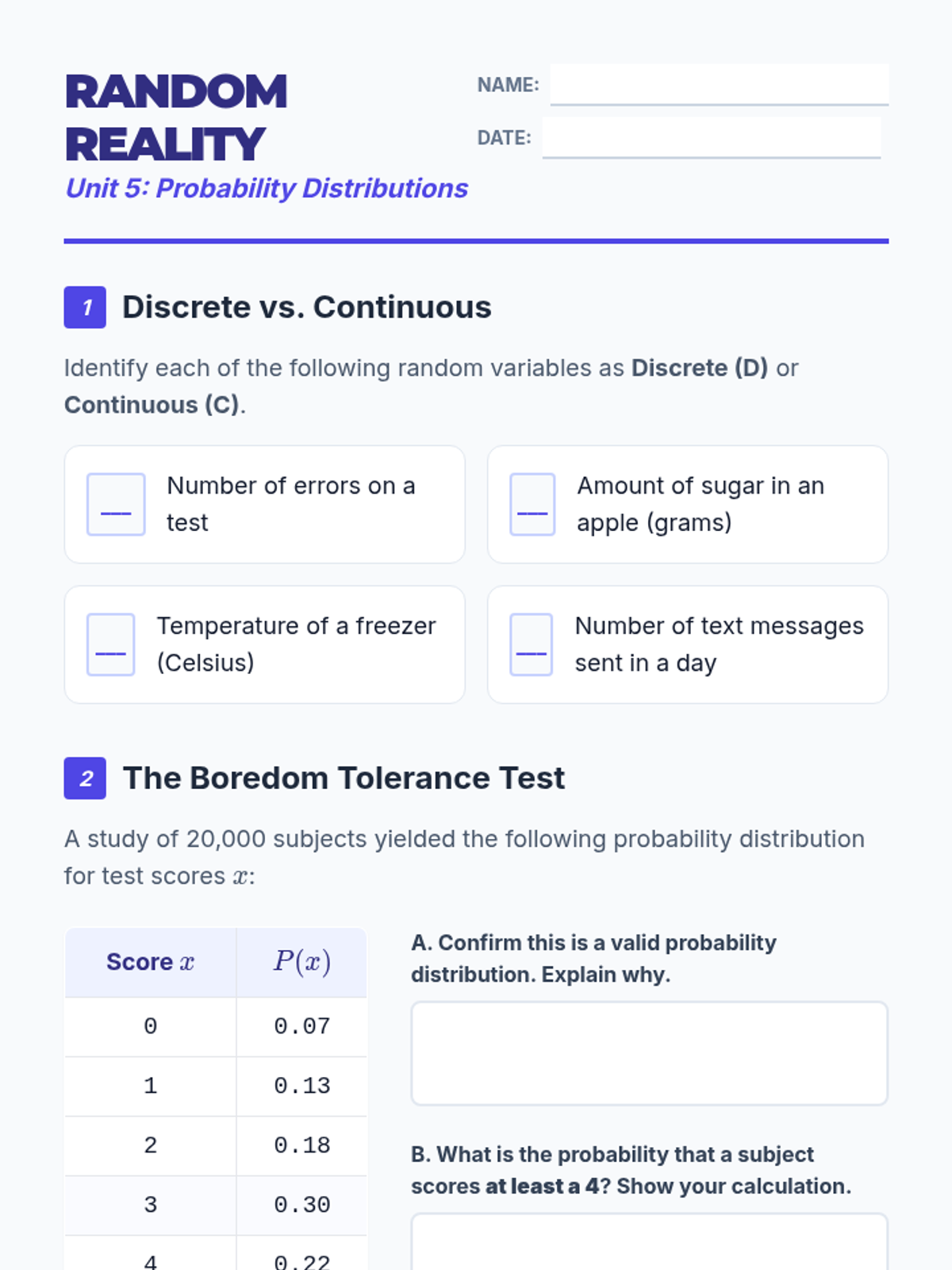
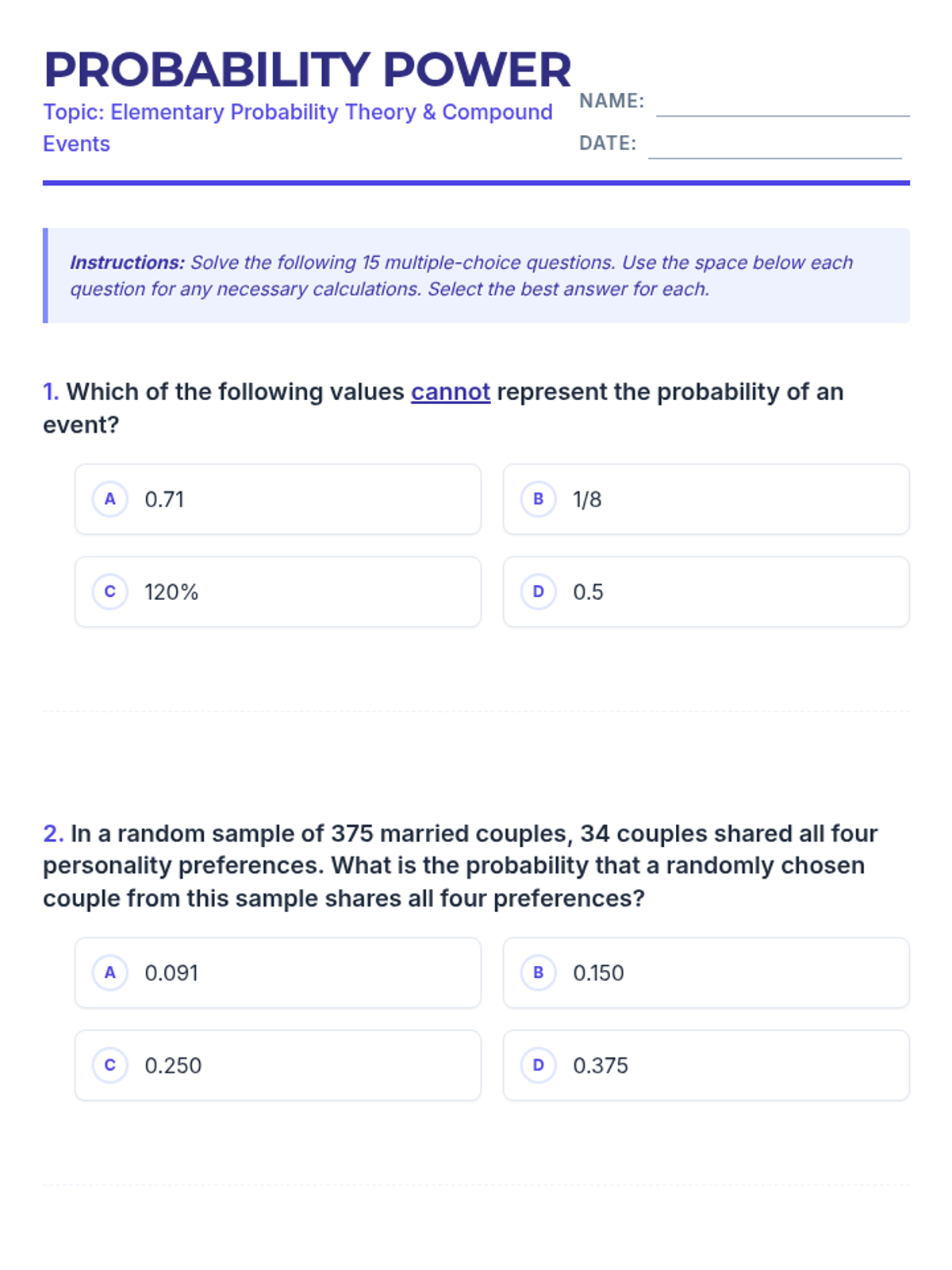
Updated practice worksheet with 6 additional classification problems in Section I, bringing the total to 10 identification tasks, plus the original distribution construction and analysis problems.
An instructional slide deck covering discrete random variables, the requirements for probability distributions, and the process of constructing distributions from sample data using relative frequency.
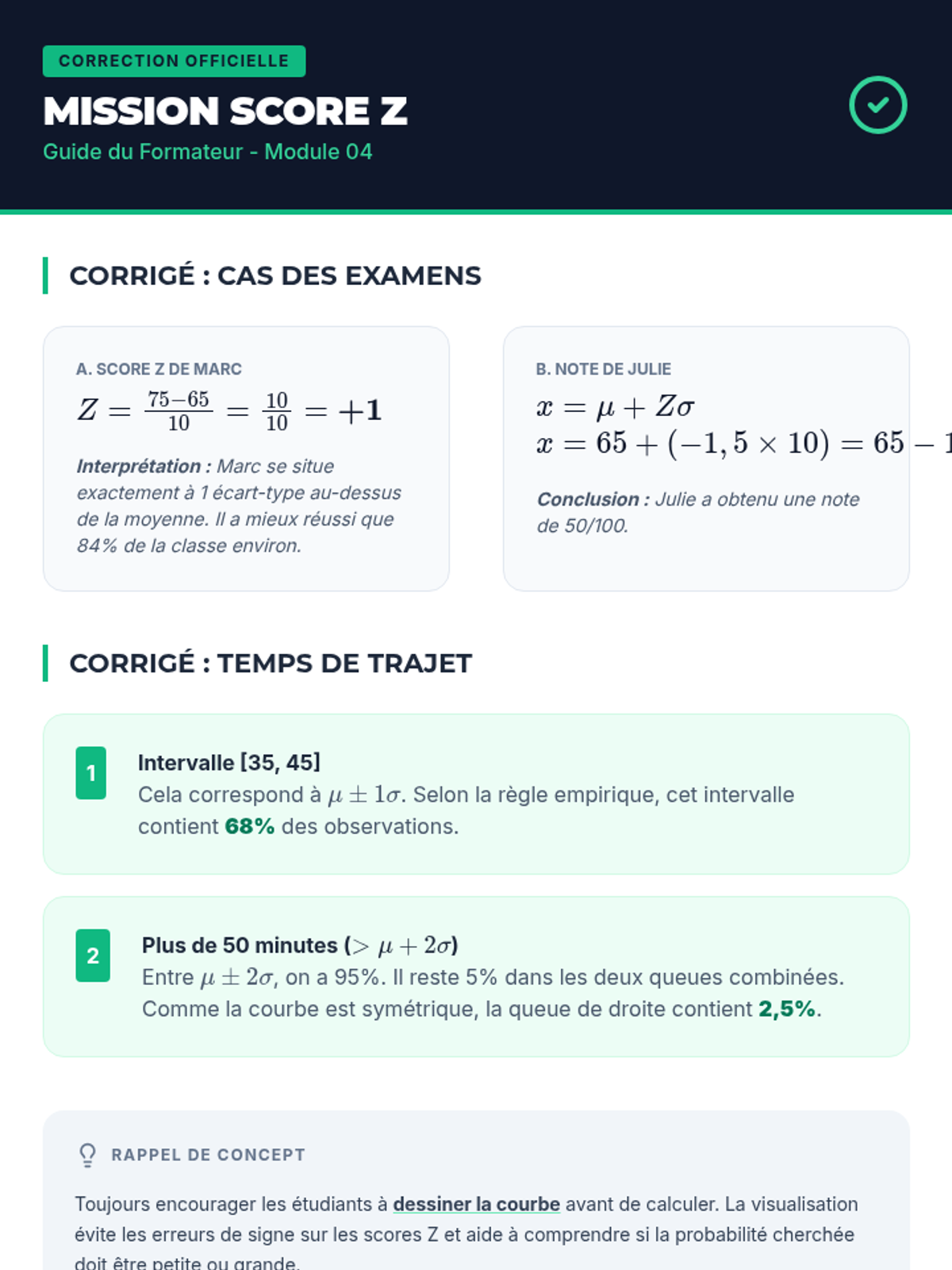
Guide de correction complet pour les exercices sur la loi normale, détaillant les calculs de scores Z et l'application de la règle empirique.
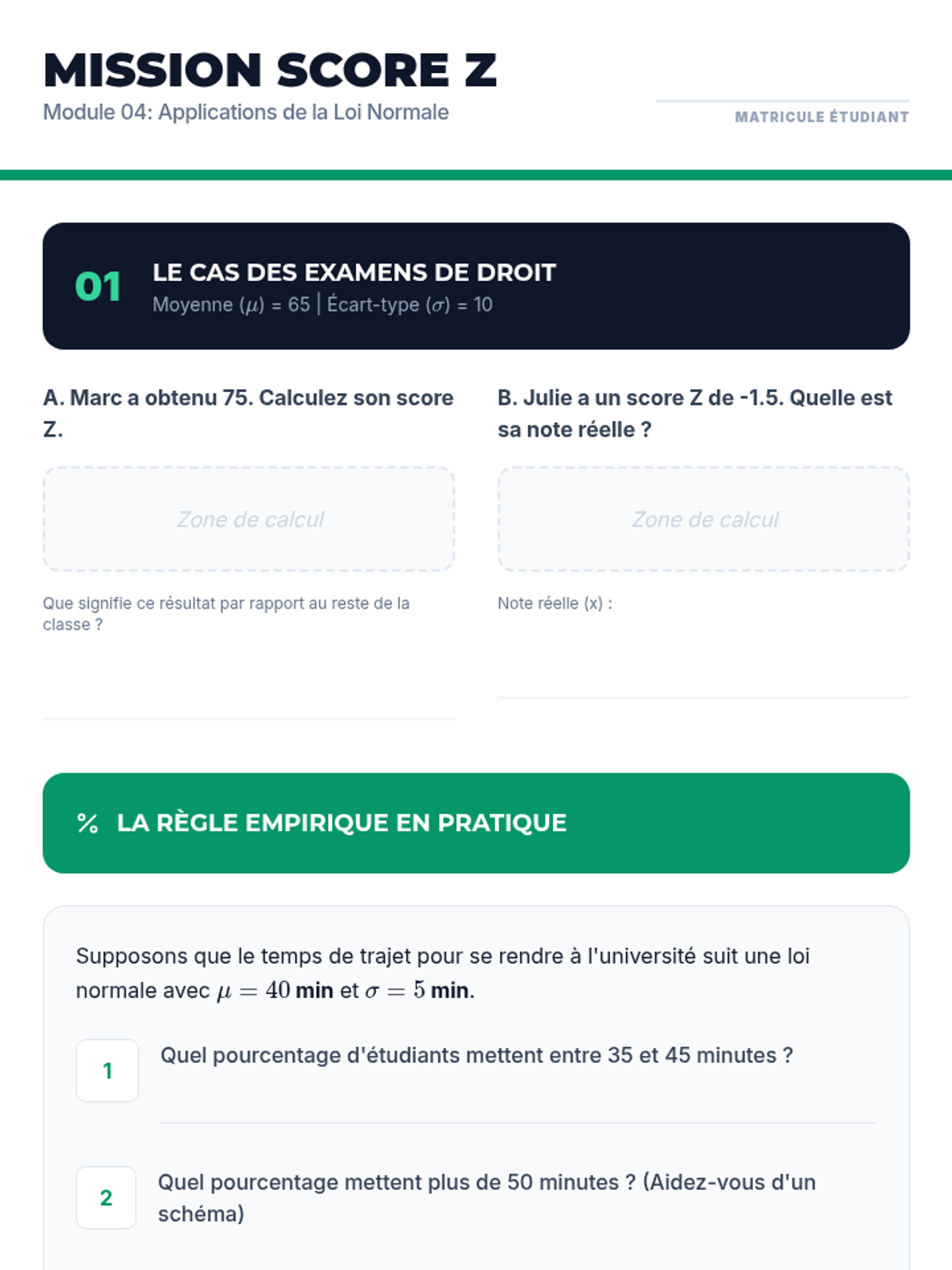
Feuille d'exercices sur la loi normale, incluant le calcul de scores Z, la conversion de scores en valeurs réelles et l'application de la règle empirique.
Présentation de la loi normale, des propriétés de la courbe en cloche, de la règle empirique (68-95-99.7) et du calcul du score Z pour la standardisation.
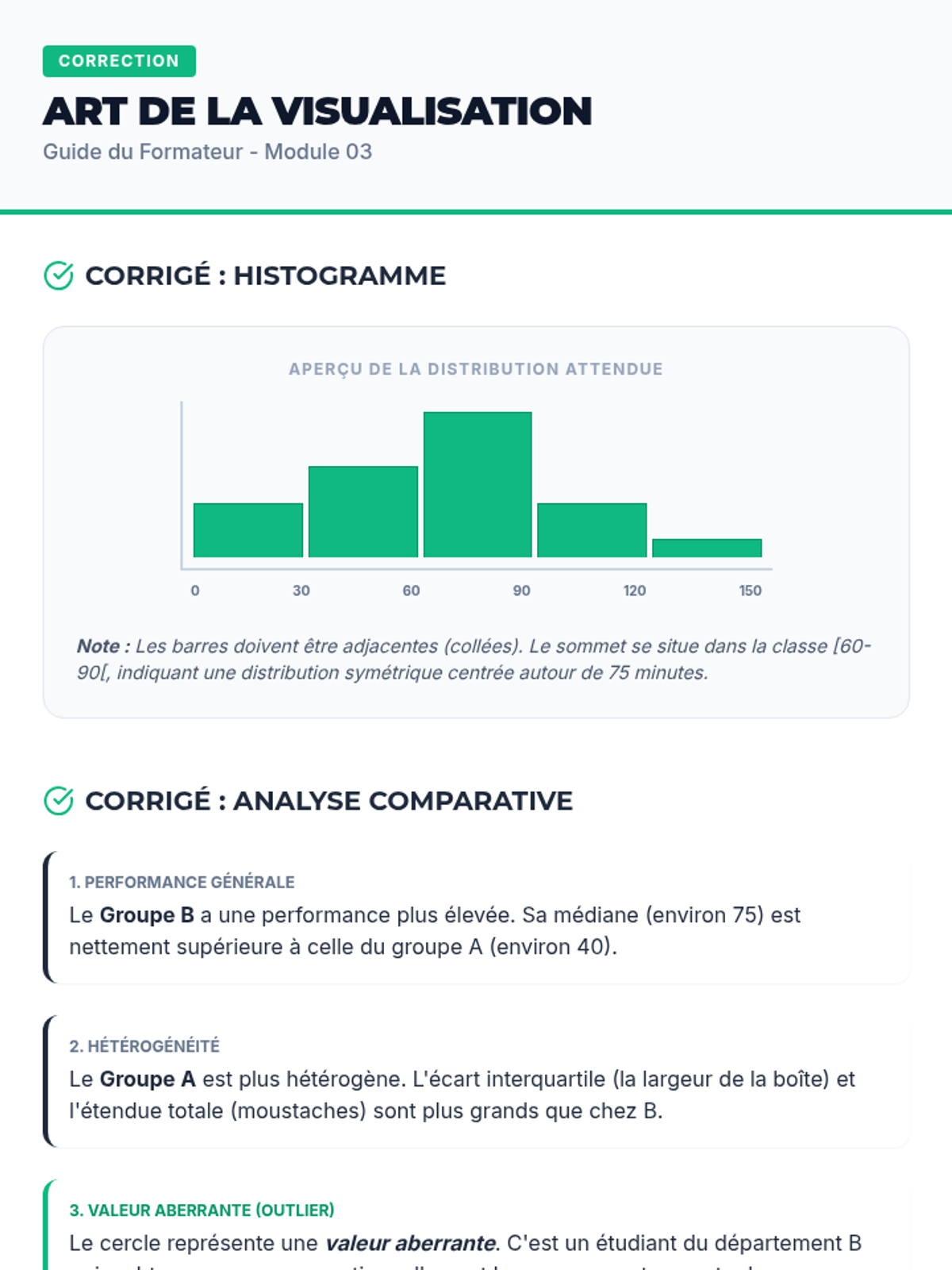
Guide de correction pour l'atelier de visualisation, illustrant le tracé de l'histogramme et fournissant les justifications analytiques pour l'interprétation des boîtes à moustaches.
Atelier de tracé d'un histogramme à partir de données groupées et d'analyse comparative de boîtes à moustaches pour identifier les performances et les valeurs aberrantes.
Support visuel présentant les principes de visualisation de données : choix du graphique, structure de l'histogramme et anatomie d'une boîte à moustaches.
Guide de correction détaillé pour les calculs de tendance centrale et de dispersion, incluant les calculs intermédiaires et les interprétations conceptuelles.
Feuille de travail axée sur le calcul de la moyenne, médiane, mode et écart-type à partir de jeux de données réels, avec une section sur l'interprétation de la dispersion.
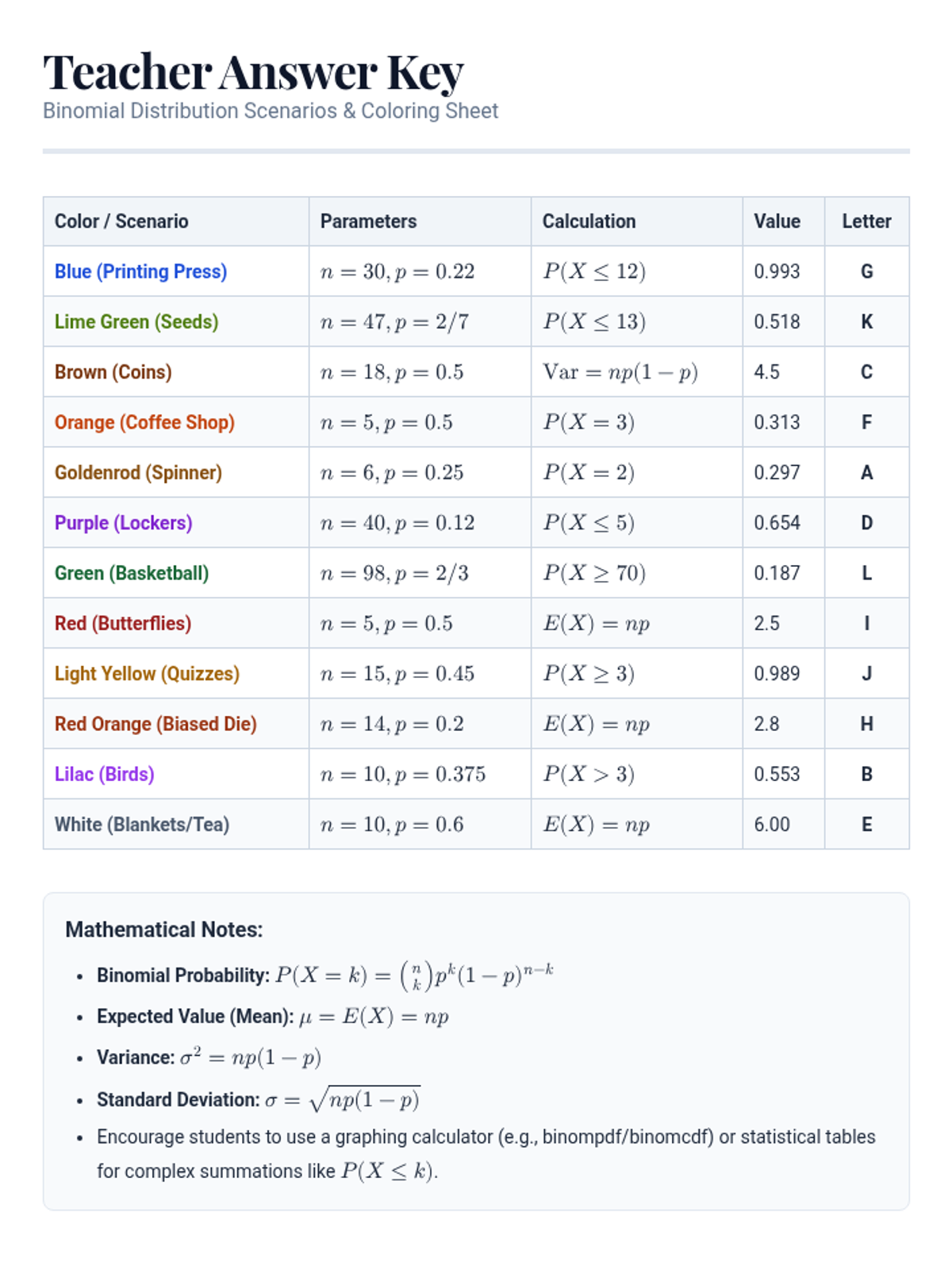
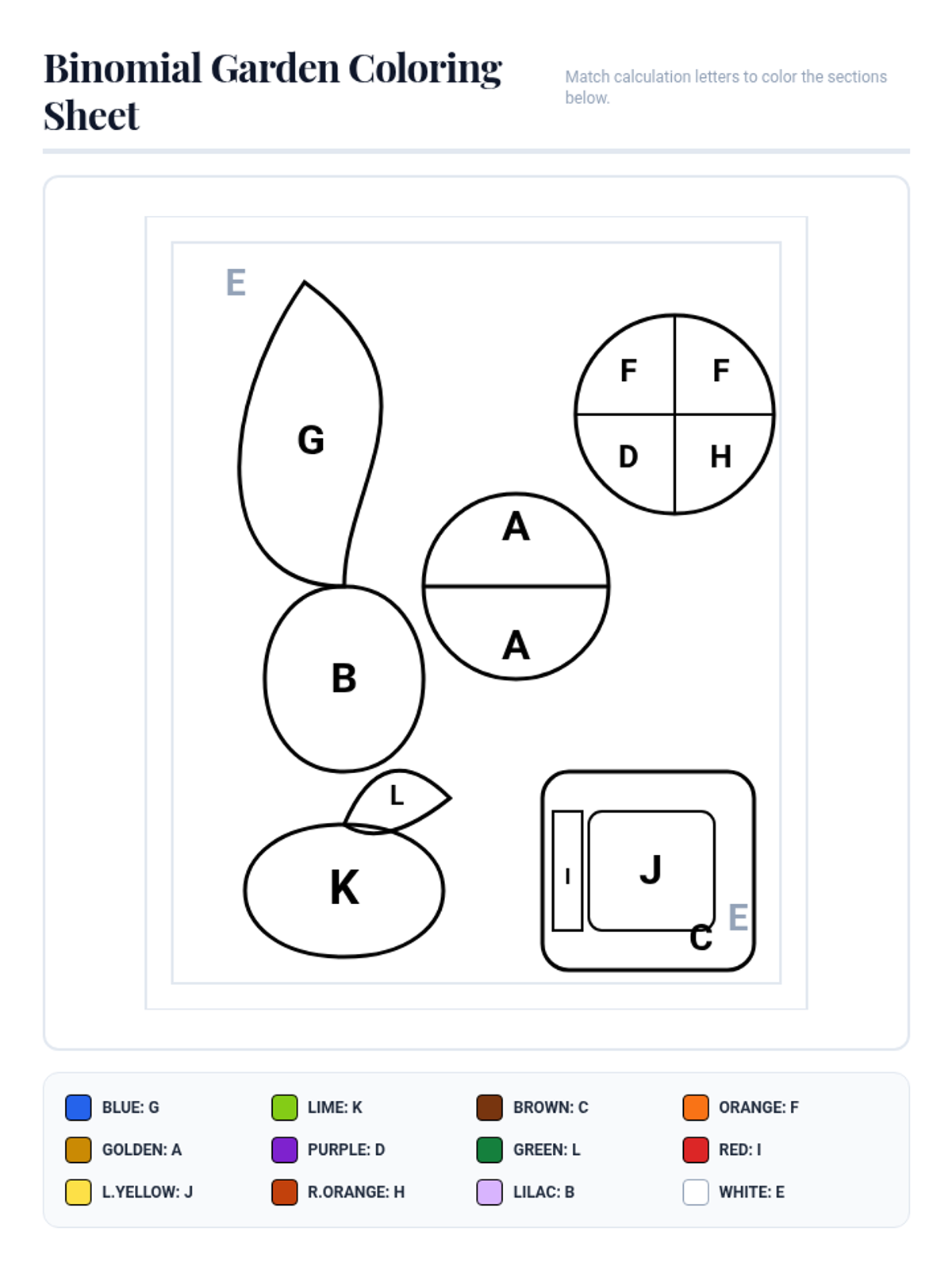
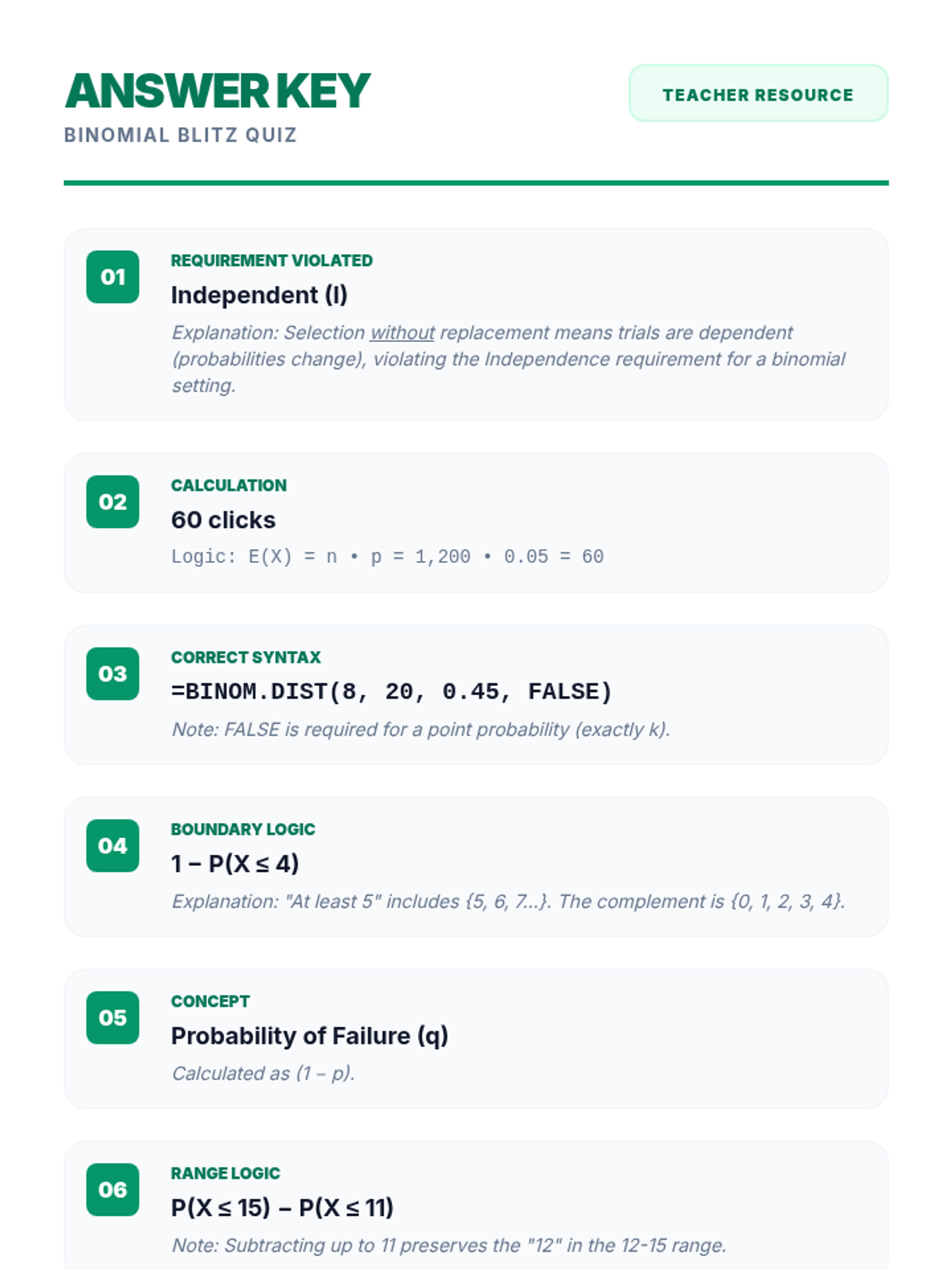
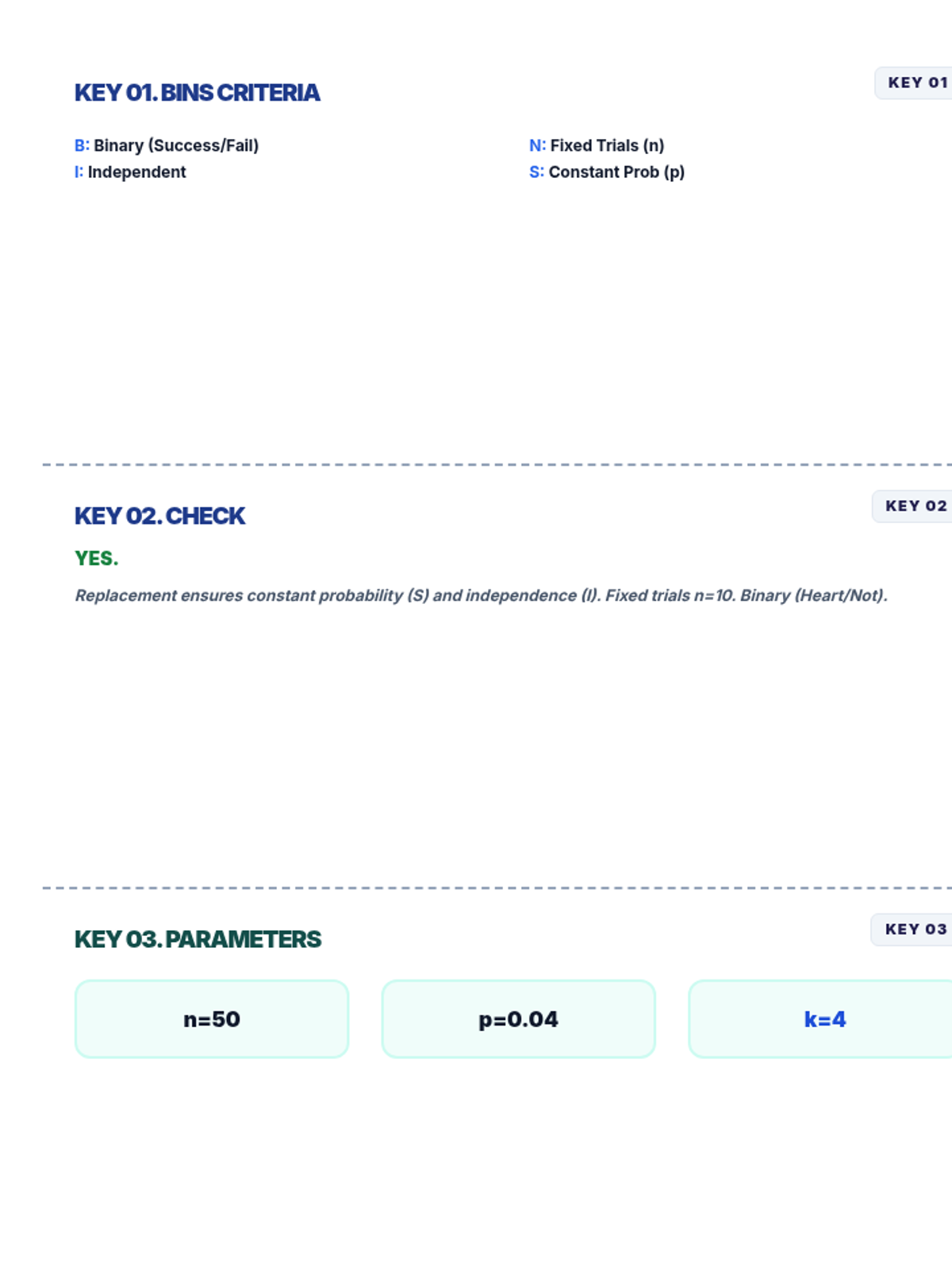
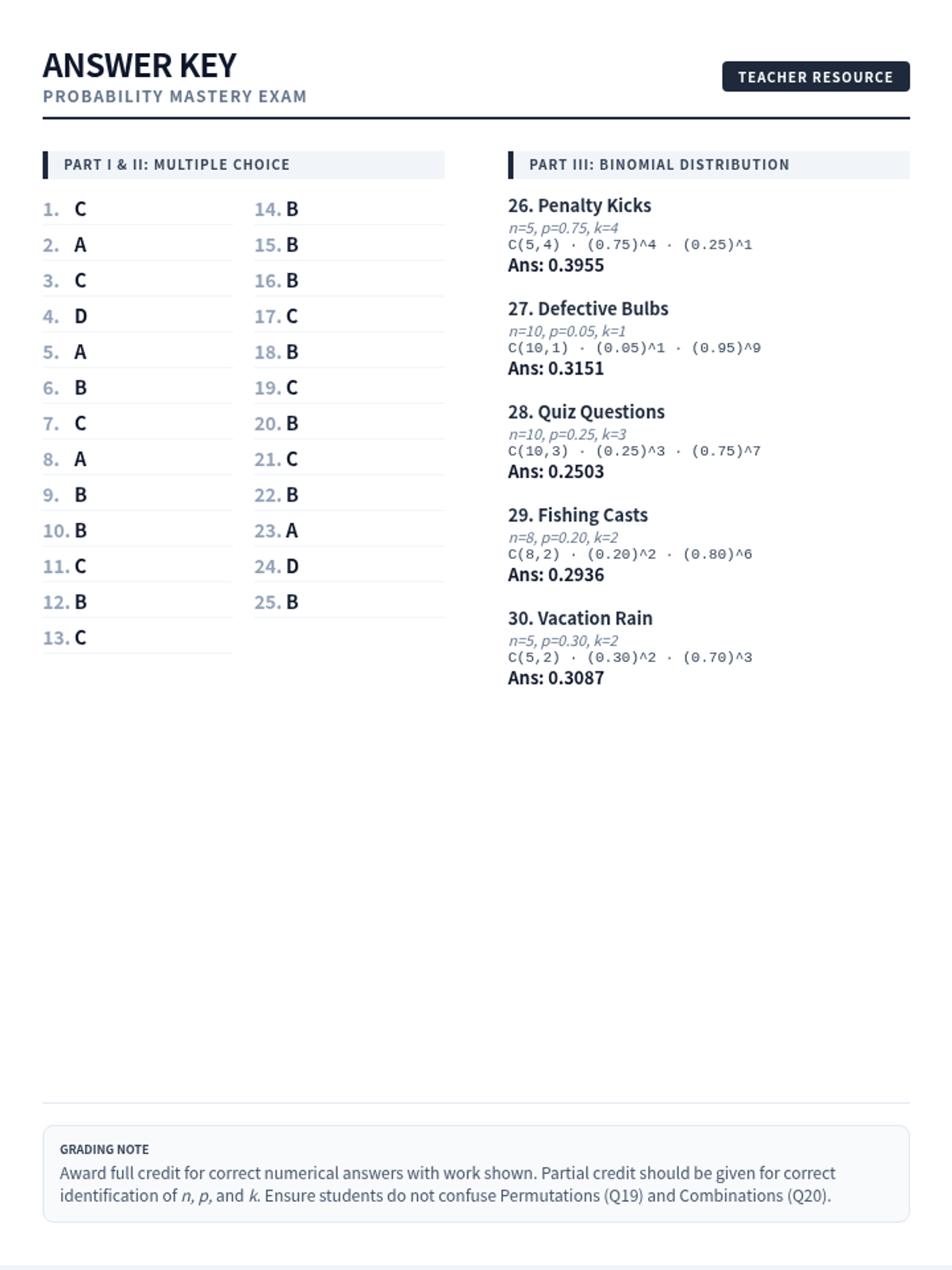
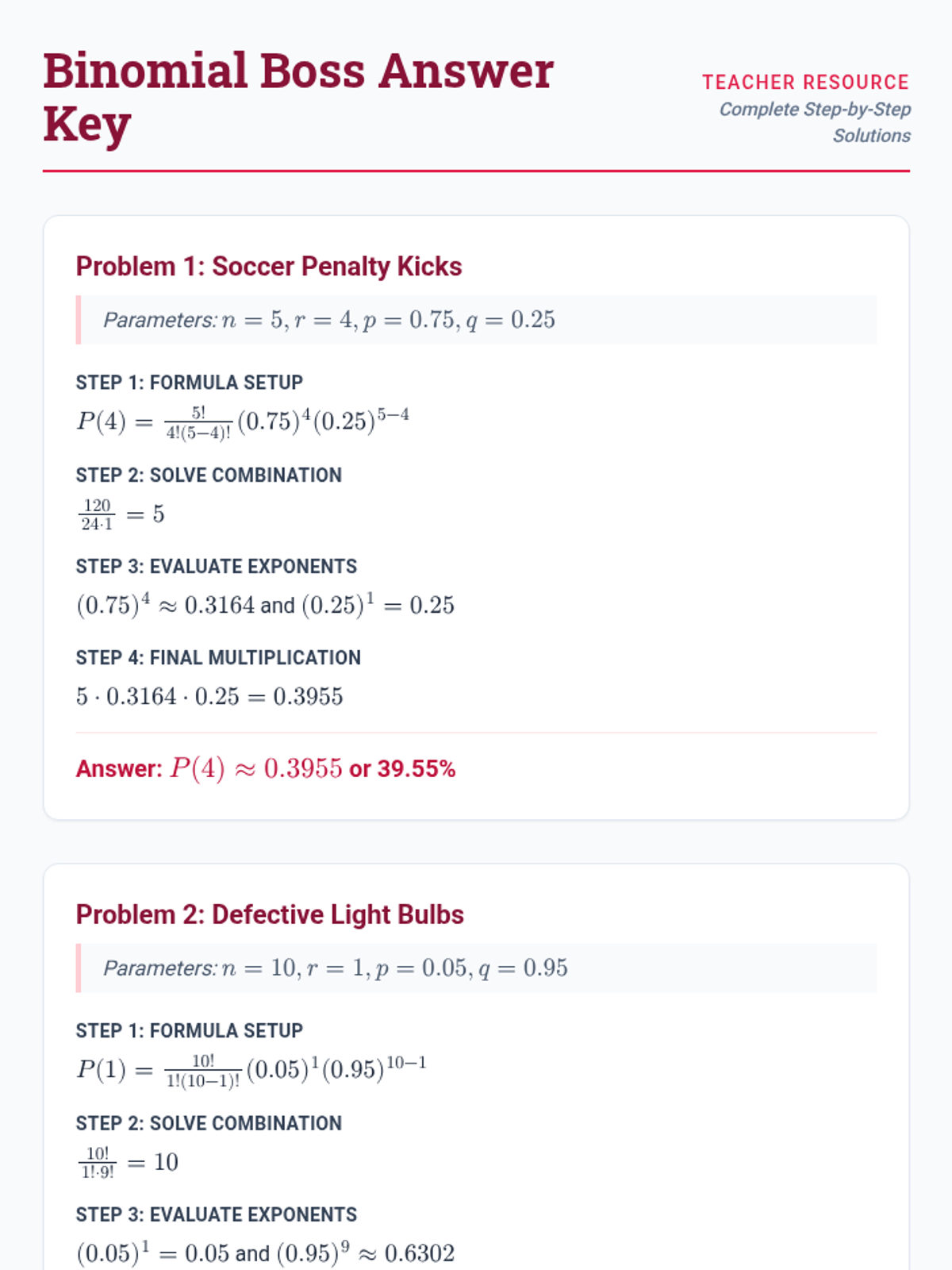
The teacher answer key for the Binomial Bounds Worksheet, including step-by-step calculations for mean, variance, and standard deviation.
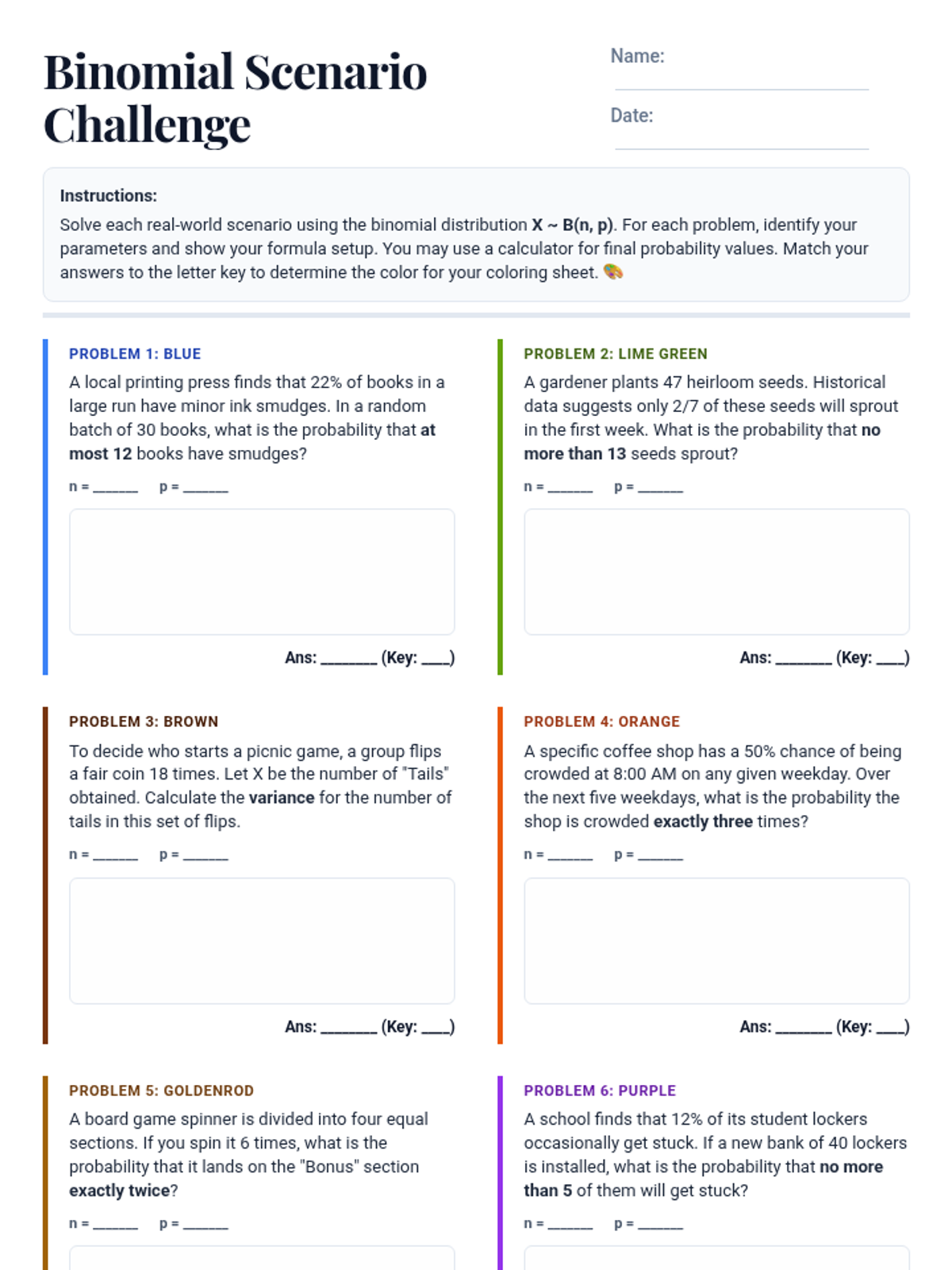
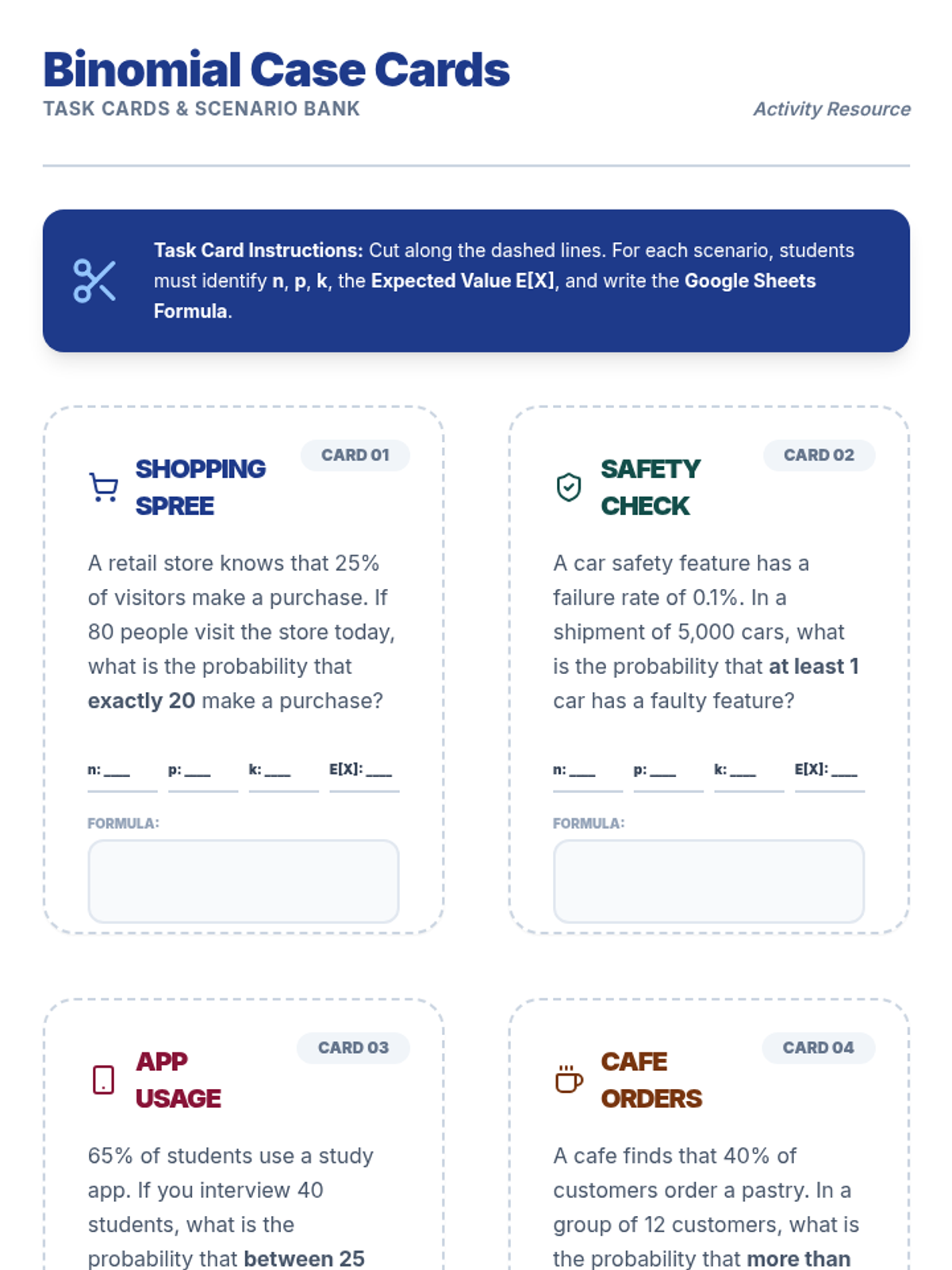
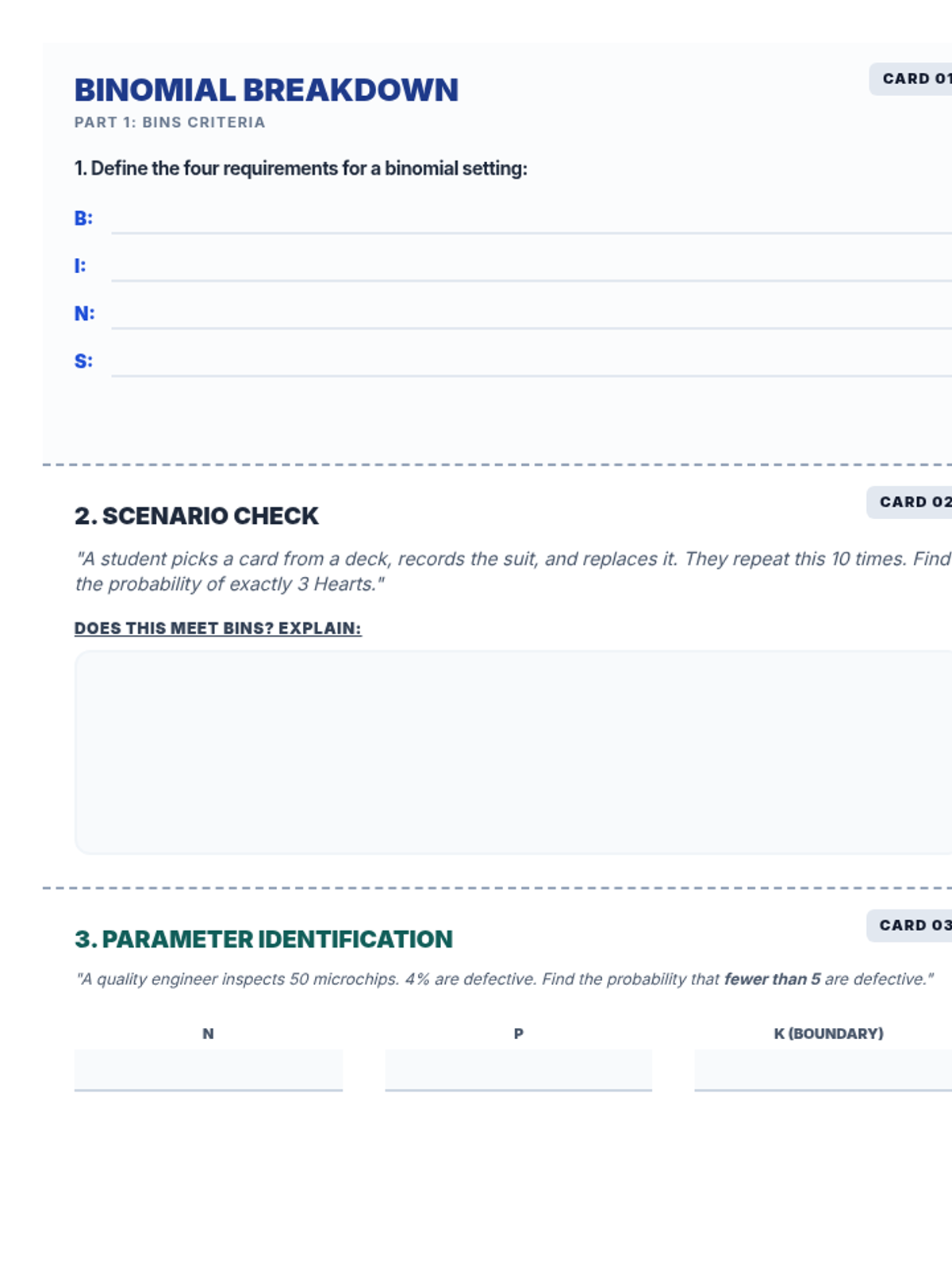
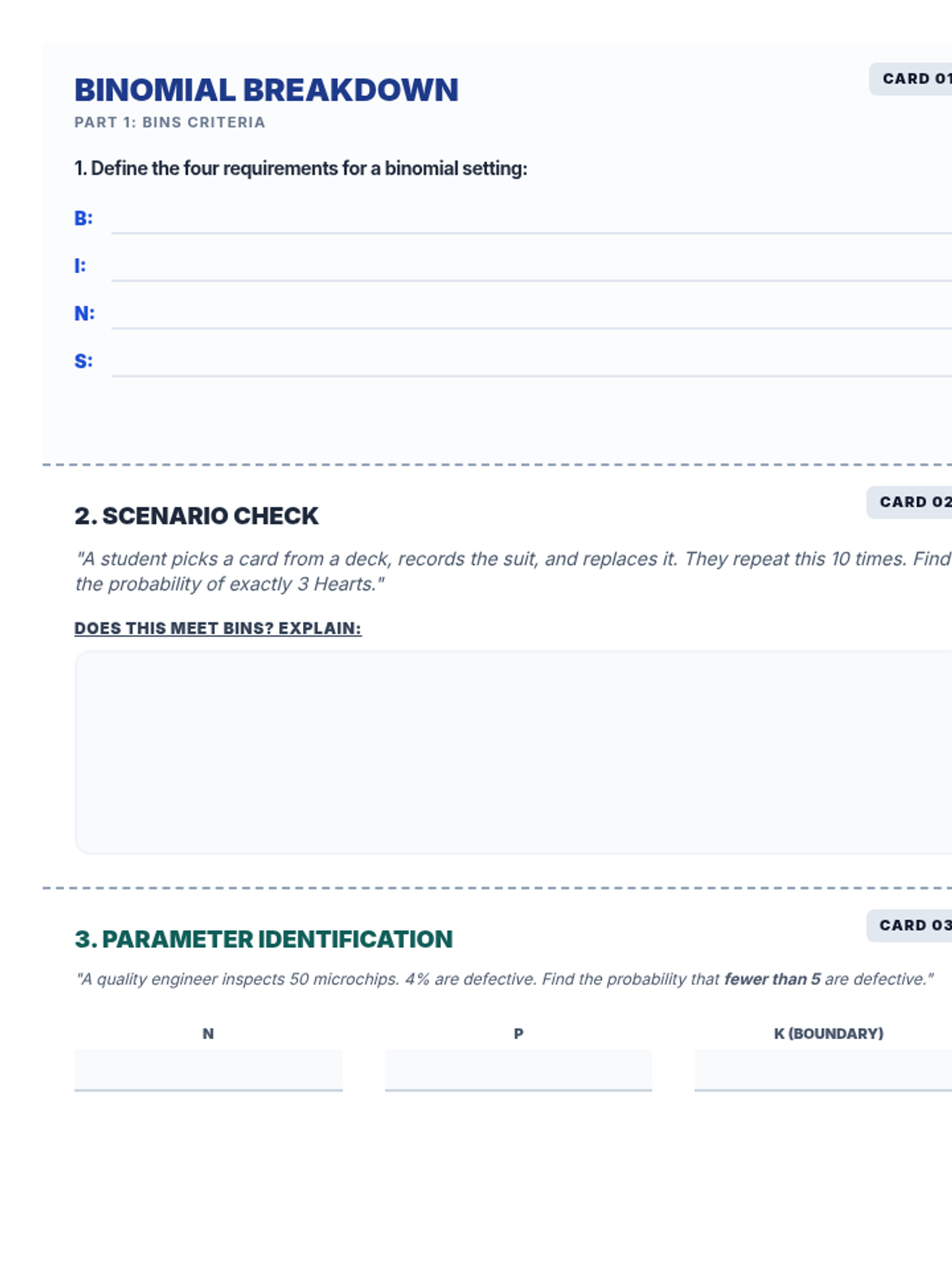
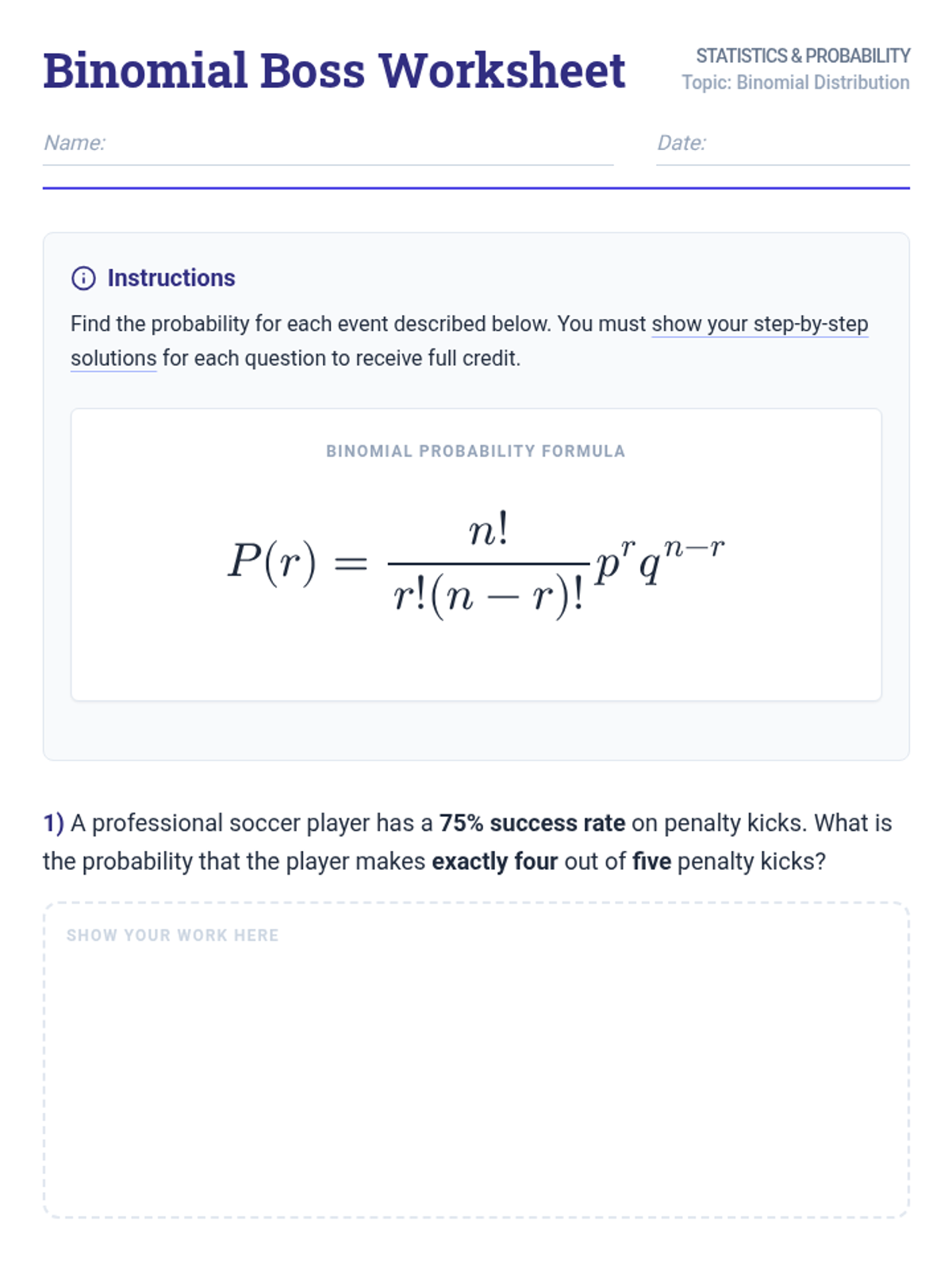
A 5-problem worksheet for practicing binomial distribution calculations, formatted with clear page breaks to prevent content splitting.
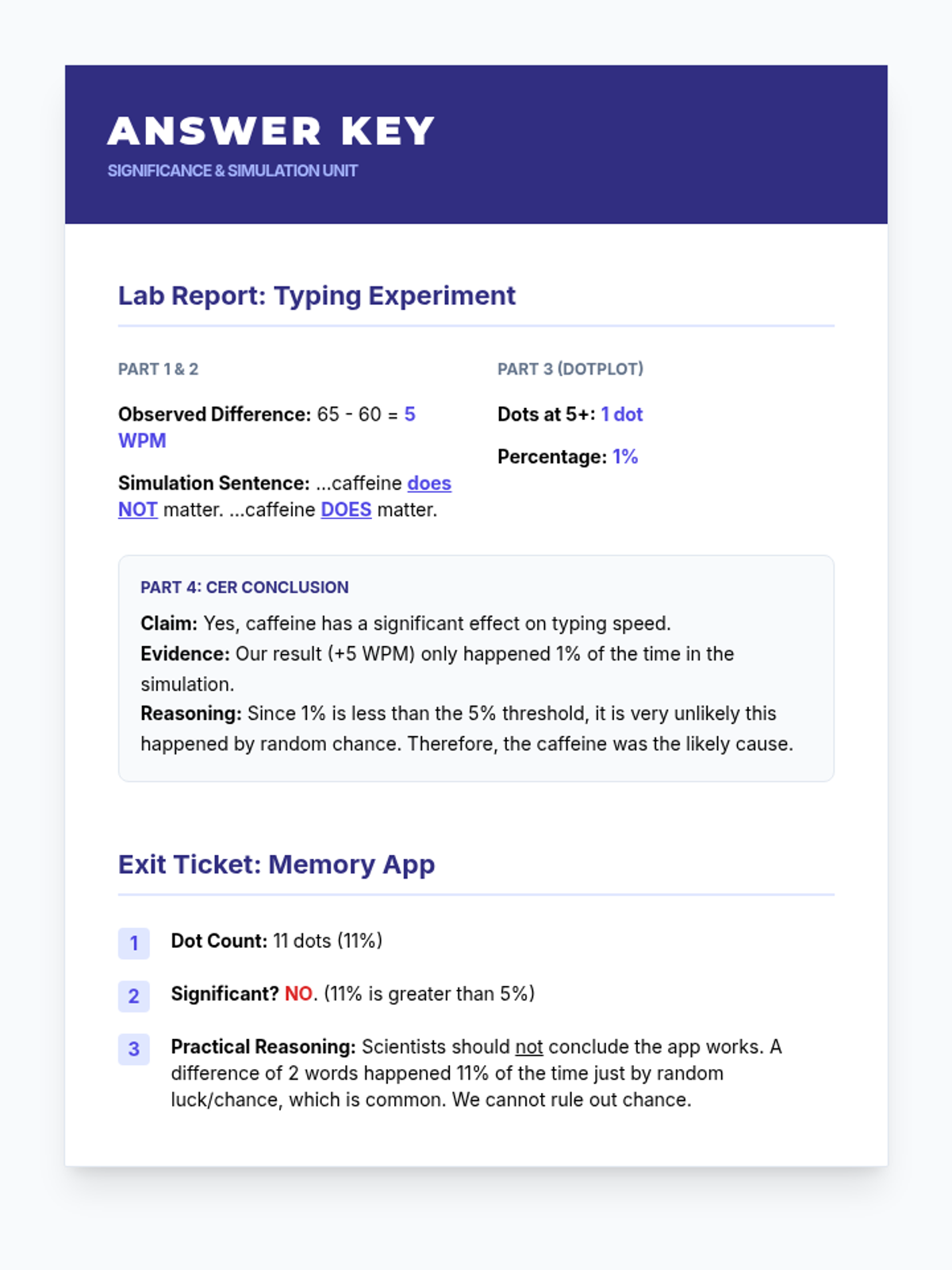
Answer key for the Lab Report and Exit Ticket, providing model responses for calculations, data analysis, and CER conclusions.
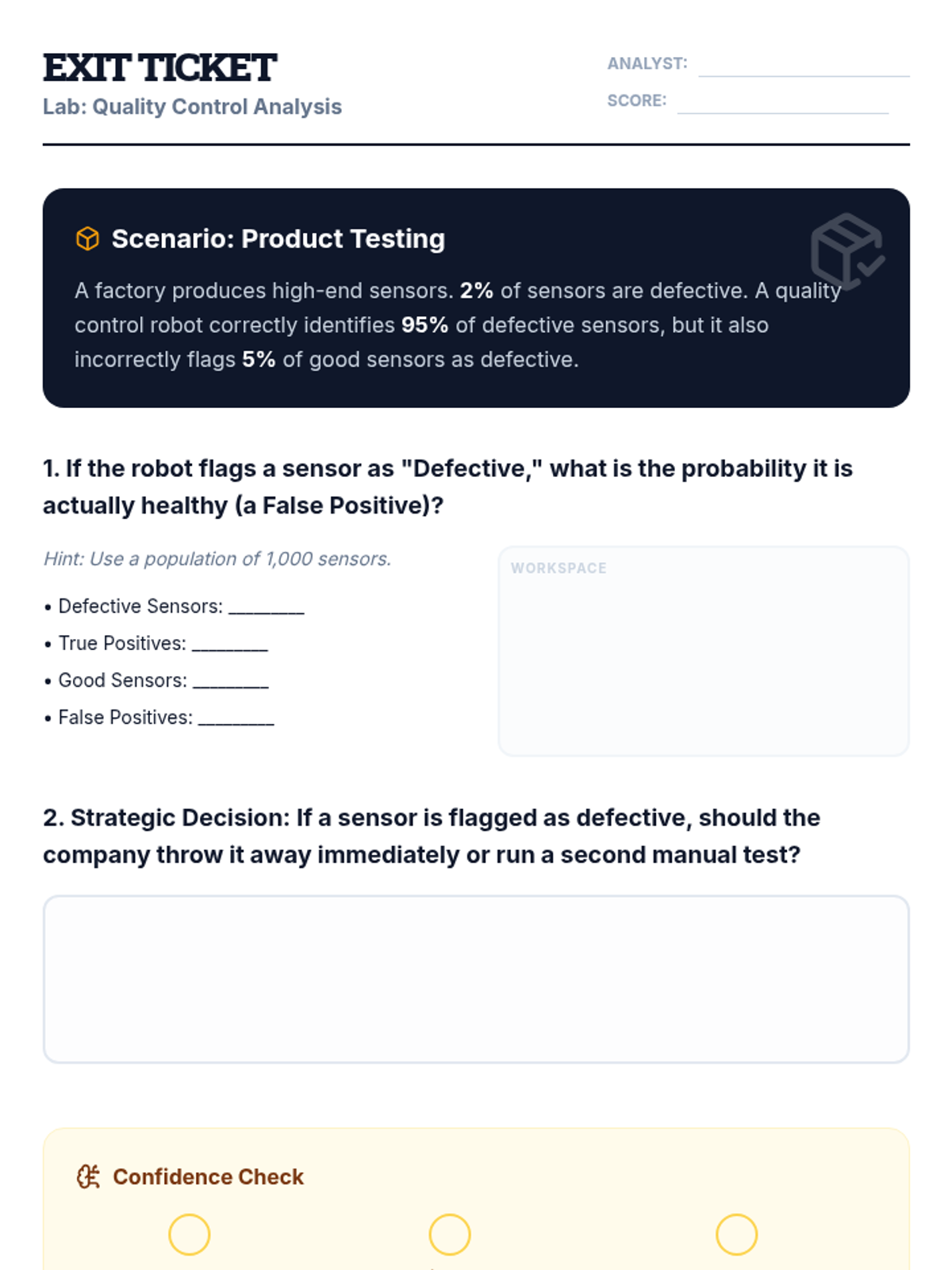
A quick assessment tool for students to demonstrate their understanding of probability-based decision making in a product testing context. It includes a structured workspace for calculations and a qualitative decision-making question.
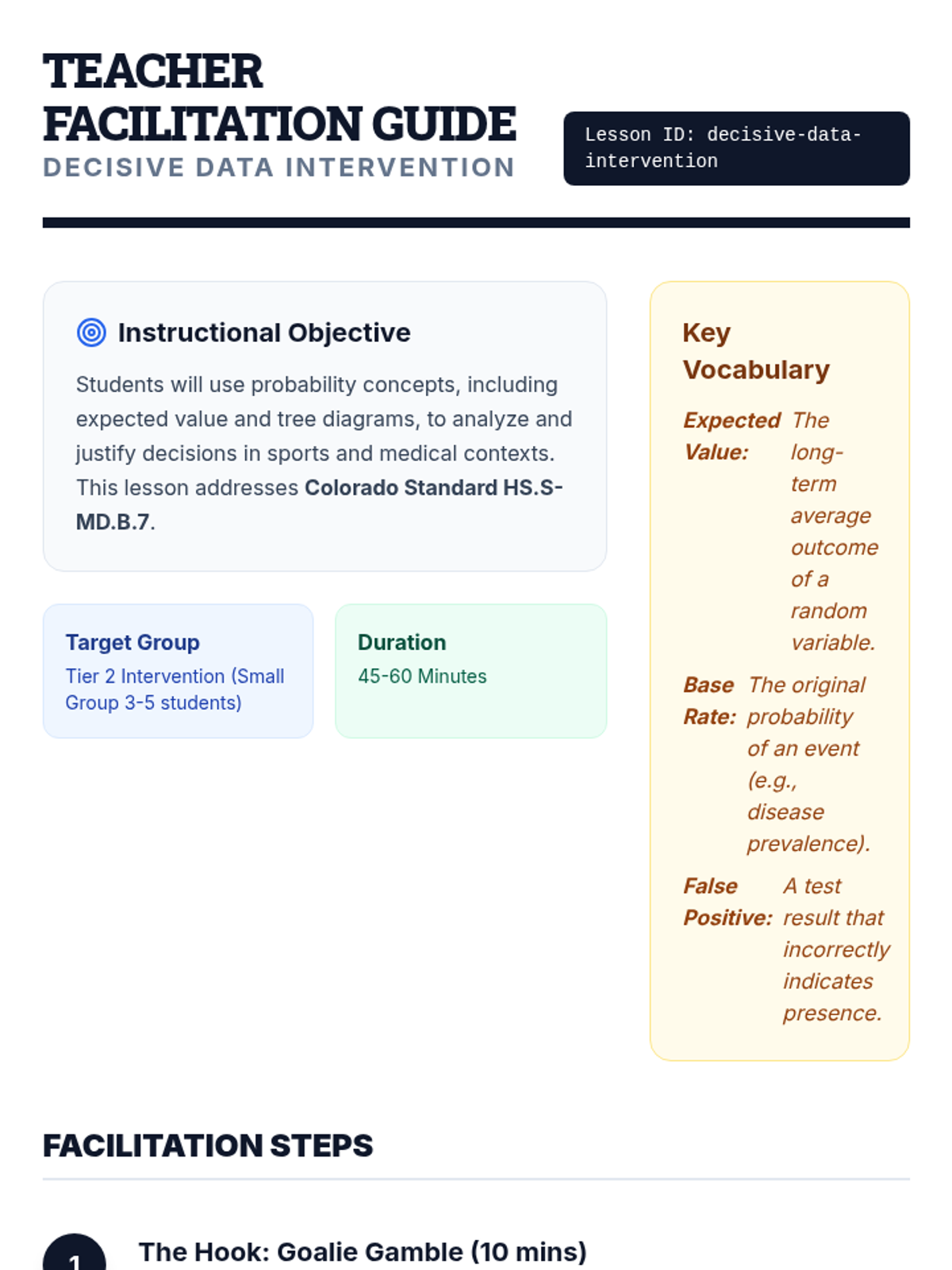
A comprehensive teacher facilitation guide for the Decisive Data intervention lesson. It includes step-by-step instructional prompts, common student misconceptions, a full answer key, and a progress monitoring checklist for tracking student growth.
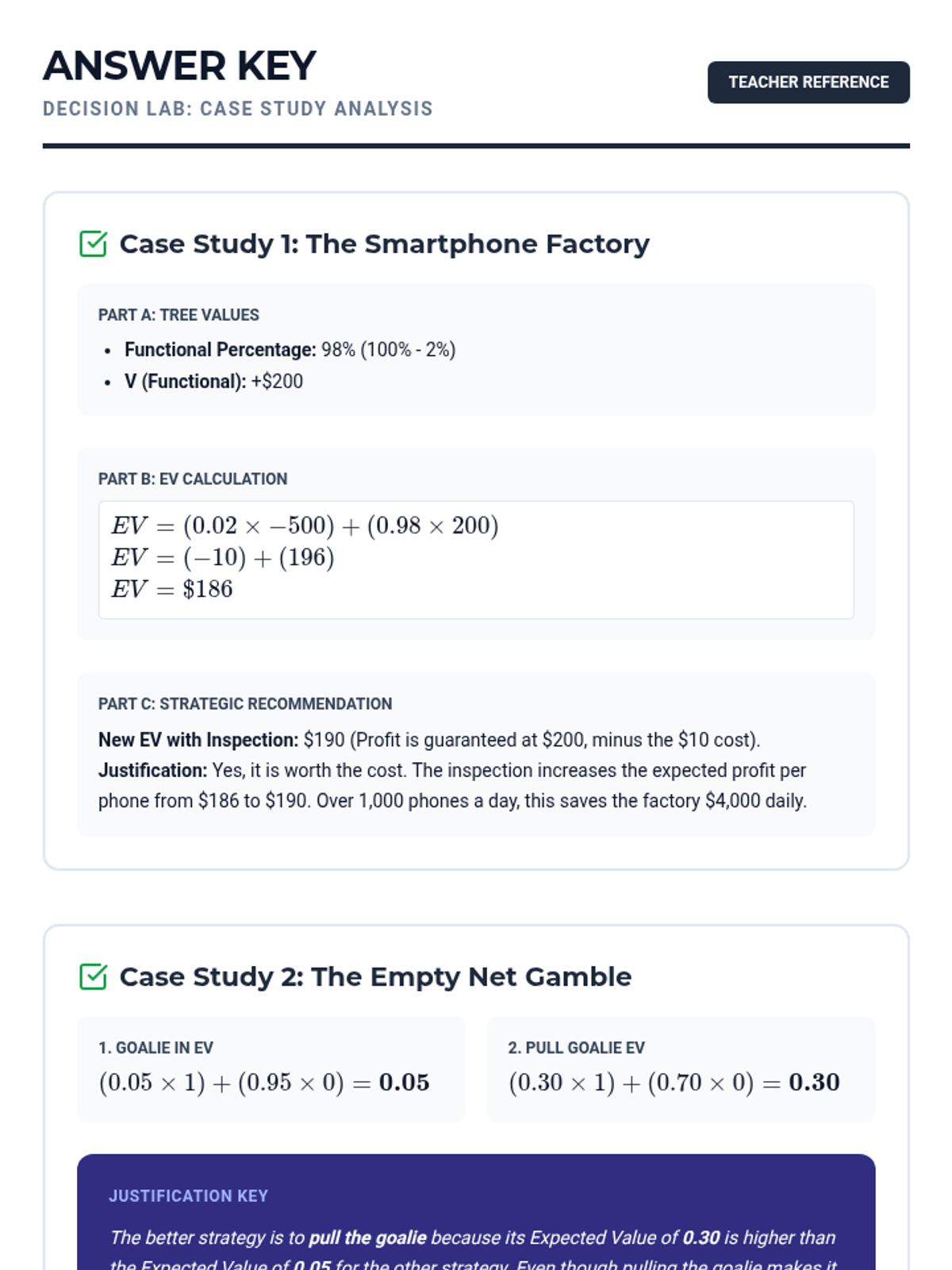
A detailed answer key for the Decision Lab worksheet, including step-by-step calculations for expected value, completed justification templates, and specific intervention tips for teachers.
A comprehensive slide deck for a Tier 2 intervention lesson on probability-based decision making. It features visually engaging scenarios for sports (hockey goalie) and medicine (false positives) to help students analyze strategies using raw numbers and tree diagrams. All text is sized for high visibility (24px+).
A short post-lesson assessment to check if students can interpret a simulation dotplot, apply the 5% significance threshold, and explain the practical implications of a non-significant result.
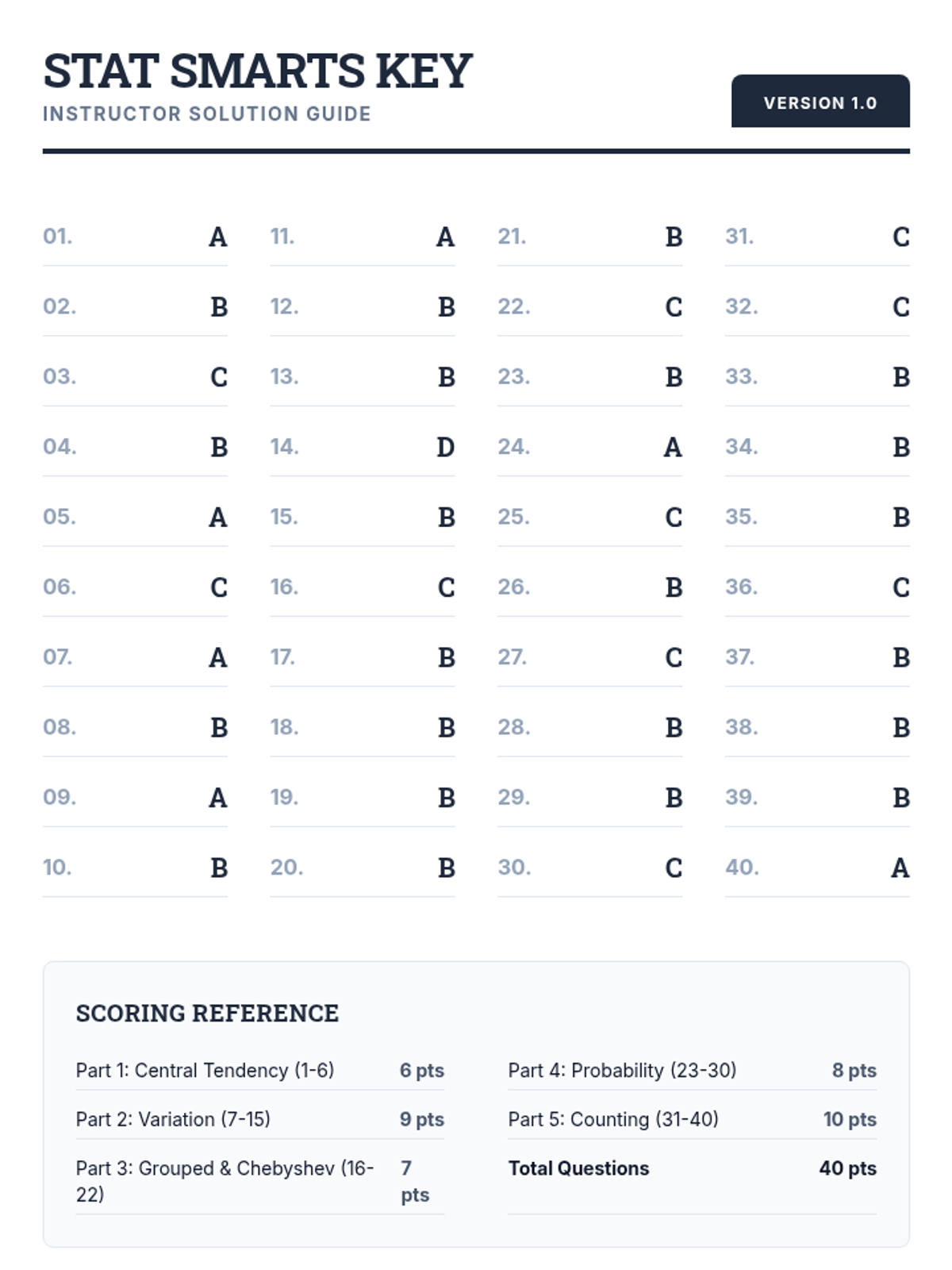
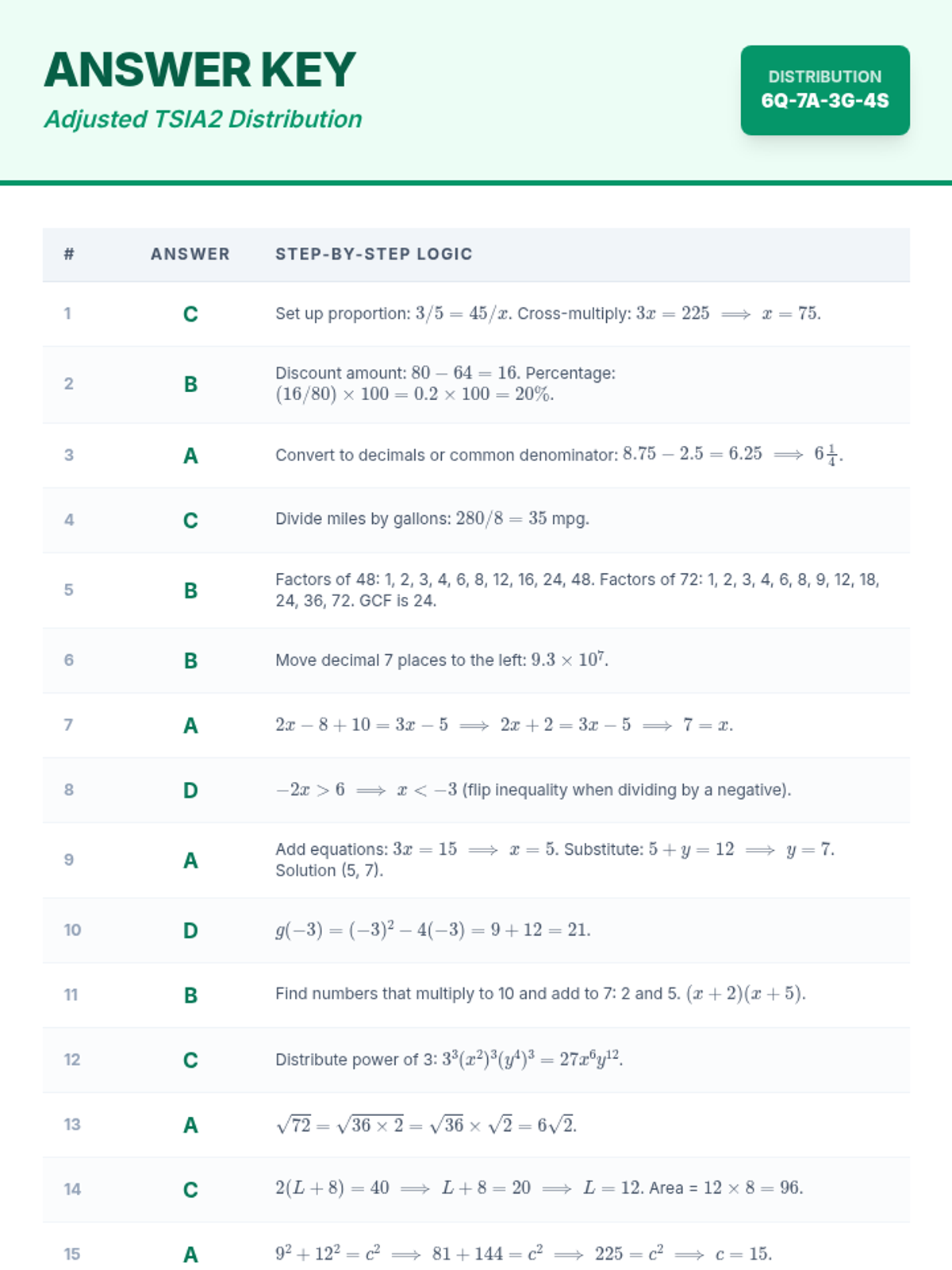
A detailed answer key for the adjusted TSIA2 Math practice test, featuring the new distribution of quantitative, algebraic, geometric, and statistical questions.
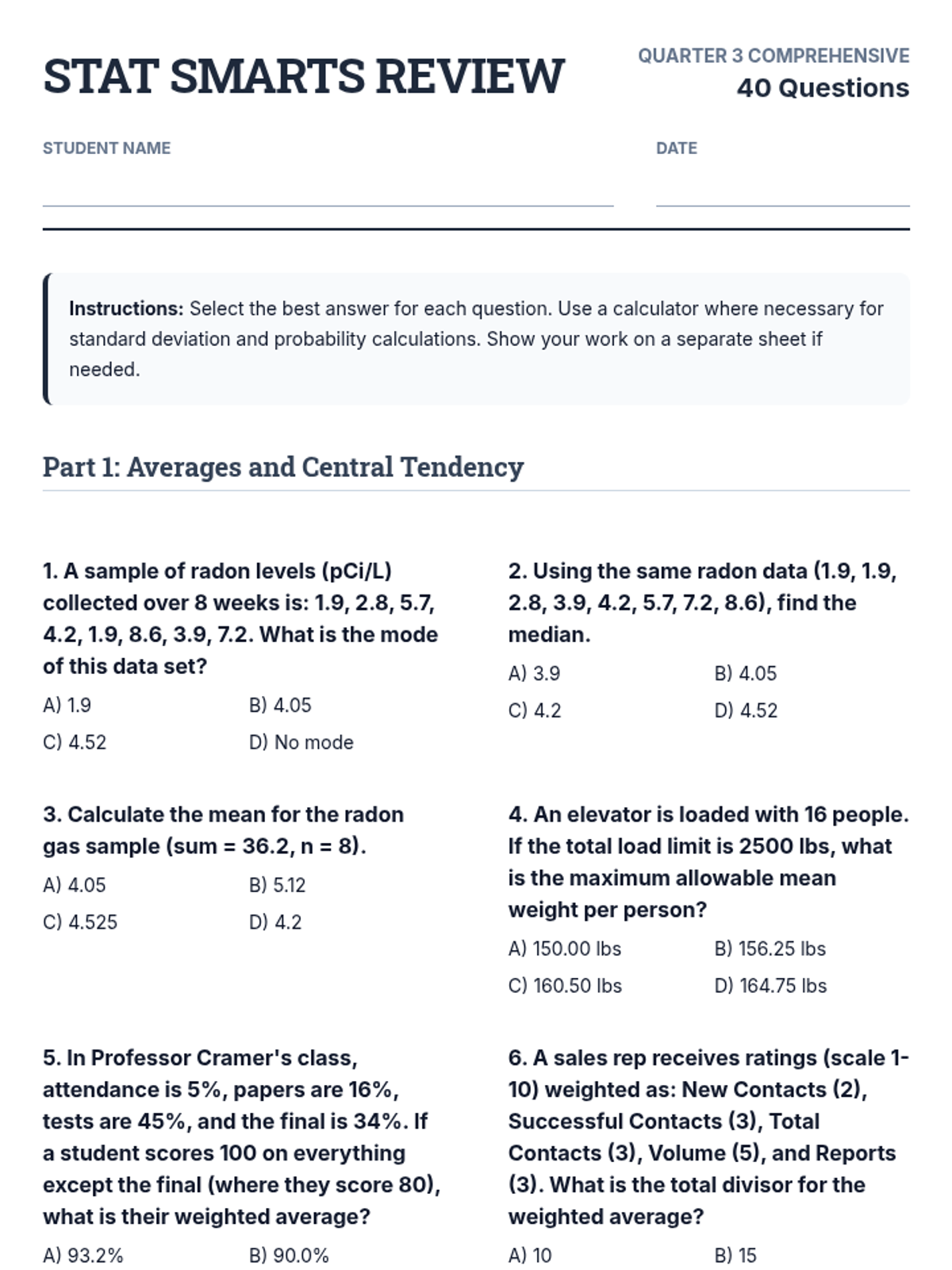
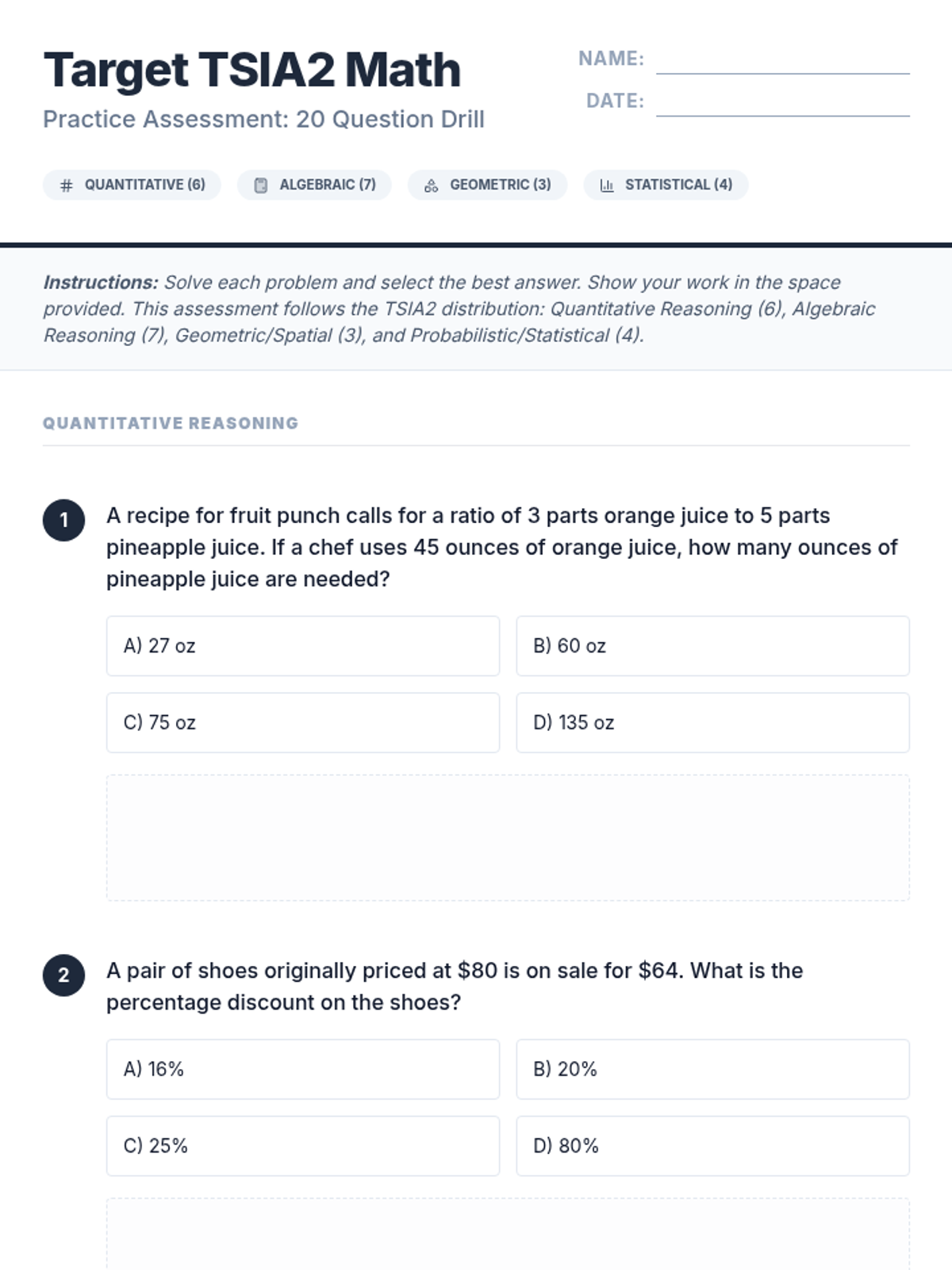
A 20-question multiple-choice practice test for the TSIA2 Mathematics assessment, with a specific distribution of quantitative (6), algebraic (7), geometric (3), and statistical (4) questions.
A comprehensive teacher guide and answer key for the Pascal's Architect lesson, including a lesson schedule, full triangle values, and worksheet answers.
A visual presentation for instruction including the warm-up, video embed, symmetry concept visualization, and activity instructions.
An exit ticket asking students to reproduce Row 5 of Pascal's Triangle and explain its symmetry using combination logic.
An instructional anchor chart illustrating the construction rules and symmetry principles of Pascal's Triangle, featuring the additive rule and the nCr coordinate system.
A 3-page student worksheet featuring a warm-up on combination logic, a video guided note section, a large blank Pascal's Triangle (to Row 12) for construction, and a set of nCr practice problems.
An answer key for the Logic Blueprint Worksheet, providing teacher model responses and tips for facilitating the two proof paths for 0!.
A student-facing drafting sheet for the Factorial Blueprint activity. It provides a structured space for students to derive 0! using arithmetic and algebraic methods before creating their final posters.
A comprehensive teacher-facing guide for facilitating the Factorial Blueprint lesson, including discussion prompts, logical background for 0!, and a rubric for the poster activity.
A 4-slide presentation for advanced math students exploring the logical derivation of 0! and the structural consistency of the permutation formula. It features high-contrast visuals, a blueprint-inspired design, and an embedded YouTube explanation.
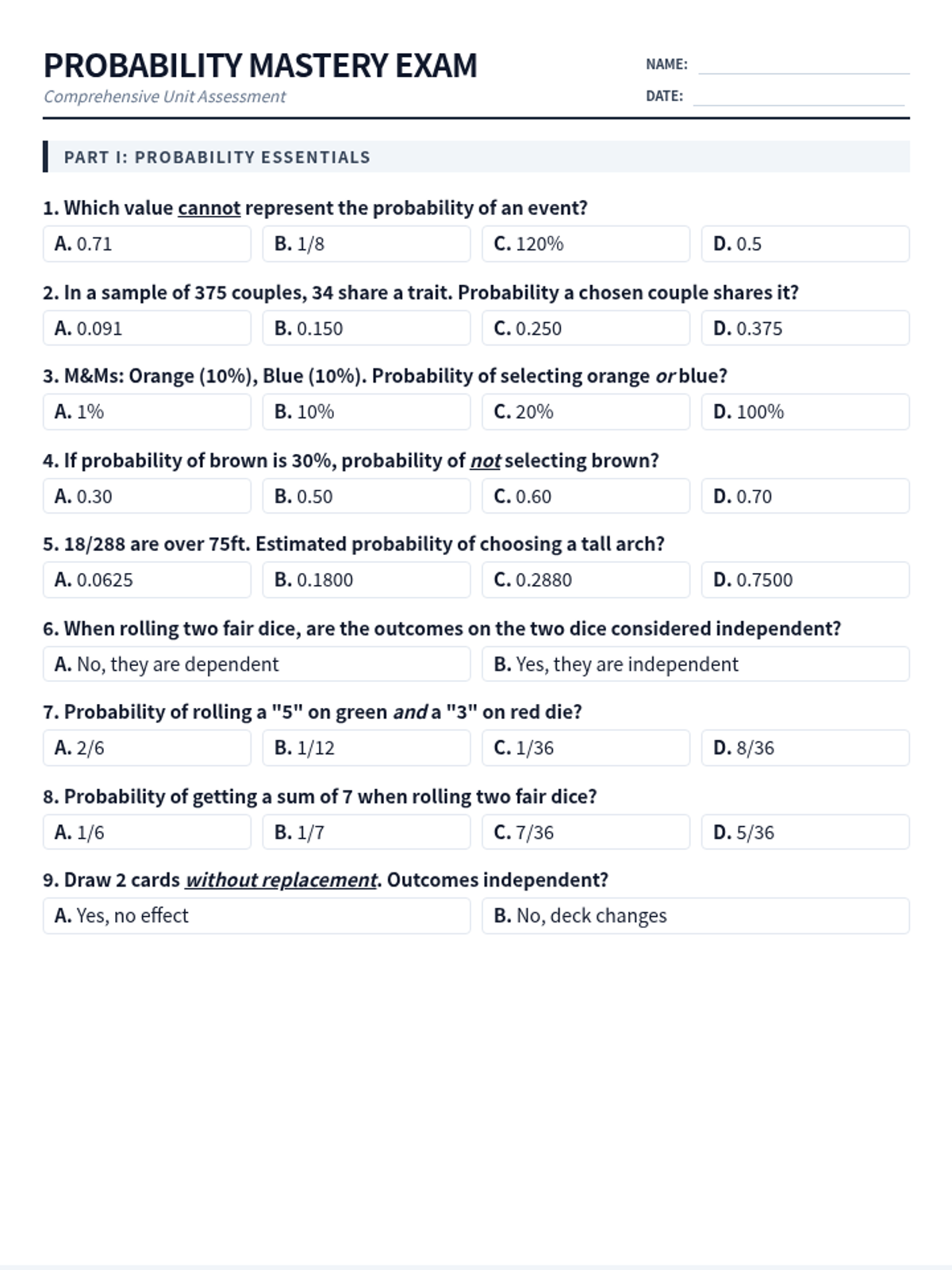
A final mastery assessment for 12th-grade students on complex probability solving, integrating combinatorics, independence proofs, and sequential events.
Educational slides for 12th-grade students on complex probability solving, integrating combinatorics and the complement rule for non-intuitive problems.
A discussion-based worksheet addressing the critical theoretical distinction between mutually exclusive (disjoint) and independent events through proofs and case studies.
Final exit ticket for the sequence, challenging students to apply their knowledge of changing sample spaces and expected value to a specific strategic scenario.
Educational slides for 12th-grade students clarifying the theoretical distinction between disjoint (mutually exclusive) and independent events using formal logic and Venn diagrams.
Student guide for running a Monte Carlo simulation of a card-based gambling game, tracking data convergence and analyzing the Law of Large Numbers.
Assessment rubric for the Lesson 5 Seminar, evaluating mathematical rigor, error identification, and logical synthesis of probability rules.
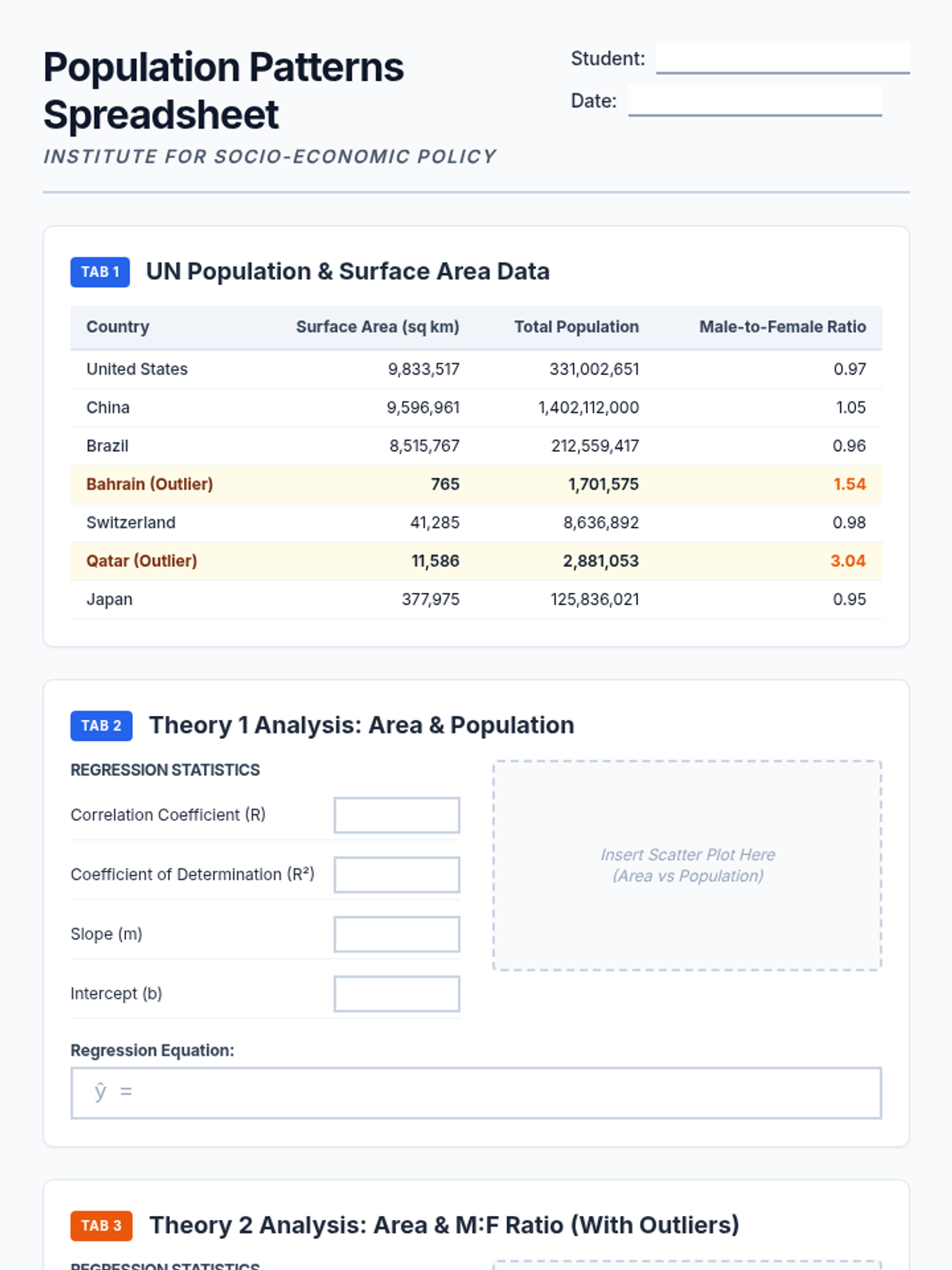
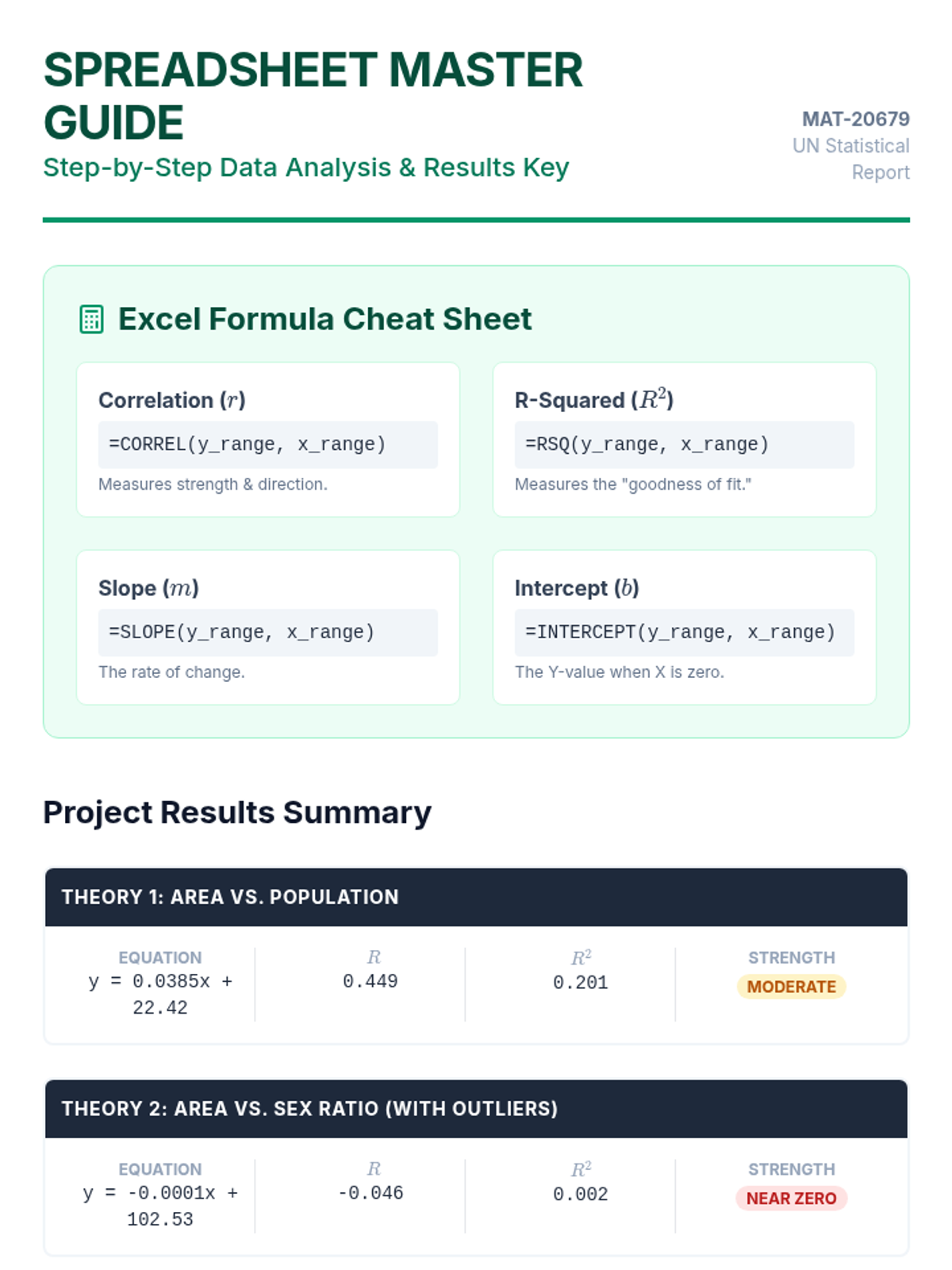
A technical guide for the spreadsheet component of the regression project, detailing Excel formulas and providing the actual calculated results for the UN population data set.
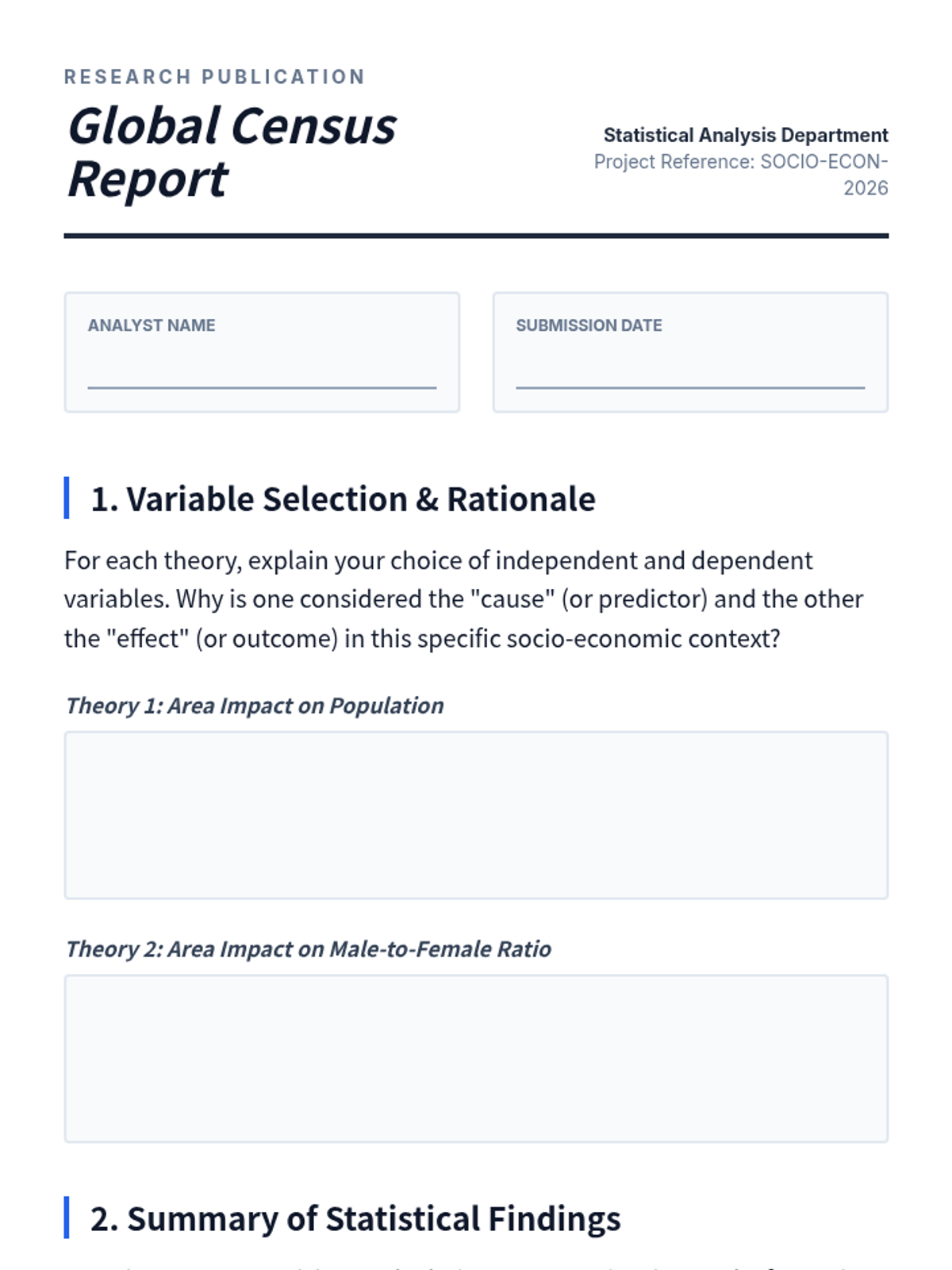
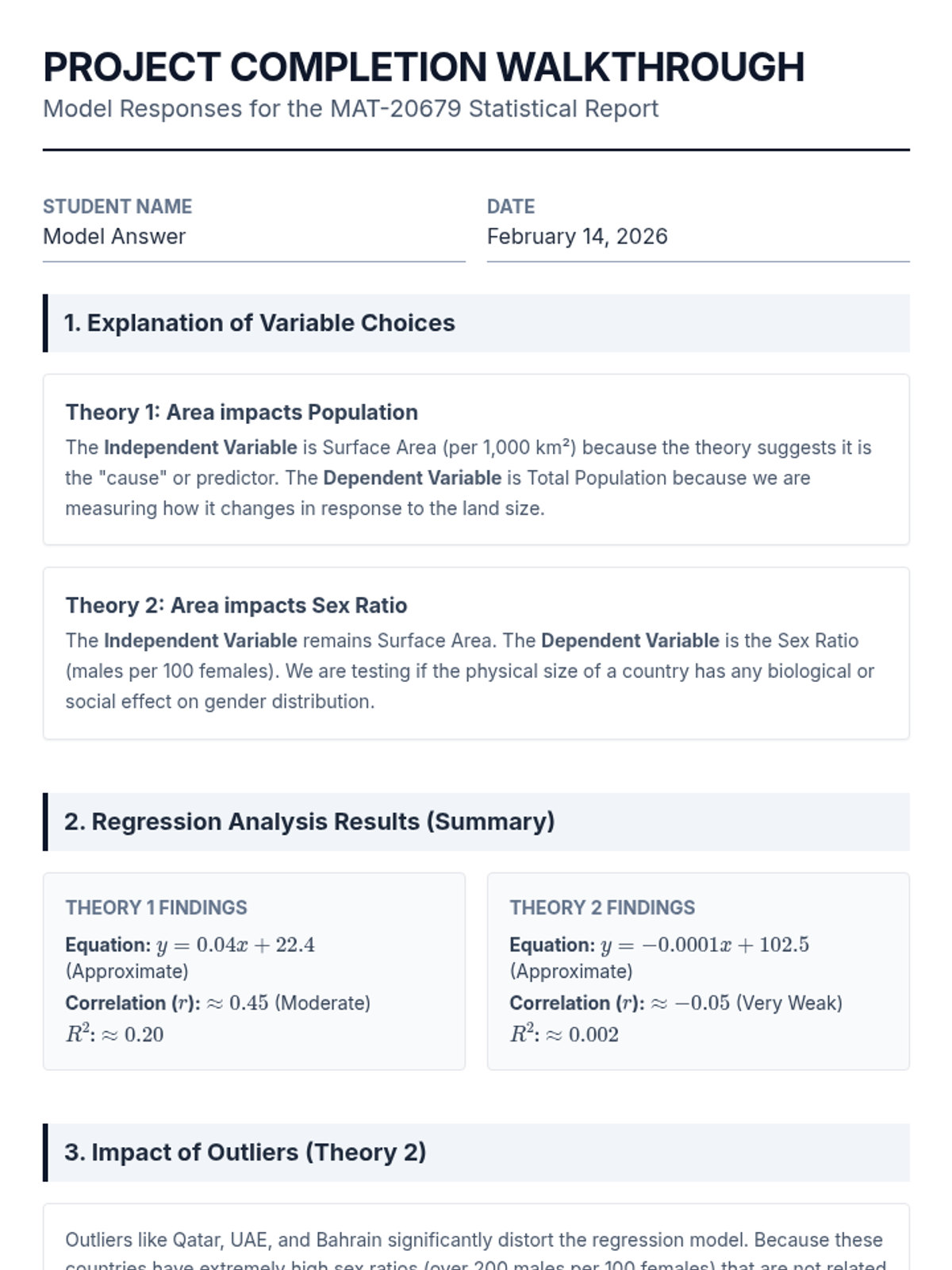
A detailed walkthrough for completing the MAT-20679 Statistical Report project, providing model answers for variable selection, outlier analysis, and interpretation of regression results.
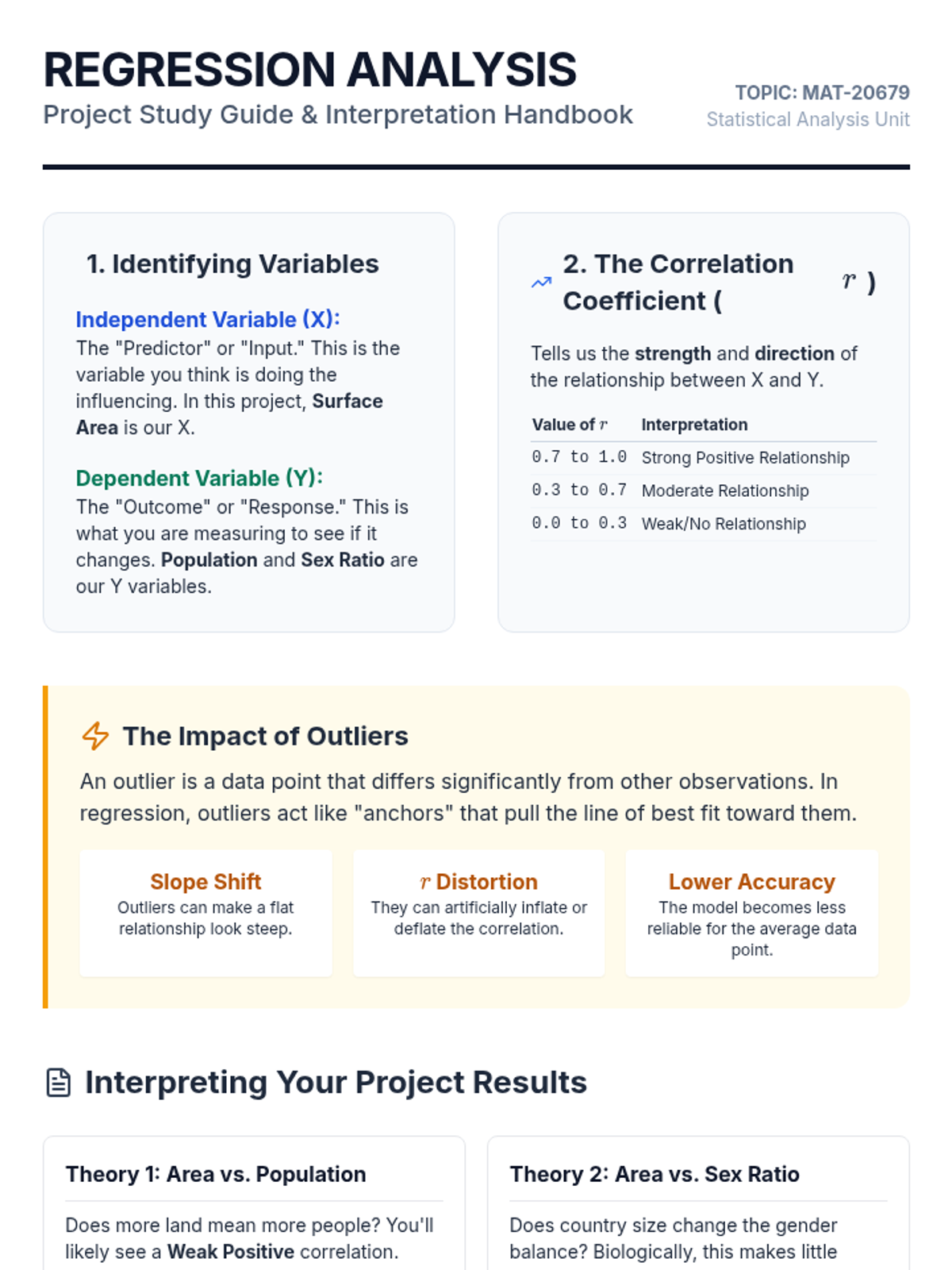
A professional study guide for a regression analysis project, explaining key concepts like independent/dependent variables, correlation coefficients, and the impact of outliers on statistical models.
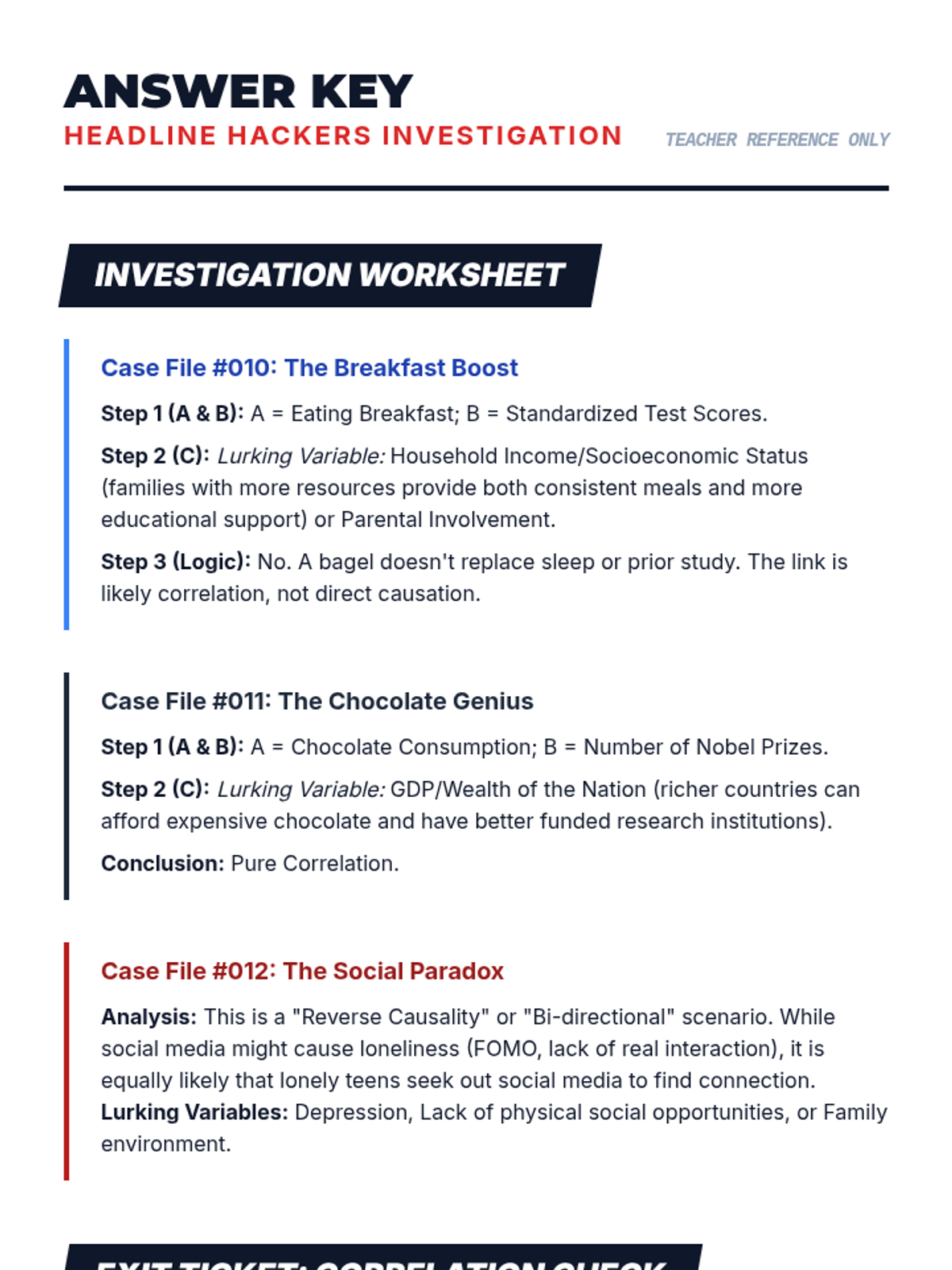
A comprehensive answer key for the Headline Hackers lesson, including expected lurking variables and analytical explanations for all case studies and the exit ticket.
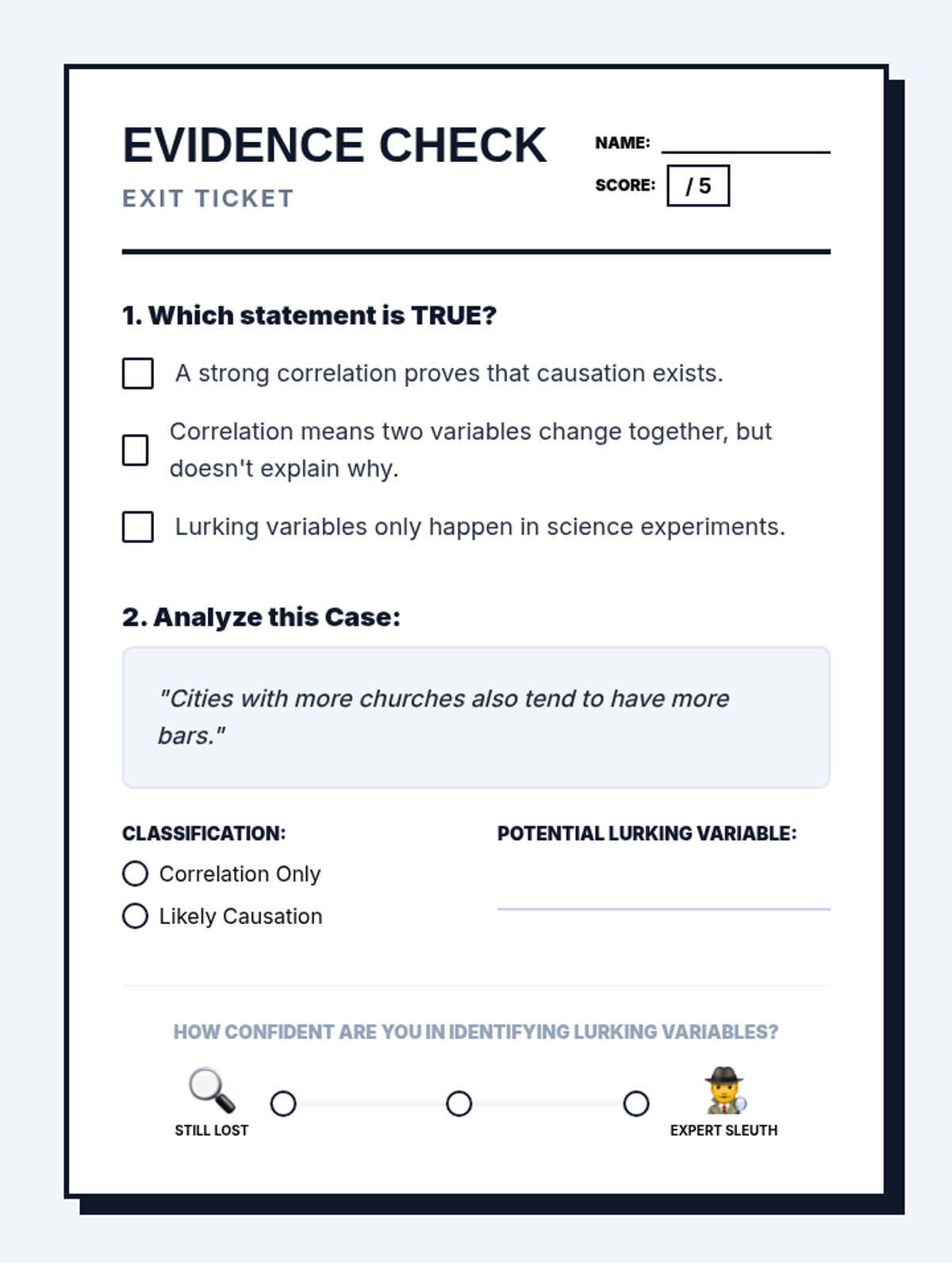
A short progress monitoring assessment (exit ticket) for students to independently identify correlation and lurking variables in a new real-world scenario.
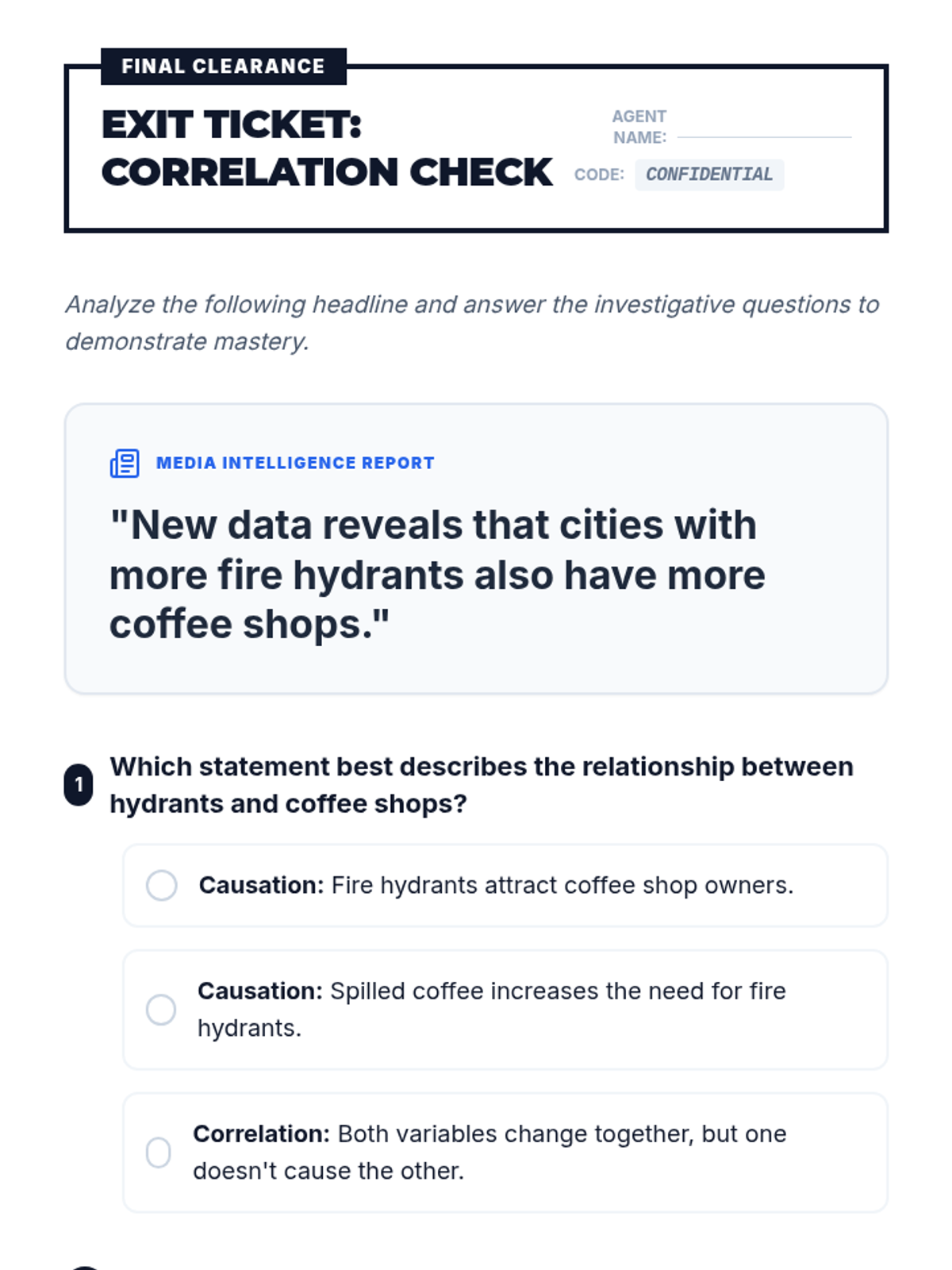
A concise exit ticket for progress monitoring, featuring a conceptual check and a scenario analysis to assess student understanding of correlation vs. causation.
A comprehensive teacher's guide for the Headline Hackers intervention. Includes pacing, specific questioning strategies for Tier 2 support, and a structured instructional sequence.
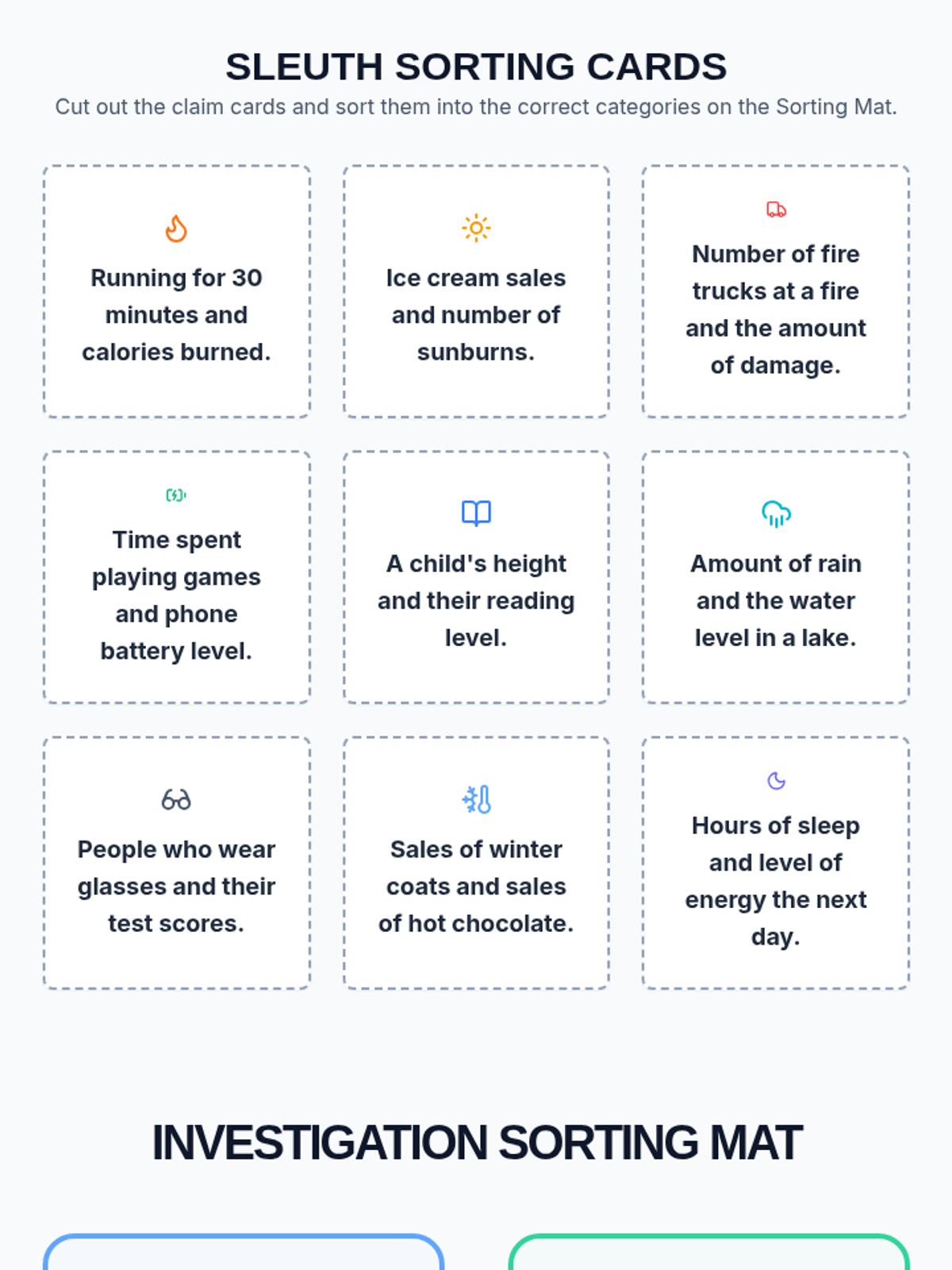
A hands-on activity featuring 9 claim cards and a sorting mat for students to categorize relationships as "Correlation Only" or "Likely Causation."
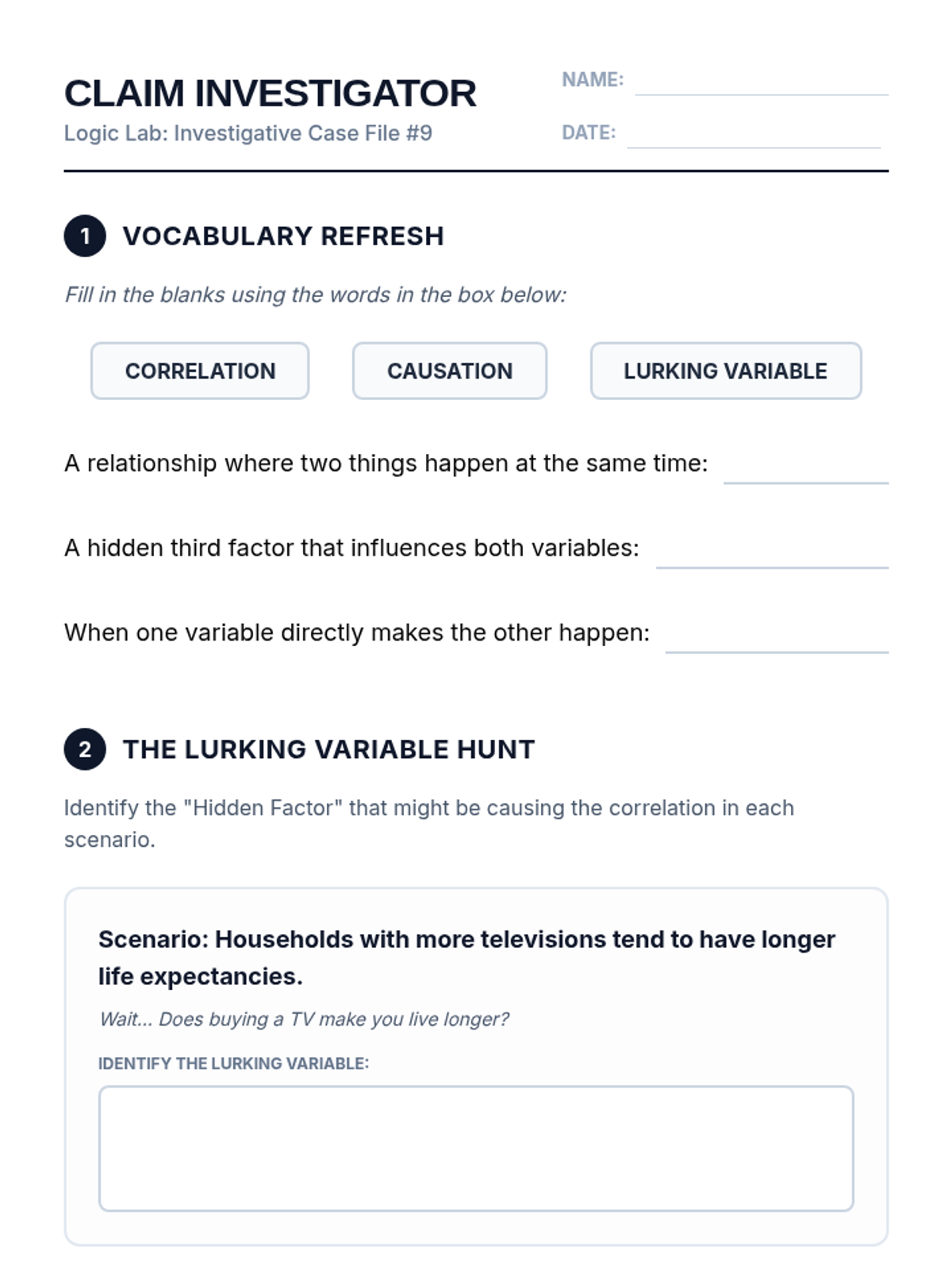
A scaffolded practice worksheet for students to identify lurking variables and distinguish between correlation and causation using the "Sleuth Test." Revised for better spacing and higher contrast.
A scaffolded investigation worksheet for a small group intervention. Students analyze three headlines of increasing complexity using a structured 'Case File' framework to identify variables and lurking factors.
A visual slide deck for teaching the difference between correlation and causation, featuring the "Ice Cream and Sharks" hook, definitions, and the concept of lurking variables.
Introductory slides for a Tier 2 small group intervention on correlation vs. causation. Features a 'Headline Hacker' investigative theme with clear definitions of lurking variables and scaffolded case studies.
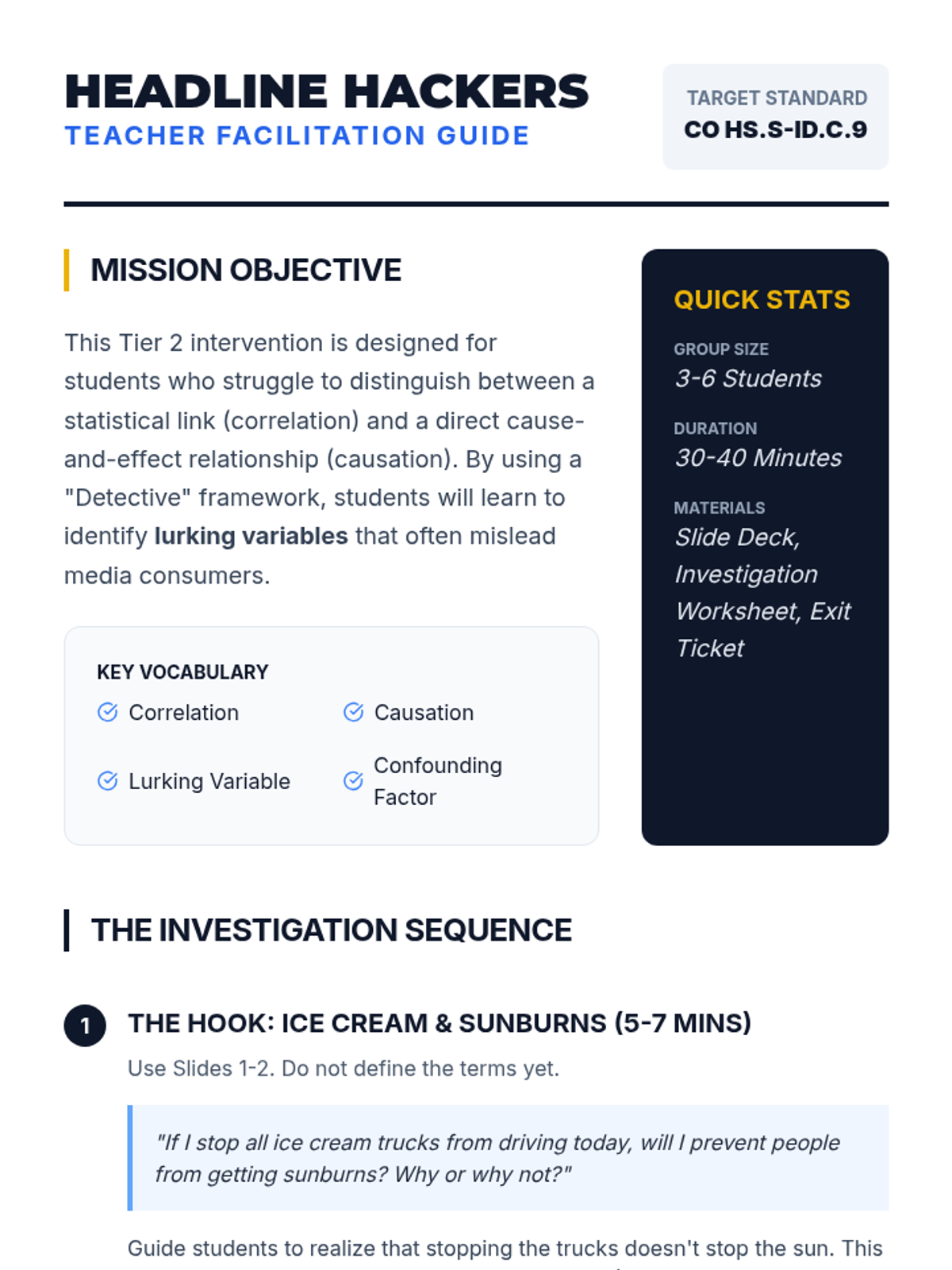
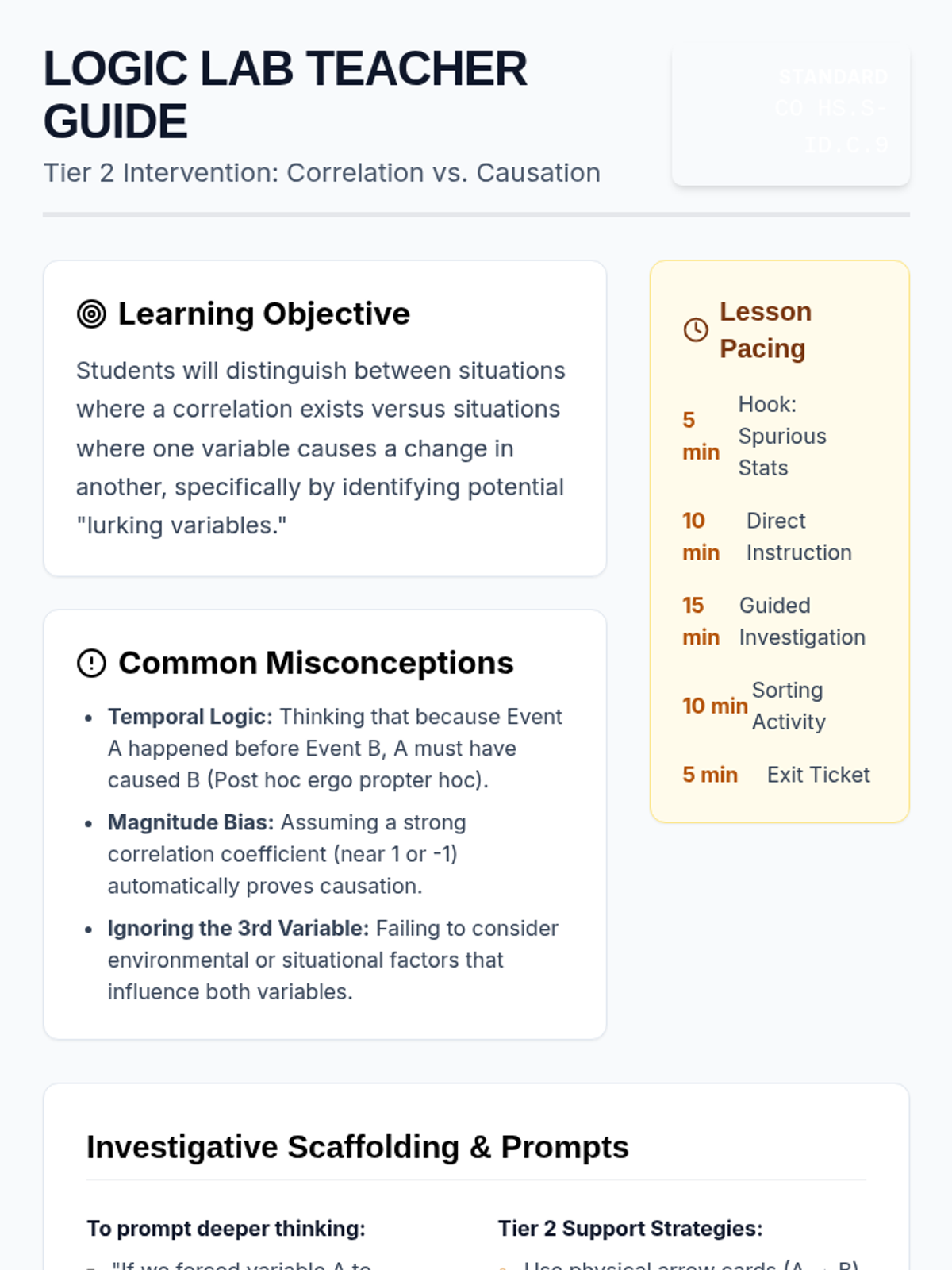
A teacher facilitation guide for the Tier 2 intervention lesson on correlation vs. causation, featuring standard alignment, pacing, facilitation prompts, and an answer key.
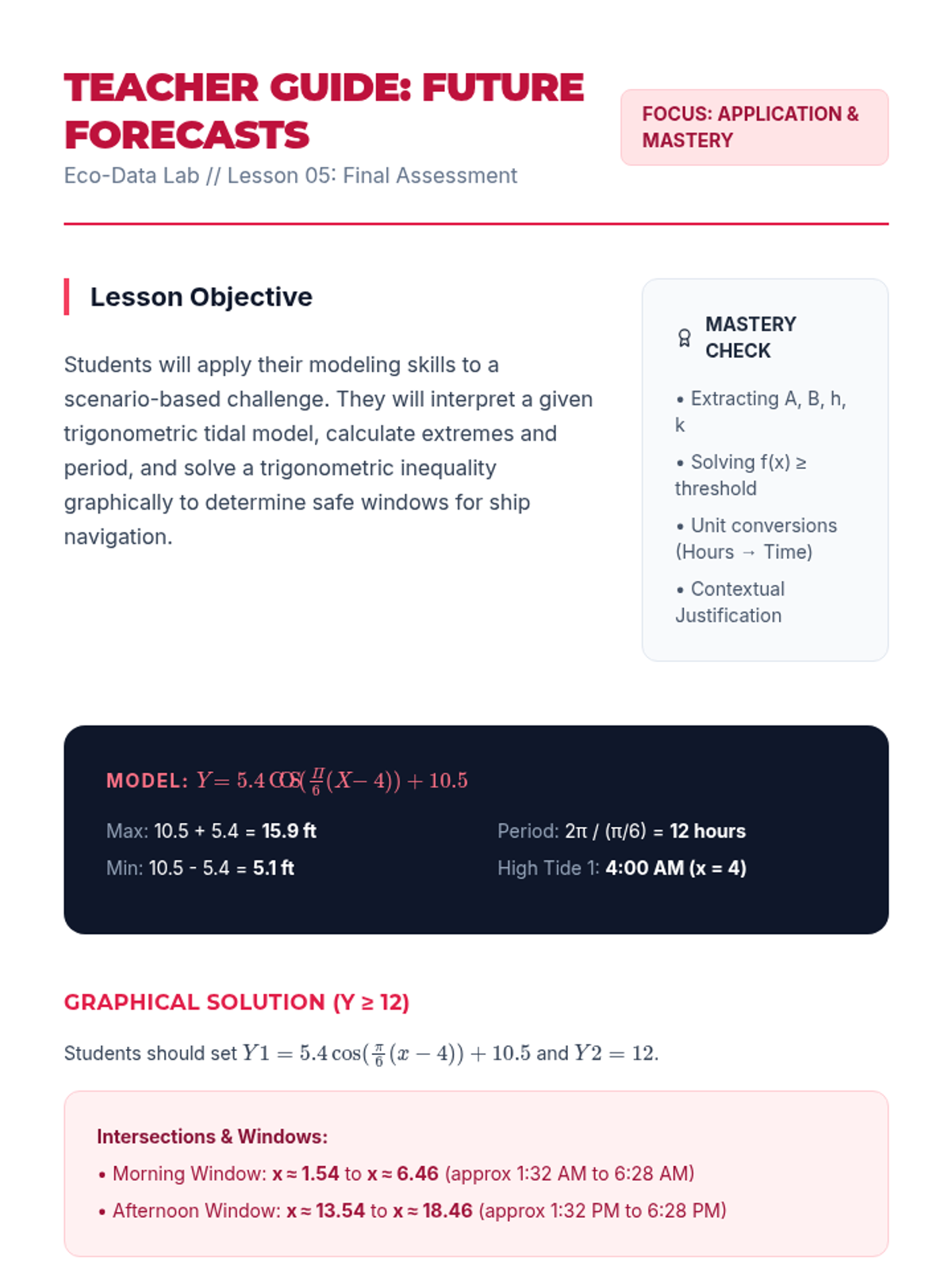
A teacher guide for Lesson 5, including answer keys for the harbor entry scenario and instructional tips on graphical inequality solutions.
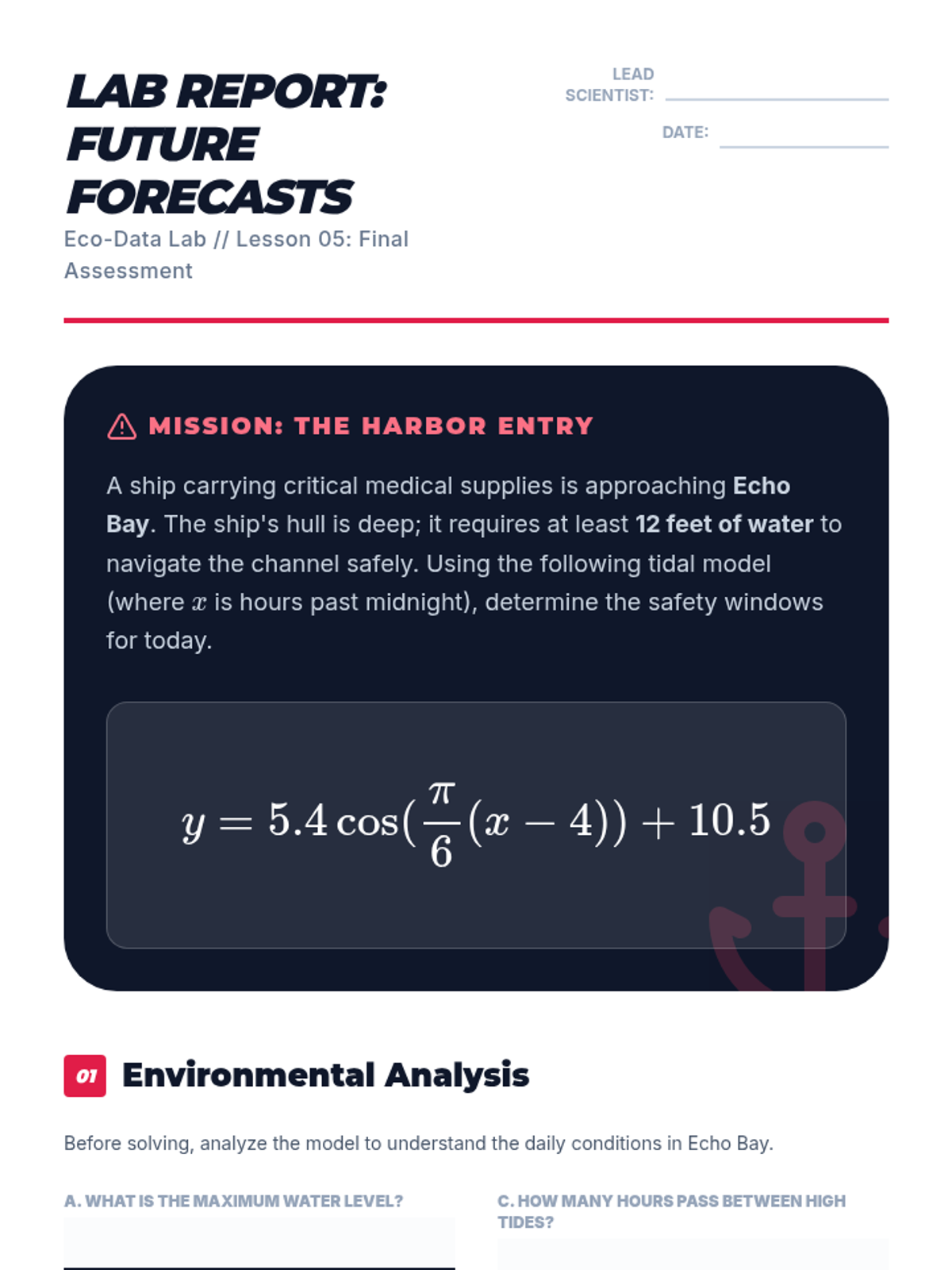
A student worksheet for Lesson 5, guiding students through a scenario-based challenge where they must use a provided trigonometric tidal model to determine safe entry windows for a ship based on depth requirements.
An instructional slide deck for Lesson 5, focusing on extrapolation and solving trigonometric inequalities graphically in the context of an environmental scenario.
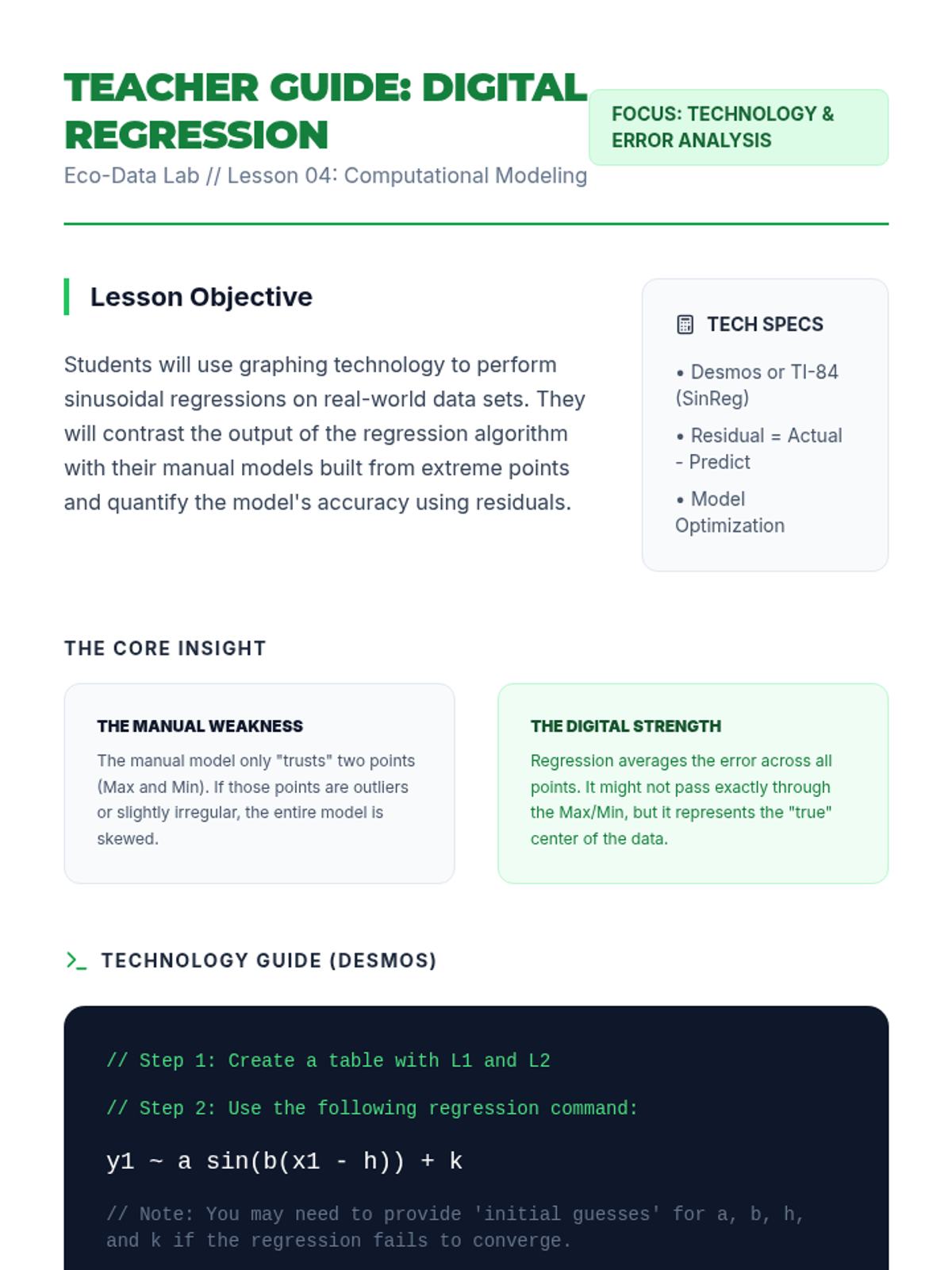
A teacher guide for Lesson 4, explaining technology regression tools, comparing manual models to computational ones, and the concept of residuals.
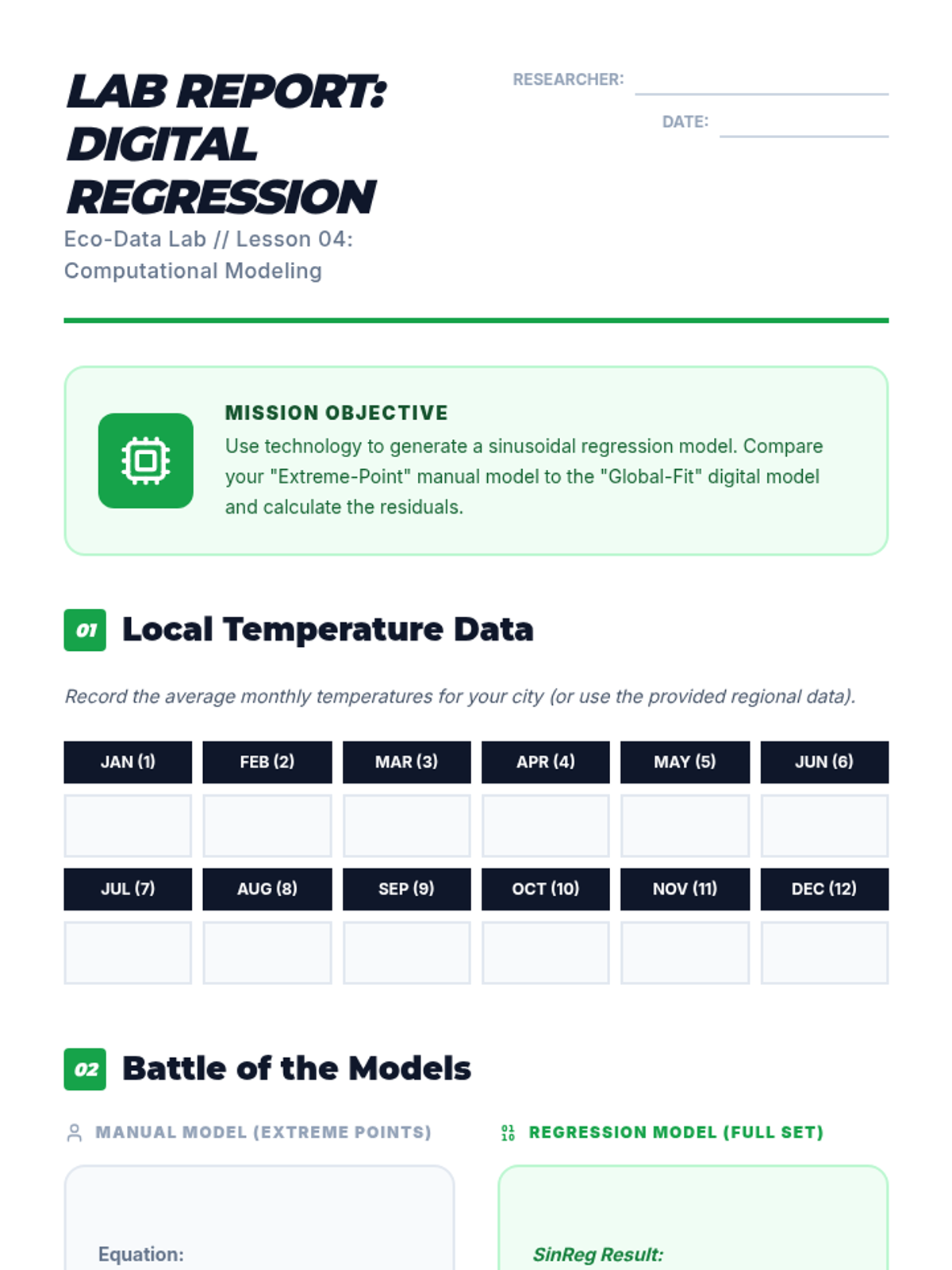
A student worksheet for Lesson 4, guiding students to enter their own local temperature data, run a sinusoidal regression, and compare it to their manual extreme-point model using residuals.
A group activity worksheet where students must determine the minimum combination of letter grades across five specific courses to achieve a target GPA of 3.5.
A concise assessment for students to demonstrate their ability to calculate a weighted GPA and justify their answer using logical reasoning.
A specialized student worksheet designed for use during the video tutorial, featuring structured calculation tables for two practice problems and dedicated space for long division and GPA logic checks.
A comprehensive visual reference for students outlining the step-by-step process of calculating GPA, including the point system, quality point multiplication, and the final division formula.
A professional instructional presentation for calculating college GPAs, featuring a comparative hook, vocabulary definitions, embedded tutorial video with pause points, and instructions for a group challenge activity.
A teacher facilitation guide for the Computational Powerhouse lesson, providing pacing, syntax cheat sheets, specific facilitation tips, and a full answer key for the worksheet challenges.
A professional 6-slide deck for AP Calculus and Statistics students, facilitating a lesson on Desmos efficiency. It includes a warm-up, an embedded YouTube tutorial, a dual-track (Stats/Calc) challenge, and discussion prompts.
A set of four printable discussion cards for AP Calculus and Statistics students to explore the balance between computational speed and conceptual understanding. The cards prompt critical thinking about verification, danger of black-box technology, and professional application.
A 2-page student worksheet designed for AP Calculus and Statistics students to practice calculating means, standard deviations, and complex definite integrals using Desmos. It includes a manual warm-up, video note-taking space, and a high-complexity computational challenge.
A spreadsheet formula reference sheet for students, providing the exact Excel/Google Sheets syntax for calculating Range, IQR, Mean, and Standard Deviation as part of the simulation lab.
Graduate-level slides for Martingale theory, explaining the fair game concept, filtration, and the Optional Stopping Theorem.
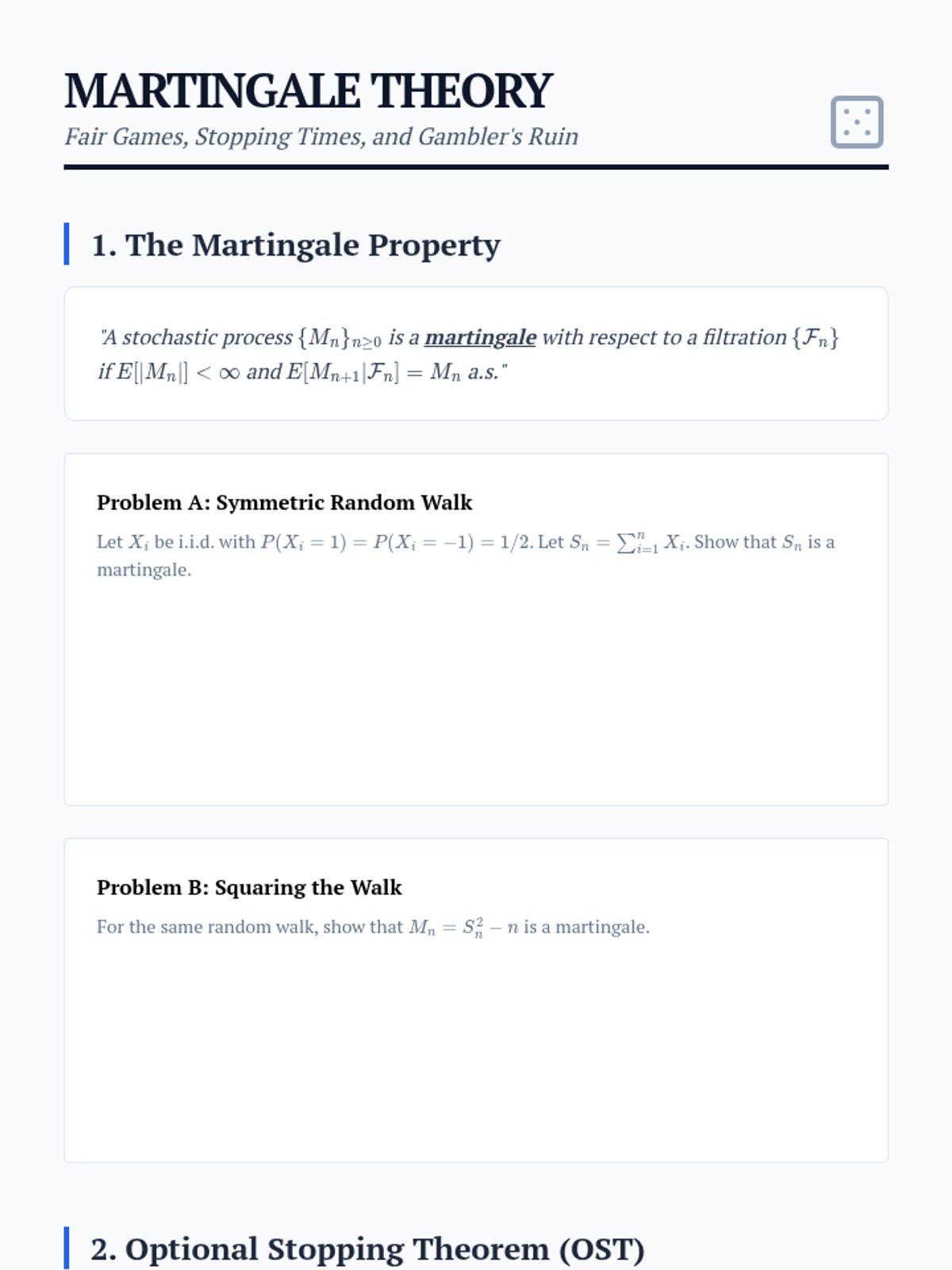
A graduate worksheet on Martingale theory, focusing on the definition of martingales, the Optional Stopping Theorem, and its application to the Gambler's Ruin problem.
Graduate slides on conditional expectation as a projection in Hilbert space and its definition using sub-sigma-algebras.
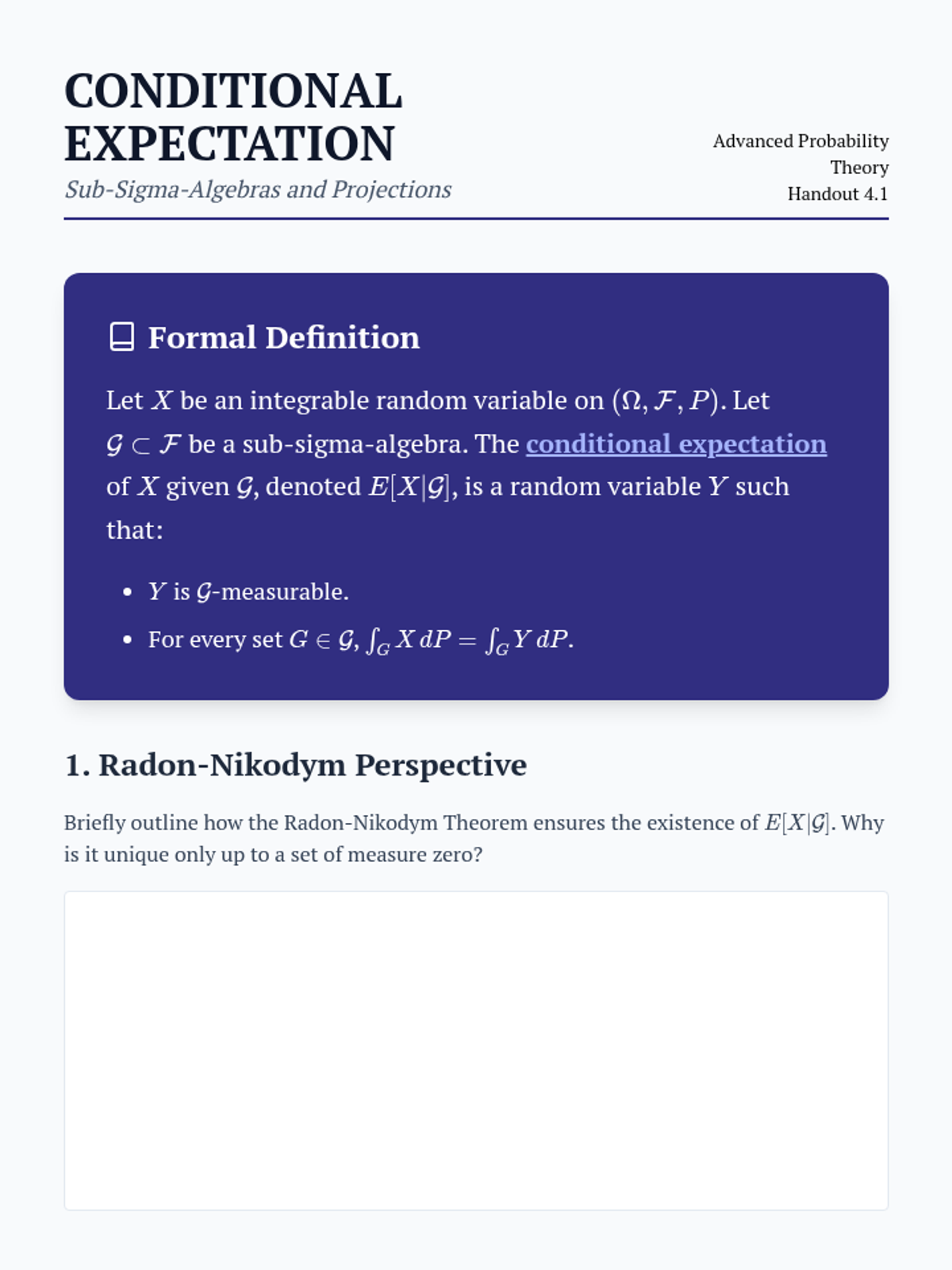
A graduate worksheet on conditional expectation, covering its measure-theoretic definition, Radon-Nikodym foundation, and the projection property in Hilbert spaces.
Graduate slides covering MCT, Fatou's Lemma, and DCT with visual representations of the convergence requirements.
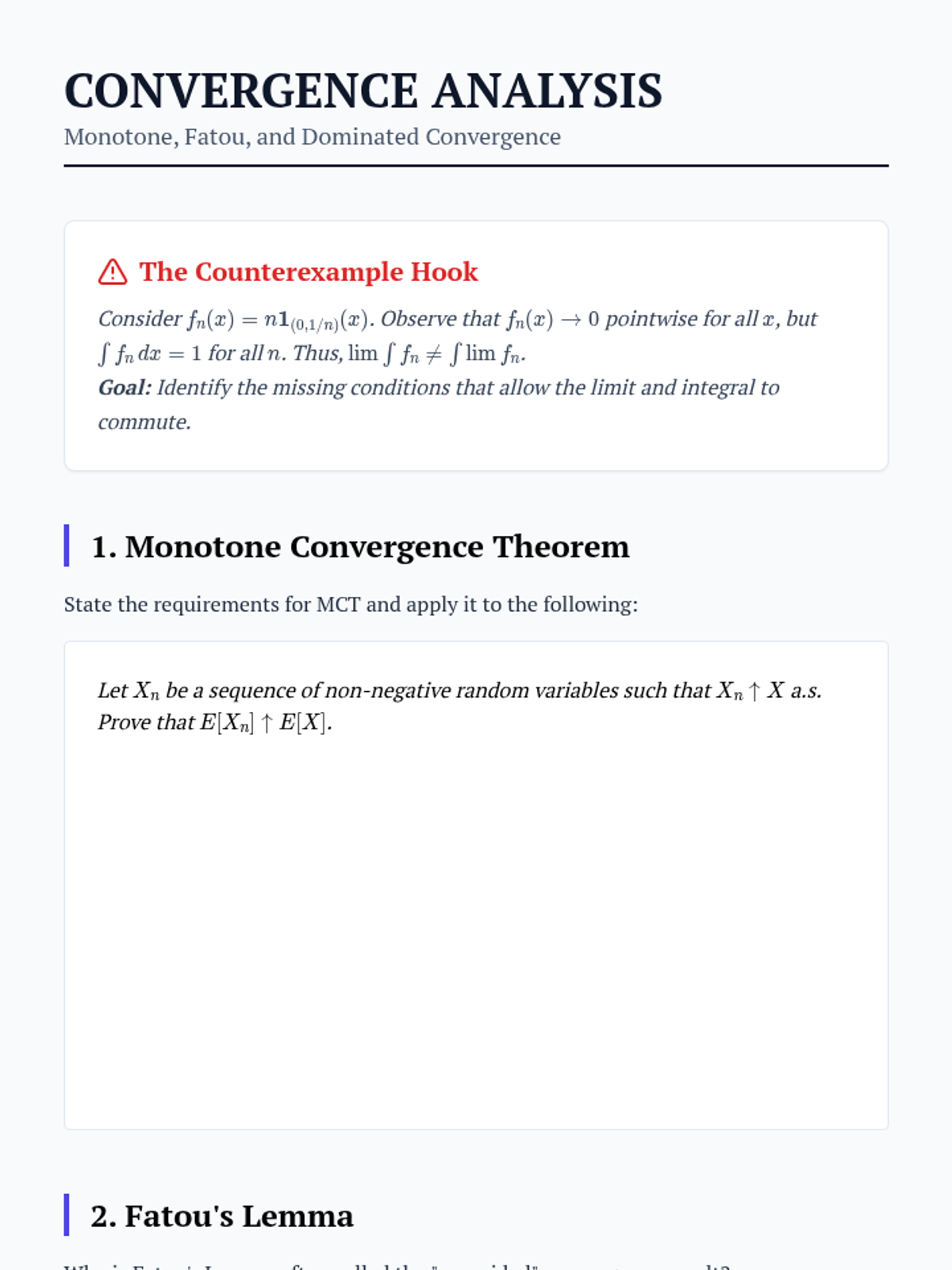
A graduate worksheet focusing on Monotone Convergence, Fatou's Lemma, and Dominated Convergence Theorems through rigorous analysis and proof construction.
Slides for Graduate-level probability covering Markov, Chebyshev, Jensen, Hölder, and Minkowski inequalities with proofs and applications.
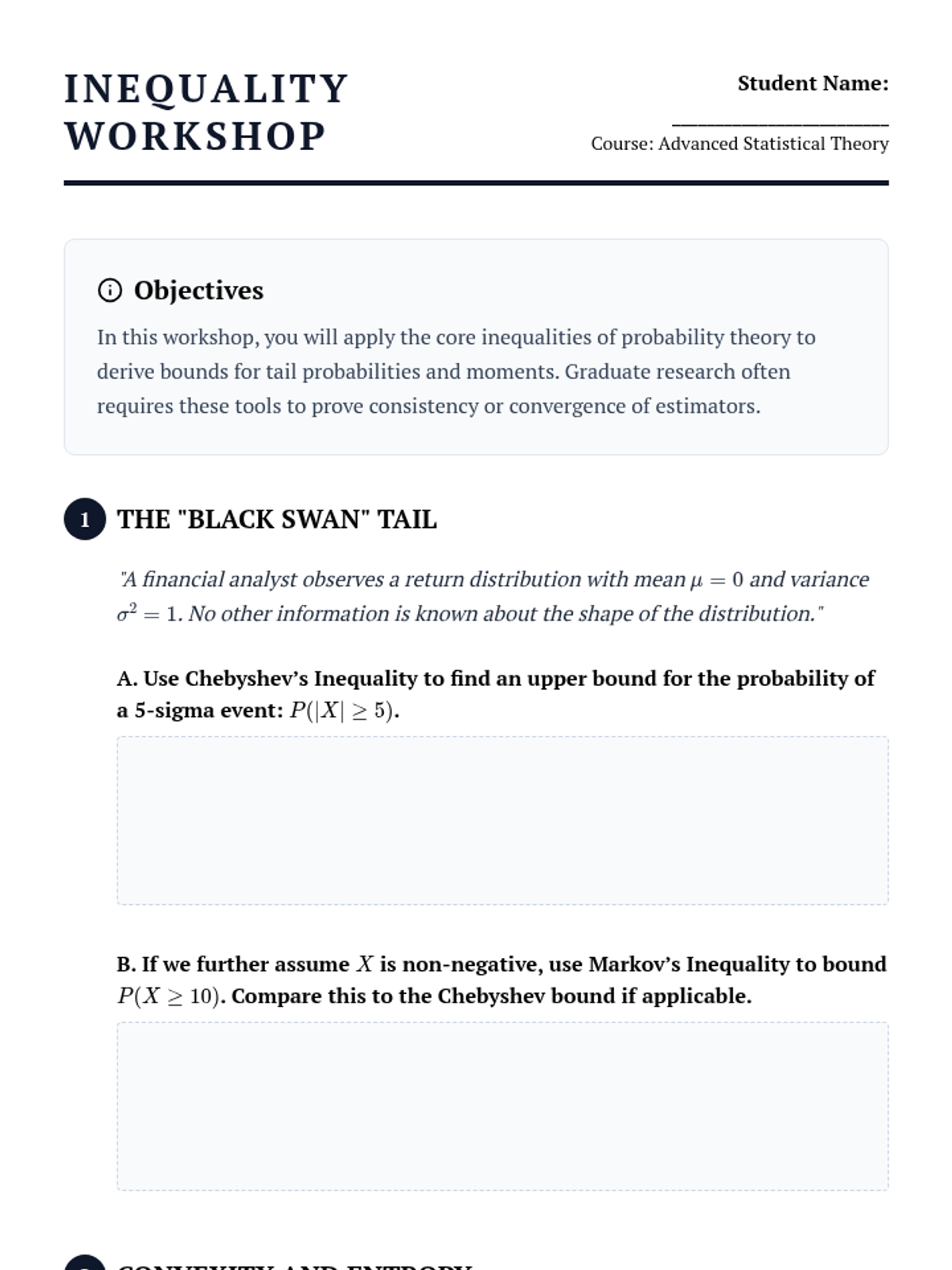
A workshop-style worksheet for graduate students to practice applying Markov, Chebyshev, Jensen, Hölder, and Minkowski inequalities.
Introductory slides for Graduate-level probability focusing on the transition from Riemann to Lebesgue integration and the definition of expectation.
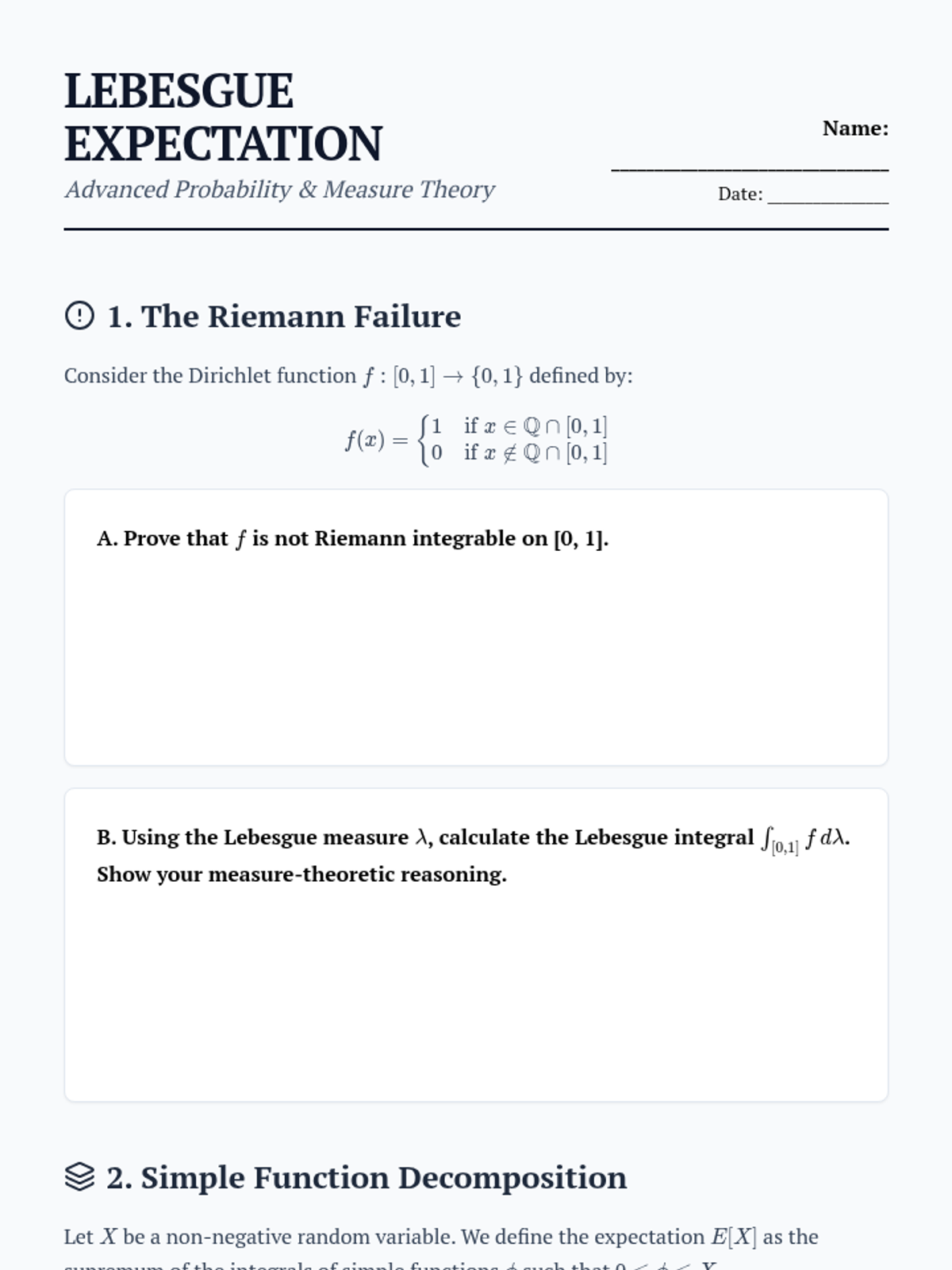
A graduate-level worksheet covering the measure-theoretic definition of expectation, comparing Riemann vs. Lebesgue integration and exploring simple function decomposition.
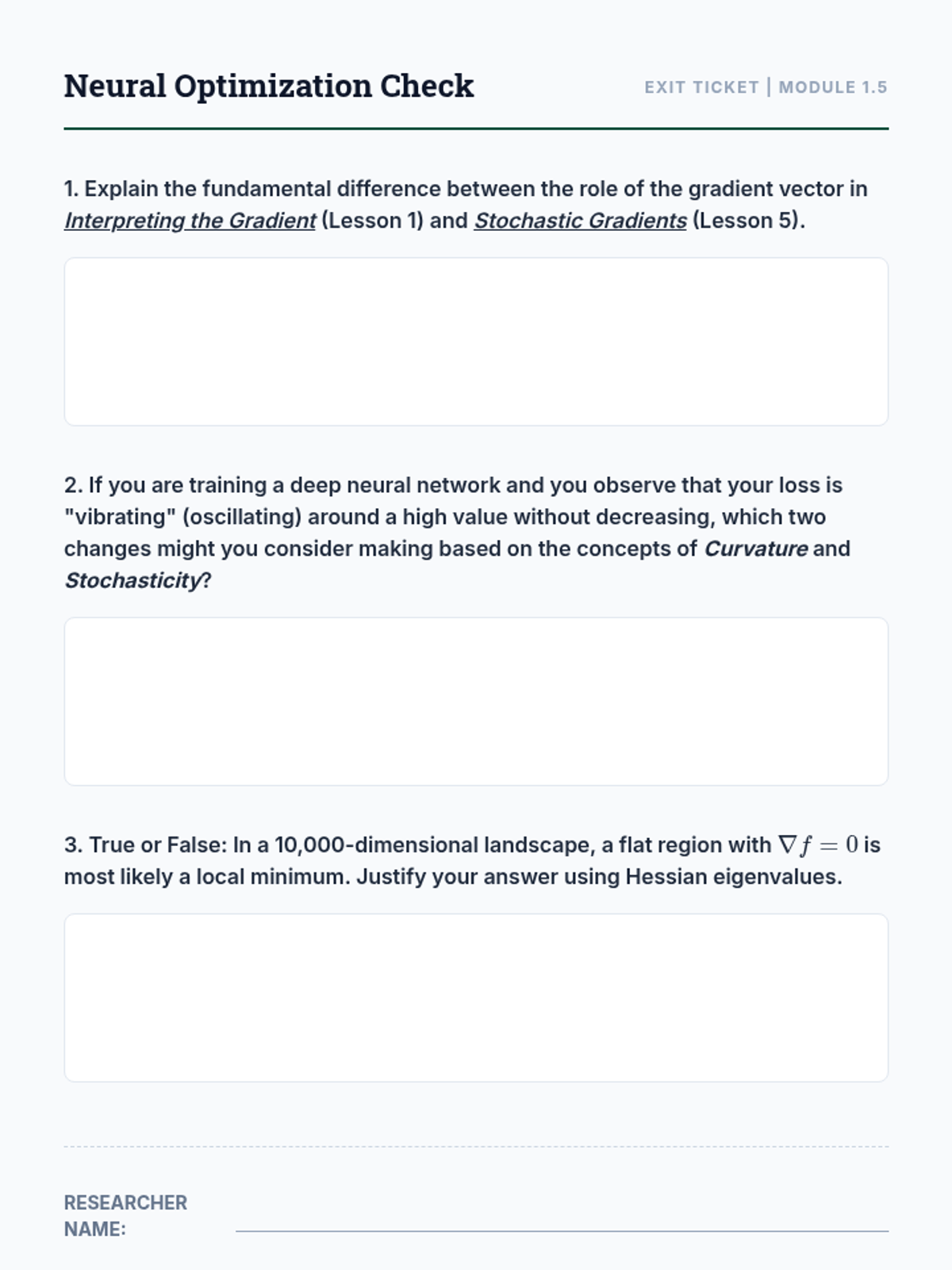
A conceptual exit ticket for graduate students to synthesize their learning across the entire sequence, focusing on the differences between analytical and stochastic optimization and the geometry of high-dimensional landscapes.
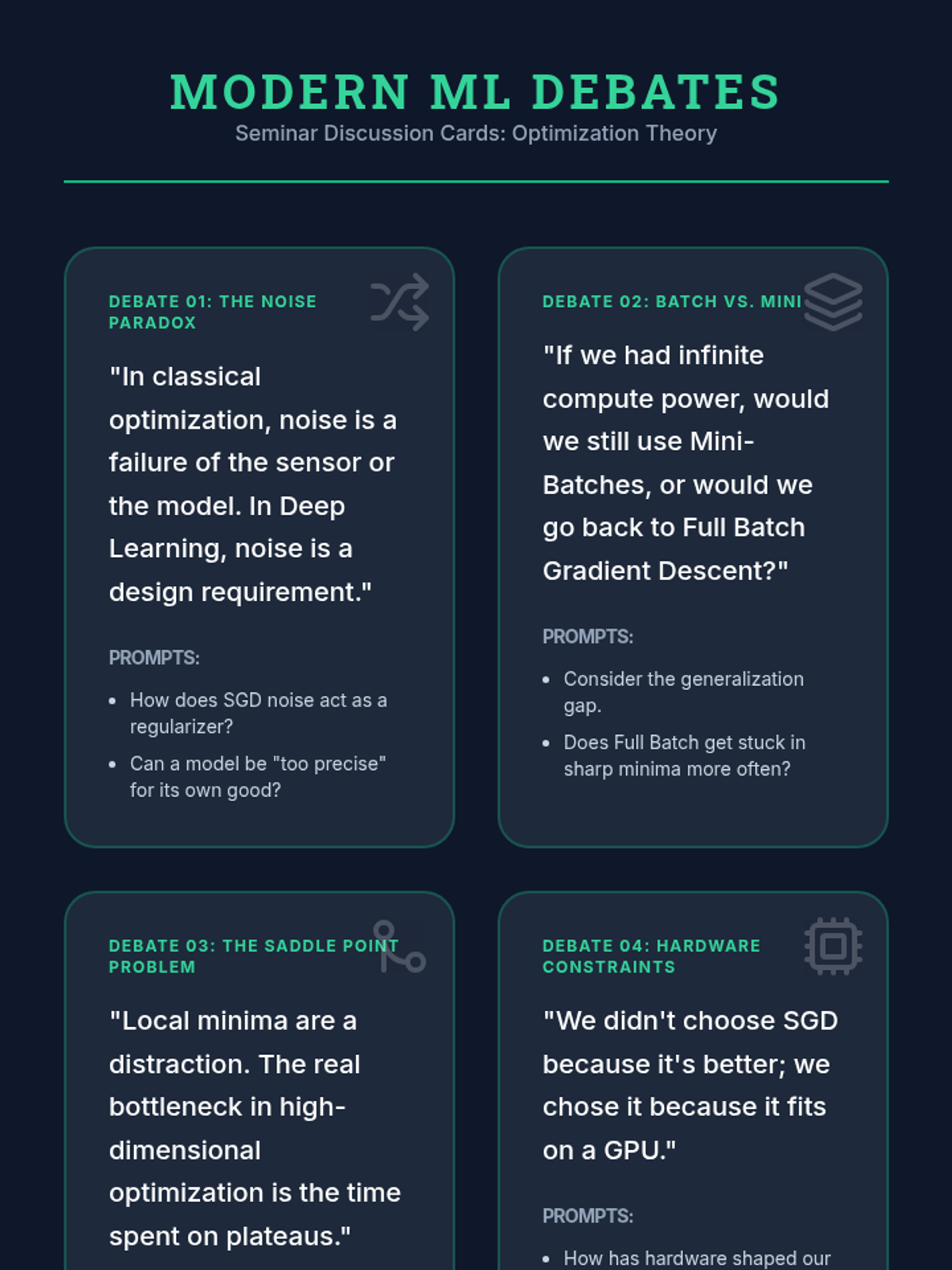
Seminar-style discussion cards for graduate students to explore the nuances of Stochastic Gradient Descent, the role of noise, and the geometric challenges of high-dimensional optimization.
A slide deck exploring Stochastic Gradient Descent (SGD) and its role in navigating high-dimensional, non-convex landscapes in machine learning. Covers mini-batching, noise, and convergence.
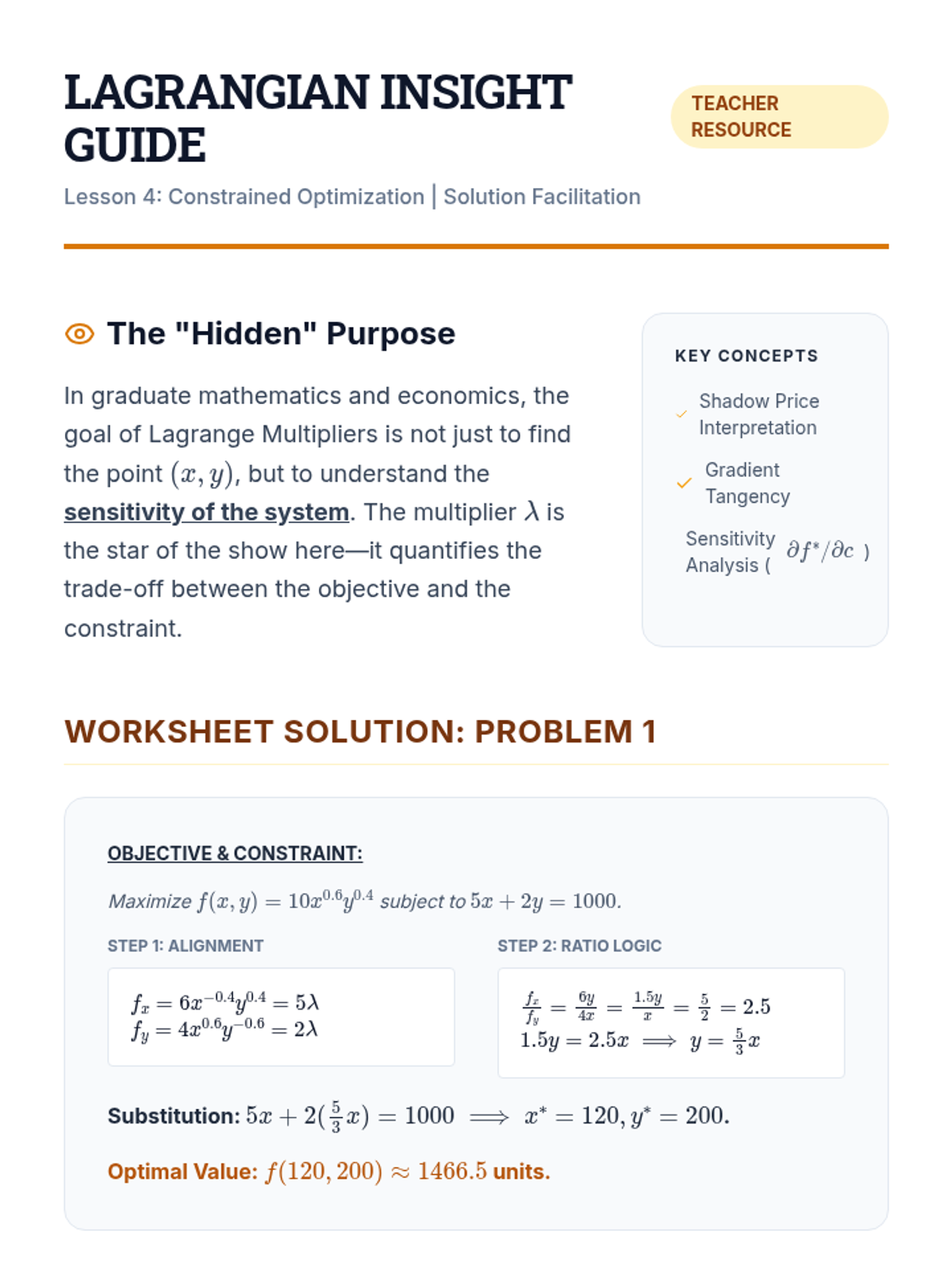
A teacher-facing guide for the lesson on Lagrange multipliers, including instructional goals, full solutions for the resource allocation problem, and notes on the interpretation of shadow prices.
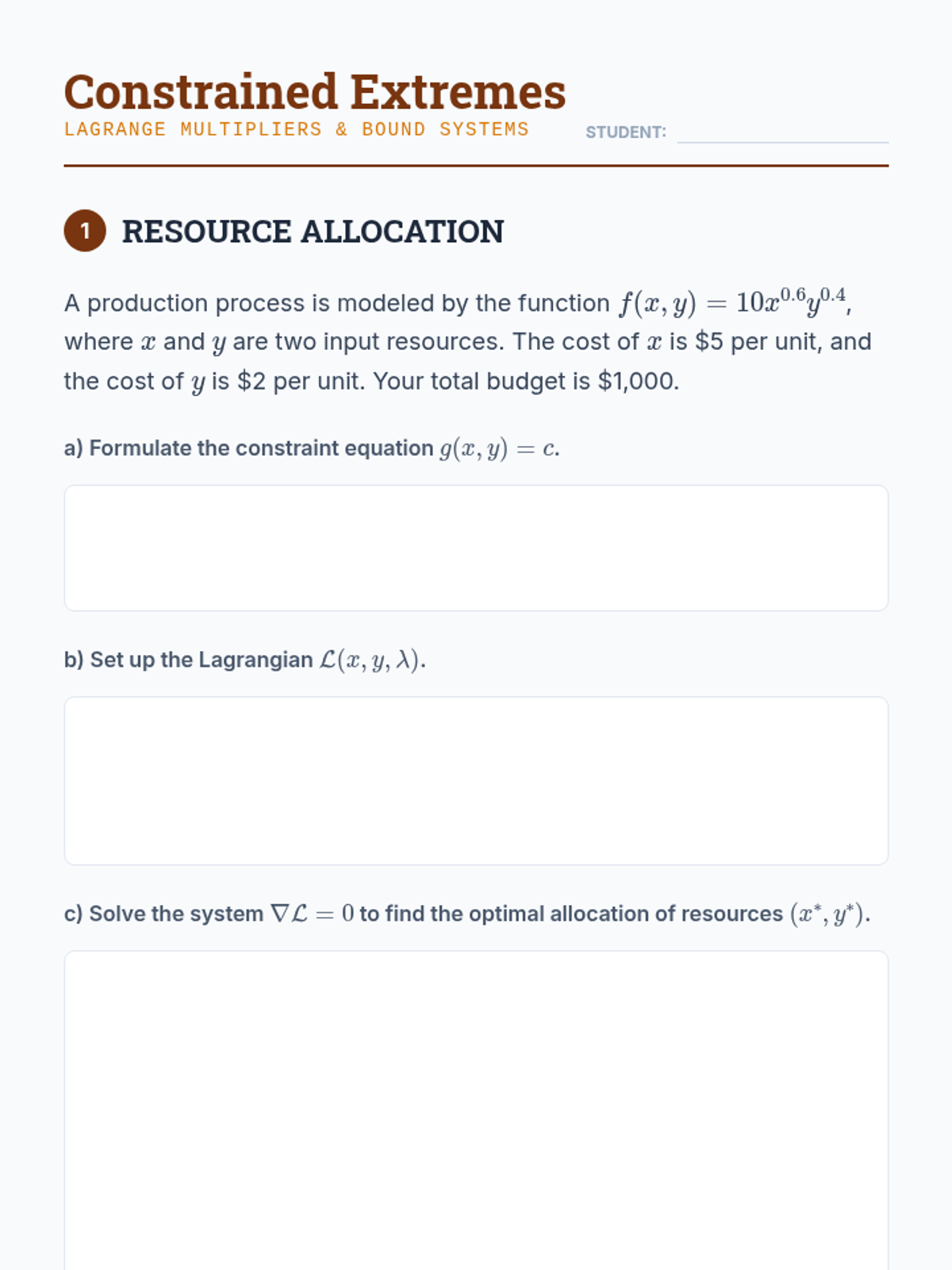
A student worksheet for practicing constrained optimization using the method of Lagrange multipliers. Features a Cobb-Douglas production problem and questions on the interpretation of the multiplier.
A slide deck explaining constrained optimization using Lagrange multipliers. Covers the geometric interpretation of aligned gradients, the Lagrangian function, and the meaning of the multiplier lambda.
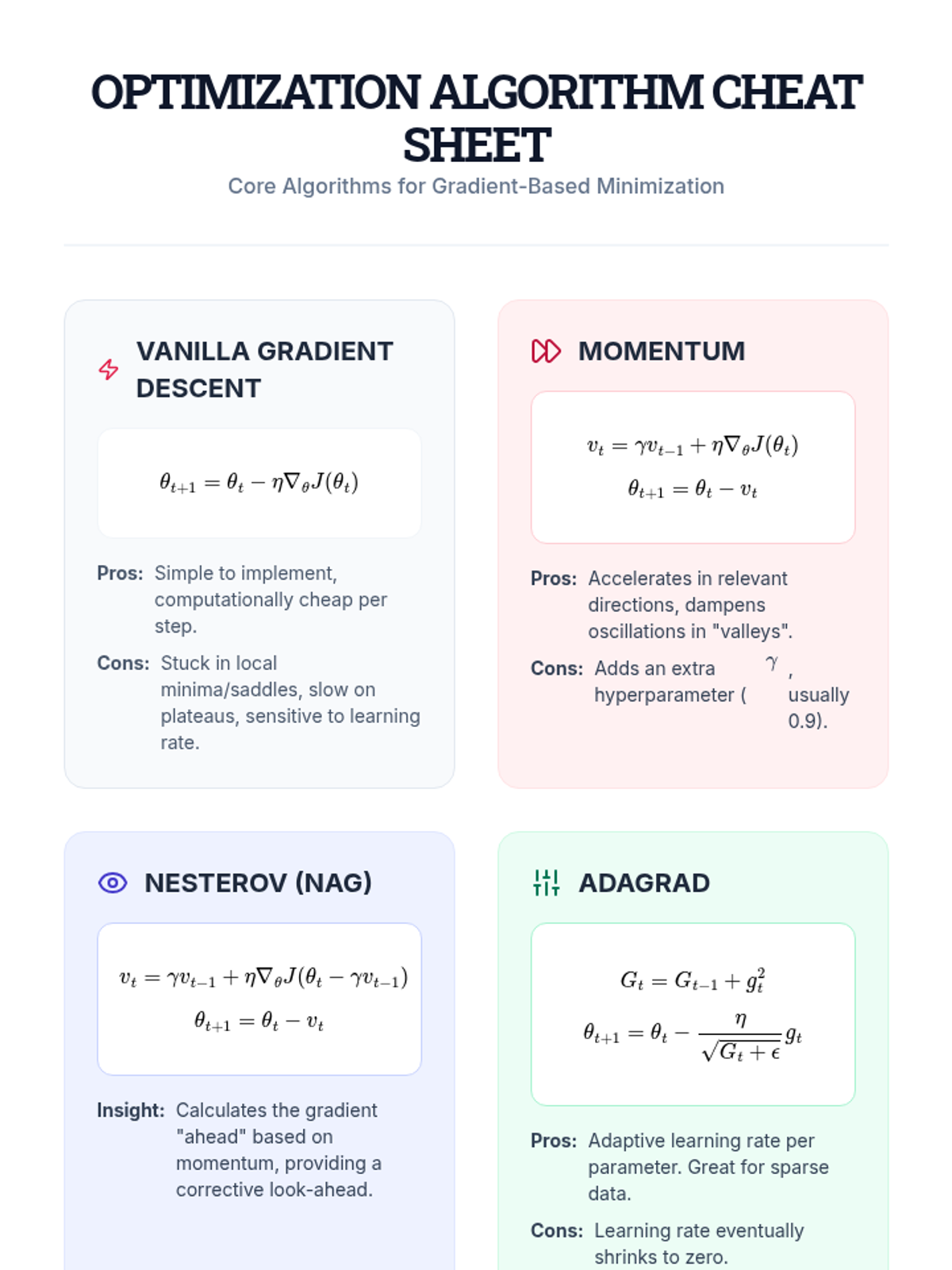
A comprehensive reference sheet for graduate students summarizing key optimization algorithms, including Vanilla Gradient Descent, Momentum, Nesterov Accelerated Gradient, and AdaGrad. Includes a troubleshooting table for common convergence issues.
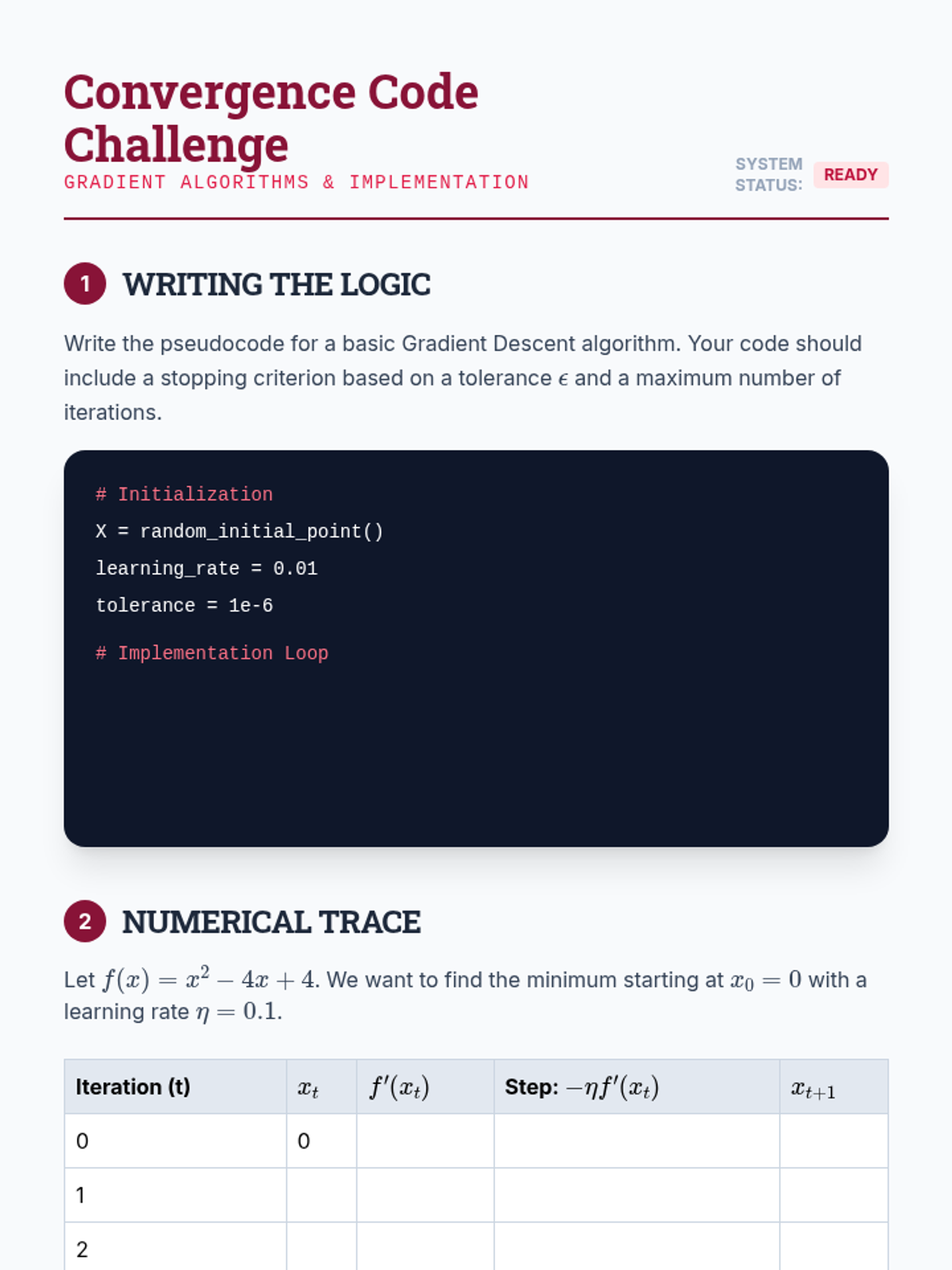
An implementation-focused worksheet where students write gradient descent pseudocode and manually trace the algorithm's path for a simple quadratic function to observe convergence behavior.
A slide deck introducing gradient descent, learning rate tuning, momentum, and convergence criteria. Designed for graduate students focusing on numerical optimization.
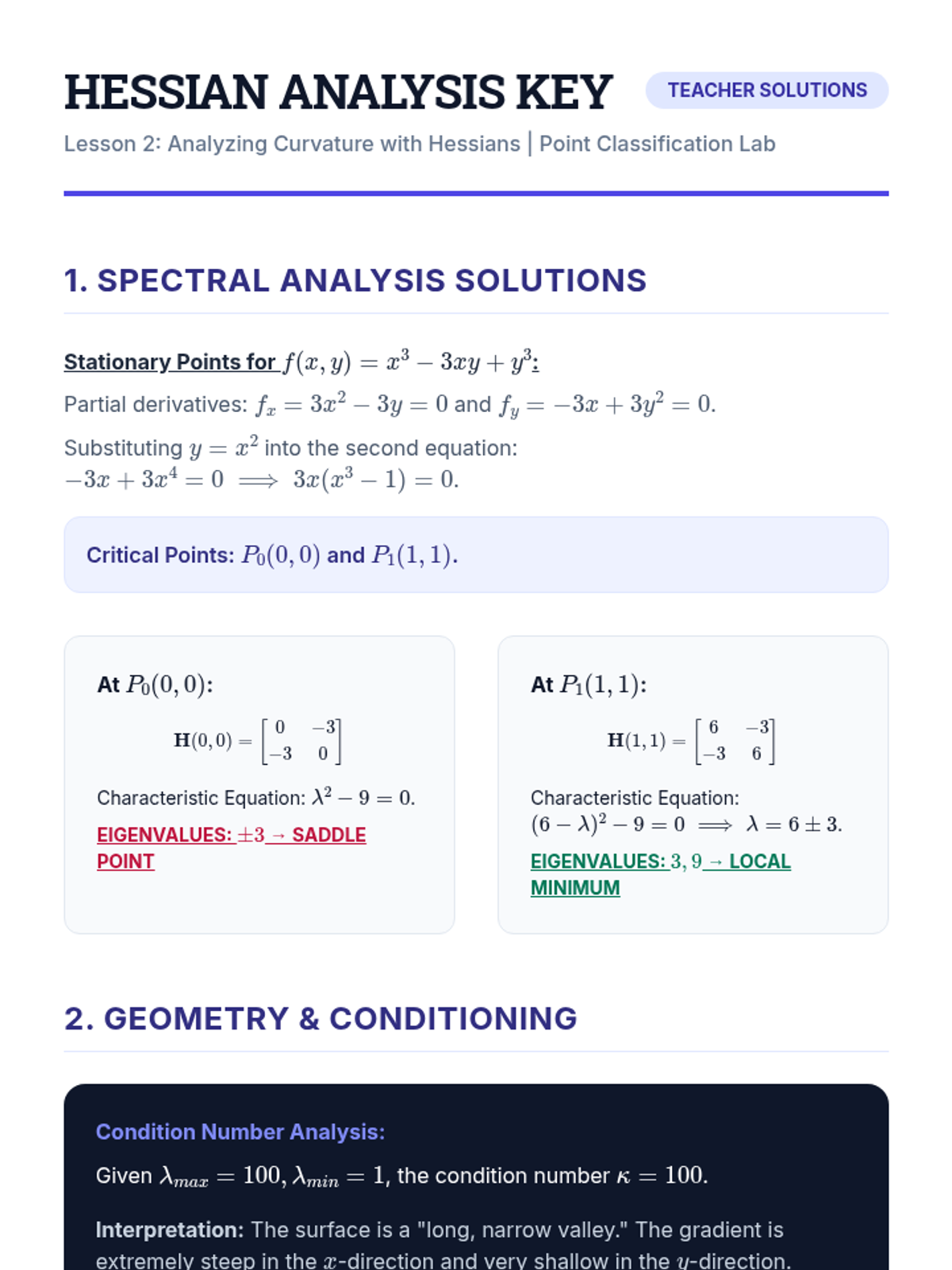
A teacher's solution key for the Point Classification Lab, including full derivations of eigenvalues, critical point classifications, and a high-dimensional statistical discussion for graduate students.
A quick progress monitoring exit ticket designed to assess student mastery of constructing two-way tables and testing for independence with a new scenario.
A complete answer key for the Blueprint Analysis Worksheet, including the finished two-way table, calculated conditional probabilities, and the final independence test conclusion.
A comprehensive teacher facilitation guide for the Probability Portraits intervention lesson. Includes pacing, scripting prompts, misconception alerts, and progress monitoring benchmarks.
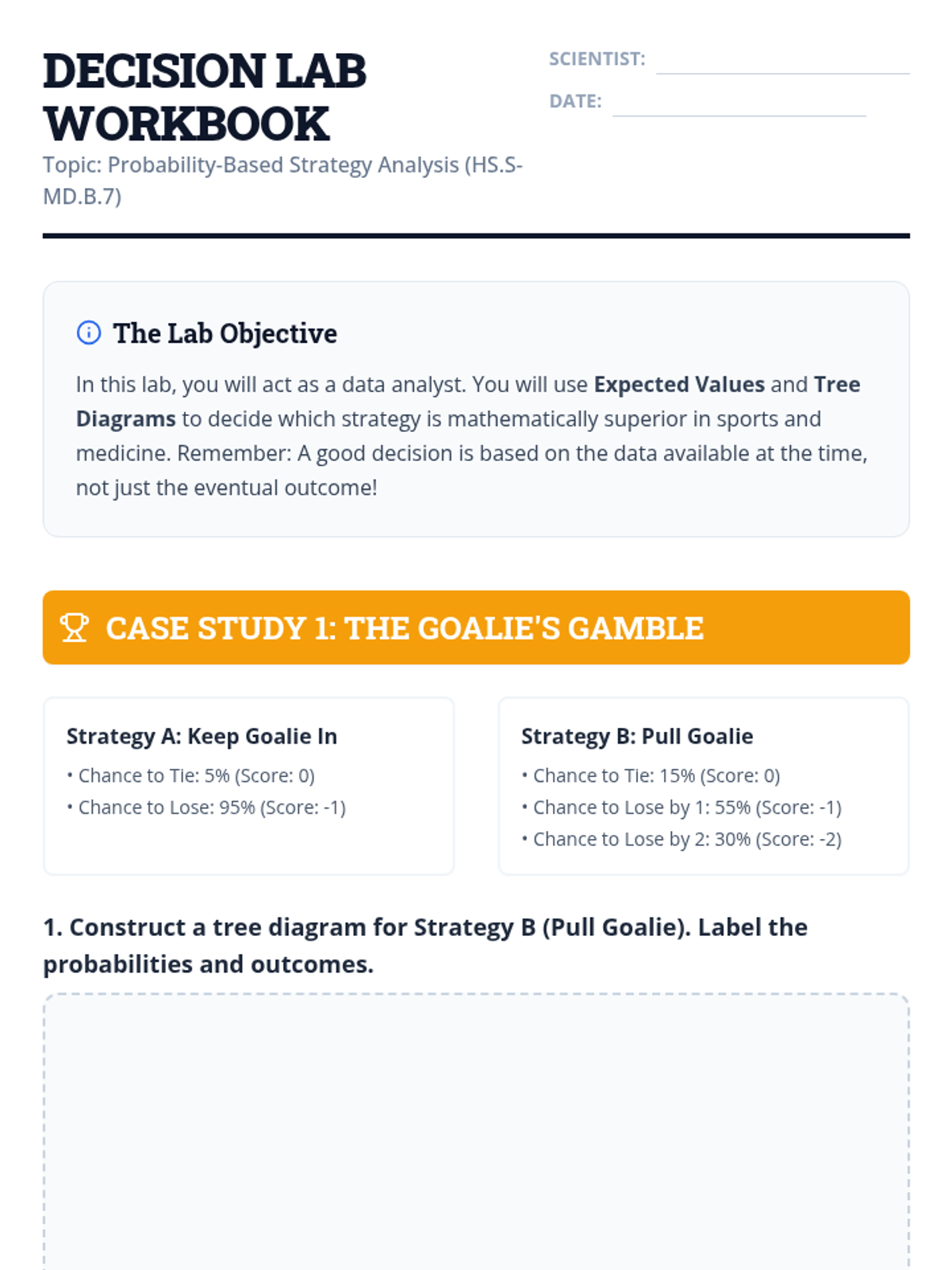
A scaffolded student workbook for analyzing probability-based decisions in hockey and medicine. It includes spaces for tree diagrams, expected value calculations, and frequency tables to help students navigate conditional probability and the base rate fallacy.
A scaffolded student worksheet for building two-way frequency tables and calculating conditional probabilities using the 'blueprint' method. Includes specific sections for construction, filtered probabilities, and testing for independence.
A comprehensive 16:9 slide deck for a Tier 2 intervention on two-way frequency tables. Features a 'blueprint' aesthetic with color-coded joint, marginal, and conditional frequency visual aids and step-by-step construction guides.
A facilitation guide for teachers to help debrief the funding board simulation, explaining the statistical trade-offs for each of the three project proposals.
The teacher's answer key for the Significance Showdown Worksheet, providing correct p-value analysis, matrix classification, and case study evaluations.
A comprehensive teacher facilitation guide for the Significance Showdown lesson. Includes learning objectives, scripted instructional steps for Tier 2 intervention, common misconceptions, and differentiation strategies.
A scaffolded student worksheet for a Tier 2 intervention on data significance. Includes vocabulary matching, a classification matrix activity, and two structured case studies for headline analysis.
A scaffolded student lab report for analyzing the statistical significance of experimental data. Includes sections for calculating observed differences, interpreting simulation dotplots, and writing a CER (Claim, Evidence, Reasoning) conclusion. Revised for better layout and space efficiency.
Visual presentation for a statistics intervention lesson. Slides explain the concept of random assignment, observed differences, and using simulation dotplots to determine statistical significance using the 5% threshold rule.
An instructional slide deck for a Tier 2 intervention lesson on evaluating data significance. It uses a "Newsroom Fact-Check" theme to help students distinguish between statistical significance (p-values) and practical significance (effect size) using concrete case studies.
A comprehensive teacher guide for leading a Tier 2 small group intervention on statistical significance. Includes instructional steps, a progress monitoring checklist, and strategies for addressing common student misconceptions.
Présentation sur les mesures de tendance centrale (moyenne, médiane, mode) et de dispersion (variance, écart-type), incluant l'interprétation de la forme d'une distribution.
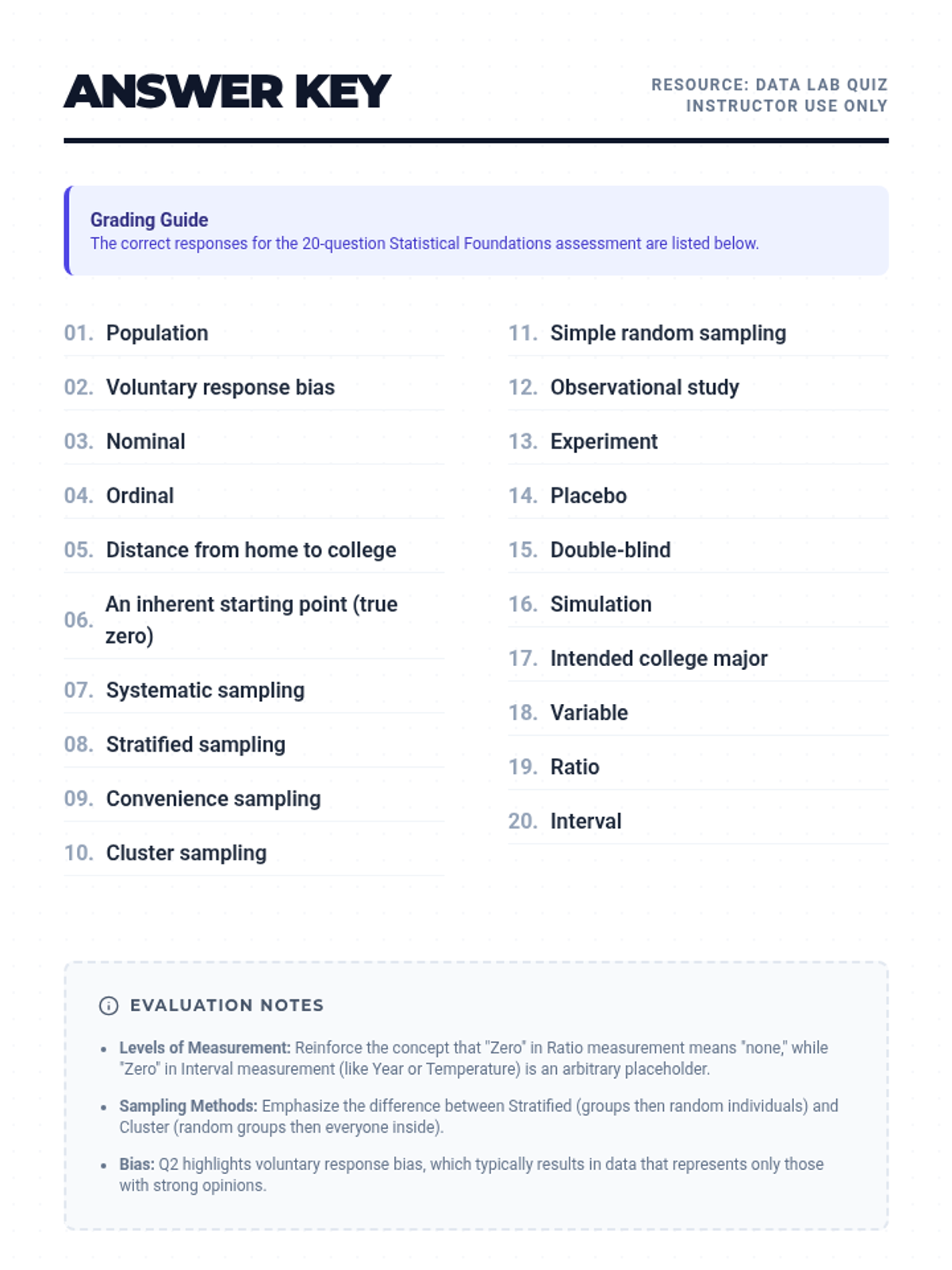
Guide de correction pour le Lab de Classification, incluant les justifications pour les types de variables et les échelles de mesure.
Feuille d'exercices pratique pour identifier les populations/échantillons et classer divers types de variables selon leur nature et leur échelle de mesure.
Support de présentation visuel introduisant les concepts de population vs échantillon, ainsi que la classification des variables et les échelles de mesure.
An extension assignment focusing on the historical origins of Bessel's correction, the conceptual logic of degrees of freedom, and the real-world implications of using biased estimators in industry.
A student laboratory sheet for calculating standard deviation, including a structured table for manual calculations and a random sampling simulation workspace to compare population vs sample formulas.
A set of instructional slides covering standard deviation, featuring an embedded video tutorial, formula comparisons, and a conceptual breakdown of Bessel's correction for unbiased estimation.
A comprehensive teacher facilitation guide for the Deviation Dilemma lesson, including learning objectives, a detailed 50-minute instructional timeline with video timestamps, and teaching tips for addressing common misconceptions.
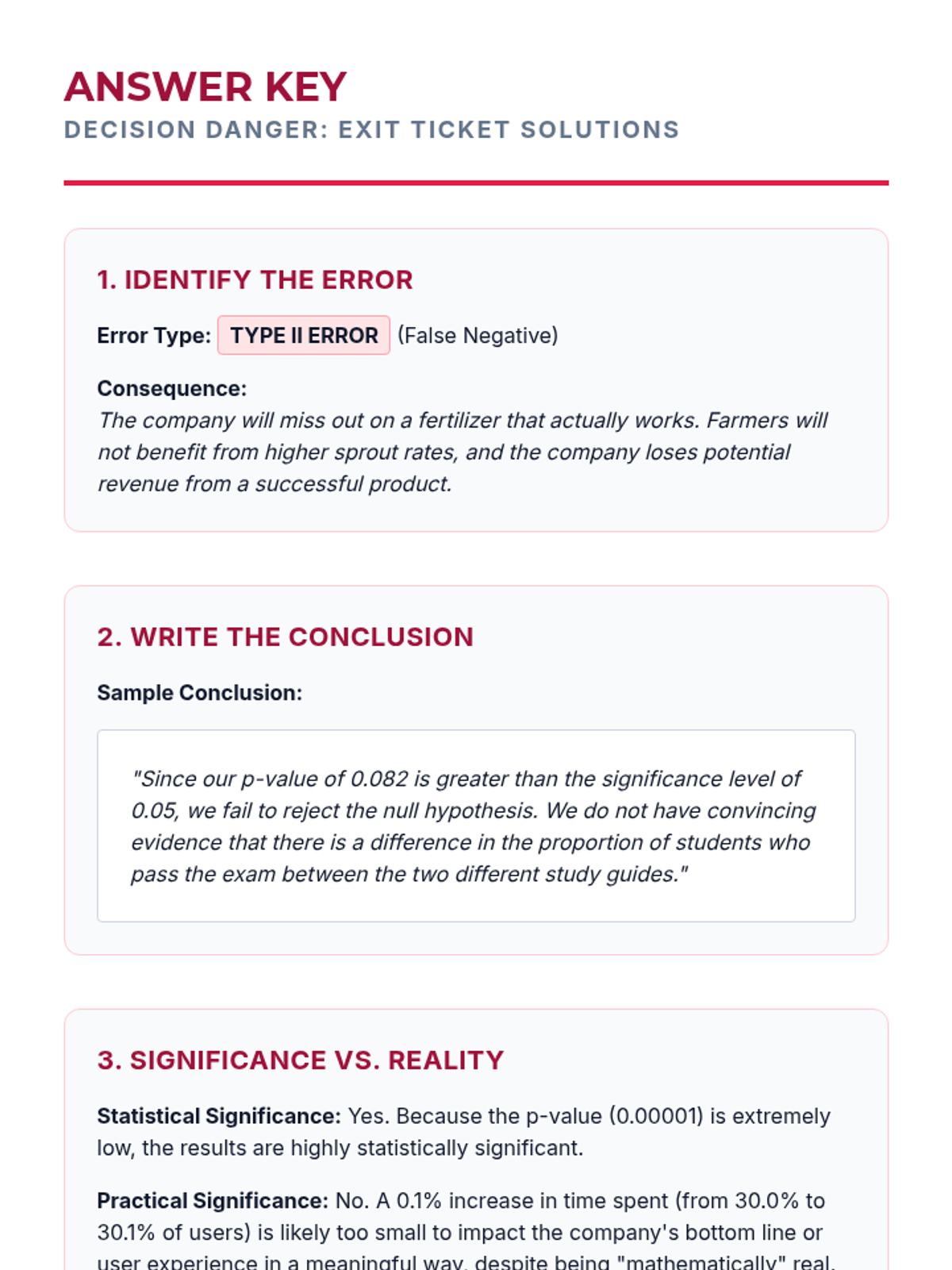
Answer key for the Decision Danger Exit Ticket, including error classification and conclusion writing.
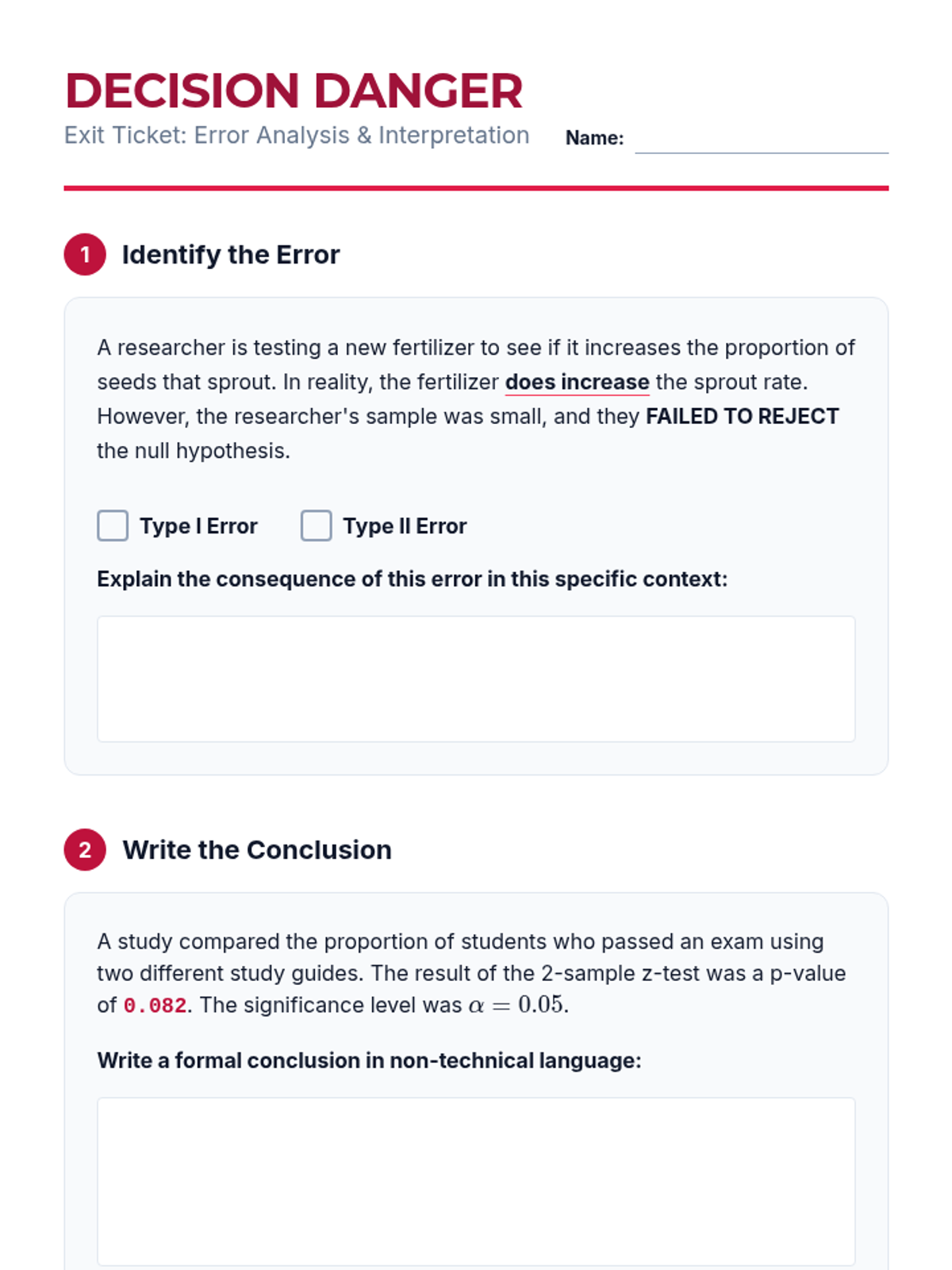
Exit ticket assessment for identifying Type I and Type II errors and writing statistical conclusions in non-technical language.
Slide deck explaining Type I and Type II errors and how to communicate statistical conclusions in non-technical language.
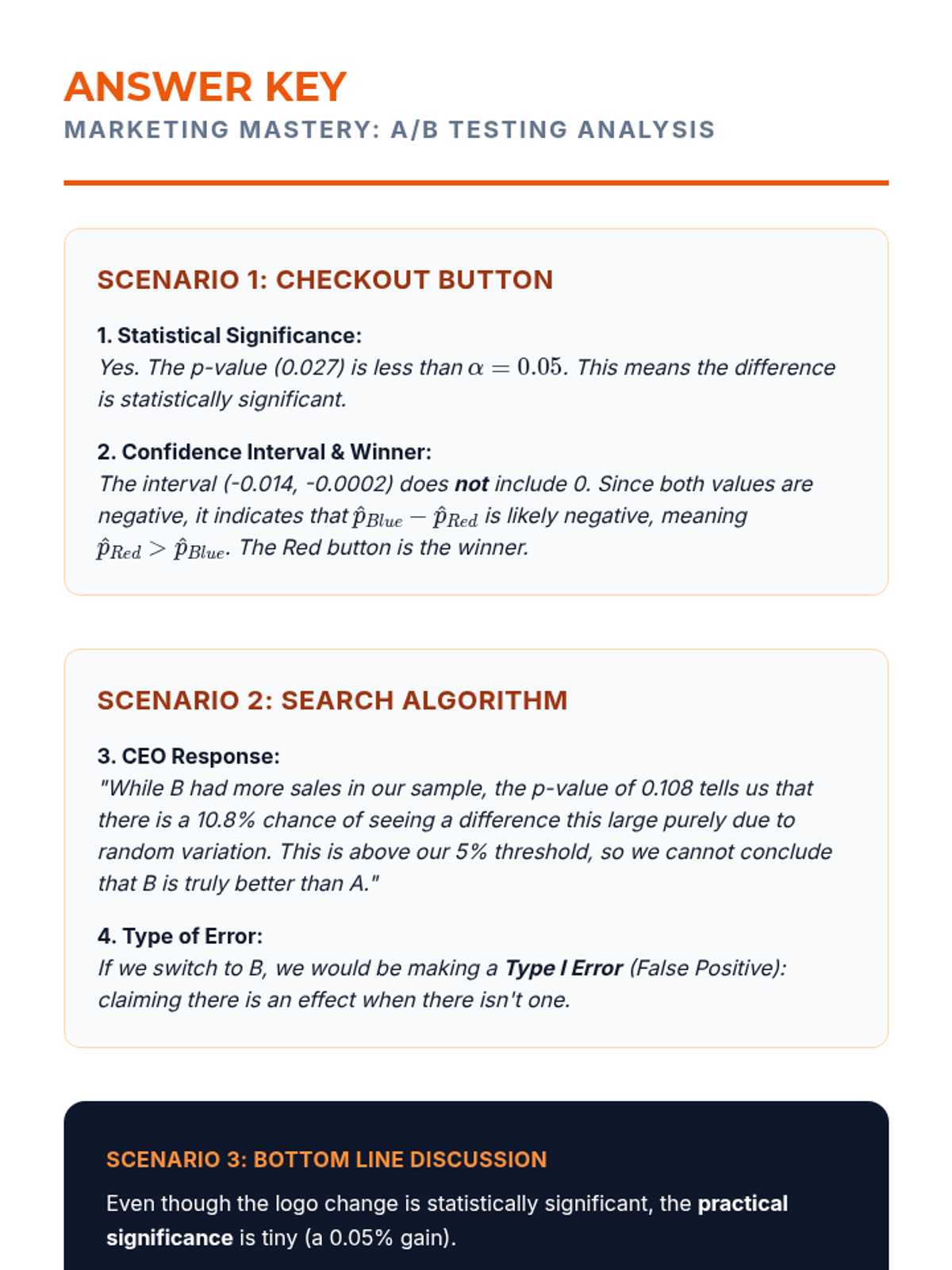
Answer key and discussion guide for the Marketing Mastery Case Study.
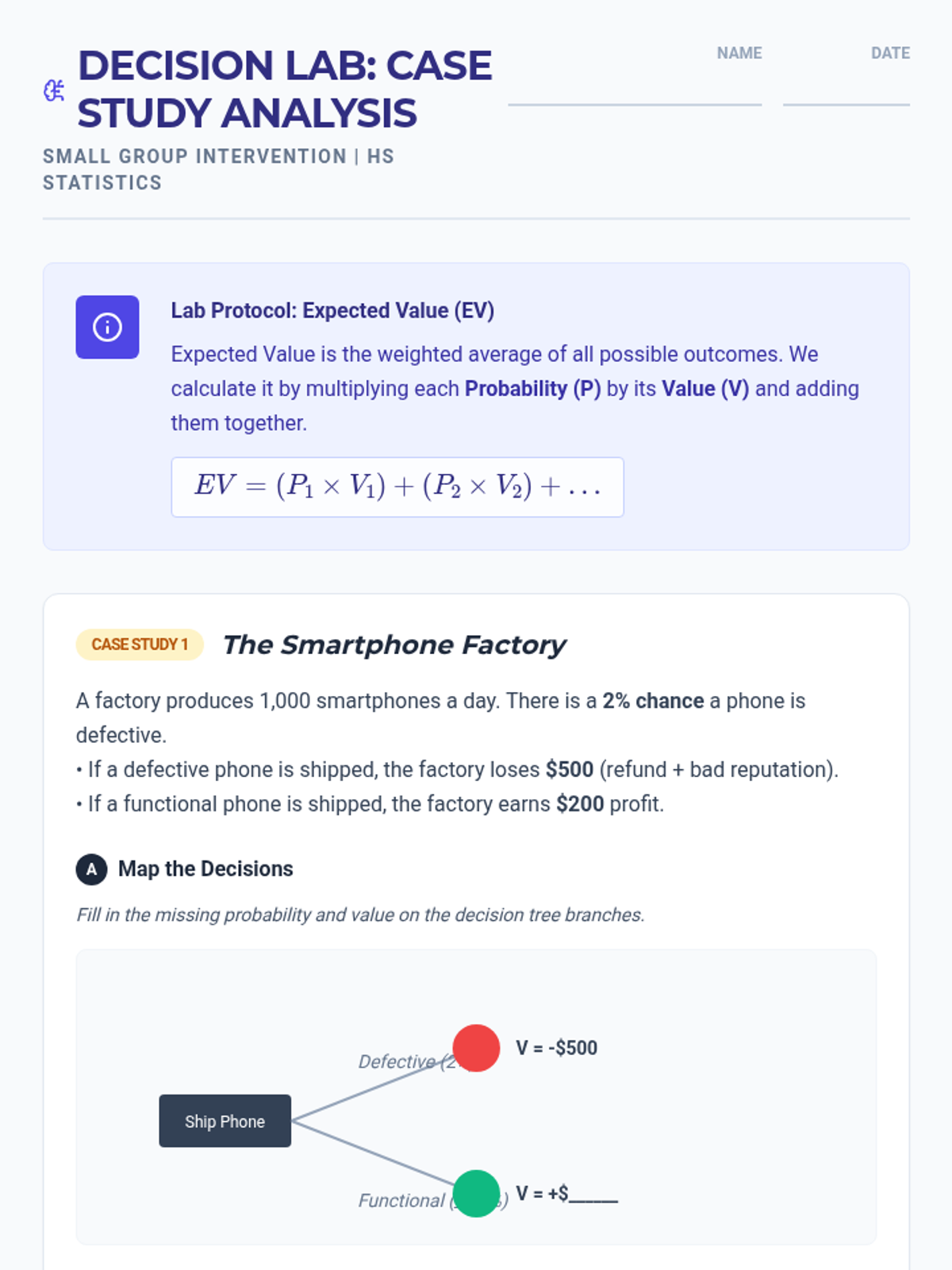
A scaffolded student activity sheet for a Tier 2 intervention on decision logic. It includes two detailed case studies (Quality Control and Sports Strategy) with decision trees, calculation spaces, and a structured justification template for students to practice using expected value to defend choices.
A comprehensive slide deck for a Tier 2 intervention on probability-based decision making. It covers expected value calculations, decision trees, and real-world case studies in medicine, business, and sports using a clean, professional "Decision Lab" aesthetic.
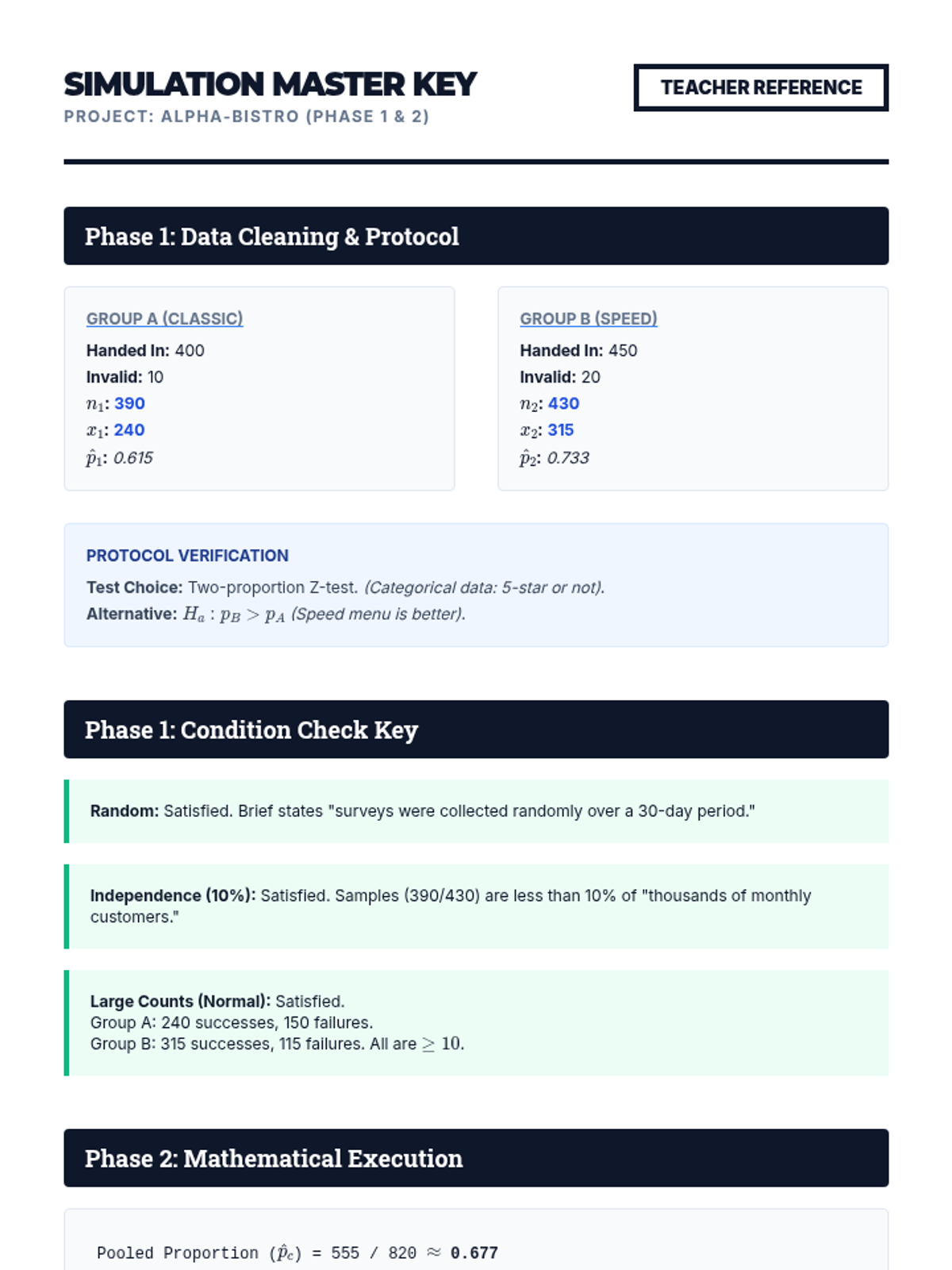
A comprehensive teacher key for the Bistro Battle simulation, providing cleaned counts, condition verifications, and full mathematical trace for the p-value calculation.
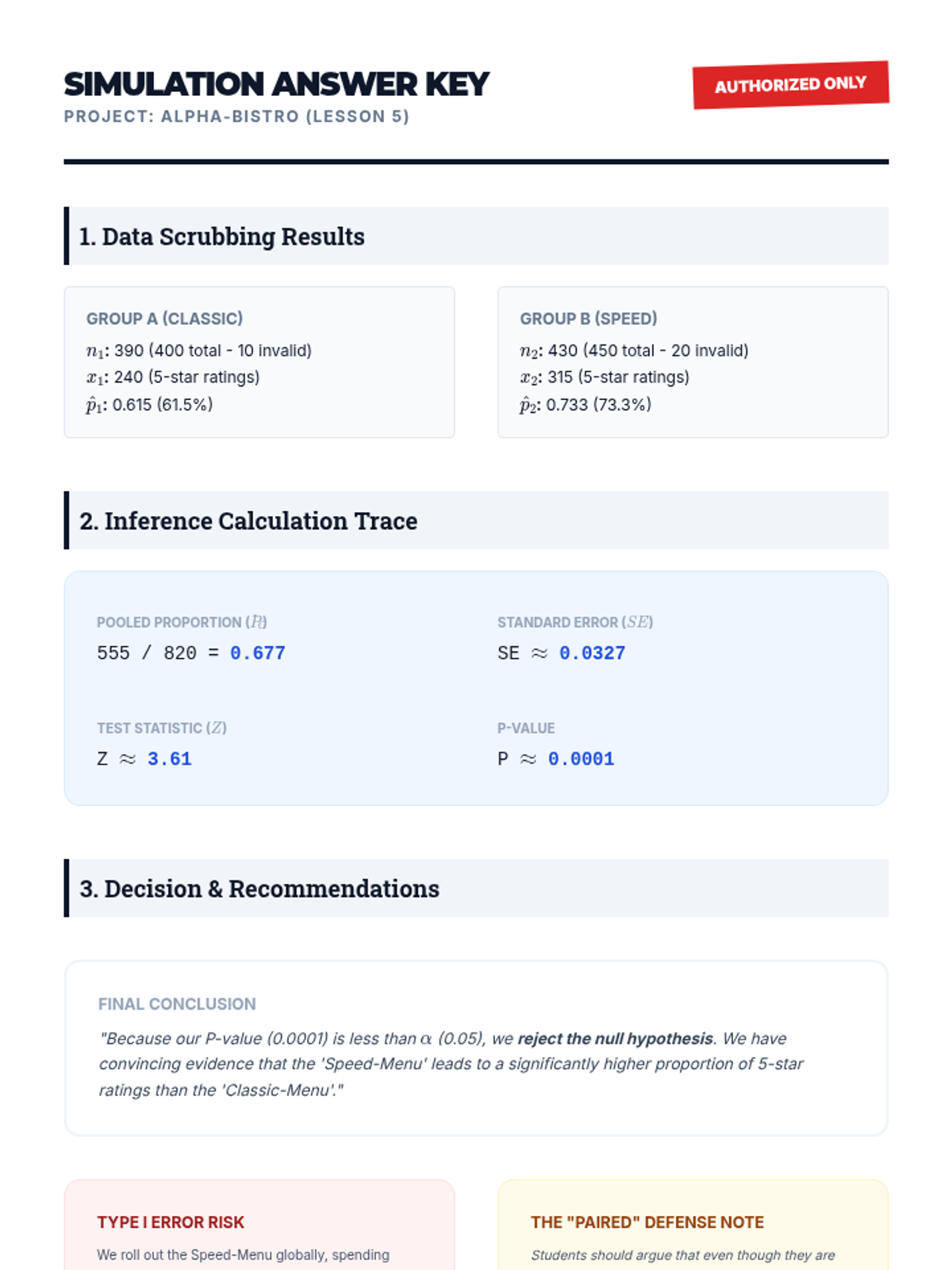
A teacher key for Lesson 5, containing the calculated values for the Bistro Battle simulation including pooled proportions, SE, Z-statistic, and p-value.
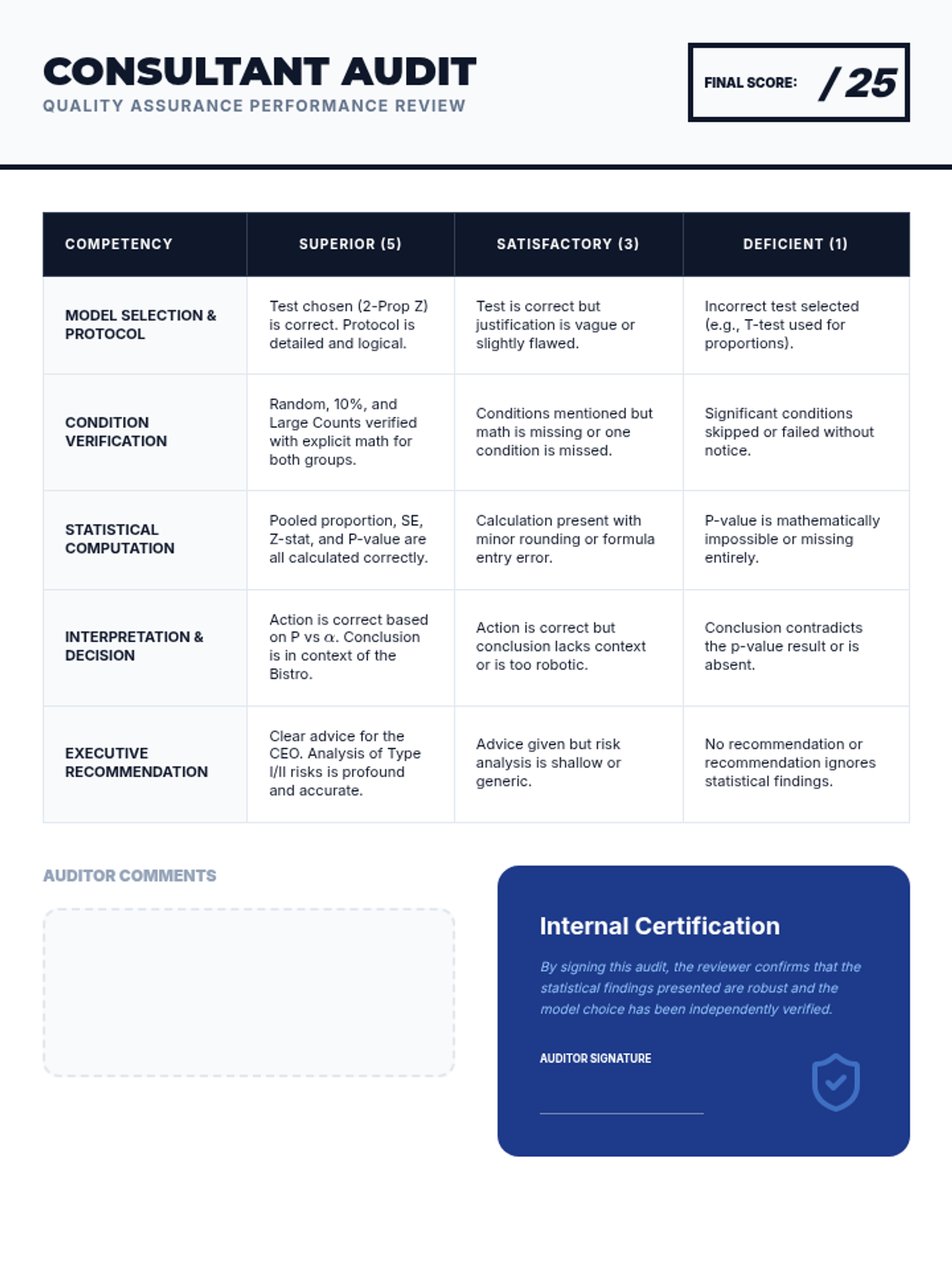
A comprehensive grading and peer-review rubric for the final consultant simulation, assessing model choice, condition checks, and interpretation.
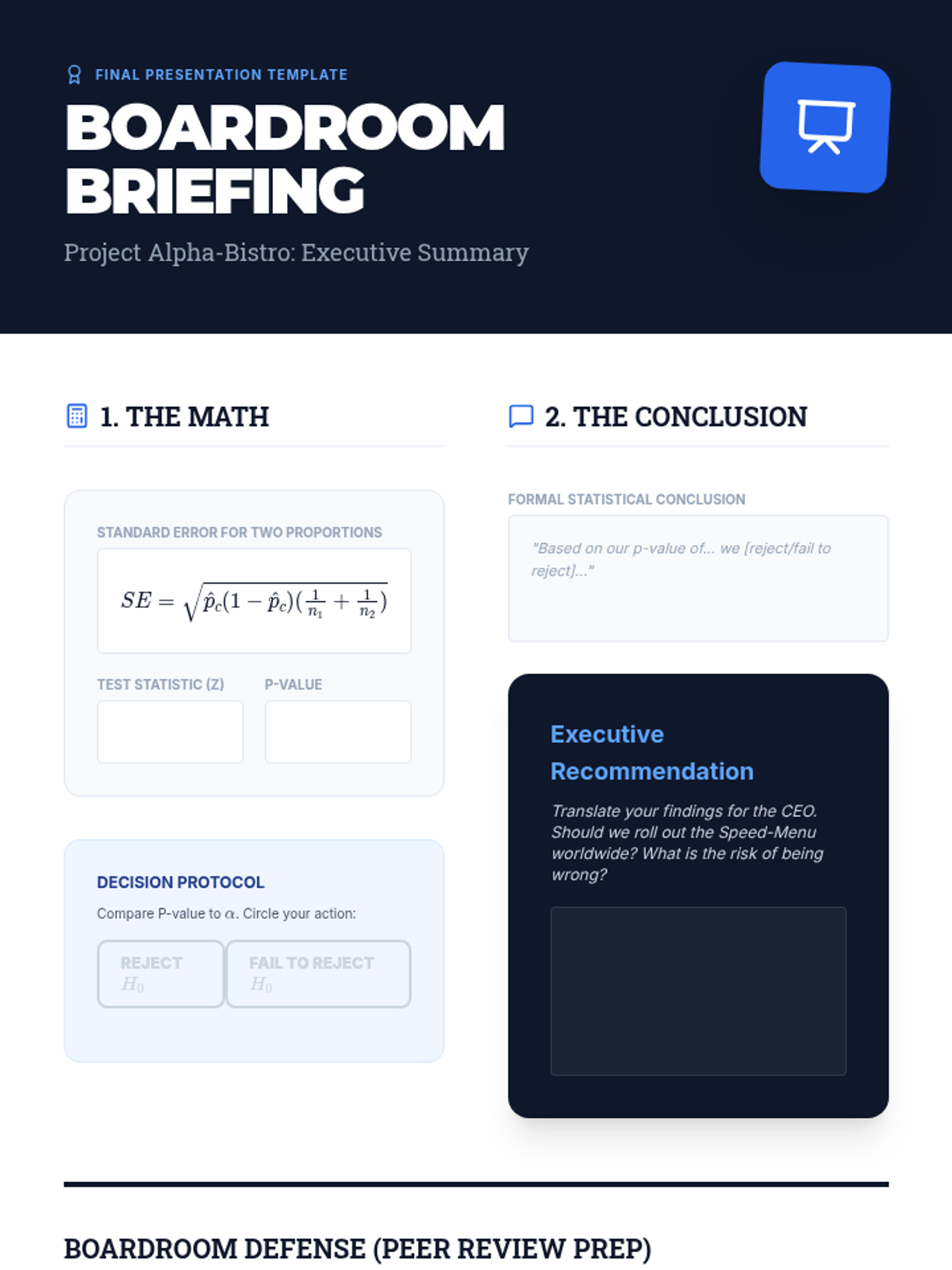
A student report template for Lesson 5 where students present their final p-value analysis and executive recommendations to the "Board of Directors".
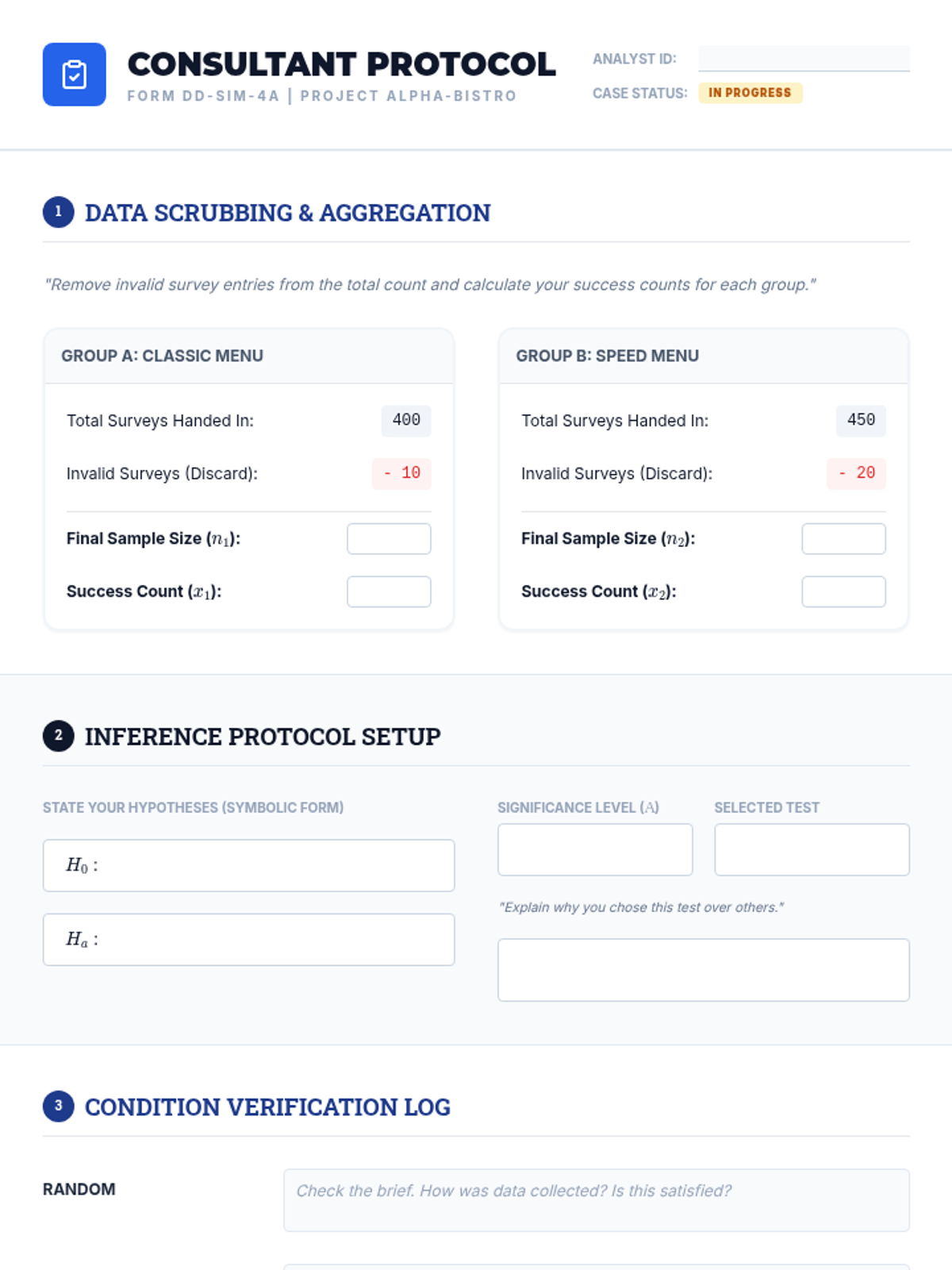
A student worksheet for Lesson 4 where students clean messy data, verify statistical conditions, and define their inference protocol.
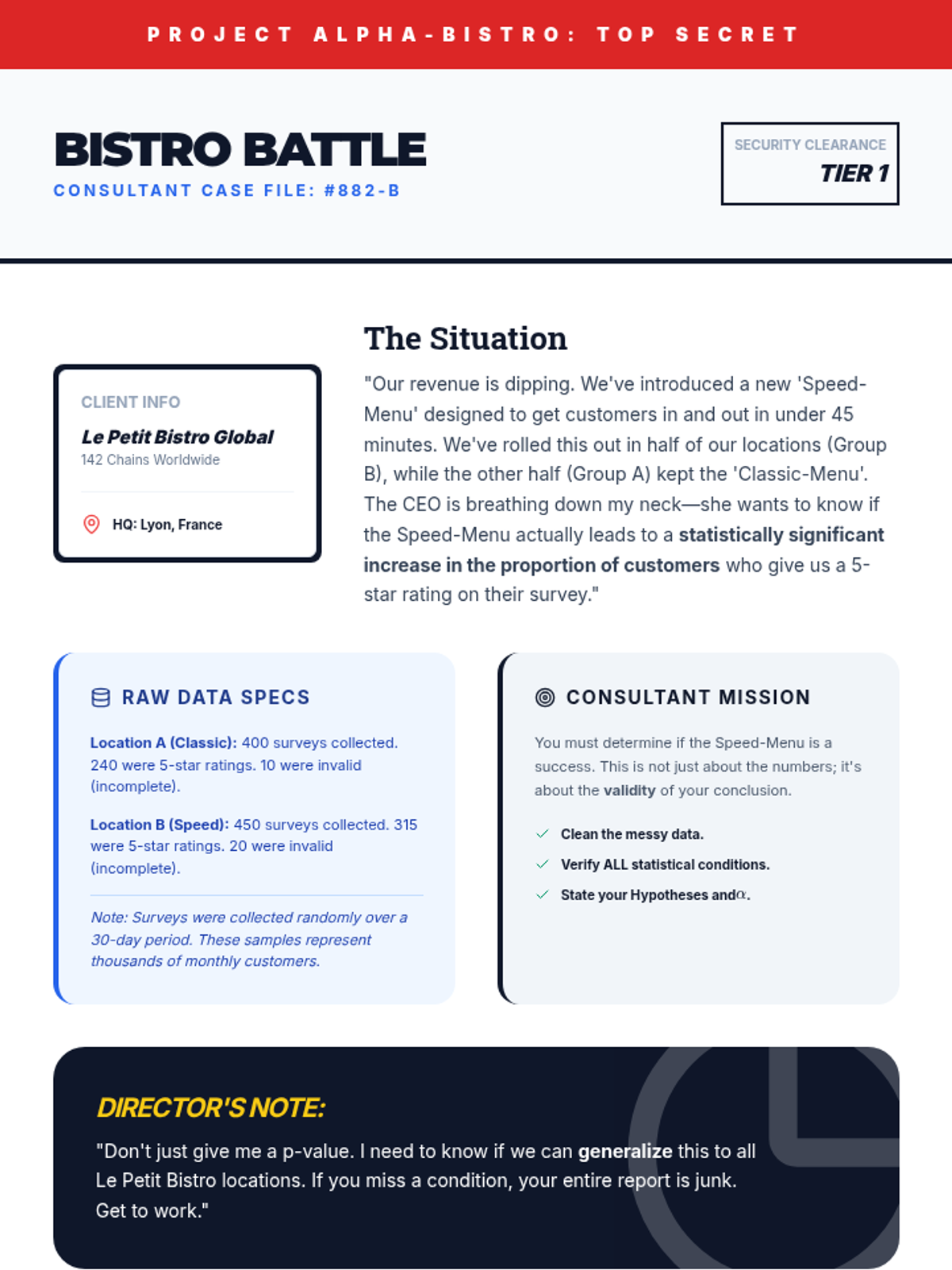
The project brief for the Lesson 4 simulation, providing the "Bistro Battle" scenario and raw data for students to analyze.
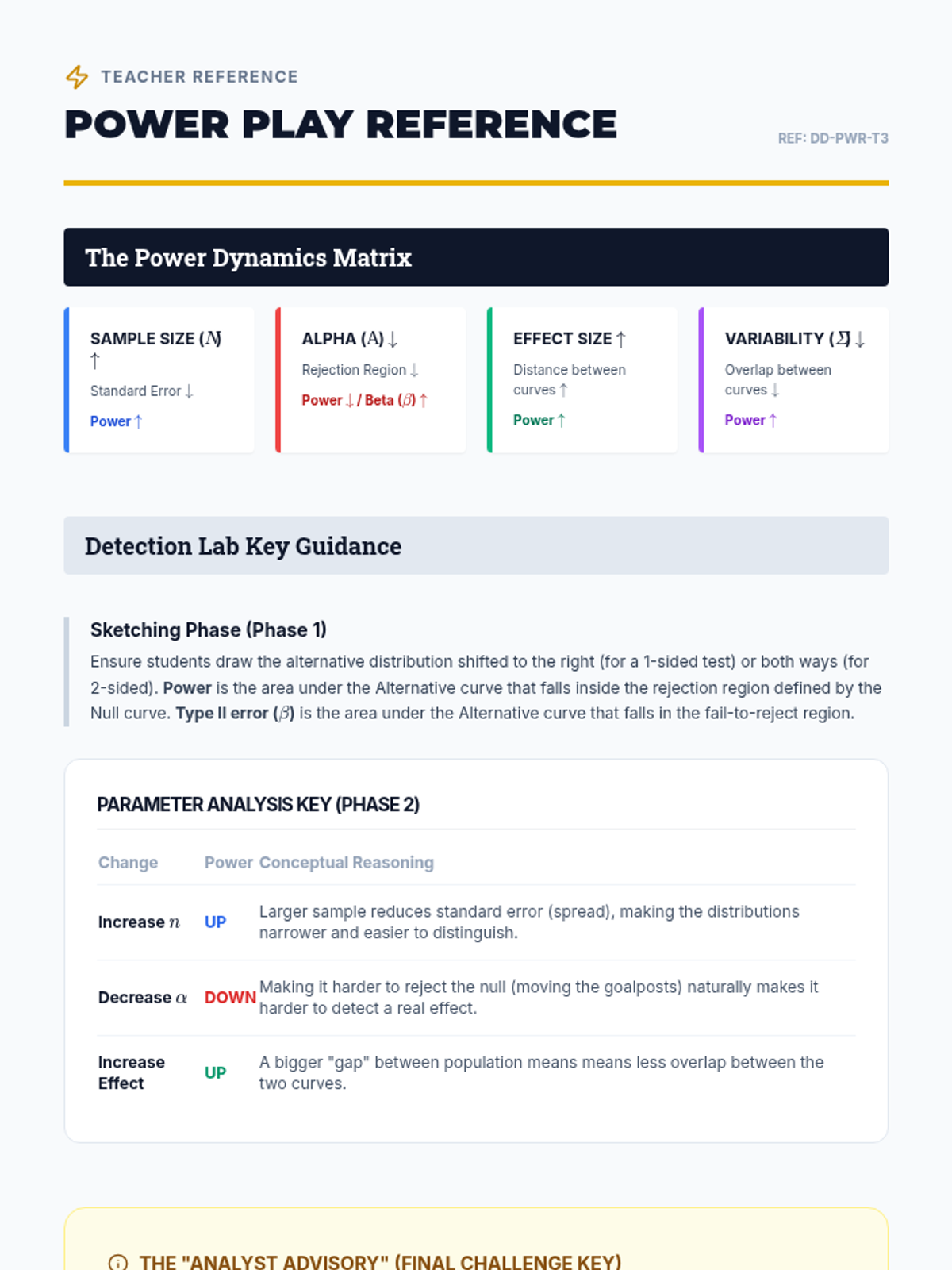
A teacher reference sheet for Lesson 3, summarizing the relationships between alpha, beta, power, and sample size, including lab answer guidance.
A conceptual student lab worksheet for Lesson 3 where students visualize statistical power and analyze how changing parameters affect it.
A slide deck for Lesson 3 exploring statistical power, sample size, effect size, and their real-world trade-offs.
An answer key for Lesson 2's Risk Assessment worksheet, providing context-specific error definitions and pedagogical notes for teachers.
A student dossier worksheet where students analyze and define Type I and Type II errors in pharmaceutical and tech industry contexts.
A slide deck for Lesson 2 exploring Type I and Type II errors with real-world context and the trade-offs between them.
Visual presentation slides for the 'Bin Size Battle' lesson, including learning objectives, a deep dive into the 'inclusive lower limit' rule with visual examples, an embedded YouTube video comparison, and activity instructions.
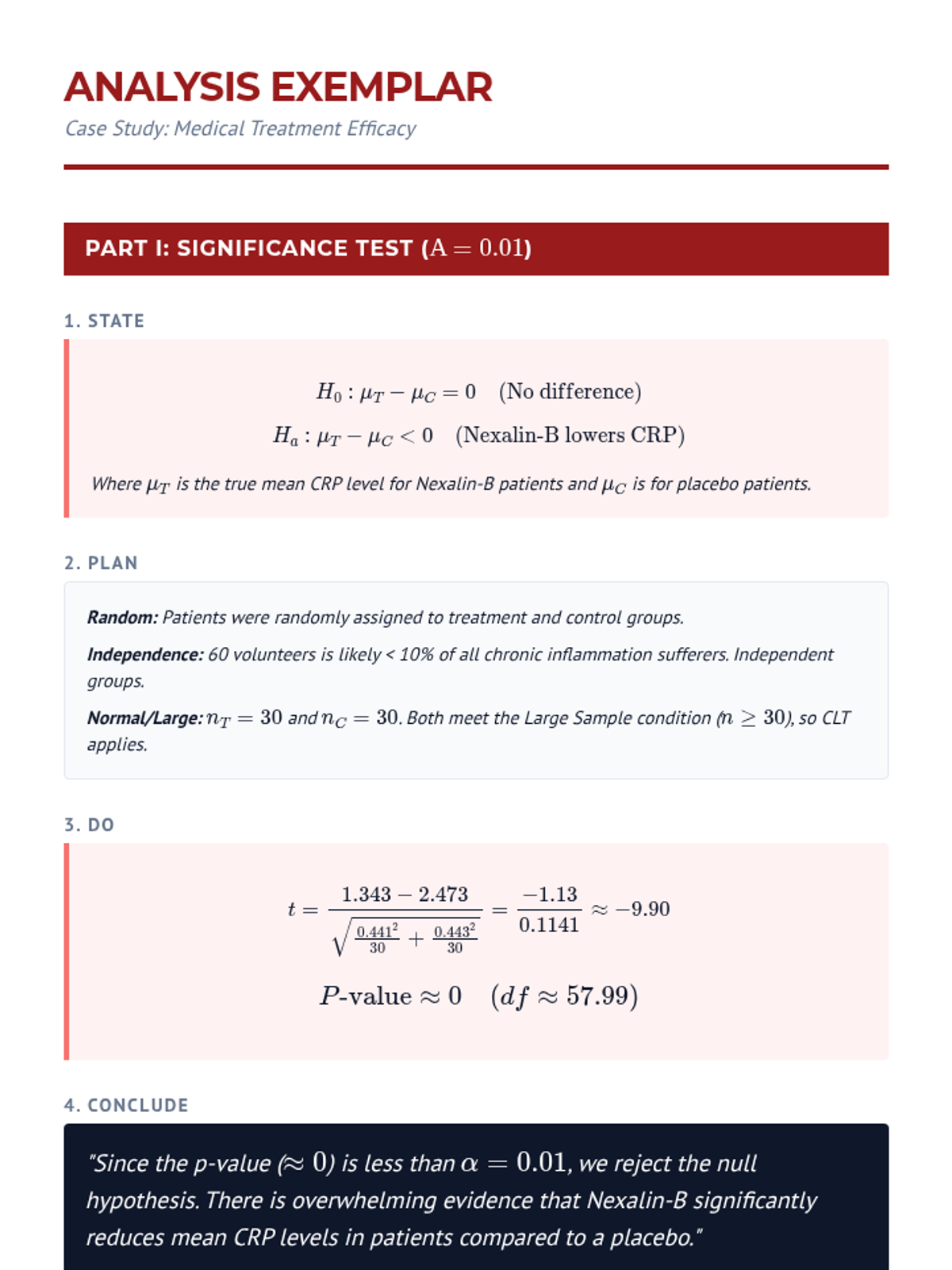
Answer key and exemplar for the Medical Treatment Efficacy Case Study, including full 4-step hypothesis testing and interval calculation.
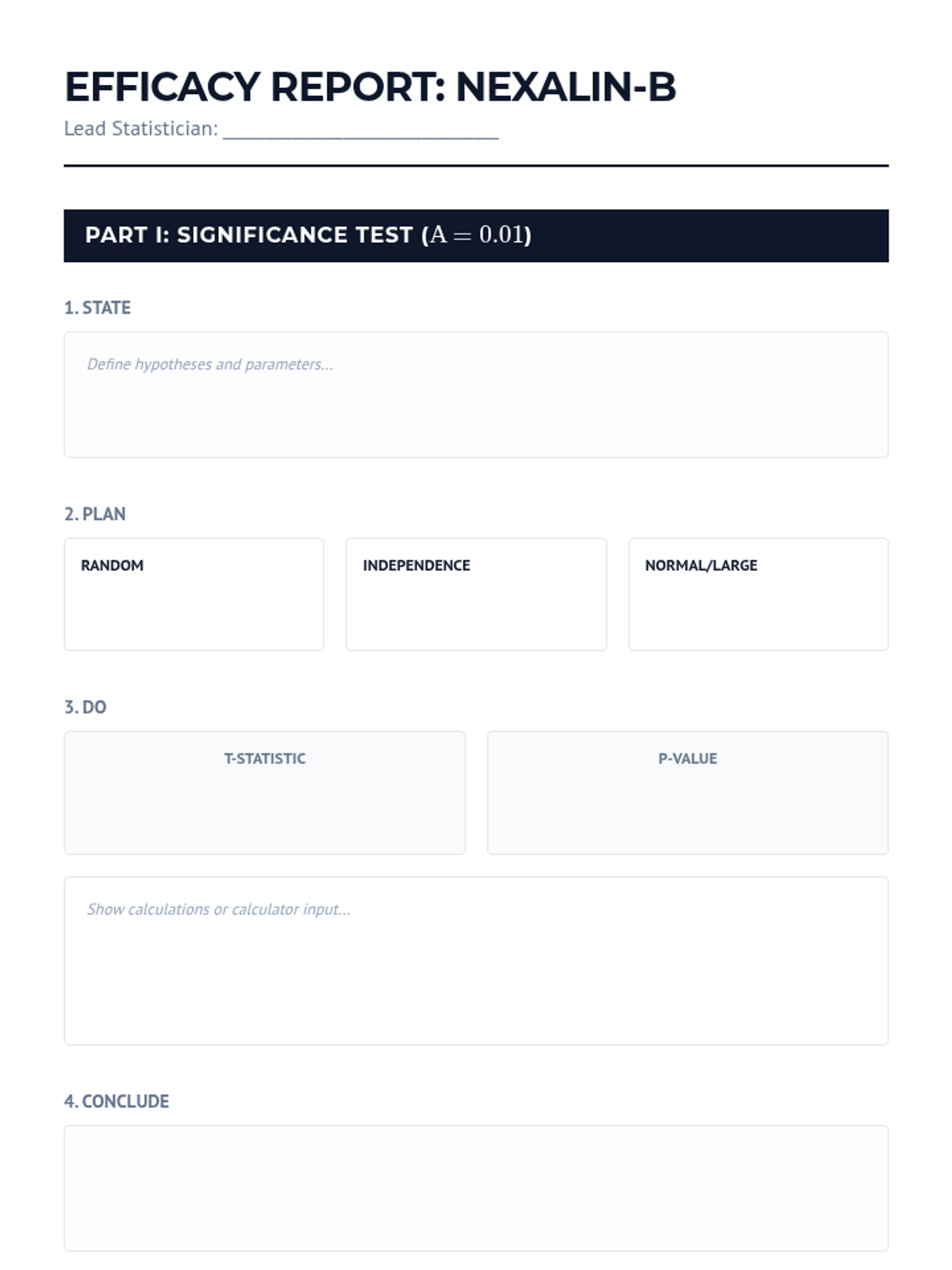
Worksheet for performing a complete statistical analysis of the Nexalin-B clinical trial data, including hypothesis testing and confidence intervals.
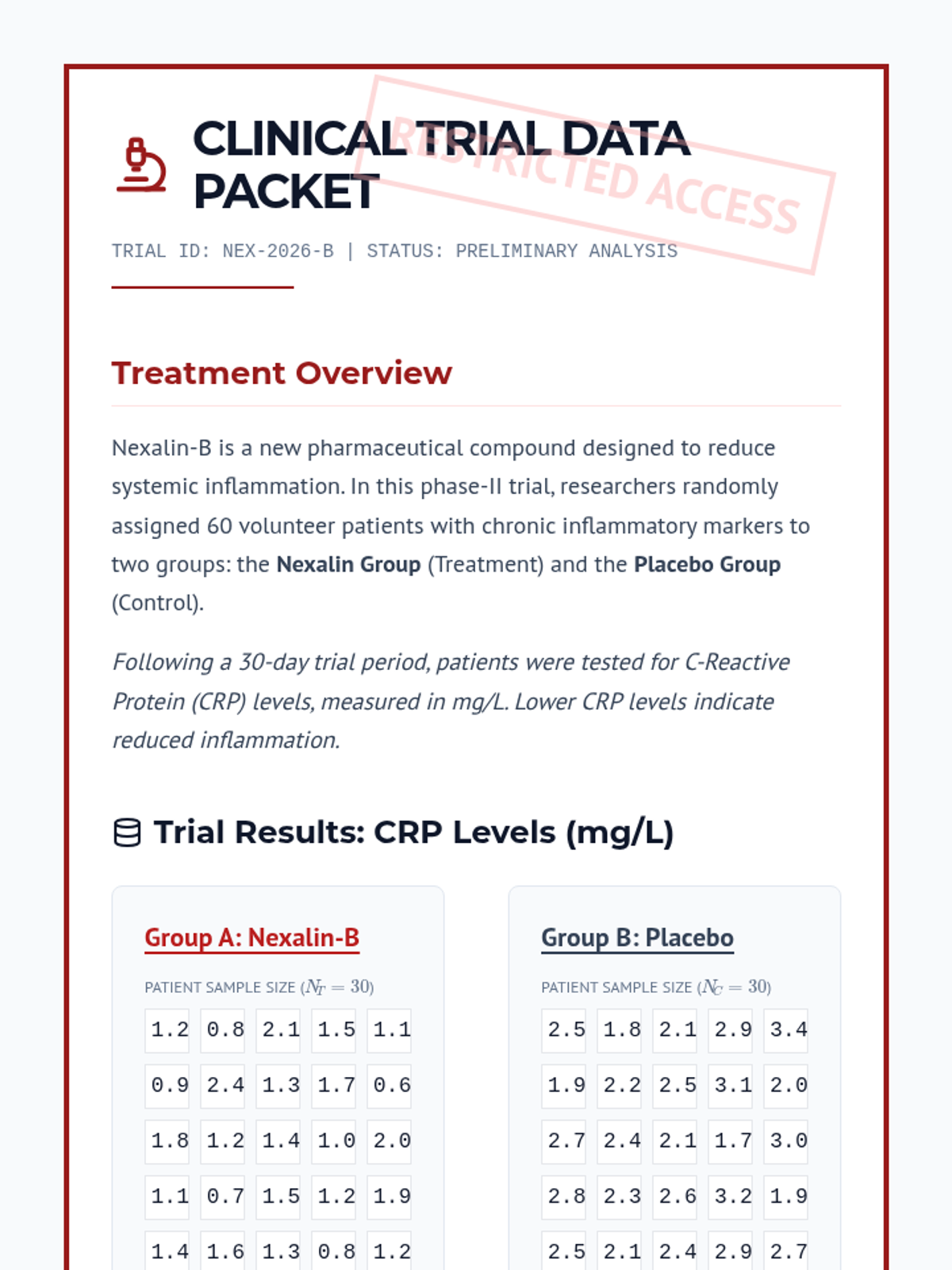
Case study data packet containing raw data and summary statistics from a simulated clinical trial for medical treatment efficacy.
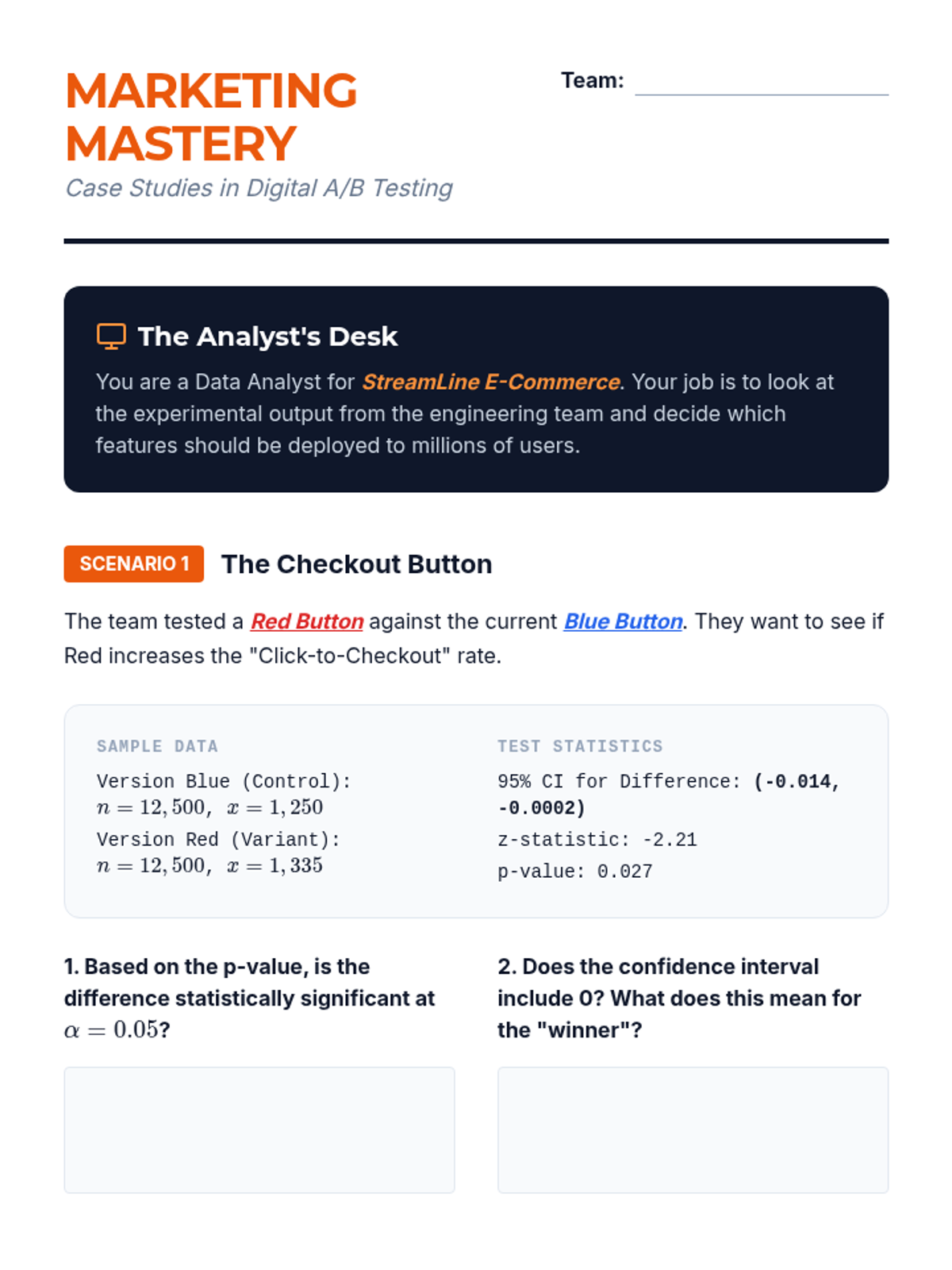
Student case study activity where students interpret computer-generated output for various A/B testing scenarios in digital marketing.
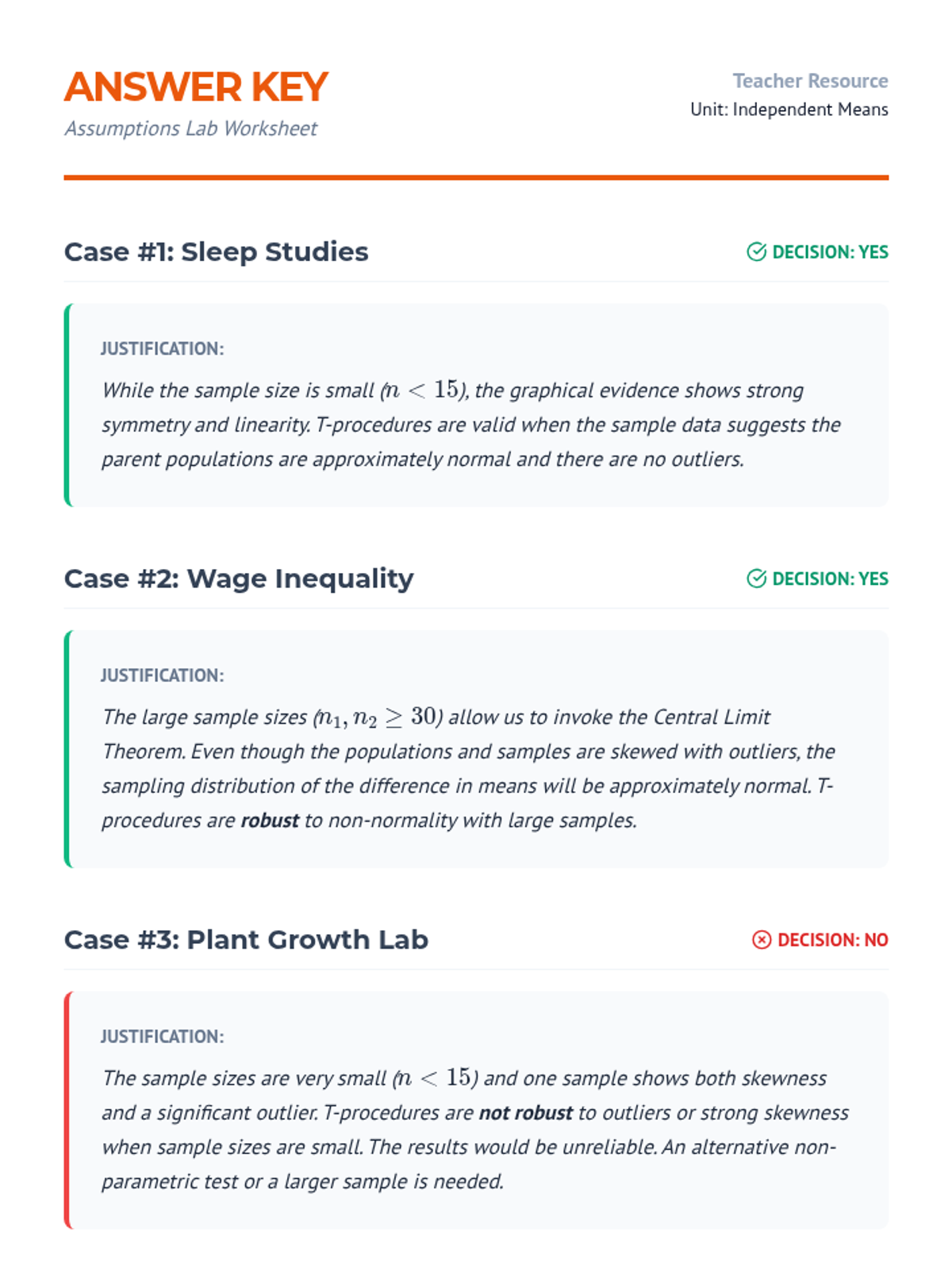
Answer key for the Assumptions Lab Worksheet, providing detailed justifications for whether to proceed with t-tests in various scenarios.
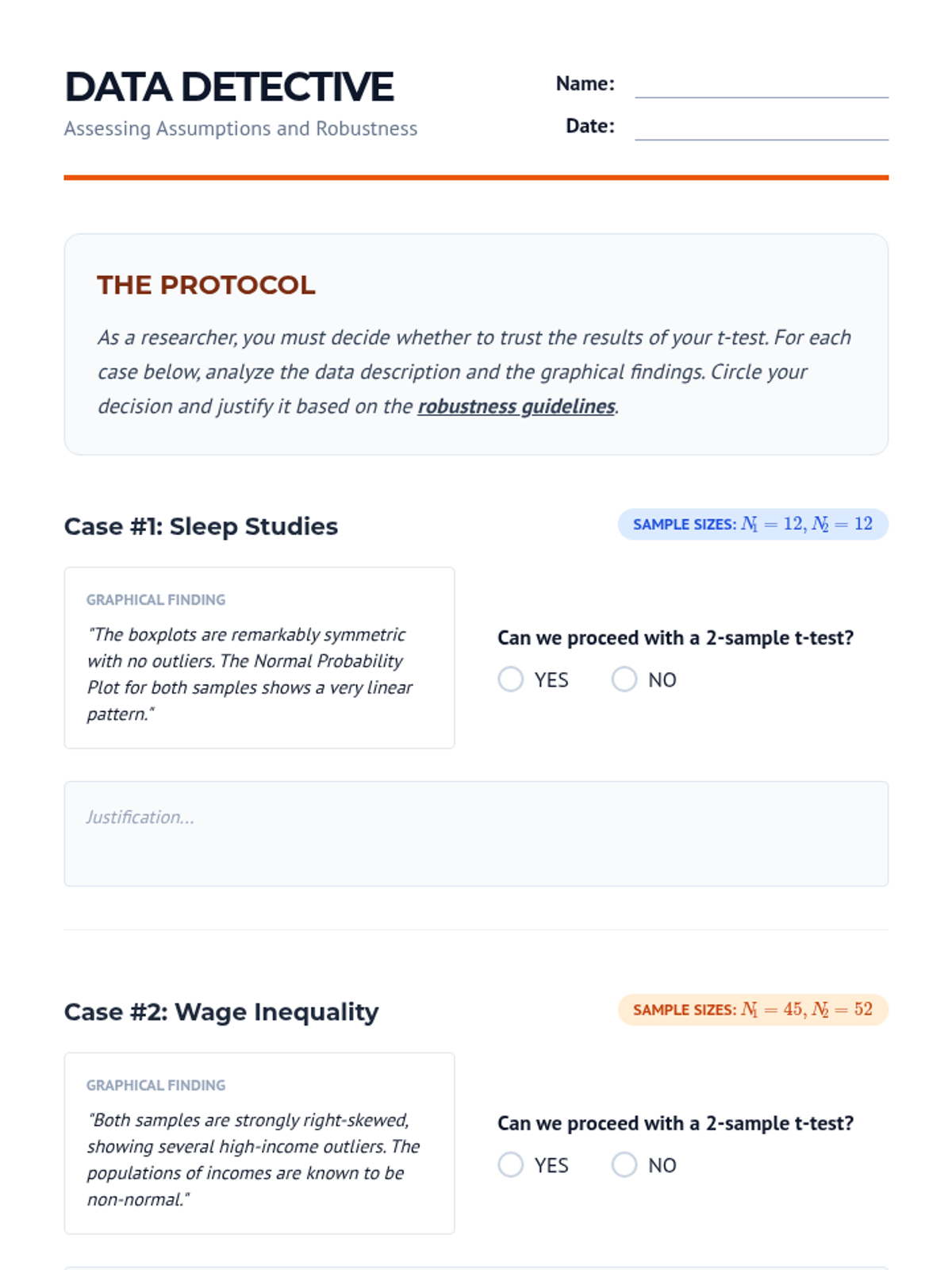
Activity investigating small samples and their graphical findings to determine the validity of t-procedures.
Slide deck explaining A/B testing in marketing, how to interpret computer output, and the difference between statistical and practical significance.
Visual presentation on the validity conditions and robustness of t-procedures, focusing on small sample sizes and graphical analysis.
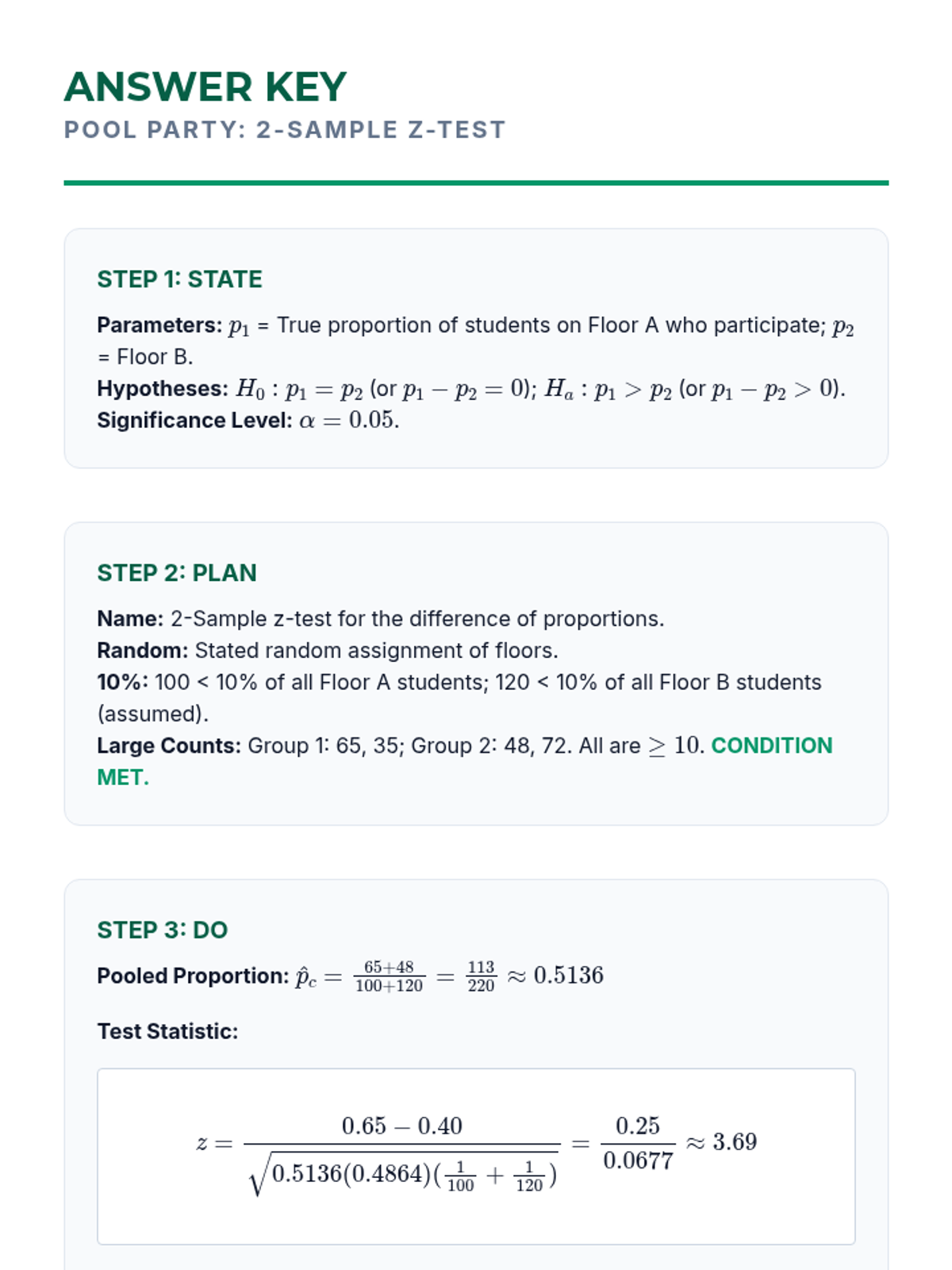
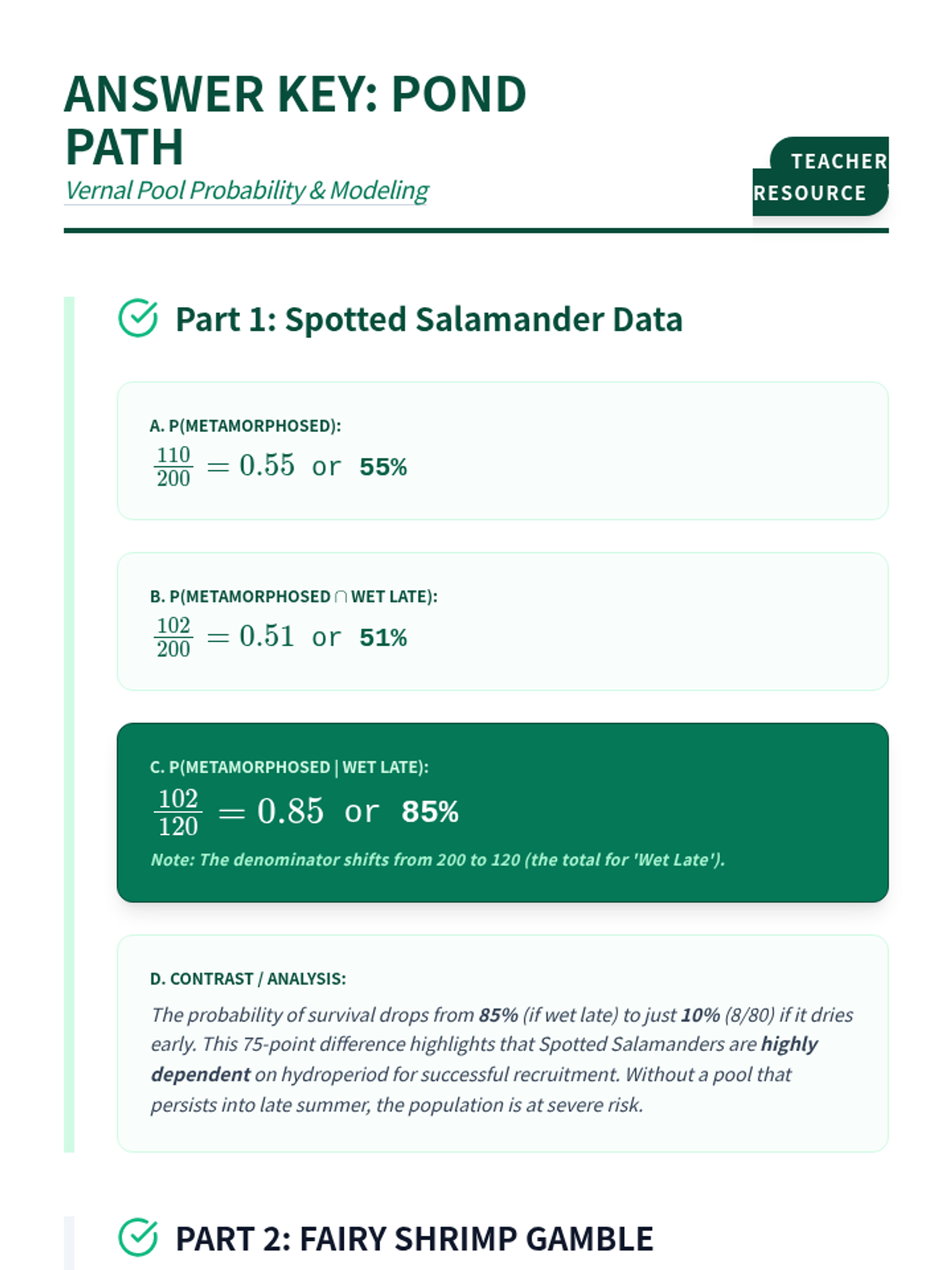
Answer key for the Pool Party Worksheet, featuring full step-by-step calculations and conclusions.
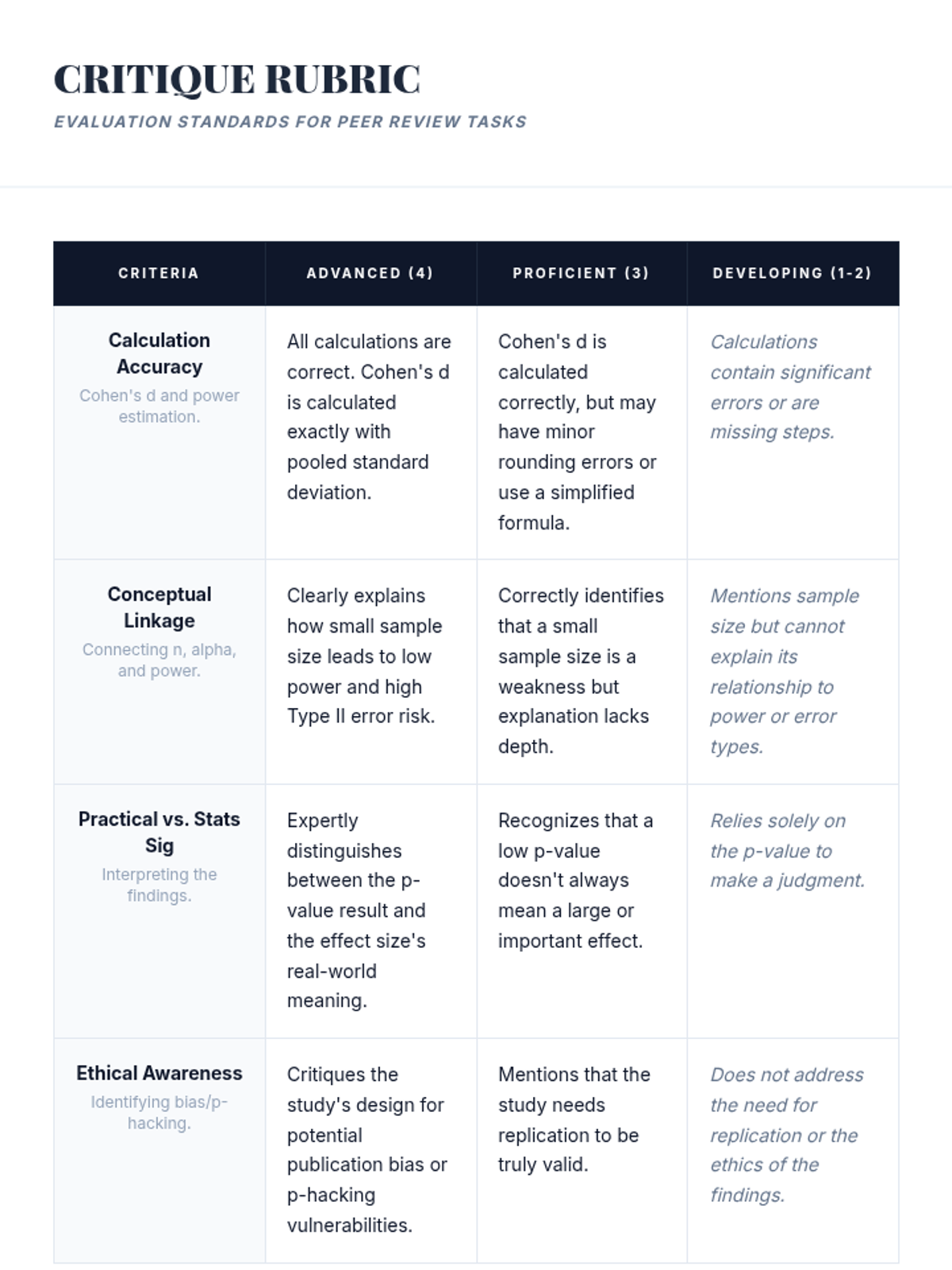
An assessment rubric for evaluating student performance on the Peer Review Board mastery task, focusing on calculation, conceptual understanding, and ethical analysis.
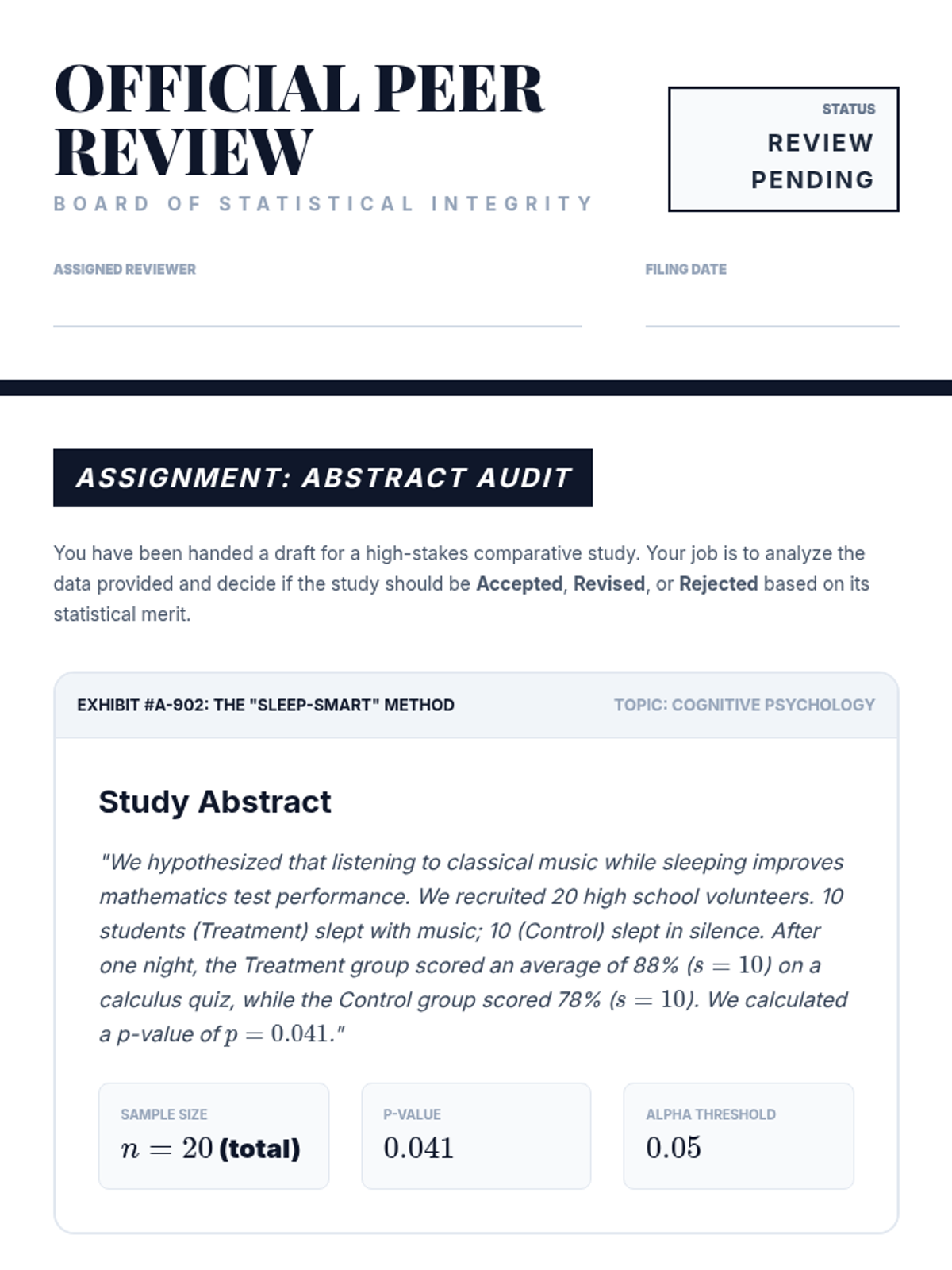
The final mastery-based activity for the sequence where students act as peer reviewers to evaluate the validity of a research study based on its sample size, p-value, and calculated effect size.
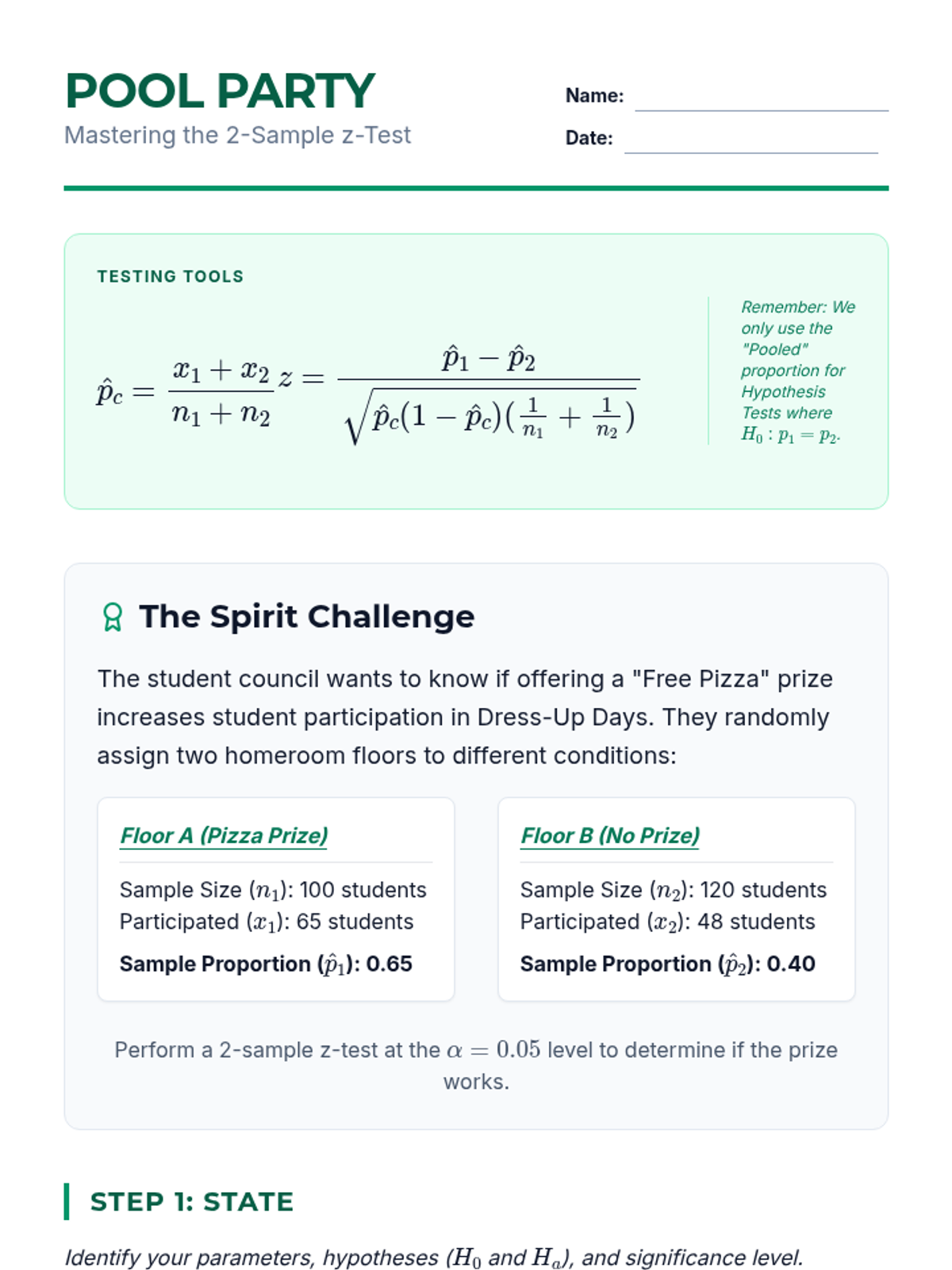
Guided practice performing the full 4-step hypothesis testing process for comparing two proportions, including the pooled proportion calculation.
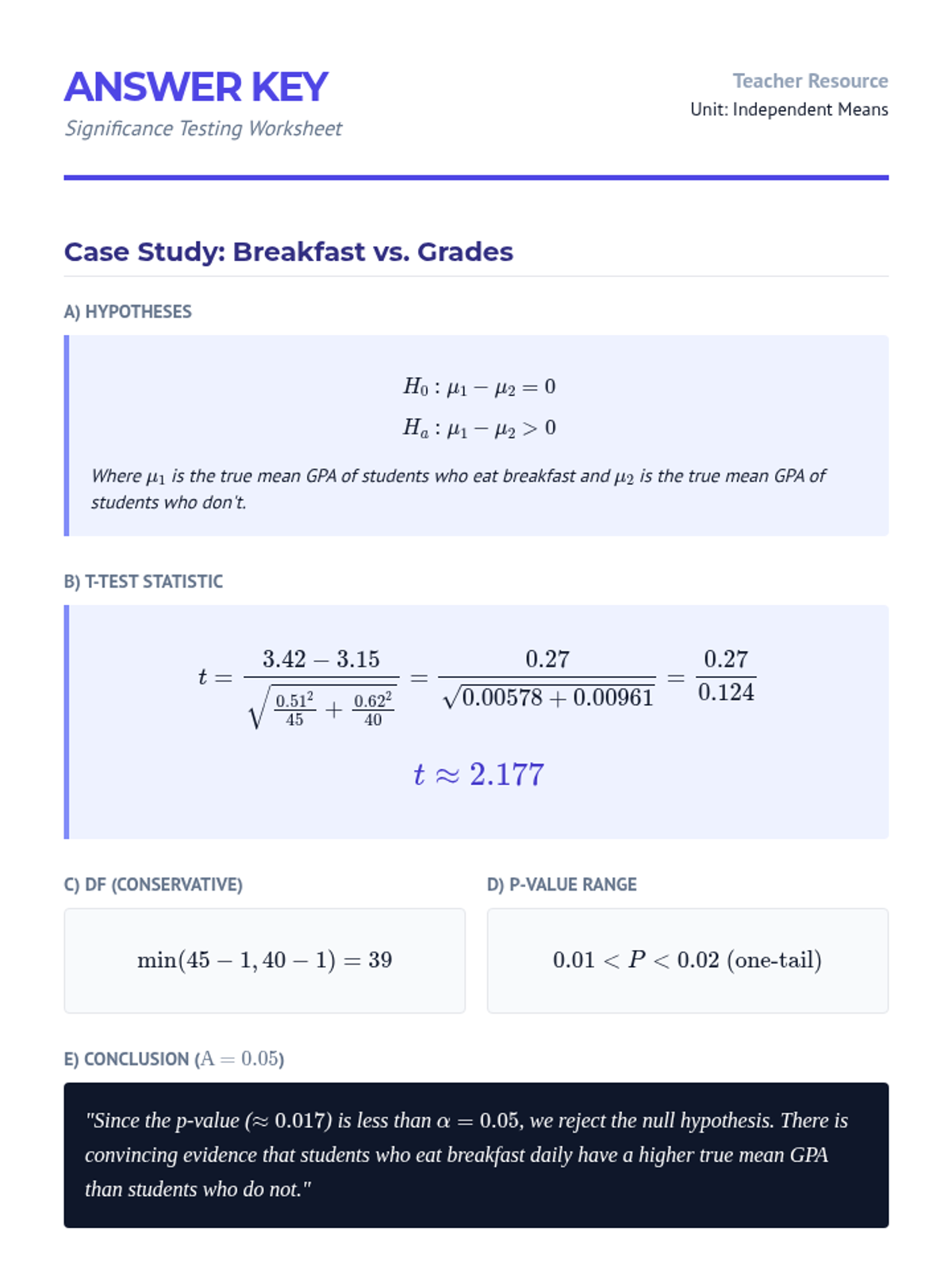
Answer key for the Significance Testing Worksheet, providing detailed solutions and conceptual responses.
Capstone slides for Lesson 5, guiding students through the process of peer-reviewing a research abstract by analyzing statistical vs. practical significance.
Updated introductory slide deck for Lesson 5 with large, accessible font sizes (min 24px). Covers RR, OR, the rare disease rule, and ethical data reporting.
Worksheet for performing 2-sample t-tests, including hypothesis setup, test statistic calculation, and p-value interpretation.
A reflection journal sheet for students to synthesize their understanding of weighted means, focusing on the conceptual role of volume as a weight and real-world applications.
A structured lab report for students to solve mixture problems using the weighted mean formula. Includes sections for initial predictions, video observations, and multi-scenario calculations.
A visual presentation deck introducing the concept of weighted means in chemistry, including a hook discussion on solution mixing and a video integration section.
An instructional slide deck for Lesson 4, focusing on technology regression tools, comparing manual models to computational ones, and the concept of residuals.
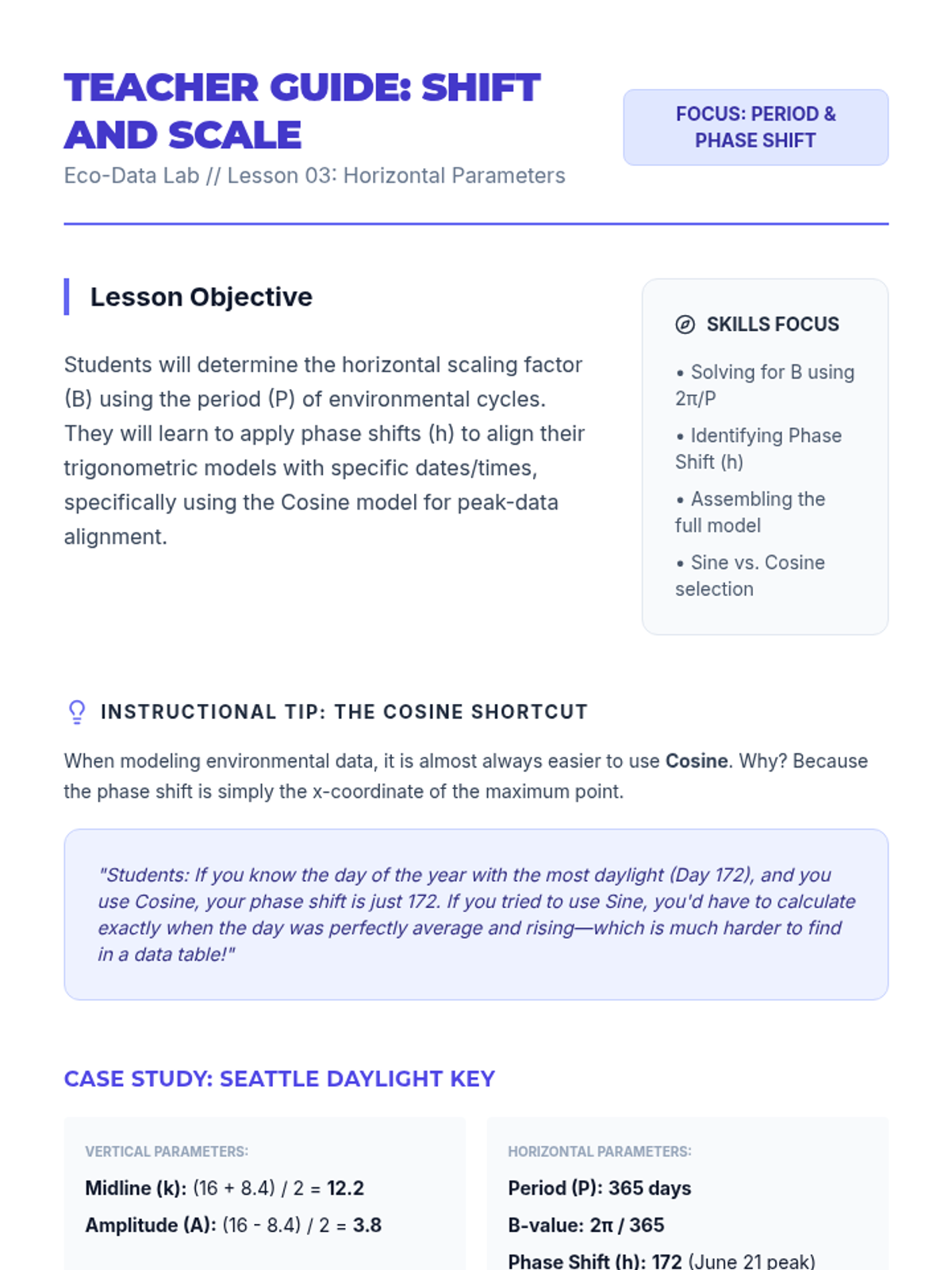
A teacher guide for Lesson 3, explaining the Seattle daylight model solution and providing instructional tips on the "Cosine shortcut" for environmental data.
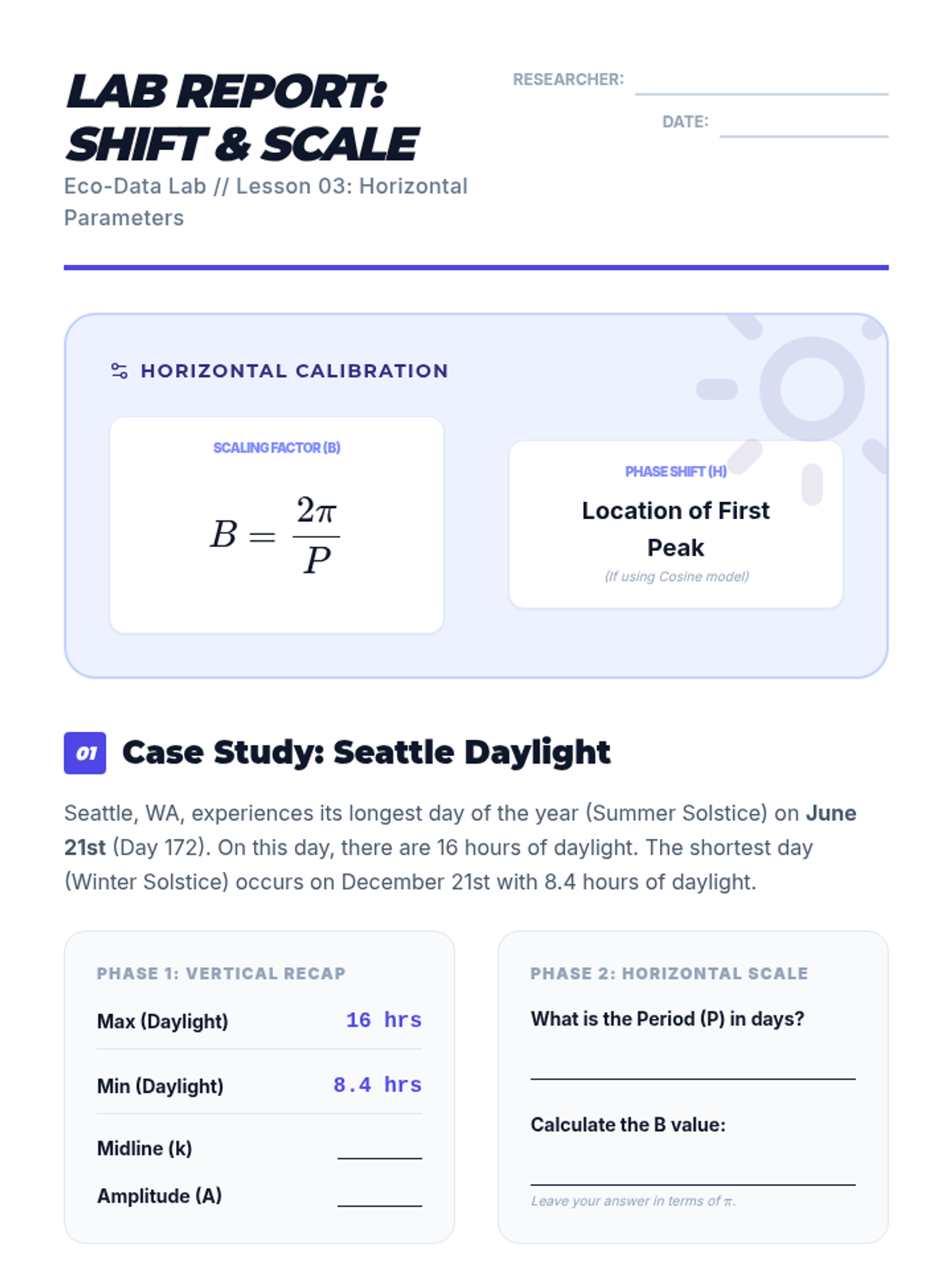
A student worksheet for Lesson 3, focusing on period (P) and phase shift (h) using Seattle daylight data. Students calculate B and h to assemble a complete cosine model.
An instructional slide deck for Lesson 3, focusing on period (P), the horizontal scaling factor (B = 2π/P), and phase shifts (h) in the context of environmental cycles.
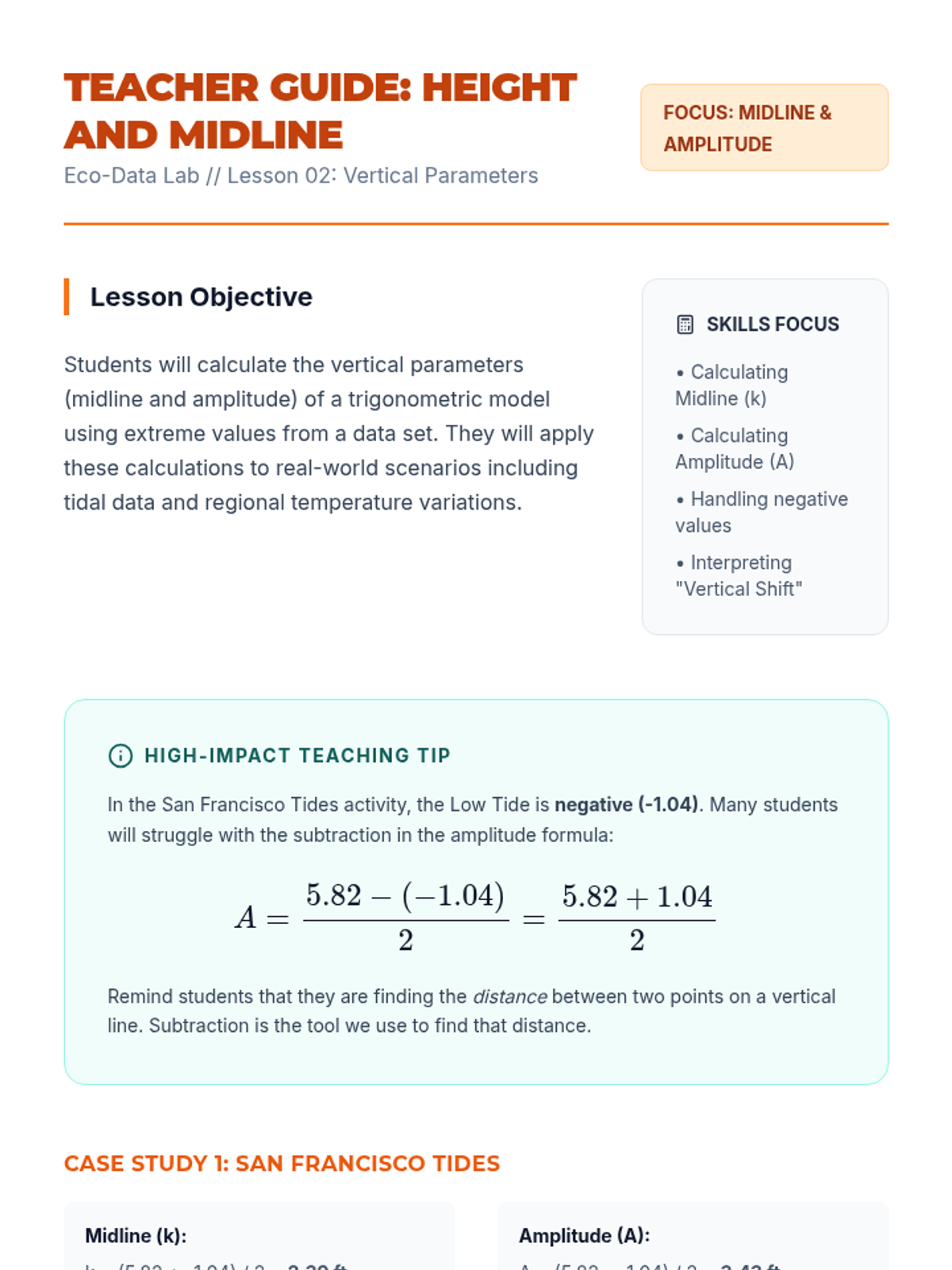
A teacher guide for Lesson 2, providing answer keys for the San Francisco tide data and regional temperature comparisons, along with instructional tips on handling negative values.
A student worksheet for Lesson 2, providing formulas and data sets for tides and temperatures. Students practice calculating midline and amplitude using given max and min values.
An instructional slide deck for Lesson 2, defining the midline (vertical shift) and amplitude (vertical stretch) formulas and how they apply to environmental data.