Mapping relationships through notation, algebraic representations, and growth rate comparisons. Equips learners to transform functions, model contextual data, and solve exponential equations.
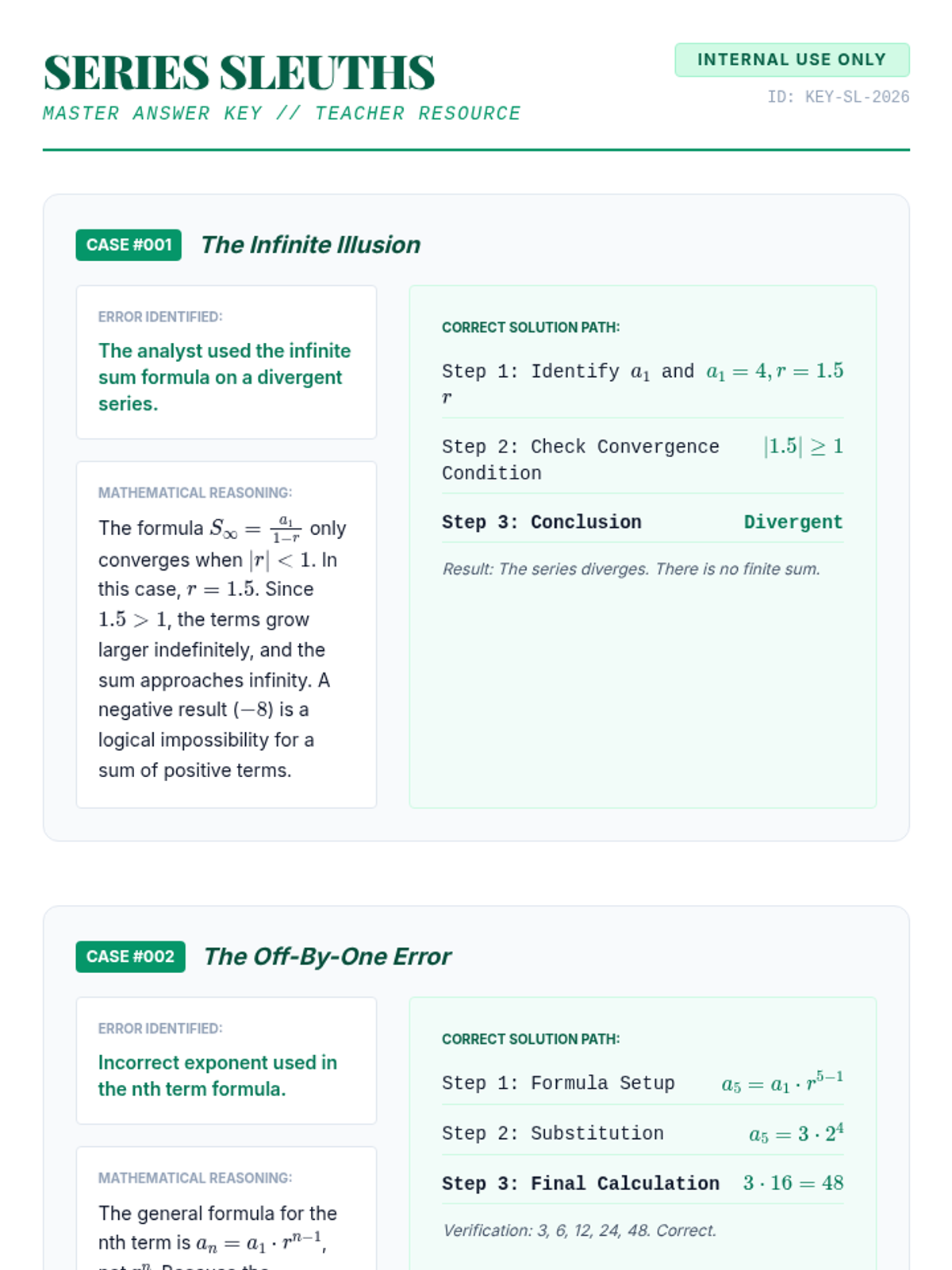
A detailed answer key for the Error Analysis Worksheet. It provides clear identification of errors, mathematical justifications for why the student work was incorrect, and step-by-step correct solutions for each of the three case studies.
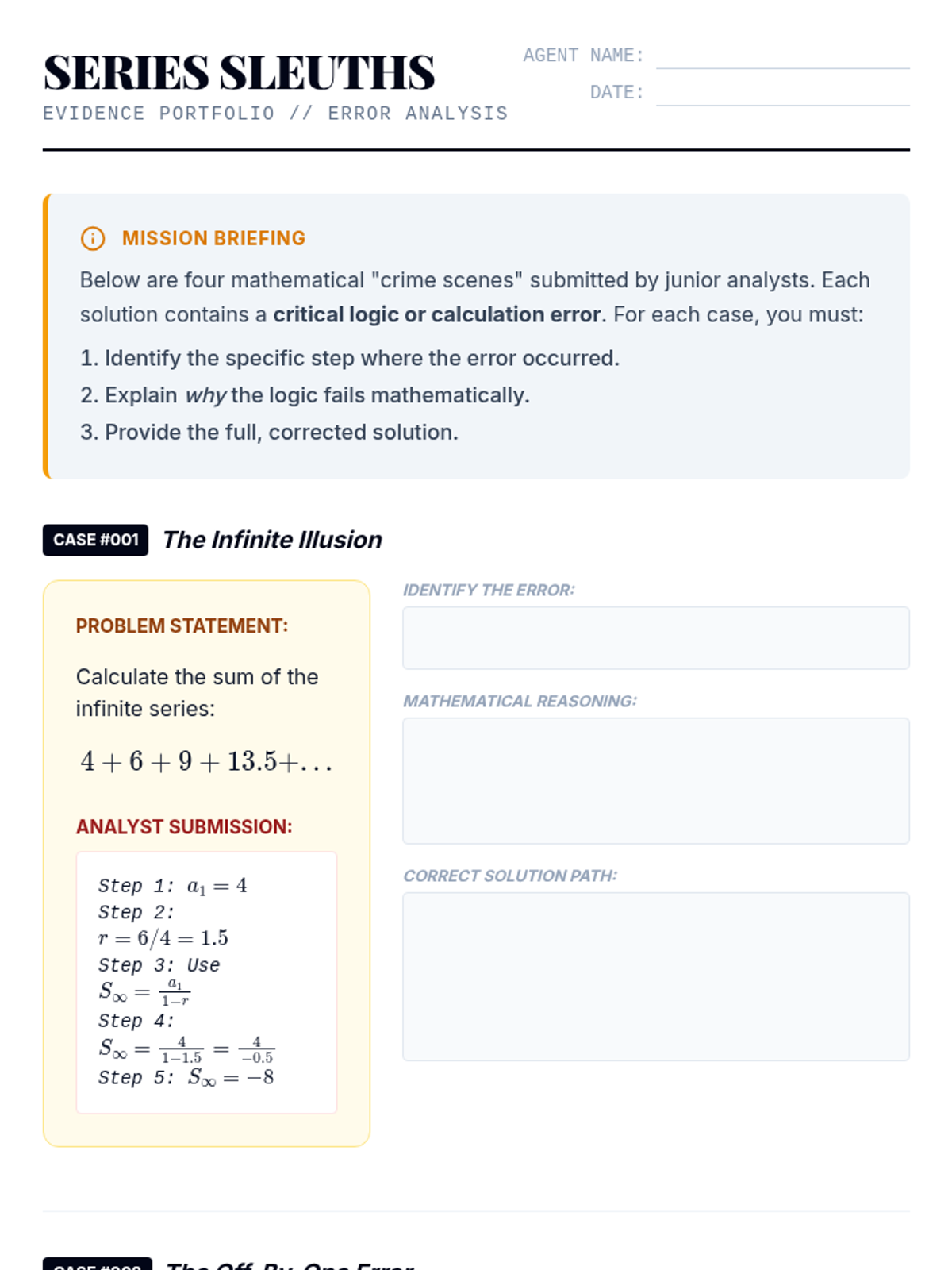
A student worksheet for the Series Sleuths lesson featuring three "cases" of incorrect mathematical solutions. Students must identify the error, explain the reasoning behind the mistake, and provide the correct solution.
A visual presentation for a 12th Grade/Undergraduate lesson on sequences and series. Includes formula recaps, embedded practice videos for classification and infinite sums, and a setup for the Error Analysis activity.
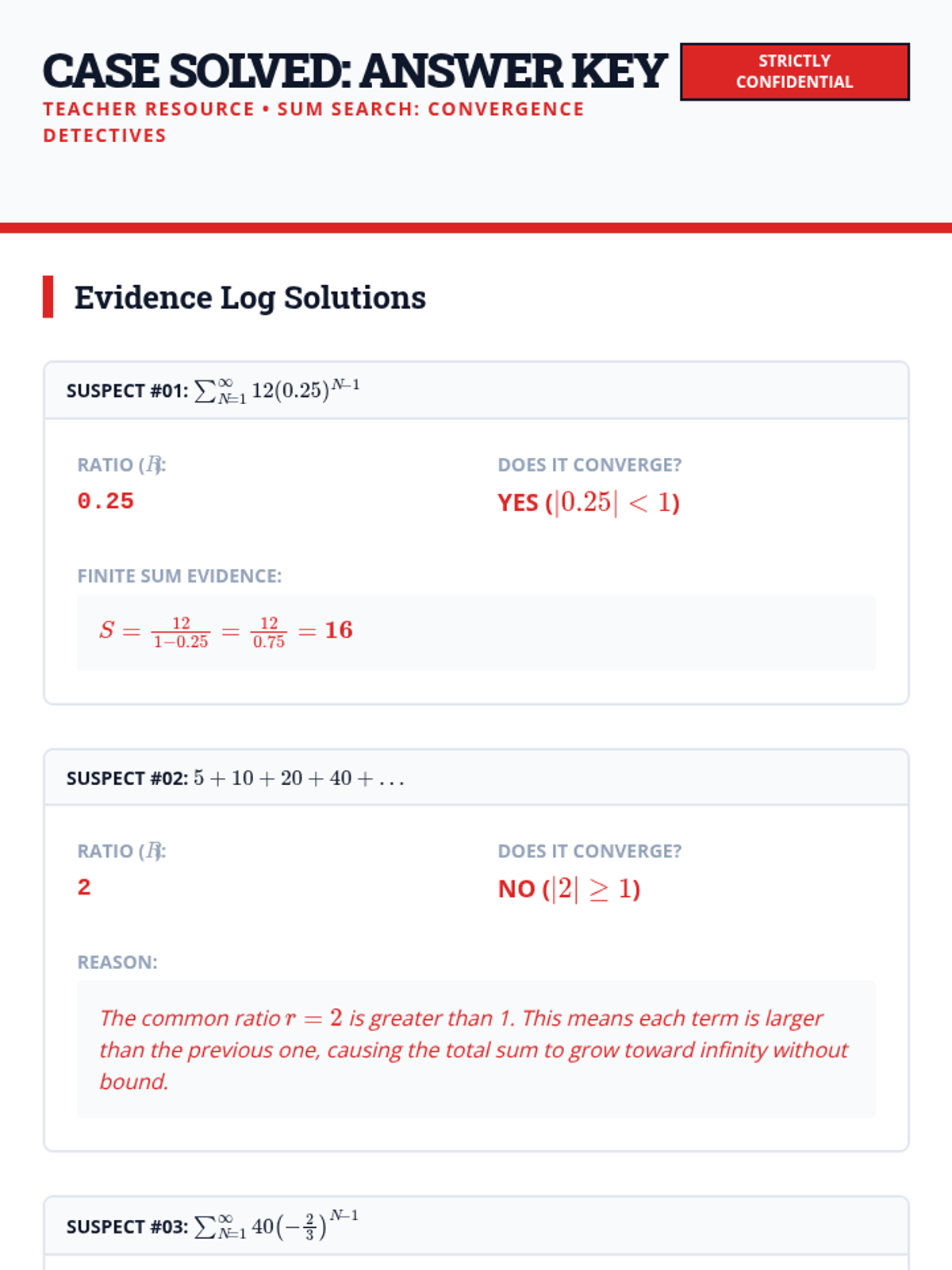
A comprehensive answer key for the 'Sum Search Worksheet', providing step-by-step solutions for convergence checks, sum calculations, and index investigation explanations.
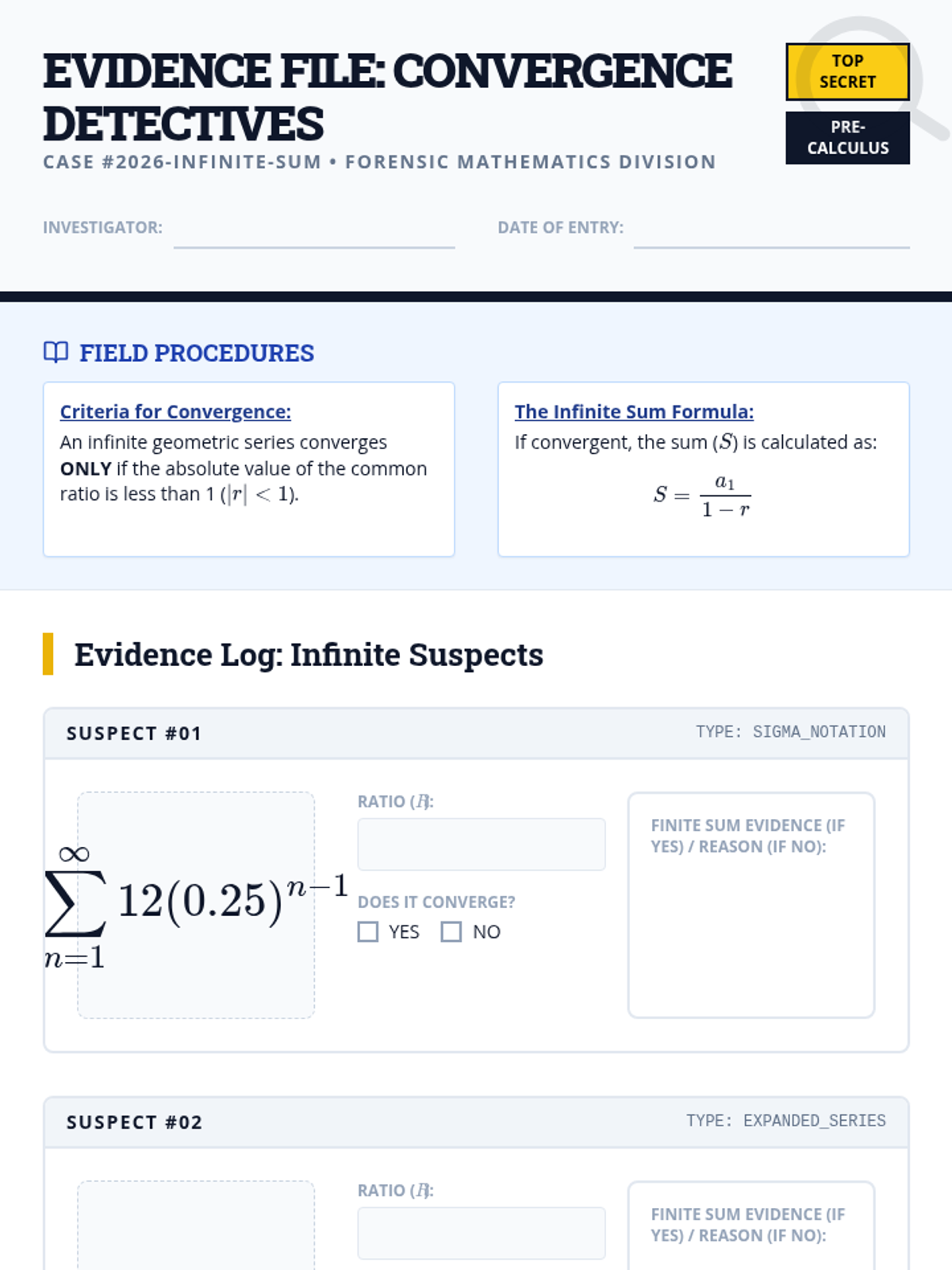
A forensic-themed worksheet for Pre-Calculus students to practice identifying convergent infinite geometric series and calculating their sums. Includes an extension section for index shifts and a closure reflection.
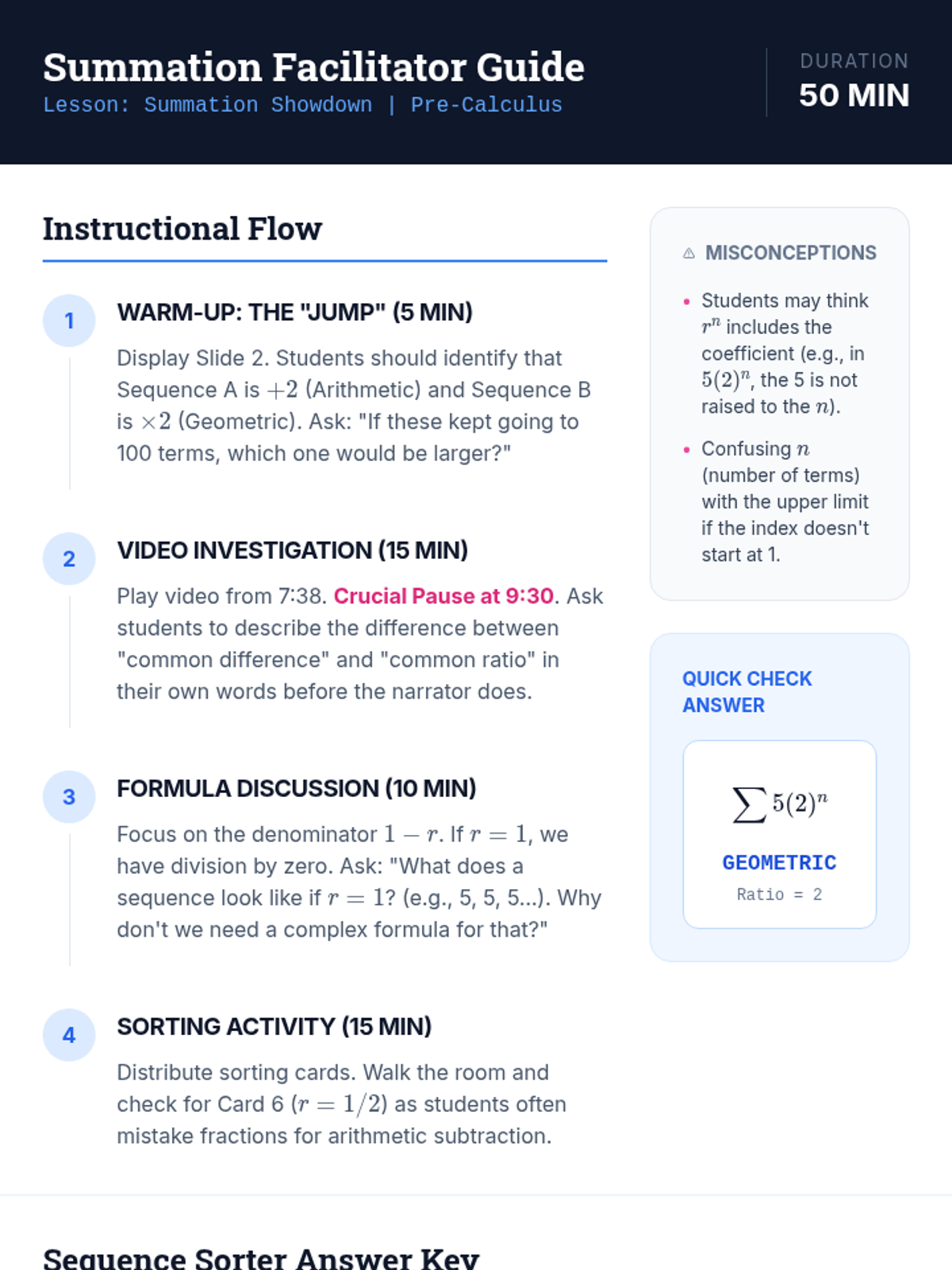
A comprehensive teacher's guide for the Summation Showdown lesson. Includes pacing notes, key timestamps for the video, common student misconceptions, and a full answer key for the Sequence Sorter activity.
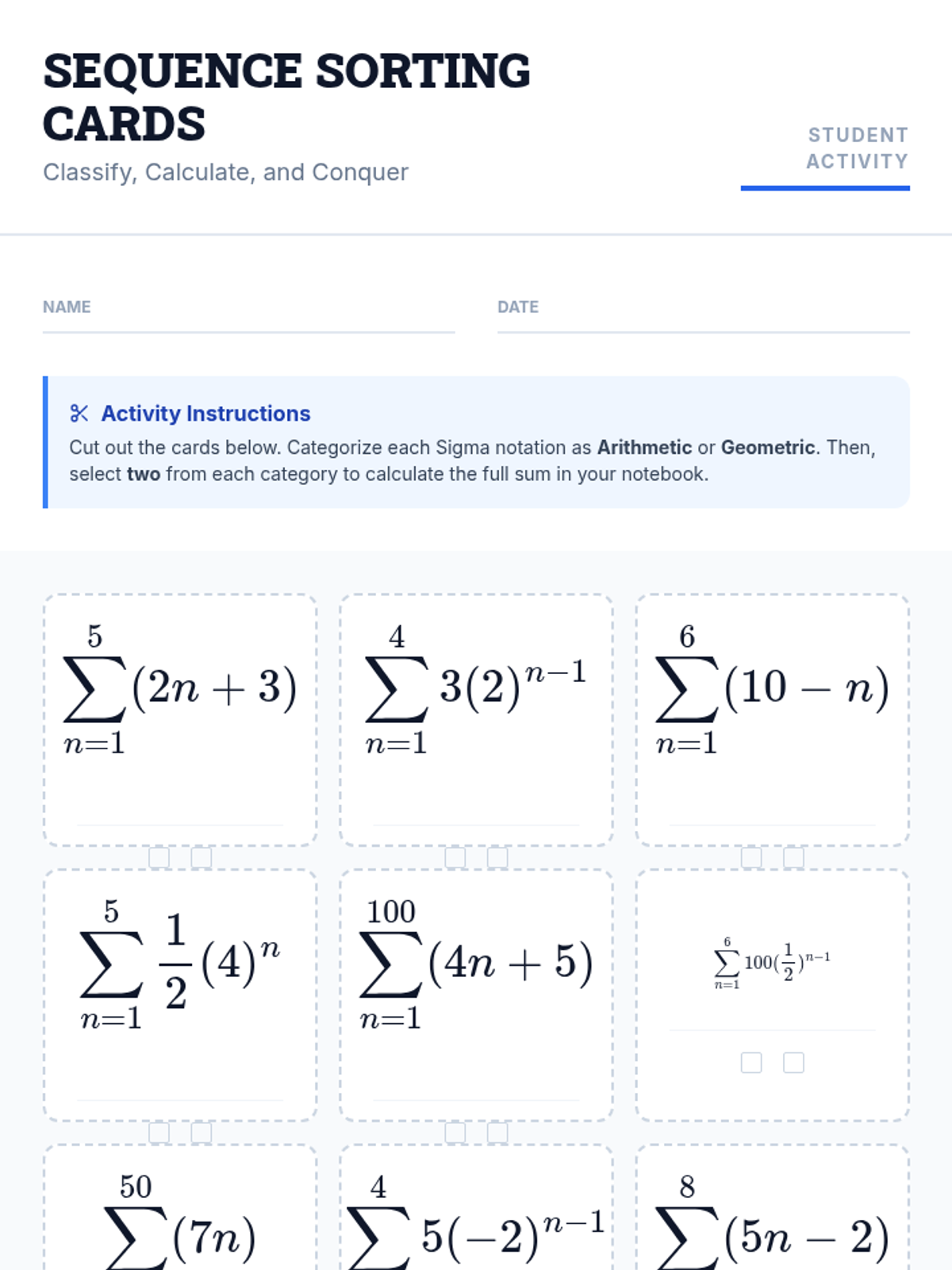
A student activity sheet featuring 9 Sigma notation problems to be categorized into Arithmetic or Geometric sequences. Includes a cut-and-paste sorting organizer for tactile learning.
A visually striking presentation for teaching infinite geometric series, featuring a forensic theme, embedded YouTube video, and clear explanations of convergence and sum calculations.
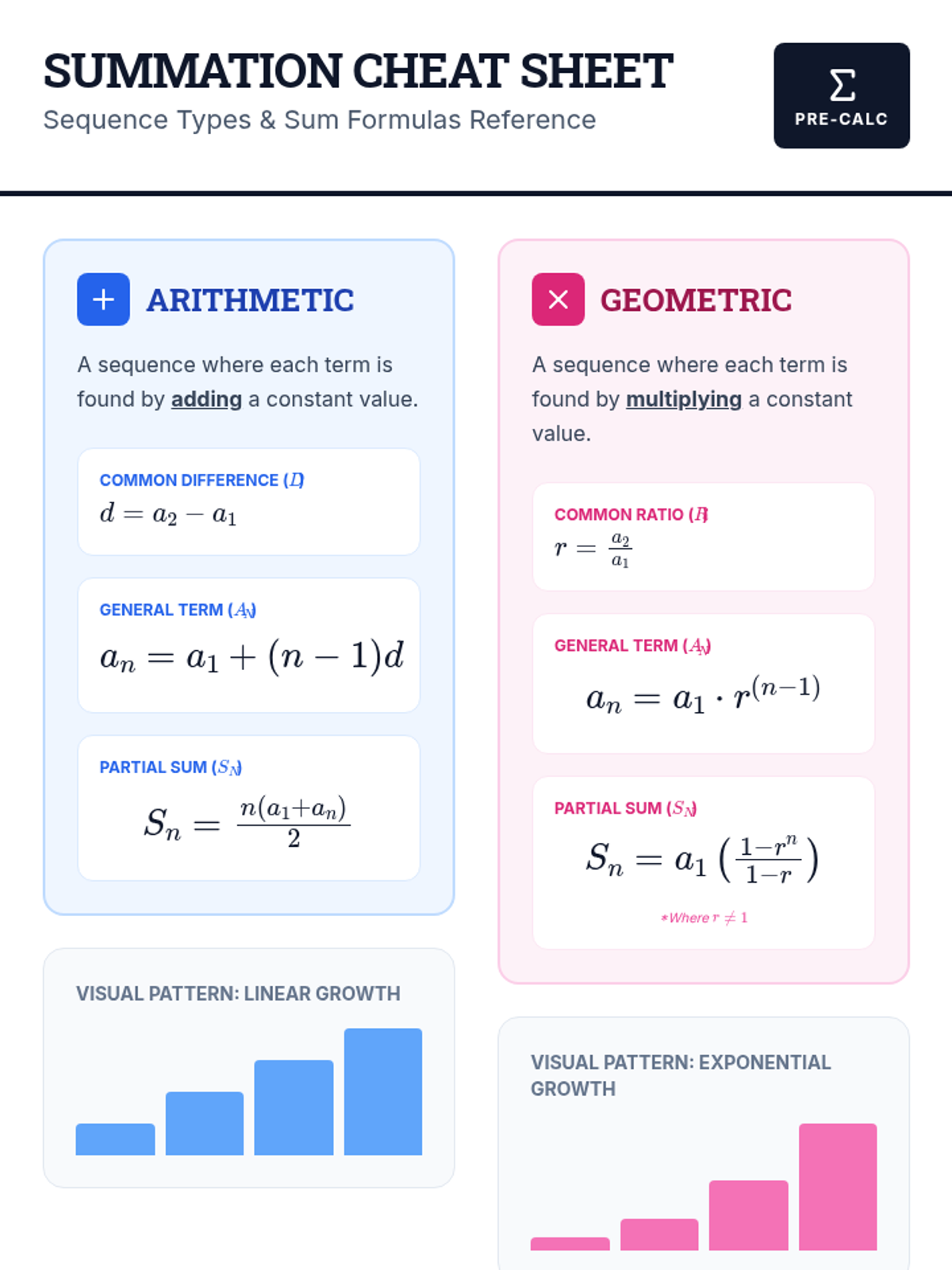
A comprehensive reference chart for Pre-Calculus students, detailing the formulas for arithmetic and geometric sequences, partial sums, and an anatomy of Sigma notation. Includes visual representations of linear vs. exponential growth.
A sleek, chalkboard-inspired slide deck for a Pre-Calculus lesson on arithmetic vs. geometric sequences. Features visual comparisons, the geometric sum formula breakdown, and a guided video investigation.
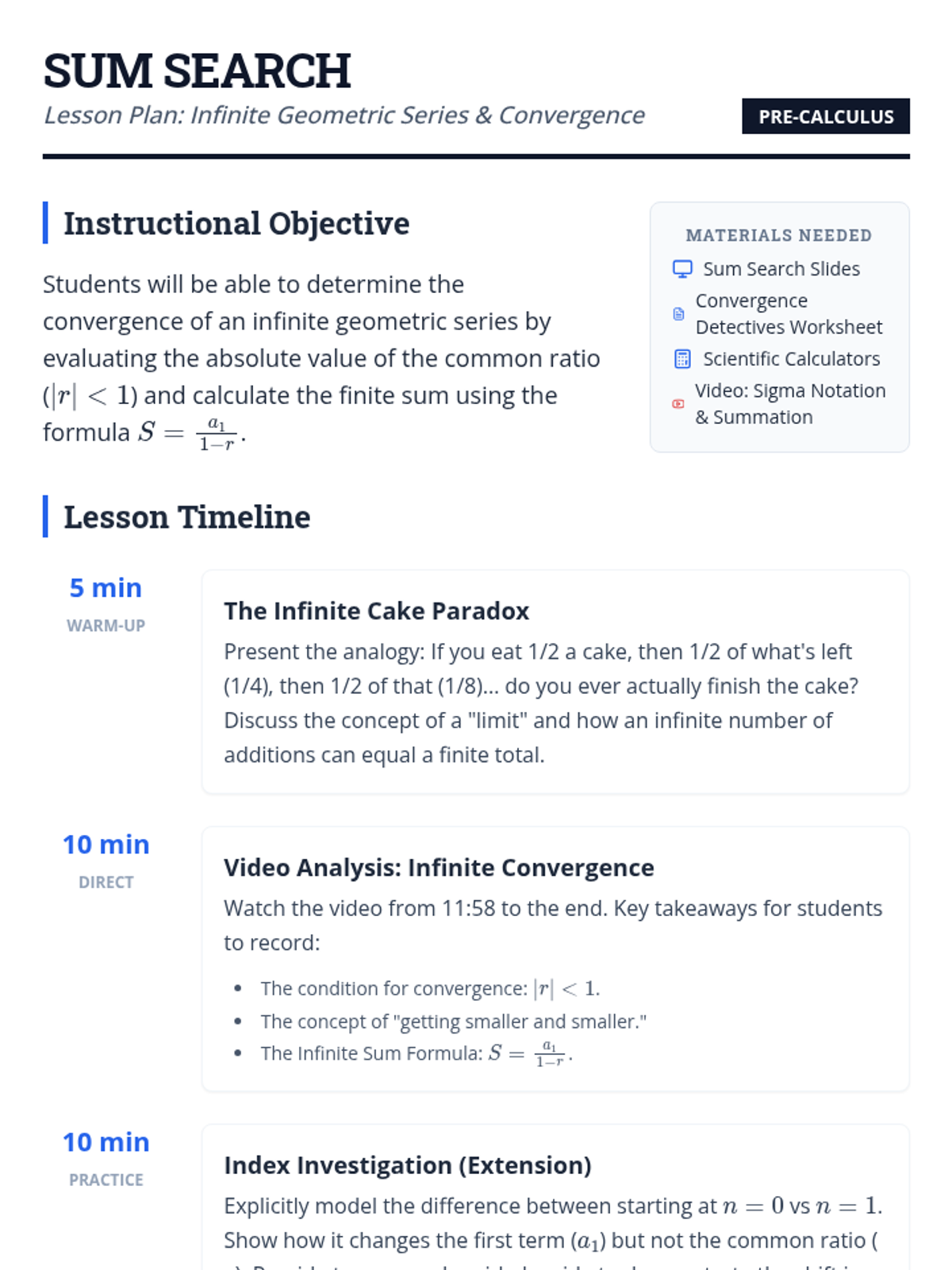
A comprehensive teacher-facing lesson plan for Pre-Calculus on infinite geometric series, featuring a forensic theme and clear pacing for a 50-minute class period.
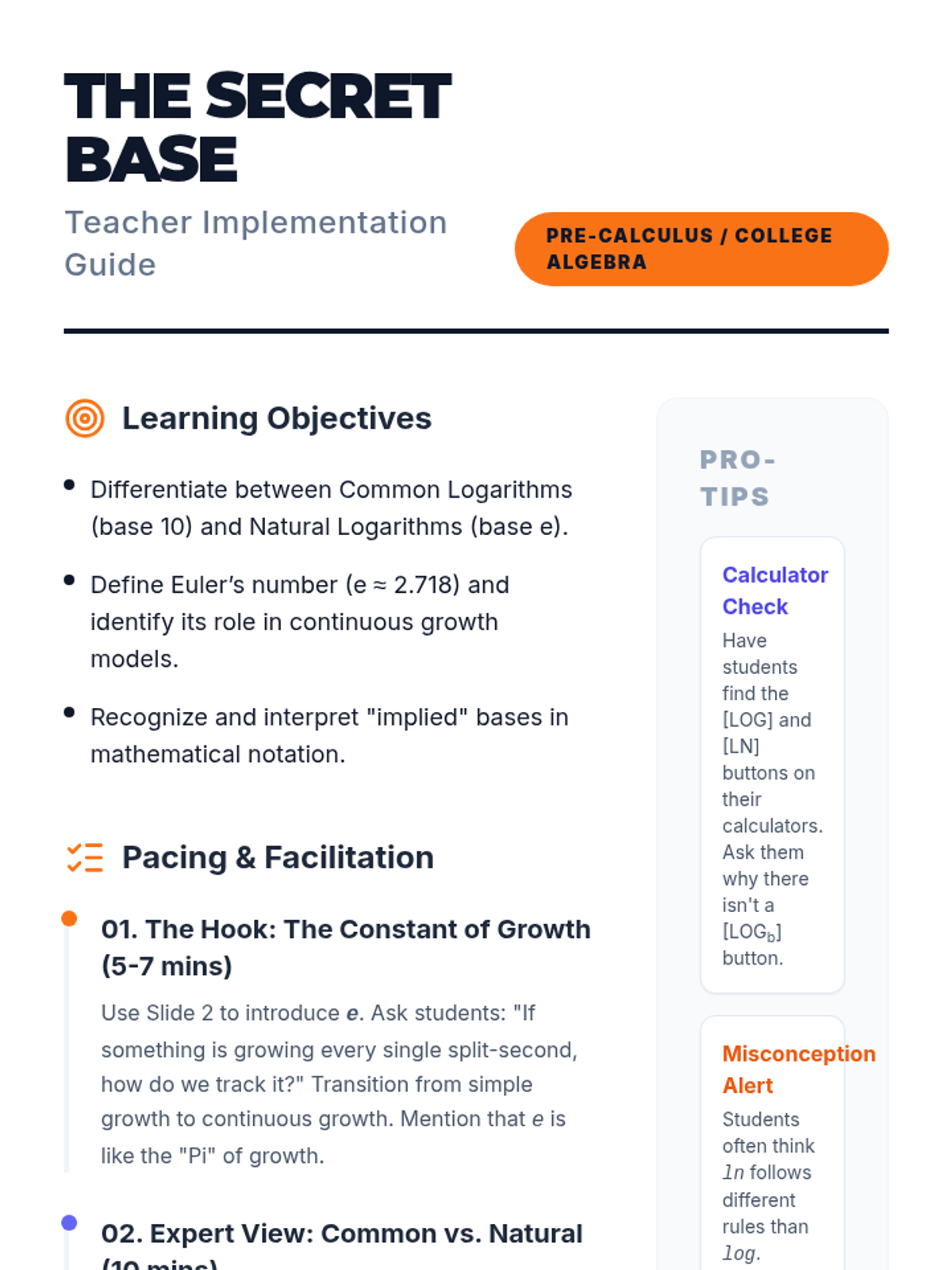
A teacher guide for the 'The Secret Base' lesson, providing instructional strategies, pacing guides, discussion prompts, and facilitation tips for the common vs. natural logarithm lesson.
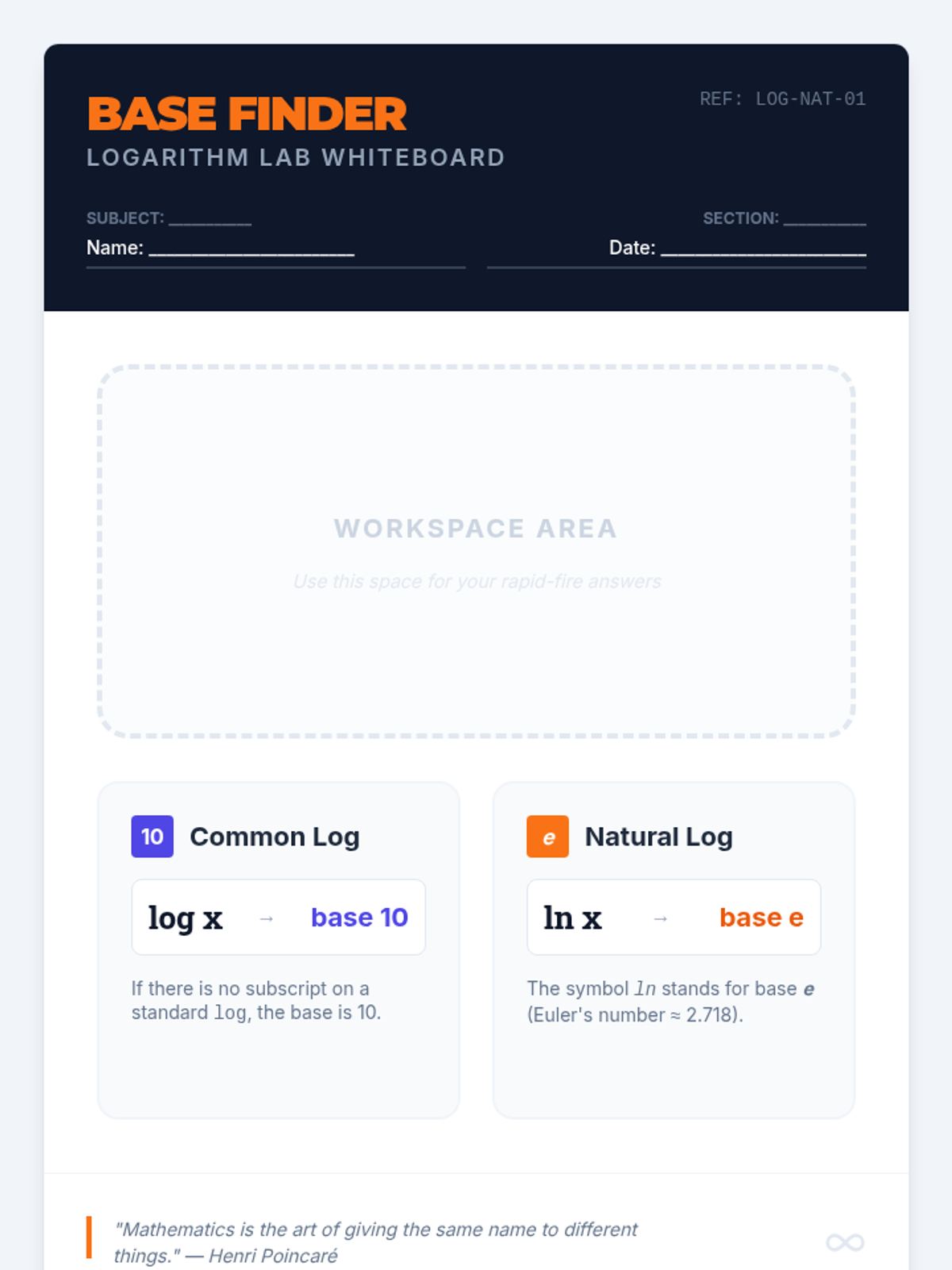
A printable whiteboard template and reference sheet for students to use during the 'Spot the Base' activity. It provides a large workspace and quick-glance definitions for common and natural logarithms.
A comprehensive slide deck introducing Euler's number (e), the distinction between common and natural logarithms, and the 'Spot the Base' activity.
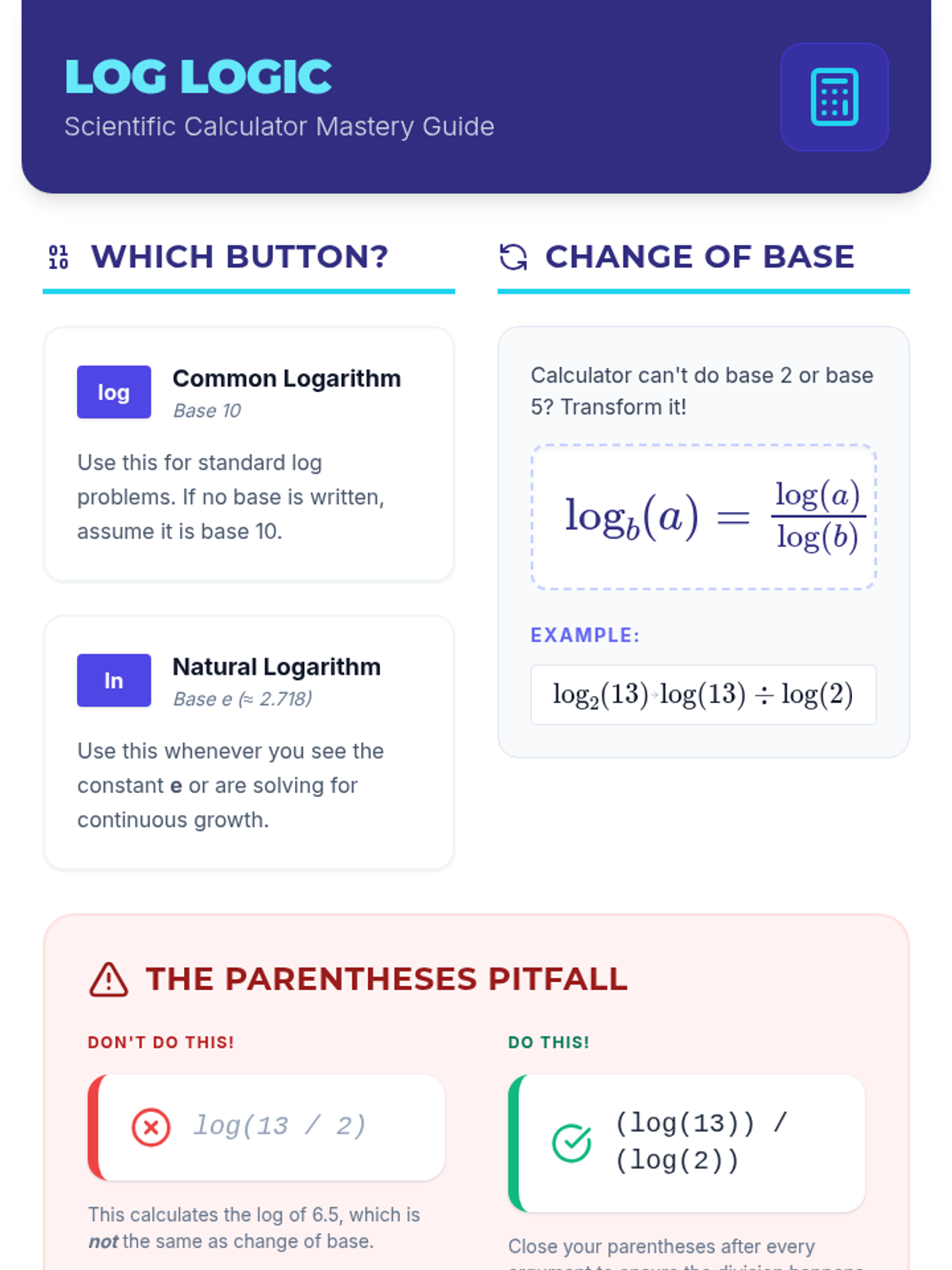
A student reference sheet explaining the difference between common and natural logarithms, the change of base rule, and calculator syntax.
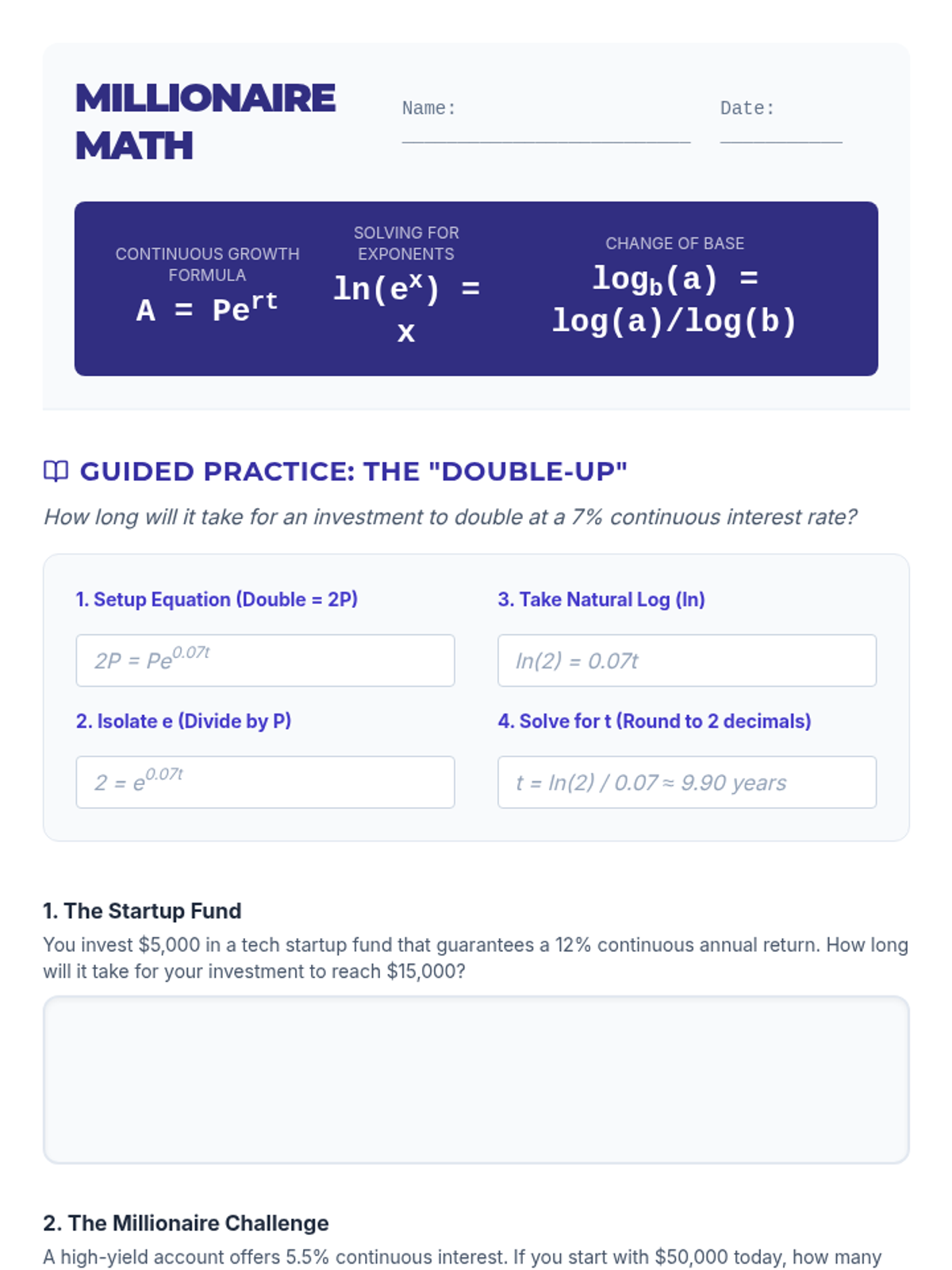
A worksheet for students to practice solving exponential growth and decay problems using natural logarithms and the continuous compounding formula.
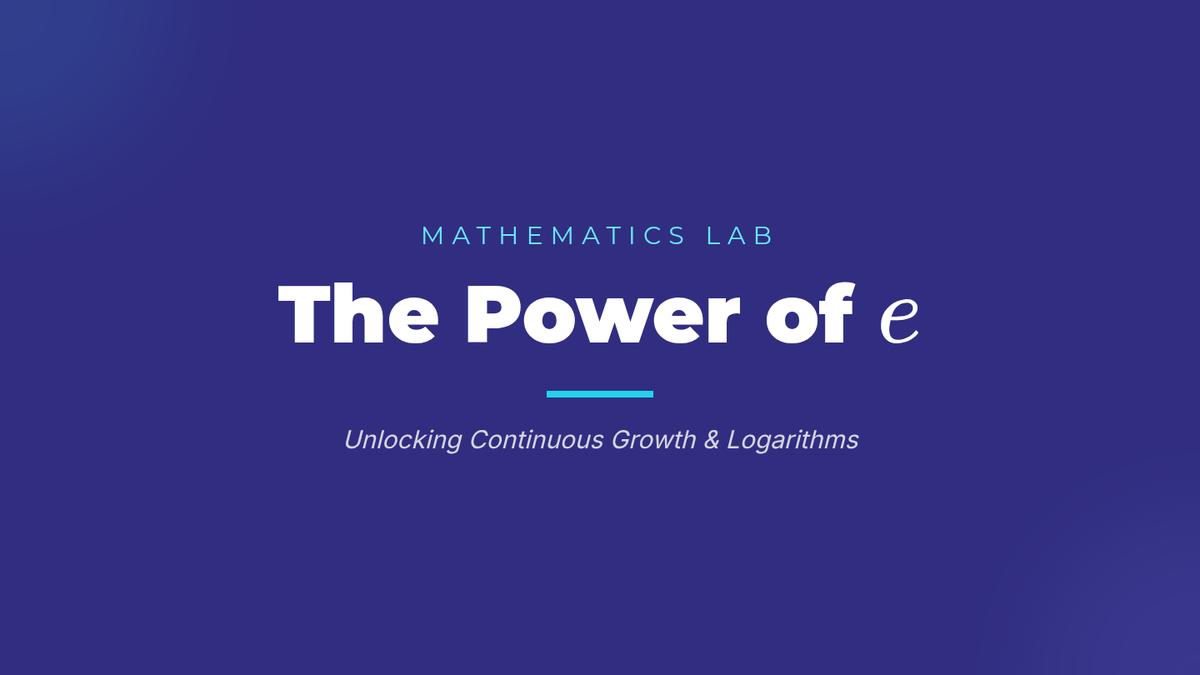
Visual presentation slides for the Exponential Growth Lab, featuring the continuous growth formula, natural logarithms, and the change of base rule.
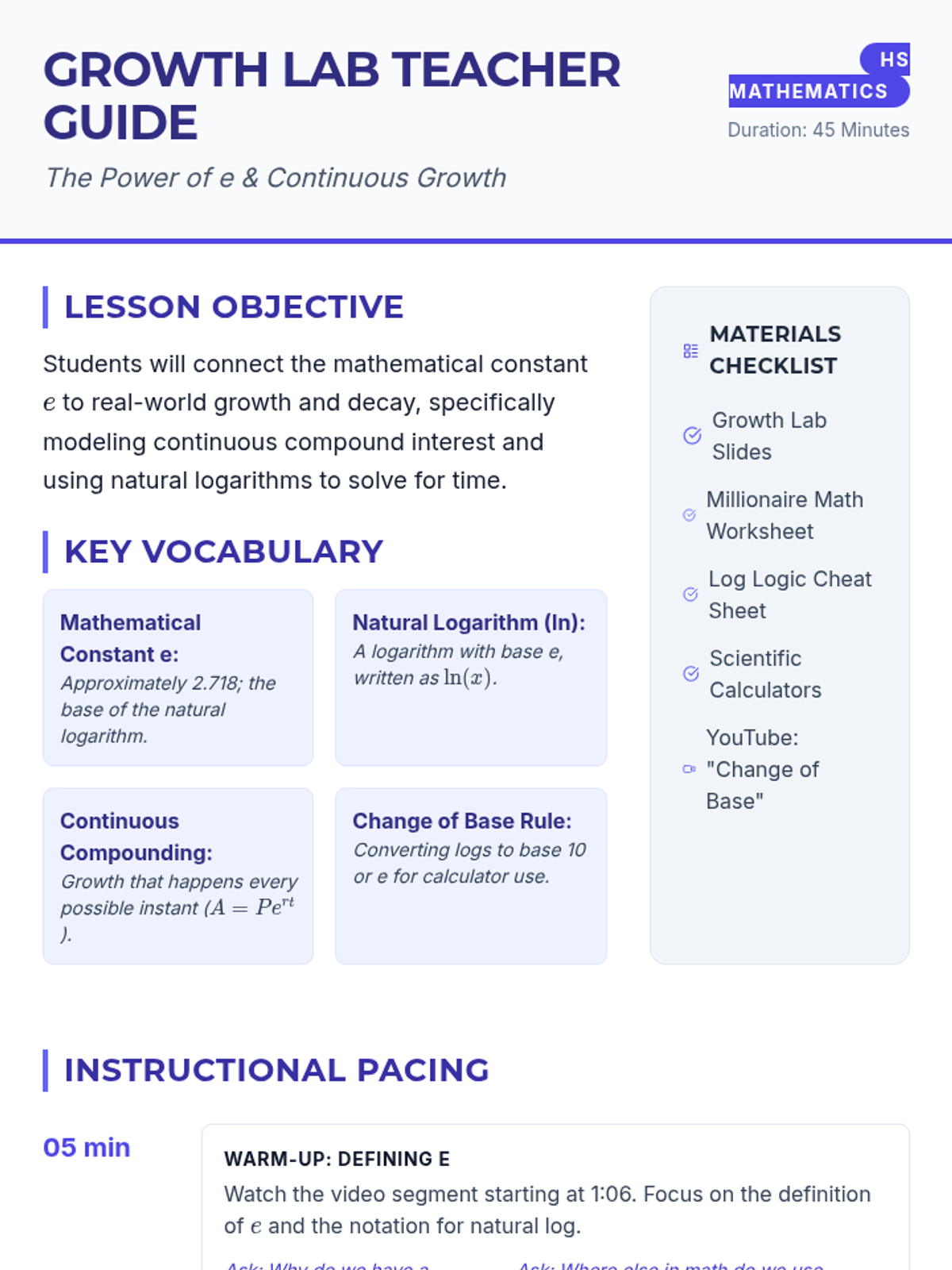
A comprehensive teacher guide for a high school math lesson on the constant e and exponential growth, including pacing, vocabulary, and common student misconceptions.
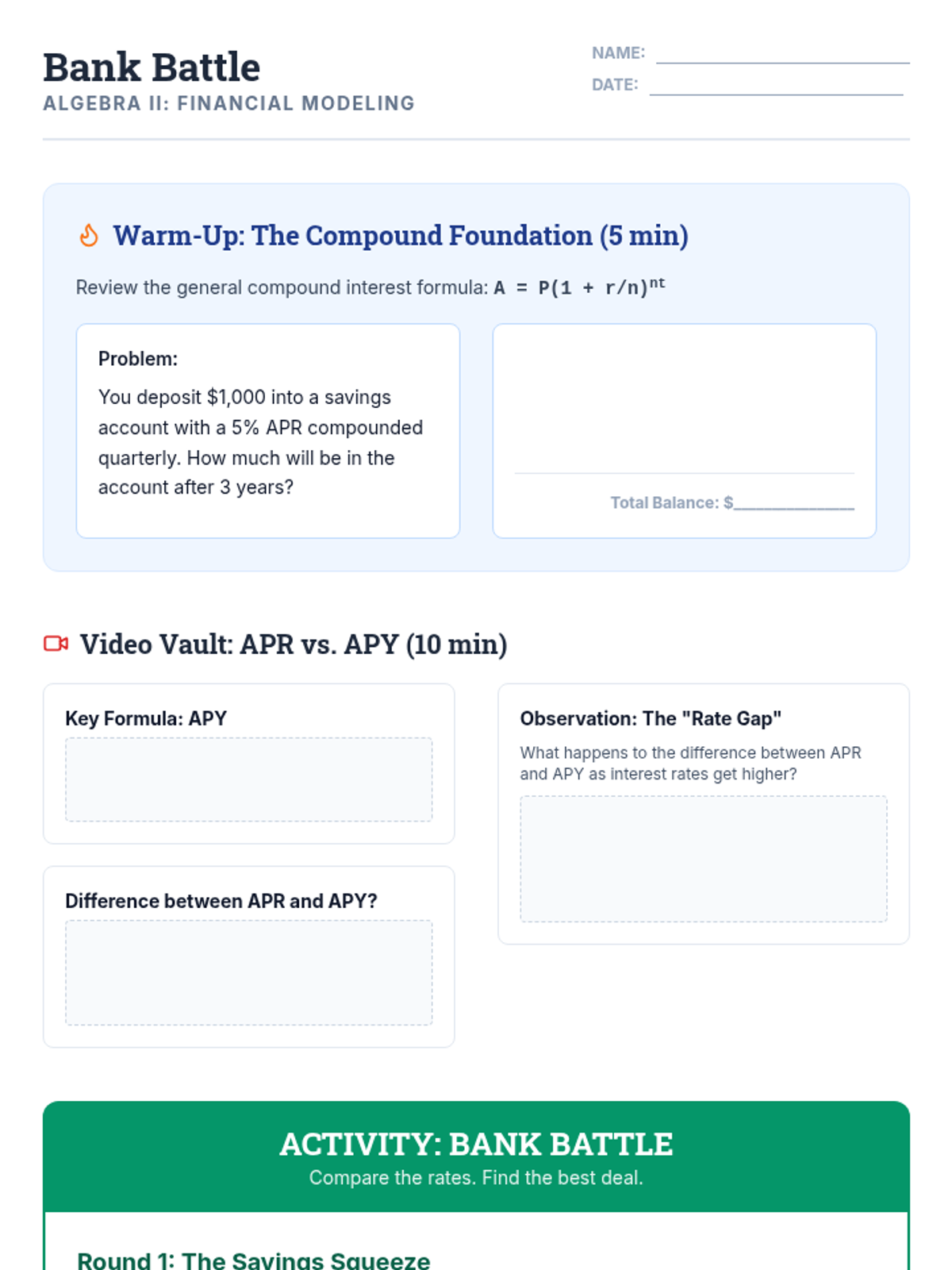
A comprehensive student worksheet for the Bank Battle activity, including warm-up exercises, video note sections, and two-round financial scenarios comparing banks for savings and loans. Revisions made for clarity and spacing.
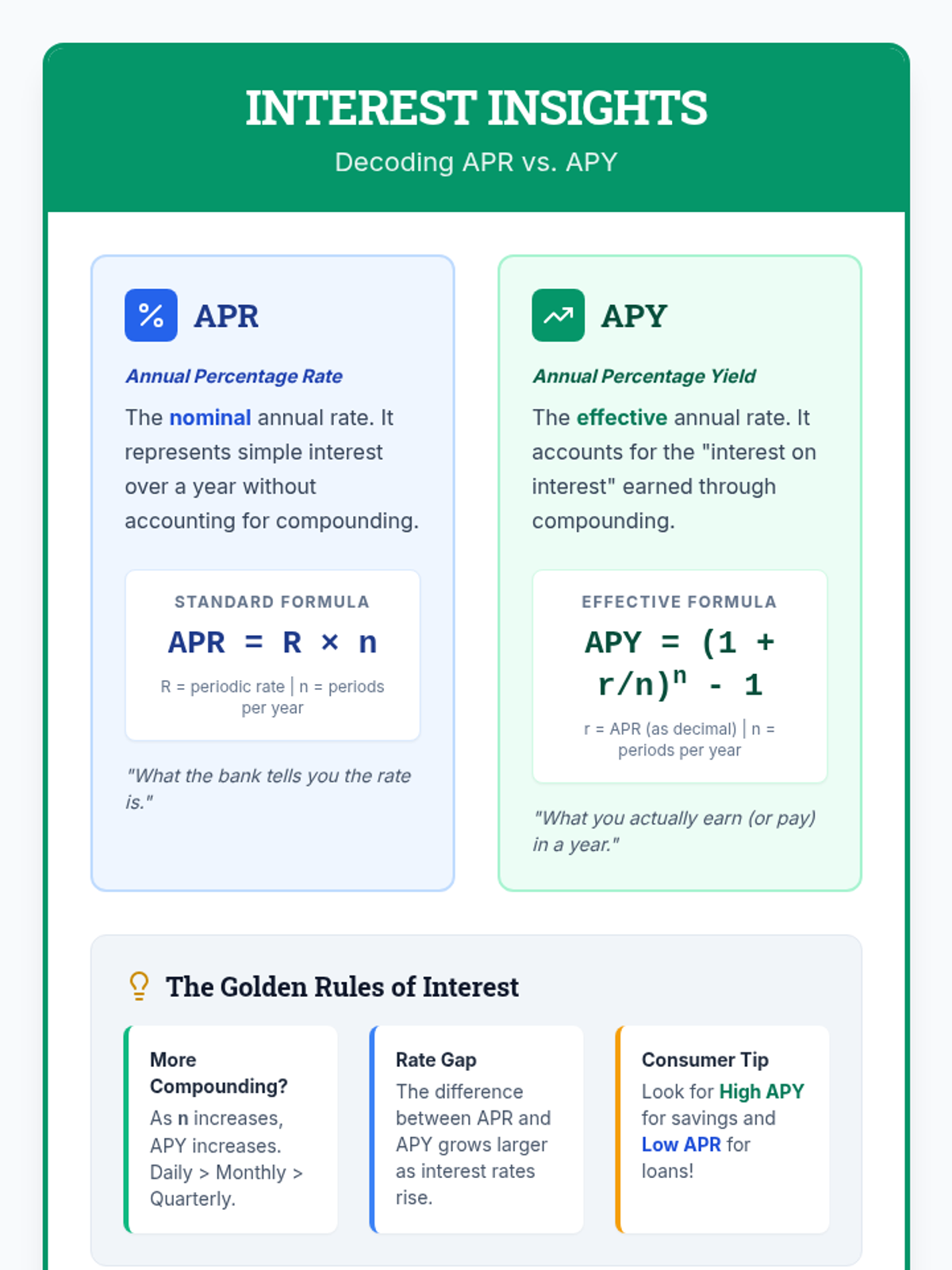
A visually engaging anchor chart for Algebra II students that defines and compares APR and APY, featuring the essential formulas and key financial insights.
A high-energy presentation deck for reviewing AP Precalculus Unit 3, featuring visual summaries of the unit circle, sinusoidal modeling, inverse functions, and polar tracking.
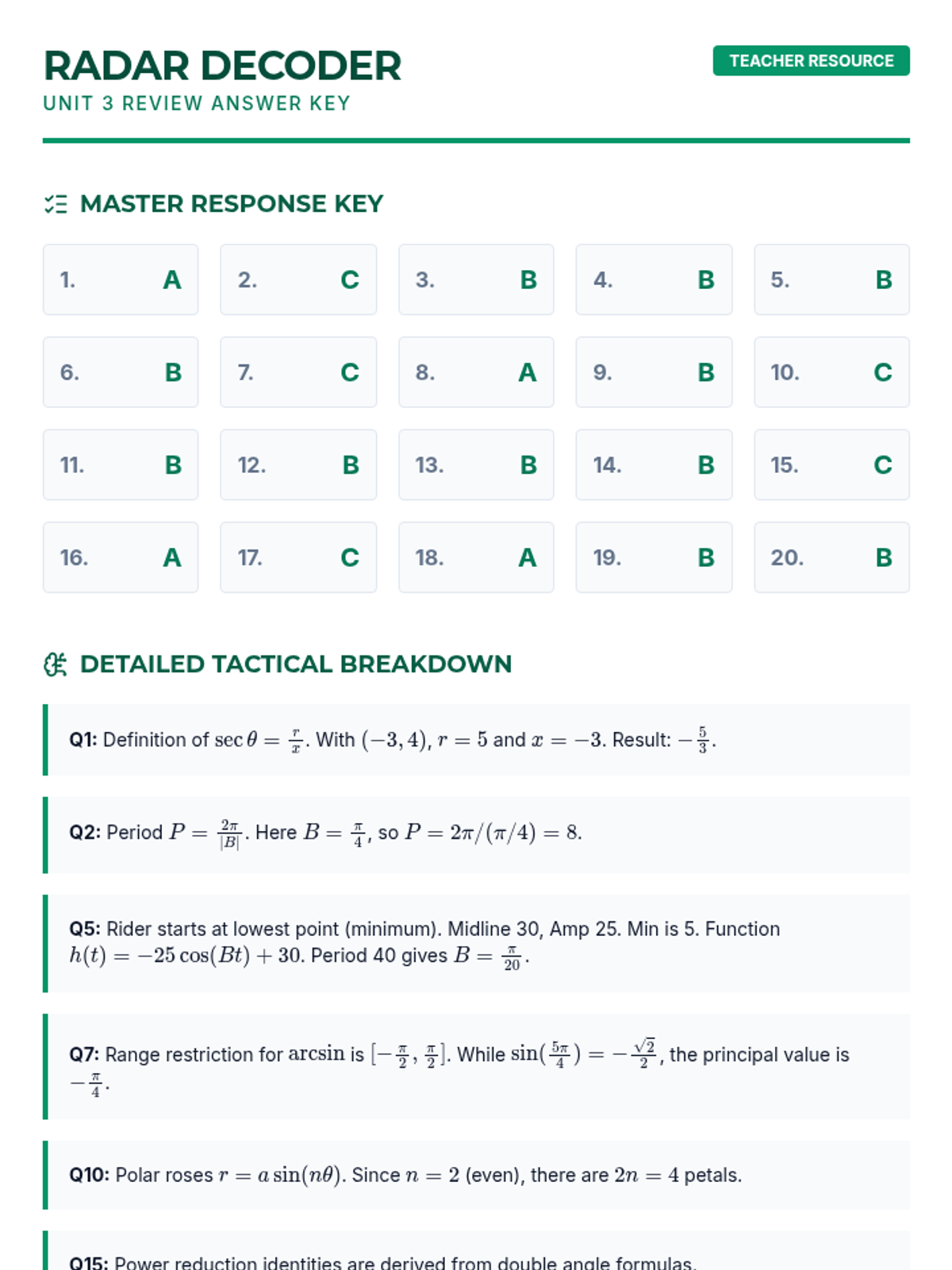
A teacher-facing answer key for the Trigonometry Radar Review Worksheet, including a quick-reference response grid and detailed rationales for key problems.
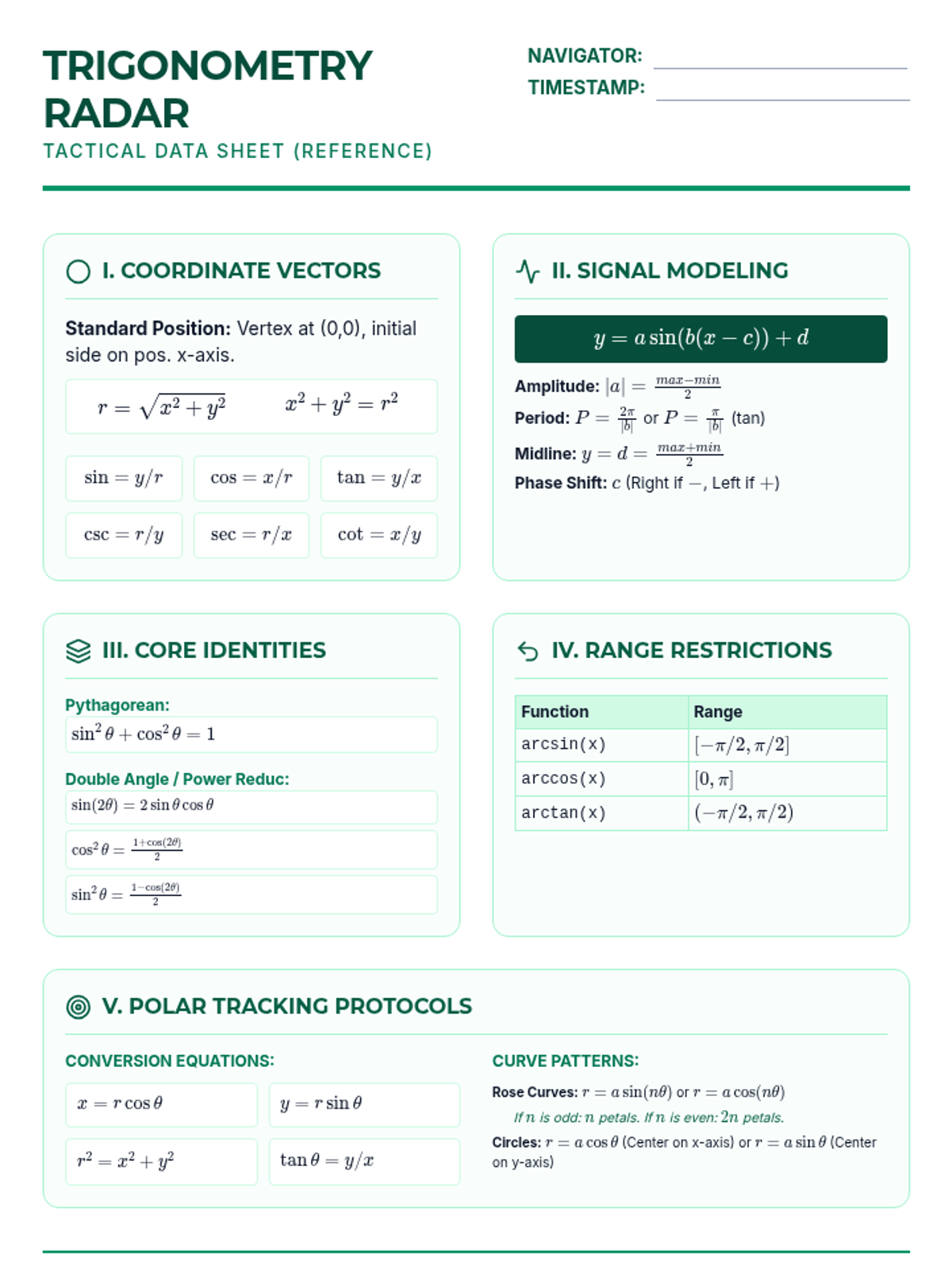
A 20-question multiple-choice review worksheet for AP Precalculus Unit 3, now featuring a front-page "Tactical Data Sheet" with relevant trigonometric and polar formulas.
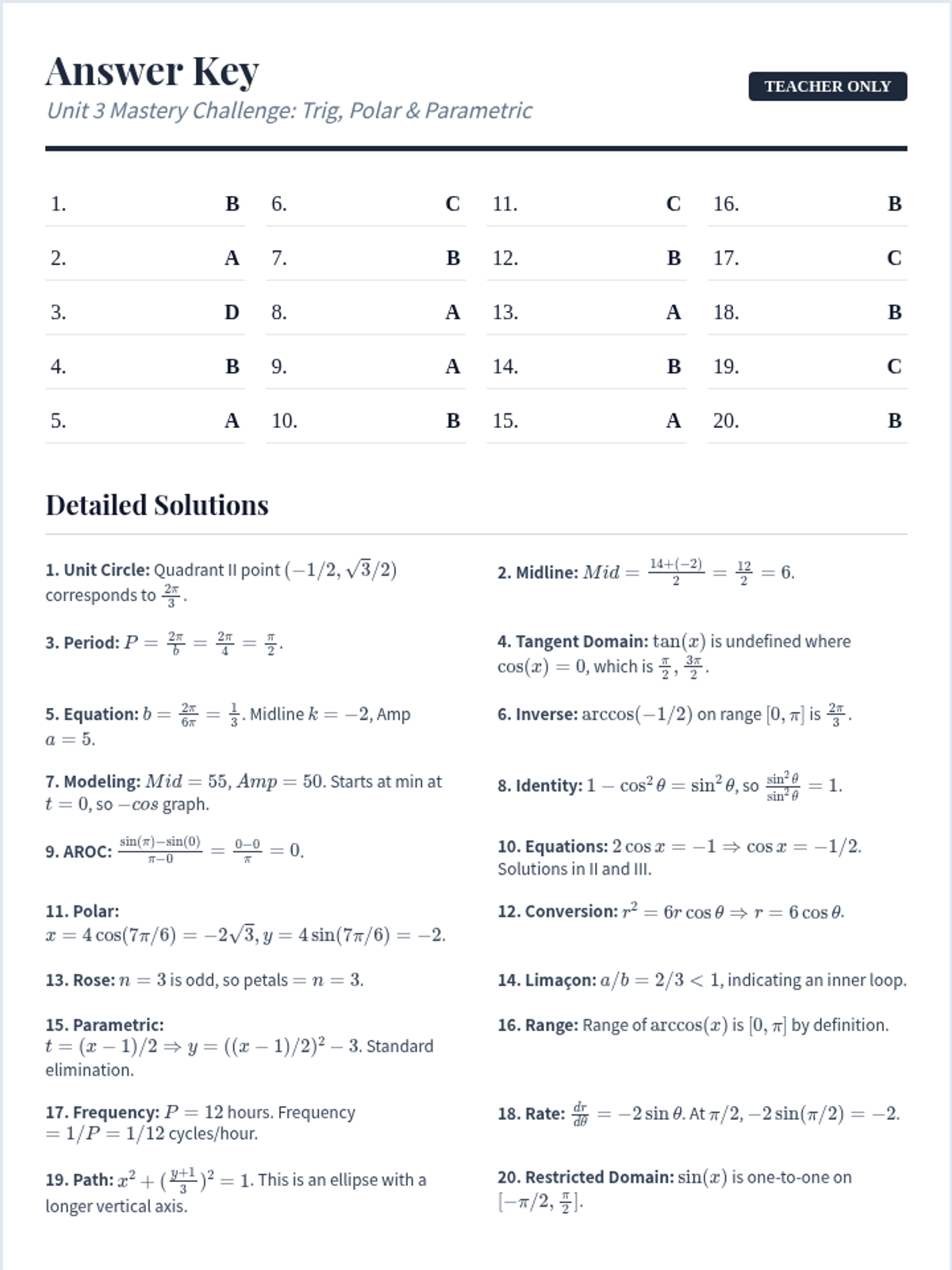
The answer key for the Unit 3 Mastery Challenge, featuring a quick-glance table and detailed explanations for all 20 questions.
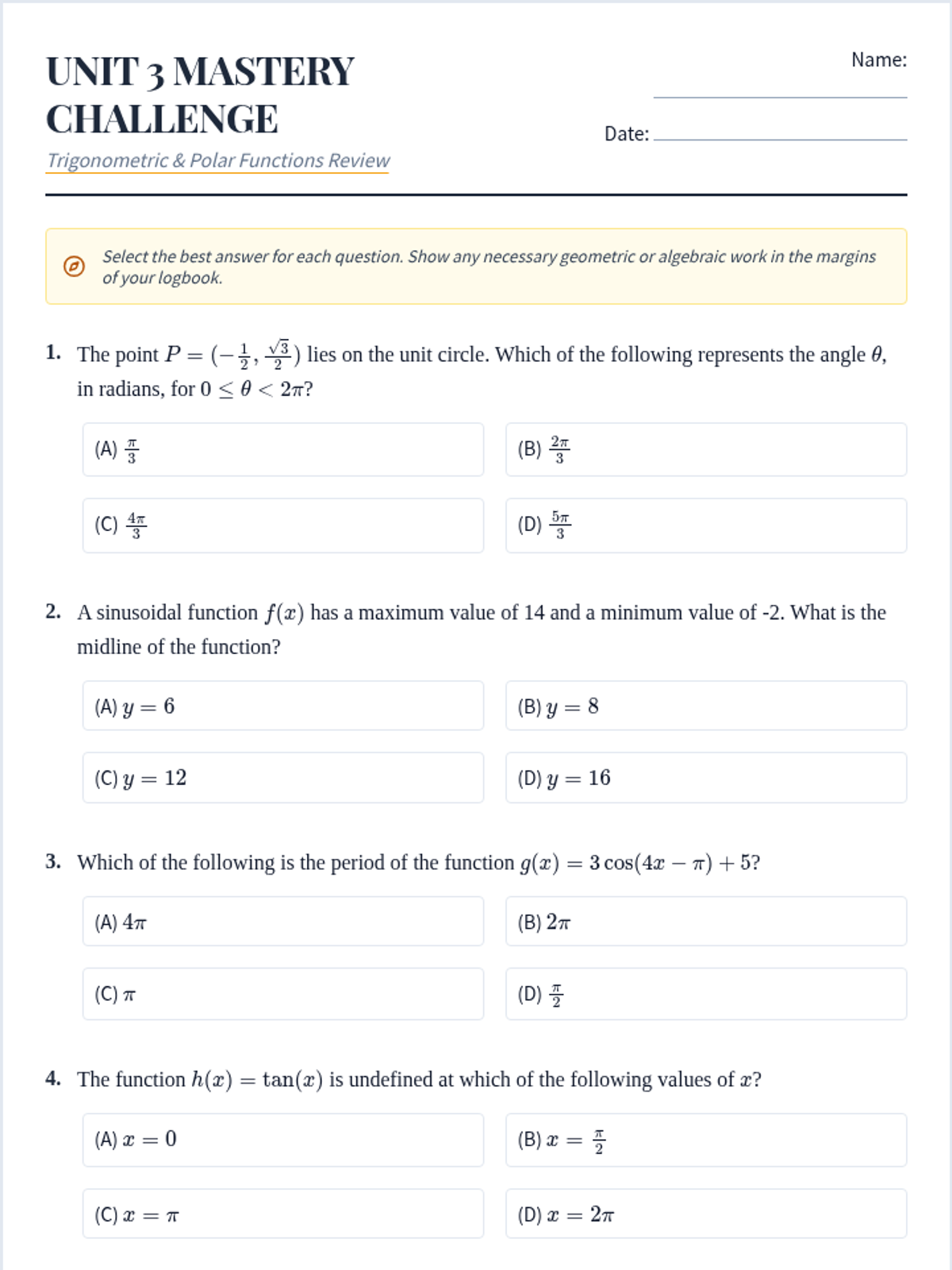
A 20-question multiple-choice assessment covering all Unit 3 topics including sinusoidal functions, inverse trigonometry, polar coordinates, and parametric functions. Designed with a nautical explorer theme and ample space for calculations.
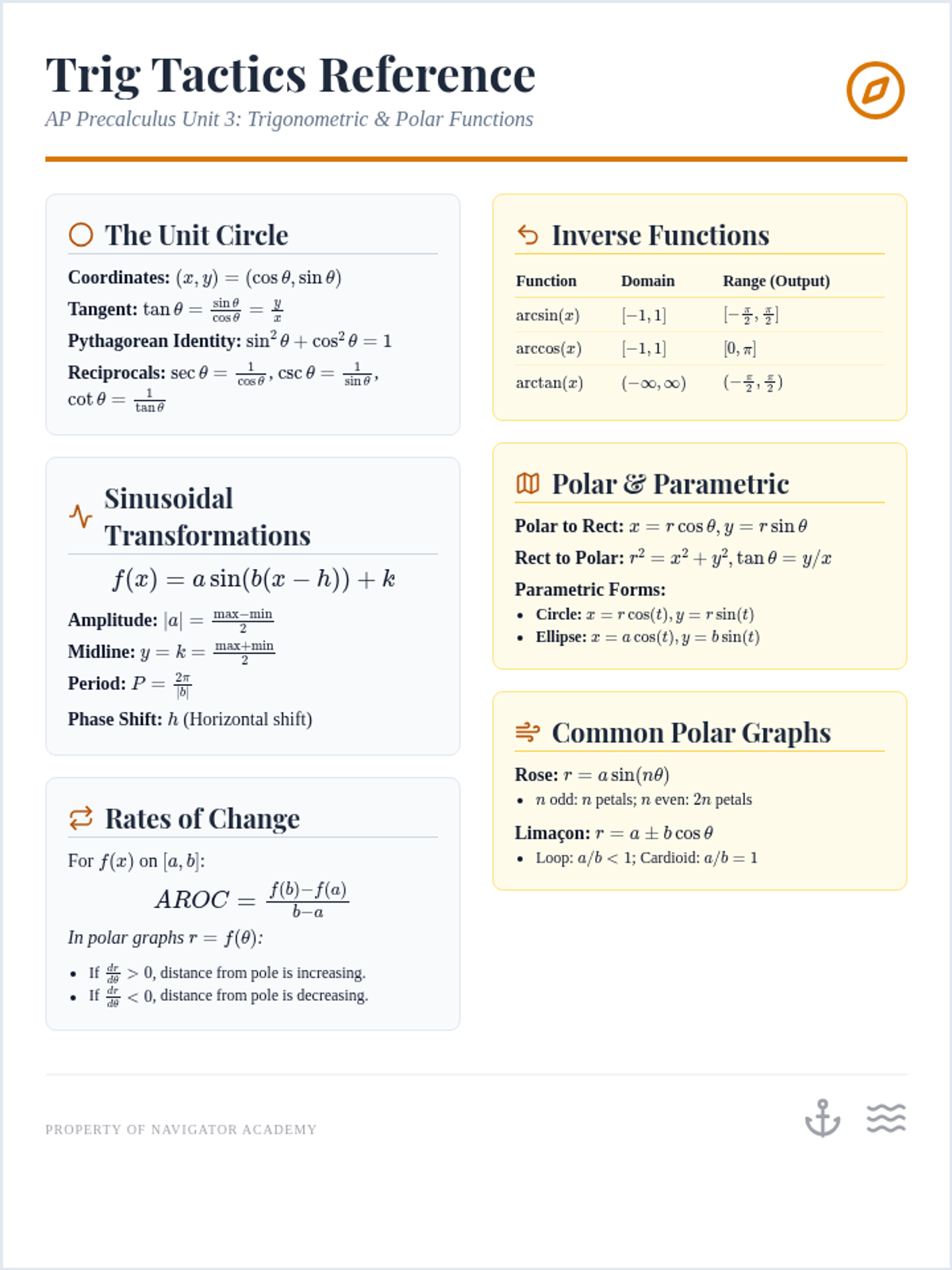
A concise one-page reference sheet covering the essential concepts of AP Precalculus Unit 3, including unit circle properties, sinusoidal transformations, inverse functions, polar coordinates, and parametric functions.
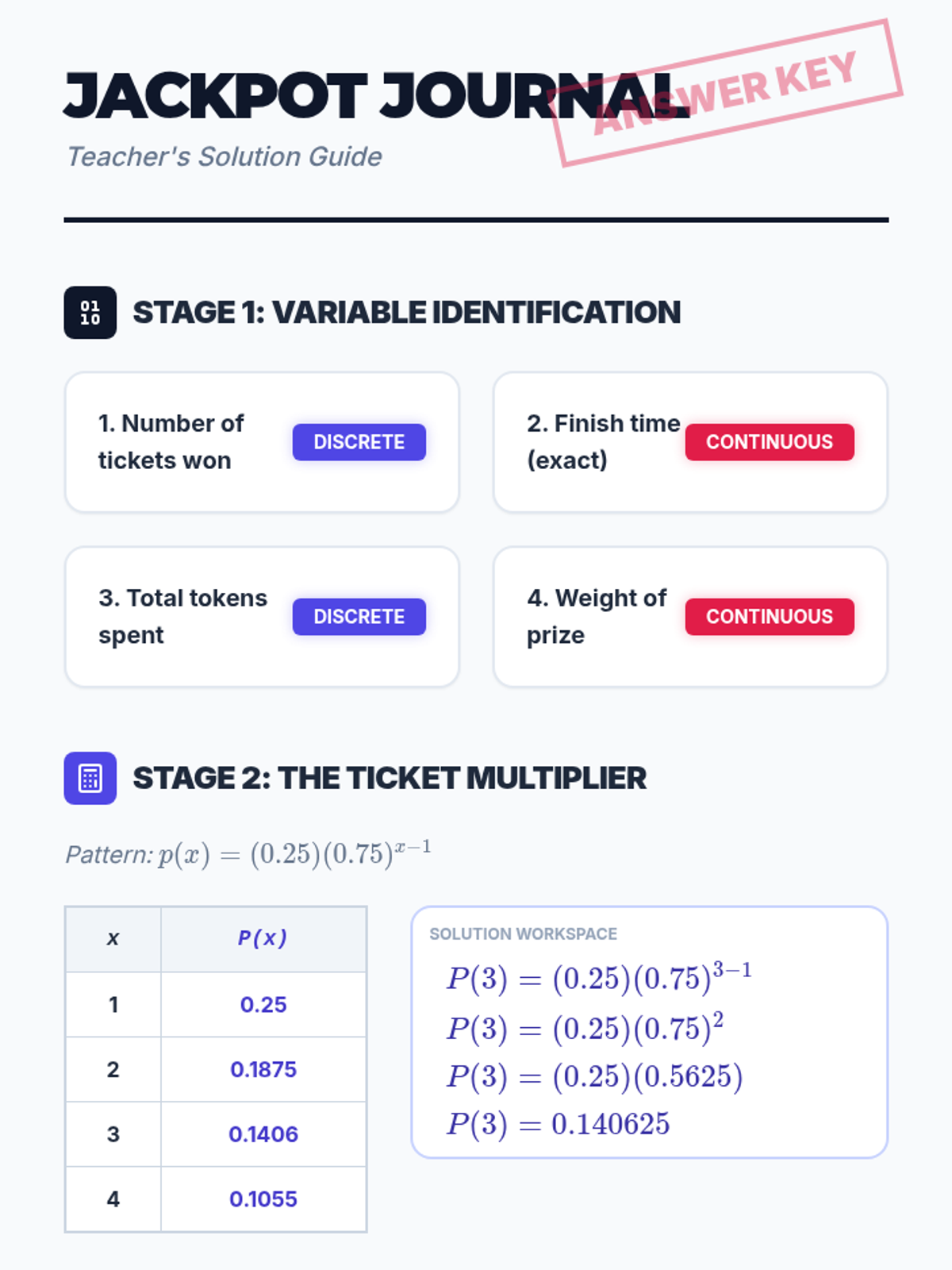
Teacher's solution guide for the Jackpot Journal Worksheet, providing step-by-step calculations and conceptual explanations.
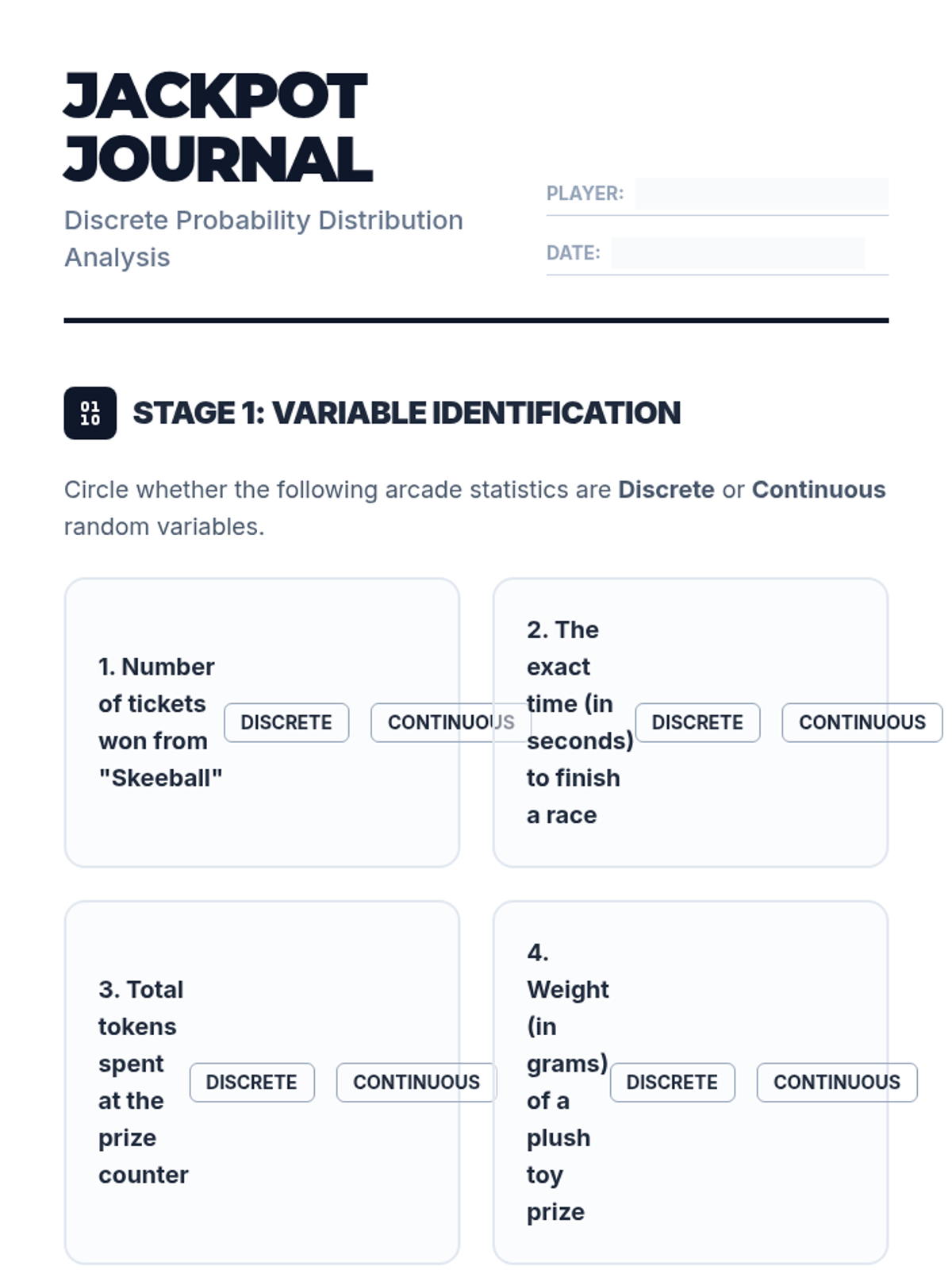
An arcade-themed worksheet where students identify discrete variables, calculate probabilities using a geometric pattern, and validate probability distributions.
An arcade-themed slide deck introducing discrete random variables and probability distributions, featuring a geometric example of a laser bullseye game.
A 16:9 presentation deck introducing drug concentration modeling and guiding students through the ibuprofen rational function problem.
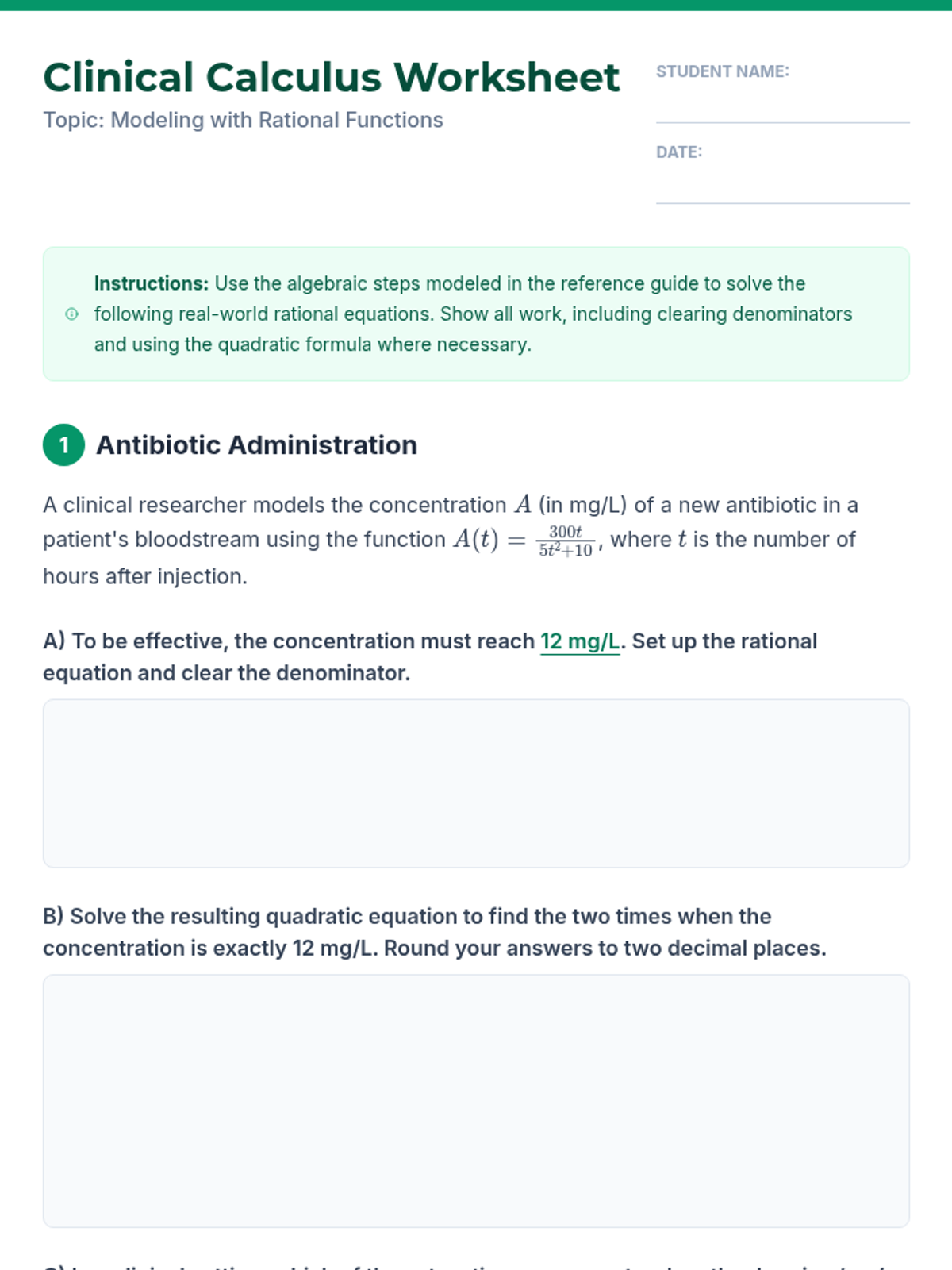
A student worksheet containing two multi-part word problems involving rational functions in medical contexts, with dedicated space for algebraic work and critical thinking.
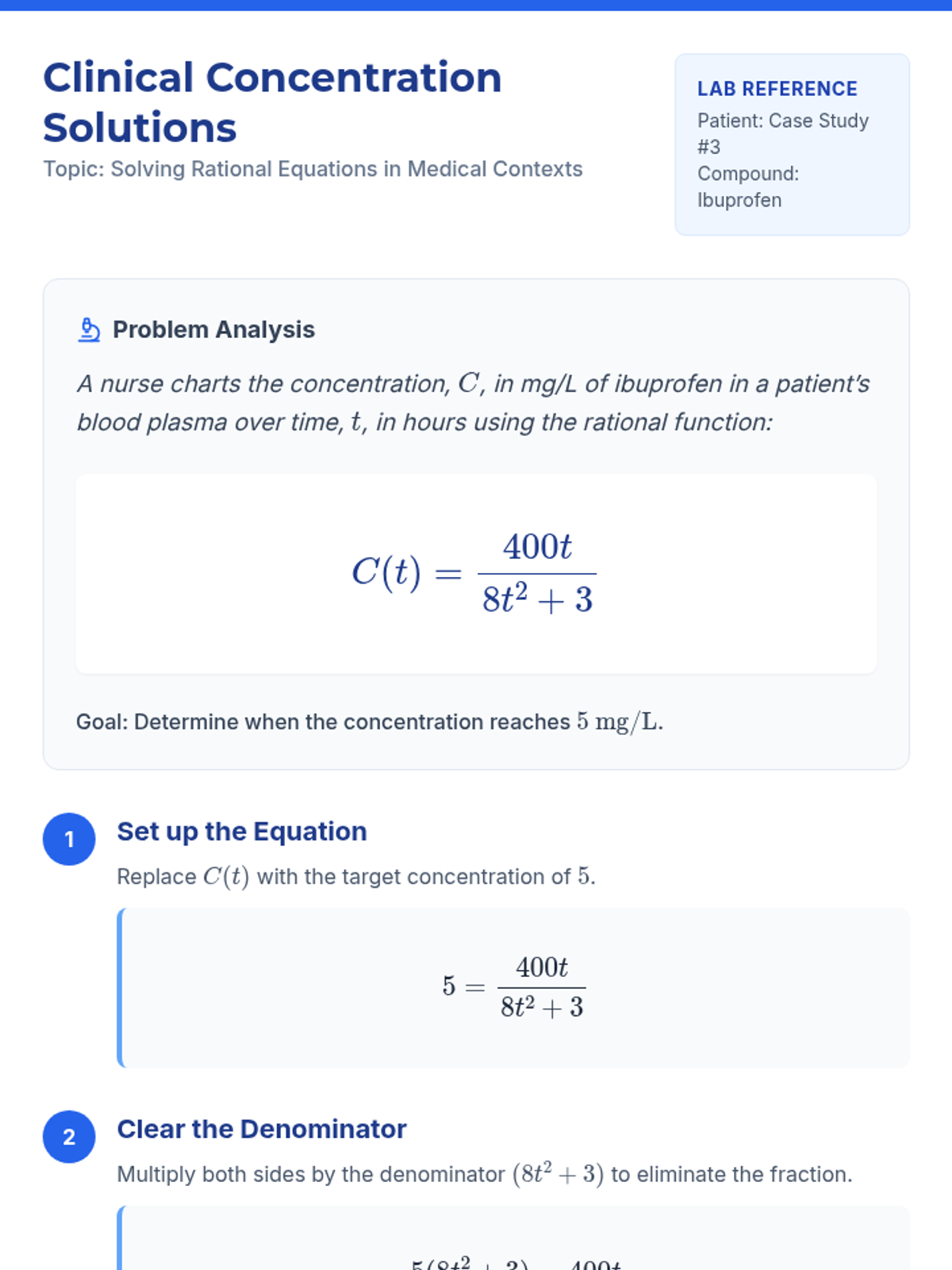
A detailed, step-by-step solution guide for the ibuprofen concentration rational function problem, featuring a clean medical lab aesthetic.
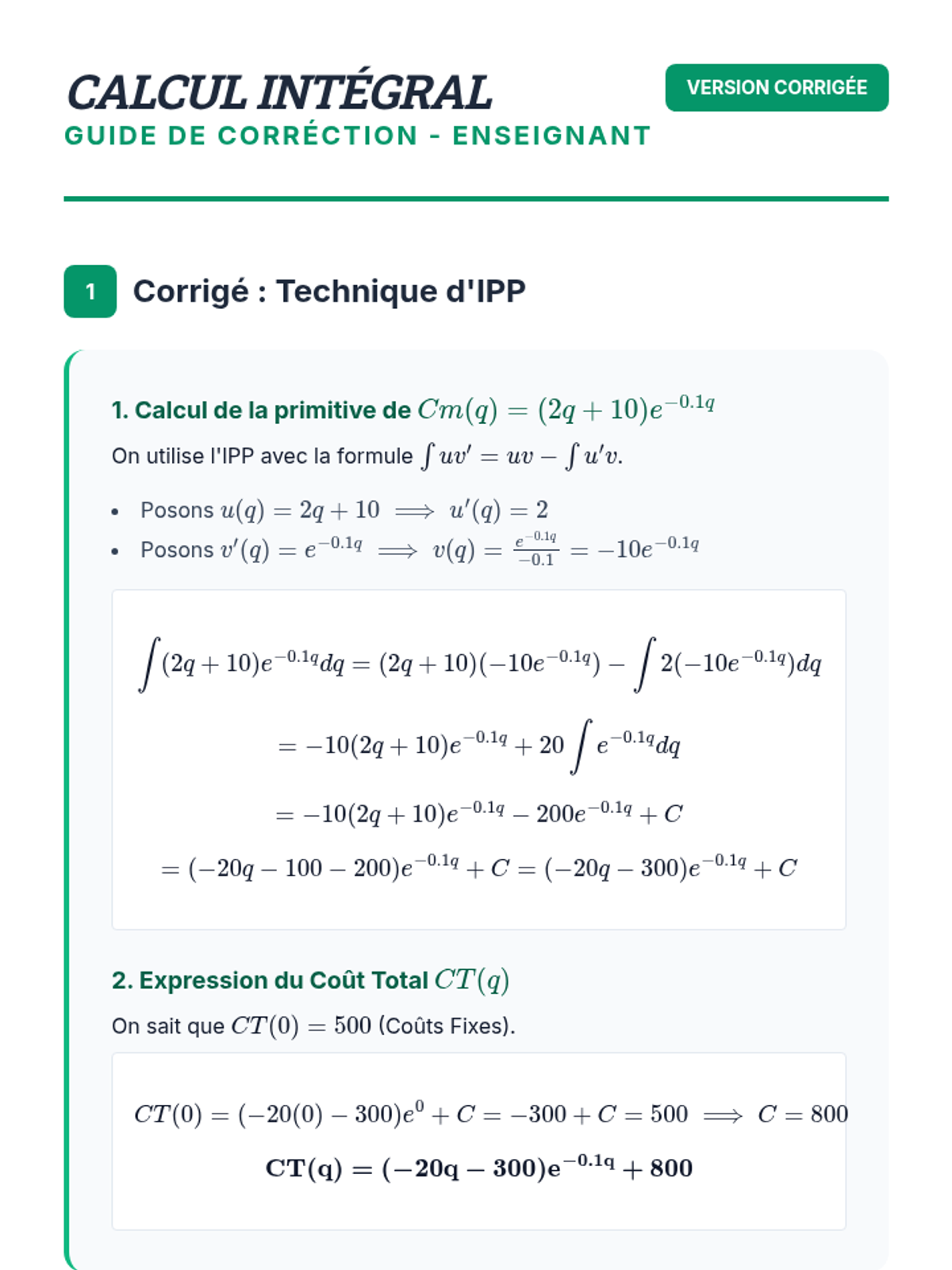
Guide de correction détaillé pour les exercices d'intégrales appliquées à l'économie (IPP, Gini, Surplus).
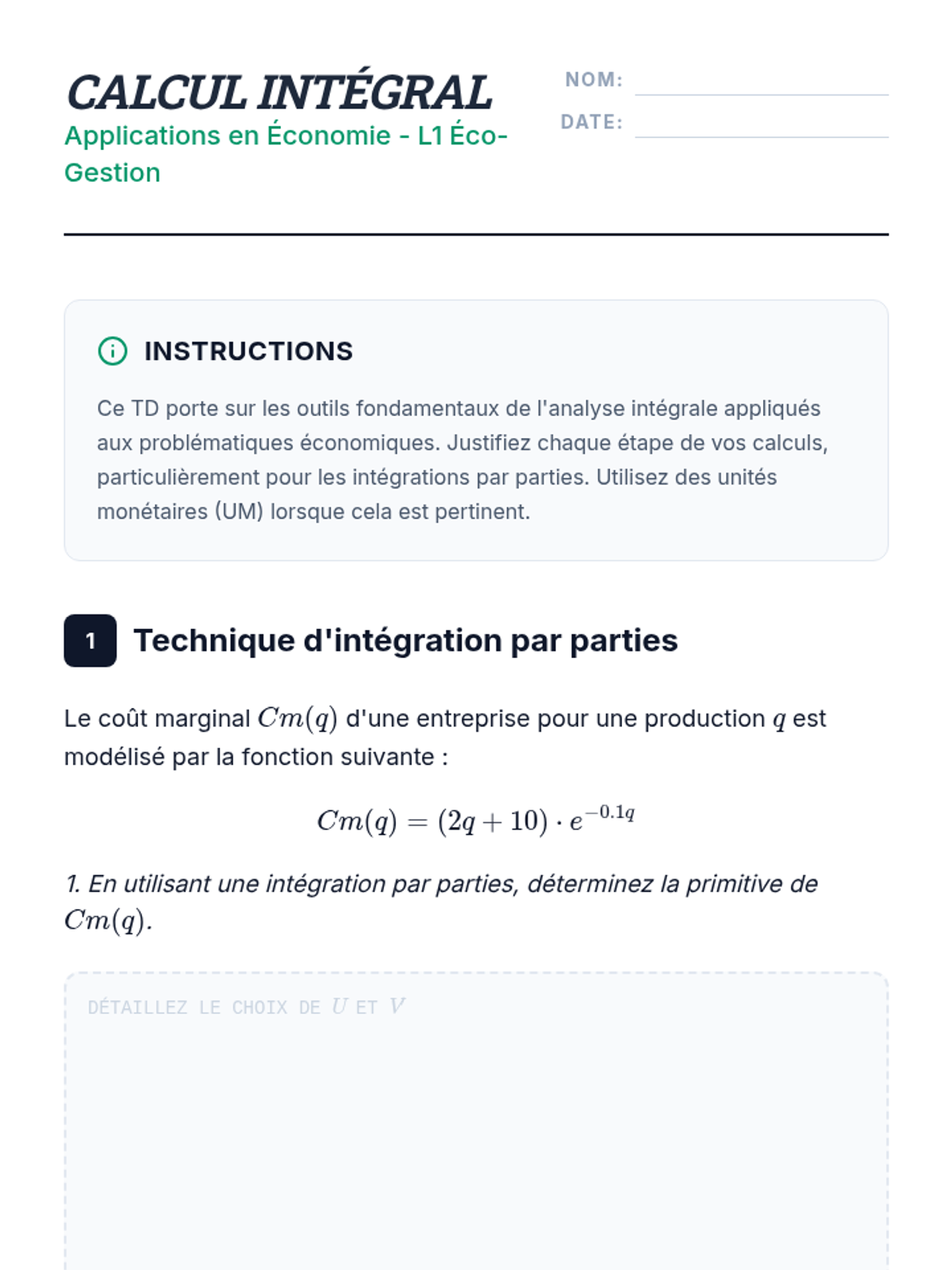
Feuille d'exercices sur les intégrales appliquées à l'économie pour L1 Éco-Gestion (IPP, Gini, Surplus).
Présentation visuelle pour le cours de calcul intégral appliqué à l'économie (IPP, Surplus, Gini).
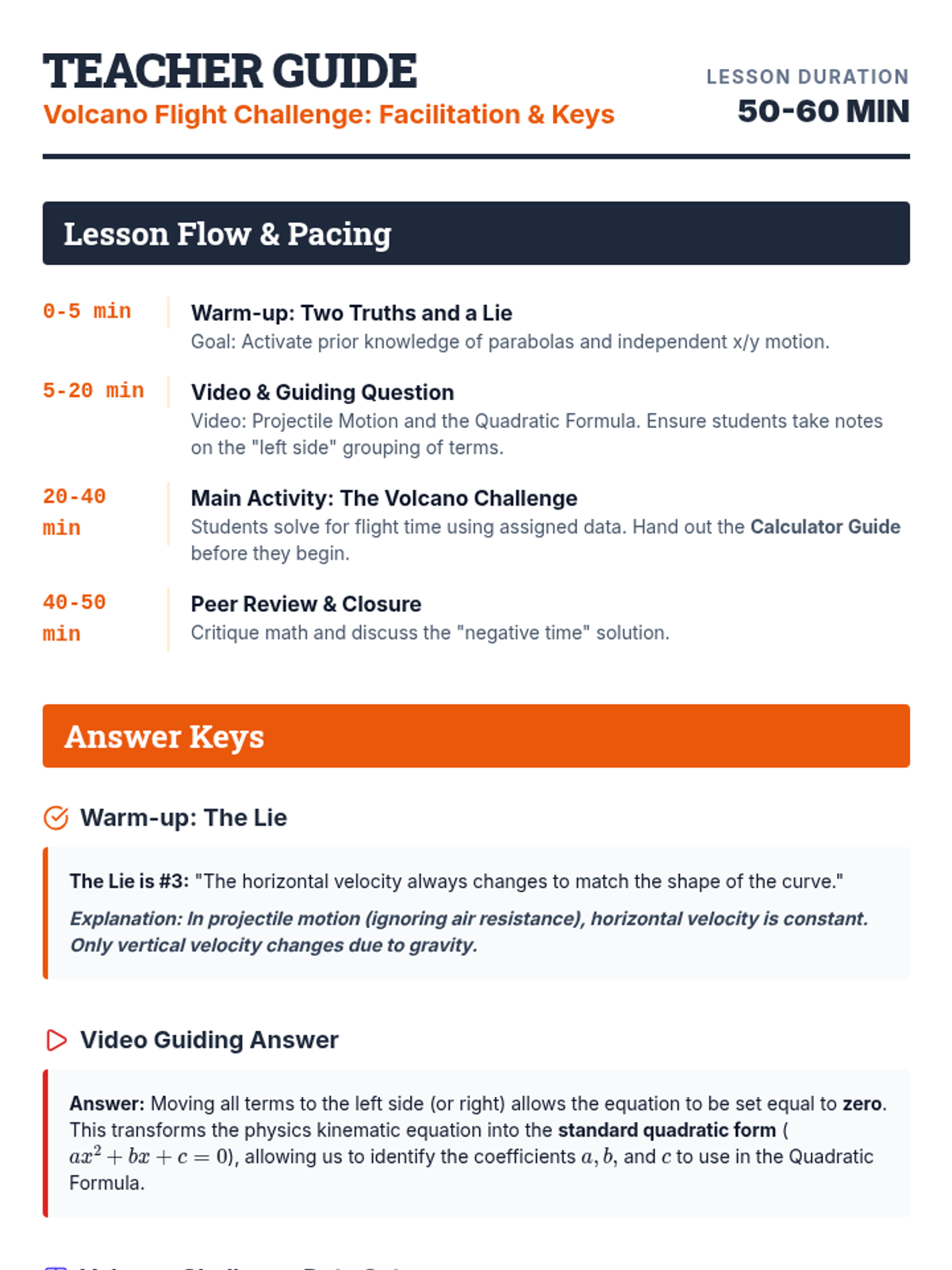
Teacher Guide for the 'Volcano Flight Challenge' lesson. Contains a lesson timeline, answer keys for the warm-up and video guide, a master data table for assigning student variables, and facilitation notes for the 'negative time' discussion.
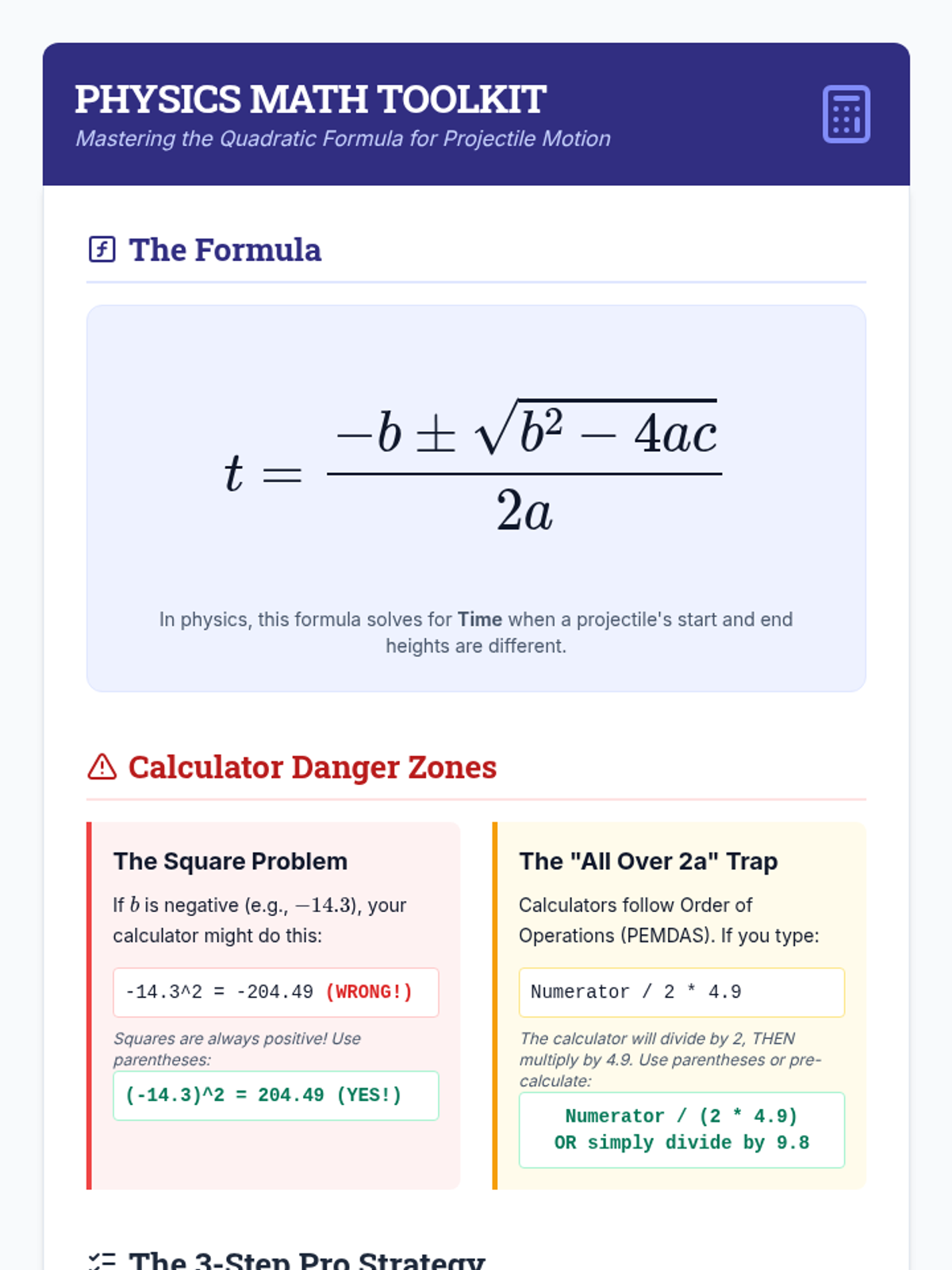
A math toolkit for physics students that breaks down the quadratic formula for flight time calculation. Includes common calculator pitfalls, step-by-step calculation strategies, and specific focus on handling negative signs and parentheses.
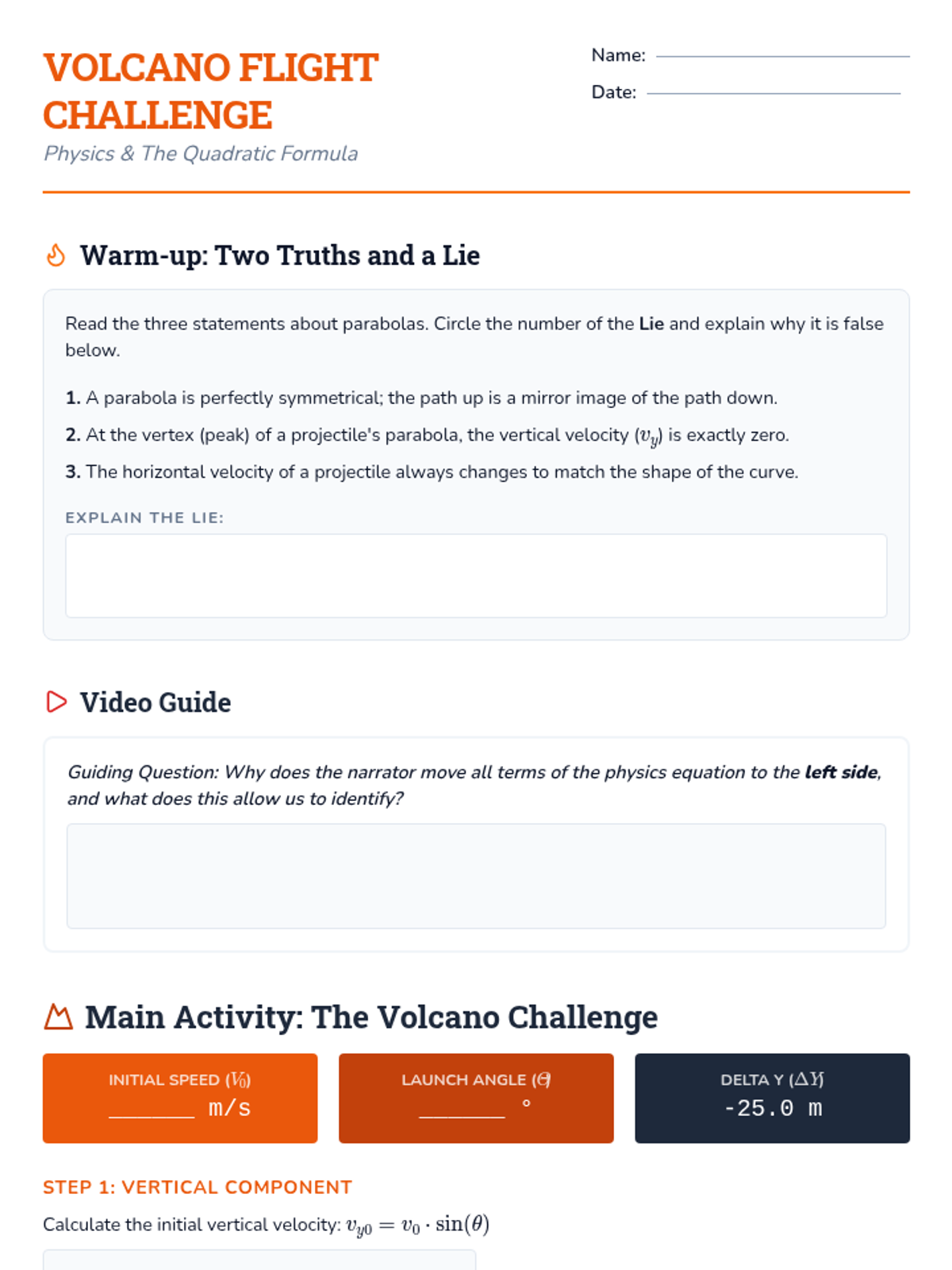
Student worksheet for the 'Volcano Flight Challenge' lesson. Includes sections for the parabola warm-up, video guiding questions, the main calculation activity using the quadratic formula, and a peer review checklist.
Visual presentation for the 'Volcano Flight Challenge' lesson, covering objectives, warm-up, video guiding questions, and the main activity instructions. It uses a consistent volcano/seismology theme with high-contrast text and clear math-to-physics mapping.
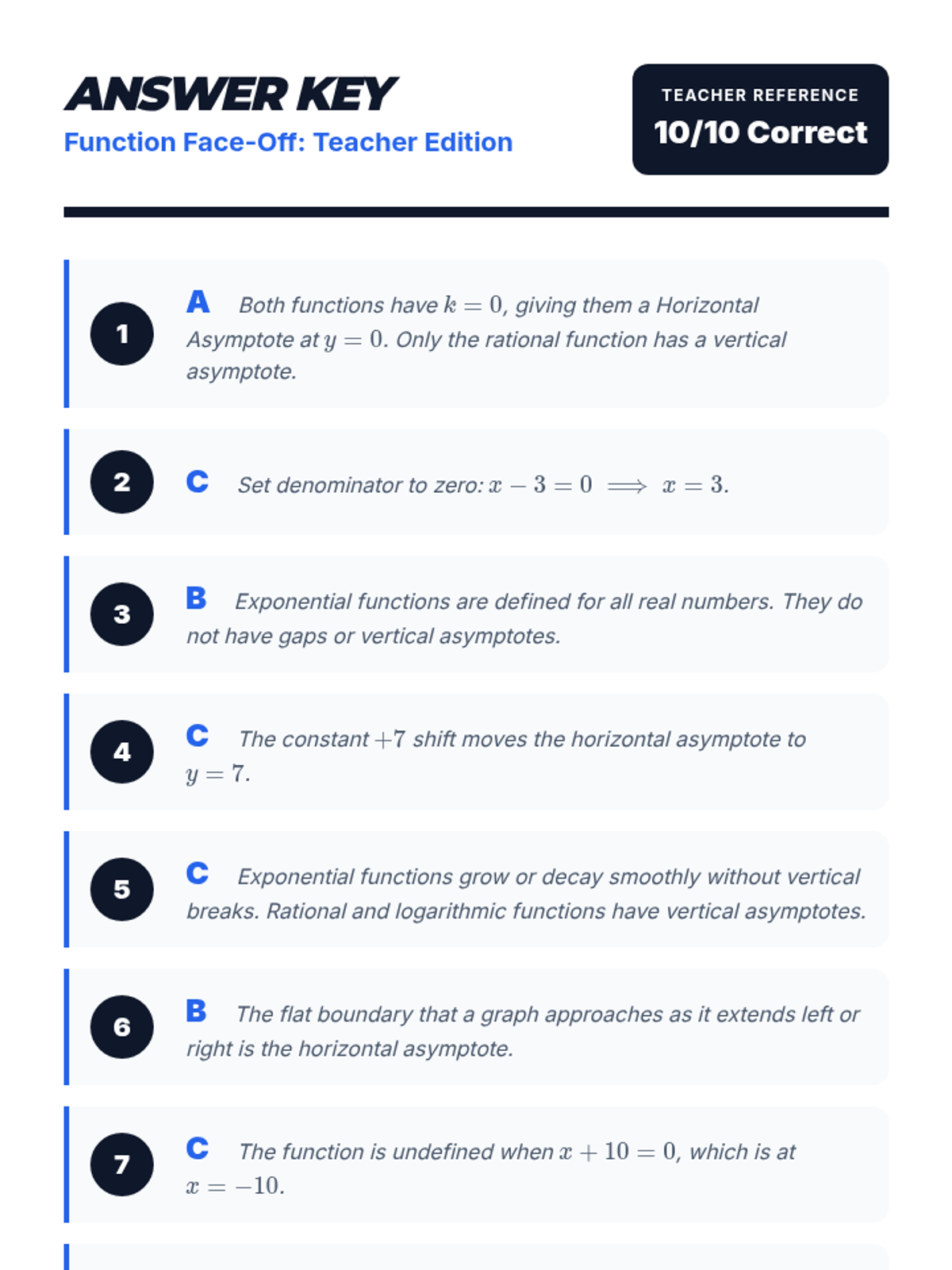
A clear, one-page teacher answer key providing correct answers and brief pedagogical explanations for the 10 multiple-choice problems, matching the updated worksheet.
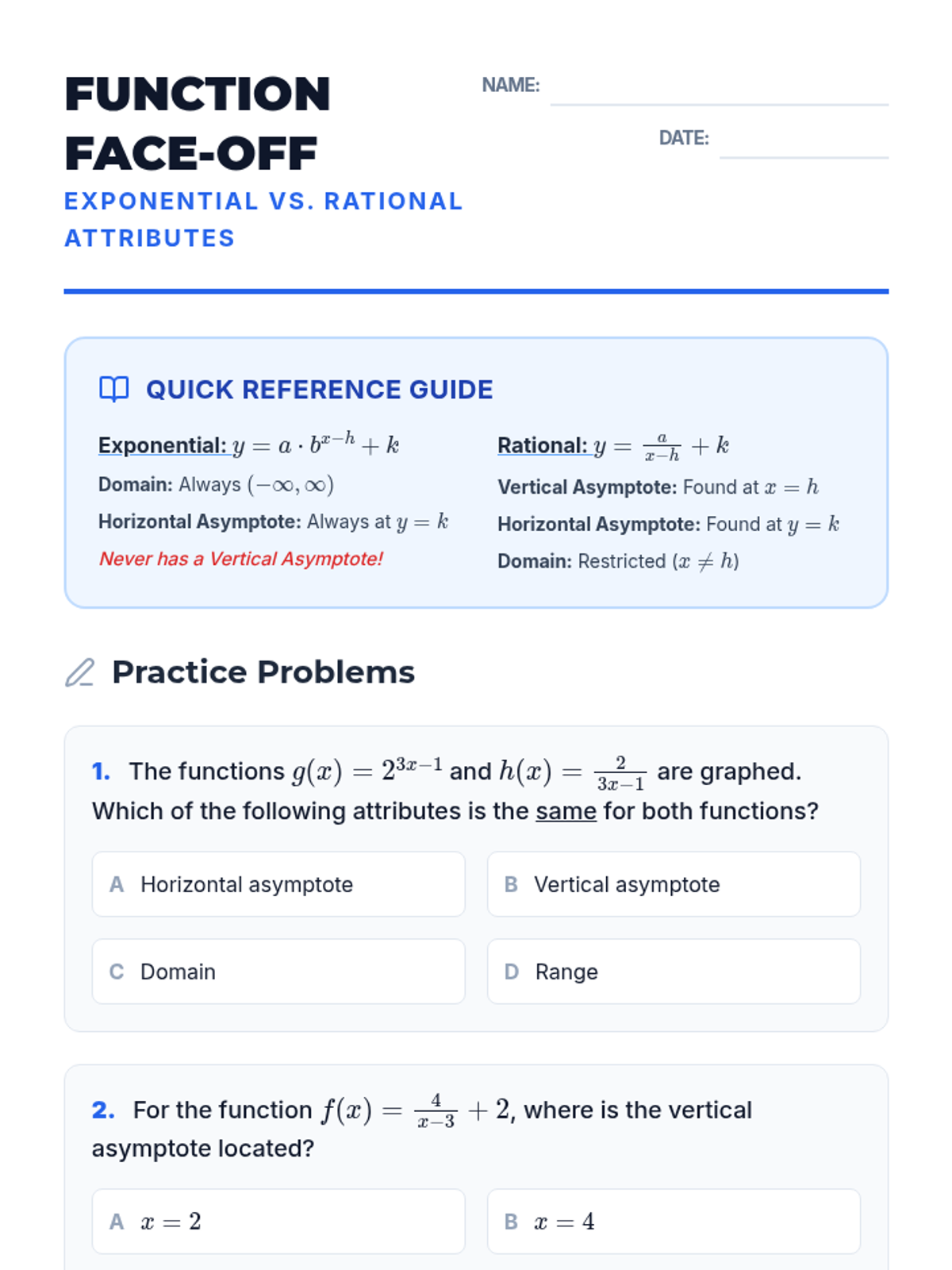
A comprehensive worksheet featuring a guided lesson review of exponential and rational function attributes, followed by 10 multiple-choice practice problems comparing their properties, including the specific example provided.
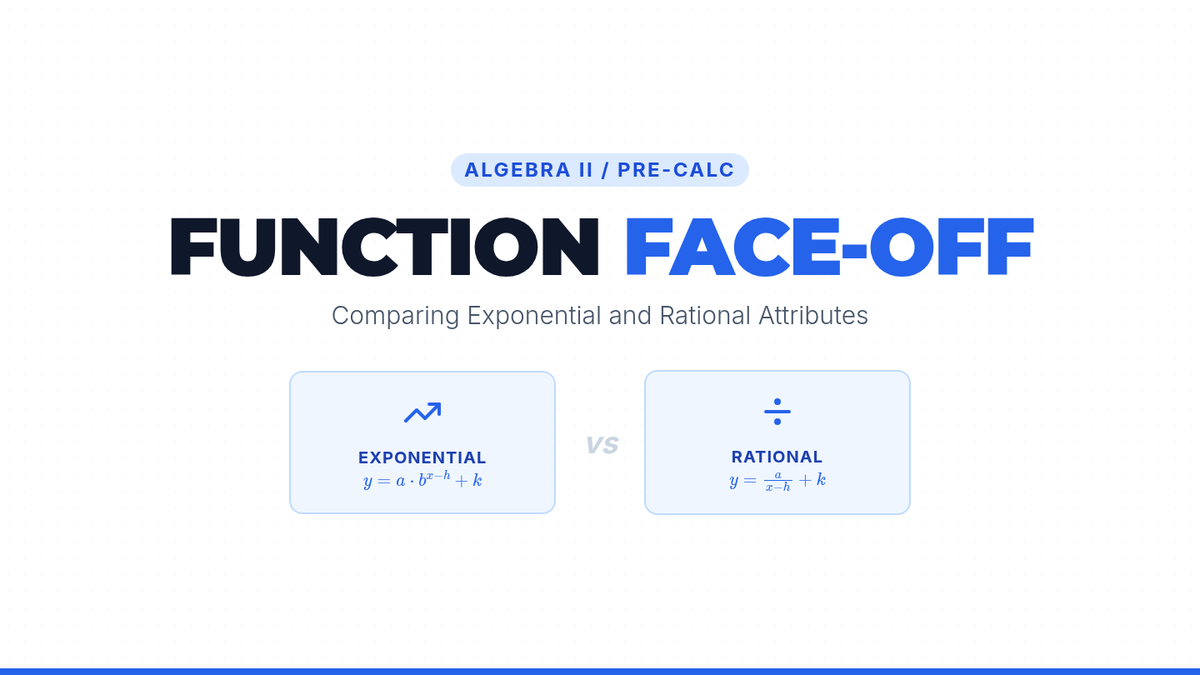
A visual slide deck introducing the comparison between exponential and rational functions, featuring a graph visualization of the specific rivalry from the lesson.
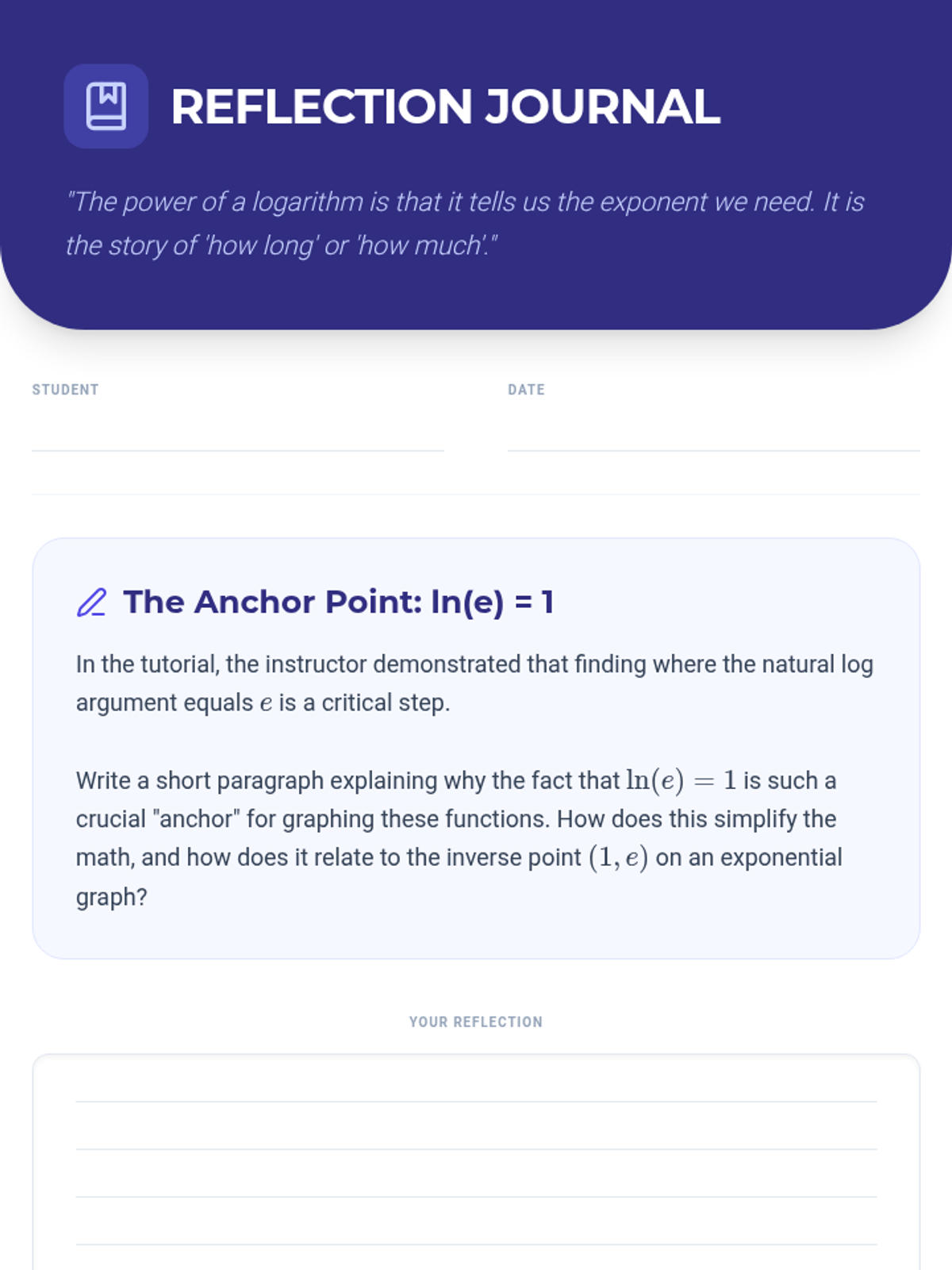
A reflection journal sheet for students to explain the significance of the ln(e)=1 identity in graphing natural logarithmic functions.
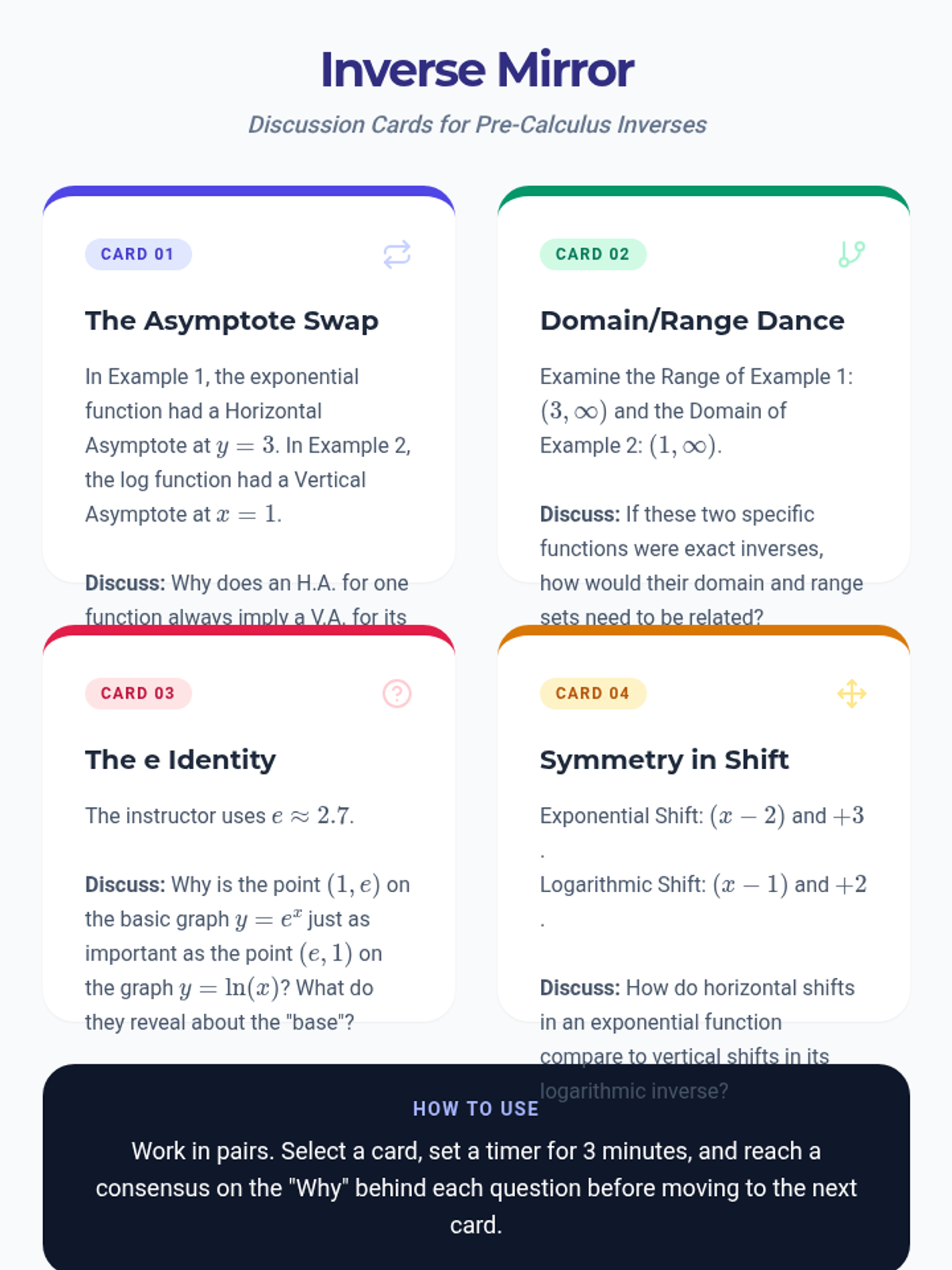
Discussion task cards for students to analyze the geometric and algebraic relationships between exponential and natural logarithmic functions.
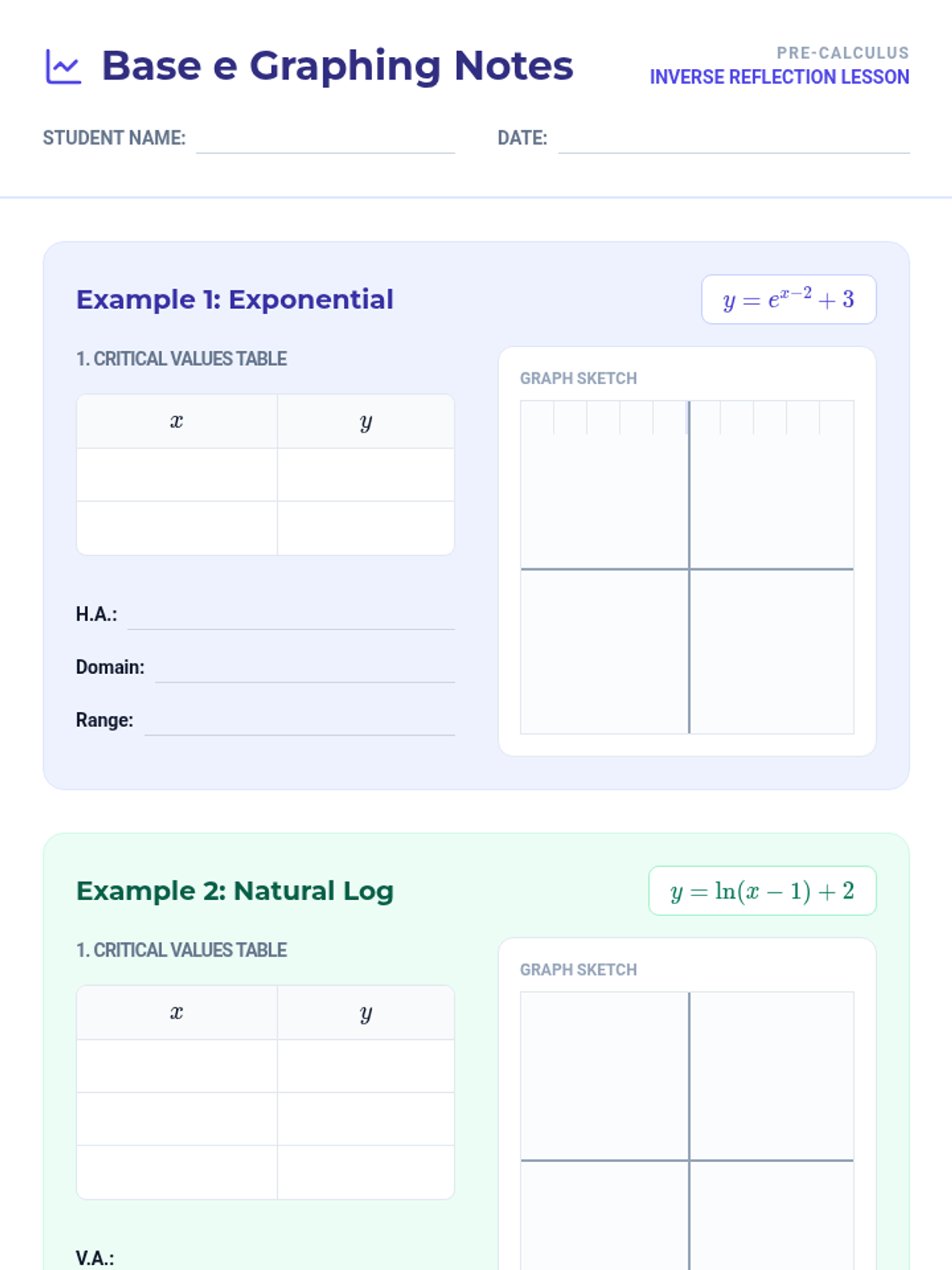
A guided notes worksheet for students to use while watching the Inverse Reflection video, featuring tables for critical values and graph sketching areas.
A visual presentation deck for the Inverse Reflection lesson, including embedded video, prediction prompts, and side-by-side comparison graphics.
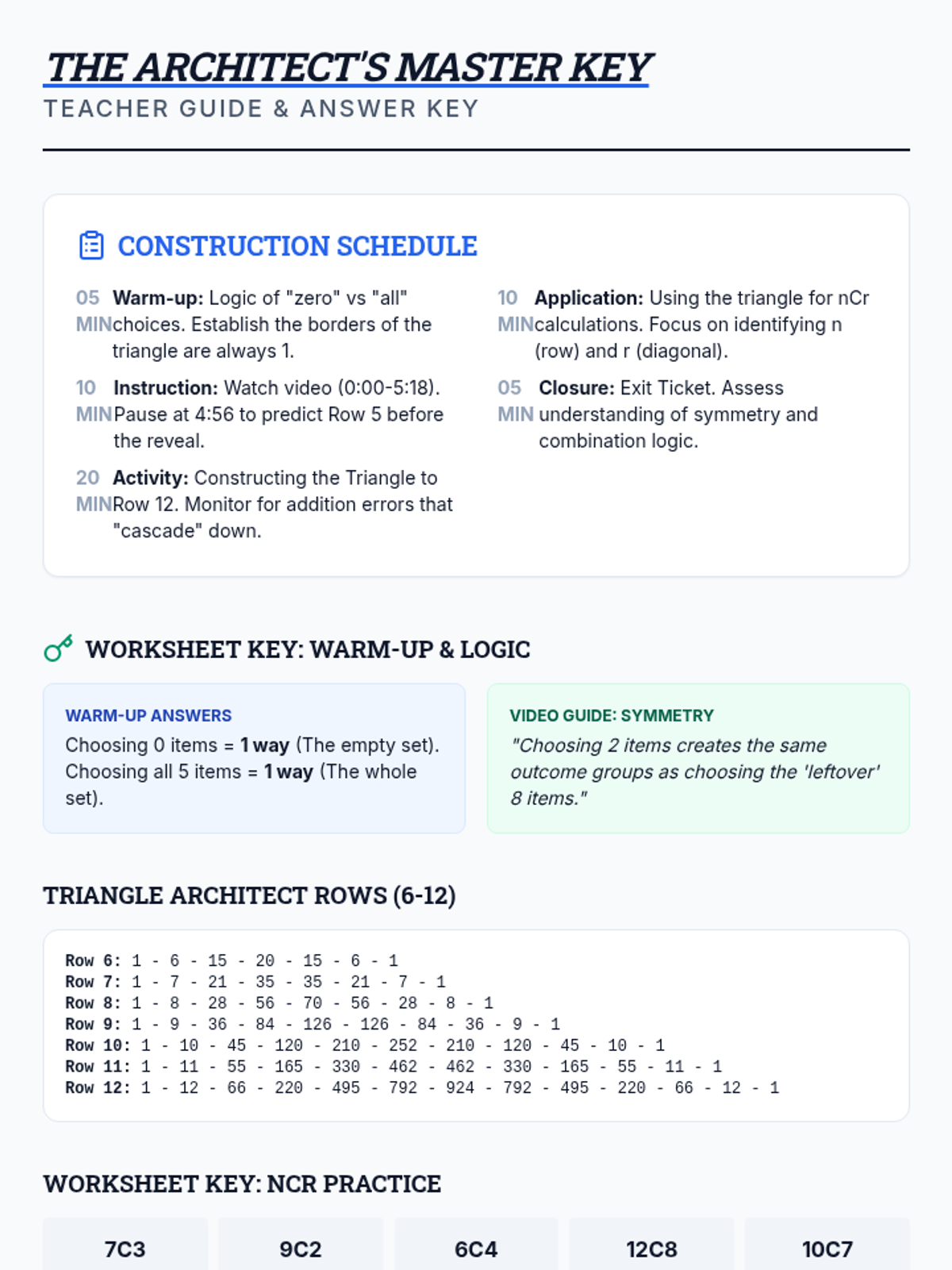
A comprehensive teacher guide and answer key for the Pascal's Architect lesson, including a lesson schedule, full triangle values, and worksheet answers.
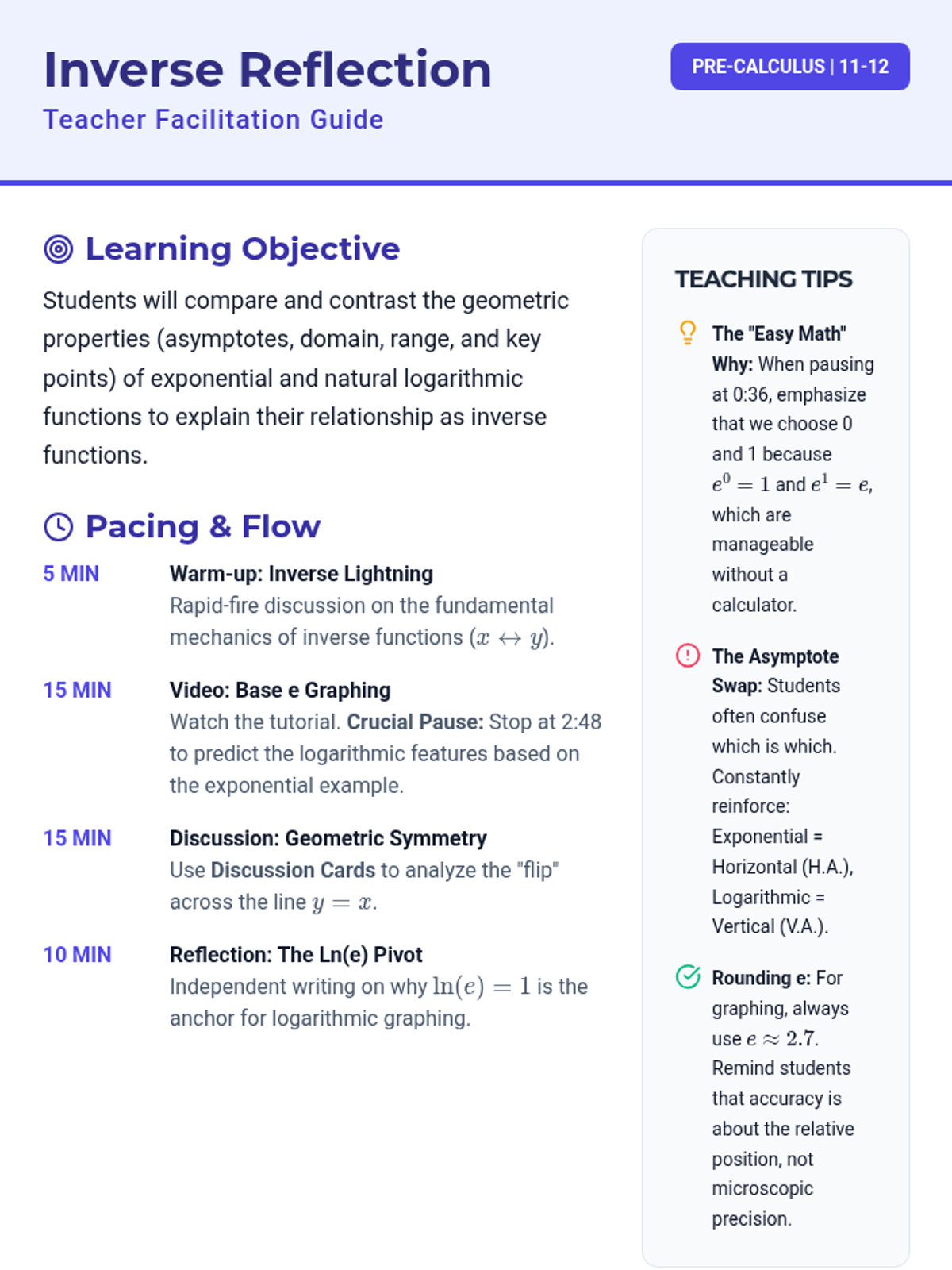
A comprehensive teacher facilitation guide for the Inverse Reflection lesson, featuring pacing, teaching tips, and strategic video pause points for Pre-Calculus instruction.
A visual presentation for instruction including the warm-up, video embed, symmetry concept visualization, and activity instructions.
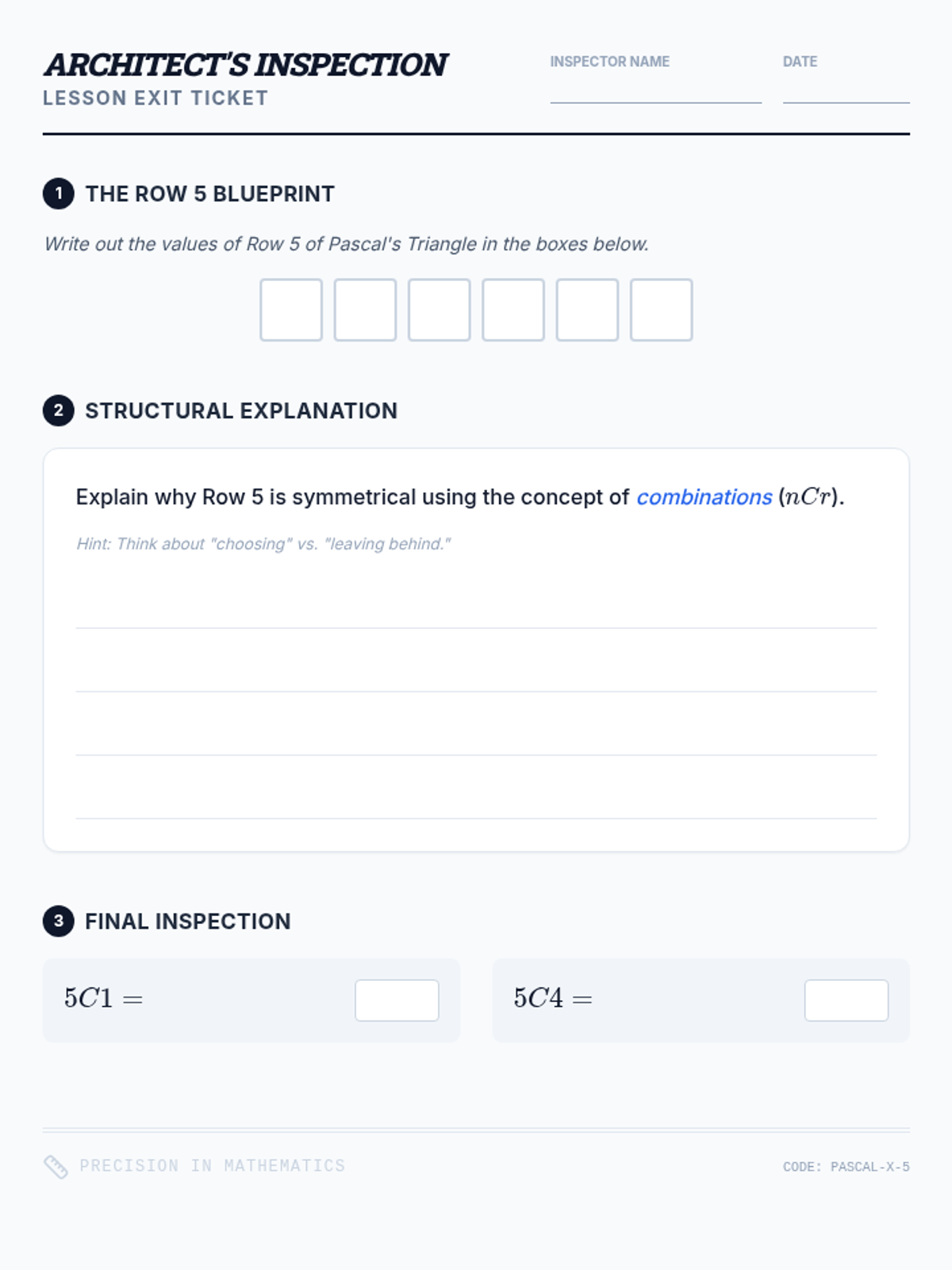
An exit ticket asking students to reproduce Row 5 of Pascal's Triangle and explain its symmetry using combination logic.
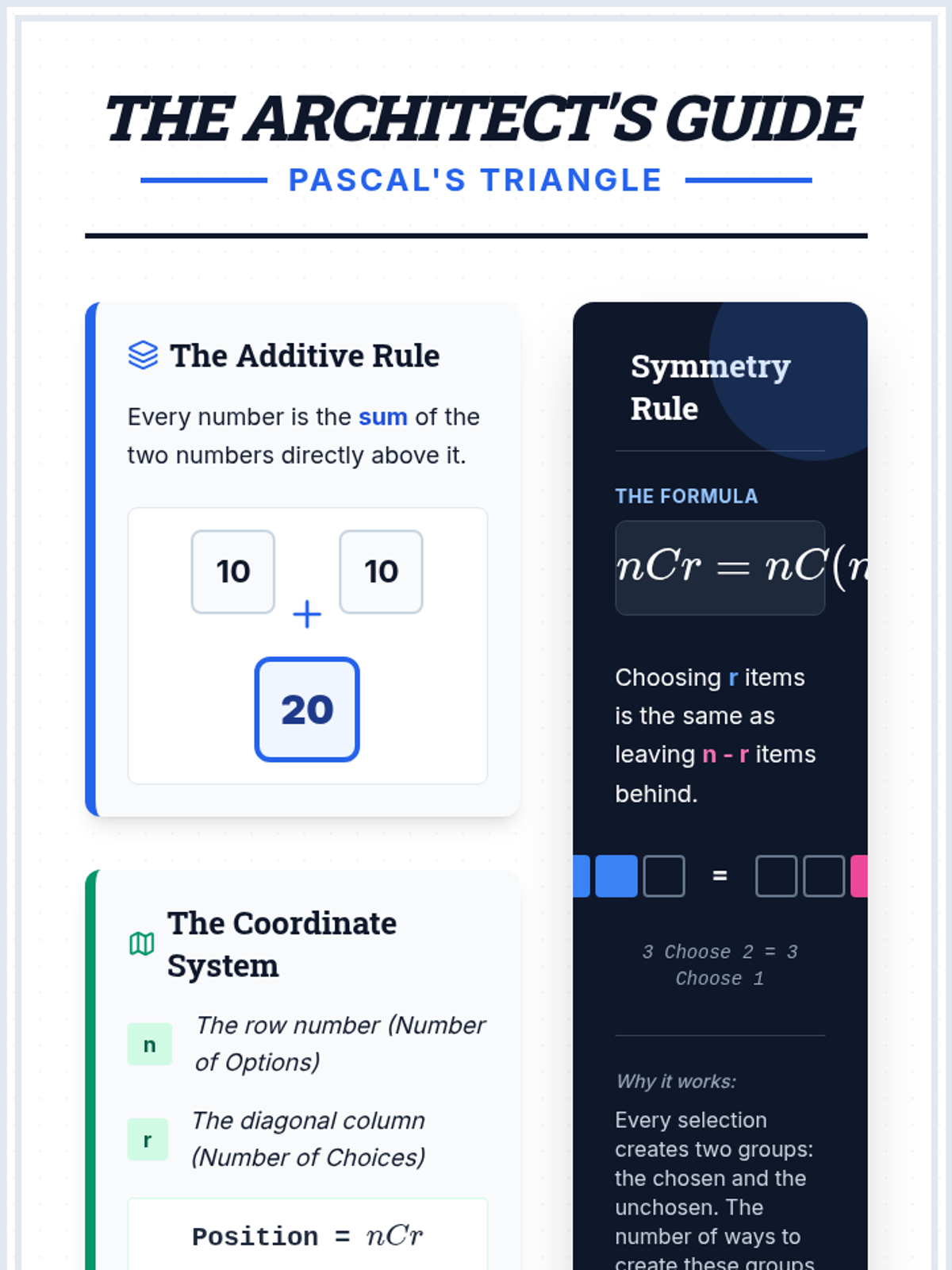
An instructional anchor chart illustrating the construction rules and symmetry principles of Pascal's Triangle, featuring the additive rule and the nCr coordinate system.
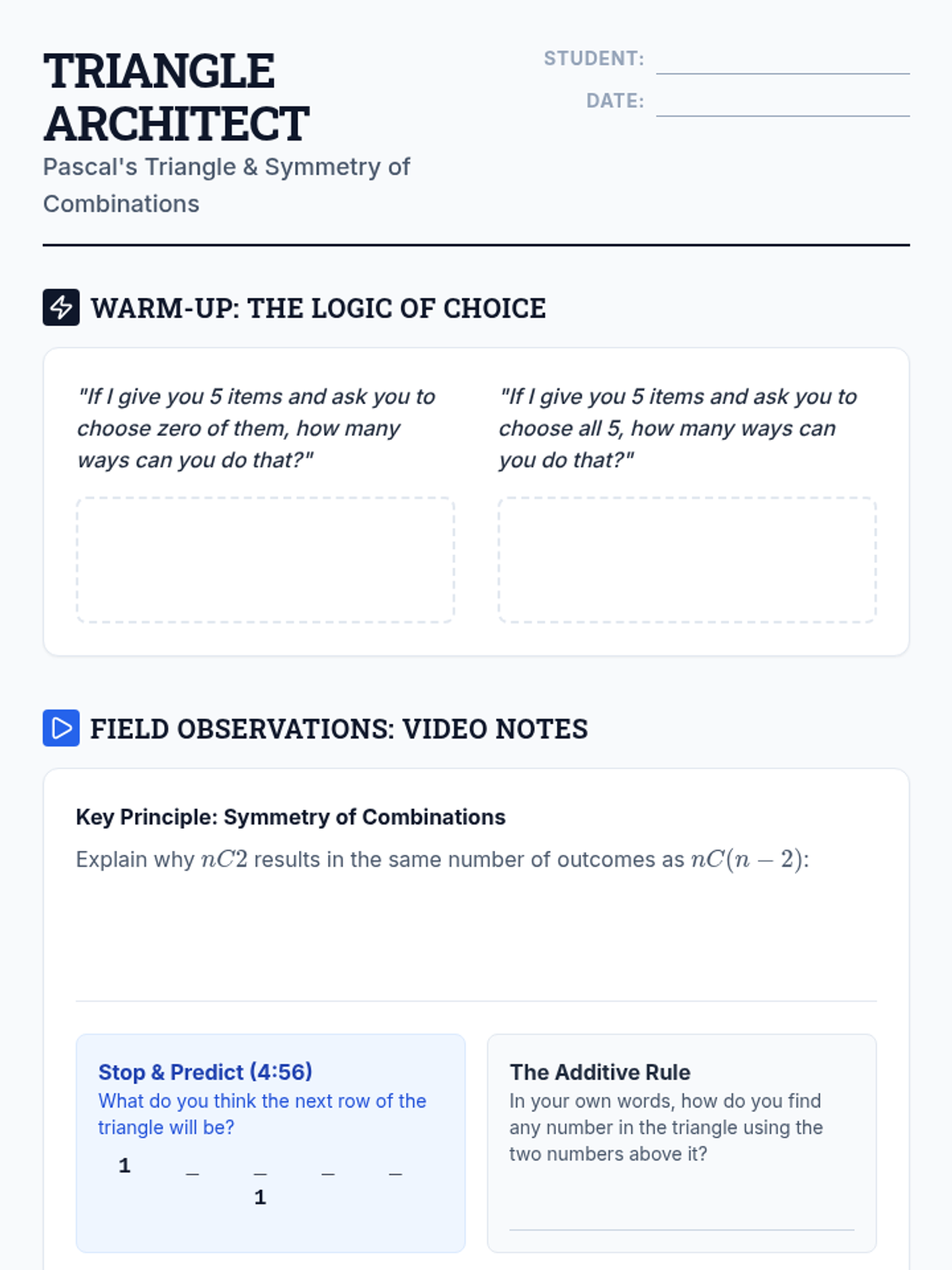
A 3-page student worksheet featuring a warm-up on combination logic, a video guided note section, a large blank Pascal's Triangle (to Row 12) for construction, and a set of nCr practice problems.
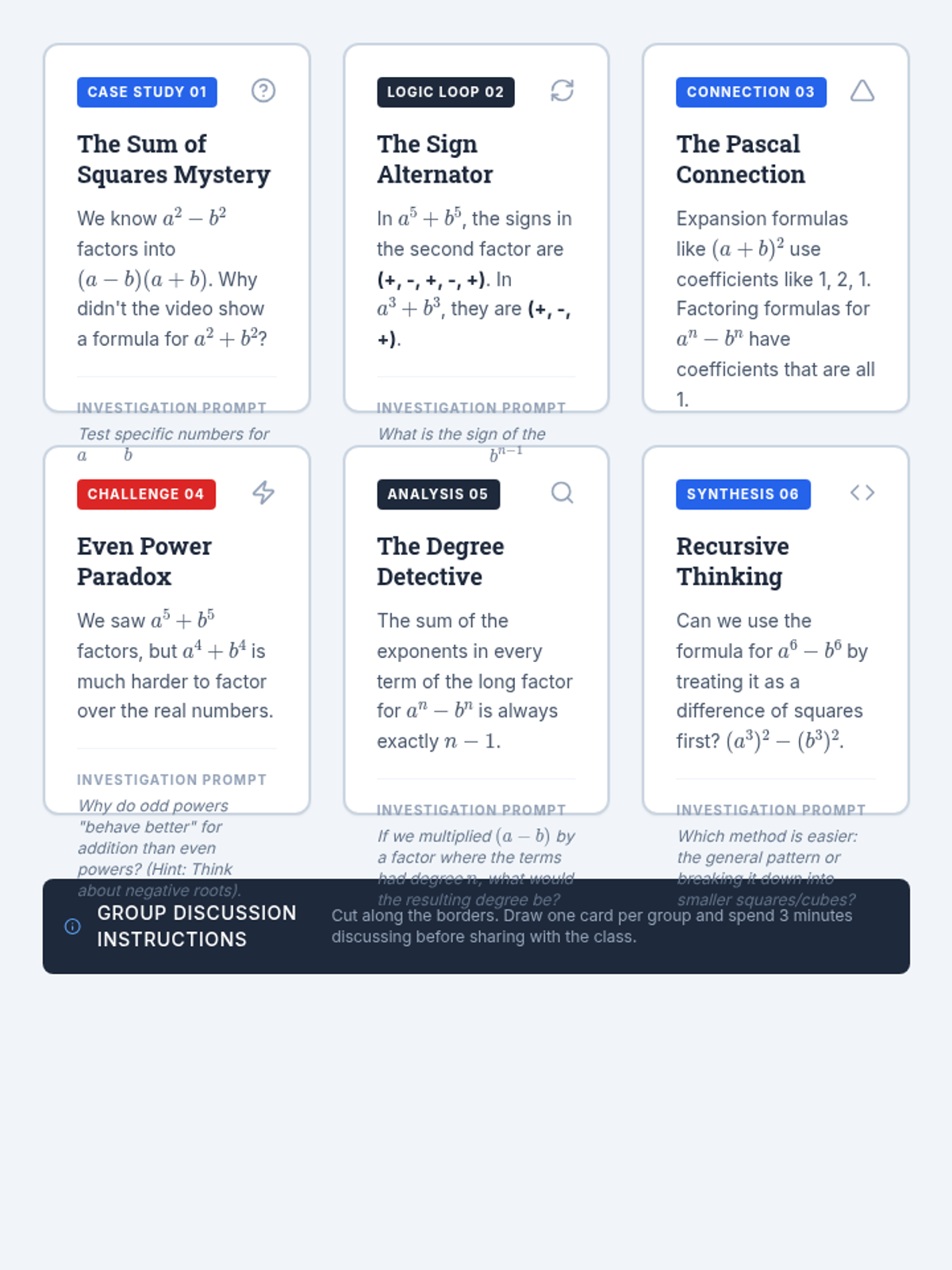
A set of 6 discussion cards for students to explore deeper concepts related to binomial factoring, including the "Sum of Squares Mystery" and "Even Power Paradox." Designed for group work and class discussion.
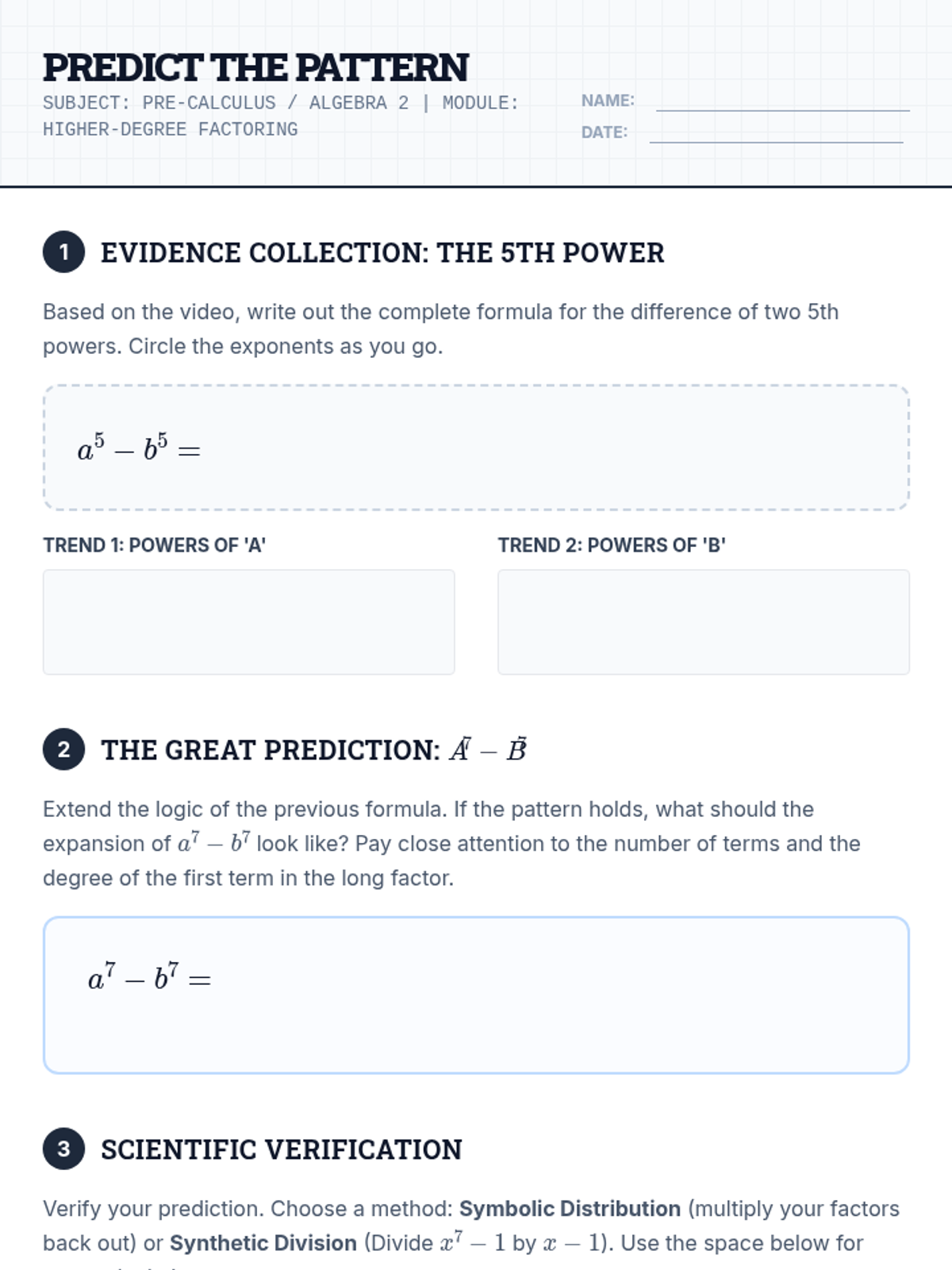
A student activity worksheet designed for group investigation. It guides students through observing the 5th power pattern, predicting the 7th power expansion, and verifying their results using algebraic methods.
A visual presentation for the Pattern Power lesson, featuring warm-up exercises, an embedded video section, and prompts for group investigation into higher-degree binomial factoring.
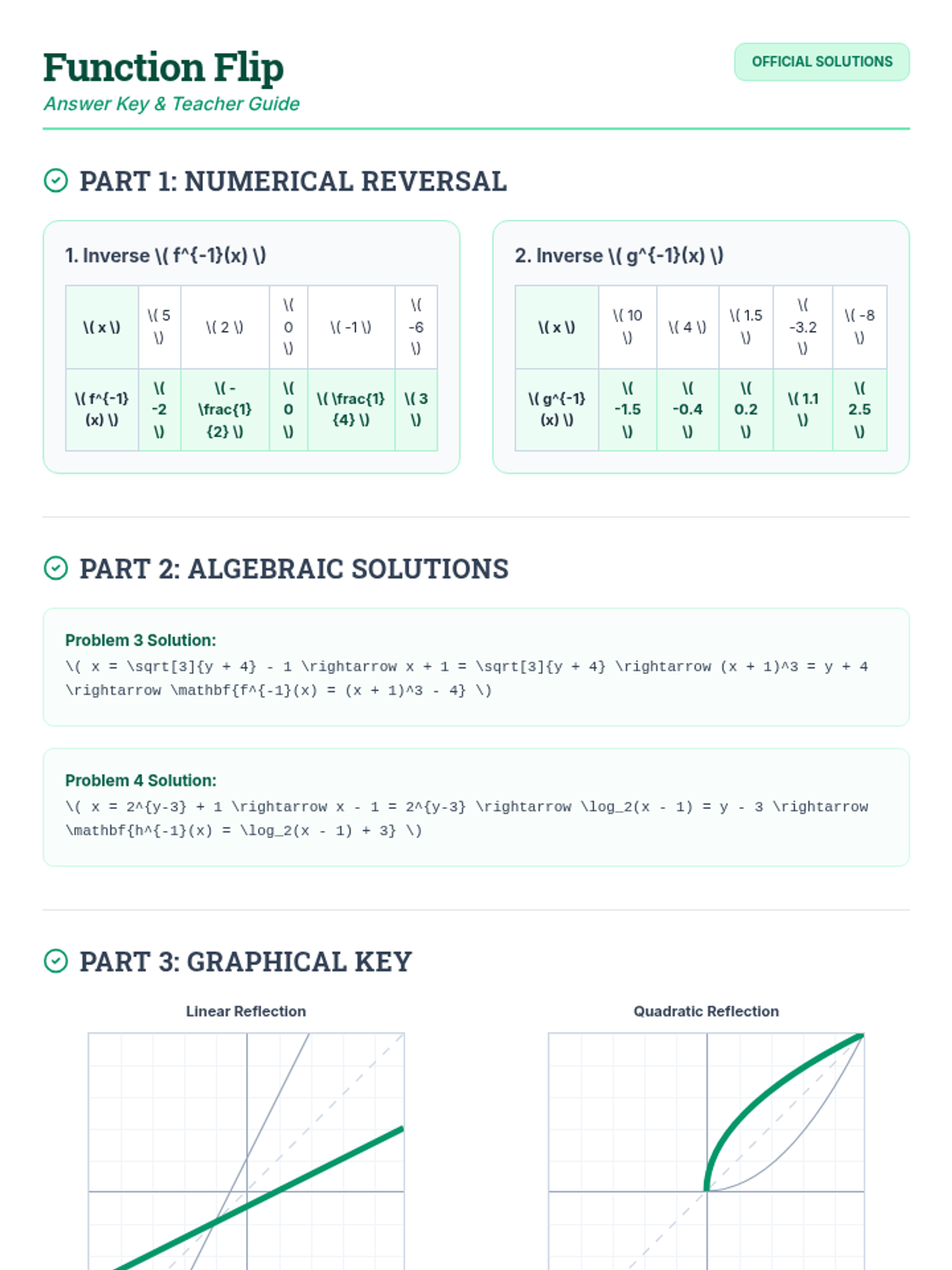
The answer key for the Inverse Flip Worksheet, featuring completed table mappings, step-by-step algebraic solutions for cubic and exponential functions, and reflected graphical representations for visual verification.
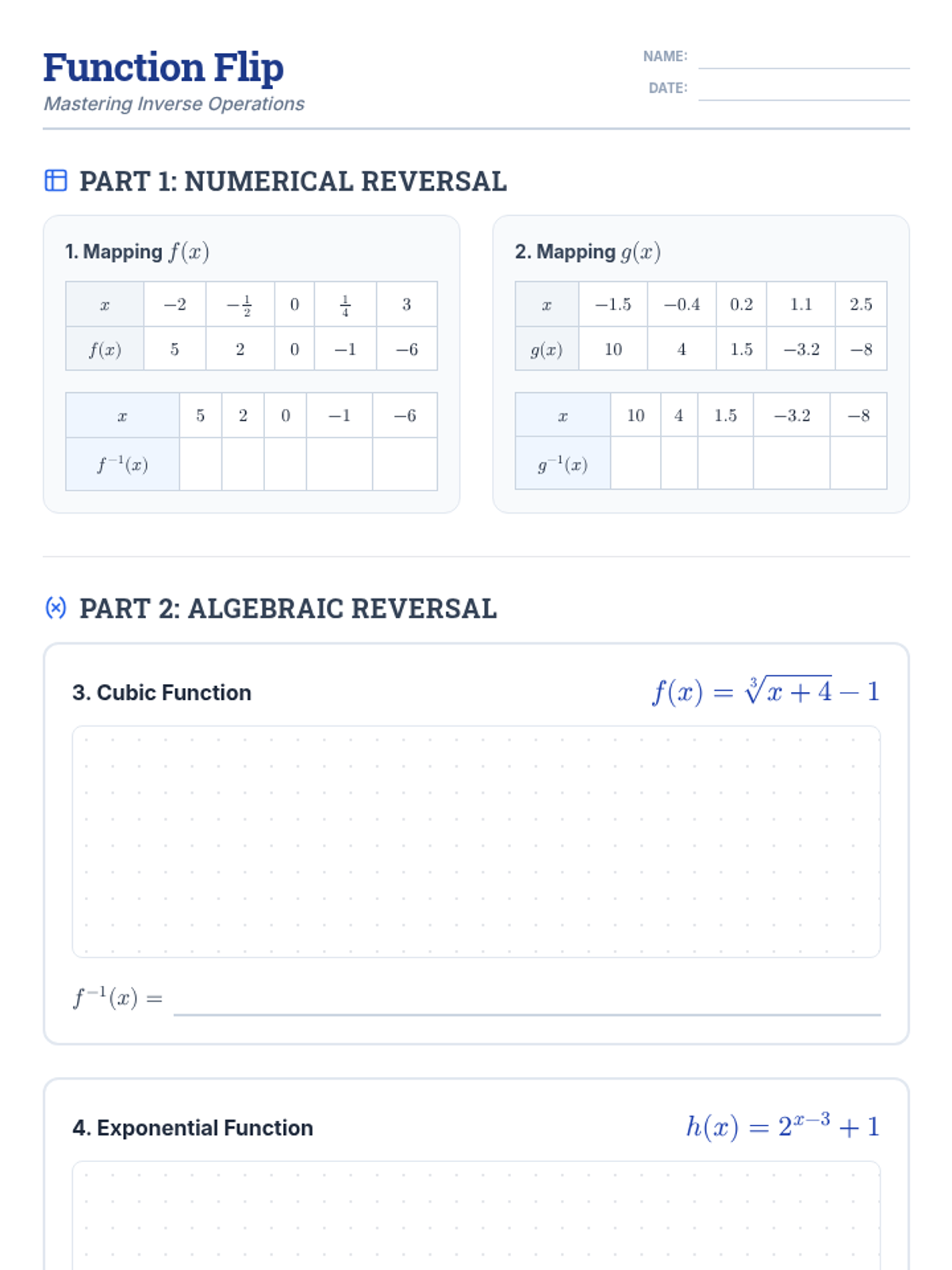
A comprehensive worksheet on inverse functions featuring table mapping, algebraic manipulation, and graphical reflections across the line y=x. Includes fractions, decimals, and multiple function types (linear, quadratic, cubic, exponential, square root).
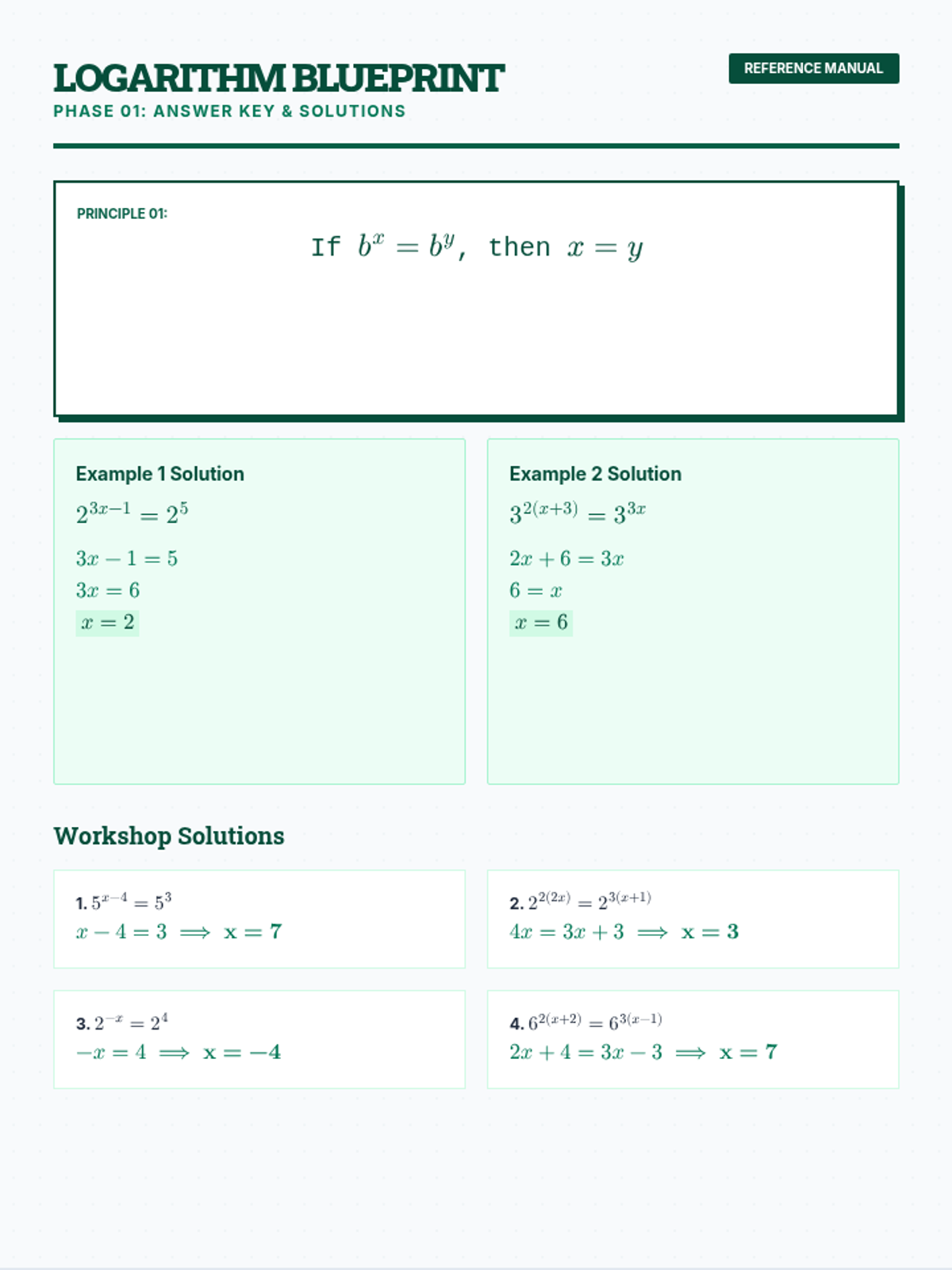
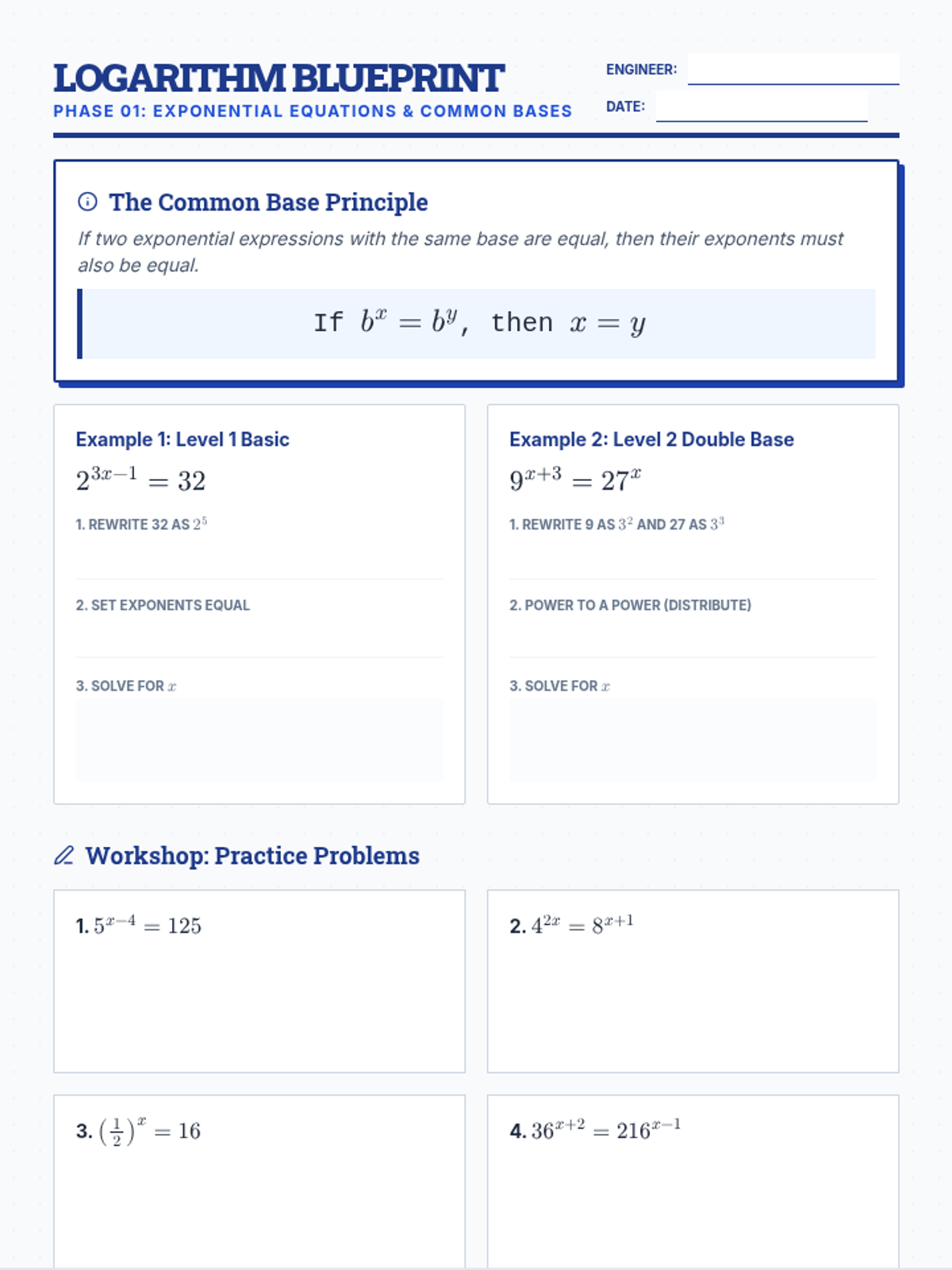
A 4-page detailed answer key for the Logarithm Blueprint Guided Notes, providing step-by-step solutions for all exponential and logarithmic equation problems.
A 4-page comprehensive guided notes packet for solving exponential and logarithmic equations. It covers common bases, form conversion, and logarithmic properties with a professional technical blueprint aesthetic.
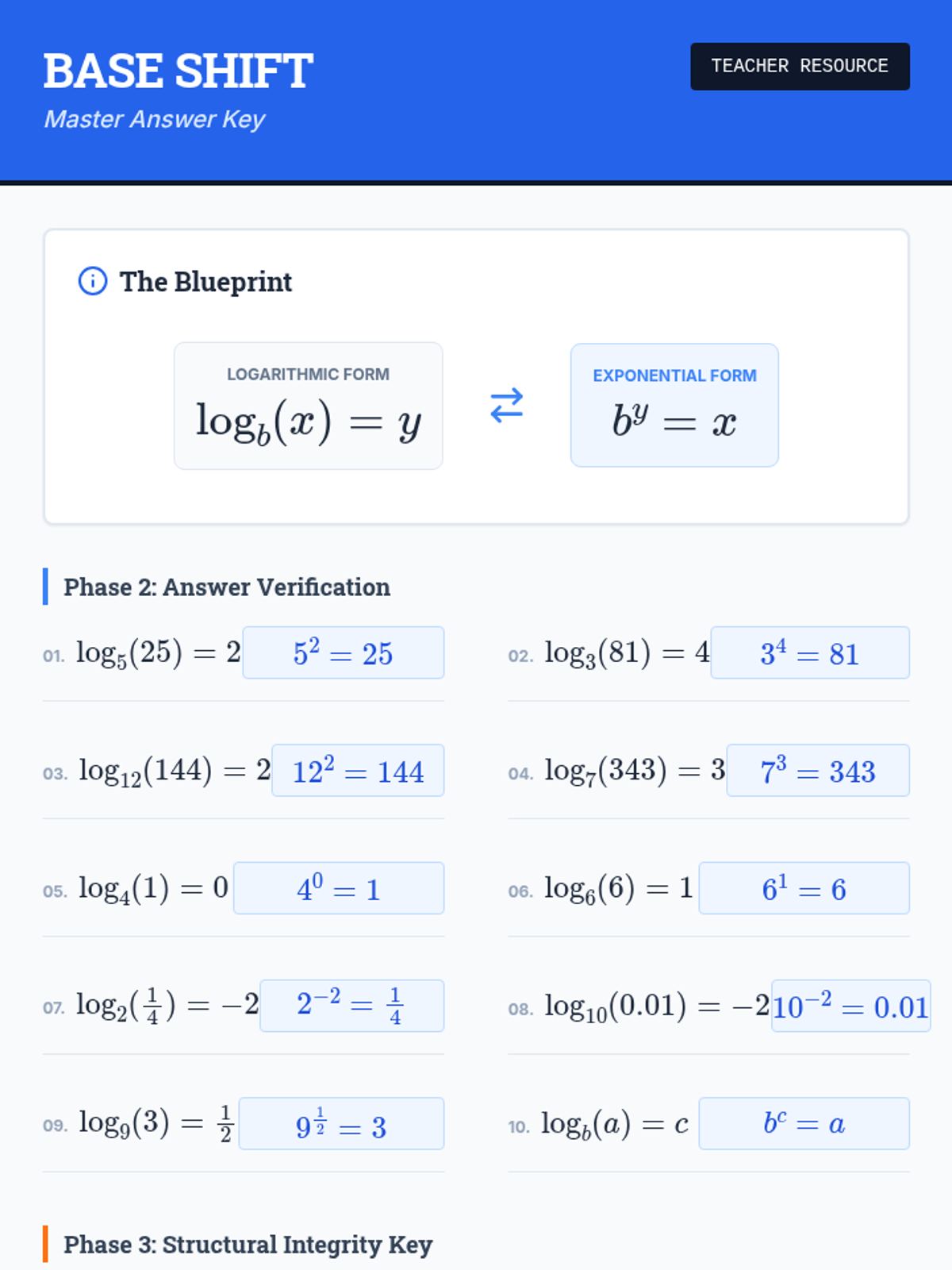
An answer key for the Base Shift worksheet, providing step-by-step solutions for logarithmic to exponential conversions.
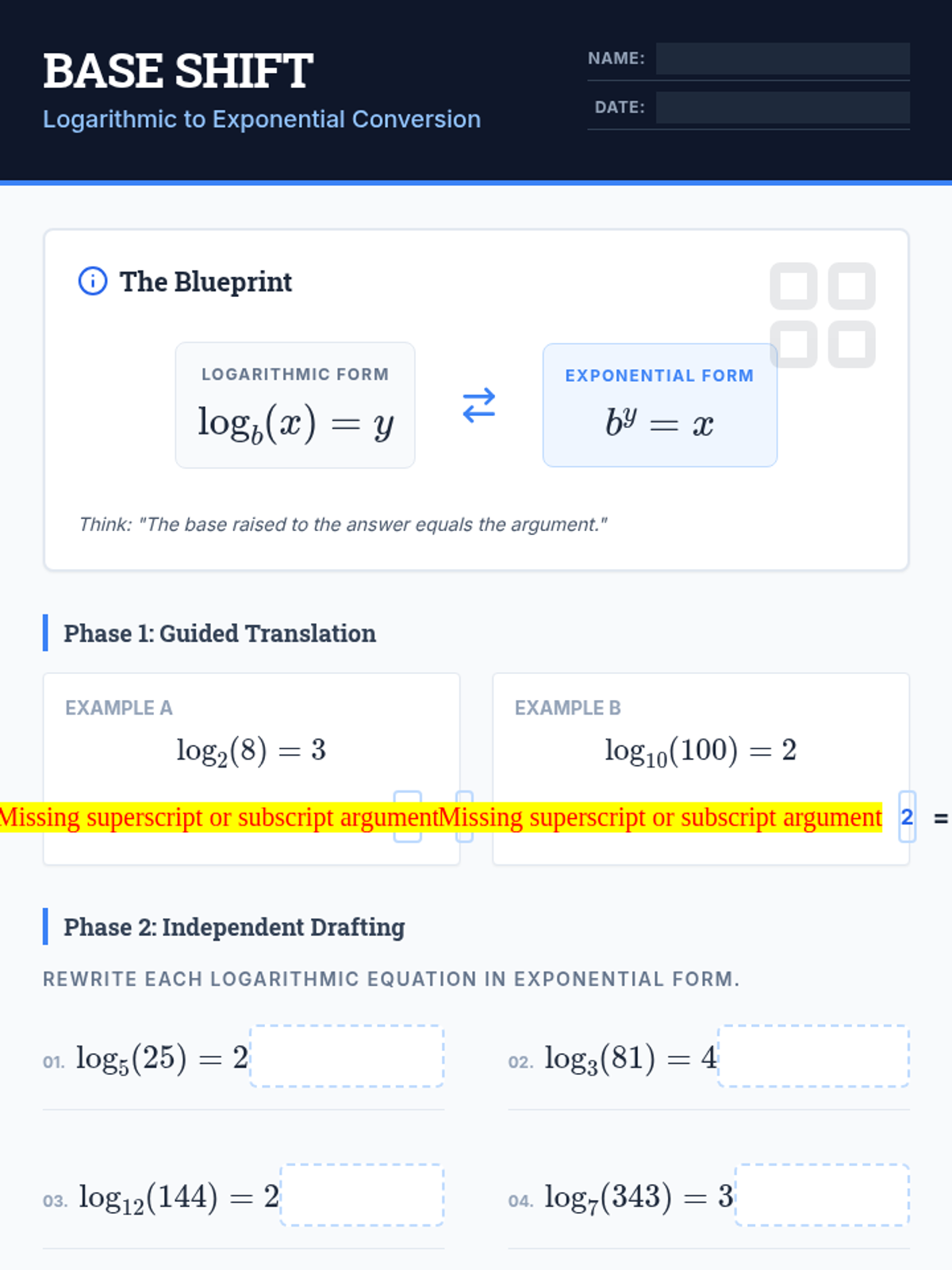
A comprehensive worksheet for practicing the conversion of logarithmic equations to exponential form, featuring guided examples and challenge problems.
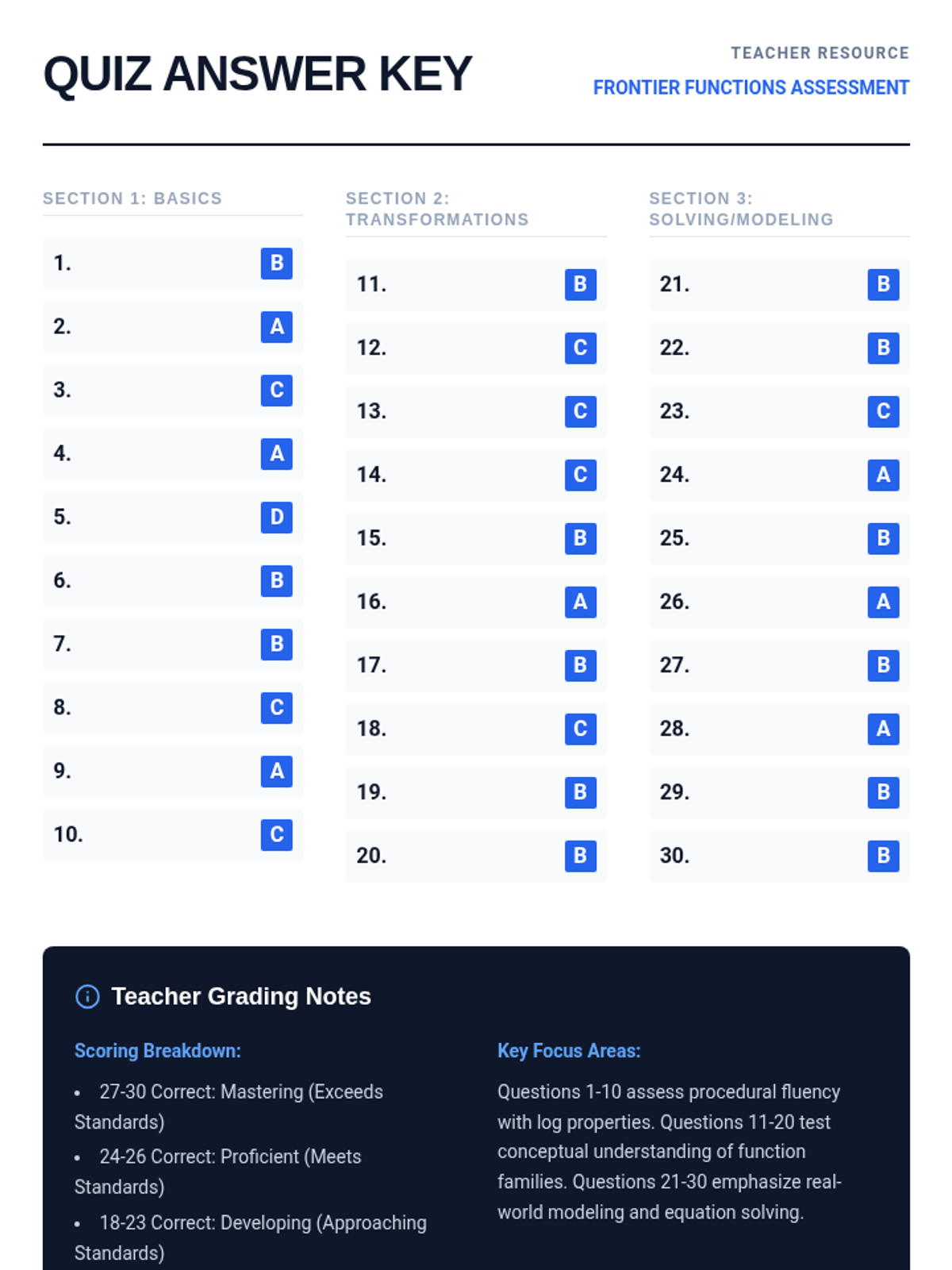
Answer key for the Frontier Functions Quiz, including a point-by-point breakdown and grading rubric for teacher use.
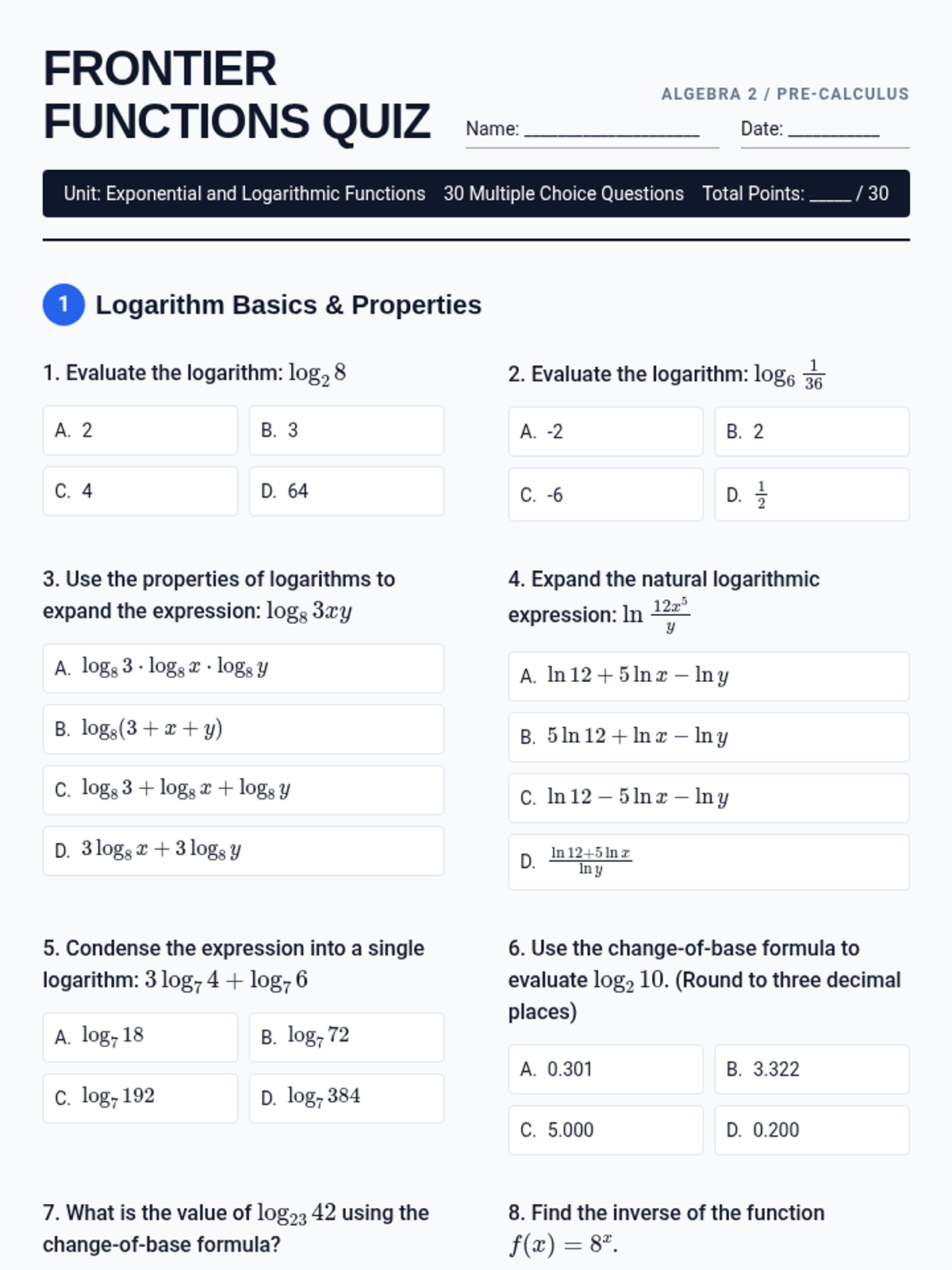
A 30-question multiple-choice quiz covering logarithms, exponential transformations, and application modeling. Designed for print with clear sections and student response areas.
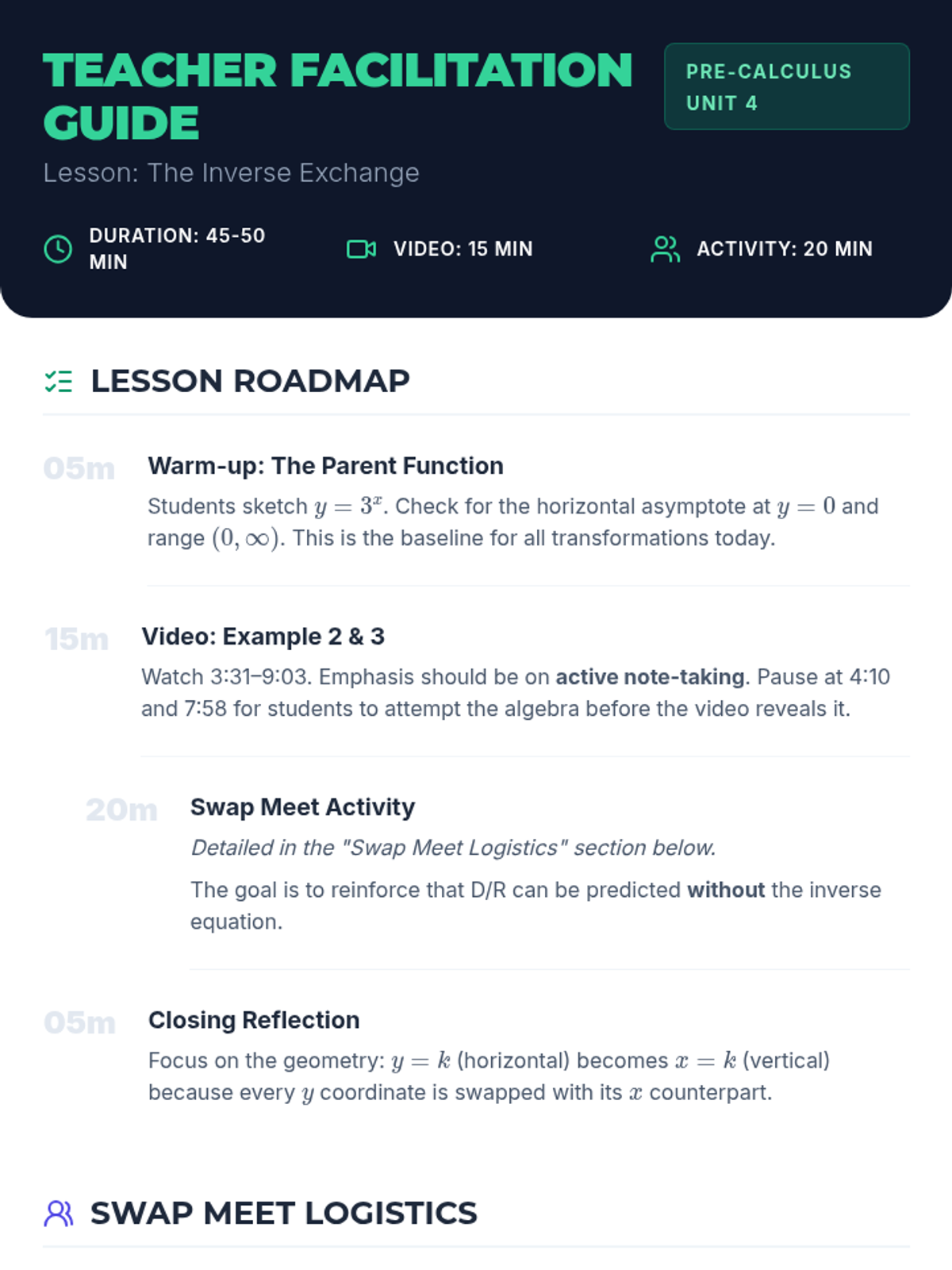
Facilitation guide for teachers including the lesson roadmap, "Swap Meet" function assignments with answer keys, and common student misconceptions to watch for during the activity.
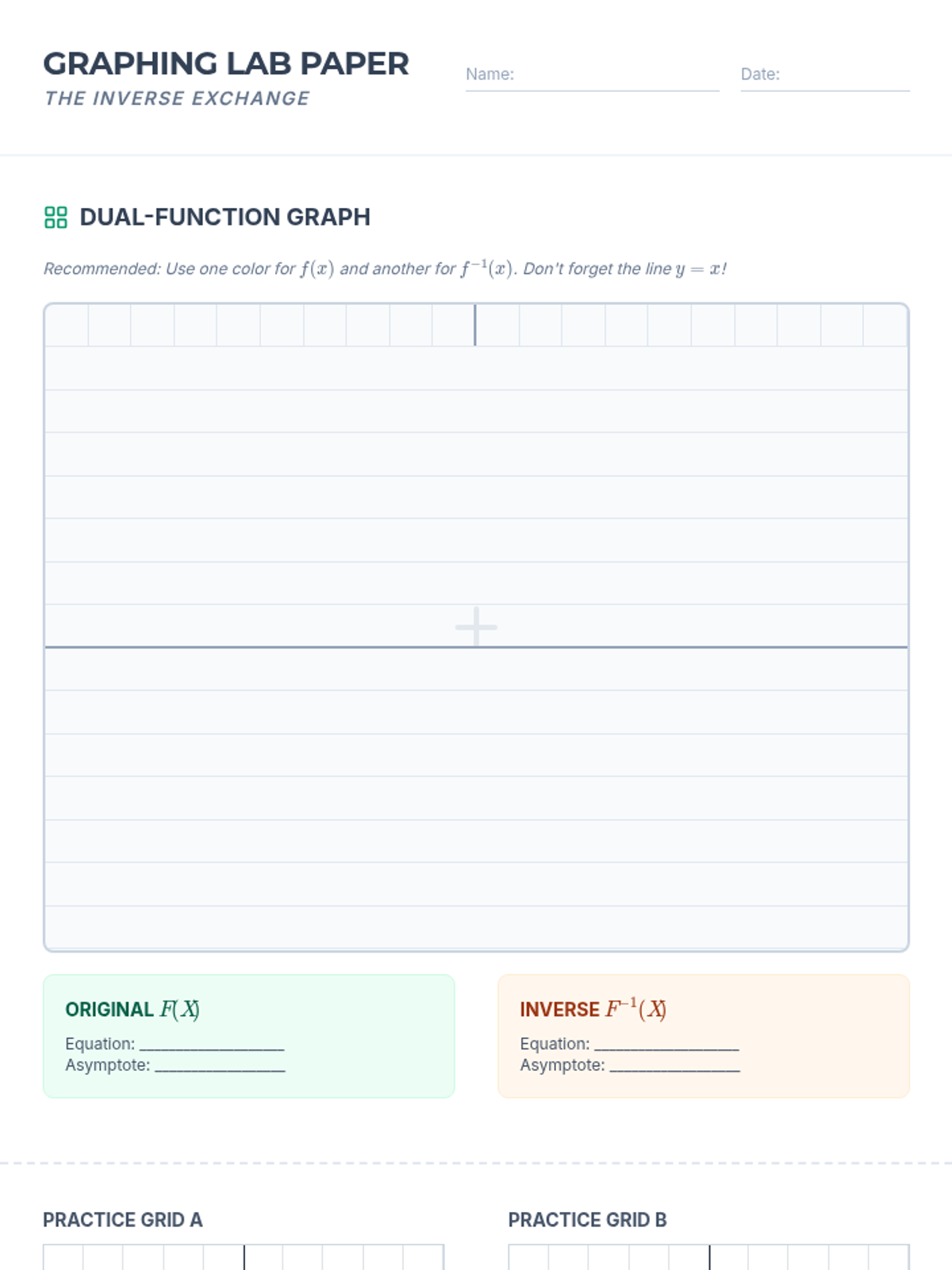
Customized graph paper with coordinate grids designed for side-by-side or overlaid comparison of functions and their inverses. Includes space for recording equations and key features.
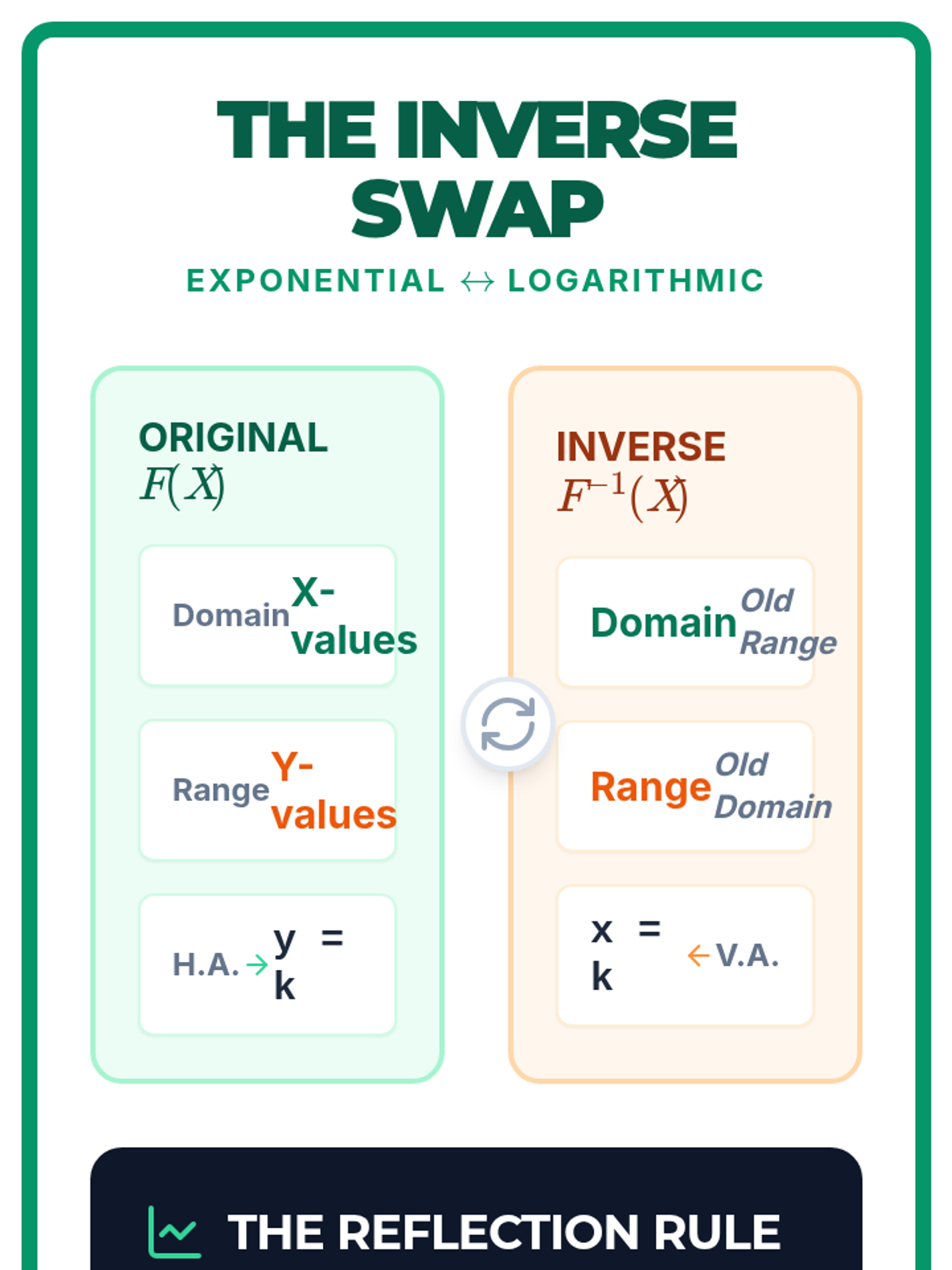
A visual classroom reference summarizing the "swap" between exponential and logarithmic functions, including domain/range transformation rules and graphical reflection properties.
Visual presentation for instruction, video viewing, and activity guidance. Includes embedded YouTube video and clear visual summaries of the inverse "swap" technique.
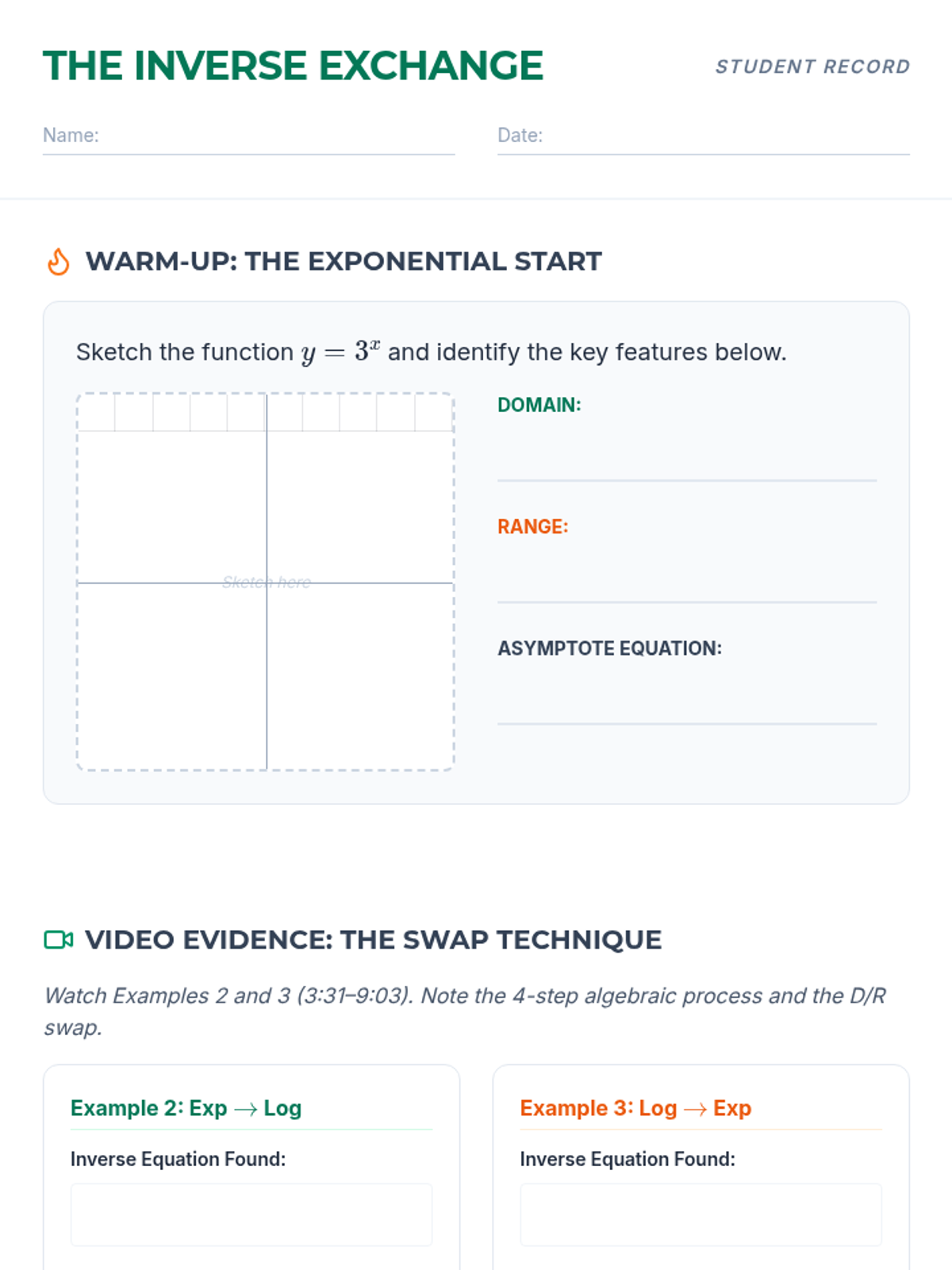
A comprehensive guided worksheet for students to record warm-up sketches, video notes from Examples 2 and 3, and complete the "Swap Meet" activity including domain/range predictions.
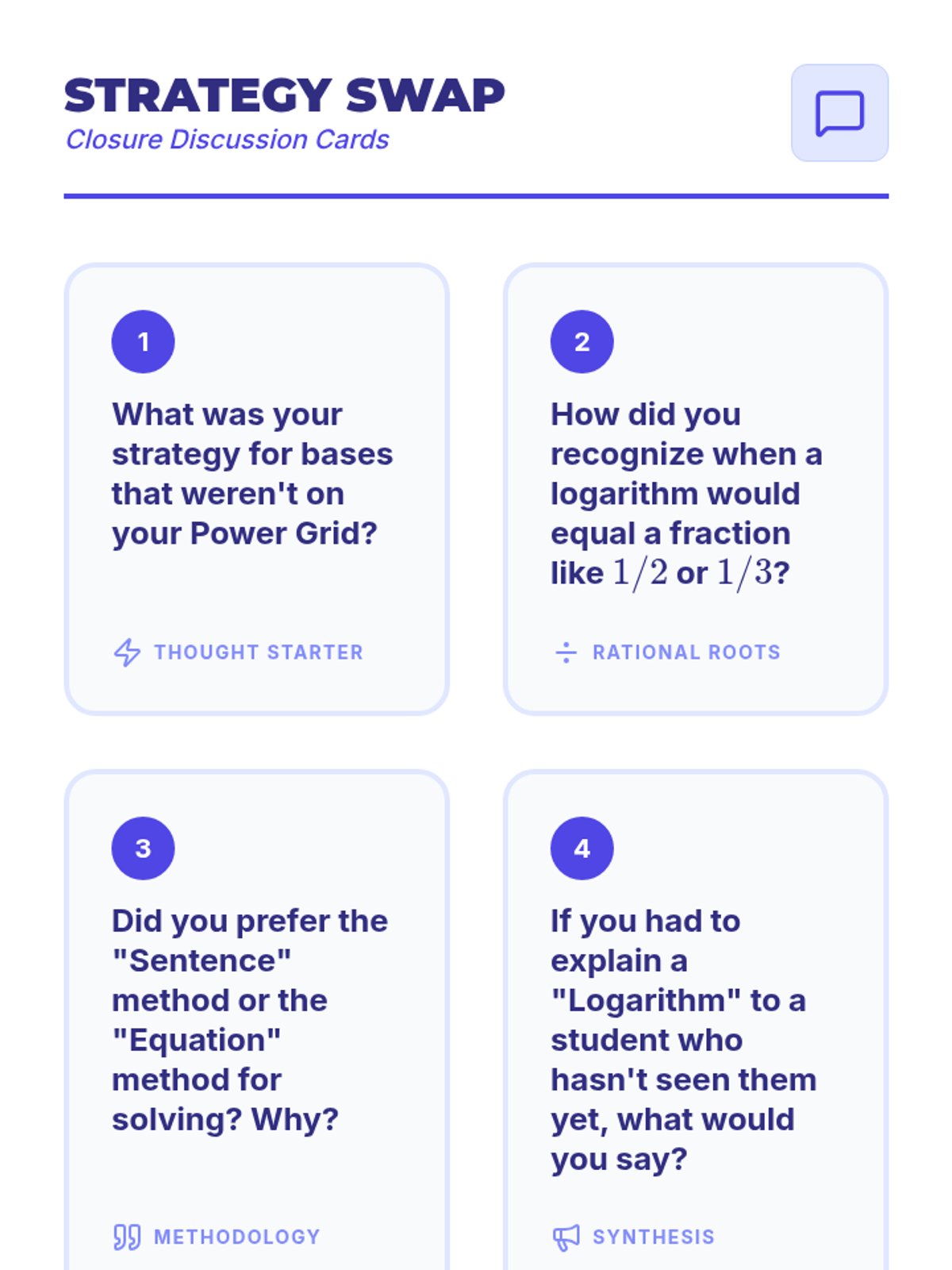
A set of discussion cards for the lesson closure, featuring prompts that encourage students to reflect on their problem-solving strategies and conceptual understanding of logarithms.
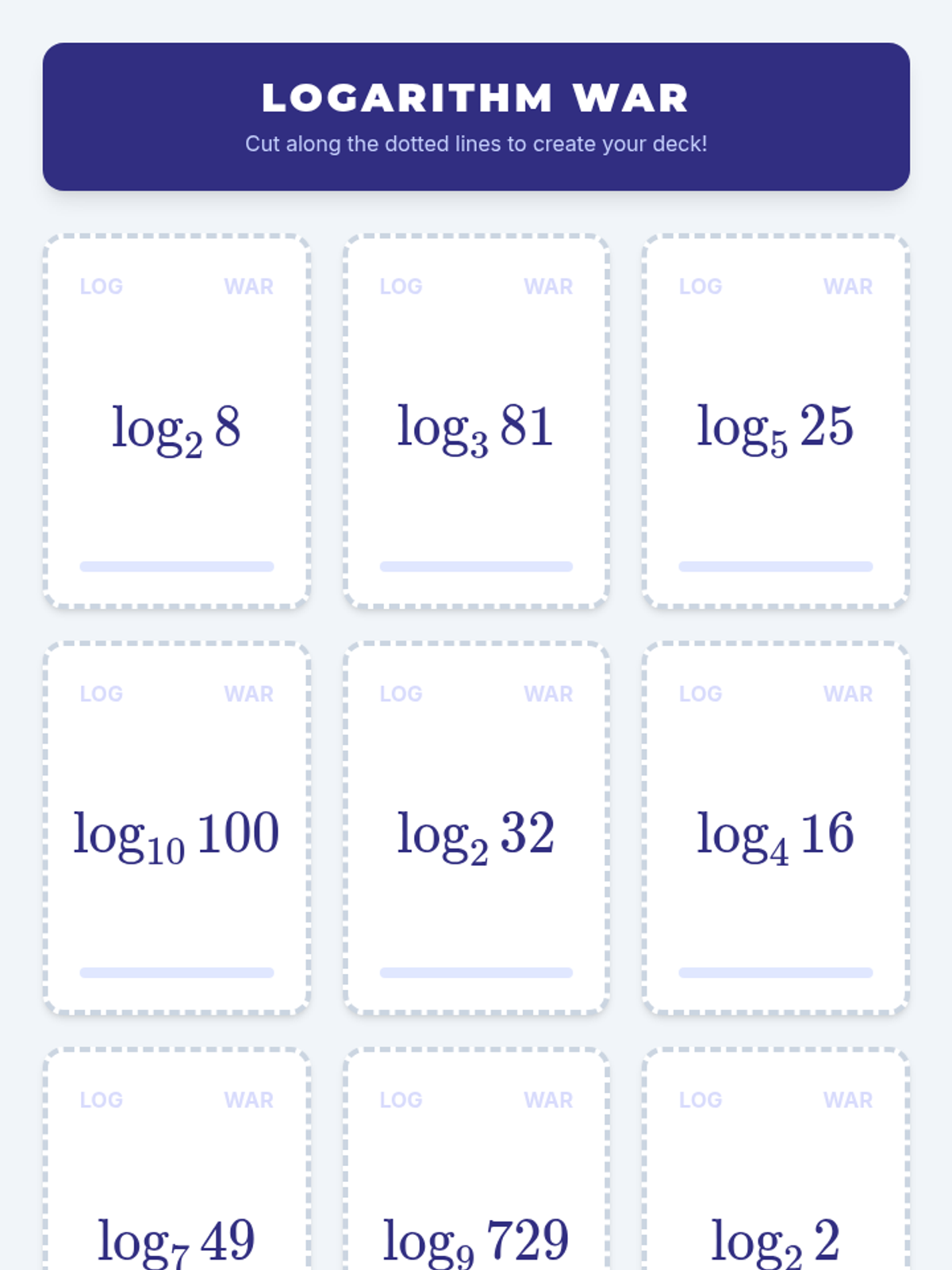
A set of 18 printable cards featuring logarithmic expressions of varying difficulty for the 'Logarithm War' game, designed to be cut and used in pairs.
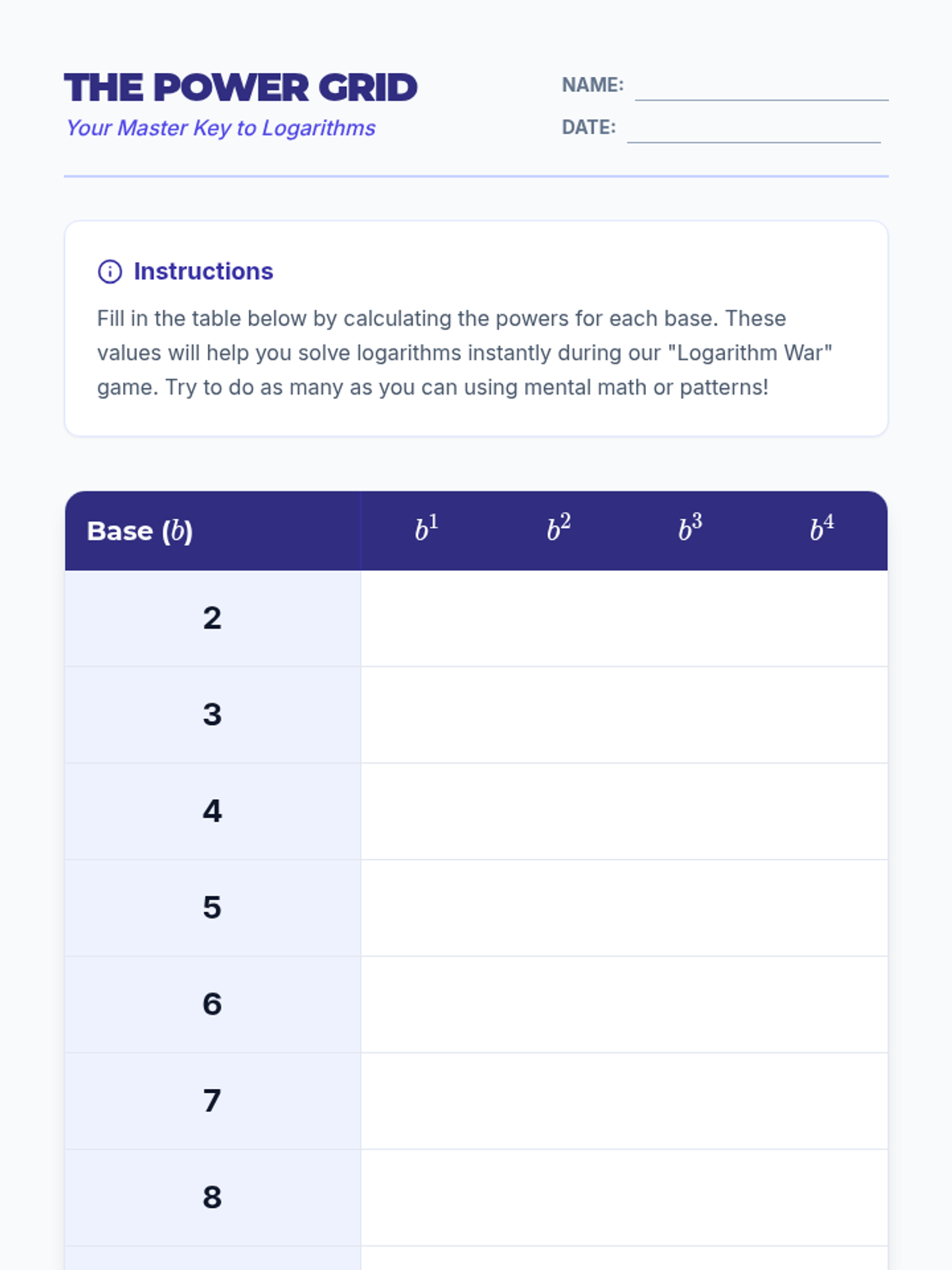
A student worksheet for creating a reference table of powers for bases 2-10 up to the 4th exponent, used as a foundational tool for evaluating logarithms.
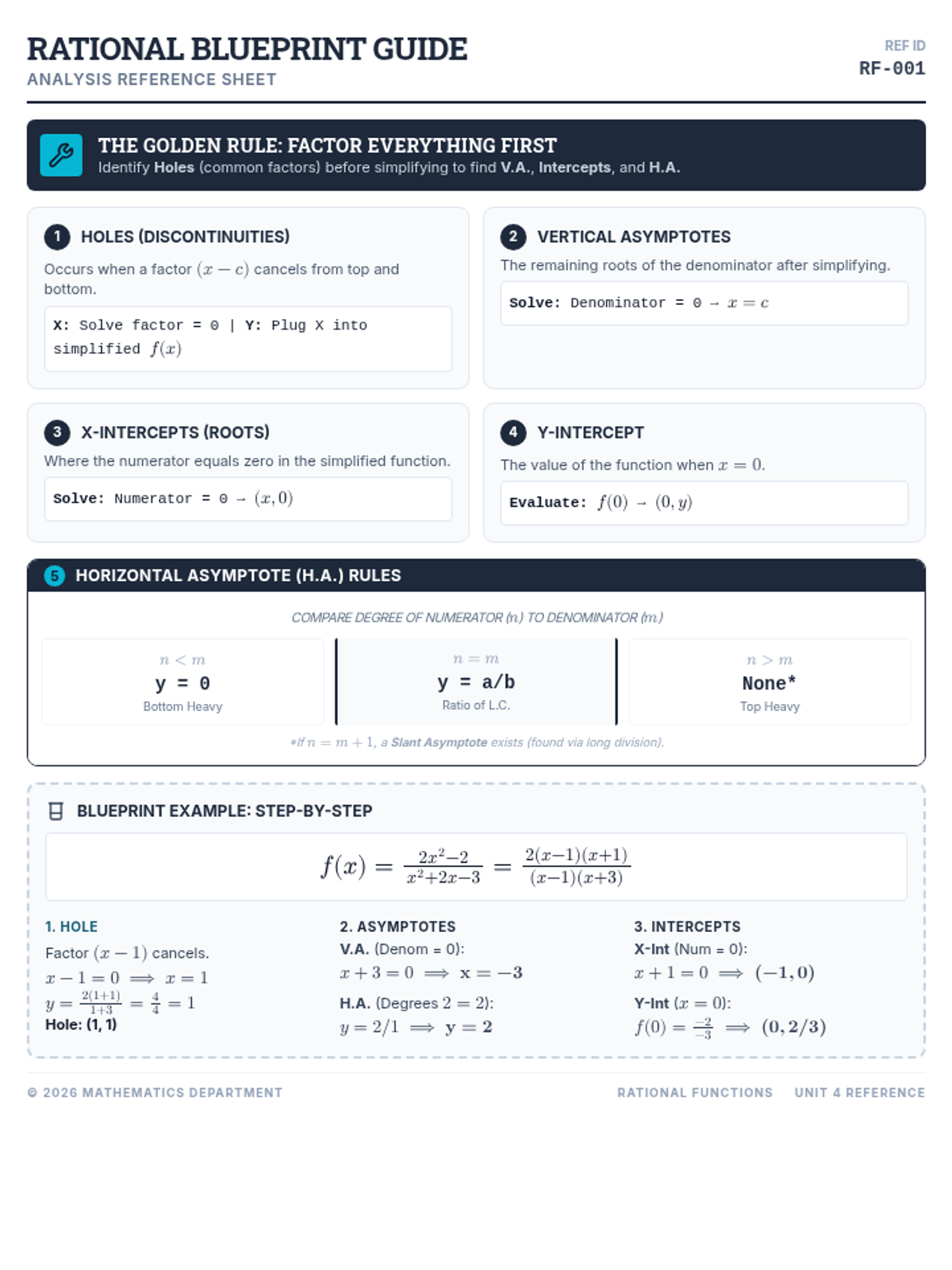
A high-density one-page reference sheet for rational functions. Includes essential steps for finding holes, asymptotes, and intercepts, plus a fully worked complex example.
A complete 20-question review presentation for the TSIA2 Math practice exam, featuring each question followed by a detailed step-by-step explanation slide with proper work areas. Rendering and overflow issues have been resolved. Full 20 pairs included.
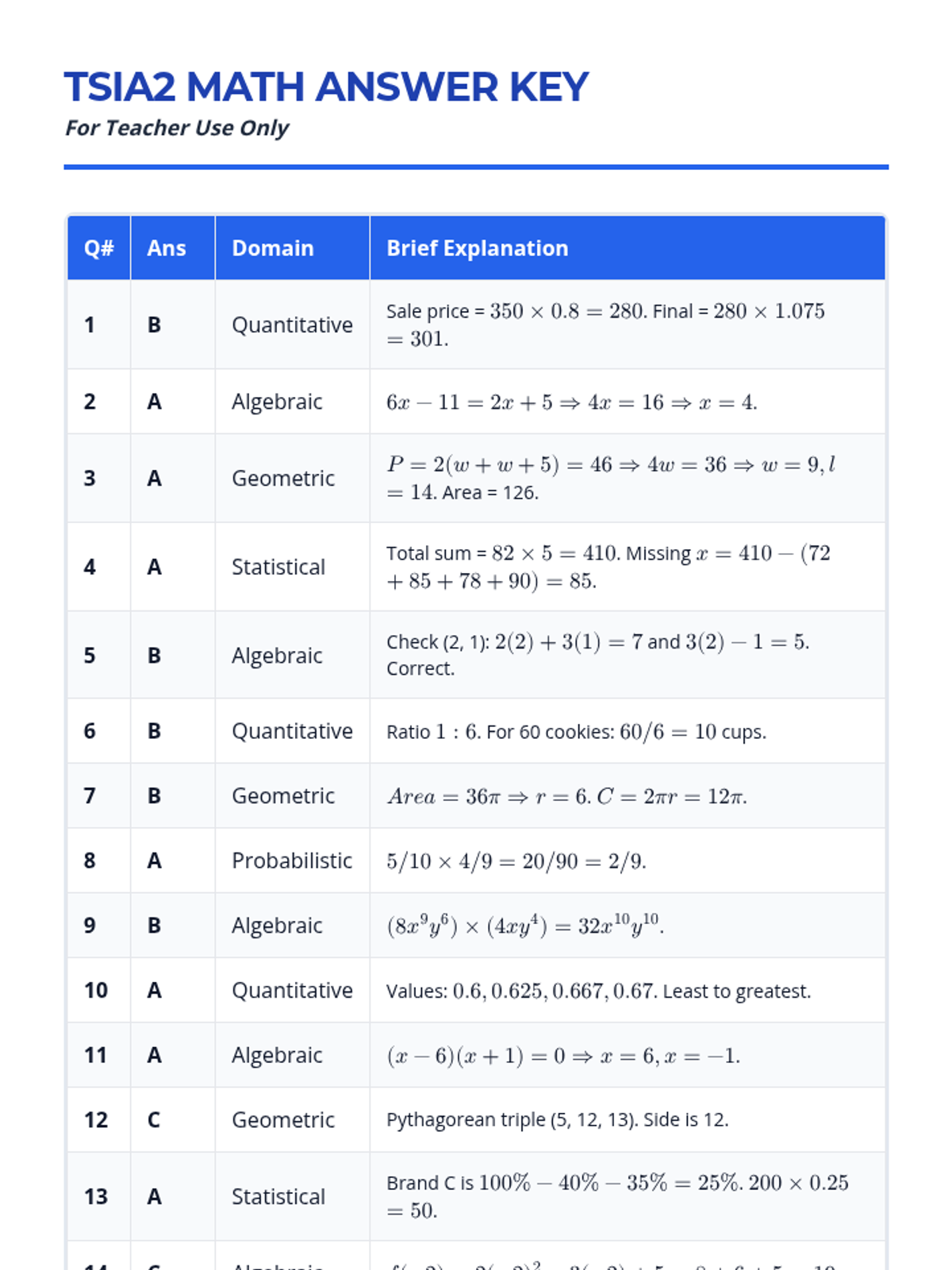
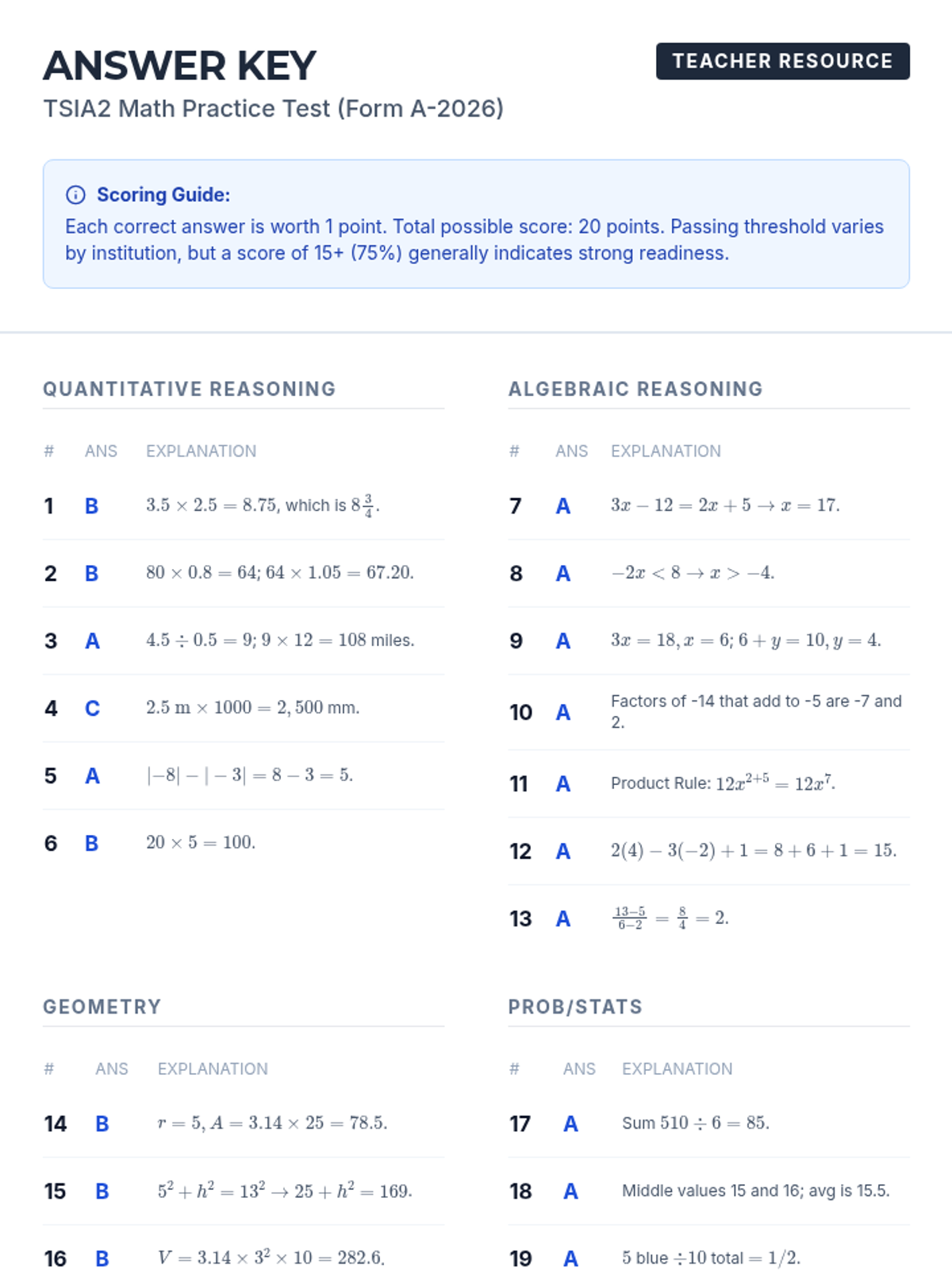
A detailed answer key for the TSIA2 Math practice exam, including correct responses, problem domains, and brief step-by-step explanations for all 20 questions. Table formatting refined for page breaks.
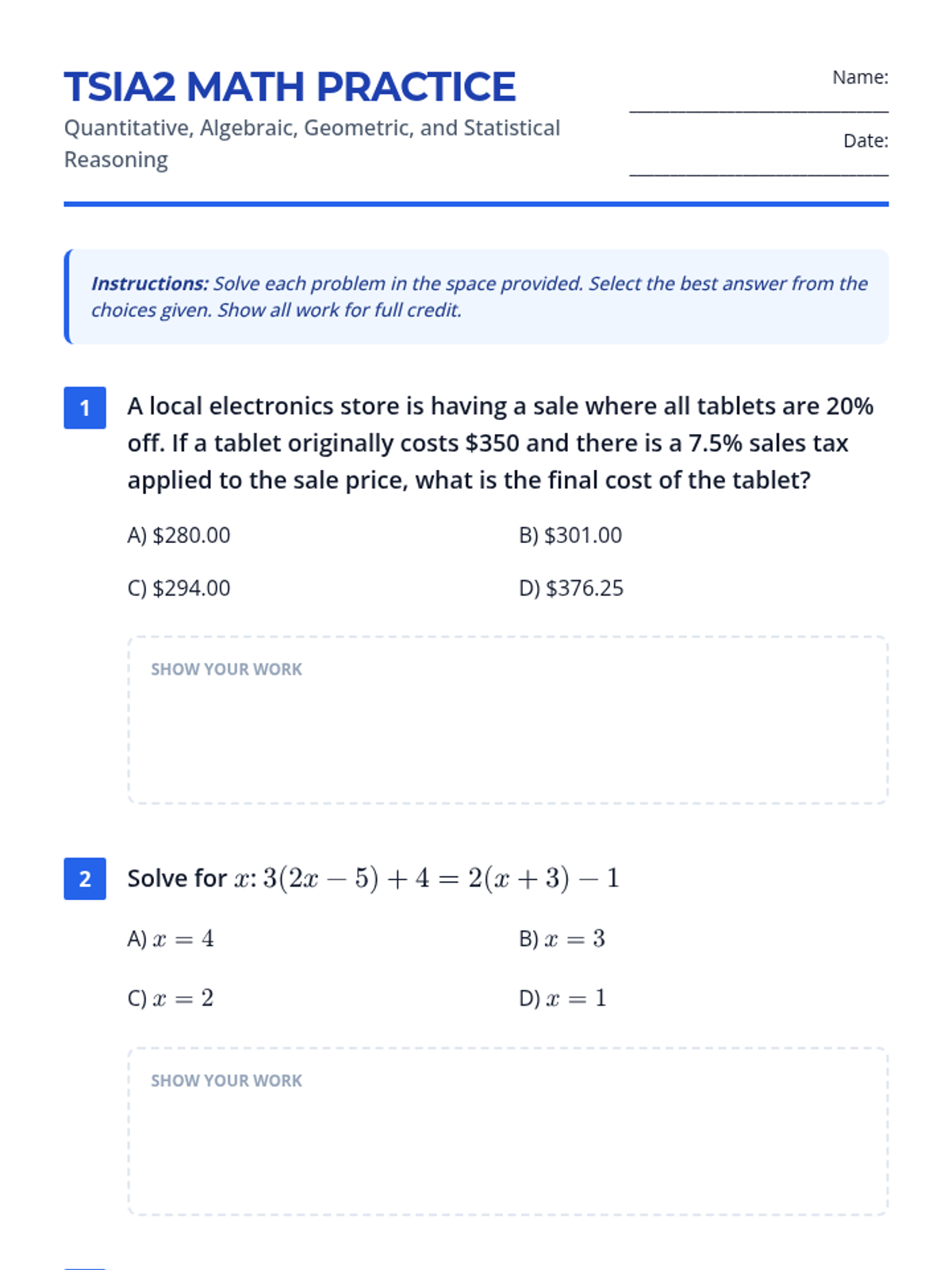
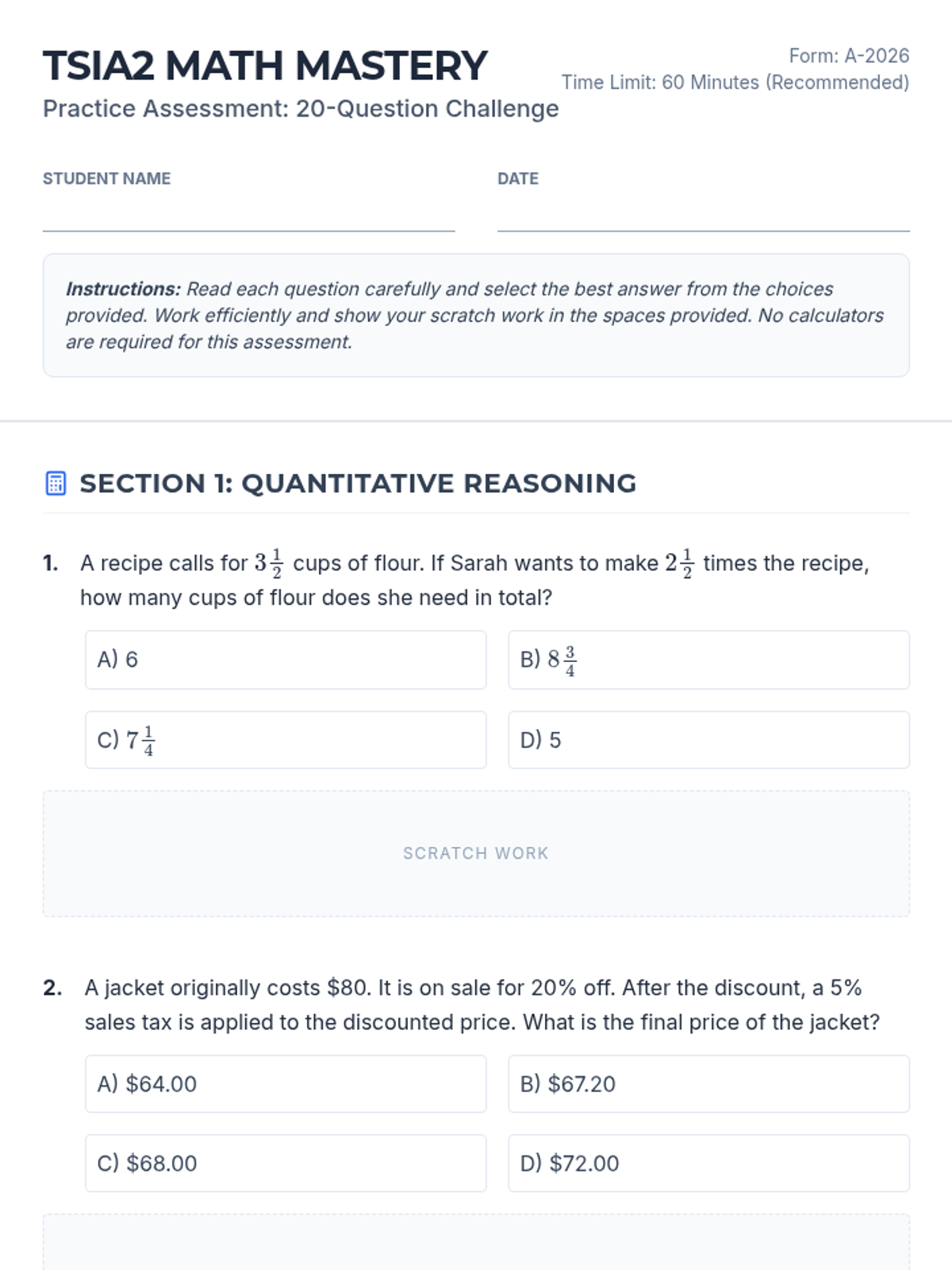
A 20-question practice exam for the TSIA2 Math assessment, featuring a balanced mix of quantitative, algebraic, geometric, and statistical reasoning problems with dedicated workspace for student calculations. Backgrounds are removed for clarity.
A comprehensive 15-day slide deck for the TSIA2 Math Marathon. Features daily Warm-Up questions and detailed solution slides for all 30 practice problems covering all TSIA2 domains. Updated to be fully complete and fixed rendering issues.
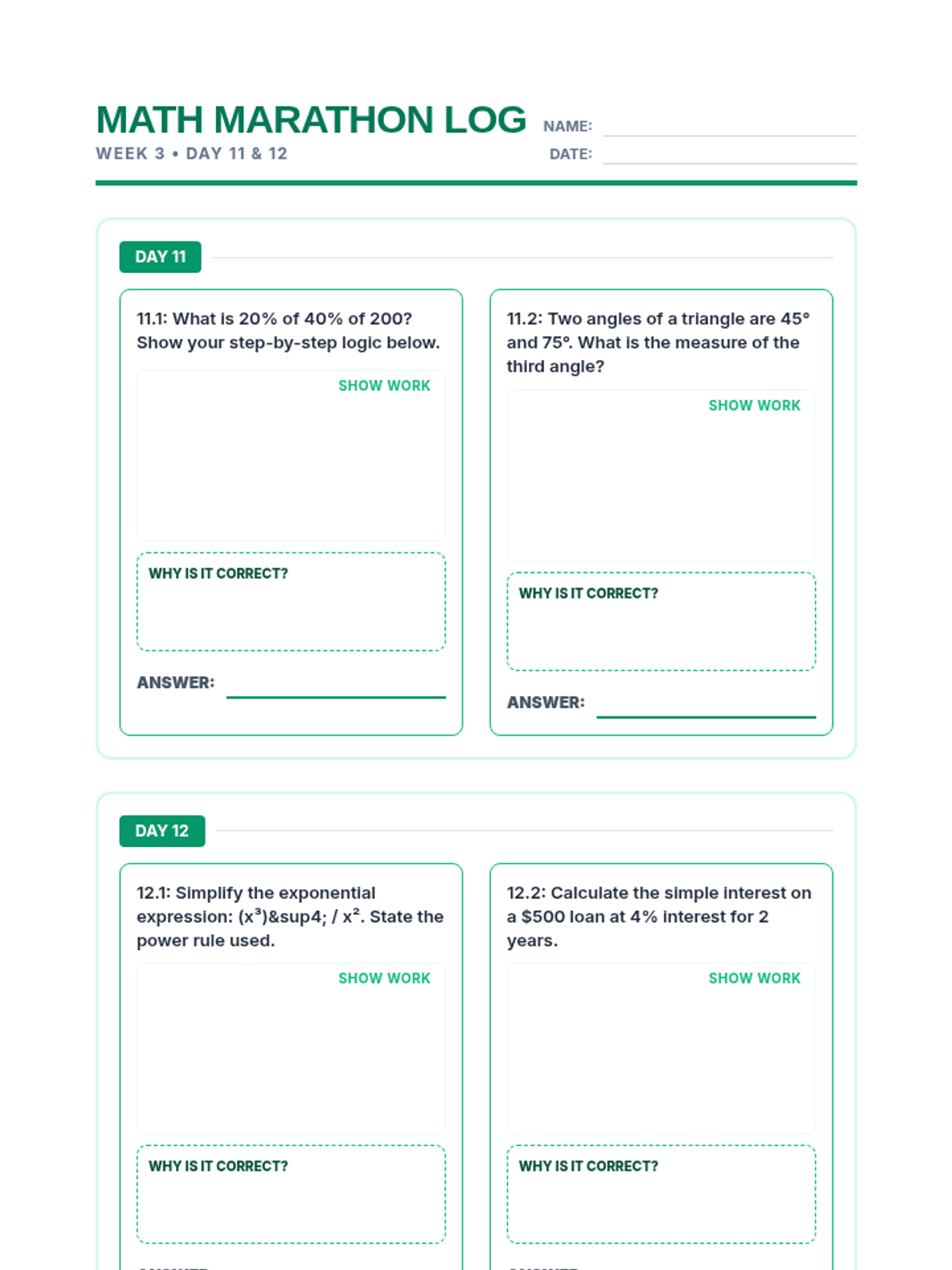
A 5-day student log for the final week of the TSIA2 Math Marathon. Covers days 11 through 15 with dedicated work areas, explanation boxes, and answer slots. Updated to optimize page breaks and increase work area size.
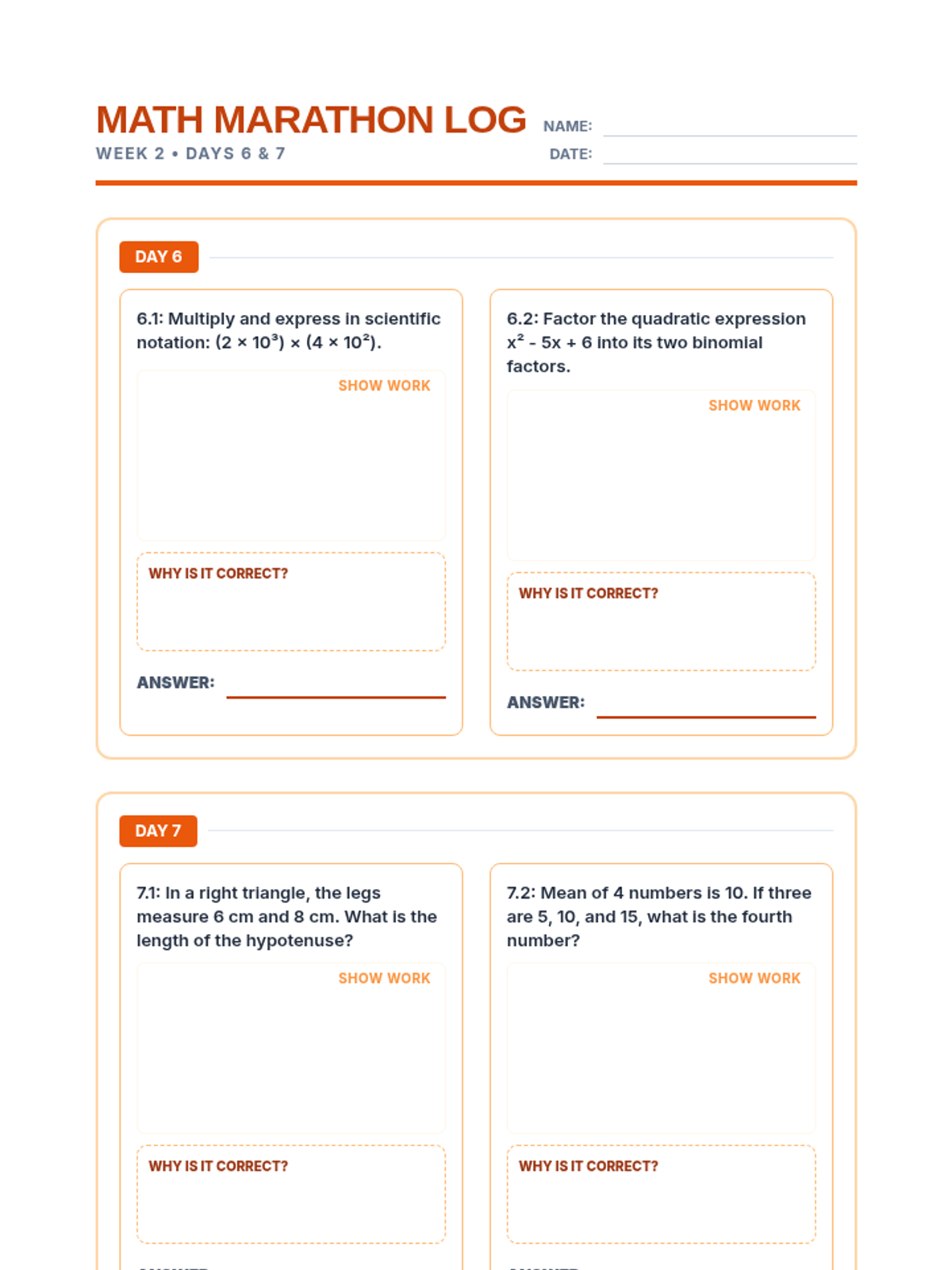
A 5-day student log for the second week of the TSIA2 Math Marathon. Provides space for daily problem-solving, work verification, and written explanations for days 6 through 10. Updated to optimize page breaks and increase work area size.
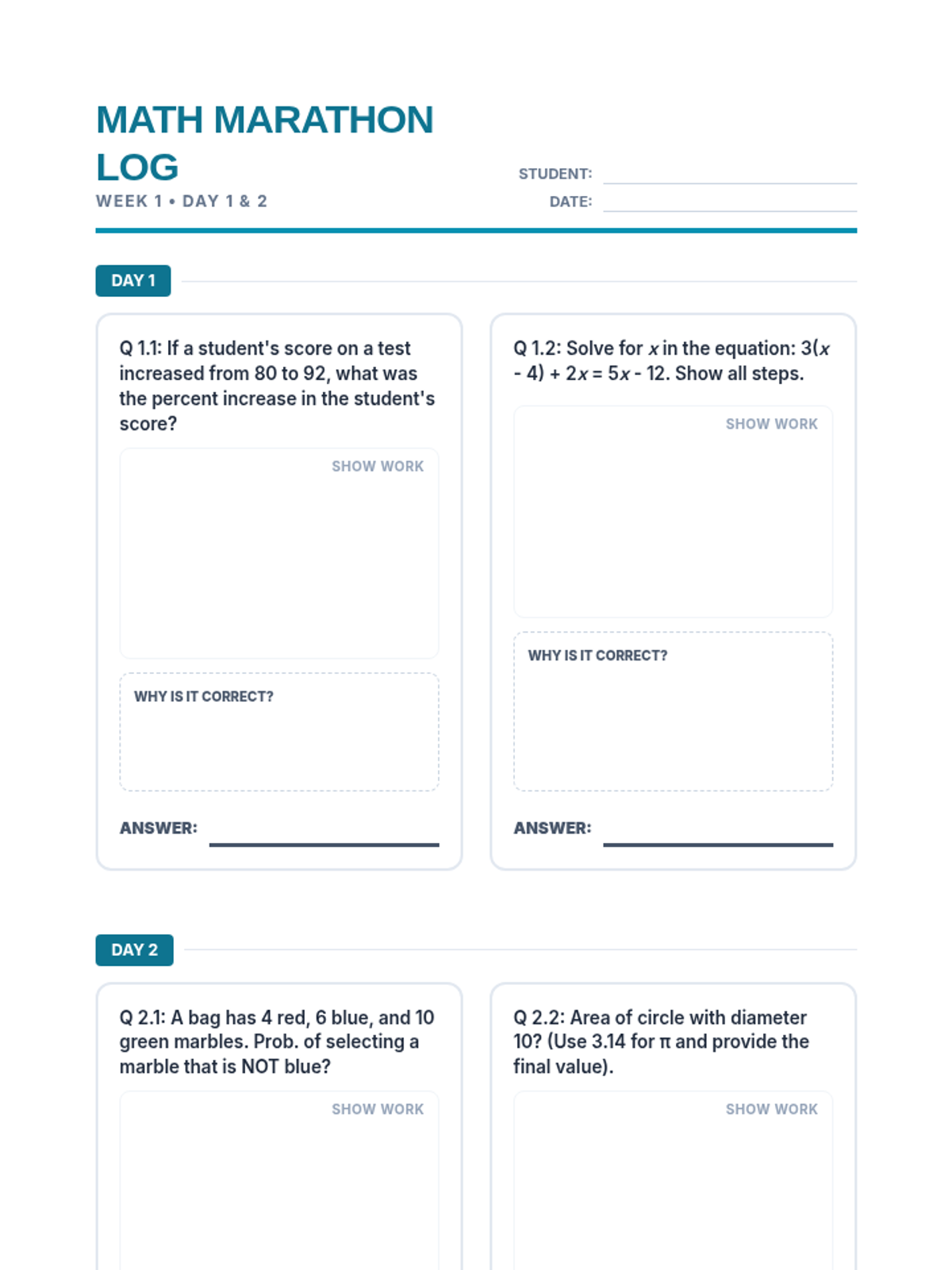
A 5-day student log for the first week of the TSIA2 Math Marathon. Includes dedicated spaces for showing work, providing a written explanation of the answer logic, and recording final answers. Updated to optimize page breaks and increase work area size.
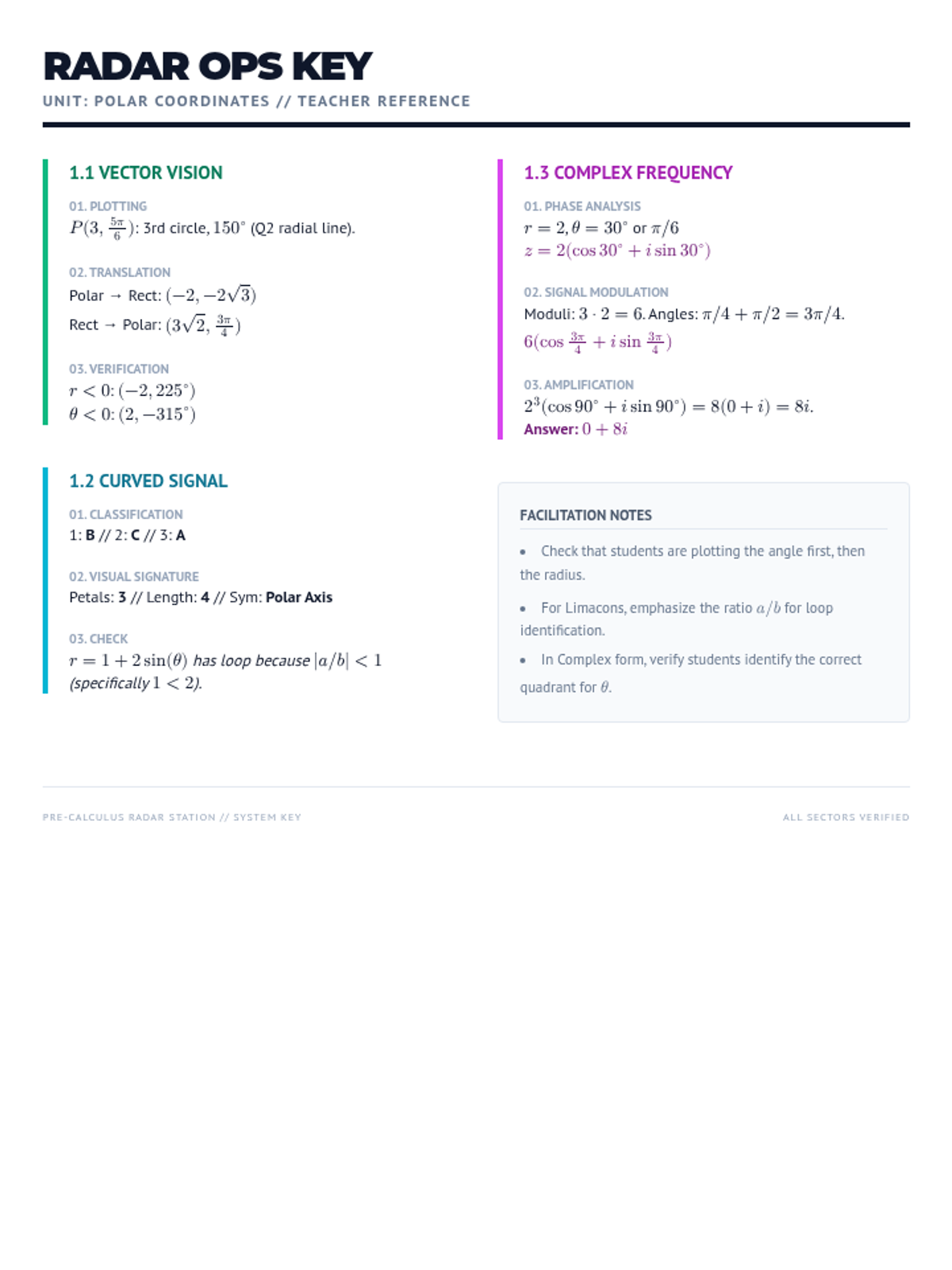
Comprehensive teacher answer key for the Polar Coordinates Exit Ticket series, including step-by-step solutions and conceptual explanations.
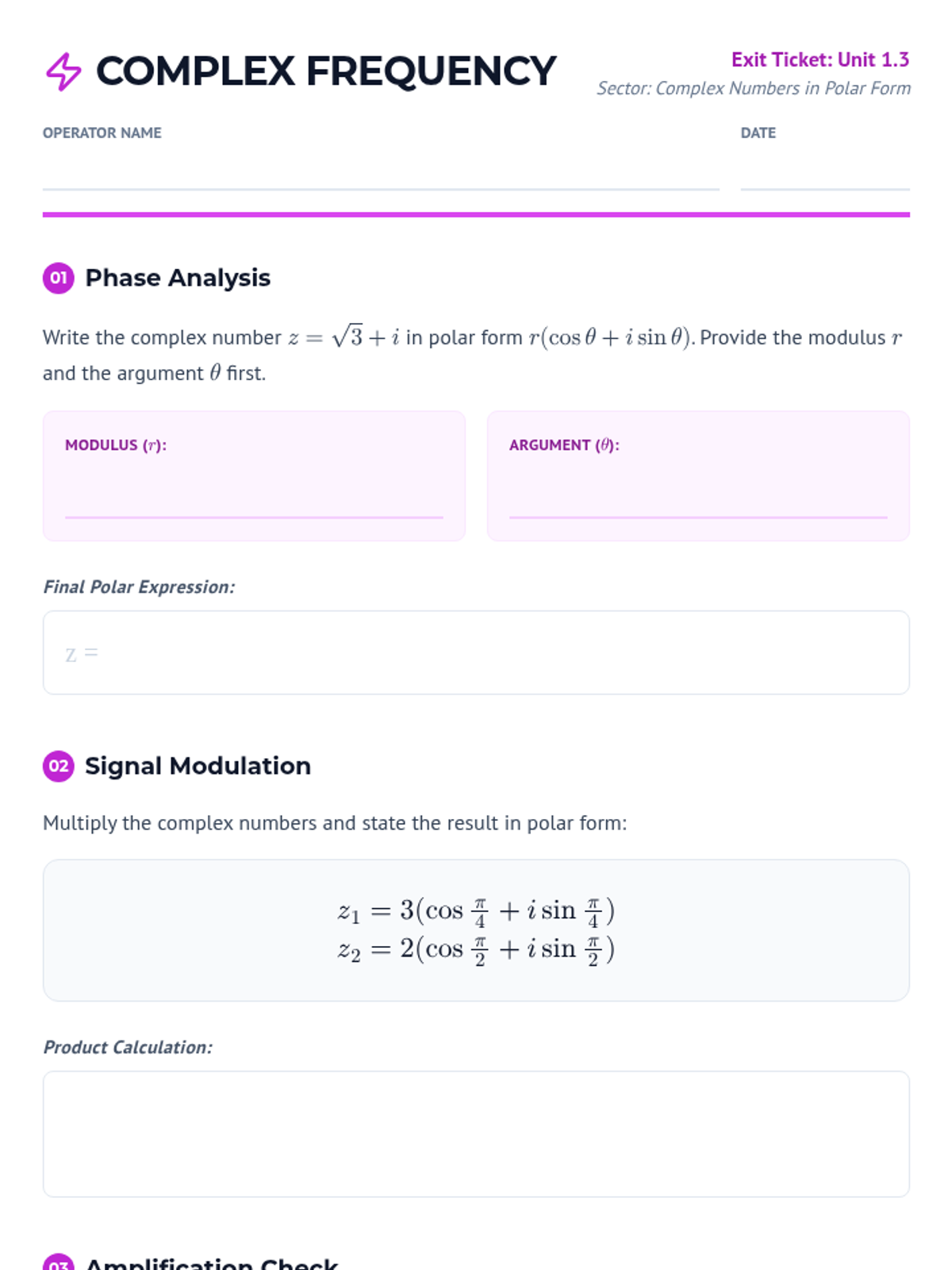
An exit ticket for representing complex numbers in polar form, performing multiplication in polar form, and applying De Moivre's Theorem.
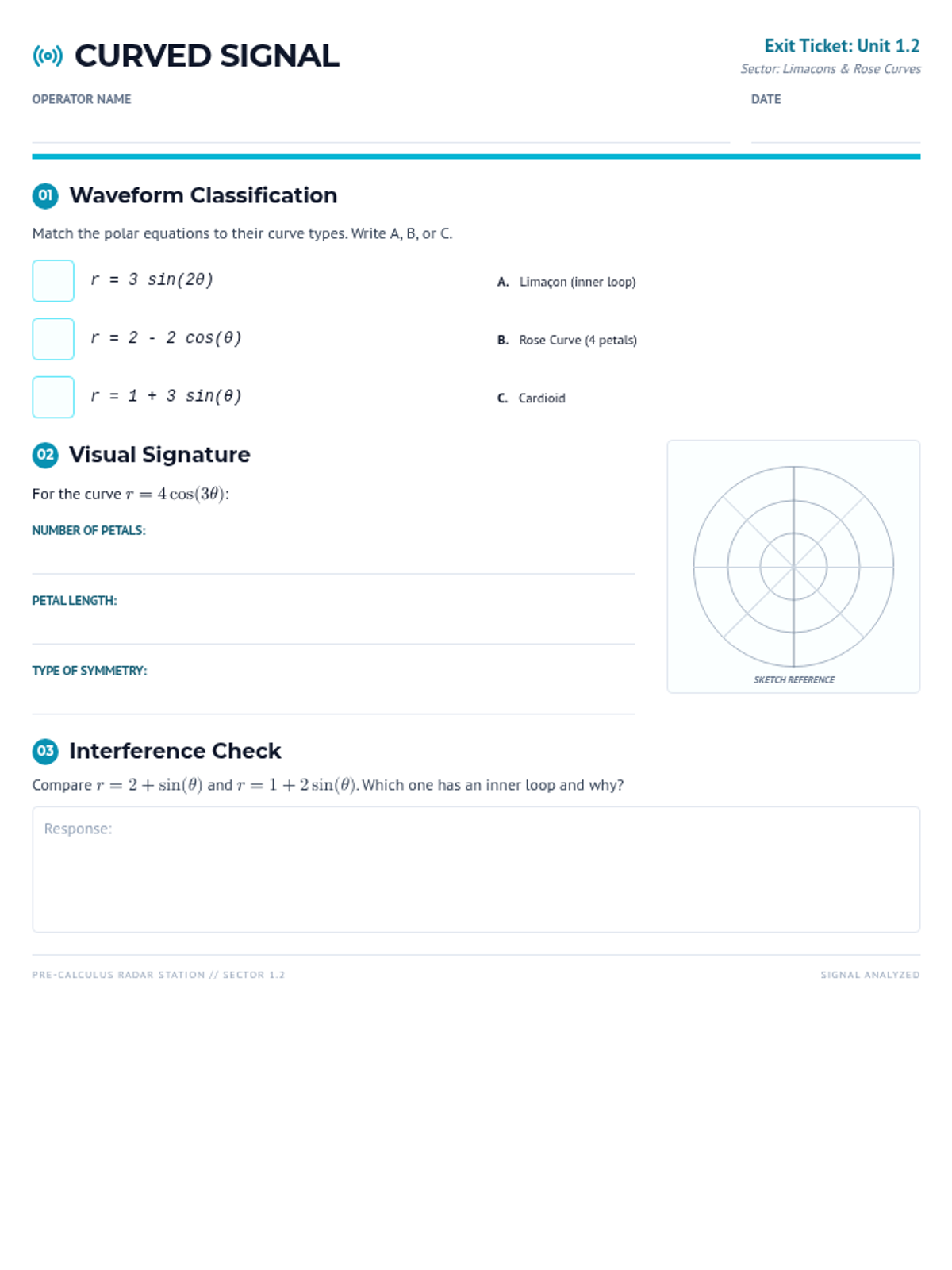
An exit ticket focused on identifying and analyzing polar graphs like limacons, cardioids, and rose curves, including matching and symmetry identification.
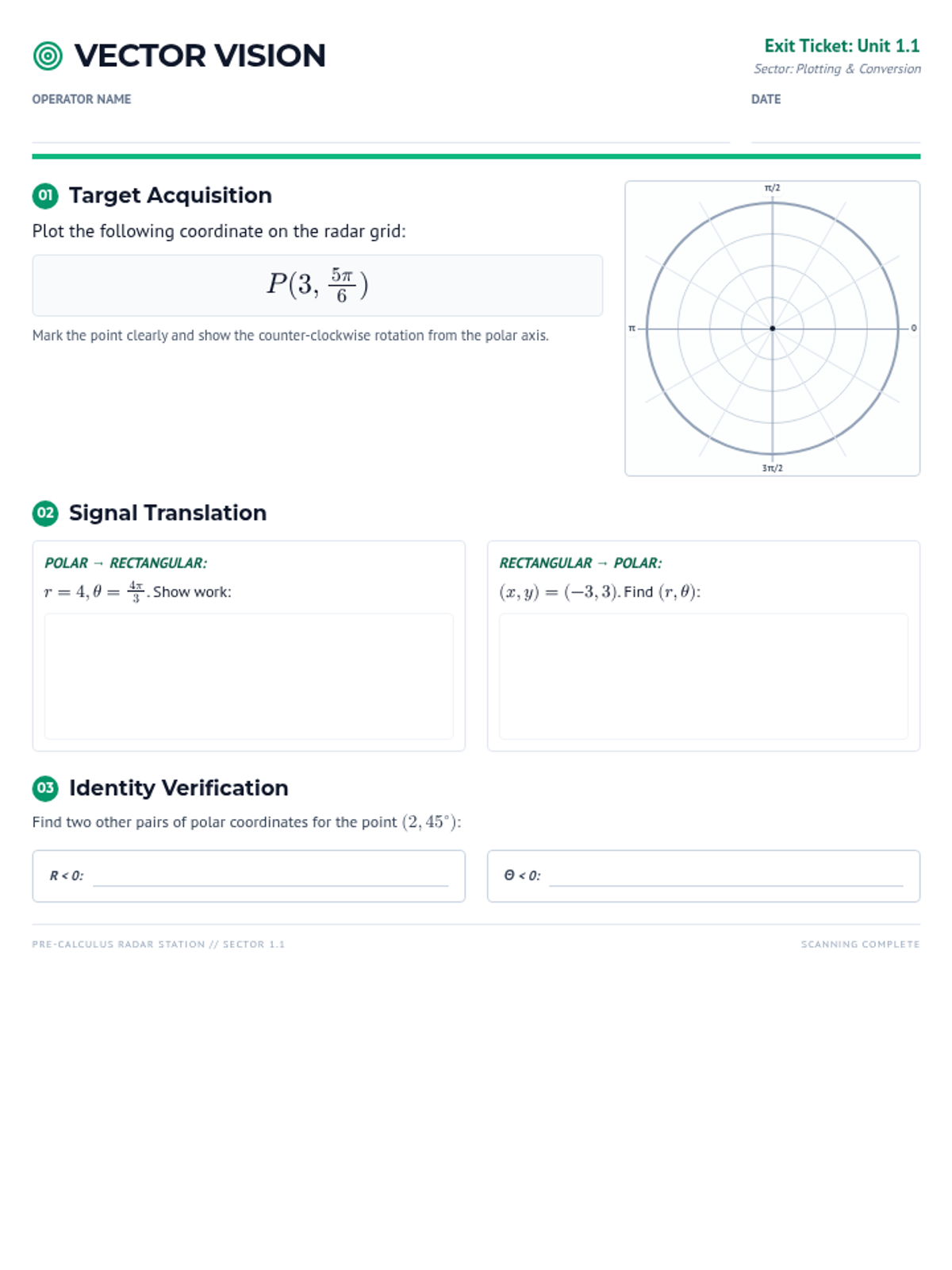
An exit ticket for polar coordinate plotting and conversions between rectangular and polar forms, featuring a clean radar-themed layout and a polar grid for graphing.
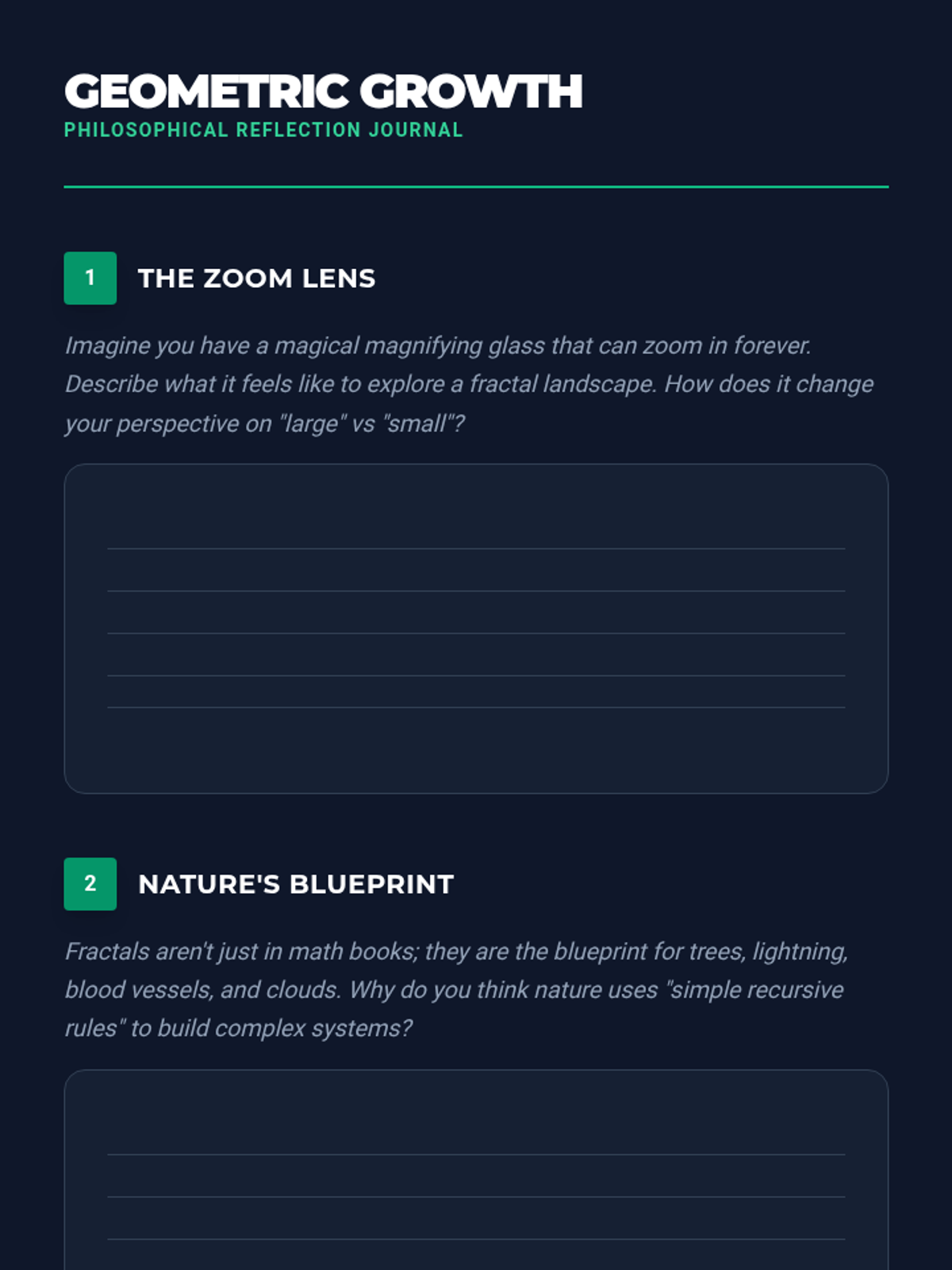
A reflective journal for students to synthesize their learning. It includes philosophical prompts on scale, nature's recursive patterns, and the infinite/finite paradox, with a dark-themed "night mode" aesthetic for focus.
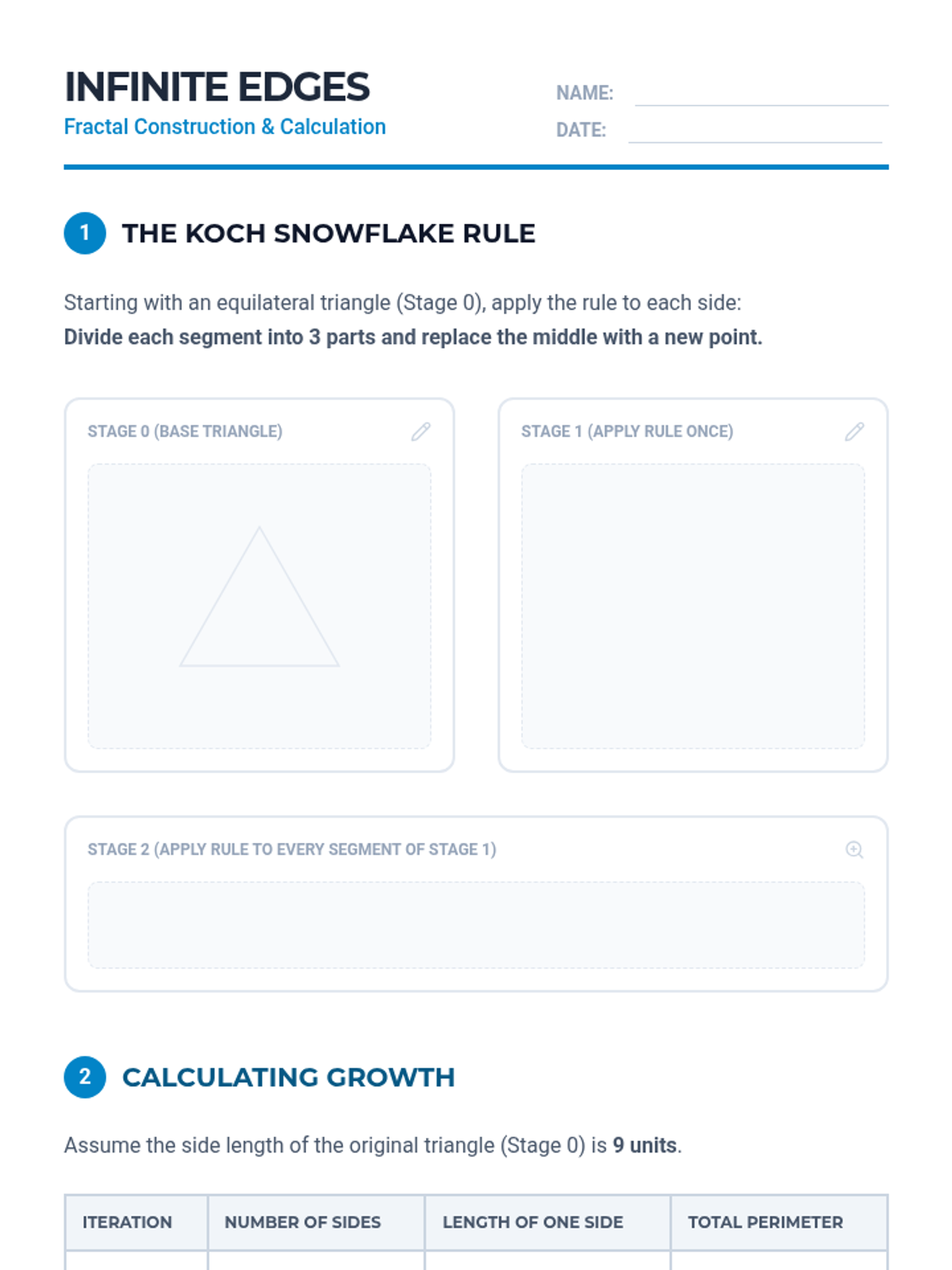
A two-page student activity worksheet for constructing the Koch Snowflake. It includes drawing areas for the first three iterations and a calculation table to analyze the relationship between sides, length, and total perimeter.
A visually striking slide deck introducing fractals, featuring the Coastline Paradox, definitions of self-similarity and recursion, and the construction rules for the Koch Snowflake.
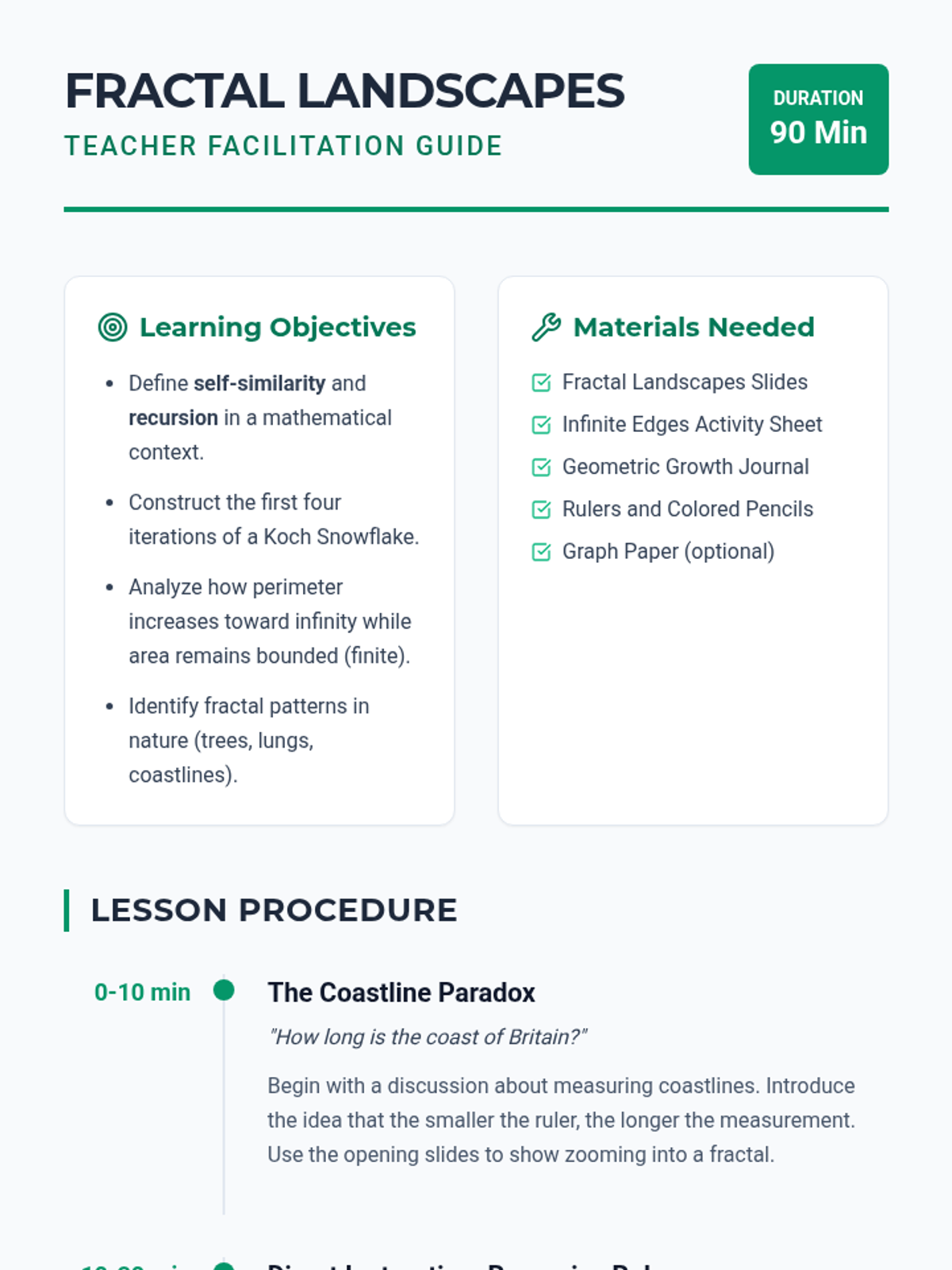
A comprehensive teacher facilitation guide for the Fractal Landscapes lesson, including learning objectives, a detailed 90-minute lesson flow, and key mathematical concepts like recursion and self-similarity.
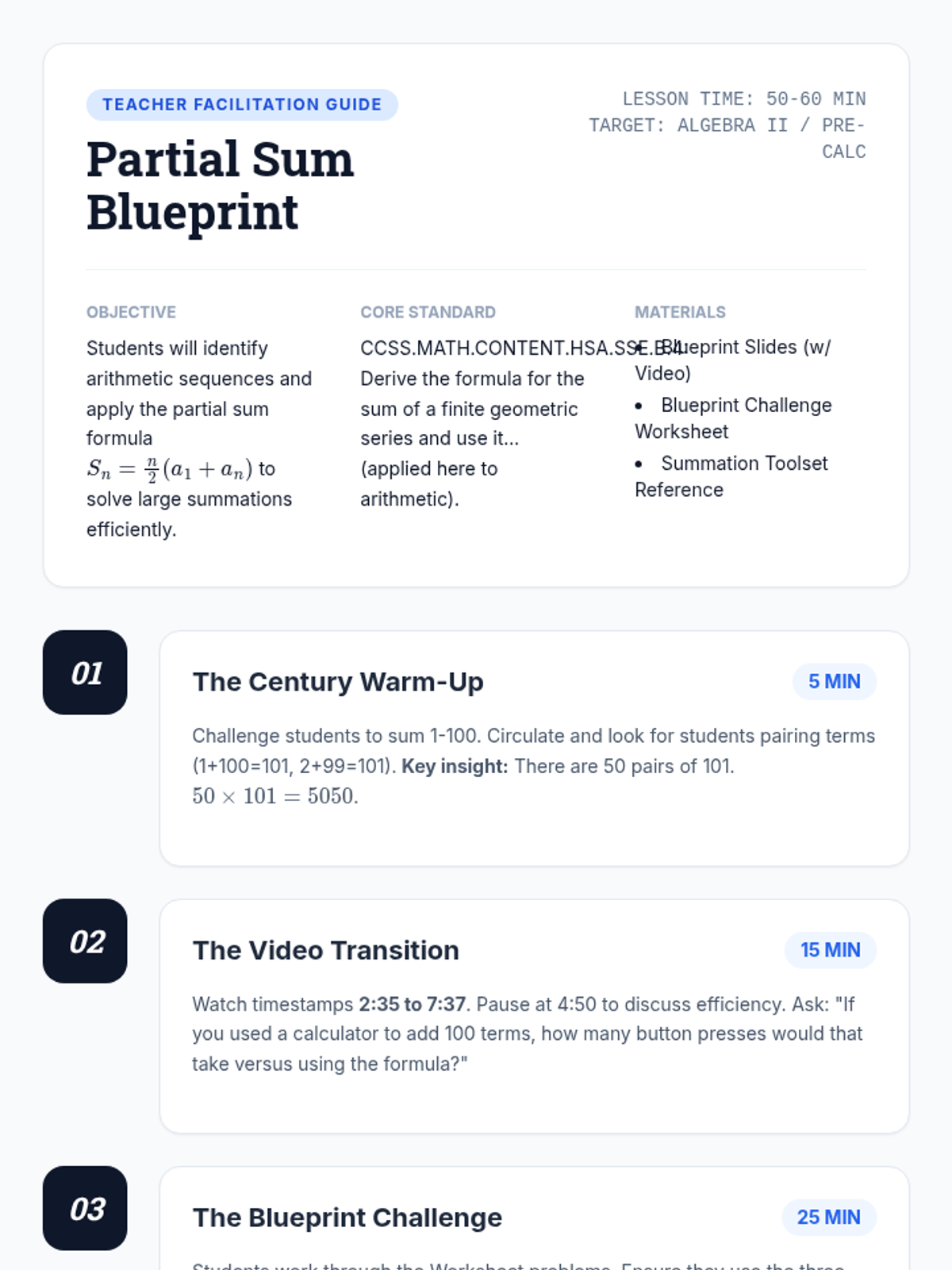
Facilitation guide for teachers, including pedagogical strategy, timestamped video instructions, a step-by-step lesson breakdown, and a complete answer key for the Blueprint Challenge Worksheet.
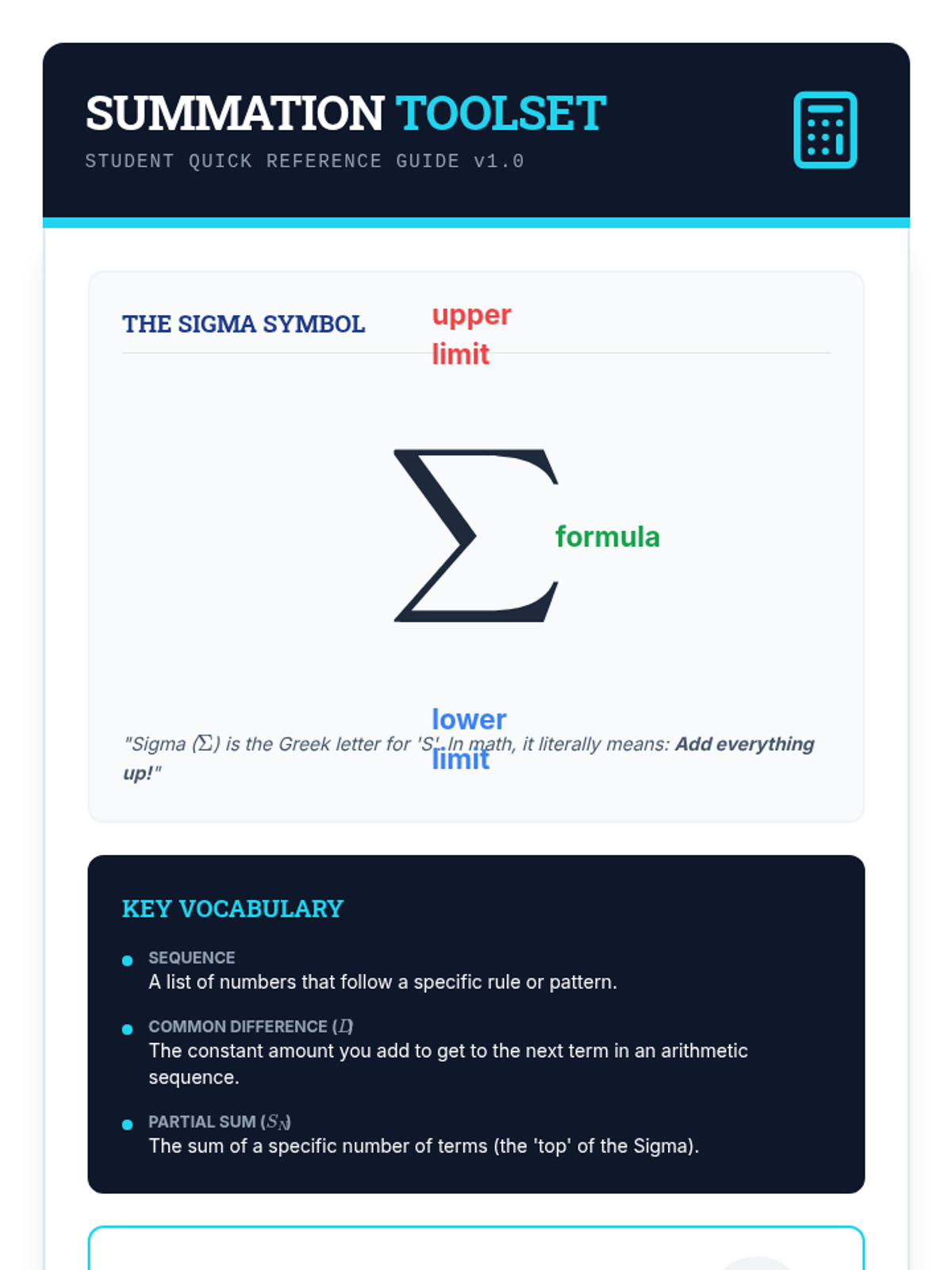
A comprehensive reference sheet (the 'Calculator') for students, detailing Sigma notation, arithmetic sequence formulas, and the step-by-step workflow for calculating partial sums.
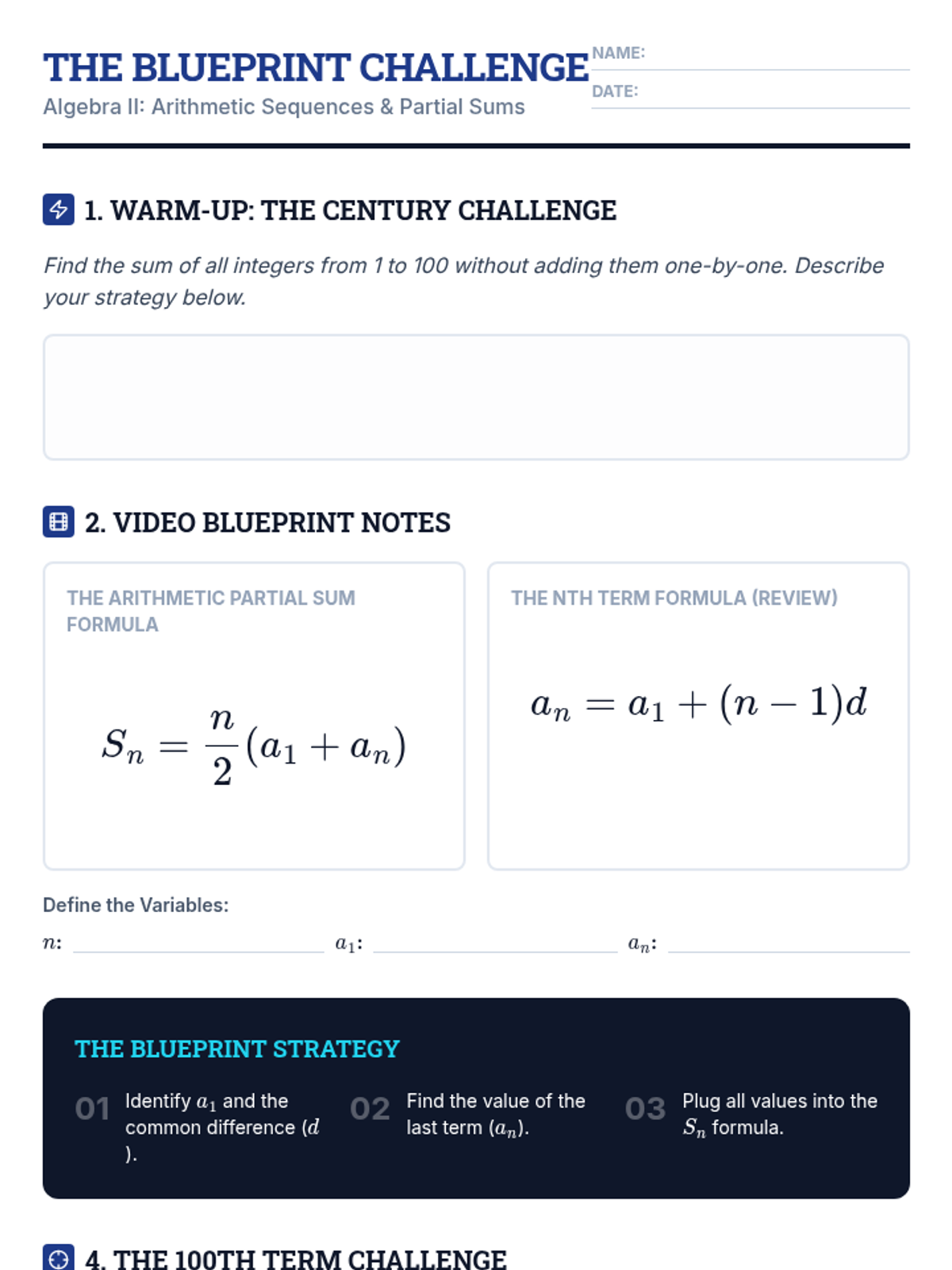
Student worksheet for arithmetic sequences and partial sums, guiding students through the 1-100 sum challenge, video note-taking, and a structured three-step challenge for large-scale summations.
Visual presentation for a lesson on arithmetic partial sums, featuring the 1-100 warm-up challenge, an embedded YouTube video (2:35-7:37), the partial sum formula breakdown, and a guided 100th-term calculation activity.
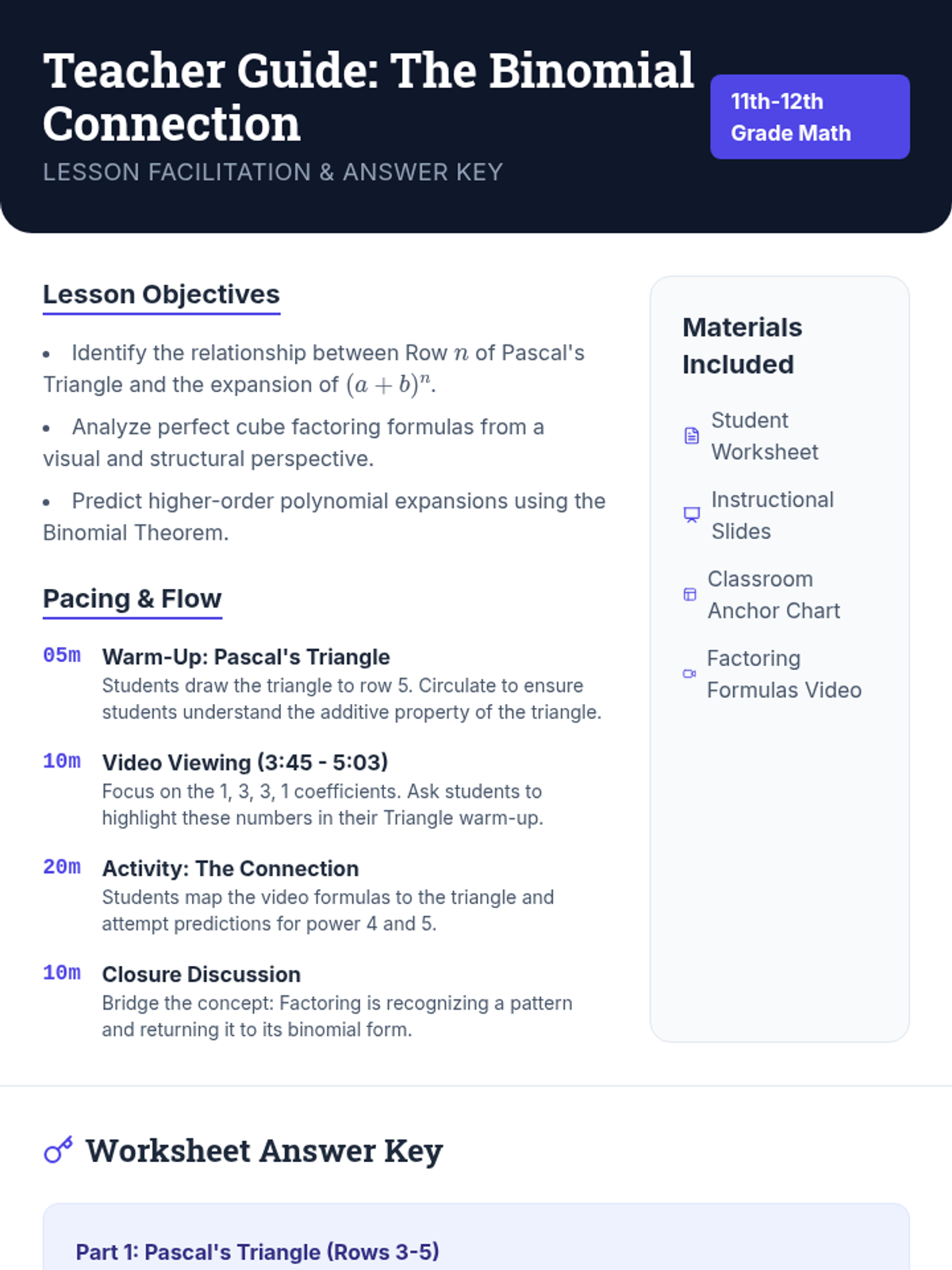
A teacher guide for 'The Binomial Connection' lesson. Includes pacing guide, pedagogical tips for connecting factoring to Pascal's Triangle, and a complete answer key for the student worksheet.
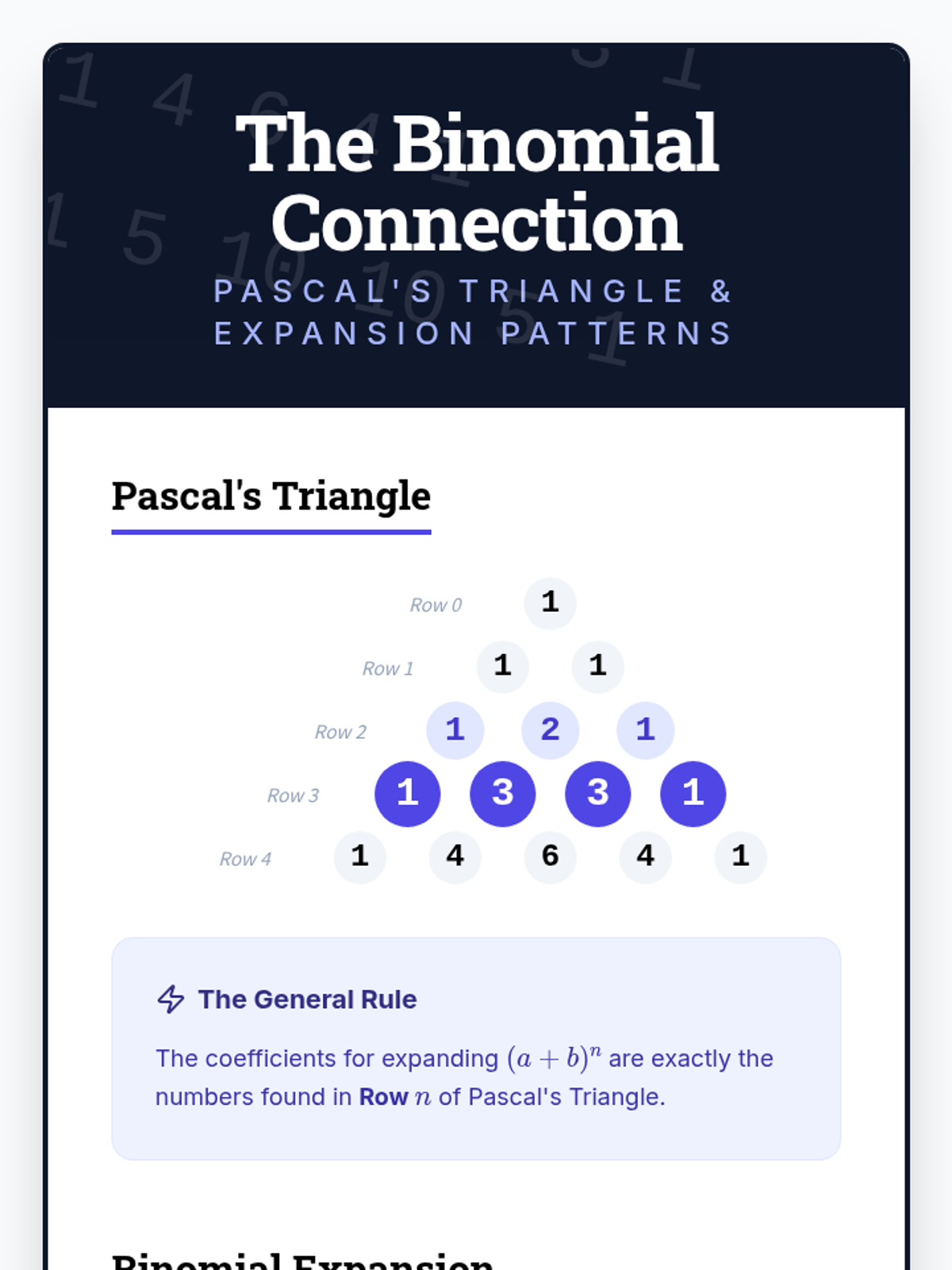
A visually striking anchor chart connecting Pascal's Triangle to Binomial Expansion formulas. Perfect for classroom display, it highlights coefficients, exponent behavior, and sign alternation for both perfect square and perfect cube polynomials.
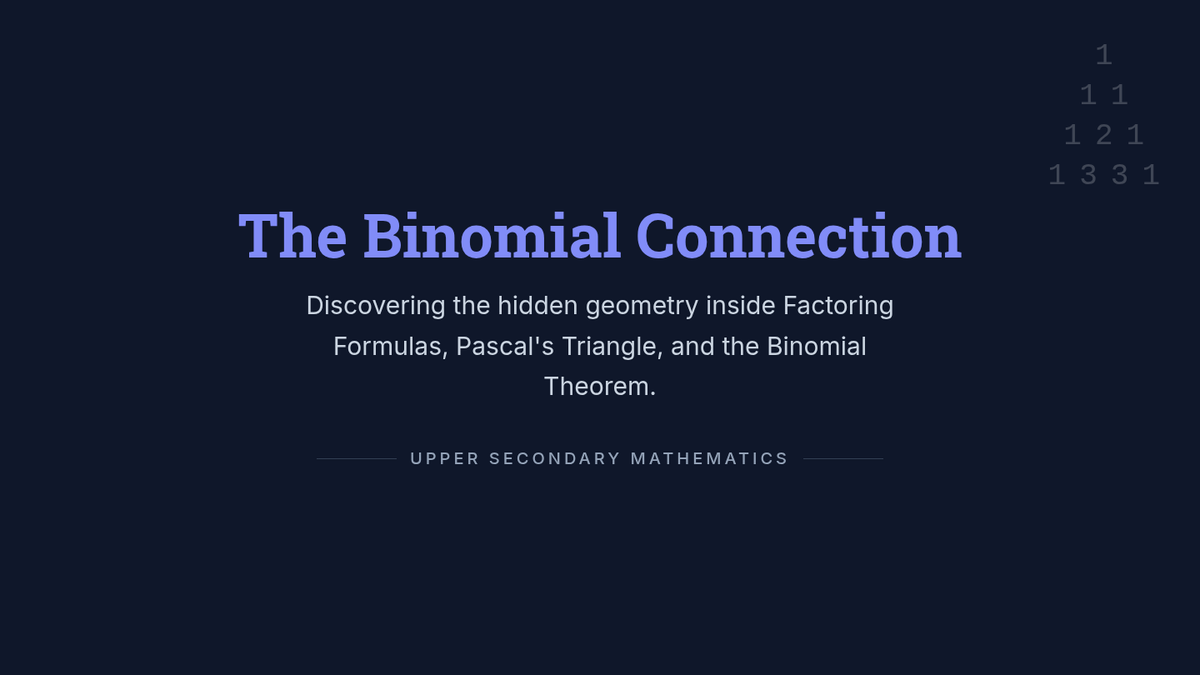
Engaging slide presentation for the lesson 'The Binomial Connection'. Includes learning objectives, timer-guided warm-up, embedded YouTube video for perfect cube expansions, and mapping exercises to connect coefficients with Pascal's Triangle.
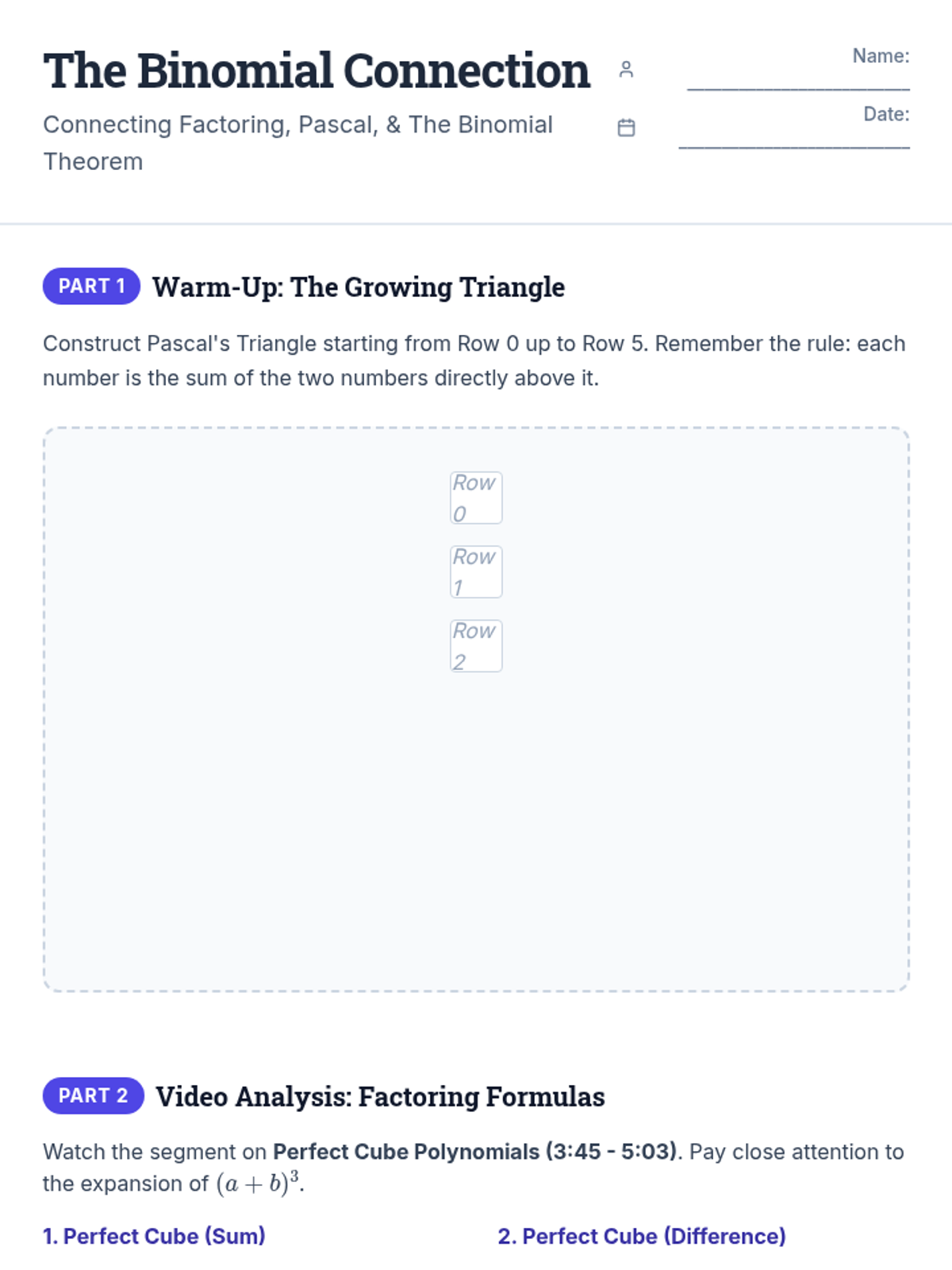
A comprehensive worksheet for 11th-12th grade students exploring the link between Pascal's Triangle, binomial expansion, and factoring formulas. Includes space for drawing the triangle, video observations, and high-level expansion challenges.
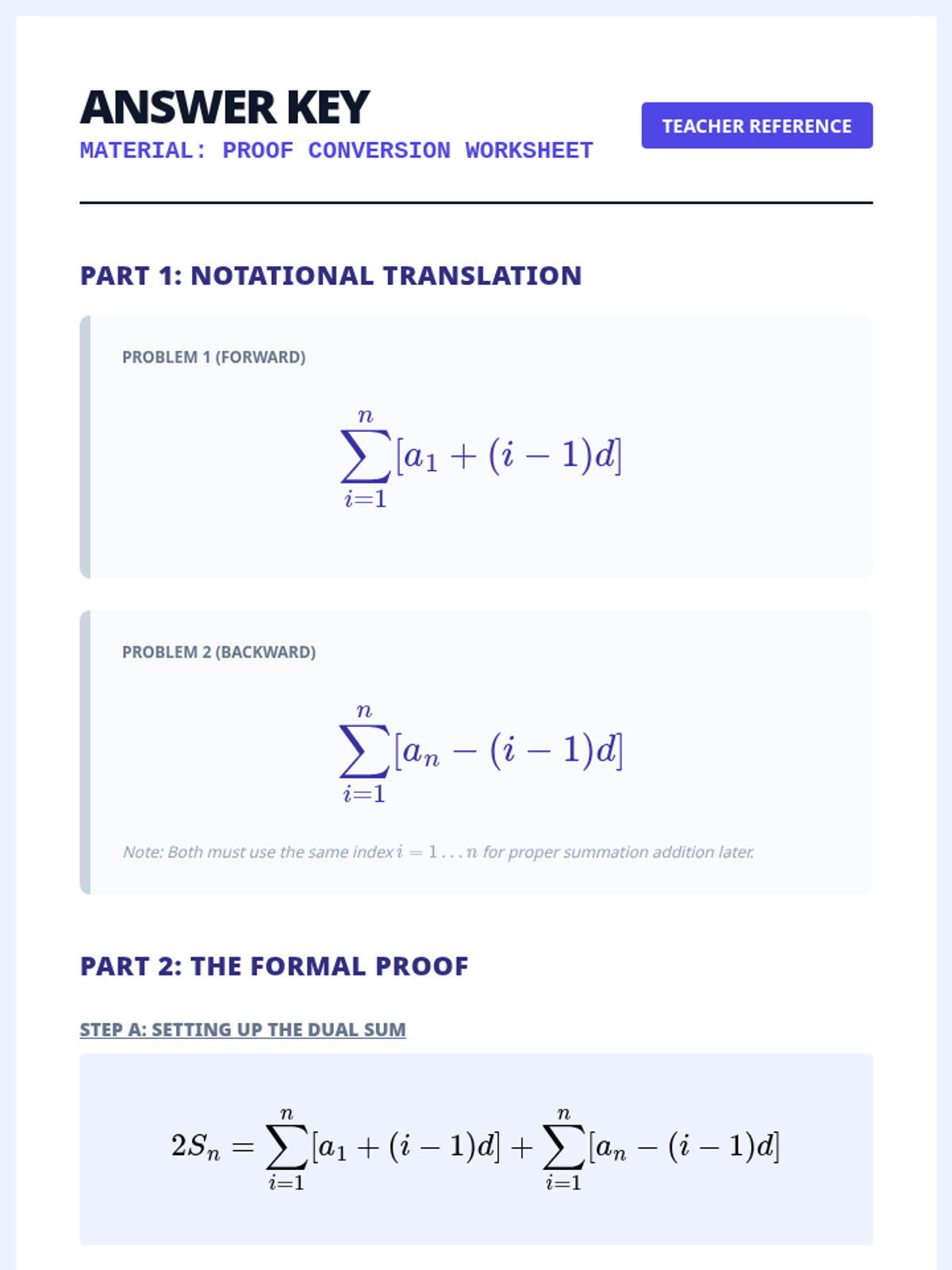
Answer key for the Proof Conversion Worksheet, detailing the step-by-step Sigma notation proof of the arithmetic series formula.
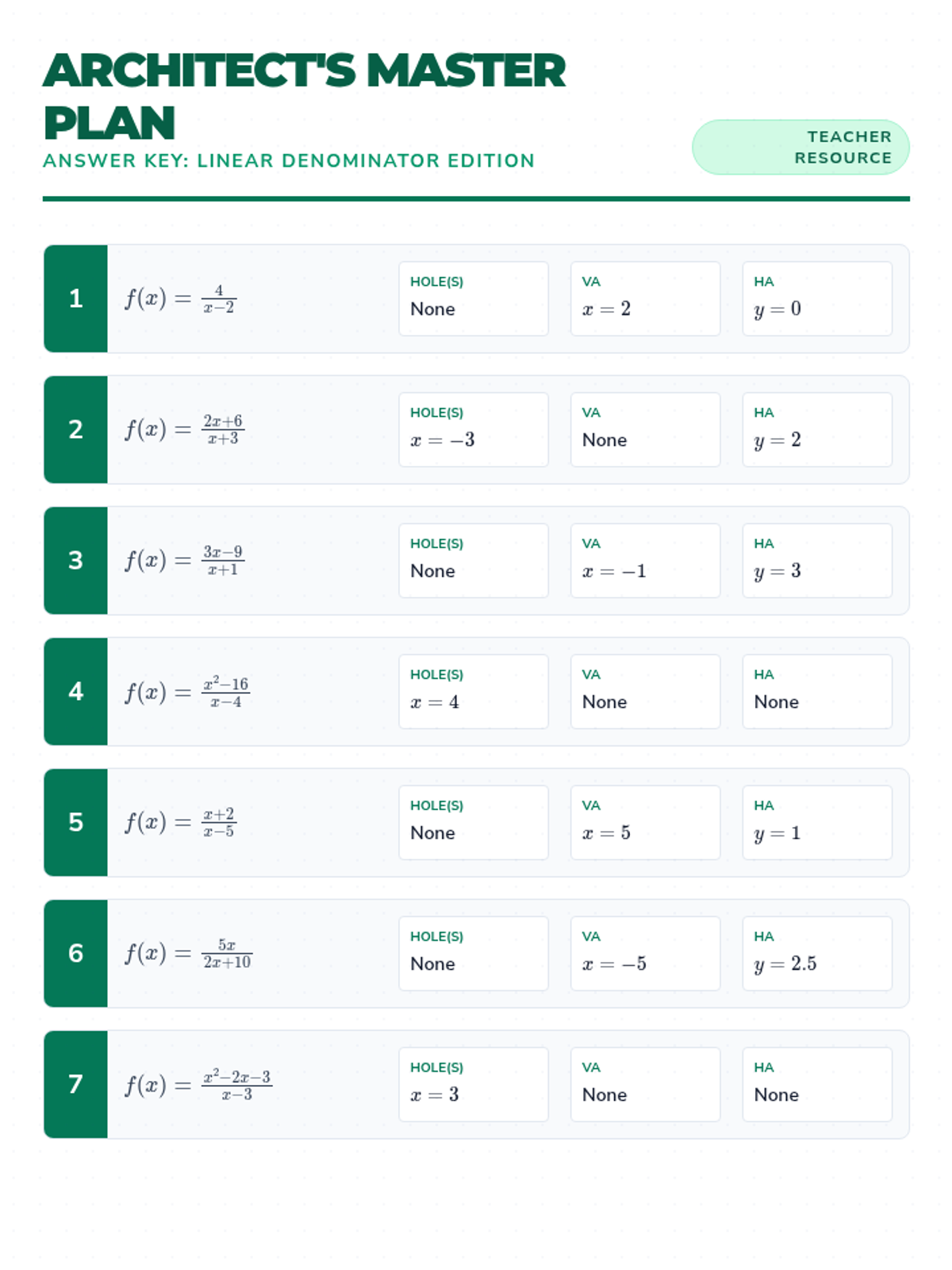
A 2-page concise answer key for the Asymptote Architects Worksheet. Features the master solution grid for all 10 problems, highlighting holes, vertical asymptotes, and horizontal asymptotes with teacher-focused verification notes.
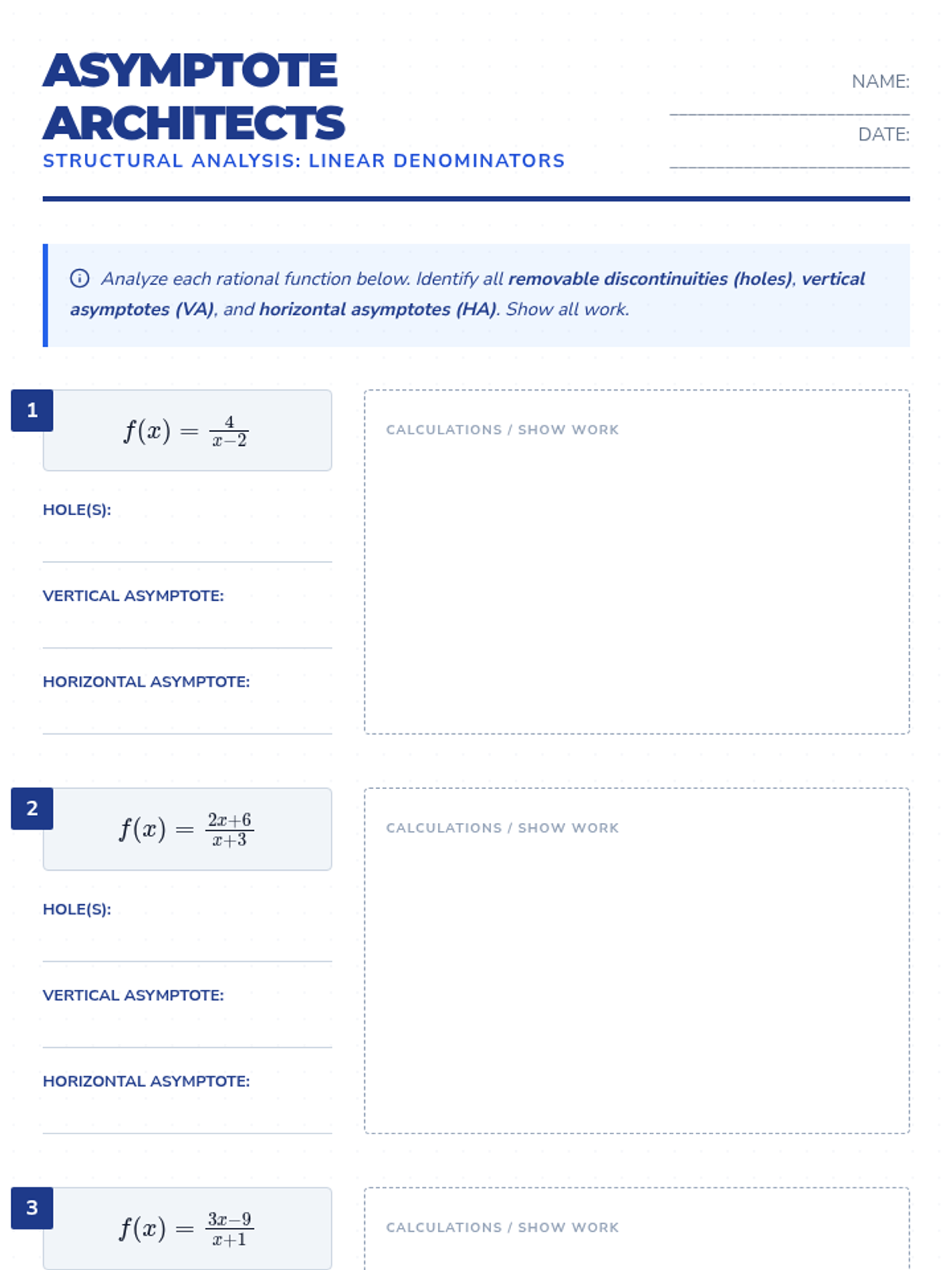
A 4-page blueprint-themed worksheet featuring 10 rational function problems specifically using linear denominators. Students identify holes, vertical asymptotes, and horizontal asymptotes for each problem with dedicated work areas.
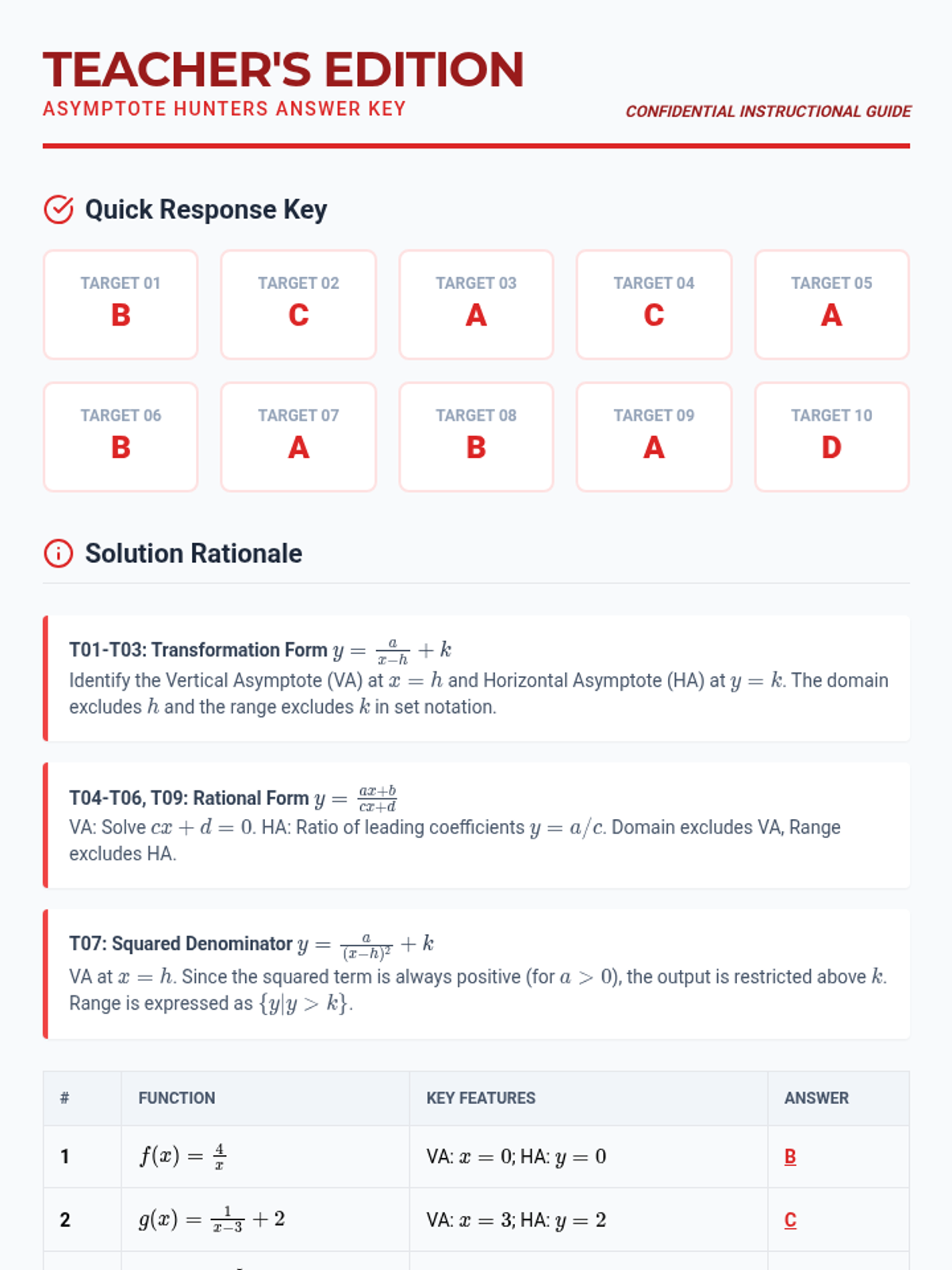
An answer key for the Asymptote Hunters Worksheet, providing both a quick-response key and detailed solution rationales for the domain and range of various rational functions using set-builder notation. Includes vertical and horizontal asymptote analysis for each problem.
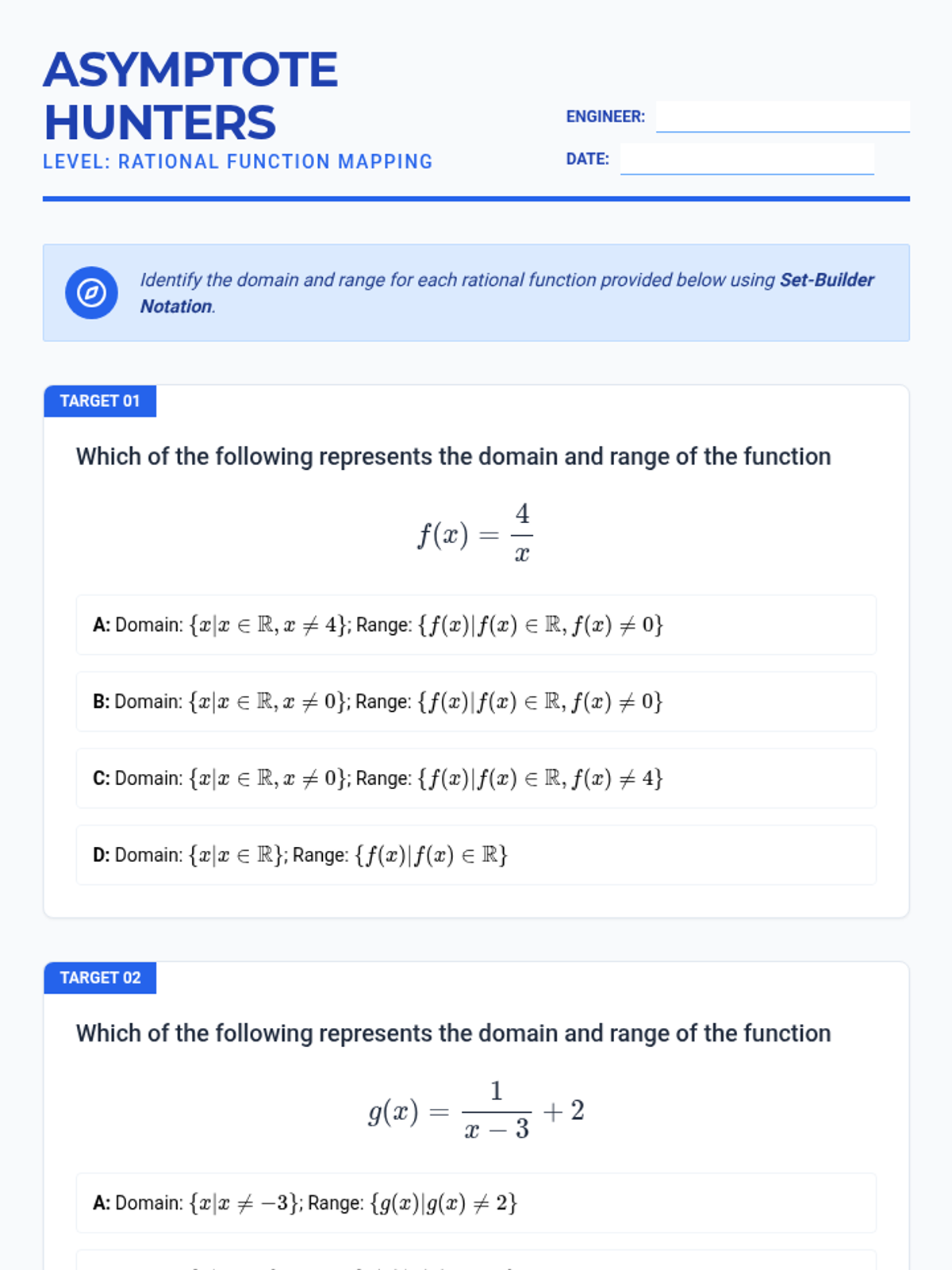
A 10-question multiple-choice worksheet focusing on identifying the domain and range of rational functions using only set-builder notation. Each problem features a different rational function with varying horizontal and vertical asymptotes.
An answer key for the TSIA2 Math practice test, including correct answers, brief explanations, and a domain distribution breakdown.
A 20-question TSIA2 Math practice test with questions across four domains: Quantitative Reasoning, Algebraic Reasoning, Geometry, and Probability and Statistics.
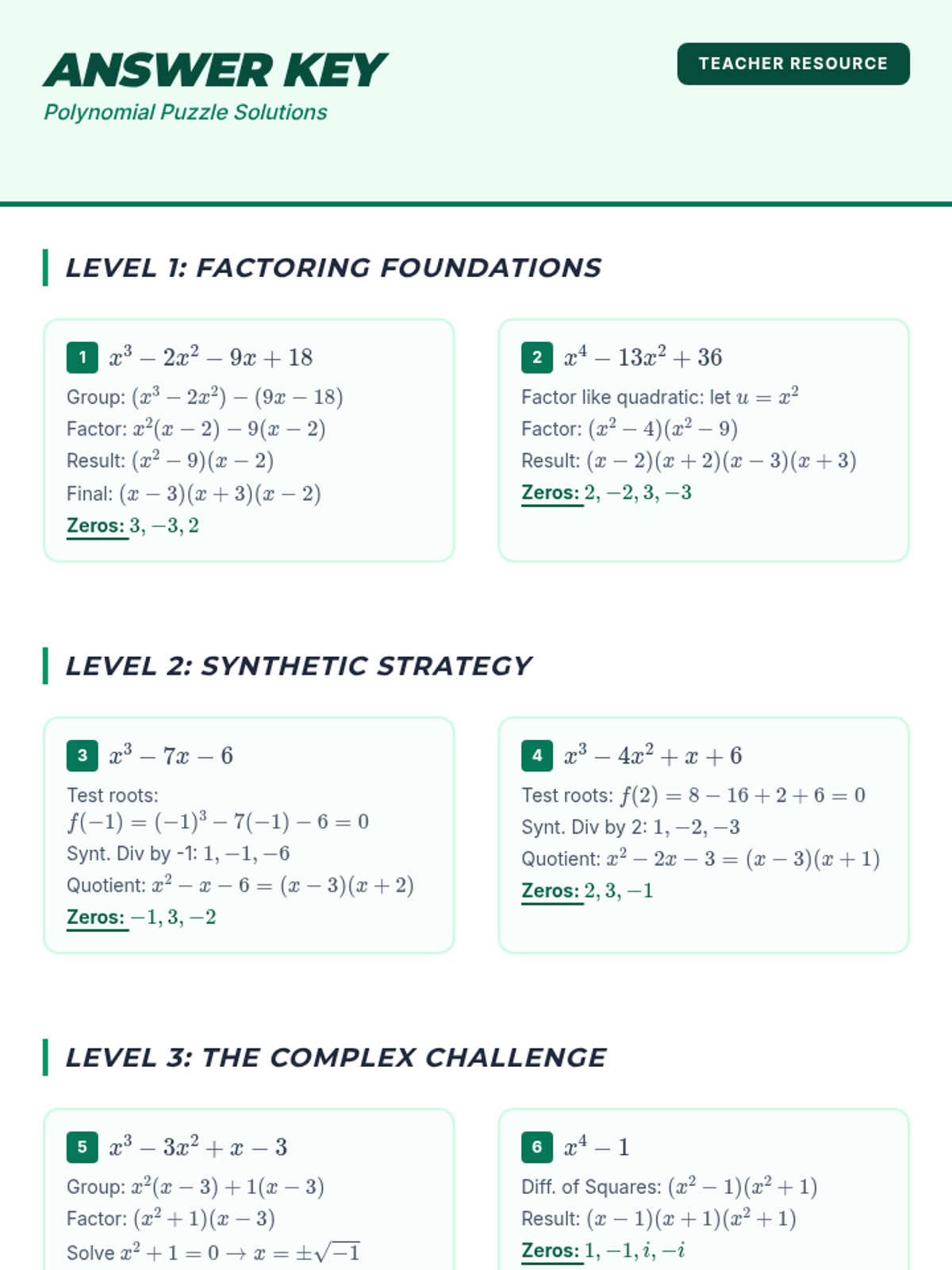
The step-by-step solution key for the Polynomial Puzzle Worksheet. Includes factoring steps, synthetic division work, and identification of complex zeros.
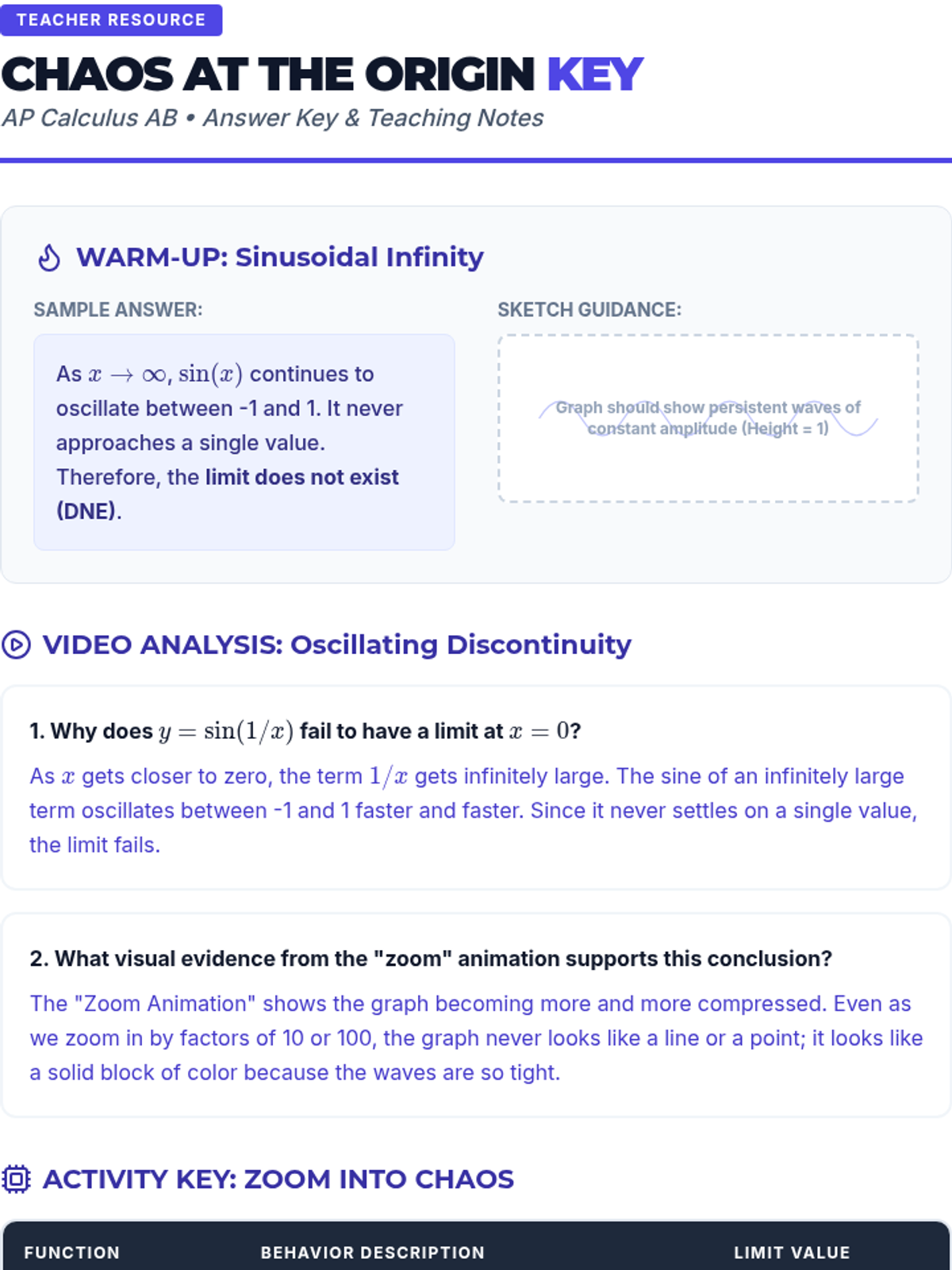
A teacher answer key for the 'Chaos at the Origin' worksheet, including sample student responses, graphing guidance, and instructional tips for the Squeeze Theorem introduction.
A slide deck for teaching oscillating discontinuities, featuring a warm-up, video analysis, step-by-step tech activity instructions, and a comparison between persistent and dampened oscillation. All text is optimized for high visibility with sizes of 24px or larger.
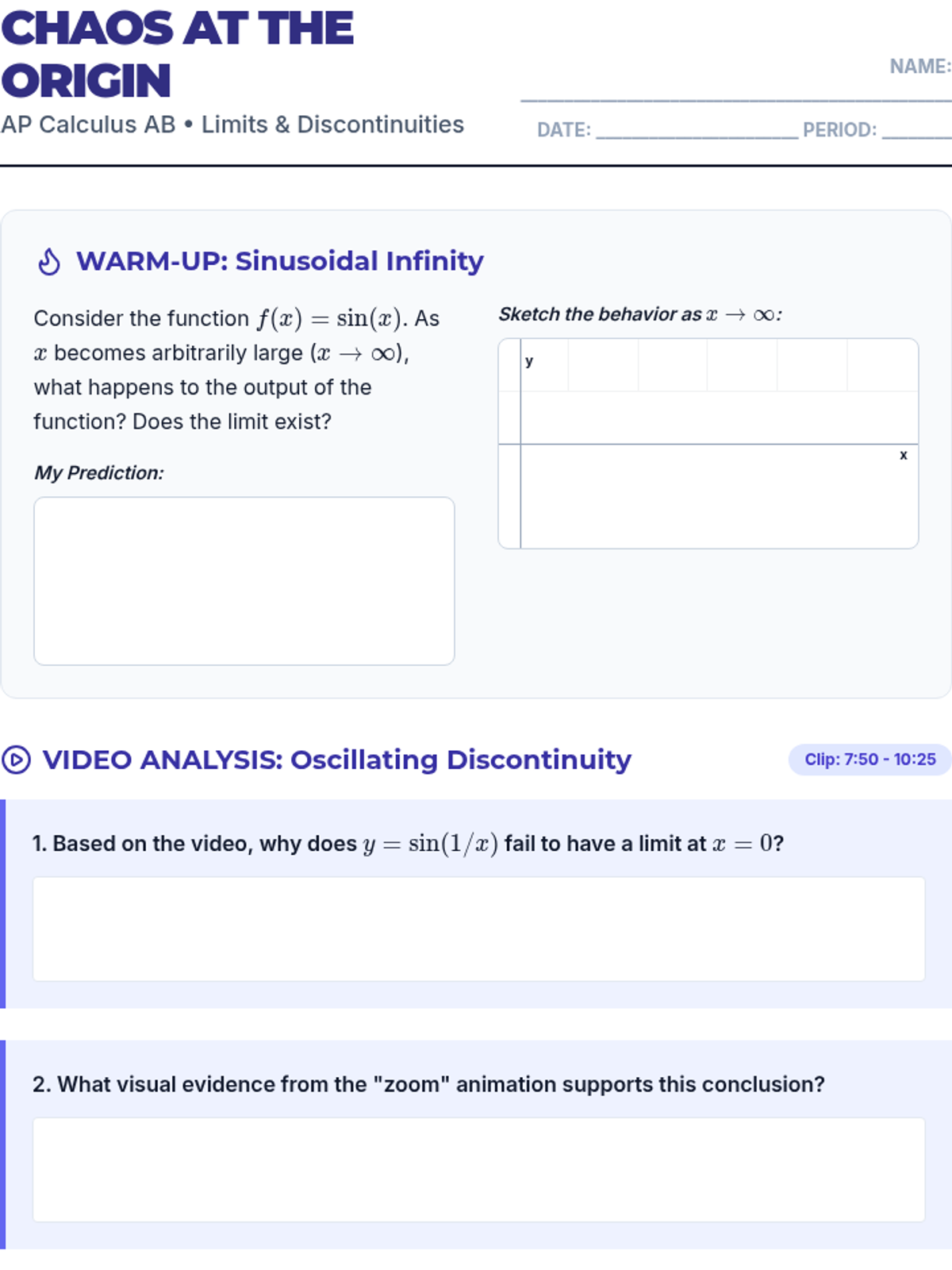
A student worksheet for investigating oscillating discontinuities through warm-up exercises, video analysis notes, and a digital graphing activity exploring functions like \(\sin(1/x)\) and \(x \cdot \sin(1/x)\).
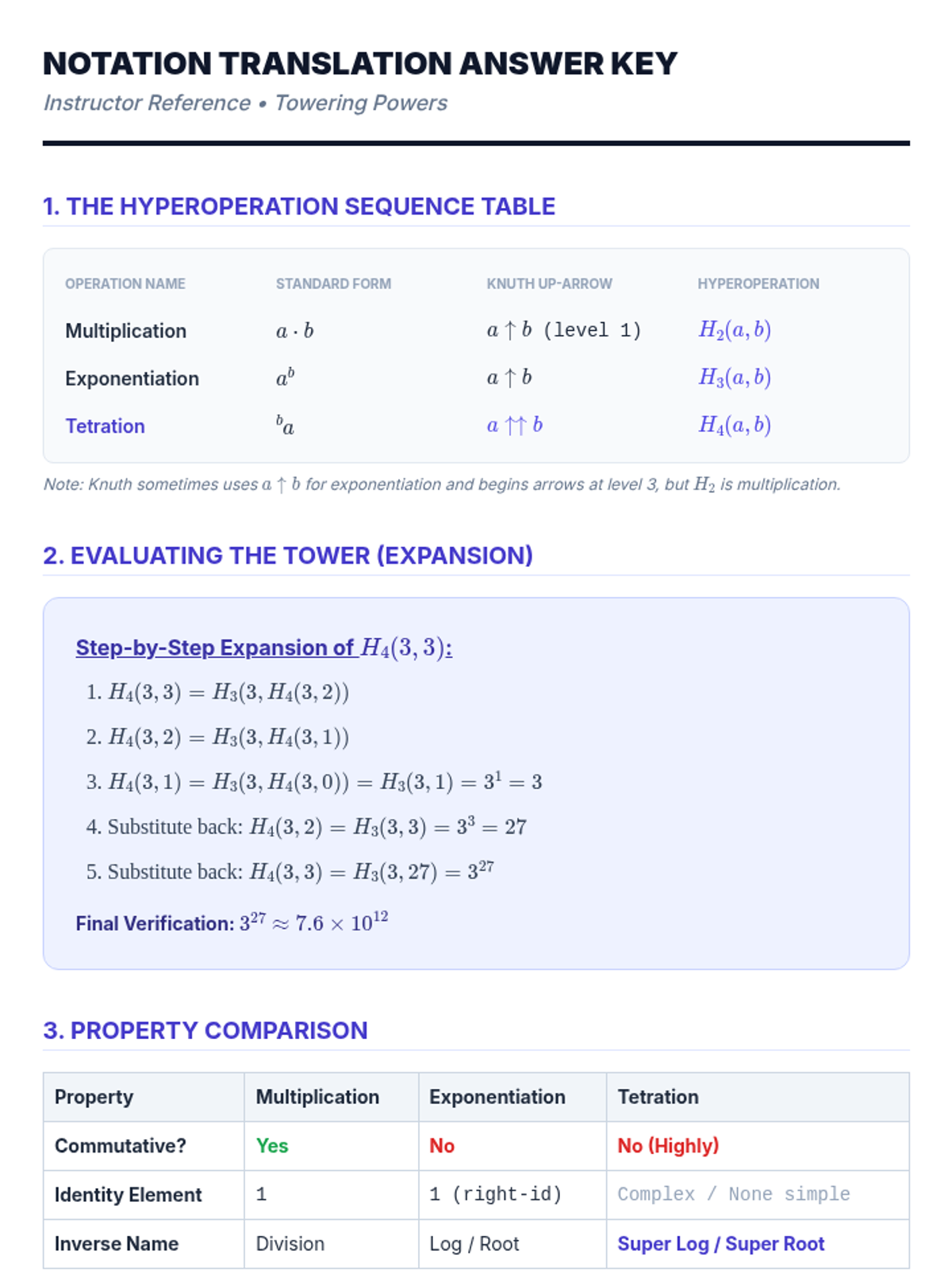
Detailed answer key for the "Notation Translation" worksheet, including step-by-step recursive expansions and property comparisons.
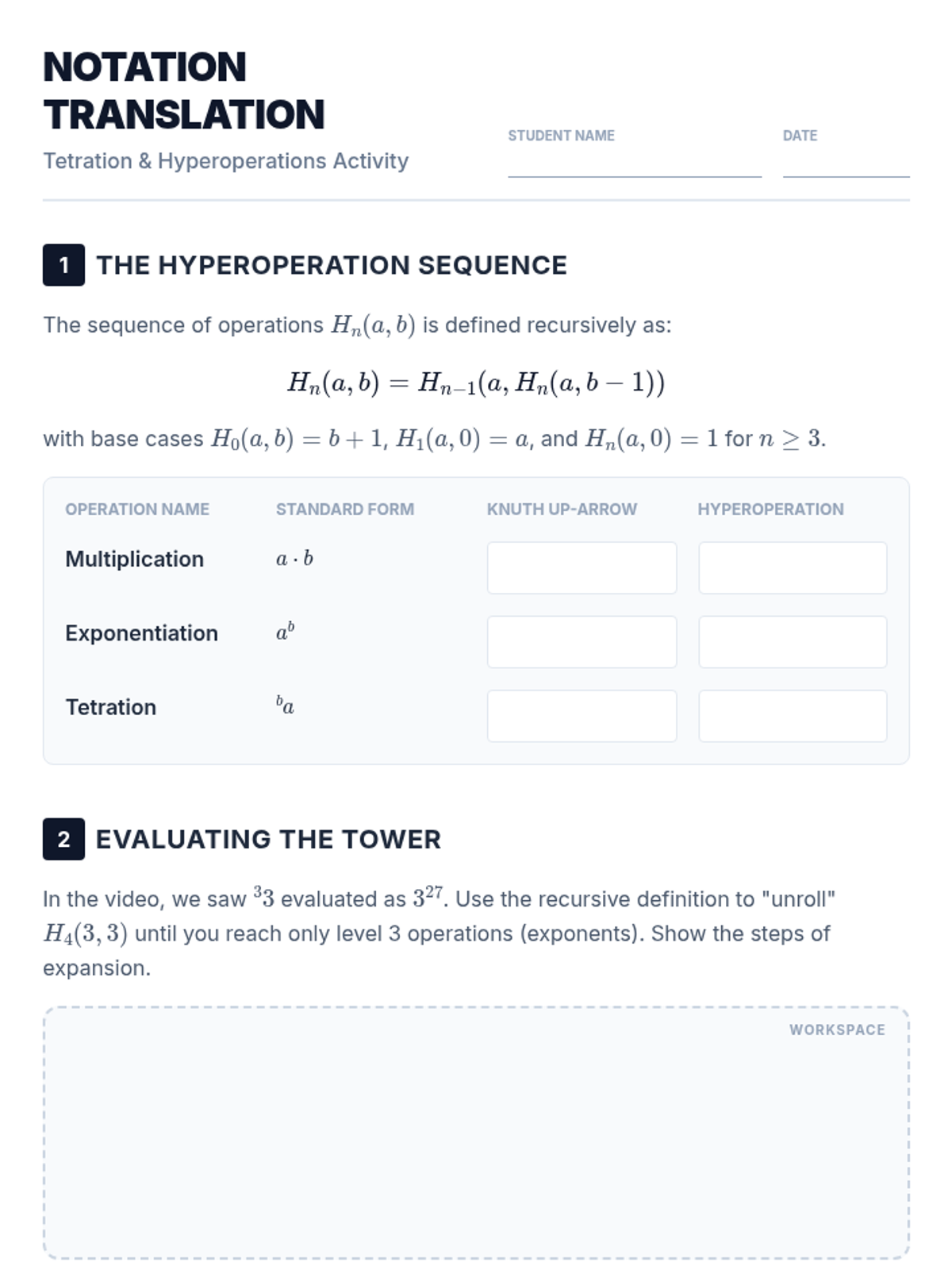
A technical worksheet for undergraduate math students to practice translating between tetration notations, verifying recursive definitions, and solving equations involving super roots.
Instructional slides for "Towering Powers" lesson, covering hyperoperations, video segments, notation bridging, and domain extensions. Designed with high contrast for university-level lecture halls.
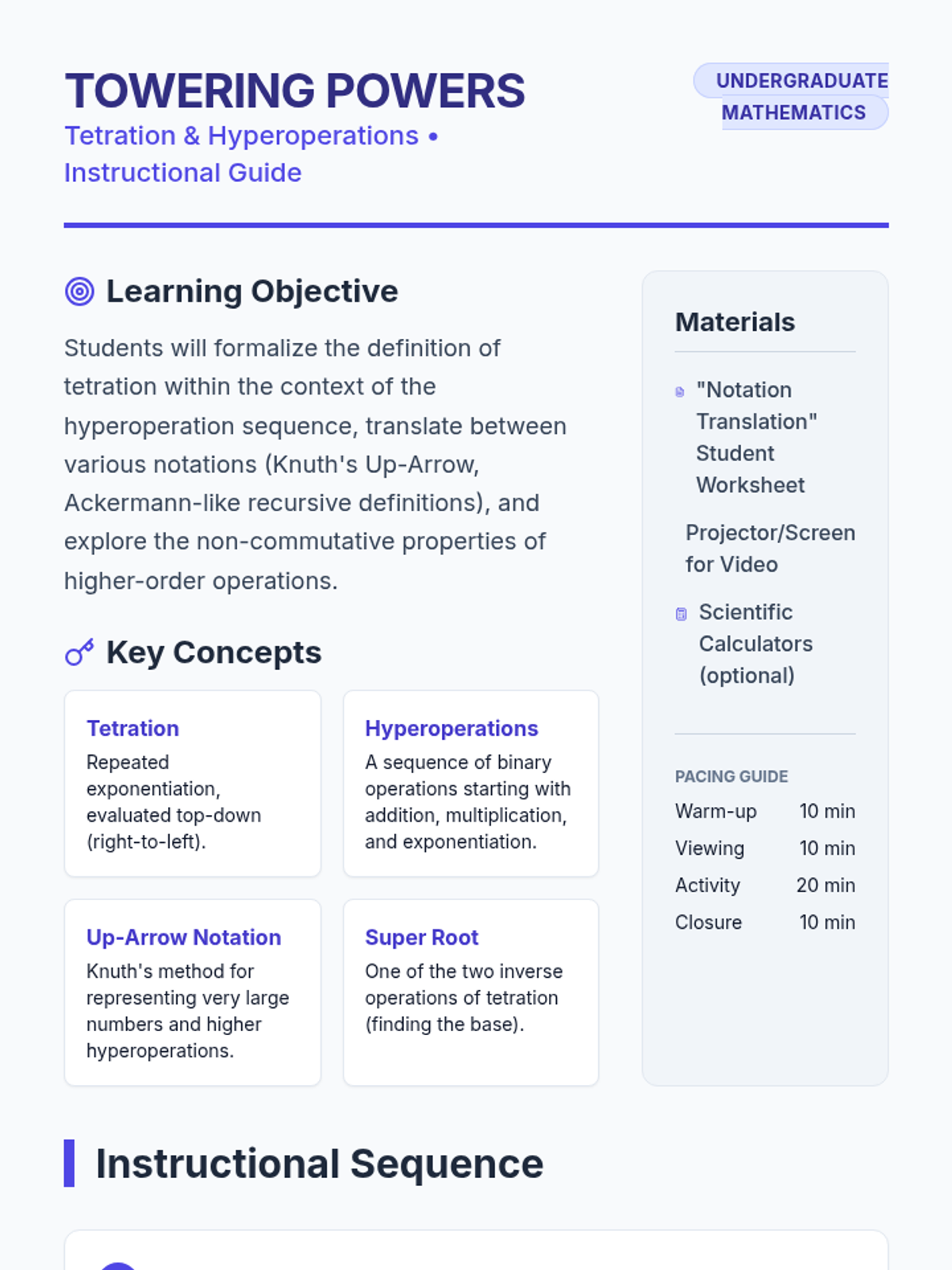
A comprehensive teacher's lesson plan for teaching tetration and hyperoperations to undergraduate students. Includes pacing, key questions, and pedagogical strategies for integrating the provided video content.
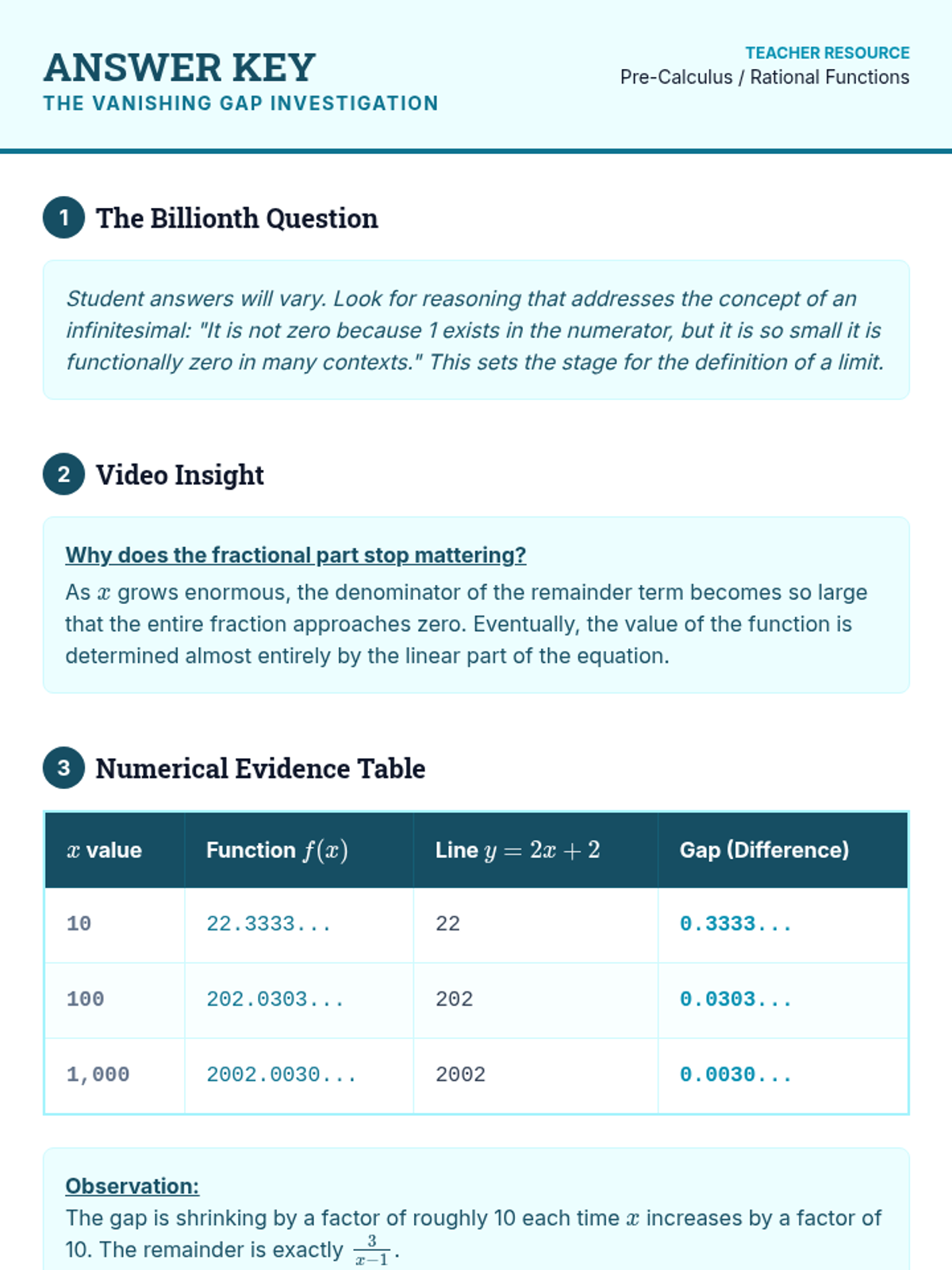
An answer key for the Vanishing Gap Investigation Worksheet, providing calculated values and sample responses for teacher reference.
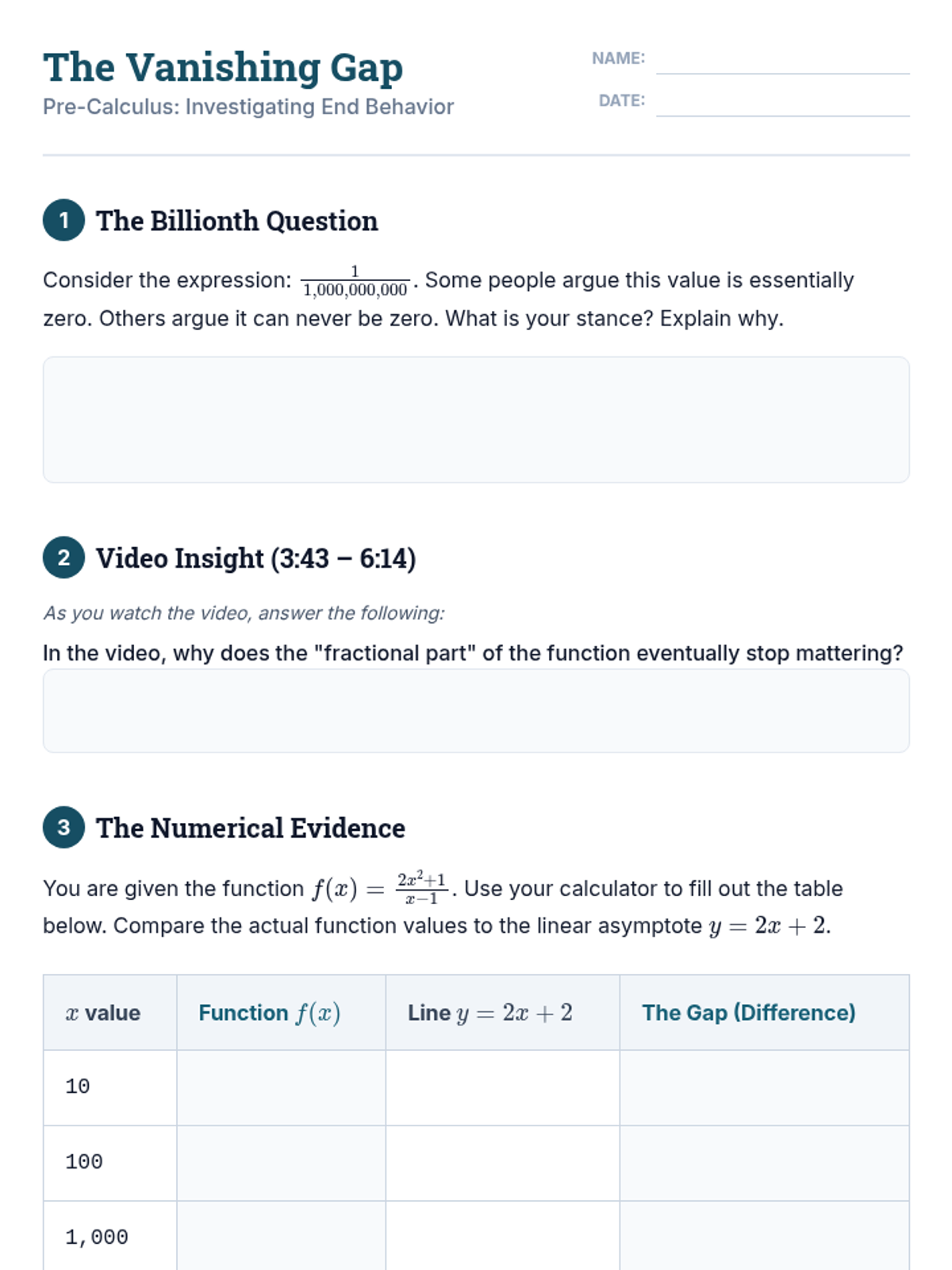
A student worksheet for investigating oblique asymptotes numerically, including a table for calculating values and comparing functions to their linear components.
A visual presentation for teaching oblique asymptotes, featuring a conceptual hook, an embedded YouTube video, and guided investigation prompts using limit notation.
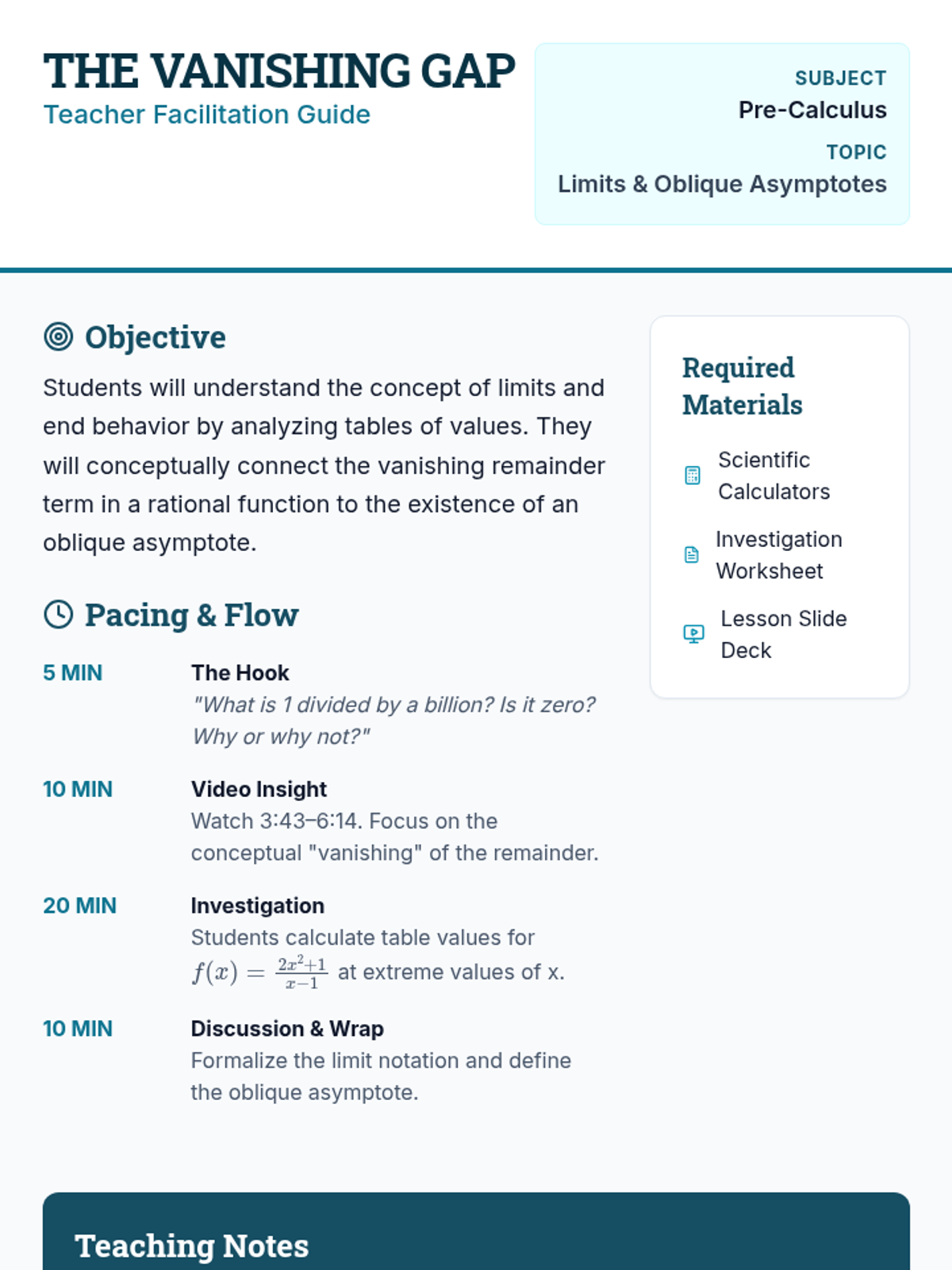
A comprehensive teacher facilitation guide for the lesson, featuring pacing, discussion prompts, common misconceptions, and instructional strategies for teaching oblique asymptotes.
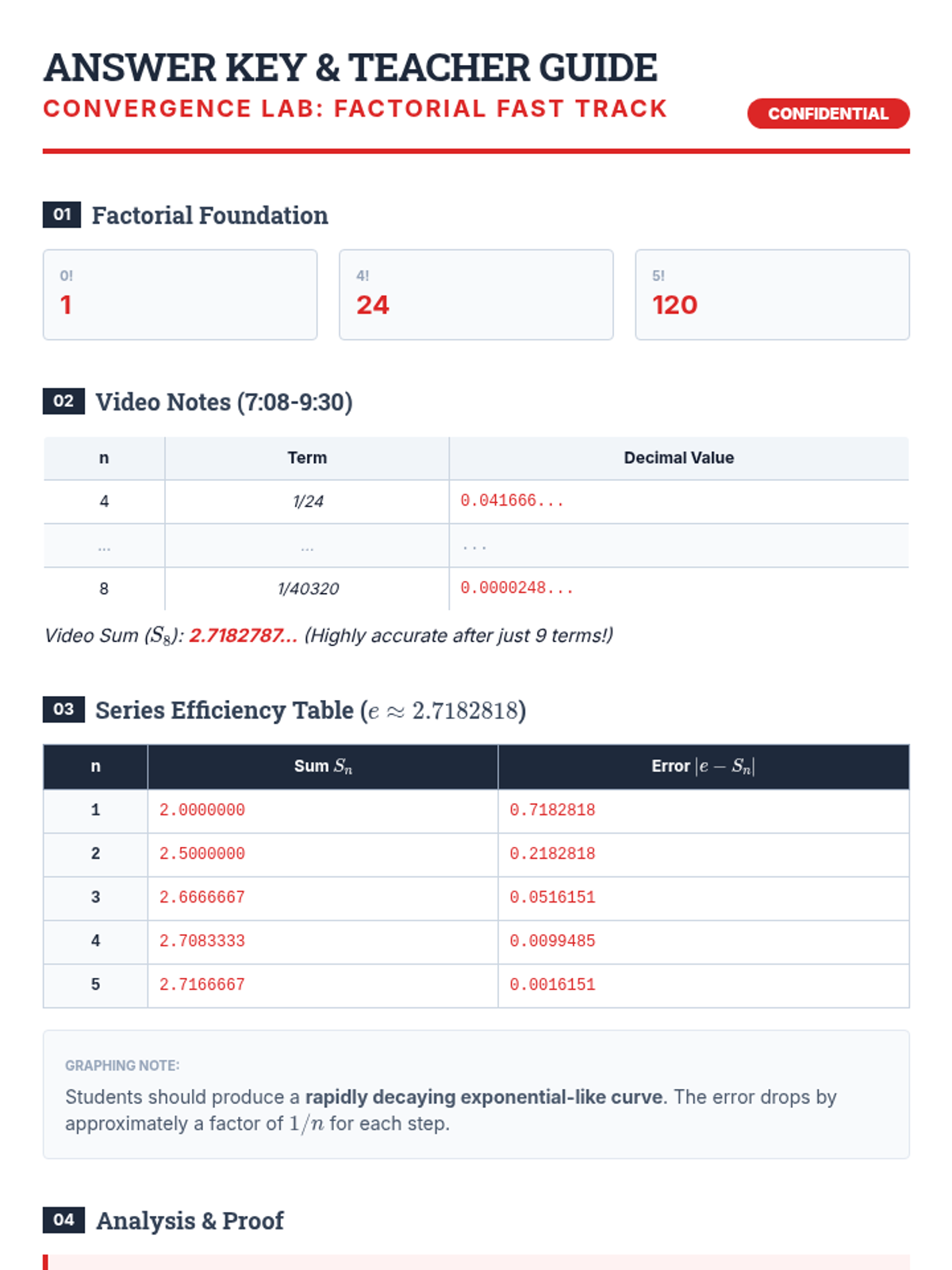
A detailed answer key and facilitation guide for teachers, providing correct values for the Convergence Lab worksheet and model responses for analysis questions.
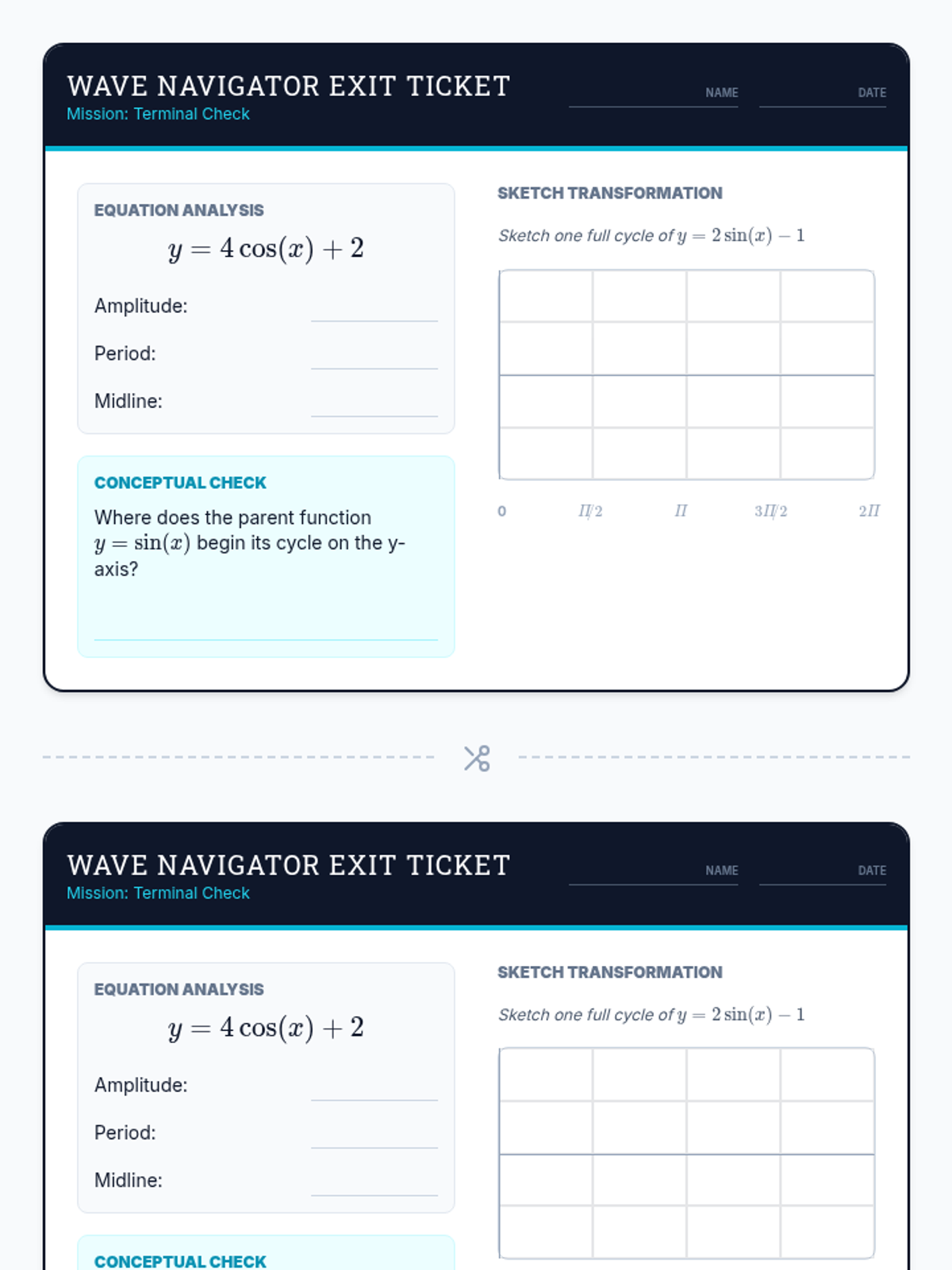
A print-friendly exit ticket containing two identical assessment slips. Students analyze a cosine equation for amplitude, period, and midline, and sketch a transformed sine graph to demonstrate mastery.
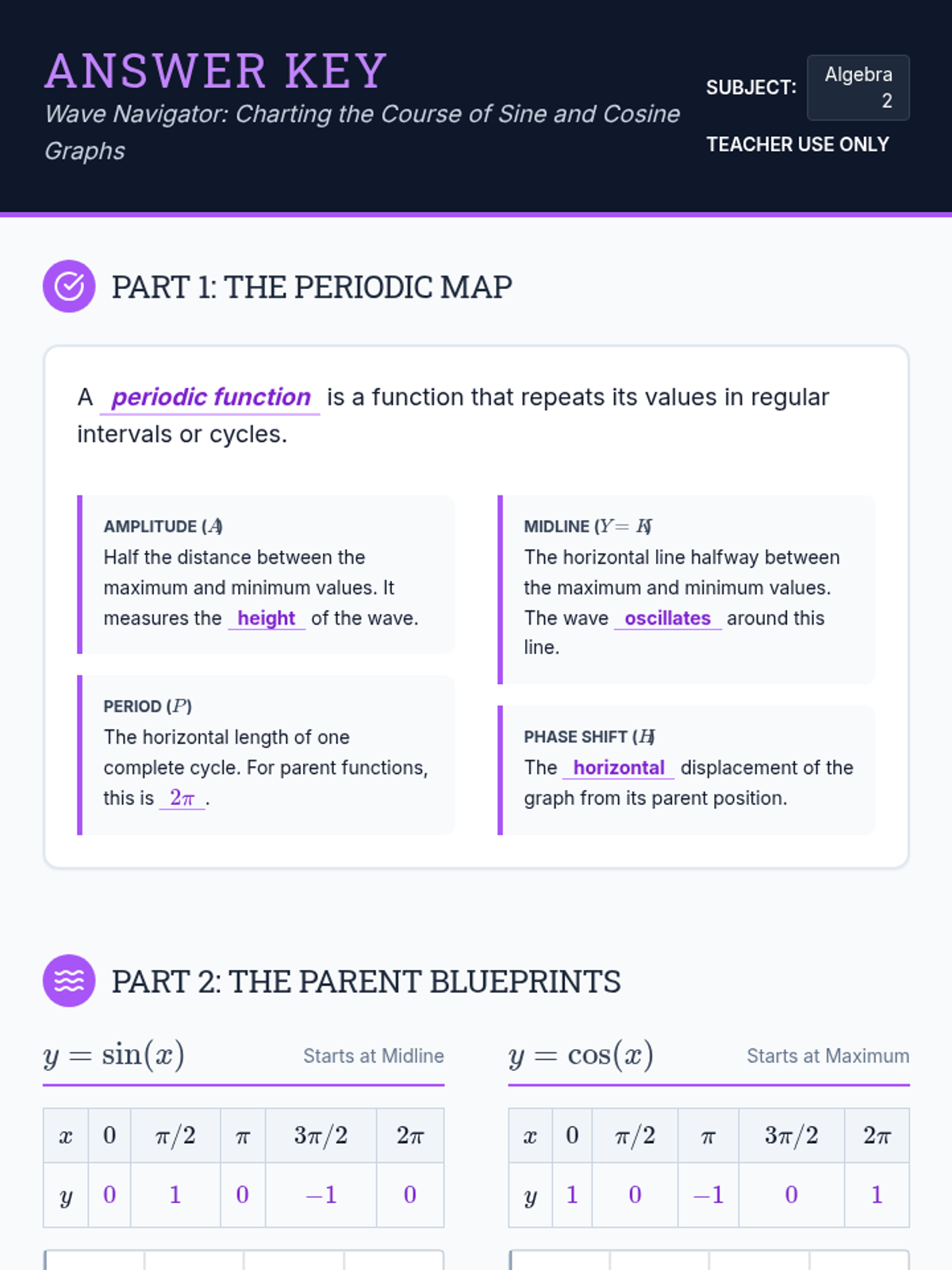
Teacher-facing answer key for the Wave Navigator Notes Handout. Provides completed definitions, filled-in parent function tables and graphs, and a worked-out solution for the guided practice problem including the final sketch.
Instructional slides for teaching periodic function graphing. Features large, readable text, high-contrast visuals, step-by-step blueprints for parent functions, and a detailed breakdown of the transformation equation.
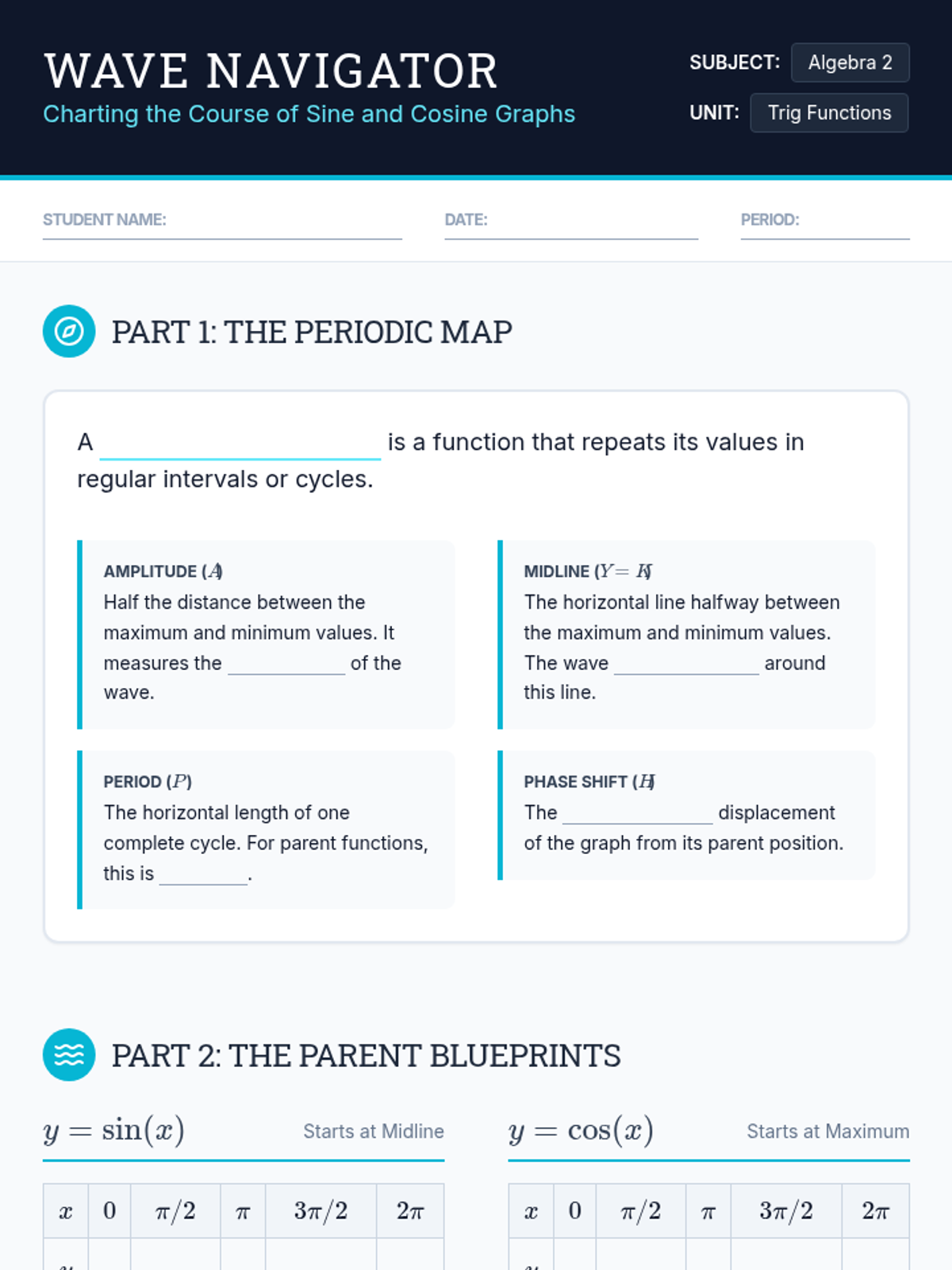
Student-facing guided notes for graphing sine and cosine functions. Includes definitions, parent function tables, the transformation formula, and a guided practice problem with space for calculations and graphing.
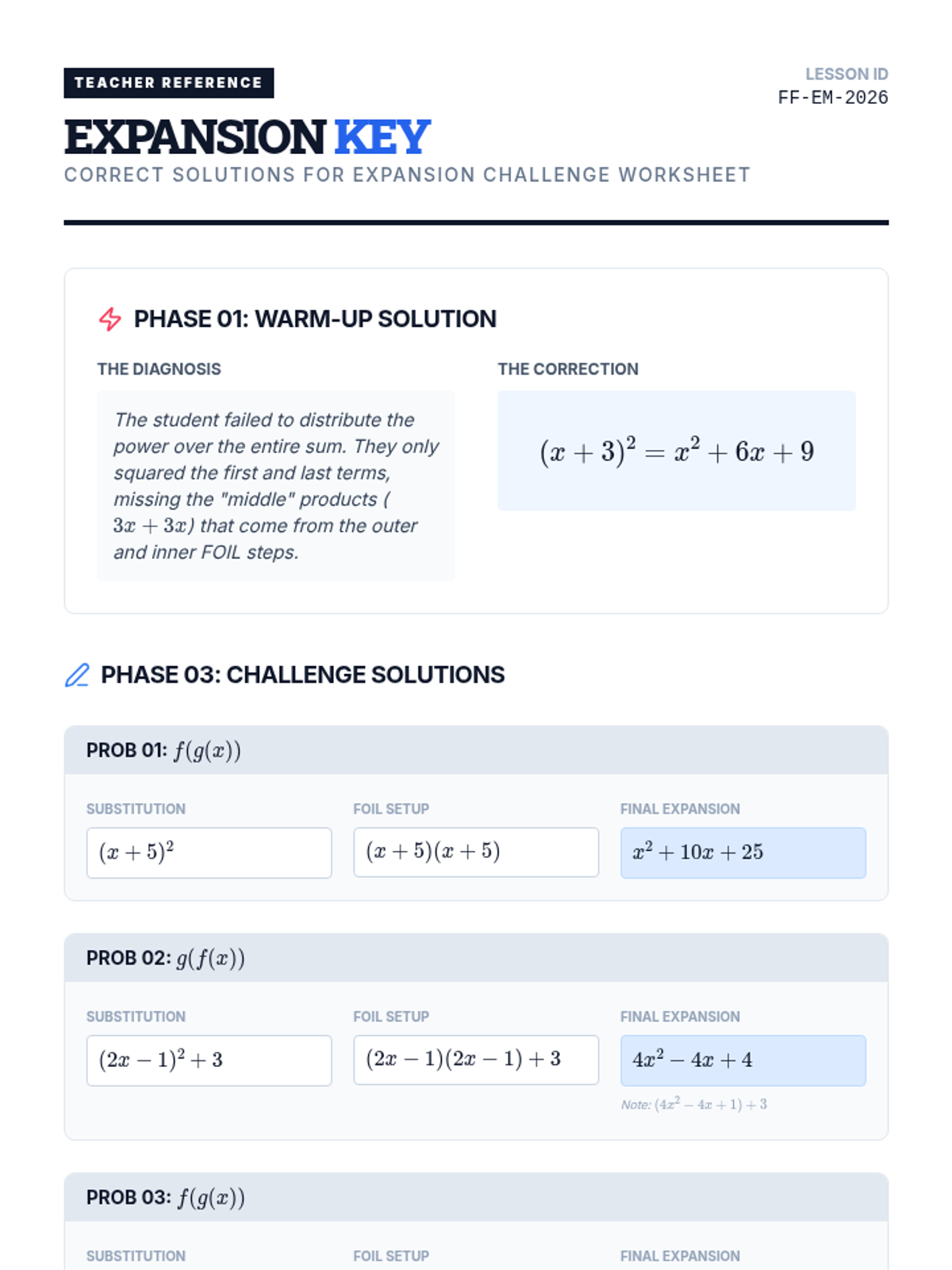
A teacher's answer key for the Expansion Challenge Worksheet, providing step-by-step solutions for substitution, FOIL setup, and final expansion for all practice problems.
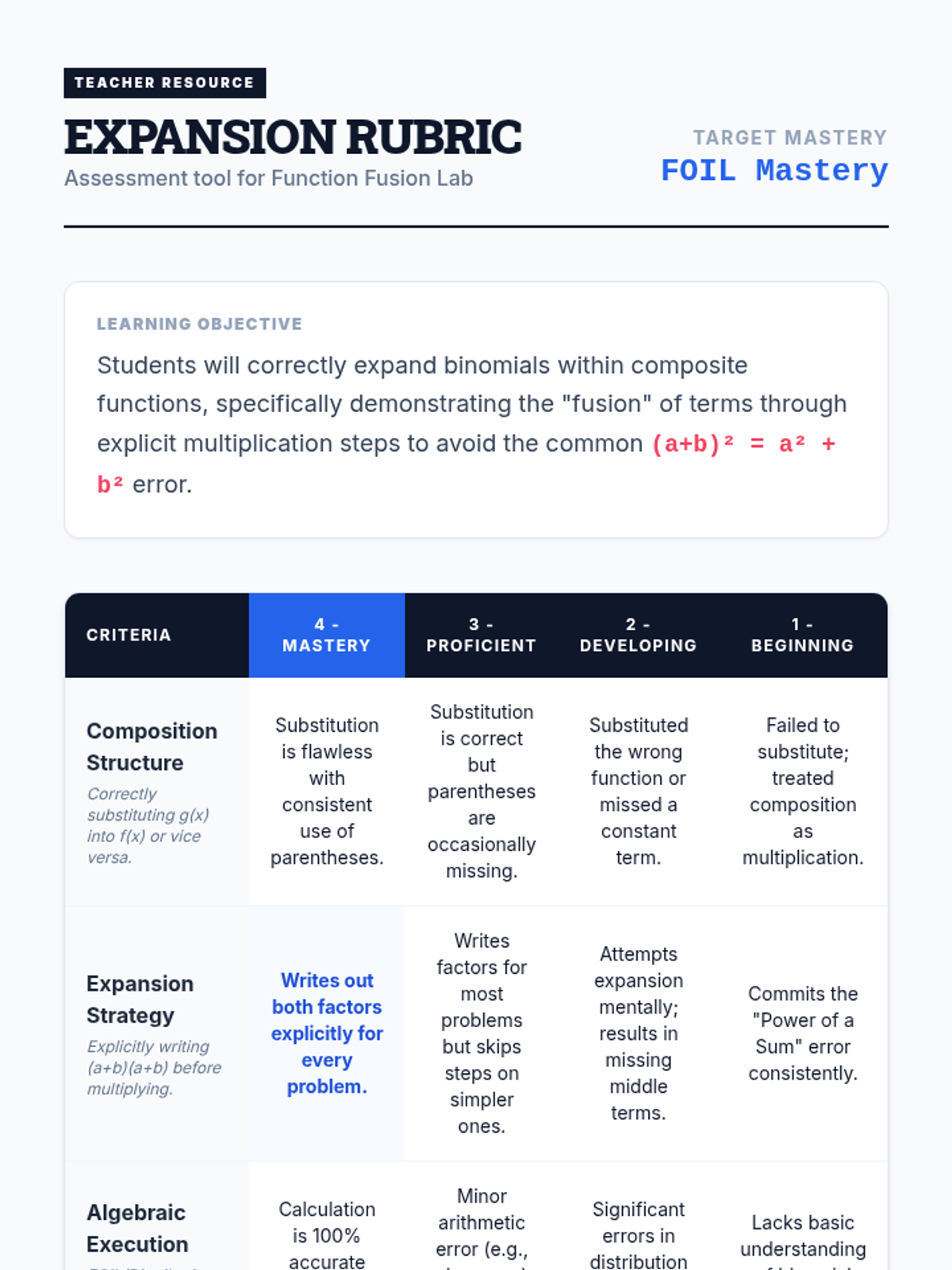
A formal grading rubric for the Function Fusion lesson, evaluating students on composition structure, expansion strategy, and algebraic execution. Provides clear benchmarks for mastery and proficiency.
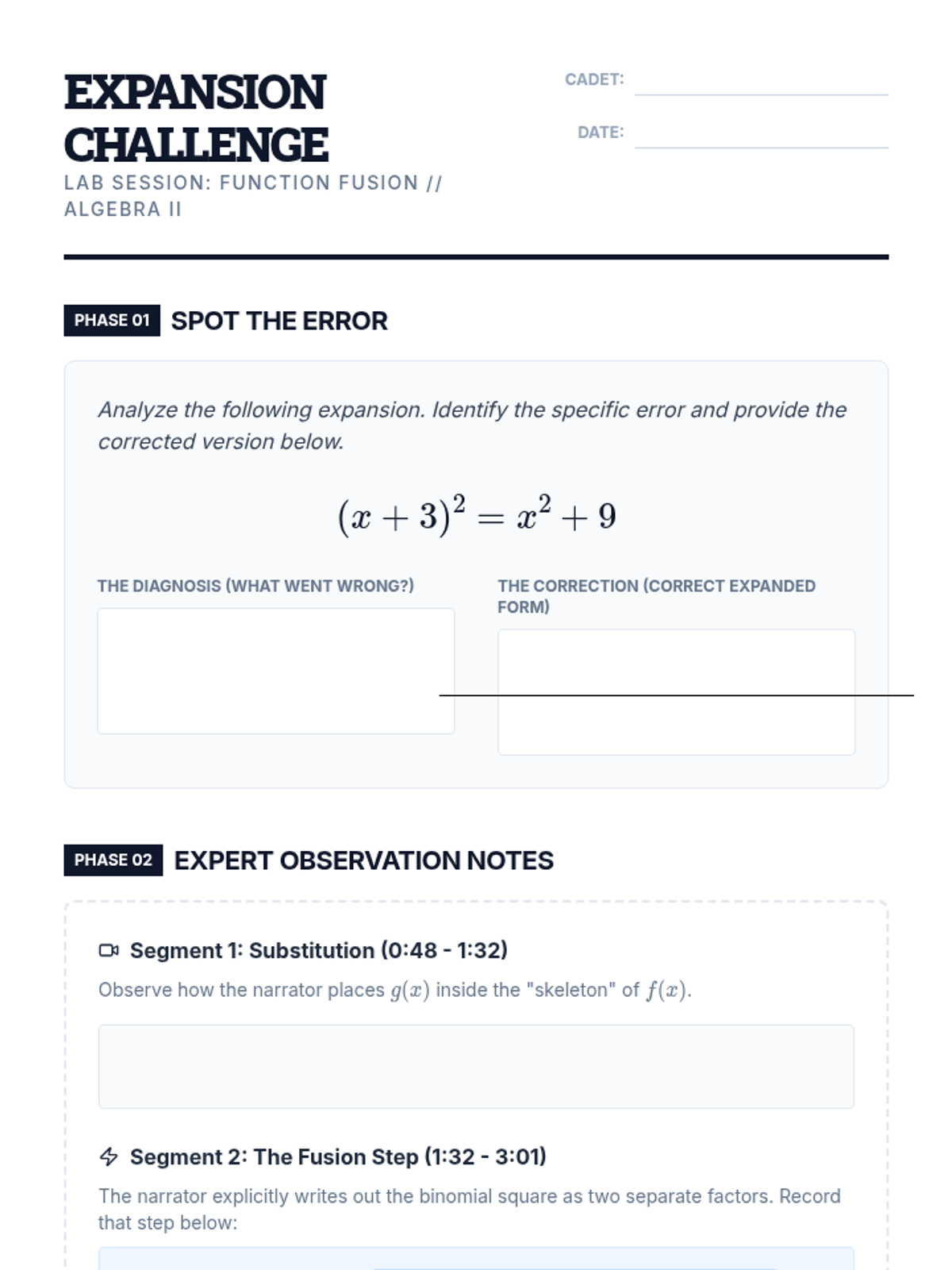
A structured student worksheet for practicing binomial expansion within composite functions. Includes a "Spot the Error" warm-up, video note-taking sections, and 3 challenge problems requiring explicit FOIL setup.
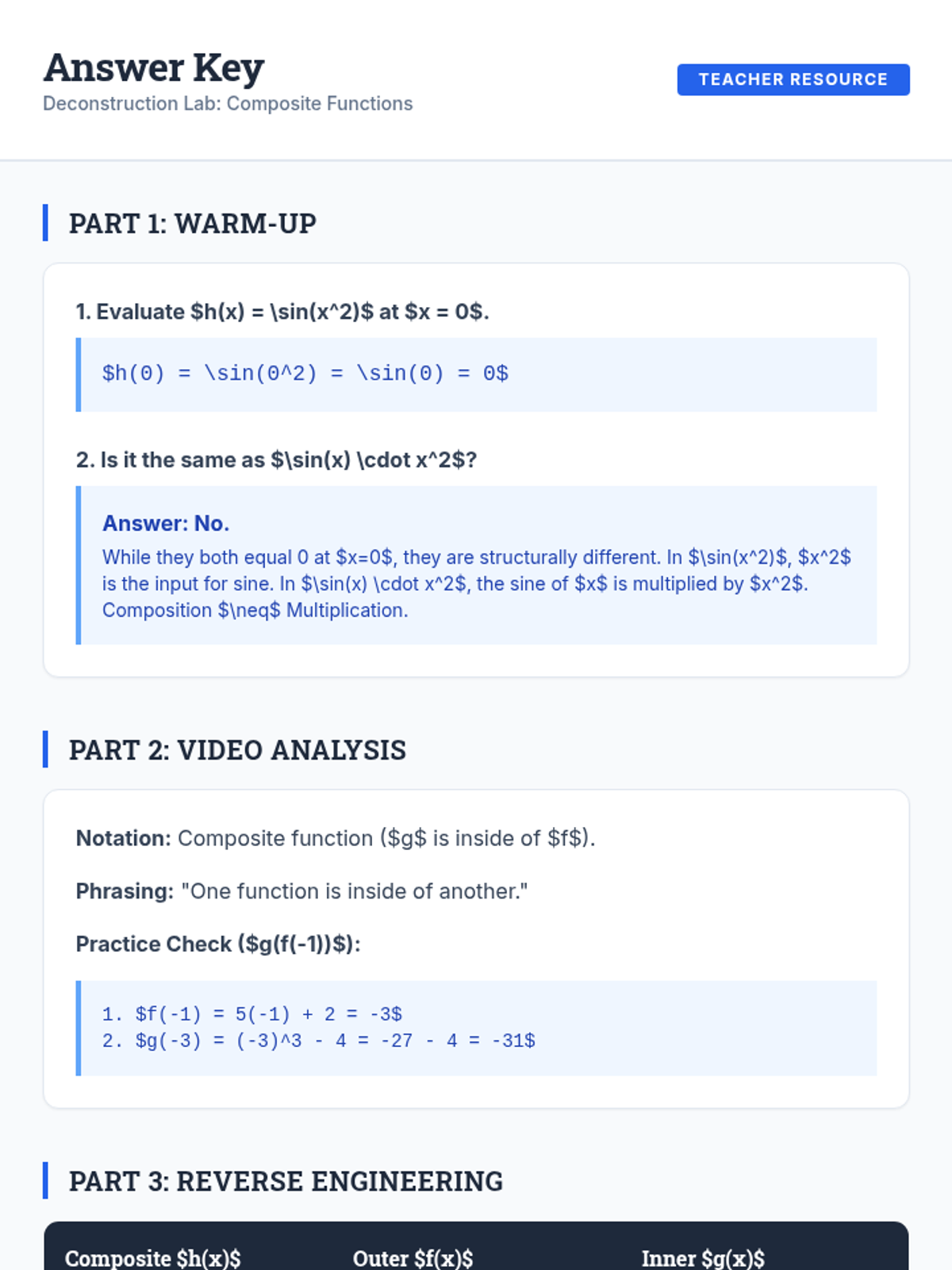
A comprehensive answer key and teacher facilitation guide for the Deconstruction Lab worksheet, providing solutions and instructional notes.
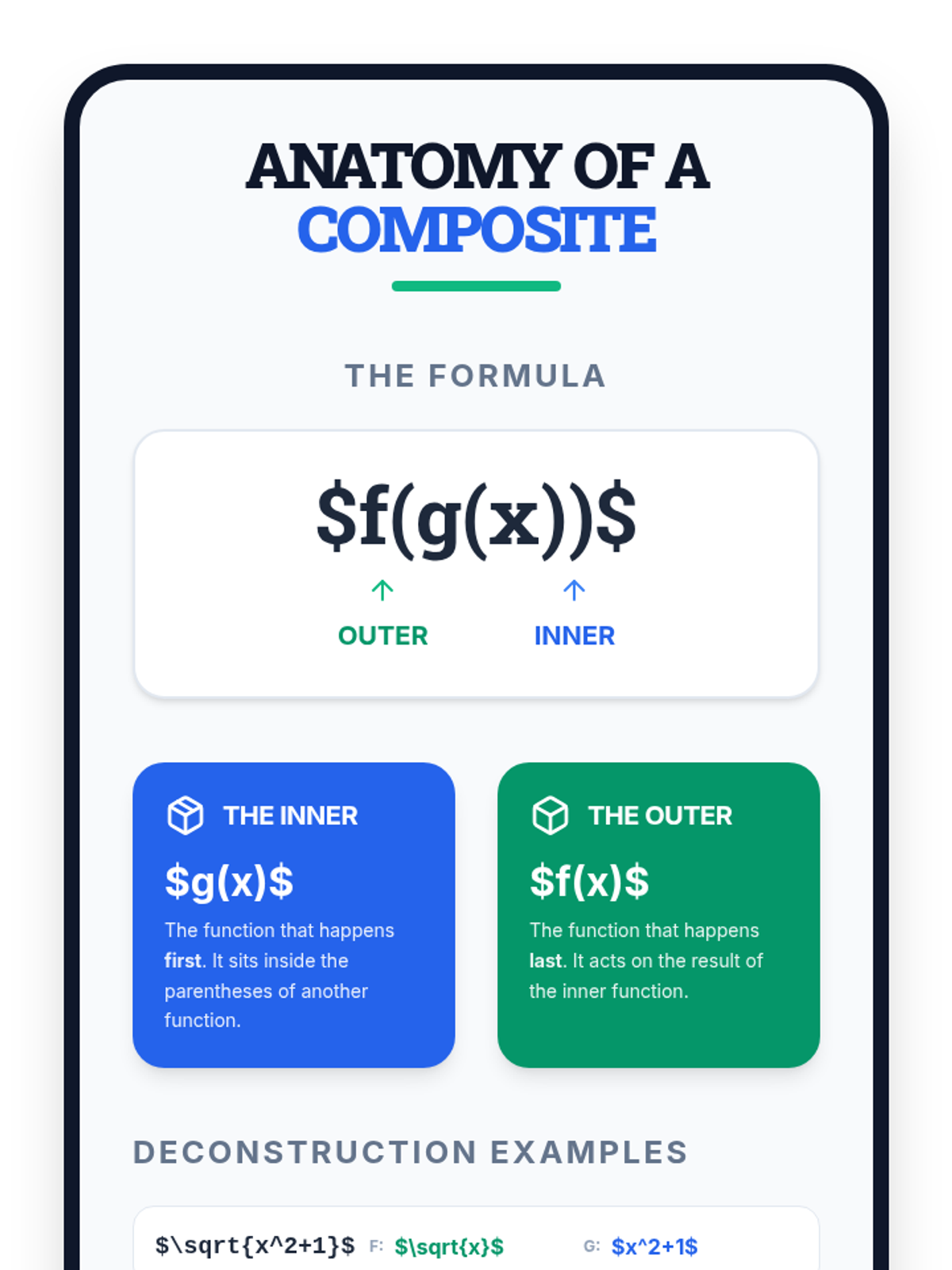
A visual anchor chart illustrating the 'Anatomy of a Composite Function'. It uses color-coding to distinguish between inner and outer functions and provides clear examples of function decomposition.
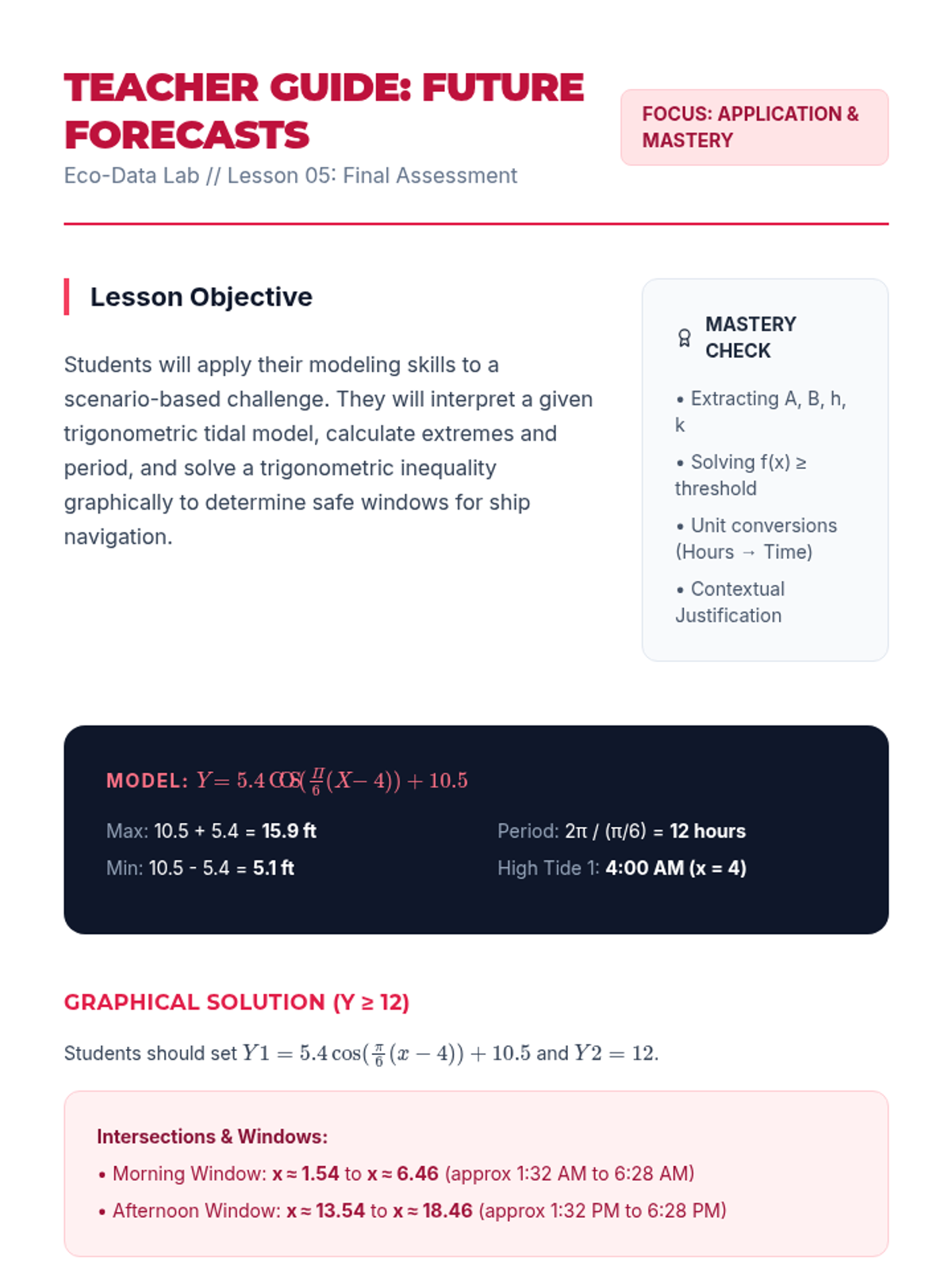
A teacher guide for Lesson 5, including answer keys for the harbor entry scenario and instructional tips on graphical inequality solutions.
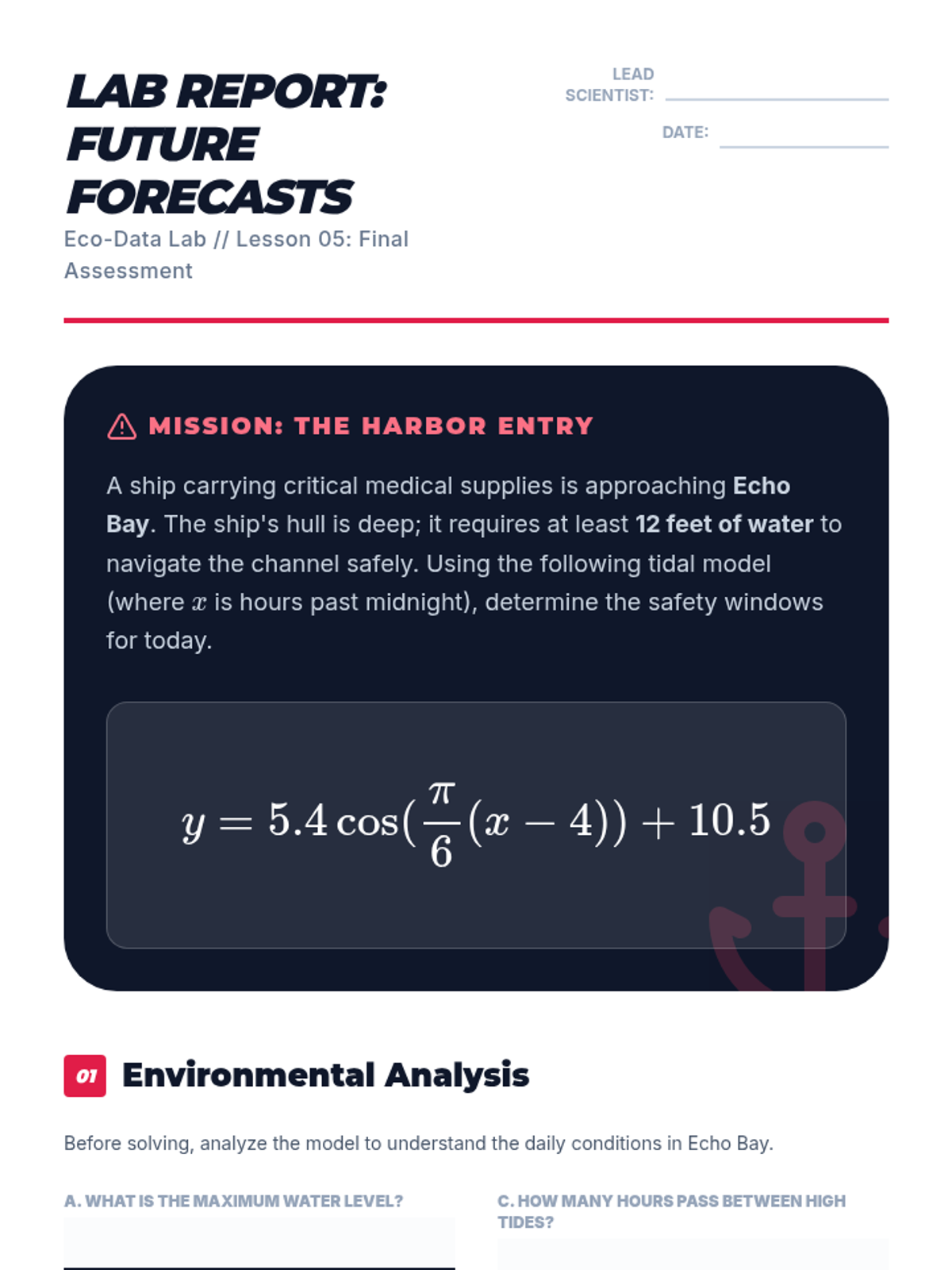
A student worksheet for Lesson 5, guiding students through a scenario-based challenge where they must use a provided trigonometric tidal model to determine safe entry windows for a ship based on depth requirements.
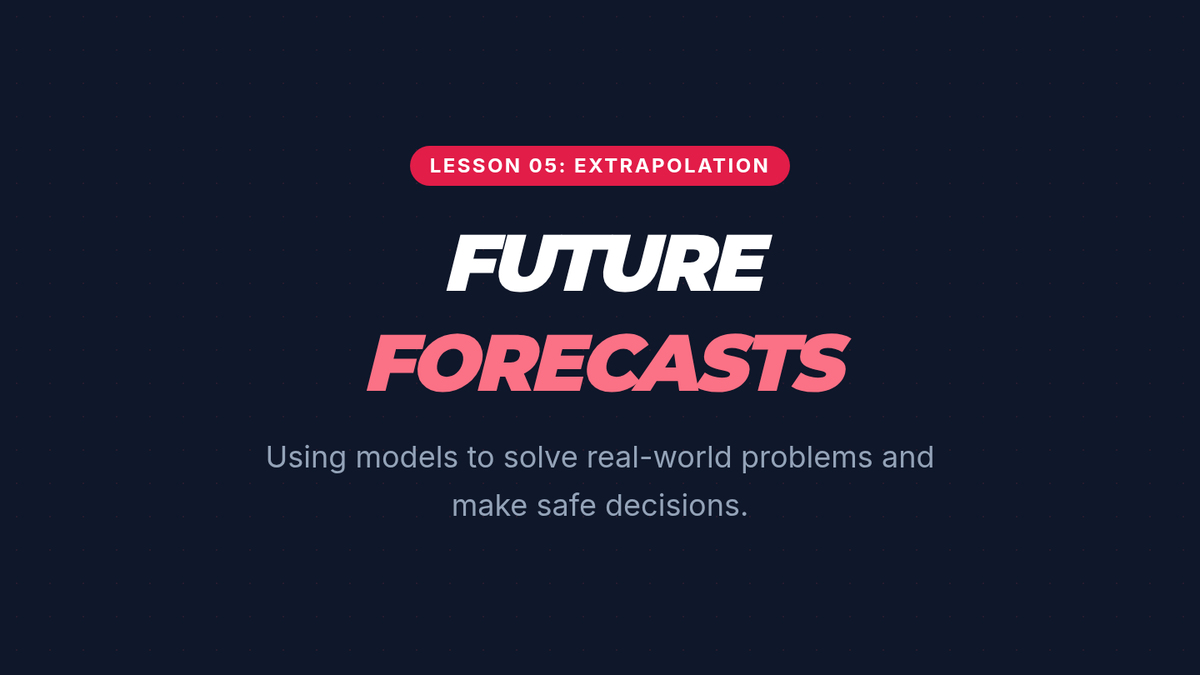
An instructional slide deck for Lesson 5, focusing on extrapolation and solving trigonometric inequalities graphically in the context of an environmental scenario.
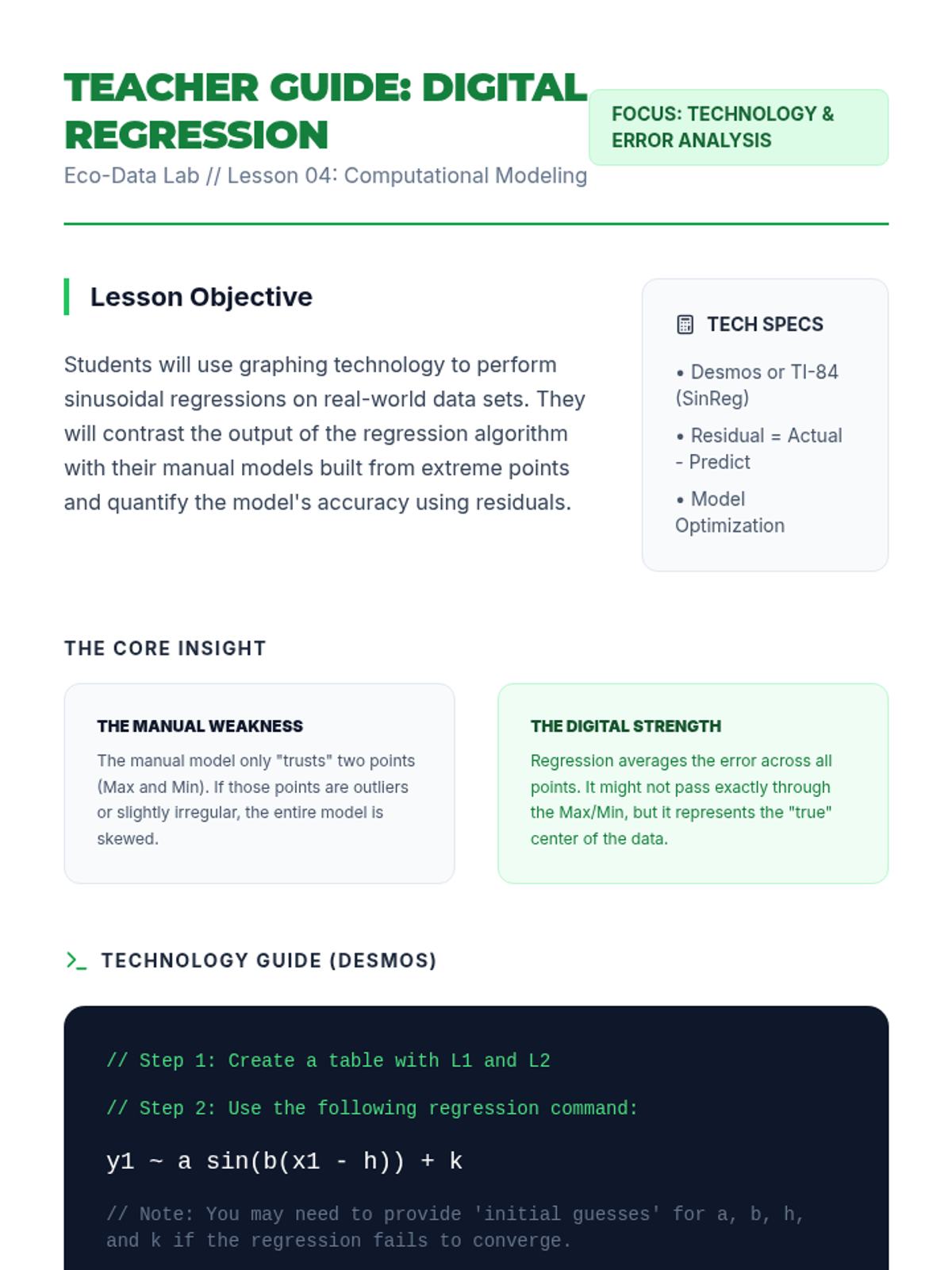
A teacher guide for Lesson 4, explaining technology regression tools, comparing manual models to computational ones, and the concept of residuals.
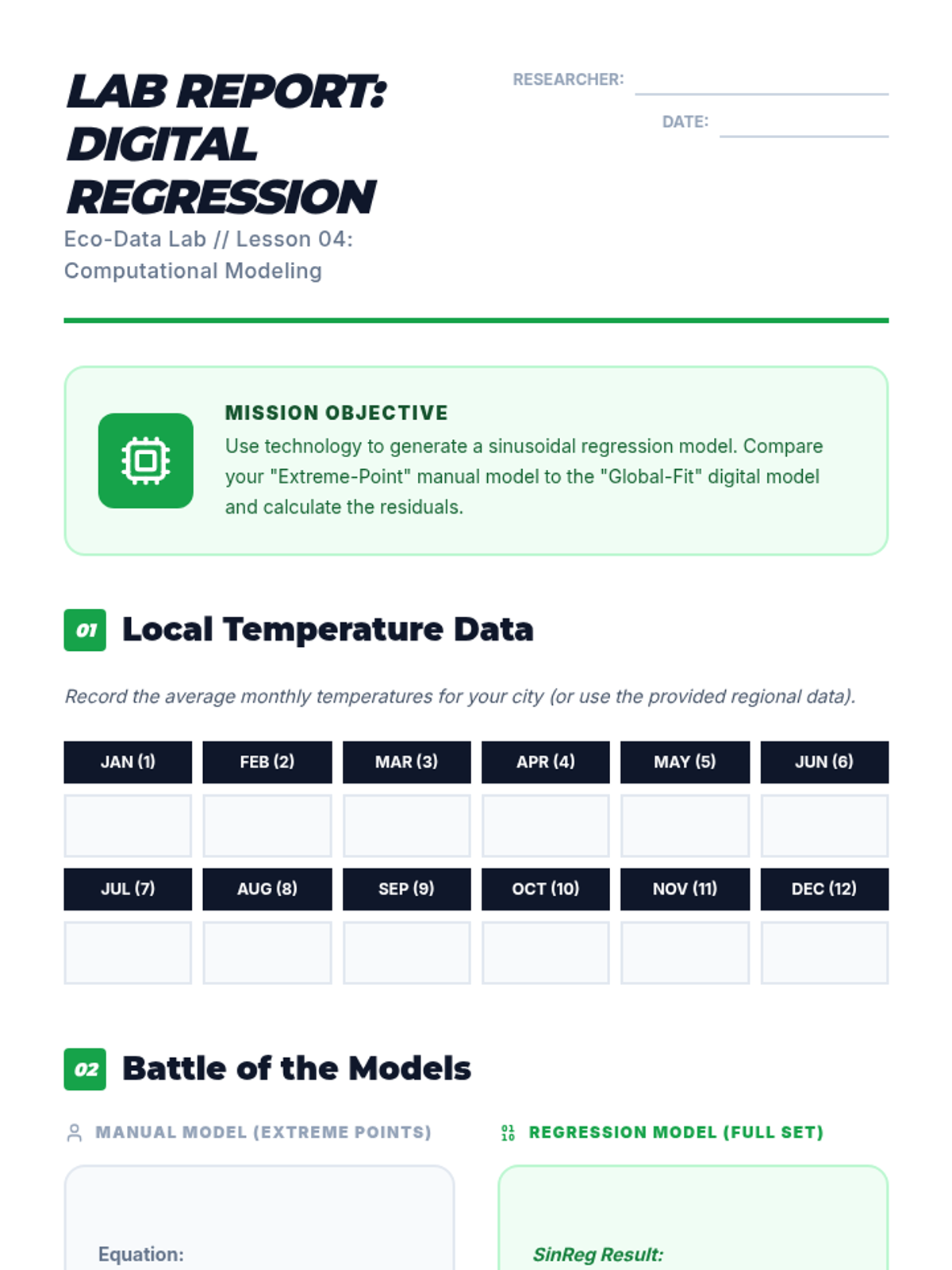
A student worksheet for Lesson 4, guiding students to enter their own local temperature data, run a sinusoidal regression, and compare it to their manual extreme-point model using residuals.
An instructional slide deck for Lesson 4, focusing on technology regression tools, comparing manual models to computational ones, and the concept of residuals.
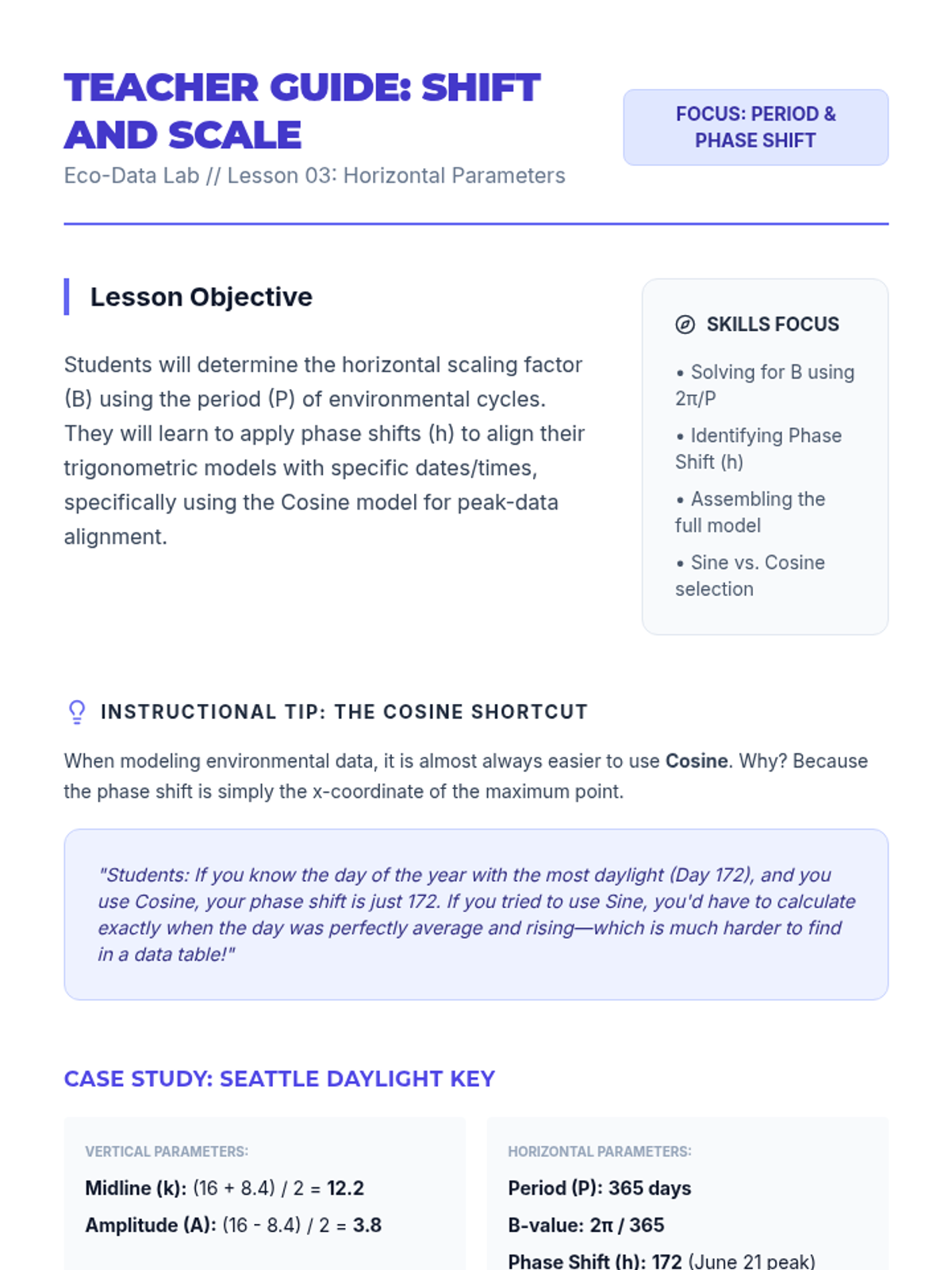
A teacher guide for Lesson 3, explaining the Seattle daylight model solution and providing instructional tips on the "Cosine shortcut" for environmental data.
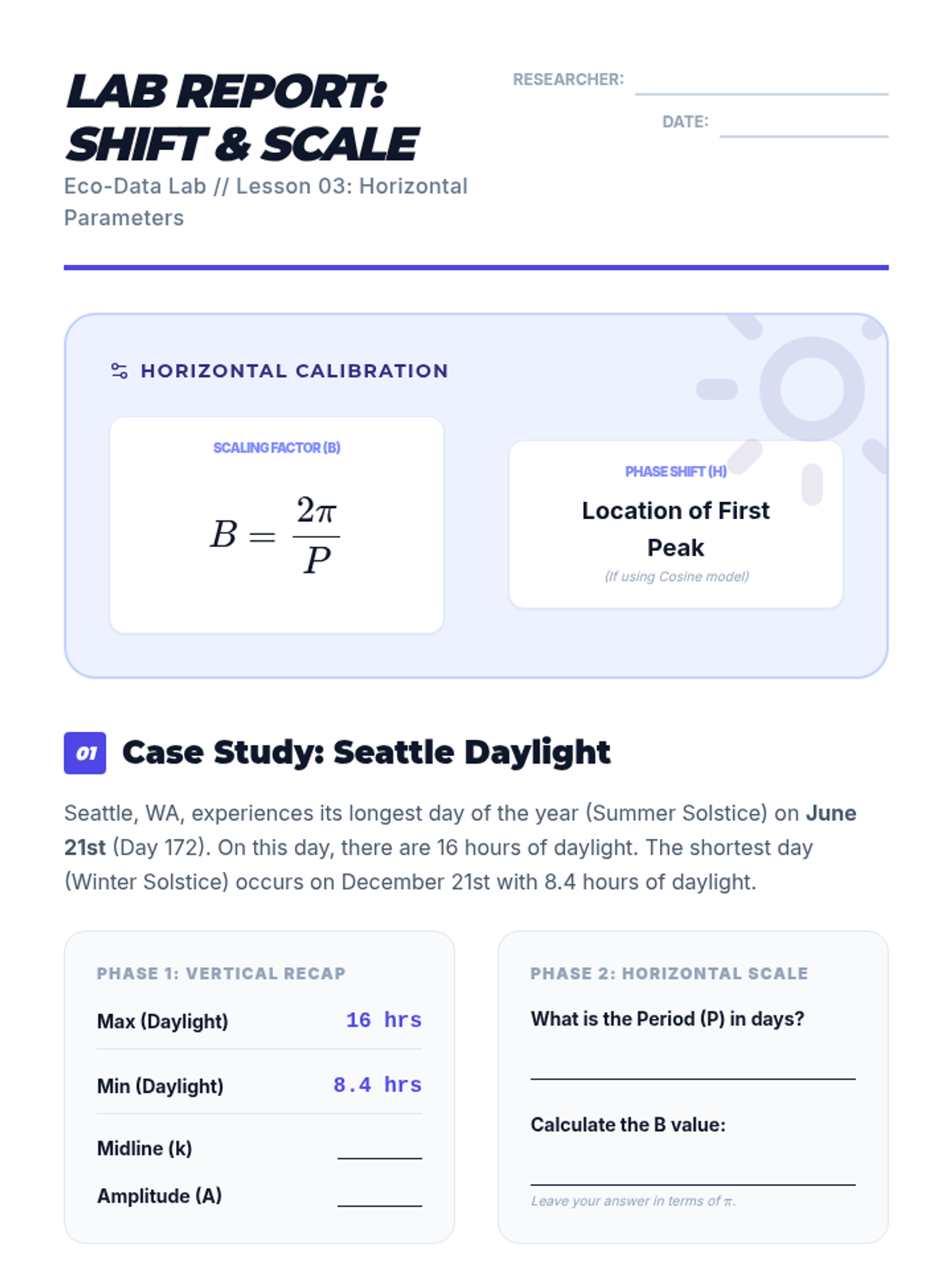
A student worksheet for Lesson 3, focusing on period (P) and phase shift (h) using Seattle daylight data. Students calculate B and h to assemble a complete cosine model.
An instructional slide deck for Lesson 3, focusing on period (P), the horizontal scaling factor (B = 2π/P), and phase shifts (h) in the context of environmental cycles.
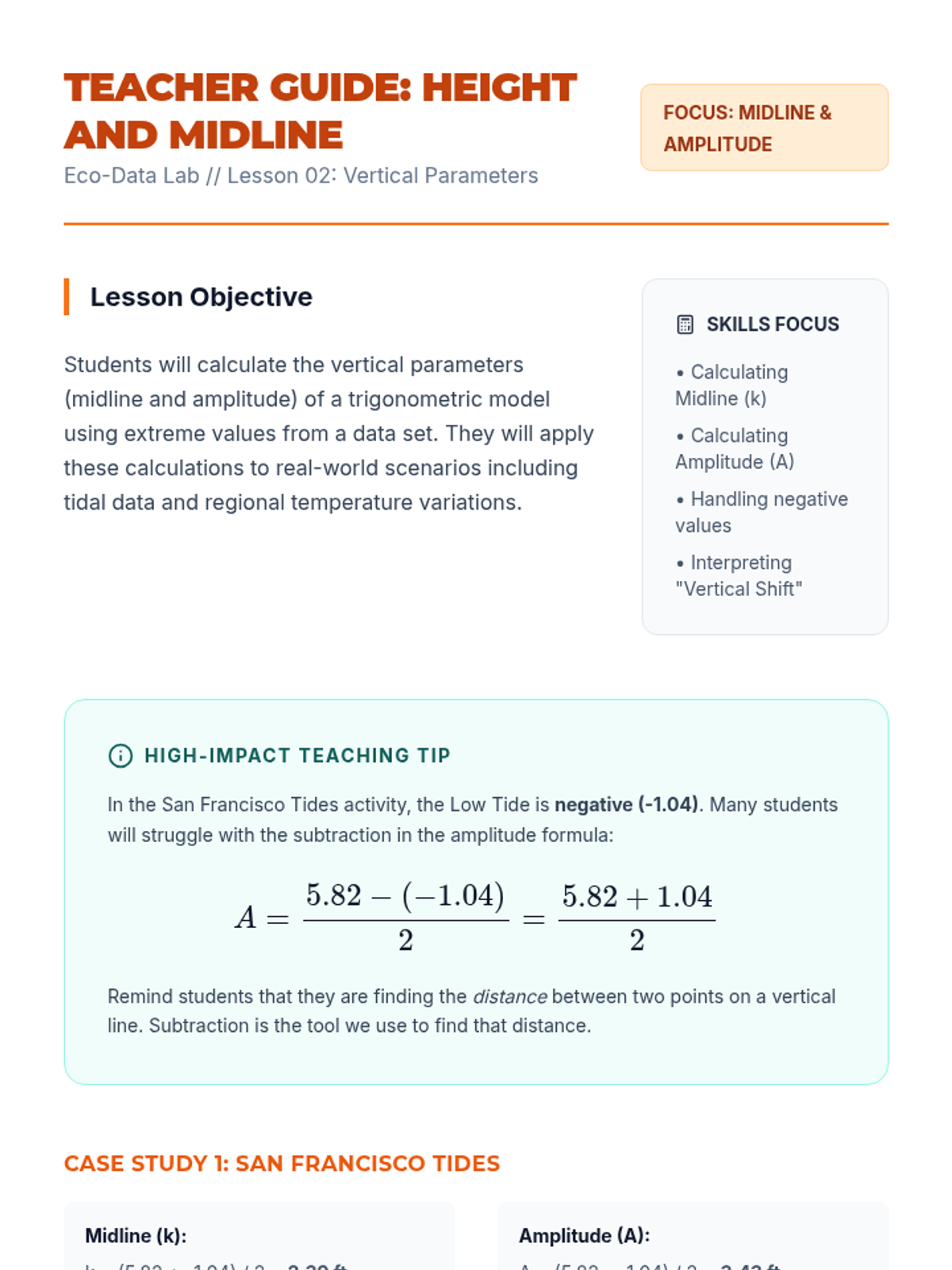
A teacher guide for Lesson 2, providing answer keys for the San Francisco tide data and regional temperature comparisons, along with instructional tips on handling negative values.
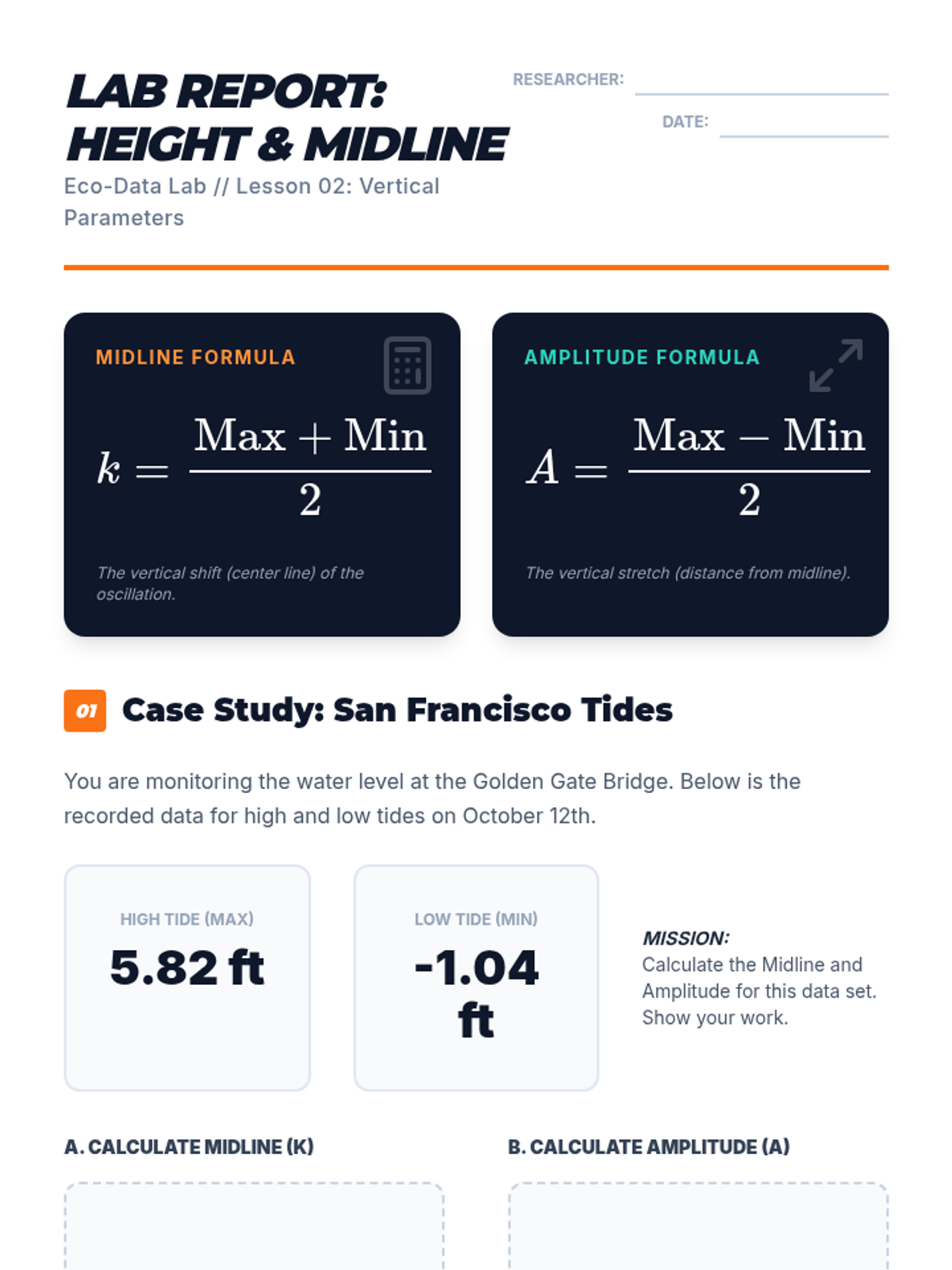
A student worksheet for Lesson 2, providing formulas and data sets for tides and temperatures. Students practice calculating midline and amplitude using given max and min values.
An instructional slide deck for Lesson 2, defining the midline (vertical shift) and amplitude (vertical stretch) formulas and how they apply to environmental data.
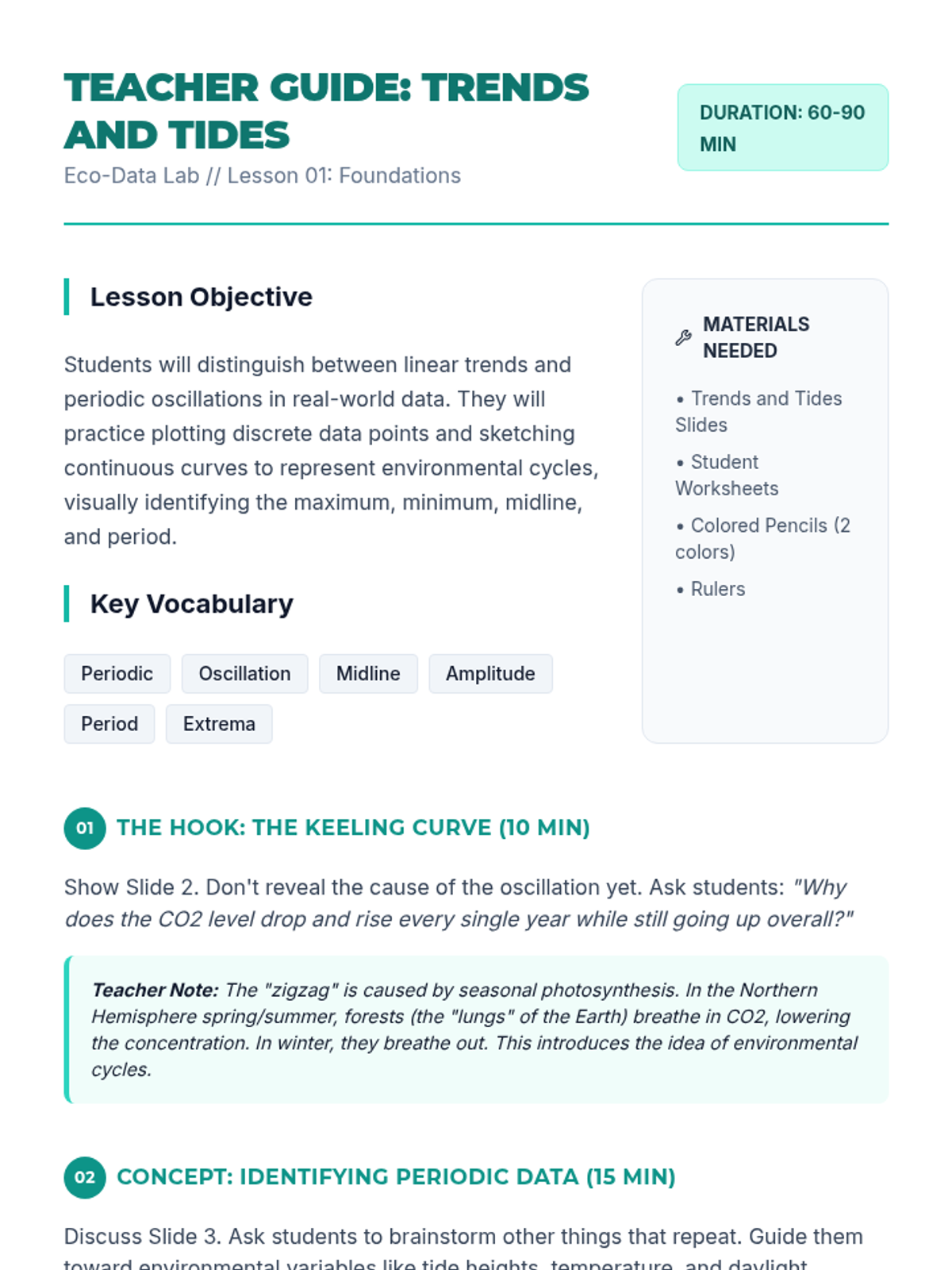
A comprehensive teacher guide for Lesson 1, including the lesson objective, delivery script, common misconceptions, and expected results for the Fairbanks temperature activity.
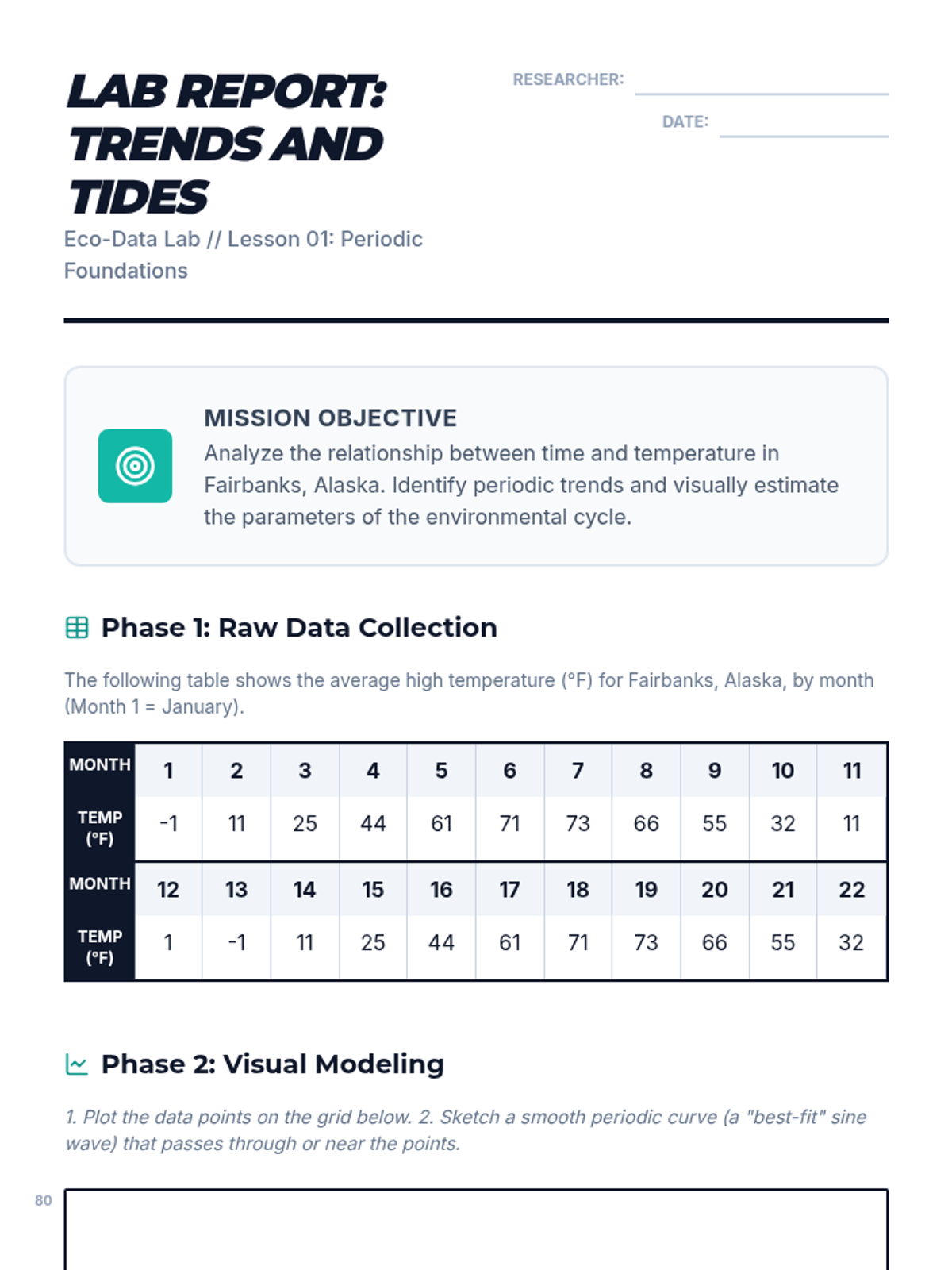
A student worksheet for Lesson 1, featuring a data table for Fairbanks, Alaska temperature and a large plotting area for sketching periodic curves. Includes analysis questions on max/min, midline, and period.
An introductory slide deck for Lesson 1, covering the concept of periodic data, identifying trends versus oscillations, and defining the basic anatomy of a trigonometric curve.
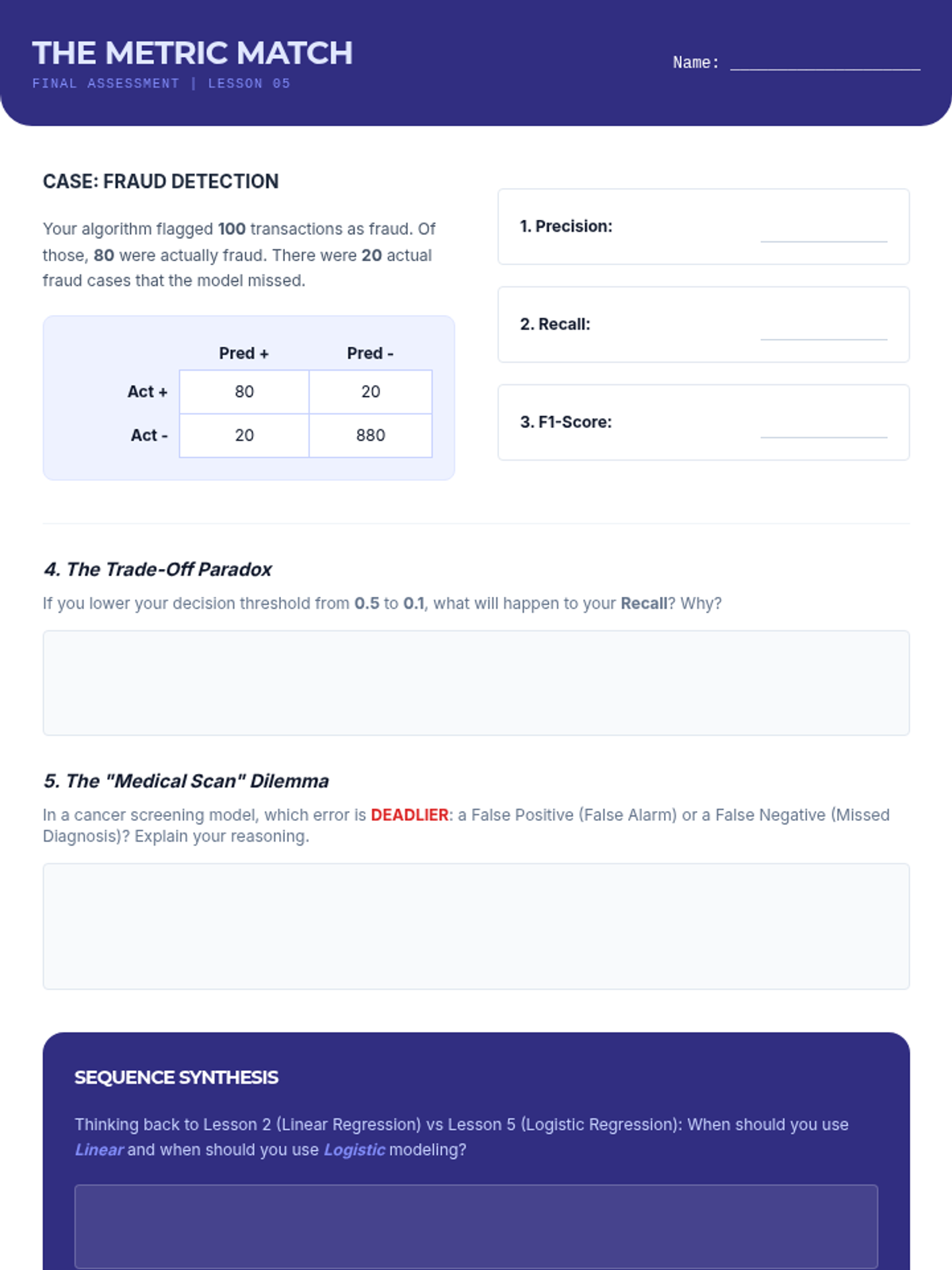
A final exit ticket assessing students' ability to calculate classification metrics and understand the trade-offs in logistic regression modeling.
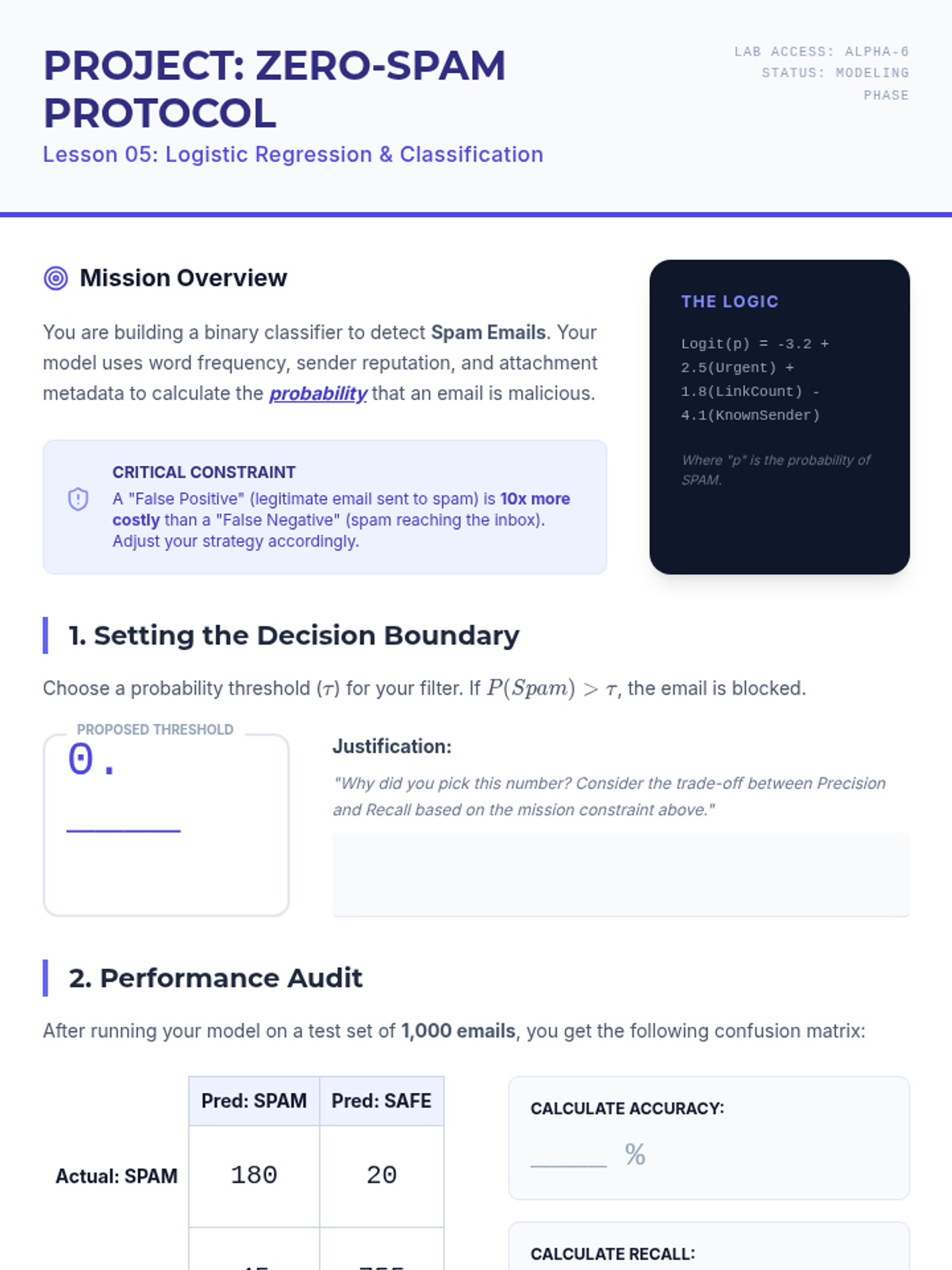
A project-based worksheet where students build and evaluate a spam filter using logistic regression, focusing on decision thresholds and confusion matrix metrics.
Introductory slides for Lesson 5, explaining logistic regression, the sigmoid function, decision thresholds, and the confusion matrix with a futuristic indigo and slate theme.
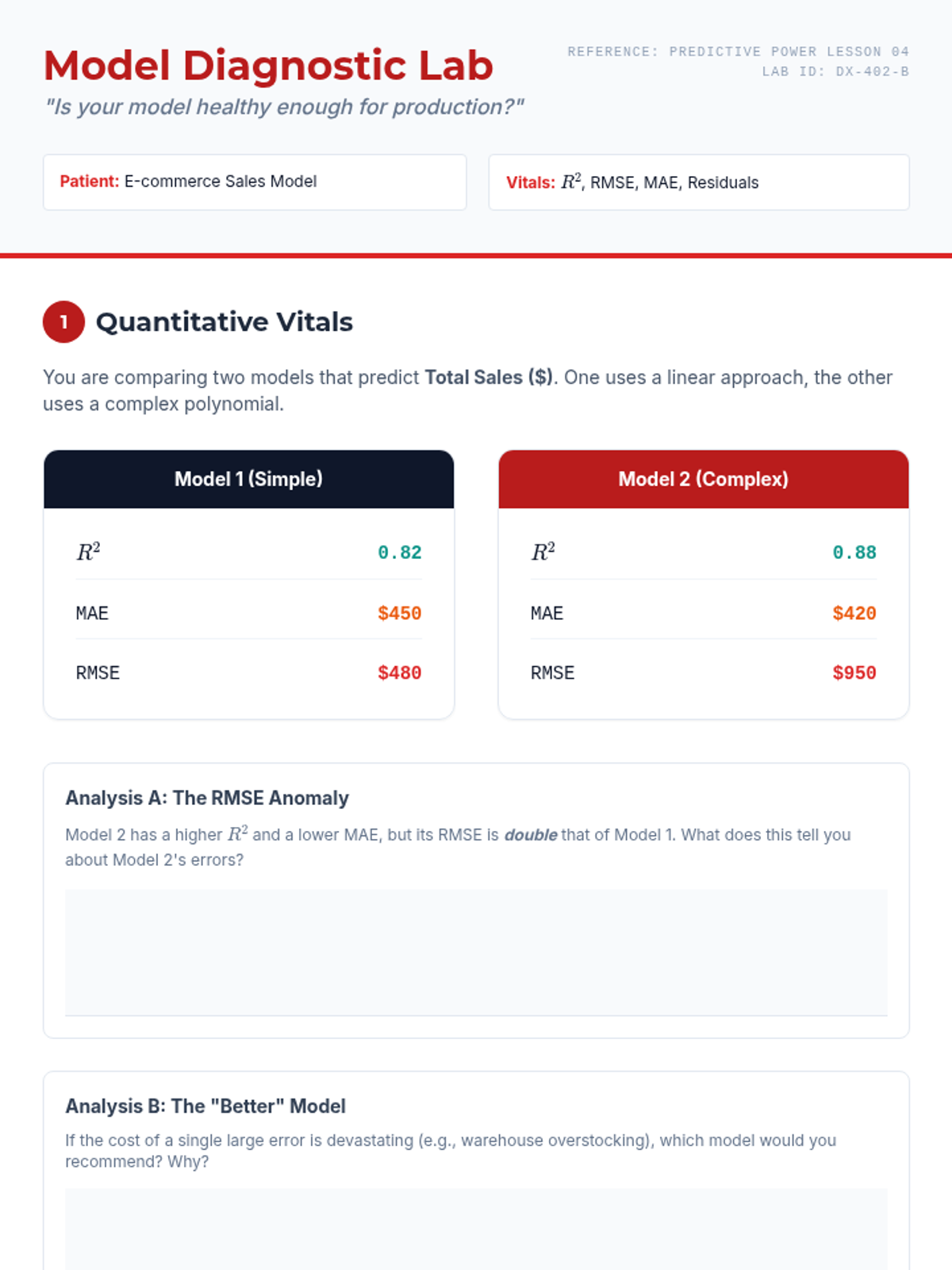
A lab worksheet for Lesson 4 where students compare model metrics (R-squared, MAE, RMSE) and identify violations of OLS assumptions in residual plots.
Introductory slides for Lesson 4, explaining model evaluation metrics (R-squared, MAE, RMSE) and the LINE assumptions of regression with a diagnostic "medical" theme.
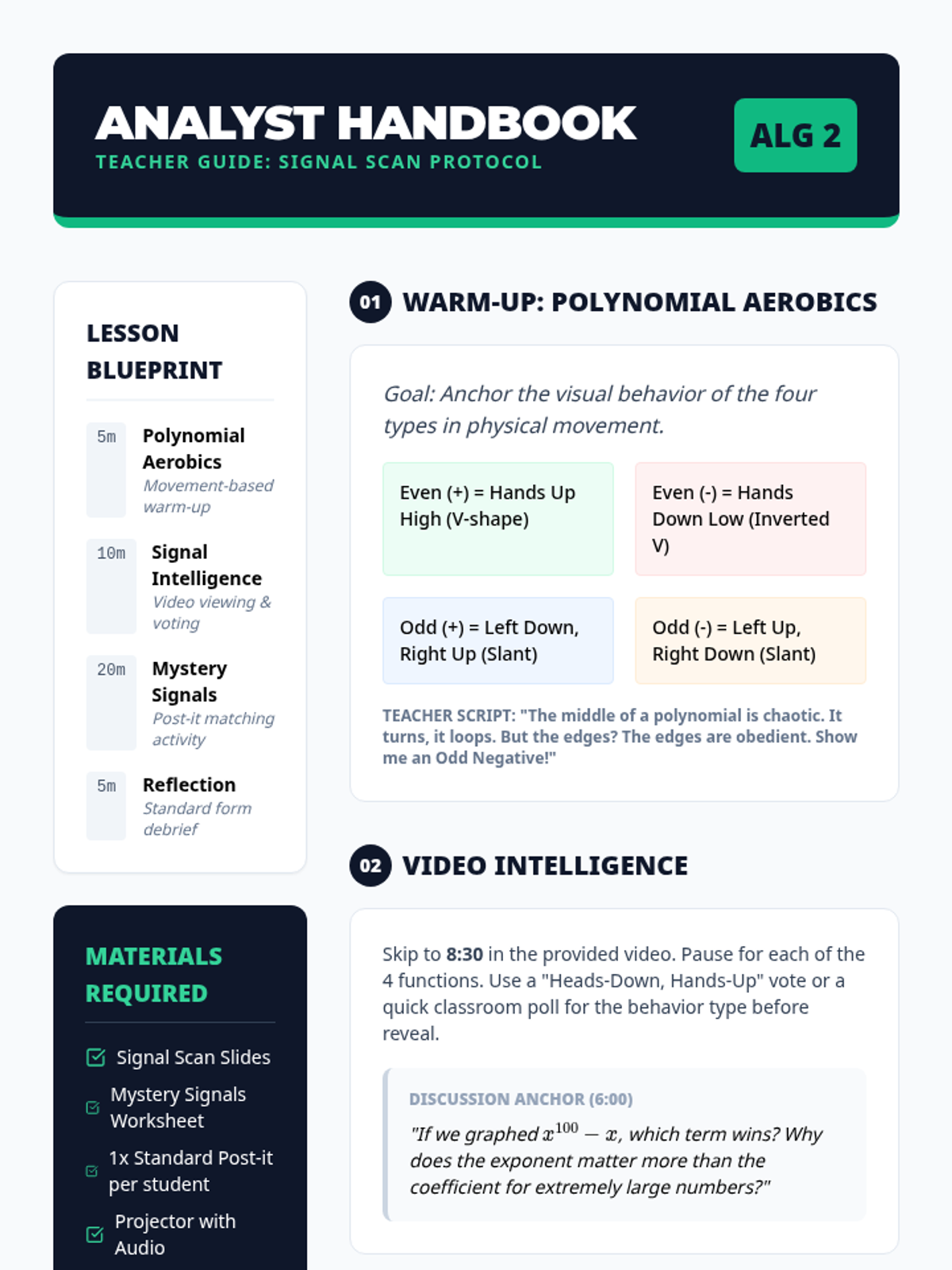
Teacher's facilitation guide for the 'Signal Scan' lesson. Includes time breakdown, aerobics movements, video pause point questions, and a complete answer key for the Mystery Signal worksheet.
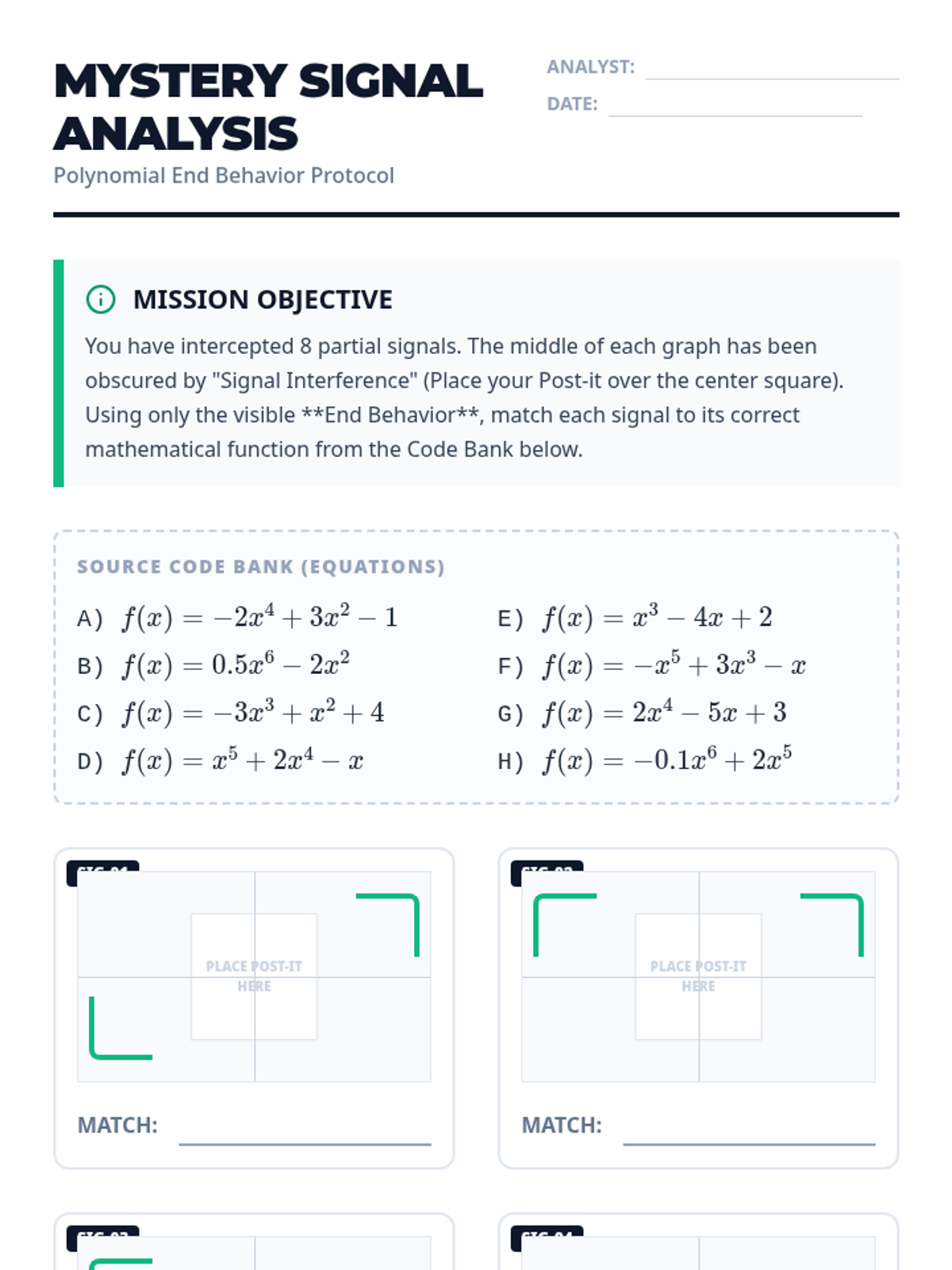
Worksheet for the 'Mystery Signal' activity where students match obscured polynomial graphs to their equations based on end behavior. Includes a reflection section on non-standard form polynomials.
Visual slide deck for a lesson on polynomial end behavior, including 'Polynomial Aerobics' visual cues, an embedded instructional video, a summary table of the Leading Coefficient Test, and activity instructions.
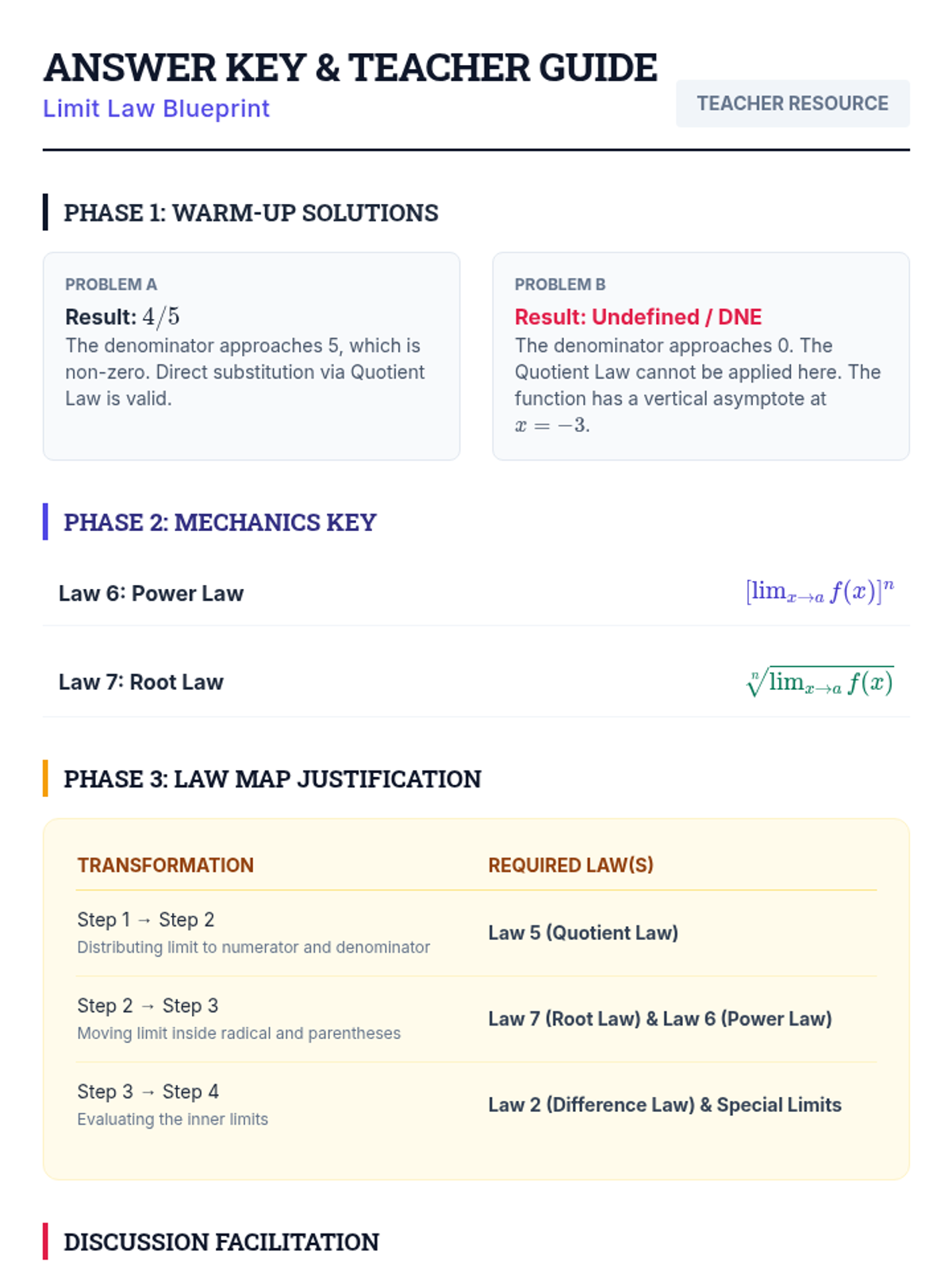
An answer key and teaching guide for the 'Limit Law Blueprint' lesson, providing solutions to the warm-up, video notes, Law Map transformations, and discussion prompts.