Mapping relationships through notation, algebraic representations, and growth rate comparisons. Equips learners to transform functions, model contextual data, and solve exponential equations.
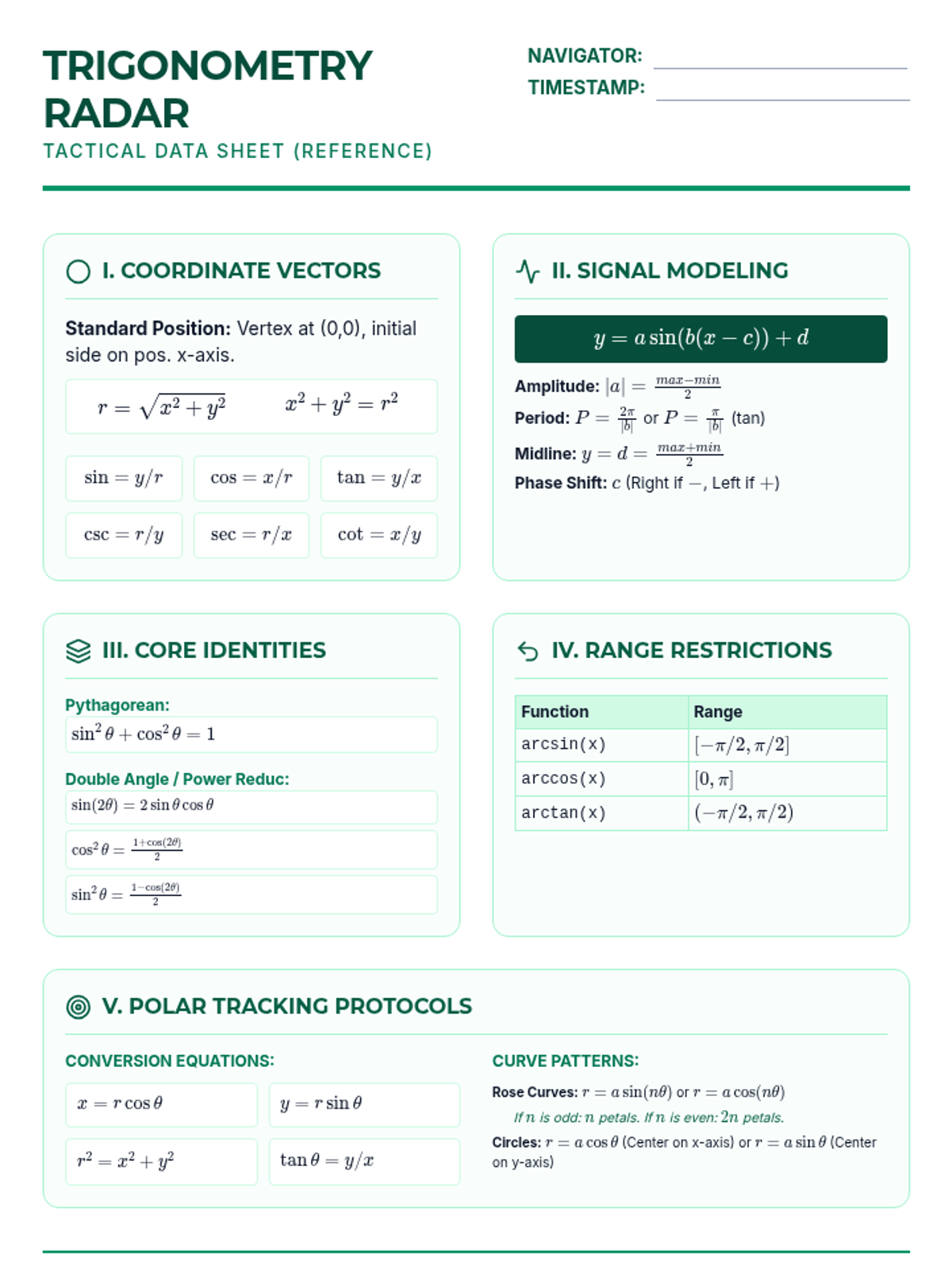
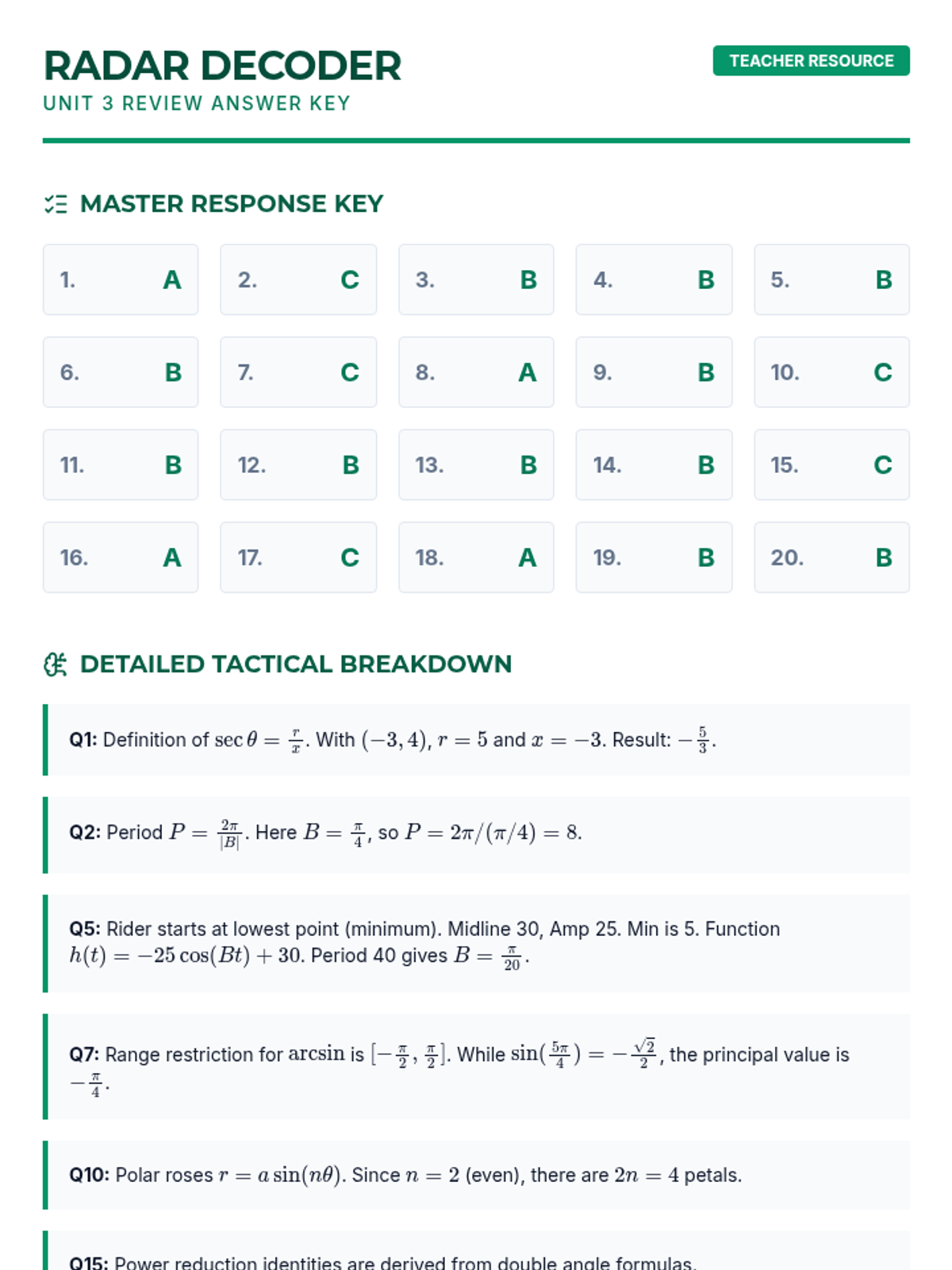
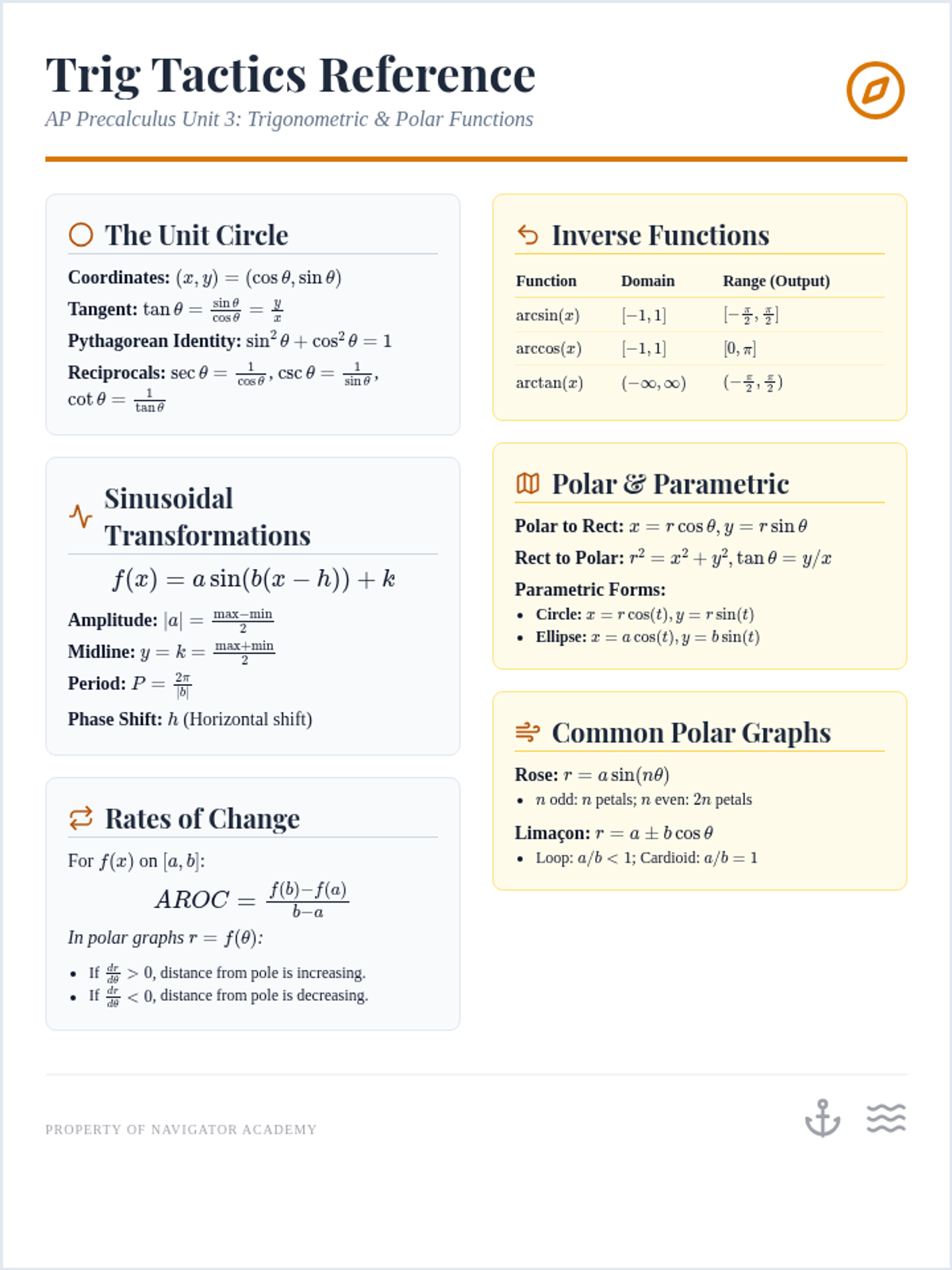
A high-intensity review session for AP Precalculus Unit 3, covering trigonometric functions, inverse functions, and polar coordinates through a "Radar Tech" thematic lens.
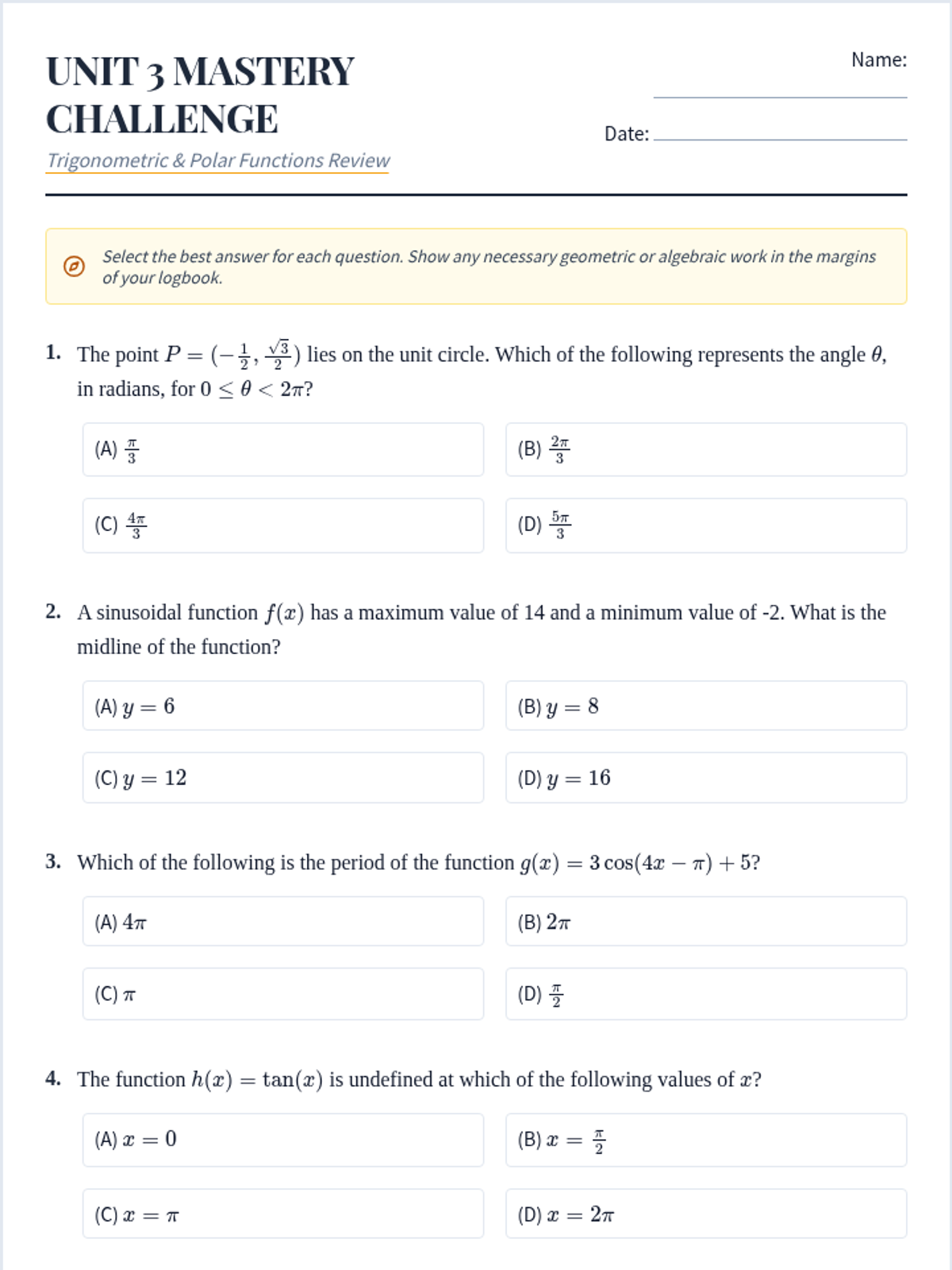
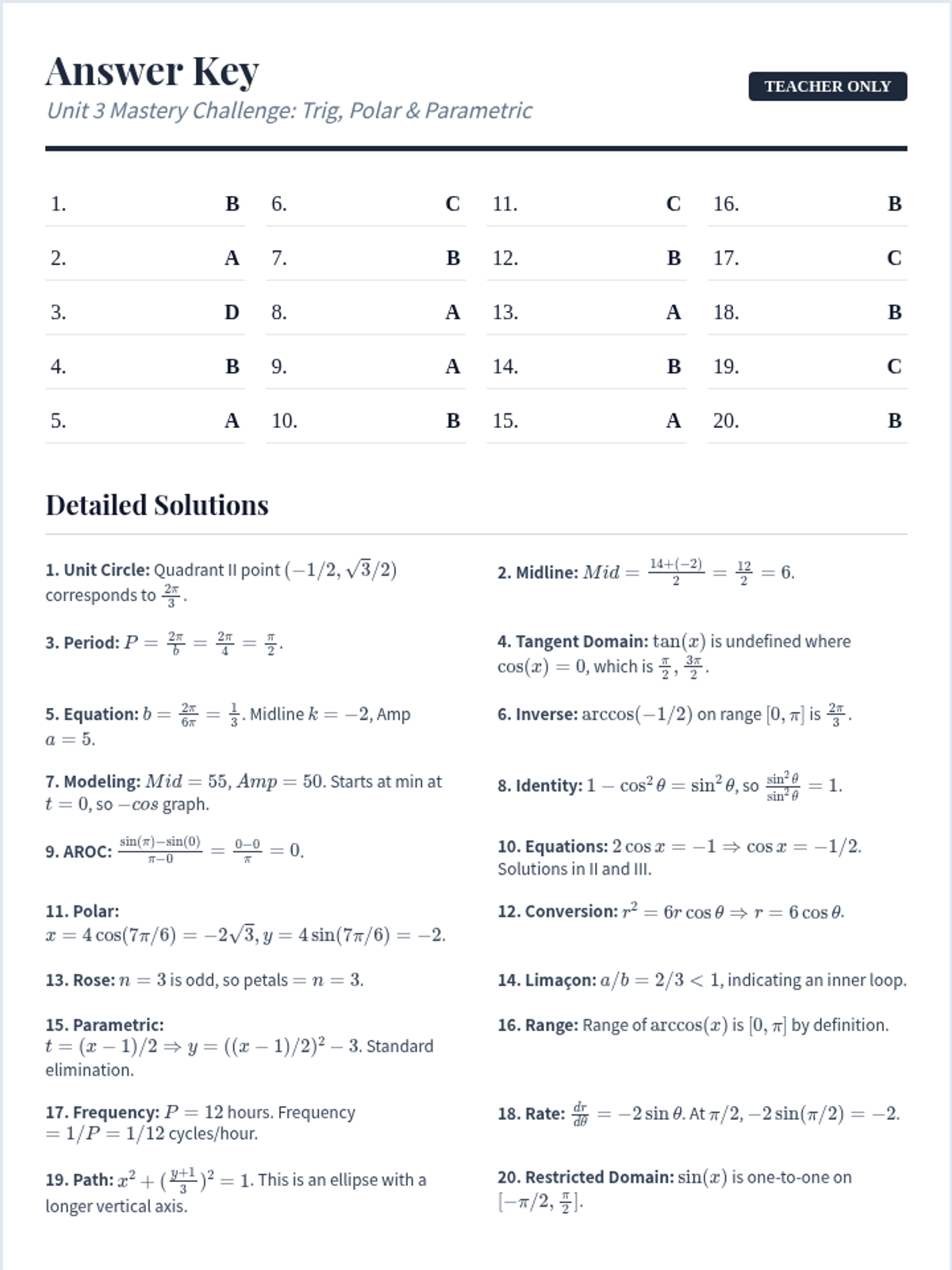
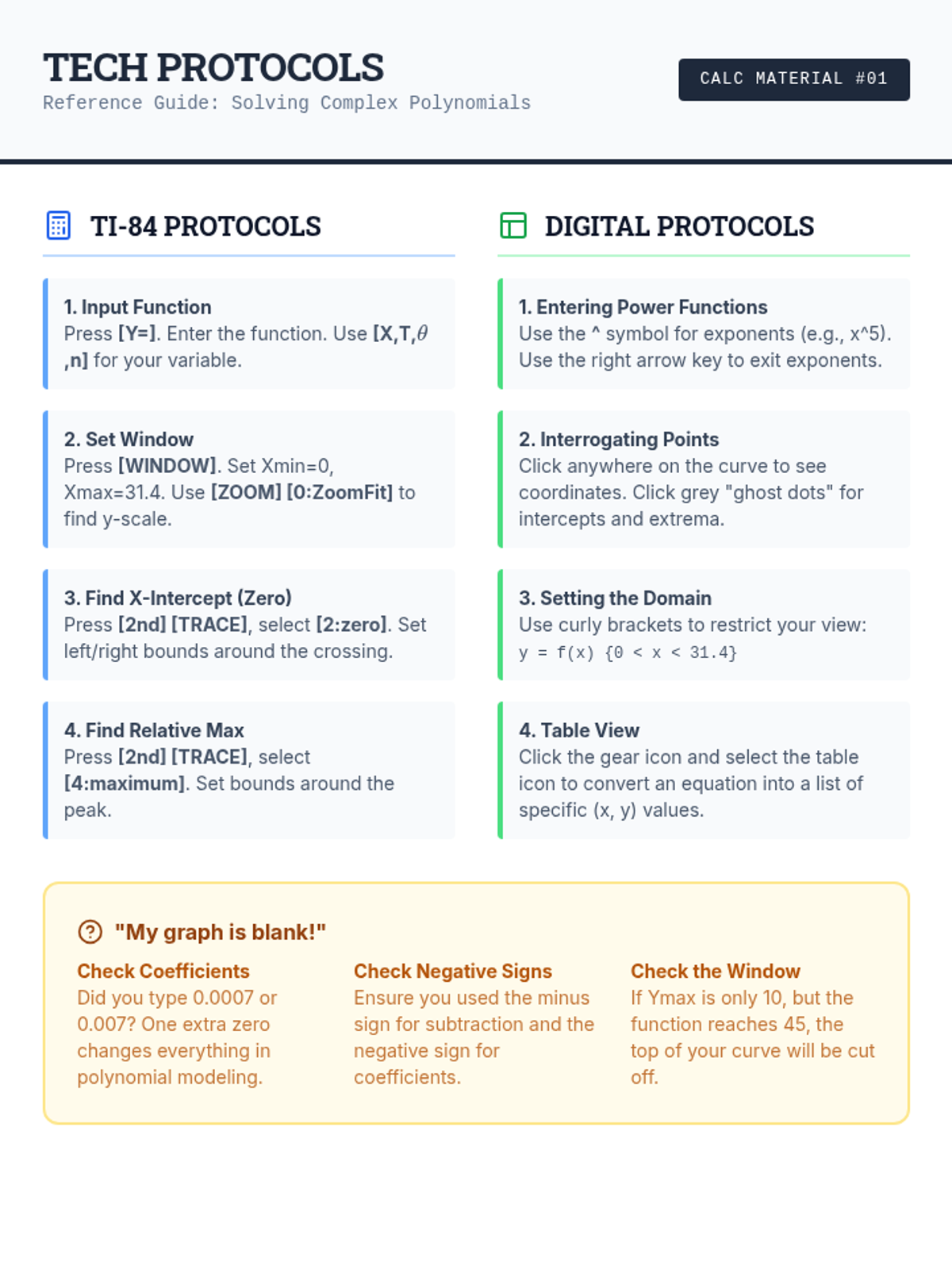
A comprehensive review for Unit 3 of AP Precalculus, focusing on trigonometric and polar functions through reference materials and practice assessments.
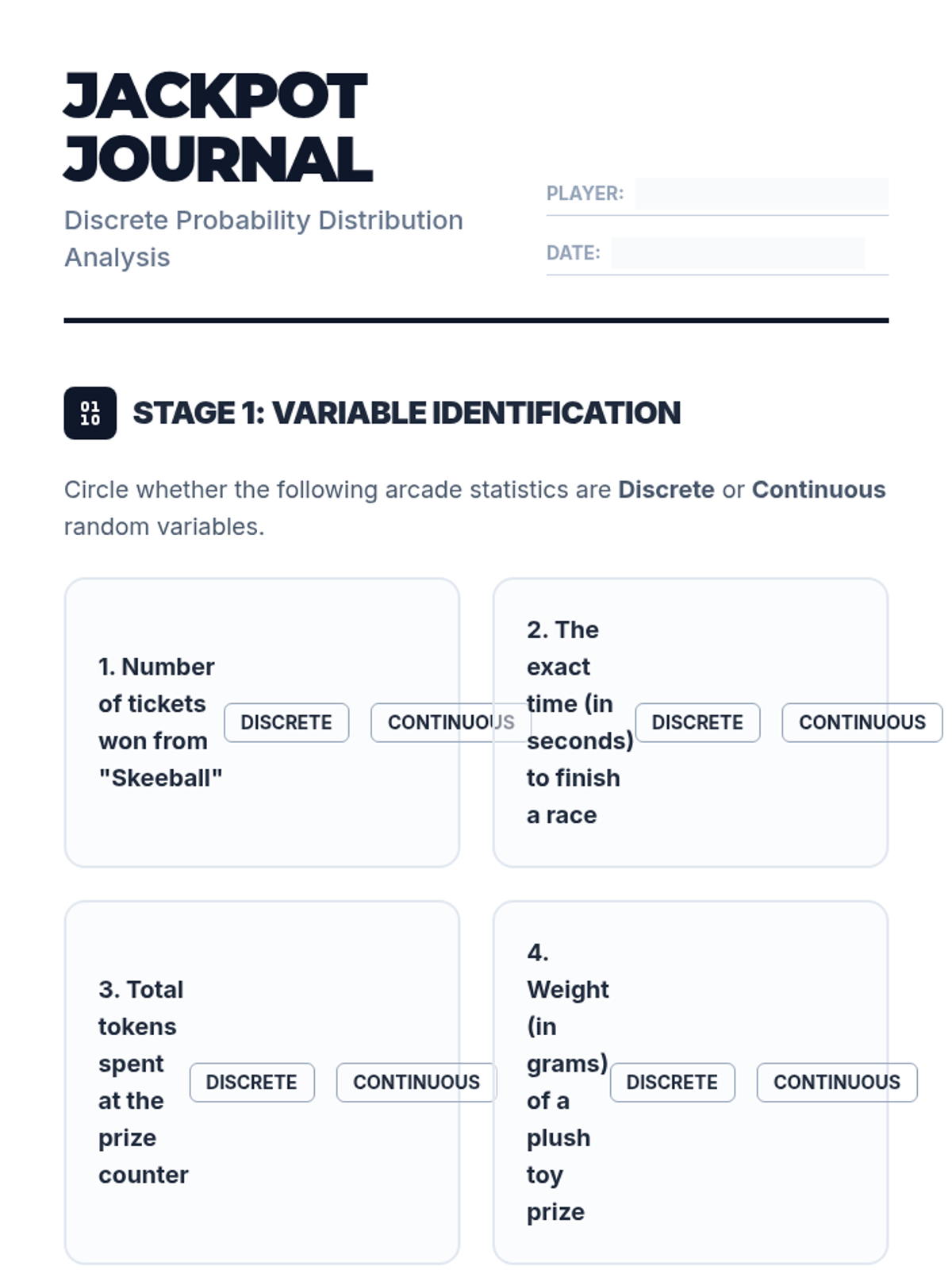
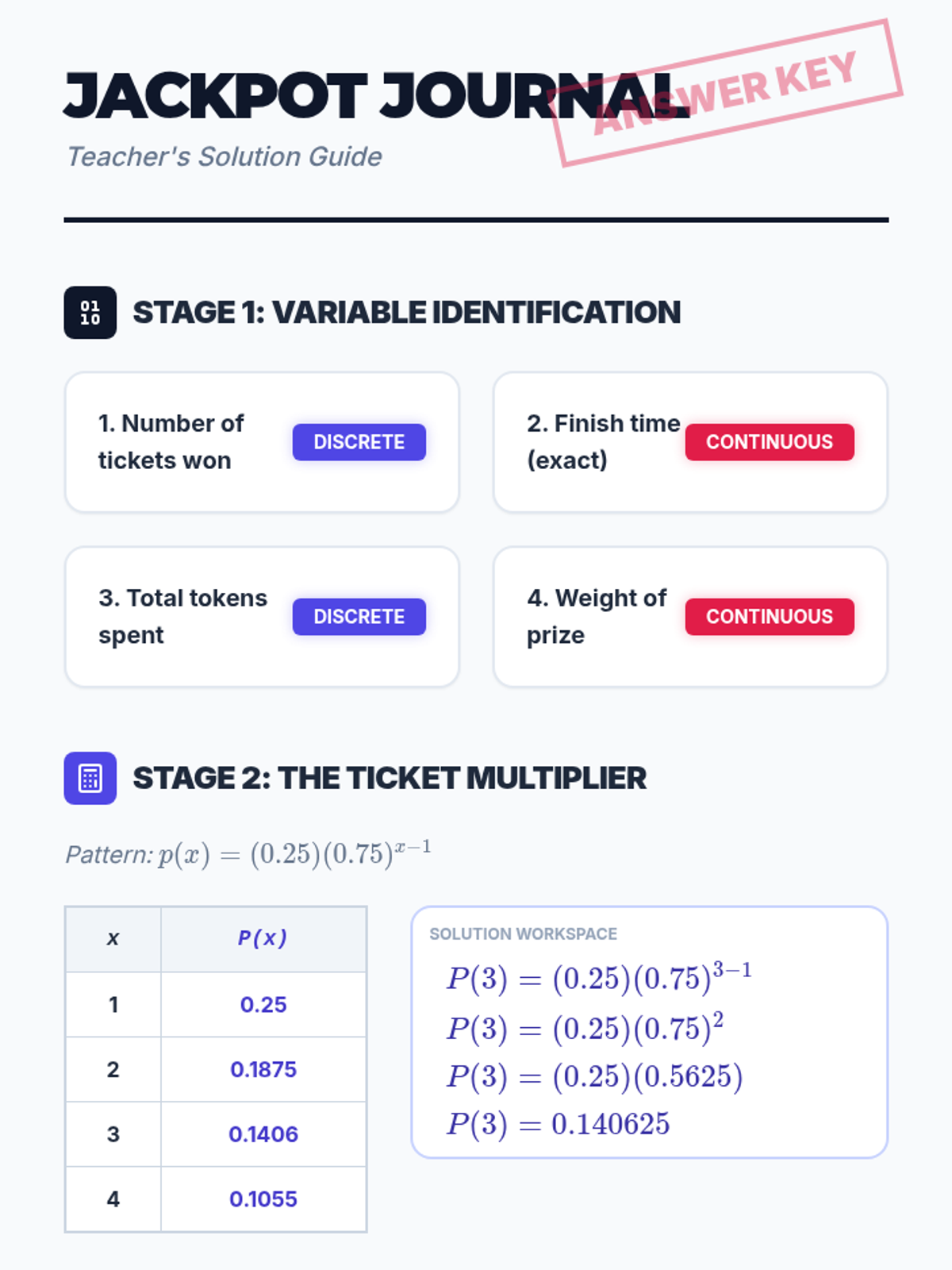
Students explore discrete probability distributions through the lens of arcade games and challenges, learning to model random events and calculate probabilities.
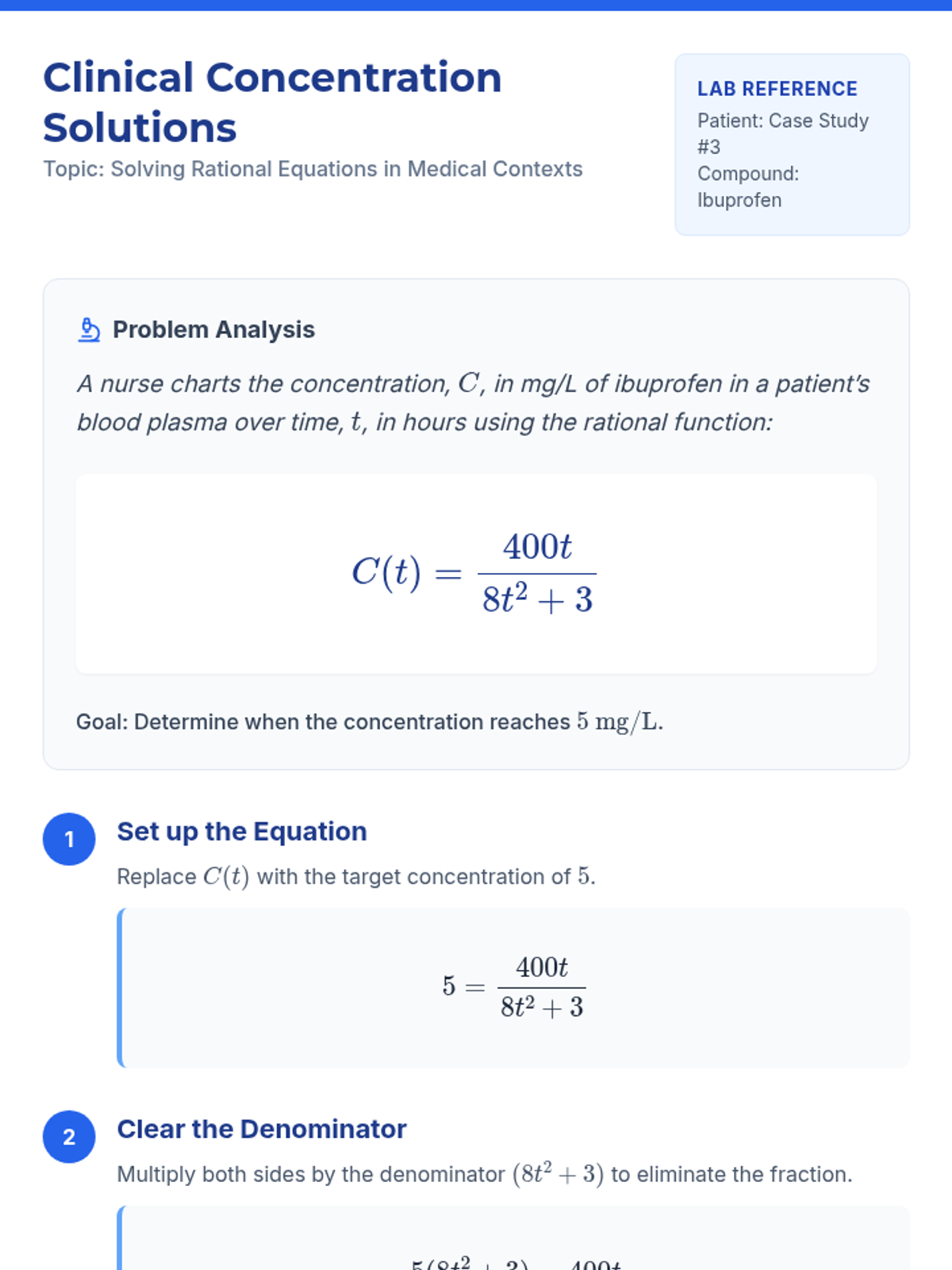
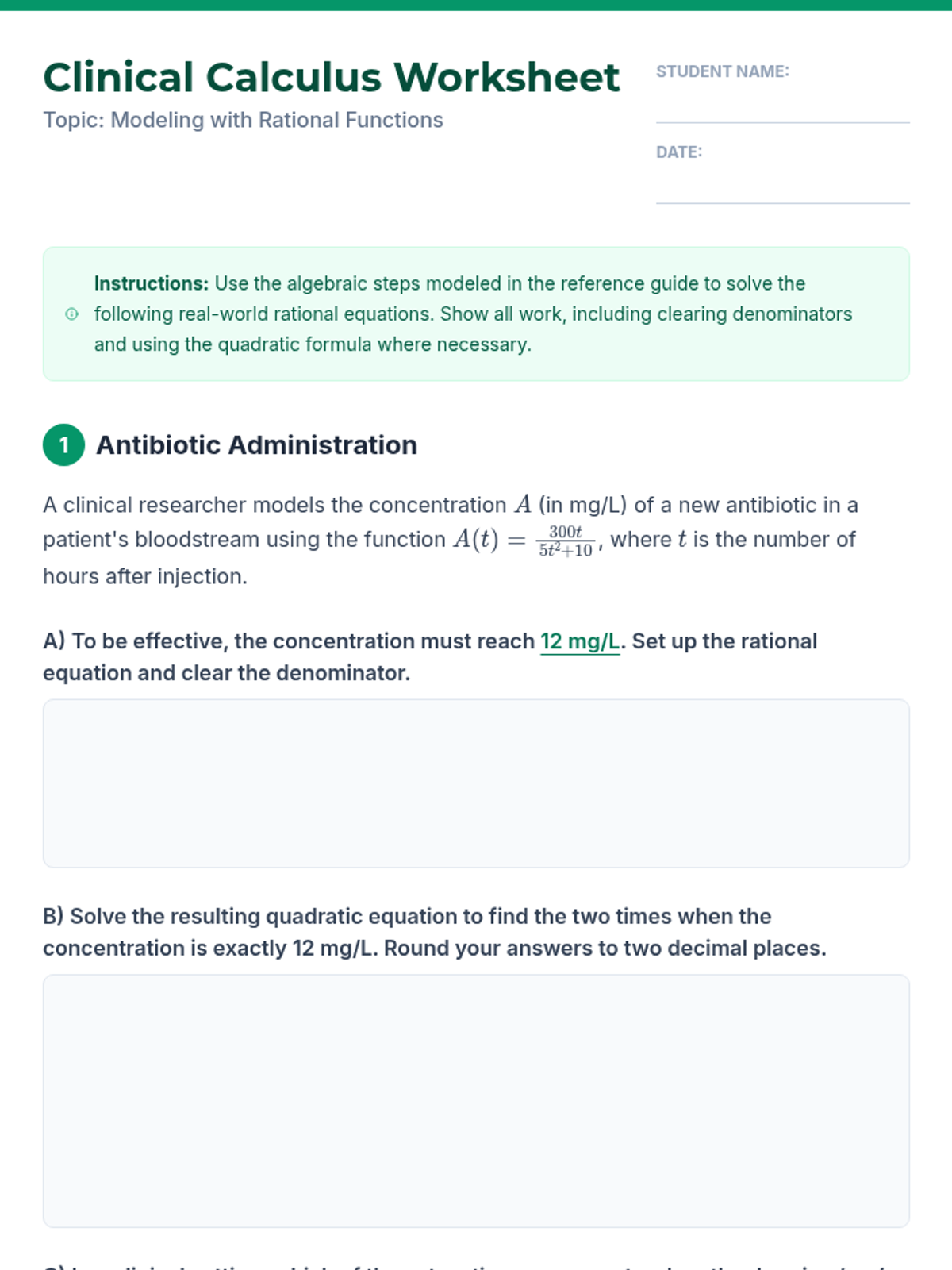
Master the art of solving real-world rational function equations, focusing on clinical drug concentration models and rate-based applications. Students will learn to translate verbal scenarios into rational equations and apply algebraic techniques to find precise solutions.
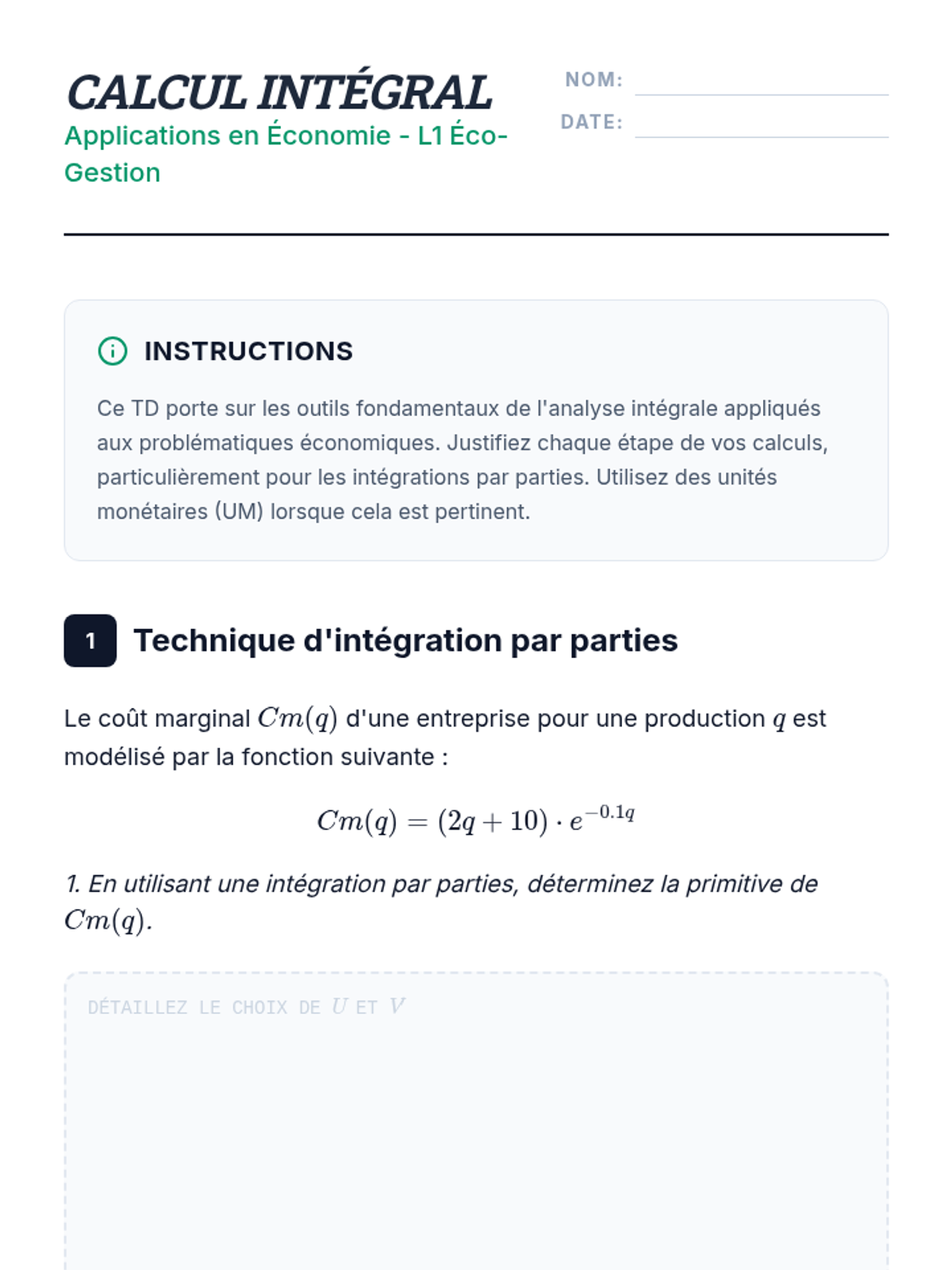
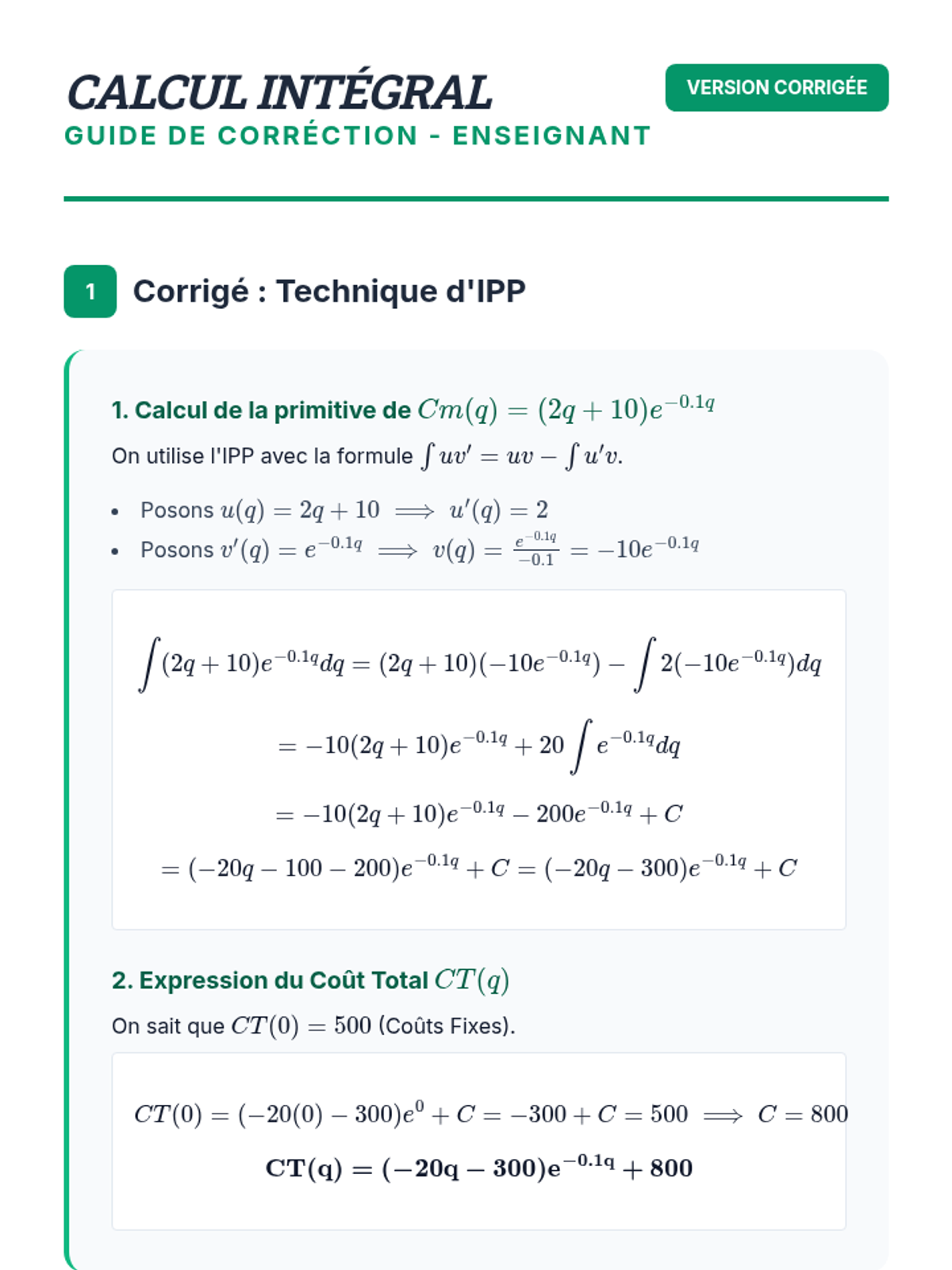
Une leçon complète sur le calcul intégral appliqué à l'économie, couvrant l'intégration par parties, l'indice de Gini et les surplus du consommateur et du producteur.
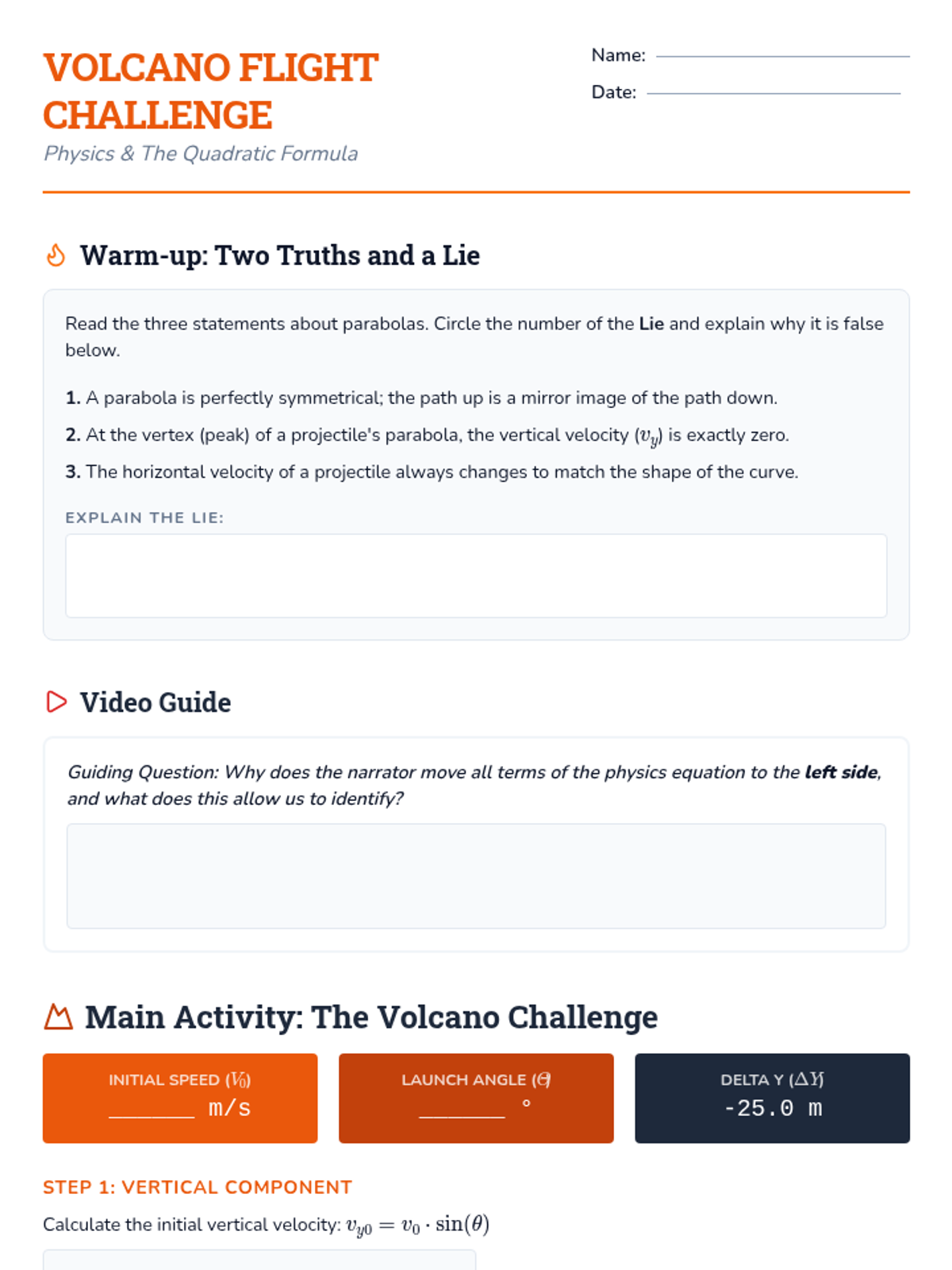
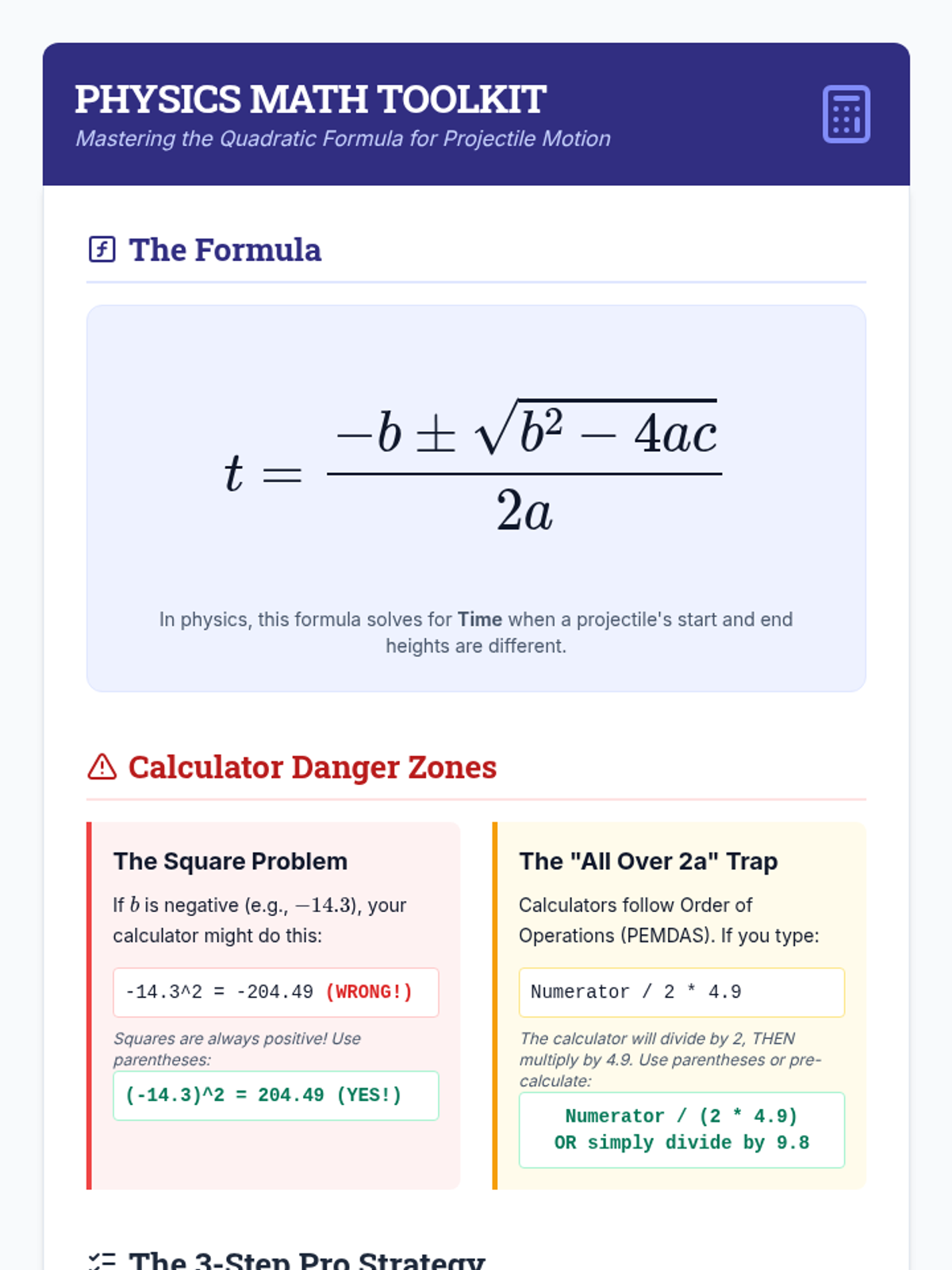
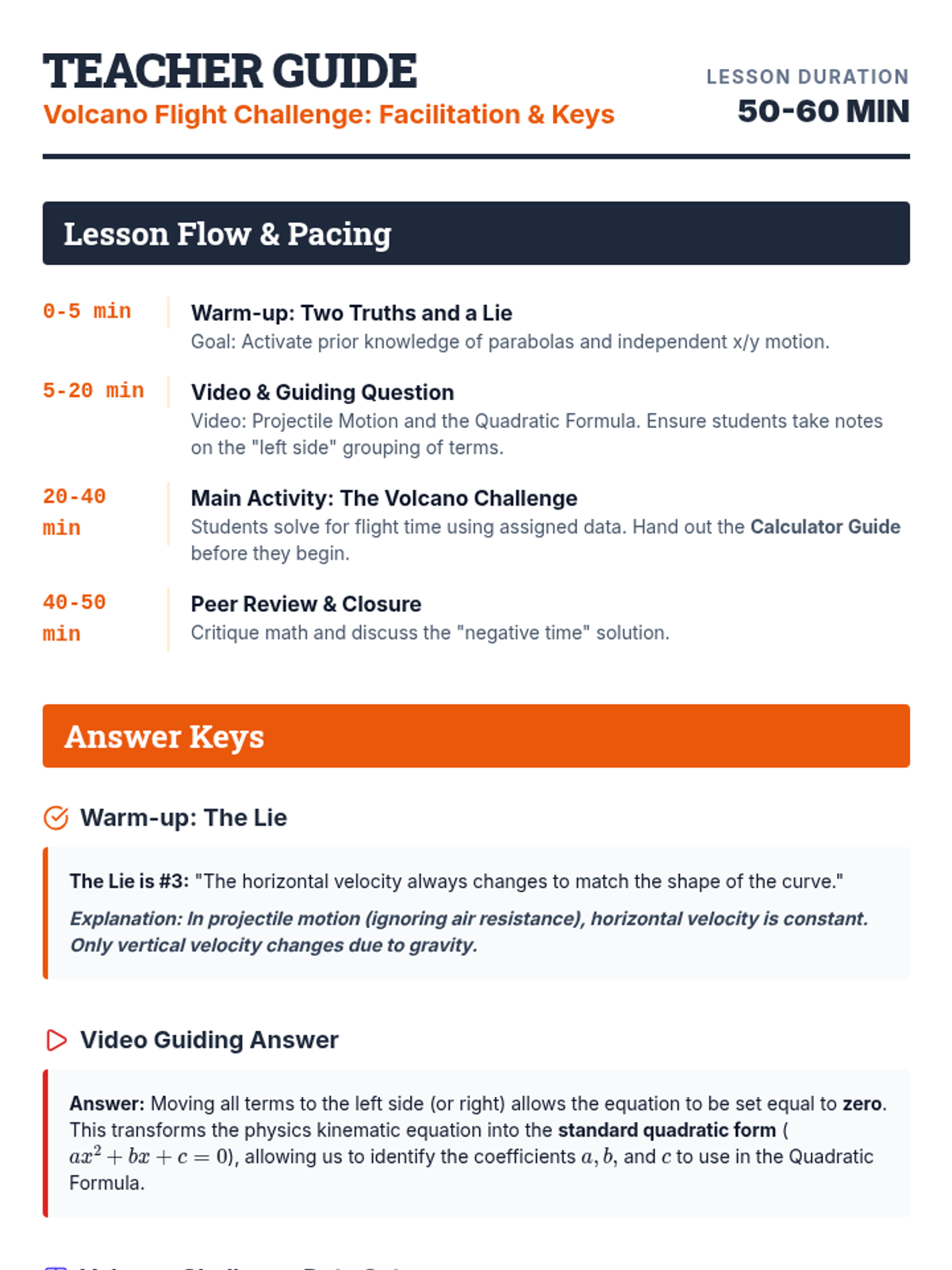
Students will master projectile motion by applying the quadratic formula to solve for flight time. The lesson uses a volcano-themed scenario to bridge abstract algebra with physical kinematics, including a deep dive into interpreting mathematical results like negative time.
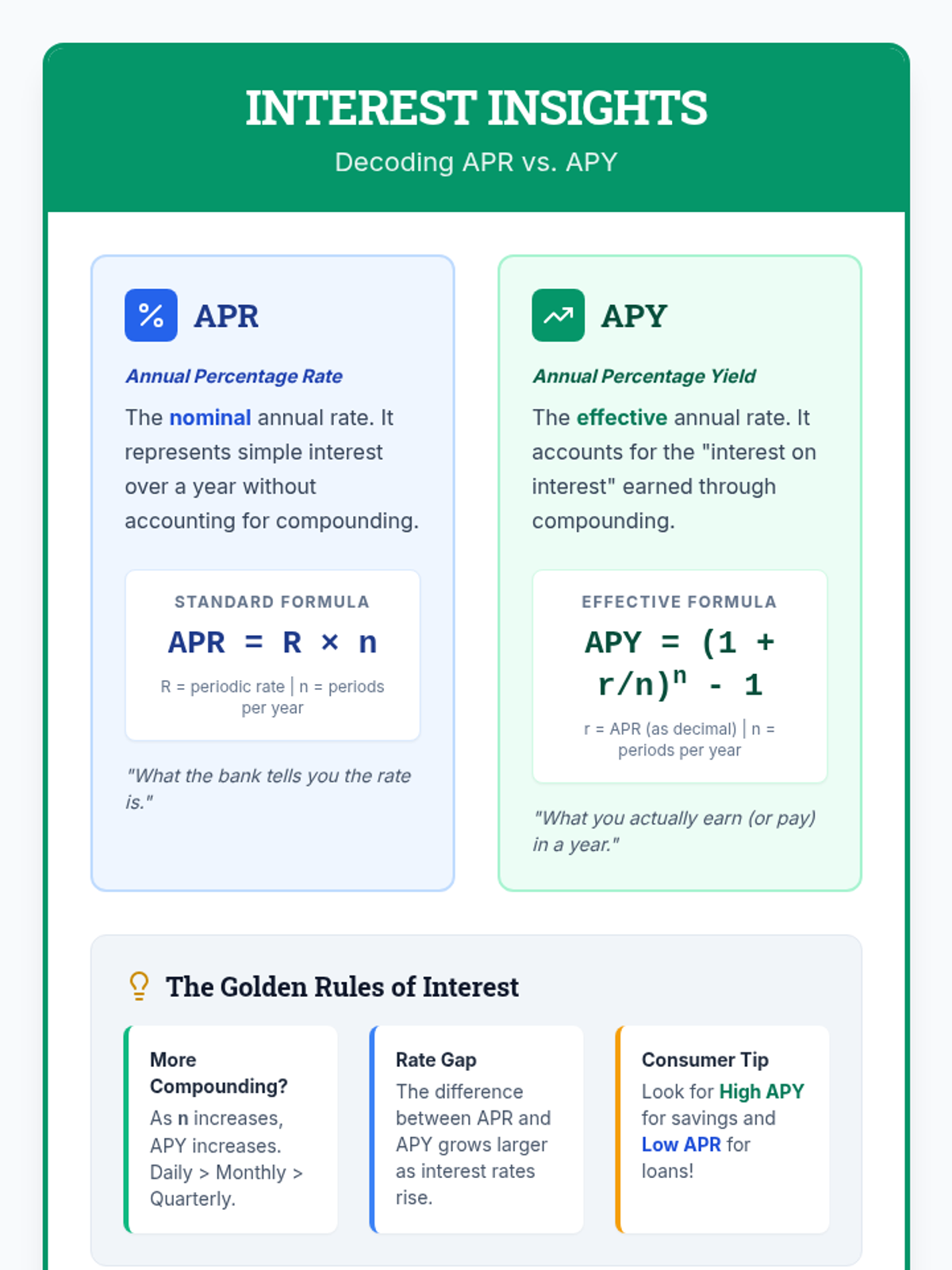
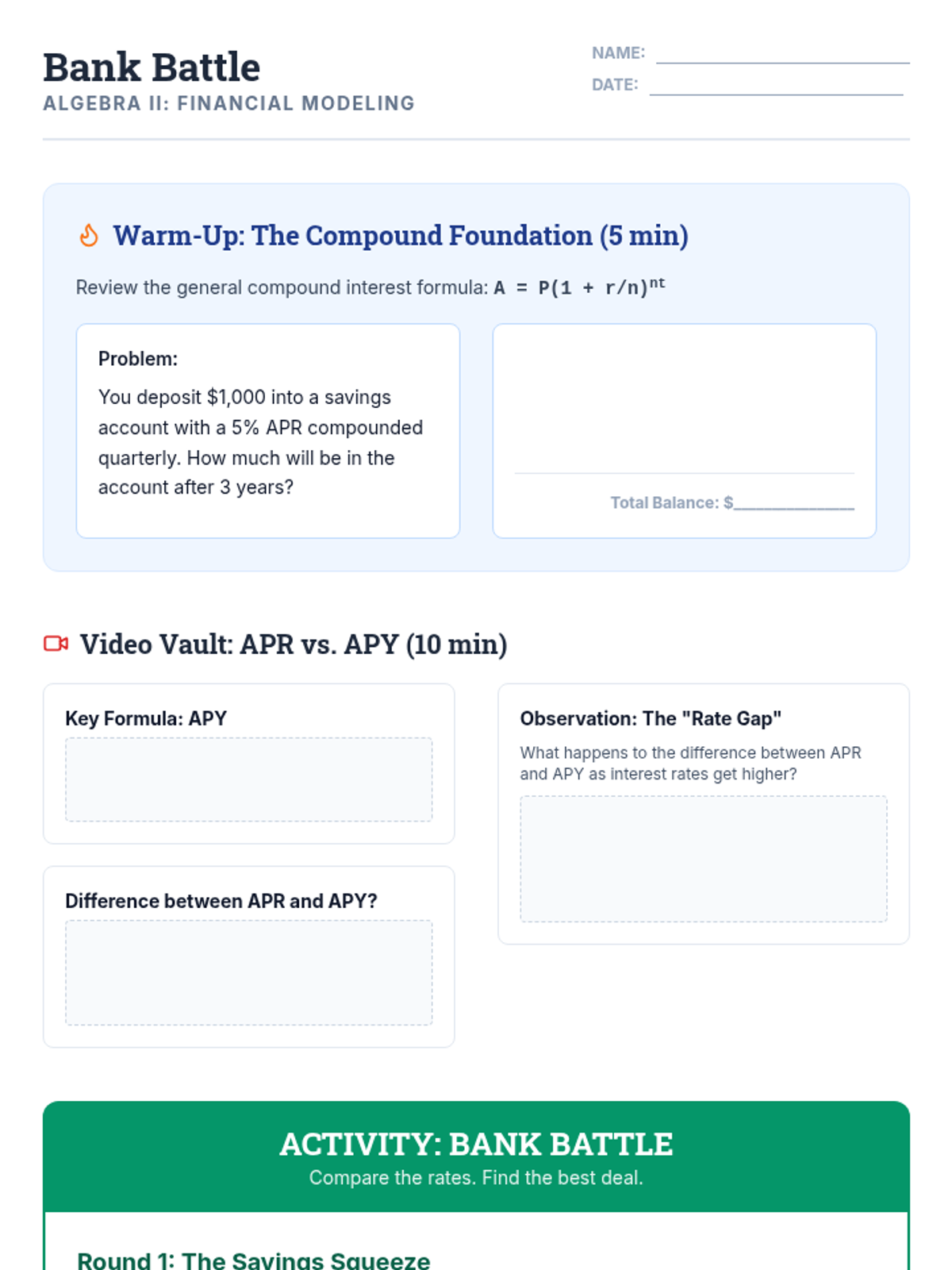
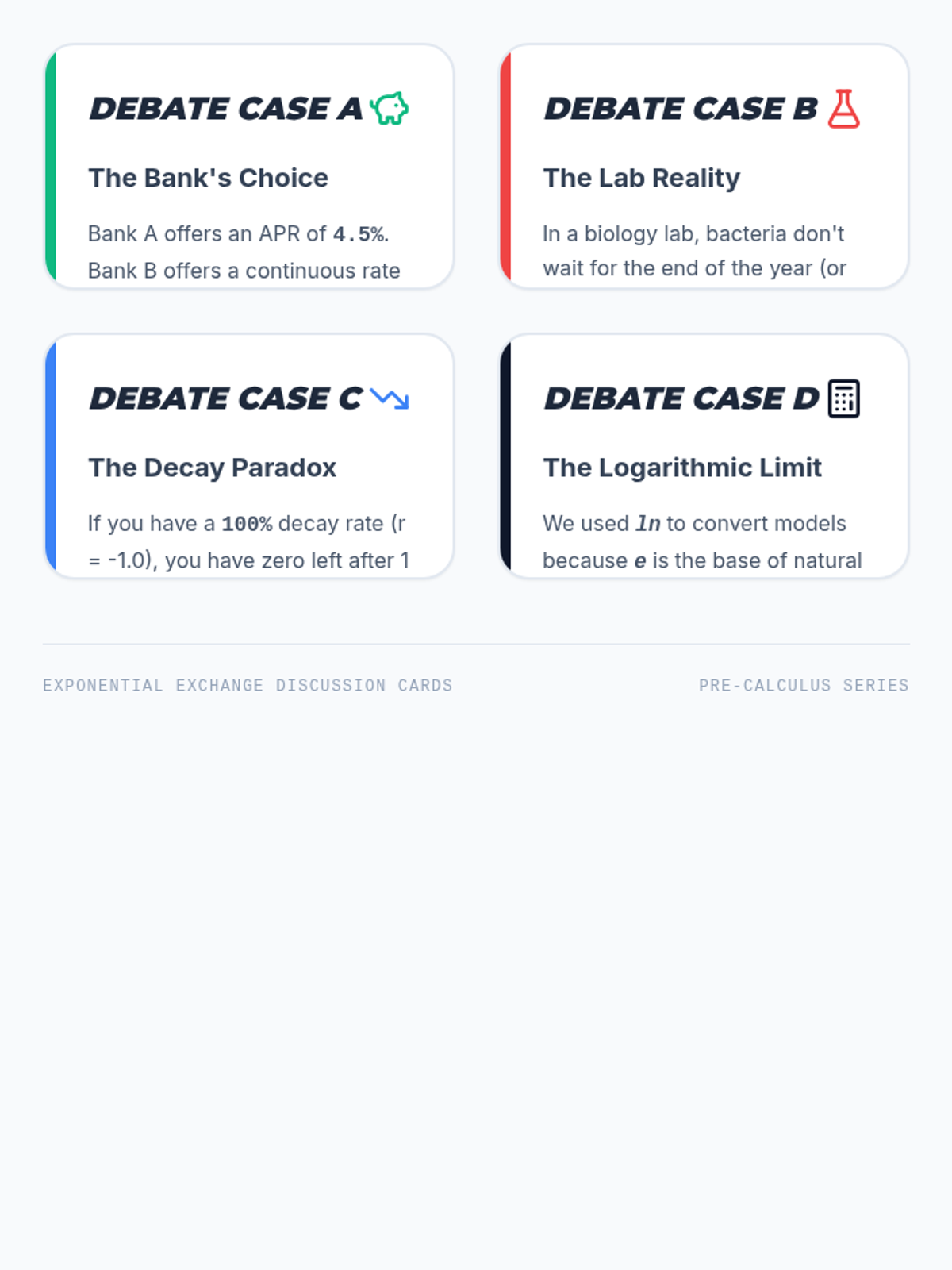
A lesson exploring the mathematical difference between Annual Percentage Rate (APR) and Annual Percentage Yield (APY) through real-world financial modeling of savings and loans. Students will calculate effective interest rates to make informed banking decisions.
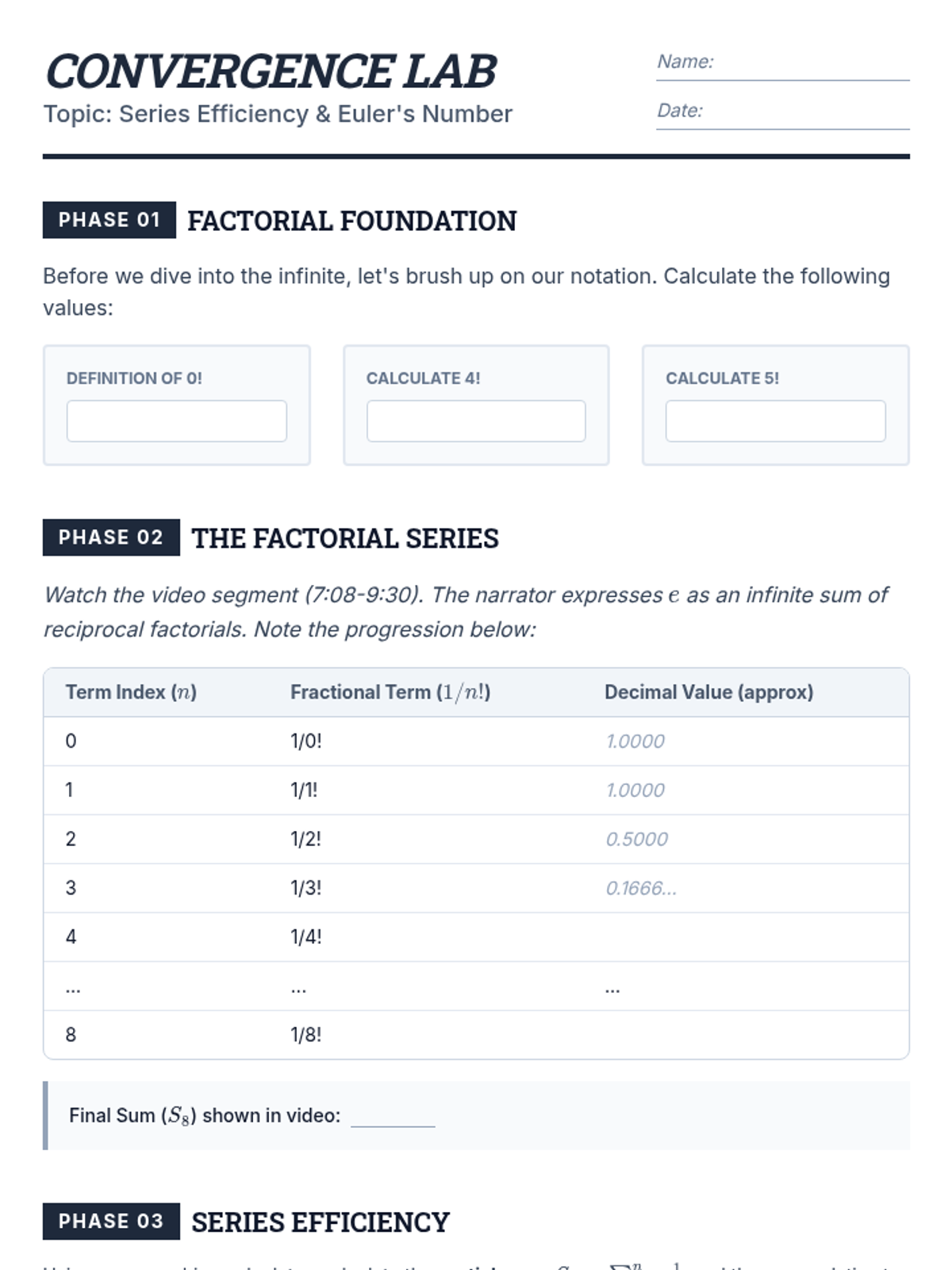
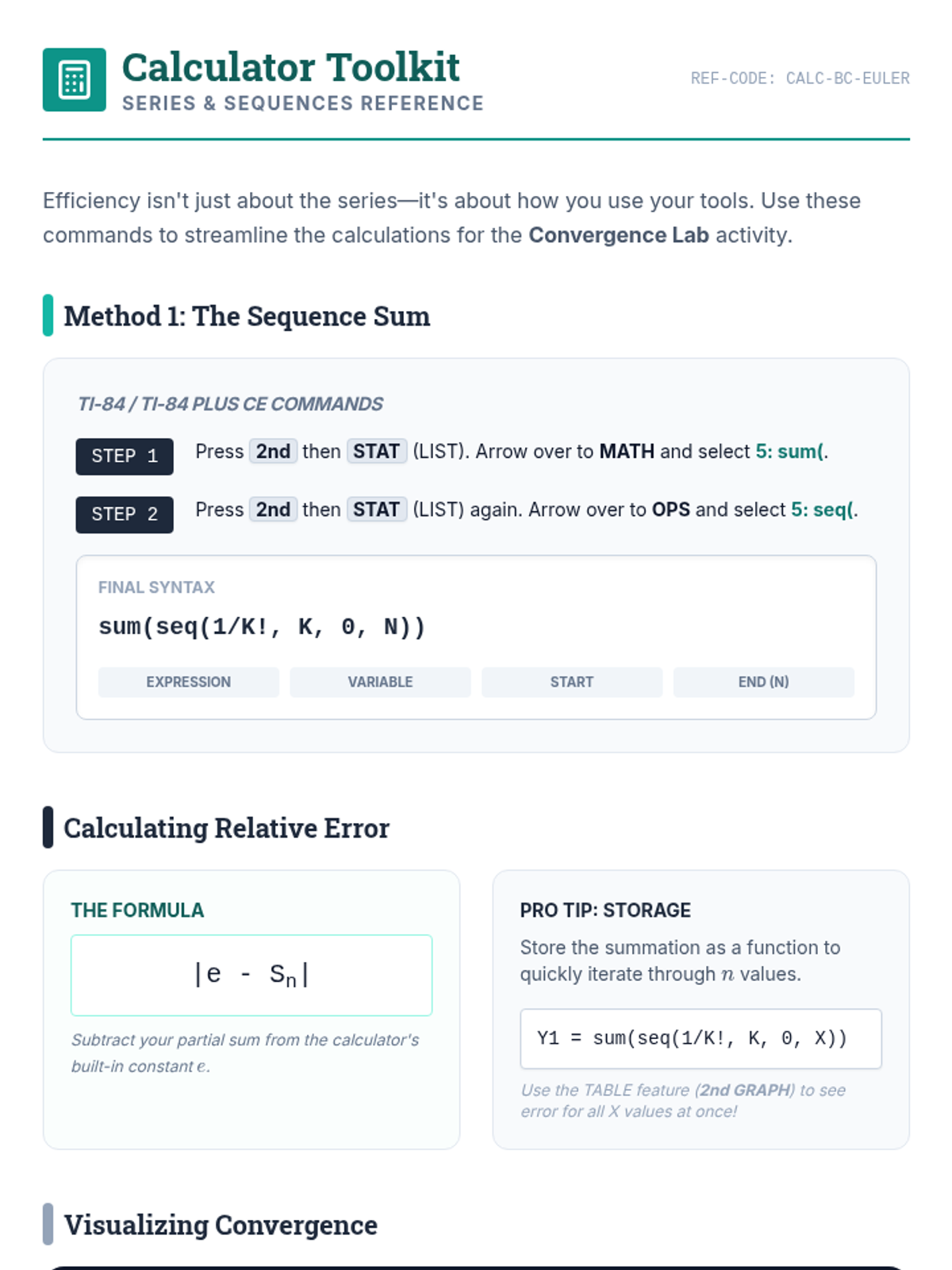
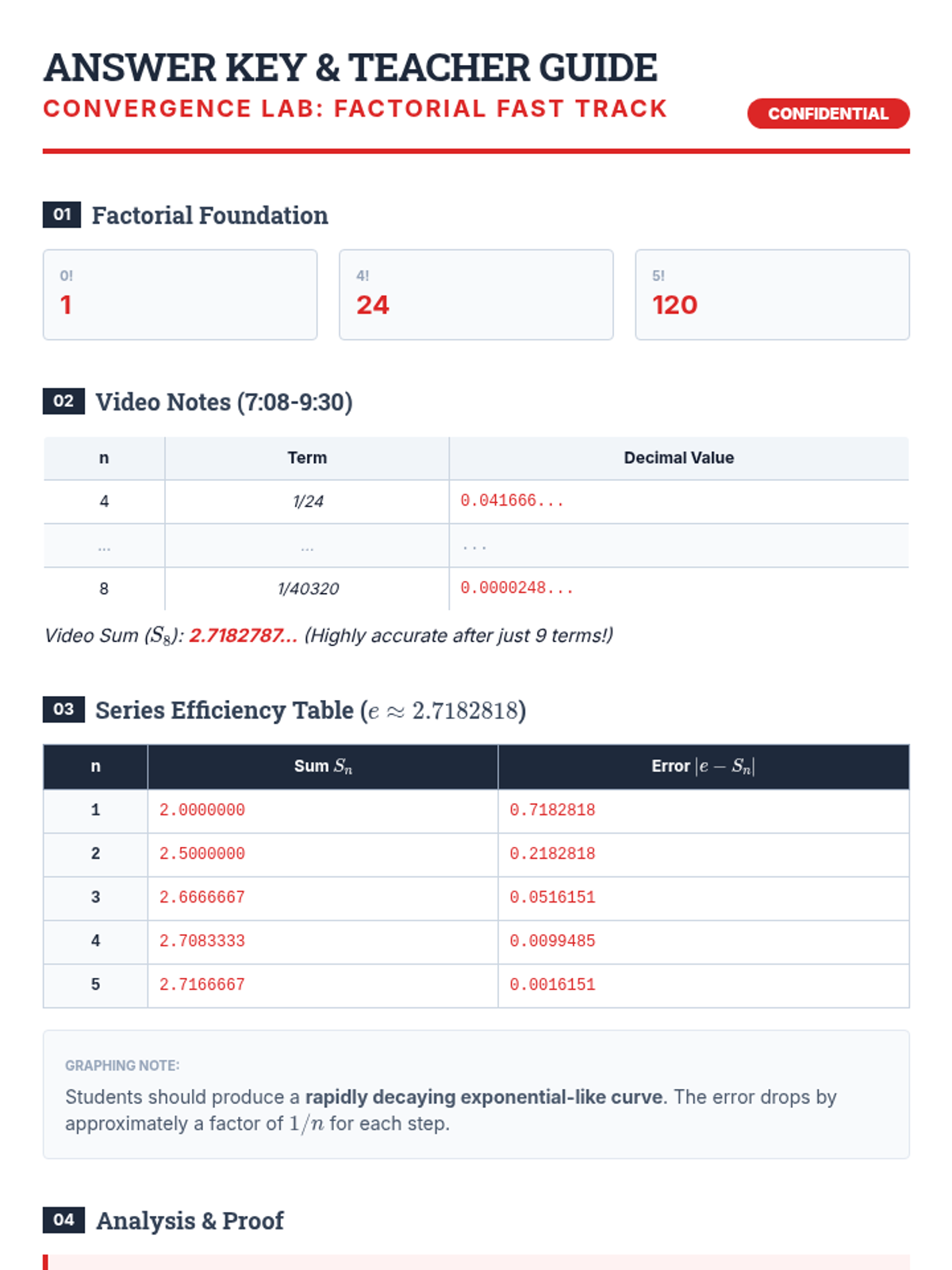
Students explore the rapid convergence of the infinite series for e, comparing the efficiency of factorials to the standard limit definition. The lesson bridges the gap between basic limits and the Taylor Series for e^x.
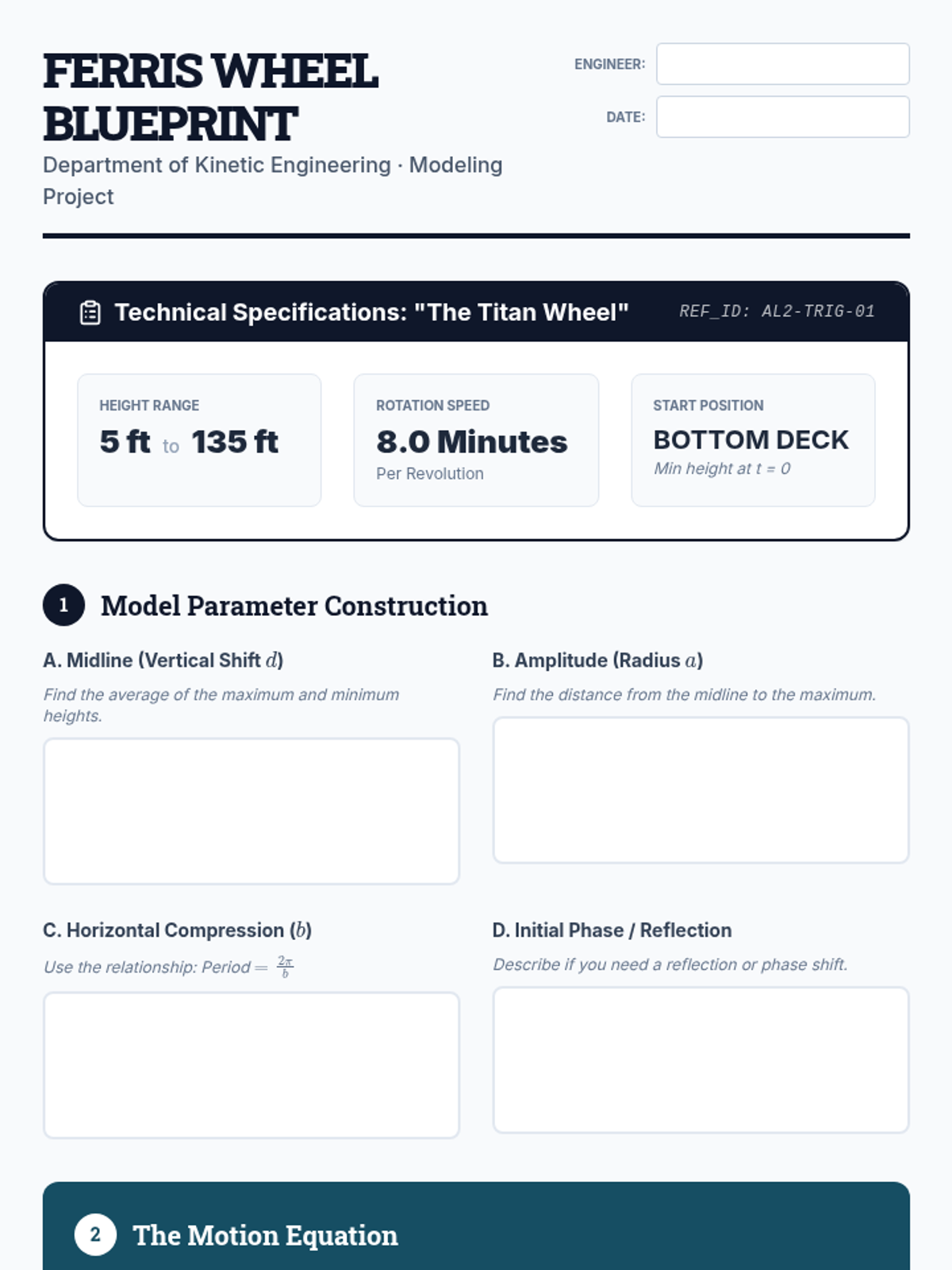
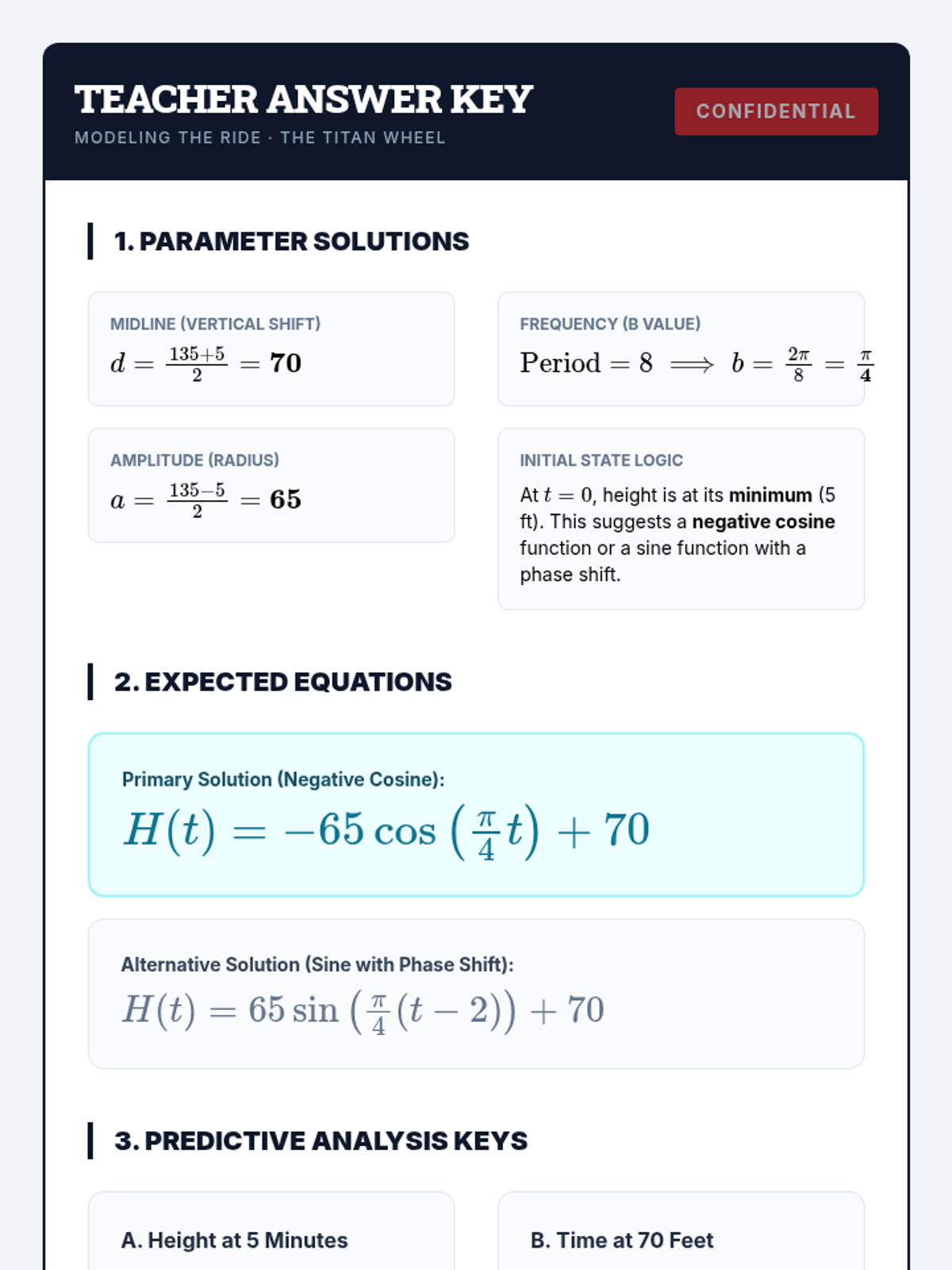
Students will apply their knowledge of trigonometric transformations to model the movement of a Ferris wheel. They will identify key parameters (amplitude, midline, period, phase shift) from real-world data and construct periodic equations.
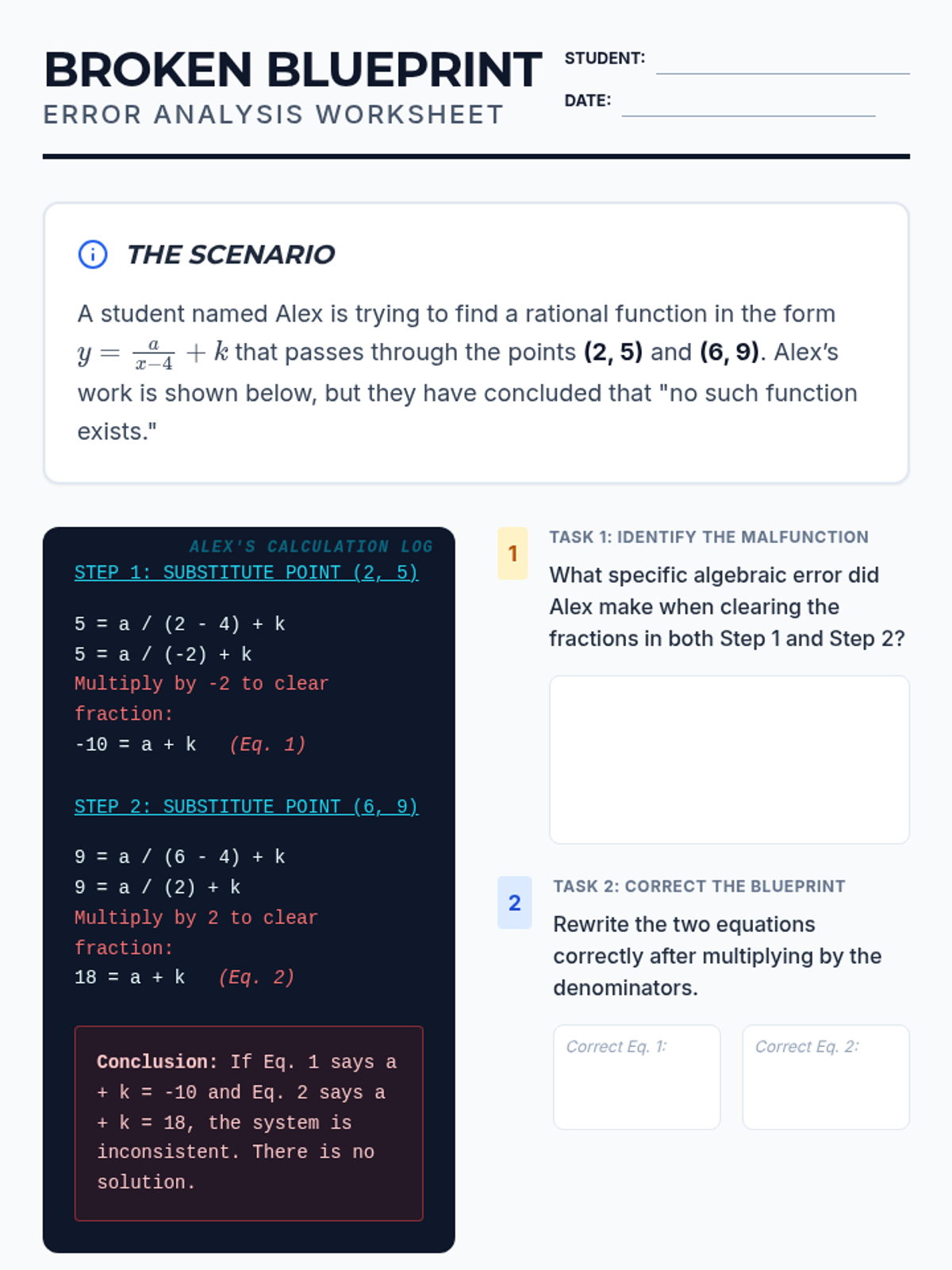
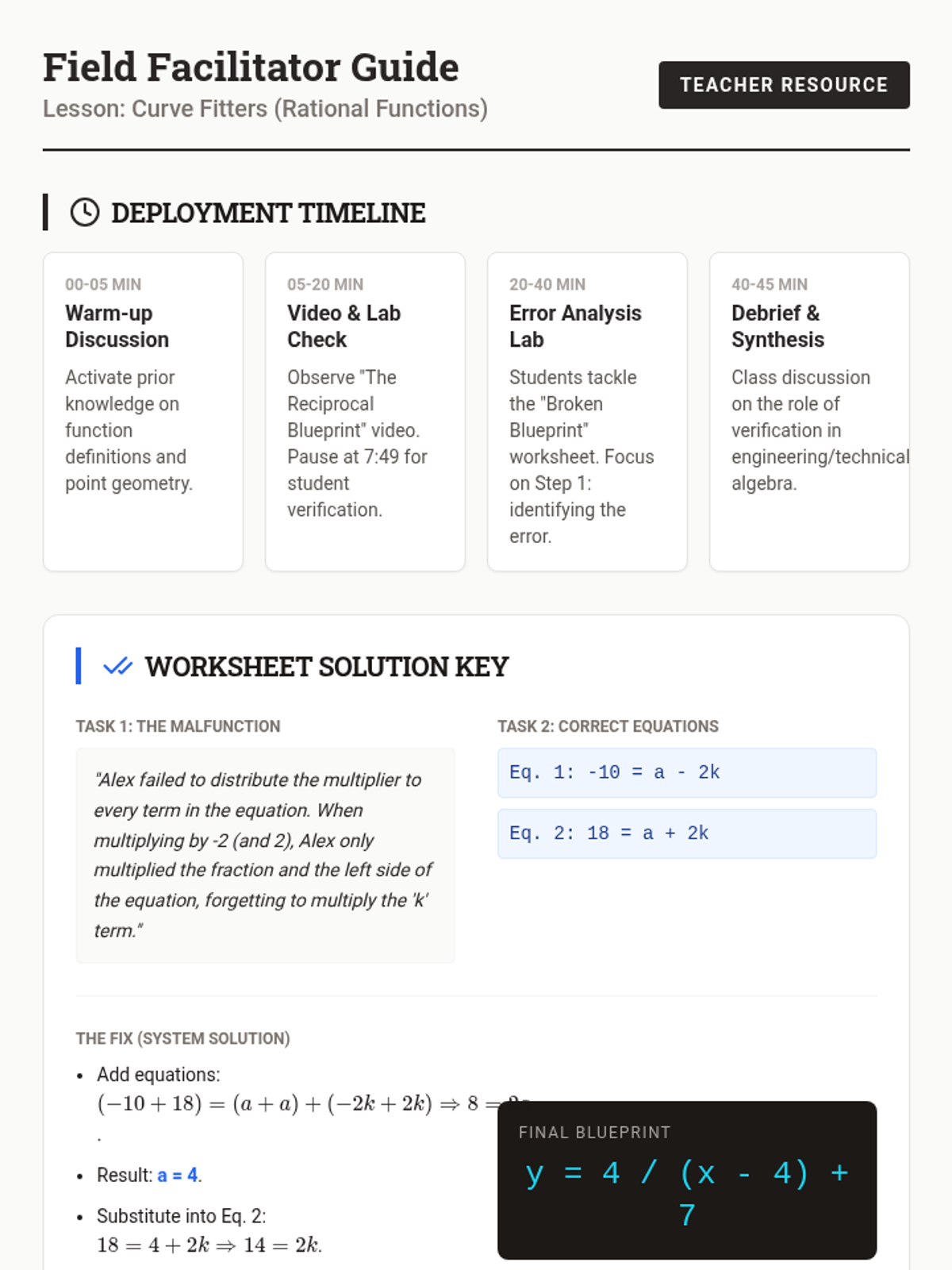
This lesson explores analytic geometry through the lens of rational functions. Students learn how to derive a specific function's parameters using systems of equations and data points, with a strong emphasis on error analysis and verification.
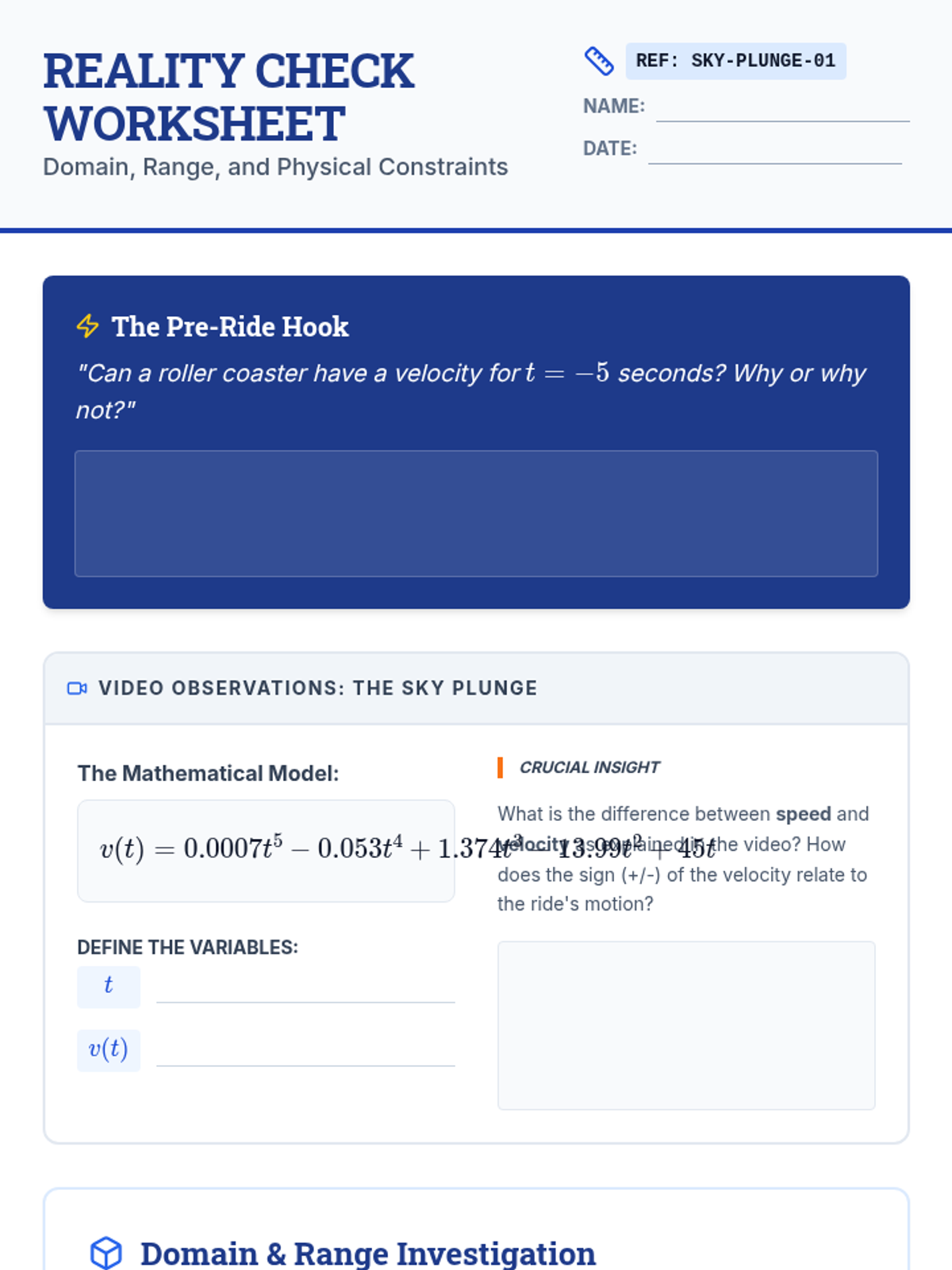
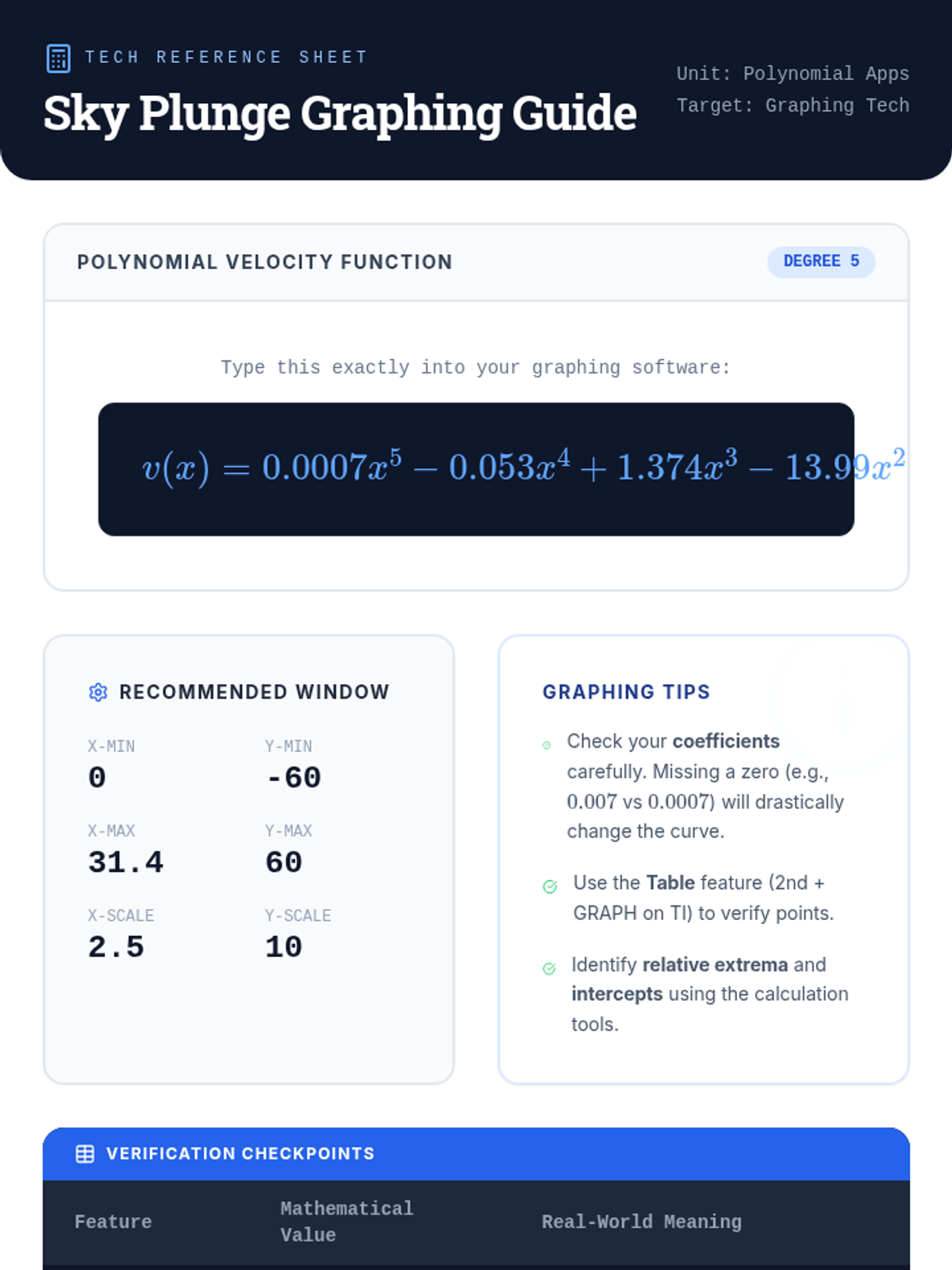
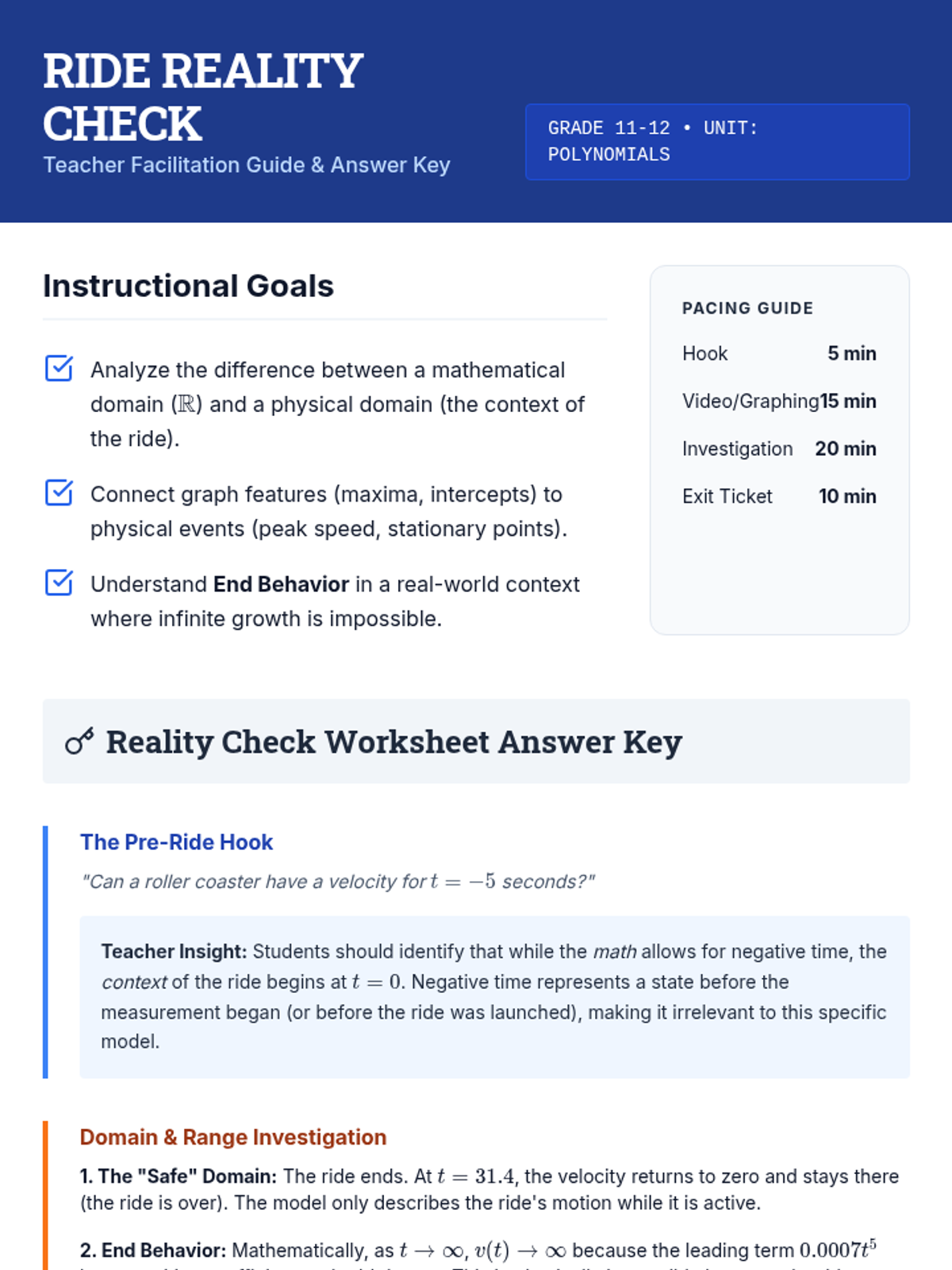
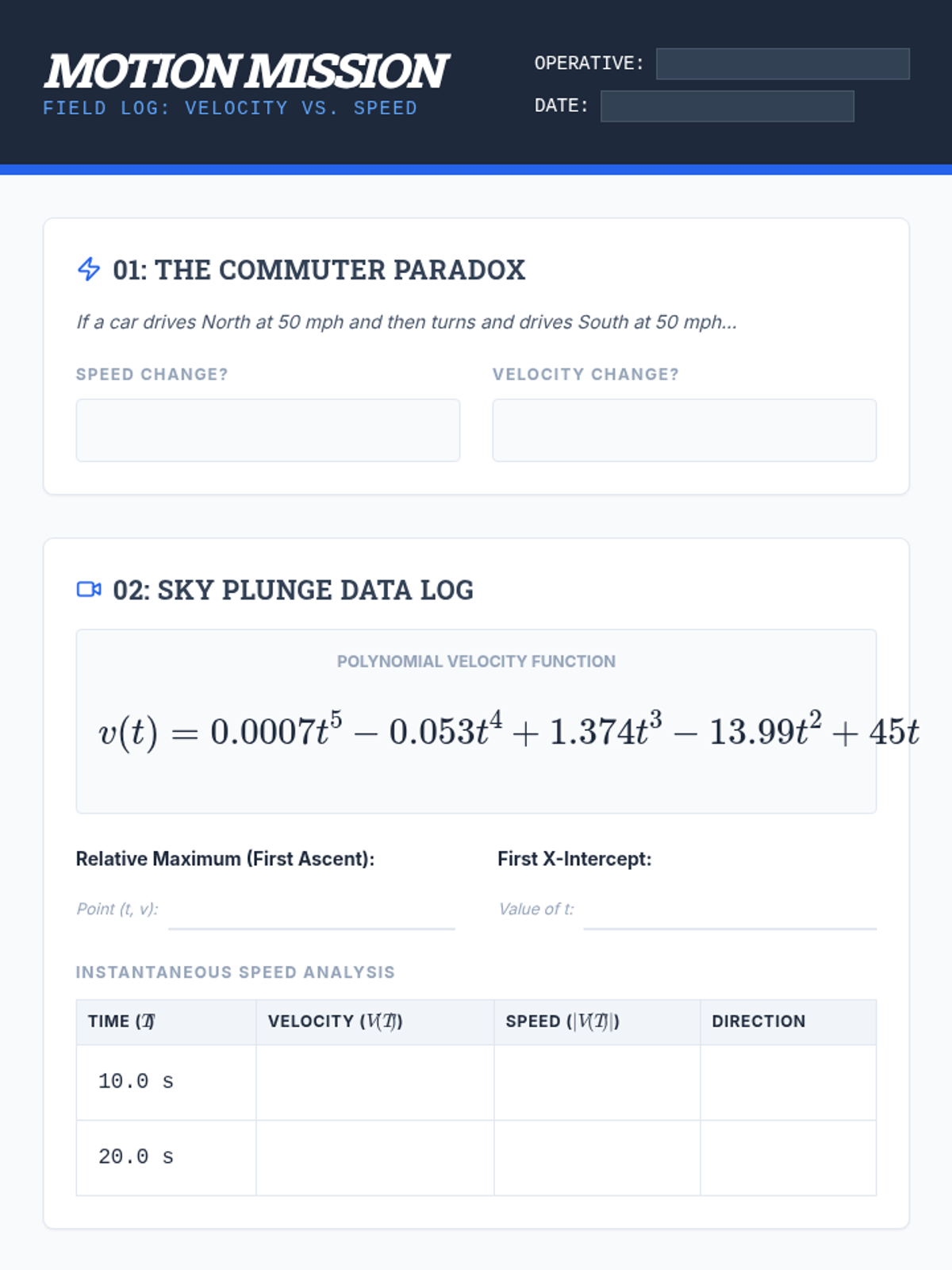
Students will analyze the physical constraints of a 5th-degree polynomial function modeling the velocity of a drop tower ride, focusing on the distinction between mathematical domain and real-world applicability.
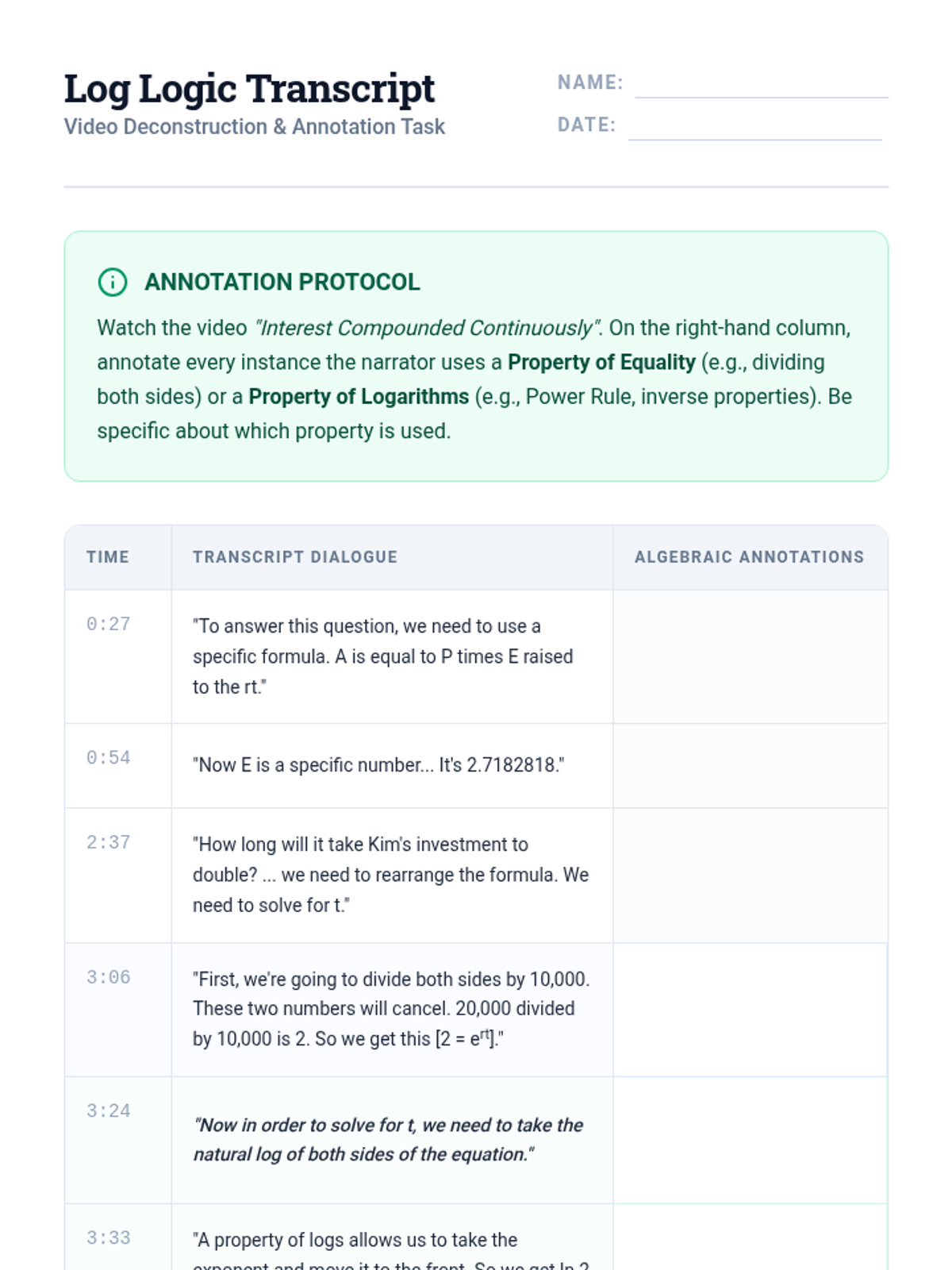
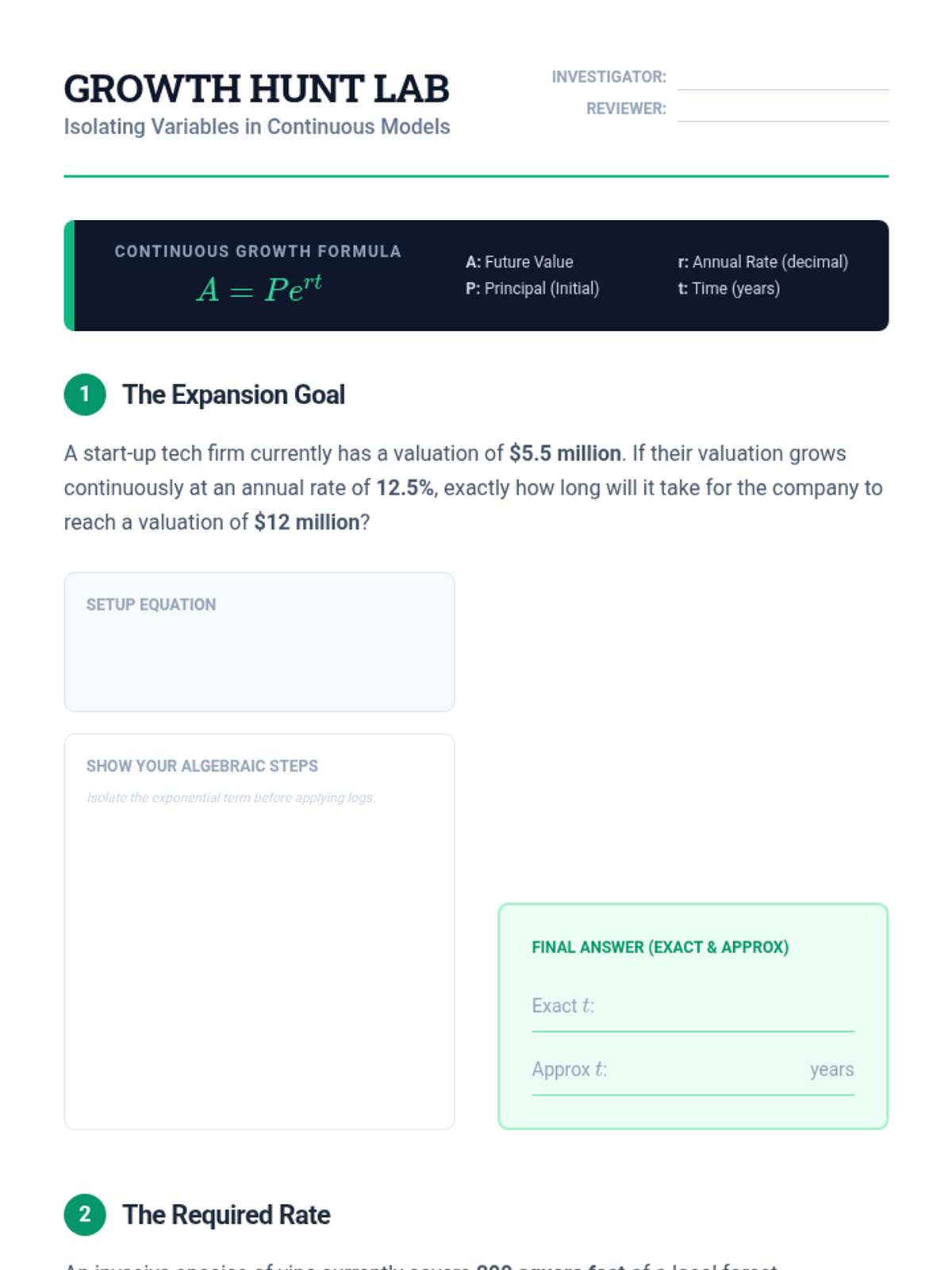
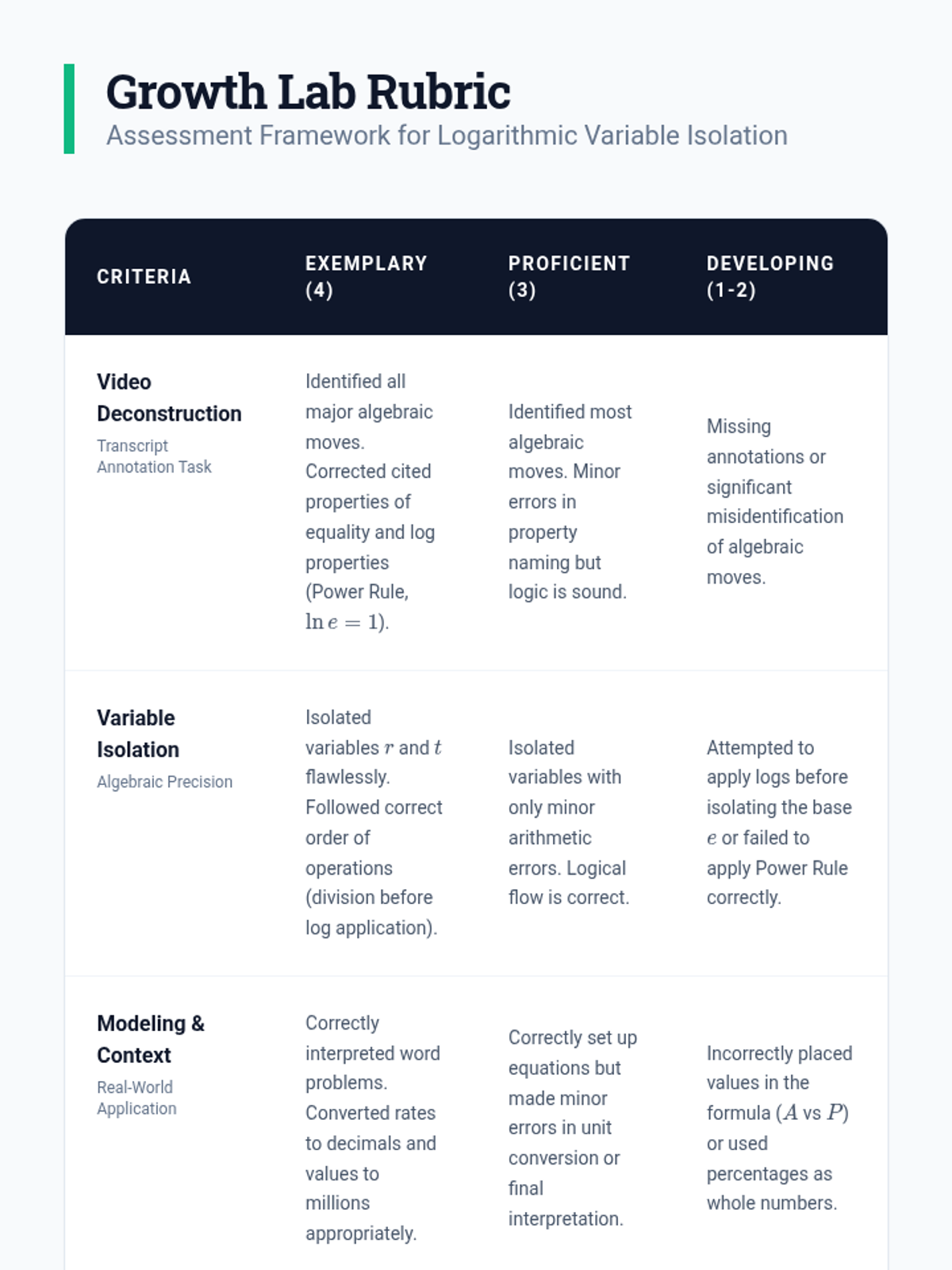
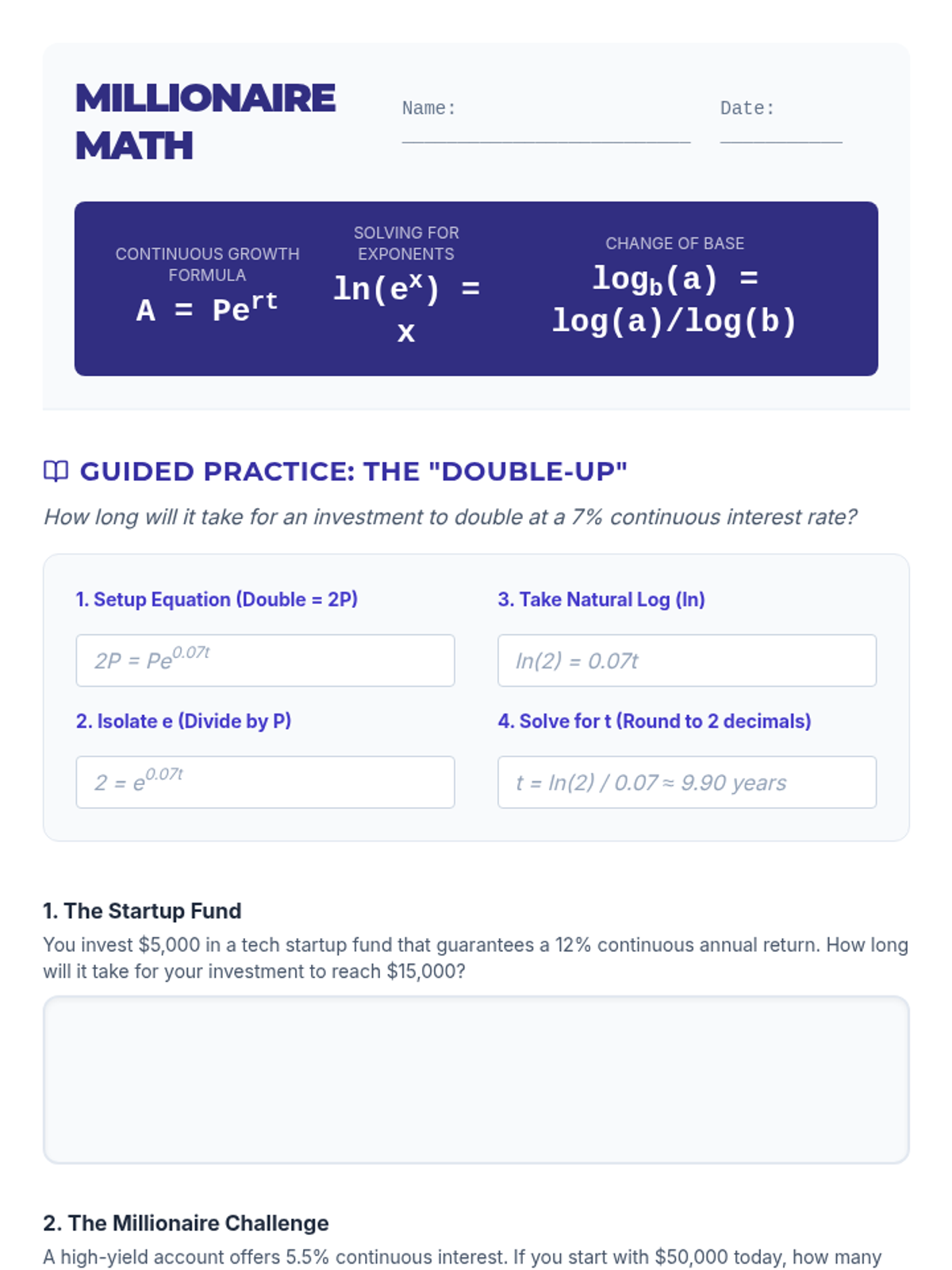
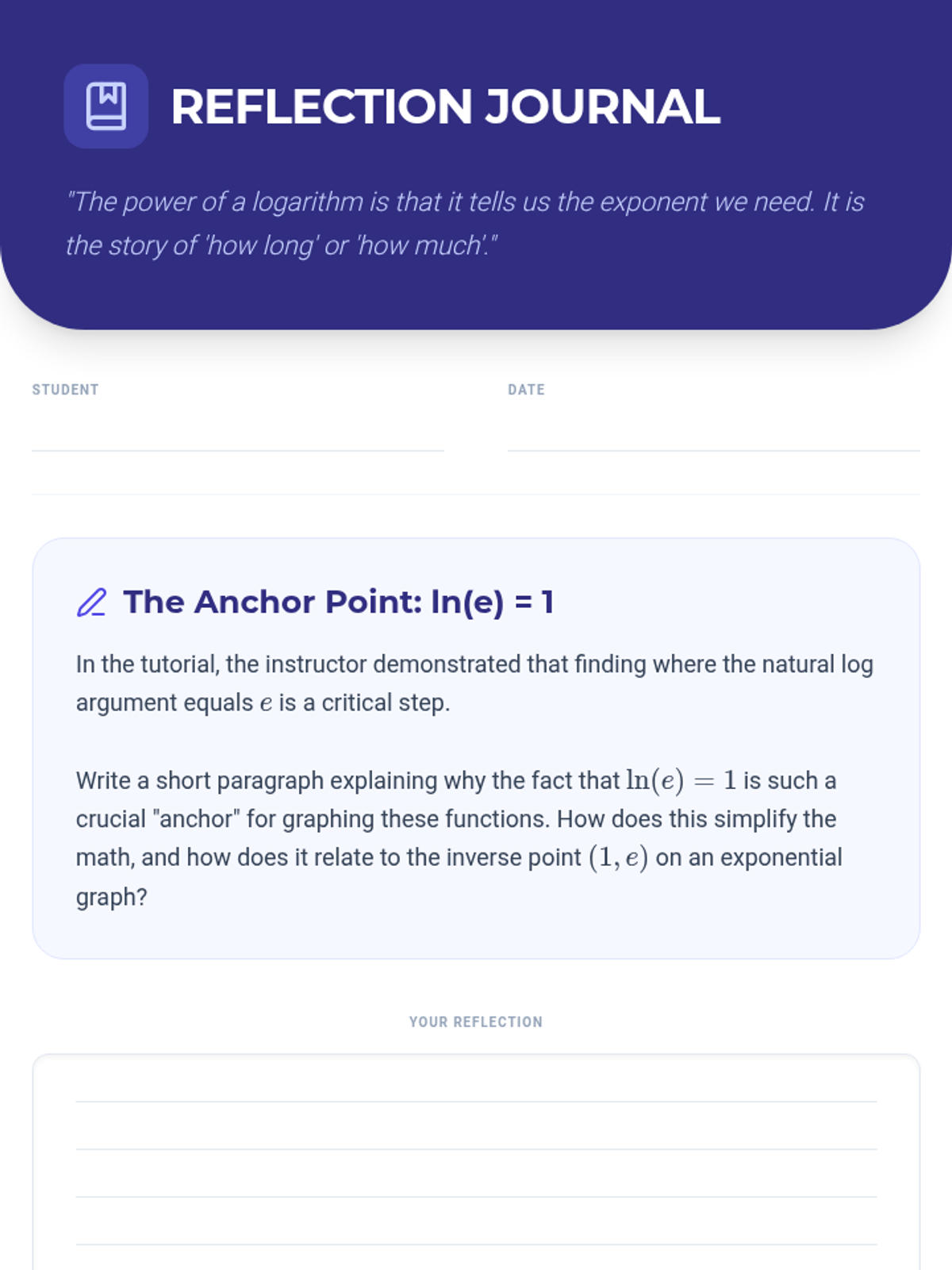
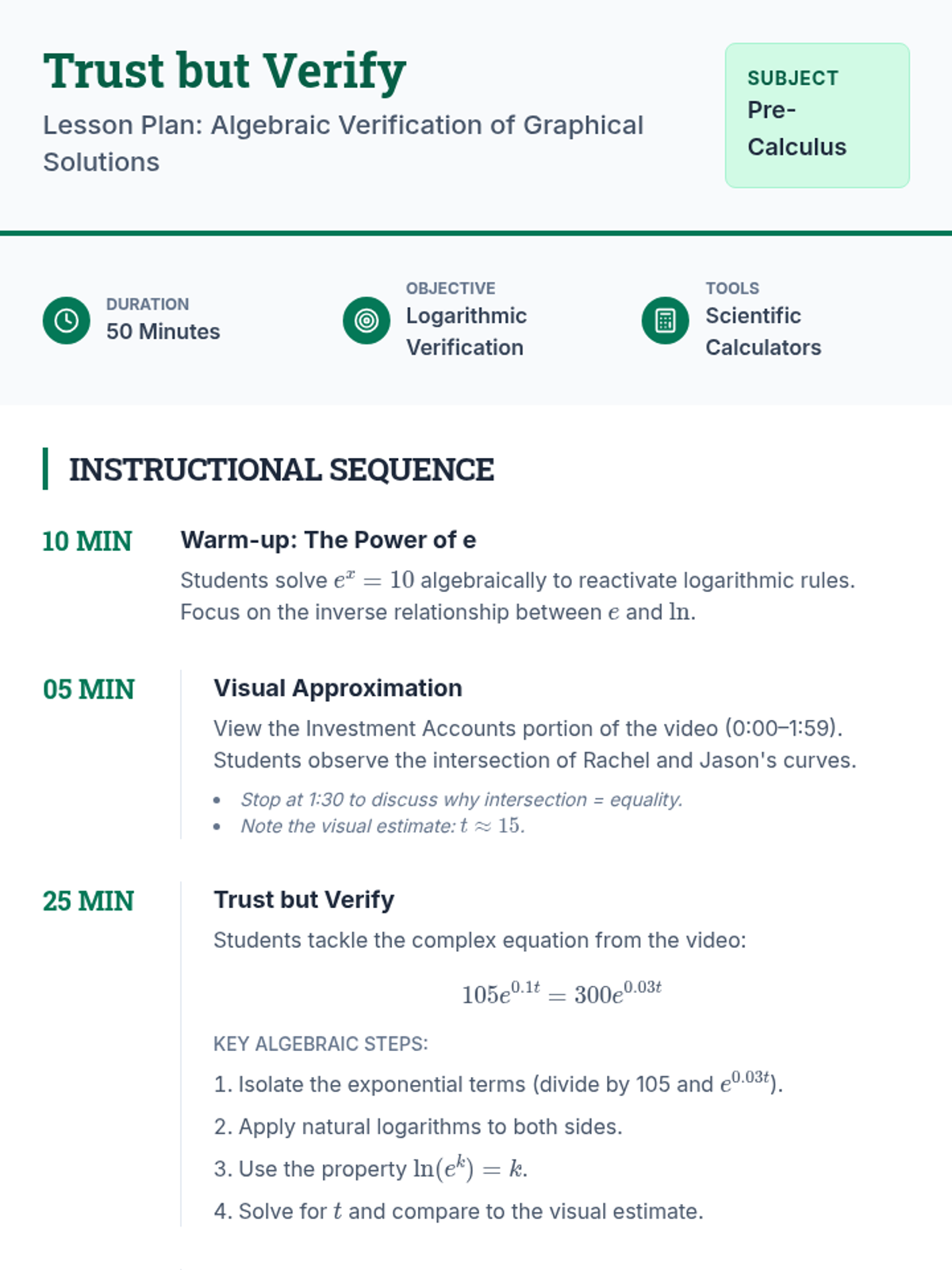
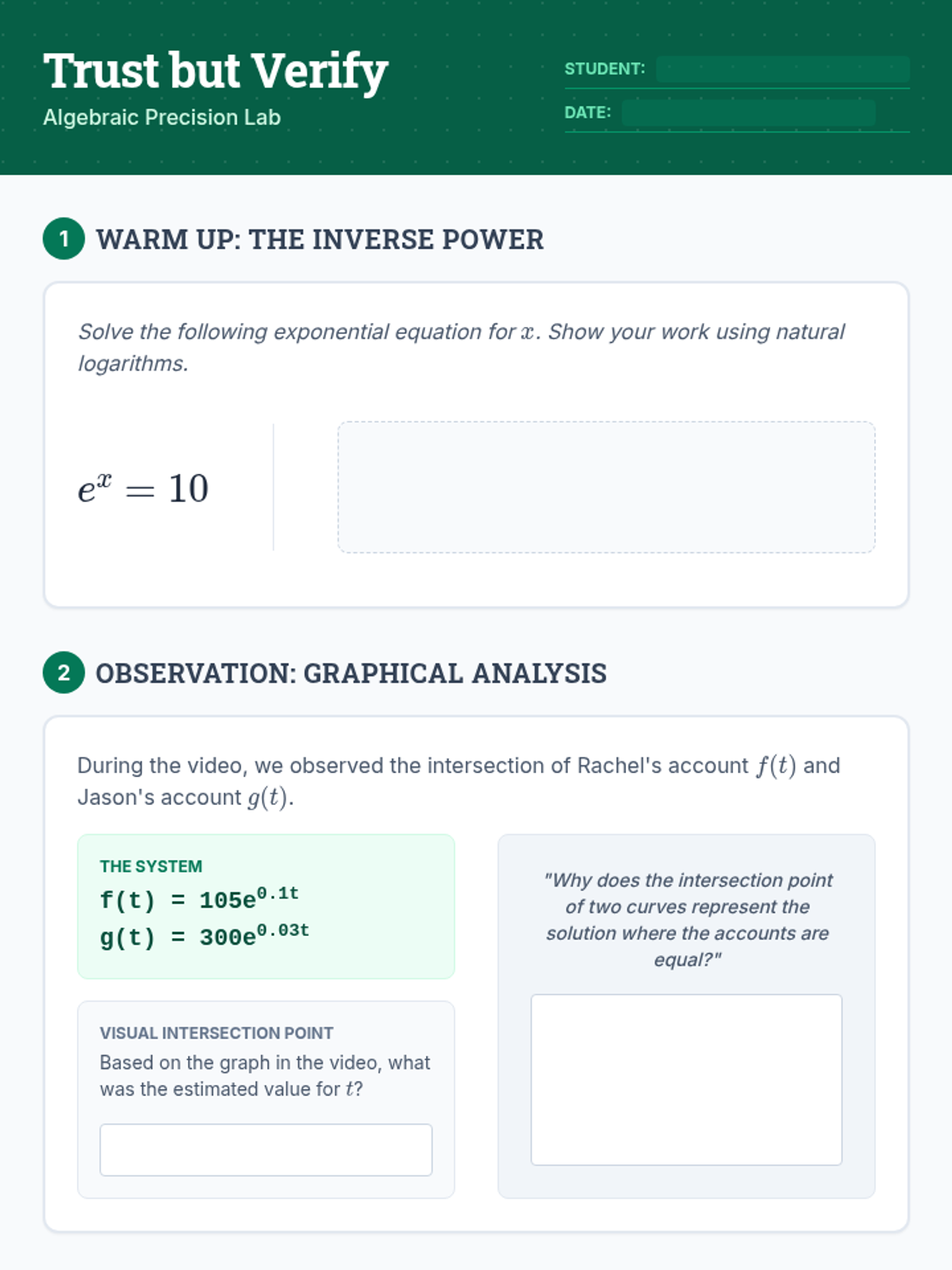
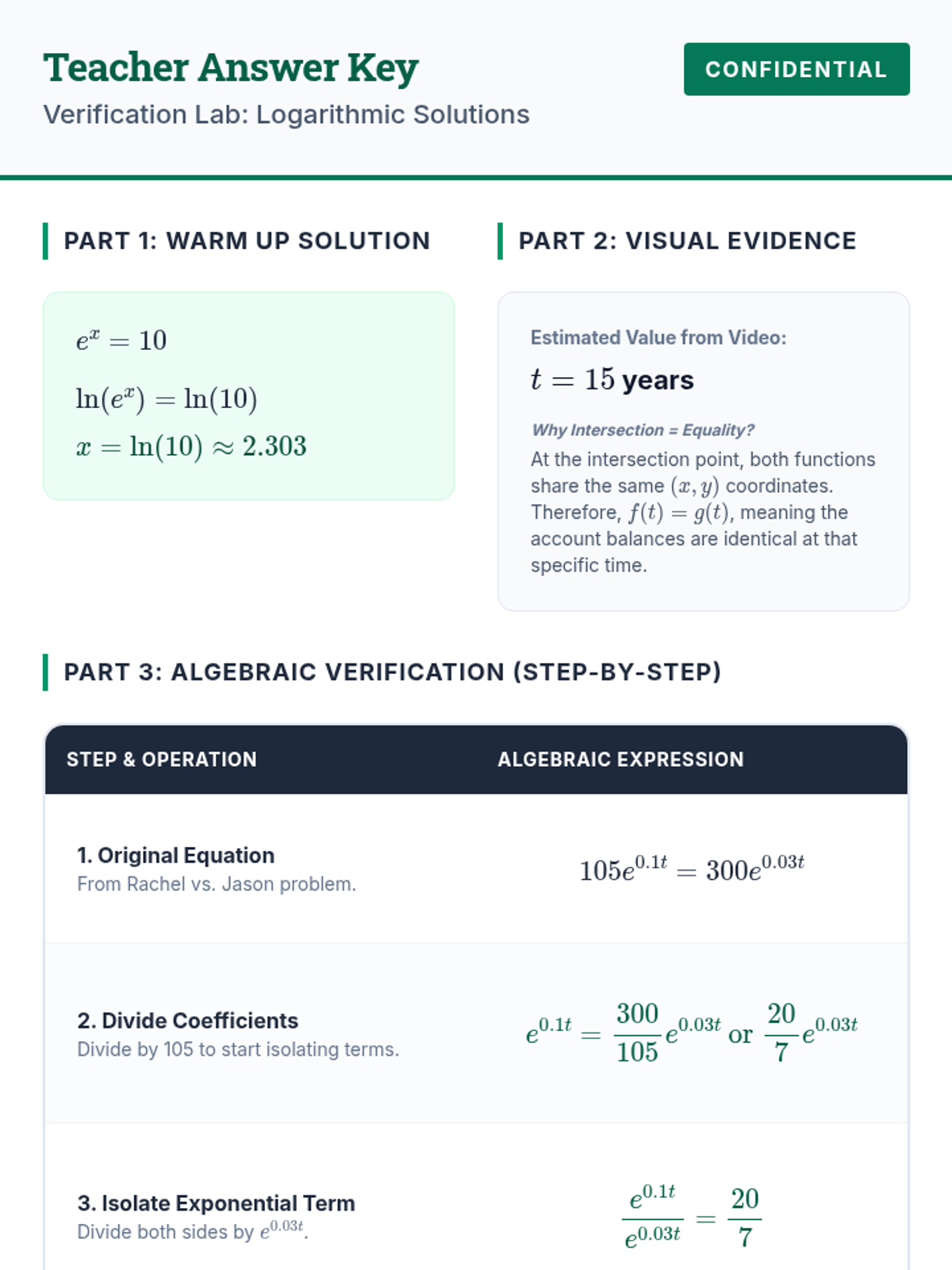
This lesson focuses on applying logarithmic properties to solve real-world continuous growth problems. Students deconstruct a video tutorial to identify algebraic principles and then apply those skills to complex financial scenarios involving variable isolation.
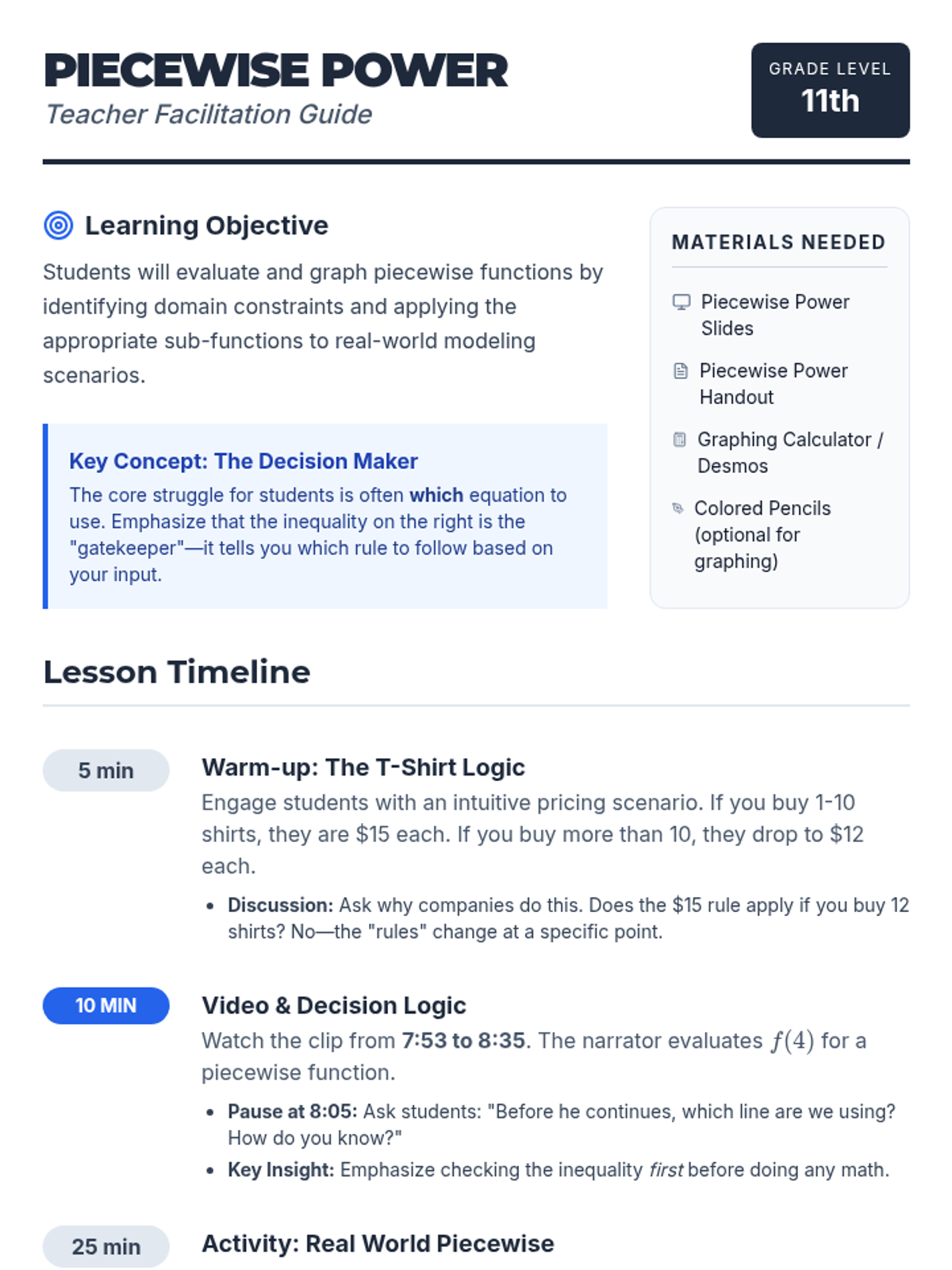
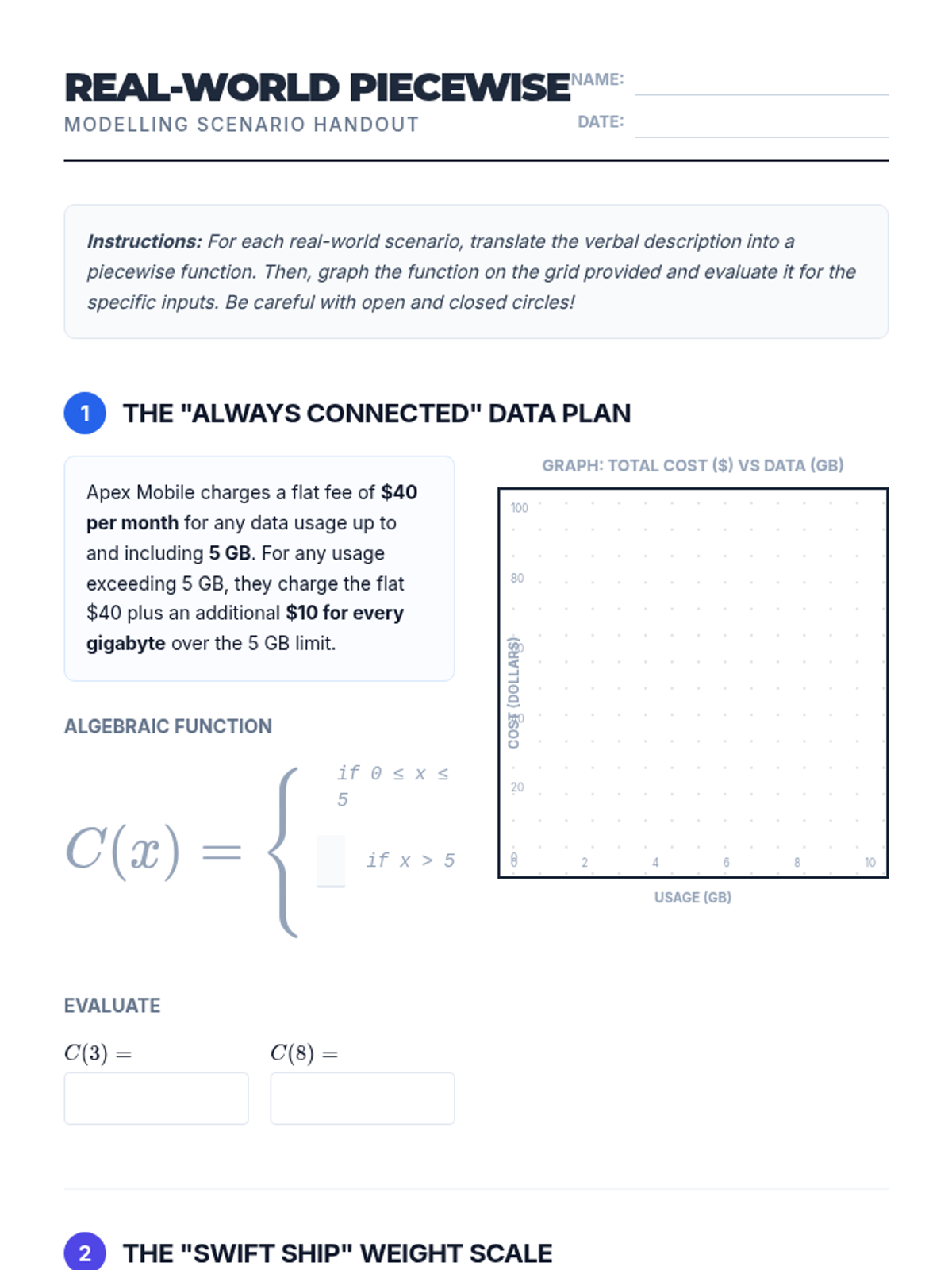
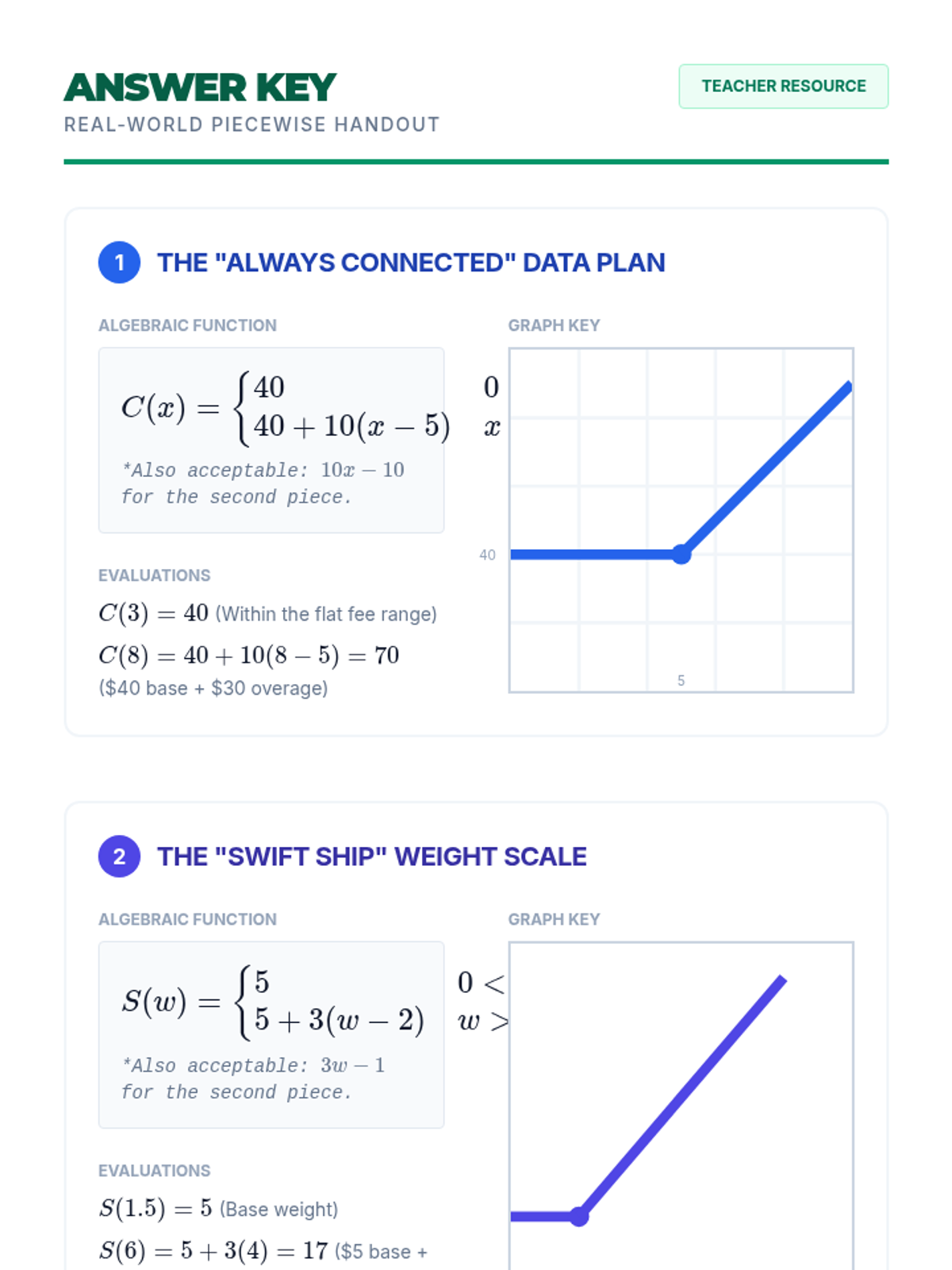
Students will dive into the logic of piecewise functions by evaluating and graphing models based on real-world scenarios like tax brackets and data plans. The lesson uses a targeted video clip to clarify the decision-making process for selecting sub-functions based on domain constraints.
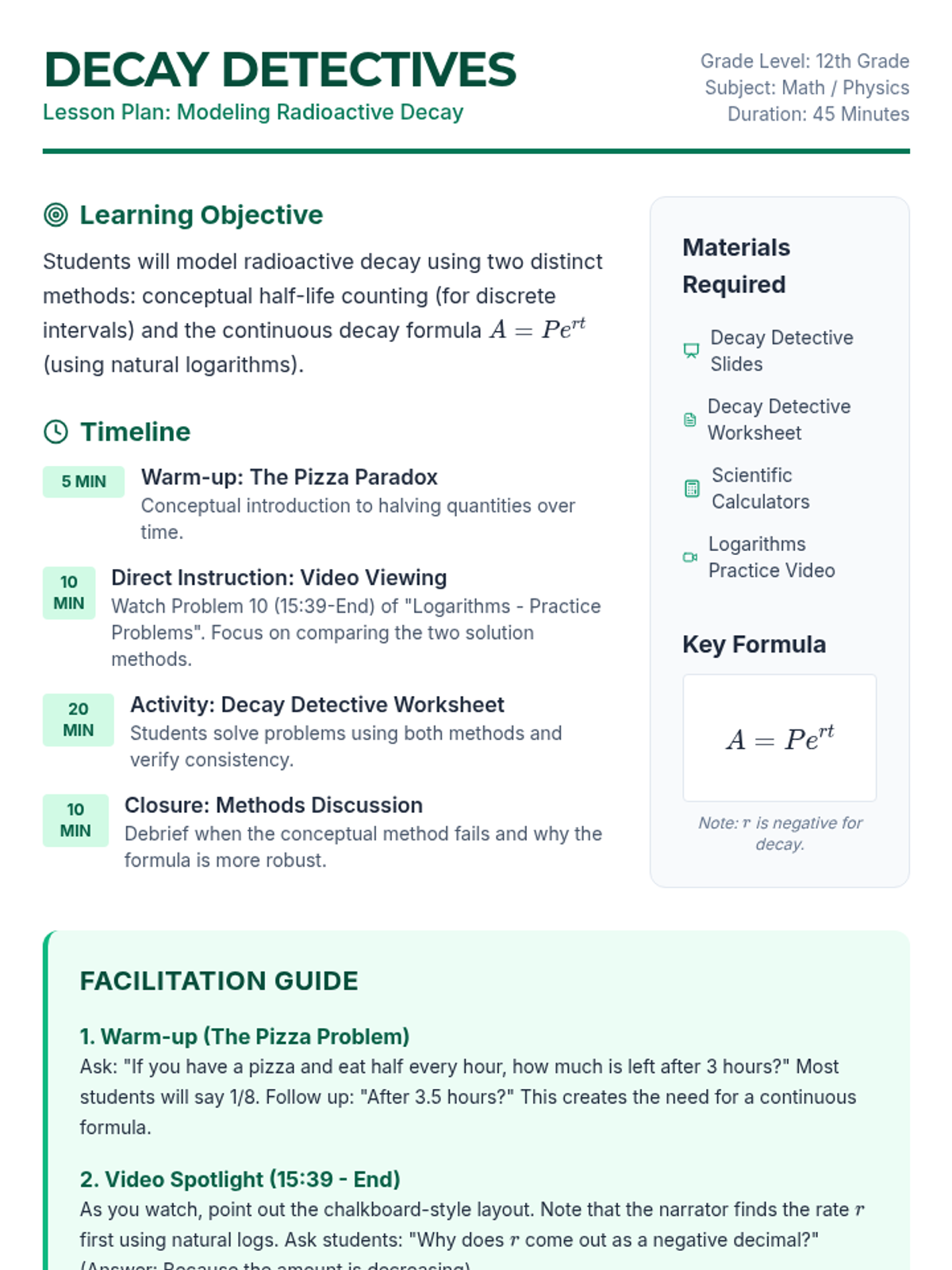
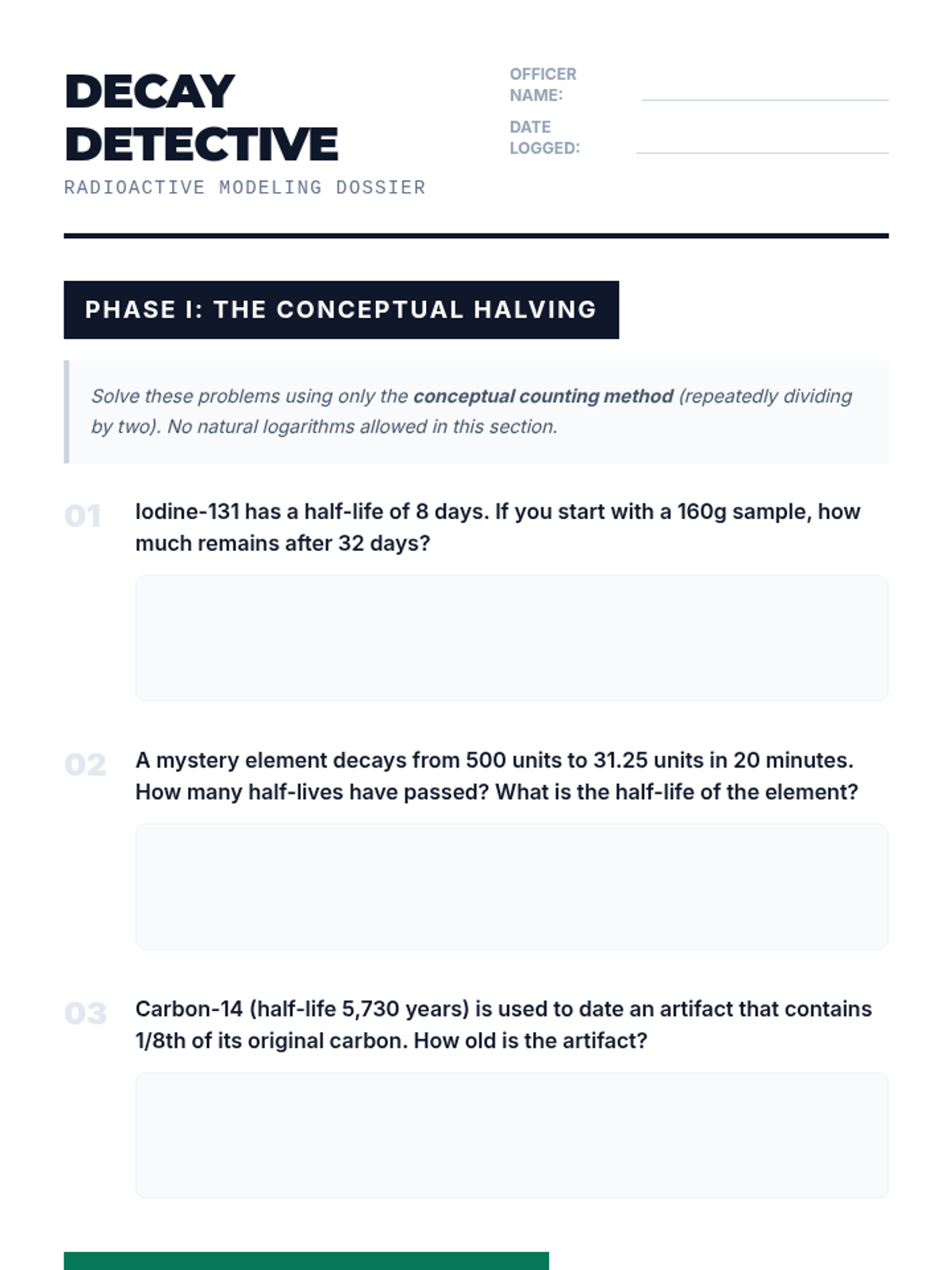
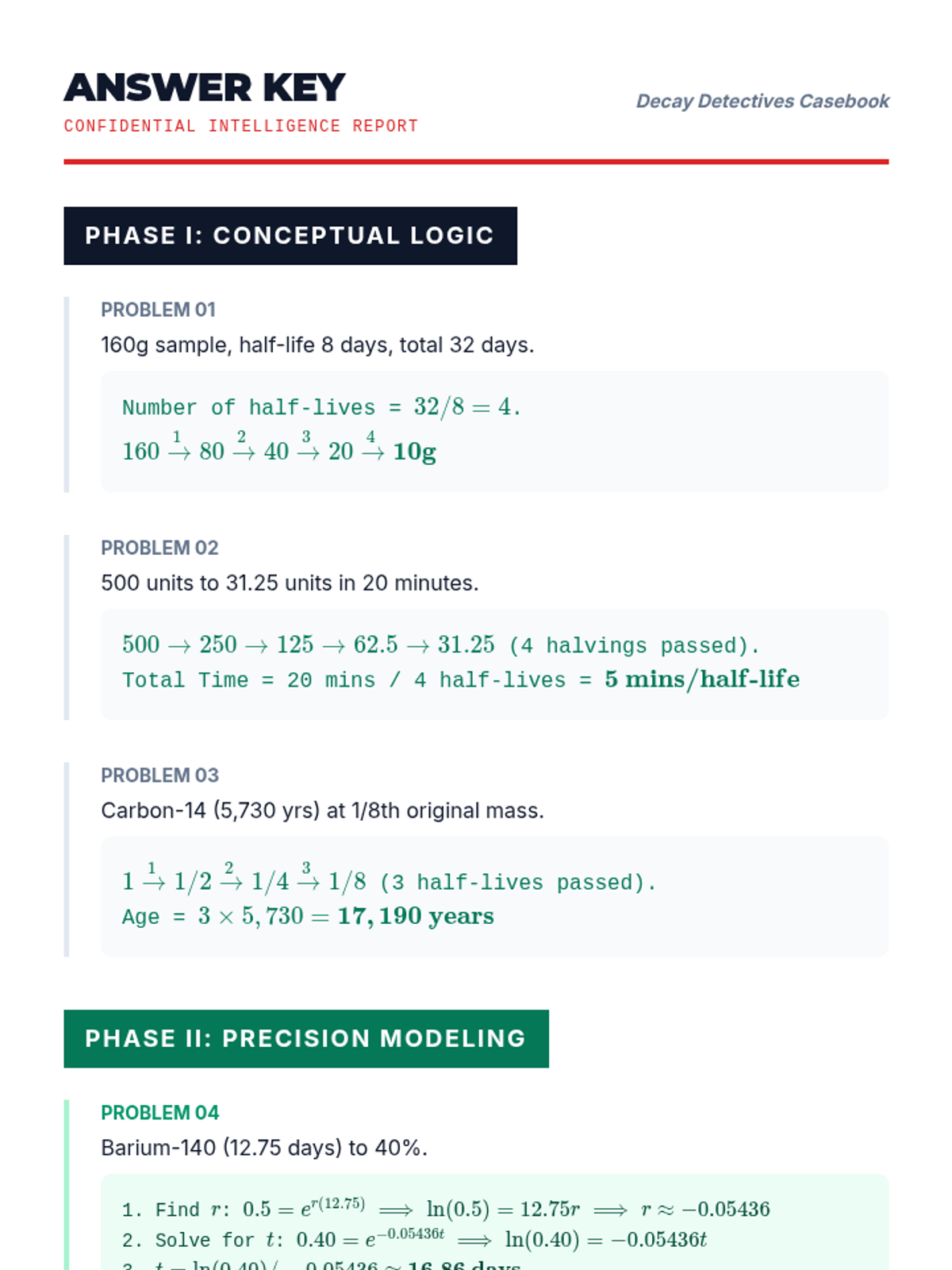
A high school math and physics lesson where students model radioactive decay. They compare conceptual 'half-life counting' with the continuous growth formula \(A = Pe^{rt}\) to solve real-world decay problems.
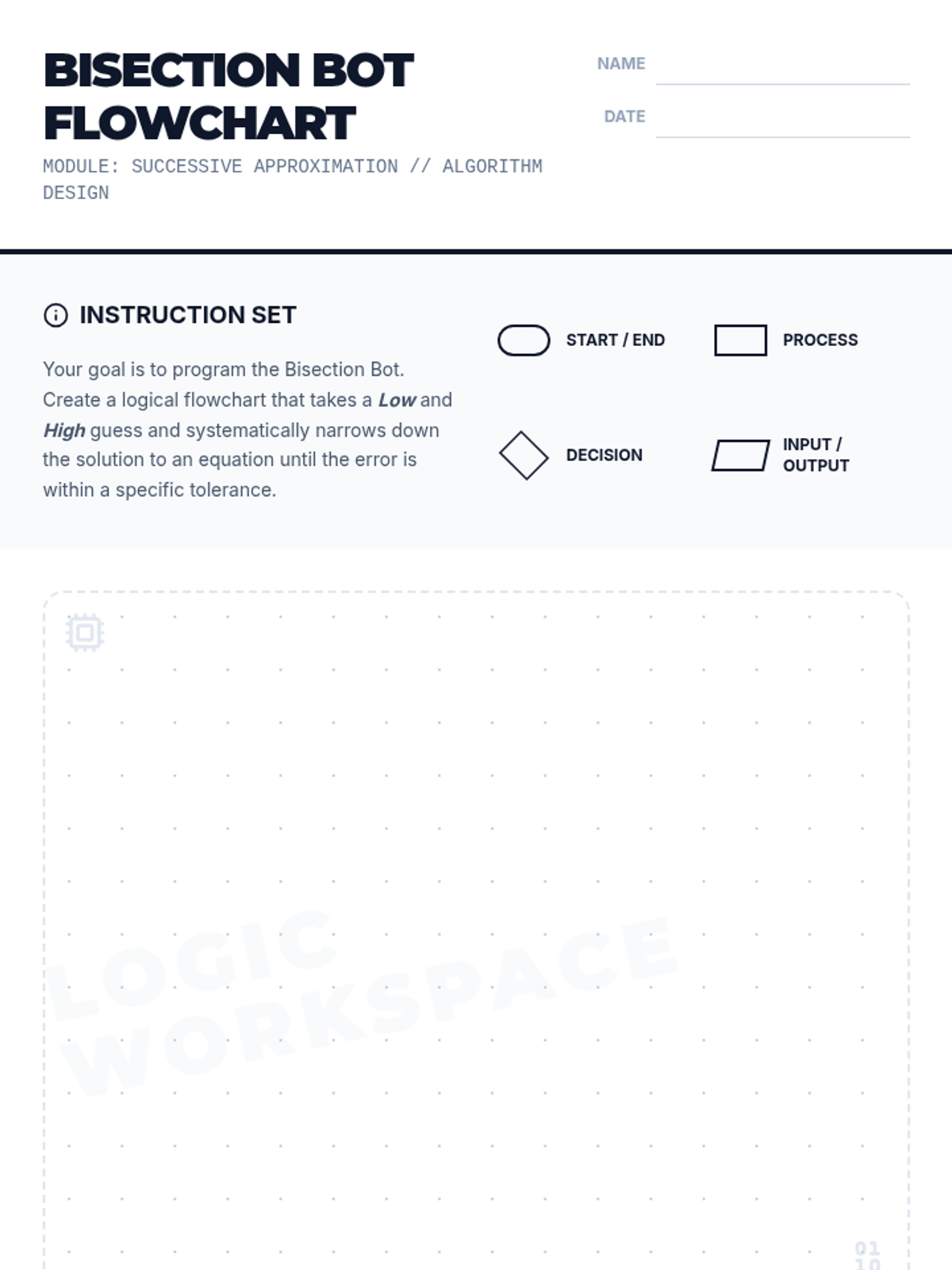
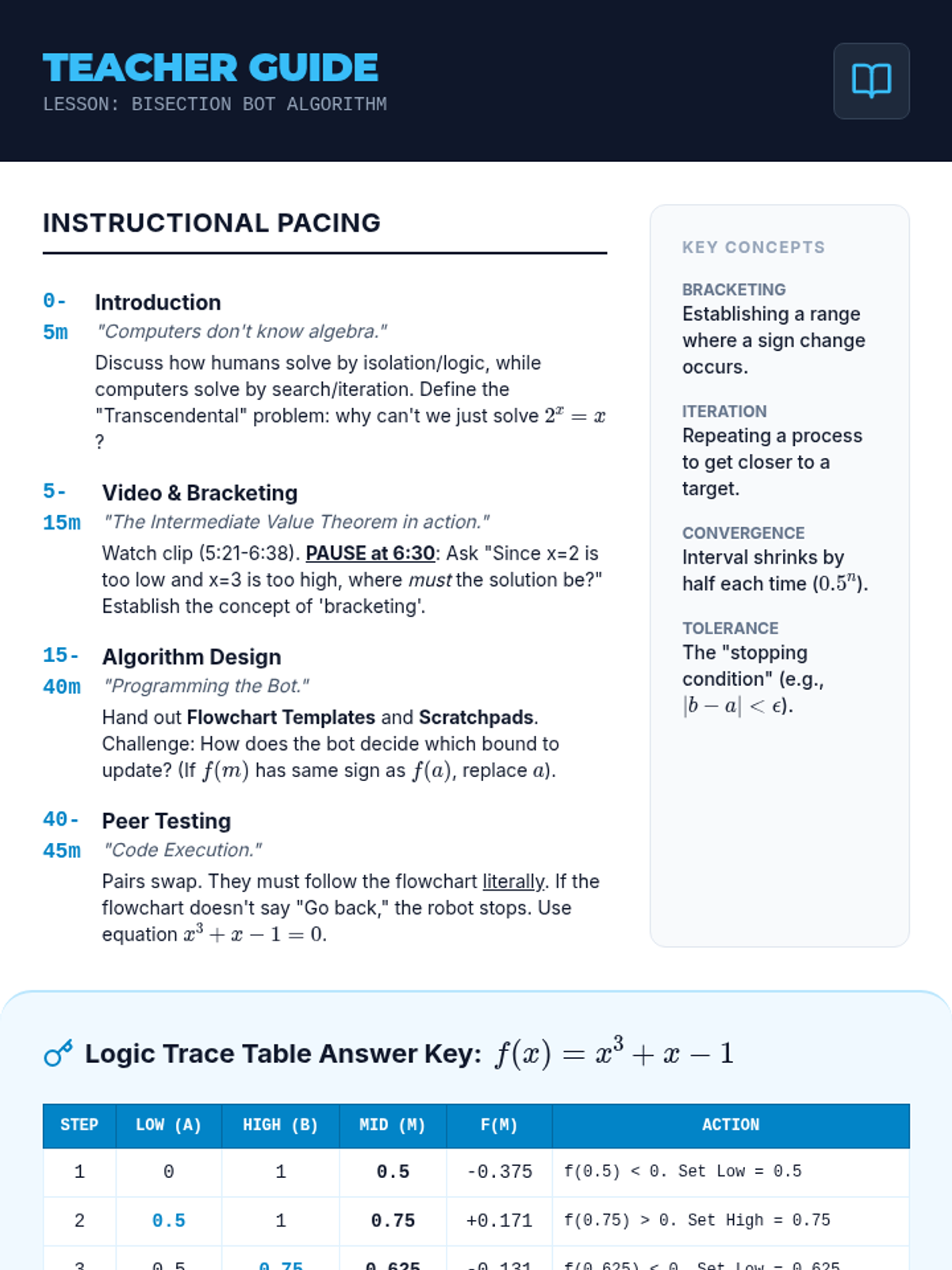
Students formalize the 'successive approximation' method into the Bisection Method algorithm by designing a flowchart for a 'robot' to solve transcendental equations. The lesson bridges numerical estimation and computer science logic.
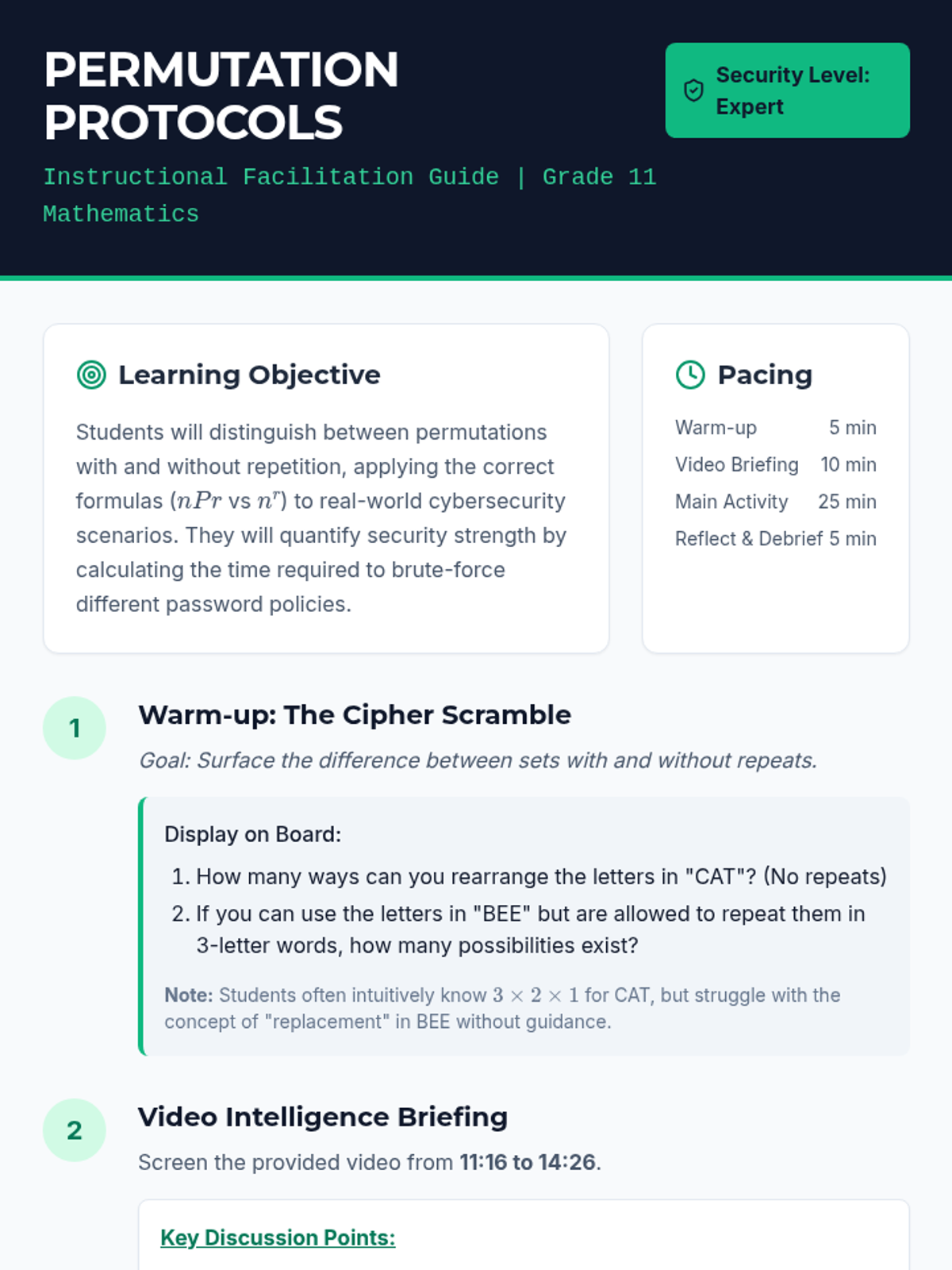
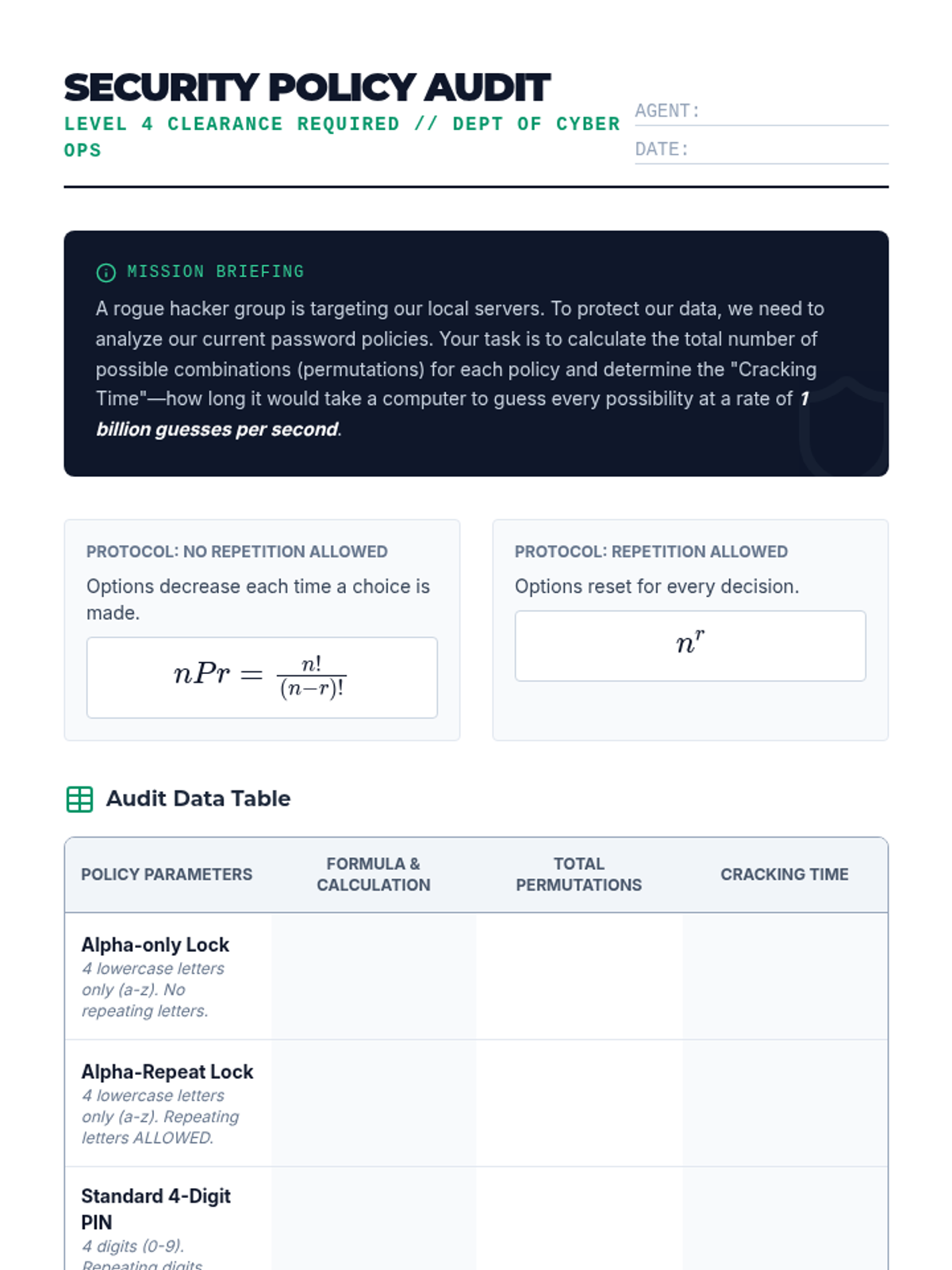
A cybersecurity-themed lesson exploring the mathematics of permutations. Students analyze password security by calculating possible combinations with and without repetition and determining 'cracking time' for different security policies.
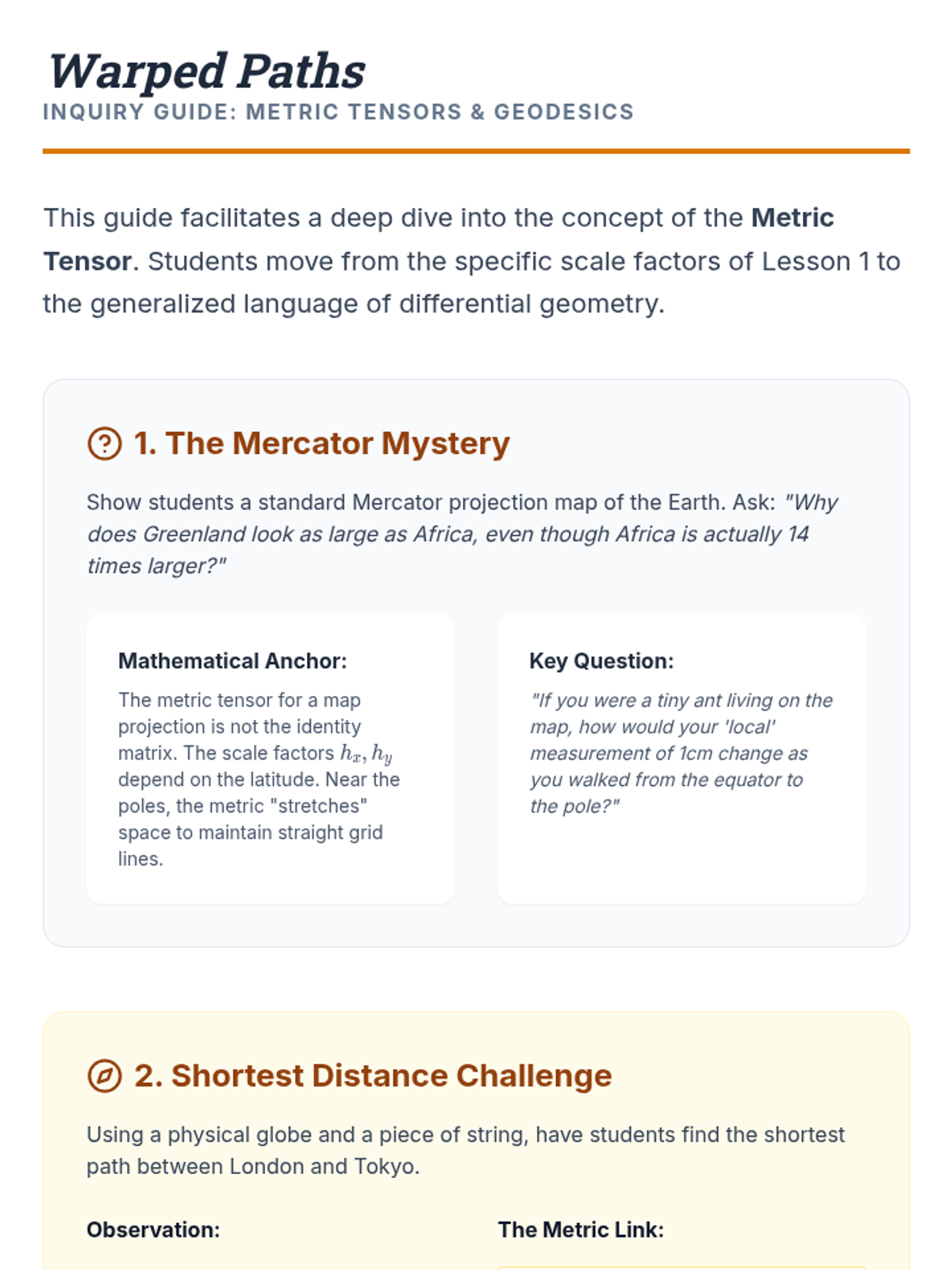
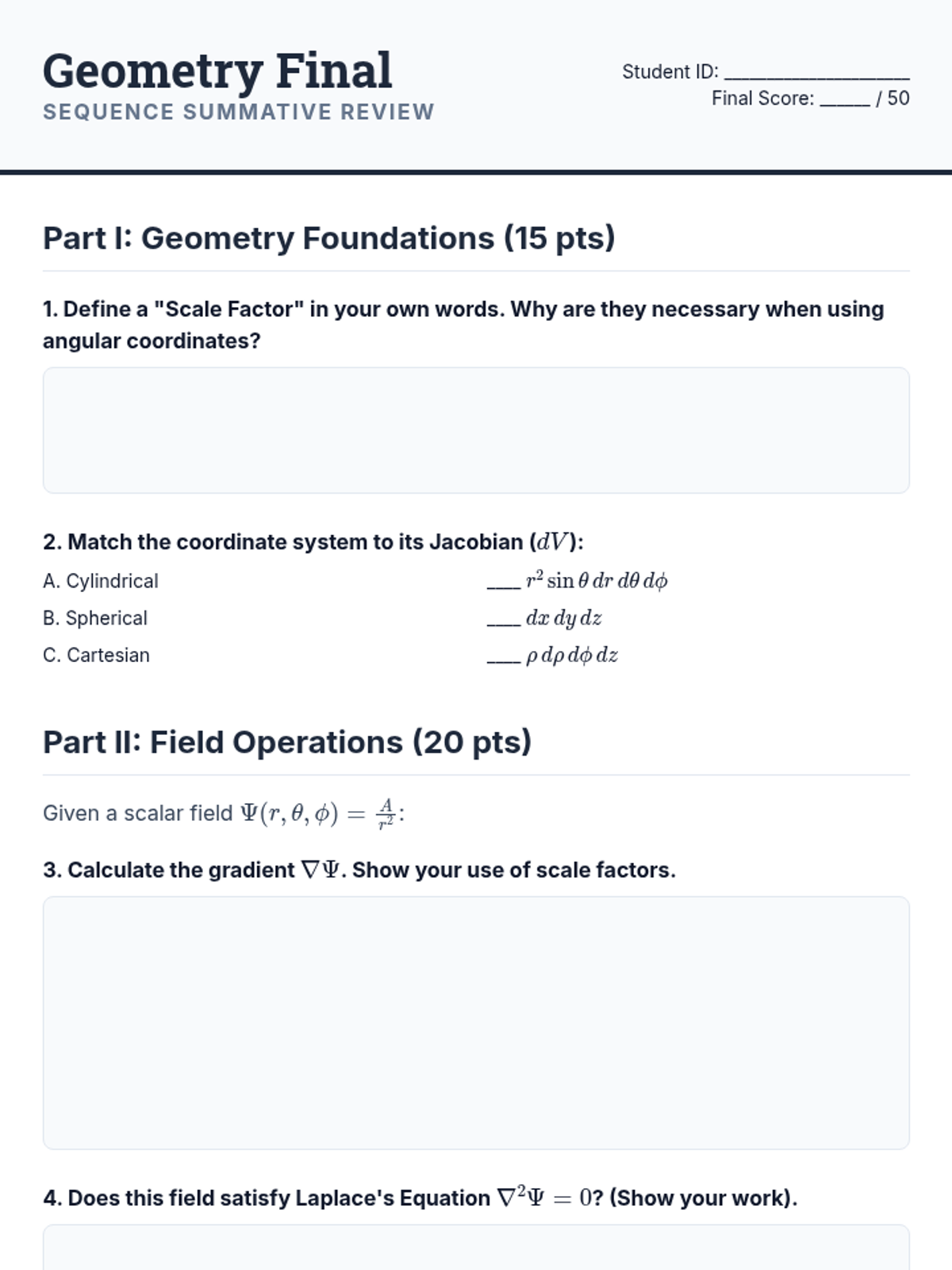
An advanced introduction to the metric tensor and non-Euclidean geometry, serving as a primer for General Relativity.
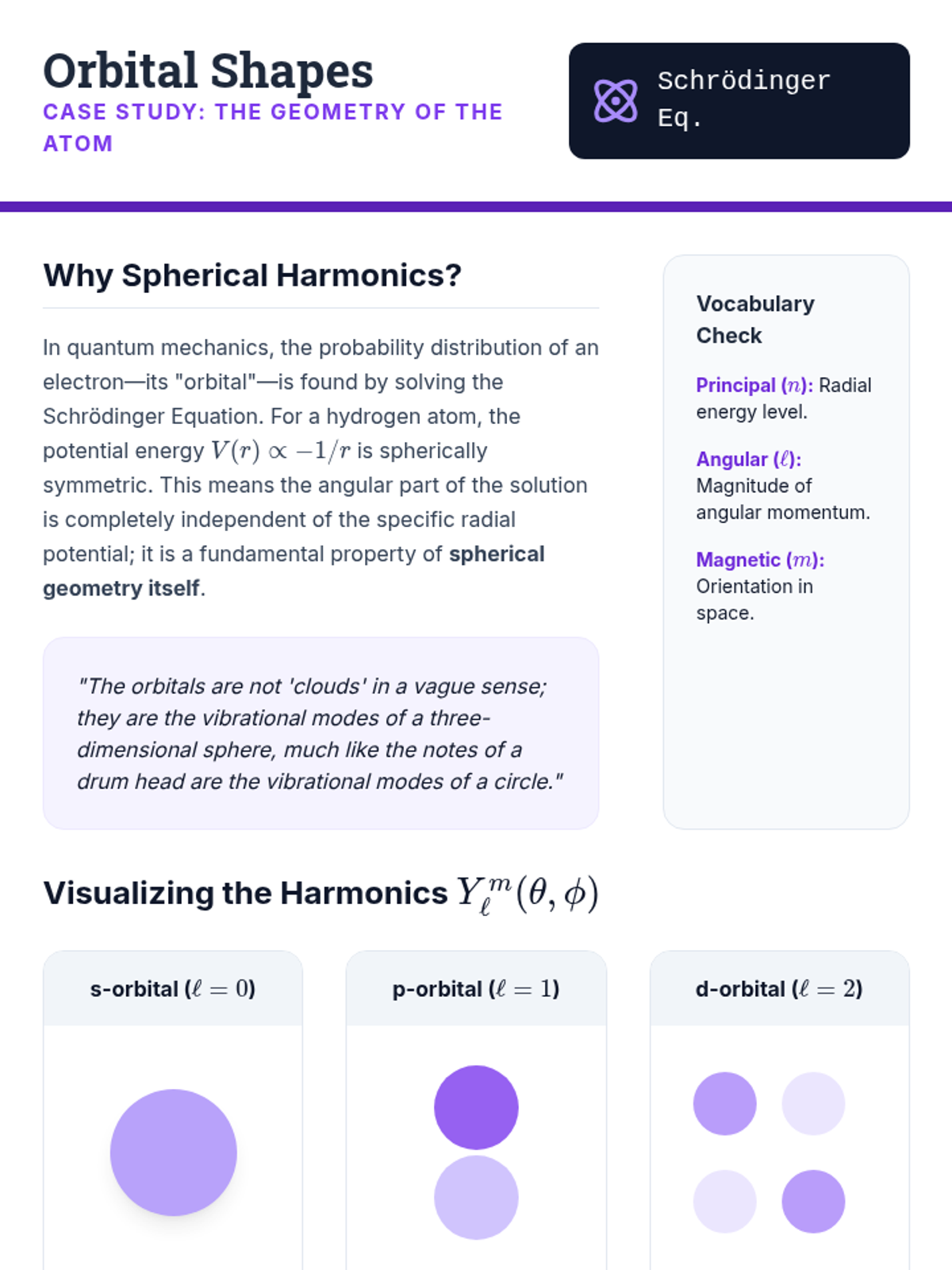
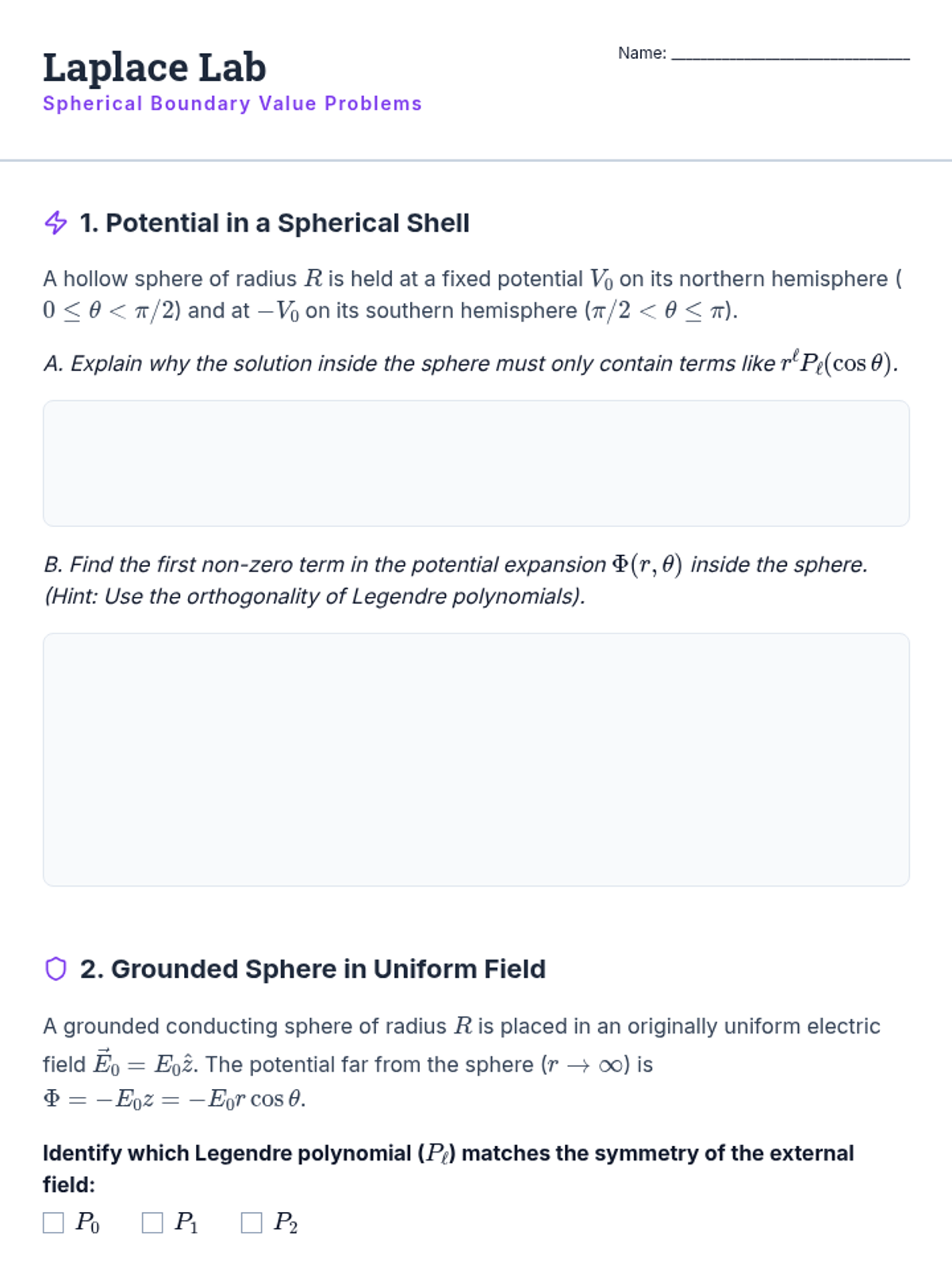
Students solve Laplace's equation for systems with spherical symmetry, introducing Legendre polynomials and Spherical Harmonics.
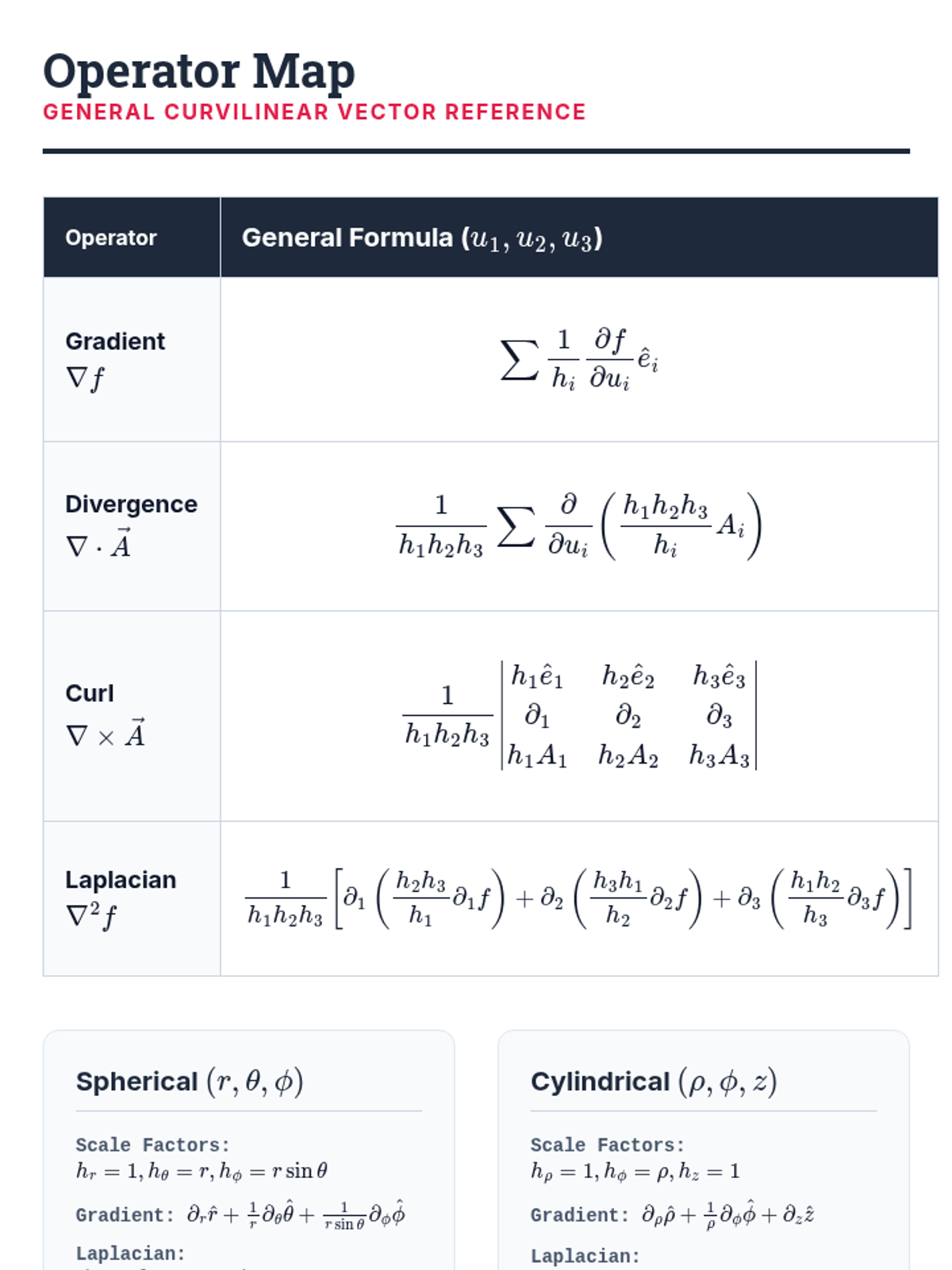
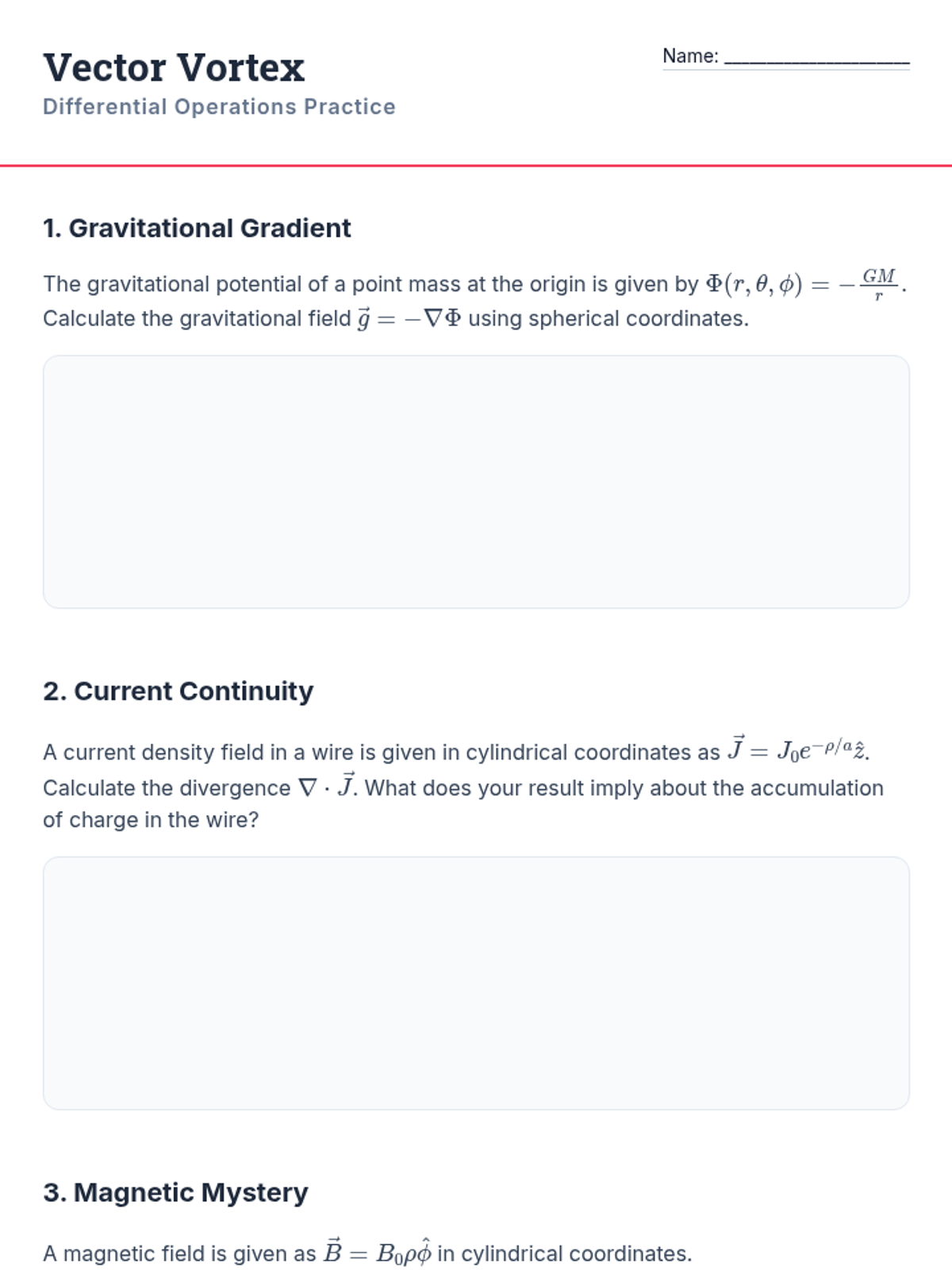
Students translate the Del operator into general curvilinear coordinates and apply these operators to physical vector fields.
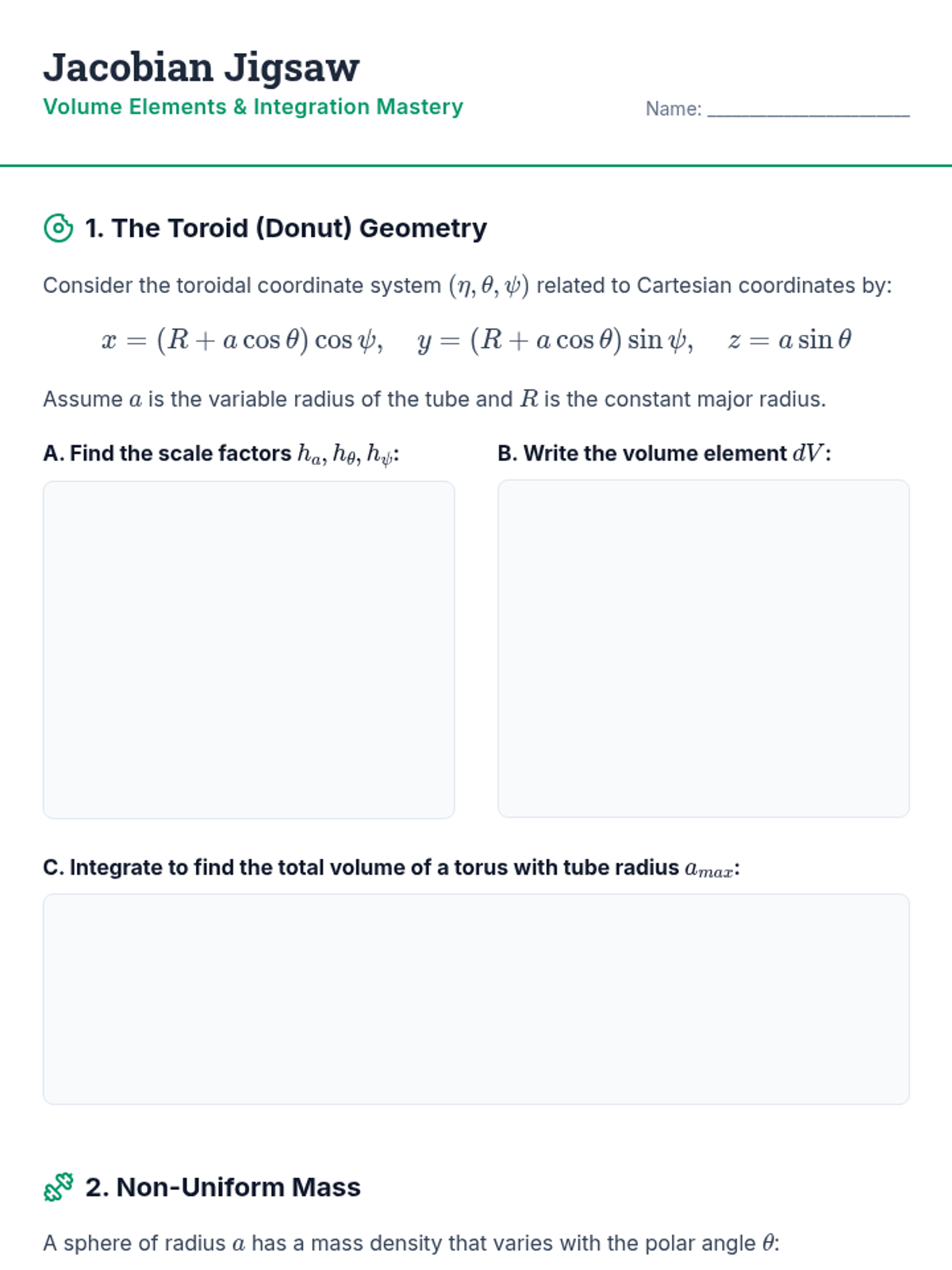
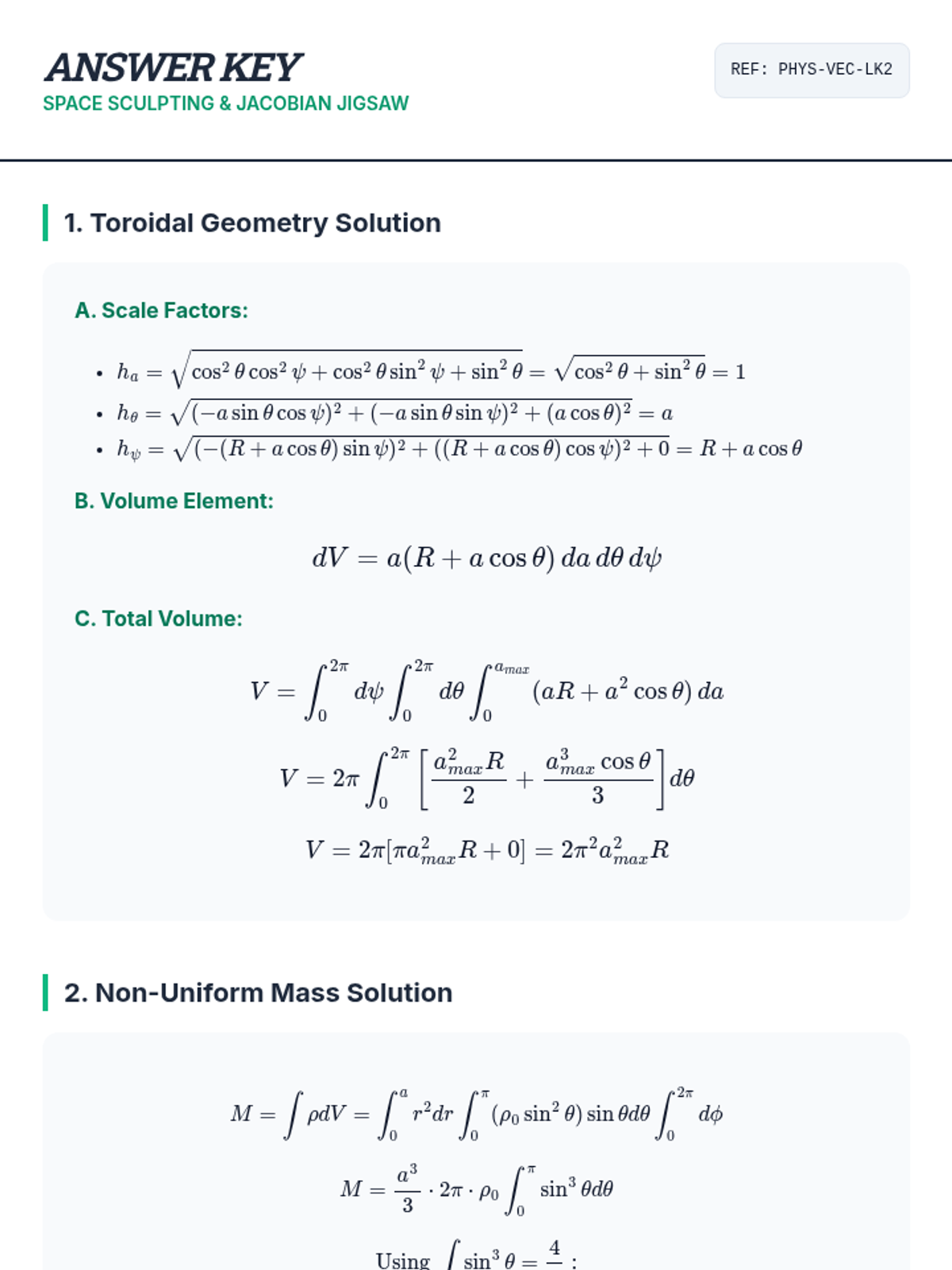
Focusing on integration, students construct volume and area elements (Jacobians) for spherical and cylindrical geometries and practice integrating scalar fields over complex 3D domains.
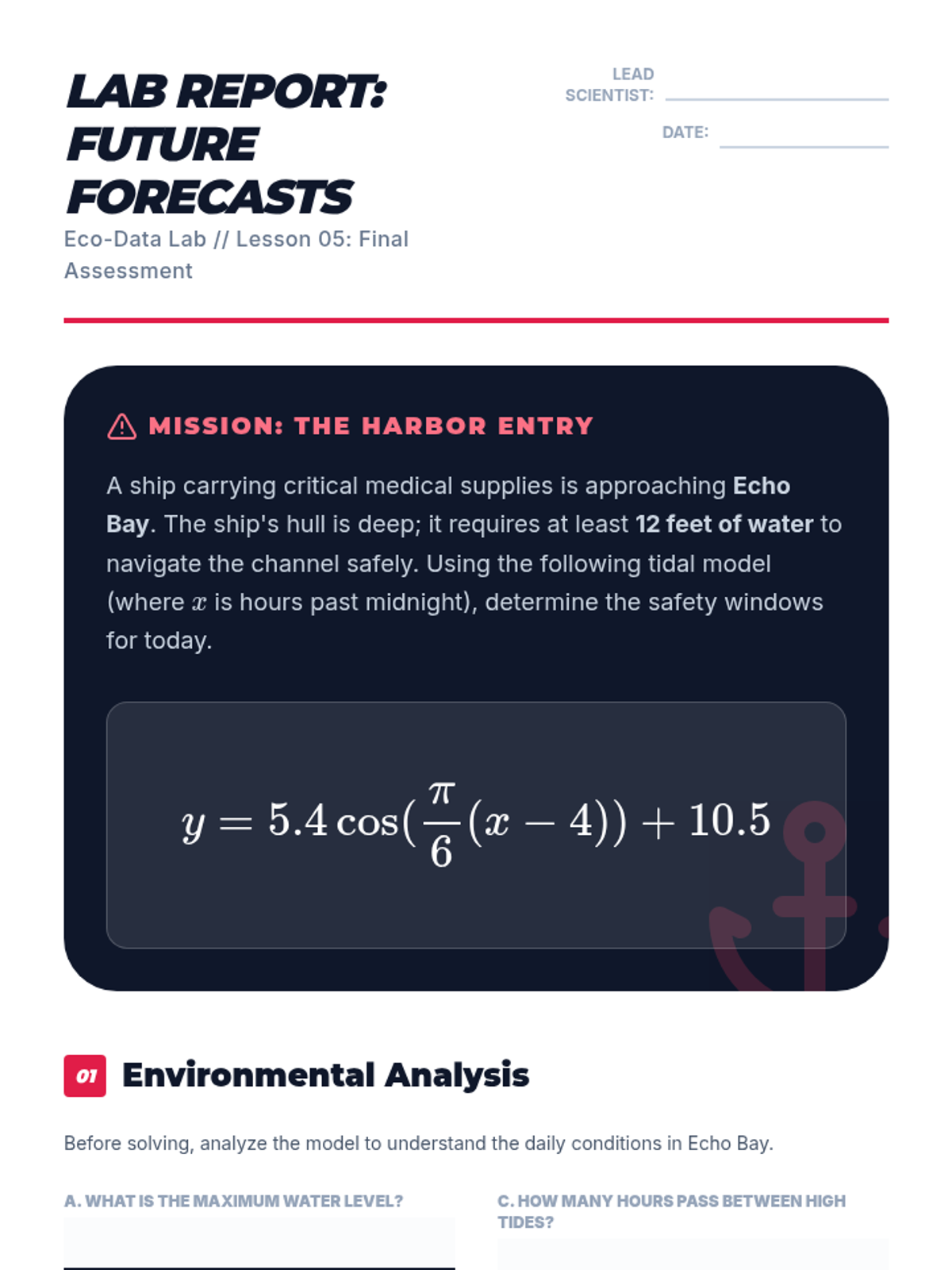
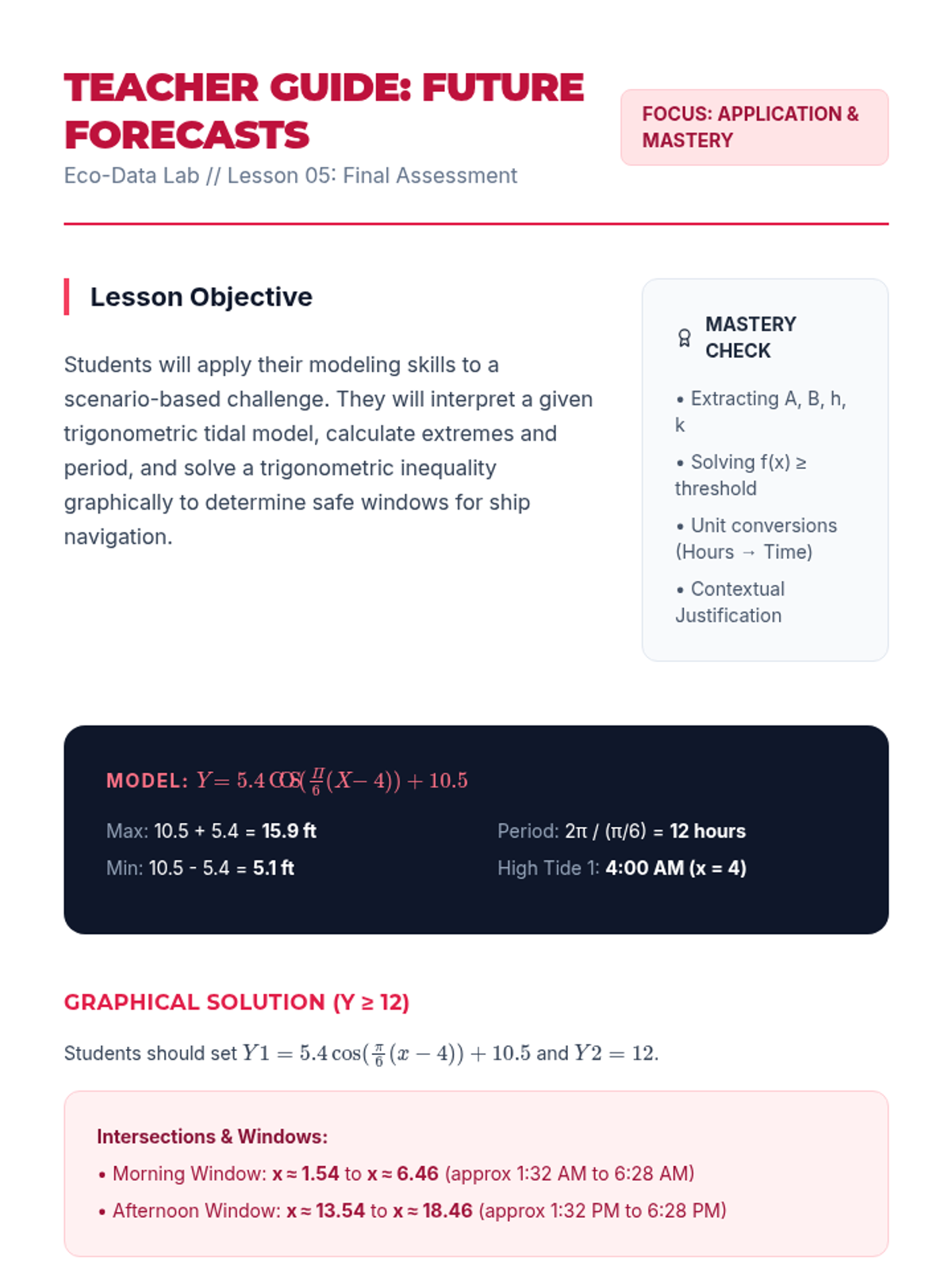
Students use their constructed models to extrapolate and answer questions about future events, solving trigonometric inequalities graphically.
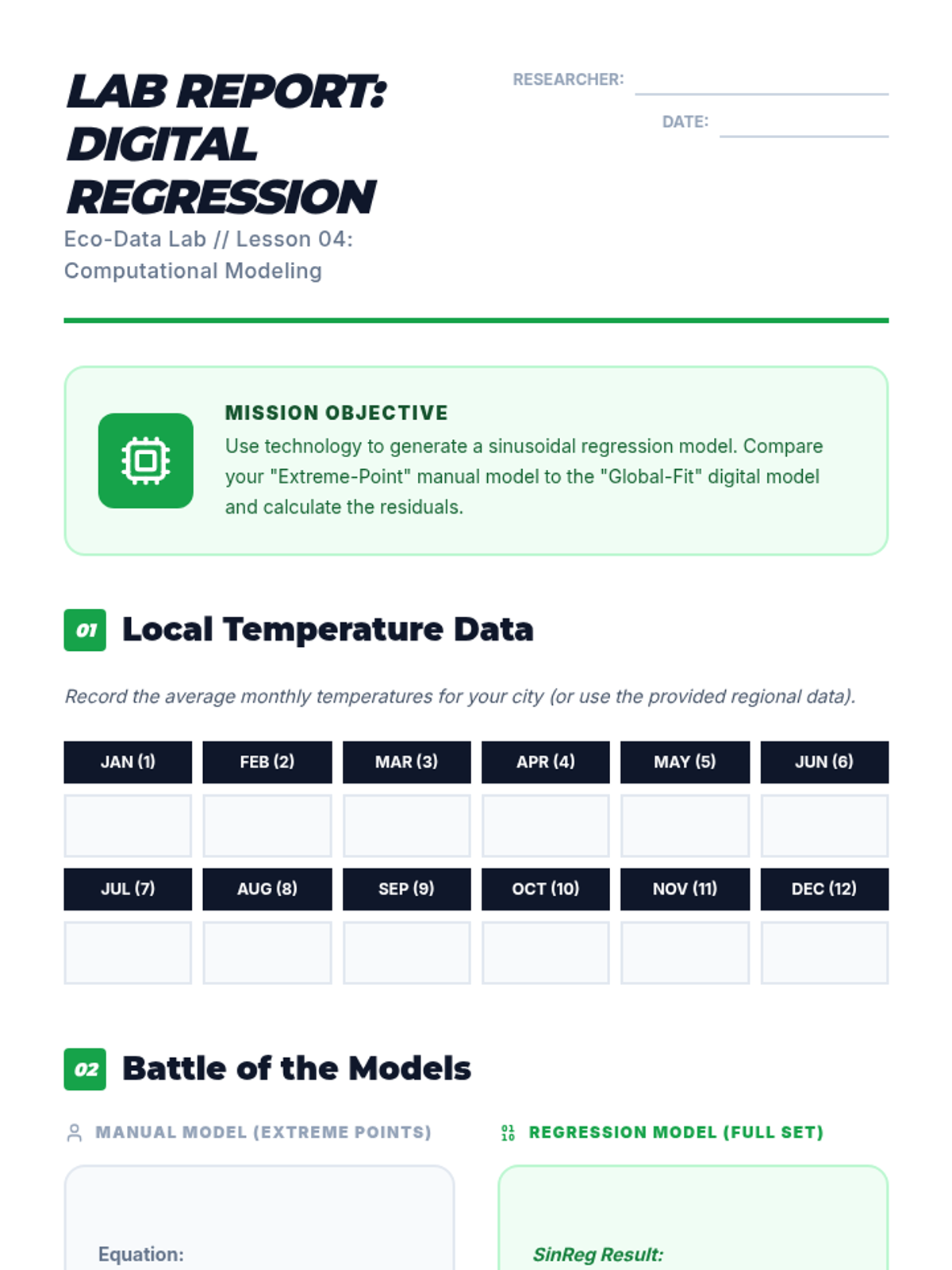
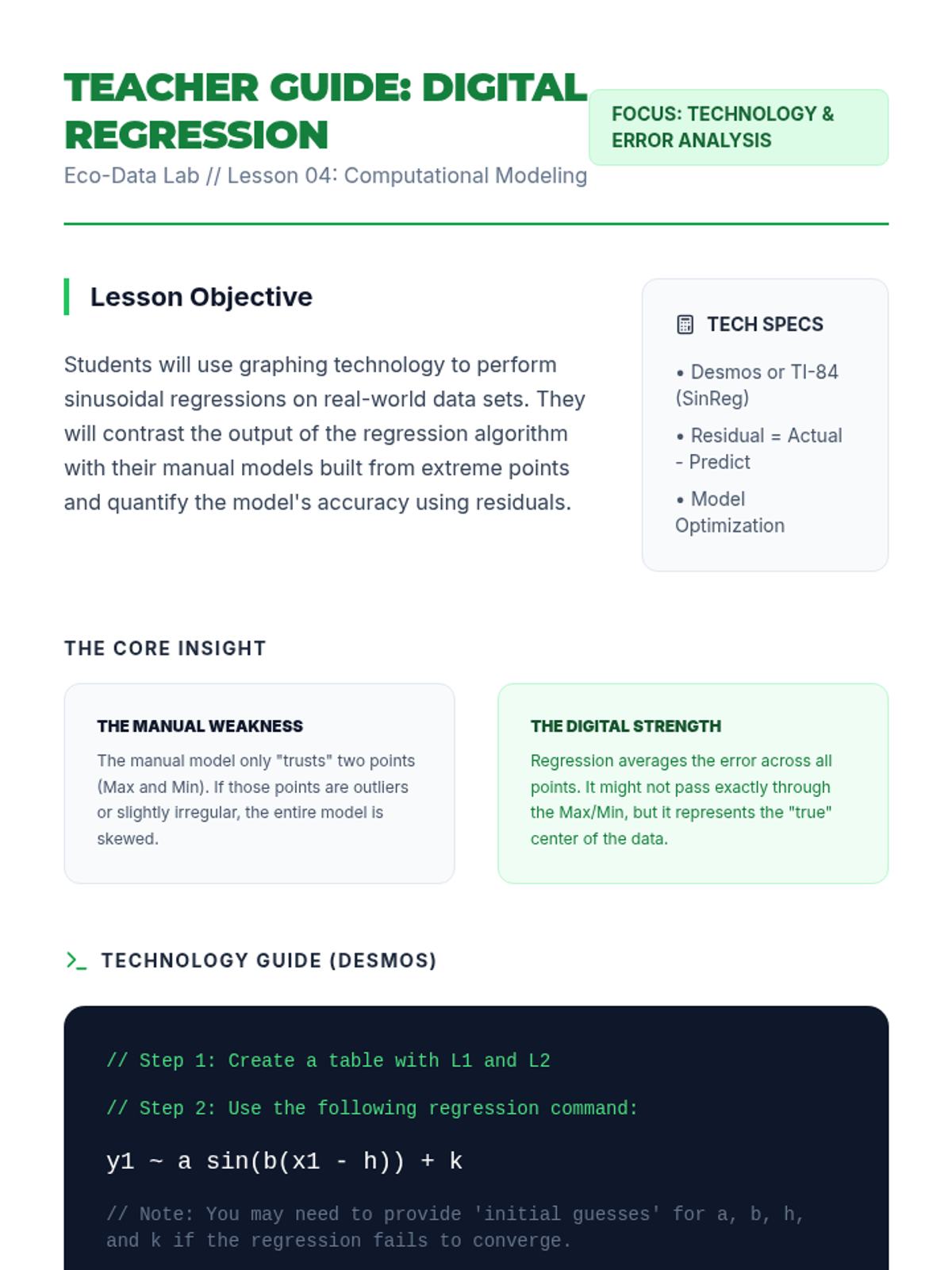
Students use graphing calculators or regression software to fit trigonometric equations to data sets. They compare their hand-calculated models to the regression models.
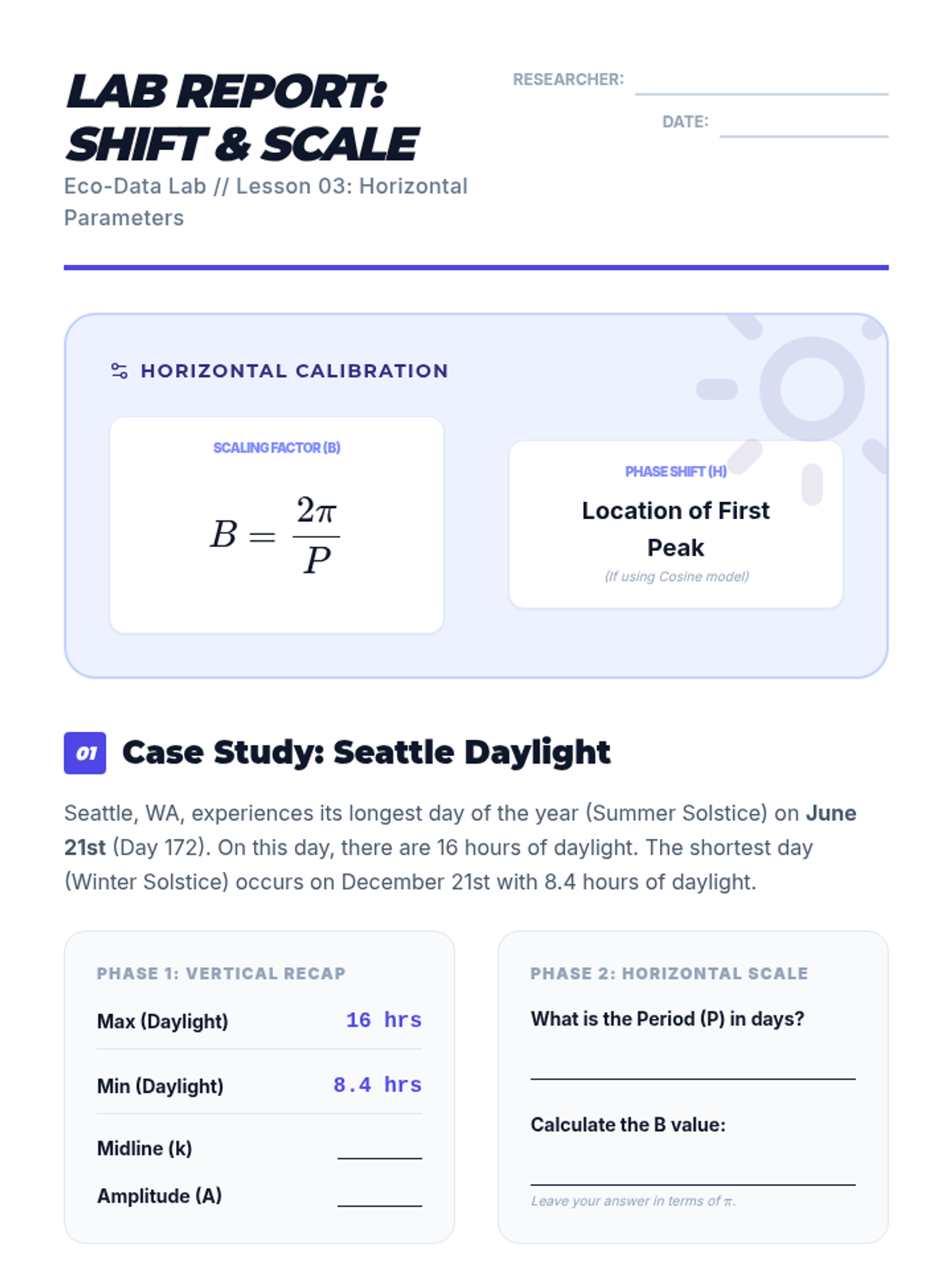
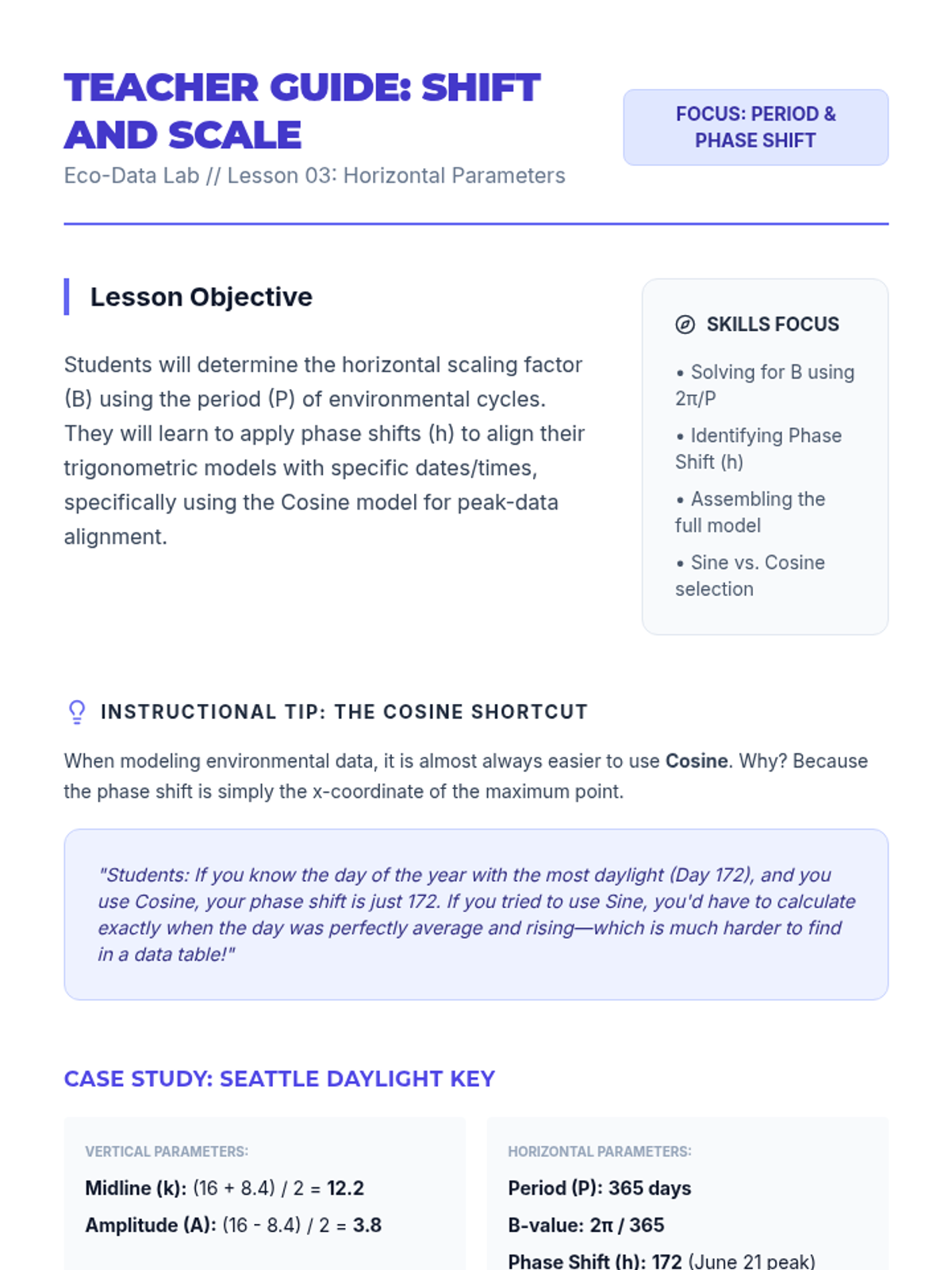
Focusing on the x-axis, students determine the period of real-world cycles. They calculate the horizontal scaling factor and determine appropriate horizontal shifts.
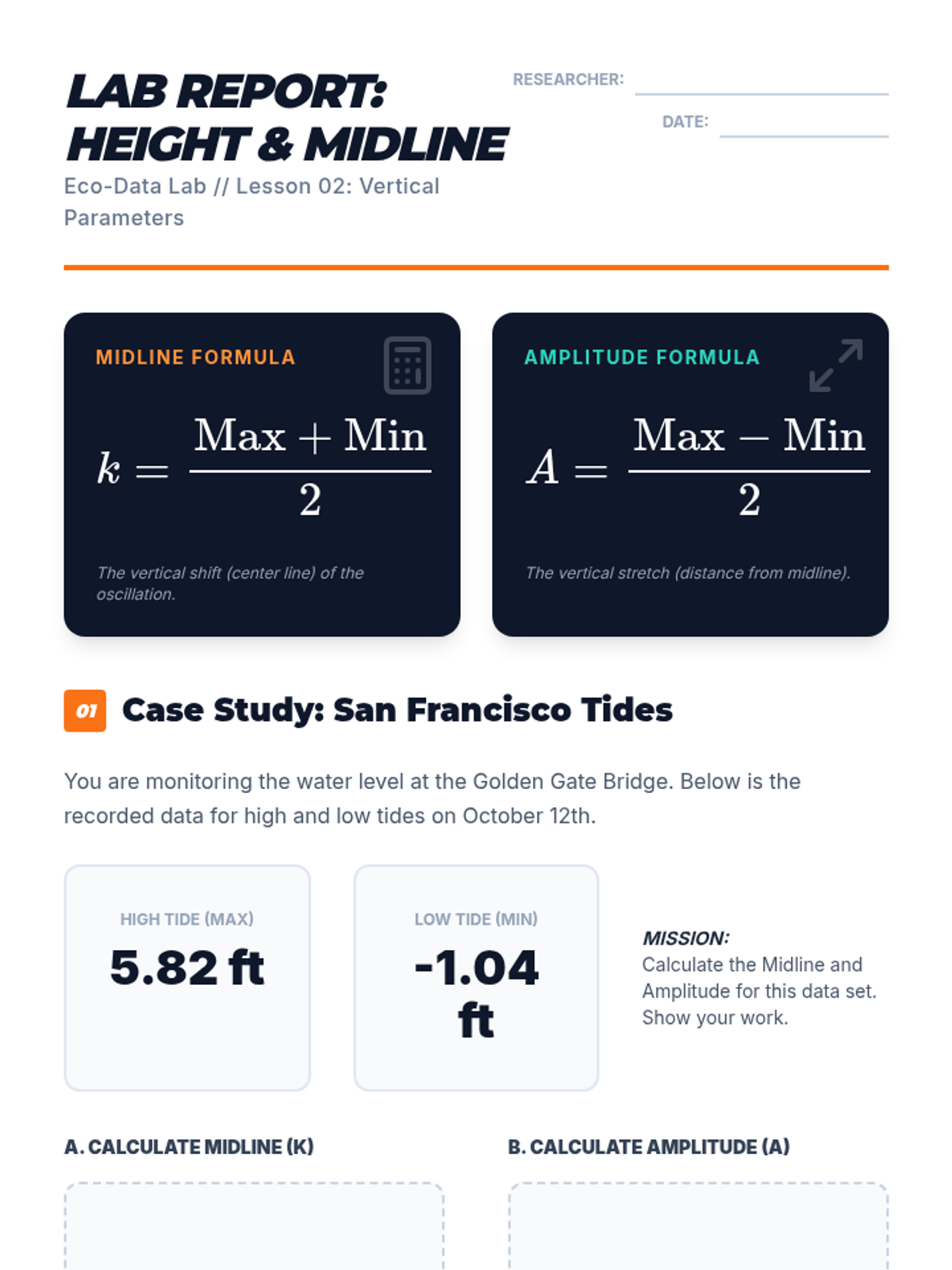
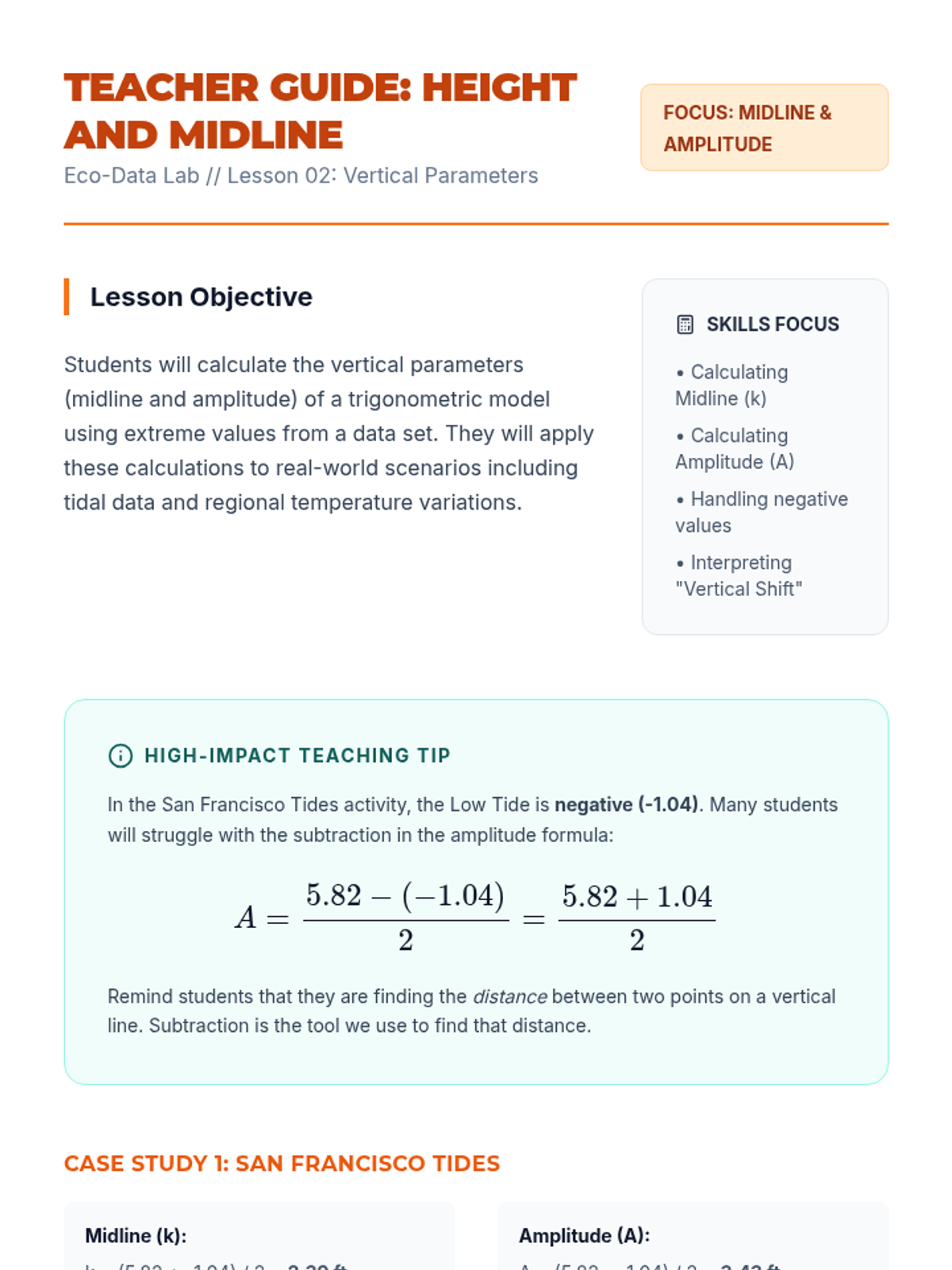
Students learn the algebraic techniques to extract the midline and amplitude from a data table. They practice these calculations on various environmental data sets.
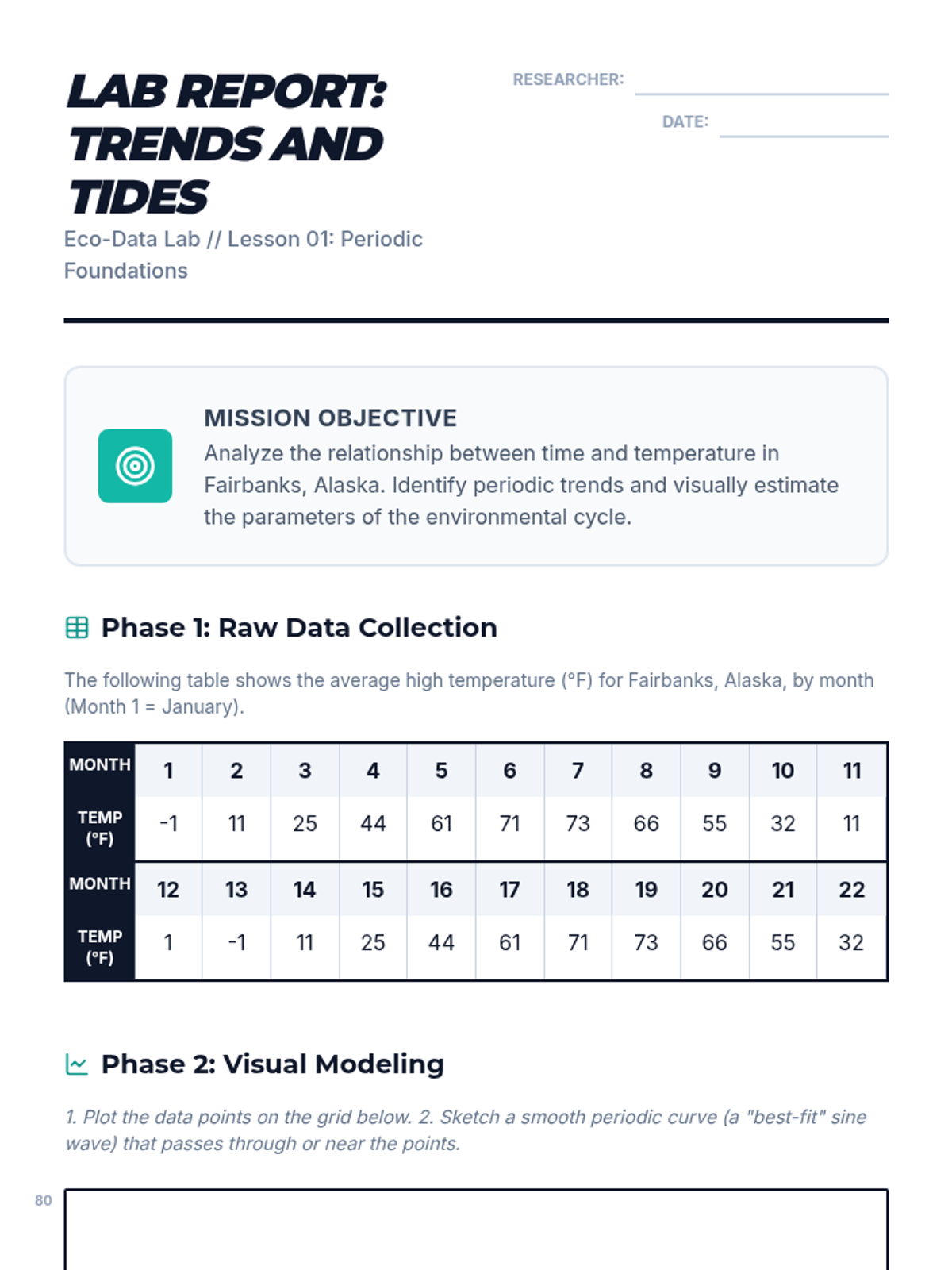
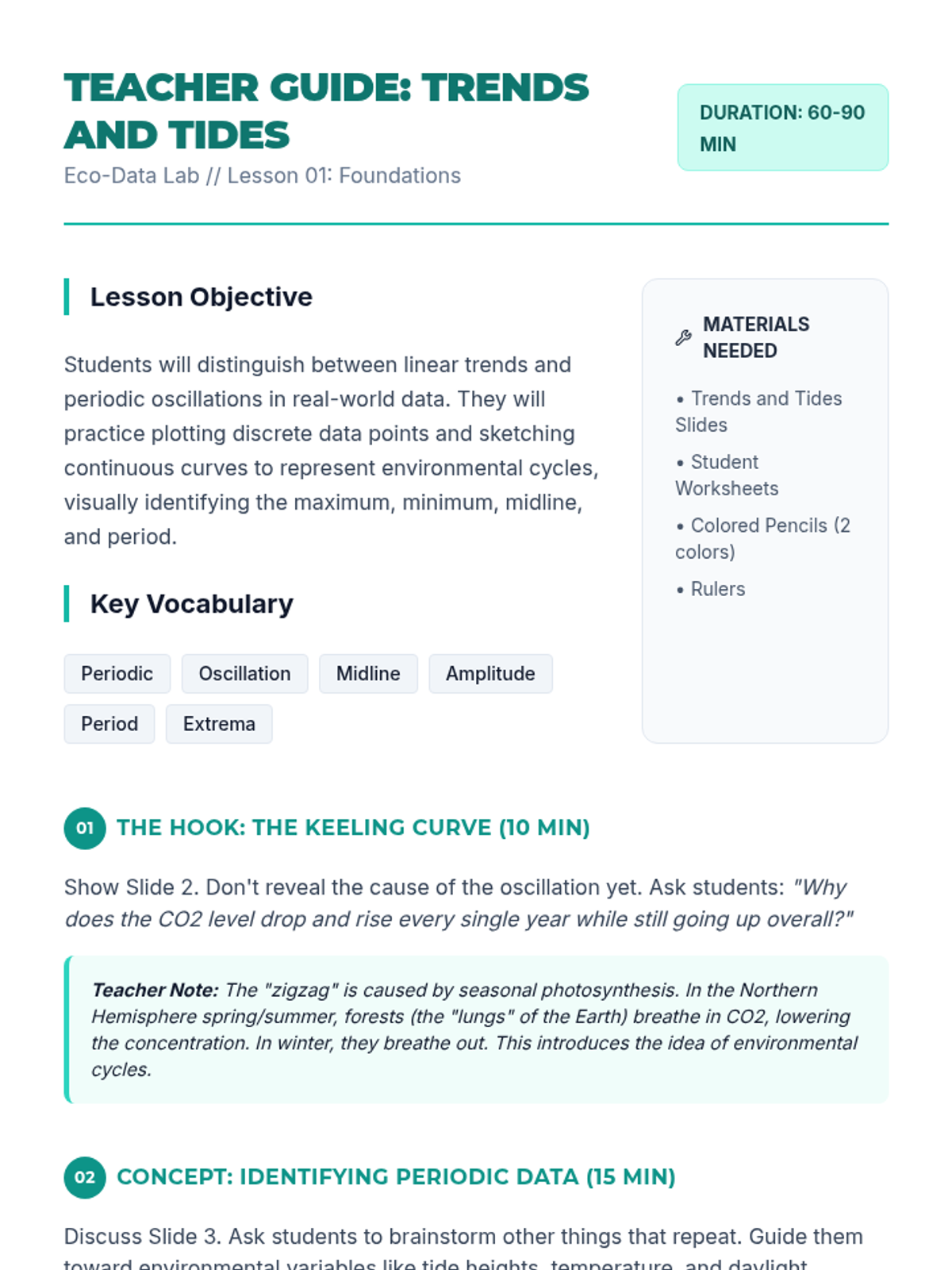
Students plot given data sets and identify the periodic nature of the data. They sketch a 'best fit' curve by hand to estimate the maximums, minimums, and cycle length.
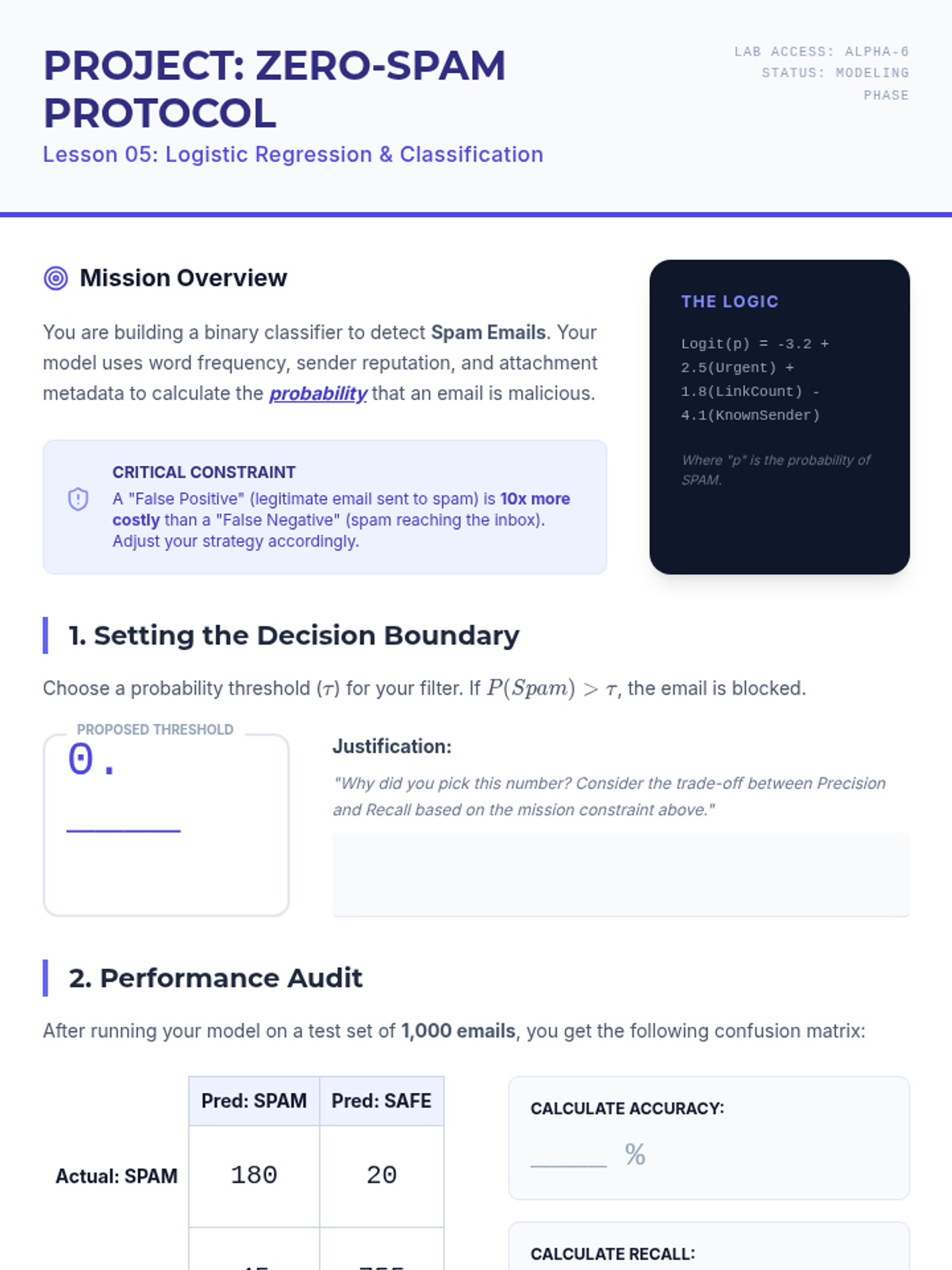
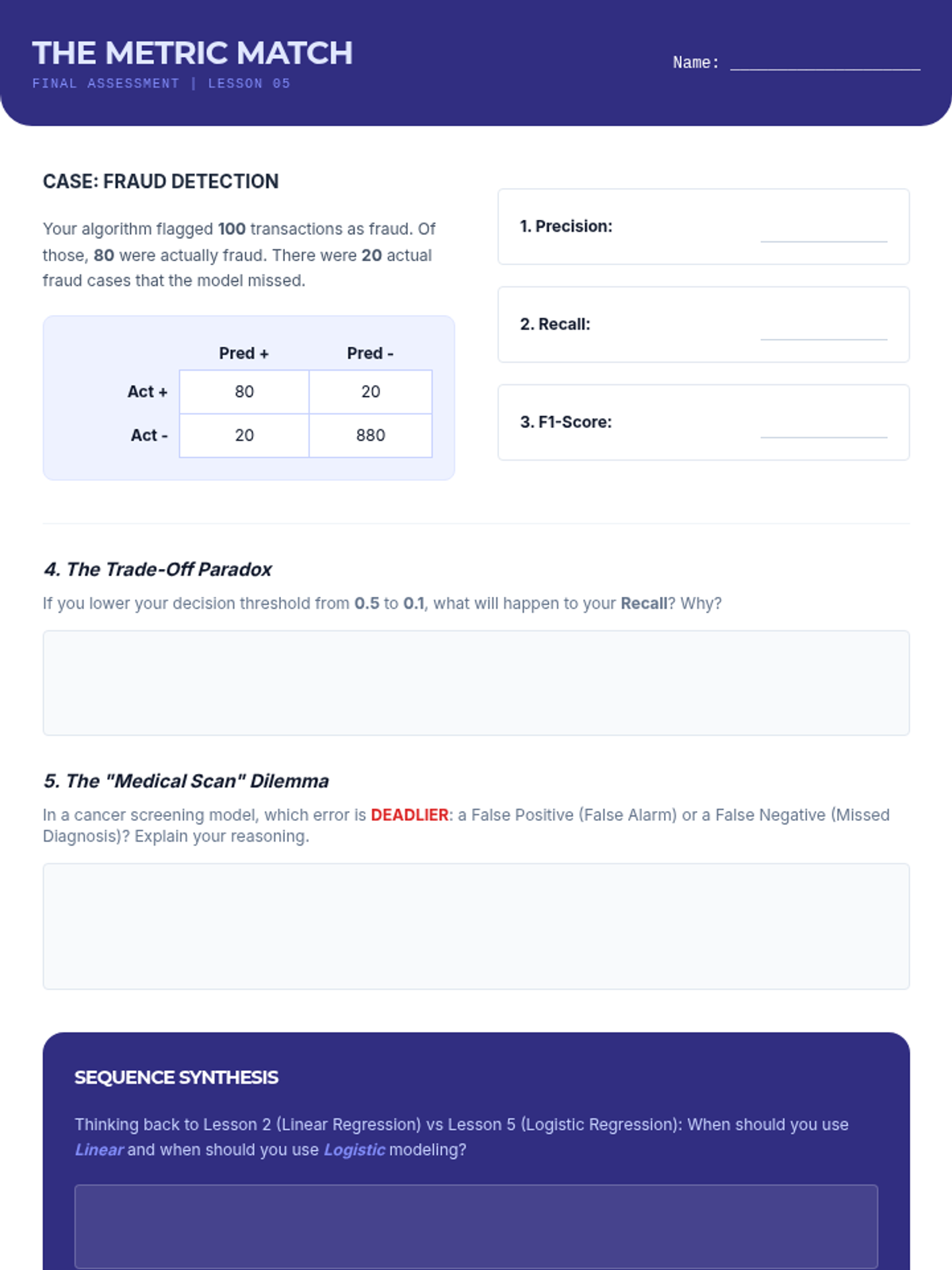
Transitioning to categorical outcomes, students explore logistic regression, probability thresholds, confusion matrices, and the precision-recall trade-off through a spam classification project.
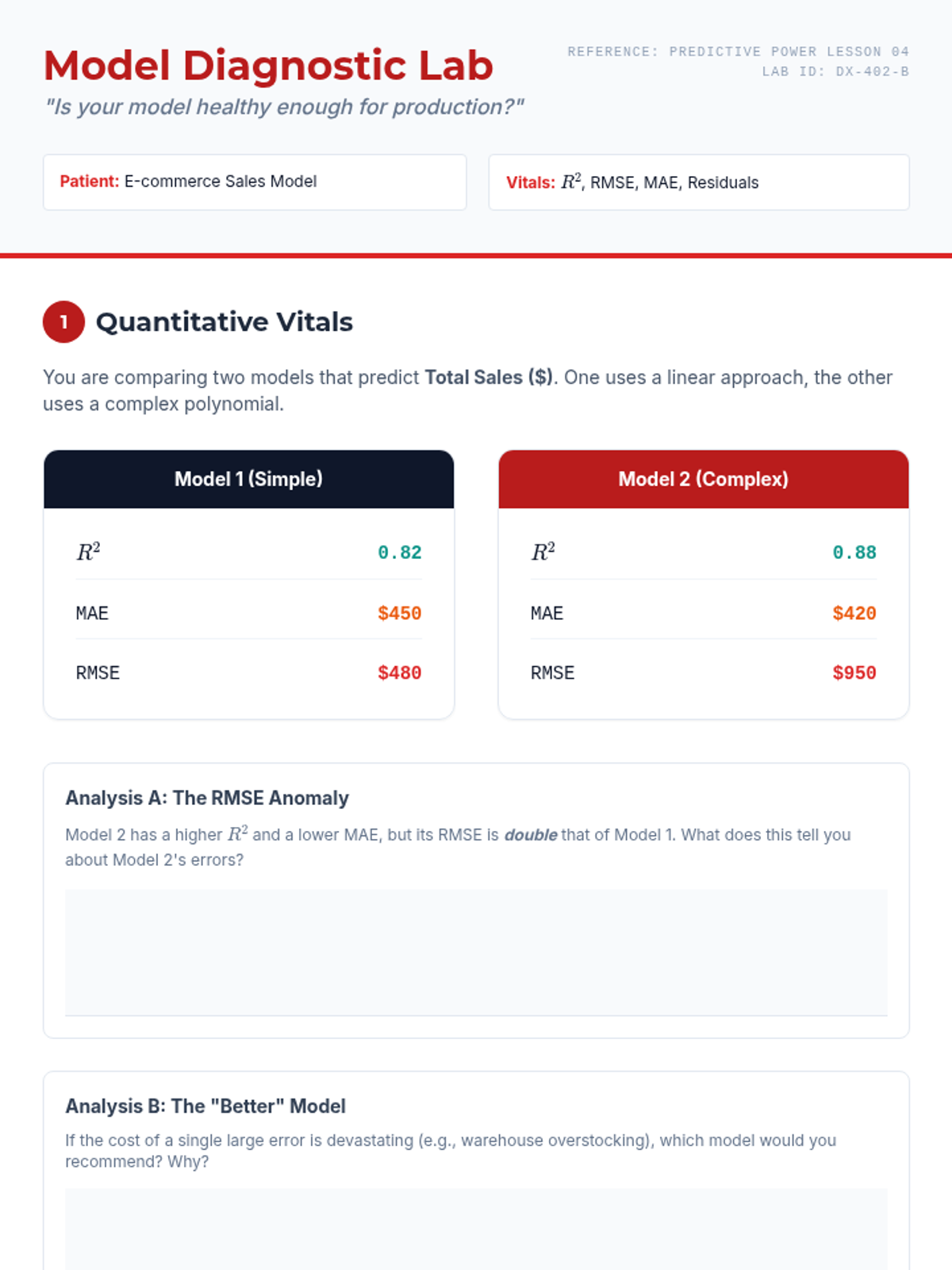
Focuses on quantifying model performance using R-squared, RMSE, and MAE. Students also learn to validate statistical assumptions like homoscedasticity and error normality.
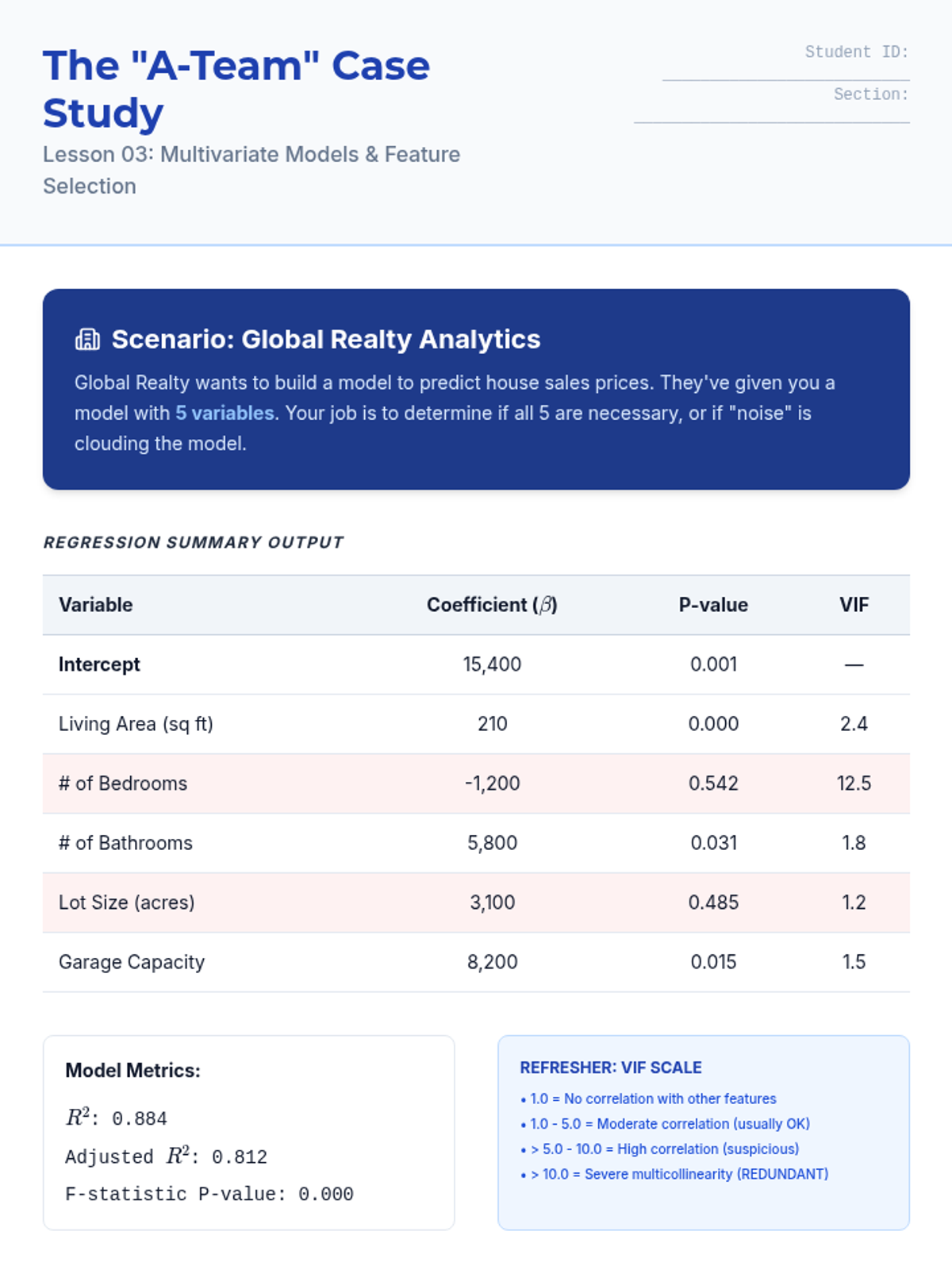
Expanding models to include multiple predictors. The lesson focuses on interpreting multivariate coefficients, detecting multicollinearity, and employing feature selection strategies to improve model performance.
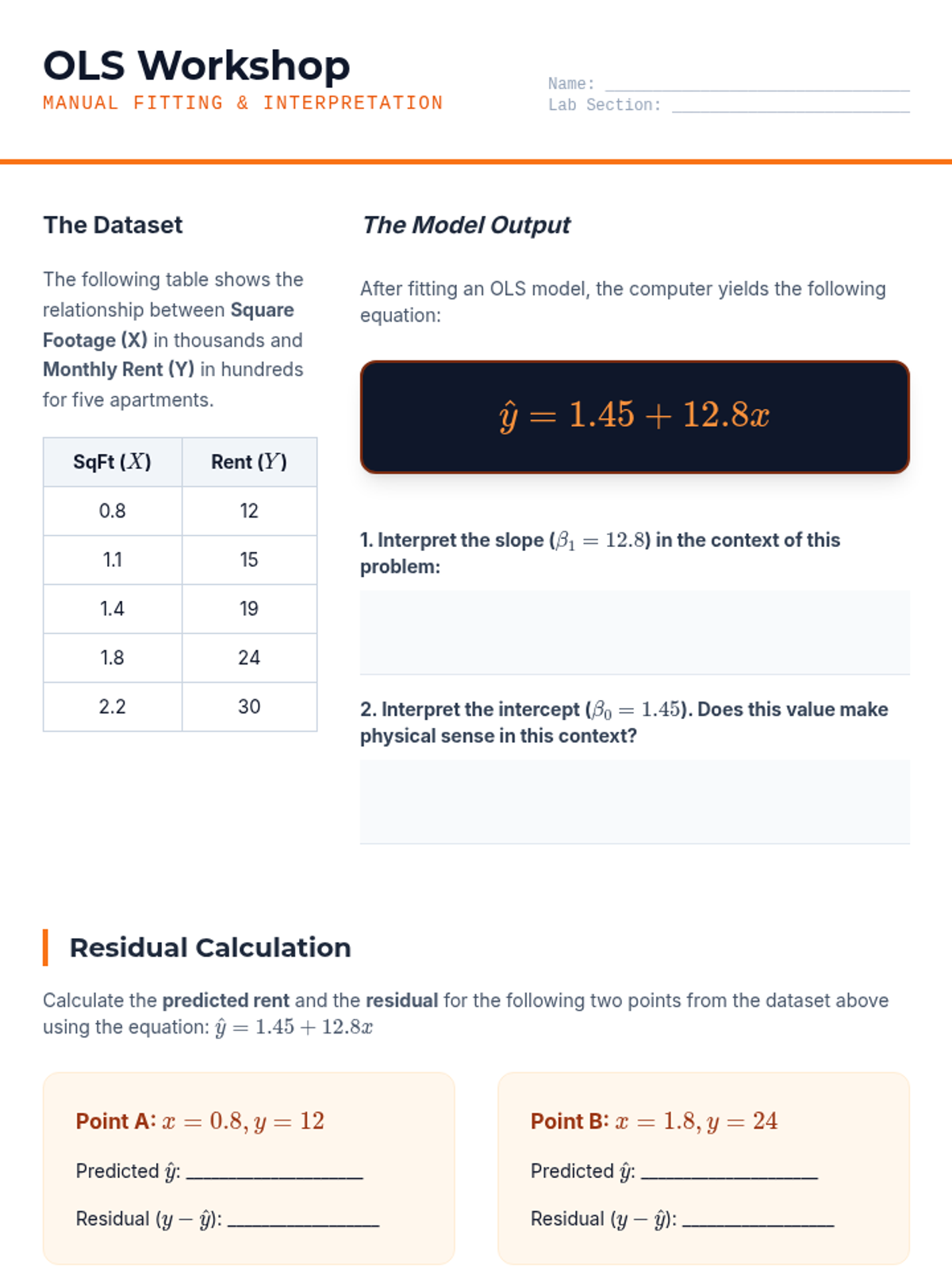
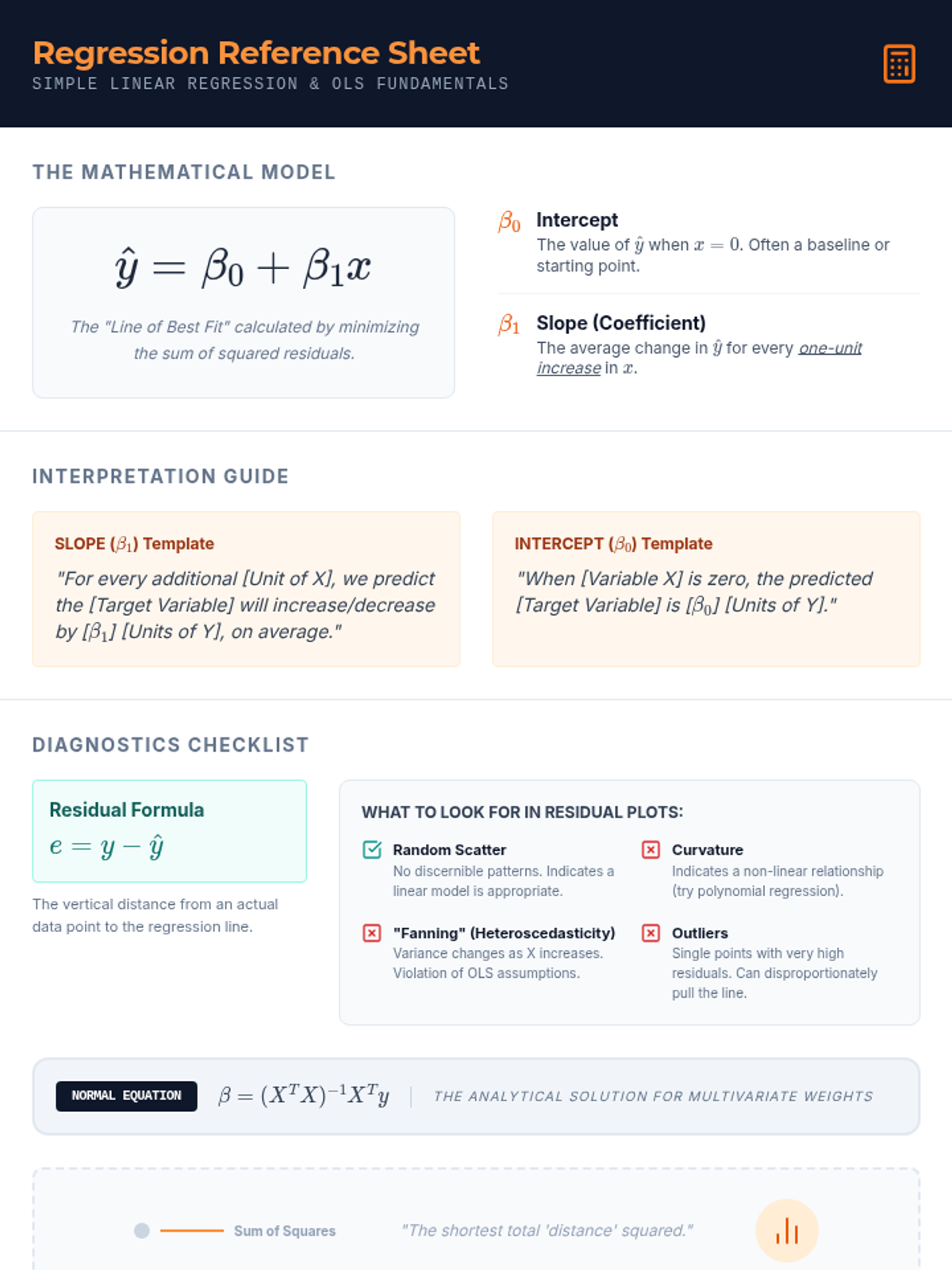
An introduction to Ordinary Least Squares (OLS) regression. Students fit models with a single predictor, interpret coefficients, and analyze residuals to understand the relationship between variables.
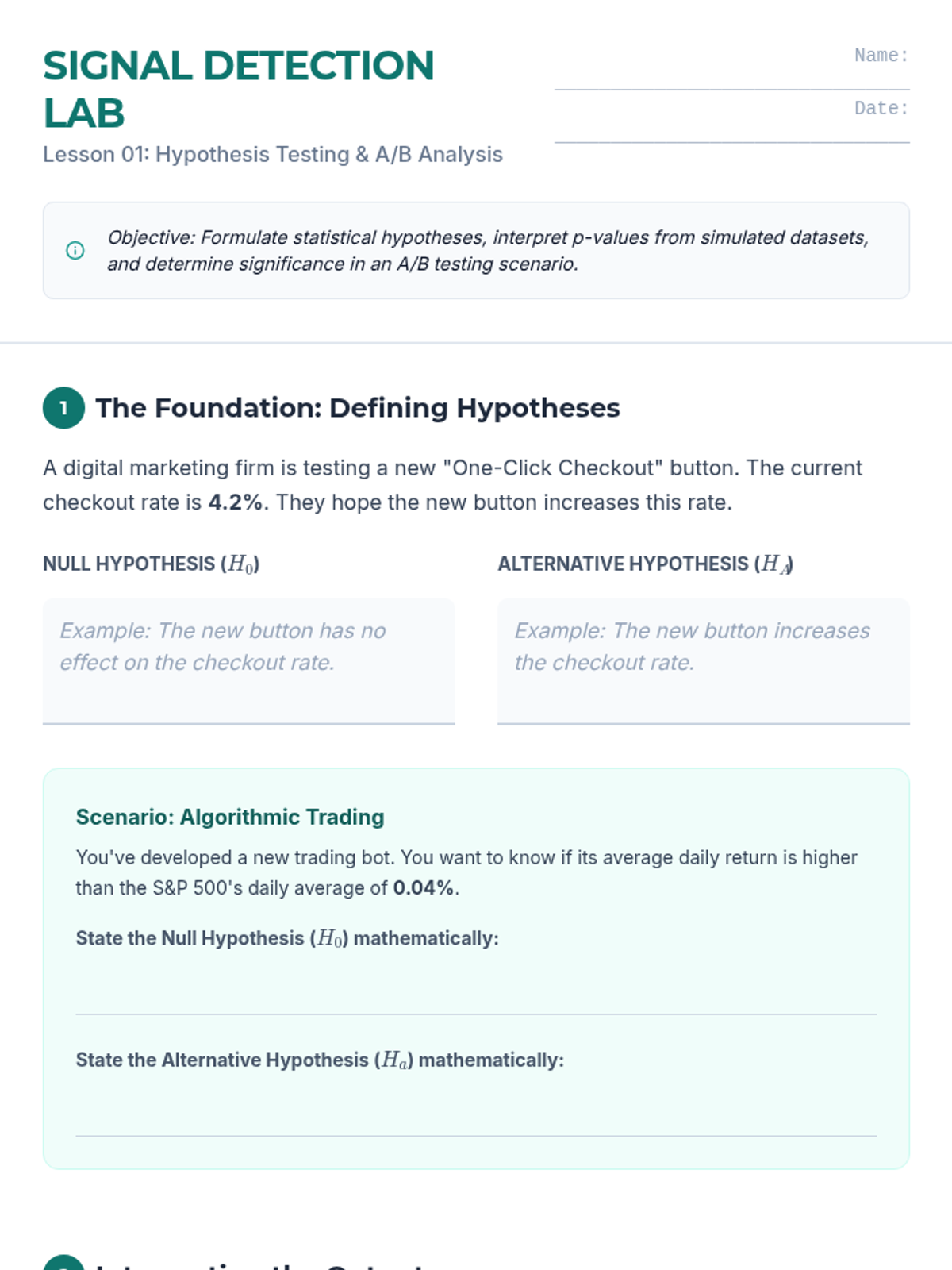
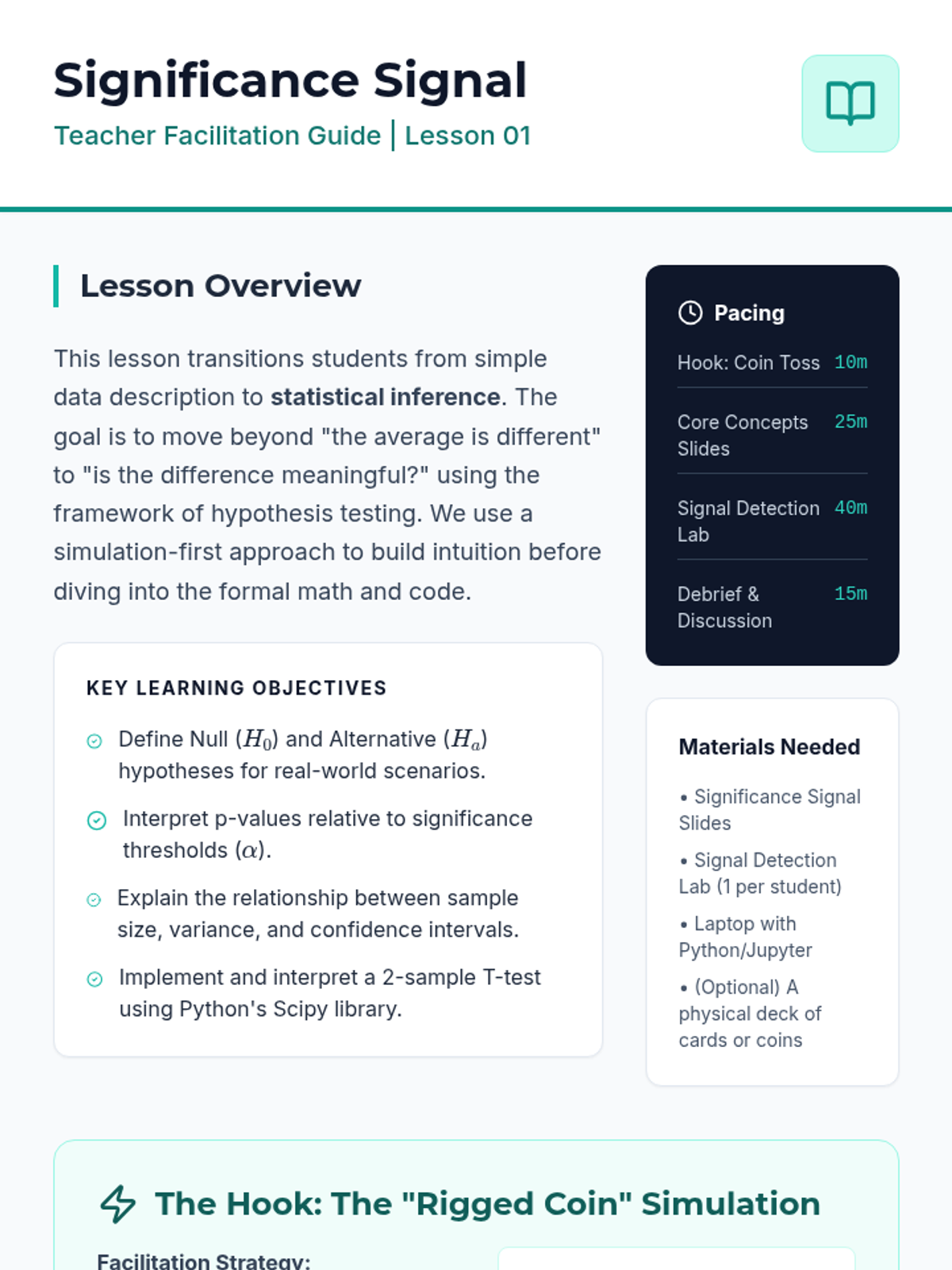
Students review fundamental statistical concepts including p-values, confidence intervals, and t-tests within a coding environment. They practice formulating null and alternative hypotheses for real datasets through simulations and A/B testing scenarios.
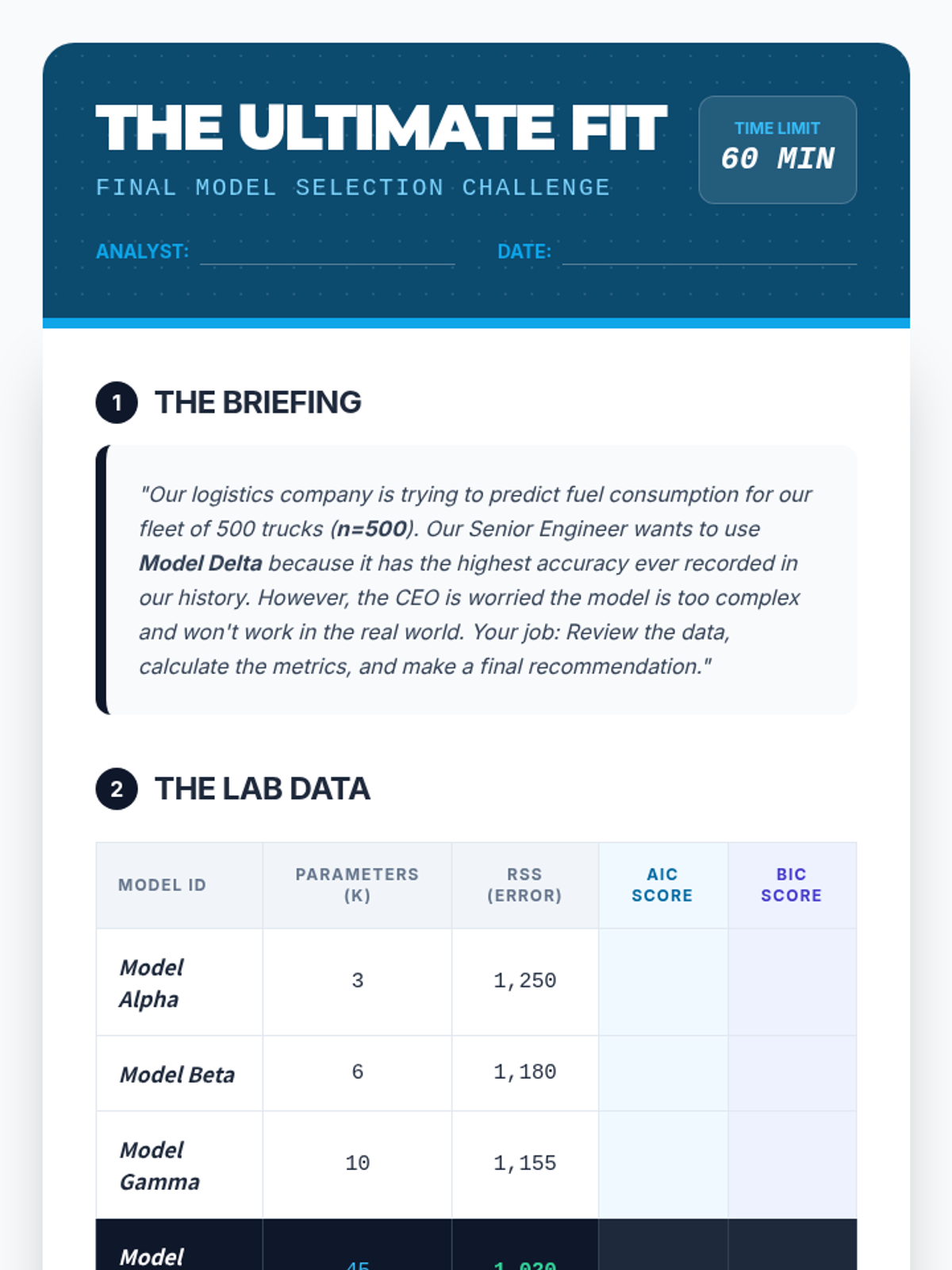
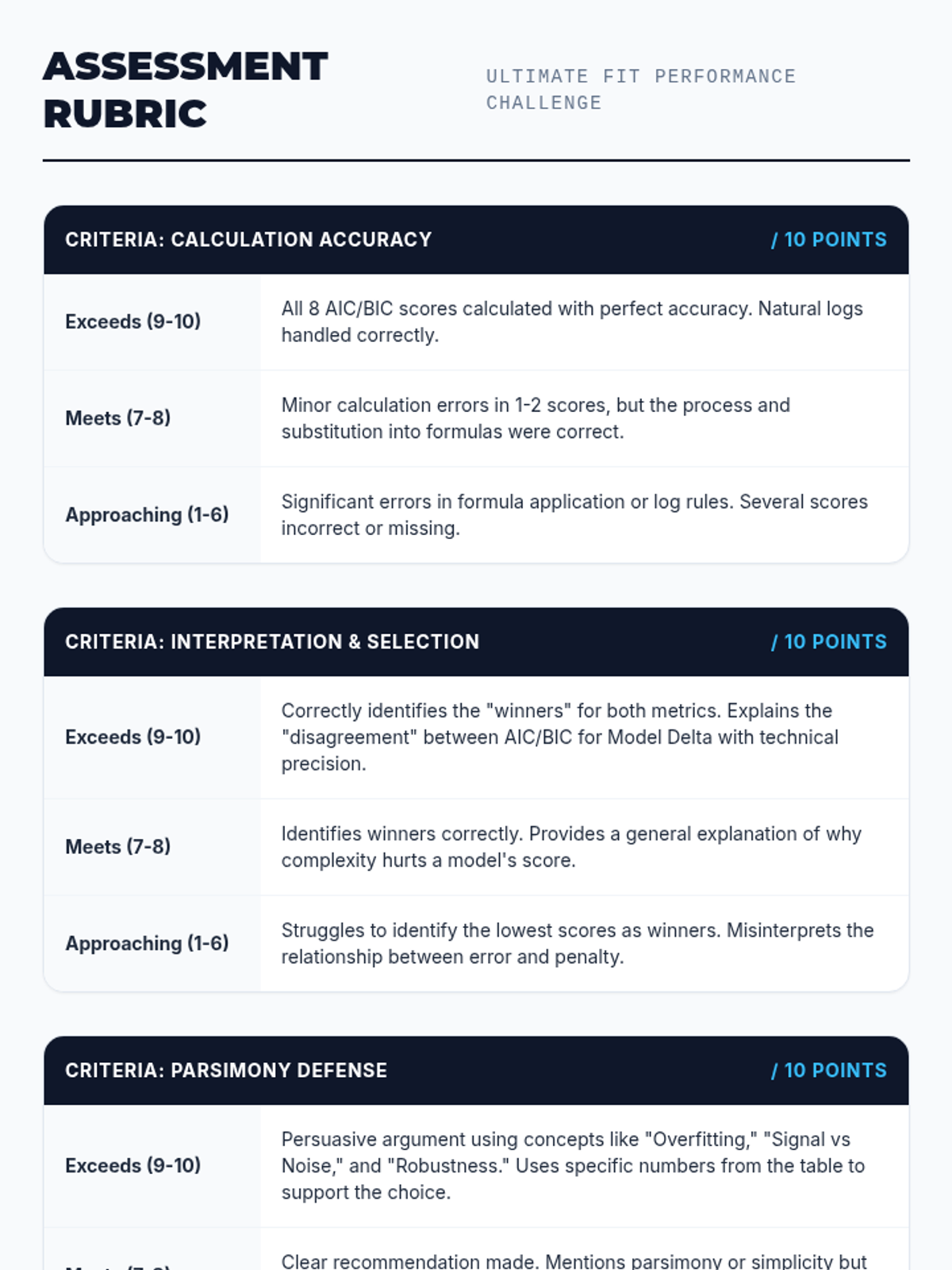
A culminating challenge where students must select the best model from a messy dataset, defending their choice using AIC/BIC metrics against over-parameterized alternatives.
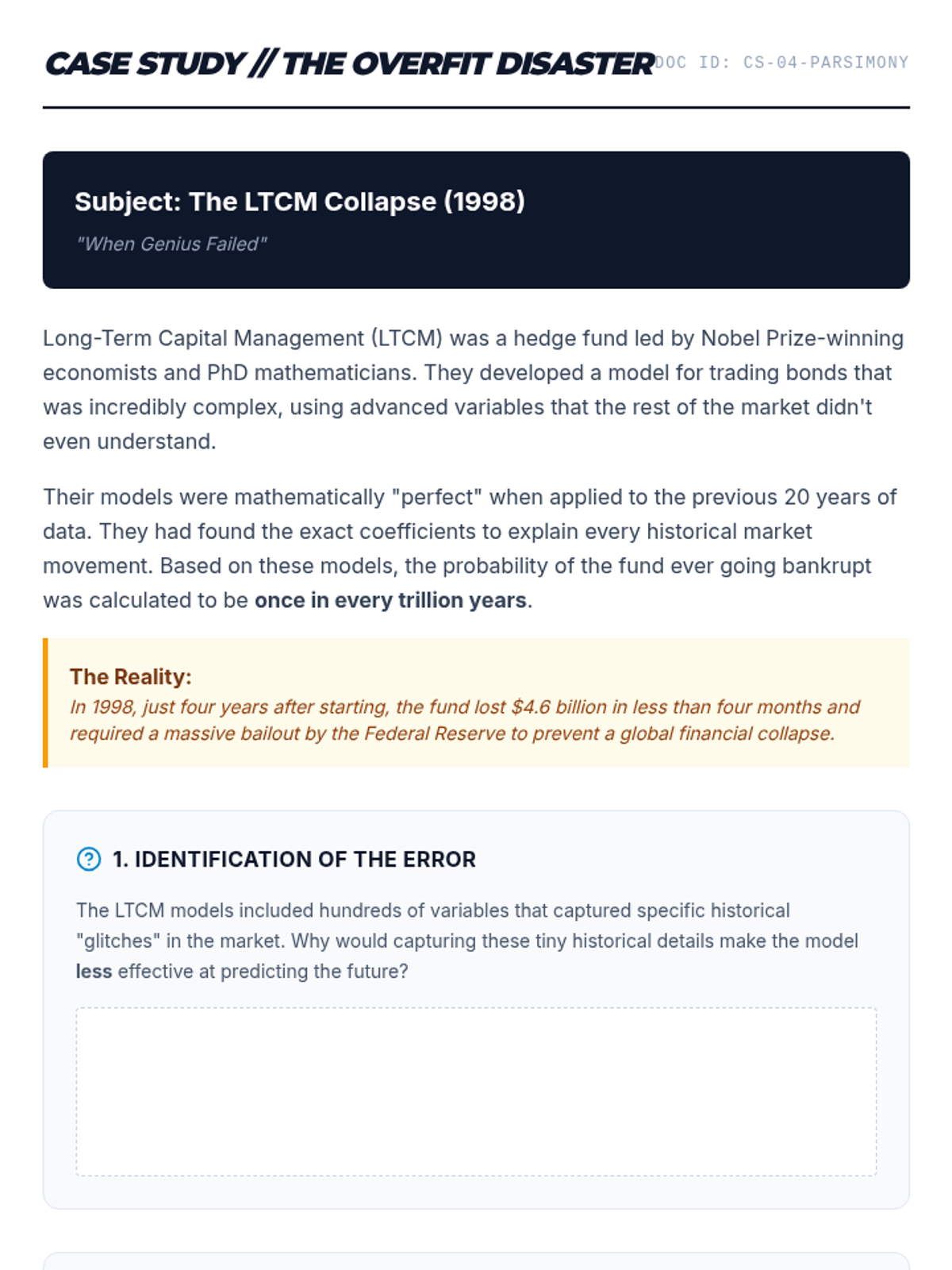
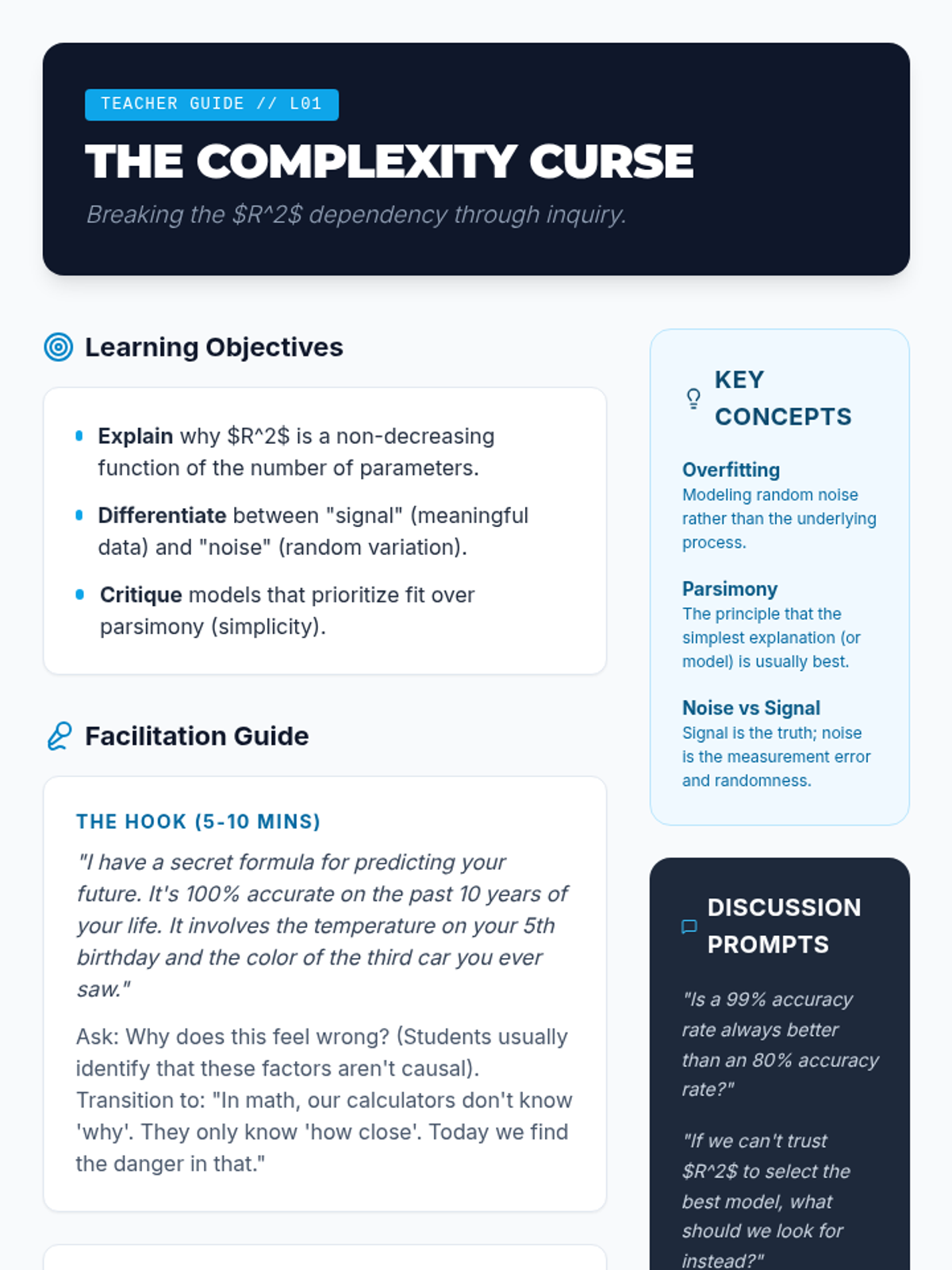
An exploration of Occam's Razor in mathematics, analyzing case studies where simpler models outperformed complex ones in long-term forecasting.
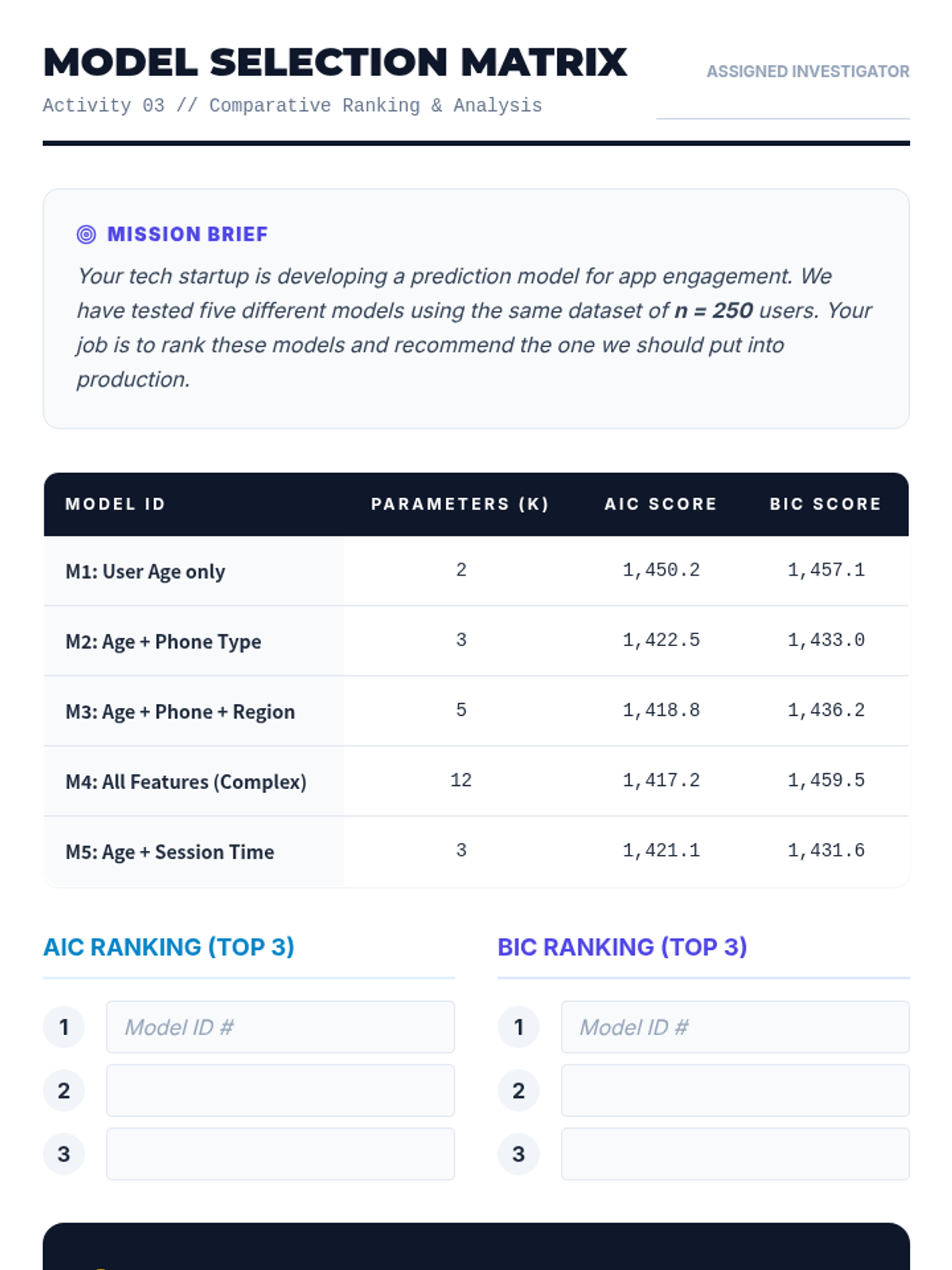
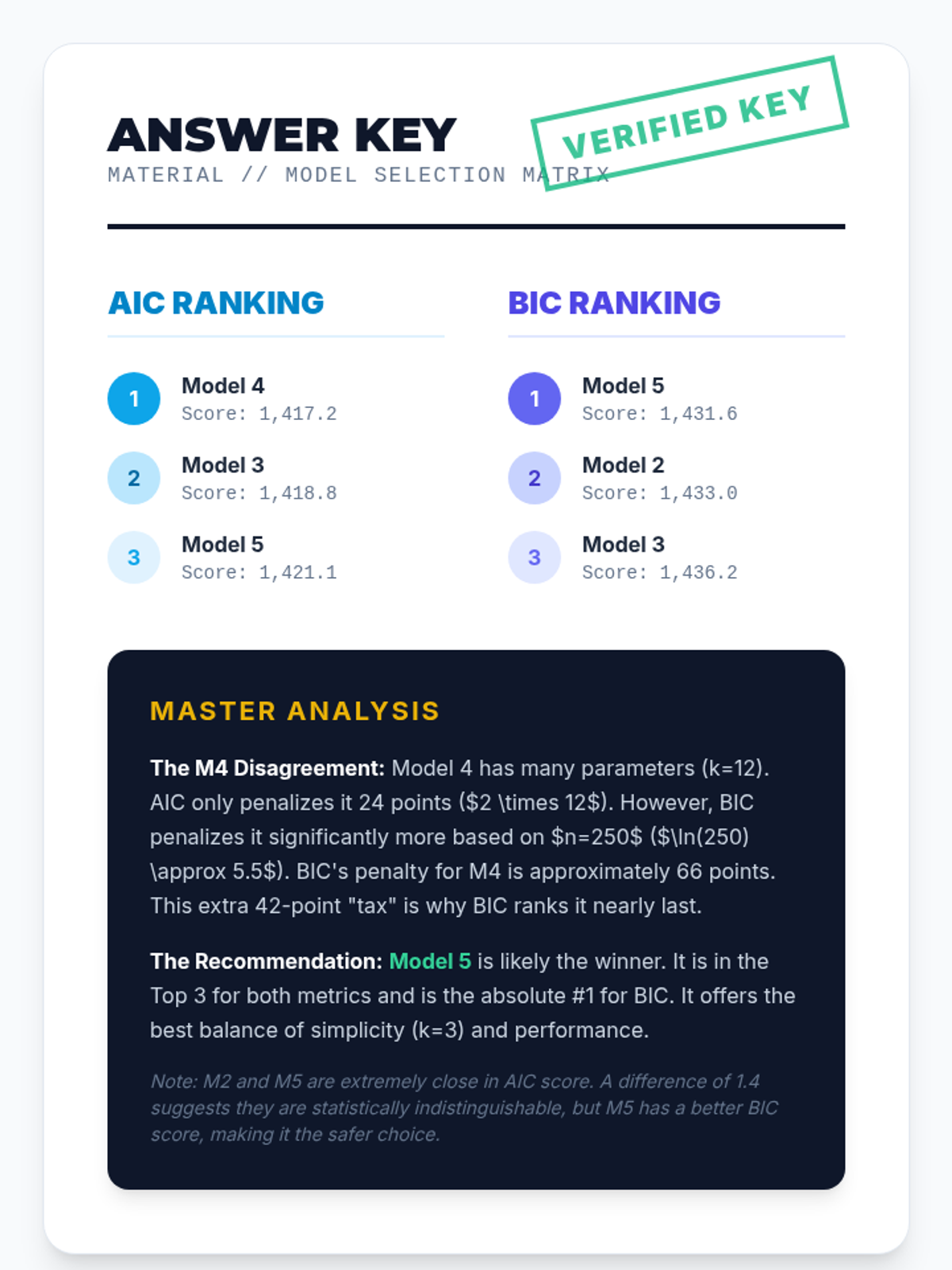
Students practice ranking and comparing models using AIC and BIC scores, exploring scenarios where the two metrics provide different recommendations.
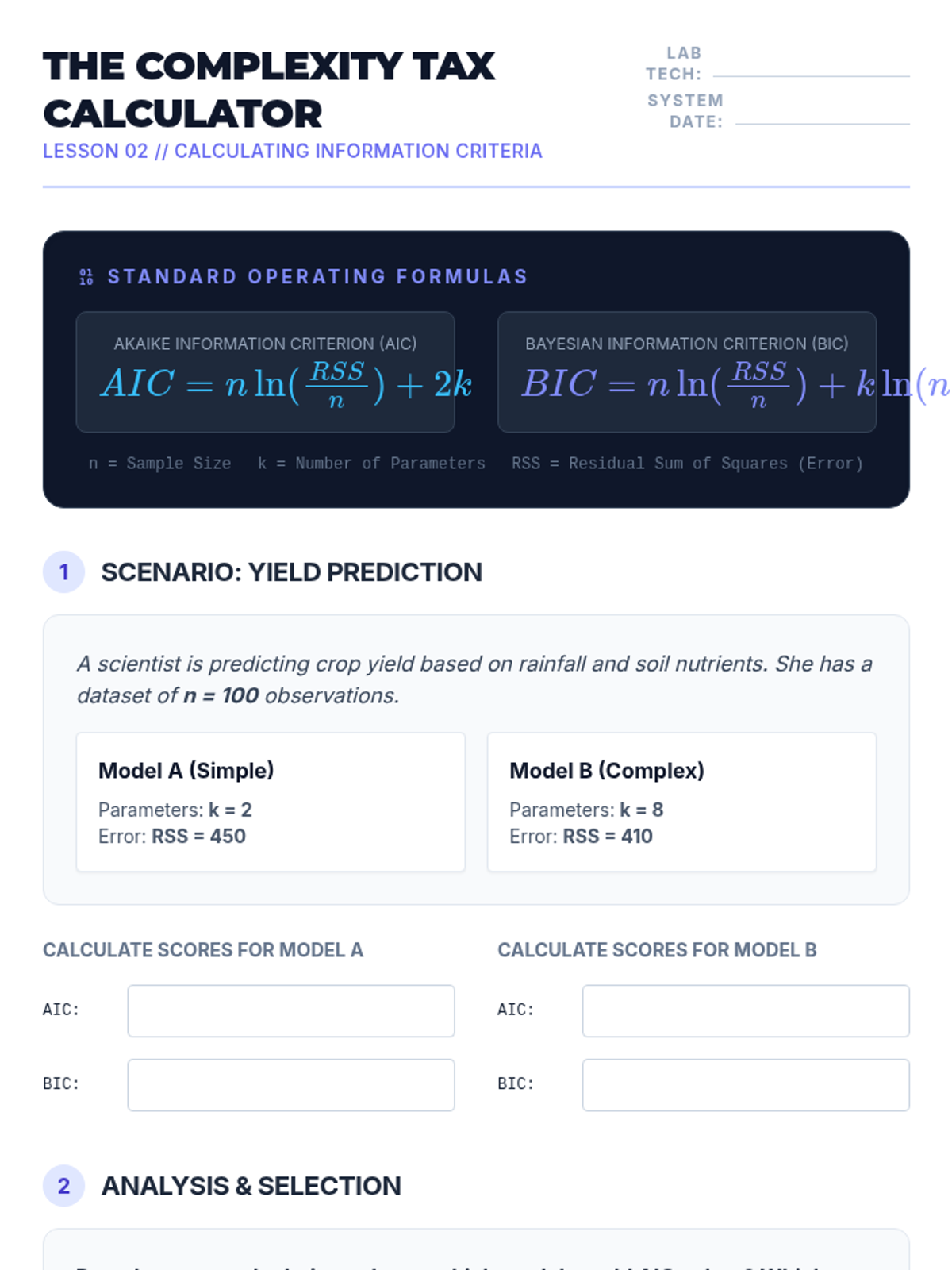
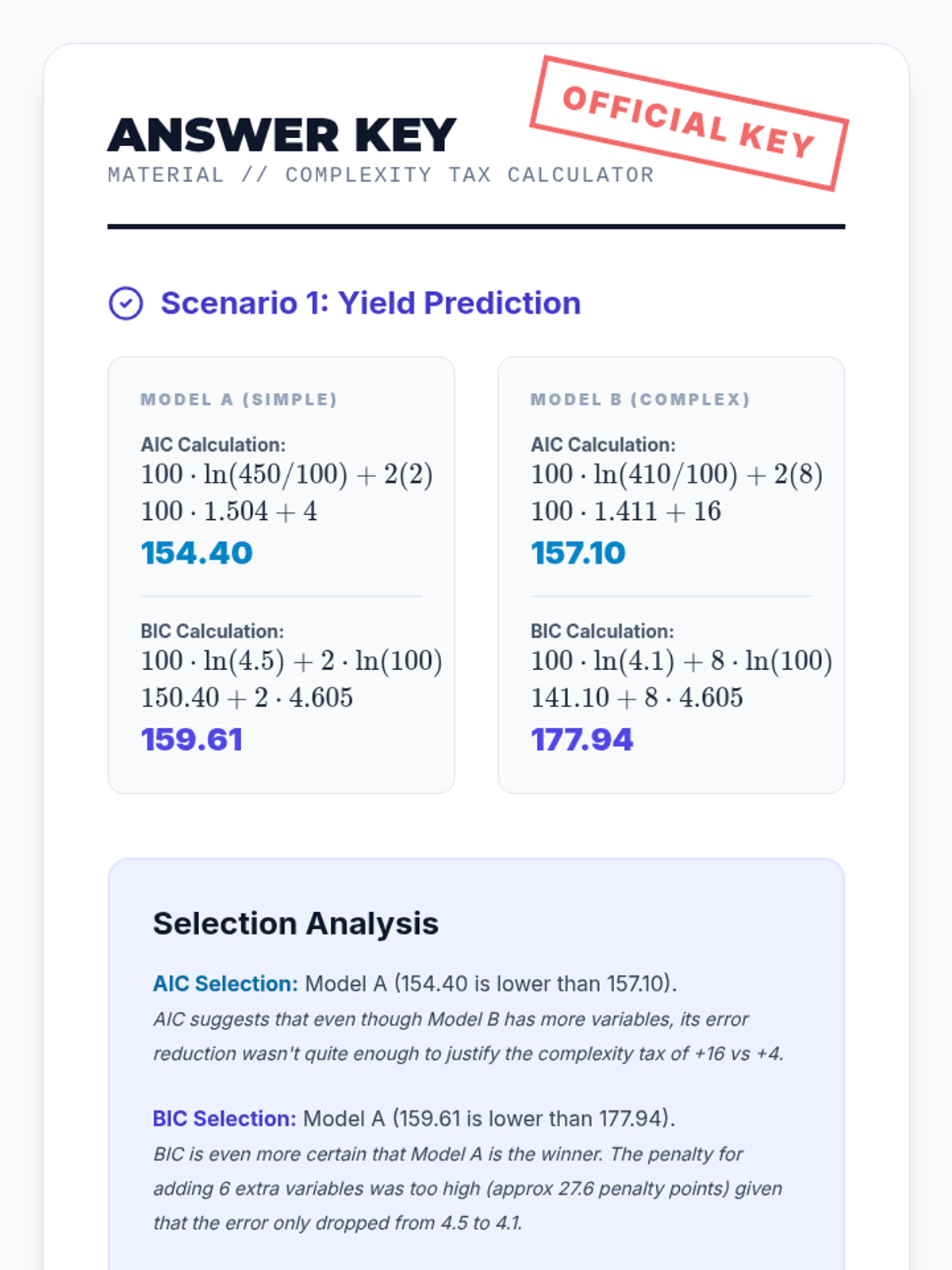
Introduction to AIC and BIC formulas, focusing on the conceptual 'tax' or penalty applied to each additional parameter in a mathematical model.
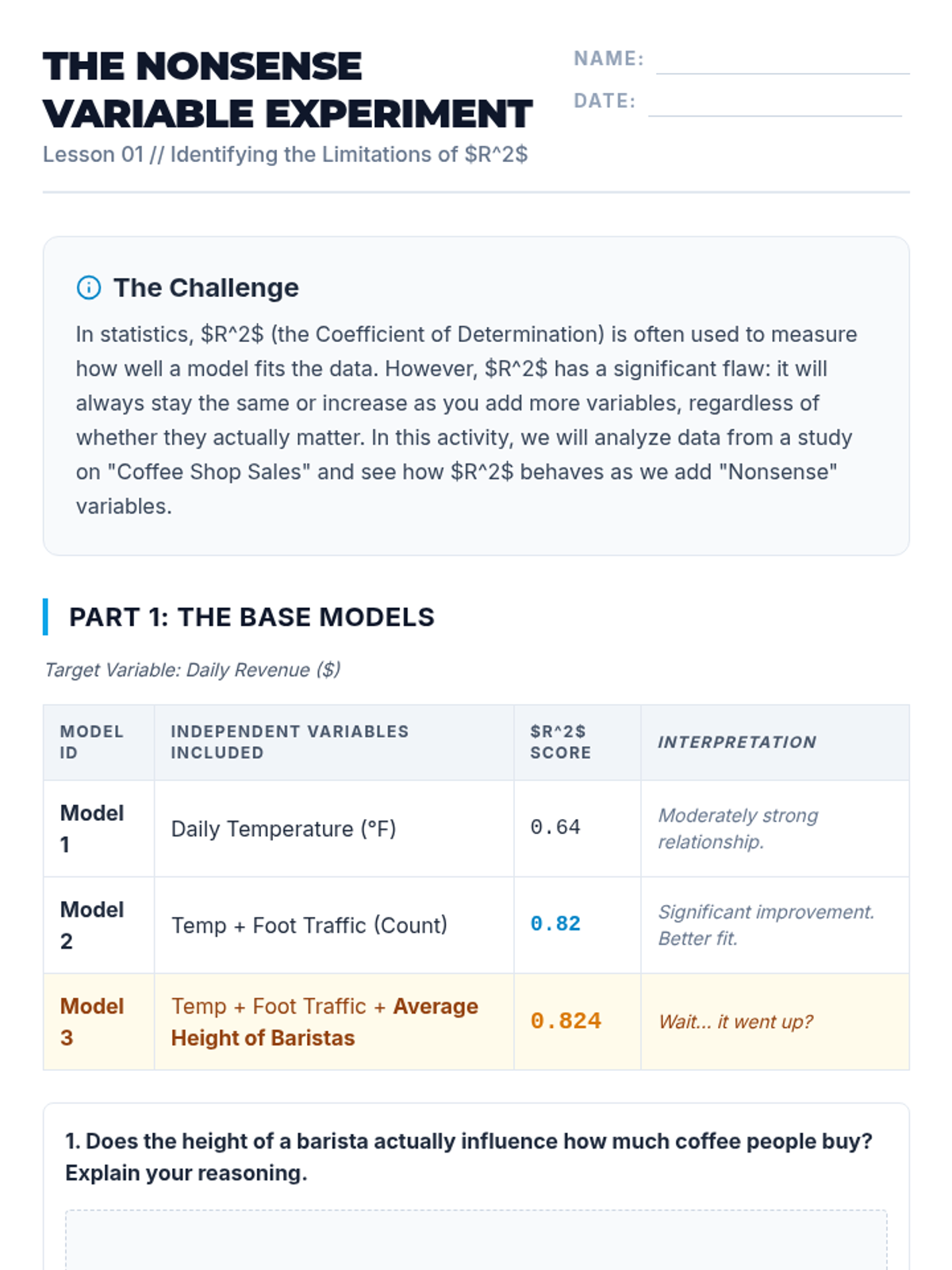
Students investigate why R-squared always increases as variables are added to a model, regardless of their relevance, creating a need for complexity-adjusting metrics.
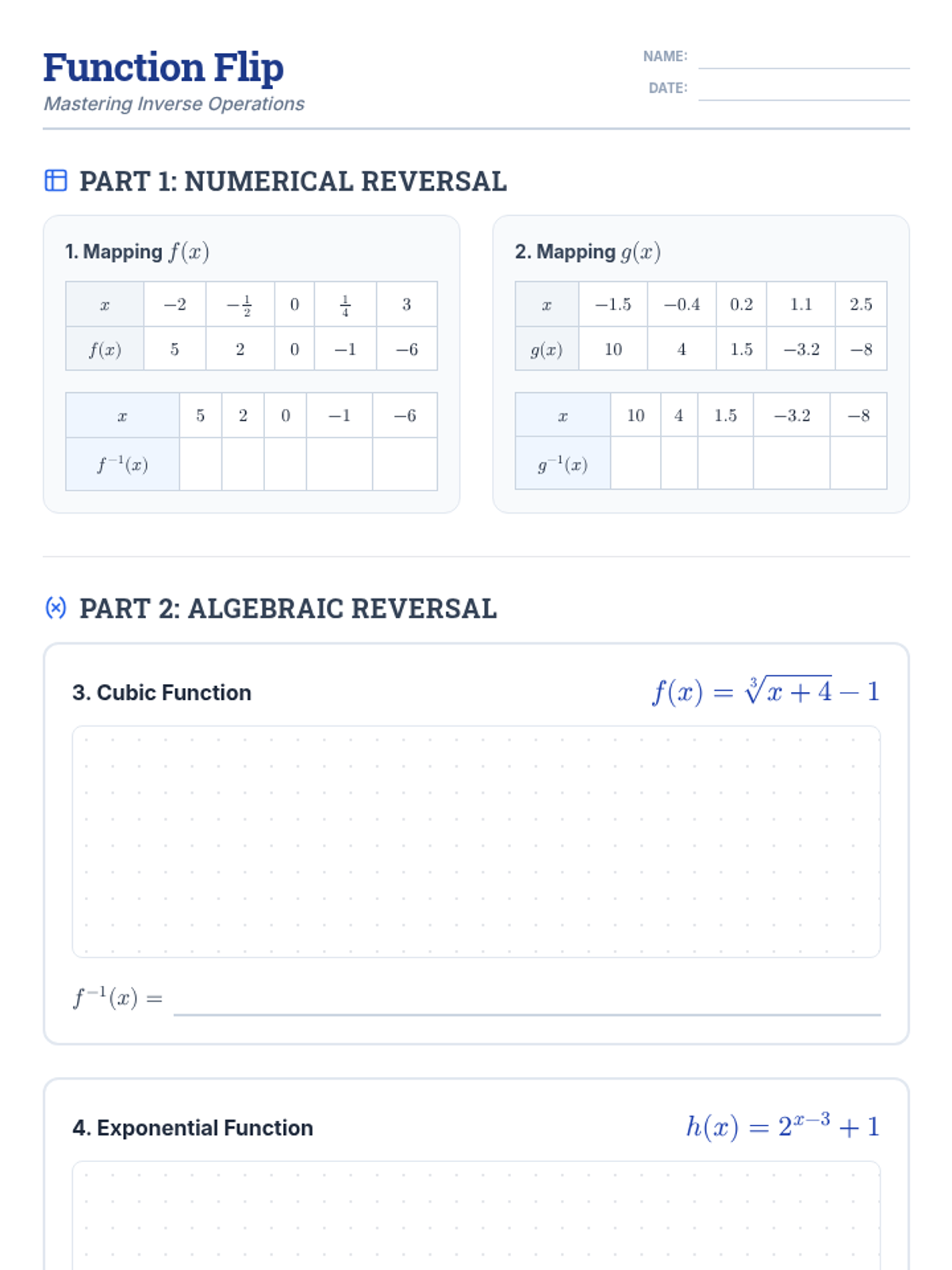
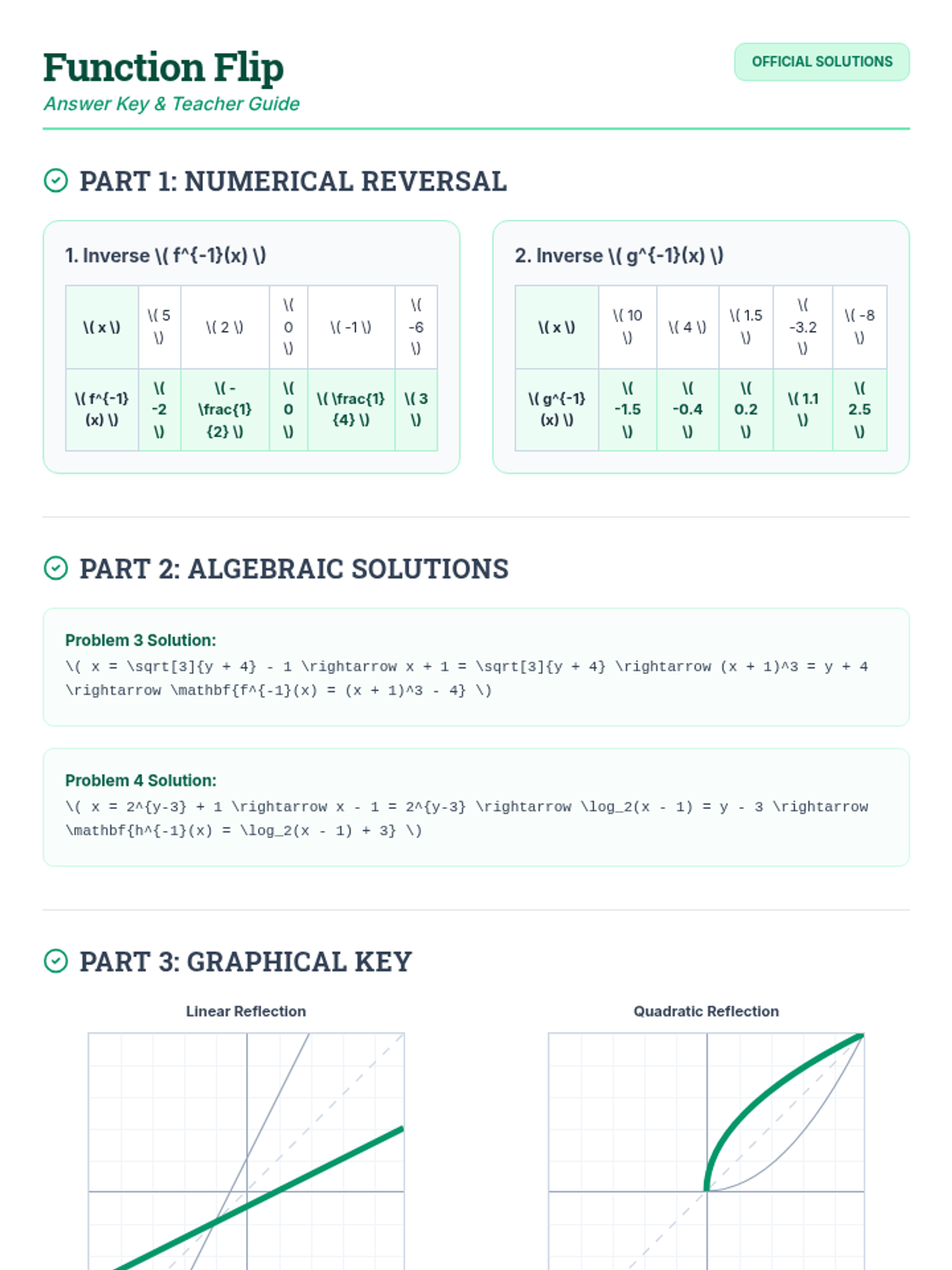
A lesson focused on understanding and calculating inverse functions through multiple representations: numerical tables, algebraic equations, and graphical reflections. Students will practice reversing operations and reflecting functions across the line y=x.
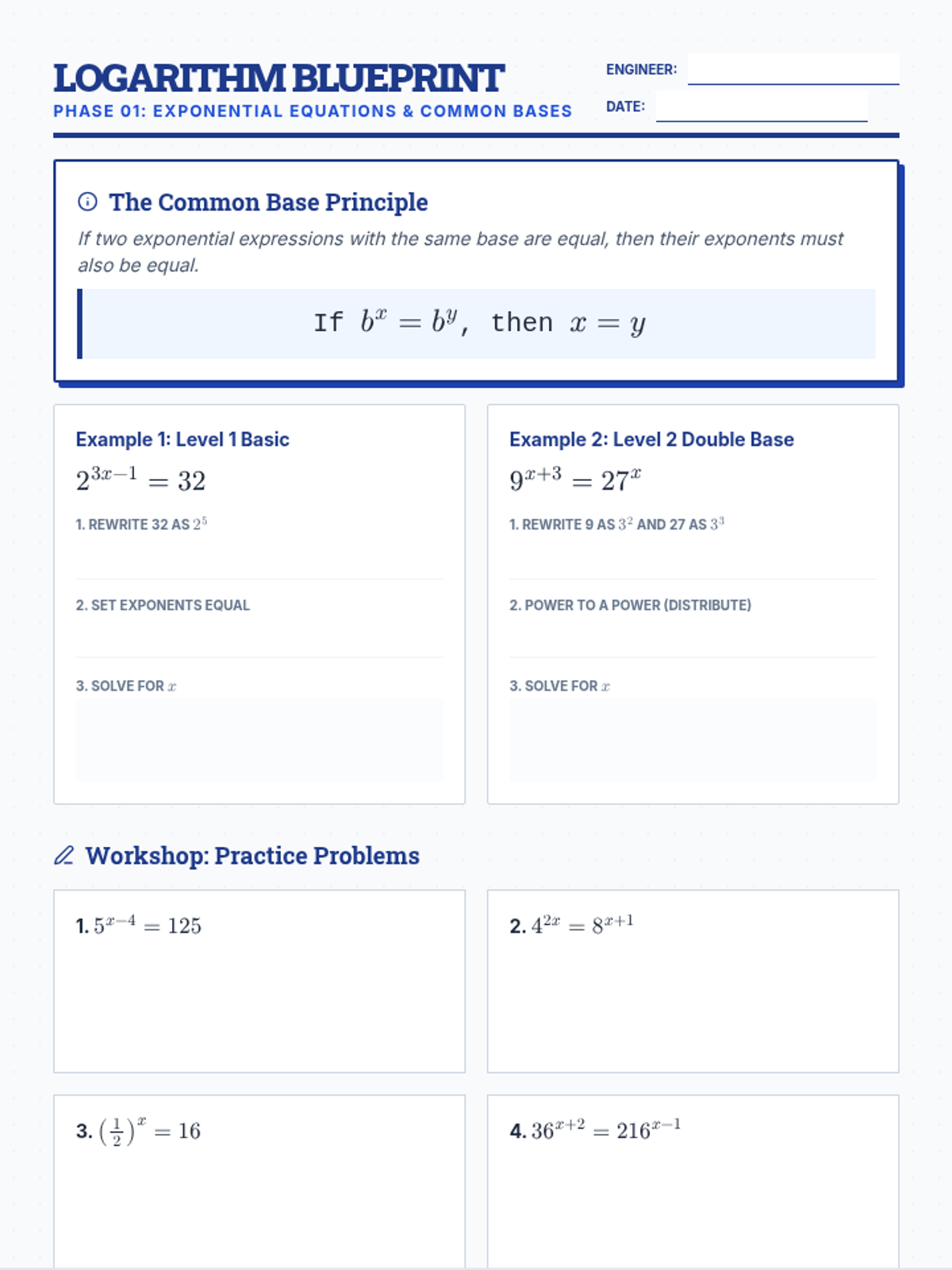
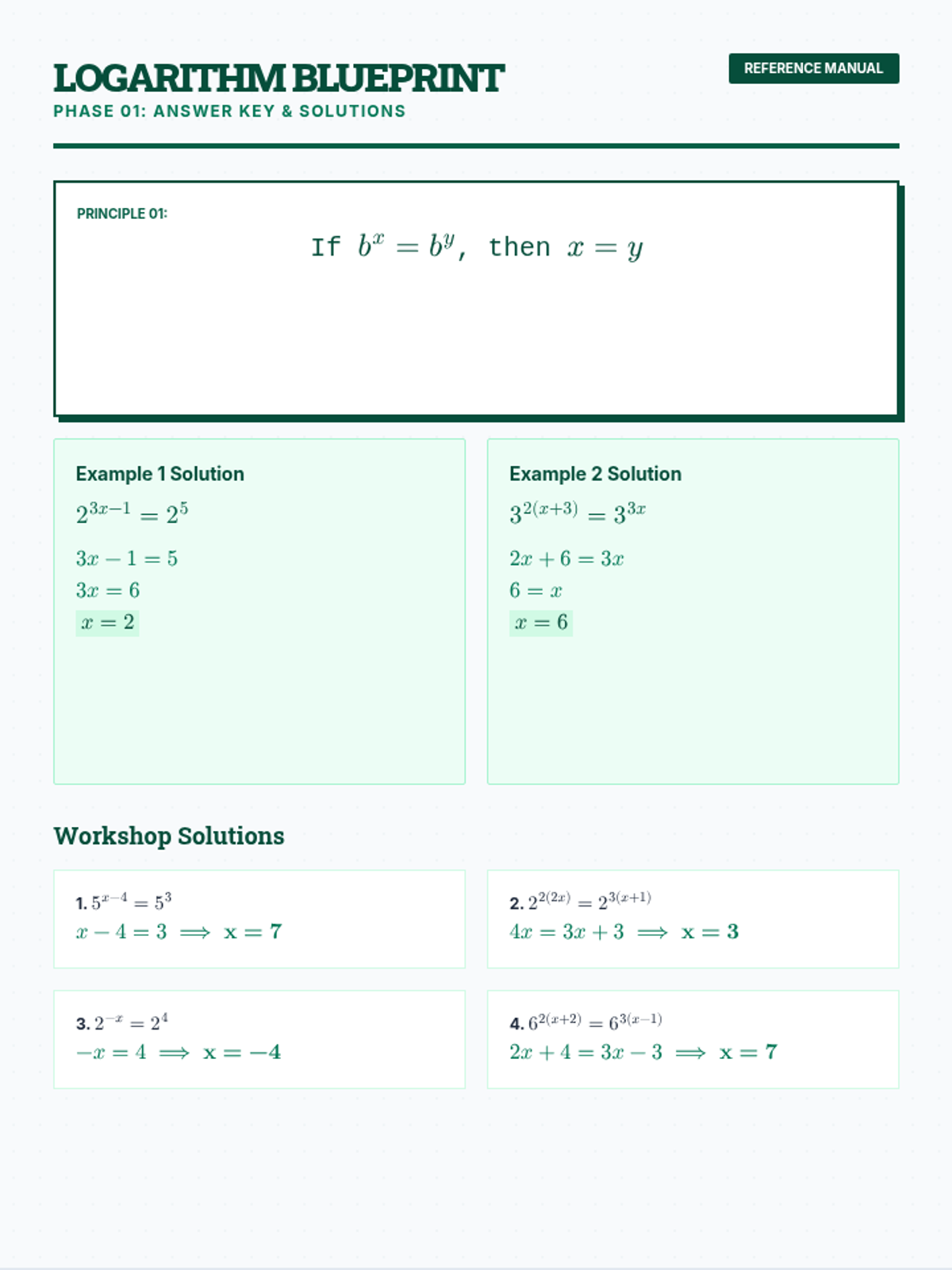
A comprehensive guide to solving exponential and logarithmic equations using common bases and property-based manipulation. Students will master converting between forms and applying product, quotient, and power rules.
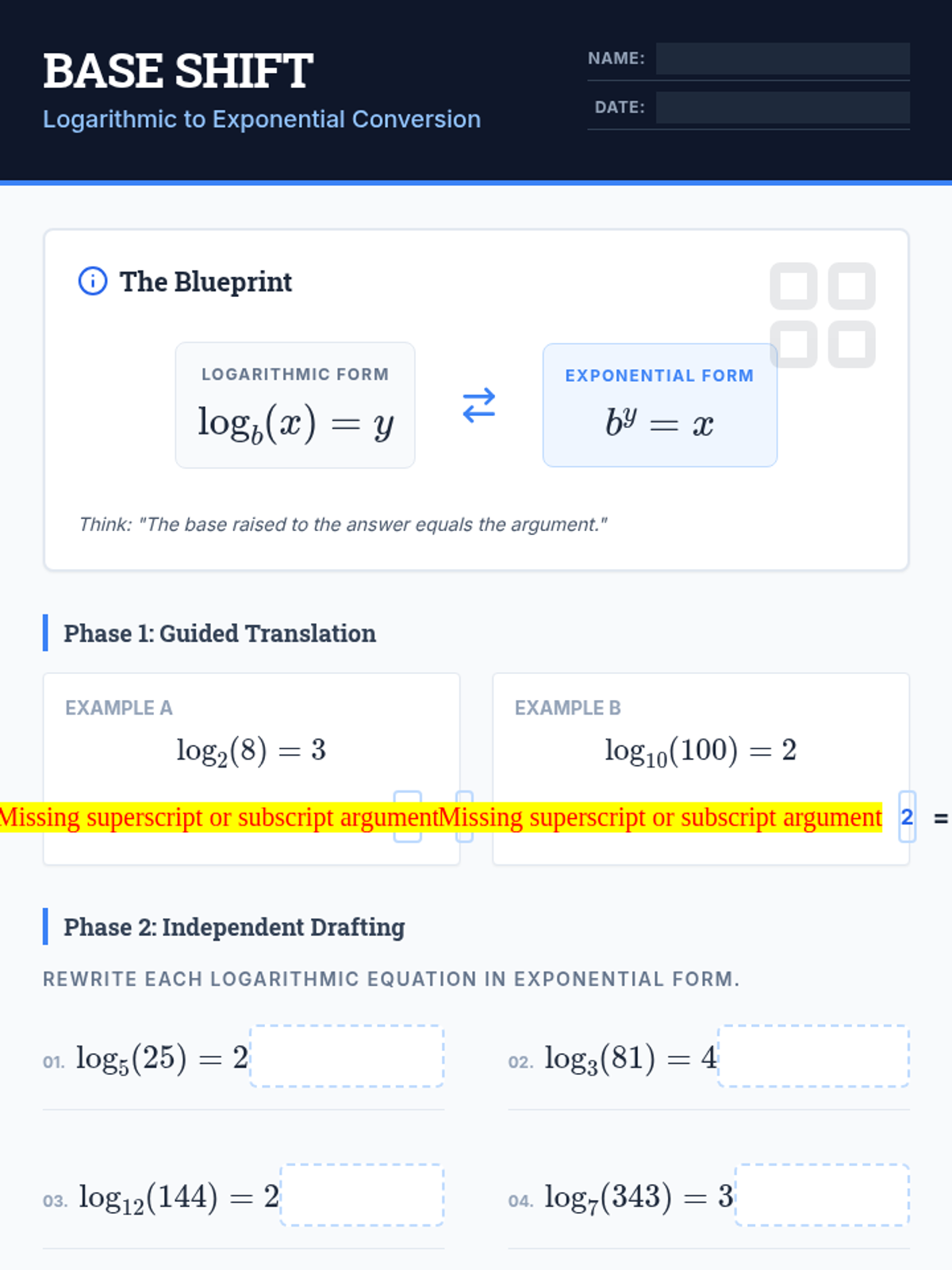
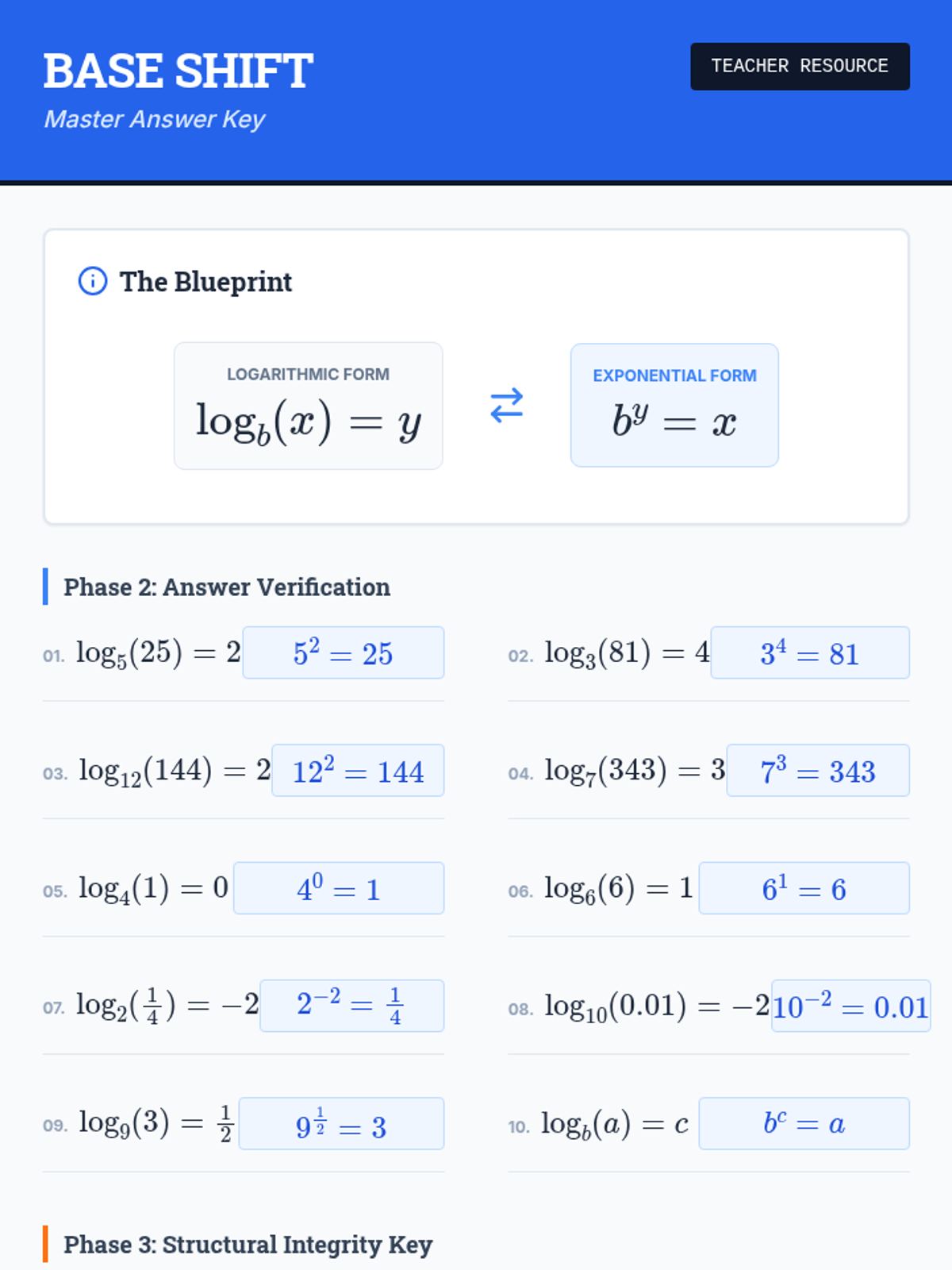
A focused practice session on converting logarithmic equations into their exponential equivalents using the definition of a logarithm.
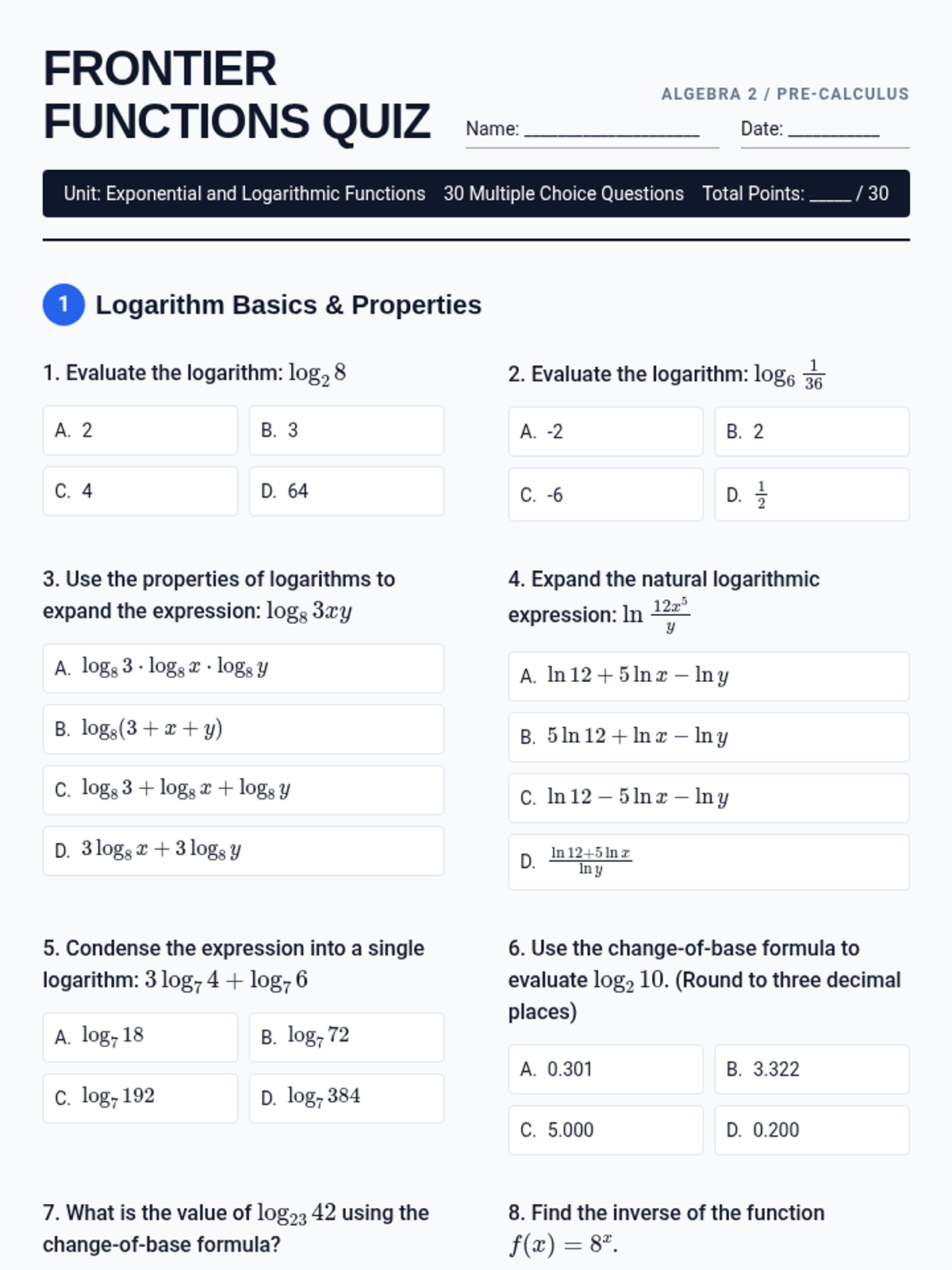
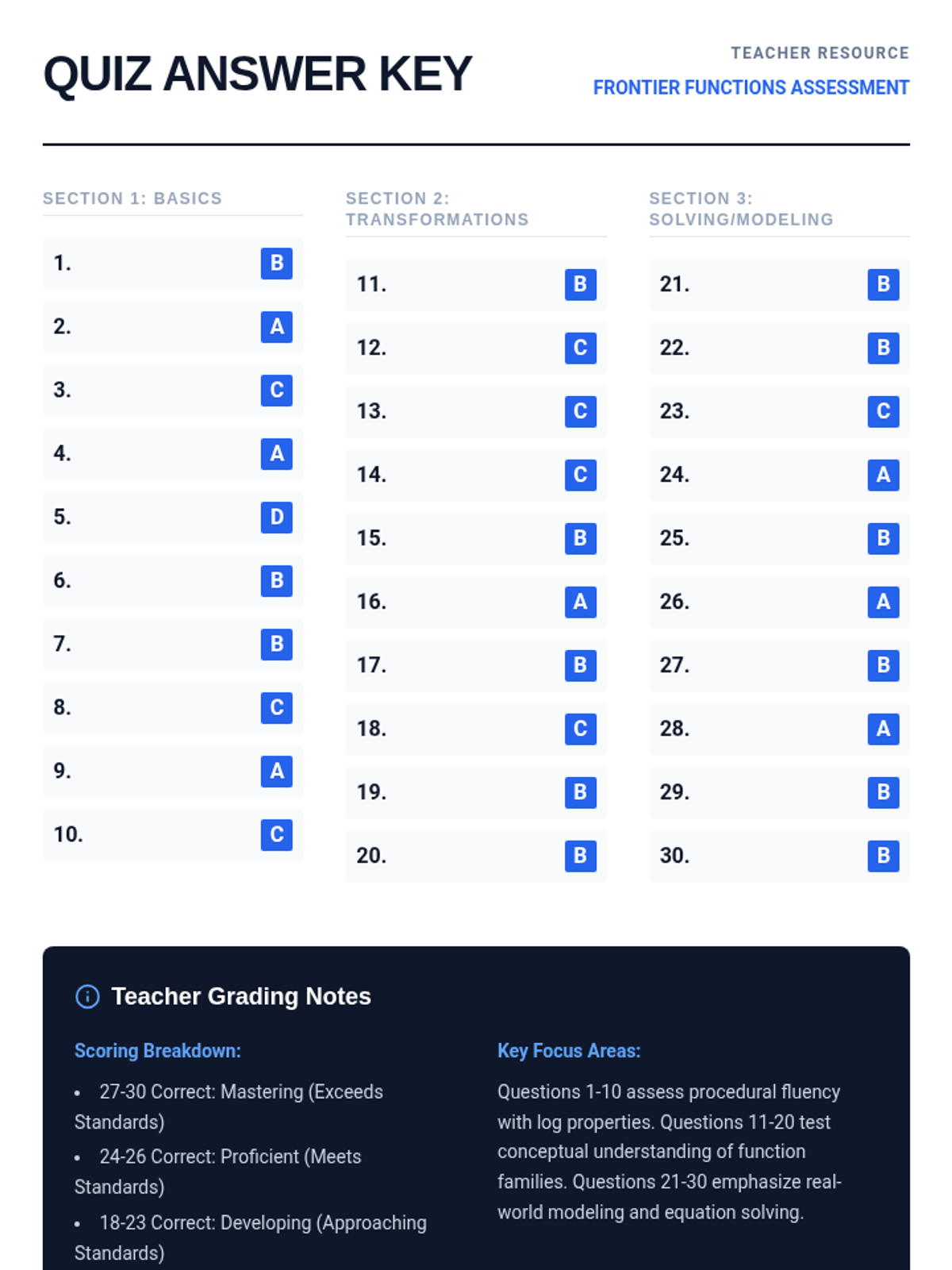
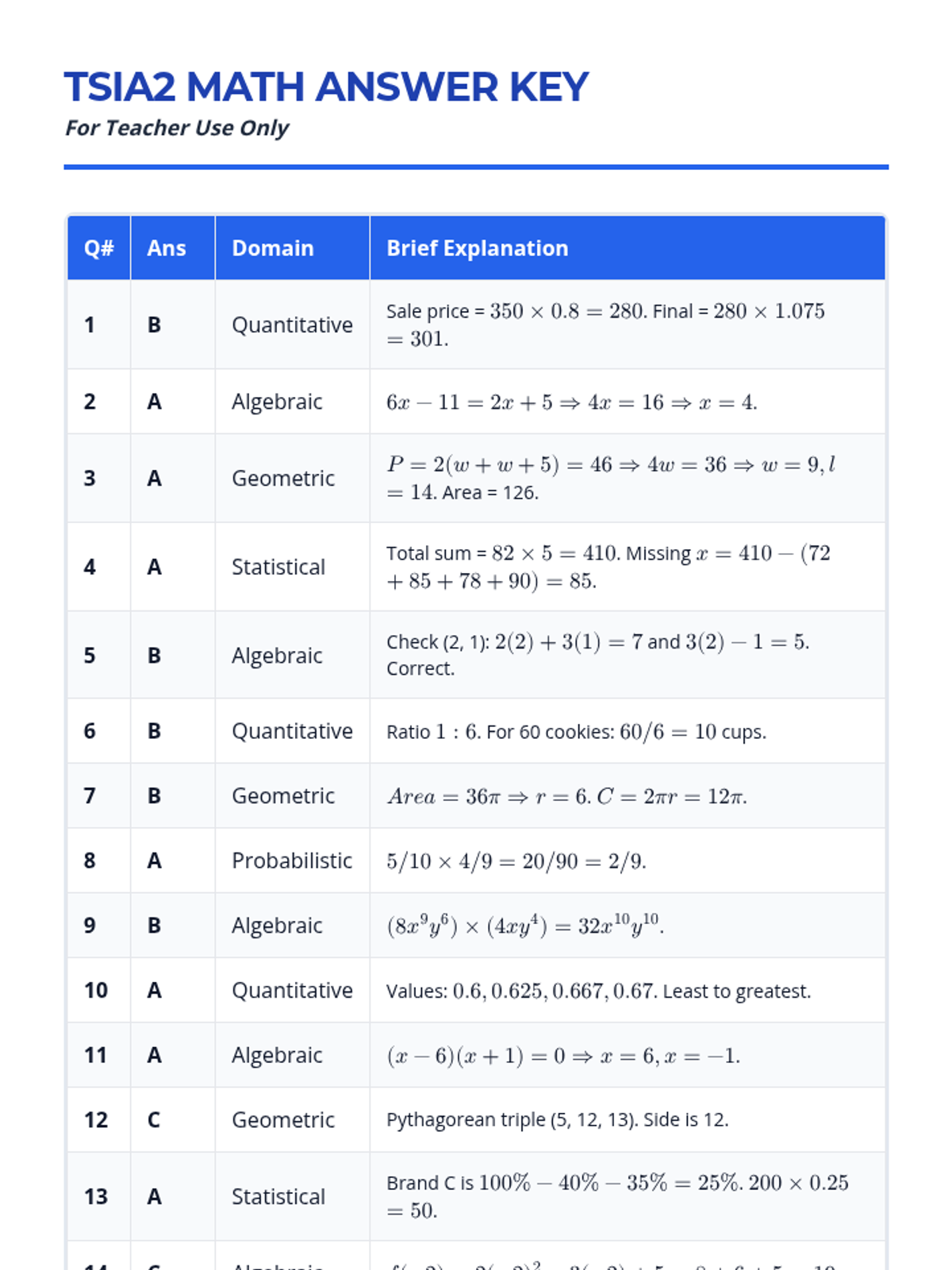
A comprehensive assessment covering logarithms, exponential transformations, and equation solving based on Chapter 6 materials. Includes a 30-question multiple-choice quiz and a detailed answer key.
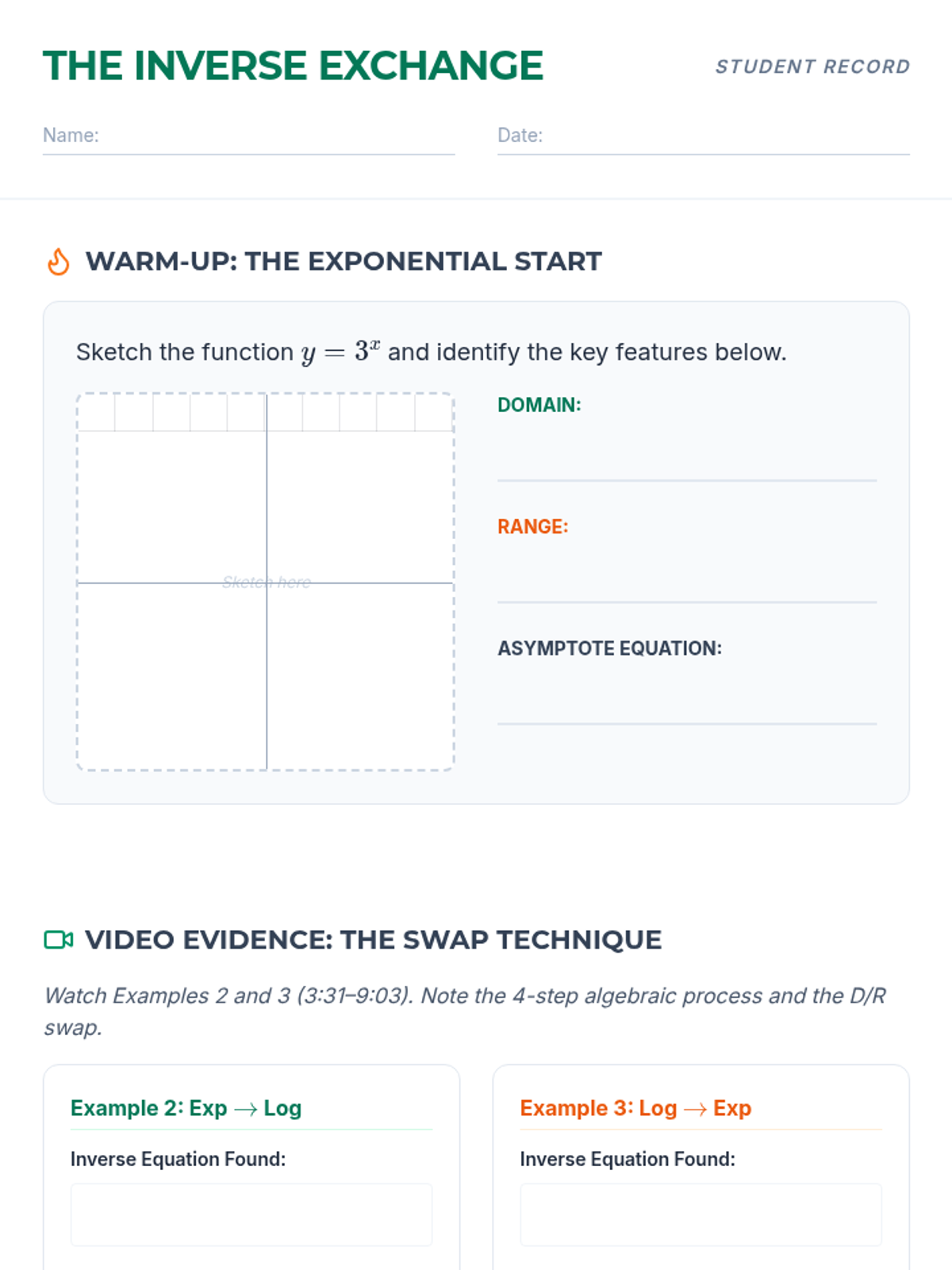
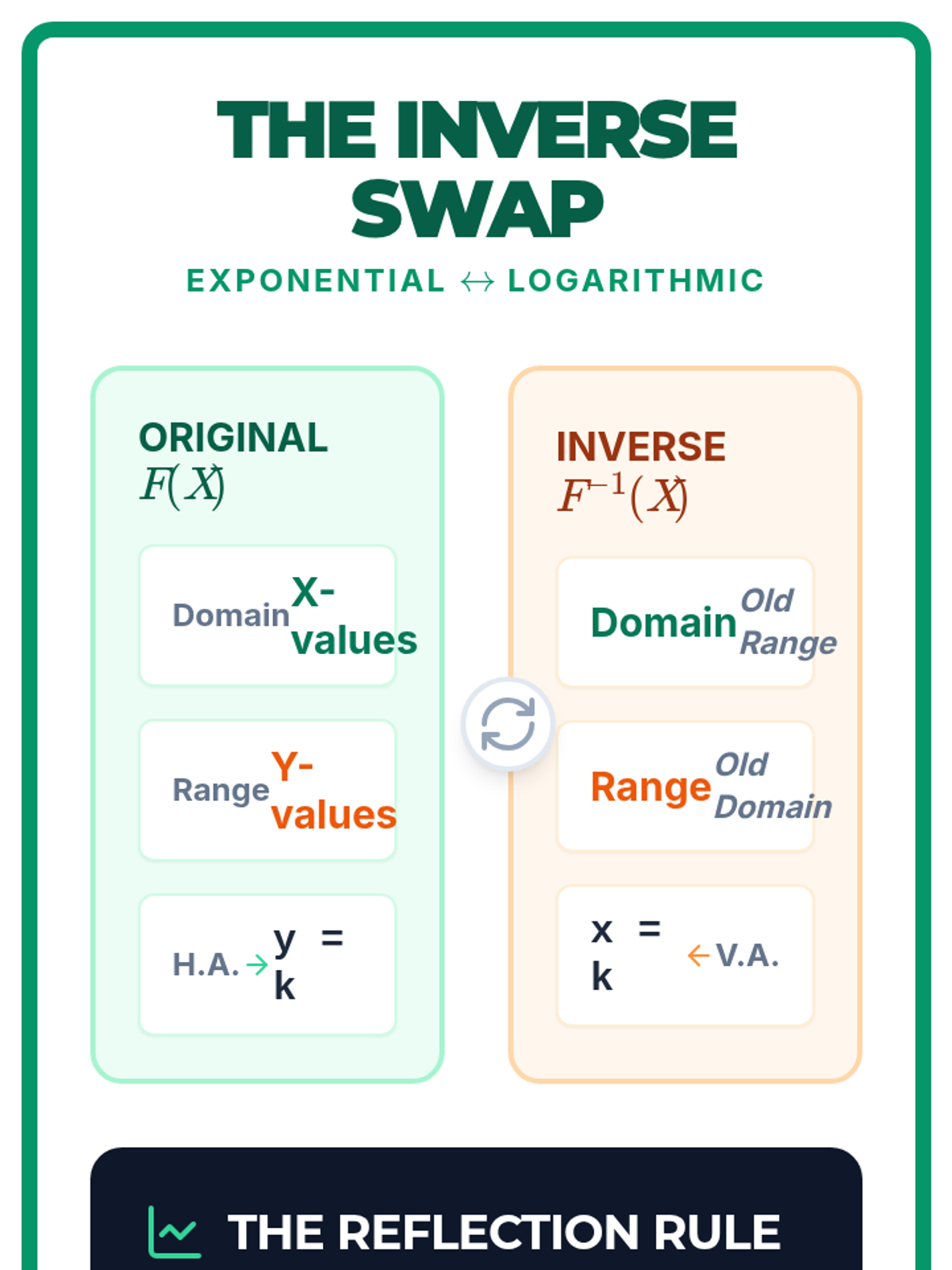
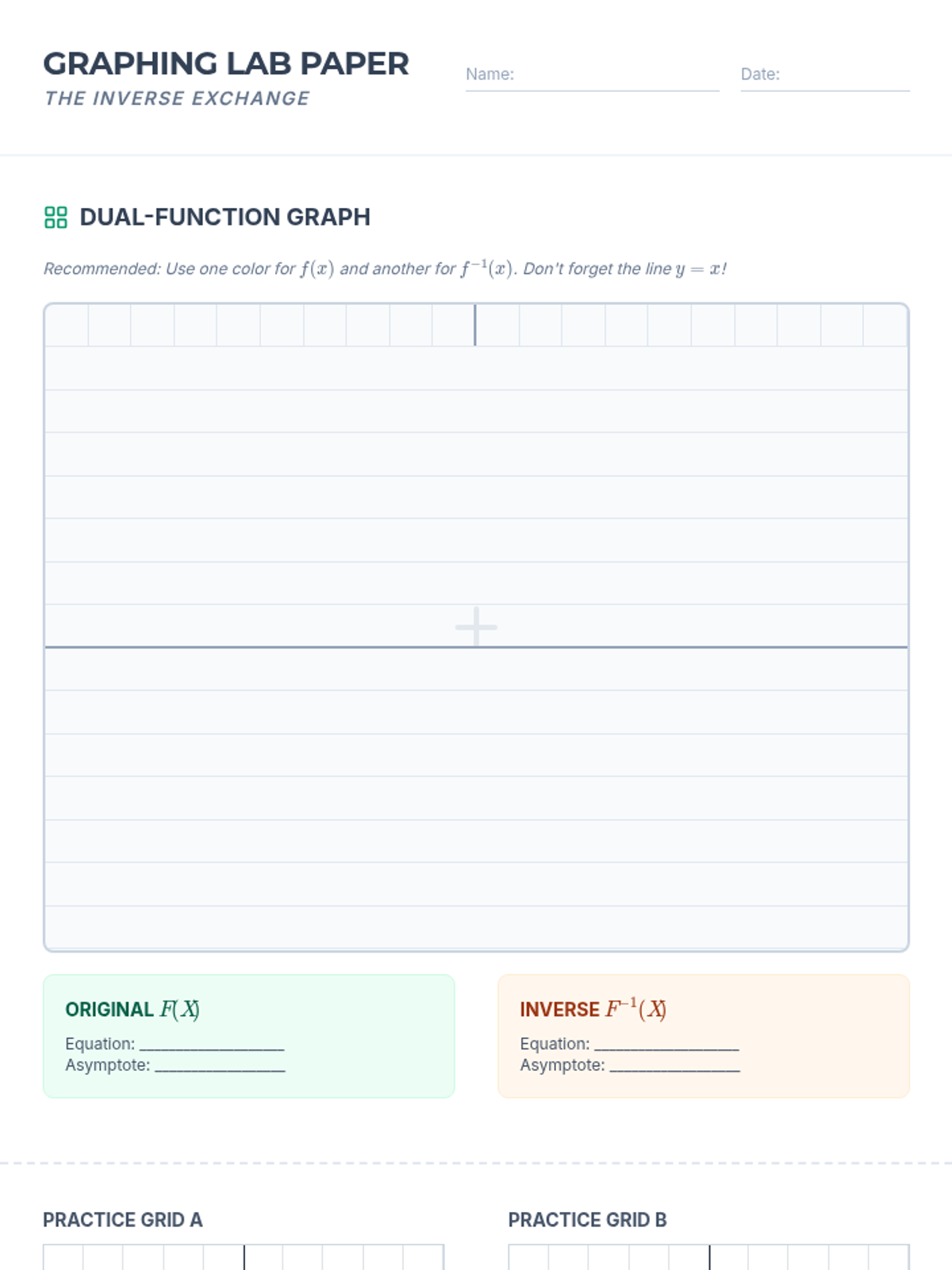
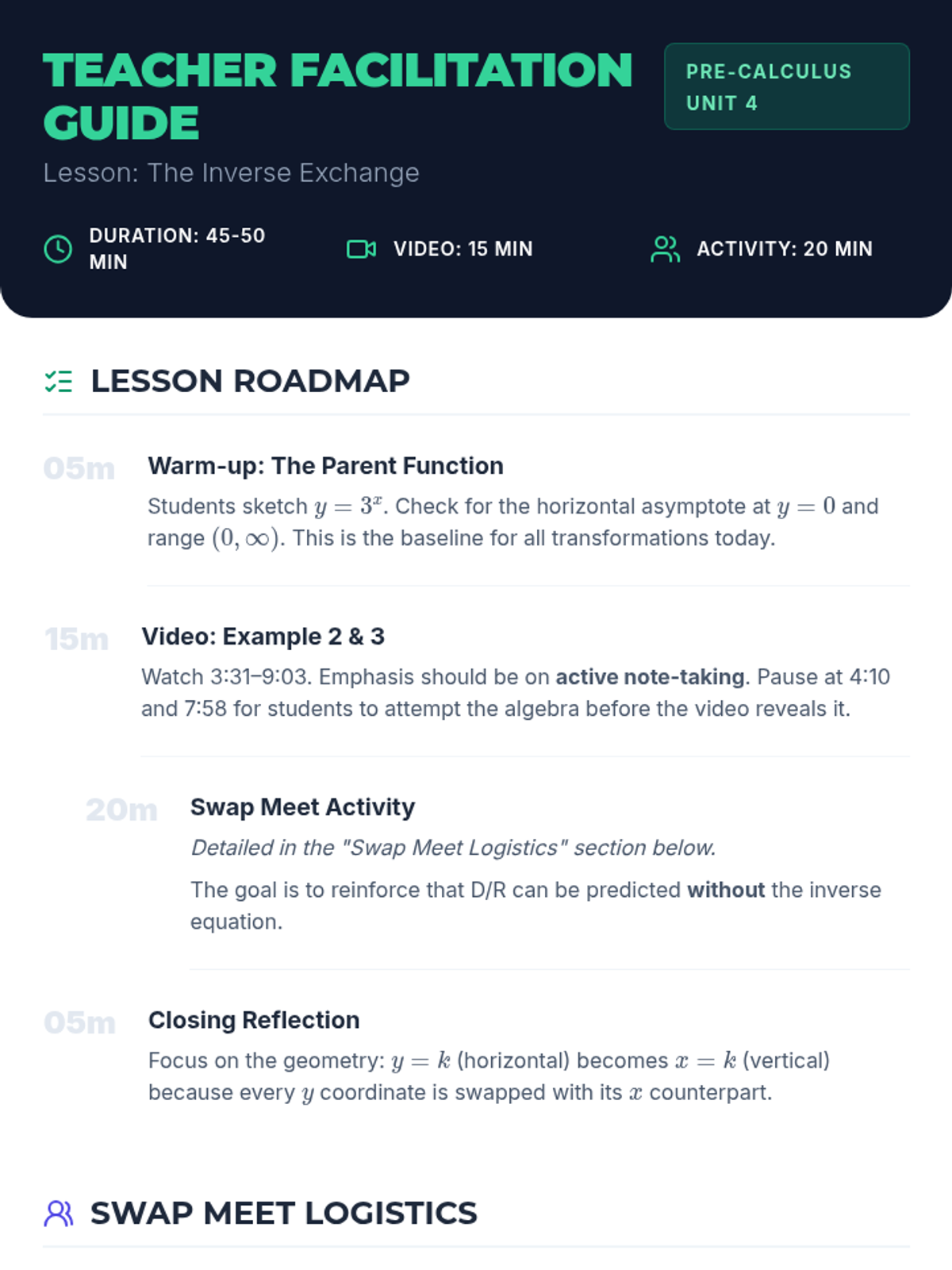
A Pre-Calculus lesson focused on the relationship between exponential and logarithmic functions through the lens of domain and range swapping. Students analyze transformations, identify key features like asymptotes, and verify inverse relationships graphically.
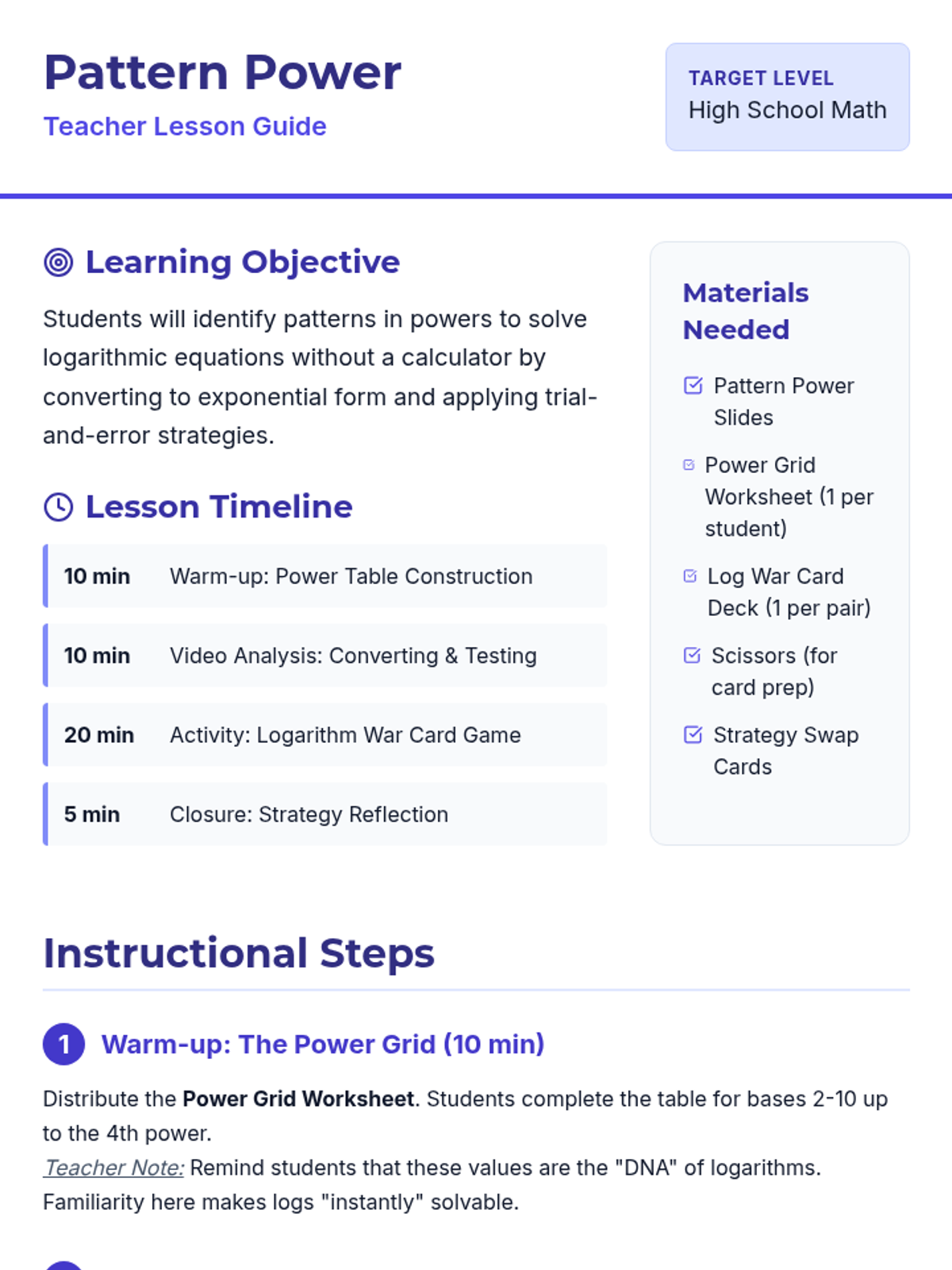
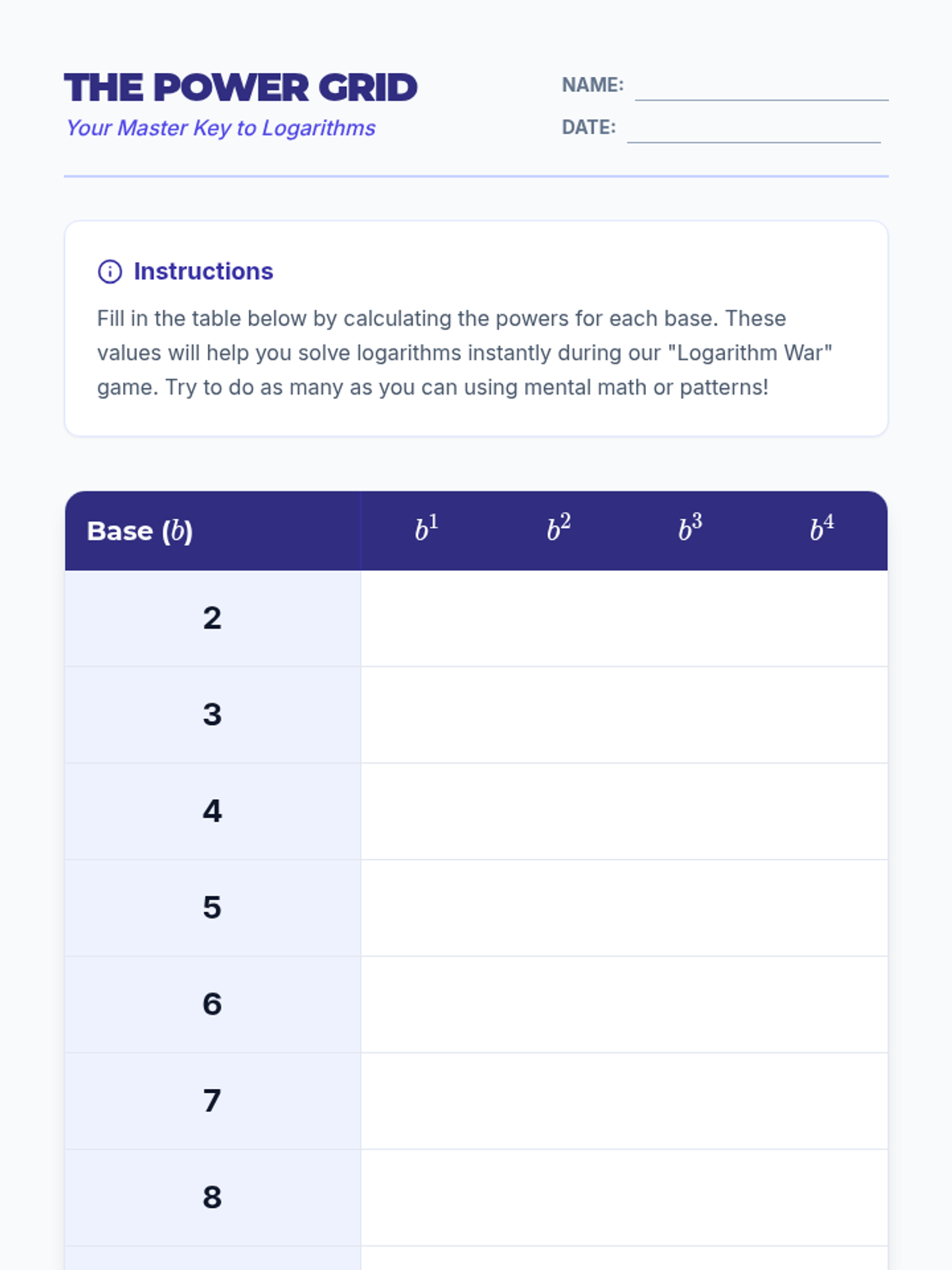
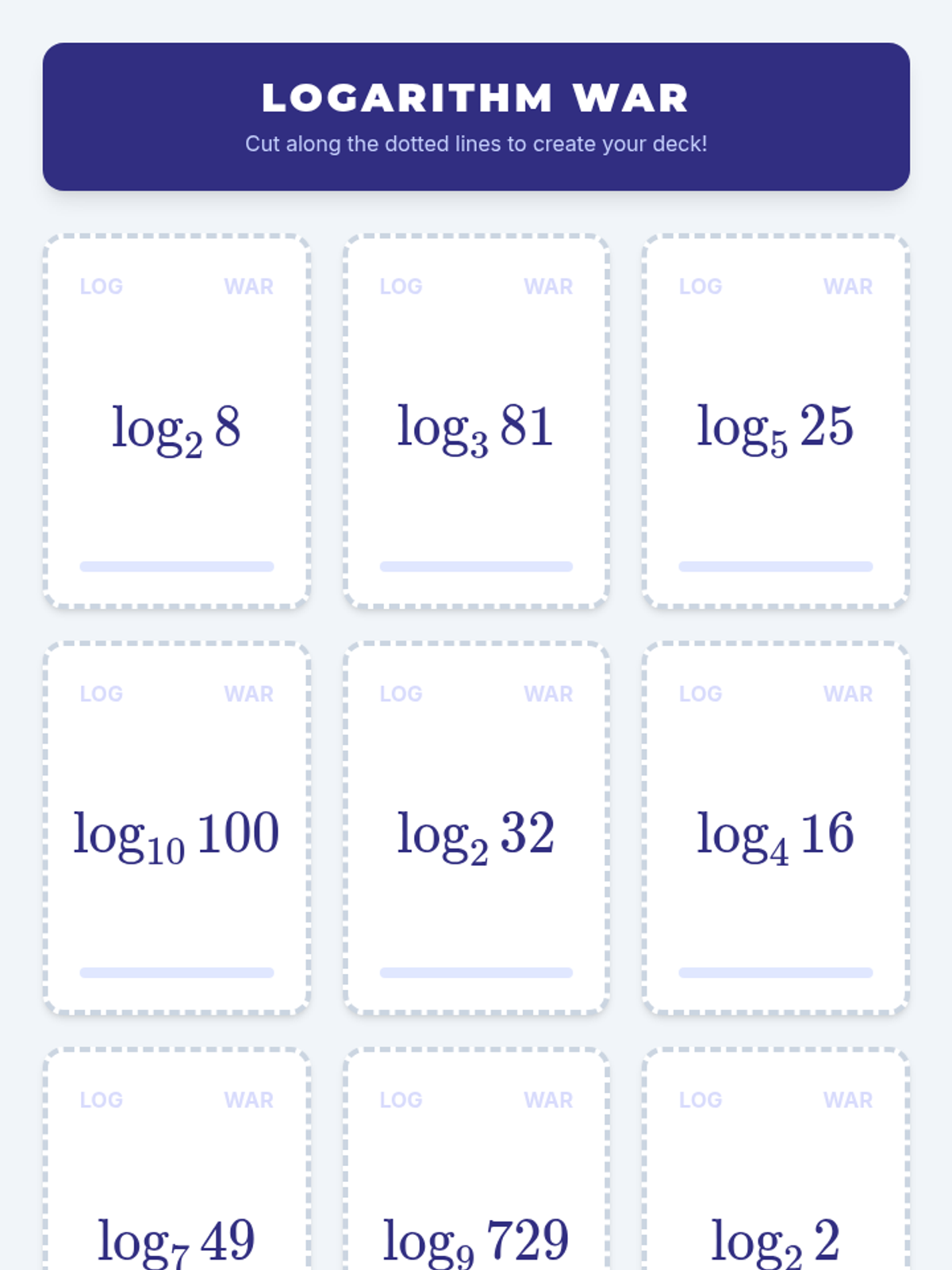
Students discover the relationship between powers and logarithms through pattern recognition, trial and error, and a competitive card game. The lesson focuses on evaluating logs without calculators by converting them to exponential form.
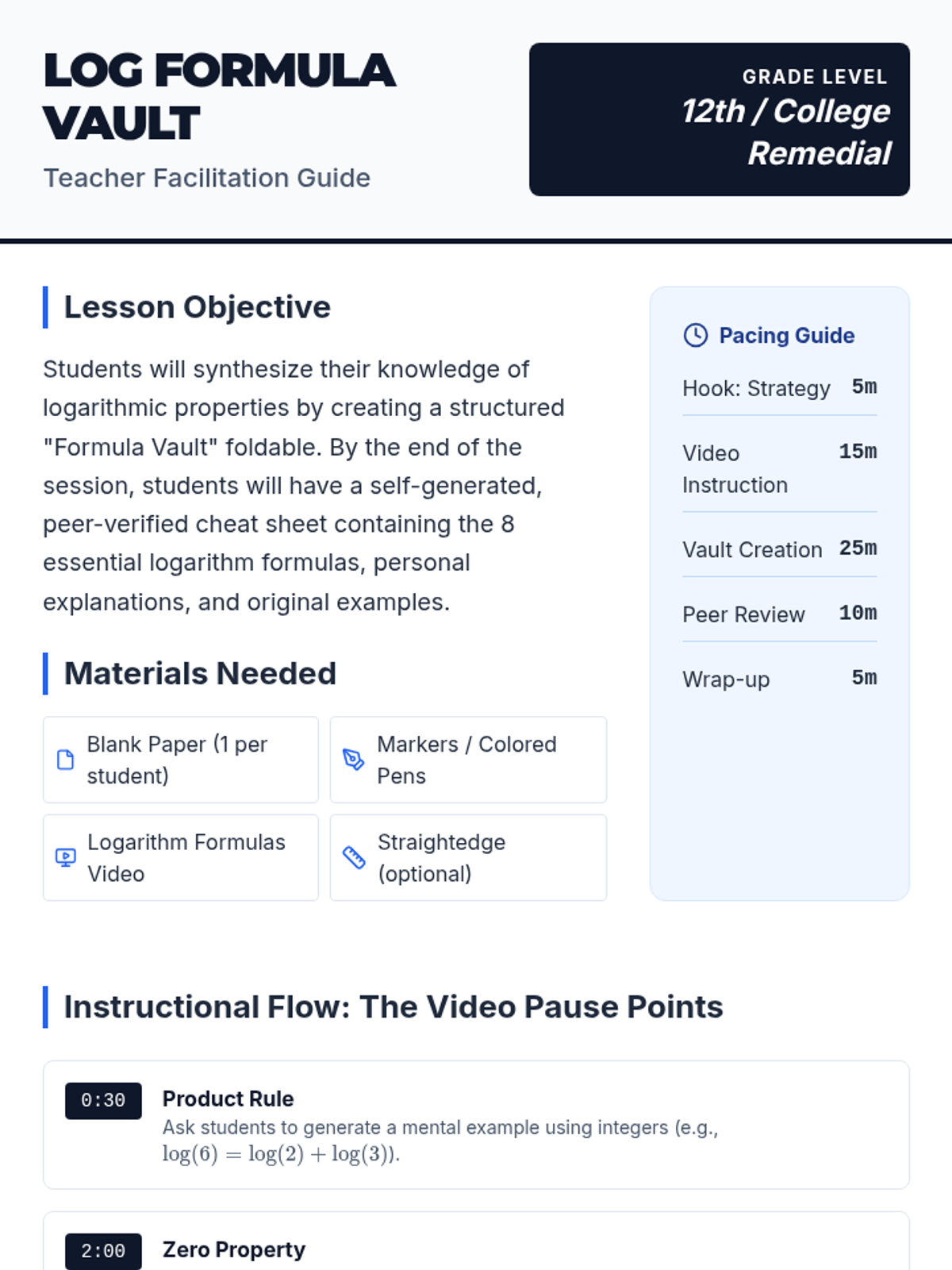
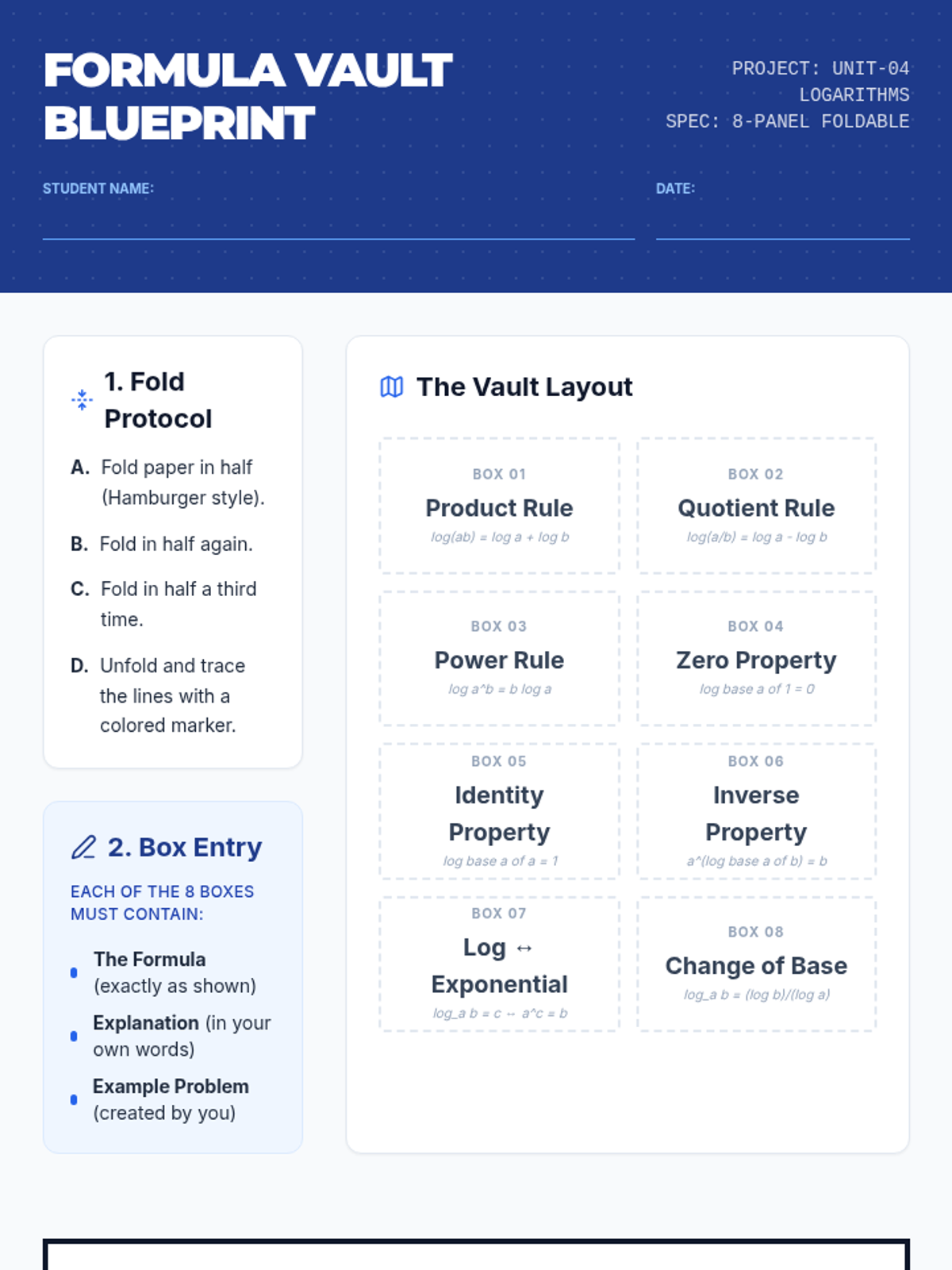
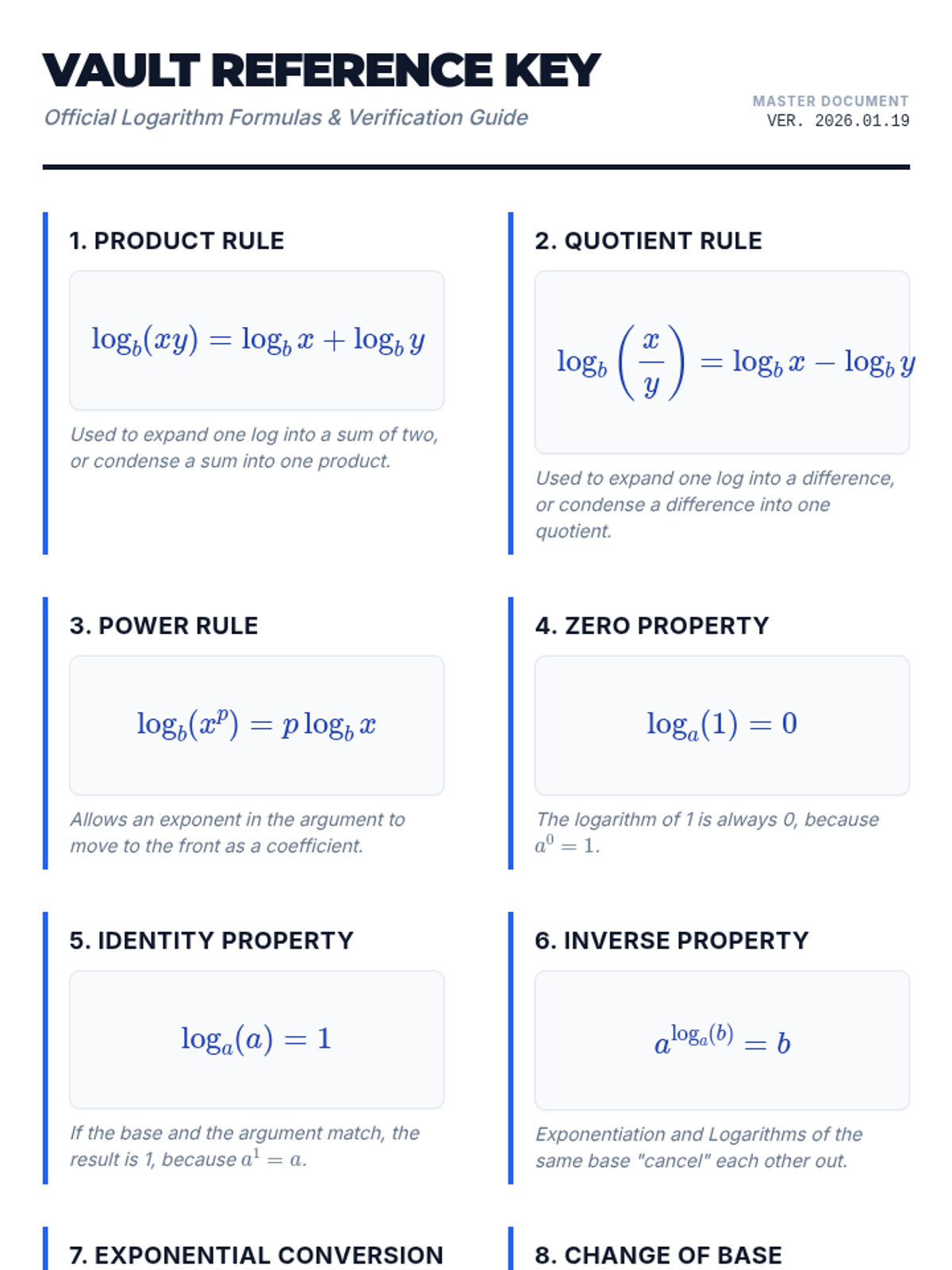
A comprehensive lesson for 12th-grade or remedial college math students to master logarithmic formulas through a structured video-based 'Formula Vault' foldable activity. Students learn to condense a full unit into a single-page reference sheet and peer-verify their work.
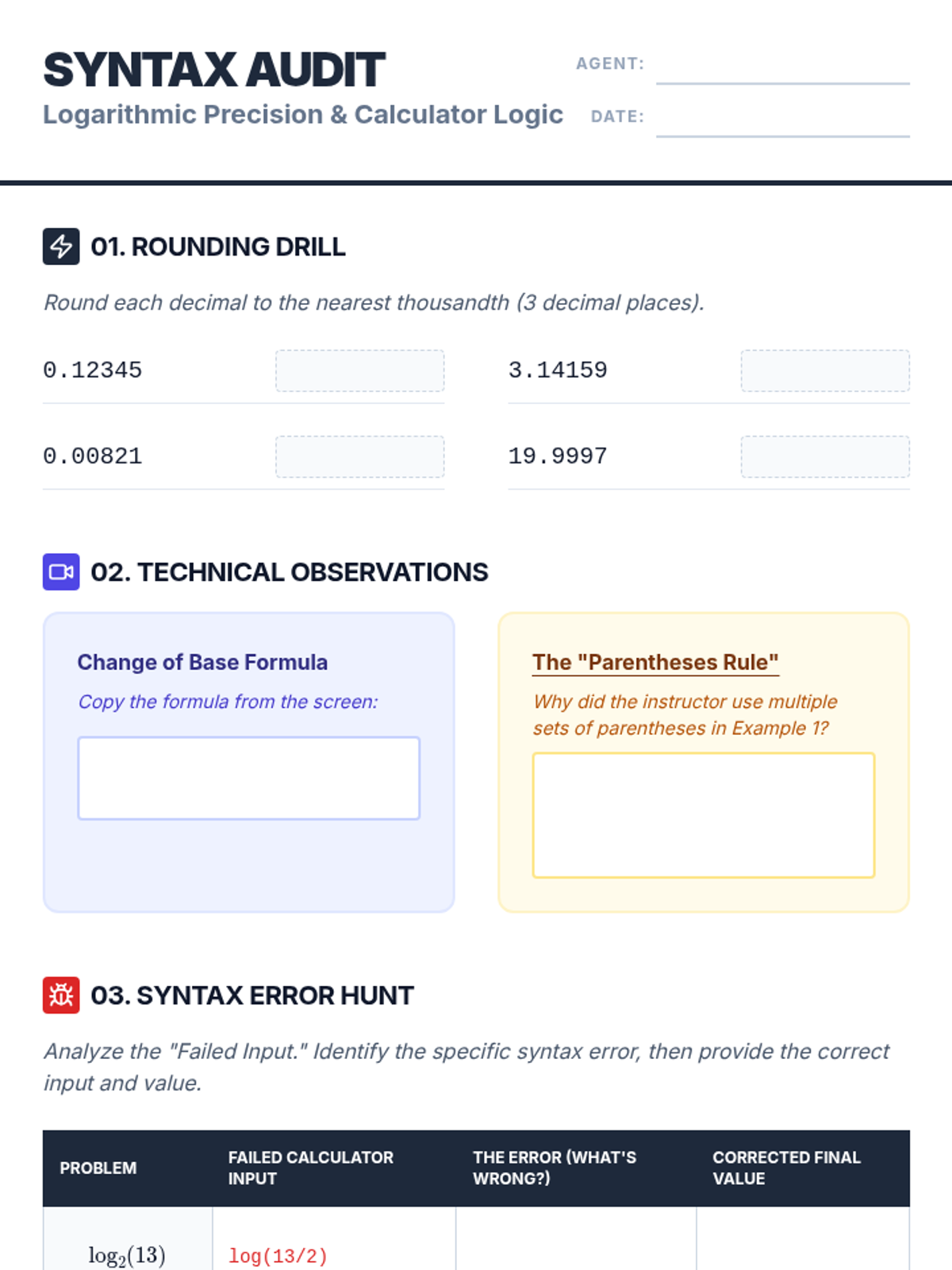
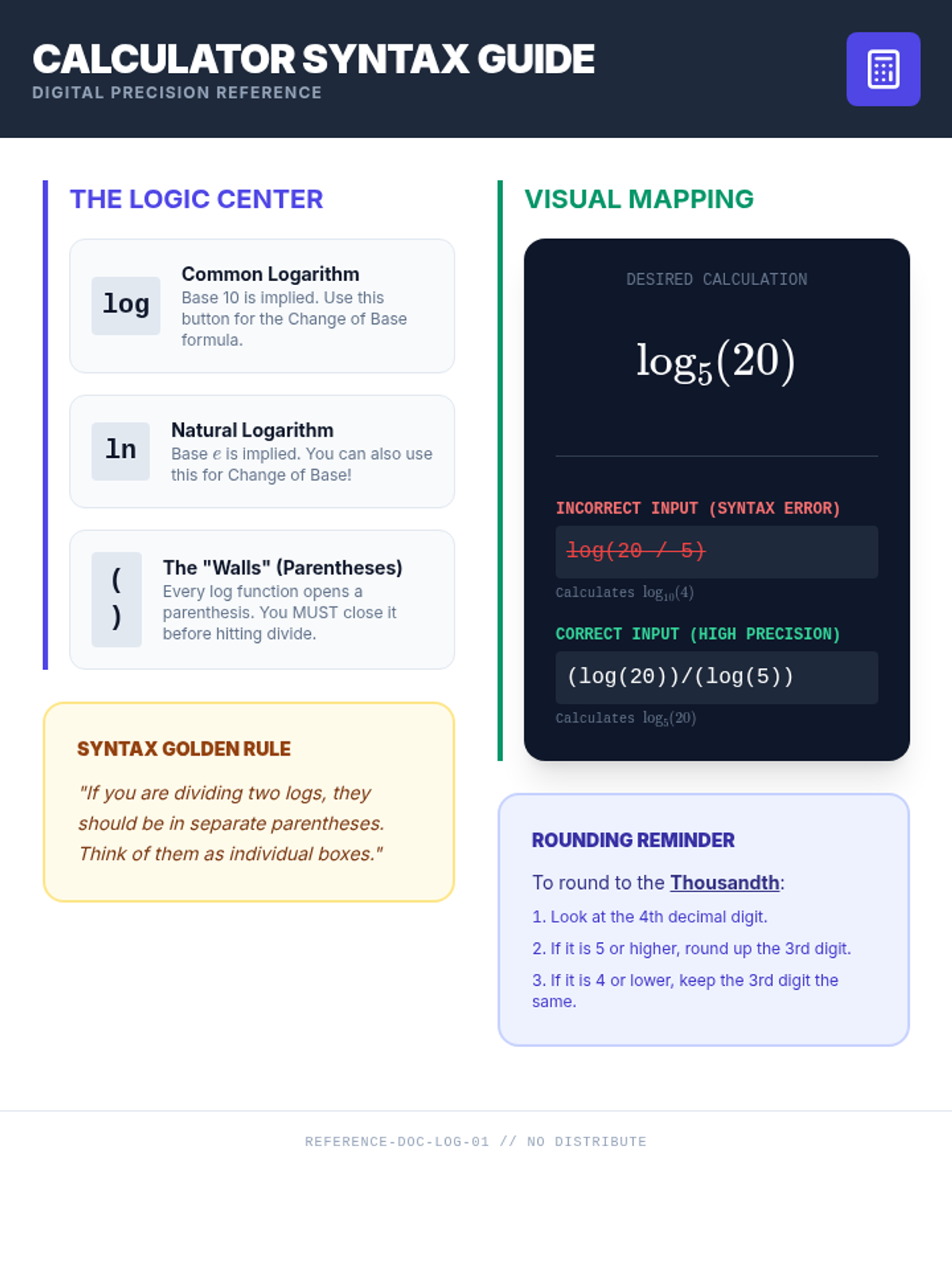
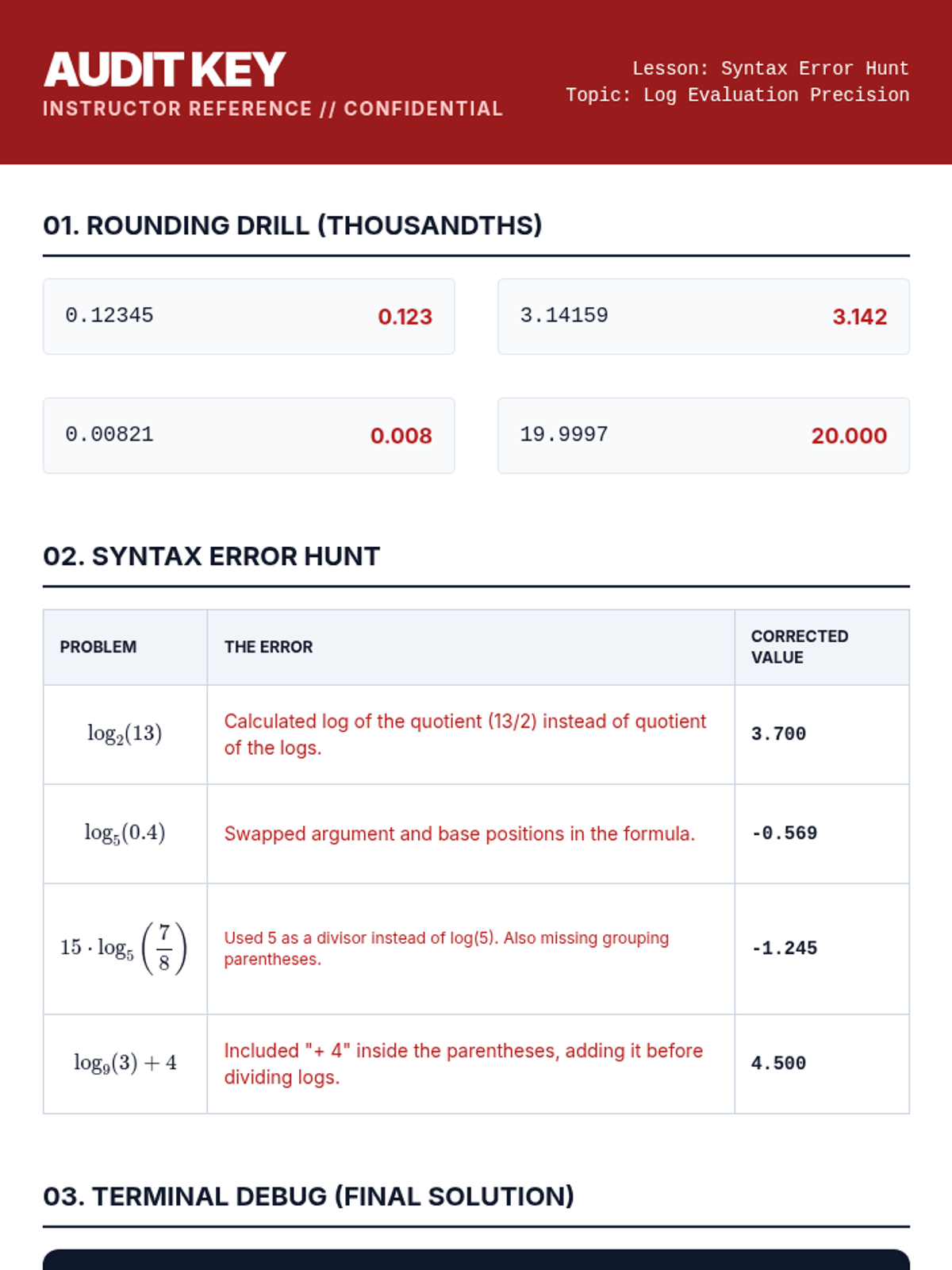
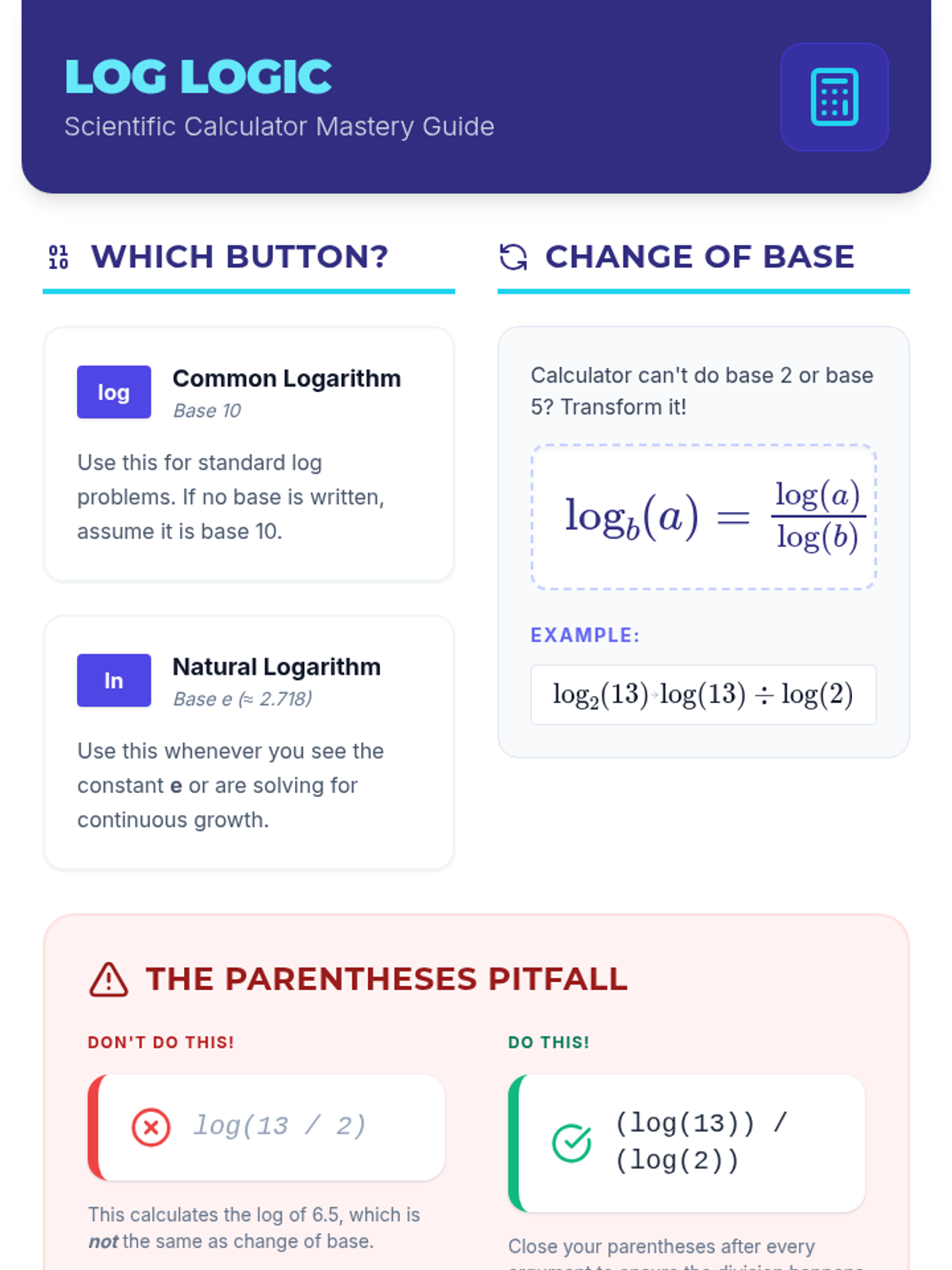
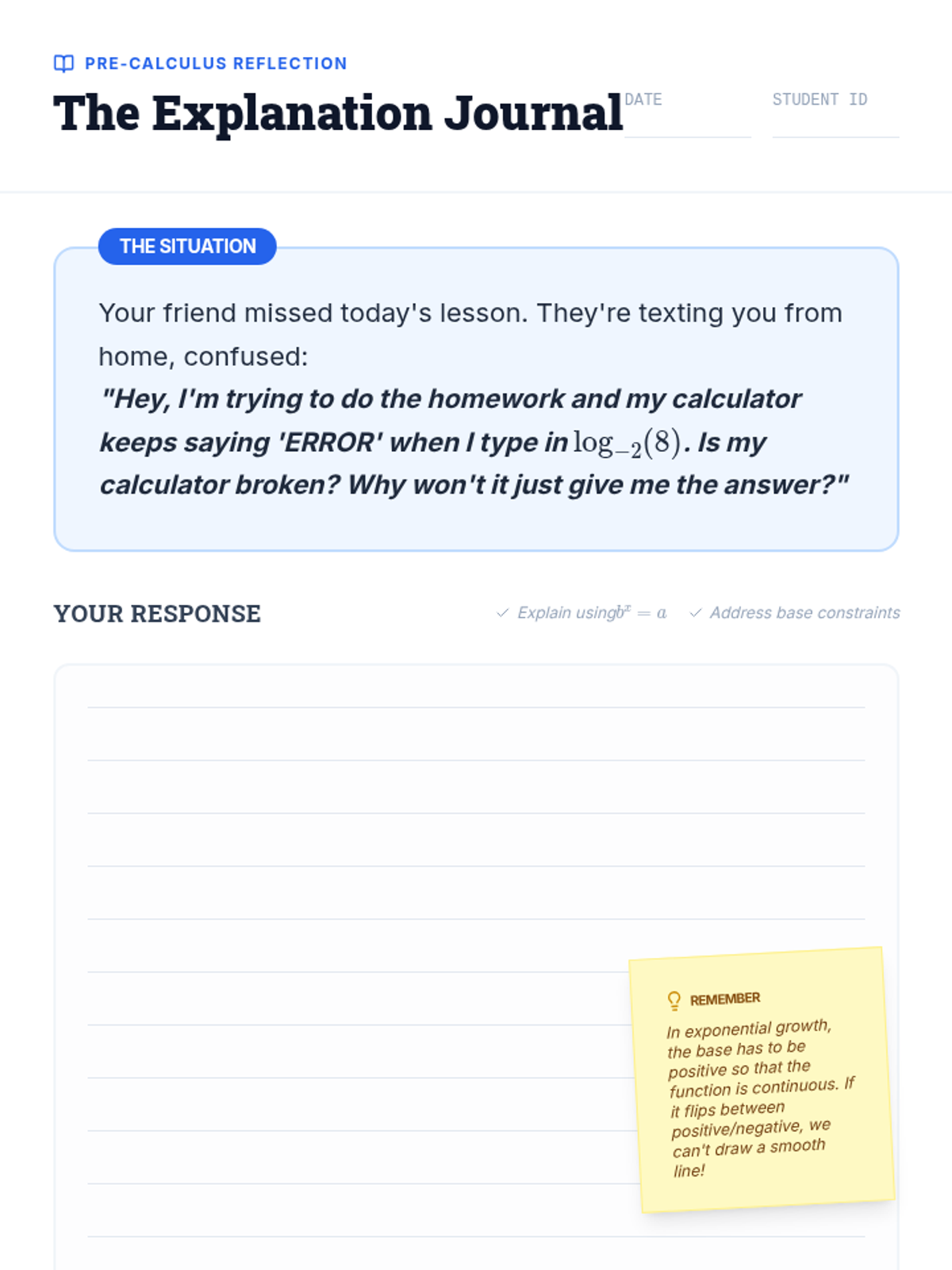
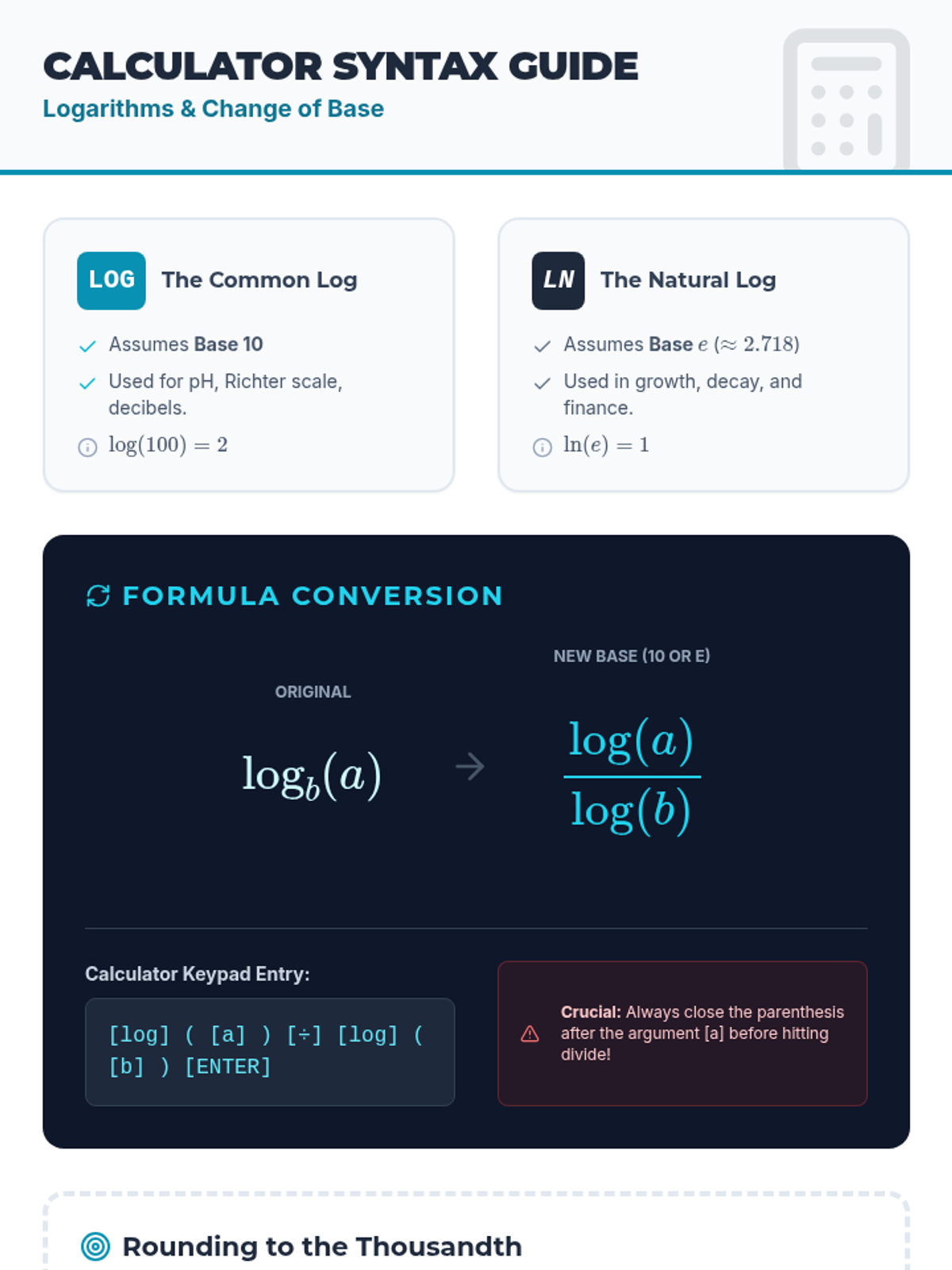
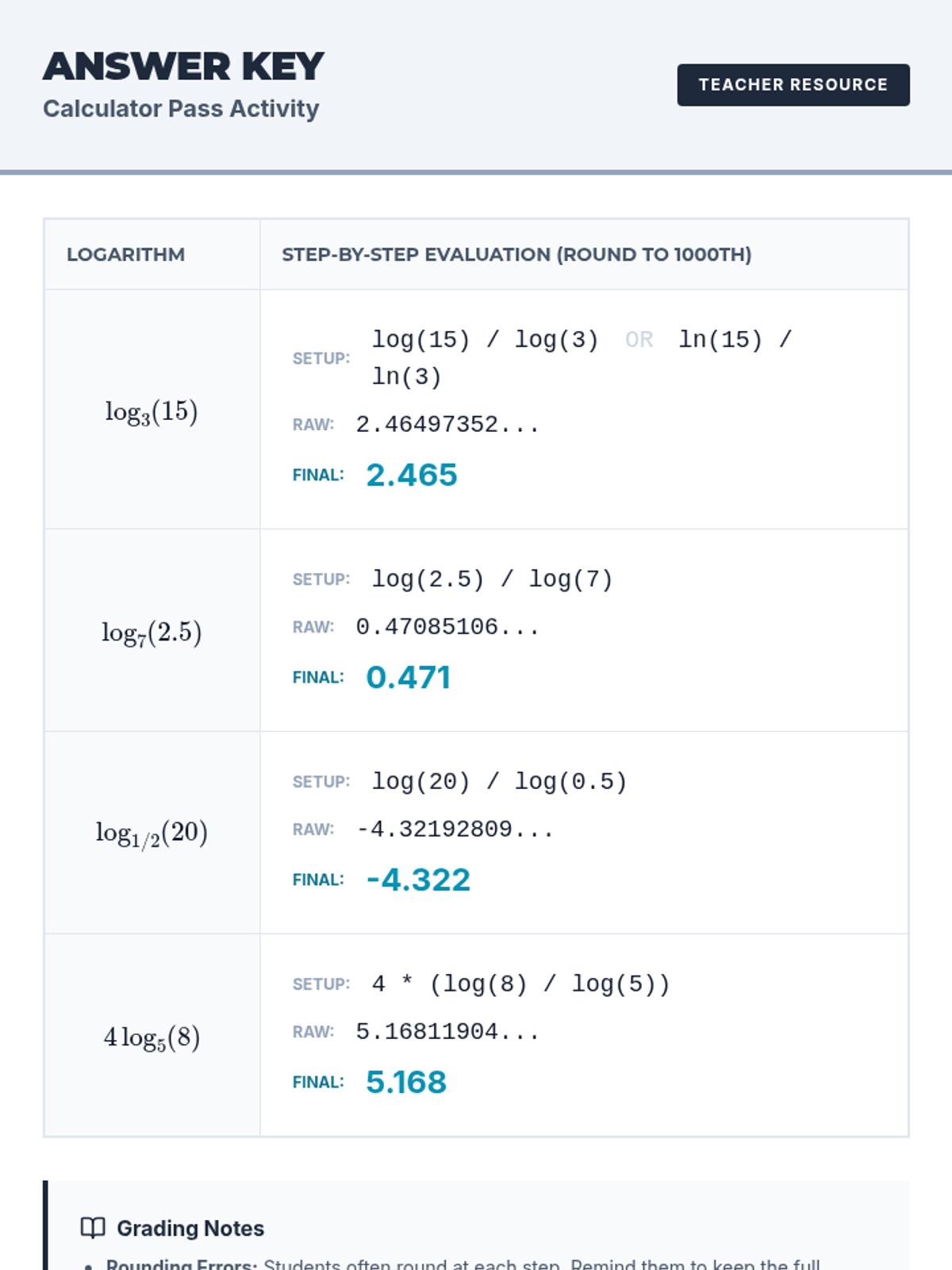
This lesson focuses on the precise evaluation of logarithmic expressions using the Change of Base Rule, with a heavy emphasis on calculator syntax and rounding to the thousandths place. Students identify common entry errors in a 'Syntax Error Hunt' activity.
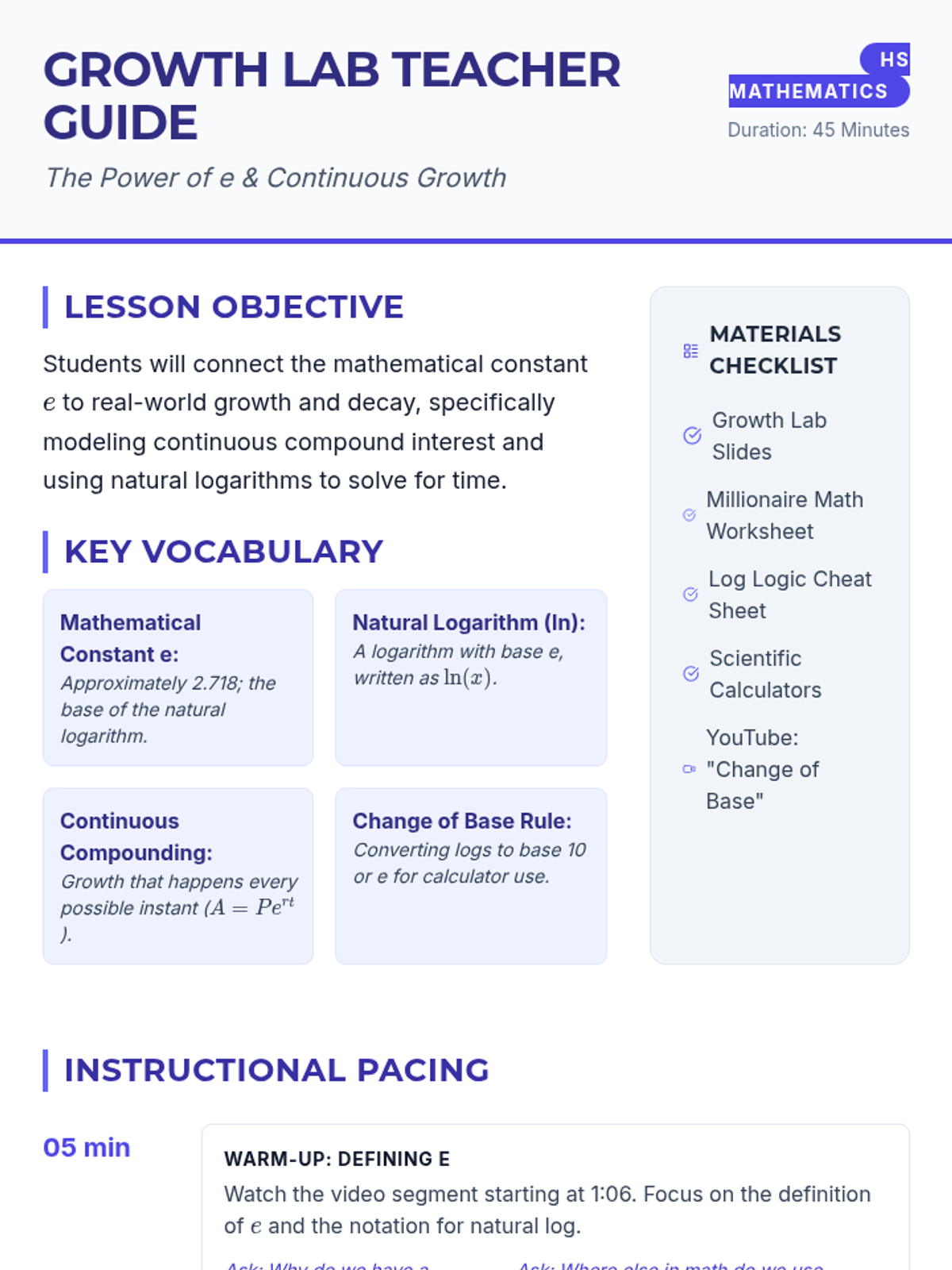
A high school mathematics lesson exploring the constant e, continuous compound interest, and using natural logarithms and the change of base rule to solve for time in growth and decay models.
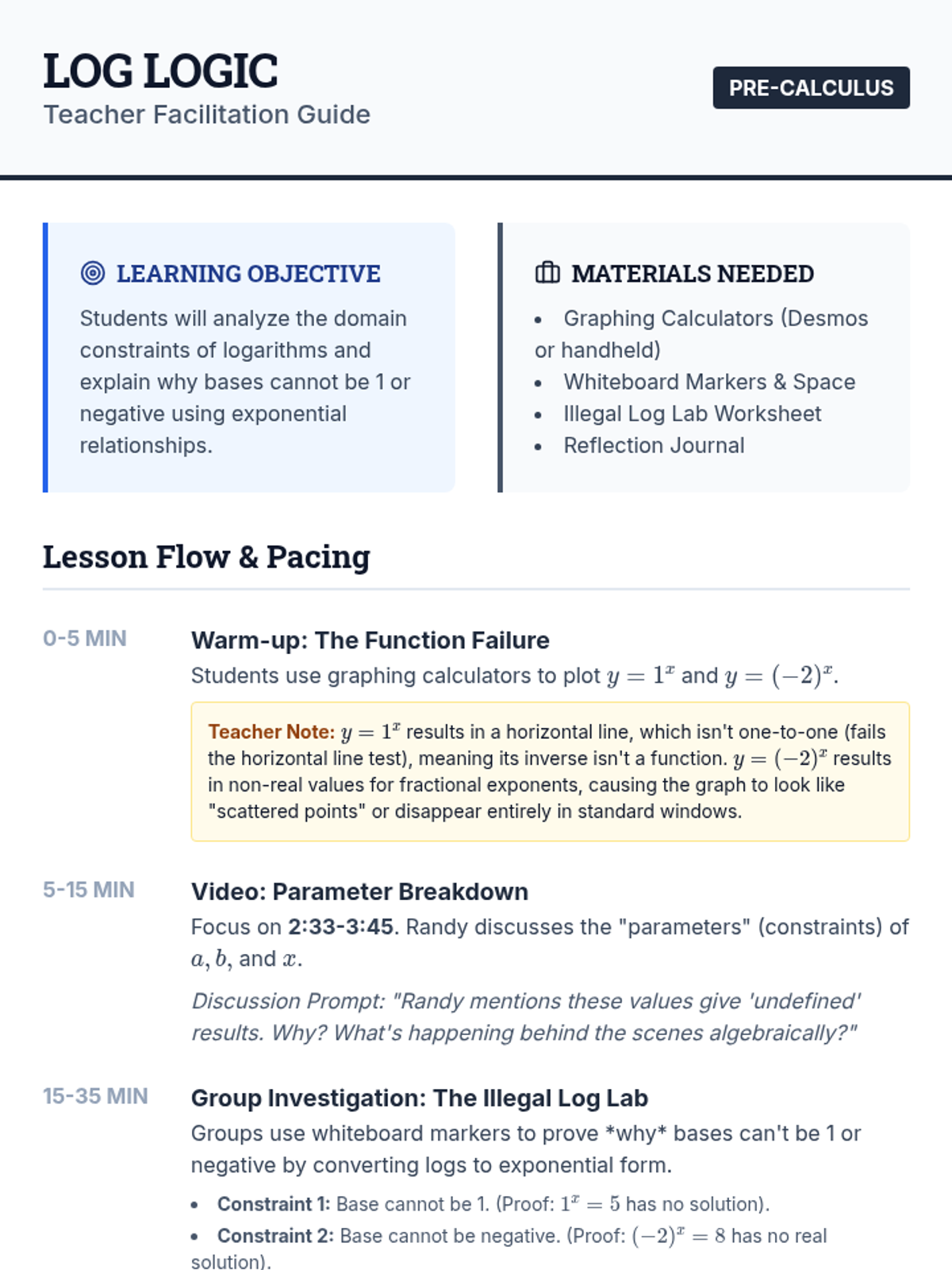
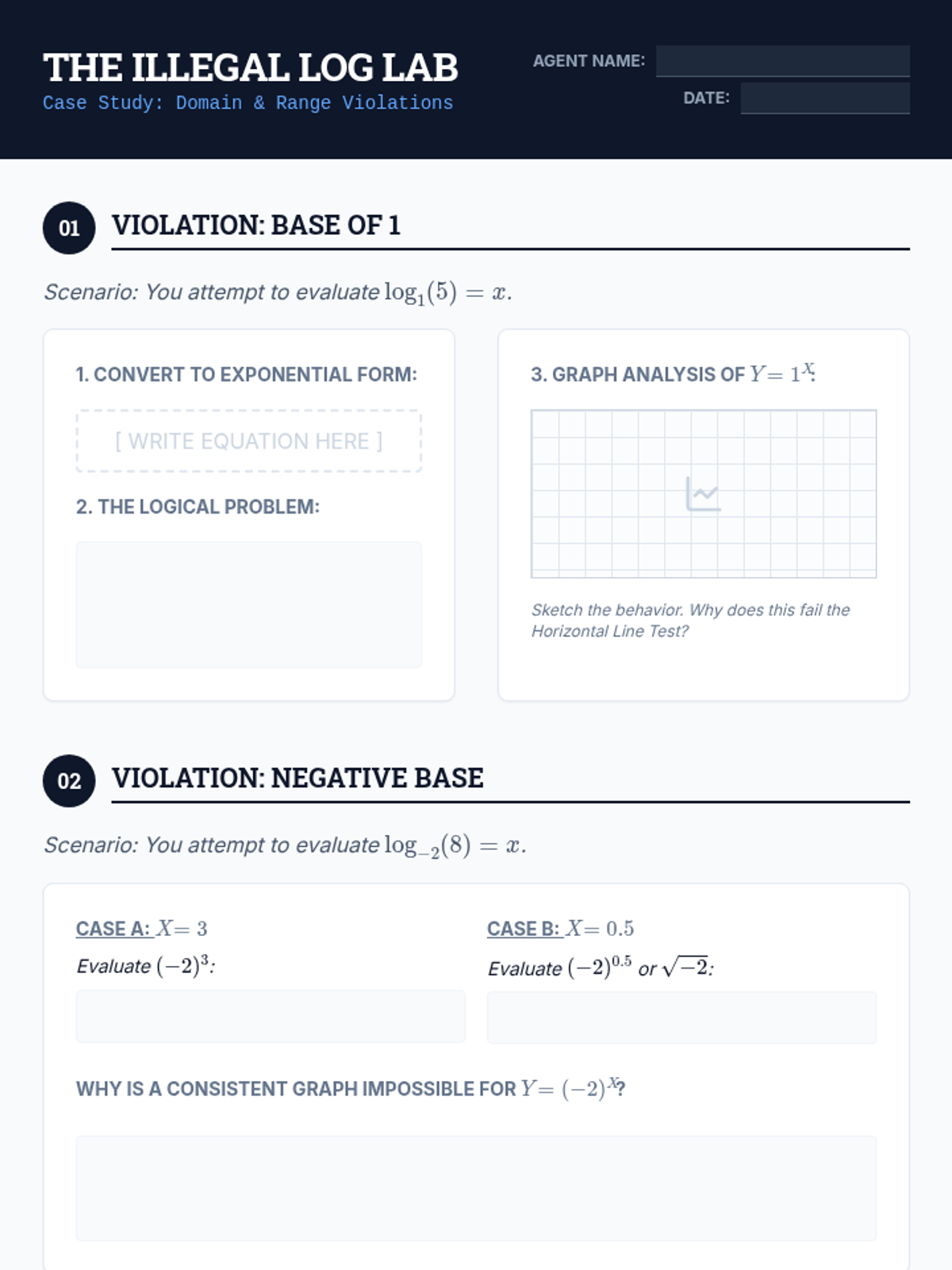
Students analyze domain constraints of logarithms, investigating why bases cannot be 1 or negative through graphing and exponential proofs.
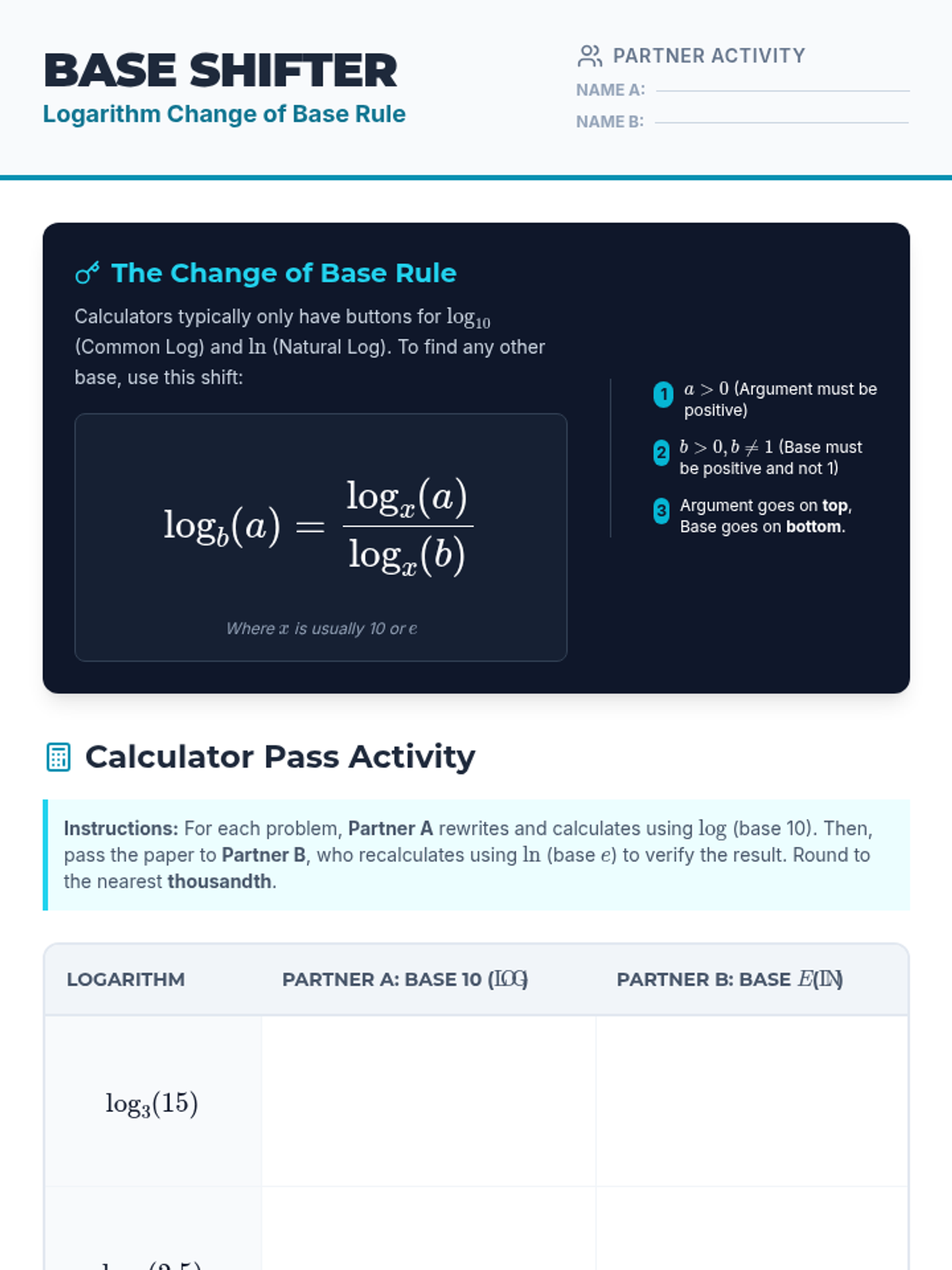
Students will learn the Change of Base Rule to evaluate logarithms of any base using common and natural logarithms. The lesson features a collaborative 'Calculator Pass' activity where students verify results using different bases to confirm the formula's versatility.
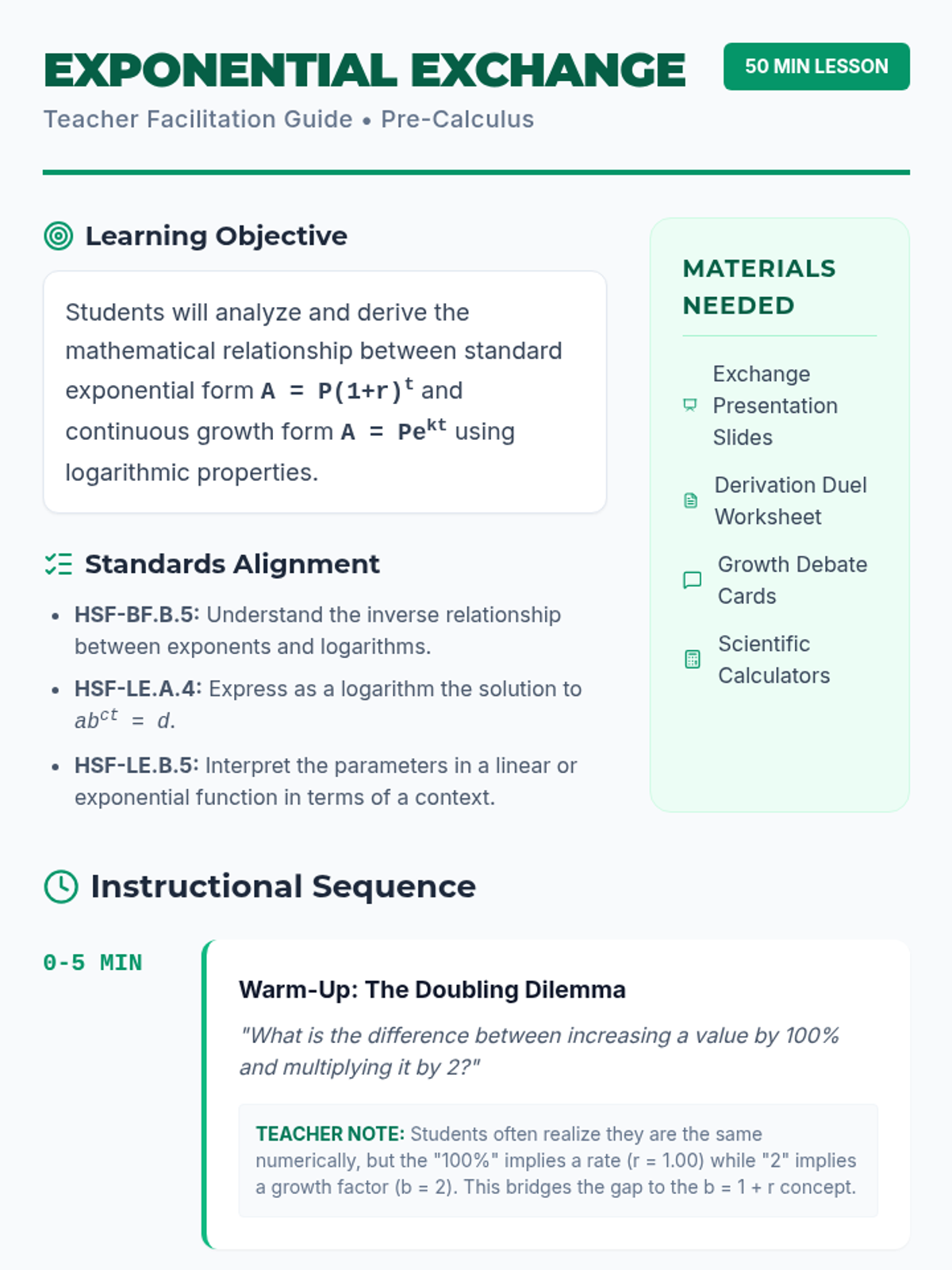
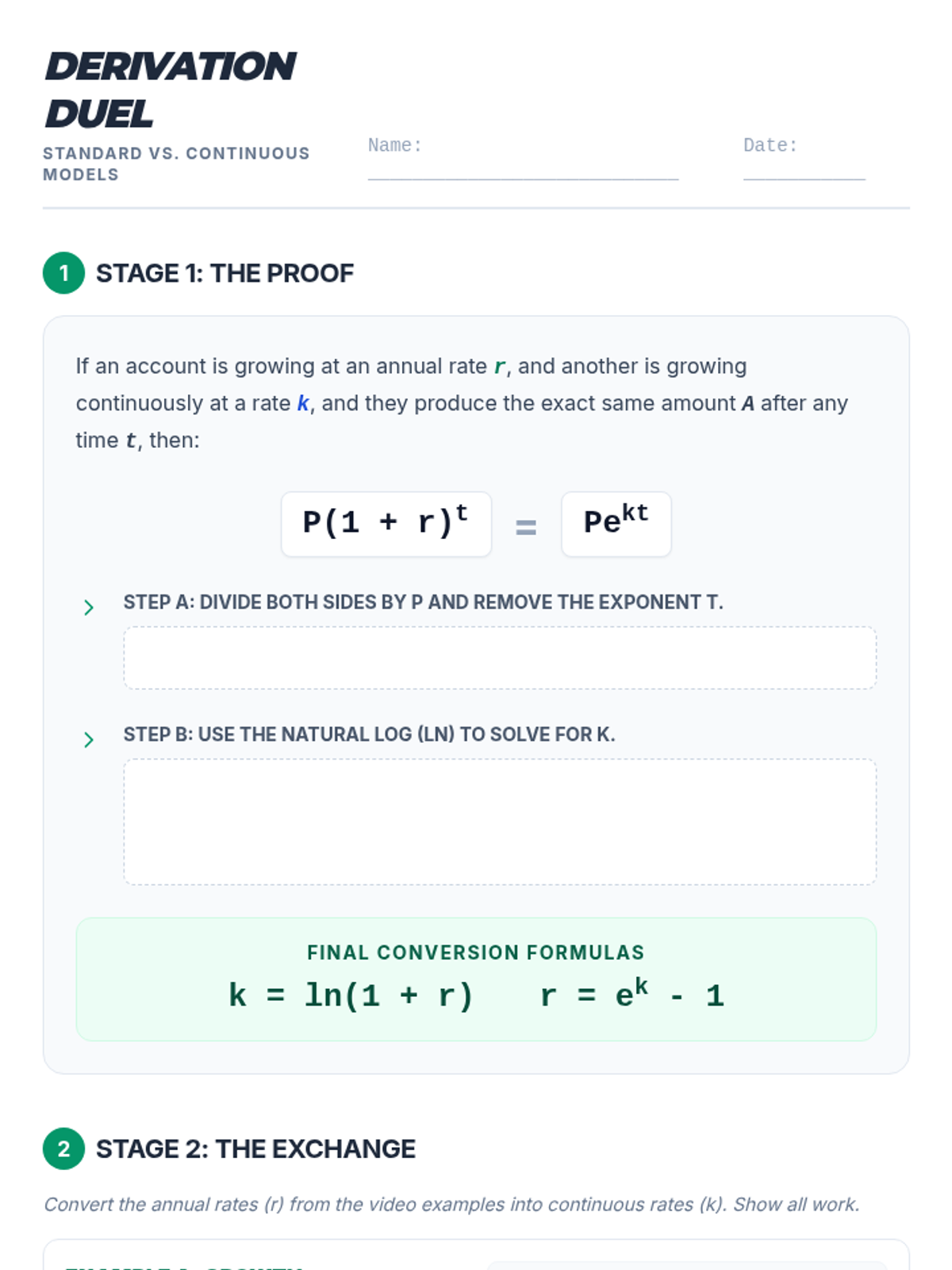
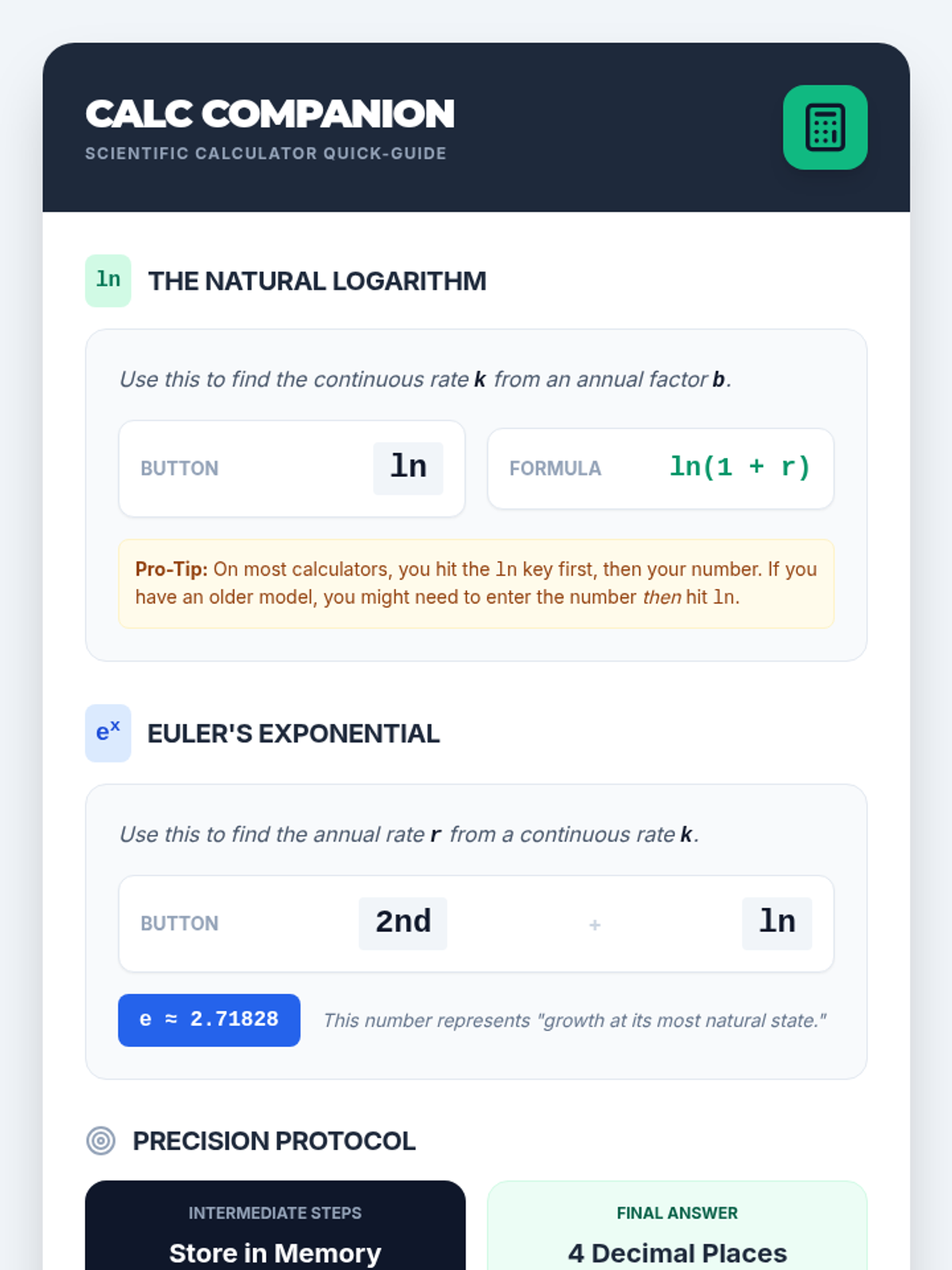
A Pre-Calculus lesson exploring the conversion between standard exponential growth and continuous growth models using logarithms and the video 'Growth Factor, Decay Factor, Growth Rate, and Rate of Decay'.
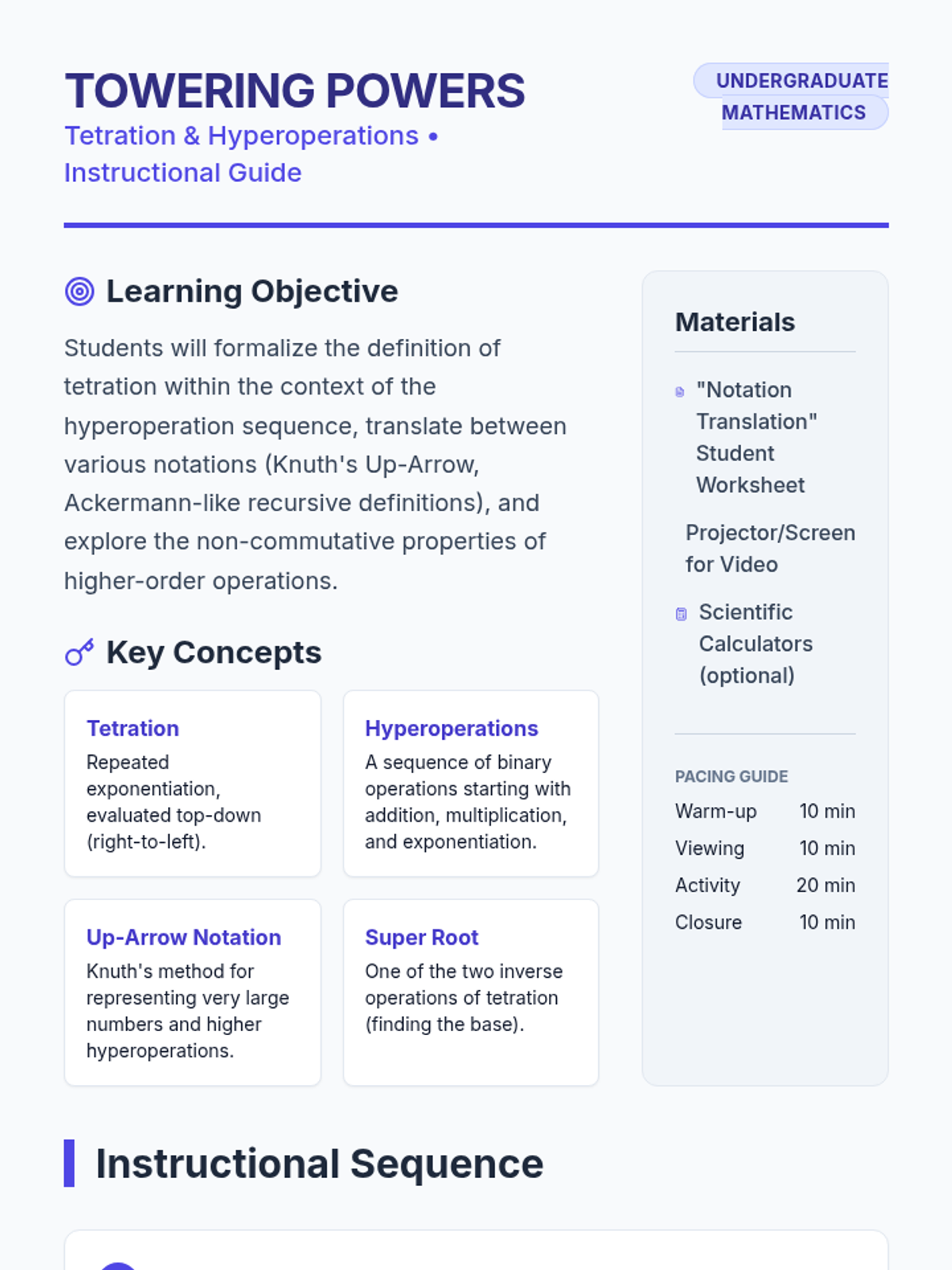
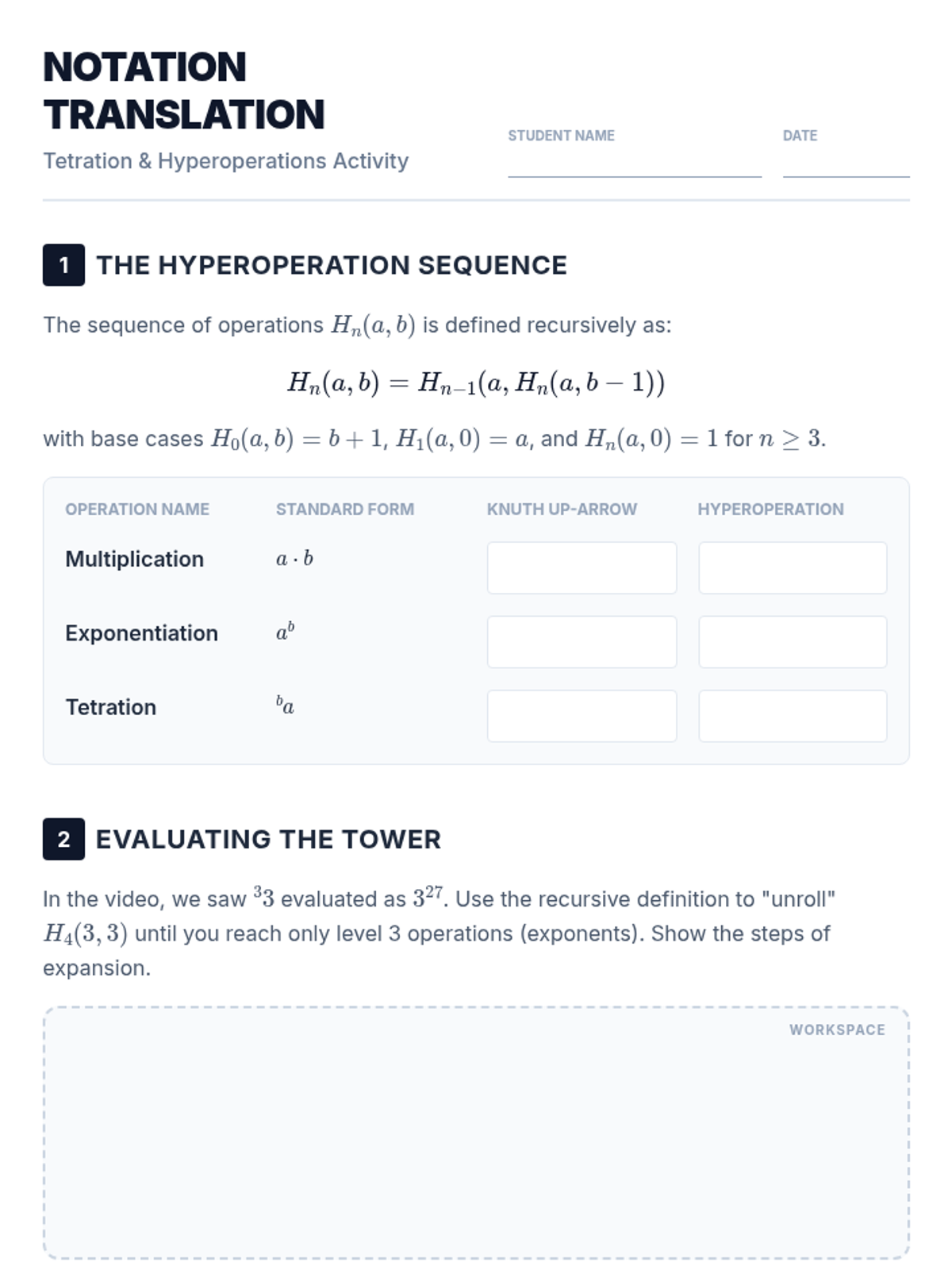
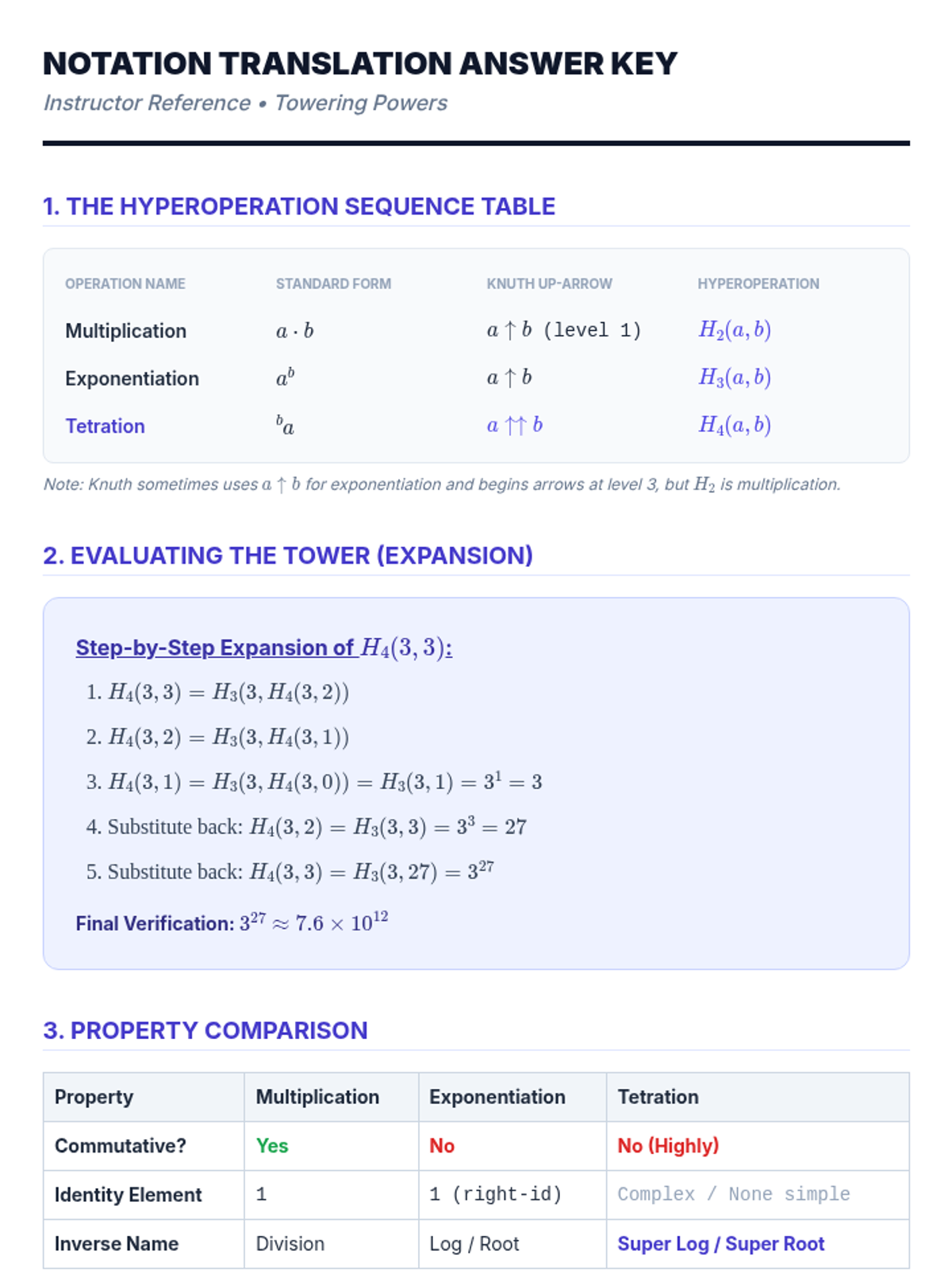
A comprehensive lesson introducing undergraduate students to tetration through the hyperoperation sequence, Knuth's up-arrow notation, and the Ackermann function. Students will formalize the definition of repeated exponentiation and analyze its growth and non-commutative properties.
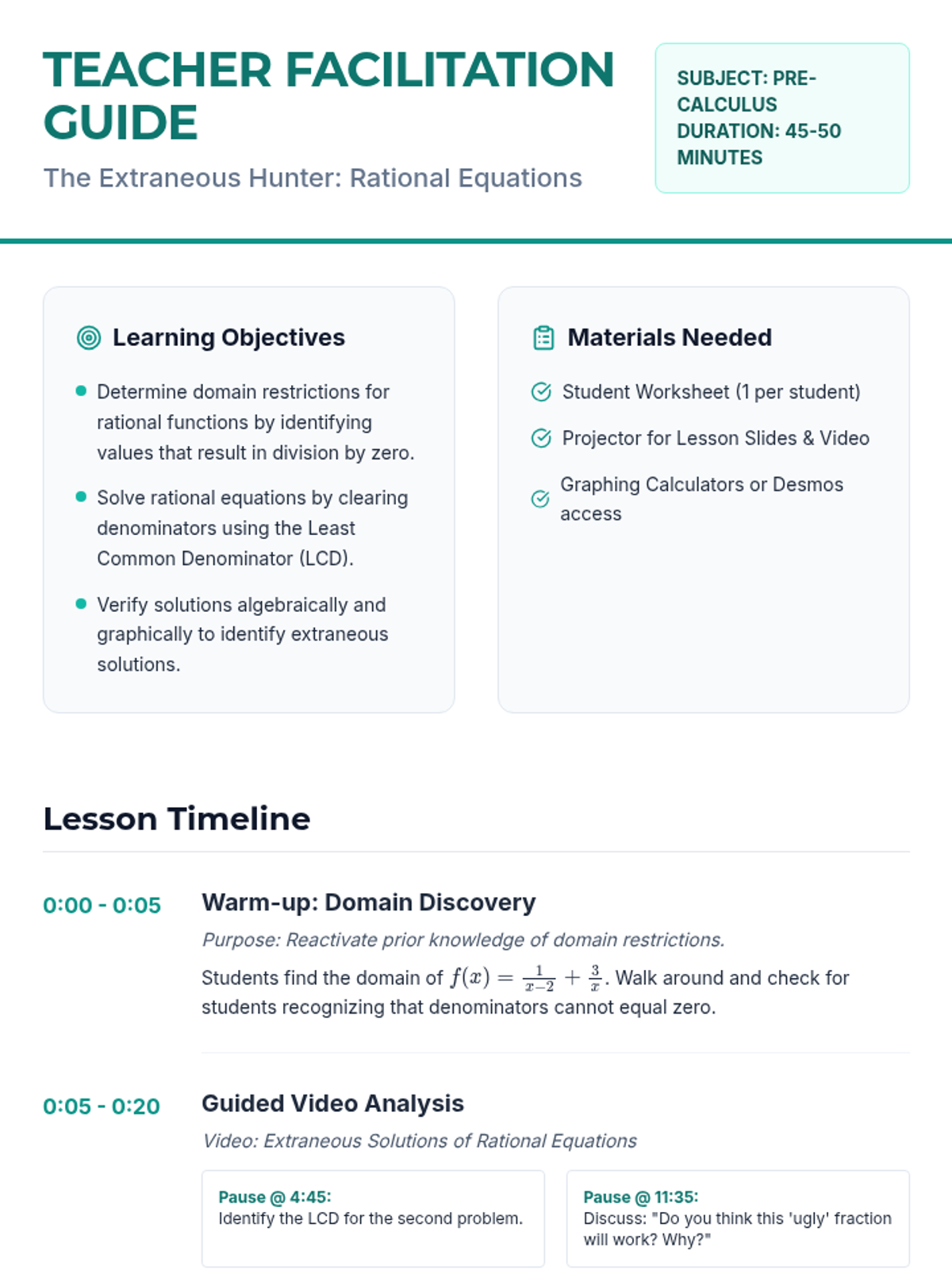
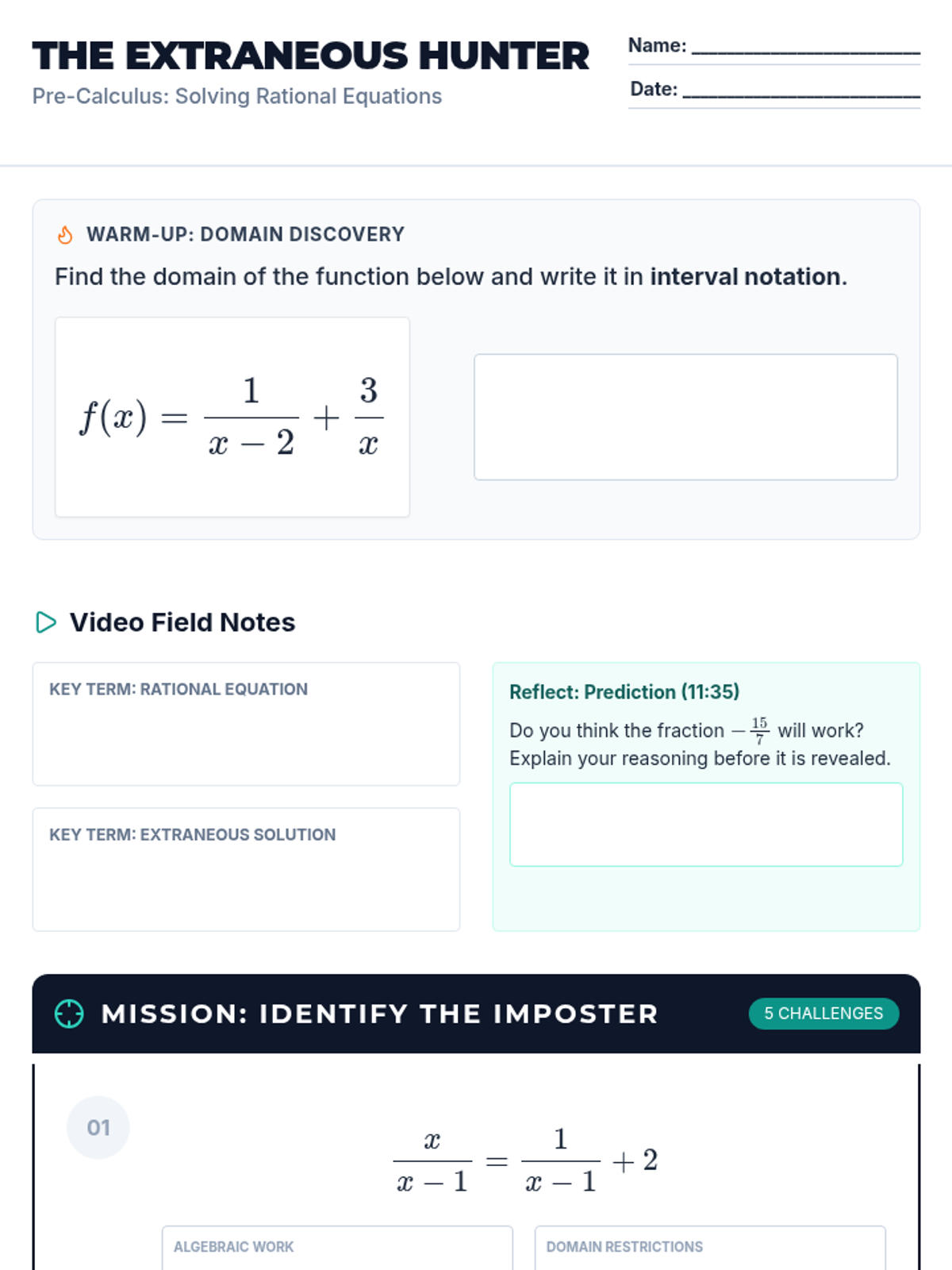
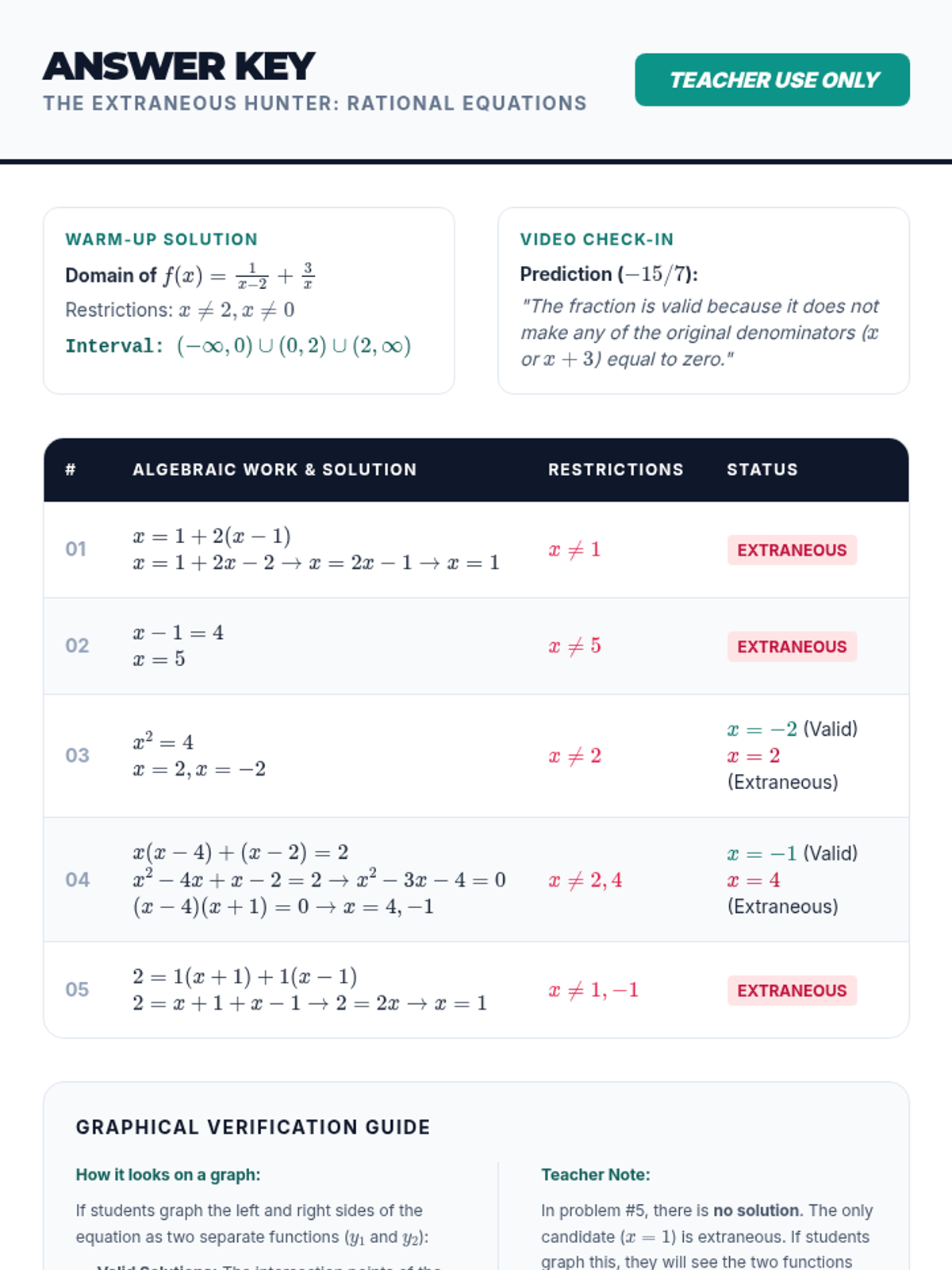
A comprehensive Pre-Calculus lesson focused on identifying domain restrictions and isolating extraneous solutions in complex rational equations through algebraic solving and graphical verification.
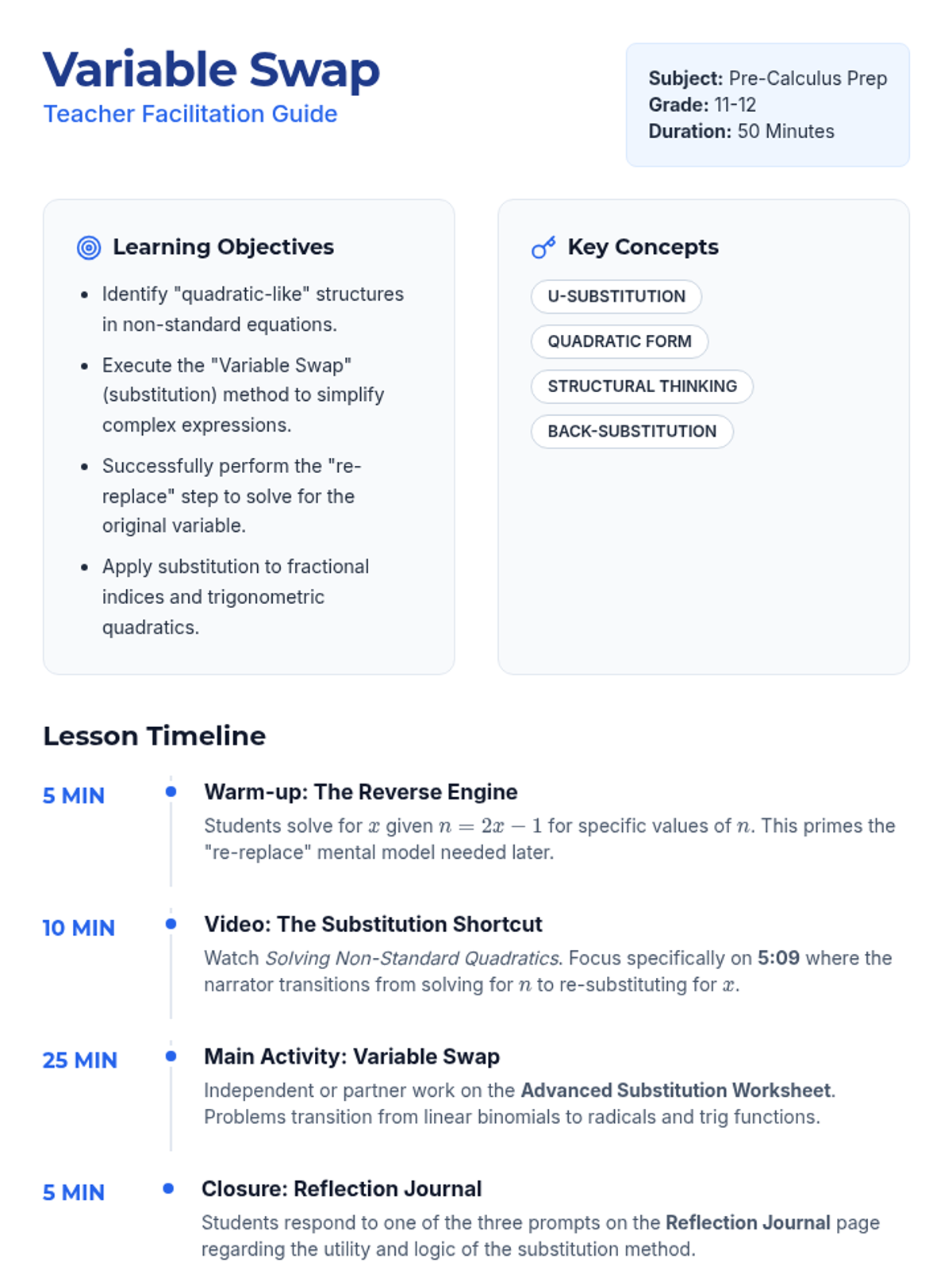
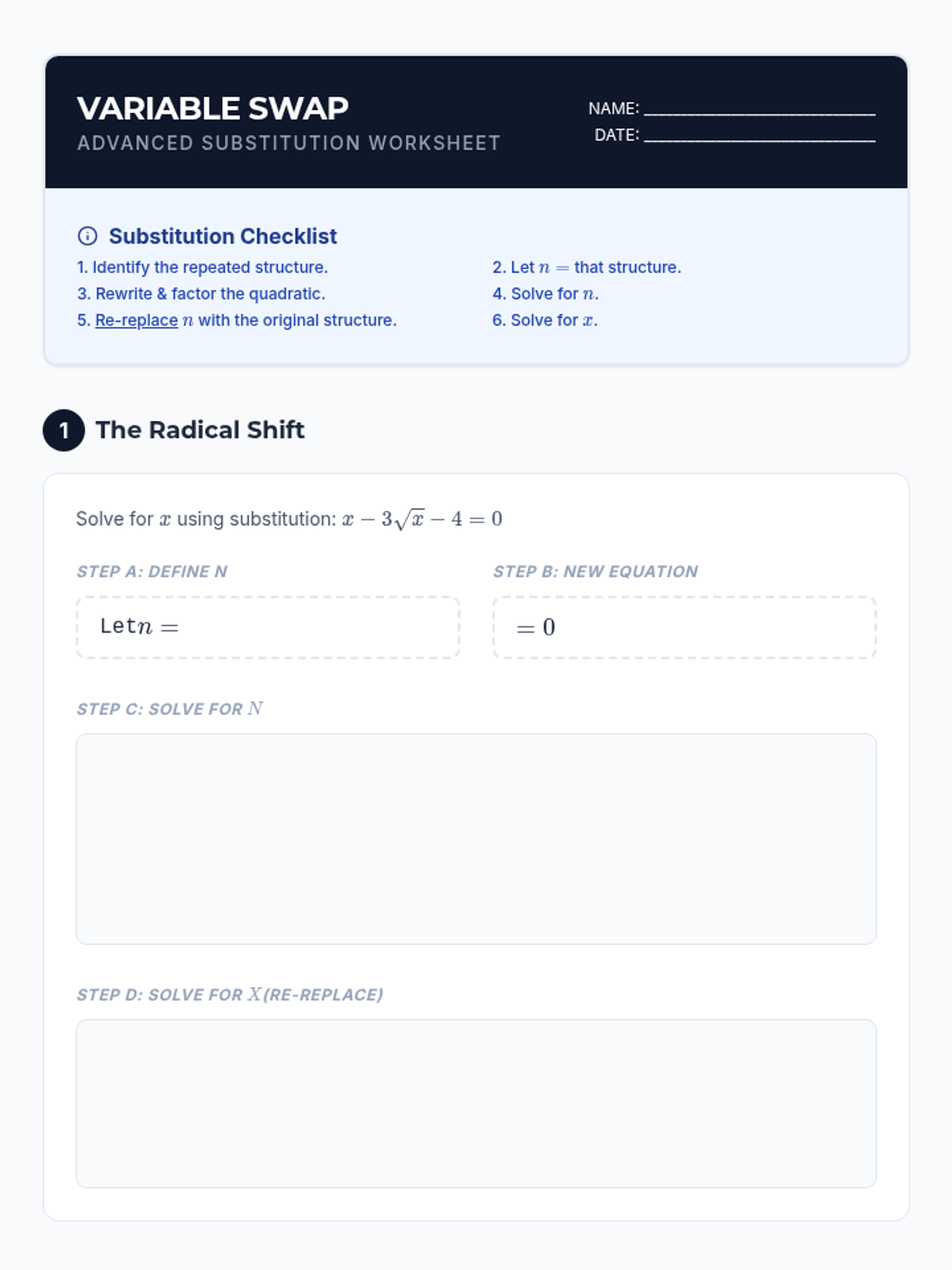
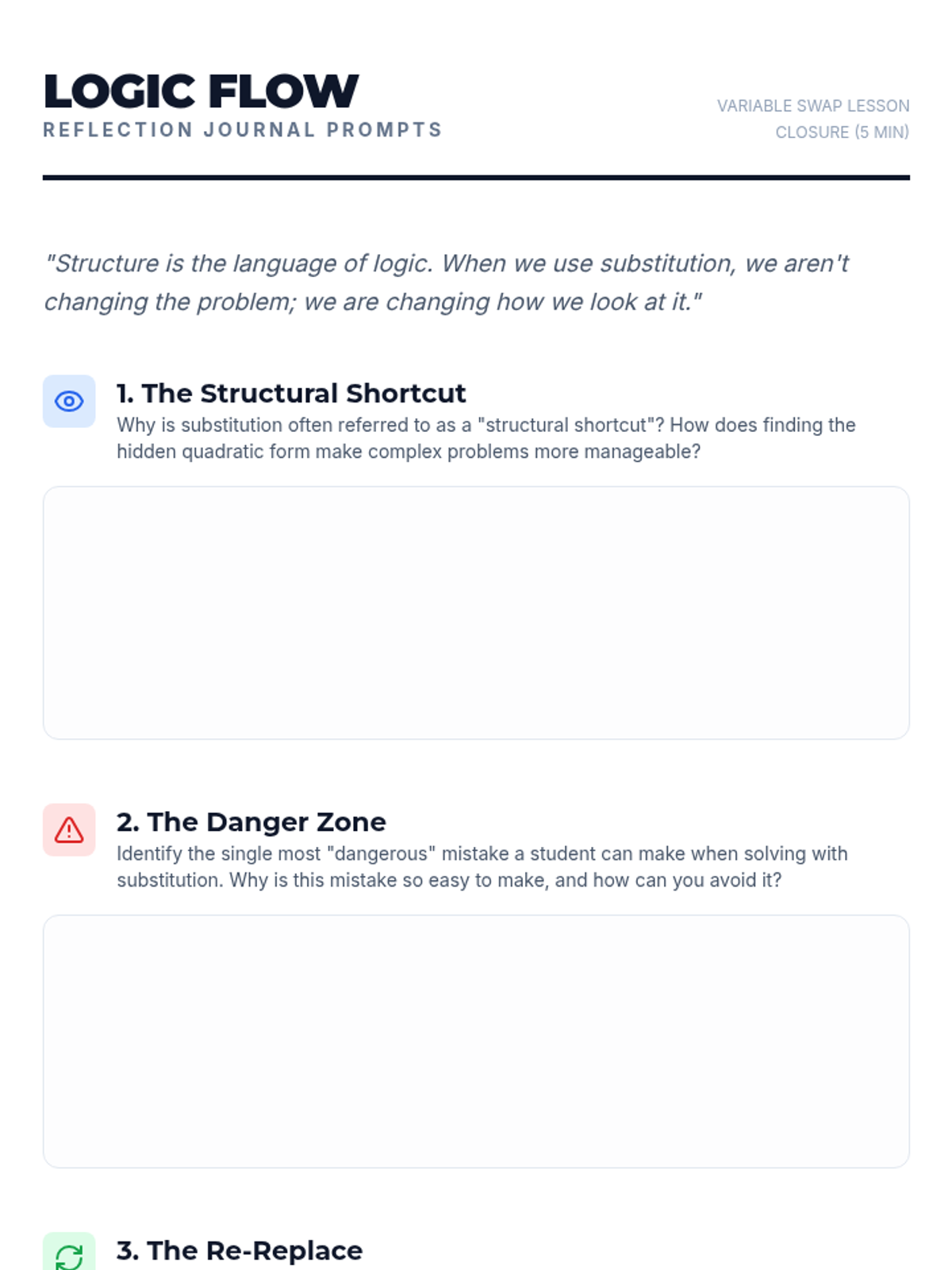
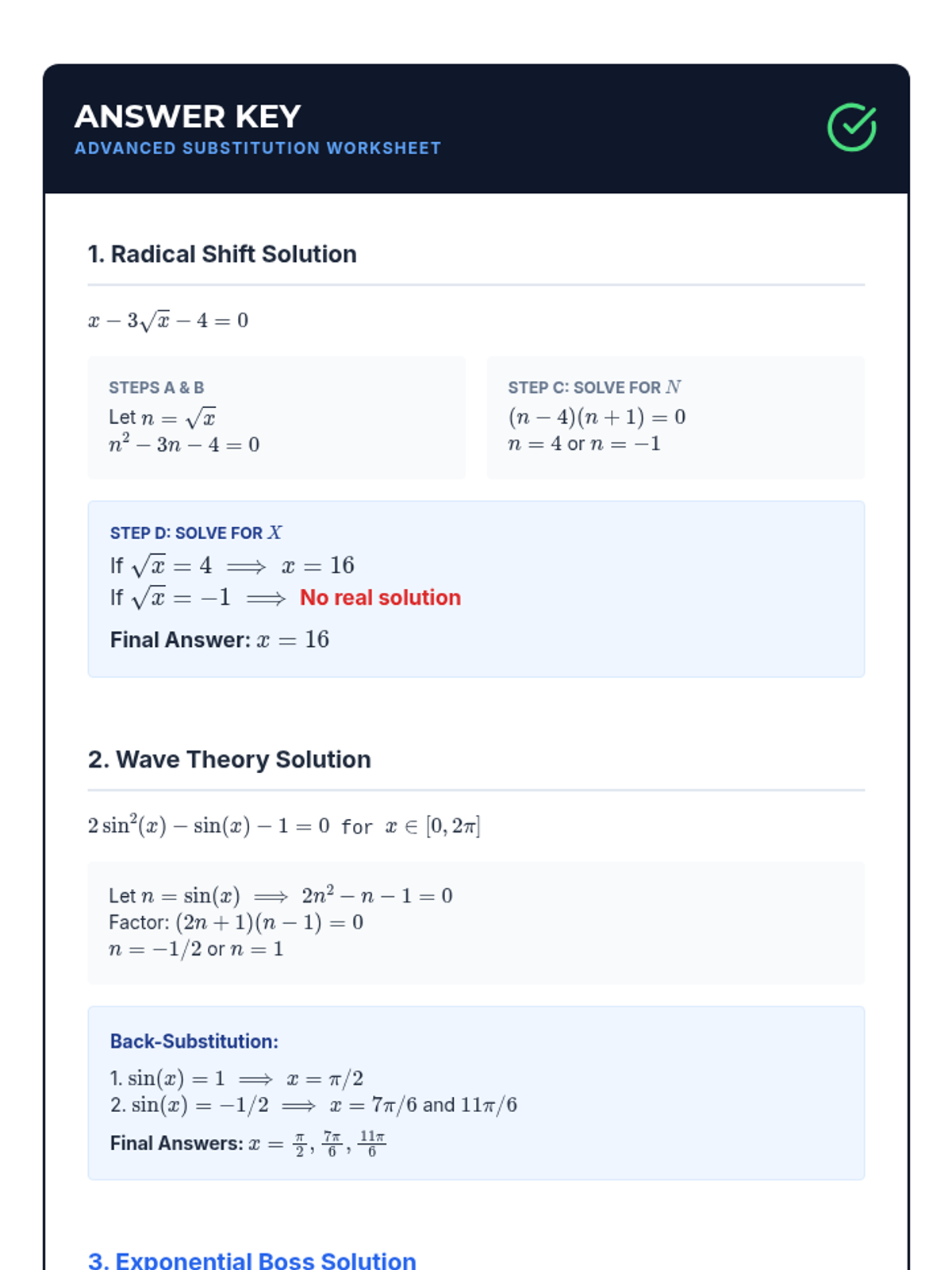
A high school Pre-Calculus lesson focused on the power of variable substitution to solve non-standard quadratic equations, including fractional indices and trigonometric forms.
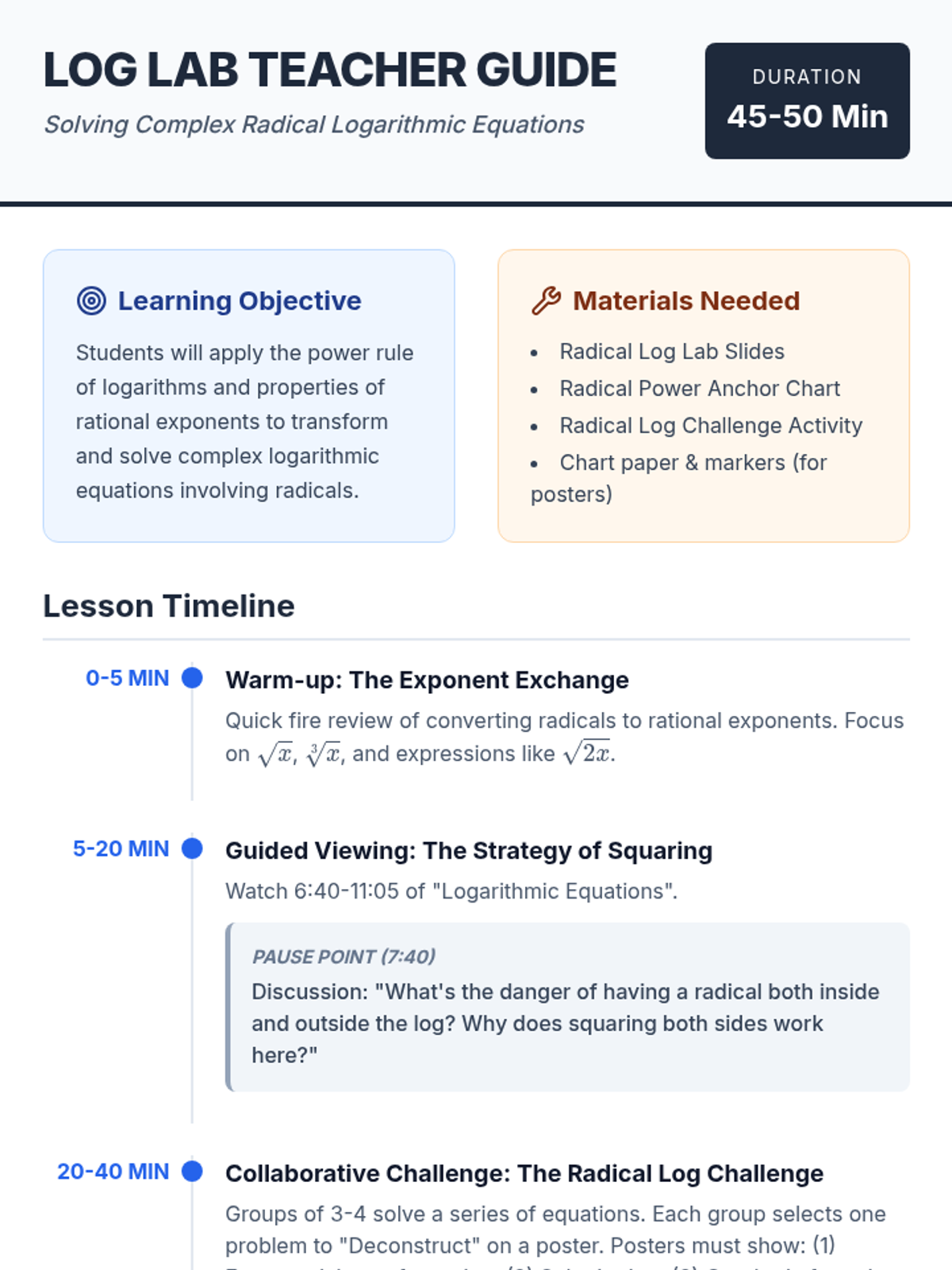
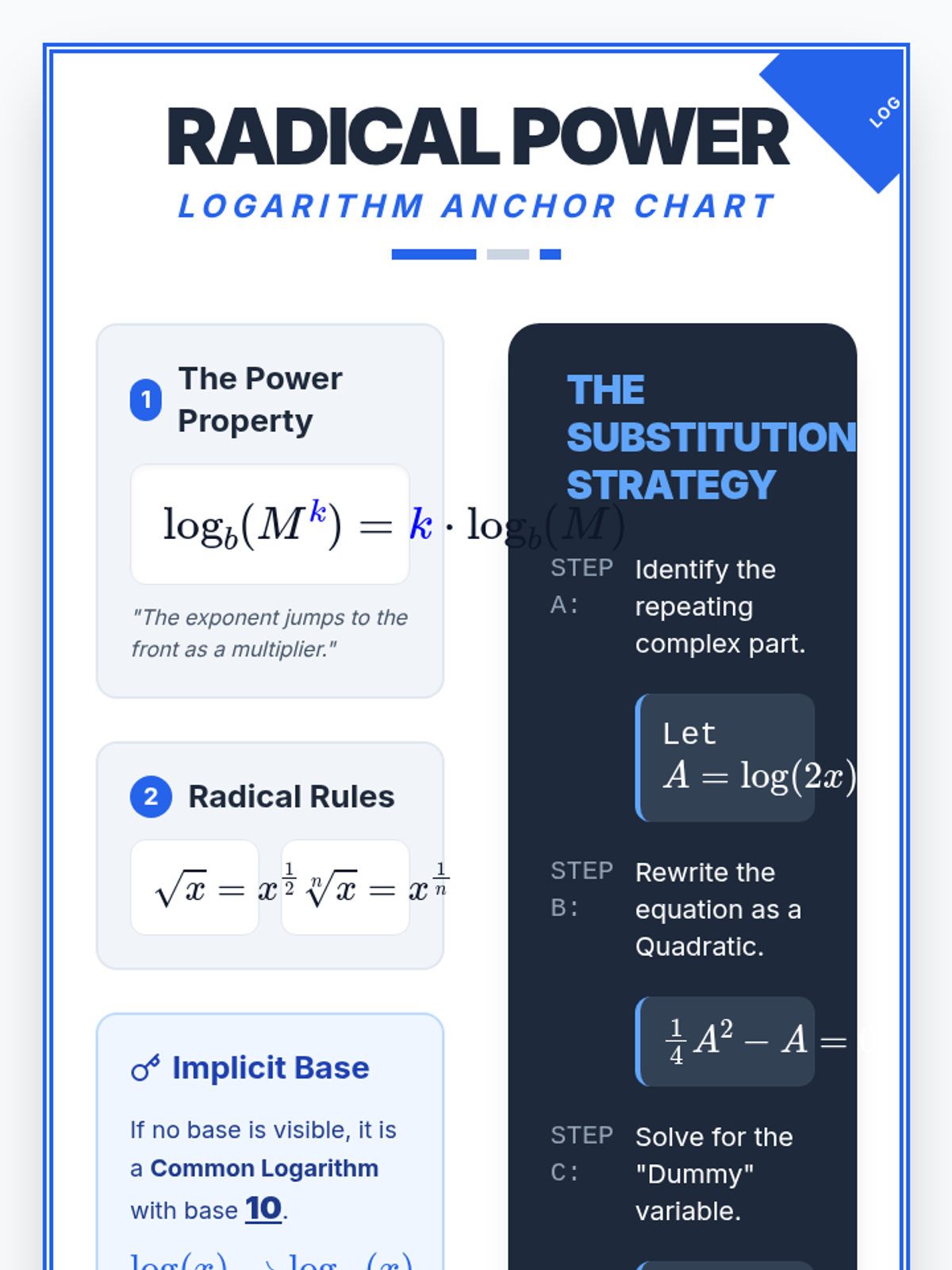
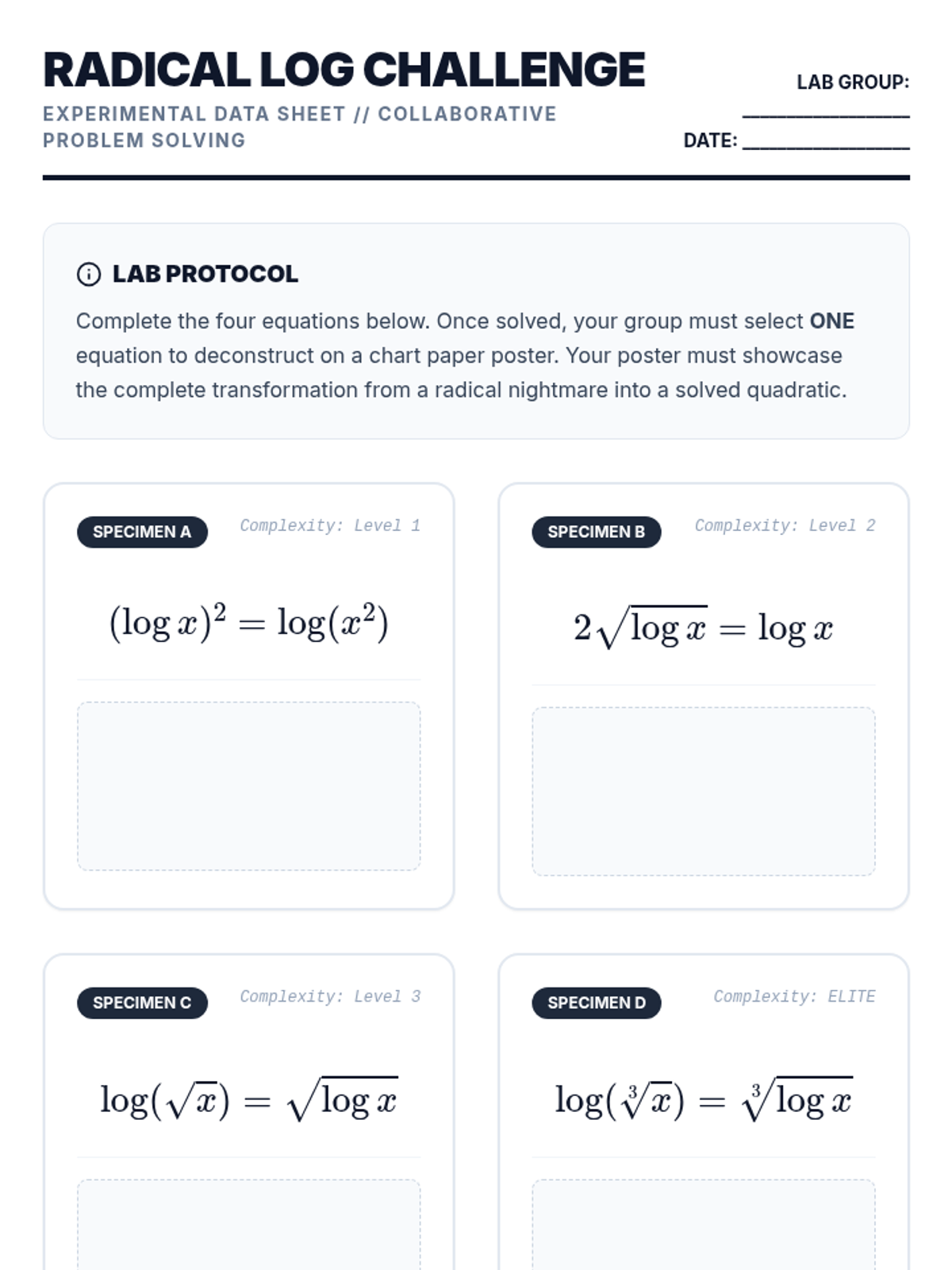
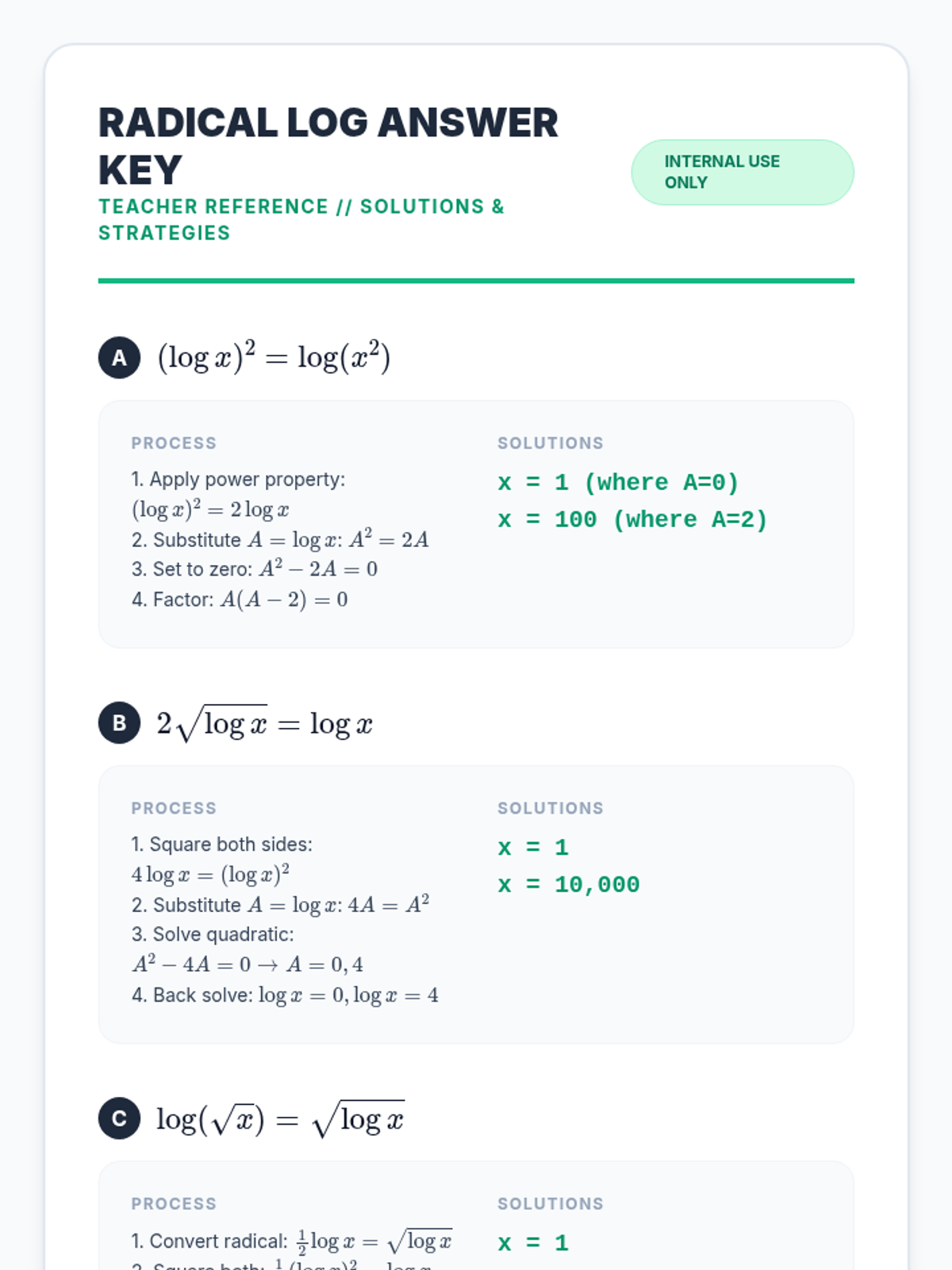
A Pre-Calculus lesson focused on solving complex logarithmic equations involving radicals and rational exponents using the power rule and substitution strategies.
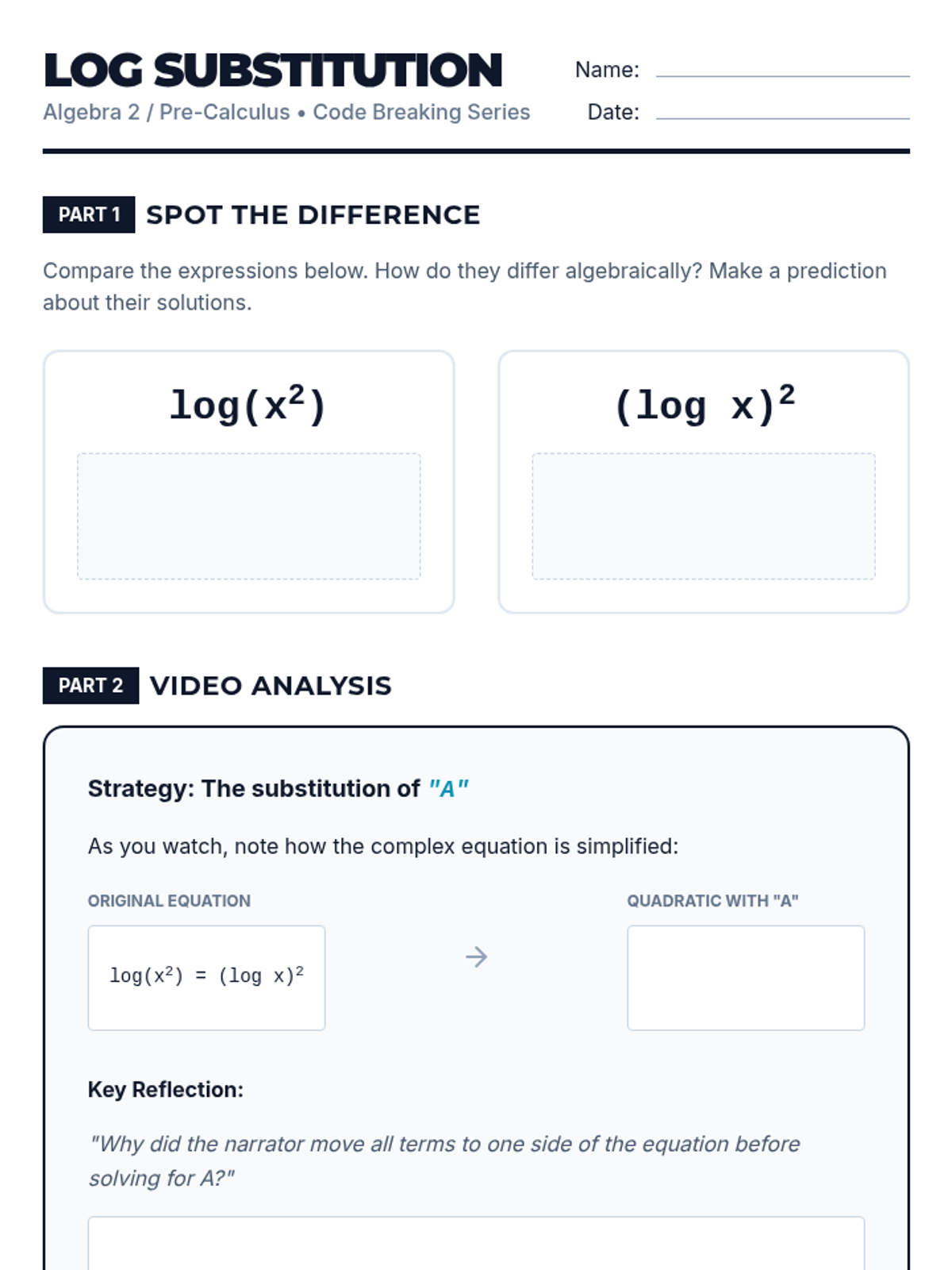
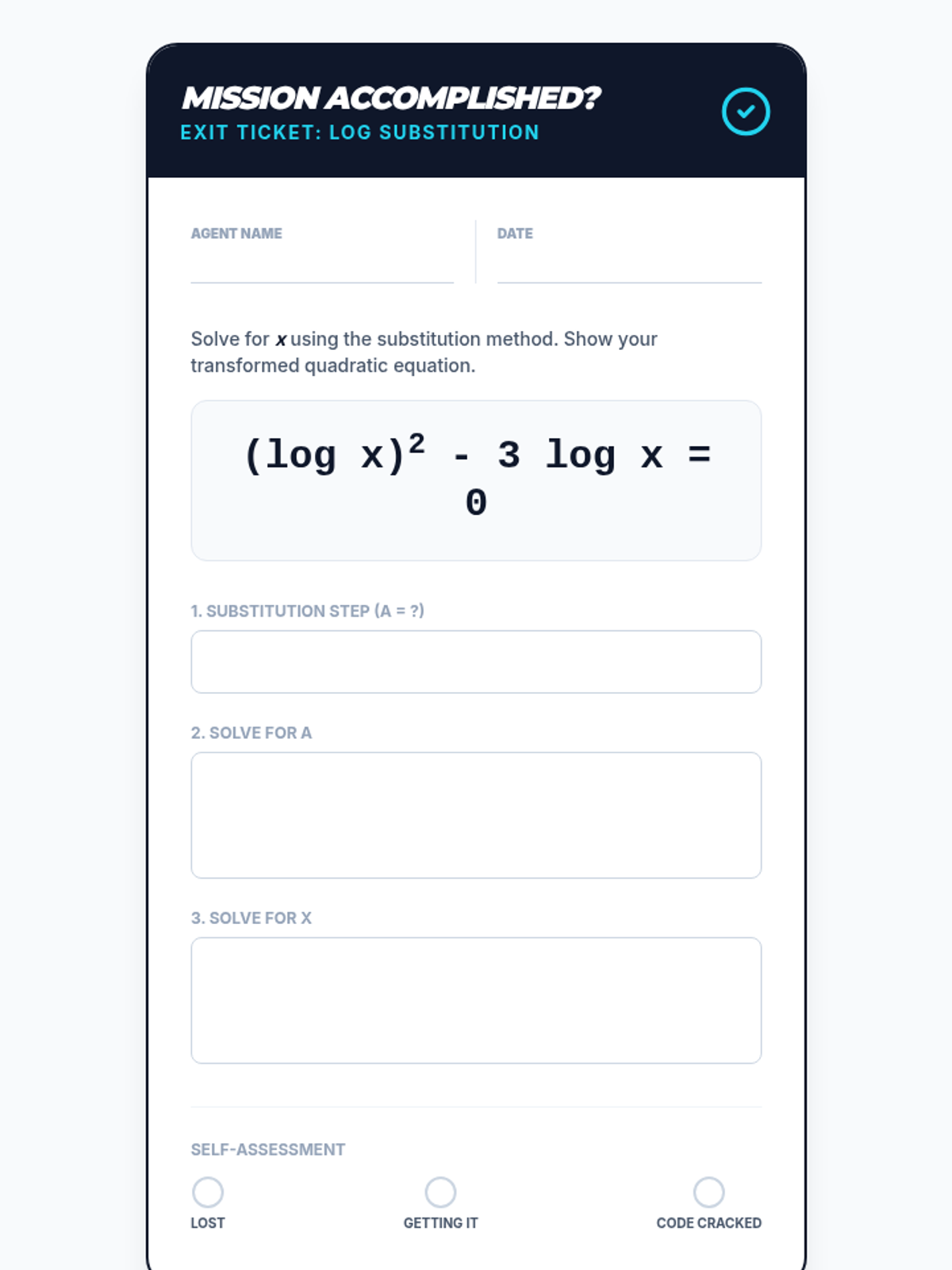
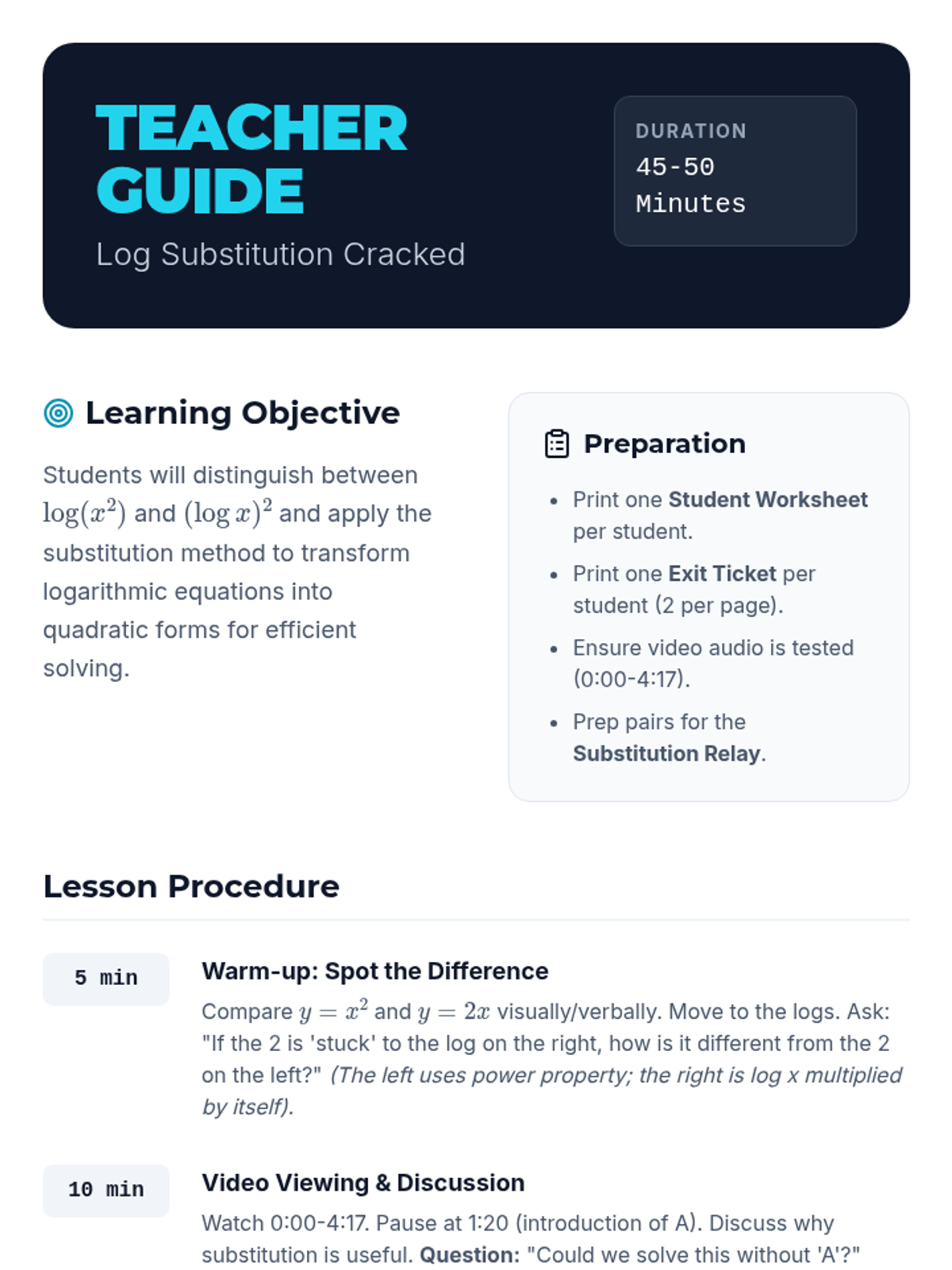
A lesson focusing on solving logarithmic equations by distinguishing between power properties and exponents of the logarithm itself, utilizing the substitution method to transform equations into quadratic forms.
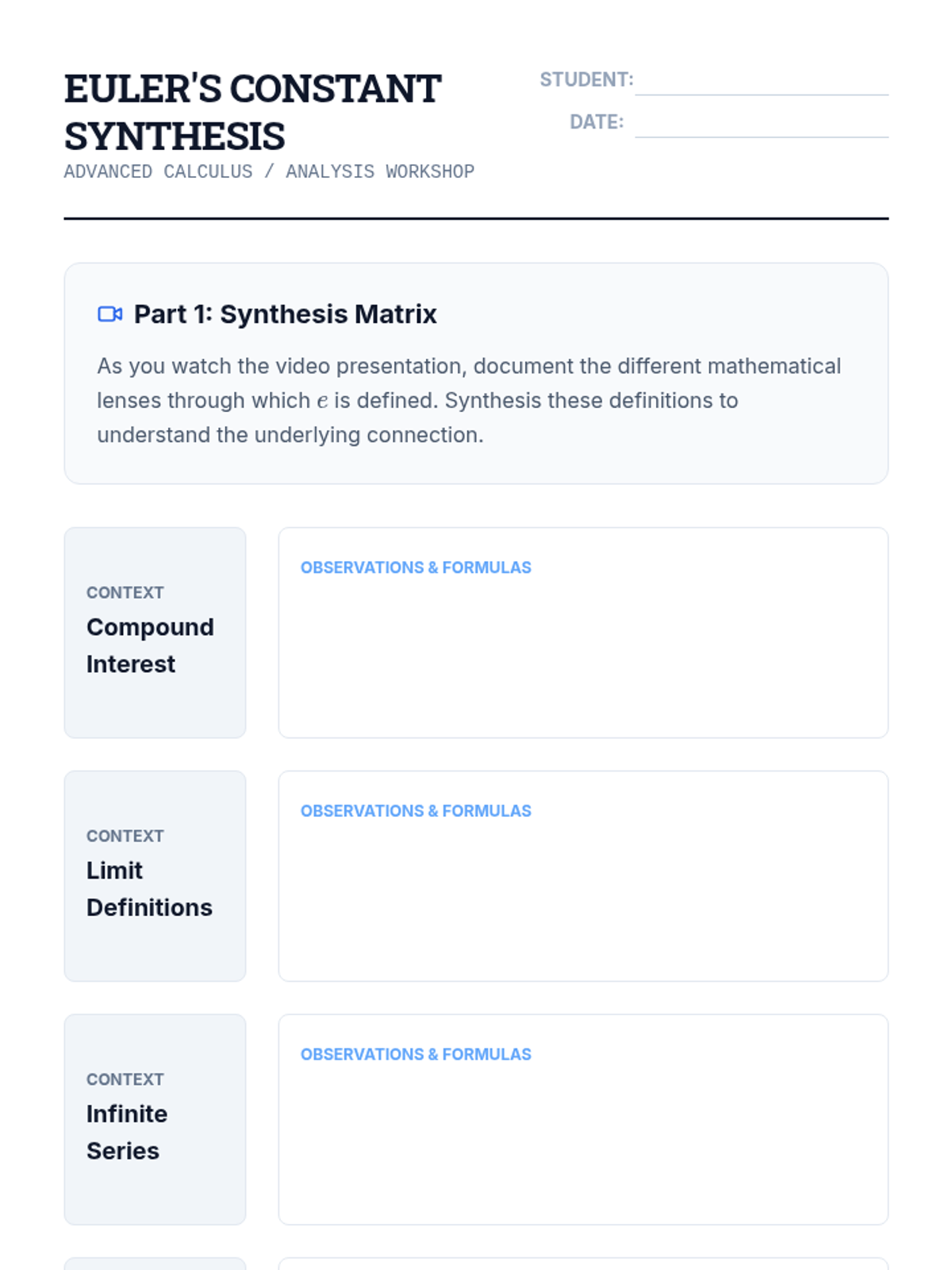
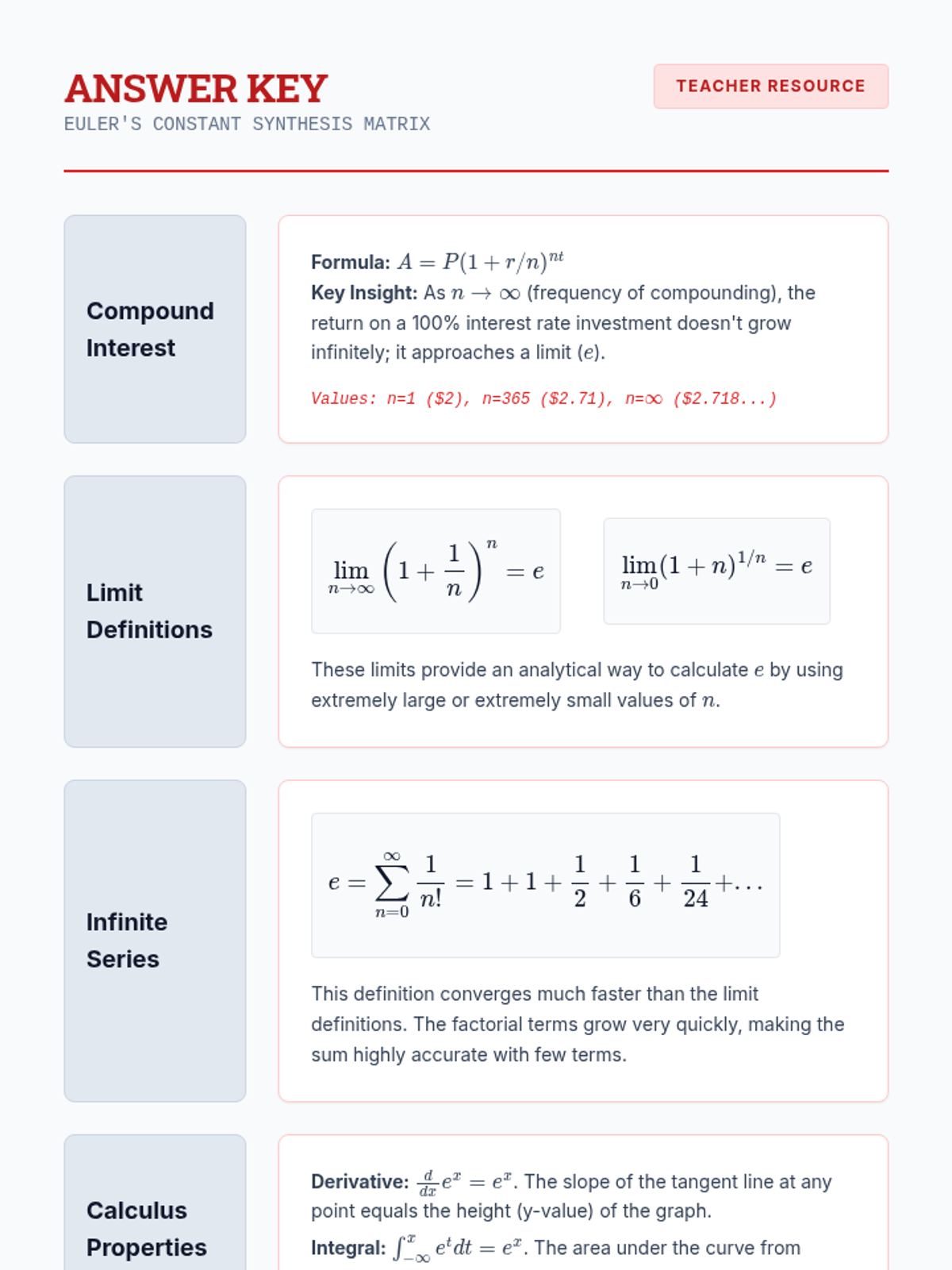
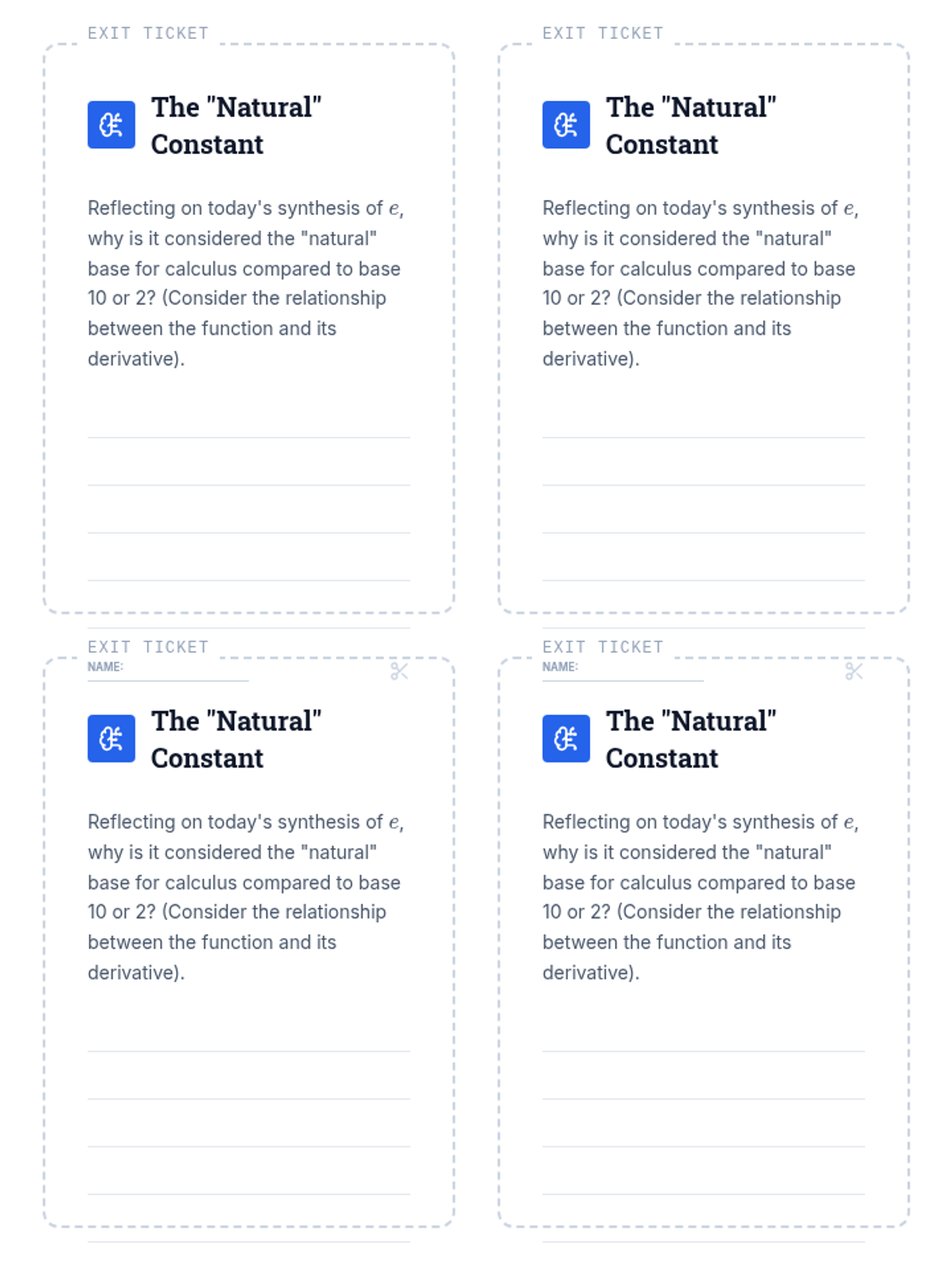
An undergraduate-level exploration of Euler's number (e) that synthesizes its financial, analytical, and series-based definitions through a rigorous proof-based approach.
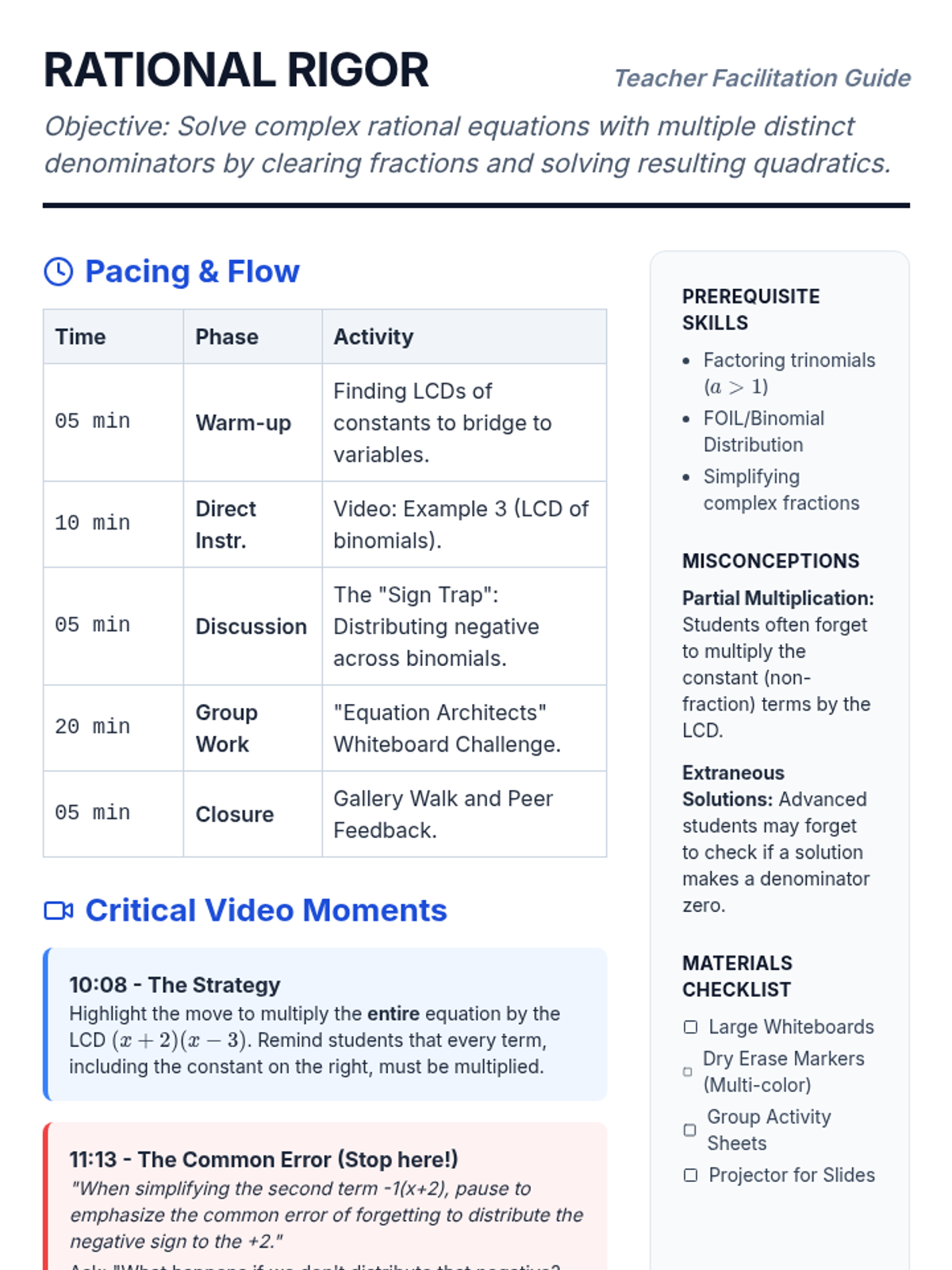
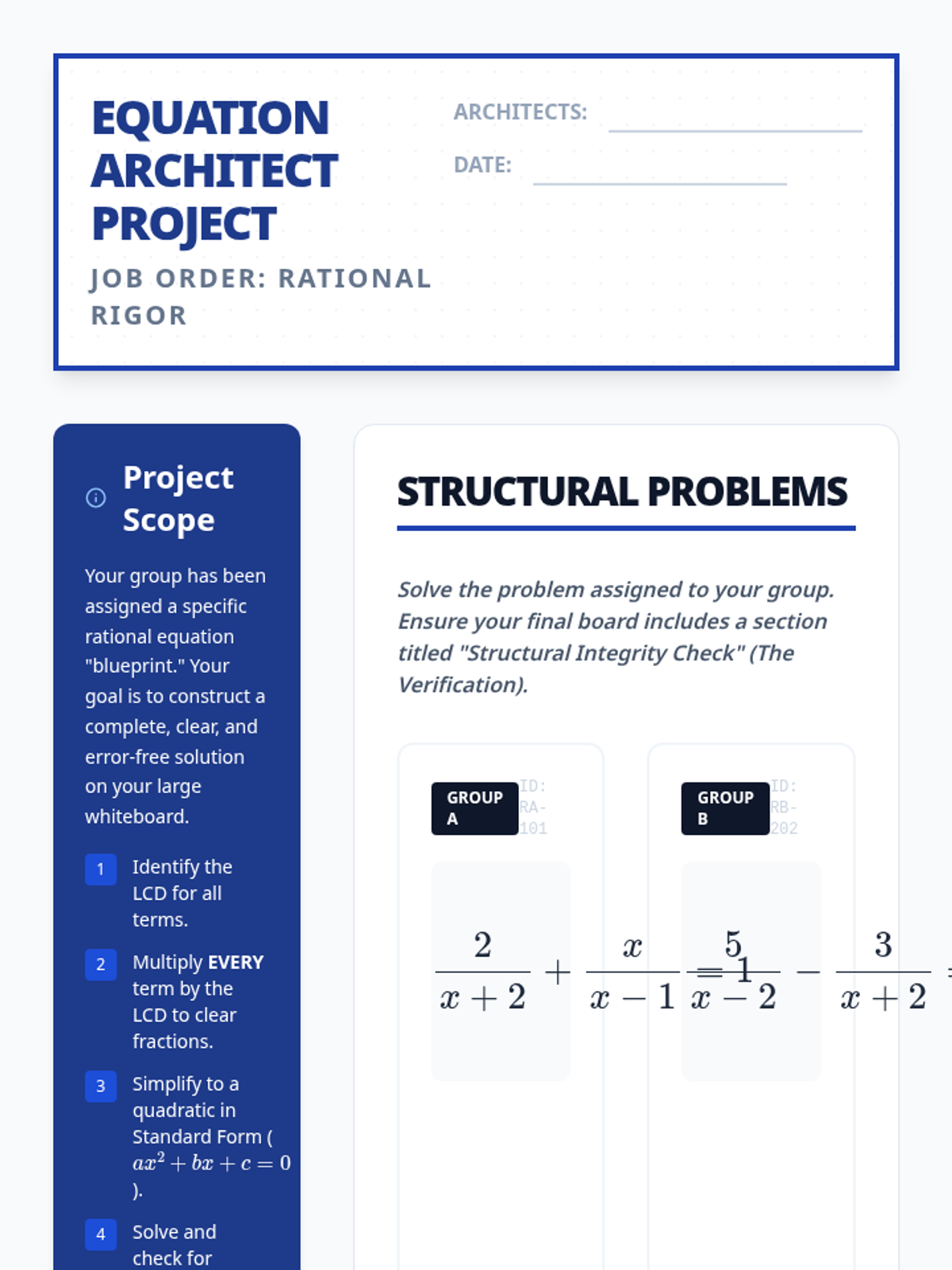
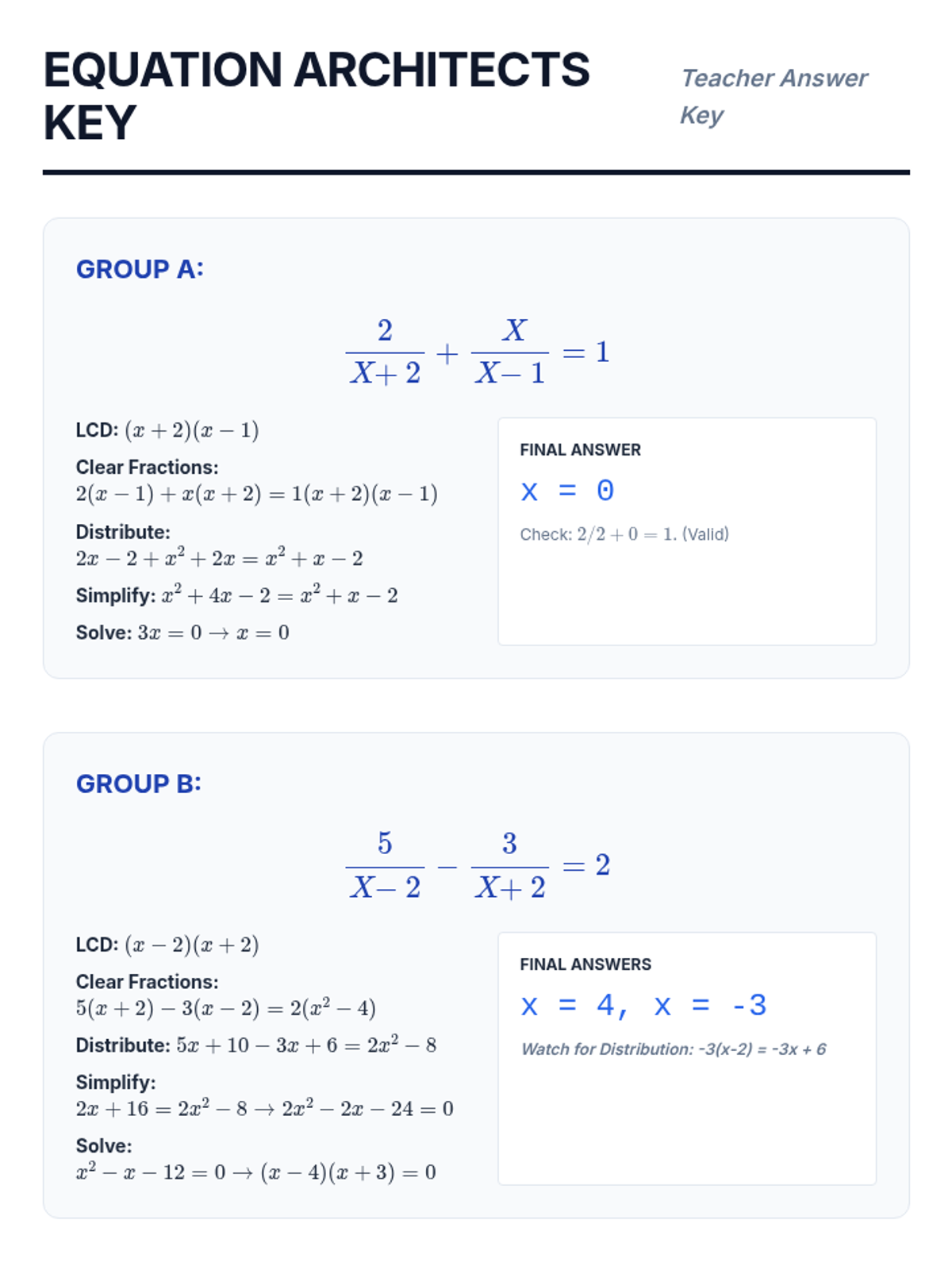
A comprehensive lesson on solving complex rational equations by clearing denominators using the Least Common Denominator (LCD). Includes a video-guided walkthrough, a sign-error discussion, and a collaborative whiteboard activity focusing on quadratic results and extraneous solutions.
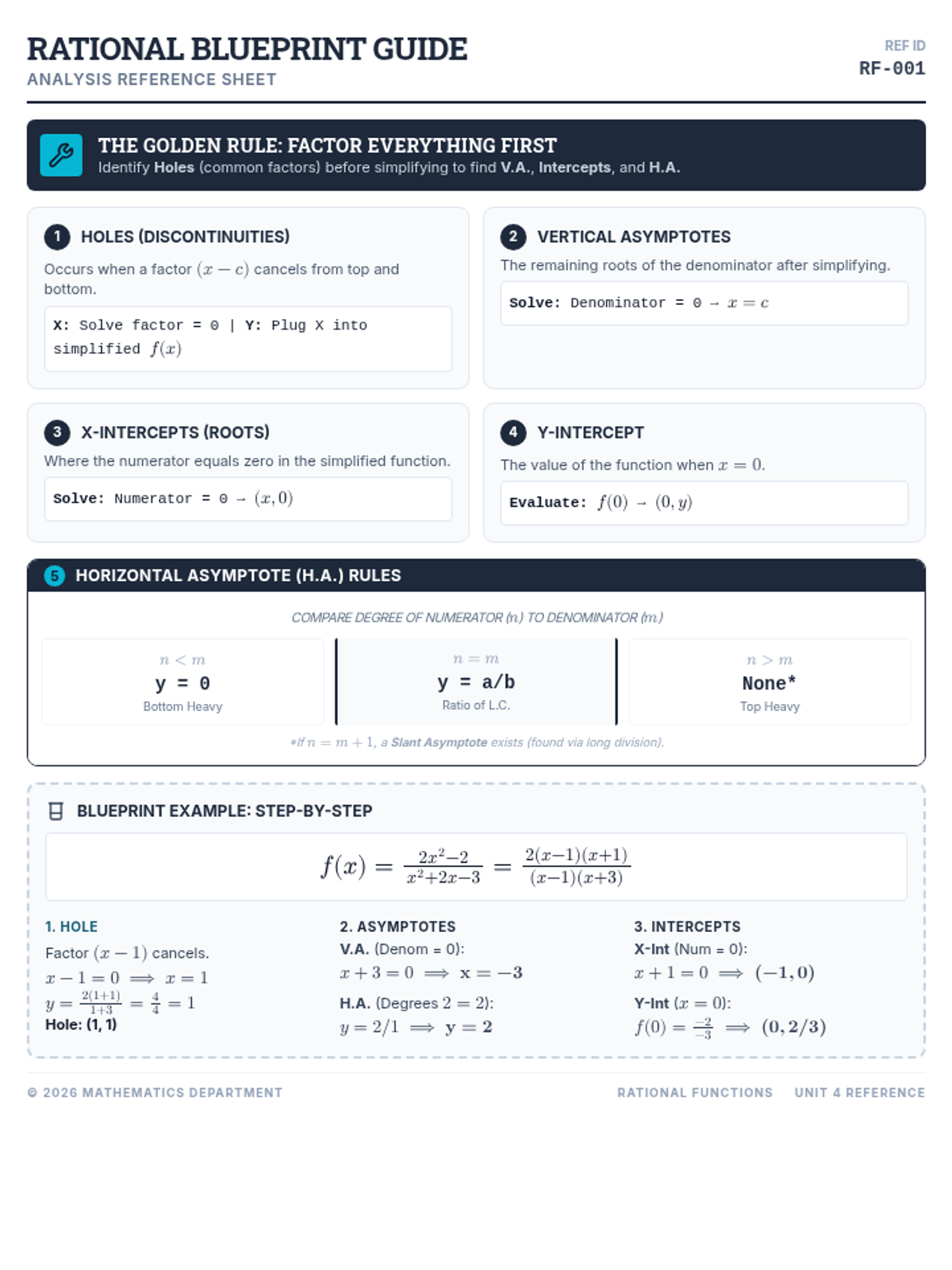
A comprehensive guide to analyzing and graphing rational functions, covering all key features from asymptotes to holes.
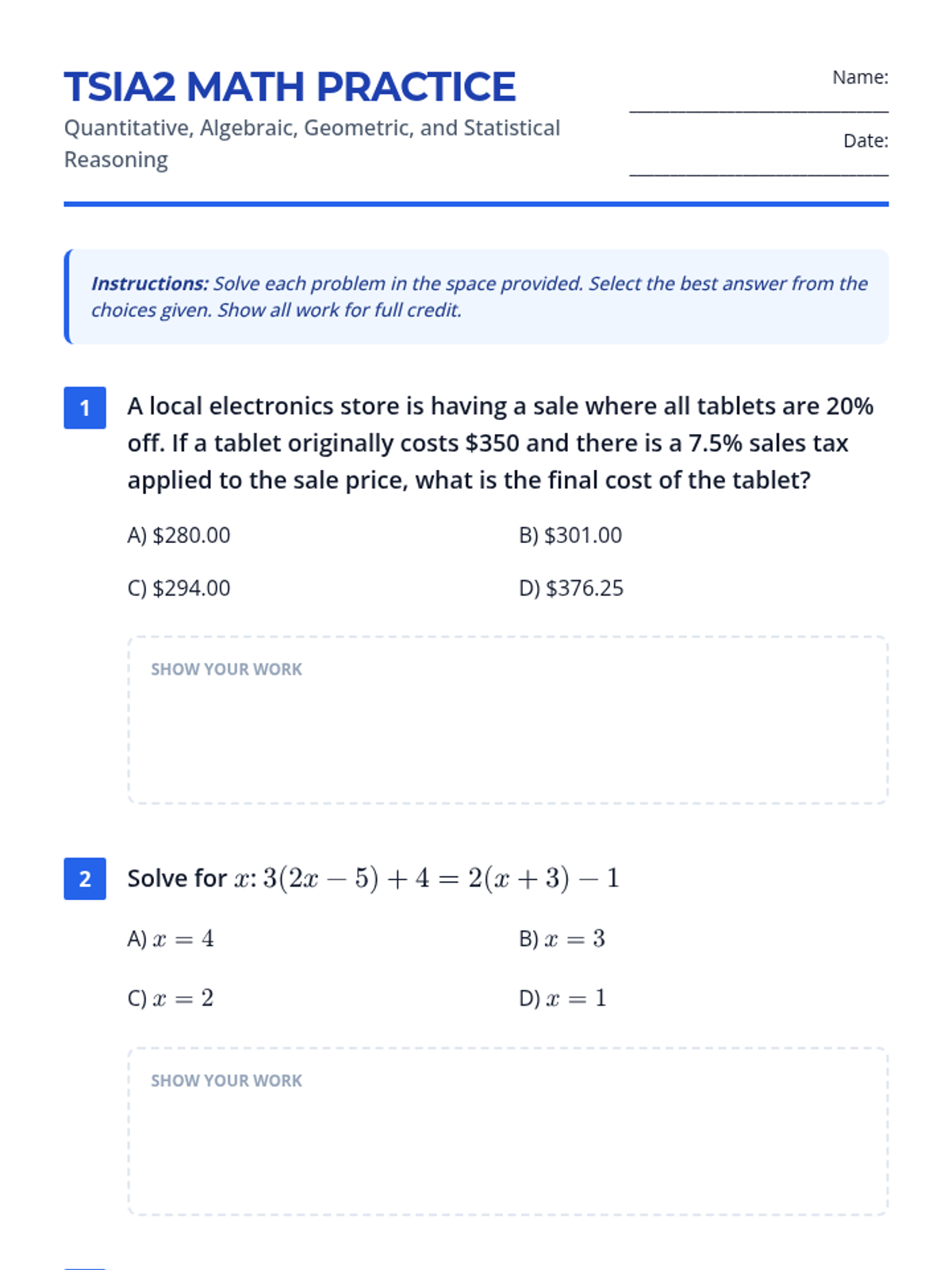
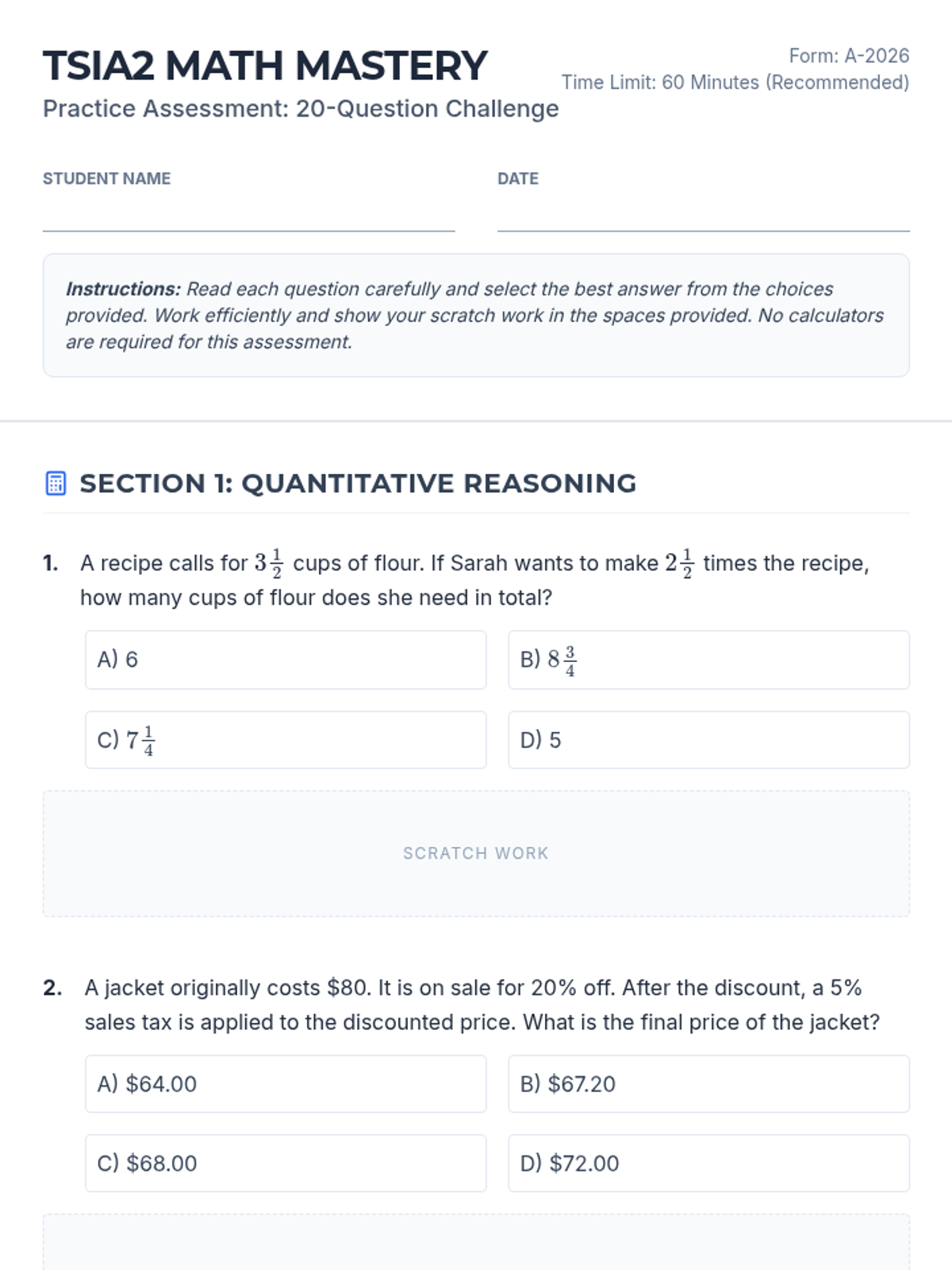
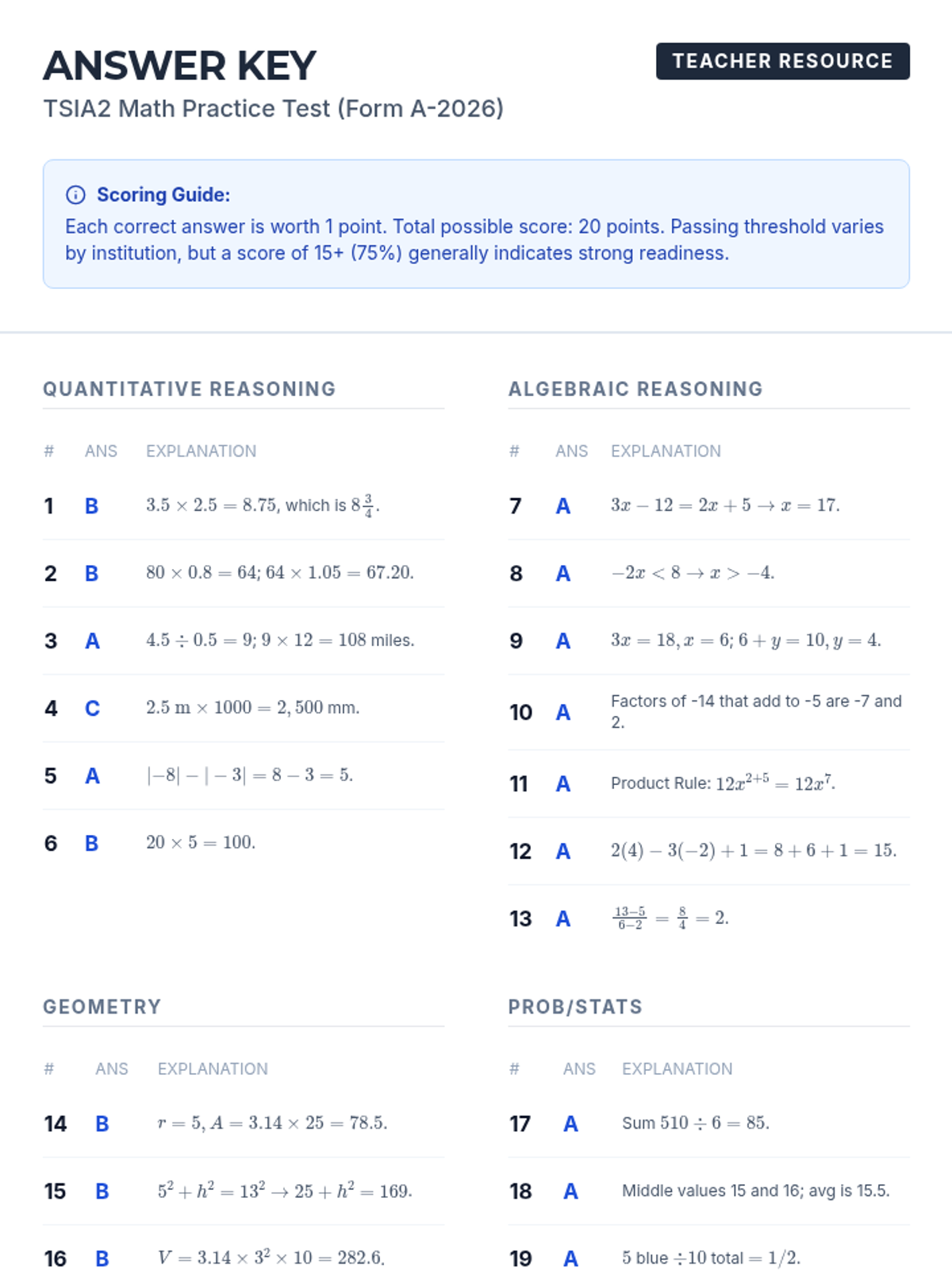
A comprehensive practice set and review presentation for the TSIA2 Math exam, covering Quantitative, Algebraic, Geometric, and Statistical reasoning.
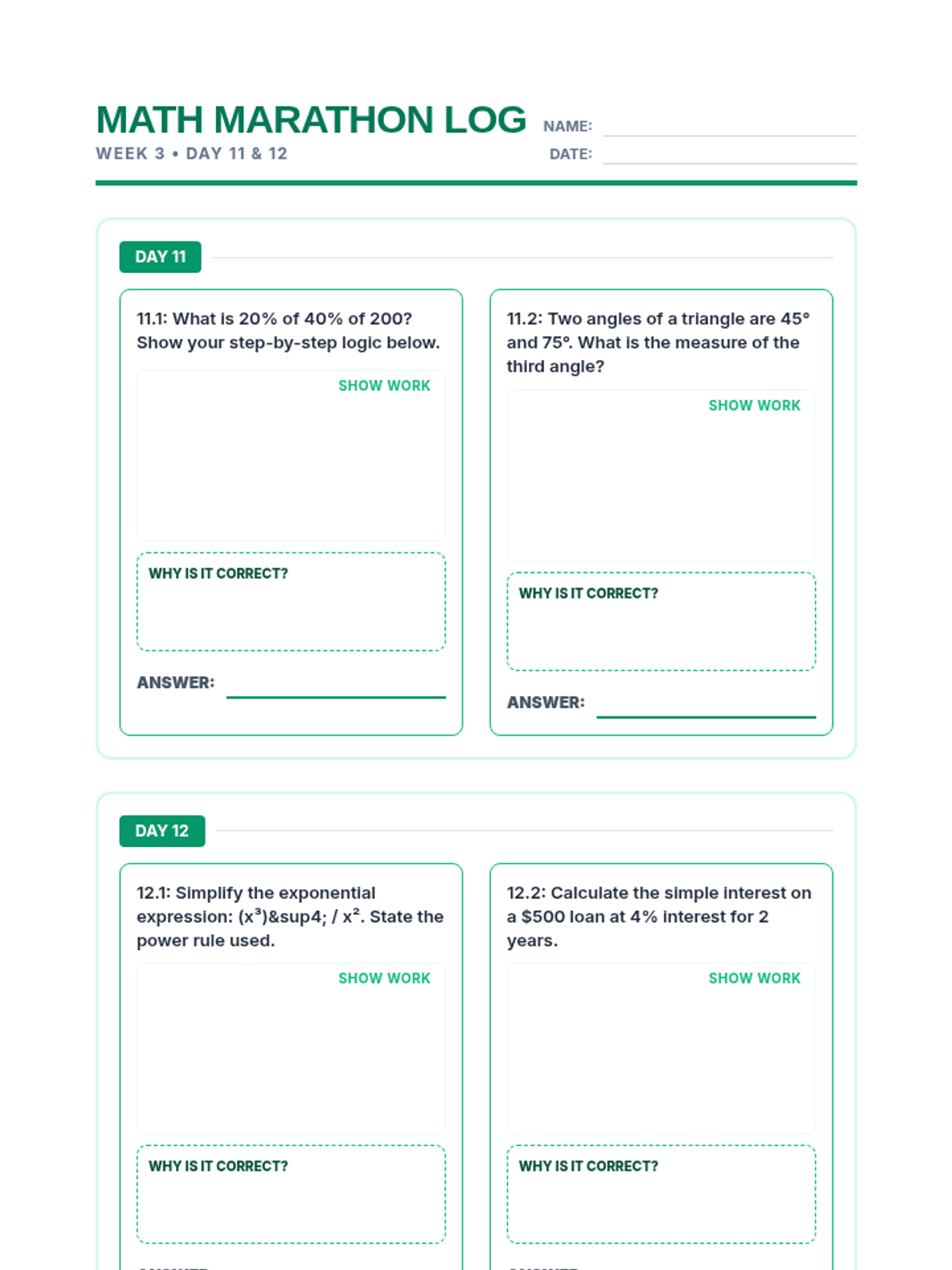
The final week of the TSIA2 Math Marathon, reviewing complex problems and multi-step reasoning.
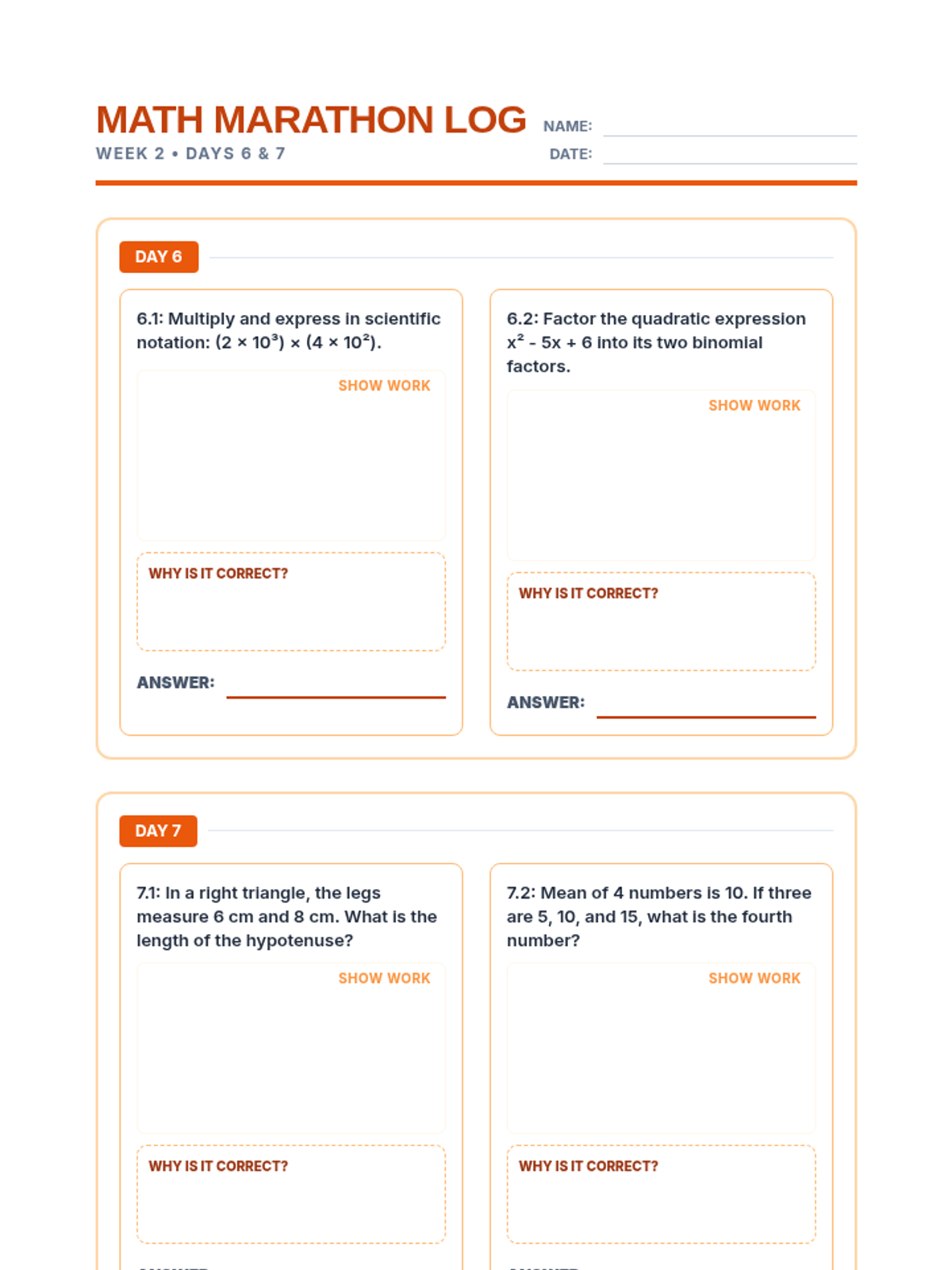
The second week of the TSIA2 Math Marathon, expanding into geometric and statistical reasoning.
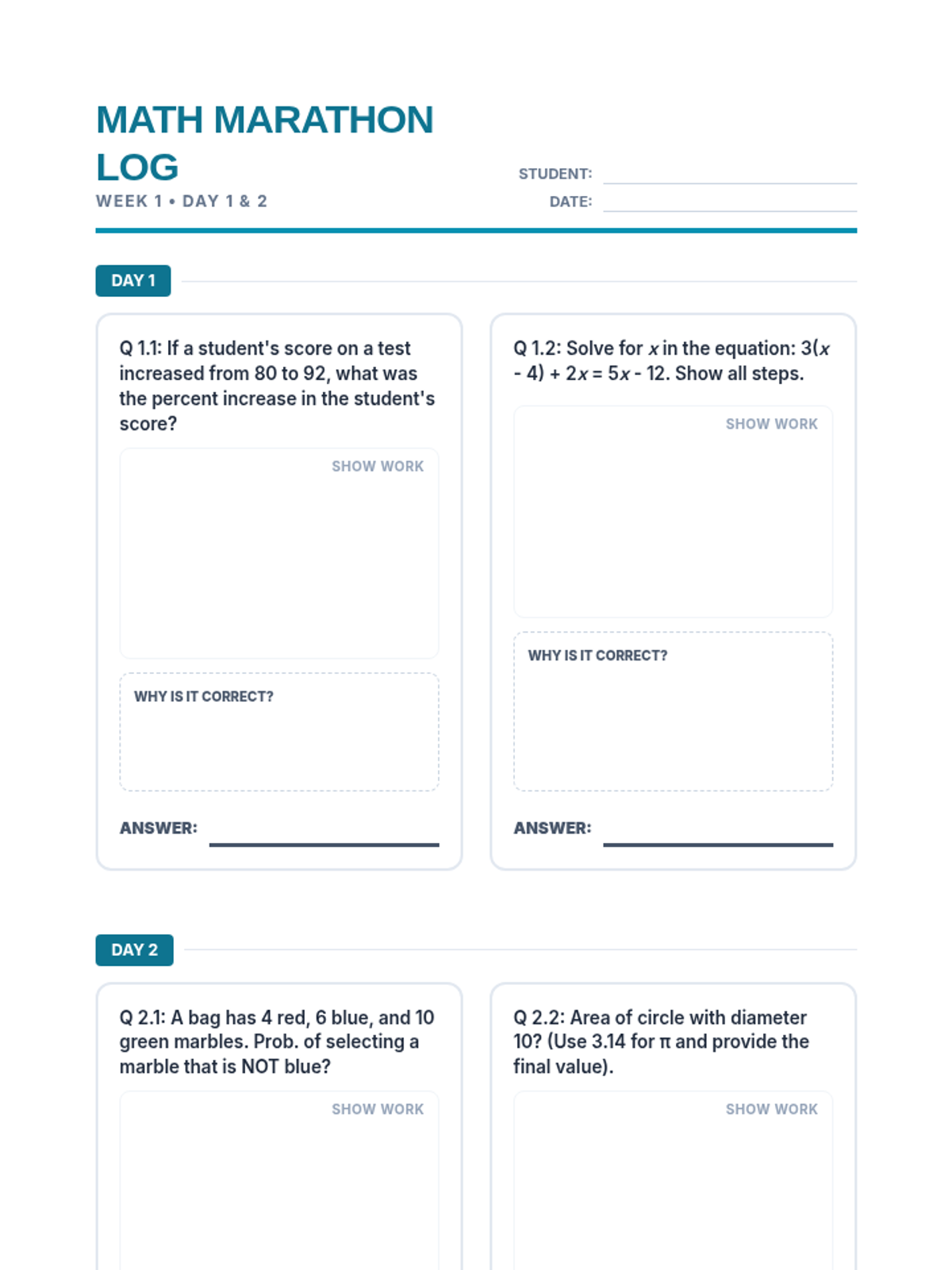
The first week of the TSIA2 Math Marathon, focusing on foundational algebraic and quantitative reasoning.
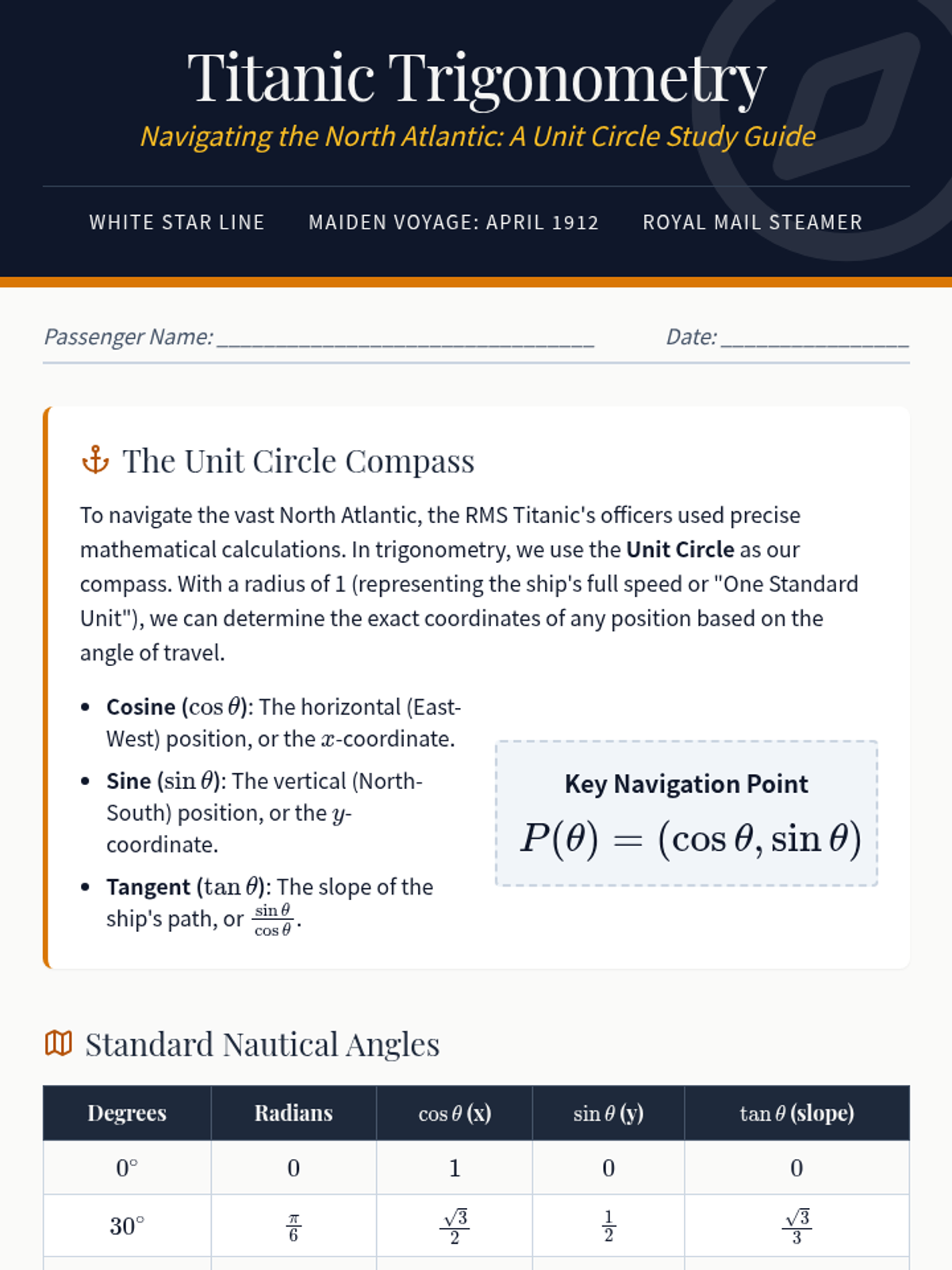
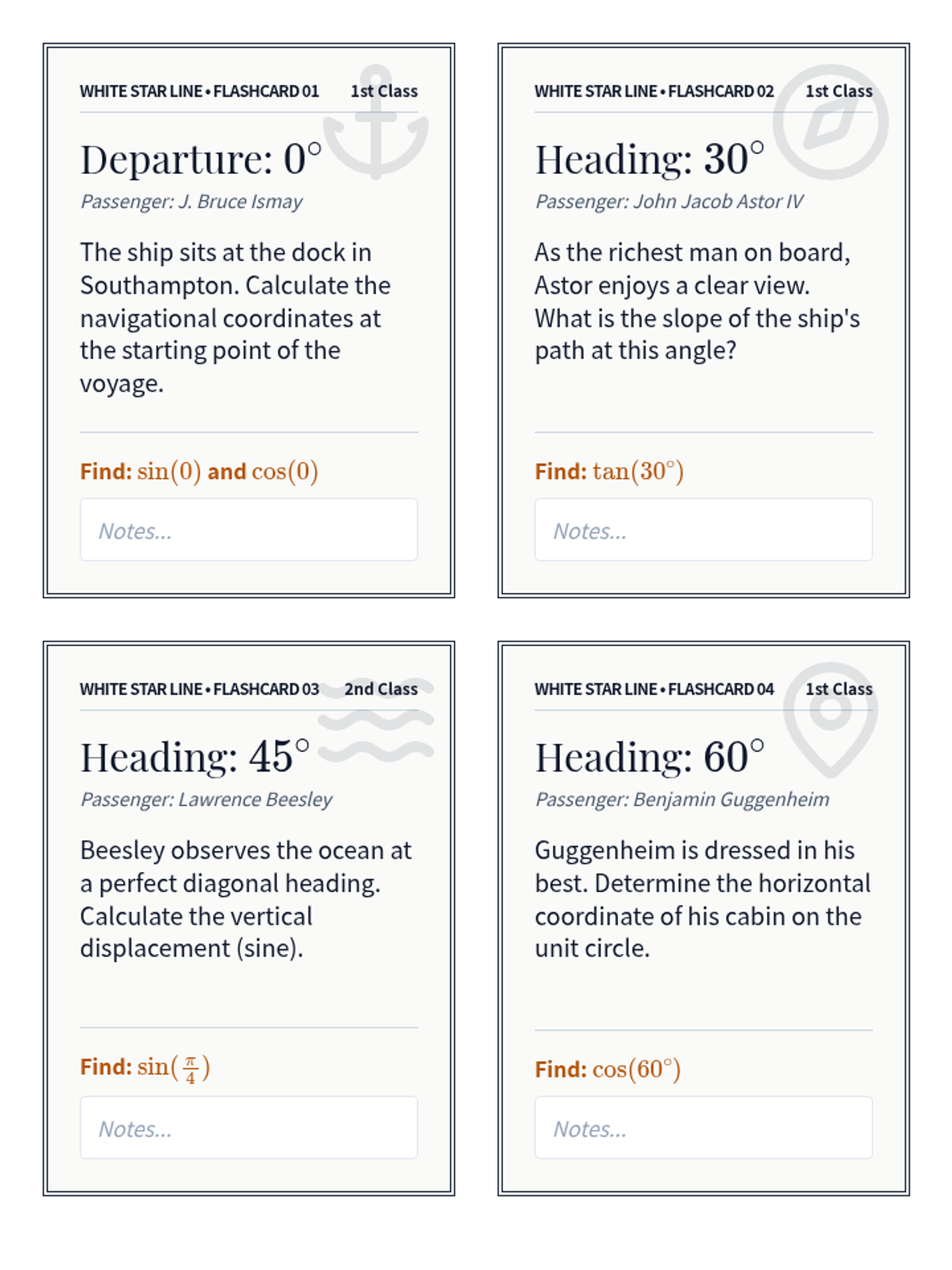
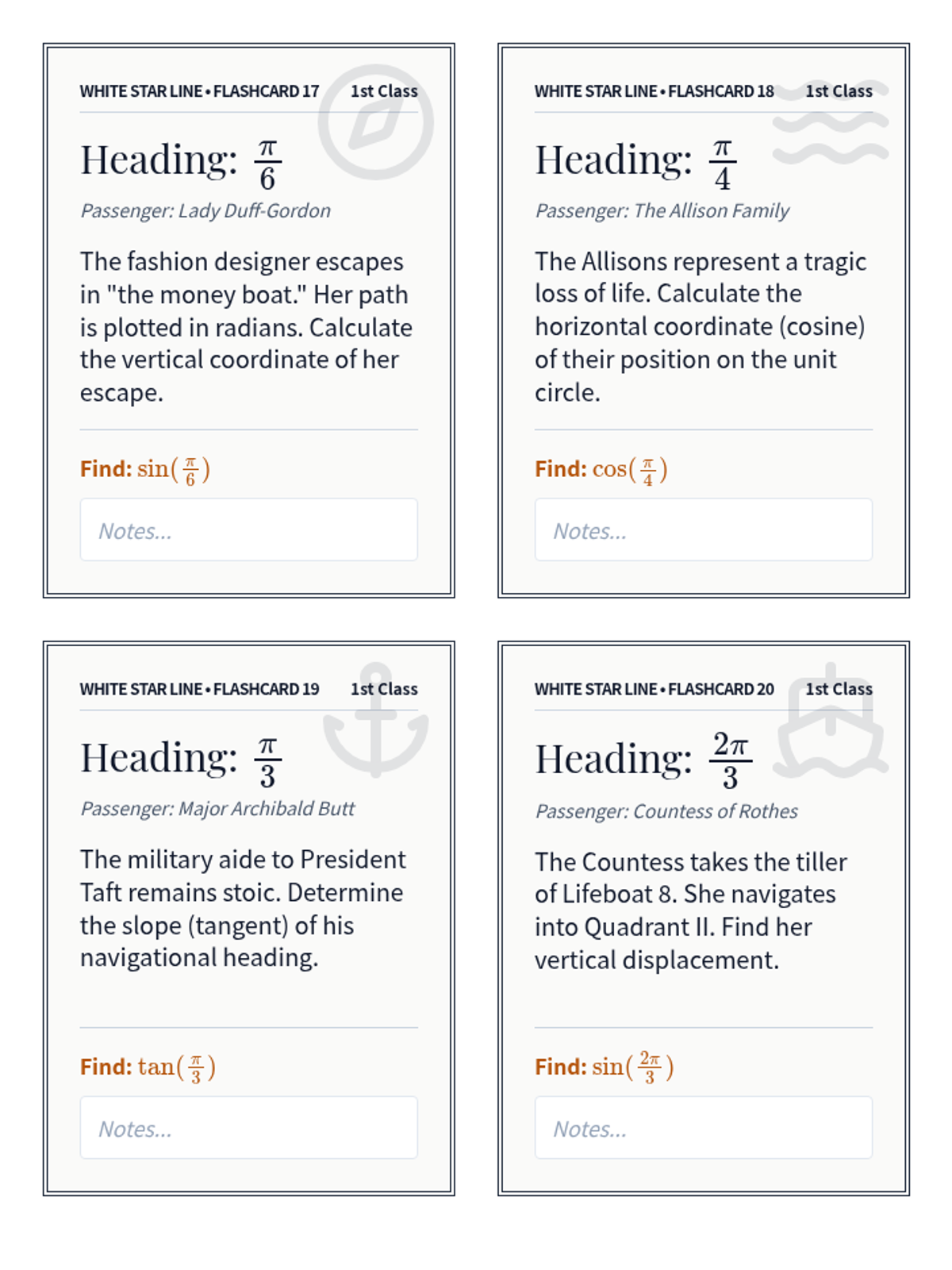
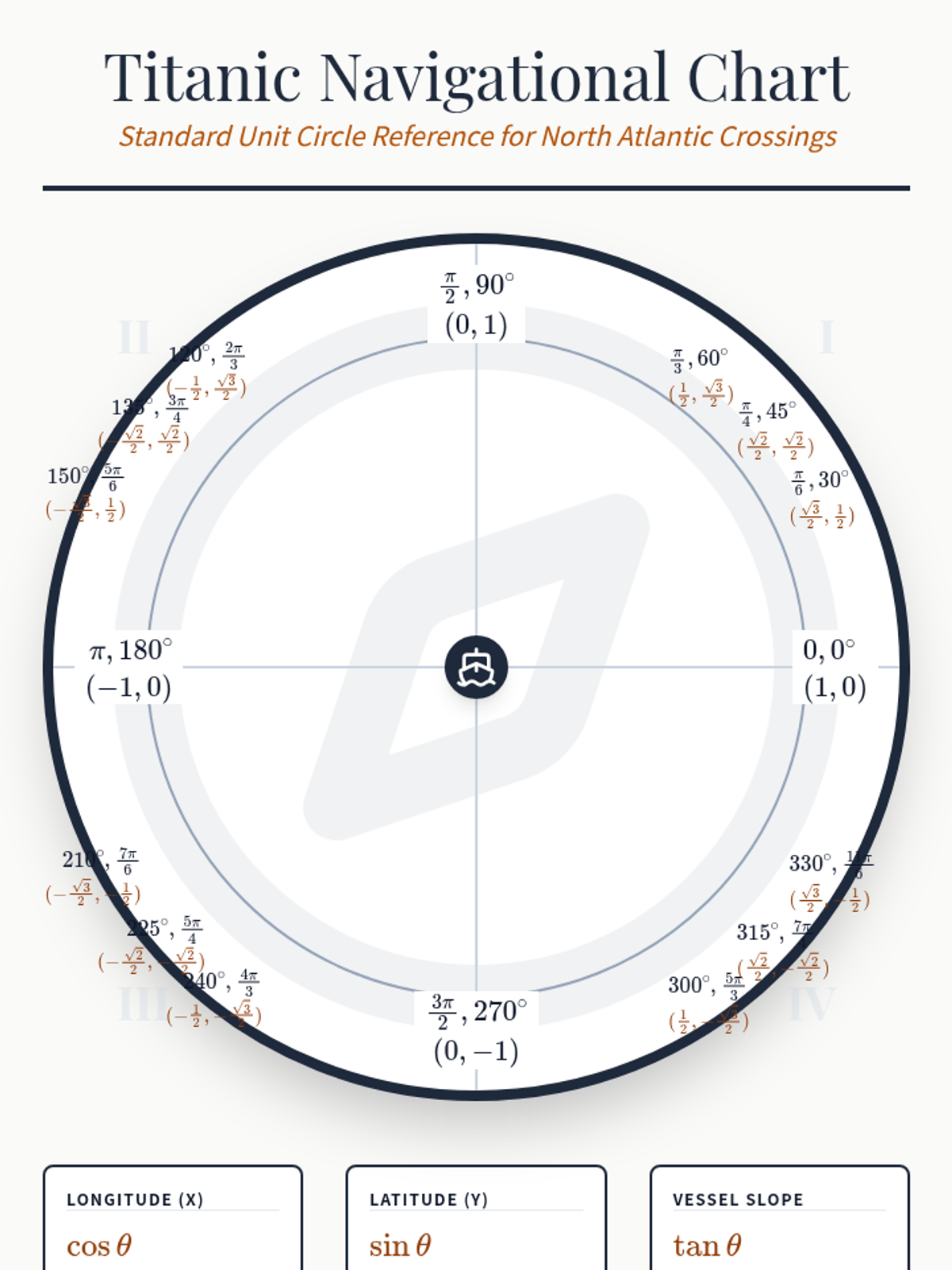
A maritime-themed lesson exploring trigonometry through the lens of the Titanic's maiden voyage. Students master unit circle coordinates and trigonometric values using historical figures and navigation scenarios.
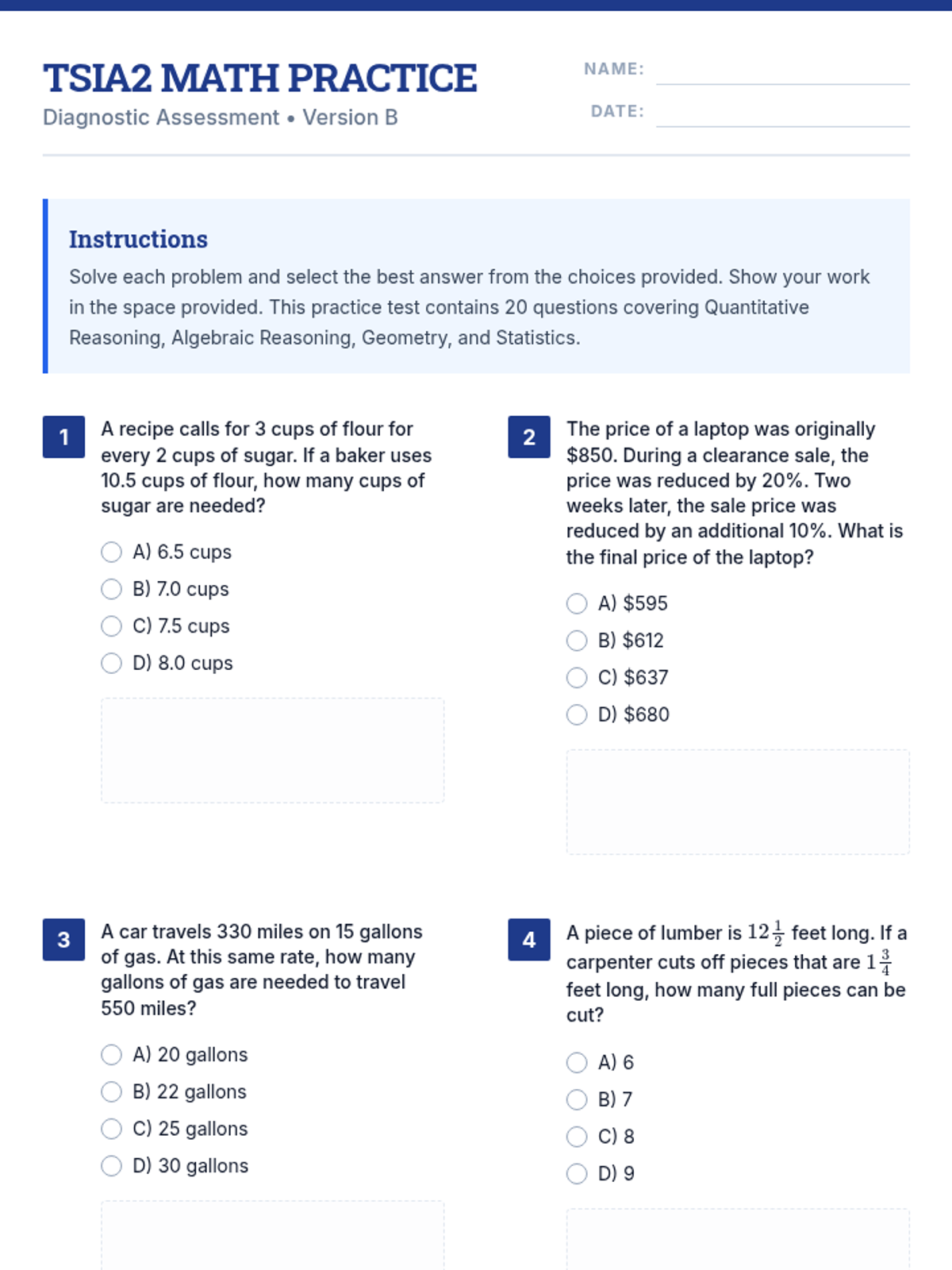
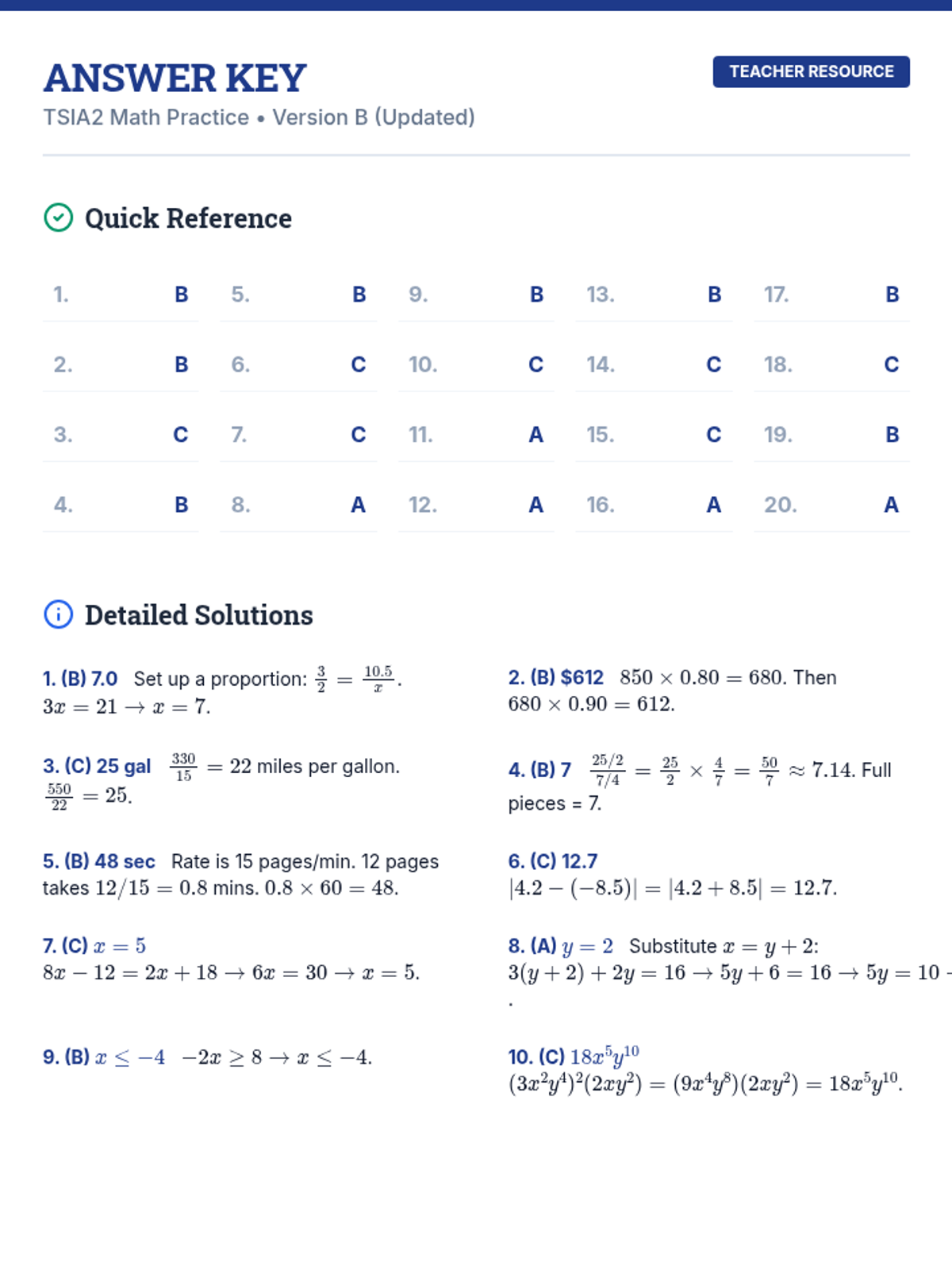
A comprehensive 20-question practice test covering all four TSIA2 Math domains: Quantitative Reasoning, Algebraic Reasoning, Geometry, and Probability and Statistics.
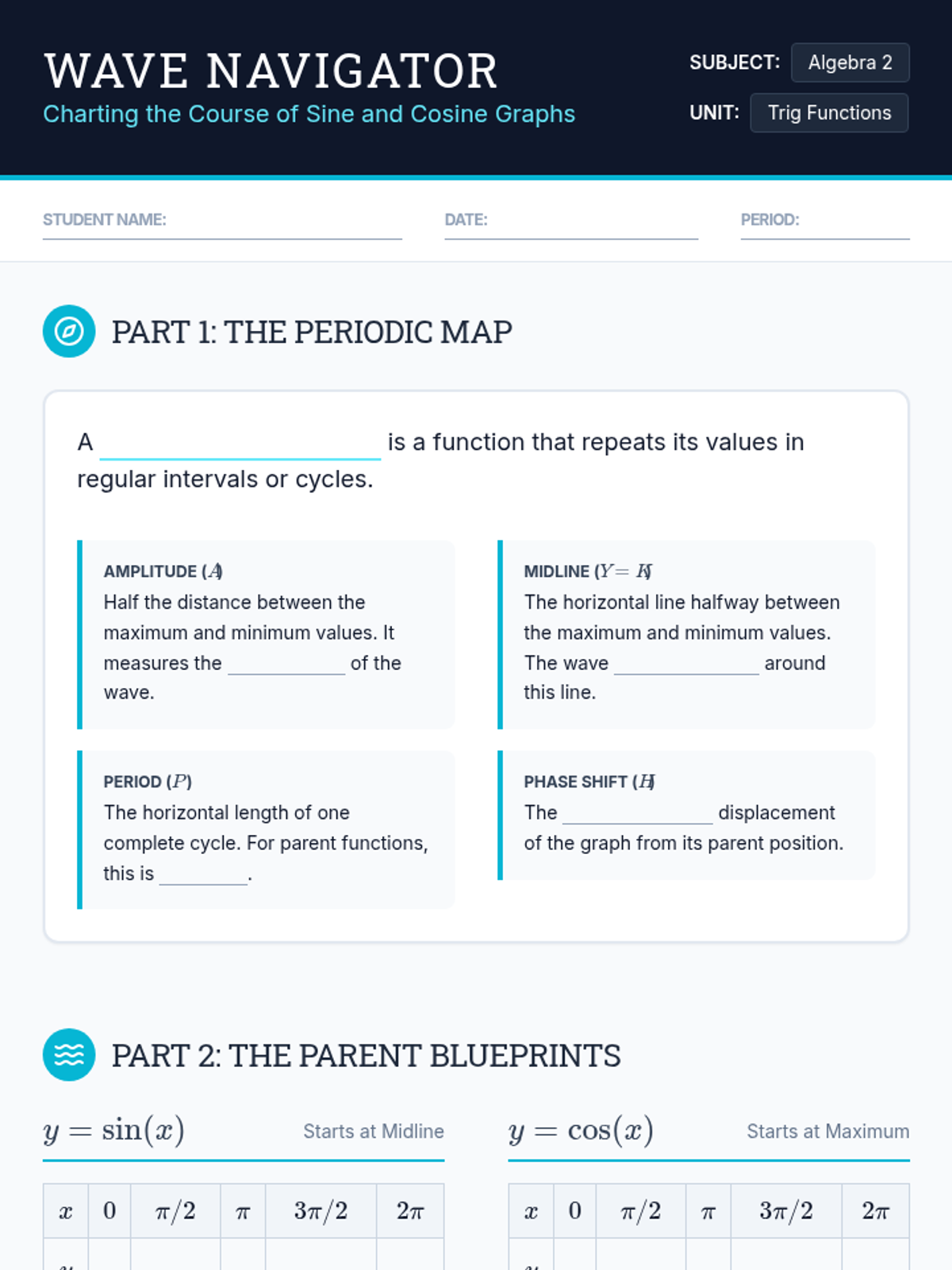
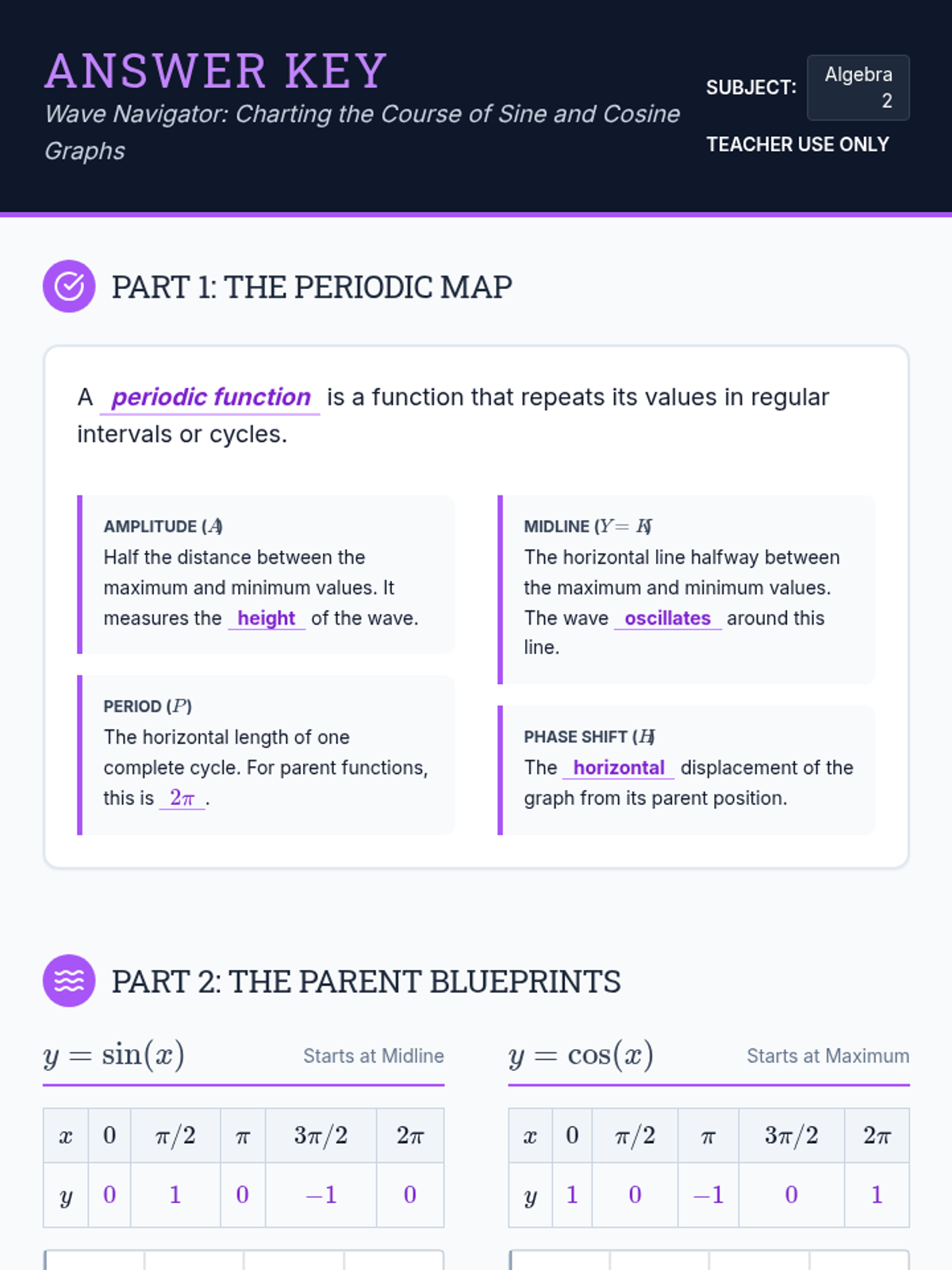
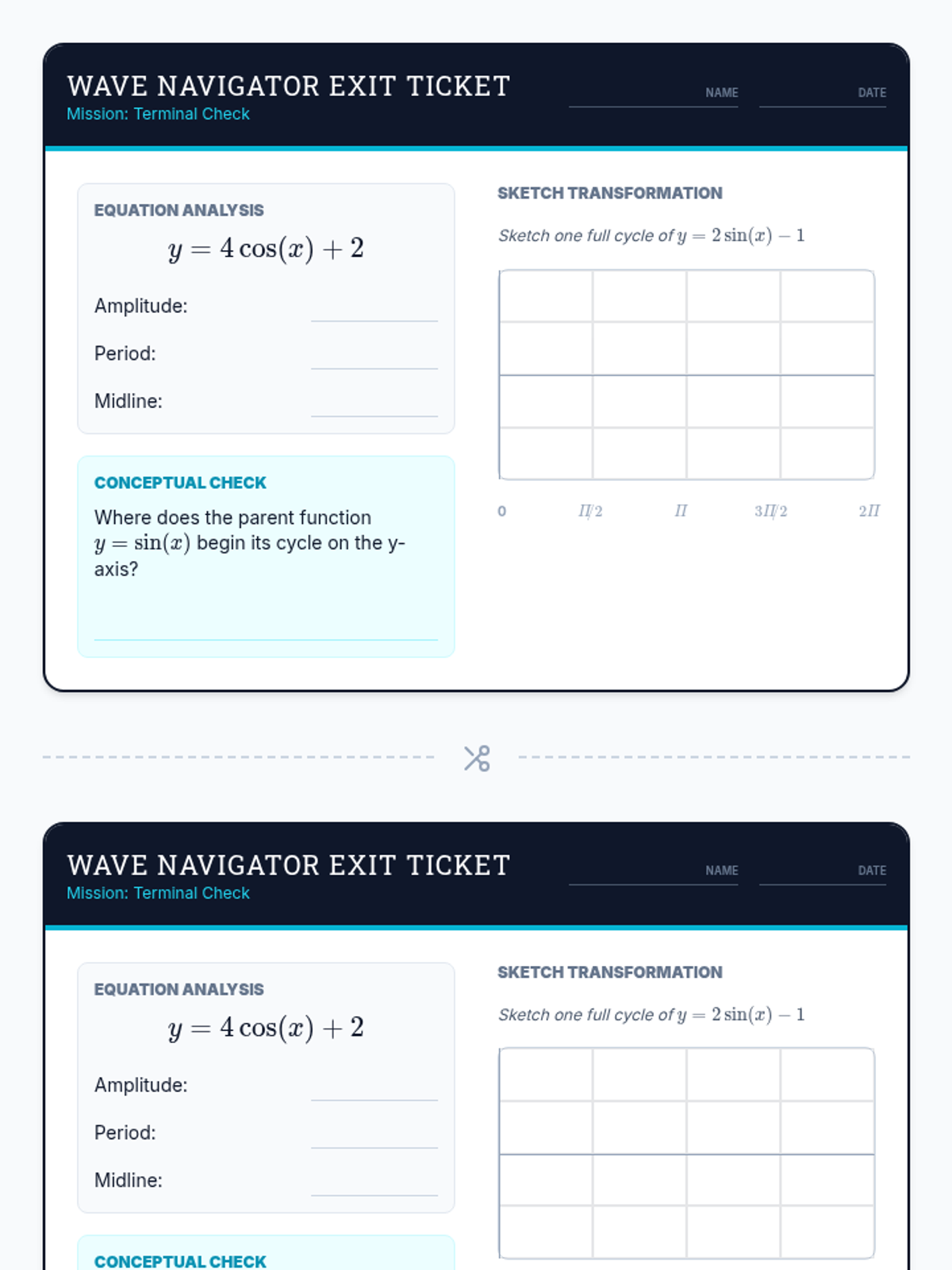
A comprehensive lesson on graphing Sine and Cosine functions, featuring guided notes, instructional slides, and a detailed answer key. Students will learn to identify amplitude, period, midline, and phase shifts to accurately sketch periodic graphs.
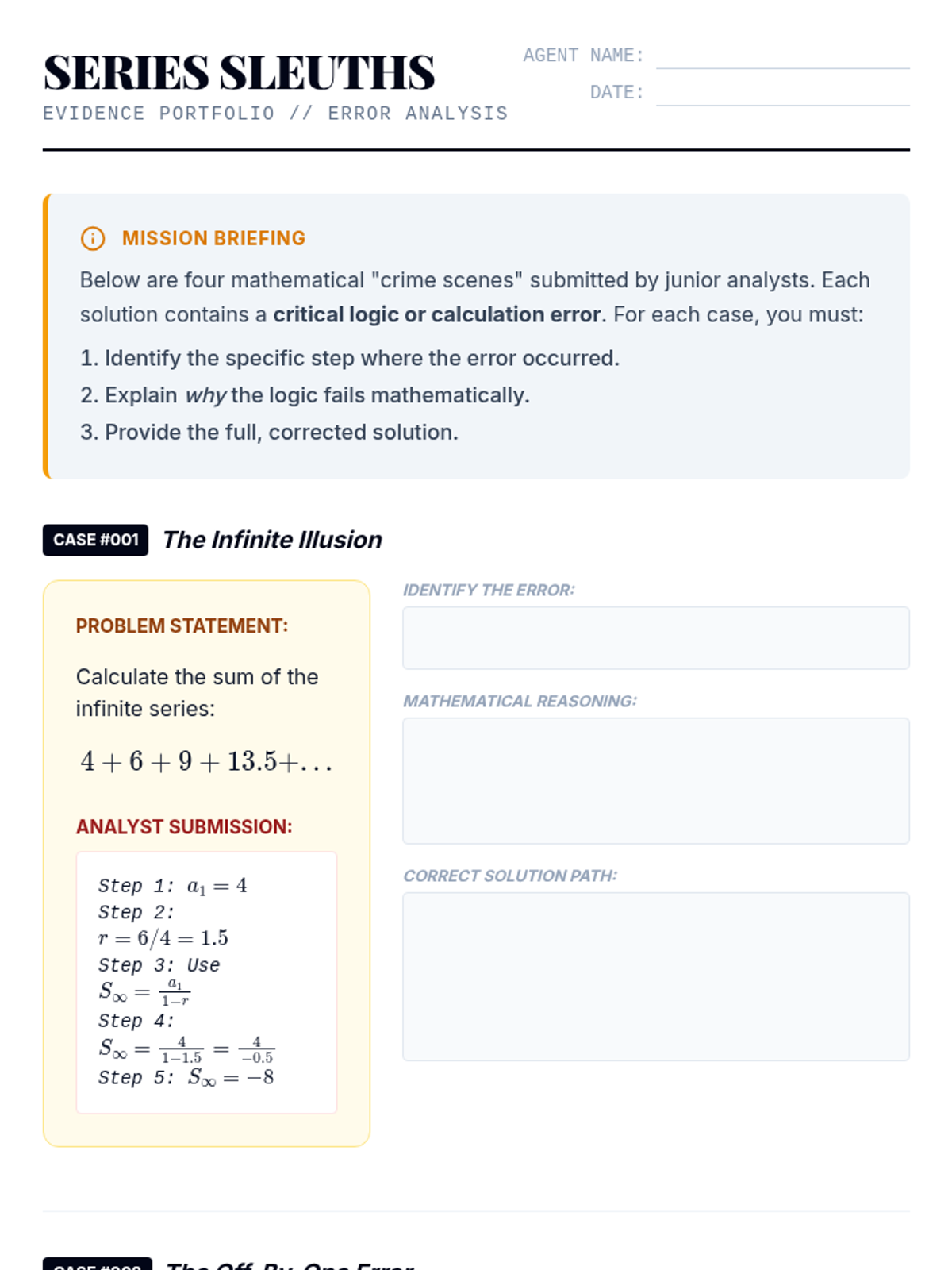
A high-level mathematics lesson focused on distinguishing between sequences and series, determining convergence, and performing error analysis on complex geometric problems. Students will watch targeted practice segments and correct common mathematical misconceptions.
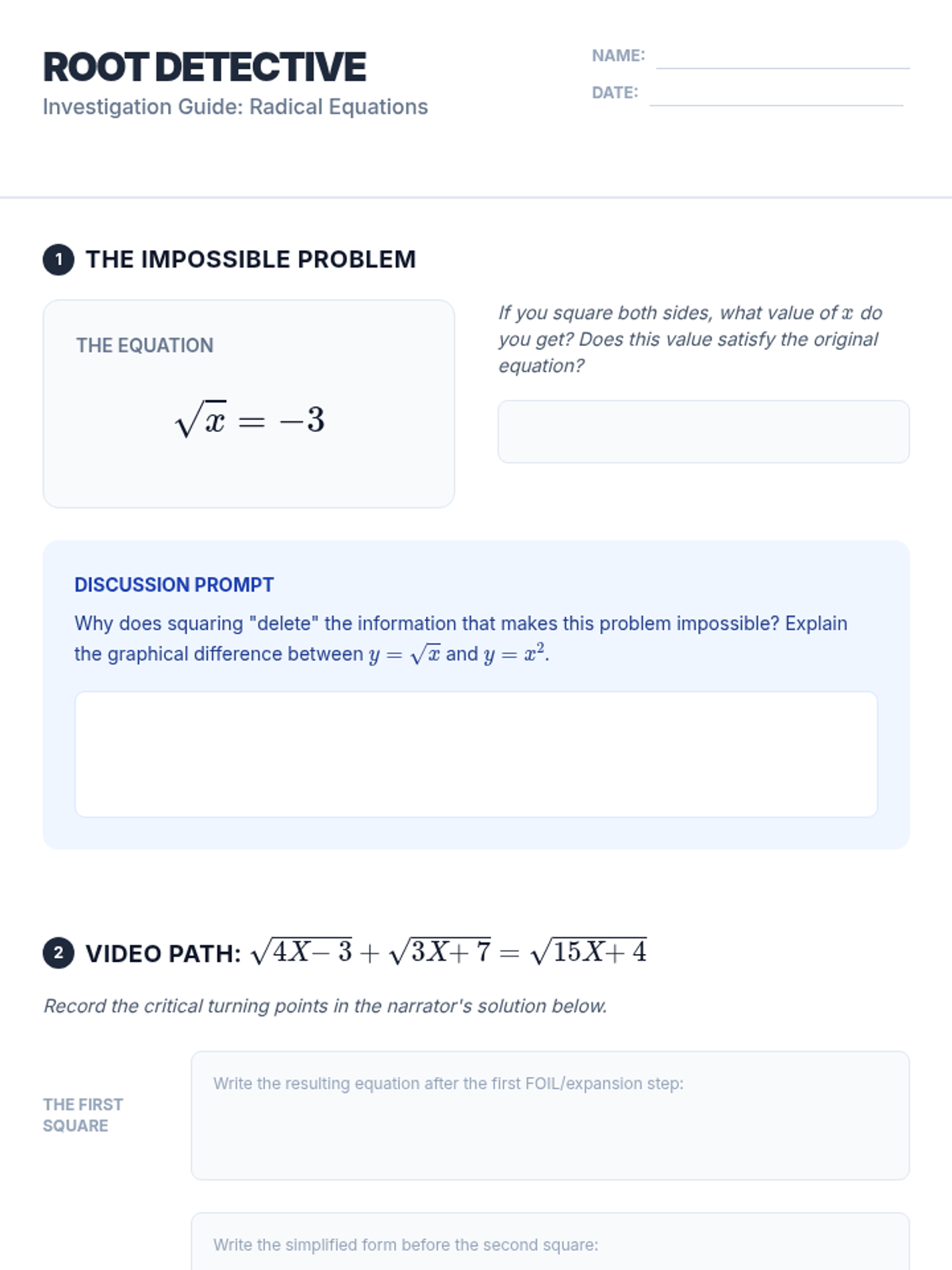
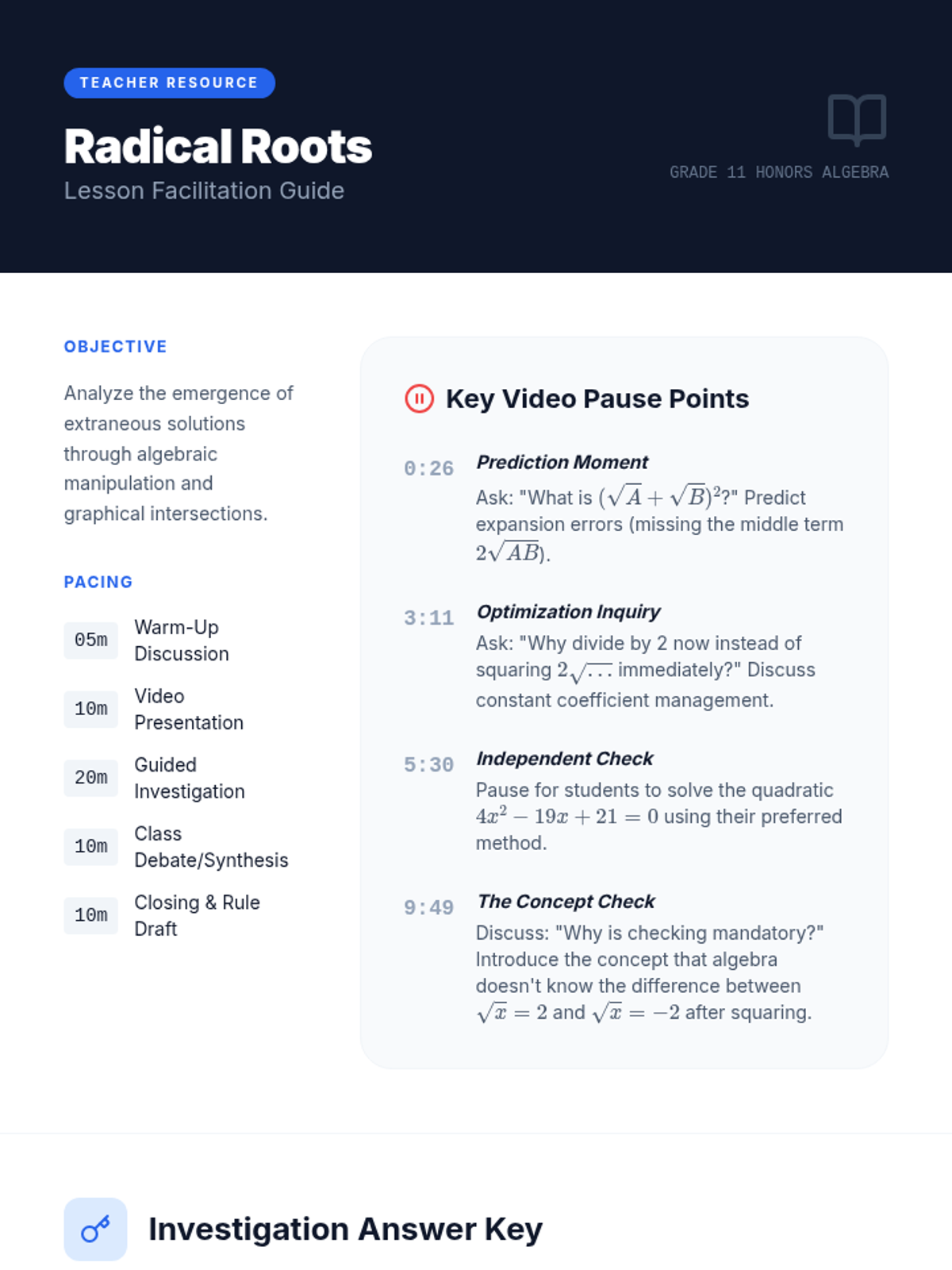
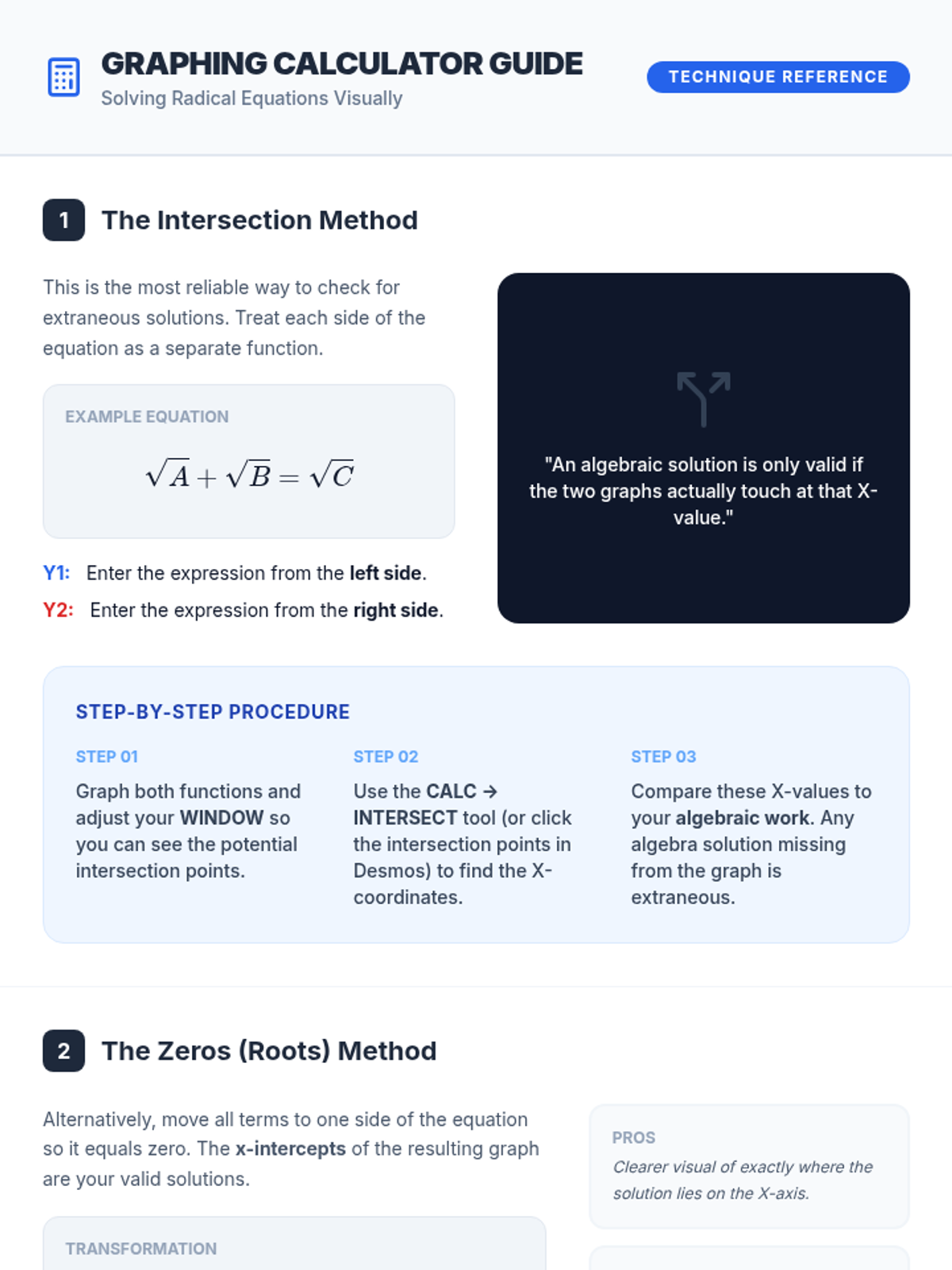
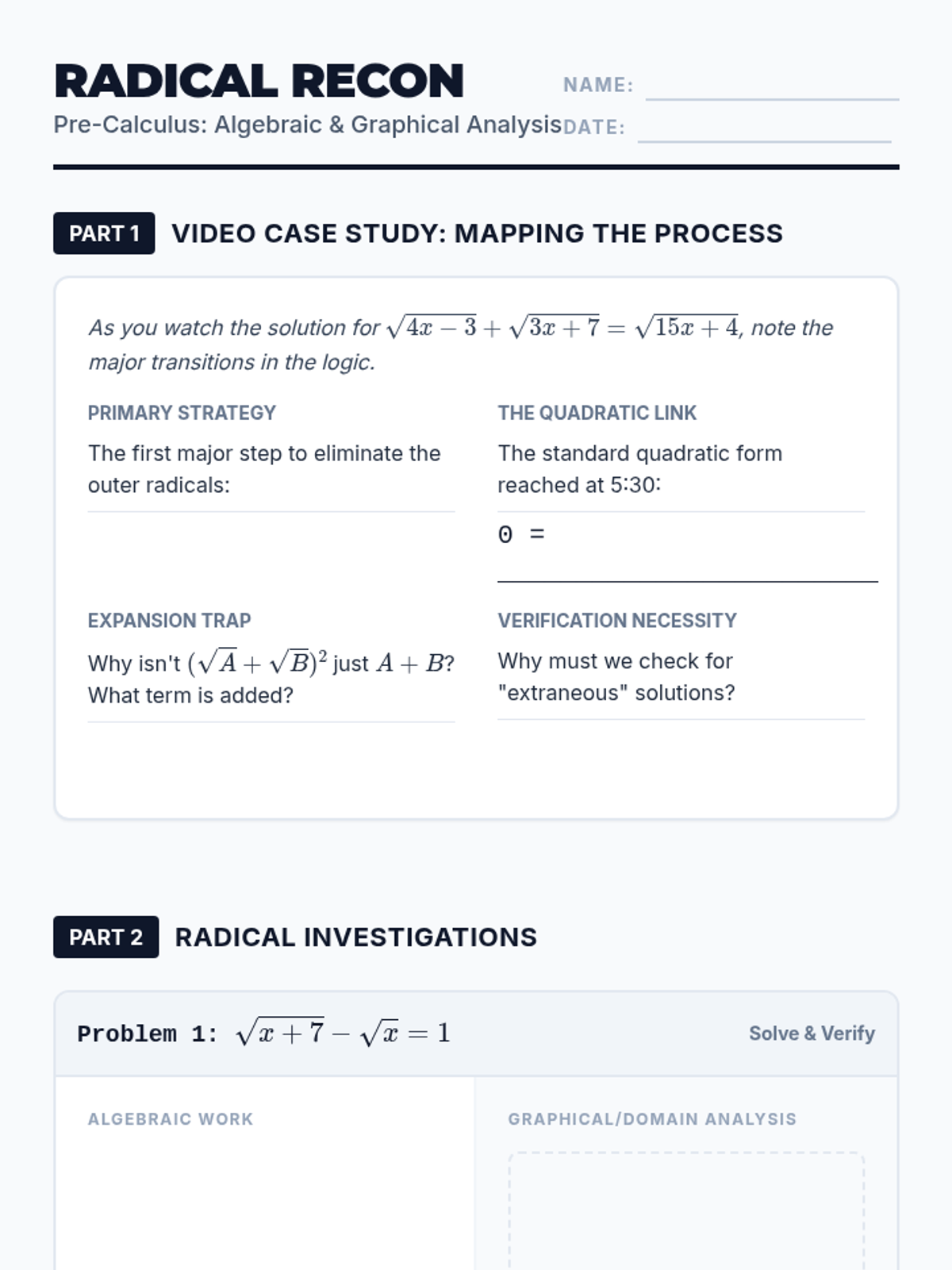
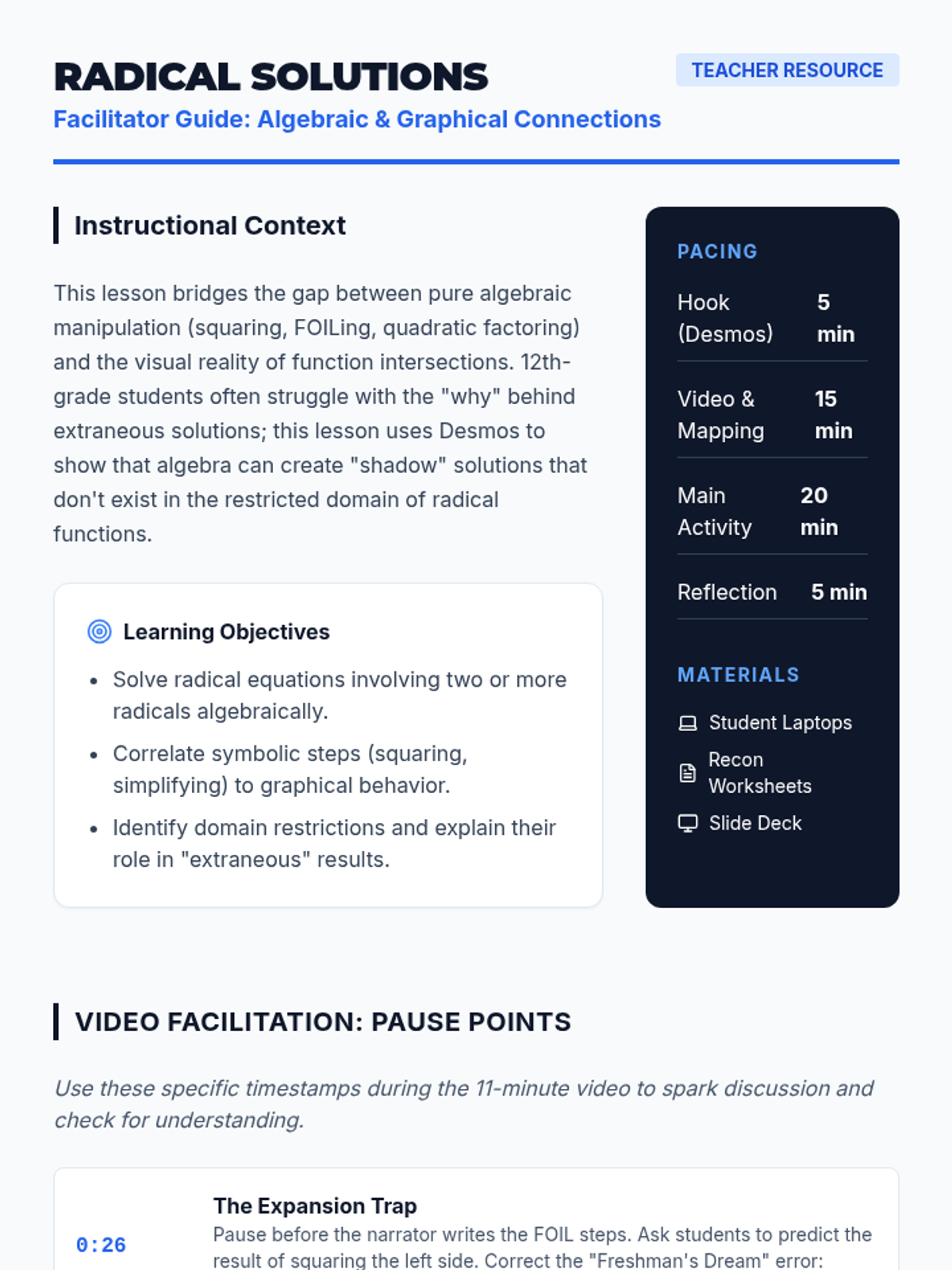
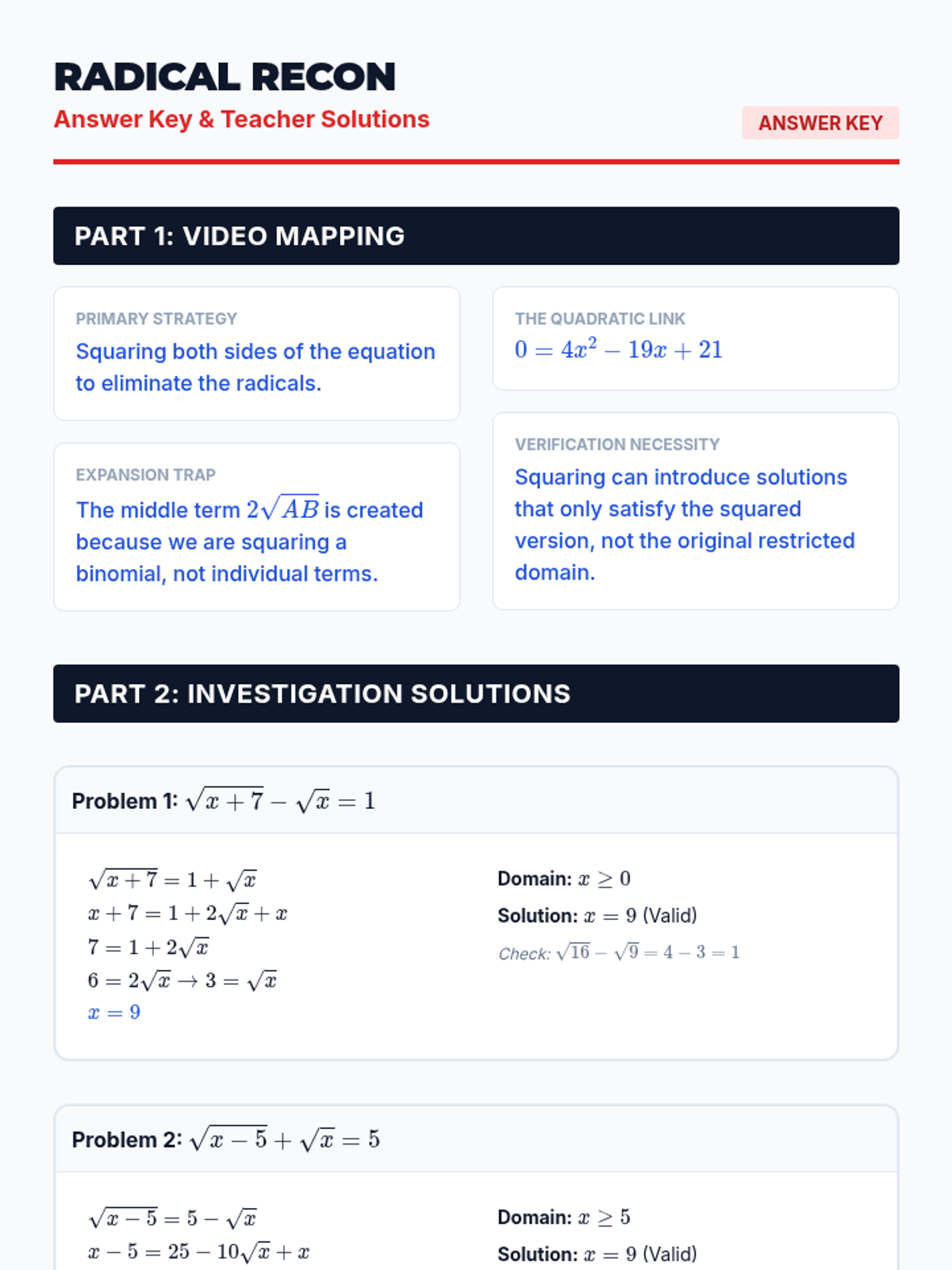
A high-level honors algebra lesson focusing on the algebraic and graphical nature of extraneous solutions in radical equations, featuring a double-square problem and graphing calculator investigation.
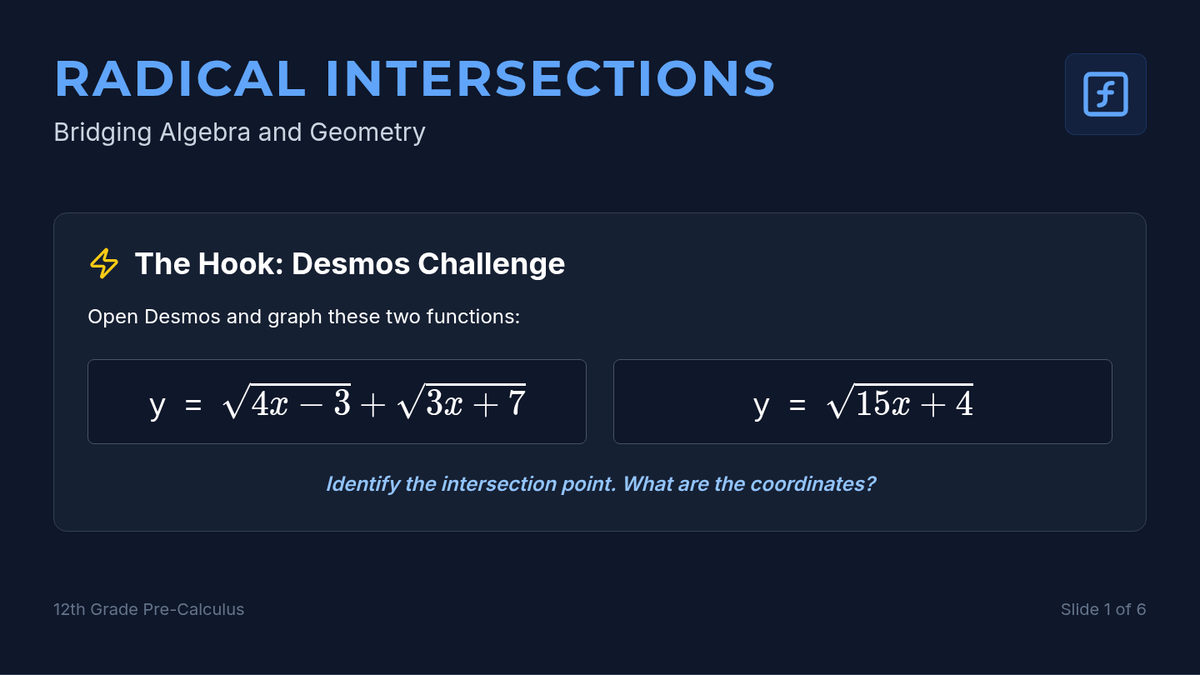
Students will solve complex radical equations algebraically and verify their solutions using graphical intersections on Desmos, while considering domain restrictions.
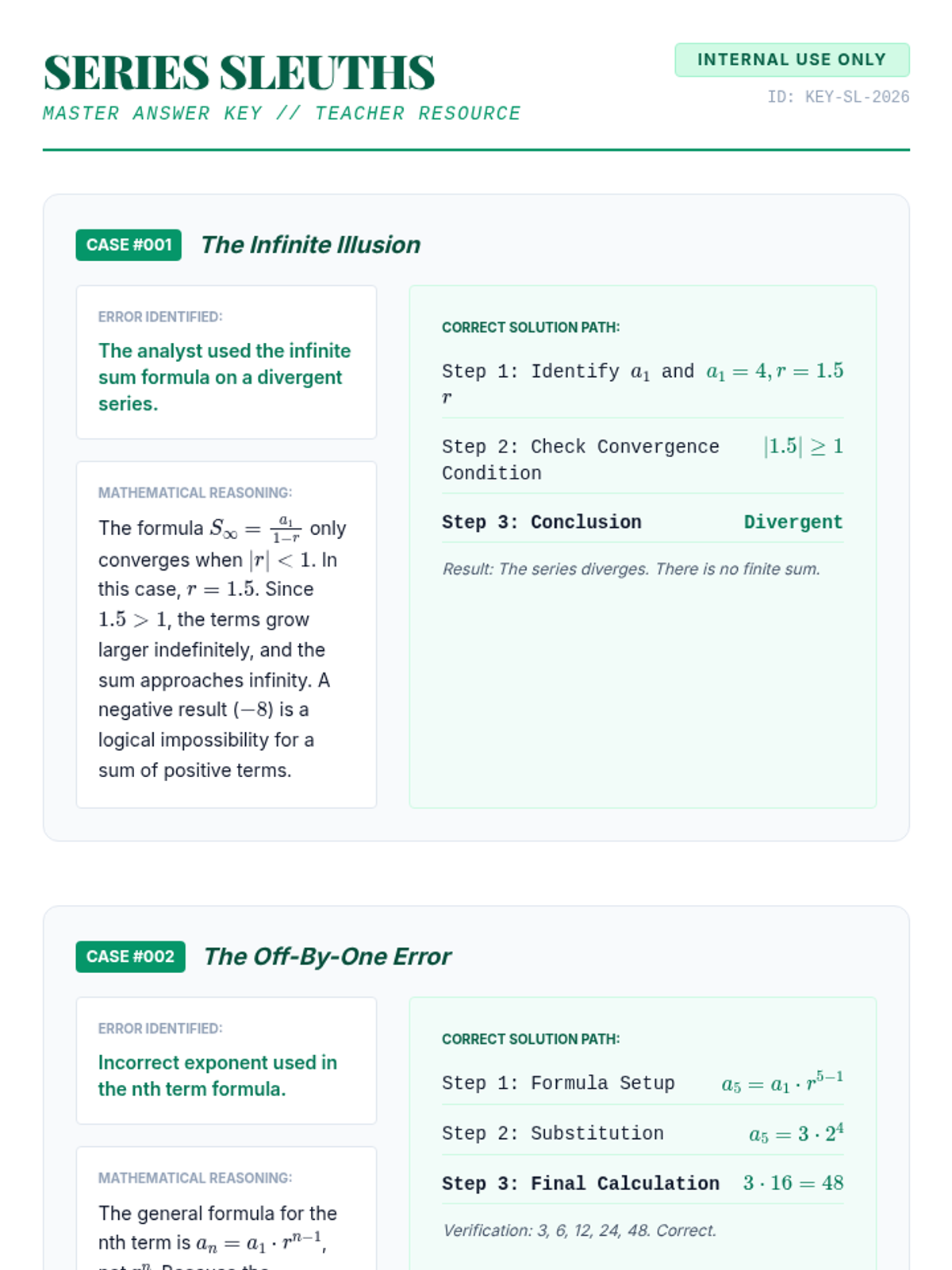
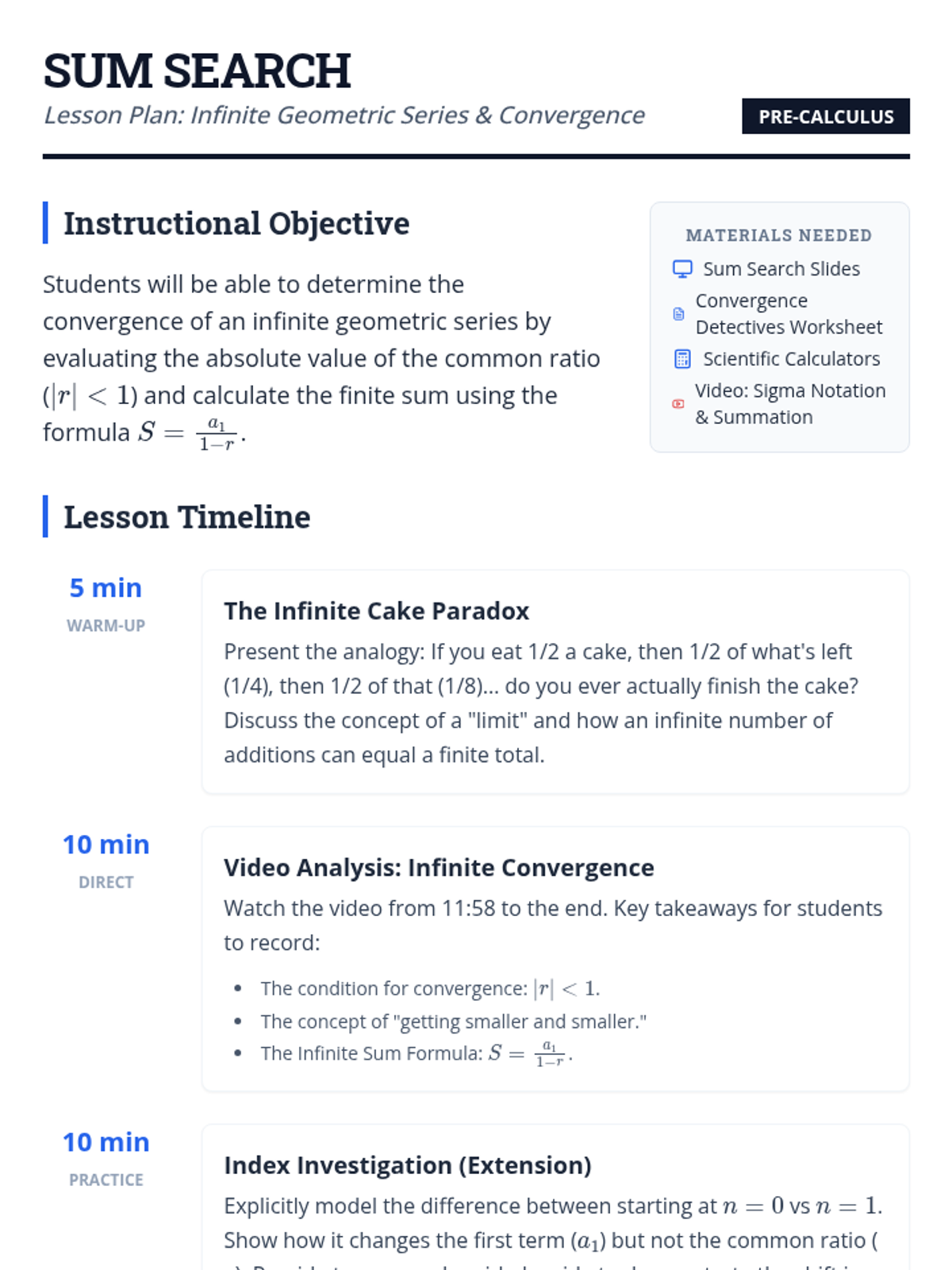
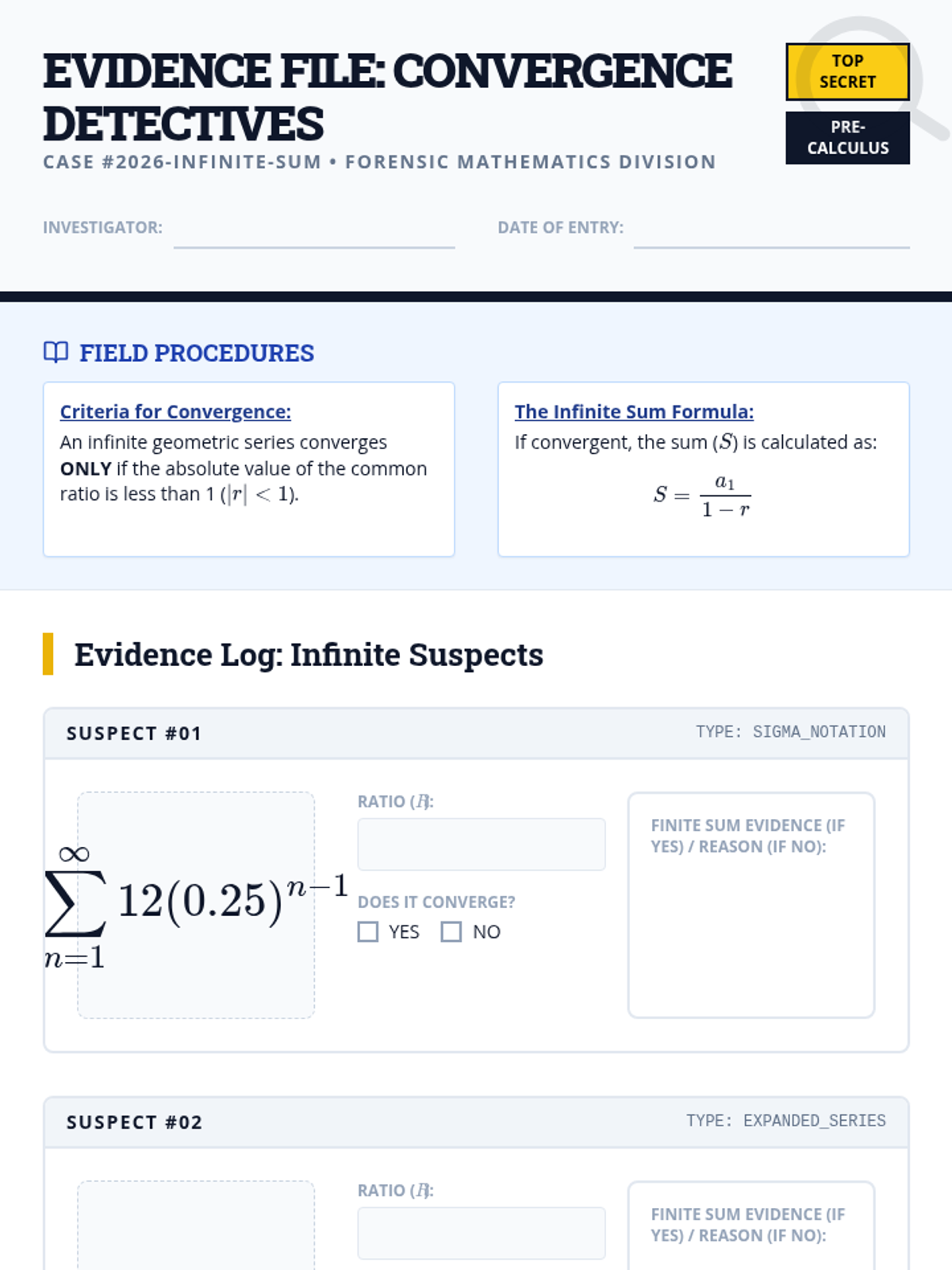
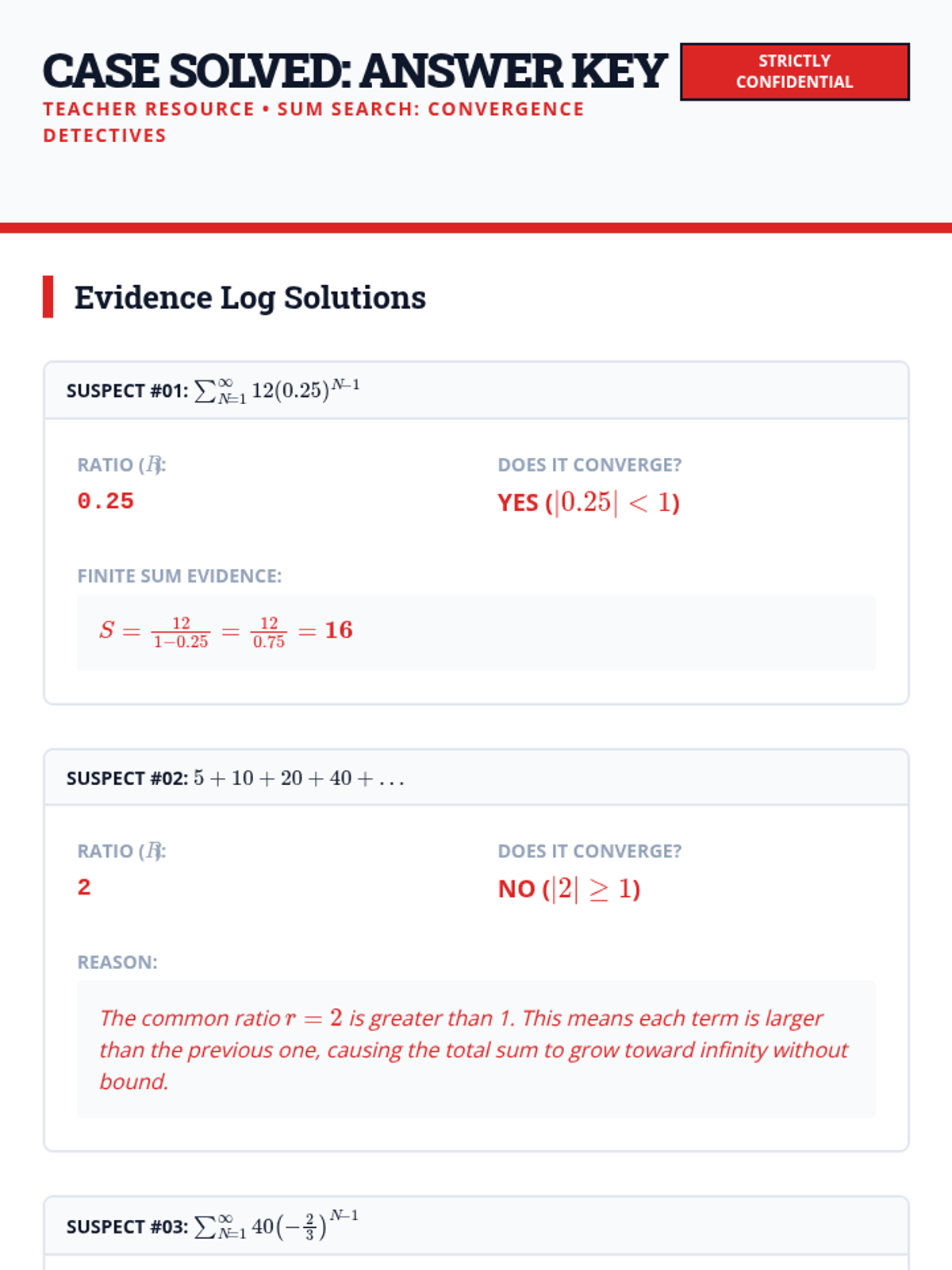
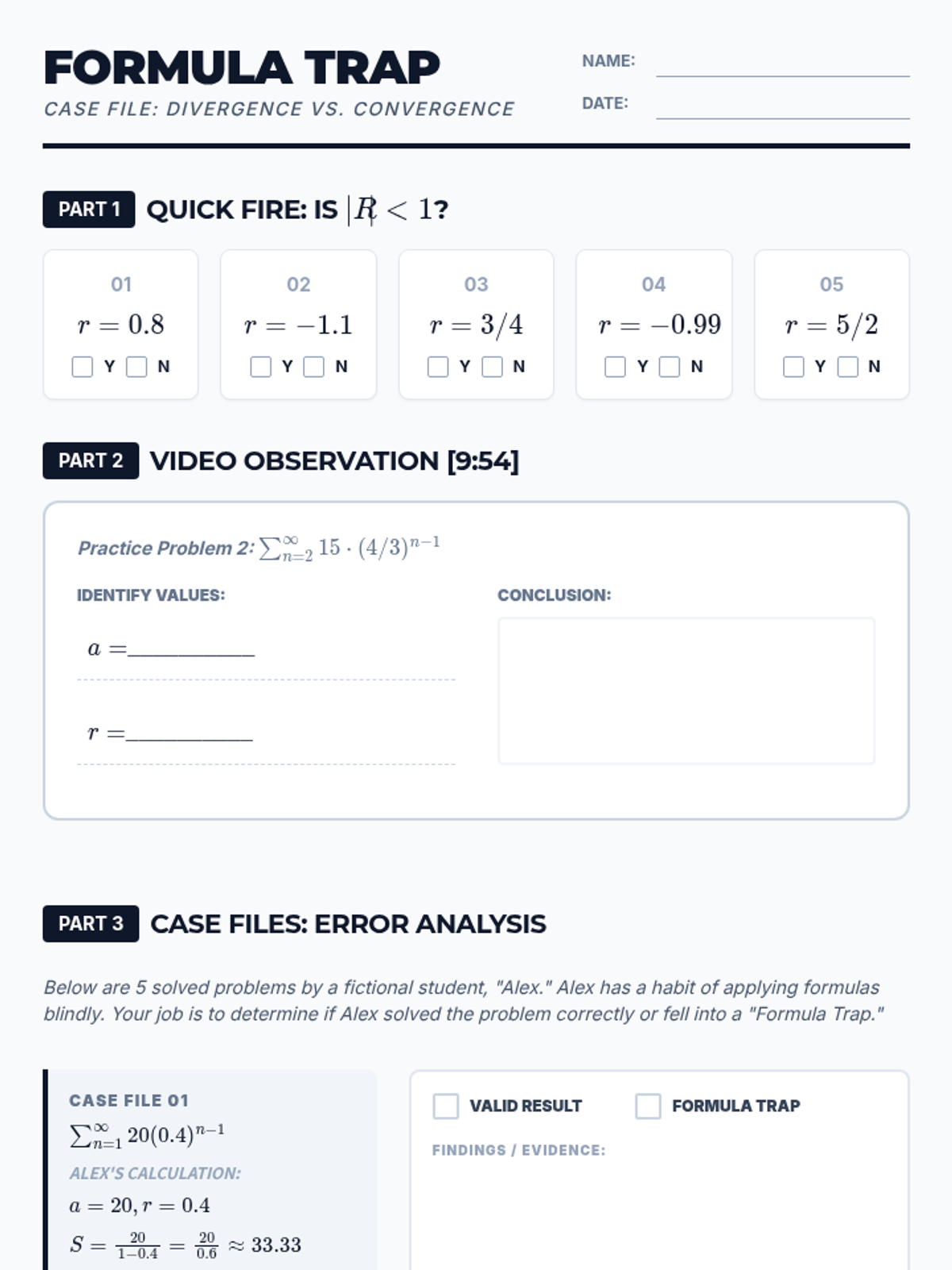
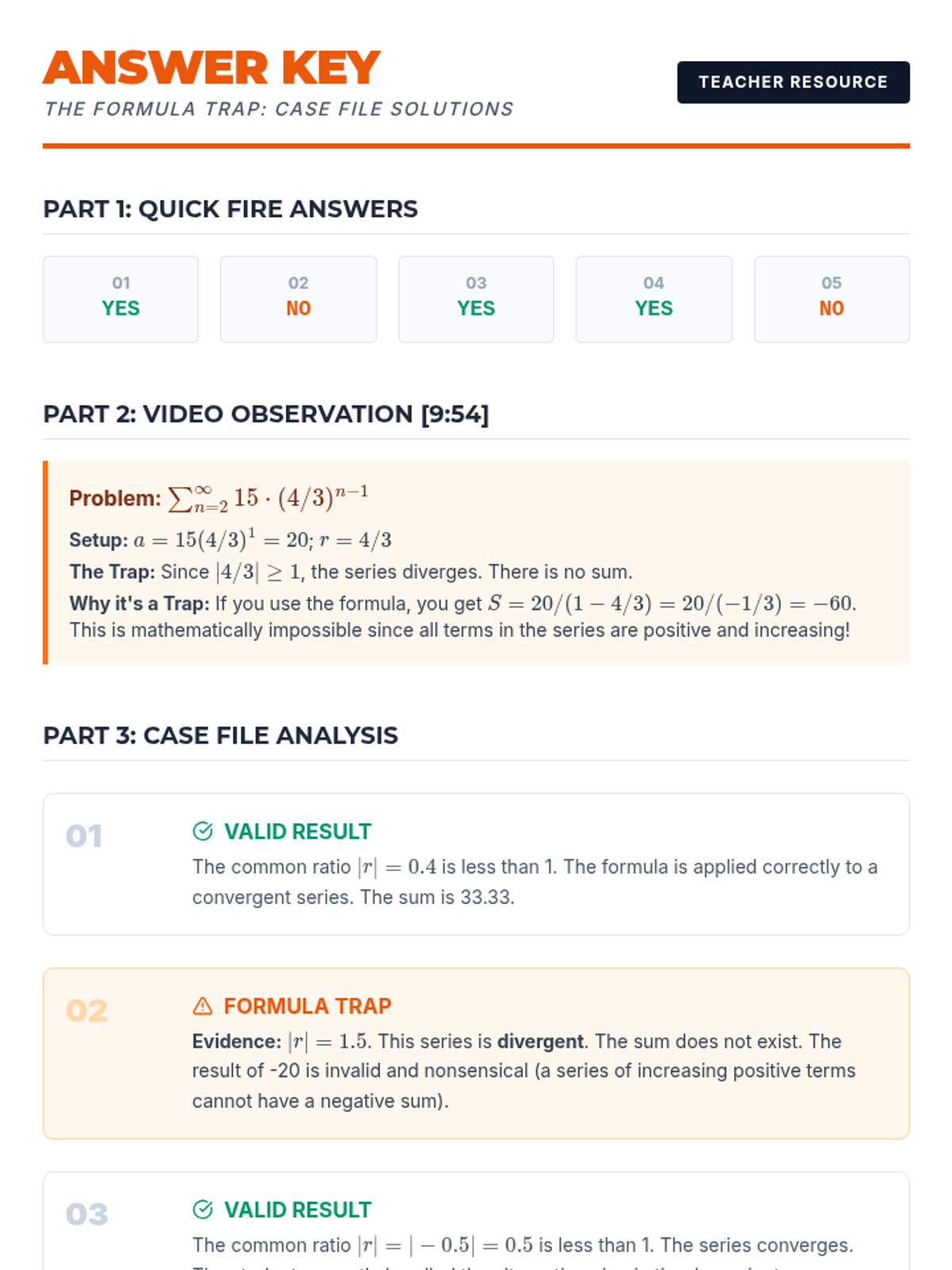
A Pre-Calculus lesson on infinite geometric series, focusing on determining convergence using the common ratio and calculating sums for convergent series. Includes a forensic-themed activity to engage students in mathematical analysis.
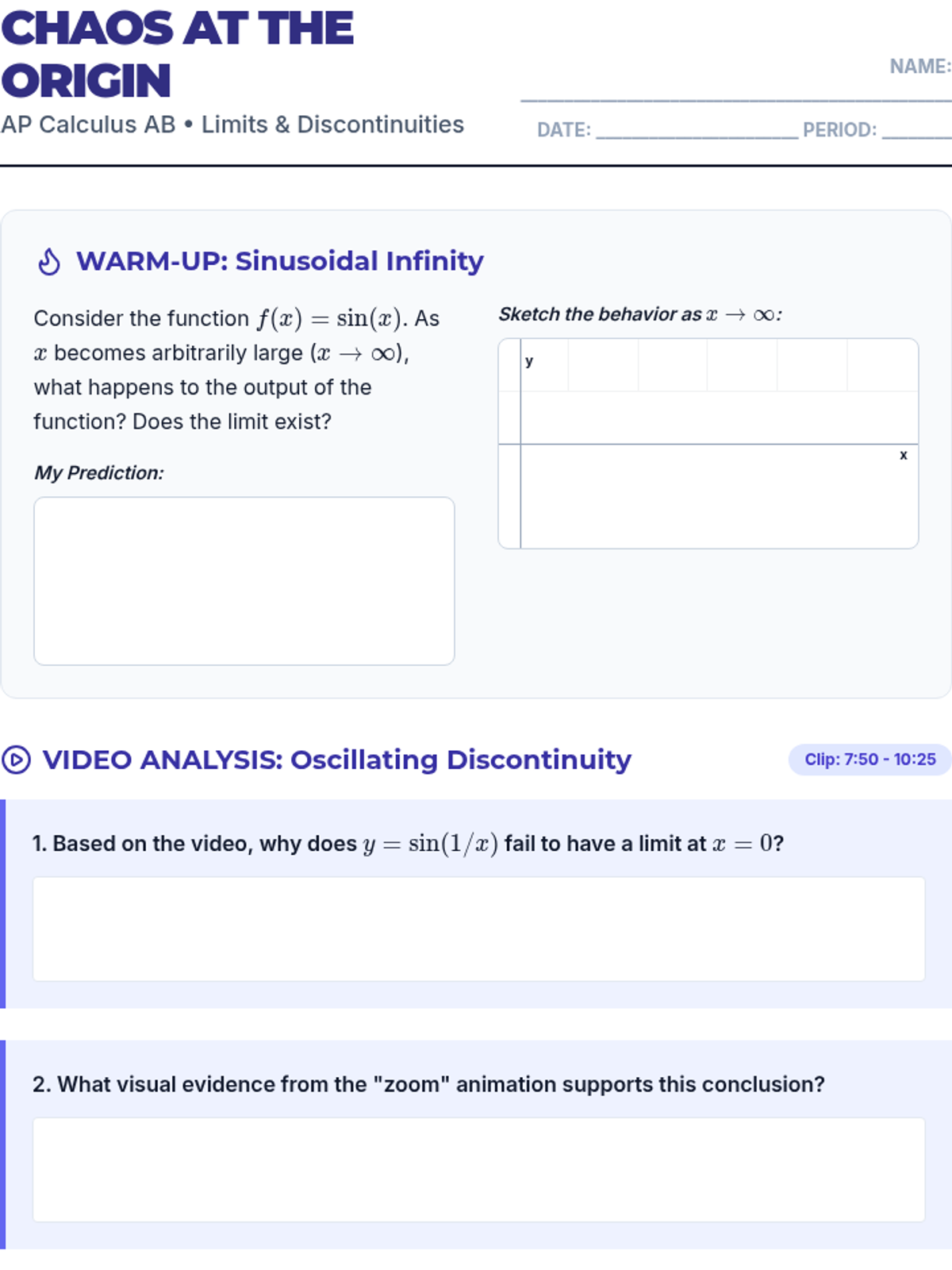
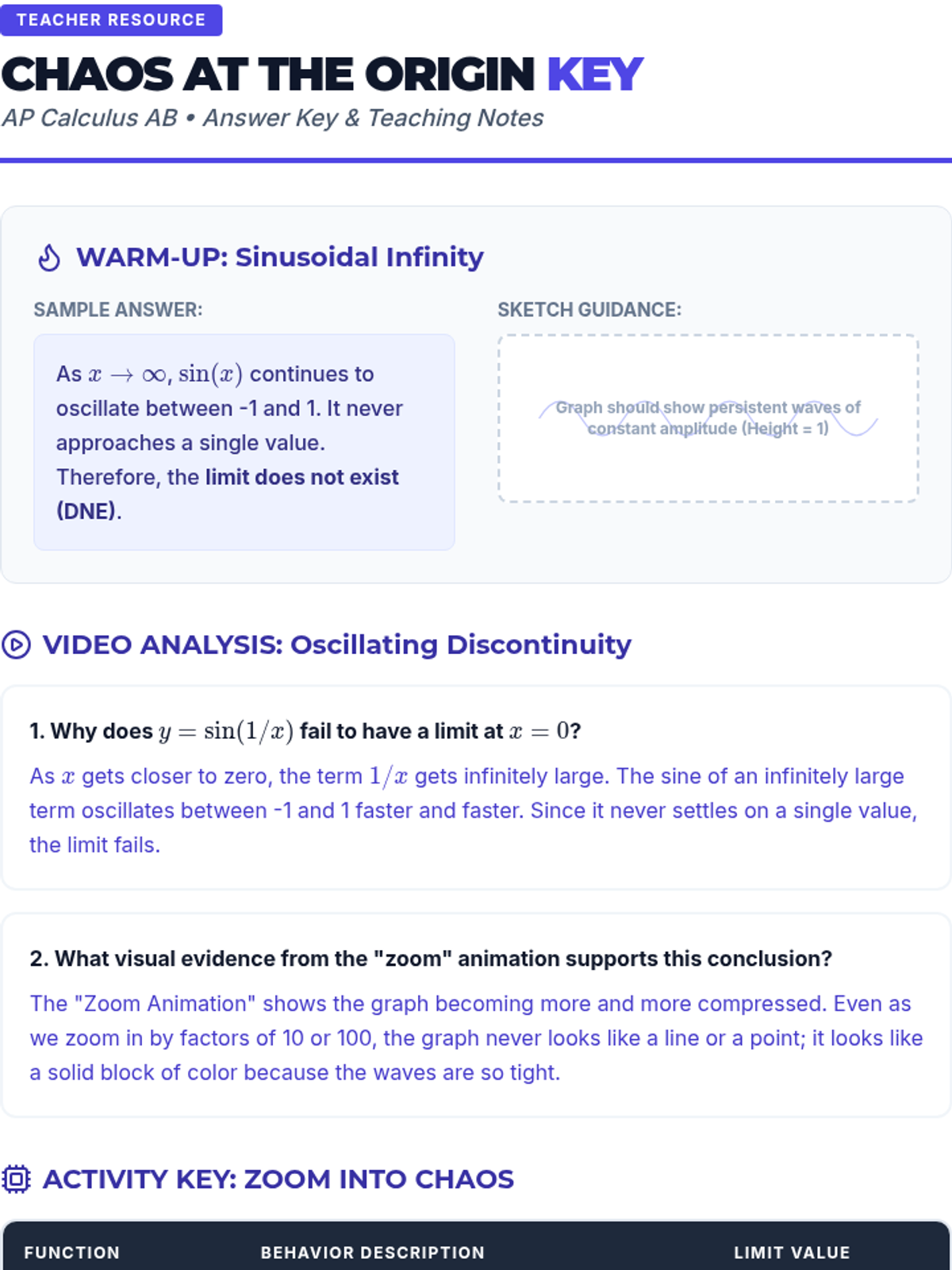
Students investigate the behavior of functions with oscillating discontinuities, specifically focusing on the limit of \(\sin(1/x)\) as \(x \to 0\) compared to bounded oscillating functions like \(x \cdot \sin(1/x)\). The lesson uses a combination of video analysis and digital graphing tools to explore the formal definition of limit failure due to oscillation.
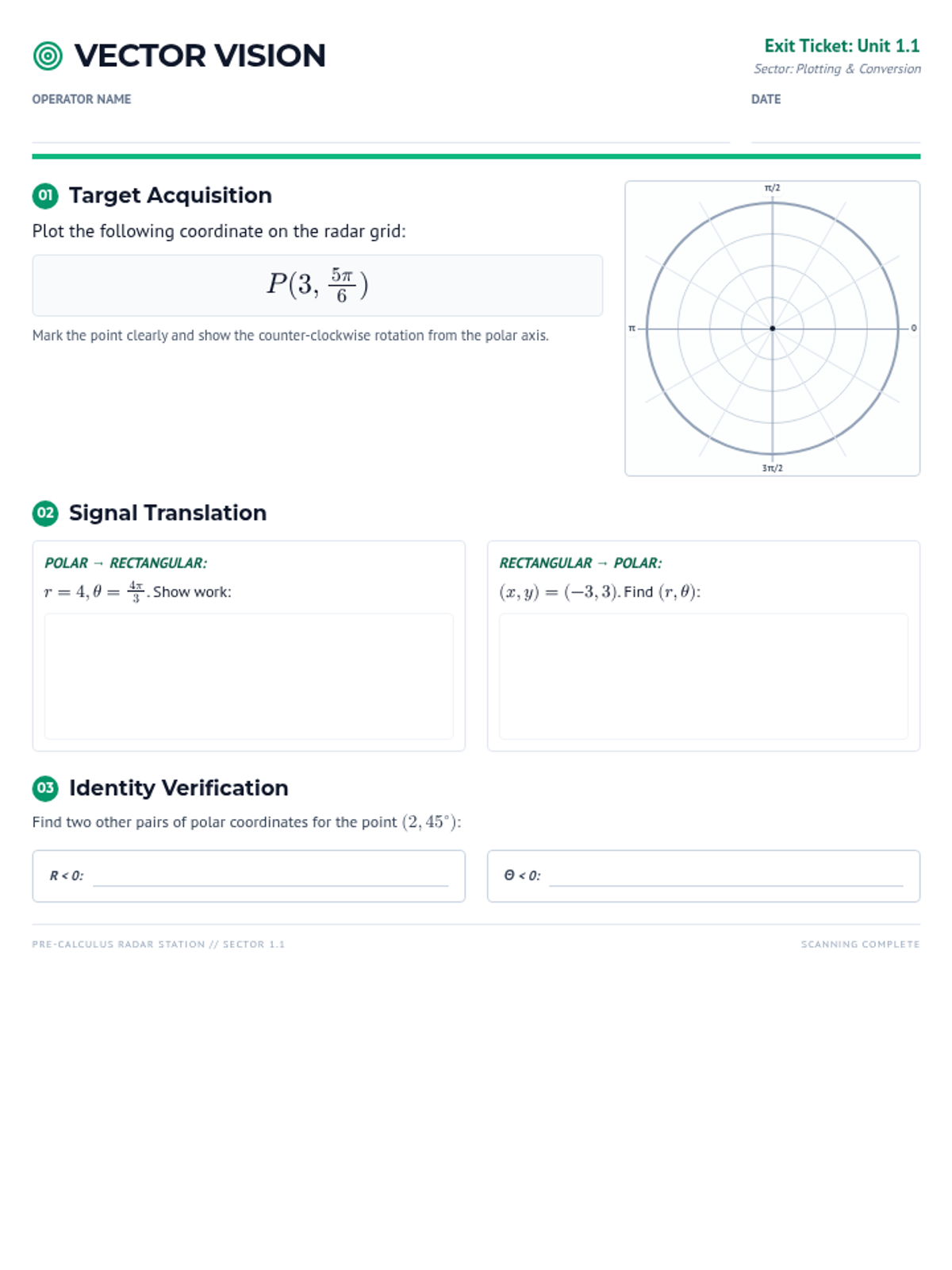
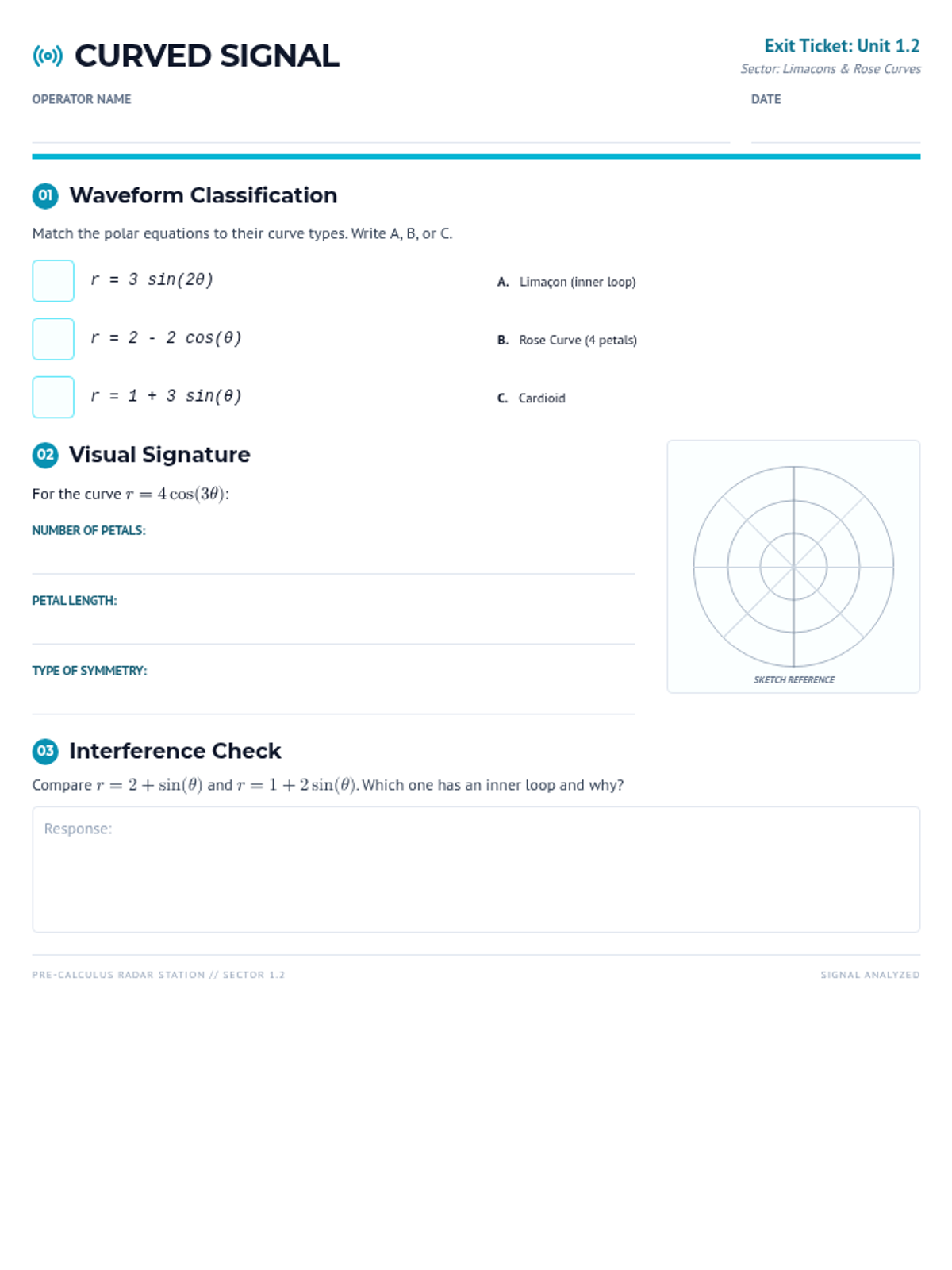
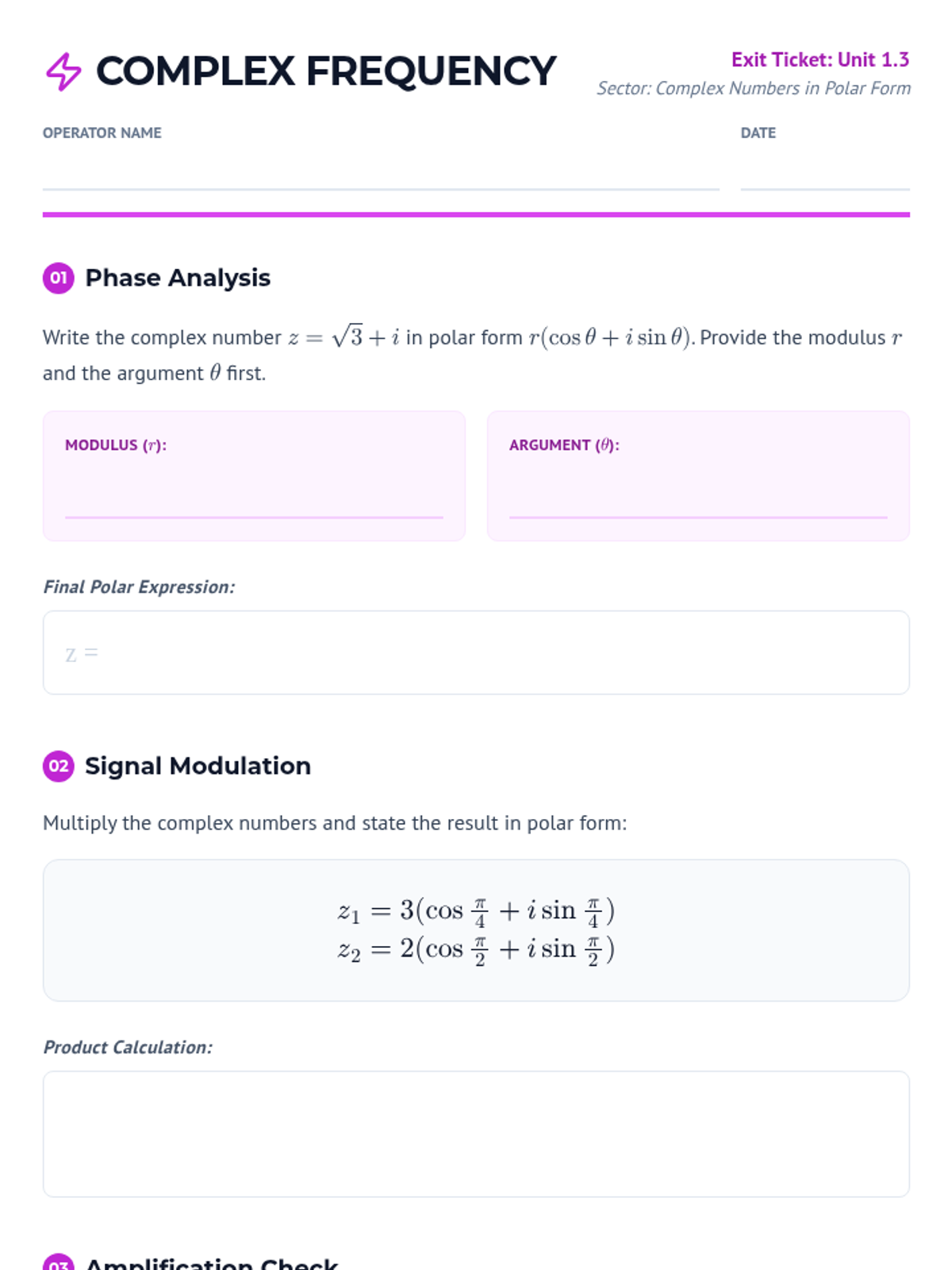
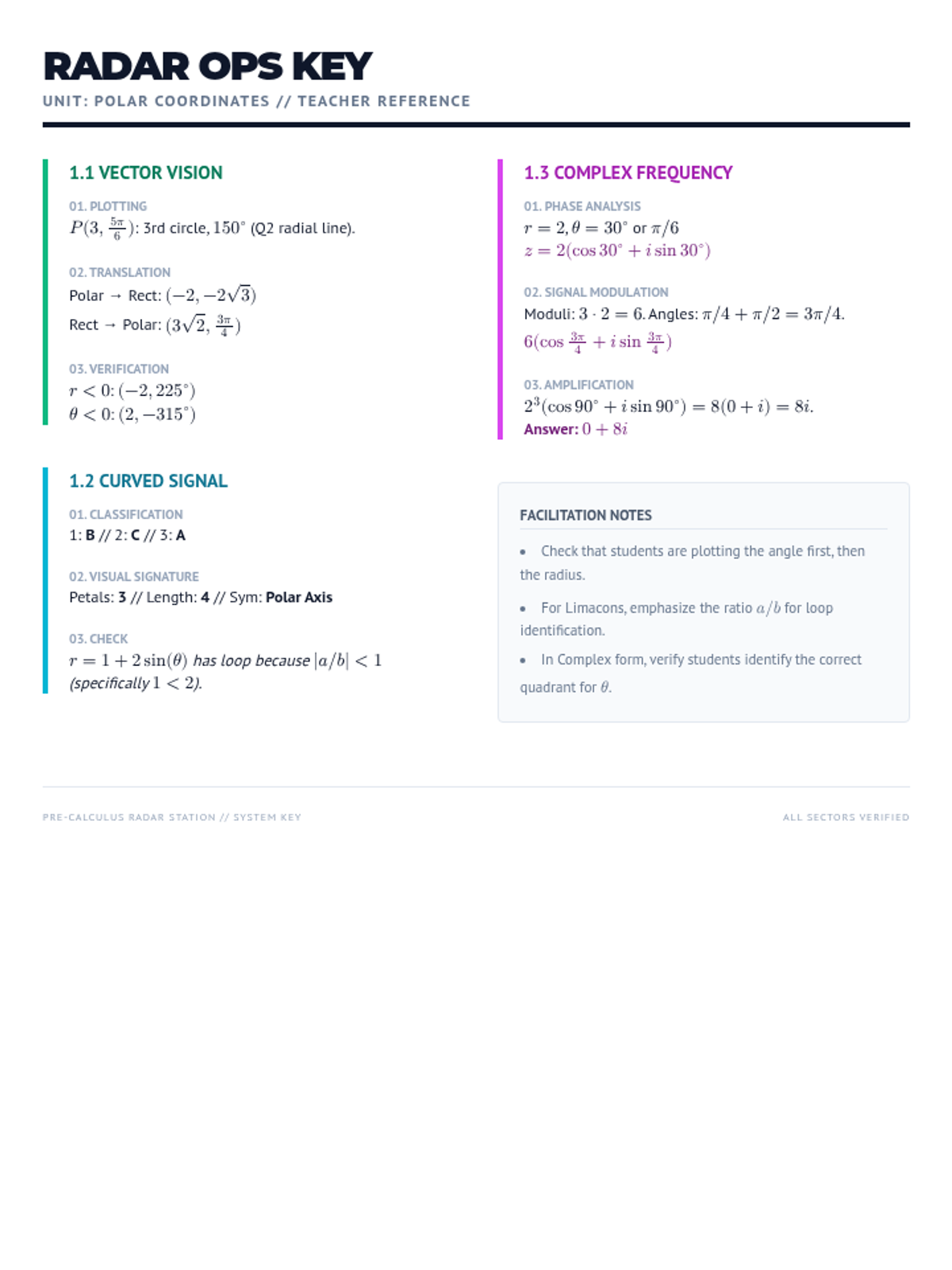
A series of focused assessments to verify student mastery of polar coordinate plotting, conversion, graphing special curves, and representing complex numbers in polar form.
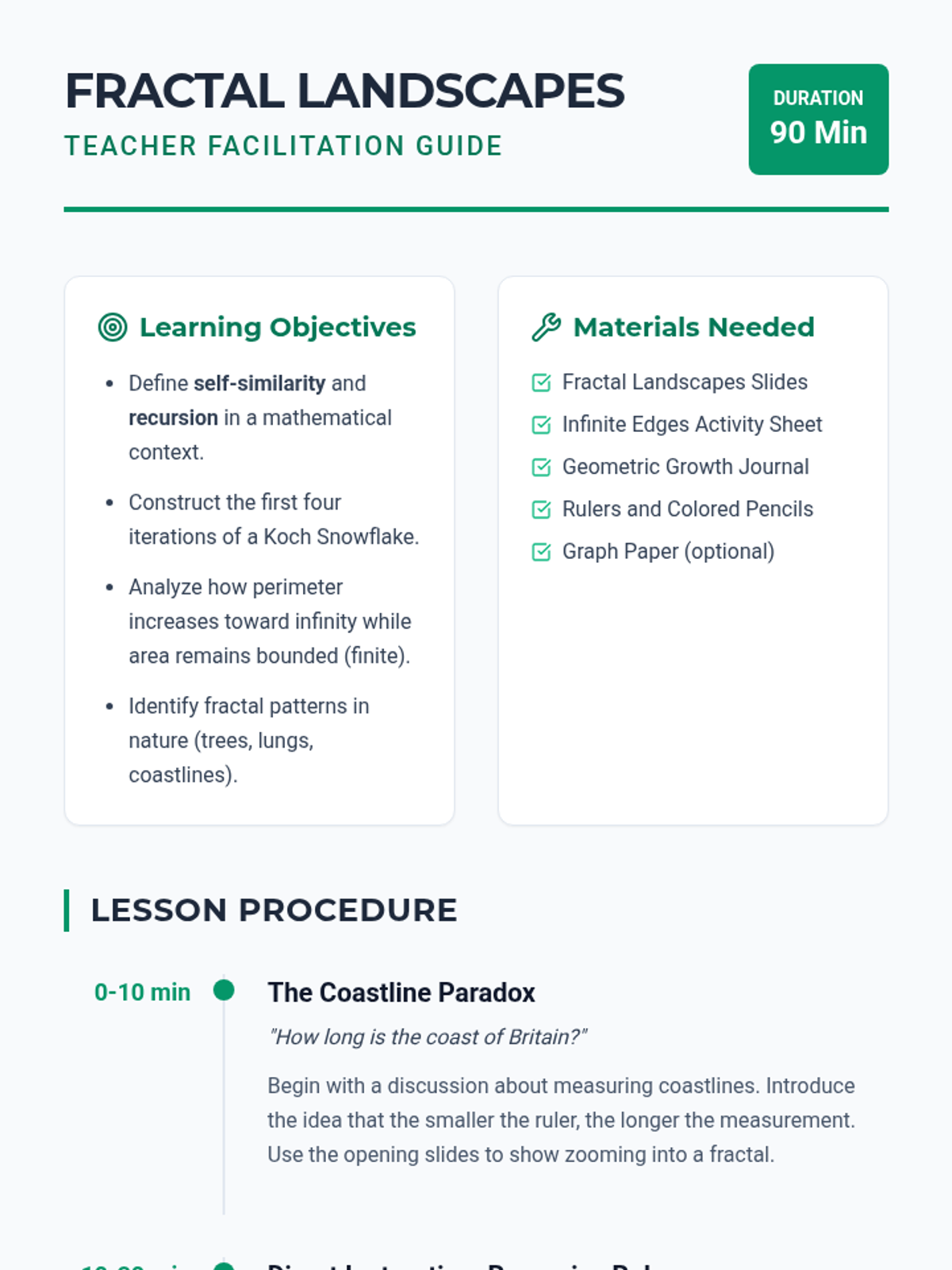
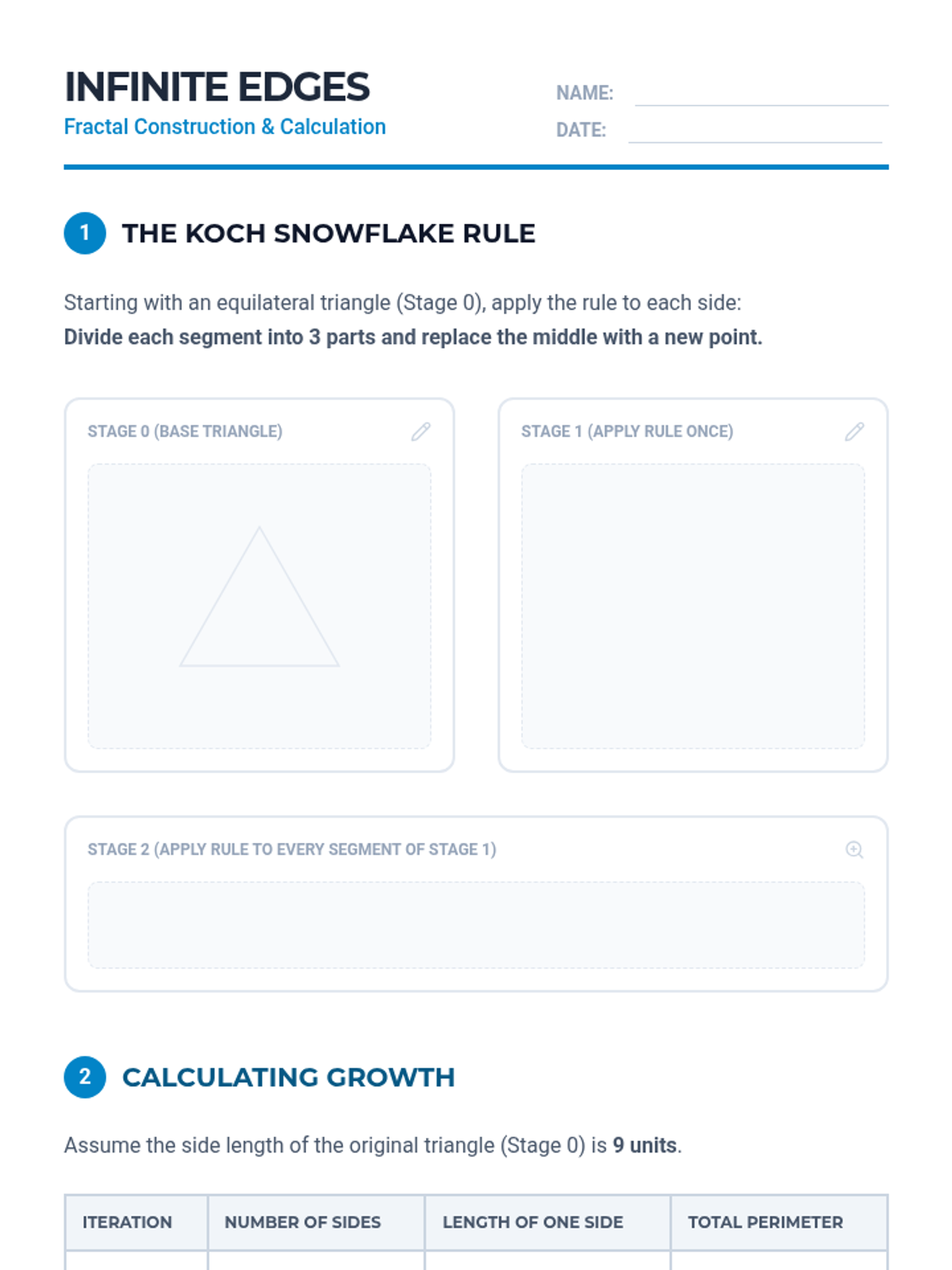
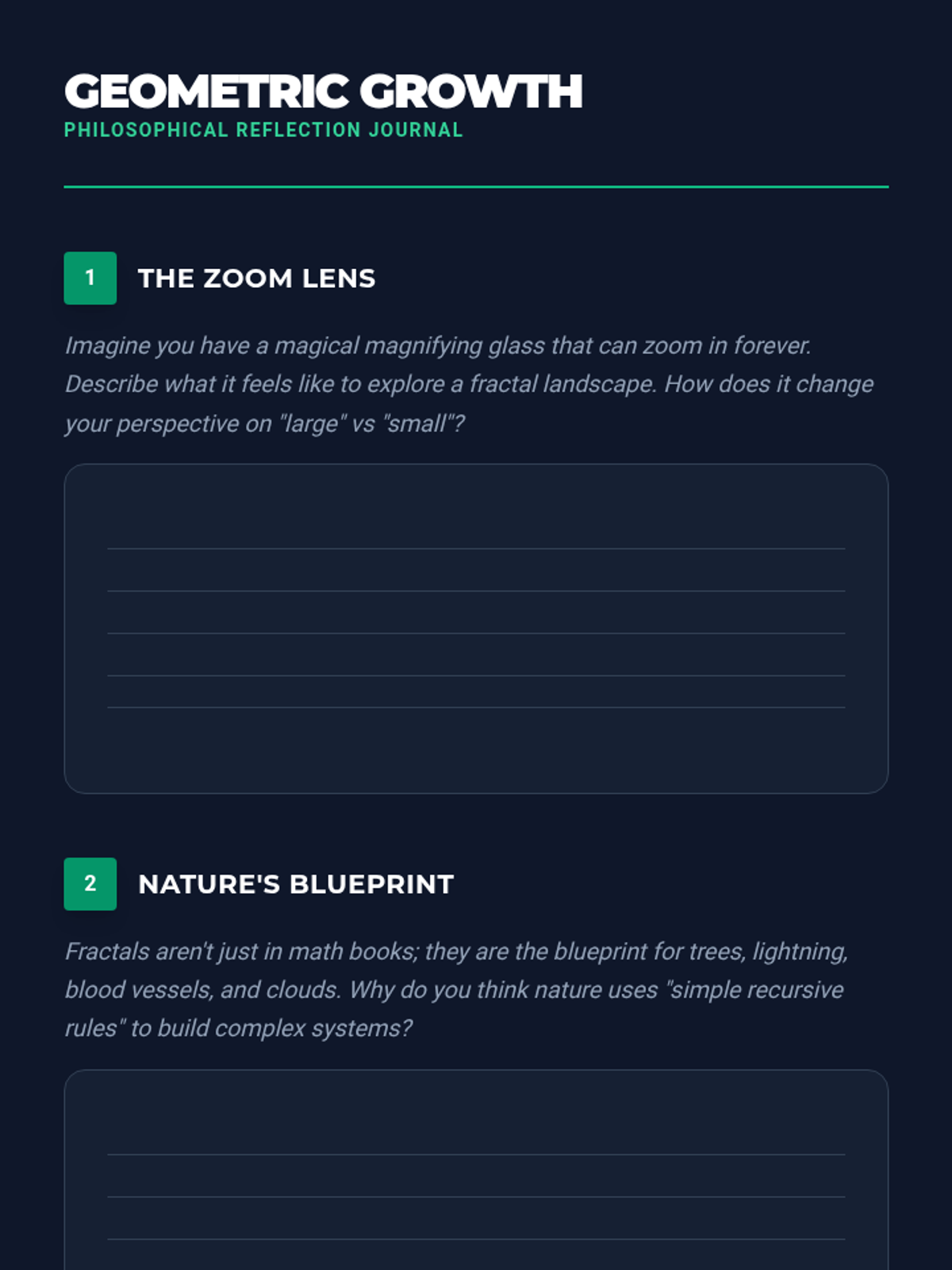
Explore the mesmerizing world of fractals where art meets mathematics. Students investigate recursive patterns, self-similarity, and the mind-bending paradox of infinite perimeters within finite spaces.
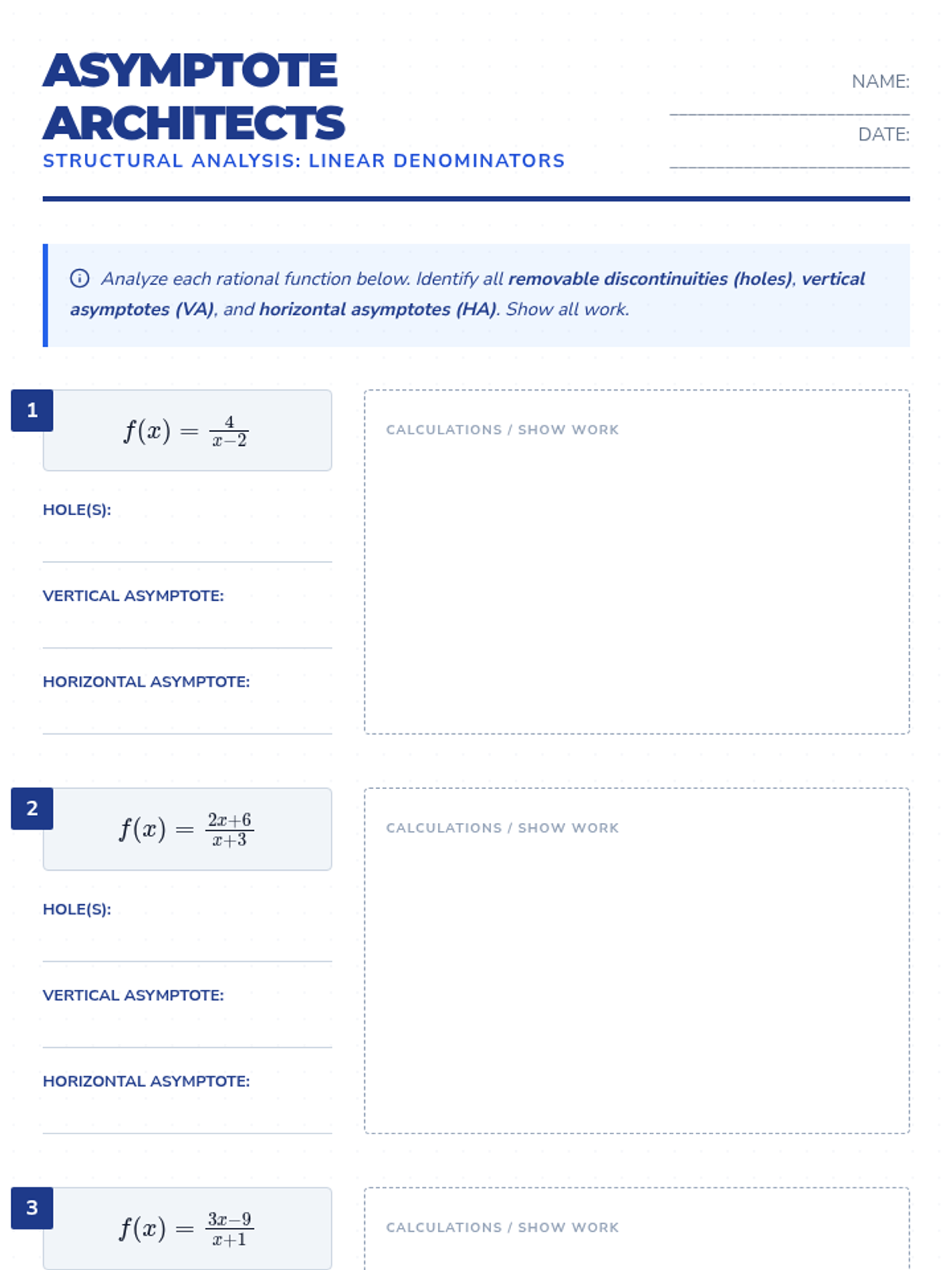
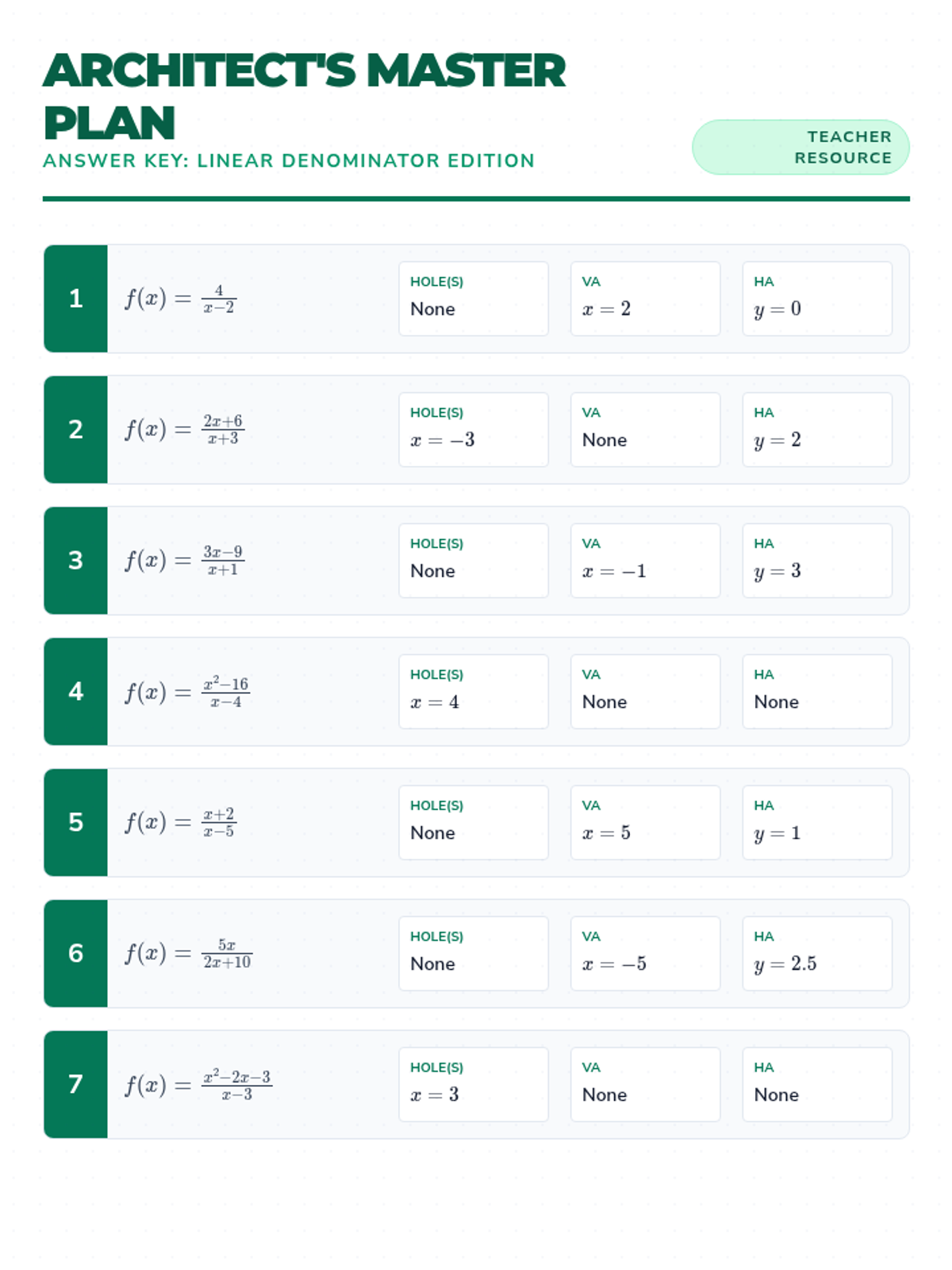
A comprehensive lesson on identifying and calculating vertical asymptotes, horizontal asymptotes, and removable discontinuities (holes) in rational functions. Students will practice factoring and simplifying functions to reveal their underlying structure.
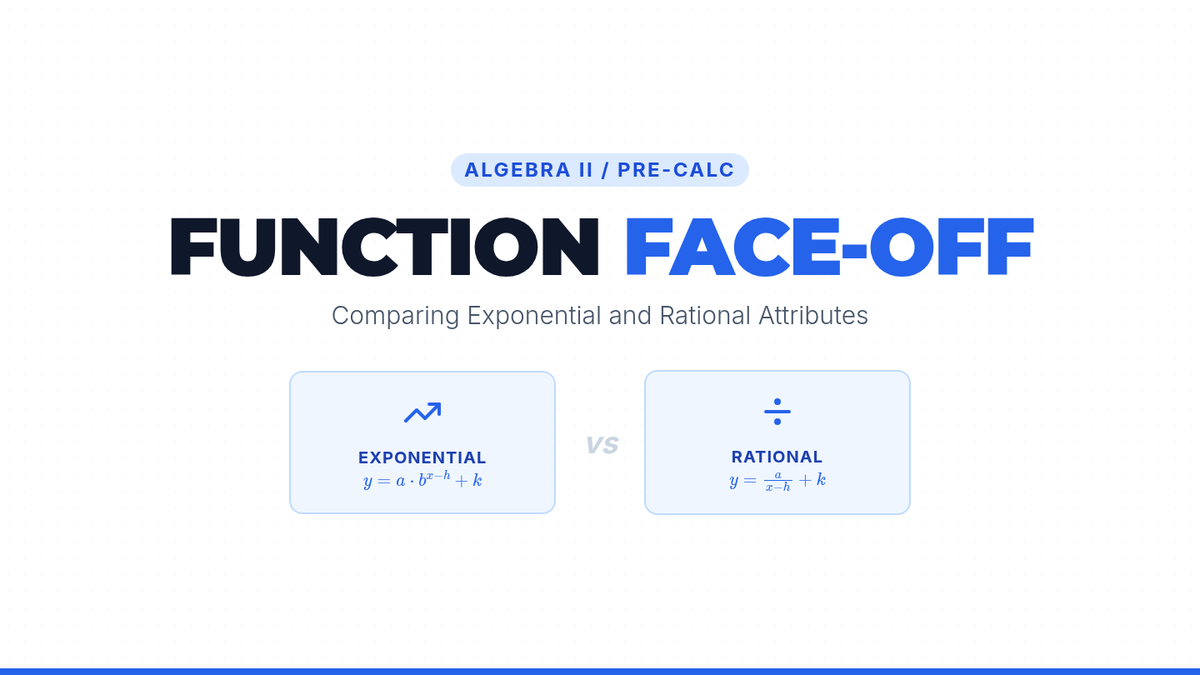
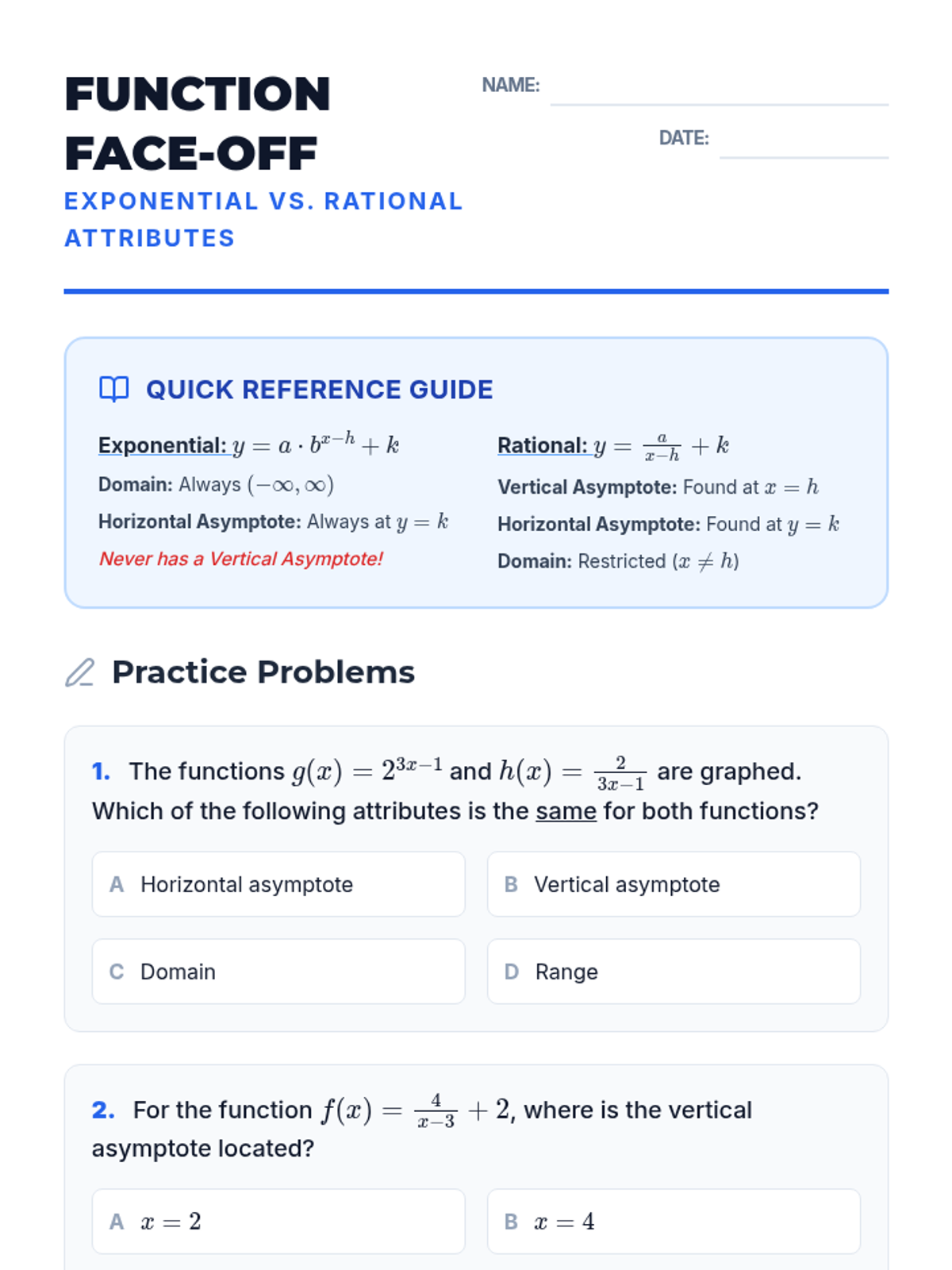
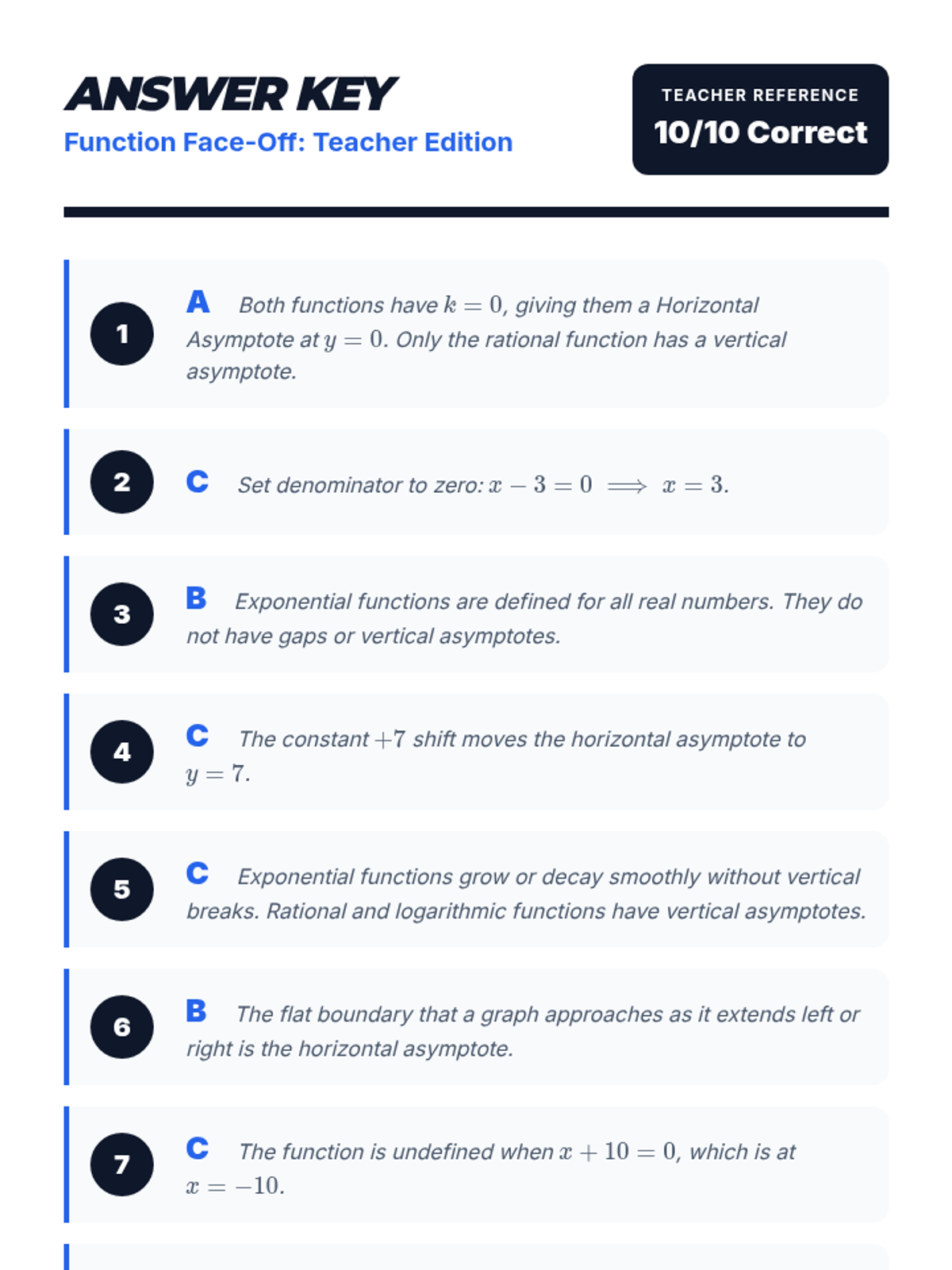
A lesson comparing the structural attributes of exponential and rational functions, focusing on asymptotes, domain, and range.
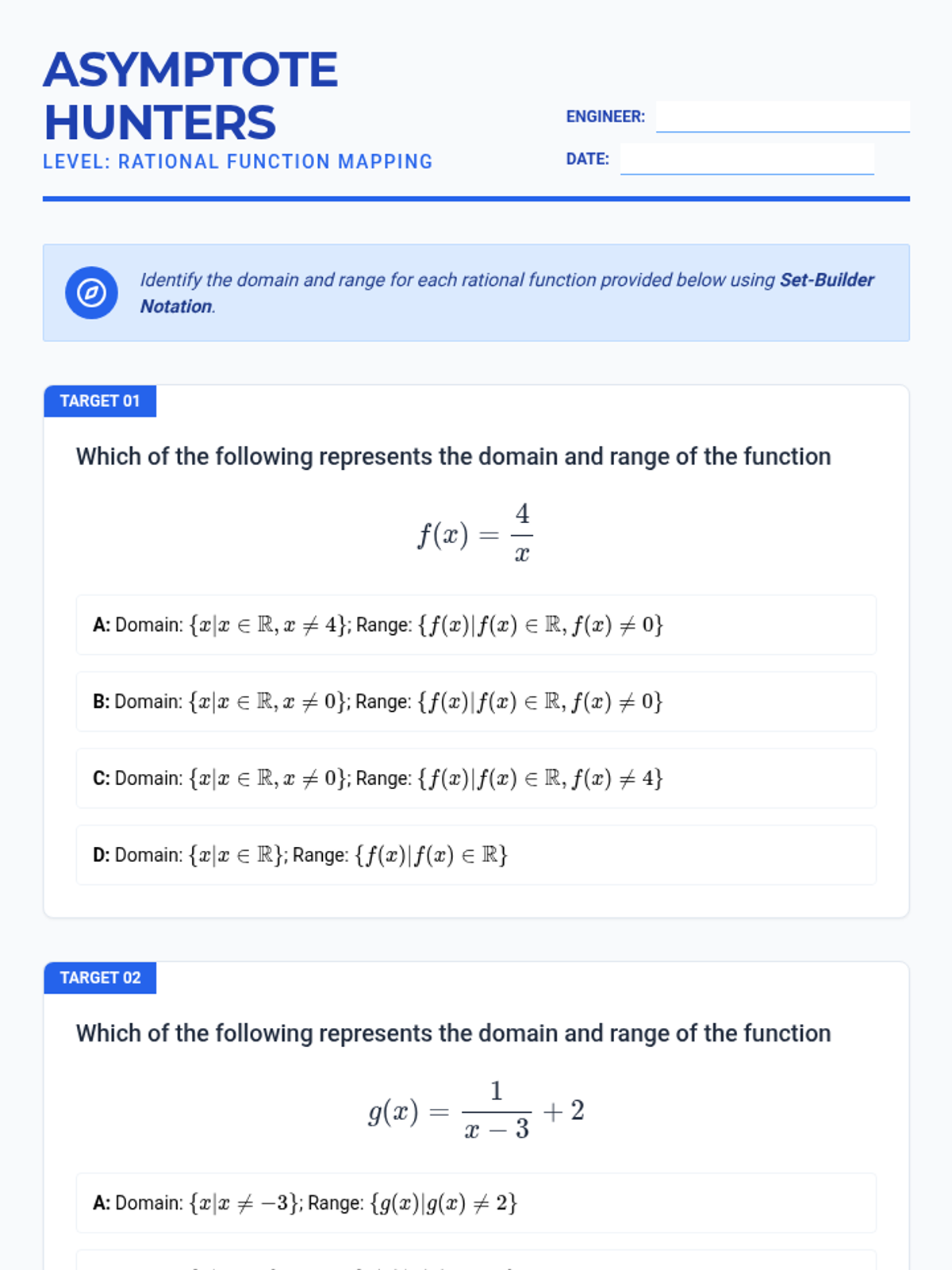
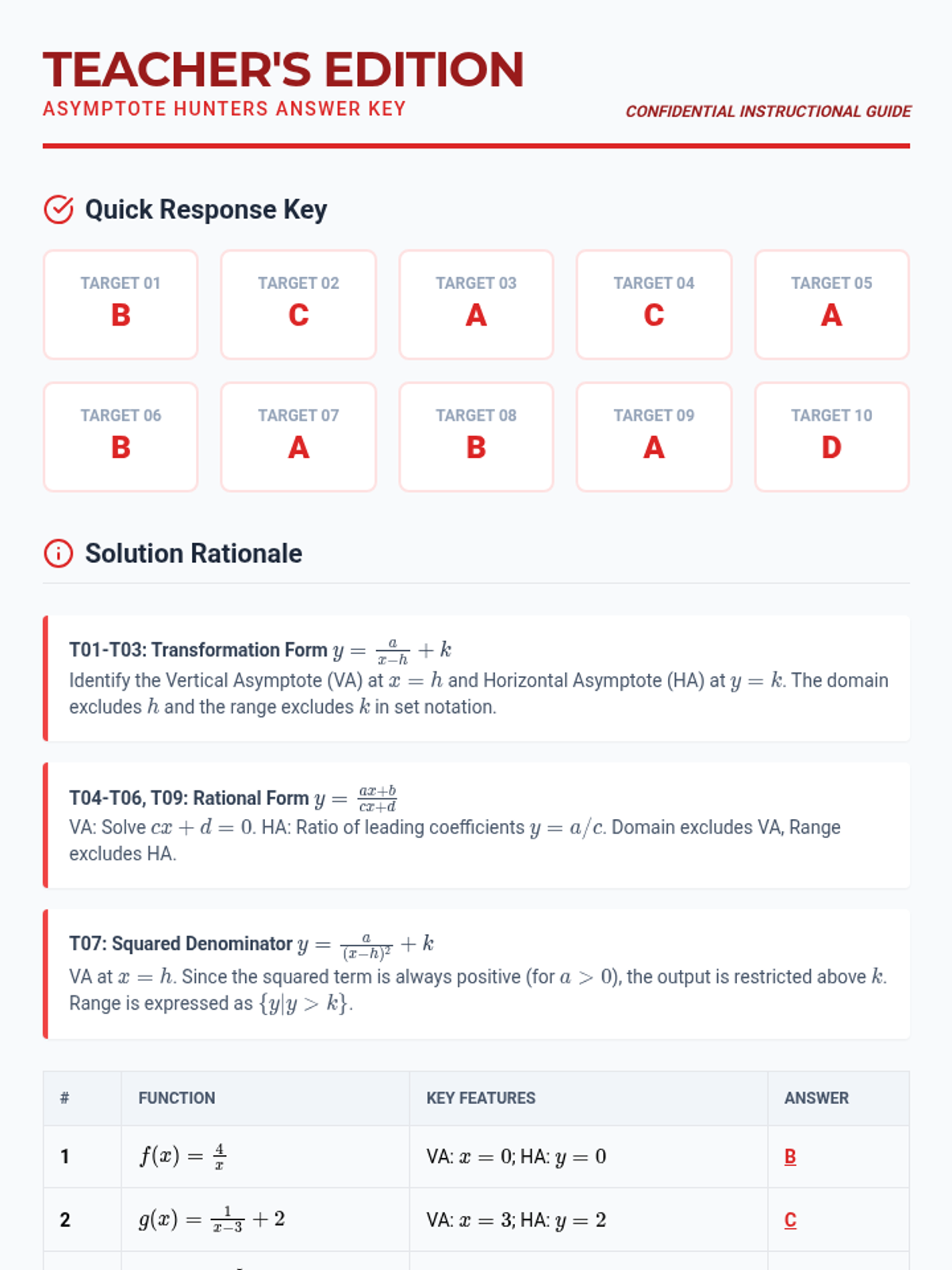
A lesson focused on identifying the domain and range of rational functions using set-builder notation. Students analyze various horizontal and vertical asymptotes to determine functional constraints.
A comprehensive practice session for the TSIA2 Math exam, focusing on quantitative reasoning, algebraic reasoning, geometry, and statistics.
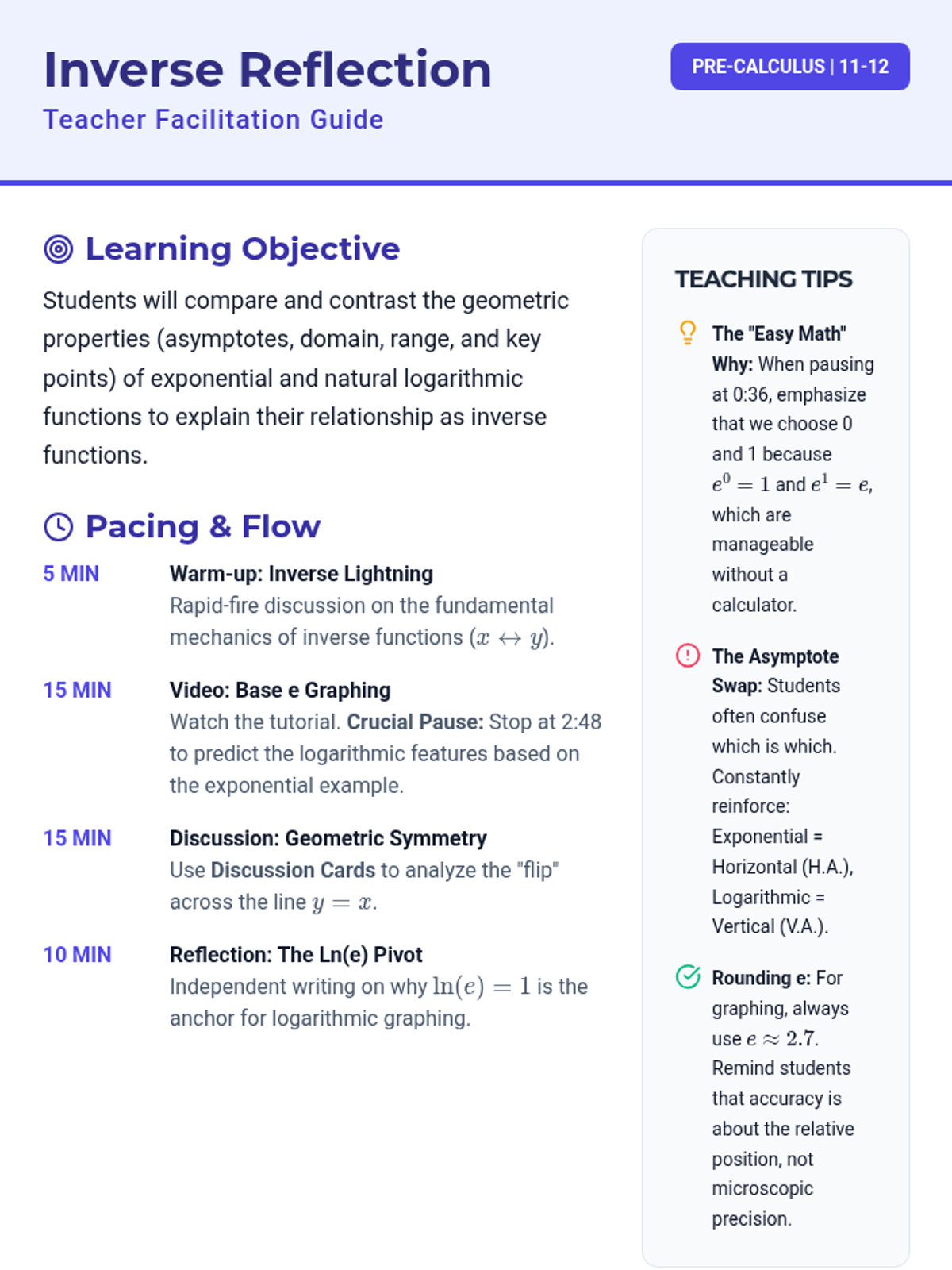
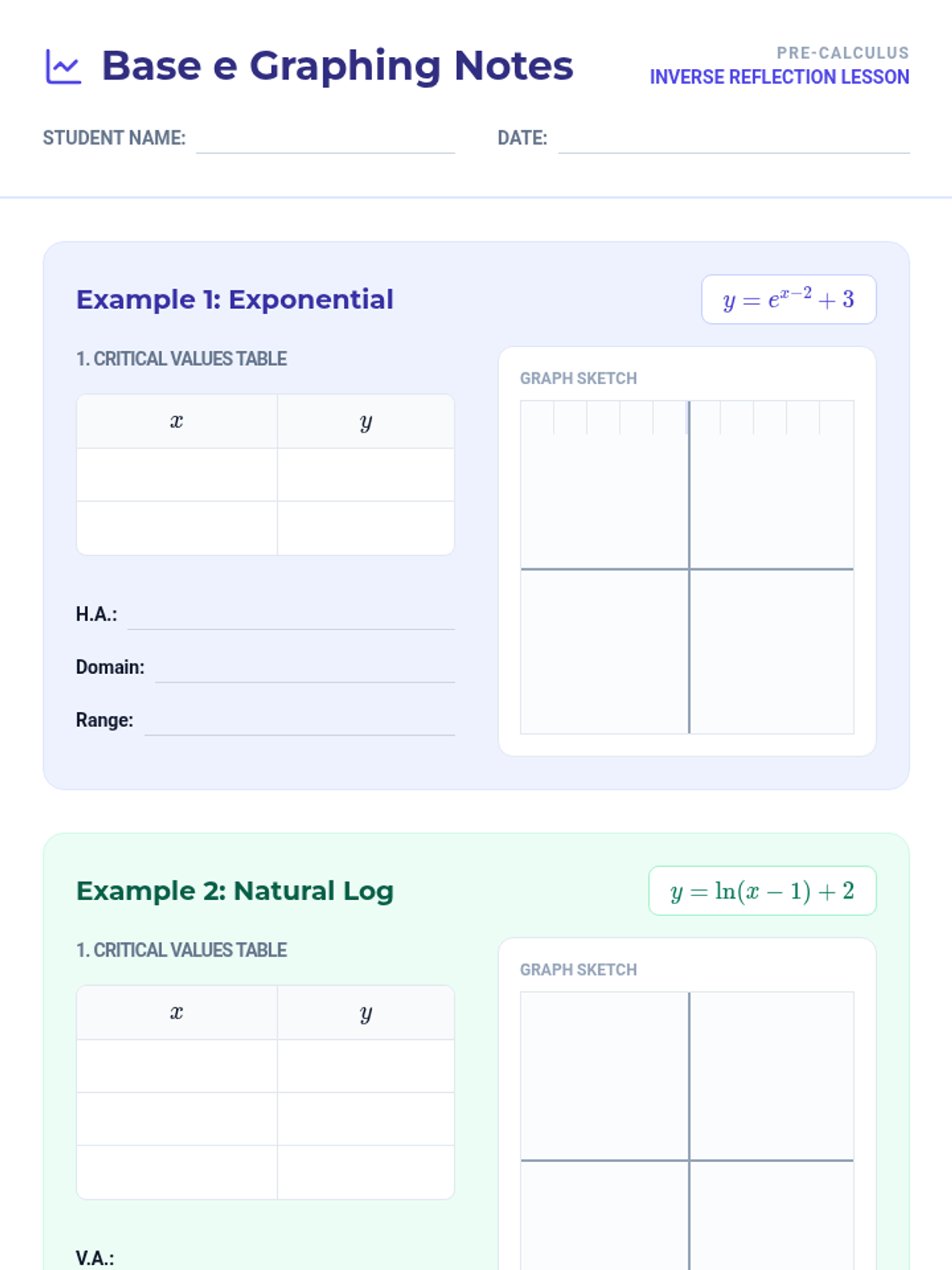
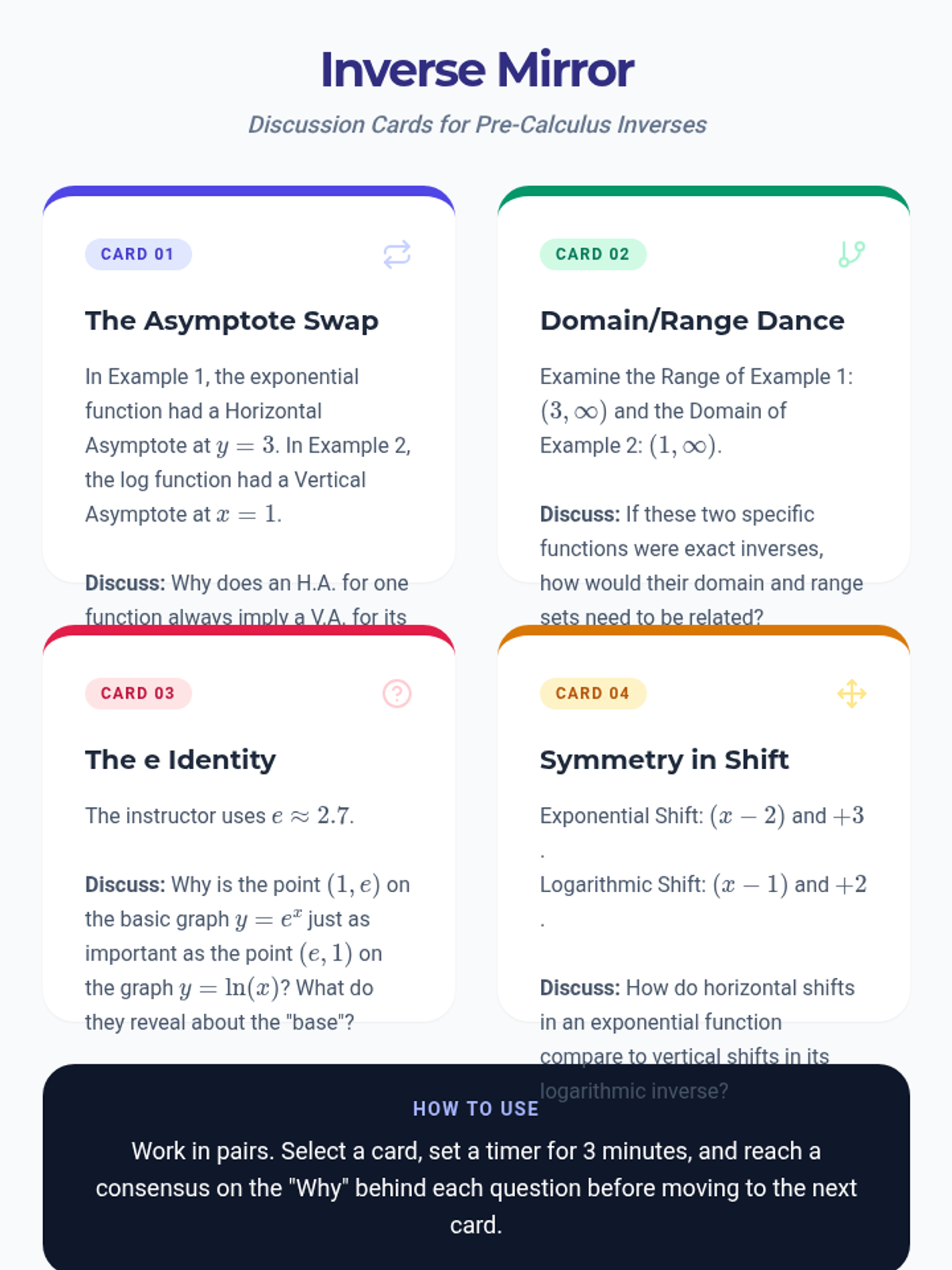
A Pre-Calculus lesson exploring the geometric relationship between exponential and natural logarithmic functions as inverses, featuring video analysis and side-by-side graphical comparisons.
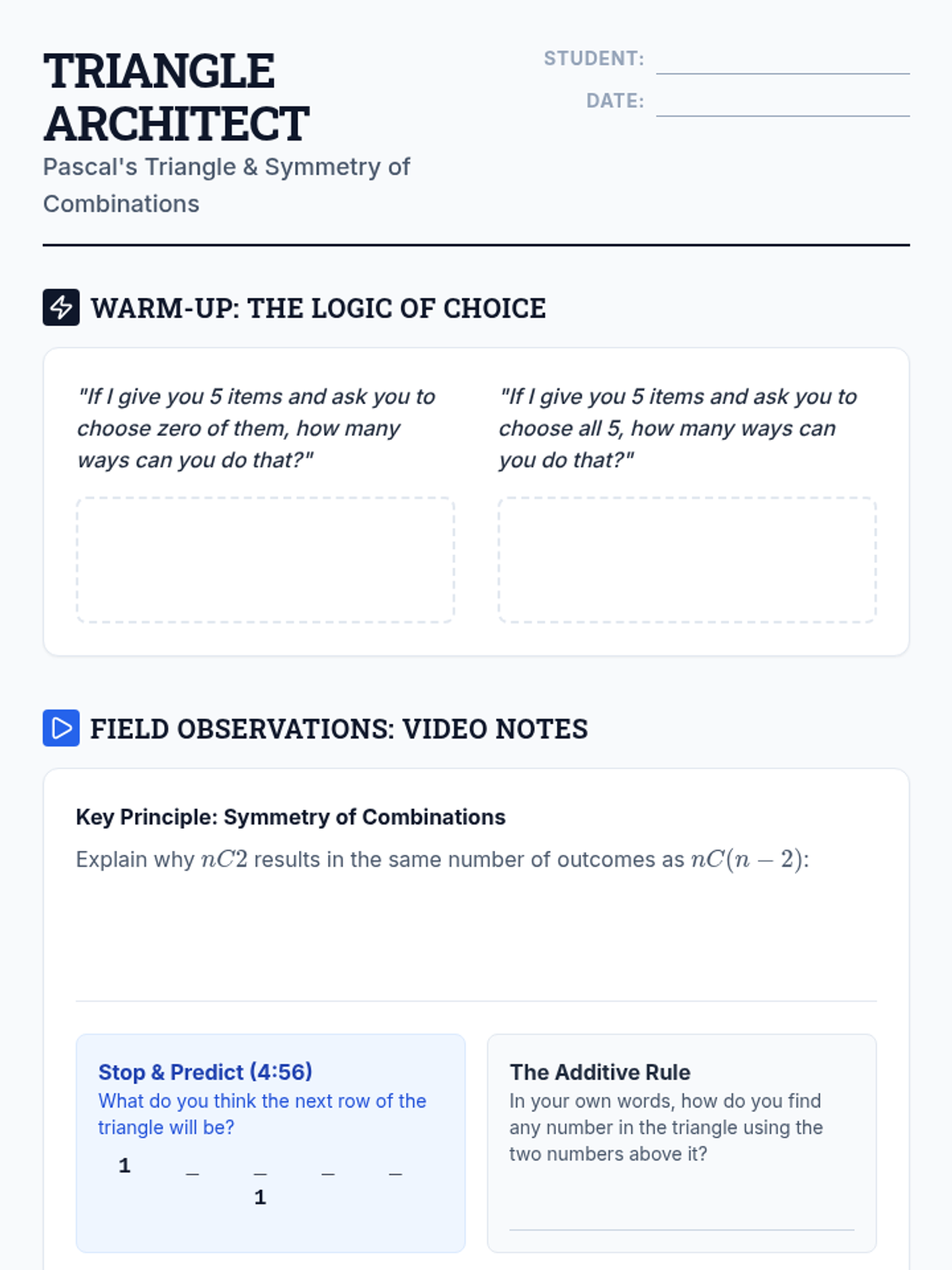
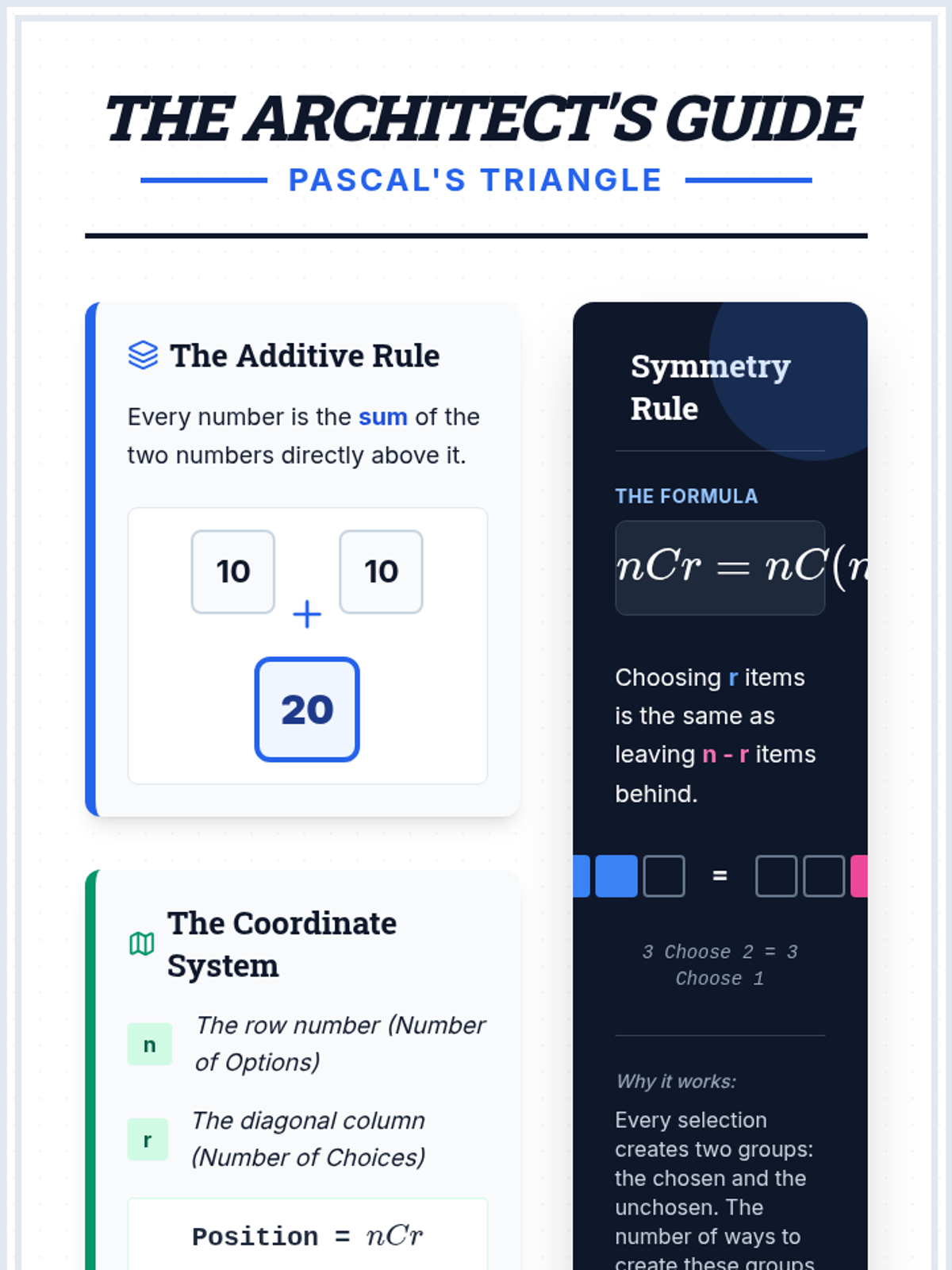
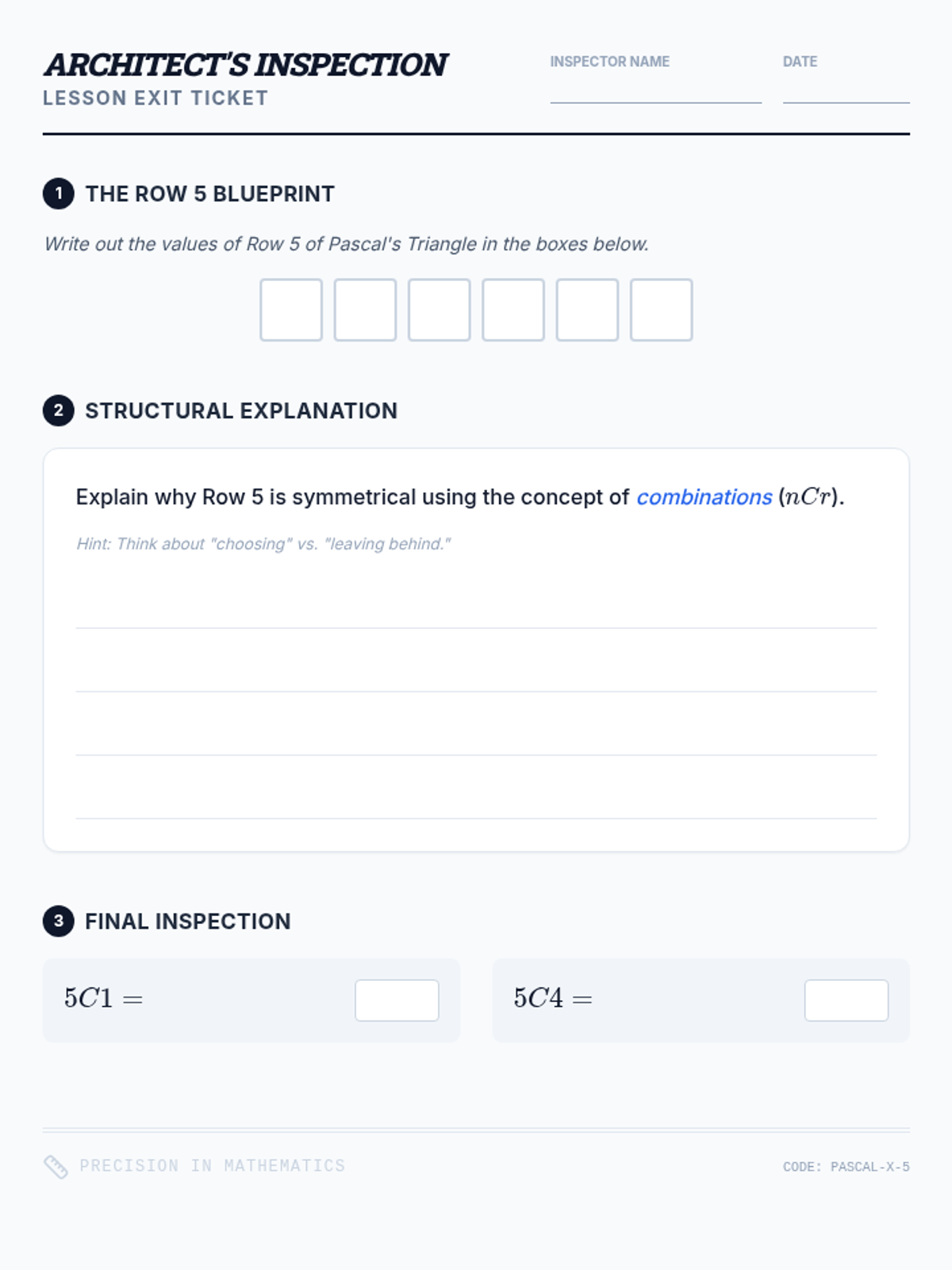
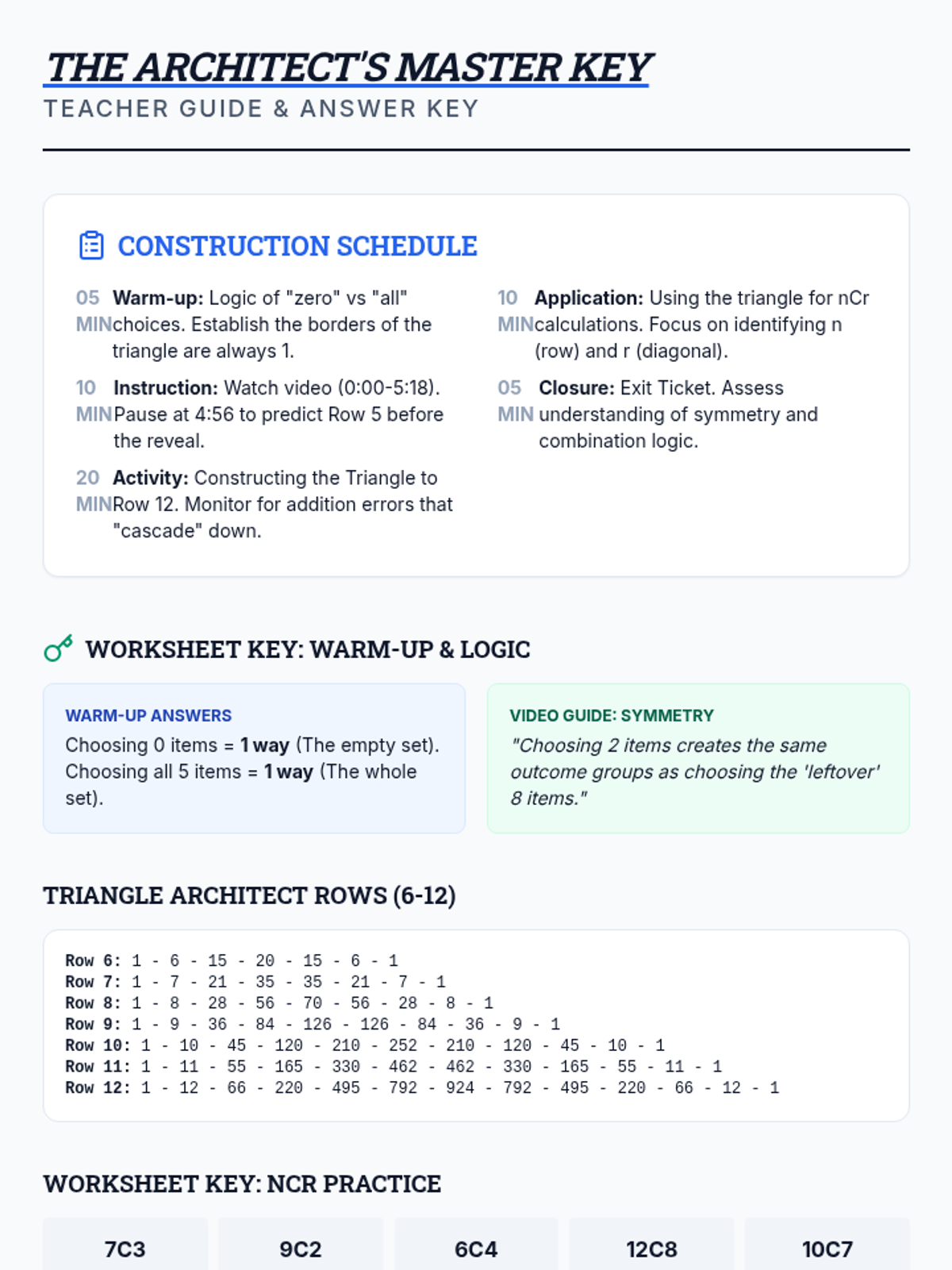
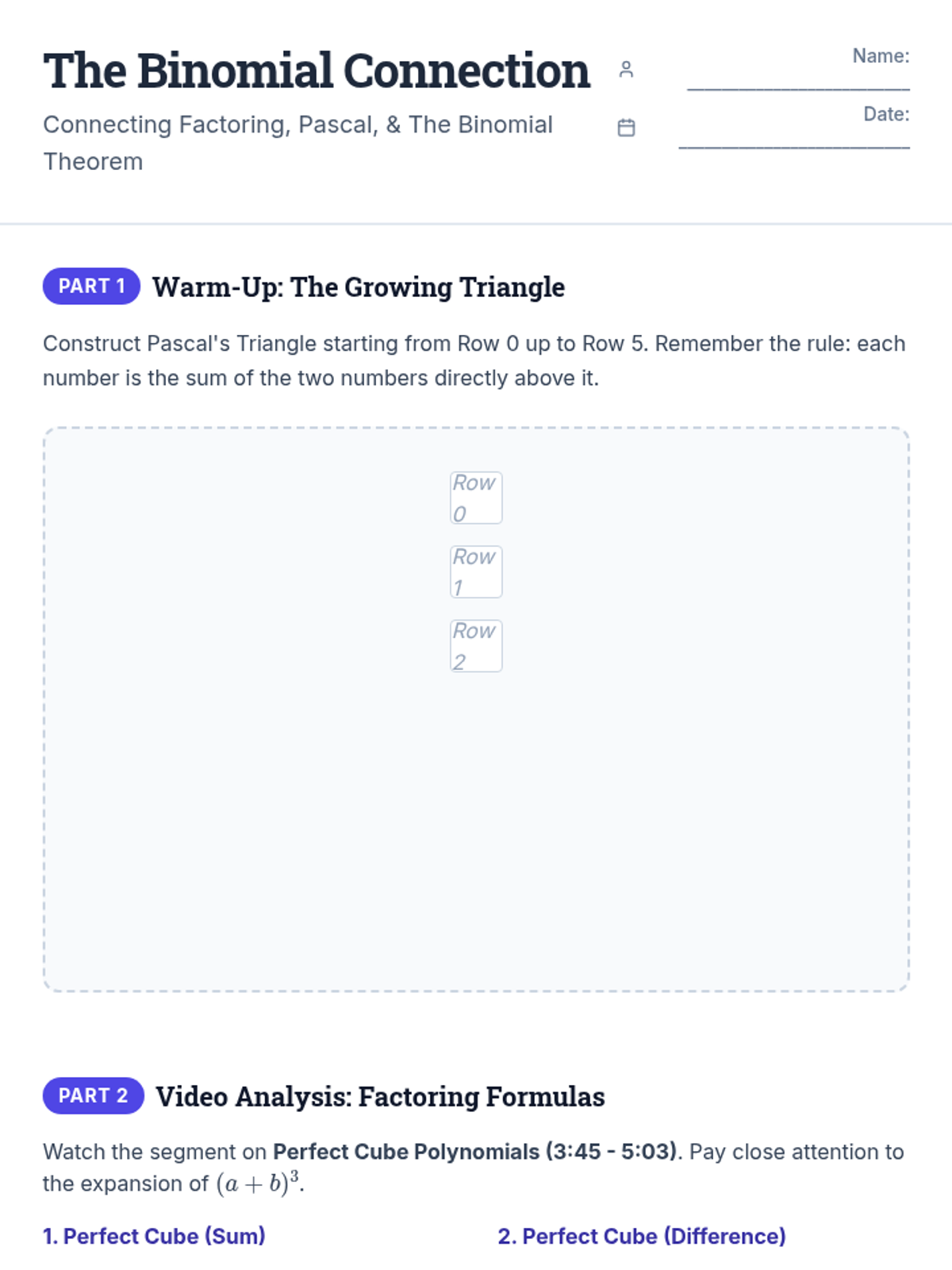
Students will construct Pascal's Triangle and explore the mathematical logic of the symmetry of combinations ($nCr = nC(n-r)$) through visual patterns and algebraic reasoning.
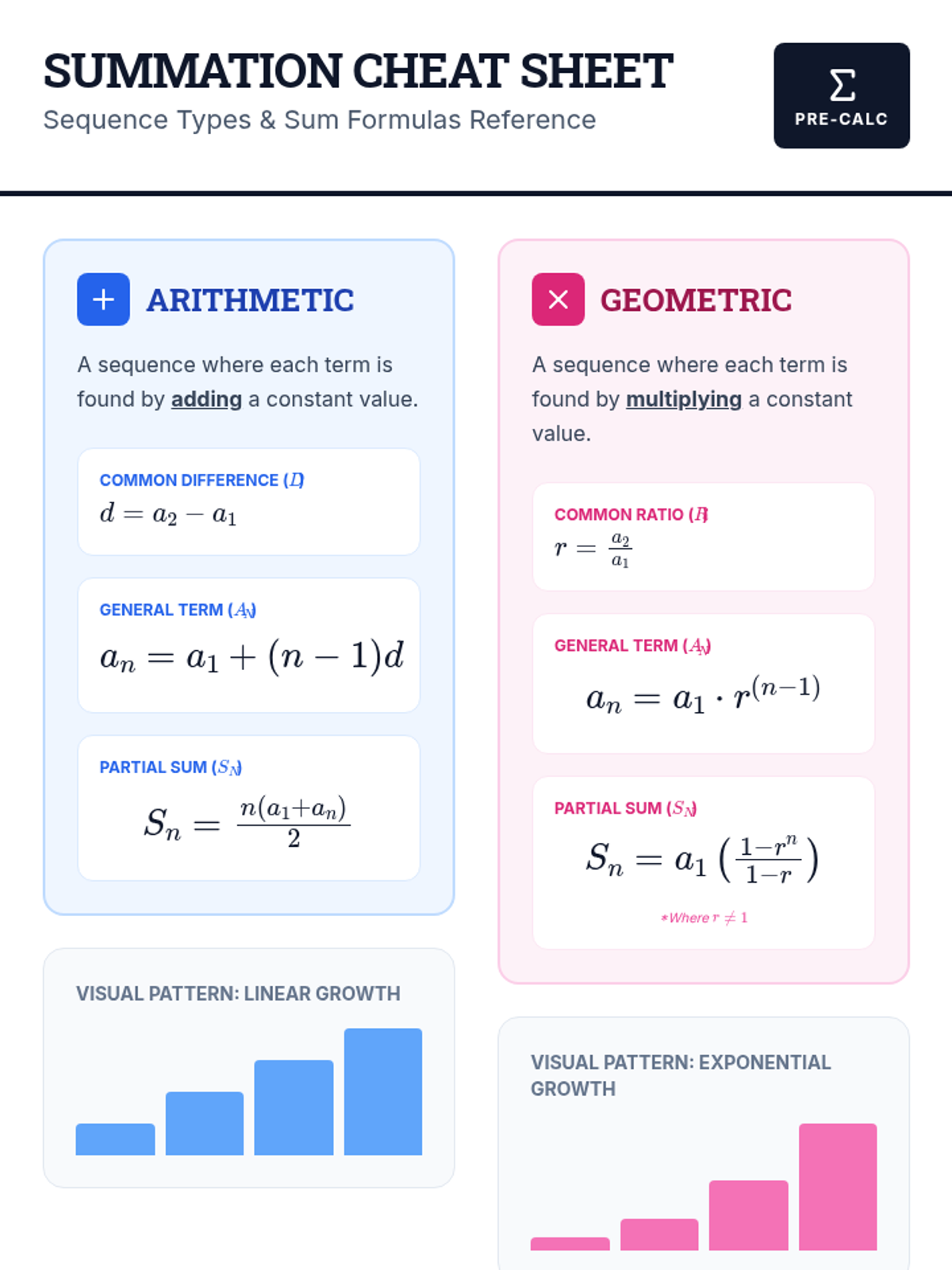
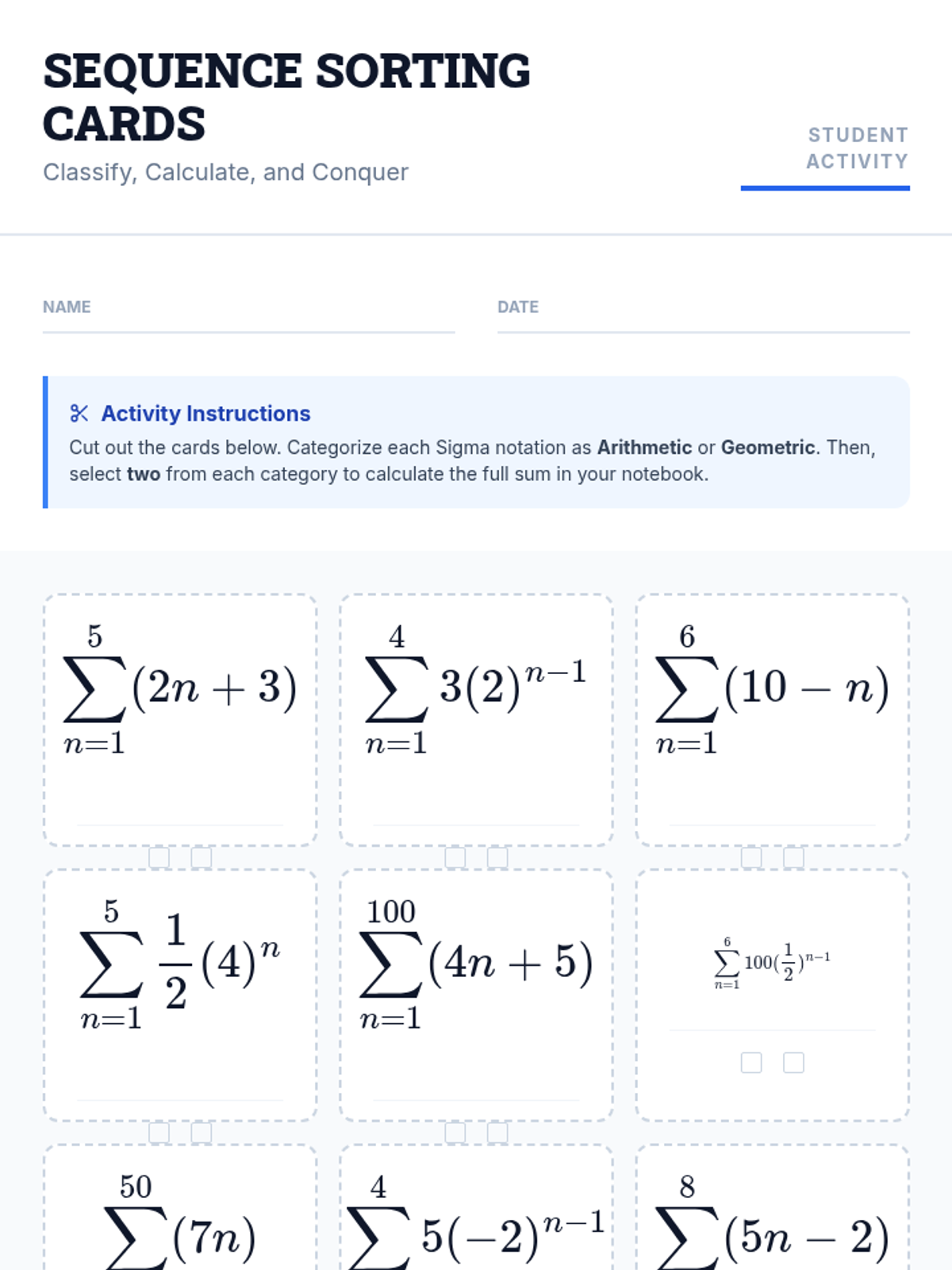
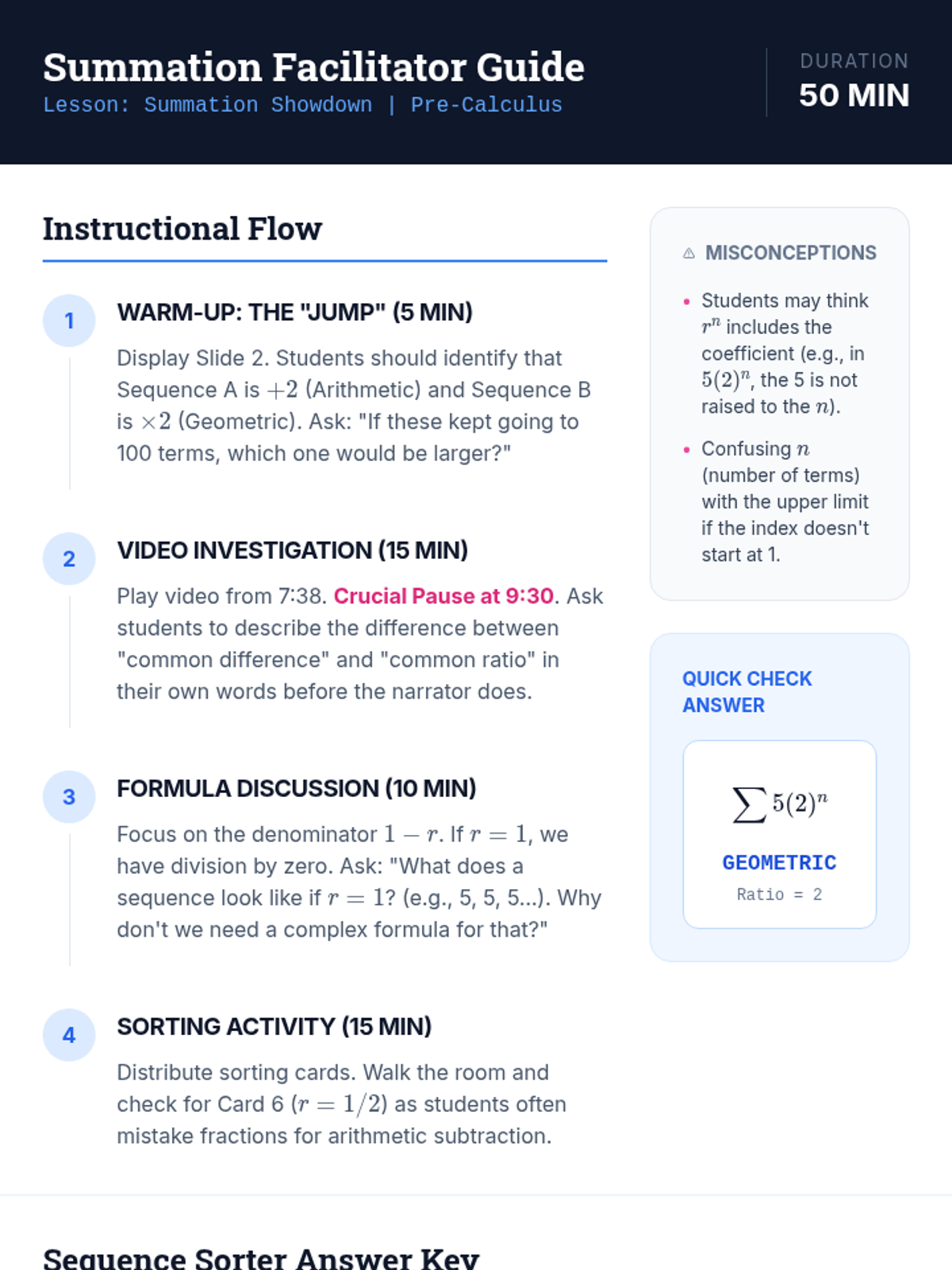
A Pre-Calculus lesson focused on distinguishing between arithmetic and geometric sequences and applying the finite geometric sum formula through visual analysis and active sorting.
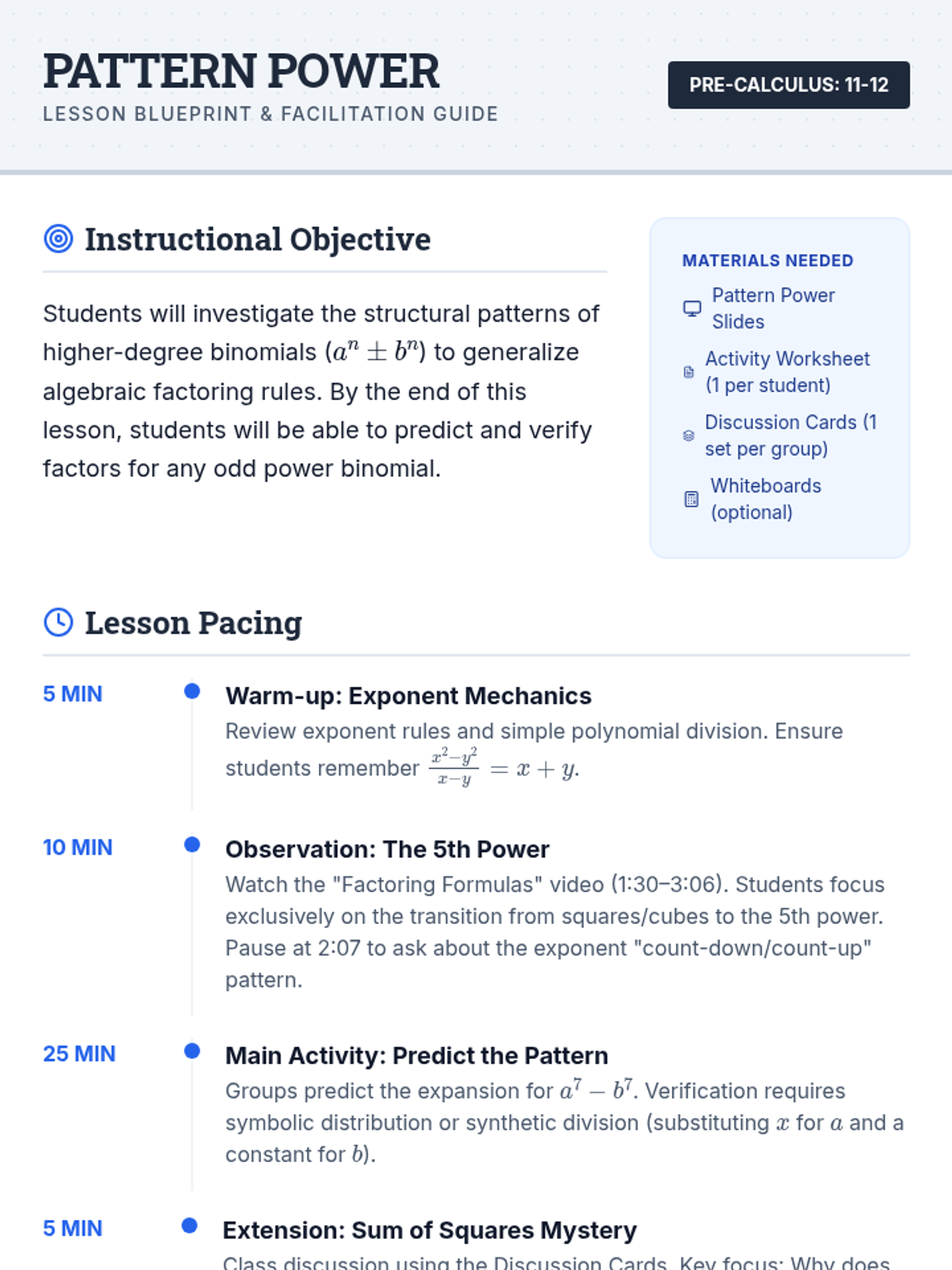
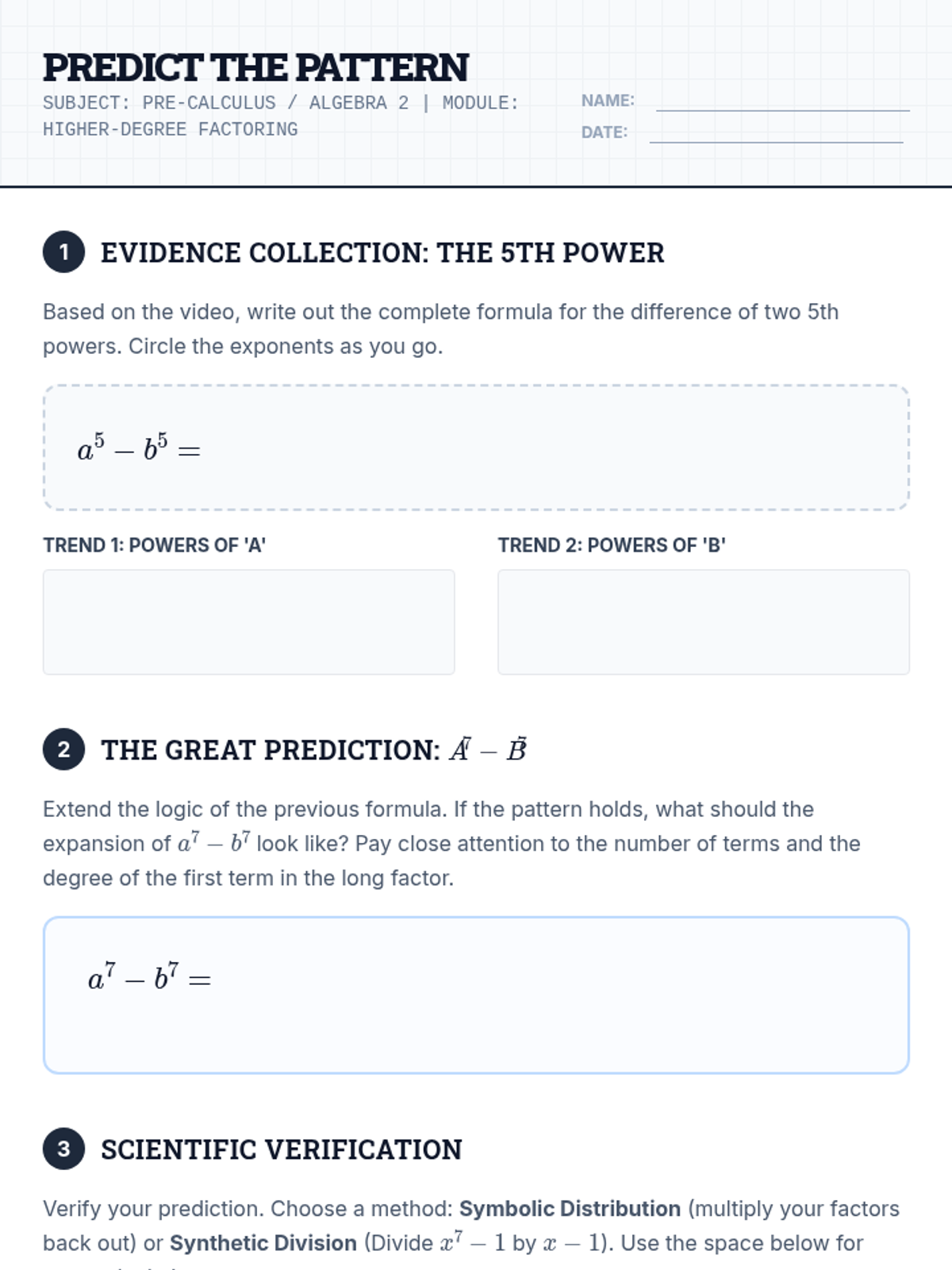
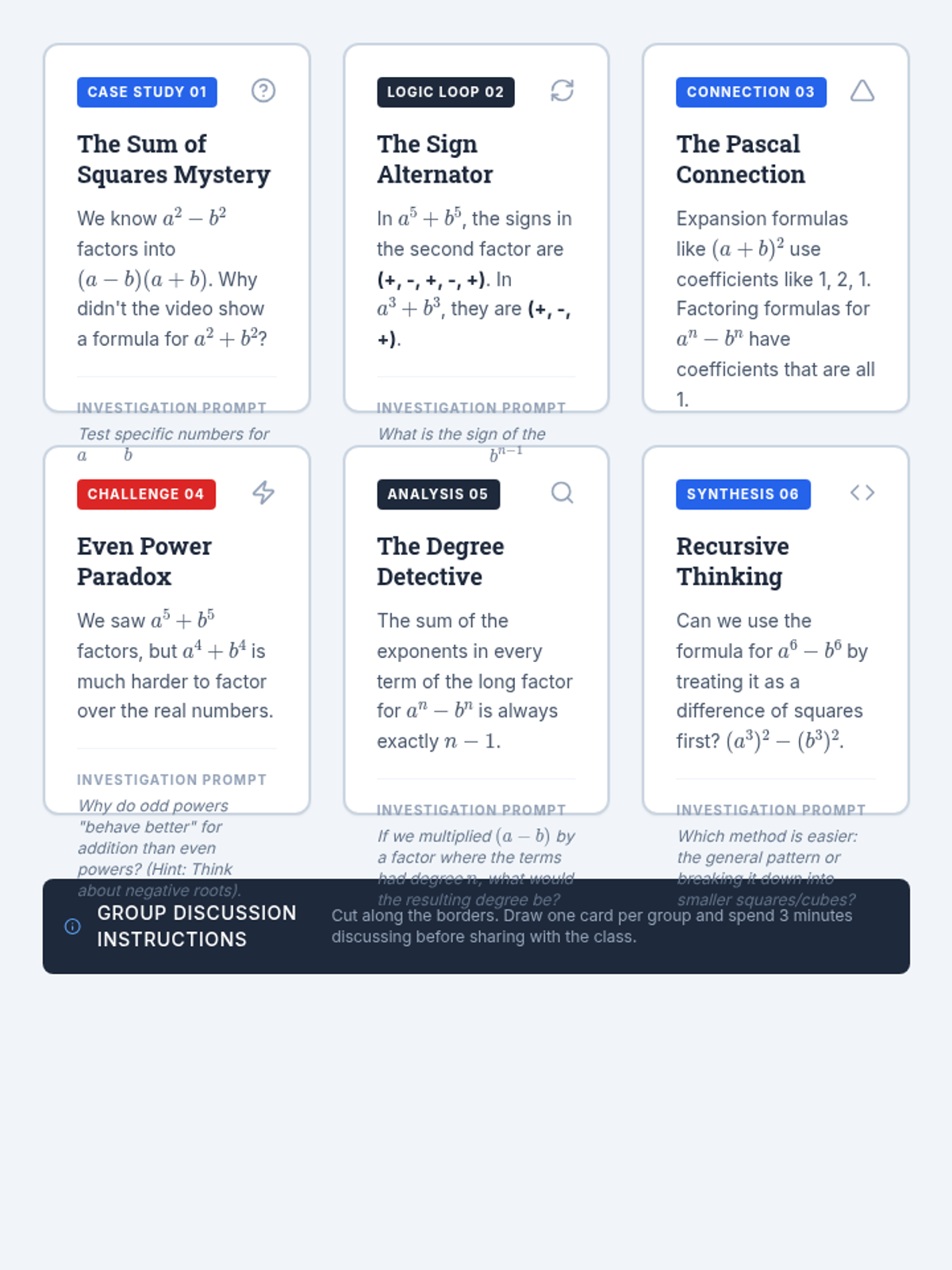
Students will investigate the patterns of higher-degree binomials (\(a^n \pm b^n\)) to generalize algebraic rules and predict factoring formulas for powers beyond the cubic.
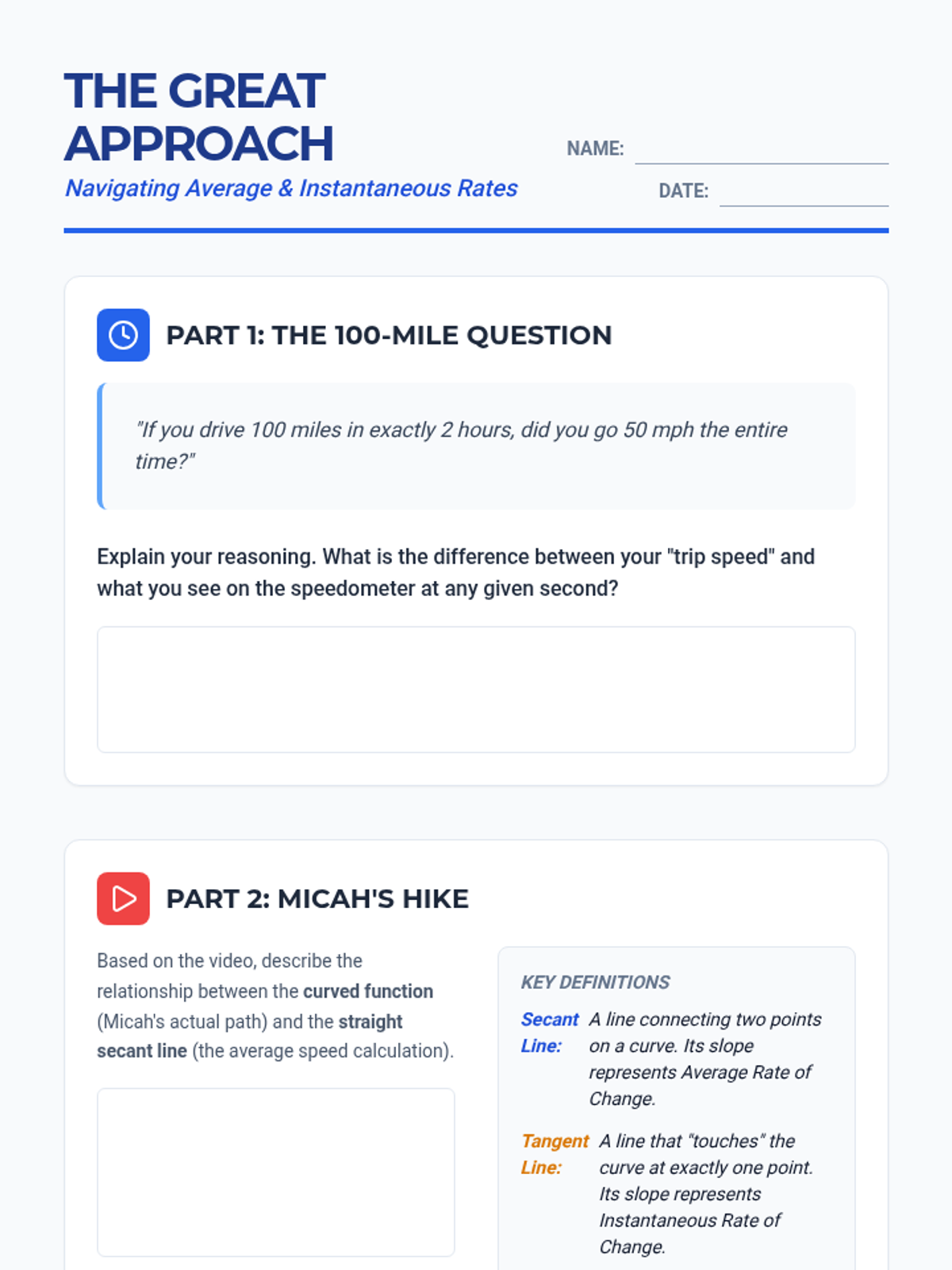
This lesson introduces students to the distinction between average and instantaneous rates of change. Students analyze non-linear functions, watch a video on real-world applications, and perform a limiting process activity to see how average rates approach instantaneous speed.
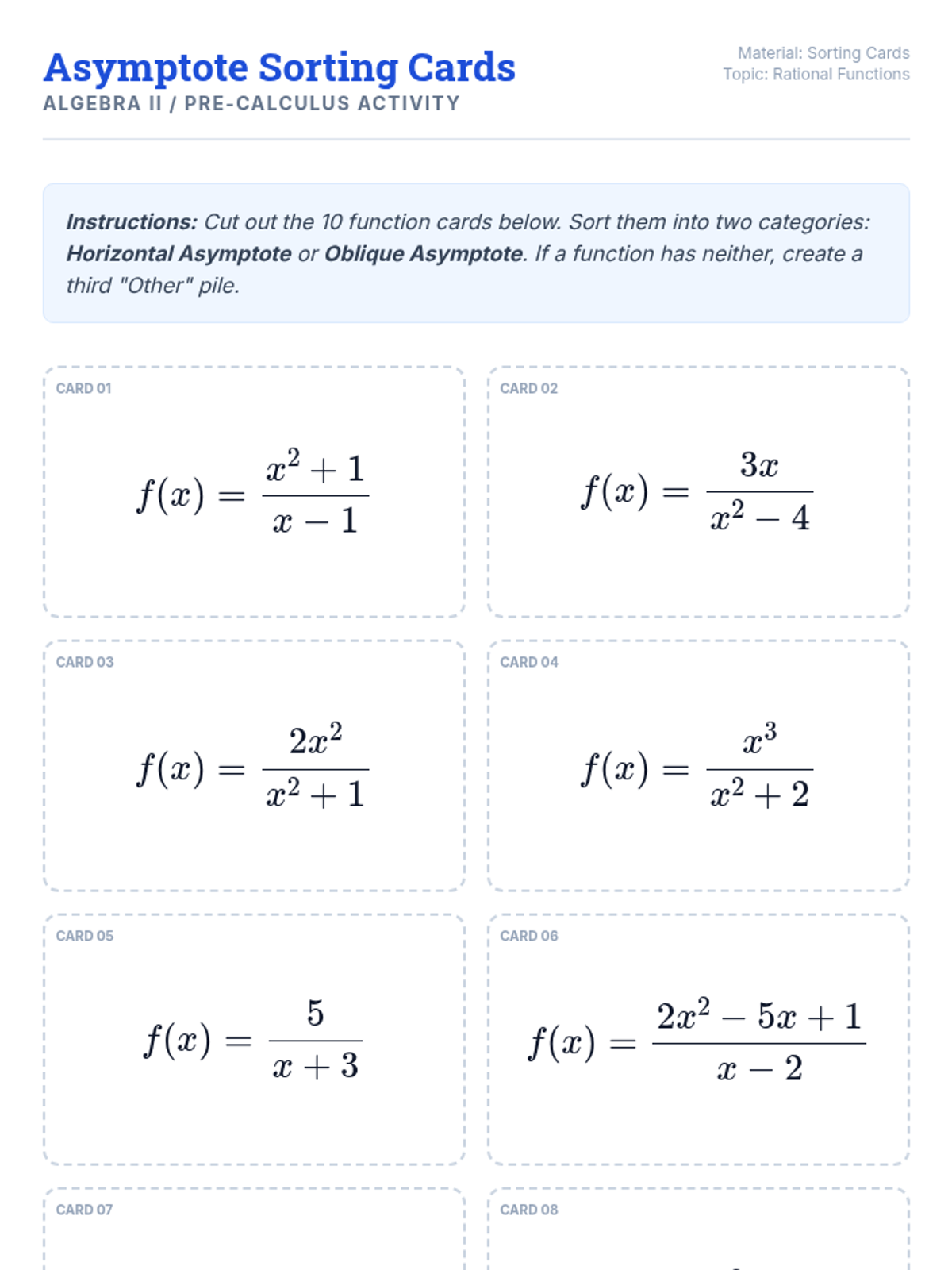
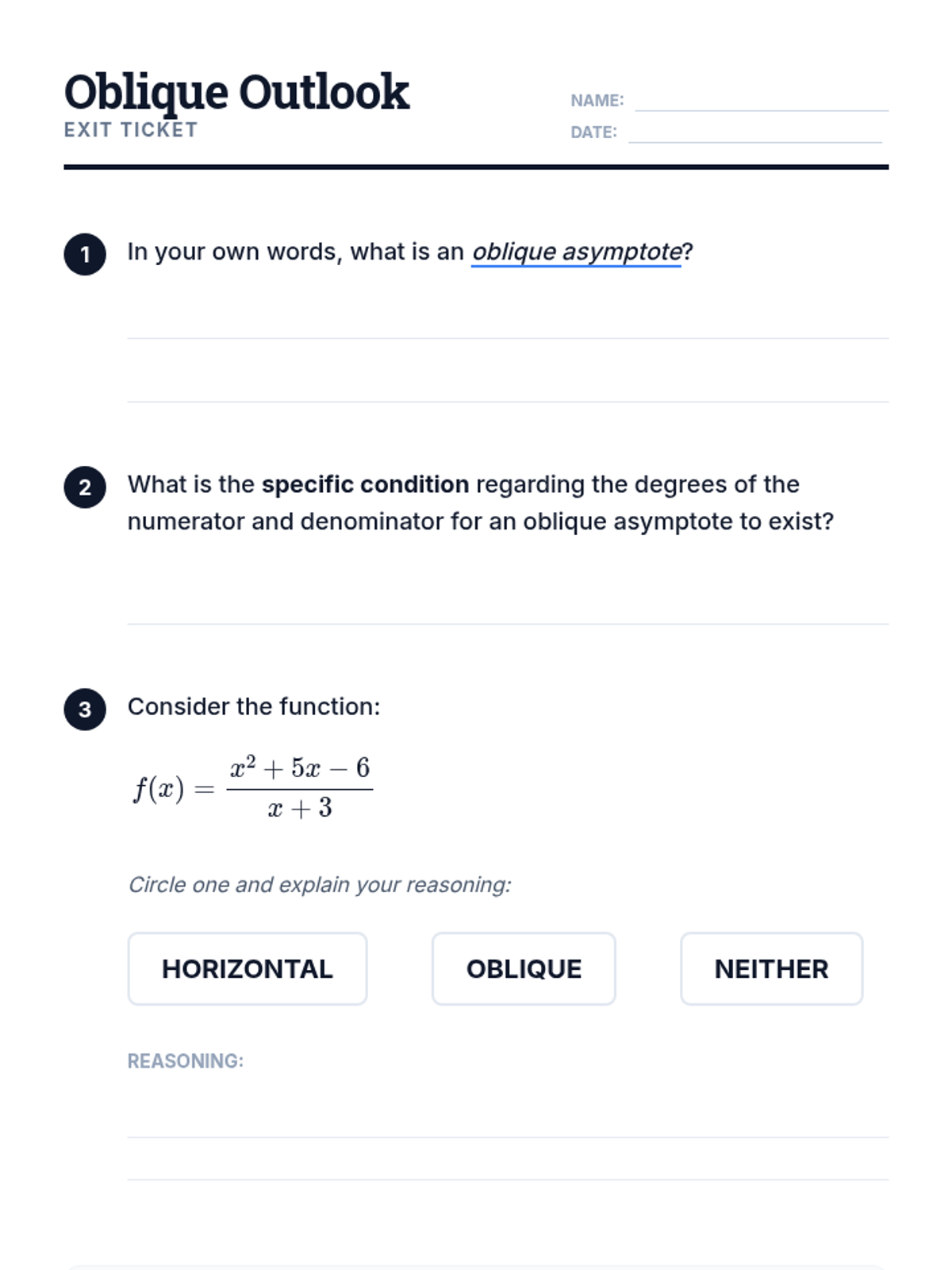
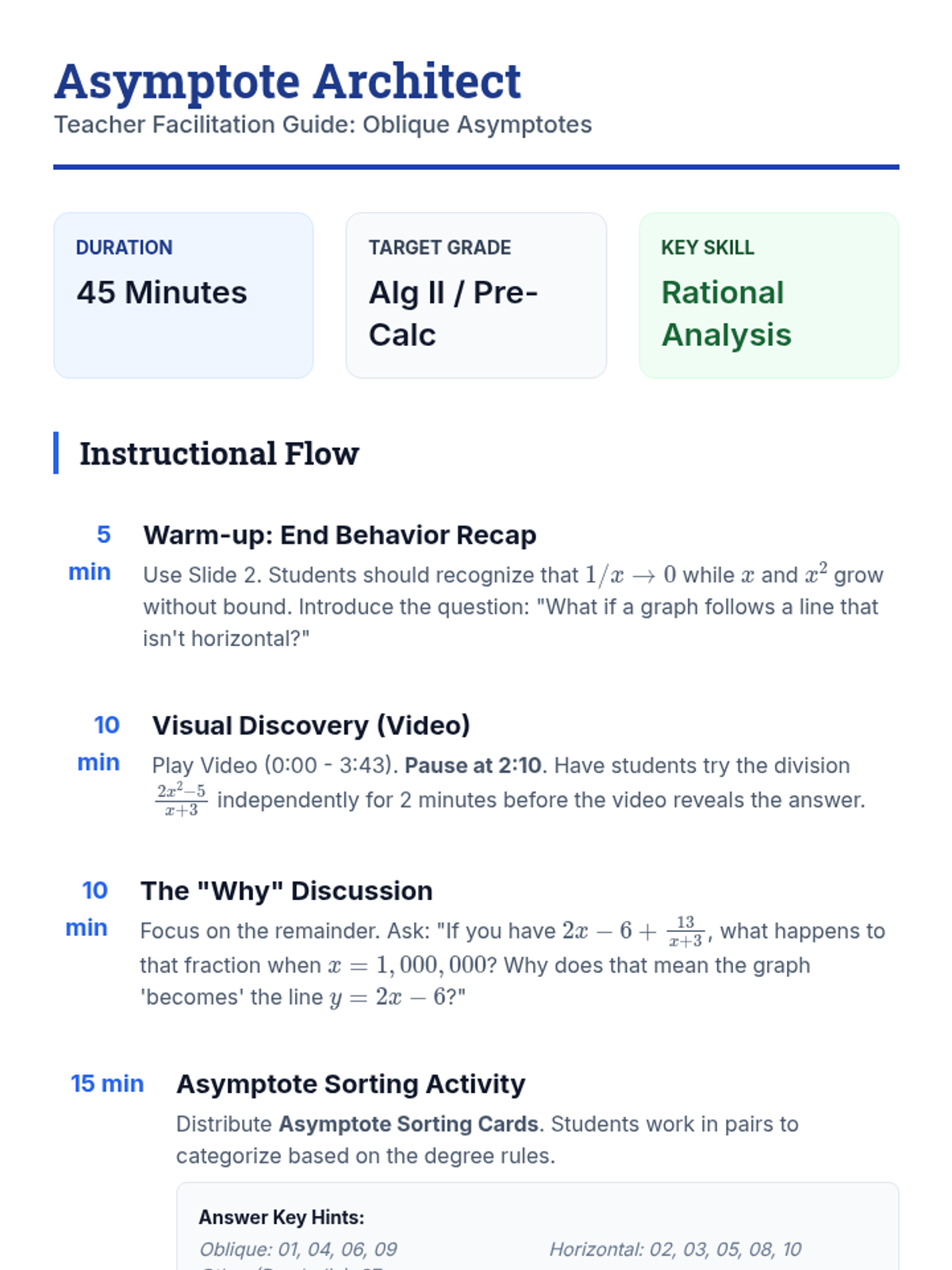
A high school Algebra II/Pre-Calculus lesson where students discover and calculate oblique asymptotes of rational functions through visual analysis, polynomial division, and conceptual reasoning about limits.
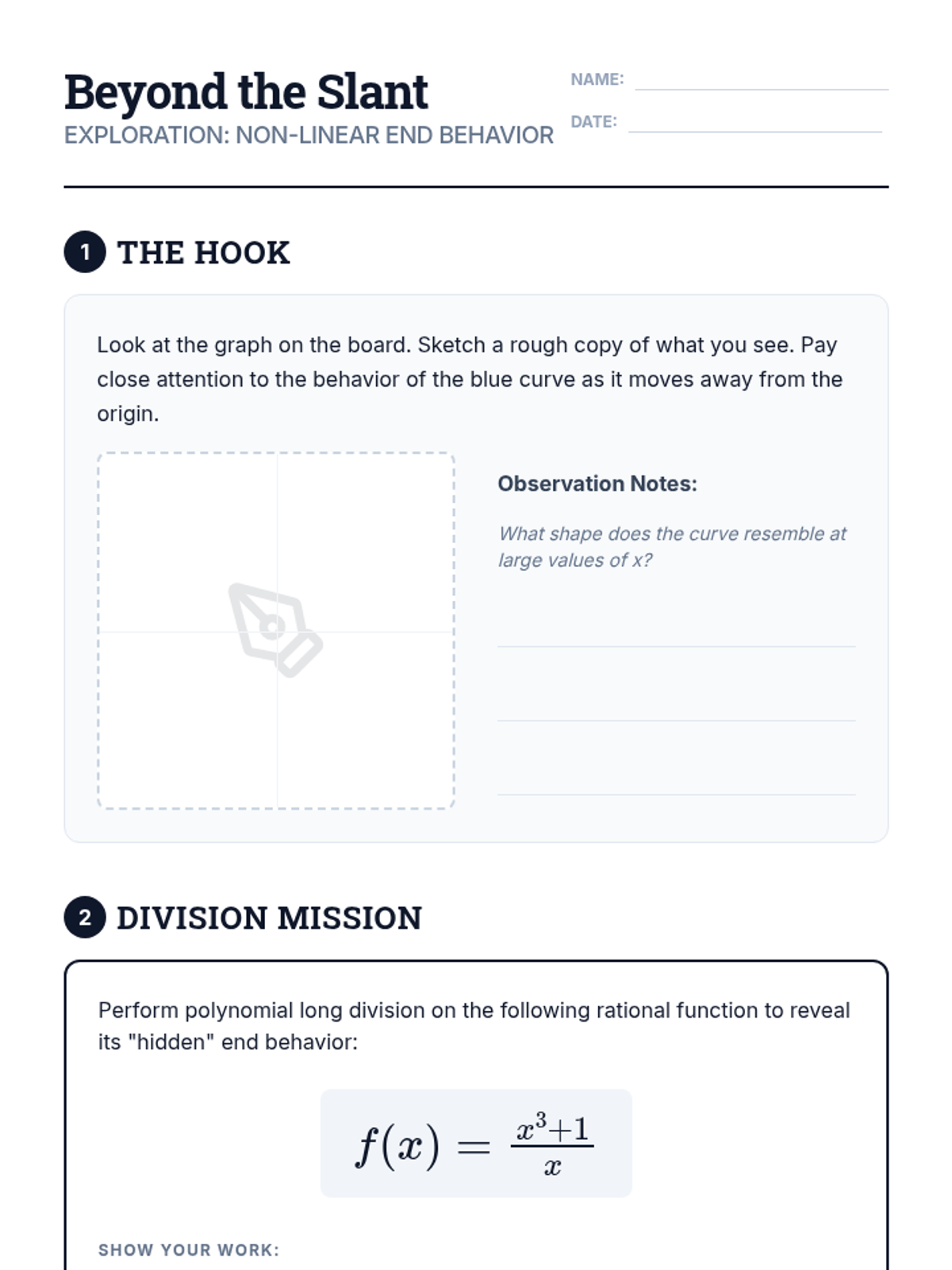
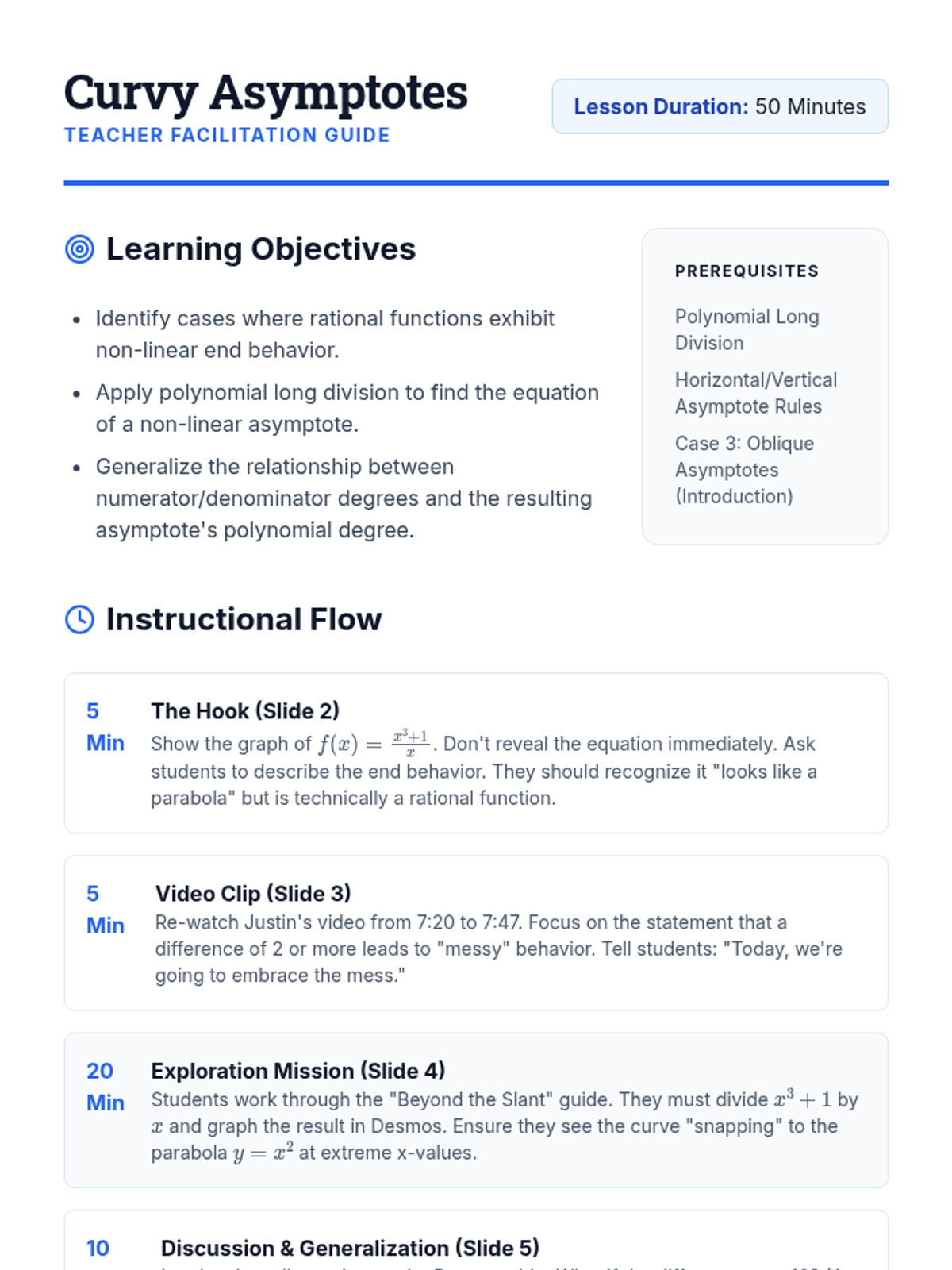
Students explore 'broken' cases of rational functions where the degree of the numerator is two or more higher than the denominator, leading to non-linear (polynomial) asymptotes.
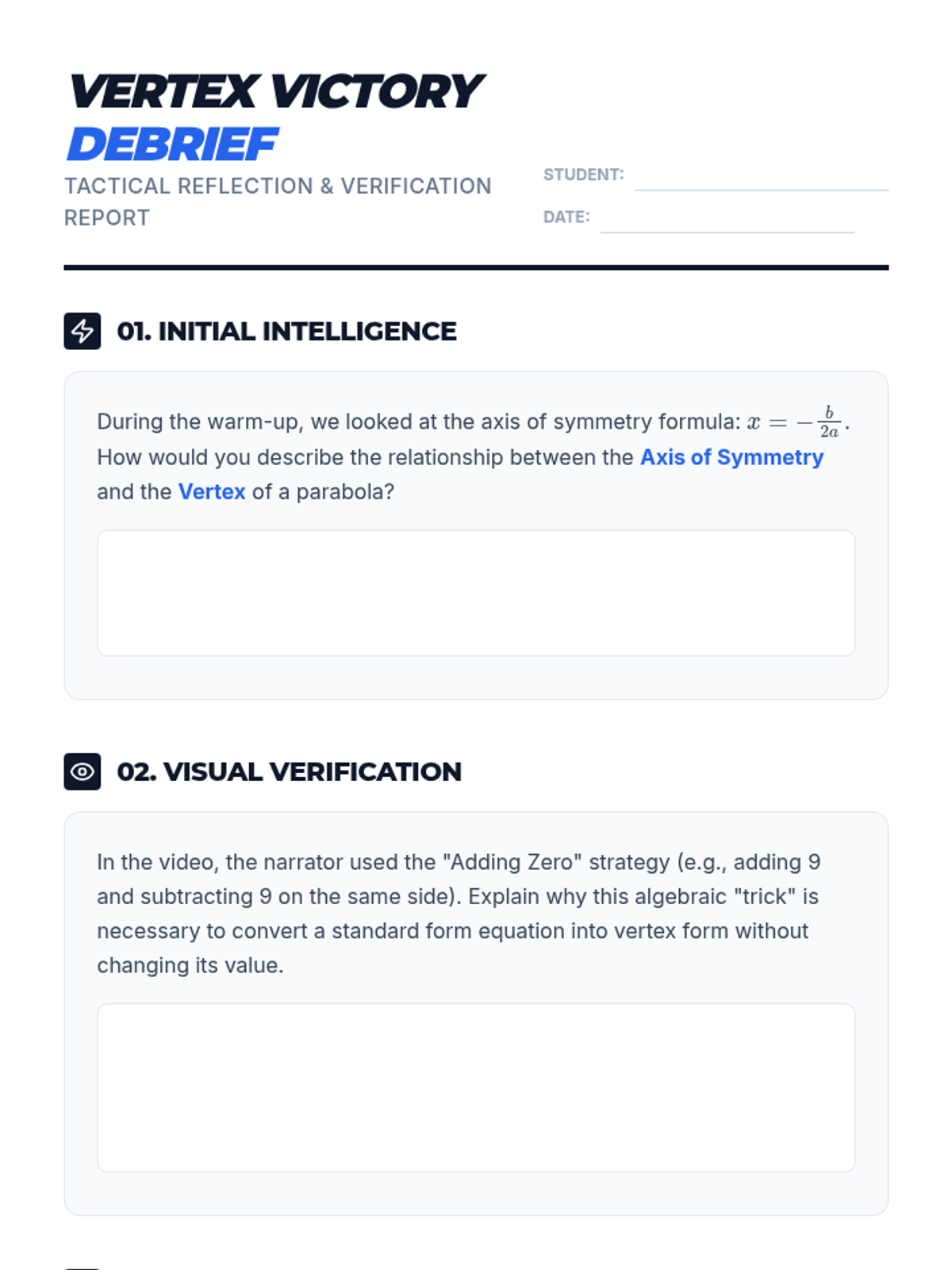
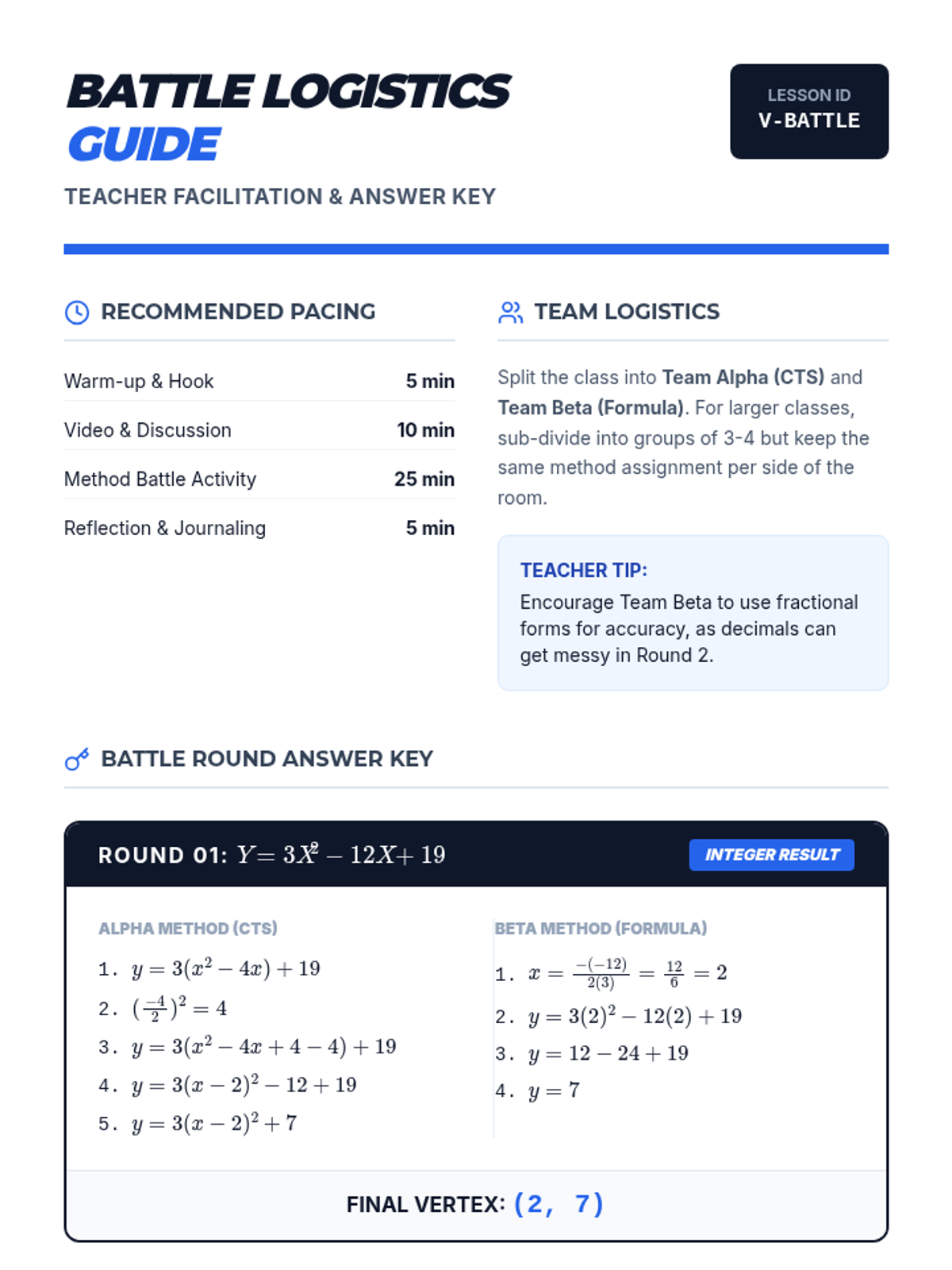
Students will verify the vertex of quadratic functions using two distinct algebraic methods: Completing the Square and the Vertex Formula. The lesson features a competitive "Method Battle" to compare efficiency and accuracy between these techniques.
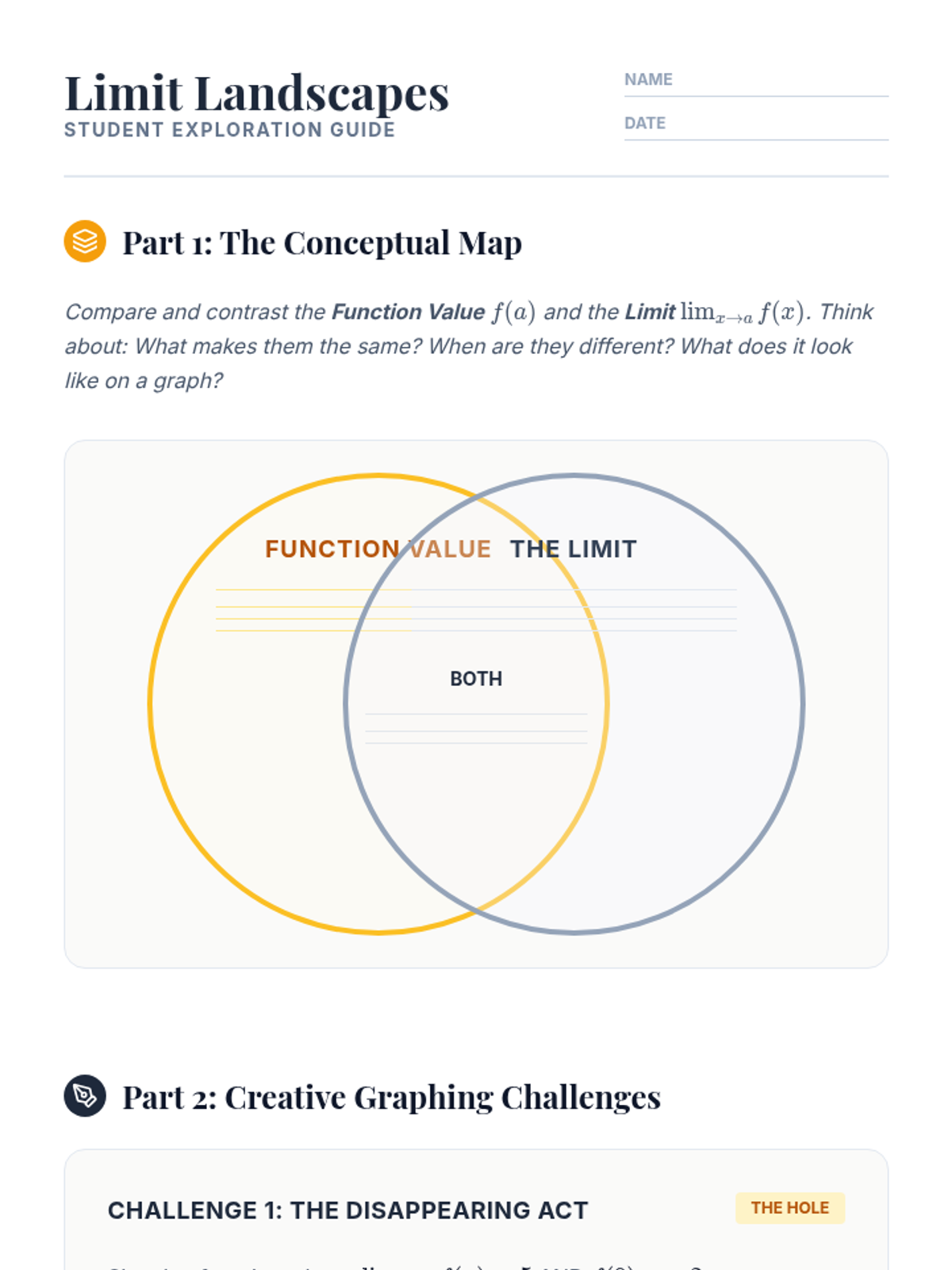
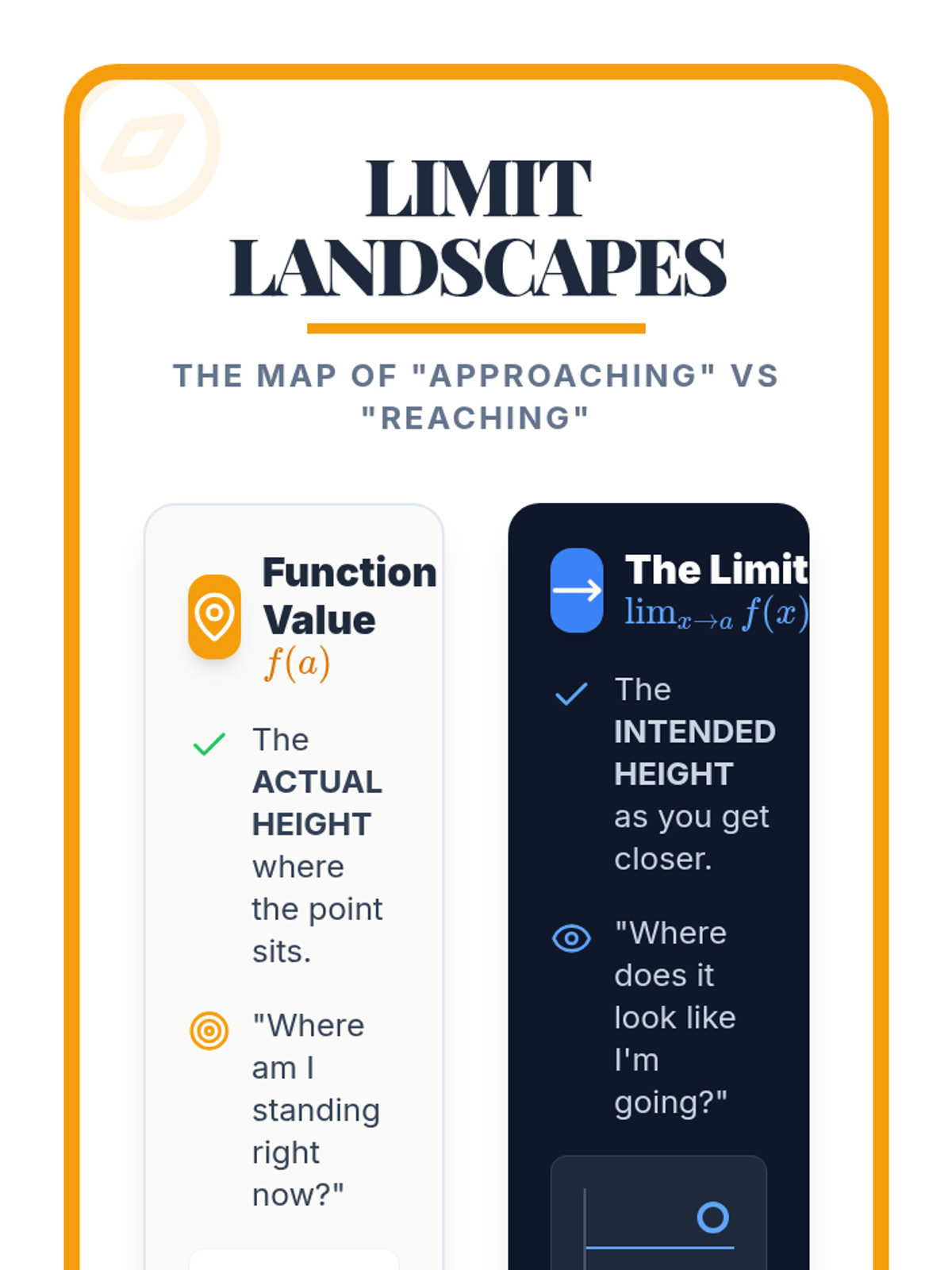
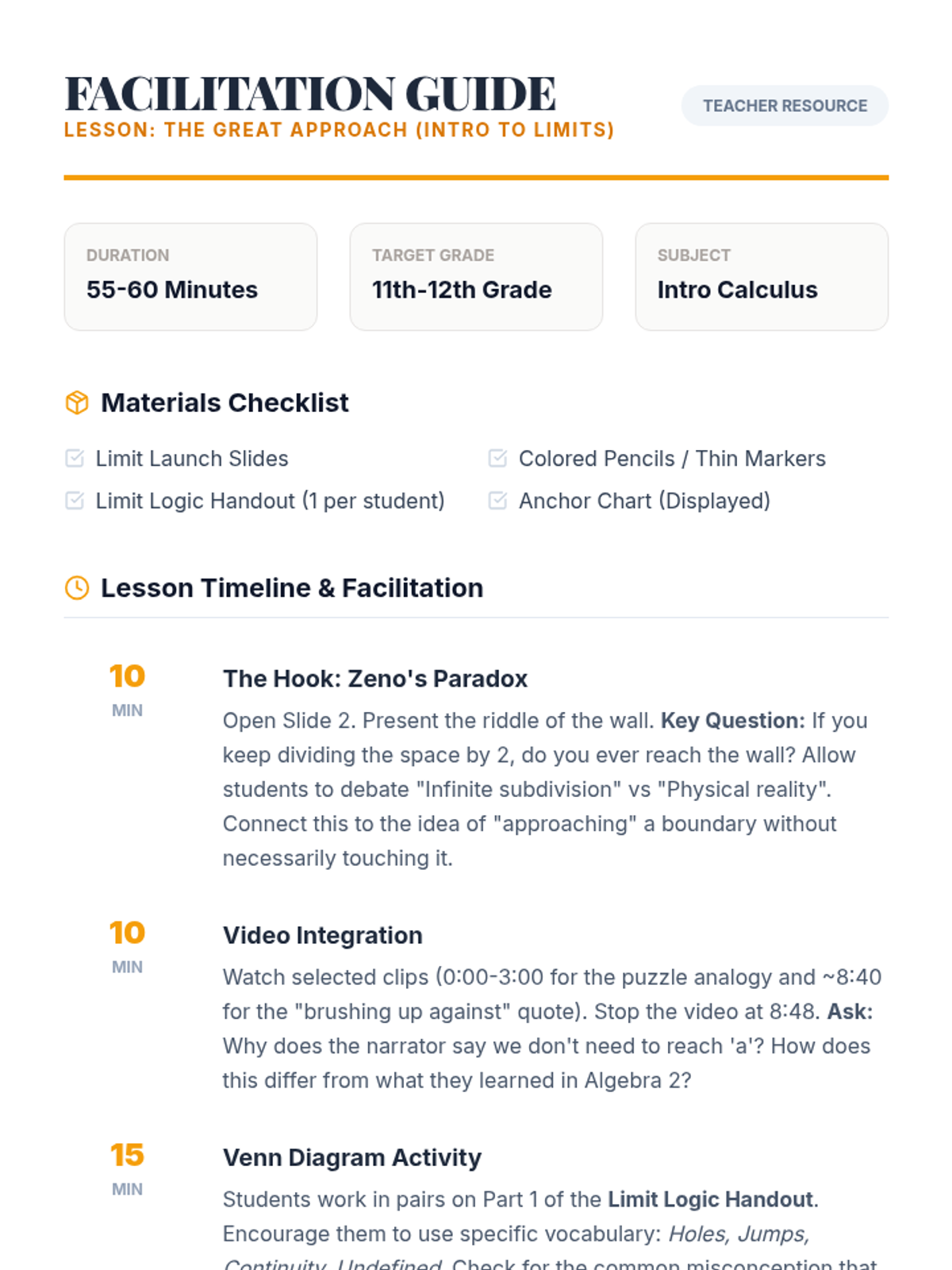
An introductory calculus lesson exploring the concept of limits through Zeno's Paradox, visual analogies, and creative graphing. Students distinguish between a function's value and its limit by analyzing holes, jumps, and continuous behavior.
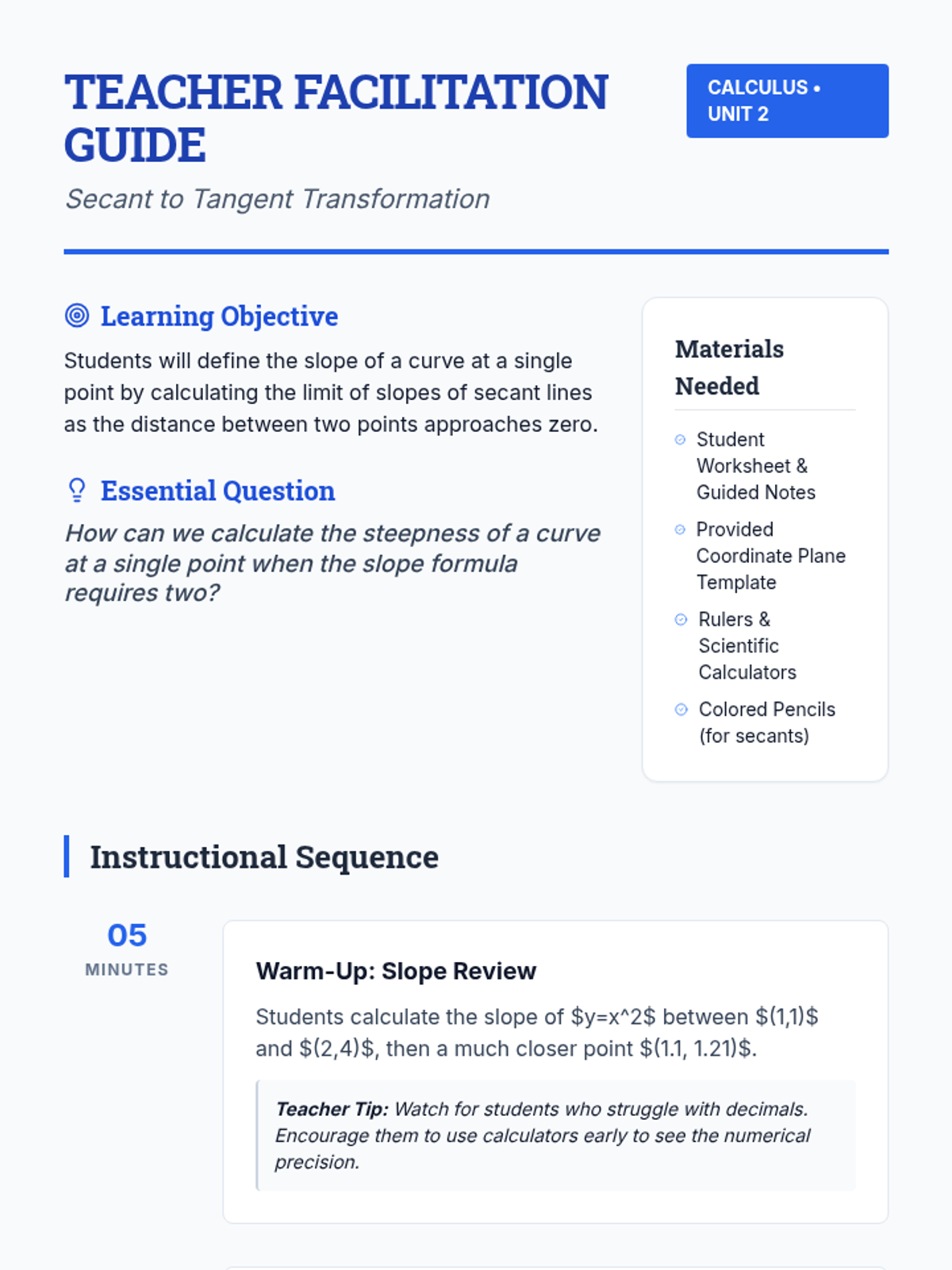
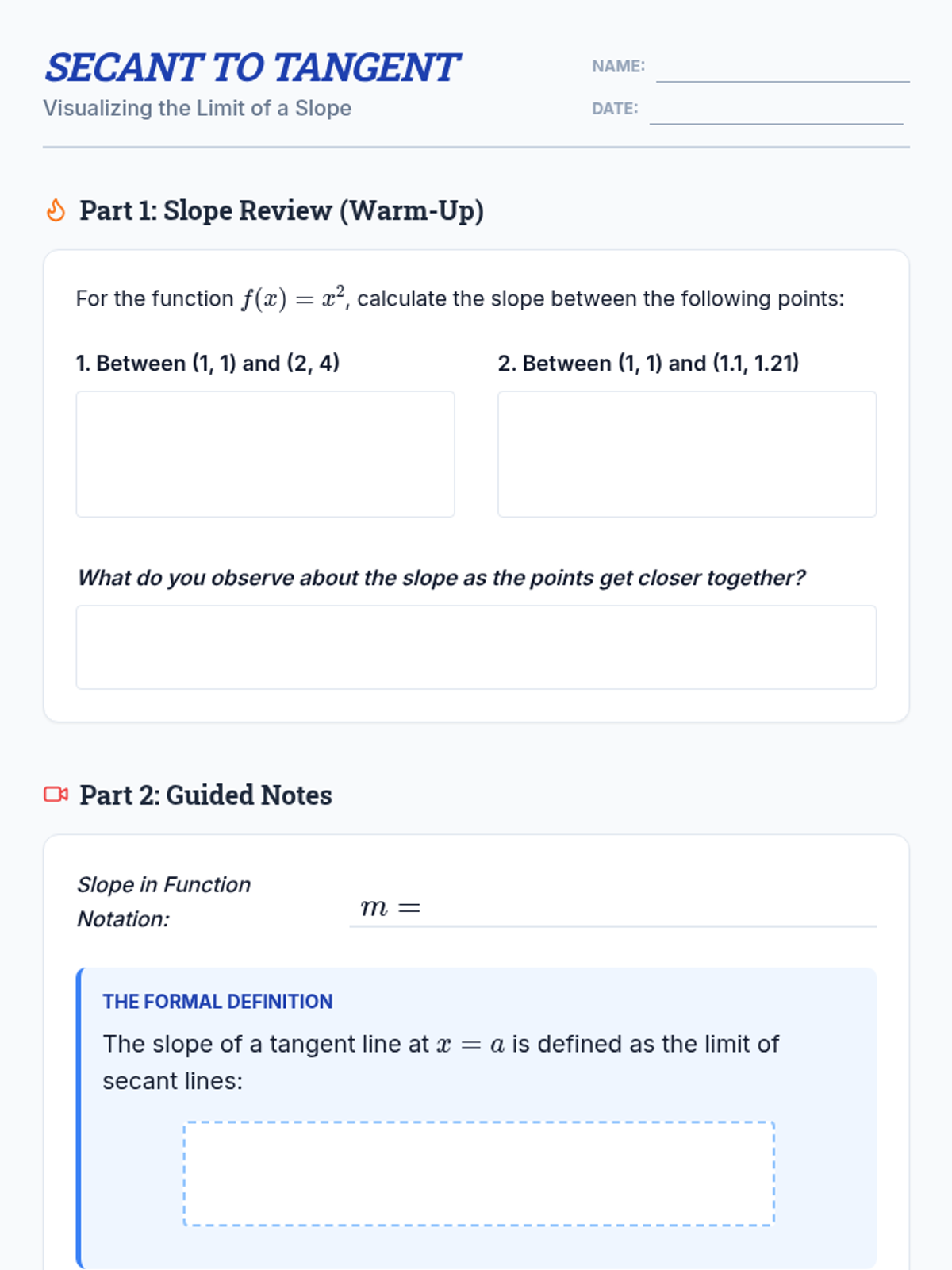
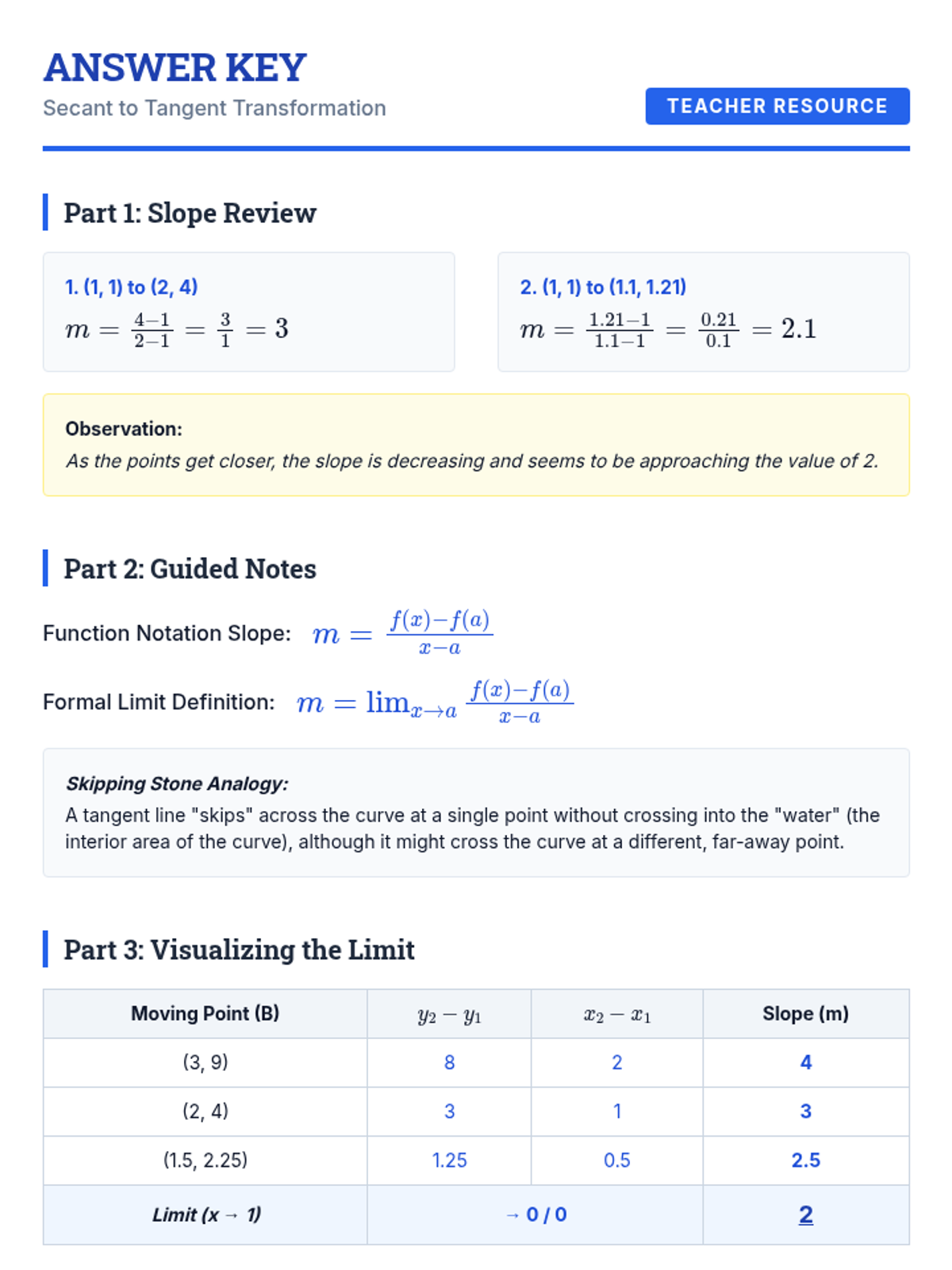
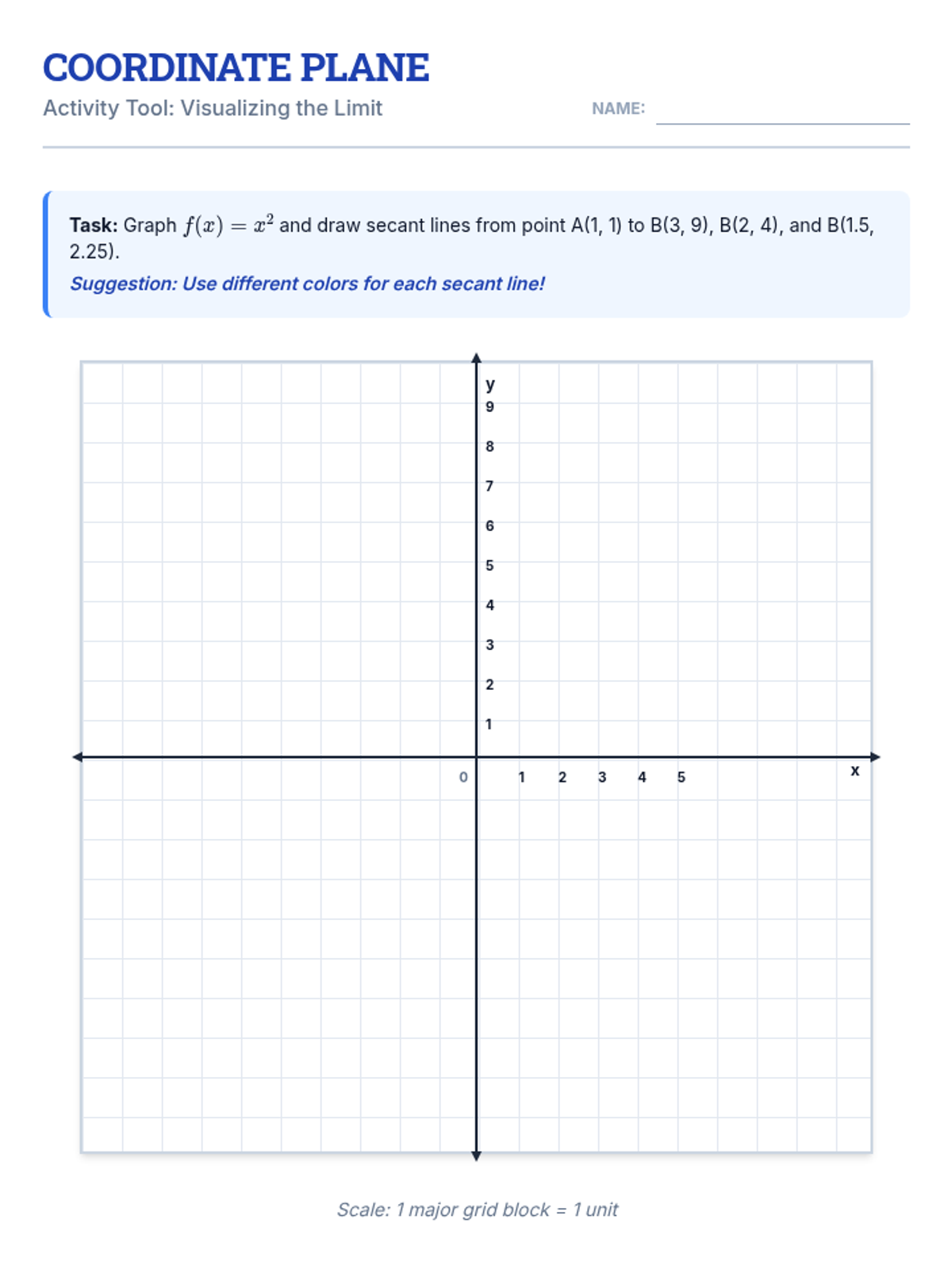
This lesson introduces the concept of a tangent line's slope as the limit of secant line slopes, transitioning students from Algebra 1 slope calculations to the foundational definition of a derivative. Students will use graphing and numerical estimation to see how a secant line 'becomes' a tangent line as the distance between points approaches zero.
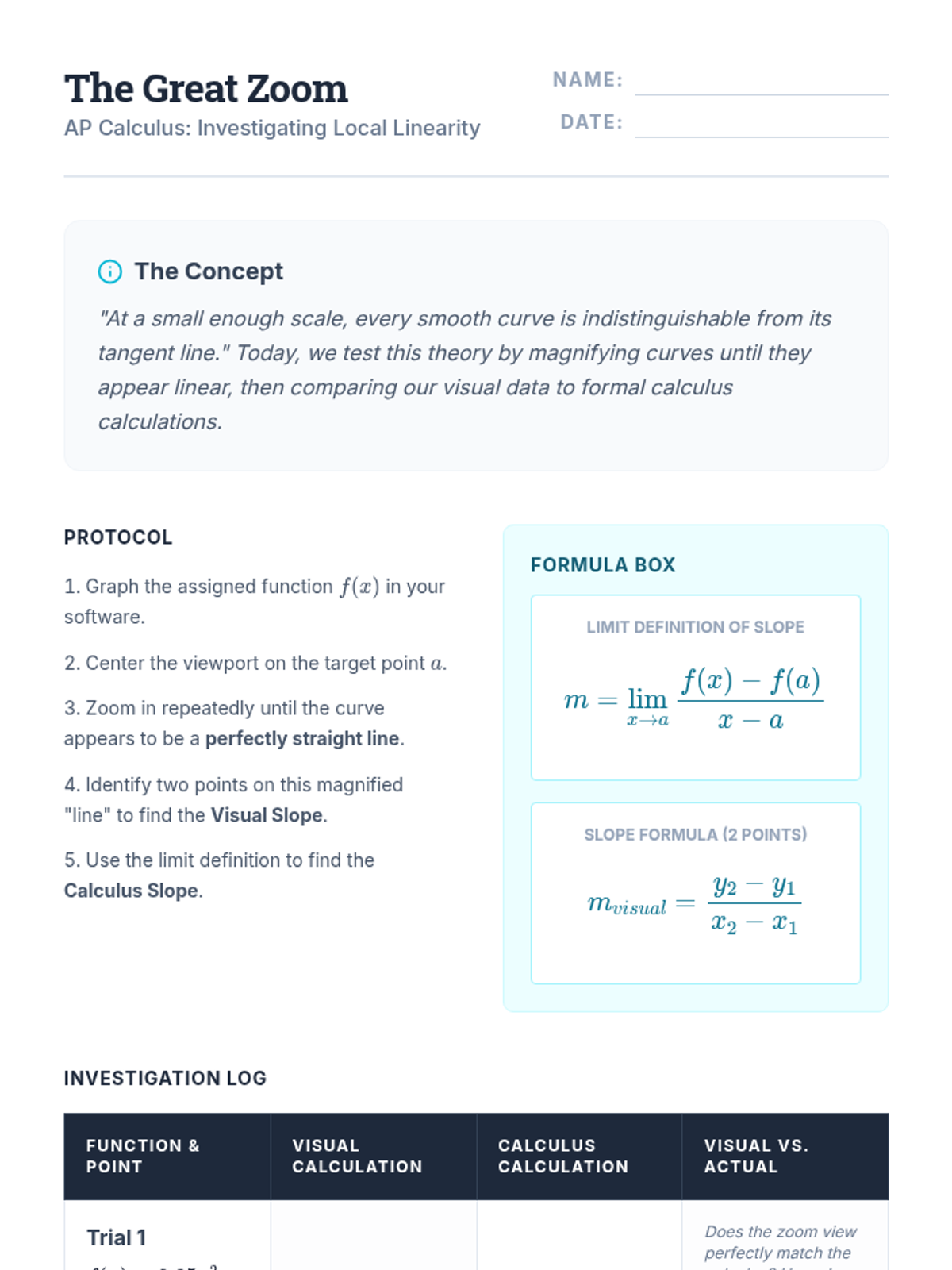
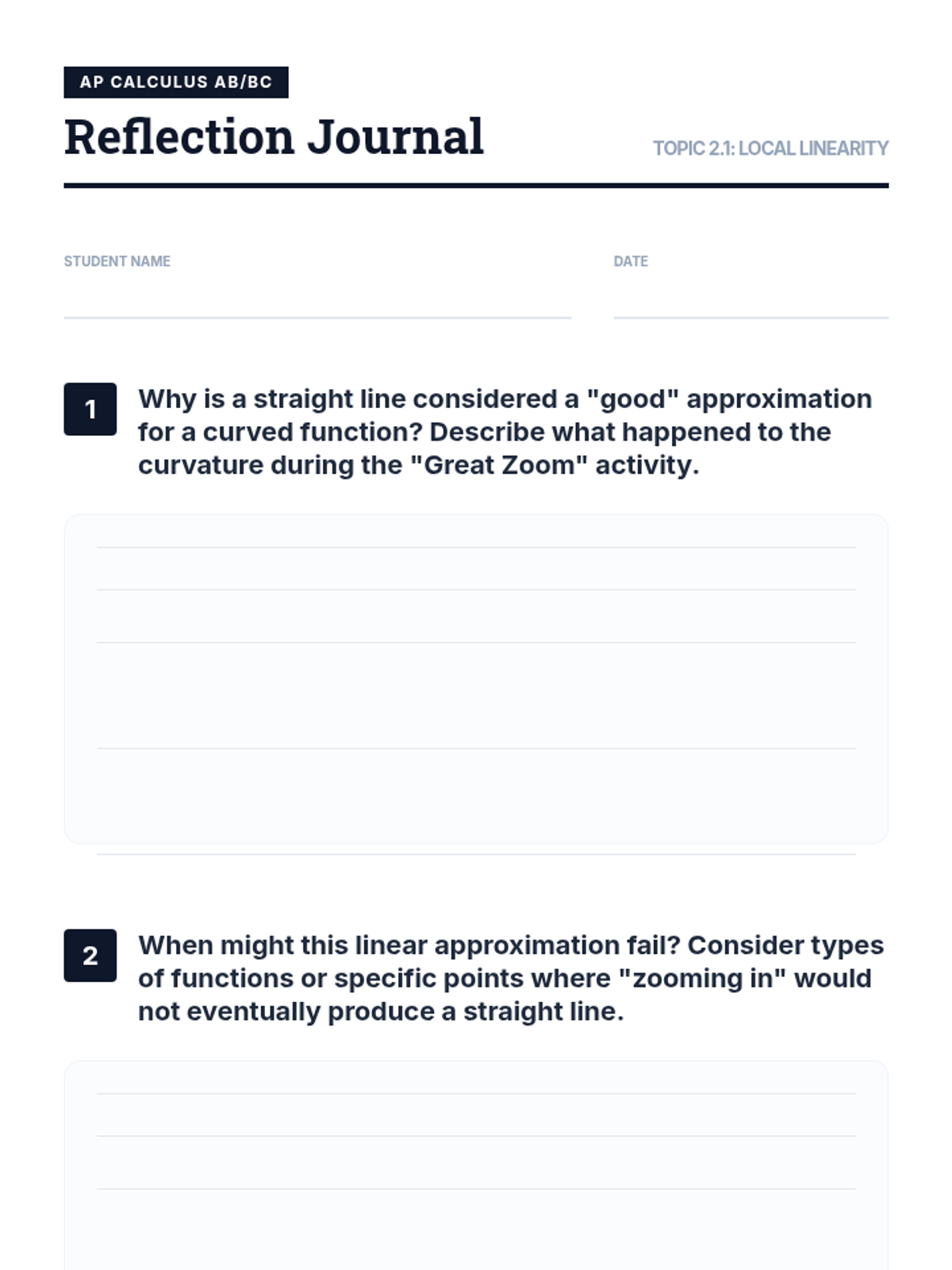
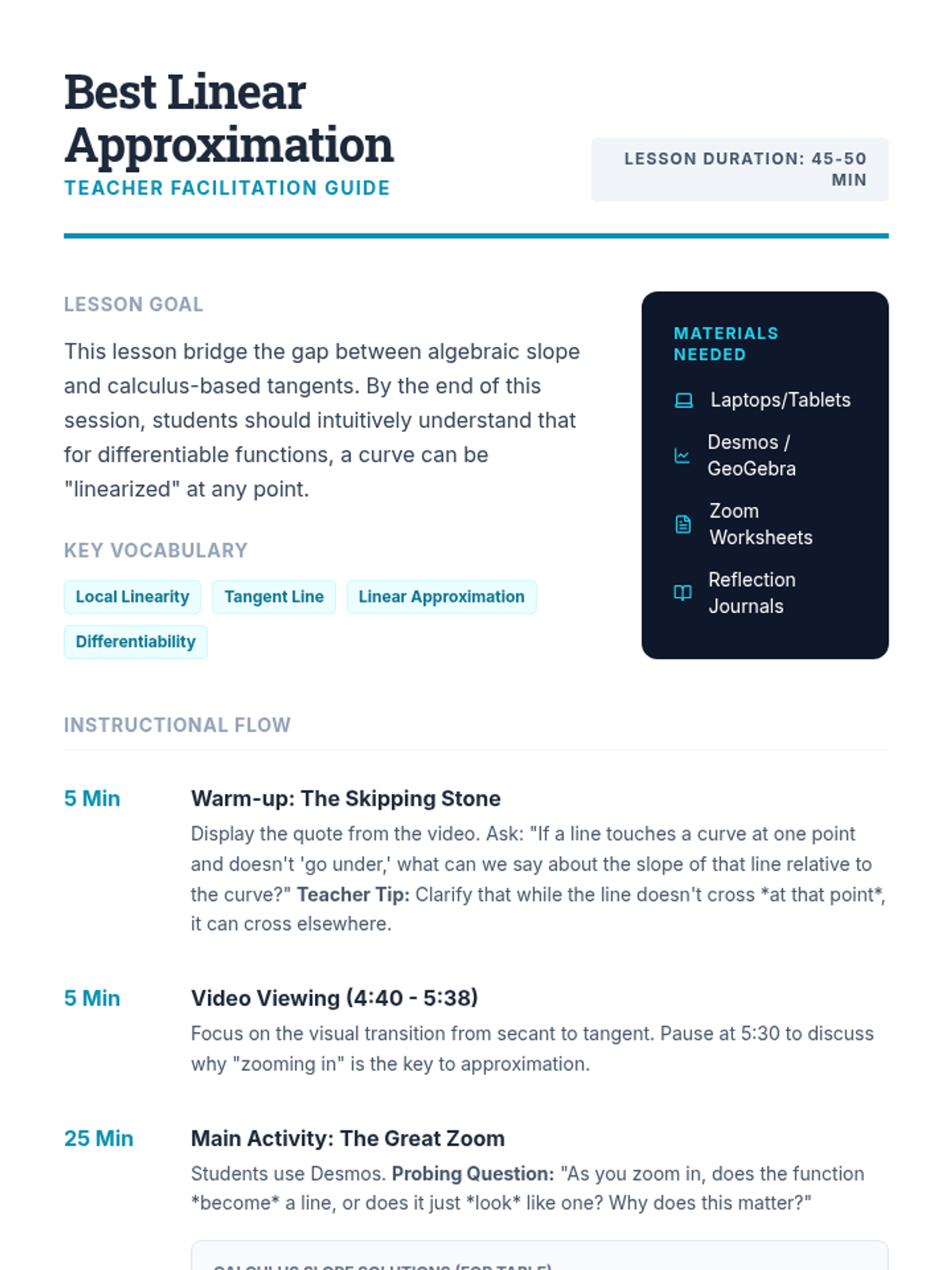
This AP Calculus lesson explores the concept of local linearity by investigating how curves appear linear when magnified. Students will use the limit definition of a tangent line to calculate slopes and compare them to visual approximations from 'zooming in'.
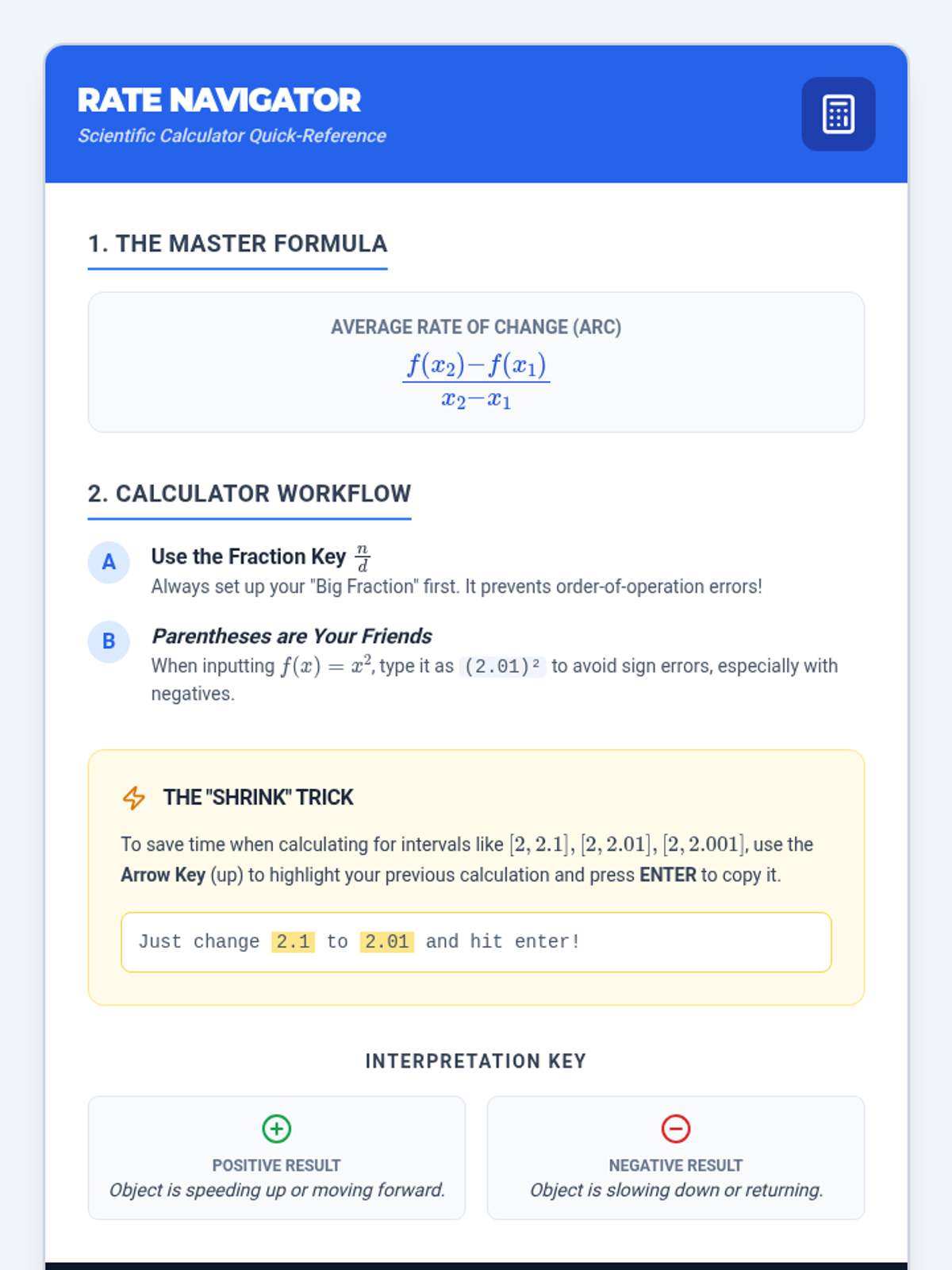
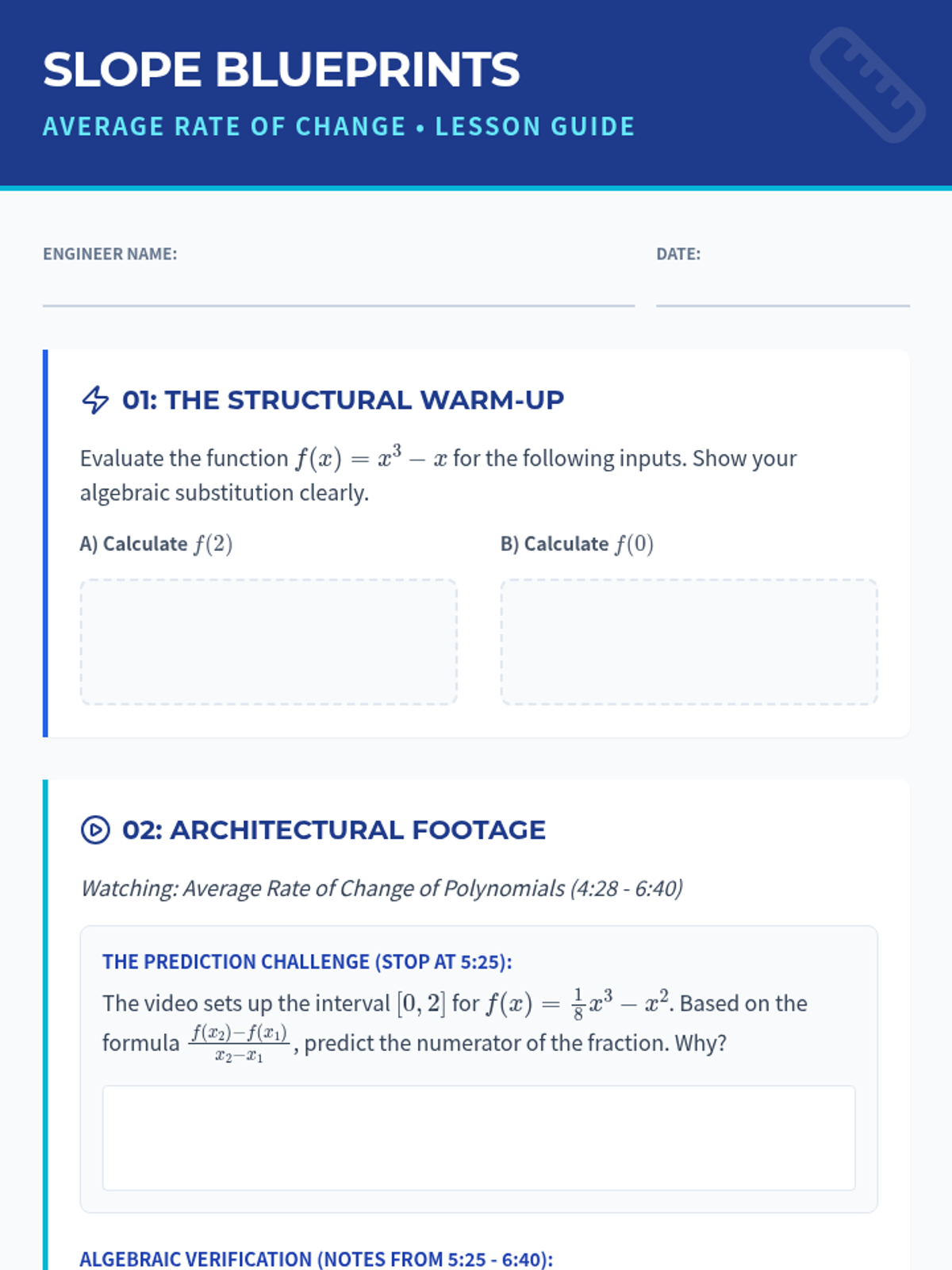
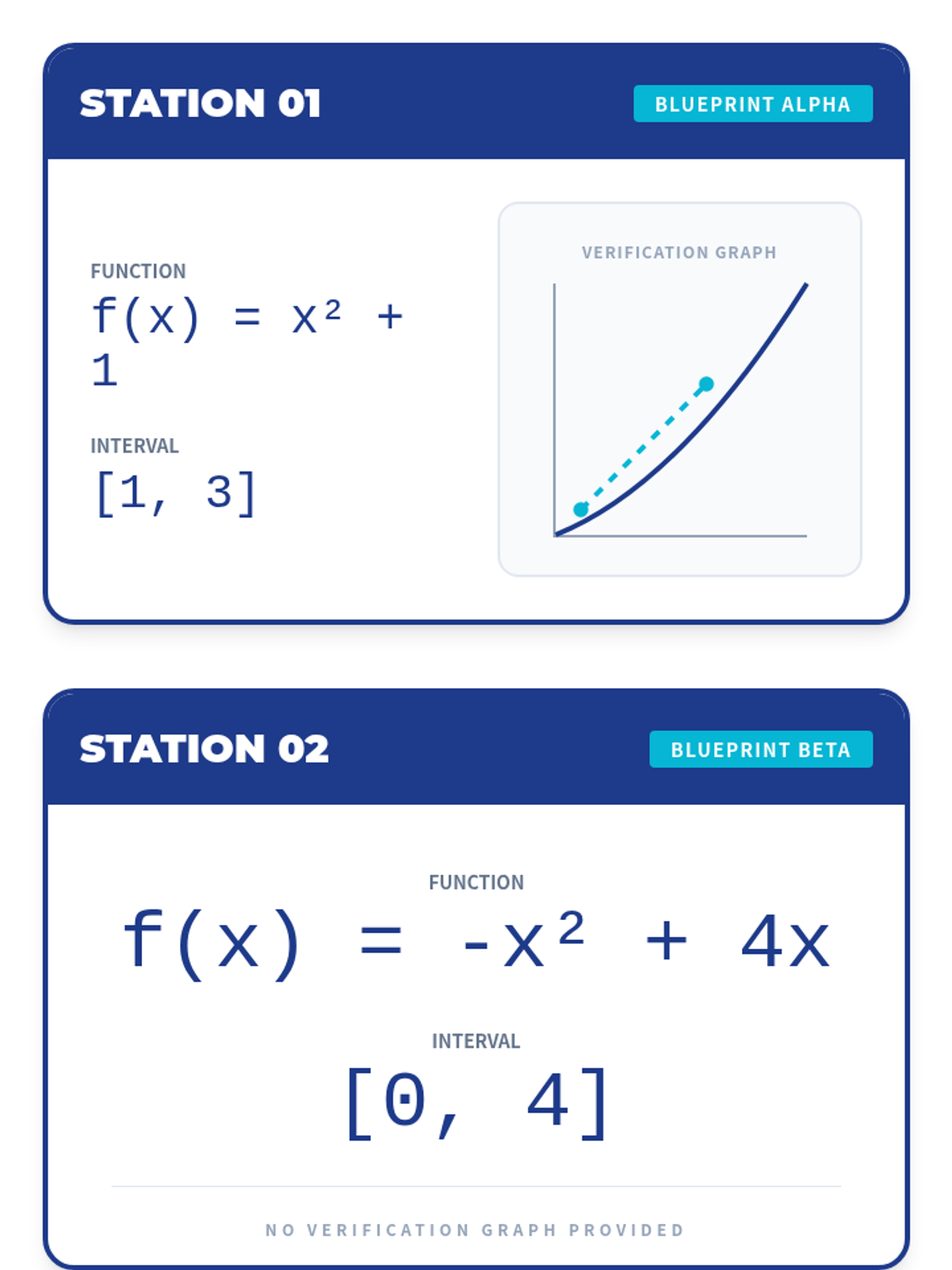
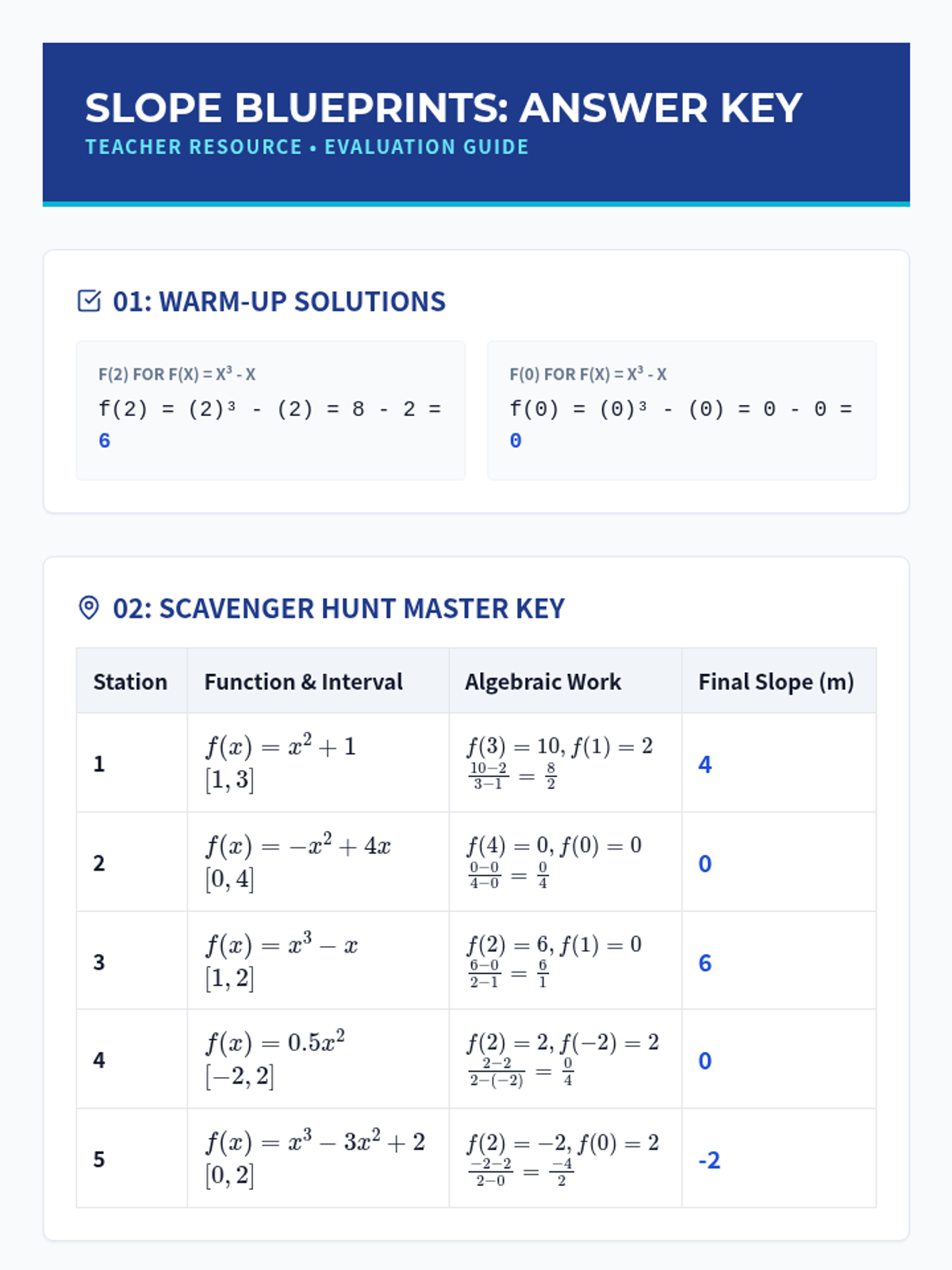
A Pre-Calculus lesson focused on the algebraic calculation of the average rate of change using function notation, serving as a conceptual bridge to the derivative. Students move from graphical interpretations to precise algebraic substitutions and informal limits.
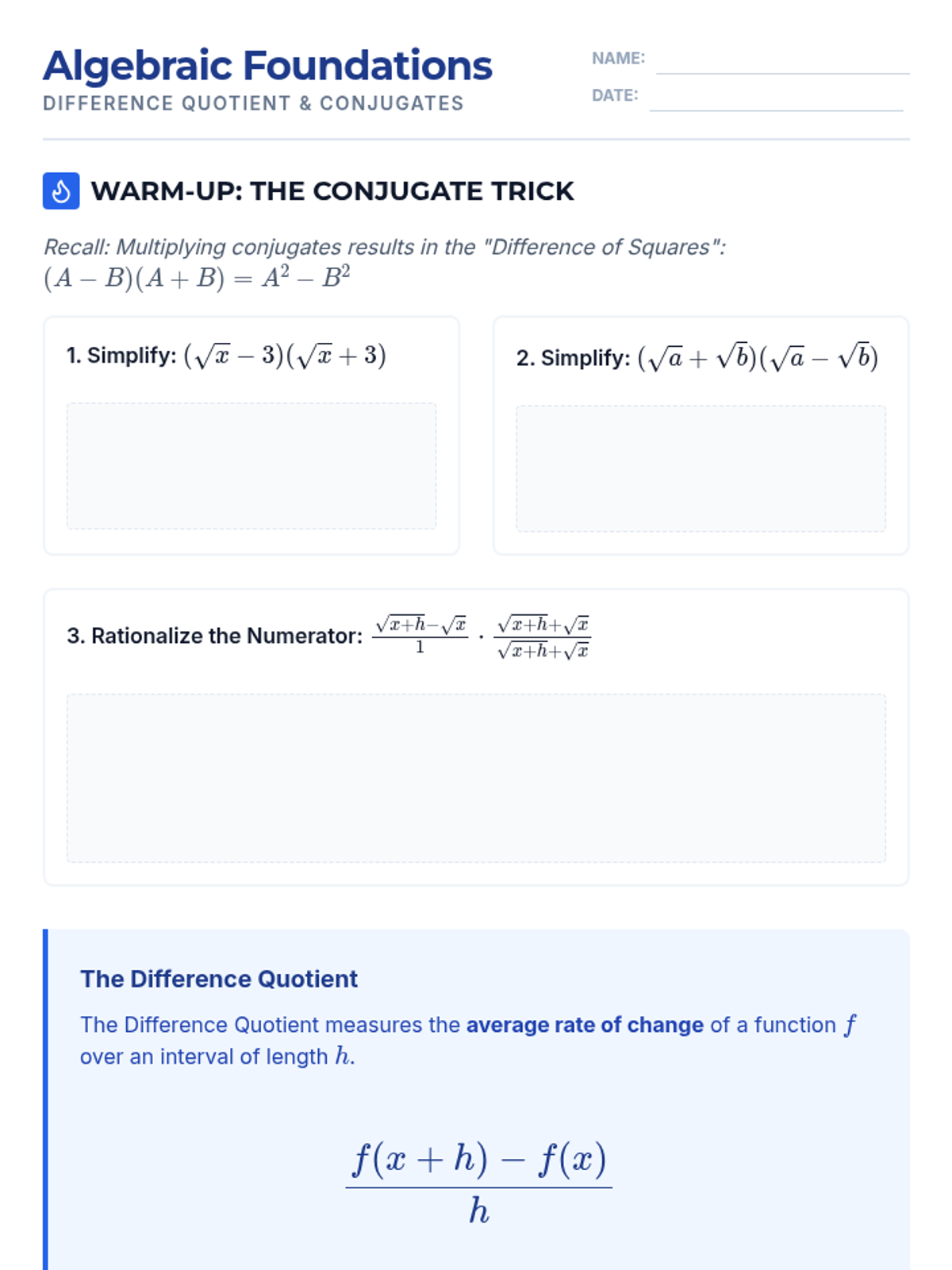
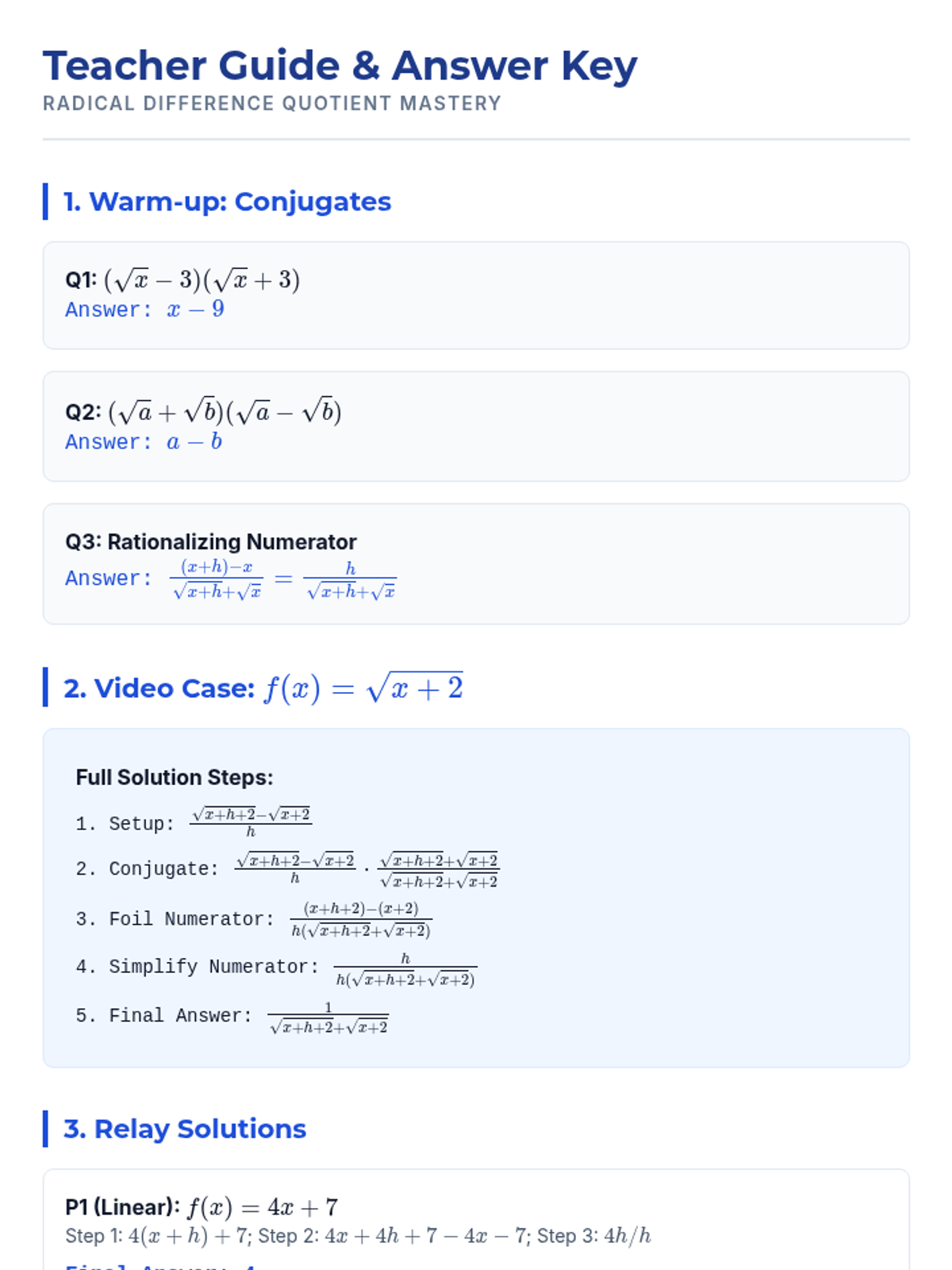
This lesson focuses on calculating the difference quotient for radical functions using the conjugate method. It includes a conjugate warm-up, guided video notes for a complex radical example, a collaborative group relay activity, and a conceptual preview of derivatives.
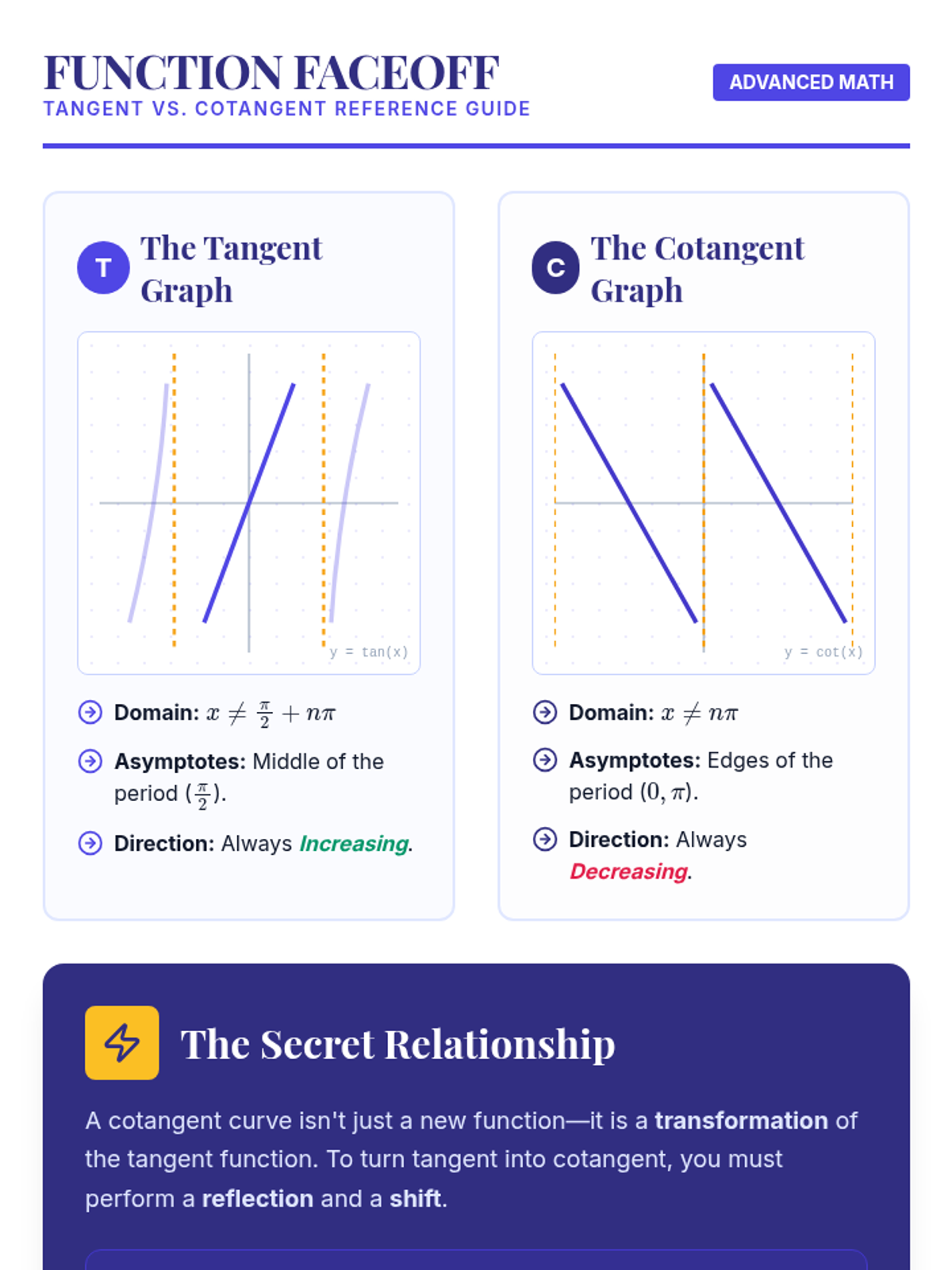
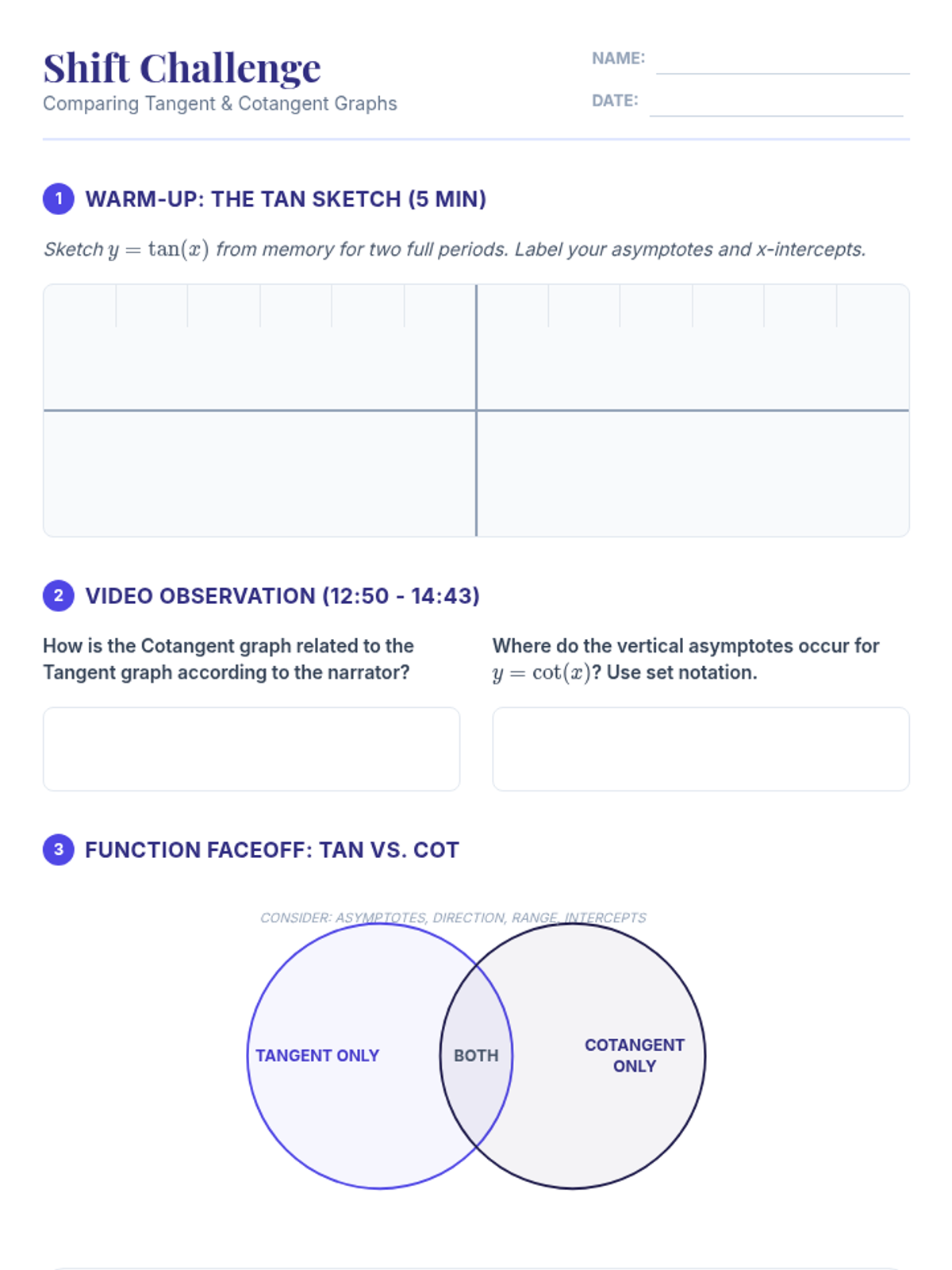
Students will investigate the reciprocal relationship between tangent and cotangent, focusing on their graphical properties, asymptote locations, and algebraic transformations. The lesson culminates in a rigorous proof of the shift-and-reflect relationship between the two functions.
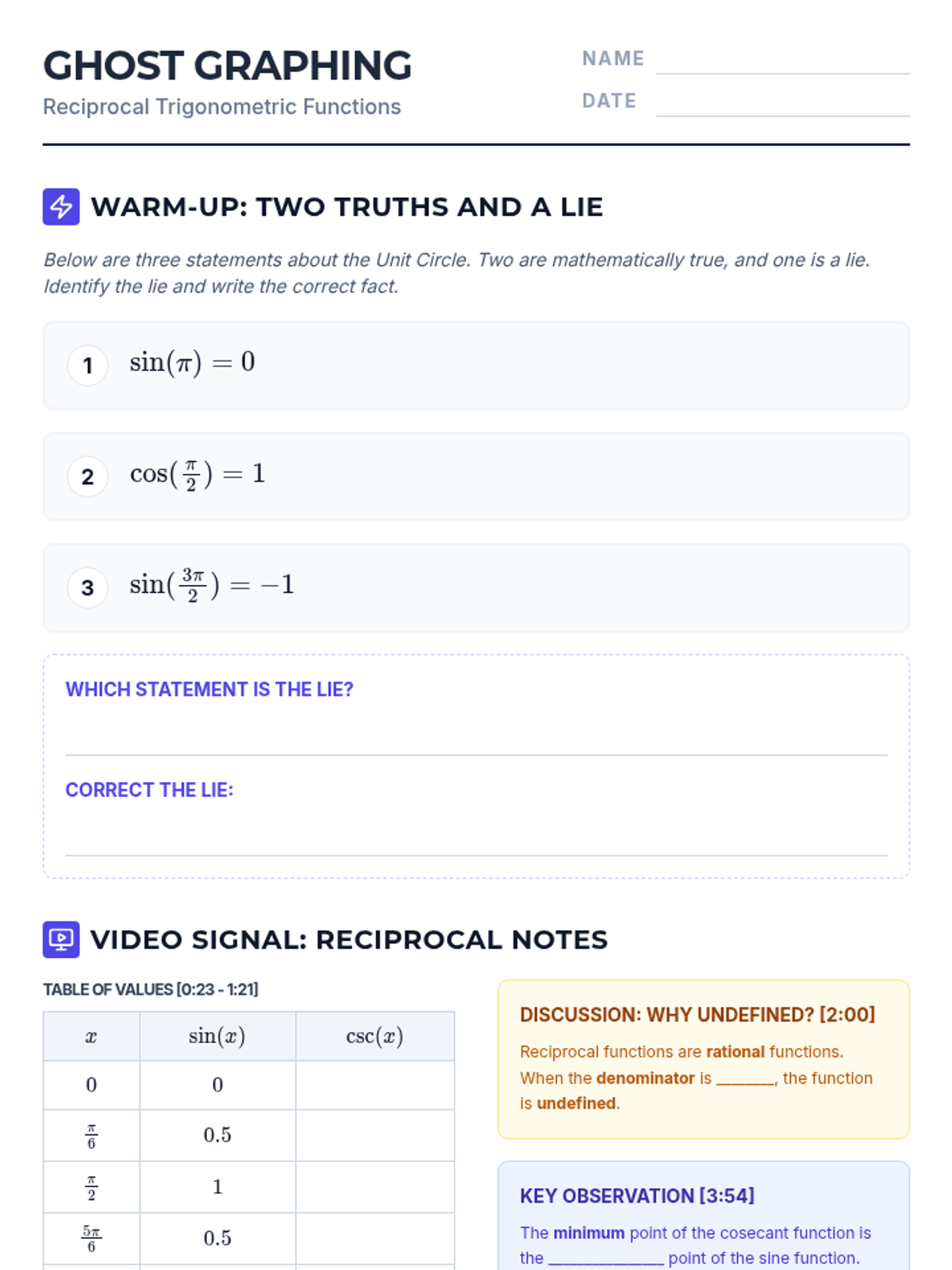
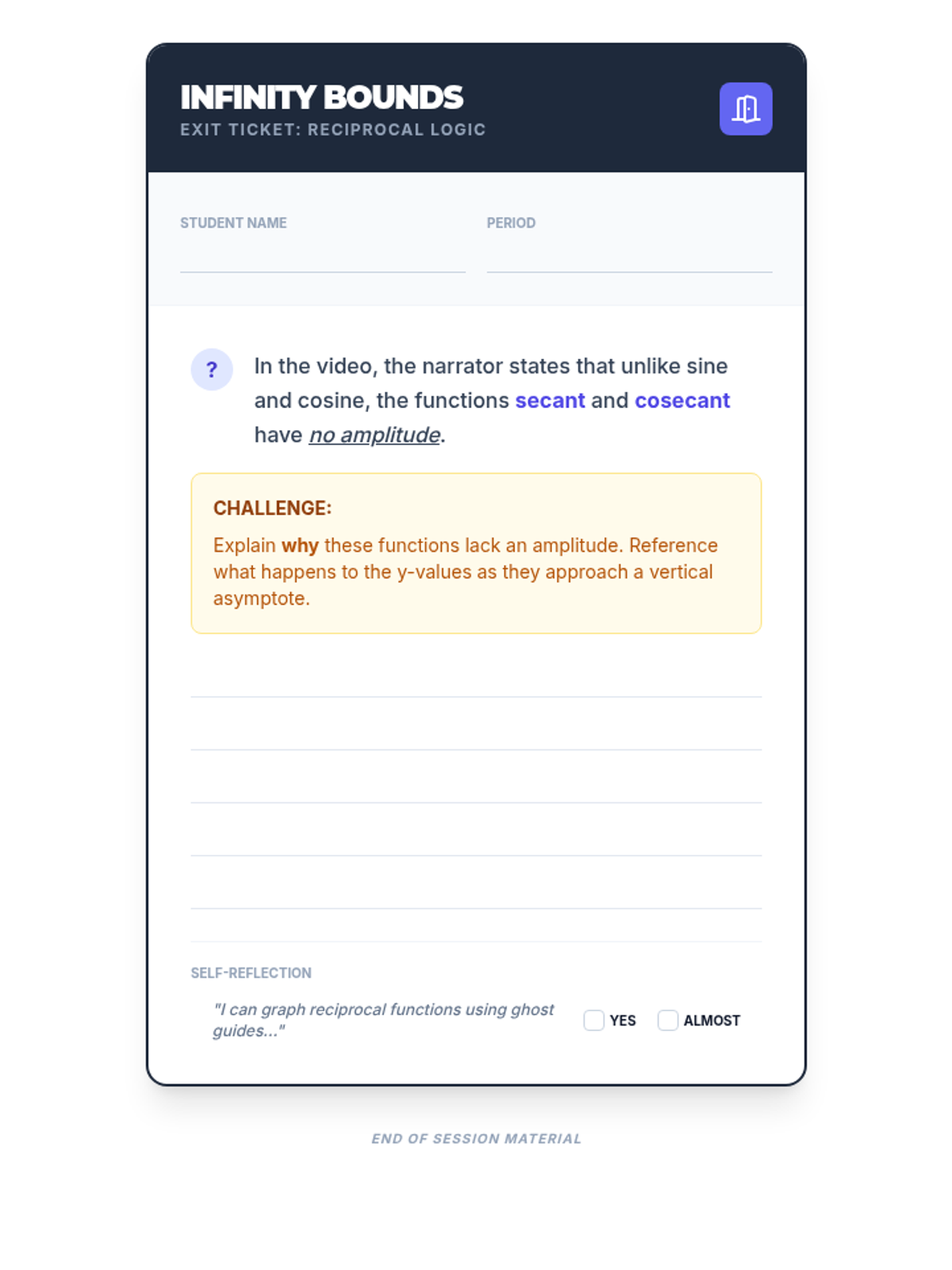
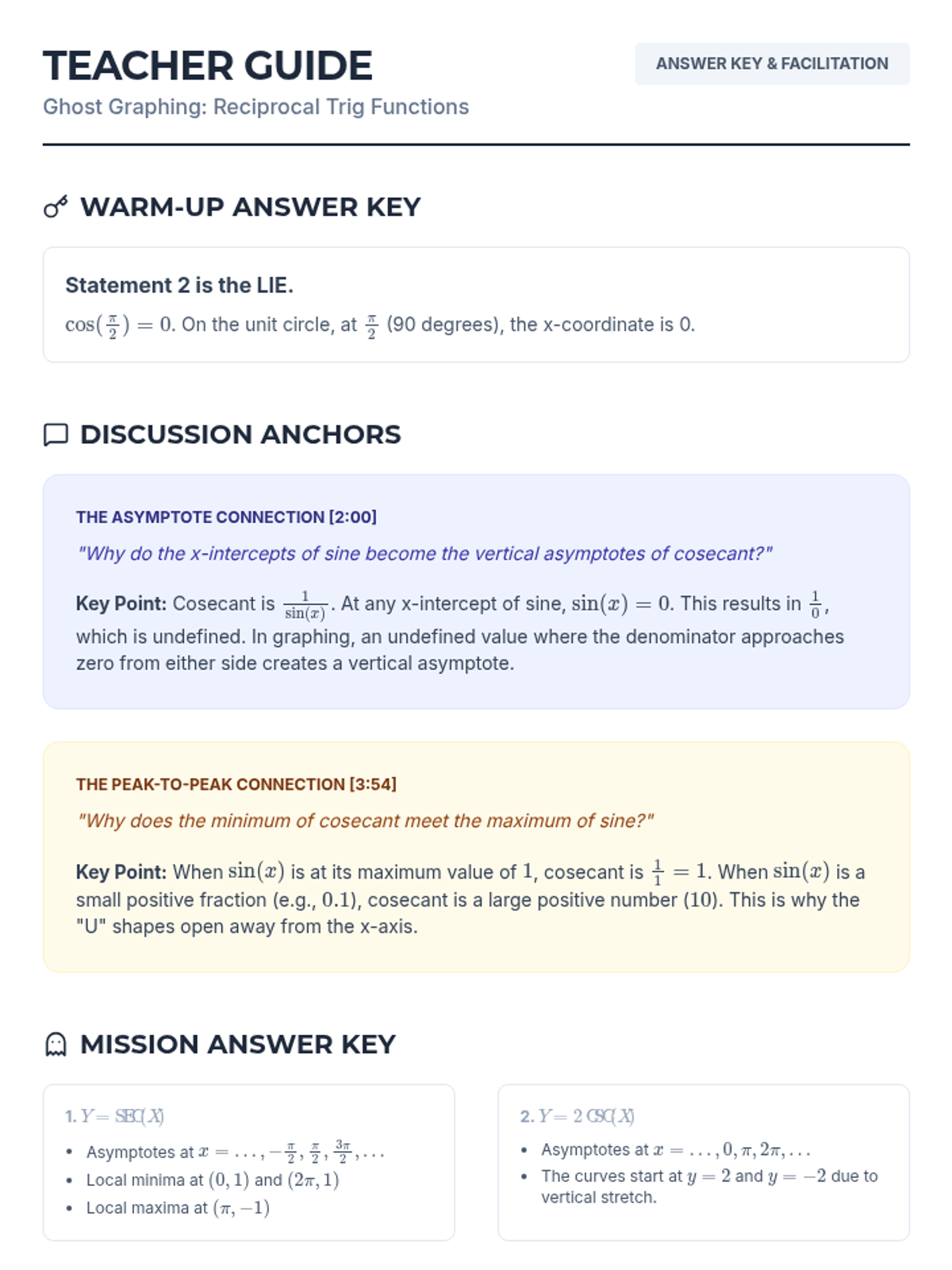
Students will learn to graph cosecant and secant functions by using their reciprocal sine and cosine 'ghost' graphs as guides. This lesson explores the relationship between x-intercepts and vertical asymptotes, as well as why these functions lack amplitude.
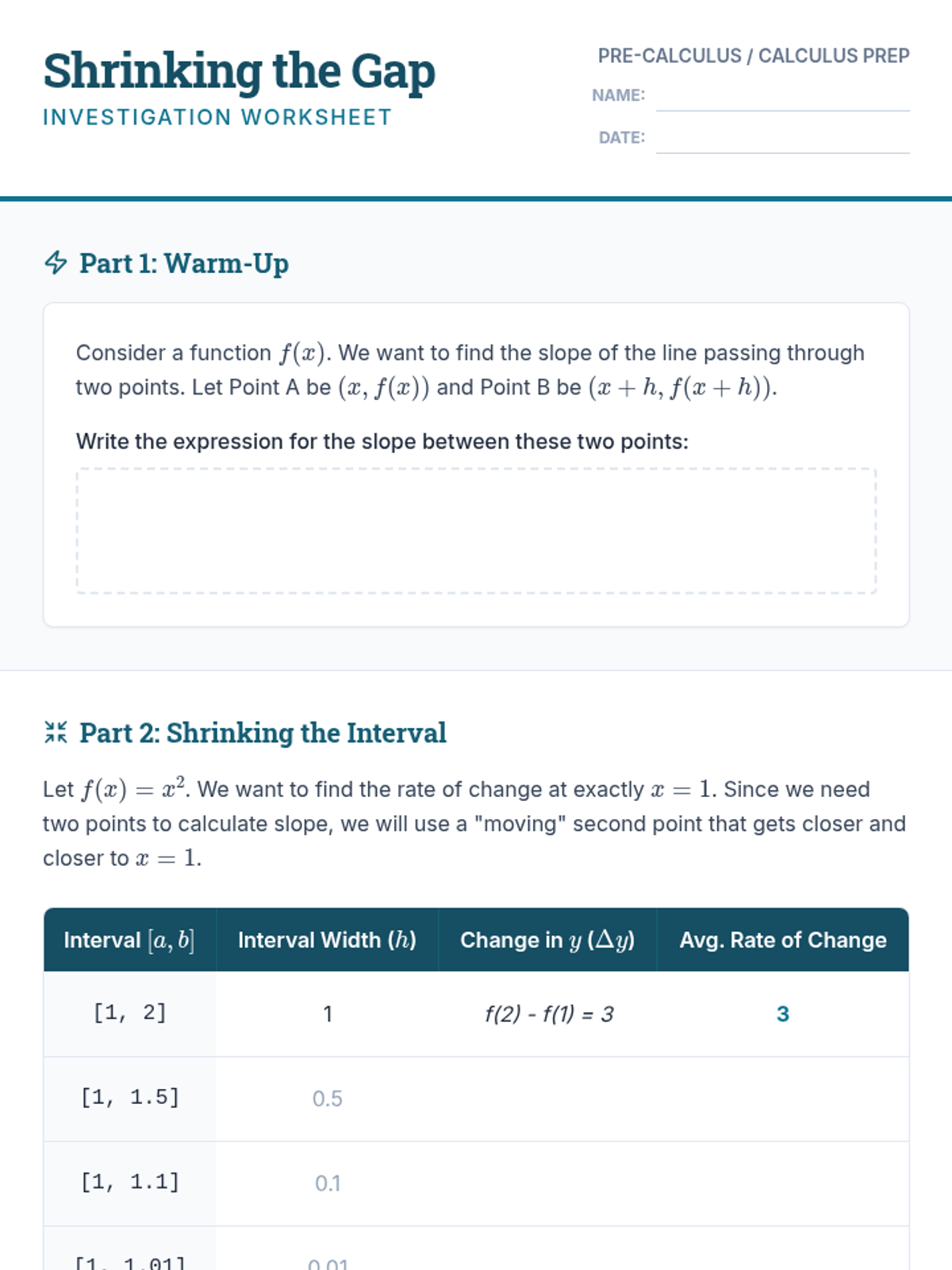
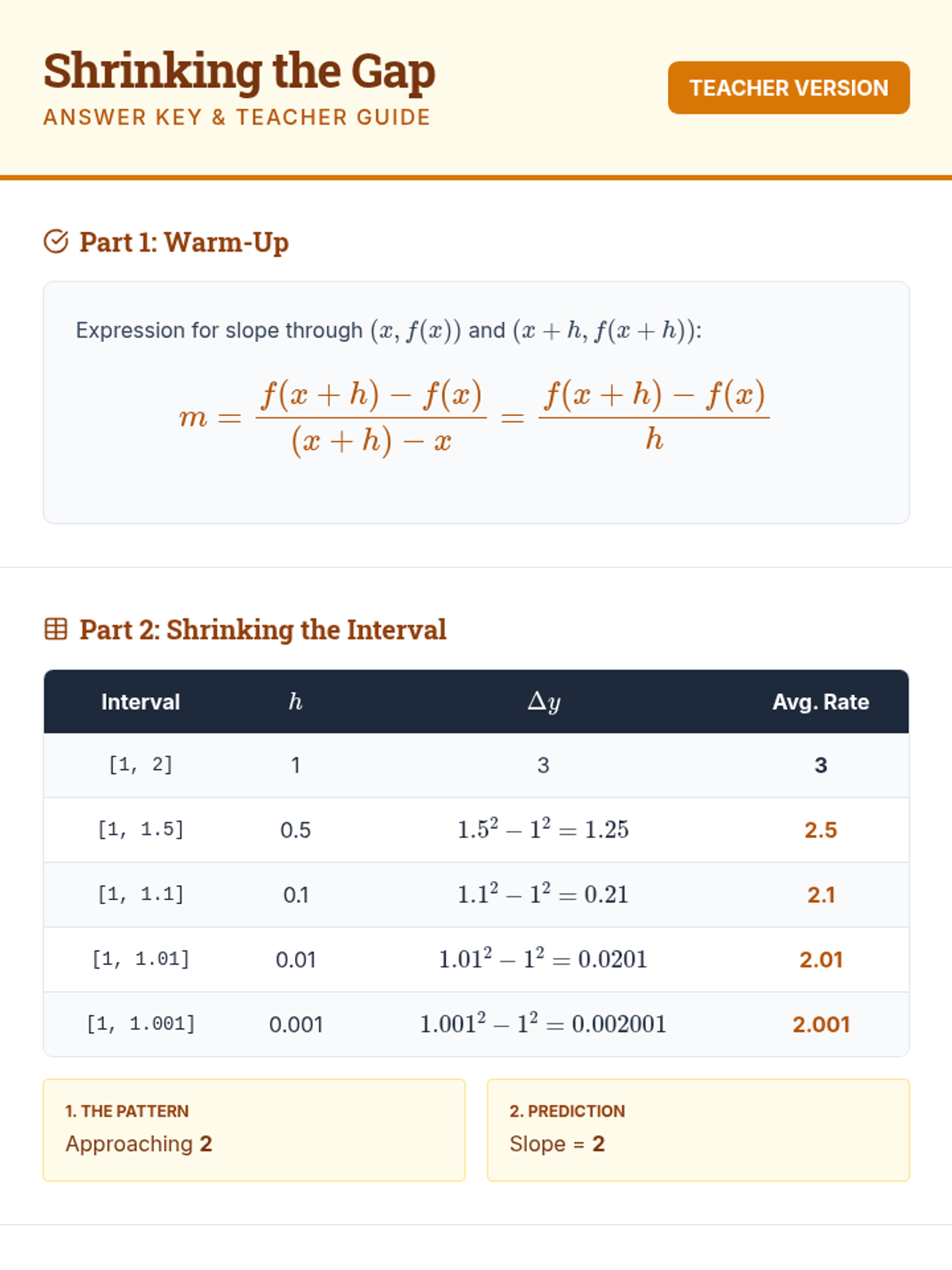
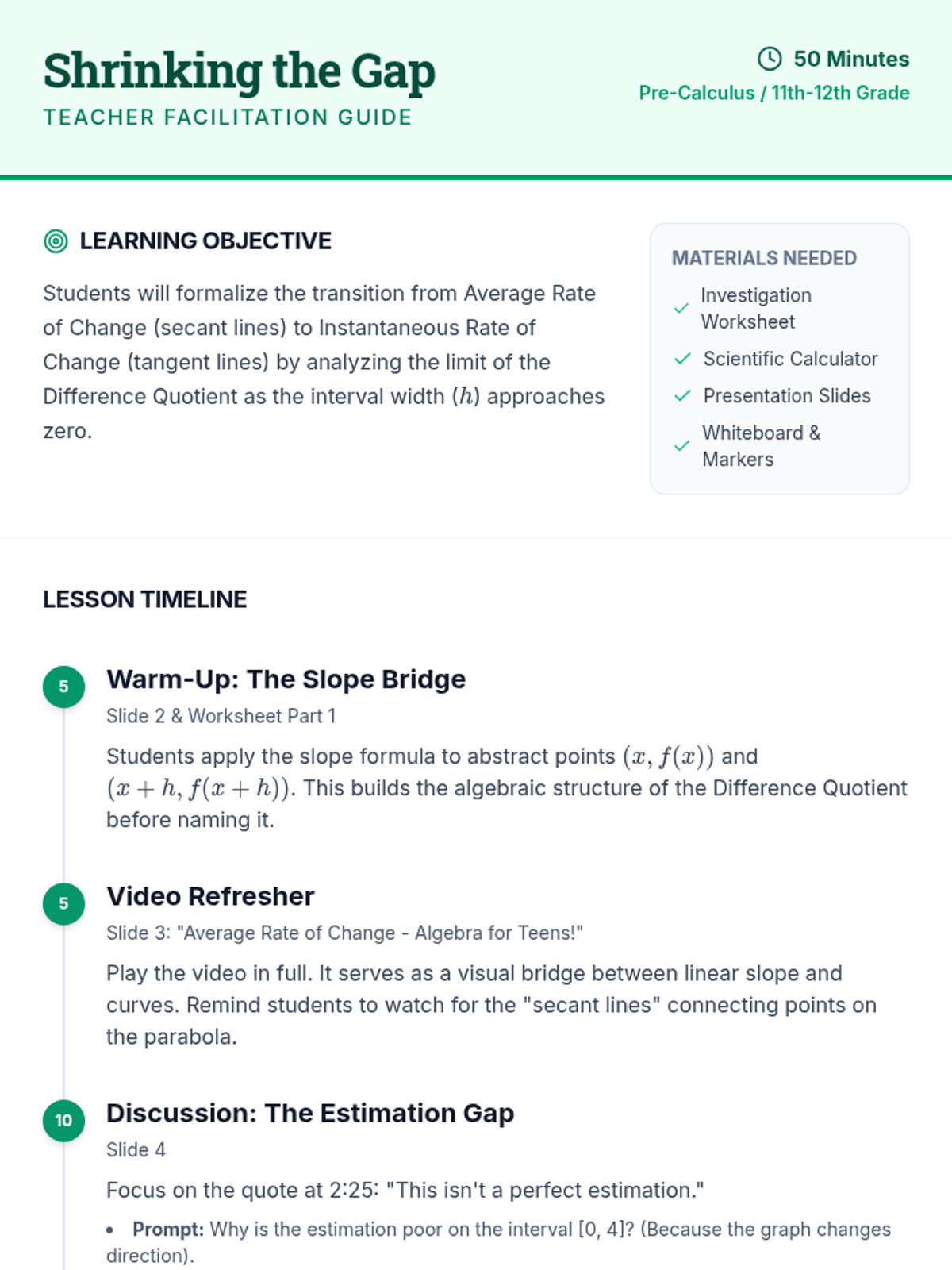
This lesson transitions students from the concept of Average Rate of Change to the formal Difference Quotient. Through a 'shrinking the interval' activity, students discover how the limit of secant lines leads to the instantaneous rate of change (the derivative).
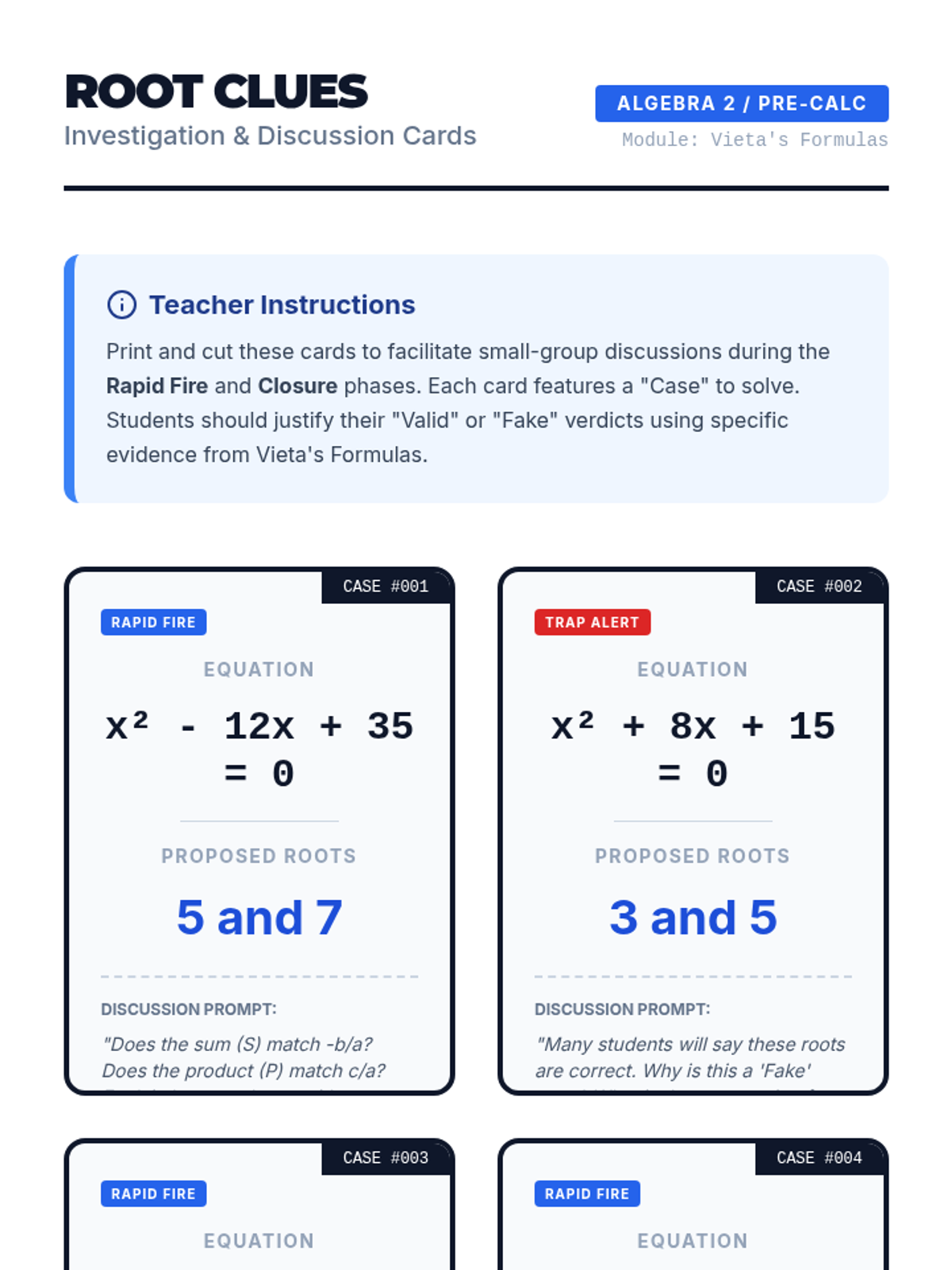
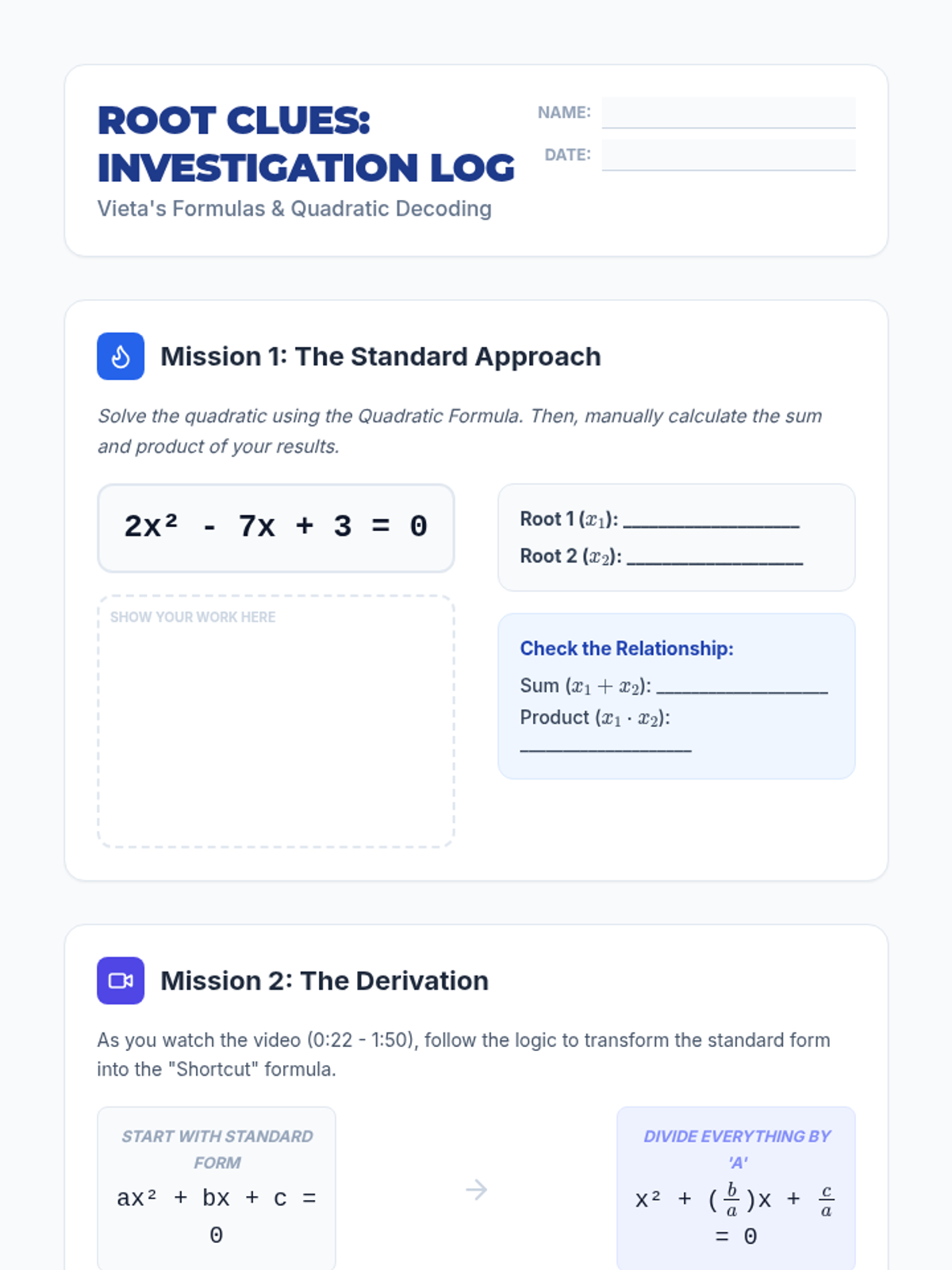
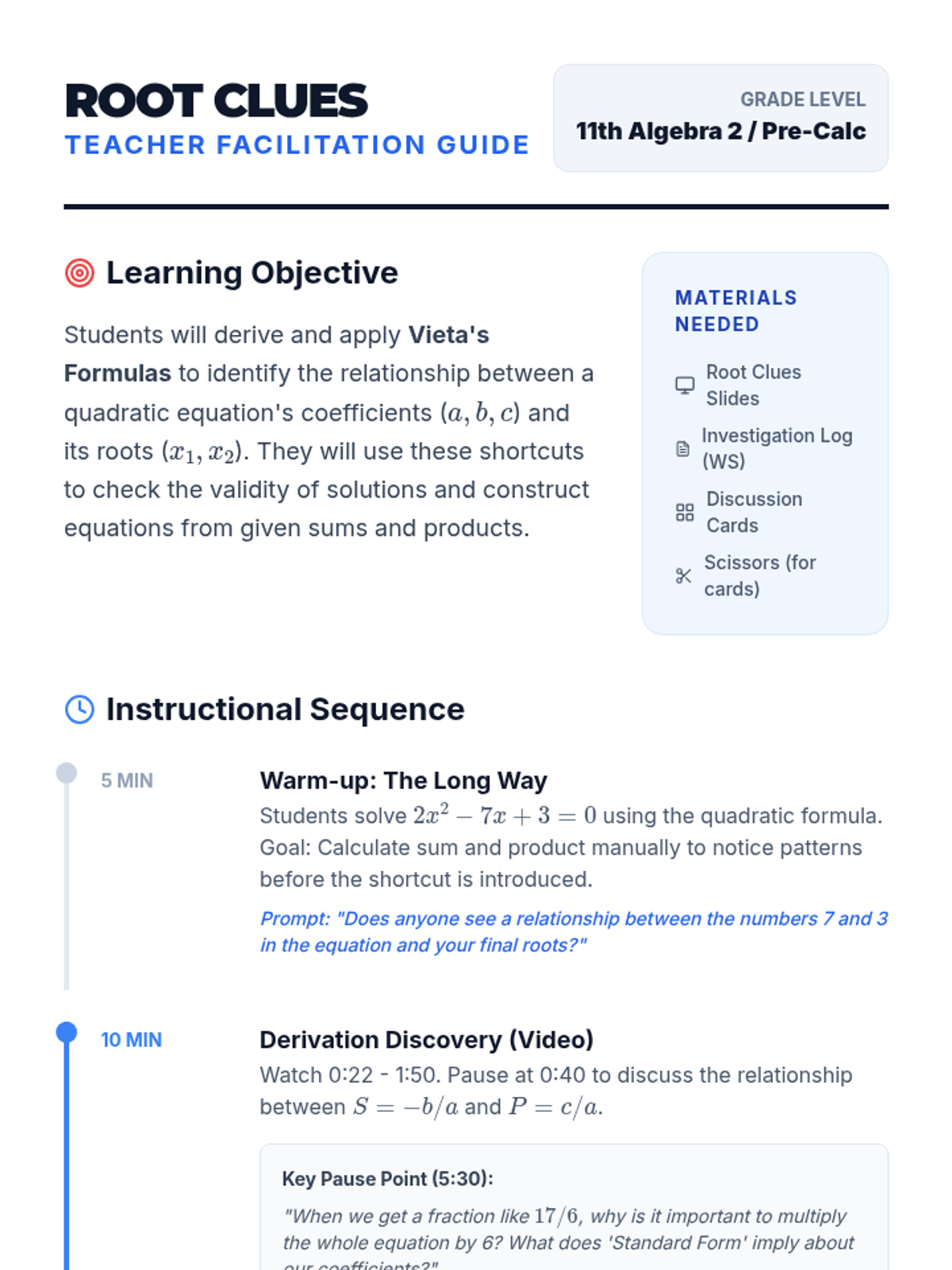
Students will master Vieta's Formulas to identify the relationship between a quadratic equation's coefficients and its roots, enabling them to check their work efficiently and derive equations from given sums and products.
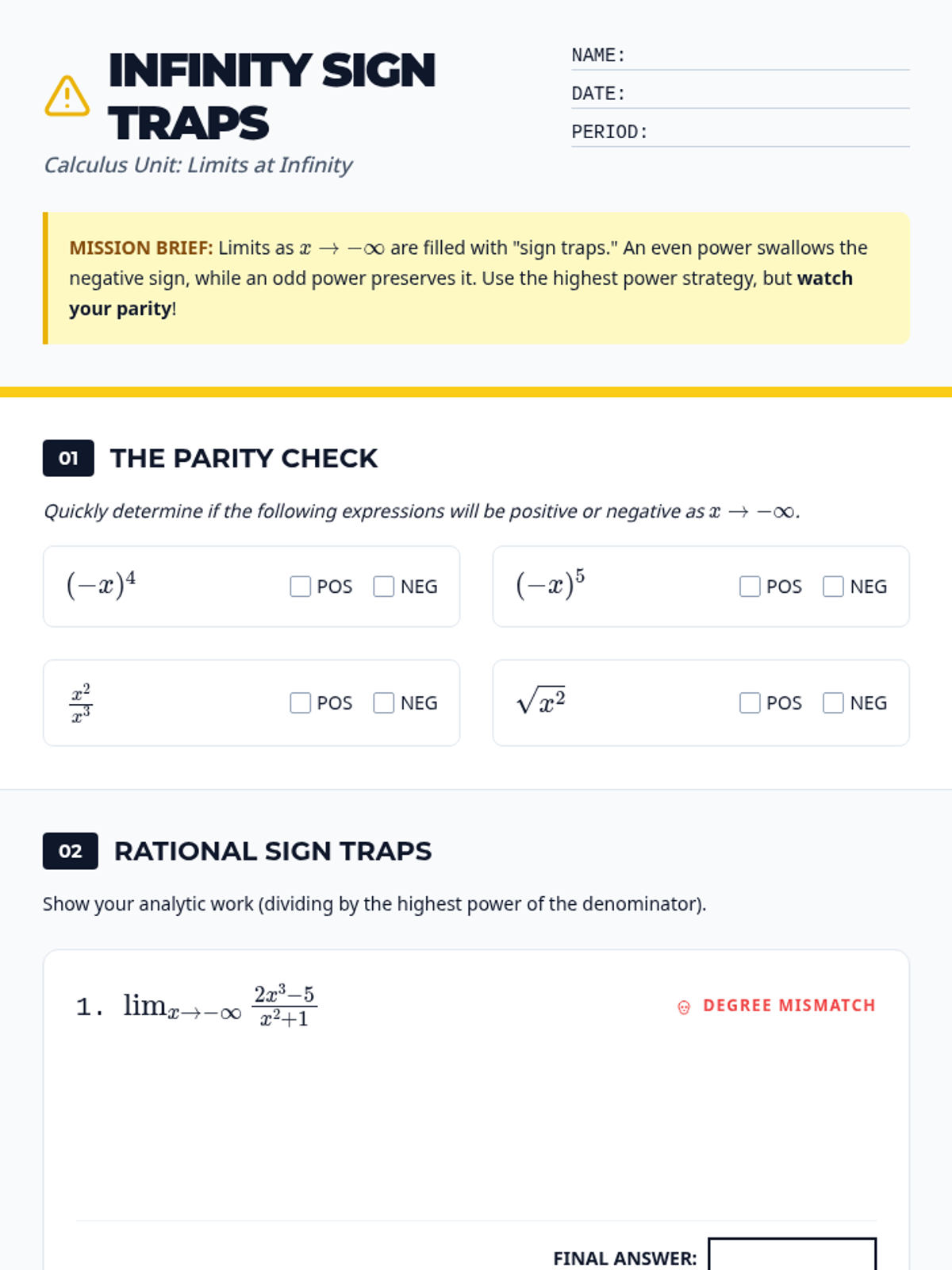
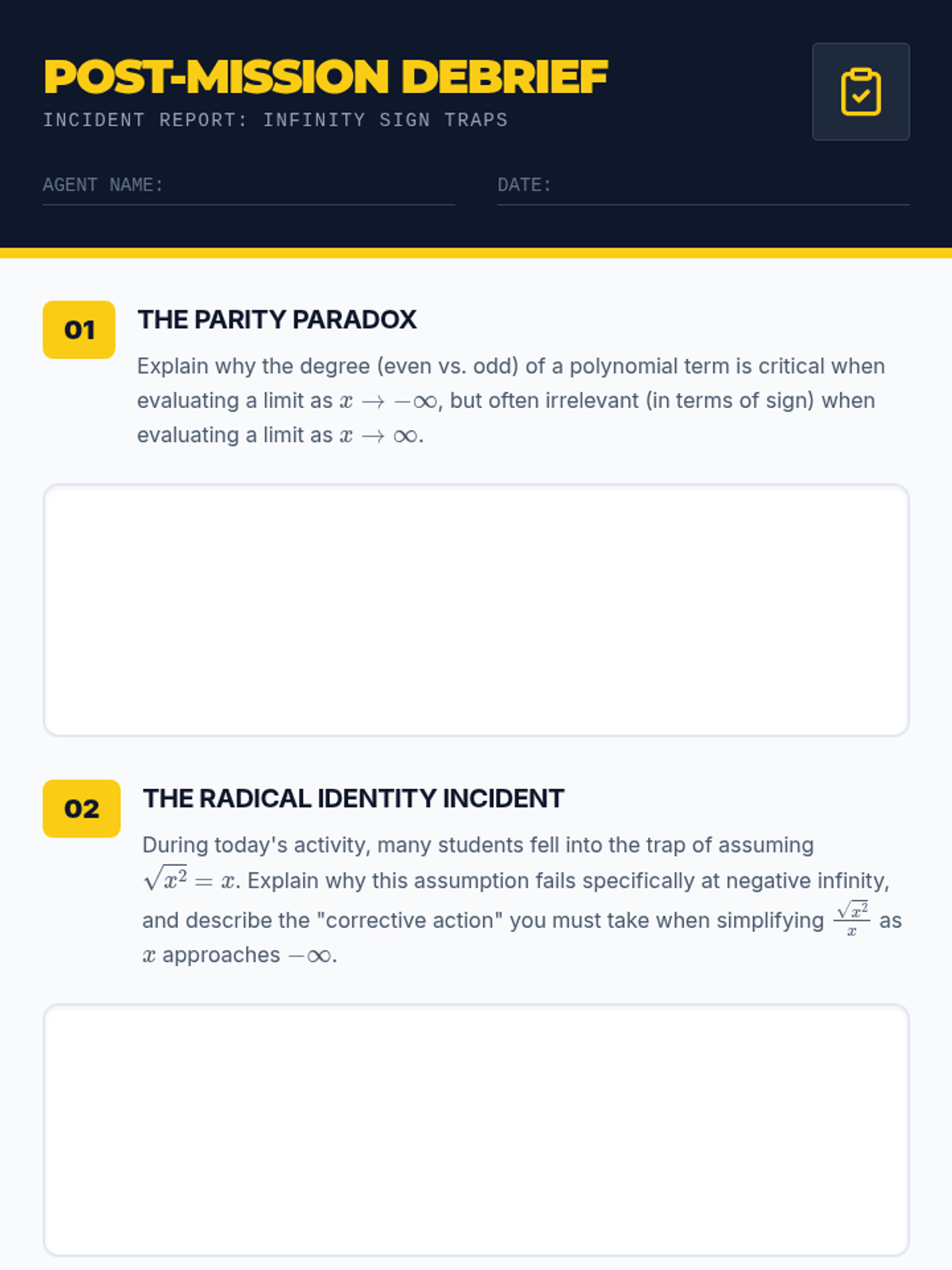
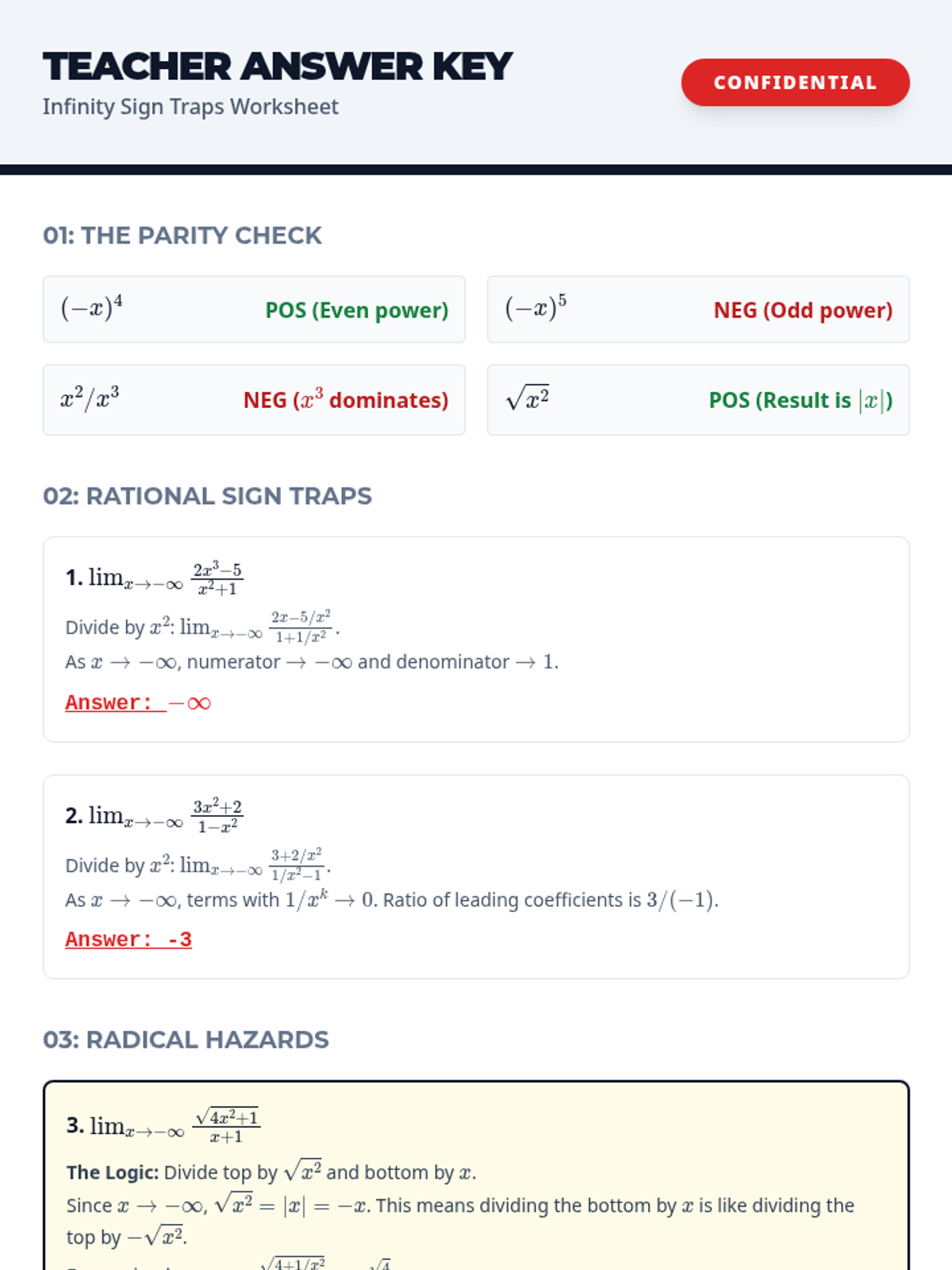
A Calculus lesson focusing on the nuances of limits at negative infinity, specifically how odd/even degrees and square roots create 'sign traps' for students.
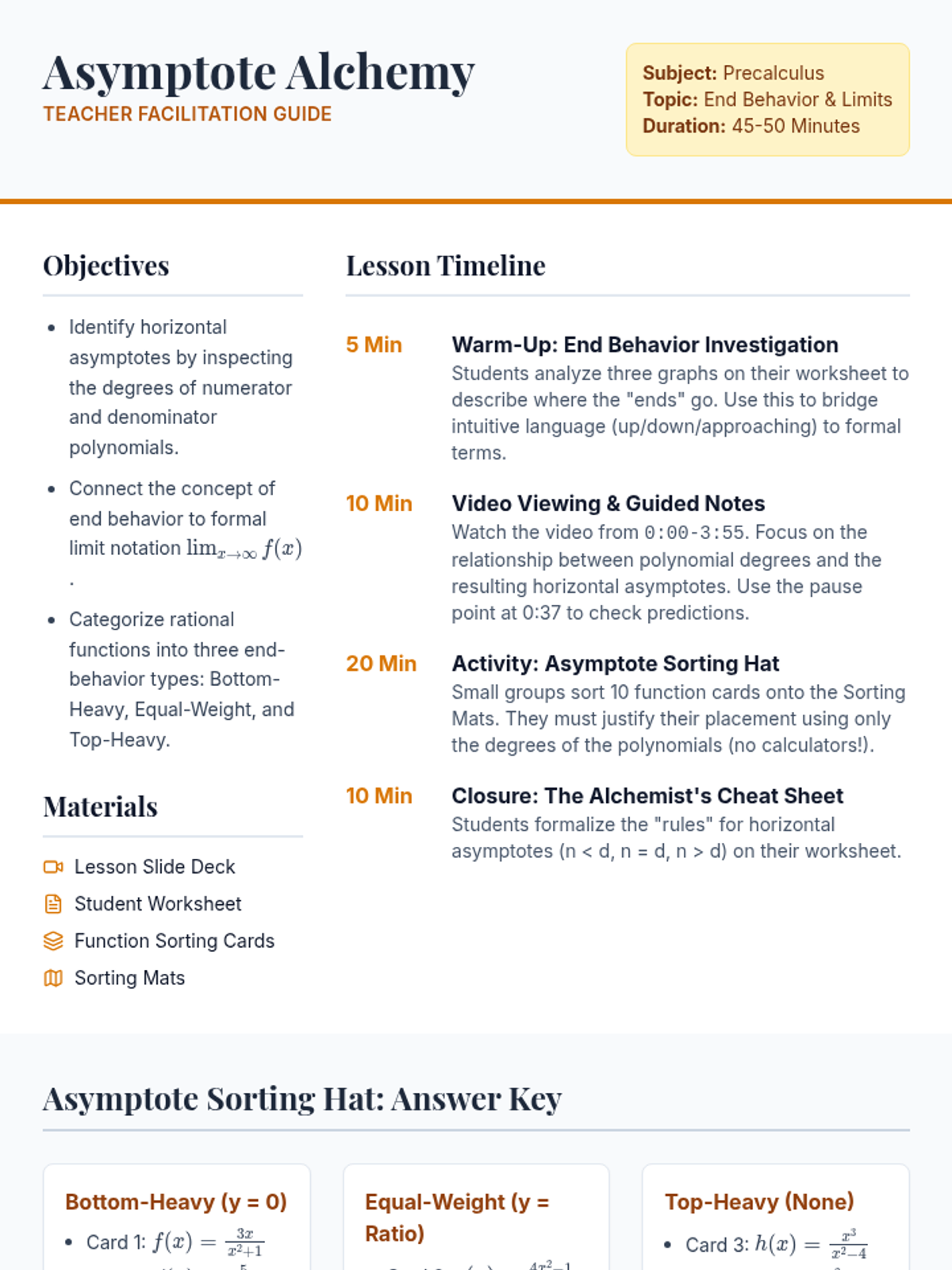
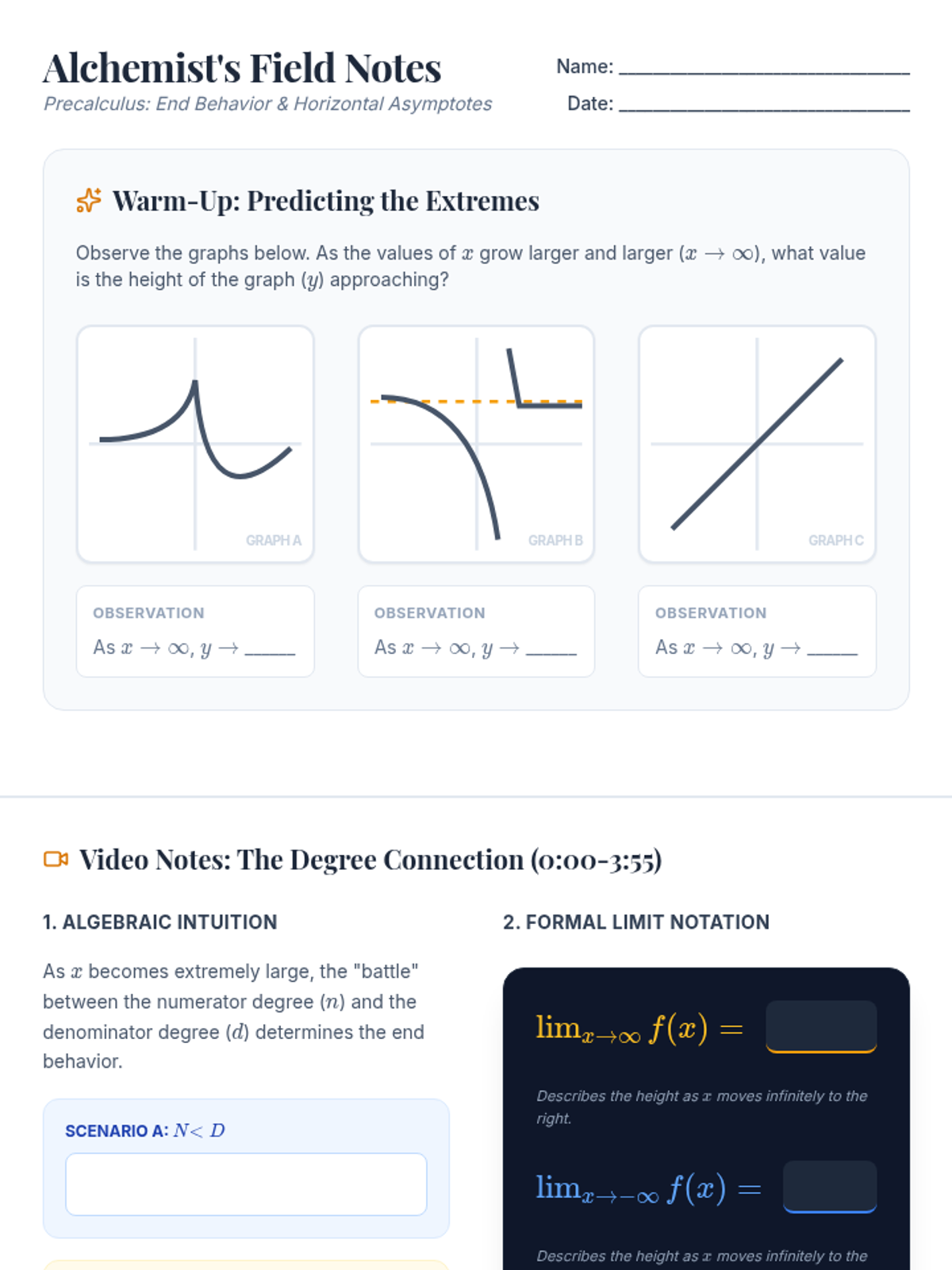
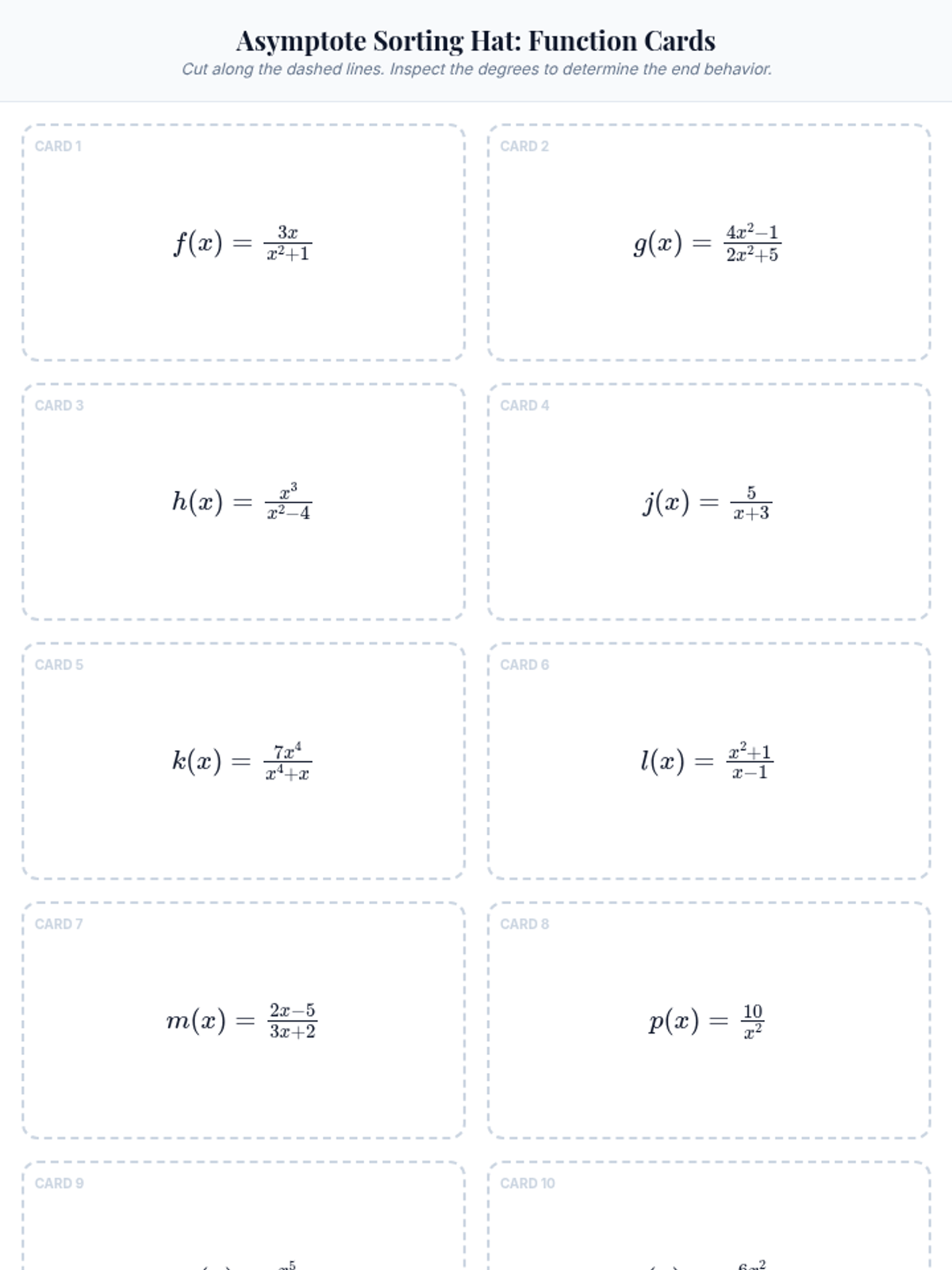
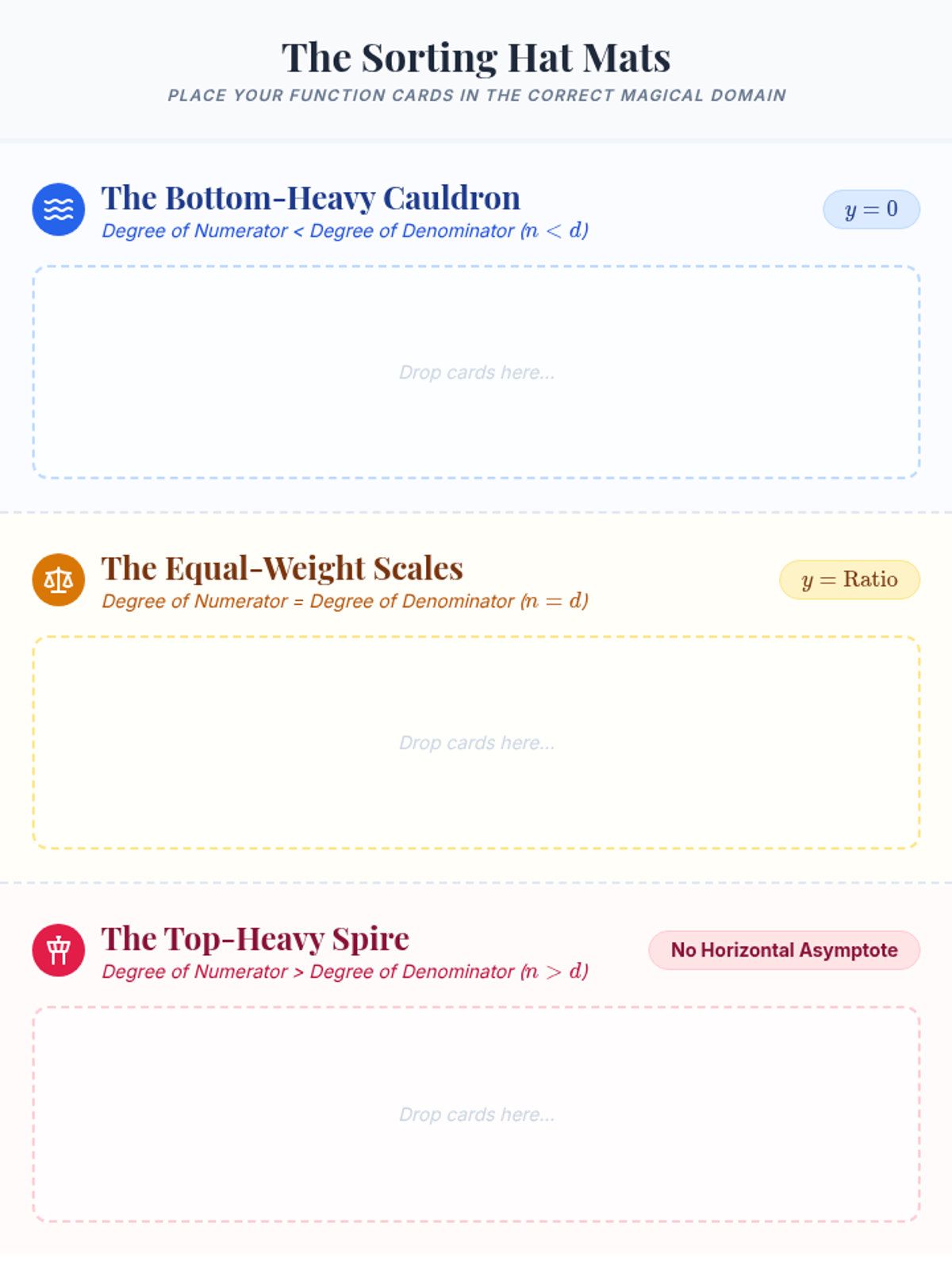
A Precalculus lesson exploring the end behavior of rational functions through graphical analysis and algebraic intuition. Students use polynomial degrees to predict horizontal asymptotes and formalize their findings using limit notation.
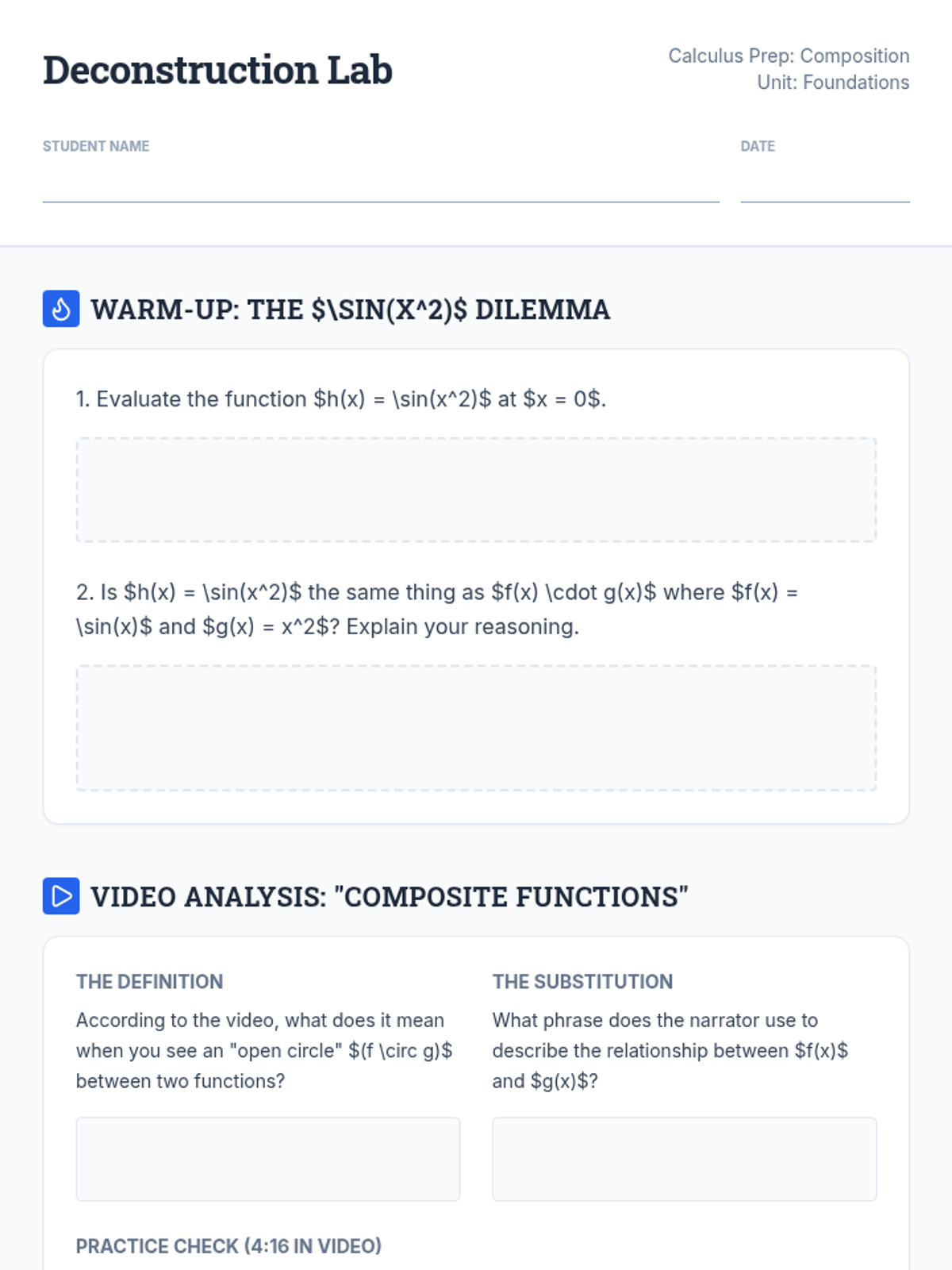
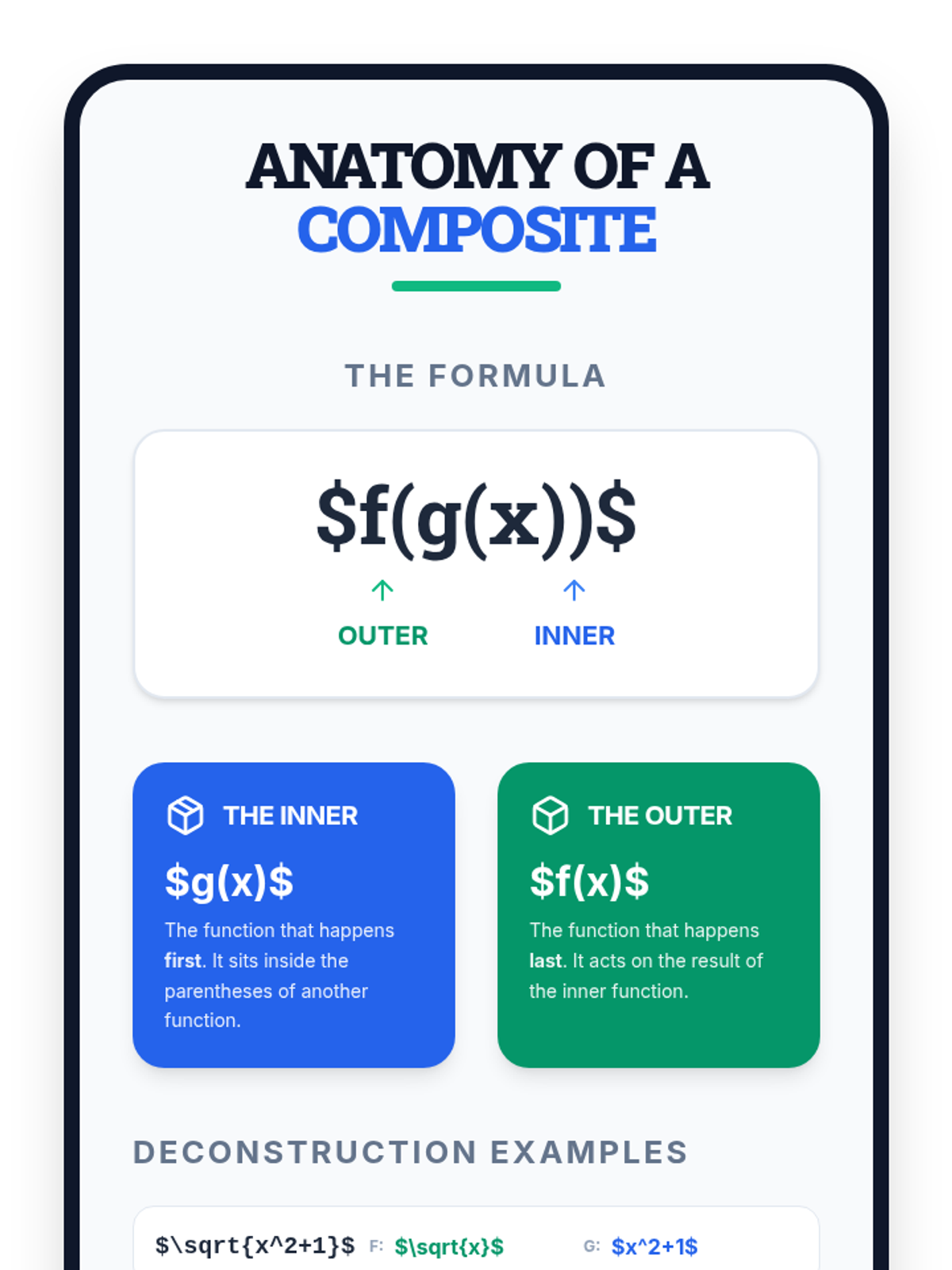
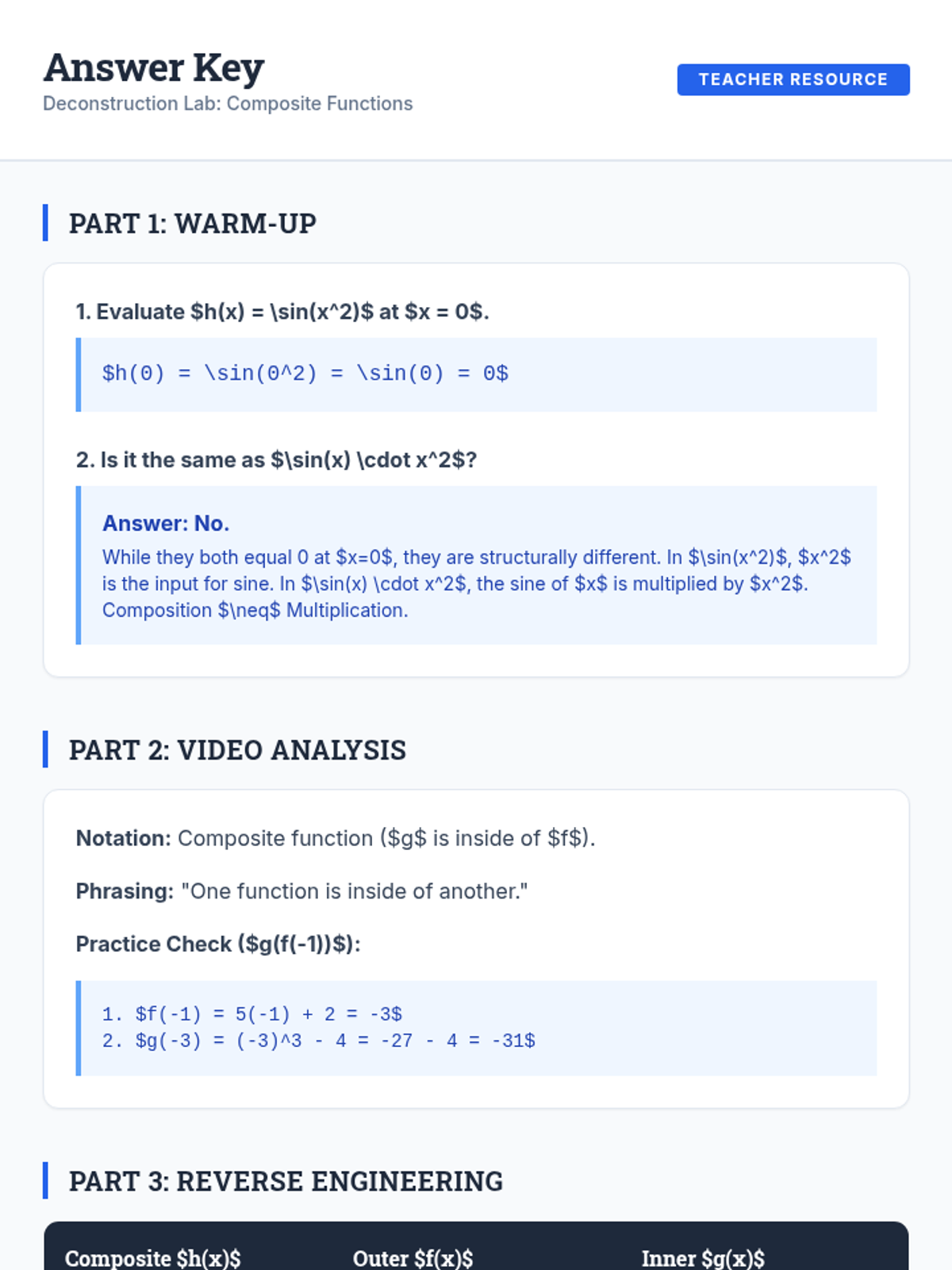
This lesson focuses on the skill of decomposing composite functions, a prerequisite for the Chain Rule in Calculus. Students will analyze the relationship between 'inner' and 'outer' functions through video observation, algebraic reverse engineering, and conceptual discussion.
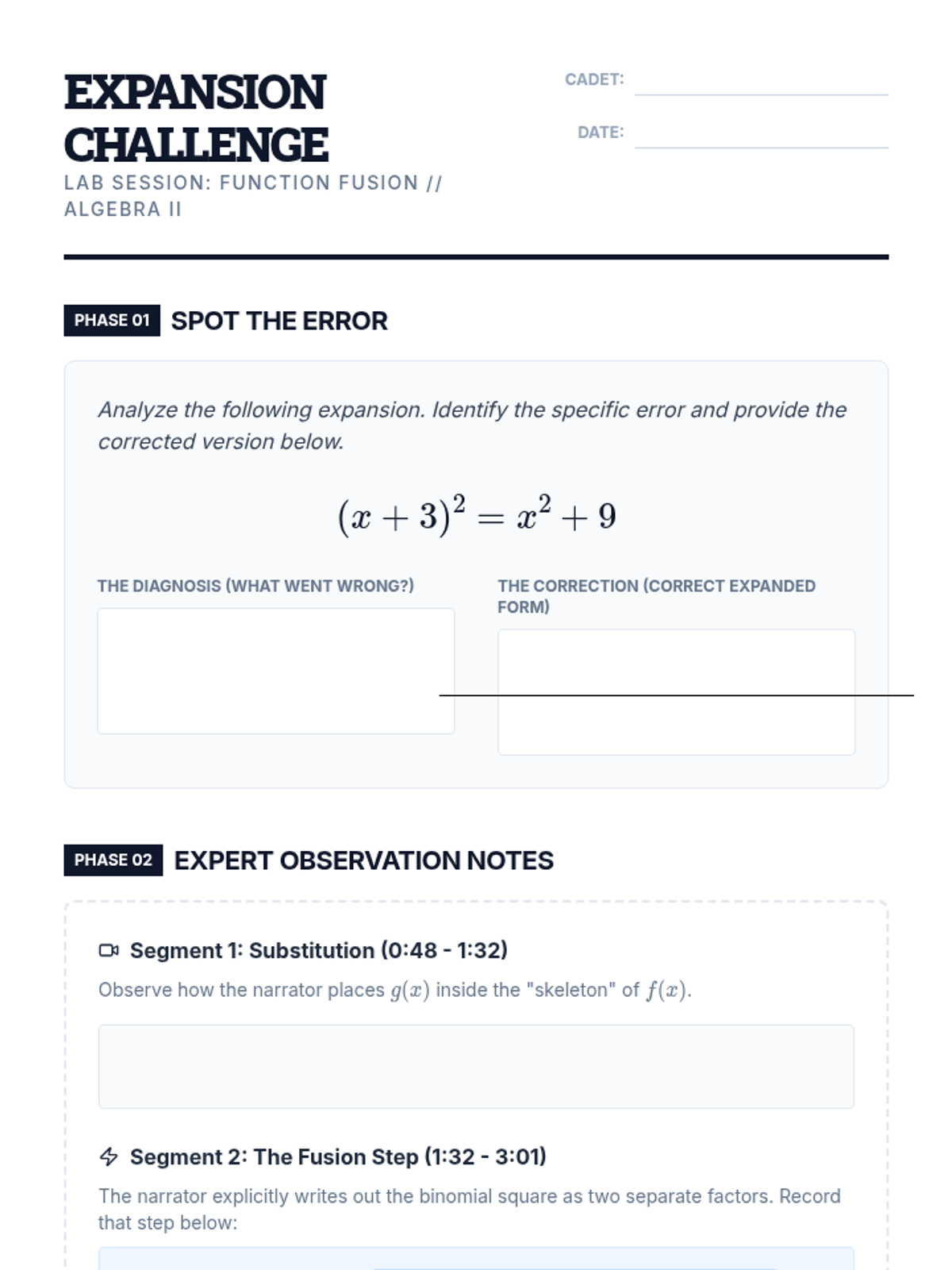
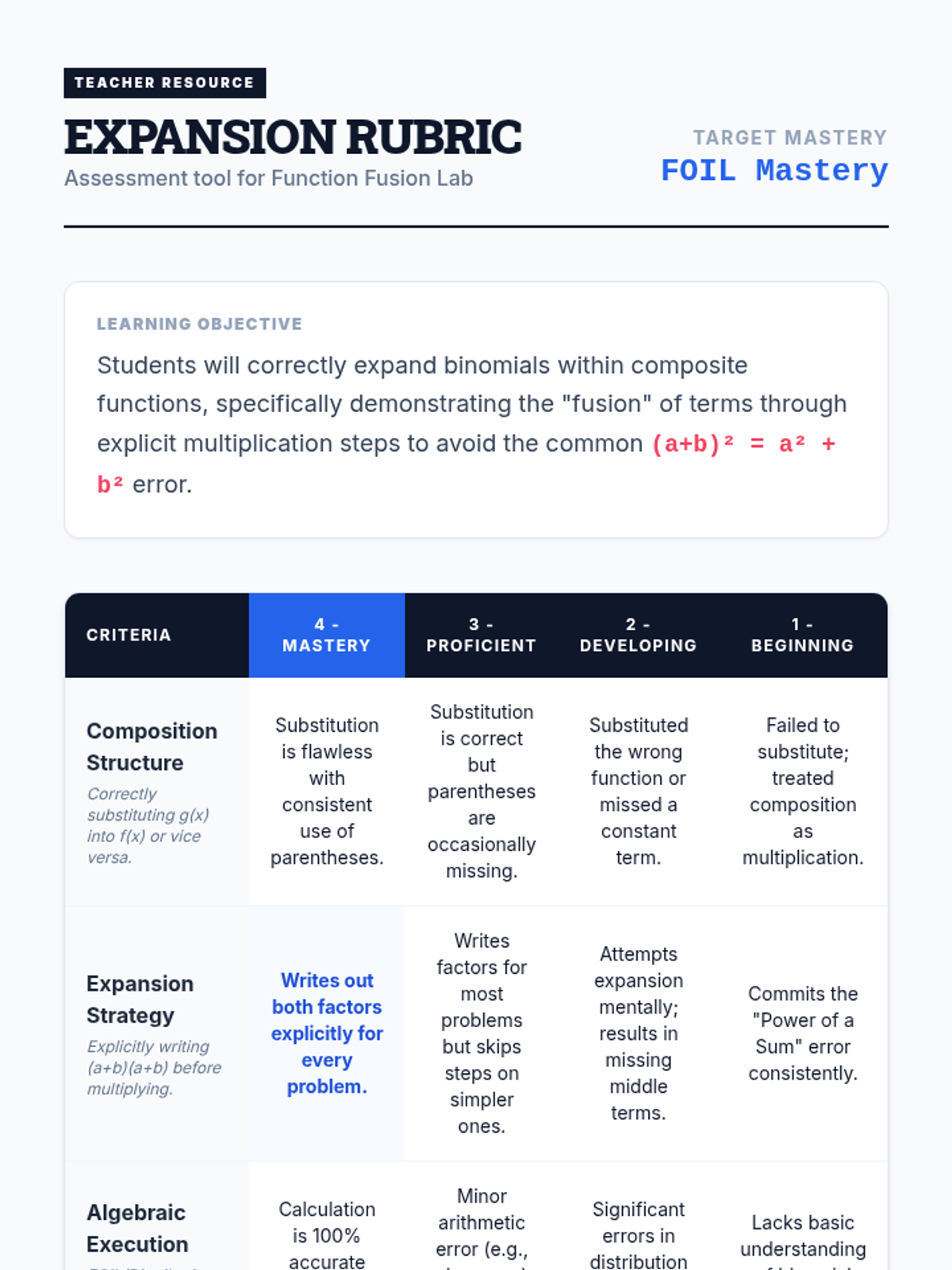
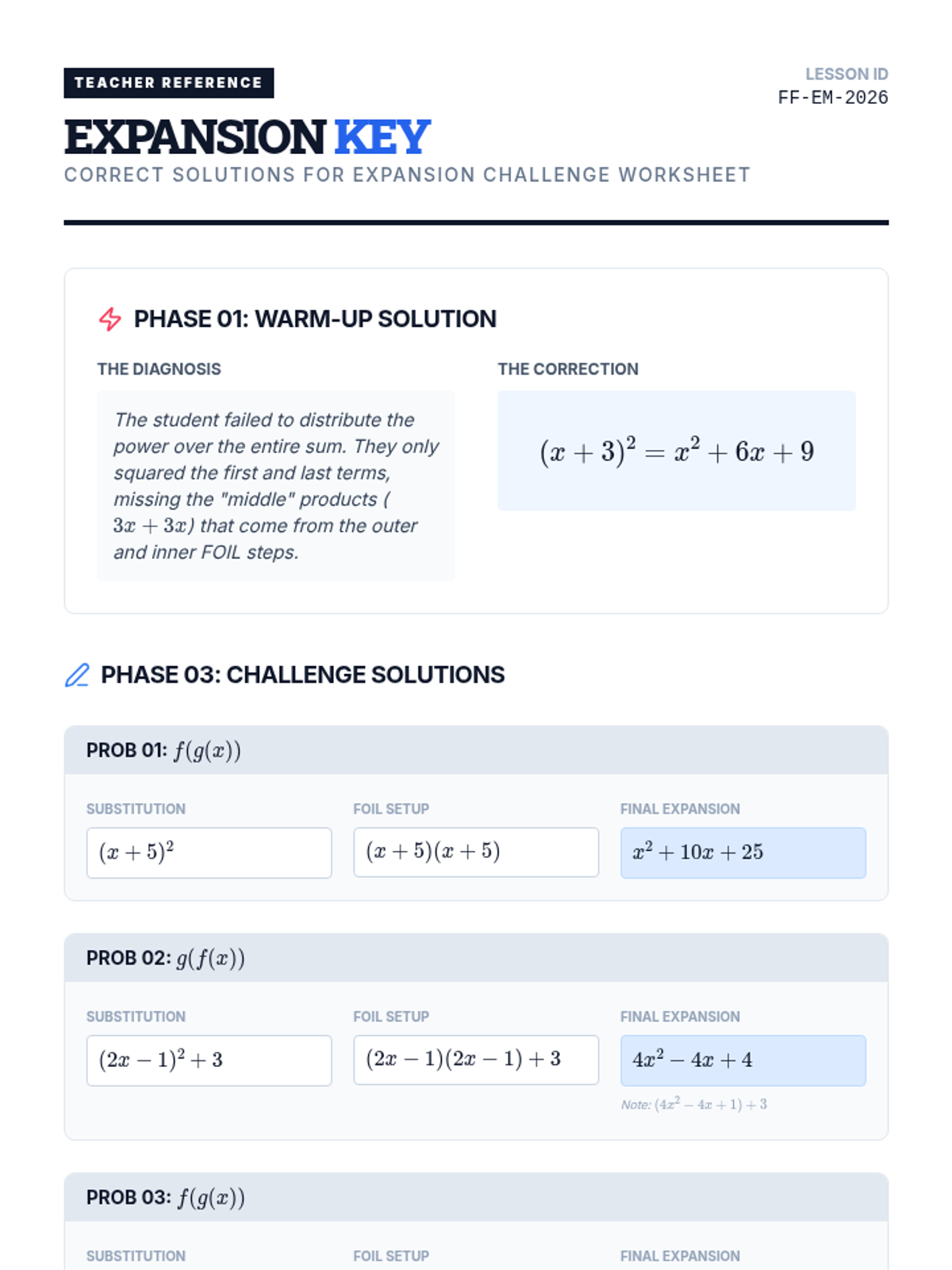
A high-school algebra lesson focused on avoiding the 'power of a sum' error when expanding binomials within composite functions, featuring video-guided instruction and a hands-on expansion challenge.
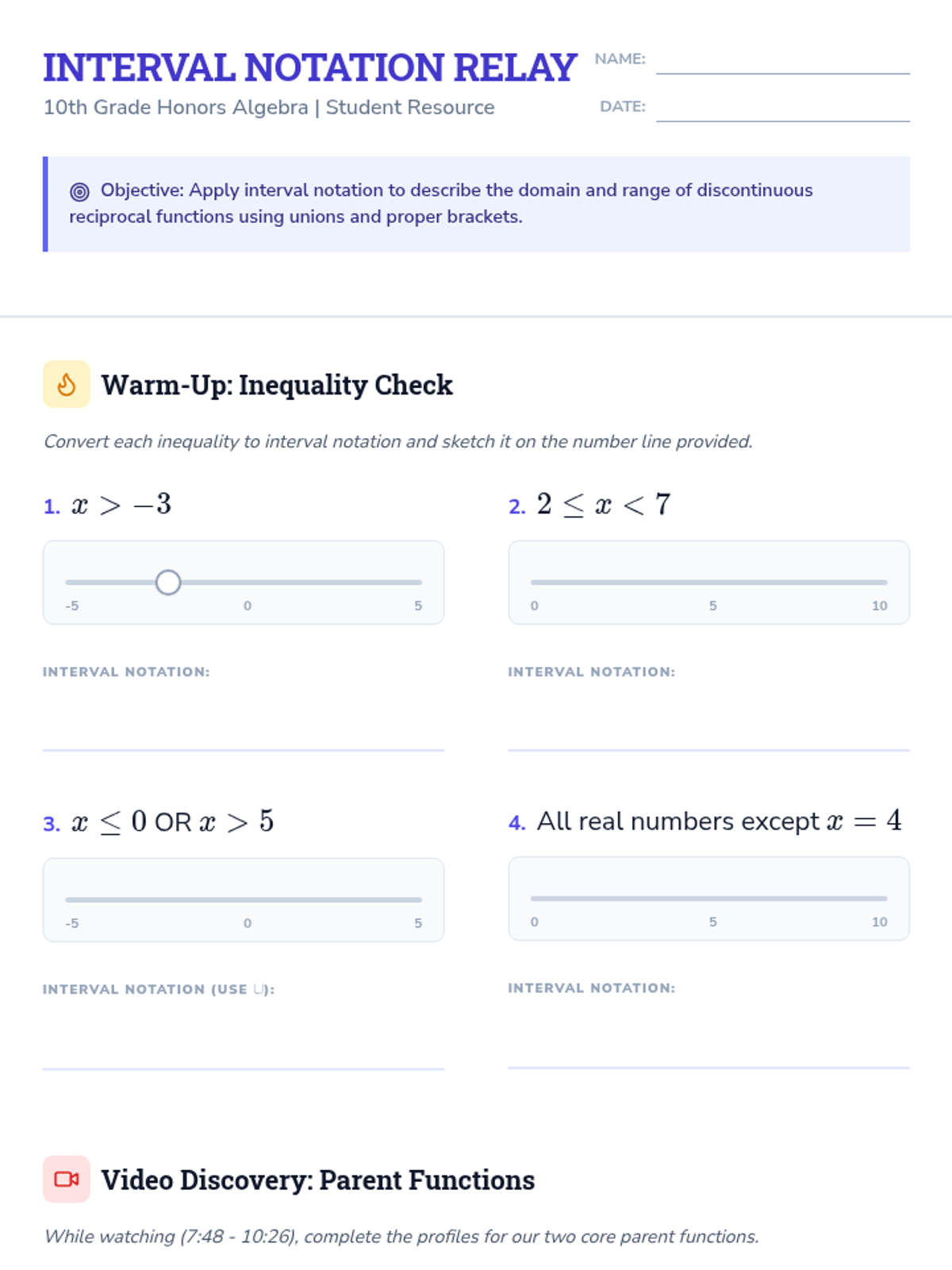
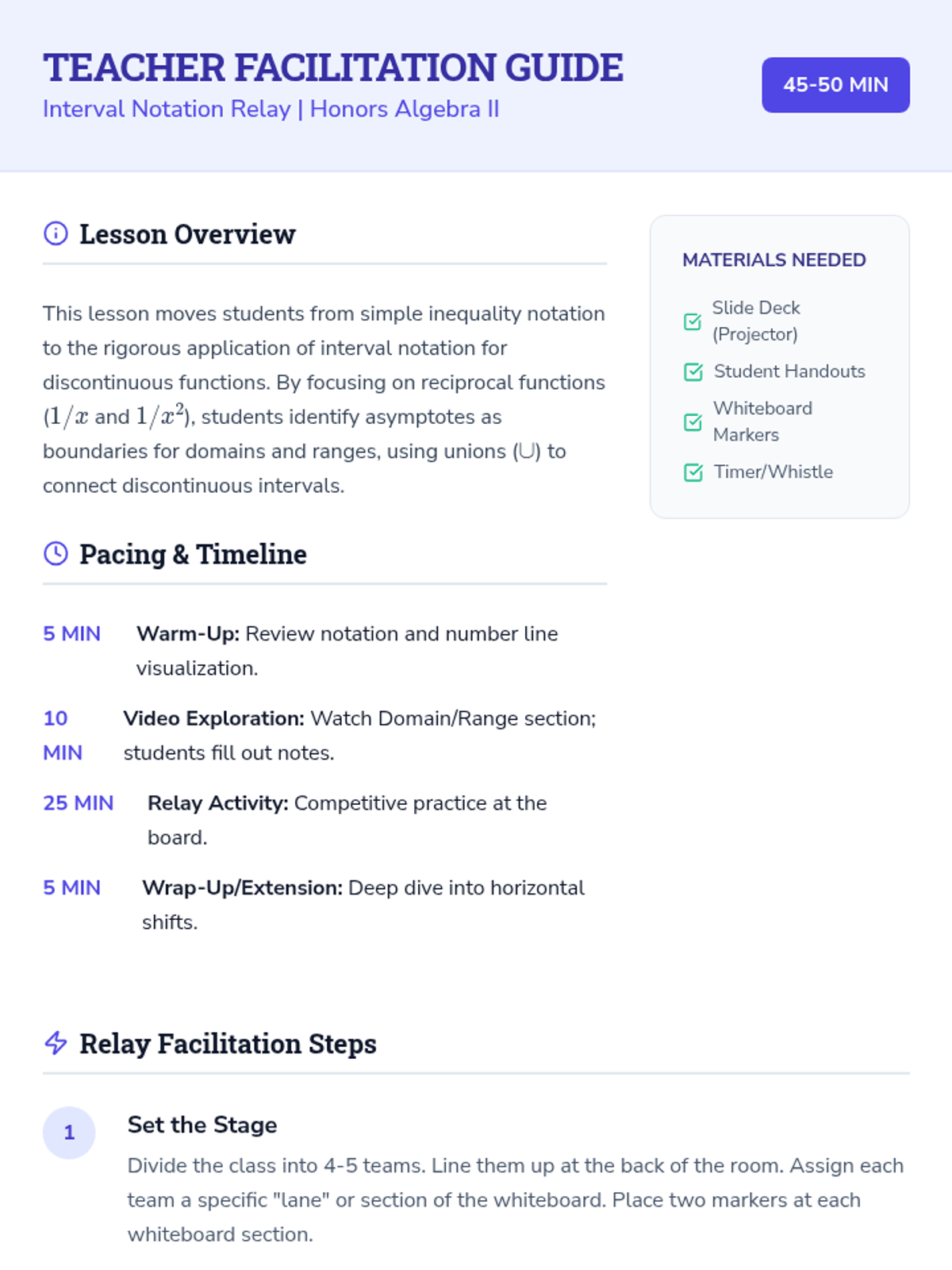
A high-energy honors algebra lesson where students master interval notation through the lens of reciprocal functions, culminating in a fast-paced 'Interval Notation Relay' using transformed graphs.
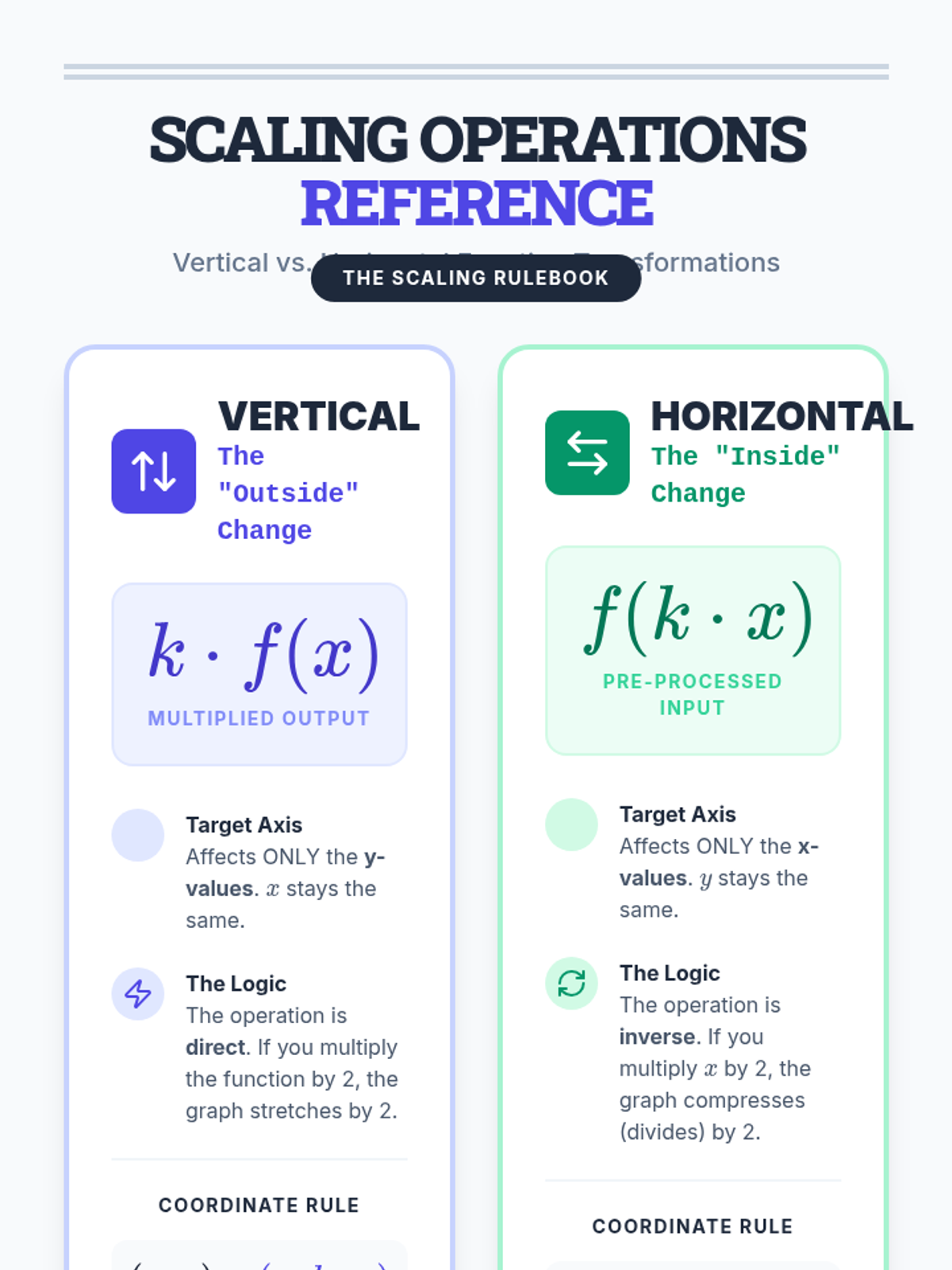
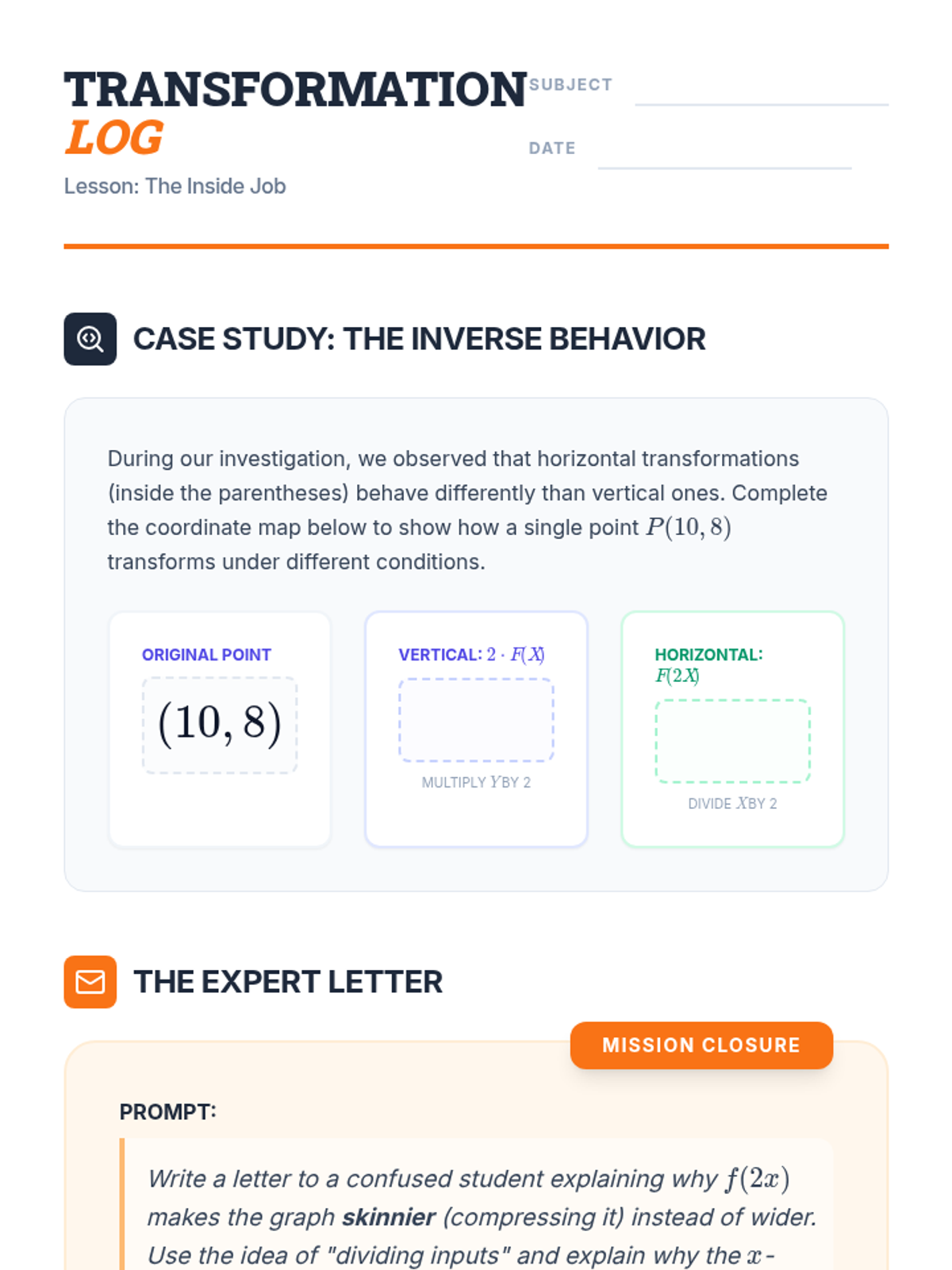
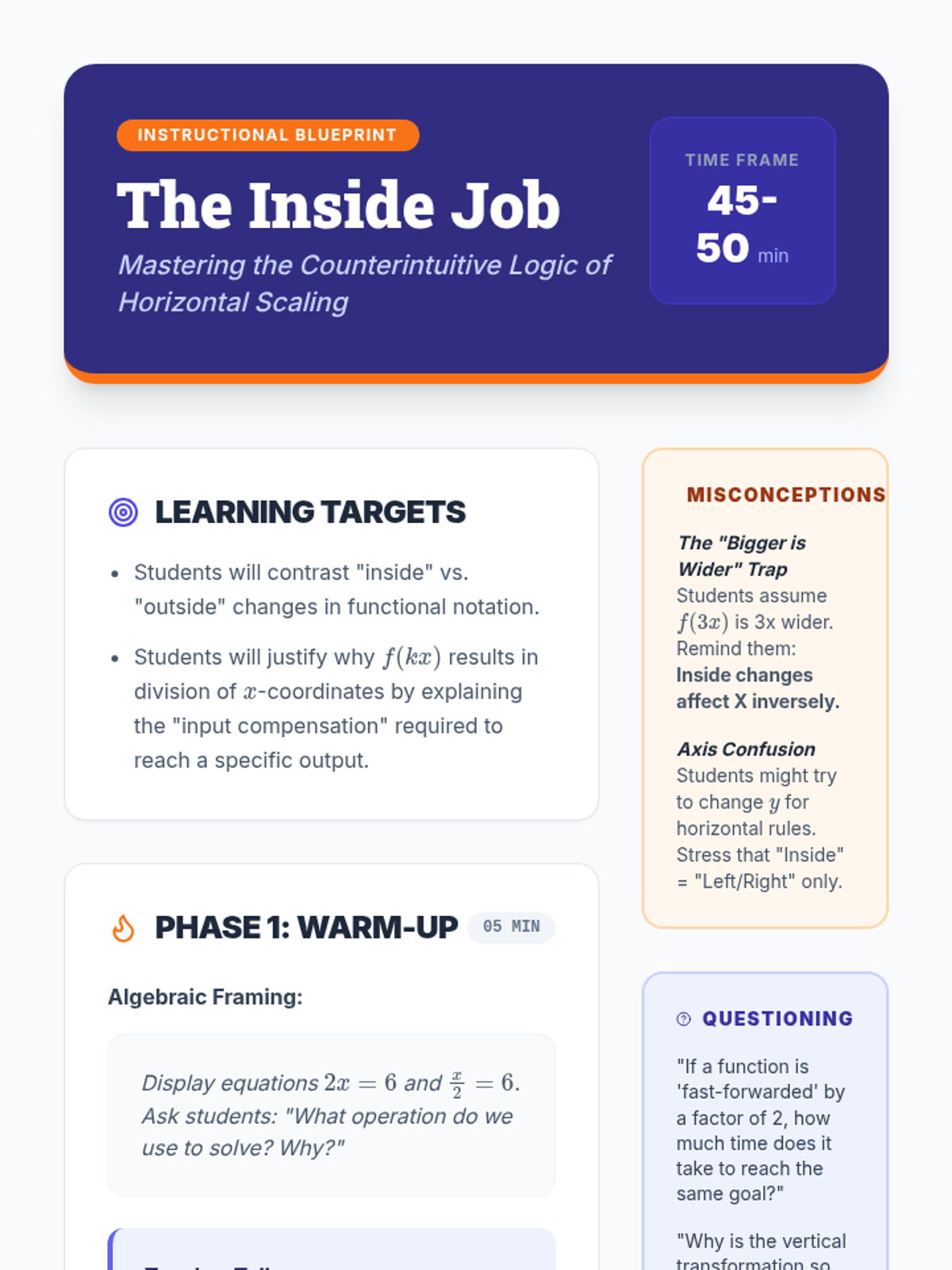
A deep dive into horizontal scaling in Pre-Calculus, focusing on the counterintuitive nature of 'inside' transformations and the algebraic logic of dividing inputs.
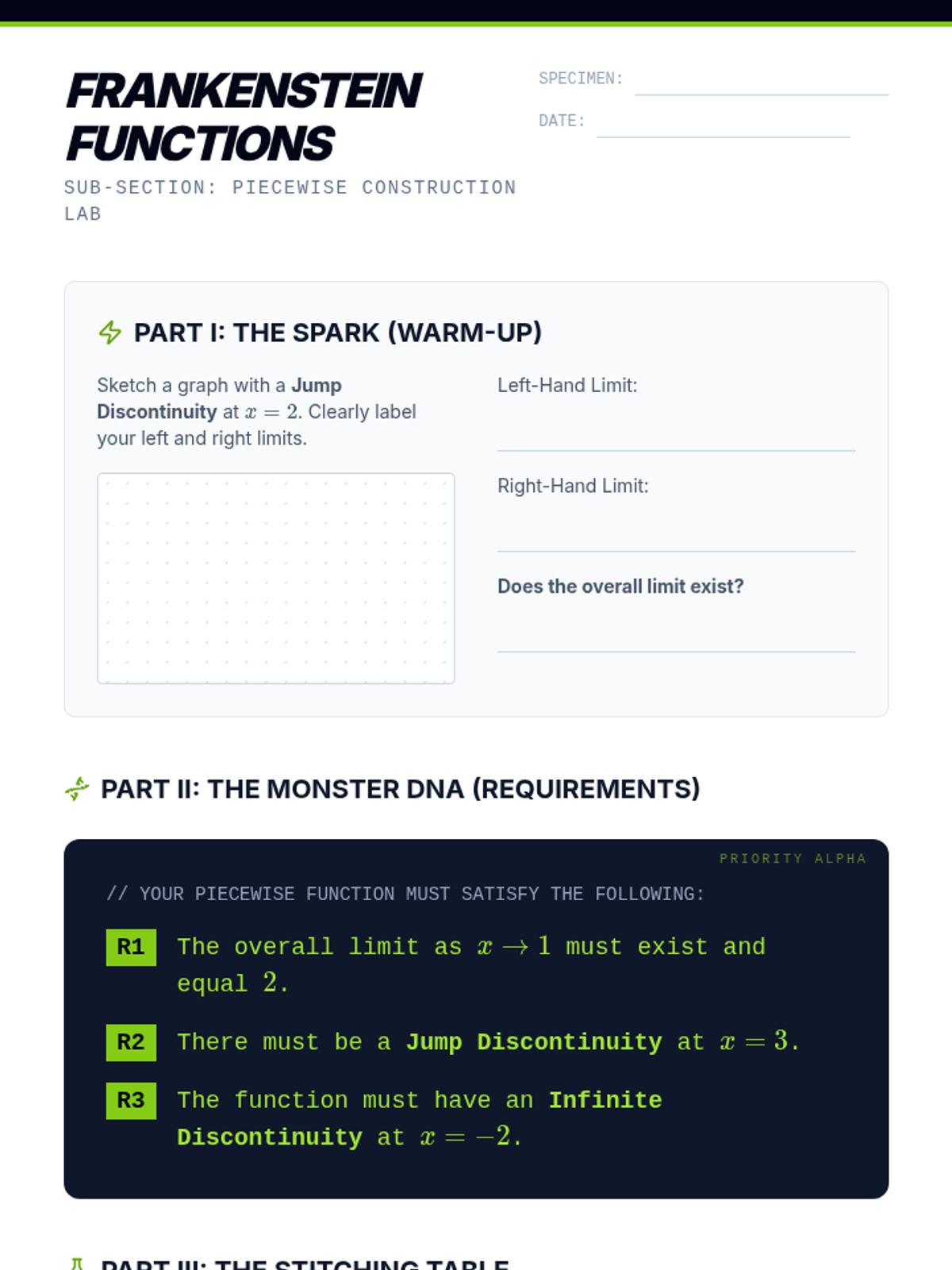
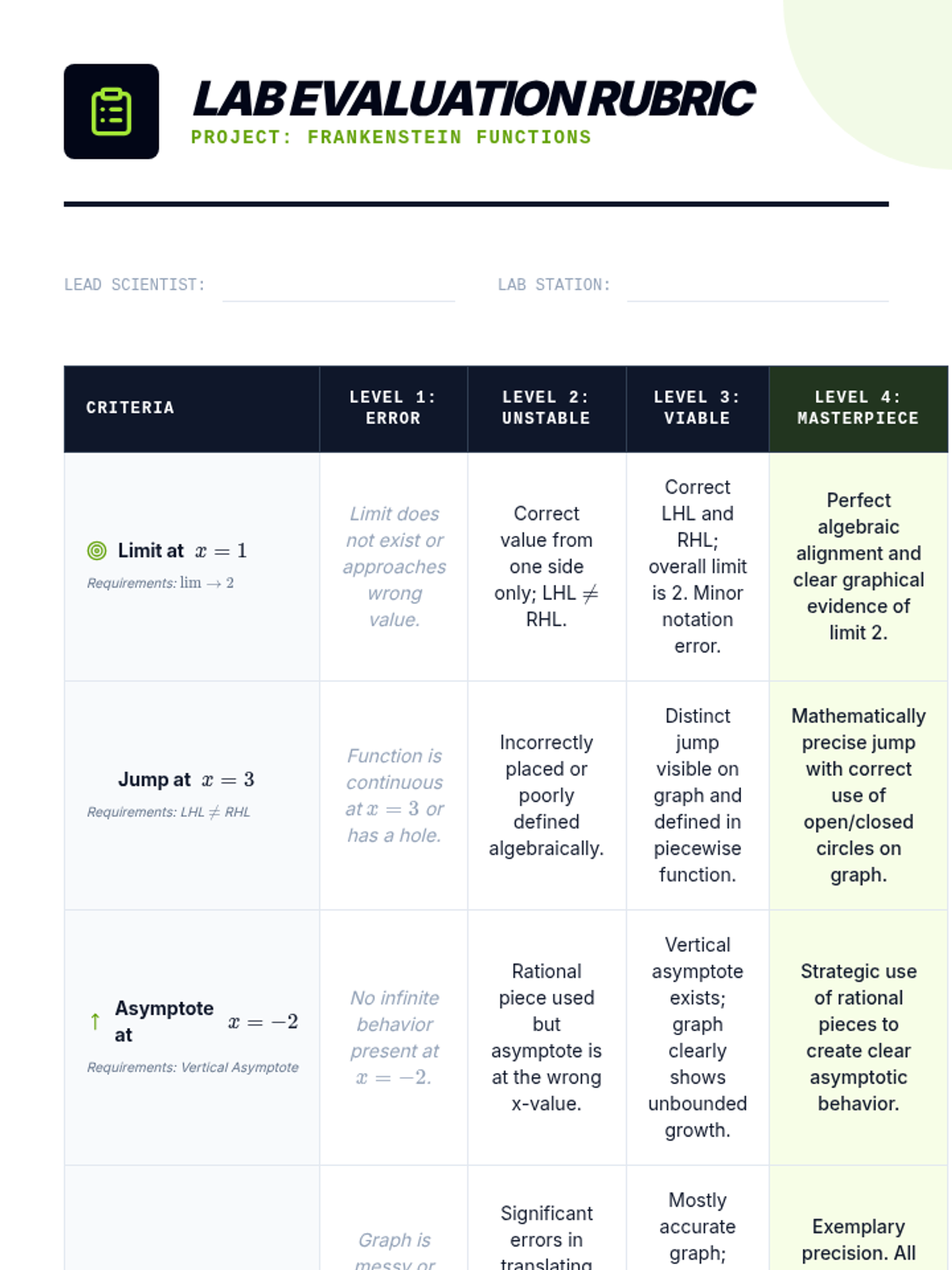
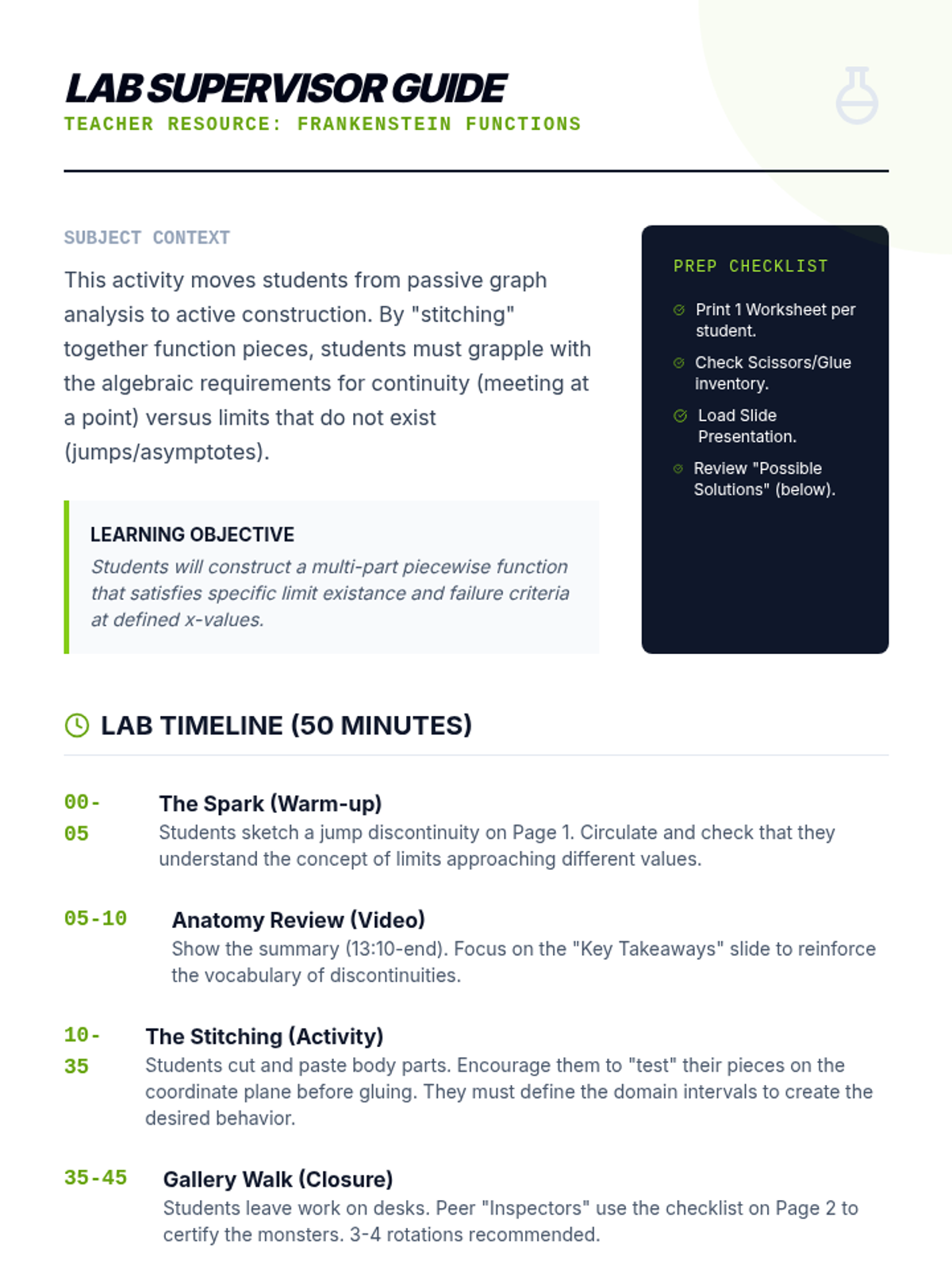
A Precalculus lesson where students construct complex piecewise 'monster' functions using algebraic 'body parts' to satisfy specific limit and continuity requirements.
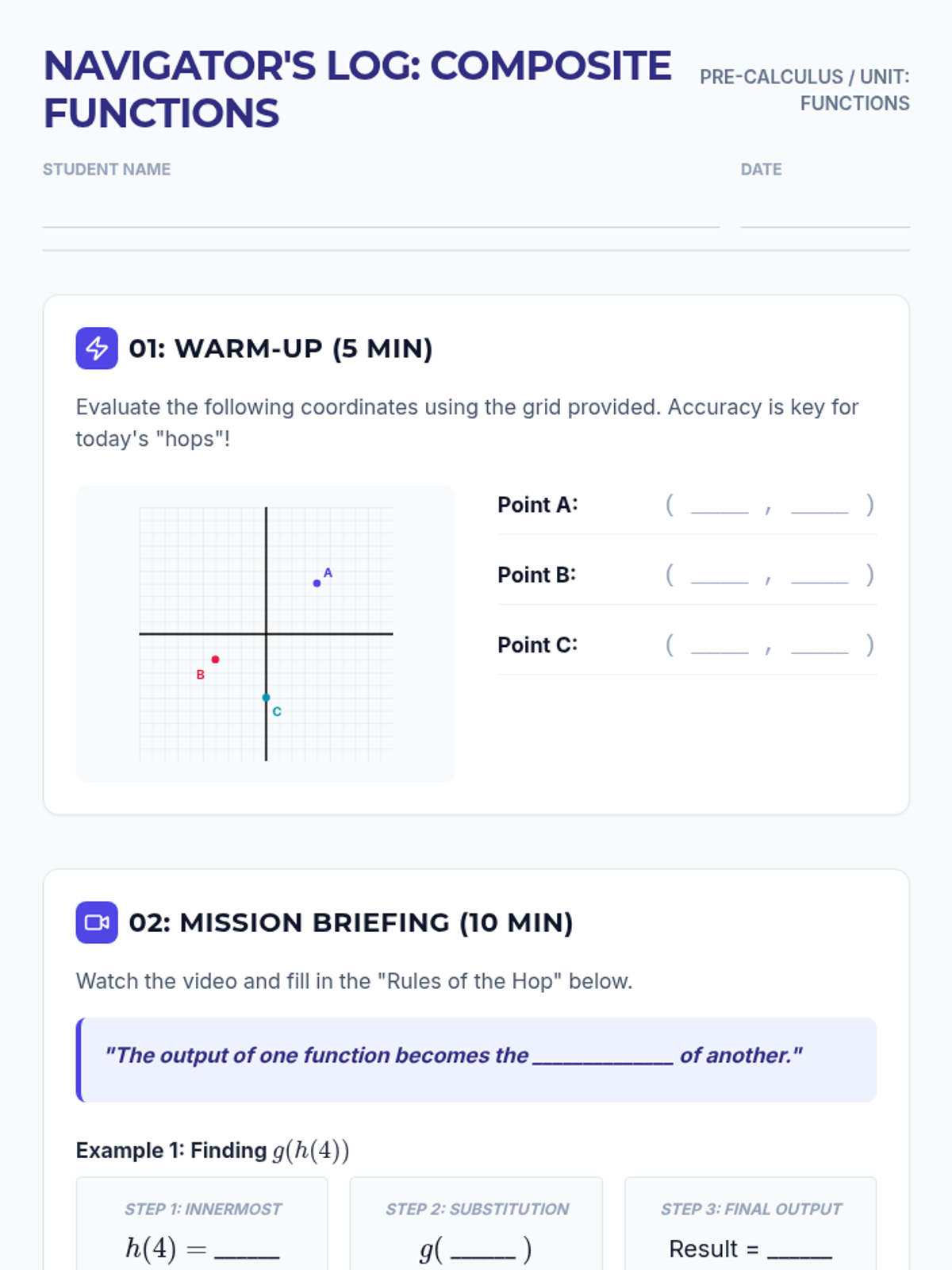
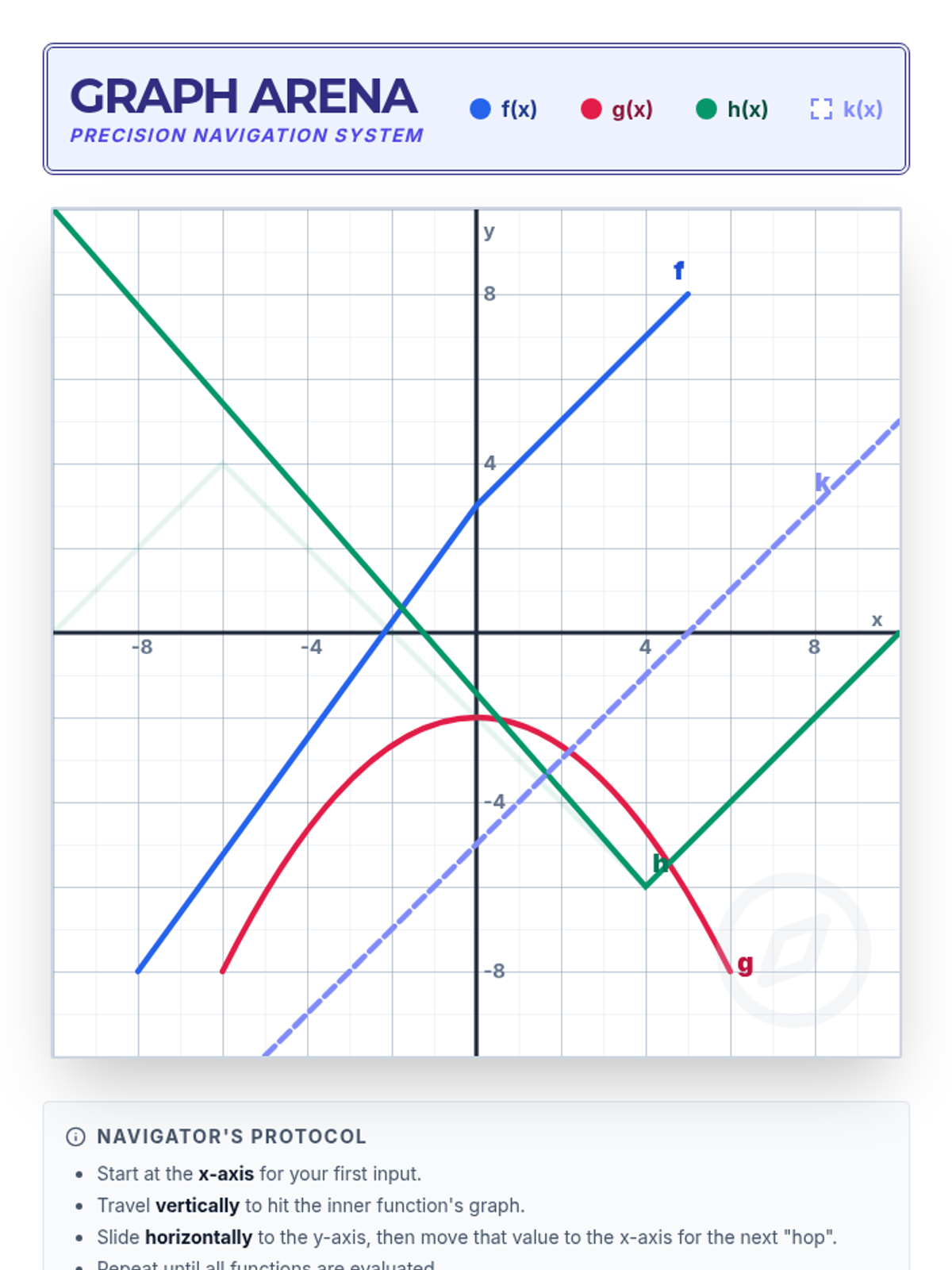
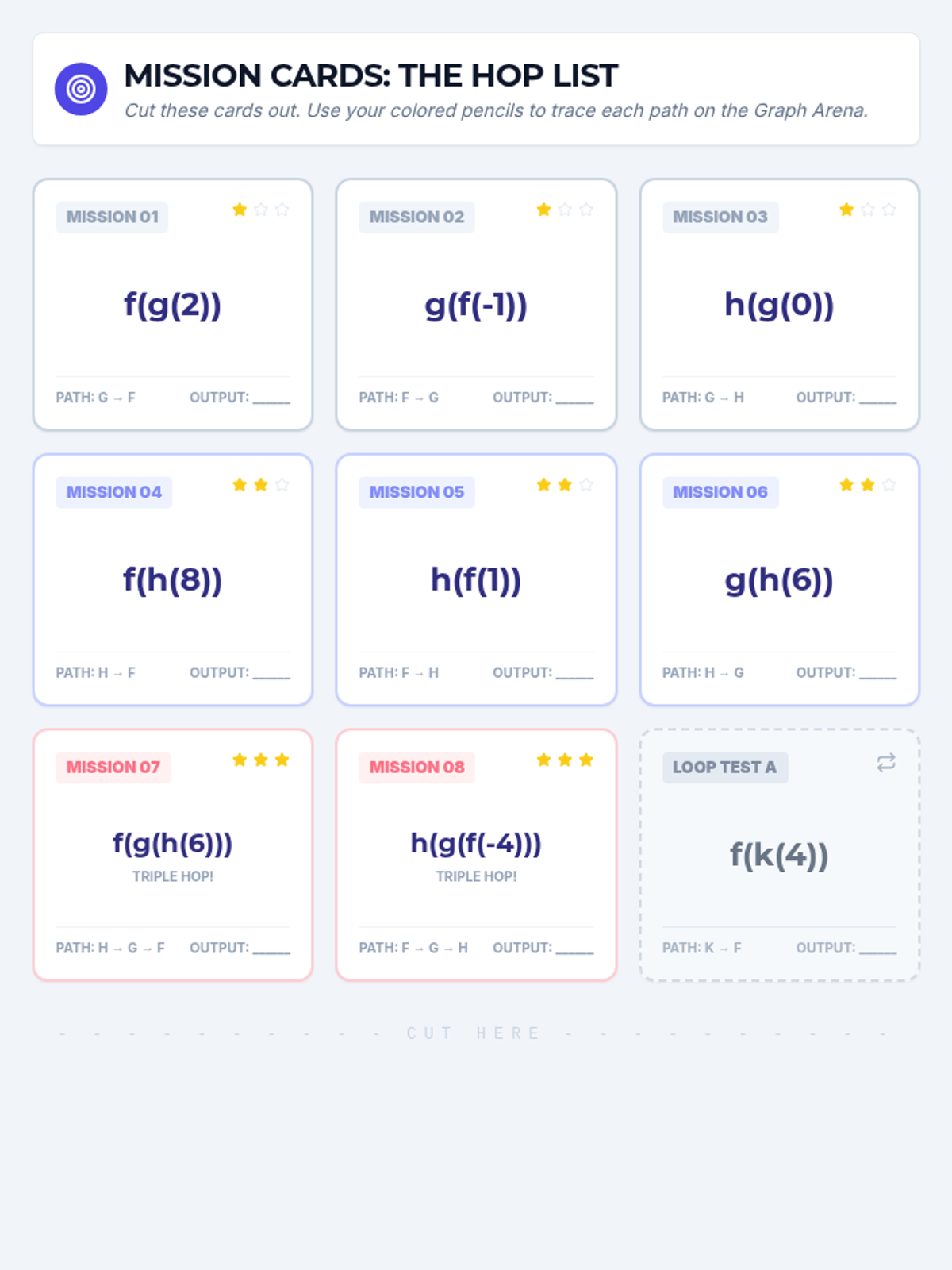
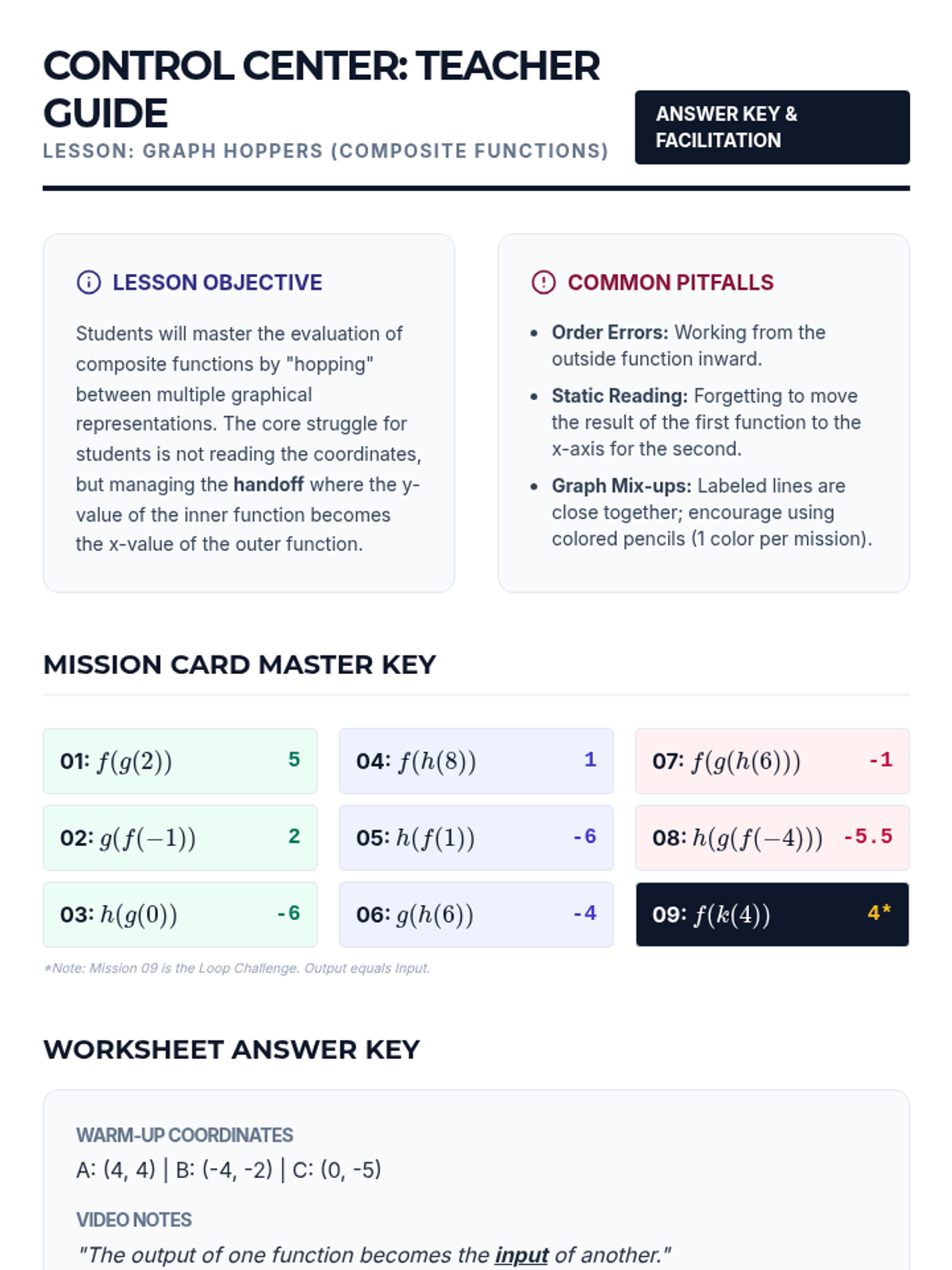
Students master the evaluation of composite functions by 'hopping' between multiple graphical representations, using the output of one function as the input for the next. The lesson progresses from basic algebraic review to complex triple-nested graphical evaluations and introduces inverse relationships.
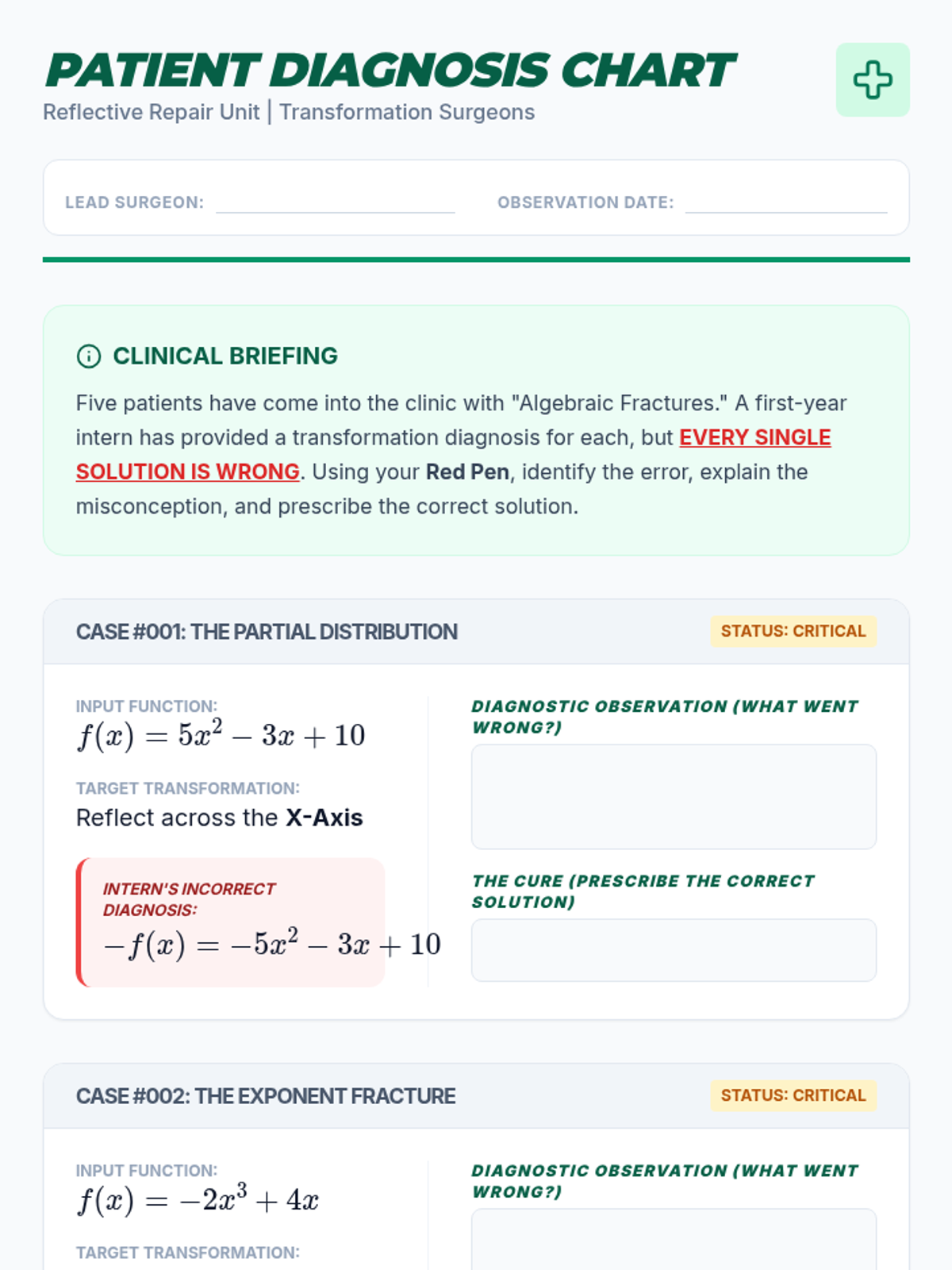
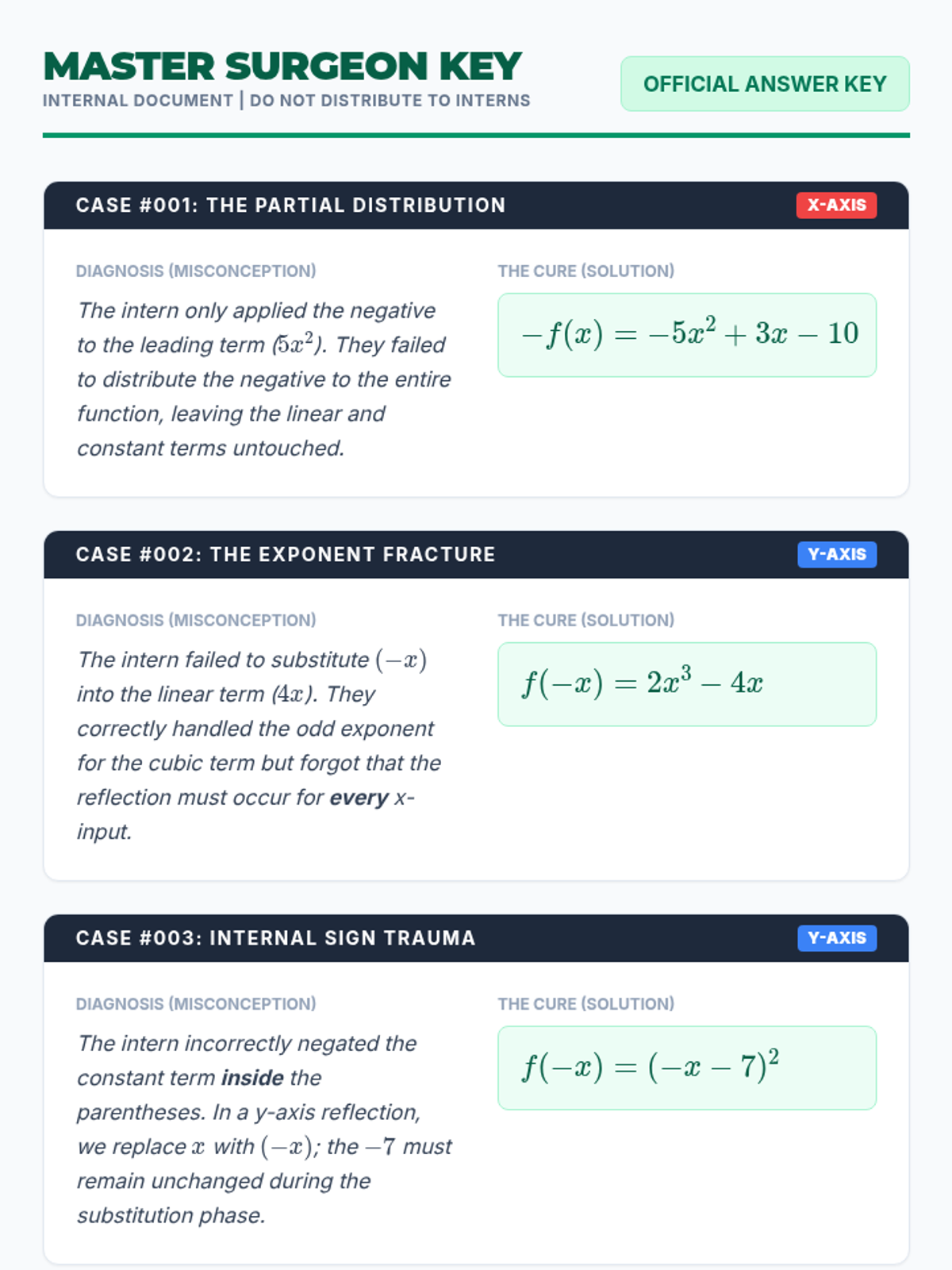
Students troubleshoot algebraic errors in function reflections over the x and y axes. Using a medical diagnostic theme, they identify distribution mistakes and exponent sign errors to 'heal' broken functions.
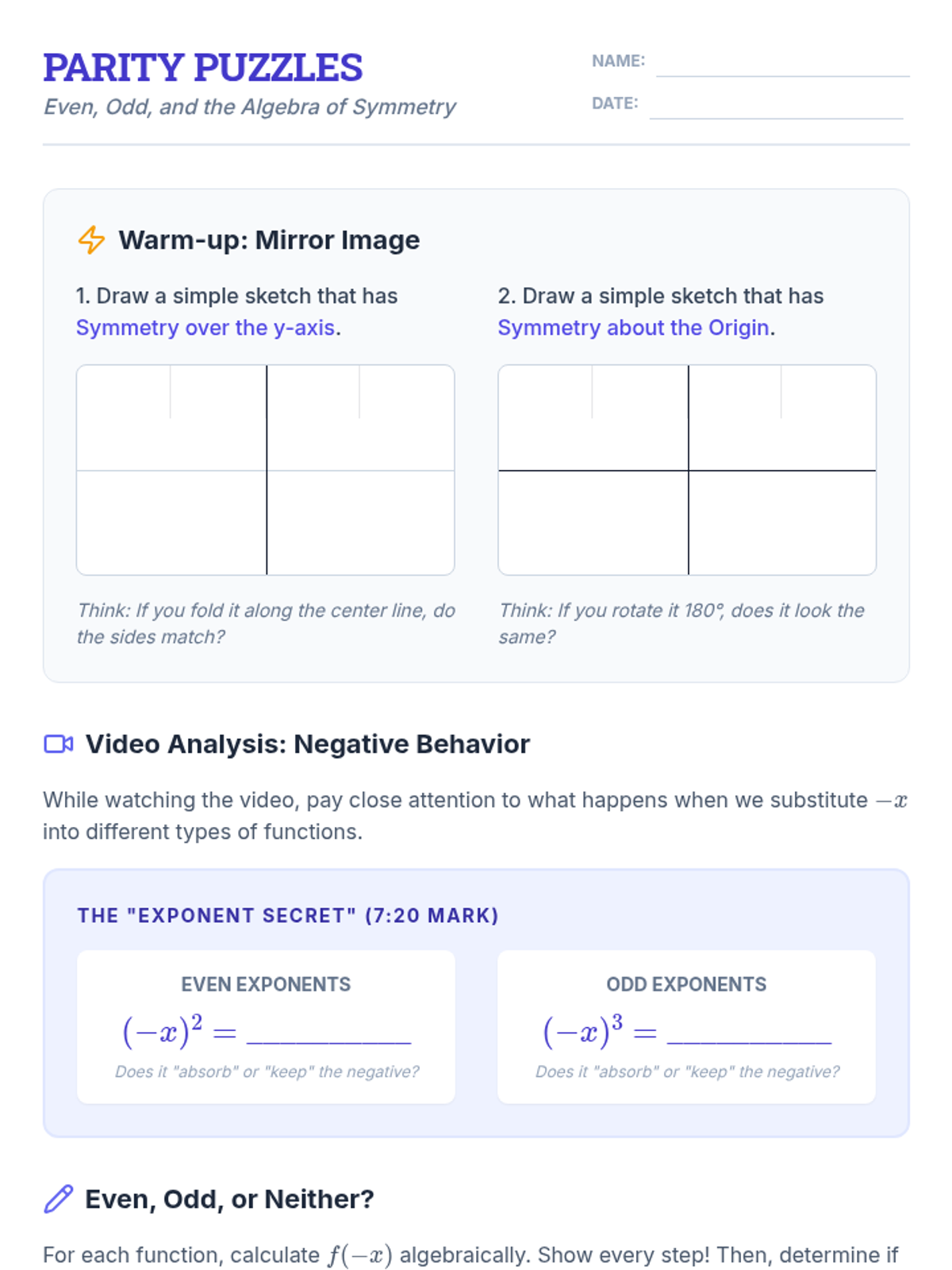
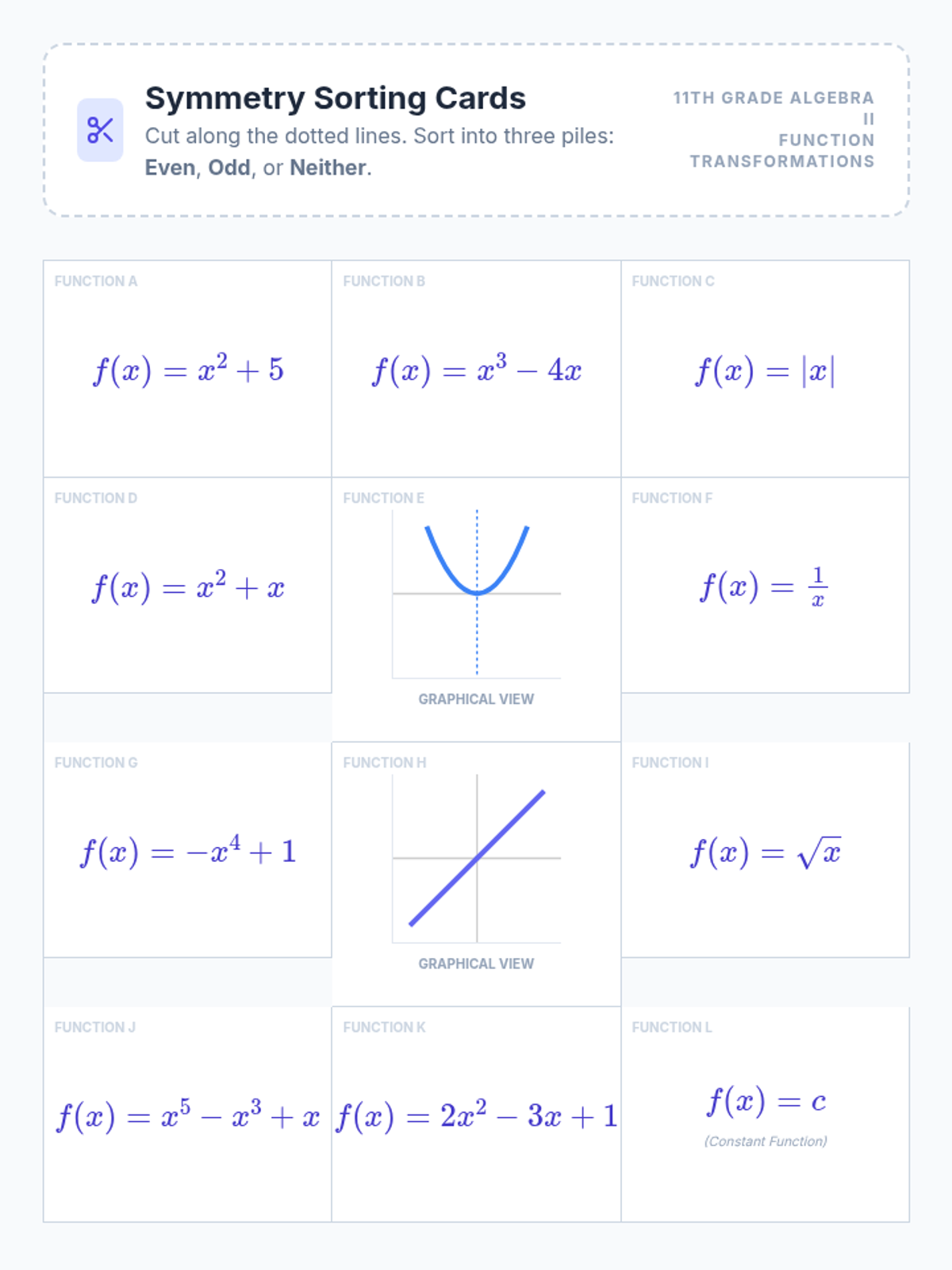
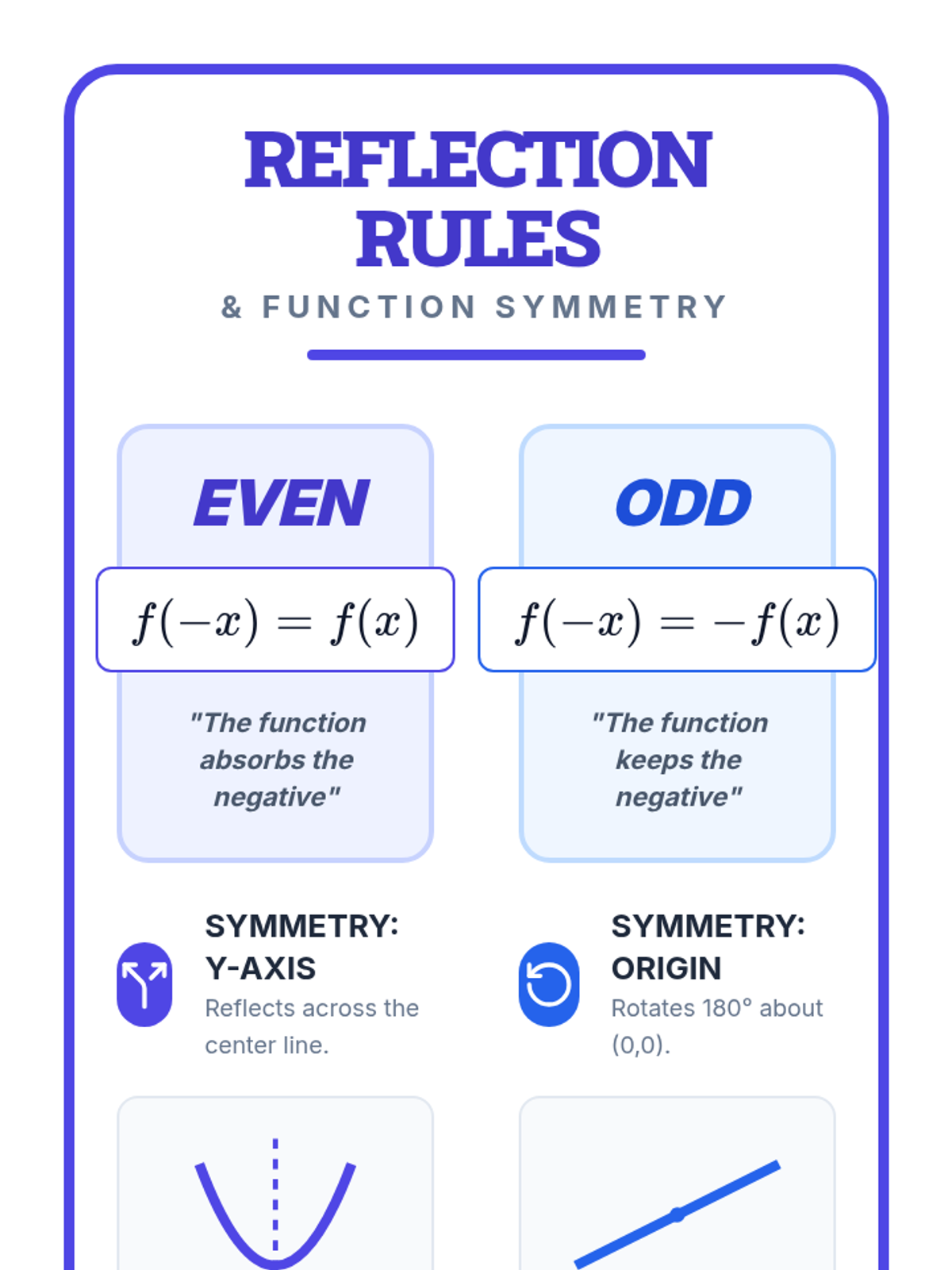
Students will explore even and odd functions by applying reflection rules algebraically and graphically. The lesson includes a video-guided analysis of how functions 'absorb' or 'keep' negative signs through substitution.
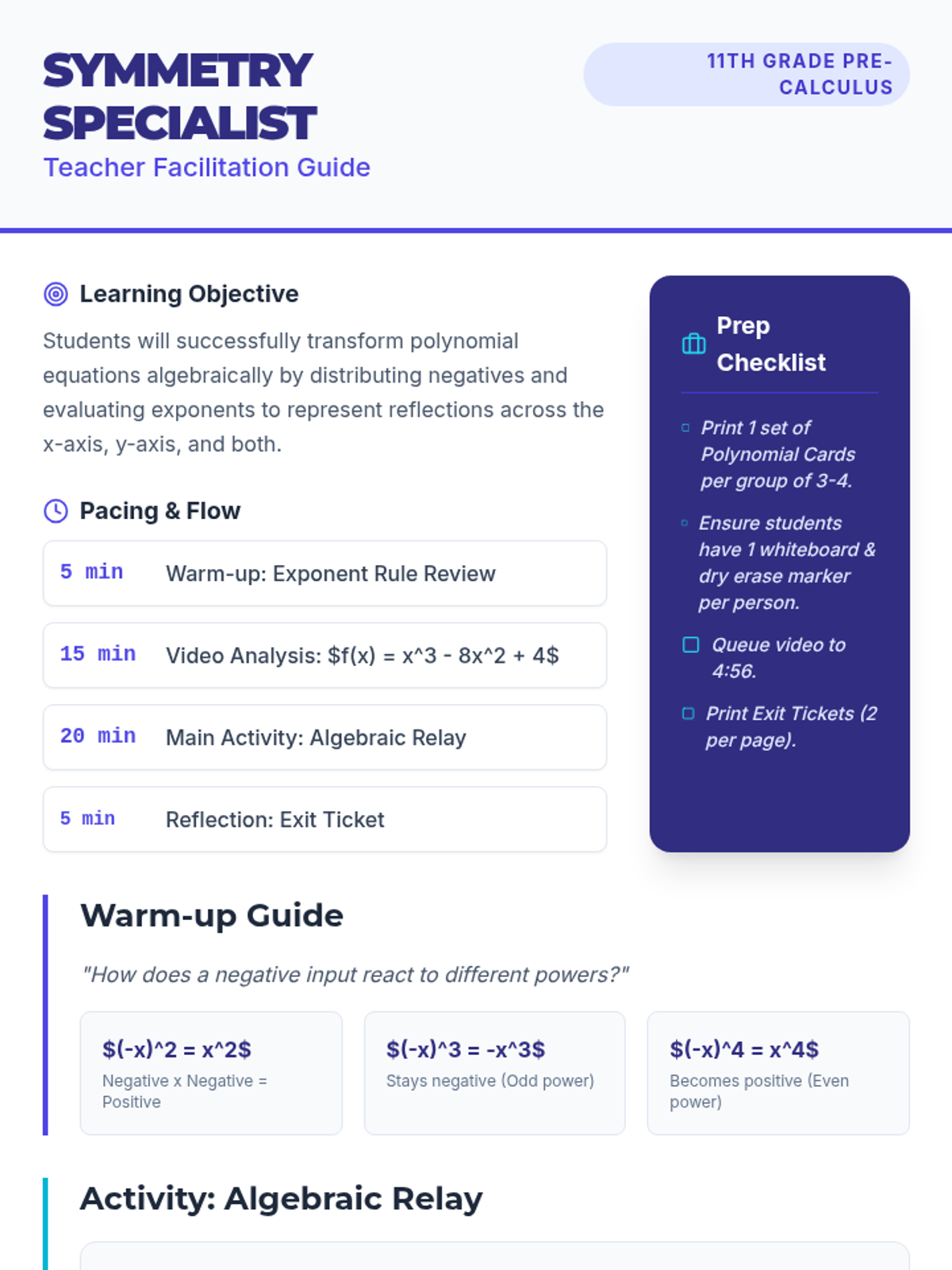
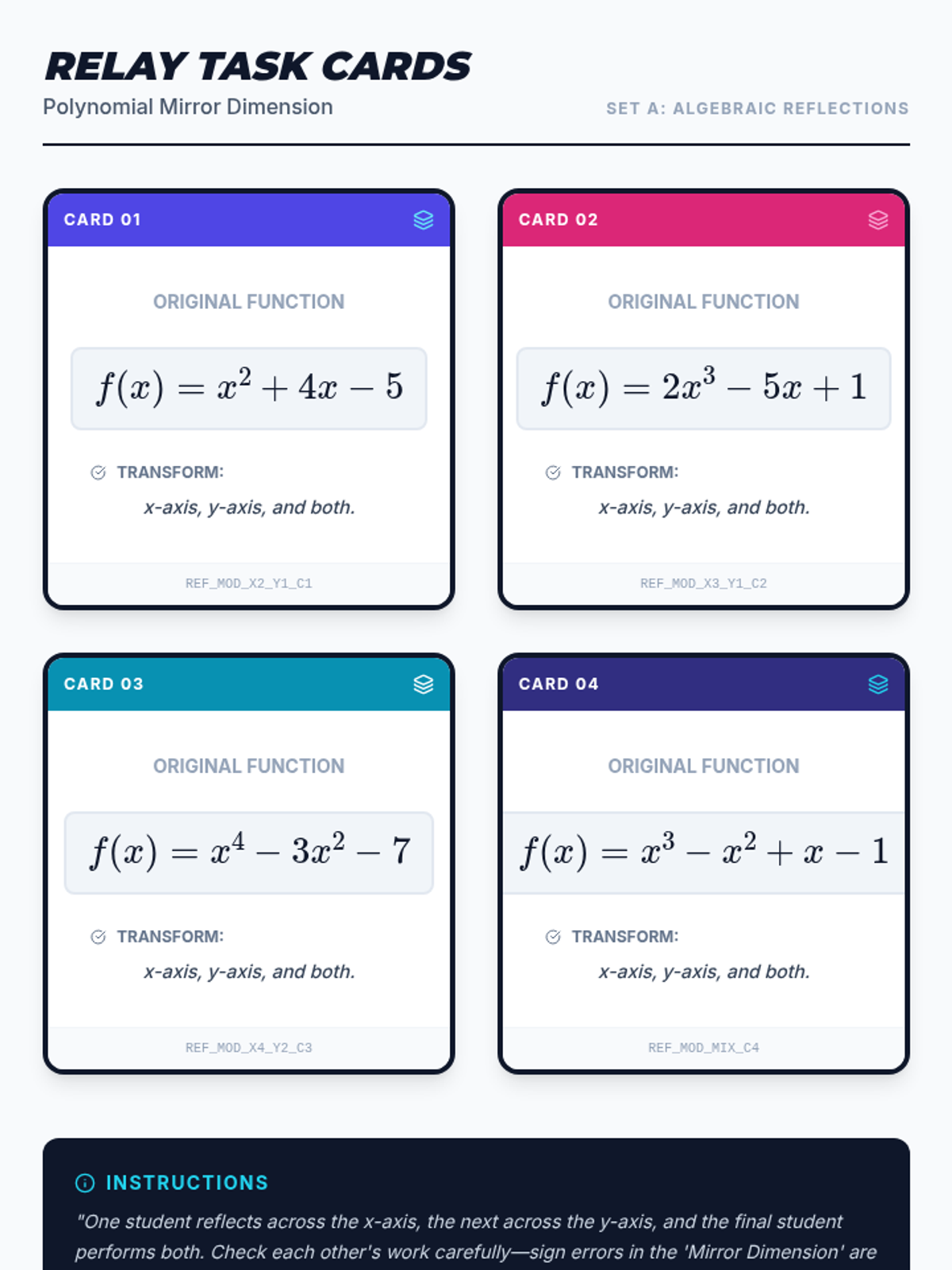
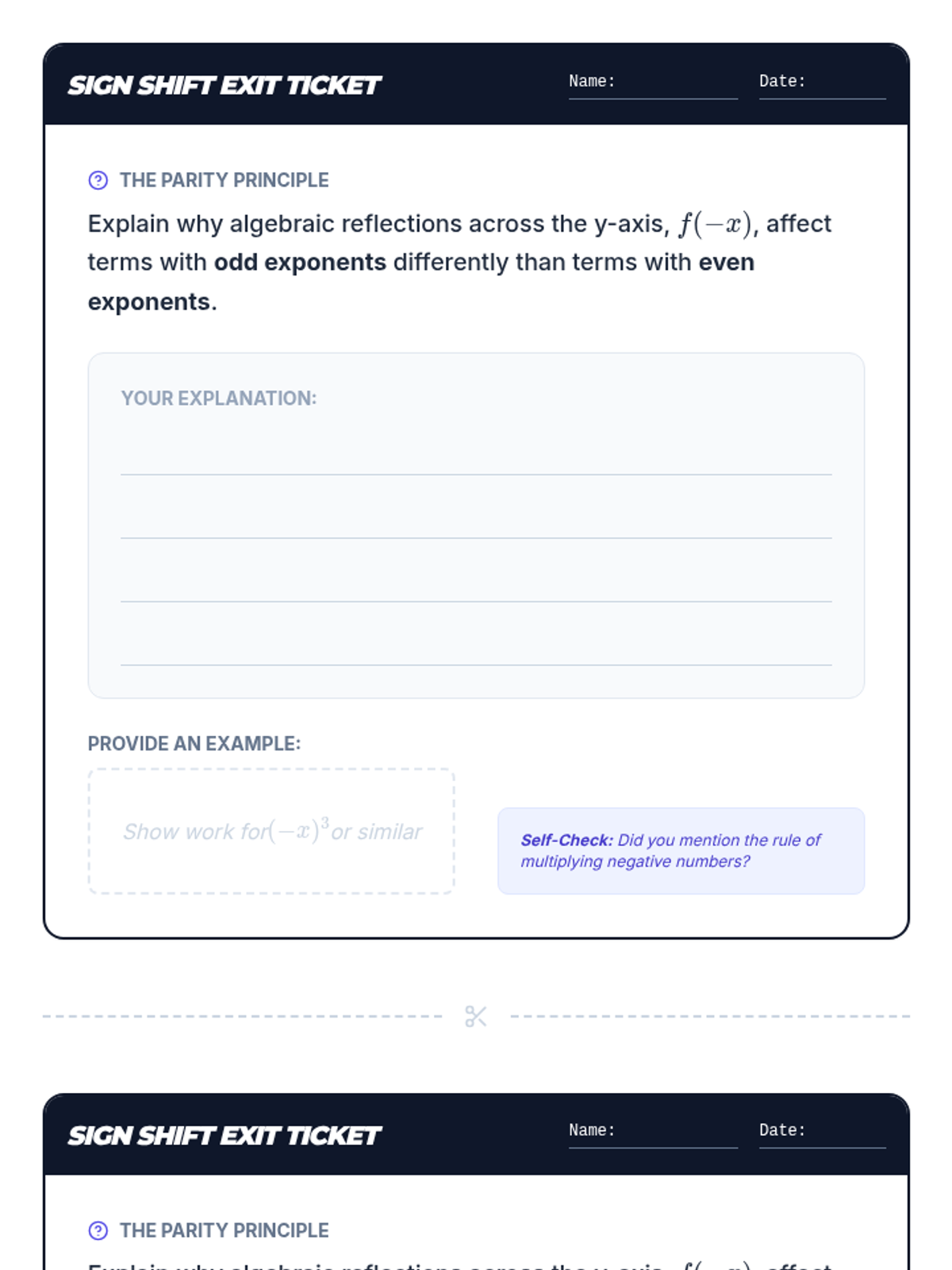
A high-energy Pre-Calculus lesson where students master algebraic transformations of polynomial functions through interactive video analysis and a collaborative 'Algebraic Relay' activity. Students focus on the nuances of distributing negatives and the impact of parity in exponents on function reflections.
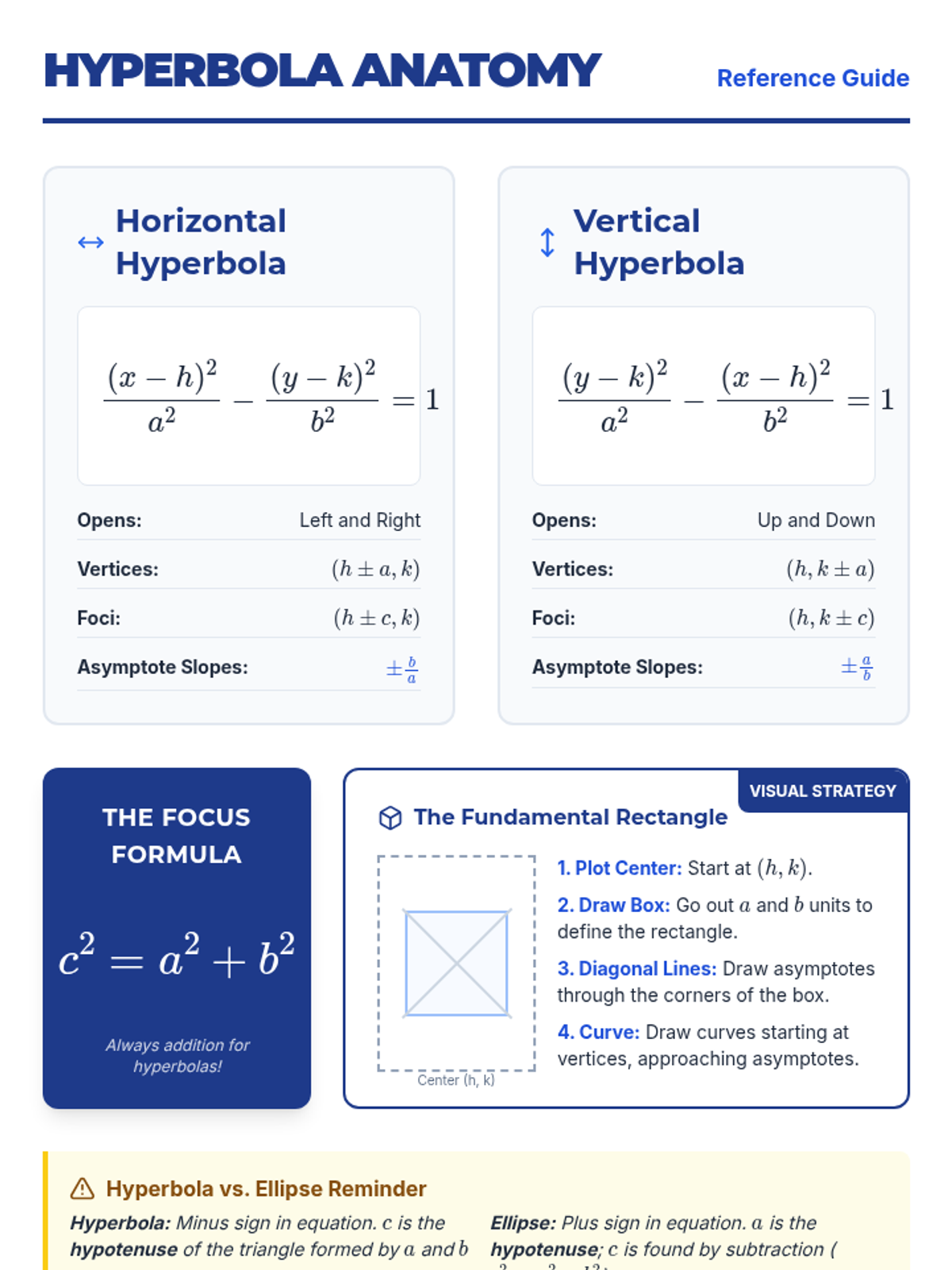
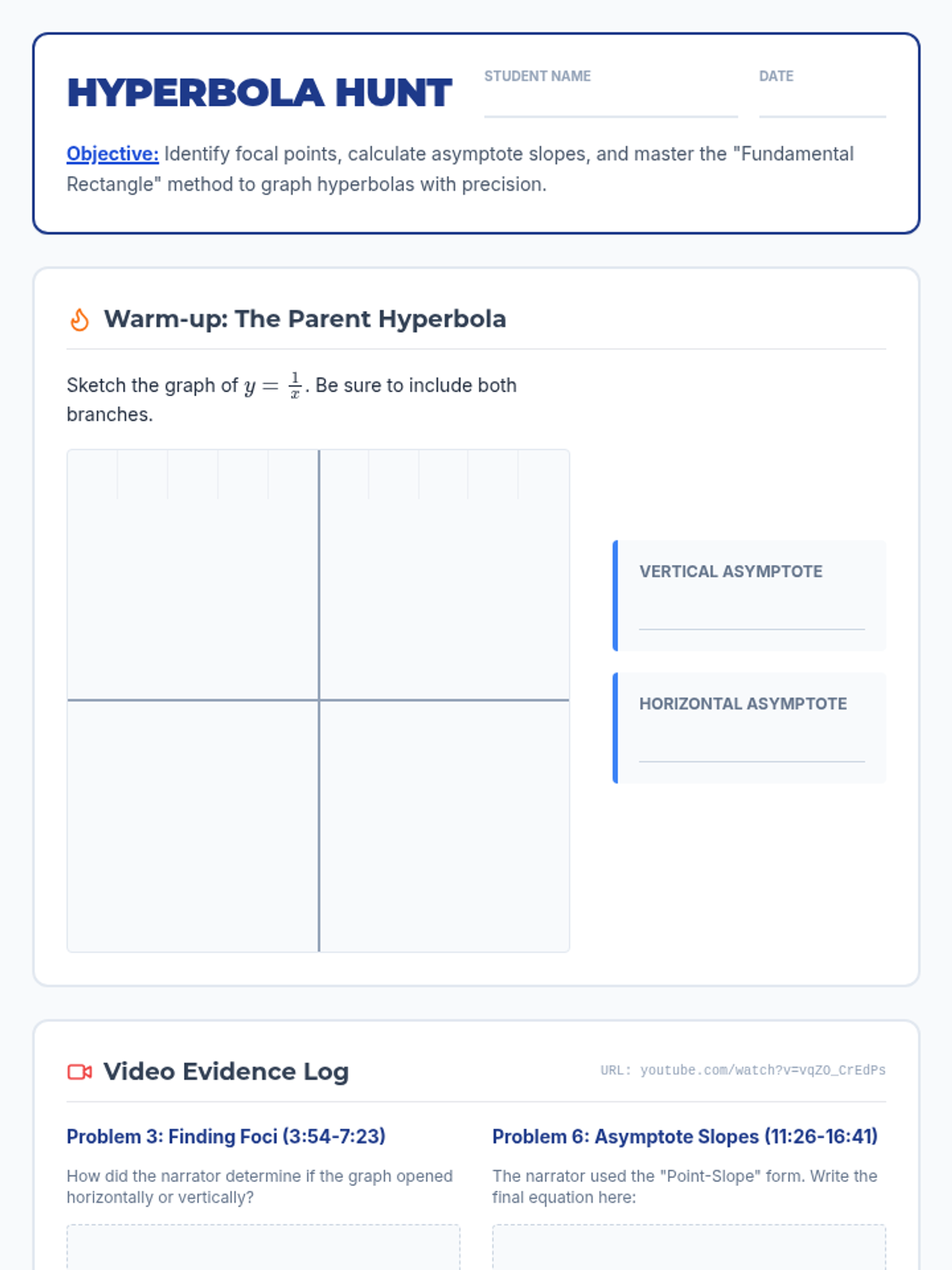
A comprehensive lesson on hyperbola properties, focusing on calculating foci, determining asymptote equations via the fundamental rectangle, and converting between general and standard forms. Includes a video-guided tutorial and a 'Hyperbola Hunters' graphing activity.
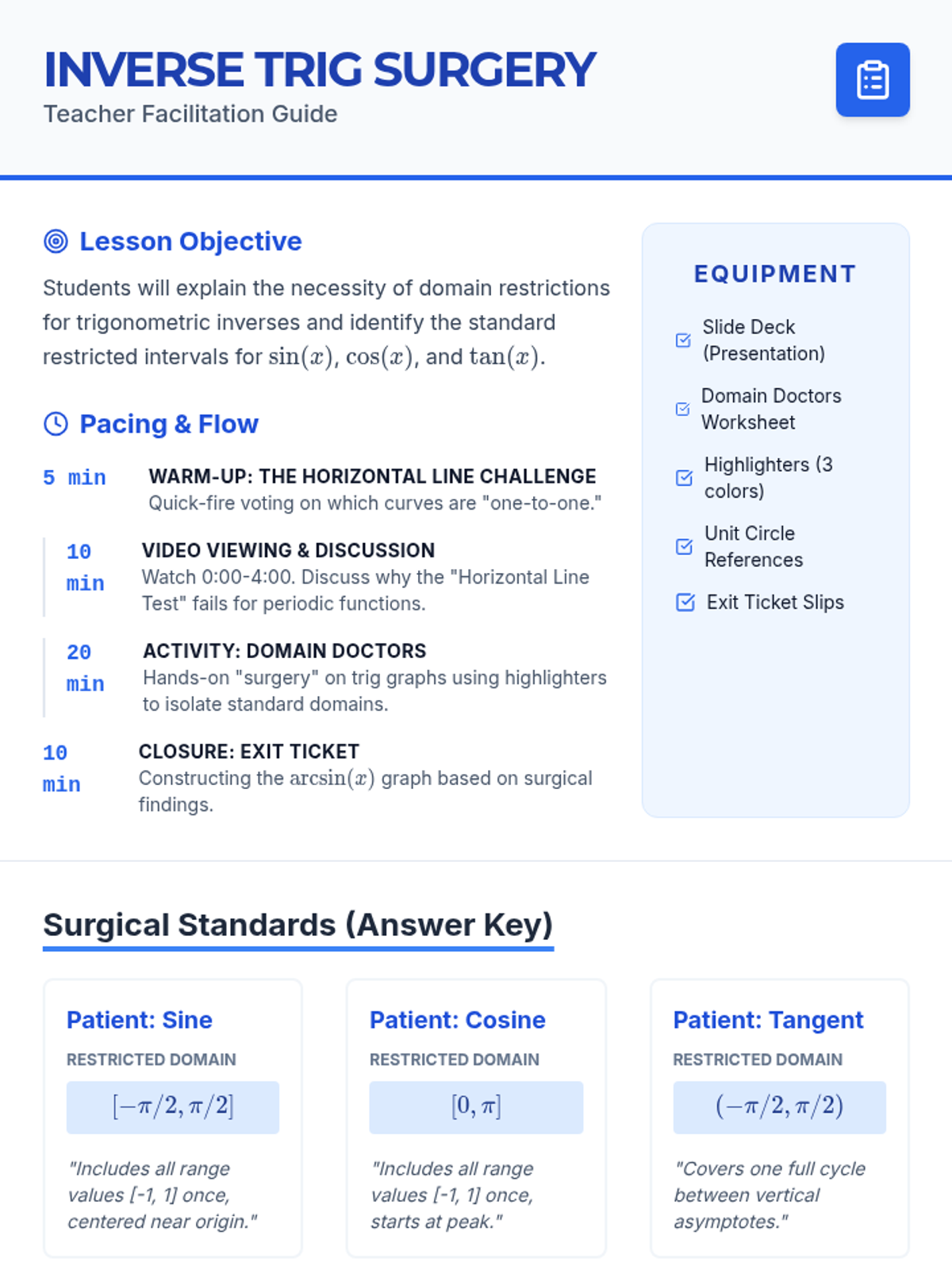
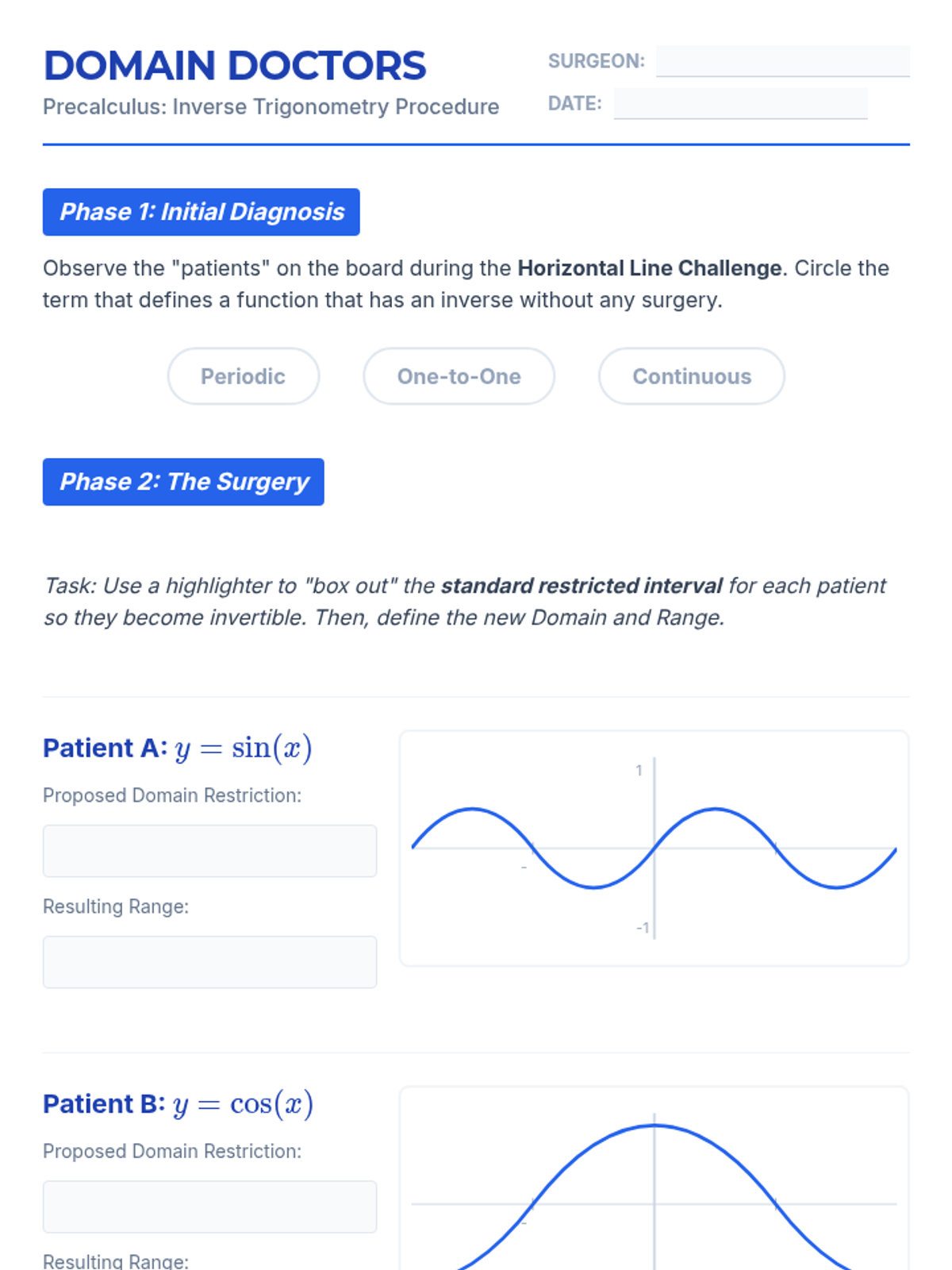
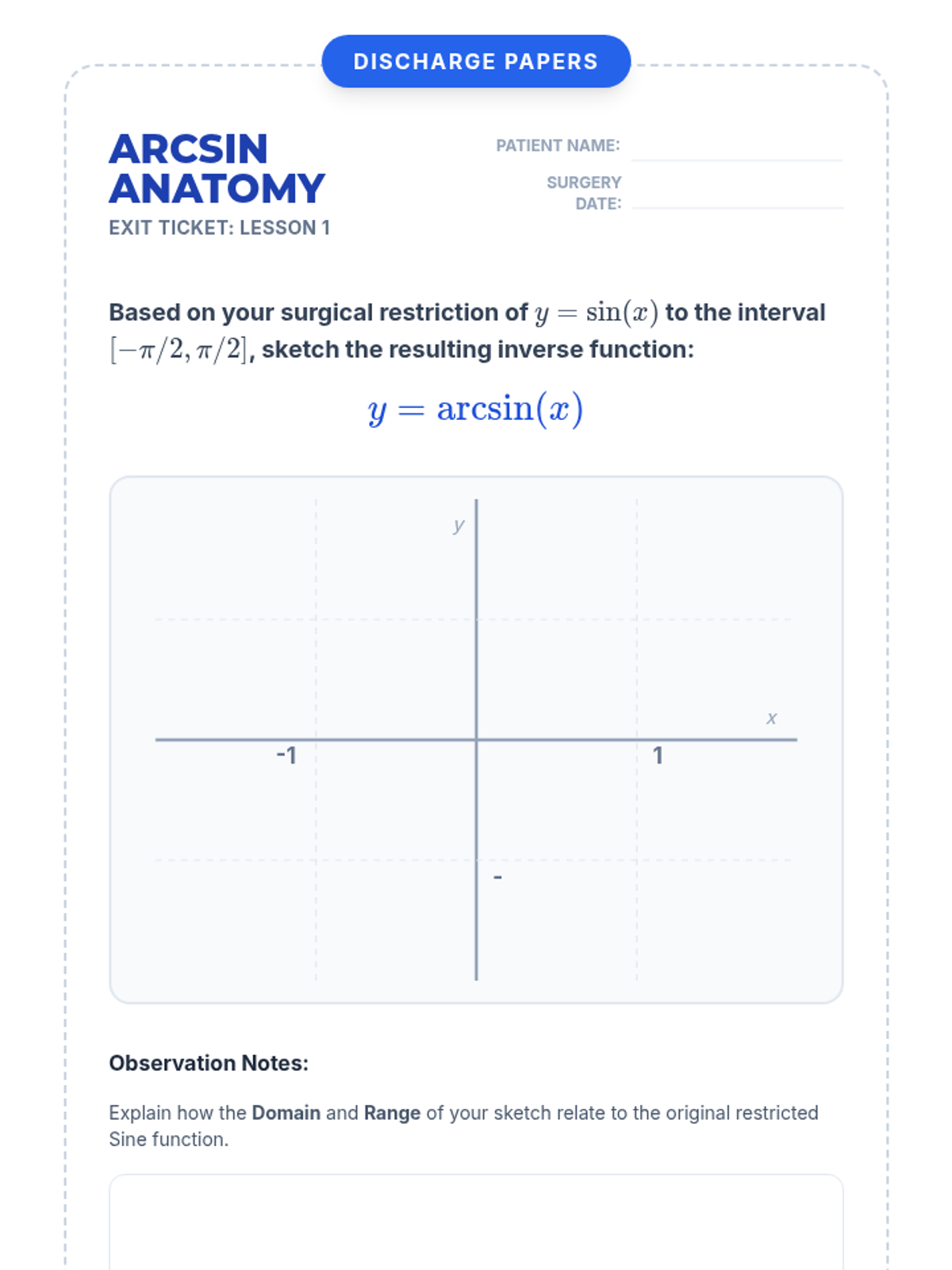
In this Precalculus lesson, students investigate why trigonometric functions require domain restrictions to be invertible. Using a medical surgery theme, students 'perform surgery' on sine, cosine, and tangent graphs to isolate the standard restricted intervals used for inverse functions.
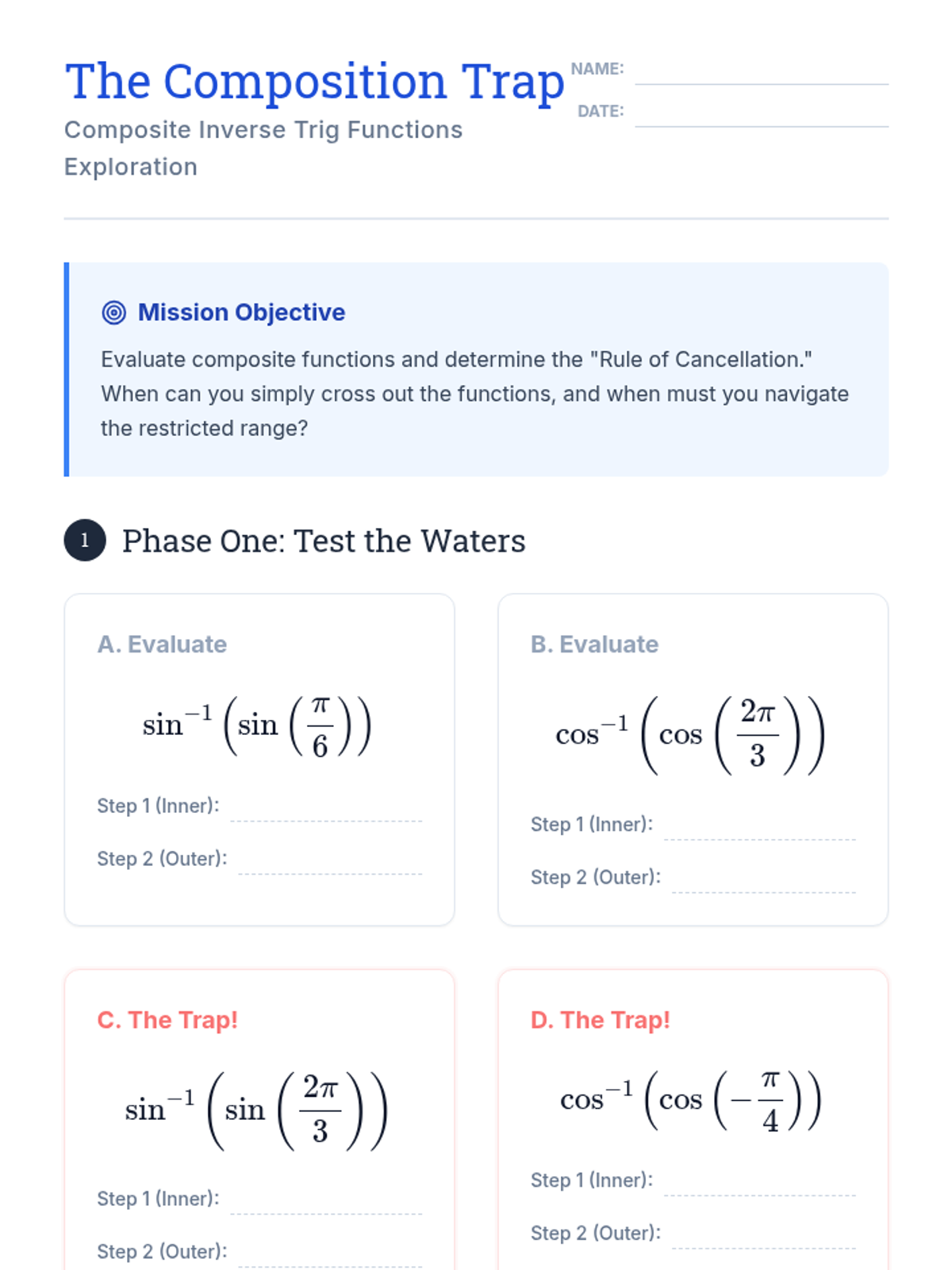
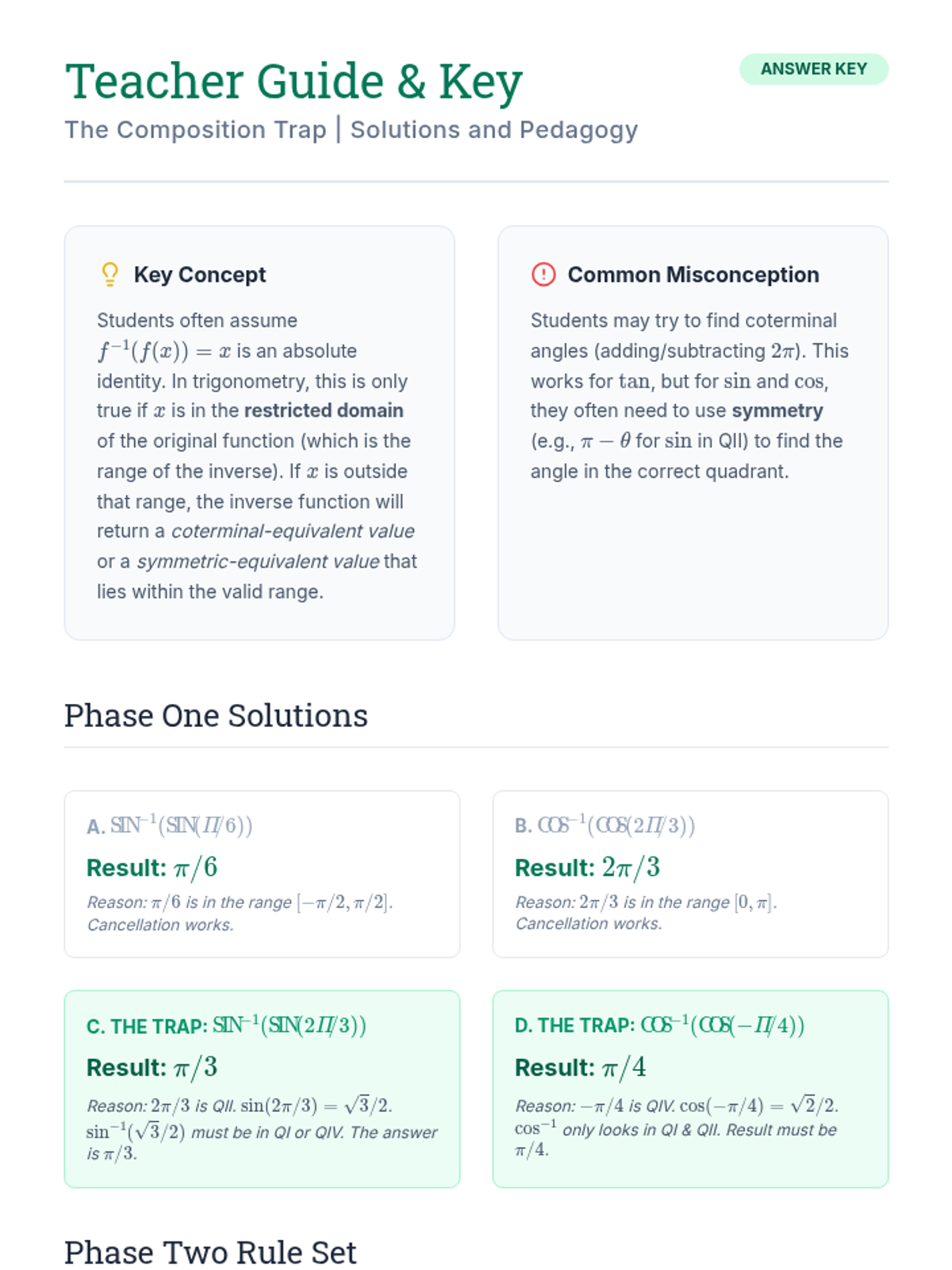
Students will master the evaluation of composite inverse trigonometric functions, specifically learning how to identify when function 'cancellation' is valid and when restricted range adjustments are required.
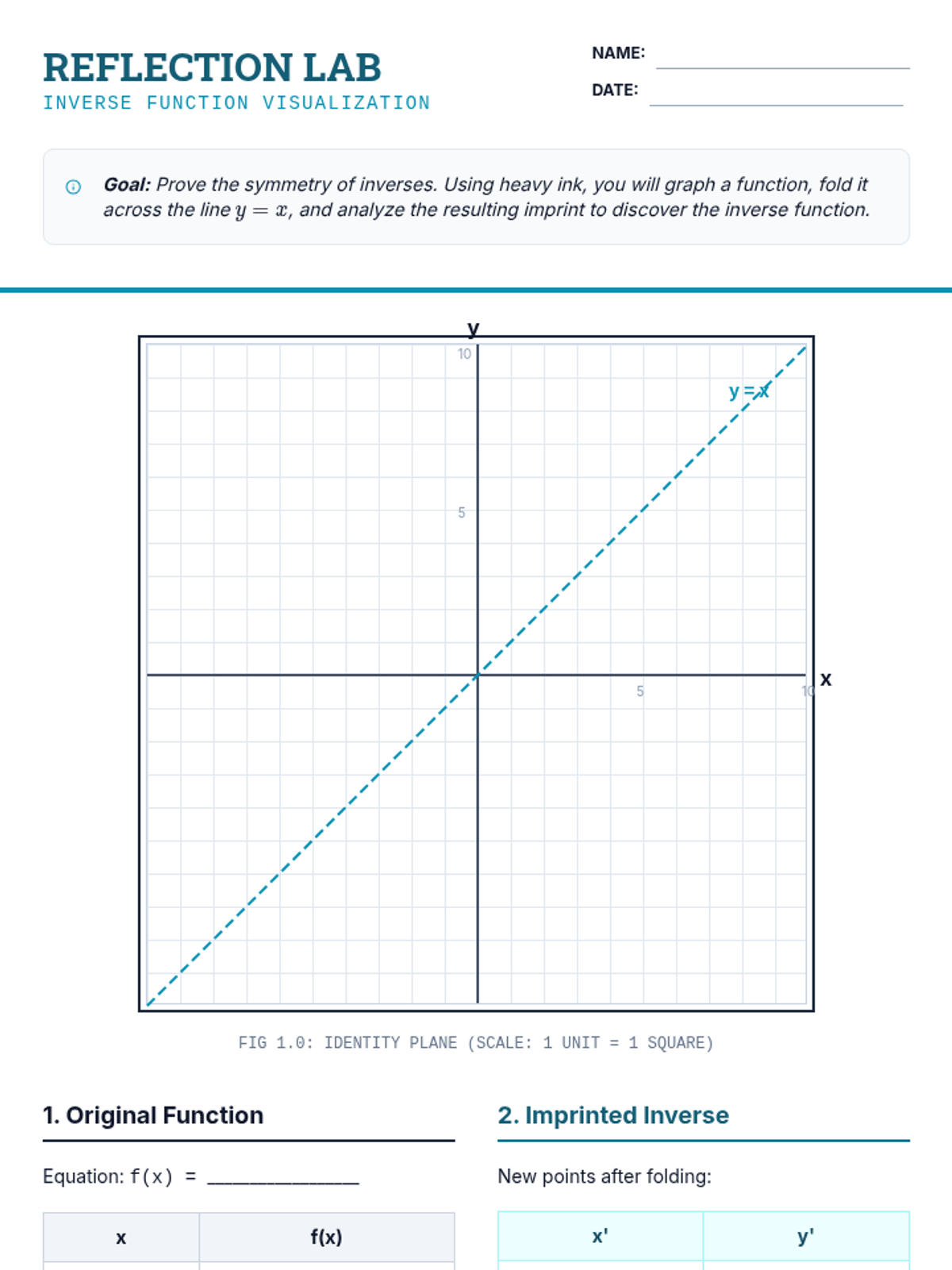
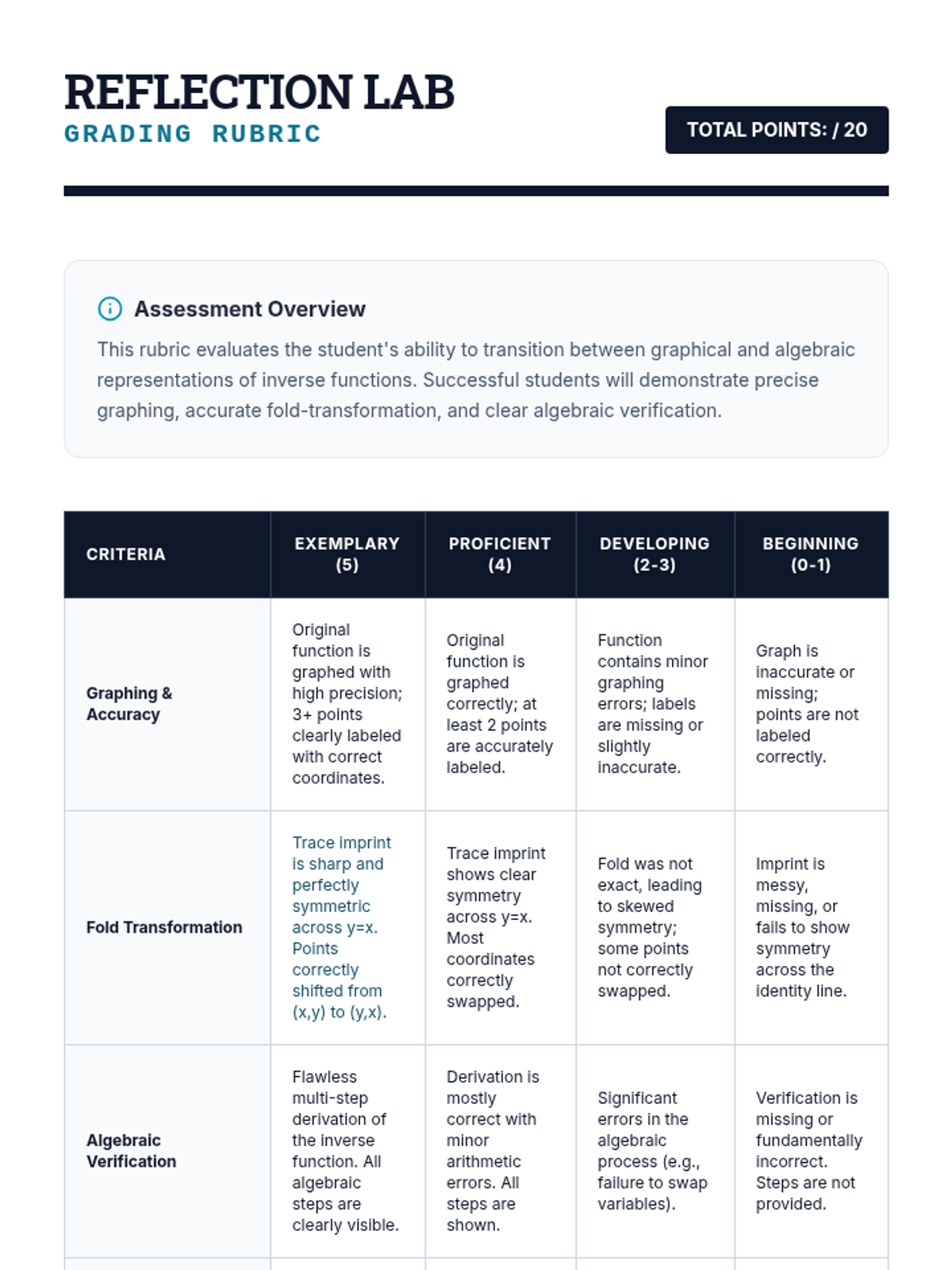
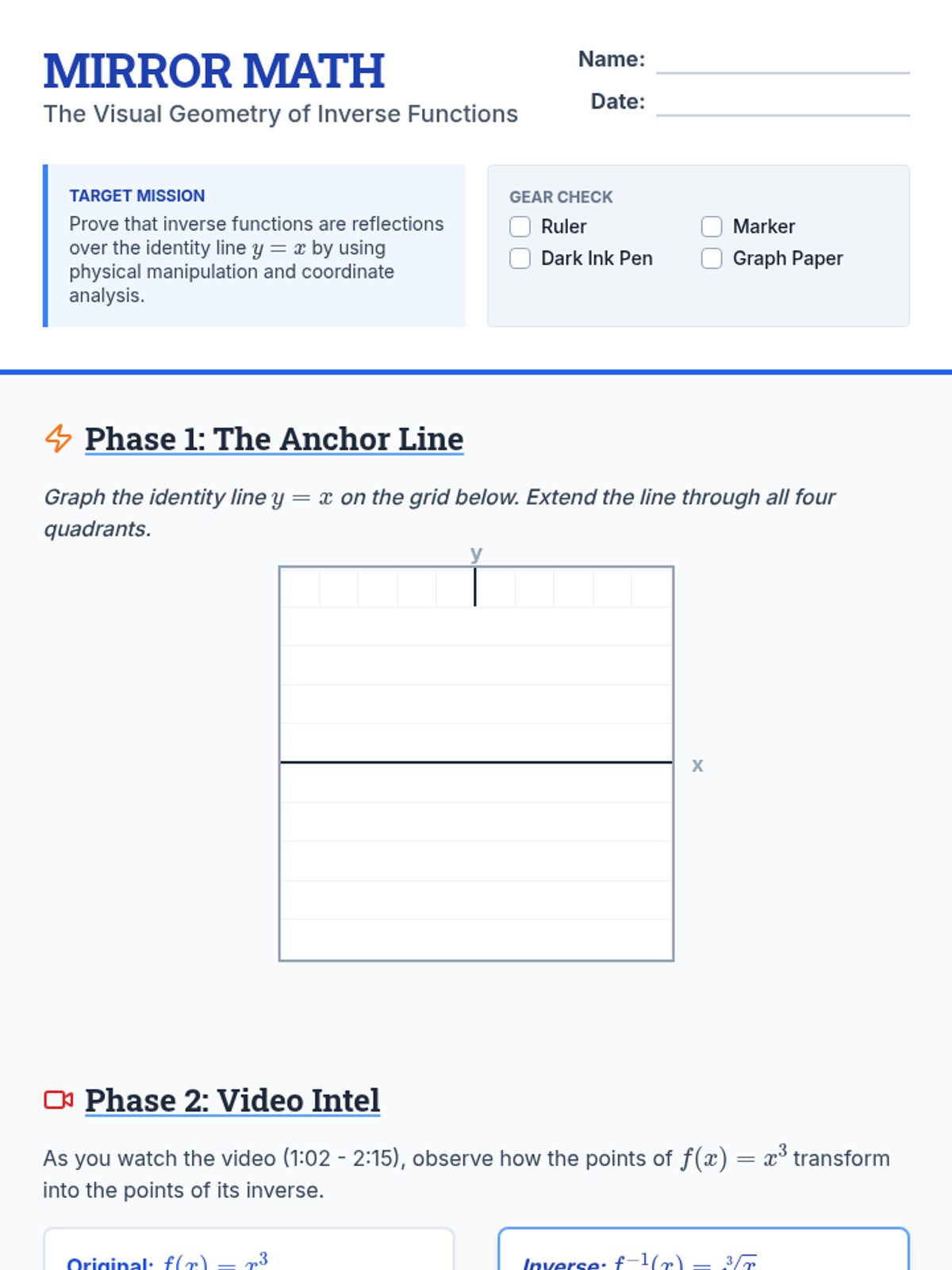
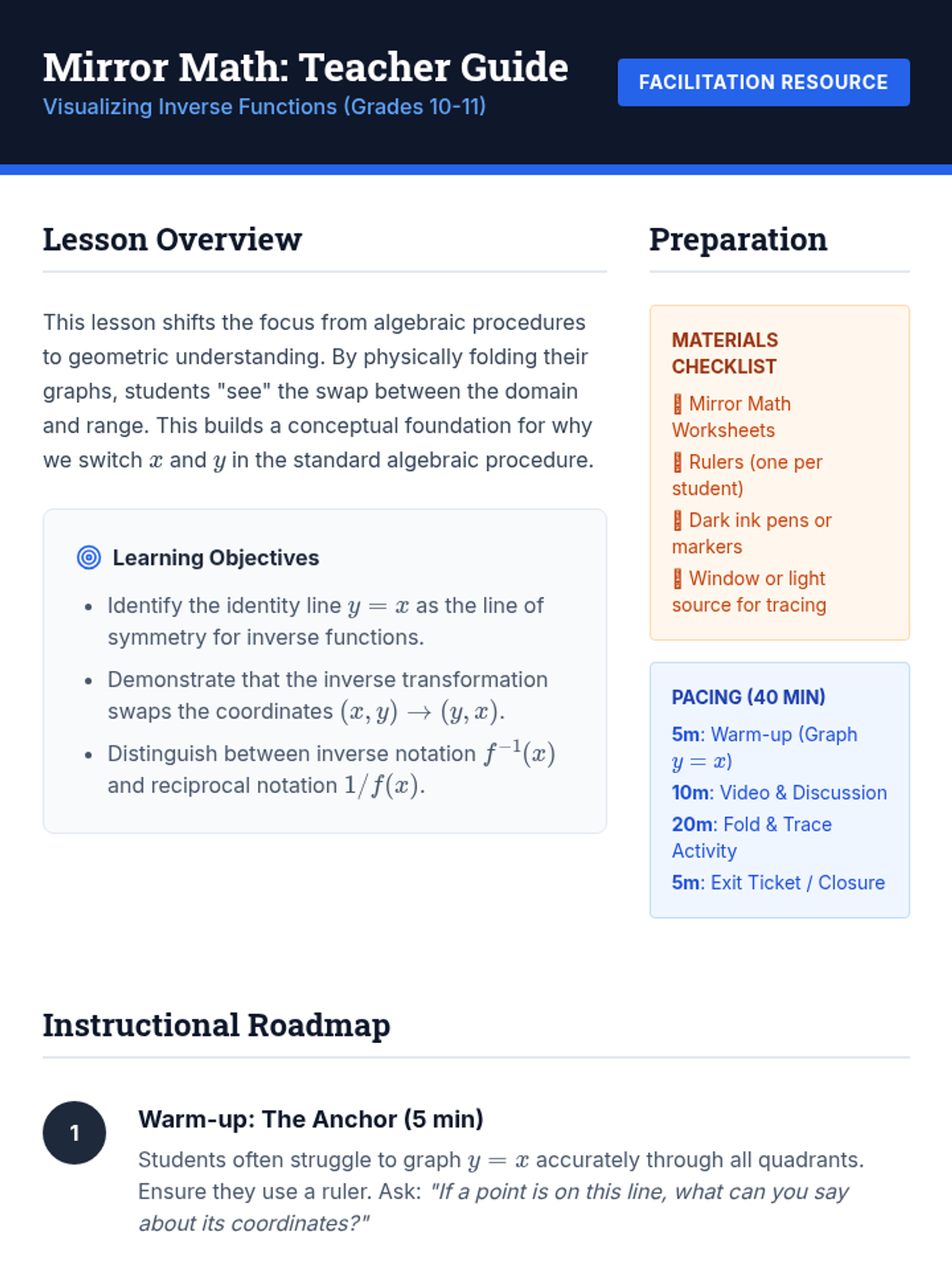
A 12th Grade/College Algebra lesson focused on the visual and algebraic relationship between functions and their inverses. Students use a 'Fold and Trace' activity to discover symmetry over the line y=x.
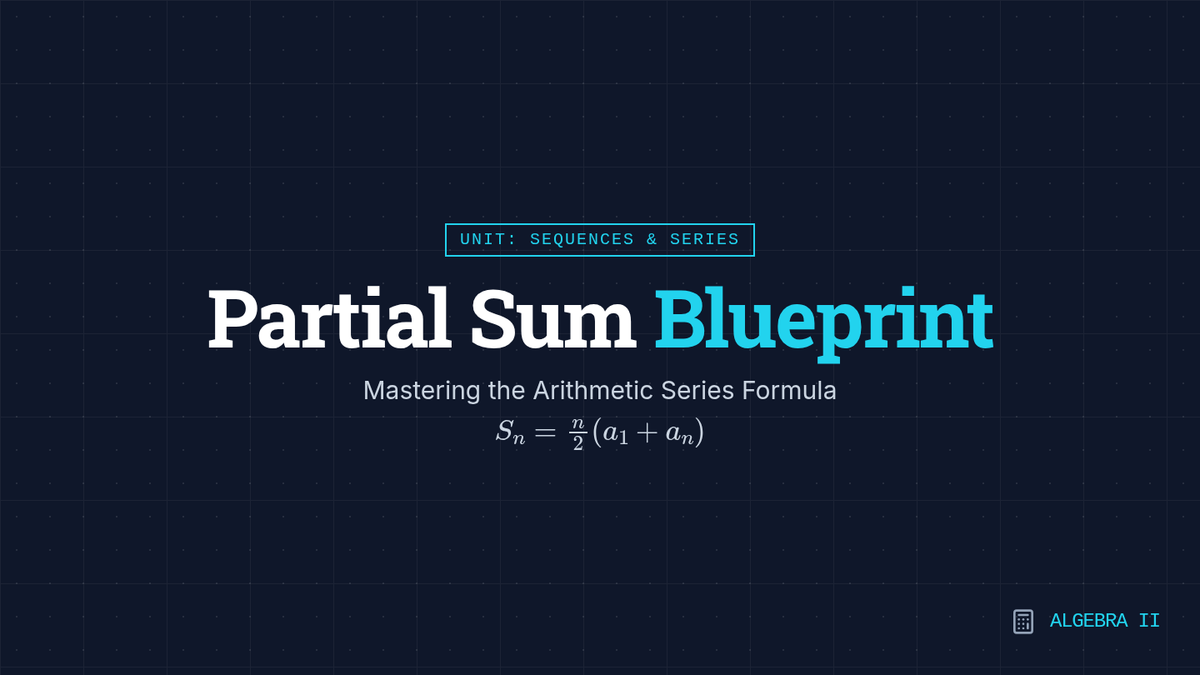
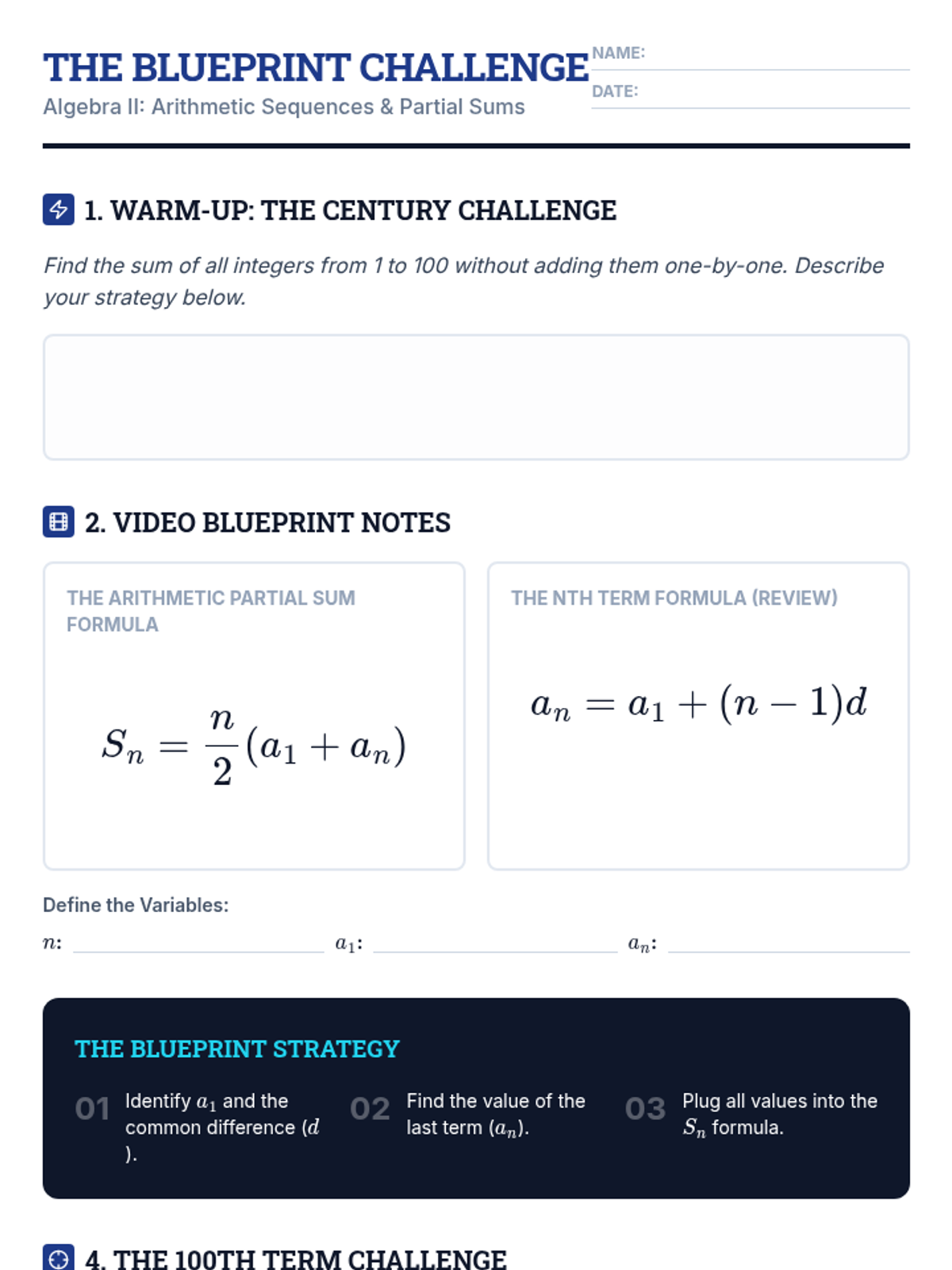
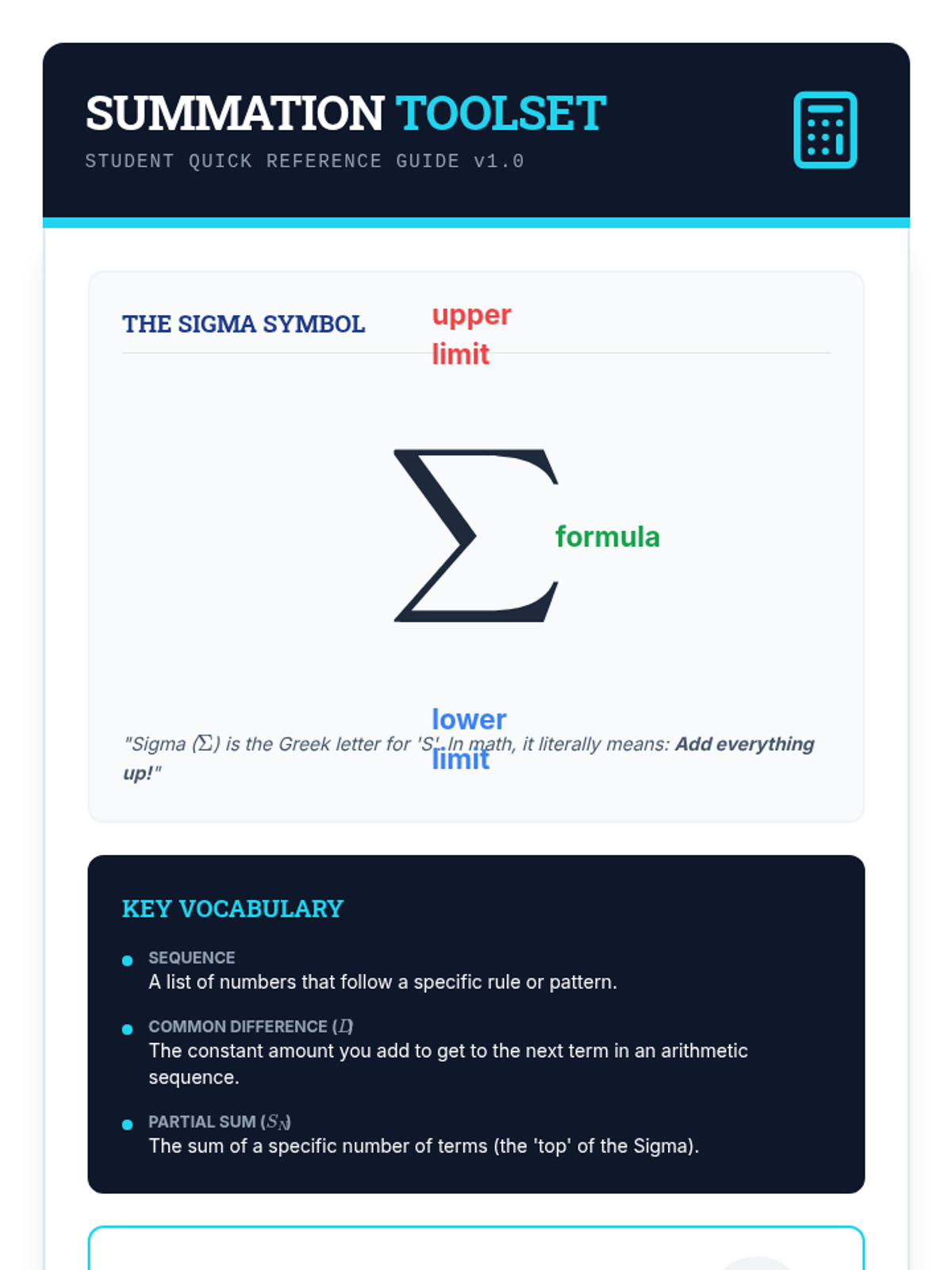
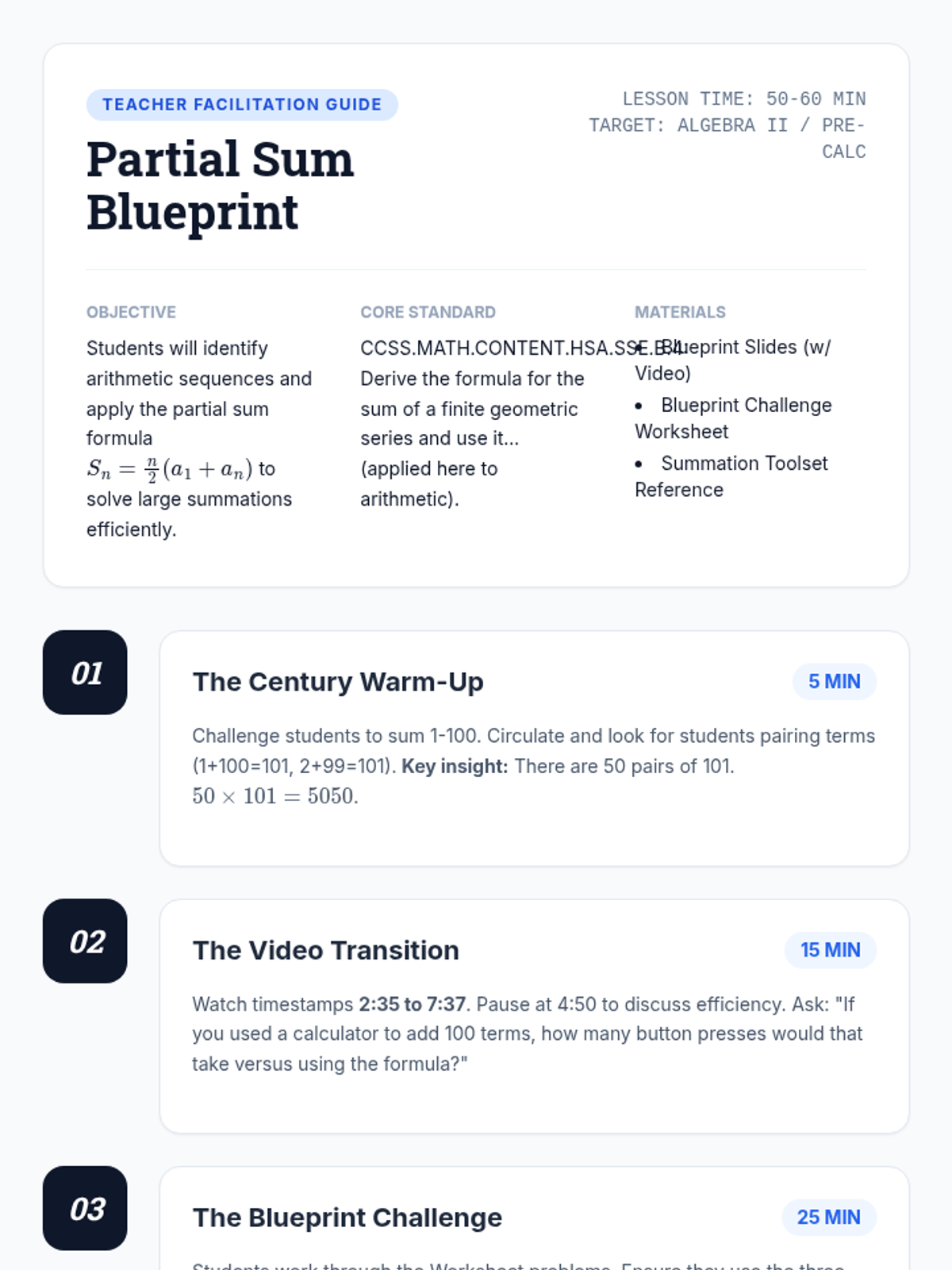
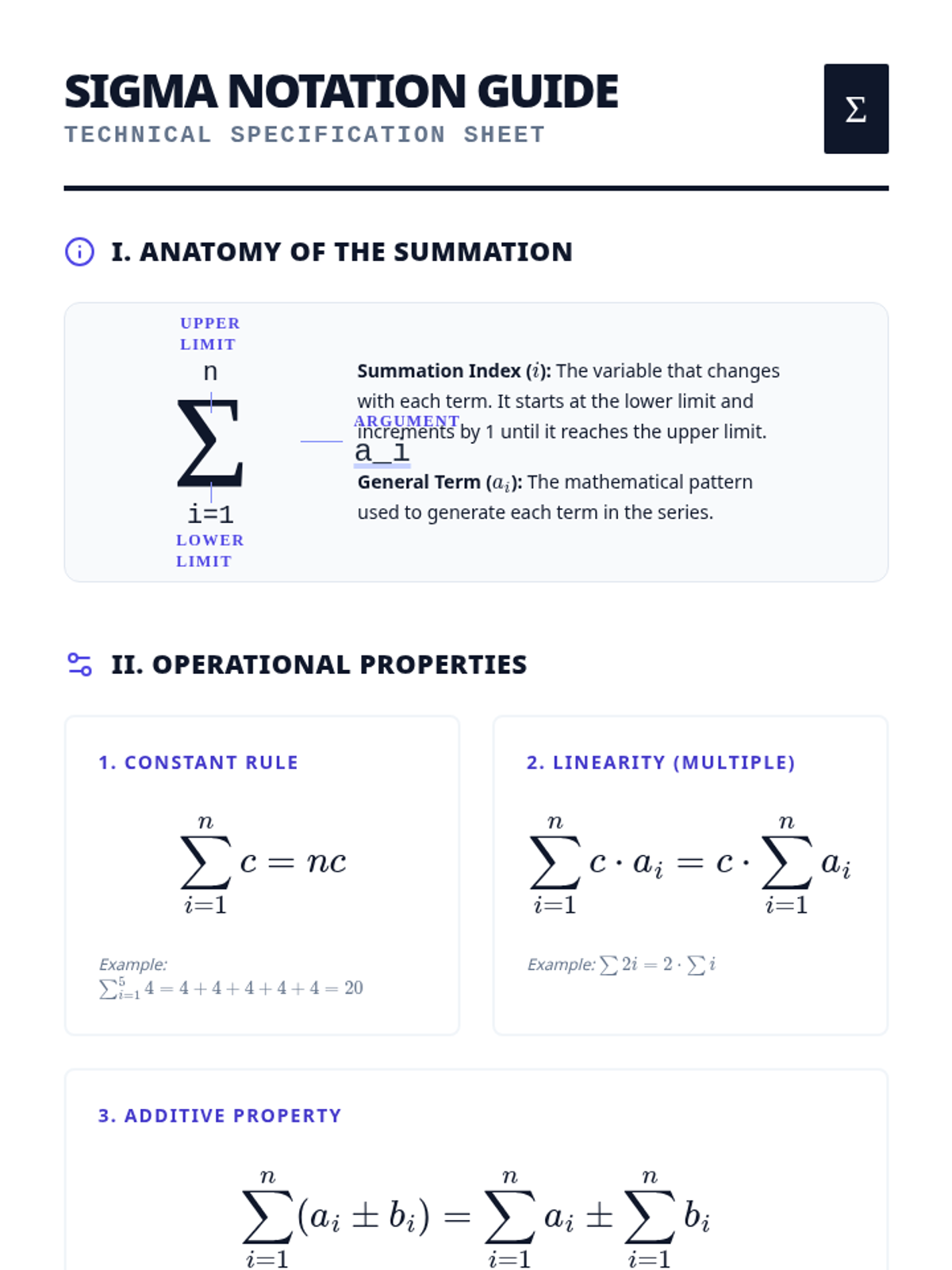
A high-school level lesson exploring arithmetic sequences, focusing on the transition from manual summation to the partial sum formula using Sigma notation.
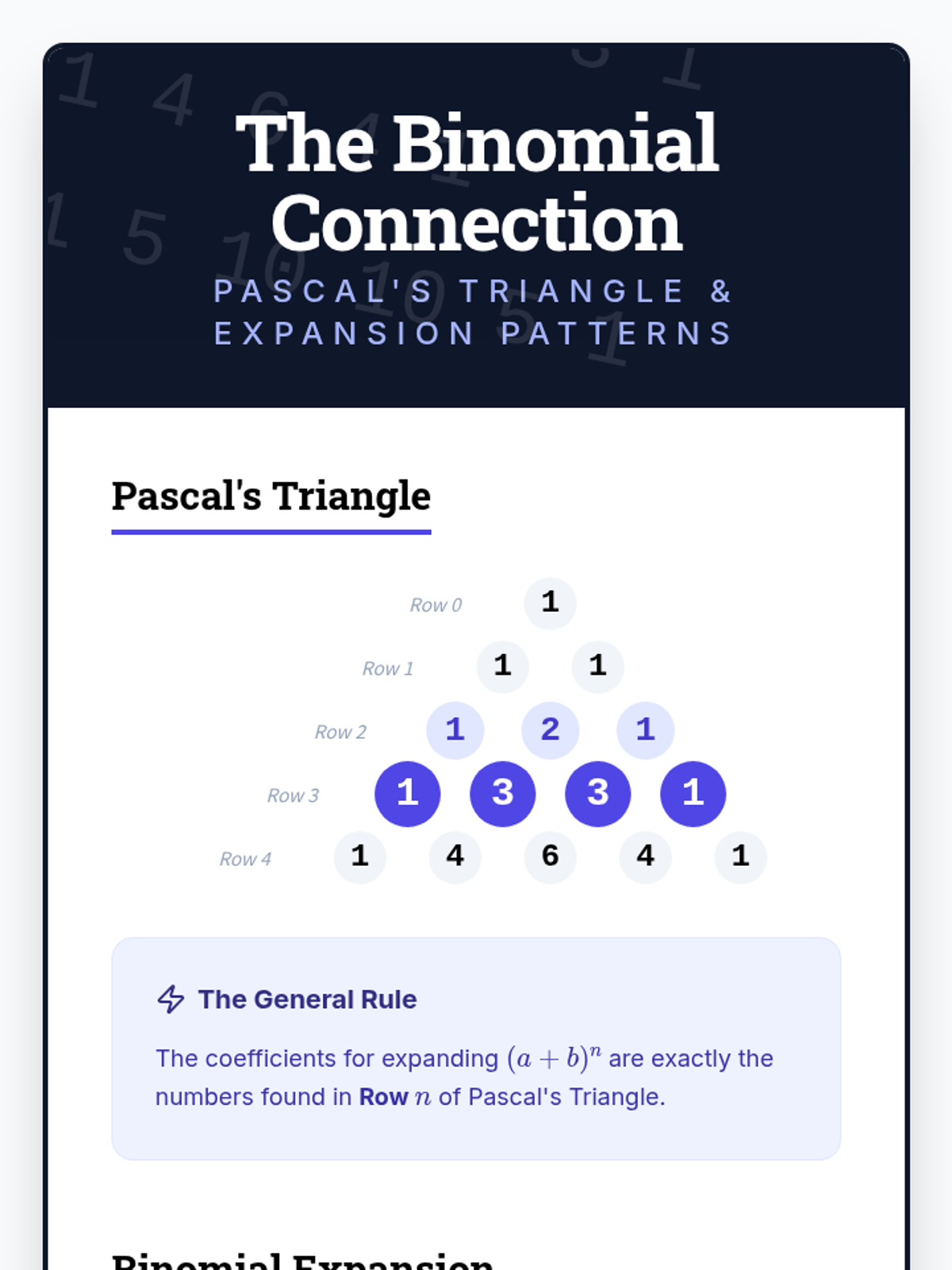
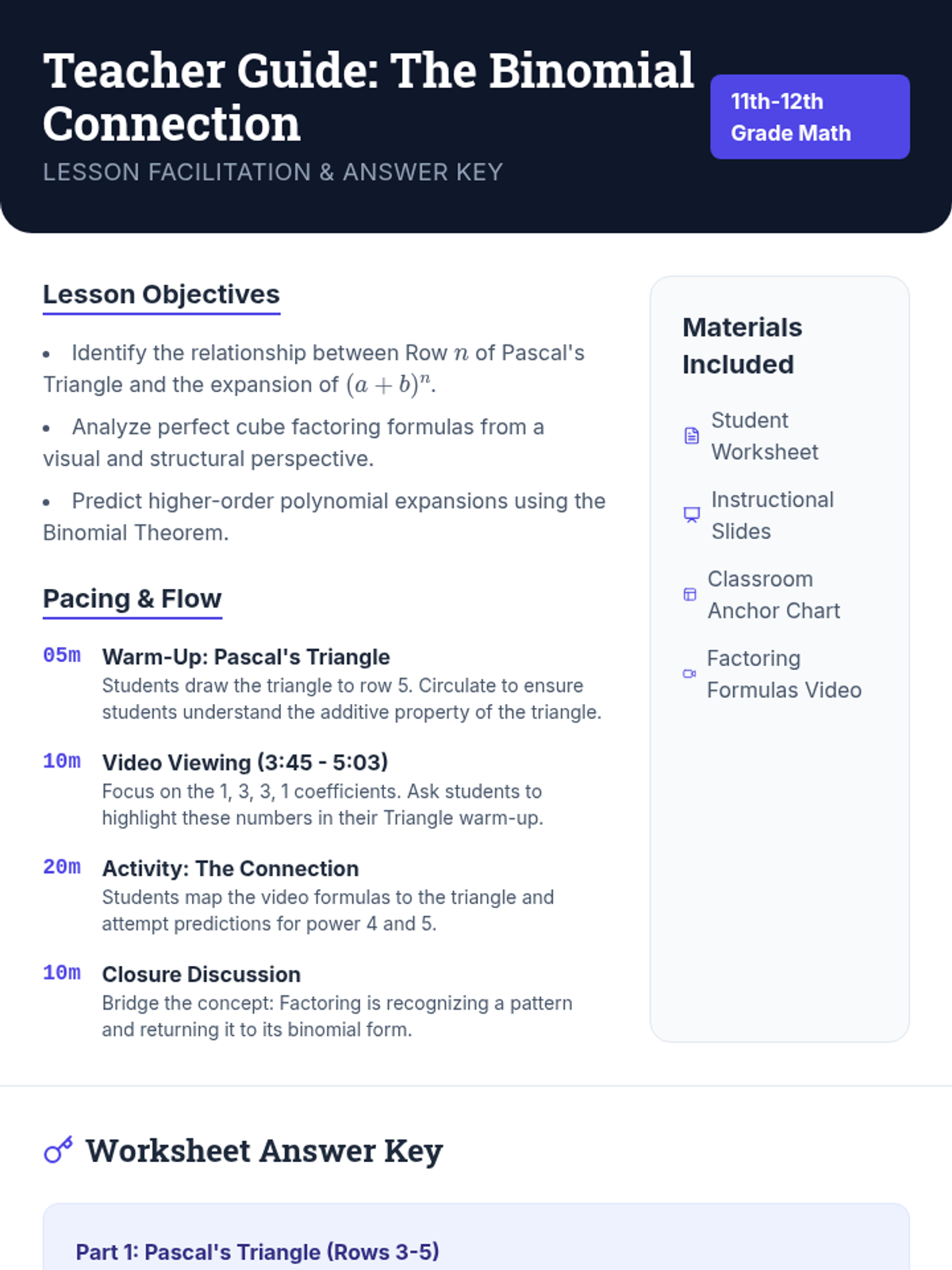
A lesson connecting perfect square and cube factoring formulas to the geometric patterns of Pascal's Triangle. Students analyze coefficients and use the Binomial Theorem to predict higher-order expansions.
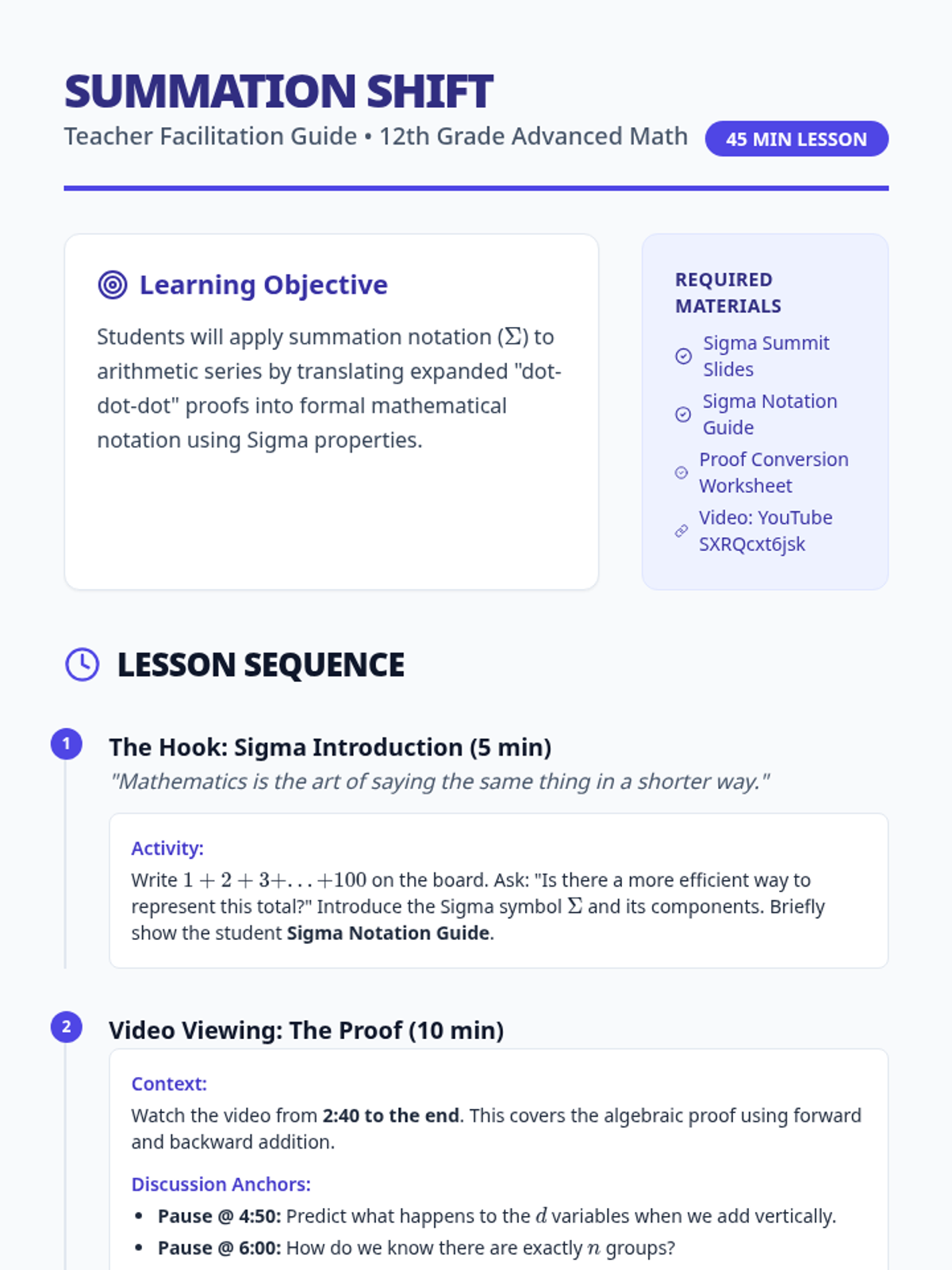
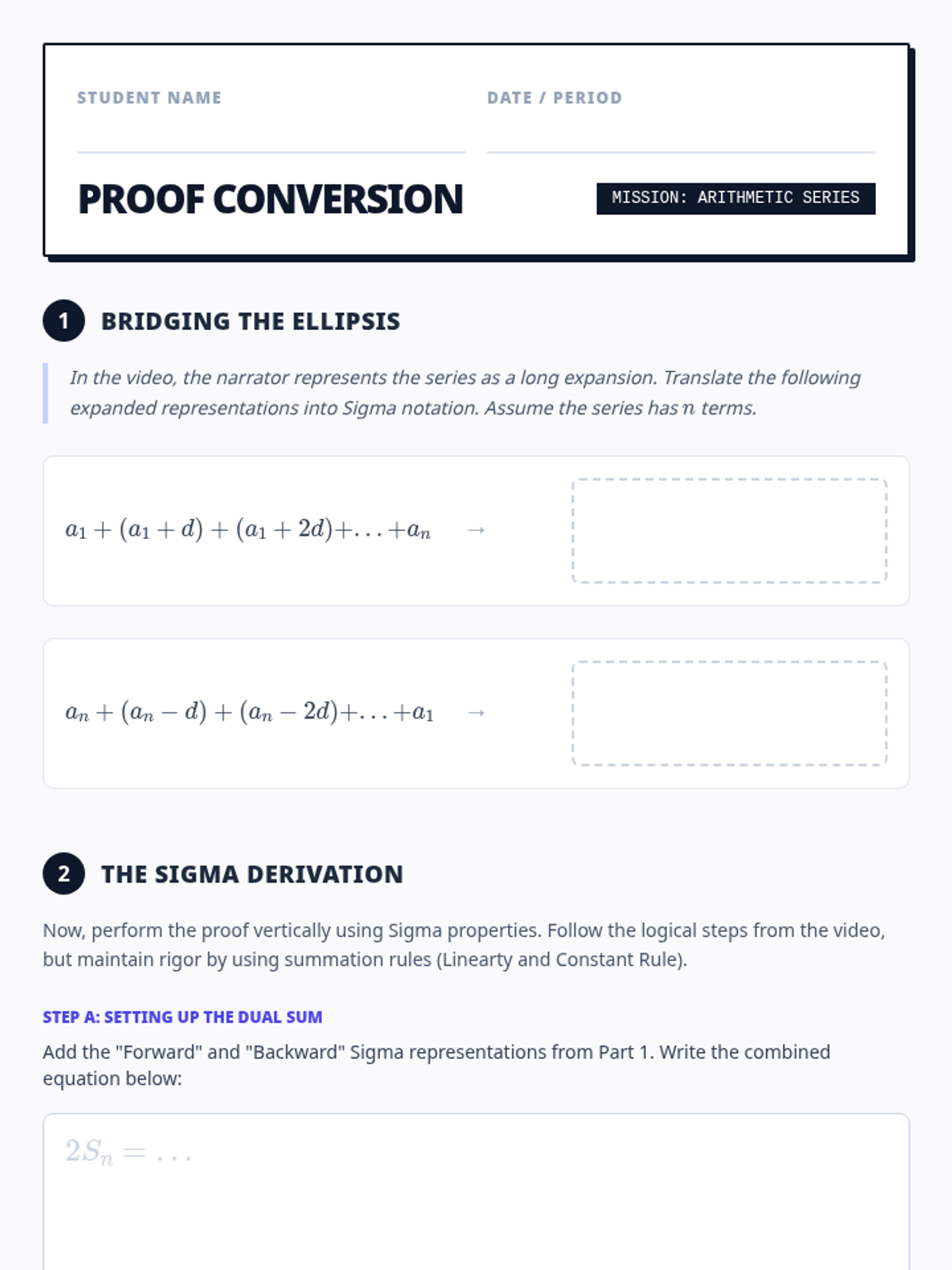
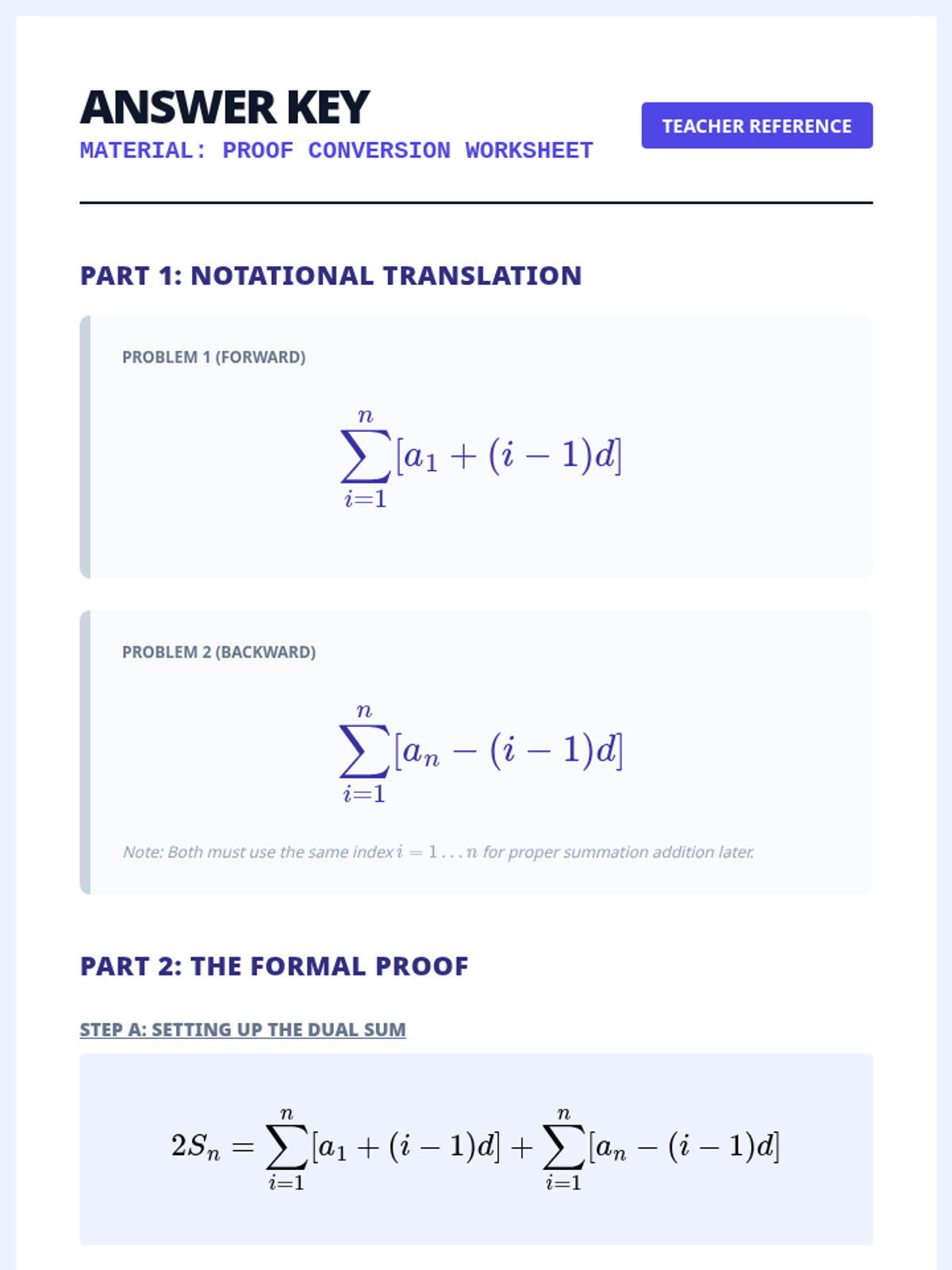
Students will bridge the gap between expanded addition and Sigma notation by translating a traditional arithmetic series proof into formal summation properties.
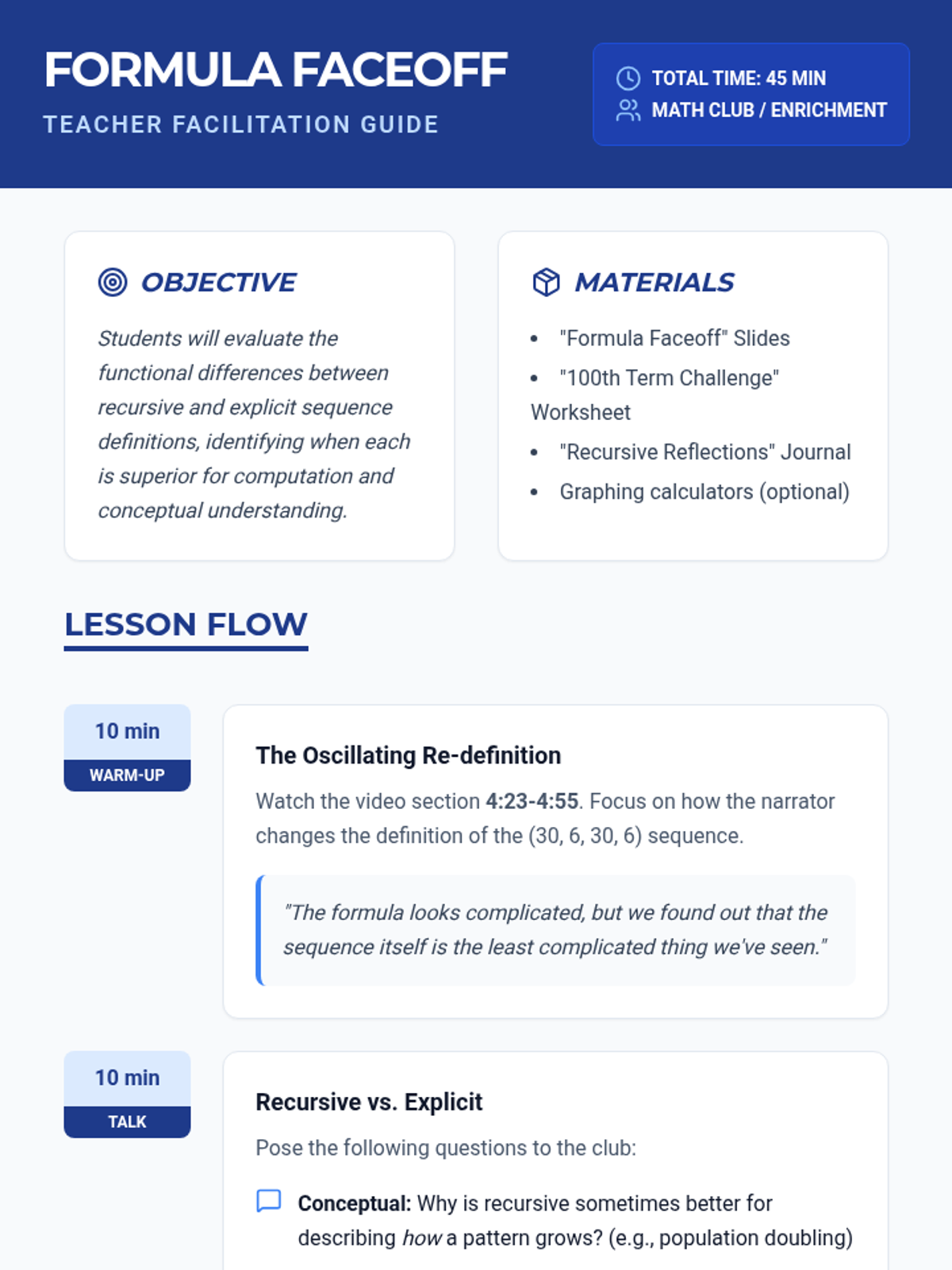
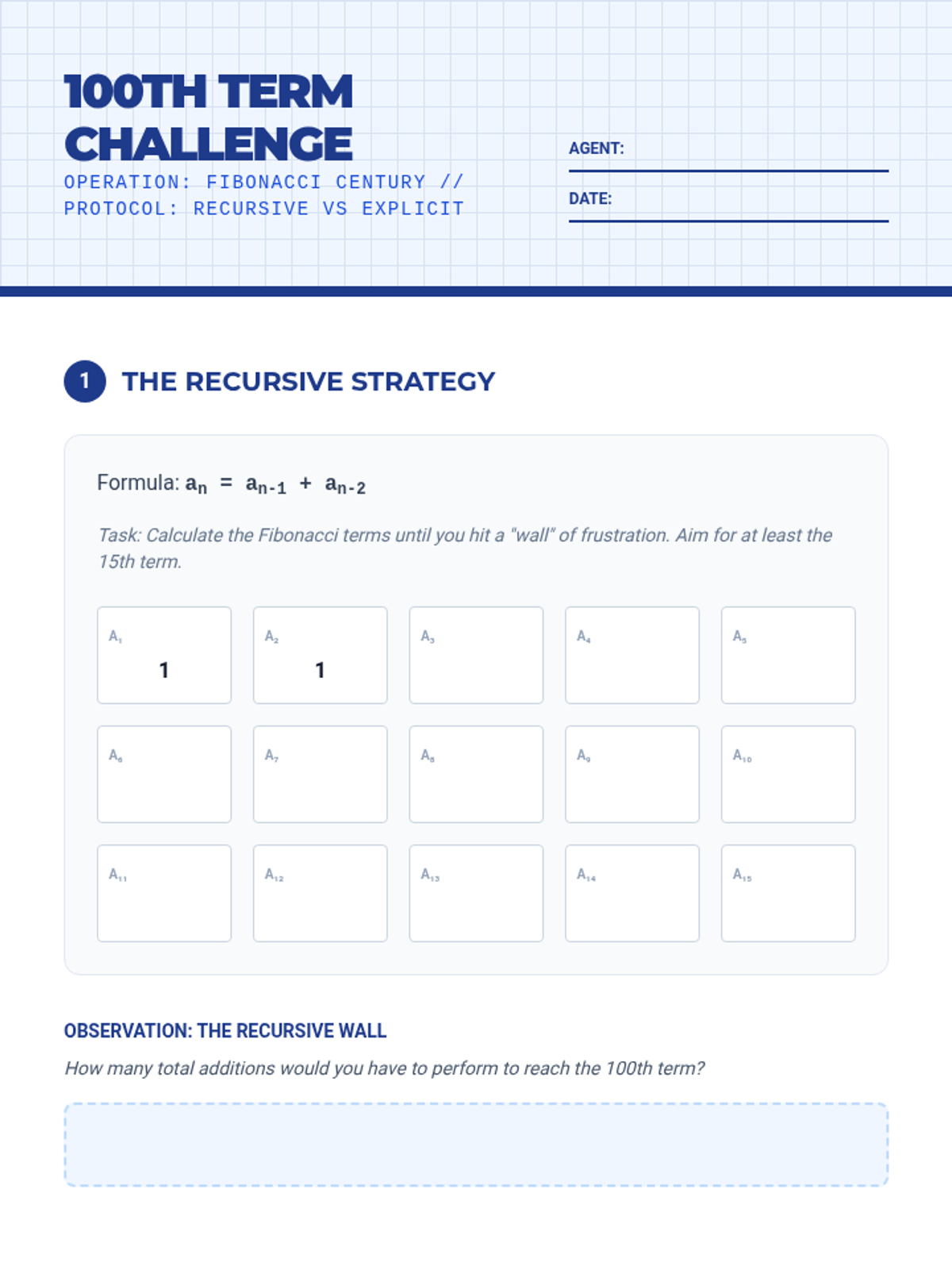
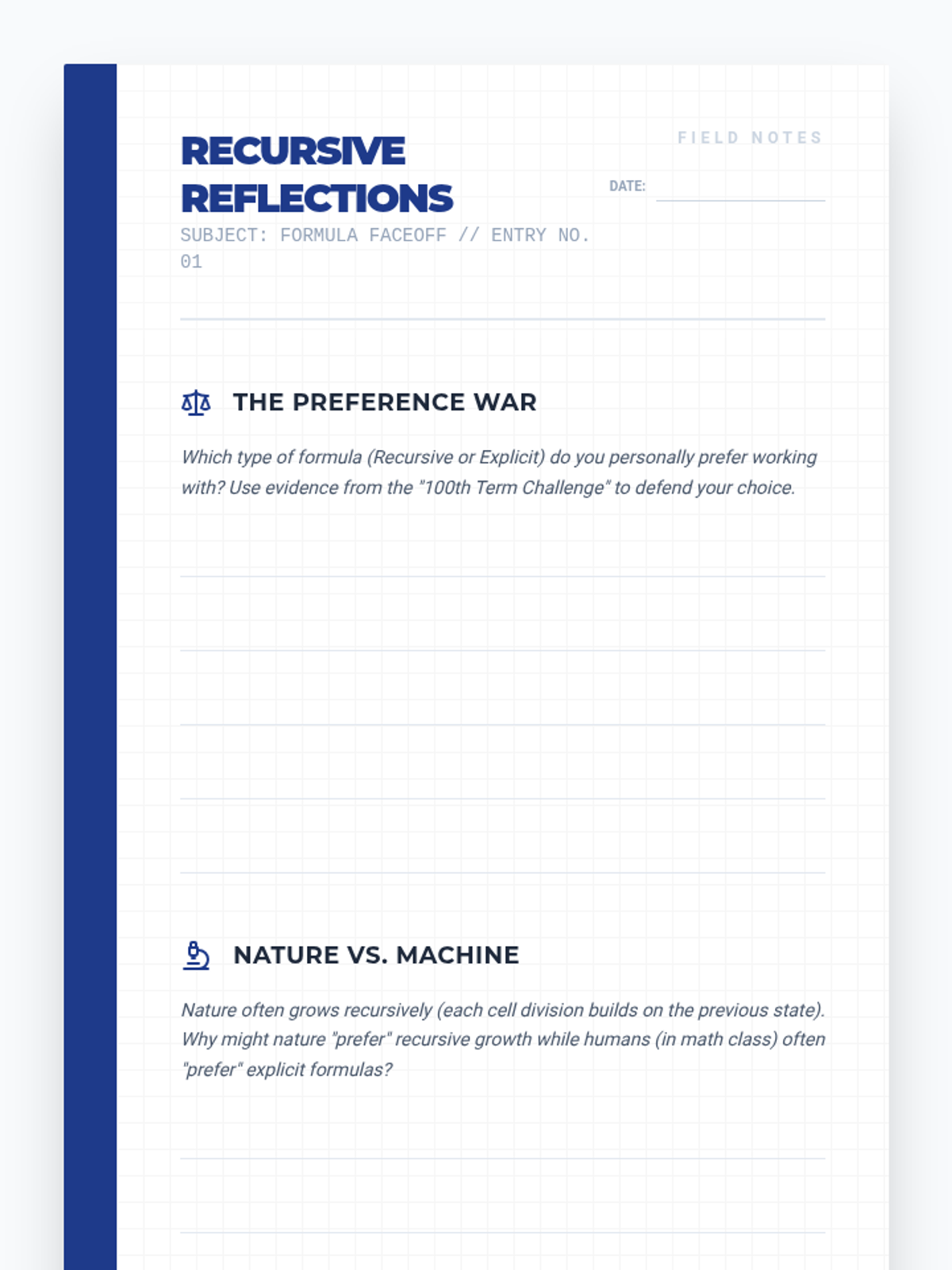
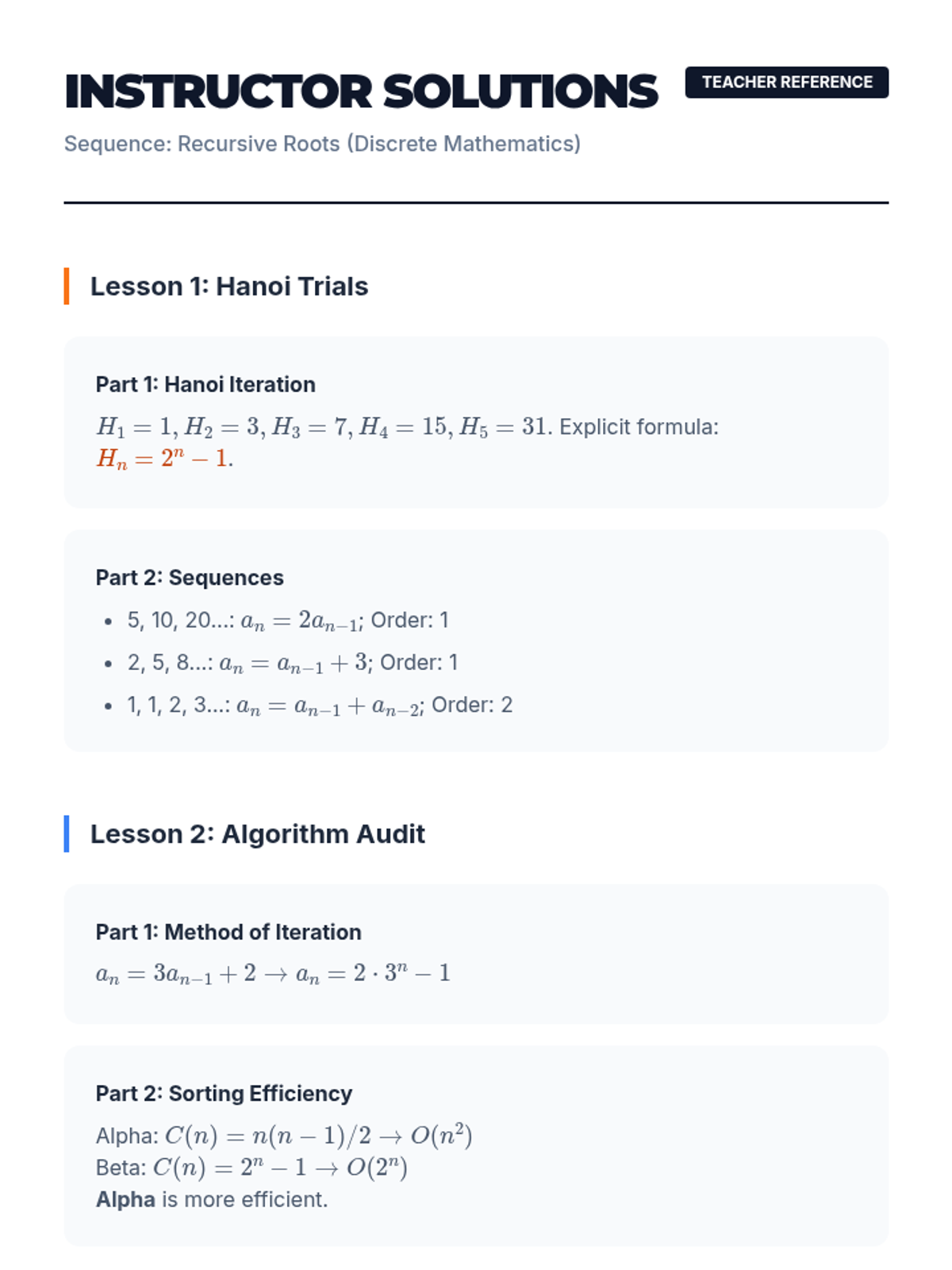
A high-energy math enrichment lesson exploring the power and limitations of recursive versus explicit formulas through the lens of the Fibonacci sequence and Binet's Formula.
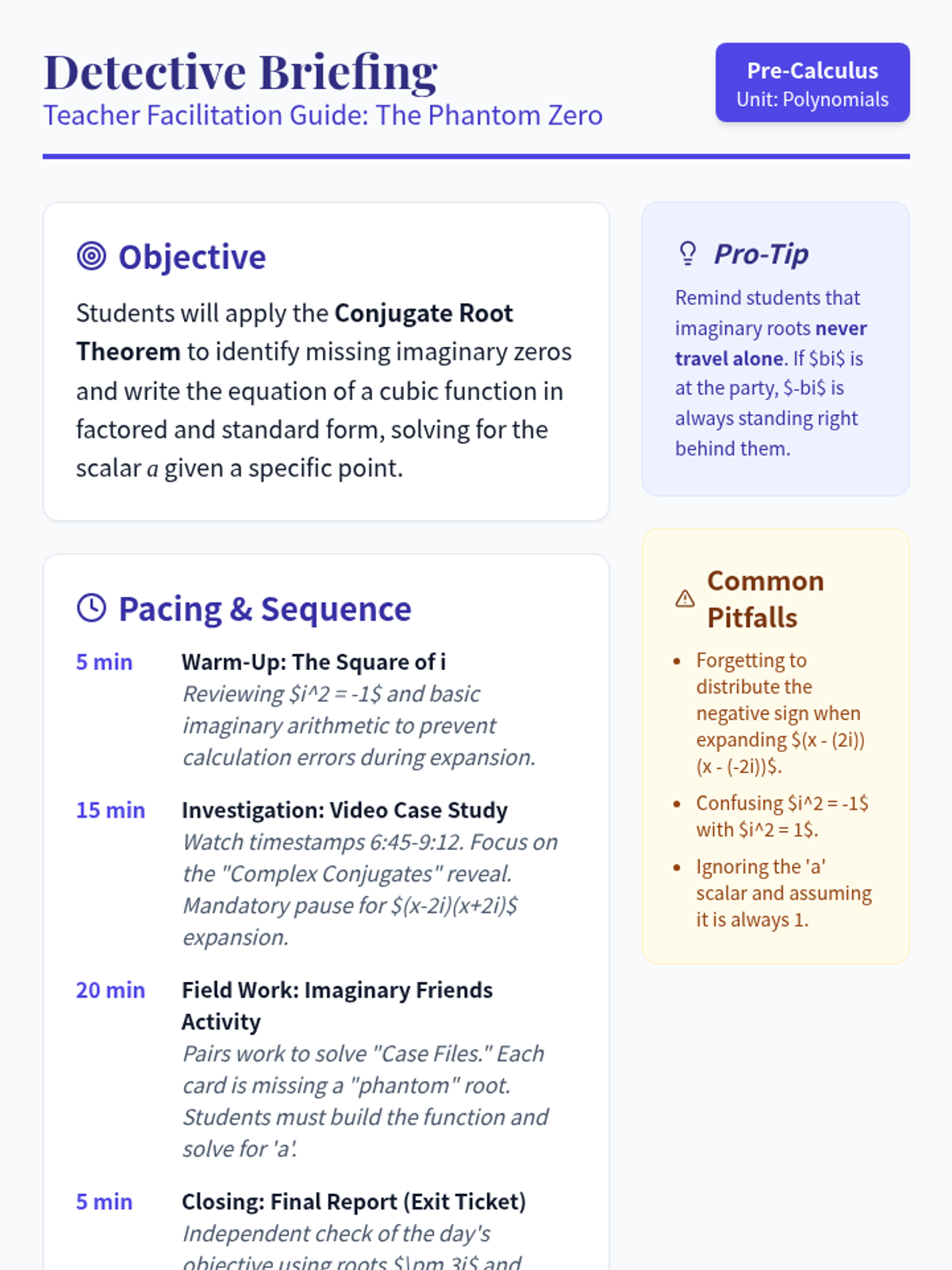
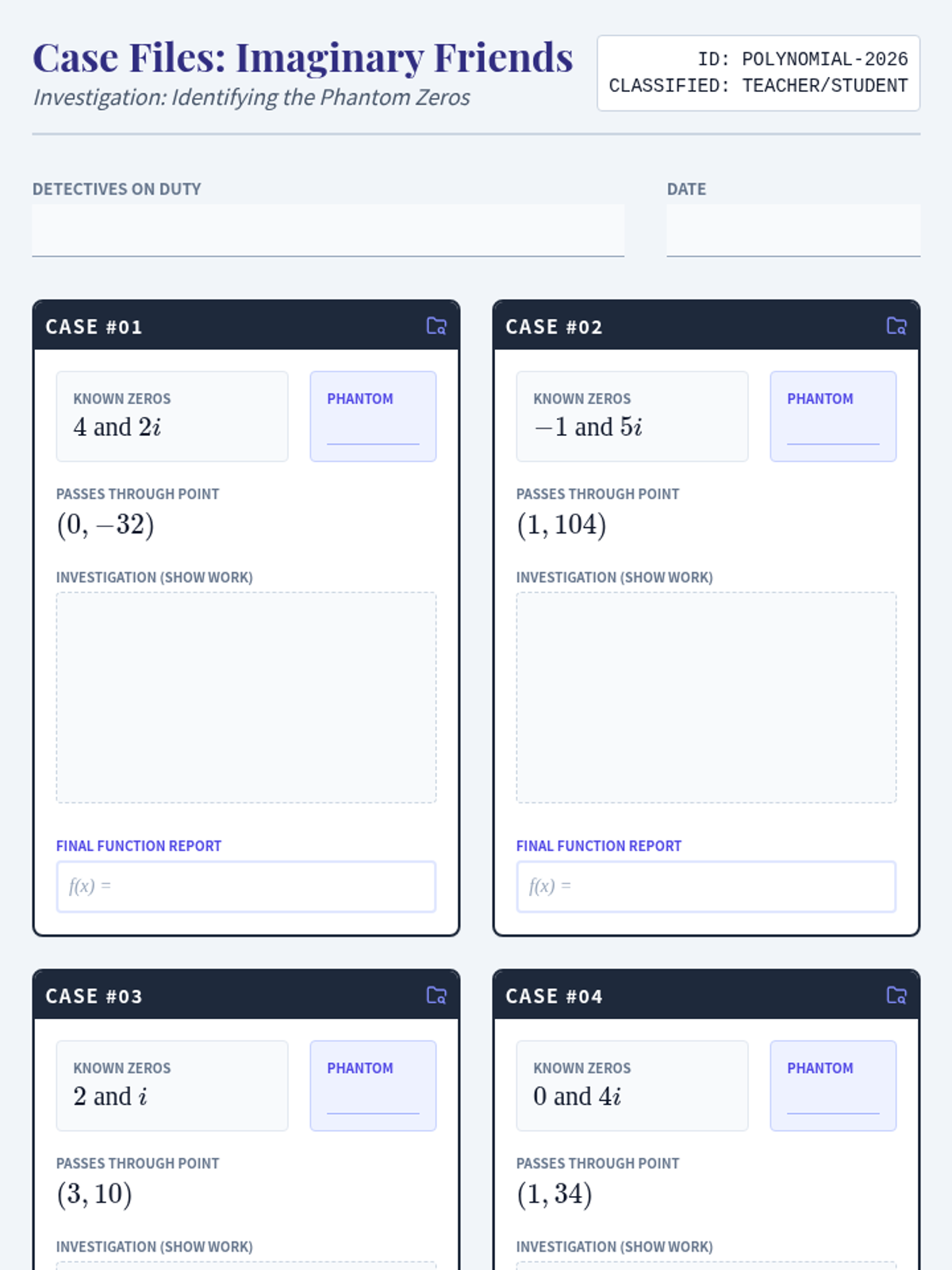
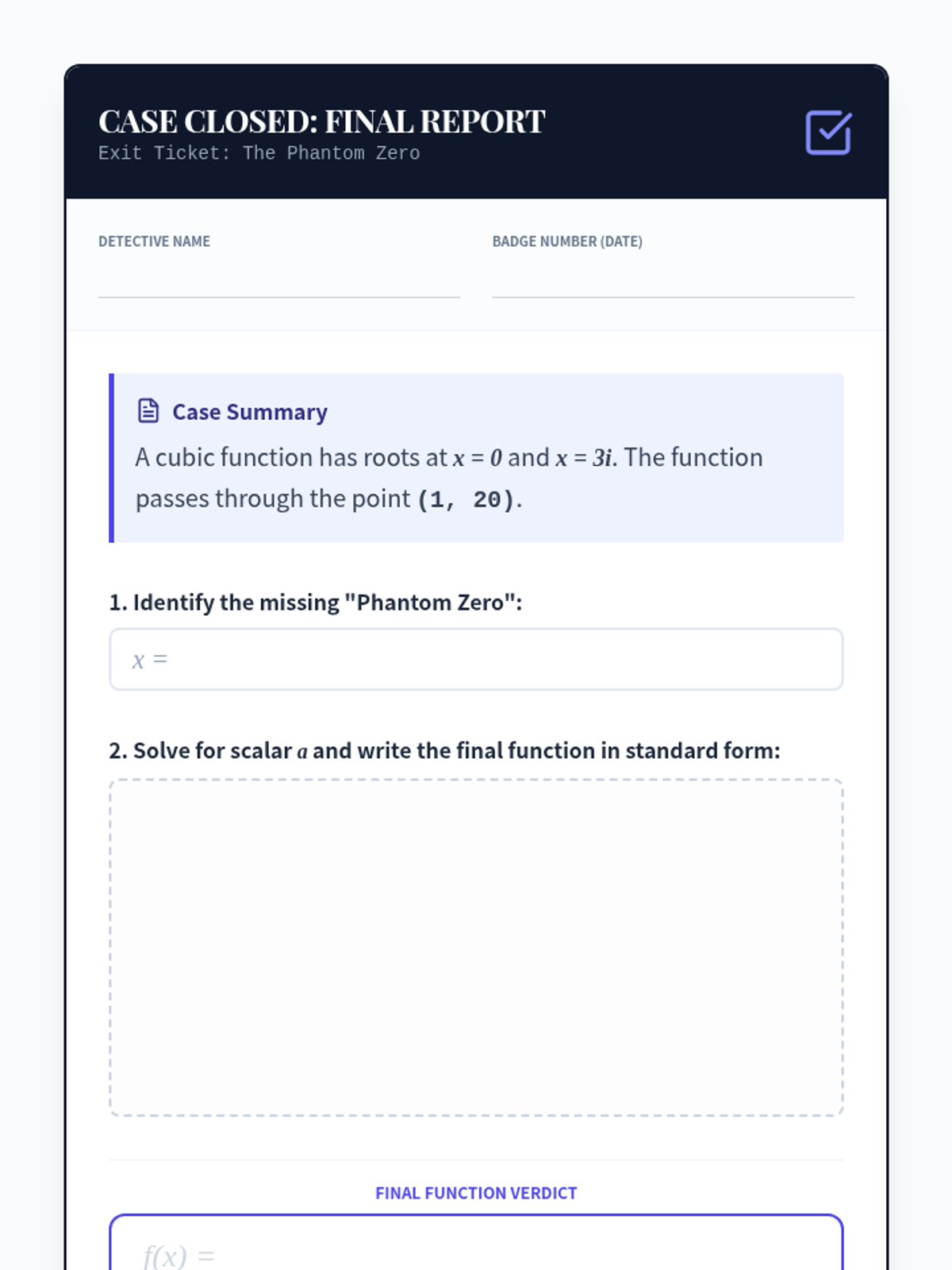
Students will master the Conjugate Root Theorem by identifying missing imaginary zeros, expanding complex factors, and solving for the vertical stretch 'a' to construct complete cubic functions from specific points.
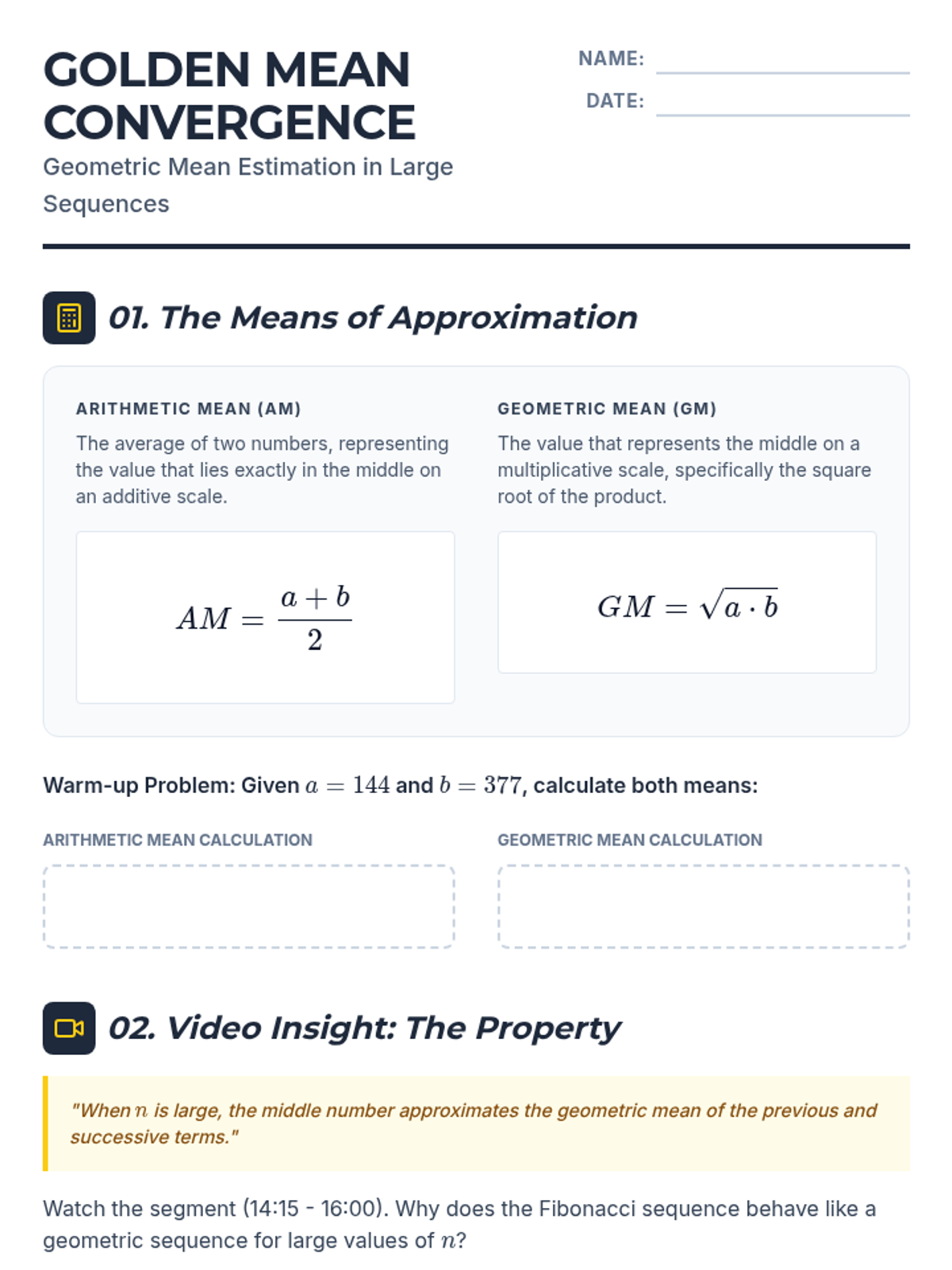
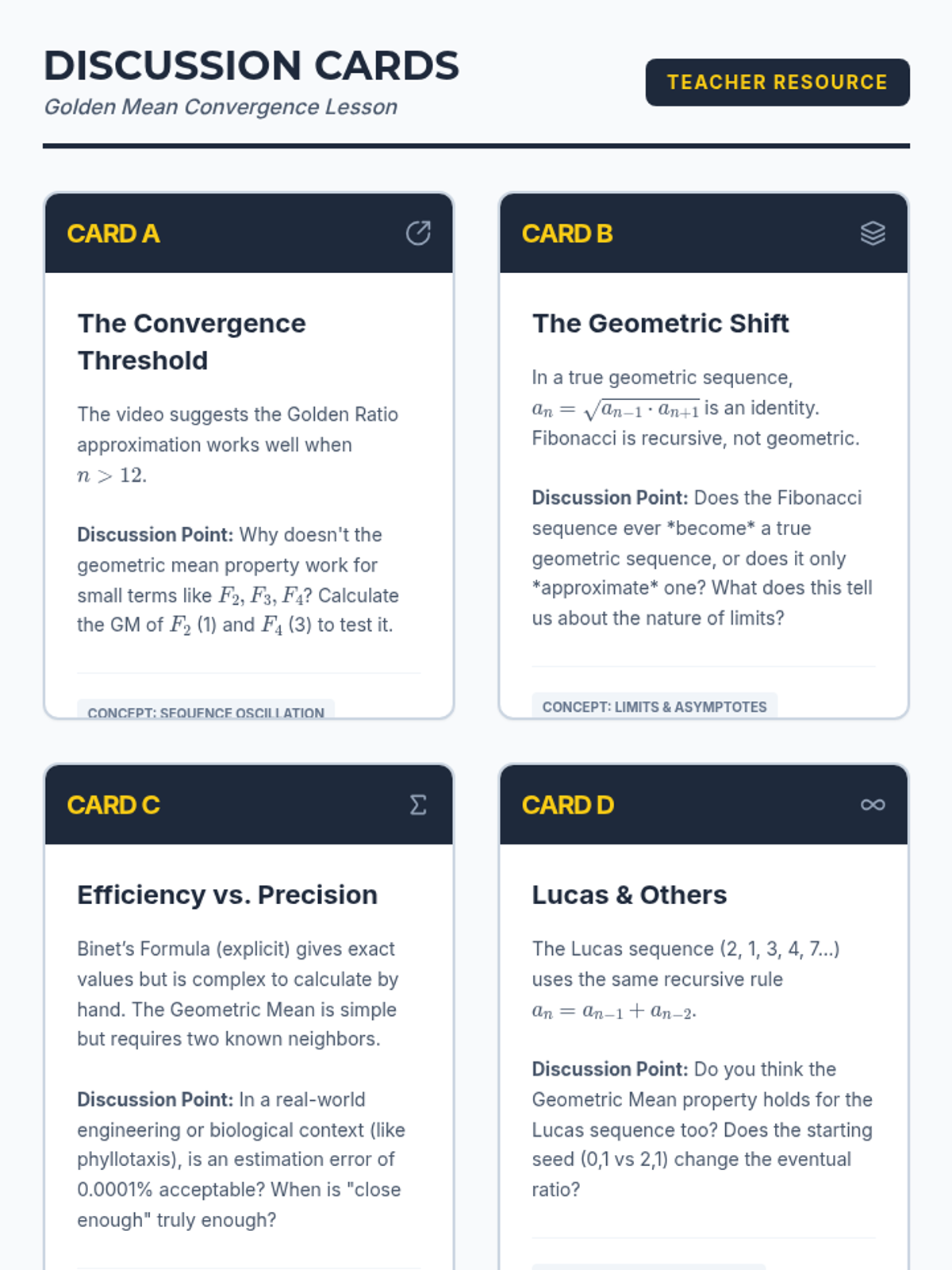
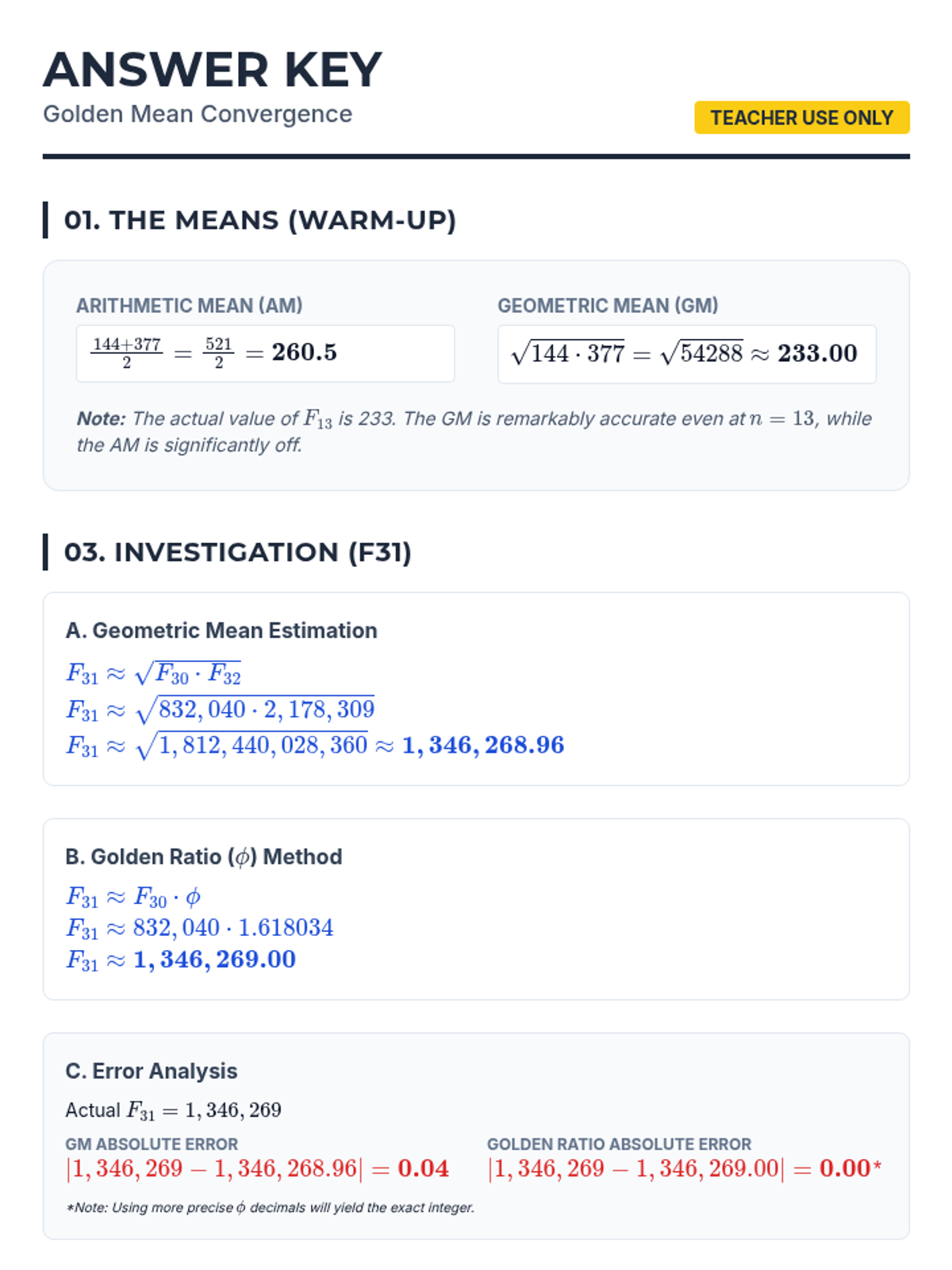
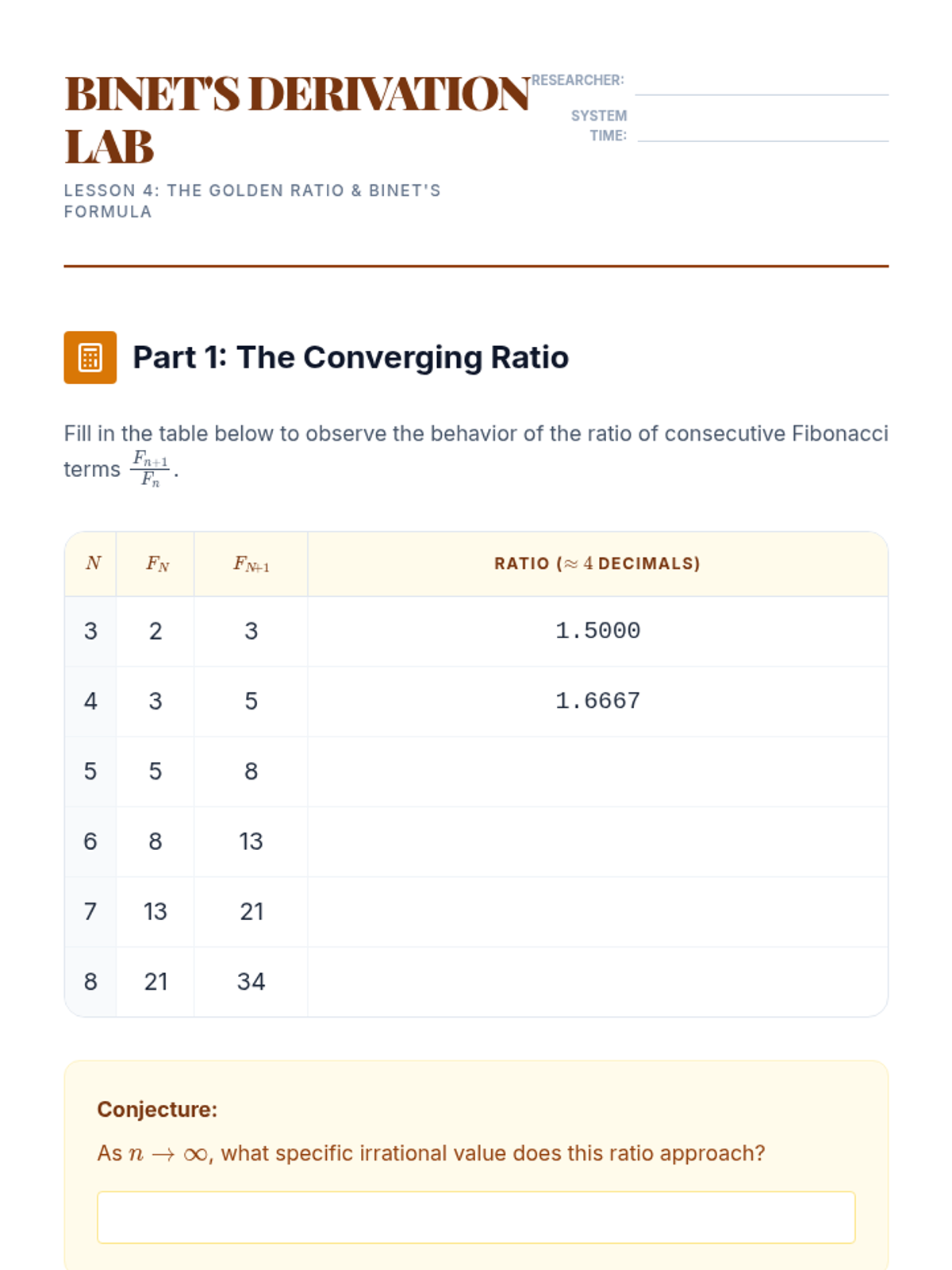
Students will investigate the geometric mean property of the Fibonacci sequence, comparing estimations of high-index terms using geometric means versus the Golden Ratio method. The lesson explores the convergence of recursive sequences to geometric behavior for large n.
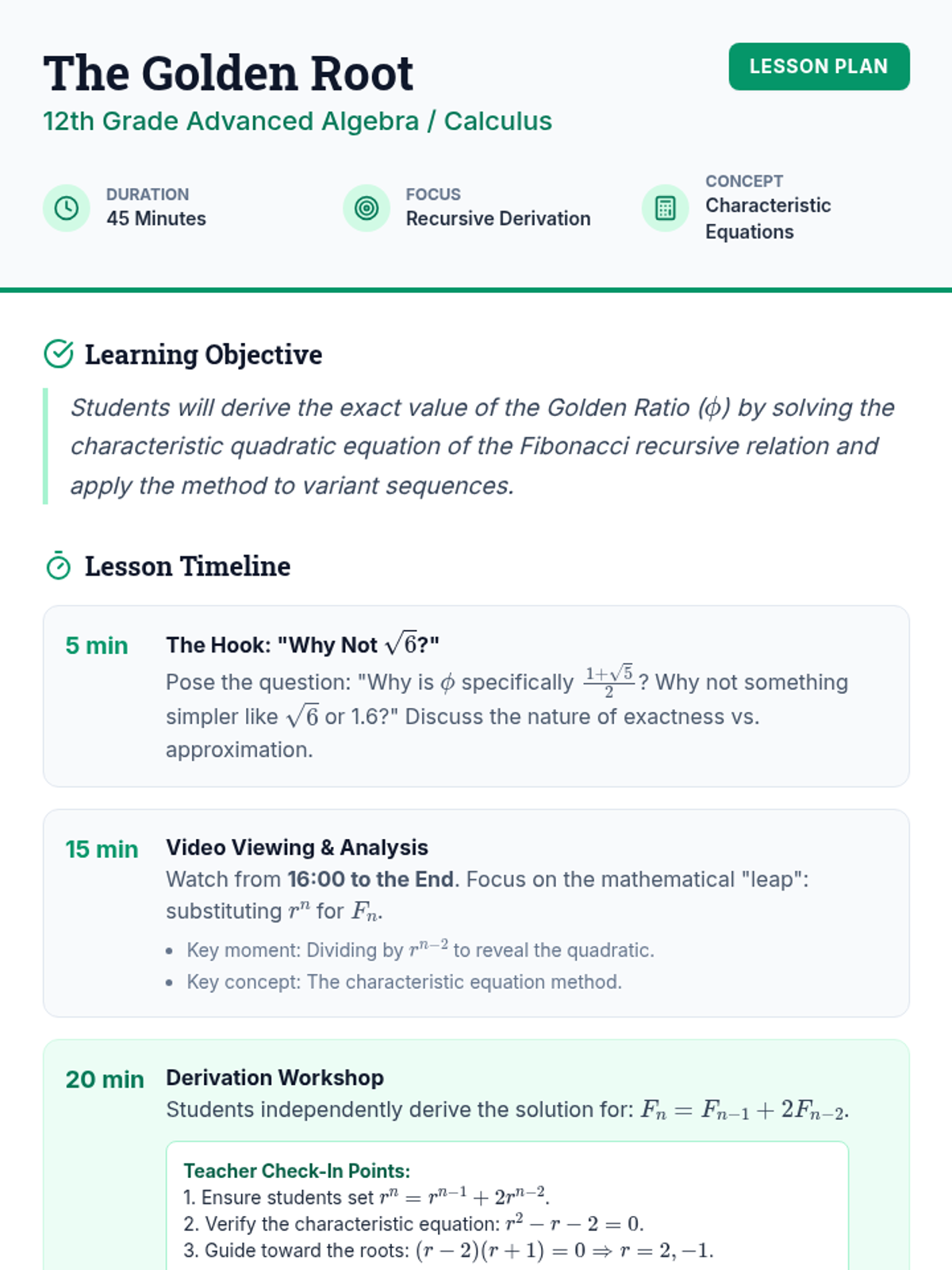
A high-level algebra and calculus lesson where students derive the exact value of the Golden Ratio using characteristic equations and solve variant recurrence relations.
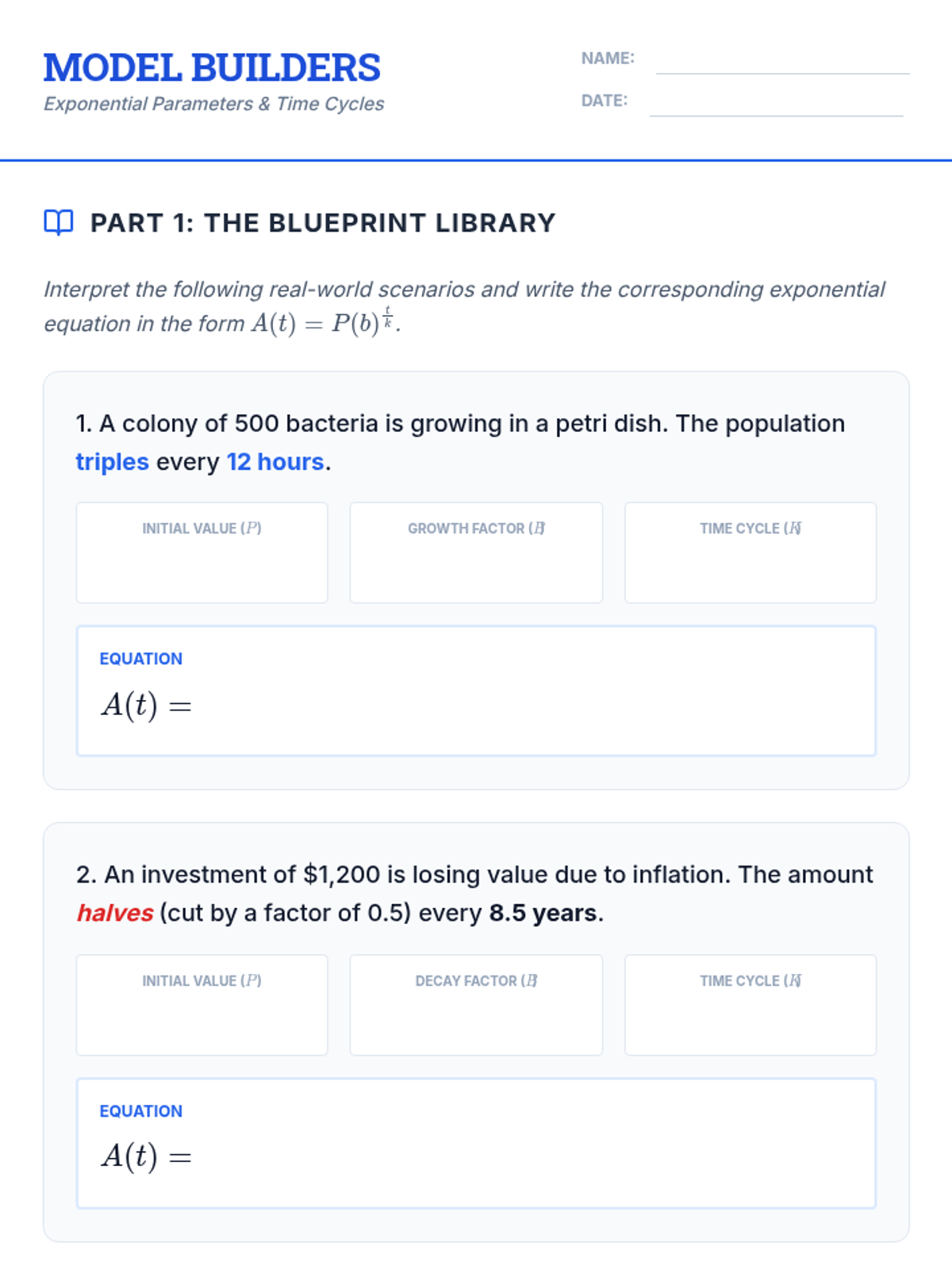
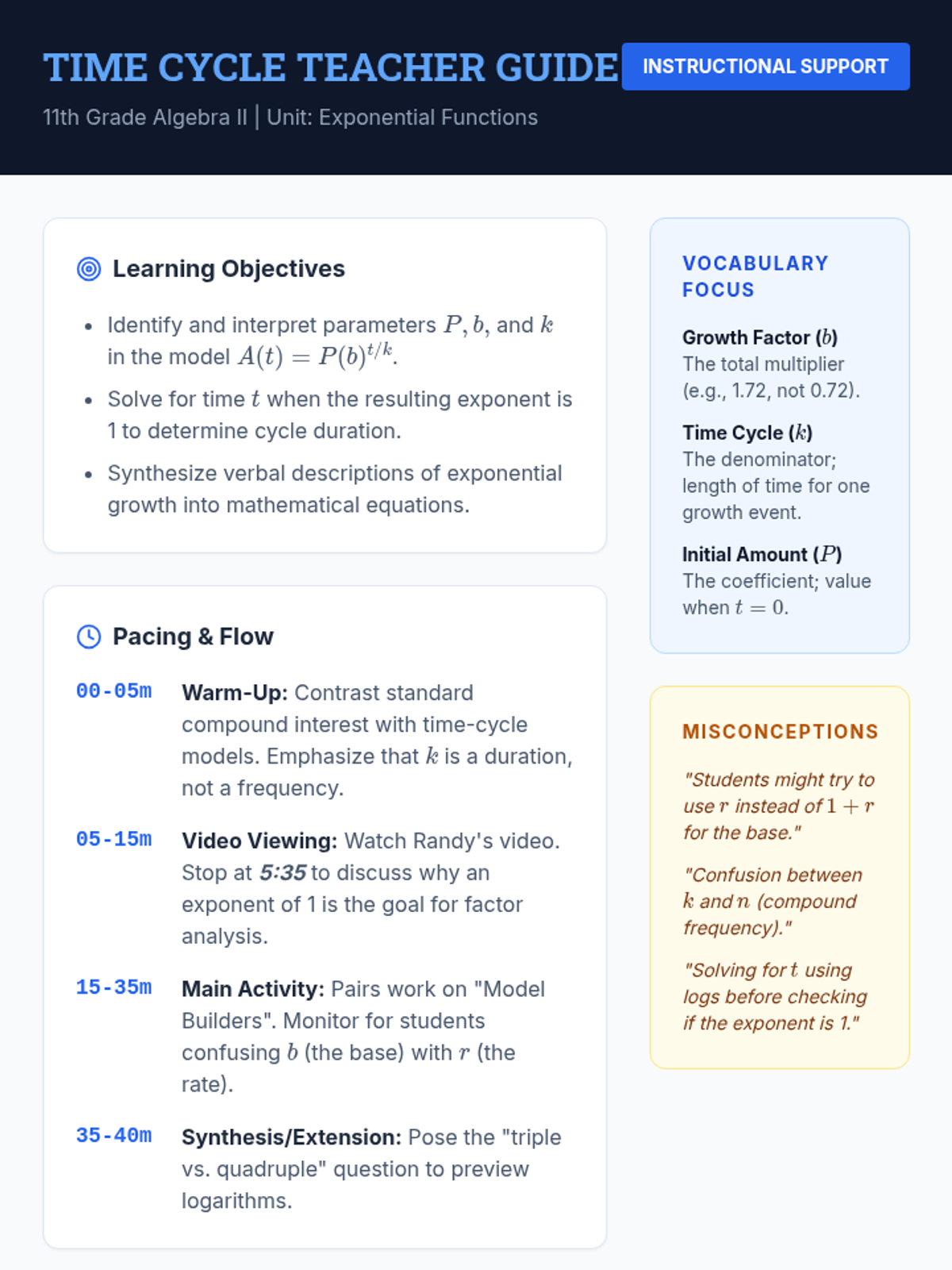
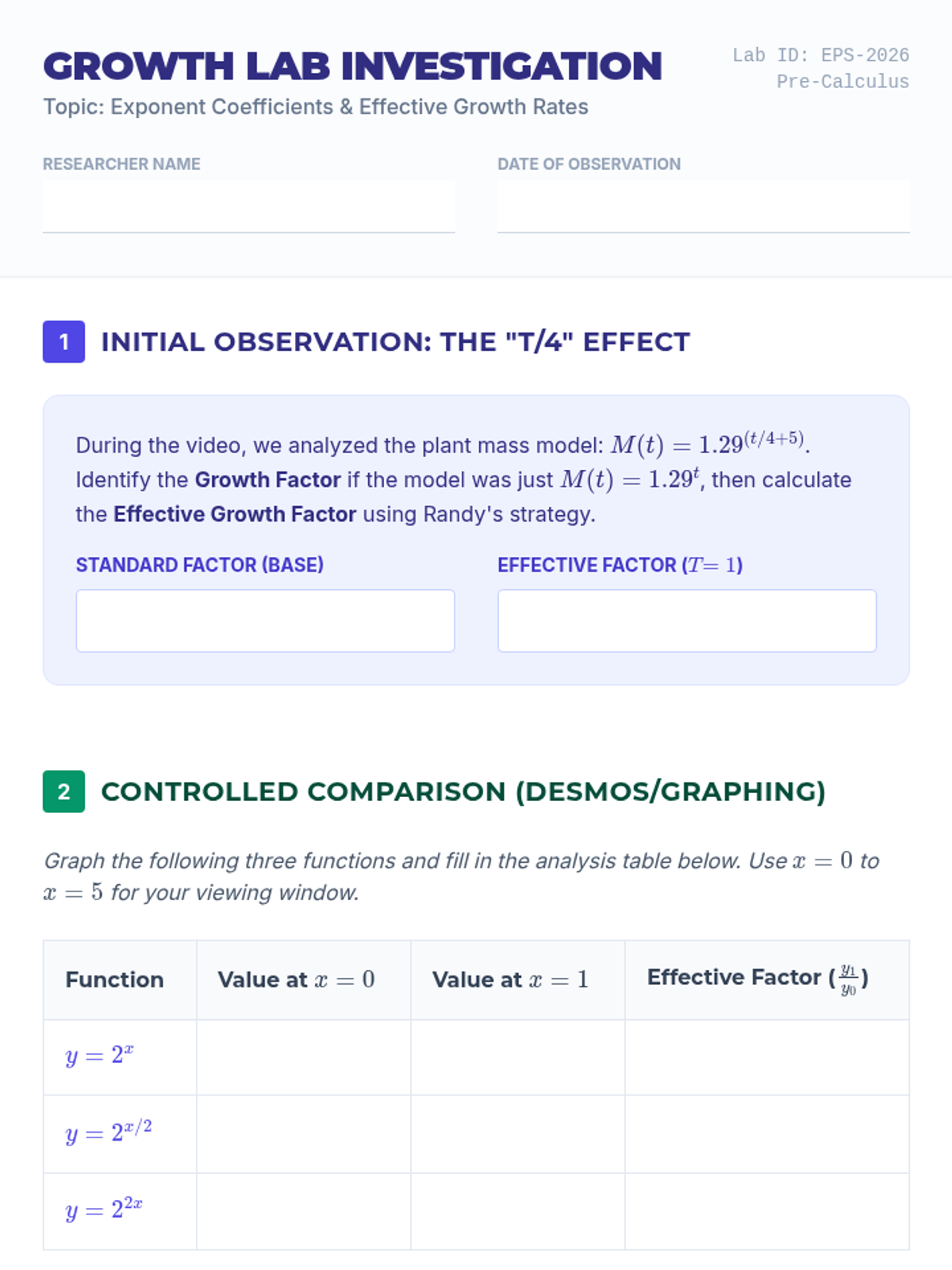
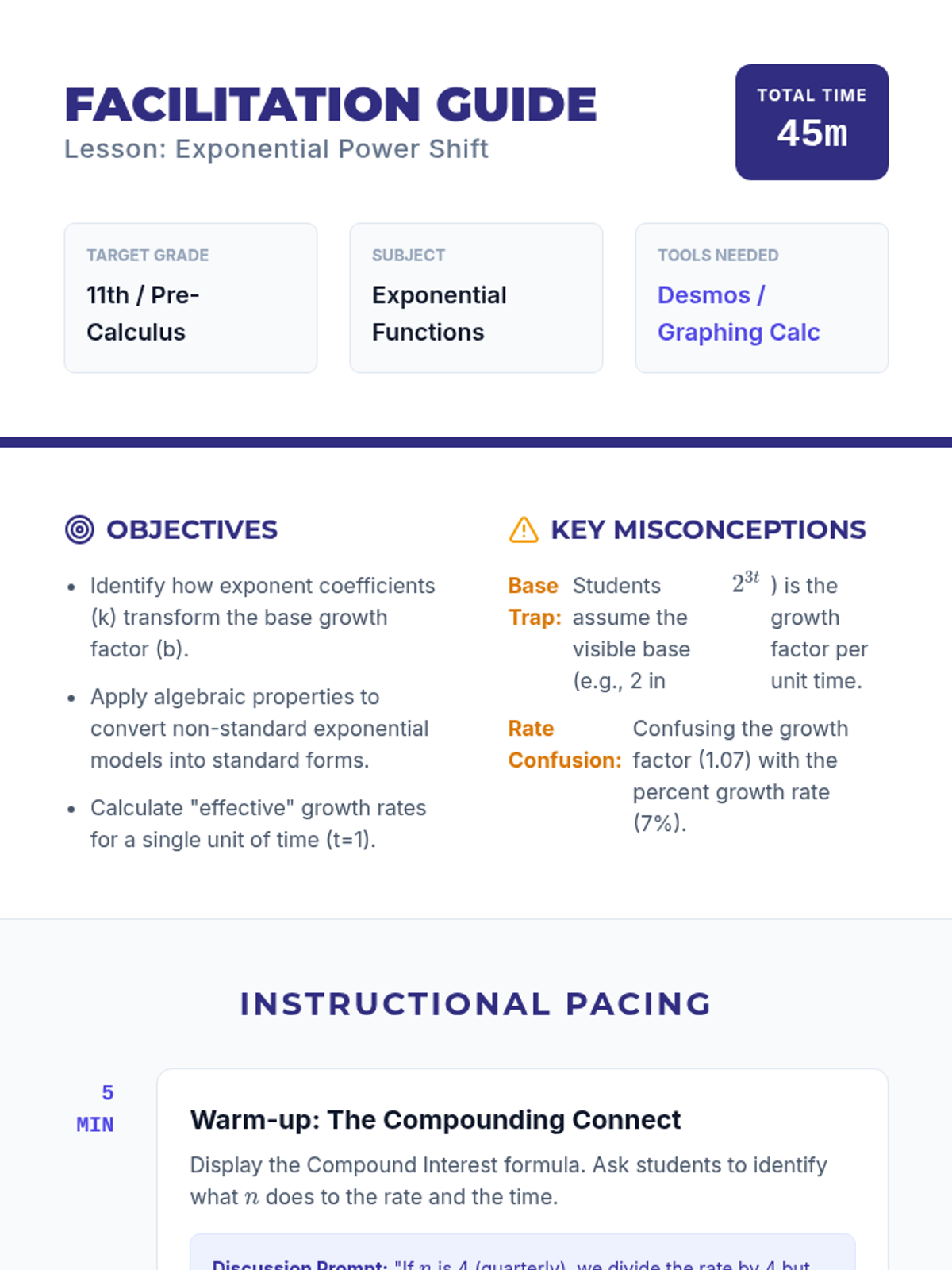
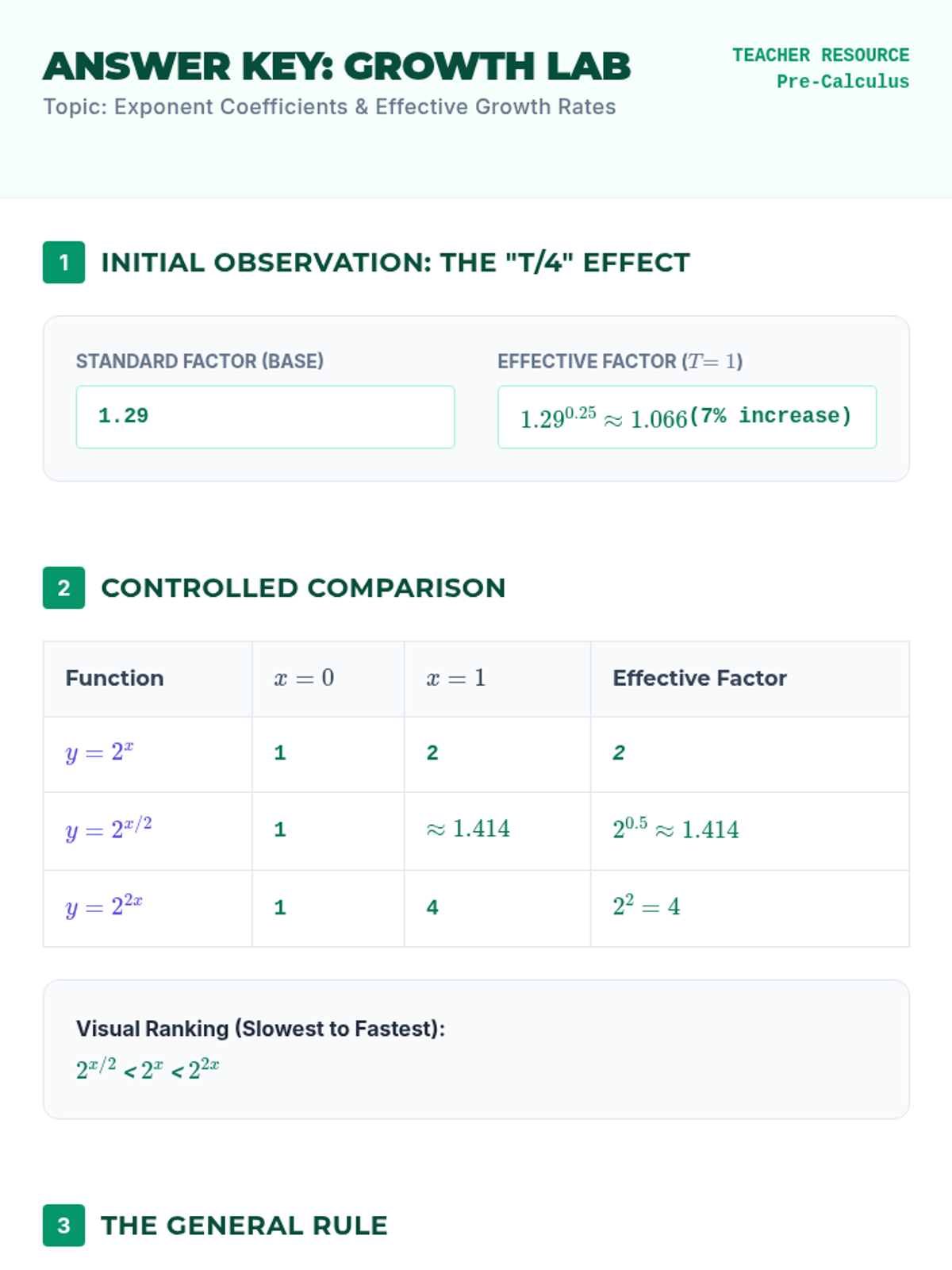
This lesson focuses on interpreting the parameters of exponential models, specifically focusing on how the denominator of the exponent represents the time required for a specific growth or decay factor to occur. Students will analyze real-world scenarios, watch an instructional video, and build their own models in a collaborative activity.
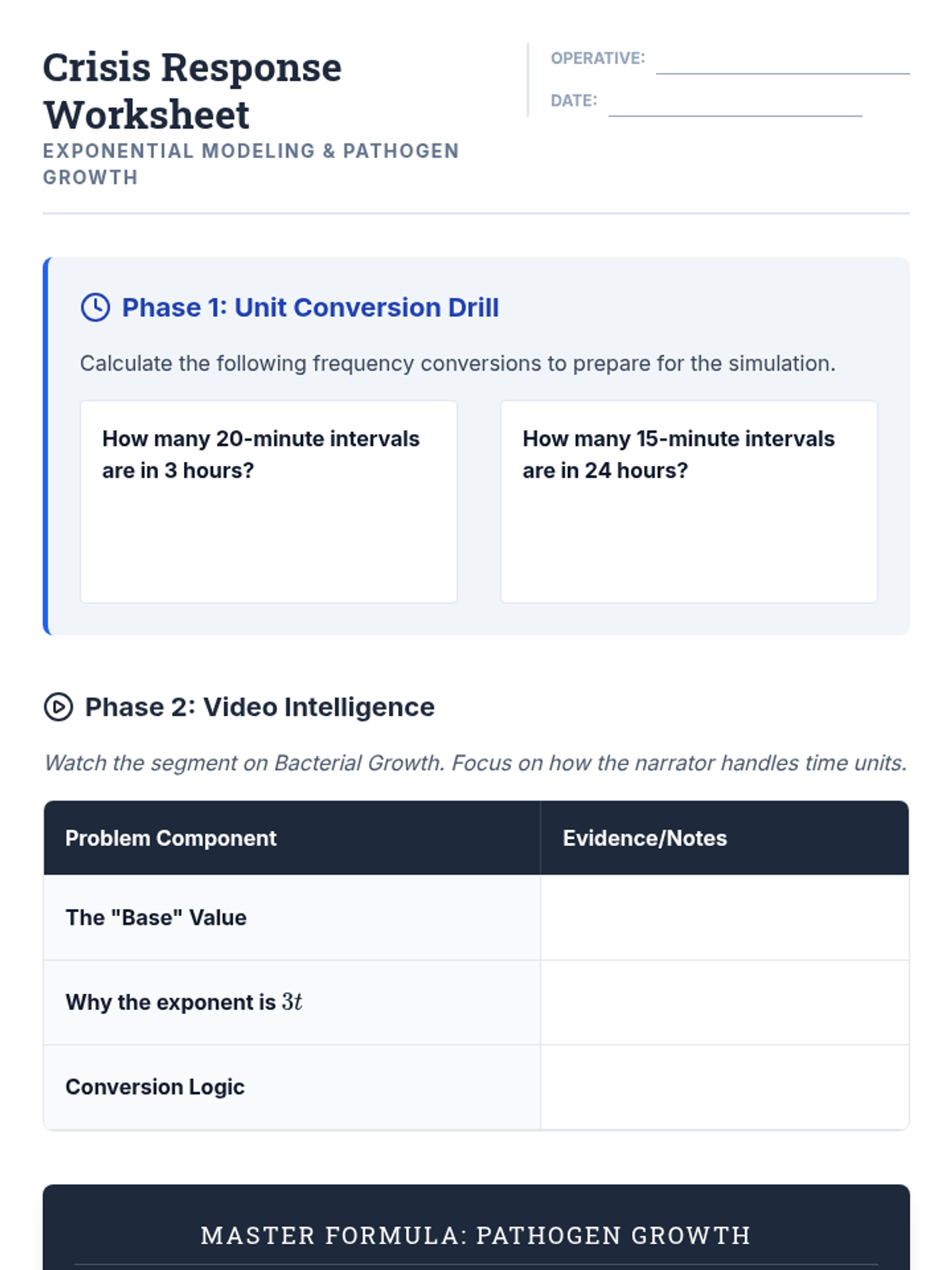
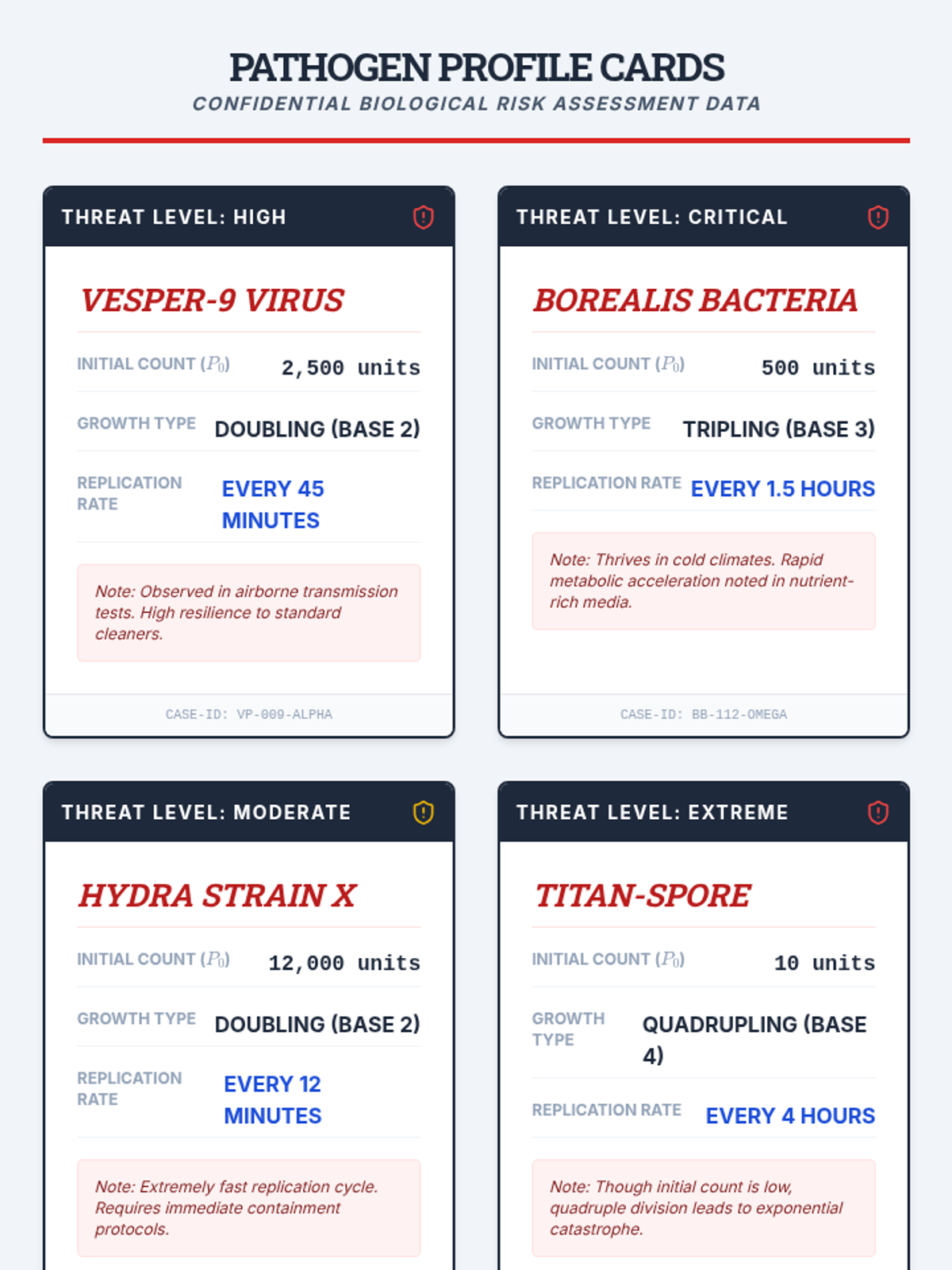
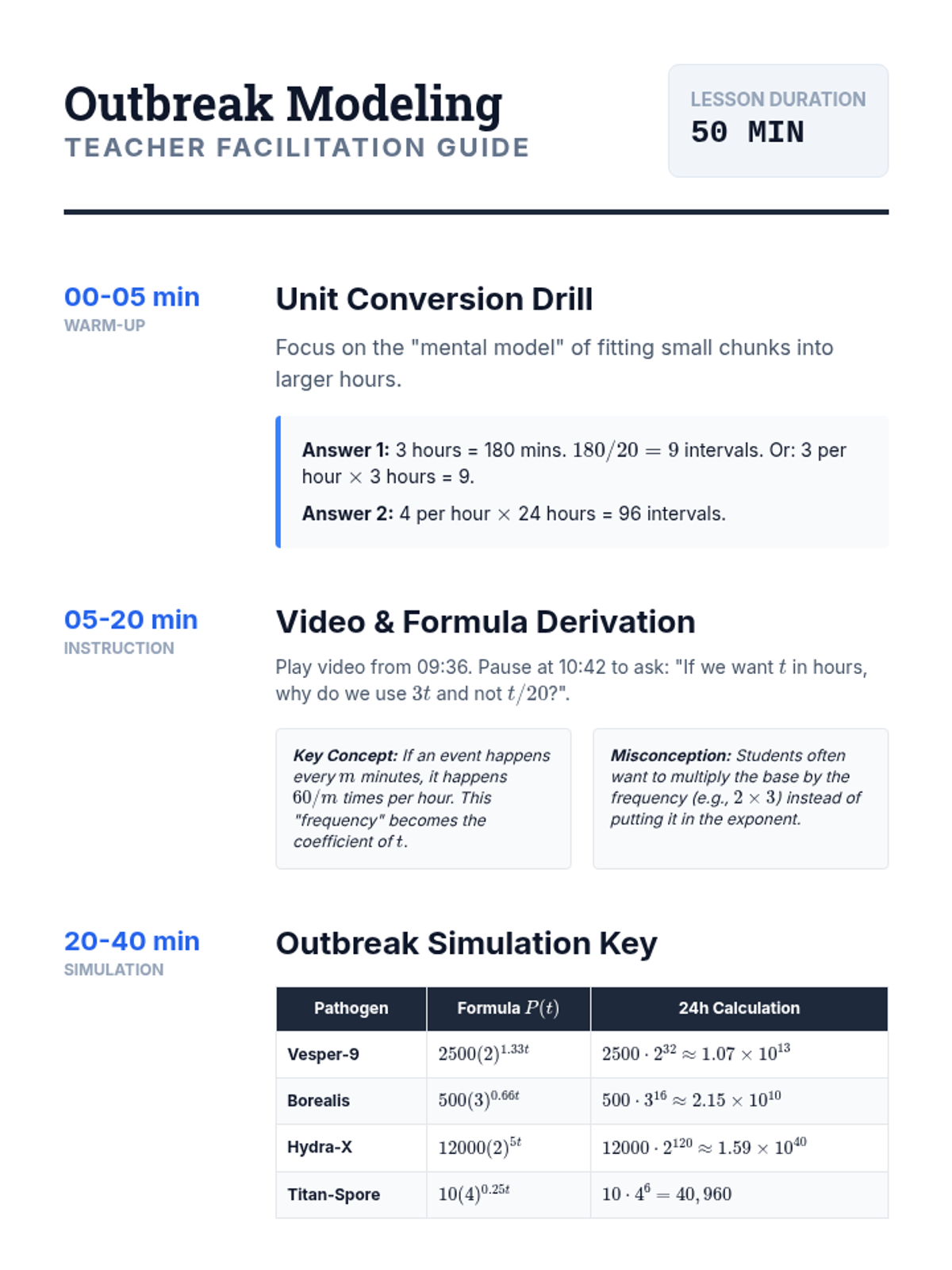
This lesson guides students through constructing exponential models for bacterial and viral growth, focusing on the mathematical derivation of exponents when time units (minutes vs. hours) differ. Students will watch a targeted video segment, analyze growth rates, and apply their knowledge to a 'Crisis Simulation' scenario.
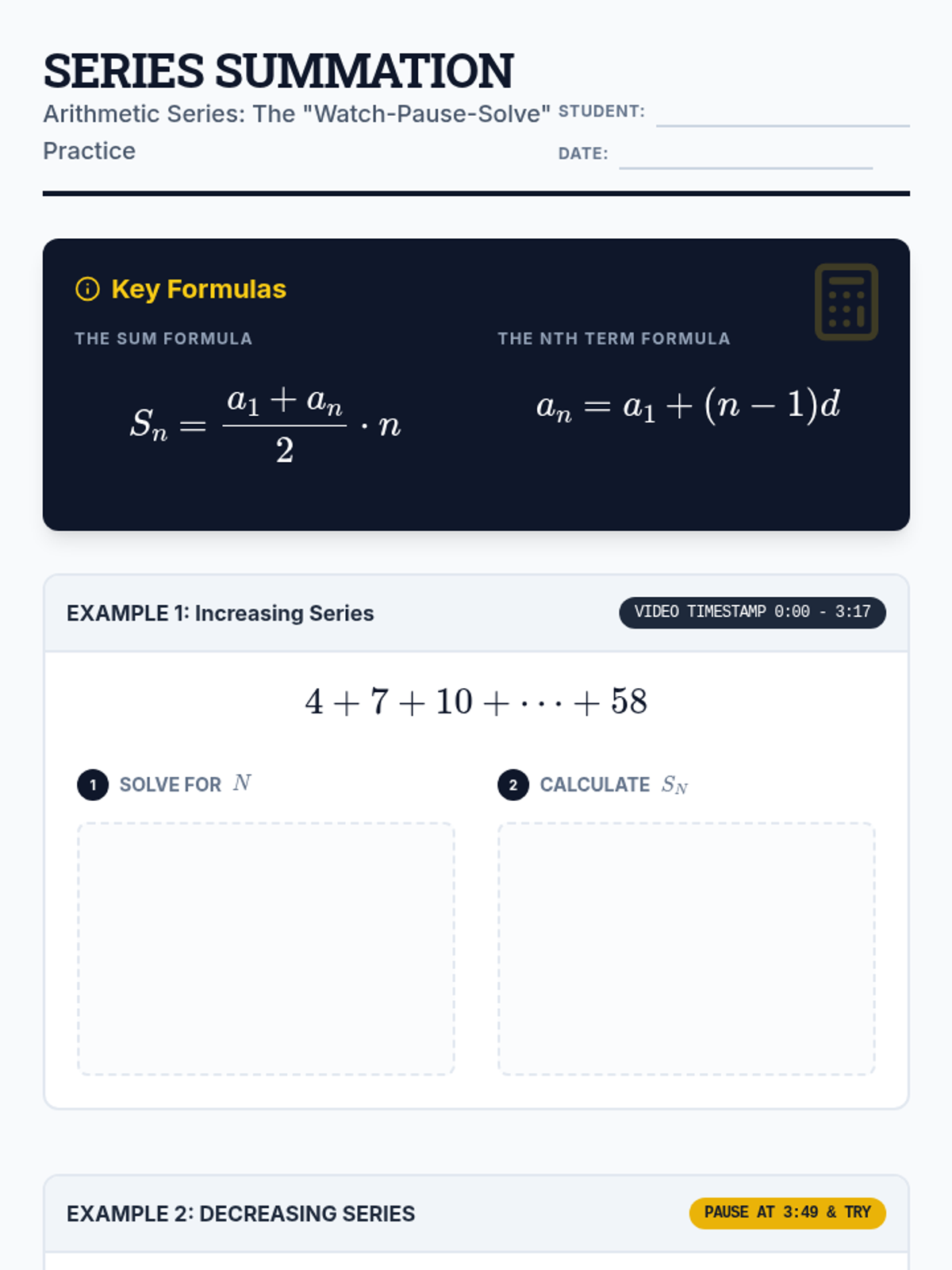
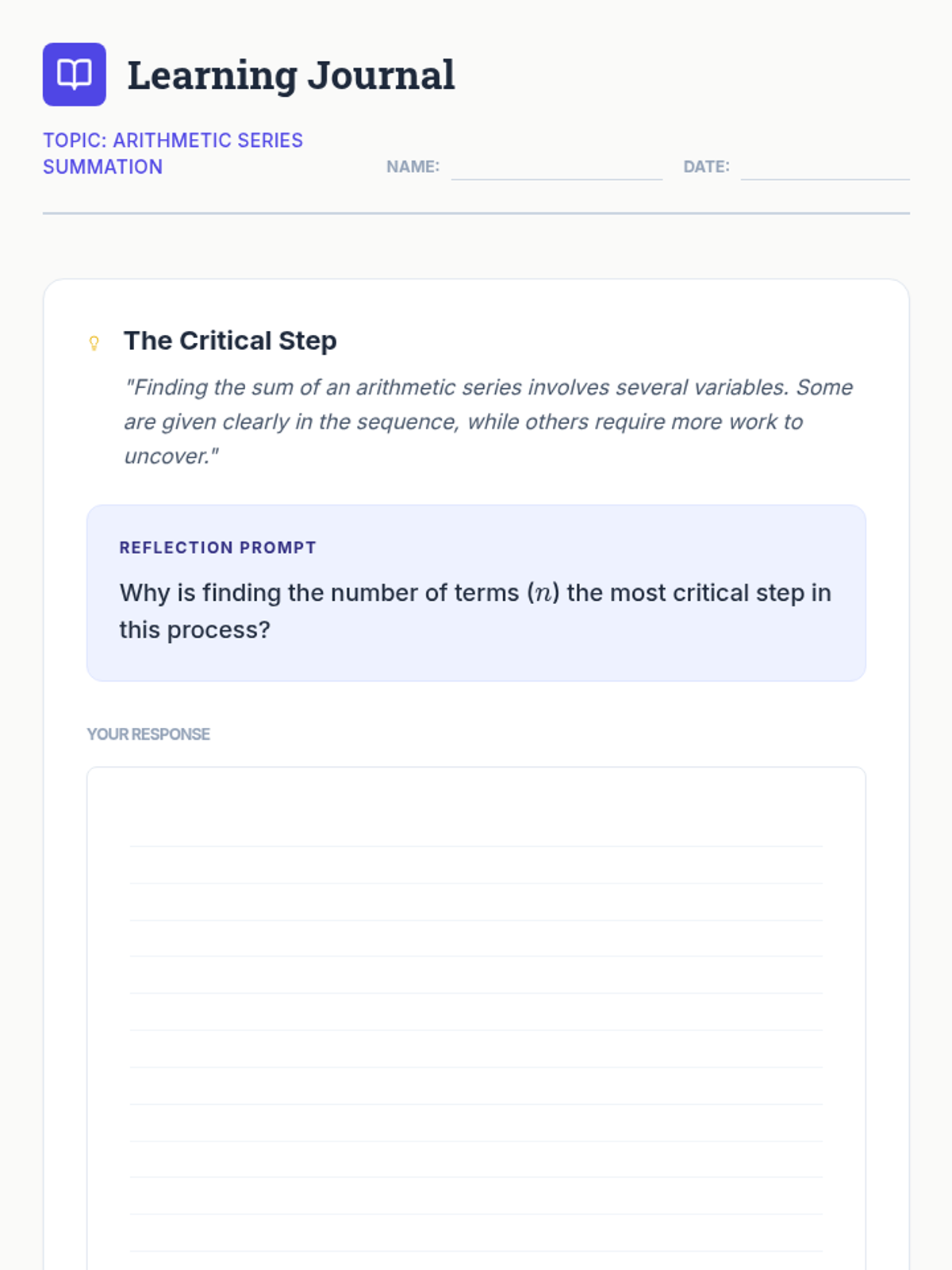
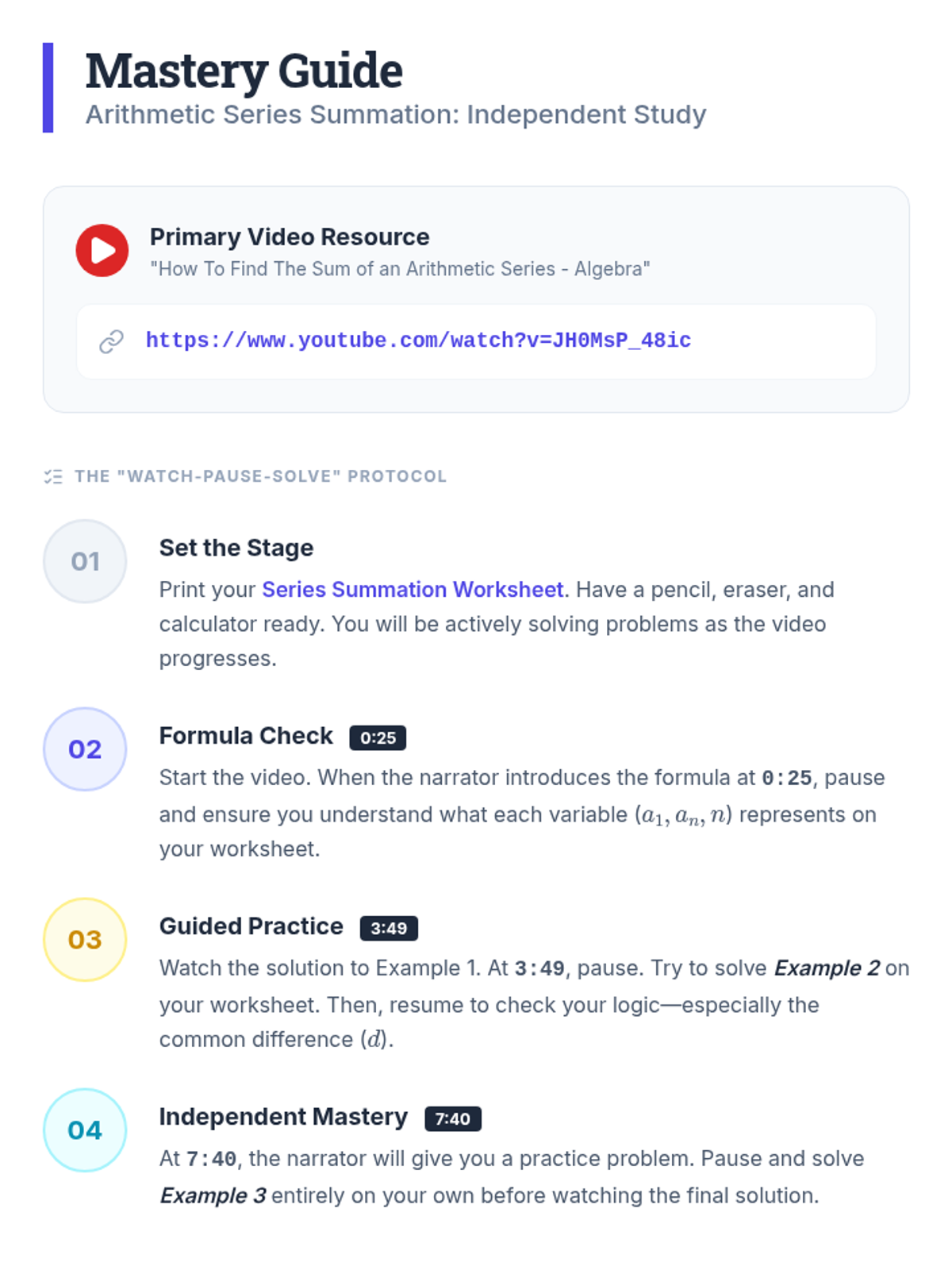
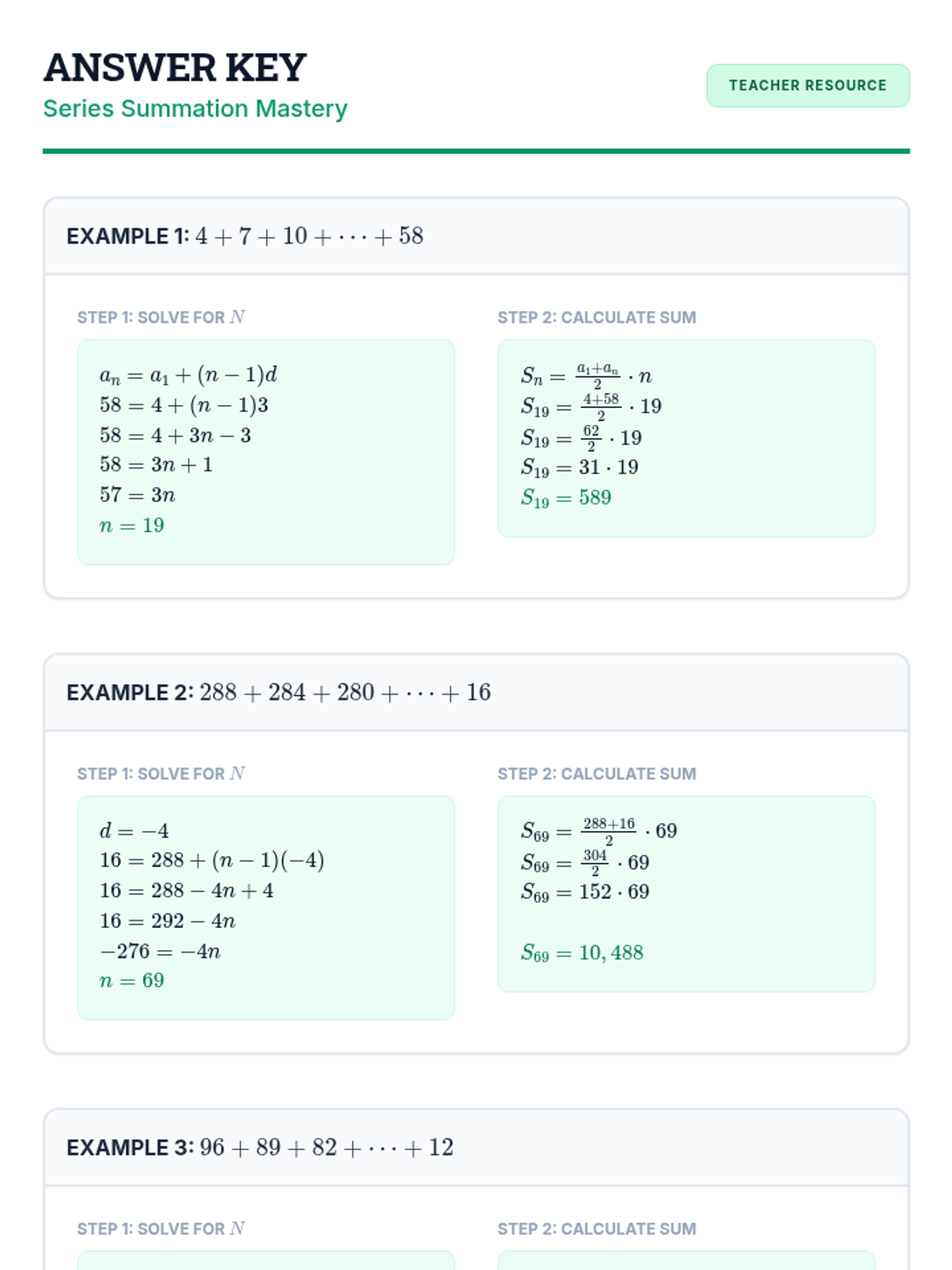
A self-paced lesson on finding the sum of arithmetic series using a two-step strategy. Students follow a 'Watch-Pause-Solve' video guide to master identifying terms, calculating the number of terms (n), and applying the summation formula.
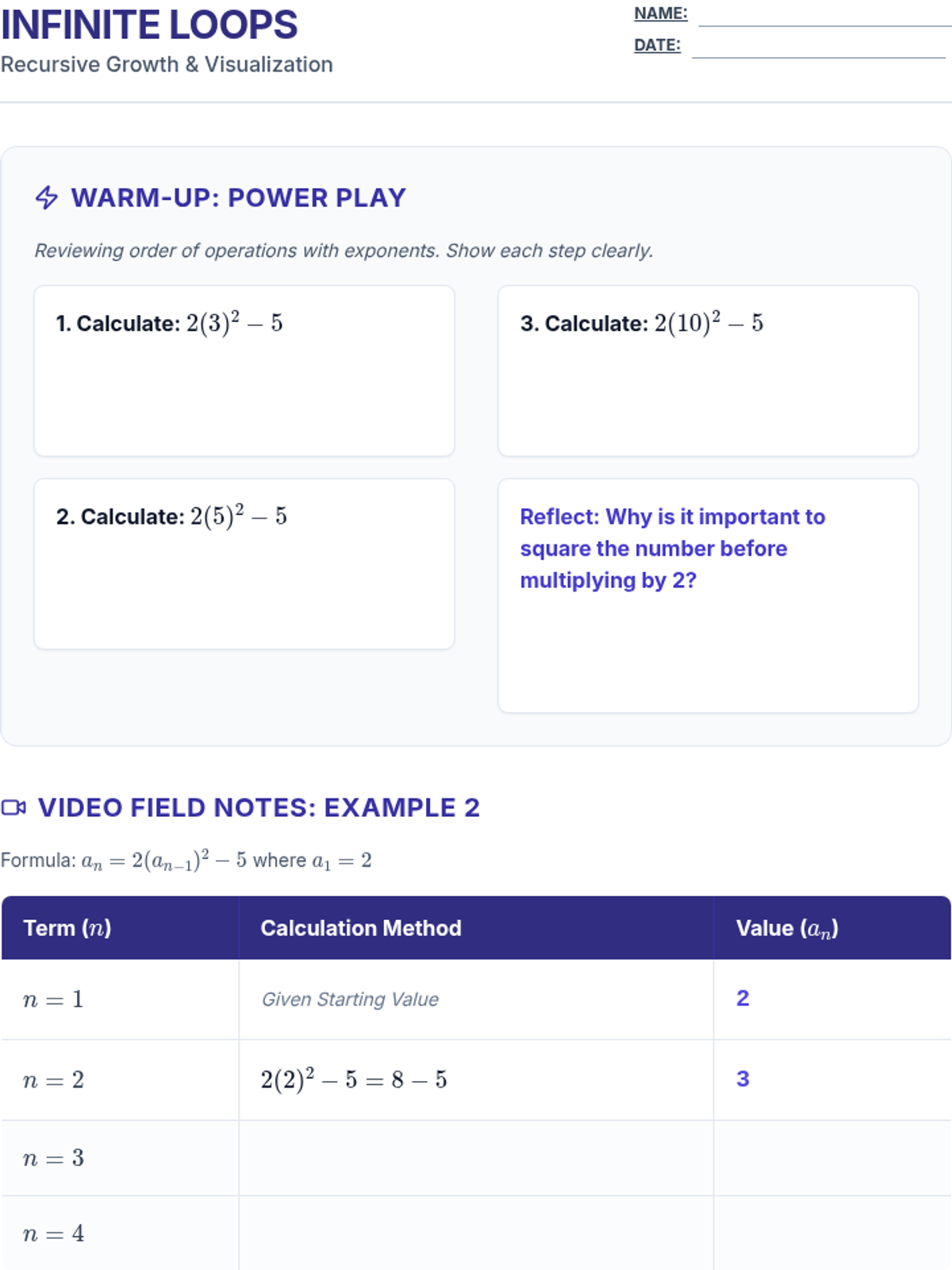
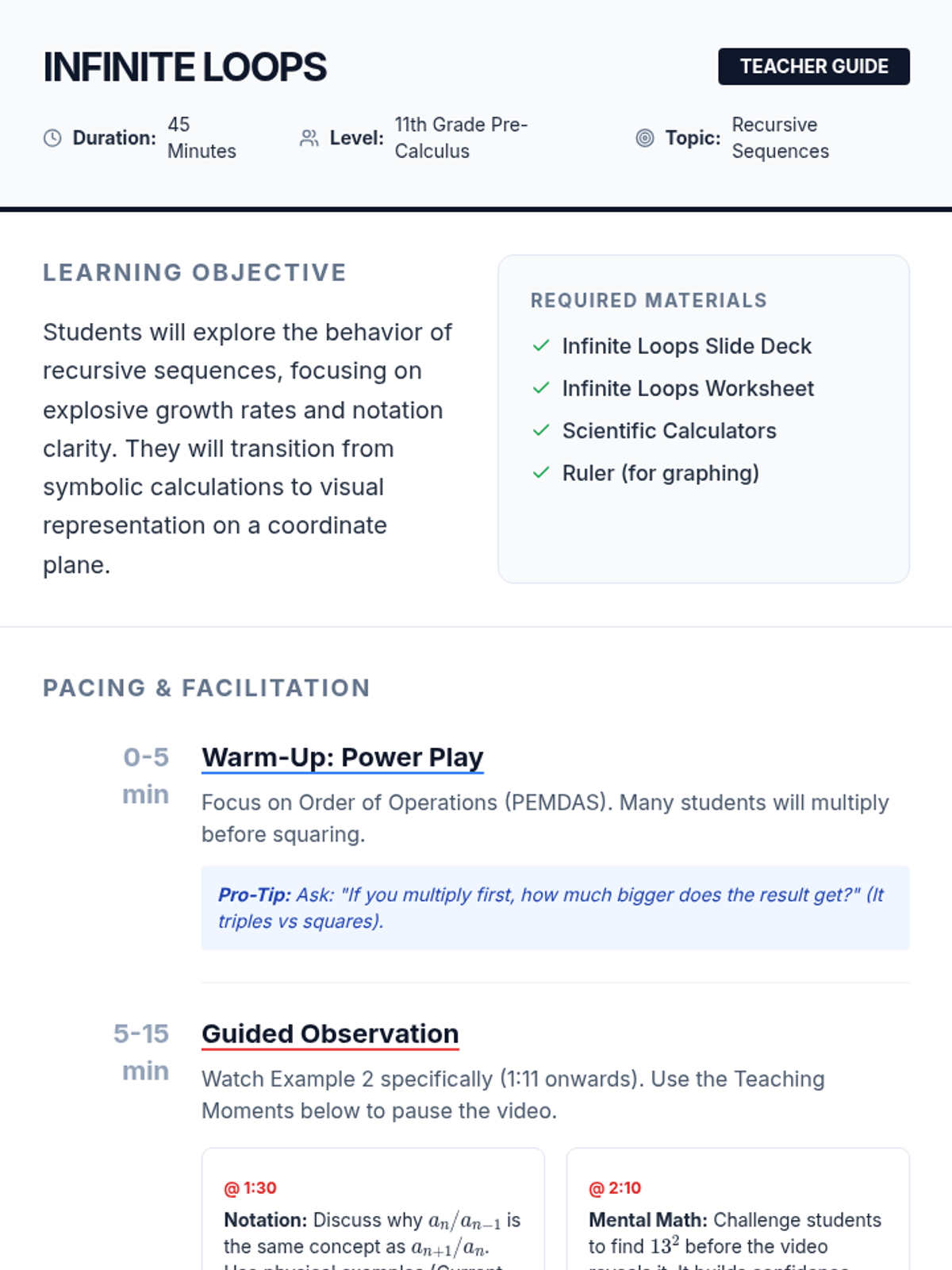
A lesson on recursive sequences where students analyze quadratic growth through video observation, manual calculation, and graphing. Students transition from understanding subscript notation to visualizing the rapid expansion of recursive functions.
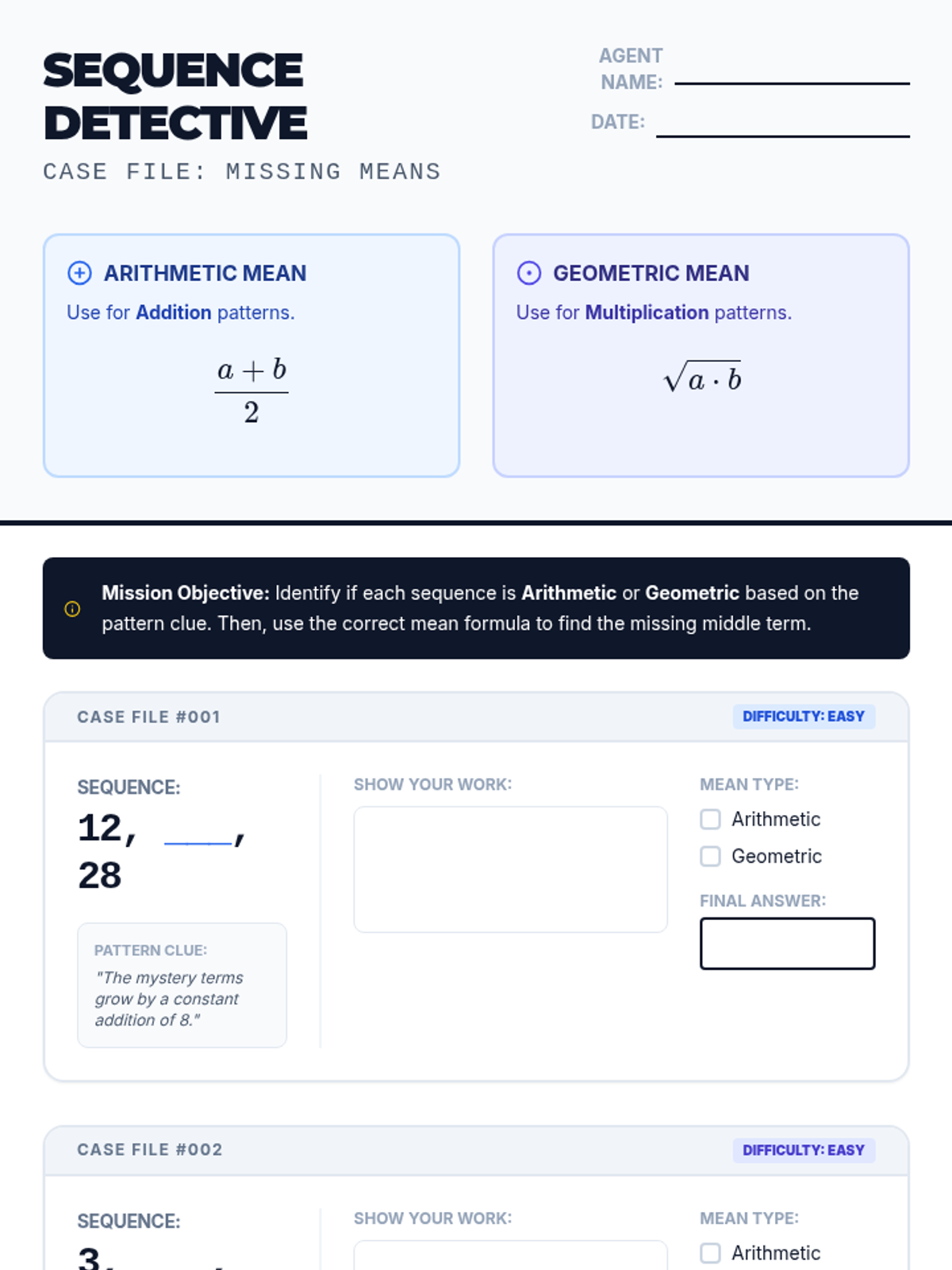
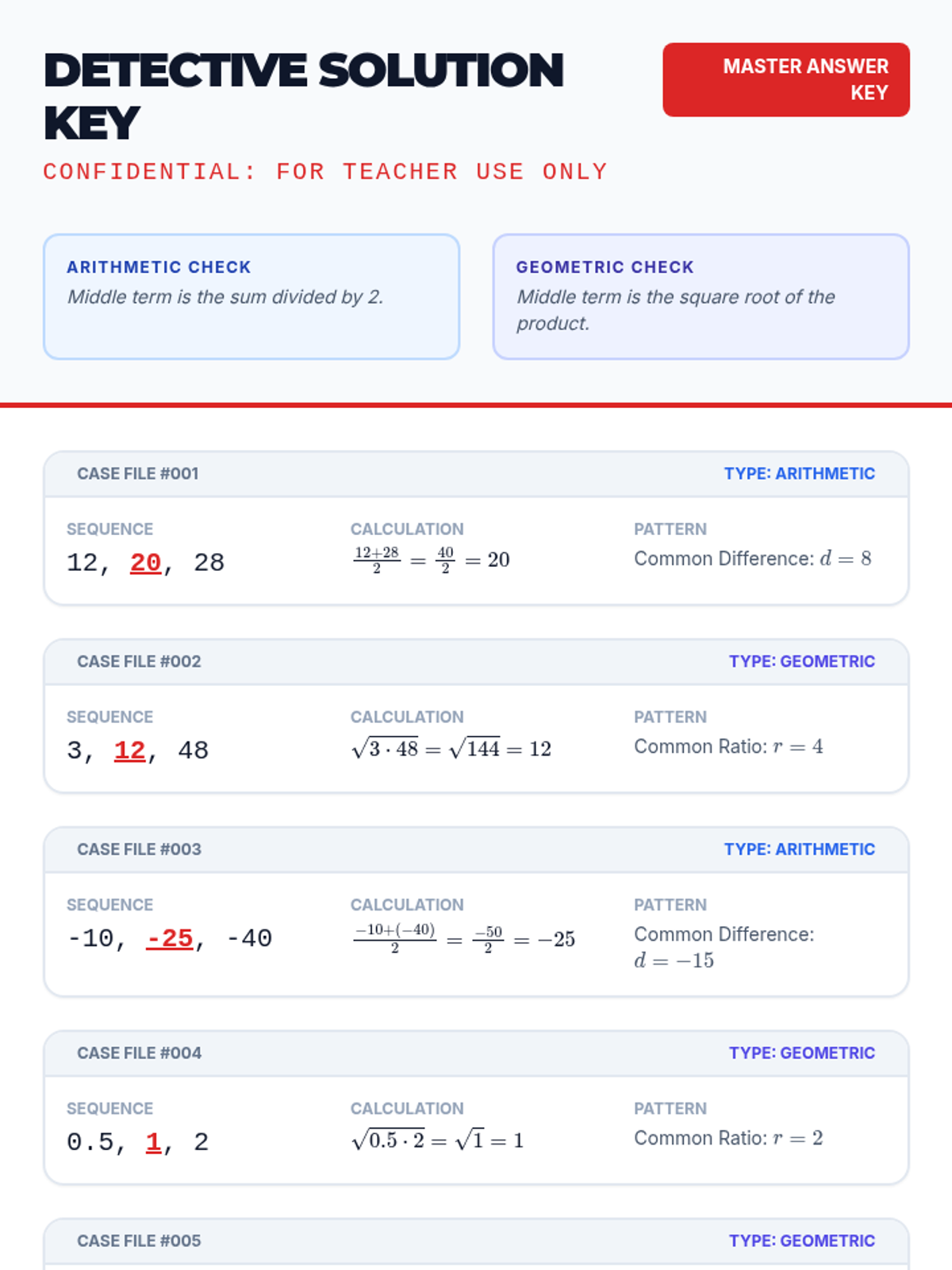
Students will distinguish between arithmetic and geometric sequences, learn the specific properties of arithmetic and geometric means, and apply these formulas to find missing terms in sequences.
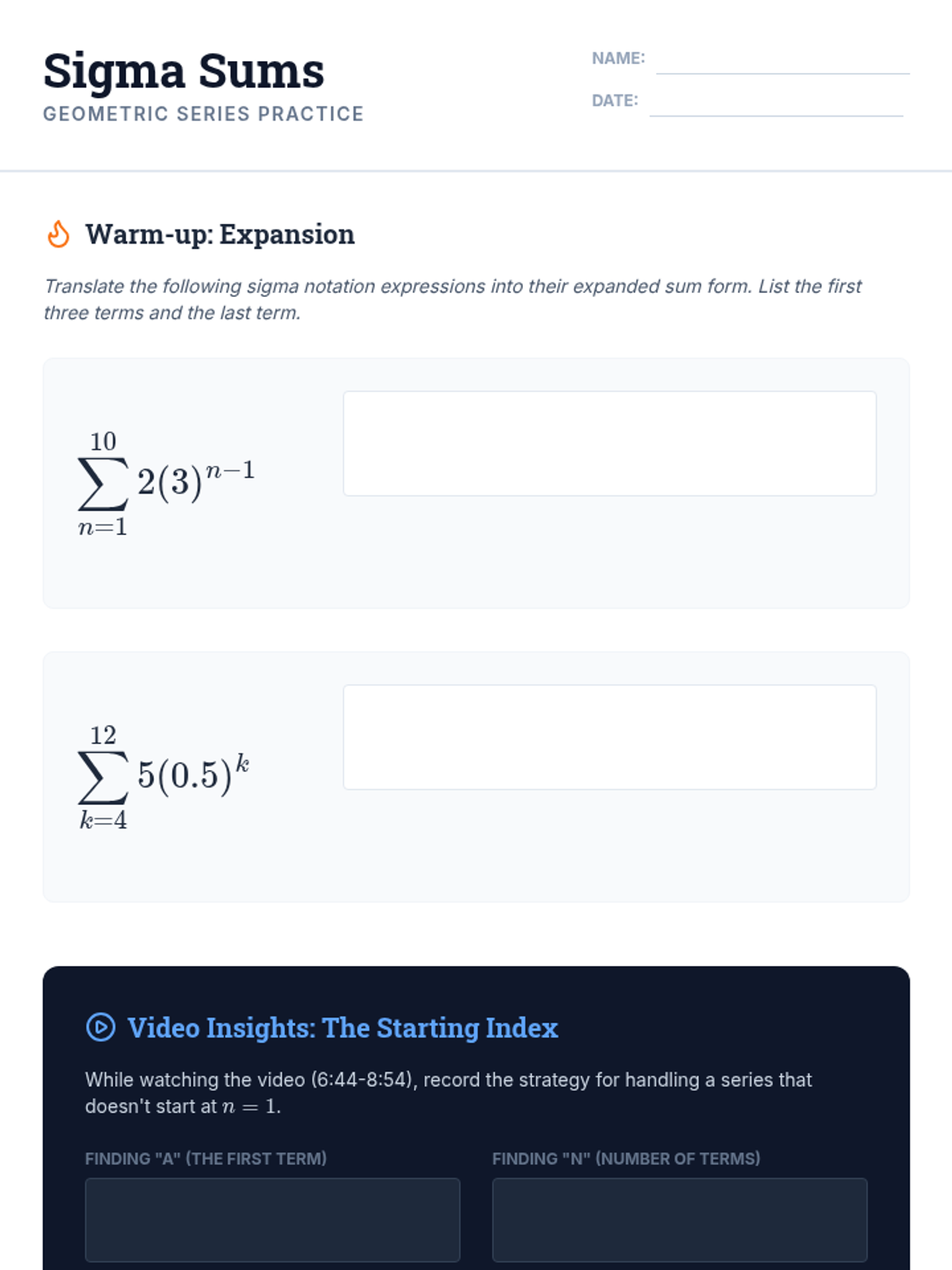
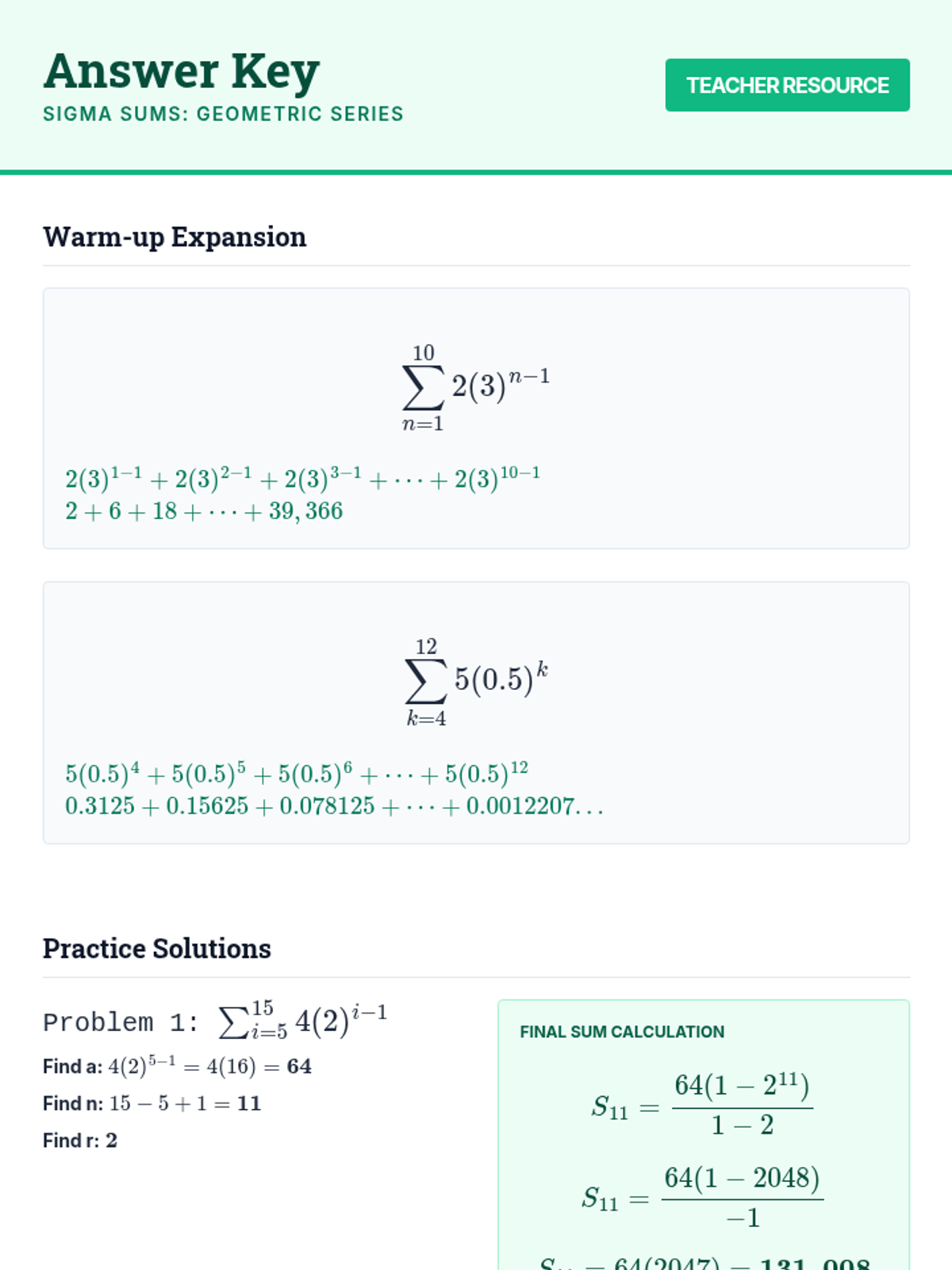
Students will master the interpretation and calculation of finite geometric series sums using sigma notation, with a specific focus on series where the starting index is not 1. They will learn to identify the true first term and calculate the total number of terms correctly.
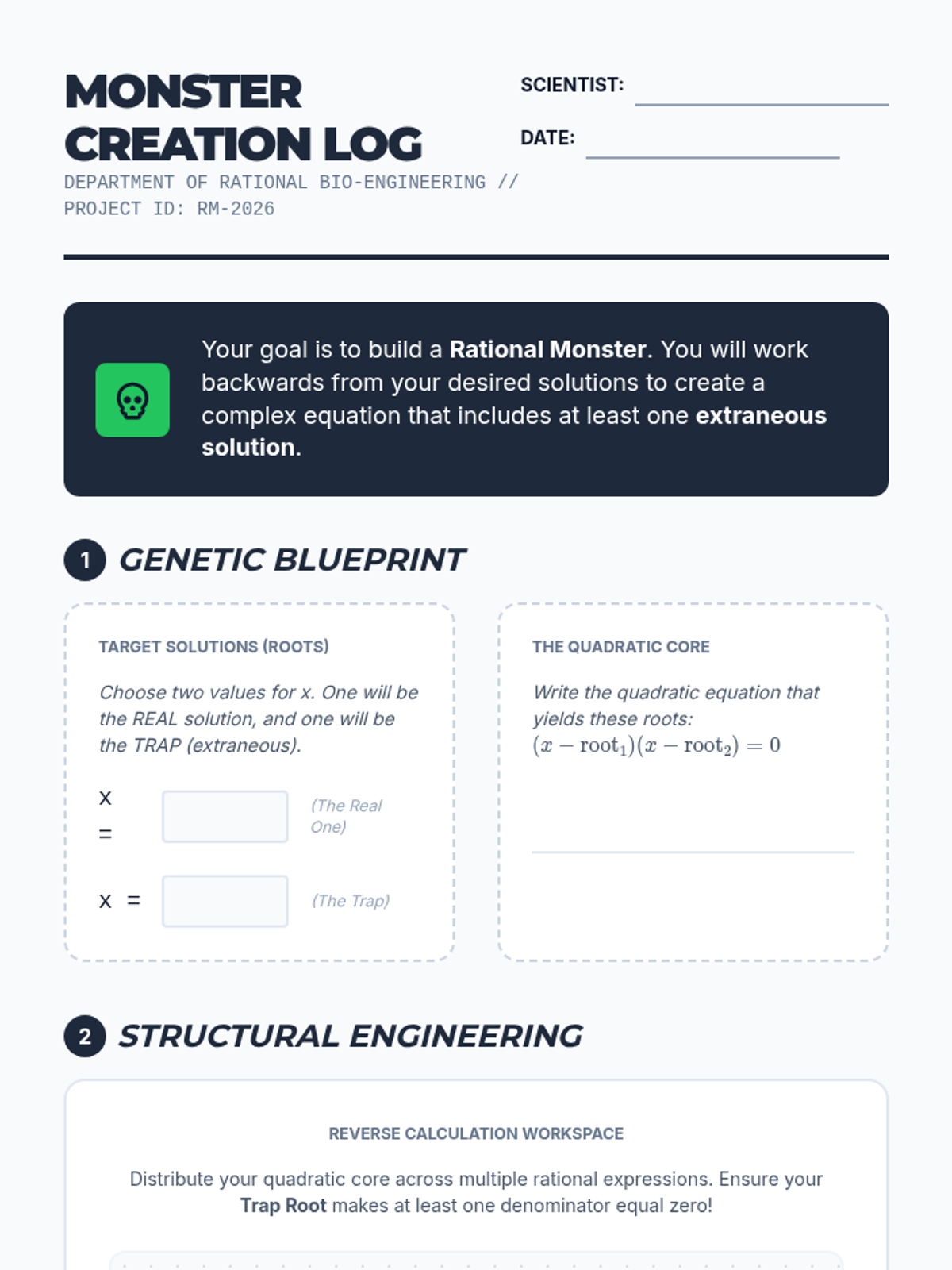
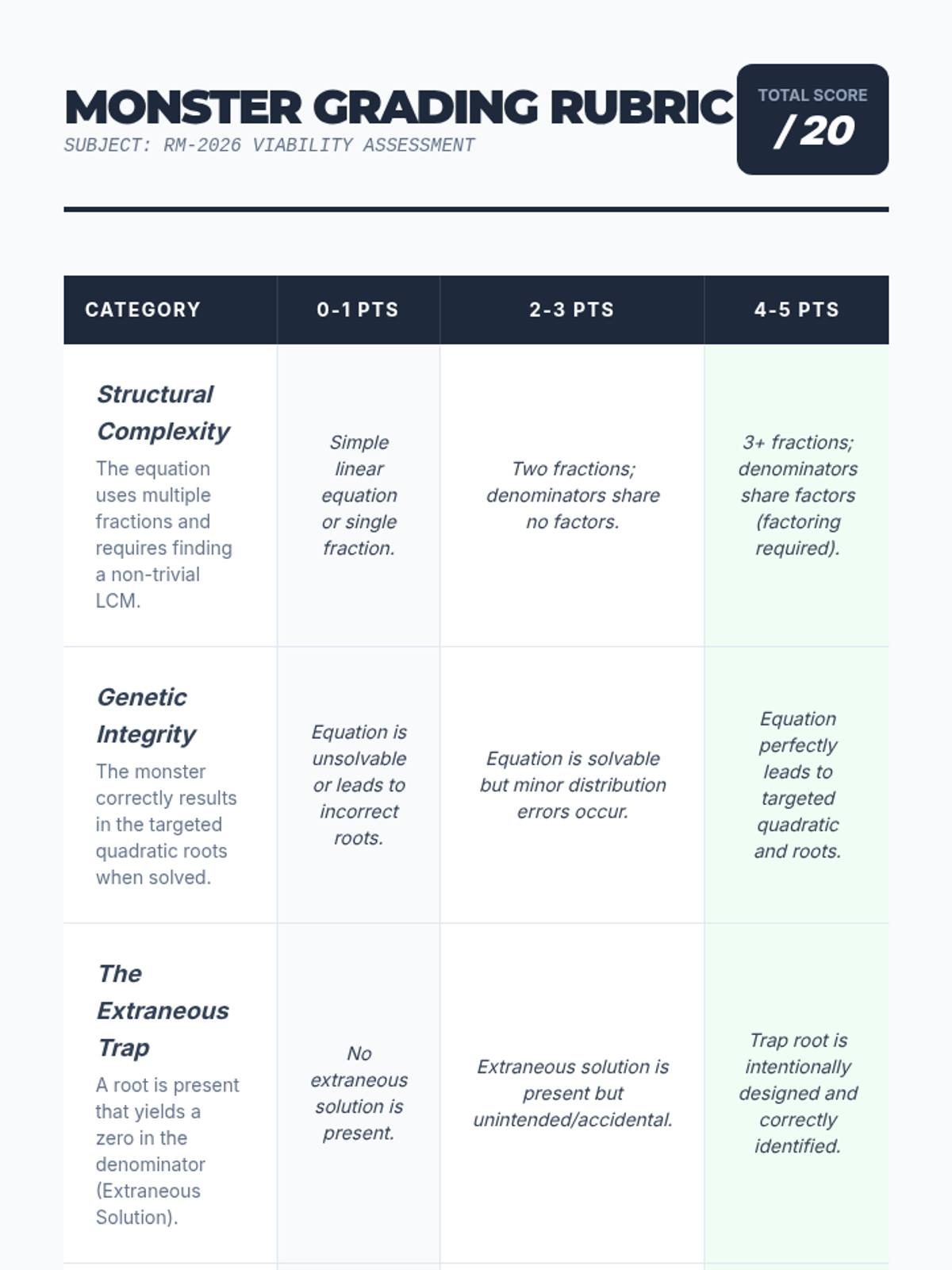
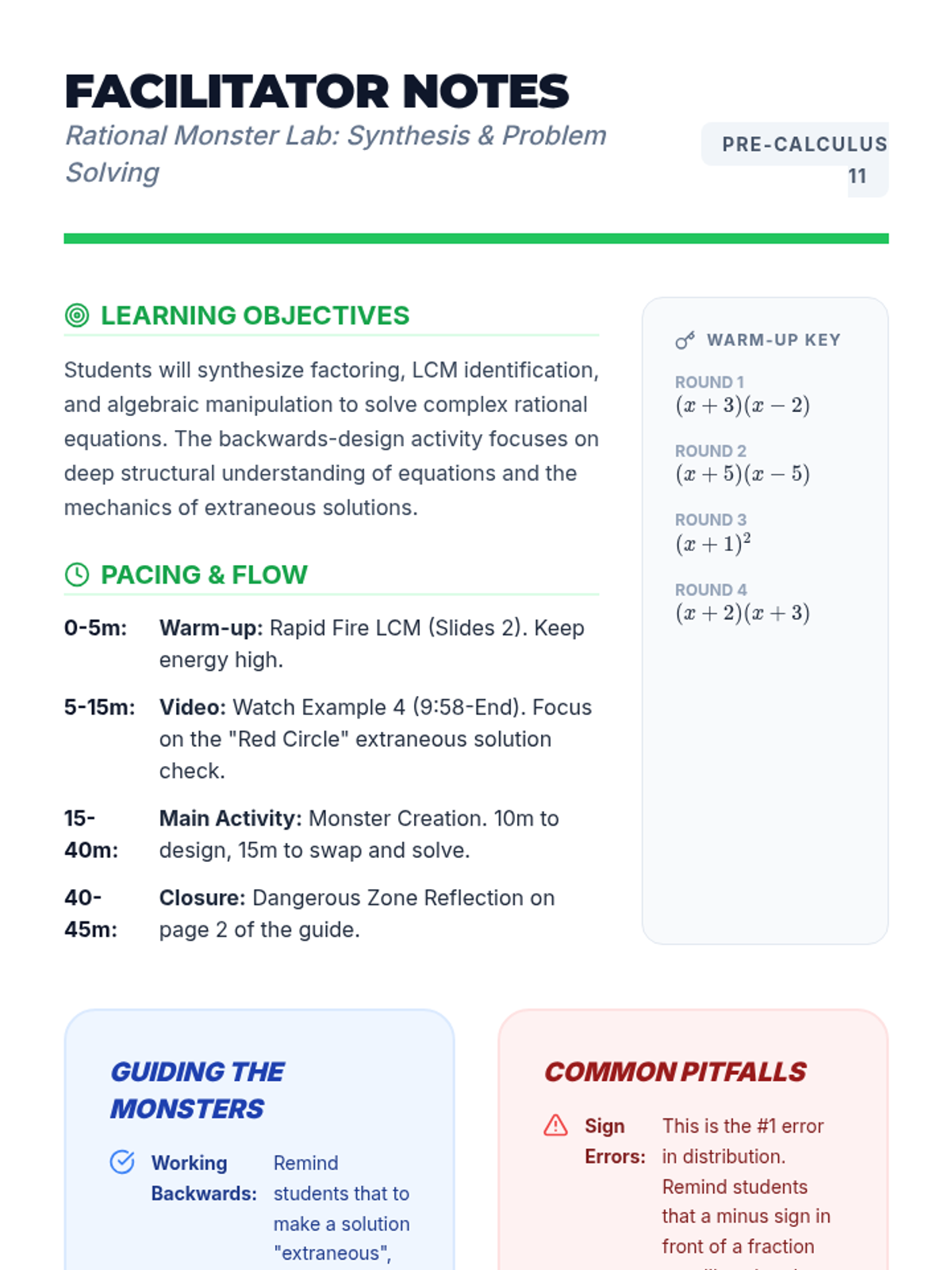
A high-energy Pre-Calculus lesson where students transition from simple rational equations to complex ones involving quadratics and extraneous solutions, culminating in a creative 'Equation Monster' design activity.
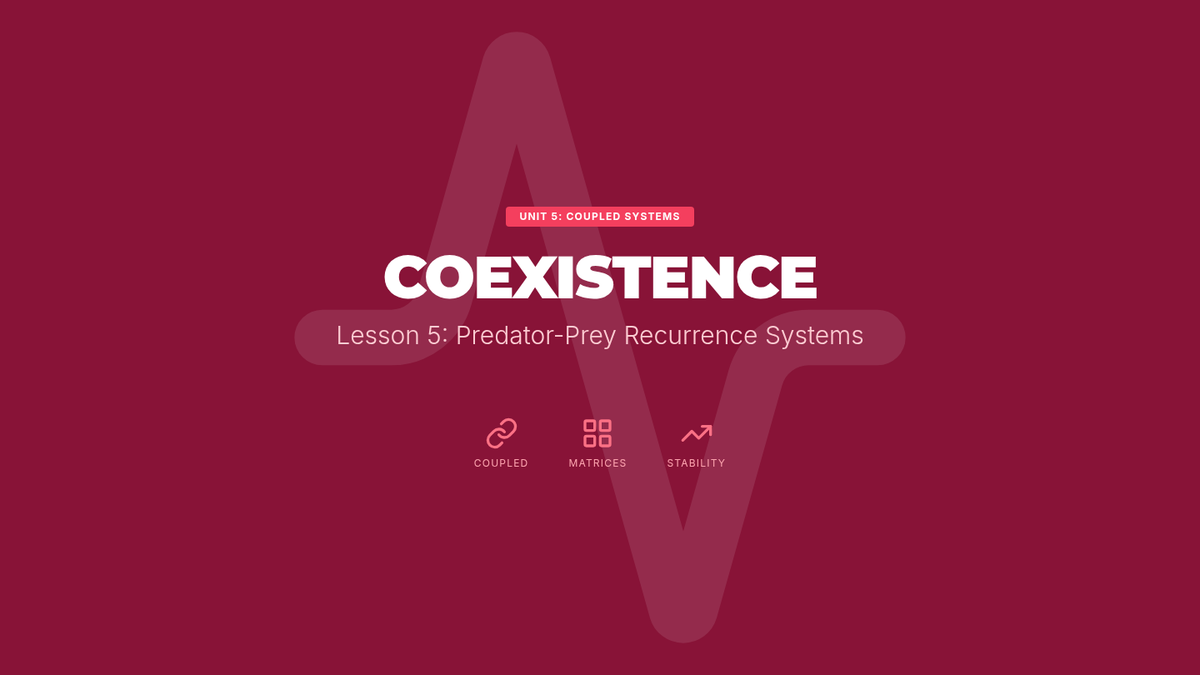
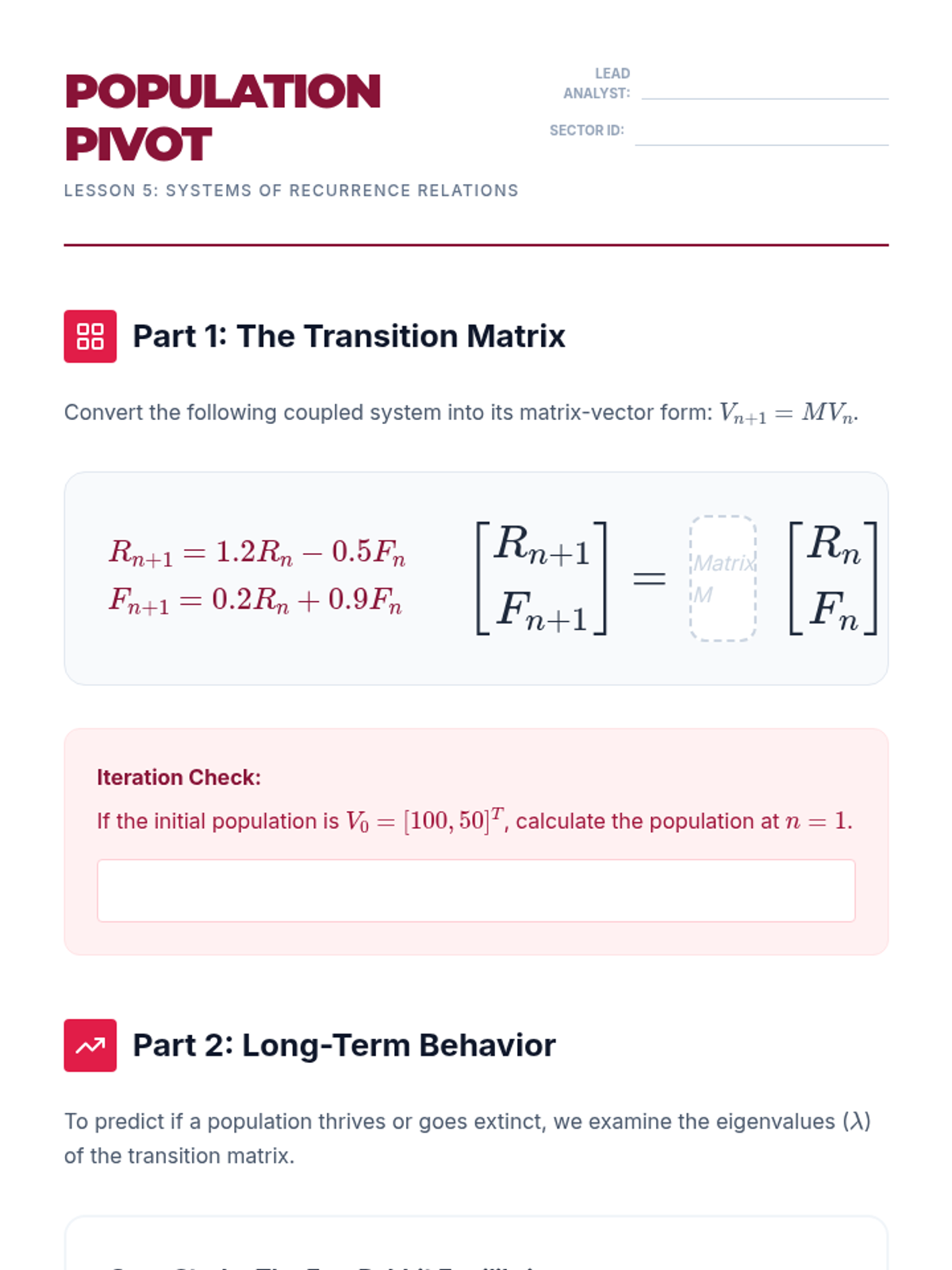
Extending recurrence logic to coupled systems, modeling predator-prey dynamics with matrix methods to predict long-term population stability or extinction.
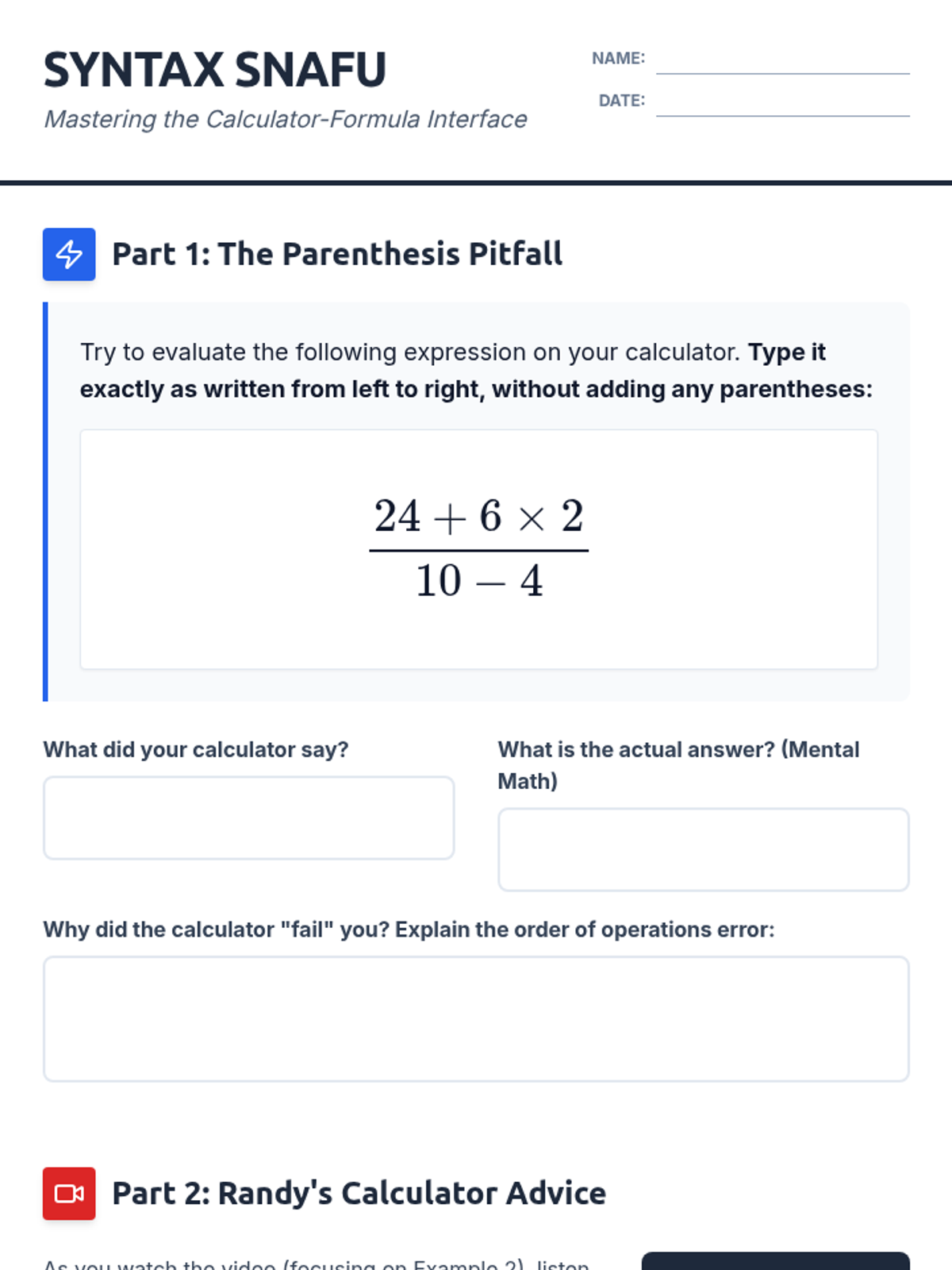
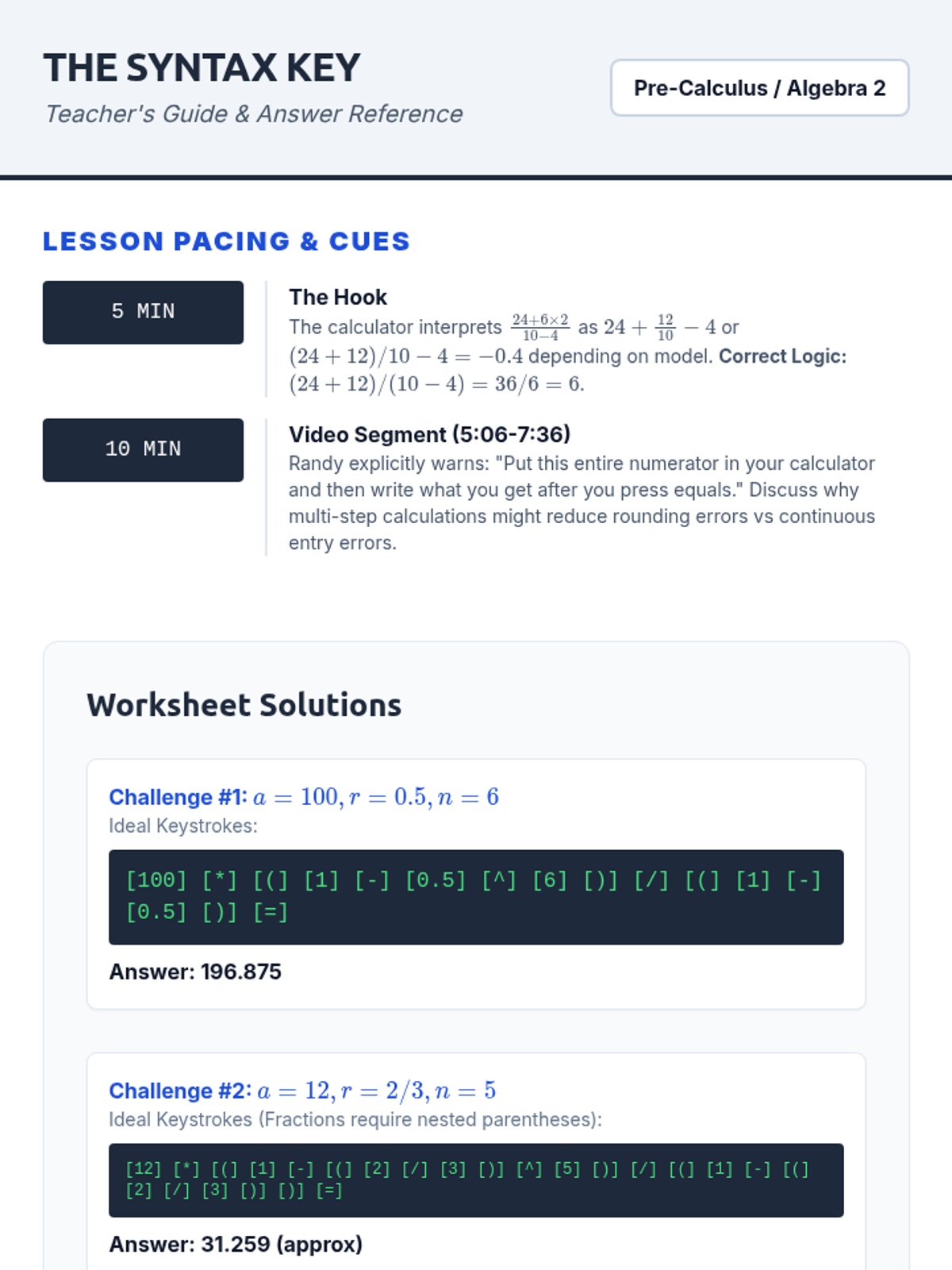
A Pre-Calculus lesson exploring the critical role of calculator syntax and grouping symbols through the lens of geometric series sum formulas. Students learn to navigate the 'limitations' of digital tools by mastering formula structure and parentheses.
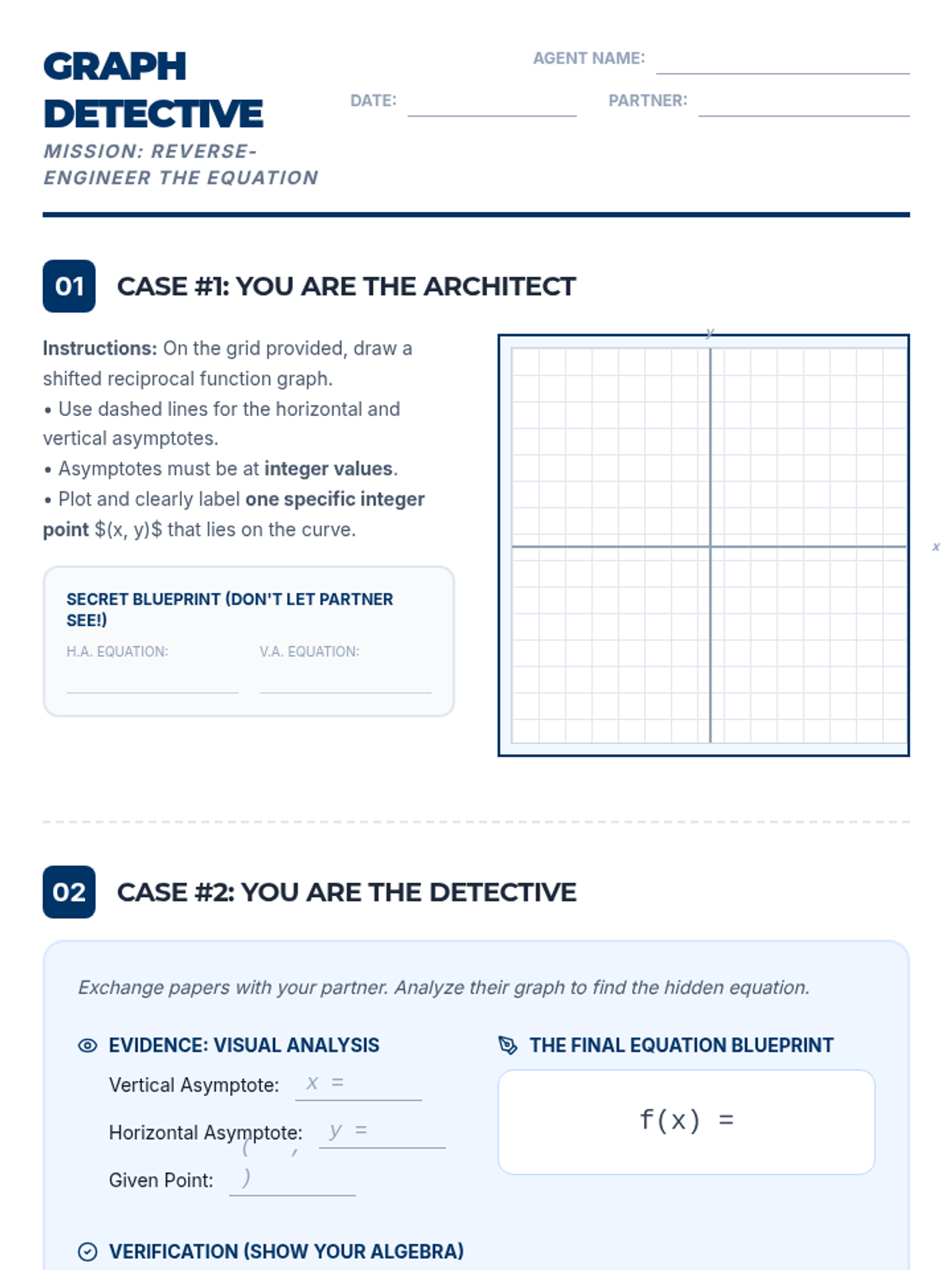
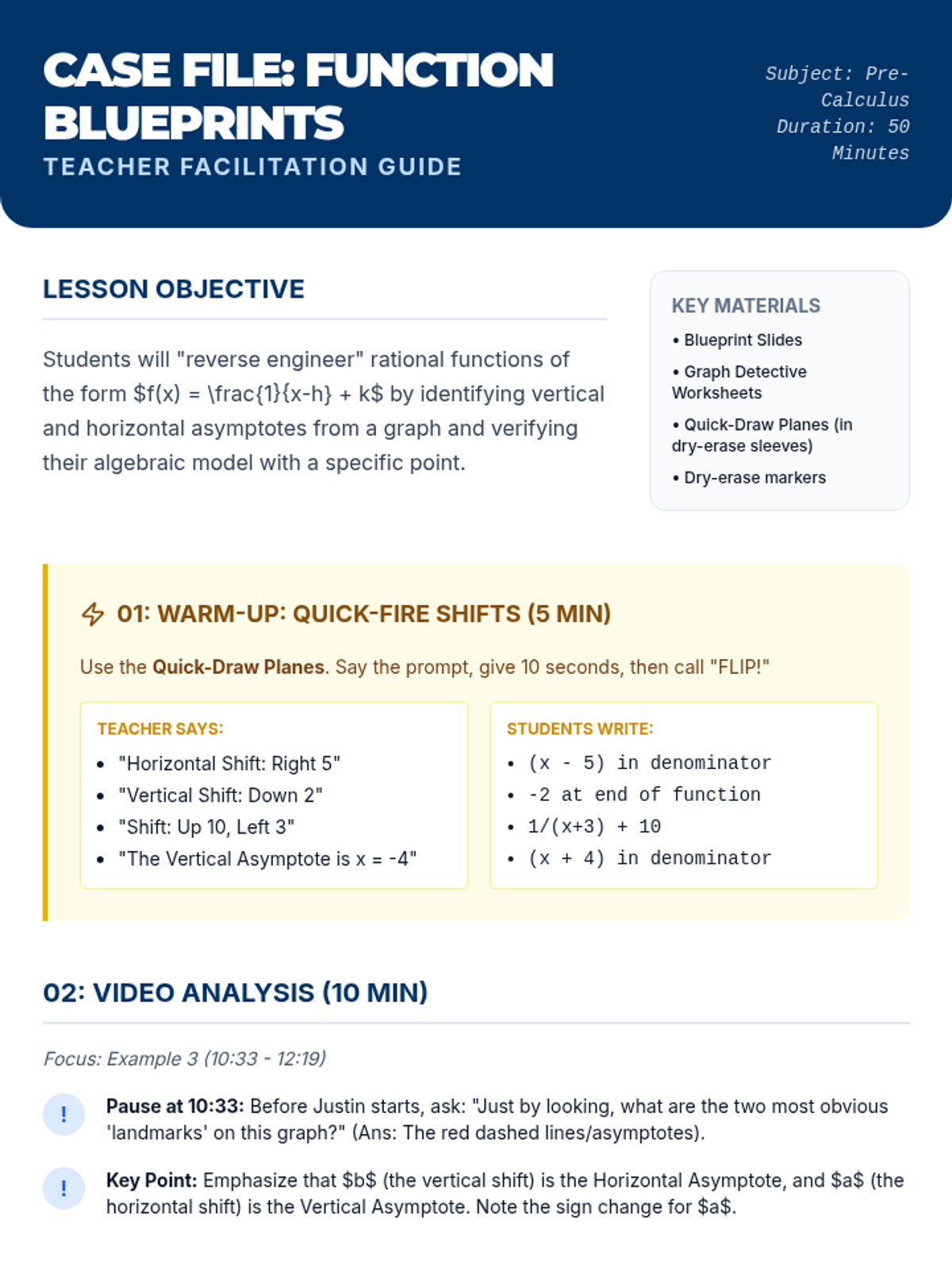
Students will learn to construct equations for rational functions of the form f(x) = 1/(x-h) + k by identifying horizontal and vertical asymptotes from graphs and using specific points for verification.
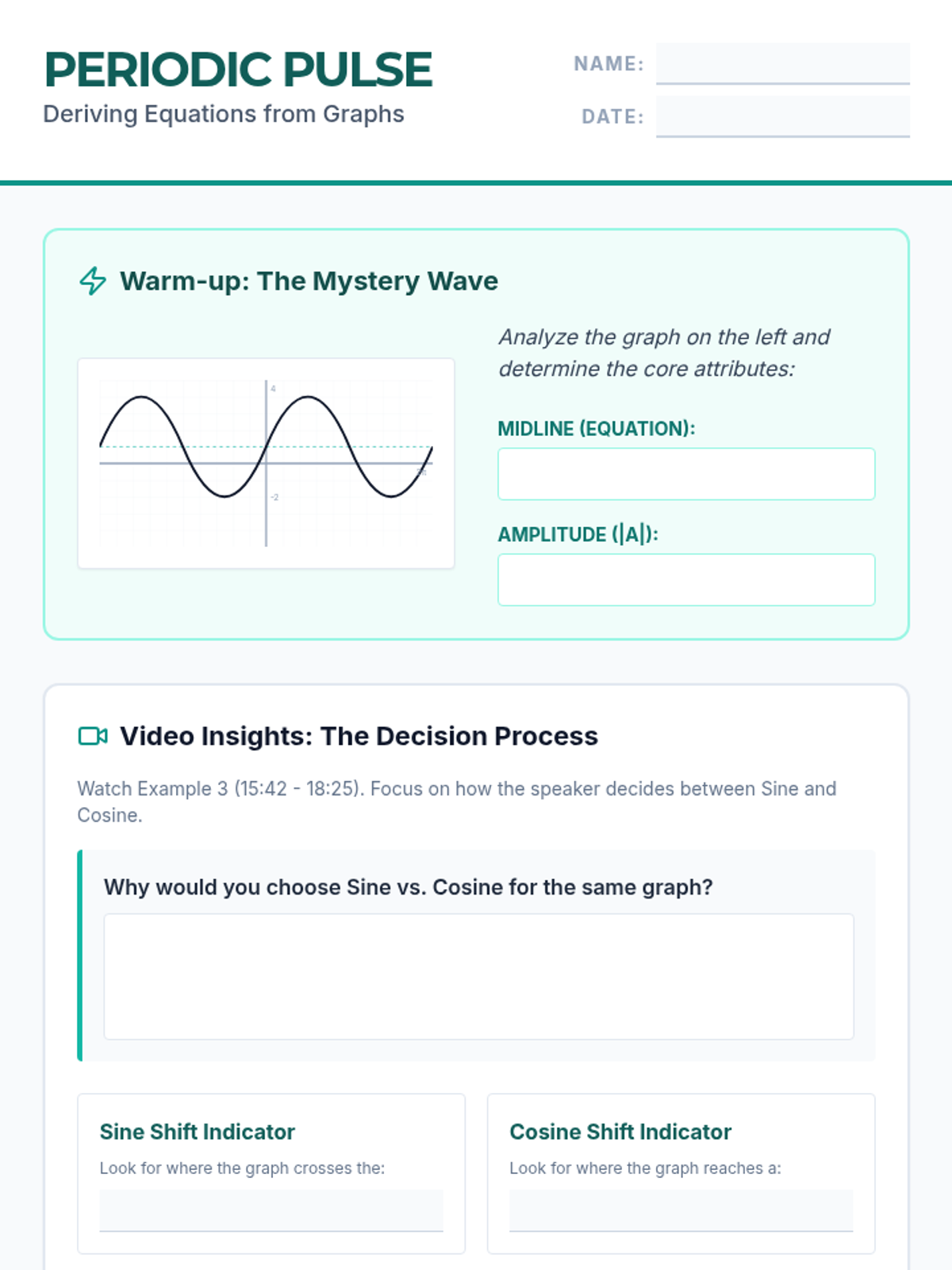
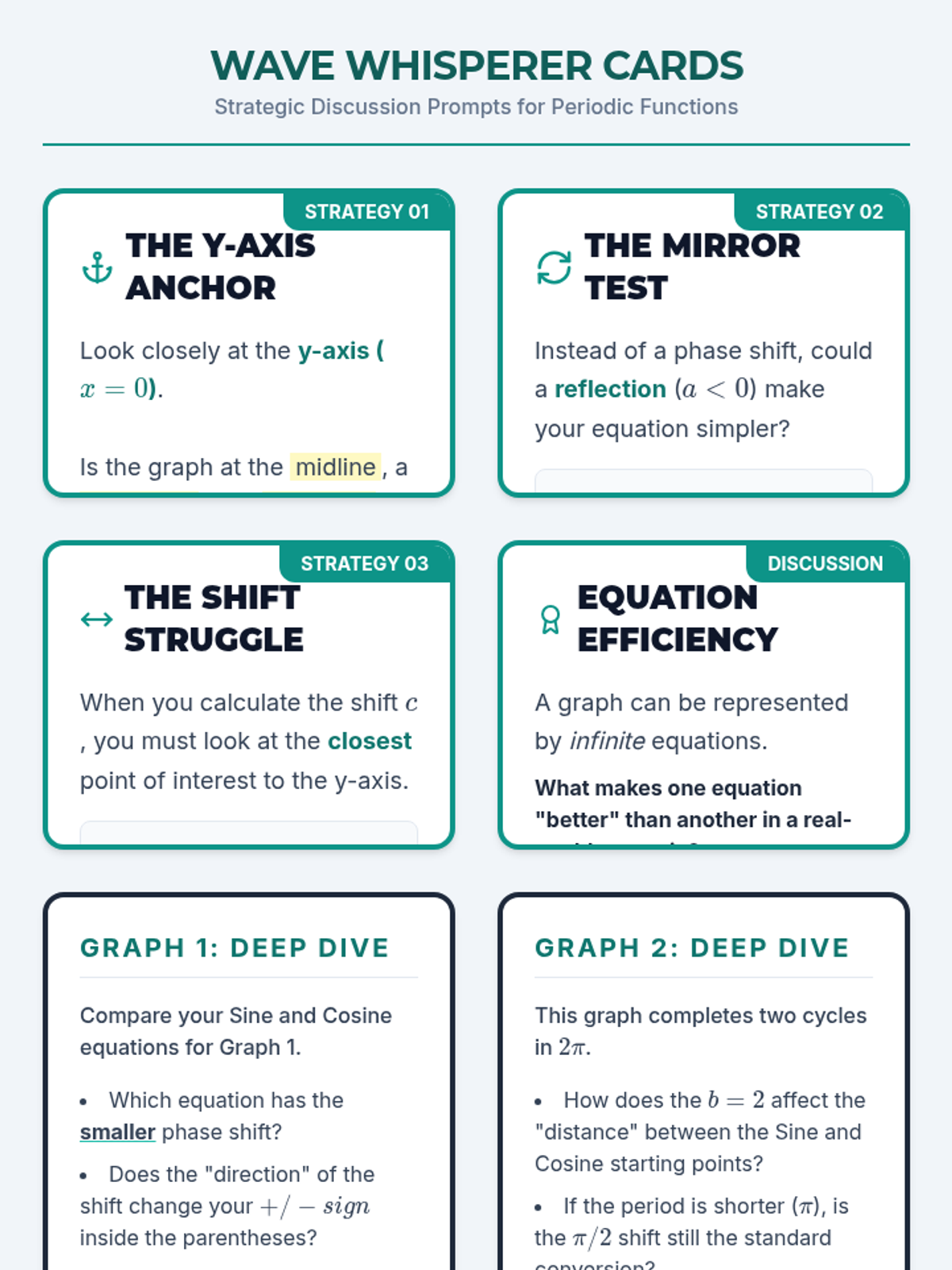
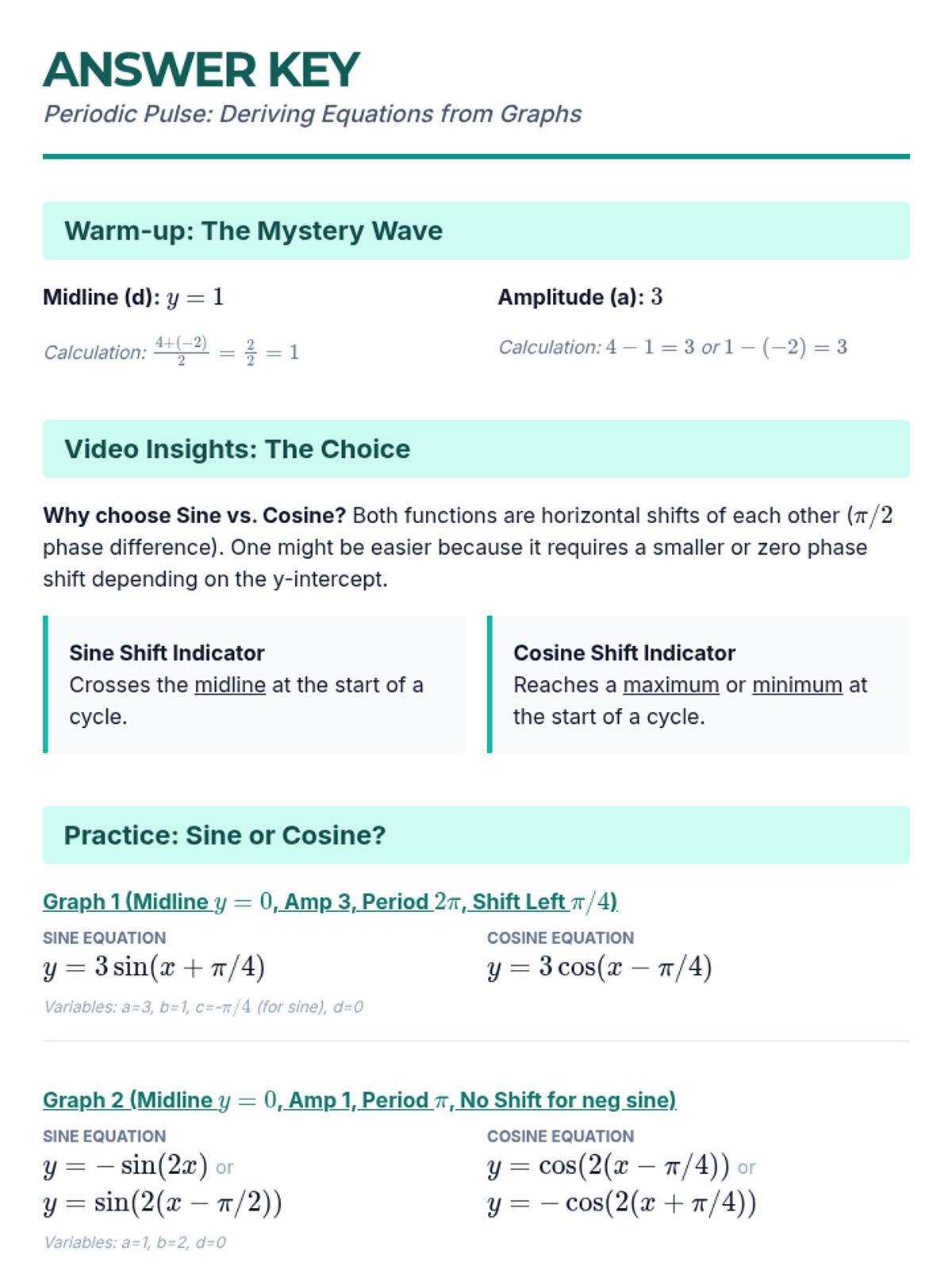
Students will learn to derive sine and cosine equations from periodic graphs, focusing on the strategic choice between functions based on phase shifts and key points. This lesson uses a high-quality video walkthrough and collaborative discussion to master the a, b, c, and d transformations.
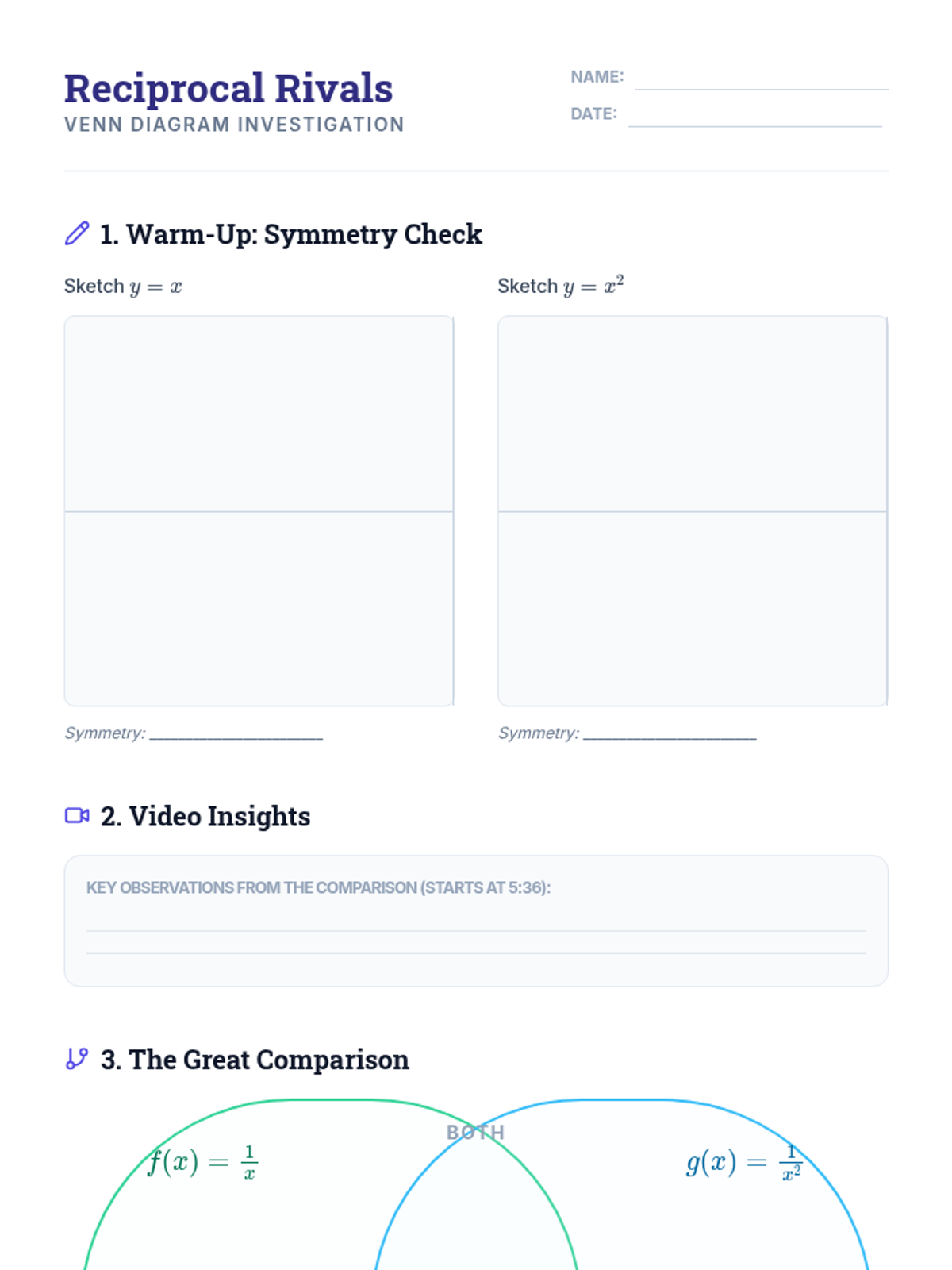
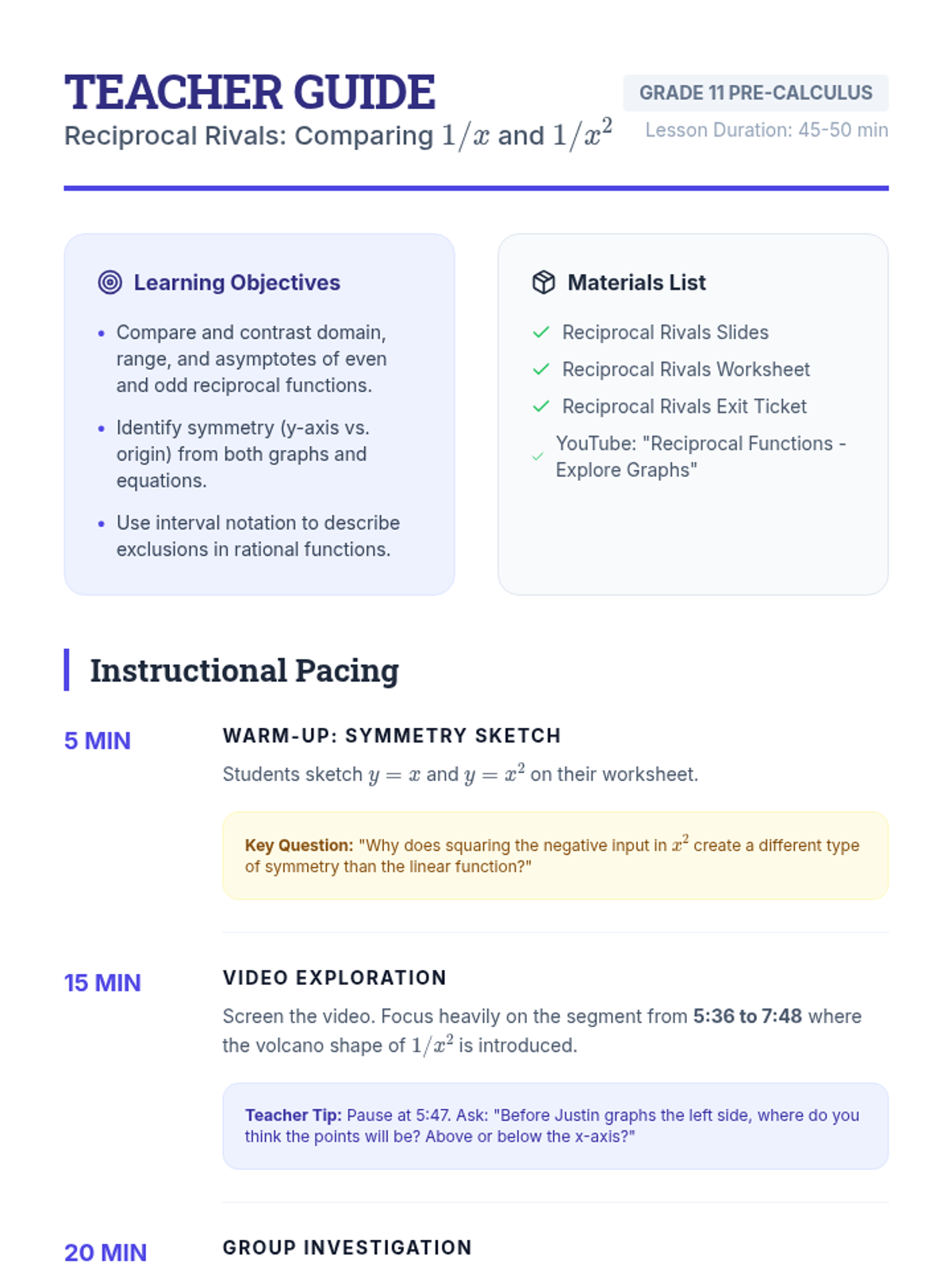
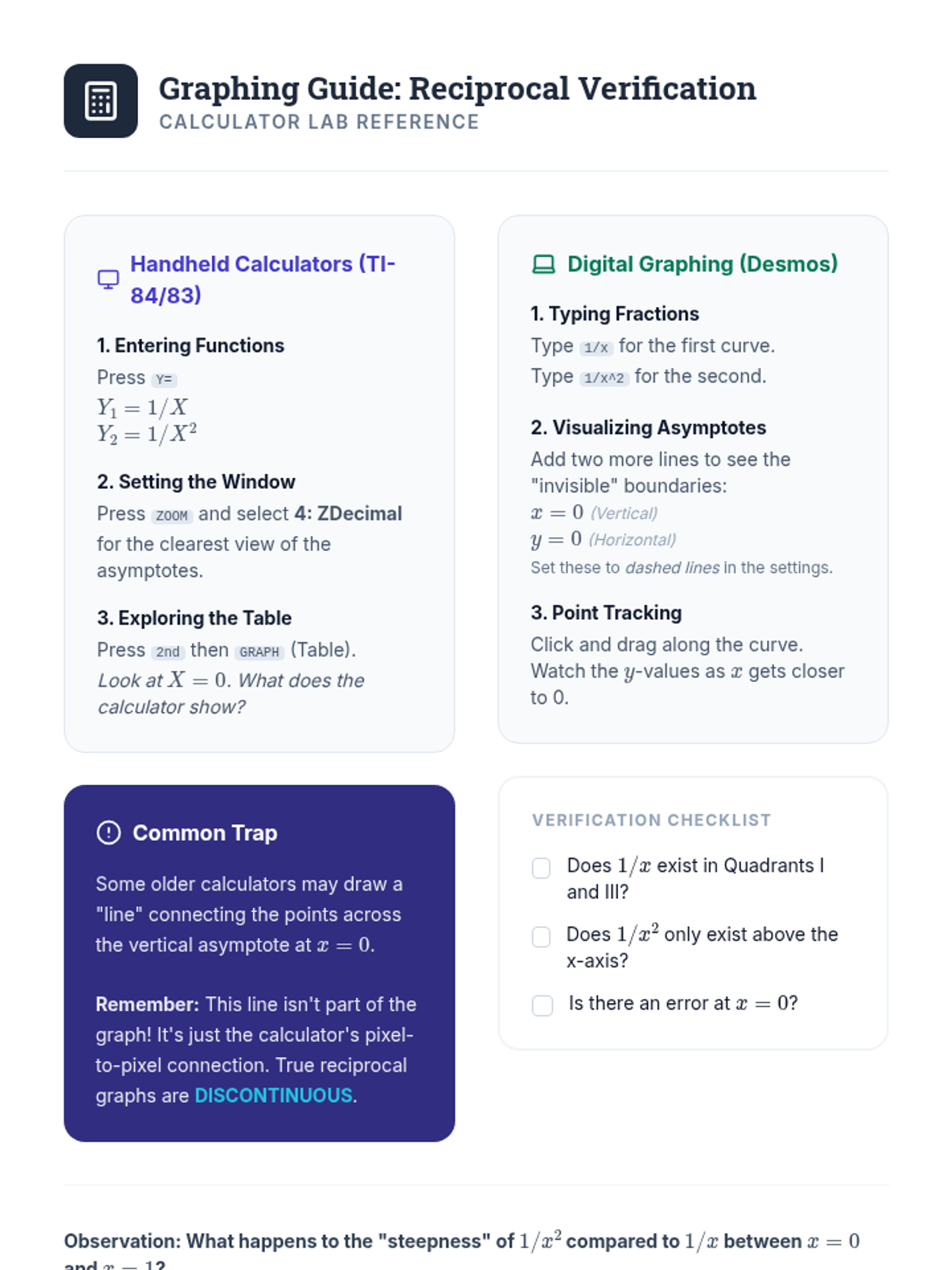
Students explore the unique properties of even and odd reciprocal functions ($1/x$ and $1/x^2$) through graphical analysis, video observation, and comparative discussion.
A hands-on exploration of inverse functions where students use folding and tracing to discover the visual relationship between a function and its inverse. The lesson emphasizes the reflection over the line y=x and the swapping of coordinate values.
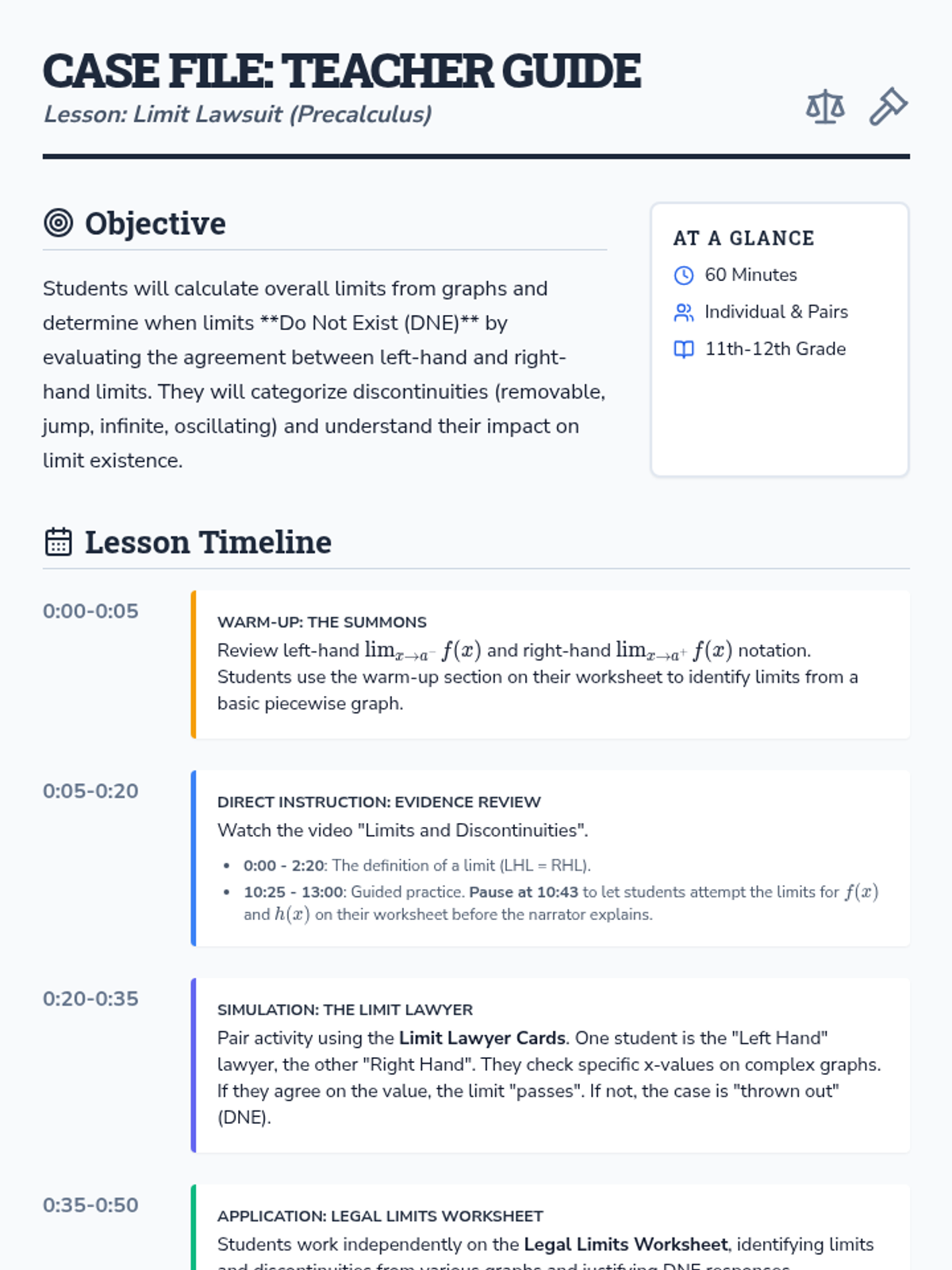
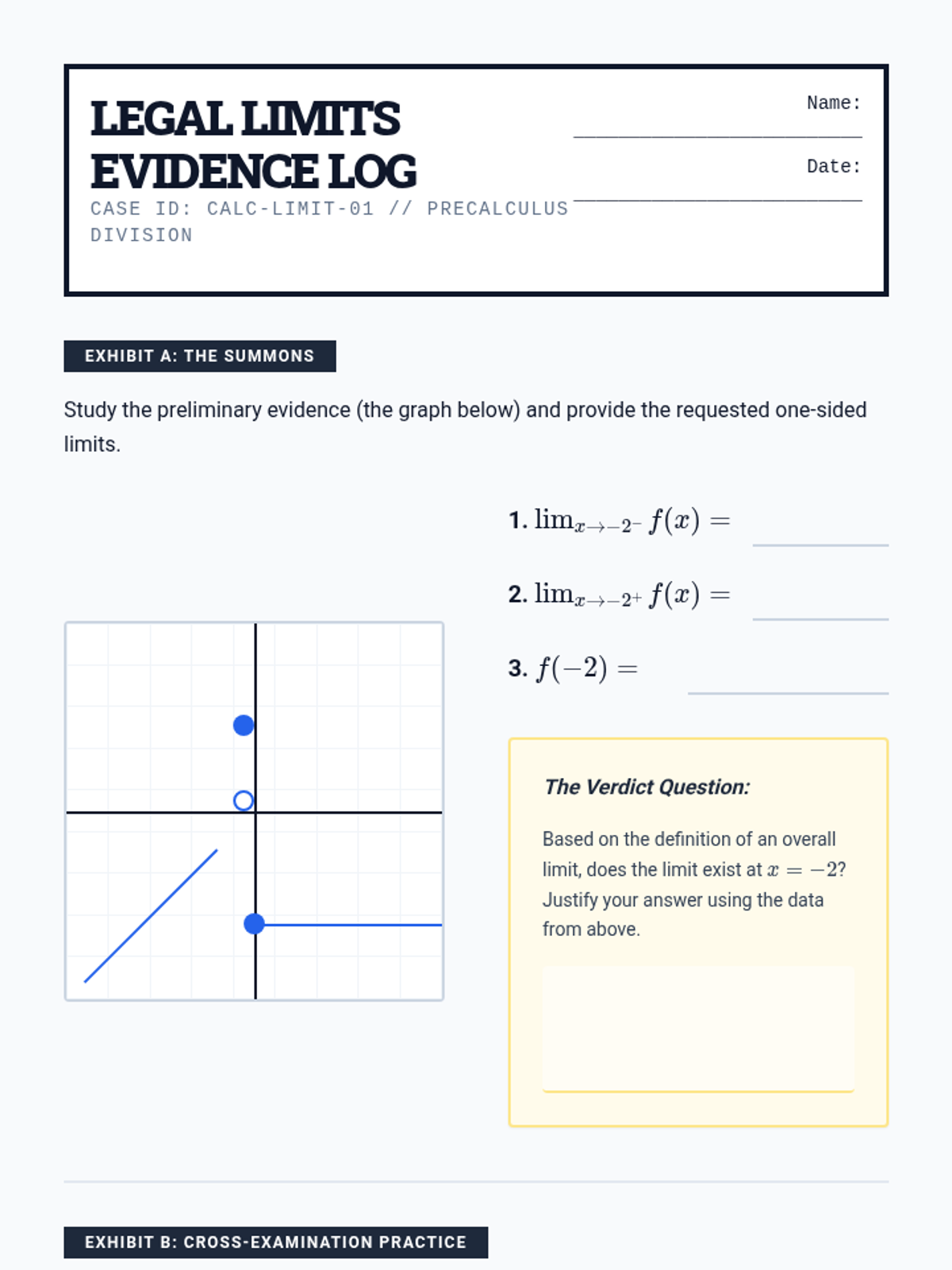
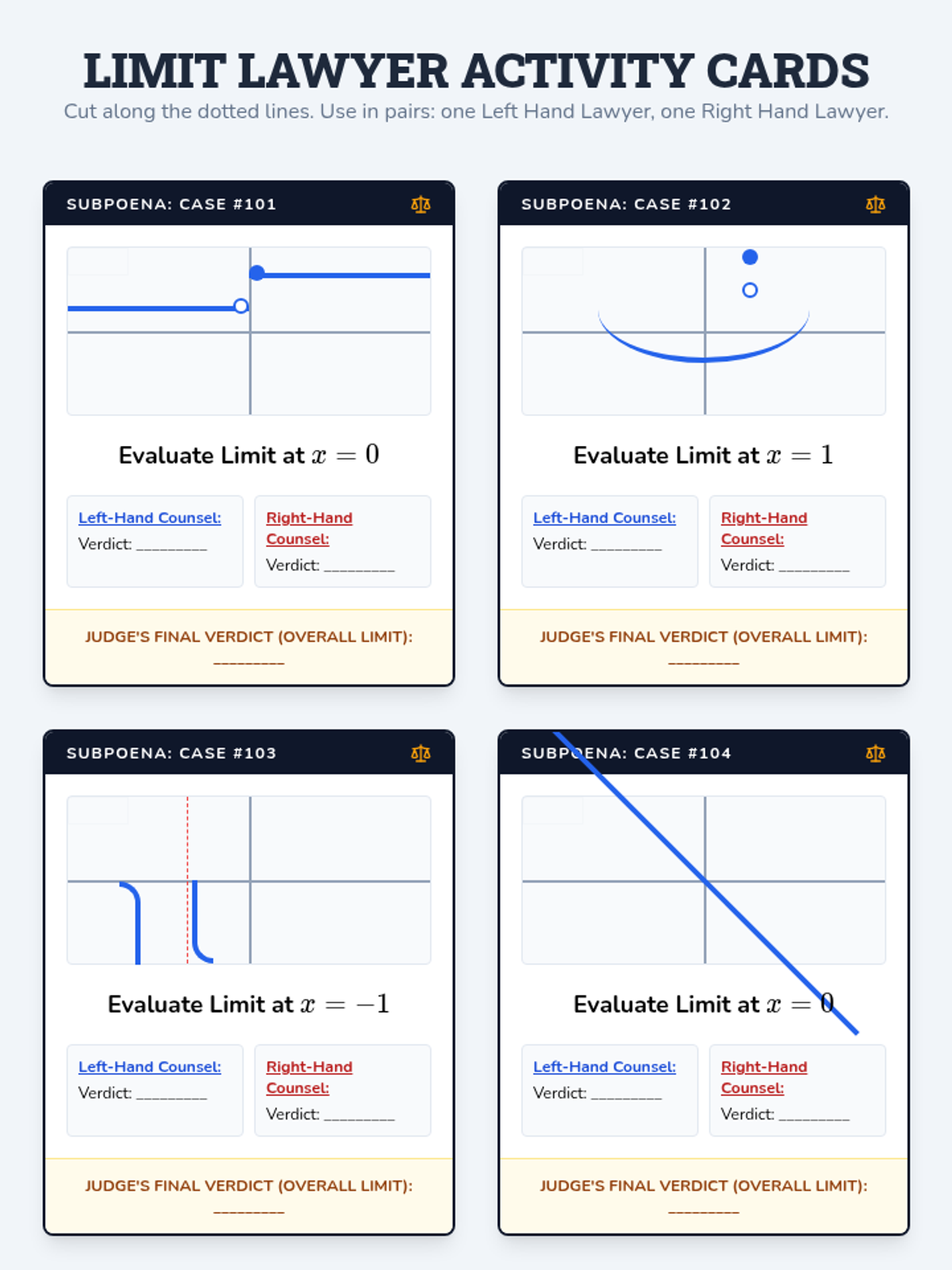
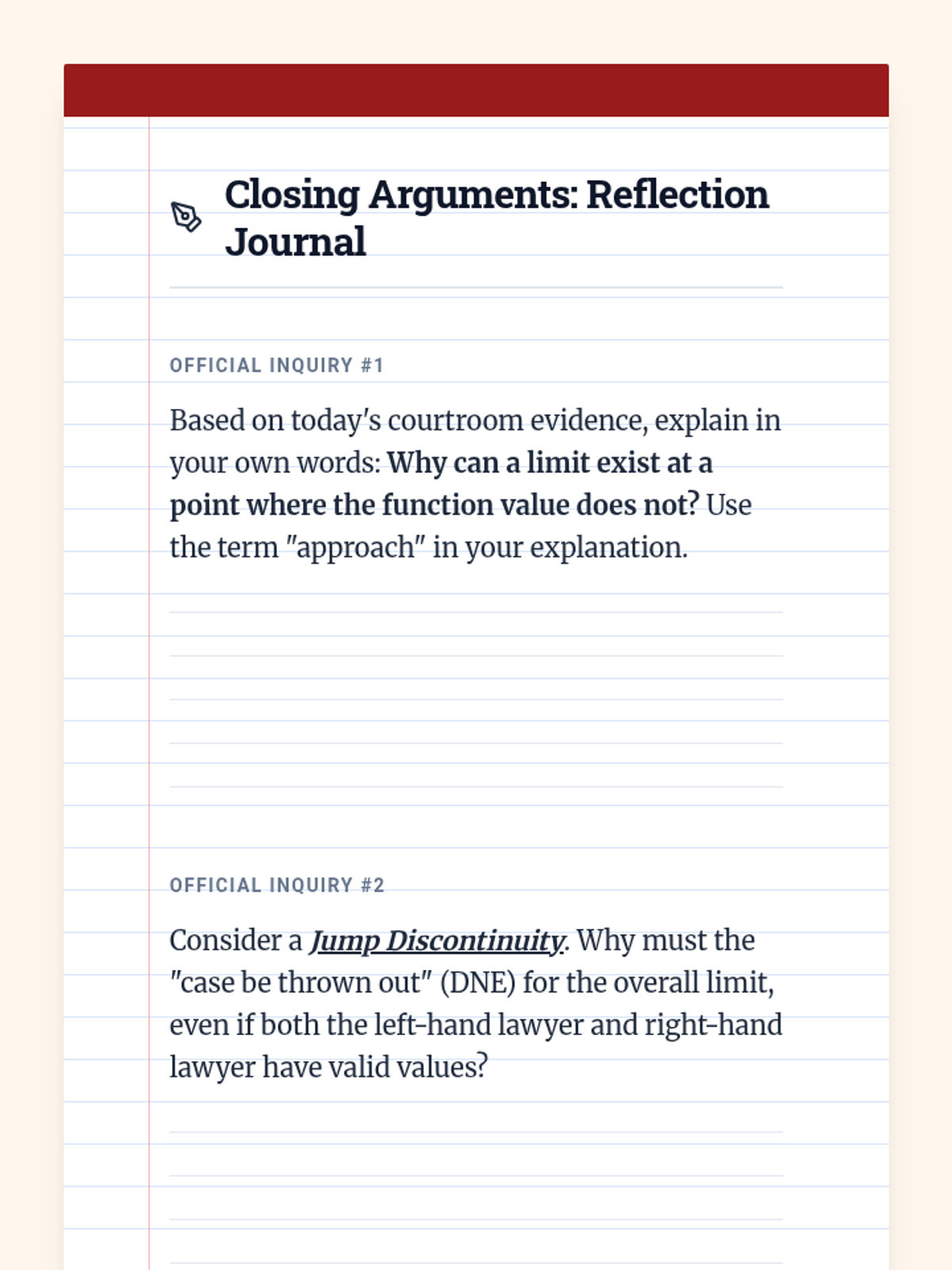
A Precalculus lesson focused on calculating overall limits from graphs and identifying conditions for non-existence through a courtroom-themed simulation.
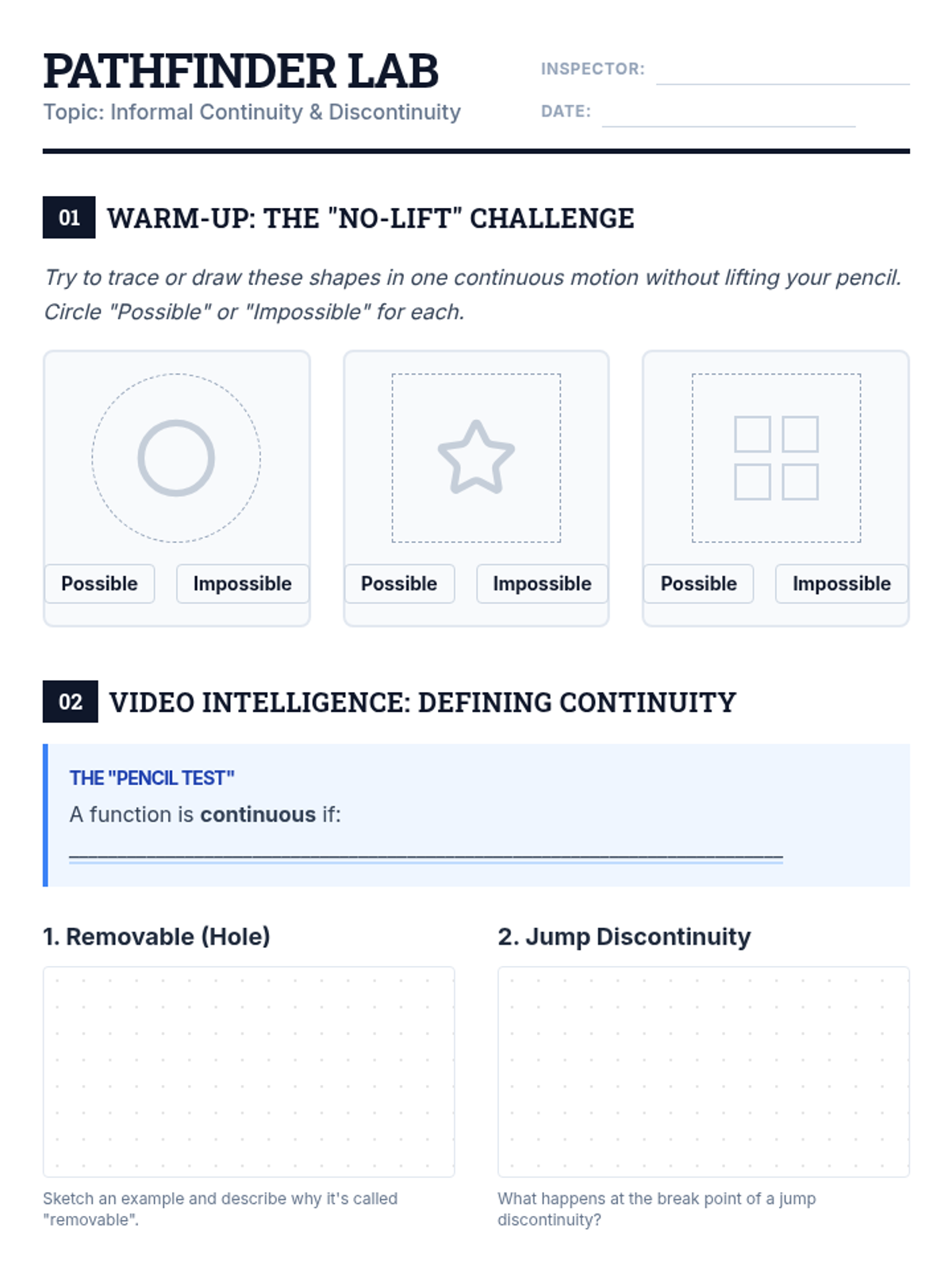
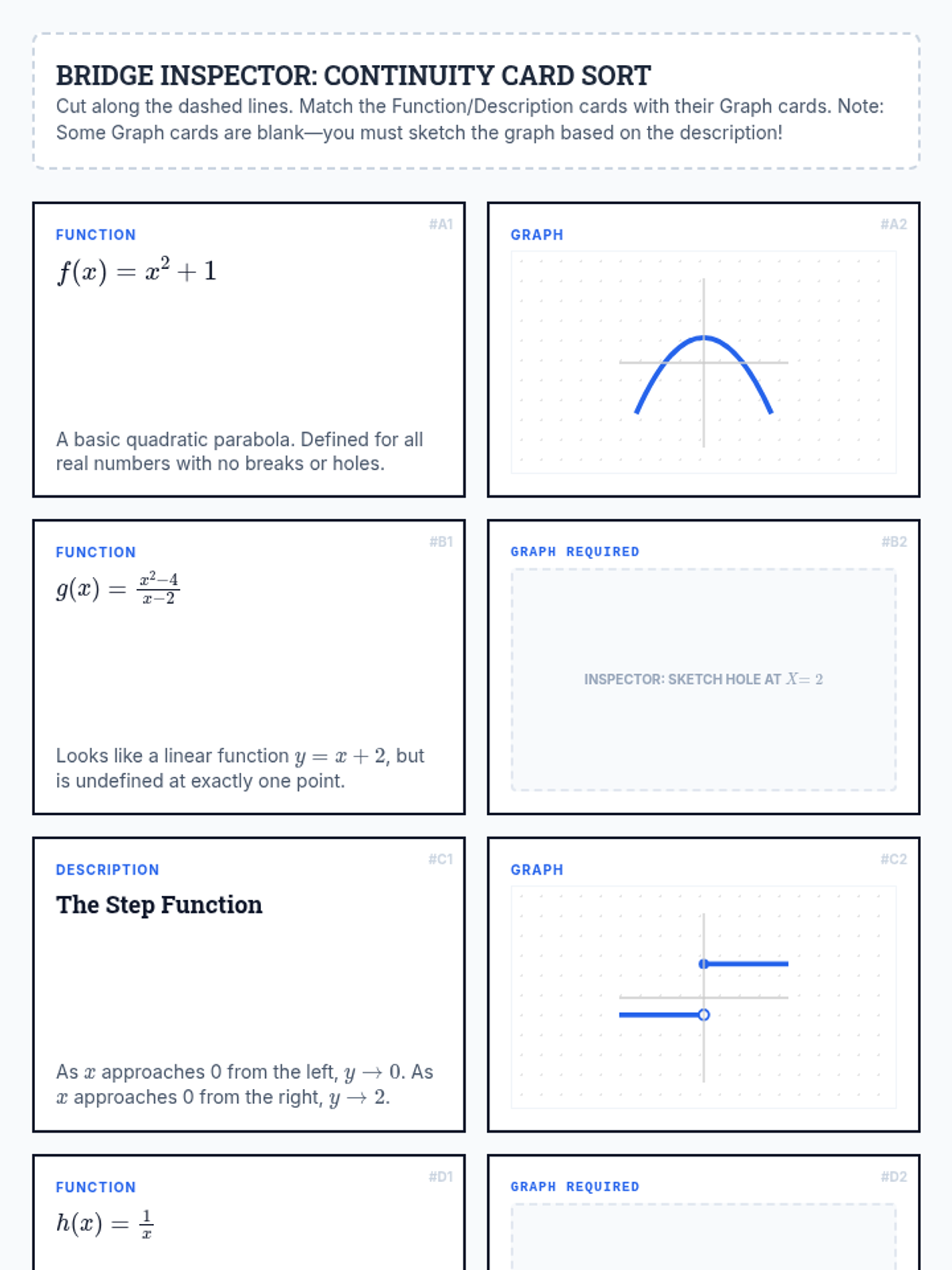
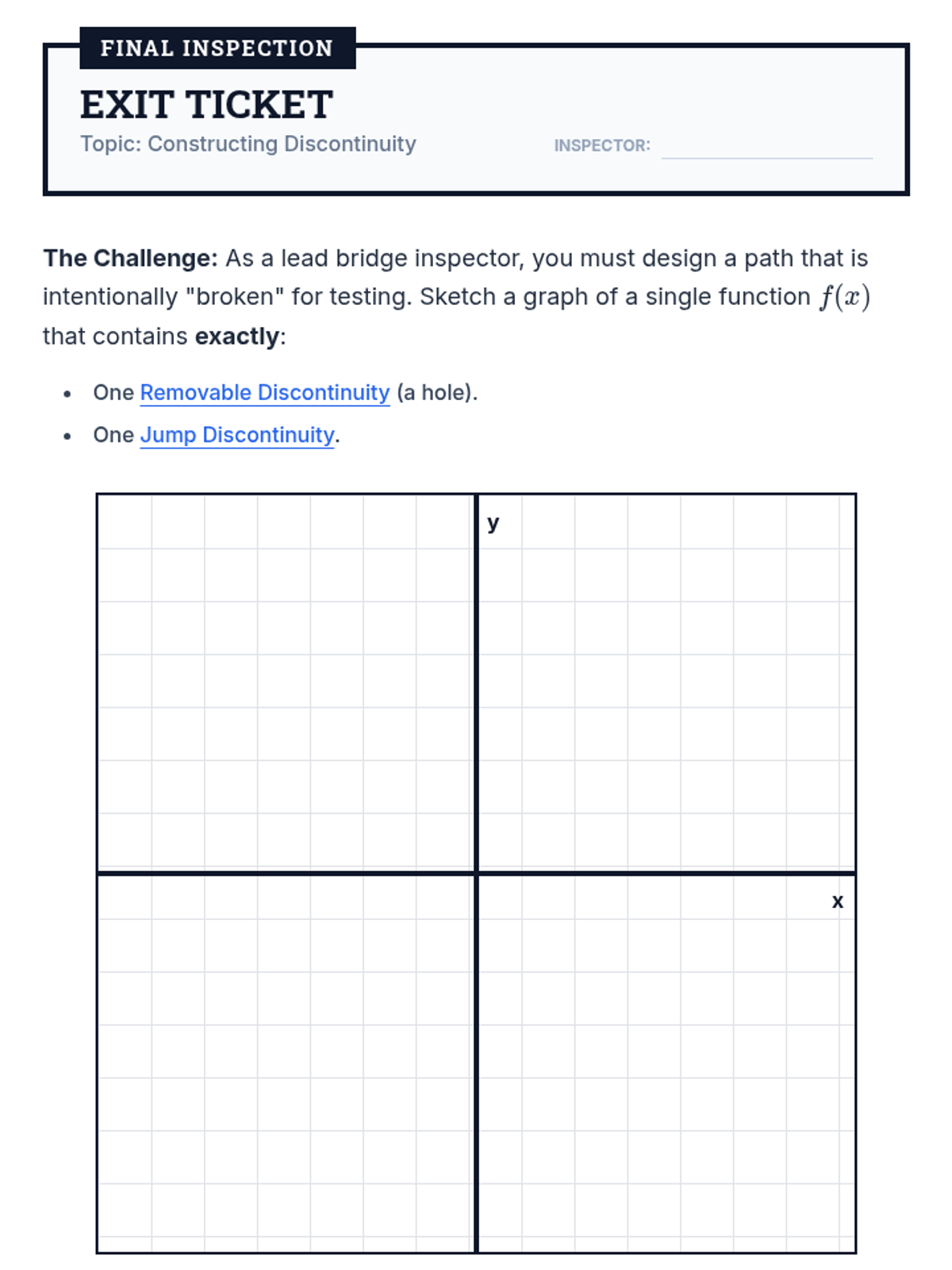
A Precalculus lesson focusing on the informal definition of continuity through the 'pencil test' and identifying the four main types of discontinuities: removable, jump, infinite, and oscillating. Students engage in a hands-on card sort to classify functions based on their graphical behavior.
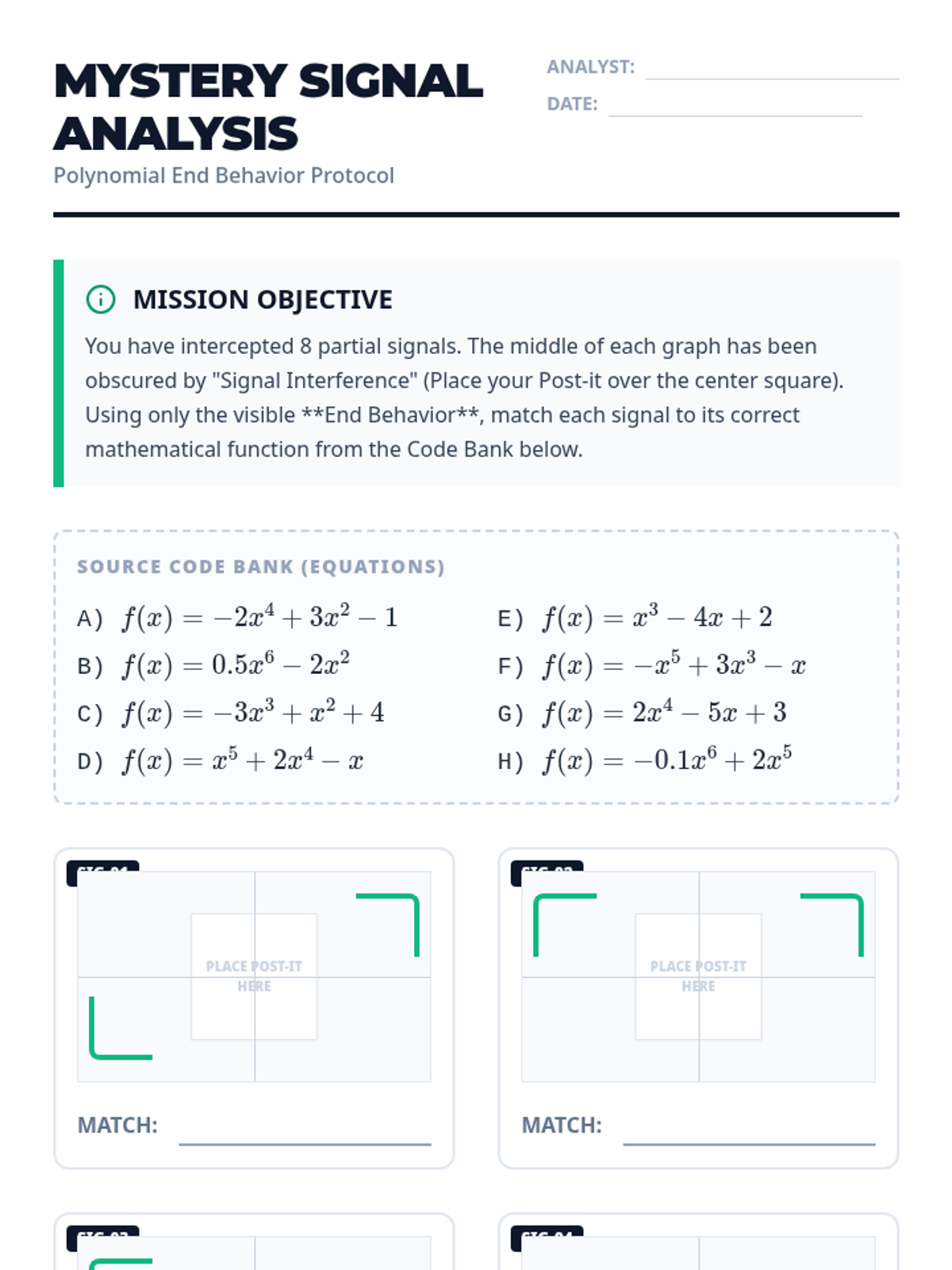
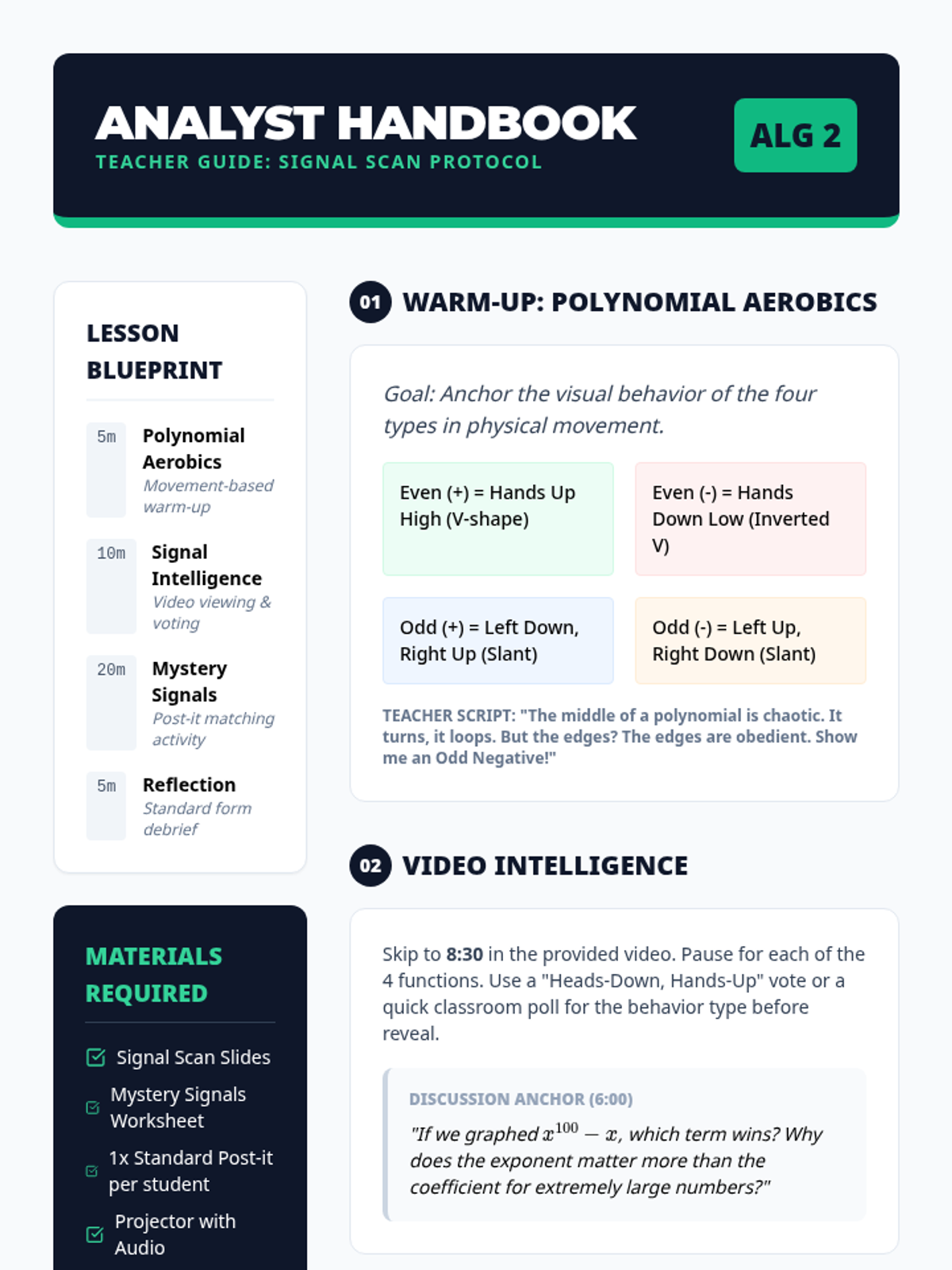
Students learn to predict and describe polynomial end behavior using the Leading Coefficient Test through physical 'aerobics', a guided video analysis, and a 'Mystery Function' matching activity. The lesson culminates in a reflection on identifying the leading term in non-standard form polynomials.
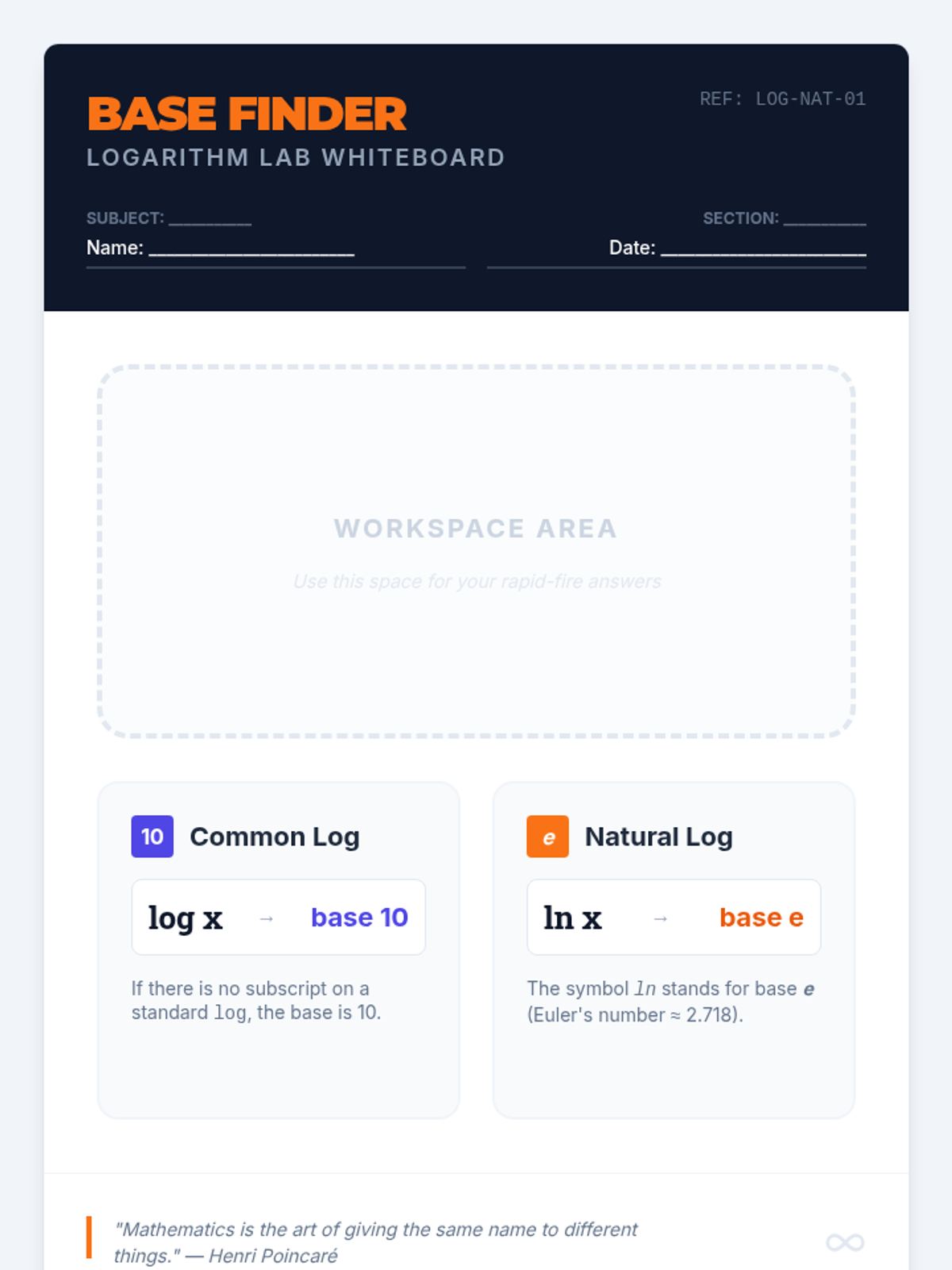
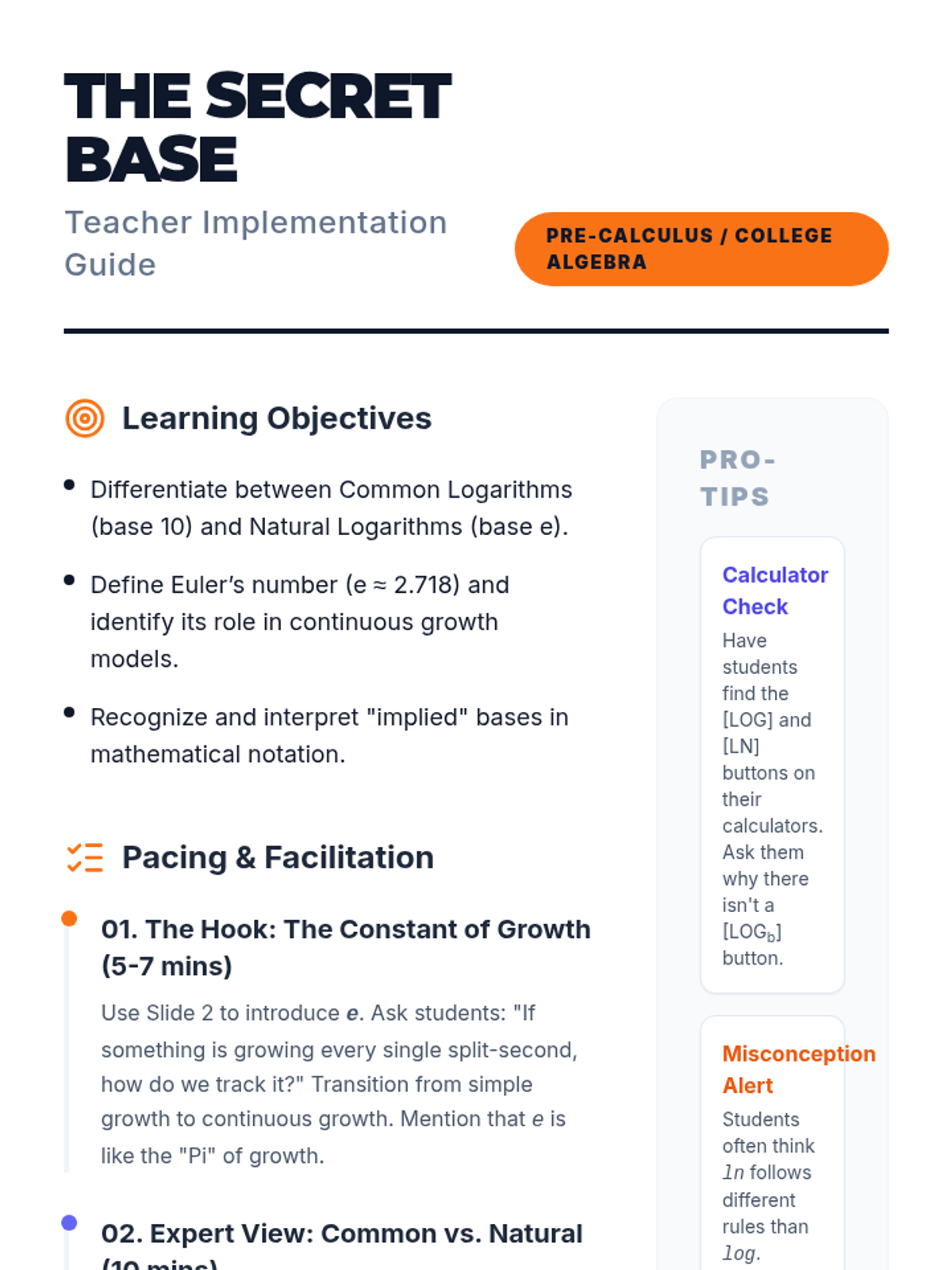
A lesson introducing Euler's number (e), the distinction between common and natural logarithms, and the convention of implied bases in mathematical notation.
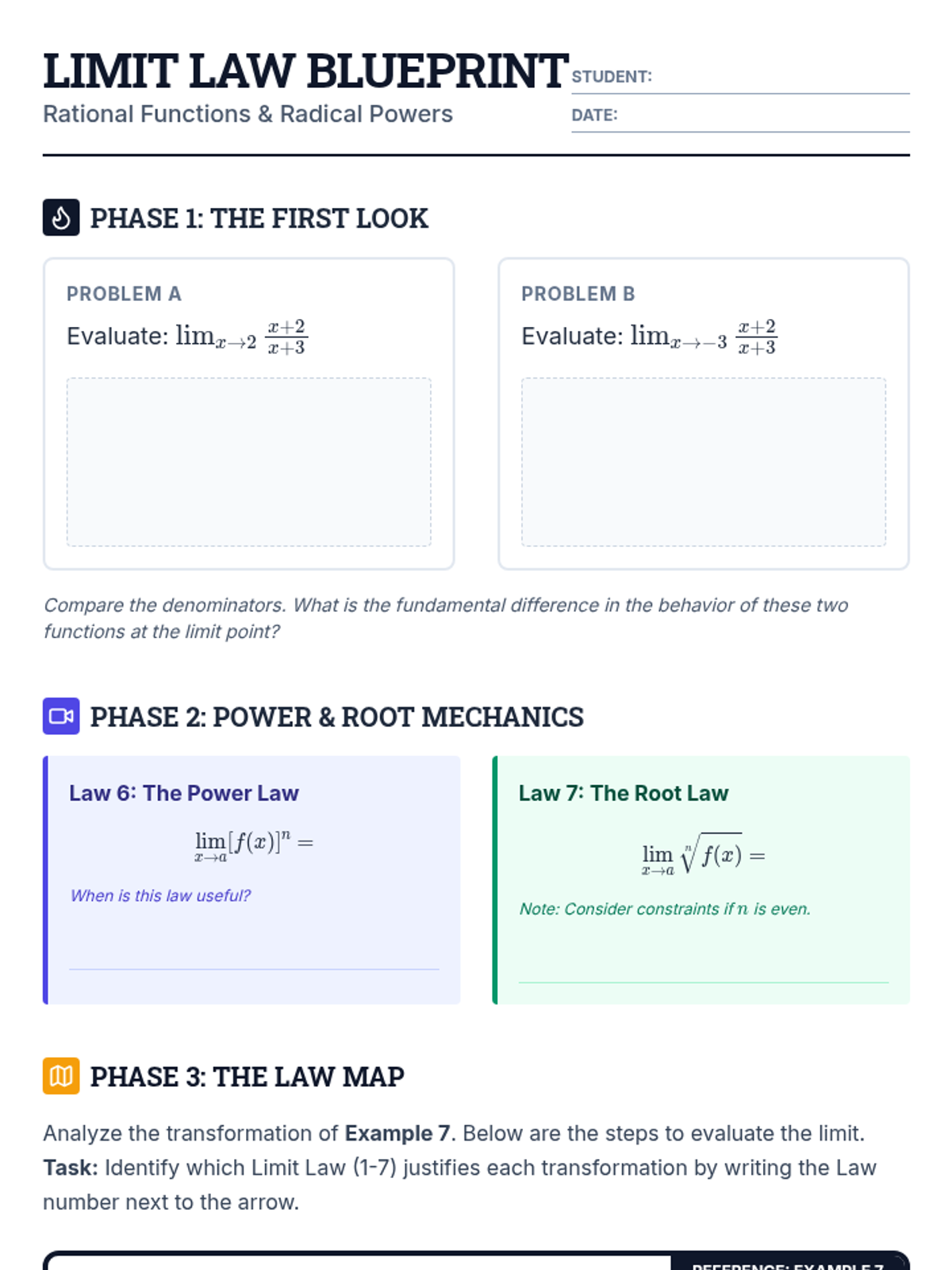
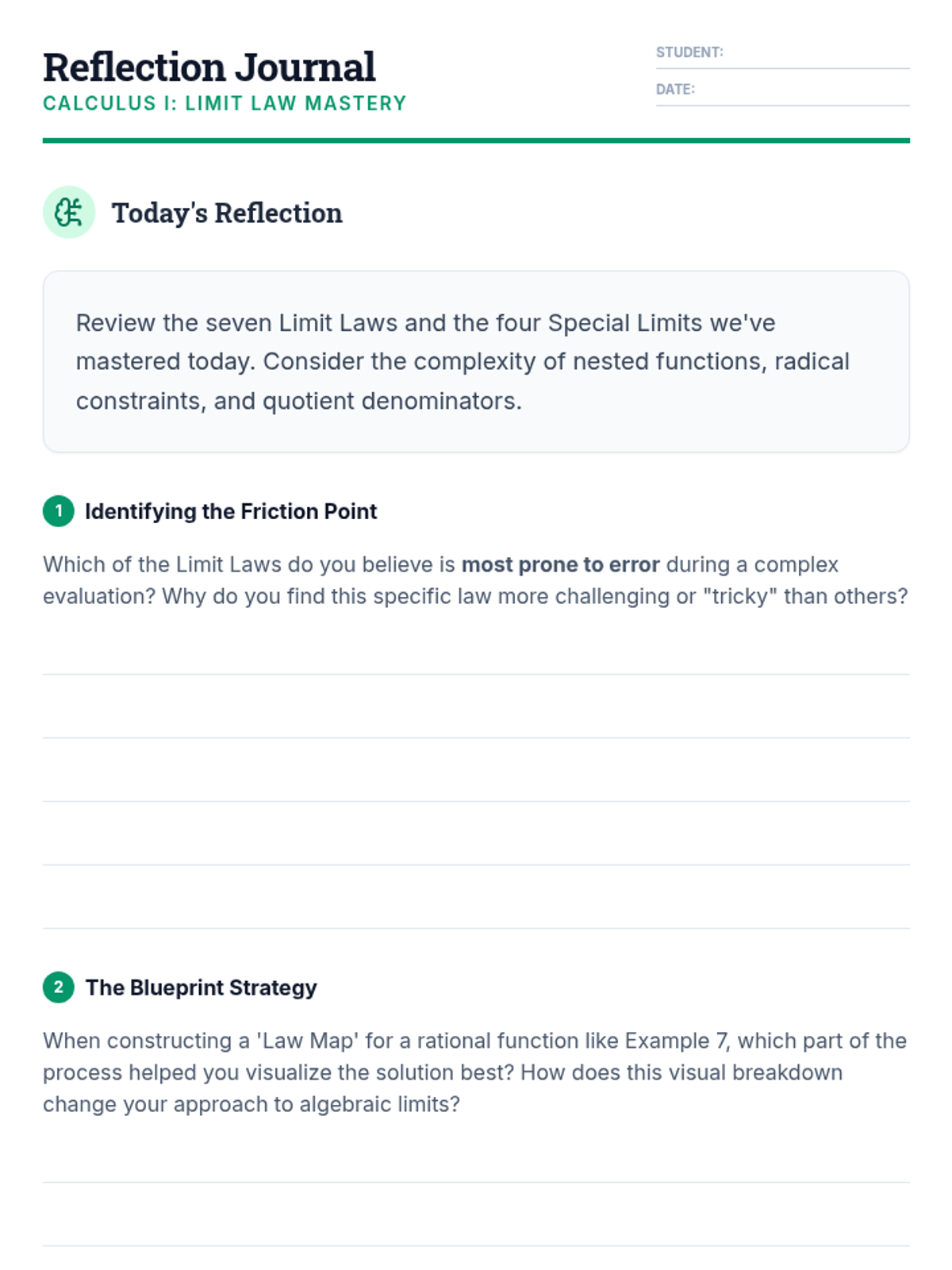
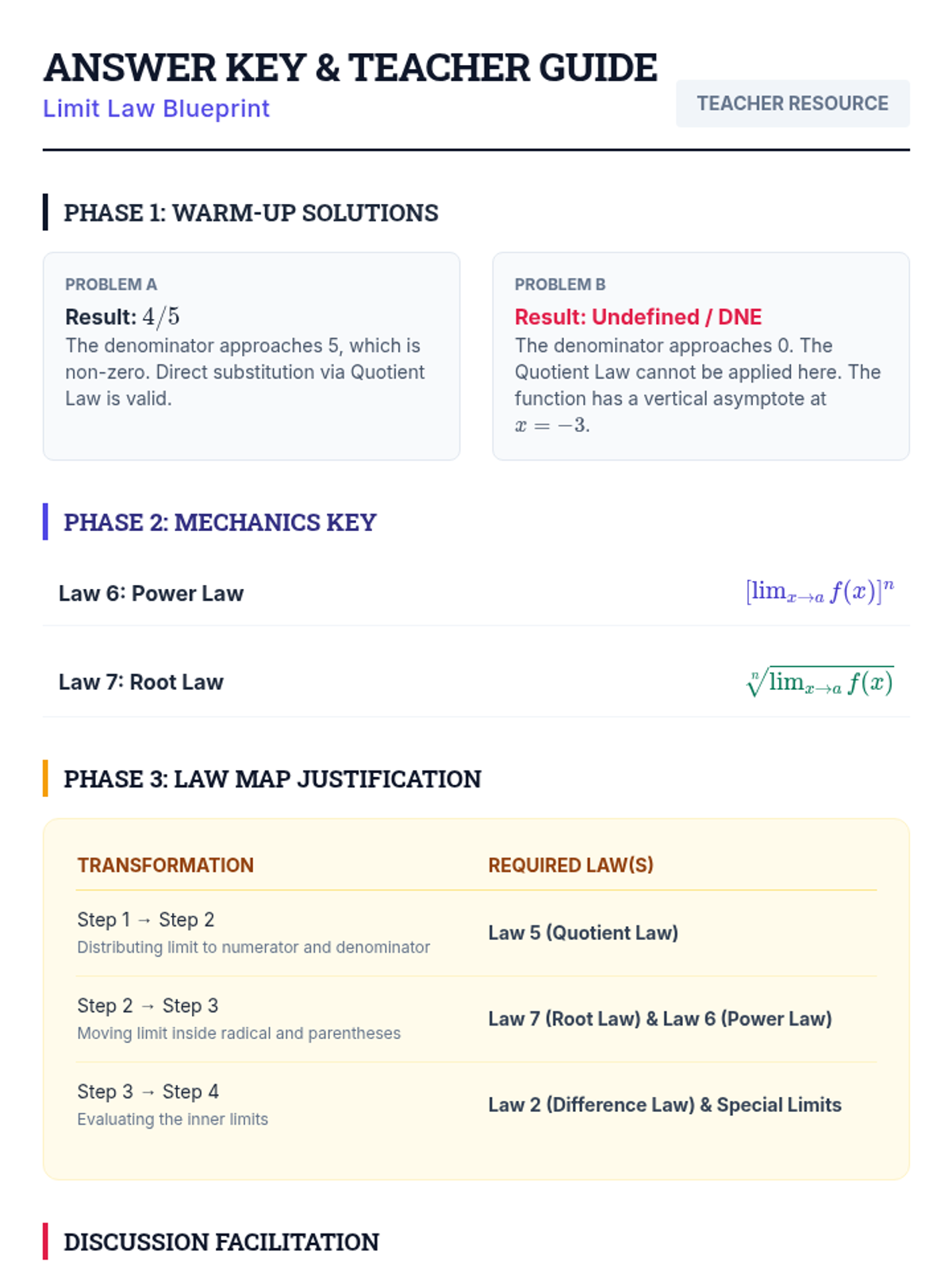
A calculus lesson focusing on the application of Power and Root laws to evaluate complex rational limits. Students will construct a 'Law Map' to visualize the algebraic steps and discuss the implications of zero denominators.
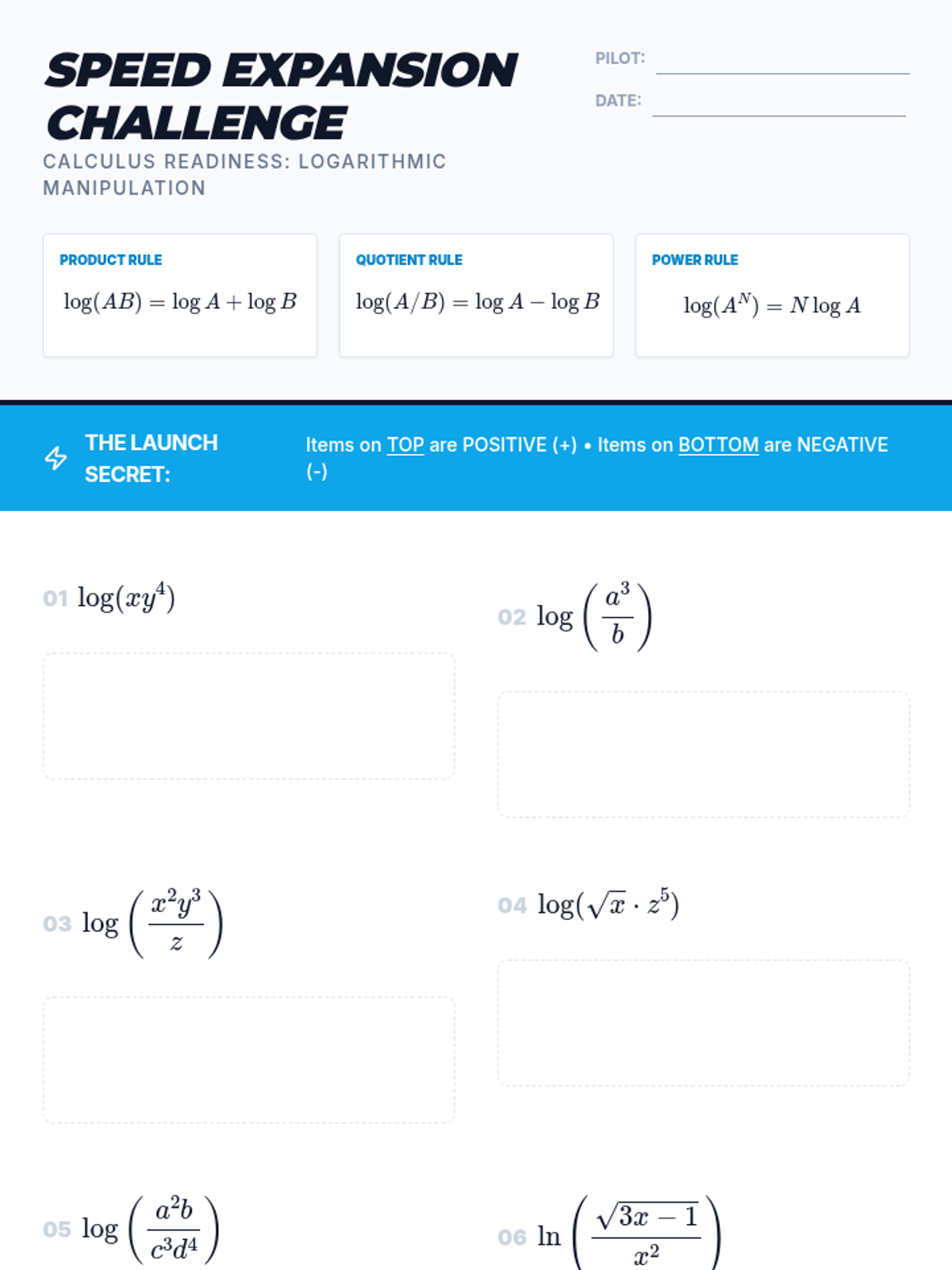
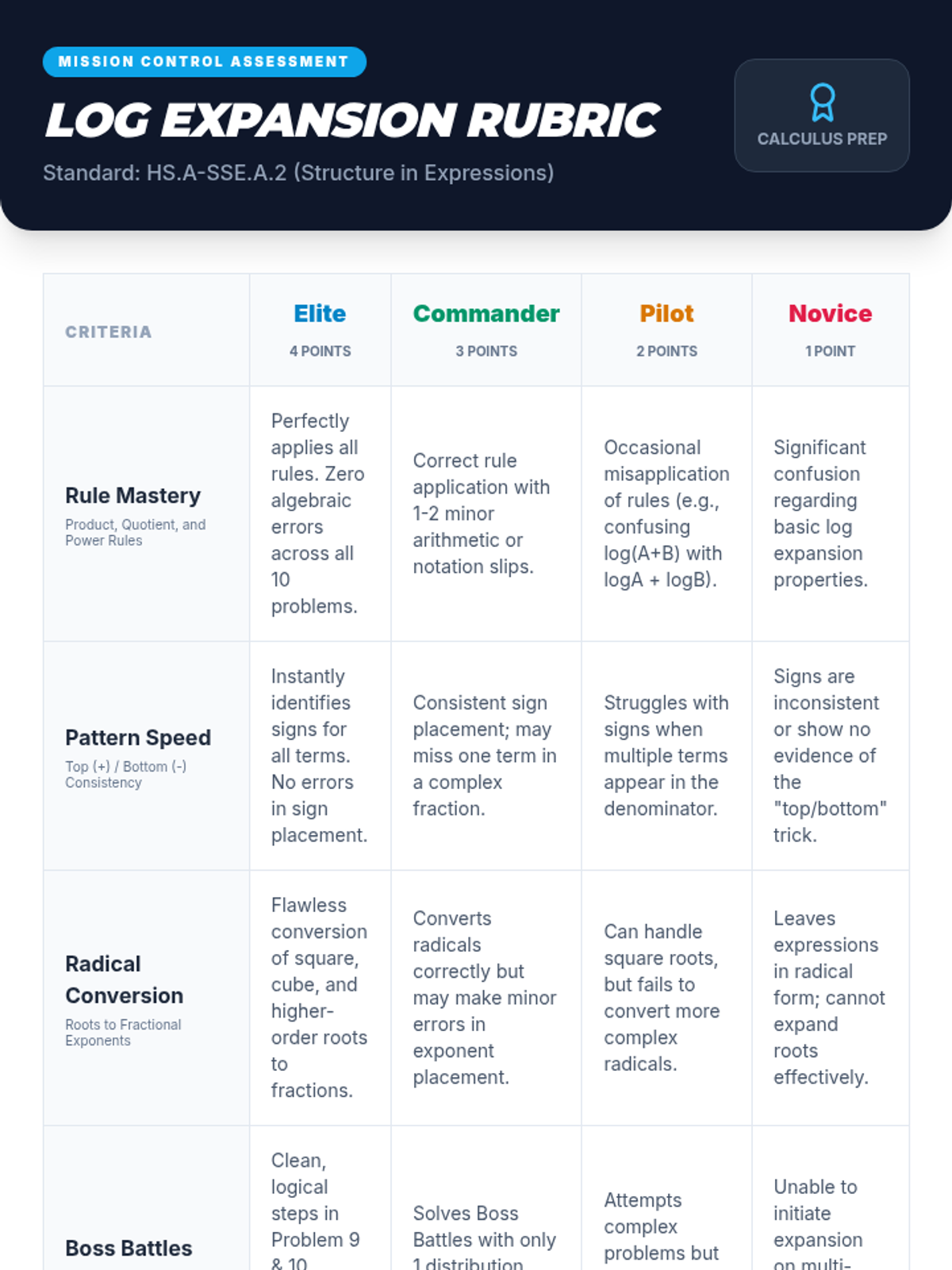
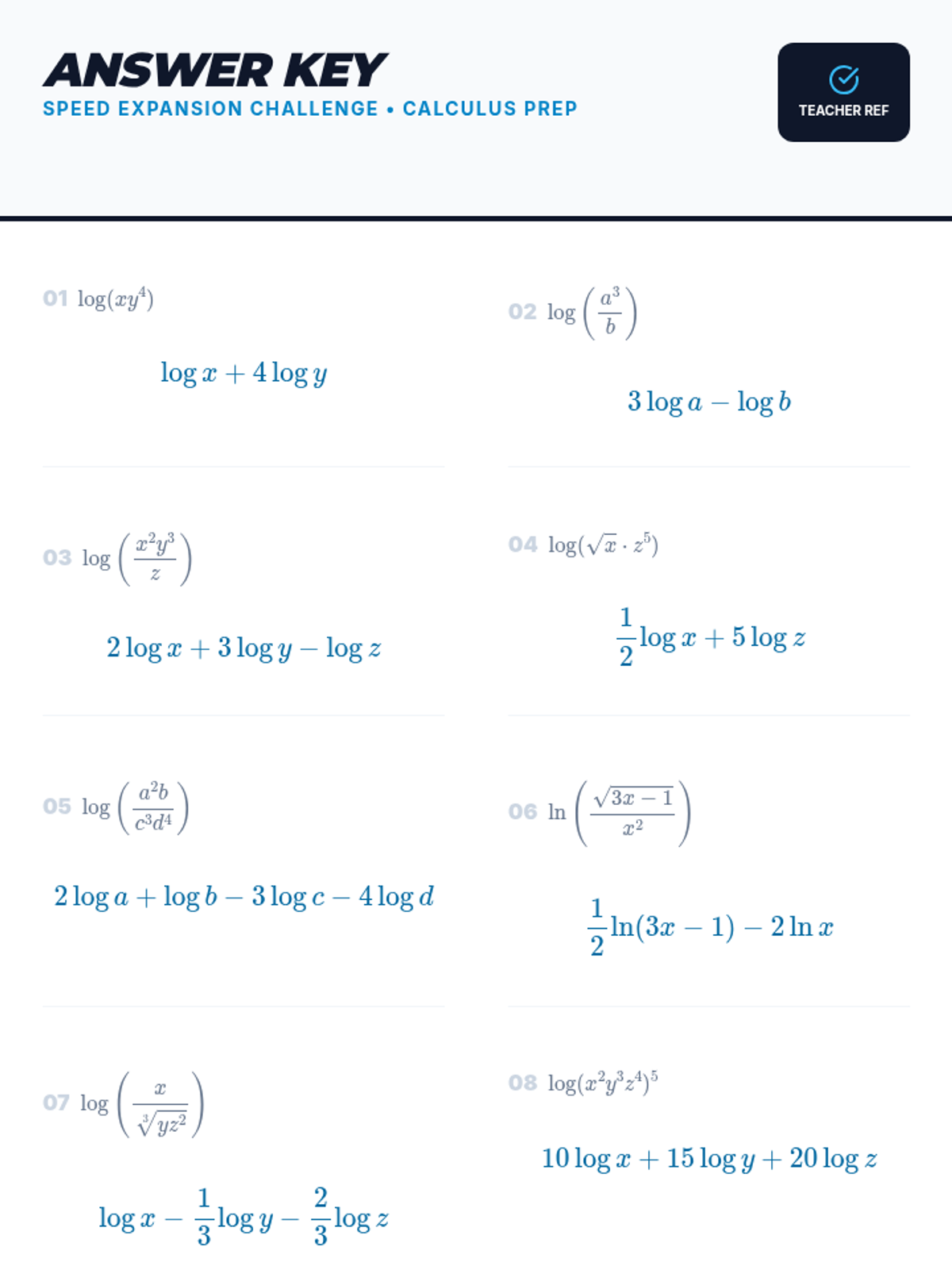
A high-speed review of logarithmic expansion properties designed to build the algebraic fluency required for Calculus. Students learn to recognize patterns in complex rational expressions to expand logs instantly, facilitating easier differentiation and integration.
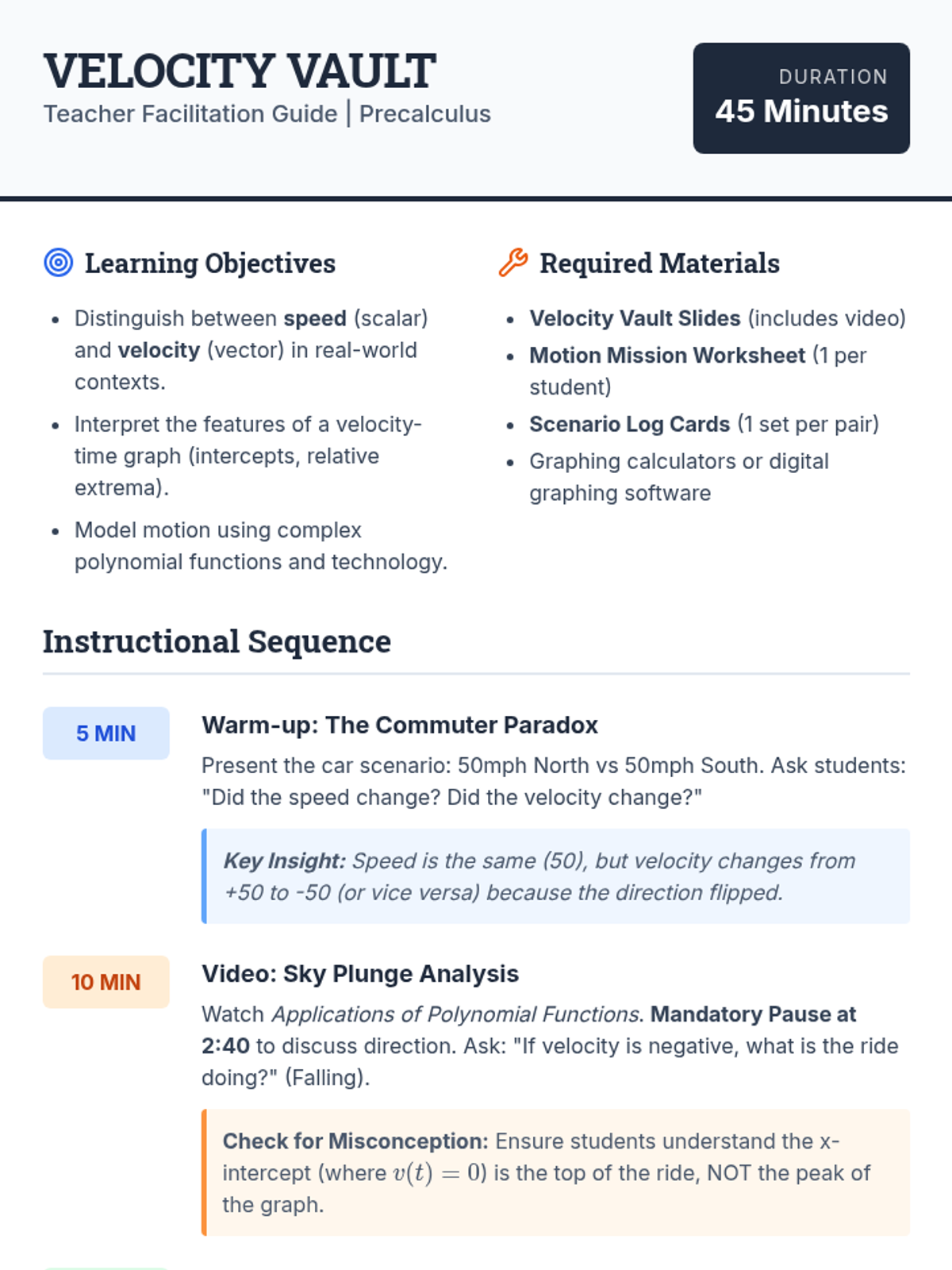
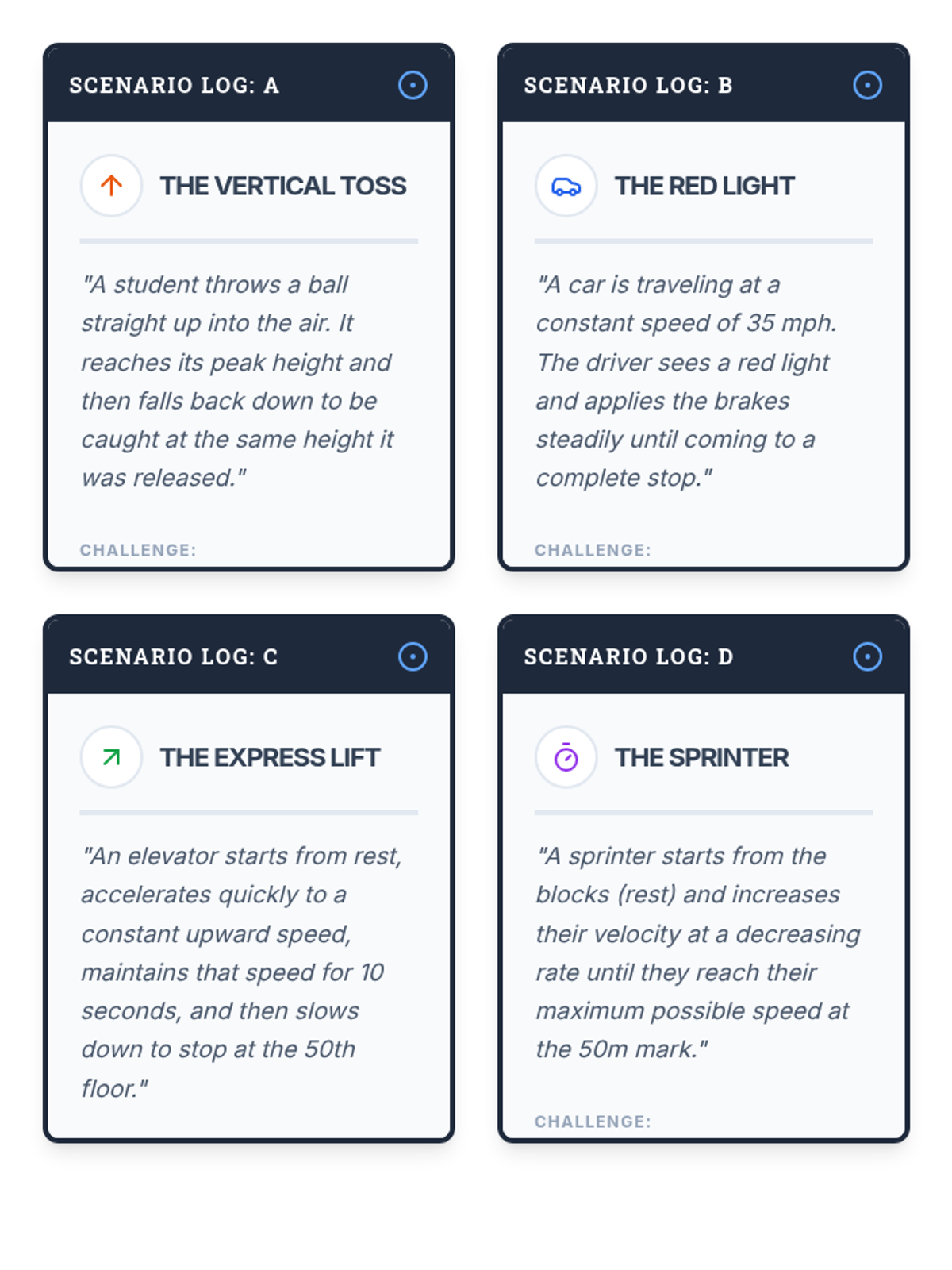
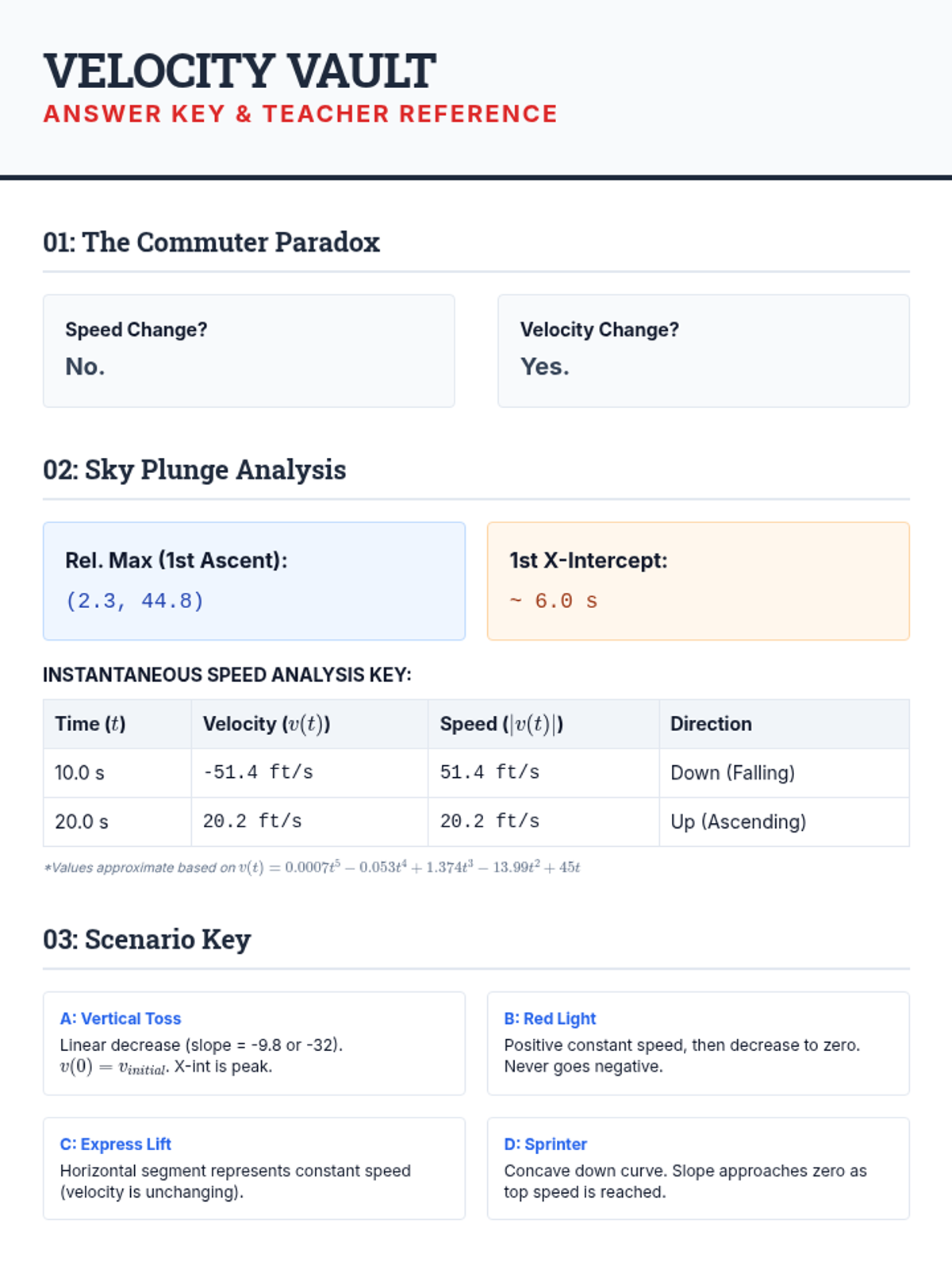
A Precalculus lesson exploring the distinction between speed and velocity using polynomial functions to model a drop tower ride. Students analyze velocity-time graphs, calculate instantaneous speeds, and address common misconceptions about motion graphs.
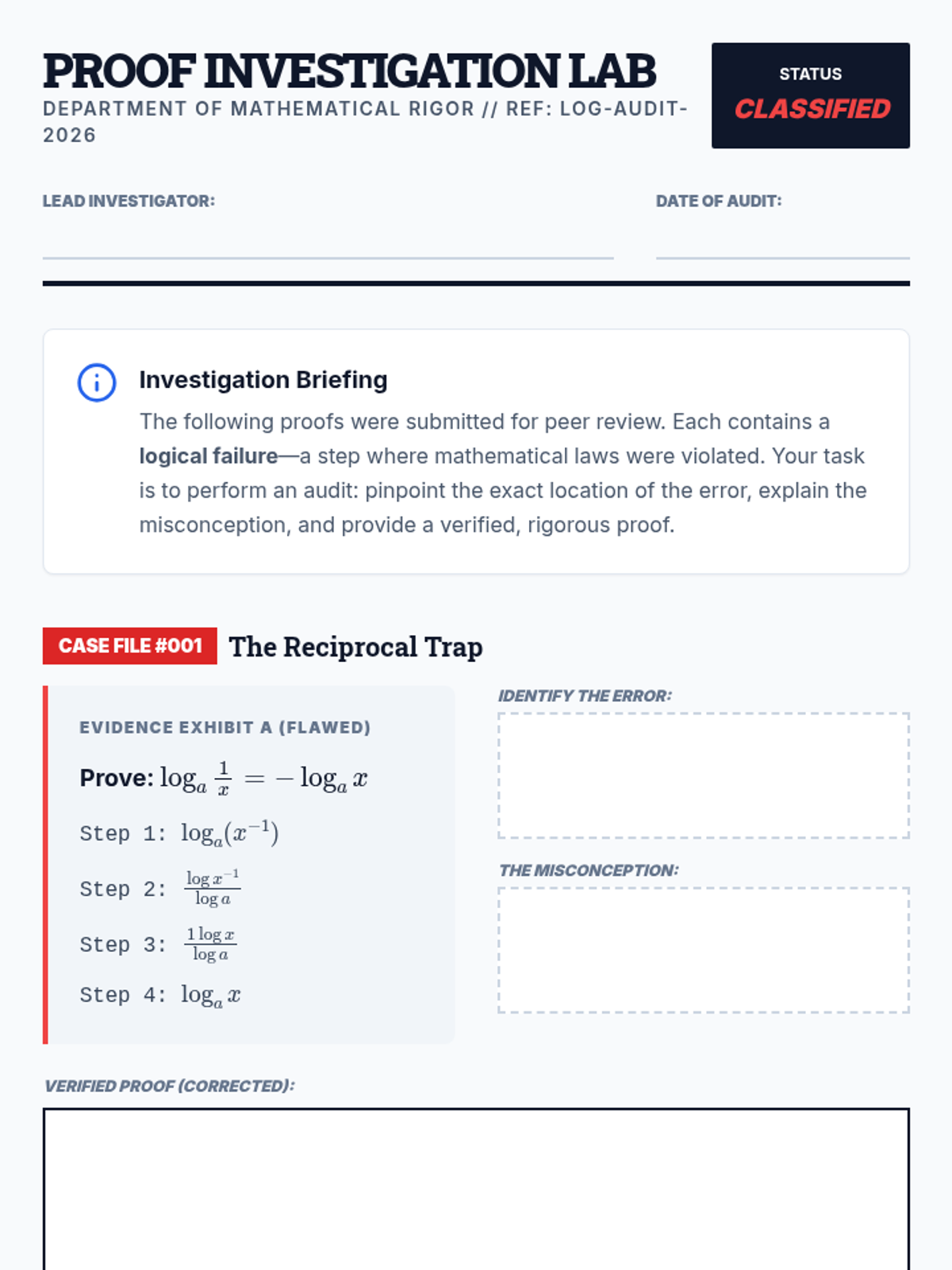
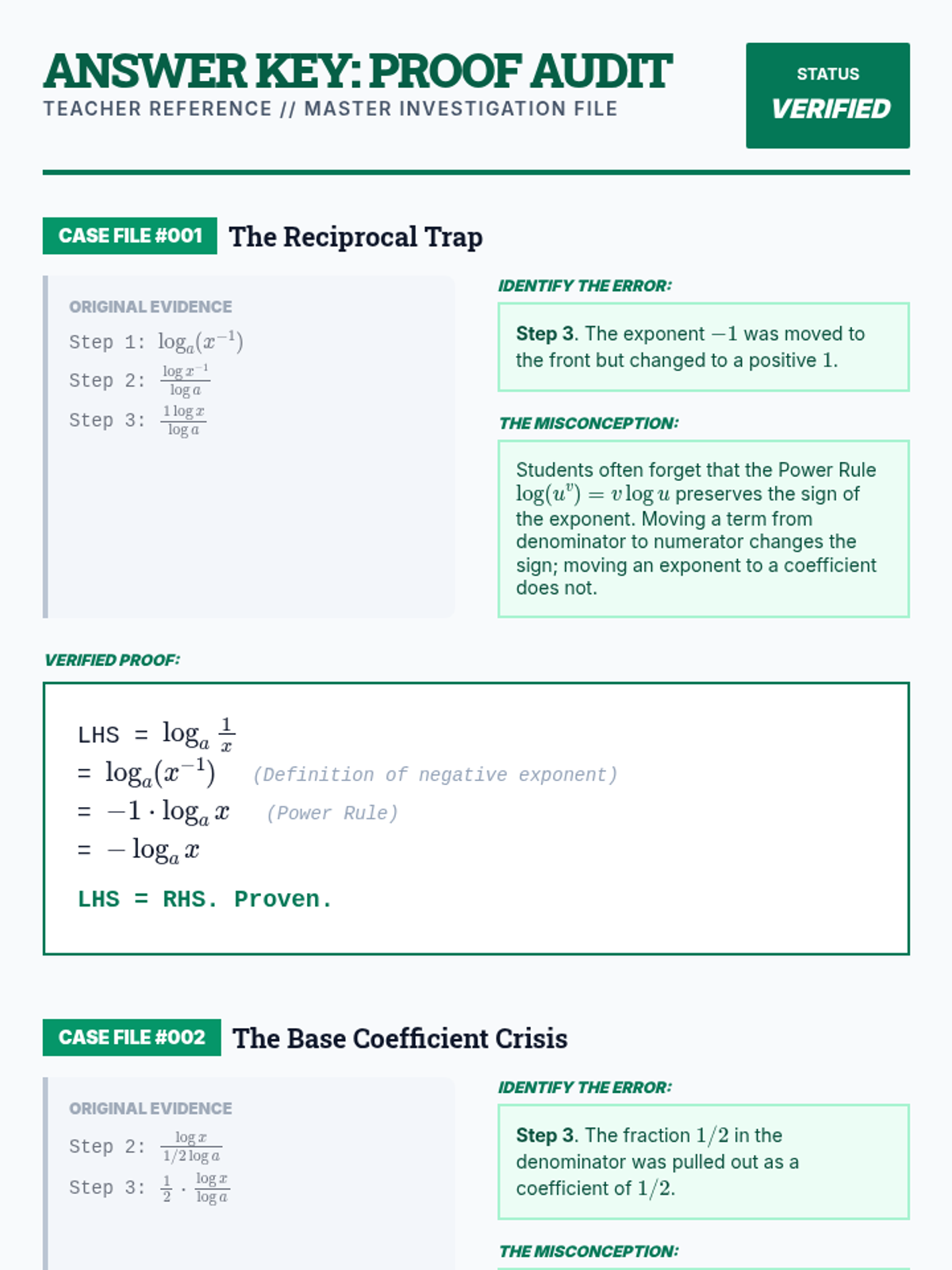
An advanced honors algebra lesson focused on developing mathematical rigor by identifying and correcting common algebraic misconceptions in logarithmic proofs. Students analyze 'broken' proofs, watch a targeted demonstration, and perform a detailed error analysis of complex logarithmic identities.
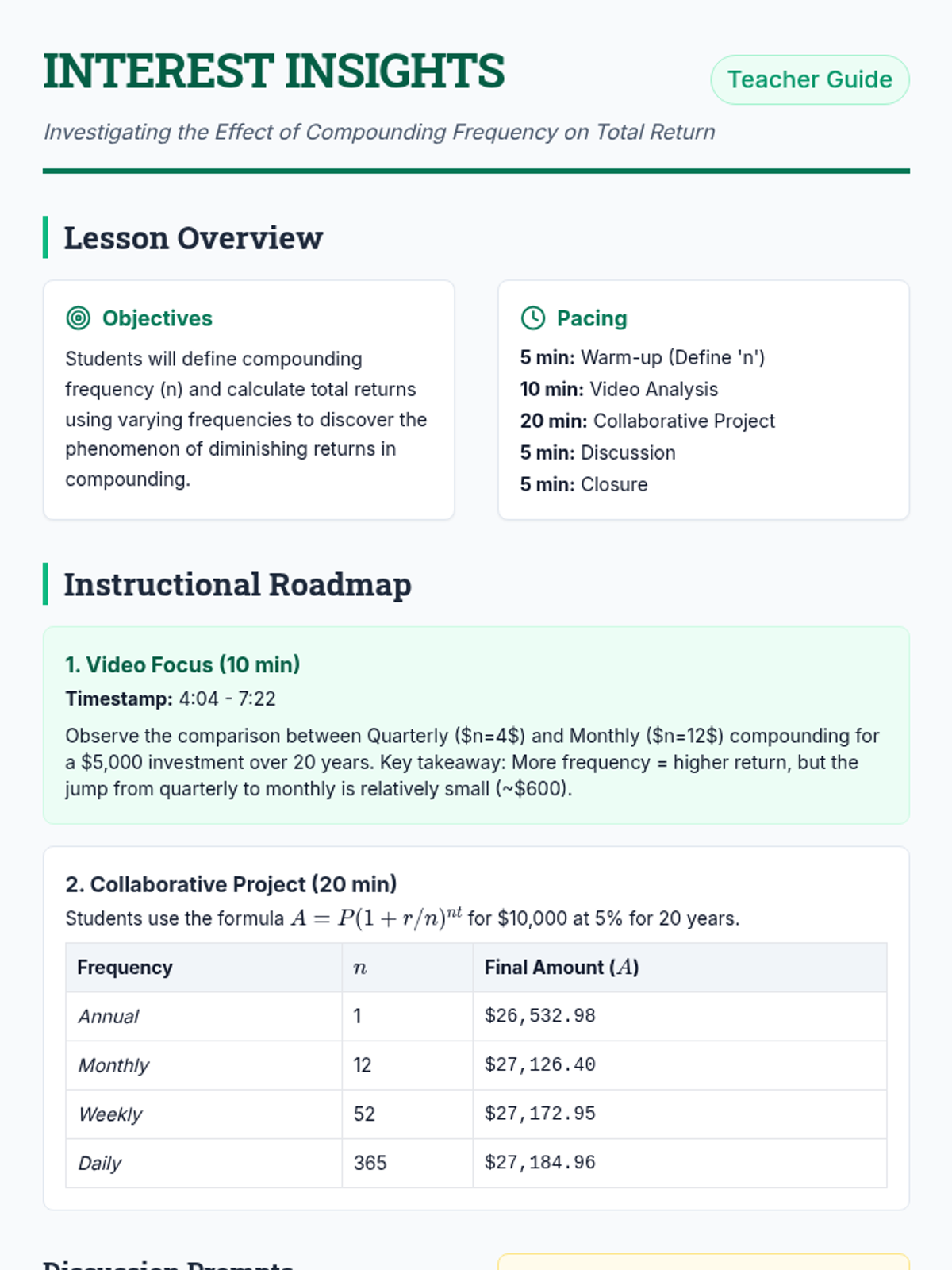
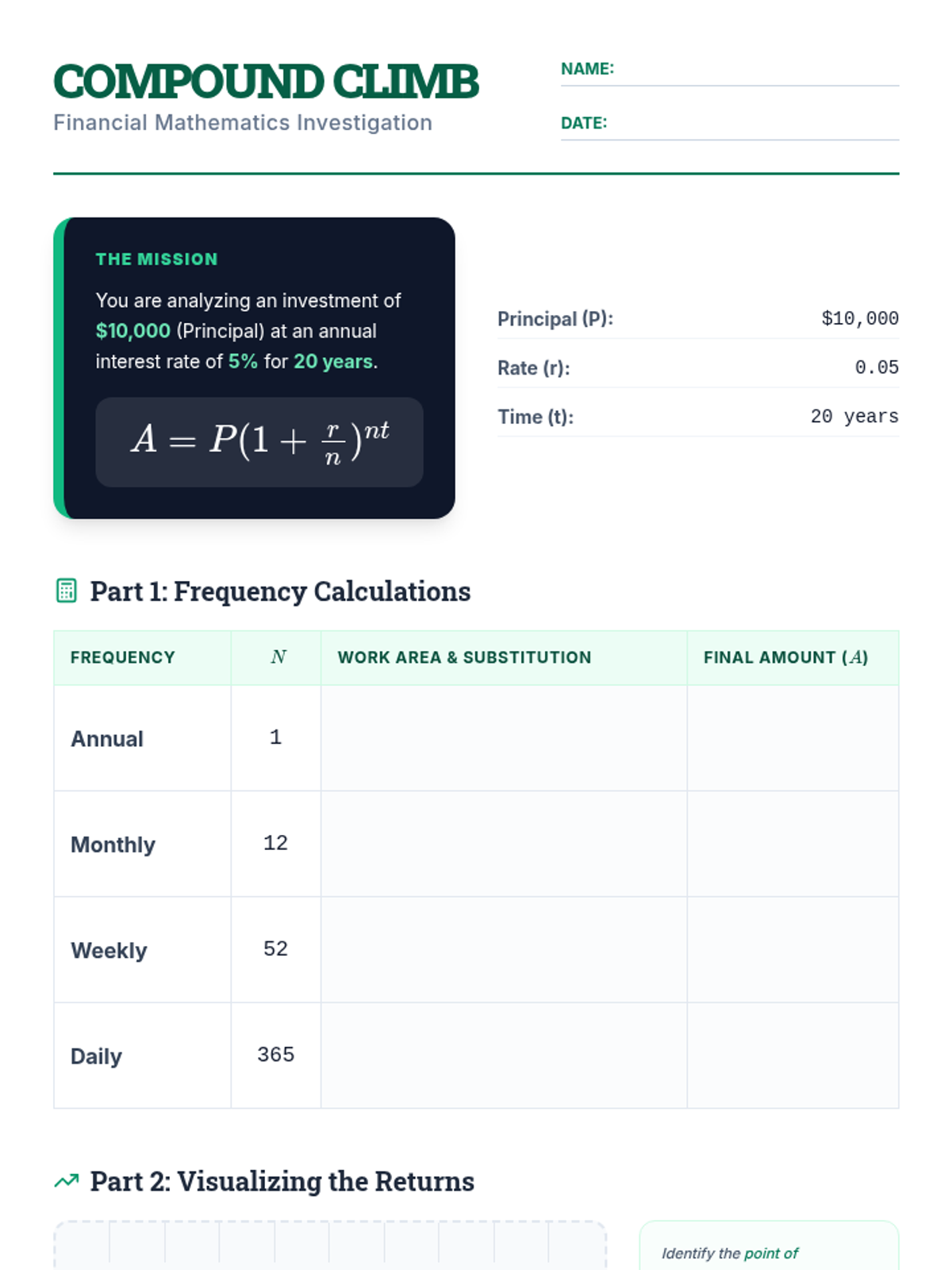
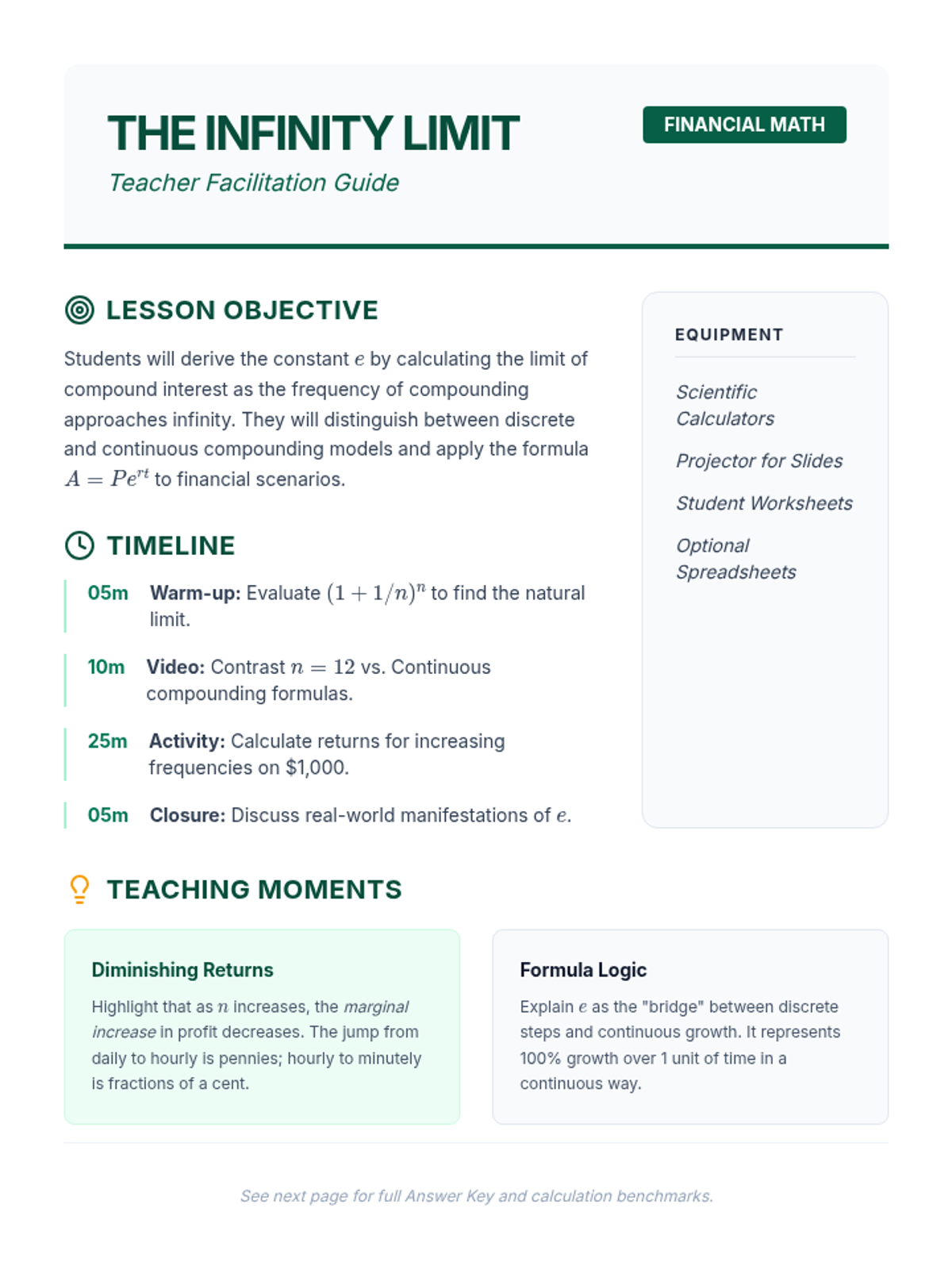
A high school lesson investigating how the frequency of compounding interest affects long-term investment returns through calculation and graphing.
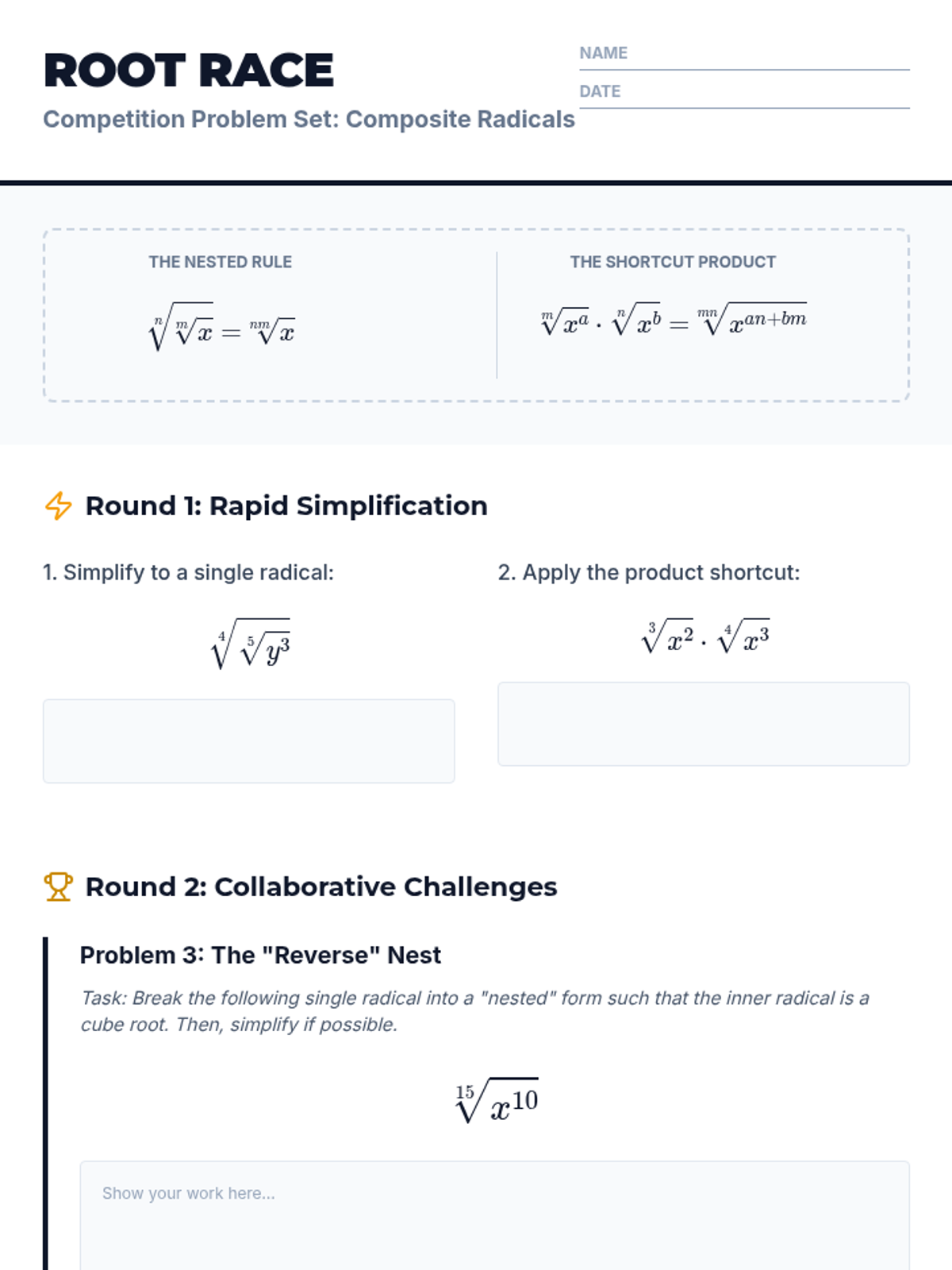
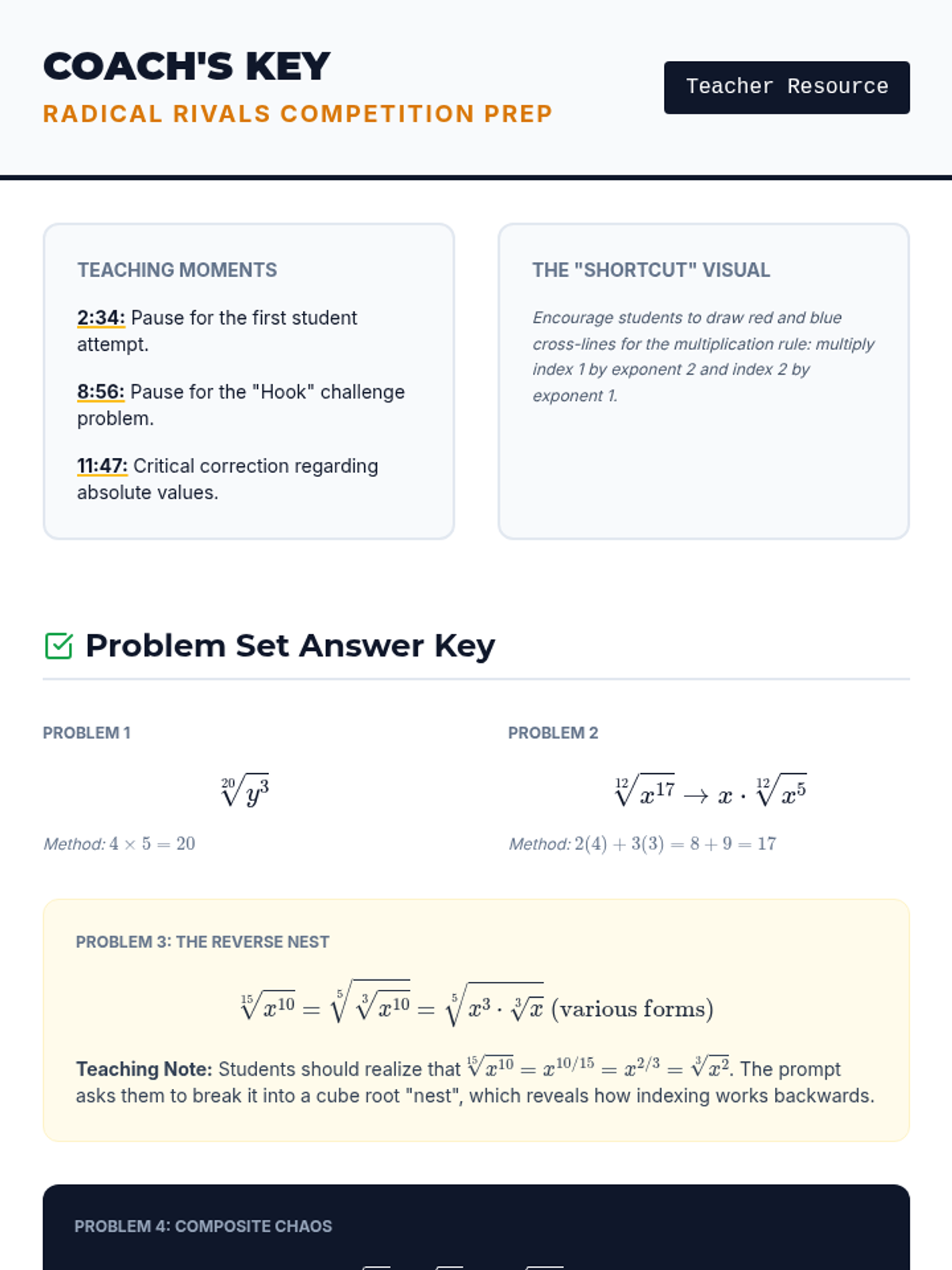
A high-energy session for advanced math students focusing on rapid simplification of nested and composite radicals using shortcut formulas and rational exponent theory. Includes a competitive hook and competition-style group challenges.
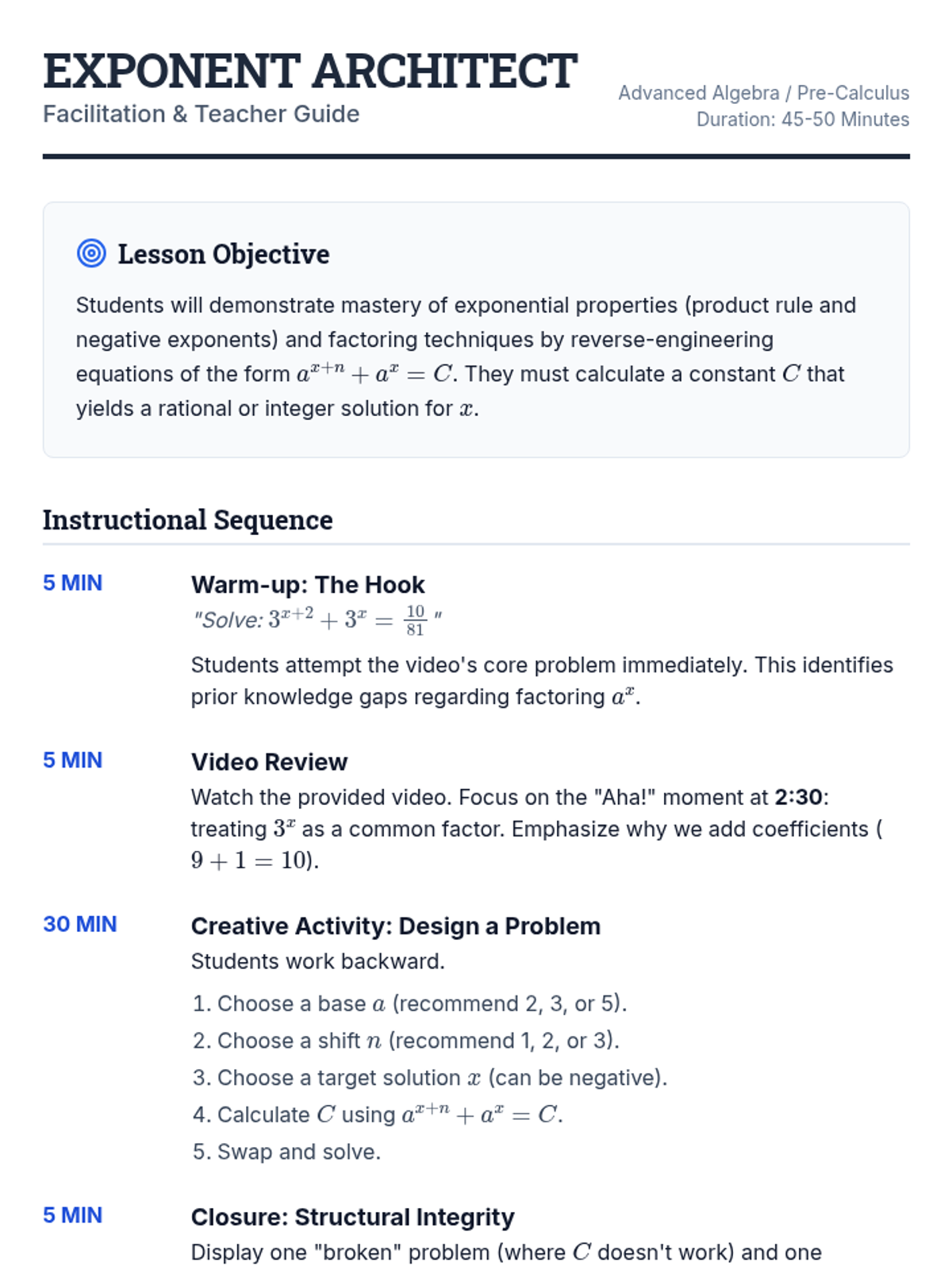
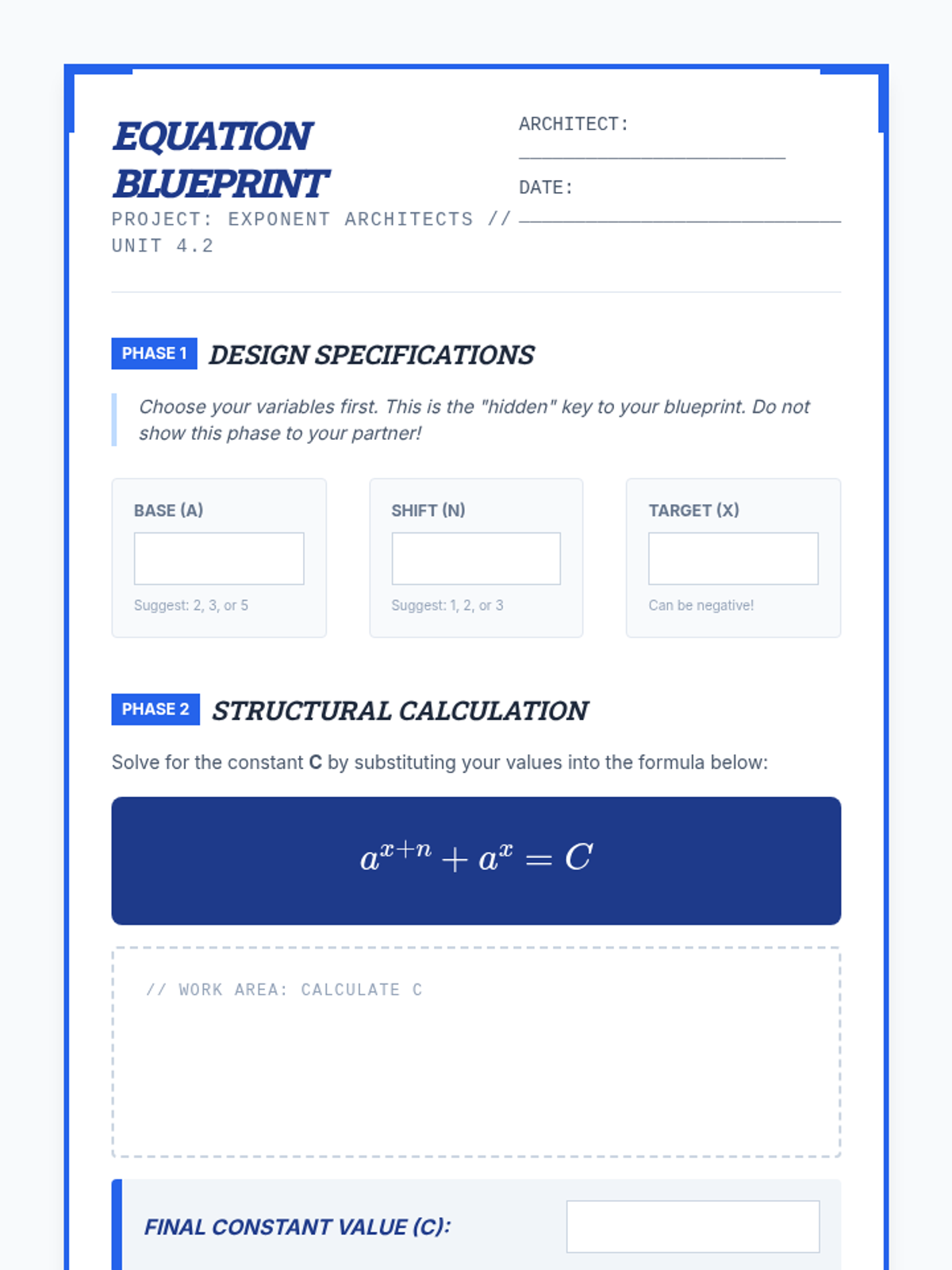
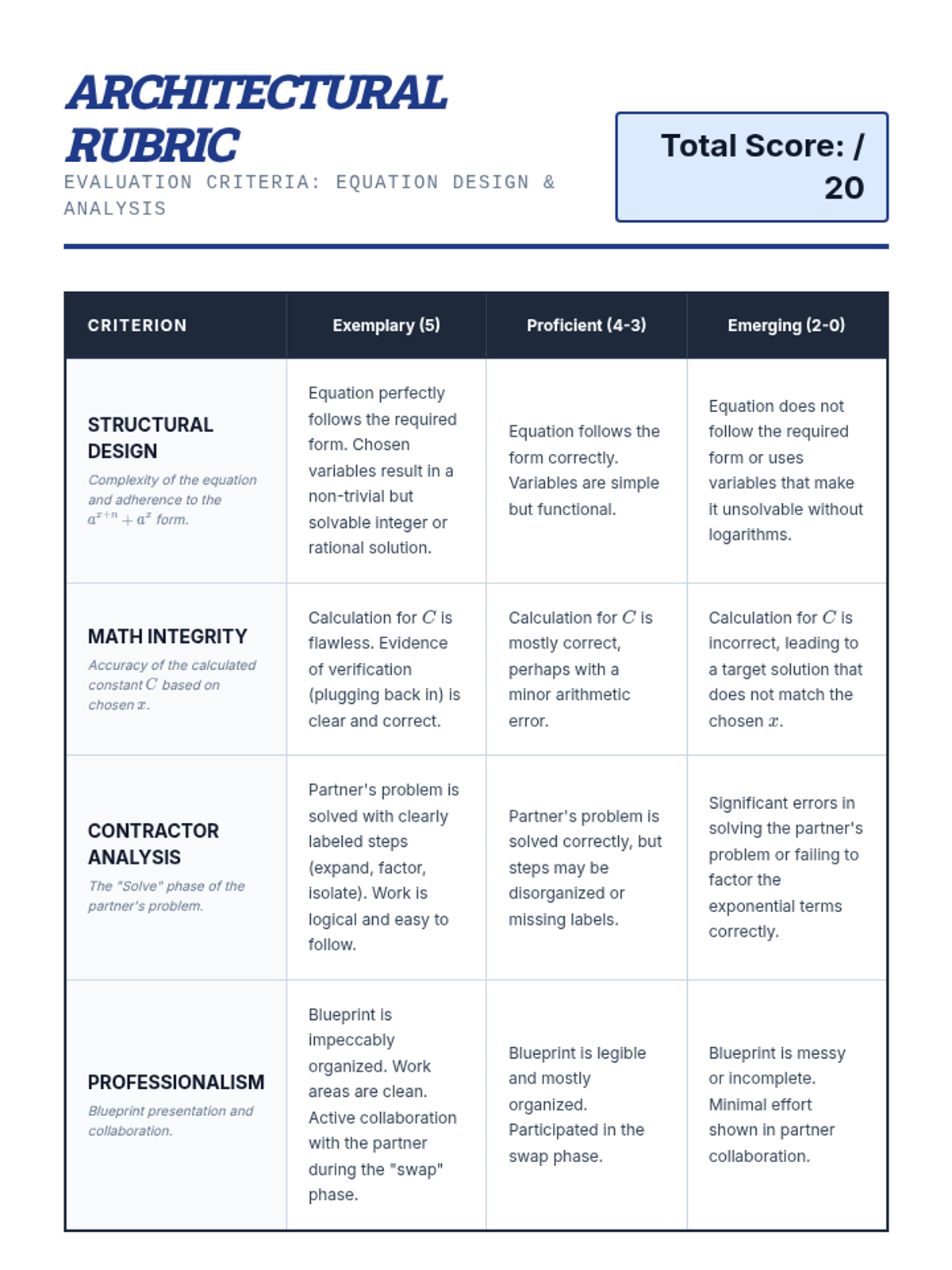
A lesson where students reverse-engineer exponential equations of the form a^(x+n) + a^x = C. By working backward from a chosen solution, students master exponent properties and factoring techniques before swapping with peers to test their designs.
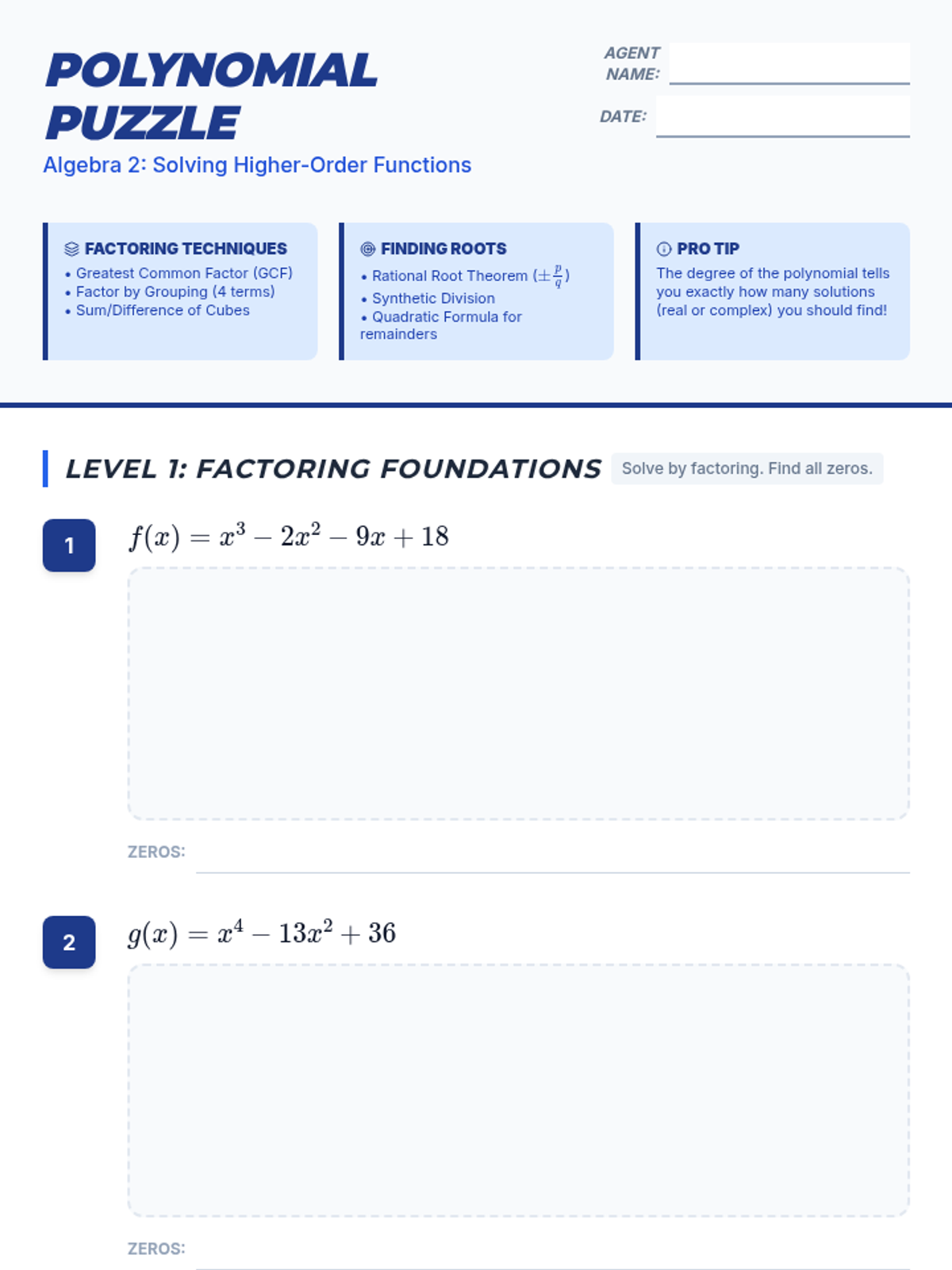
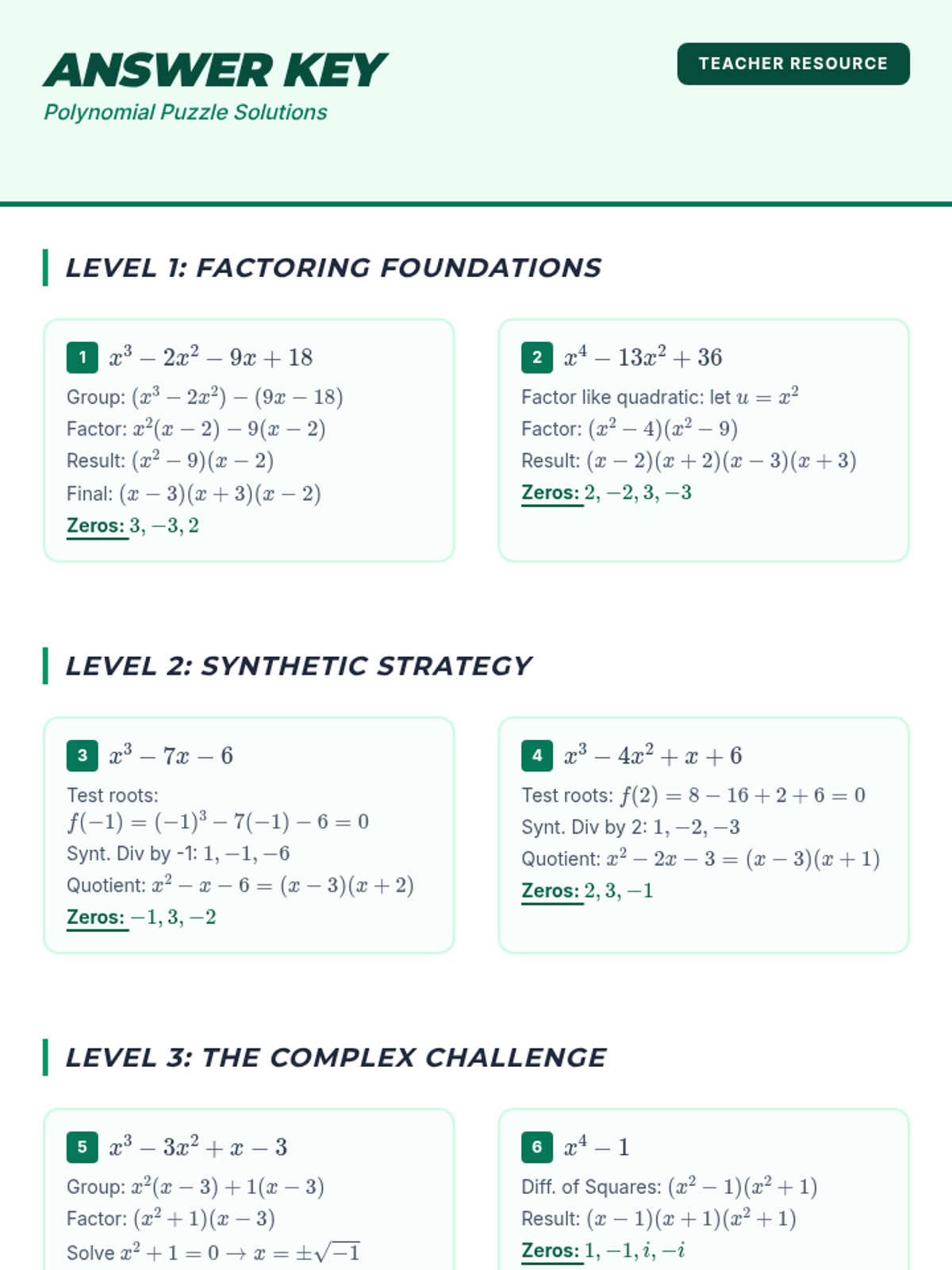
A lesson focused on finding the real and complex zeros of polynomial functions using various algebraic methods like factoring and synthetic division.
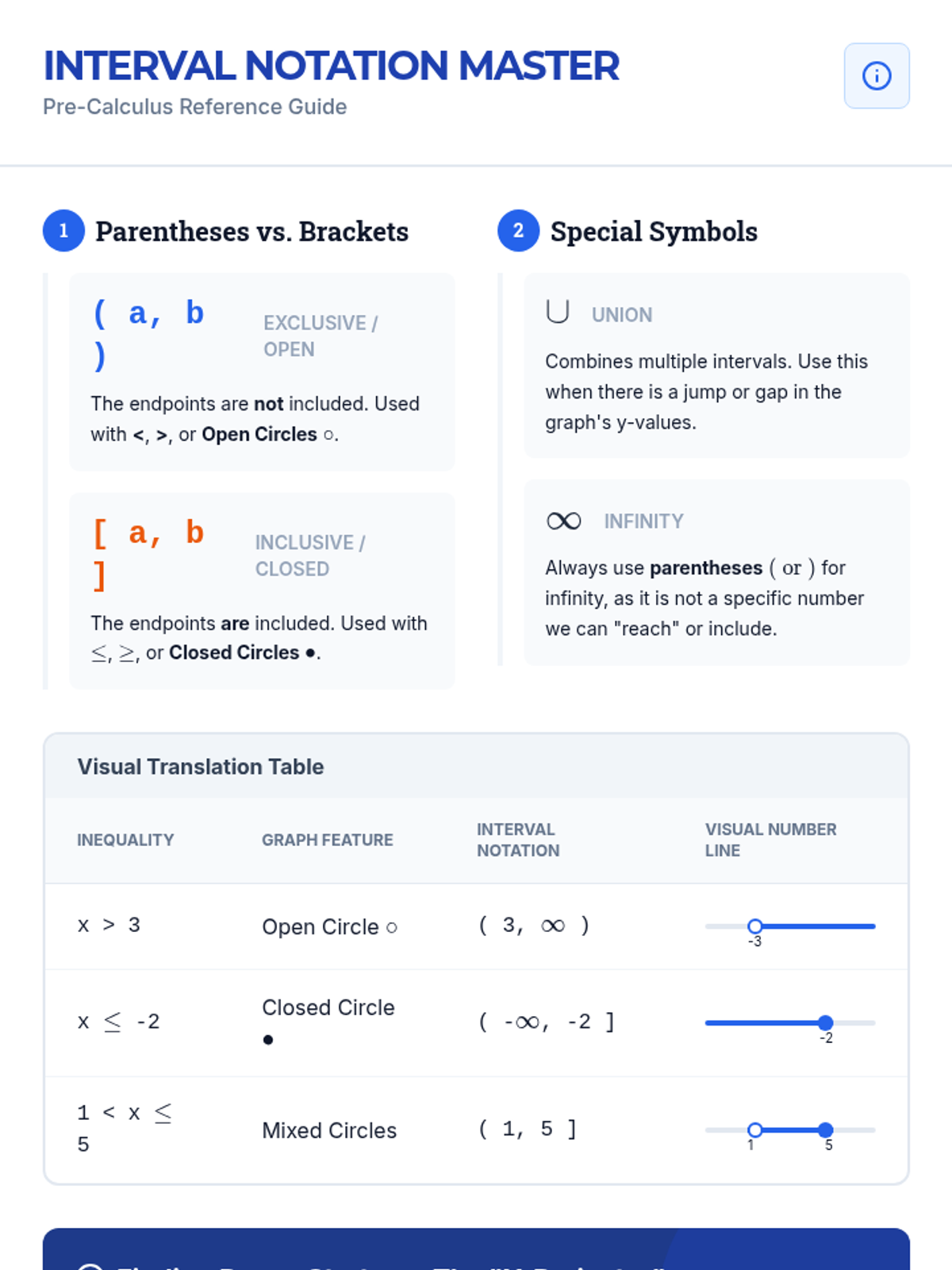
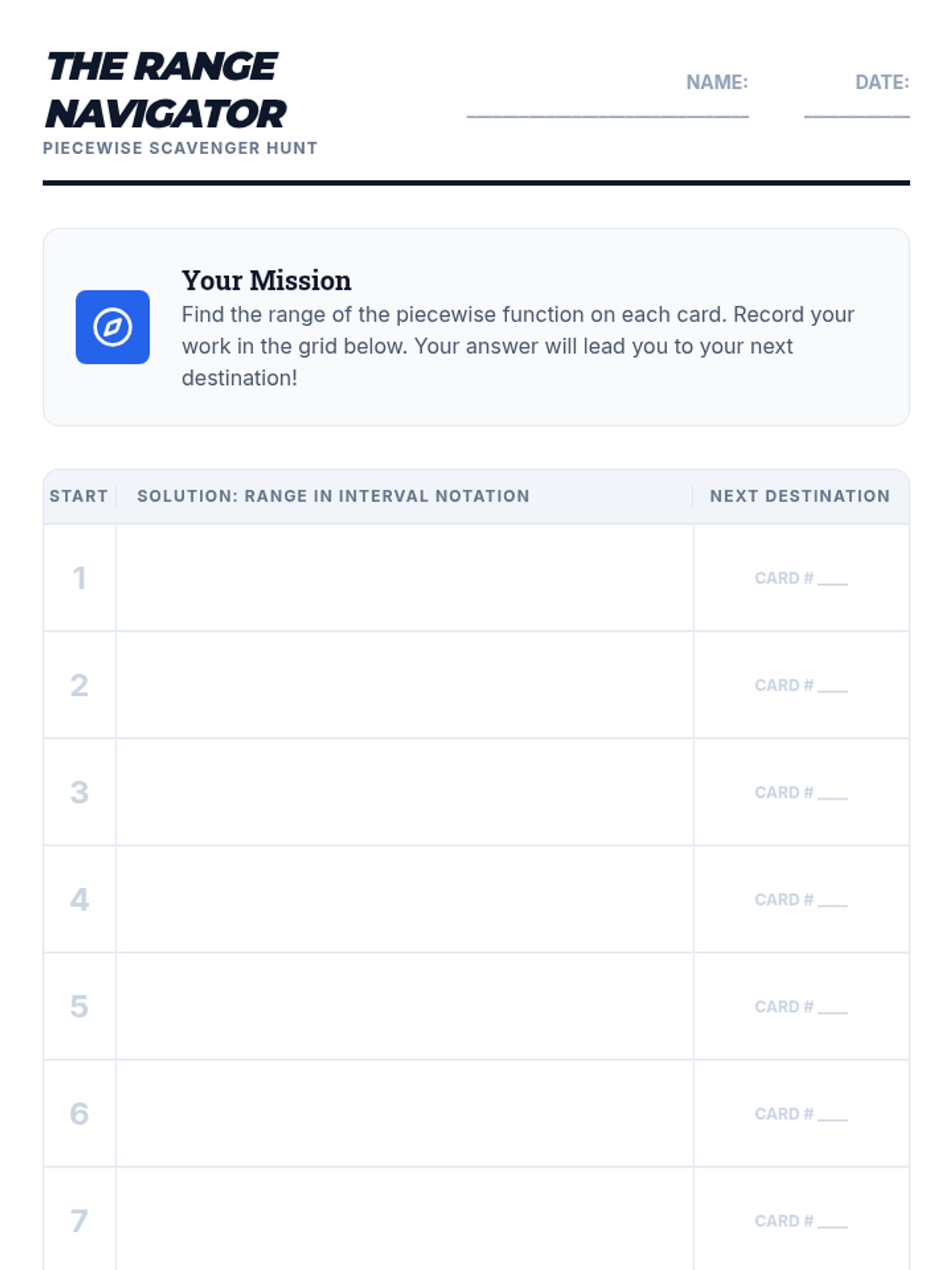
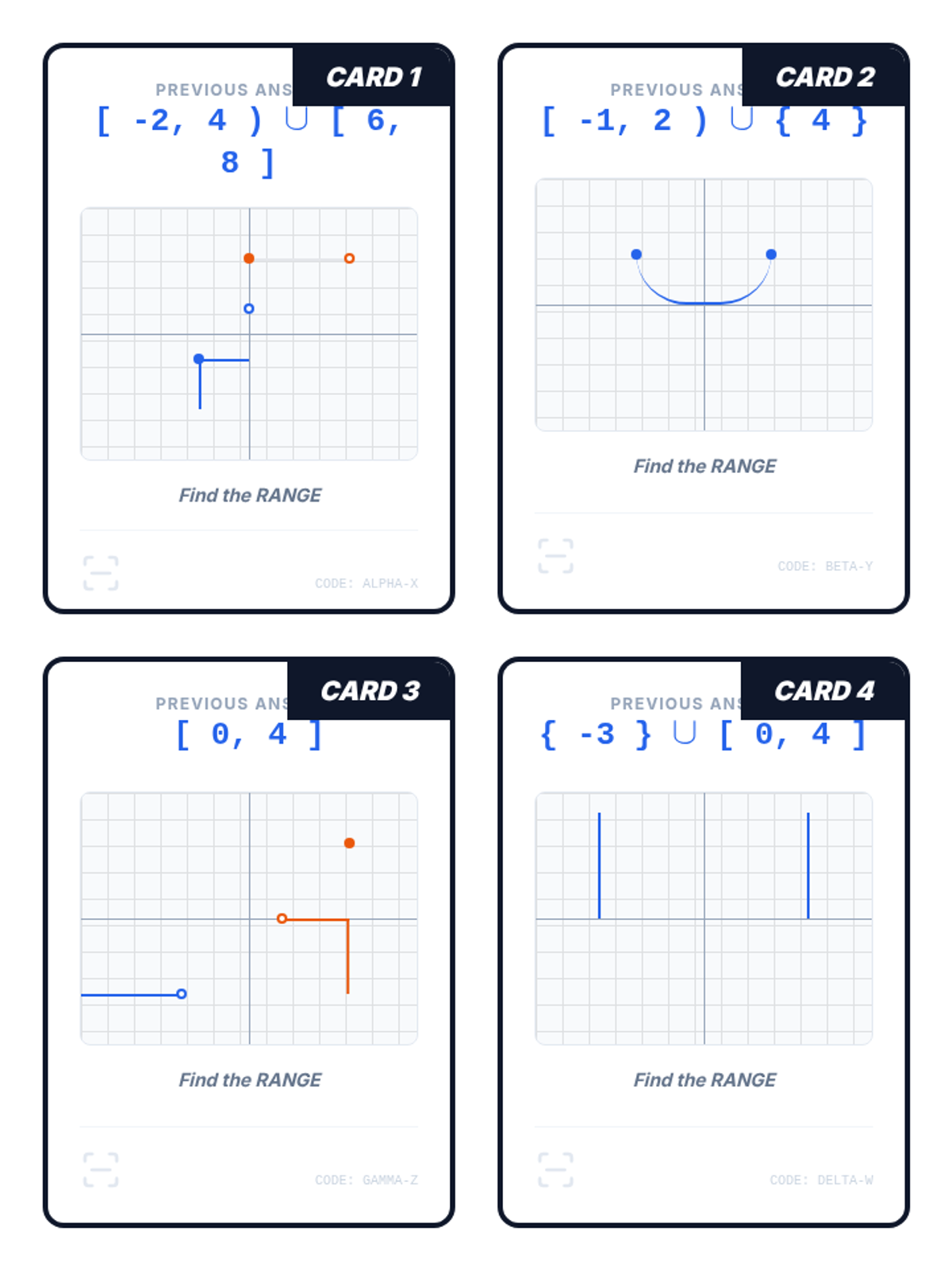
This lesson focuses on finding the range of complex piecewise functions through visual projection and interval notation, featuring a video breakdown and a kinesthetic scavenger hunt activity.
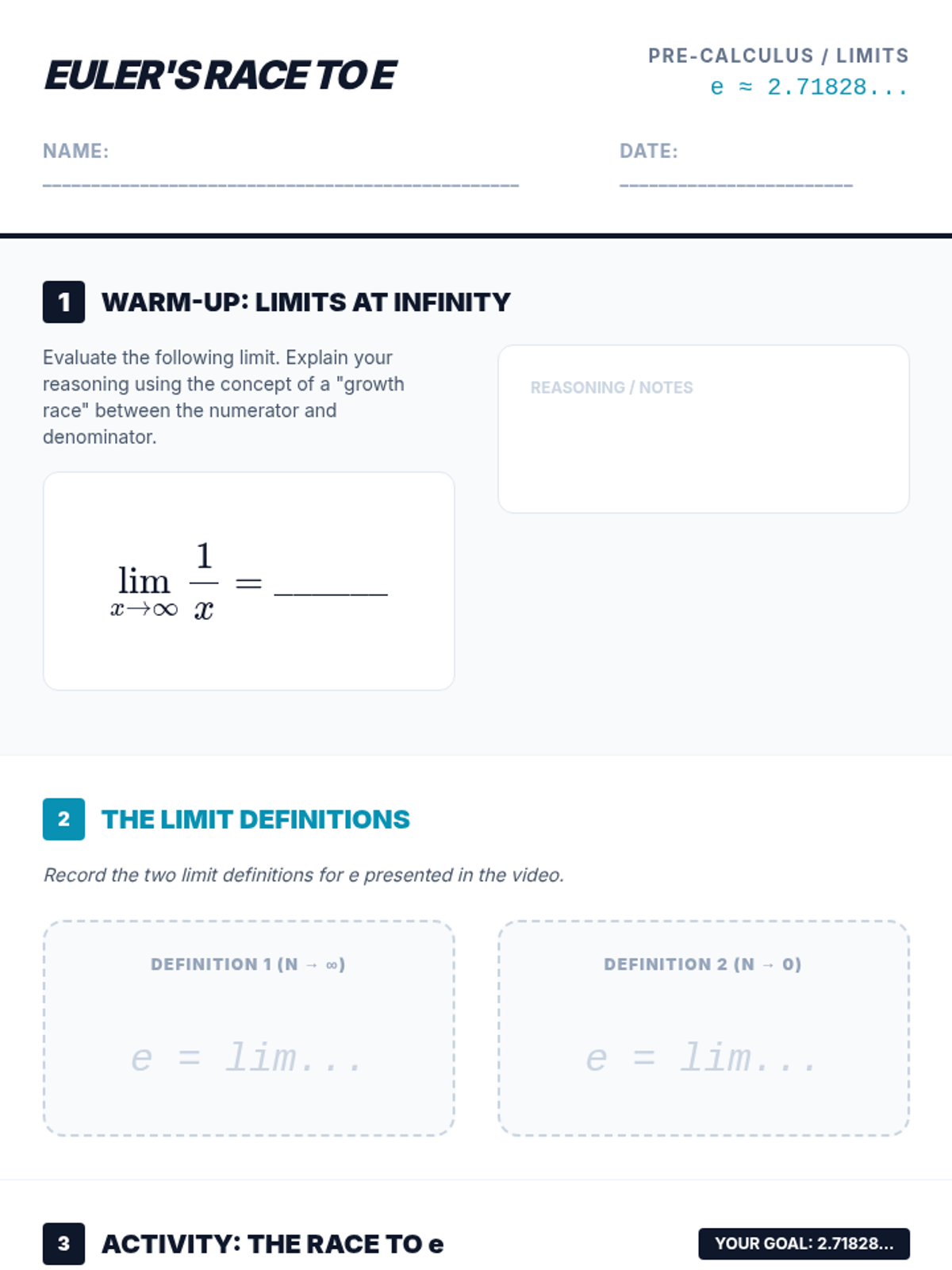
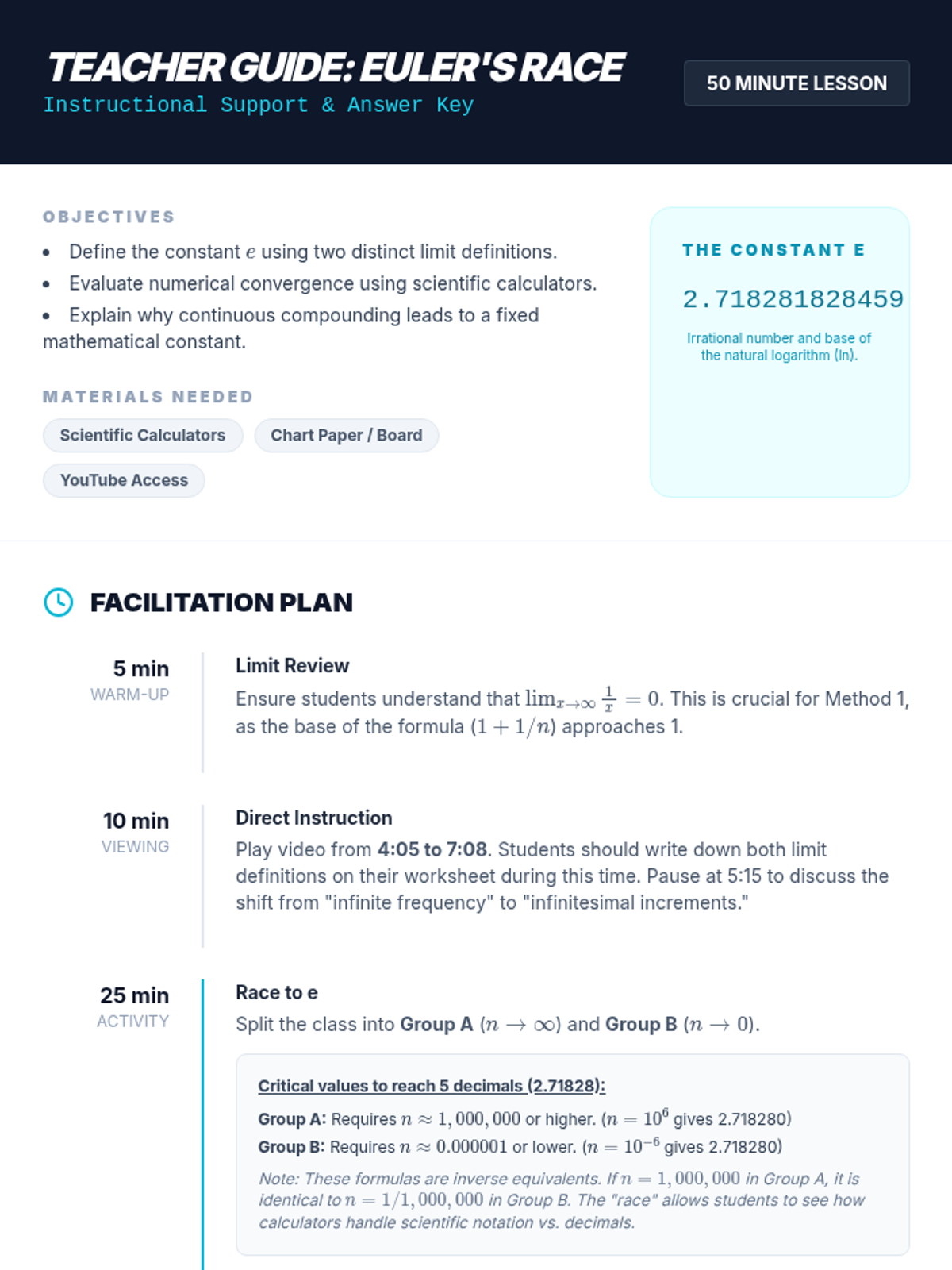
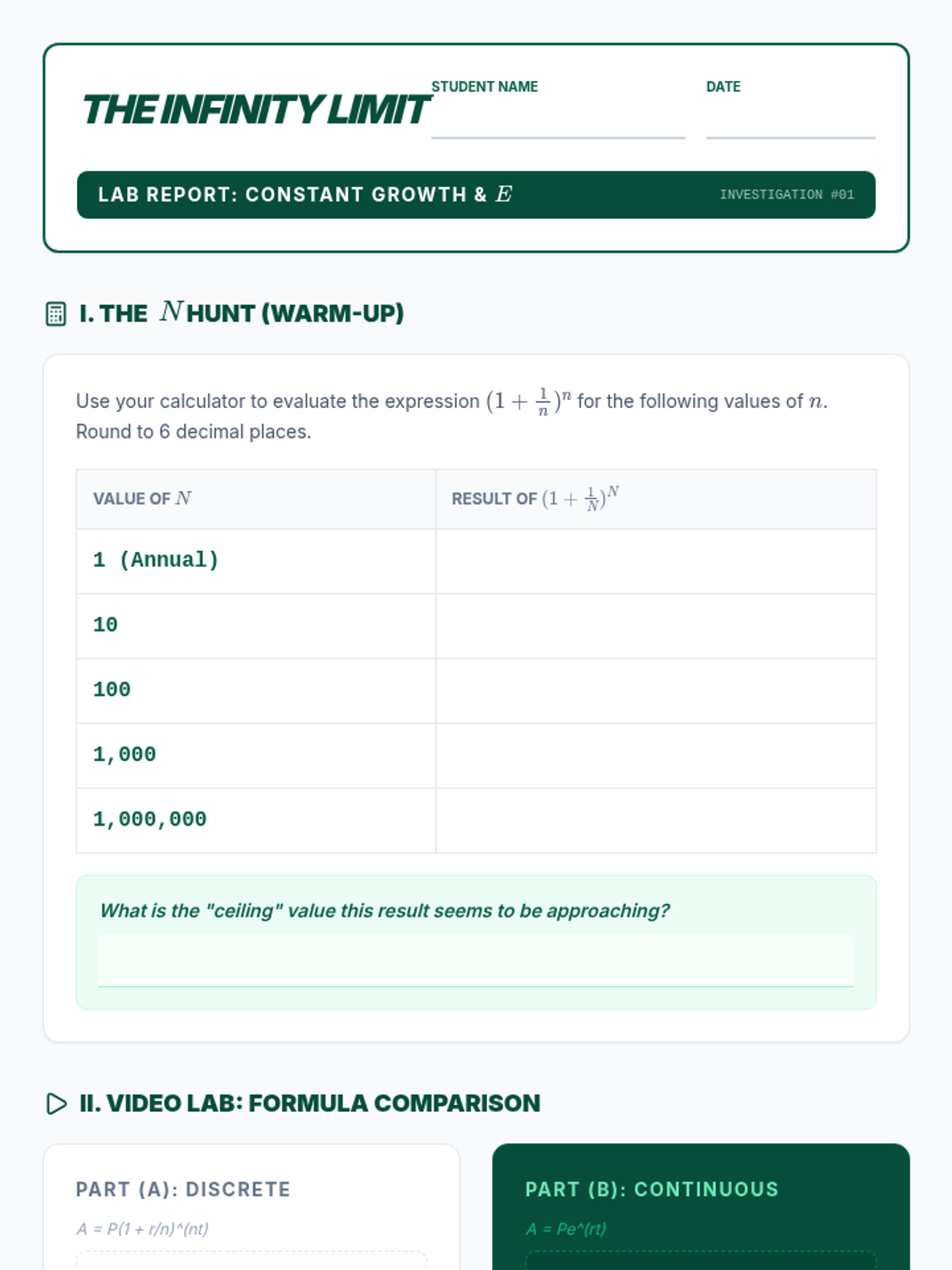
A Pre-Calculus lesson exploring the constant e through limit definitions and numerical convergence. Students will 'race' to calculate e to high precision using two different limit formulas and evaluate their performance.
Students explore the mathematical constant 'e' through the lens of continuous compound interest, investigating how increasing compounding frequency leads to diminishing returns and a fundamental limit.
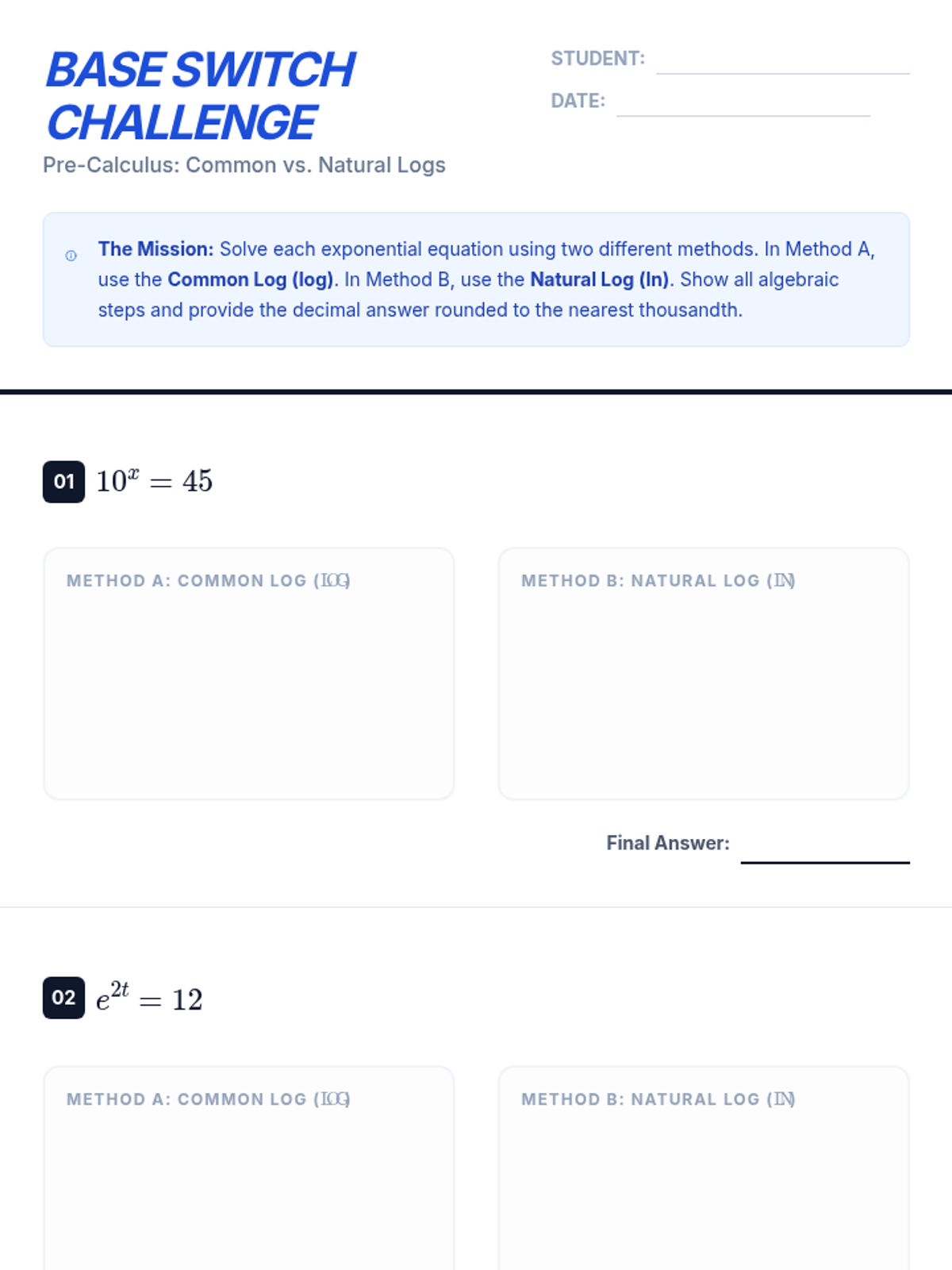
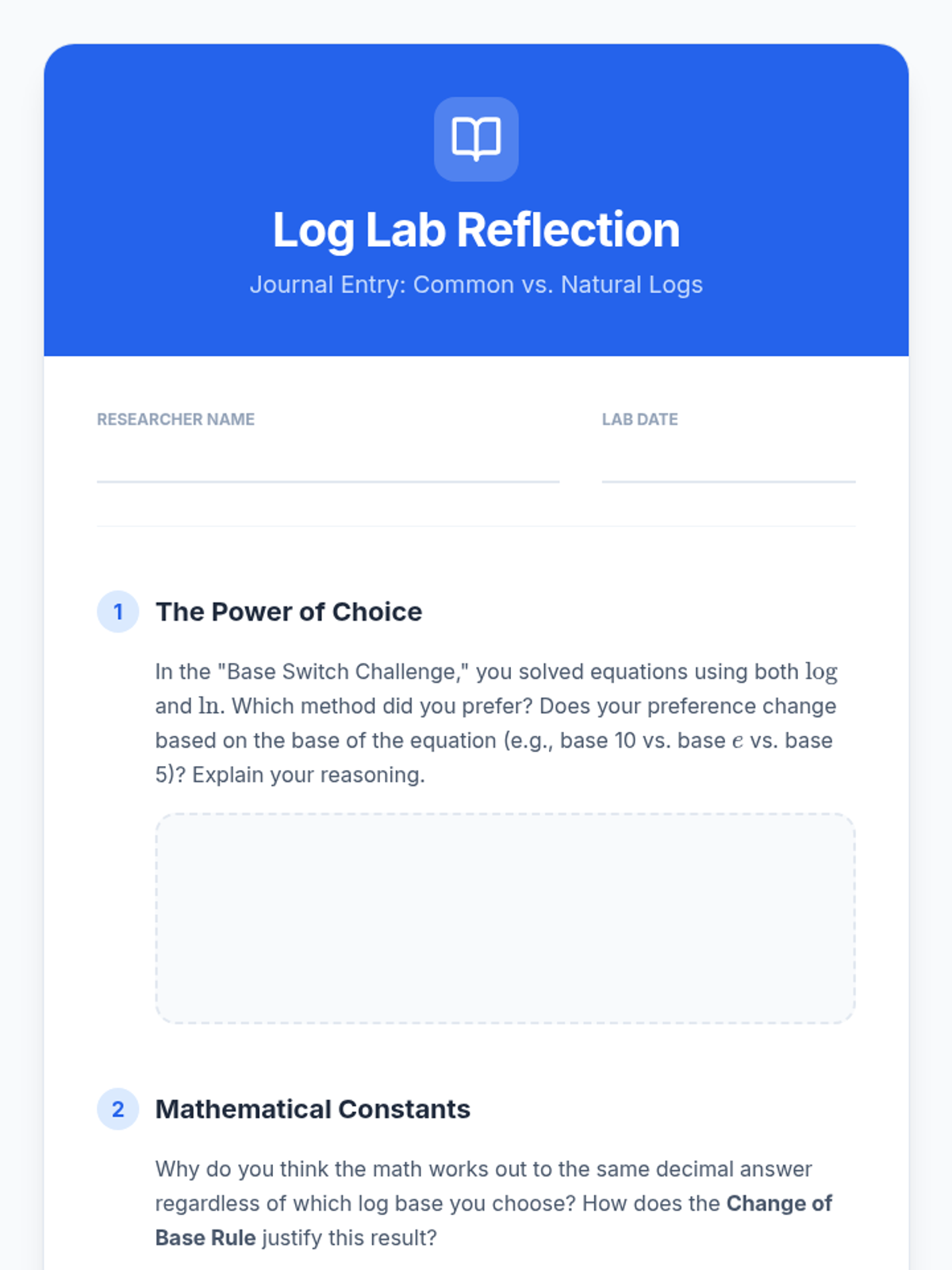
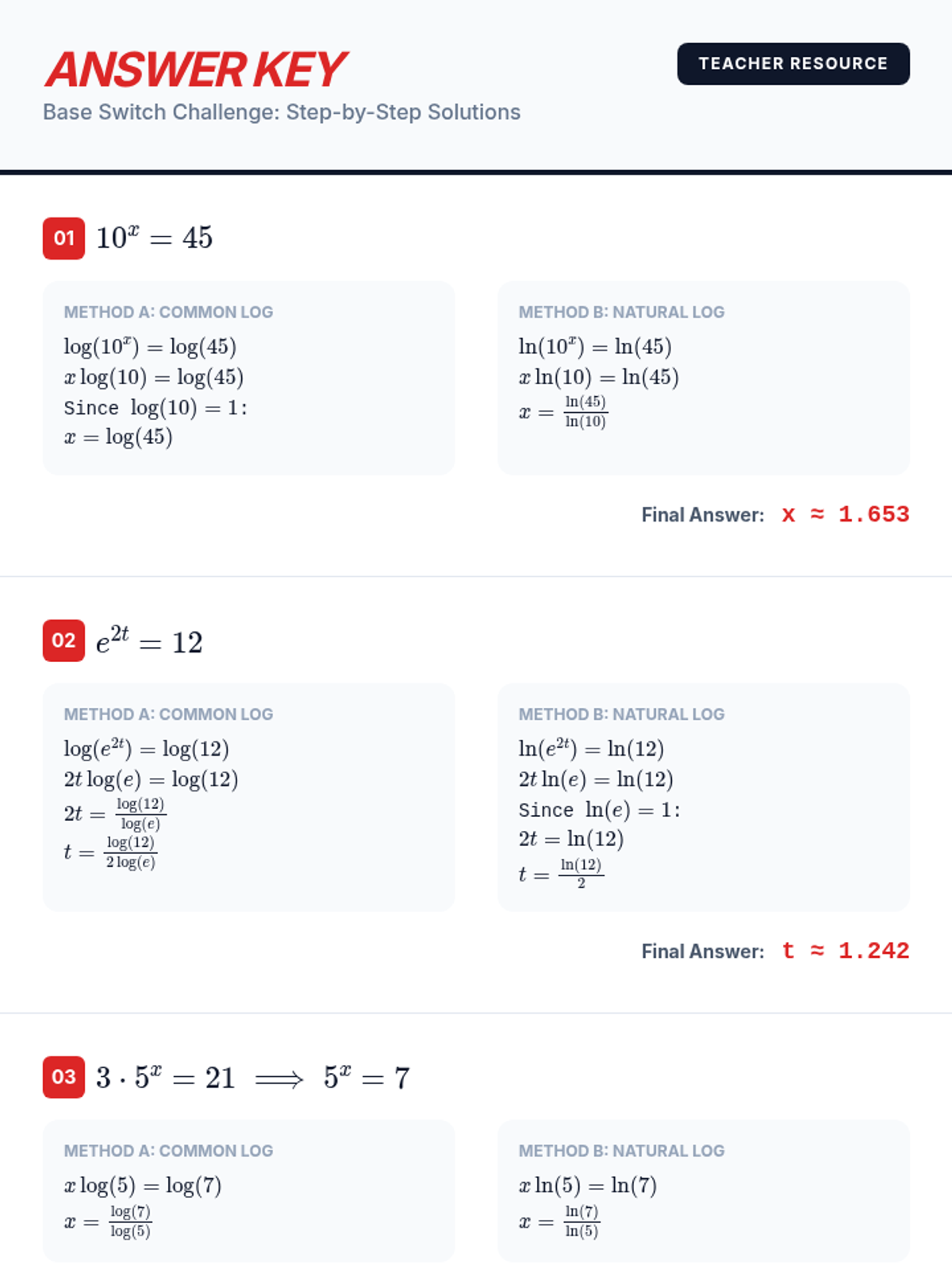
A Pre-Calculus lesson focused on the practical application and comparison of common and natural logarithms when solving exponential equations. Students will discover that while bases differ, the properties of logarithms lead to consistent results.
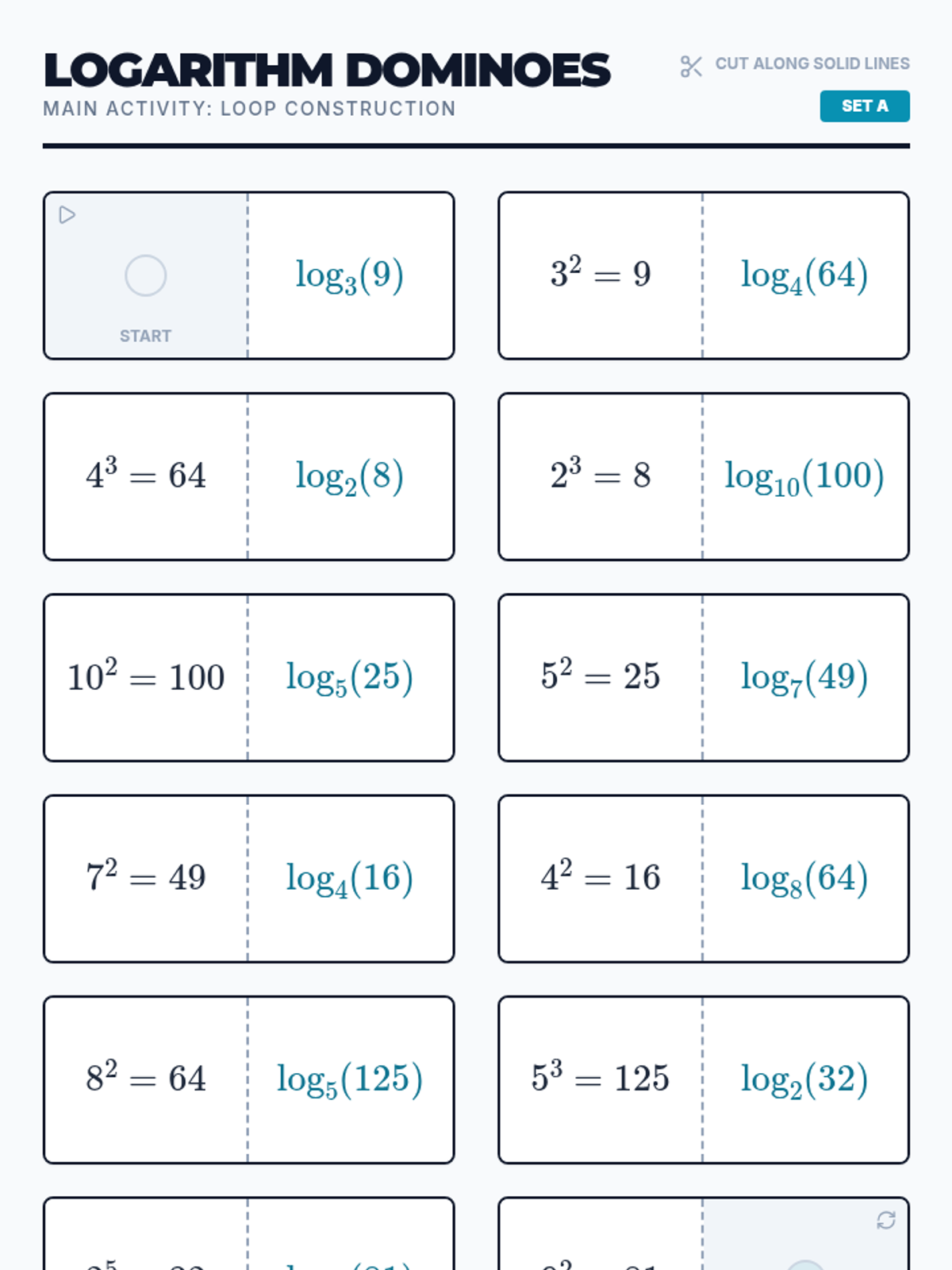
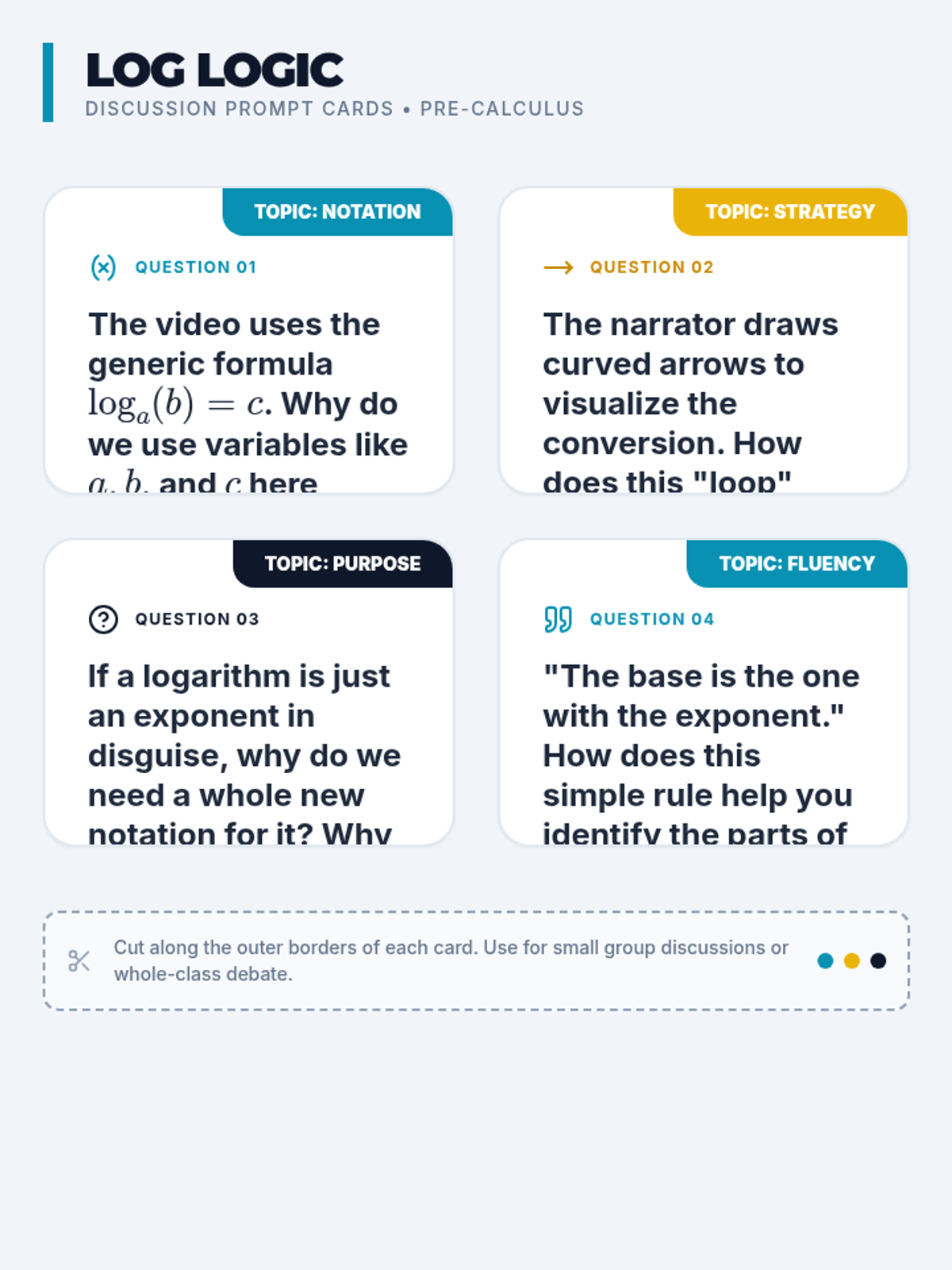
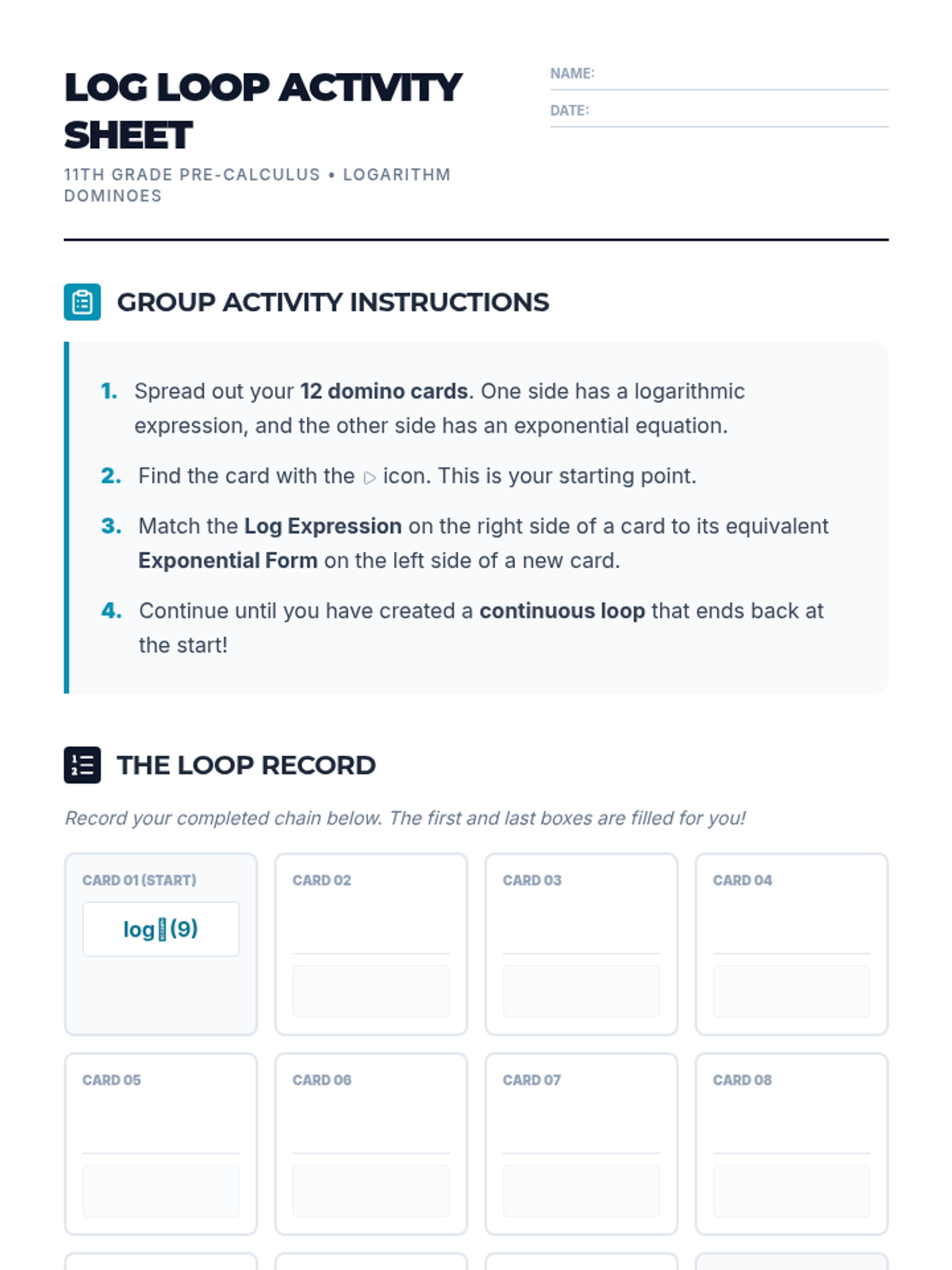
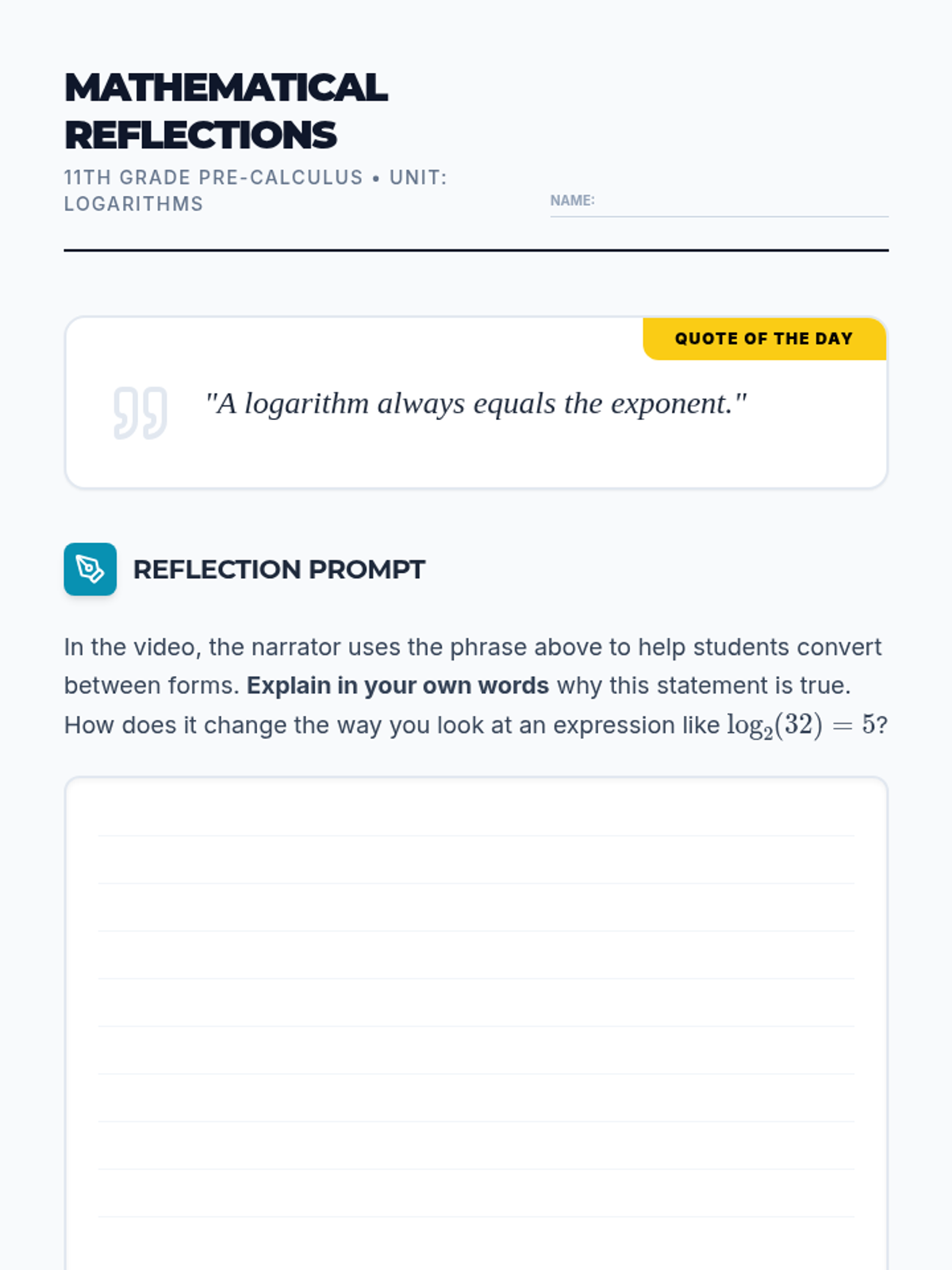
An interactive lesson for 11th Grade Pre-Calculus focused on the bidirectional relationship between logarithms and exponential forms, featuring a video-guided practice and a collaborative domino matching activity.
Students analyze how the compounding period and exponent coefficients affect the growth rate of exponential functions, transitioning from standard forms to manipulated models using algebraic properties and graphing technology.
A Pre-Calculus lesson focusing on the transition from graphical estimation to algebraic precision using logarithms to solve complex exponential growth equations.
This lesson focuses on identifying the specific conditions required to apply the infinite geometric series sum formula, specifically highlighting the common misconception of applying it to divergent series. students will engage in error analysis to solidify their understanding of convergence.
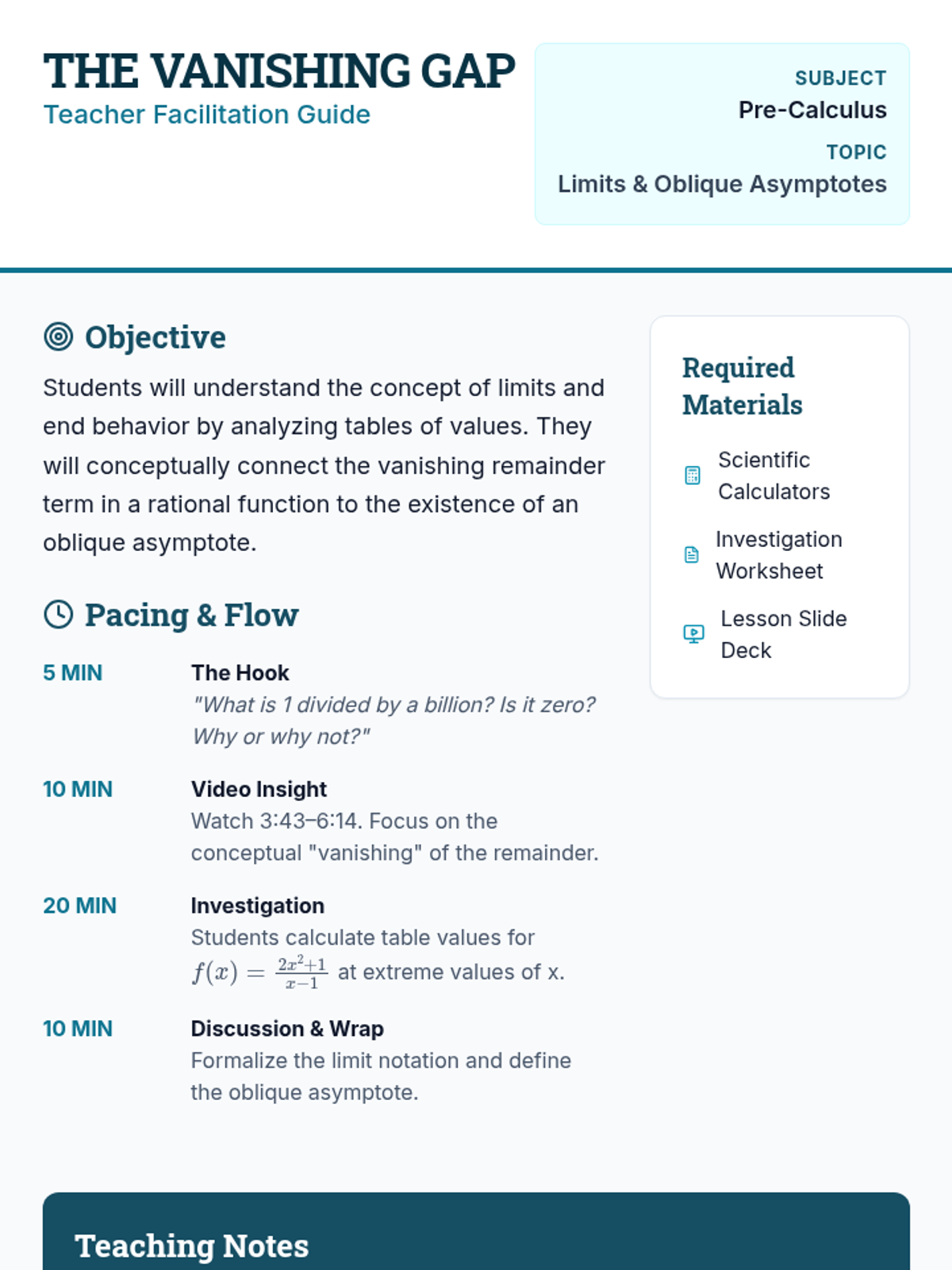
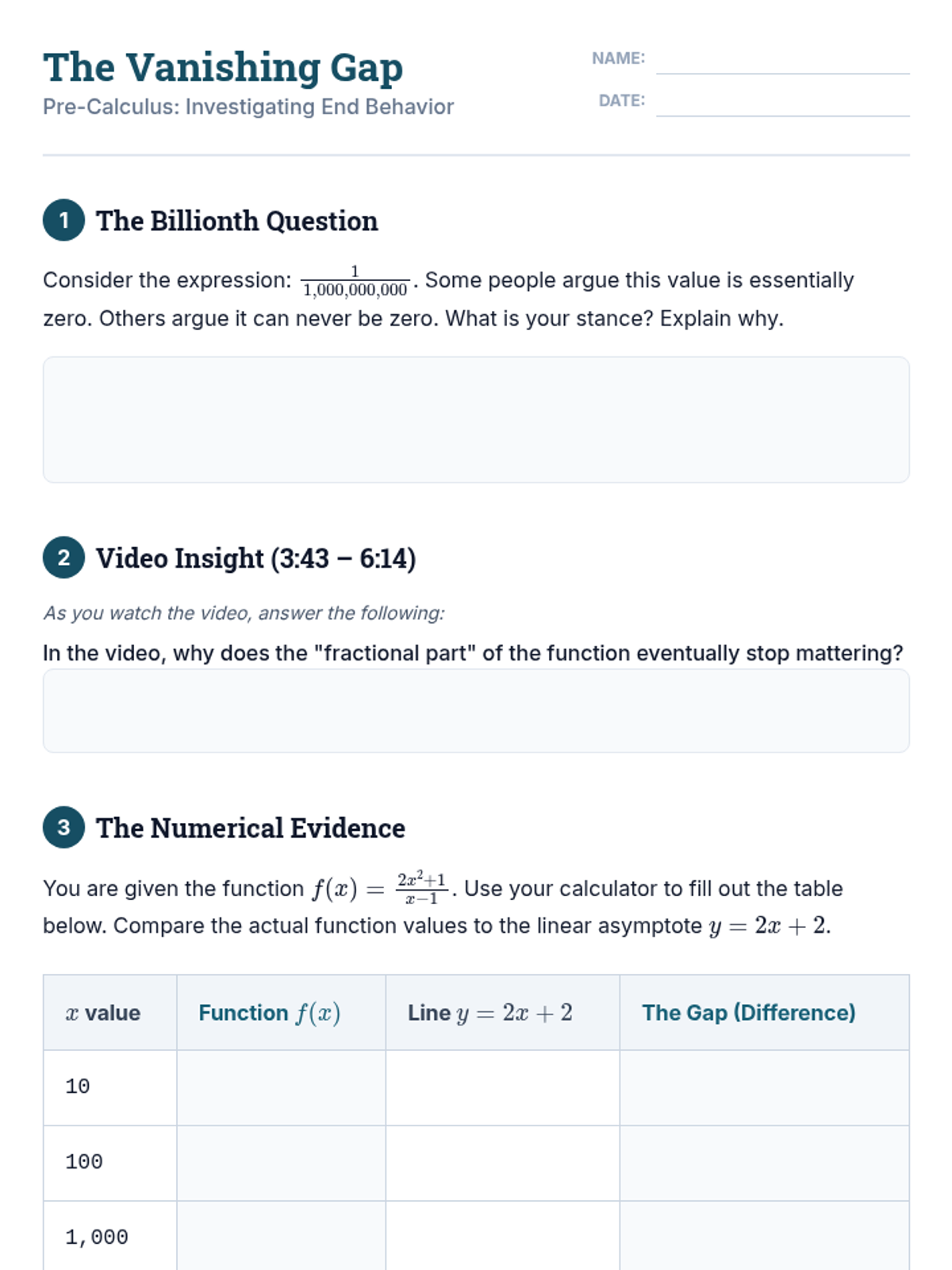
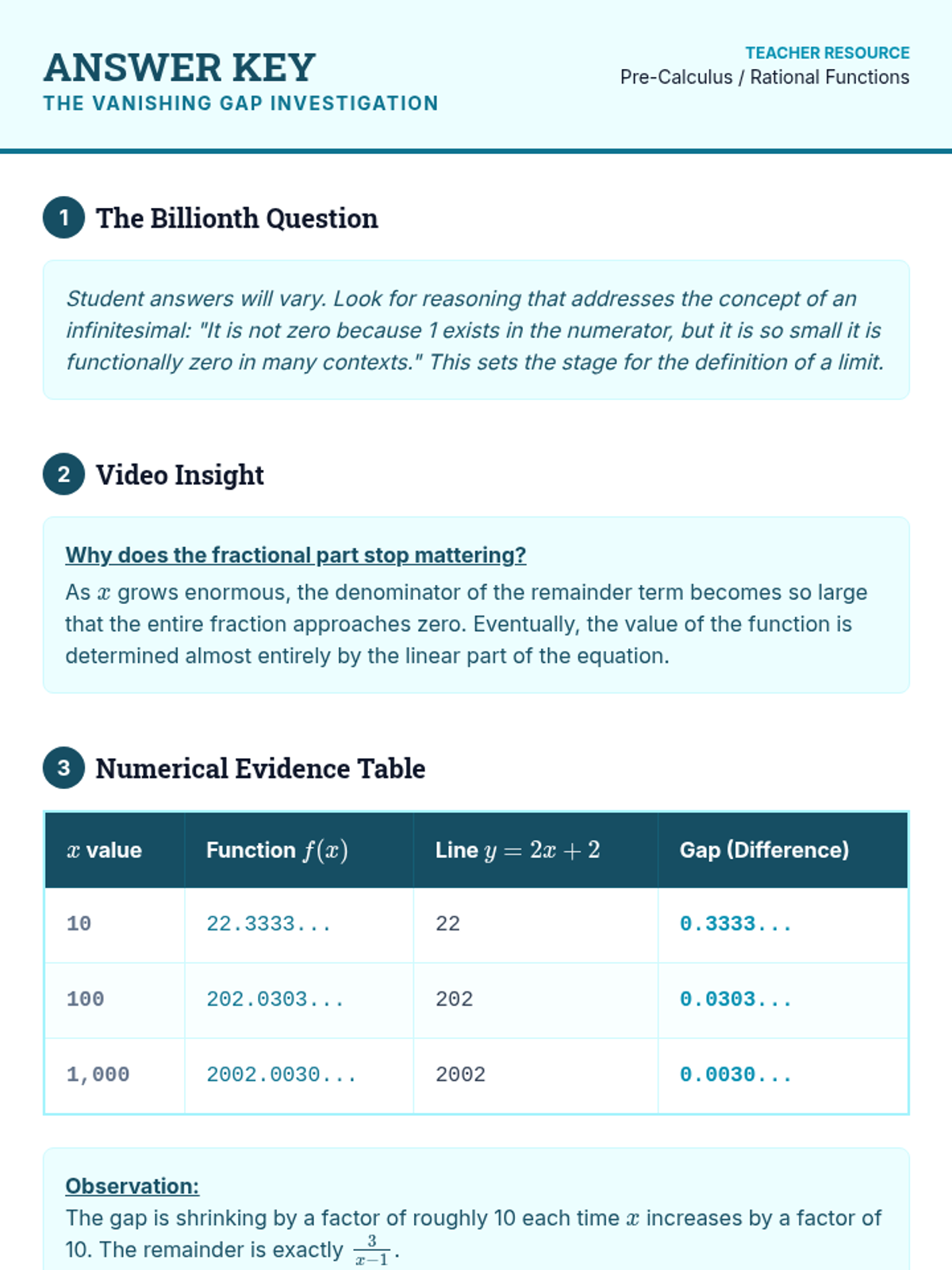
A Pre-Calculus lesson exploring oblique asymptotes through numerical analysis, focusing on the conceptual 'vanishing' of the remainder term as x approaches infinity.
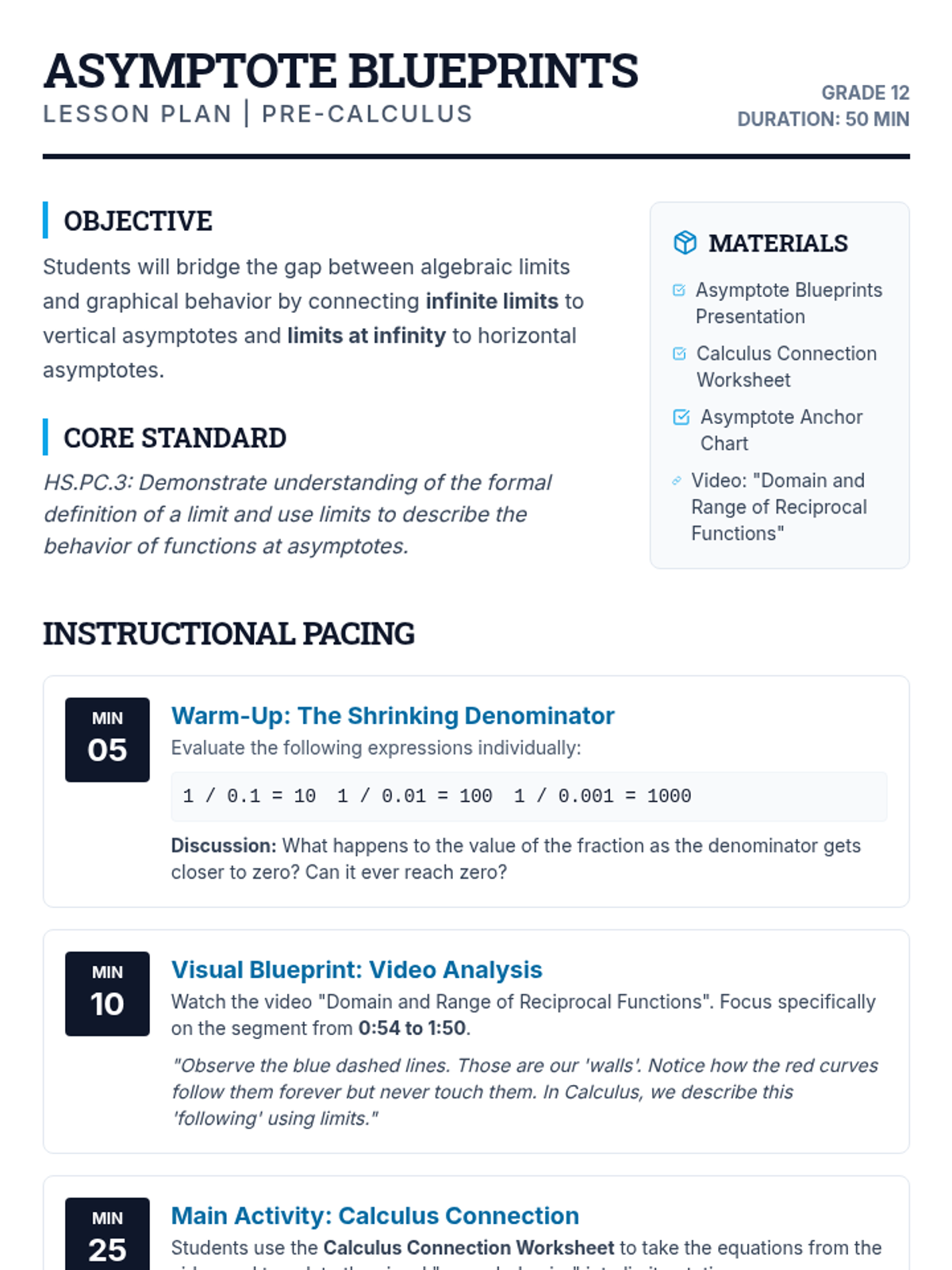
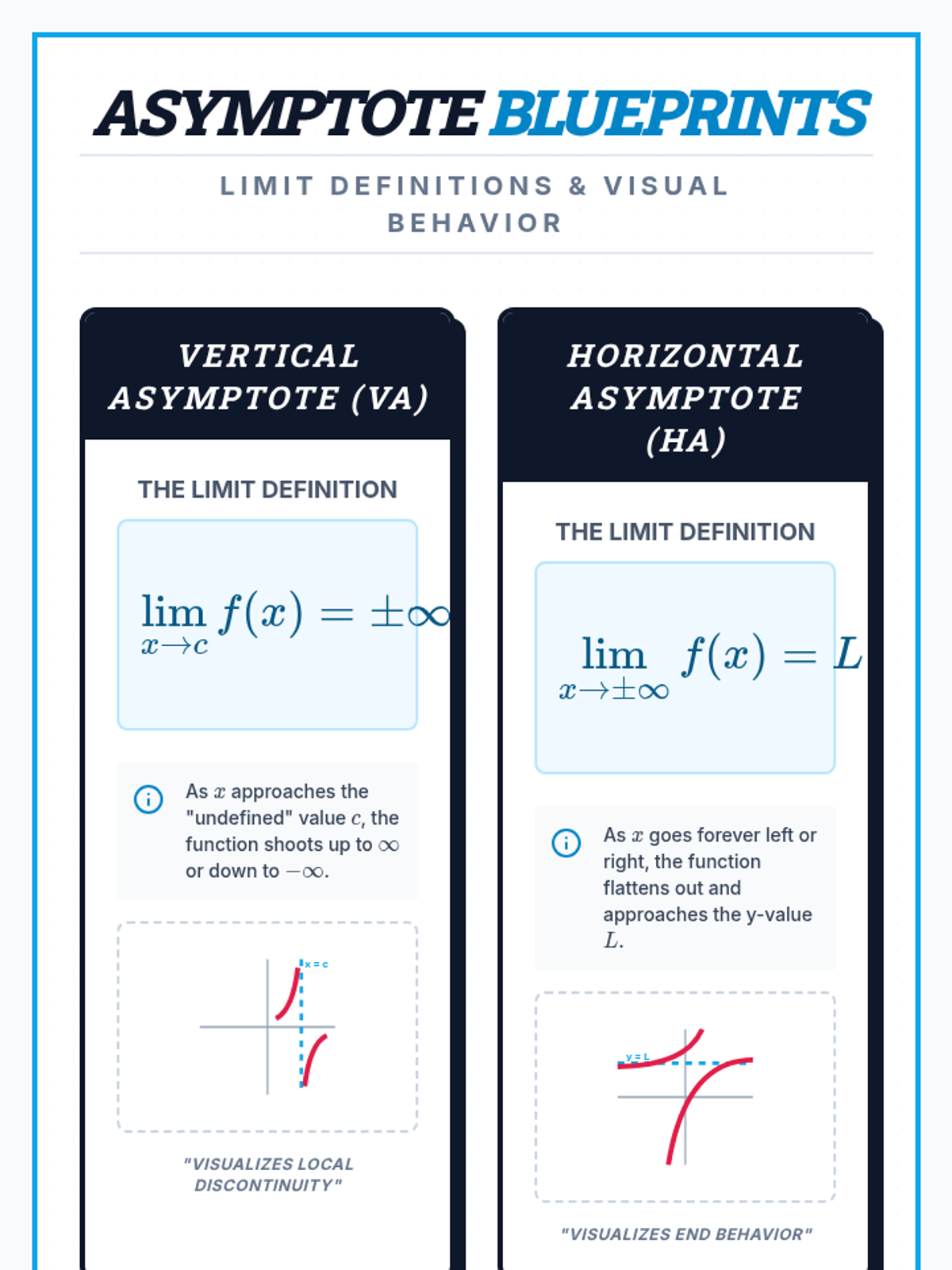
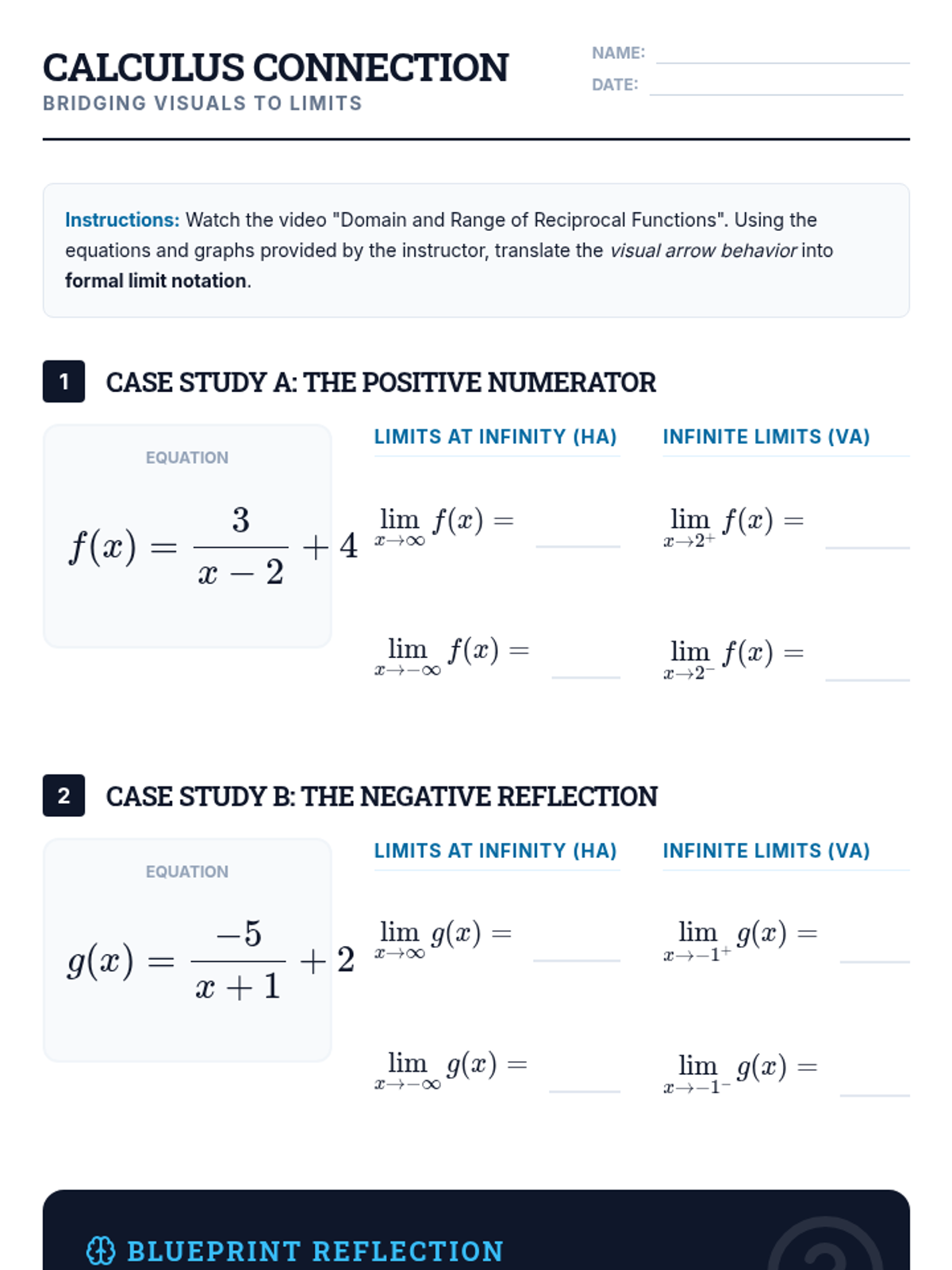
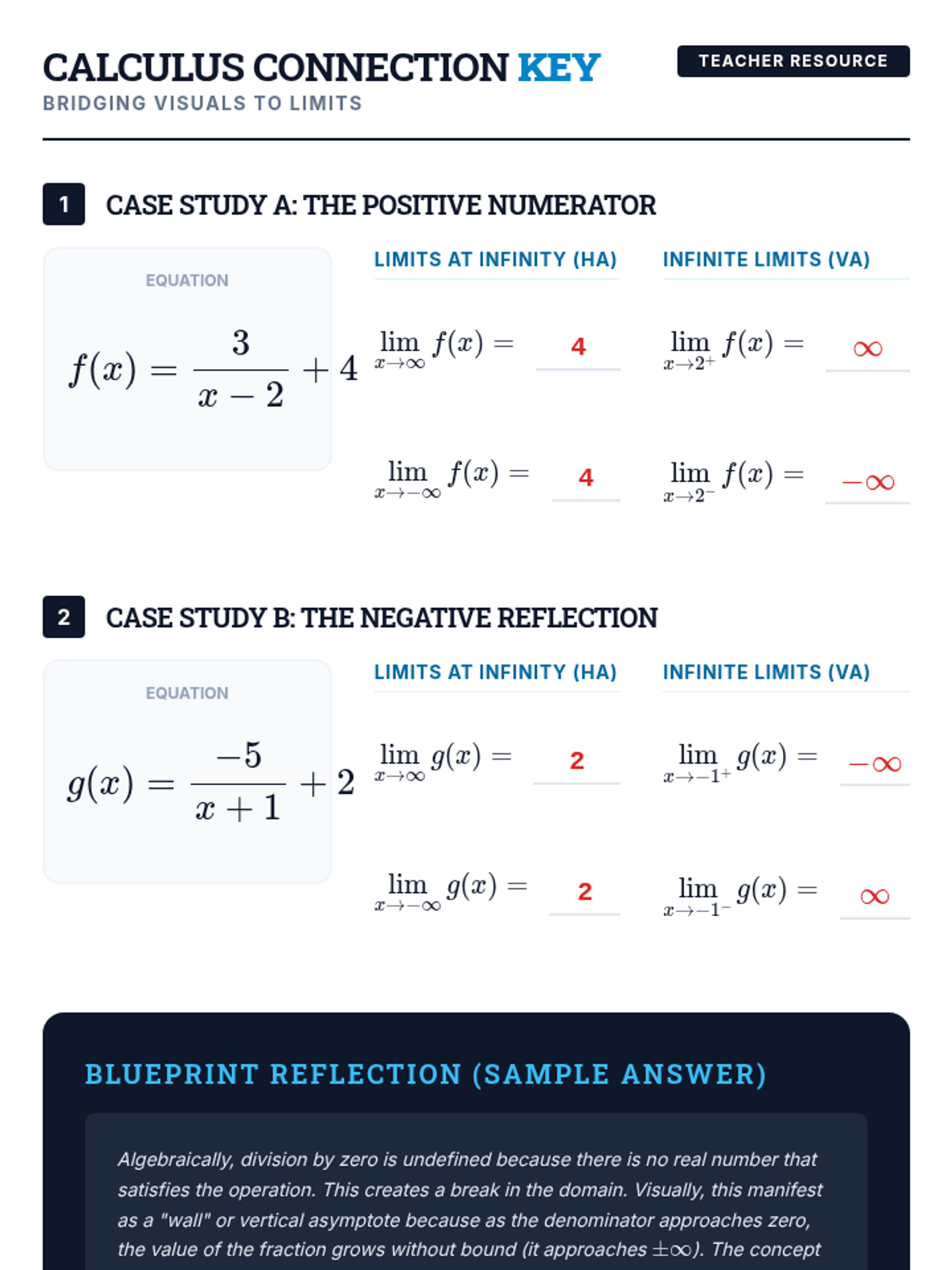
A 12th-grade Pre-Calculus lesson connecting the algebraic evaluation of infinite limits and limits at infinity to the visual behavior of vertical and horizontal asymptotes. Students analyze reciprocal functions from a video to bridge the gap between algebra and calculus.
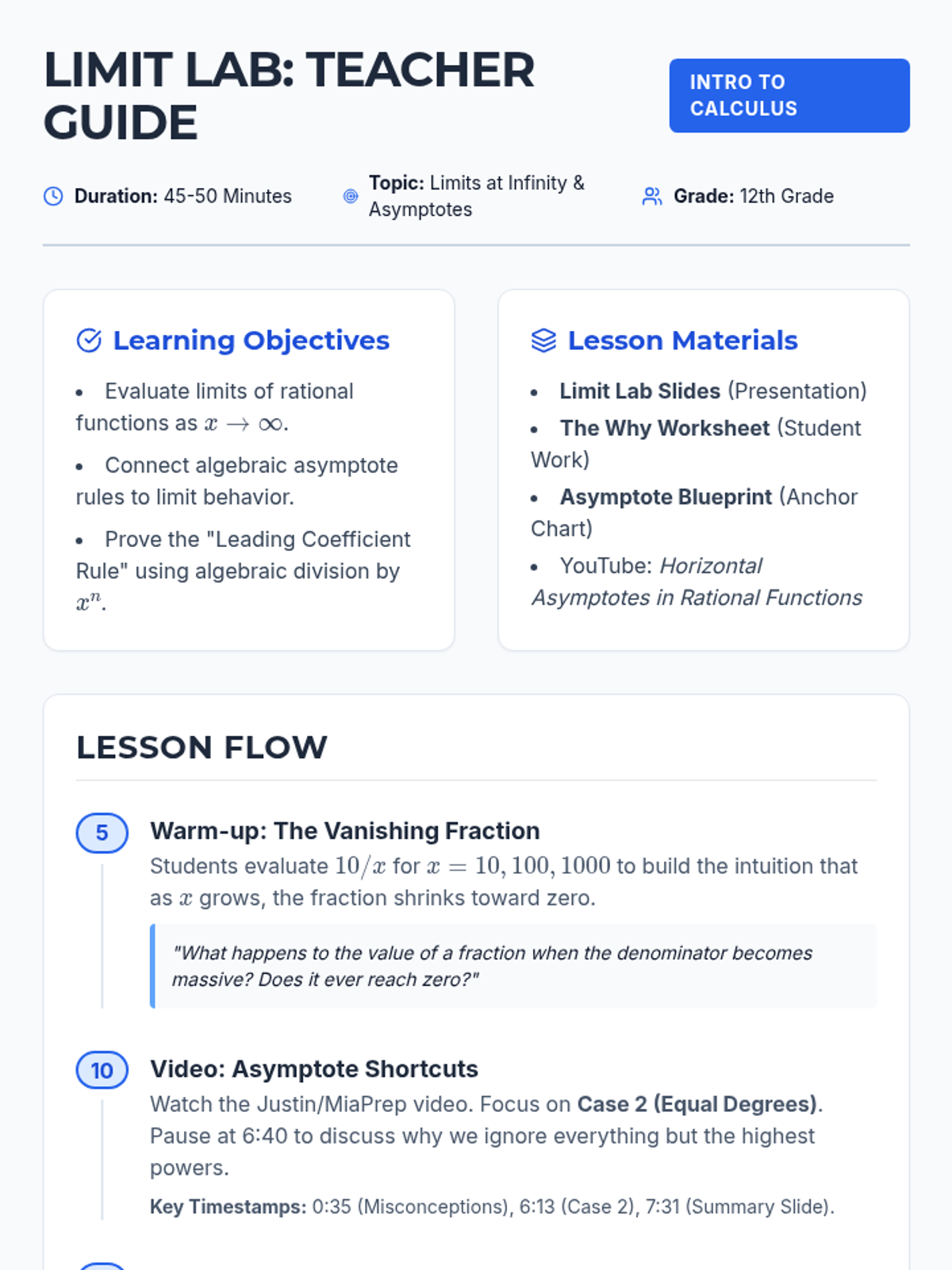
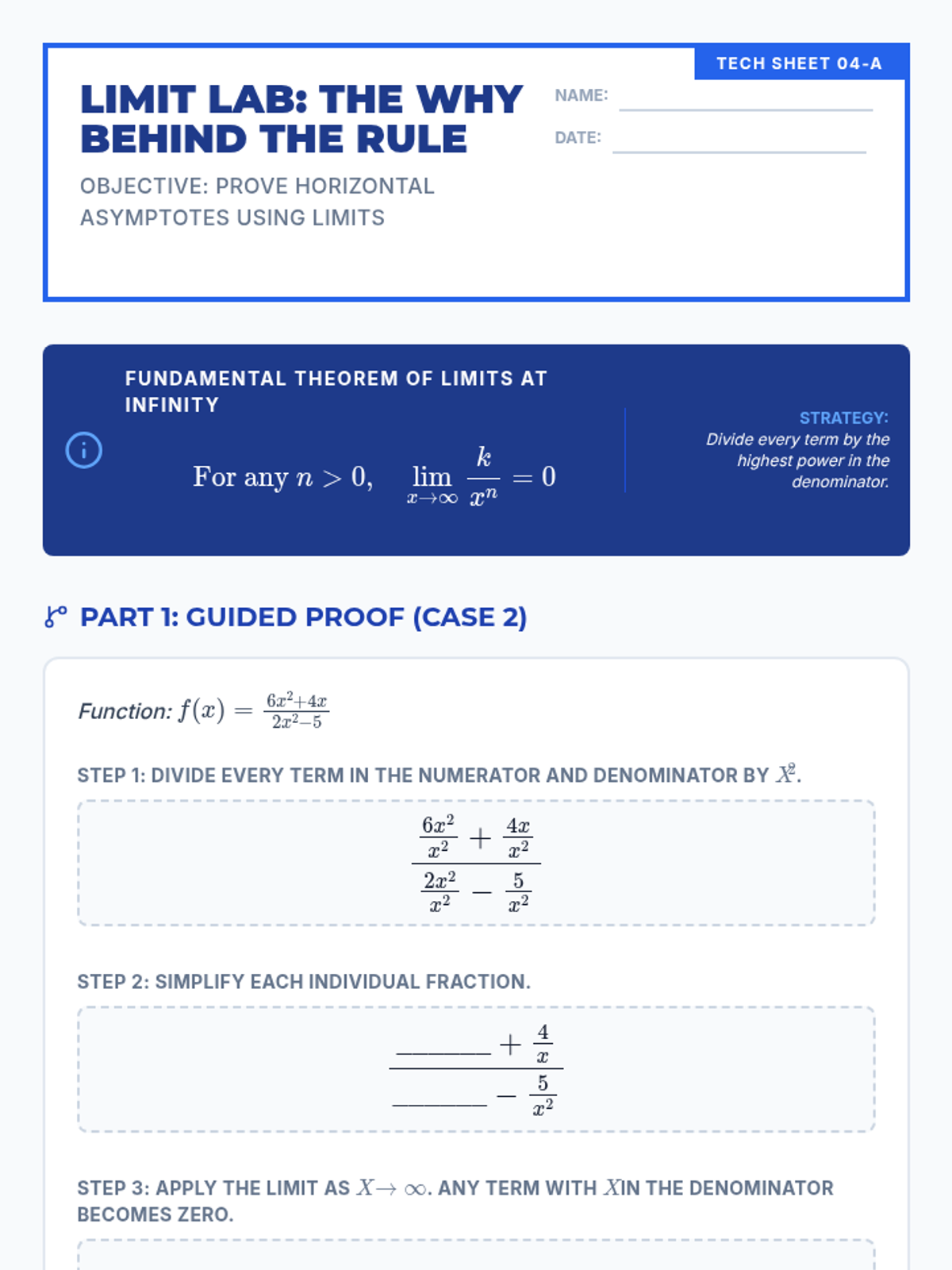
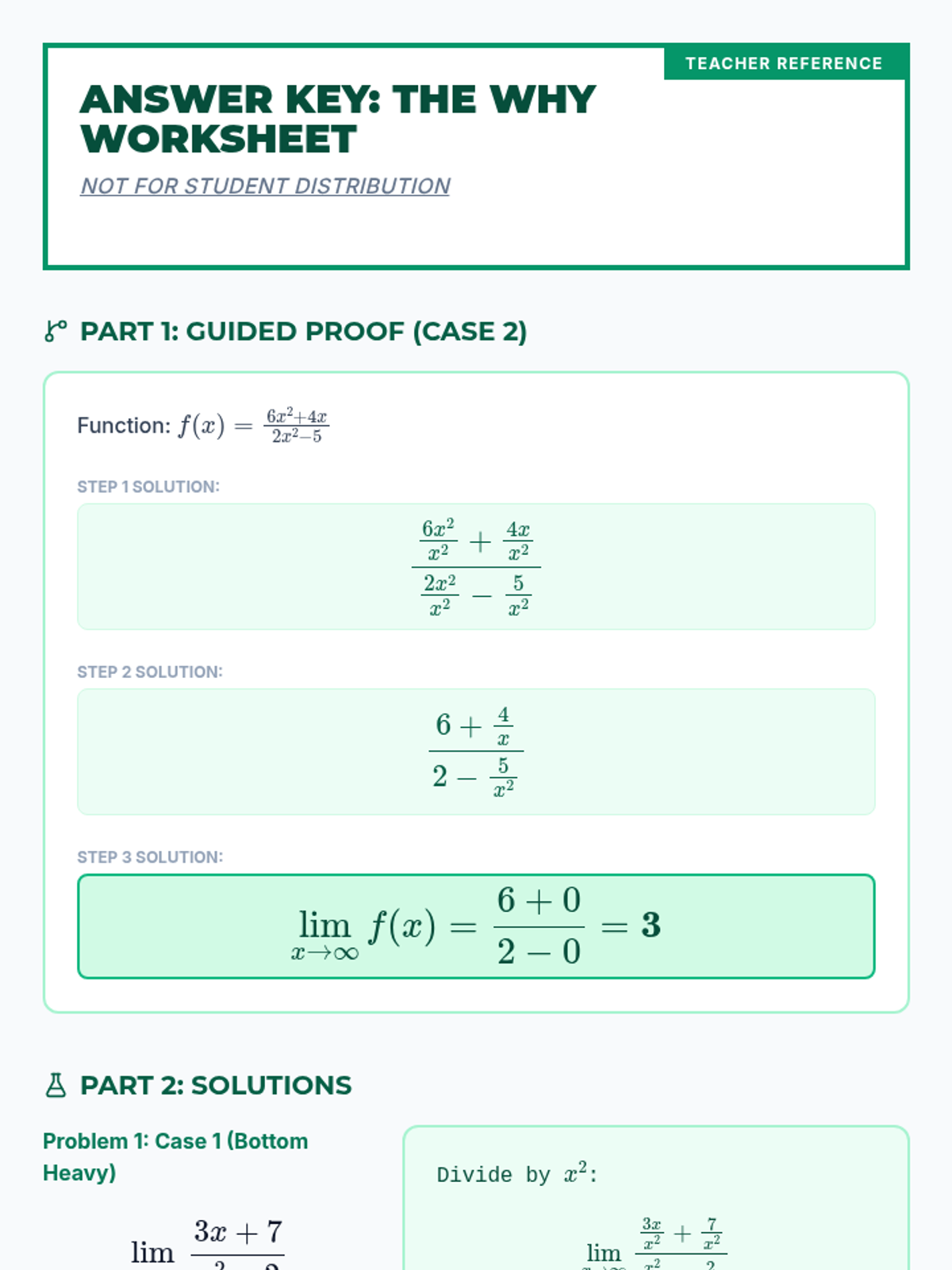
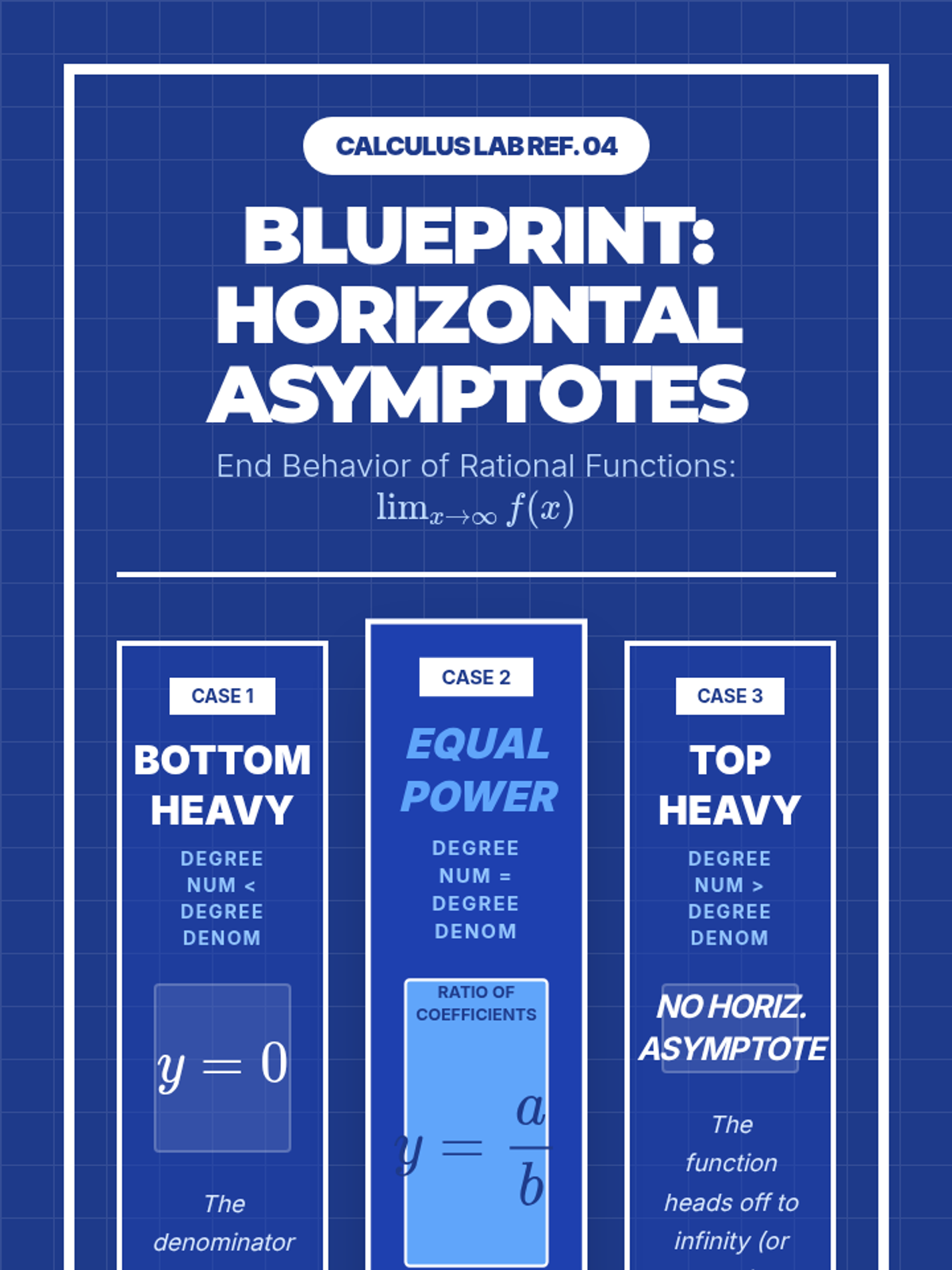
In this 12th-grade Intro to Calculus lesson, students connect algebraic shortcuts for horizontal asymptotes to the rigorous concept of limits at infinity. They move beyond memorized rules to derive the 'Ratio of Coefficients' property by dividing rational functions by the highest power of x.
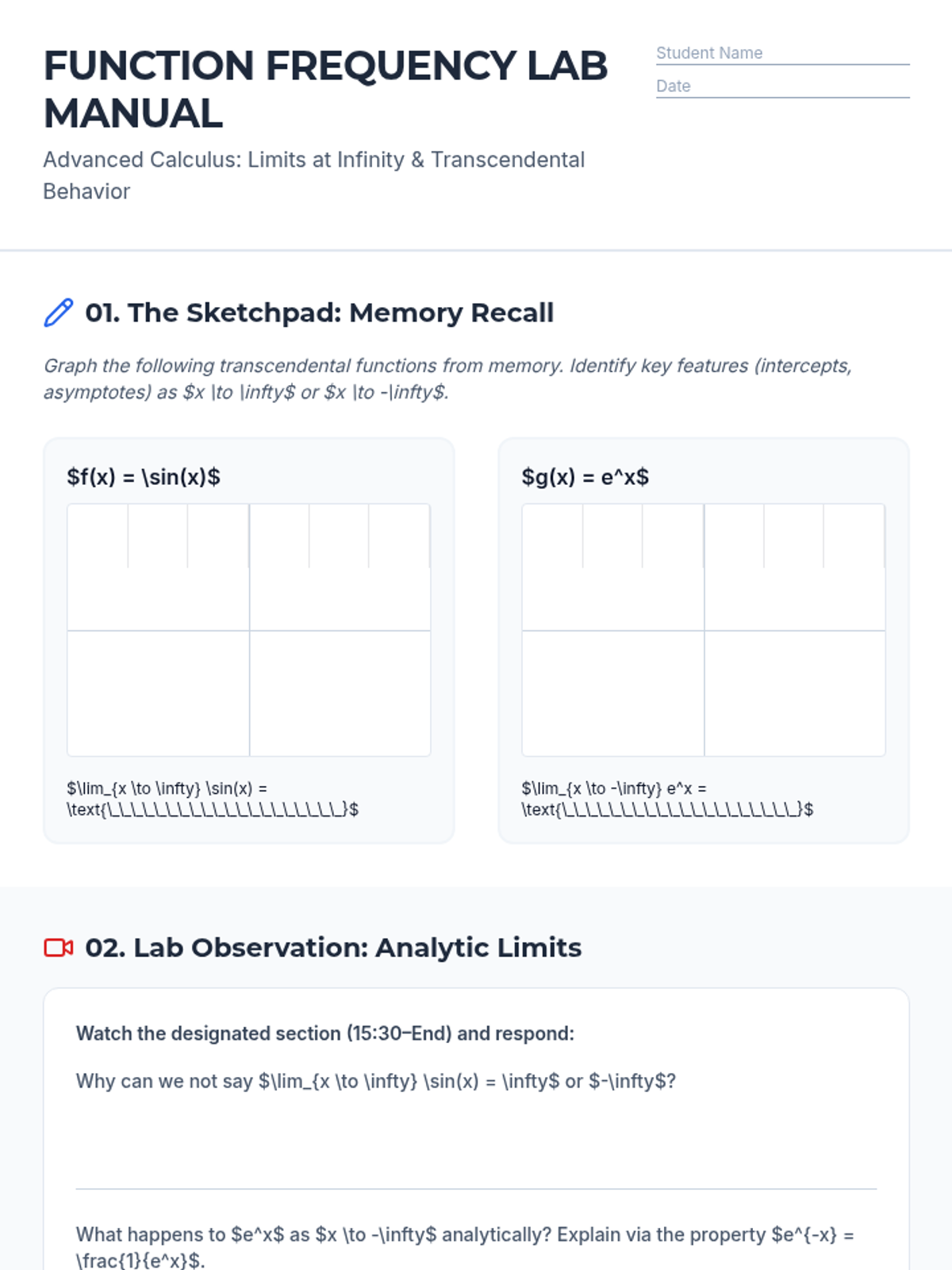
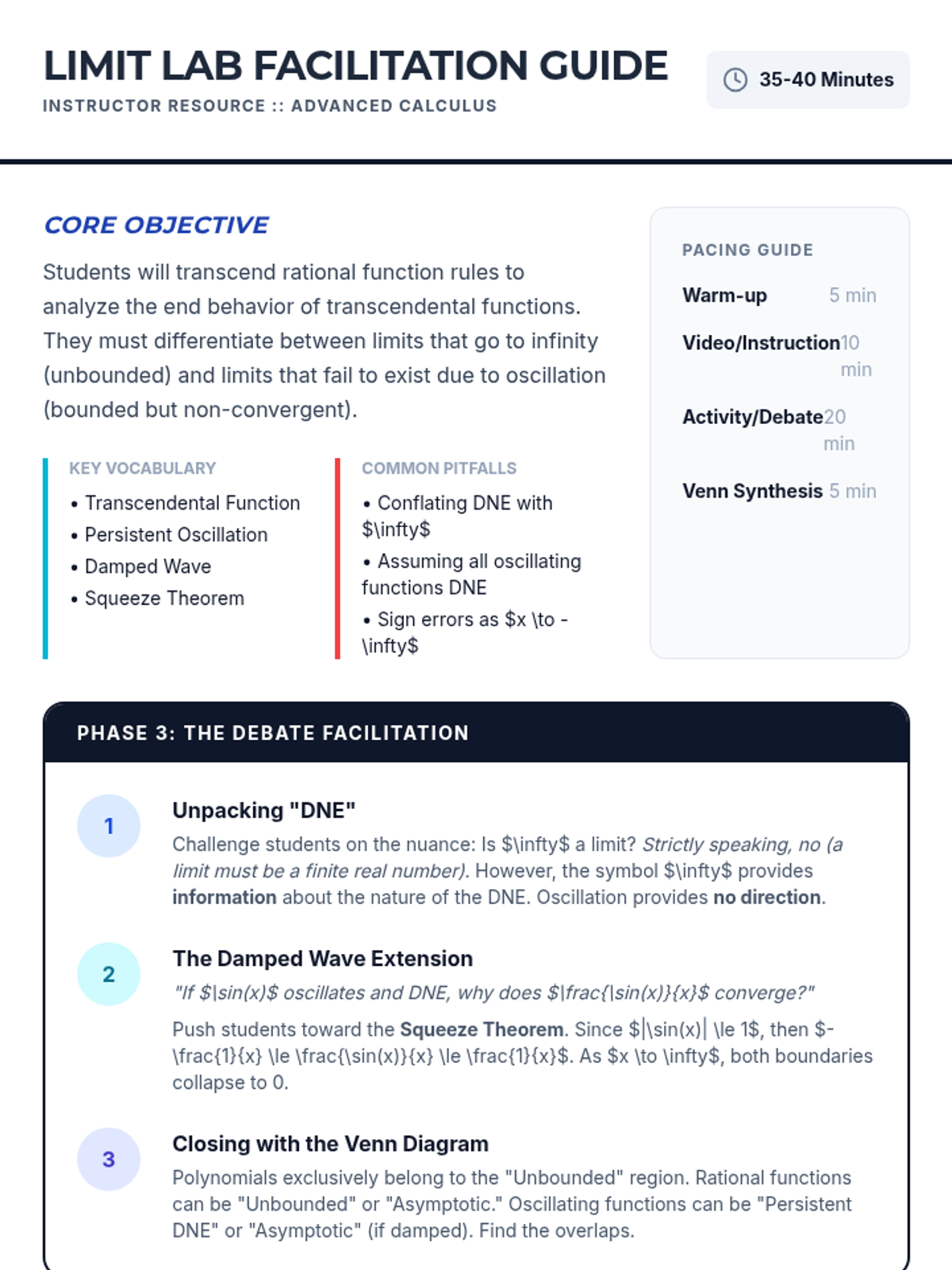
An undergraduate-level exploration into the behavior of transcendental functions at infinity, focusing on the distinction between unbounded growth and oscillatory non-existence. Students will analyze sine waves, exponentials, and damped oscillations to master formal limit notation and end-behavior analysis.
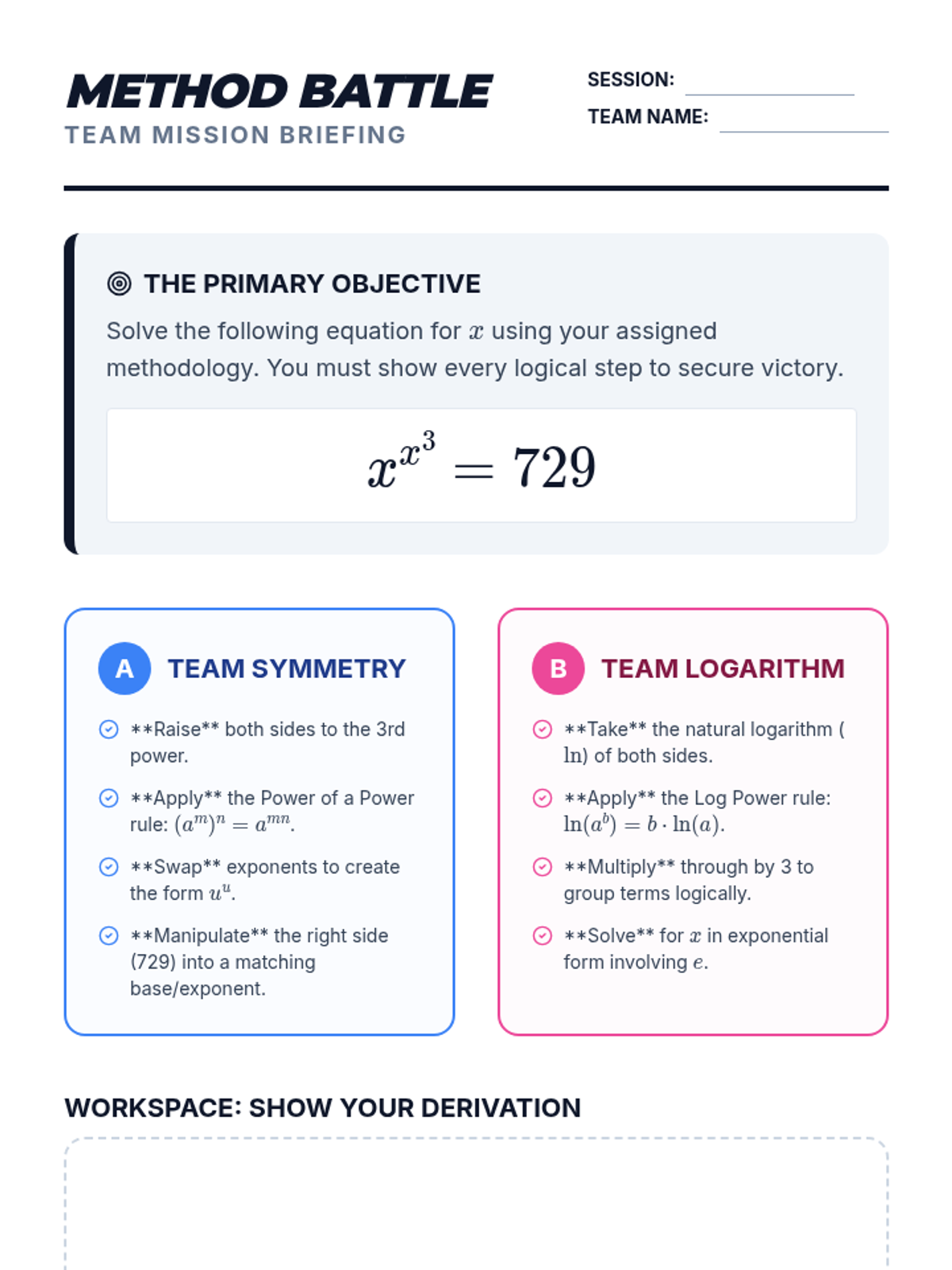
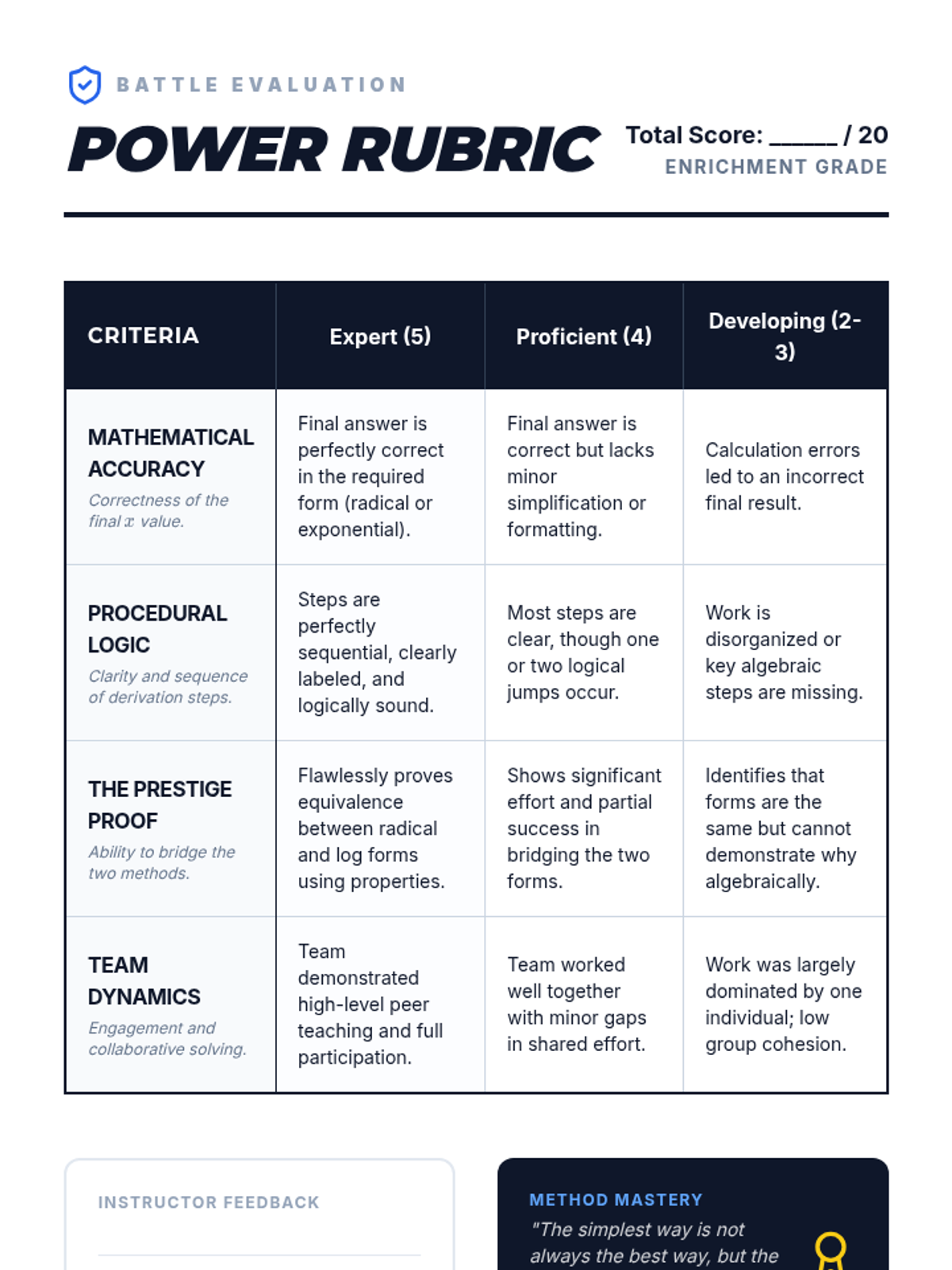
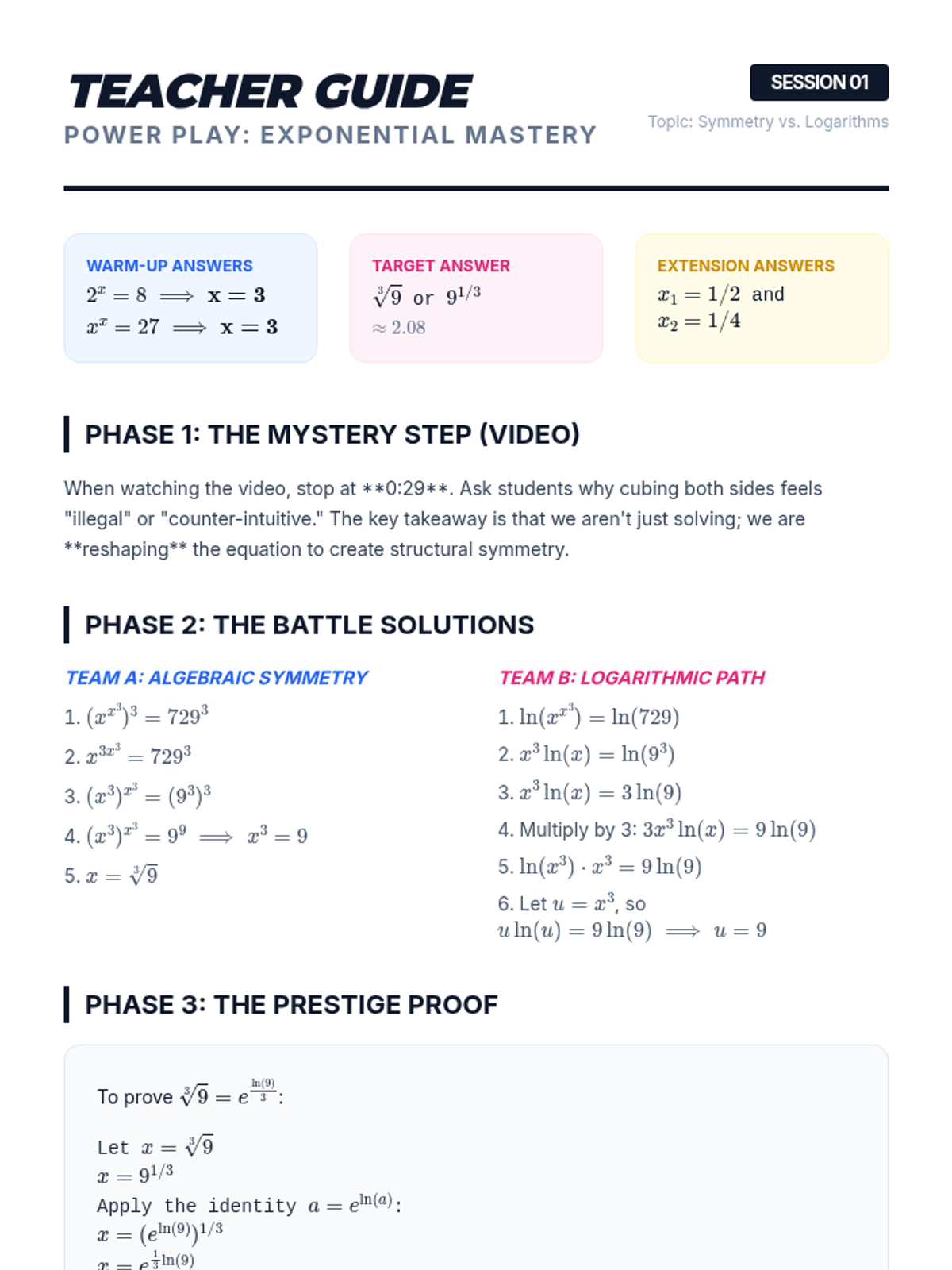
A high-energy math club session focused on solving complex exponential equations using algebraic symmetry versus logarithmic methods, featuring a competitive 'Method Battle'.
A deep dive into the properties of the Fibonacci sequence, deriving Binet's Formula and exploring the mathematical emergence of the Golden Ratio in nature.