Facilitator Script & Talk Tracks
Slides 1 through 6
Slides 1–2: Framing the Multilingual Mindset (10 Min) Opening
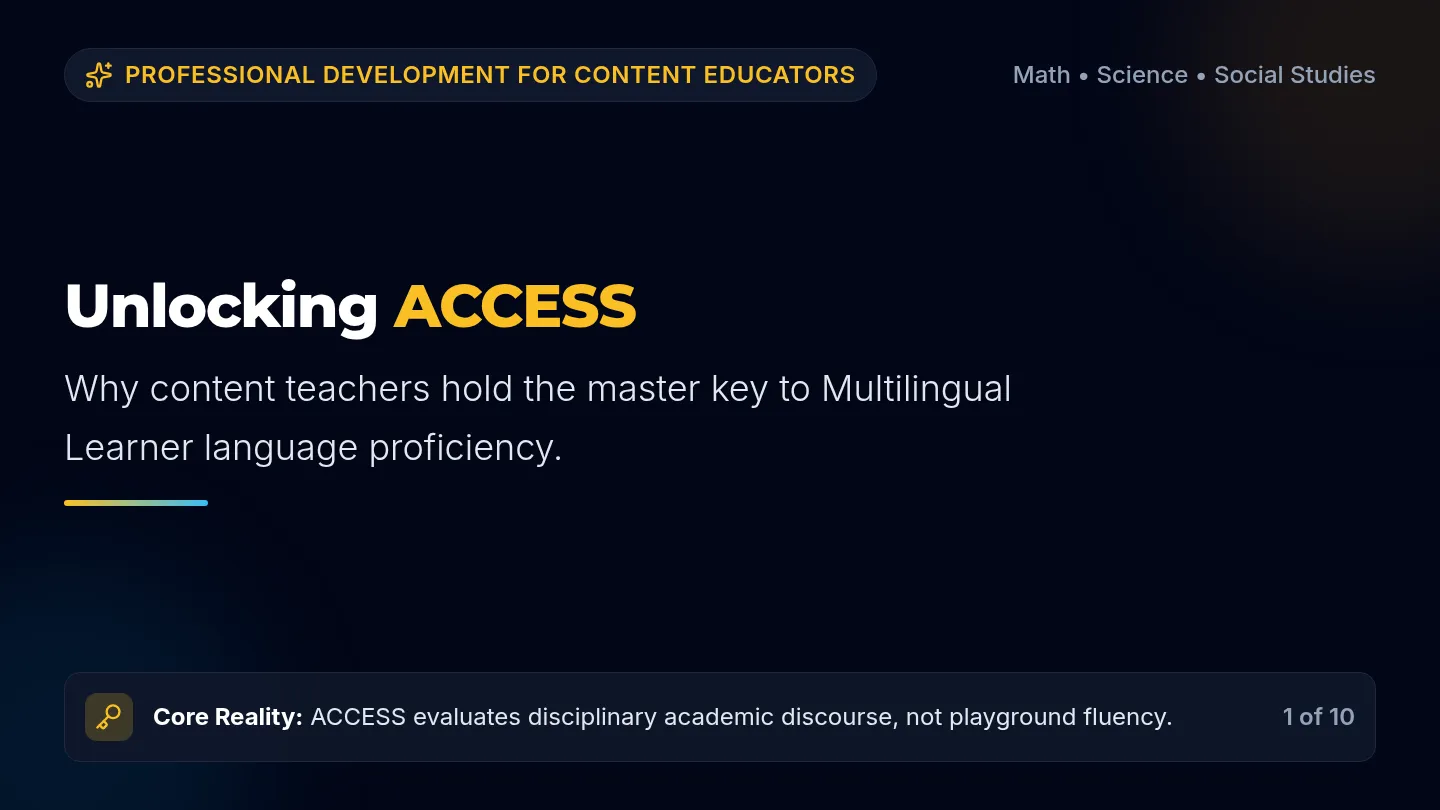
Talk Track: "Welcome colleagues. Today we bring together Topics 2 through 5 of our professional learning journey. Our focus is moving away from seeing English learners through a deficit lens—as students who 'lack' vocabulary—and instead recognizing bilingualism as a cognitive asset. Every teacher in this room is a teacher of academic language."
Facilitator Tip: Emphasize that language development is not solely the ESL teacher's job; content teachers provide the authentic context in which language is learned.
Slides 3–4: Topic 2 Digital Tools & Routines (15 Min) Topic 2 Scaffolds
Key Teaching Point: Scaffolding does NOT mean lowering cognitive rigor. Tools like Immersive Reader and Rewordify provide linguistic access while keeping grade-level complex thinking intact.
Turn & Talk Prompt (4 min): "Look at your upcoming unit. Where is the heaviest reading demand? How could Rewordify or Immersive Reader be positioned as an independent student workstation?"
Padlet/Flip Demonstration: Show how ELLs who are hesitant to speak in front of 30 peers will record rich 60-second video explanations in quiet corners when given sentence frames.
Slides 5–6: Topic 3 SLA Theories & Philosophy (20 Min) Topic 3 Core
Theoretical Walkthrough:
Facilitator Protocol (Philosophy Drafting - 10 min): Have participants open Section 2 of their Participant Workbook. Give 6 minutes of silent writing using the 4-step framework, followed by 4 minutes of peer review in dyads.
Multilingual Horizons Professional Development Suite Page 2 of 3 • Modules 1 & 2 Delivery
Facilitator Script & Talk Tracks
Slides 7 through 12
Slides 7–8: Topic 4 Reflective Practice & Culture (15 Min) Topic 4 Practice
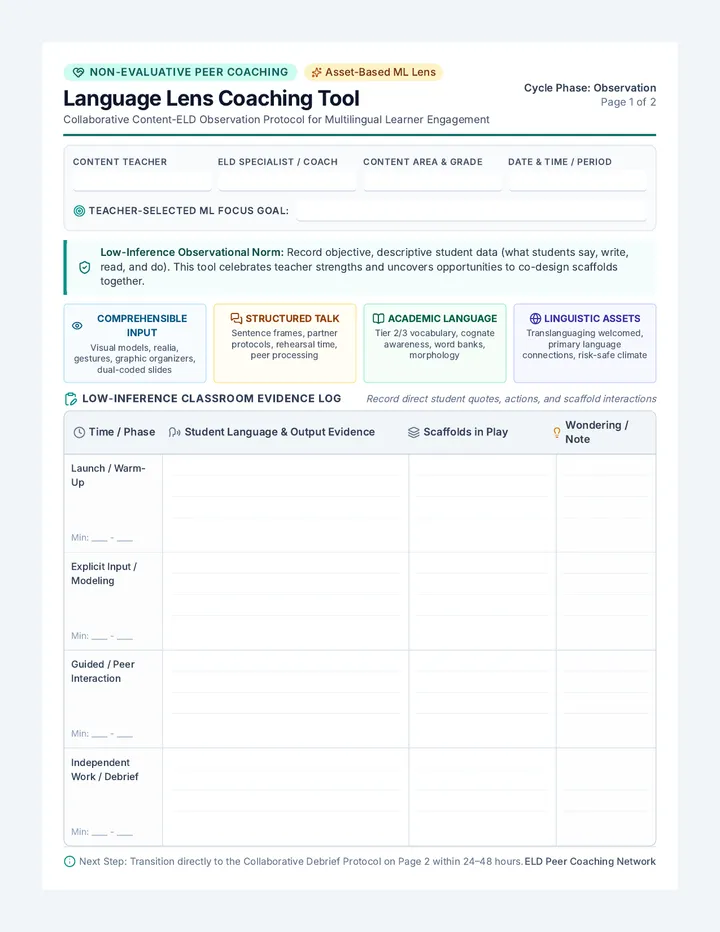
Talk Track: "Reflection is what transforms routine teaching into master craftsmanship. We cannot simply wonder why an ELL student is quiet; we must audit our own instructional pacing, teacher talk time, and classroom cultural inclusivity."
Spotlight on Cultural Resources: Highlight the placeholder link in Slide 8. Guide teachers to locate authentic bilingual texts, family funds of knowledge interviews, and WIDA Can-Do descriptors.
Action Step: Challenge every teacher to record just one 10-minute segment of their classroom this month and measure their wait time after asking questions (aiming for 5–7 seconds).
Slides 9–10: Topic 5 Assessment Accommodations & Validity (15 Min) Topic 5 Equity
Key Distinction (Construct-Irrelevant Variance): Explain why a test with dense, convoluted syntax fails to accurately evaluate science or math knowledge. Linguistic accommodations restore validity.
Extended Time (1.5x–2x): Crucial because bilingual students operate two linguistic channels simultaneously.
Bilingual Glossaries: Protects content measurement by eliminating barriers of non-essential words.
Slides 11–12: Professional Growth & PLP Integration (10 Min) Wrap-Up & Sign-Off
Closing Routine:
Professional Growth Pathways: Highlight WIDA E-Learning workshops, TESOL membership, and NABE credentials as avenues for school-sponsored PD hours.
PLP Link Submission: Instruct participants to embed the presentation link directly into the "Professional Development" section of their master Professional Learning Plan.
Leader Debrief Prompt: "What is one concrete accommodation you will add to this Friday's assessment?" Collect exit responses on sticky notes or digital Padlet board.
Multilingual Horizons Professional Development Suite Page 3 of 3 • Modules 3 & 4 Delivery
Krashen, Cummins, or Vygotsky
3
Guaranteed Scaffolds
Daily observable classroom supports
4
Equity Pledge
Advocacy for fair assessment & culture
Step 1: What do you believe about the linguistic and cultural assets of your ELL students?
Step 2: Which SLA theory (Krashen, Cummins, Vygotsky) directly guides your lesson design? Why?
Step 3: What concrete scaffolds (visuals, sentence stems, digital tools, wait-time) will every student observe?
Step 4: How will you advocate for equity in grading, testing accommodations, and family inclusion?
Final Synthesis: My Personal Teaching Philosophy Statement
Combine the 4 components above into a cohesive 3–5 sentence philosophy statement:
Empowering Multilingual Learners • Professional Learning Plan Page 2 of 4 • Teaching Philosophy Workshop
Topic 4 Continuous Growth
Reflective Audit
1. Video Analysis: Record a 15-min segment to audit teacher talk vs student talk and check for 5–7 sec wait-time.
2. Language Tracking Log: Follow 2 ELL focal students to track oral participation and scaffold effectiveness.
3. Peer Critical Friends: Invite an ESL coach or peer teacher to observe question-framing and scaffolding.
4. Cultural Journaling: Weekly reflection on curriculum representation, implicit bias, and family partnerships.
| Classroom Practice Indicator | Always | Sometimes | Goal Area |
|---|---|---|---|
| I provide 5–7 seconds of wait time after asking questions to allow cognitive processing. | ○ | ○ | ○ |
| I pair visual representations, gestures, and graphic organizers with verbal instructions. | ○ | ○ | ○ |
| I validate and encourage students' native languages as a cognitive bridge to English. | ○ | ○ | ○ |
| I utilize structured sentence starters and peer rehearsal before requesting whole-class responses. | ○ | ○ | ○ |
Topic 4: Cultural Resource for Educators Spotlight Resource Integration
[Insert Link to Cultural Resource for Educators]
Access curated family engagement tools, cultural audit rubrics, and multilingual asset frameworks.
How will you apply this cultural resource to engage families and validate cultural backgrounds?
My Reflection Commitment:
Which reflective strategy (video, language log, peer observation, journal) will you implement next week?
Empowering Multilingual Learners • Professional Learning Plan Page 3 of 4 • Reflection & Cultural Resources
Topic 5 & Professional Growth
Equitable Evaluation
| Accommodation | How It Supports ELLs | Construct-Irrelevant Barrier Removed |
|---|---|---|
| Extended Time (1.5x–2x) | Accounts for dual-language mental processing, decoding, and mental translation. | Eliminates cognitive fatigue and rushed guessing due to time constraints. |
| Bilingual Glossaries | Allows lookup of incidental, non-construct words (e.g., 'meadow', 'adjacent'). | Prevents vocabulary hurdles from blocking math/science concepts. |
| Oral Read-Aloud | Teacher or TTS reads questions aloud on non-reading assessments. | Isolates content understanding from English decoding barriers. |
| Visual & Formatted Scaffolds | Chunked items, extra white space, bolded keywords, word banks, and diagrams. | Reduces perceptual overload and organizes student response structure. |
Unit Assessment Audit (Examine your upcoming unit exam):
What is one potential linguistic obstacle on this test, and which accommodation will you apply?
WIDA Workshops: Complete self-paced e-learning modules on scaffolding and language standards.
TESOL International: Access research journals, webinars, and micro-credentials in Content-Based Instruction.
NABE & Endorsement: Enroll in district-sponsored ESL endorsement or bilingual leadership cohorts.
Professional Learning Plan (PLP) Sign-Off Portfolio Evidence
[Insert Link to Digital PD in Professional Learning Plan]
Paste this presentation link into the "Professional Development" section of your master PLP.
Participant Signature & Date:
PLC Facilitator / Coach Verification:
Empowering Multilingual Learners • Professional Learning Plan Page 4 of 4 • Accommodations & PLP Sign-Off