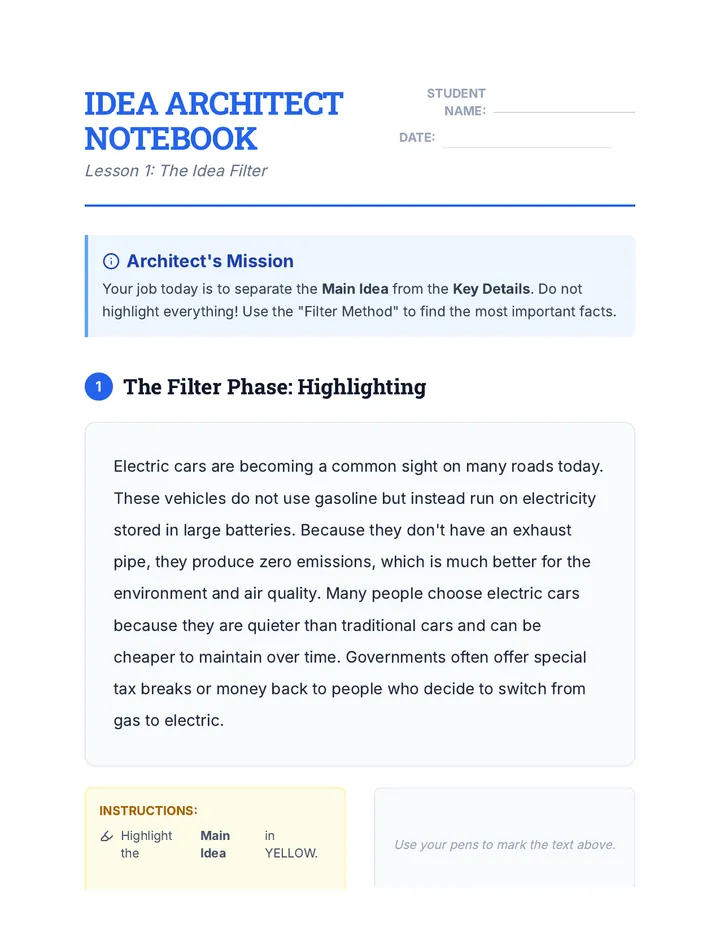
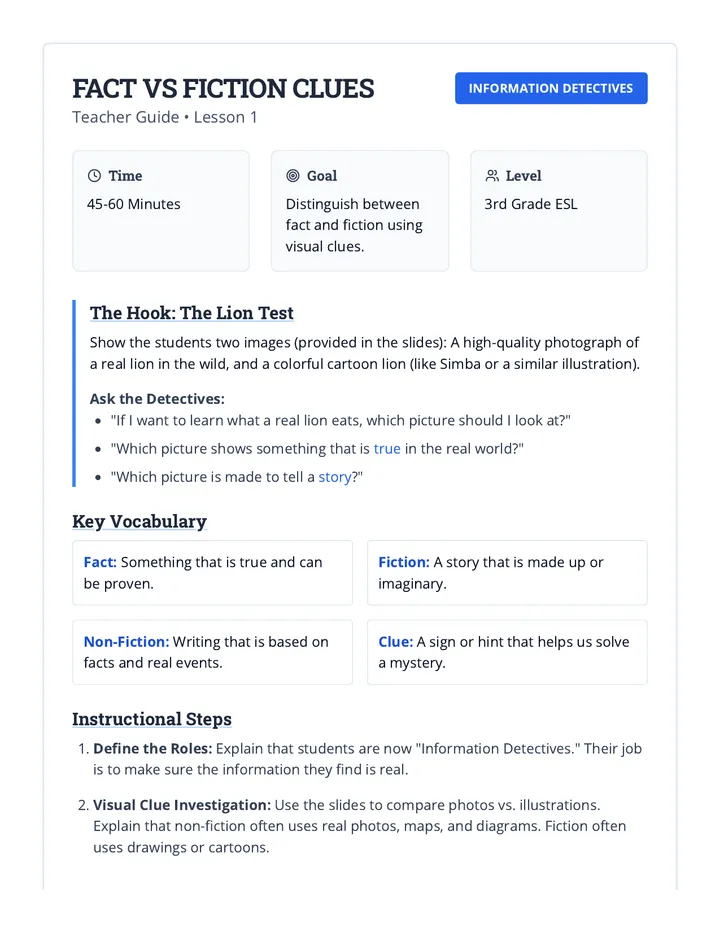
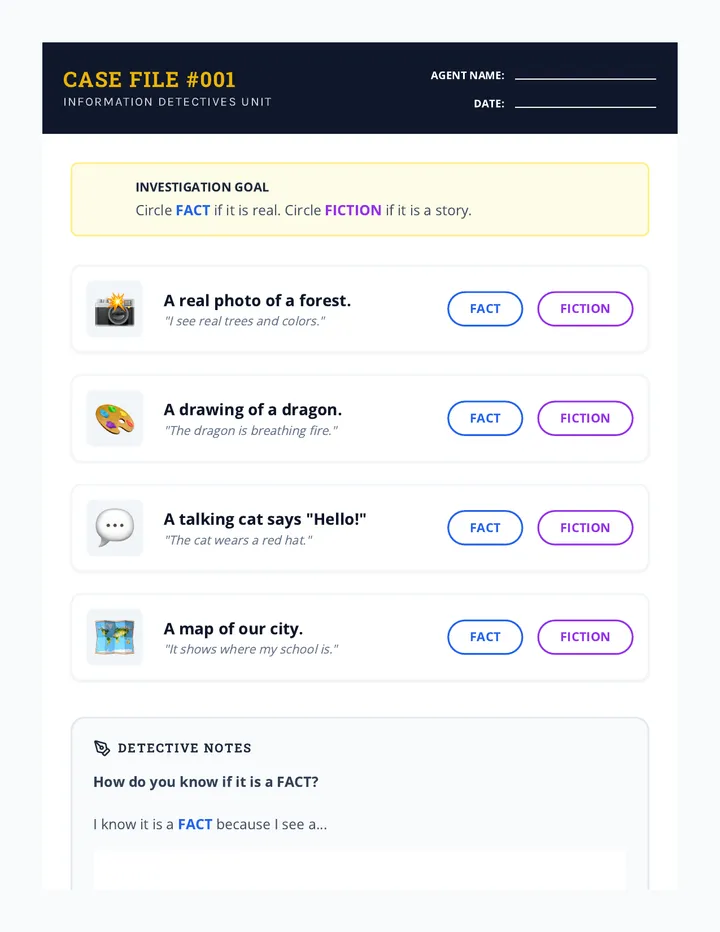
Detective Briefing Teacher Guide Detective Briefing
Lesson 1: Picture Walks & Prediction
TEACHER GUIDE
Mission Objective
Students will act as "Story Detectives" to hunt for clues in pictures. The goal is to predict what happens in a story before reading a single word, building essential pre-reading comprehension skills.
Key Vocabulary
• Picture Walk
• Prediction
• Clue
• Front Cover
The Hook: The Mystery Book
Take a high-interest picture book and use blue painter's tape to cover all the text on every page.
"Oh no, Detectives! A sneaky villain stole all the words from this book! Can we still figure out what is happening using just our eyes?"
Step-by-Step Investigation
1
The Cover Clue
Look at the front cover. Ask: Who is in the picture? Where are they? What do you think they are doing?
2
The Picture Walk
Slowly flip through the pages. Don't read! Point to specific details. "I see a rainy cloud here. What do you think will happen next?"
3
Making Predictions
Stop at a climax or turning point. Ask students to "Lock in their predictions" by crossing their arms like a detective.
Support for ELLs
Visual Scaffolding
Use physical gestures (pointing to eyes for "look", pointing to the brain for "think").
Sentence Frames
"I see a..."
"I think..."
Clue Hunt Slides Clue Hunt
Story Detective Mission #1
Look
Think
Guess
What is a Detective?
They look for CLUES.
They use pictures to GUESS.
"I use my eyes to find the story!"
Picture Walk
1
Look at the Cover
2
Flip the Pages
3
Find the Clues
Don't read the words yet! Just look at the pictures!
Practice Case
What happens next?
The sky is grey and rainy...
A. Get an umbrella
B. Go swimming
Why did you pick A? Where is the clue?
Future Finder Worksheet Future Finder
Story Detective Worksheet
Name:
Date:
Clue Detective Mission
What do you think will happen next in the story?
Draw your prediction inside the magnifying glass!
I saw a clue!
I used my brain to guess.
Emotion Investigation Teacher Guide Emotion Investigation
Lesson 2: Identifying Feelings
Teacher Guide
Mission Brief
Detectives need to understand how characters feel to solve the story! Students will learn to "decode" faces—looking at eyes, eyebrows, and mouths to name emotions.
Target Emotions
Happy
Sad
Angry
Scared
The Hook: Mirror Me
Hand out small hand mirrors or use a large classroom mirror. Show a character's face from a book.
"Look at our book character! Can you make your face look exactly like theirs? Check your mirror! What are your eyebrows doing?"
Facial Clue Checklist
The Mouth
"Is it turned up like a rainbow or down like a bowl?"
The Eyes
"Are they wide and big, or small and squished?"
The Hands
"Are the hands over the mouth? Clutched in fists?"
The Setting
"Where are they? Is it dark and spooky, or bright and sunny?"
Investigation Questions
"How do you think [Character] feels right now?"
"What clue in the picture tells you that?"
"Have you ever felt that way? What happened?"
Face Decoder Slides Face Decoder
Story Detective Mission #2
Snap a Face
How do they feel?
The Mouth Clue
HAPPY
SAD
"Is the mouth smiling up or frowning down?"
The Eye Clue
Wide & Big
Surprised or Scared!
Squished & Angry
Mad or Focused!
INVESTIGATION TIME!
Show me your "Scared" eyes!
Now show me your "Angry" eyes!
Case File #2
How does Bear feel?
🐻
Clue: Frown & Angry Brows
Happy
Angry
Sleepy
Mirror Me Worksheet Mirror Me
Story Detective Worksheet
Name:
Date:
Face Decoder Mission
Look at the character in the book.
Draw their face and circle how they feel!
I am a Face Detective:
How do they feel?
Happy
Sad
Angry
Scared
Detective's Evidence Note:
Ordering Operations Teacher Guide Ordering Operations
Lesson 3: Sequencing Events
Teacher Guide
The Mission
Stories have a path! Detectives must learn to put events in the right order so the story makes sense. We will focus on 3 parts: Beginning, Middle, and End.
Core Concepts
1. First (Beginning)
2. Next (Middle)
3. Last (End)
The Hook: The Mixed-Up Mess
Prepare 3 large pictures from a familiar story. As you walk to the front of the class, "accidentally" drop them.
"Oh no! My story pictures are all mixed up! The ending is at the front and the middle is on the floor! Detectives, can you help me fix the story?"
Step-by-Step Sorting
1
Find the START
Look for the "Once upon a time" moment. Who is there? What are they starting to do?
2
Follow the ACTION
Look for the "middle" picture. This is where the most stuff happens! What changed from the first picture?
3
Spot the FINISH
Find the resolution. How do they feel now? Are they going home? Are they happy?
Scaffolding for Success
Numbering
Use colored dots (Green = Start, Yellow = Middle, Red = End) for extra visual support.
Oral Retell
Encourage students to use the words "First," "Then," and "Last."
Scrambled Story Slides Story Scramble
Story Detective Mission #3
First
Next
Last
The Story Path
Beginning
The story starts!
Middle
Things happen!
End
The story is over!
Can you fix it?
A seed wants to grow into a flower!
A
B
C
Which letter is first?
Case Solved!
C
First
B
Next
A
Last
Step-by-Step Sorting Cards Worksheet Step-by-Step
Story Detective Worksheet
Name:
Story Path Mission
Cut out the pictures at the bottom.
Glue them in order to show how to make a sandwich!
1
First
2
Next
3
Last
Yum! Eat the sandwich.
Get two slices of bread.
Put the jam and butter on.
Narrative Network Teacher Guide Narrative Network
Lesson 4: Oral Retelling
Teacher Guide
The Voice Mission
Detectives must share their reports! Today, students will use everything they've learned—predicting, emotions, and sequencing—to "read" a book to a partner using only the pictures.
Skills
• Oral production
• Vocabulary use
• Confidence
• Active listening
The Hook: The Gold Reader's Chair
Decorate a special chair in the front of the room (with tinsel, a cape, or a sign).
"Today, you are the storytellers! Whoever sits in this chair is the Story Master. You don't need to read the words—the pictures will tell you what to say!"
Detective Briefing Stems
Model these sentences for ELLs and all students to use during their turn.
Describing
"I see a..."
Ex: "I see a big blue truck."
Emotions
"They feel..."
Ex: "They feel very scared!"
Sequencing
"And then..."
Ex: "And then he went home."
Inferencing
"Because..."
Ex: "He is crying because he is sad."
Tips for Success
• Pairing: Pair an ELL with a more proficient English speaker to model language.
• Visual Cues: Keep the "Face Decoder" slides or posters visible during the activity.
• Wordless Books: Use high-quality wordless books (like *A Boy, a Dog, and a Frog*) for the best results.
Storyteller Stage Slides Storyteller Stage
Story Master Mission #4
No Words
Just Talk
Be a Story Master
Rule #1
Use your EYES to read the pictures.
Rule #2
Use your VOICE to tell the class.
"I don't need the words! I am the book!"
Use Your Sentence Tools
"I see..."
Describe the picture!
"First..."
Start the story!
"They feel..."
Check the faces!
"Then..."
Show what's next!
Story Master Practice
What is the bird doing?
In a nest...
TELL YOUR PARTNER:
1
What do you see?
2
How does the bird feel?
3
What will it do next?
Wordless Wonder Retelling Sheet Wordless Wonder
Story Master Checklist
Name:
Storyteller Mission
"Read" your picture book to a partner.
Check the boxes as you tell your story!
I am a Story Master because...
I told WHO is in the story.
"I see a bear and a bird!"
I told HOW they feel.
"The bear feels very happy!"
I told WHAT happened.
"First, next, and last!"
I used my LOUD VOICE.
"My partner could hear me!"
Partner Verification:
Did your partner tell a great story?
YES!
SUPER!
Case Closed Teacher Guide Case Closed
Lesson 5: Connecting Visuals & Text
Teacher Guide
The Final Unlock
The mystery words are finally revealed! Today, we peel back the tape and see if our "Story Detective" work matched the author's words. This lesson bridges visual comprehension with early text recognition.
Big Reveal
• Truth vs. Guess
• Matching Words
• Evidence Check
The Hook: The Big Reveal
Bring back the taped-up book from Lesson 1. Gather the "Story Detective reports" (drawings) from the previous lessons.
"Detectives, it's time! We are going to peel back the tape. Are you ready to see if our picture-reading was right? On the count of three... 1... 2... 3!"
Verification Steps
1
Read the Words
Read the text aloud. Ask: "Did the book say what we thought?"
2
Word Hunting
Point to a simple word (e.g., 'cat', 'red', 'run'). Ask: "Which word matches this part of the picture?"
3
Detective Celebration
Explain that pictures help us read words! Whenever they see a hard word, they can look at the picture for a clue.
Graduation Checklist
Makes predictions using pictures
Identifies 3+ character emotions
Sequences 3 main story events
Matches simple words to visuals
Mystery Revealed Slides Mystery Revealed
The Final Case File
Pictures
Words
The Big Peel
WORDS
When we take the tape off...
We see if the author wrote the same story we "read" in the pictures!
"Our eyes told us the truth!"
Match the Word
Picture Clue
CAT
SUN
DOG
Story Detectives
CASE CLOSED
You are ready to read words!
Word Match Mission Worksheet Word Match Mission
Story Detective Final Mission
Name:
Final Case Mission
Look at the picture. Look at the words.
Draw a line to match them!
HAT
CAT
SUN
Graduation Day!
You are an official STORY DETECTIVE!