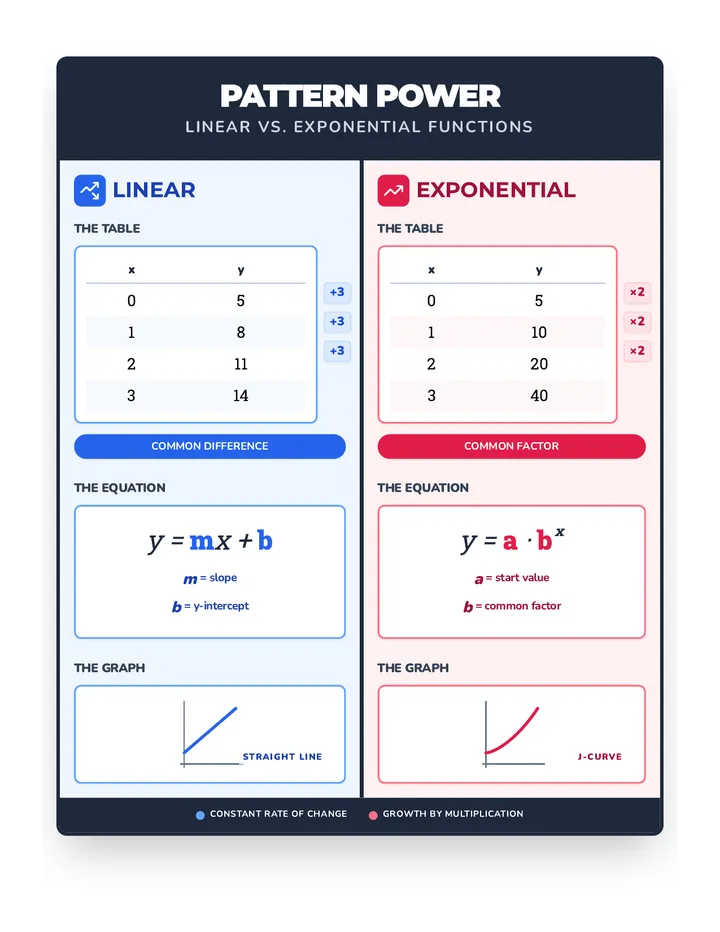
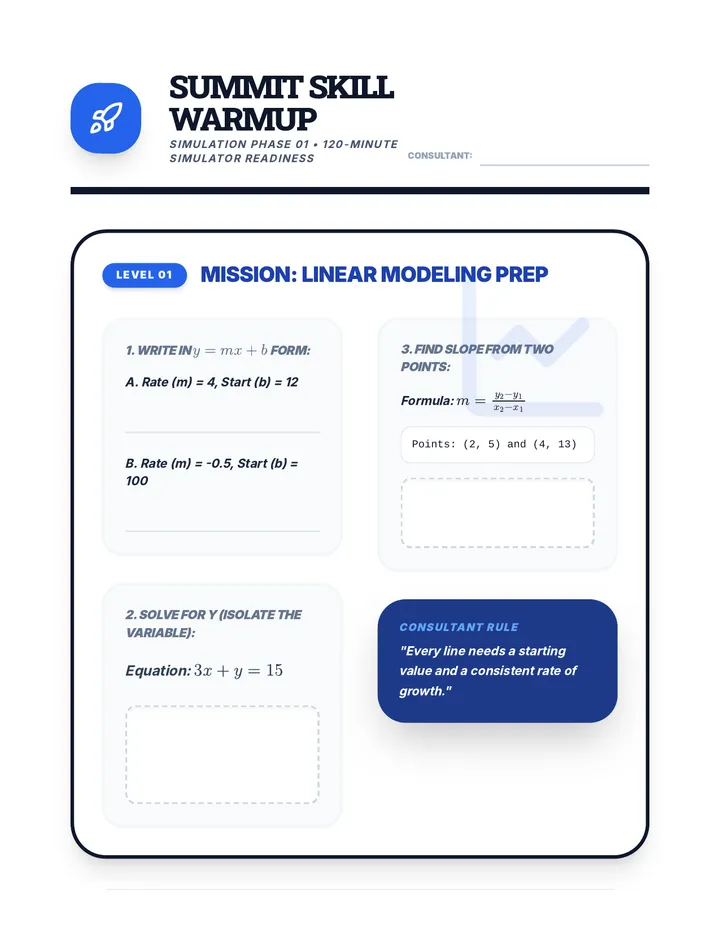
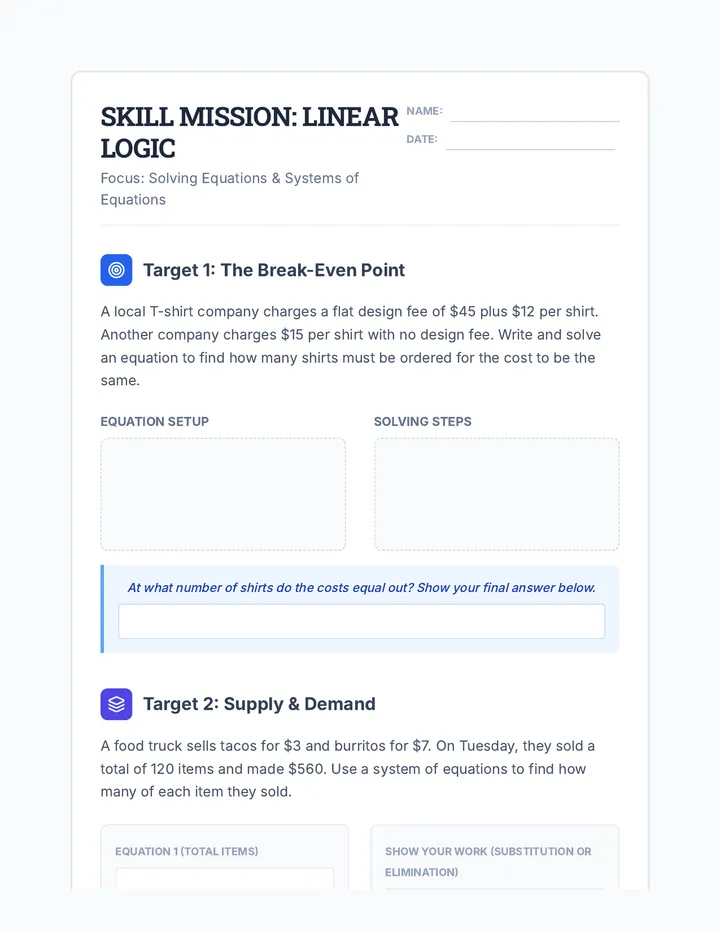
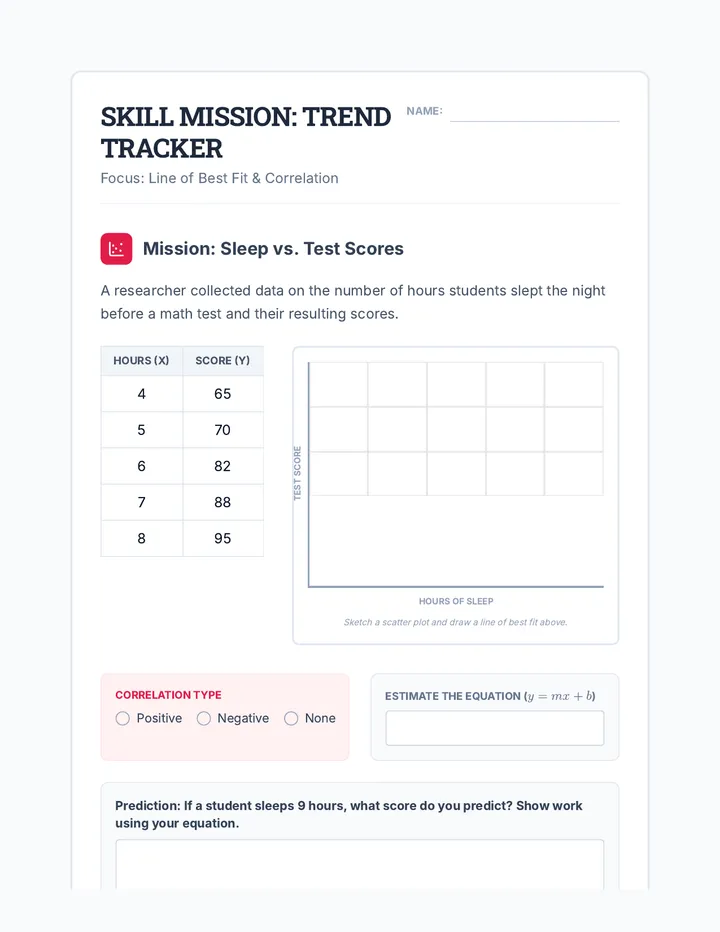
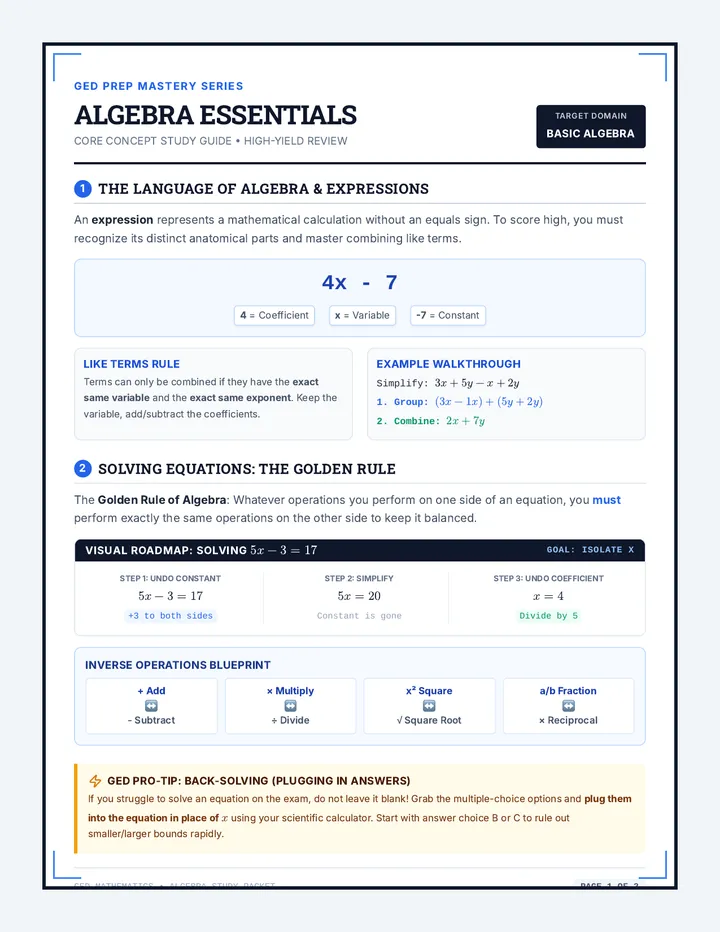
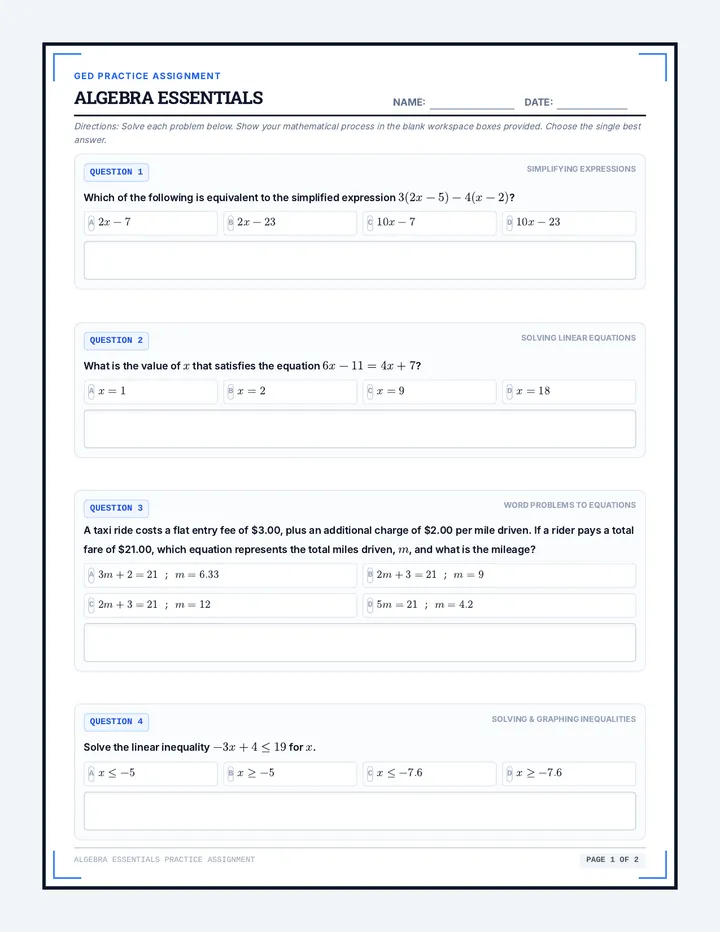
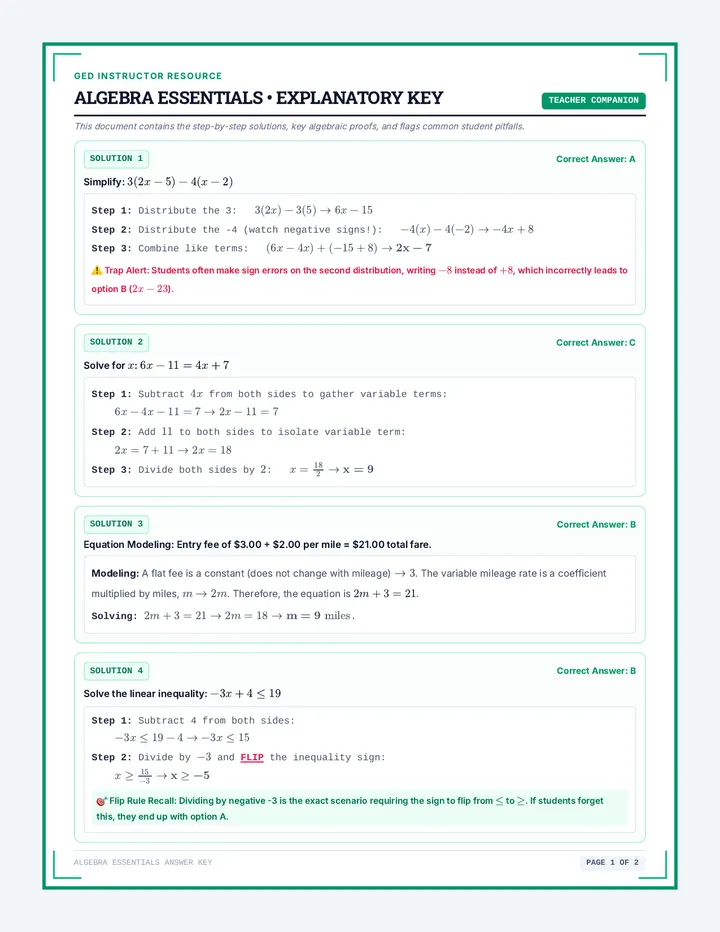
Mapping relationships through notation, algebraic representations, and growth rate comparisons. Equips learners to transform functions, model contextual data, and solve exponential equations.
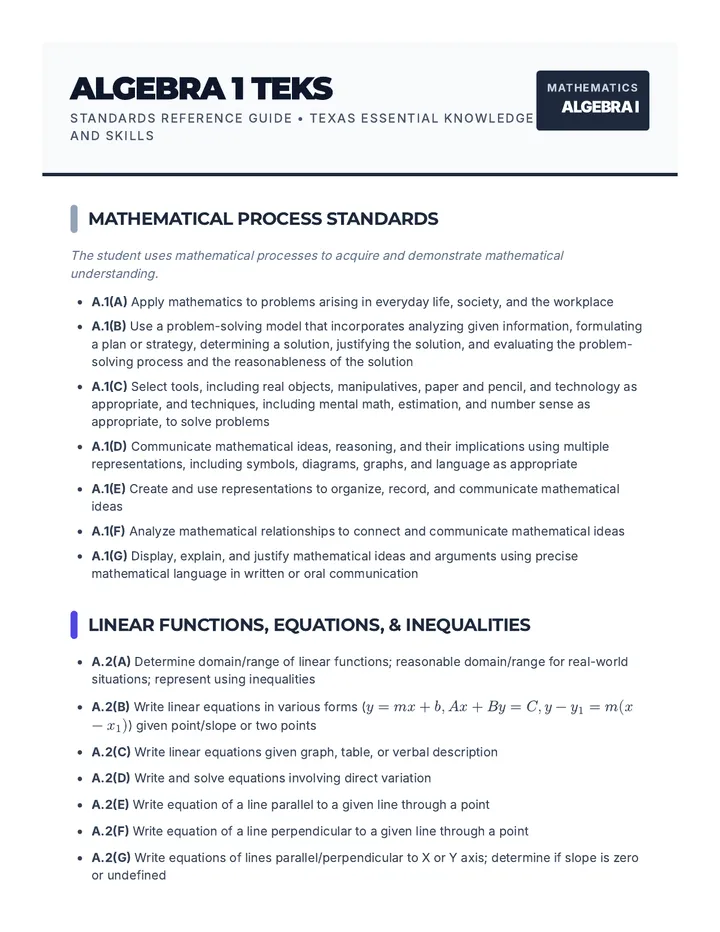
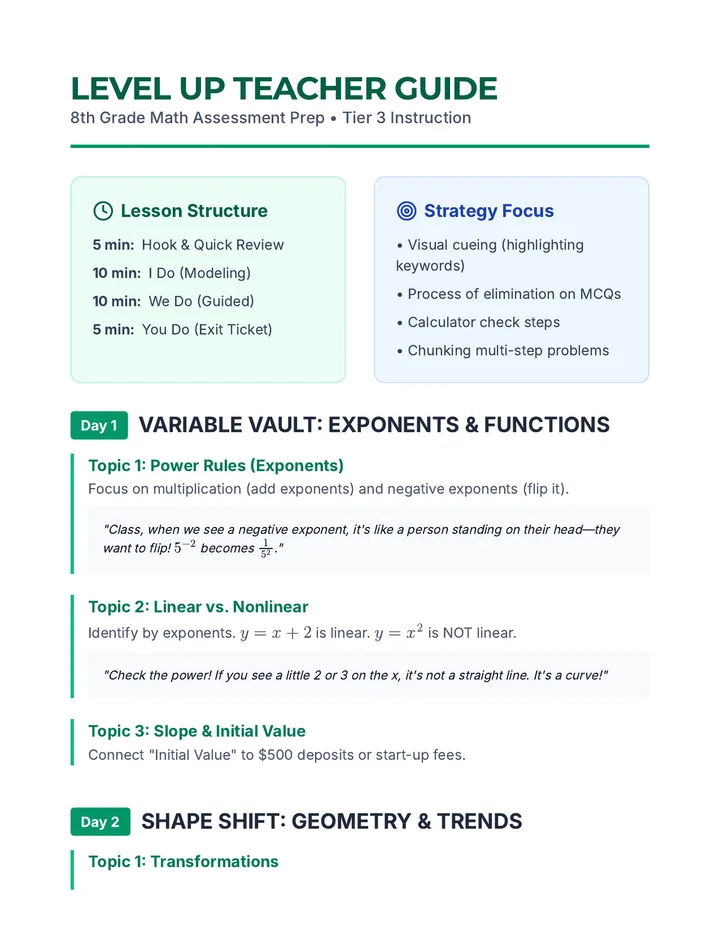
A specialized intervention sequence designed for Algebra I students to master TEKS A2A and A6A, focusing on the domain and range of linear and quadratic functions through tiered small-group instruction.
A lesson sequence focusing on the algebraic and graphical properties of radical equations, bridging the gap between symbolic manipulation and visual intersection points.
A series of higher-level mathematics lessons exploring calculus foundations through engaging, thematic activities and visual demonstrations.
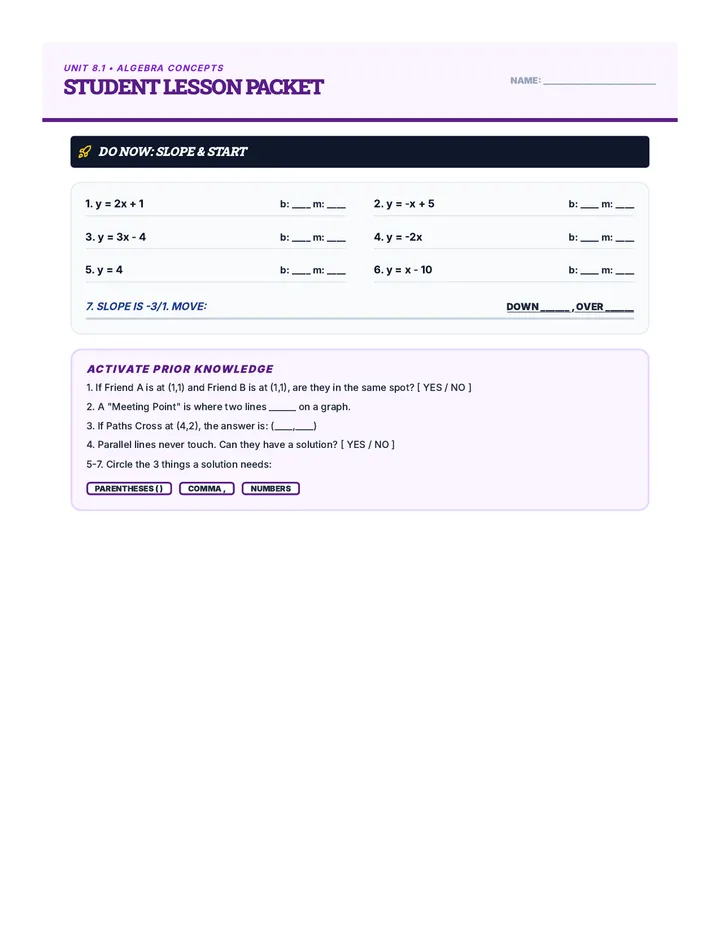
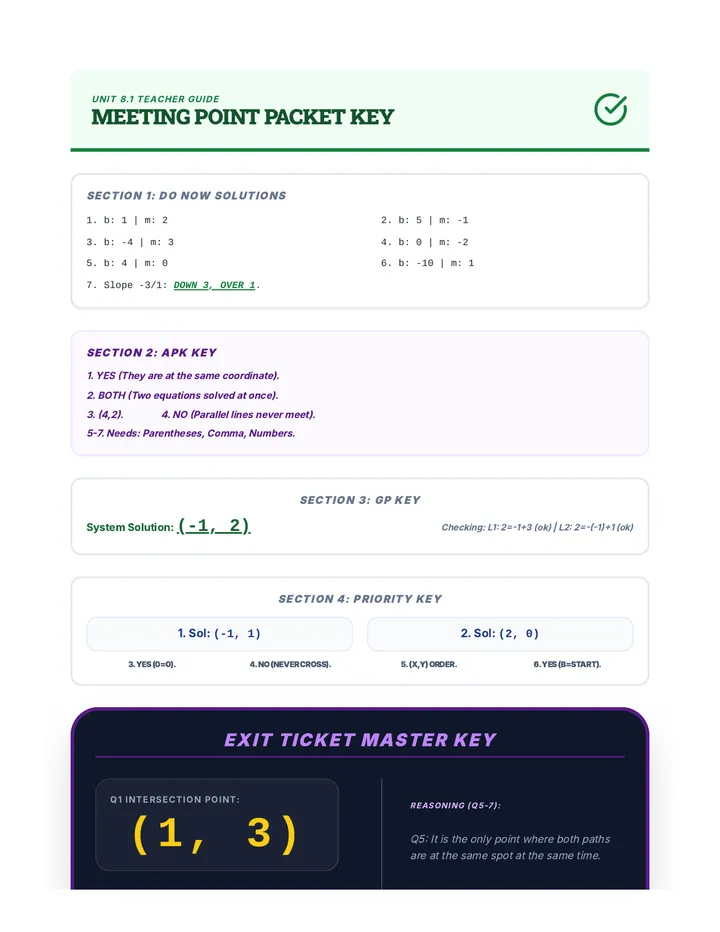
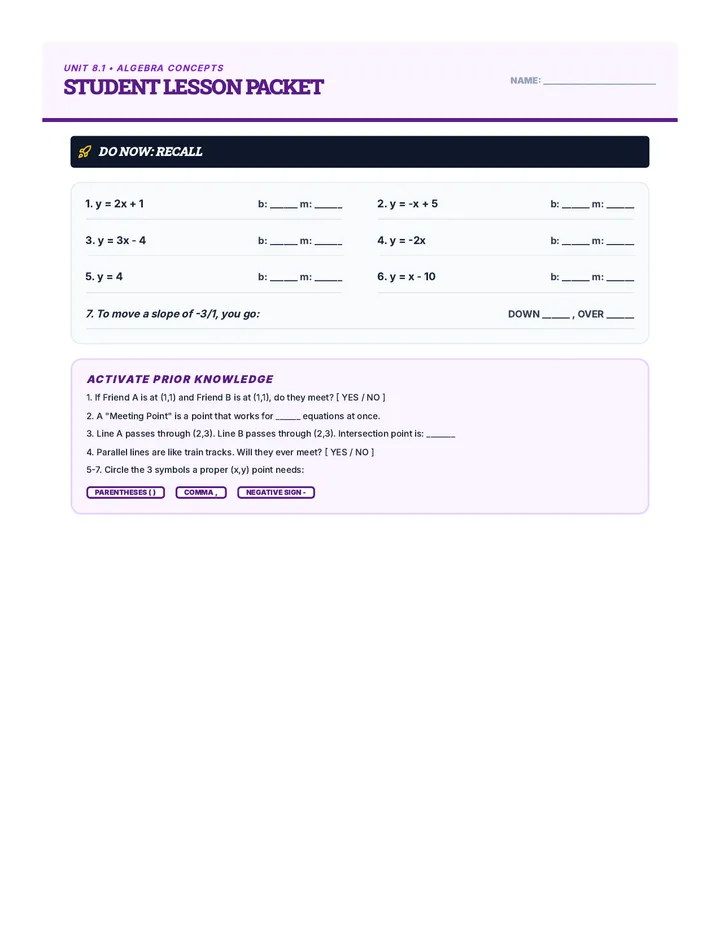
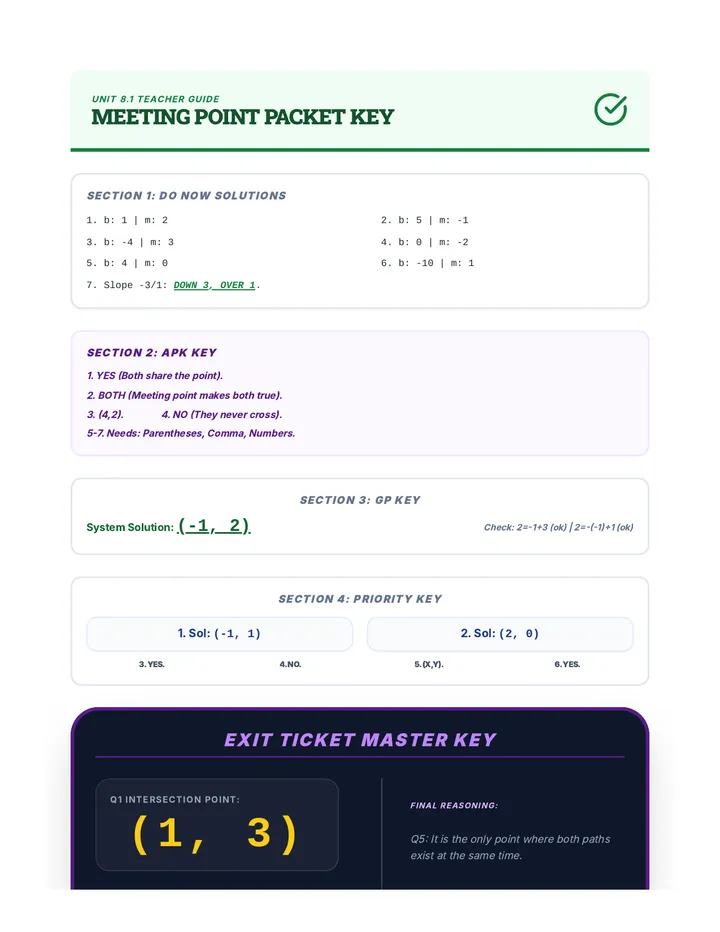
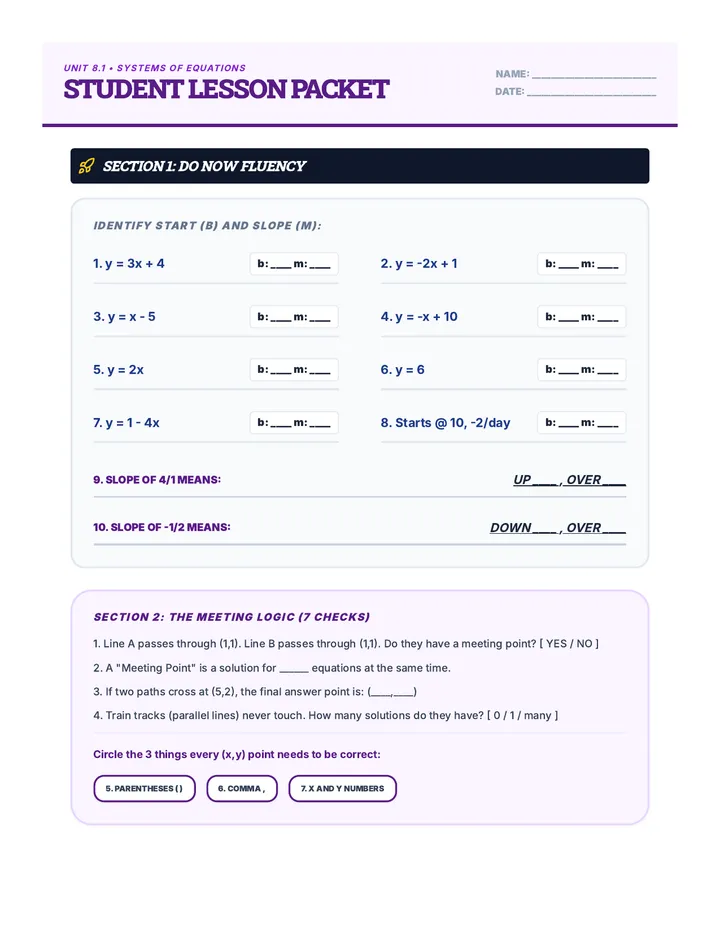
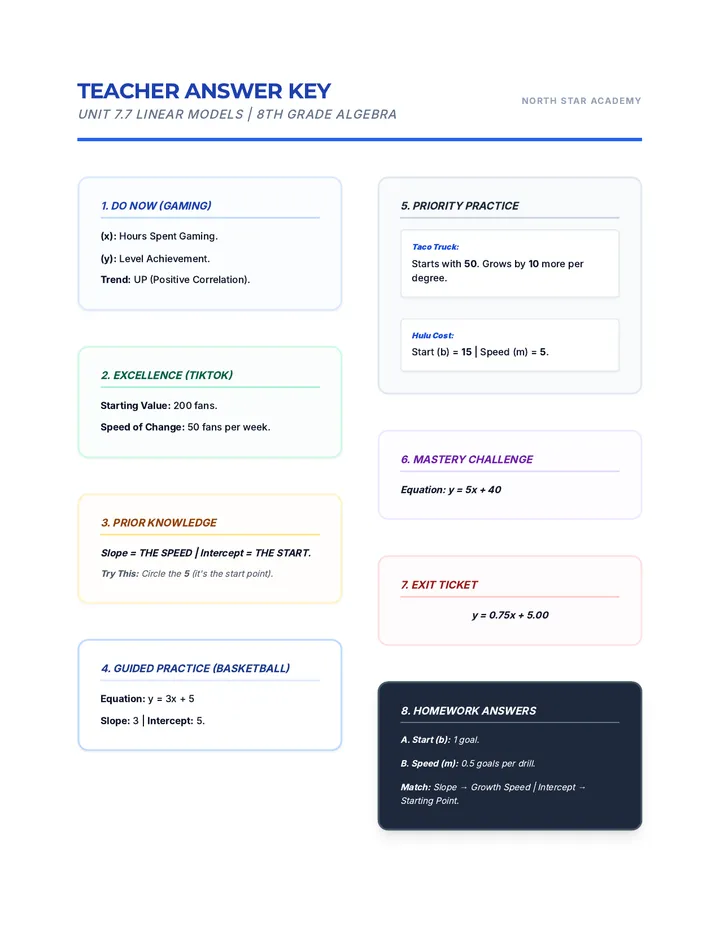
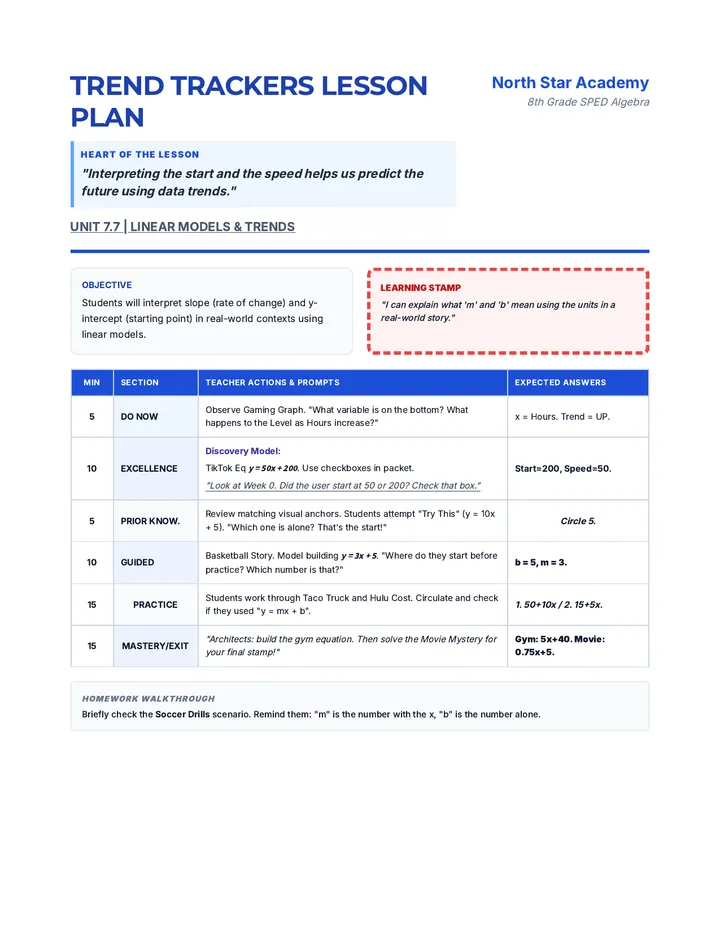
A sequence focused on visualizing linear functions through physical movement and spatial reasoning, designed for middle school students to master slope-intercept form.
A lesson sequence focusing on the transition from expanded ellipsis notation to formal Sigma notation within the context of arithmetic series proofs. Students analyze a standard proof and reformulate it using summation properties.
A high-level Honors Algebra lesson focused on complex recursive sequences where students analyze notation, explore the Fibonacci sequence, and engage in a 'Sequence Maker' activity to reverse-engineer formulas.
A series of Algebra I support lessons designed to address fundamental misconceptions in linear functions through interactive, theme-based activities.
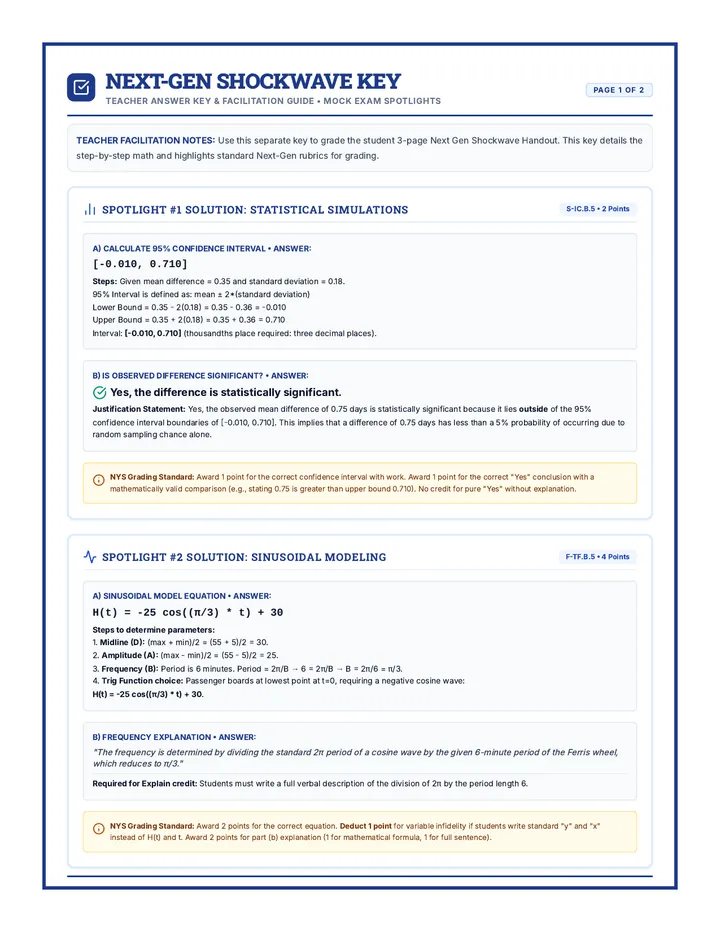
A specialized unit exploring the geometric properties of slope, connecting algebraic rates of change to trigonometric functions and the geometry of inclination.
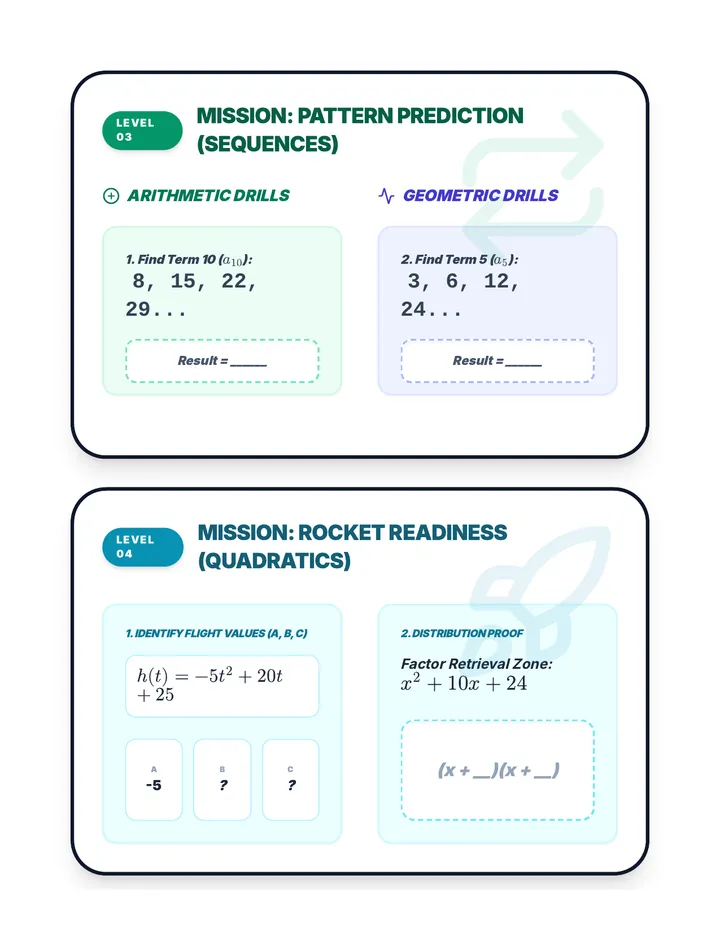
A comprehensive 9th-grade algebra unit exploring the patterns, formulas, and real-world applications of arithmetic and geometric sequences. Students progress from recursive logic to explicit modeling.
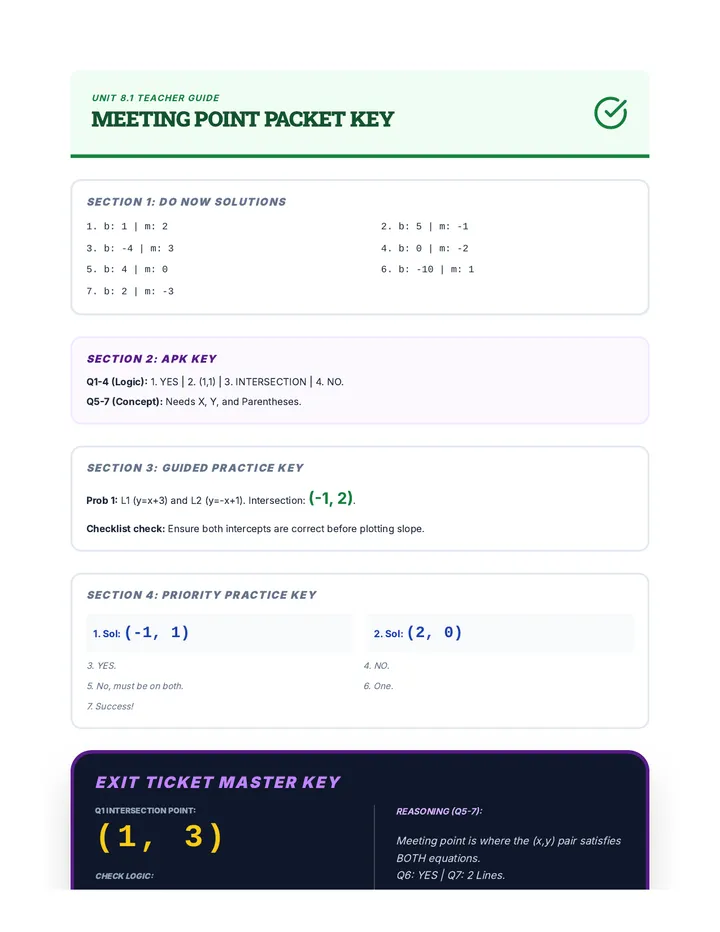
A lesson sequence focused on identifying and correcting domain restriction errors for 9th-10th grade algebra students. Students act as 'Error Doctors' to diagnose and treat mathematical misconceptions using video-based instruction and peer review.
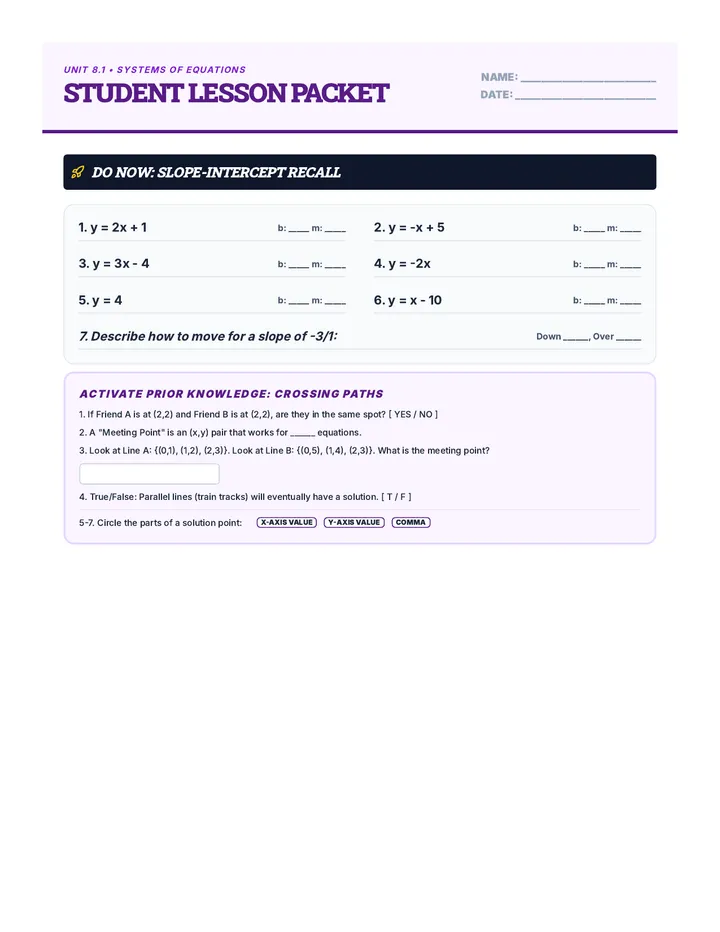
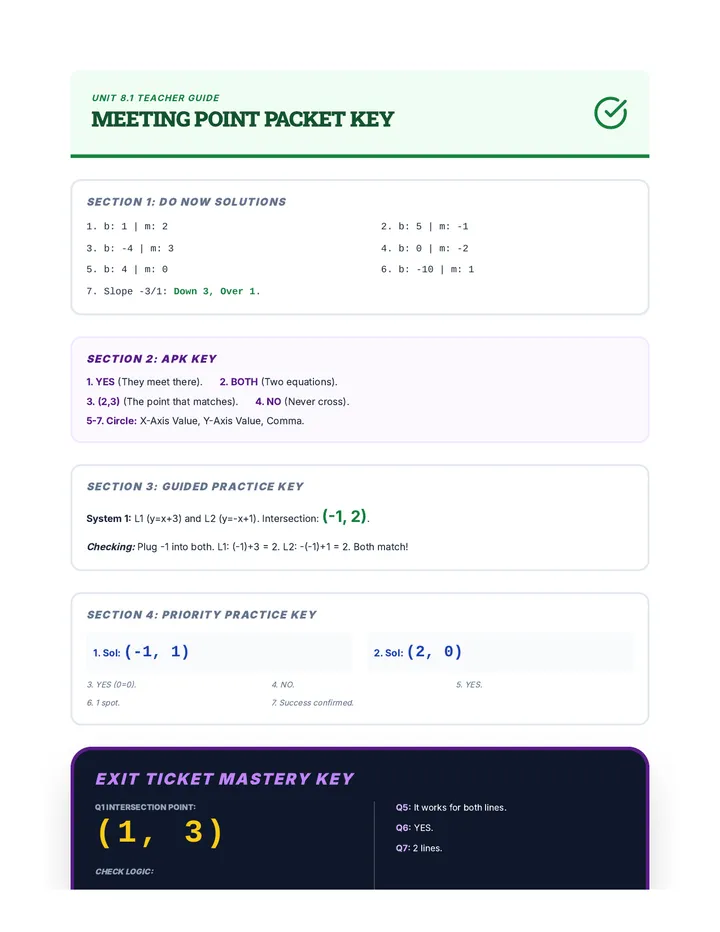
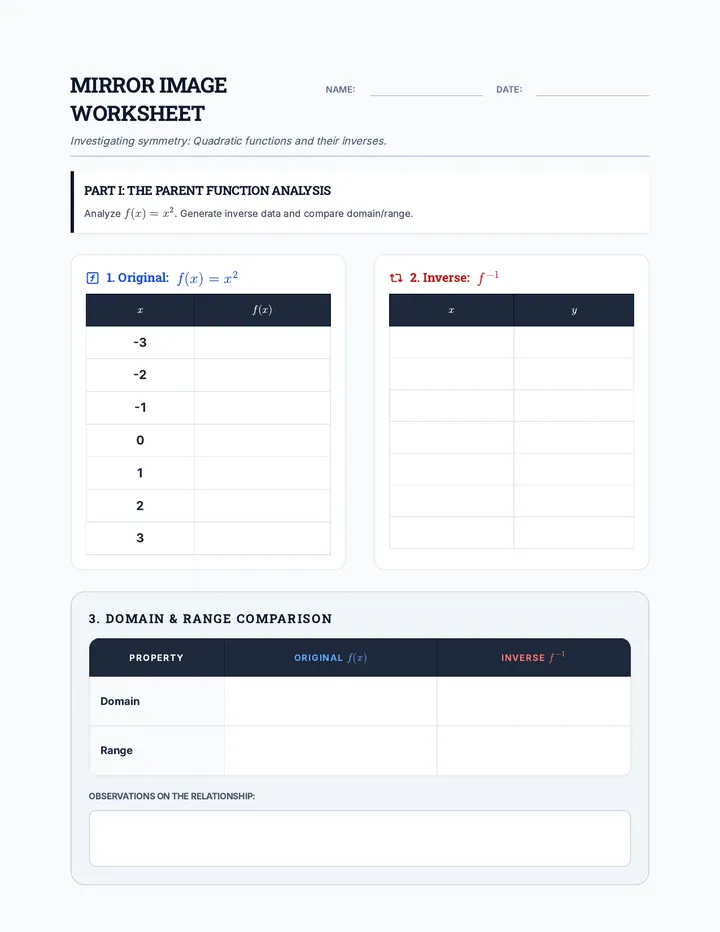
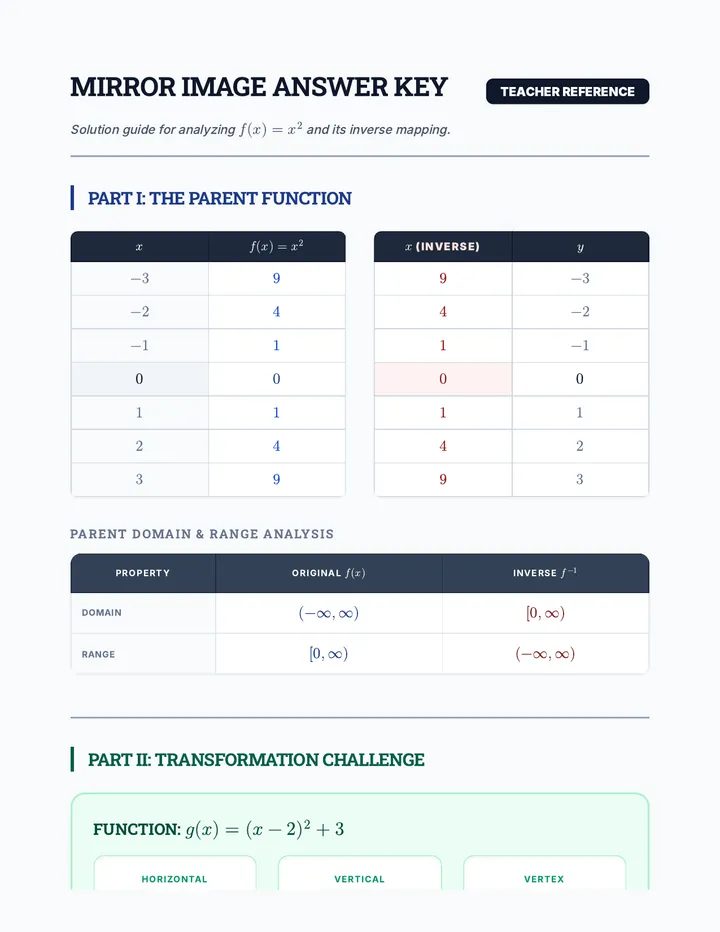
A comprehensive pre-calculus unit focused on the algebraic and geometric properties of inverse functions, including composition-based verification and domain restrictions.
A foundational sequence for 11th Grade Pre-Calculus focusing on the essential building blocks of functions, their graphs, and their behavior. Students develop the ability to recognize, sketch, and analyze parent functions which serves as the basis for all future transformation and modeling work.
A lesson sequence focused on understanding the relationships between variables, specifically direct and inverse variation, and translating verbal descriptions into algebraic equations.
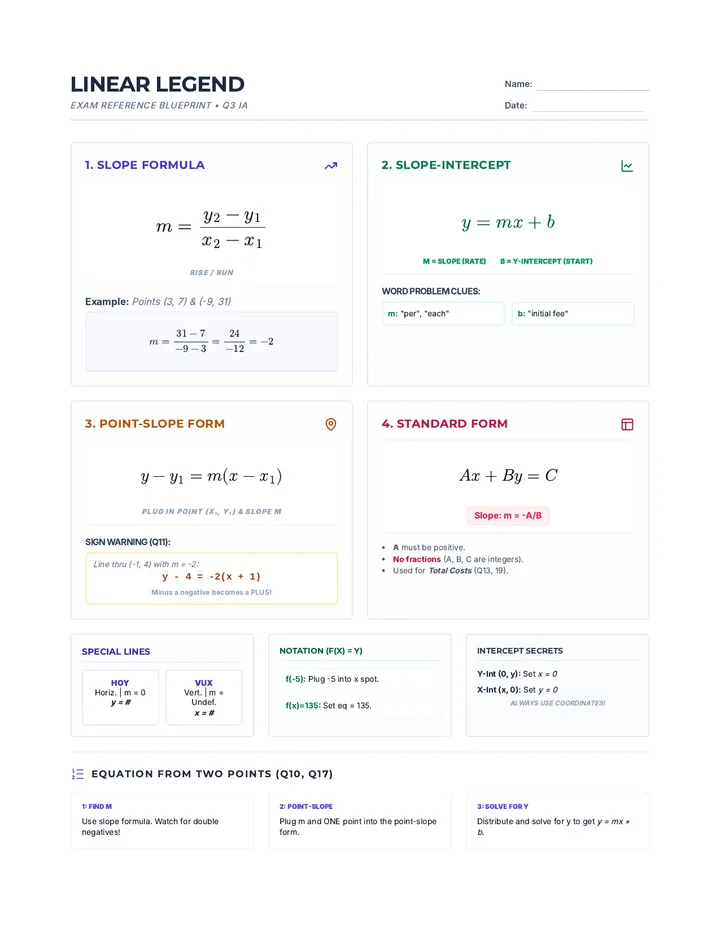
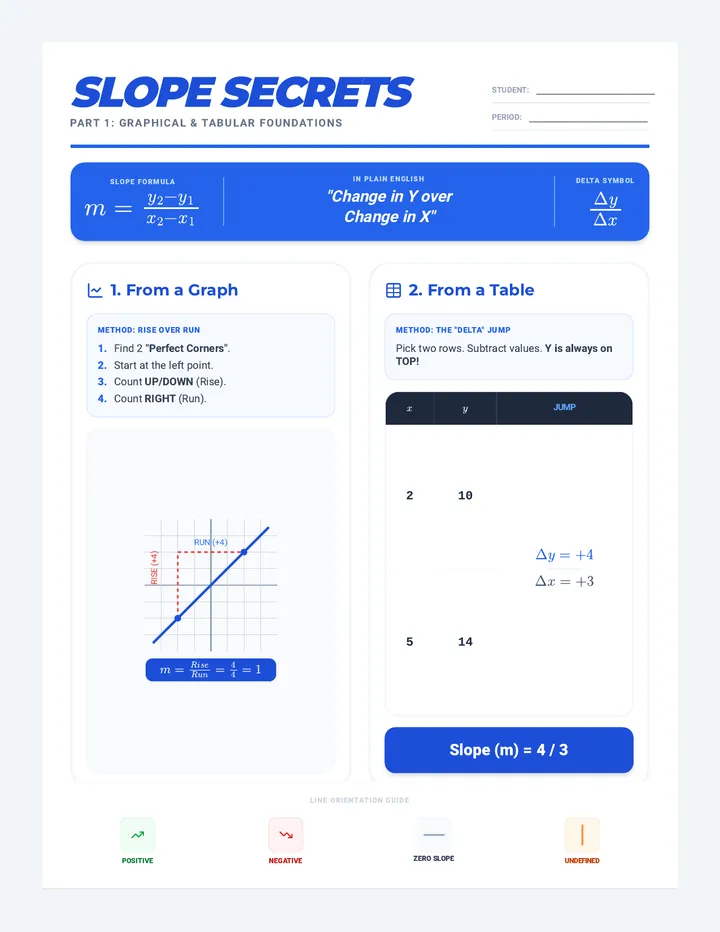
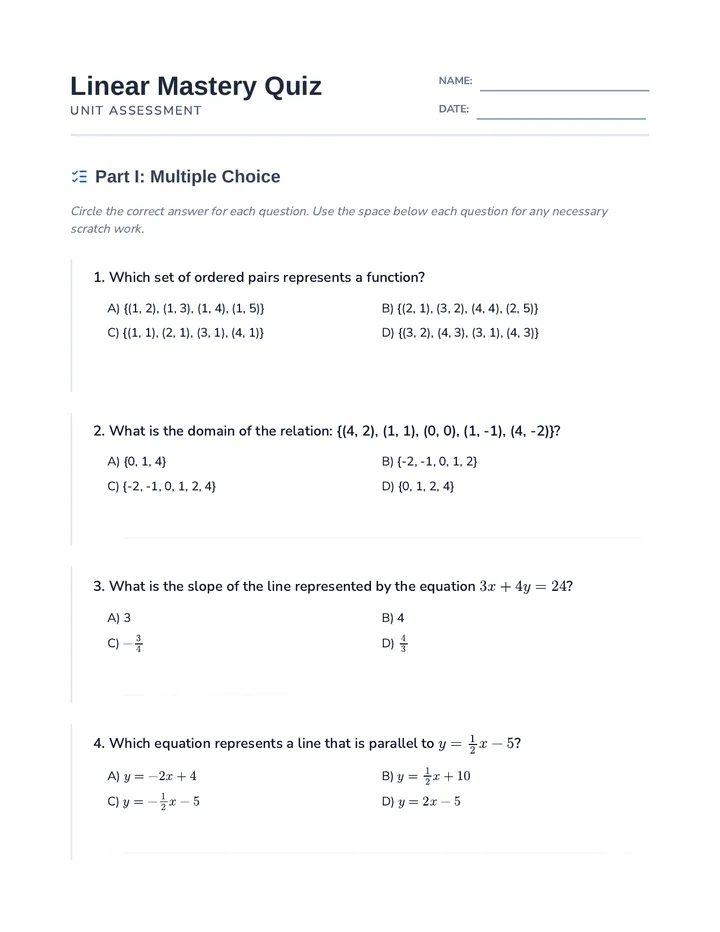
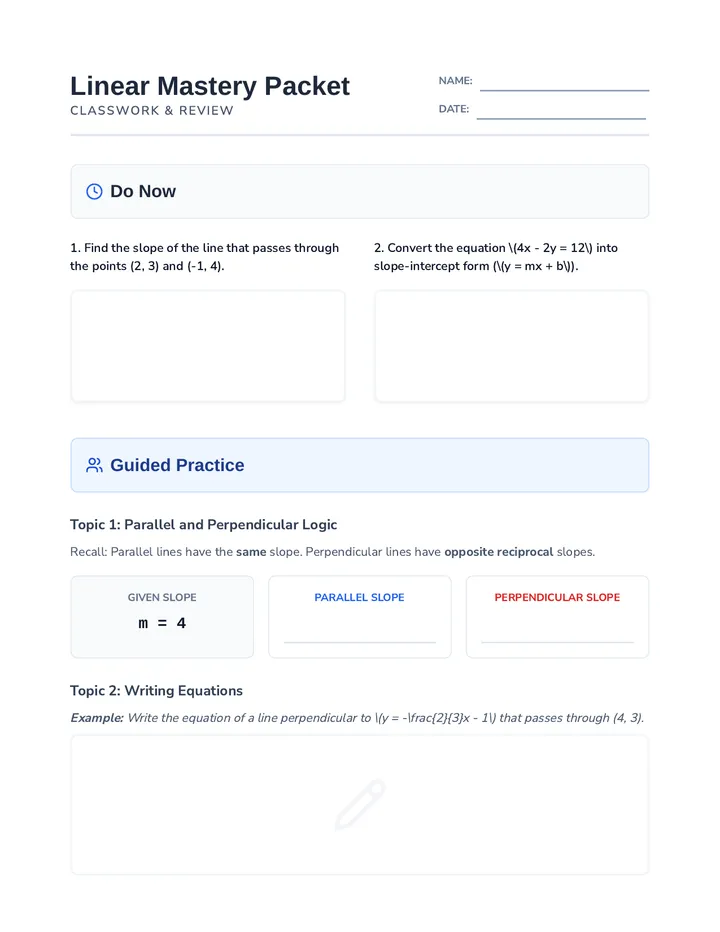
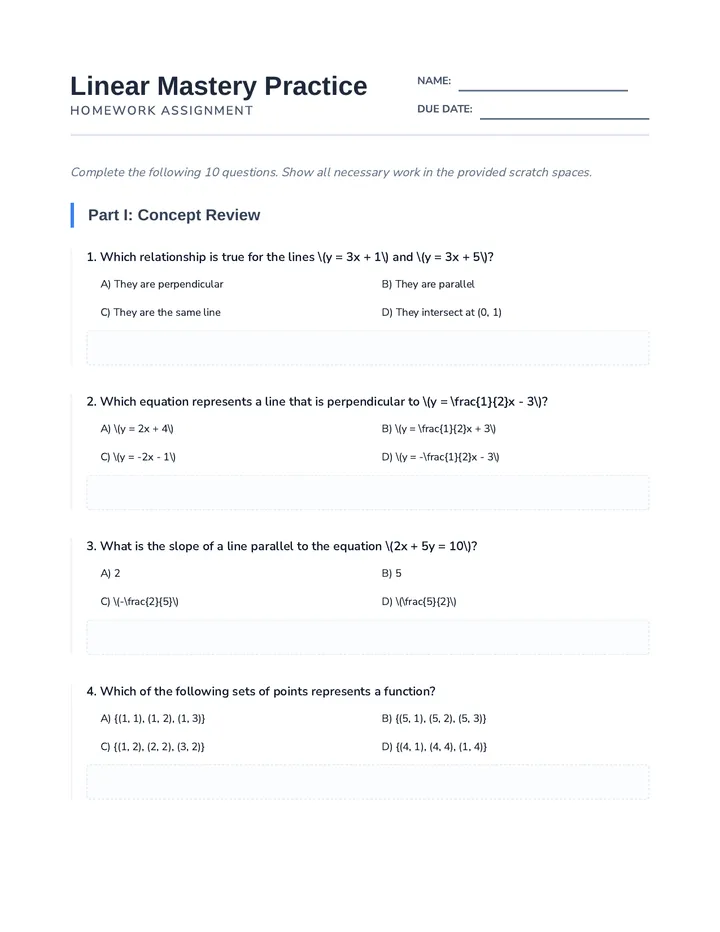
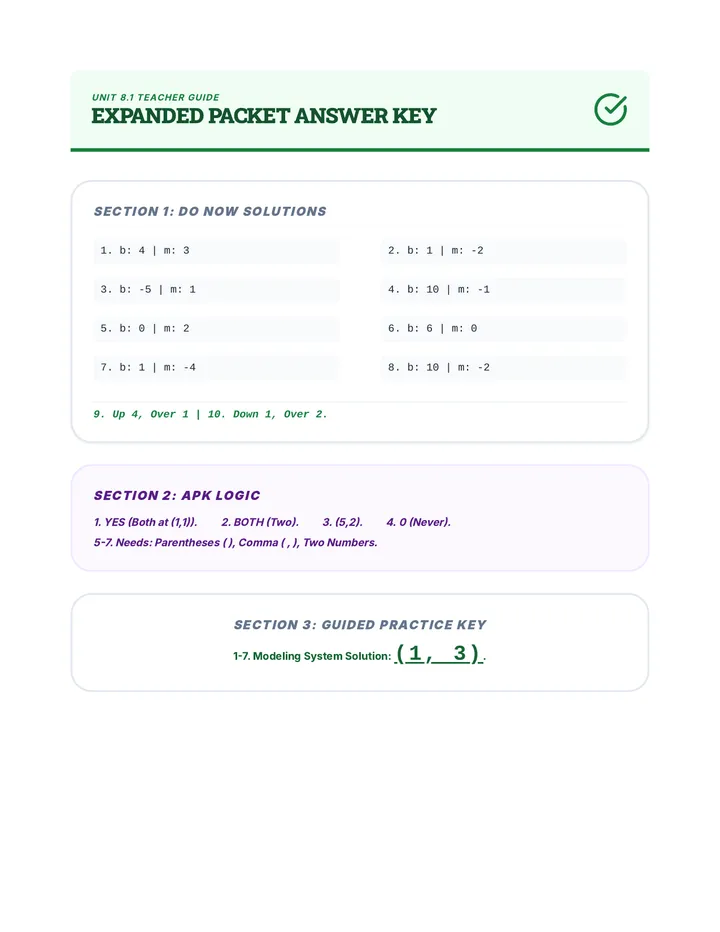
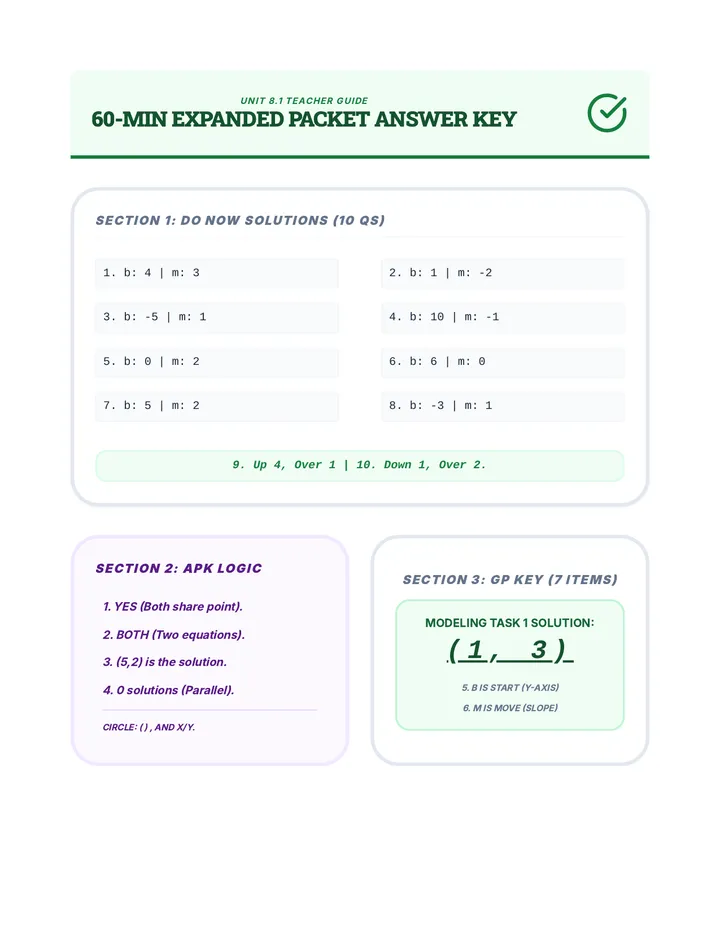
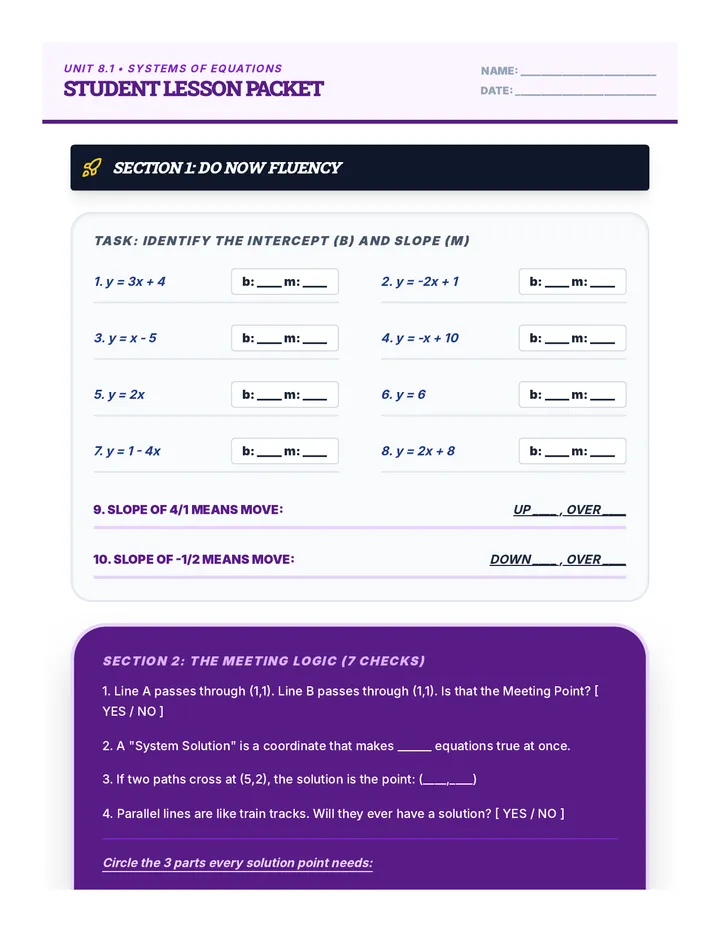
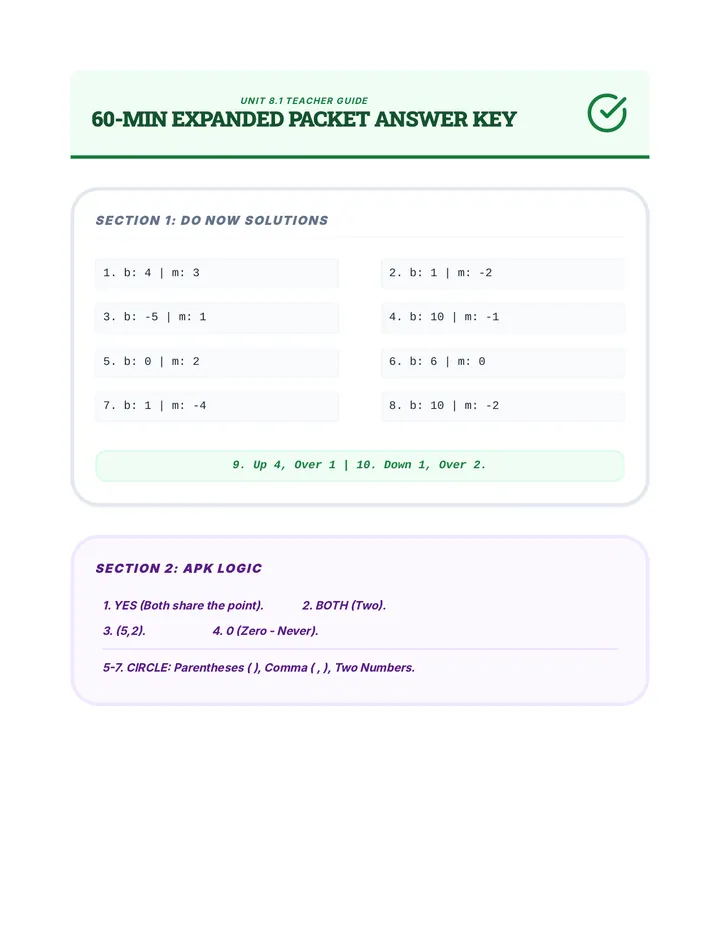
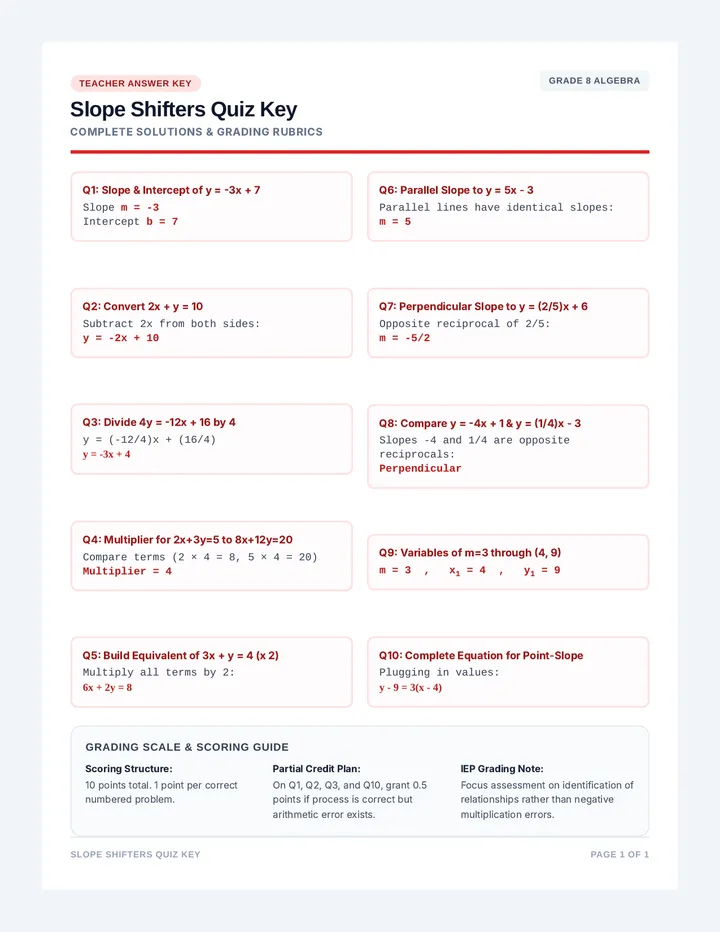
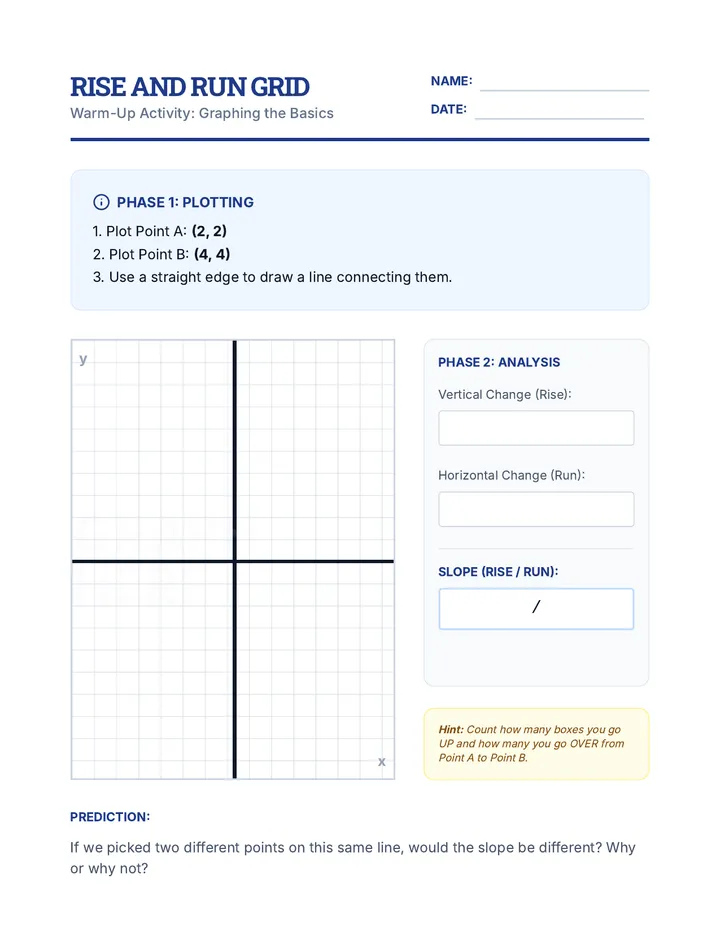
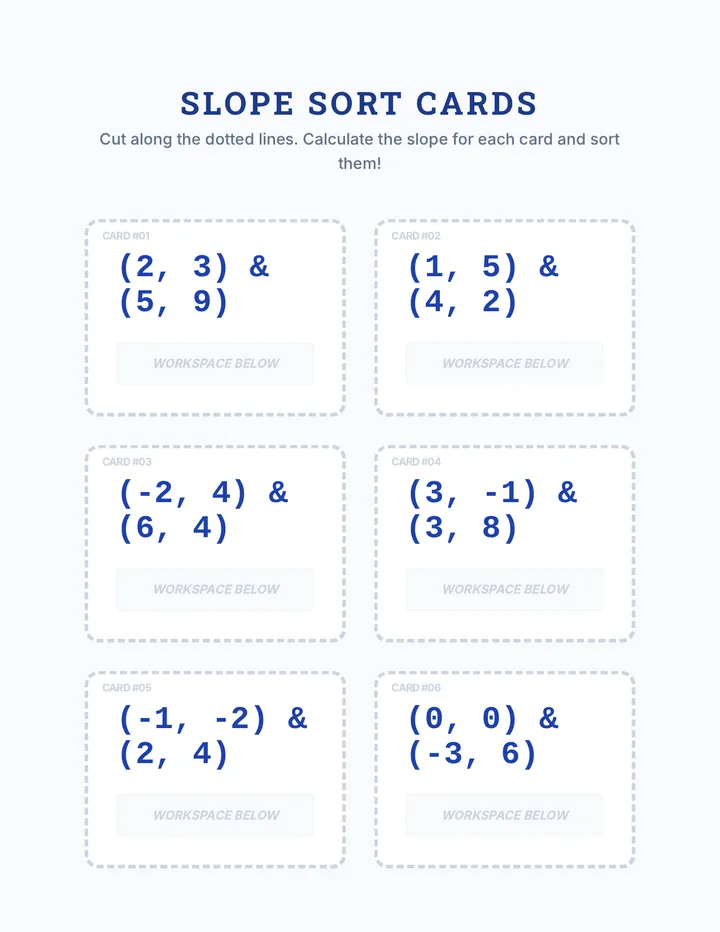
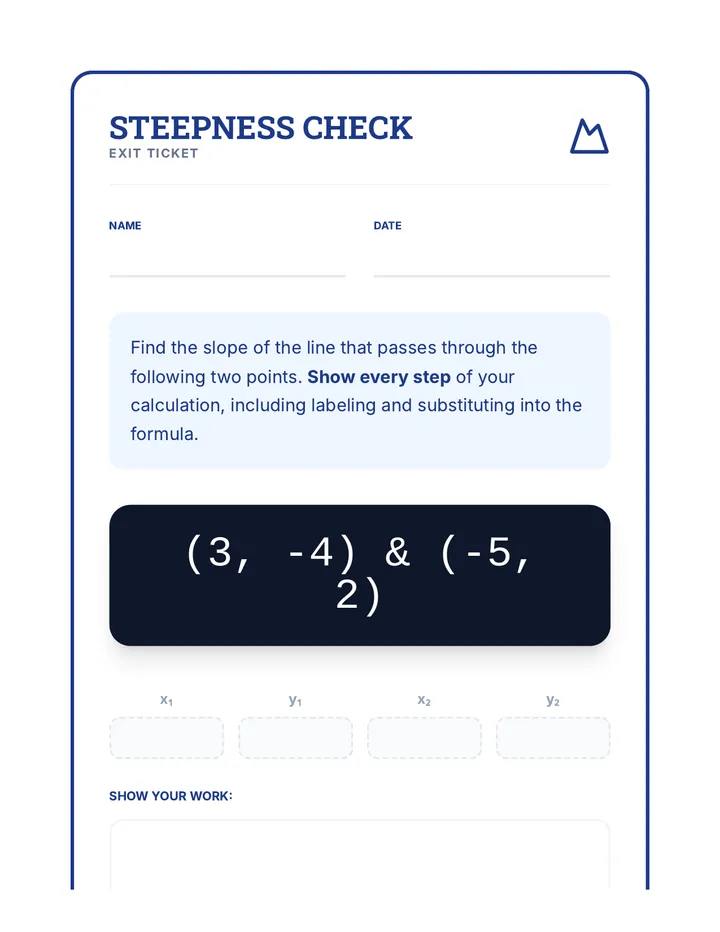
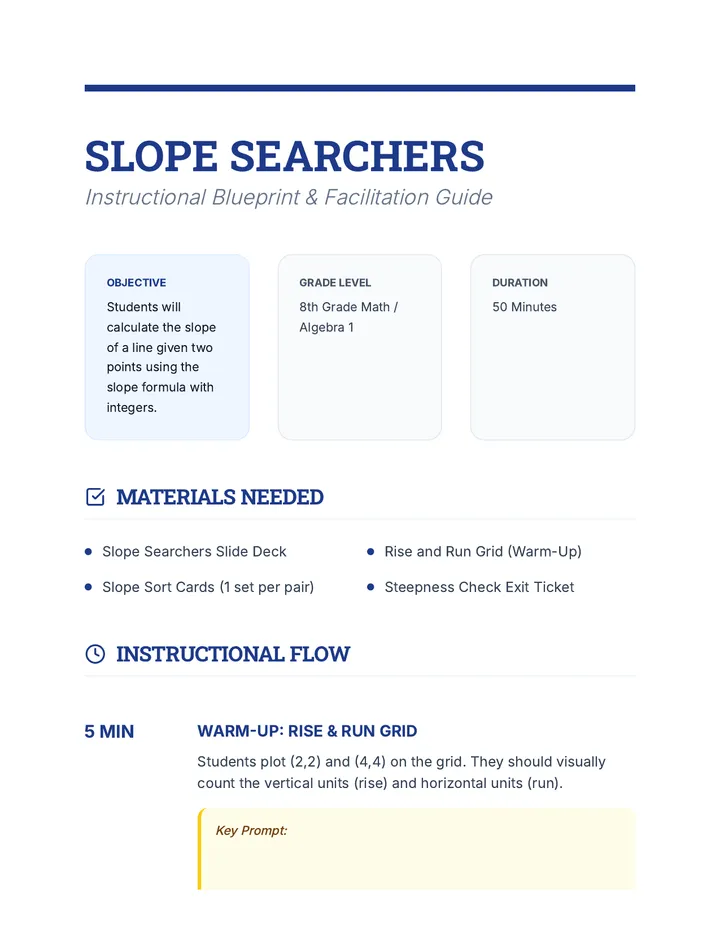
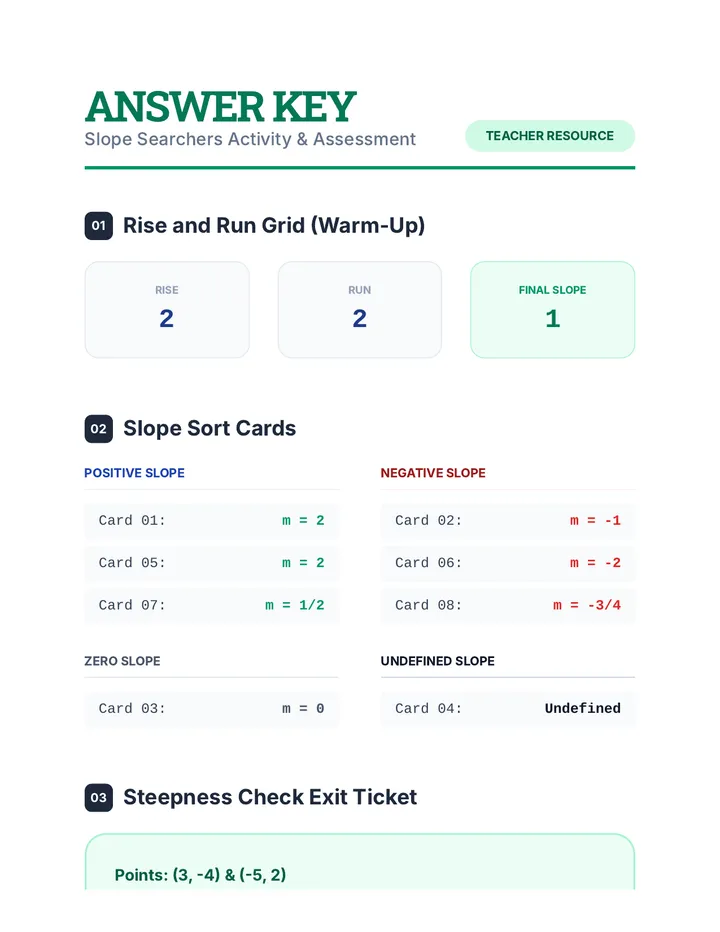
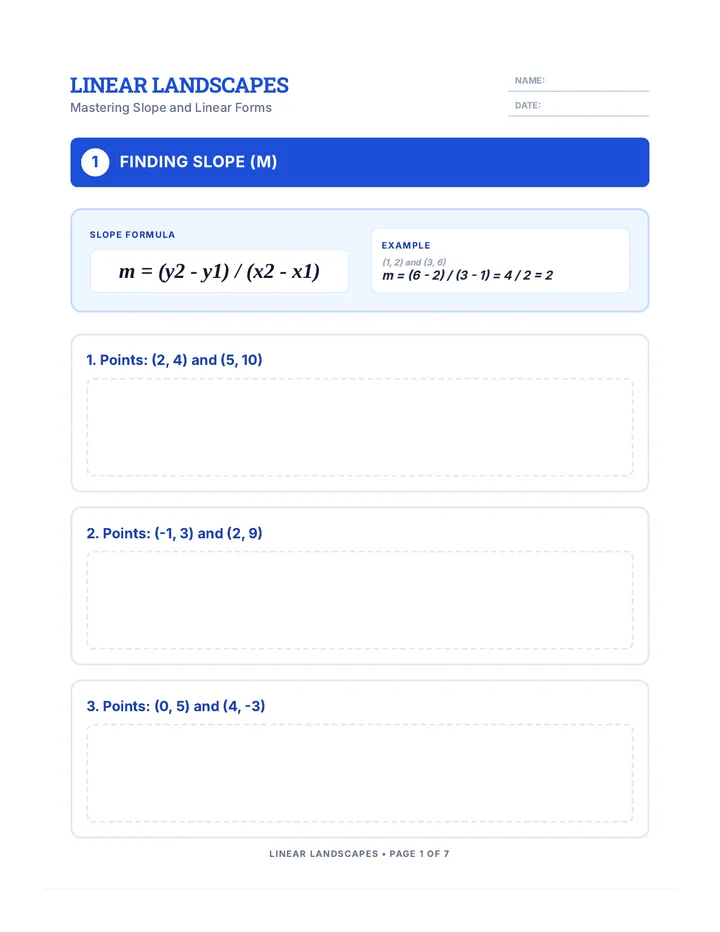
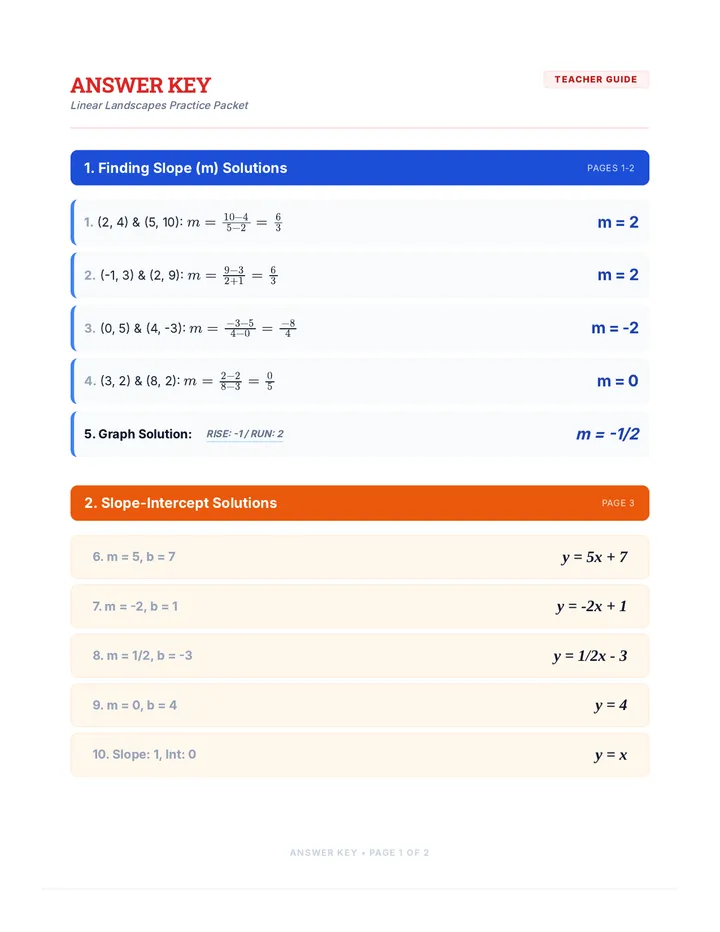
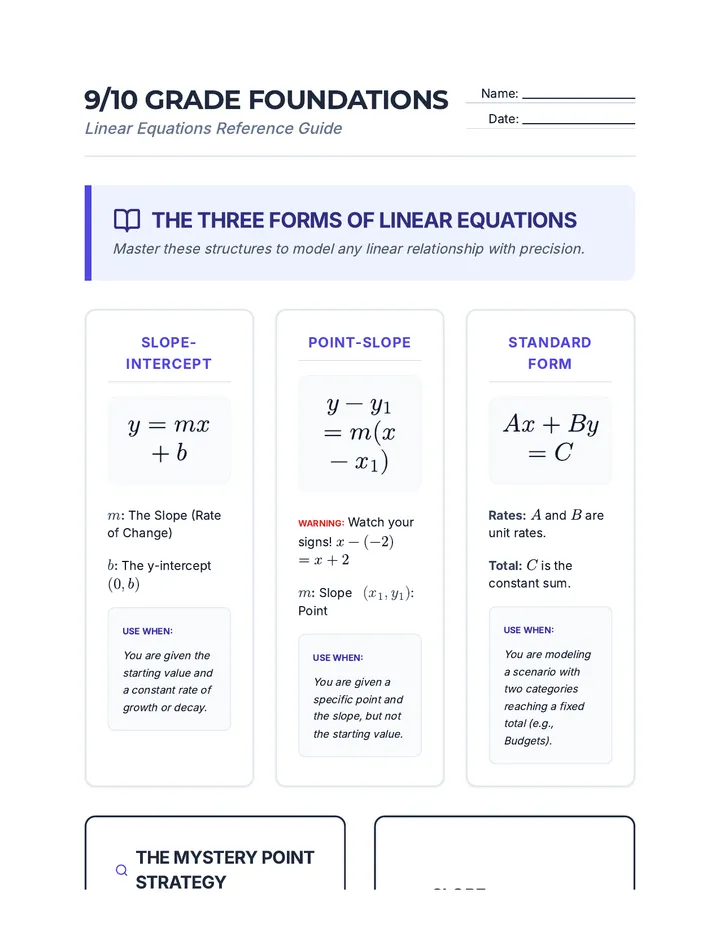
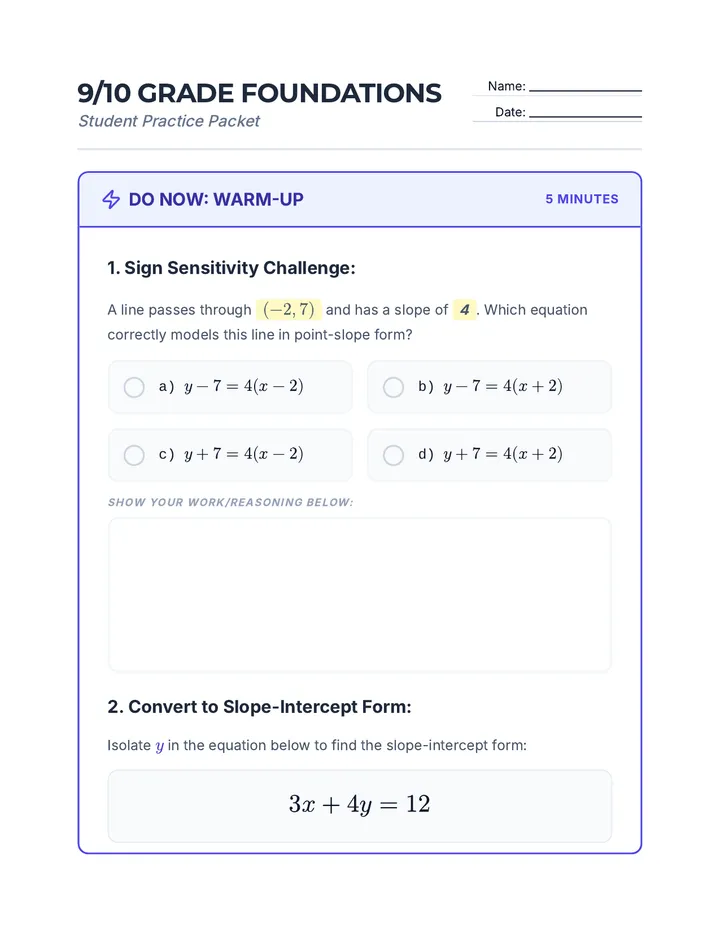
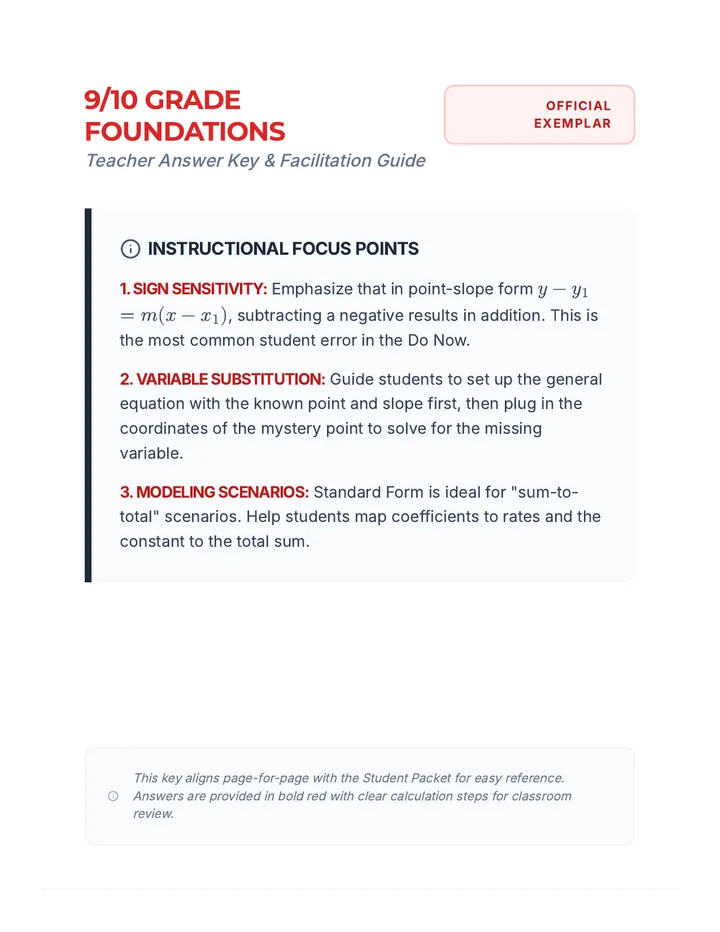
A foundational algebra sequence focused on linear relationships, starting with the calculation of slope and graphing equations in slope-intercept form. Students progress from conceptual understanding to procedural fluency using visual and kinesthetic activities.
A lesson sequence focused on the critical thinking skills required to verify mathematical patterns, using geometric sequences as the primary vehicle for exploration. Students learn that initial data points can be deceptive and that rigorous verification is essential for mathematical proof and real-world predictions.
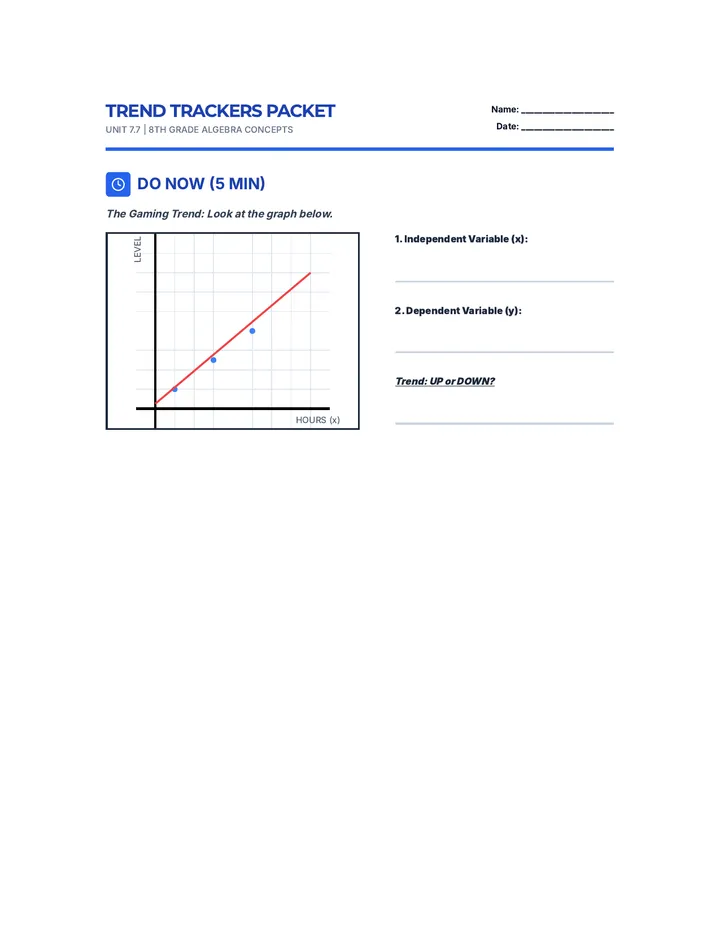
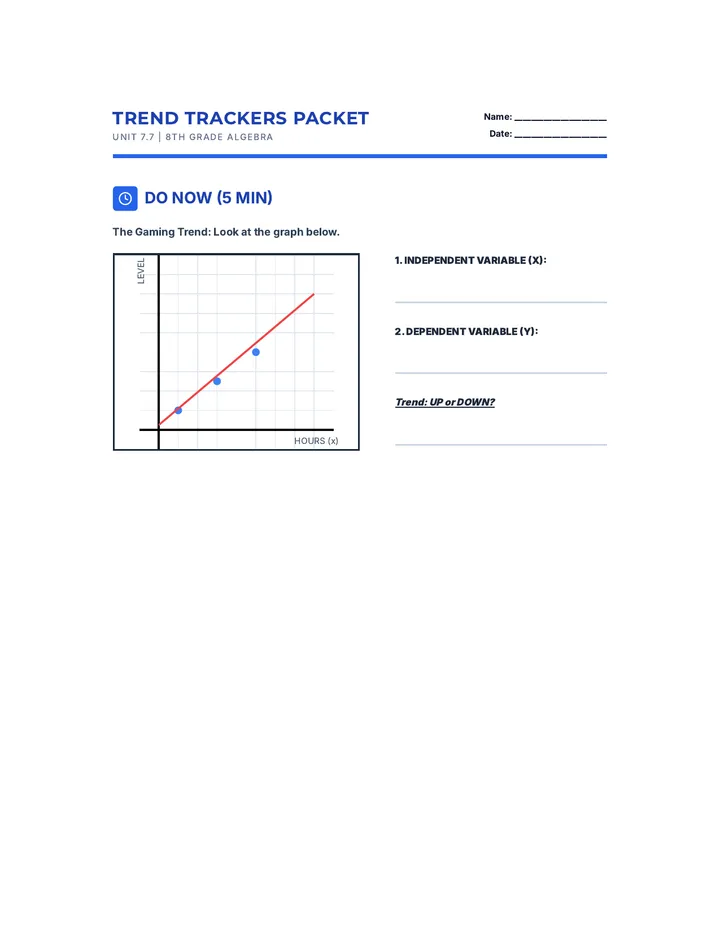
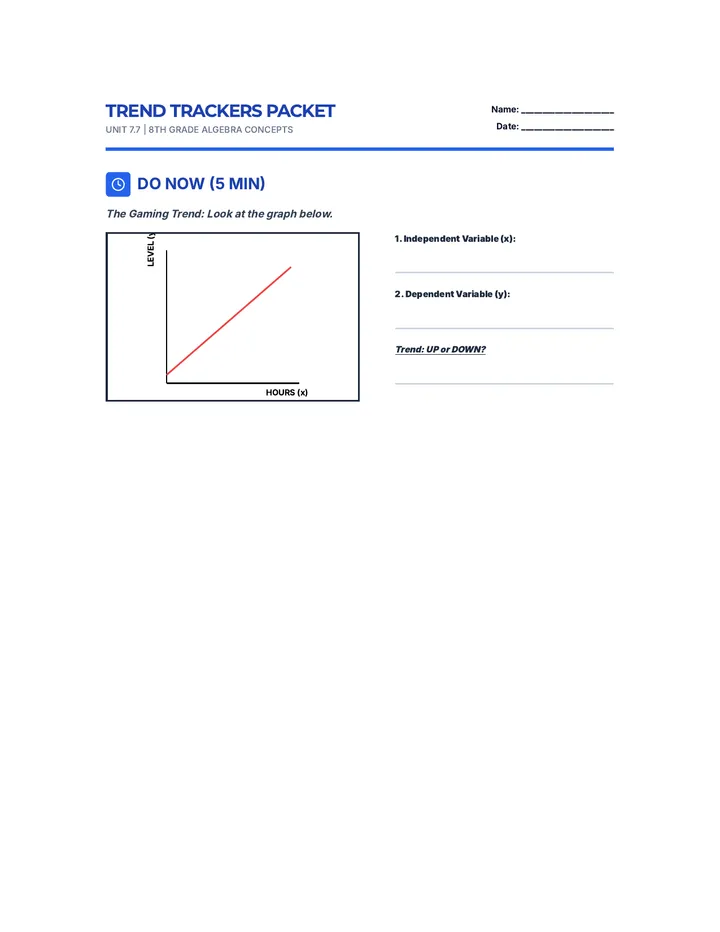
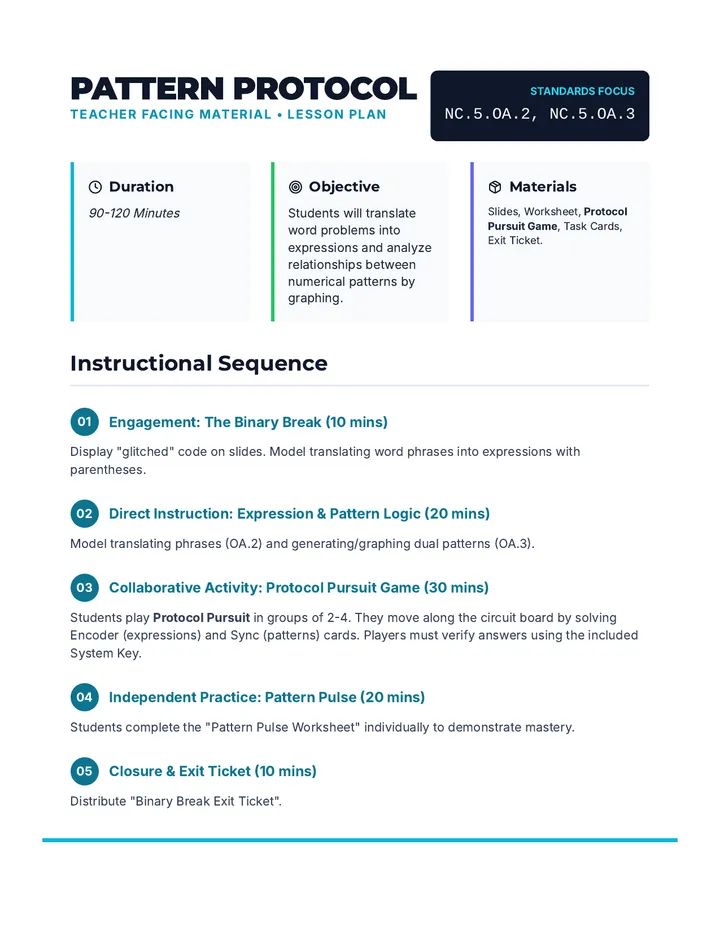
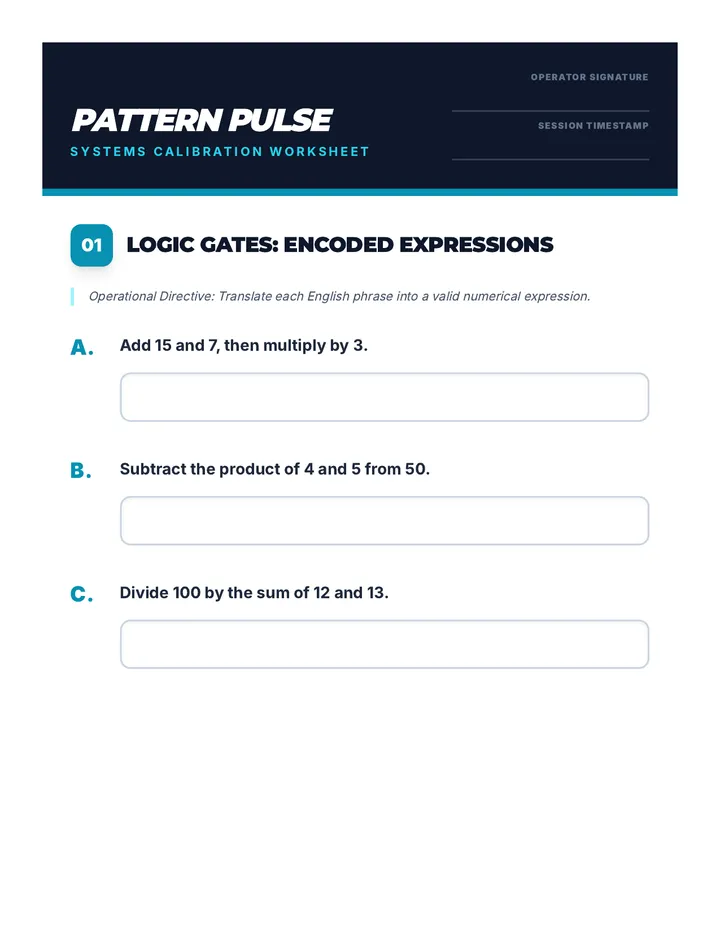
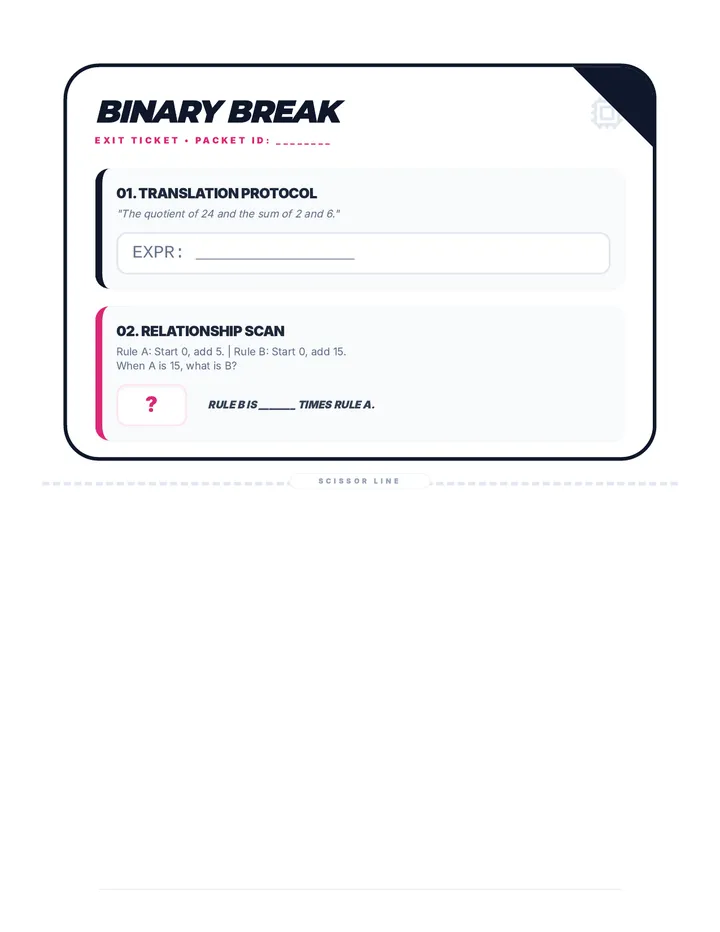
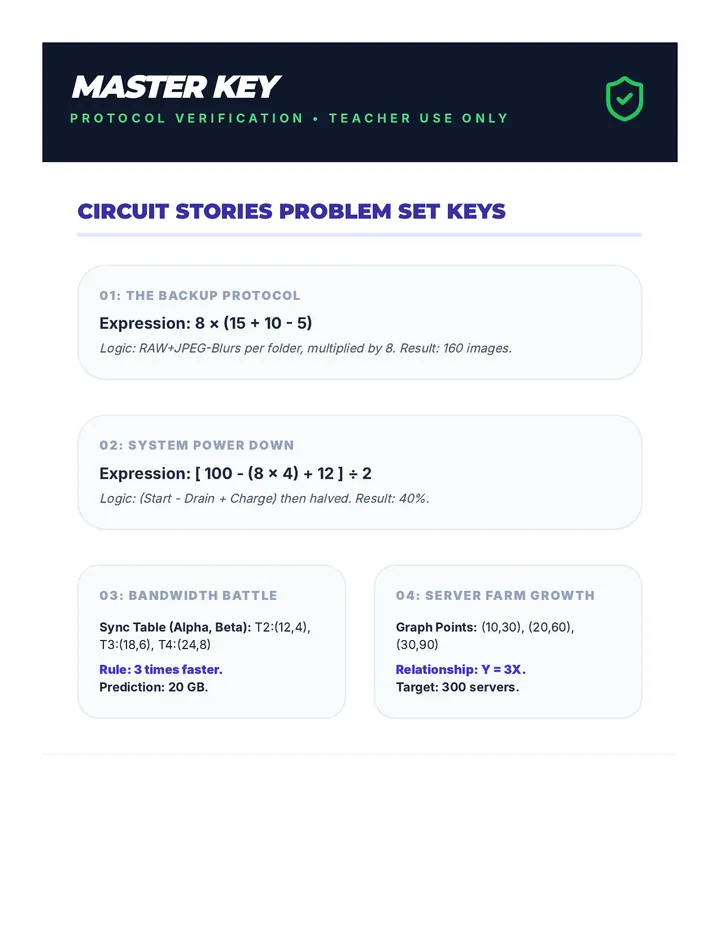
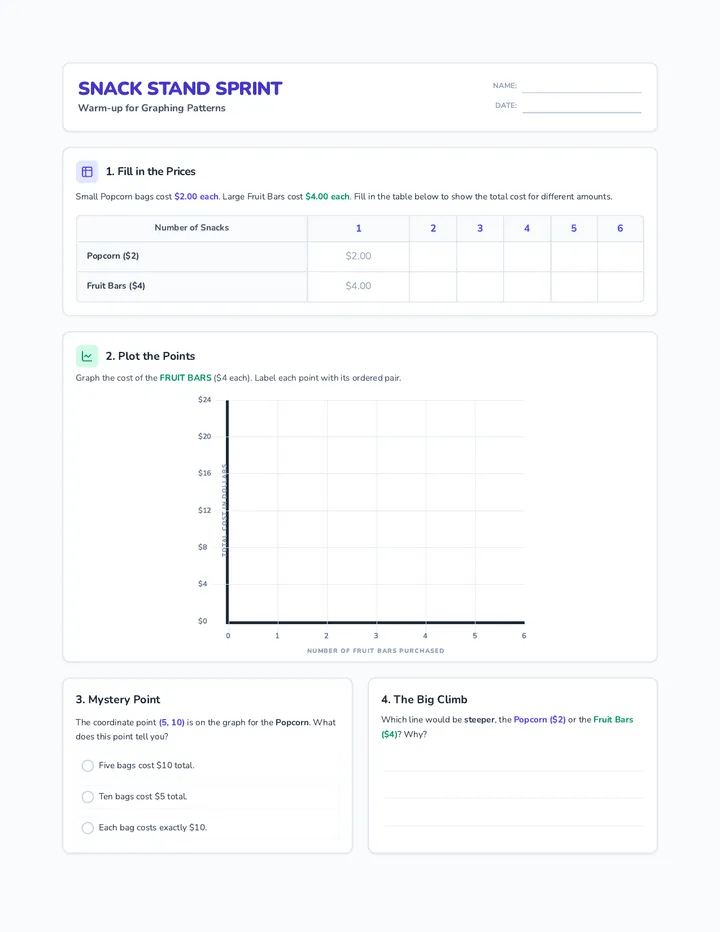
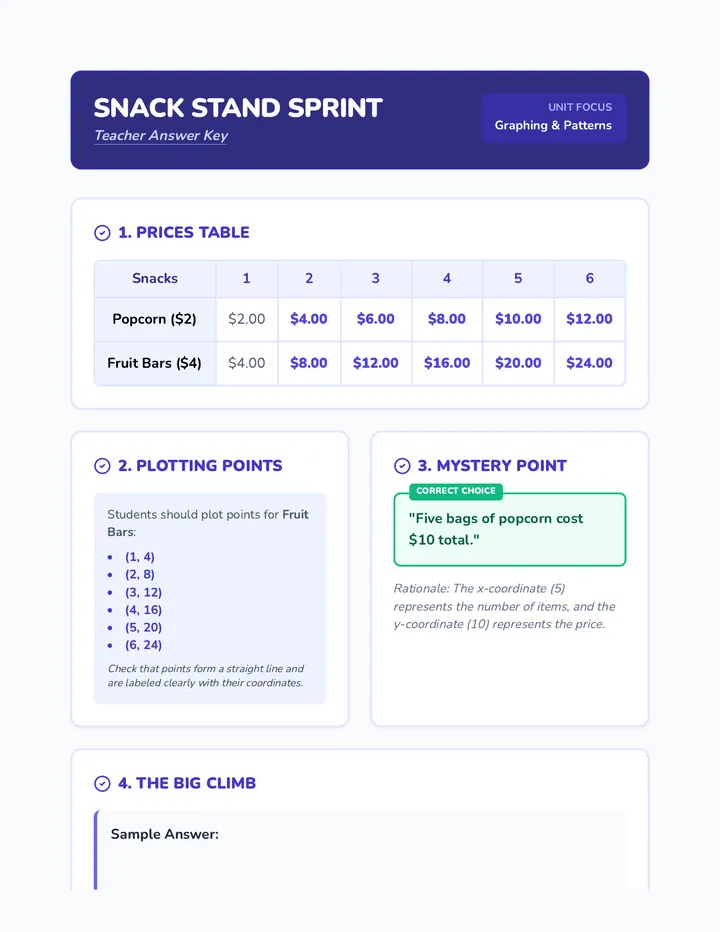
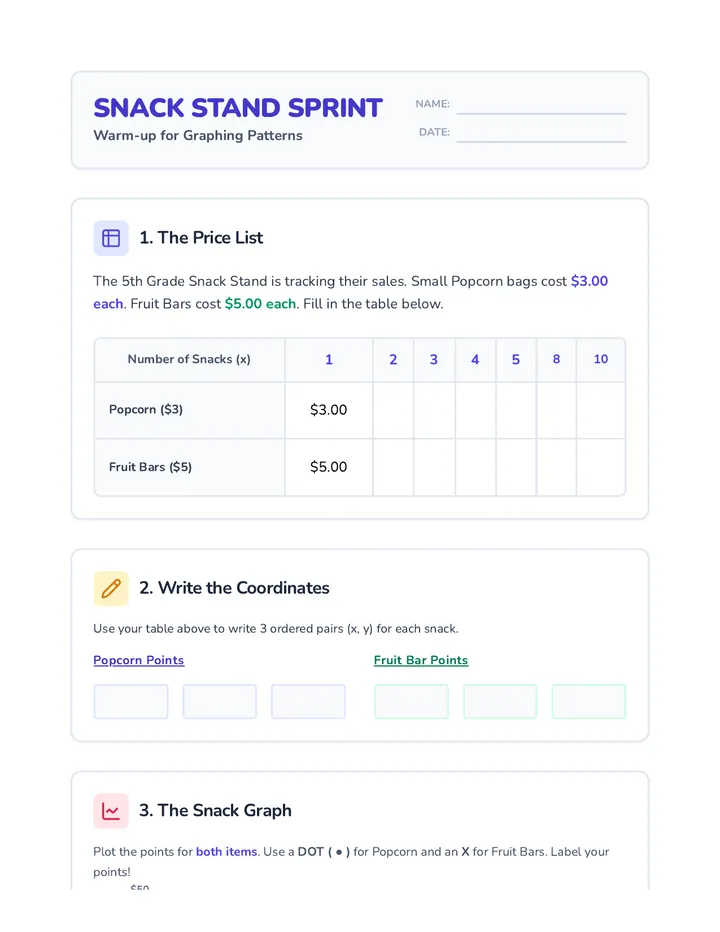
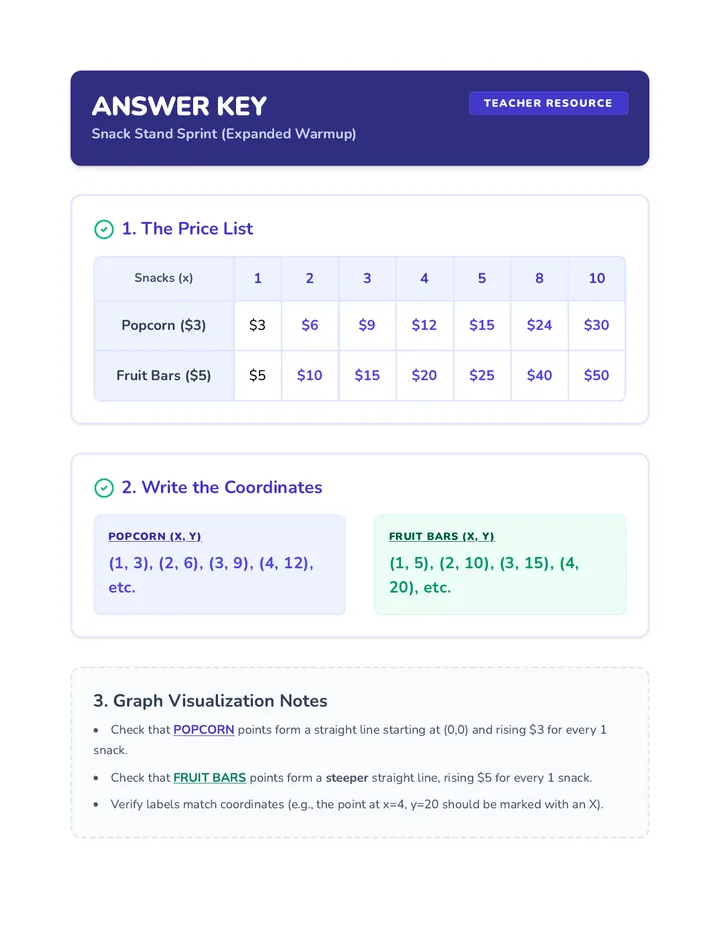
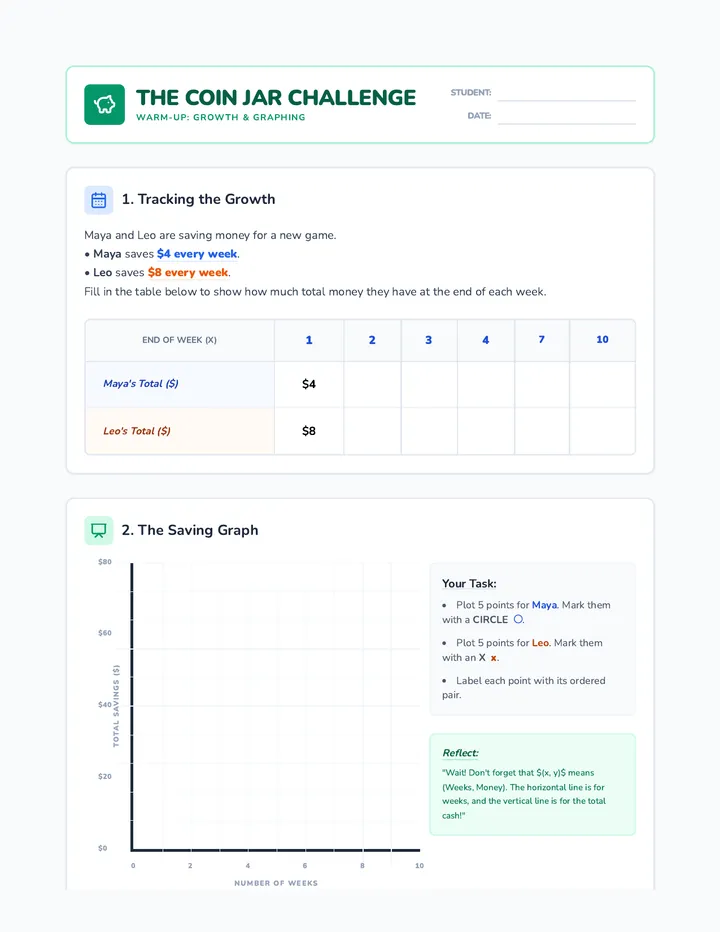
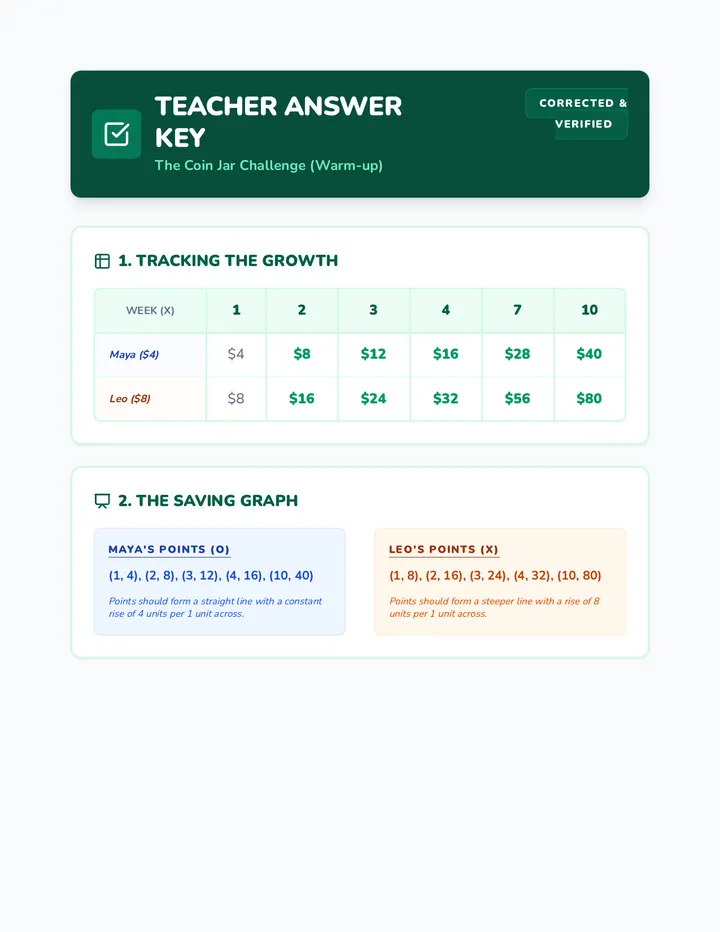
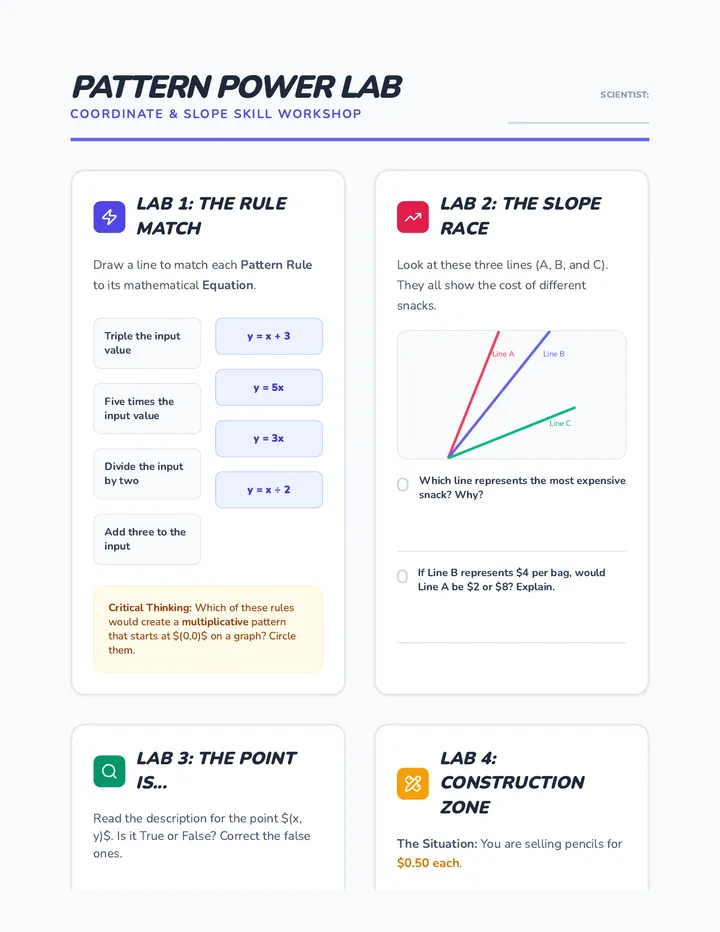
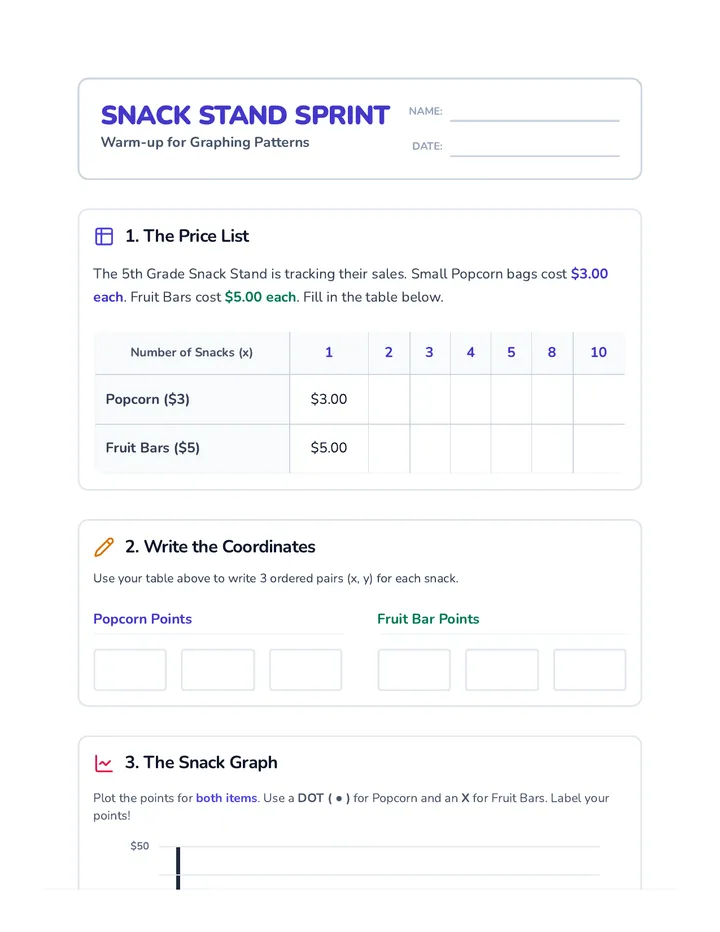
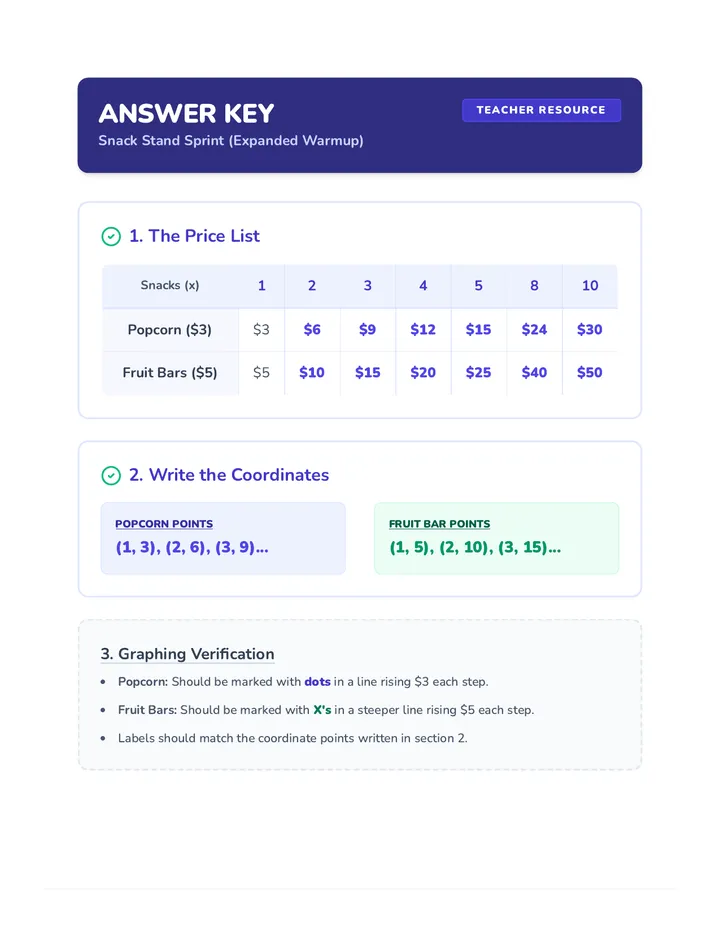
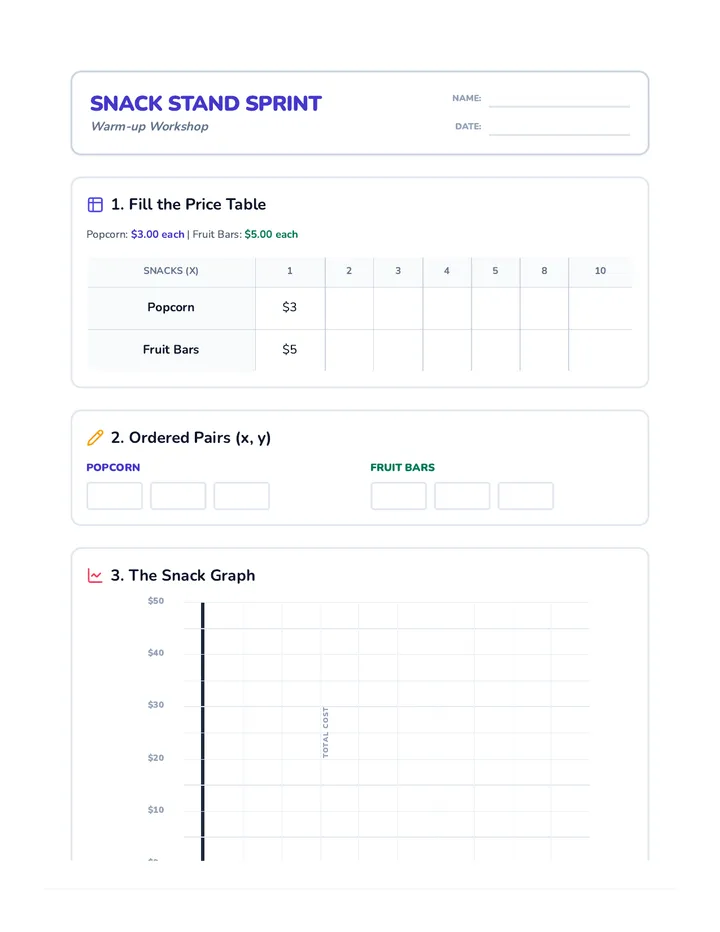
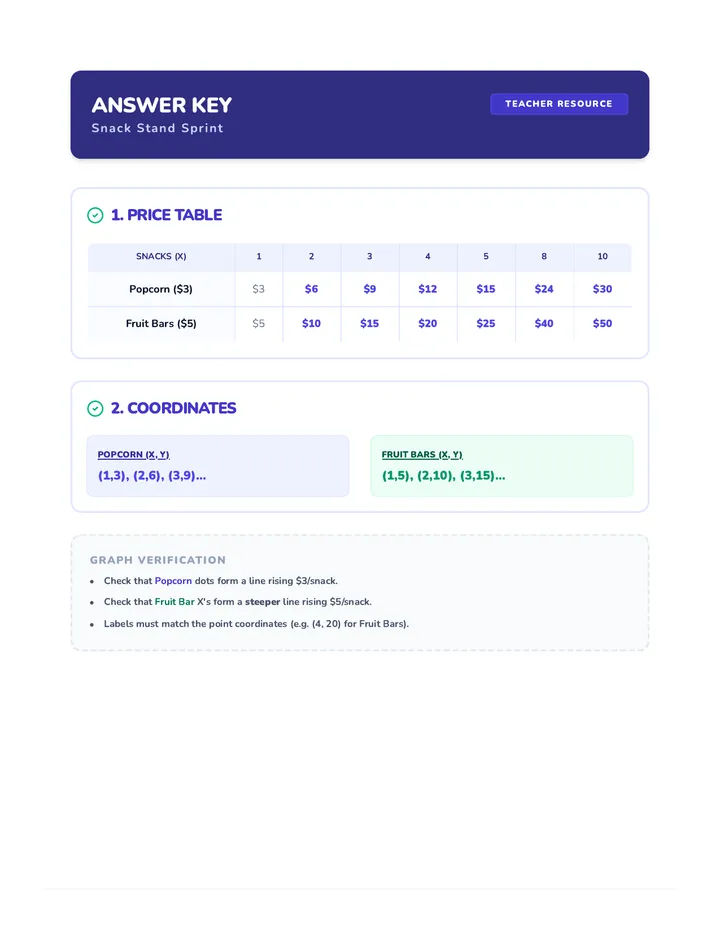
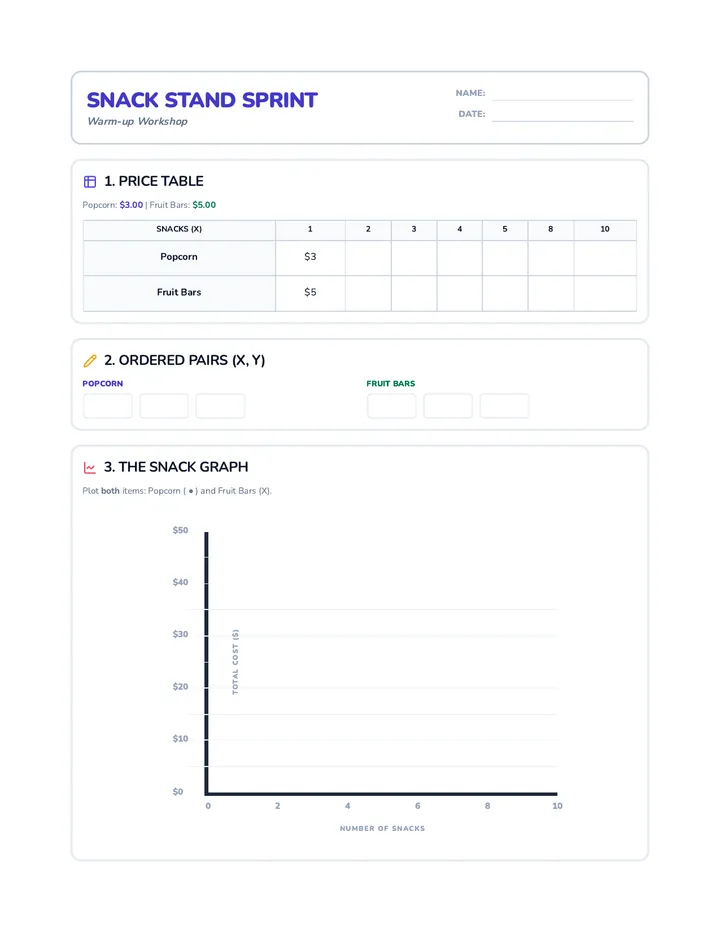
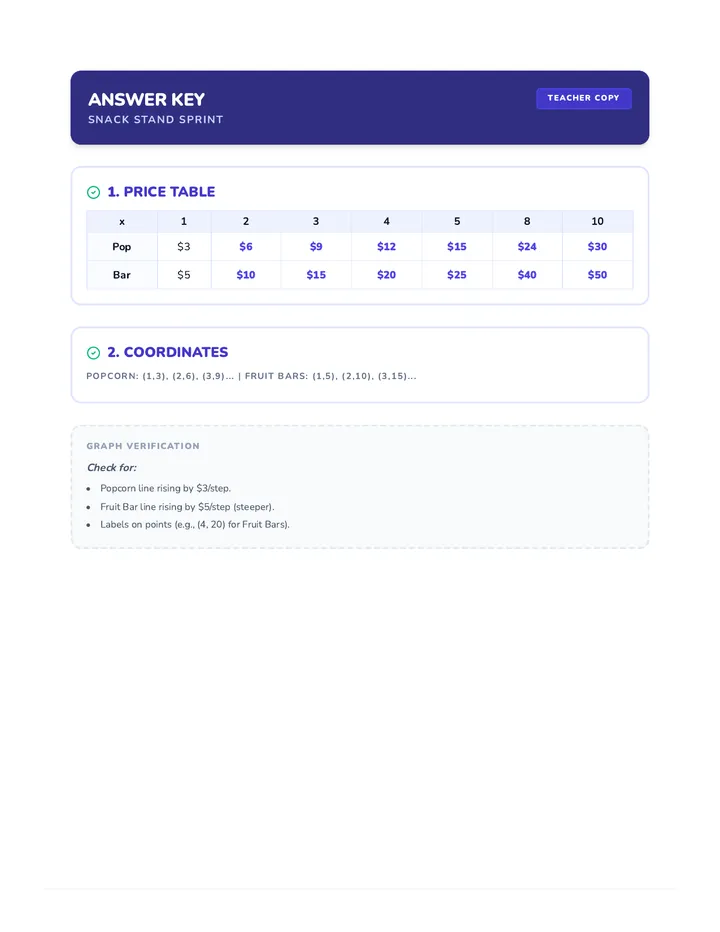
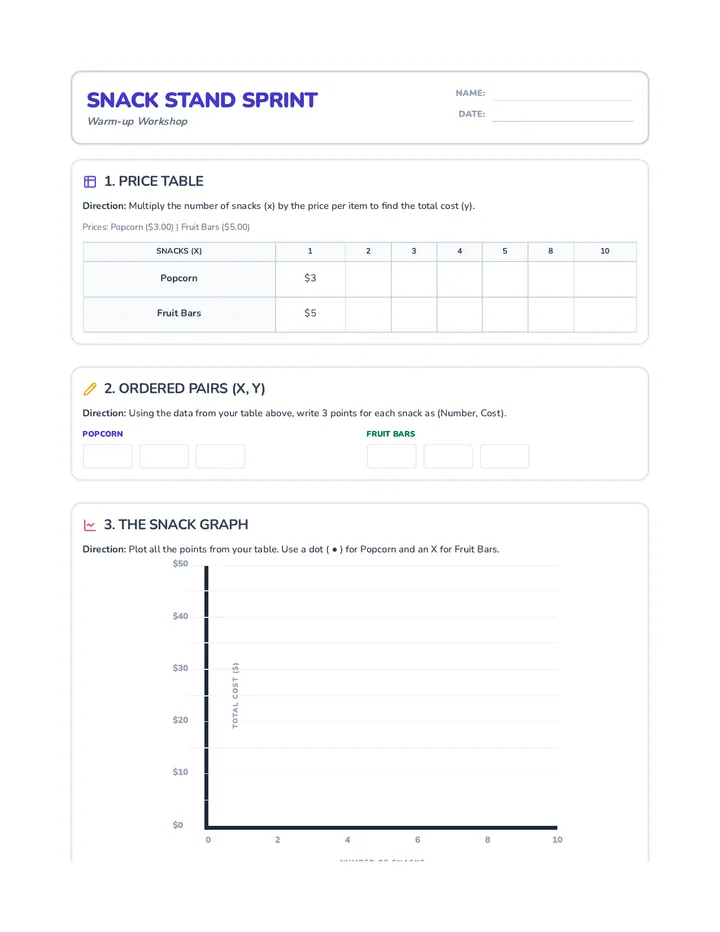
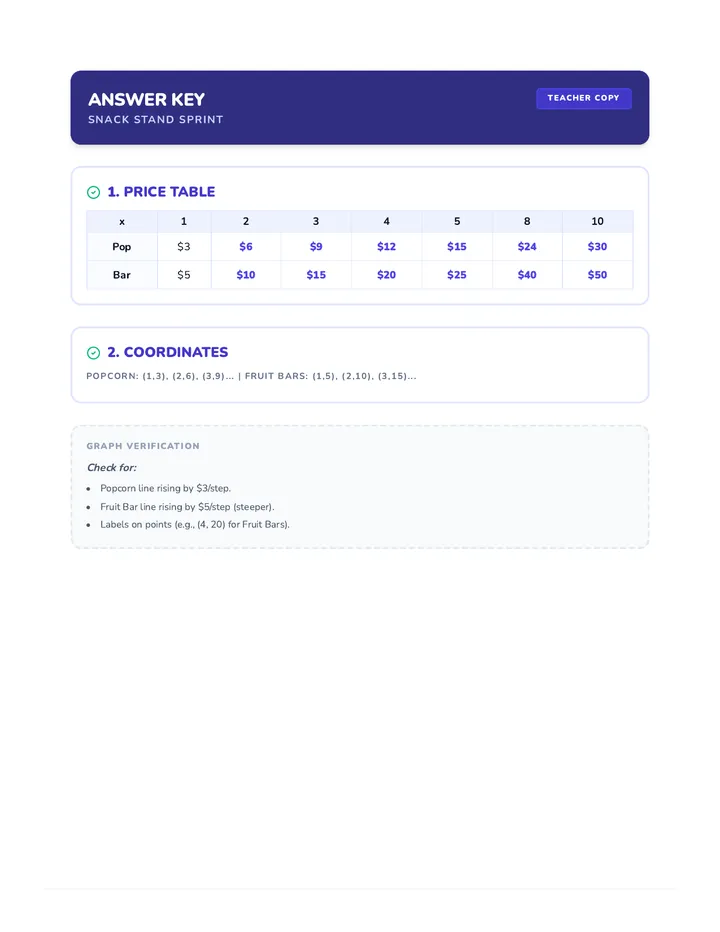
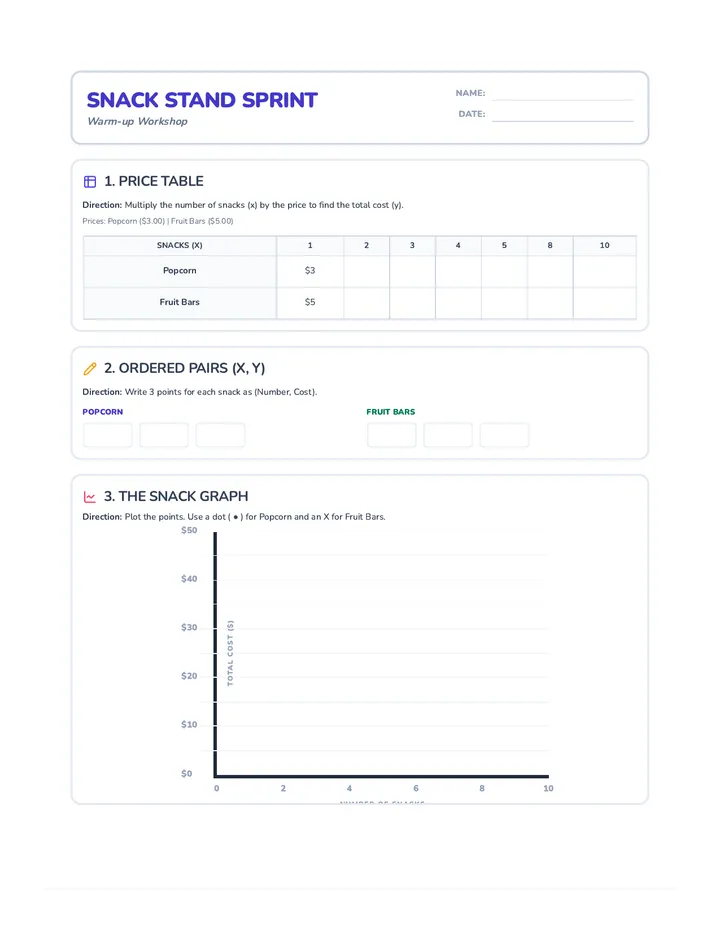
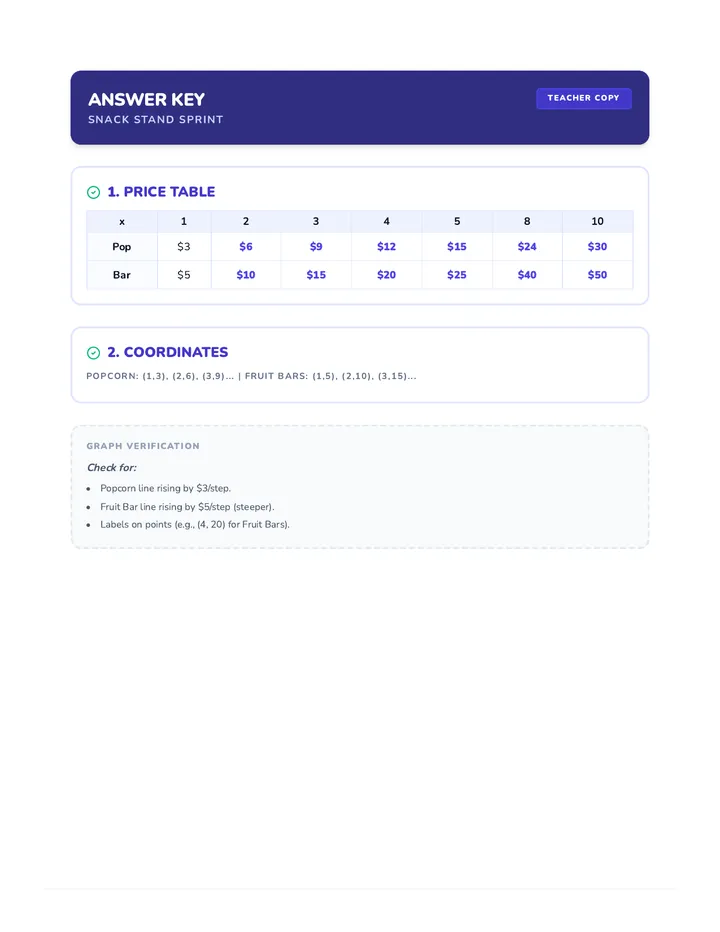
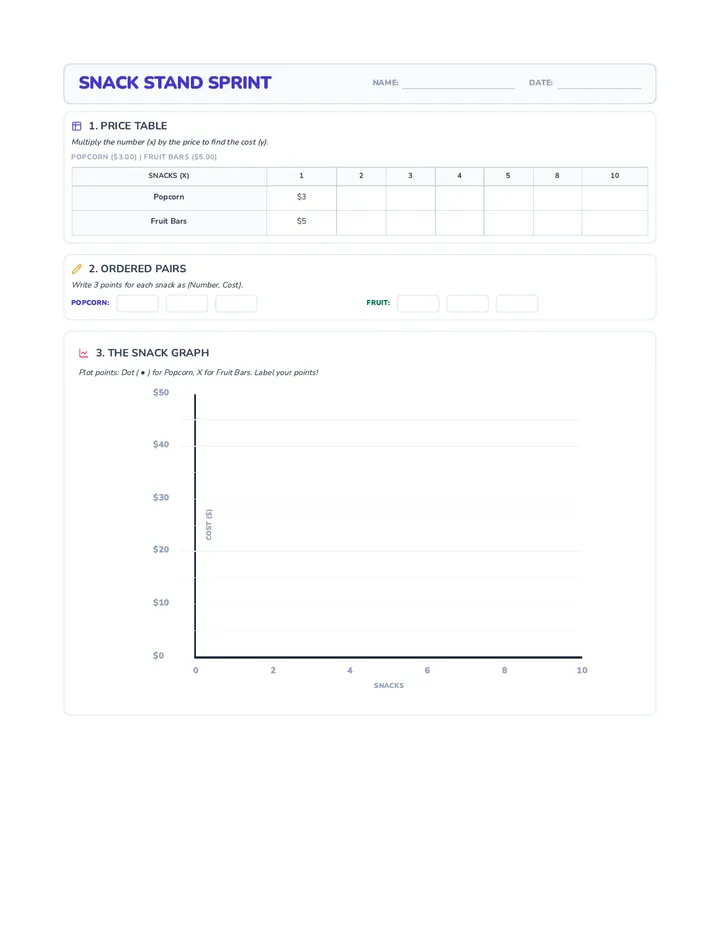
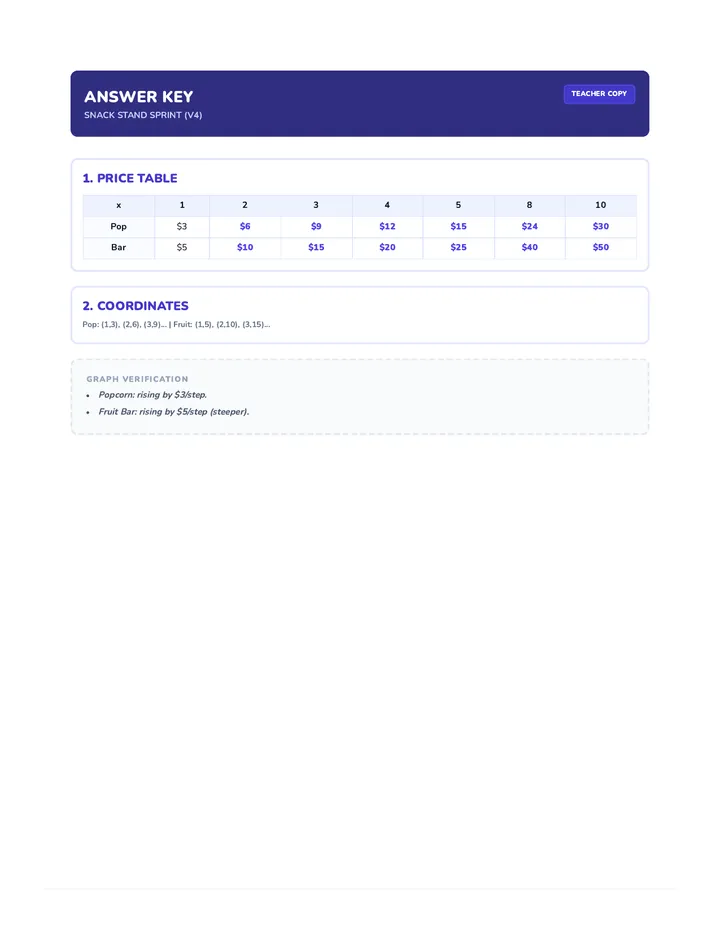
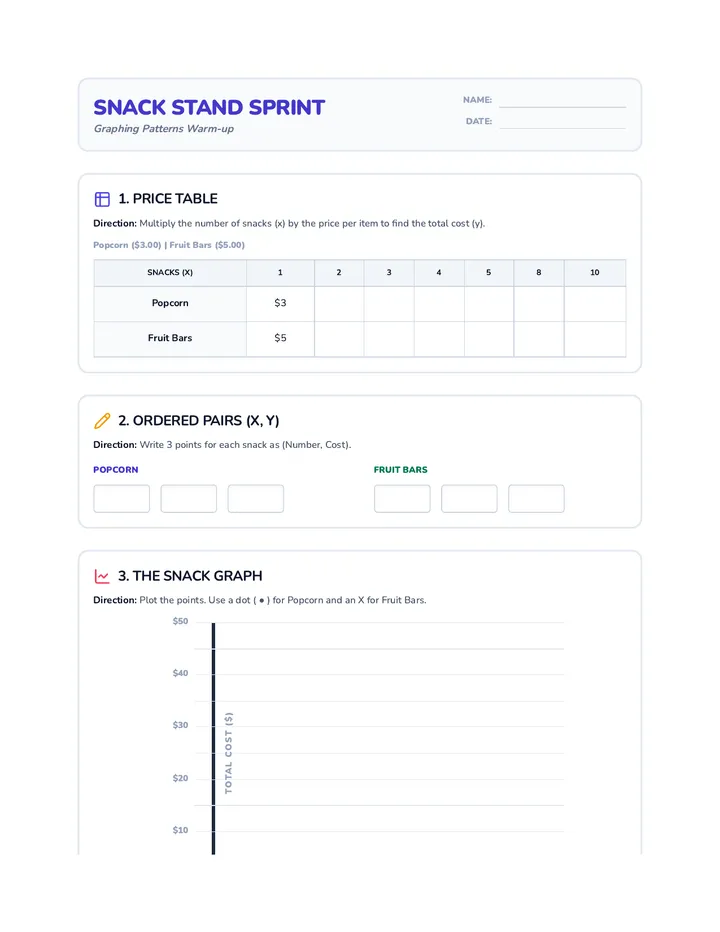
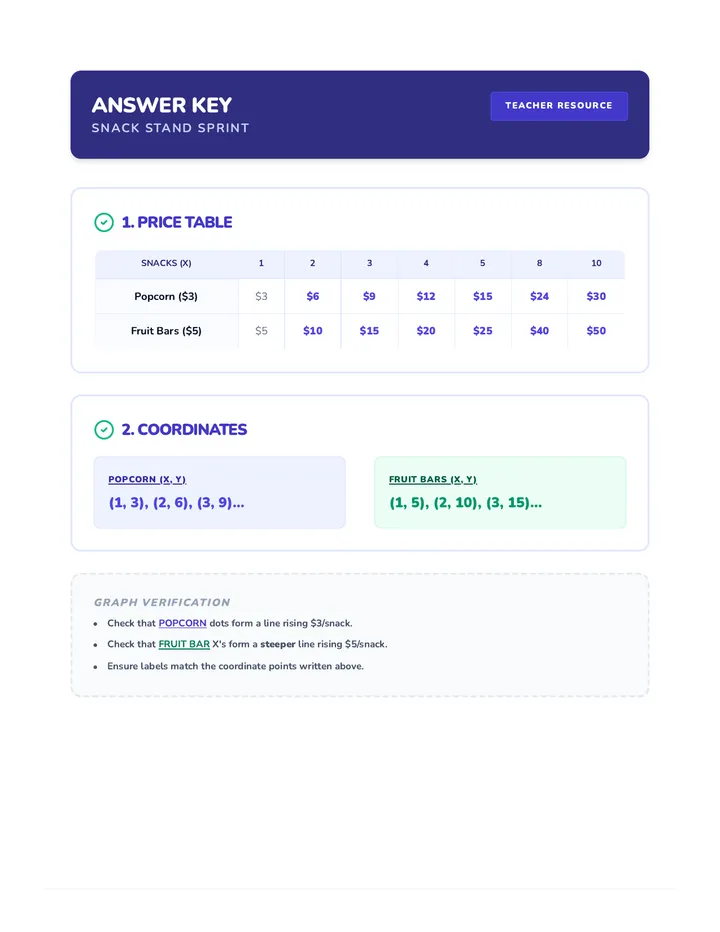
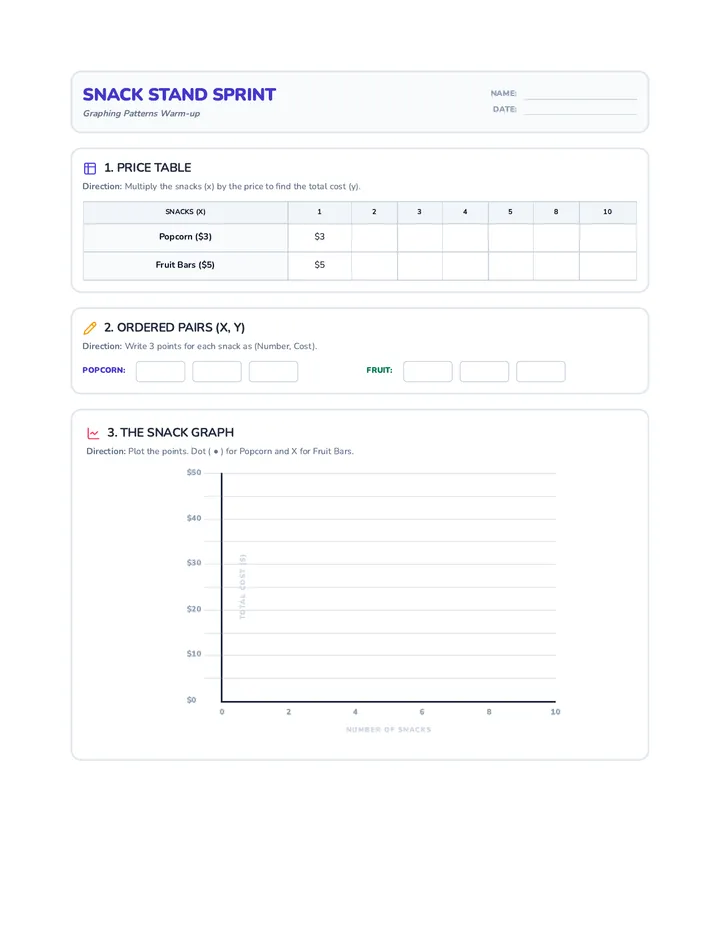
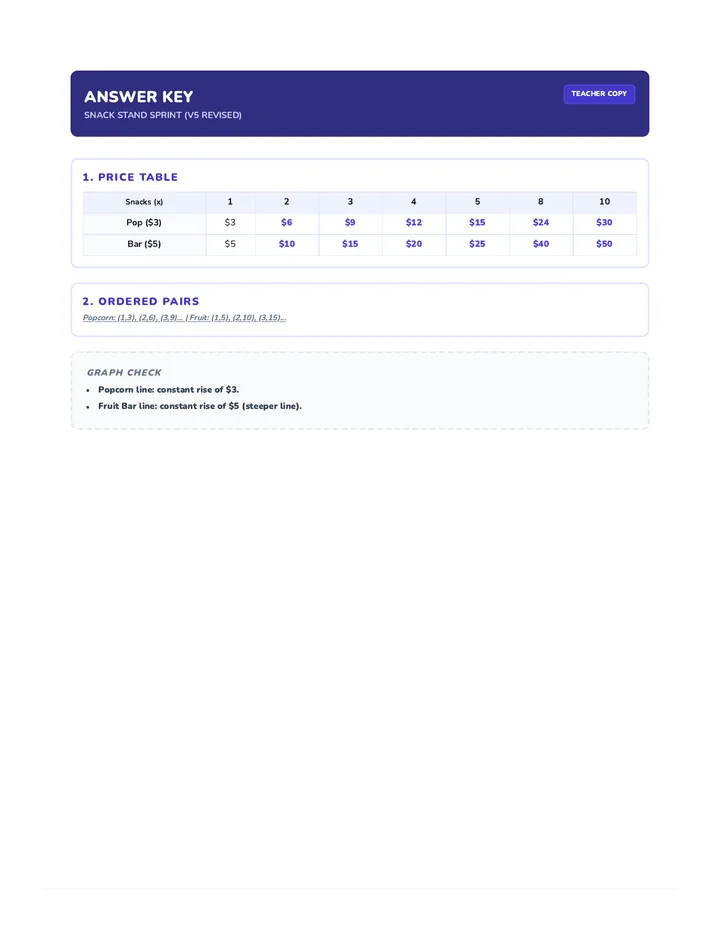
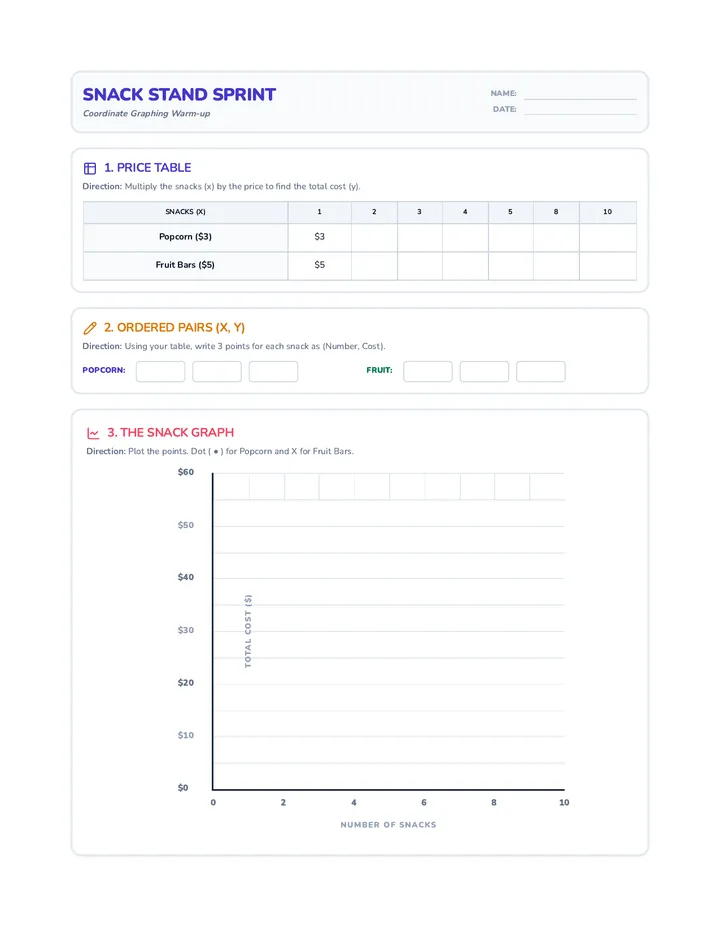
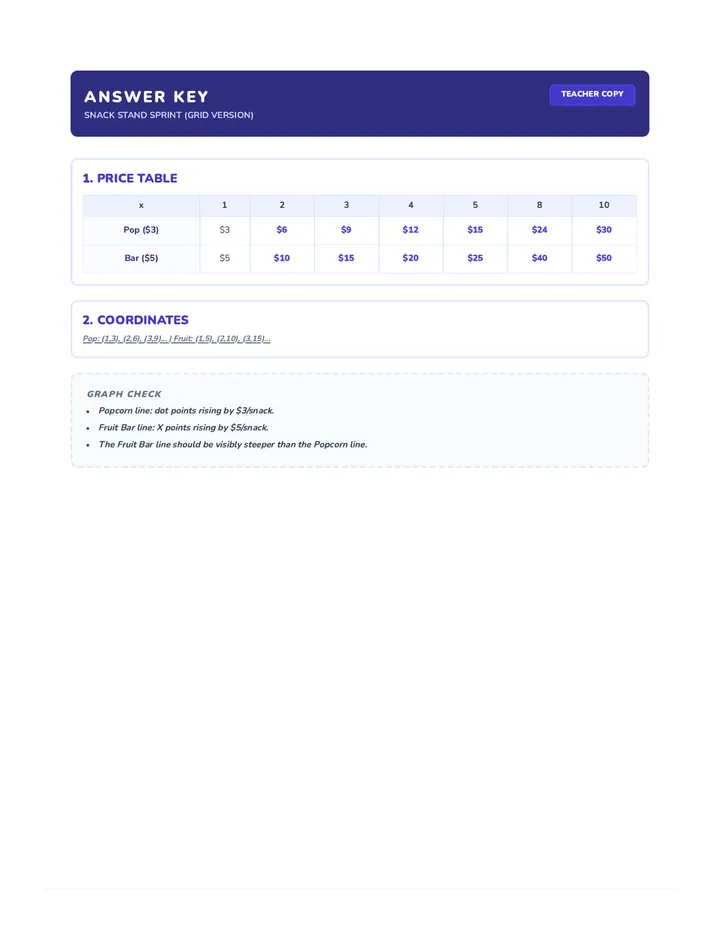
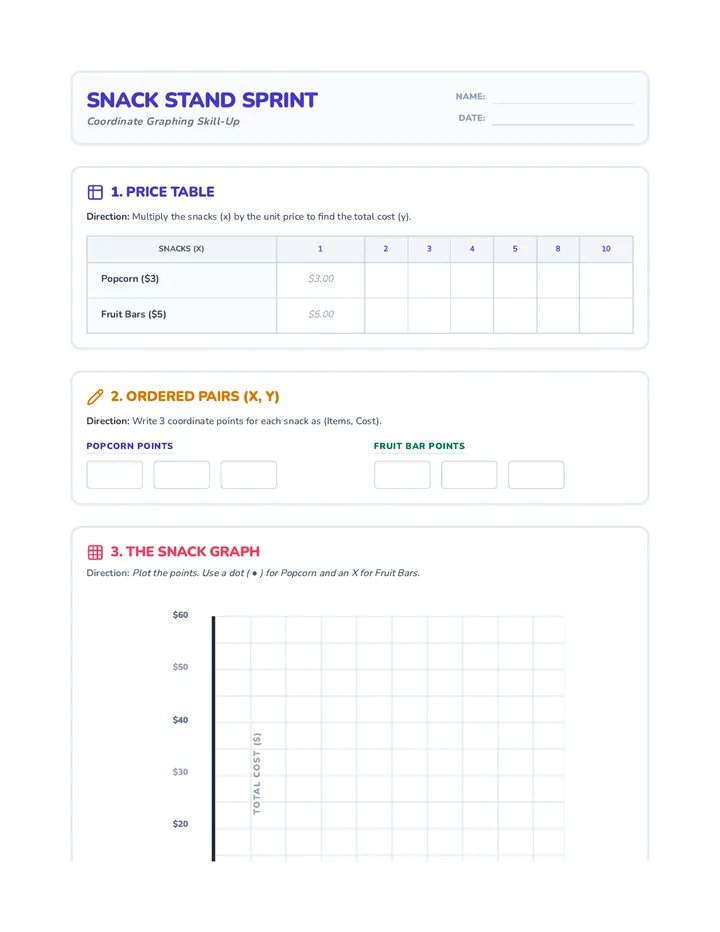
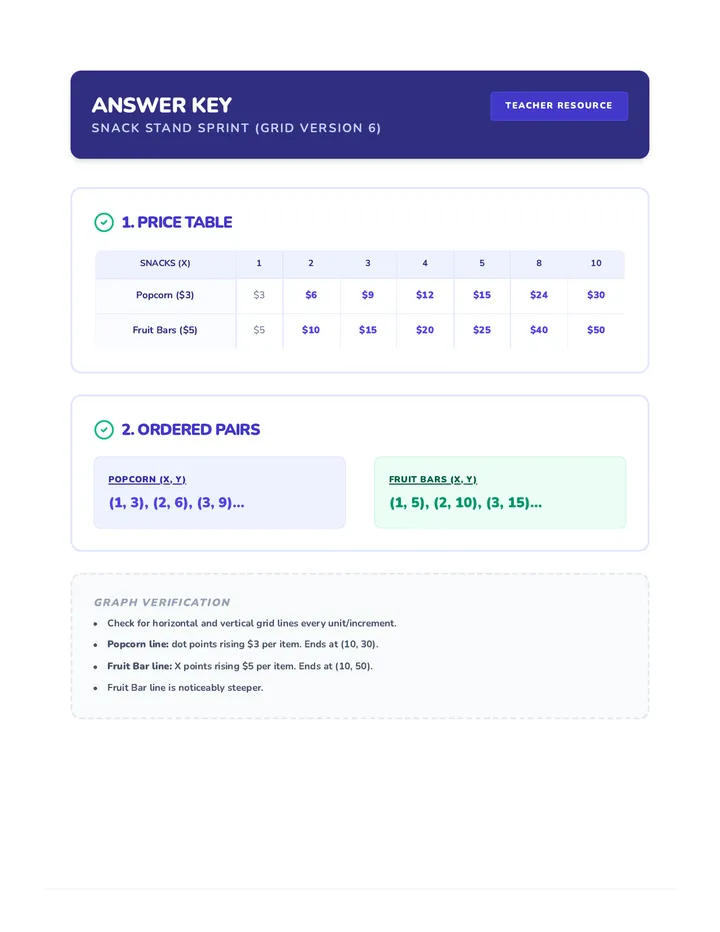
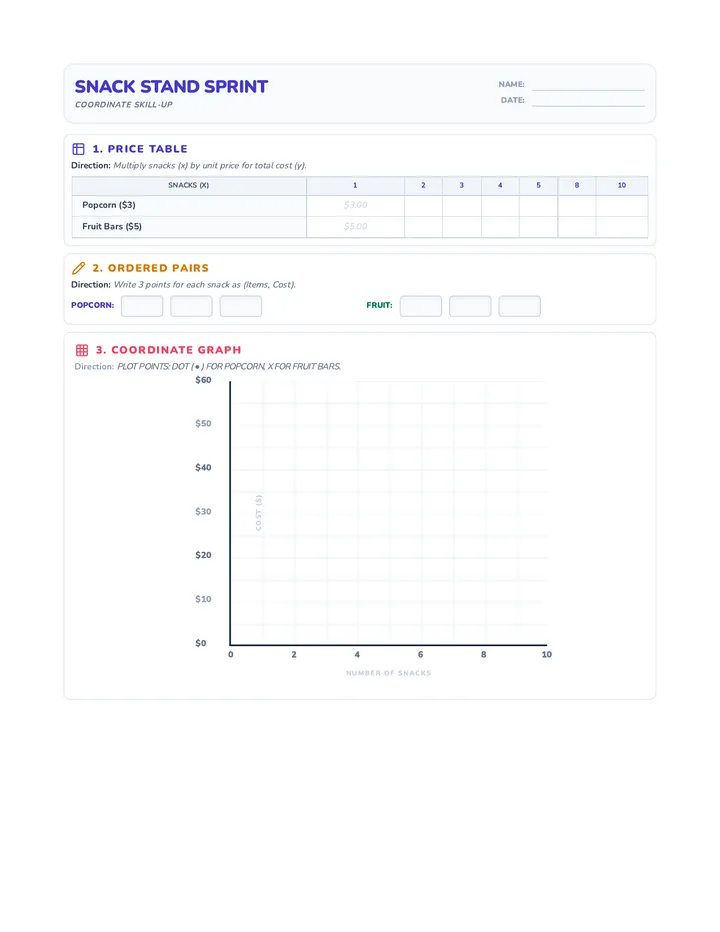
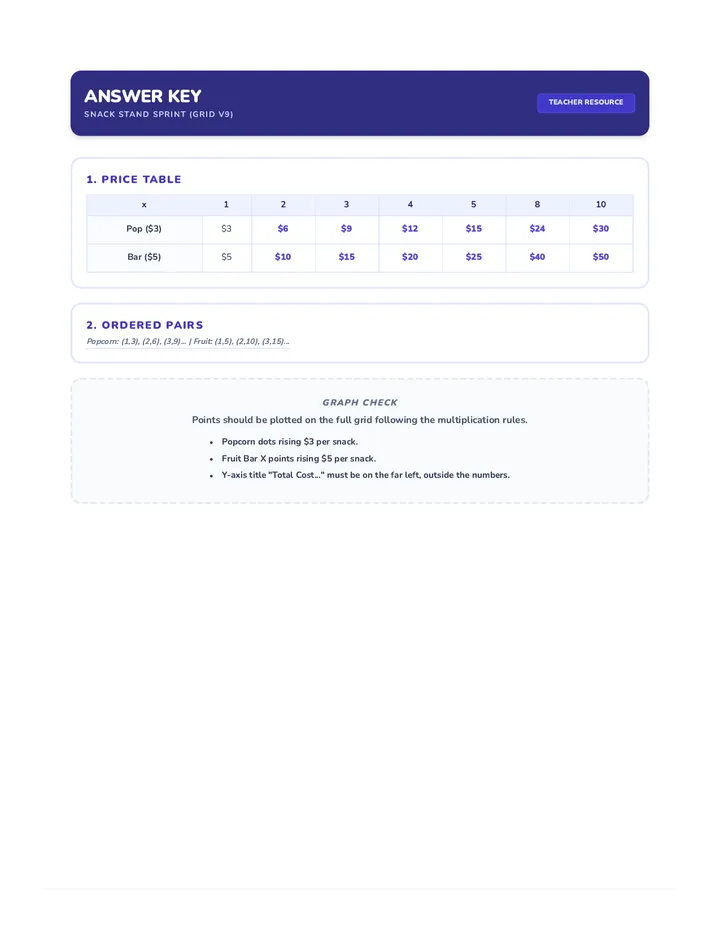
A comprehensive math lesson focusing on identifying and representing relationships between numerical patterns using input/output tables and equations.
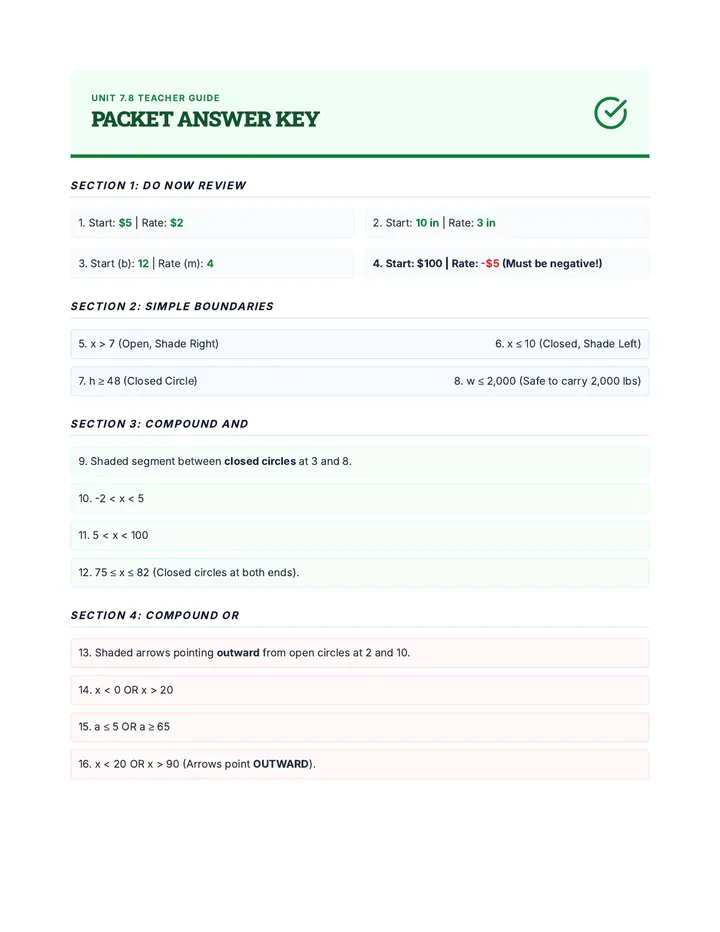
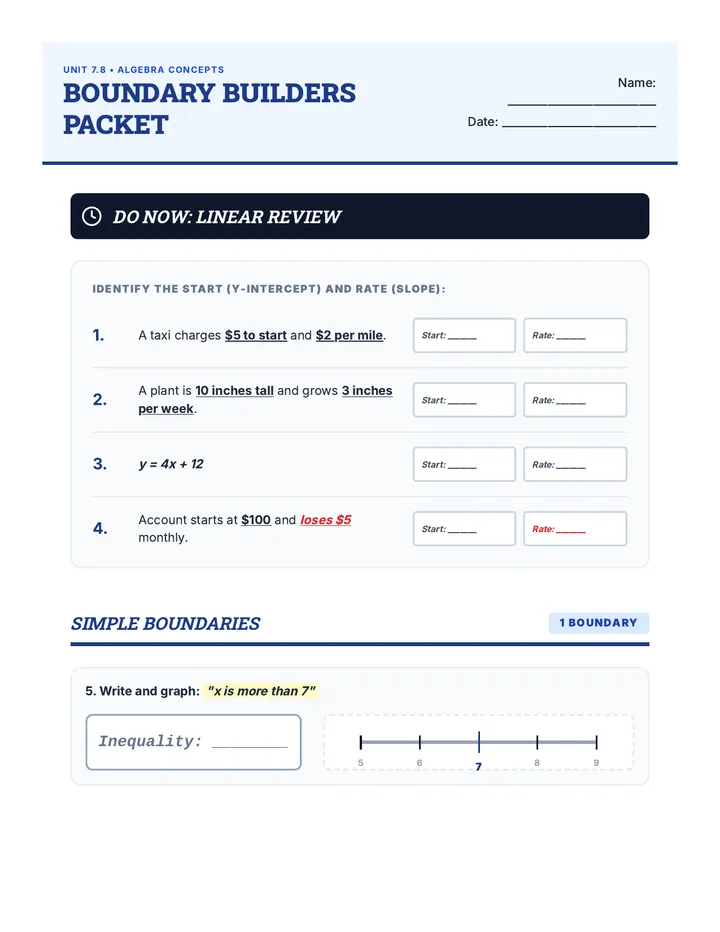
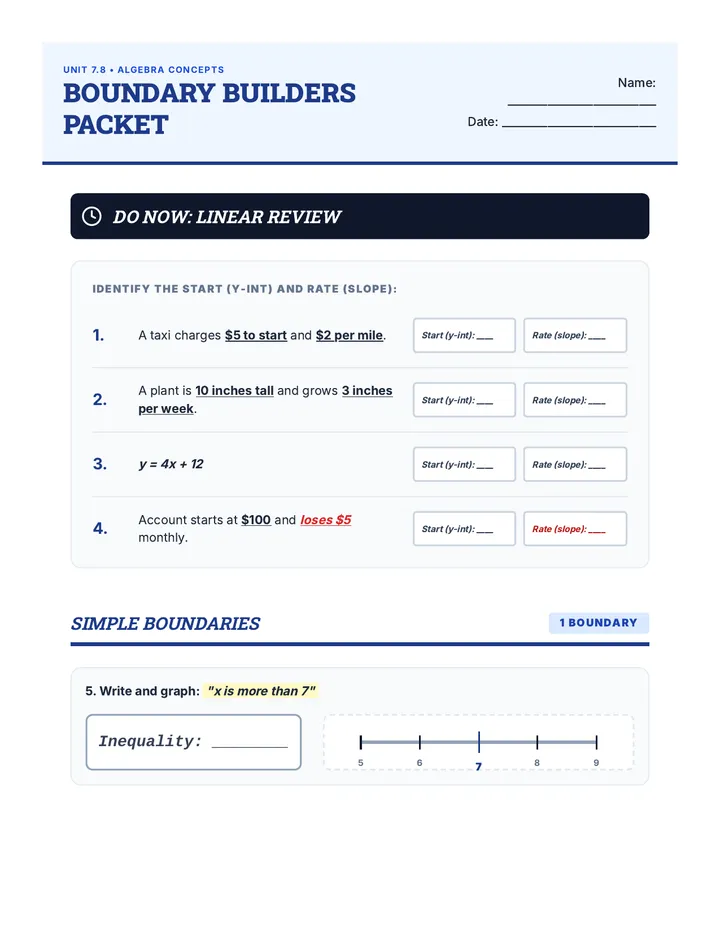
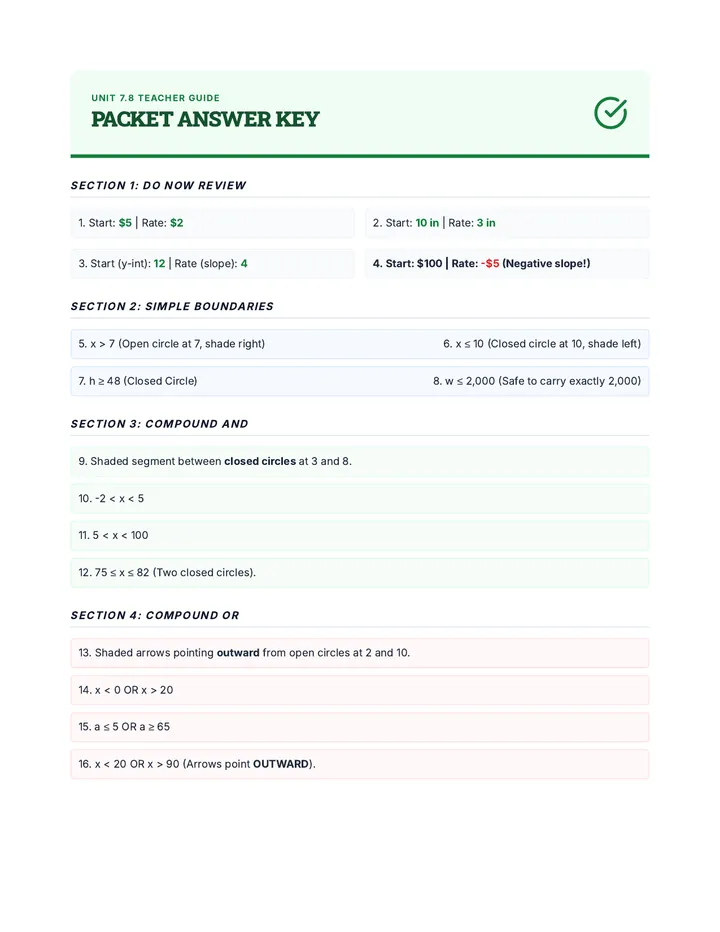
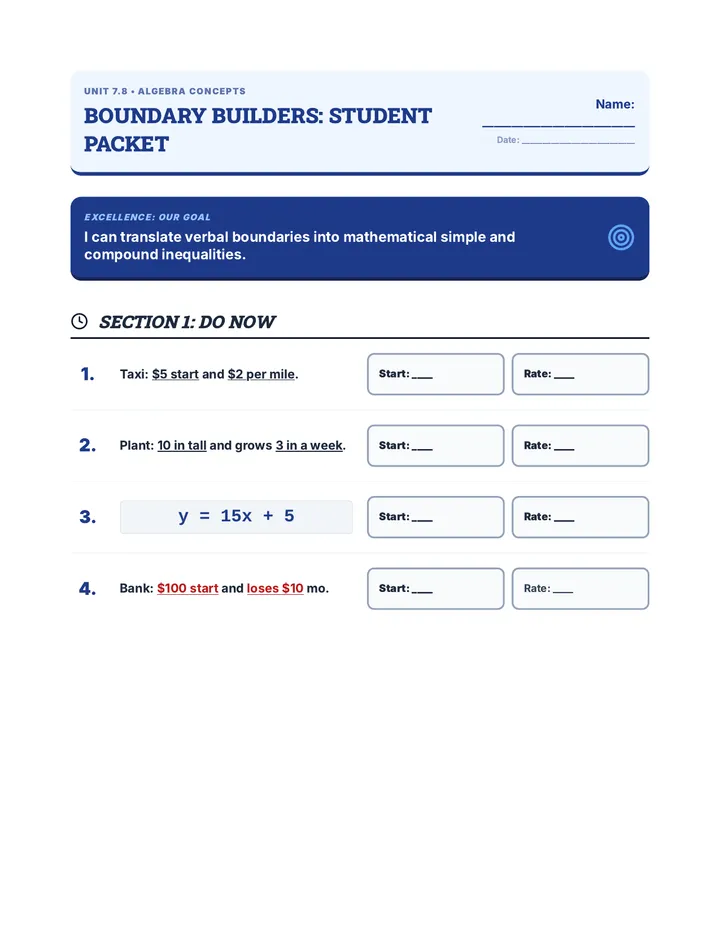
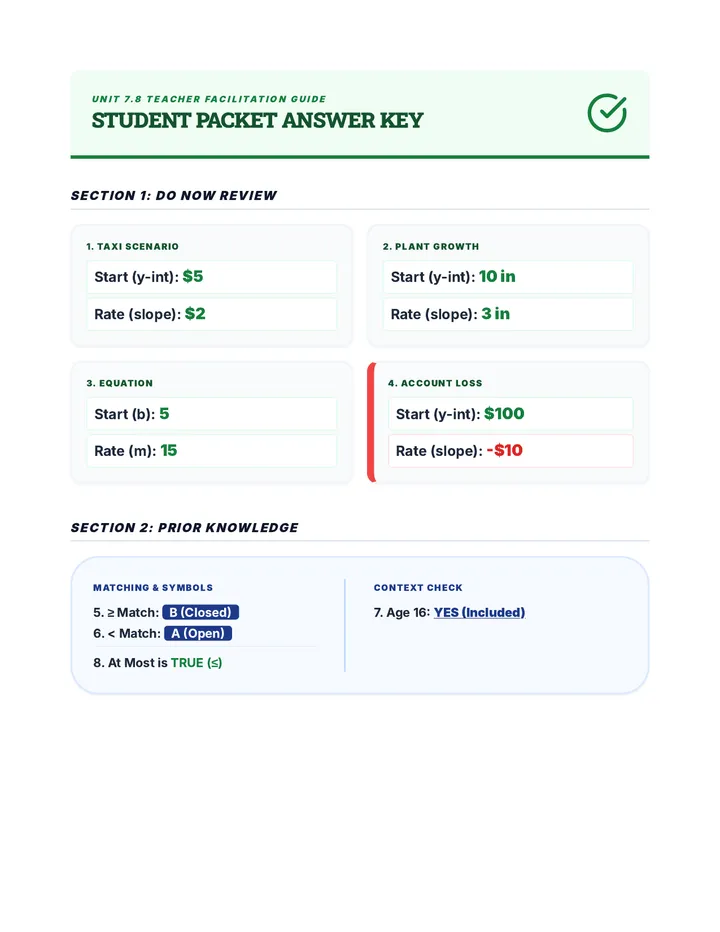
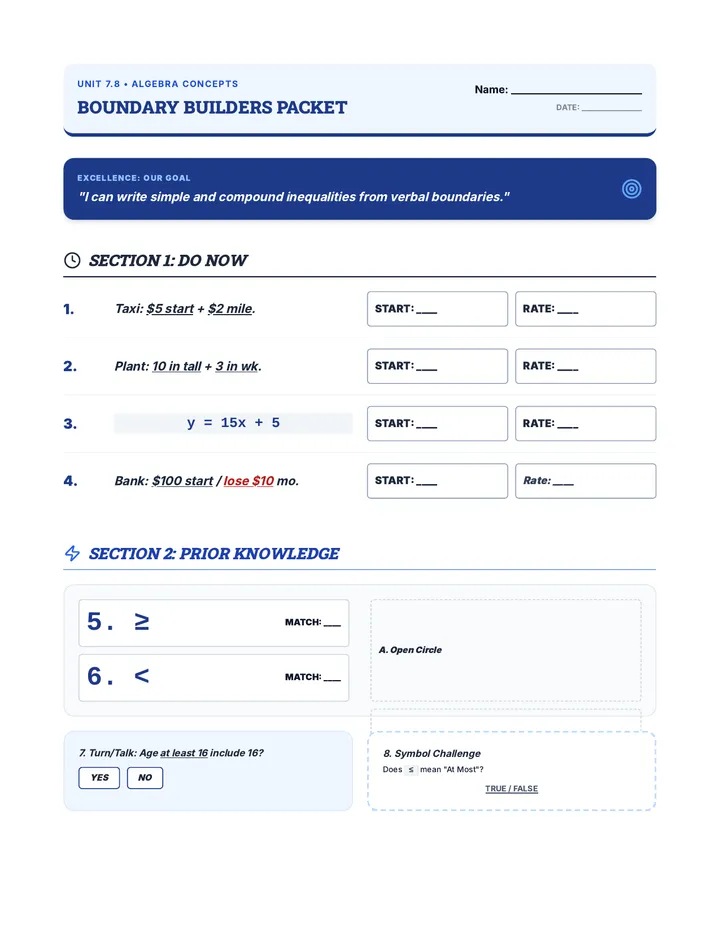
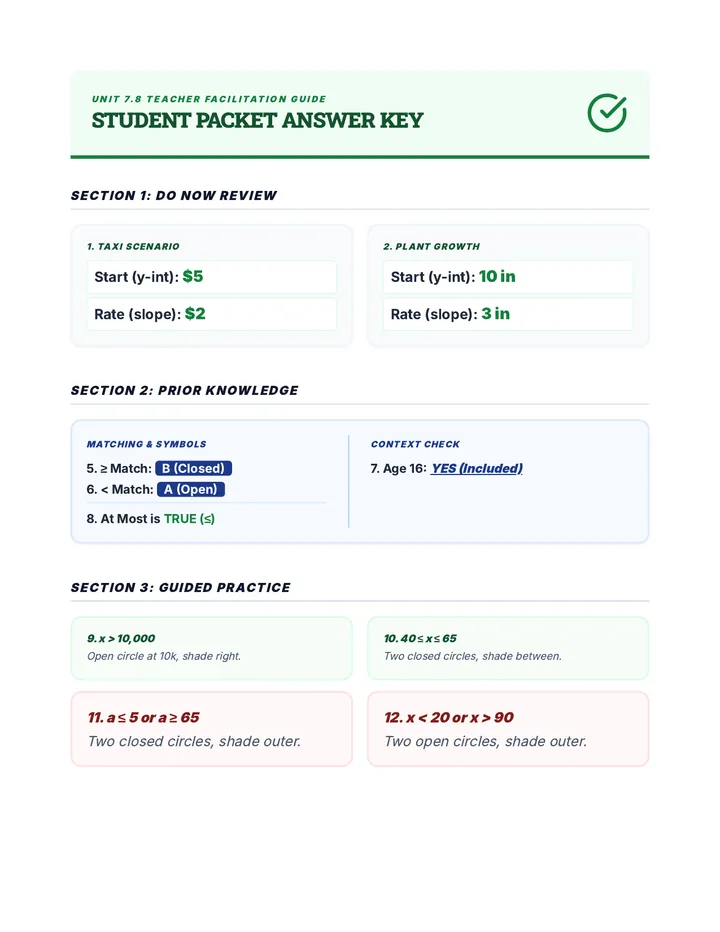
This sequence supports 10th-grade students in mastering inequalities and functions through visual modeling. By progressing from 1D number lines to 2D coordinate planes, students build a concrete understanding of constraints, domain, and range using shading and geometric reasoning.
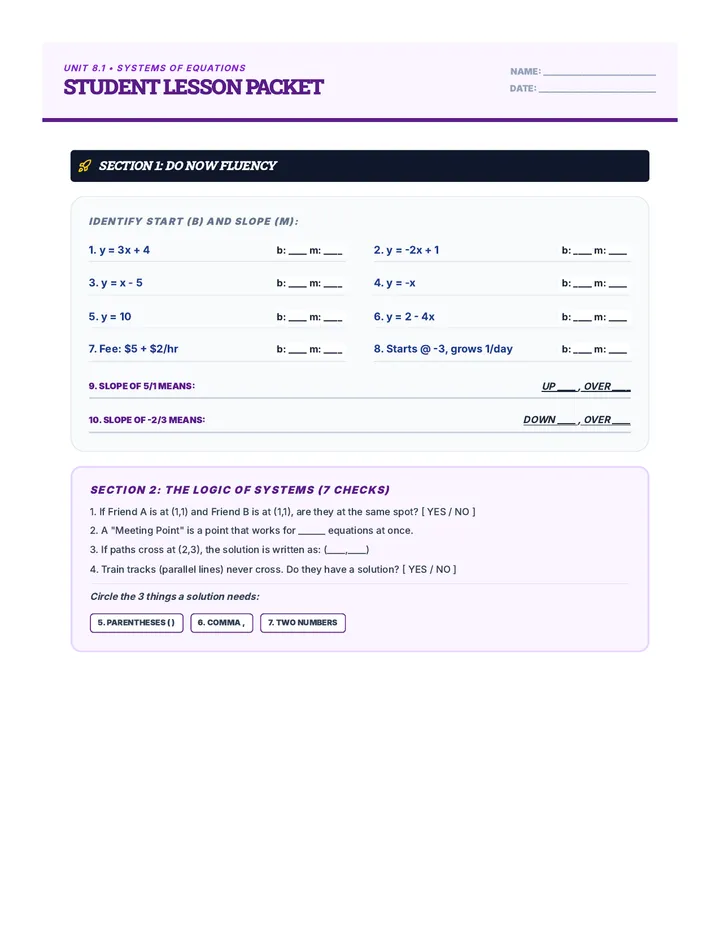
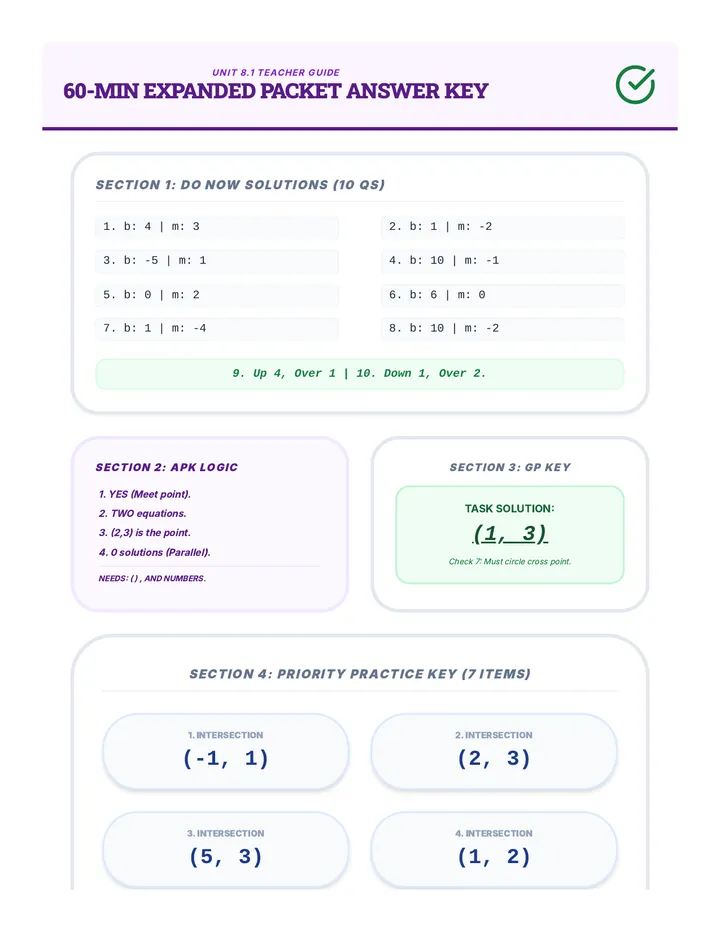
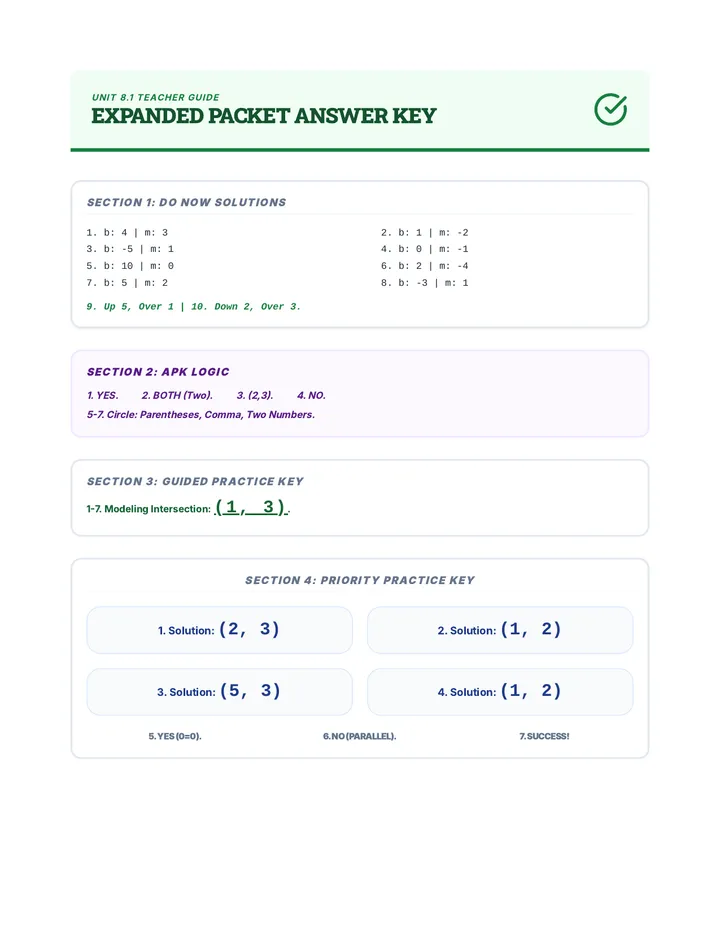
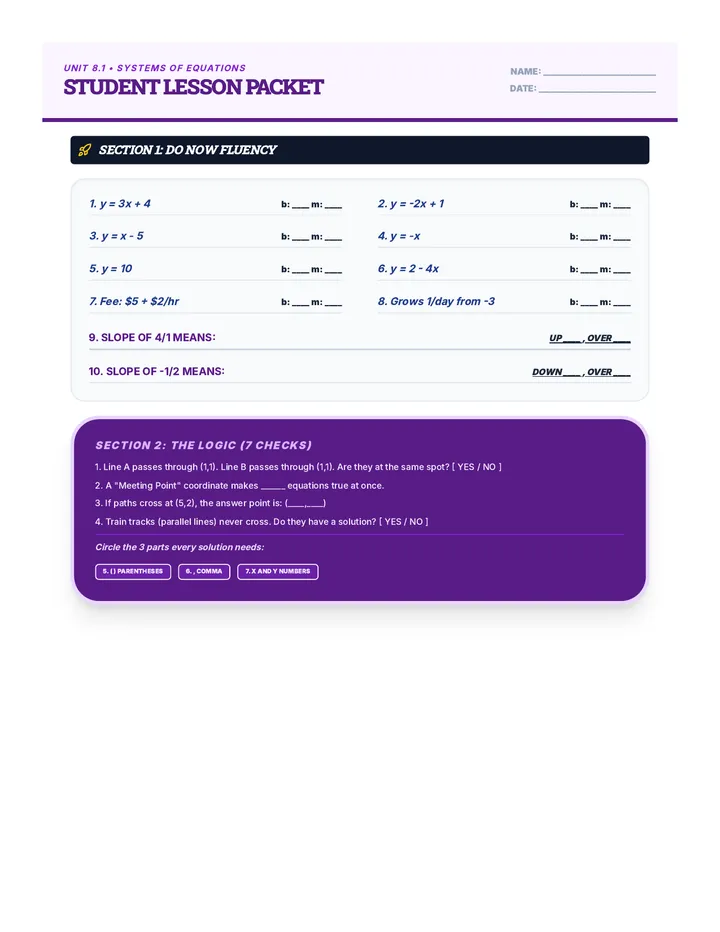
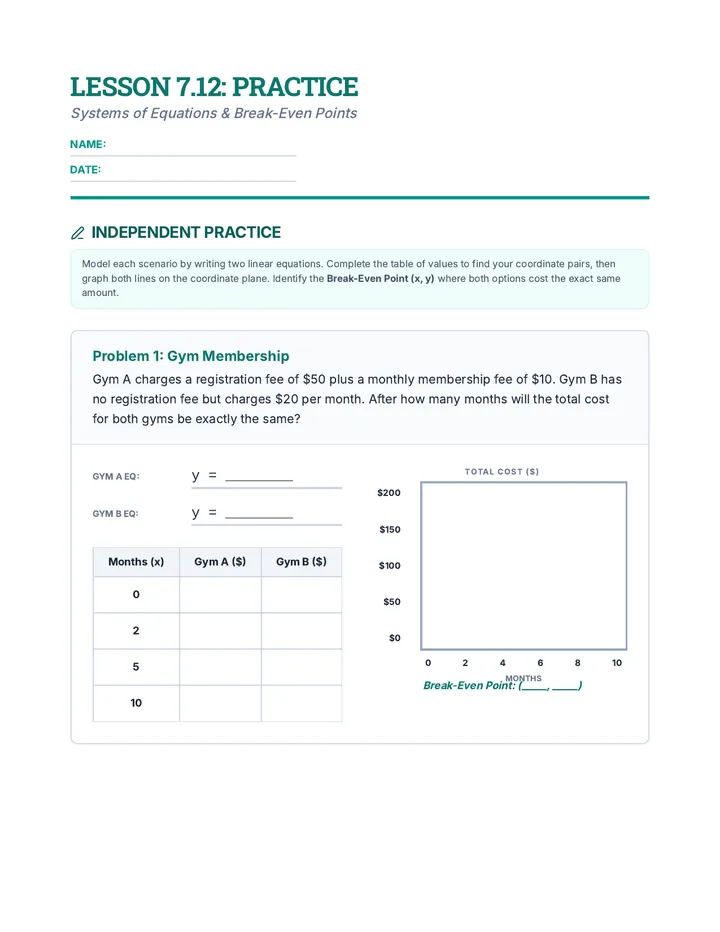
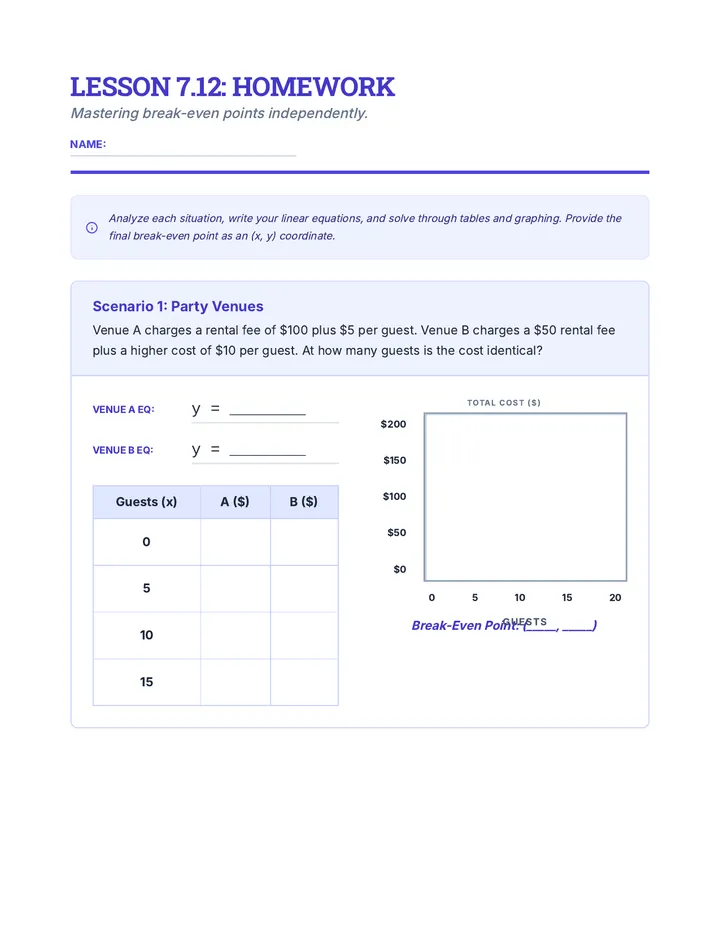
This 8th-grade sequence focuses on visual strategies to deconstruct geometry and systems of equations, helping students manage cognitive load through sketching, color-coding, and decomposition of complex problems.
This sequence uses visual tools like double number lines, slope triangles, and coordinate overlays to help 8th-grade students understand functions and rates of change. It provides concrete representations for abstract algebraic concepts, supporting students who benefit from visual and spatial reasoning.
A 9th-grade math sequence focusing on visual strategies for understanding proportions, slope, systems of equations, and inequalities. This unit supports students in academic support settings by moving from concrete double number lines to abstract coordinate graphing and region shading.
A comprehensive math intervention sequence for 6th-grade students, focusing on four key domains: Numbers & Operations, Algebraic Thinking, Measurement & Data, and Geometry. This sequence uses high-leverage strategies from the All Learners Network (ALN) and aligns with i-Ready prerequisite modules to bridge conceptual gaps.
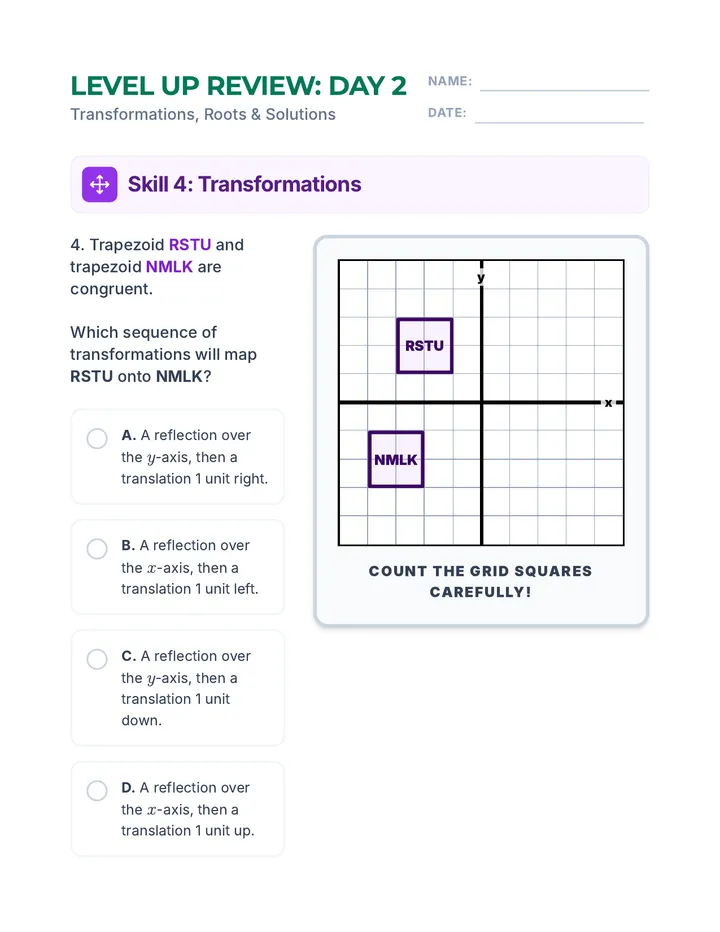
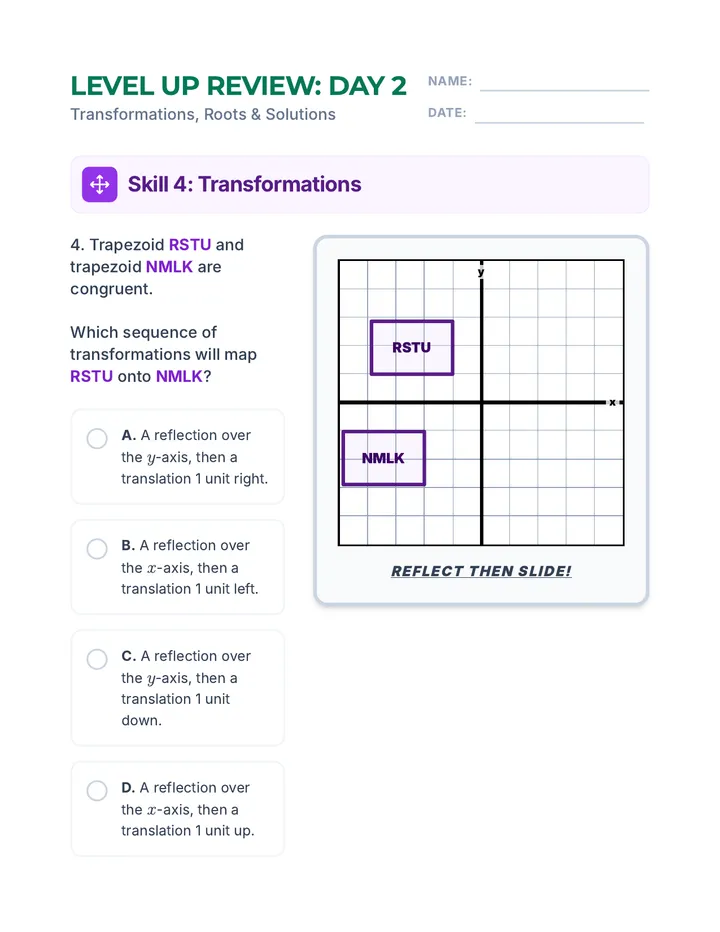
A specialized unit focused on identifying and correcting algebraic misconceptions in function transformations, specifically reflections. Students develop critical analysis skills by acting as "Error Doctors" to diagnose and treat common mathematical pitfalls.
An 11th-grade mathematics sequence focused on analyzing linear-quadratic systems through algebraic and geometric lenses, specifically utilizing the discriminant to predict intersection counts.
A lesson sequence focusing on the geometric properties of quadratic functions, specifically using symmetry to locate key features like the vertex and axis of symmetry.
A comprehensive lesson sequence for 12th Grade Pre-Calculus/Calculus students on solving and visualizing systems of nonlinear equations involving conic sections. Students move from sketching predictions to algebraic verification and creative system design.
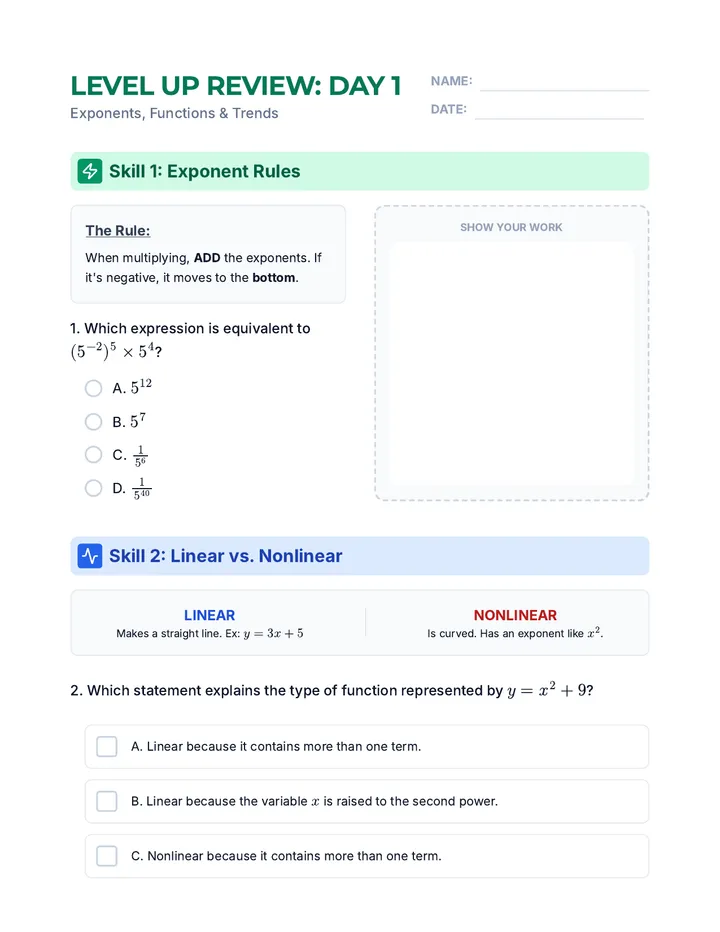
A lesson sequence focusing on analyzing and manipulating exponential functions to reveal true growth rates, using real-world financial contexts and exponent rules.
A math sequence for 11th Grade Special Education focusing on visual representations of functions. Students learn to interpret graphs as narratives, moving from qualitative sketches to precise quantitative analysis of slope, intersections, and non-linear trends.
A high school geometry and algebra sequence focused on applying 3D geometry formulas to real-world optimization problems, specifically focusing on cones.
A lesson sequence focusing on the nuances of exponential decay, specifically distinguishing between annual rates and those occurring over non-standard time intervals like months or half-lives.
A specialized sequence for 12th-grade students needing academic support, focusing on translating word problems into visual models. This unit bridges language processing and algebraic reasoning through sketching, geometric modeling, and diagramming.
This mathematical physics sequence explores the coordinate systems necessary for solving problems involving complex shapes, moving beyond Cartesian coordinates to General Curvilinear systems. Students derive scale factors, volume elements, and differential operators, culminating in solving Laplace's equation and understanding metric tensors.
A graduate-level exploration of discrete dynamical systems, moving from linear growth models to the complex, chaotic behavior of the logistic map. Students apply recursive sequences to model biological and economic phenomena, emphasizing stability analysis and bifurcation theory.
This sequence bridges the gap between discrete mathematics and quantitative finance, focusing on the application of geometric series to asset valuation, loan amortization, and risk management. Graduate students will develop the mathematical foundations for pricing complex financial instruments and understanding market dynamics.
An 11th-grade mathematics sequence that bridges the gap between abstract sequences and real-world applications in finance and physics. Students explore arithmetic and geometric models through interest, depreciation, projectile rebounds, and loan amortization.
A comprehensive unit where students act as data scientists to model real-world environmental phenomena using trigonometric functions. They progress from visual estimation to precise algebraic modeling and technological regression to predict future environmental conditions.
A 10th-grade trigonometry unit where students model circular motion using Ferris wheels, translating physical dimensions like radius, hub height, and speed into sine and cosine functions.
A comprehensive unit on trigonometric transformations, focusing on how parameters A, B, C, and D modify the parent sine and cosine functions. Students progress from simple vertical shifts to complex multi-parameter modeling.
A comprehensive unit for 12th Grade Calculus students focusing on the derivation and application of derivatives in polar coordinates. Students transition from Cartesian slope to polar slope, analyze horizontal and vertical tangency, investigate behavior at the pole, and solve optimization problems involving polar curves.
A comprehensive unit on parametric equations and their applications in modeling motion. Students move from the basics of parametric curves to advanced calculus concepts like derivatives, concavity, vectors, and arc length.
This sequence explores real-world applications of rational exponents across biology, astronomy, music, finance, and physics. Students transition from abstract algebraic manipulation to applying fractional powers to model complex natural and human-made systems.
A graduate-level exploration of non-linear bivariate analysis, moving from the limitations of linear correlation to rank-based methods, local regression, and information-theoretic metrics. Students develop the skills to quantify complex dependencies in biological, financial, and environmental systems where standard assumptions fail.
A graduate-level project-based sequence focused on the rigorous comparison and selection of mathematical models. Students progress from strategy definition and candidate generation to statistical benchmarking and stability analysis, culminating in a professional-grade technical defense.
A technical workshop sequence for 11th-grade students focusing on cross-validation techniques, including train-test splits, MSE calculation, and K-Fold validation to assess and select robust mathematical models.
This sequence guides undergraduate students through the transition from descriptive statistics to predictive modeling. It covers hypothesis testing, linear and multiple regression, model evaluation, and logistic classification, emphasizing both mathematical foundations and practical coding implementation.
This sequence moves beyond simple error metrics to explore sophisticated selection criteria that penalize complexity, specifically AIC and BIC. Students learn to balance model fit with parsimony through real-world datasets and comparative analysis.
An advanced 12th-grade mathematics sequence focusing on model evaluation and selection. Students explore the bias-variance trade-off, information criteria (AIC/BIC), and cross-validation to select optimal predictive models.
A project-based exploration of stochastic modeling, focusing on Queueing Theory and Monte Carlo simulations. Students design and build computational models to optimize real-world systems like traffic flow and service lines.
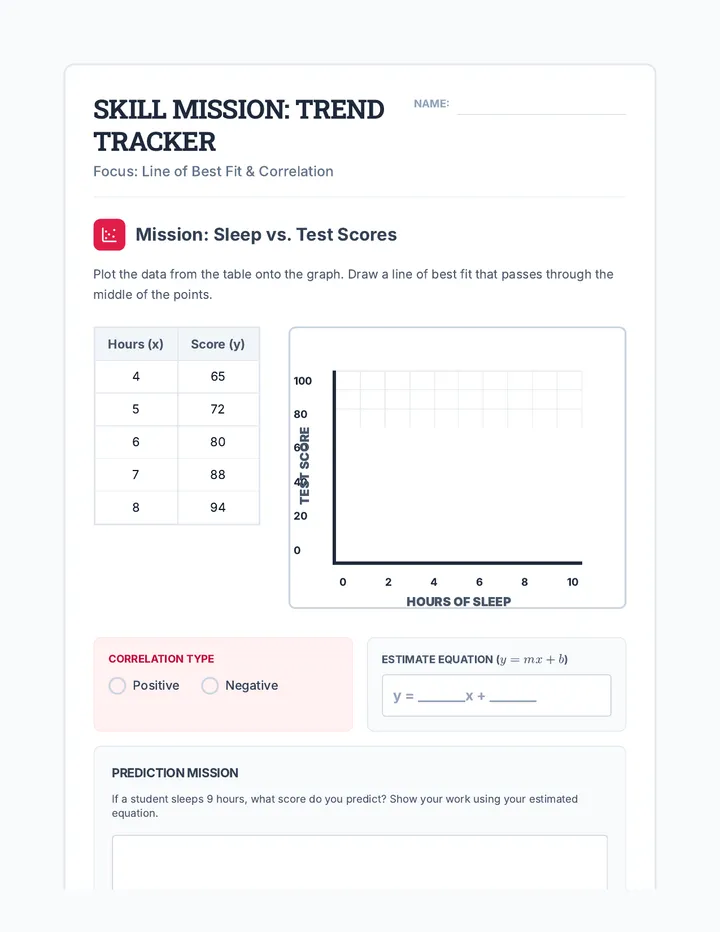
A project-based unit where students apply polynomial calculus concepts to real-world scenarios like business profits, projectile motion, and engineering design. Students transition from abstract solving to modeling data and optimizing outcomes using regression, intercepts, and extrema.
An advanced graduate-level sequence exploring the mathematical foundations of model selection, including bias-variance decomposition, information criteria (AIC/BIC), resampling methods, and high-dimensional diagnostic strategies.
This sequence guides undergraduate students through model comparison and selection, covering the bias-variance tradeoff, cross-validation methods, and information criteria (AIC/BIC). Students will learn to balance model complexity with generalization ability to select the most robust models for prediction and inference.
This sequence guides undergraduate students through the rigorous process of mathematical modeling, from identifying function families via rates of change to validating complex models using residual analysis. Students explore linear, exponential, logistic, sinusoidal, and piecewise models in real-world contexts.
A 10th-grade mathematics sequence focusing on modeling real-world environmental data using linear, exponential, and piecewise functions. Students progress from identifying variables to performing complex regression analysis and presenting predictive models.
A comprehensive lesson for 8th-grade math students to distinguish between arithmetic and geometric sequences through interactive sorting and video-based analysis.
A comprehensive exploration of linear recurrence relations, from first-order foundations to complex second-order systems and real-world predator-prey modeling. Undergraduate students transition from recursive thinking to closed-form solutions, applying discrete math to algorithm analysis and biology.
This graduate-level sequence explores analytic combinatorics through the lens of generating functions. Students will master the transformation of discrete sequences into formal power series, solving complex recurrence relations and evaluating combinatorial identities using advanced algebraic techniques.
A rigorous graduate-level exploration of real-valued sequences, bridging computational calculus and formal real analysis through epsilon-N proofs, Cauchy sequences, and topological theorems.
This sequence introduces 11th-grade students to the behavior of sequences and series as they approach infinity. Students explore convergence, divergence, summation notation, and the paradoxes of infinite geometric series and fractals.
This sequence introduces students to arithmetic and geometric sequences, moving from visual patterns to formal algebraic formulas. Students explore the connections between sequences and linear or exponential functions, analyze complex non-standard patterns, and apply their knowledge in a culminating mastery assessment.
This sequence explores arithmetic and geometric sequences through inquiry, algebraic modeling, and real-world applications. Students transition from pattern recognition to formalizing recursive and explicit formulas to predict outcomes in linear and exponential systems.
This sequence investigates real-world applications of rational exponents in biology, finance, music, and physics. Students explore how fractional powers model growth, scaling, and harmonic relationships, culminating in a data-modeling project.
A series of lessons exploring exponential functions, their components, graphs, and real-world applications in Algebra 1.
A comprehensive unit for undergraduate students on arithmetic and geometric sequences, moving from basic pattern recognition to complex financial and biological modeling. Students will explore linear and exponential growth through real-world applications like simple interest, depreciation, compound growth, and annuities.
This advanced sequence introduces powerful tools for analyzing series with factorials and powers, leading to the concept of power series. Students master the Ratio and Root tests, explore absolute versus conditional convergence, and conclude by connecting series to functions through Taylor polynomials.
This sequence introduces 11th-grade students to the fundamental concepts of mathematical sequences, bridging the gap between algebra and calculus by exploring arithmetic and geometric progressions, recursive and explicit notation, and the behavior of sequences as they approach infinity.
This sequence bridges algebra and calculus by formalizing numerical patterns. Students move from identifying arithmetic and geometric patterns to evaluating limits at infinity and applying the Monotonic Convergence Theorem to real-world models.
A 2nd-grade sequence exploring quantitative relationships through growing geometric patterns. Students move from concrete cube-building to recording data in tables and visualizing growth with bar graphs.
A comprehensive unit on arithmetic and geometric sequences and series, focusing on identifying patterns, deriving summation formulas, and applying these concepts to financial modeling and real-world growth.
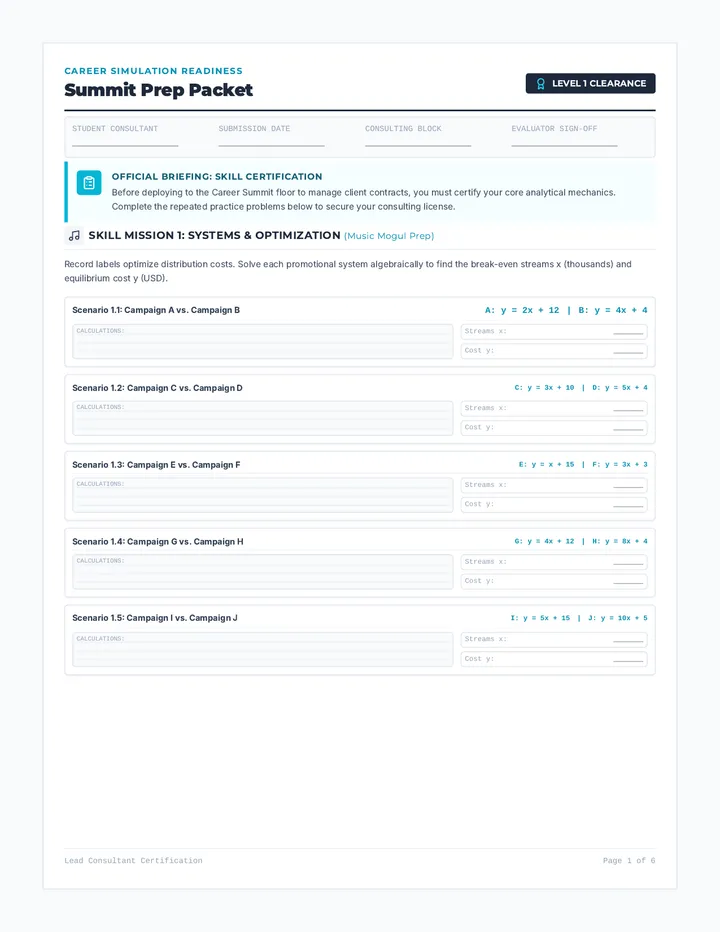
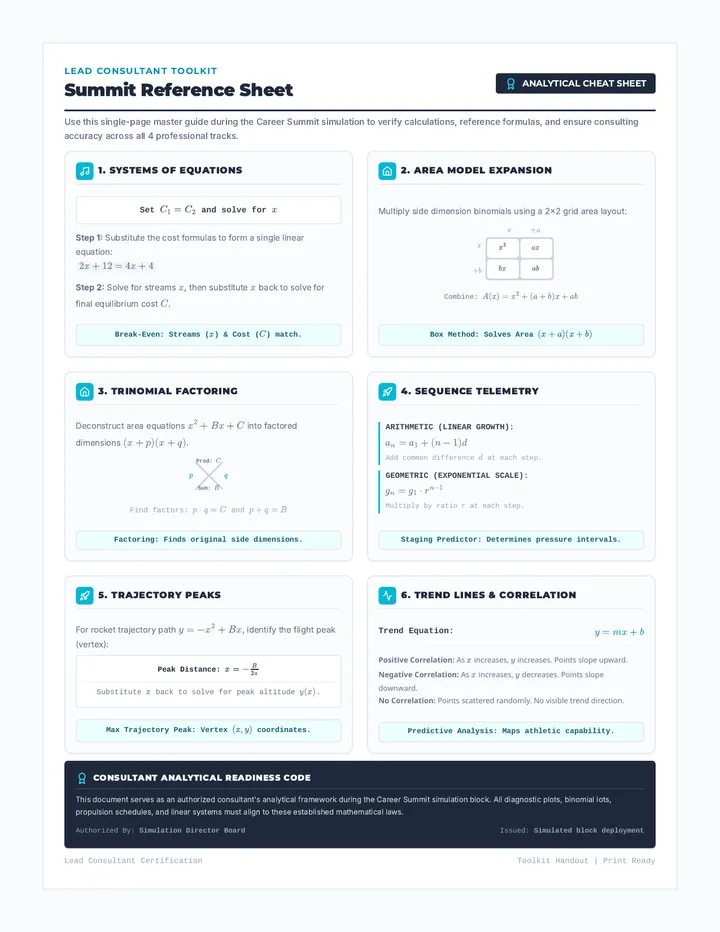
This financial literacy-themed sequence teaches 8th-grade students to compare linear and exponential growth rates. Students act as financial consultants, analyzing investment, debt, and depreciation scenarios to understand function dominance and long-term behavior.
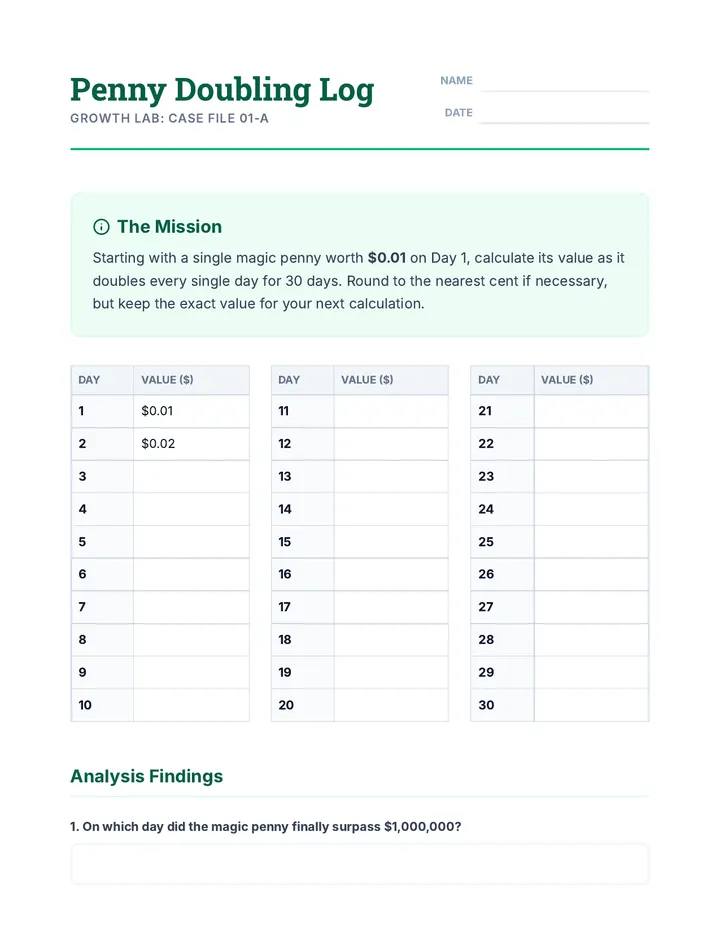
An inquiry-based exploration of growth rates, comparing linear, quadratic, and exponential patterns through real-world simulations, table analysis, and graphing. Students discover how constant addition, area growth, and constant multiplication create vastly different outcomes over time.
This sequence explores the relationship between rational exponents and the geometric behavior of power functions. Students analyze how numerators and denominators dictate domain, range, shape, and growth rates through inquiry and visual sketching.
A comprehensive unit on polar coordinates and functions, moving from basic plotting to complex intersections and symmetry. Students explore the geometric beauty of curves like roses and lima\u00e7ons while mastering the algebraic conversions between rectangular and polar systems.
A comprehensive exploration of the polar coordinate system, covering point plotting, coordinate conversion, and the analysis of complex polar curves including rose curves, limacons, and spirals. Students move from basic radial positioning to deep geometric analysis of symmetry and periodicity.
This sequence explores the intersection of calculus and geometry through infinite series and fractals. Students investigate convergence and divergence using visual area models, fractal dimensions, and physical simulations like block stacking.
This sequence explores the practical application of rational exponents and power functions in biology, physics, and finance. Students will progress from evaluating existing models like Kleiber's Law and Kepler's Third Law to constructing their own mathematical models from empirical data.
A 9th-grade algebra project-based sequence exploring rational exponents through real-world biological scaling (allometry) and physical laws. Students transition from evaluating fractional powers in Kleiber's Law to creating and presenting their own mathematical models.
A project-based unit exploring the practical applications of rational exponents in biology, music, finance, and astronomy. Students analyze real-world models and synthesize their understanding through a final modeling project.
This sequence introduces students to parametric equations as a tool for modeling dynamic systems. Students explore the relationship between independent components, algebraic conversion to Cartesian form, and real-world applications like projectile motion and cycloids.
This workshop-style sequence focuses on the technical skills required to construct and compare function representations explicitly. Students move from conceptual understanding to algebraic rigor, learning to write equations for different growth models and comparing their rates of change directly.
An advanced look at rational exponents through the lens of mathematical proof, equivalence, and error analysis for 10th grade students. Students act as mathematical investigators to justify transformations and identify logical fallacies.
A comprehensive unit for 12th-grade algebra focusing on solving equations with rational exponents, investigating extraneous solutions, and visualizing intersections graphically.
A comprehensive unit for undergraduate students focusing on the algebraic techniques and logical pitfalls involved in solving equations with variables raised to rational exponents. Students progress from basic isolation to quadratic-form structures and non-linear systems.
This sequence introduces undergraduate students to first-order differential equations through geometric visualization, analytical solving techniques (separation, integrating factors), and real-world modeling of thermal, biological, and electrical systems.
This sequence for undergraduate students focuses on complex algebraic structures involving exponentials, including quadratic forms, distinct bases, inequalities, systems, and transcendental limitations. It prepares students for higher-level calculus and engineering mathematics through rigorous analytical techniques.
A comprehensive exploration of exponential modeling across finance, biology, and physics, focusing on the algebraic techniques required to solve for time and rate variables in real-world growth and decay scenarios.
This sequence establishes foundational algebraic techniques for solving exponential equations, moving from common base matching to logarithmic inversion. It emphasizes the concept of inverse functions as the primary mechanism for variable isolation, preparing students for calculus and scientific applications.
A 9th-grade algebra sequence focused on modeling and solving exponential equations in real-world contexts like finance, biology, and archaeology. Students learn to construct models and solve for time using algebraic and graphical methods.
This sequence guides students through the algebraic methods for solving exponential equations, from the foundational skill of base rewriting to the introduction and application of logarithms. Students build structural recognition to handle both matchable and non-matchable bases.
This sequence guides 11th-grade students through algebraic techniques for solving exponential equations. It starts with base manipulation, introduces logarithms as inverse operations, and concludes with complex quadratic forms and the natural base e.
A comprehensive 11th-grade unit where students apply logarithmic solving techniques to real-world exponential growth and decay scenarios. Students act as financial planners, archaeologists, ecologists, and forensic scientists to solve for the time variable in complex equations.
This sequence explores exponential equations through real-world modeling, moving from identifying growth/decay parameters to solving for time using logarithms in financial, biological, and forensic contexts.
This sequence guides 10th-grade students through the algebraic mechanics of solving exponential equations, moving from common base properties to logarithmic inversions and quadratic structures. Students develop a deep conceptual understanding of logs as inverses and master the precision needed for complex algebraic manipulation.
An advanced 12th-grade mathematics sequence focusing on algebraic and logarithmic methods for solving exponential equations within real-world modeling contexts, from finance to forensics.
A 5-lesson sequence designed for 11th-grade students to master complex math decomposition through real-world financial literacy. Students learn to break down paychecks, tax brackets, budgeting variables, and compound interest to prepare for independent living.
This sequence explores the relationship between quadratic functions, their graphs, and complex roots. Students progress from visual identification of roots to algebraic calculation and verification of complex solutions.
This sequence guides 10th-grade students through the transition from real to complex solutions in quadratic equations. Students explore the geometric meaning of non-real roots, use the discriminant as a predictive tool, and master algebraic techniques like the Quadratic Formula and Completing the Square to find exact complex solutions.
This sequence covers the fundamental concepts of the Time Value of Money (TVM), including compounding, discounting, annuities, debt amortization, bond pricing, and investment decision-making using NPV and IRR. Designed for undergraduate finance students, it blends theoretical grounding with quantitative application.
A sequence for undergraduate students bridging pre-calculus and calculus by focusing on the analytical properties of functions with rational exponents. Students explore graphing, algebraic rewriting, rationalizing for limits, and growth comparison.
A 1st-grade sequence exploring quantitative relationships through geometric patterns, T-charts, skip counting, and simple graphing to build foundational algebraic thinking.
An advanced 11th-grade Calculus unit focusing on the integration of parametric and polar coordinate systems. Students analyze motion, calculate complex areas, perform error analysis, and complete a final synthesis project based on particle kinematics.
This advanced sequence bridges series to function approximation, introducing Power Series and Taylor Polynomials. Students discover how polynomials can mimic complex curves like sine and cosine, moving from simple tangent lines to higher-order polynomials while investigating convergence and approximation error.
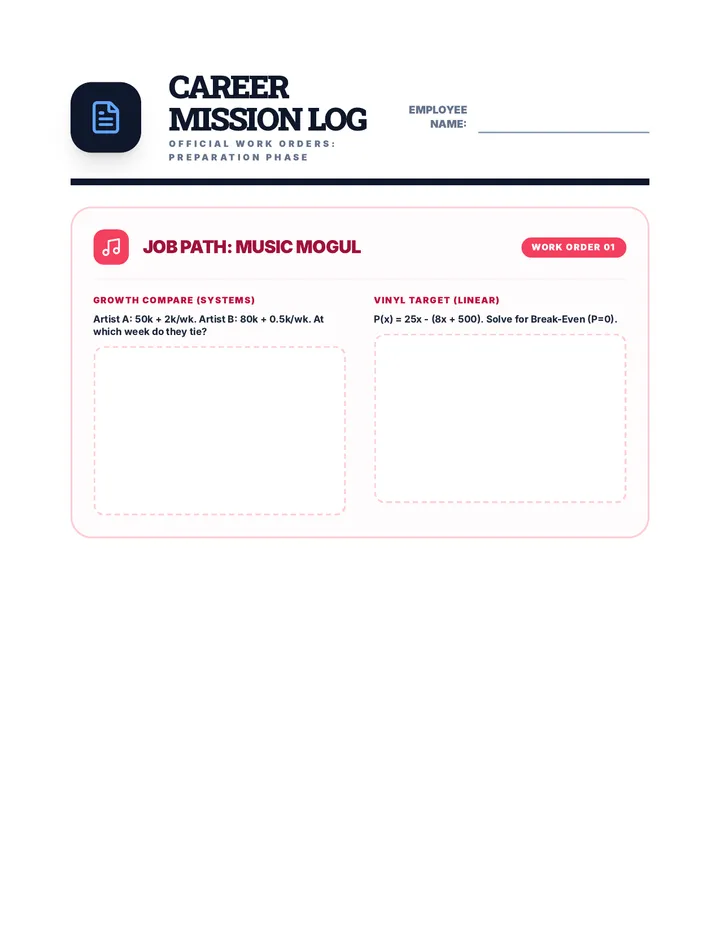
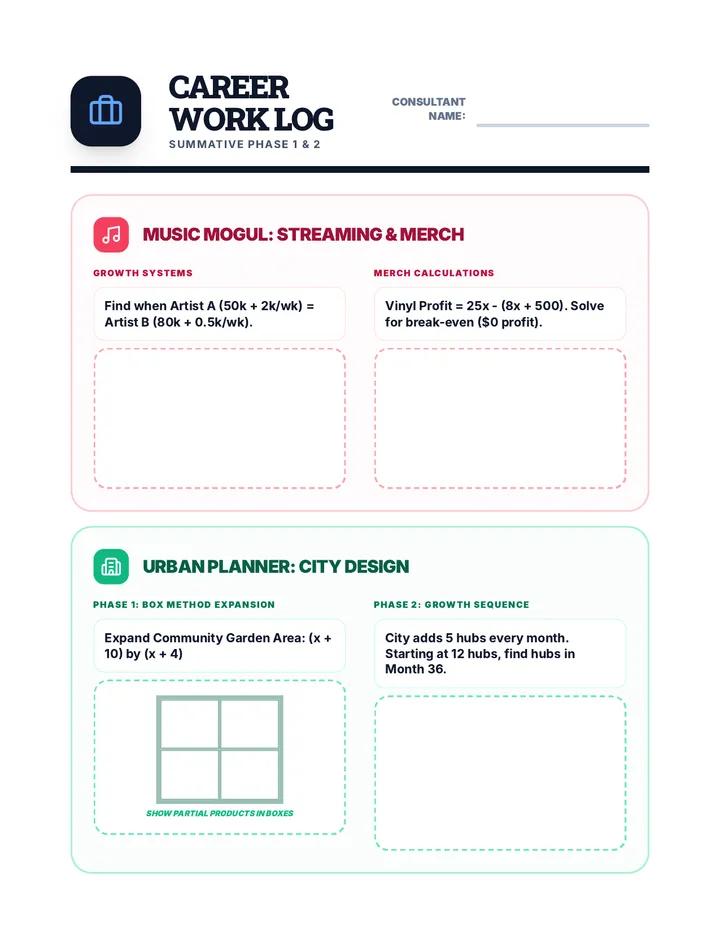
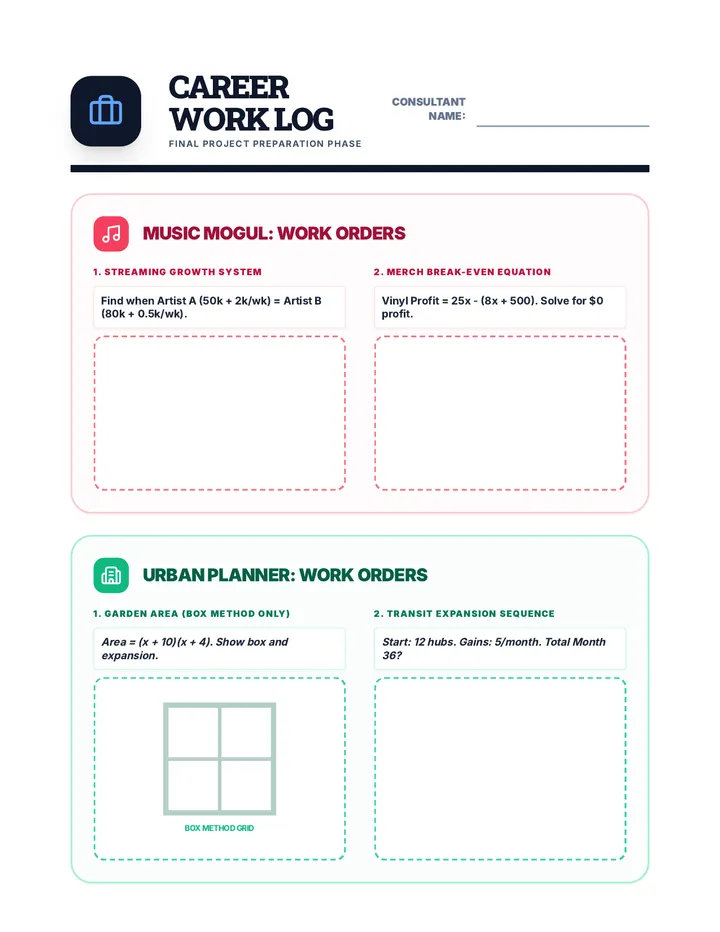
This sequence explores how functions can be treated as mathematical objects that can be added, subtracted, multiplied, and composed. Students move from basic arithmetic operations on business models to the abstract concept of function composition and decomposition, applying these skills to real-world scenarios like profit modeling and geometric expansion.
This sequence establishes the rigorous mathematical underpinnings necessary for advanced optimization work, moving beyond procedural calculus to analysis-based proofs. Students explore the intersection of topology, set theory, and multivariate calculus to determine the existence and uniqueness of optimal solutions.
A comprehensive 9th-grade math sequence exploring the geometric transformations of parent functions. Students move from basic translations to complex dilations and reflections, culminating in a creative design project using transformed functions.
A comprehensive unit on graphing trigonometric functions, transitioning from the unit circle to complex transformations. Students explore amplitude, period, phase shifts, and vertical translations for sine, cosine, and tangent functions.
A graduate-level sequence exploring the gradient vector as the foundational tool for modern optimization. Students move from the geometric interpretation of multivariate derivatives to the implementation of stochastic algorithms used in machine learning.
A 12th-grade mathematics sequence exploring complex number operations through the lens of fractal geometry. Students learn to iterate complex functions, calculate orbits, and define the boundaries of the Mandelbrot and Julia sets.