Lenny LearningLenny
Create
Explore
Workspace
LoginSign up
MathEnglish Language ArtsScience & EngineeringSocial StudiesGlobal LanguagesHealth & Physical EducationSpecial EducationCounseling & Life SkillsArts & CreativityESL
Lenny LearningLenny
Lenny Learning
About
Training
Pricing
Support
Contact
© 2026 Lenny Learning Inc.

Numbers & Counting

SequencesLessonsMaterialsVideos
  1. Math

Numbers & Counting

SequencesLessonsMaterialsVideos

One-to-one correspondence, numeral identification, and comparison of quantities using terms like greater than or less than. Establishes the foundation for numerical literacy and early arithmetic operations.

Counting ObjectsOne-to-one correspondence and cardinality skills through counting discrete objects in various arrangements. Strengthens number recognition and the understanding of quantity.
Number NamesIdentification and spelling of number words from zero through millions. Connects numerical symbols to their written linguistic representations to strengthen mathematical literacy.
Comparing NumbersMathematical symbols including greater than (>), less than (<), and equal to (=) to evaluate numerical relationships. Builds fluency in ordering sets and comparing quantities from single digits to multi-digit integers.
MathNumbers & CountingCounting ObjectsNumber NamesComparing NumbersNumber OperationsCounting SequenceNumbers 0-10Place Value Understanding and SystemAdd and Subtract Within 20Addition and Subtraction ConceptsAddition and Subtraction EquationsAddition and Subtraction ProblemsFoundations for MultiplicationMultiplication and Division PropertiesMultiply and Divide Within 100Multiplication and Division ProblemsFactors and MultiplesProperties of OperationsPatterns and RelationshipsGenerate and Analyze PatternsMulti-Digit ArithmeticPlace Value OperationsMulti-Digit and Decimal OperationsNumerical ExpressionsFour Operations and PatternsFour Operations Problem SolvingMeasurement & DataMeasurable AttributesMeasuring LengthsMeasure and Estimate Lengths in Standard UnitsRelate Addition and Subtraction to LengthClassifying and Counting ObjectsTime and MoneyArea Concepts and MeasurementPerimeter and Area MeasuresAngle Concepts and MeasurementTime, Volume, and MassMeasurement Unit ConversionsGeometryIdentifying ShapesShapes and AttributesShape Attributes and ReasoningShapes and CompositionClassifying 2D FiguresGeometric Figures and RelationshipsLines, Angles, and ShapesAngle, Area, and VolumeGeometric MeasurementVolume of 3D ShapesCoordinate Plane ApplicationsTransformations in the PlaneCongruence and SimilarityUnderstand congruence in terms of rigid motionsSimilarity and TransformationsProve Theorems Involving SimilarityPythagorean TheoremTrigonometry for General TrianglesMake Geometric ConstructionsProve Geometric TheoremsTheorems About CirclesFind Arc Lengths And Areas of Sectors of CirclesVolume FormulasRelationships Between Two-Dimensional and Three-Dimensional ObjectsProve Simple Geometric Theorems AlgebraicallyTranslate Between Geometric Description and Equation for Conic SectionApply Geometric Concepts in Modeling SituationsFractions & DecimalsFractions as NumbersBuilding FractionsFraction Equivalence and OrderingAdding and Subtracting FractionsMultiplying and Dividing FractionsDividing FractionsDecimal FractionsMulti-Digit Computation and FactorsAdd, Subtract, Multiply, and Divide Rational NumbersRational Number SystemIrrational Numbers and ApproximationsRatiosRatios and ProportionsProportional RelationshipsUnit RateAlgebraAlgebraic ExpressionsGenerate Equivalent ExpressionsQuantitative RelationshipsProportional Relationships and Linear EquationsEquations and InequalitiesEquation Solving and ReasoningLinear Equations and SystemsGraph Equations and InequalitiesSystems of EquationsReal-World Algebraic ProblemsQuantitative Reasoning with UnitsExpression StructureEquivalent Expression FormsRadicals and Integer ExponentsRational ExponentsRational and Irrational NumbersPolynomial OperationsPolynomial IdentitiesPolynomial Zeros and FactorsRational ExpressionsComplex Number OperationsComplex Numbers in PolynomialsComplex Numbers on PlaneStatistics & ProbabilityRepresent and Interpret DataData DistributionsStatistical VariabilityProbability ModelsCompound Event ProbabilitiesStatistical SamplingInterpret Categorical and Quantitative DataBivariate Data PatternsInterpret Linear ModelsComparing Two PopulationsRandom Processes in StatisticsIndependence and Conditional ProbabilityExpected ValuesProbability-Based Decision MakingStatistical Inference and ConclusionsFunctionsFunction Concepts and NotationDefine and Compare FunctionsInterpret Functions in ContextAnalyze Function RepresentationsModel Relationships with FunctionsIdentify Linear vs Exponential GrowthDistinguish Between Function TypesCompare Growth RatesInterpret Function ExpressionsBuild Functions from RelationshipsConstruct and Model FunctionsTransform and Combine FunctionsModel Comparison and SelectionSolve Exponential EquationsTrigonometryTrigonometric Ratios Involving Right TrianglesTrigonometric Functions and Unit CircleModel with Trigonometric FunctionsTrigonometric IdentitiesVectors & MatricesIntroduction to Vectors and MatricesVector QuantitiesVector OperationsMatrix OperationsCalculusLimits and ContinuityDerivative Concepts and NotationDerivative Rules and TechniquesApplications of DerivativesOptimization ProblemsRelated RatesCurve Sketching and AnalysisIntegration Concepts and NotationAntiderivatives and Indefinite IntegralsDefinite Integrals and AreaFundamental Theorem of CalculusIntegration TechniquesApplications of IntegrationDifferential EquationsSequences and SeriesParametric and Polar FunctionsVector-Valued Functions
Sequence
Coin Match Worksheet

Market Masters

A comprehensive week-long math unit focused on identifying coin values and performing addition and subtraction of money up to $20 using a calculator in real-world contexts.

EE

Erin Esswein

Special Education Teacher
2/6
Sequence
Scout Master Manual Teacher Guide
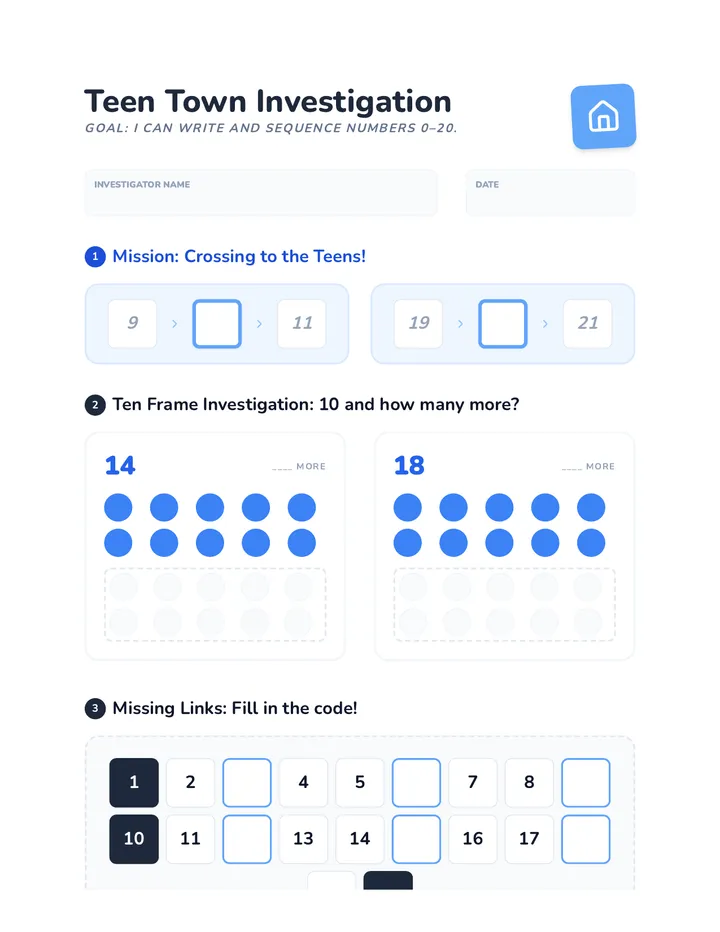
Teen Territory Slides
Teen Territory Activity Sheet

Number Scouts Sequence

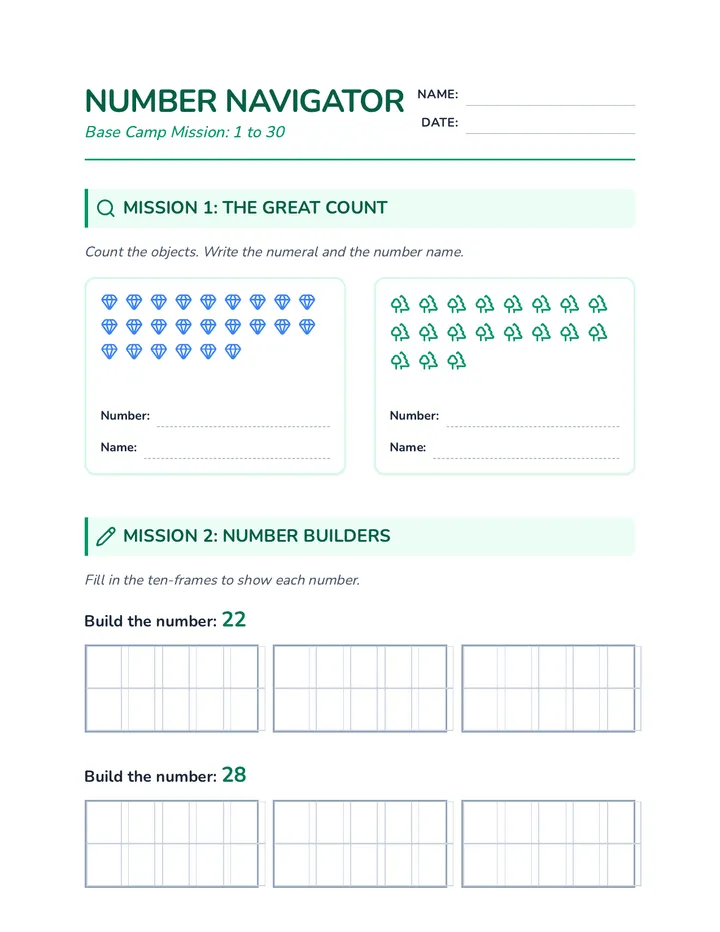
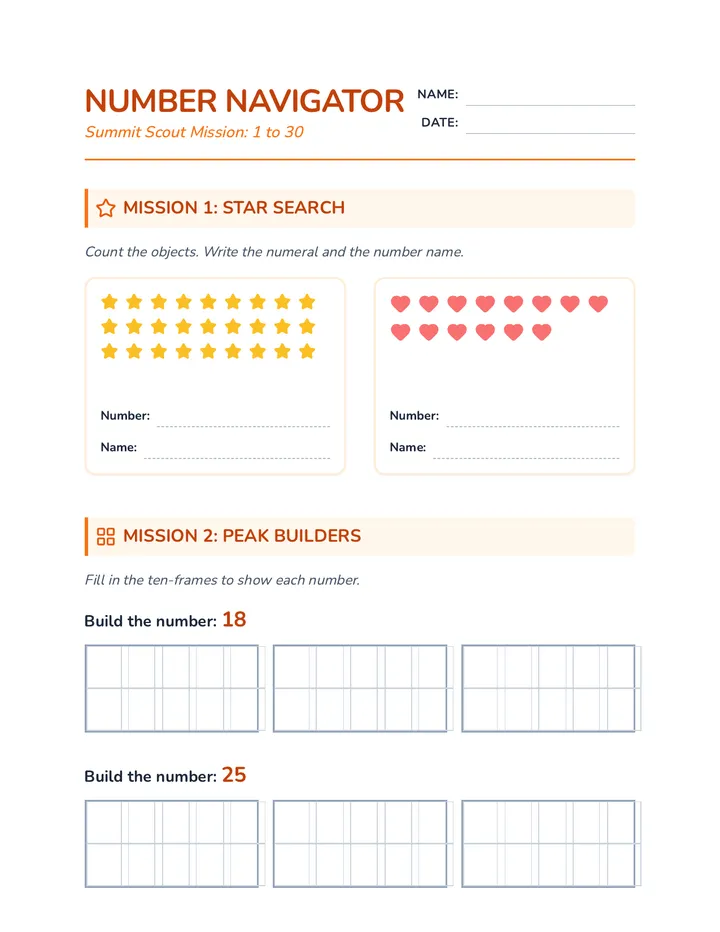
A 12-lesson intervention sequence focused on numeral identification, forward/backward sequences, and number lines for 1st-grade Tier 2 support, utilizing High Leverage Concepts from All Learners Network.

D

dfredericks

Math Teacher
2/6
Sequence
Le Club de Dix Slides
Dix et ses Amis Worksheet
Guide Le Club de Dix Teacher Guide

Mission Nombres Numberblocks

Une séquence pédagogique basée sur l'univers des Numberblocks pour aider un enfant autiste de 7 ans à maîtriser la comptine numérique jusqu'à 100, en mettant l'accent sur la structure décimale et les régularités.

BT

belk thomas

Special Education Teacher
2/1
Sequence
Frog Jump Slides
Frog Jump Cards
Number Line Strips
Frog Jump Guide

Skip Count Squad

A unit focused on building foundational number sense through skip counting patterns and visual representations. Students explore patterns of 2s, 5s, and 10s using movement and visual models.

Lenny Avatar
Lenny
1/19
Sequence
Decimal Lab Worksheet
Decimal Unit Shift Slides
Decimal Bridge Teacher Guide

Math Mechanics Blueprint

This 8th-grade sequence focuses on fundamental math fluency using manipulatives. Students redefine base-10 blocks for decimals, engage in regrouping simulations, visualize division, and perform error analysis to solidify their understanding of place value and operations.

Lenny Avatar
Lenny
1/18
Sequence
Treasure Sorting Slides
Treasure Sorting Mat

Coin Explorers

A sensory-based introduction to U.S. coins for Kindergarten, focusing on sorting by physical attributes, identification, and basic values through inquiry and exploration.

Lenny Avatar
Lenny
1/18
Sequence
Seven Steps Slides
Mystery Bag Worksheet
Week Runner Teacher Guide

Tracking Time with Calendars and Days

A Kindergarten sequence exploring the calendar, days of the week, and months. Students learn to navigate a calendar grid, understand weekly cycles, and use relative time vocabulary (yesterday, today, tomorrow) through hands-on activities and visual tracking.

Lenny Avatar
Lenny
1/18
Sequence
Hundred Chart Detective Worksheet
Number Rhyme Slides
Rhythm and Rhyme Facilitation Guide

Number Pattern Detectives

An inquiry-based exploration of number naming patterns from tens to millions, helping 2nd graders see the repeating linguistic structures in large numbers through a 'detective' lens.

Lenny Avatar
Lenny
1/18
Sequence
Number Workshop Slides
Word Sound Sorters Worksheet
Teens and Tens Teacher Guide

Number Name Blueprint

This sequence guides 2nd-grade students through the process of reading and writing number names up to 1,000, focusing on tricky spellings, hyphenation rules, and correct syntax for three-digit numbers.

Lenny Avatar
Lenny
1/18
Sequence
City Census Collection Slides
City Census Collection Worksheet

Demography Detectives

Students act as demographers to analyze US population data, mastering the comparison and ordering of 5 and 6-digit numbers through a Project-Based Learning approach.

Lenny Avatar
Lenny
1/17
Sequence
Hero Zero Slides
Hero Zero Teacher Guide
Spot the Zero Worksheet

Number Name Heroes

This sequence introduces Pre-K students to the concept of zero and the written names of numbers 1-3. It bridges math and literacy through storytelling, environmental print awareness, and rhythmic activities.

Lenny Avatar
Lenny
1/17
Sequence
Buggy Numbers Slides
Six and Seven Teacher Guide
Insect Leg Dots Worksheet

Number Name Neighbors 6-10

This sequence introduces Pre-K students to the numerals and spoken names for numbers 6-10 through hands-on activities, movement, and creative crafts. Students build visual recognition and auditory associations, culminating in the ability to identify and sequence numbers 6-10.

Lenny Avatar
Lenny
1/17
Sequence
Body Parts Teacher Guide
Body Parts Slides
Body Parts Worksheet

Number Playground 1-5

A sensory-rich, game-based introduction to the number names 1 through 5 for Pre-K students. This sequence focuses on associating spoken names with physical quantities through body movement, storytelling, and hands-on exploration.

Lenny Avatar
Lenny
1/17
Sequence
Comma Secrets Slides
Comma Roadmap Worksheet
Comma Coach Guide

Number Code Breakers

A 2nd-grade sequence where students act as 'Code Breakers' to master reading and writing large number names by identifying repeating patterns and the function of the comma as a 'period' signal.

Lenny Avatar
Lenny
1/17
Sequence
Teen vs Ty Slides
Teen vs Ty Sorting Worksheet
Teen vs Ty Teacher Guide

Number Name Masters

A 5-lesson sequence for 2nd graders focused on reading, writing, and spelling number names from 0-99, with special attention to hyphenation and phonetic distinctions.

Lenny Avatar
Lenny
1/17
Sequence
Number Names Factory Slides
Factory Match Up Worksheet
Zero to Ten Teacher Guide

Number Names Factory

A comprehensive sequence for 1st-grade students to master reading and writing number names from 0 to 120, connecting mathematical numerals with their linguistic counterparts through a 'Number Factory' theme.

Lenny Avatar
Lenny
1/17
Sequence
Neighbor Names Teacher Guide 01
Neighbor Names Slides 0-5
Nametag Matchup Worksheet 01

Number Neighbors Names

A Kindergarten math sequence focused on recognizing and matching written number names (zero to ten) to numerals and quantities. Students progress from basic recognition of 0-5 to active application and creation of a personal number reference book.

Lenny Avatar
Lenny
1/17
Sequence
Algebraic Arithmetic Slides
Geometric Calculator Worksheet
Field Theory Teacher Notes

Algebraic Analysis of Constructible Polygons

This sequence bridges Euclidean geometry with abstract algebra, investigating the field of constructible numbers and the Gauss-Wantzel Theorem to determine which regular polygons can be constructed using a ruler and compass.

Lenny Avatar
Lenny
1/17
Sequence
Building Eleven and Twelve Teacher Guide
Building Eleven and Twelve Slides
Tower Building Worksheet

Teen Number Architects

A Kindergarten math unit focusing on composing and decomposing numbers 11-19. Students use double ten-frames and linking cubes to understand the relationship between a group of ten and additional ones, building a foundation for place value.
Lenny Avatar
Lenny
1/17
Sequence
Ten Makers Slides
Ten Makers Worksheet
Ten Makers Teacher Guide

Equation Lab Intervention

A 6-lesson Tier 2 intervention sequence for first graders focused on addition and subtraction equations. Using an 'Equation Lab' theme, students move from part-whole understanding to the concept of equality and the inverse relationship between operations, aligned with ALN High Leverage Concepts.

D

dfredericks

Math Teacher
2/6
Sequence
Le Club de Dix Slides
Dix et ses Amis Worksheet
Guide Le Club de Dix Teacher Guide

Mission Nombres Numberblocks

Une séquence pédagogique basée sur l'univers des Numberblocks pour aider un enfant autiste de 7 ans à maîtriser la comptine numérique jusqu'à 100, en mettant l'accent sur la structure décimale et les régularités.

BT

belk thomas

Special Education Teacher
2/1
Sequence
Number Jungle Lesson Plan
Number Jungle Slides
Number Trace Track Worksheet
Jungle Match Activity
Number Safari Exit Ticket

Number Jungle Adventure

A comprehensive sequence for kindergarteners to master counting and writing numbers 1-20 through a fun jungle-themed exploration.

KT

Kennedy Talbert

Special Education Teacher
1/20
Sequence
Teen Power Presentation
Teen Power Teaching Guide
Teen Building Mat
Teen Power Tracker Worksheet

Teen Number Builders

A Kindergarten math sequence focused on understanding place value through the composition of teen numbers as 'ten and some more'. Students use physical manipulatives and music to reinforce the pattern of adding ones to a base of ten.

Lenny Avatar
Lenny
1/19
Sequence
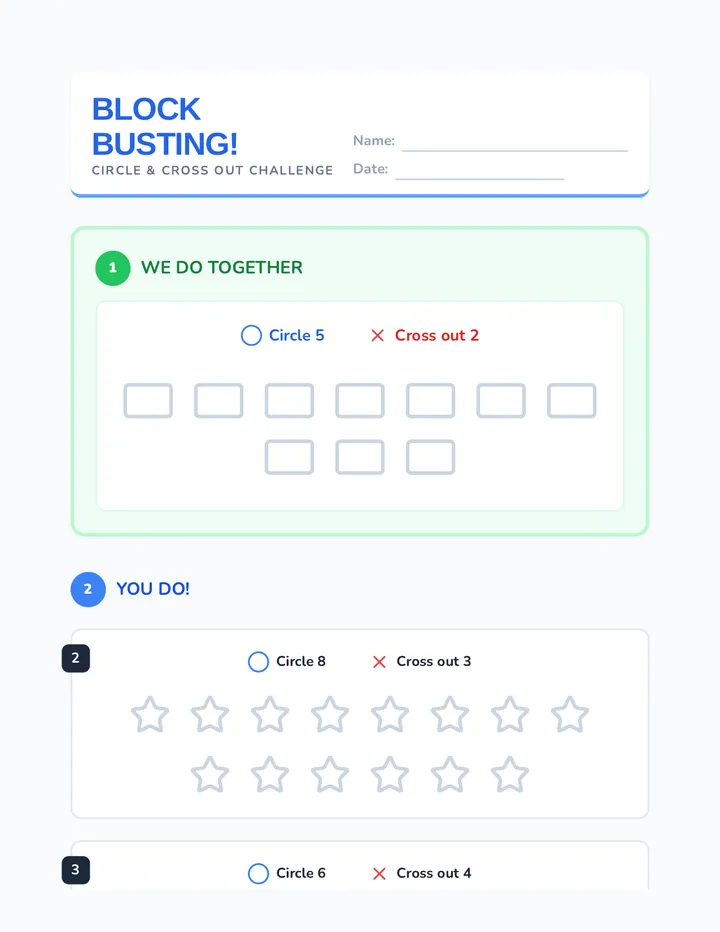
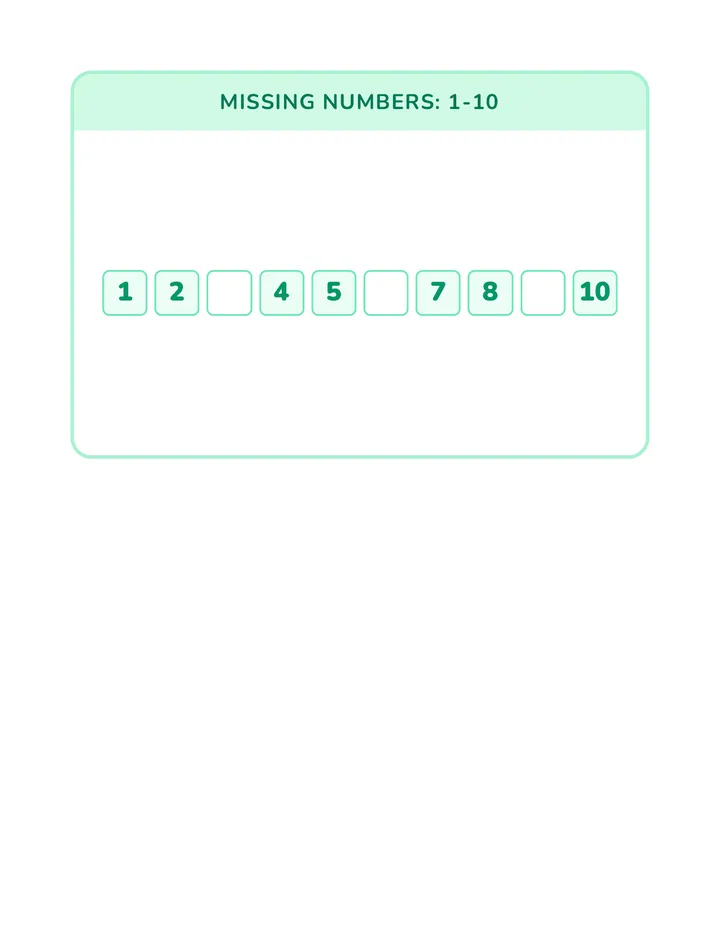
Block Party Slides
Block Party Cards
Block Party Worksheet
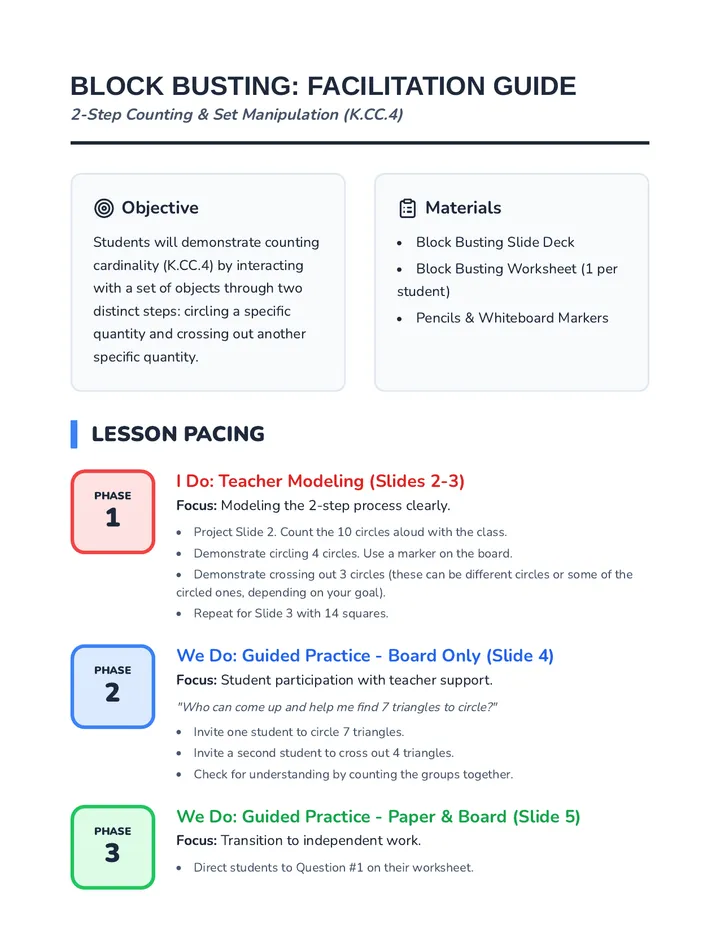
Block Party Teacher Guide

Addition Foundations

A series of lessons focused on foundational addition strategies for early elementary students, moving from basic counting to more efficient mental math strategies.

Lenny Avatar
Lenny
1/19
Sequence
Estimation Lab Teacher Guide
Estimation Lab Slides
Roughly Speaking Worksheet
Estimation Number Lines

Estimation Essentials

A short sequence introducing 2nd-grade students to the concept of estimation and rounding, focusing on when to use approximate numbers versus exact ones.

Lenny Avatar
Lenny
1/19
Sequence
Comparison Adventure Slides
Counting Lab Guide
Vocab Master Cards
Counting Lab Report Worksheet

Quantity Quest

A Kindergarten math sequence for ELL students focused on comparing quantities using the concepts of more, less, and same. Students move from concrete visual comparisons to interactive sorting and hands-on station work.

Lenny Avatar
Lenny
1/19
Sequence
Stick Bundle Tracker Worksheet
Bundling Crew Slides

Teen Number Builders

A Kindergarten math sequence focusing on teen numbers (11-19) using hands-on manipulatives. Students progress from physical bundling to ten-frames and base-ten blocks, establishing a solid foundation for place value.

Lenny Avatar
Lenny
1/18
Sequence
Bear Cave Slides
Bear Cave Splits Worksheet
Bear Cave Teacher Guide

Number Bond Builders

This Kindergarten math sequence uses the Concrete-Representational-Abstract (CRA) framework to teach composing and decomposing numbers. Students progress from tactile manipulation of physical objects to visual representations and early symbolic equations, specifically supporting diverse learners through sensory-rich mathematical exploration.

Lenny Avatar
Lenny
1/18
Sequence
Monster Lunch Slides
Monster Lunch Worksheet
Monster Lunch Teacher Guide

Counting Critters Math

A foundational math sequence for Kindergarten students requiring academic support. This unit uses tactile manipulatives (counters, cubes) to build one-to-one correspondence, cardinality, and number conservation through high-engagement 'Counting Critter' activities.

Lenny Avatar
Lenny
1/18
Sequence
Number Block Heroes Slides
Number Block Heroes Teacher Guide
Number Block Heroes Cleanup Worksheet

Math Strategy Builders

This sequence guides 1st-grade students through the Concrete-Representational-Abstract (CRA) model to master place value and addition. Students progress from tactile manipulation of blocks to drawing visual models and finally using abstract symbolic notation, building confidence through structured support and strategic choice.

Lenny Avatar
Lenny
1/18
Sequence
Shuttle Boarding Activity
Shuttle Seats Slides
Shuttle Launch Teacher Guide

Grid Galaxy Explorers

A comprehensive math sequence for Kindergarten Special Education students, using space-themed visual scaffolds (Five-Frames and Ten-Frames) to build foundational number sense, subitizing skills, and early addition strategies.

Lenny Avatar
Lenny
1/18
Sequence
Path Power Slides
Floor Path Teacher Guide
My Tiny Path Activity

Navigating Number Paths

A 5-lesson unit for Kindergarten students focusing on visual math representation using Number Paths. This sequence moves from physical movement to conceptual addition and subtraction, ending with missing addend problem-solving.

Lenny Avatar
Lenny
1/18
Sequence
Math Studio Slides 1
Tracing Task Worksheet

Math Artist Studio

This sequence bridges the gap between concrete manipulatives and two-dimensional drawings for Kindergarten students needing academic support. It guides students from tracing physical objects to using simple 'math drawings' (circles) for addition and subtraction.

Lenny Avatar
Lenny
1/18
Sequence
Math Theater Slides
Math Theater Teacher Guide
Math Theater Checklist

Math Story Studio

A 1st-grade math sequence focusing on the Concrete-Representational-Abstract (CRA) framework. Students use acting, sketching, ten-frames, number paths, and part-part-whole diagrams to solve word problems.

Lenny Avatar
Lenny
1/18
Sequence
Scale Science Slides
Balance Observations Sheet

Balance Lab Explorers

A foundational sequence for 2nd-grade students exploring the concepts of equality, equilibrium, and balancing equations using physical scales and numerical equivalents. Students progress from physical balance to symbolic representation using the equal sign.

Lenny Avatar
Lenny
1/18
Sequence
Equal Bears Slides
Equal Bears Teacher Guide
Bear Balance Worksheet

Seesaw Science

This sequence introduces 1st-grade students to the concept of equality using physical balance scales. Students explore balance, 1:1 correspondence, maintaining equilibrium by adding to both sides, and representing weight relationships symbolically.

Lenny Avatar
Lenny
1/18
Sequence
Container Capacity Slides
Capacity Detectives Worksheet
Capacity Exploration Facilitation Guide

Liquid Lab Explorers

A project-based exploration for 1st graders where they transform into 'liquid scientists'. Students investigate capacity, learn to use standard tools, and discover that volume remains constant regardless of container shape through hands-on pouring and mixing activities.

Lenny Avatar
Lenny
1/18
Sequence
Number Lab Teacher Guide
Build and Compare Mat

Number Lab Comparison

A 6-lesson Tier 2 intervention sequence for first-grade students focused on comparing two-digit numbers using tens and ones meanings and comparison symbols. Grounded in All Learners Network High Leverage Concepts, the unit moves from physical modeling to symbolic representation.

D

dfredericks

Math Teacher
2/6
Sequence
Ten Makers Slides
Ten Makers Worksheet
Ten Makers Teacher Guide

Equation Lab Intervention

A 6-lesson Tier 2 intervention sequence for first graders focused on addition and subtraction equations. Using an 'Equation Lab' theme, students move from part-whole understanding to the concept of equality and the inverse relationship between operations, aligned with ALN High Leverage Concepts.

D

dfredericks

Math Teacher
2/6
Sequence
Mystery Number Slides
Digit Swap Log Worksheet

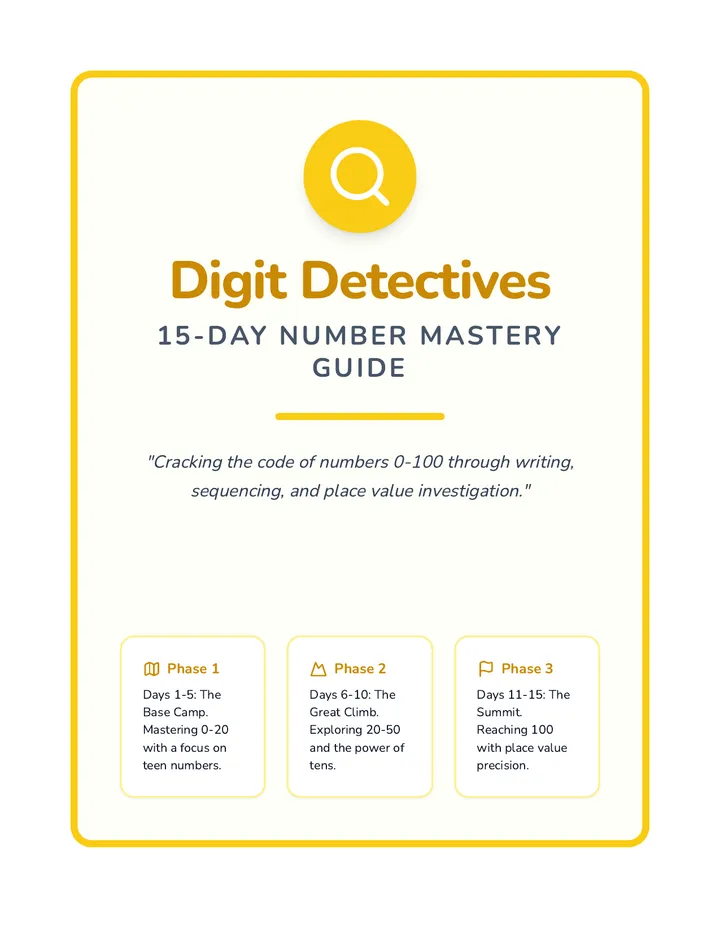
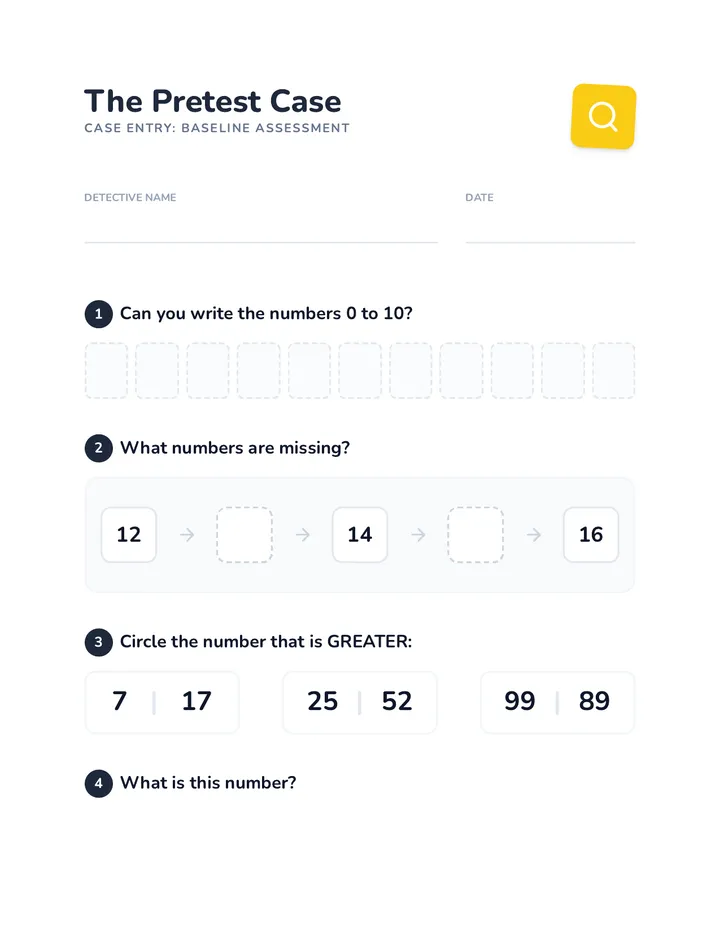
Digit Detectives

A playful, detective-themed math sequence for 3rd grade students to master number comparison. Students become 'Digit Detectives' as they investigate place value mysteries, solve 'blunders' made by a messy professor, and create their own case files using concrete models like base-ten blocks and number lines.

KA

Kelise Antonio

Counselor
1/20
Sequence
Ten Stop Slides
Bridging the Ten Teacher Guide
Ten Stop Journal Page

Ten Stop Subtraction Sequence

A series of lessons designed to help primary students master subtraction strategies using the CPA (Concrete-Pictorial-Abstract) model. Students progress from using physical manipulatives to mental math techniques focused on the base-ten anchor.

Lenny Avatar
Lenny
1/19
Sequence
Inequality Navigation Teacher Guide
Inequality Navigation Slides
Inequality Navigation Anchor Chart
Inequality Station Instructions
Inequality Matching Cards
Rope Activity Cards

Number Line Mastery

A remedial math sequence focused on mastering inequalities and negative numbers on a number line through visual and kinesthetic learning.

Lenny Avatar
Lenny
1/19
Sequence
Comparison Adventure Slides
Counting Lab Guide
Vocab Master Cards
Counting Lab Report Worksheet

Quantity Quest

A Kindergarten math sequence for ELL students focused on comparing quantities using the concepts of more, less, and same. Students move from concrete visual comparisons to interactive sorting and hands-on station work.

Lenny Avatar
Lenny
1/19
Sequence
Monster Lunch Slides
Monster Lunch Worksheet
Monster Lunch Teacher Guide

Counting Critters Math

A foundational math sequence for Kindergarten students requiring academic support. This unit uses tactile manipulatives (counters, cubes) to build one-to-one correspondence, cardinality, and number conservation through high-engagement 'Counting Critter' activities.

Lenny Avatar
Lenny
1/18
Sequence
Navigating Line Slides
Navigating Line Teacher Guide
Navigating Line Worksheet

Line Explorers

A 4th-grade sequence designed for students needing academic support to master the open number line. Students learn to visualize multi-digit operations, elapsed time, and measurement word problems by mapping them as 'distances' on a line, moving from physical movement to abstract mental math.

Lenny Avatar
Lenny
1/18
Sequence
Scale Science Slides
Balance Observations Sheet

Balance Lab Explorers

A foundational sequence for 2nd-grade students exploring the concepts of equality, equilibrium, and balancing equations using physical scales and numerical equivalents. Students progress from physical balance to symbolic representation using the equal sign.

Lenny Avatar
Lenny
1/18
Sequence
Equal Bears Slides
Equal Bears Teacher Guide
Bear Balance Worksheet

Seesaw Science

This sequence introduces 1st-grade students to the concept of equality using physical balance scales. Students explore balance, 1:1 correspondence, maintaining equilibrium by adding to both sides, and representing weight relationships symbolically.

Lenny Avatar
Lenny
1/18
Sequence
Balance Lab Slides
Balancing Act Teacher Guide
Perfect Pairs Worksheet

Fair Trade Explorers

A Kindergarten math sequence exploring equivalence and proportional reasoning through hands-on activities, balance scales, and a classroom market simulation. Students learn to compare quantities, understand many-to-one ratios, and practice substitution.

Lenny Avatar
Lenny
1/18
Sequence
Parts of Day Teacher Guide
Parts of Day Slides
Day Sorter Worksheet

Time Travelers Sequence

A comprehensive introduction to time for Kindergarten students, covering daily cycles, sequencing, duration, and basic clock reading using the 'Time Travelers' theme.

Lenny Avatar
Lenny
1/18
Sequence
Seven Steps Slides
Mystery Bag Worksheet
Week Runner Teacher Guide

Tracking Time with Calendars and Days

A Kindergarten sequence exploring the calendar, days of the week, and months. Students learn to navigate a calendar grid, understand weekly cycles, and use relative time vocabulary (yesterday, today, tomorrow) through hands-on activities and visual tracking.

Lenny Avatar
Lenny
1/18
Sequence
Magnitude Blueprints Slides
Magnitude Blueprints Worksheet
Magnitude Blueprints Teacher Guide

Magnitude Mechanics

This sequence guides 4th-grade students through the systematic process of comparing and ordering multi-digit whole numbers. Students move from concrete representations with place value disks to abstract comparisons using inequality symbols and strategic ordering of sets, culminating in a gamified mastery challenge.

Lenny Avatar
Lenny
1/18
Sequence
Survey Master Guide
Great Vote Slides
Pet Vote Cutouts

Pictograph Power

A Kindergarten math sequence introducing pictographs through surveys, vertical and horizontal construction, and data interpretation. Students move from whole-class voting to independent data art projects.

Lenny Avatar
Lenny
1/18
Sequence
Spot the Extremes Slides
Tall and Short Towers Worksheet
Extreme Extremes Teacher Guide

Data Detectives

A Kindergarten sequence focused on the analytical side of data: identifying extremes, comparing categories, and finding totals to solve real-world problems. Students use a detective-themed lens to 'crack the code' of bar graphs and pictographs.

Lenny Avatar
Lenny
1/18
Sequence
Tower Power Teacher Guide
Tower Power Slides
Tower Tracker Worksheet

Living Graphs

A hands-on introduction to data visualization for Kindergarten students, moving from concrete physical objects and human movement to pictorial representations. Students build towers, sort shoes, and create human graphs to understand how lining things up helps us compare quantities.

Lenny Avatar
Lenny
1/18
Sequence
Attribute Lab Slides
Monster Mess Worksheet
Sorting Basics Teacher Guide

Sorting Lab Detectives

This sequence introduces Kindergarten students to sorting and classifying objects by attributes. They learn to group items by color, shape, size, and texture, explore flexible thinking by re-sorting the same set, and begin quantifying data by counting categories.

Lenny Avatar
Lenny
1/18
Sequence
Detective Data Briefing Slides
Sorting Mission One Guide
Evidence Sort Worksheet

Detective Data

A 1st-grade sequence focused on sorting objects by various attributes, counting categorized groups, and comparing quantities to build foundational data interpretation skills. Students take on the role of 'Data Detectives' to organize chaotic collections into orderly sets.

Lenny Avatar
Lenny
1/18
Sequence
Tally Training Slides
Quick Count Worksheet
Tally Training Teacher Guide

Tally Trackers

A 1st Grade sequence introducing tally marks as a tool for efficient data collection, progressing from basic tally formation to independent peer surveying and data analysis.

Lenny Avatar
Lenny
1/18