Maya Harvest Slides Language Studio Grade 1 • Early American Civilizations
Lesson 1
Discovering the Ancient Rainforest
The Maya: A Harvest & A Hurricane
Join Kanal and Pik in the lush rainforest to explore how families farmed maize, prepared for storms, and used vivid action words!
🗣️
Partner Routine
Turn & Talk
🤸
Total Physical Response
Act It Out!
🗺️
Map Explorer
Yucatán Peninsula
1
Look Ahead: Where in the World?
Rainforest & Characters
Yucatán Peninsula
The Maya lived in the warm, wet rainforests of Mexico and Central America.
🌴
Rainforest: A warm, wet forest that stays green all year long!
Meet the Characters
👦🏽
Kanal (/ko-nol/)
The boy wearing green
👦🏾
Pik (Kanal's cousin)
The boy wearing yellow
👧🏽
Ikal (/eek-ol/)
Kanal's younger sister
Map Check: Point to the green rainforest peninsula on your map!
Touch & Point
2
Vocabulary Spotlight: Hurricane
Say It 3 Times!
🌀 hurricane
/hur-ri-cane/
A hurricane is a giant, strong storm with dangerous wind and heavy rain.
⚠️
In the Story:
Pik worries that a strong hurricane will hurt their family's corn crops!
Act It Out (TPR Gesture)
💨 🌀 🌧️
"Whoosh, swirl, and pour!"
Spin your arms in big storm circles and make the roaring wind sound: "Whoooosh!"
Safety Rule: Stay indoors and away from windows!
🗣️ Think & Share: What sounds do we hear during a strong storm?
Turn & Whisper
3
Vocabulary Spotlight: Maize
Say It 3 Times!
🌽
maize
/mayz/
Maize is another word for corn.
Mayan Super Food
For the Maya, maize was the most important crop. They made corn cakes, porridge, and bread!
Share Your Opinion
Partner Talk
Sentence Frame 1:
"I [enjoy / do not enjoy] eating maize."
Sentence Frame 2:
"I like to eat ___________, which is made from corn."
🌮 Tortillas 🍿 Popcorn 🌽 Corn on cob
Choral Chant: "Maize is corn, golden and sweet! Maize is what we love to eat!"
Echo Me!
4
Connections: How Did People Get Food?
Food Journey
Step 1 🏹
Hunting
Nomads on the move
People followed big and small animals like deer and rabbits to get meat.
Move, move, move! 🏃🏽♂️
Step 2 🫐
Gathering
Searching the wild
People looked for wild plants, nuts, berries, and seeds that grew in nature.
Search and pick! 🧺
Step 3 🌽
Farming
Settling in villages
People planted seeds like maize, peppers, and pumpkins to grow food in one place!
Plant and stay! 🏡
Key Word Nomad: A person who does not stay in one place; they move often to find food!
Repeat with me: No-mad
5
Partner Talk: Retell the Food Story
Recounting Time
Use these time transition words to tell your partner how people moved from nomads to farmers !
1️⃣
"Long, long ago..." people got food by hunting animals and moving as nomads.
2️⃣
"As time passed..." people began to gather wild plants, nuts, and berries.
3️⃣
"Over time..." they chose to live in one place and grow maize on farms.
👥 Partner A says Step 1 & 2 • Partner B says Step 3!
Switch!
6
Looking at Language: Show & Tell Verbs
Action & Meaning
What are Verbs Doing?
In our story, authors use special verbs to show what characters are:
❤️
Feeling
🧠
Thinking
🏃🏽
Doing
Story Sentence:
"Kanal knew this and understood why Pik was upset."
Understood means: Kanal thinks the exact same thing as Pik!
Ready for the Verb Action Challenge? Let's move our bodies!
Stand Up!
7
Verb Action Challenge: Act It Out!
Freeze & Act!
😄
smiled
"Kanal smiled and said hello."
Meaning: Happy to see a friend!
👋🏽
waved
"An old woman waved them over."
Meaning: Moving hand to say come here!
🍬
popped
"The boys popped chicle in their mouths."
Meaning: Quickly put inside!
🏃🏽♂️ 🎣
hurried & drew
"Hurried forward... drew the net."
Meaning: Moved fast / pulled the net!
Super Job, Mayan Explorers! Now let's explore our hands-on activity pack!
Awesome!
Maya Harvest Lesson Guide Language Studio 5 Grade 1 • Early American Civilizations
Lesson 1: The Maya: A Harvest and a Hurricane
30 Min Total
Page 1 of 2 • Teacher Guide
Primary Instructional Focus
Listening: Locate where Maya lived on a map (Yucatán Peninsula).Speaking: Share opinions with domain words hurricane & maize .Reading/Concepts: Recount progression from nomad life to farming.Language: Identify and act out showing and telling verbs in sentences.
Academic Vocabulary
Tier 3 (Domain): hurricane, maize, nomad, hunting, gathering, farming
Tier 2 (General): progression, weather, harvest
Tier 1 (Everyday): cousin, sister, boy, corn, wind
Look Ahead
Map & Vocab Preview (15 min)
Connections
Hunting-Gathering-Farming (10 min)
Looking at Language
Show & Tell Verbs (5 min)
1
Look Ahead: Where in the World? & Characters (10 min)
Interactive Map Routine
Teacher Script & Direct Instruction: "Today we will learn about a group of people called the Maya , who lived and farmed together a long time ago. The Maya lived in the rainforests of Mexico and Central America."
• Character Introductions: Point to Image 1A-3 / Slide 2. Introduce Kanal (/ko•nol/, boy in green), his cousin Pik (boy in yellow), and younger sister Ikal (/eek•ol/). Characters are fictional, but their village setting reflects real Mayan history!
• Concept Definition: A rainforest is warm and wet. Many evergreen plants live there, making it green all year long!
• Interactive Check: Students locate and point to the Yucatán Peninsula on their Activity Page, then color it green with a crayon.
Vocabulary Preview (5 min): Hurricane & Maize
🌀 Hurricane (/hur-ri-cane/)
Strong storm with dangerous wind & rain. Say 3 times. Model TPR storm gesture (spin arms & "Whooosh!").
Safety Prompt: "Stay indoors, away from windows!"
🌽 Maize (/mayz/)
Another word for corn. Primary staple crop for Mayan families. Say 3 times with choral echo.
Turn & Talk Frame: "I (enjoy/do not enjoy) eating maize."
Early American Civilizations • CKLA Language Studio Guide Turn page for Connections, Language Verbs & MLL Rubric ➔
Language Studio 5
Lesson 1: Connections & Language Instruction
Page 2 of 2 • Facilitation & Rubrics
2
Connections: Hunting-Gathering-Farming (10 min)
Nomad to Farmer Progression
Explain how ancient people lived before grocery stores. Teach nomad (moves often following animal herds). Walk through the 3 stages:
1. Hunting (Nomads)
Followed big game (bison) and small game (deer, rabbits) for meat.
2. Gathering (Wild Plants)
Searched for wild berries, nuts, roots, and seeds in nature.
3. Farming (Maya)
Saved and planted seeds (maize, squash); settled in village homes.
Progression Starters: "Long, long ago..." ➔ "As time passed..." ➔ "Over time, they..." Turn & Talk Protocol
3
Looking at Language: Show & Tell Verbs (5 min)
Action, Thought & Feeling
Authors use vivid verbs to show how characters feel , what they think , and what they do .
Story Sentence
Target Verb
What it Means / TPR Action
"Kanal knew this and understood why Pik was upset."
understood
Thinks the same thing (point to head)
"Kanal smiled and said, 'Hello.'"
smiled
Happy to see Pik (smile gesture)
"An old woman waved them over."
waved
Calls them over (wave hand)
"The boys popped chicle into their mouths."
popped
Put in quickly (pop gesture)
"The boys hurried ... men drew the net."
hurried / drew
Ran fast / pulled the net
Formative Language Proficiency Assessment (MLL / WIDA Support)
Observational Rubric
Entering / Emerging (Lv 1-2)
Task: Point to images on Hunting-Gathering-Farming chart.
Support: Ask Yes/No questions (e.g., "Does waved mean come here?" ). Match key words to pictures with visual modeling.
Transitioning / Expanding (Lv 3-4)
Task: Connect two progression ideas using sentence starters.
Support: Read verbs with vocal emphasis; provide frames: "Long ago, nomads hunted, but later they farmed maize." Act out verbs in pairs.
Bridging (Level 5)
Task: Independently recount nomad-to-farmer progression with full details.
Support: Ask students how author shows character feelings: "How do we know Kanal is happy?" (He smiled and greeted Pik).
Early American Civilizations • Teacher Facilitation Plan Grade 1 Language Studio
Maya Explorer Activity Pack Activity Page 1.1S • Look Ahead
Where in the World? The Maya
Name:
Date:
🌴
Directions: The Maya lived in the warm, wet rainforests of Mexico and Central America on the Yucatán Peninsula. Follow the steps below!
Early American Civilizations Map Gulf of Mexico & Caribbean Sea
MEXICO
Mountains & Valleys
🇲🇽
Pacific Ocean ➔
YUCATÁN PENINSULA ⭐
🌴 🏛️ 🌽
Home of the Maya
(Warm & Wet Rainforest)
[ Color Me Green! ]
CARIBBEAN SEA
🌀
Hurricane Storm Path
1. Color the Yucatán Peninsula green.
2. Circle the maize plant (🌽).
3. Draw wind swirls for hurricane (🌀).
🌽
My Opinion About Maize (Corn)
Share your opinion with your partner, then trace or complete the sentence frames:
I enjoy / do not enjoy eating maize.
I like to eat , which is made from corn.
Word Bank Ideas: tortillas popcorn cornbread sweet corn
Early American Civilizations • Student Activity Pack Page 1 of 3
Connections • Resource Page 5.3S
From Nomads to Farmers
Timeline Progression Sort
⏳
Directions: How did people get food long ago? Number the stages in order from 1, 2, and 3 . Match each picture card to its stage, then complete the sentences below!
First
1
Hunting
Nomads moved from place to place following animals.
🏹 🦌 Draw or stick animal hunter here
Big Game & Small Game
Next
2
Gathering
People searched for and picked plants growing in the wild.
🧺 🫐 Draw nuts, berries, or seeds here
Wild Plants & Berries
Then
3
Farming
People planted seeds and lived in villages together.
🌽 🏡 Draw maize & pumpkin farm here
Maize & Farm Vegetables
🗣️ Partner Retell Sentence Starters Speaking Protocol
1. "Long, long ago, people got food by ."
2. "As time passed, they began to ."
3. "Over time, they lived in one place and ."
Early American Civilizations • Student Activity Pack Page 2 of 3
Looking at Language • Verb Types
Show & Tell Verbs in Action!
Act & Match Activity
🎭
Directions: In stories, verbs show what characters are doing, thinking, and feeling. Read each sentence, act it out with a partner, and draw a line to what the verb means!
Story Sentence:
Kanal knew this and understood why Pik was upset.
🧠 Think
Meaning:
Thinks the exact same thing as his friend.
Story Sentence:
Kanal smiled and said, "Hello. How are you?"
😄 Feel
Meaning:
Feels happy to see his cousin Pik.
Story Sentence:
An old woman waved them over.
👋🏽 Do
Meaning:
Moved her hand to call them over.
Story Sentence:
The boys popped chicle into their mouths.
🍬 Do
Meaning:
Put the gum quickly into their mouths.
🤸 Partner Acting Challenge (Check when you act each one out!) TPR Movement
😄 Smiled
👋🏽 Waved
🍬 Popped
🏃🏽♂️ Hurried
Early American Civilizations • Student Activity Pack Page 3 of 3
Maya Talk Vocabulary Cards Pocket Chart & Partner Talk
Maya Word Explorer Cards
Tier 3 & Tier 2 Domain Cards
Page 1 of 2 • Cut along dashed lines ✂️
🌀 Weather / Tier 3
hurricane
/hur-ri-cane/
A giant, strong storm with dangerous wind and heavy rain.
TPR Gesture: Spin arms & "Whoosh!" 💨
🌽 Food / Tier 3
maize
/mayz/
Another word for corn . The primary crop grown and eaten by the Maya.
Sentence: "I enjoy eating maize." 🌮
🌴 Habitat / Tier 3
rainforest
/rain-for-est/
A warm, wet forest filled with green evergreen plants all year long.
Where: Yucatán Peninsula 🗺️
🏃🏽♂️ People / Tier 3
nomad
/no-mad/
A person who does not stay in one place; moves often following animals.
TPR Gesture: Walking march in place ⛺
🧺 Action / Tier 3
gathering
/gath-er-ing/
Searching for and picking plants, nuts, seeds, and wild berries to eat.
TPR Gesture: Reaching & picking into basket 🫐
🌱 Settling / Tier 3
farming
/farm-ing/
Saving seeds, planting crops, and living in one village for a long time.
TPR Gesture: Digging soil & planting seed 🏡
🗣️ Partner Quick-Fire: Hold up a card, say the word, and show your partner the gesture!
Turn & Teach
Early American Civilizations • Vocabulary Cards Page 1 of 2
Action, Thought & Feeling
Show & Tell Verb Cards
Verbs & Sentence Strips
Page 2 of 2 • Cut along dashed lines ✂️
🧠 Thought Verb
understood
Meaning: Thinks the same thing as someone else; knows why they feel that way.
TPR Gesture: Tap finger gently on your temple/head.
😄 Feeling Verb
smiled
Meaning: Turns lips up; shows happiness to greet a friend.
TPR Gesture: Point fingers to corners of your smiling mouth.
👋🏽 Action Verb
waved
Meaning: Moved hand in the air to call someone to come over.
TPR Gesture: Wave hand back and forth: "Come here!"
🍬 Action Verb
popped
Meaning: Quickly placed food or chicle gum right into the mouth.
TPR Gesture: Quick snap motion toward mouth: "Pop!"
Reusable Partner Talk Sentence Strips (Cut & Hold) Dotted Cut Lines ✂️
Opinion Frame: "I [enjoy / do not enjoy] eating maize because _________."
🌽
Food Frame: "I like to eat _________, which is made from corn."
🌮
Time Step 1: "Long, long ago, nomads got food by hunting animals."
🏹
Time Step 2: "As time passed, they began to gather wild berries and plants."
🫐
Time Step 3: "Over time, they lived in one place and farmed maize together."
🏡
Early American Civilizations • Vocabulary Cards Page 2 of 2
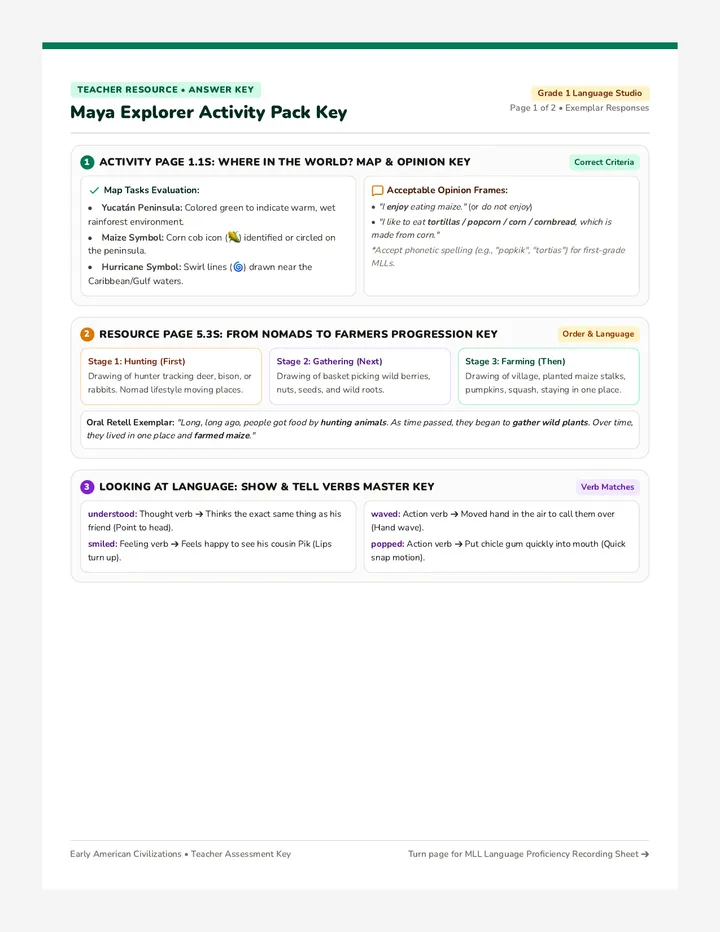
Maya Assessment Answer Key Teacher Resource • Answer Key
Maya Explorer Activity Pack Key
Grade 1 Language Studio
Page 1 of 2 • Exemplar Responses
1 Activity Page 1.1S: Where in the World? Map & Opinion Key
Correct Criteria
Map Tasks Evaluation:
Yucatán Peninsula: Colored green to indicate warm, wet rainforest environment.Maize Symbol: Corn cob icon (🌽) identified or circled on the peninsula.Hurricane Symbol: Swirl lines (🌀) drawn near the Caribbean/Gulf waters.
Acceptable Opinion Frames:
• "I enjoy eating maize." (or do not enjoy )
• "I like to eat tortillas / popcorn / corn / cornbread , which is made from corn."
*Accept phonetic spelling (e.g., "popkik", "tortias") for first-grade MLLs.
2 Resource Page 5.3S: From Nomads to Farmers Progression Key
Order & Language
Stage 1: Hunting (First)
Drawing of hunter tracking deer, bison, or rabbits. Nomad lifestyle moving places.
Stage 2: Gathering (Next)
Drawing of basket picking wild berries, nuts, seeds, and wild roots.
Stage 3: Farming (Then)
Drawing of village, planted maize stalks, pumpkins, squash, staying in one place.
Oral Retell Exemplar: "Long, long ago, people got food by hunting animals . As time passed, they began to gather wild plants . Over time, they lived in one place and farmed maize ."
3 Looking at Language: Show & Tell Verbs Master Key
Verb Matches
understood: Thought verb ➔ Thinks the exact same thing as his friend (Point to head).
smiled: Feeling verb ➔ Feels happy to see his cousin Pik (Lips turn up).
waved: Action verb ➔ Moved hand in the air to call them over (Hand wave).
popped: Action verb ➔ Put chicle gum quickly into mouth (Quick snap motion).
Early American Civilizations • Teacher Assessment Key Turn page for MLL Language Proficiency Recording Sheet ➔
Program Guide • Evaluation Tool
Language Proficiency Recording Sheet
Reading & Speaking Domain
Knowledge 5 • Lesson 1 (K5L1)
Activity: Nomad-Farmer Progression & Verb Types Proficiency Criteria
1. Entering Matches words/topics to images with direct support.
2. Emerging Matches words & topics to images independently.
3. Transitioning Relates two progression ideas with sentence starter.
4. Expanding Relates two ideas clearly with vocabulary details.
5. Bridging Connects full timeline and verb meanings independently.
Student Name
Map Check (Peninsula)
Nomad-Farmer Level (1-5)
Verb Types (Act/Match)
Notes / Next Steps
1. ____________________
1 • 2 • 3 • 4 • 5
Needs frame support
2. ____________________
1 • 2 • 3 • 4 • 5
3. ____________________
1 • 2 • 3 • 4 • 5
4. ____________________
1 • 2 • 3 • 4 • 5
5. ____________________
1 • 2 • 3 • 4 • 5
6. ____________________
1 • 2 • 3 • 4 • 5
7. ____________________
1 • 2 • 3 • 4 • 5
8. ____________________
1 • 2 • 3 • 4 • 5
Common Misconceptions & Quick Corrective Cues:
Misconception: Thinking nomads stayed in houses or villages. Cue: Remind students of animals running; nomads packed up to follow their food! Misconception: Confusing "understood" with hearing sounds. Cue: Point to head; "Understood means their brains had the same idea!"
Early American Civilizations • Teacher Assessment Key Page 2 of 2