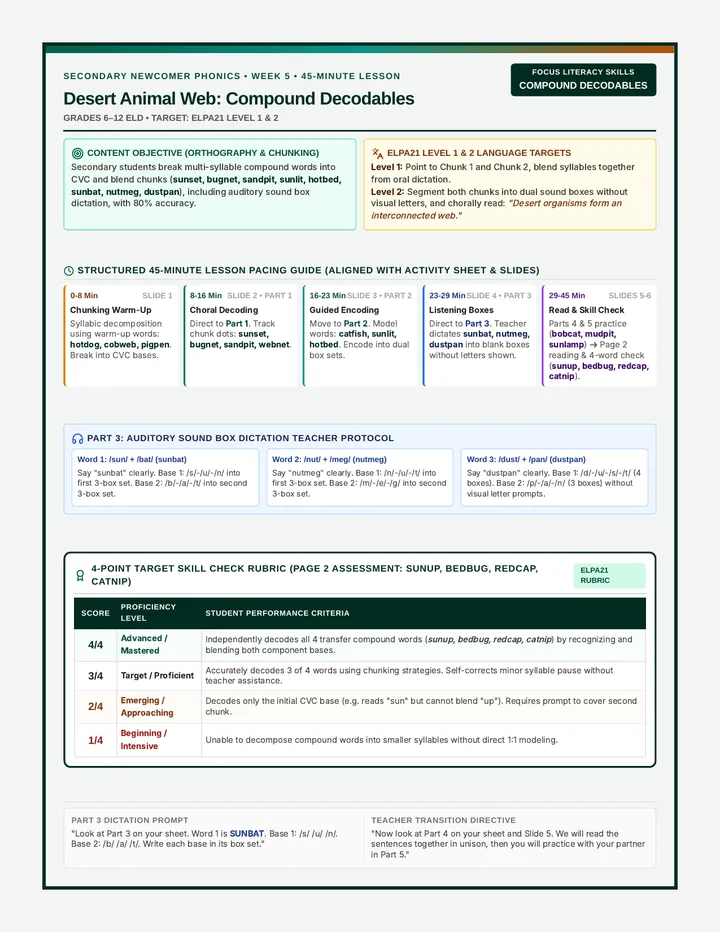
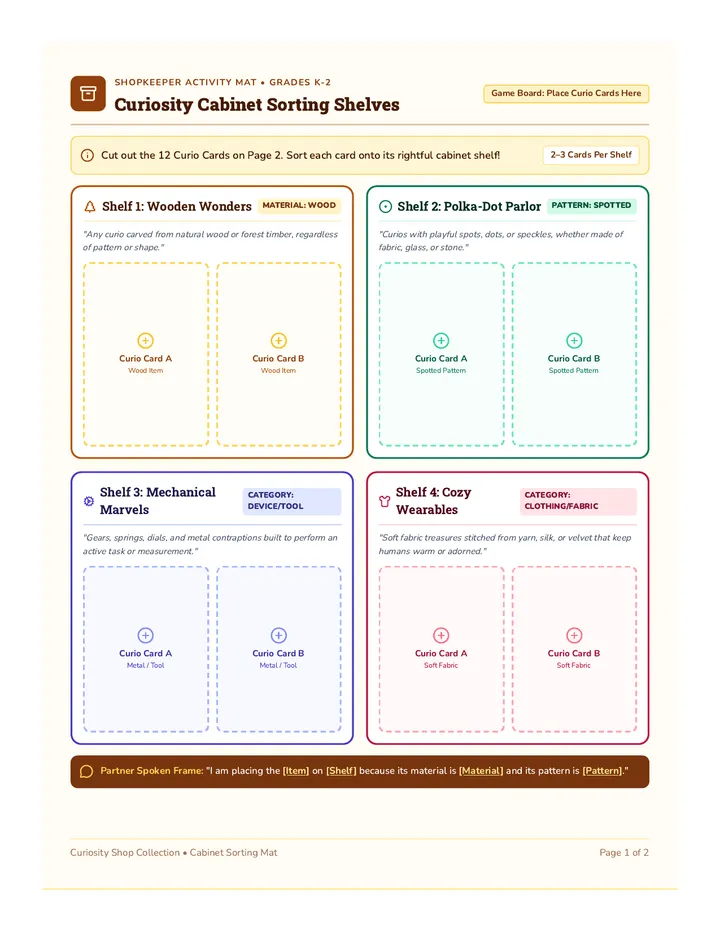
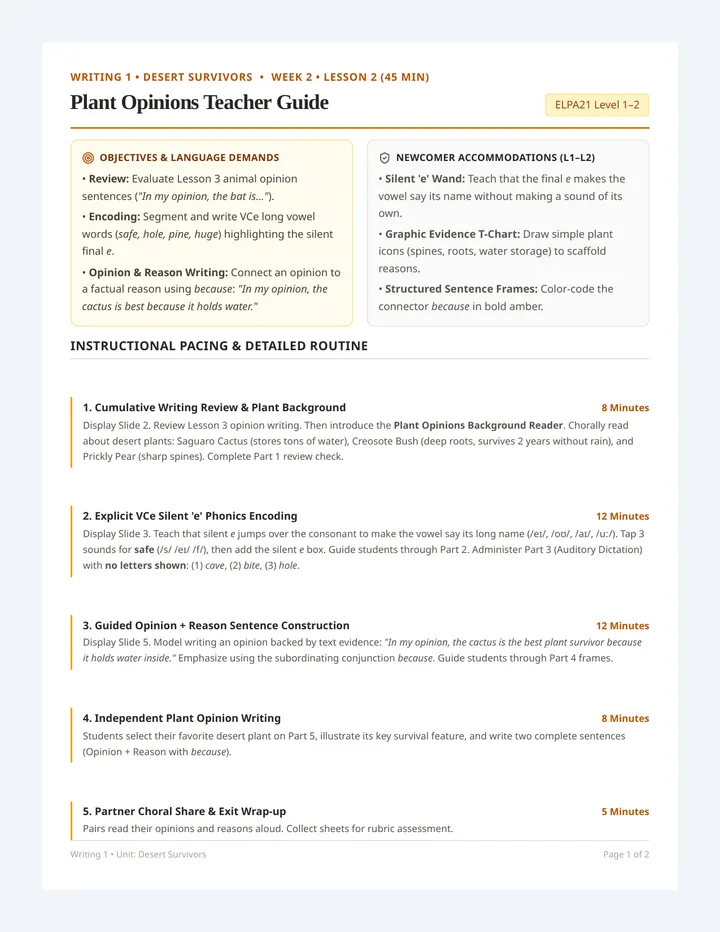
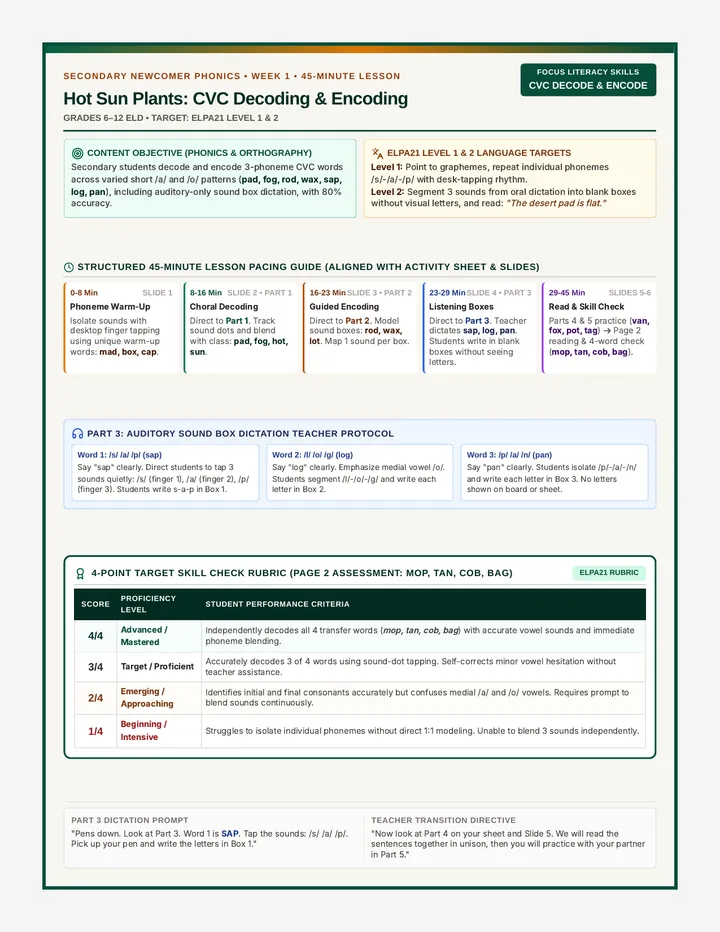
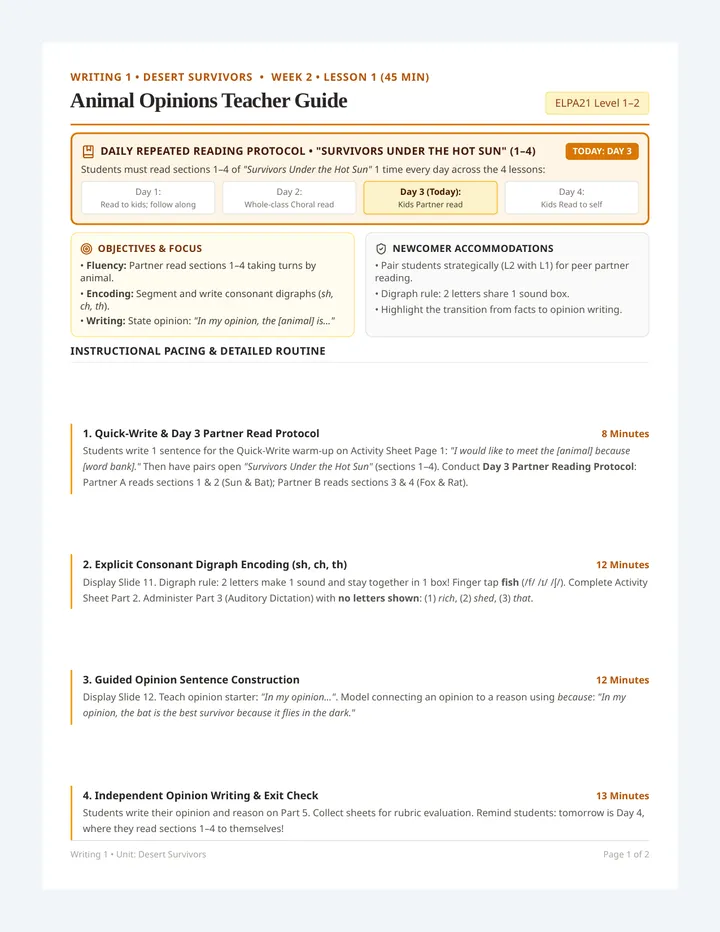
An intermediate ESL reading comprehension lesson exploring urban wildlife adaptations. Students analyze informational text, acquire Tier 2 academic vocabulary, and practice textual evidence citation with scaffolded language supports.
• Hands: Sensitive five-toed paws open complex latches.
• Schedule: Forage at night to avoid pedestrians.
Nickname: "Masked Bandits"
High-Rise Hunter
Falcons
• Shelter: High stone window ledges resemble mountain cliffs.
• Speed: Dive at 200 mph to capture city pigeons.
Fastest Animal on Earth
Traffic Dodger
Coyotes
• Navigation: Use train tracks & drainage culverts.
• Intelligence: Learn to check traffic before crossing roads.
Urban Ghost Canines
Read carefully: Each paragraph contains facts for your matrix table. Worksheet Page 1
Collaborative Reading Mission
Partner Reading & Matrix Task
1 Step 1: Read with Partner
Take turns reading one paragraph aloud. Highlight text evidence: • Green = City Challenge • Yellow = Animal Adaptation
2 Step 2: Complete Matrix
Record each animal's challenge and adaptation in the organizer on page 2. Include paragraph line numbers as evidence.
Success Criteria for Exit Ticket:
Answer all 3 comprehension questions using complete sentences.
Use at least two vocabulary words (adapt, nocturnal, forage, thrive, obstacle).
Time: 20 Minutes Paired Work Raise hand for language scaffold cards!
[¶ 4] Coyotes: Cautious City Navigators. While raccoons climb and falcons fly, coyotes navigate the ground. In cities like Chicago, Los Angeles, and Denver, thousands of coyotes live silently alongside humans. To dodge dangerous automobiles, urban coyotes use abandoned railway lines, concrete river corridors, and underground drainage tunnels as safe travel highways. Scientists have even observed urban coyotes stopping at intersections and looking both ways before crossing roads! By staying in the shadows and foraging on rodents like rats and mice, coyotes help control city pest populations while remaining virtually invisible to residents.
[¶ 5] A Shared Future. The success of these creatures proves that nature is not separate from our human-built environments. When animals adapt to urban landscapes, they demonstrate remarkable behavioral flexibility. As cities continue to grow worldwide, creating green corridors, tree canopies, and animal-friendly bridges will ensure that humans and urban wildlife can live together peacefully.
City Survivors Reading Worksheet • Student Packet Turn over to Page 2 for Comprehension • Page 1 of 2
Part 1 • Urban Adaptation Matrix
Record evidence from the text to show how each animal overcomes city challenges.
Graphic Organizer
Animal Species
City Challenge (Problem)
Animal Adaptation (Solution)
Paragraph
Raccoon "Masked Bandit"
¶ 2
Peregrine Falcon "Sky Hunter"
¶ 3
Coyote "Ground Navigator"
¶ 4
Part 2 • Comprehension Questions
1. Why do peregrine falcons choose tall skyscrapers rather than city parks for their nests?
A They prefer drinking water from rooftop rain barrels.
B Skyscraper ledges closely match natural cliff environments.
C City parks do not have trees tall enough to support nests.
D They use building antennas to send mating calls to other birds.
2. According to Paragraph 2, how does being nocturnal help raccoons survive in human cities?
Language Frame: By emerging at night, raccoons are able to ____________ because ____________.
3. In your own words, explain how coyotes benefit cities while avoiding human danger. Cite one fact from Paragraph 4.
Language Frame: The author explains that coyotes help cities by ____________ while avoiding roads through ____________.
Part 3 • Vocabulary Application Challenge
Write one complete sentence about urban wildlife using at least two of these words: adapt, nocturnal, forage, thrive, obstacle.
City Survivors Reading Worksheet • Student Packet Page 2 of 2
"Peregrine falcons thrive in cities because they adapt to nesting on tall skyscrapers."
Intermediate ESL Scoring Guide (3-Point Scale)
3 • Proficient (WIDA 4)
Accurately identifies all 3 animal adaptations with direct textual citations; uses complete sentences and multiple target Tier-2 vocabulary terms accurately.
2 • Developing (WIDA 3)
Identifies 2 of 3 adaptations; relies on provided sentence frames; minor grammatical or spelling errors do not obscure meaning; uses at least 1 vocabulary word.
1 • Emerging (WIDA 1-2)
Incomplete matrix entries or misidentifies problems/adaptations; provides isolated words rather than complete thoughts; requires teacher prompting for evidence.