Topic Words Teacher Guide Writing 1 • Desert Survivors • Week 1 • Lesson 1 (45 Min)
Topic Words Teacher Guide
ELPA21 Level 1–2
Daily Repeated Reading Protocol • "Survivors Under the Hot Sun" (1–4)
Today: Day 1
Students must read sections 1–4 of "Survivors Under the Hot Sun" 1 time every day across the 4 lessons:
Day 1 (Today): Read to kids; follow along
Day 2: Whole-class Choral read
Day 3: Kids Partner read
Day 4: Kids Read to self
Objectives & Focus
• Fluency: Follow along as teacher reads sections 1–4 (Sun, Bat, Fox, Rat).
• Encoding: Segment and write CVC topic words (sun, bat, fox, rat ).
• Writing: Construct frame: "The topic is the [noun]."
Newcomer Accommodations
• Model finger tracking under words during the Day 1 read-aloud.
• Tap out sounds physically before pencil touches paper.
• Quick-Write warm-up provides low-stakes schema activation.
Instructional Pacing & Detailed Routine
1. Quick-Write & Day 1 Read-Aloud Protocol
8 Minutes
Students write 1 sentence for the Quick-Write warm-up on Activity Sheet Page 1: "In a desert, I would see [word bank]." Then distribute the Topic Words Background Reader . Conduct Day 1 Reading Protocol : Read sections 1–4 aloud clearly while students point and follow along with their index finger.
2. Explicit CVC Sound-Box Encoding
12 Minutes
Display Slide 4. Model finger tapping for sun : /s/ /ʌ/ /n/. Guide students to complete Part 2 (sun, bat, fox, rat ). For Part 3 (Auditory Dictation), state words aloud without letters shown : (1) hot , (2) den , (3) mud . Emphasize one letter per sound box.
3. Guided Topic Sentence Construction
12 Minutes
Display Slide 5. Model capitalization, finger space, and terminal punctuation: "The topic is the fox." Have students complete Part 4 frames. Contrast: "The bat lives in the desert."
4. Independent Writing & Exit Check
13 Minutes
Students select one desert animal on Part 5, sketch it, and write their independent sentence. Collect sheets for rubric evaluation. Remind students: tomorrow we choral read sections 1–4!
Writing 1 • Unit: Desert Survivors Page 1 of 2
Instructional Scripts & Assessment
Teacher Scripts & Formative Rubric
Lesson 1 Guide
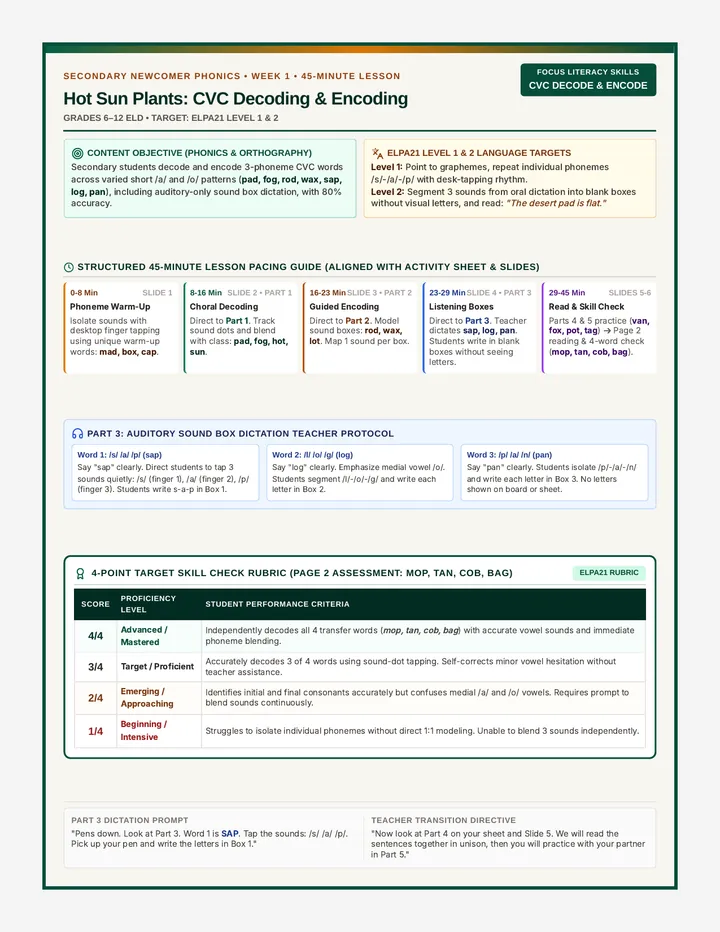
Part 3 Auditory Dictation Script (Teacher Read-Aloud)
Read each word three times clearly. Emphasize phonemes. Remind students: "Tap 3 sounds, then write one letter in each box."
Word 1: hot "The desert is hot." Sounds: /h/ /ɒ/ /t/
Word 2: den "The fox sleeps in a den." Sounds: /d/ /ɛ/ /n/
Word 3: mud "Rain makes wet mud." Sounds: /m/ /ʌ/ /d/
Common Newcomer Errors
• Vowel Confusion: Short /ʌ/ (u) and short /ɒ/ (o). Pronounce with exaggerated mouth opening.
• Omitting the Article: Writing "Topic is bat" instead of "The topic is the bat."
• No End Punctuation: Remind students that every complete English sentence stops with a period.
Differentiation Strategies
• Support (ELPA Level 1): Provide letter tiles or tactile phoneme counters before writing in boxes.
• Extension (ELPA Level 2): Add an adjective to the topic sentence: "The hot sun shines." or "The red fox runs."
Formative Writing Assessment Rubric (ELPA21 Level 1–2)
Score Phoneme Encoding (CVC Boxes) Sentence Writing & Mechanics 4 - Adv Encodes all 4 guided and 3 dictated CVC words with 100% sound-letter accuracy. Writes complete sentence with capital letter, finger spaces, correct topic noun, and period. 3 - Prof Encodes initial and final consonants accurately; minor short vowel approximations. Completes sentence frame with correct topic word; minor capitalization or punctuation slip. 2 - Dev Encodes initial consonant reliably; needs teacher prompting for medial vowel and final sound. Copies sentence frame words partially; relies heavily on visual word bank for topic noun. 1 - Beg Writes random letters or initial sound only; unable to segment CVC orally. Draws topic image but writes isolated letters without sentence frame completion.
Writing 1 • Unit: Desert Survivors Page 2 of 2
Topic Words Activity Sheet Writing 1 • Unit: Desert Survivors • Week 1 • Lesson 1 ELPA21 Level 1–2
Desert Topic Words
Name:
Date:
Warm-Up
Quick-Write: What would you see in a desert?
Write 1 sentence
Word Bank:
sun sand fox bat rocks
In a desert, I would see .
Part 1
Desert Topics • Look and Read
☀️
Topic 1 sun
🦇
Topic 2 bat
🦊
Topic 3 fox
🐀
Topic 4 rat
Part 2
Sound-Box Encoding • Tap and Write
☀️ 1. sun
🦇 2. bat
🦊 3. fox
🐀 4. rat
Part 3
Auditory Dictation • Listen and Write
Word 1
Word 2
Word 3
Writing 1 • Desert Survivors Page 1 of 2
Sentence Construction
Writing Desert Topic Sentences
Lesson 1 • Page 2
Topic Word Bank:
sun bat fox rat
Part 4
Topic Sentence Frames • Complete and Write
Choose a word from the bank. Write the word on the line to complete each topic sentence:
1 Identify the topic of our reading:
The topic is the .
2 Identify a desert animal:
The lives in the desert.
3 Describe the desert sun:
The hot shines all day.
Part 5
Independent Topic Writing
Draw your favorite desert topic. Then write your own full topic sentence on the handwriting line:
Draw your topic here
Write your complete sentence:
Student Writing Checklist:
Capital Letter Finger Spaces Topic Word Period (.)
Writing 1 • Desert Survivors Page 2 of 2
Desert Survivors Master Slides Master Instructional Slide Deck • Lessons 1–5 ELPA21 Level 1–2
4-Week Foundational Writing Unit
Writing 1: Desert Survivors
Step-by-step instructional walkthrough for every warm-up, reading, encoding, and writing routine.
Desert Wildlife & Survival Adaptations Slide 1 of 31
Lesson 1 • Part 0: Warm-Up (5 Min)
Quick-Write: What Would You See?
Activity Sheet: Top of Page 1
Prompt: "What would you see in a desert?" Write 1 complete sentence.
Quick-Write Word Bank:
sun sand fox bat rocks
Sentence Starter:
"In a desert, I would see [word]."
Write your 1 sentence on the handwriting line now! Slide 2 of 31
Daily Reading Protocol • Day 1 of 4
Survivors Under the Hot Sun (1–4)
Background Reader: Page 1
Day 1 Protocol: Teacher Read-Aloud & Follow Along
The teacher reads sections 1–4 aloud. Students point to each word with their index finger and follow along.
☀️
1. The Sun
Shines all day; very hot and dry.
🦇
2. The Bat
Hangs in a dark cave until night.
🦊
3. The Fox
Large ears release heat; cool den.
🐀
4. The Rat
Digs tunnels; never drinks water.
Rule: We read sections 1–4 once every day for fluency! Slide 3 of 31
Lesson 1 • Part 2: Phonics Encoding
Sound-Box Encoding: Tap & Write
Activity Sheet: Part 2
Tap 3 sounds (thumb to index, middle, ring). Write 1 letter per sound box:
☀️ 1. sun
s
u
n
🦇 2. bat
b
a
t
🦊 3. fox
f
o
x
🐀 4. rat
r
a
t
Now write the letters in your sound boxes on Part 2! Slide 4 of 31
Lesson 1 • Part 3: Auditory Dictation
Listen, Tap 3 Sounds, & Write
Activity Sheet: Part 3
Auditory Dictation Protocol:
1. Listen to teacher say the word • 2. Tap 3 fingers • 3. Write 1 letter per box (No copying!)
Word 1: (Teacher Reads Aloud)
Word 2: (Teacher Reads Aloud)
Teacher reads: 1. hot | 2. den | 3. mud Slide 5 of 31
Topic Words Background Reader Writing 1 • Desert Survivors • Background Reading ELPA21 Level 1–2
Survivors Under the Hot Sun
Read about four desert topics before you write your topic sentences.
Name:
Date:
Target Topic Words (CVC)
☀️ sun gives heat & light
🦇 bat flies at night
🦊 fox rests in cool den
🐀 rat digs in dry dirt
Background Text • Life in the Dry Desert
☀️
1. The Desert Sun
The desert is very hot and dry. The big sun shines all day in the blue sky. It does not rain often. Plants and animals must find ways to live without much water.
🦇
2. The Desert Bat
The desert bat does not like the hot sun. During the day, the bat hangs upside down inside a dark cave. When the sun sets, the bat flies out to hunt bugs in the cool night air.
🦊
3. The Desert Fox
The desert fox has large ears that release body heat. When midday is hottest, the fox rests deep inside an underground den. It runs quickly on sand to hunt small animals.
🐀
4. The Kangaroo Rat
The kangaroo rat lives in dry soil. It digs long tunnels under the ground to escape the midday heat. It eats dry seeds and never needs to drink free water.
Writing Bridge • Identify Topic Facts
Hangs inside a dark cave until night: The topic is the .
Rests inside a cool underground den: The topic is the .
Writing 1 • Desert Survivors • Lesson 1 Resource Page 1 of 2
Cloze Reading Practice • Lesson 1
Fill in the Blanks • Desert Topics
Page 2 of 2
Cloze Word Bank (5 Target Words): Cross out each word as you use it
sun
bat
fox
rat
den
Reading Task
Read the Story and Write the Missing Words
Read the story below based on Page 1. Write the correct word from the bank on each blank line:
The desert is very hot and dry because the big (1) shines all day in the clear sky. Animals have smart ways to survive the intense heat.
During the bright daytime, the desert (2) hangs upside down in a dark cave and waits for the cool night air to fly.
The kit (3) has large ears to release heat. In the middle of the day, it sleeps deep inside a cool underground (4) .
Under the dry sand, the kangaroo (5) digs long tunnels. It eats dry seeds and never has to drink water!
Word Building Teacher Guide Writing 1 • Desert Survivors • Week 1 • Lesson 2 (45 Min)
Word Building Teacher Guide
ELPA21 Level 1–2
Daily Repeated Reading Protocol • "Survivors Under the Hot Sun" (1–4)
Today: Day 2
Students must read sections 1–4 of "Survivors Under the Hot Sun" 1 time every day across the 4 lessons:
Day 1: Read to kids; follow along
Day 2 (Today): Whole-class Choral read
Day 3: Kids Partner read
Day 4: Kids Read to self
Objectives & Focus
• Fluency: Choral read sections 1–4 in unison to build cadence.
• Encoding: Segment and write 4-sound blend words (sand, trap, spot, nest ).
• Writing: Expand sentence: "The [topic] [verb] in the [noun]."
Newcomer Accommodations
• Set a steady, moderate pace for whole-class choral reading.
• Tap out 4 fingers physically (thumb to index, middle, ring, pinky).
• Color-coded syntax: Orange = Topic, Green = Verb, Brown = Blend.
Instructional Pacing & Detailed Routine
1. Quick-Write & Day 2 Choral Read Protocol
8 Minutes
Students write 1 sentence for the Quick-Write warm-up: "I would like to visit a desert because [word bank]." Then have students turn to "Survivors Under the Hot Sun" (sections 1–4). Conduct Day 2 Choral Reading Protocol : Lead the class in reading all 4 sections together in unison to reinforce fluency and pronunciation.
2. Explicit Blend Phonics Encoding (CCVC / CVCC)
12 Minutes
Display Slide 8. Teach that consonant blends make 2 sounds held close together. Finger tap sand (/s/-/æ/-/n/-/d/) and spot . Complete Activity Sheet Part 2. Administer Part 3 (Auditory Dictation) with no letters shown : (1) swim , (2) fast , (3) trap .
3. Guided Word Building: Expanding Sentences
12 Minutes
Display Slide 9. Model combining topic nouns with actions and settings: "The fox runs on the sand." Guide students through Part 4 expansion frames.
4. Independent Writing & Exit Check
13 Minutes
Students write an independent 5-to-6 word sentence on Part 5. Collect sheets for rubric evaluation. Remind students: tomorrow we partner read sections 1–4!
Writing 1 • Unit: Desert Survivors Page 1 of 2
Word Building Activity Sheet Writing 1 • Unit: Desert Survivors • Week 1 • Lesson 2 ELPA21 Level 1–2
Desert Word Building
Name:
Date:
Warm-Up
Quick-Write: Would you like to visit a desert?
Write 1 sentence
Word Bank:
hot sand animals see fun
I would like to visit a desert because .
Review
Lesson 1 Topic Review • Read and Circle
🦊 "The topic is the fox ."
🦇 "The bat lives in the desert."
Part 2
4-Sound Blend Encoding • Tap and Write
1. sand (CVCC) /s/ /æ/ /n/ /d/
2. trap (CCVC) /t/ /r/ /æ/ /p/
3. spot (CCVC) /s/ /p/ /ɒ/ /t/
4. nest (CVCC) /n/ /ɛ/ /s/ /t/
Part 3
Auditory Dictation • Listen and Write
Word 1
Word 2
Word 3
Writing 1 • Desert Survivors Page 1 of 2
Sentence Expansion
Building Descriptive Sentences
Lesson 2 • Page 2
Lesson 1 Topics:
fox bat rat
Lesson 2 Blend Words:
sand nest spot
Part 4
Sentence Building Frames • Expand and Write
Build each sentence by combining a topic and a blend word :
1 Describe the fox running on the desert sand:
The runs on the .
2 Describe where the bat rests:
The rests in a dry .
3 Describe the rat hiding:
The hides in a cool .
Part 5
Independent Sentence Building
Write your own expanded 5-to-6 word sentence using 1 topic word and 1 blend word:
Draw your action scene
Line 1:
Line 2:
Student Writing Checklist:
Capital Letter Topic Word Blend Word Period (.)
Writing 1 • Desert Survivors Page 2 of 2
Word Building Background Reader Writing 1 • Desert Survivors • Background Reading ELPA21 Level 1–2
How Desert Animals Move & Rest
Read about animal actions and settings before building your expanded sentences.
Name:
Date:
Target Blend Words in Reading (CCVC / CVCC)
🏜️ sand hot desert ground
🪺 nest safe place to rest
📍 spot a cool hiding place
⚡ fast quick running speed
Background Text • Actions and Adaptations
🦊
1. Running Across the Sand
The desert kit fox has fur on the bottom of its paws. This fur keeps its feet safe from burning heat. When chasing a lizard, the fox runs very fast on top of the soft sand .
🦉
2. Resting in a Cactus Nest
Desert elf owls are tiny birds. They cannot dig into trees, so they find a hole inside a tall saguaro cactus. The owl builds a cozy nest inside. The thick cactus keeps the nest cool all day long.
🕷️
3. Hiding Spots and Sand Traps
A desert spider looks for a shady spot between rocks. Antlion bugs dig a cone-shaped trap in loose dirt. When small ants fall in, the antlion catches them quickly.
🐟
4. Pupfish in Warm Springs
In rare desert springs and creeks, tiny pupfish swim together. They survive in very hot, salty water where almost no other fish on Earth could live.
Reading Summary
Desert animals survive by moving fast, building nests in shaded cacti, and finding cool spots away from the scorching sun.
Writing 1 • Desert Survivors • Lesson 2 Resource Page 1 of 2
Cloze Reading Practice • Lesson 2
Fill in the Blanks • Actions & Blends
Page 2 of 2
Cloze Word Bank (5 Target Blend Words): Cross out each word as you use it
fast
sand
nest
spot
swim
Reading Task
Read the Story and Write the Missing Words
Read the story below based on Page 1. Write the correct blend word on each numbered blank line:
Desert animals have clever ways to move and stay safe. The kit fox has furry paws and can run very (1) to catch lizards.
The fox does not burn its paws when it sprints across the hot (2) under the midday sun.
High up in a saguaro cactus, the tiny elf owl builds a shaded (3) where hungry predators cannot reach it.
A desert spider looks for a cool, dark (4) between rocks to wait for ants and bugs.
Animal Opinions Teacher Guide Writing 1 • Desert Survivors • Week 2 • Lesson 1 (45 Min)
Animal Opinions Teacher Guide
ELPA21 Level 1–2
Daily Repeated Reading Protocol • "Survivors Under the Hot Sun" (1–4)
Today: Day 3
Students must read sections 1–4 of "Survivors Under the Hot Sun" 1 time every day across the 4 lessons:
Day 1: Read to kids; follow along
Day 2: Whole-class Choral read
Day 3 (Today): Kids Partner read
Day 4: Kids Read to self
Objectives & Focus
• Fluency: Partner read sections 1–4 taking turns by animal.
• Encoding: Segment and write consonant digraphs (sh, ch, th ).
• Writing: State opinion: "In my opinion, the [animal] is..."
Newcomer Accommodations
• Pair students strategically (L2 with L1) for peer partner reading.
• Digraph rule: 2 letters share 1 sound box.
• Highlight the transition from facts to opinion writing.
Instructional Pacing & Detailed Routine
1. Quick-Write & Day 3 Partner Read Protocol
8 Minutes
Students write 1 sentence for the Quick-Write warm-up on Activity Sheet Page 1: "I would like to meet the [animal] because [word bank]." Then have pairs open "Survivors Under the Hot Sun" (sections 1–4). Conduct Day 3 Partner Reading Protocol : Partner A reads sections 1 & 2 (Sun & Bat); Partner B reads sections 3 & 4 (Fox & Rat).
2. Explicit Consonant Digraph Encoding (sh, ch, th)
12 Minutes
Display Slide 11. Digraph rule: 2 letters make 1 sound and stay together in 1 box! Finger tap fish (/f/ /ɪ/ /ʃ/). Complete Activity Sheet Part 2. Administer Part 3 (Auditory Dictation) with no letters shown : (1) rich , (2) shed , (3) that .
3. Guided Opinion Sentence Construction
12 Minutes
Display Slide 12. Teach opinion starter: "In my opinion..." . Model connecting an opinion to a reason using because : "In my opinion, the bat is the best survivor because it flies in the dark."
4. Independent Opinion Writing & Exit Check
13 Minutes
Students write their opinion and reason on Part 5. Collect sheets for rubric evaluation. Remind students: tomorrow is Day 4, where they read sections 1–4 to themselves!
Animal Opinions Activity Sheet Writing 1 • Unit: Desert Survivors • Week 2 • Lesson 1 ELPA21 Level 1–2
Desert Animal Opinions
Name:
Date:
Warm-Up
Quick-Write: Which desert animal would you like to meet?
Write 1 sentence
Word Bank:
fox bat rat fast cool
I would like to meet the because it is .
Review
Week 1 Review • Read the Descriptive Sentence
🦊 "The fox runs on the sand."
Action + Blend
Part 2
Digraph Sound Boxes • 2 Letters = 1 Sound
1. fish (/f/ /ɪ/ /ʃ/) [sh] in 1 box
2. shed (/ʃ/ /ɛ/ /d/) [sh] in 1 box
3. chin (/tʃ/ /ɪ/ /n/) [ch] in 1 box
4. rich (/r/ /ɪ/ /tʃ/) [ch] in 1 box
Part 3
Auditory Dictation • Listen and Write
Word 1
Word 2
Word 3
Writing 1 • Desert Survivors Page 1 of 2
Opinion Writing Routine
Writing Desert Animal Opinions
Lesson 3 • Page 2
Desert Animals:
fox bat rat
Reason Words:
fast smart cool
Part 4
Opinion Sentence Frames • Fill in the Blank
Use the words from the bank to complete each opinion sentence:
1 State which animal is the best survivor:
In my opinion, the is the best survivor.
2 State which animal you like and give a reason:
I like the because it is very .
3 State your opinion about the desert bat:
I think the desert bat is a animal.
Part 5
Independent Opinion Writing
Write your complete opinion sentence and one reason on the handwriting lines below:
Draw your chosen animal
Sentence 1 (Your Opinion):
Sentence 2 (Your Reason with "because"):
Student Writing Checklist:
Capital Letter Opinion Starter Used "because" Period (.)
Writing 1 • Desert Survivors Page 2 of 2
Animal Opinions Background Reader Writing 1 • Desert Survivors • Background Reading ELPA21 Level 1–2
Who is the Best Desert Survivor?
Read about animal strengths before writing your personal opinion.
Name:
Date:
Target Digraph Words in Reading (sh, ch, th)
🐟 fish /f/ /ɪ/ /ʃ/ (sh = 1 sound)
🛖 shed /ʃ/ /ɛ/ /d/ (sh = 1 sound)
🪙 rich /r/ /ɪ/ /tʃ/ (ch = 1 sound)
👉 that /ð/ /æ/ /t/ (th = 1 sound)
Background Text • Compare Animal Survivors
🦊
Contender 1: The Quick Kit Fox
The kit fox is an amazing predator. It can sprint across loose sand at high speeds. Its large ears give off heat and let it hear small bugs moving under the dirt. It rests in a cool, deep burrow like a dark shed during the hottest hours.
🦇
Contender 2: The Tough Pallid Bat
The pallid bat does not just catch flies in the air; it lands on the ground to hunt scorpions! The bat has wide wings that let it swoop down silently in the cool, dark night air.
🐀
Contender 3: The Kangaroo Rat
Many scientists say that the kangaroo rat is the true champion. It never drinks water in its entire life! It gets all its water from seeds. It can leap nine feet into the air to dodge hungry predators.
Reading Summary
Each desert animal has unique survival tools: foxes have large cooling ears, bats have night wings, and kangaroo rats jump high.
Writing 1 • Desert Survivors • Lesson 3 Resource Page 1 of 2
Cloze Reading Practice • Lesson 3
Fill in the Blanks • Animal Survivors
Page 2 of 2
Cloze Word Bank (5 Target Words): Cross out each word as you use it
shed
that
dark
rich
fish
Reading Task
Read the Story and Write the Missing Words
Read the story below based on Page 1. Write the correct word on each numbered blank line:
Desert animals have special powers to survive severe weather. The kit fox rests during hot afternoons in an underground burrow like a cool (1) .
When the sun sets, the pallid bat flies through the (2) sky to hunt scorpions and beetles.
Scientists observe (3) the kangaroo rat never needs to drink open water.
Plants and seeds in desert dirt provide a (4) source of nutrition and food for small animals.
In hidden desert springs, rare desert pup- (5) swim together in warm waters!
Cloze Reading Self-Check:
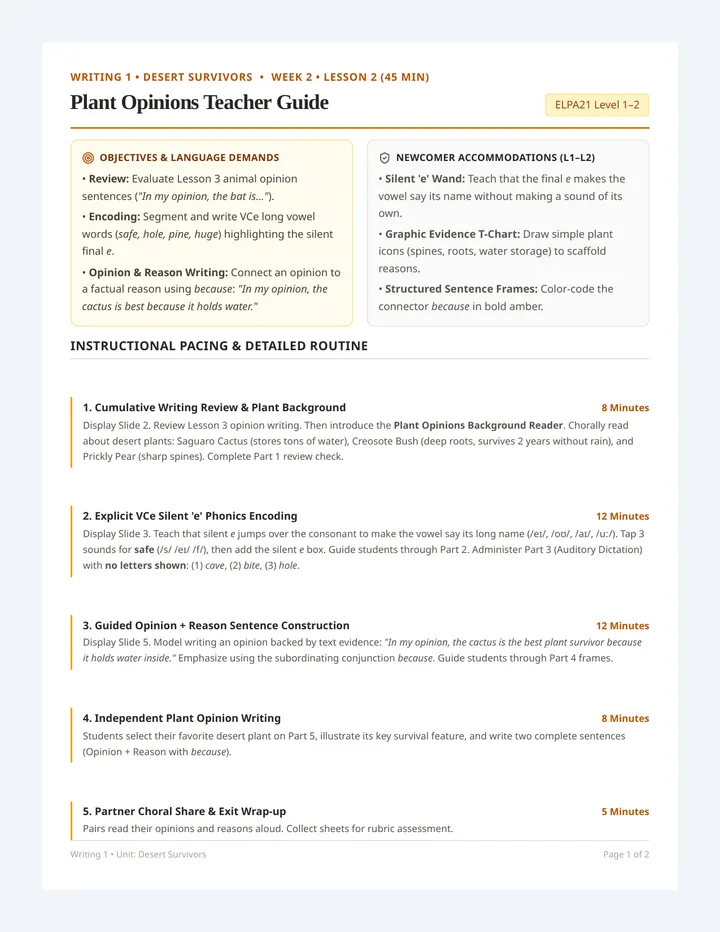
Plant Opinions Teacher Guide Writing 1 • Desert Survivors • Week 2 • Lesson 2 (45 Min)
Plant Opinions Teacher Guide
ELPA21 Level 1–2
Daily Repeated Reading Protocol • "Survivors Under the Hot Sun" (1–4)
Today: Day 4
Students must read sections 1–4 of "Survivors Under the Hot Sun" 1 time every day across the 4 lessons:
Day 1: Read to kids; follow along
Day 2: Whole-class Choral read
Day 3: Kids Partner read
Day 4 (Today): Kids Read to self
Objectives & Focus
• Fluency: Read sections 1–4 to self independently with finger tracking.
• Encoding: Segment and write VCe words with silent e (safe, hole, pine, cave ).
• Writing: Justify plant opinions with because and evidence.
Newcomer Accommodations
• Encourage whisper-reading or silent reading at individual pace for Day 4.
• Silent 'e' wand visual: silent 'e' jumps over to make vowel long.
• Graphic anchor: Cactus = holds water; Creosote = deep roots.
Instructional Pacing & Detailed Routine
1. Quick-Write & Day 4 Read-to-Self Protocol
8 Minutes
Students write 1 sentence for the Quick-Write warm-up: "If I touch a cactus, it will [word bank]." Then open "Survivors Under the Hot Sun" (sections 1–4). Conduct Day 4 Independent Reading Protocol : Students read all 4 sections to themselves silently or with whisper-phones to build individual mastery.
2. Explicit VCe Silent 'e' Phonics Encoding
12 Minutes
Display Slide 14. Teach that silent e jumps over the consonant to make the vowel say its long name. Tap 3 sounds for safe (/s/ /eɪ/ /f/) + silent e . Complete Part 2. Administer Part 3 (Auditory Dictation) with no letters shown : (1) cave , (2) bite , (3) hole .
3. Guided Opinion + Factual Reason Modeling
12 Minutes
Display Slide 15. Model writing an opinion backed by text evidence: "In my opinion, the cactus is best because it holds water." Guide students through Part 4 frames.
4. Independent Writing & Exit Check
13 Minutes
Students write two sentences (Opinion + Reason with because ) on Part 5. Collect sheets for rubric evaluation. Prepare students for the Culminating Showcase!
Plant Opinions Activity Sheet Writing 1 • Unit: Desert Survivors • Week 2 • Lesson 2 ELPA21 Level 1–2
Desert Plant Opinions
Name:
Date:
Warm-Up
Quick-Write: What happens if you touch a cactus?
Write 1 sentence
Word Bank:
sharp spines hurt poke ouch
If I touch a cactus, it will .
Review
Lesson 3 Review • Opinion with "because"
🦇 "In my opinion, the bat is best because it flies in the dark."
Reason Word
Part 2
VCe Sound Boxes • Silent 'e' Makes Vowels Long
1. safe (/s/ /eɪ/ /f/) long 'a' + silent 'e'
e
2. hole (/h/ /oʊ/ /l/) long 'o' + silent 'e'
e
3. pine (/p/ /aɪ/ /n/) long 'i' + silent 'e'
e
4. cave (/k/ /eɪ/ /v/) long 'a' + silent 'e'
e
Part 3
Auditory Dictation • Listen and Write
Word 1
Word 2
Word 3
Writing 1 • Desert Survivors Page 1 of 2
Evidence-Based Opinions
Supporting Opinions with Factual Reasons
Lesson 4 • Page 2
Desert Plants:
cactus bush plant
Factual Reasons:
holds water deep roots spines
Part 4
Opinion + Reason Frames • Fill and Write
Use the word bank to complete each opinion and reason:
1 Why is the saguaro cactus the strongest desert plant?
In my opinion, the is best because it .
2 Why can the creosote bush live without rain?
I think the desert is strong because it has .
3 Why does the cactus have sharp spines?
The cactus is from animals because of its sharp .
Part 5
Independent Plant Opinion Writing
Write your complete opinion sentence and one reason using because :
Draw your plant adaptation
Sentence 1 (Your Opinion):
Sentence 2 (Your Reason with "because"):
Student Writing Checklist:
Capital Letter Plant Name Used "because" Period (.)
Writing 1 • Desert Survivors Page 2 of 2
Plant Opinions Background Reader Writing 1 • Desert Survivors • Background Reading ELPA21 Level 1–2
Remarkable Desert Plant Survivors
Read about plant adaptations to support your opinion and reason.
Name:
Date:
Target VCe Words in Reading (Silent 'e')
🛡️ safe protected from heat
🕳️ hole nest inside cactus
🌲 pine tree with needles
🦇 cave cool dark shelter
Background Text • How Desert Plants Survive Without Rain
🌵
1. The Giant Saguaro Cactus
The saguaro cactus is the king of the desert. When rare rains fall, its stem expands like an accordion to store over 2,000 pounds of clean water ! Sharp spines keep thirsty desert animals away. Birds make a safe nest inside a cactus hole .
🌿
2. The Tough Creosote Bush
The creosote bush has tiny waxy leaves that prevent moisture from evaporating under the hot sun. Its deep roots spread wide across the dirt to soak up every drop of water. Some creosote bushes in the Mojave desert are over 9,000 years old!
🪴
3. The Sweet Prickly Pear
The prickly pear has wide, flat pads that hold gallons of thick gel water. In the spring, it grows bright yellow flowers and sweet red fruit that give tortoises and jackrabbits vital food and moisture.
Reading Summary
Desert plants survive by storing gallons of water, growing protective spines, and spreading deep underground roots.
Writing 1 • Desert Survivors • Lesson 4 Resource Page 1 of 2
Cloze Reading Practice • Lesson 4
Fill in the Blanks • Plant Survivors
Page 2 of 2
Cloze Word Bank (5 Target Words): Cross out each word as you use it
cactus
water
safe
hole
roots
Reading Task
Read the Story and Write the Missing Words
Read the story below based on Page 1. Write the correct plant word on each numbered blank line:
Plants in the desert must survive with almost no rain. The giant saguaro (1) expands its stem when it rains to store thousands of pounds of moisture.
Animals cannot steal the plant's stored (2) because long, sharp spines protect it day and night.
Small desert birds are (3) from enemies when they build a home high up inside a cactus stem.
The bird rests in a deep, cool (4) where the burning sun cannot enter.
The creosote bush lives for thousands of years because its deep underground (5) reach far out to catch every drop of rainwater!
Showcase Teacher Guide Writing 1 • Desert Survivors • Culminating Showcase (45 Min)
Showcase Teacher Guide
ELPA21 Level 1–2
Culminating Writing Objectives
• Choice Pathway A (Opinion): Write 3–4 sentences on whether they would like to visit the desert, using because to give reasons.
• Choice Pathway B (Informative): Write 3–4 sentences synthesizing what they know about desert wildlife and plant adaptations.
• Cumulative Vocabulary: Utilize words from prior units (CVC, blends, digraphs, VCe).
Newcomer Accommodations (L1–L2)
• Dual Pathway Choice: Allow students to select the format where they feel highest confidence.
• Cumulative Word Bank: Categorized visually (Animals, Plants, Actions, Reasons).
• Sentence Starters: Pre-modeled paragraph templates displayed on Slide 5.
Instructional Pacing & Workshop Routine
1. Quick-Write Warm-Up & Background Synthesis
7 Minutes
Display Slide 2. Students complete the 1-sentence Quick-Write on Page 1 of the Project Sheet: "What is the most interesting thing you learned about the desert?" Review the Showcase Background Reader highlighting animal and plant champions.
2. Pathway Selection & Teacher Modeling
10 Minutes
Display Slide 3 and Slide 4. Present both pathways: Pathway 1 (Opinion: Visit the Desert) vs. Pathway 2 (Informative: Desert Facts) . Model writing an opening sentence and a supporting sentence with because for each pathway on the board.
3. Word Bank Review & Paragraph Planning
8 Minutes
Guide students through the categorized word bank on Page 1. Have students circle 3–4 words they plan to include. Students select their pathway and fill out the 3-step planning organizer.
4. Independent Drafting & Teacher Conferencing
15 Minutes
Students draft their 3–4 sentence paragraph on Page 2. Circulate with the 4-point rubric clipboard. Prompt for capitalization, finger spacing, target vocabulary, and terminal punctuation.
5. Author's Chair & Showcase Wrap-up
5 Minutes
Invite 2–3 students to read their completed piece to the class. Collect all student drafts for final rubric scoring.
Writing 1 • Desert Survivors • Culminating Showcase Page 1 of 2
Culminating Assessment Guide
Showcase Rubric & Conferencing
Showcase Writing Project Writing 1 • Desert Survivors • Culminating Showcase ELPA21 Level 1–2
Desert Writers Showcase
Name:
Date:
Warm-Up
Quick-Write: What is the most exciting thing you learned?
Write 1 sentence
I learned that desert survivors can .
Step 1
Choose Your Writing Pathway (Pick A or B)
A Opinion Pathway
Prompt: Would you like to visit a desert? Write your opinion and explain why or why not with reasons.
"In my opinion, I would / would not like to visit..."
B Informational Pathway
Prompt: What do you know about desert survivors? Write facts about animals and plants.
"Desert animals and plants have special ways to survive..."
Step 2
Showcase Word Bank • Pick Words to Use
Animals: fox, bat, rat, owl, fish
Plants & Places: cactus, bush, sand, cave, nest
Actions: runs, flies, digs, rests, holds
Linking Words: because, also, in my opinion
Step 3
Plan Your Paragraph (3 Ideas)
1. Main Idea:
2. Detail / Reason:
3. Concluding Idea:
Writing 1 • Desert Survivors • Showcase Page 1 of 2
Culminating Showcase Draft
My Desert Writing Piece
Page 2 of 2
Draw your desert survivor or visit scene here
Sentence 1 (Topic or Opinion Starter):
Sentence 2 (Reason or Fact 1 with "because"):
Sentence 3 (Reason or Fact 2):
Sentence 4 (Concluding Sentence):
Author's Self-Monitoring Checklist:
Capital Letters Finger Spaces Word Bank Words Periods (.)
Teacher Assessment:
4 - Adv 3 - Prof 2 - Dev 1 - Beg
Teacher Feedback / Next Step:
Writing 1 • Desert Survivors • Showcase Page 2 of 2
Showcase Background Reader Writing 1 • Desert Survivors • Background Reading ELPA21 Level 1–2
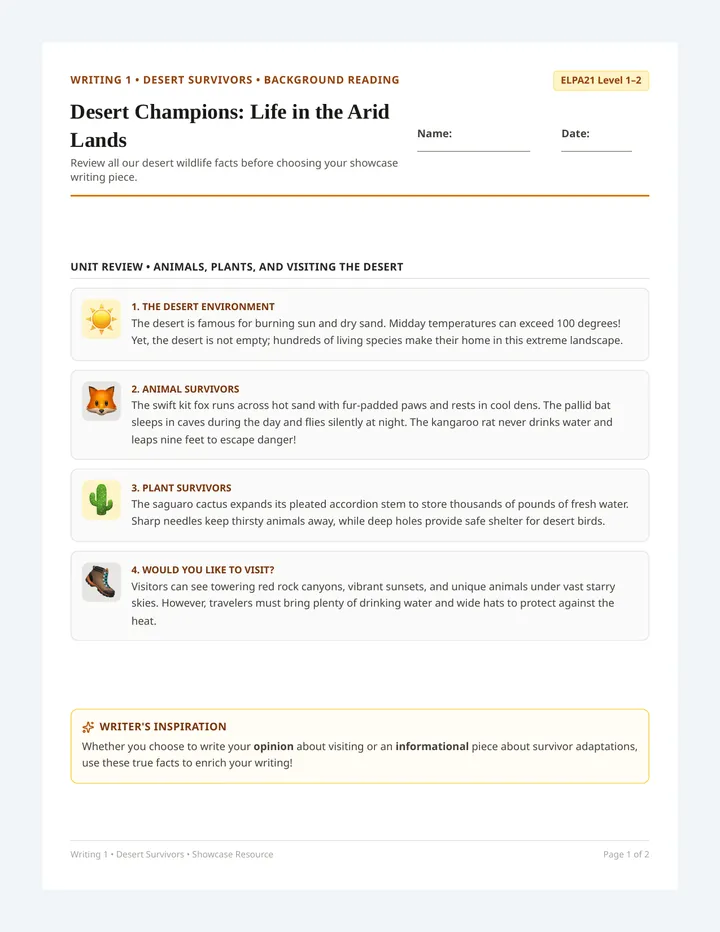
Desert Champions: Life in the Arid Lands
Review all our desert wildlife facts before choosing your showcase writing piece.
Name:
Date:
Unit Review • Animals, Plants, and Visiting the Desert
☀️
1. The Desert Environment
The desert is famous for burning sun and dry sand. Midday temperatures can exceed 100 degrees! Yet, the desert is not empty; hundreds of living species make their home in this extreme landscape.
🦊
2. Animal Survivors
The swift kit fox runs across hot sand with fur-padded paws and rests in cool dens. The pallid bat sleeps in caves during the day and flies silently at night. The kangaroo rat never drinks water and leaps nine feet to escape danger!
🌵
3. Plant Survivors
The saguaro cactus expands its pleated accordion stem to store thousands of pounds of fresh water. Sharp needles keep thirsty animals away, while deep holes provide safe shelter for desert birds.
🥾
4. Would You Like to Visit?
Visitors can see towering red rock canyons, vibrant sunsets, and unique animals under vast starry skies. However, travelers must bring plenty of drinking water and wide hats to protect against the heat.
Writer's Inspiration
Whether you choose to write your opinion about visiting or an informational piece about survivor adaptations, use these true facts to enrich your writing!
Writing 1 • Desert Survivors • Showcase Resource Page 1 of 2
Cloze Reading Practice • Showcase
Fill in the Blanks • Desert Champions
Page 2 of 2
Cloze Word Bank (5 Target Words): Cross out each word as you use it
heat
fox
night
cactus
survive
Reading Task
Read the Story and Write the Missing Words
Read the story below based on Page 1. Write the correct word on each numbered blank line:
The desert is an amazing place where animals and plants learn to (1) without much water.
During the hottest hours of the day, animals avoid the dangerous midday (2) by sleeping in deep underground holes.
The kit (3) runs swiftly on loose sand and hears tiny sounds with its giant ears.
When the hot sun disappears, the pallid bat flies through the dark (4) sky to catch bugs and scorpions.
On the arid hills, the giant saguaro (5) holds thousands of pounds of fresh rainwater to stay alive!