Vowel Sounds Lesson Plan Can You Hear the Difference?
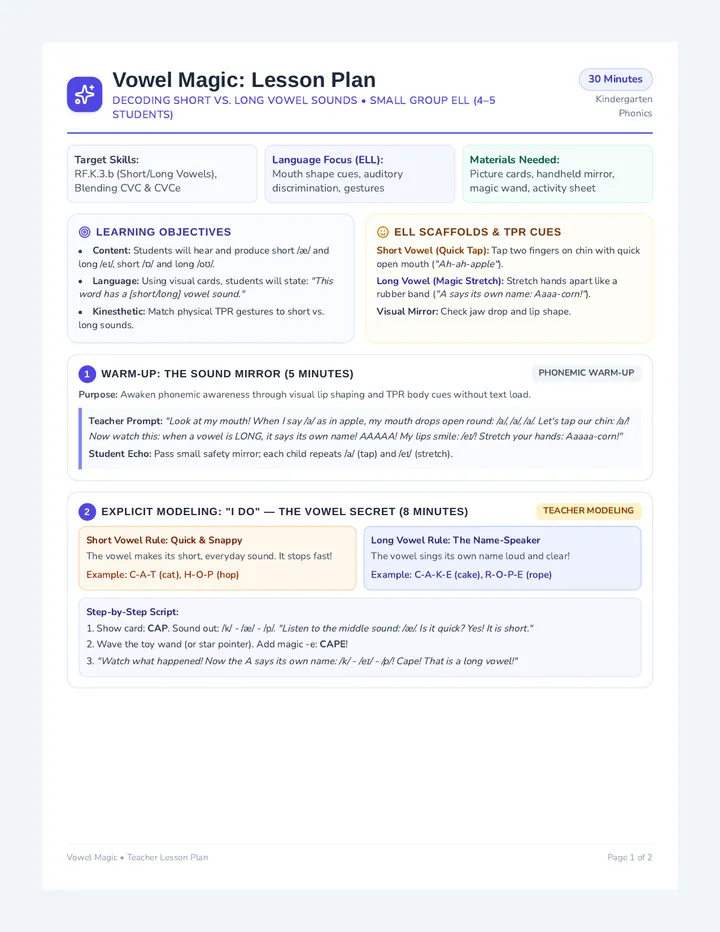
Auditory Vowels Lesson Plan
Duration 40 min
Learning Objective
Students will distinguish between long and short vowel sounds by engaging in focused listening activities and interactive challenges.
Why It Matters
Enhancing phonemic awareness in kindergarten builds critical literacy foundations, enabling students to better decode and understand reading materials.
Prep Checklist
Review the Vowel Listening Lab slides.
Prepare auditory examples/audio clips.
Check classroom audio equipment.
Print Scavenger Hunt clue cards.
Familiarize yourself with Sound Stories prompts.
Materials Needed
• Vowel Listening Lab Slide Deck
• Sound Scavenger Hunt Activity Sheet
• Sound Stories Discussion Guide
• Vowel Sound Audio Clips
Instructional Path
10m
Warm-Up: Sound Recognition
• Open Discussion: Ask students to share any vowel sounds they can think of (A, E, I, O, U).
• The Echo Game: Play short clips of vowel sounds. Ask students to identify if they sound "long" (like their name) or "short" (quick sounds).
• Repetition: Have the whole class repeat each sound to ensure clarity and mouth positioning.
15m
Main Activity: Vowel Listening Lab
• Guided Practice: Use the Vowel Listening Lab slides to guide auditory exercises.
• Active Response: Have students listen carefully. Ask them to hold up signs (Long/Short) or respond verbally to each sound.
• Role Rotation: Rotate roles so different students or groups take turns being the "Lead Listener."
10m
Interactive Challenge: Scavenger Hunt
• Clue Hunt: Organize a classroom scavenger hunt using clues based on vowel sounds (e.g., "Find something with a short /a/ sound like 'cat'").
• Movement: Encourage students to identify objects associated with specific sounds as outlined in the activity sheet.
• Guided Feedback: Provide positive reinforcement and gentle corrections as they explore.
5m
Cool-Down: Sound Stories
• Reflect: Gather students together to share observations on what they heard.
• Discussion: Use the Sound Stories guide to reinforce learning and allow expression.
• Summary: Briefly recap the difference: Long vowels say their name; short vowels are quick!
Vowel Listening Lab Slide Deck Vowel Listening Lab
Welcome to our listening lab! Today, we will explore long and short vowel sounds.
Listen • Detect • Learn
Introduce the Vowel Listening Lab. Explain to the students that they will hear sounds and decide if they are long or short vowels.
Get Ready to Listen!
Step 01
We will now listen to different vowel sounds. Can you hear the difference?
Raise your hand or shout out 'long' or 'short' when you hear a sound.
LISTEN
RESPOND
Explain that this slide will warm them up for what they will hear. Encourage them to listen carefully, and remind them that they can respond verbally or with signs.
Long Vowel Sounds
Stretch it out!
/ā/ & /ē/
c-a-k-e
b-e-e
What to listen for:
These sounds take more time. They usually sound just like the name of the letter!
Long, song-like tones
Describe some examples of long vowel sounds. Play an audio clip of a long vowel sound and provide visual cues (like a stretched word image).
Short Vowel Sounds
Quick & Crisp!
What to listen for:
These sounds are quick and snappy. They don't take much time at all!
Quick, crisp sounds
/æ/ & /ɛ/
cat
pen
Describe examples of short vowel sounds. Play an audio clip of a short vowel sound and use visual cues such as a short, crisp image.
Your Turn!
Listen to the sounds and decide:
LONG
Like a song!
SHORT
Like a clap!
Let's practice together!
In this slide, prompt students to interact by guessing the vowel category for each sound played. Encourage participation and discuss the differences briefly after each sound.
Sound Scavenger Hunt Activity Sound Scavenger Hunt
The Vowel Detective Mission
Mission Briefing
Become a Sound Detective ! Move around the classroom and use your super-listening skills to find objects that match our vowel sound clues.
Long Sounds
These sounds say their own name! (Like cake or bee )
Short Sounds
These sounds are quick and snappy! (Like cat or pen )
Detective Rules
Get Your Clue: Your teacher will give you a clue card with a picture.Start the Hunt: Walk (don't run!) around the room to find an object that has that same vowel sound.Check the Sound: Say the name of the object slowly. Does it match your clue?Gather & Share: Bring your found object (or point to it) and share with the class!
Clue Cards (Teacher: Cut these out!)
Long /ā/
"Cake"
Short /æ/
"Cat"
Long /ē/
"Bee"
Short /ɛ/
"Pen"
Long /ī/
"Ice"
Short /ɪ/
"Pig"
Detective Log
Name: _________________________________
What did you find? Draw your objects below!
LONG Vowel Sound
Object Name: ____________________
SHORT Vowel Sound
Object Name: ____________________
Think Like a Detective:
"How did the sound help you find your object?"
Sound Stories Discussion Guide Reflection Sound Stories
Class Discussion & Reflection Guide
Facilitation Tip
Gather students in a circle. Use these prompts to help students reflect on their auditory journey today. Encourage them to use "long" and "short" vocabulary while sharing.
Guiding Questions
1
What was your favorite sound in our listening lab?
2
Did you hear a sound that was long like a song or short like a quick clap? How can you tell the difference?
3
Can you tell a little story about an object or word that reminded you of a long vowel sound?
4
What did you enjoy most about our sound scavenger hunt?
Reflections for Friends
Share with a friend:
"One new word I learned today is ________. It has a ________ sound!"
Imagination Challenge:
"If you could create a new game with sounds, how would we play it?"
Remember: There's no right or wrong answer—just share what you heard and felt!
My Sound Story
Name: _______________________
A "Long" Word I Heard...
Word: ________________________________
A "Short" Word I Heard...
Word: ________________________________