A structured multisensory Orton-Gillingham unit teaching foundational consonant digraphs. Students master phonemic discrimination, sound-symbol mapping, blending, and encoding through explicit, multi-day routines.
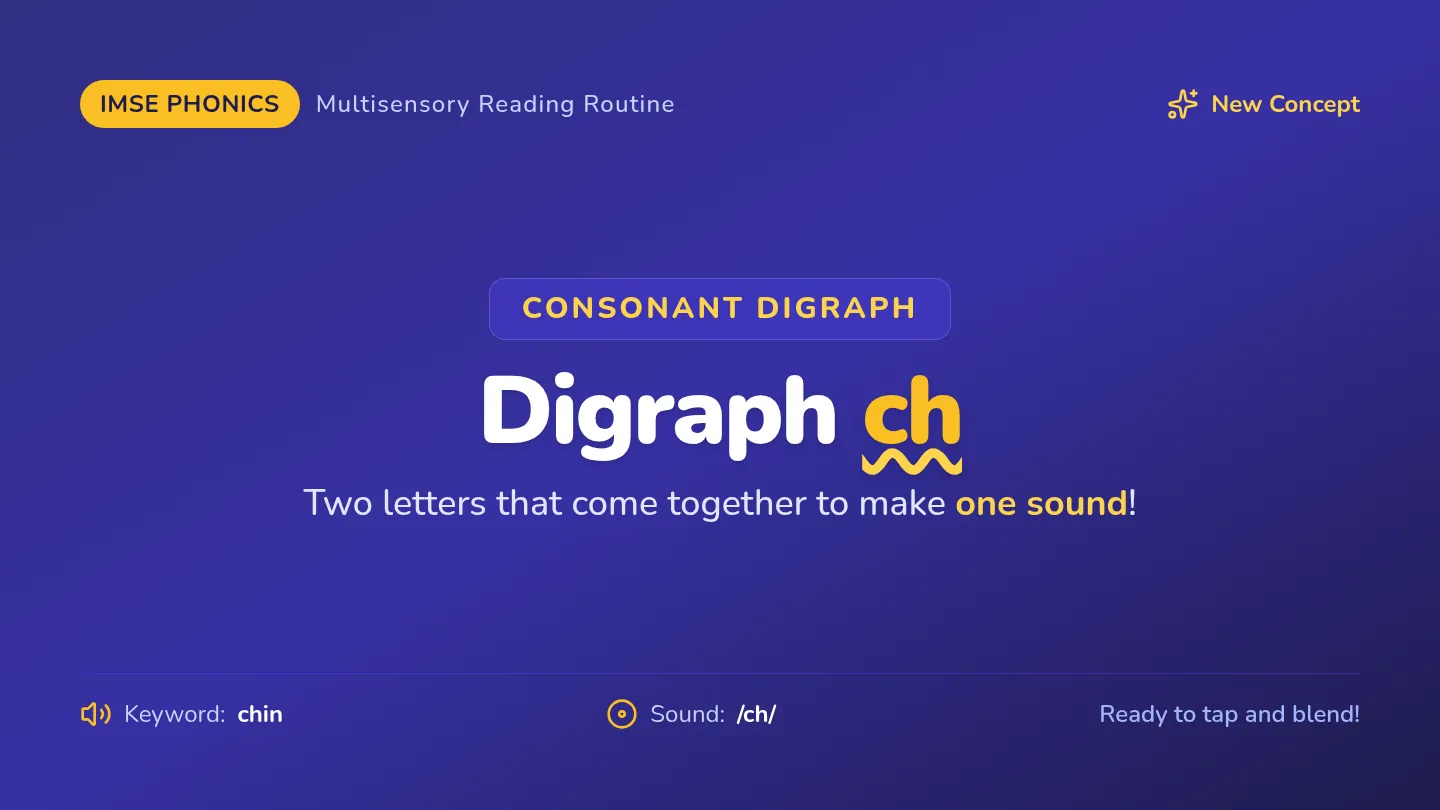
Read words clearly without showing cards. Have students echo the word, isolate the /ch/ sound, and bubble Beginning, Ending, or No /ch/. Emphasize contrasting ship (/sh/) vs chip (/ch/).
Part 2: Tap & Map (Sound Boxes)
Stress the core orthographic rule: "Two letters, one sound, ONE box!" Students tap each dot with index finger, pronounce phonemes (/ch/-/i/-/p/), then print letters into boxes.
Part 4: Digraph Sort (Initial vs Final)
Students read words from the bank, trace initial or final /ch/, and record under the correct train column. Encourages visual pattern recognition of digraph position.
Part 6: Rapid Fluency Grid
Do a whole-class choral read first, followed by timed partner paired reading. Students check off Read 1, 2, and 3 as their automaticity and expression improve.
4
Teacher Callout Script for Dictation
Read Aloud to Class
Part 5 Word Dictation (Pound & Tap Routine):
Word 1:"chin" → Teacher: "chin" | Students pound: "chin" | Finger-tap: /ch/ - /i/ - /n/ | Write: chin.
Word 2:"chop" → Teacher: "chop" | Students pound: "chop" | Finger-tap: /ch/ - /o/ - /p/ | Write: chop.
Word 3:"such" → Teacher: "such" | Students pound: "such" | Finger-tap: /s/ - /u/ - /ch/ | Write: such.
Teacher dictates: "Chad had a chip for lunch."
1. Teacher states sentence twice. 2. Students pound sentence (one pound per word). 3. Students write. 4. Guide students to check with COPS: Capitalization, Organization (spaces), Punctuation, Spelling.
Common Misconceptions
/ch/ vs /sh/: /ch/ is a stop/puff (train puff), whereas /sh/ is a continuous airflow (quiet baby). Use hand mirror or tissue test.
Writing 2 boxes: Remind students: "One sound = one box." Show how c and h fuse together.
Confusing /ch/ and /j/: /ch/ is unvoiced (vocal cords still); /j/ is voiced (vocal cords vibrate). Have student touch their throat.
Tiered Differentiation
Support (Tier 2/3): Provide magnetic letter tiles or color-coded digraph card (green for consonant digraph) for physical placement into sound boxes.
On-Level: Independent completion of word sort and sentence reading with a peer fluency partner.
Extension: Challenge students to write their own decodable sentences using 2+ /ch/ words (e.g. "Rich Chad sat on a bench.").
Informal automaticity check. Target speed: 20+ correct words per minute with short vowel accuracy. Look for hesitation on initial vs final digraph placement.
7
Part 7: Sentence Dictation Scoring (1 pt)
Model Sentence
"Chad had a chip for lunch."
[✓] Capital C
Uppercase start for proper noun "Chad"
[✓] Finger Spaces
Visible space between all 6 words
[✓] Digraphs 'ch'
Correctly spelled: Chad, chip, lunch
[✓] Period .
End punctuation present at sentence end
Chip Chop Practice Activity • Teacher Key Page 2 of 2
1 Box = 1 Sound
Word: crash 4 Sounds / 5 Letters
c
r
a
sh
Notice: "sh" stays in ONE box because it makes ONE sound!
Remember: Digraph means 2 letters holding hands to make 1 sound.
Connected Text
Read Decodable Sentences
Fluency Drill
1
Josh will rush to the pet shop.
2
She got a big fish in the net.
3
Can we see the big ship in the bay?
1st Read: Tap & Decode • 2nd Read: Smooth & Natural • 3rd Read: Read with Feeling!
Mission Accomplished Digraph Mastery Check
You are an SH Sound Master!
Now get ready for your Ship Shape Practice Activity! You will tap, map, sort, and write your own sh words.
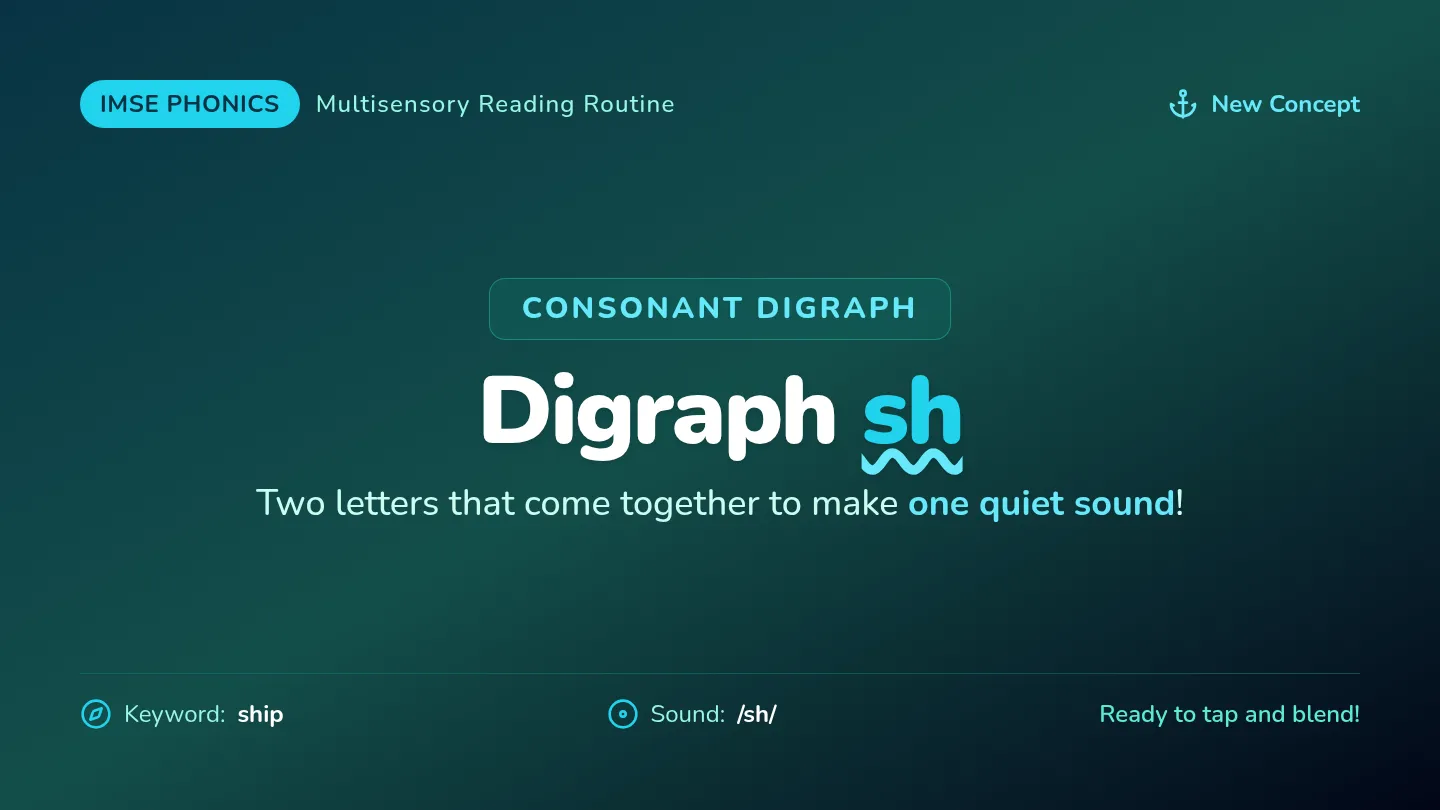
Say words aloud clearly. Have students repeat the word, listen for the quiet /sh/ stream, and bubble Beginning, Ending, or No /sh/. Contrast chip (/ch/) vs ship (/sh/).
Part 2: Tap & Map (Sound Boxes)
Reinforce: "Two letters, one sound, ONE box!" Students tap each dot, pronounce phonemes (/sh/-/i/-/p/), then print letters into boxes.
Part 4: Digraph Sort (Initial vs Final)
Students read words from the bank, circle initial sh- or final -sh, and write them in the proper ship column.
Part 6: Rapid Fluency Grid
Choral read grid first to establish accuracy, then have partners time each other for 1-minute fluency reads, tracking Read 1, 2, and 3.
4
Teacher Callout Script for Dictation
Read Aloud to Class
Part 5 Word Dictation (Pound & Tap Routine):
Word 1:"ship" → Teacher: "ship" | Students pound: "ship" | Finger-tap: /sh/ - /i/ - /p/ | Write: ship.
Word 2:"fish" → Teacher: "fish" | Students pound: "fish" | Finger-tap: /f/ - /i/ - /sh/ | Write: fish.
Word 3:"shop" → Teacher: "shop" | Students pound: "shop" | Finger-tap: /sh/ - /o/ - /p/ | Write: shop.
Word 4:"shed" → Teacher: "shed" | Students pound: "shed" | Finger-tap: /sh/ - /e/ - /d/ | Write: shed.
Part 7 Sentence Dictation (COPS Routine):
Teacher dictates: "Josh got a fish at the shop."
1. Teacher states sentence twice. 2. Students pound sentence (one pound per word). 3. Students write. 4. Guide students to check with COPS: Capitalization, Organization (spaces), Punctuation, Spelling.
Common Misconceptions
/sh/ vs /ch/: /sh/ is smooth and continuous; /ch/ has a hard stop. Have student hold tissue: /sh/ creates a gentle bend, /ch/ makes it jerk.
/sh/ vs /s/: For /s/, lips smile; for /sh/, lips pucker forward like an open circle.
Spelling as 's' alone: Highlight the buddy rule: 's' needs 'h' to make the quiet sound.
Tiered Differentiation
Support (Tier 2/3): Provide tactile felt strips for tracing 'sh'. Use Elkonin box card with pre-colored first box for digraph tile.
On-Level: Independent word sorting, self-scoring with peer check, sentence writing.
Extension: Write a mini 3-sentence decodable story using 4 words from the rapid fluency grid.