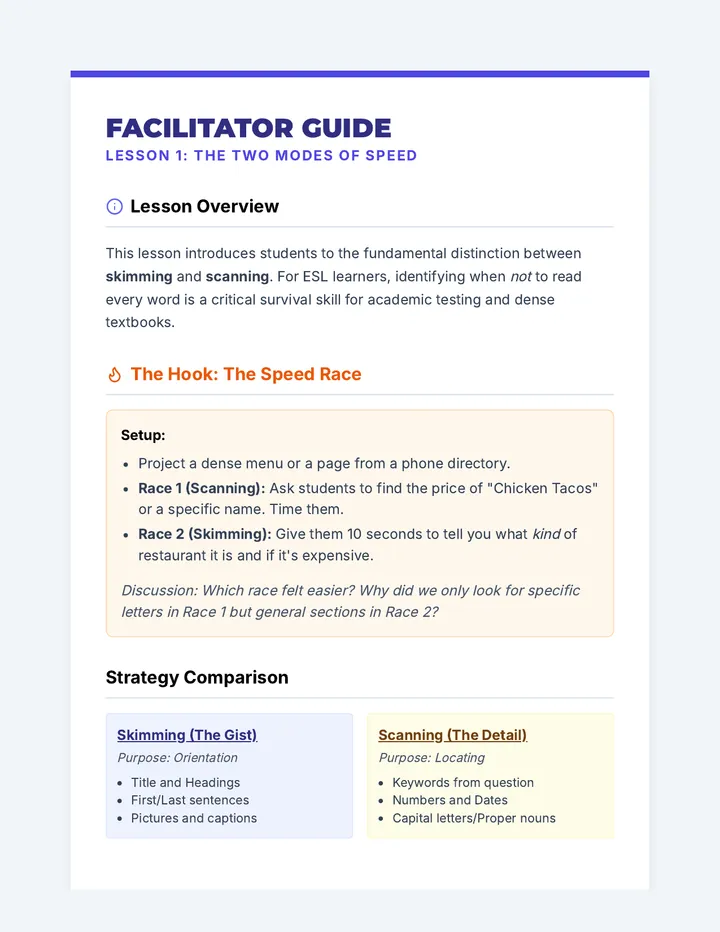
Cause and Effect Intro Slides Cause and Effect Detectives
Learning to explain WHY things happen in science!
Lesson 1 Science Explorers
Detective Challenge!
"The teacher pops a balloon with a pin... POP!"
The Action
What did the teacher do?
The Result
What happened to the balloon?
Science Secrets
Cause
The Action.
This is WHY something happens.
Effect
The Result.
This is WHAT happened.
Look at the Science!
CAUSE
The sun shines on ice.
EFFECT
The ice melts.
CAUSE
You drop a glass.
EFFECT
The glass breaks.
CAUSE
Plants get no water.
EFFECT
The plants die.
Ready to Investigate?
Open your Detective Log. Let's look for causes and effects!
Observe
Record
Share
Detective Log Worksheet Detective's Science Log
Reasoning Researchers Lesson 1
Name:
Date:
Case Instructions
A Cause is the action (why it happened). An Effect is the result (what happened). Look at the cases below and fill in the missing information!
Case #01: The Ice Mystery
Cause (The Action)
The hot sun shines on a cold ice cube.
Effect (The Result)
Case #02: The Seed Mystery
Cause (The Action)
Effect (The Result)
A tiny plant starts to grow out of the dirt.
Top Secret Case: Your Turn!
Draw or write your own science discovery below.
Cause
Effect
"The more you investigate, the more you learn!" - Reasoning Researchers
The Because Bridge Slides The Because Bridge
Connecting our ideas like a scientist!
Lesson 2 Science Grammar
Mystery Sentence Challenge
The Puzzle Pieces:
The paper got wet...
...it fell in the water.
How can we join these pieces together?
Meet the Connector!
Effect
The paper got wet
because
Cause
it fell in the water.
"We use because to connect the WHAT to the WHY."
Say it like a Scientist!
The ice melted because it was hot.
The kite flies because it is windy.
The lamp turns on because I hit the switch.
Find Your Partner!
You have one piece of the puzzle. Find the person with the other half and use BECAUSE to share your science sentence!
Look
Speak
Write
Mystery Match-Up Activity Mystery Match-Up
Building the "Because Bridge"
Reasoning Researchers
Lesson 2: Sentence Building
Name:
Date:
Part 1: Match the Pieces
Draw a line to match the Effect to its Cause .
Effect (Result)
The window broke
The sugar disappeared
The boy wore a coat
The flashlight turned on
Cause (Reason)
it was very cold outside.
a ball hit the glass.
I pressed the button.
it melted in the water.
Part 2: Build the Sentences
Choose two matches from above and write the full sentence using because .
Sentence 1
Sentence 2
Bridge Building Complete! • Reasoning Researchers
Predictive Powers Slides Predictive Powers
Seeing the future of our experiments!
Lesson 3 Hypothesis Lab
The Big Question
"I have a heavy rock and a light feather. What will happen if I drop them in water?"
Rock
Feather
Predictor Words
If I drop the rock in water...
then it will sink to the bottom.
Scientists use "If... then..." to make a Hypothesis (a smart guess).
Practice Predicting
If I leave ice cream in the sun, then it will melt.
If I jump in a puddle, then I will get wet.
Prediction Lab
Grab your Predictor Sheet. Let's see if your scientific guesses come true!
Aim
Test
Result
Sink or Float Lab Sheet Sink or Float Lab
Reasoning Researchers
Predictive Powers
Scientist:
Date:
My Hypothesis
Use the magic frame: "If I put the _______ in water, then it will _______."
Object My Prediction (If... then...) Result Heavy Rock
|
|
Sink
Float
|
|
Plastic Toy
|
|
Sink
Float
|
|
Metal Spoon
|
|
Sink
Float
|
Scientific Conclusion
I learned that objects sink or float because...
Junior Scientist Report Slides Junior Scientist Reports
Publishing our big discoveries!
Lesson 4 Scientific Writing
Sharing the News
Observation
"What did I see?"
Explanation
"Why did it happen?"
Sharing
"Tell the world!"
The Lab Report Map
1 Materials (What do I need?)
2 Hypothesis (If... then...)
3 Results (What happened?)
4 Conclusion (The "Why")
Today, we put it all together!
The Conclusion Bridge
"In conclusion, the Result happened because the Reason."
WHAT
WHY
Official Scientist Time!
"Put on your invisible lab coat. Your discovery is ready to be written."
Write
Report
Share
Junior Scientist Report Template Official Science Report
Junior Scientist Report
Discovery through investigation
Researcher:
Date:
1. Project Title & Question
Title of Experiment:
The Question I am testing:
2. My Hypothesis (Prediction)
What do you think will happen?
If
then
3. Materials Needed
Next Page: Observations & Conclusion
4. Results (Observation)
Draw what happened here
Describe the result:
5. Final Conclusion (The Explanation)
Explain why the experiment happened the way it did using your science words!
In conclusion, the result was because the reason was .
Scientist Verified • Reasoning Researchers Unit
Science Symposium Slides Science Symposium
Sharing our discoveries with the world!
Lesson 5 Mastery Presentation
What is a Symposium?
A Symposium is a big meeting where experts talk about their work.
The Speaker
"I share my discovery clearly."
The Audience
"I listen and ask smart questions."
Speak Like an Expert
To Start:
"Our project was about..."
The Data:
"The results show that..."
The WHY:
"This happened because..."
The Q&A (Questions & Answers)
Questioners say:
"What if you used...?"
"Why did the...?"
"Can you explain...?"
Speakers say:
"That is a great question."
"In our test, we saw..."
Symposium Showcase
"The floor is yours, experts. Impress us with your science!"
Eye Contact
Loud Voice
Clear Facts
Science Presentation Rubric Presentation Rubric
Assessing Academic Science Language
Teacher Resource
Unit Capstone
| Criteria |
Developing
|
Meeting
|
Expert
|
| --- | --- | --- | --- |
|
Cause & Effect Language
| Uses single words or simple "What happened" sentences. No conjunctions. | Uses "because" or "if/then" correctly at least once during the talk. | Consistently uses complex sentences (If/then, Because, So) to explain data. |
|
Science Vocabulary
| Uses everyday words like "it went down" or "thing". | Uses science terms like "sink," "float," "observation," or "result." | Uses precise terms (Hypothesis, Conclusion) to structure the talk. |
|
Q&A Interaction
| Answers with "Yes/No" or shrugs when asked a question. | Attempts to answer peer questions using some science details. | Uses formal starters ("That's a great question") and explains the 'Why'. |
|
Voice & Presence
| Speaks very quietly; difficult to understand. | Speaks clearly enough for the class to hear. Makes some eye contact. | Speaks with confidence and enthusiasm. Engages the whole audience. |
Teacher Observation Notes
Strengths in Academic Language:
Next Steps for Language Development:
Reasoning Researchers Assessment Tool • Level: 2nd Grade ESL