Science Domains Activity Bank Push-In Science EL Strategy Menu
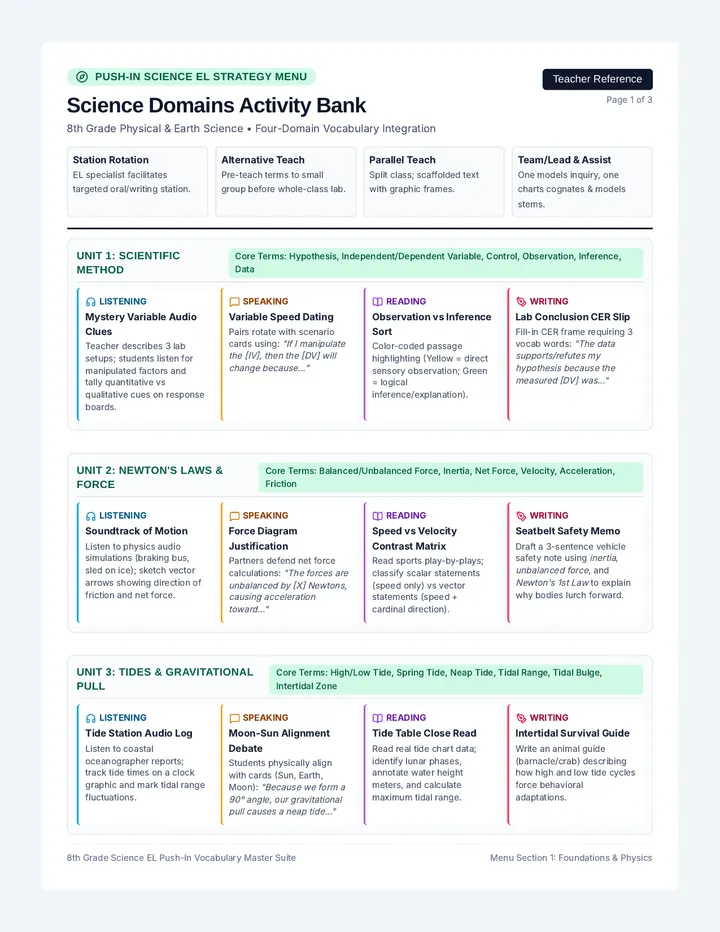
Science Domains Activity Bank
8th Grade Physical & Earth Science • Four-Domain Vocabulary Integration
Teacher Reference
Page 1 of 3
Station Rotation EL specialist facilitates targeted oral/writing station.
Alternative Teach Pre-teach terms to small group before whole-class lab.
Parallel Teach Split class; scaffolded text with graphic frames.
Team/Lead & Assist One models inquiry, one charts cognates & models stems.
Unit 1: Scientific Method
Core Terms: Hypothesis, Independent/Dependent Variable, Control, Observation, Inference, Data
Listening Mystery Variable Audio Clues
Teacher describes 3 lab setups; students listen for manipulated factors and tally quantitative vs qualitative cues on response boards.
Speaking Variable Speed Dating
Pairs rotate with scenario cards using: "If I manipulate the [IV], then the [DV] will change because..."
Reading Observation vs Inference Sort
Color-coded passage highlighting (Yellow = direct sensory observation; Green = logical inference/explanation).
Writing Lab Conclusion CER Slip
Fill-in CER frame requiring 3 vocab words: "The data supports/refutes my hypothesis because the measured [DV] was..."
Unit 2: Newton's Laws & Force
Core Terms: Balanced/Unbalanced Force, Inertia, Net Force, Velocity, Acceleration, Friction
Listening Soundtrack of Motion
Listen to physics audio simulations (braking bus, sled on ice); sketch vector arrows showing direction of friction and net force.
Speaking Force Diagram Justification
Partners defend net force calculations: "The forces are unbalanced by [X] Newtons, causing acceleration toward..."
Reading Speed vs Velocity Contrast Matrix
Read sports play-by-plays; classify scalar statements (speed only) vs vector statements (speed + cardinal direction).
Writing Seatbelt Safety Memo
Draft a 3-sentence vehicle safety note using inertia , unbalanced force , and Newton's 1st Law to explain why bodies lurch forward.
Unit 3: Tides & Gravitational Pull
Core Terms: High/Low Tide, Spring Tide, Neap Tide, Tidal Range, Tidal Bulge, Intertidal Zone
Listening Tide Station Audio Log
Listen to coastal oceanographer reports; track tide times on a clock graphic and mark tidal range fluctuations.
Speaking Moon-Sun Alignment Debate
Students physically align with cards (Sun, Earth, Moon): "Because we form a 90° angle, our gravitational pull causes a neap tide..."
Reading Tide Table Close Read
Read real tide chart data; identify lunar phases, annotate water height meters, and calculate maximum tidal range.
Writing Intertidal Survival Guide
Write an animal guide (barnacle/crab) describing how high and low tide cycles force behavioral adaptations.
8th Grade Science EL Push-In Vocabulary Master Suite Menu Section 1: Foundations & Physics
Earth Systems & Atmosphere Domains
Active language protocols for astronomy, hydrology, and meteorology units
Units 4 – 6
Page 2 of 3
Unit 4: Seasons & Planetary Geometry
Core Terms: Solstice, Equinox, Earth's Tilt (23.5°), Revolution, Rotation, Latitude, Tropic of Cancer/Capricorn
Listening Hemisphere Solar Briefing
Listen to weather reports from Sydney vs New York on Dec 21; trace sun angle and identify summer vs winter solstice.
Speaking Rotation vs Revolution Debate
Structured sentence stem challenge: "Earth's rotation causes [day/night], whereas revolution around the sun combined with tilt causes [seasons]."
Reading Equinox Diagram Text Match
Pair informational cards with orbital diagrams; find evidence where sunlight strikes the Equator directly (equal day/night).
Writing Misconception Buster Letter
Write to a peer debunking "Earth is closer in summer," citing 23.5° axial tilt and solar angle differences.
Unit 5: Water Cycle & Hydrology
Core Terms: Aquifer, Infiltration, Transpiration, Condensation, Permeable, Watershed, Runoff
Listening Water Molecule Journey Sketch
Listen to narrative of water droplet; sketch steps as it transpires from leaves, condenses into clouds, and infiltrates soil.
Speaking Permeability Pair Explain
Compare sand vs clay samples: "Because sand is permeable, water can infiltrate into the aquifer, preventing surface runoff."
Reading Watershed Map & Article Scavenger
Read watershed case study; identify point/non-point contamination sources and highlight terms like runoff and turbidity.
Writing Urban Runoff Problem-Solution
Write two paragraphs on city parking lots: contrast impermeable asphalt with permeable pavement to protect groundwater.
Unit 6: Atmosphere, Climate & Heat Transfer
Core Terms: Convection, Conduction, Radiation, Troposphere, Air Pressure, Isobar, Isotherm
Listening Meteorologist Broadcast Tally
Listen to weather station forecast; categorize heat transfer mechanisms mentioned (solar rays = radiation, ground contact = conduction, rising thermal = convection).
Speaking Isobar Weather Map Analysis
Partners interpret pressure gradients: "Wind moves from high to low pressure; where isobars are close together, winds will accelerate."
Reading Atmospheric Layers Info Chart
Read profile of troposphere, stratosphere, mesosphere; complete comparative graphic organizer tracking temperature trends.
Writing Weather vs Climate CER
Differentiate short-term weather from 30-year average climate using local statistical data in a short structured claim.
8th Grade Science EL Push-In Vocabulary Master Suite Menu Section 2: Earth Systems
Chemistry, Genetics & EL Support Matrix
Targeted language tasks for matter, chemical reactions, and heredity
Units 7 – 10
Page 3 of 3
Unit 7: Human Activity & Resources
Terms: Extraction, Renewable, Sustainable, Consumption, Reserves
L: Listen to resource audit; tally renewable vs non-renewable usage.
S: Town Hall debate: "We must restrict water withdrawal because reserves are..."
R: Read case study on timber extraction; mark sustainable harvesting criteria.
W: Write sustainability proposal recommending conservation strategies.
Unit 8: Atoms to Molecules
Terms: Proton, Neutron, Electron, Ion, Valence, Groups, Periods
L: Atomic Riddle: Listen to particle clues; determine element and charge.
S: Periodic Partner Clues: "My element is in Group 1, so it has 1 valence electron..."
R: Annotate Bohr model diagrams with element key descriptions.
W: Complete Ion formation summary: "When an atom loses electrons, it becomes a positive ion because..."
Unit 9: Physical vs Chemical Changes
Terms: Exothermic, Endothermic, Reactant, Product, Malleable, Viscosity
L: Lab audio observation: detect fizzing, temp drop cues (endothermic).
S: Chemical vs Physical round-robin: "Rusting is chemical because new substance formed..."
R: Match chemical equations: identify reactants on left, products on right.
W: CER Lab Report: Prove baking soda + vinegar is chemical using evidence.
Unit 10: Heredity & Genetics
Terms: Allele, Dominant, Recessive, Genotype, Phenotype, Punnett Square
L: Listen to geneticist case study on Mendel's pea pod ratios.
S: Punnett Square Talk: "The genotype is heterozygous (Bb), so the visible phenotype is..."
R: Close-read pedigree chart; track homozygous recessive conditions.
W: Probability paragraph predicting 75% dominant vs 25% recessive ratio.
Universal EL Proficiency Tiered Scaffolds (WIDA Levels 1–5)
Level 1–2 (Entering)
Visual word walls with realia/icons
Dual-language cognates (e.g., observación )
Sentence frames with word banks
Physical sorting & gesture responses
Level 3 (Developing)
Cloze sentences with conjunctions
Bilingual Frayer concept organizers
Paired think-pair-share with talk tokens
Annotated text with margin definitions
Level 4 (Expanding)
Causal connective stems (consequently, thus )
Peer critique and rebuttal frames
Full CER scientific paragraph drafting
Self-check vocabulary checklist
All Learners (Universal)
Reduces cognitive overload for everyone
Standardizes academic science discourse
Explicit morphology (roots, prefixes)
Multi-modal representations of data
8th Grade Science EL Push-In Vocabulary Master Suite Menu Section 3: Chemistry, Heredity & EL Tiers
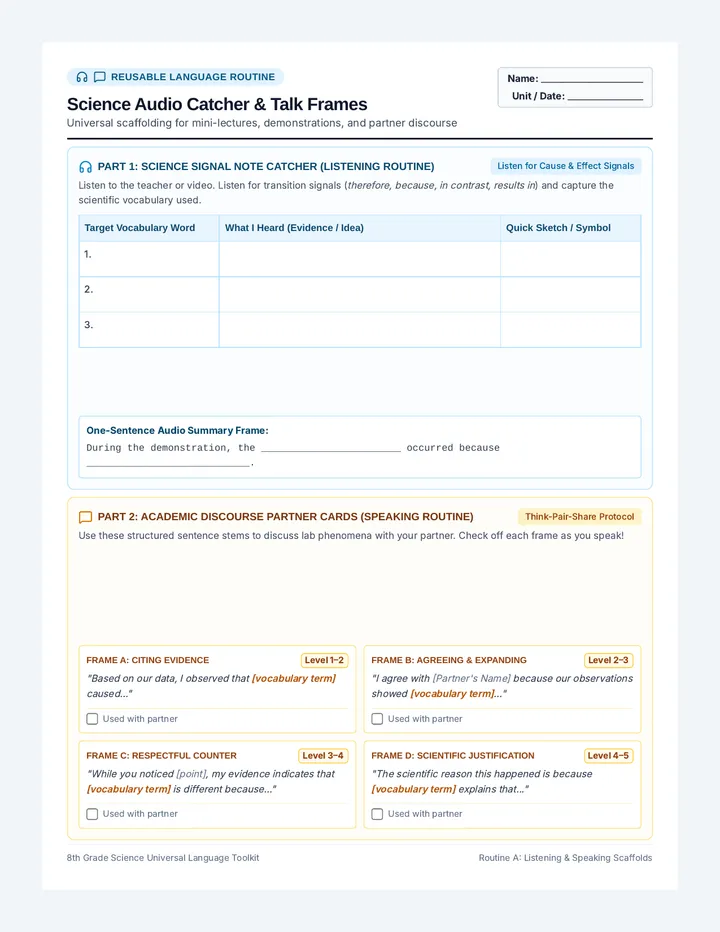
Language Routines Student Toolkit Reusable Language Routine
Science Audio Catcher & Talk Frames
Universal scaffolding for mini-lectures, demonstrations, and partner discourse
Name: _______________________
Unit / Date: _________________
Part 1: Science Signal Note Catcher (Listening Routine)
Listen for Cause & Effect Signals
Listen to the teacher or video. Listen for transition signals (therefore, because, in contrast, results in ) and capture the scientific vocabulary used.
Target Vocabulary Word
What I Heard (Evidence / Idea)
Quick Sketch / Symbol
1.
2.
3.
One-Sentence Audio Summary Frame:
During the demonstration, the ________________________ occurred because ____________________________.
Part 2: Academic Discourse Partner Cards (Speaking Routine)
Think-Pair-Share Protocol
Use these structured sentence stems to discuss lab phenomena with your partner. Check off each frame as you speak!
Frame A: Citing Evidence Level 1–2
"Based on our data, I observed that [vocabulary term] caused..."
Used with partner
Frame B: Agreeing & Expanding Level 2–3
"I agree with [Partner's Name] because our observations showed [vocabulary term]..."
Used with partner
Frame C: Respectful Counter Level 3–4
"While you noticed [point], my evidence indicates that [vocabulary term] is different because..."
Used with partner
Frame D: Scientific Justification Level 4–5
"The scientific reason this happened is because [vocabulary term] explains that..."
Used with partner
8th Grade Science Universal Language Toolkit Routine A: Listening & Speaking Scaffolds
Reusable Reading & Vocabulary Routine
Science Concept Deep-Dive Organizer
Multilingual concept mapping, word morphology, and contextual application
Name: _______________________
Date: ________________________
Target Science Term
_______________________________________
Home Language / Cognate
_______________________
Part of Speech [Noun / Verb / Adj]
1. Definition in My Own Words
Explain what it means without copying directly from the dictionary.
2. Word Parts & Morphology Breakdown
Break the word into prefixes, roots, and suffixes to find clues.
Prefix / Root: Meaning:
Suffix / Ending: Meaning:
3. Visual Representation & Labels
Draw a labeled diagram, arrows of motion, or scientific model.
4. Example vs Non-Example
What is a scientific example? What is something it is NOT?
Real Example:
Non-Example:
Sentence in Scientific Context (Cause & Effect):
In our science investigation, the ________________________ demonstrates that ________________________ because ________________________.
8th Grade Science Universal Language Toolkit Routine B: Reading & Concept Acquisition
Reusable Writing Routine
Universal Science CER Writing Scaffold
Claim • Evidence • Reasoning structured argument frame for any lab or data set
Name: _______________________
Lab Topic: ___________________
My Target Word Bank:
1. ____________ 2. ____________ 3. ____________ 4. ____________
C Claim: What is the direct answer to the investigative question?
1 clear sentence
Level 1–2 Frame: "The data shows that ____________________." Level 3–5 Frame: "When [Variable X] increases, [Variable Y] ____________________."
E Evidence: What scientific data and observations support your claim?
Include units & numbers!
Sentence Frame: "According to our observations, we recorded that [Trial 1] had ________________, while [Trial 2] measured ________________."
R Reasoning: What science principle explains WHY your data supports the claim?
Use your vocabulary words!
Sentence Frame: "This happened because scientifically, [Vocabulary Term] states that ______________________. Therefore, this proves my claim because ______________________."
Science Writer Self-Check: Used 2+ unit vocabulary words Included quantitative data (numbers/units) Connected evidence back to claim
8th Grade Science Universal Language Toolkit Routine C: Writing & Scientific Argumentation
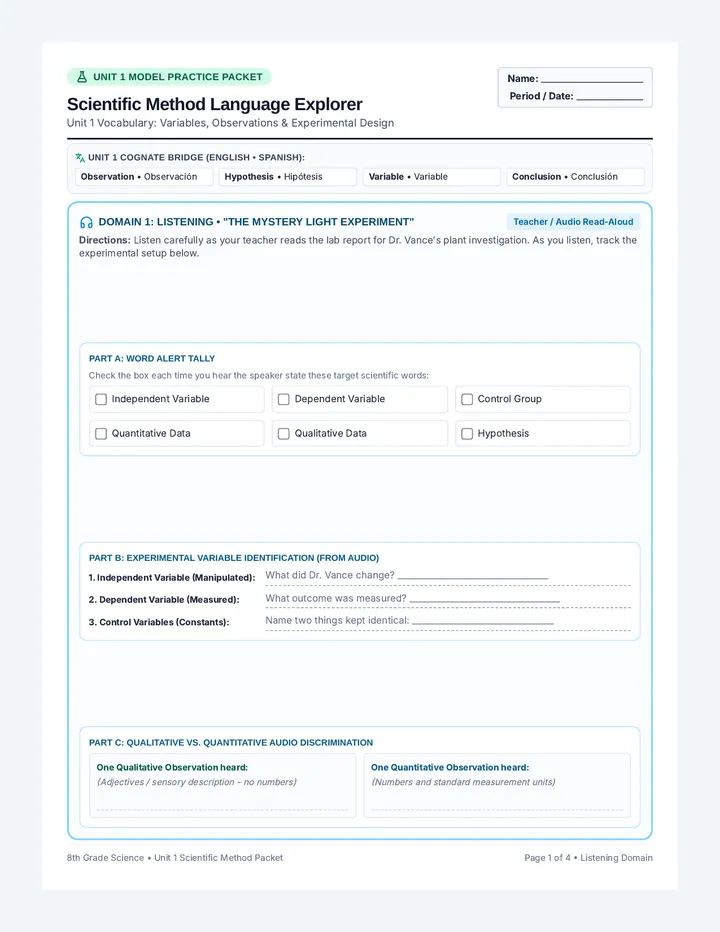
Scientific Method Student Packet Unit 1 Model Practice Packet
Scientific Method Language Explorer
Unit 1 Vocabulary: Variables, Observations & Experimental Design
Name: _______________________
Period / Date: _______________
Unit 1 Cognate Bridge (English • Spanish):
Observation • Observación Hypothesis • Hipótesis Variable • Variable Conclusion • Conclusión
Domain 1: Listening • "The Mystery Light Experiment"
Teacher / Audio Read-Aloud
Directions: Listen carefully as your teacher reads the lab report for Dr. Vance's plant investigation. As you listen, track the experimental setup below.
Part A: Word Alert Tally
Check the box each time you hear the speaker state these target scientific words:
Independent Variable Dependent Variable Control Group Quantitative Data Qualitative Data Hypothesis
Part B: Experimental Variable Identification (From Audio)
1. Independent Variable (Manipulated): What did Dr. Vance change? __________________________________
2. Dependent Variable (Measured): What outcome was measured? __________________________________
3. Control Variables (Constants): Name two things kept identical: ________________________________
Part C: Qualitative vs. Quantitative Audio Discrimination
One Qualitative Observation heard:
(Adjectives / sensory description - no numbers)
One Quantitative Observation heard:
(Numbers and standard measurement units)
8th Grade Science • Unit 1 Scientific Method Packet Page 1 of 4 • Listening Domain
Domain 2: Speaking Protocol
Variable Face-Off & Science Talk
Structured partner discourse to argue and justify experimental designs
Partner Discourse
Partner Roles & Talk Routine
Partner A: Lead Investigator
Identify the variables in the scenario using Sentence Stem 1 or 2.
Partner B: Peer Reviewer
Evaluate the claim and propose a control variable using Stem 3.
Tiered Academic Talk Frames (Required):
Stem 1 (Identifying Variables):
"In this experiment, the independent variable is ________________ because the scientist changed it, while the dependent variable is ________________ because it is being measured."
Stem 2 (Formulating Hypothesis):
"A testable hypothesis for this investigation would be: If we increase ________________, then the ________________ will ________________ because..."
Stem 3 (Justifying Controls):
"To keep this a fair, controlled test, we must keep ________________ constant as a control variable so that it doesn't affect our data."
Investigation Scenarios for Partner Talk:
Scenario 1: Skate Park Friction Talk Round 1
Marcus wants to see if skateboard wheel hardness (soft rubber vs hard urethane) affects how far the skateboard rolls down a 10-meter ramp.
IV: _______________________ DV: _______________________ Constant: ___________________
Scenario 2: Energy Drink Heart Rates Talk Round 2
Elena tests whether drinking 200mg of caffeine 15 minutes before running changes an athlete's resting pulse rate compared to drinking plain water.
IV: _______________________ DV: _______________________ Control Group: ______________
Scenario 3: Rusting Metal Nails Talk Round 3
Kenji tests whether soaking iron nails in saltwater vs freshwater vs no water causes iron nails to rust faster over a 7-day period.
IV: _______________________ DV: _______________________ Control Group: ______________
Partner Peer Validation: Used target vocab words correctly Spoke in complete scientific sentences Partner Signature: _______________
8th Grade Science • Unit 1 Scientific Method Packet Page 2 of 4 • Speaking Domain
Domain 3: Reading Close-Read
Investigation: The Great Algae Crisis
Annotate academic vocabulary in context and differentiate observations from inferences
Science Text Analysis
Case Study: Dr. Chen's Lake Inquiry
Last summer, fish in Silver Lake began dying rapidly. Dr. Chen made a qualitative observation : the water had turned bright murky green and smelled pungent like sulfur. She gathered quantitative observations showing that dissolved oxygen had dropped to 2.1 mg/L, far below the healthy 8.0 mg/L minimum. Based on this, she made an inference that toxic algae were consuming all the oxygen.
After completing background research on agricultural runoff, Dr. Chen developed a testable hypothesis : "If agricultural fertilizer runoff enters lake water, then algae growth will increase in direct proportion to the concentration of fertilizer."
To test this, she designed a controlled experiment . She placed identical 5-liter water samples in four identical glass aquariums with equal sunlight and temperature. She maintained Tank 1 as the control group with 0 grams of fertilizer. In Tanks 2, 3, and 4, she altered the independent variable by adding 5g, 10g, and 20g of fertilizer. After 10 days, she collected the data and conducted a mathematical analysis of algae mass.
Task A: Text Evidence Sort • Observation vs. Inference
Pull text statements from the reading and classify them correctly:
Statement from Text
Type (Obs. or Inf.?)
Why? (Evidence)
"The water had turned bright murky green and smelled pungent."
Qualitative Observation
Uses 5 senses; no numbers
"Dissolved oxygen had dropped to 2.1 mg/L."
Quantitative Observation
Uses measurement tool & units
"Toxic algae were consuming all the oxygen."
Inference
Explanation based on evidence
Task B: Controlled Experiment Text Match
1. Why was Tank 1 the "Control Group"?
_____________________________________________
2. What were two "Control Variables" (constants)?
_____________________________________________
3. What was the "Independent Variable"?
_____________________________________________
4. What was the "Dependent Variable"?
_____________________________________________
8th Grade Science • Unit 1 Scientific Method Packet Page 3 of 4 • Reading Domain
Domain 4: Writing Production
Scientific Conclusion Lab Report
Draft a Claim-Evidence-Reasoning (CER) scientific conclusion based on experimental data
Lab CER Conclusion
Dr. Chen's Final Experimental Data Table Analysis Reference
Aquarium Tank
Fertilizer Added (IV)
Algae Biomass Measured (DV)
Final Dissolved Oxygen
Tank 1 (Control Group)
0 grams
12 grams
8.2 mg/L (Healthy)
Tank 2
5 grams
38 grams
5.5 mg/L
Tank 3
10 grams
74 grams
3.1 mg/L
Tank 4
20 grams
142 grams
1.4 mg/L (Critical)
Required Words in Your CER:
Hypothesis Data Analysis Conclusion
1. Claim (Does the data support Dr. Chen's hypothesis?) Sentence Starter: The experimental data supports the hypothesis that...
2. Evidence (Cite specific numbers and units from the data table) Sentence Starter: According to the data table, when fertilizer increased from 0g to 20g...
3. Reasoning & Conclusion (Explain the scientific principle) Sentence Starter: In conclusion, our analysis confirms that fertilizer runoff causes...
Scientific Writer Checklist: Stated clear claim Cited numbers with units Used 4 required vocab words Explained reasoning
8th Grade Science • Unit 1 Scientific Method Packet Page 4 of 4 • Writing Domain
Scientific Method Facilitation Guide Co-Teacher Implementation & Script
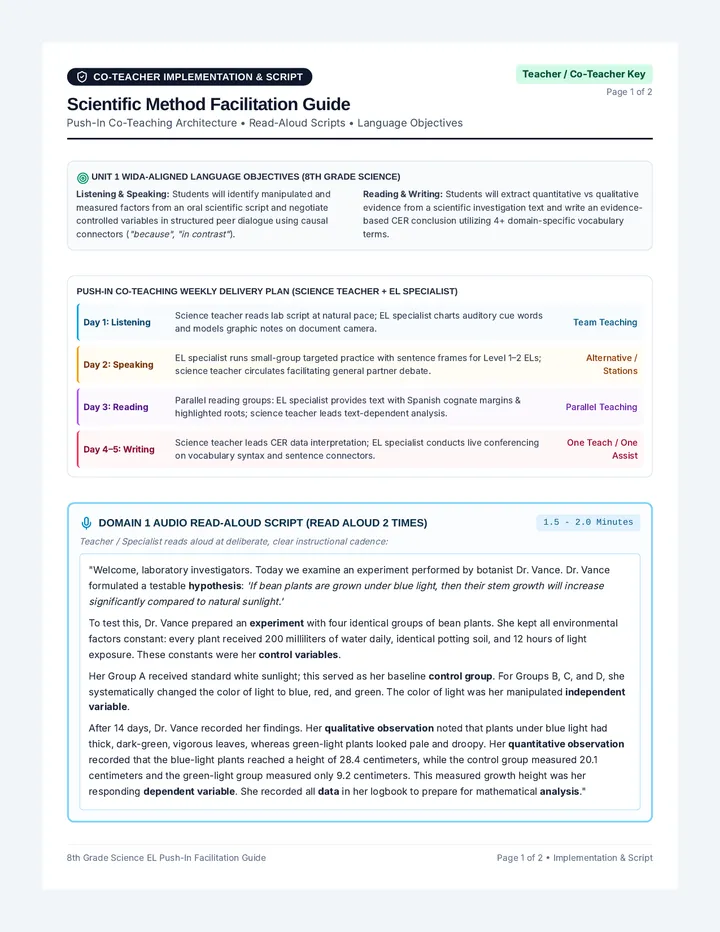
Scientific Method Facilitation Guide
Push-In Co-Teaching Architecture • Read-Aloud Scripts • Language Objectives
Teacher / Co-Teacher Key
Page 1 of 2
Unit 1 WIDA-Aligned Language Objectives (8th Grade Science)
Listening & Speaking: Students will identify manipulated and measured factors from an oral scientific script and negotiate controlled variables in structured peer dialogue using causal connectors ("because", "in contrast" ).
Reading & Writing: Students will extract quantitative vs qualitative evidence from a scientific investigation text and write an evidence-based CER conclusion utilizing 4+ domain-specific vocabulary terms.
Push-In Co-Teaching Weekly Delivery Plan (Science Teacher + EL Specialist)
Day 1: Listening
Science teacher reads lab script at natural pace; EL specialist charts auditory cue words and models graphic notes on document camera.
Team Teaching
Day 2: Speaking
EL specialist runs small-group targeted practice with sentence frames for Level 1–2 ELs; science teacher circulates facilitating general partner debate.
Alternative / Stations
Day 3: Reading
Parallel reading groups: EL specialist provides text with Spanish cognate margins & highlighted roots; science teacher leads text-dependent analysis.
Parallel Teaching
Day 4–5: Writing
Science teacher leads CER data interpretation; EL specialist conducts live conferencing on vocabulary syntax and sentence connectors.
One Teach / One Assist
Domain 1 Audio Read-Aloud Script (Read Aloud 2 Times)
1.5 - 2.0 Minutes
Teacher / Specialist reads aloud at deliberate, clear instructional cadence:
"Welcome, laboratory investigators. Today we examine an experiment performed by botanist Dr. Vance. Dr. Vance formulated a testable hypothesis : 'If bean plants are grown under blue light, then their stem growth will increase significantly compared to natural sunlight.'
To test this, Dr. Vance prepared an experiment with four identical groups of bean plants. She kept all environmental factors constant: every plant received 200 milliliters of water daily, identical potting soil, and 12 hours of light exposure. These constants were her control variables .
Her Group A received standard white sunlight; this served as her baseline control group . For Groups B, C, and D, she systematically changed the color of light to blue, red, and green. The color of light was her manipulated independent variable .
After 14 days, Dr. Vance recorded her findings. Her qualitative observation noted that plants under blue light had thick, dark-green, vigorous leaves, whereas green-light plants looked pale and droopy. Her quantitative observation recorded that the blue-light plants reached a height of 28.4 centimeters, while the control group measured 20.1 centimeters and the green-light group measured only 9.2 centimeters. This measured growth height was her responding dependent variable . She recorded all data in her logbook to prepare for mathematical analysis ."
8th Grade Science EL Push-In Facilitation Guide Page 1 of 2 • Implementation & Script
Comprehensive Answer Keys
Exemplar Key & Assessment Rubric
Model responses for Listening, Speaking, Reading & Writing Packet
Evaluation Key
Page 2 of 2
Domain 1: Listening Key
IV: Light color / wavelength (blue, red, green, white).DV: Stem height in centimeters (growth).Constants: 200mL water daily, soil type, 12h light.Control Group: Group A (white sunlight baseline).Qualitative Obs: Dark green, thick, droopy leaves.Quantitative Obs: 28.4 cm height vs 20.1 cm / 9.2 cm.
Domain 2: Speaking Scenarios Key
Scen. 1: IV = Wheel hardness; DV = Distance rolled (m); Constants = Ramp height, board weight.Scen. 2: IV = Caffeine (200mg); DV = Heart rate (bpm); Control Group = Plain water runners.Scen. 3: IV = Liquid type (salt vs fresh); DV = Rust rate; Control Group = Dry nail (no liquid).
Domain 3: Reading Close-Read Key
1. Tank 1 Control Group: Received 0 grams fertilizer to provide an unmanipulated baseline comparison.
2. Control Variables: Identical 5L water volume, equal sunlight exposure, identical water temperature.
3. Independent Variable: Amount/mass of fertilizer added (0g, 5g, 10g, 20g).
4. Dependent Variable: Mass of algae biomass produced (grams) and dissolved oxygen levels (mg/L).
Domain 4: Model Student CER Lab Conclusion (Exemplar) Exemplar Grade: 100%
[Claim]: The experimental data strongly supports Dr. Chen's hypothesis that increasing fertilizer runoff causes higher concentrations of algae growth and depletes dissolved oxygen in lake water.
[Evidence]: According to the data table, the control tank with 0 grams of fertilizer produced only 12 grams of algae biomass and maintained a healthy dissolved oxygen level of 8.2 mg/L. When the independent variable of fertilizer was increased to 20 grams in Tank 4, algae biomass exploded to 142 grams (an increase of over 1000%), while dissolved oxygen dropped drastically to a lethal 1.4 mg/L.
[Reasoning & Conclusion]: In conclusion, our mathematical analysis demonstrates that fertilizer supplies excess nutrients that trigger uncontrolled algae reproduction. When this massive biomass dies and decomposes, bacteria consume virtually all dissolved oxygen in the water. Therefore, agricultural runoff is the direct cause of fish mortality in Silver Lake.
Push-In EL Specialist Quick Differentiation Cues:
Entering (Level 1–2): Allow pointing/drawing for variables; accept 1-word responses + oral partner check.
Developing (Level 3): Provide sentence frames with word banks; allow peer bilingual drafting.
Expanding (Level 4–5): Require causal transitional phrases (consequently, whereas, as a result ).
8th Grade Science EL Push-In Facilitation Guide Page 2 of 2 • Exemplar Keys & Rubrics