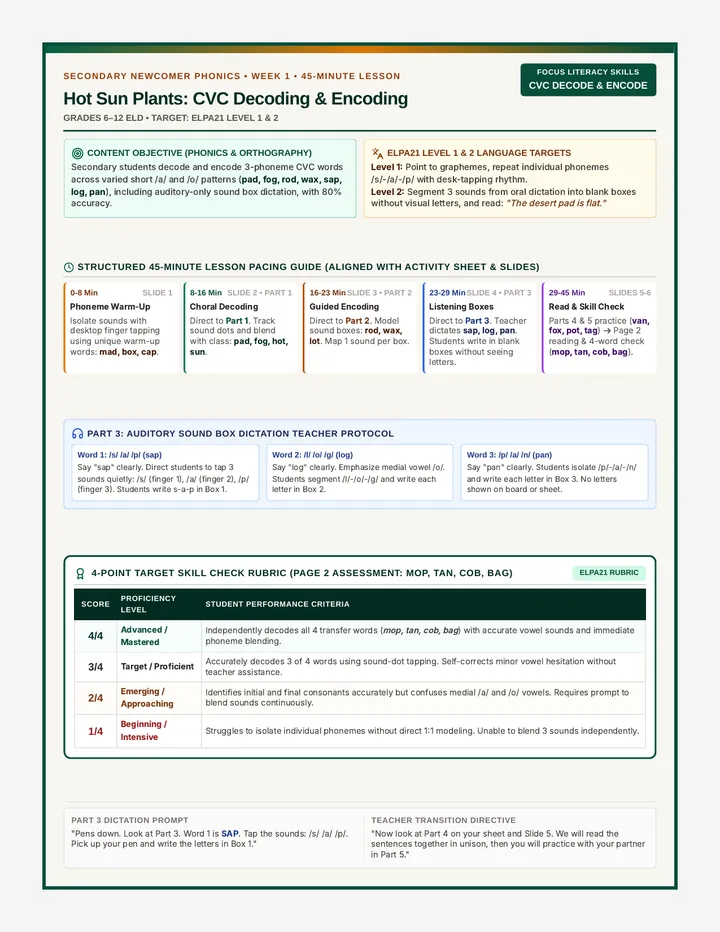
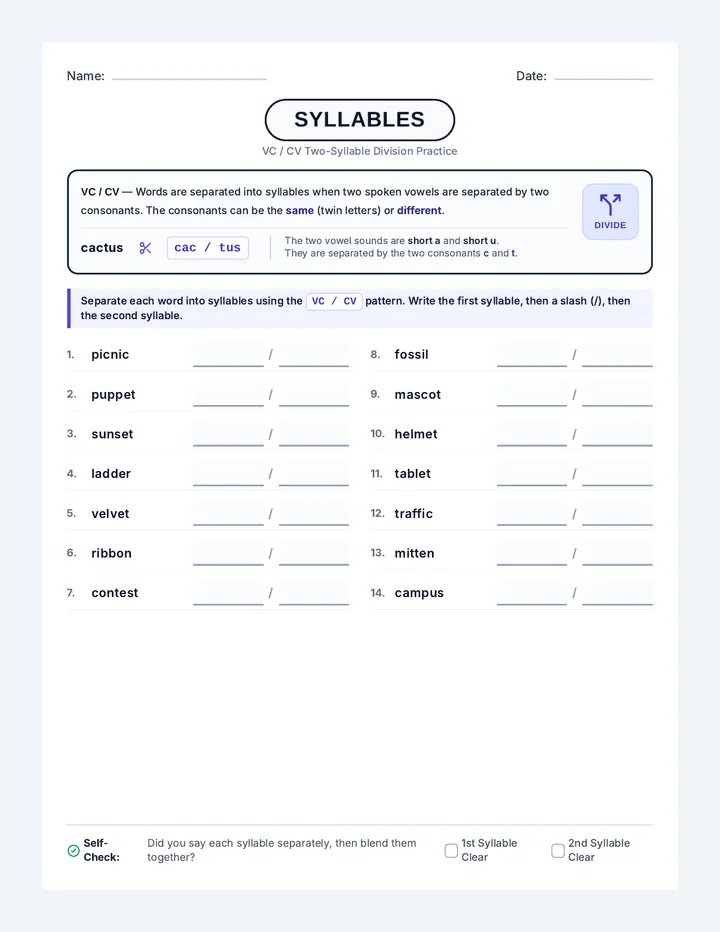
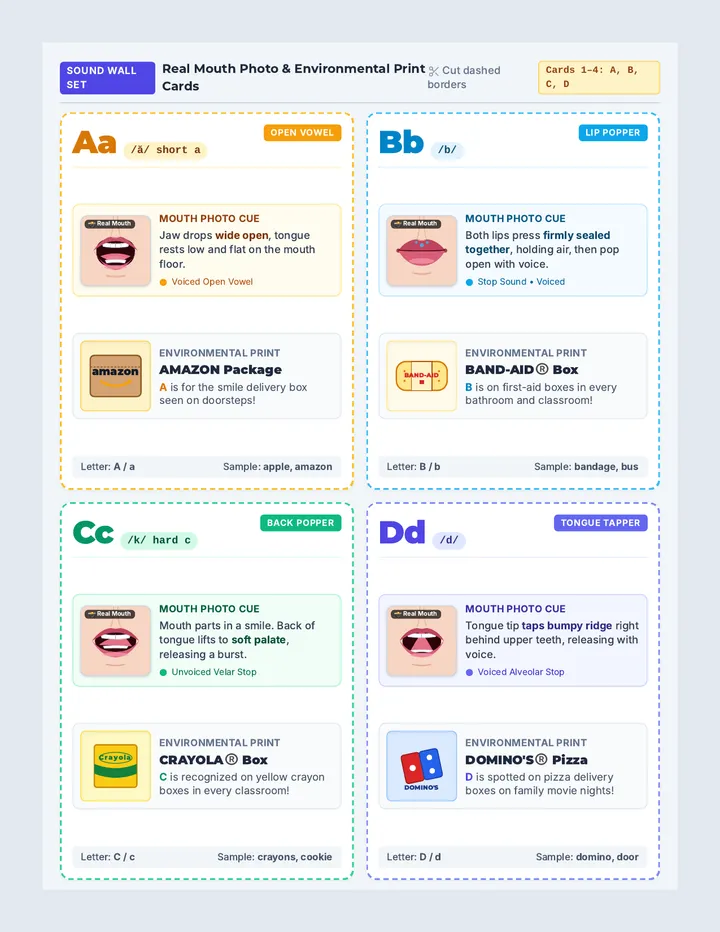
A comprehensive Grade 2-3 ESL reading comprehension lesson exploring desert animal and plant adaptations. Features scaffolded vocabulary, text evidence tracking, and main idea analysis differentiated for WIDA Levels 2, 3, and 6.
"Does this sentence tell the whole story, or just one small fact?"
Text Evidence Detective Slide 5
Prove It! Point to the Evidence
Never guess! Good readers always show where they found their answer.
1
Find the Clue
Scan for keywords from the question (like fox, cactus, burrow).
2
Underline It
Put your finger or highlighter directly on the sentence in the paragraph.
3
Speak or Write
Use your sentence frames to share your answer and cite your evidence!
Speaking Frames for Text Evidence:
Frame A: "In paragraph [#], the text says..."
Frame B: "My evidence is that [fact]..."
Guided Detective Practice Slide 6
Let's Read Together!
Track with your finger while we read Paragraph 2:
Paragraph 2 Desert Plants Hold Every Drop
"The mighty Saguaro cactus is a master at saving water. It does not have wide leaves. Instead, it has sharp spines to protect its moisture from thirsty animals. When rare rain falls, the cactus swells like an accordion and can hold tons of water inside its spongy stem for months."
Question 1: What is the main idea?
The Saguaro cactus has special body parts to collect and save water.
Question 2: What is the text evidence?
"The cactus swells like an accordion and can hold tons of water."
Partner Talk & Exit Check Slide 7
Your Turn to Share!
Pick your sentence challenge and share with your partner:
Level 2 Challenge
"The [animal/plant] survives by [action]."
Level 3 Challenge
"According to the text, the main idea is [idea] because [evidence]."
Level 6 Challenge
"The author demonstrates that organisms adapt by stating '[quote]', which reveals that [explanation]."
Next Step: Grab your Reading Handout & highlighter!
C The Saguaro cactus has sharp, hard spines to protect its moisture.
2
Text Evidence Hunt: How does the Saguaro cactus survive with little rain?
Look back at Paragraph 2. Find one sentence that proves your answer and write it below.
Sentence Starter: According to paragraph 2, the Saguaro cactus survives because...
Which line numbers gave you this clue? Lines: Paragraph:
3
Vocabulary in Context: Understanding "Nocturnal"
In line 12, the author writes: "The fox is also nocturnal, which means it sleeps during the burning daylight hours."
A Active and hunting at night
B Drinking cold river water
4
Detective Synthesis: Underground Animal Survival
How does digging an underground burrow help desert animals survive? Cite exact evidence from Paragraph 3.
Level 2/3 Frame: A burrow helps because the temperature underground is... Level 6 Frame: The author states in paragraph 3 that burrows are "...", which allows animals to...
Desert Survivors Reading Expedition Page 2 of 2
1. Arid
2. Adaptation
3. Burrow
4. Nocturnal
A. A tunnel under the sand for staying cool
B. Super dry with less than 10 inches of rain
C. Being awake when the stars and moon are out
D. A body feature that helps a creature stay alive
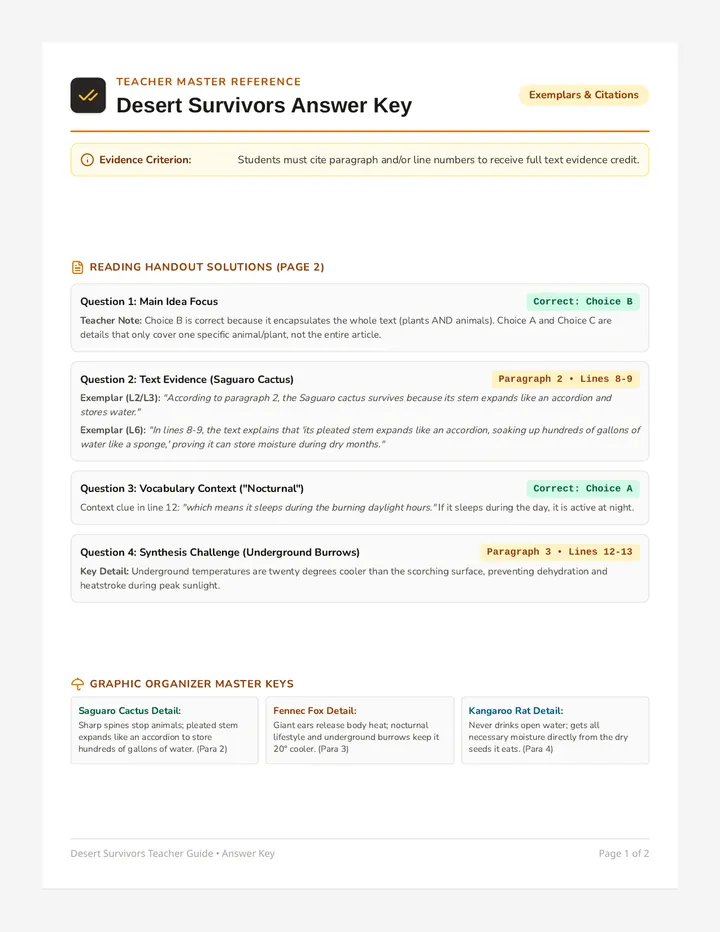
• Q2 (Text Evidence): Accept any cited adaptation (e.g., Para 2 accordion cactus stem; Para 3 fox big ears/burrow; Para 4 rat seed moisture). Must include paragraph number.
• Q3 (Vocabulary): Choice A (Extremely dry)
ESL Pullout Progress Rubric (6 Students)
Skill Domain
Level 2 (1 Student)
Level 3 (1 Student)
Level 6 (4 Students)
Main Idea Identification
Identifies umbrella topic when presented with visual icons or binary choice; points to key subject.
Selects central idea from 3 choices; articulates using sentence starter: "The main idea is..."
Independently summarizes the overarching main idea in writing; explains why narrow details are not the main idea.
Citing Text Evidence
Highlights target sentence with color assistance; writes 1-3 content words from the text.
Locates correct paragraph number; copies complete factual sentence into the evidence frame.
Uses quotation marks and paragraph/line citations; writes analytical link connecting quote to survival.
Vocabulary Context Mastery
Demonstrates TPR body gesture for arid/burrow/nocturnal; matches picture to definition.
Uses target word accurately in oral partner talk and completes written fill-in-the-blank prompt.
Defines terms in own words and uses domain vocabulary across multiple sentences and comparisons.
Next Step Instruction Decisions Post-Lesson Conference
If L2/L3 struggle with text evidence: During the next pullout session, use two-color sentence strips where students physically tape the evidence sentence underneath the umbrella header. Extension for L6 group: Have students create their own invented desert creature with 3 adaptations and write an informational paragraph modeled after the text structure.