Tree Frog Article Wildlife Field Journal • Session 1
The Red-Eyed Tree Frog
🐸
Size
About 2–3 inches long
Habitat
Tropical rainforest trees
Active Time
Nighttime (nocturnal)
Bright Colors and Giant Eyes
The red-eyed tree frog is a tiny animal with bright colors. Its back is leaf-green , and its belly is soft white. Along its sides, it has bold blue and yellow stripes . Its most famous feature is its pair of huge, bulging red eyes. During the day, the frog sleeps under green leaves and hides its bright colors.
Smooth Skin and Sticky Toes
This frog has smooth , wet skin that helps it stay cool in the warm rainforest. Look closely at its feet! Its long orange toes have round, sticky pads at the tips. These special toe pads work like tiny suction cups. They help the frog grip slippery branches and climb high into the trees without falling.
A Surprising Defense
When a hungry bird or snake comes near, the frog uses its colors to stay safe. It suddenly opens its vivid red eyes and stretches out its bright orange legs. This flash of color surprises the predator for a second, giving the frog just enough time to leap away to another branch.
Descriptive Word Bank
Use these words to describe!
tiny / huge
very small / very big
bright / vivid
strong, easy-to-see color
stripes
long lines of color
bulging
sticking out, round
smooth
flat and even, not bumpy
sticky
able to hold onto surfaces
Tree Frog Worksheet Session 1 Practice • Creature Features
Describing the Tree Frog
Name: __________________________
Date: ___________________________
Part 1: Match the Describing Word
Draw a line or write the letter to match each word from the article to its meaning.
1. smooth
2. bulging
3. sticky
4. stripes
A. able to hold onto branches
B. flat and even, not rough
C. long lines of color
D. round and sticking out
Part 2: Body Parts & Describing Words
Use the article to write one or two describing words for each body part.
Body Part
Describing Words (Color, Size, or Texture)
1. Eyes 👀
2. Skin
3. Sides
4. Toes 🦶
Part 3: Sketch & Label
Draw the red-eyed tree frog in the box. Label two body parts using describing words (example: bulging red eyes ).
Session 1 Practice • Page 2
Write Your Description
Choose Your Support Level
Level 1: Sentence Frames (Developing)
Guided Support
Complete the sentences using words from your chart and the Word Bank.
1. The red-eyed tree frog is a ________________________ animal.
2. It has ________________________ skin and ________________________ eyes.
3. Its toes are ________________________ so it can ________________________.
Level 2: Connected Description (Intermediate)
Extended Writing
Write 3–4 connected sentences describing the red-eyed tree frog's appearance. Try using words like also , in addition , or for example to connect your ideas.
Small-Group Partner Talk
Read your description to a partner. Ask your partner:
“Which describing word helped you picture the frog best?”
“One detail you could add is _______________.”
Tree Frog Teacher Guide Teacher Guide & Answer Key • Session 1
Creature Features: Red-Eyed Tree Frog
15–20 Min Small Group
Language Objective: Students will describe an animal's physical traits (color, size, texture, body parts) using precise adjectives and either sentence frames or connected sentences.
Small-Group Pacing
1. Warm-Up & Word Bank (3 min): Preview the 6 words in the Descriptive Word Bank. Act out bulging (wide eyes) and sticky (pressing fingers to desk).2. Shared Reading (5 min): Read the article aloud together or in pairs. Have students underline or circle describing words as they hear them.3. Guided Practice (5 min): Complete Part 1 (Vocabulary Match) and Part 2 (Body Parts Chart) together, checking answers orally.4. Tiered Writing & Partner Talk (5–7 min): Assign or let students choose Level 1 or Level 2 writing, then share in pairs using the Partner Talk prompts.
Developing ELs
Point directly to the Word Bank during Part 2. Model Frame 1 orally before writing. Allow students to draw and label first if they need extra processing time.
Intermediate ELs
Challenge students to combine two traits in one sentence (e.g., "In addition to its smooth green skin, the frog has..." ) and explain why a trait helps the frog survive.
Worksheet Answer Key
Part 1: Vocabulary Match
1. smooth — B (flat and even, not rough)
2. bulging — D (round and sticking out)
3. sticky — A (able to hold onto branches)
4. stripes — C (long lines of color)
Part 2: Body Parts & Describing Words
1. Eyes: huge, bulging, red, vivid
2. Skin: smooth, wet, leaf-green (back), soft white (belly)
3. Sides: bold blue and yellow stripes
4. Toes: long, orange, round, sticky pads
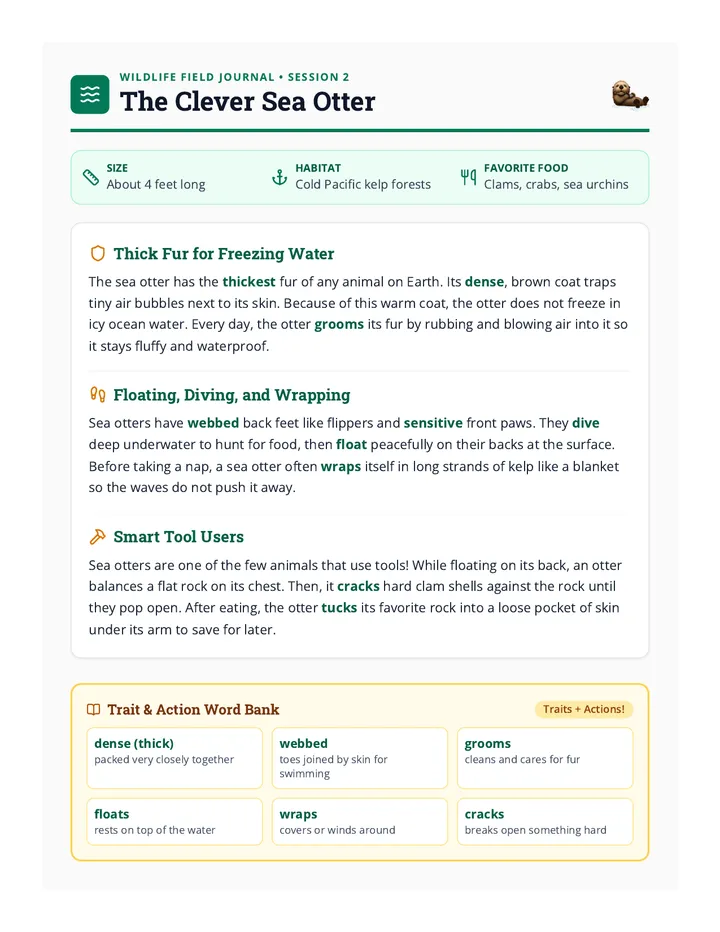
Sea Otter Article Wildlife Field Journal • Session 2
The Clever Sea Otter
🦦
Size
About 4 feet long
Habitat
Cold Pacific kelp forests
Favorite Food
Clams, crabs, sea urchins
Thick Fur for Freezing Water
The sea otter has the thickest fur of any animal on Earth. Its dense , brown coat traps tiny air bubbles next to its skin. Because of this warm coat, the otter does not freeze in icy ocean water. Every day, the otter grooms its fur by rubbing and blowing air into it so it stays fluffy and waterproof.
Floating, Diving, and Wrapping
Sea otters have webbed back feet like flippers and sensitive front paws. They dive deep underwater to hunt for food, then float peacefully on their backs at the surface. Before taking a nap, a sea otter often wraps itself in long strands of kelp like a blanket so the waves do not push it away.
Smart Tool Users
Sea otters are one of the few animals that use tools! While floating on its back, an otter balances a flat rock on its chest. Then, it cracks hard clam shells against the rock until they pop open. After eating, the otter tucks its favorite rock into a loose pocket of skin under its arm to save for later.
Trait & Action Word Bank
Traits + Actions!
dense (thick)
packed very closely together
webbed
toes joined by skin for swimming
grooms
cleans and cares for fur
floats
rests on top of the water
wraps
covers or winds around
cracks
breaks open something hard
Sea Otter Worksheet Session 2 Practice • Wild Habits
Describing the Sea Otter
Name: __________________________
Date: ___________________________
Part 1: Action Words in Context
Choose the best action word from the box to complete each sentence.
grooms floats wraps cracks
1. The sea otter ________________________ on its back in the ocean.
2. It ________________________ itself in kelp so it does not drift away.
3. The otter ________________________ its dense fur every day to stay warm.
4. It ________________________ hard clam shells against a flat rock.
Part 2: How Body Parts Help Actions
Use the article to show what each body part looks like AND what it helps the otter do.
Body Part
What It Looks Like (Trait)
What It Helps Do (Action)
1. Fur
2. Back Feet
3. Skin Pocket
Part 3: Why does a sea otter wrap itself in kelp?
A. To hide from hungry clams
B. To keep the waves from pushing it away while sleeping
C. To dry off its thick brown fur
Session 2 Practice • Page 2
Describe Appearance & Action
Choose Your Support Level
Level 1: Sentence Frames (Developing)
Guided Support
Connect a body part to an action using words from your chart.
1. The sea otter has ________________________ fur that ________________________.
2. It uses its ________________________ to ________________________ underwater.
3. When it eats, the otter ________________________ a clam on a rock.
Level 2: Connected Description (Intermediate)
Extended Writing
Write 4–5 connected sentences describing what the sea otter looks like and how its body helps it survive. Use cause-and-effect words like because , so , or when .
Small-Group Partner Talk
Share your writing with a partner. Use these frames to respond:
“I liked how you used the action word _______________.”
“My favorite sea otter habit is _______________ because _______________.”
Sea Otter Teacher Guide Teacher Guide & Answer Key • Session 2
Wild Habits: The Clever Sea Otter
15–20 Min Small Group
Language Objective: Students will connect an animal's physical traits to its behaviors using present-tense action verbs (grooms, floats, wraps, cracks ) and cause-and-effect connectors.
Small-Group Pacing
1. Connect & Preview (3 min): Briefly recall Session 1 (describing traits). Introduce today's shift: adding actions ! Act out wraps , floats , and cracks .2. Shared Reading (5 min): Read the article aloud. Have students tap the table whenever they hear an action verb in bold.3. Guided Practice (5 min): Complete Part 1 together, then model row 1 of Part 2 (Fur → dense/thick → keeps otter warm in icy water).4. Tiered Writing & Partner Talk (5–7 min): Students complete Level 1 or Level 2 writing and share in pairs.
Developing ELs
Point out the -s ending on present-tense verbs (the otter floats, wraps, cracks ). Encourage students to use the Part 2 chart directly to fill in Level 1 frames.
Intermediate ELs
Prompt students to link traits and behaviors with because or so (e.g., "Because its fur is dense, it can..." ) and include the tool-use detail.
Worksheet Answer Key
Part 1: Action Words in Context
1. floats
2. wraps
3. grooms
4. cracks
Part 3: Multiple Choice
B. To keep the waves from pushing it away while sleeping
Part 2: Trait-to-Action Chart
1. Fur: dense, thick, brown → keeps warm / traps air bubbles
2. Back Feet: webbed, like flippers → helps dive and swim
3. Skin Pocket: loose pocket under arm → holds/saves its favorite rock
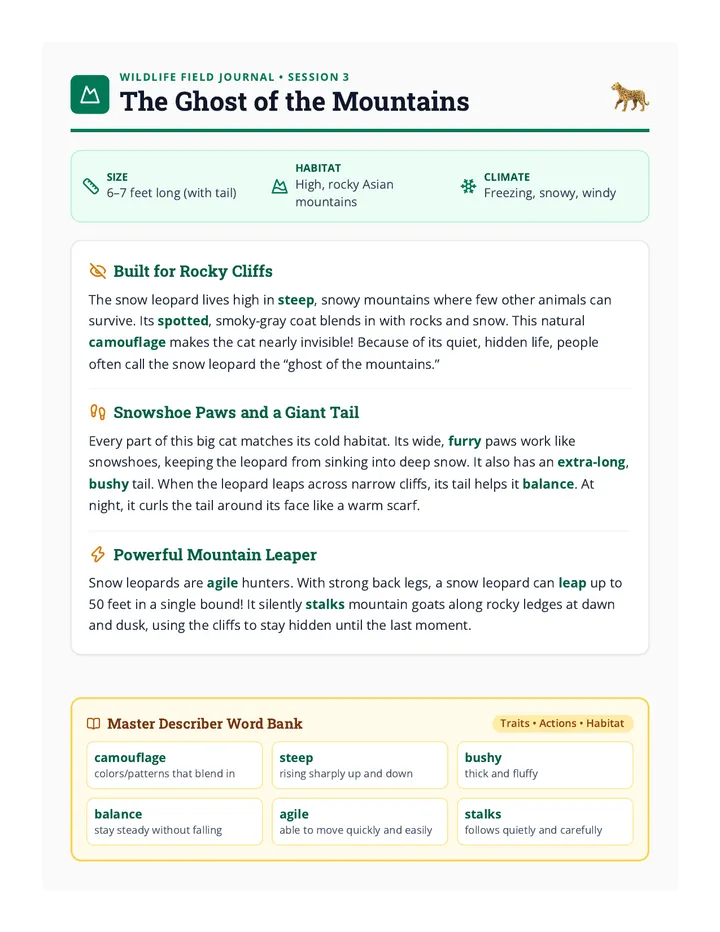
Snow Leopard Article Wildlife Field Journal • Session 3
The Ghost of the Mountains
🐆
Size
6–7 feet long (with tail)
Habitat
High, rocky Asian mountains
Climate
Freezing, snowy, windy
Built for Rocky Cliffs
The snow leopard lives high in steep , snowy mountains where few other animals can survive. Its spotted , smoky-gray coat blends in with rocks and snow. This natural camouflage makes the cat nearly invisible! Because of its quiet, hidden life, people often call the snow leopard the “ghost of the mountains.”
Snowshoe Paws and a Giant Tail
Every part of this big cat matches its cold habitat. Its wide, furry paws work like snowshoes, keeping the leopard from sinking into deep snow. It also has an extra-long , bushy tail. When the leopard leaps across narrow cliffs, its tail helps it balance . At night, it curls the tail around its face like a warm scarf.
Powerful Mountain Leaper
Snow leopards are agile hunters. With strong back legs, a snow leopard can leap up to 50 feet in a single bound! It silently stalks mountain goats along rocky ledges at dawn and dusk, using the cliffs to stay hidden until the last moment.
Master Describer Word Bank
Traits • Actions • Habitat
camouflage
colors/patterns that blend in
steep
rising sharply up and down
bushy
thick and fluffy
balance
stay steady without falling
agile
able to move quickly and easily
stalks
follows quietly and carefully
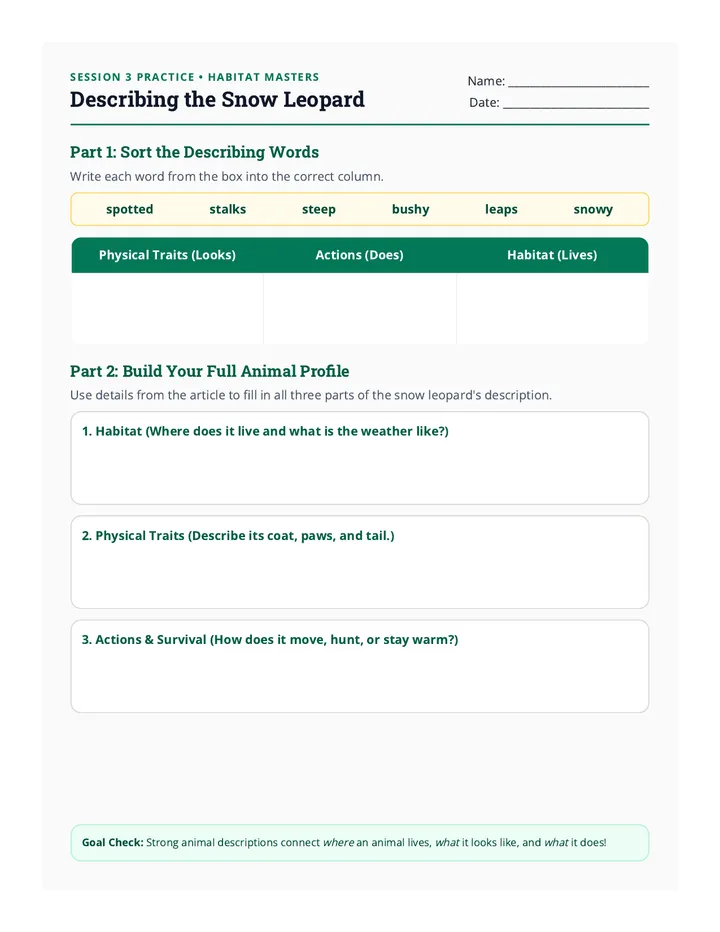
Snow Leopard Worksheet Session 3 Practice • Habitat Masters
Describing the Snow Leopard
Name: __________________________
Date: ___________________________
Part 1: Sort the Describing Words
Write each word from the box into the correct column.
spotted stalks steep bushy leaps snowy
Physical Traits (Looks)
Actions (Does)
Habitat (Lives)
Part 2: Build Your Full Animal Profile
Use details from the article to fill in all three parts of the snow leopard's description.
1. Habitat (Where does it live and what is the weather like?)
2. Physical Traits (Describe its coat, paws, and tail.)
3. Actions & Survival (How does it move, hunt, or stay warm?)
Goal Check: Strong animal descriptions connect where an animal lives, what it looks like, and what it does!
Session 3 Practice • Page 2
Write a Complete Description
Choose Your Support Level
Level 1: Connected Frames (Developing)
Guided Support
Use your organizer on Page 1 to complete this full description.
1. The snow leopard lives in ________________________ mountains.
2. It has a ________________________ coat that helps it ________________________.
3. Its wide, furry paws help it ________________________, and it uses its ________________________ tail to ________________________.
Level 2: Field Guide Paragraph (Intermediate)
Extended Writing
Write a 5–6 sentence Field Guide paragraph that brings together the snow leopard's habitat, appearance, and behaviors. Use transition words like first , in addition , because , and as a result .
Small-Group Partner Talk
Read your description aloud. Check that your partner included all 3 parts:
✓ Habitat Details
✓ Physical Traits
✓ Actions & Survival
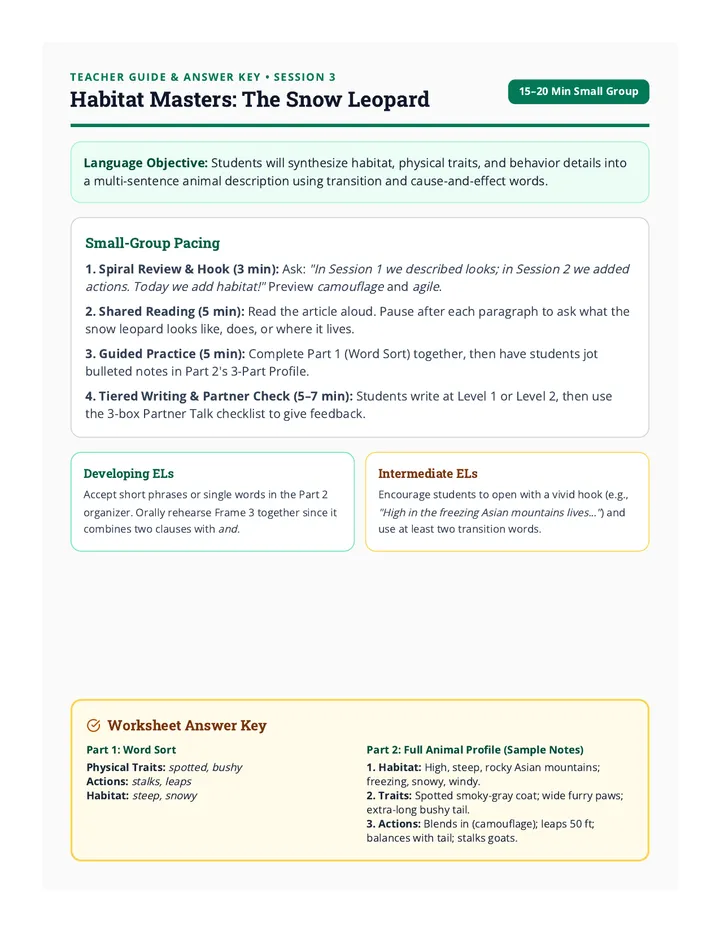
Snow Leopard Teacher Guide Teacher Guide & Answer Key • Session 3
Habitat Masters: The Snow Leopard
15–20 Min Small Group
Language Objective: Students will synthesize habitat, physical traits, and behavior details into a multi-sentence animal description using transition and cause-and-effect words.
Small-Group Pacing
1. Spiral Review & Hook (3 min): Ask: "In Session 1 we described looks; in Session 2 we added actions. Today we add habitat!" Preview camouflage and agile .2. Shared Reading (5 min): Read the article aloud. Pause after each paragraph to ask what the snow leopard looks like, does, or where it lives.3. Guided Practice (5 min): Complete Part 1 (Word Sort) together, then have students jot bulleted notes in Part 2's 3-Part Profile.4. Tiered Writing & Partner Check (5–7 min): Students write at Level 1 or Level 2, then use the 3-box Partner Talk checklist to give feedback.
Developing ELs
Accept short phrases or single words in the Part 2 organizer. Orally rehearse Frame 3 together since it combines two clauses with and .
Intermediate ELs
Encourage students to open with a vivid hook (e.g., "High in the freezing Asian mountains lives..." ) and use at least two transition words.
Worksheet Answer Key
Part 1: Word Sort
Physical Traits: spotted, bushy
Actions: stalks, leaps
Habitat: steep, snowy
Part 2: Full Animal Profile (Sample Notes)
1. Habitat: High, steep, rocky Asian mountains; freezing, snowy, windy.
2. Traits: Spotted smoky-gray coat; wide furry paws; extra-long bushy tail.
3. Actions: Blends in (camouflage); leaps 50 ft; balances with tail; stalks goats.