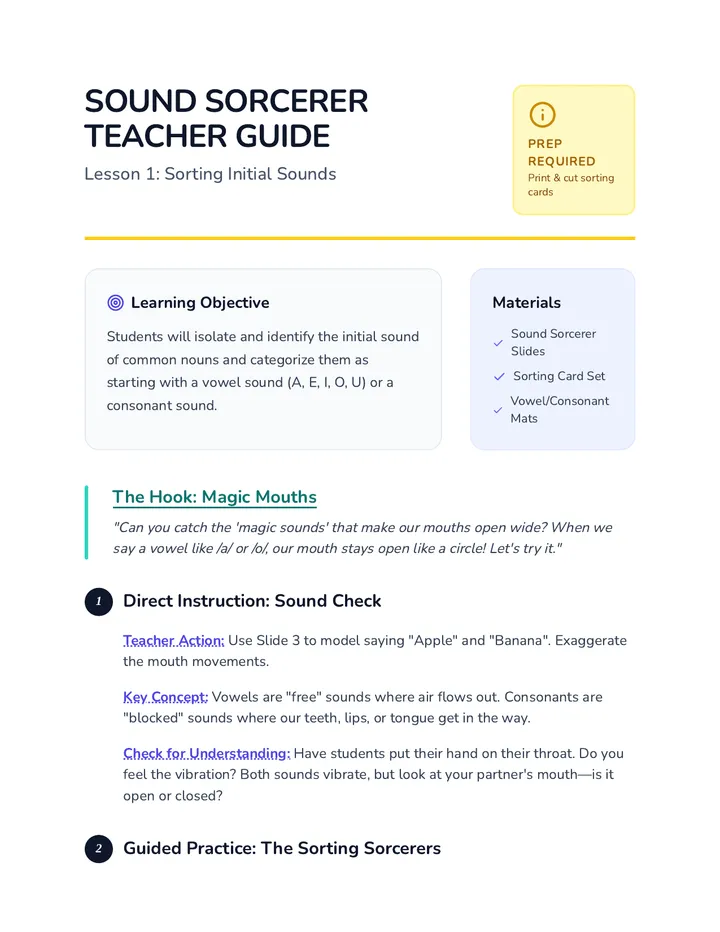
Case of the Mystery Cover Slides The Case of the Mystery Cover
Becoming a Picture Detective
Look closely
Think big
What's Inside?
Wrapped!
We can't see the book yet. How can we guess what it's about?
The shape?
The weight?
Is it a secret?
Clues on the Cover
Characters
WHO
Setting
WHERE
Action
DOING WHAT
Detective Practice: Cover #1
Sample Cover: Bear and the Hook
What do you see?
I see a _____ and a ____.
What is your prediction?
I think this story is about...
LOOKING vs. THINKING
Looking
I see colors and shapes.
Thinking
I make a guess about the story!
Mystery Cover Facilitation Guide The Case of the Mystery Cover
Teacher Facilitation Guide • Lesson 1
Unit: Visual Literacy Kindergarten / Academic Support
Objective
Students will identify key visual elements (characters, settings) on a book cover to verbally predict the story's theme.
Key Vocabulary
Predict Clue Character Setting
Materials
Case of the Mystery Cover Slides
A physical book wrapped in paper
Magnifying glasses (optional)
"My First Guess" Worksheets
1. The Hook: Mystery Reveal (10 mins)
Engagement
Display the wrapped book . Hold it up and let students see the shape, but not the cover.
Guiding Questions:
"I have a mystery story today. Can you guess what it is about just by looking at this brown paper? Why or why not?"
The Reveal: Unwrap the book. "Now that we can see the picture, what is the first thing your eyes find? Does this help us guess what happens inside?"
2. Direct Instruction: Clue Hunting (15 mins)
Modeling
Use Slides 3-4 to define the elements of a cover:
Characters (WHO): Is it an animal? A kid? A robot?
Setting (WHERE): Is it outside? In space? Underwater?
Action (WHAT): Are they running? Sleeping? Playing?
Teacher Script:
"Picture Detectives don't just look at the colors. They look for the 'Who' and the 'Where' to make a smart guess, or a prediction ."
3. Guided Practice: Cover Match (15 mins)
Active Learning
Display 3 different book covers (real books from your library). For each cover, have students "Turn and Talk" to a partner about what they see.
Support Strategy
For students with limited verbal output, provide icons of common settings (farm, school, forest) to point to.
Extension
Ask: "What clue on the cover makes you think that?" encouraging the word 'because'.
Academic Support Strategies
Area Adjustment Visual Provide high-contrast images or physical magnifying glasses to help focus attention on small details. Language Use sentence starters: "I see a ____." and "I think the story is about ____."
My First Guess Worksheet My First Guess
Picture Detective Worksheet
Name:
Date:
Case Instructions
Look at the book cover your teacher is showing. Draw what you think the story is about in the big box!
I saw a clue! It was:
A Character (Who)
A Setting (Where)
An Action (Doing)
Detective Notes What's Next Slides What's Next?
Story Steps and Action Guesses
One Step at a Time
First...
Next...
Predict!
"Stories are like a path. We look at where we are to see where we're going!"
Wait! Stop! Guess!
Page 1: The Rolling Ball
What will happen on Page 2?
Tower Falls
A Bird Flies
The Hungry Cat
Page 1: The bowl is empty...
What will the cat do?
A. Meow for food
B. Take a bath
Predicting is a Power!
By looking at the Action now, we can see the Future of the story!
What's Next Facilitation Guide Sequential Visual Storytelling
Teacher Facilitation Guide • Lesson 2
Unit: Visual Literacy Kindergarten / Academic Support
Objective
Students will sequence visual events and predict the next action in a wordless narrative using "If... then..." logic.
Key Vocabulary
Sequence Action Next Before
Materials
What's Next Slides
Wordless picture book (e.g., "The Lion and the Mouse" or "Pancakes for Breakfast")
Sticky notes to cover pages
"What's Next?" Worksheets
1. The Hook: The Rolling Ball (10 mins)
Movement
Set up a simple physical demonstration: Place a soft ball on a table and slowly roll it toward a stack of cups. Stop the ball halfway.
Guiding Question:
"Freeze! If I keep pushing this ball, what is going to happen to my tower of cups? How do you know?"
Explain that stories work the same way as the ball—one action leads to the next.
2. Modeling: Wordless Walkthrough (15 mins)
Guided Observation
Open a wordless picture book. Use Slide 2 to introduce the "First... Next... Predict!" framework.
Page 1: Identify the character and what they are doing.
Page 2: See how the action changed.
Page 3 (Covered): "Before I turn the page, what is your guess? Is the cat going to jump or sleep?"
Visual Evidence Strategy:
"Look at the direction the bird is flying. That is a clue! If it's flying UP, then the next page might show the bird in the CLOUDS."
3. Guided Practice: Option Picking (15 mins)
Choice Making
Using Slides 3 and 4, show a "First" image and give students two choices for "Next".
Support Strategy
For students with processing delays, allow 10 seconds of "quiet looking" before asking for the prediction.
Social Connection
Have students give a "thumbs up" for Option A and "hands on head" for Option B to increase participation.
Lesson Closure
Ask: "When we finish a page, should we close our eyes or look for clues for the next page?"
What's Next Worksheet What's Next?
Story Steps Worksheet
Name: ________________________
Date: _________________________
Look at the first picture. Circle the picture that will happen next!
First
Option A
Option B
First
Option A
Option B
First
Option A
Option B
Picture Detective Slides Picture Detective
Hunting for Story Clues
What is a Clue?
A Clue is a SECRET DETAIL that helps us guess!
Footprints in the mud...
A sun in the corner...
A bag by the door...
Case #1: The Rainy Day?
Detective Questions:
Look:
What is by the door?
Think:
Will the character go swimming or get wet?
Case #2: The Dog
Where are they going?
The Park
Dinner
Prove It!
A Great Detective always POINTS to the clue!
Picture Detective Facilitation Guide Identifying Visual Clues
Teacher Facilitation Guide • Lesson 3
Unit: Visual Literacy Kindergarten / Academic Support
Objective
Students will locate specific visual details (clues) that support a prediction and point to them as physical evidence.
Case Skills
Attention to Detail Evidence Reasoning
Materials
Picture Detective Slides
Magnifying glasses (real or toy)
Large 'I Spy' posters or complex book illustrations
"Clue Hunter" Worksheets
1. The Hook: Detective Training (5-10 mins)
Pass out magnifying glasses. Tell students they are "training" to see things that normal eyes miss.
"A detective doesn't just look at the whole picture. They look for the TINY thing. If a character is smiling, that's a clue they are happy. If they have a backpack, that's a clue they are going somewhere!"
The "Prove It" Strategy
To help students cite evidence, use the Point-Say-Guess routine:
1. POINT
Physically touch the clue in the picture.
2. SAY
"I see a [clue]..."
3. GUESS
"...so I think [prediction]."
Practice: Leash Case
Show a picture of a dog holding its own leash. Ask students to make a prediction.
Prompt:
"Who can point to the one thing that tells us where this dog wants to go?"
Practice: Beach Case
Show a character wearing sunglasses and carrying a towel. Ask students to find the "beach clues".
Focus:
Help students distinguish between the background (setting) and objects (items) as different types of clues.
Support for Diverse Learners
Visual Cuing: Use a laser pointer or a physical red frame to highlight the area where the clue is hidden if a student is struggling to scan.
Verbal Modeling: If a student says "They are going to the park," follow up with "You found a clue! Was it the leash or the shoes?" to provide the vocabulary.
Clue Hunter Worksheet Clue Hunter
Evidence Log #003
Detective:
Date:
1 Find the Secret Clues!
Clue A
Clue B
Clue C
Circle the clues that tell you a story is SAD.
Draw one clue:
My Smart Guess:
I think this will happen because...
The Surprise Turn Slides The Surprise Turn!
When the Clues Change
Oops! A Surprise!
Initial Guess
New Clue!
"It is okay to change your mind when you see a new picture!"
Step 1: The Present
"Look at this big box..."
What do you predict is inside?
I think it's a _____.
Lock in your guess!
Wait! New Clue!
A Barking Sound!
Can we change our mind?
New Prediction:
It's a Dog!
The picture changed, so our brain changed too!
Flexible Thinking
Predicting isn't about being RIGHT or WRONG.
It's about following the Clues!
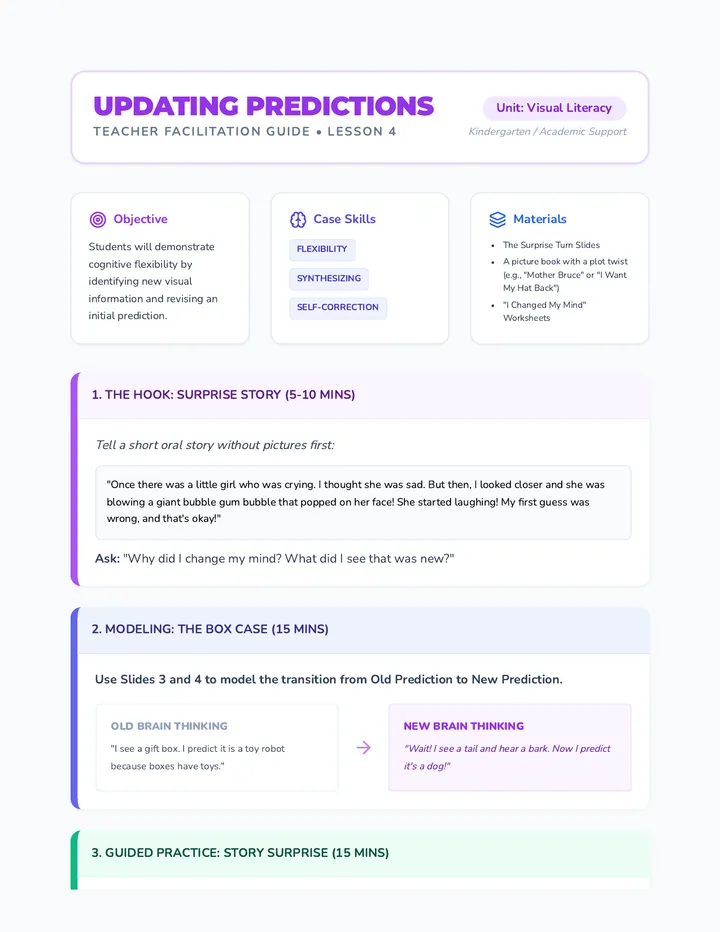
Surprise Turn Facilitation Guide Updating Predictions
Teacher Facilitation Guide • Lesson 4
Unit: Visual Literacy Kindergarten / Academic Support
Objective
Students will demonstrate cognitive flexibility by identifying new visual information and revising an initial prediction.
Case Skills
Flexibility Synthesizing Self-Correction
Materials
The Surprise Turn Slides
A picture book with a plot twist (e.g., "Mother Bruce" or "I Want My Hat Back")
"I Changed My Mind" Worksheets
1. The Hook: Surprise Story (5-10 mins)
Tell a short oral story without pictures first:
"Once there was a little girl who was crying. I thought she was sad. But then, I looked closer and she was blowing a giant bubble gum bubble that popped on her face! She started laughing! My first guess was wrong, and that's okay!"
Ask: "Why did I change my mind? What did I see that was new?"
2. Modeling: The Box Case (15 mins)
Use Slides 3 and 4 to model the transition from Old Prediction to New Prediction.
Old Brain Thinking
"I see a gift box. I predict it is a toy robot because boxes have toys."
New Brain Thinking
"Wait! I see a tail and hear a bark. Now I predict it's a dog!"
3. Guided Practice: Story Surprise (15 mins)
Read the first half of a 'surprise' book. Stop at the climax. Have students draw their prediction on one side of their paper. Then reveal the surprise and have them draw the actual ending on the other.
Teacher Script for Support:
"It's like being a detective who found a NEW clue! Detectives don't get mad when they find a new clue—they get excited!"
Academic Support Strategies
For Cognitive Rigidity
Use a physical "Flip Card." One side has a '?' (prediction) and the other has a '!' (surprise). Physically flipping the card helps the brain transition between thoughts.
For Language Development
Provide the frame: "First I thought... But now I see... so I think..." using picture cards for each blank.
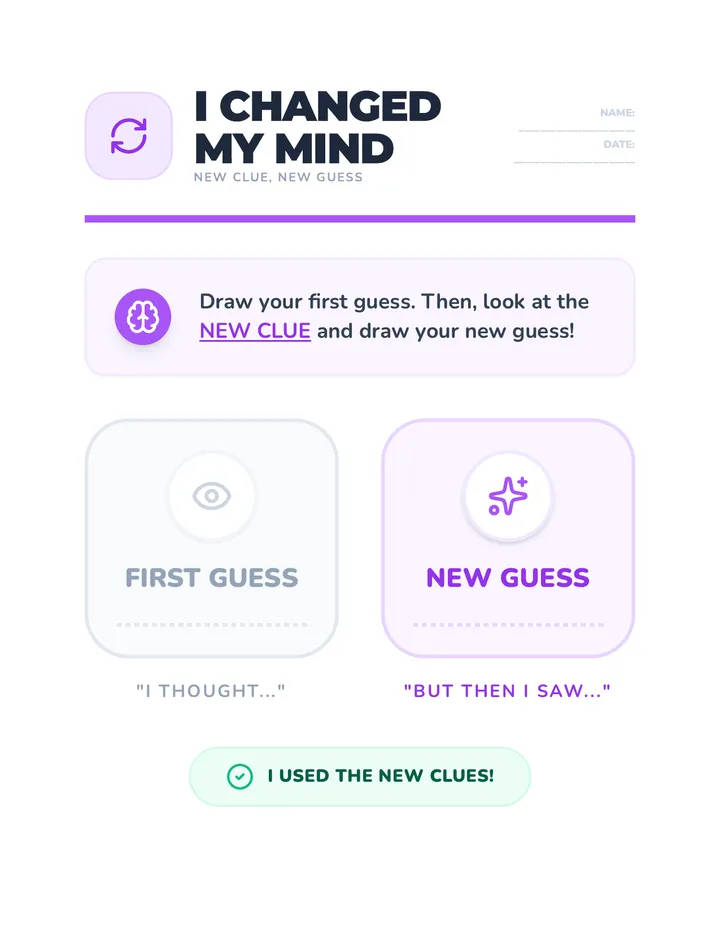
I Changed My Mind Worksheet I Changed My Mind
New Clue, New Guess
Name: ______________________
Date: _______________________
Draw your first guess. Then, look at the new clue and draw your new guess!
First Guess
"I thought..."
New Guess
"But then I saw..."
I used the new clues!
Be the Author Slides Be the Author
Drawing the Ending
Your Detective Mission
1. Look
See what is happening in the first 2 boxes.
2. Think
What logical thing happens next?
3. Draw
Finish the story with your art!
Example: The Ice Cream
1
First
2
Next
3
Your Guess!
Tell Your Story
"I predicted the ending would be ______..."
"...because I saw the clue ______ in the first box."
Share with a Partner!
Author Verified!
You solved the Case of the Missing Ending!
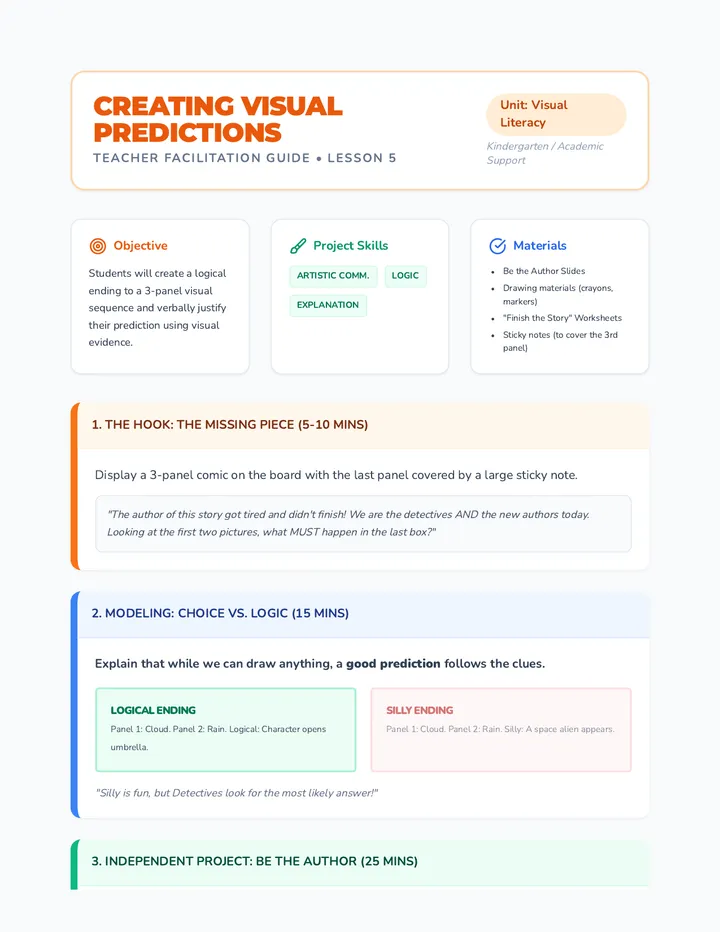
Be the Author Facilitation Guide Creating Visual Predictions
Teacher Facilitation Guide • Lesson 5
Unit: Visual Literacy Kindergarten / Academic Support
Objective
Students will create a logical ending to a 3-panel visual sequence and verbally justify their prediction using visual evidence.
Project Skills
Artistic Comm. Logic Explanation
Materials
Be the Author Slides
Drawing materials (crayons, markers)
"Finish the Story" Worksheets
Sticky notes (to cover the 3rd panel)
1. The Hook: The Missing Piece (5-10 mins)
Display a 3-panel comic on the board with the last panel covered by a large sticky note.
"The author of this story got tired and didn't finish! We are the detectives AND the new authors today. Looking at the first two pictures, what MUST happen in the last box?"
2. Modeling: Choice vs. Logic (15 mins)
Explain that while we can draw anything, a good prediction follows the clues.
Logical Ending
Panel 1: Cloud. Panel 2: Rain. Logical: Character opens umbrella.
Silly Ending
Panel 1: Cloud. Panel 2: Rain. Silly: A space alien appears.
"Silly is fun, but Detectives look for the most likely answer!"
3. Independent Project: Be the Author (25 mins)
Students work on their "Finish the Story" worksheets. Circulate and ask students to "Tell me about your ending."
Conference Prompt:
"I see you drew a [Ending]. Which clue in box 1 or 2 told you that was the right ending?"
Success Checklist
Student identifies clues in panels 1 and 2.
Student draws a related (logical) ending.
Student uses the word "because" in explanation.
Student shows pride in their "Author" role.
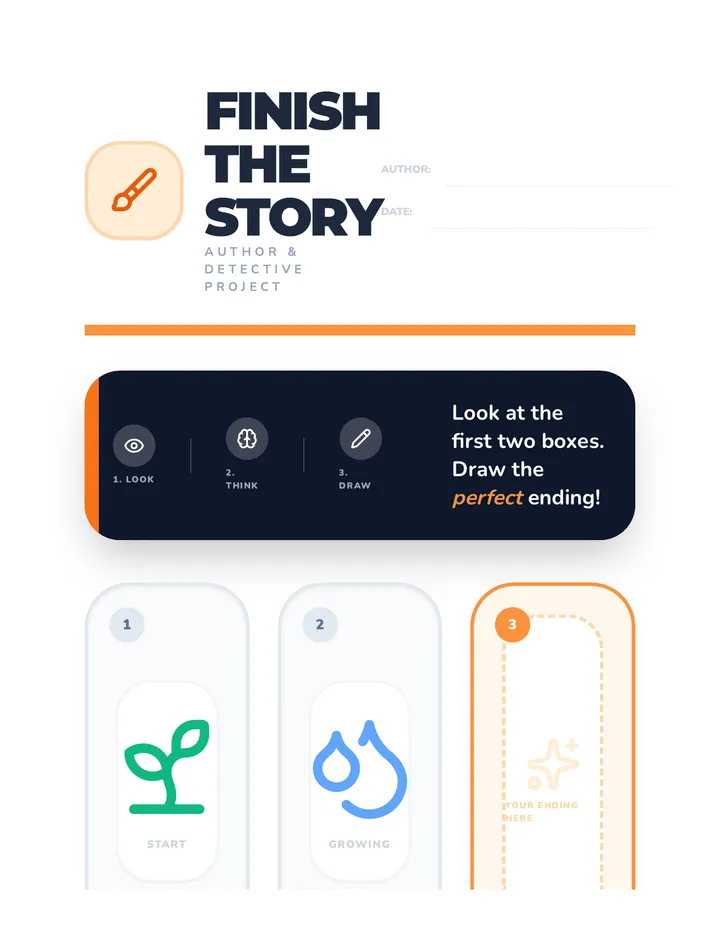
Finish the Story Worksheet Finish the Story
Author & Detective Project
Author:
Date:
1. Look
2. Think
3. Draw
Look at the first two boxes. Draw the perfect ending!
1
Start
2
Growing
3
Your Ending Here
"I think this happened because in box 2 I saw..."
Draw one clue here