Length Detectives Slides Length Detectives
Learning to compare how long and how tall things are!
Longer
Shorter
Taller
Comparing Length
Pencil A
Pencil B
Pencil A is longer than Pencil B.
Pencil B is shorter than Pencil A.
Comparing Height
Tree A
Tree B
Tree A is taller than Tree B.
Tree B is shorter than Tree A.
Let's Try Together!
The pink tower is _________ than the small tower.
The top line is _________ than the bottom line.
Use your words: "Taller" or "Longer"?
Detective Sentence Frame
The _________ is _________ than the _________.
Object 1
Word
Object 2
Measure Up Worksheet Length Detectives
Case File: Measuring Length and Height
Name:
Date:
Detective Word Bank
longer
shorter
taller
1. Drawing Clues
Draw a line that is longer than this one:
Draw a tower that is taller than this one:
2. Solve the Mystery
Look at the pictures. Use your Word Bank to fill in the blanks.
The top pencil is than the bottom pencil.
The small tree is than the big tree.
The bottom line is than the top line.
3. Detective Journal
Find two objects on your desk. Write one sentence to compare them.
The is than the .
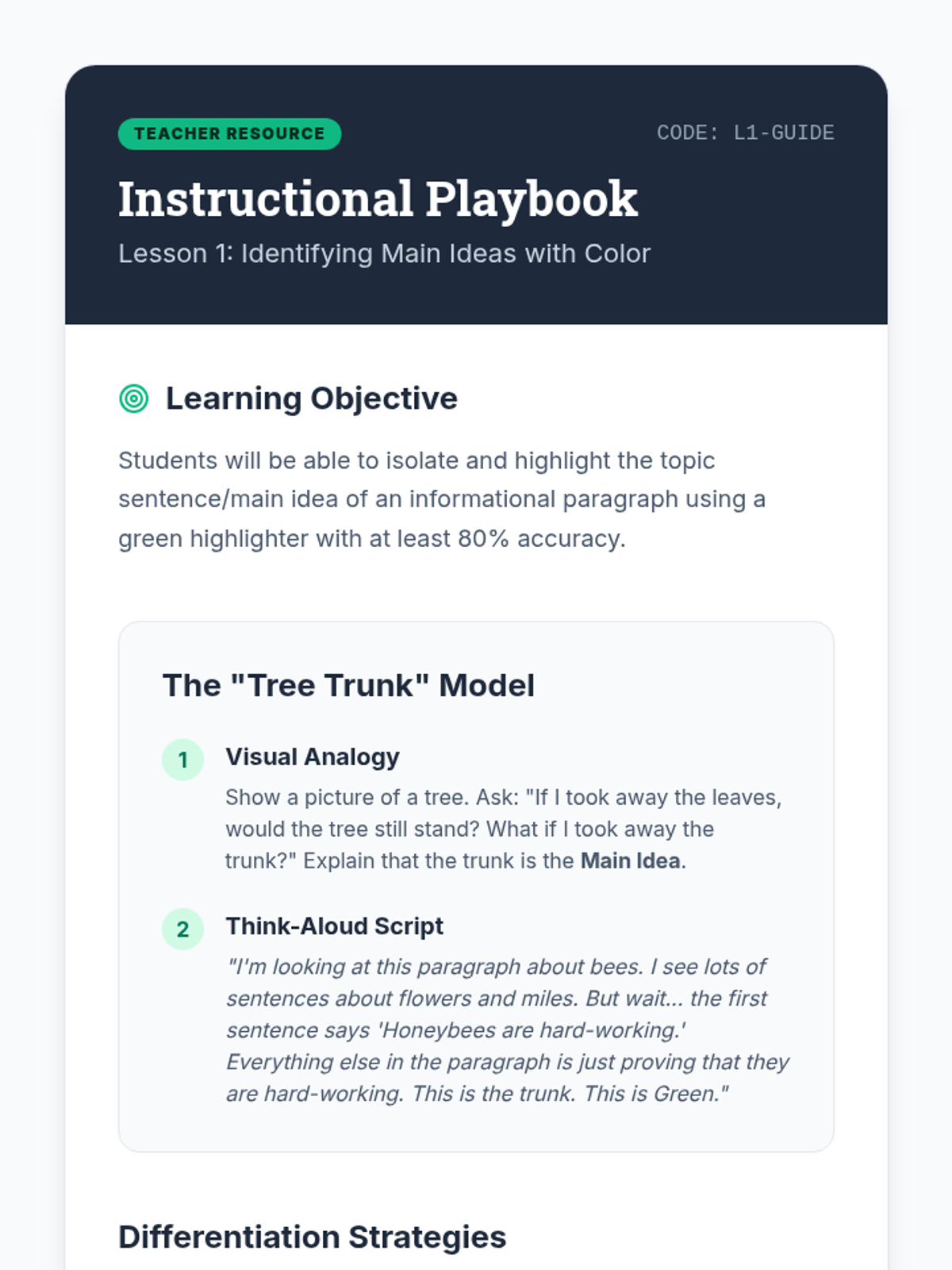
Length Leader Teacher Guide Teacher Resource
Length Detectives
Lesson 1: Measuring Length and Height
Learning Goals
Use longer, shorter, and taller correctly.
Apply sentence frames for oral comparison.
Identify if an object is measured by length or height.
Materials
Lesson Slides & Worksheet
Building blocks (wooden or LEGO)
Classroom objects (pencils, books)
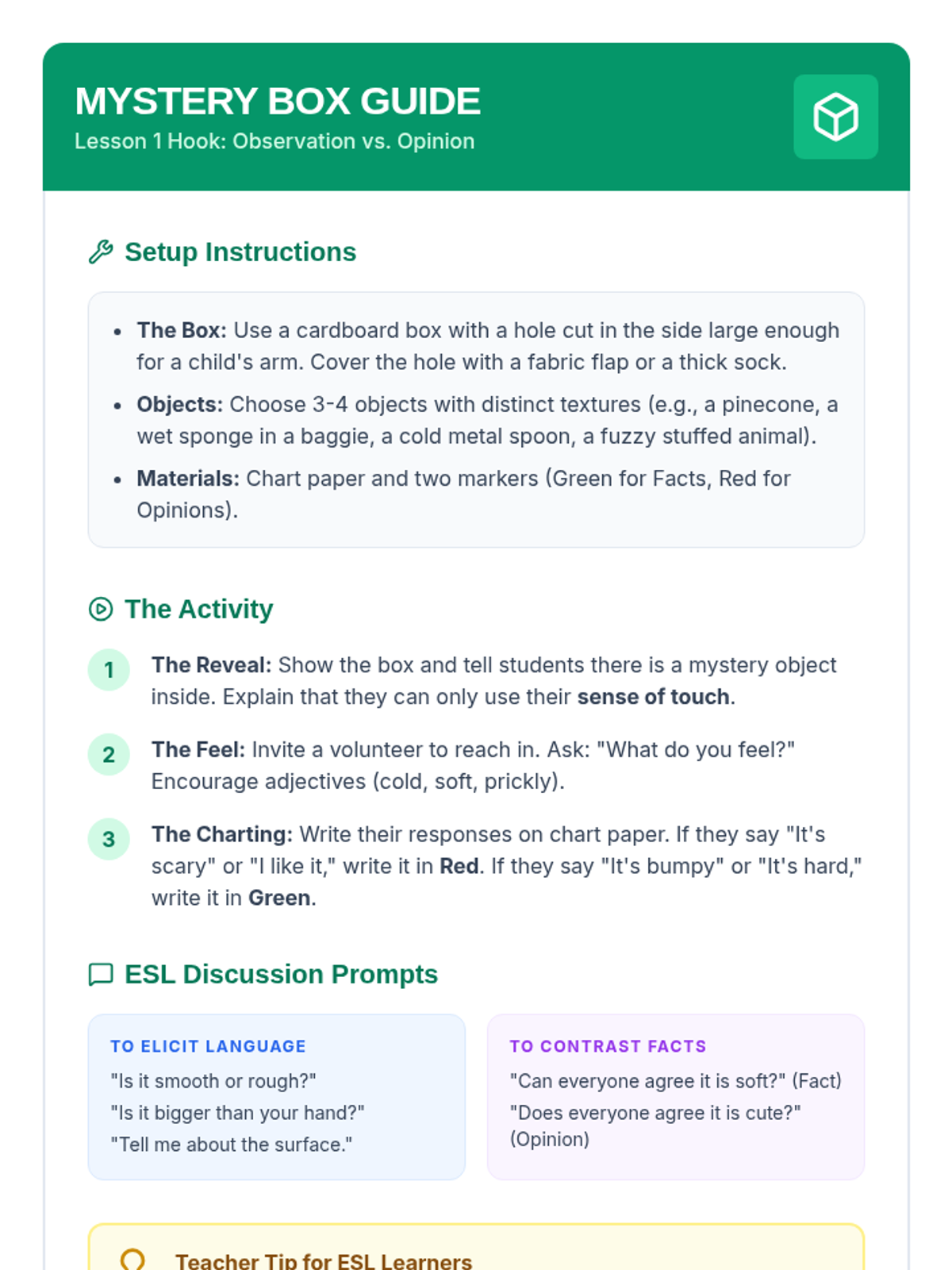
The Hook: Tallest Tower (10 mins)
Divide students into pairs. Give each pair 20 blocks. Set a timer for 2 minutes for them to build the "tallest tower possible."
Language Push:
Walk around and ask: "Is your tower taller than your friend's?" Encourage students to answer: "My tower is taller" or "My tower is shorter."
Direct Instruction (15 mins)
1
Define Length: Use the slides to show objects lying flat. Introduce longer and shorter. Demonstrate with two pencils.
2
Define Height: Show objects standing up. Introduce taller. Demonstrate with two students of different heights.
3
The Magic Sentence: Practice the frame chorally: "The [Object A] is [word] than the [Object B]."
ESL Scaffolding Tips
TPR (Total Physical Response): Use hand gestures. Stretch hands wide for "longer," and hold one hand high for "taller."
Visual Anchors: Keep the Word Bank visible during the entire independent practice.
Echo Reading: Read the worksheet sentences aloud first and have students repeat them before they write.
Closure & Exit Ticket
Have students stand in a circle. Each student must find one thing that is longer than their finger and share it using the sentence frame.
Scale Masters Slides Scale Masters
Is it heavy? Is it light? Let's use the scale to find out!
Heavier
Lighter
Balance
The Balance Scale
The heavy side goes down.
The light side goes up.
Is Big always Heavy?
Balloon
BIG, but...
Small Rock
LIGHTER or HEAVIER?
The rock is heavier than the balloon.
Weight Sentences
The ______ is heavier than the ______.
The ______ is lighter than the ______.
Weight Mystery Lab Worksheet Weight Mystery Lab
Case File: The Balance Scale Test
Name:
Date:
Detective Lab Rules
1
Put one object in each side of the scale.
2
The heavy side goes DOWN.
Step 1: Compare Step 2: Predict Step 3: Result Pencil vs. Eraser
|
Heavier
Lighter
| |
|
Book vs. Crayon
|
Heavier
Lighter
| |
|
Scissors vs. Glue
|
Heavier
Lighter
| |
Detective Lab Report
The is heavier than the .
The is lighter than the .
Weight Leader Teacher Guide Teacher Resource
Scale Masters
Lesson 2: Describing Weight and Heaviness
Learning Goals
Understand the concept of weight versus size.
Use heavier and lighter correctly.
Observe and record results from a balance scale.
Materials
Balance scales (1 per group)
Small rock, large balloon (for the hook)
Common classroom objects
The Hook: The Weight Mystery (10 mins)
Show a large, inflated balloon and a small pebble. Ask: "Which one is bigger?" (The balloon). Then ask: "Which one is heavier?"
Key Insight:
Address the common misconception that "big means heavy." Let students hold both to feel the difference before using the scale to prove it.
Direct Instruction (15 mins)
1
Model the Scale: Show how the scale tips. Explain that heavy things go down because gravity pulls them more. Light things stay up.
2
Compare Objects: Place a book on one side and a pencil on the other. Model the sentence: "The book is heavier than the pencil."
3
Language Practice: Reverse it! "The pencil is lighter than the book." Practice as a class.
ESL Scaffolding Tips
Physical Acting: Have students "act like a scale." Their hands go up/down to match what they see on the real scale.
Sentence Starters: The Lab Worksheet provides frames, but encourage students to say the sentence before they write it.
Focus on -er: Point out that we add "er" when we are comparing two things.
Closure & Reflection
Review the Lab Report as a class. Ask: "What was the heaviest thing you found today?"
Counting Comparisons Slides Quantity Quest
Which group has more? Which group has less? Let's count!
More
Fewer
Less
Comparing Groups
Group A
8
Group B
3
Group A has more than Group B.
The Word Mystery: Fewer or Less?
Fewer
Use for things you can count 1, 2, 3...
Less
Use for things you cannot count easily.
*For 1st Grade, we mostly focus on "More" and "Fewer" with groups of objects!
Can you justify?
Group 1
VS.
Group 2
"Group 1 has more because it has 5 stars, and 5 is a greater number than 2."
Quantity Quest Worksheet Quantity Quest
Case File: Comparing Numbers of Objects
Name:
Date:
Big Group
more
Small Group
fewer
1. Count and Compare
Count the items in each group. Circle the word that matches.
How many?
vs.
How many?
more
fewer
How many?
vs.
How many?
more
fewer
2. Justify Your Answer
Use the word because to explain.
Group 1 has objects.
Group 2 has objects.
Group has more because is a greater number than .
Quantity Leader Teacher Guide Teacher Resource
Quantity Quest
Lesson 3: Quantifying Differences: More and Less
Learning Goals
Compare two groups of objects using more and fewer.
Justify comparisons using the word because.
Use one-to-one correspondence to verify counts.
Materials
Math counters or plastic bears
Small containers/cups
Large chart paper for voting
The Hook: The Snack Vote (10 mins)
Put two pictures on the board (e.g., Apple vs. Banana). Have students "vote" by placing a counter or sticker under their choice.
Language Push:
Ask: "Which snack won?" Then prompt for math words: "Yes, the apple won because it has more votes. How many more?"
Direct Instruction (15 mins)
1
Counting Groups: Display two unequal sets of objects. Count them together aloud. Label each set with its number card.
2
One-to-One Match: Draw lines connecting an object in Group A to an object in Group B. Show how some are "left over" in the larger group.
3
The "Because" Bridge: Teach the justification: "Group A has more because 10 is greater than 6."
ESL Scaffolding Tips
Hand Symbols: Use a closed fist for "0" and spread fingers wide for "more."
Fewer vs. Less: For Grade 1 ESL, stick to fewer for objects. Introduce less only if students are ready for non-countable concepts (like water/sand).
Number Path: Keep a number path (1-20) visible so students can see which number comes "after" (greater) or "before" (less).
Closure & Exit Ticket
Give each student a handful of counters. They must pair up and say one sentence comparing their handful to their partner's.
Equality Experts Slides Equality Experts
When things are the same, we say they are equal!
Equal To
The Same As
Balanced
Perfectly Balanced
3 cubes
3 cubes
3 is equal to 3.
How can we make them equal?
Group A
5
Group B
2
To make them equal, we must add 3 more to Group B.
"The Same As"
The amount in Group A is
equal to
the amount in Group B.
6
6
The Equalizer Activity The Equalizer
Case File: Making Sets Equal
Name:
Date:
"Equal means the same amount ."
1. Balance the Sets
Draw more shapes in Group B to make it equal to Group A.
Group A
4 circles
=
Group B (Draw here)
Group A
6 squares
=
Group B (Draw here)
2. Equality Sentence
Finish the sentence for the items below.
The number of stars in Group A is
the number of stars in Group B.
Equality Experts Teacher Guide Teacher Resource
Equality Experts
Lesson 4: Understanding Equality
Learning Goals
Identify when two sets are equal.
Use the phrase equal to or the same as.
Adjust sets to create equality.
Materials
Balance scales
Linking cubes or plastic tiles
Tape (for a line on the floor)
The Hook: Human Balance Scale (10 mins)
Place a tape line on the floor. Ask 3 students to stand on the left. Ask 1 student to stand on the right. Ask: "Is it balanced?"
Language Push:
Ask: "How do we make the sides equal?" Let students direct more classmates to the right side until there are 3 on each side. Celebrate: "Now they are the same!"
Direct Instruction (15 mins)
1
Define Equality: Use the balance scale. Show that when the arms are level, the weights are "the same" or "equal."
2
Mathematical Equality: Translate physical balance to numbers. 5 cubes = 5 cubes. Introduce the equal sign (=).
3
Matching Sentences: Chorally repeat: "Group A is equal to Group B."
ESL Scaffolding Tips
Mirroring: Use your arms to mimic the balance scale. When equal, hold arms perfectly flat. When not equal, tilt your whole body.
Synonyms: Use "equal to" and "the same as" interchangeably so students learn both common academic phrases.
Check for Understanding: Say "Give me a thumbs up if these are equal." Show non-equal sets to test their recognition.
Closure & Exit Ticket
Challenge students to find two things in the room that are the "same" (e.g., two pencils, two chairs) and use the word equal to describe them.
Detective Mastery Slides Master Detectives
Today we solve the final case! Can you use all your math words?
Longer Taller Heavier Lighter More Fewer Equal
Detective Toolbox
Length
📏 Longer
📏 Shorter
🏢 Taller
Weight
⚖️ Heavier
⚖️ Lighter
⚖️ Balance
Amount
🔢 More
🔢 Fewer
🔢 Equal to
How to Play
1
Roll the dice and move your piece.
2
Draw a Card and look at the objects.
3
Use a Math Sentence to stay on the space!
Ready, Set, Math!
Comparison Quest Board Game Comparison Quest
The Ultimate Detective Board Game
START
Length
Weight
Quantity
DRAW!
Equal
SAFE
Length
Weight
Quantity
DRAW!
Equal
Length
Weight
Quantity
DRAW!
Equal
Length
FREE
Weight
Quantity
🏁 MASTER DETECTIVE! 🏁
Rules:
1. Use a coin (Heads=1, Tails=2) or small dice.
2. When you land on a space, your partner picks a card.
3. Say a full sentence to stay on that space!
Sentence Frames:
"Object A is [longer/shorter/taller] than Object B."
"Group A is [more/fewer/equal to] Group B."
Comparison Mastery Checklist Mastery Checklist
Comparison Detectives: Oral Fluency Assessment
Unit: Academic Math Language
How to Use
During the Comparison Quest Board Game, circulate between groups. Listen to students as they make their comparisons. Mark a check (✓) if the student uses the vocabulary and sentence frame correctly. Use the "Notes" column for specific ESL observations (e.g., pronunciation, word retrieval).
| Student Name | Length
Longer/Taller | Weight
Heavier/Lighter | Quantity
More/Fewer | Equality
Equal To | Notes |
| --- | --- | --- | --- | --- | --- |
| | | | | | |
| | | | | | |
| | | | | | |
| | | | | | |
| | | | | | |
| | | | | | |
| | | | | | |
| | | | | | |
| | | | | | |
| | | | | | |
Mastered (3)
Student independently uses the correct adjective and produces a full sentence (e.g., "The rock is heavier than the pencil.").
Developing (2)
Student identifies the correct adjective but needs a sentence frame or prompt to produce a full sentence.