Stop-and-think strategies, impulse management, and SMART goal setting for personal growth. Develops internal motivation, stress reduction techniques, and resilience through proactive planning and monitoring.
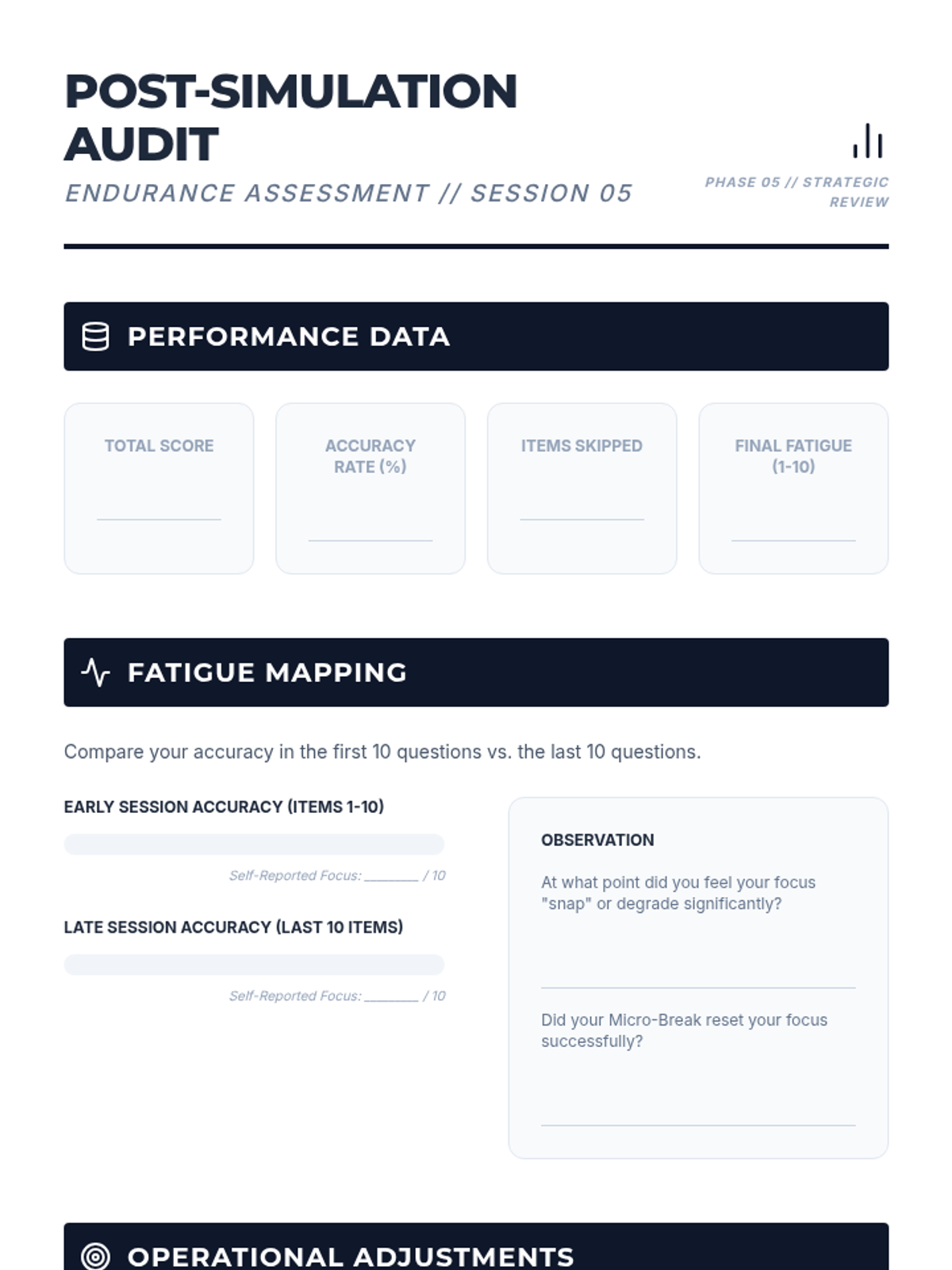
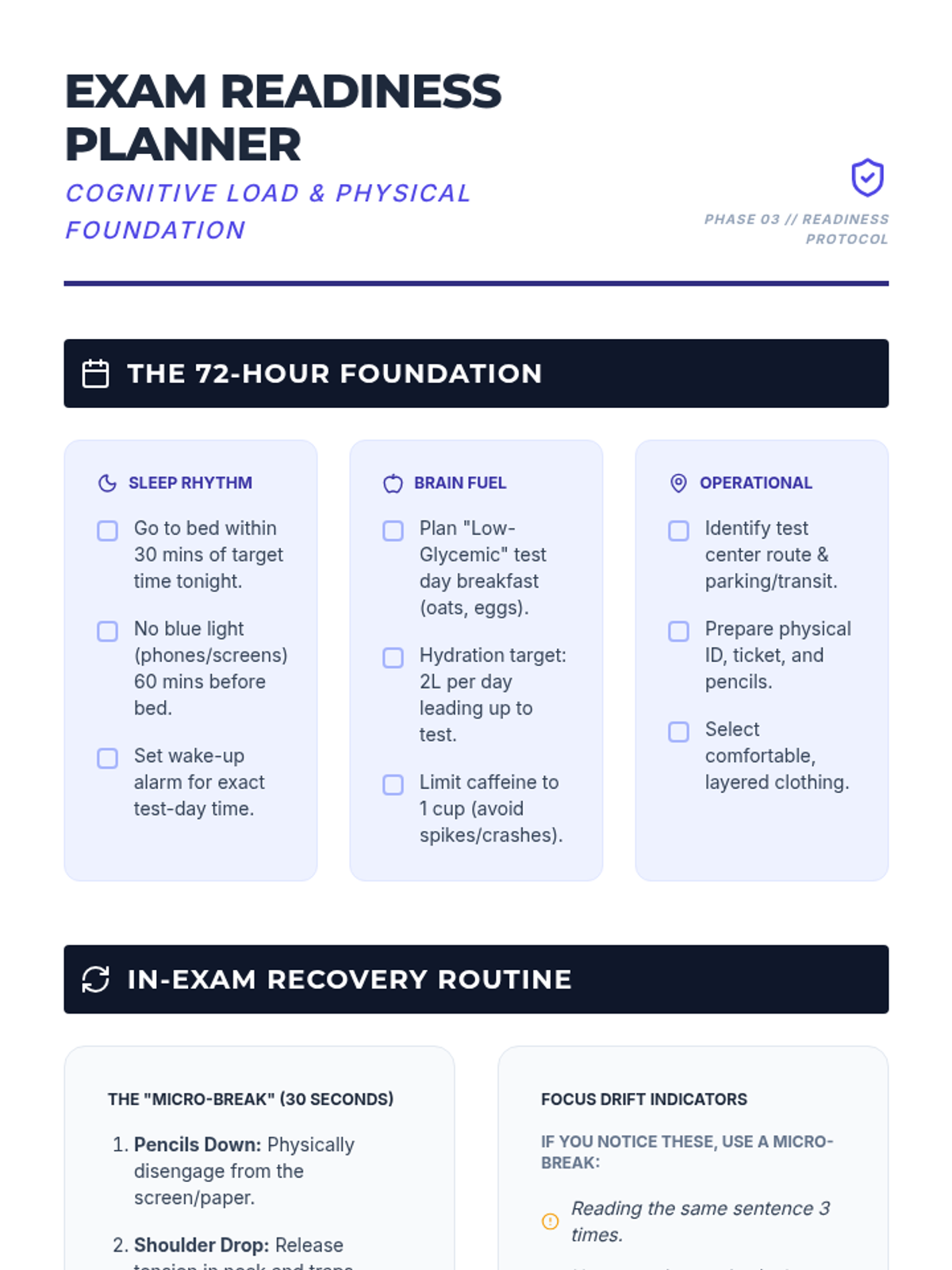
A full-length practice simulation designed to build cognitive endurance and practice micro-break techniques.
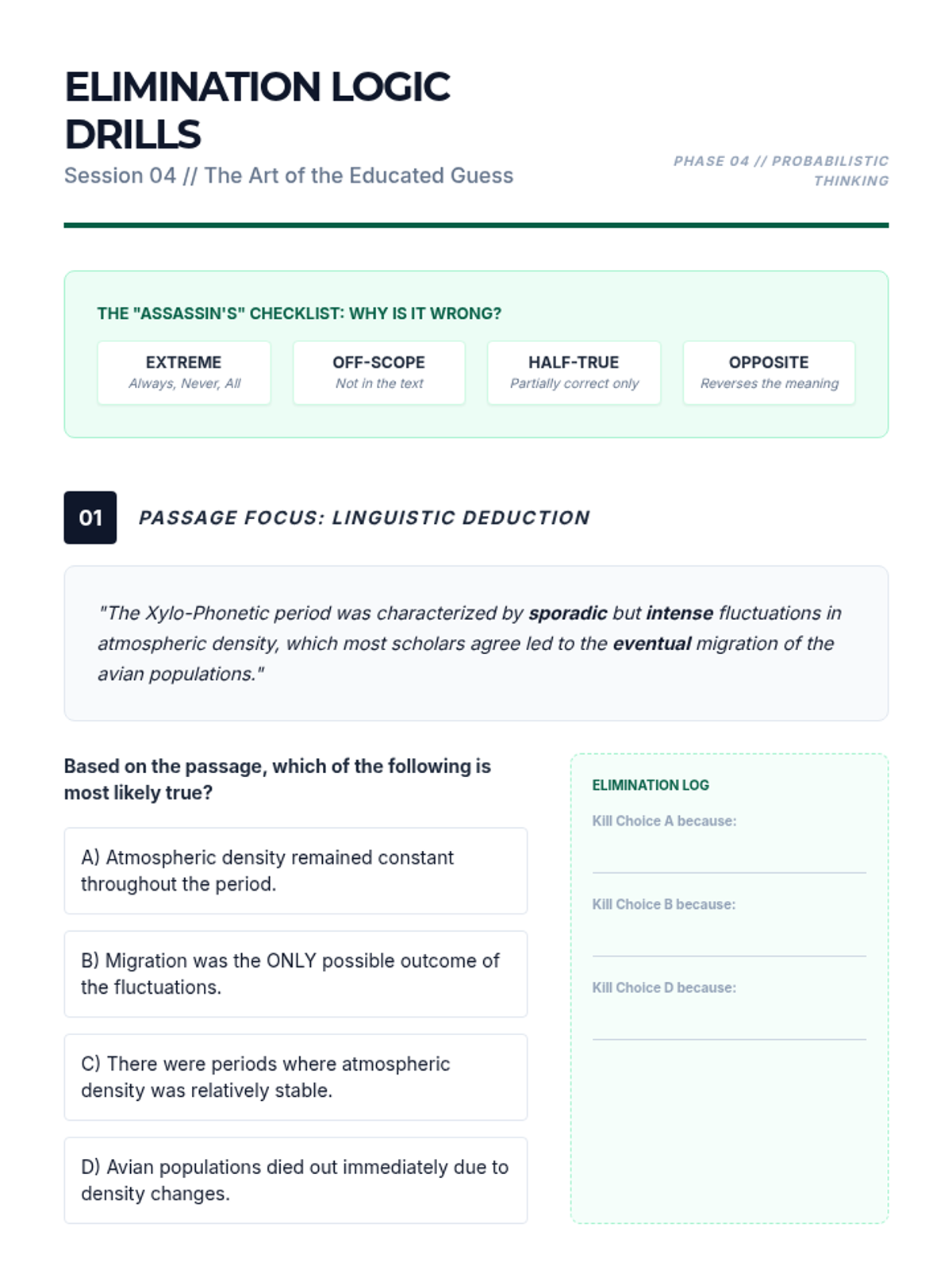
Teaches statistical and logical strategies for educated guessing when an answer is not immediately clear.
Explores techniques for maintaining focus and reducing anxiety during high-pressure assessments.
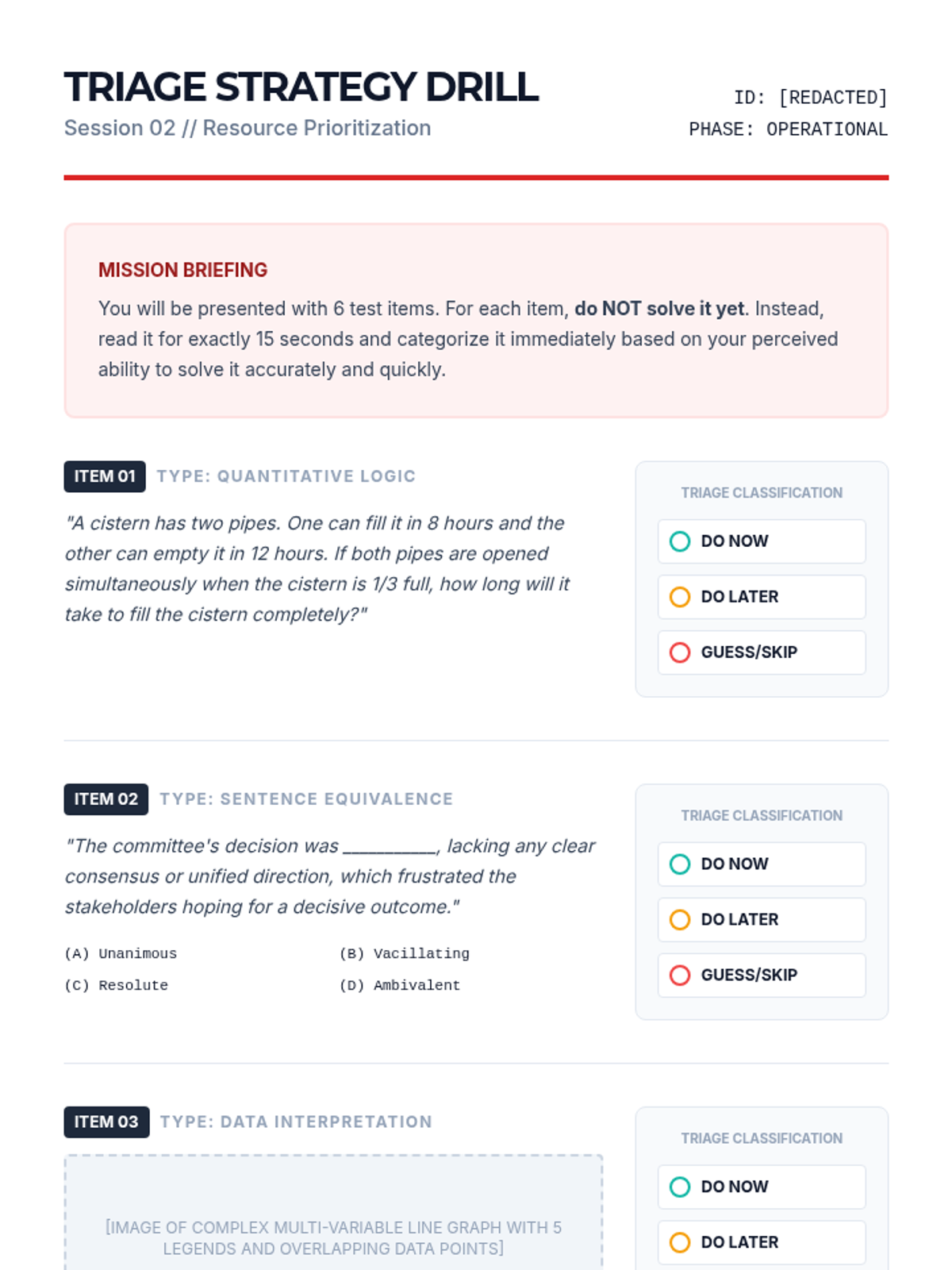
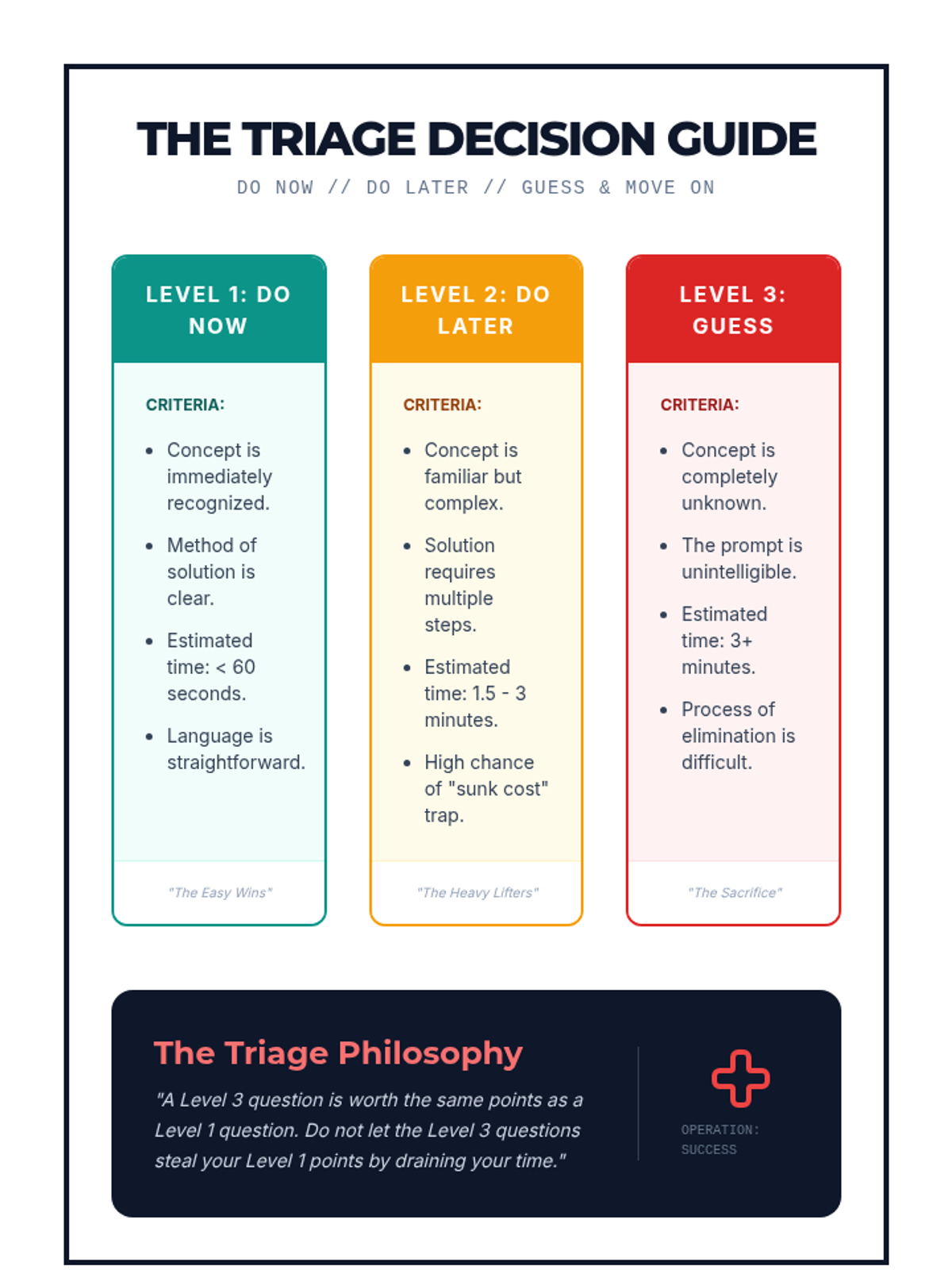
Focuses on the 'triage' method to prioritize questions and manage time effectively during an exam.
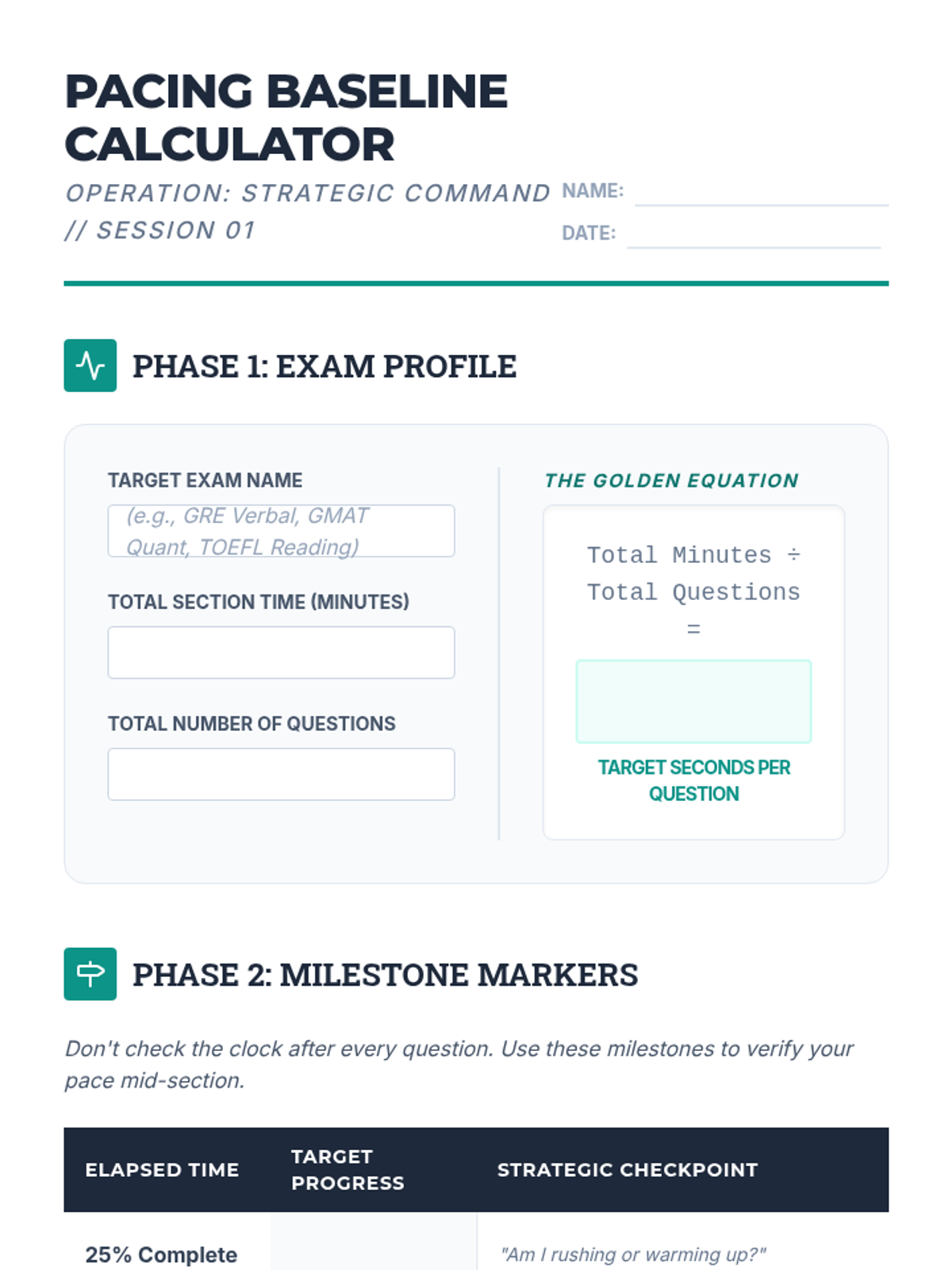
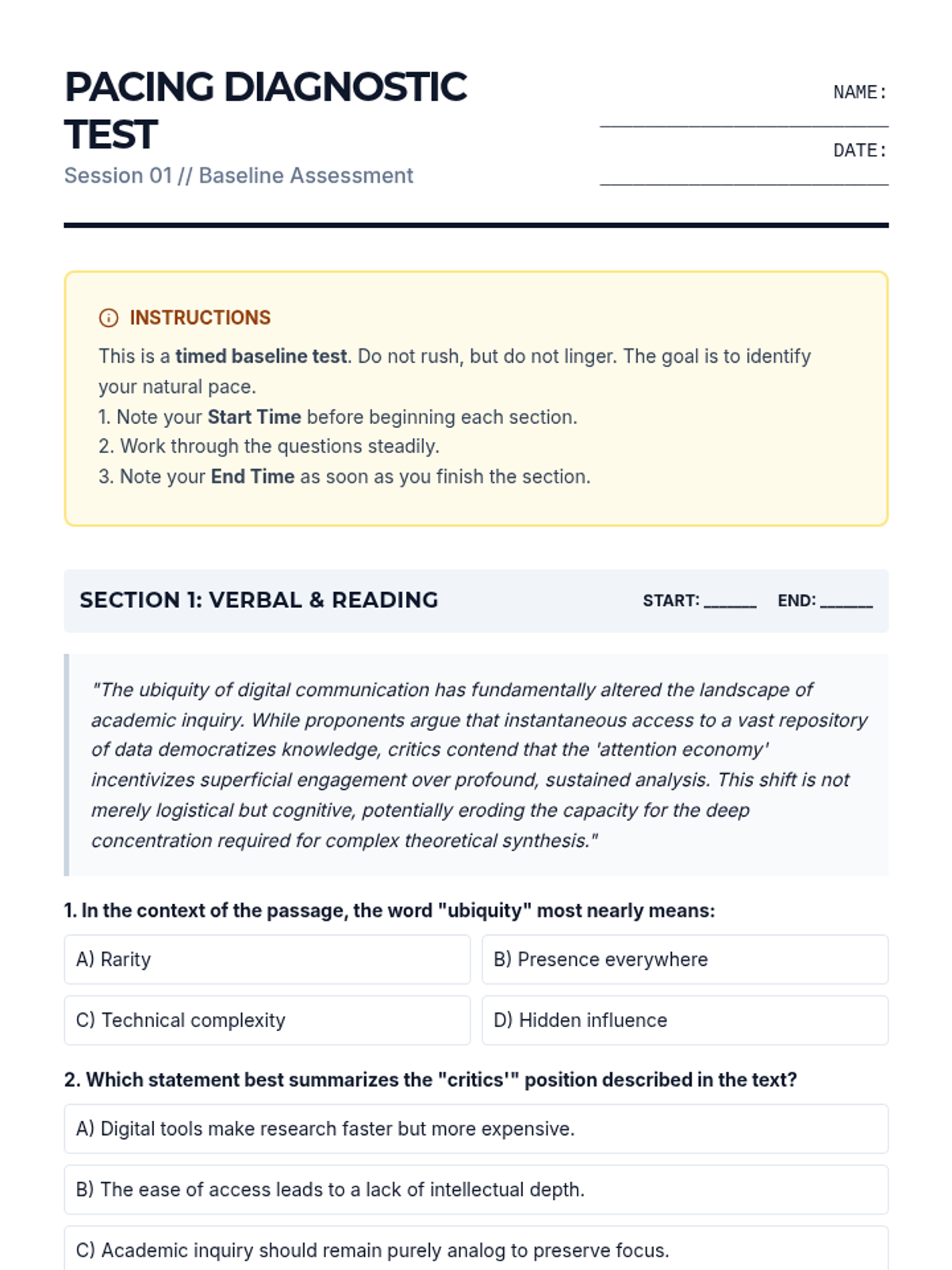
Students determine their current testing pace and learn to calculate precise time allocations for specific exams.
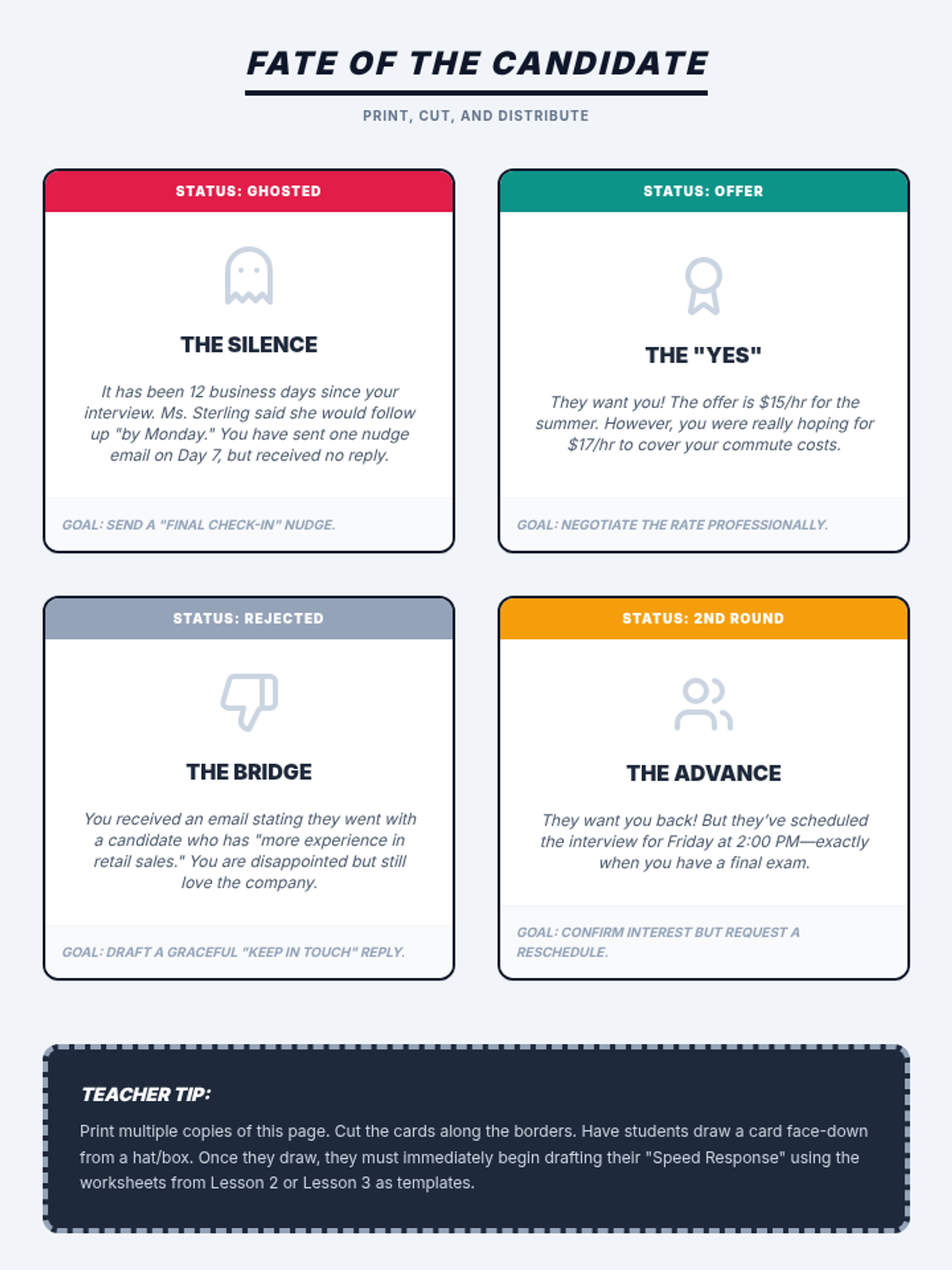
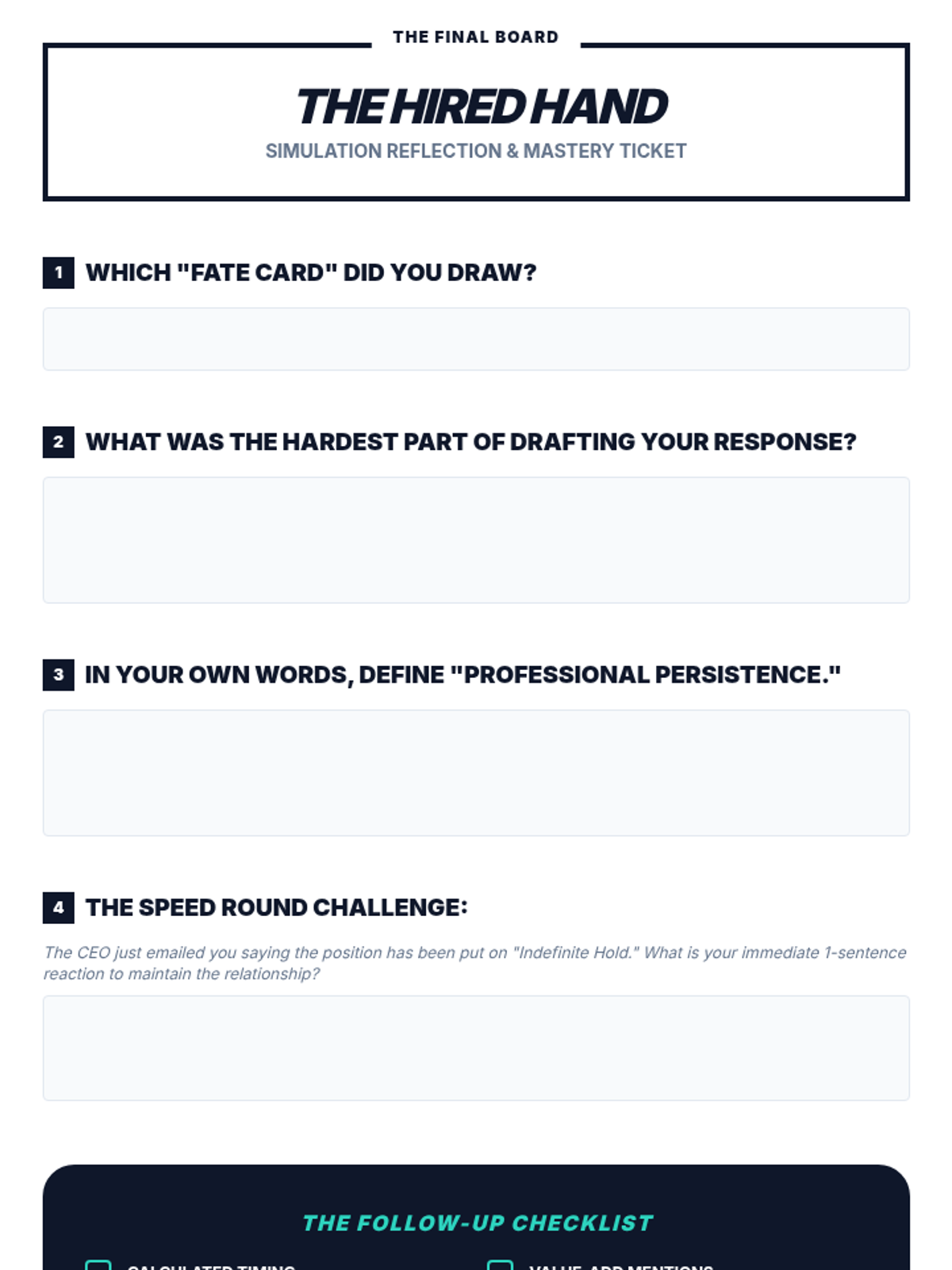
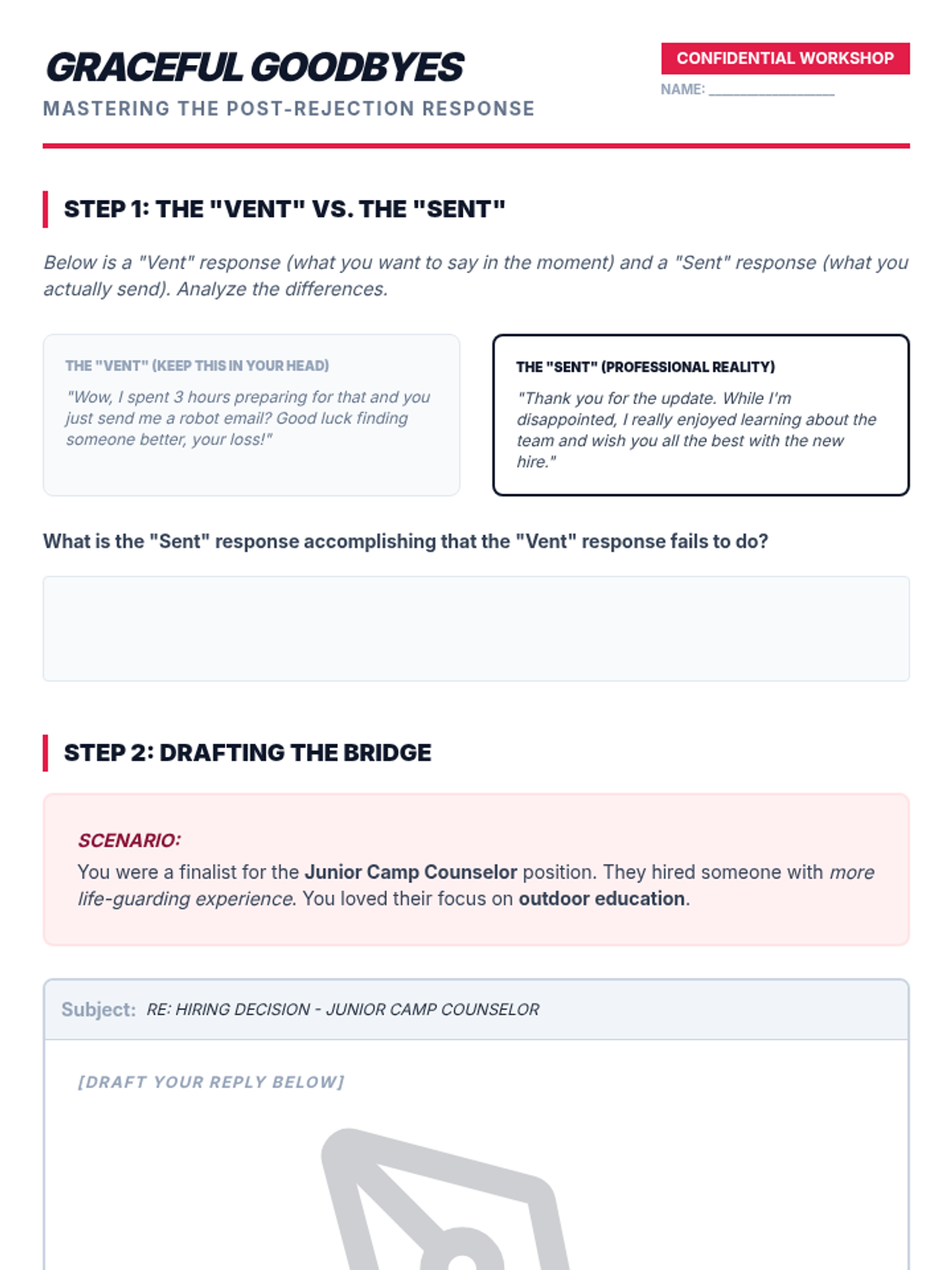
A culminating activity where students draw random 'status cards' (e.g., Ghosted, Second Interview Request, Rejection, Offer) and must instantaneously choose the correct communication template and strategy to respond.
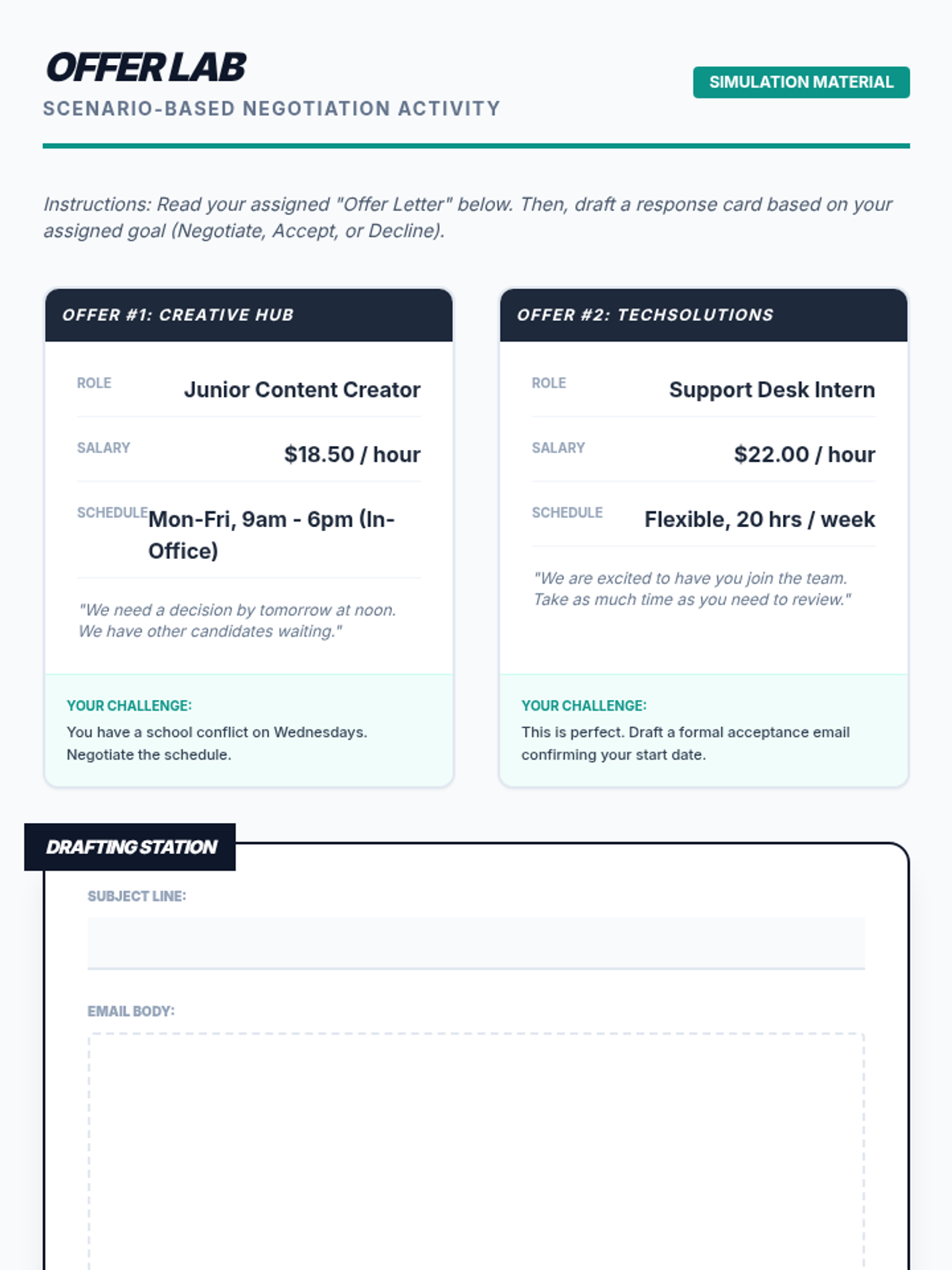
Students learn the protocol for acknowledging a job offer, asking for time to consider it, and confirming acceptance in writing. The lesson touches briefly on the format for declining an offer professionally.
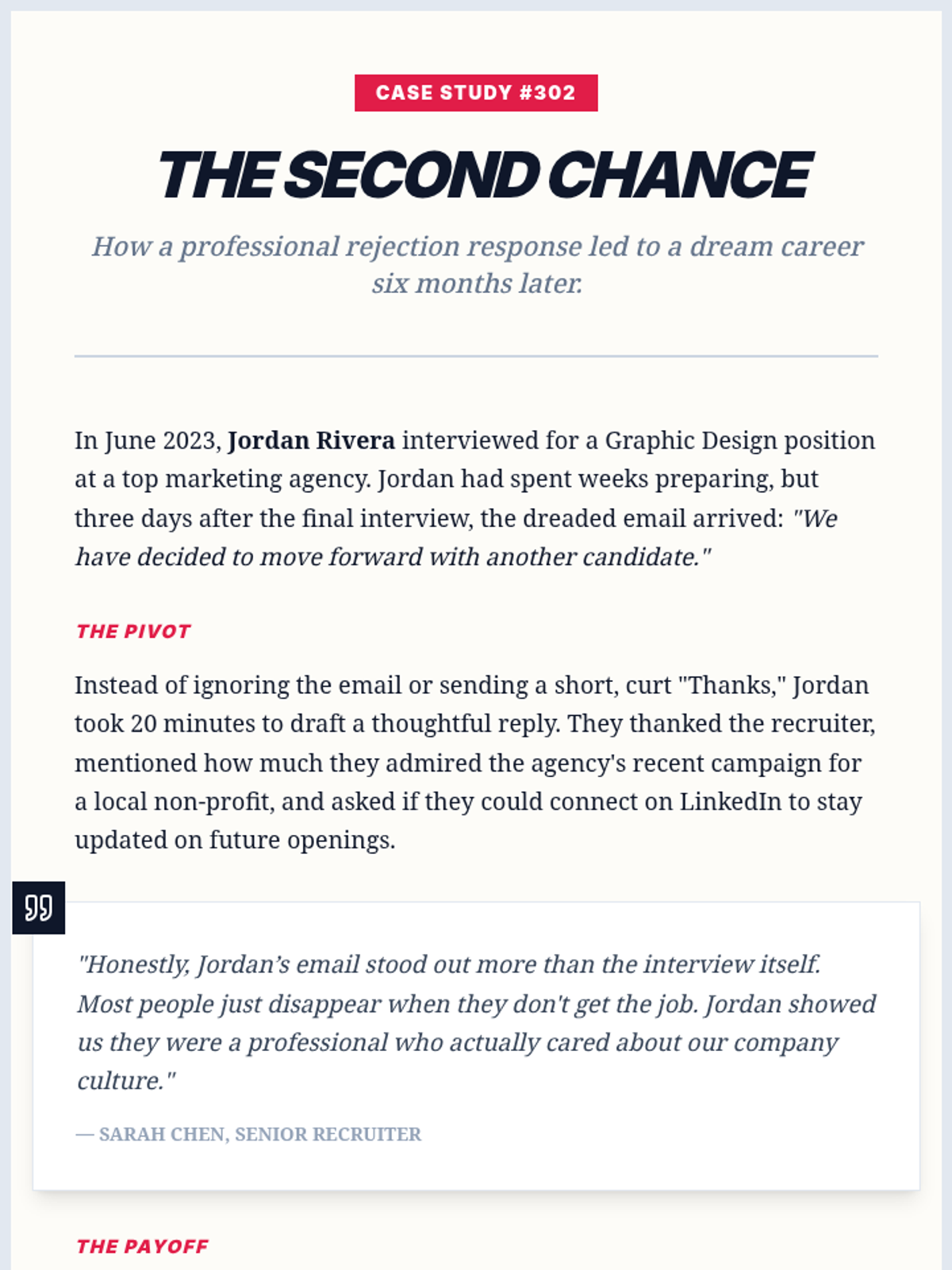
Students analyze the long-term value of responding gracefully to a rejection email, learning how to stay in a recruiter's network for future opportunities.
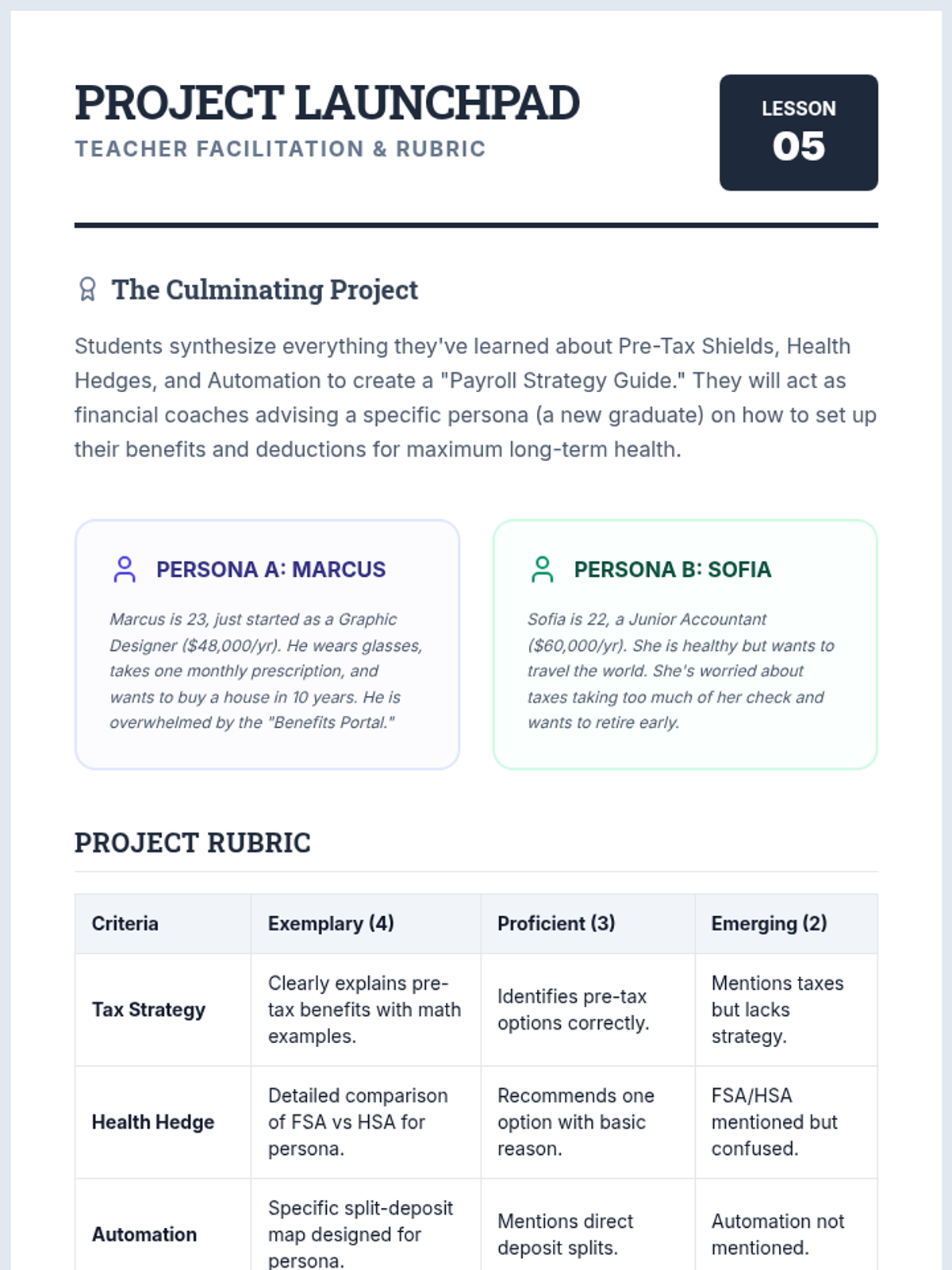
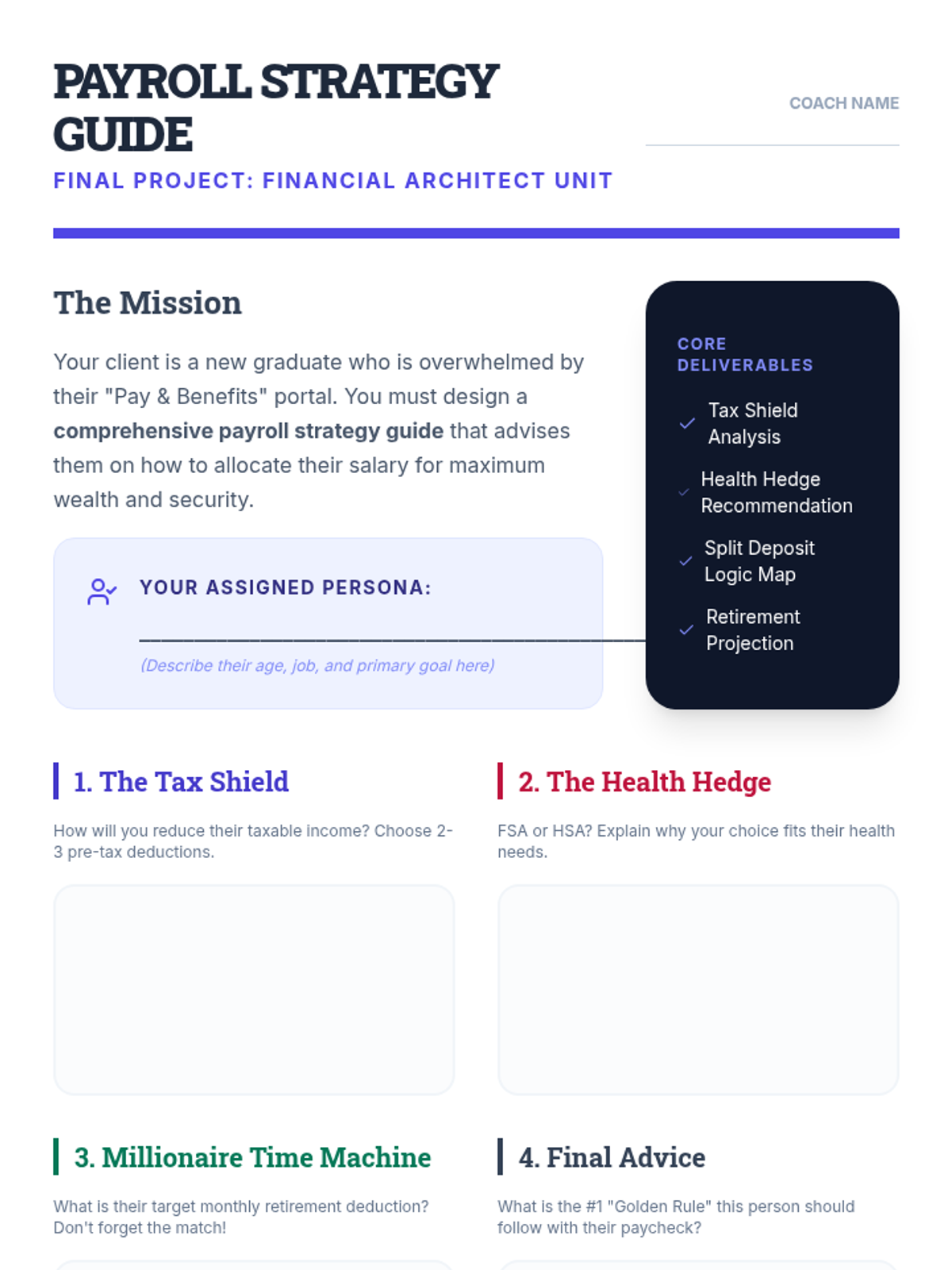
Students synthesize their knowledge to create a comprehensive payroll strategy guide for a new graduate entering the workforce.
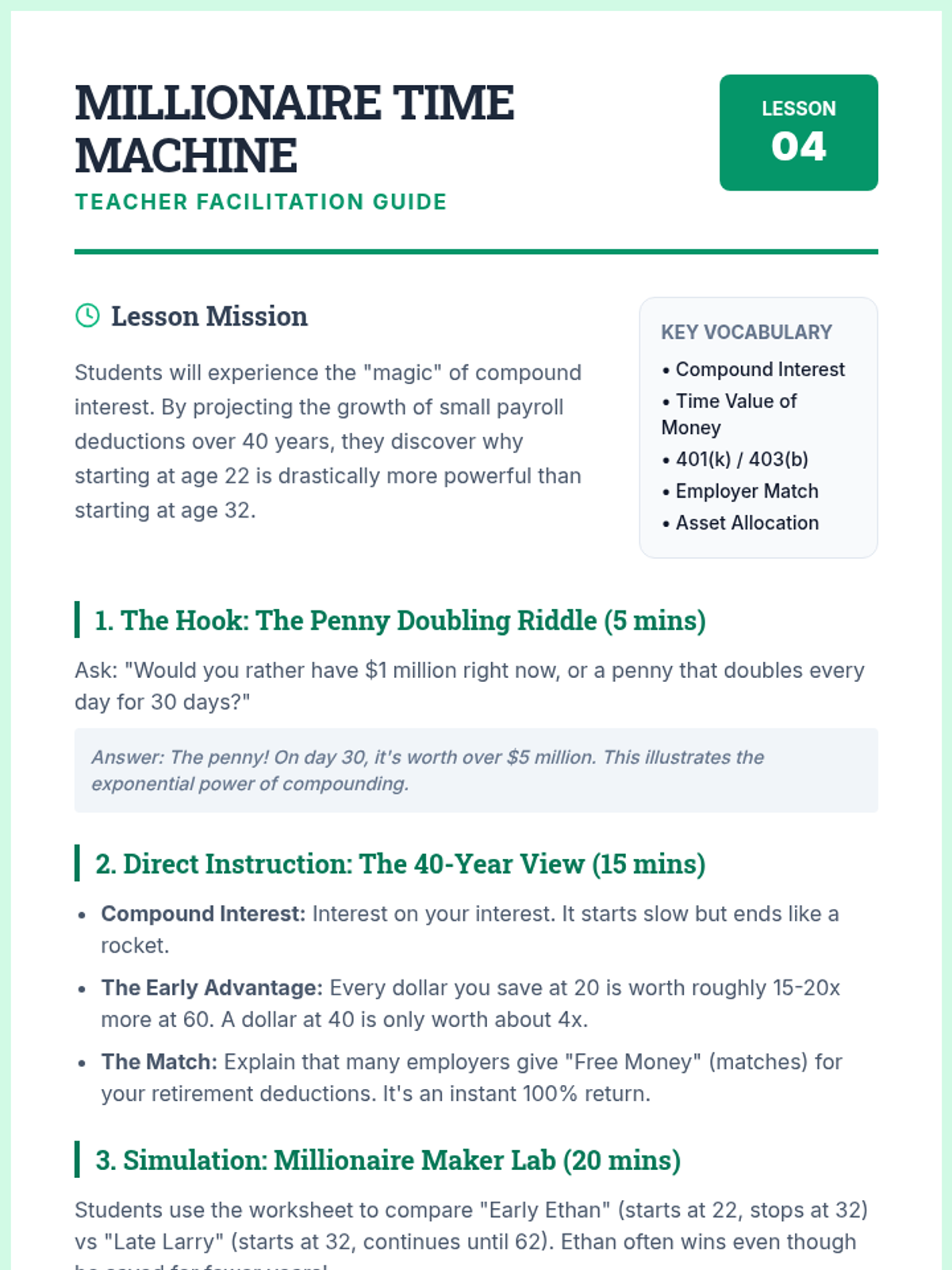
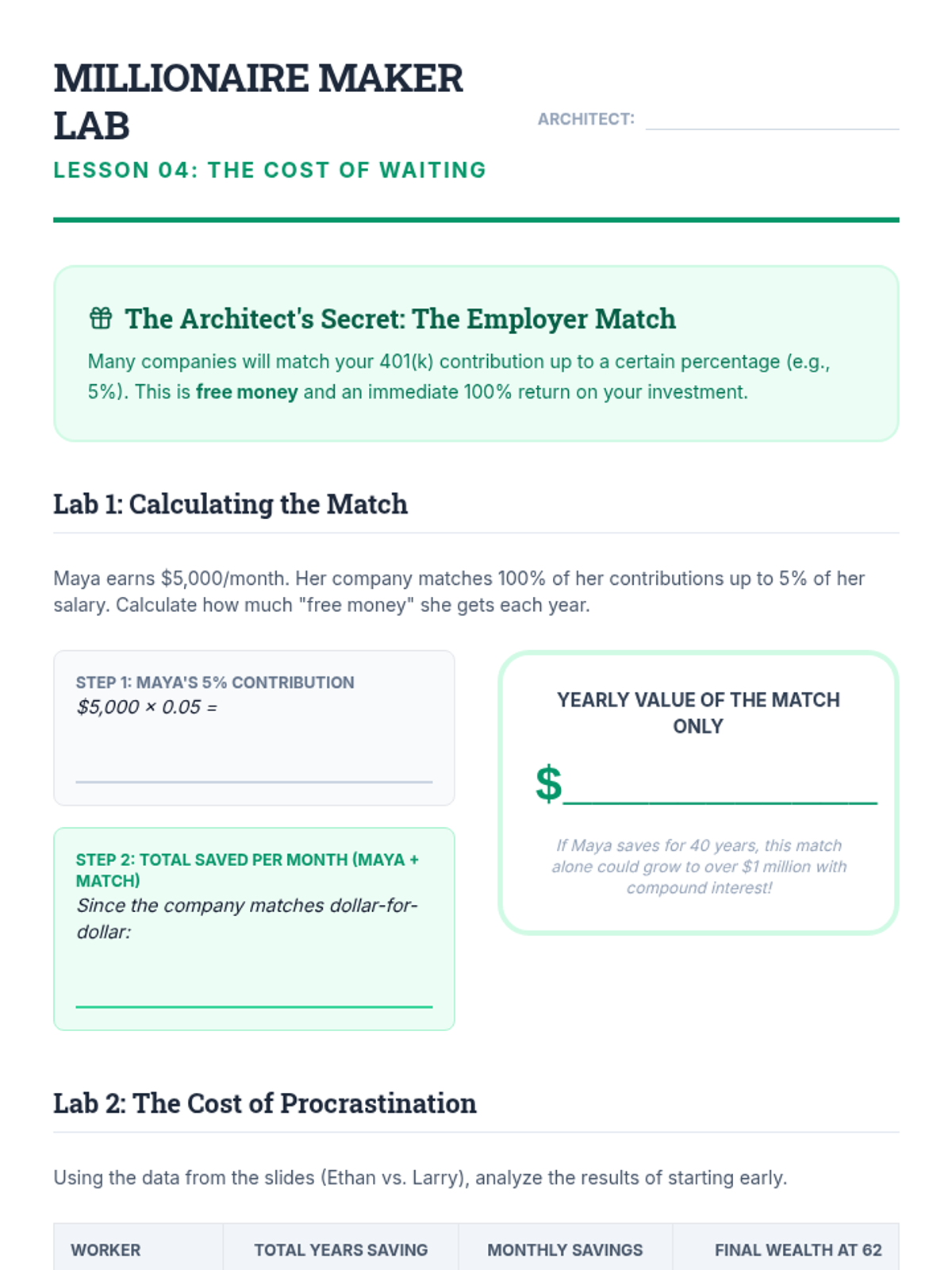
Focusing on compound interest and the time value of money, students project the long-term growth of early retirement contributions.
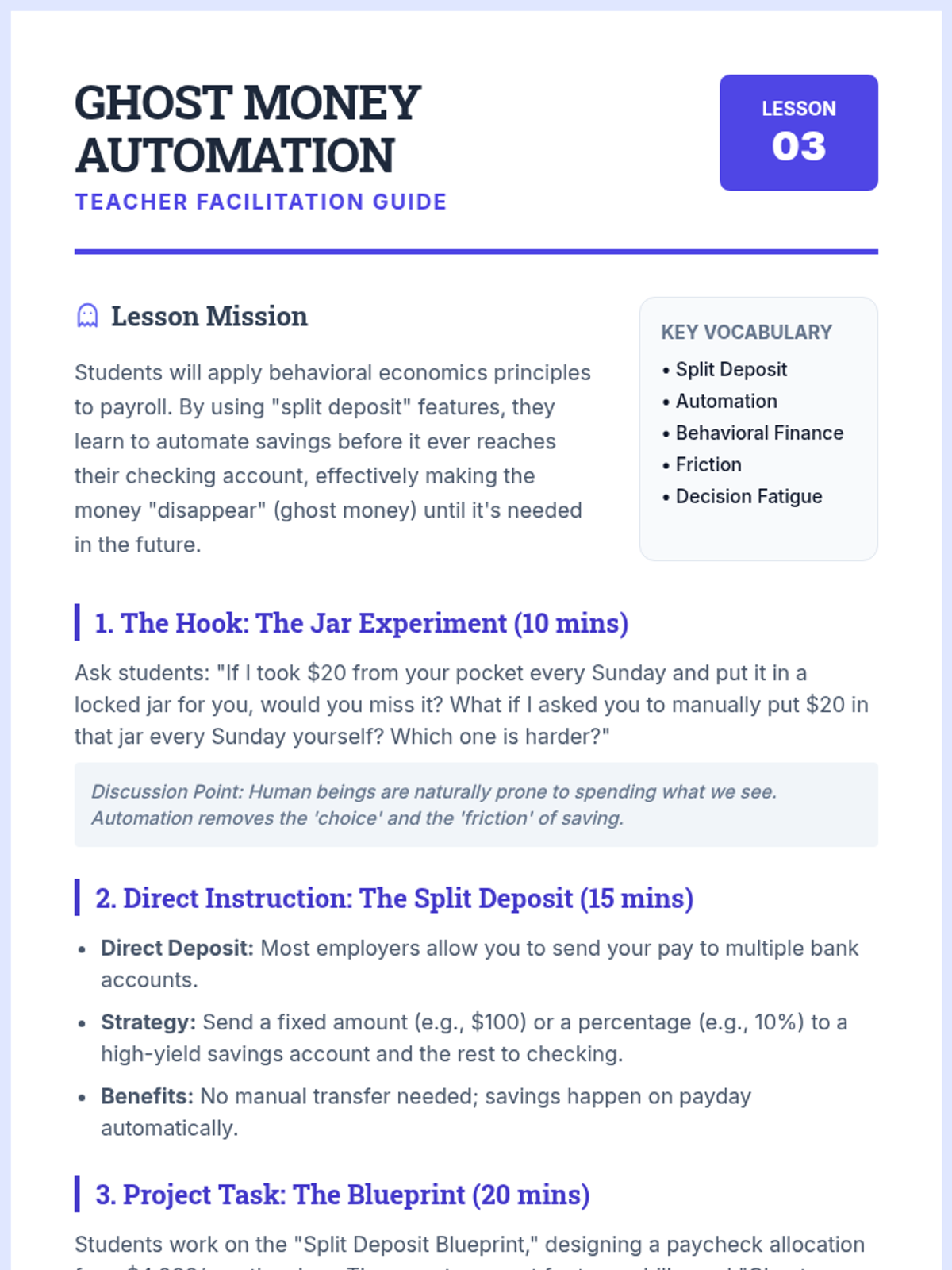
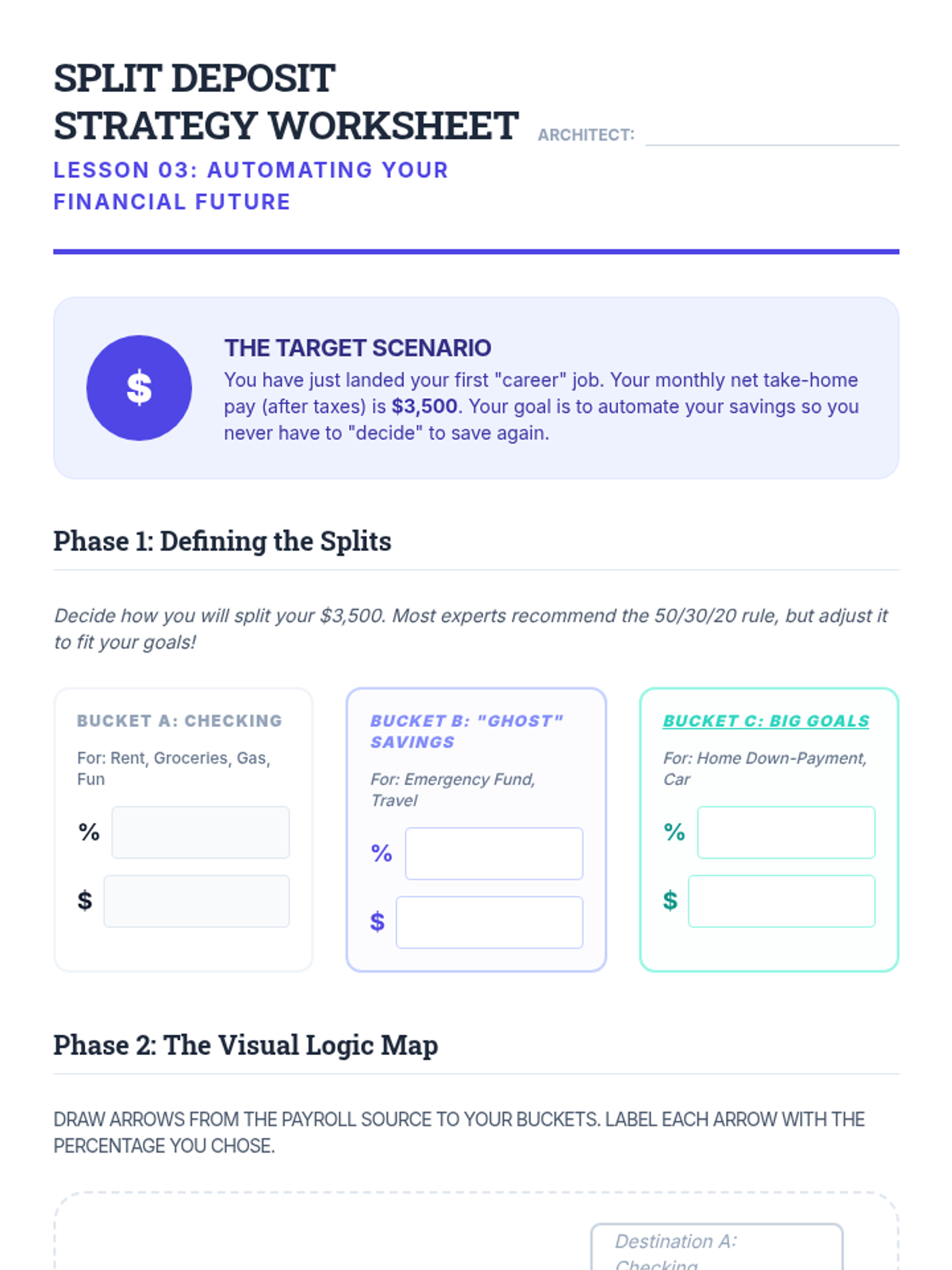
Students study behavioral economics and automation, designing split-deposit strategies to ensure consistent savings without manual effort.
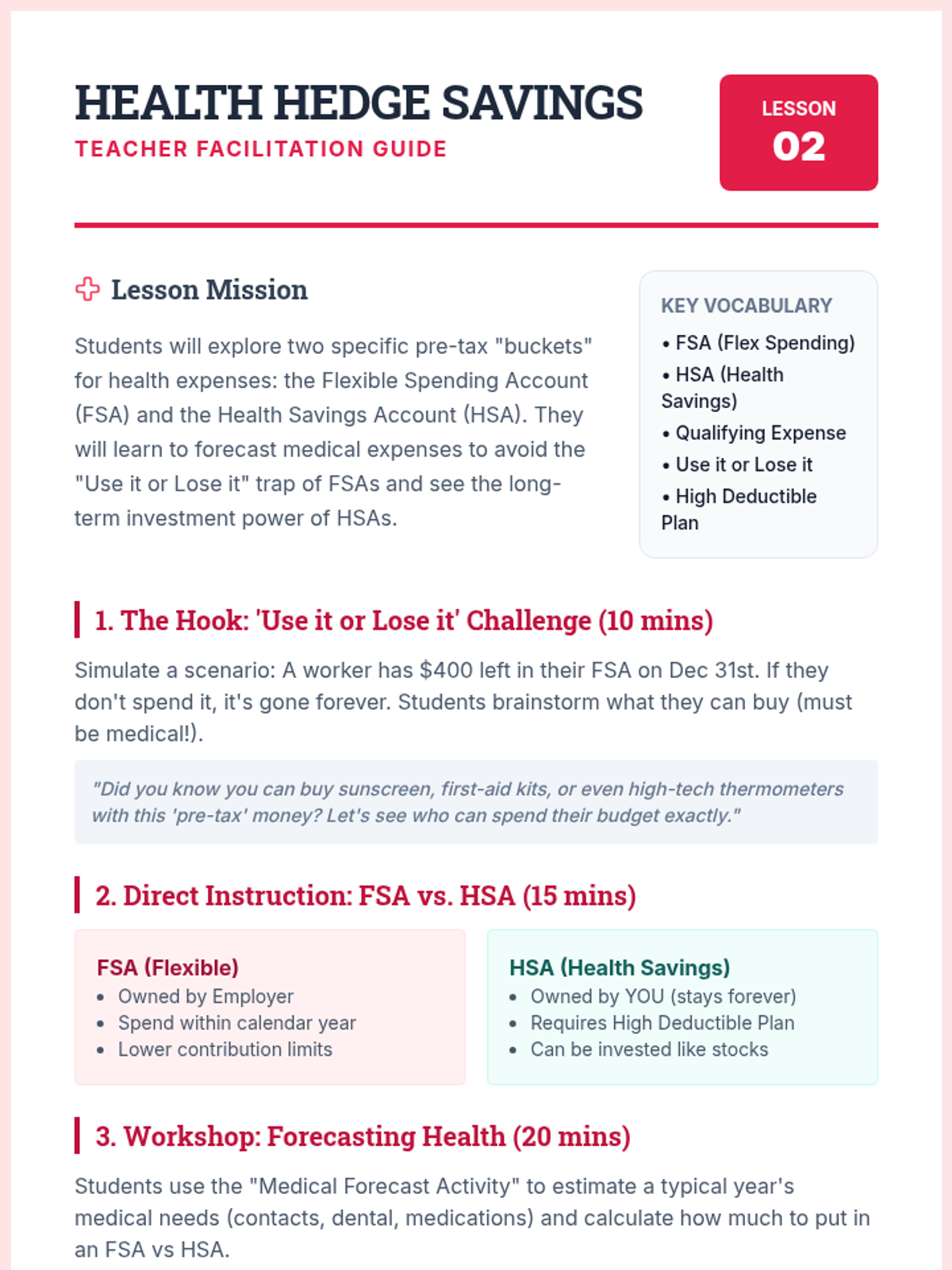
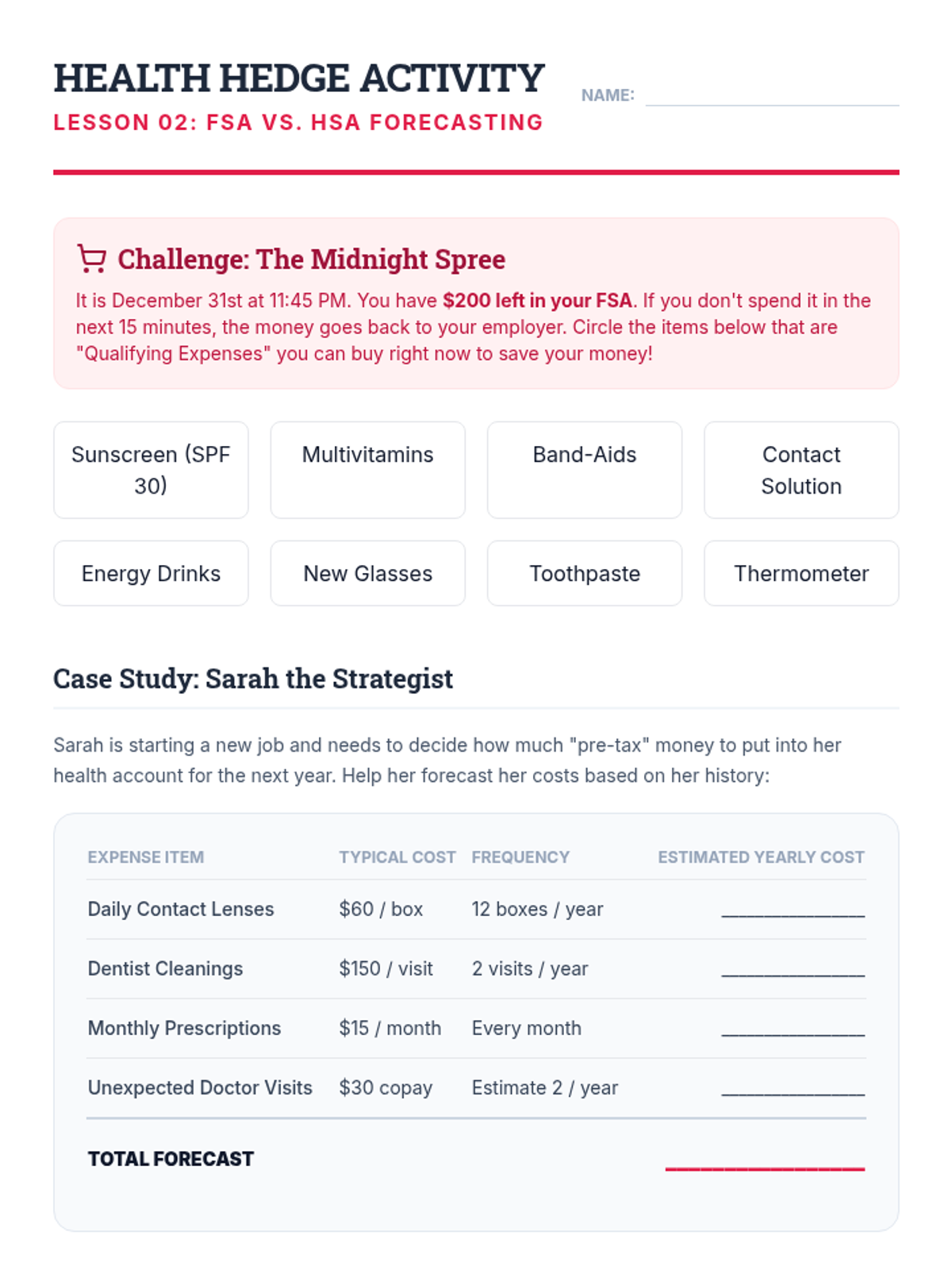
Learners explore Flexible Spending Accounts and Health Savings Accounts, analyzing how these vehicles lower healthcare costs and act as savings tools.
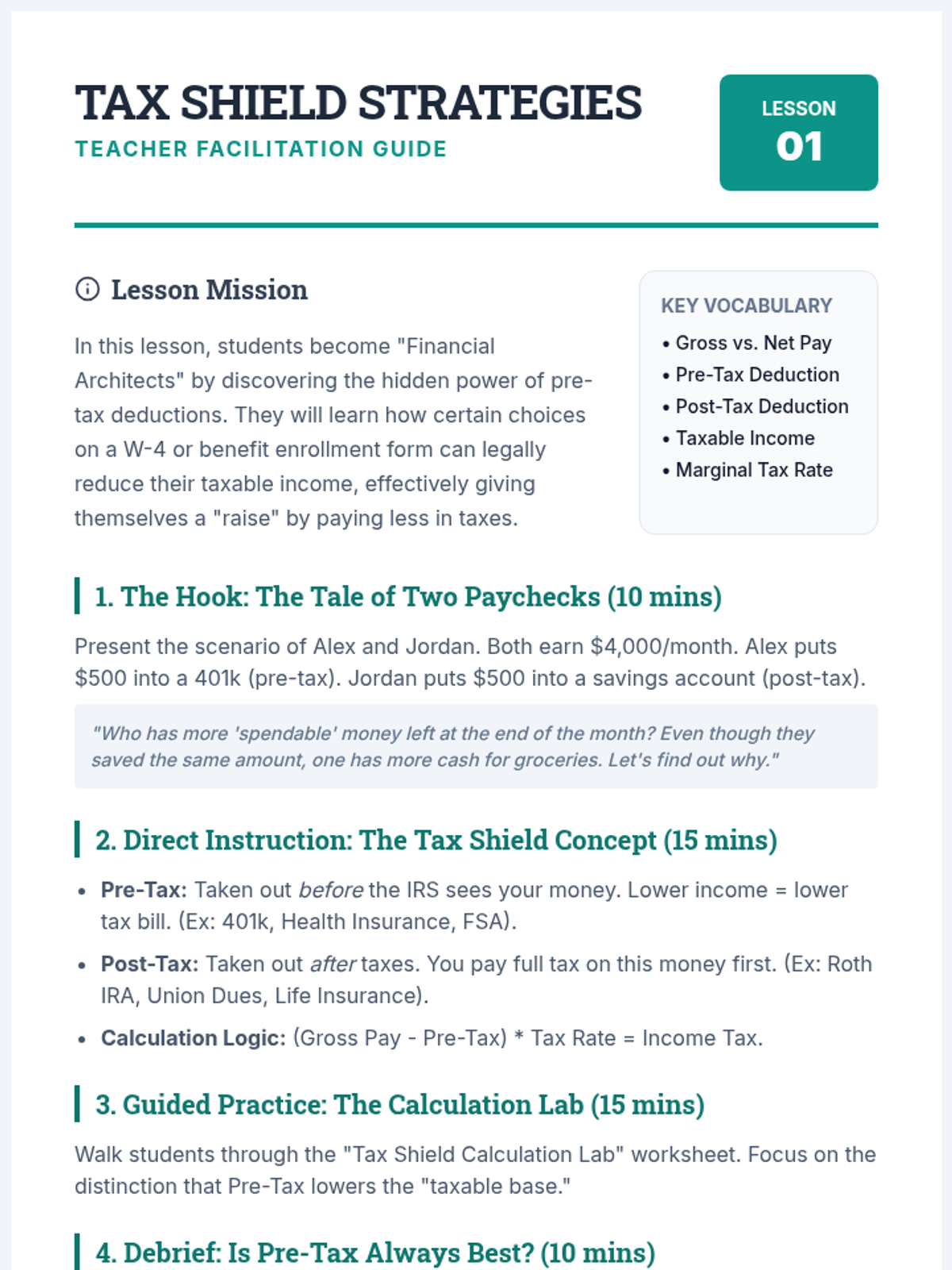
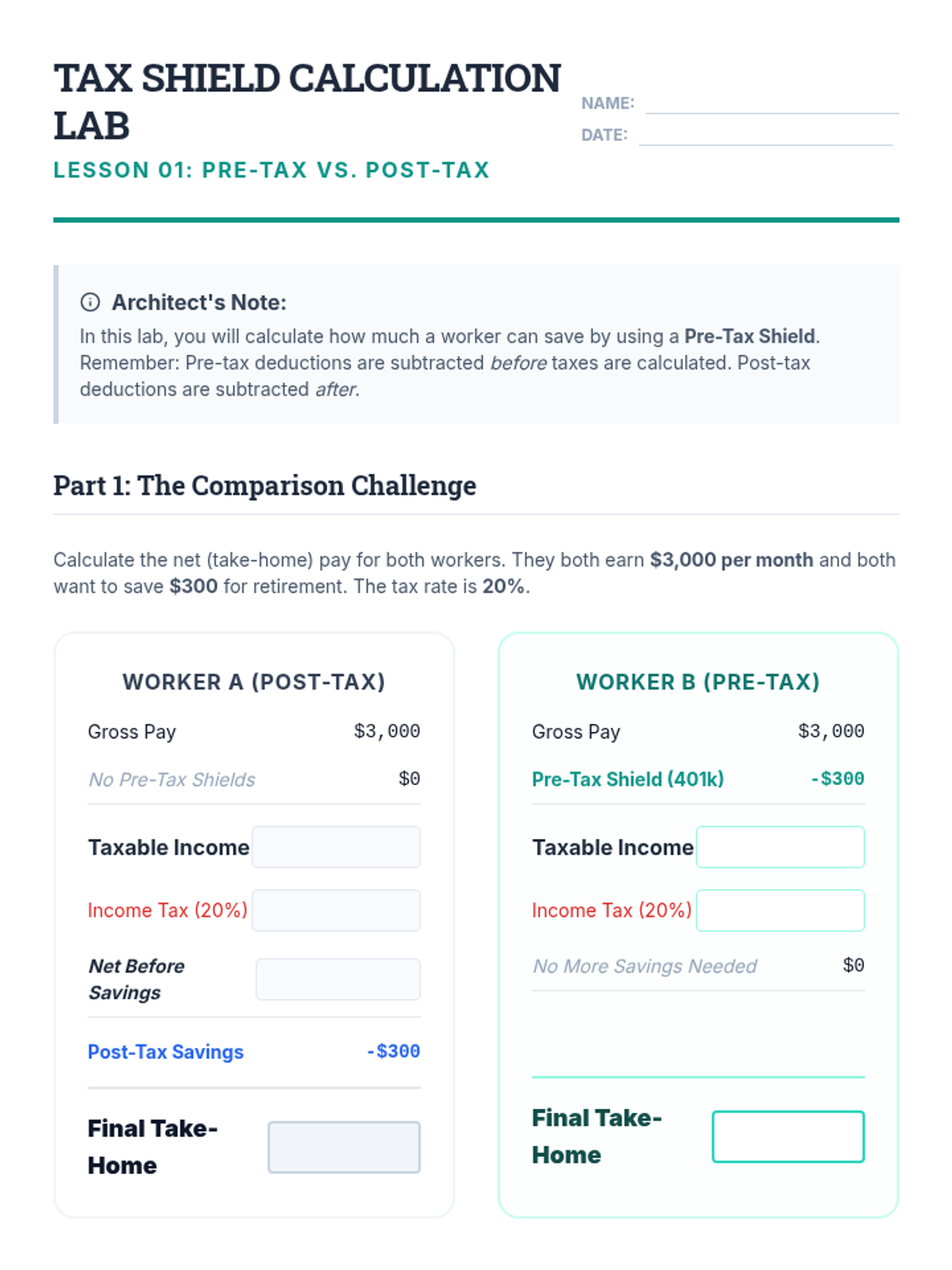
Students investigate the difference between pre-tax and post-tax deductions, calculating the tax savings benefit of using pre-tax instruments.
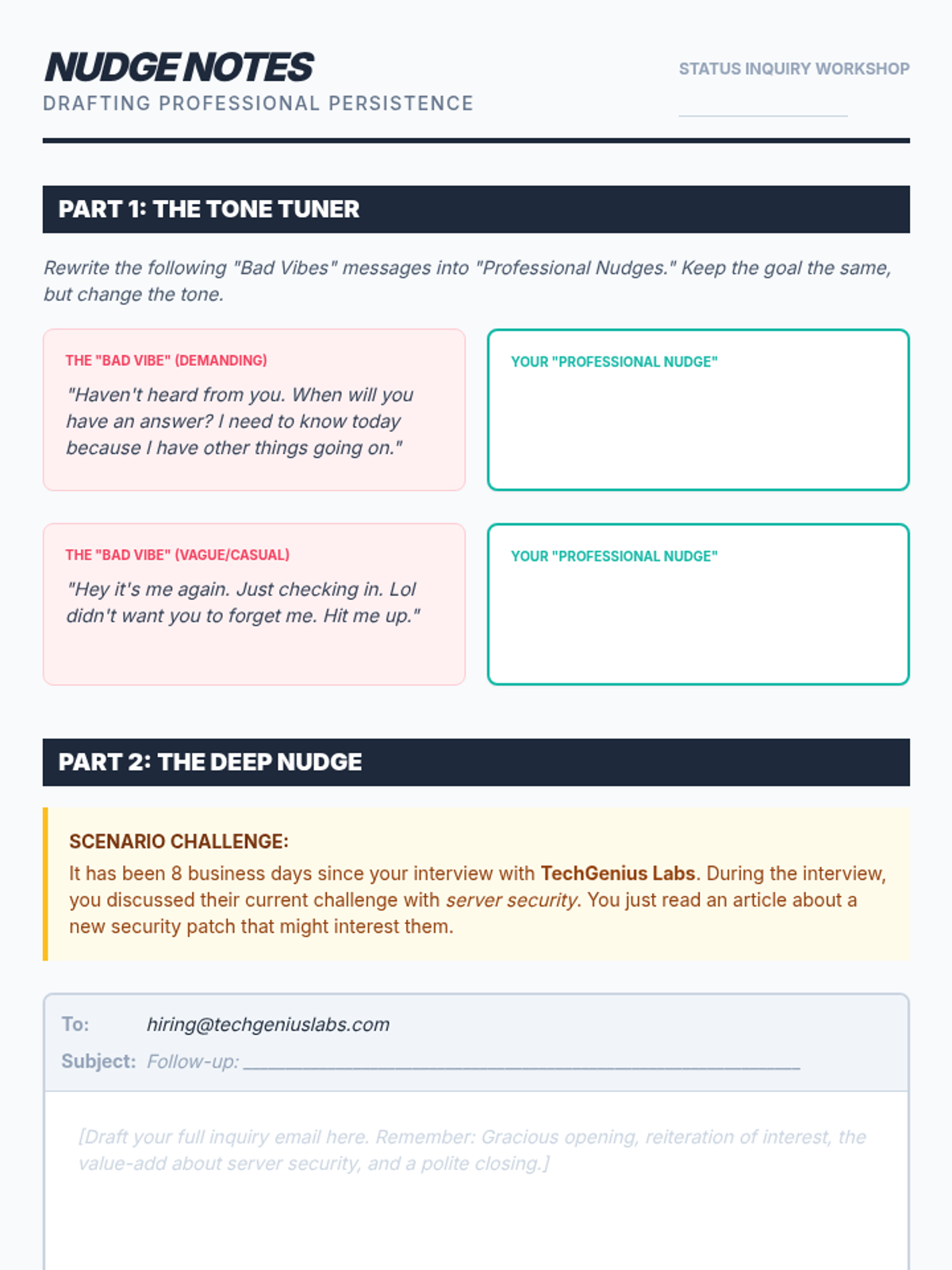
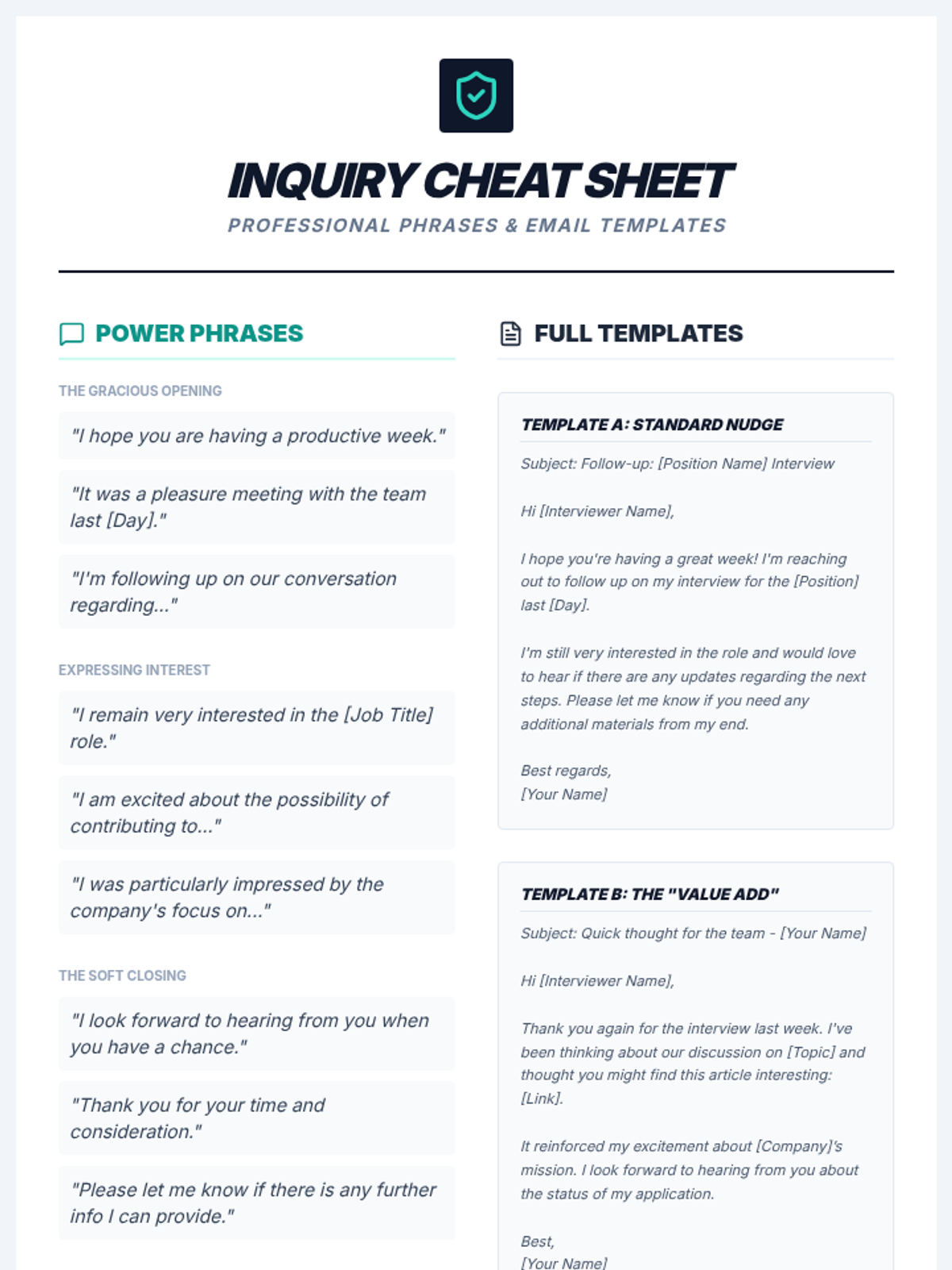
Focusing on the 'nudge' email, this lesson teaches students how to politely ask for an update. Students draft inquiries that reiterate interest and offer additional information rather than simply demanding a decision.
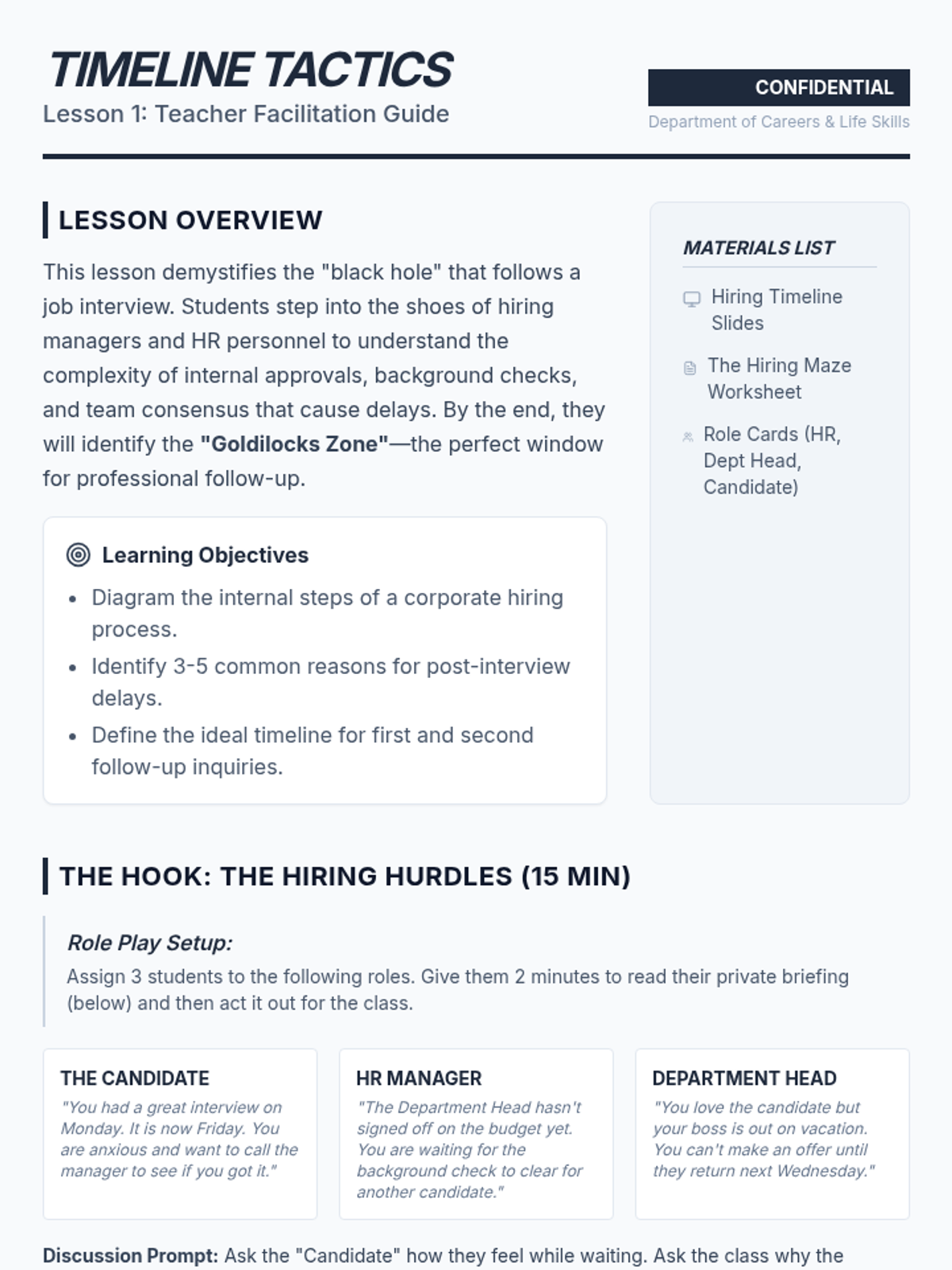
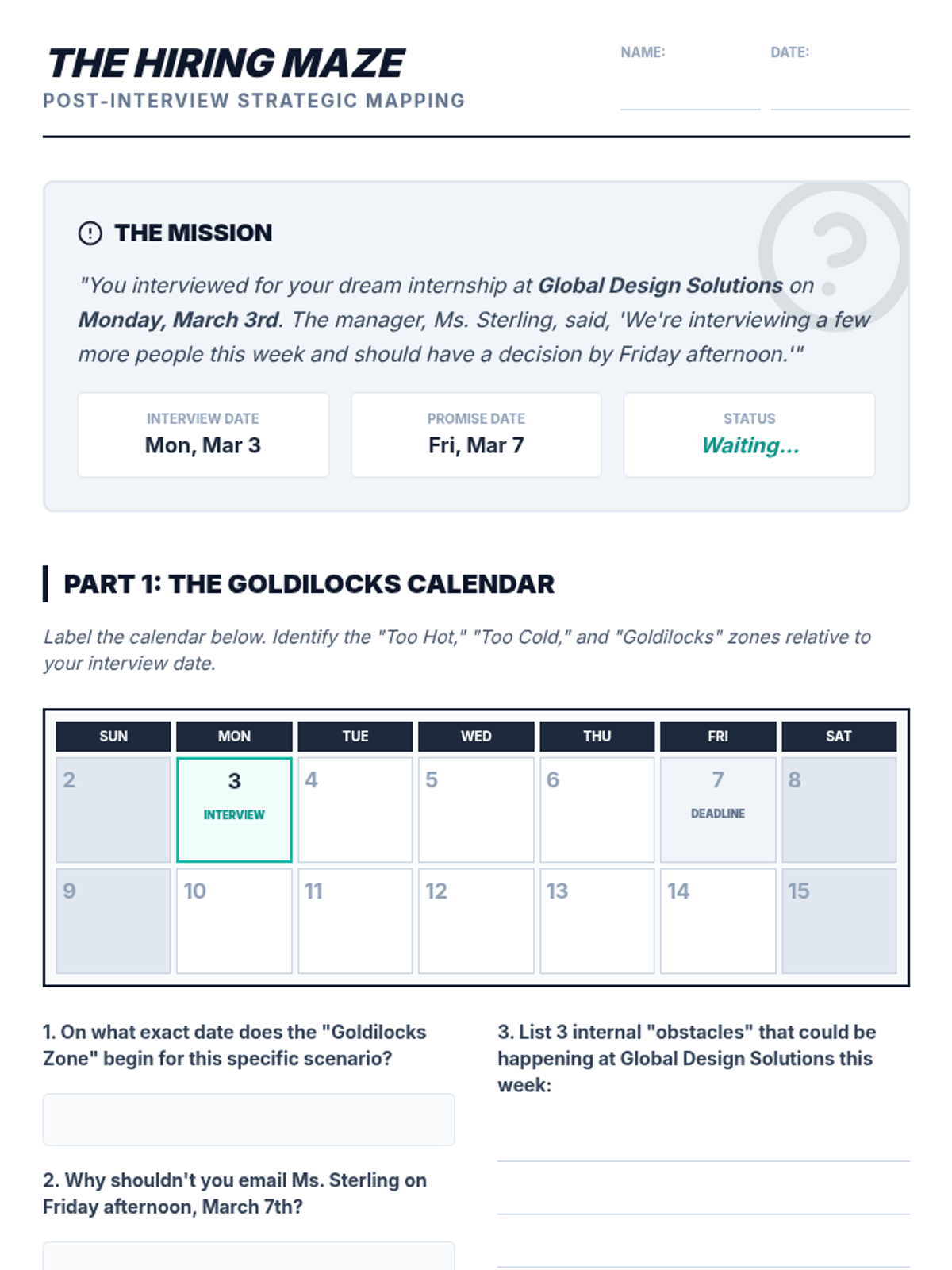
Students explore the typical hiring lifecycle from the employer's perspective to understand why delays happen. They create a visual timeline indicating the 'Goldilocks Zone' for follow-up.
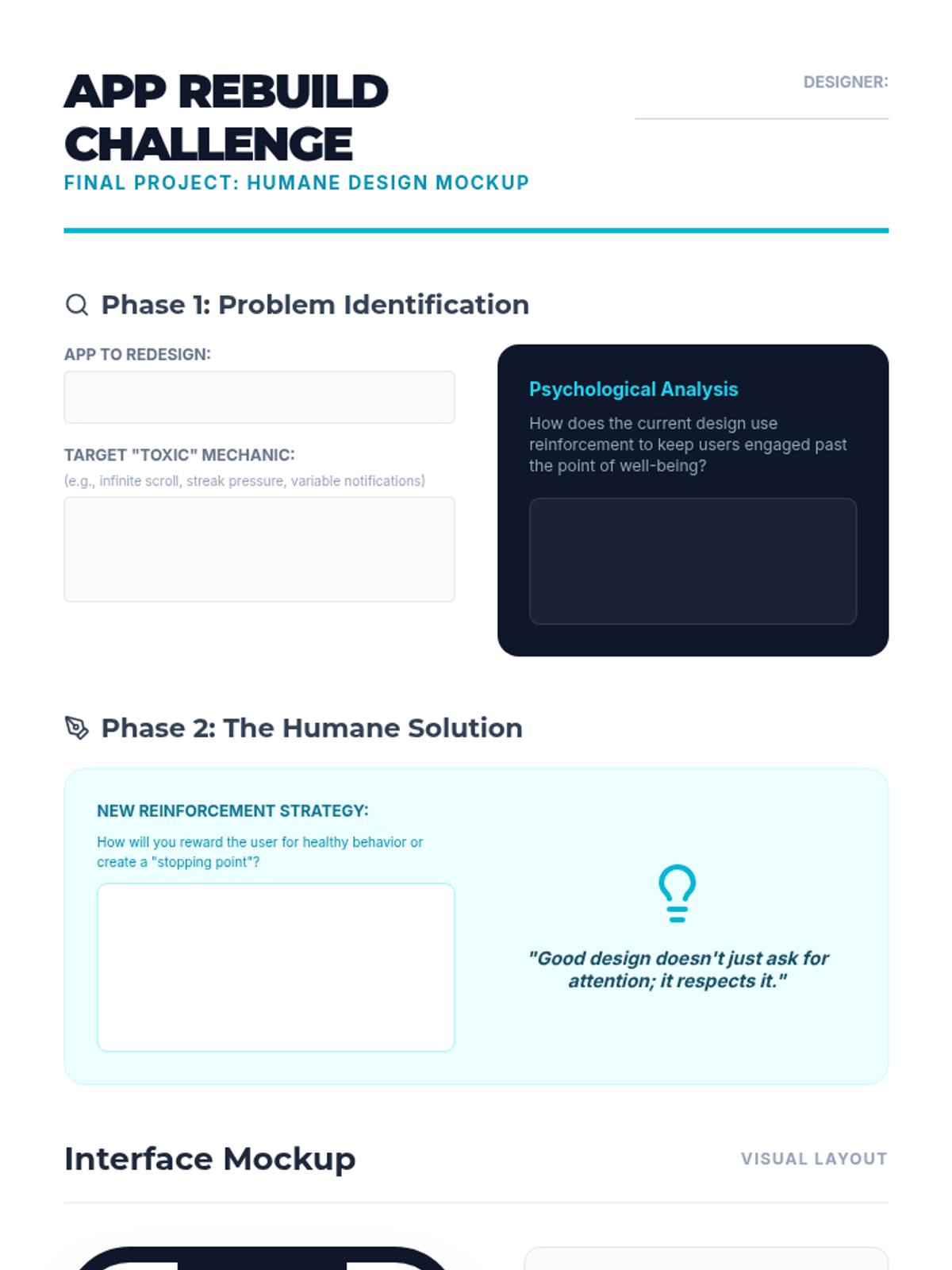
Students propose a redesign of a popular app that uses positive reinforcement to encourage healthy boundaries rather than endless consumption. They create mockups of 'humane' interfaces.
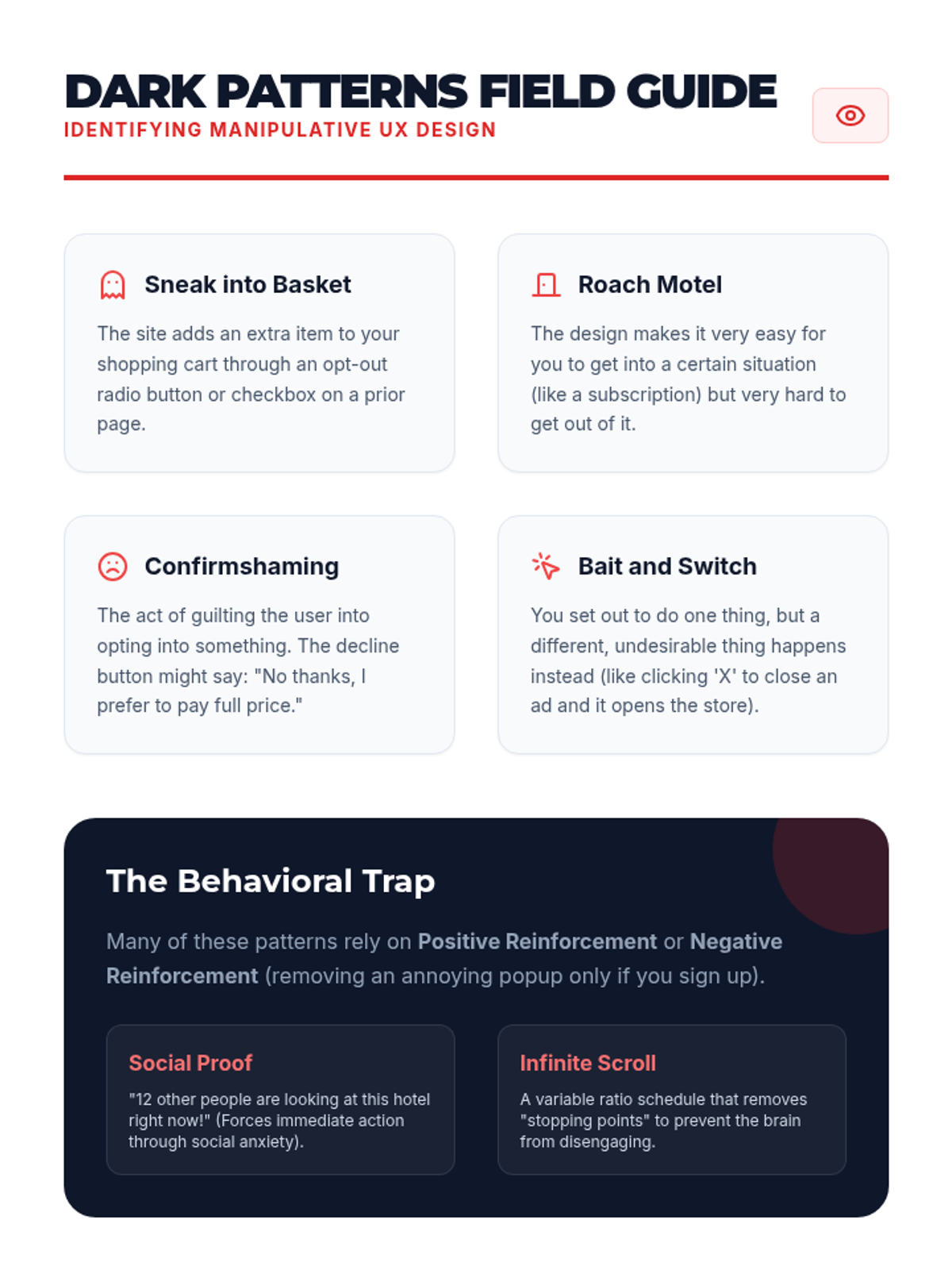
Students debate the ethics of using psychological vulnerabilities to maximize screen time. They look at 'dark patterns' in UI/UX design that exploit positive reinforcement loops.
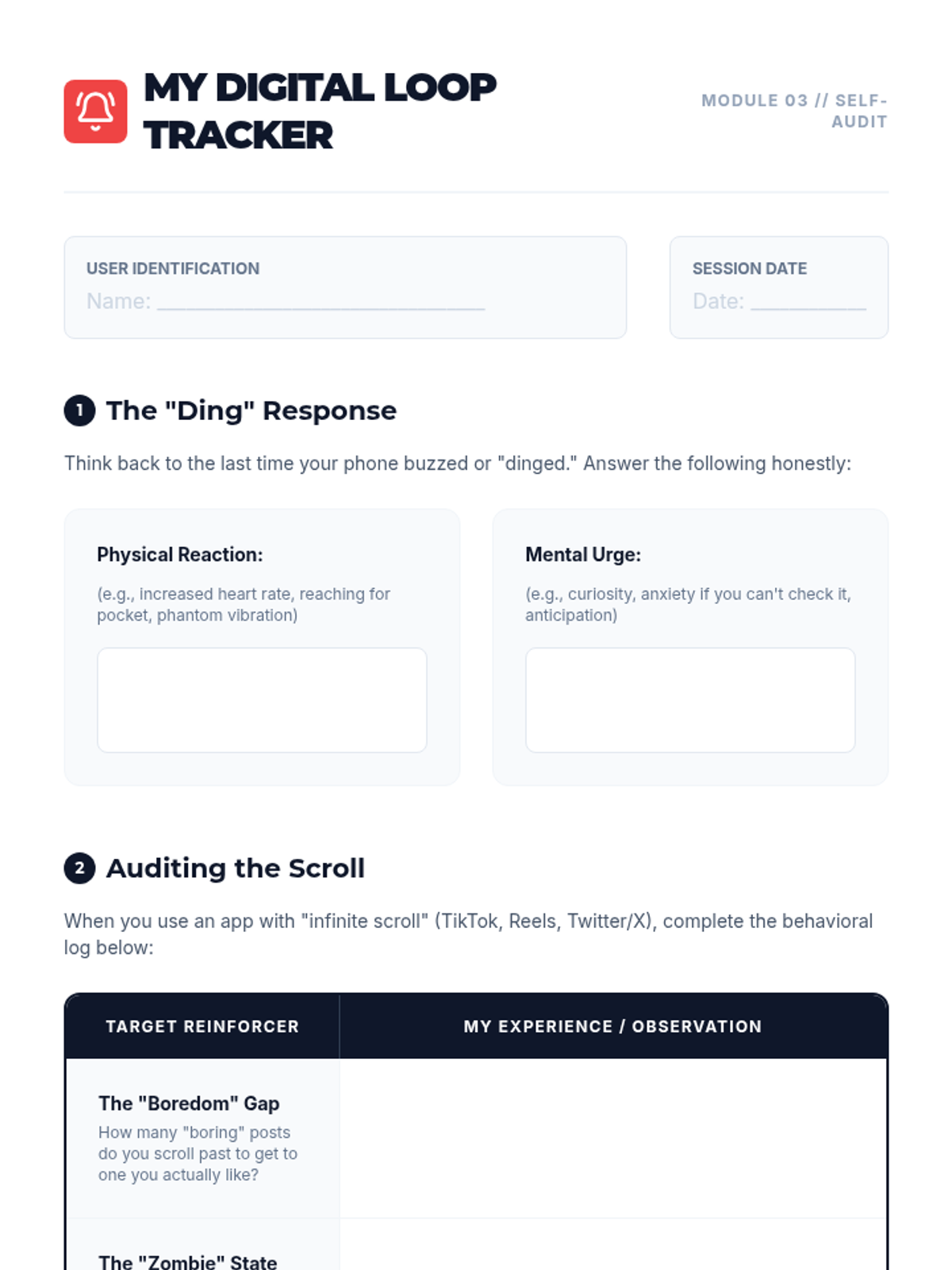
This lesson applies the concept of variable reinforcement to social media feeds (infinite scroll) and notifications. Students track their own reactions to notifications to understand the 'intermittent reward' mechanism.
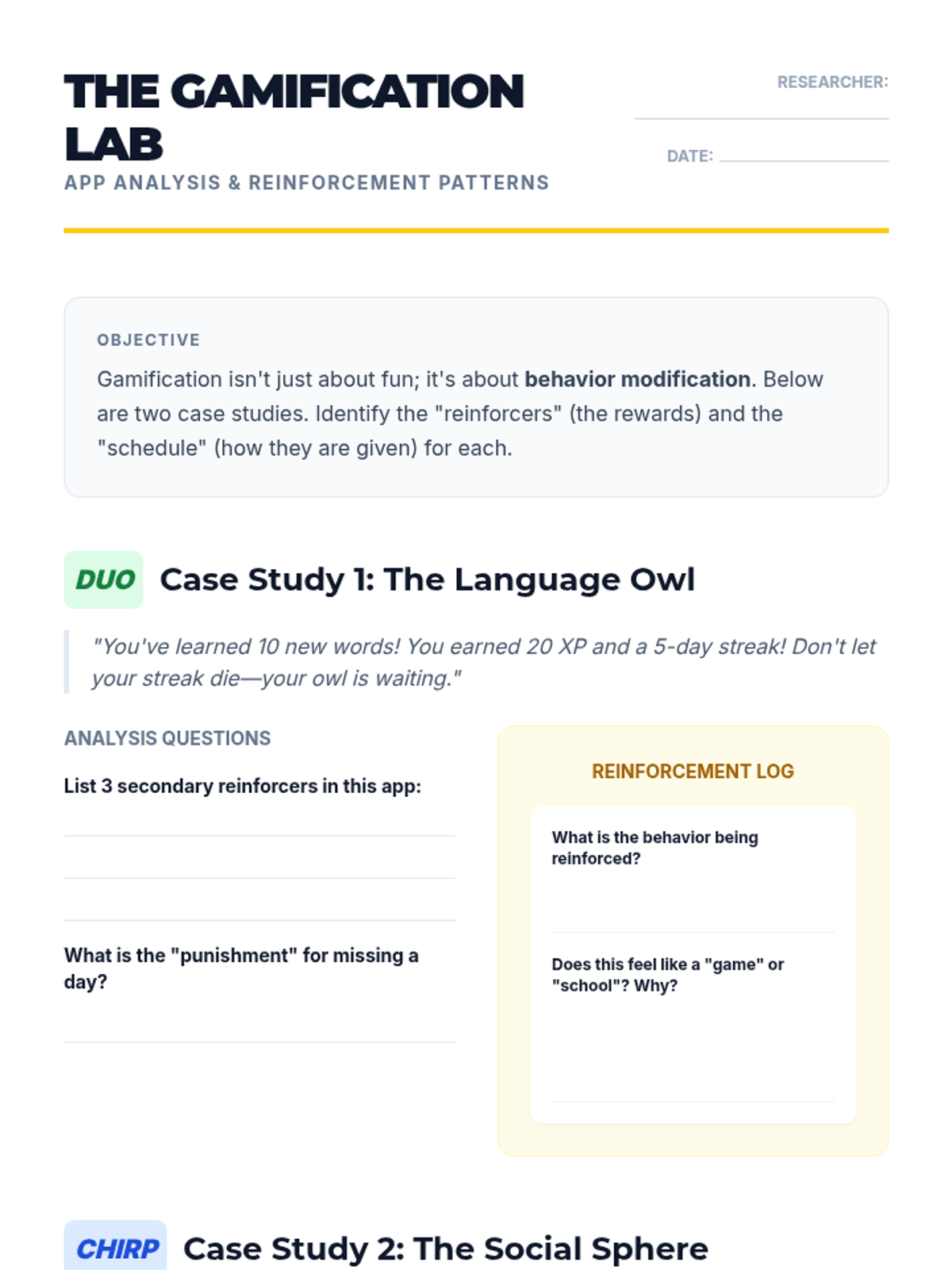
Students analyze common game elements like points, badges, and leaderboards, discussing how these digital tokens serve as conditioned reinforcers.
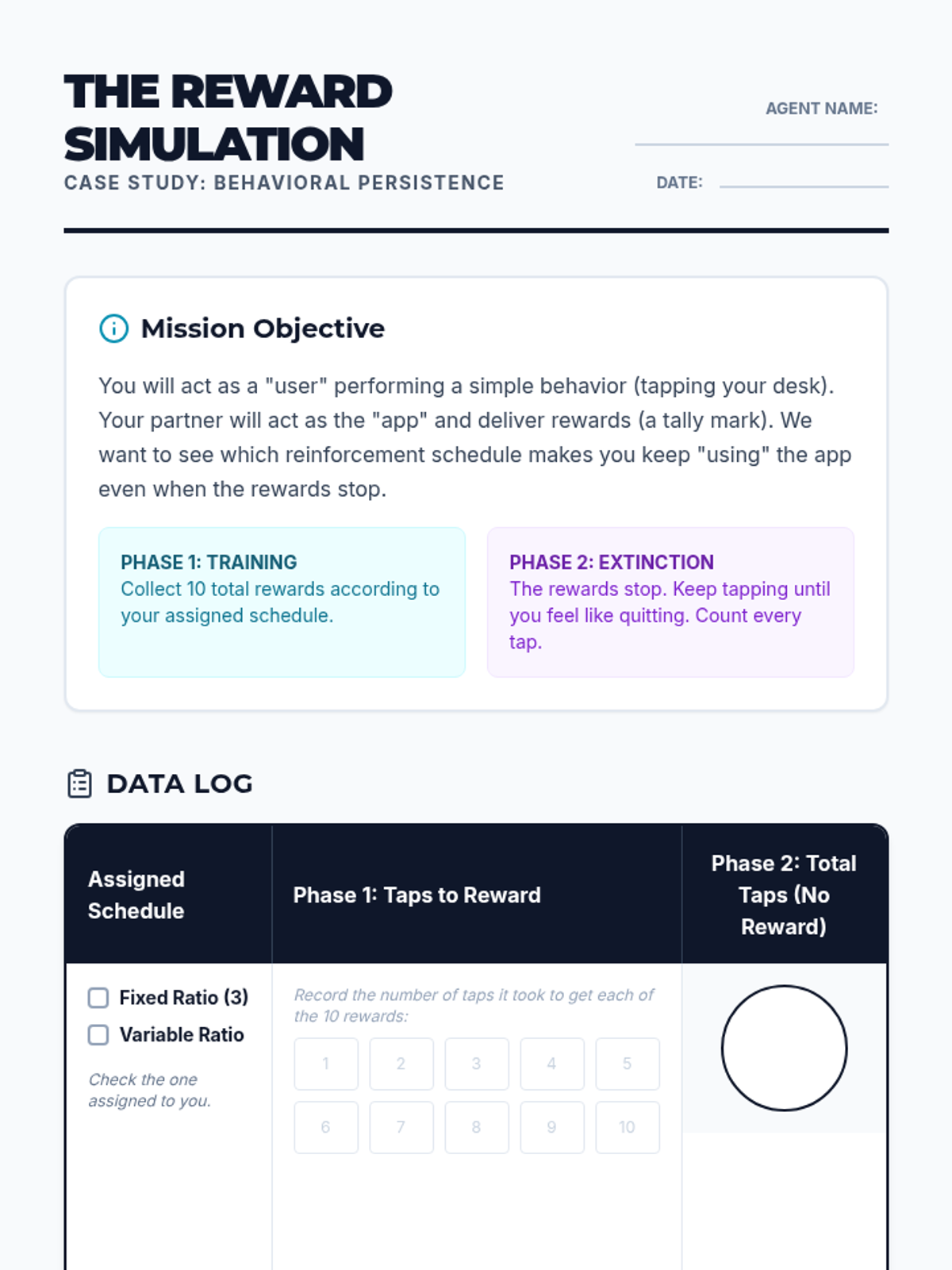
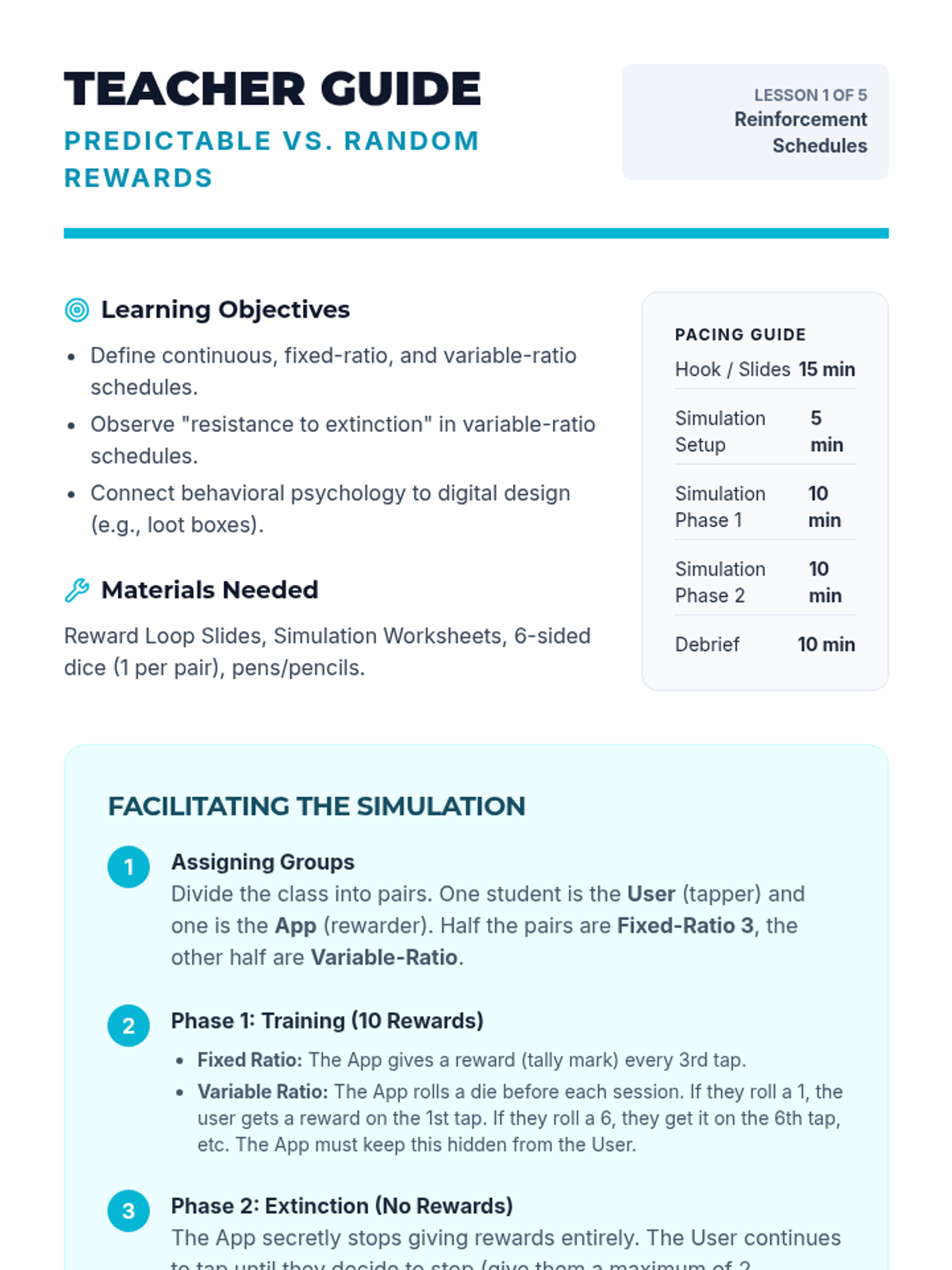
Introduction to reinforcement schedules, contrasting the predictability of fixed schedules with the persistence of variable ones.
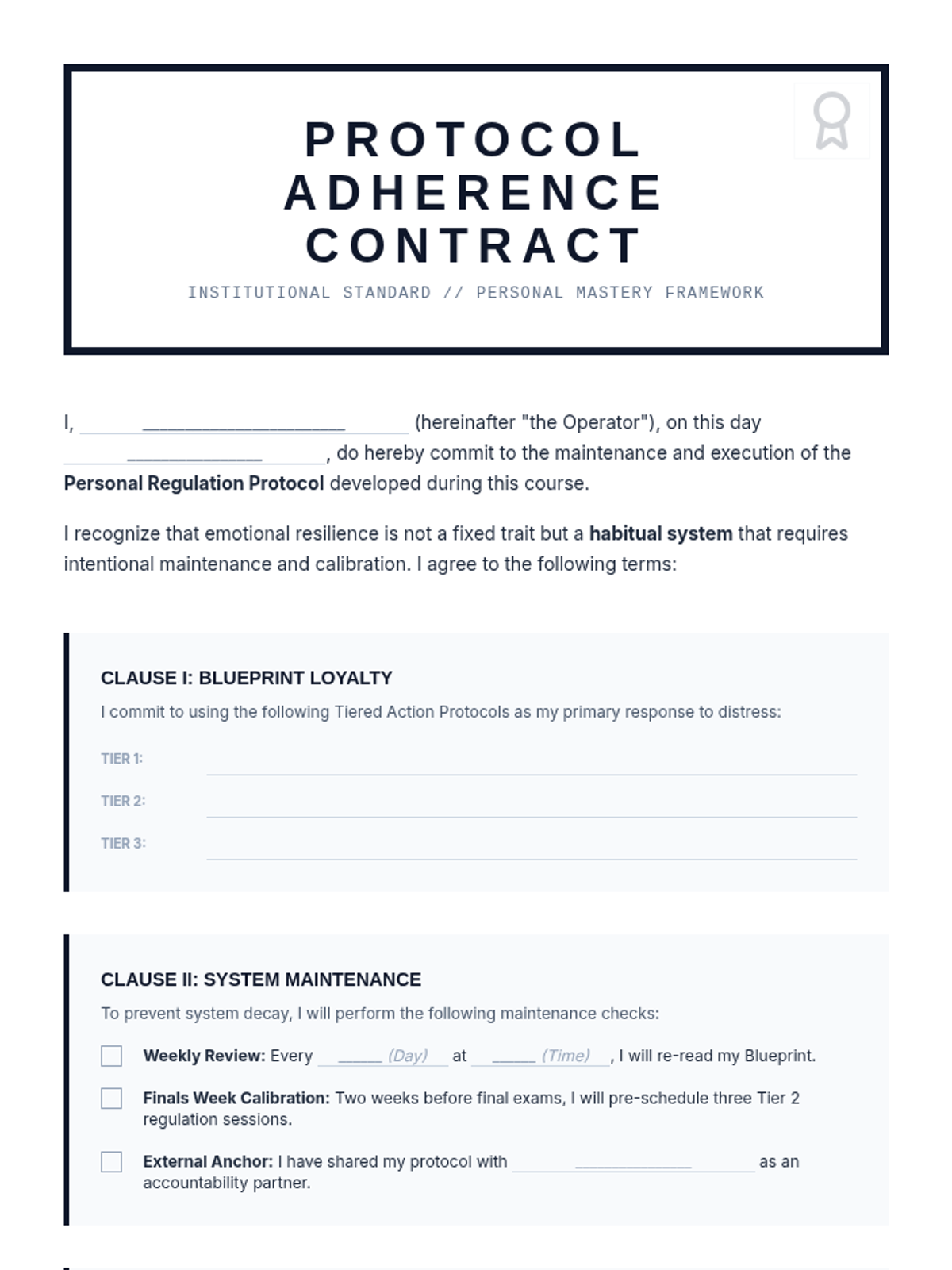
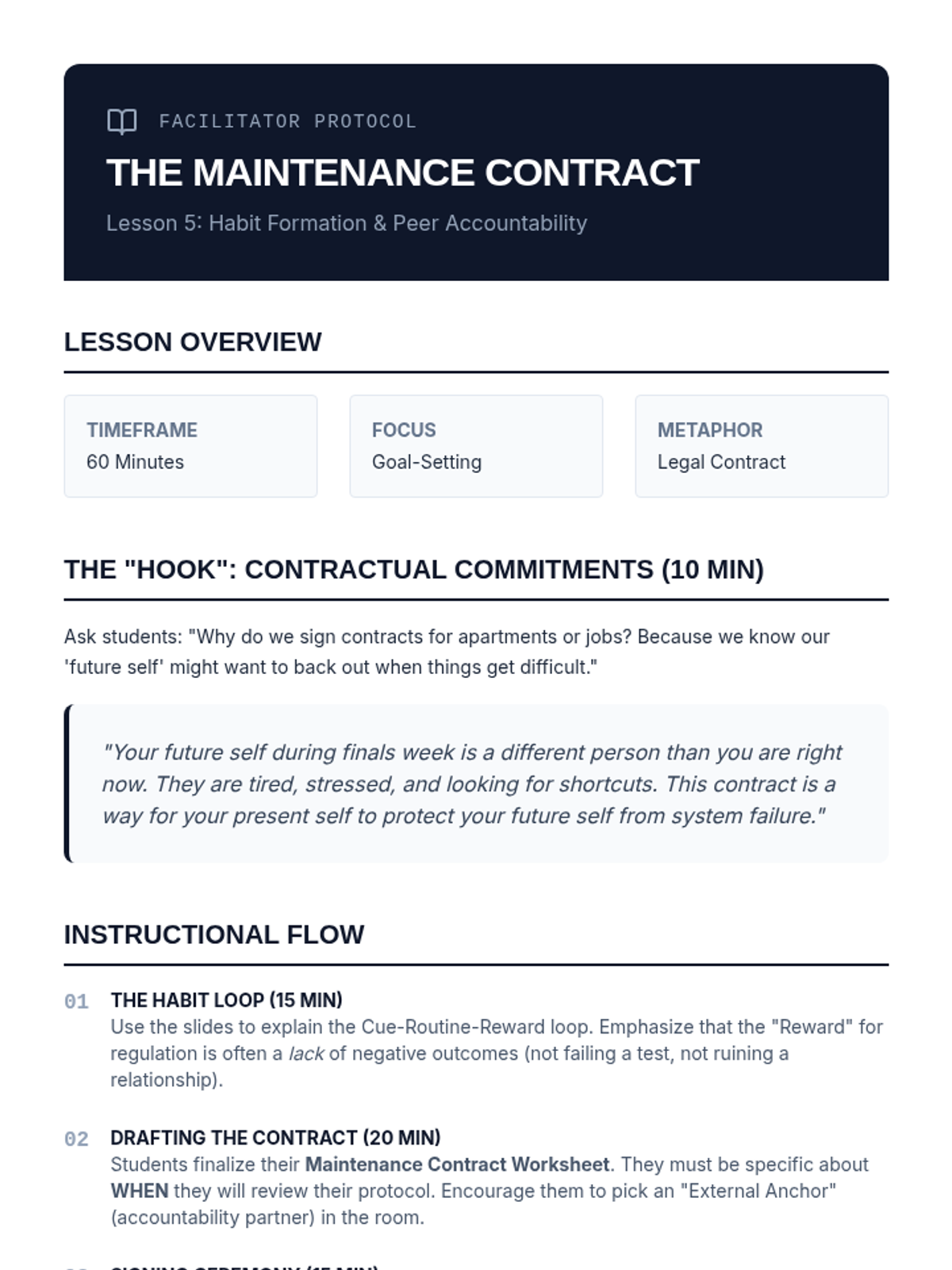
Students finalize their protocols and establish a formal maintenance contract to ensure long-term adherence and habit formation.
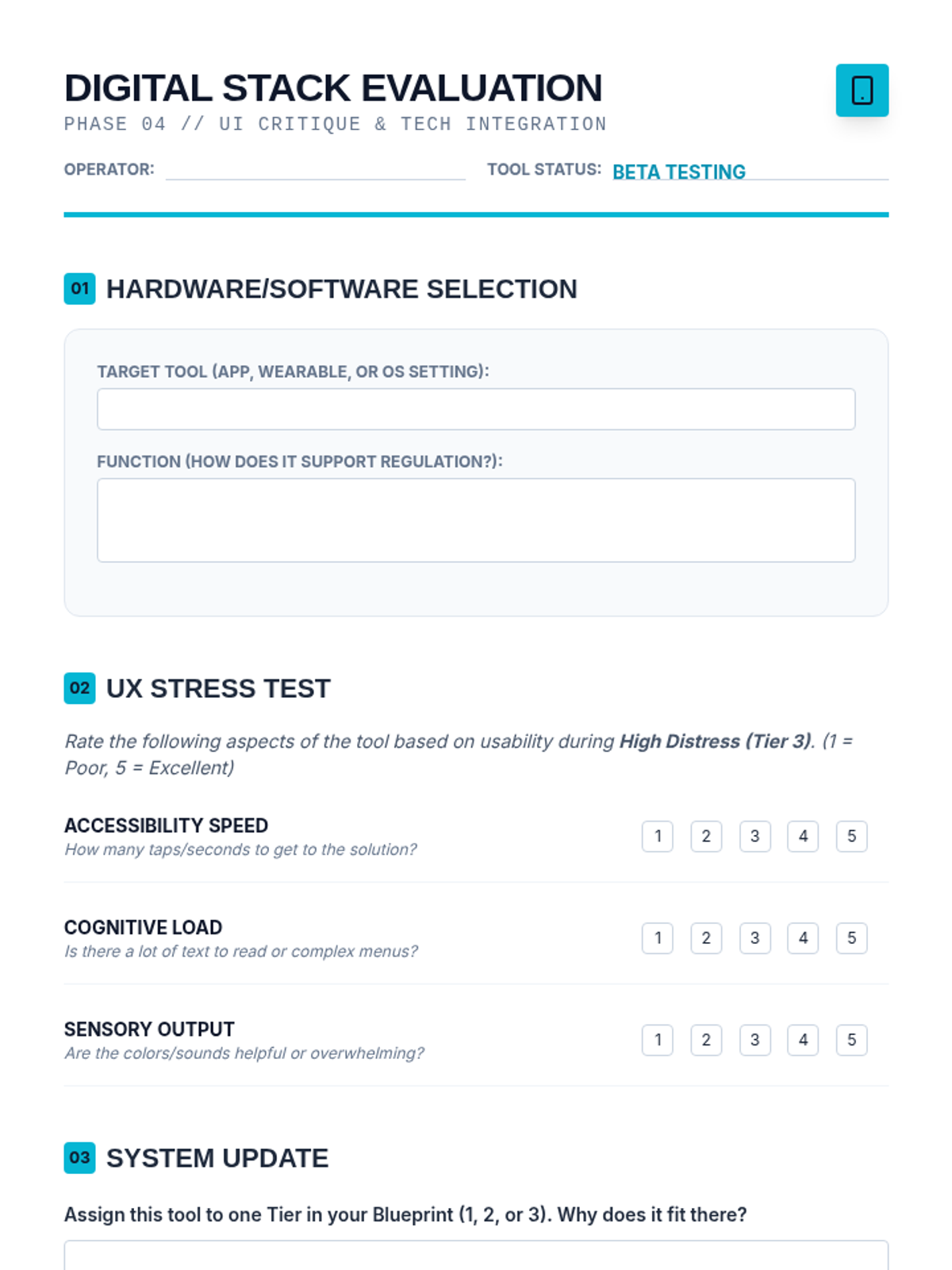
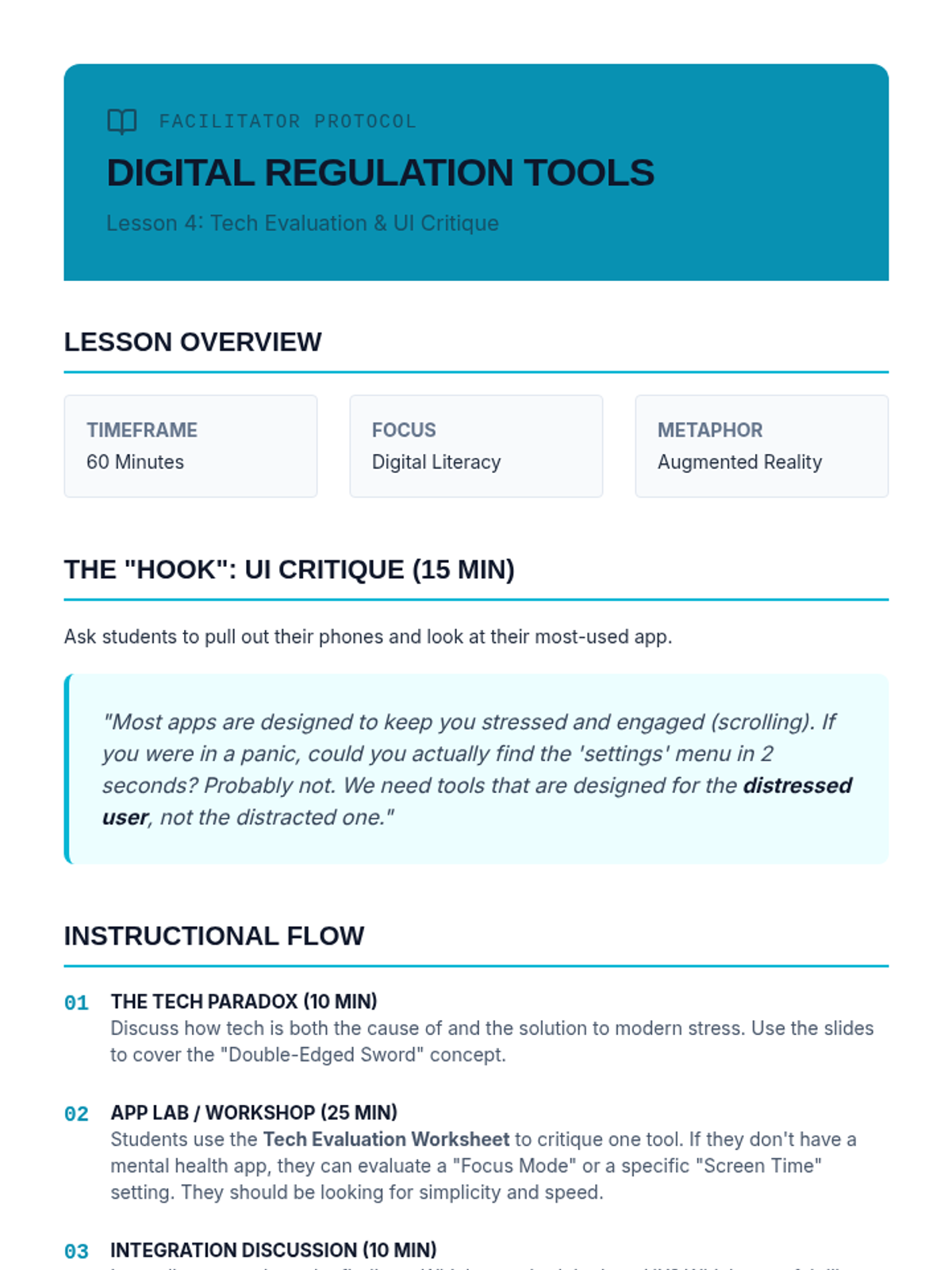
Students evaluate digital tools, apps, and wearables to integrate effective technological supports into their personalized regulation protocols.
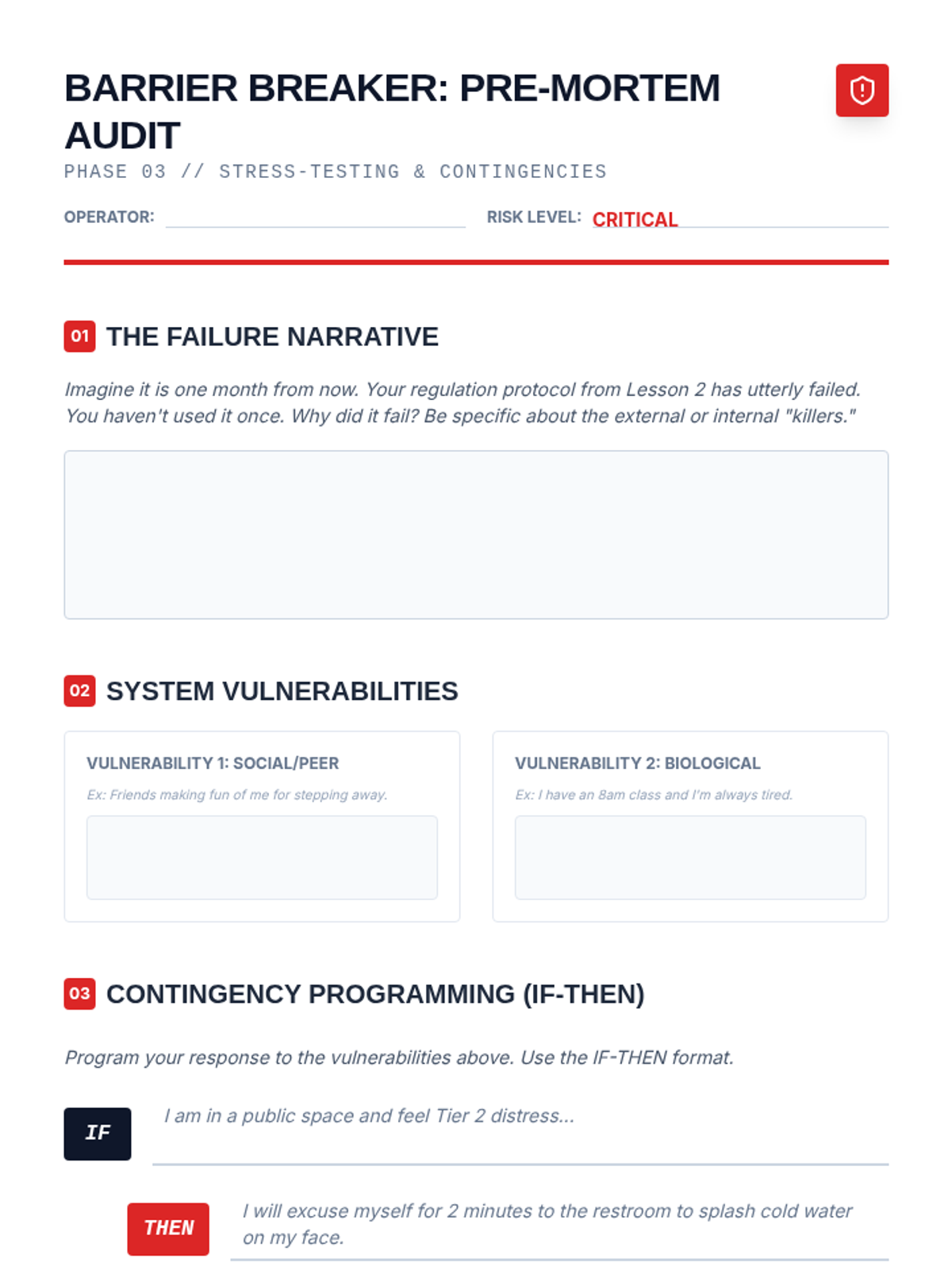
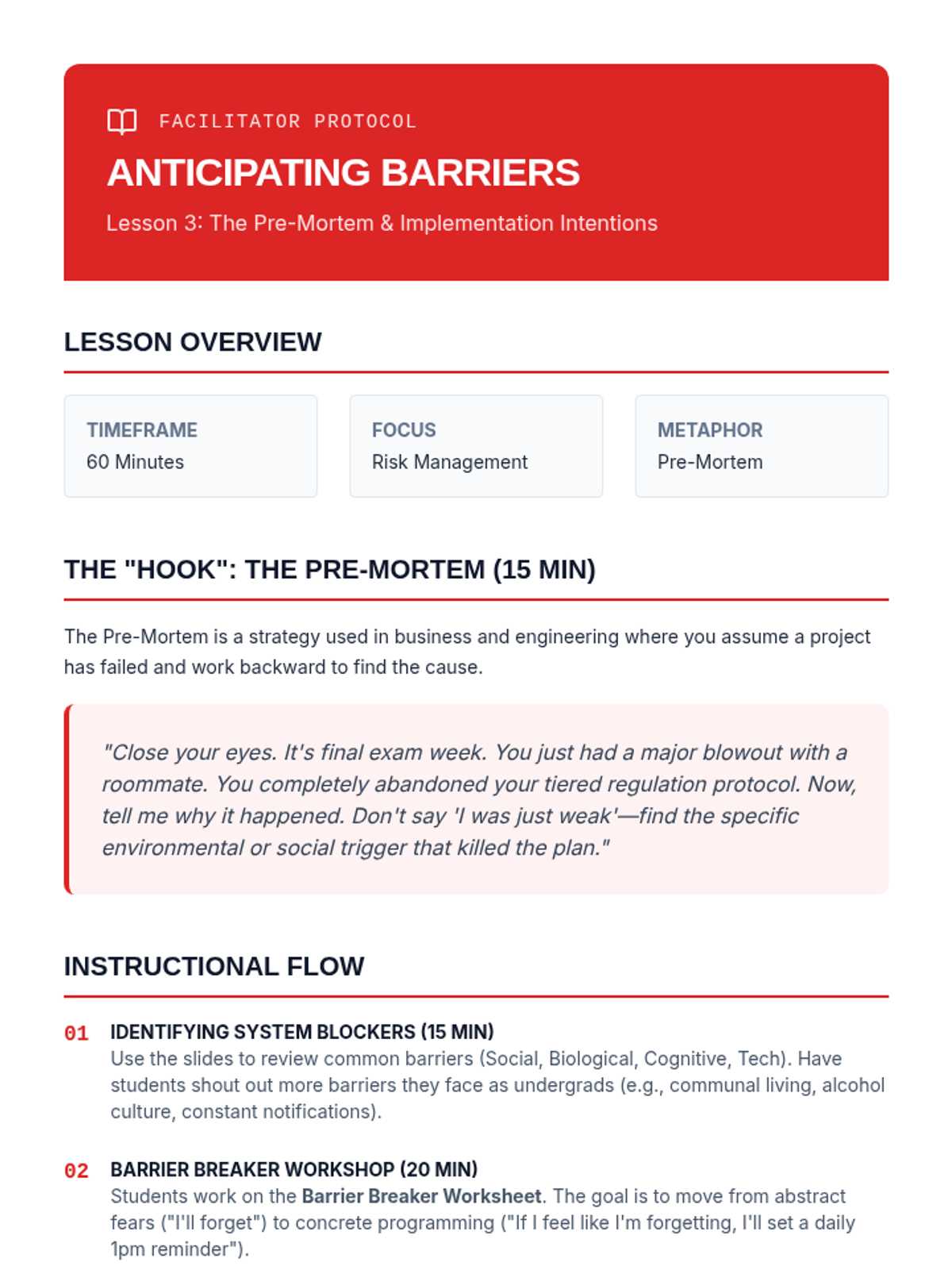
Students identify obstacles to their regulation plan and develop 'If-Then' implementation intentions to navigate triggers and barriers.
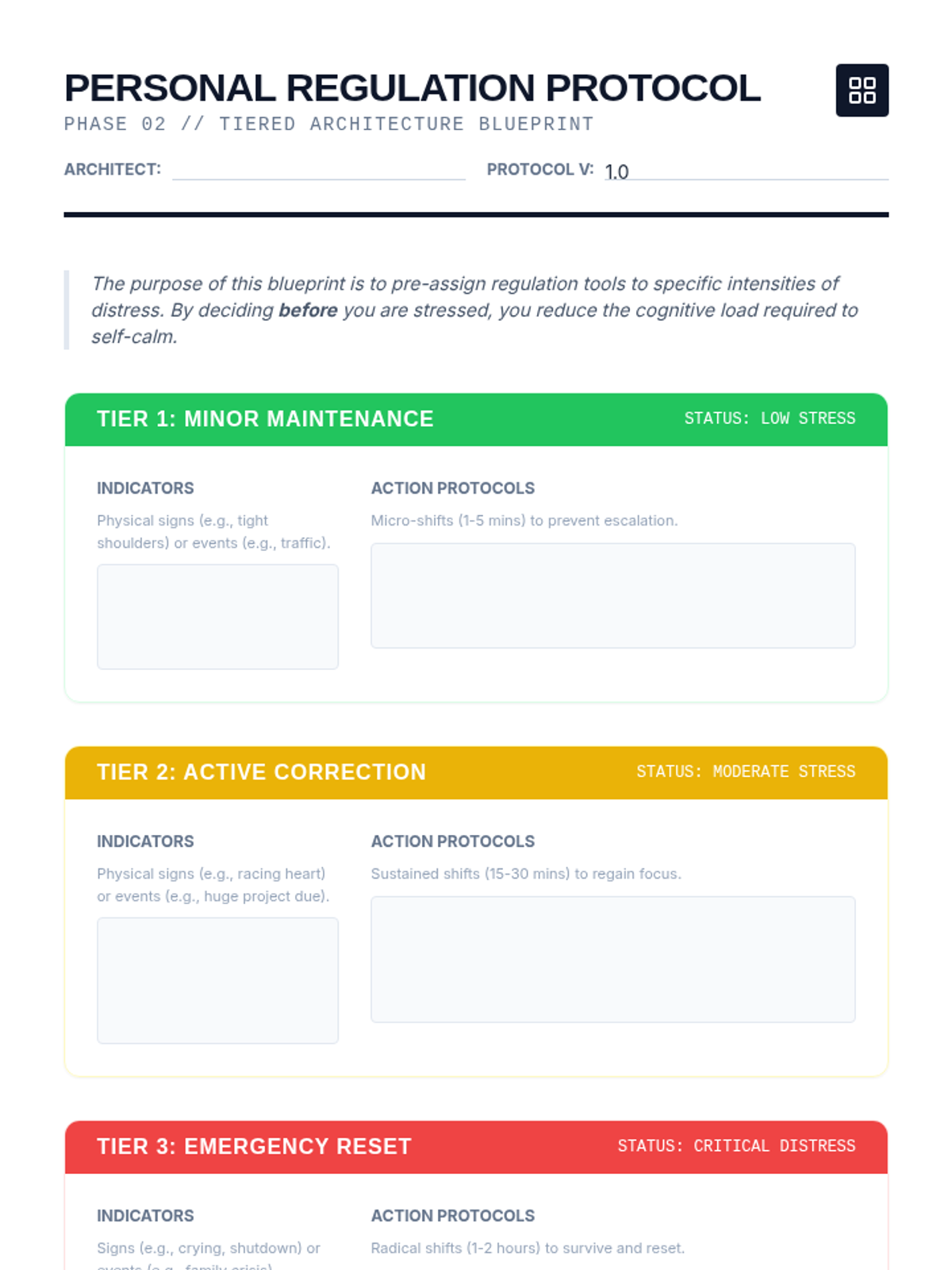
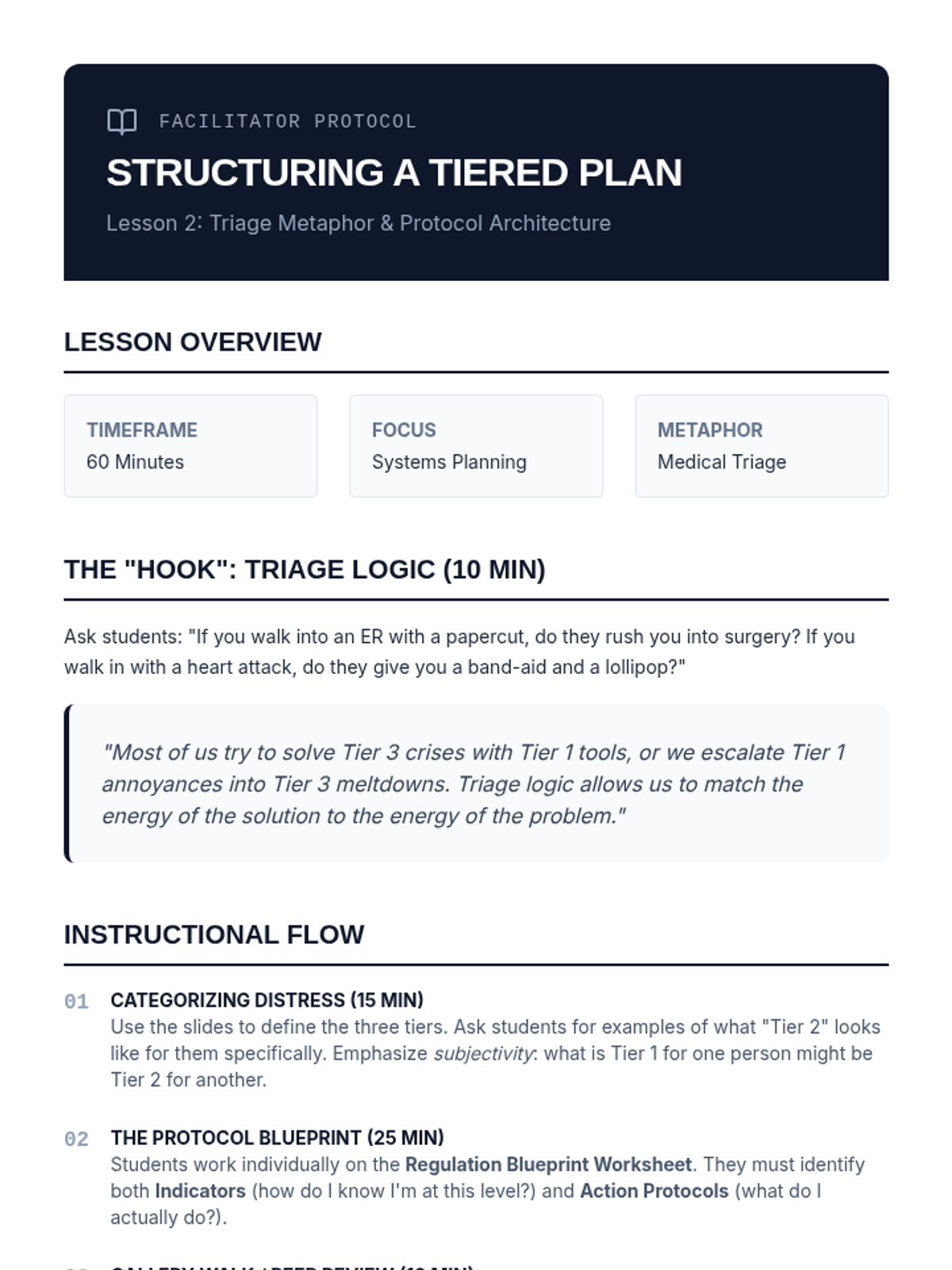
Students use a triage metaphor to design a three-tiered response plan, assigning specific self-calming tools to different intensities of distress.
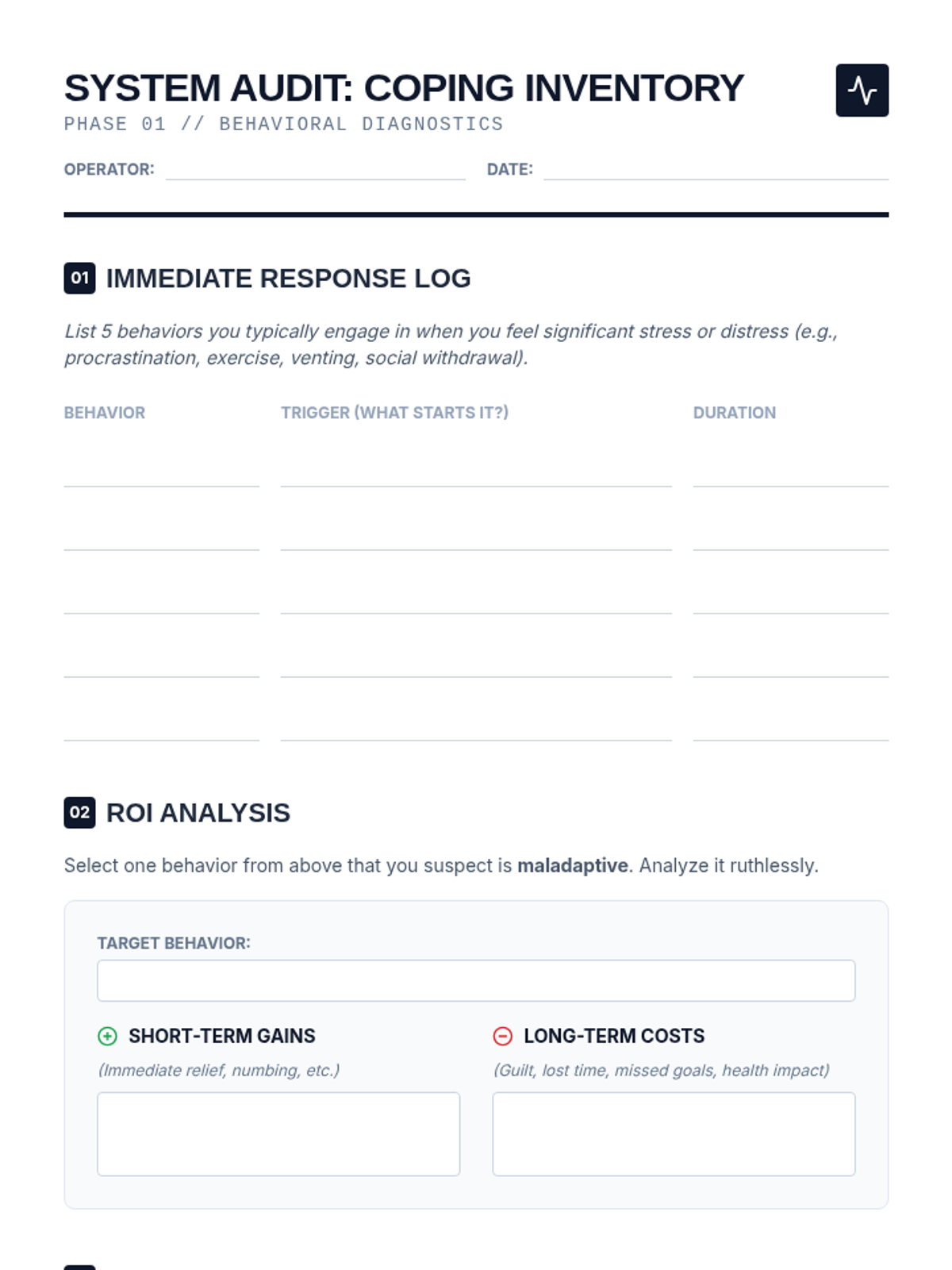
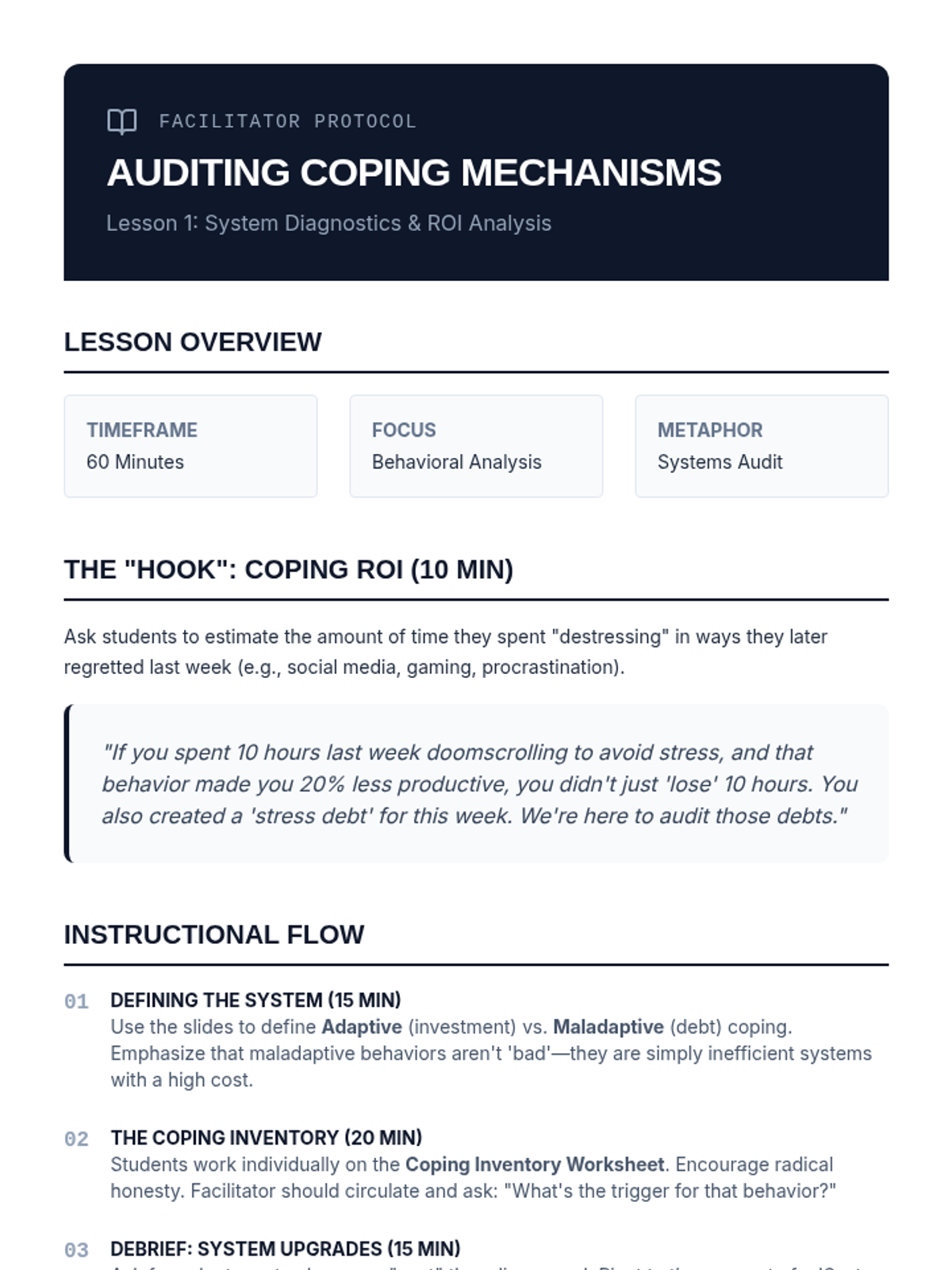
Students conduct an inventory of current stress responses and perform a cost-benefit analysis to distinguish between adaptive and maladaptive behaviors.
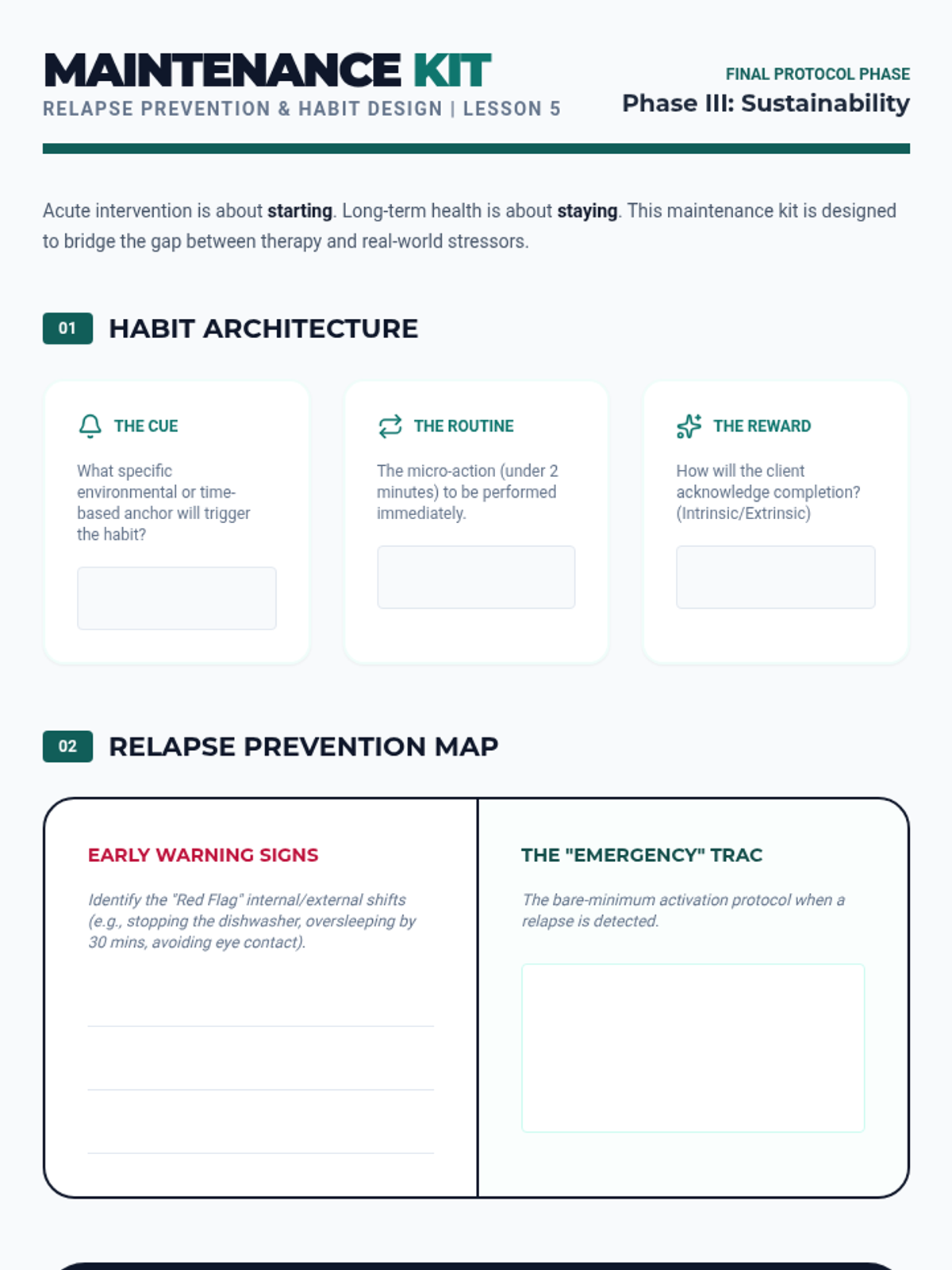
Transitions from acute intervention to long-term maintenance, applying habit formation principles and creating relapse prevention plans to ensure sustainable lifestyle changes.
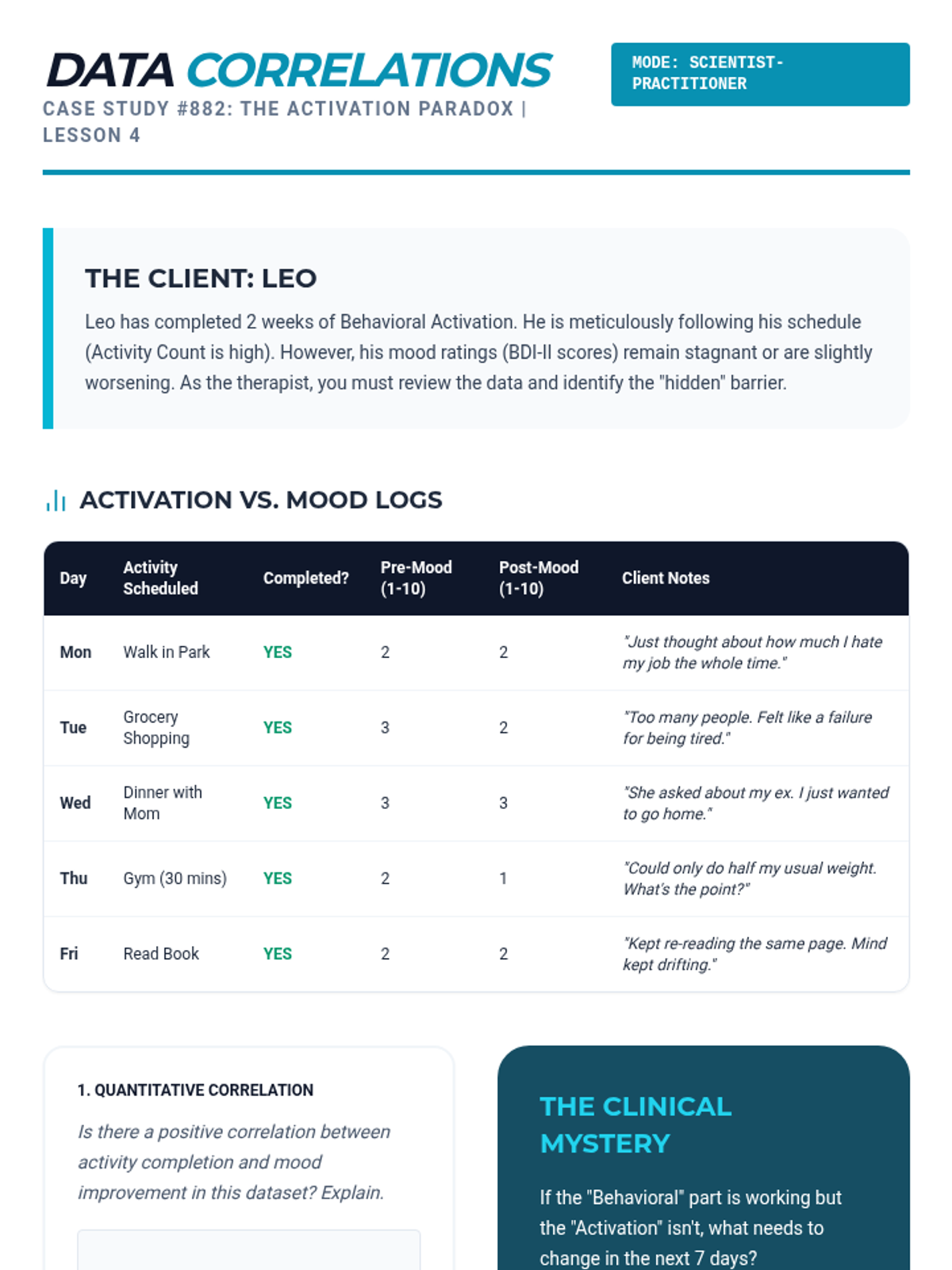
Students analyze mood and activity data to evaluate intervention effectiveness, practicing the role of the scientist-practitioner in a clinical setting.
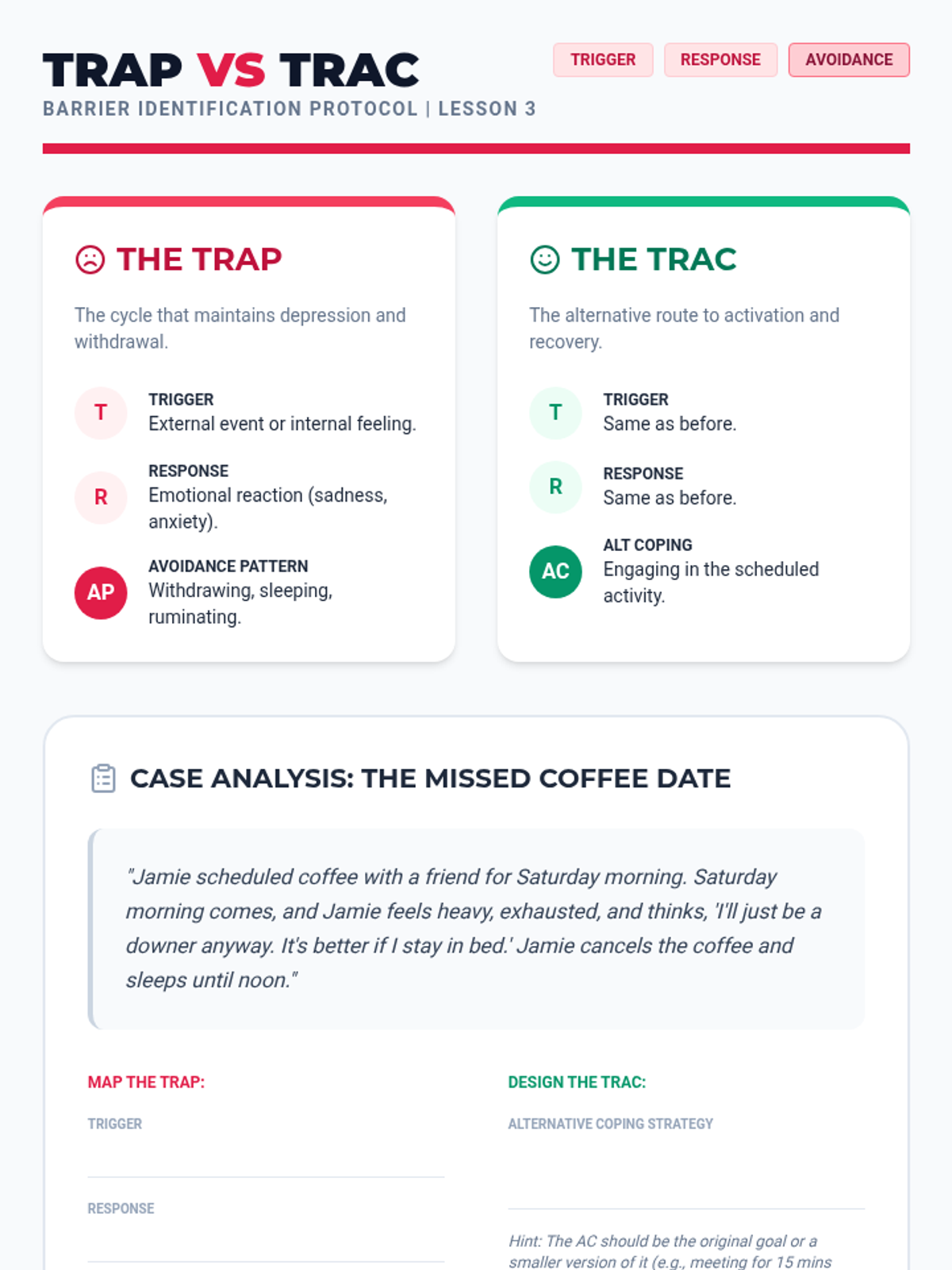
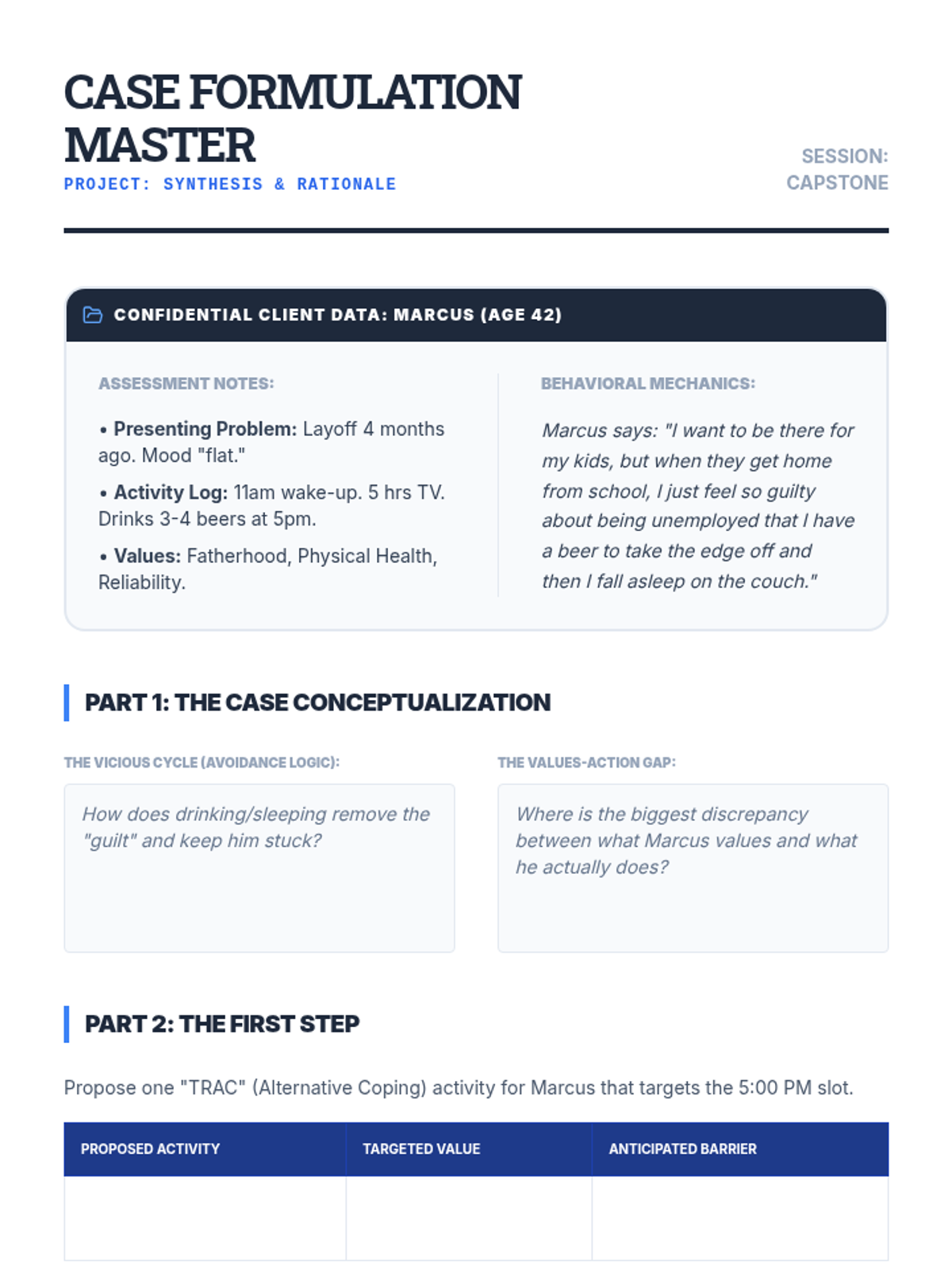
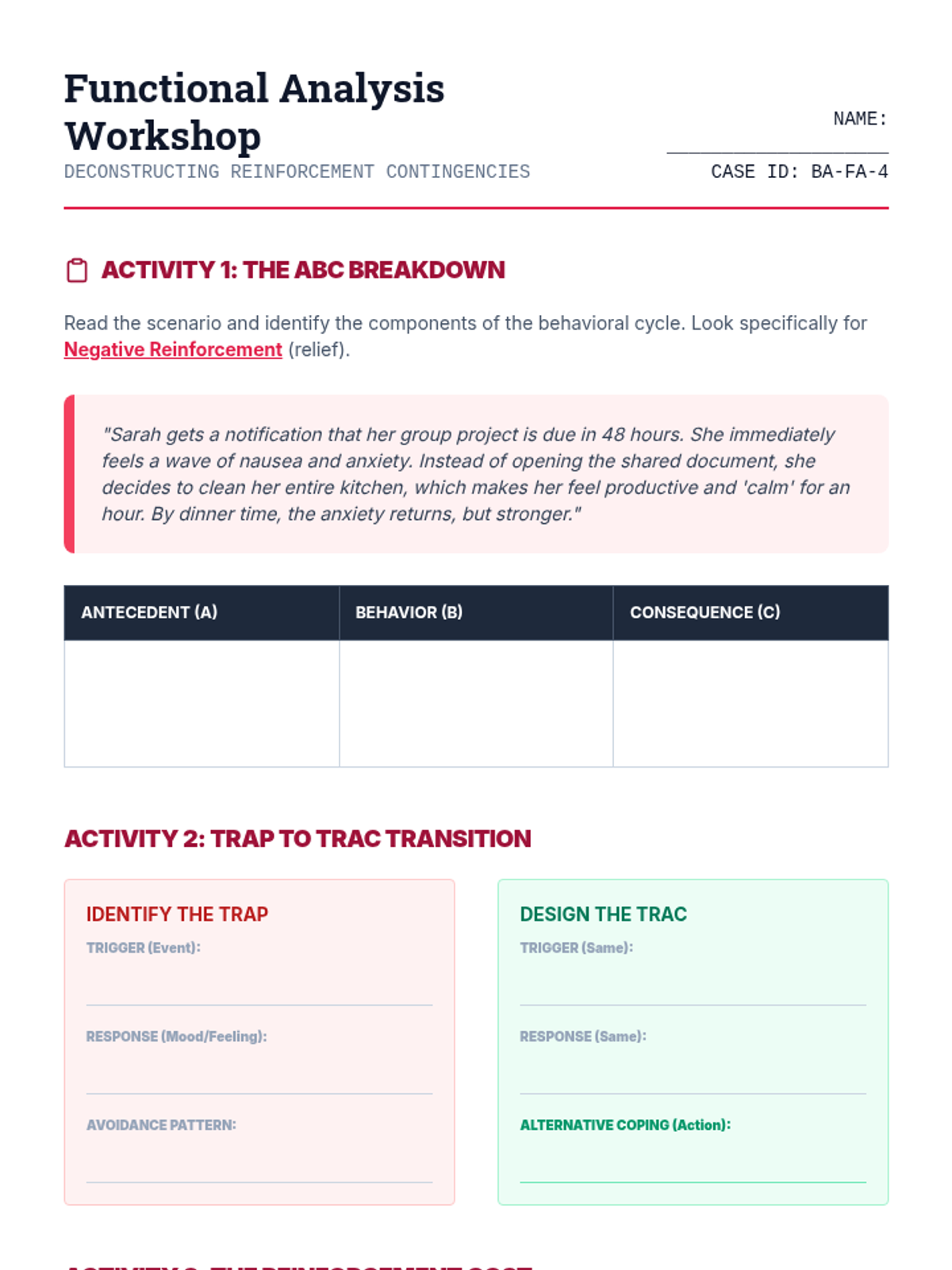
Introduces the TRAP/TRAC framework for identifying avoidance patterns and implementing alternative coping strategies when clients face internal or external barriers.
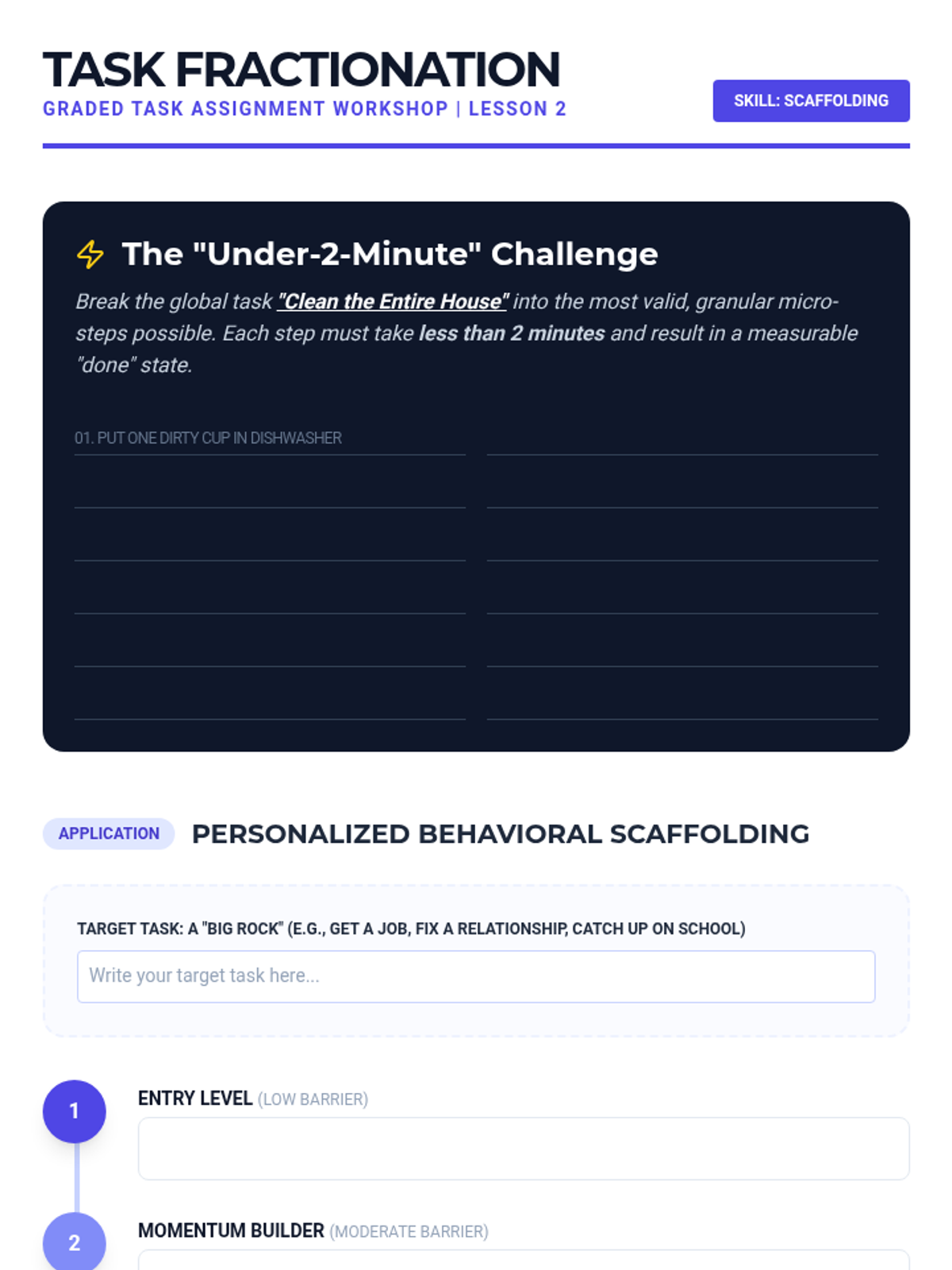
Focuses on the technique of breaking down overwhelming tasks into manageable micro-steps to build self-efficacy and momentum in clients.
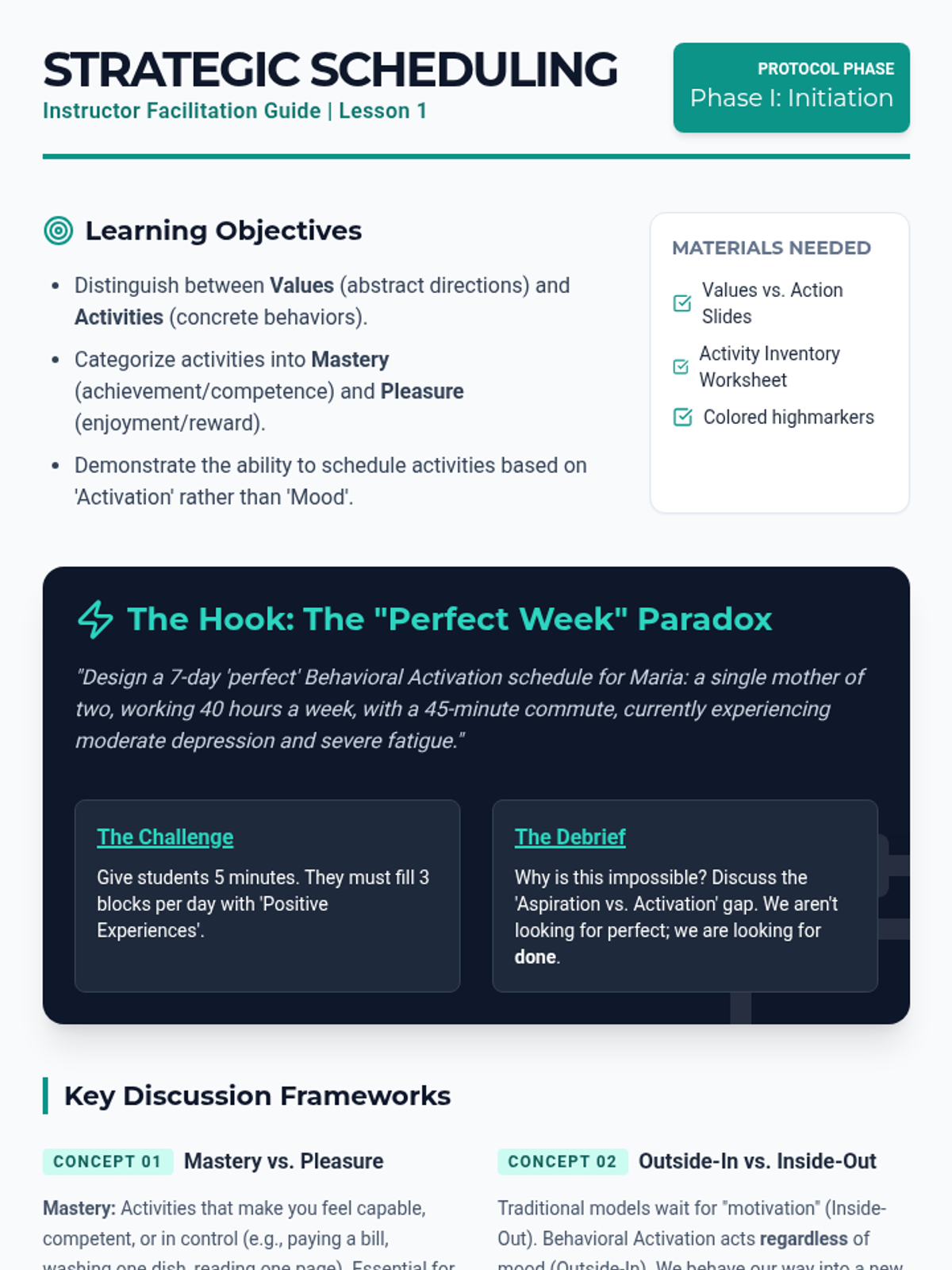
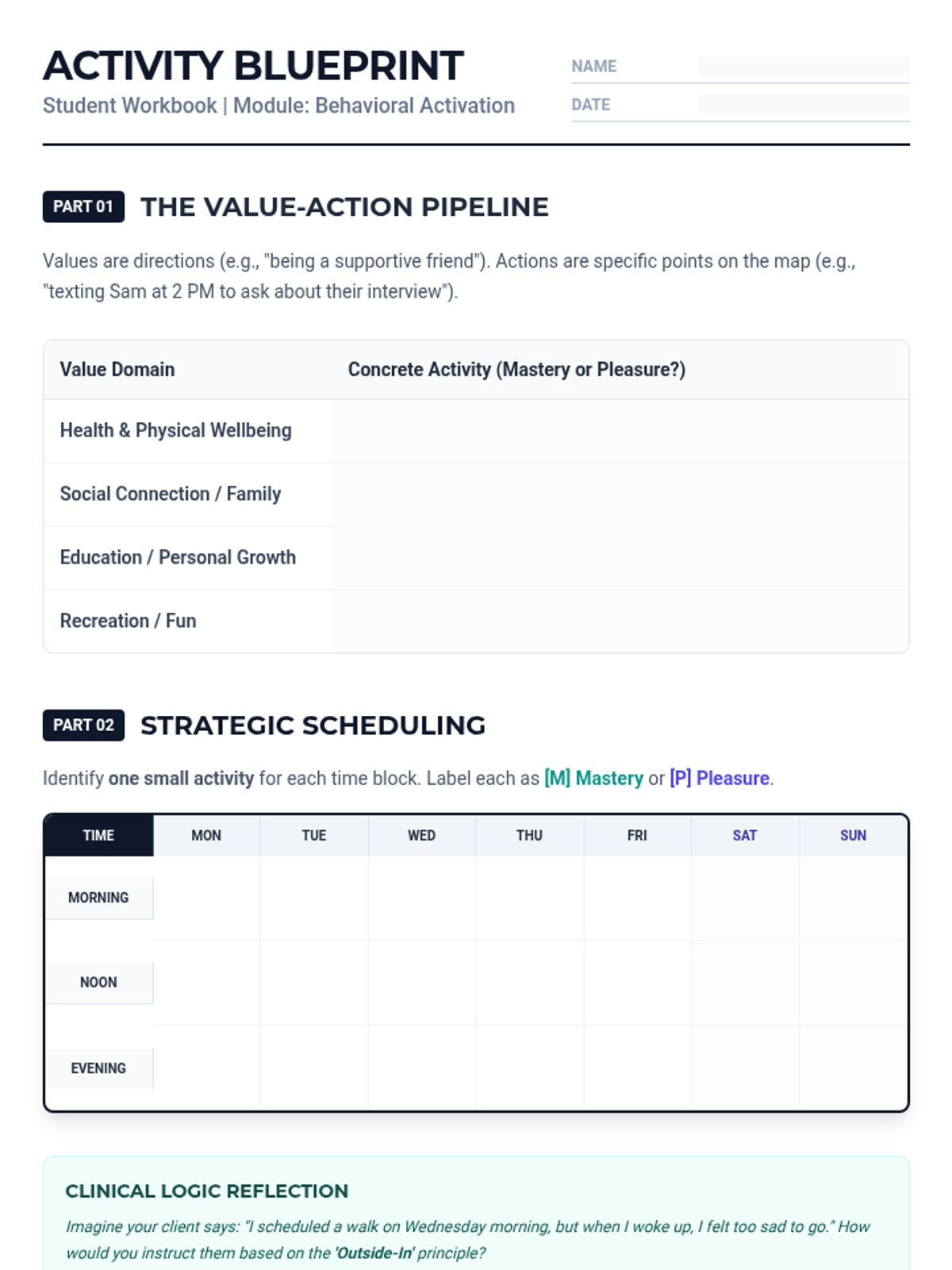
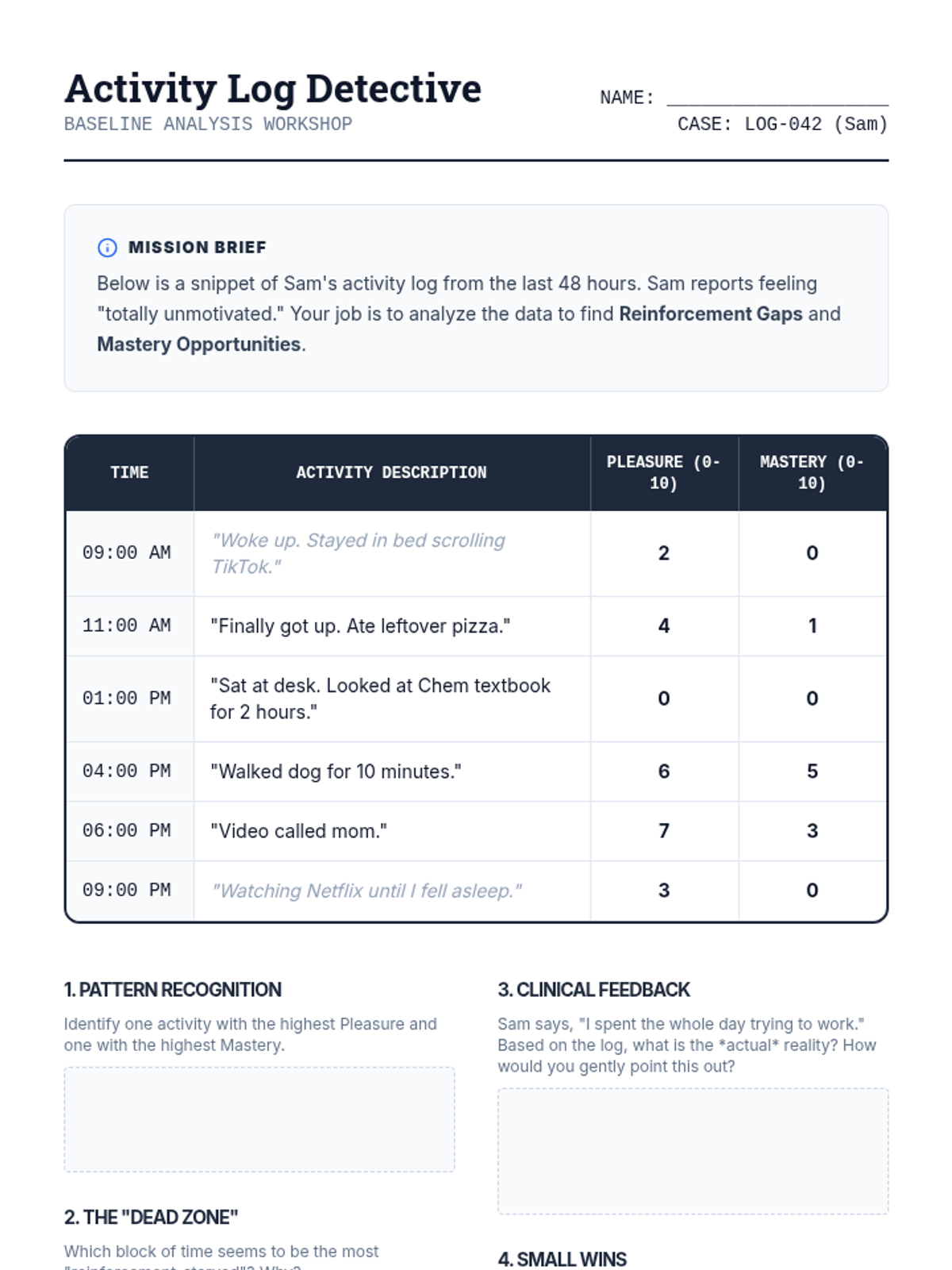
Students bridge the gap between abstract values and concrete behaviors by creating structured schedules. The focus is on identifying activities that provide 'Mastery' and 'Pleasure' to counteract depressive withdrawal.
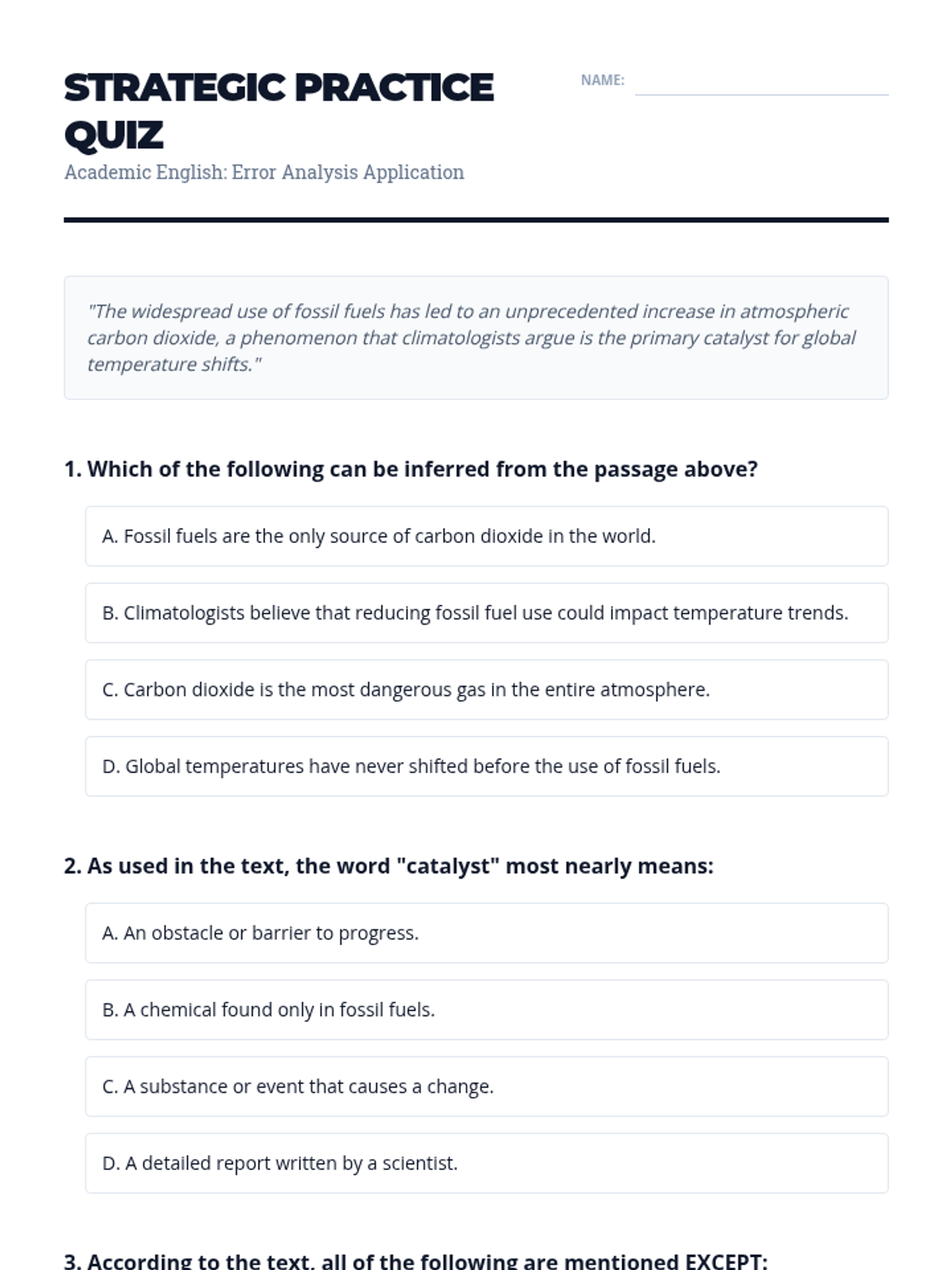
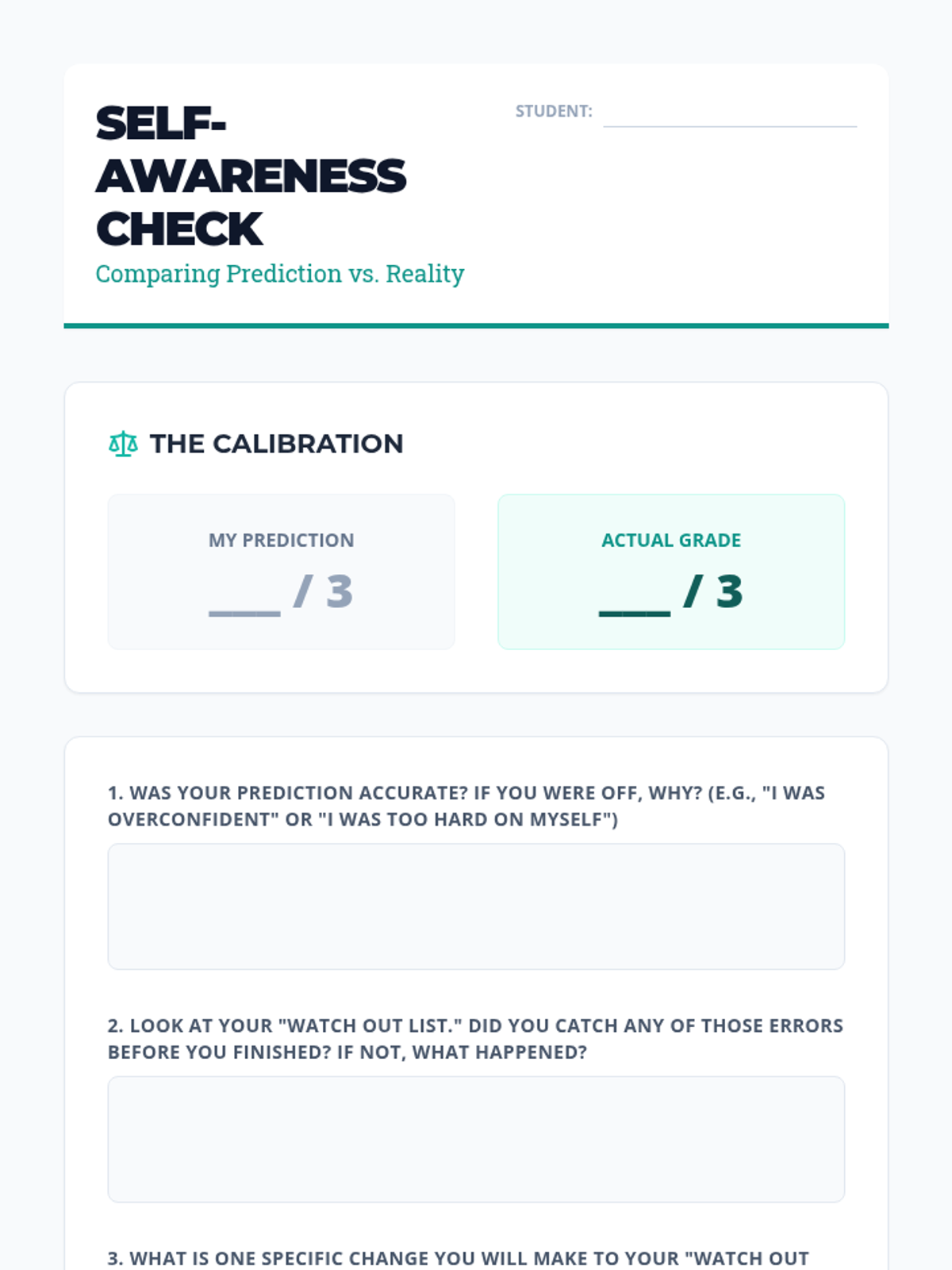
Students take a short assessment and immediately apply their error analysis protocol. They verify if their 'Watch Out' list helped them avoid previous habitual mistakes.
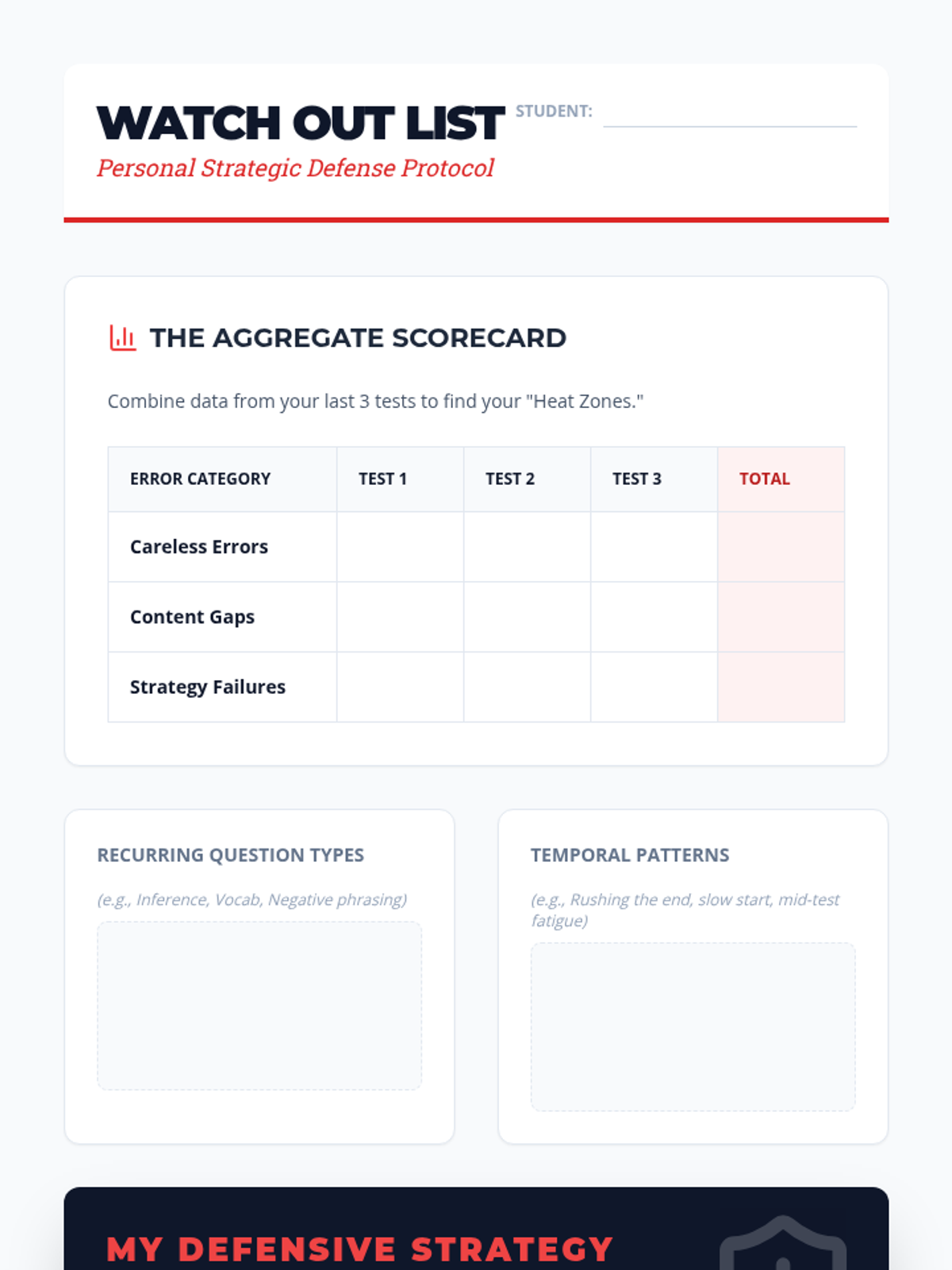
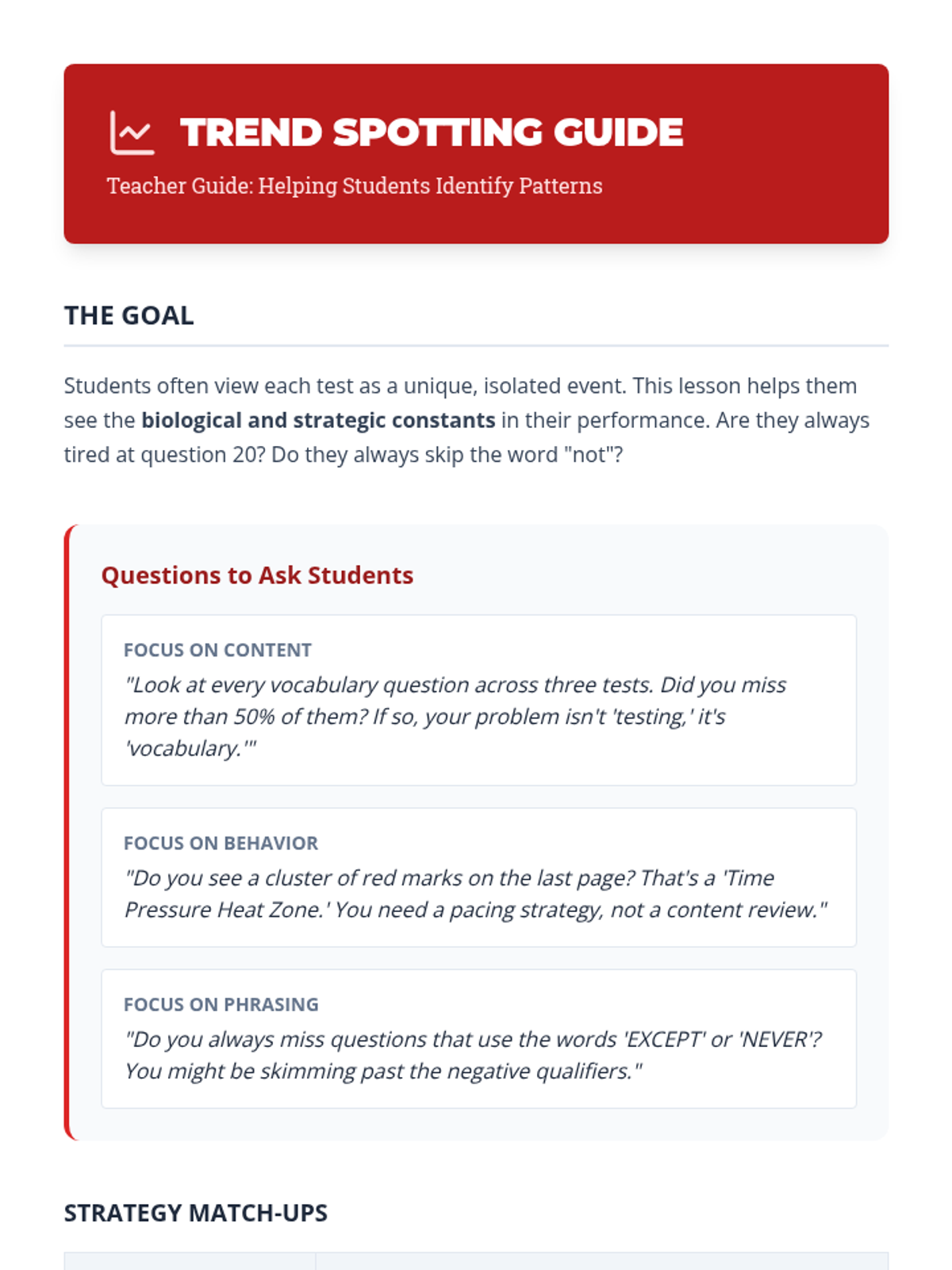
Students aggregate their error data to find personal patterns (e.g., 'I always miss inference questions' or 'I rush the last 5 minutes'). They create a personal 'Watch Out' list for future exams.
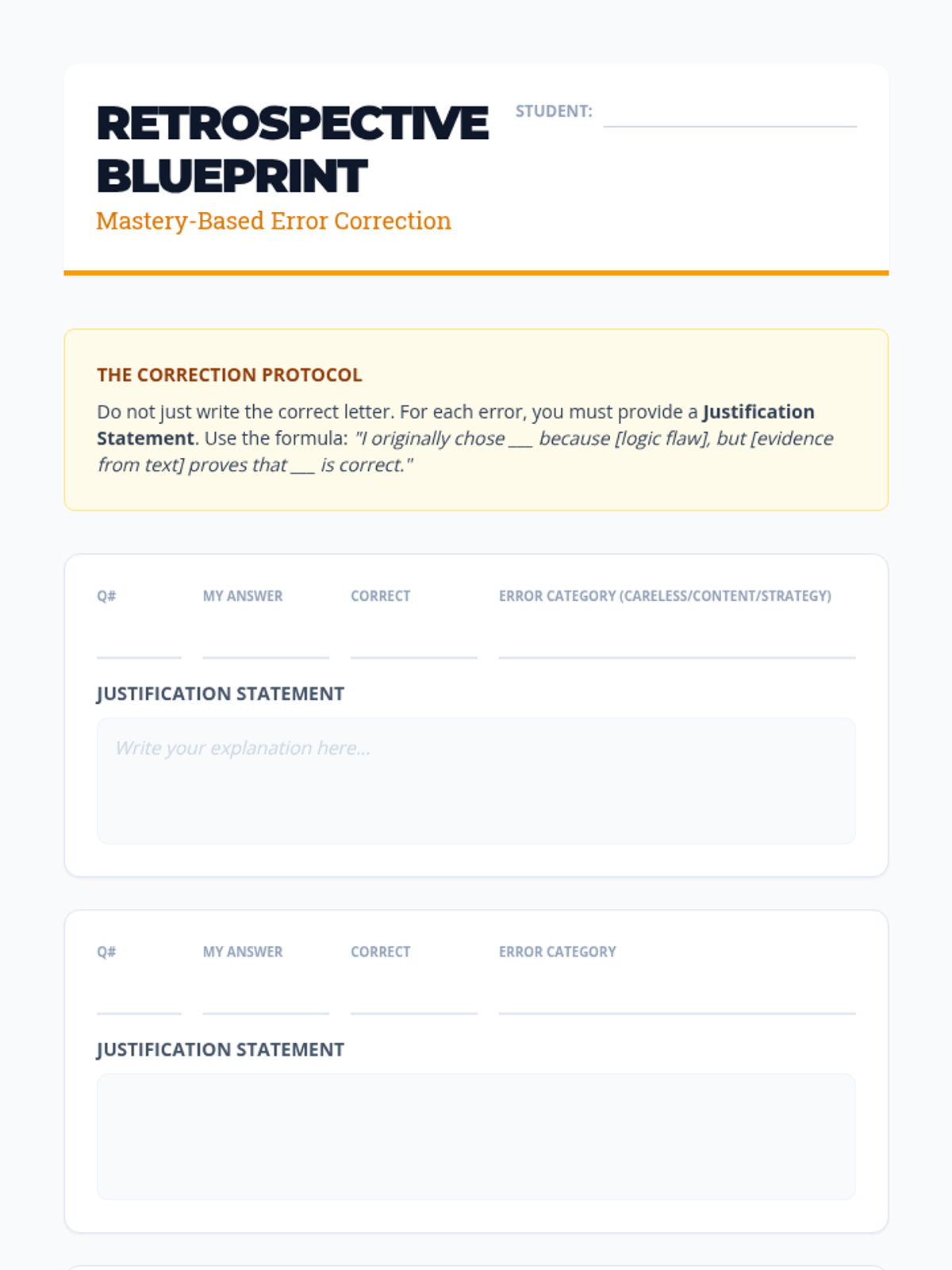
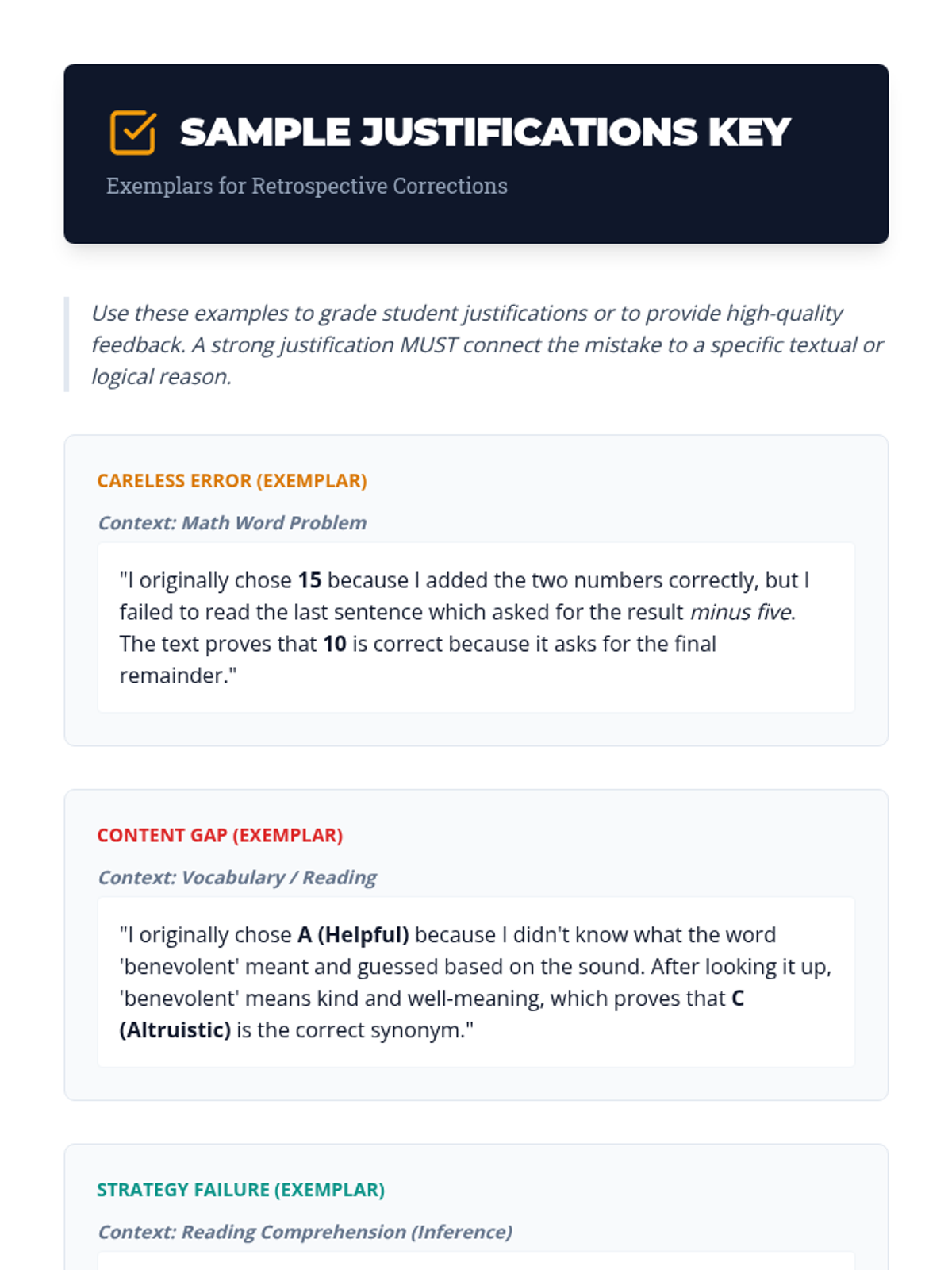
Instead of just marking correct answers, students must write a sentence explaining *why* their original answer was wrong and *why* the new answer is right. This ensures deep processing of the error.
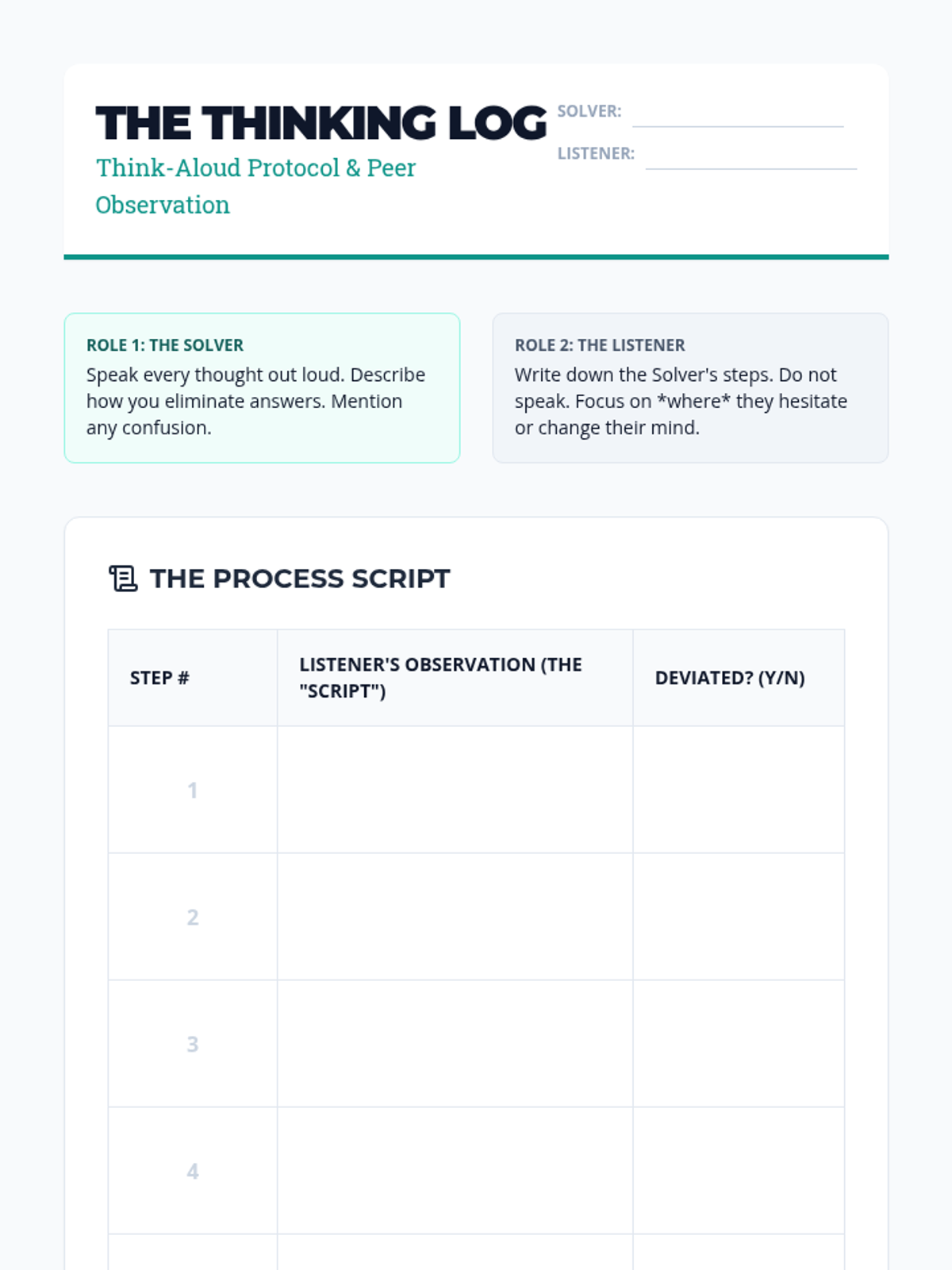
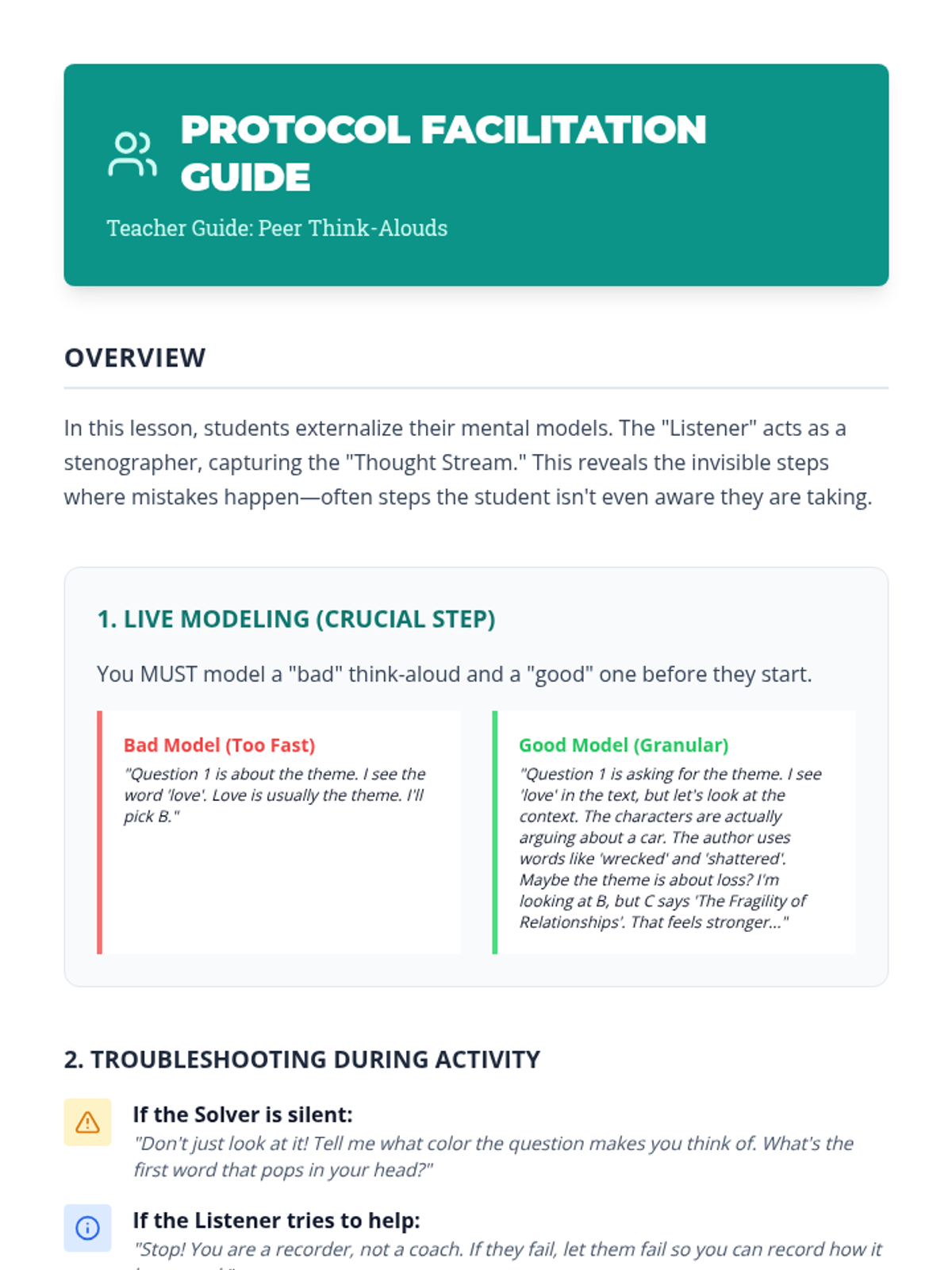
Working in pairs, students vocalize their thinking process while solving a problem while a partner records their steps. They analyze these recordings to identify where their logic deviated from the correct path.
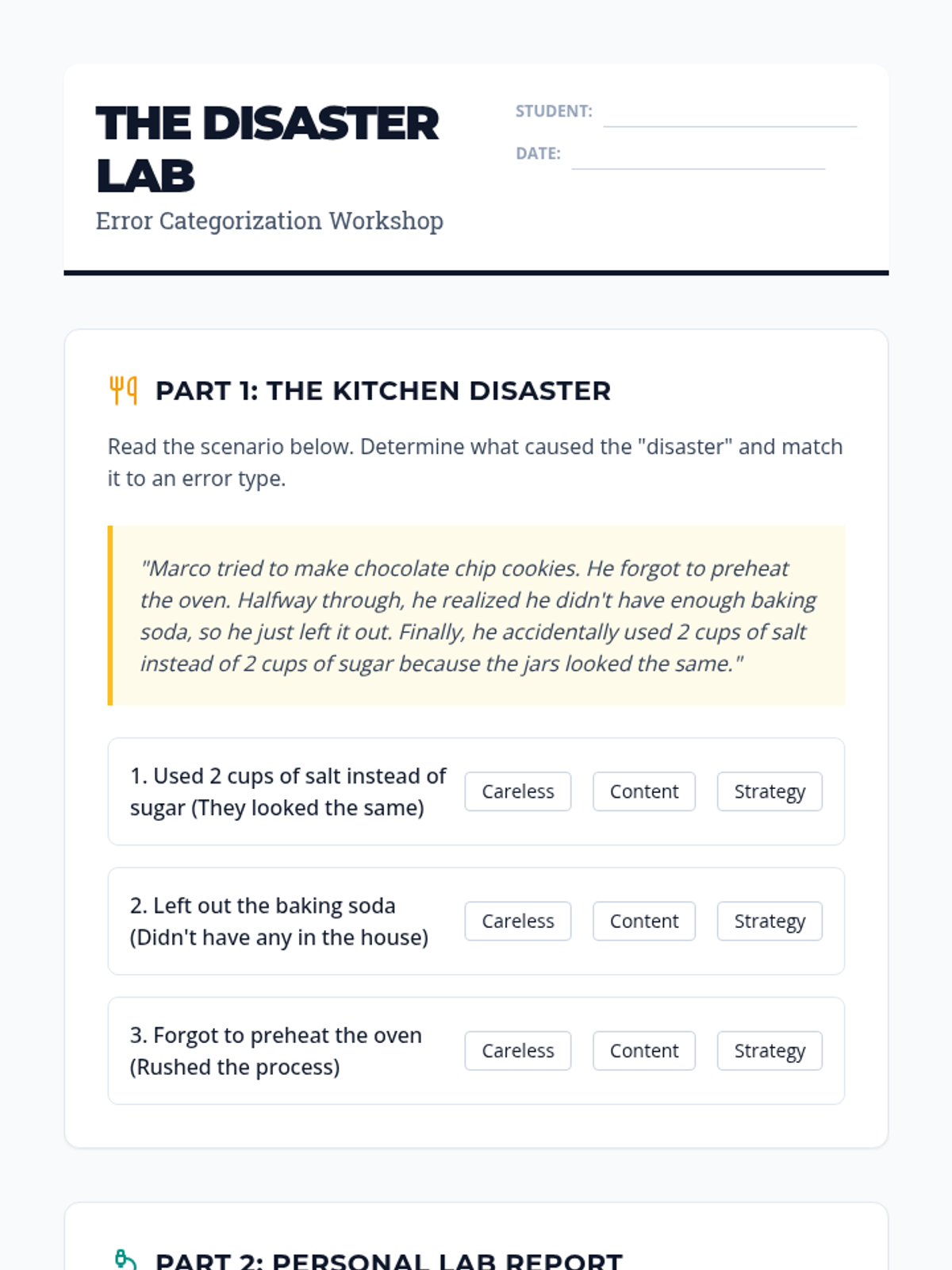
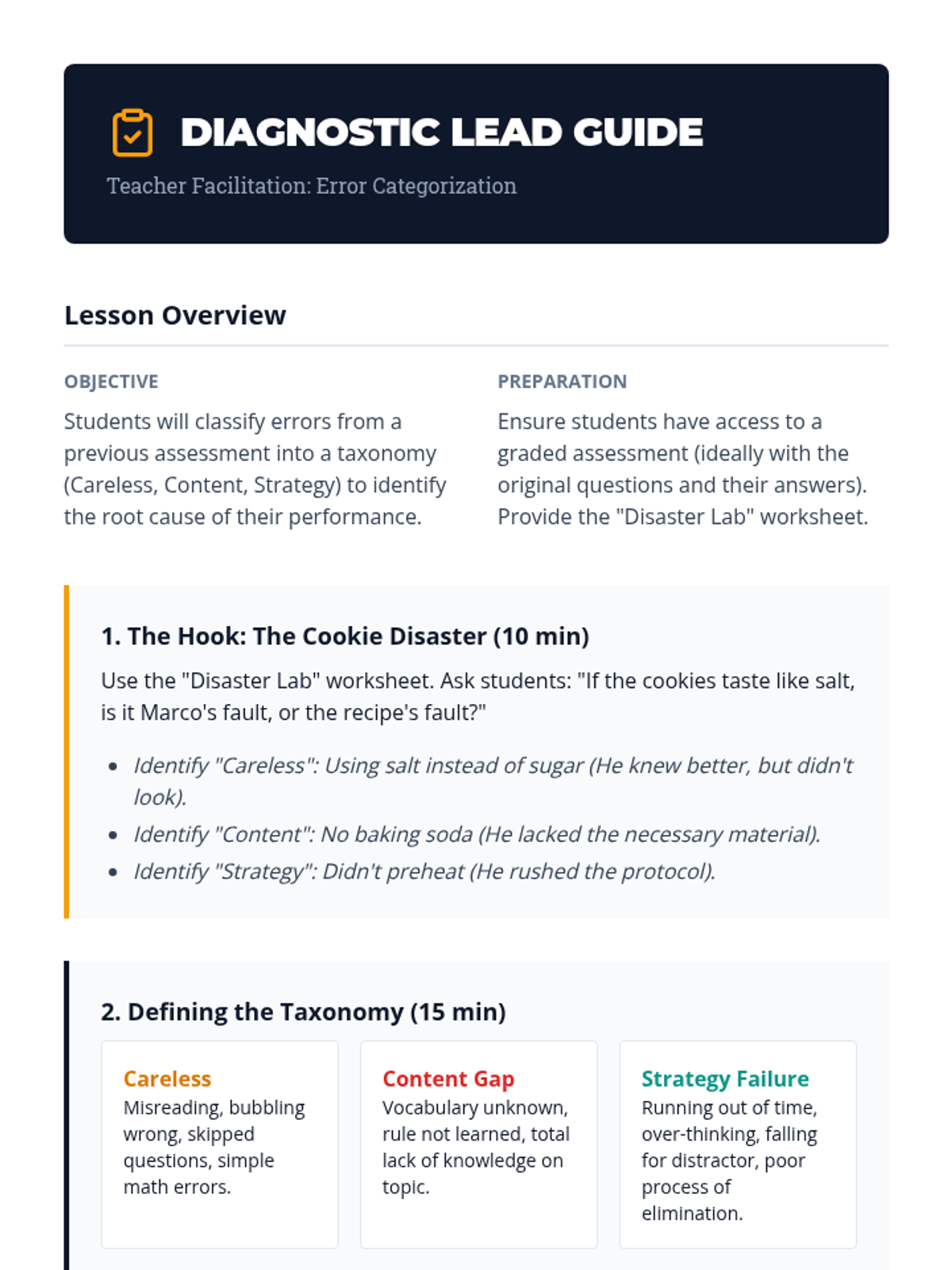
Students review a past assessment and categorize every incorrect answer as a 'Careless Error,' 'Content Gap,' or 'Strategy Failure.' This taxonomy helps them understand that not all mistakes are created equal.
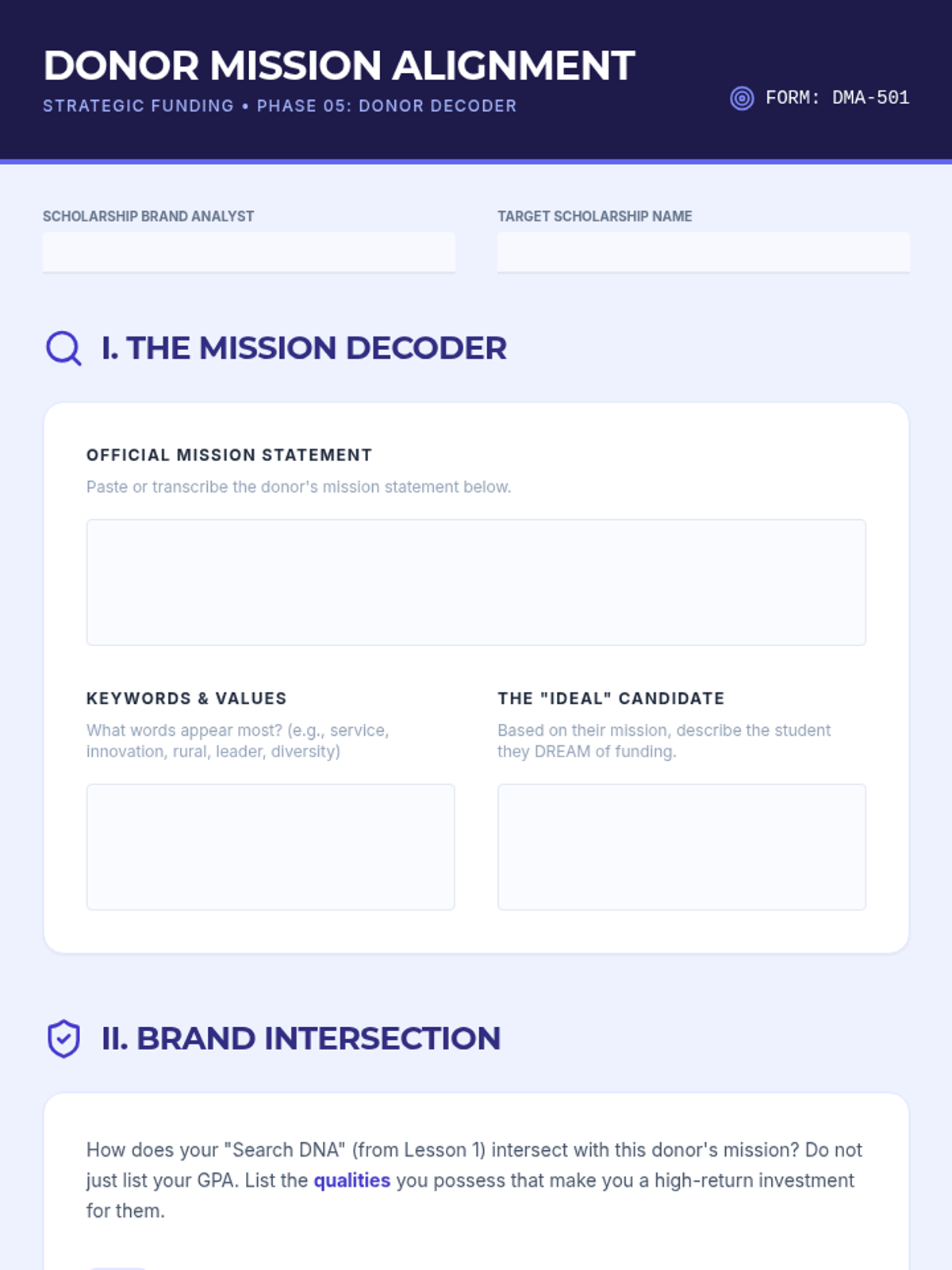
Students research donor organizations to align their personal brand with the funding source's mission and values.
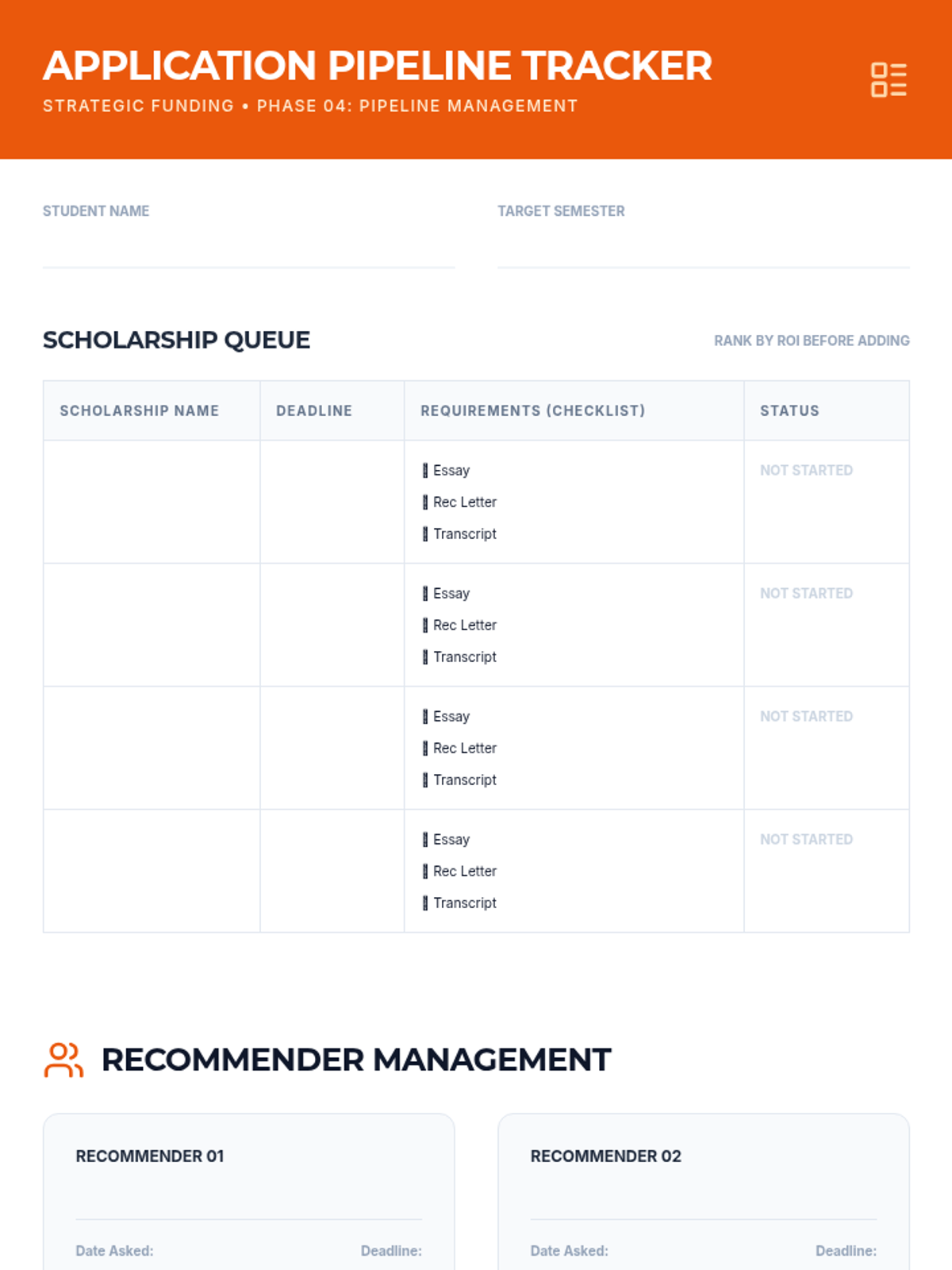
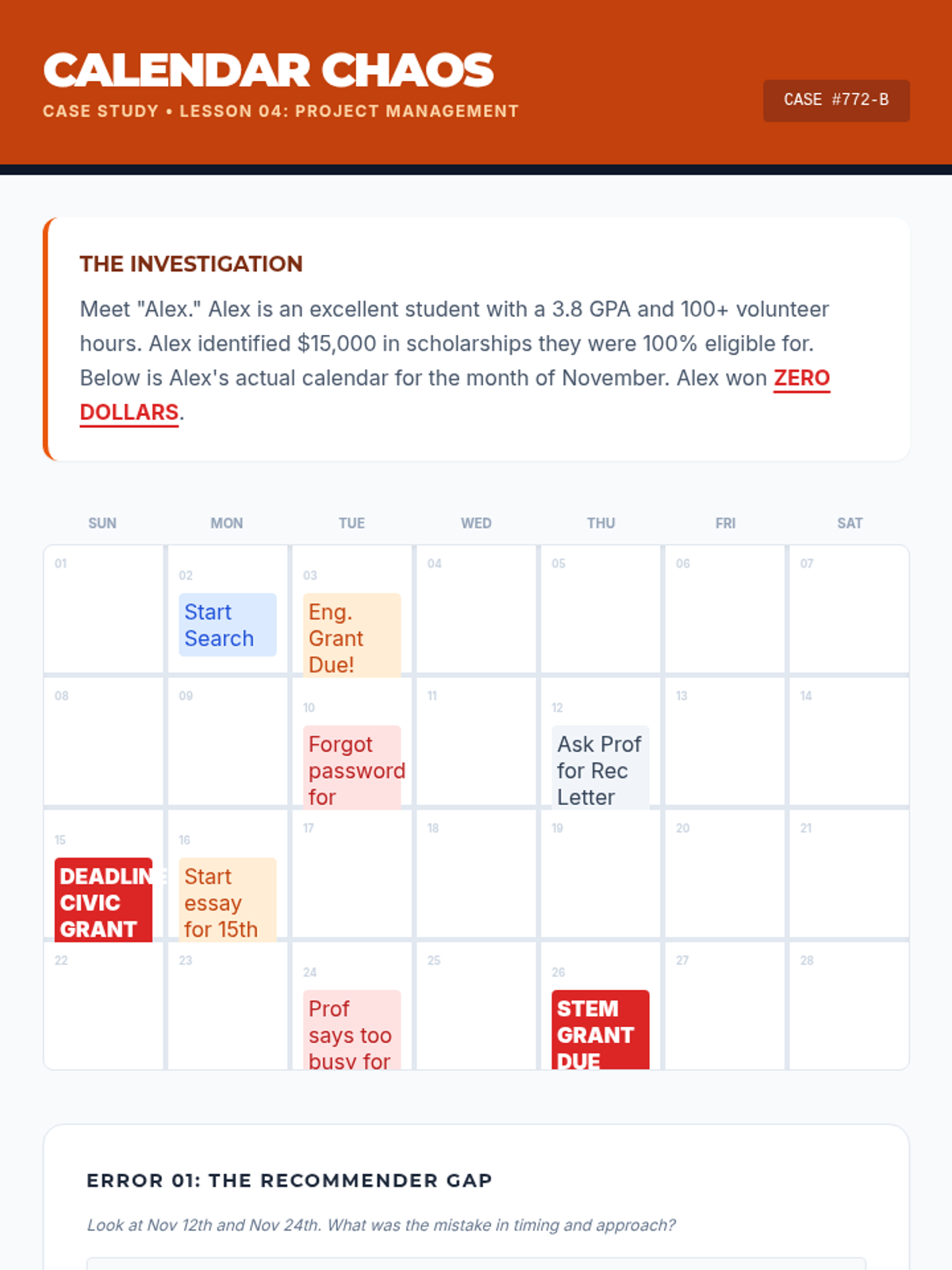
Students build a robust project management system to track deadlines, requirements, and application status.
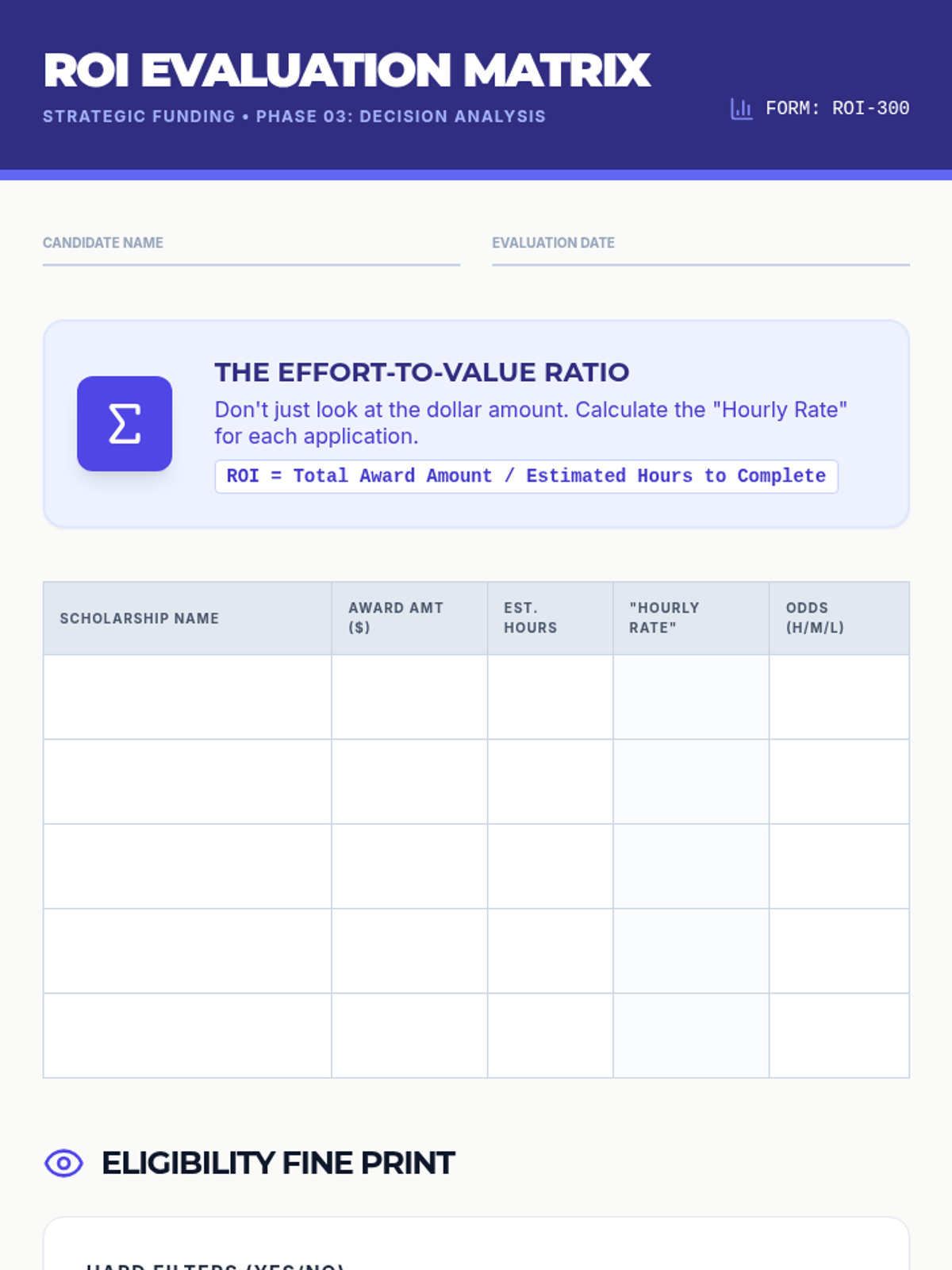
Students evaluate scholarship opportunities based on effort-to-value ratios and eligibility requirements.
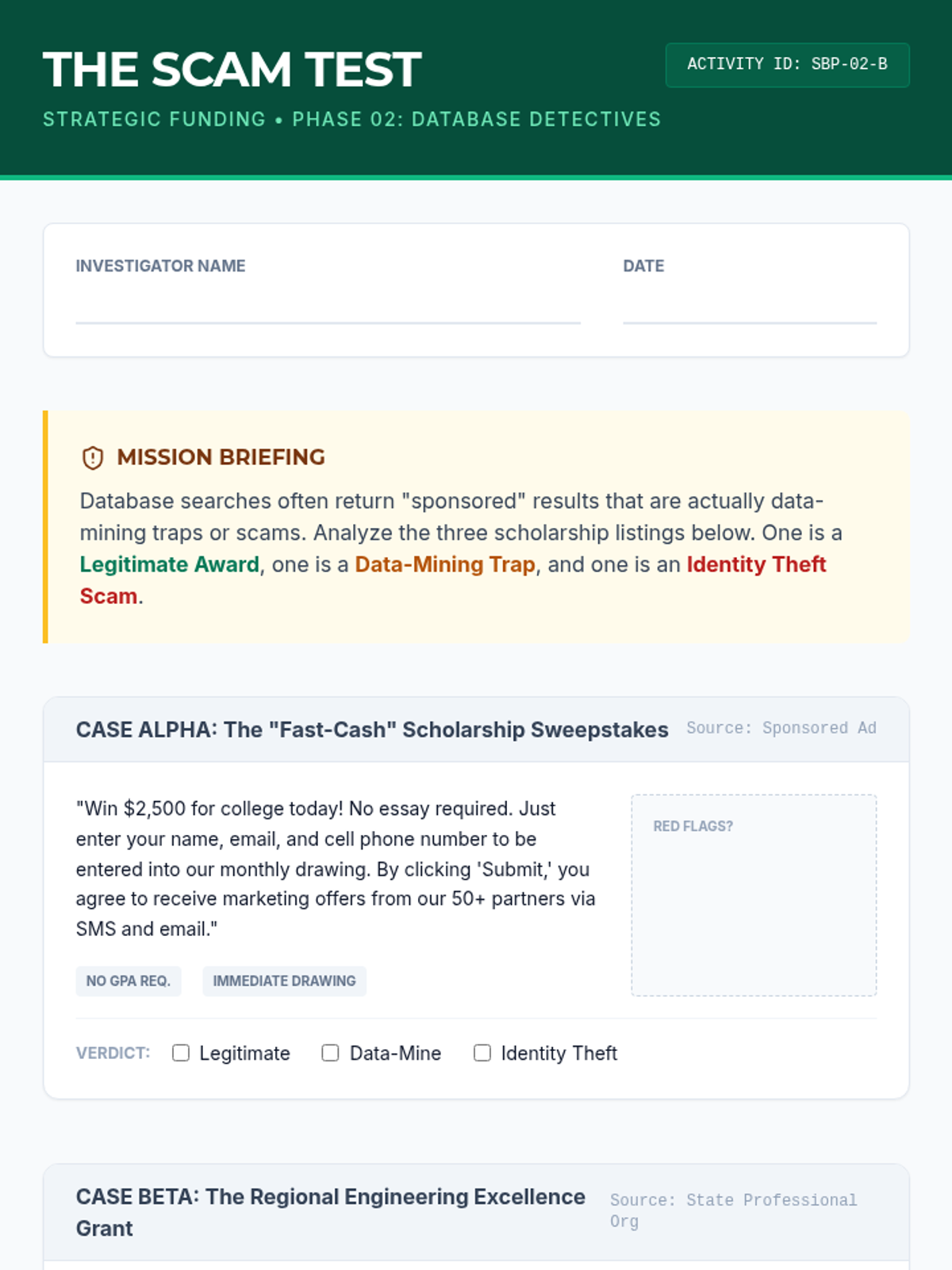
Students learn to use advanced search techniques and verify the legitimacy of scholarship databases and institutional resources.
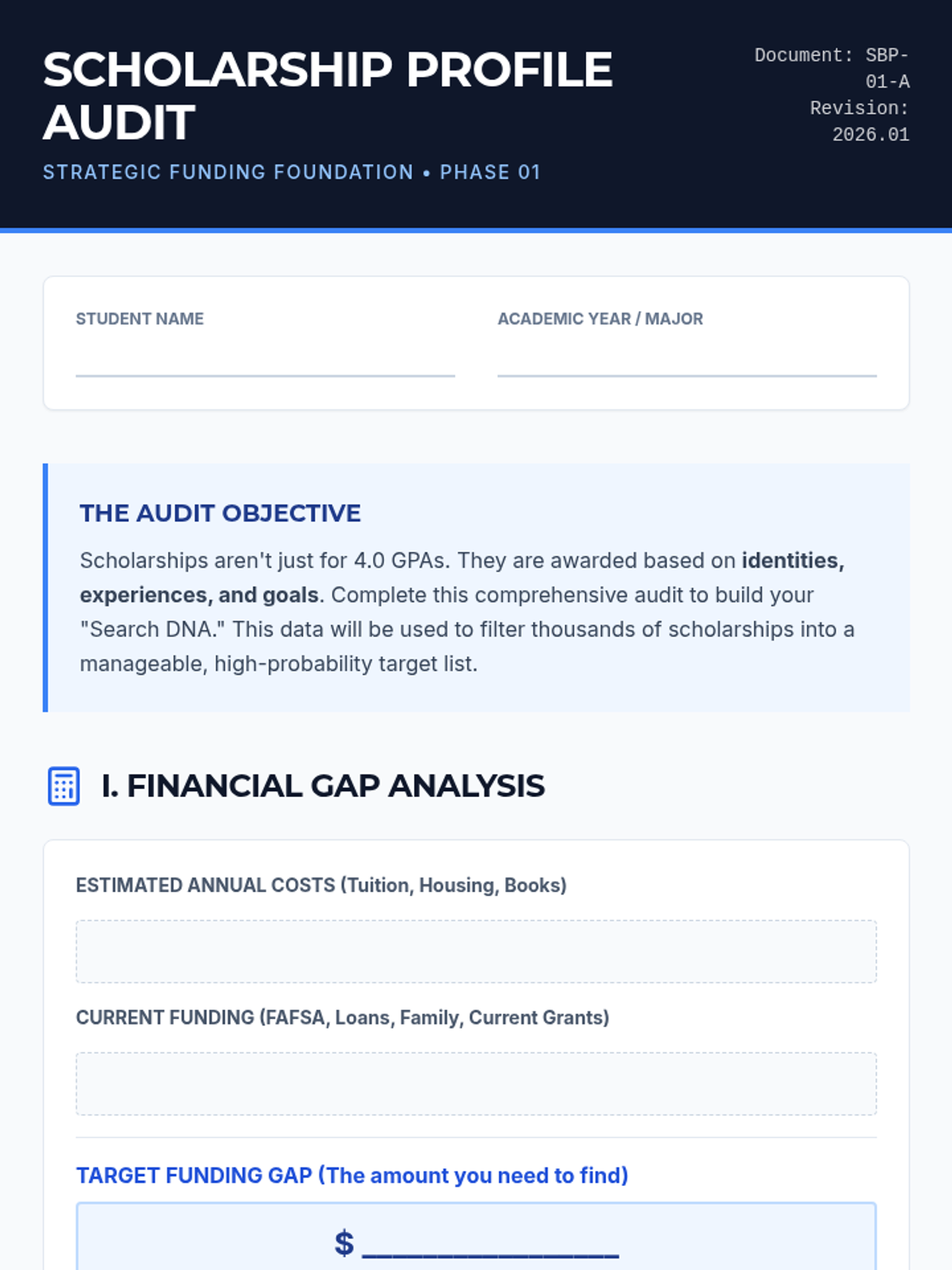
Students conduct a deep-dive audit of their financial needs and personal characteristics to identify niche scholarship opportunities.
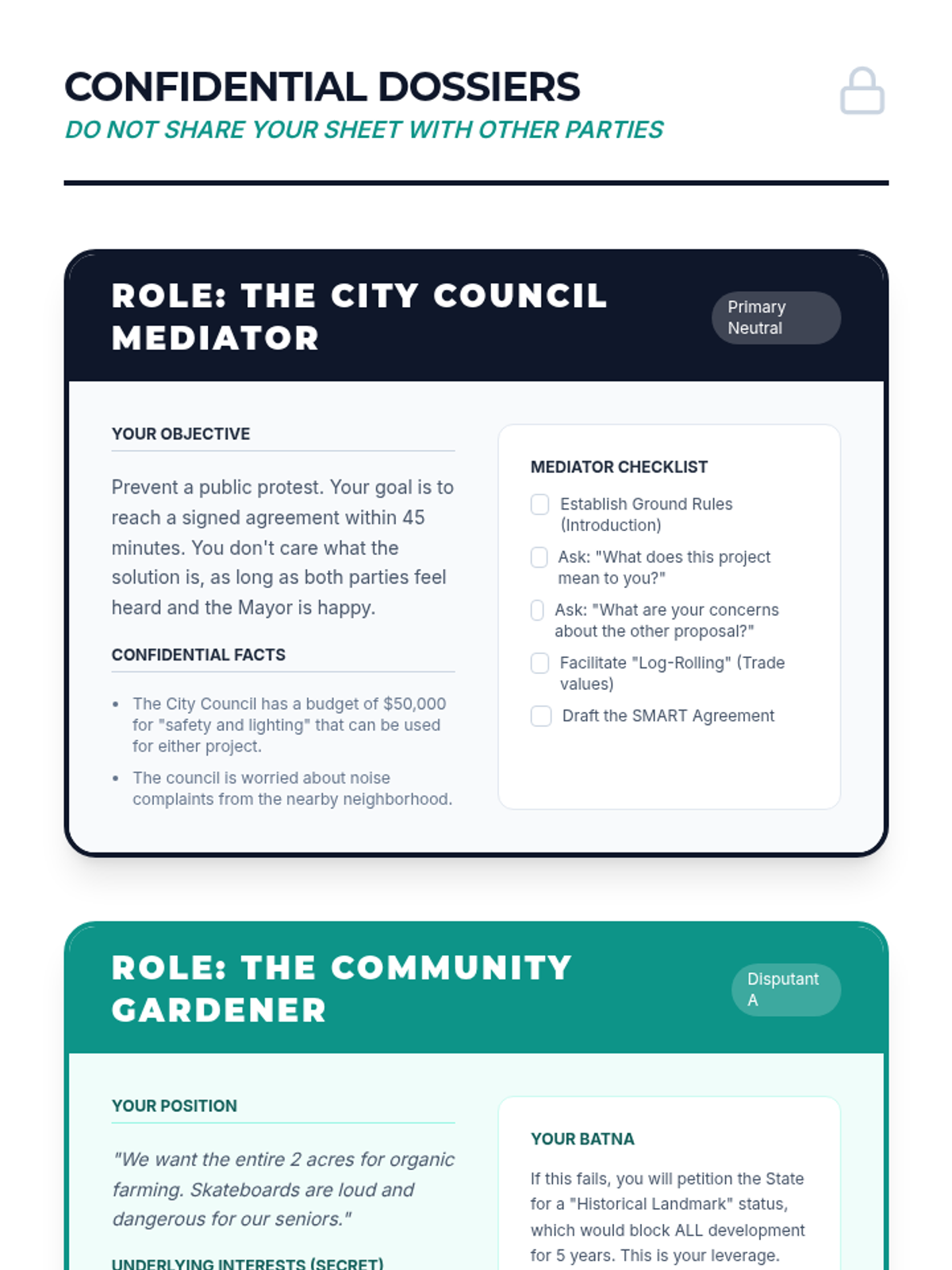
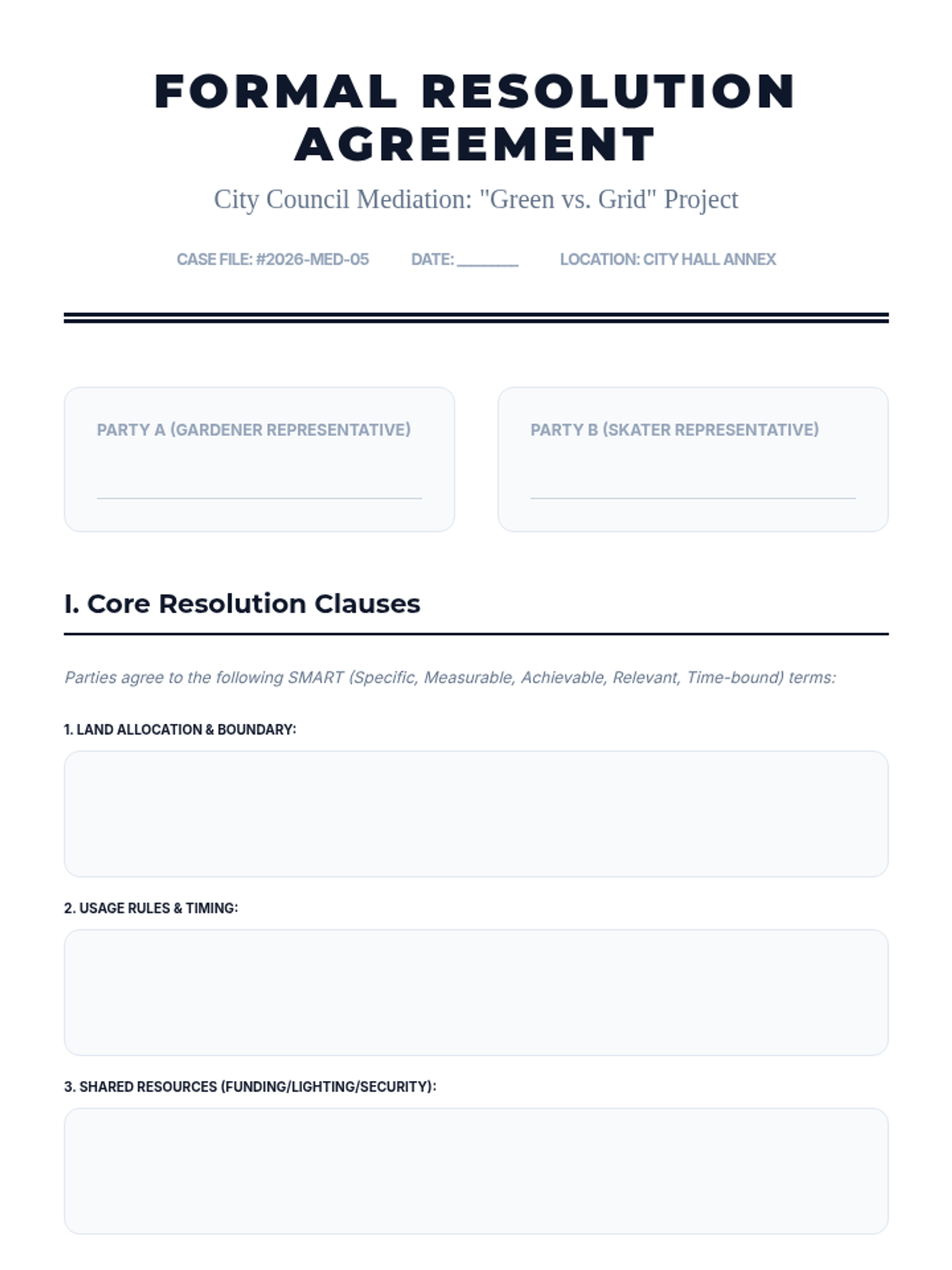
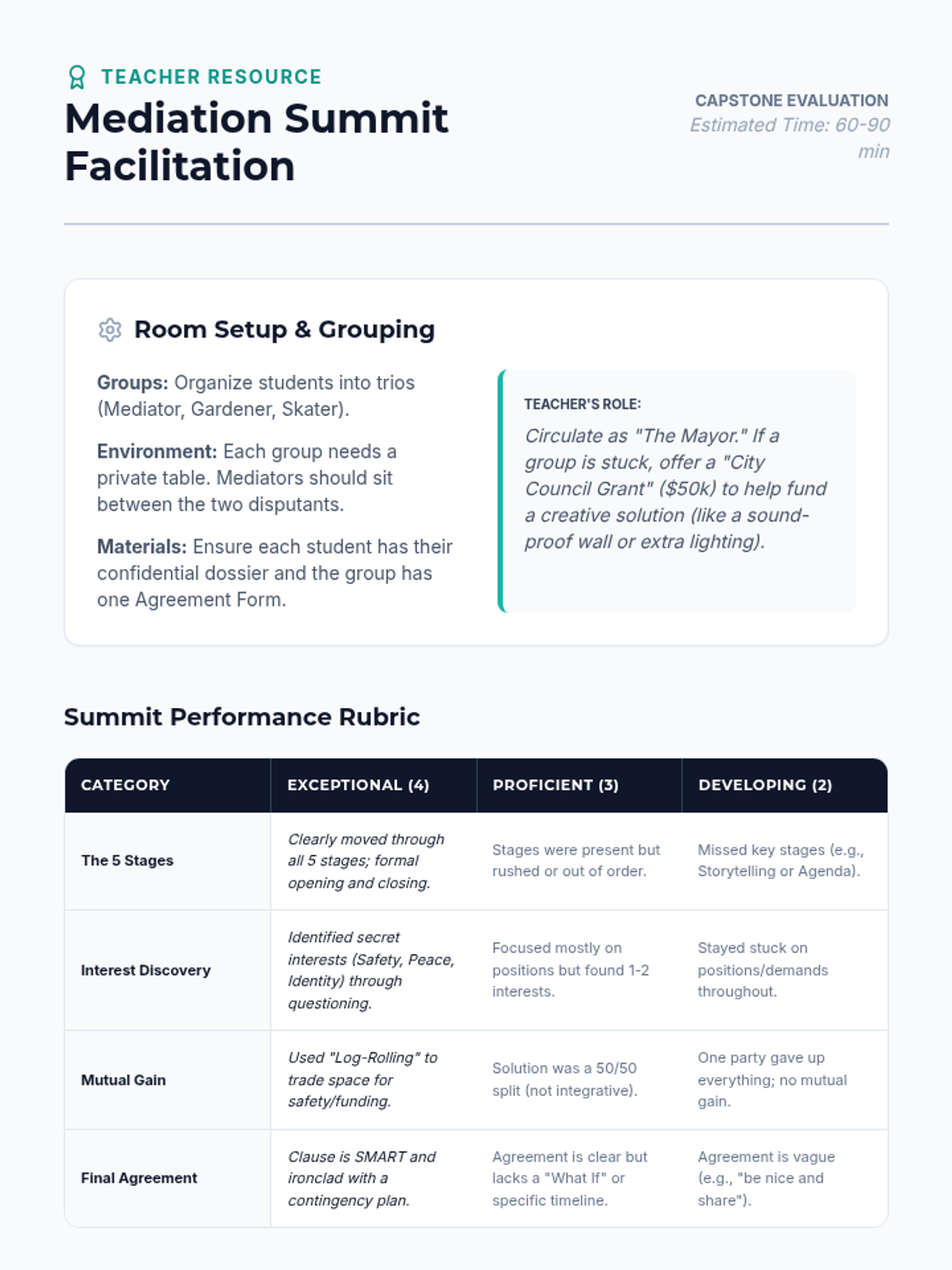
Students assume roles of mediators and disputants in a complex, multi-party dispute scenario (e.g., a land use dispute or school policy change). Mediators must facilitate the process, uncover interests, help generate options, and finalize a written agreement. The lesson focuses on synthesizing all previous frameworks into a cohesive professional performance.
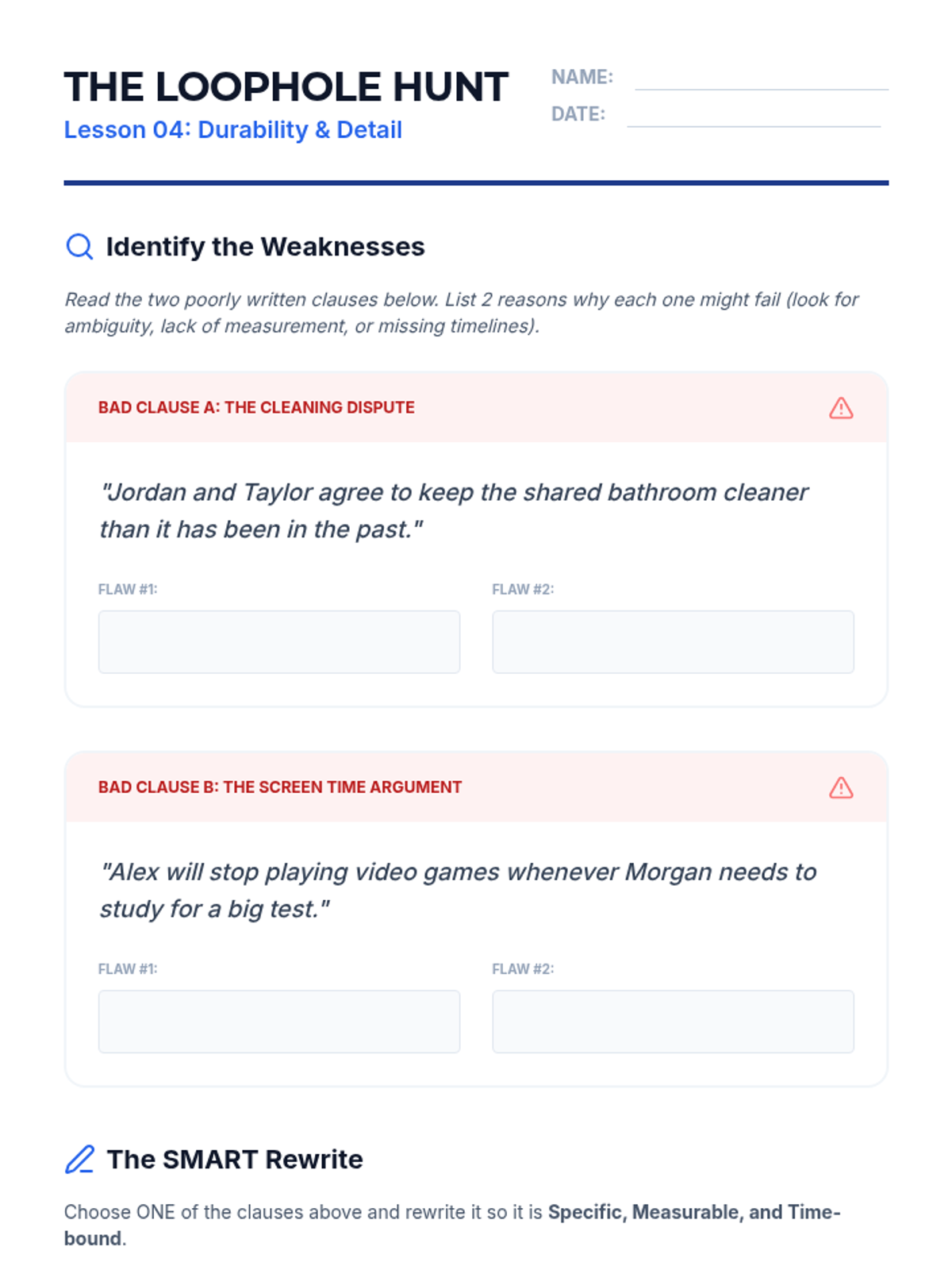
Resolving the conflict is only half the battle; writing a durable agreement is the rest. Students learn the components of a SMART agreement (Specific, Measurable, Achievable, Relevant, Time-bound) in a conflict context. They review failed contracts or treaties to identify loopholes and ambiguity, then practice drafting ironclad resolution clauses.
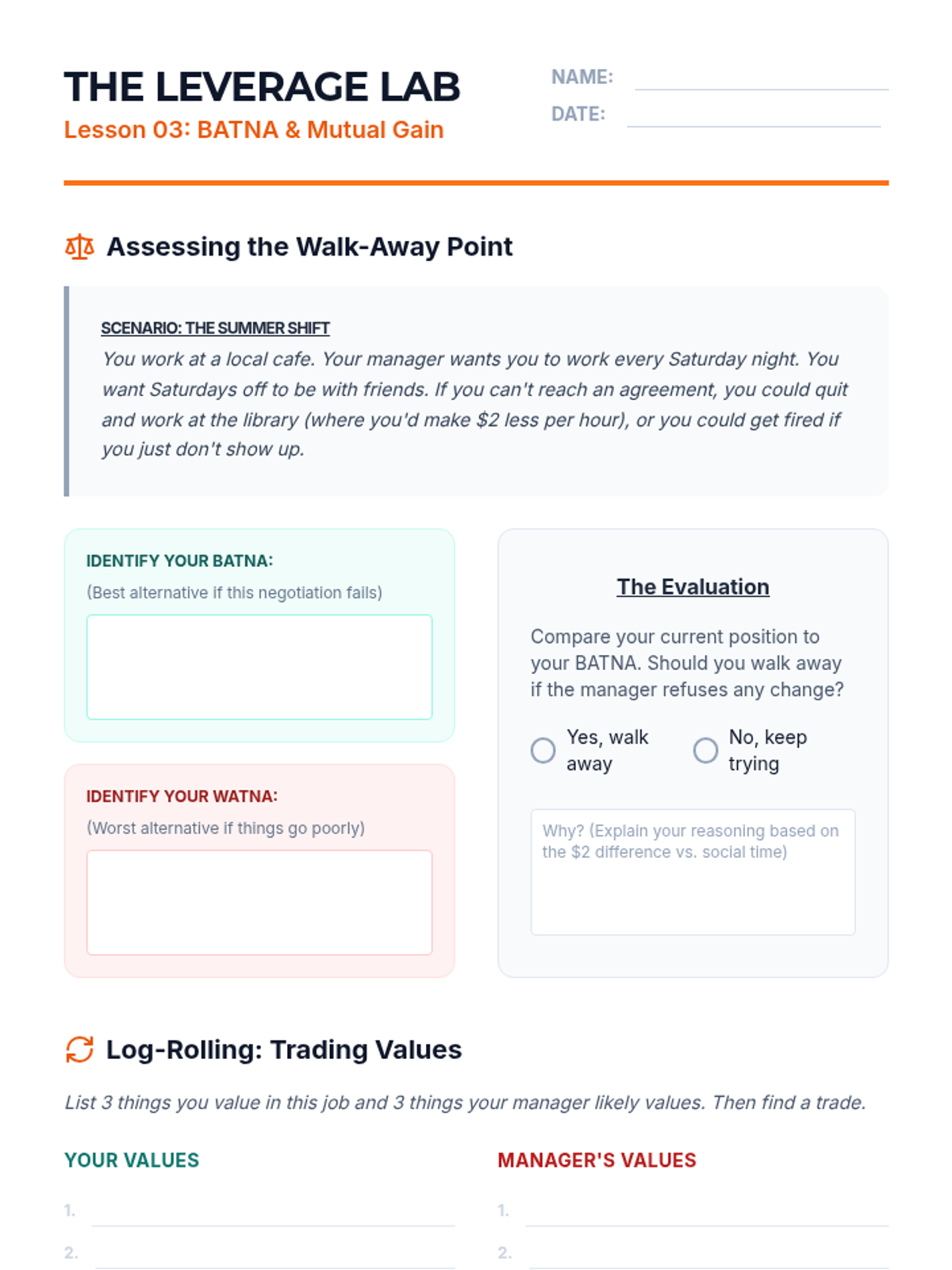
Students practice brainstorming techniques designed to break deadlocks. They learn about BATNA (Best Alternative to a Negotiated Agreement) and WATNA (Worst Alternative) to assess leverage. The class engages in exercises to expand the 'pie' rather than just dividing it, finding creative solutions that satisfy multiple interests.
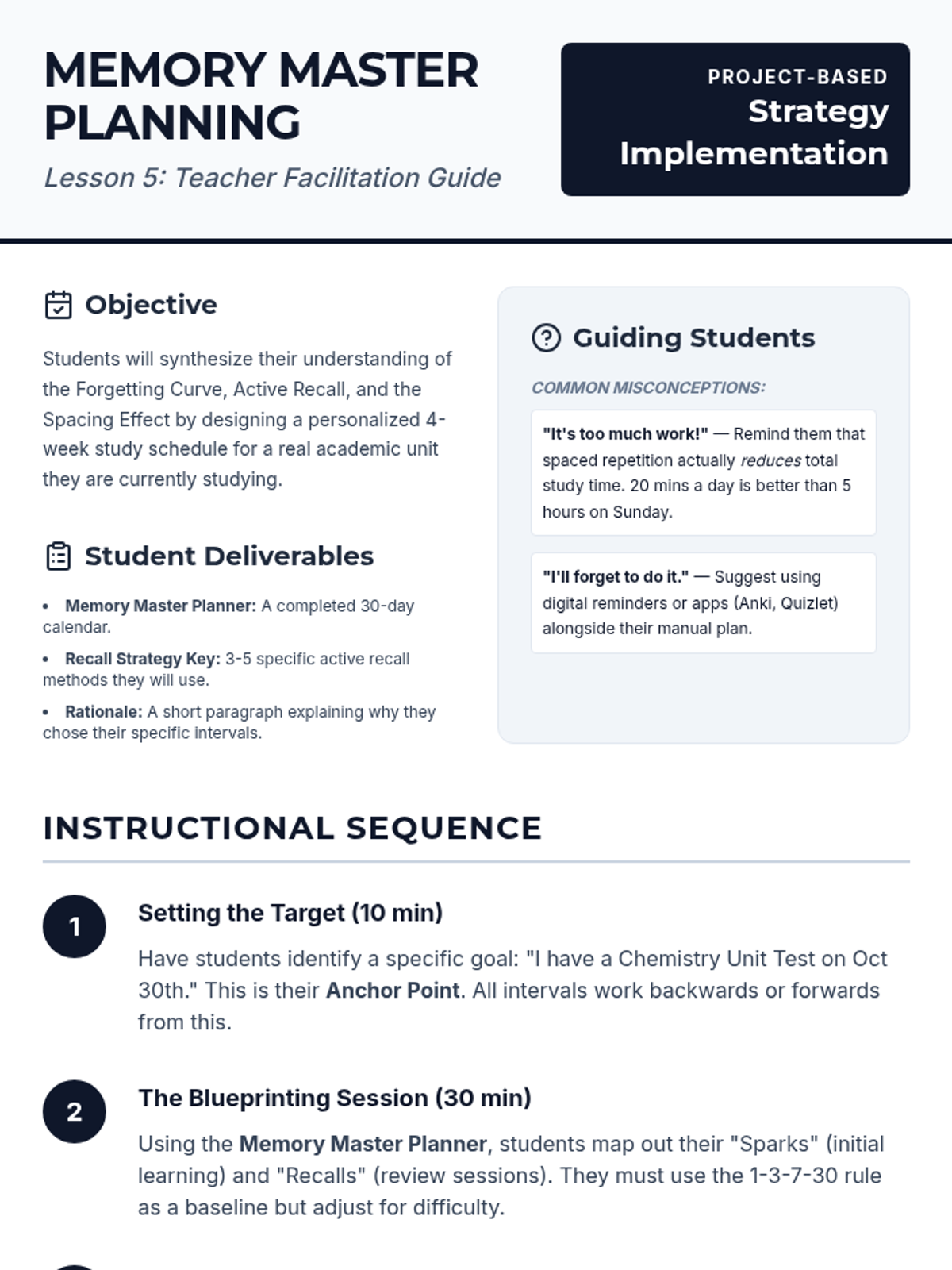
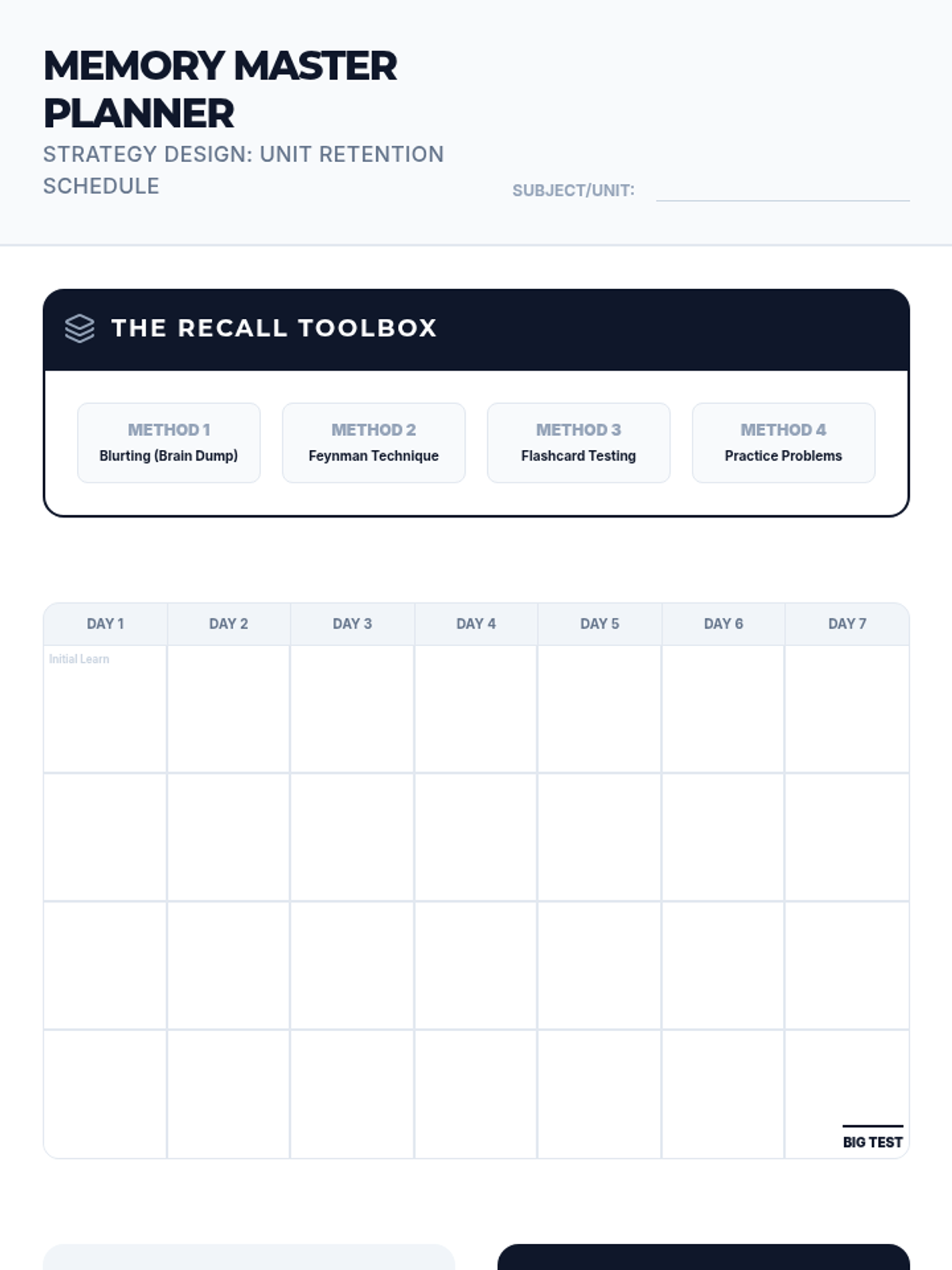
Students synthesize their learning by creating a personalized interval-based study schedule for a current academic unit.
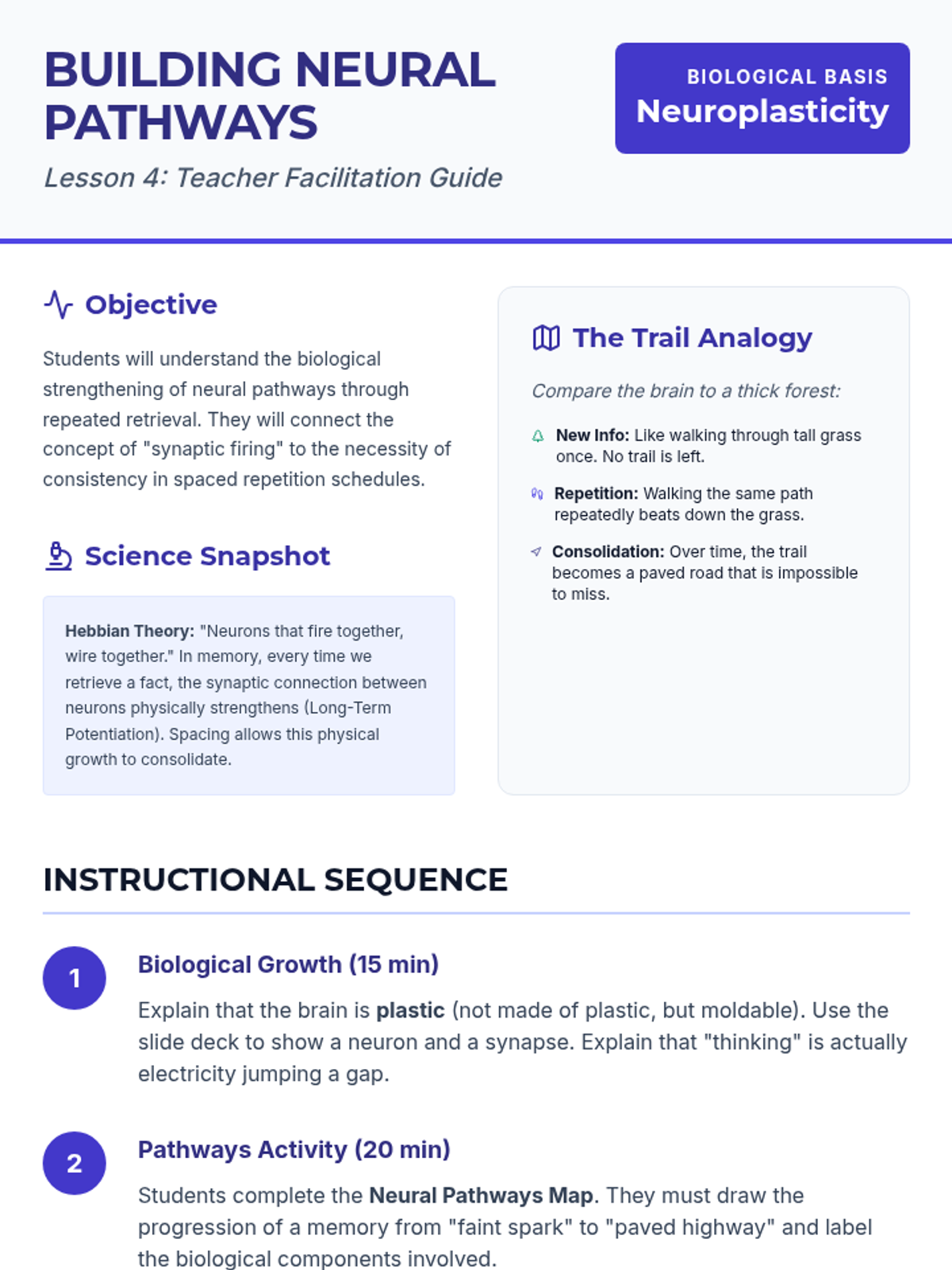
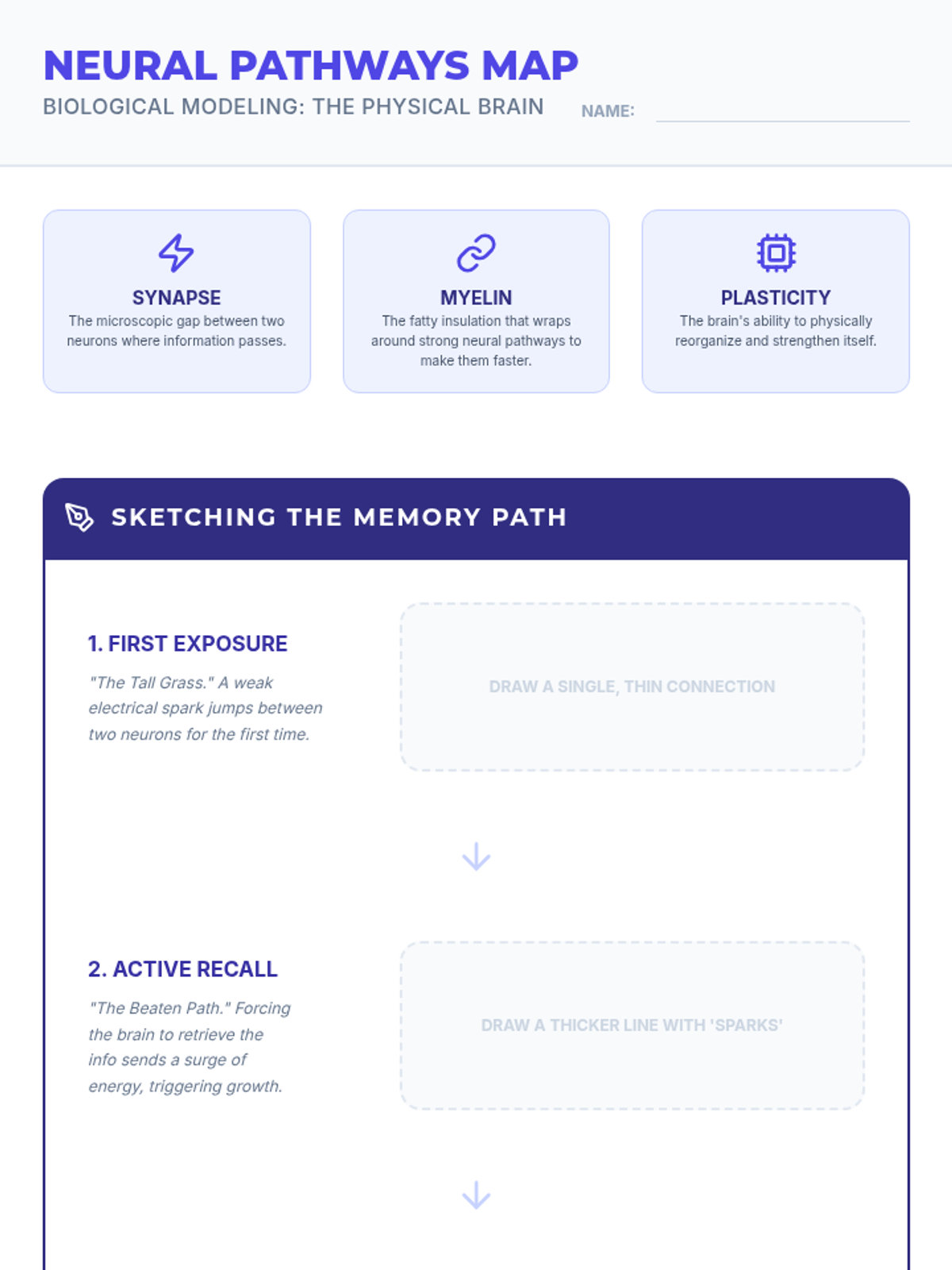
An exploration of the biological basis of memory, focusing on neuroplasticity and how repeated retrieval strengthens neural pathways.
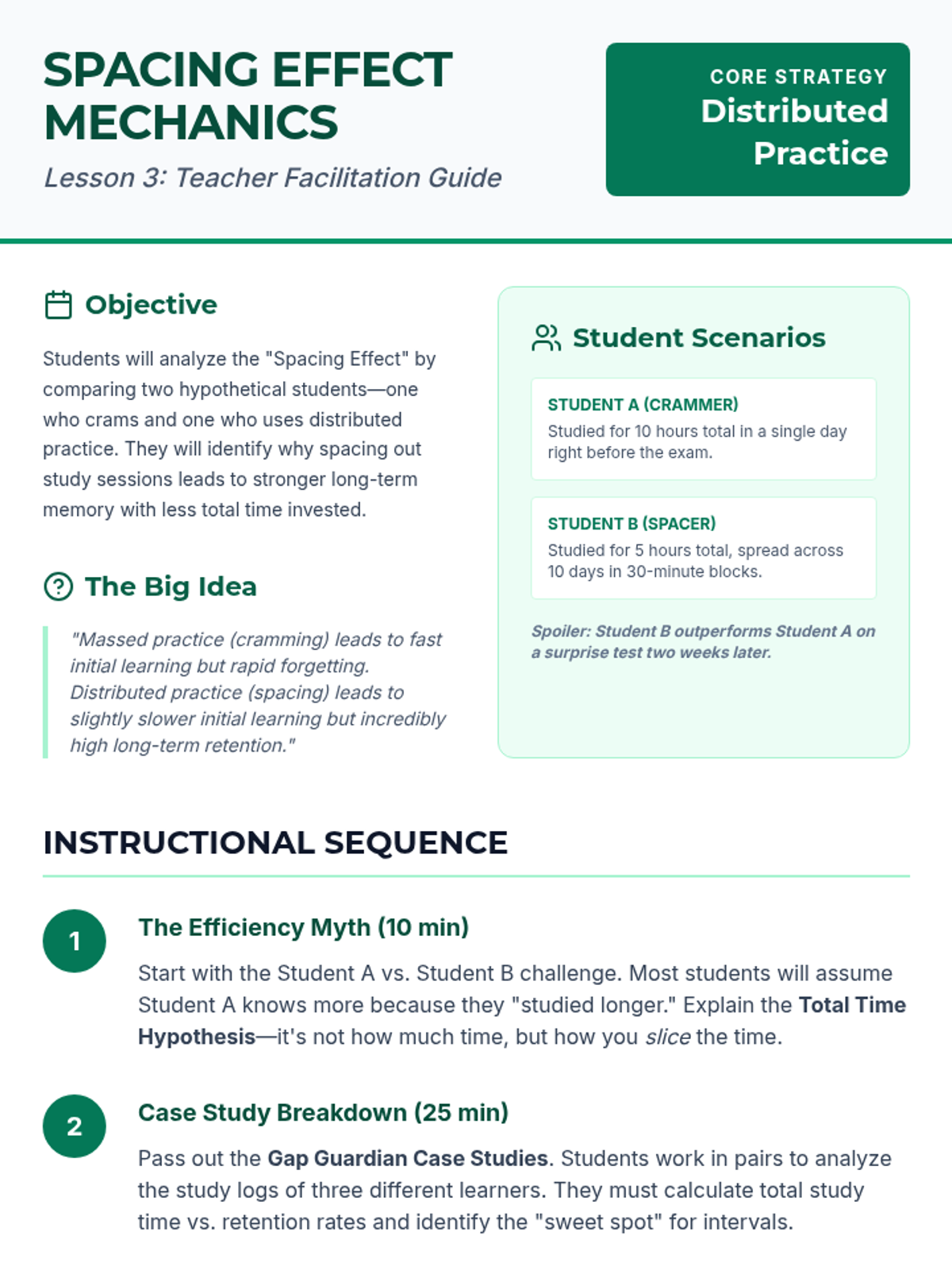
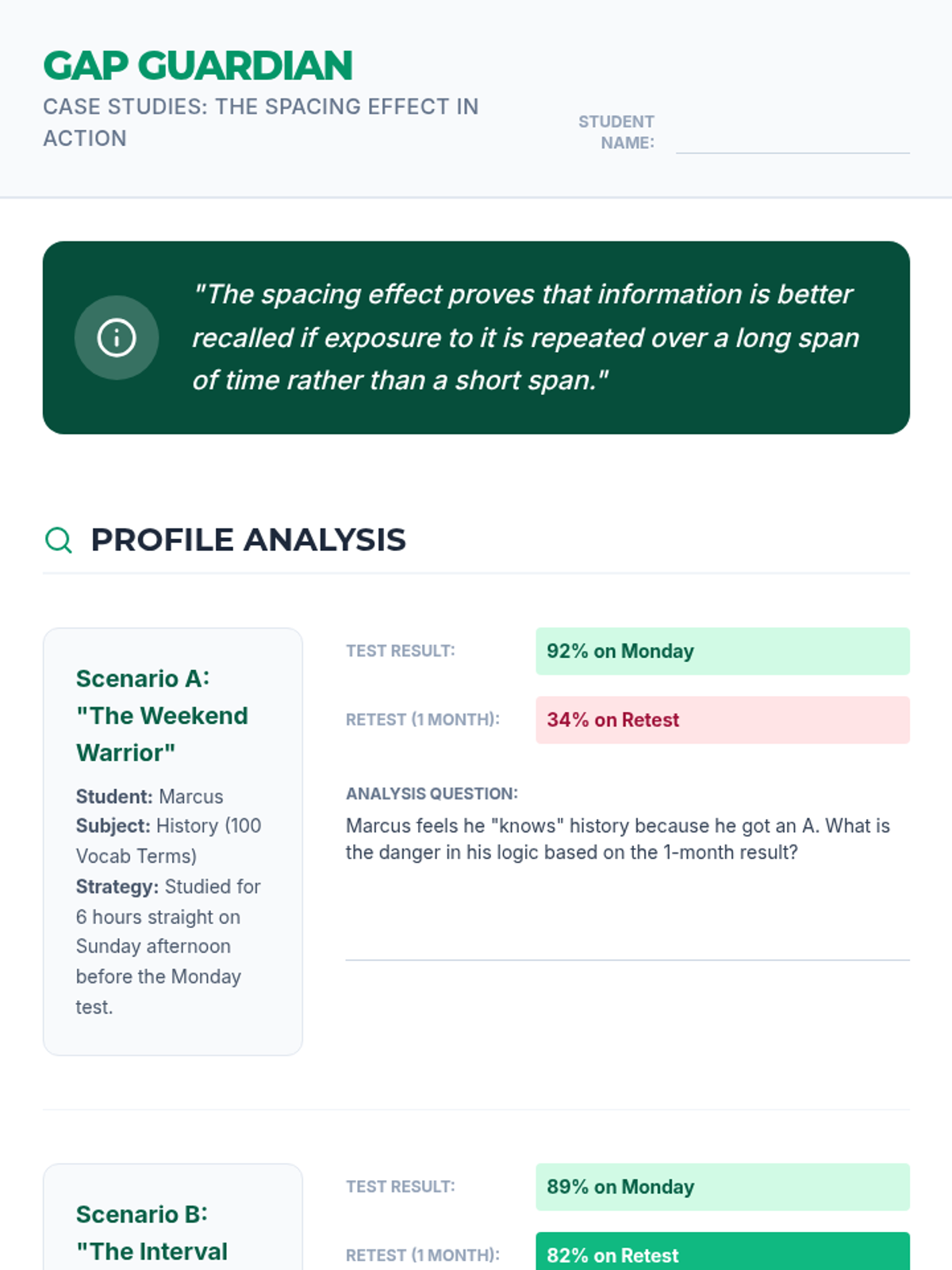
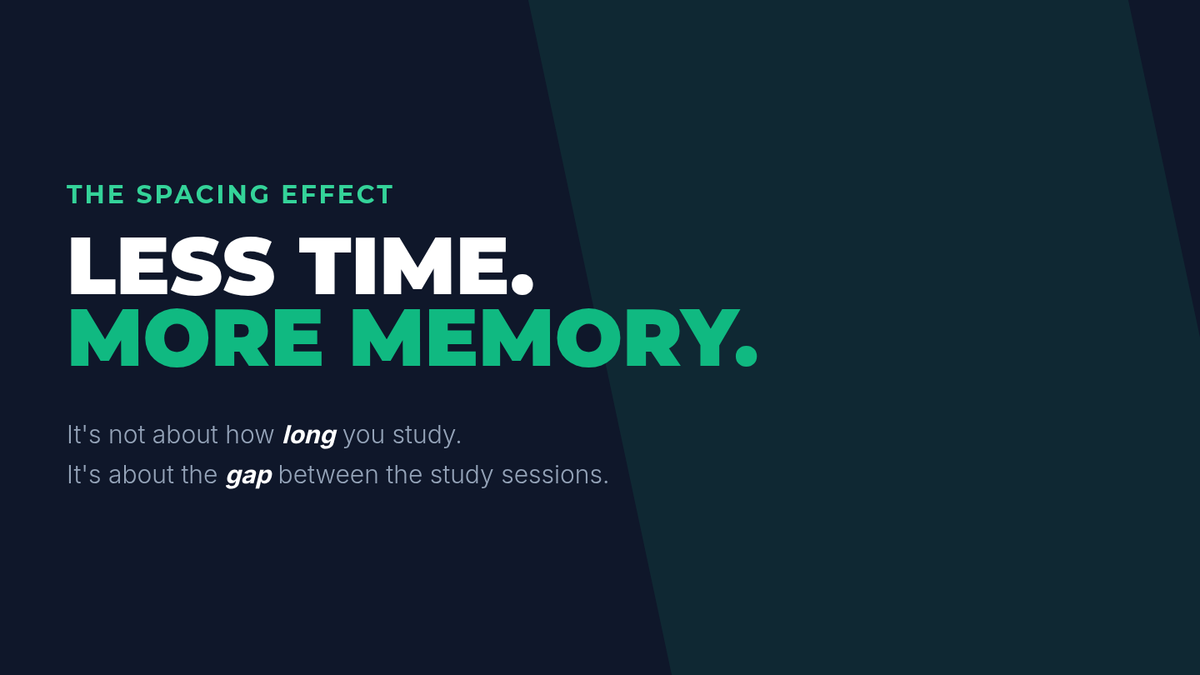
Students analyze case studies to understand the 'spacing effect' and determine the optimal intervals for long-term retention compared to cramming.
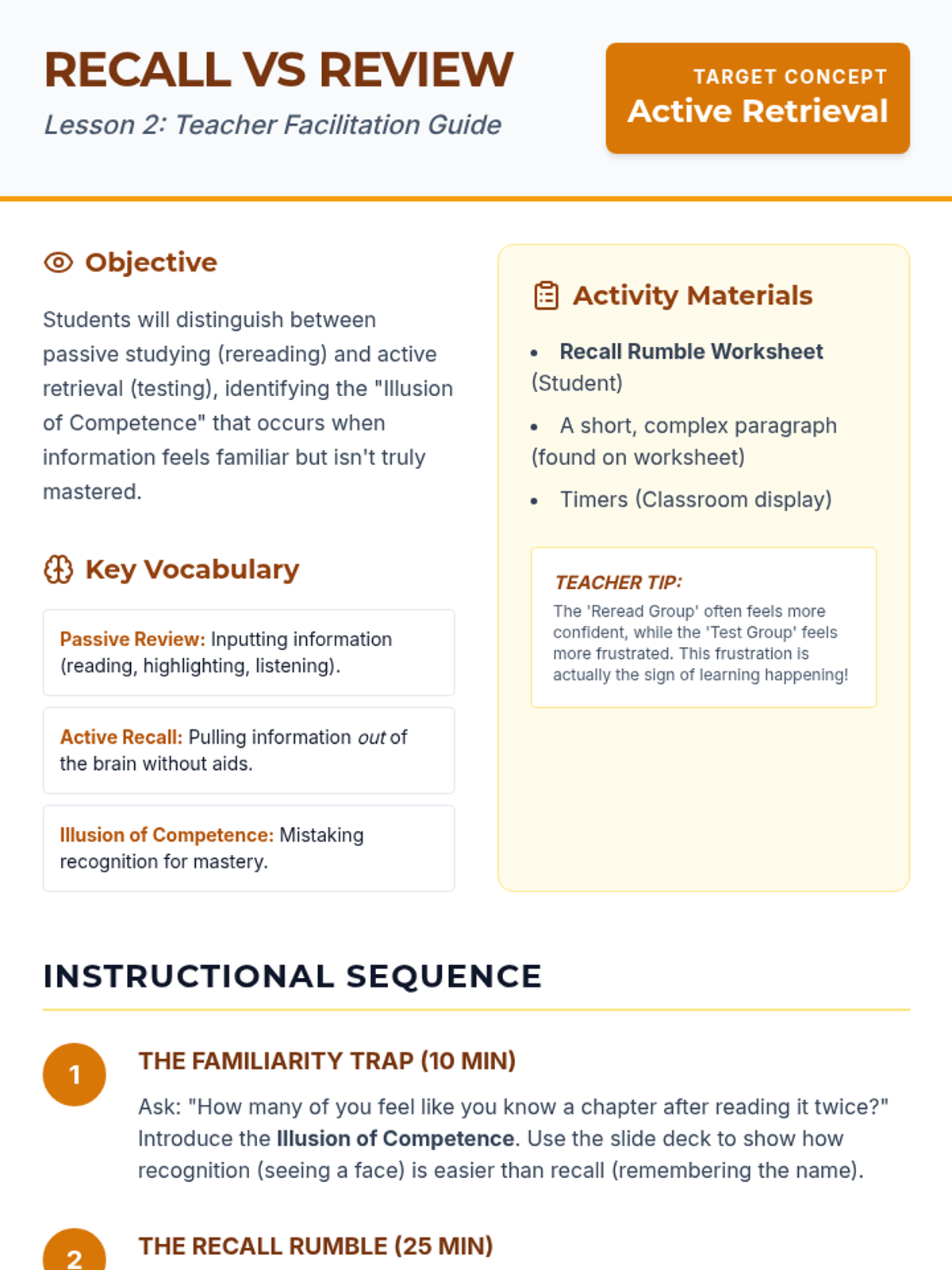
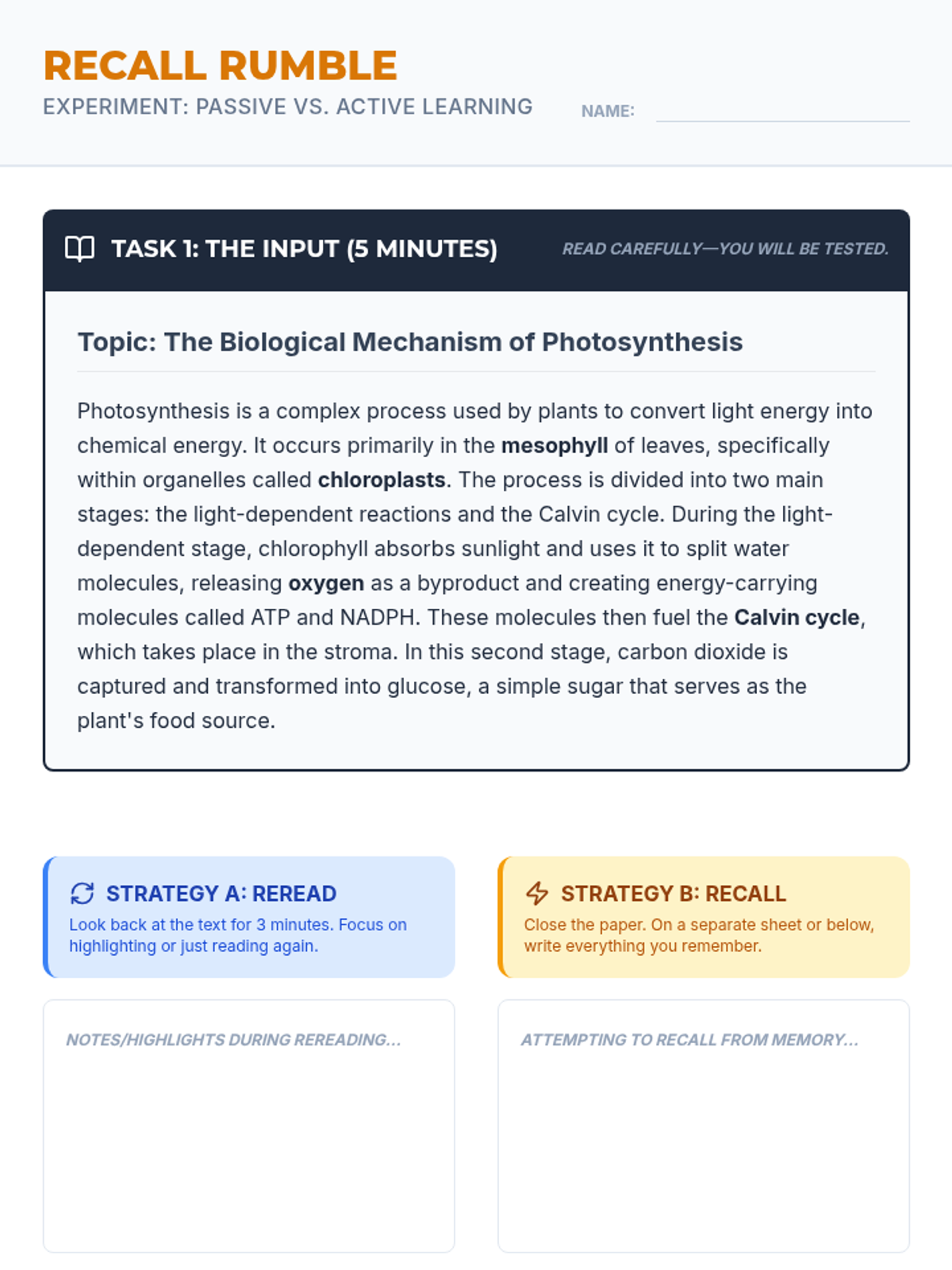
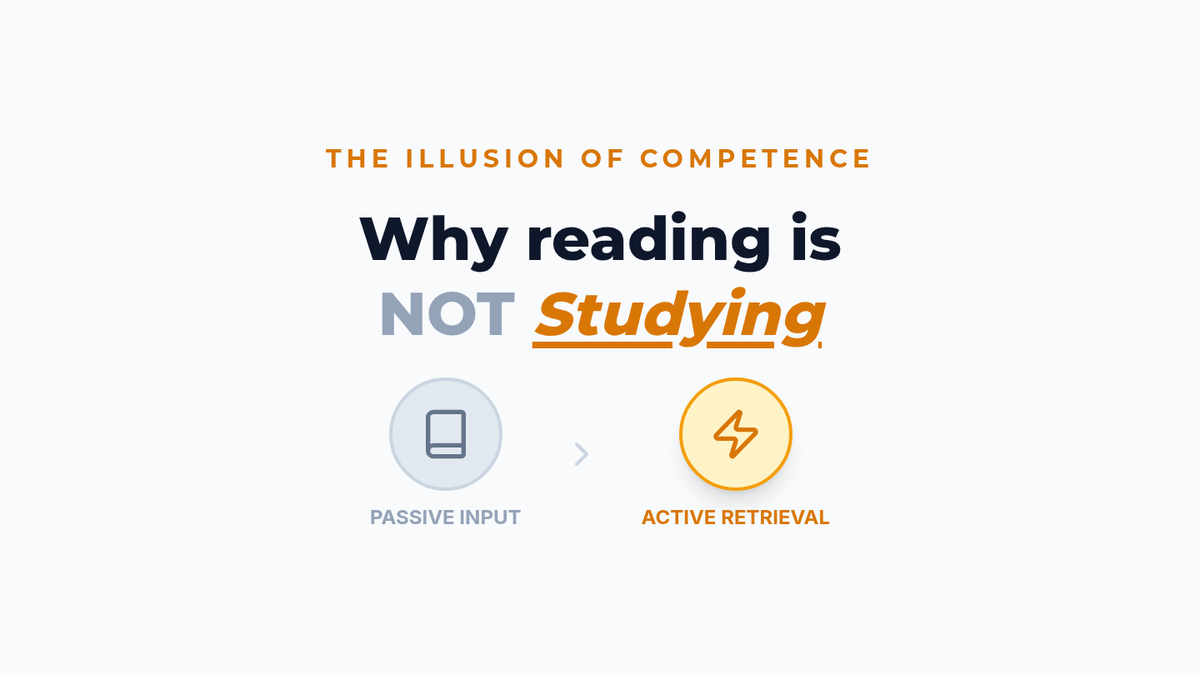
A comparison between passive rereading and active retrieval, highlighting the 'illusion of competence' and the power of testing oneself.
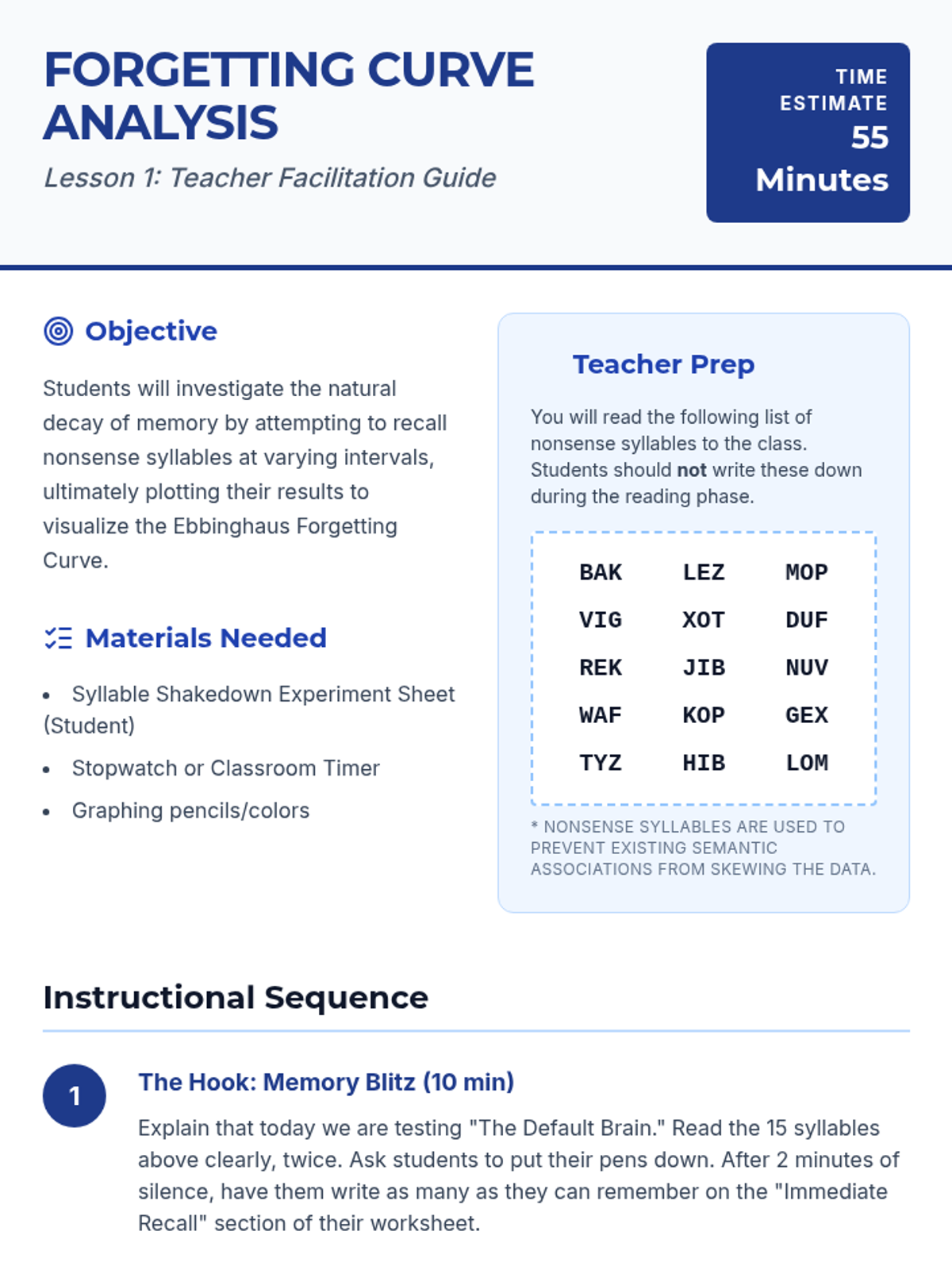
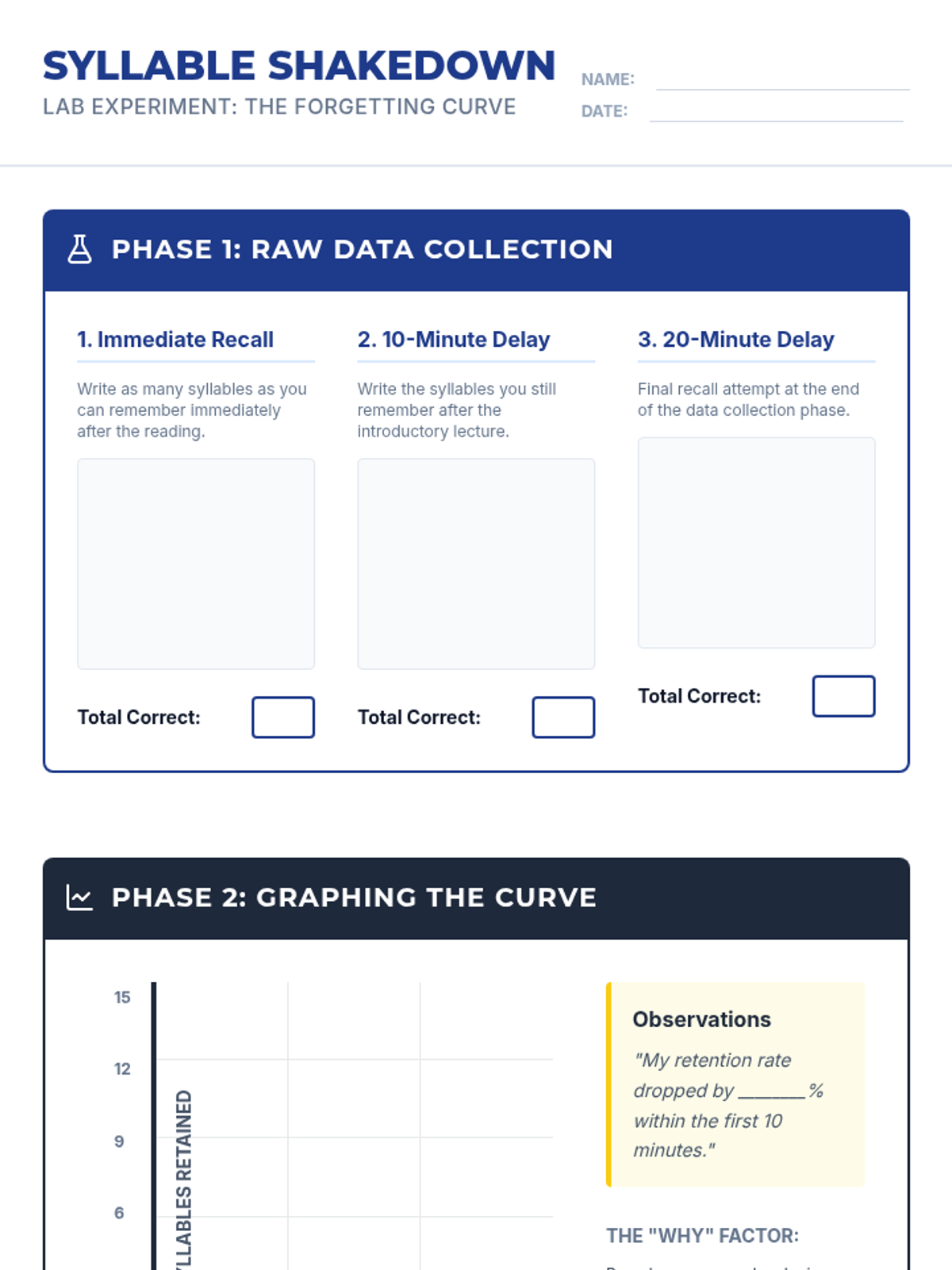
Students explore the Forgetting Curve through a hands-on experiment with nonsense syllables, visualizing how quickly information is lost without strategic review.
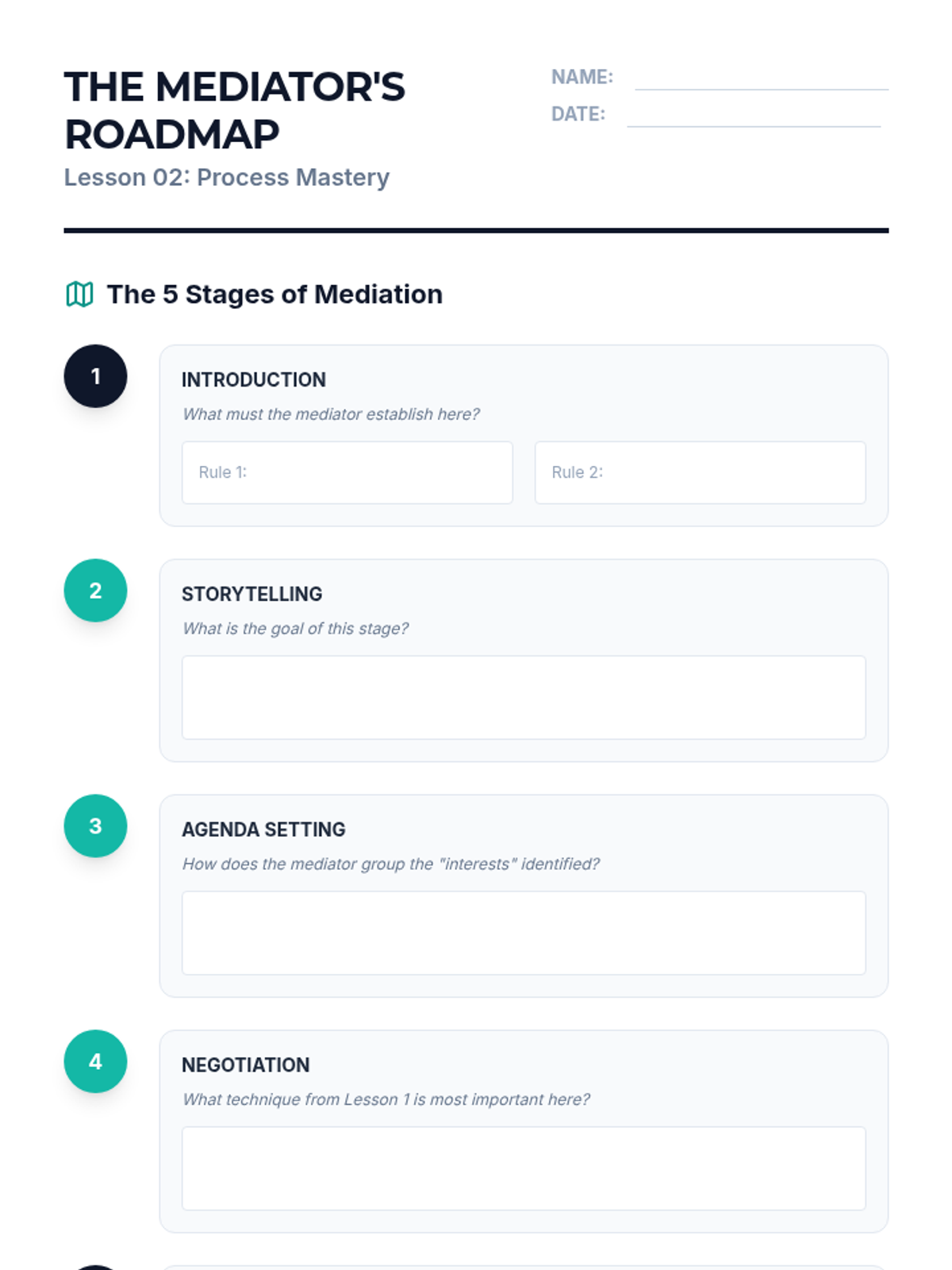
This lesson outlines the formal stages of mediation: Introduction, Storytelling, Agenda Setting, Negotiation, and Agreement. Students learn the procedural responsibilities of a mediator to maintain safety and order. They create visual flowcharts of the process to understand how to guide disputants from chaos to order.
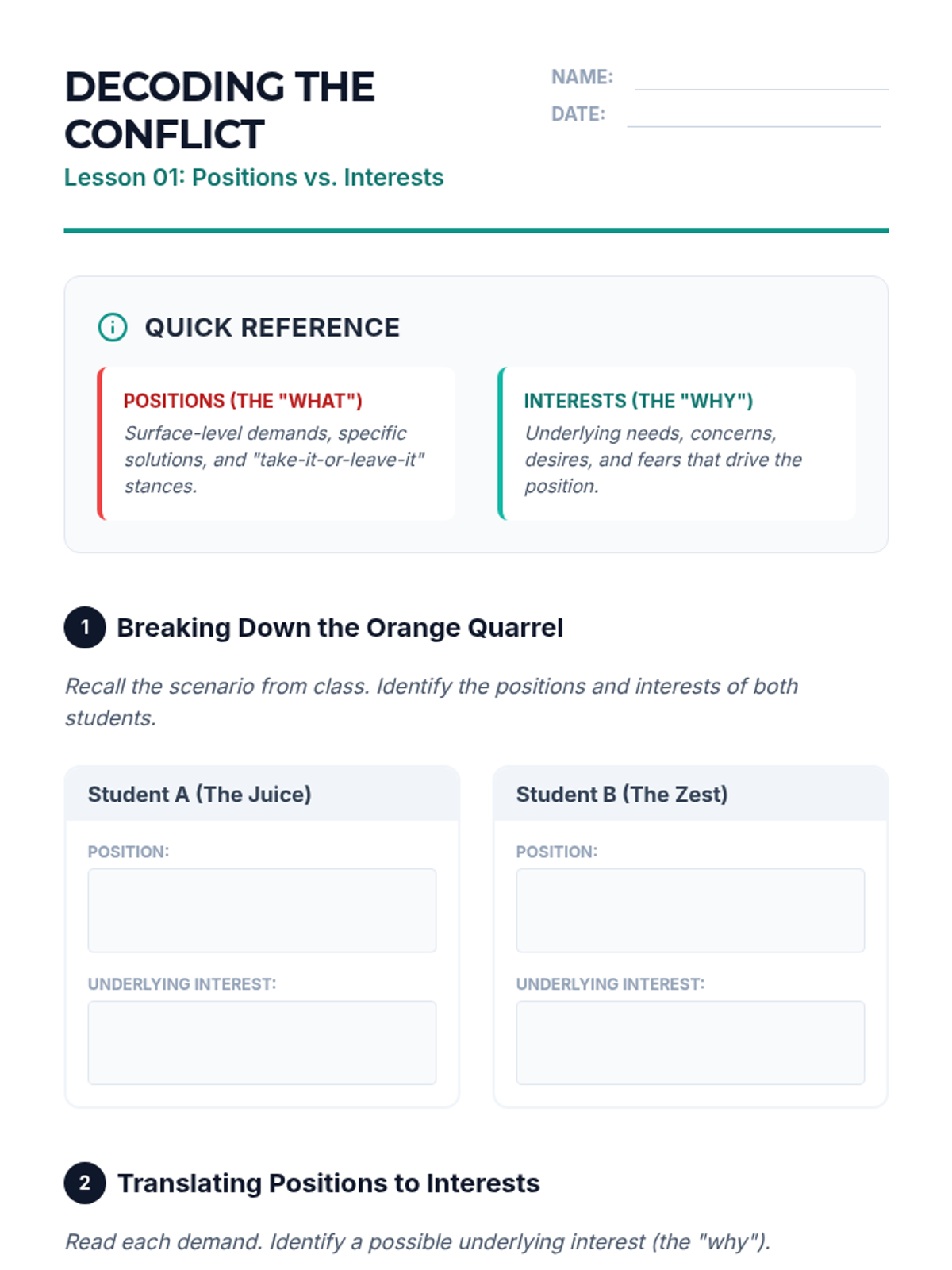
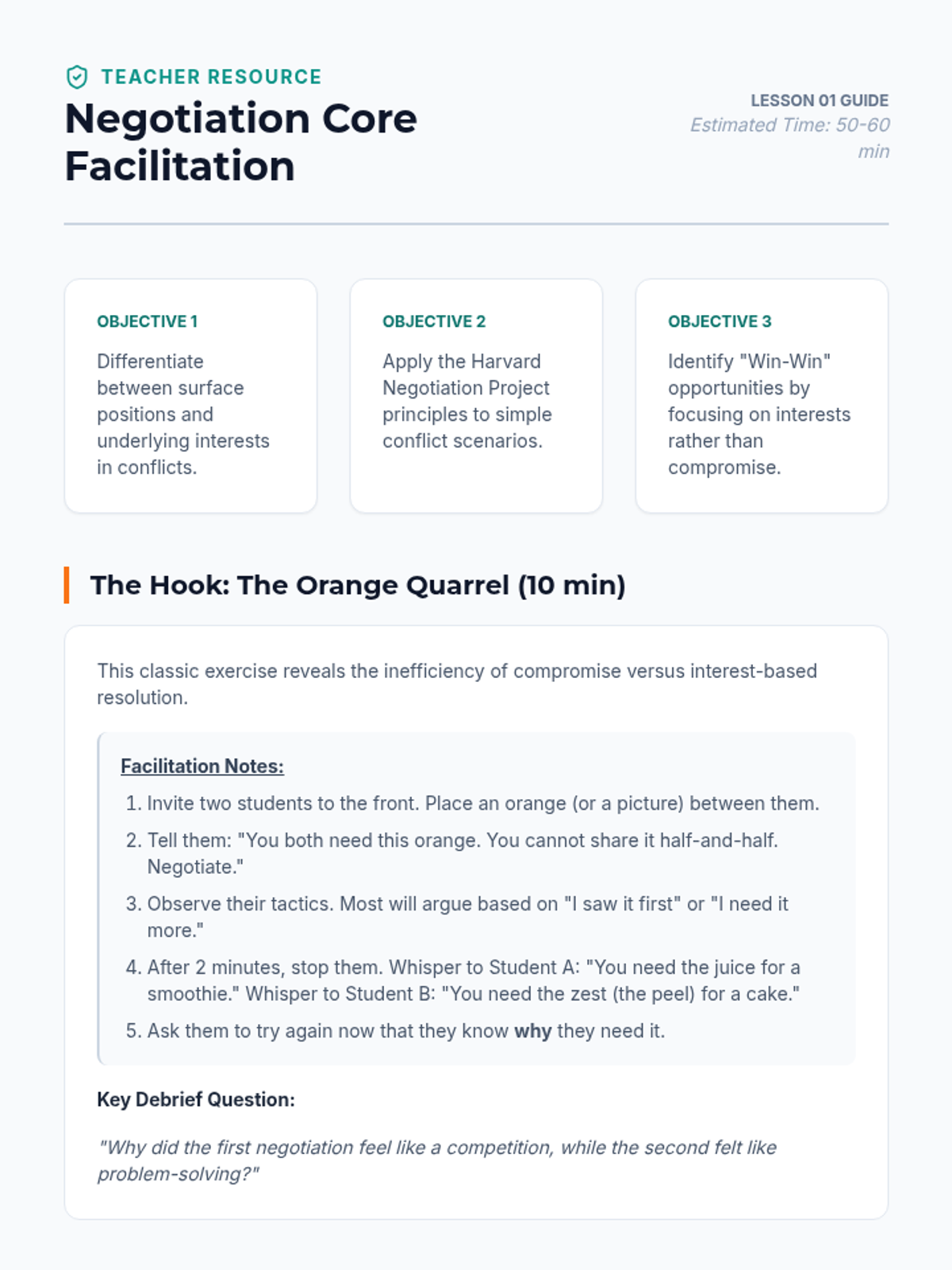
Students learn to distinguish between surface-level positions and underlying interests using the Harvard Negotiation Project model. The lesson introduces Interest-Based Negotiation (IBN) through the classic 'Orange Quarrel' scenario and case study analysis.
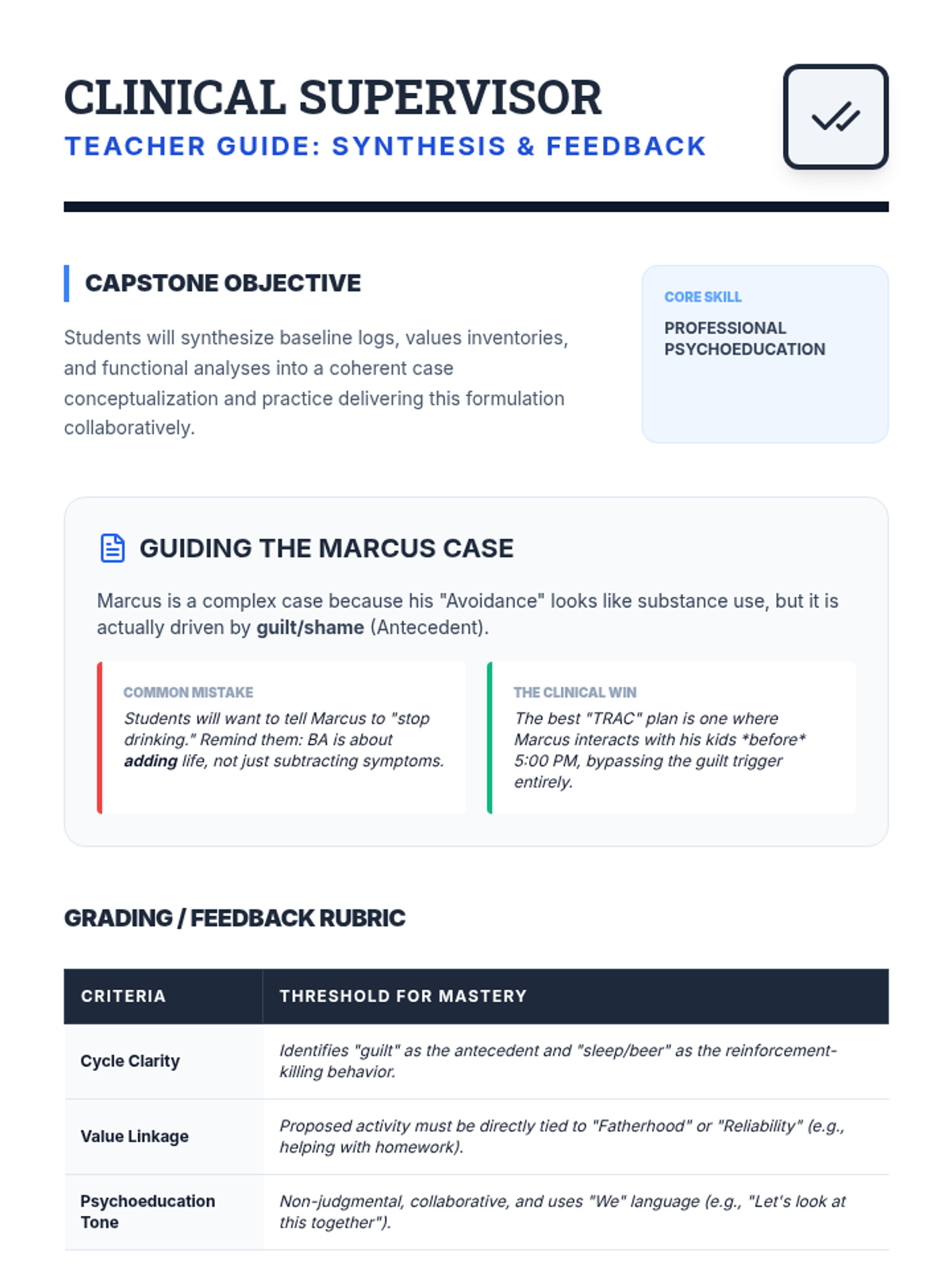
Synthesize assessment data into a coherent case conceptualization and practice delivering feedback to clients.
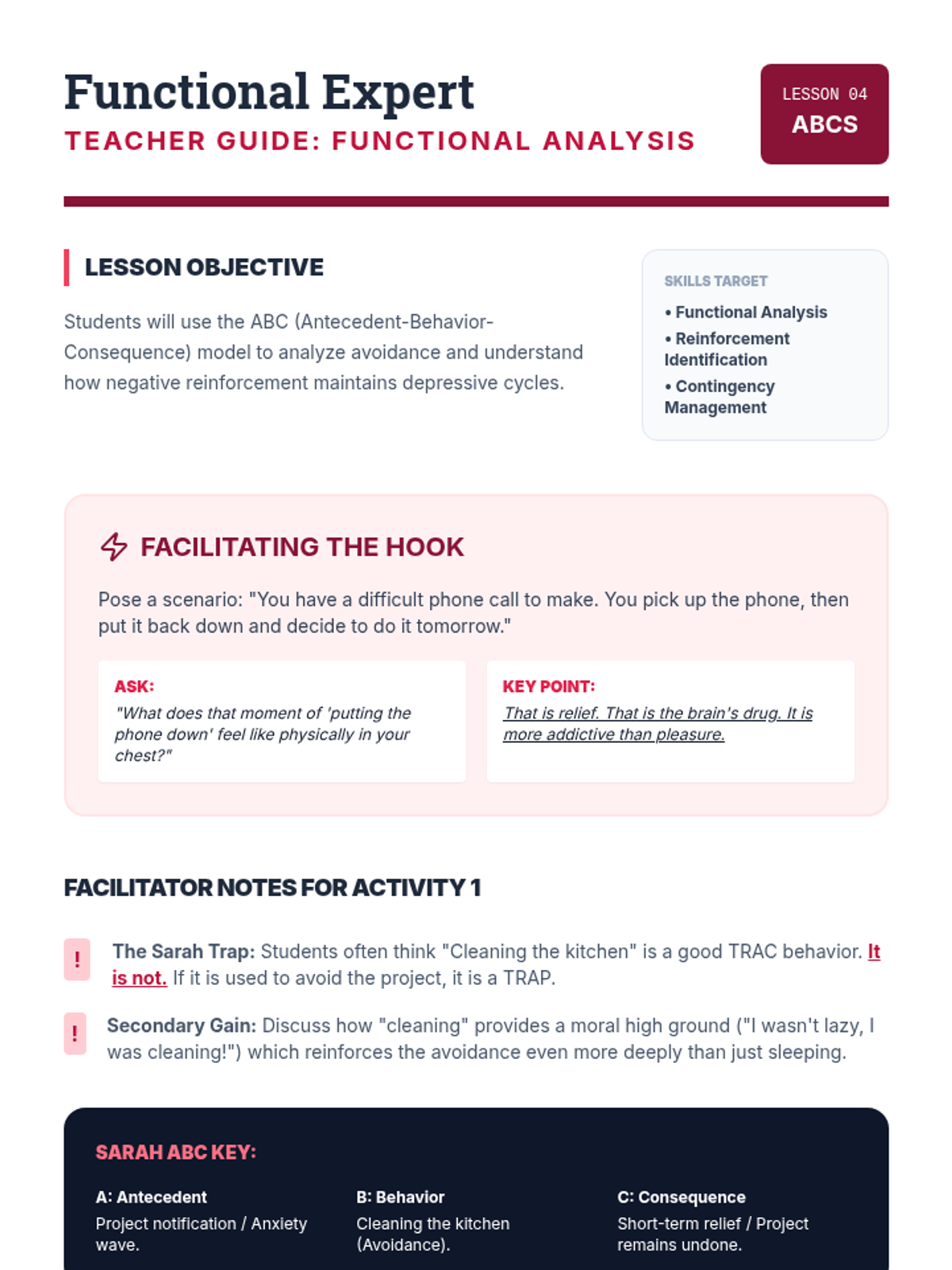
Utilize the ABC model to conduct a functional analysis of avoidance behaviors and understand their reinforcing contingencies.
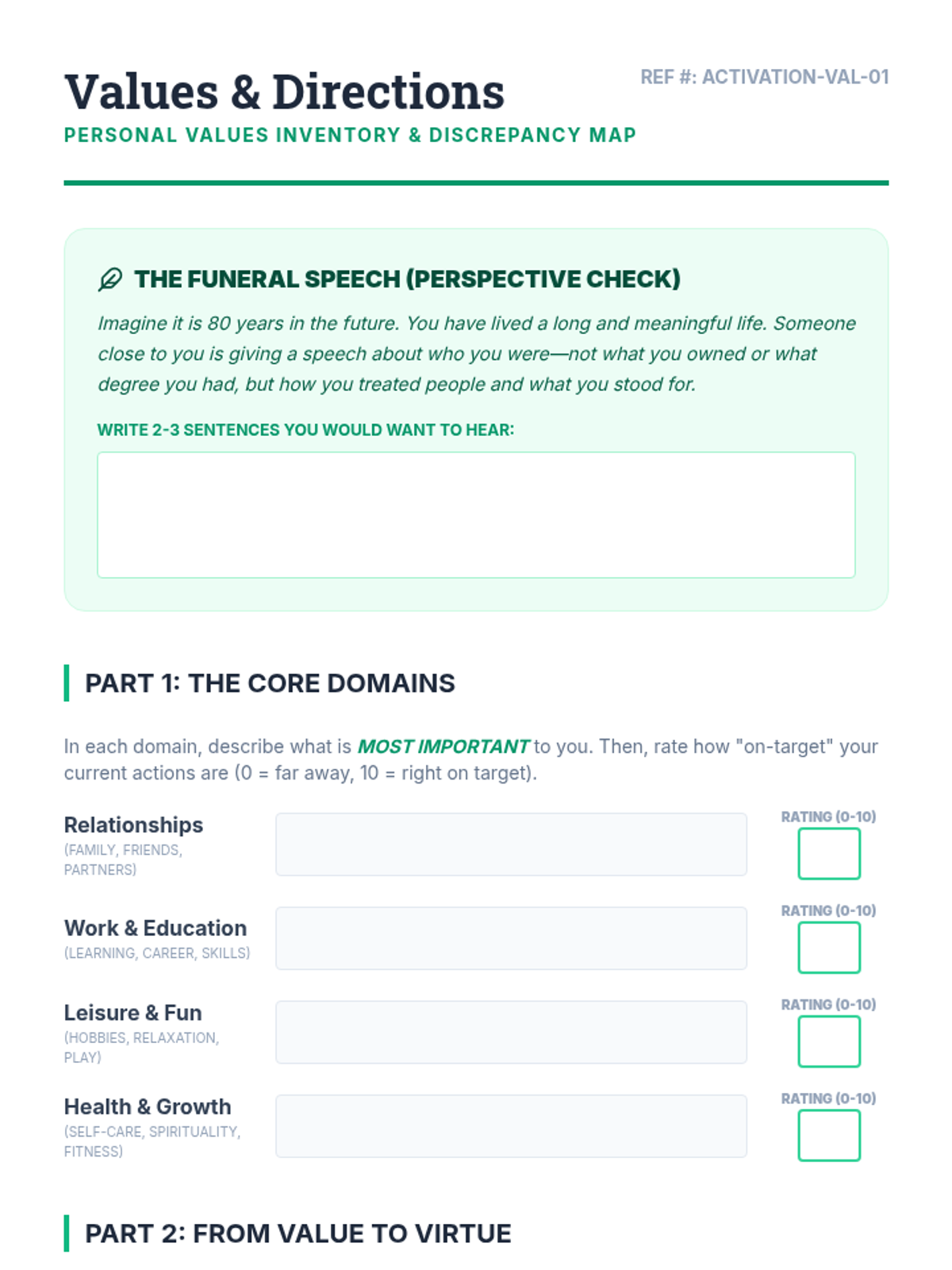
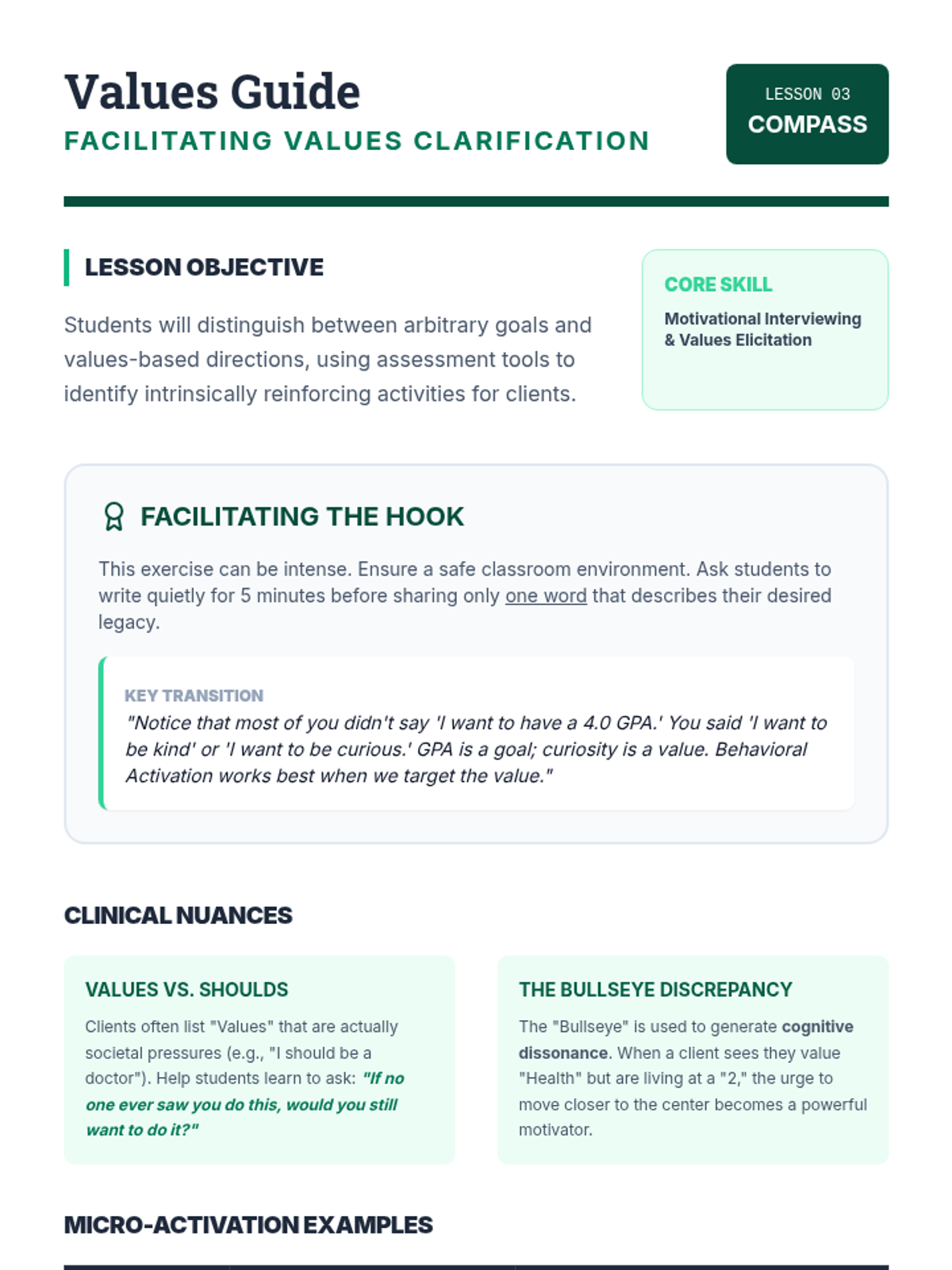
Distinguish between goals and values and use assessment tools to identify intrinsically motivating activities for clients.
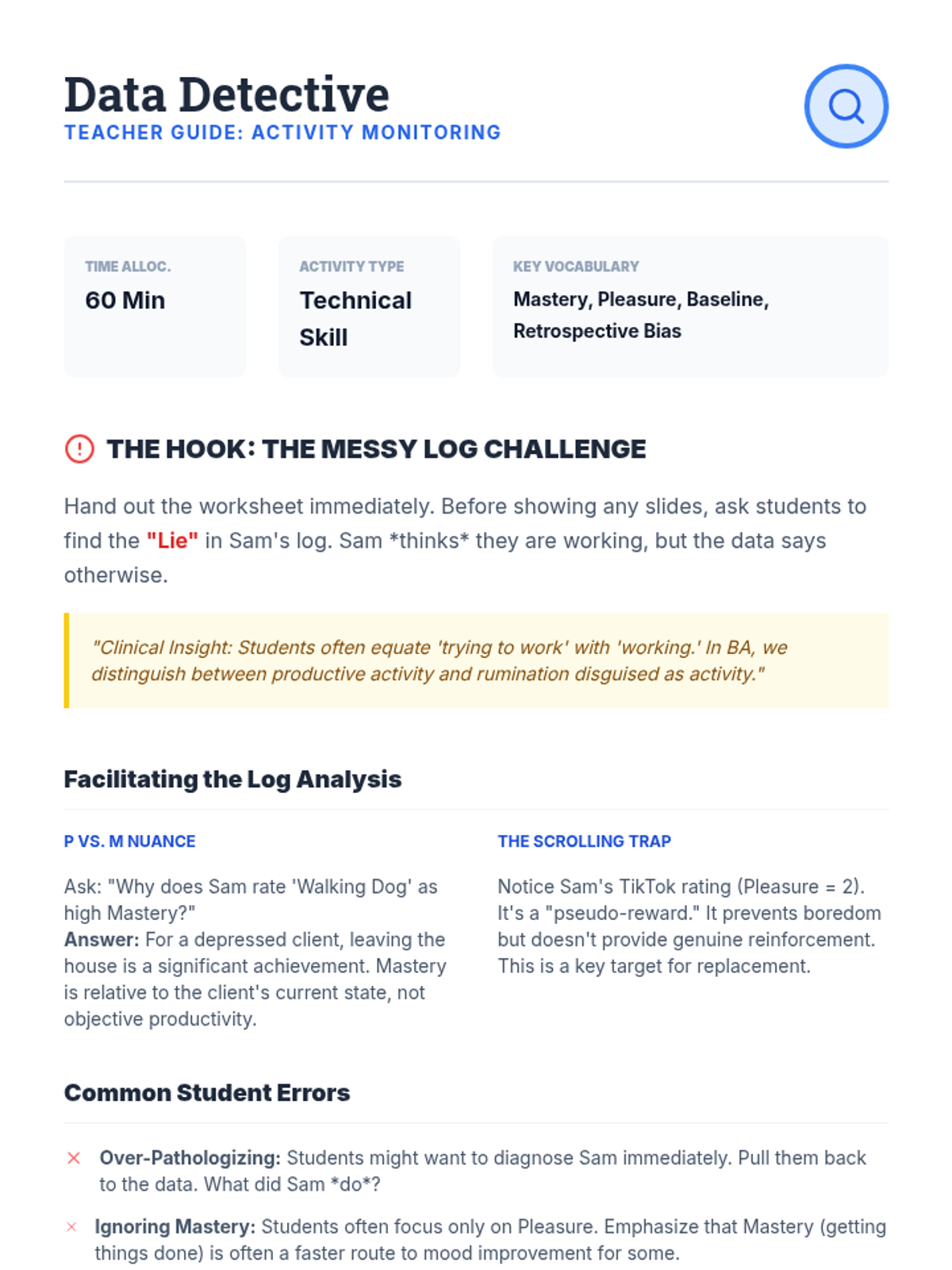
Learn the technical skill of activity monitoring and baseline assessment using mastery and pleasure scales.
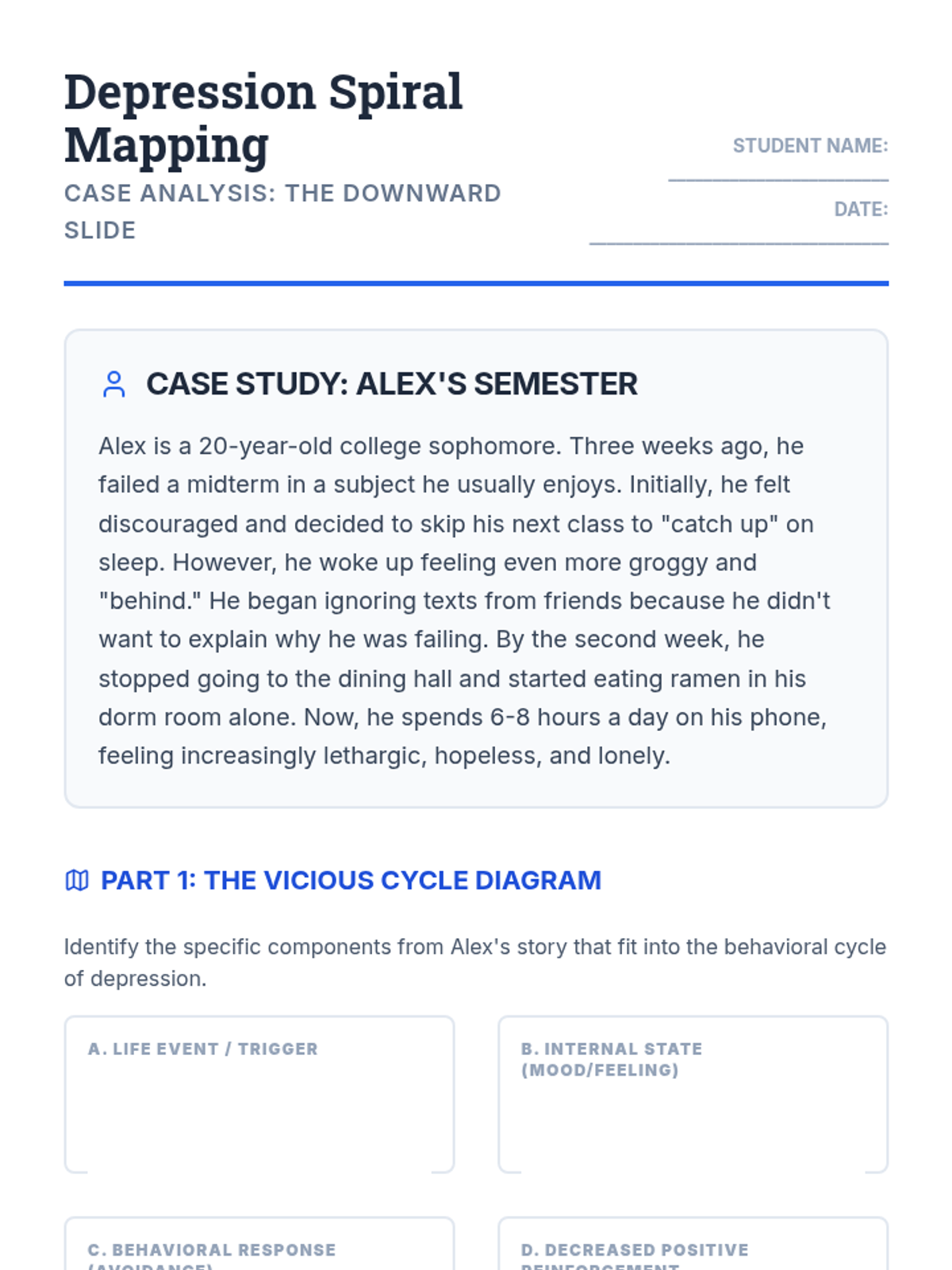
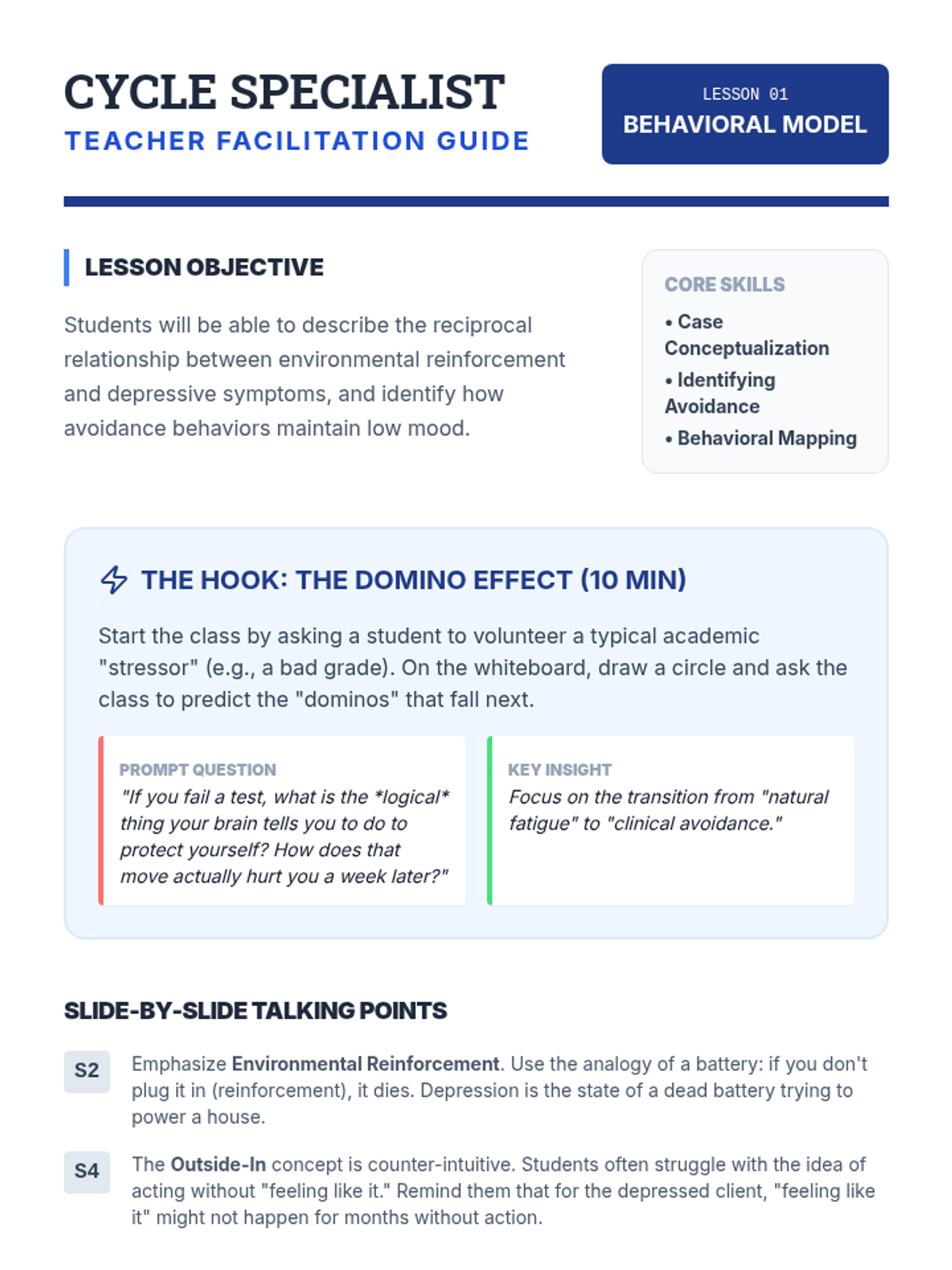
Analyze the behavioral cycle of depression, focusing on how life events lead to avoidance and a lack of positive reinforcement.
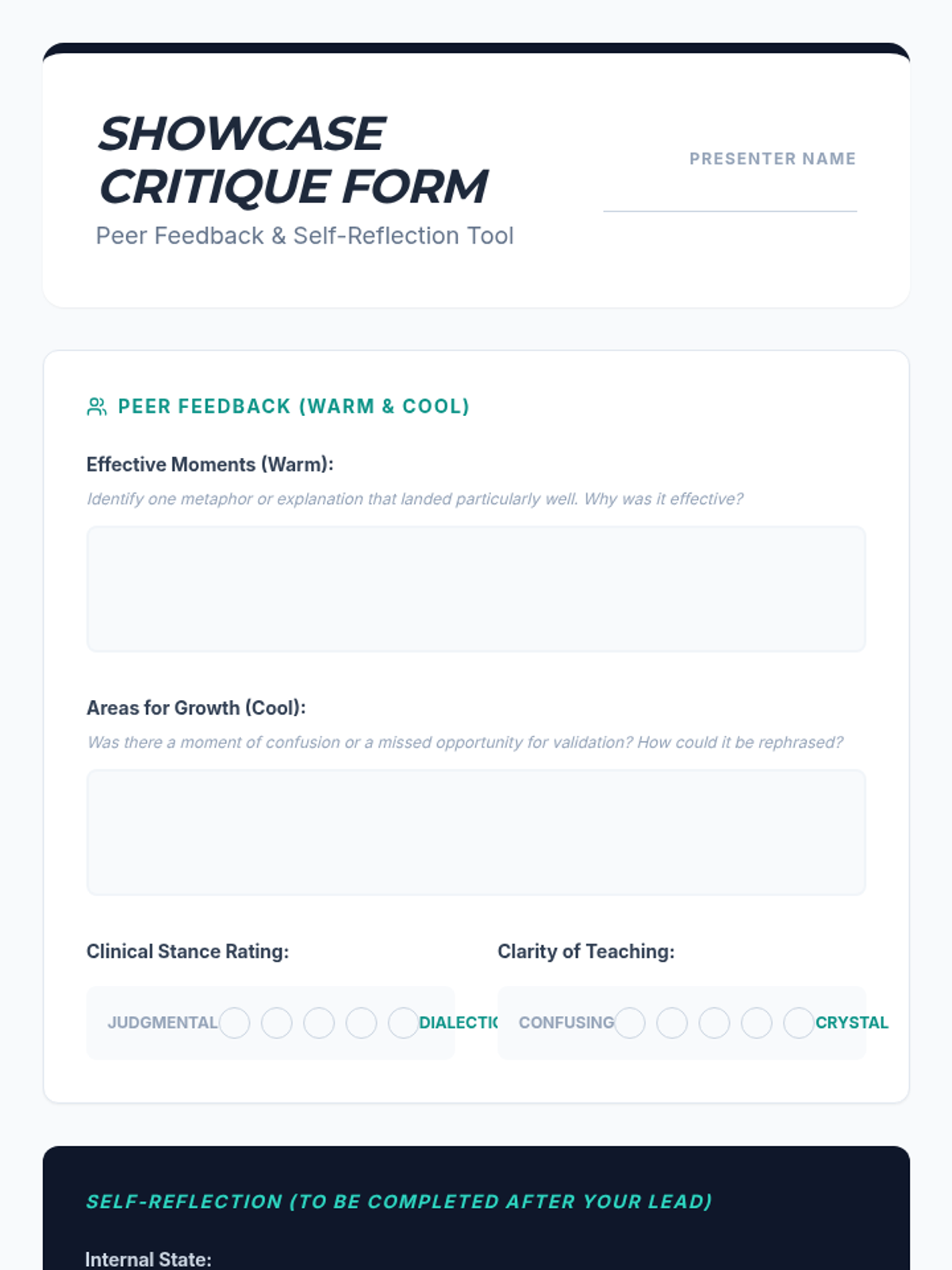
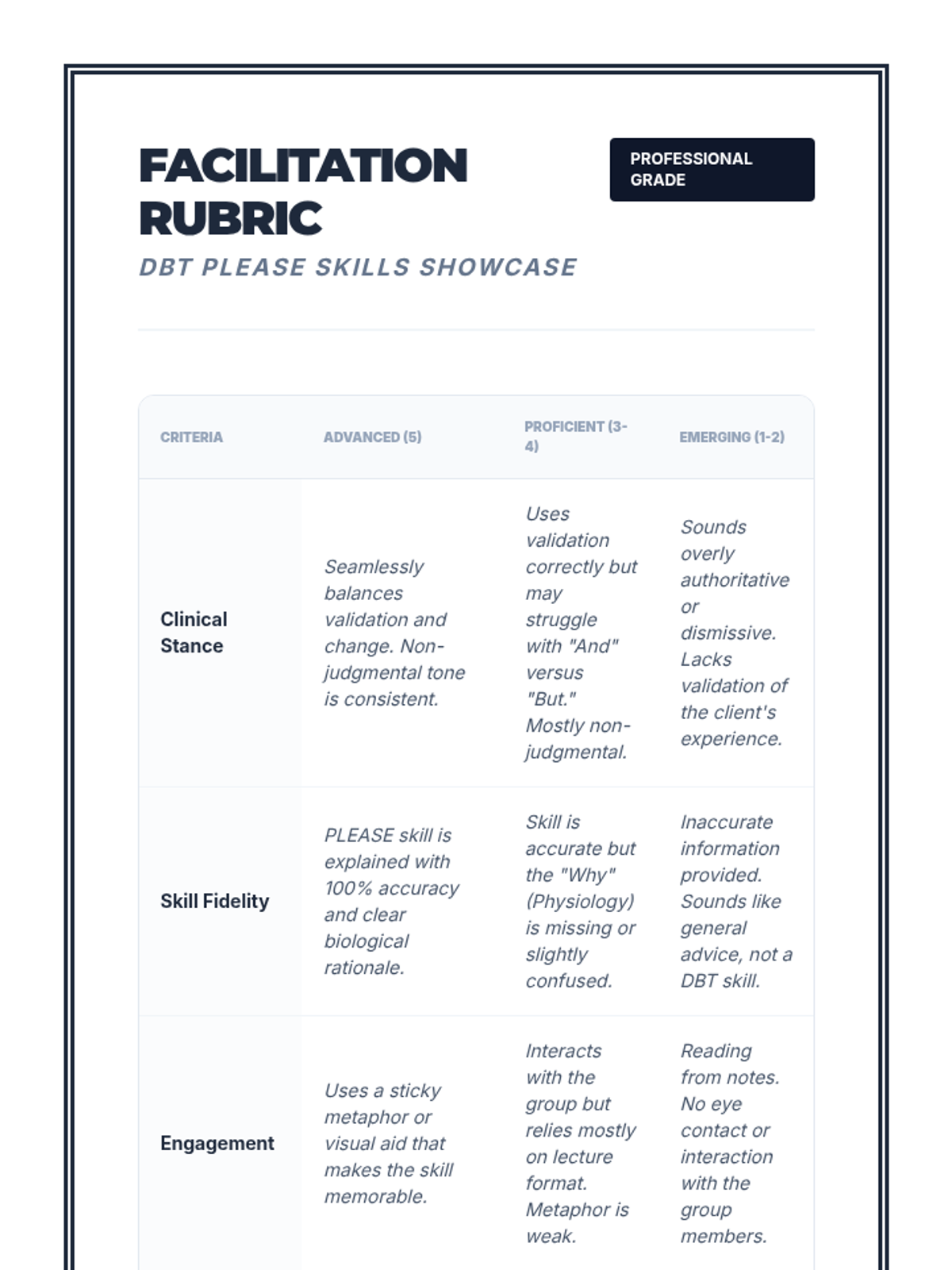
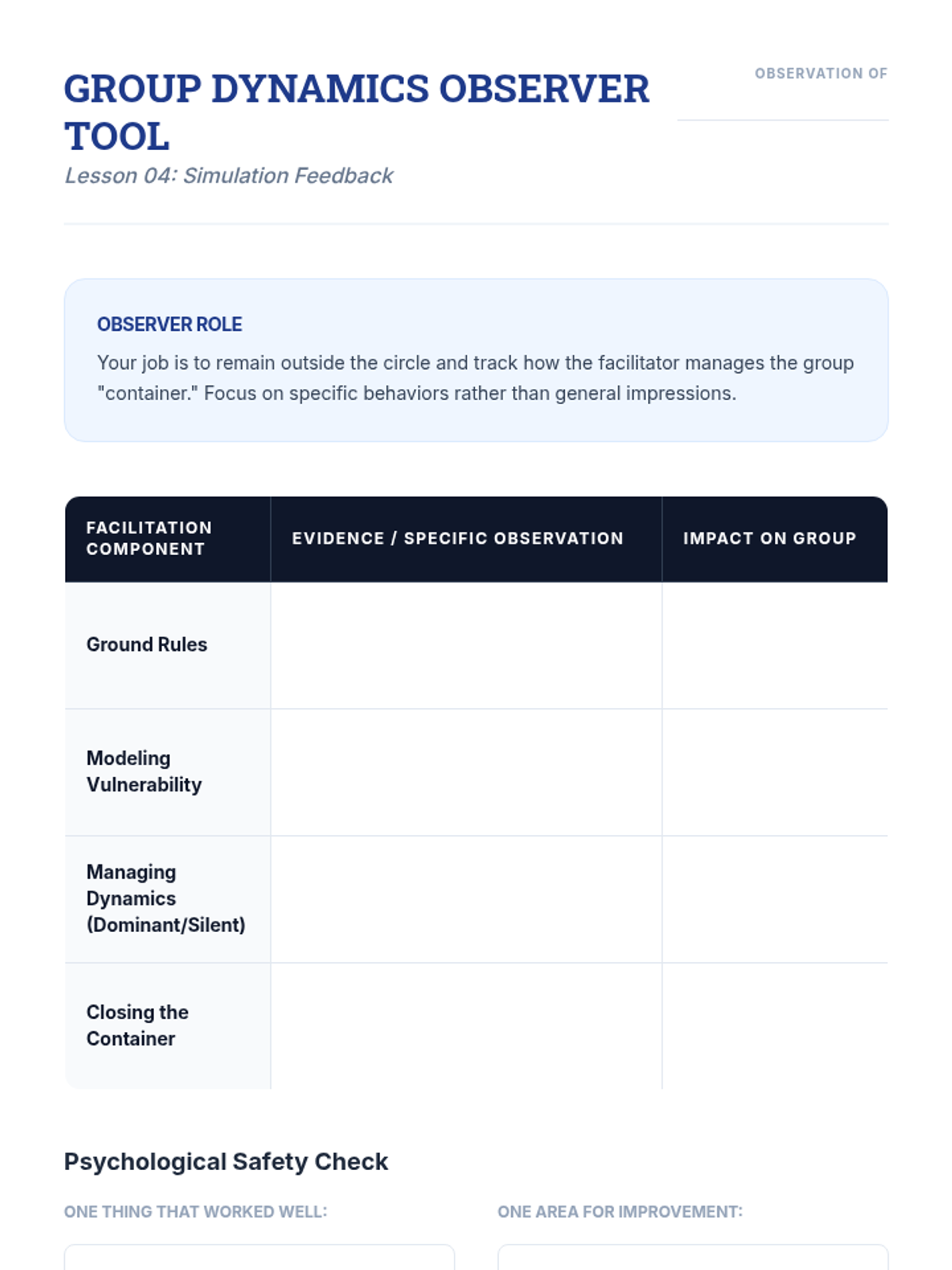
Students facilitate a mock group segment and receive professional feedback on their teaching style and clinical presence.
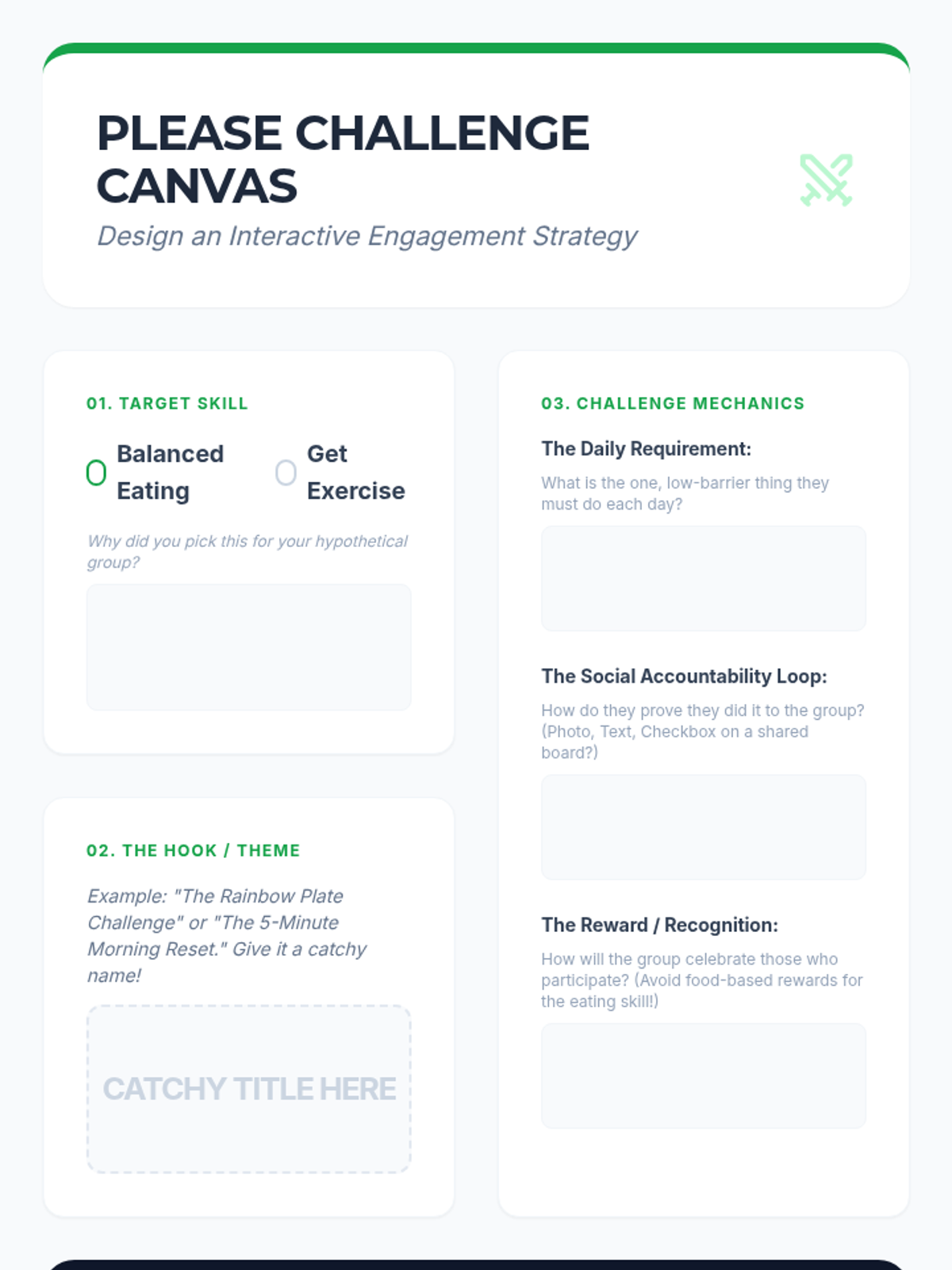
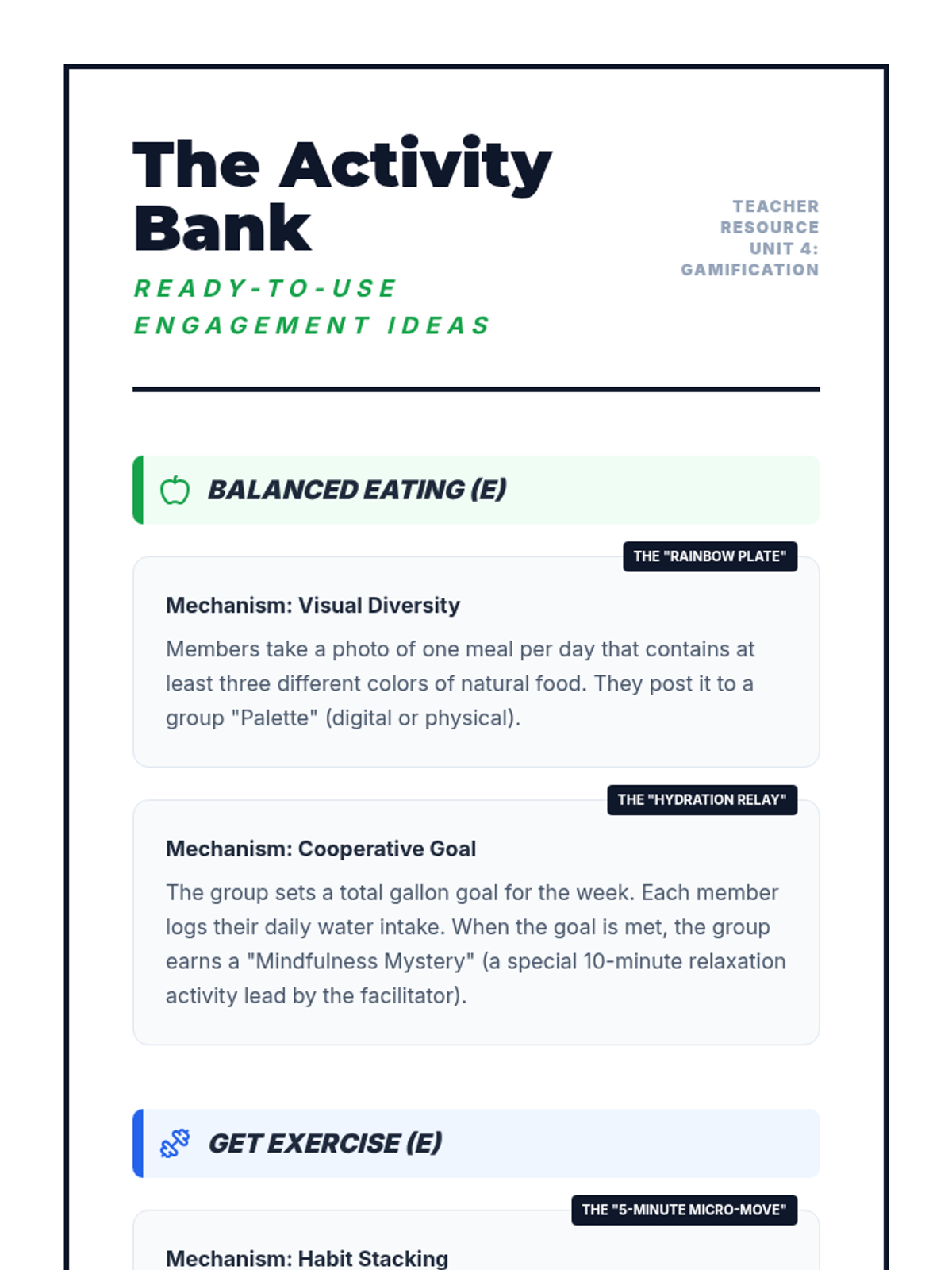
Students apply gamification and social accountability strategies to make behavioral health habits (eating and exercise) engaging for groups.
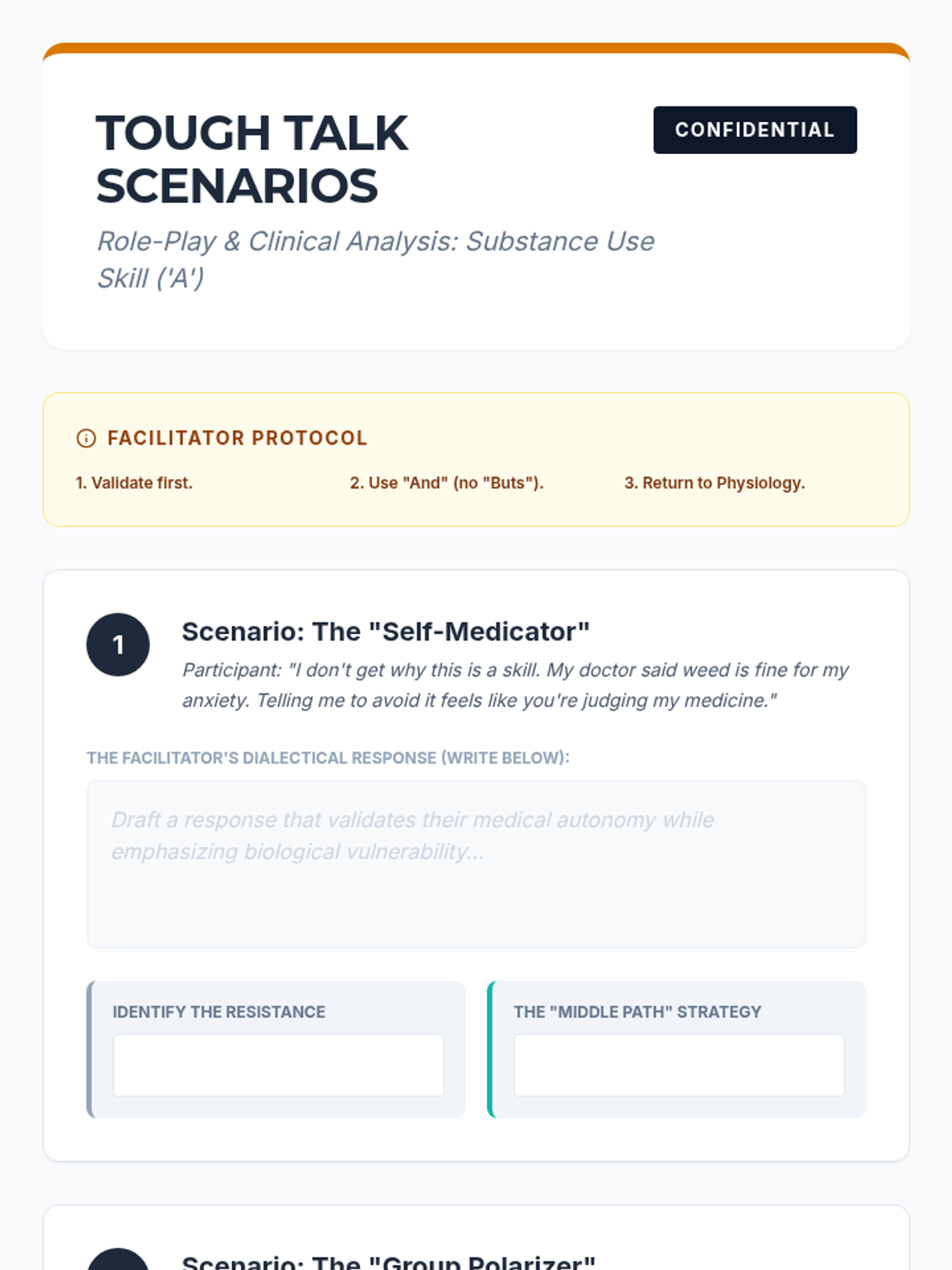
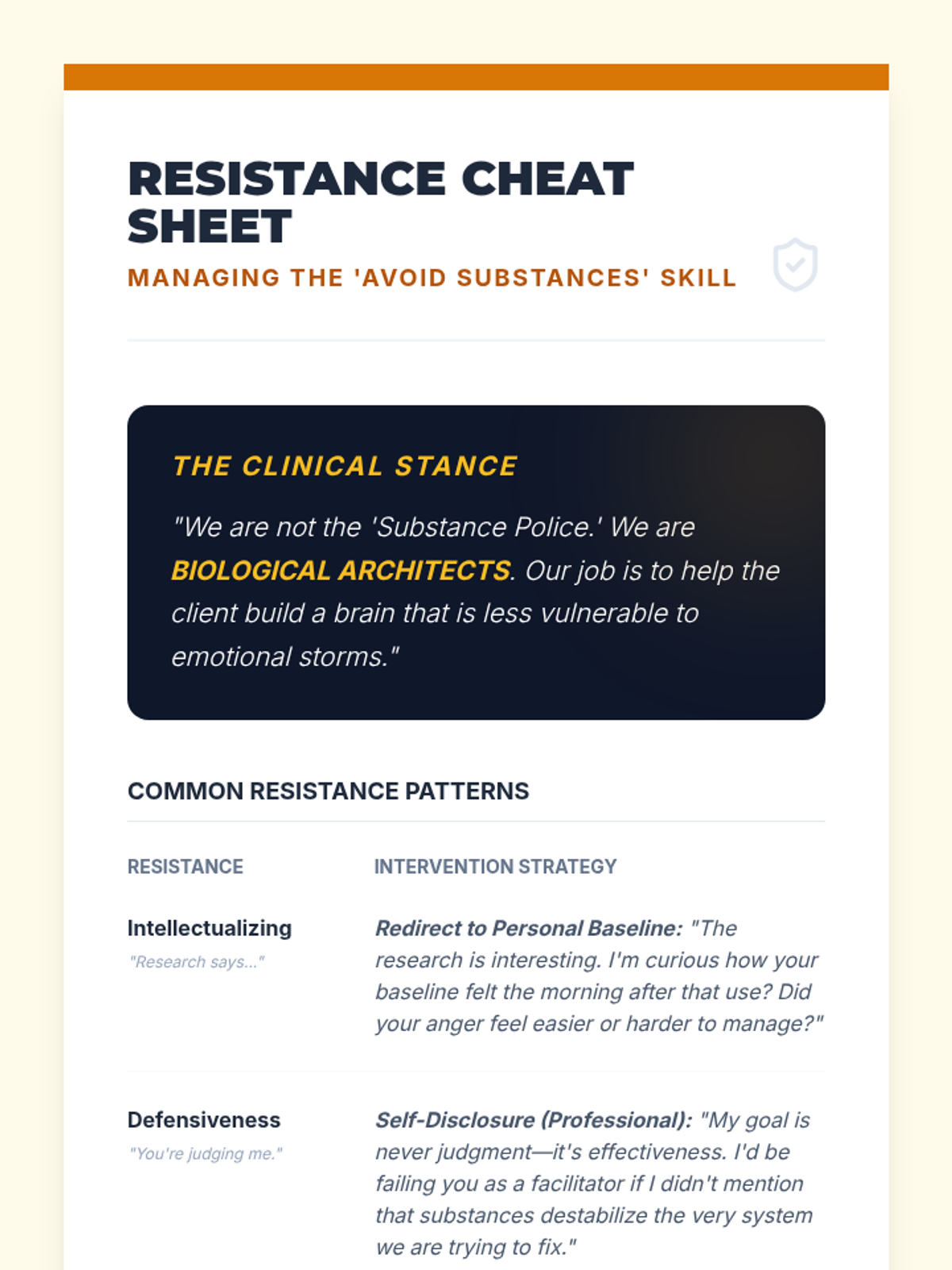
This lesson focuses on managing group resistance and sensitive dynamics around substance use and mood-altering behaviors.
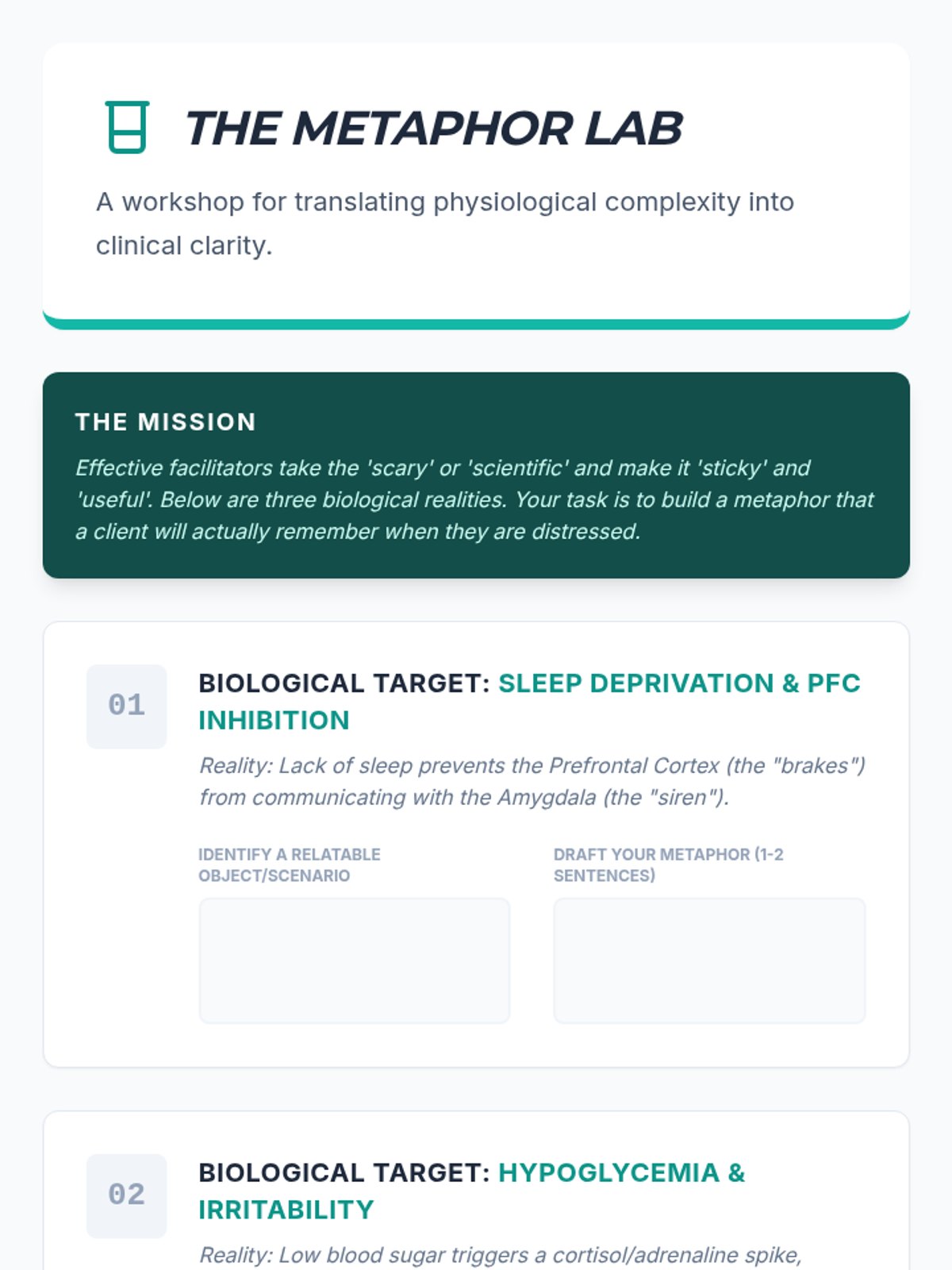
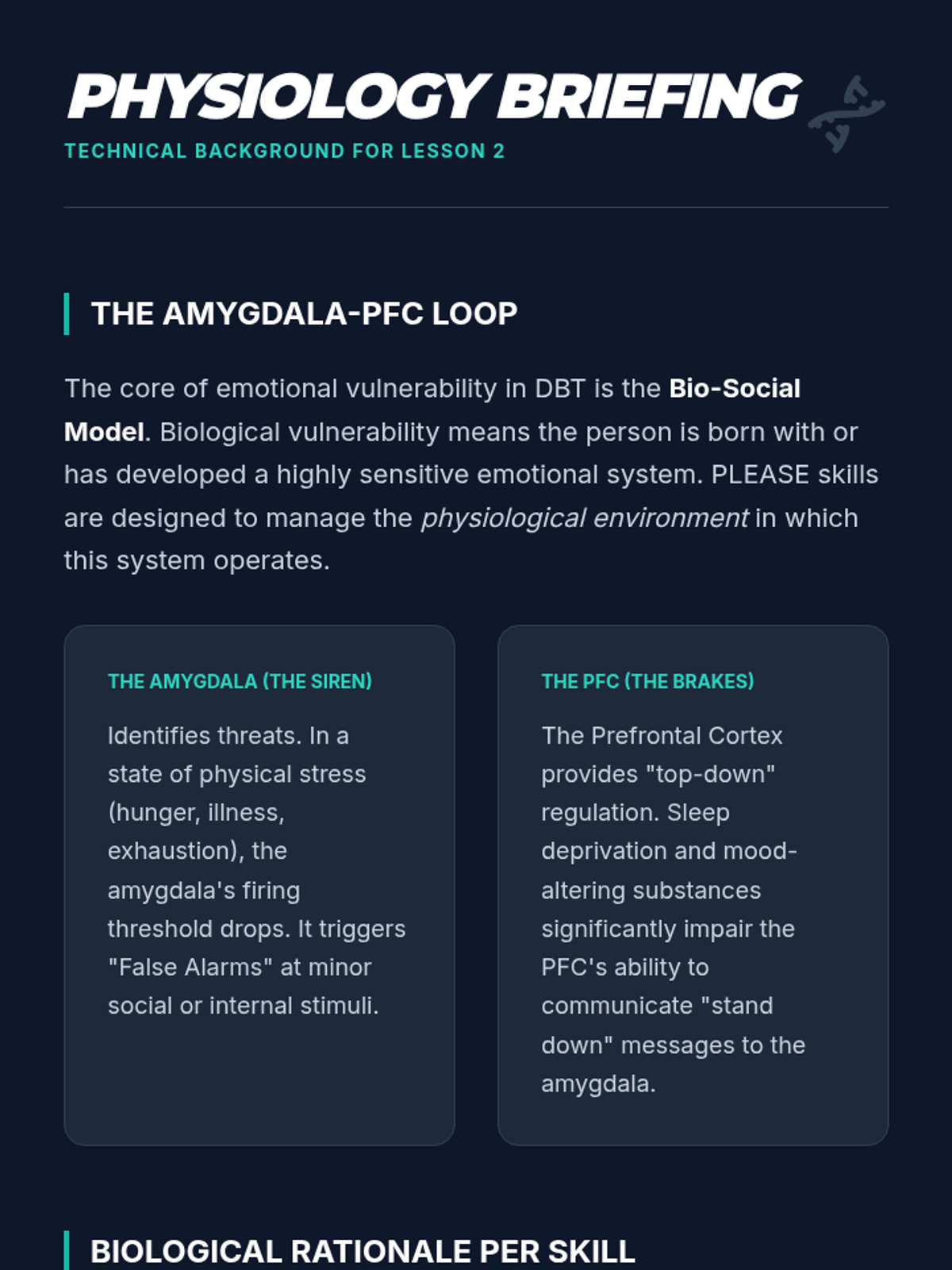
Students practice translating complex physiological concepts of emotional regulation into accessible psychoeducation for group members.
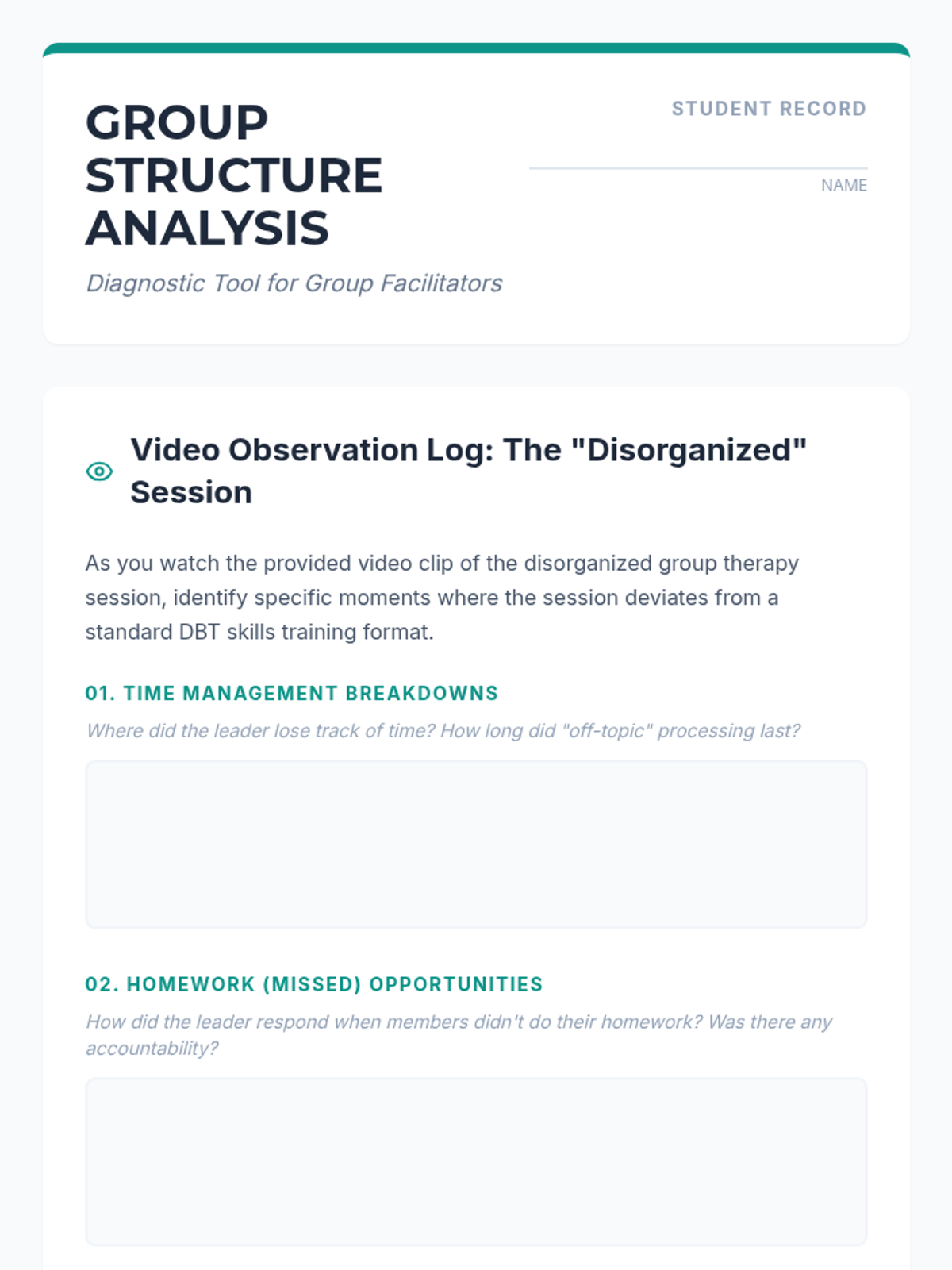
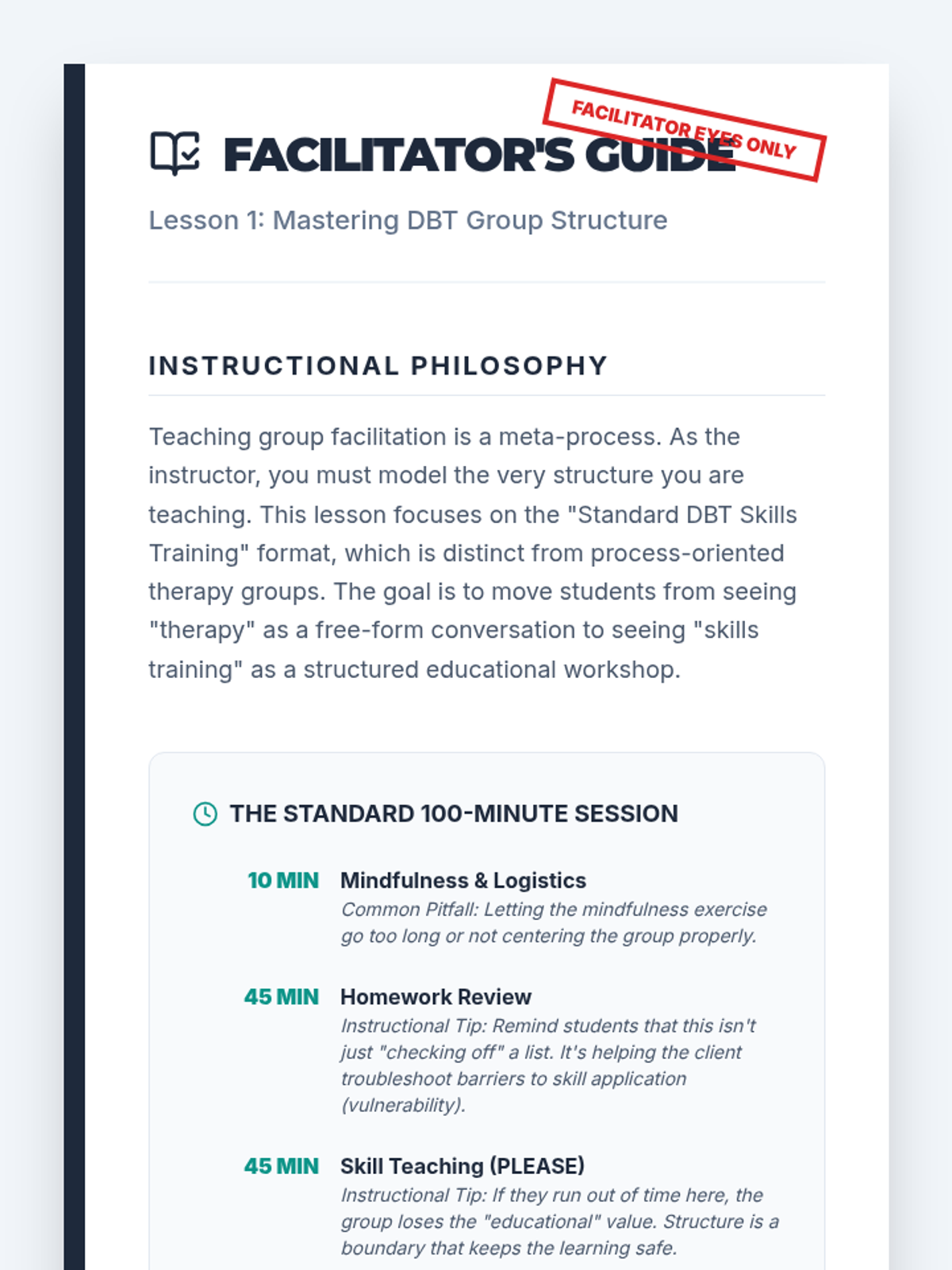
Students explore the standard DBT skills training group format, focusing on the balance between content delivery (PLEASE intro) and group processing.
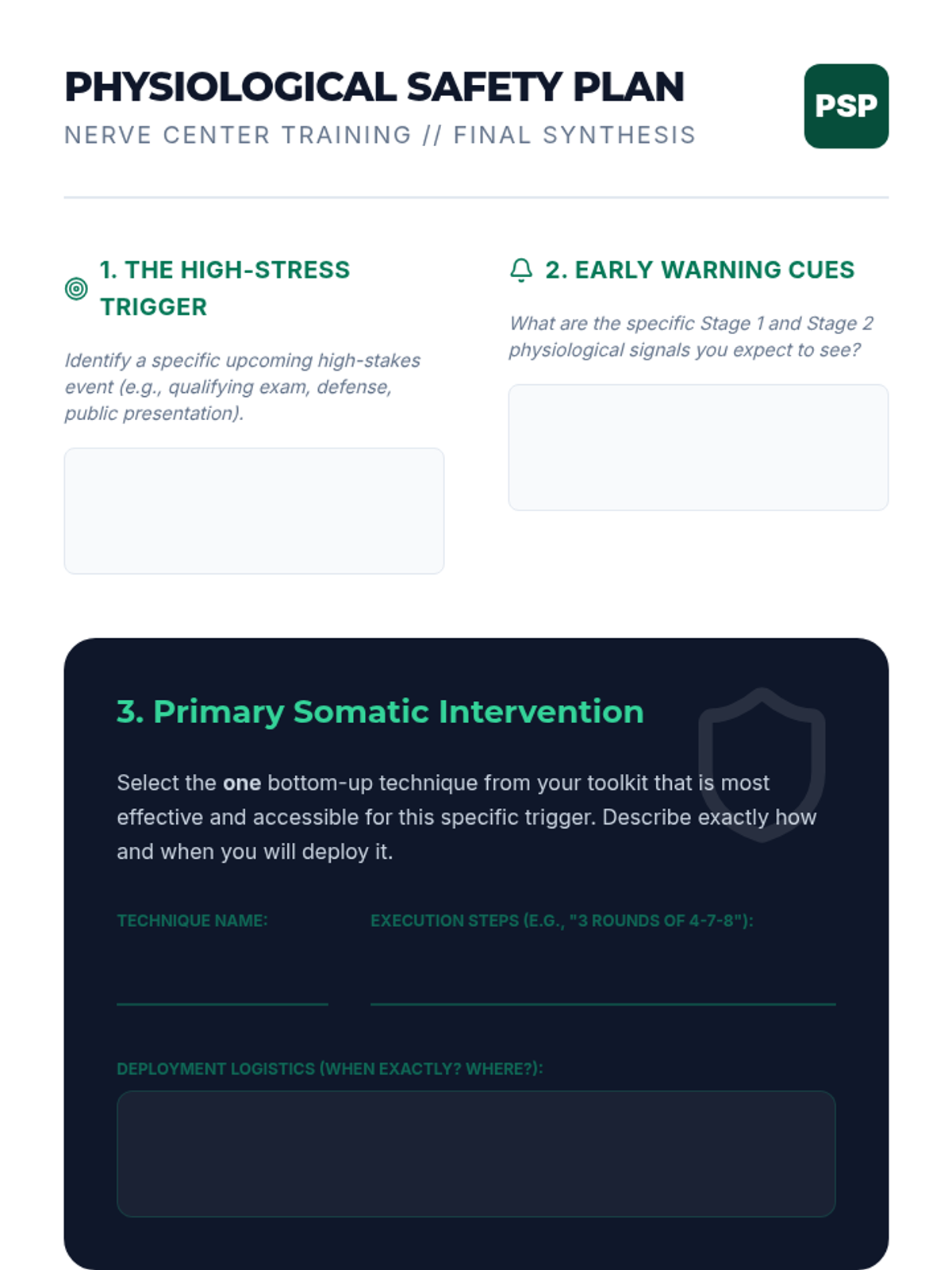
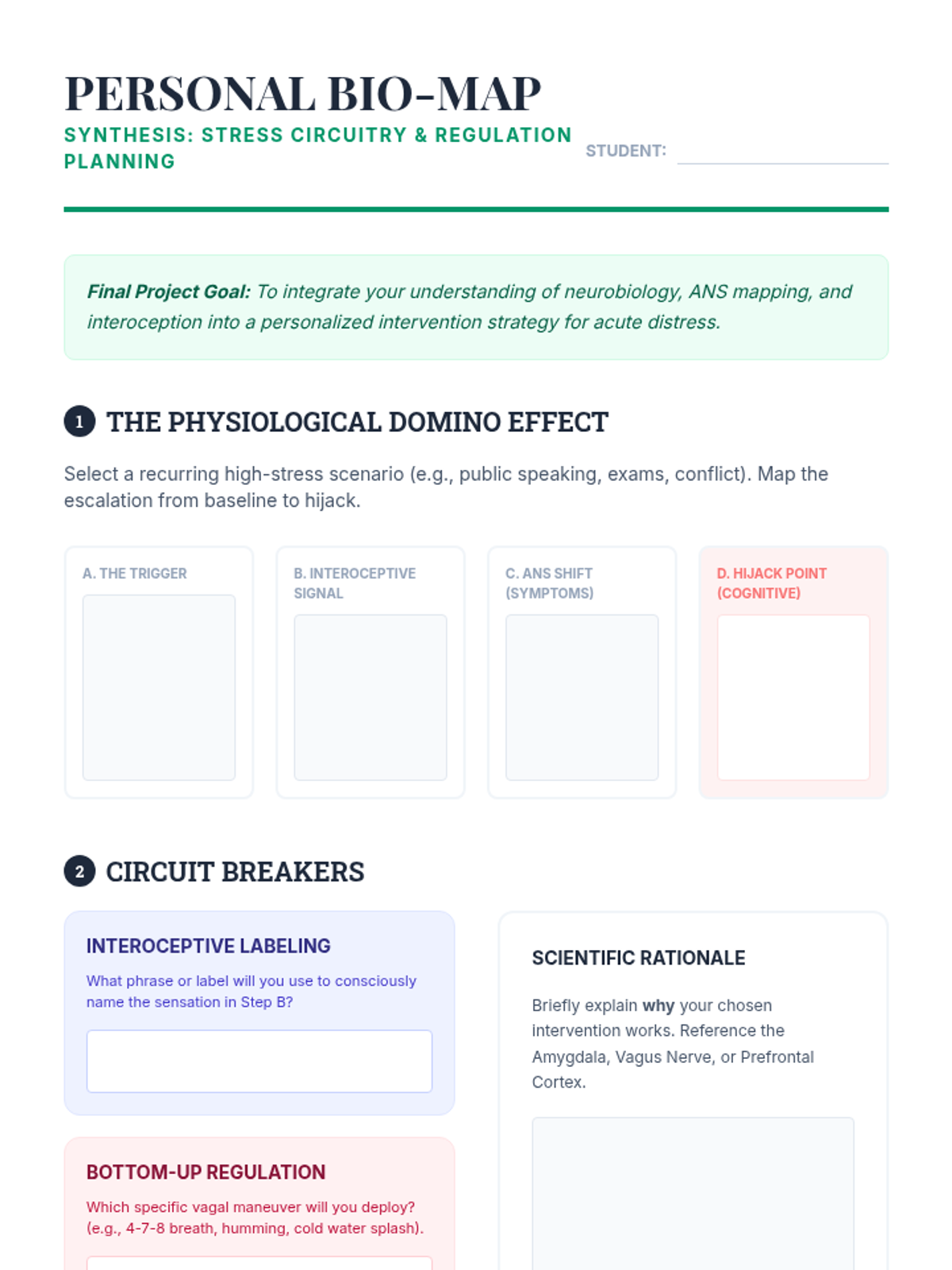
Students synthesize their knowledge to create a personalized physiological safety plan for high-stress periods. They identify triggers, early warning signs, and pre-planned somatic interventions.
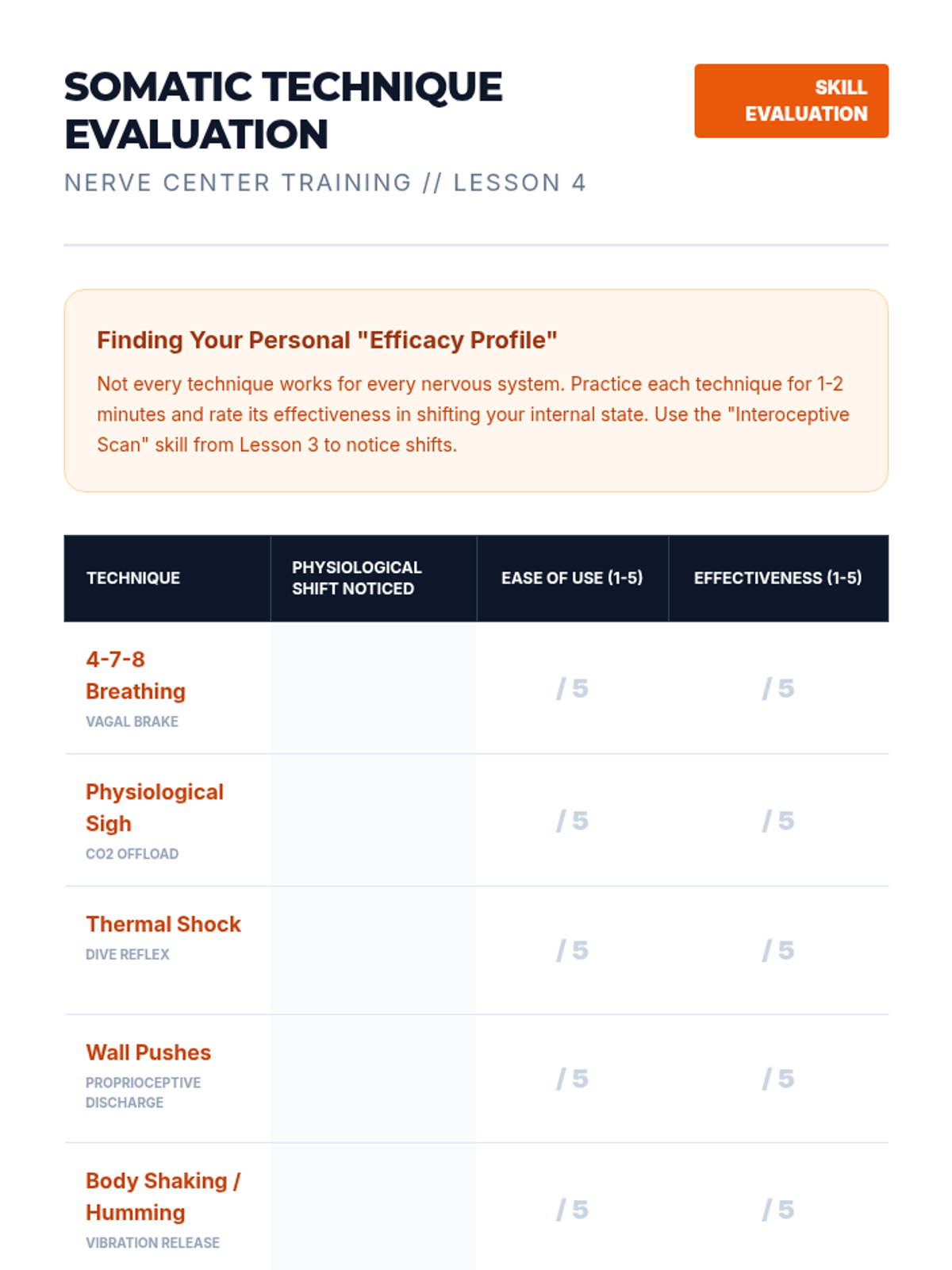
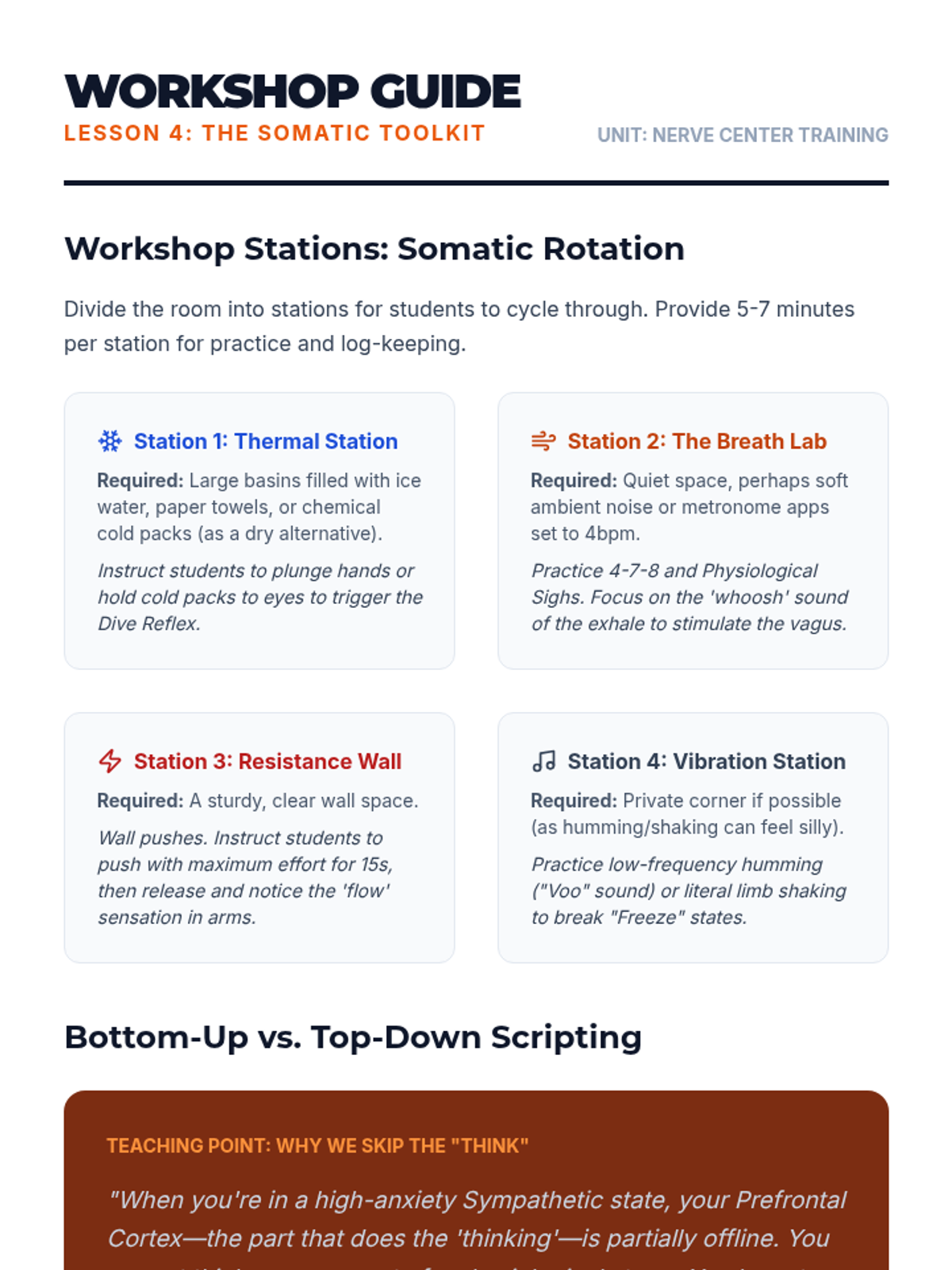
Students evaluate somatic bottom-up processing techniques like diaphragmatic breathing and thermal regulation. They learn to choose the right physical strategy for their specific physiological profile.
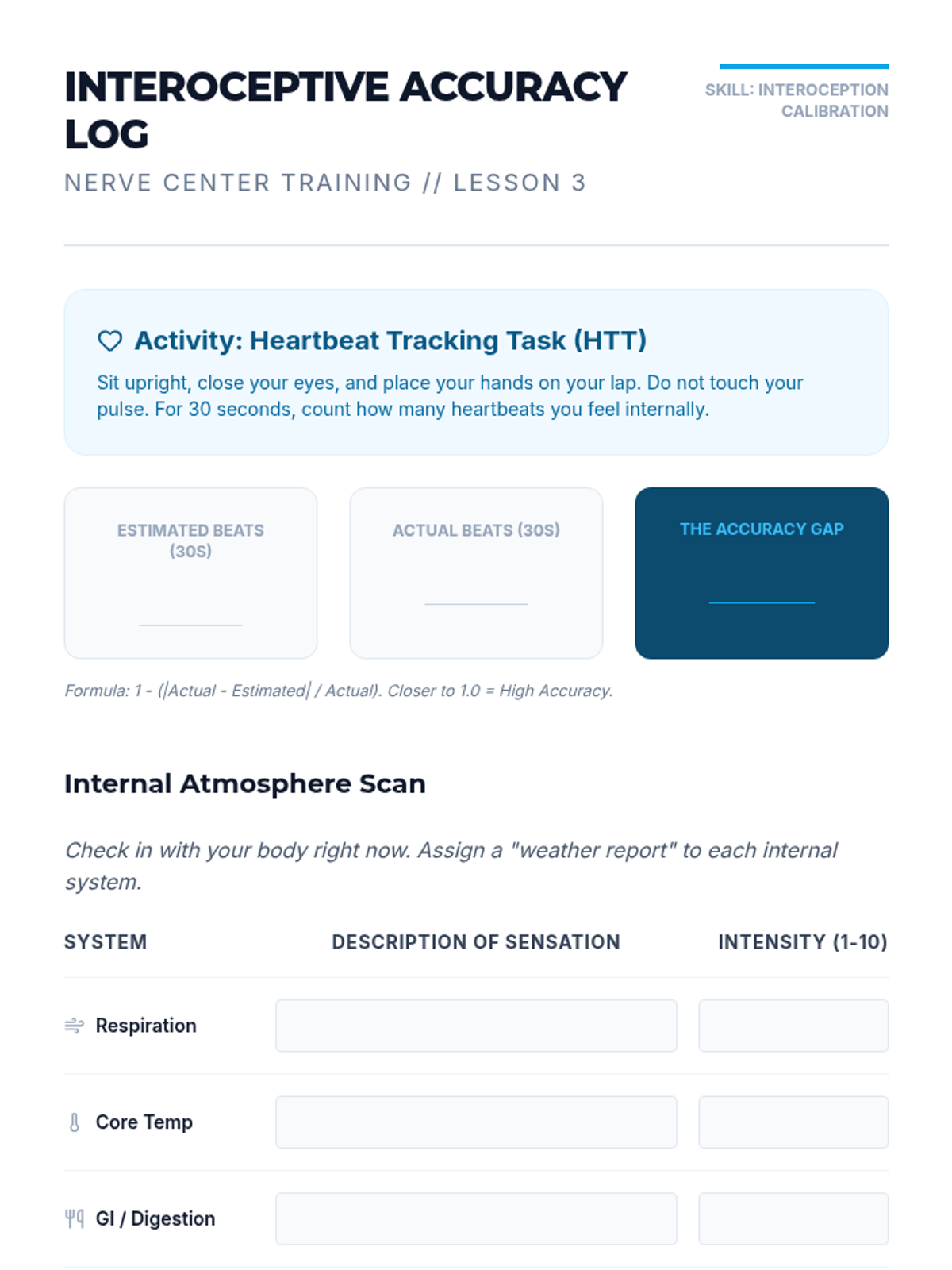
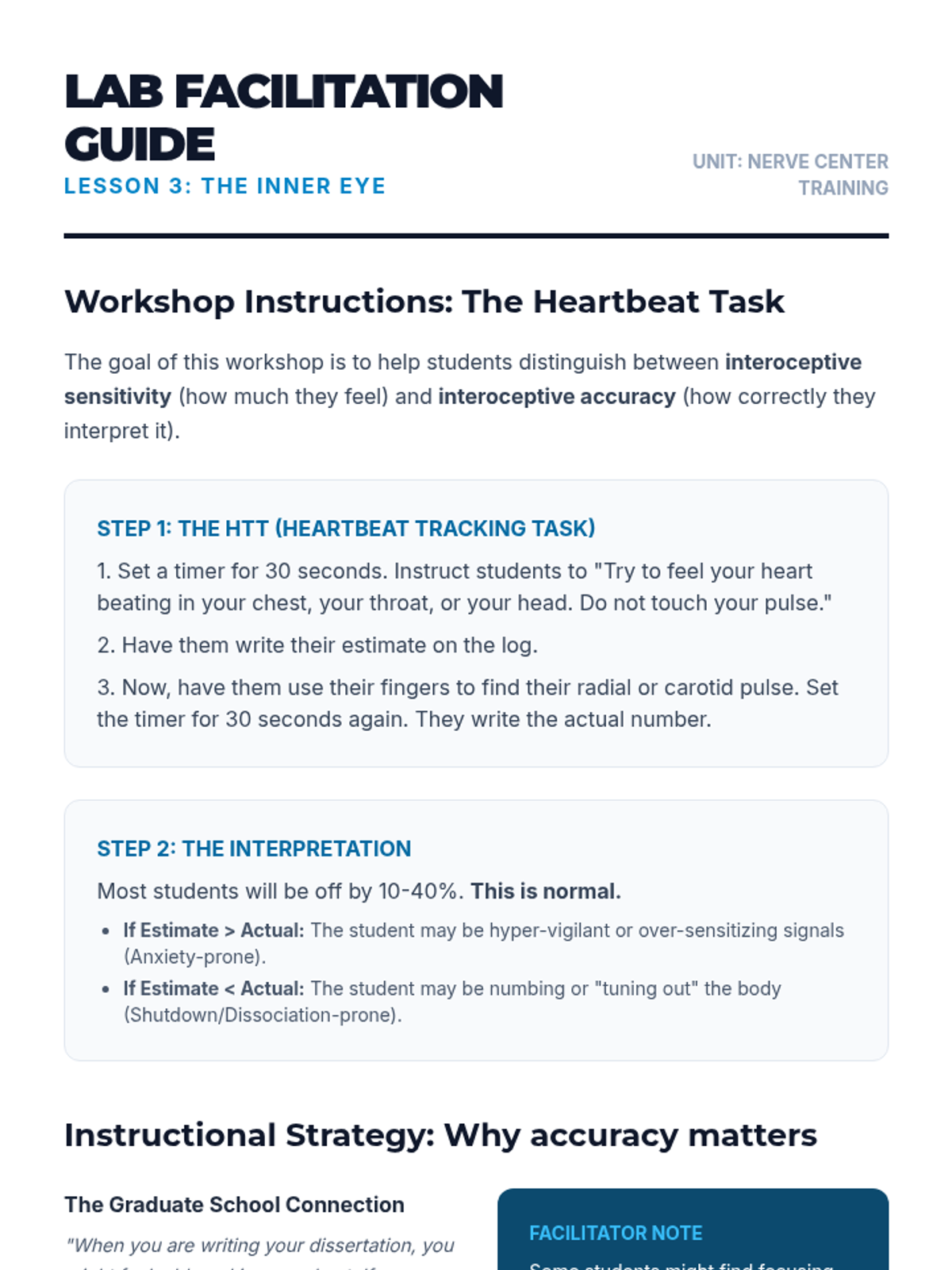
Learners practice interoception—the sense of the internal state of the body. They test their accuracy in detecting heart rate and tension, connecting poor awareness with high anxiety.
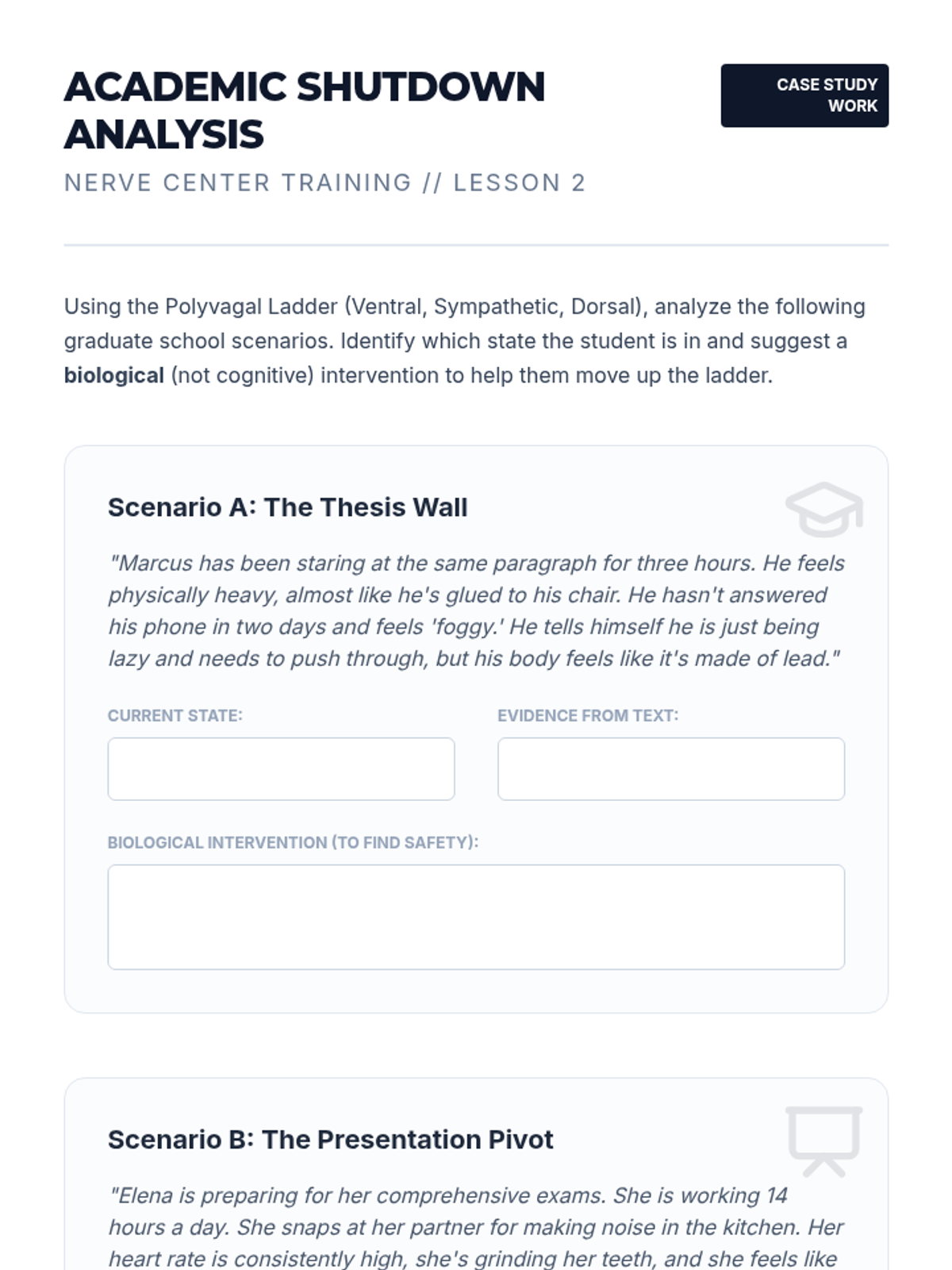
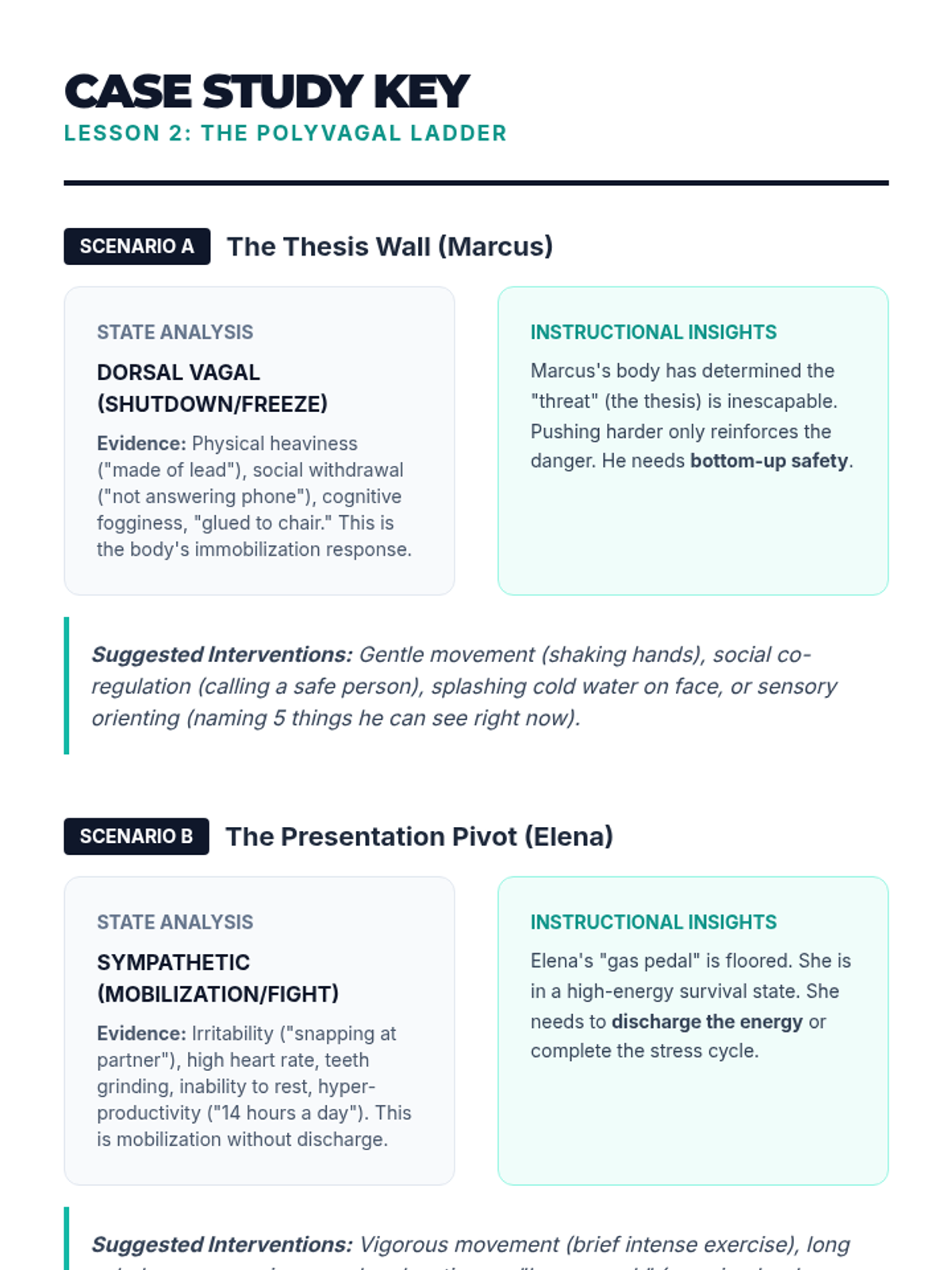
Dives into Polyvagal Theory to distinguish between fight/flight mobilization and dorsal vagal shutdown. Students analyze behaviors like procrastination and isolation as biological responses.
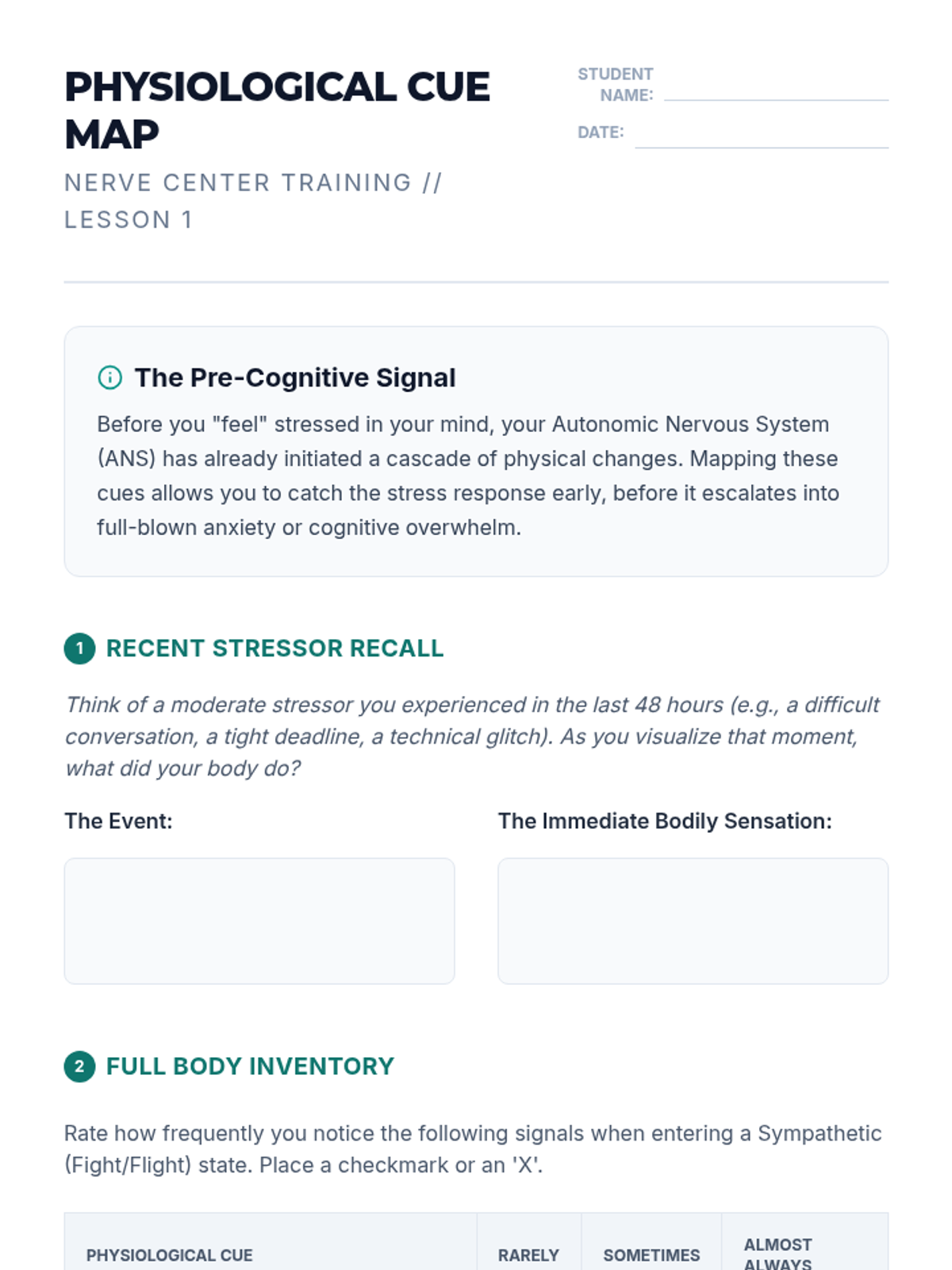
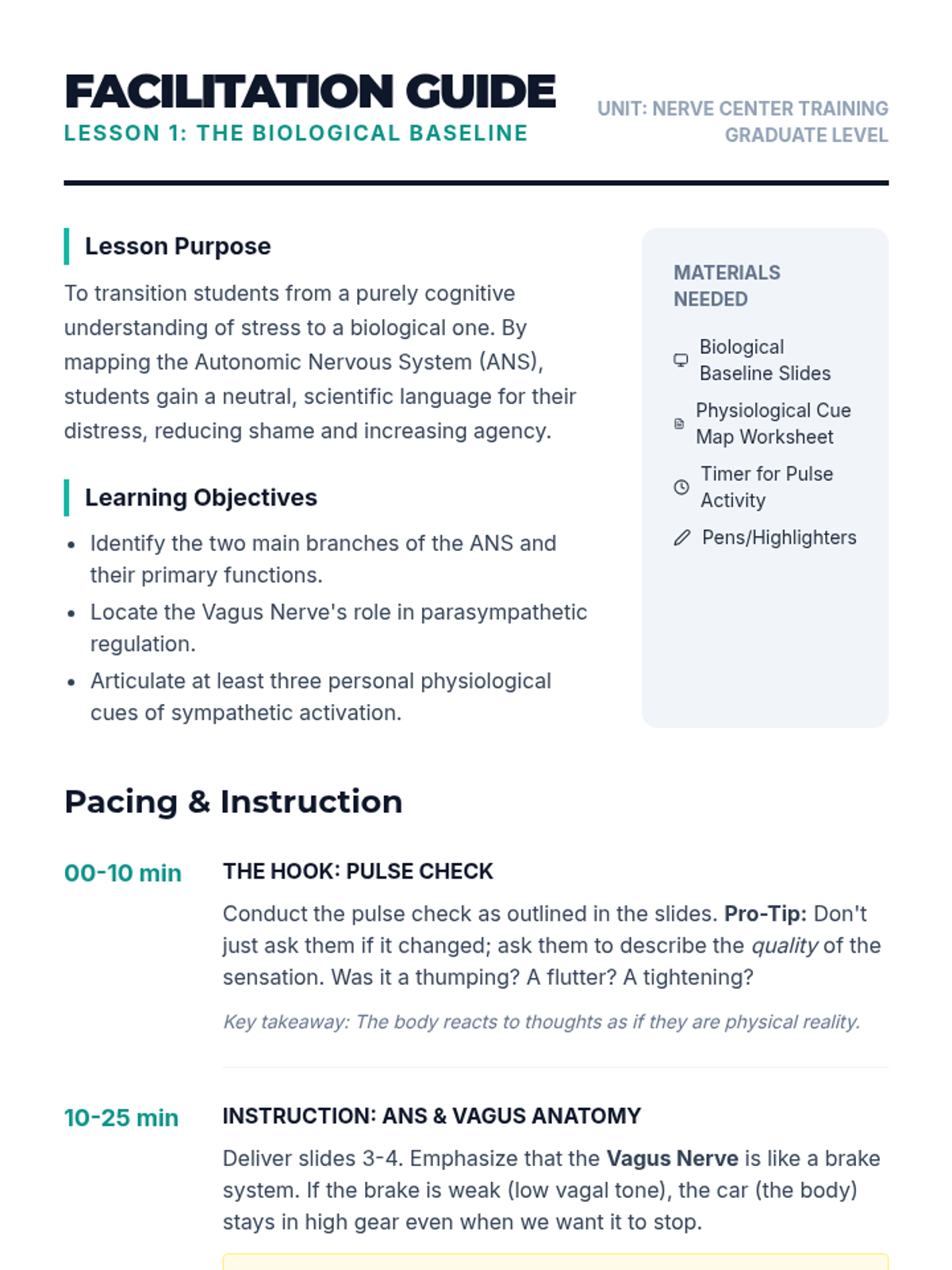
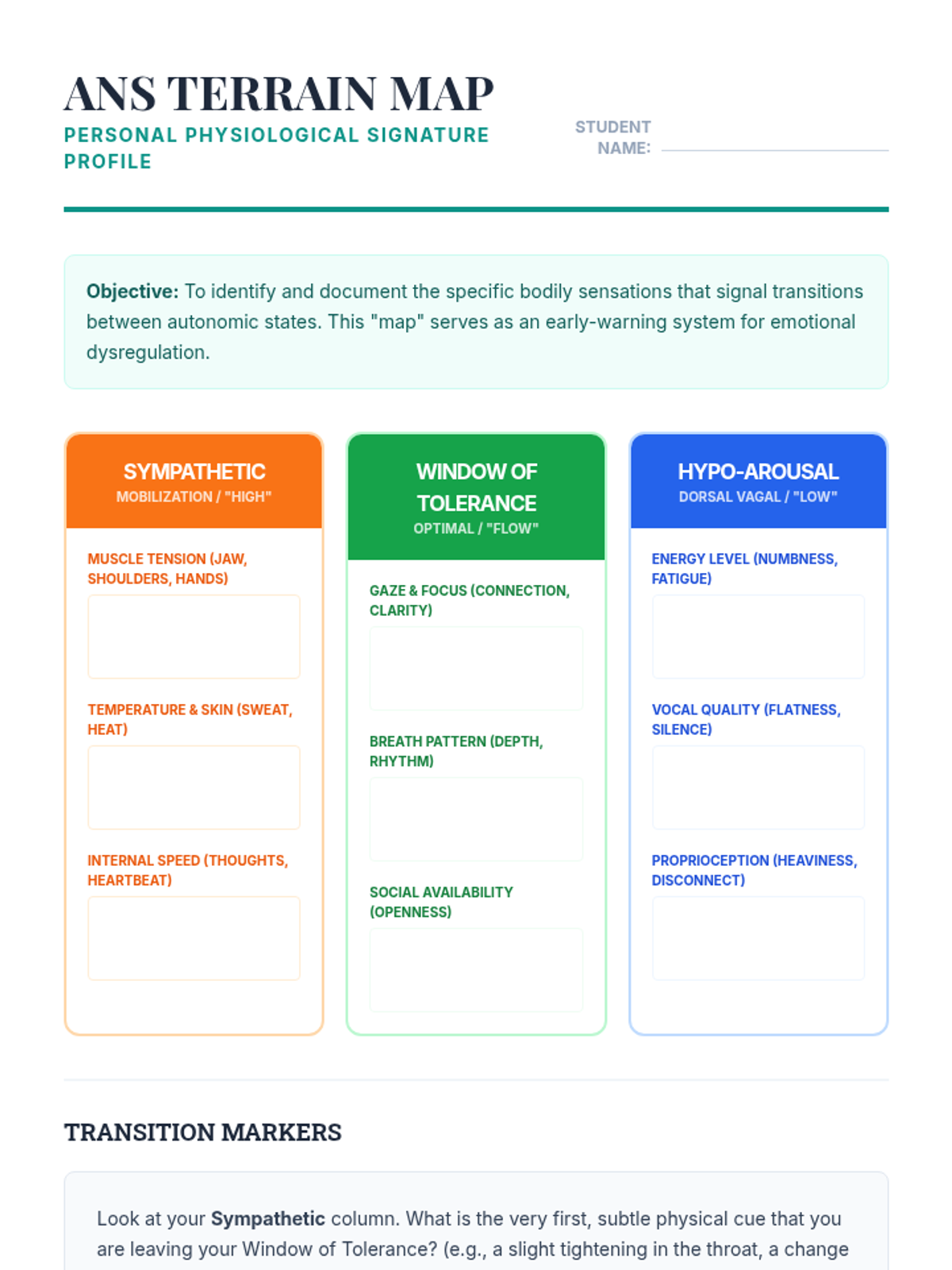
Focuses on the anatomy of the stress response, the sympathetic and parasympathetic branches of the ANS, and the role of the vagus nerve. Students map their own physiological 'early warning signs'.
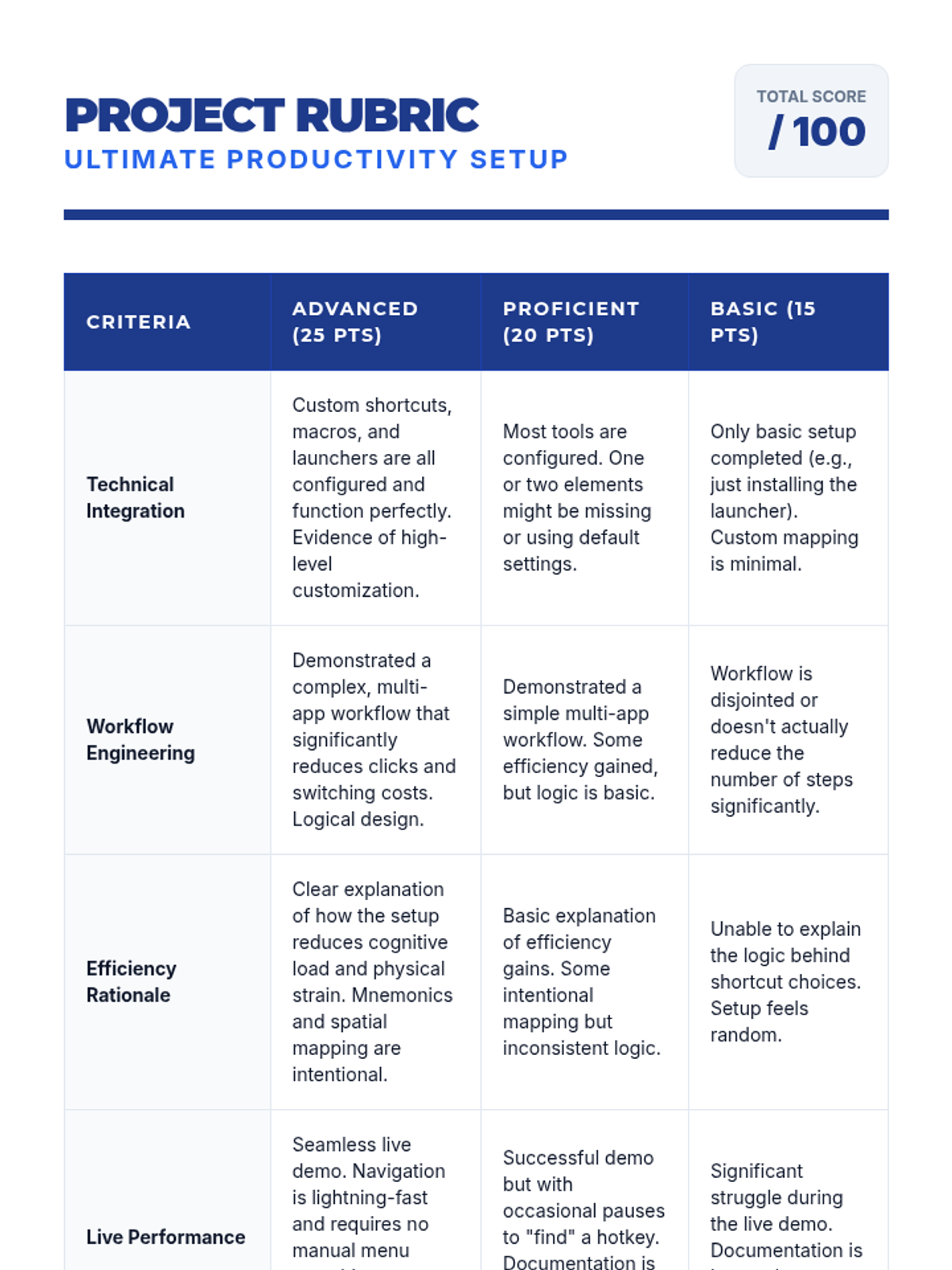
Students finalize and present their optimized computer setup, demonstrating their custom shortcuts and explain the logic behind their design choices.
Students design workflows that bridge multiple applications, focusing on clipboard history and window management to reduce cognitive switching costs.
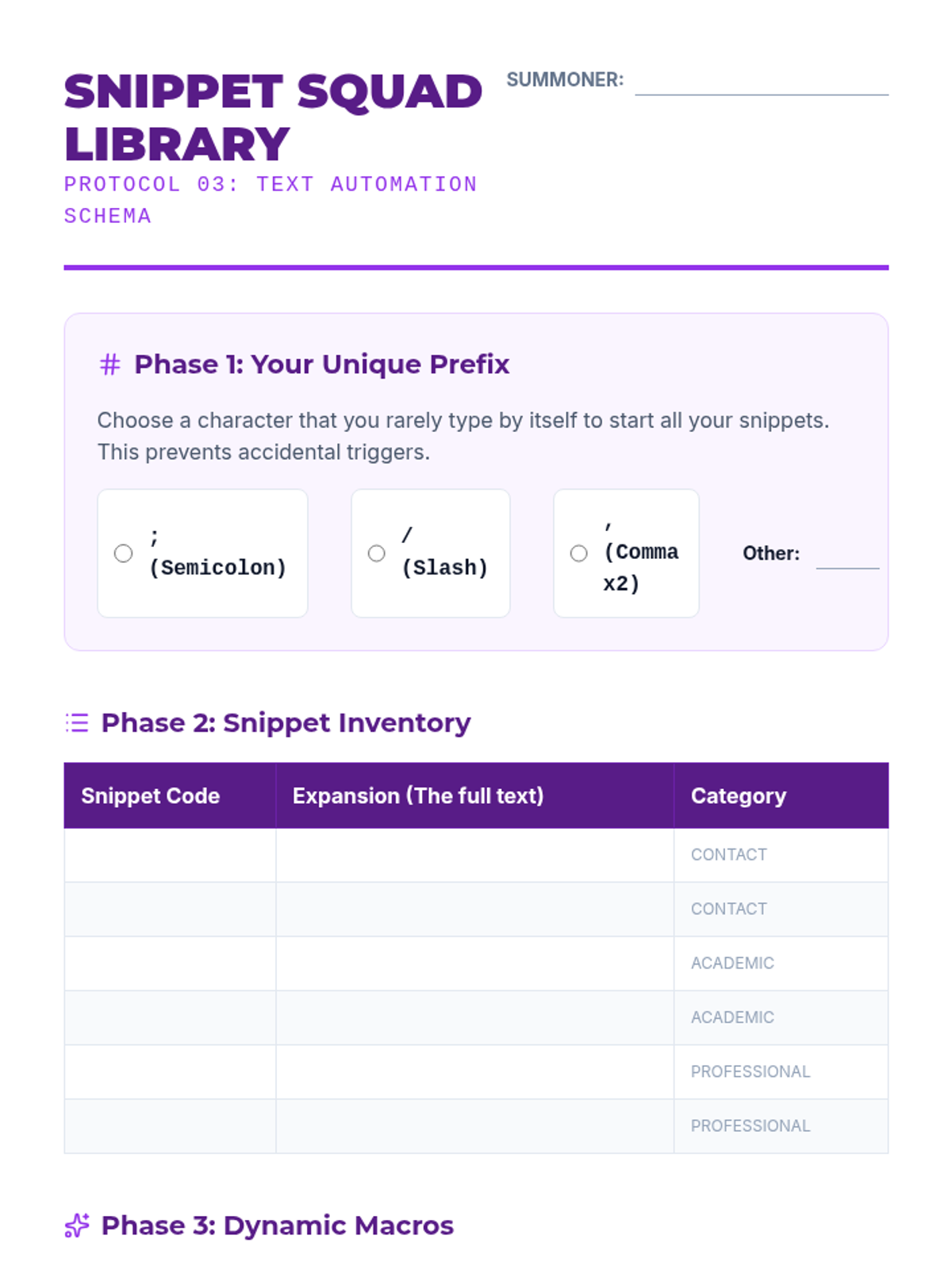
An introduction to text expansion and basic macros to reduce keystroke count. Students identify repetitive text patterns and automate them using expansion tools.
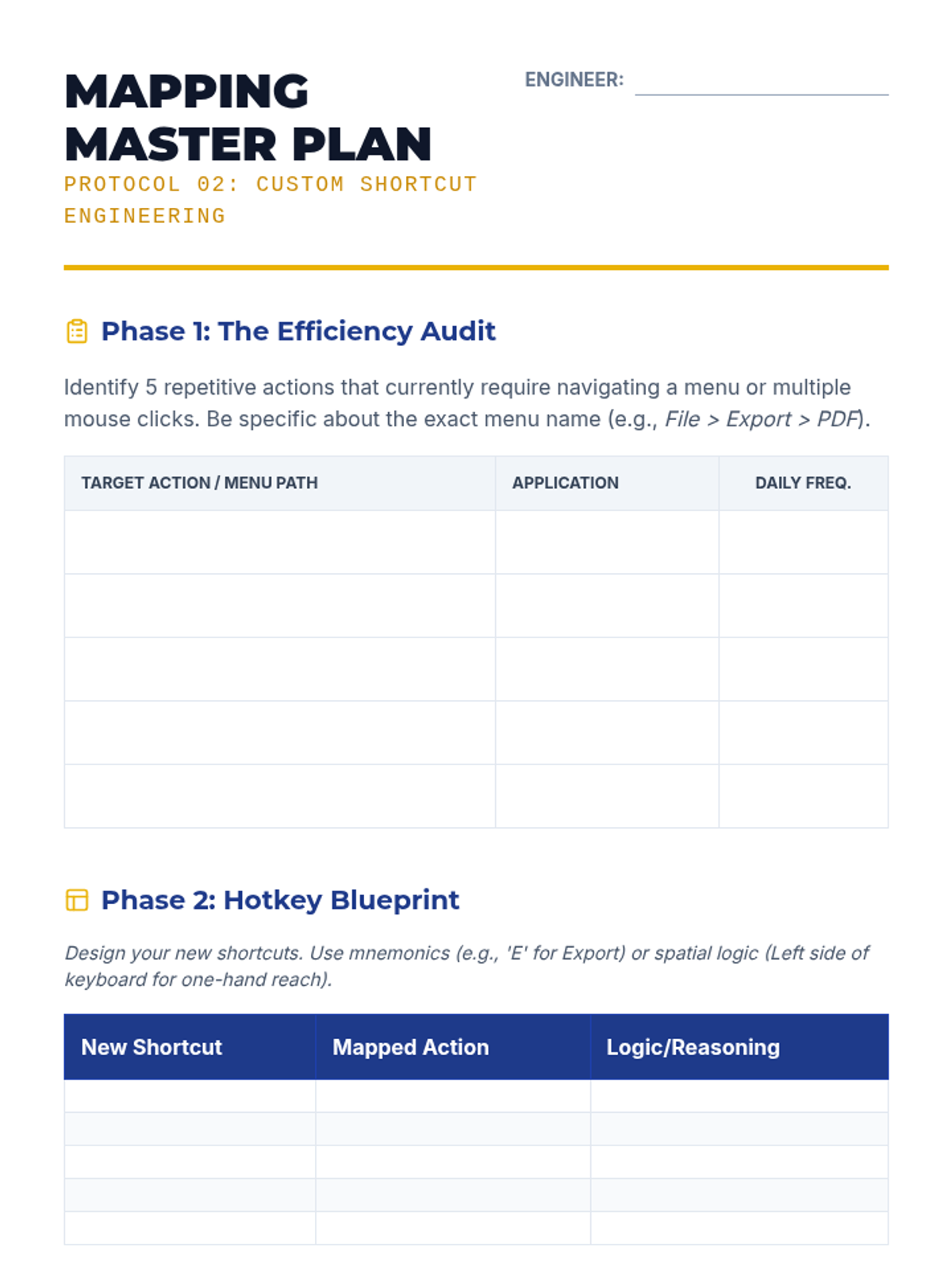
Students learn to customize their operating system and applications by mapping custom shortcuts to frequent actions. The focus is on analyzing repetitive tasks and engineering motor-efficient solutions.
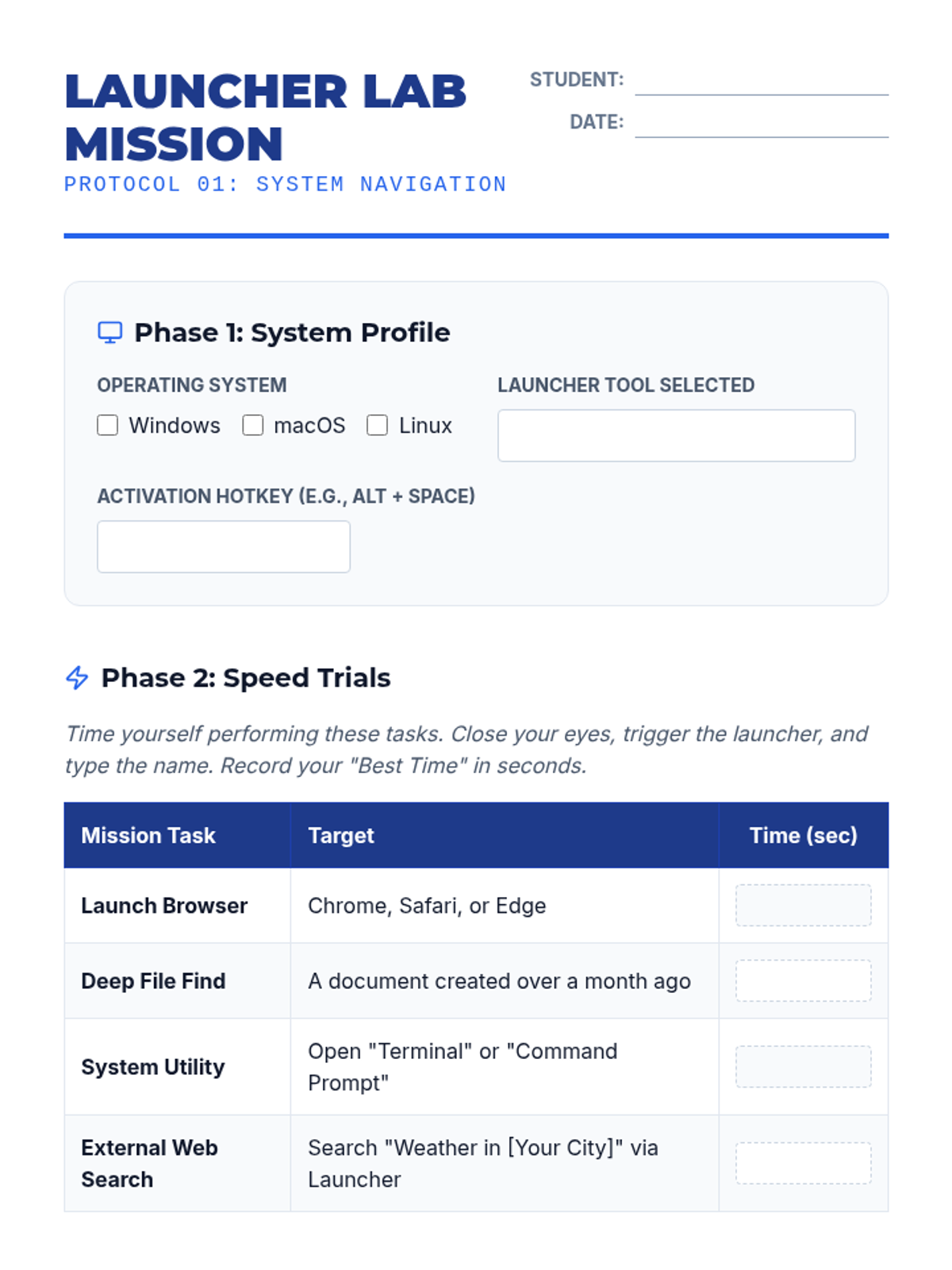
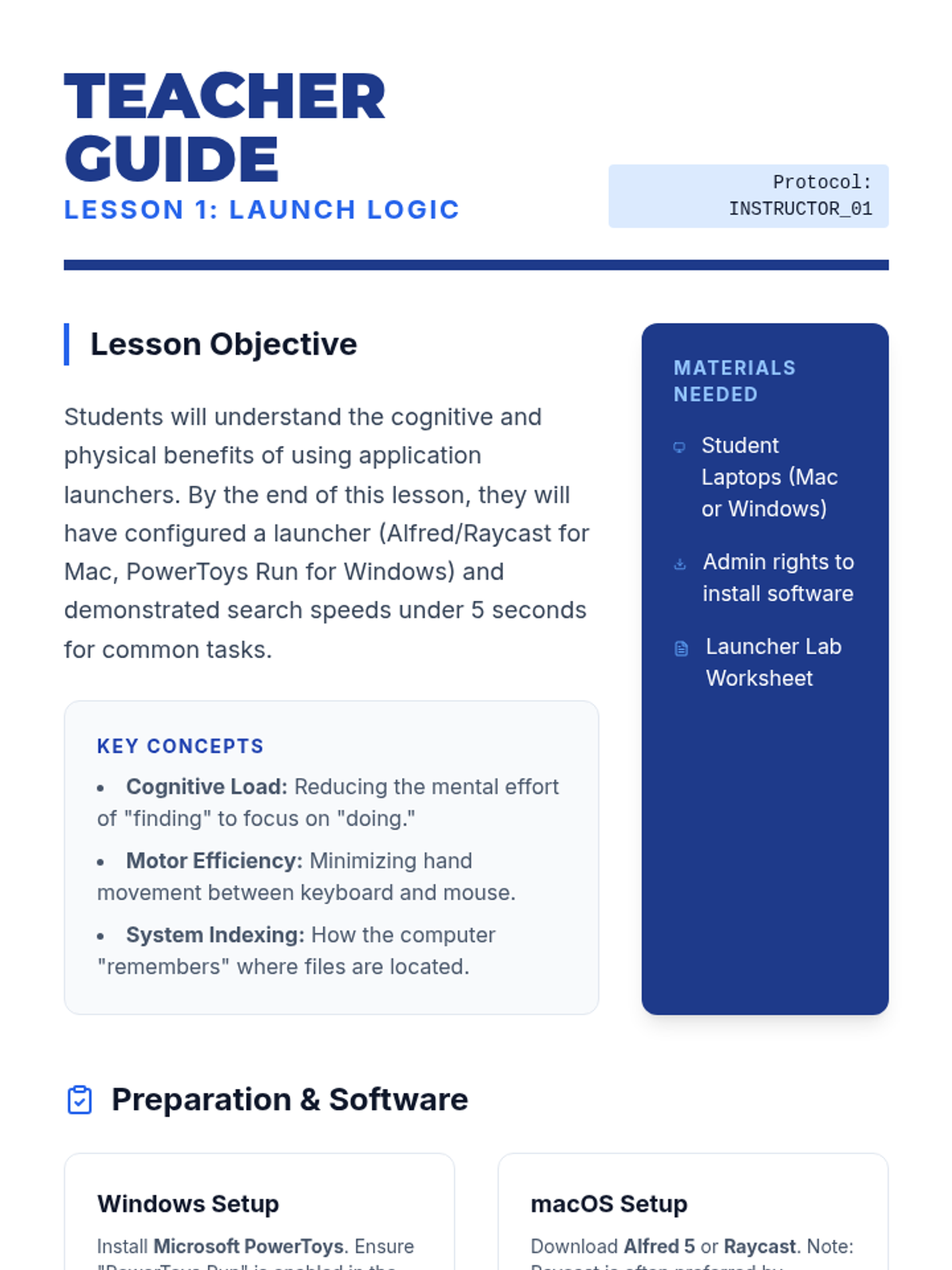
Students explore advanced search tools (Spotlight, PowerToys Run, Alfred) to launch apps and find files instantly. This lesson focuses on reducing search time and system-wide navigation speed.
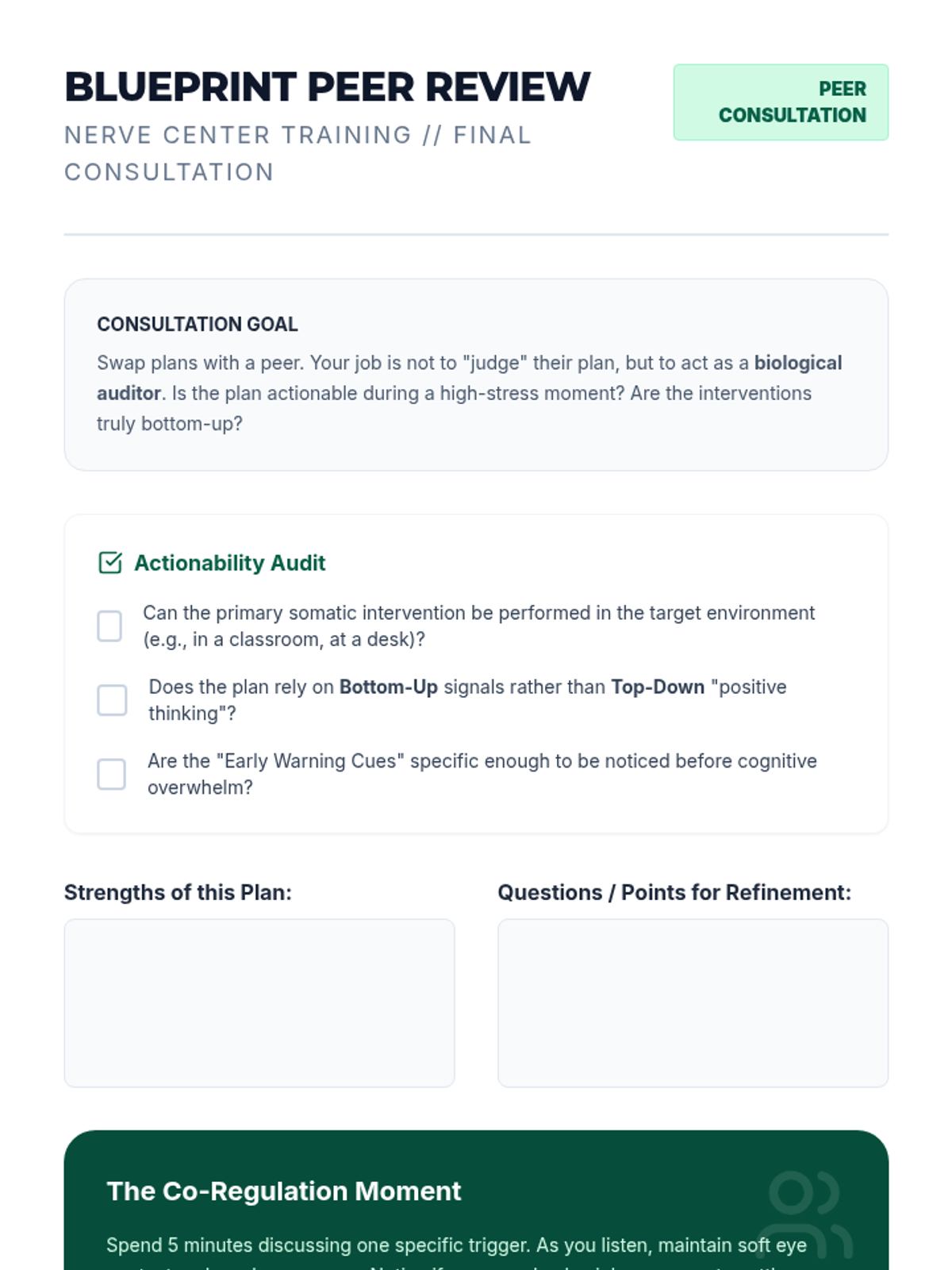
Students integrate their knowledge to create a personal 'bio-map' of their stress escalation cycle. They present how specific physiological interventions can interrupt this cycle at various stages.
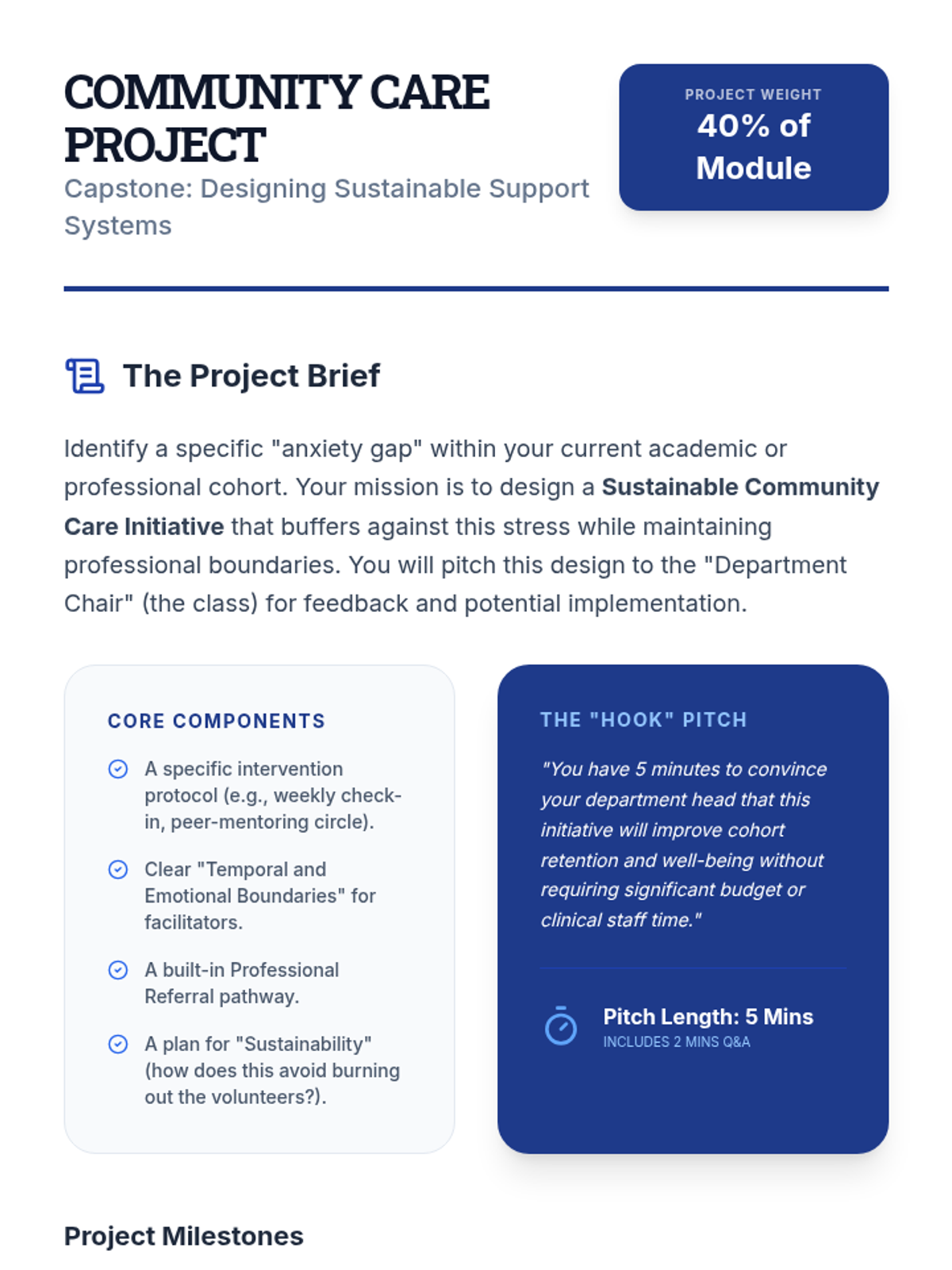
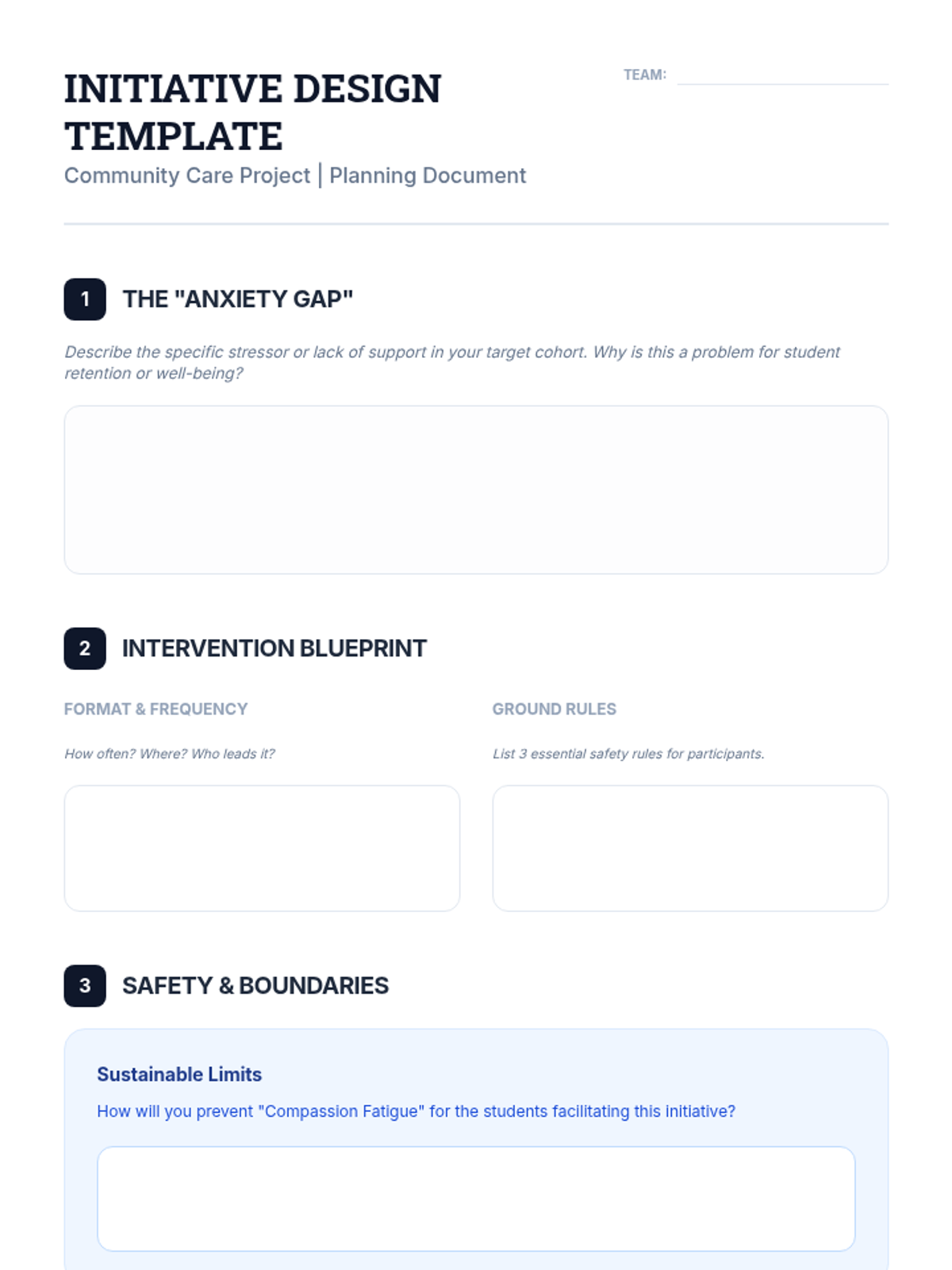
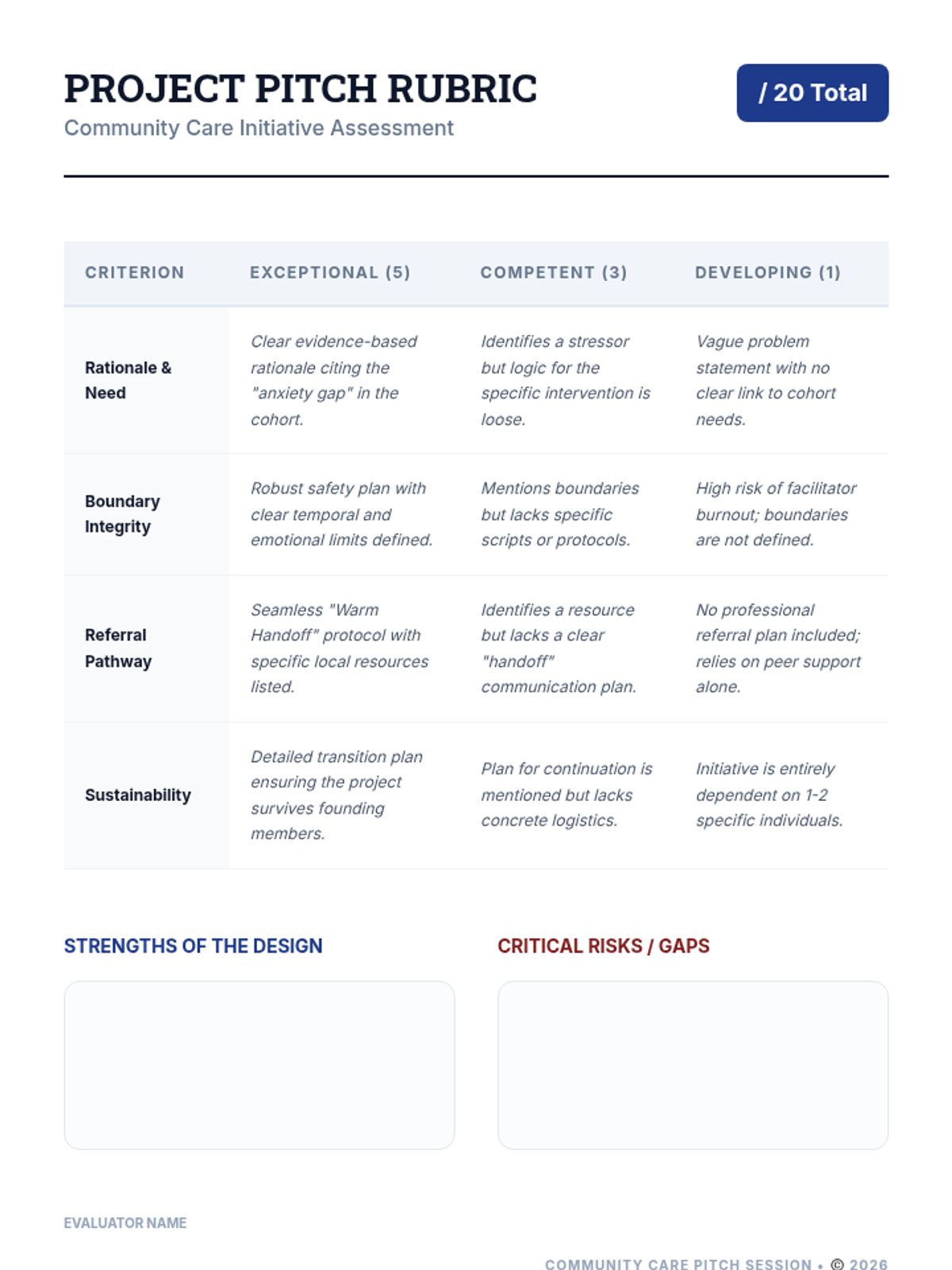
Students design and pitch a sustainable community care initiative tailored to their specific academic or professional cohort.
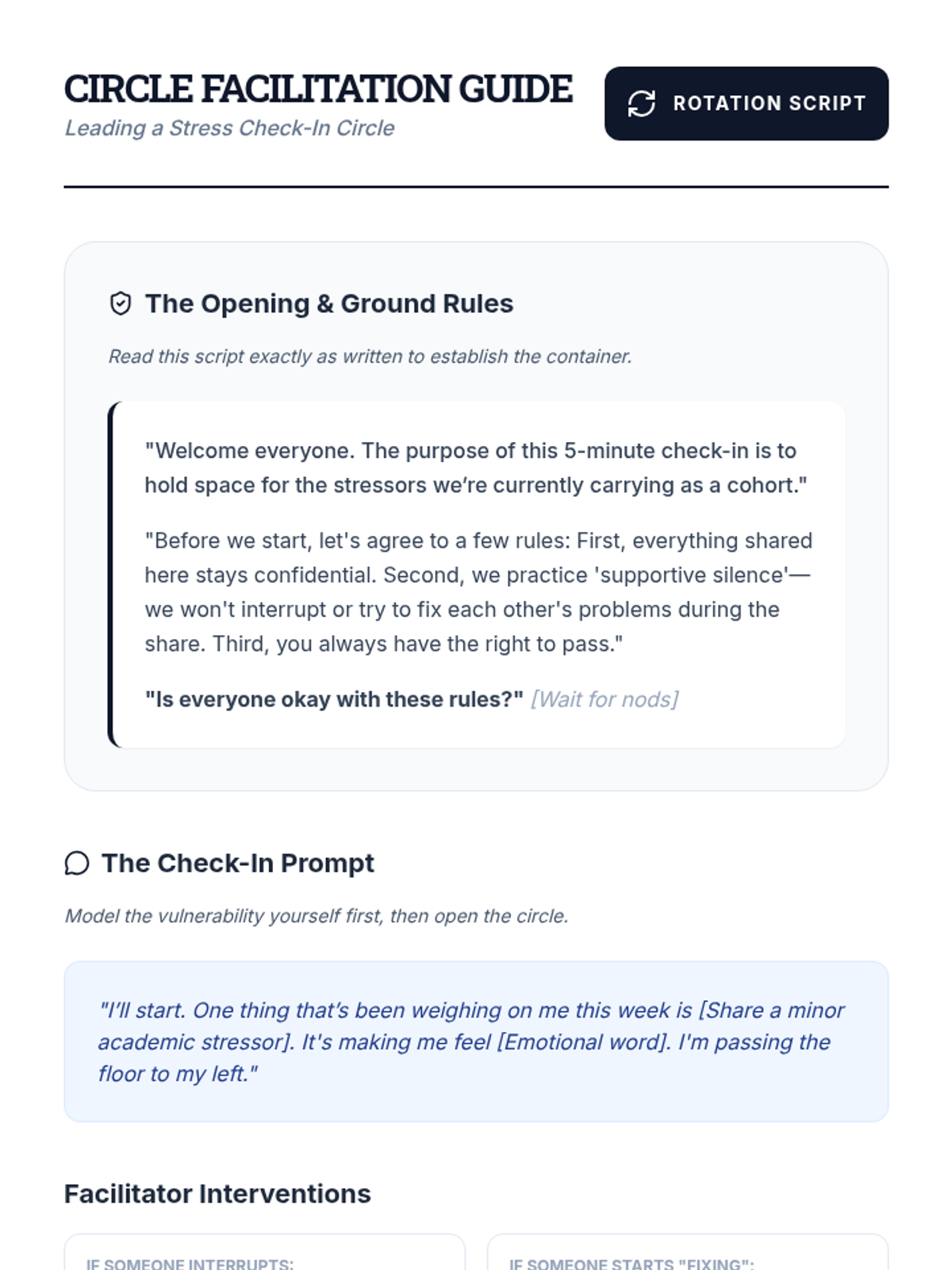
Develops skills for leading group stress check-ins, managing dynamics, and ensuring psychological safety in group settings.
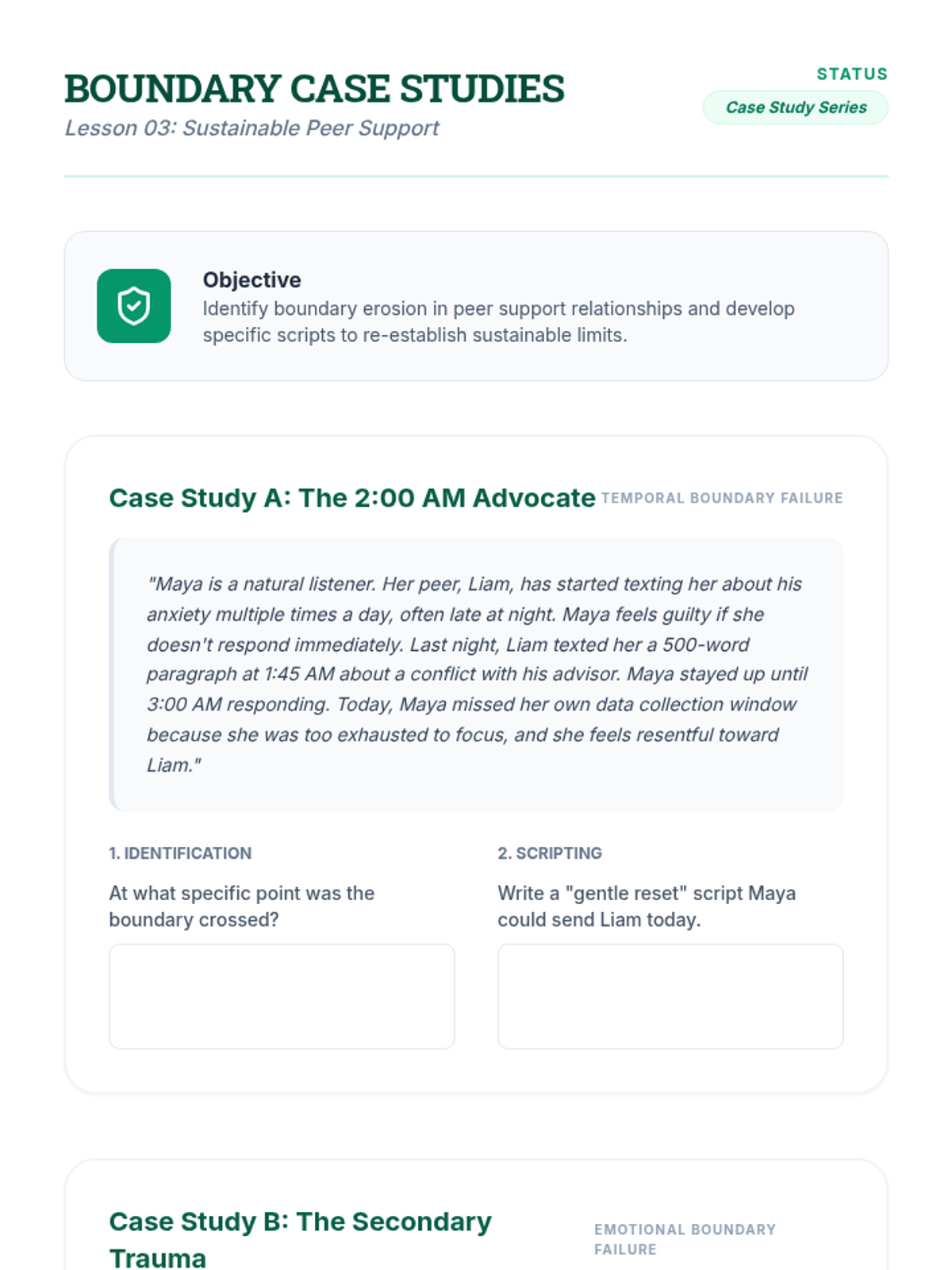
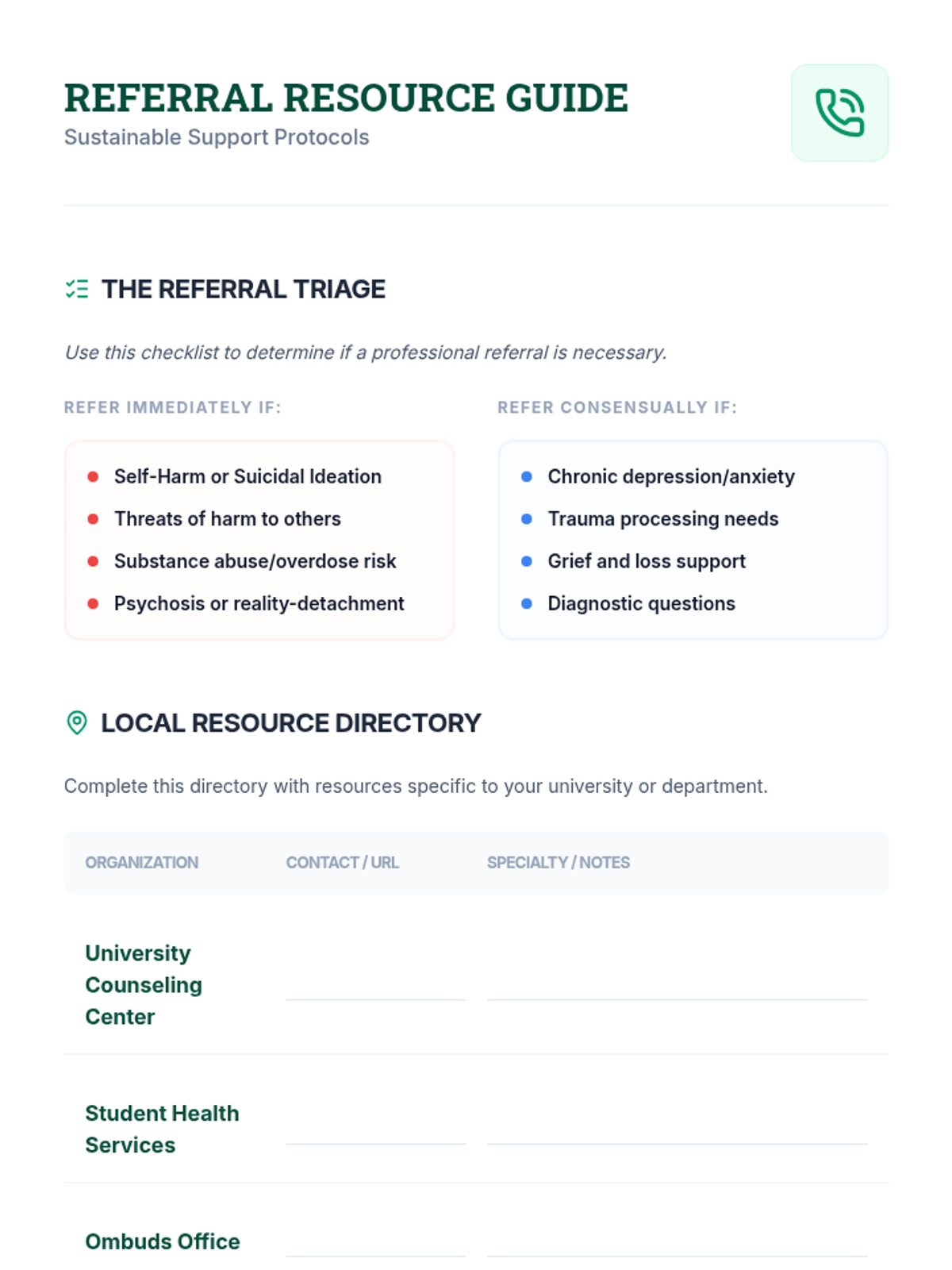
Focuses on preventing compassion fatigue through emotional and temporal boundaries and professional referral protocols.
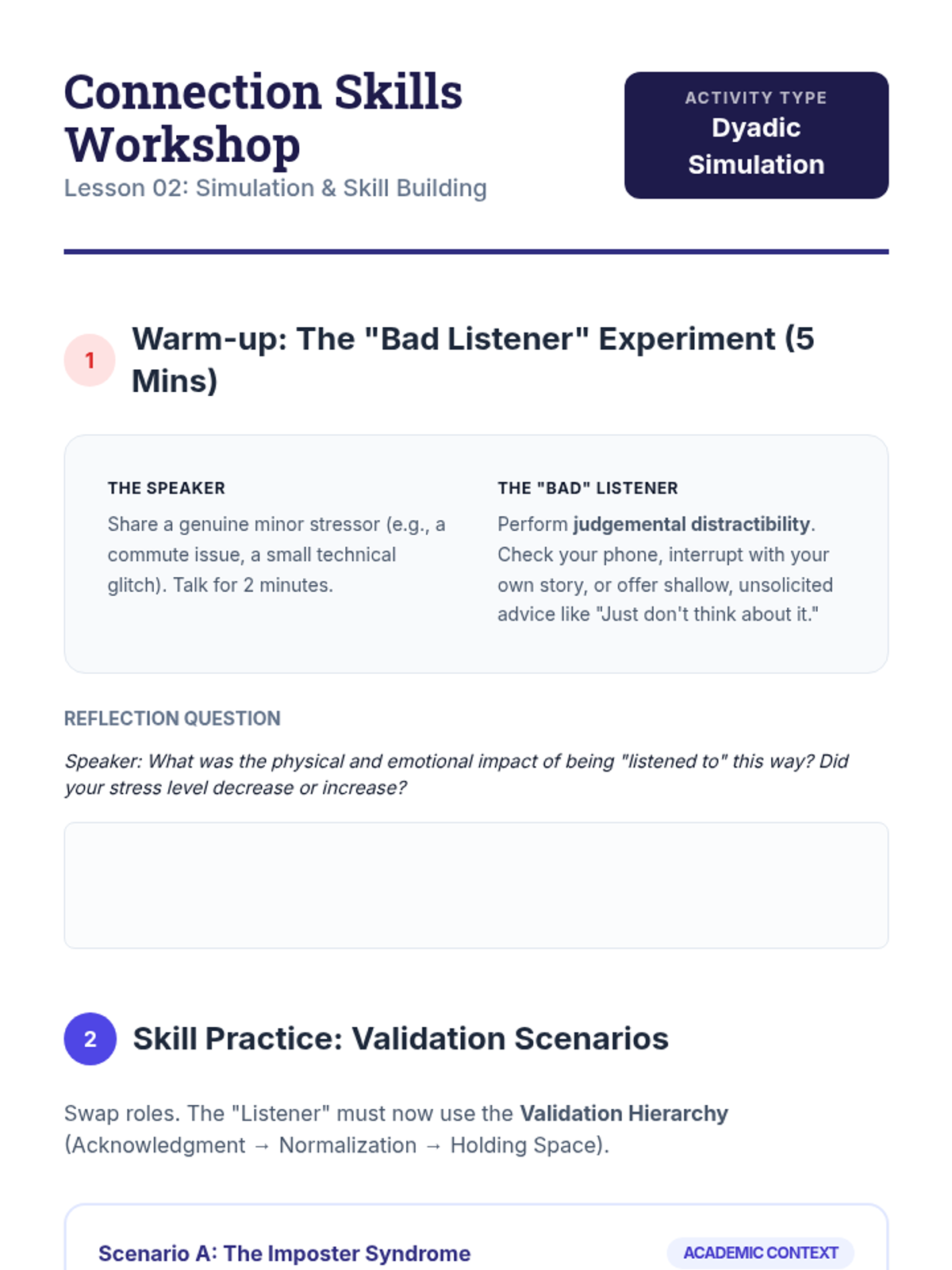
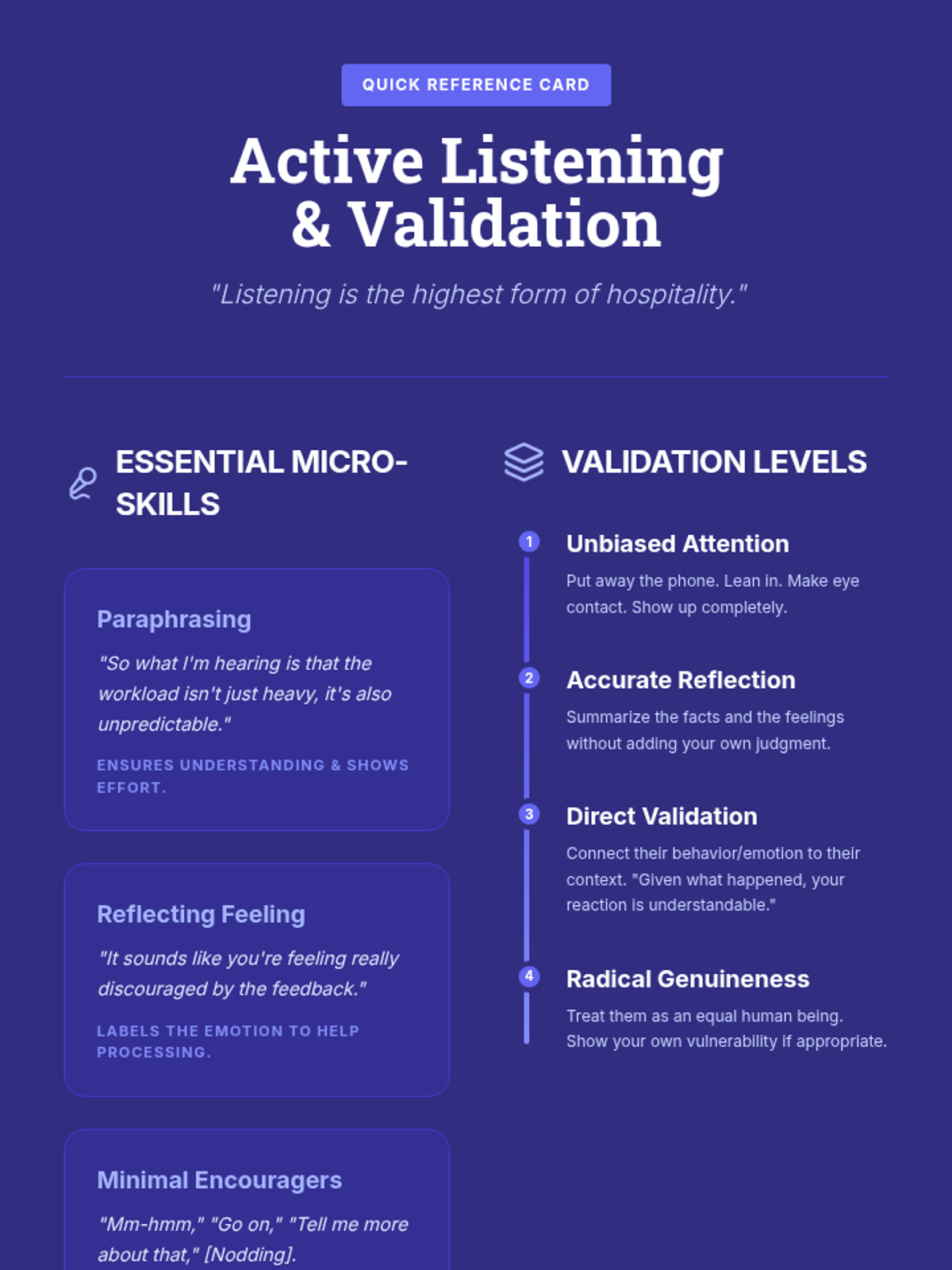
Practical workshop on active listening, validation, and holding space for peers without the pressure to provide immediate solutions.
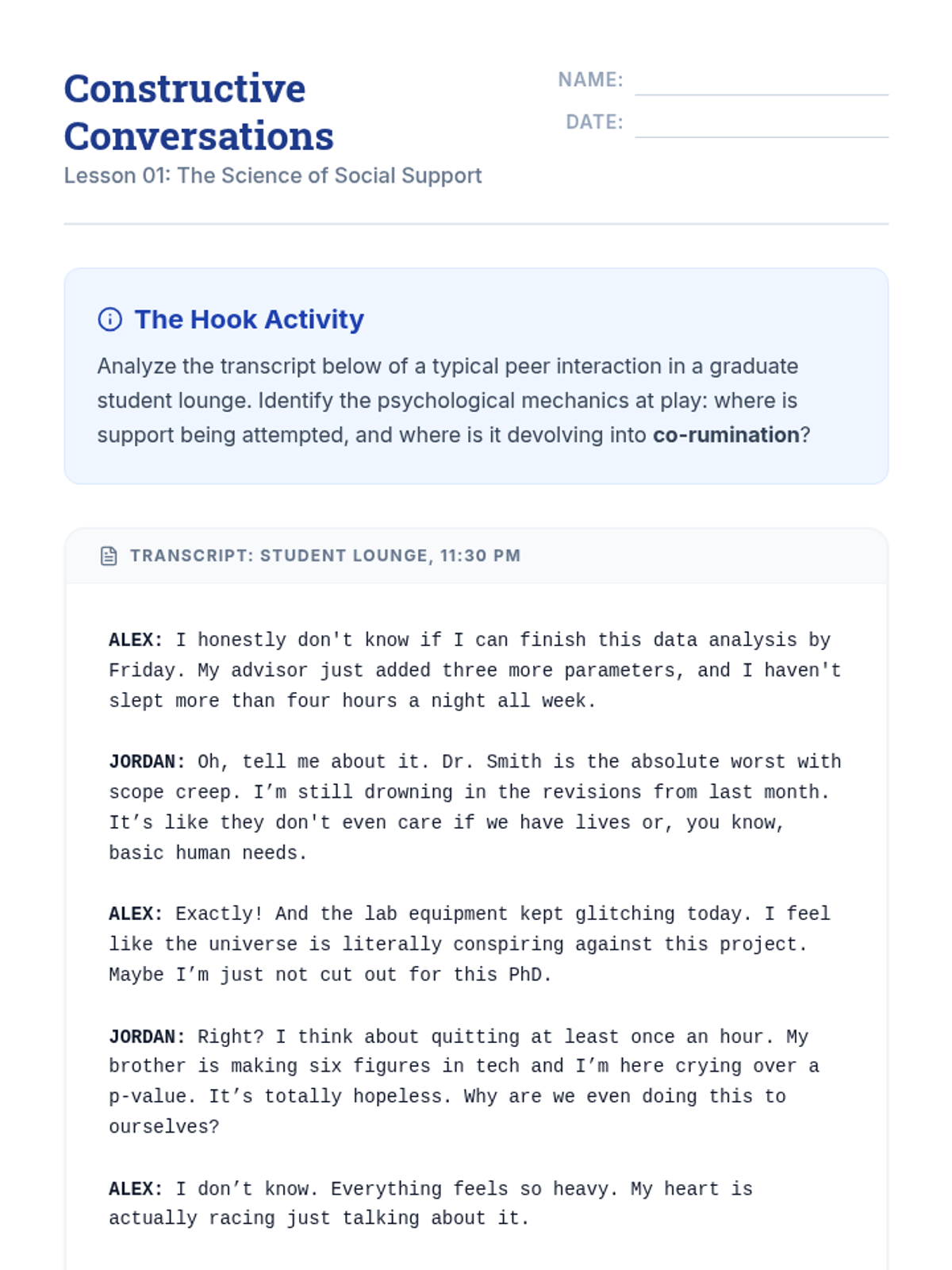
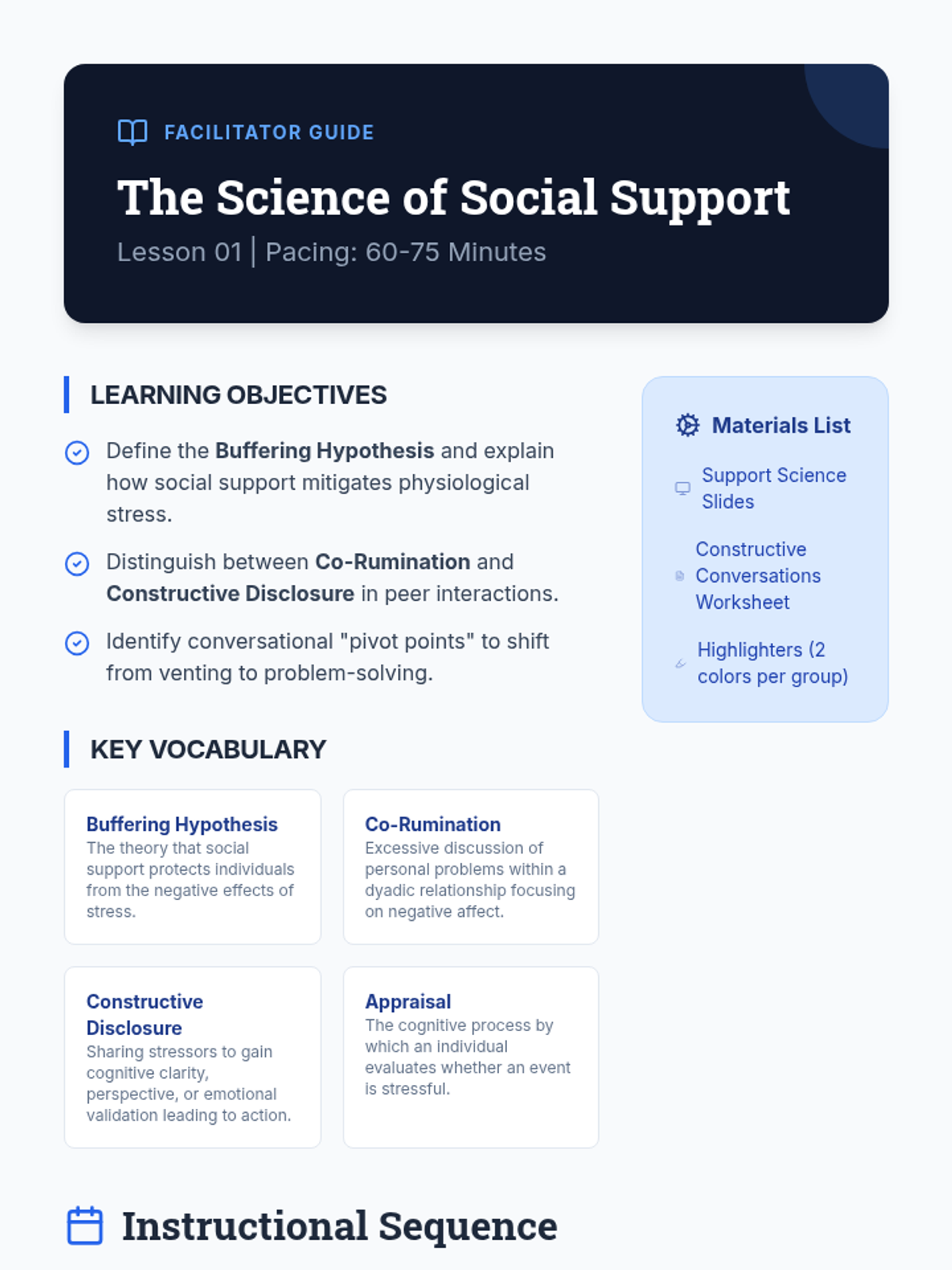
Examines the buffering hypothesis and the psychological mechanics of how social connection mitigates stress, contrasting co-rumination with constructive disclosure.
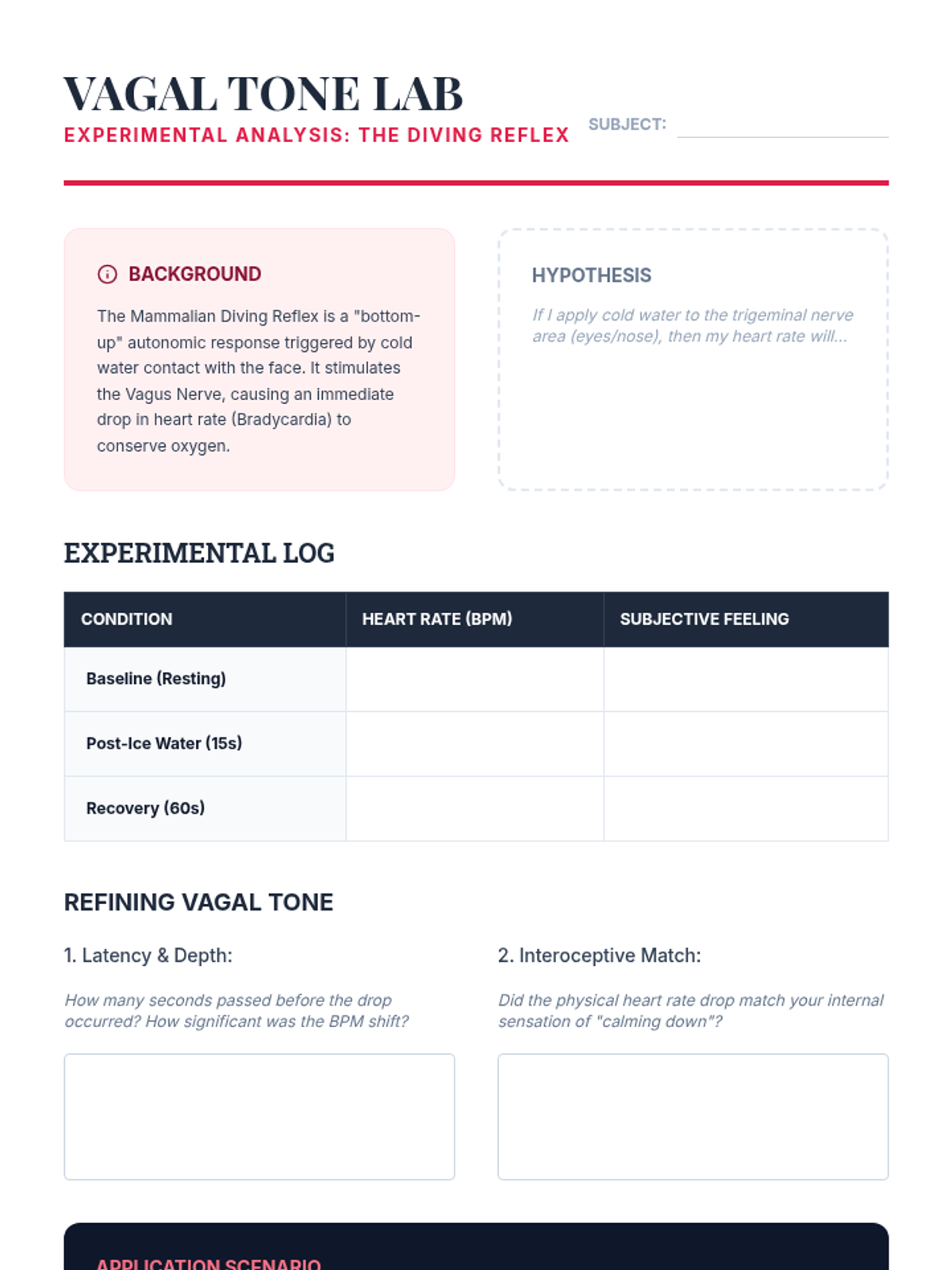
Participants investigate the role of the vagus nerve in regulating heart rate and calming the nervous system. They experiment with specific physical maneuvers (like cold exposure or humming) that stimulate vagal tone.
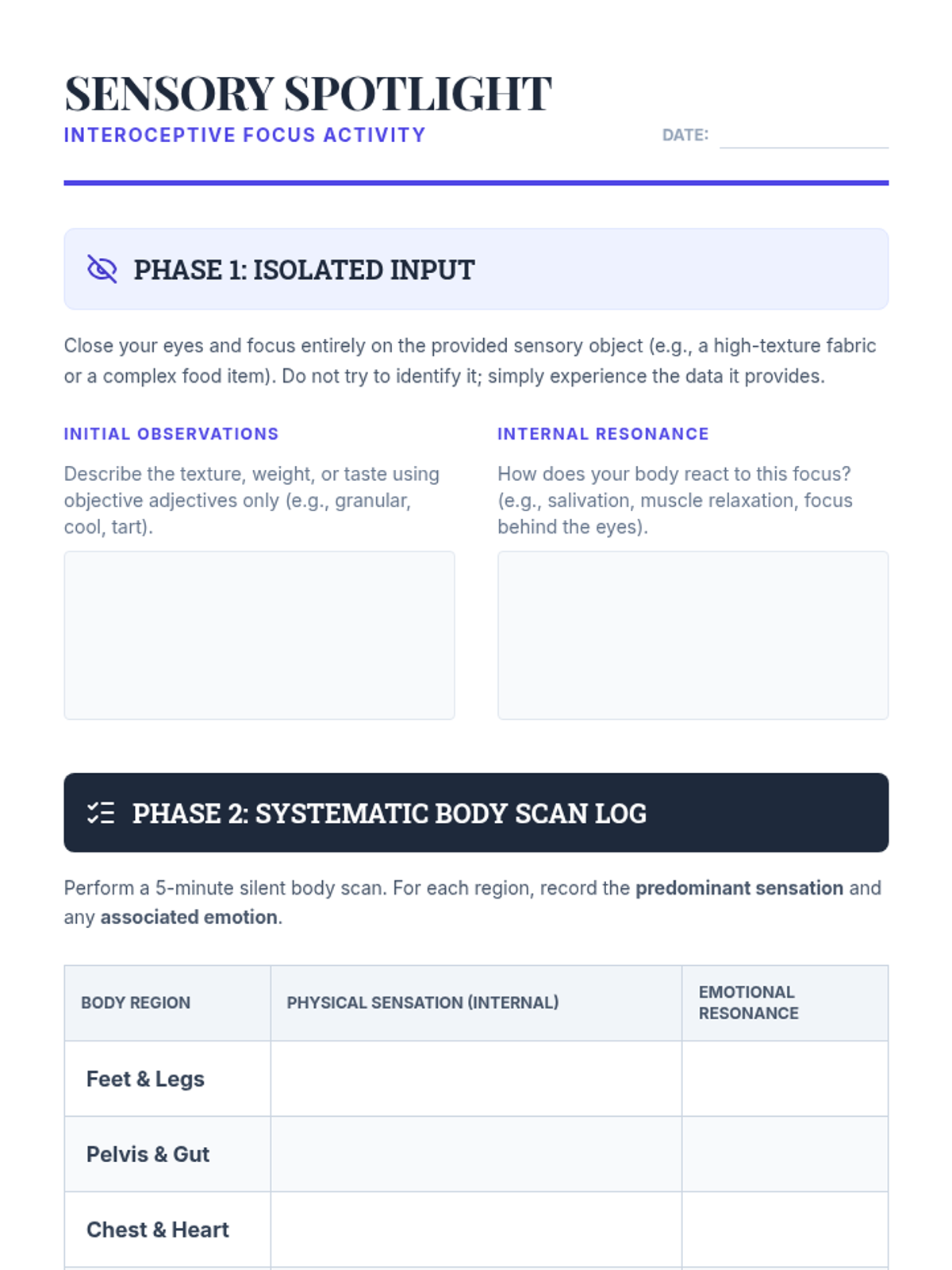
Students practice focused attention on internal bodily sensations to detect early warning signs of distress. The lesson moves from guided body scans to independent practice in identifying subtle tension.
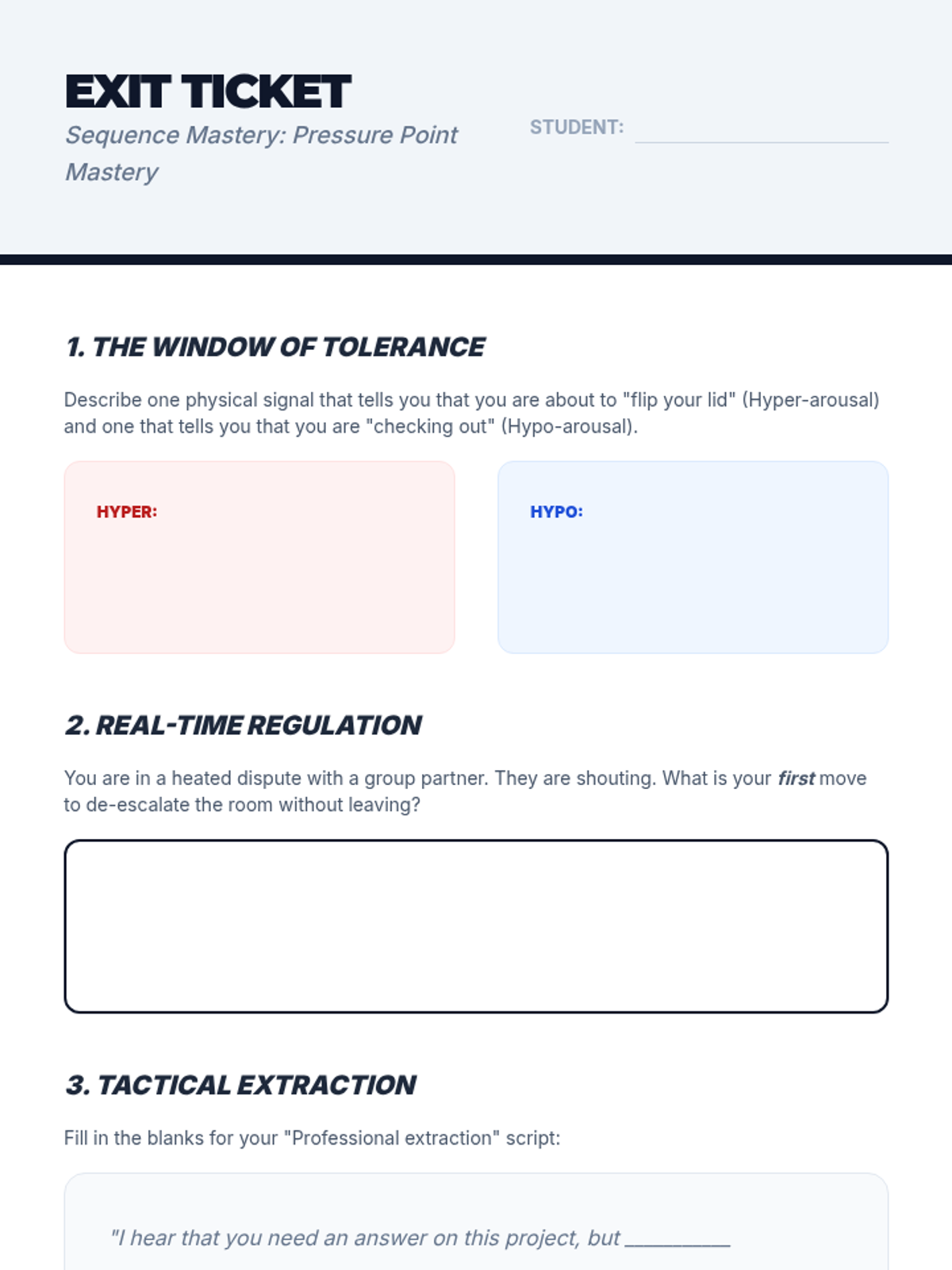
This lesson distinguishes between the sympathetic and parasympathetic nervous systems. Students map out the physiological symptoms associated with each state to better recognize when they are leaving the 'window of tolerance.'
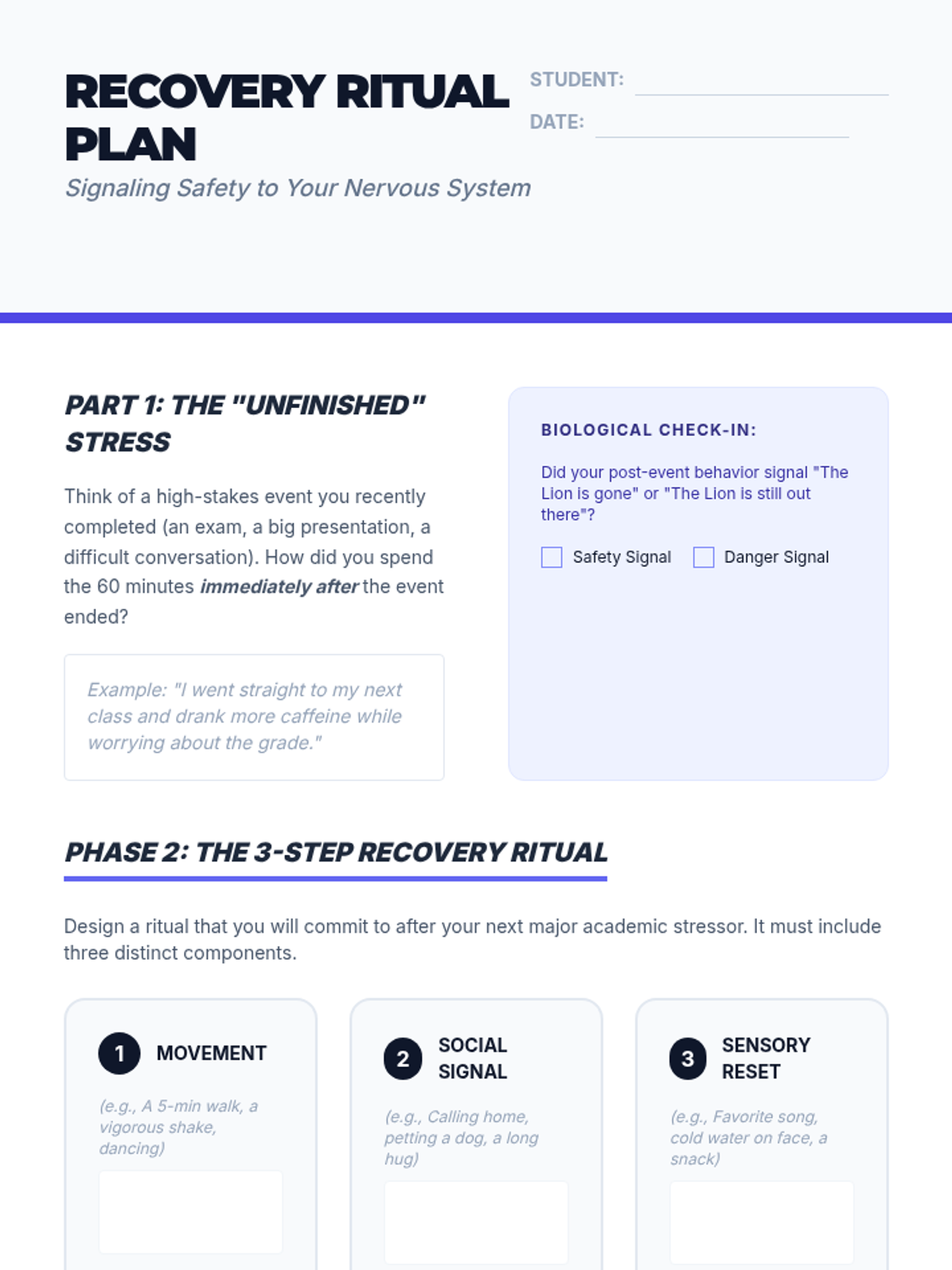
Covers the physiological completion of the stress cycle to prevent burnout. Students design personalized post-event rituals to signal safety to their nervous systems.
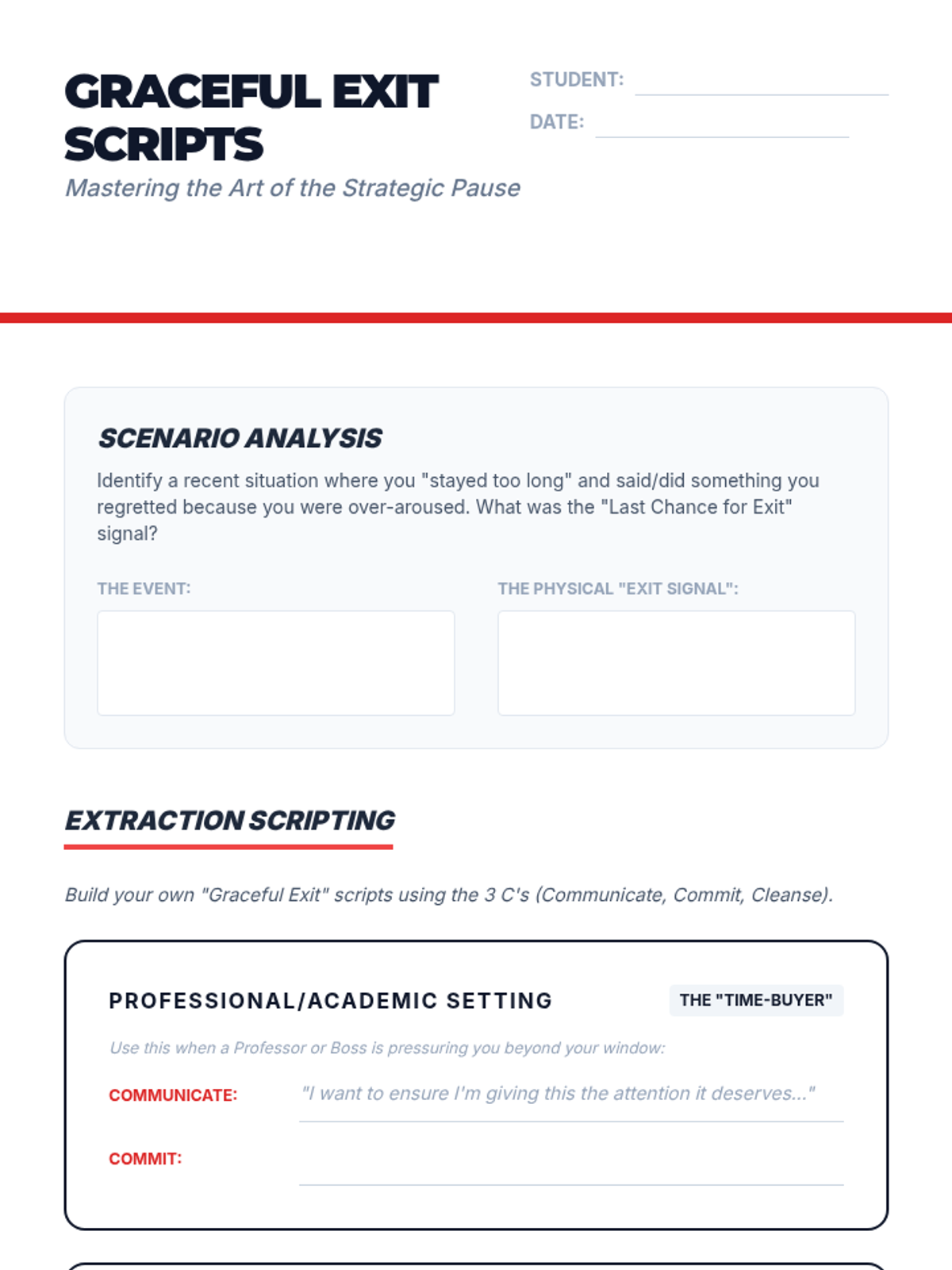
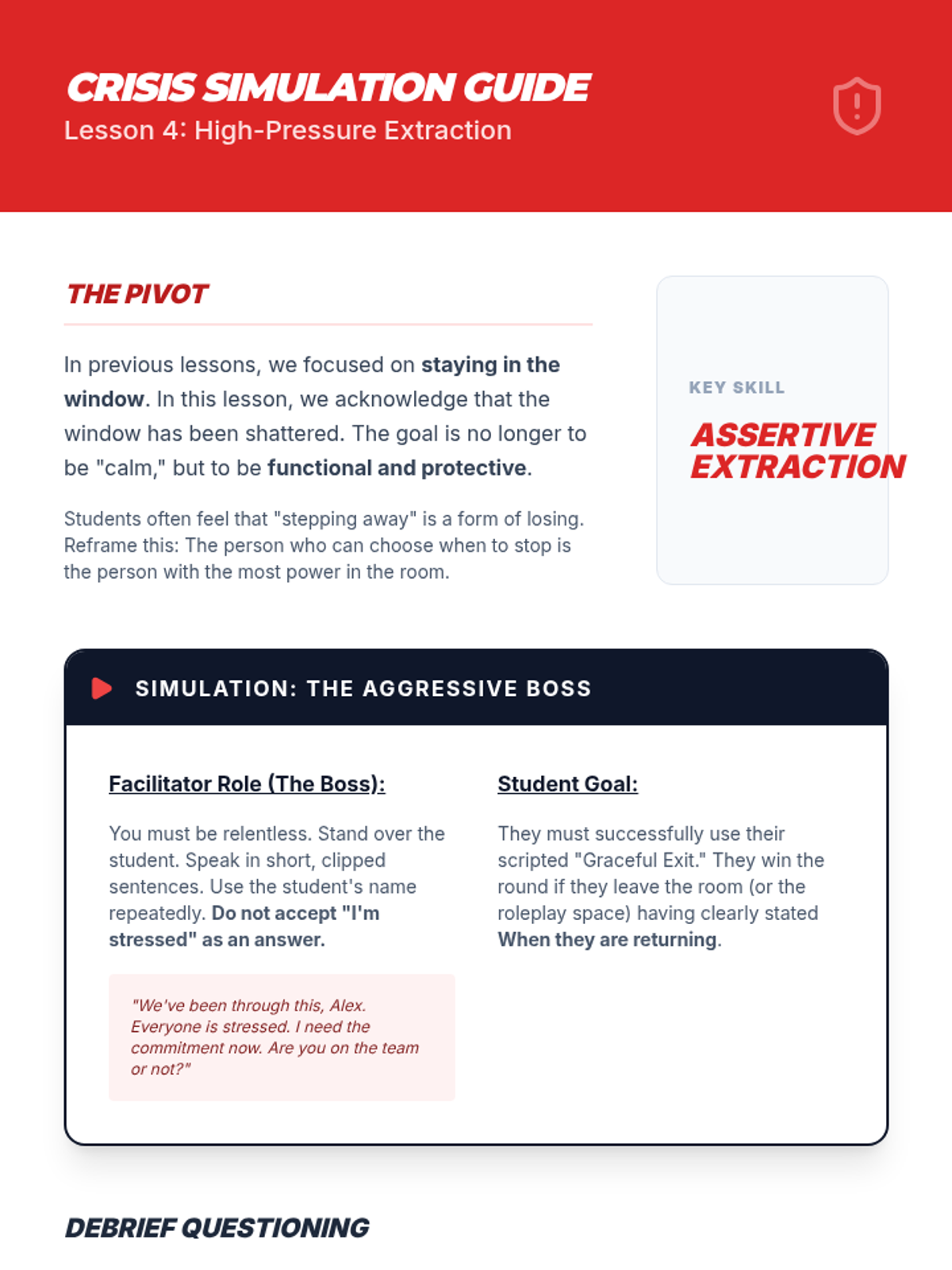
Explores intense de-escalation scenarios, teaching 'stepping away' and 'returning' strategies. Students learn assertive communication to buy time during high-stress professional or personal demands.
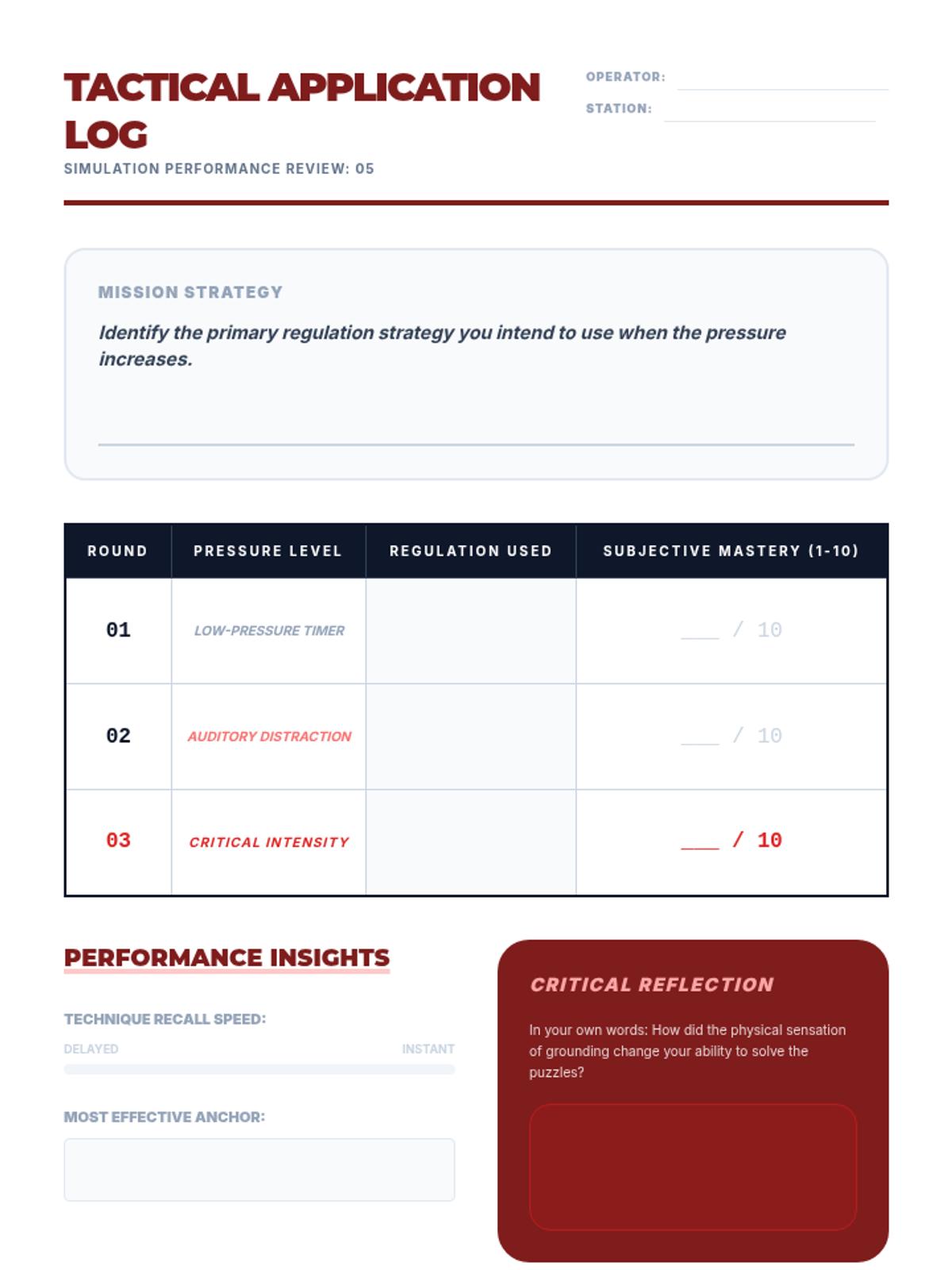
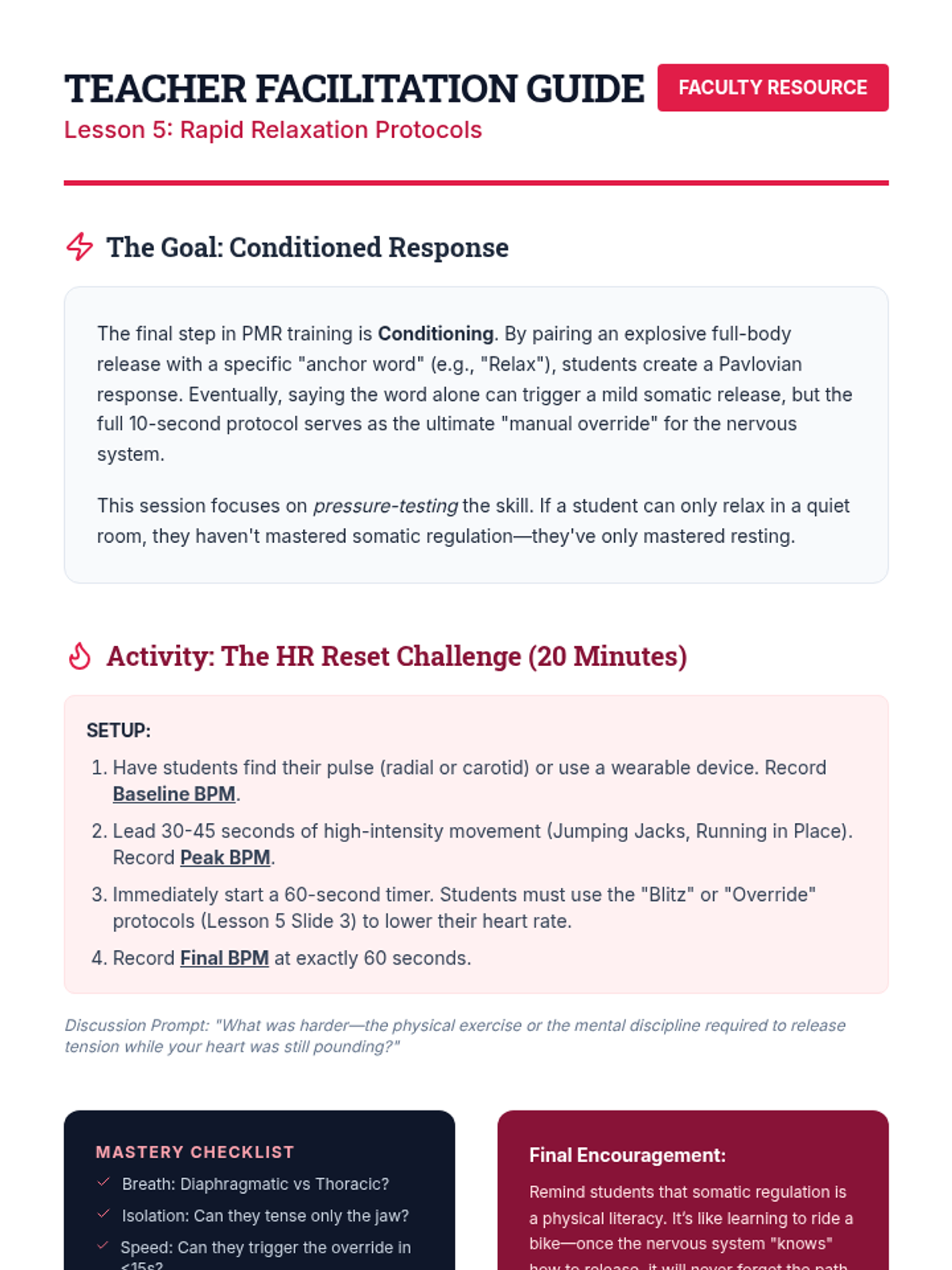
A culminating simulation where students face timed cognitive challenges while practicing their chosen regulation techniques. This bridges the gap between knowing a technique and using it under pressure.
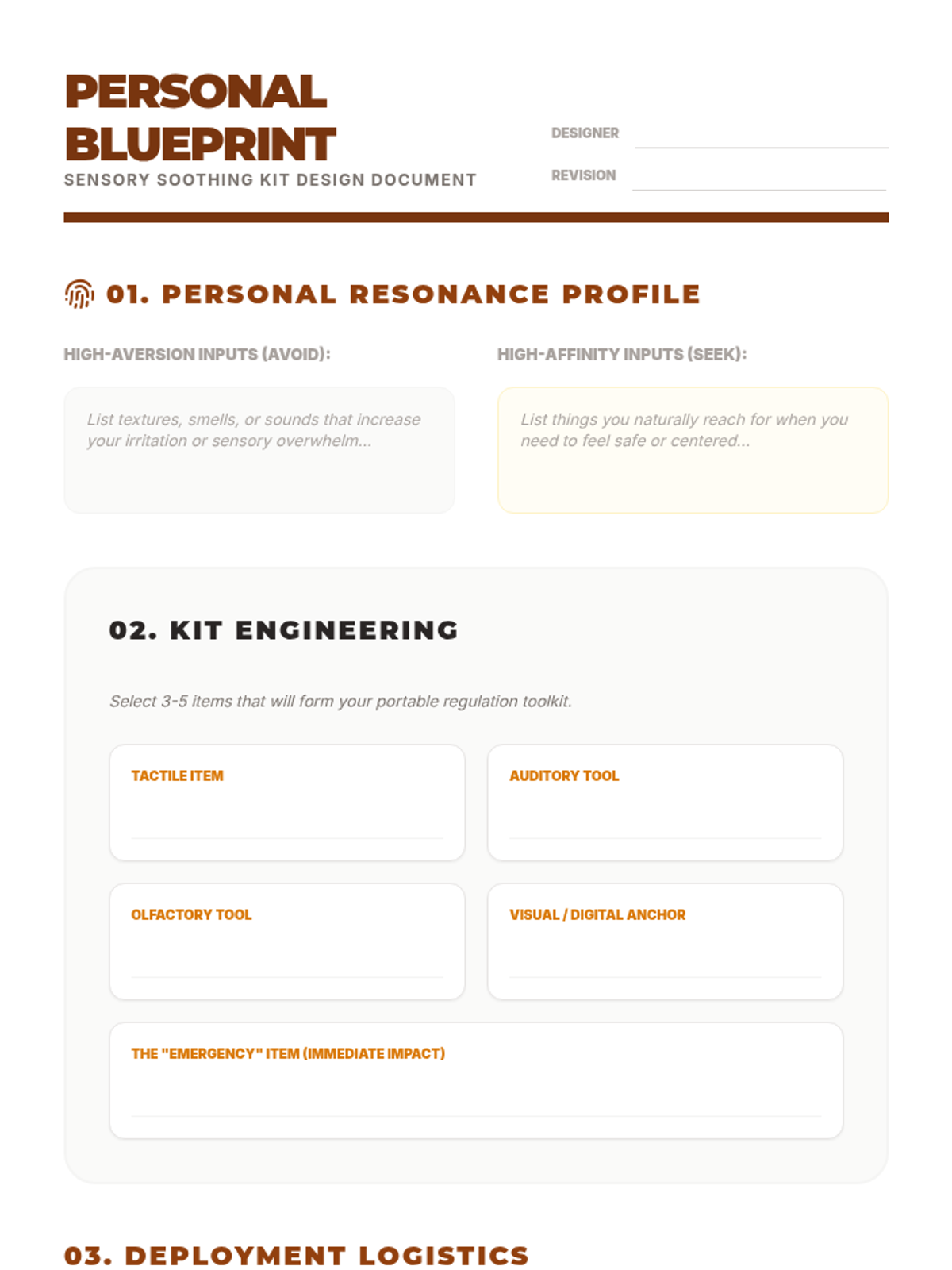
Learners identify personal sensory preferences that induce calm. They design and assemble a portable or digital 'kit' of resources to use during high-stress periods.
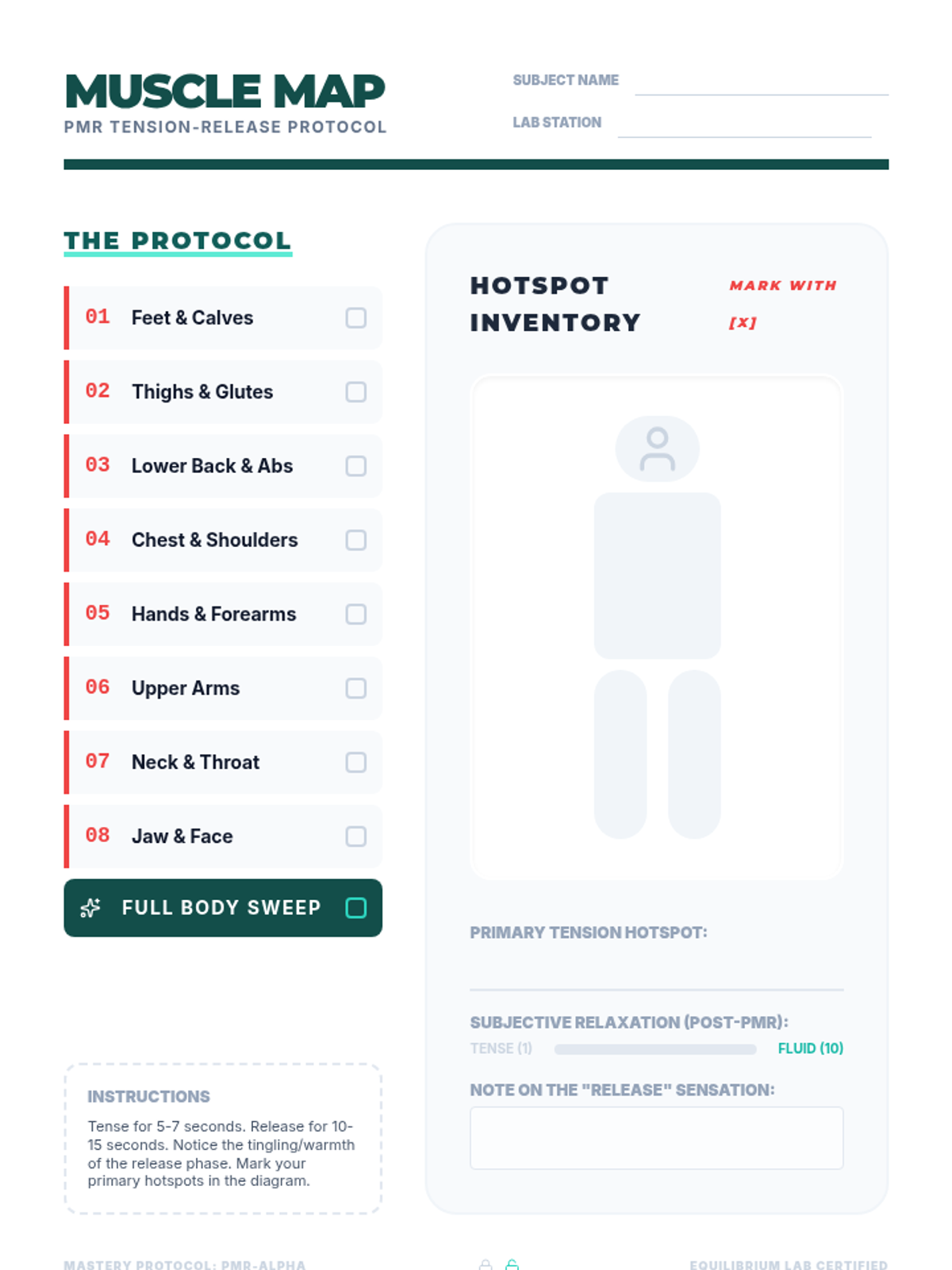
Students learn the sequence of tensing and releasing muscle groups to identify and release held physical tension. The lesson emphasizes the connection between physical relaxation and mental clarity.
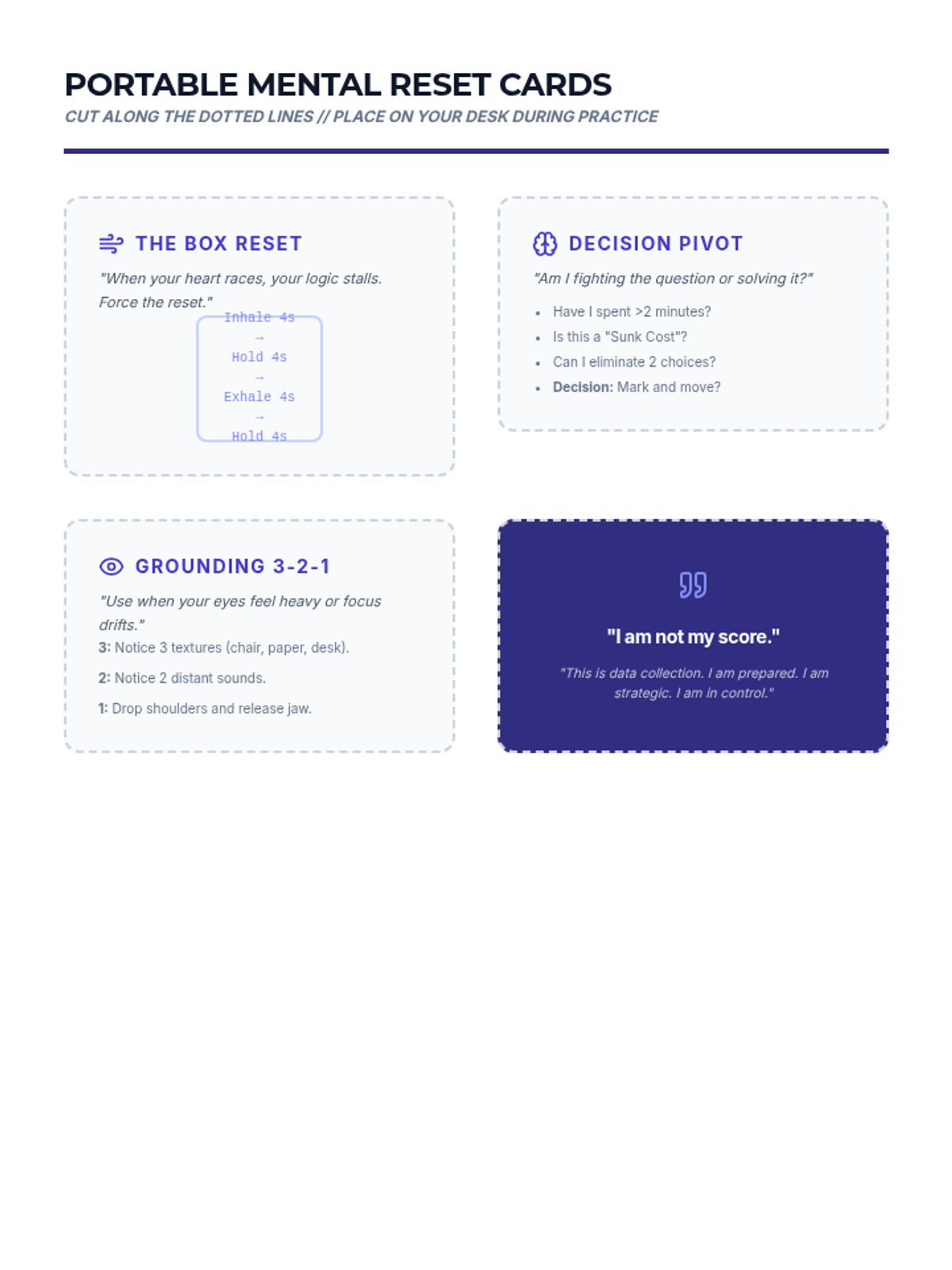
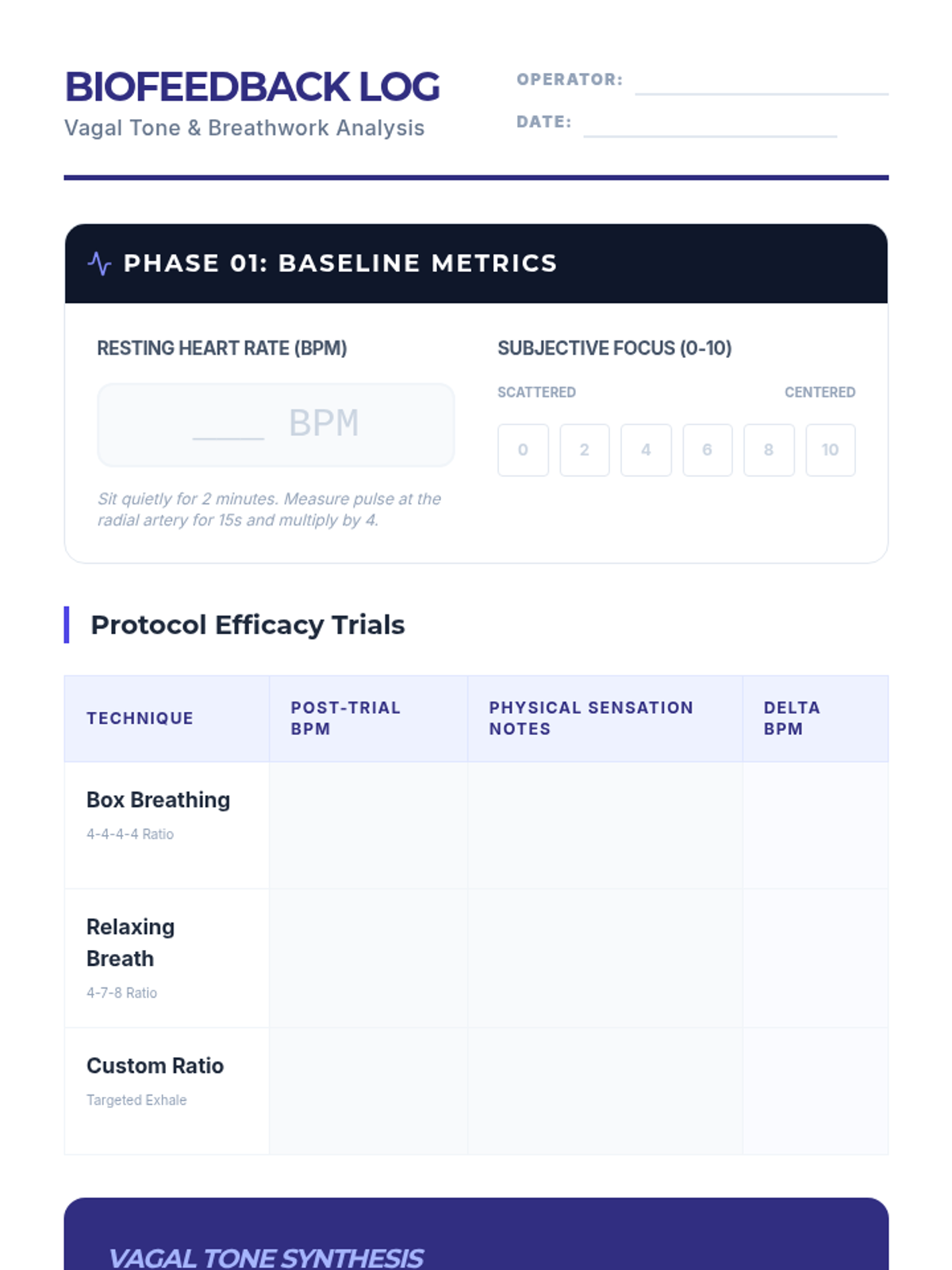
A technical workshop on breathwork, focusing on Box Breathing and 4-7-8 breathing to stimulate the parasympathetic nervous system. Students use biofeedback tools to measure the efficacy of different ratios.
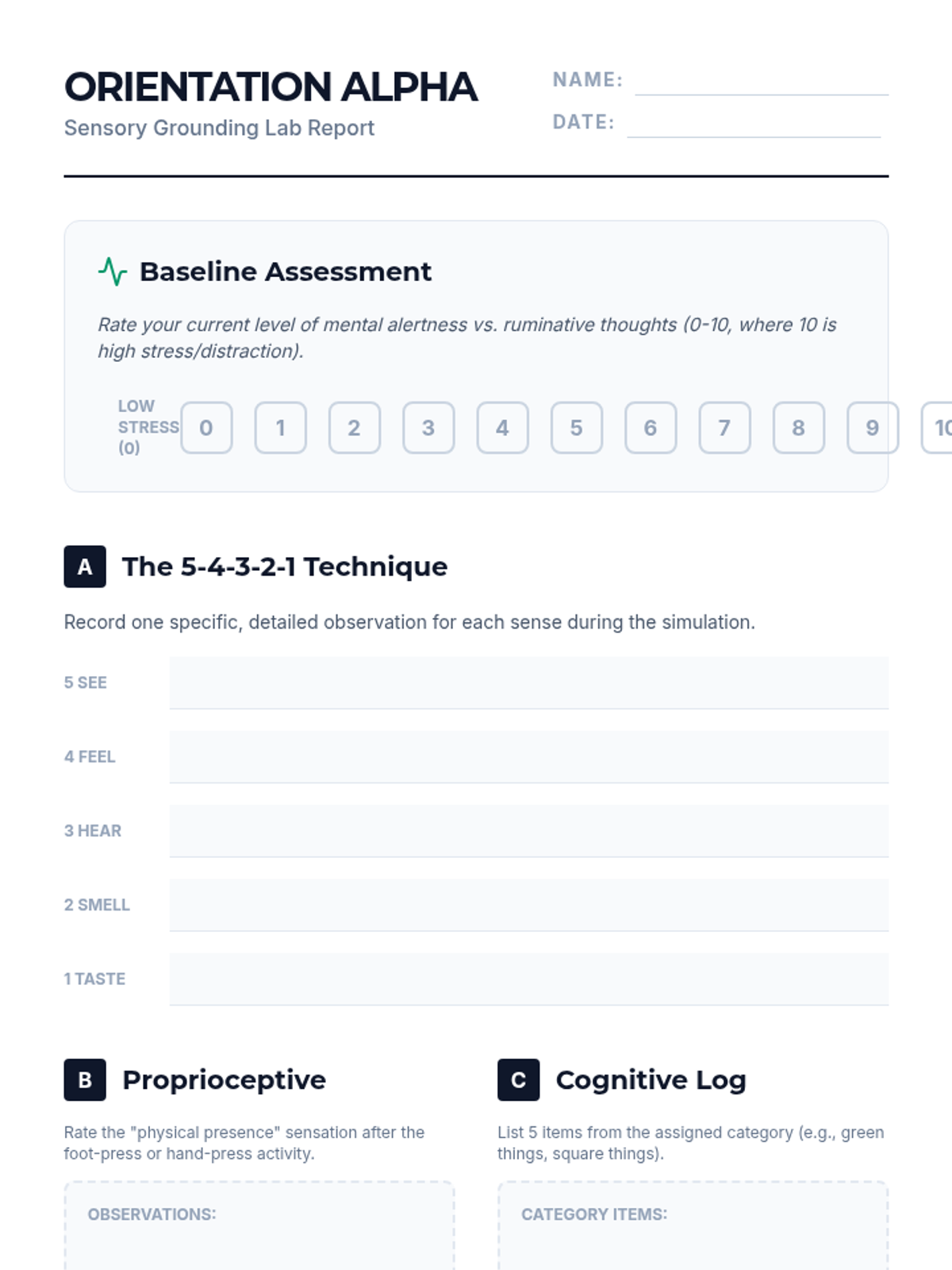
Students practice the 5-4-3-2-1 technique and other sensory-based orientation strategies to reconnect with the present moment. The lesson explains the science of how sensory input overrides ruminative thought loops.
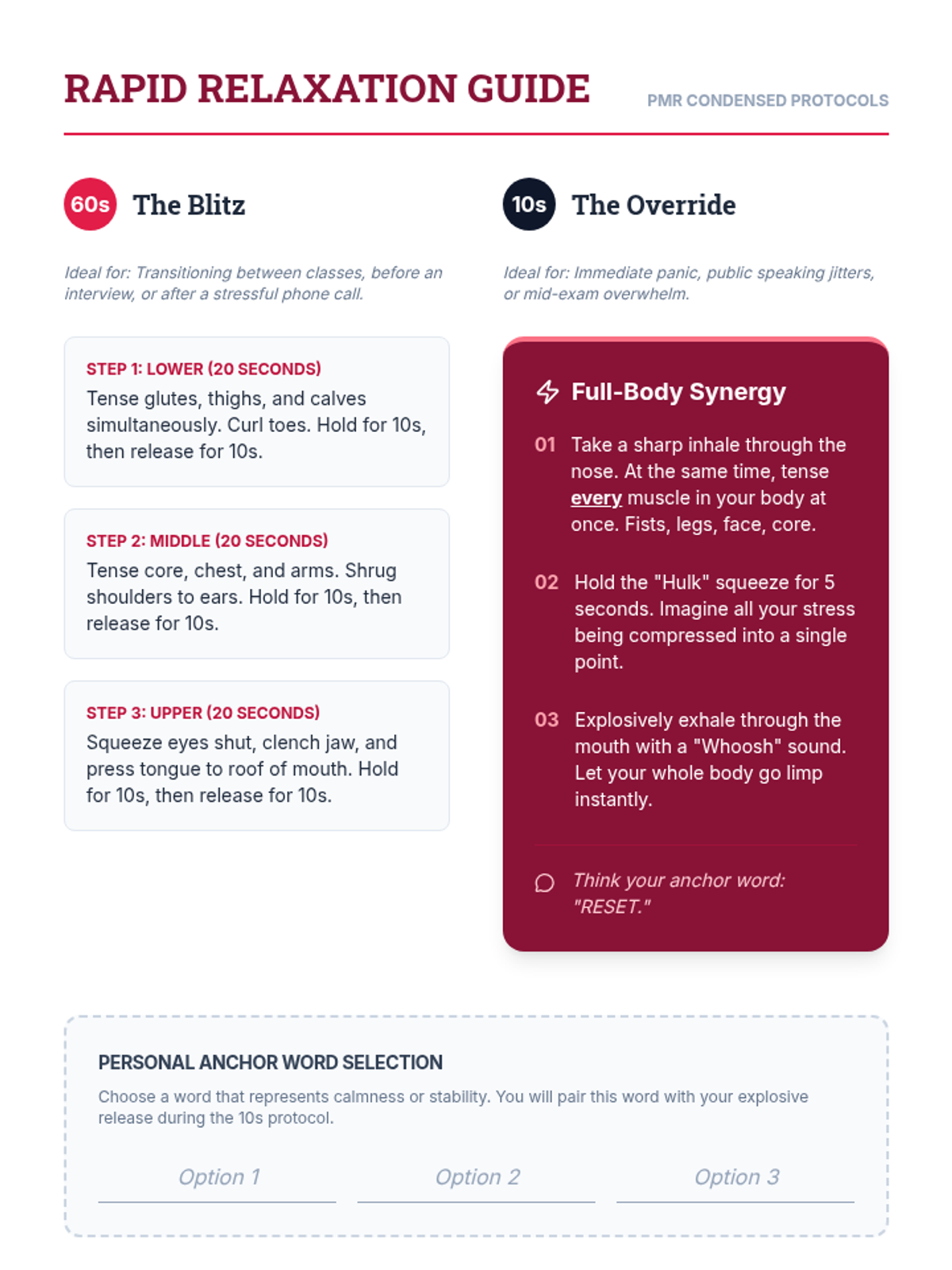
Students condense the full PMR session into 60-second and 10-second versions. They simulate high-stress environments to practice deploying these rapid techniques effectively.
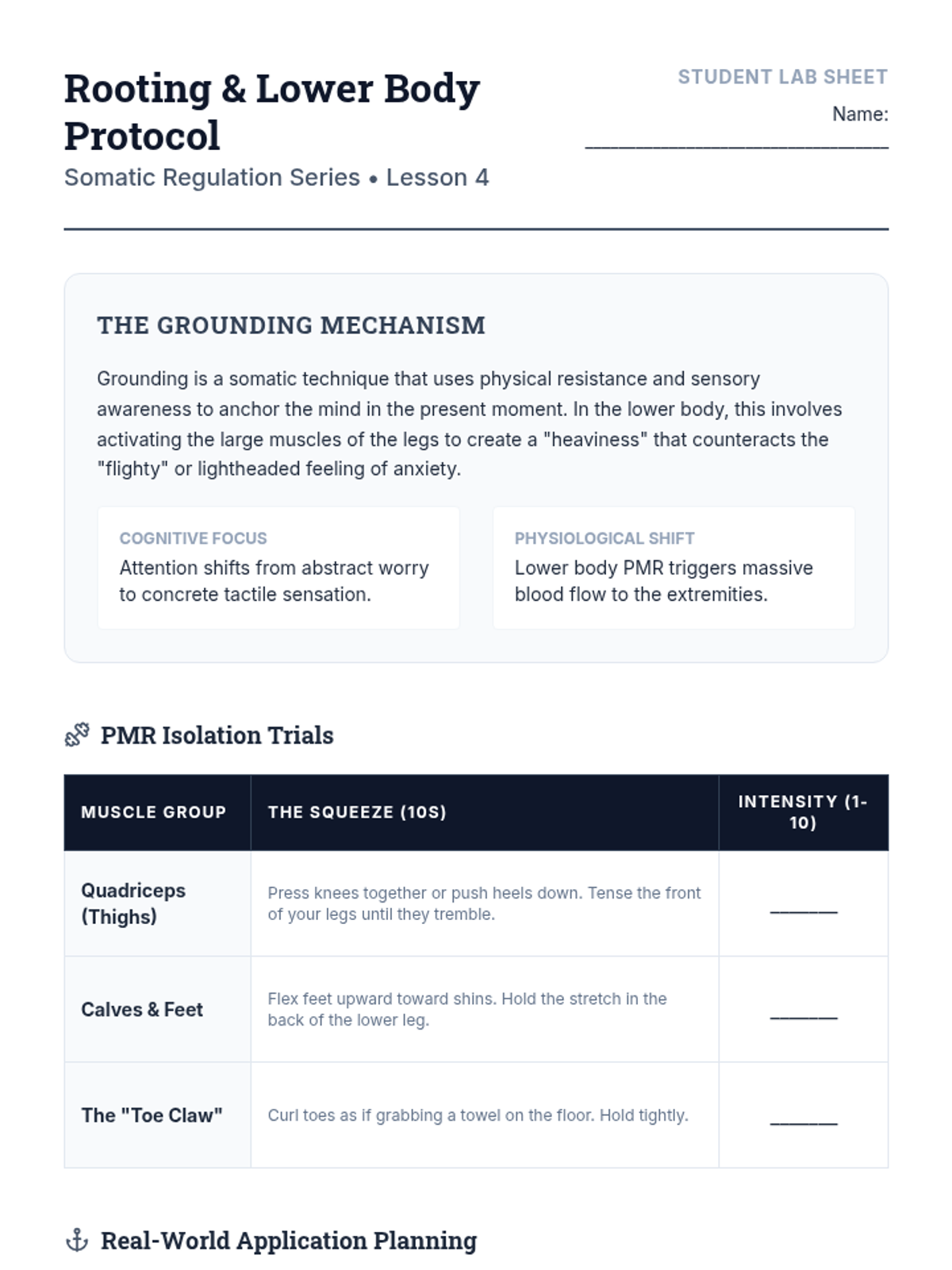
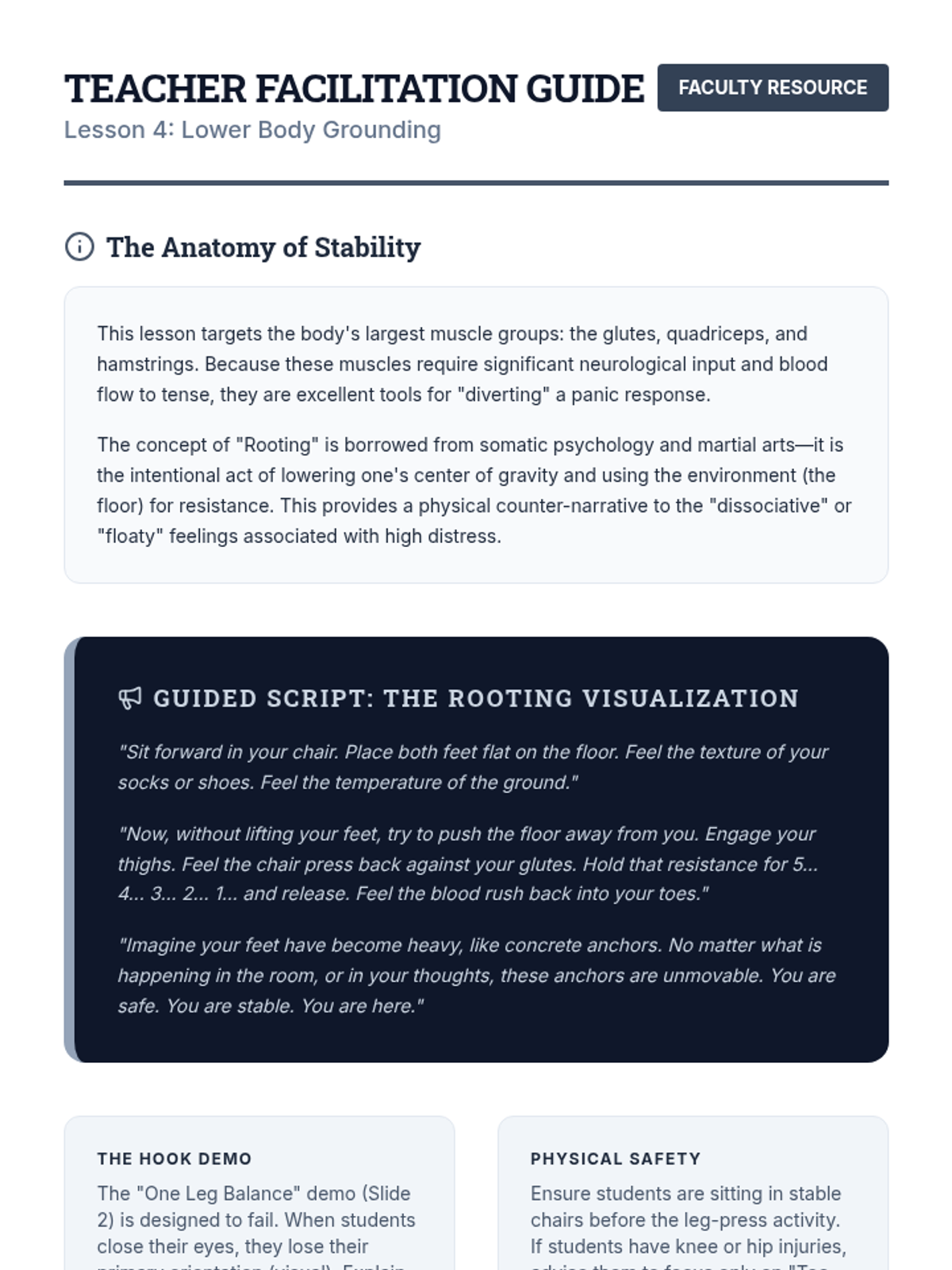
The focus shifts to the legs and feet to establish a physical sense of stability. Students learn to use the floor for resistance and grounding during seated lectures or exams.
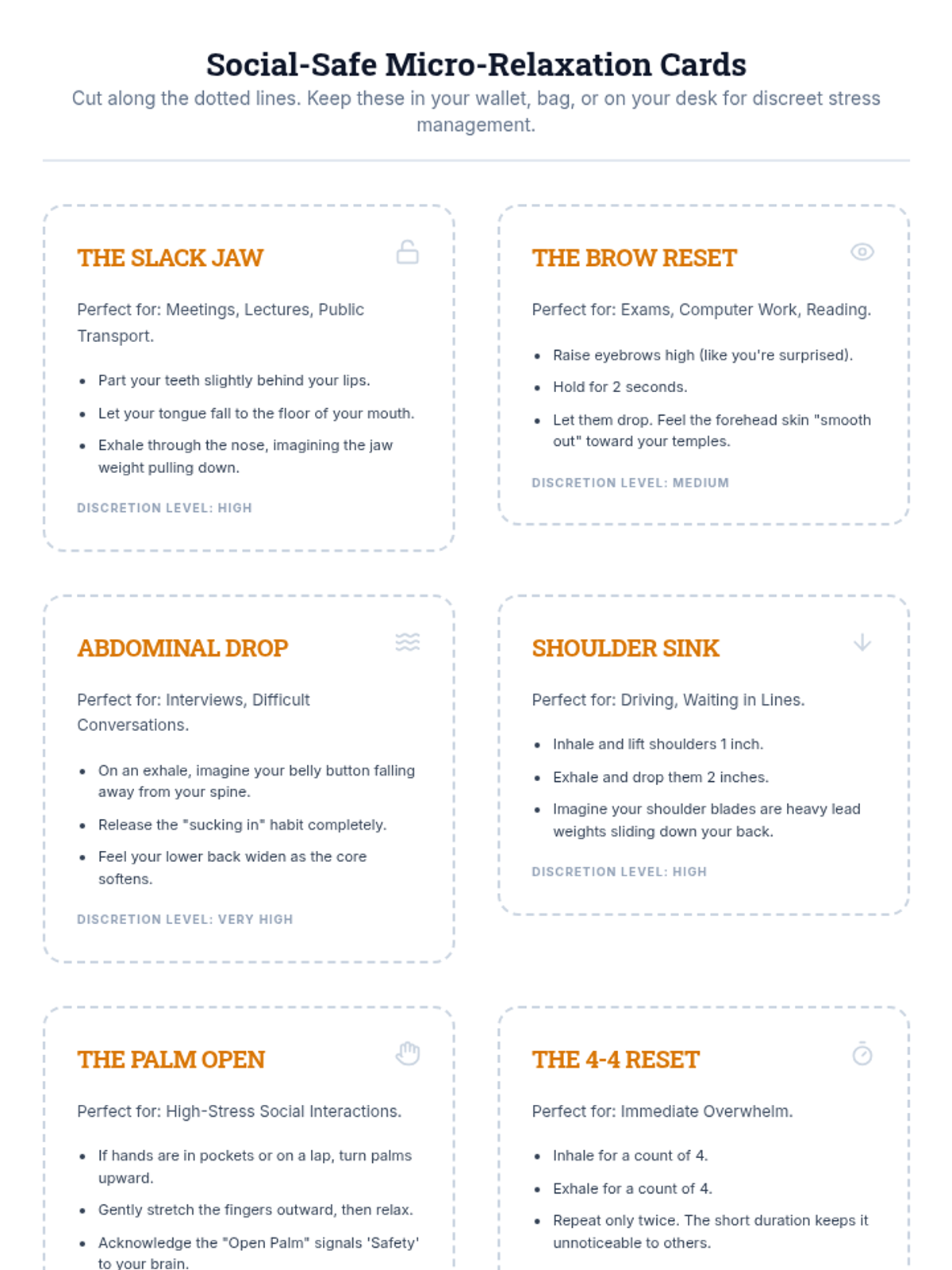
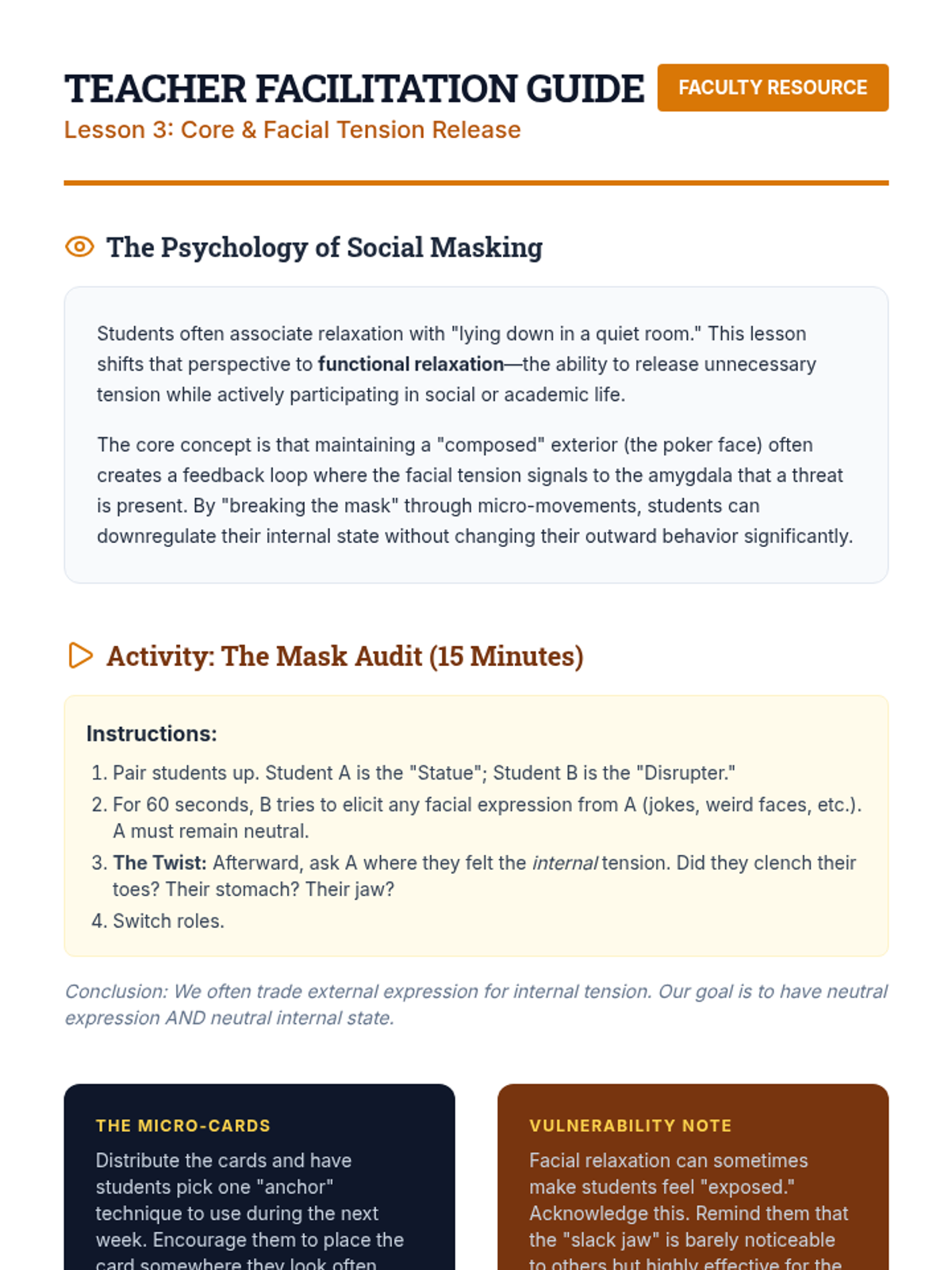
Students focus on the often-ignored areas of the jaw, forehead, and abdomen where stress accumulates. The lesson emphasizes micro-movements to release tension in social settings.