Storm Watch Writing Assessment
Grades 6–8 Practice Assessment • Writing Domain
Storm Watch Writing Assessment
Name: ___________________________
Date: ______________ Grade: ______
Directions: Complete the writing task(s) assigned by your teacher. Read the information carefully, organize your ideas in the planning box before you write, and use complete, connected sentences in your final response.
Part 1 • Target: WIDA Levels 3–4 (Expanding)
Task 1: Explaining How Severe Storms Form
Your Writing Prompt:
Your science class is creating a weather guide for younger students. Using the facts on the right, write a multi-paragraph explanation describing how ordinary clouds turn into severe thunderstorms and how people can stay safe.
Be sure to:
- Organize your writing with a clear introduction, body, and conclusion.
- Connect ideas using transition words (first, next, because, however, finally).
- Combine ideas into compound sentences (using and, but, so, yet).
- Add specific details (classifiers like cumulus and cumulonimbus, or descriptive phrases).
Weather Fact Sheet
- 1. Warm Air Rises: Sunlight heats the ground, causing warm, moist air to rise into the sky.
- 2. Cumulus Clouds: As moist air cools, it forms puffy white cumulus clouds.
- 3. Cumulonimbus Clouds: Strong updrafts push clouds higher until they become dark, towering cumulonimbus clouds.
- 4. Storm Impact: Heavy rain, lightning, and strong winds begin when cool air rushes down.
- 5. Safety Action: Move indoors immediately and stay away from windows.
Planning Organizer (Notes Only) Helpful words: cumulus, cumulonimbus, updraft, moisture, therefore, yet
1. Introduction
Hook & main topic
2. Body (Steps & Details)
How clouds change + storm effects
3. Conclusion
Safety advice & wrap-up
Task 1 Response: Explaining How Severe Storms Form
Part 1 • Levels 3–4
Quick Check: ☐ Introduction, body, & conclusion ☐ Transition words used ☐ Compound sentences ☐ Specific cloud details
Part 2 • Target: WIDA Levels 5–6 (Bridging & Reaching)
Task 2: Severe Weather School Safety Proposal
Your Writing Prompt:
Your school district is updating its severe weather policy for afternoon storms. Write a formal argumentative letter to your principal recommending either an Early Release plan or a Shelter-in-Place plan. Use evidence from the data table below, address a counterargument, and end with a clear call to action.
District Weather Safety Comparison Data
| Factor |
Option A: Early Release (1:30 PM) |
Option B: Shelter-in-Place (Until 4:15 PM) |
| Travel Risk |
Students travel before peak storm winds (45 mph) arrive at 3:00 PM. |
Zero travel during peak lightning and flash flooding; buses wait until clear. |
| Supervision |
Some families cannot arrange early pickup or supervision at home. |
All students remain supervised by staff inside reinforced hallways. |
| Learning Time |
Classes end 90 minutes early, reducing afternoon instruction. |
Full instructional day is preserved, though afternoon dismissal is delayed. |
Writing Goals (Levels 5–6): Use a genre-specific structure (statement of position, evidence-based arguments, counterargument, call to action), strategic paragraph transitions (the primary reason, furthermore, despite this concern), complex sentences showing cause, condition, or concession (although, because, unless), and precise evaluative language (essential, impractical, storm system).
Argument Planning Frame (Notes Only)
1. Statement of Position
2. Evidence-Based Arguments
3. Counterargument & Rebuttal
4. Call to Action
Task 2 Response: Severe Weather School Safety Proposal
Part 2 • Levels 5–6
Quick Check: ☐ Clear position & call to action ☐ Strategic paragraph links ☐ Complex clauses (cause/contrast) ☐ Precise vocabulary
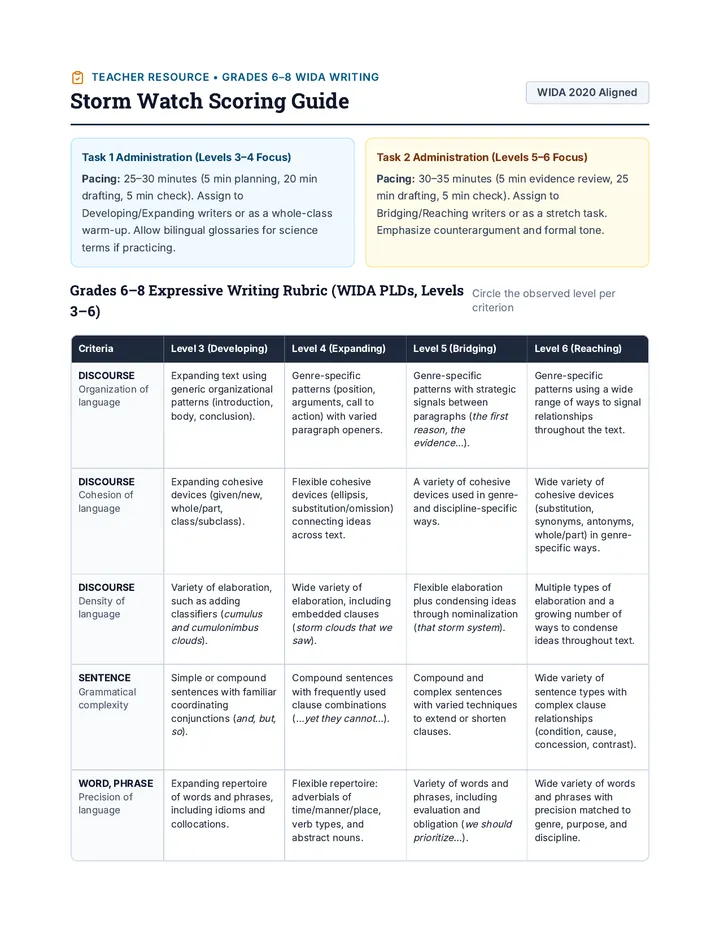
Storm Watch Scoring Guide
Teacher Resource • Grades 6–8 WIDA Writing
Storm Watch Scoring Guide
WIDA 2020 Aligned
Task 1 Administration (Levels 3–4 Focus)
Pacing: 25–30 minutes (5 min planning, 20 min drafting, 5 min check). Assign to Developing/Expanding writers or as a whole-class warm-up. Allow bilingual glossaries for science terms if practicing.
Task 2 Administration (Levels 5–6 Focus)
Pacing: 30–35 minutes (5 min evidence review, 25 min drafting, 5 min check). Assign to Bridging/Reaching writers or as a stretch task. Emphasize counterargument and formal tone.
Grades 6–8 Expressive Writing Rubric (WIDA PLDs, Levels 3–6)
Circle the observed level per criterion
| Criteria |
Level 3 (Developing) |
Level 4 (Expanding) |
Level 5 (Bridging) |
Level 6 (Reaching) |
| DISCOURSE |
|
|
|
|
| Organization of language |
Expanding text using generic organizational patterns (introduction, body, conclusion). |
Genre-specific patterns (position, arguments, call to action) with varied paragraph openers. |
Genre-specific patterns with strategic signals between paragraphs (the first reason, the evidence…). |
Genre-specific patterns using a wide range of ways to signal relationships throughout the text. |
| DISCOURSE |
|
|
|
|
| Cohesion of language |
Expanding cohesive devices (given/new, whole/part, class/subclass). |
Flexible cohesive devices (ellipsis, substitution/omission) connecting ideas across text. |
A variety of cohesive devices used in genre- and discipline-specific ways. |
Wide variety of cohesive devices (substitution, synonyms, antonyms, whole/part) in genre-specific ways. |
| DISCOURSE |
|
|
|
|
| Density of language |
Variety of elaboration, such as adding classifiers (cumulus and cumulonimbus clouds). |
Wide variety of elaboration, including embedded clauses (storm clouds that we saw). |
Flexible elaboration plus condensing ideas through nominalization (that storm system). |
Multiple types of elaboration and a growing number of ways to condense ideas throughout text. |
| SENTENCE |
|
|
|
|
| Grammatical complexity |
Simple or compound sentences with familiar coordinating conjunctions (and, but, so). |
Compound sentences with frequently used clause combinations (…yet they cannot…). |
Compound and complex sentences with varied techniques to extend or shorten clauses. |
Wide variety of sentence types with complex clause relationships (condition, cause, concession, contrast). |
| WORD, PHRASE |
|
|
|
|
| Precision of language |
Expanding repertoire of words and phrases, including idioms and collocations. |
Flexible repertoire: adverbials of time/manner/place, verb types, and abstract nouns. |
Variety of words and phrases, including evaluation and obligation (we should prioritize…). |
Wide variety of words and phrases with precision matched to genre, purpose, and discipline. |
Annotated Exemplars & Instructional Moves
Storm Watch Writing
Task 1 Sample Benchmarks (Explanatory Writing)
Level 3 Benchmark Excerpt
"First, warm air goes up into the sky and it makes cumulus clouds. Next, strong wind pushes the clouds higher, so they turn into cumulonimbus clouds. Finally, heavy rain starts and people must go inside."
Look for: Generic intro/body/conclusion; sequencing openers; classifiers (cumulus/cumulonimbus); compound sentences with and, so.
Level 4 Benchmark Excerpt
"When warm, moist air rises rapidly, it forms puffy clouds that gradually grow taller. Strong updrafts lift them into towering storm clouds, yet the danger begins when cool air rushes down. Seeking shelter immediately keeps everyone safe."
Look for: Embedded clause (that gradually grow); adverbials (rapidly, immediately); compound contrast (yet); abstract noun (danger).
Task 2 Sample Benchmarks (Argumentative Writing)
Level 5 Benchmark Excerpt
"The primary reason our school should adopt a Shelter-in-Place plan is student safety. That storm system brings 45 mph winds at 3:00 PM, which makes bus travel hazardous. We should prioritize protection over early dismissal."
Look for: Strategic paragraph signal (The primary reason); nominalization (That storm system); evaluation/obligation (hazardous, should prioritize).
Level 6 Benchmark Excerpt
"Although early release avoids afternoon peak winds, it leaves many students unsupervised at home. In contrast, sheltering in place preserves 90 minutes of instruction while keeping every student inside reinforced hallways until severe weather passes."
Look for: Complex concession/contrast clauses (Although…, In contrast…, while…); precise discipline-specific phrasing; cohesive antonym/comparison links.
Next-Step Instructional Moves for Teachers
Moving Students from Level 3 → Level 4
- Noun Expansion: Practice turning simple nouns into expanded noun phrases using embedded clauses (clouds → storm clouds that block the sun).
- Clause Combining: Model replacing repetitive and/then chains with contrast or cause conjunctions (yet, because, since).
- Adverbial Precision: Build a class bank of manner and time adverbials (gradually, immediately, during peak winds).
Moving Students from Level 5 → Level 6
- Nominalization: Teach students to condense prior clauses into abstract noun phrases (When winds reach 45 mph → This severe weather threat).
- Concession & Condition: Use sentence frames with Although…, Unless…, Provided that… to strengthen counterarguments.
- Evaluative Register: Replace conversational judgments (bad idea) with formal academic evaluation (impractical policy, essential safeguard).