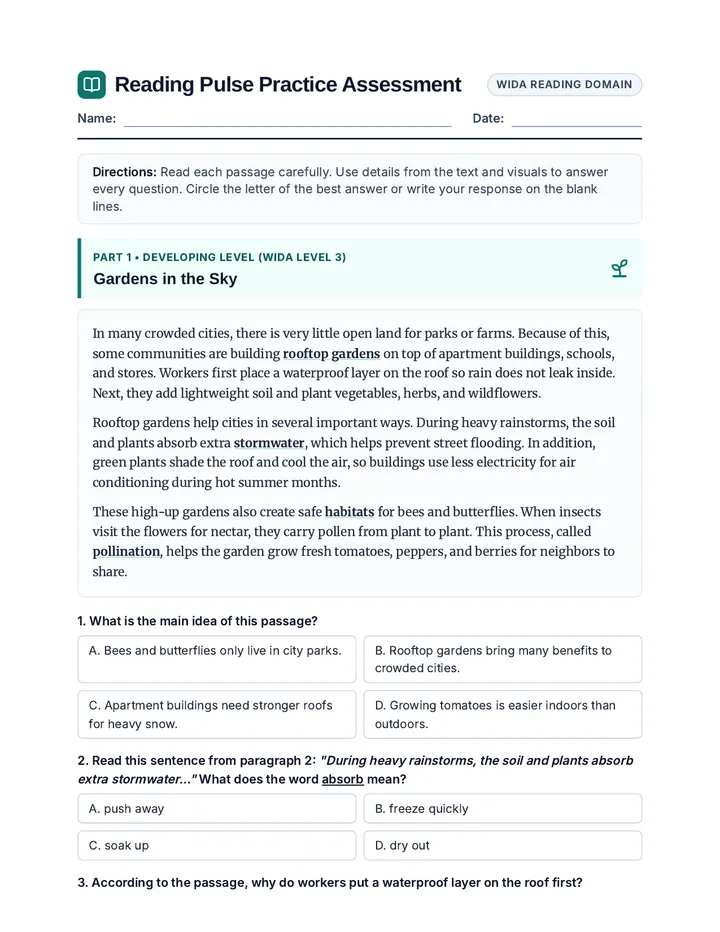
Reading Pulse Assessment Reading Pulse Practice Assessment
WIDA Reading Domain
Name:
Date:
Directions: Read each passage carefully. Use details from the text and visuals to answer every question. Circle the letter of the best answer or write your response on the blank lines.
Part 1 • Developing Level (WIDA Level 3)
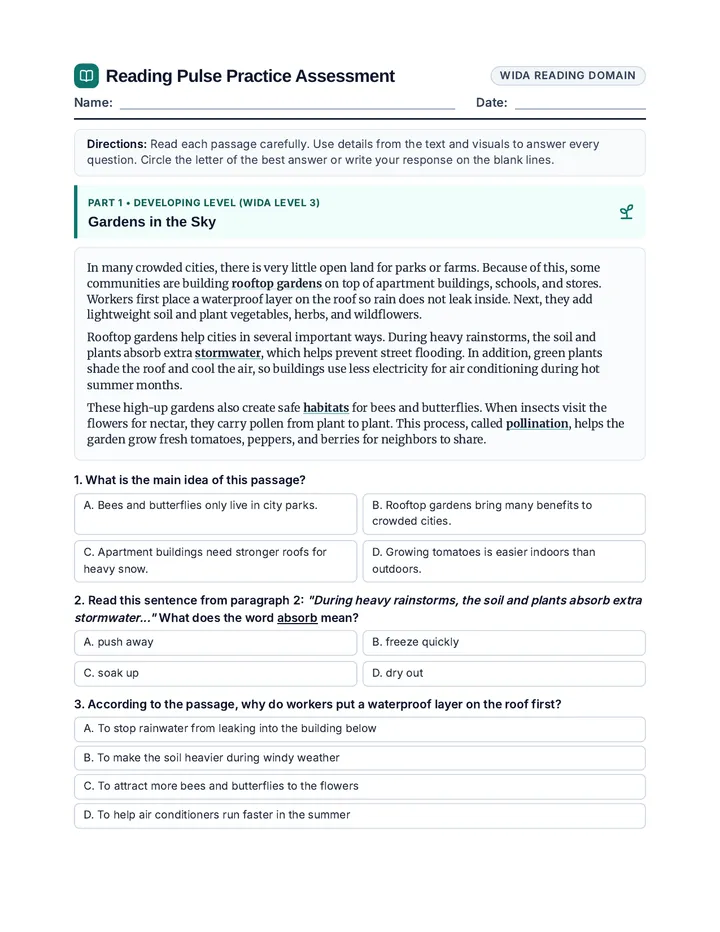
Gardens in the Sky
In many crowded cities, there is very little open land for parks or farms. Because of this, some communities are building rooftop gardens on top of apartment buildings, schools, and stores. Workers first place a waterproof layer on the roof so rain does not leak inside. Next, they add lightweight soil and plant vegetables, herbs, and wildflowers.
Rooftop gardens help cities in several important ways. During heavy rainstorms, the soil and plants absorb extra stormwater, which helps prevent street flooding. In addition, green plants shade the roof and cool the air, so buildings use less electricity for air conditioning during hot summer months.
These high-up gardens also create safe habitats for bees and butterflies. When insects visit the flowers for nectar, they carry pollen from plant to plant. This process, called pollination, helps the garden grow fresh tomatoes, peppers, and berries for neighbors to share.
1. What is the main idea of this passage?
A. Bees and butterflies only live in city parks.
B. Rooftop gardens bring many benefits to crowded cities.
C. Apartment buildings need stronger roofs for heavy snow.
D. Growing tomatoes is easier indoors than outdoors.
2. Read this sentence from paragraph 2: "During heavy rainstorms, the soil and plants absorb extra stormwater..." What does the word absorb mean?
A. push away
B. freeze quickly
C. soak up
D. dry out
3. According to the passage, why do workers put a waterproof layer on the roof first?
A. To stop rainwater from leaking into the building below
B. To make the soil heavier during windy weather
C. To attract more bees and butterflies to the flowers
D. To help air conditioners run faster in the summer
Part 1 • Developing Level (Continued) Gardens in the Sky
4. Look at the cause-and-effect chart below. Which detail best completes the empty box?
Cause Green plants shade the roof and cool the air.
Effect: ?
A. Neighbors must buy more vegetables at the store.
B. Buildings use less electricity for air conditioning.
C. Bees stop visiting wildflowers on the roof.
D. Streets flood faster during heavy rainstorms.
5. Based on paragraph 3, what happens right after bees and butterflies carry pollen from plant to plant?
A. Workers add lightweight soil to the roof.
B. The plants are able to grow fresh fruits and vegetables.
C. The roof absorbs extra stormwater from the street.
D. Buildings need more electricity to stay cool.
6. Short Response: Explain two ways rooftop gardens help people or animals in a city. Use details from the passage.
Write complete sentences on the lines below.
Part 2 • Expanding–Bridging Level (WIDA Levels 4–5)
Biomimicry: Nature's Engineering Blueprint
For billions of years, living organisms have adapted to survive extreme environments while using minimal energy. Today, scientists and engineers practice biomimicry—the study of nature's designs to solve complex human problems. Rather than inventing solutions from scratch, researchers analyze how plants and animals manage heat, movement, and structural strength, and then translate those biological strategies into sustainable technology.
One celebrated example involves Japan's high-speed Shinkansen bullet train. Early models traveled so rapidly that exiting a tunnel created a loud sonic boom, disturbing nearby residents. An engineer who was also an avid birdwatcher noticed that the kingfisher bird dives into water with barely a splash because its long, narrow beak slices smoothly between air and liquid. By redesigning the train's nose to match the kingfisher's aerodynamic beak, engineers eliminated the sonic boom, reduced energy consumption by 15 percent, and increased the train's speed.
Biomimicry also shapes modern architecture and materials science. In Zimbabwe, architect Mick Pearce designed an office complex without conventional air conditioning by imitating termite mounds, which maintain a steady internal temperature despite scorching desert days and freezing nights. Similarly, medical researchers are developing bacteria-resistant hospital surfaces modeled after the microscopic, diamond-shaped microstructure of sharkskin, which prevents barnacles and algae from attaching in the ocean.
Table 1: Biological Models and Engineering Applications
Organism
Natural Adaptation
Human Innovation
Kingfisher Bird
Tapered beak enters water cleanly
Quieter, faster bullet train nose
Termite Mound
Vents circulate air to regulate heat
Self-cooling office building
Sharkskin
Microscopic ridges block algae growth
Bacteria-resistant hospital surfaces
7. Which statement best expresses the author's central claim in this passage?
A. High-speed trains are too noisy to operate near crowded neighborhoods.
B. Observing how organisms solve survival challenges leads to efficient human inventions.
C. Modern hospitals should replace all metal surfaces with sharkskin materials.
D. Termite mounds are more durable than buildings made by human architects.
8. How did redesigning the Shinkansen train nose solve more than one problem at the same time?
A. It allowed the train to travel underwater while using less electricity.
B. It removed the need for tunnels and made the train cars lighter.
C. It stopped the sonic boom, lowered energy use, and increased train speed.
D. It cooled the passengers inside without using air conditioning.
Part 2 • Expanding–Bridging Level (Continued) Biomimicry: Nature's Engineering Blueprint
9. In paragraph 3, the author uses the transition word Similarly to connect termite mounds and sharkskin. Why does the author use this word?
A. To show that both examples demonstrate biomimicry applied to buildings and materials
B. To contrast desert insects with ocean predators that live in cold water
C. To explain why Mick Pearce could not use sharkskin in Zimbabwe
D. To prove that medical researchers worked on the bullet train project
10. Based on both the passage and Table 1, which feature do all three human innovations share?
A. Each innovation was tested in the ocean before being used on land.
B. Each innovation copies a physical structure from nature to improve performance.
C. Each innovation was designed to reduce noise in crowded cities.
D. Each innovation requires microscopic ridges to function properly.
11. Extended Response: Explain how biomimicry helps engineers create more sustainable or effective designs. Cite at least two specific examples from the passage and Table 1 to support your explanation.
Write a well-organized paragraph on the lines below.
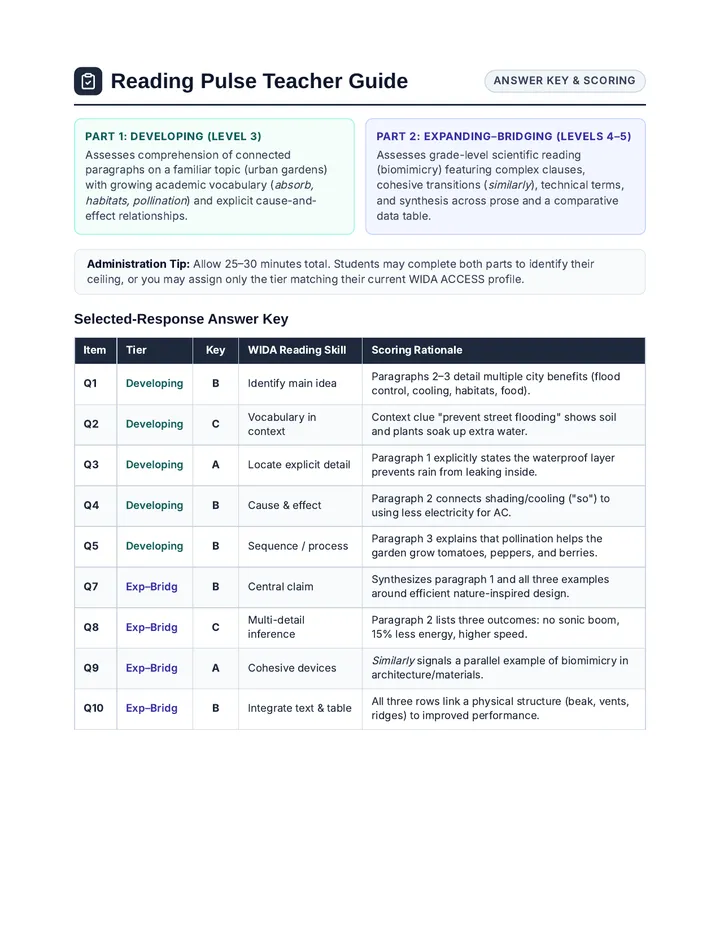
Reading Pulse Teacher Guide Reading Pulse Teacher Guide
Answer Key & Scoring
Part 1: Developing (Level 3)
Assesses comprehension of connected paragraphs on a familiar topic (urban gardens) with growing academic vocabulary (absorb, habitats, pollination ) and explicit cause-and-effect relationships.
Part 2: Expanding–Bridging (Levels 4–5)
Assesses grade-level scientific reading (biomimicry) featuring complex clauses, cohesive transitions (similarly ), technical terms, and synthesis across prose and a comparative data table.
Administration Tip: Allow 25–30 minutes total. Students may complete both parts to identify their ceiling, or you may assign only the tier matching their current WIDA ACCESS profile.
Selected-Response Answer Key
Item
Tier
Key
WIDA Reading Skill
Scoring Rationale
Q1
Developing
B
Identify main idea
Paragraphs 2–3 detail multiple city benefits (flood control, cooling, habitats, food).
Q2
Developing
C
Vocabulary in context
Context clue "prevent street flooding" shows soil and plants soak up extra water.
Q3
Developing
A
Locate explicit detail
Paragraph 1 explicitly states the waterproof layer prevents rain from leaking inside.
Q4
Developing
B
Cause & effect
Paragraph 2 connects shading/cooling ("so") to using less electricity for AC.
Q5
Developing
B
Sequence / process
Paragraph 3 explains that pollination helps the garden grow tomatoes, peppers, and berries.
Q7
Exp–Bridg
B
Central claim
Synthesizes paragraph 1 and all three examples around efficient nature-inspired design.
Q8
Exp–Bridg
C
Multi-detail inference
Paragraph 2 lists three outcomes: no sonic boom, 15% less energy, higher speed.
Q9
Exp–Bridg
A
Cohesive devices
Similarly signals a parallel example of biomimicry in architecture/materials.
Q10
Exp–Bridg
B
Integrate text & table
All three rows link a physical structure (beak, vents, ridges) to improved performance.
Reading Pulse Teacher Guide (Continued) Rubrics & Differentiation
Part 1 Constructed Response Rubric (Q6 • Developing)
2 Points (Proficient)
1 Point (Emerging)
0 Points (Beginning)
Accurately explains two ways rooftop gardens help people or animals using specific text details.
Explains one accurate benefit, or lists two ideas without clear text details.
Response is inaccurate, off-topic, or copied without addressing the prompt.
Sample 2-Point Response: Rooftop gardens help people by soaking up extra rainwater so streets do not flood. They also help bees and butterflies by giving them safe habitats and flowers with nectar.
Part 2 Constructed Response Rubric (Q11 • Expanding–Bridging)
3 Points (Bridging)
2 Points (Expanding)
1 Point (Developing)
Clearly explains how biomimicry improves sustainability/performance and cites two accurate examples from both prose and Table 1.
Explains the concept generally and cites one full example or two partial examples with minor gaps.
Mentions biomimicry or one organism vaguely without connecting the adaptation to an engineering solution.
Sample 3-Point Response: Biomimicry helps engineers solve problems efficiently by copying adaptations that already work in nature. For example, engineers modeled Japan's bullet train nose after the kingfisher's tapered beak, which stopped sonic booms and cut energy use by 15 percent. Similarly, architects copied termite mound vents to build an office complex that cools itself without air conditioning.
Targeted Next-Step Supports
Moving Developing → Expanding
Practice highlighting signal words (because, so, in addition ) to track cause-and-effect chains.
Use sentence frames for short responses: "According to the text, ___ helps ___ because ___."
Pre-teach Tier 2 verbs (absorb, regulate, eliminate ) with quick visual word maps.
Moving Expanding → Bridging
Model how to cross-reference prose paragraphs with data tables before answering synthesis items.
Analyze cohesive transitions (similarly, whereas, consequently ) to clarify relationships between ideas.
Require two-source citations in written responses using academic verbs (demonstrates, illustrates ).
Reading Pulse Assessment Reading Pulse Practice Assessment
WIDA Reading Domain
Name:
Date:
Directions: Read each passage carefully. Use details from the text and visuals to answer every question. Circle the letter of the best answer or write your response on the blank lines.
Part 1 • Developing Level (WIDA Level 3)
Gardens in the Sky
In many crowded cities, there is very little open land for parks or farms. Because of this, some communities are building rooftop gardens on top of apartment buildings, schools, and stores. Workers first place a waterproof layer on the roof so rain does not leak inside. Next, they add lightweight soil and plant vegetables, herbs, and wildflowers.
Rooftop gardens help cities in several important ways. During heavy rainstorms, the soil and plants absorb extra stormwater, which helps prevent street flooding. In addition, green plants shade the roof and cool the air, so buildings use less electricity for air conditioning during hot summer months.
These high-up gardens also create safe habitats for bees and butterflies. When insects visit the flowers for nectar, they carry pollen from plant to plant. This process, called pollination, helps the garden grow fresh tomatoes, peppers, and berries for neighbors to share.
1. What is the main idea of this passage?
A. Bees and butterflies only live in city parks.
B. Rooftop gardens bring many benefits to crowded cities.
C. Apartment buildings need stronger roofs for heavy snow.
D. Growing tomatoes is easier indoors than outdoors.
2. Read this sentence from paragraph 2: "During heavy rainstorms, the soil and plants absorb extra stormwater..." What does the word absorb mean?
A. push away
B. freeze quickly
C. soak up
D. dry out
3. According to the passage, why do workers put a waterproof layer on the roof first?
A. To stop rainwater from leaking into the building below
B. To make the soil heavier during windy weather
C. To attract more bees and butterflies to the flowers
D. To help air conditioners run faster in the summer
Part 1 • Developing Level (Continued) Gardens in the Sky
4. Look at the cause-and-effect chart below. Which detail best completes the empty box?
Cause Green plants shade the roof and cool the air.
Effect: ?
A. Neighbors must buy more vegetables at the store.
B. Buildings use less electricity for air conditioning.
C. Bees stop visiting wildflowers on the roof.
D. Streets flood faster during heavy rainstorms.
5. Based on paragraph 3, what happens right after bees and butterflies carry pollen from plant to plant?
A. Workers add lightweight soil to the roof.
B. The plants are able to grow fresh fruits and vegetables.
C. The roof absorbs extra stormwater from the street.
D. Buildings need more electricity to stay cool.
6. Short Response: Explain two ways rooftop gardens help people or animals in a city. Use details from the passage.
Write complete sentences on the lines below.
Part 2 • Expanding–Bridging Level (WIDA Levels 4–5)
Biomimicry: Nature's Engineering Blueprint
For billions of years, living organisms have adapted to survive extreme environments while using minimal energy. Today, scientists and engineers practice biomimicry—the study of nature's designs to solve complex human problems. Rather than inventing solutions from scratch, researchers analyze how plants and animals manage heat, movement, and structural strength, and then translate those biological strategies into sustainable technology.
One celebrated example involves Japan's high-speed Shinkansen bullet train. Early models traveled so rapidly that exiting a tunnel created a loud sonic boom, disturbing nearby residents. An engineer who was also an avid birdwatcher noticed that the kingfisher bird dives into water with barely a splash because its long, narrow beak slices smoothly between air and liquid. By redesigning the train's nose to match the kingfisher's aerodynamic beak, engineers eliminated the sonic boom, reduced energy consumption by 15 percent, and increased the train's speed.
Biomimicry also shapes modern architecture and materials science. In Zimbabwe, architect Mick Pearce designed an office complex without conventional air conditioning by imitating termite mounds, which maintain a steady internal temperature despite scorching desert days and freezing nights. Similarly, medical researchers are developing bacteria-resistant hospital surfaces modeled after the microscopic, diamond-shaped microstructure of sharkskin, which prevents barnacles and algae from attaching in the ocean.
Table 1: Biological Models and Engineering Applications
Organism
Natural Adaptation
Human Innovation
Kingfisher Bird
Tapered beak enters water cleanly
Quieter, faster bullet train nose
Termite Mound
Vents circulate air to regulate heat
Self-cooling office building
Sharkskin
Microscopic ridges block algae growth
Bacteria-resistant hospital surfaces
7. Which statement best expresses the author's central claim in this passage?
A. High-speed trains are too noisy to operate near crowded neighborhoods.
B. Observing how organisms solve survival challenges leads to efficient human inventions.
C. Modern hospitals should replace all metal surfaces with sharkskin materials.
D. Termite mounds are more durable than buildings made by human architects.
8. How did redesigning the Shinkansen train nose solve more than one problem at the same time?
A. It allowed the train to travel underwater while using less electricity.
B. It removed the need for tunnels and made the train cars lighter.
C. It stopped the sonic boom, lowered energy use, and increased train speed.
D. It cooled the passengers inside without using air conditioning.
Part 2 • Expanding–Bridging Level (Continued) Biomimicry: Nature's Engineering Blueprint
9. In paragraph 3, the author uses the transition word Similarly to connect termite mounds and sharkskin. Why does the author use this word?
A. To show that both examples demonstrate biomimicry applied to buildings and materials
B. To contrast desert insects with ocean predators that live in cold water
C. To explain why Mick Pearce could not use sharkskin in Zimbabwe
D. To prove that medical researchers worked on the bullet train project
10. Based on both the passage and Table 1, which feature do all three human innovations share?
A. Each innovation was tested in the ocean before being used on land.
B. Each innovation copies a physical structure from nature to improve performance.
C. Each innovation was designed to reduce noise in crowded cities.
D. Each innovation requires microscopic ridges to function properly.
11. Extended Response: Explain how biomimicry helps engineers create more sustainable or effective designs. Cite at least two specific examples from the passage and Table 1 to support your explanation.
Write a well-organized paragraph on the lines below.