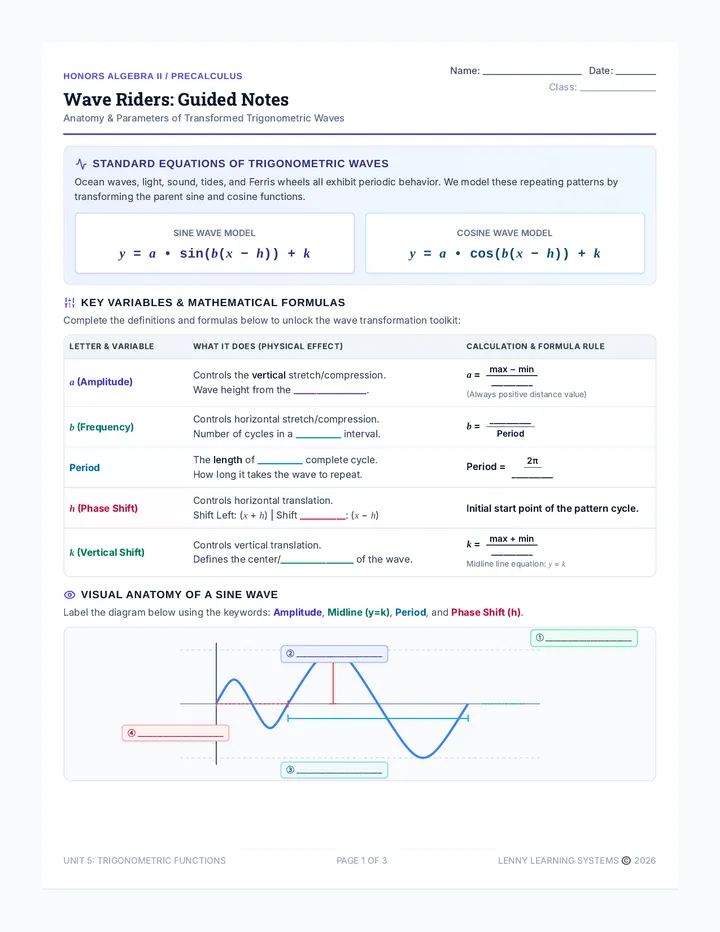
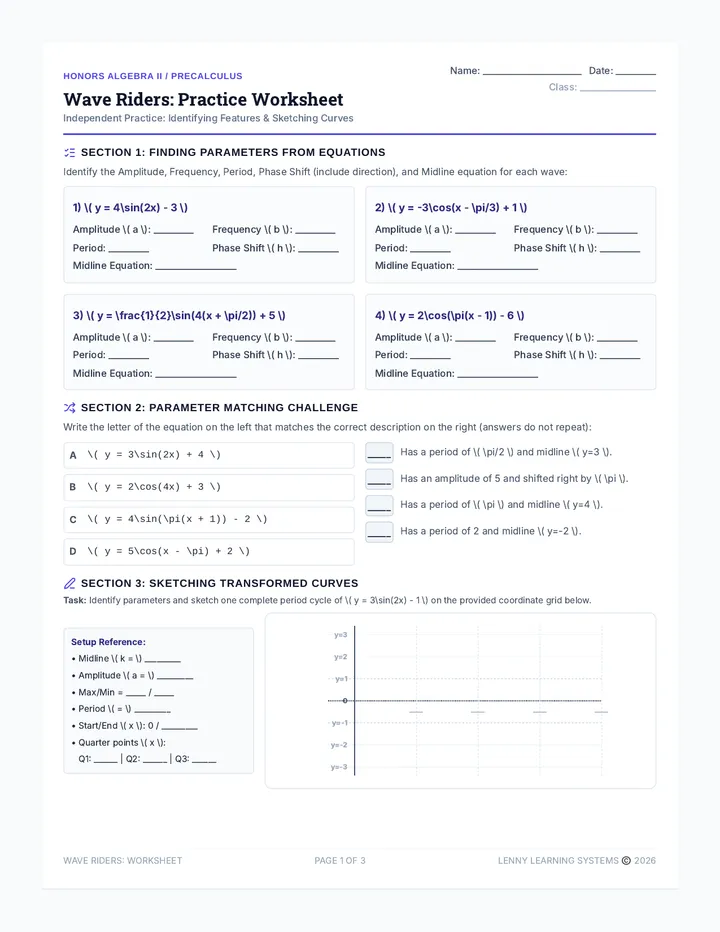
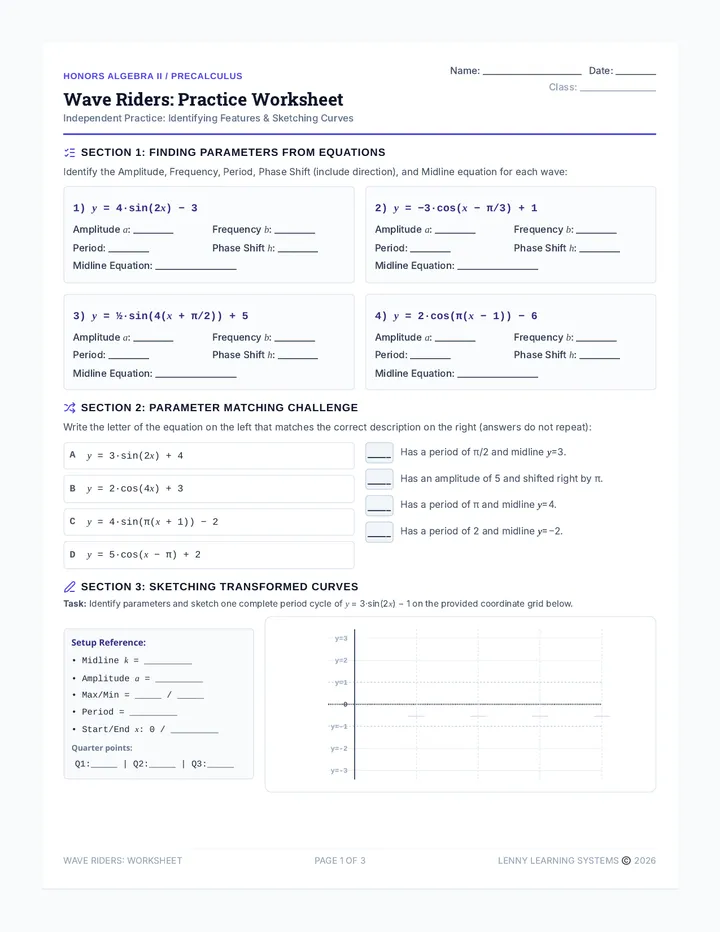
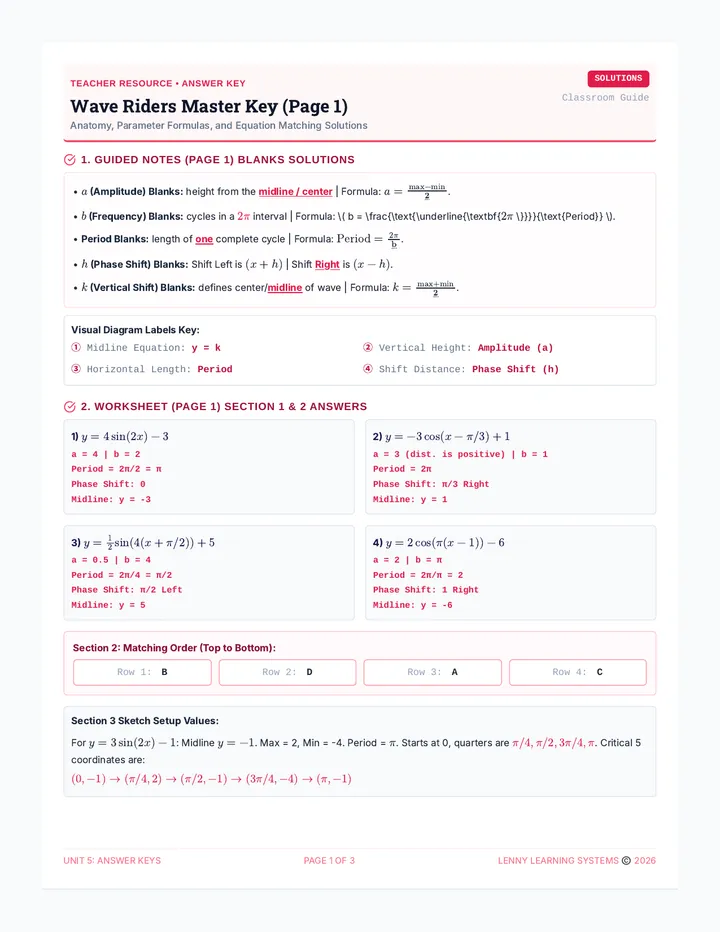
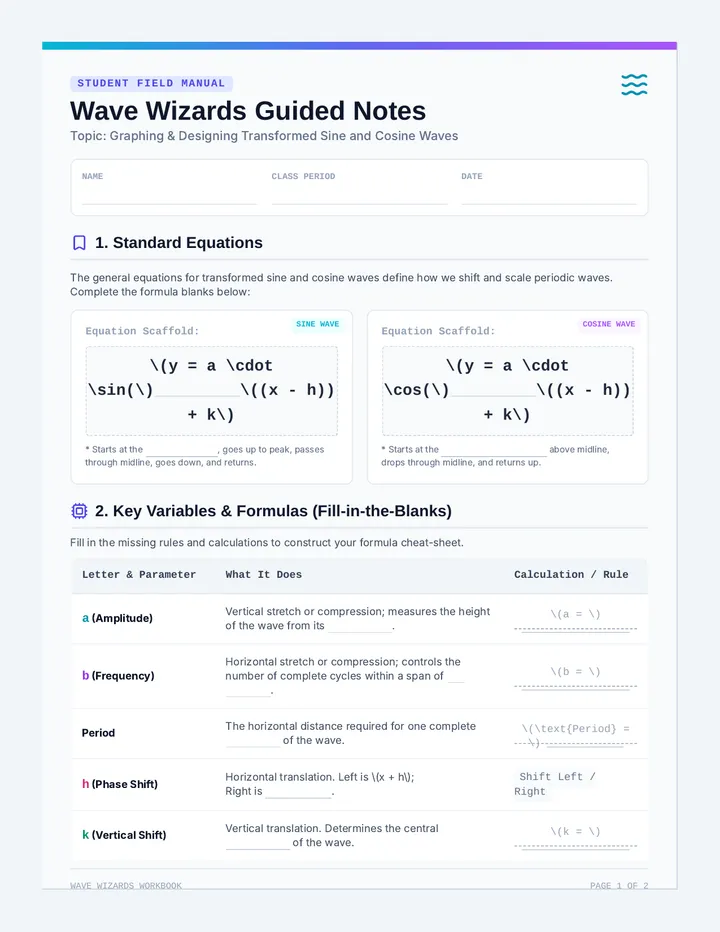
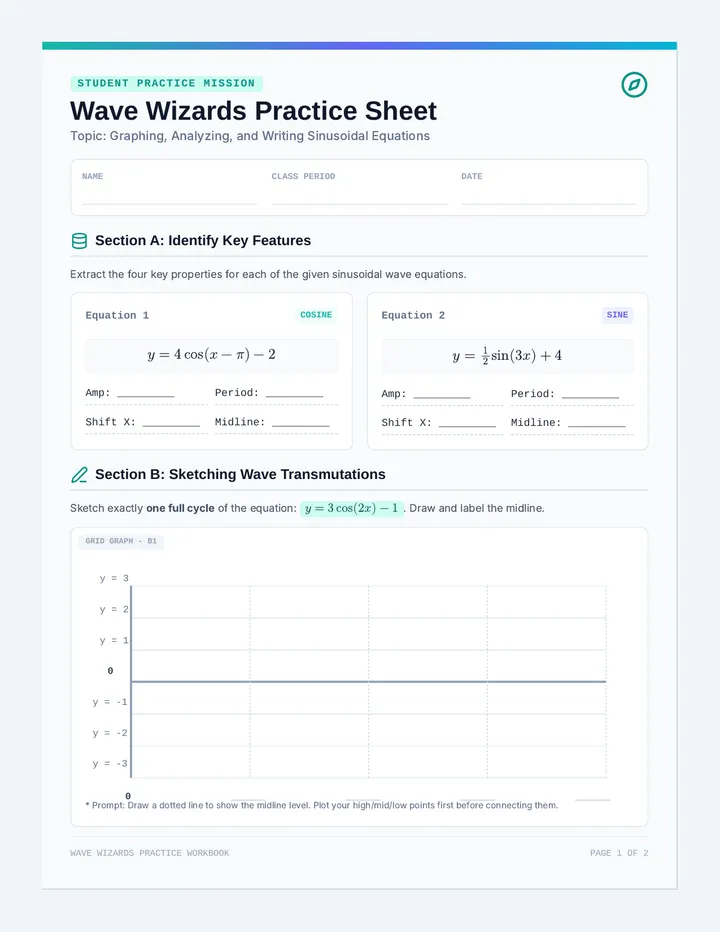
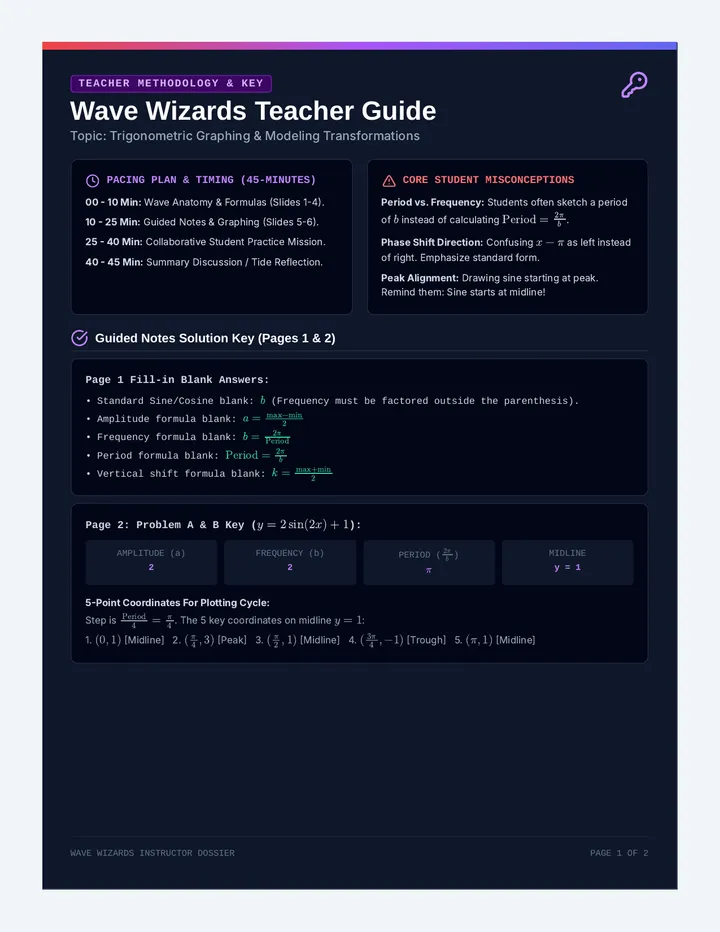
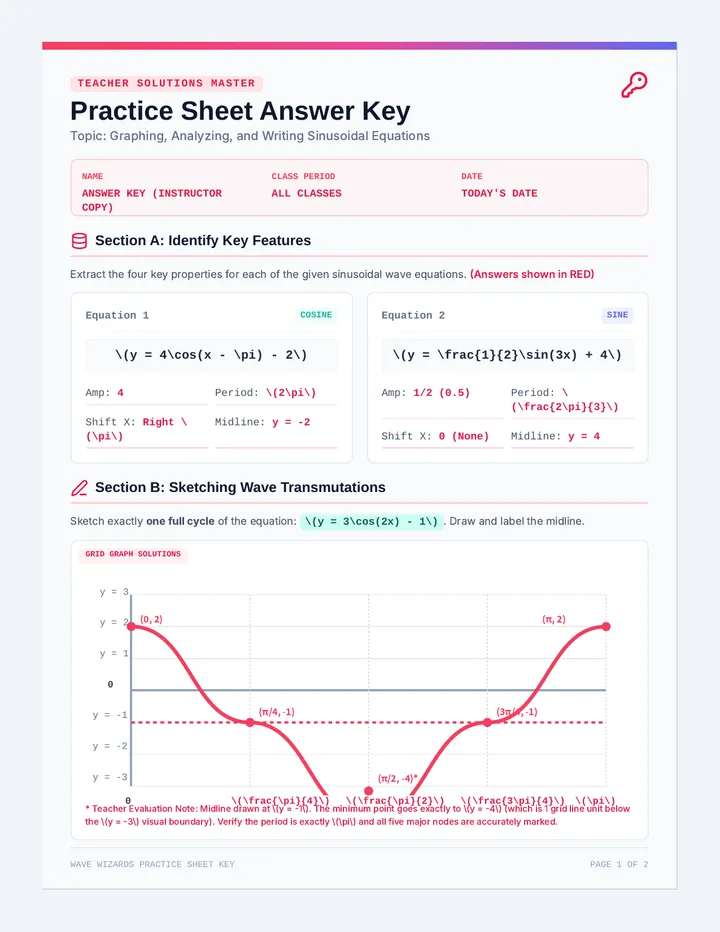
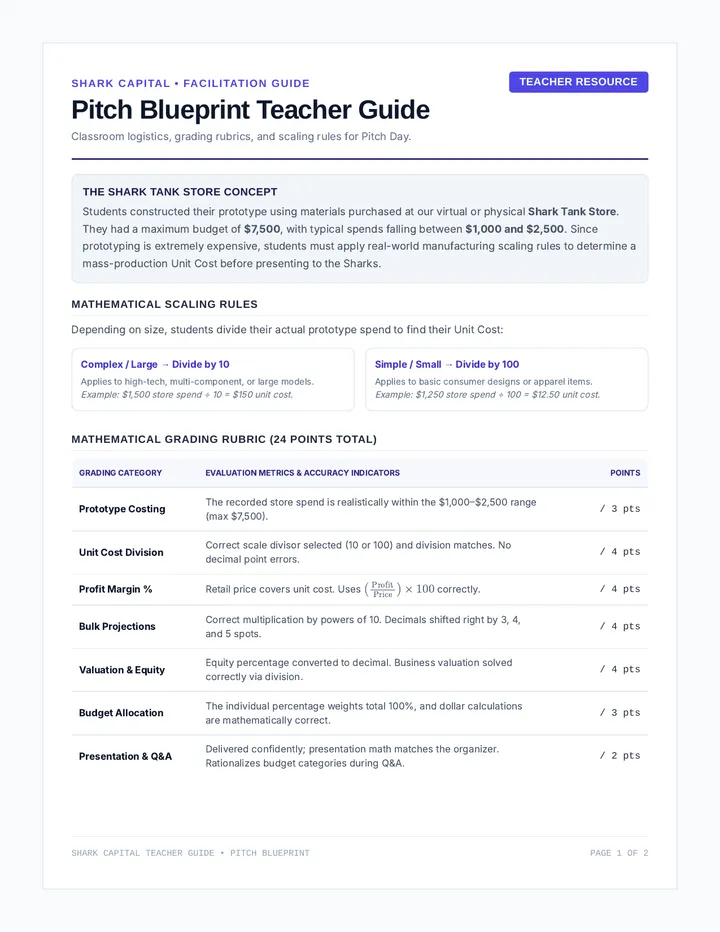
Students define the mathematical relationship between musical pitch (Hertz) and the period of a sine function, learning to write equations that represent specific musical notes.
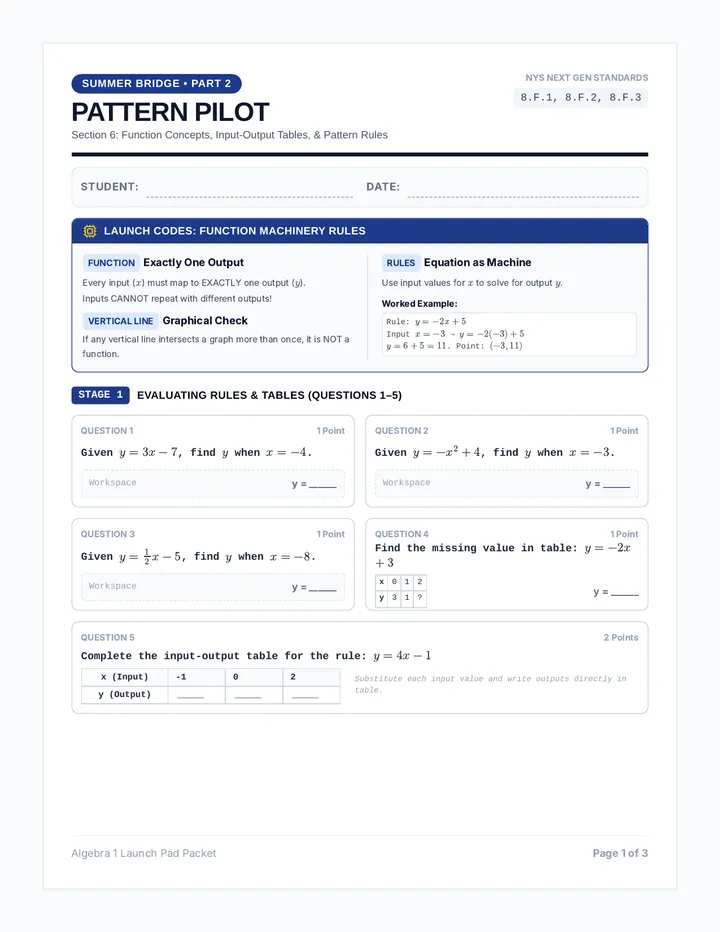
An exploration of geometric growth and the power of incremental habits for grades 7-12, combining mathematical modeling with behavioral science.
A comprehensive assessment and practice suite for mastering trigonometric identities, focusing on reciprocal, quotient, Pythagorean, and sum/difference formulas.
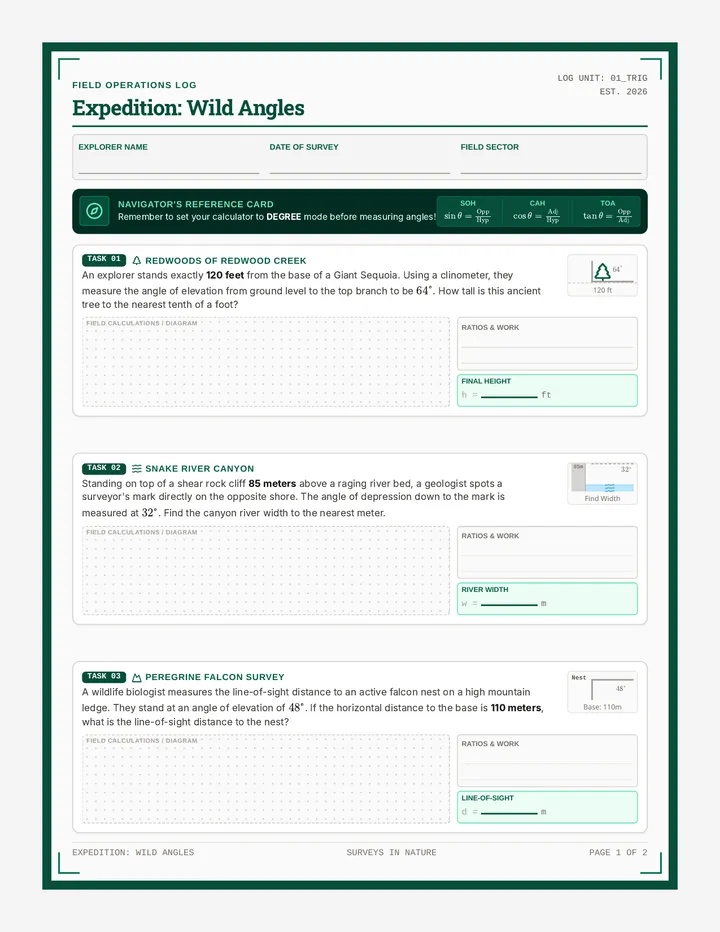
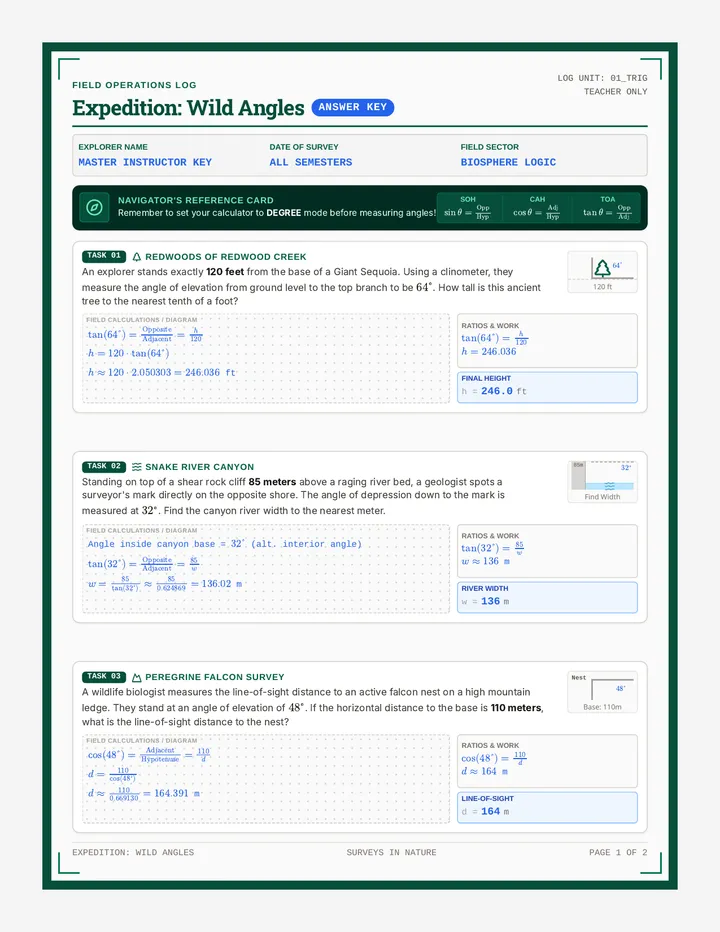
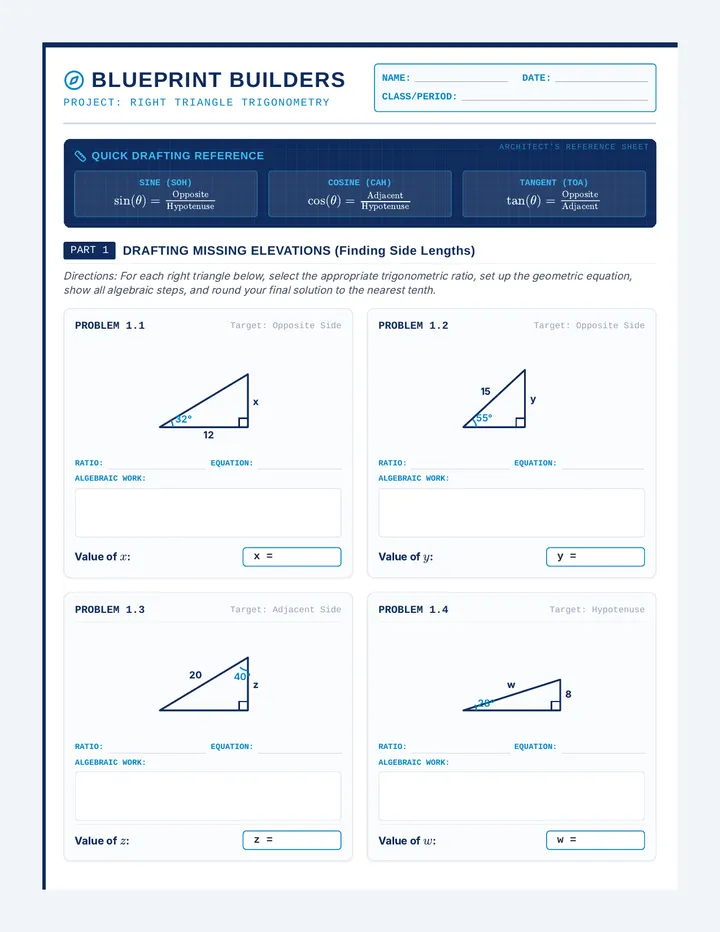
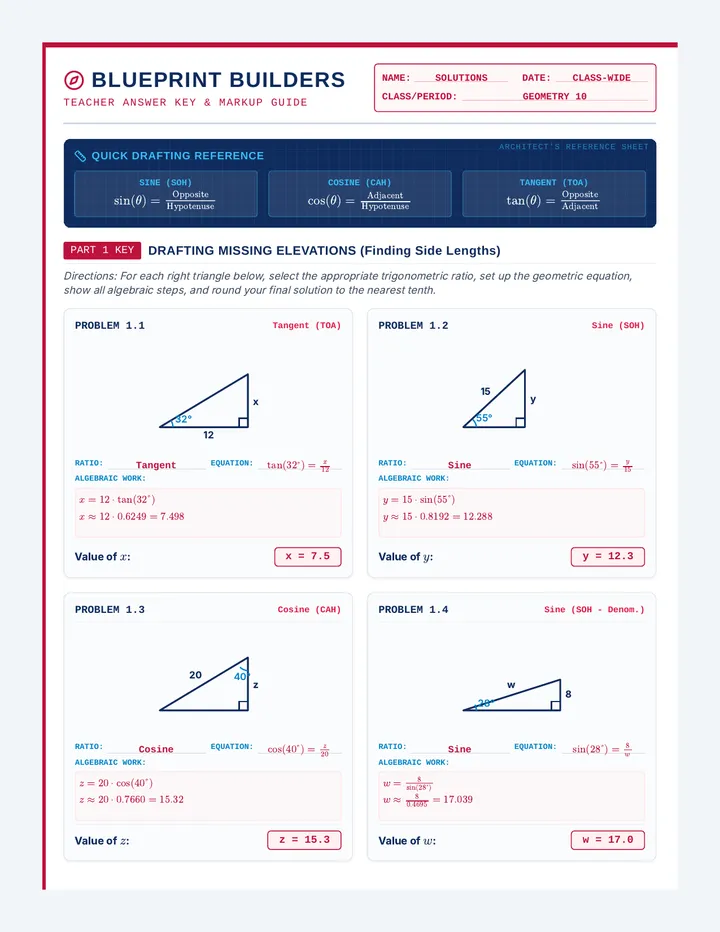
A focused assessment and practice module on right-triangle trigonometry, specifically covering the concepts of elevation and depression through architectural and surveying contexts.
A comprehensive geometry lesson on angles of elevation and depression, ranging from basic trigonometry to complex algebraic applications. Students will master identifying, labeling, and solving for angles and distances in real-world scenarios.
A comprehensive guide to graphing linear inequalities on a number line, focusing on symbol recognition, circle types, and directional mapping.
A comprehensive lesson introducing 45-45-90 and 30-60-90 triangles through the lens of architectural drafting and technical blueprints.
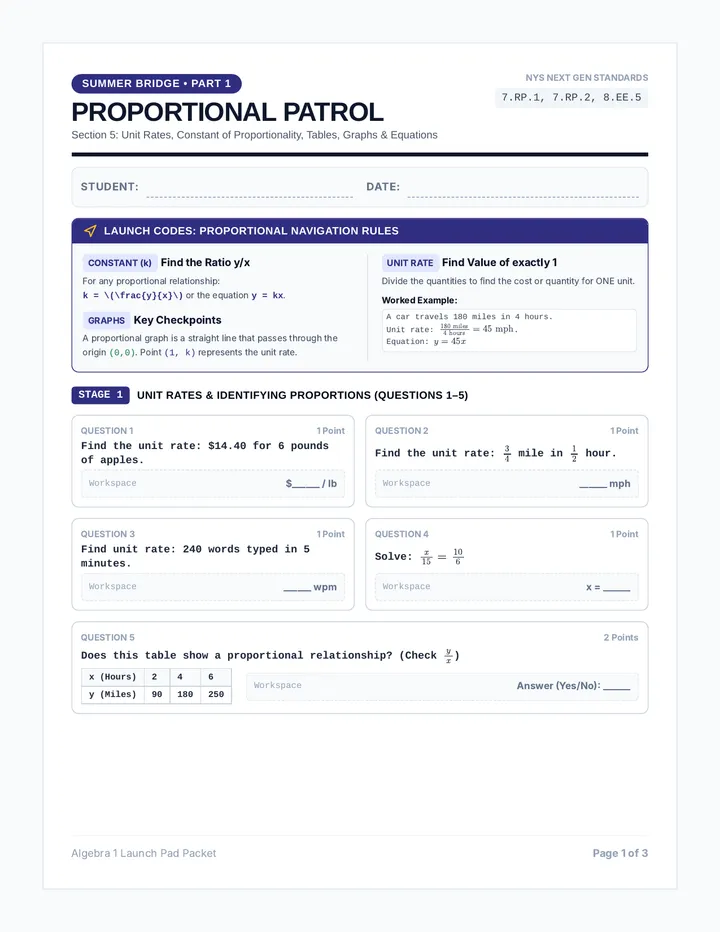
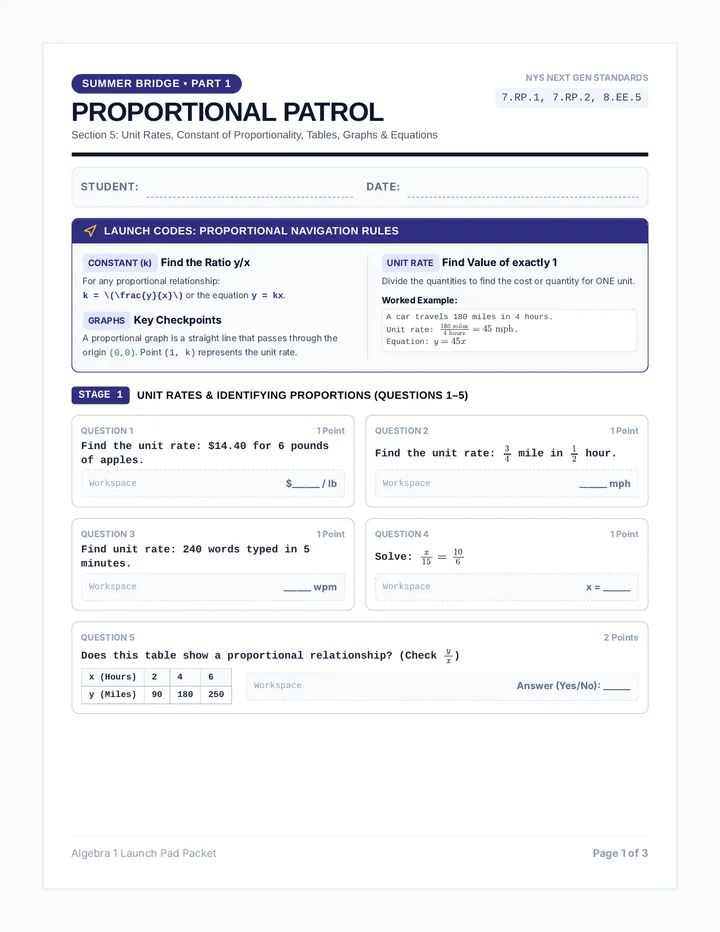
Master the art of writing linear equations from proportional tables using the architect's blueprint for constant of proportionality. Students will learn to identify the unit rate and construct y=kx equations with precision.
A practice-focused lesson where students identify independent and dependent variables in relatable, modern scenarios like sports, snacks, and technology.
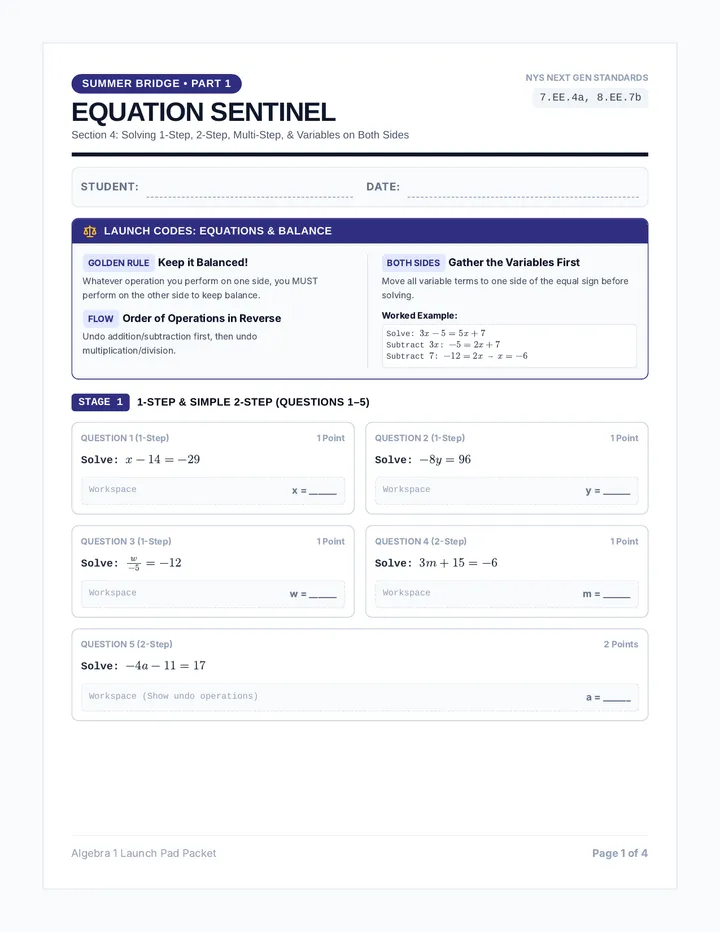
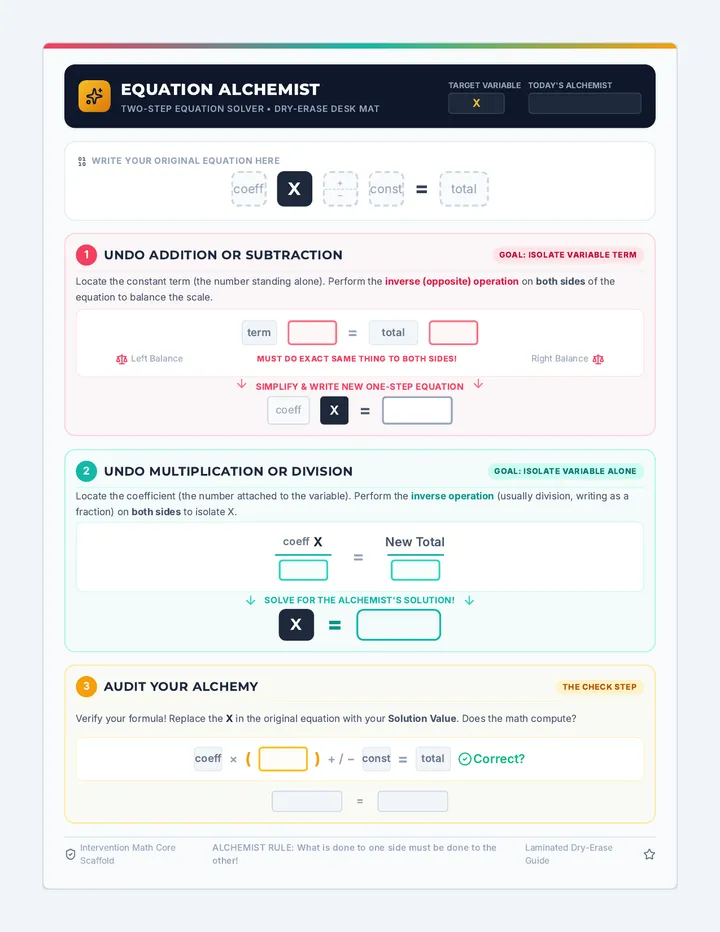
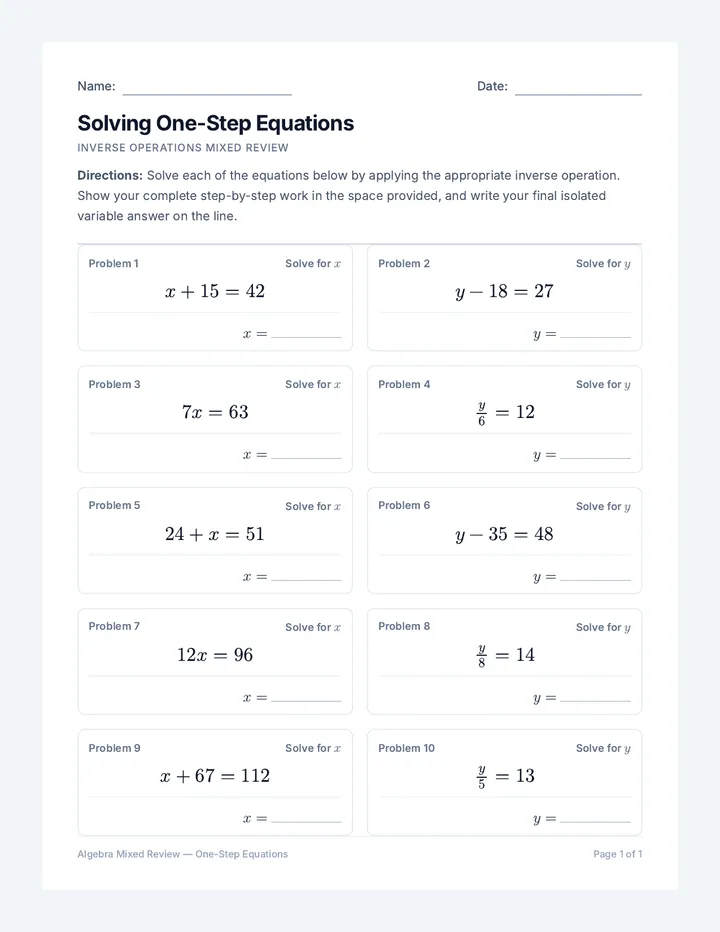
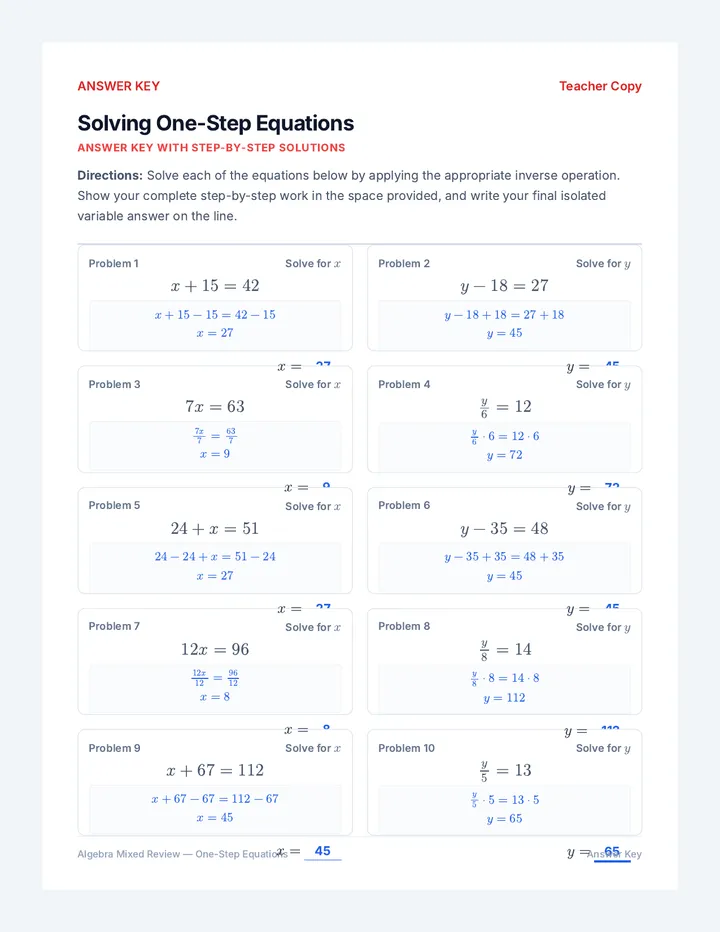
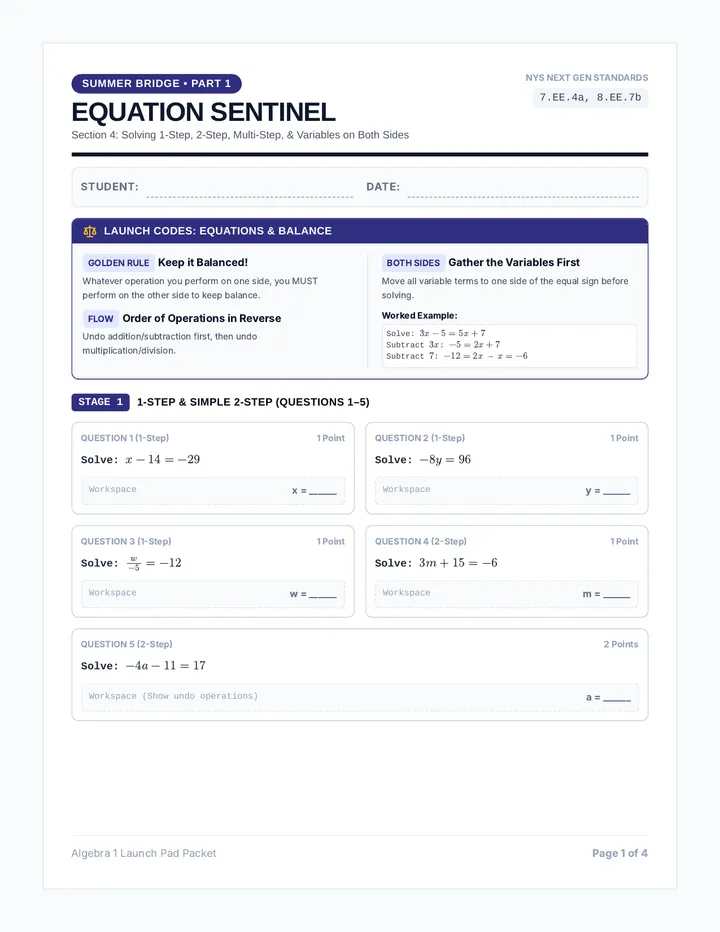
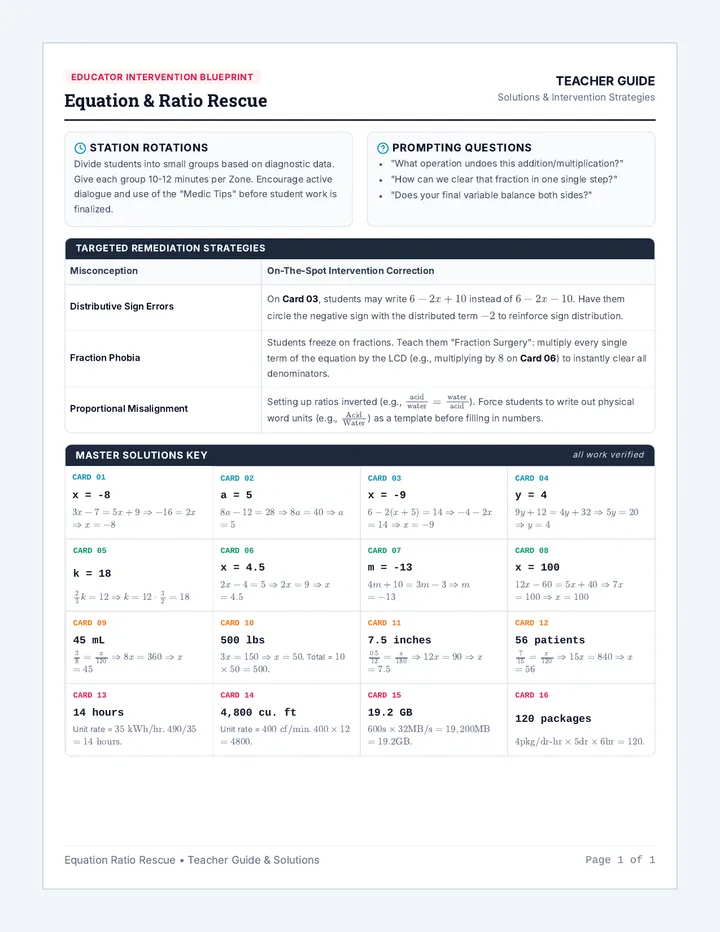
A high-speed, foundational introduction to solving one-step equations using the balance scale analogy. Designed for a 20-minute instructional block.
A 9th-grade algebra lesson focusing on applying the quadratic formula to real-world projectile motion. Students will calculate the time a kicked ball spends in the air before hitting the ground by solving for the zeros of a quadratic equation.
A professional development resource for educators to explore and implement alternative teaching models when traditional math instruction isn't reaching every student. This lesson provides frameworks for co-teaching, math workshops, and targeted interventions.
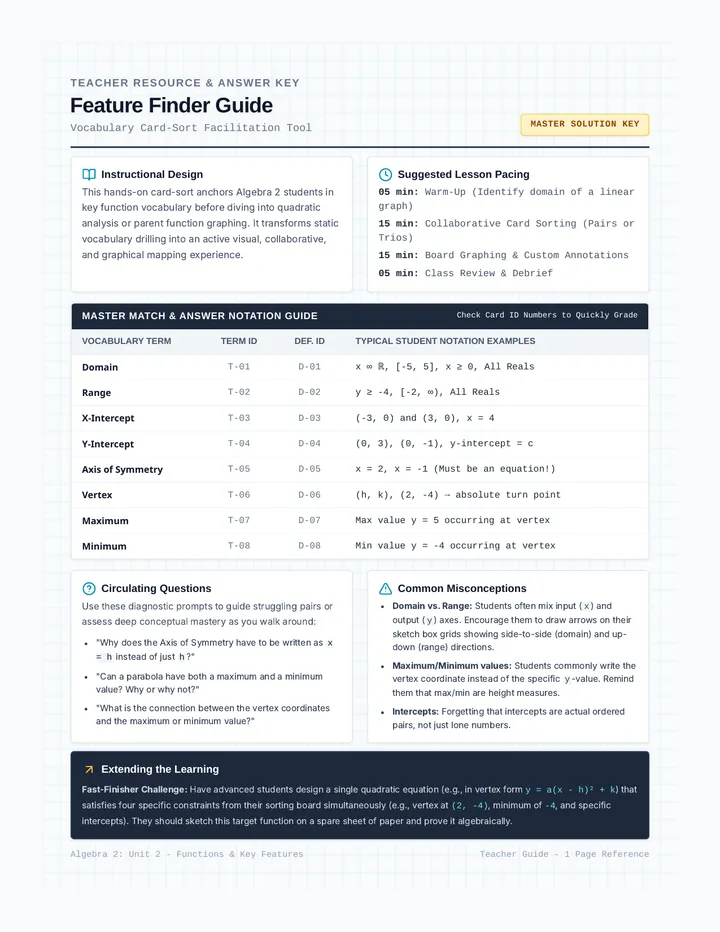
A comprehensive lesson on calculating the five-number summary and constructing box plots from a dataset. Includes guided notes for students and a detailed teacher answer key.
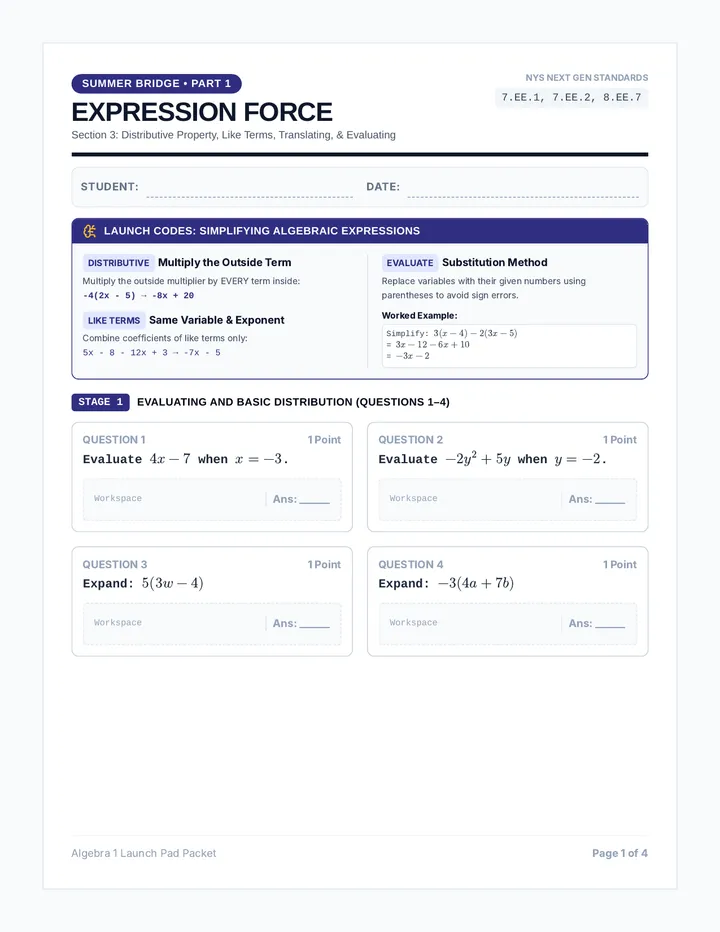
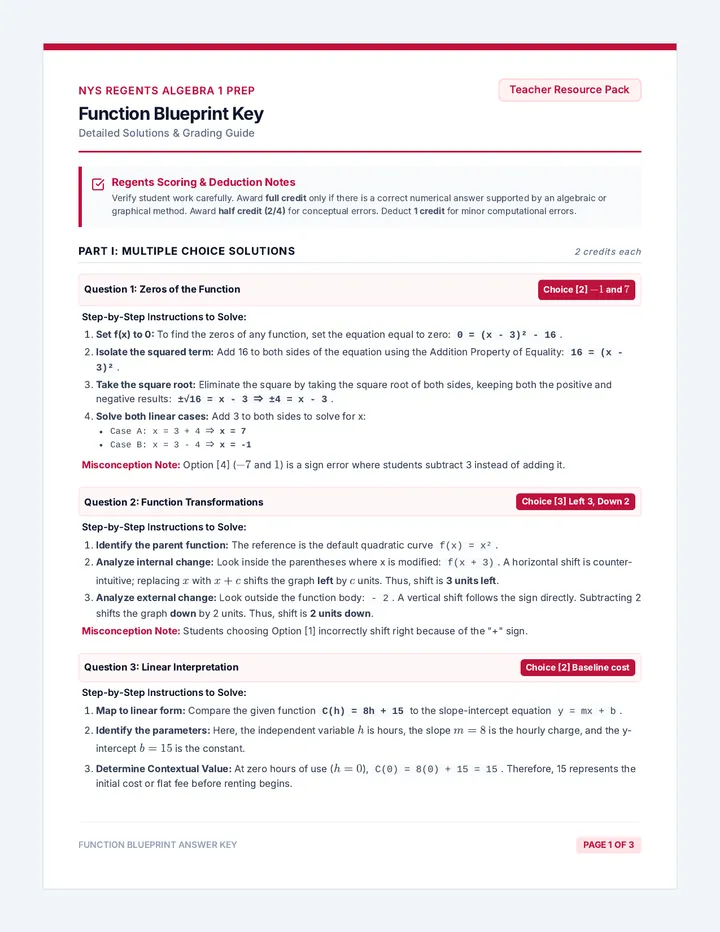
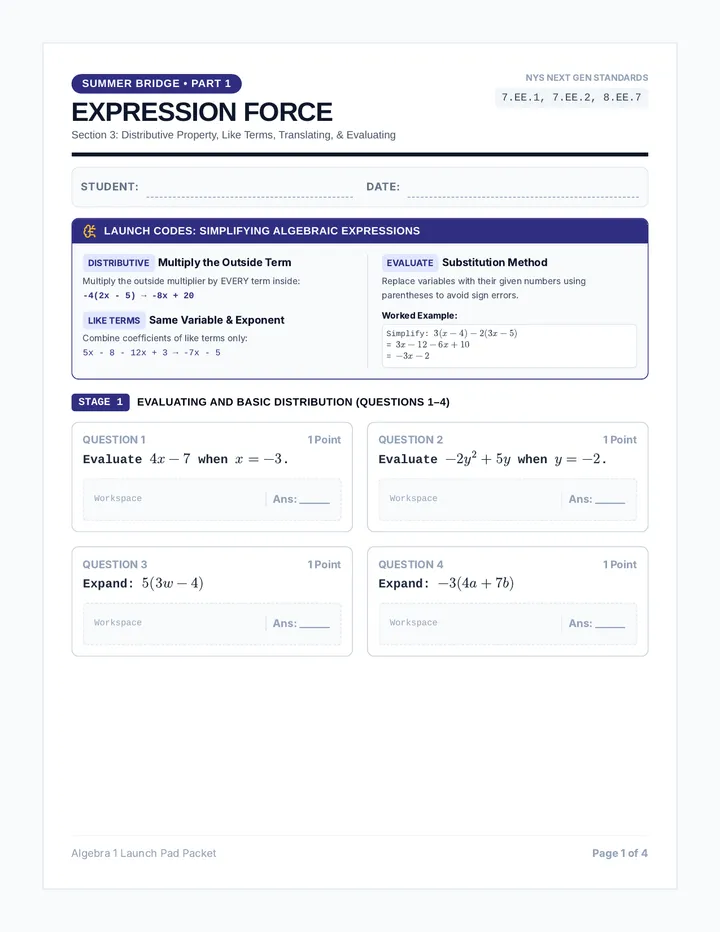
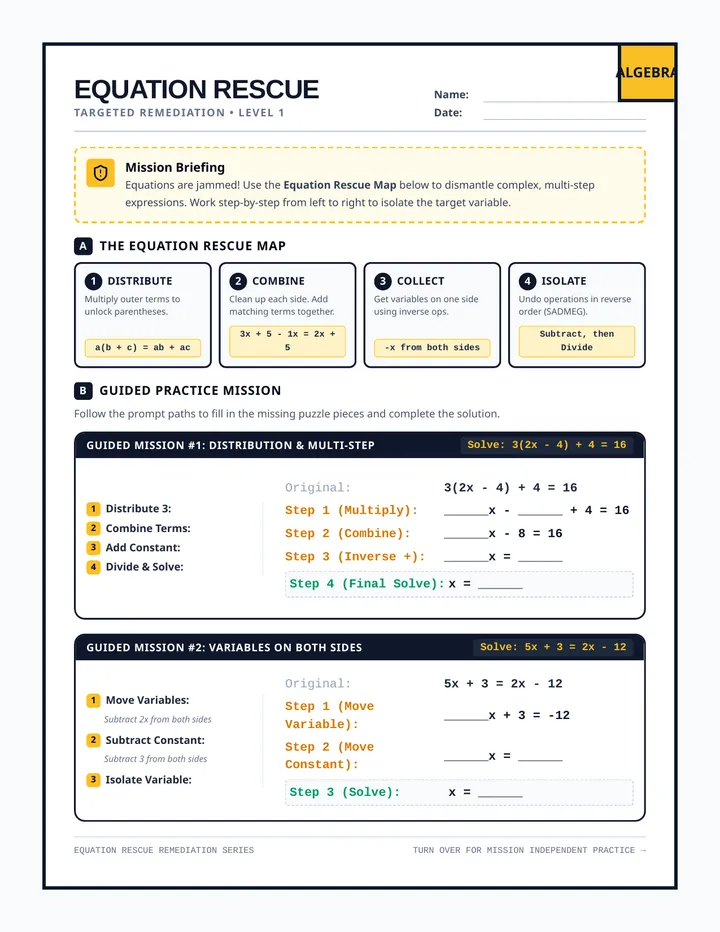
A fast-paced review lesson on simplifying algebraic expressions using the distributive property and combining like terms, featuring a tiered 'Level Up' activity for differentiation.
A visual guide and practice set for mastering the five-number summary and interquartile range using box and whisker plots.
Este recurso ayuda a los estudiantes a comprender y aplicar el Teorema del Ángulo Exterior de los Triángulos. Incluye definiciones guiadas, una actividad de exploración y problemas de práctica con variables algebraicas.
A targeted math intervention lesson focusing on solving and graphing two-step inequalities. This lesson emphasizes the "negative flip" rule, integer operations, and translating real-world scenarios into mathematical expressions.
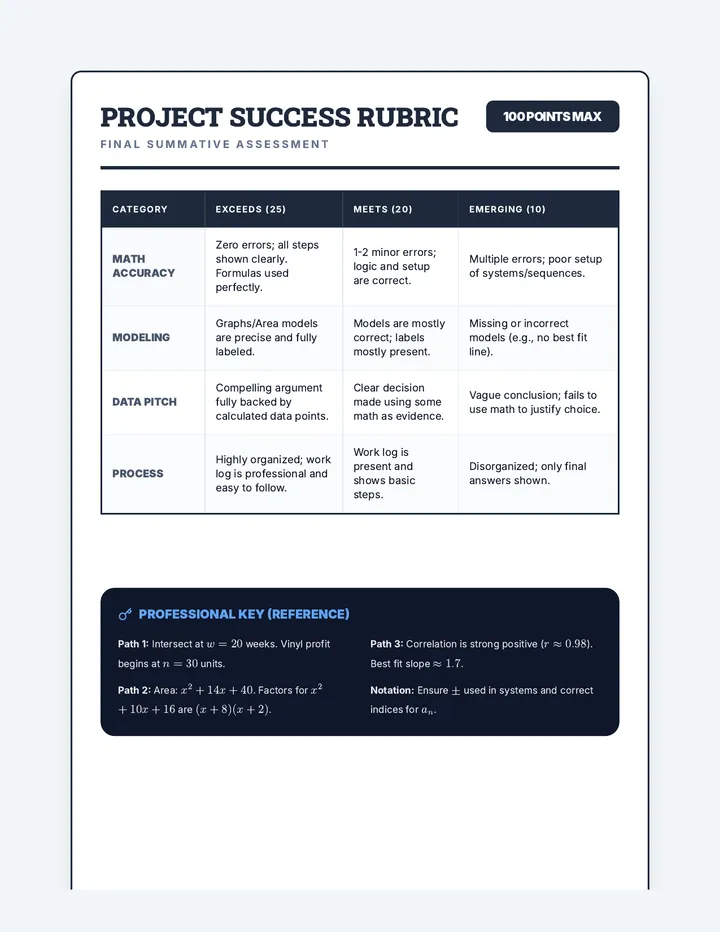
A comprehensive lesson on solving one-step inequalities across all four operations, designed for intervention with a clean blueprint-inspired aesthetic. Includes guided notes, practice problems, and instructional slides.

A high-energy, visual jeopardy-style game designed for IEP students to master identifying, graphing, and writing inequalities. The lesson focuses on clear visual cues and step-by-step logic.


A focused practice session on simplifying radicals and rationalizing denominators, designed to prepare students for the Algebra 2 Topics 7-8 Assessment.
A lesson exploring standard deviation through social media analytics, focusing on how 'consistency' and 'volatility' are measured in the digital world. Students will interpret data spread to make marketing decisions without complex manual calculations.
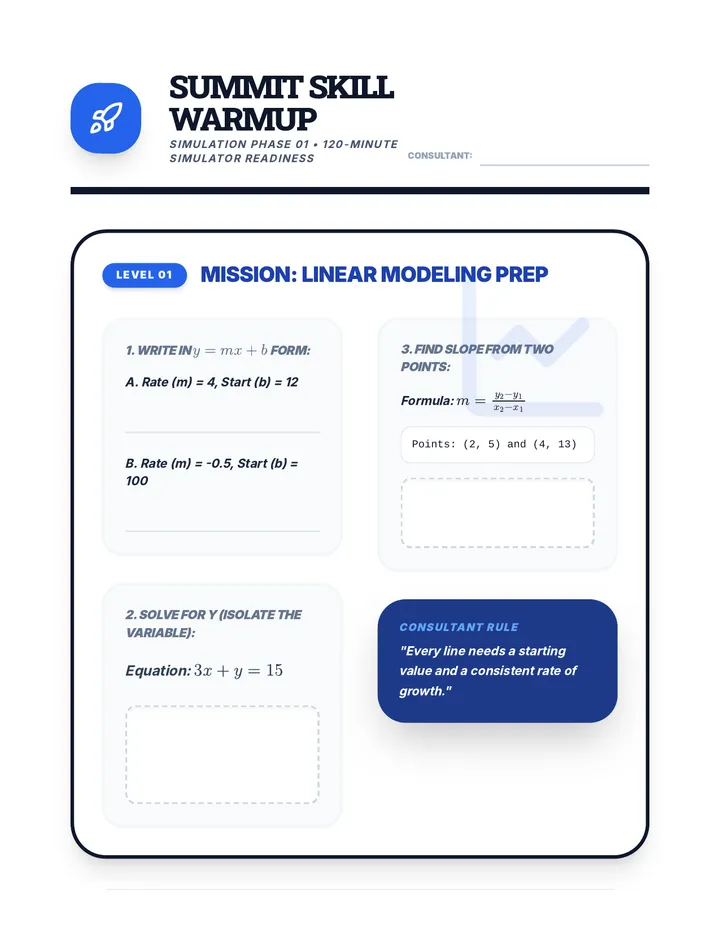
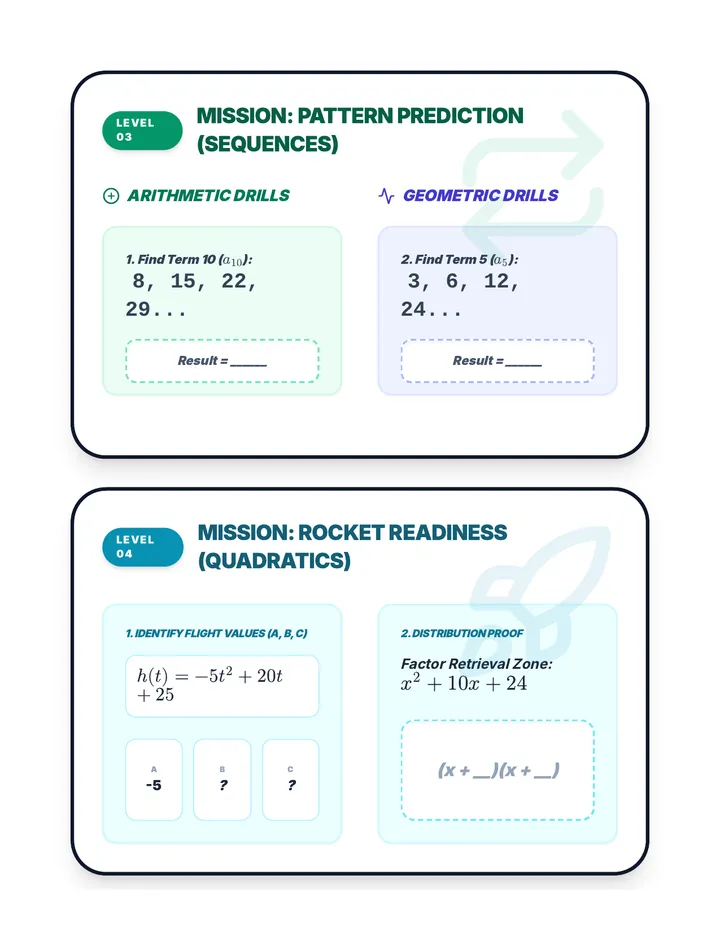
This prep lesson bridges previously mastered linear equation concepts with newer topics like scatter plots, correlation, and linear inequalities. Students will synthesize modeling techniques and algebraic conversions to prepare for the cumulative unit test.
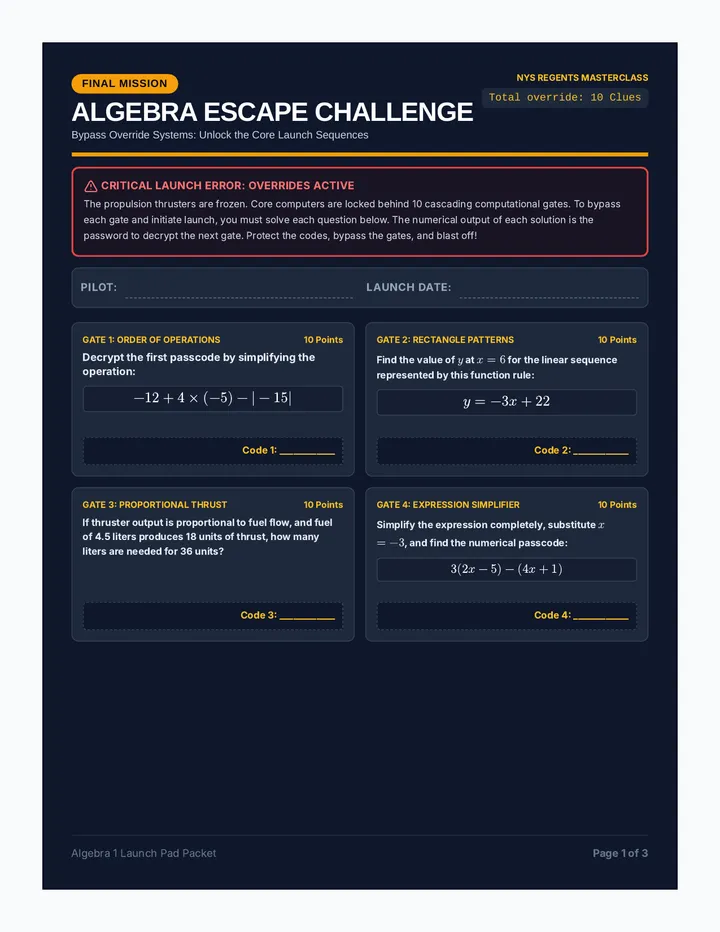
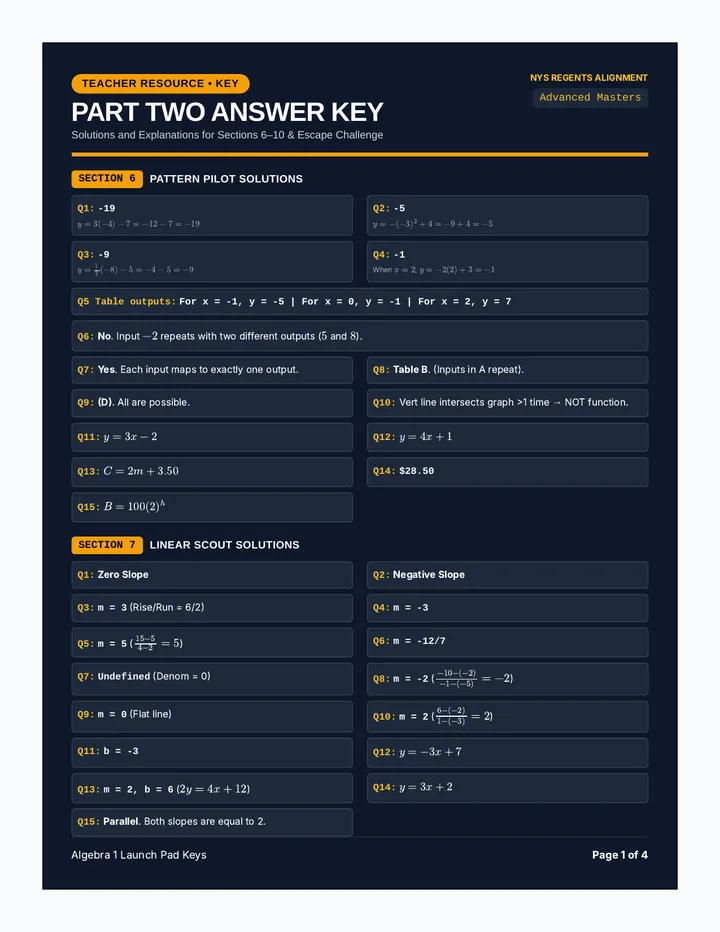
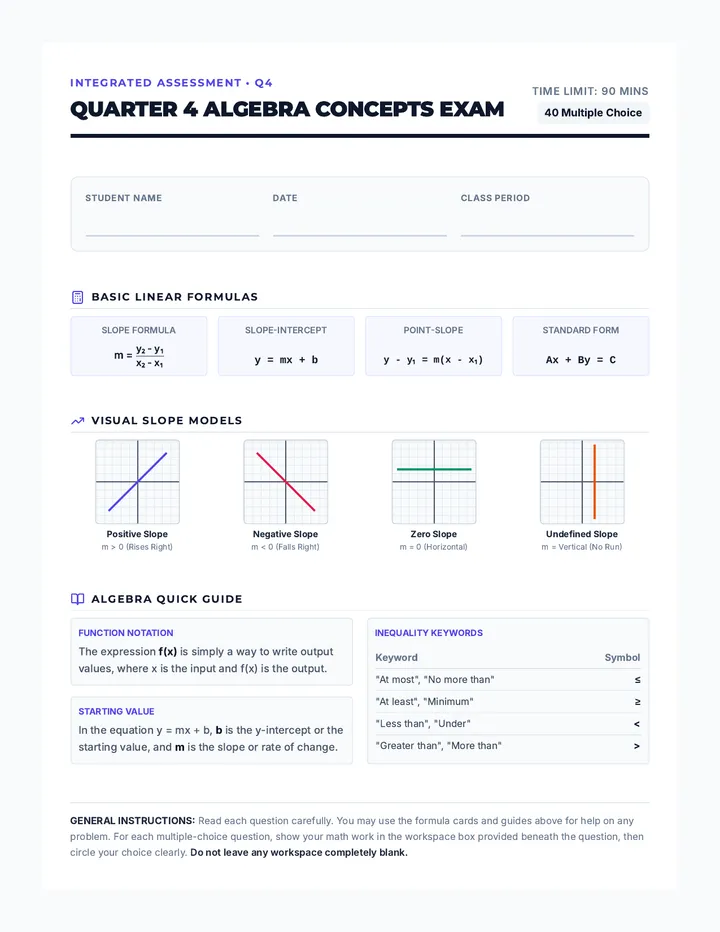
This lesson provides a comprehensive review and assessment of linear equations, covering function identification, standard form conversions, and the properties of parallel and perpendicular lines. Students will engage in guided practice, independent modeling, and summative evaluation to master linear relationships.
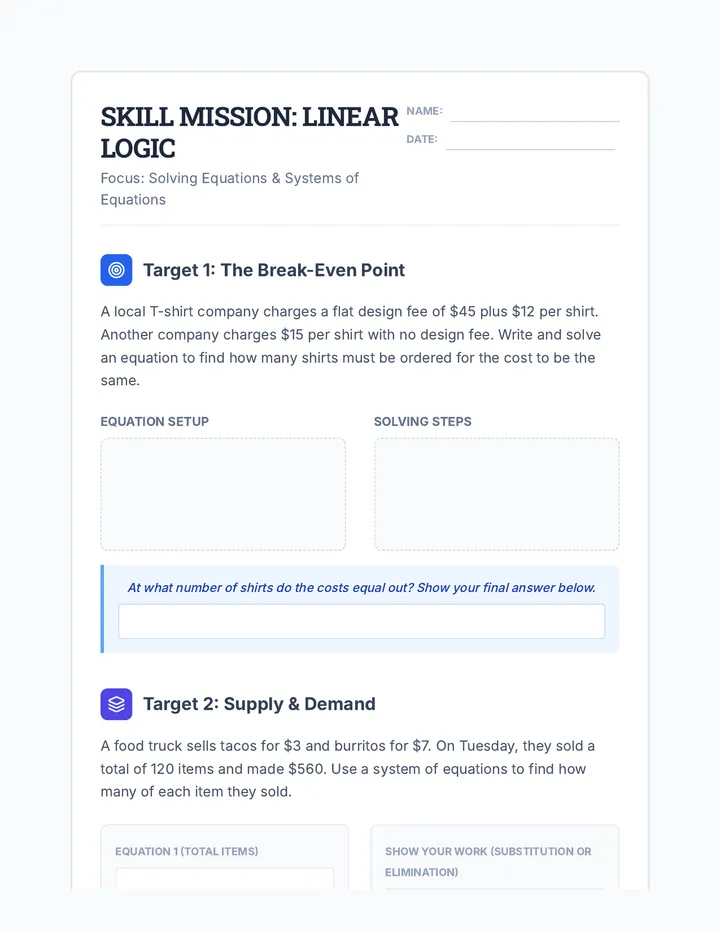
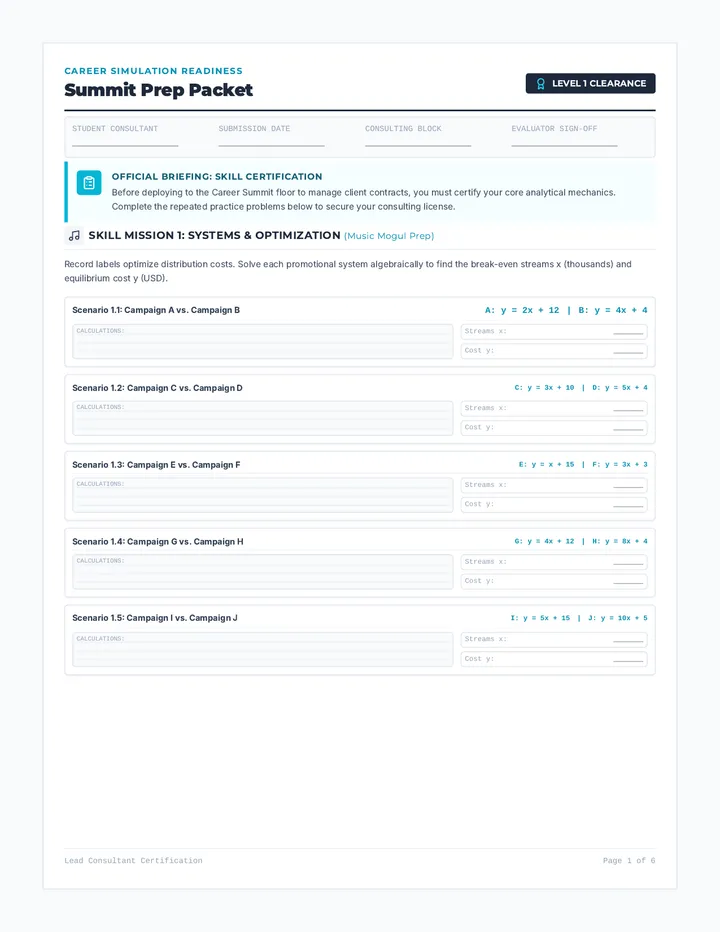
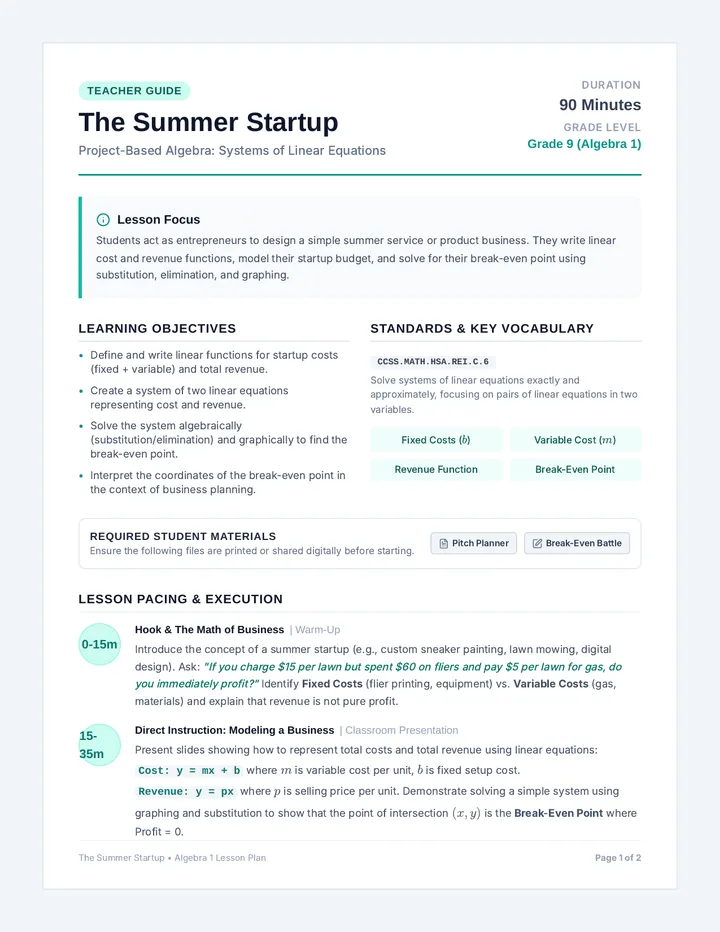
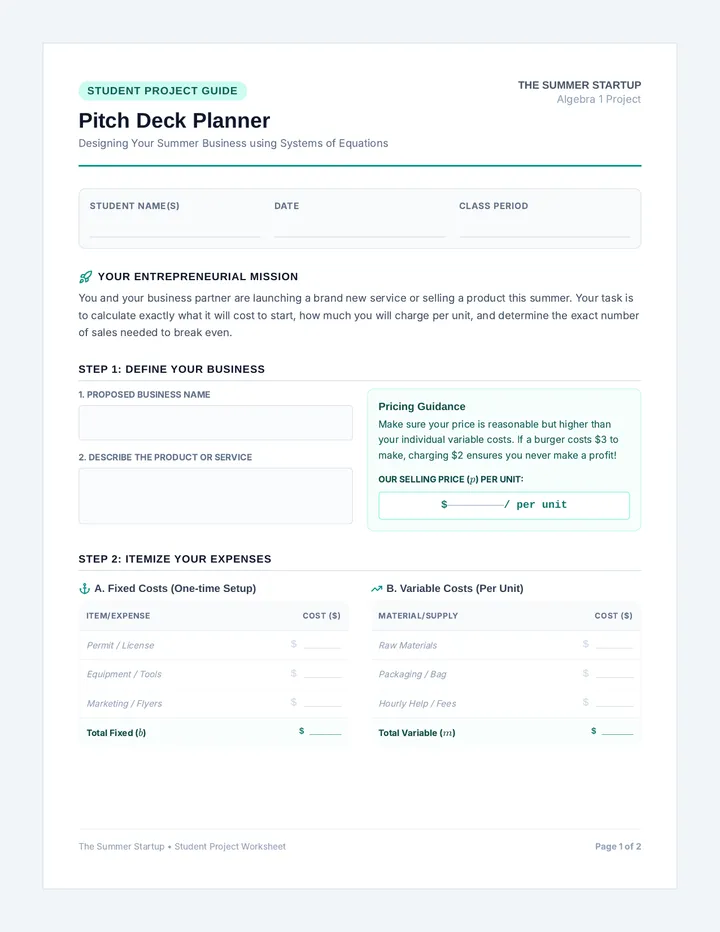
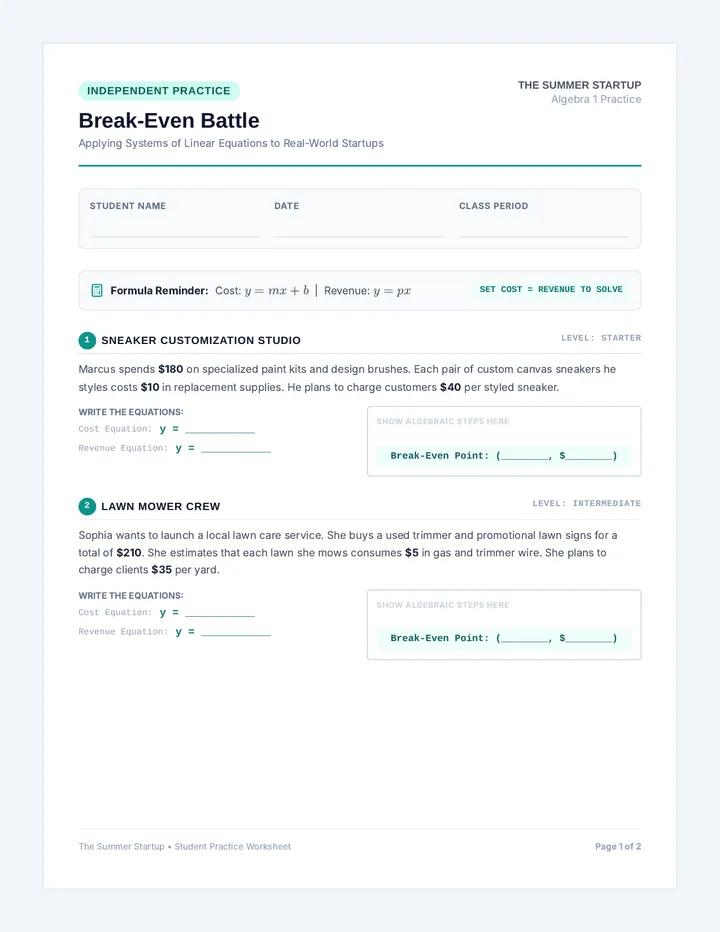
A comprehensive series of activities where students learn to identify, model, and solve systems of linear equations to find the 'better deal' in real-world scenarios.
Students practice translating real-world scenarios into linear equations, tables, and graphs using positive whole numbers. This lesson reinforces the relationship between initial fees (y-intercept) and rates of change (slope).
A lesson focused on adding and subtracting polynomials with a specific emphasis on the distributive property when handling subtraction and negative signs. Students will practice horizontal and vertical methods to combine like terms.
A geometry lesson exploring the mathematical challenges of representing a 3D sphere on a 2D plane through map projections, featuring a hands-on orange-peeling activity to demonstrate surface area distortion.
A geometry-focused exploration of map projections, exploring how surface area and spherical geometry lead to unavoidable distortion when flattening a 3D world into 2D maps. Students use the 'orange peel' method to visualize Gaussian curvature and distortion.
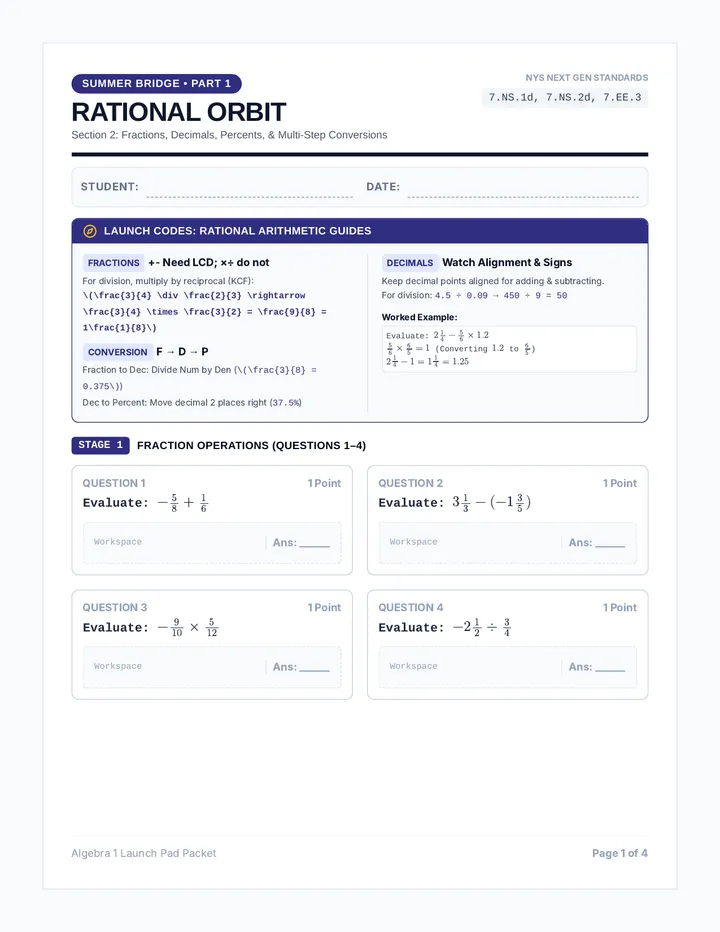
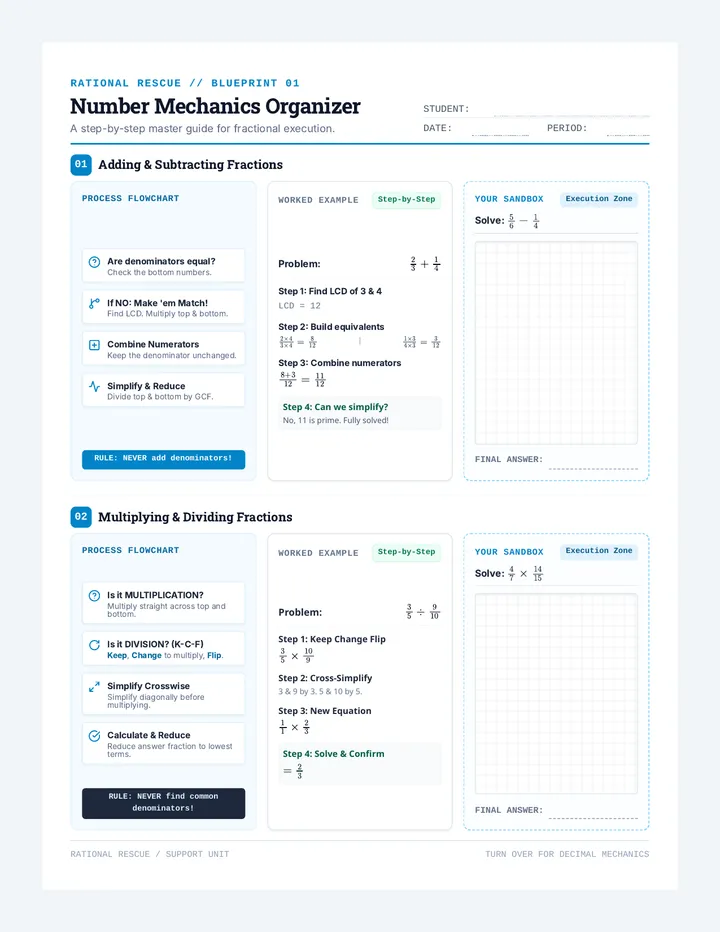
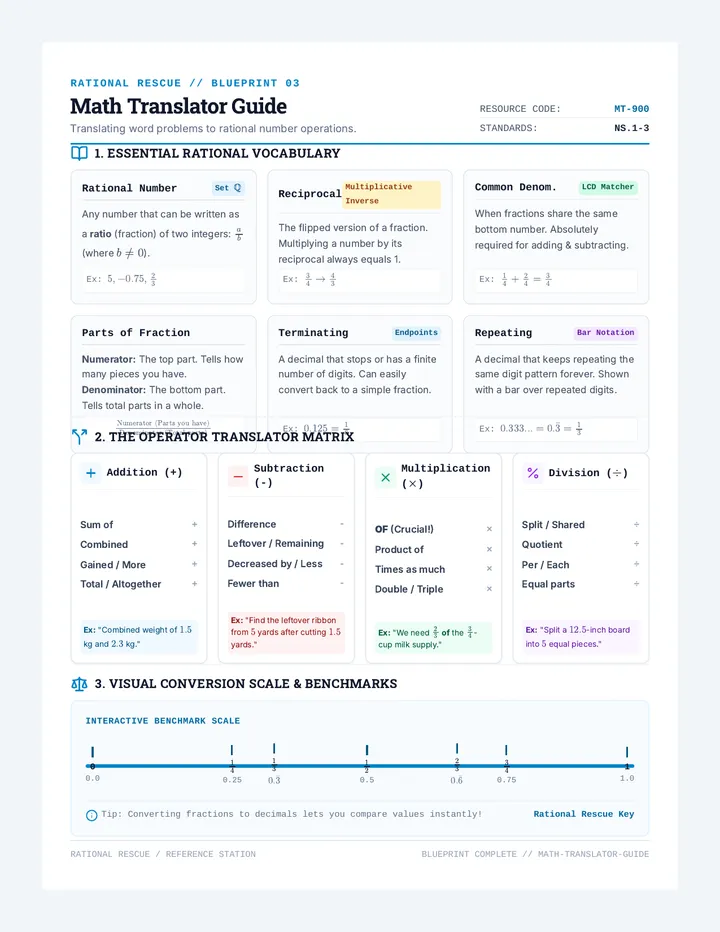
A comprehensive guide to mastering operations with rational expressions, including factoring foundations and step-by-step procedures for arithmetic operations.
A lesson exploring the mathematics of exponential growth and decay through real-world scenarios, focusing on formula mastery and percentage-to-decimal conversion.
A comprehensive 40-minute lesson on finding the Greatest Common Factor (GCF) using the ladder method, covering both numerical and algebraic expressions.
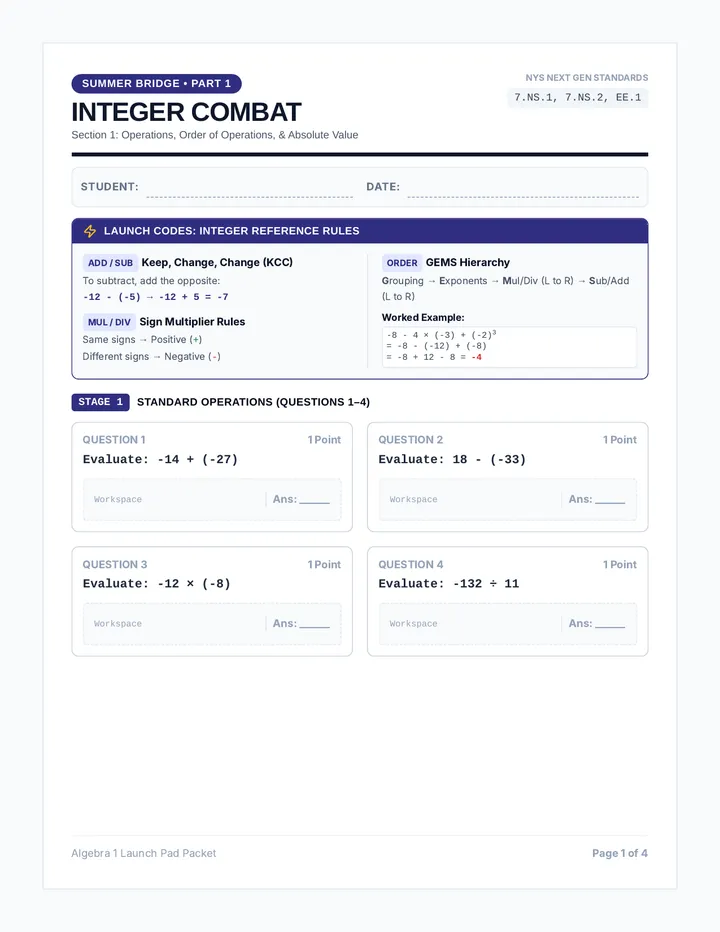
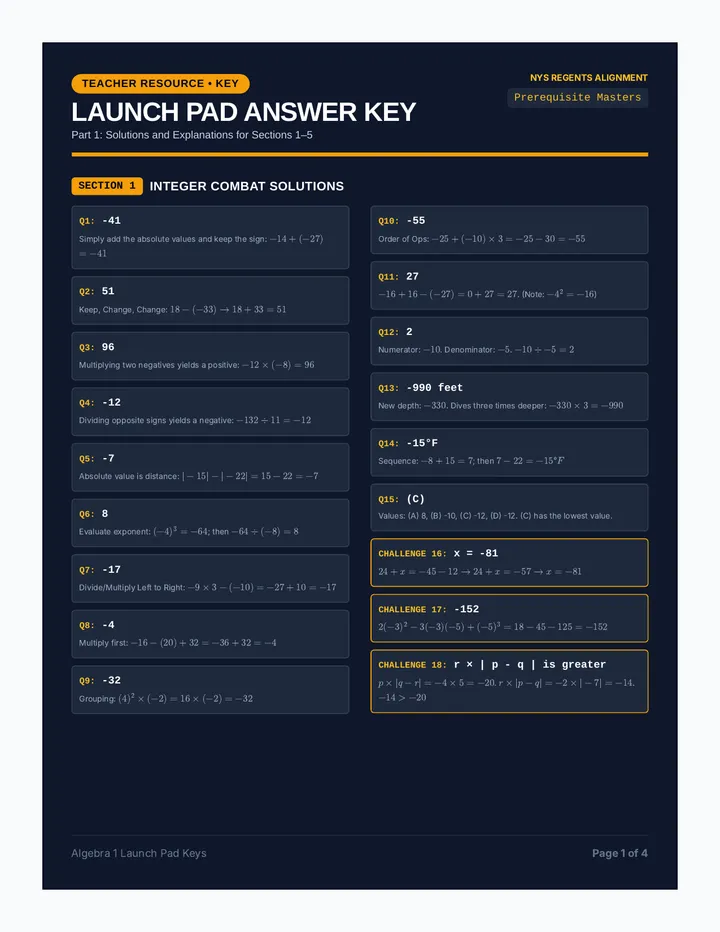
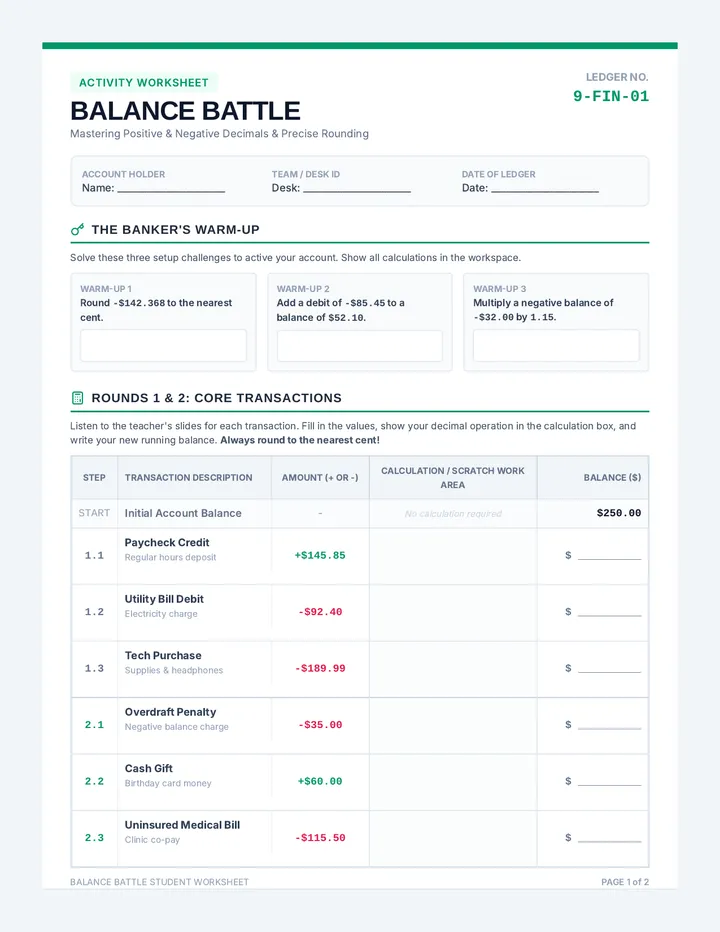
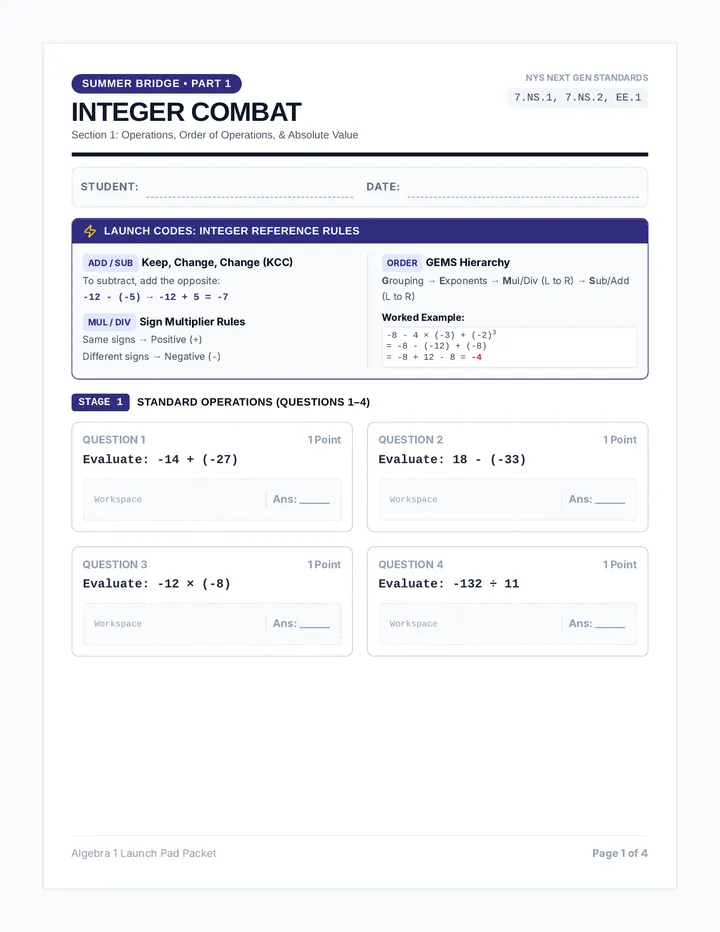
A focused review lesson on addition and subtraction with negative numbers, specifically targeting integer operations within the range of -20 to 20.
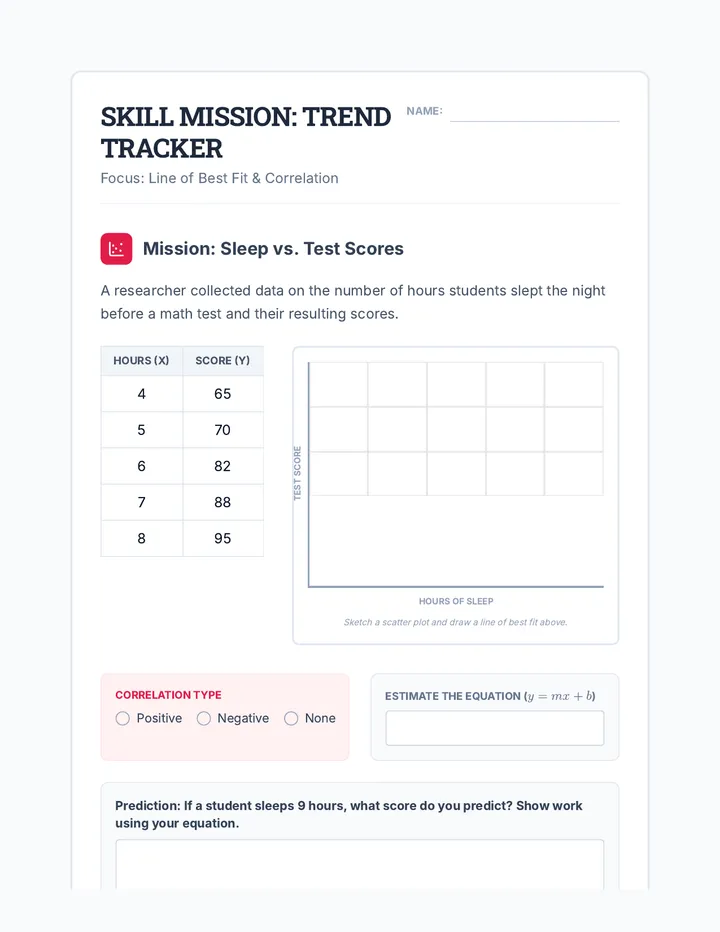
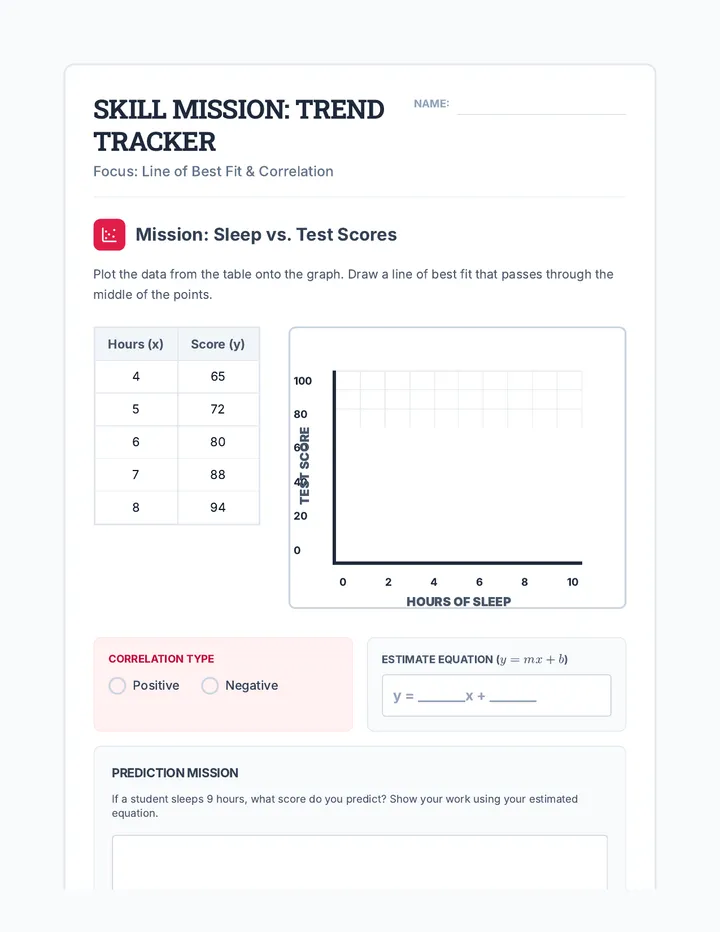
A hands-on investigation into scatter plots, lines of best fit, and identifying outliers using real-world scenarios like test scores and plant growth.
A fast-paced exploration of exponential growth and decay through abstract equations and real-world financial scenarios. Students practice graphing curves and calculating data points to visualize rapid change.
A lesson on understanding and drawing lines of best fit (trend lines) on scatter plots to identify data patterns and make predictions.
A comprehensive lesson on creating scatter plots from real-world data, including instruction on axes, scale, and plotting ordered pairs.
An introductory lesson on the Pythagorean Theorem, focusing on identifying triangle parts and performing basic calculations for the hypotenuse and legs.
A foundational lesson on calculating missing sides of right triangles using the Pythagorean Theorem, framed within an architectural drafting context. Students will learn to identify legs and hypotenuse and apply the formula $a^2 + b^2 = c^2$ to solve for missing lengths.
A foundational lesson on graphing inequalities on a number line, designed with high visual support and scaffolded steps for IEP students. Students will learn to identify symbols, determine circle types, and shade correctly.
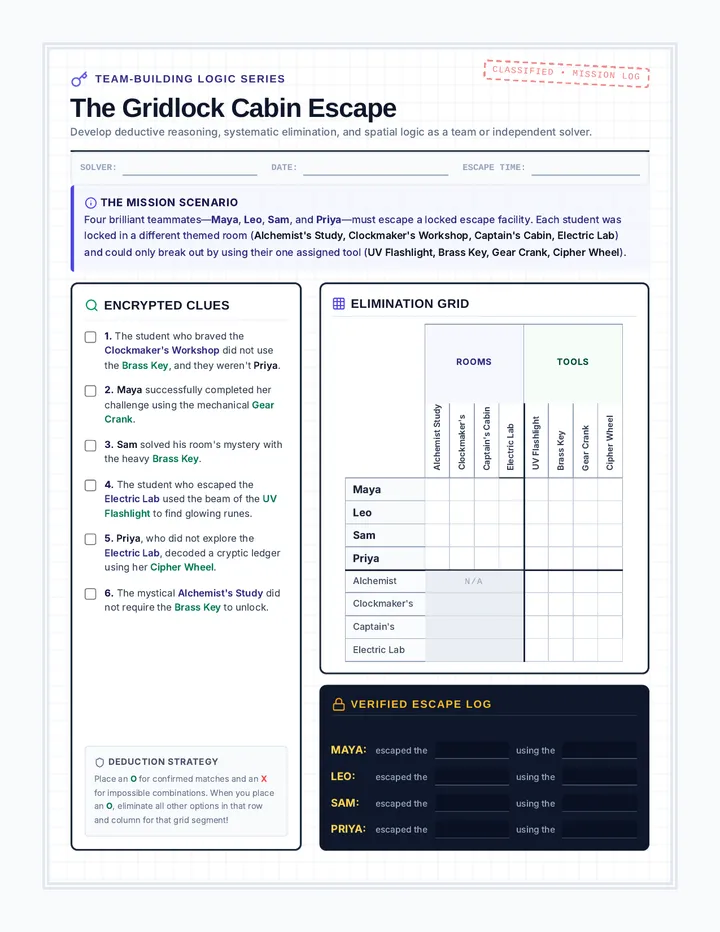
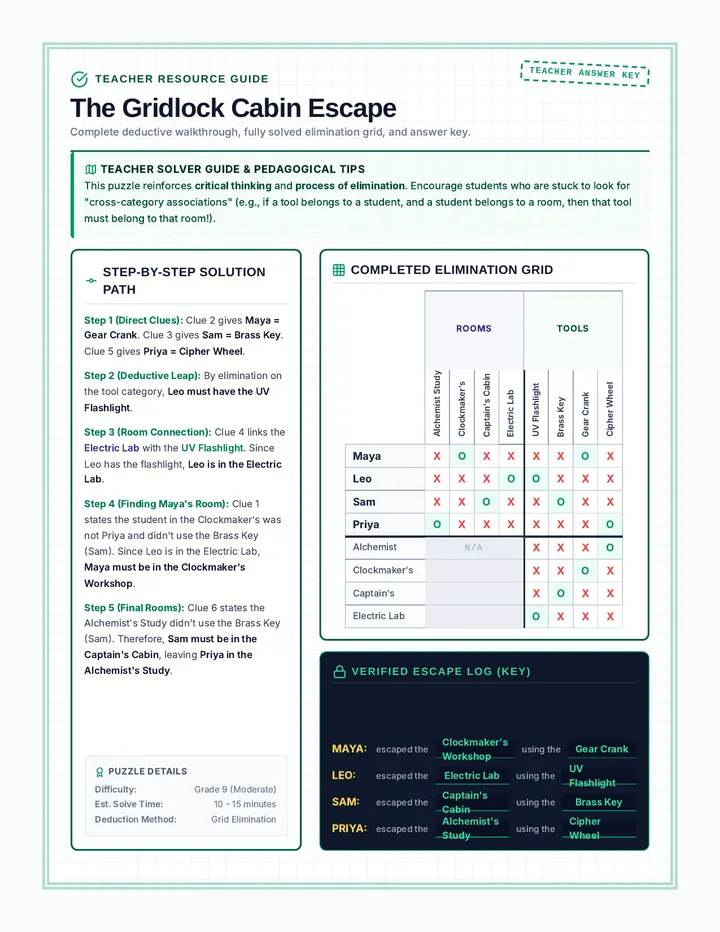
A collection of high-interest, multi-disciplinary logic and math challenges themed around forensic investigation, trade skills, and historical mysteries. Designed for high-school level adult learners to practice critical thinking and practical math application.
A comprehensive introduction to binomial experiments, covering the five core criteria, Bernoulli trials, and practical probability examples.
A comprehensive review lesson on geometric transformations including translations, reflections, rotations, dilations, and compositions, designed for mastery assessment preparation.
A comprehensive review of angle relationships and interior angle sums for triangles and quadrilaterals, designed for MAST test preparation.
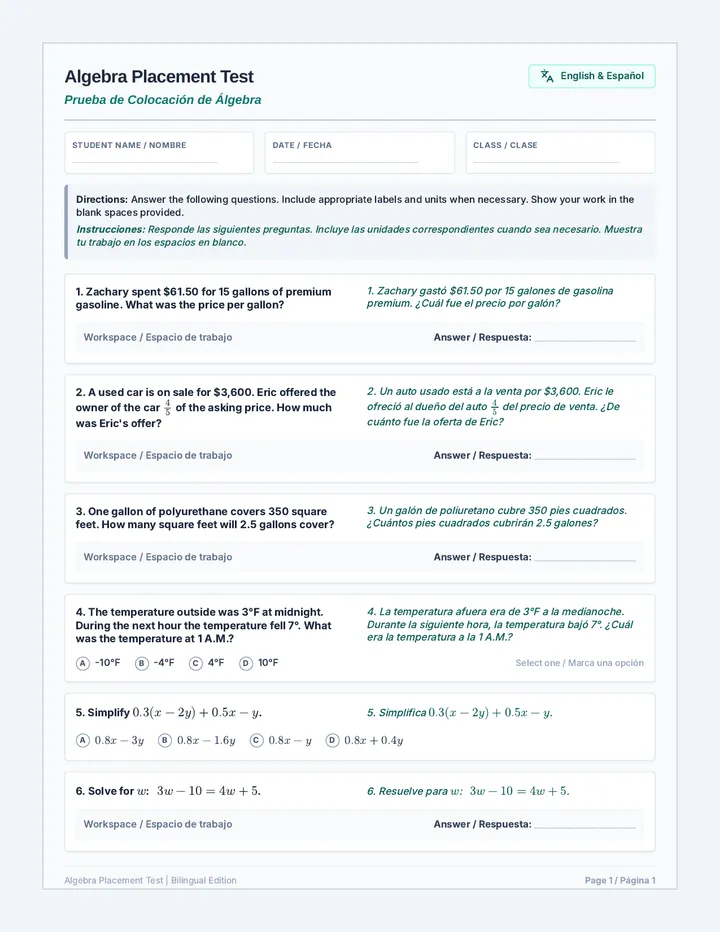
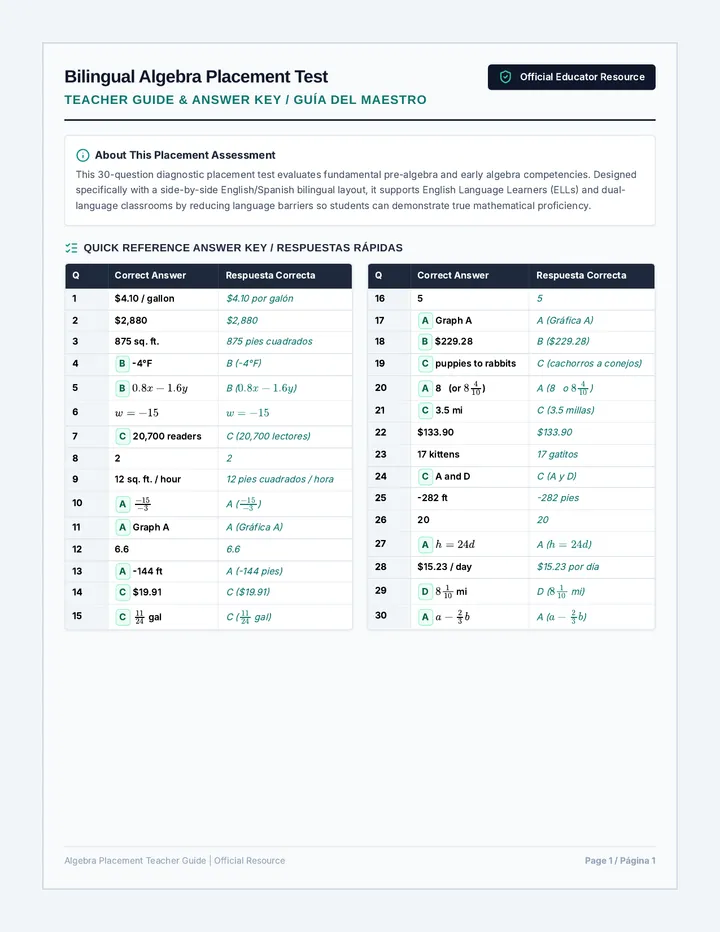
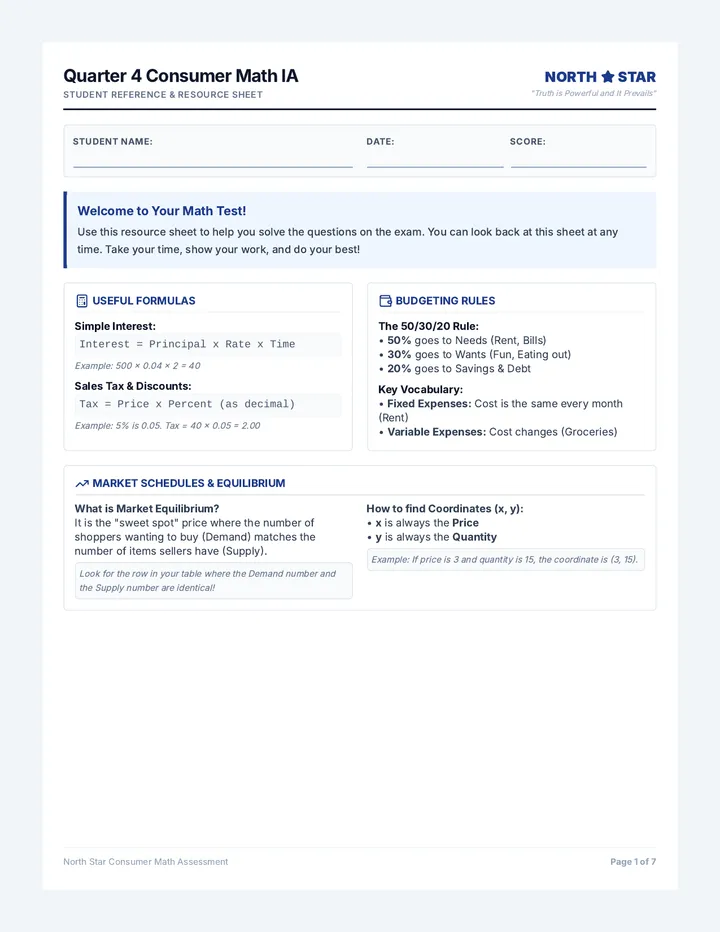
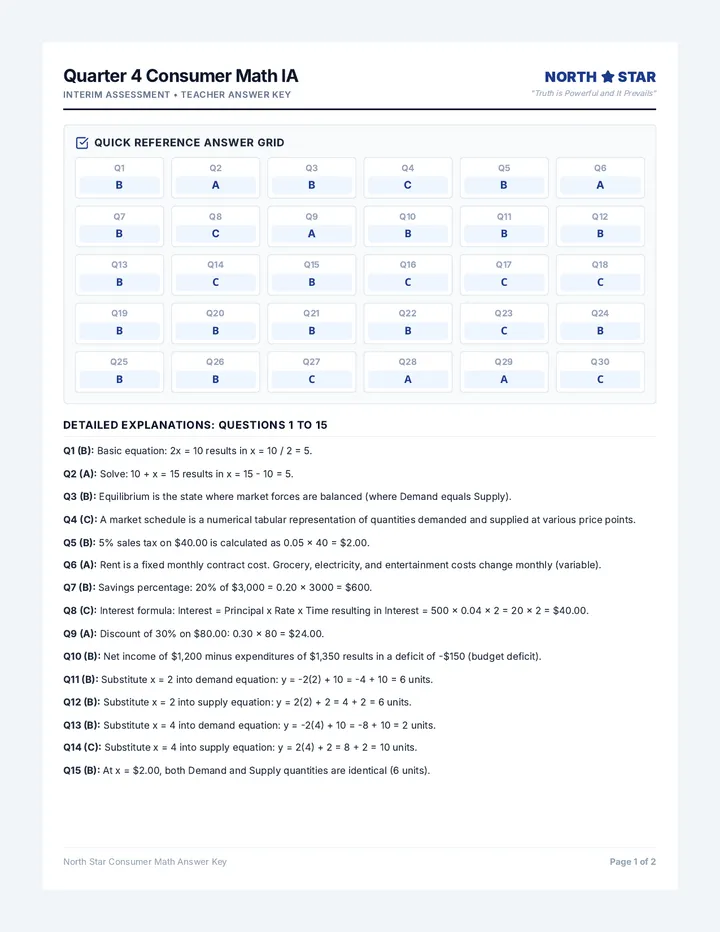
A comprehensive review of Consumer Math concepts including one and two-variable equations, written reasoning, and trend identification through tables. Includes a full 50-minute review handout and a 15-question multiple-choice quiz with an open-ended performance task.
A comprehensive assessment on radical expressions, operations, complex numbers, and radical equations for Algebra 2 students.
A high school geometry lesson where students learn to construct Voronoi diagrams using perpendicular bisectors to solve real-world spatial optimization problems in urban planning.