Teacher resource for Lesson 3 containing SAR scenario script, materials list, back-bearing answer key, and differentiation strategies.
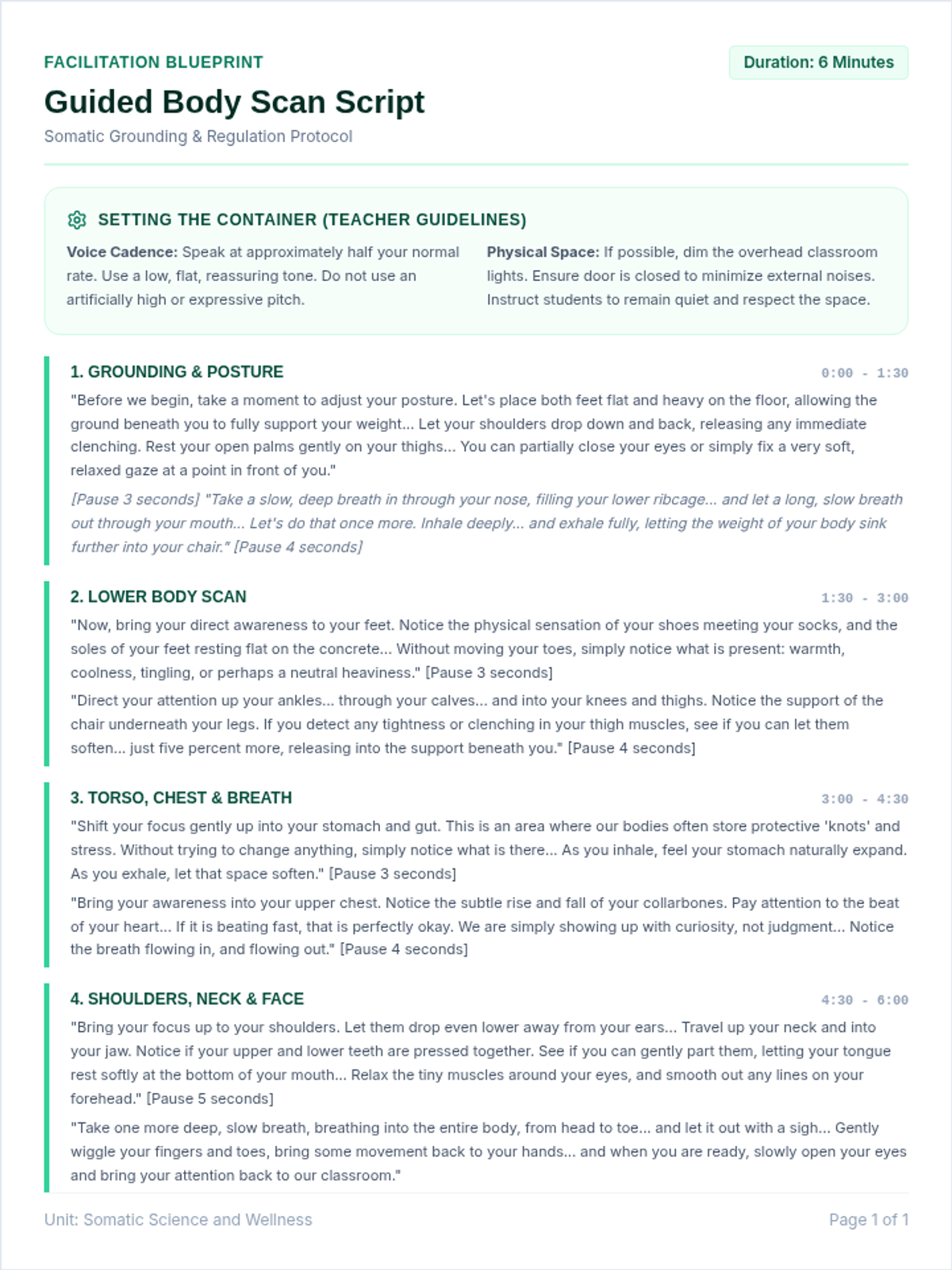
A beautifully designed 1-page teacher facilitator script for leading the Guided Body Scan. Features step-by-step breath anchors, localized physical scan paths, visual timing cues, and regulation tips.
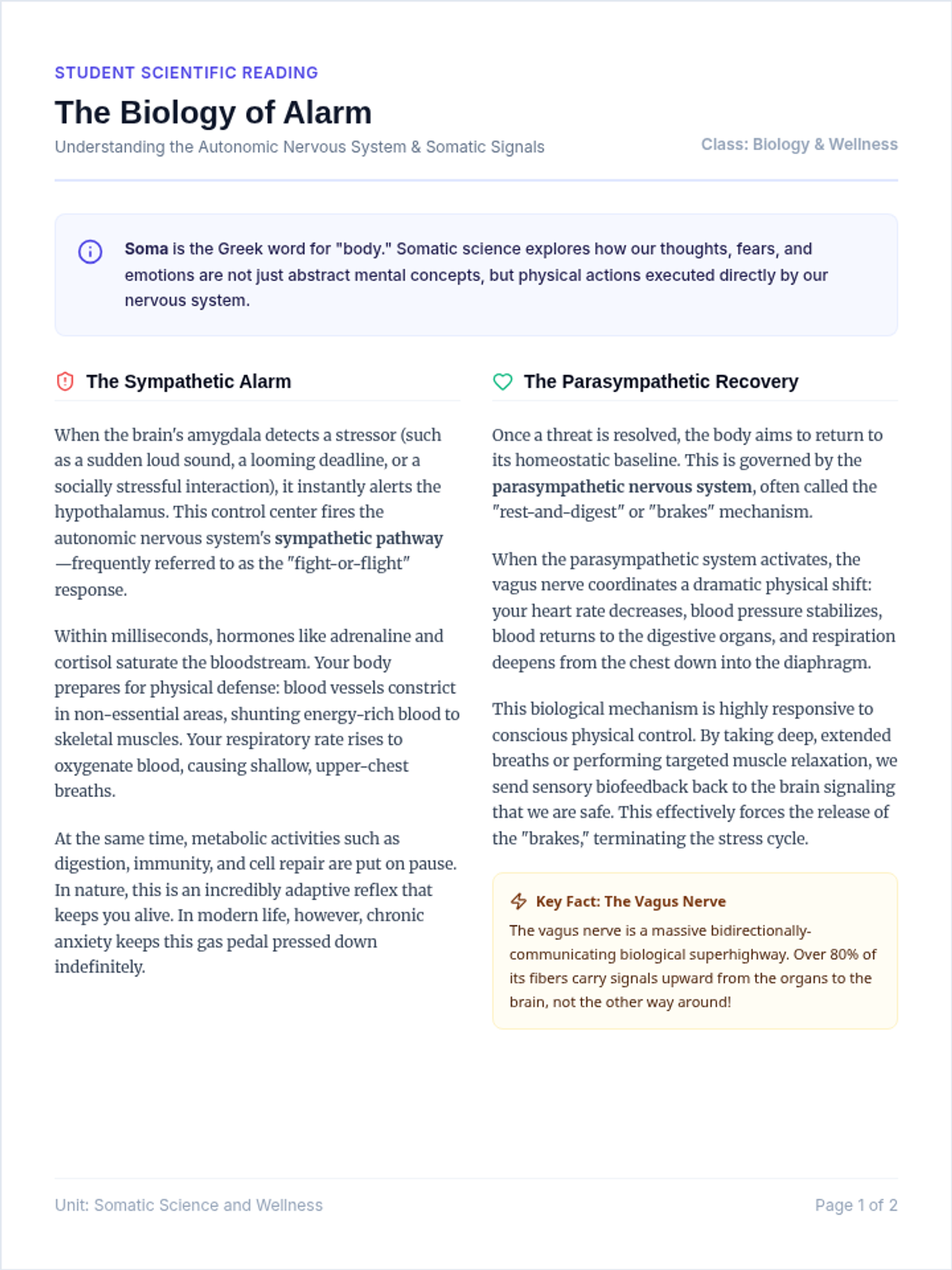
A high-quality 2-page student-facing material. Page 1 is a scientific reading passage on autonomic physiology and the mind-body loop. Page 2 is a personalized Somatic Mapping worksheet with a body outline for tracing tension and reflecting.
A visually striking and high-contrast 6-slide presentation deck covering the Autonomic Nervous System, the fight-or-flight response, somatic symptoms, and somatic grounding practices. All texts adhere strictly to the 24px+ legibility rule.
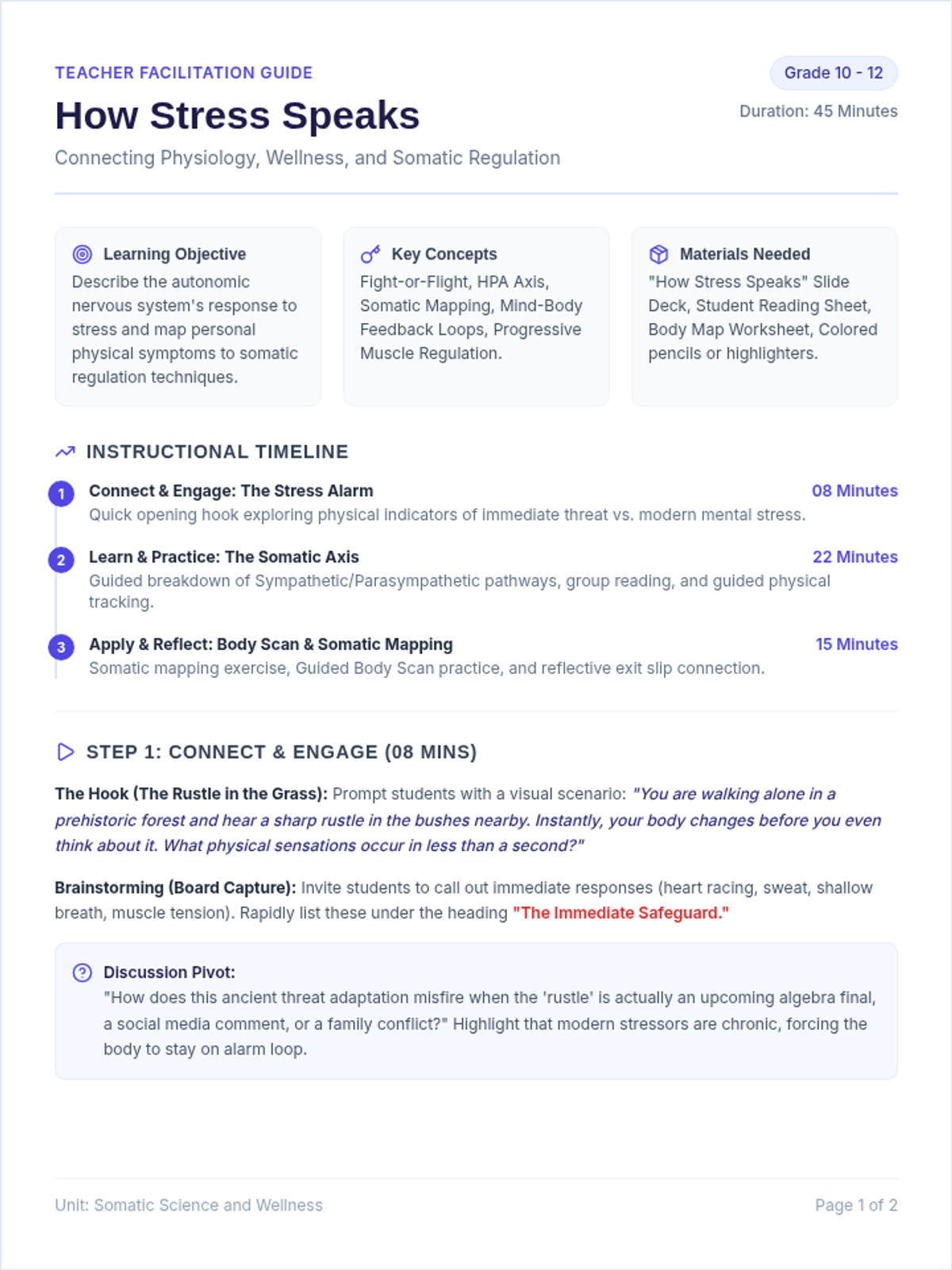
A comprehensive, teacher-facing 2-page lesson plan for "How Stress Speaks Through Your Body". Features detailed pacing, pedagogical strategies, discussion prompts, and adaptation guides aligned to the 45-minute lesson arc.
A 7-slide presentation deck used by teachers to guide students through the lesson. It includes slides for the opening reflection, exploring the 4 domains of self-care, co-constructing a menu of options, learning the habit-stacking formula, establishing healthy boundaries, and committing to action.
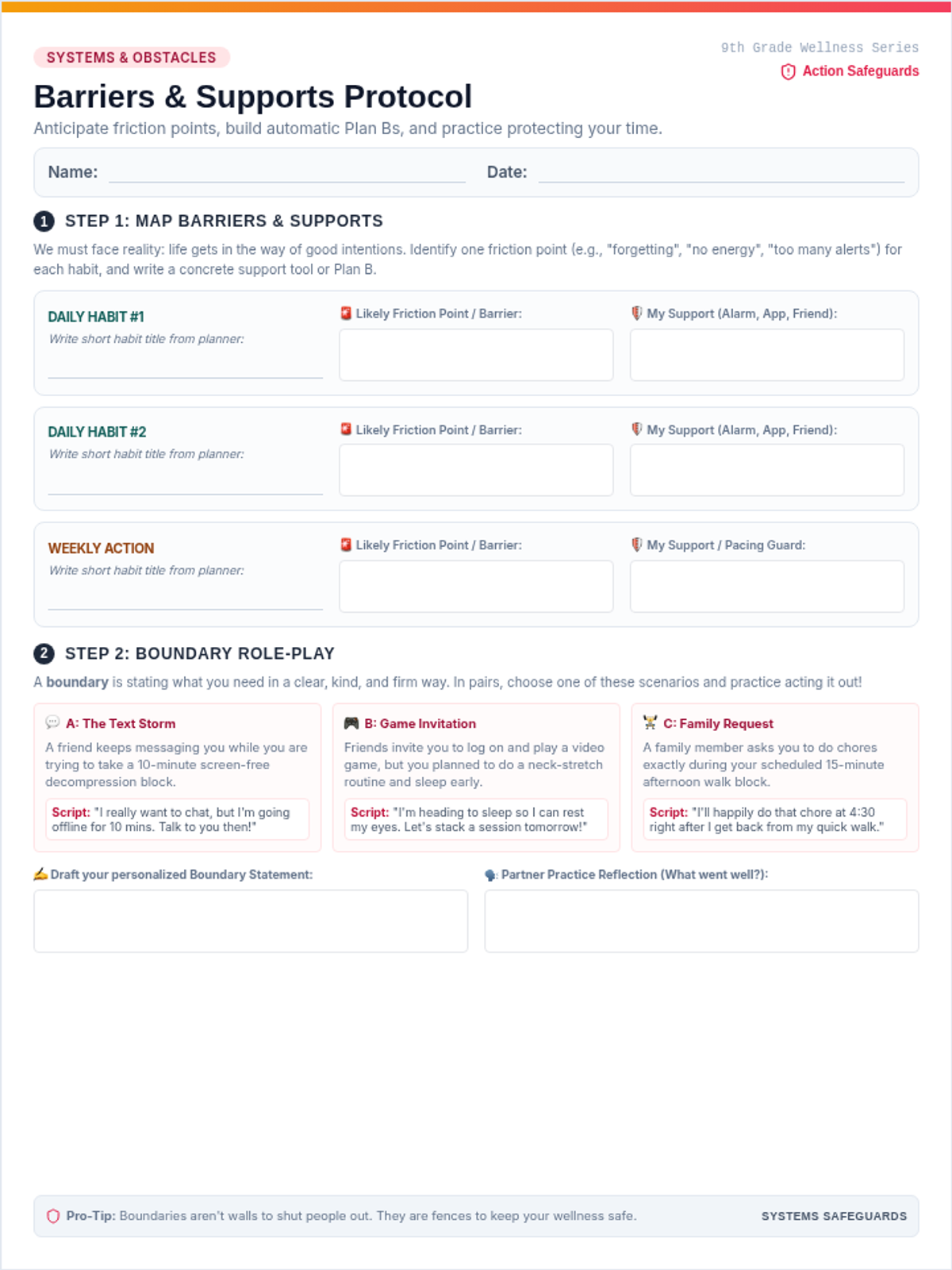
A 1-page guided student protocol for identifying potential obstacles to their self-care plan, brainstorming Plan B solutions, and engaging in boundary-setting role-play with structured scripts.
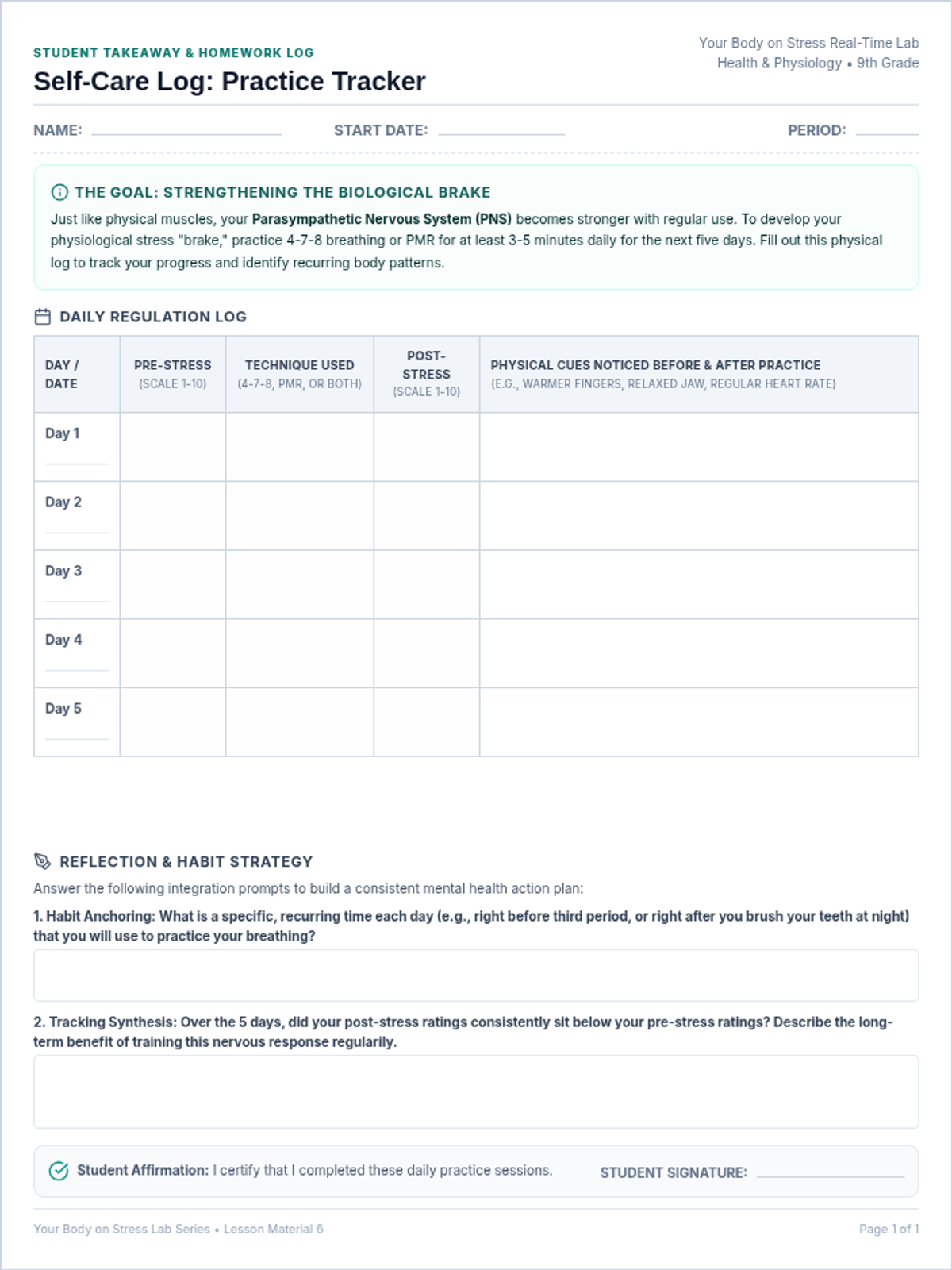
A take-home student tracking sheet and homework log designed to encourage daily 4-7-8 breathing practice, offering space to monitor pre/post stress levels and personal physiological cues over 5 days.
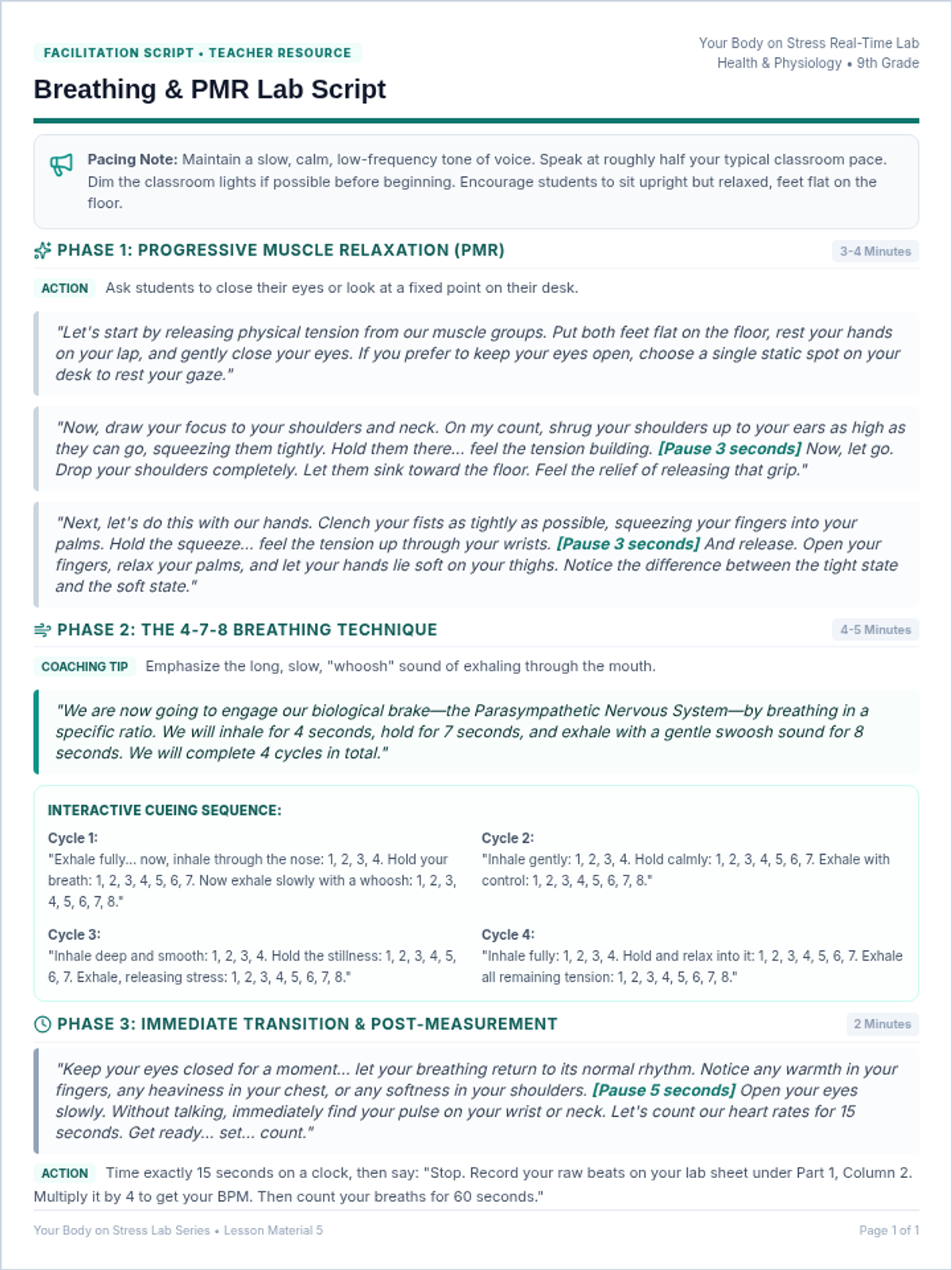
A step-by-step teacher facilitation script and staging guide for leading students through Progressive Muscle Relaxation (PMR) and four full cycles of 4-7-8 breathing.
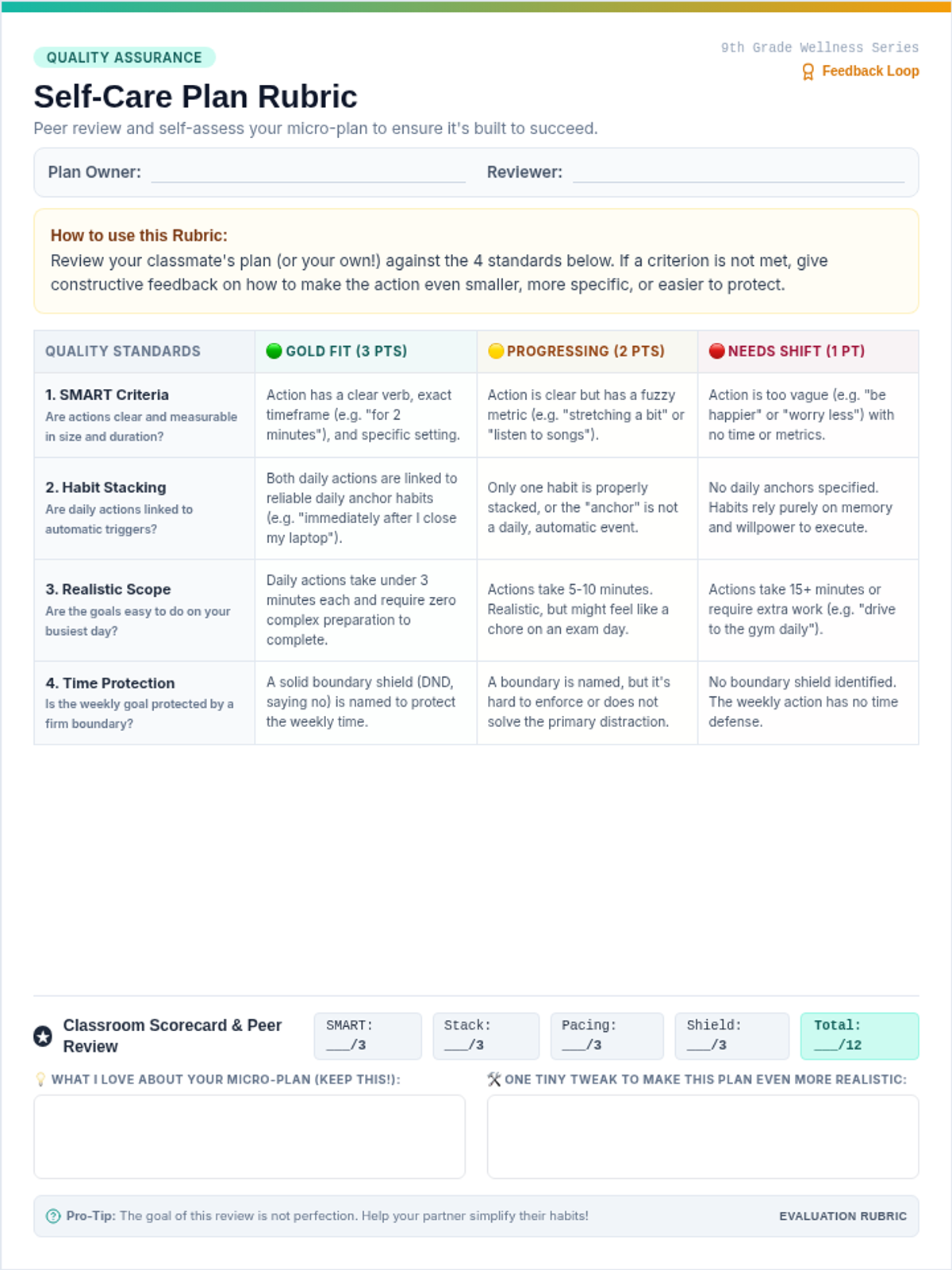
A 1-page rubrics and peer feedback scorecard for students to evaluate their self-care micro-plans against quality criteria, including specificity, habit stacking integration, realistic scope, and boundary protection.
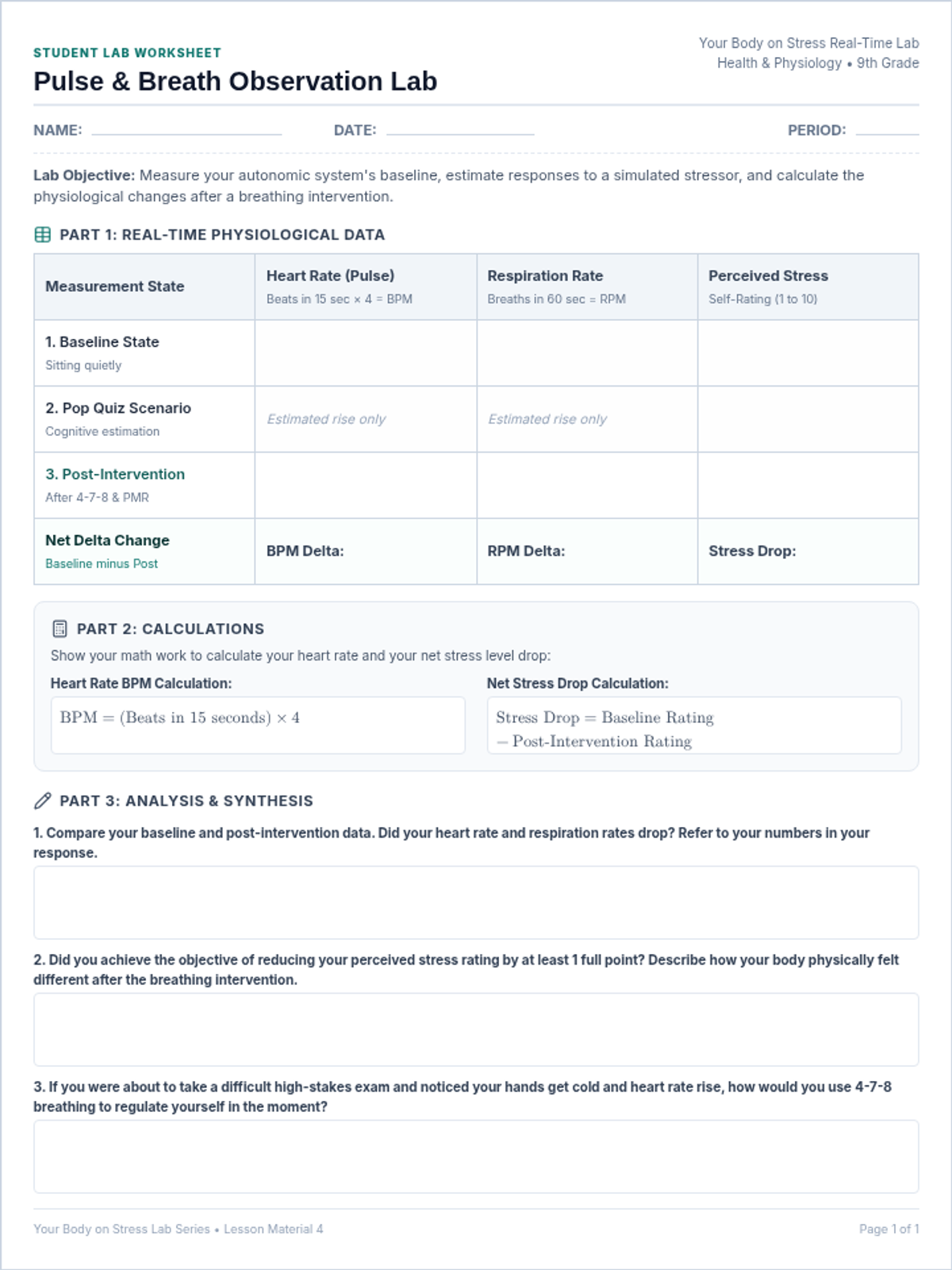
A structured student lab sheet for recording and calculating baseline, stress-provoked, and post-intervention heart and respiratory rates, featuring a data comparison table.
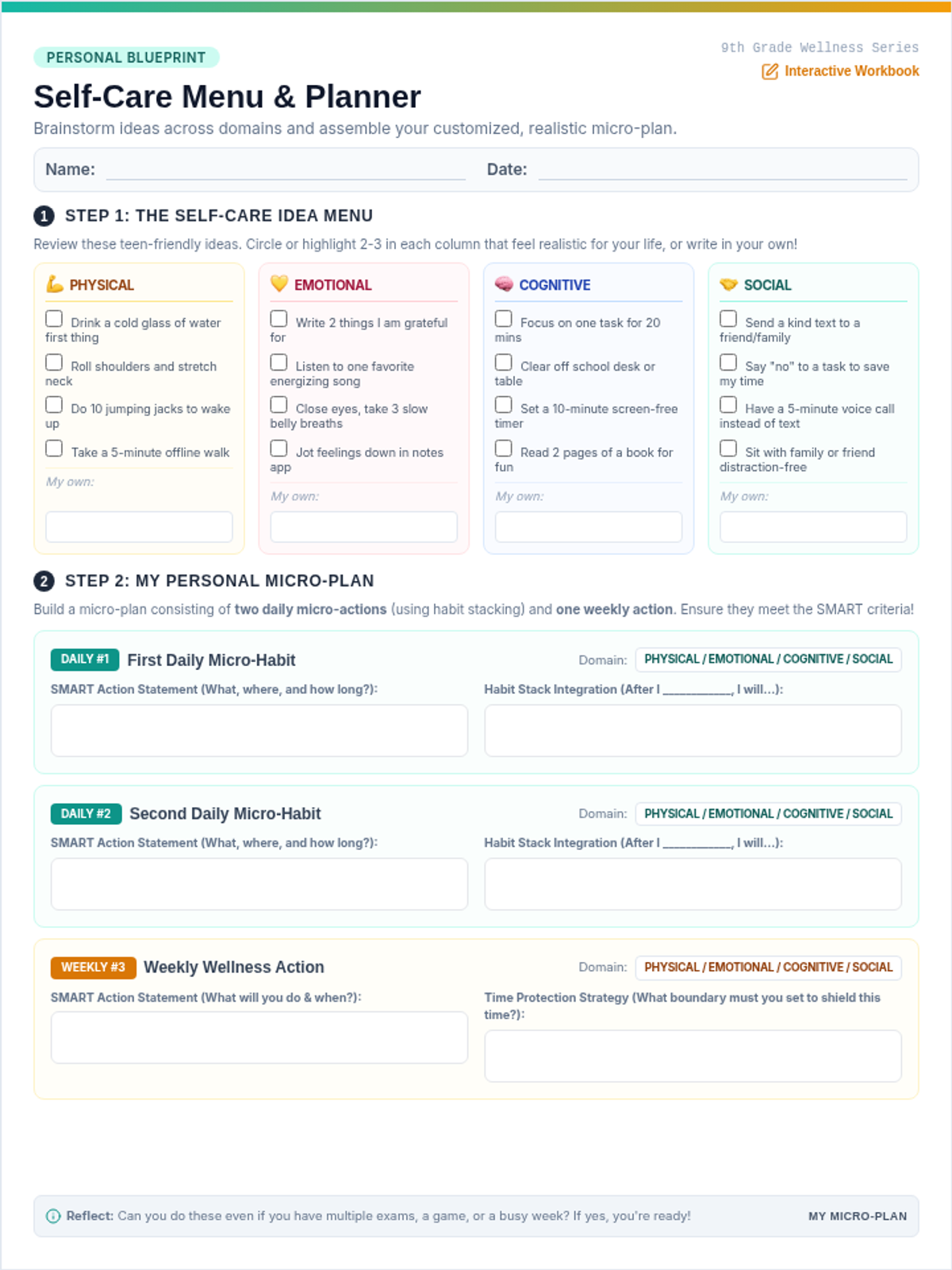
A 1-page student menu and micro-planner where 9th graders select realistic, teen-friendly self-care options from across the 4 wellness domains and write down their customized, SMART-aligned plan for two daily micro-actions and one weekly action.
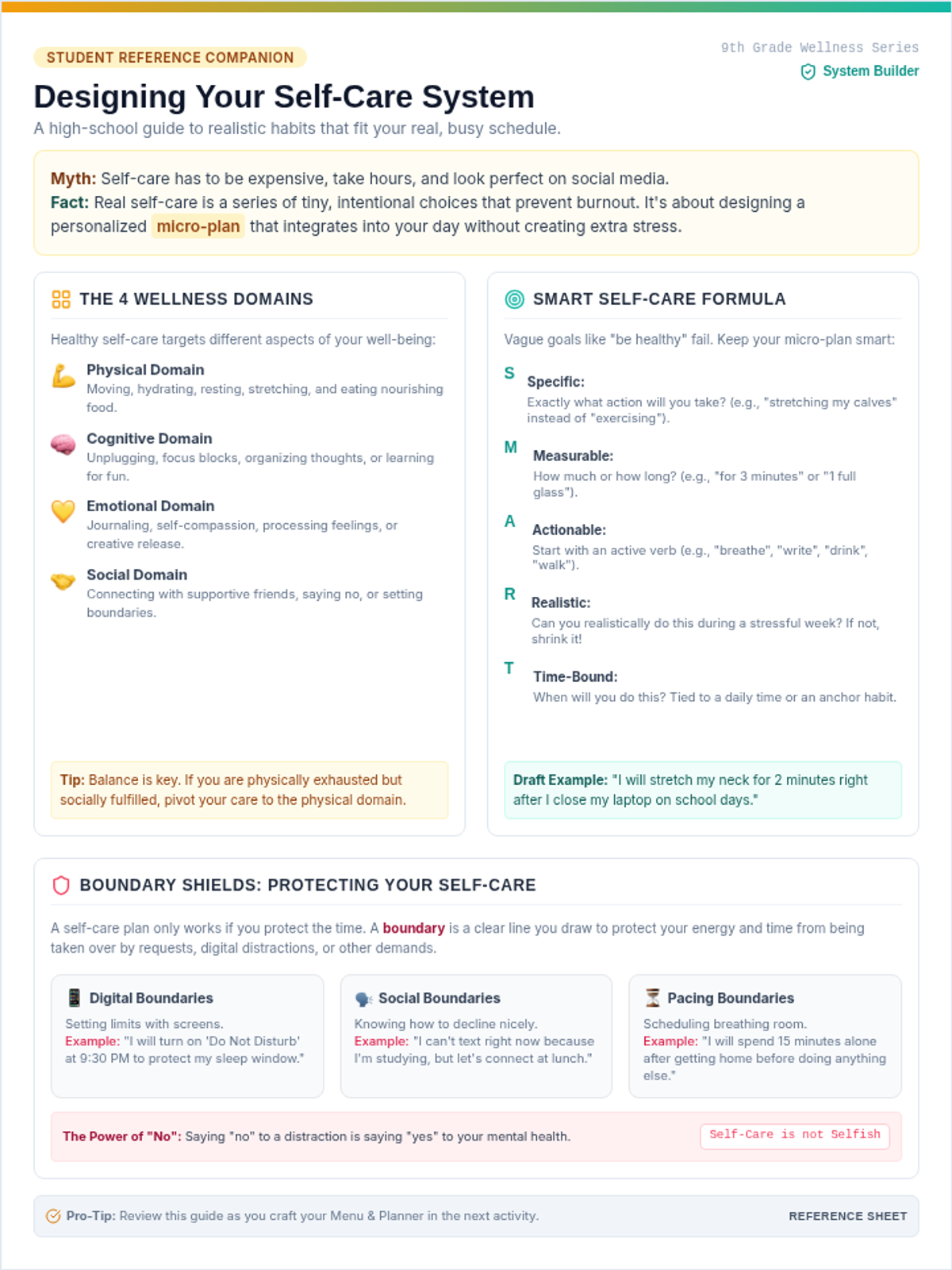
A 1-page student guide explaining the core pillars of a realistic self-care system: the 4 domains of self-care (physical, emotional, social, cognitive), the SMART criteria for micro-planning, and setting boundaries to protect your time.
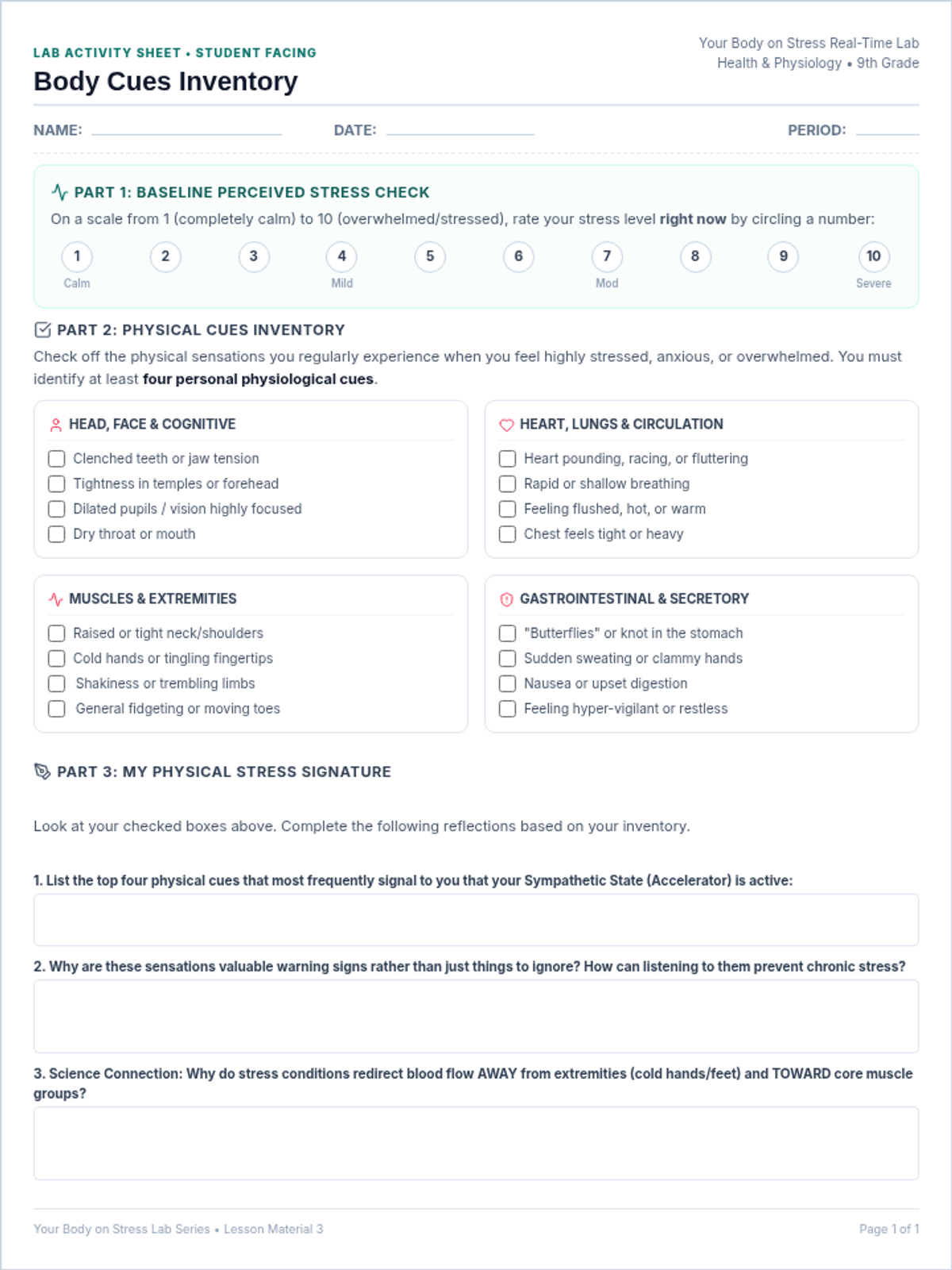
A clean, student-facing physical checklist that prompts 9th graders to identify and categorize their personal physiological markers of stress, with space to reflect on chronic vs acute stress.
Engaging 6-slide presentation covering the physiological battle between the Sympathetic and Parasympathetic nervous systems, common physical body cues of stress, and the neural mechanisms behind slow-exhale breathing.
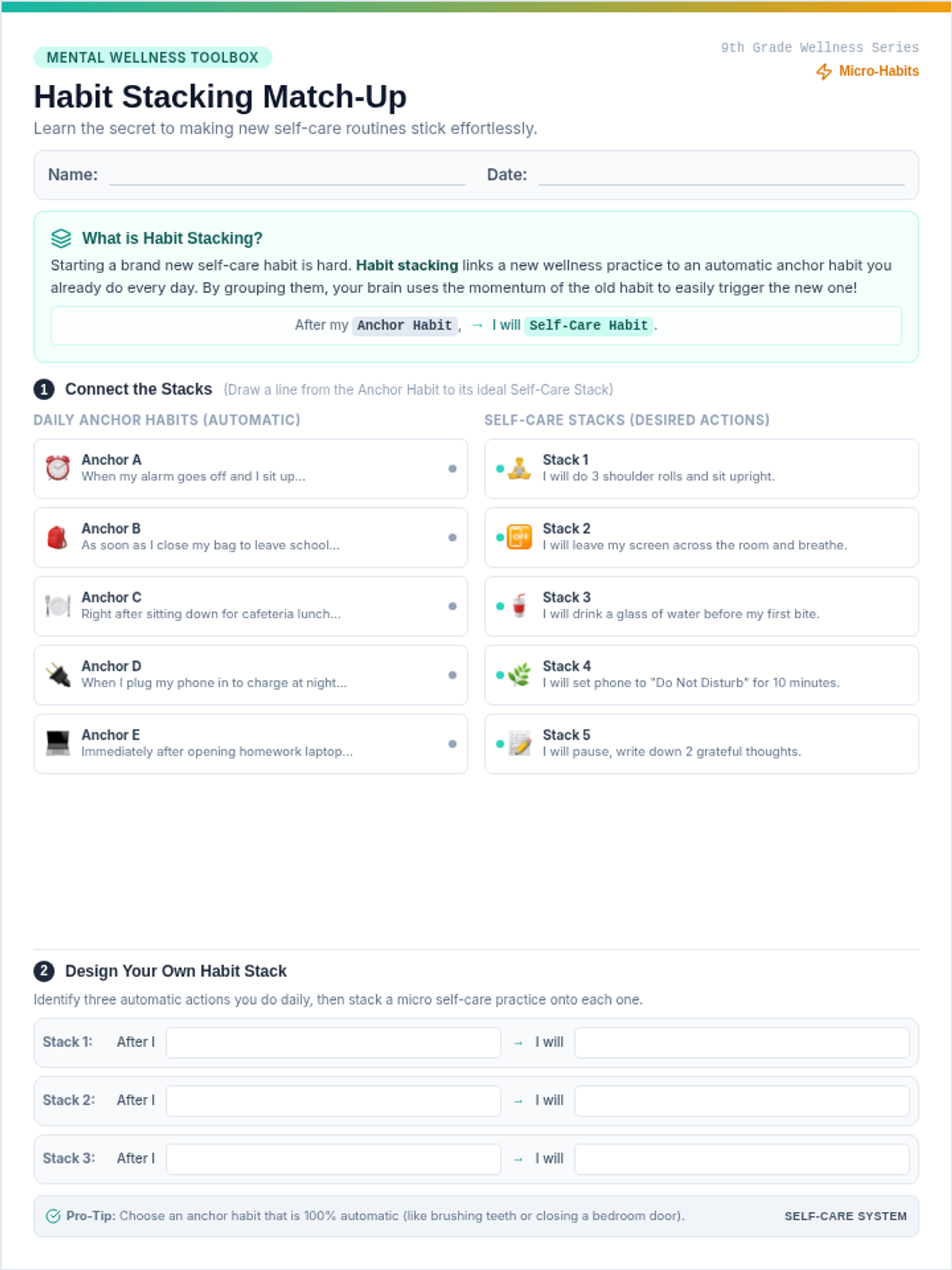
A 1-page matching activity sheet where 9th graders learn and practice habit stacking. It features an explanation of James Clear's habit-stacking formula, a matching section pairing common school-day anchor habits with realistic self-care additions, and a creative application space.
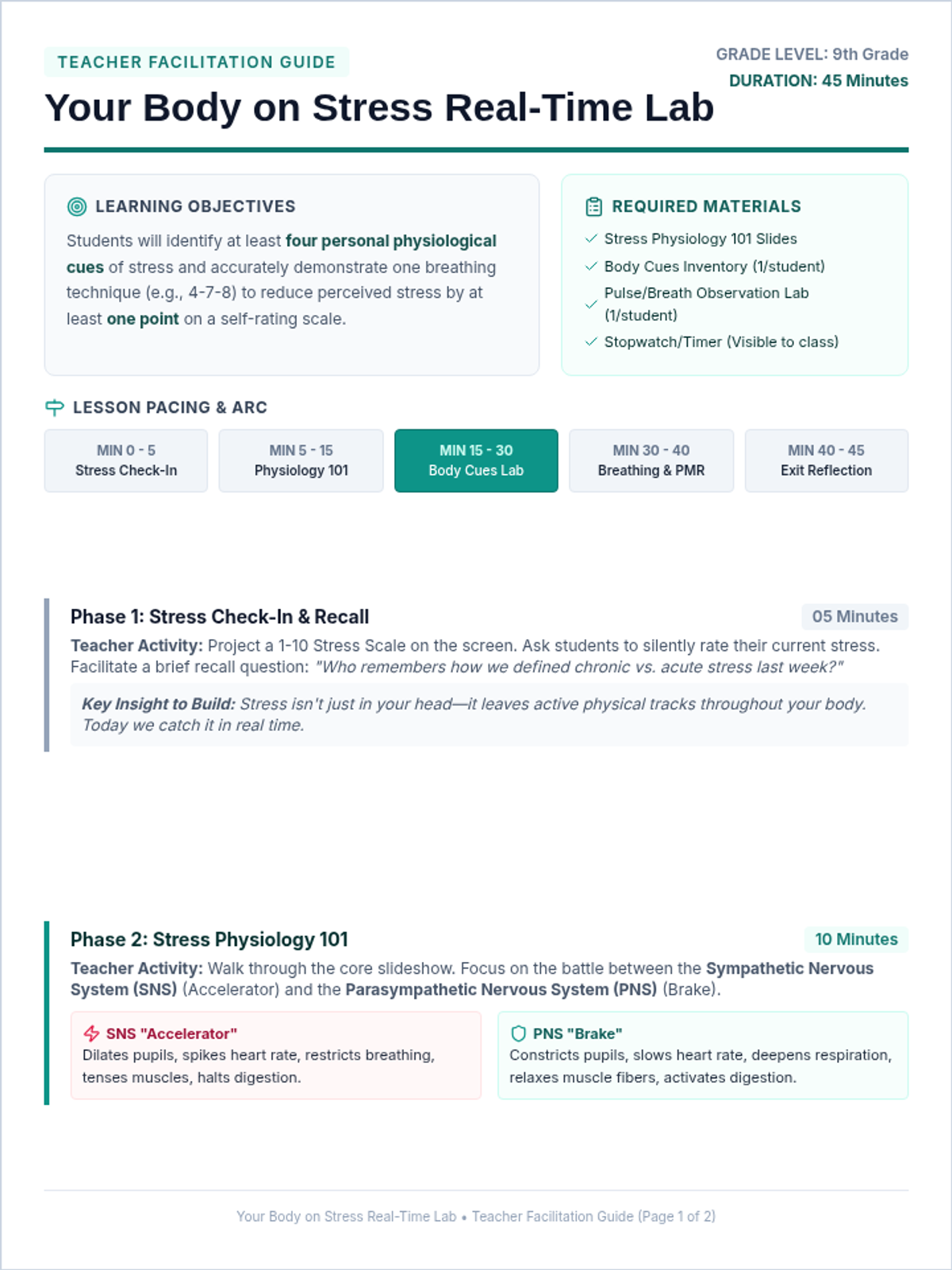
A comprehensive lesson plan and teacher facilitation guide for the 45-minute Your Body on Stress Real-Time Lab. It outlines the classroom setup, materials needed, instructional arc, and specific pacing instructions.
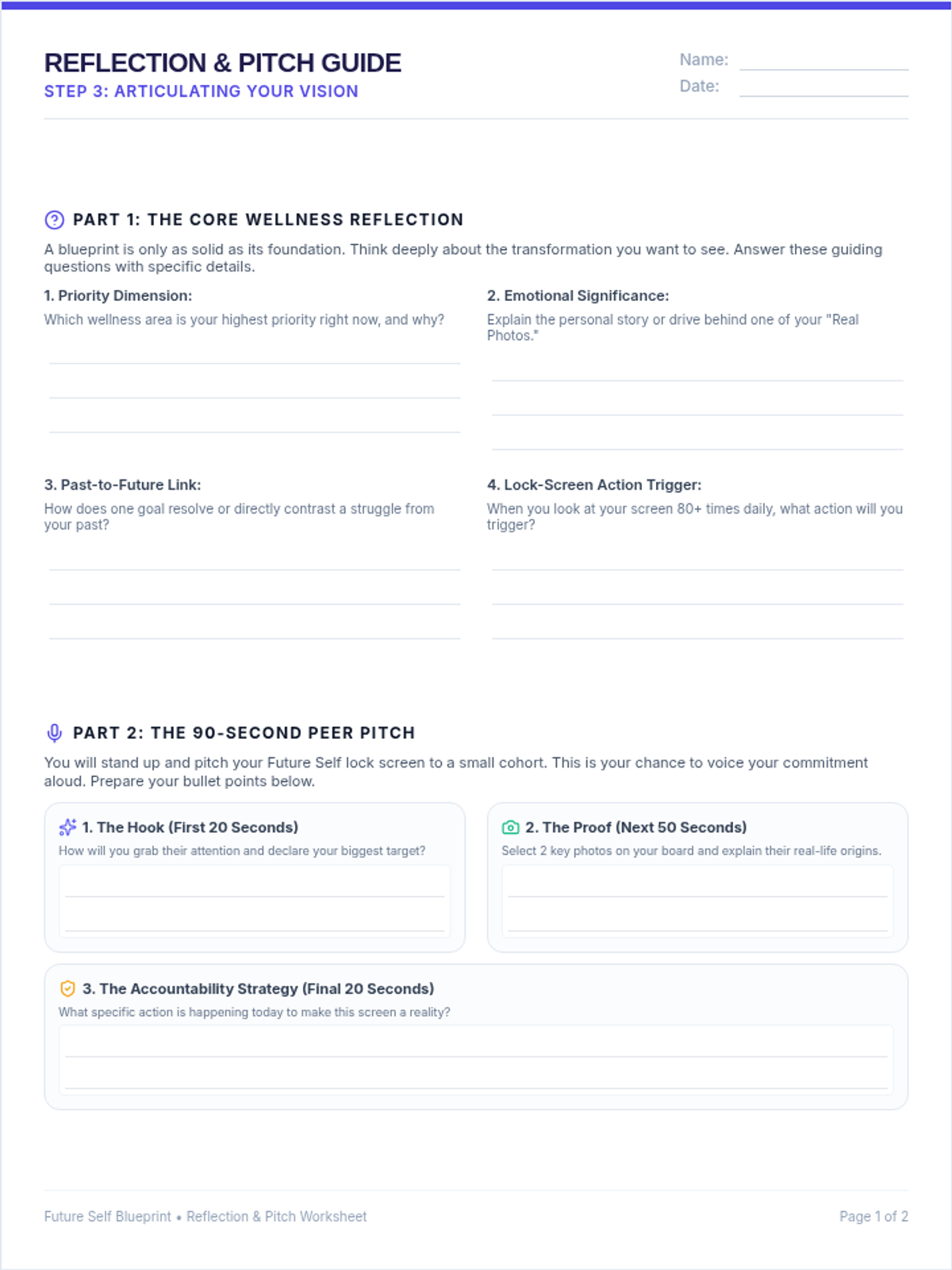
Worksheets for students to write their vision board reflection, prepare their peer presentations, and view the grading rubric.
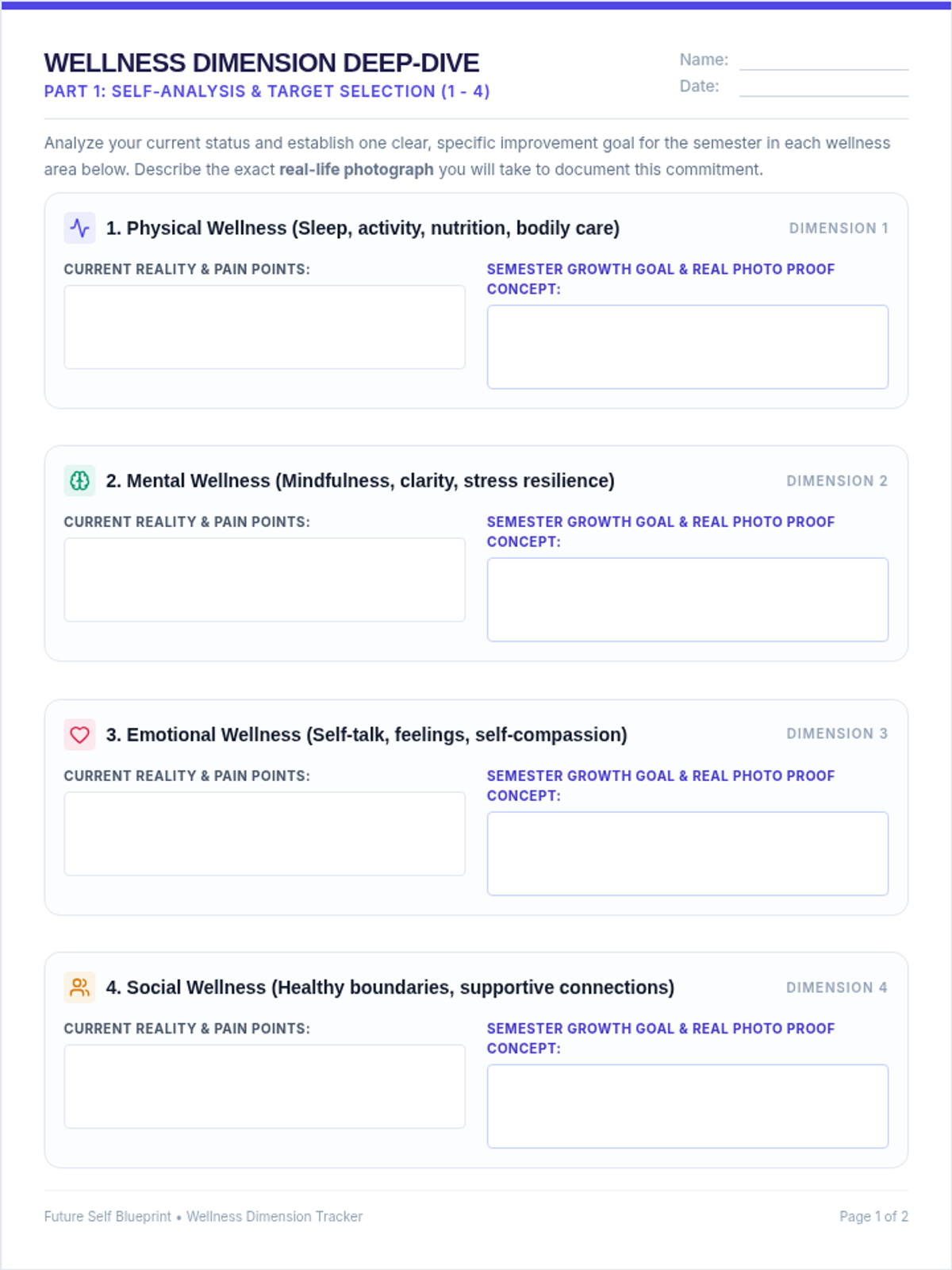
A dedicated student planning organizer and workbook detailing all eight wellness areas with specific deep-dive brainstorming prompts and written layout boxes.
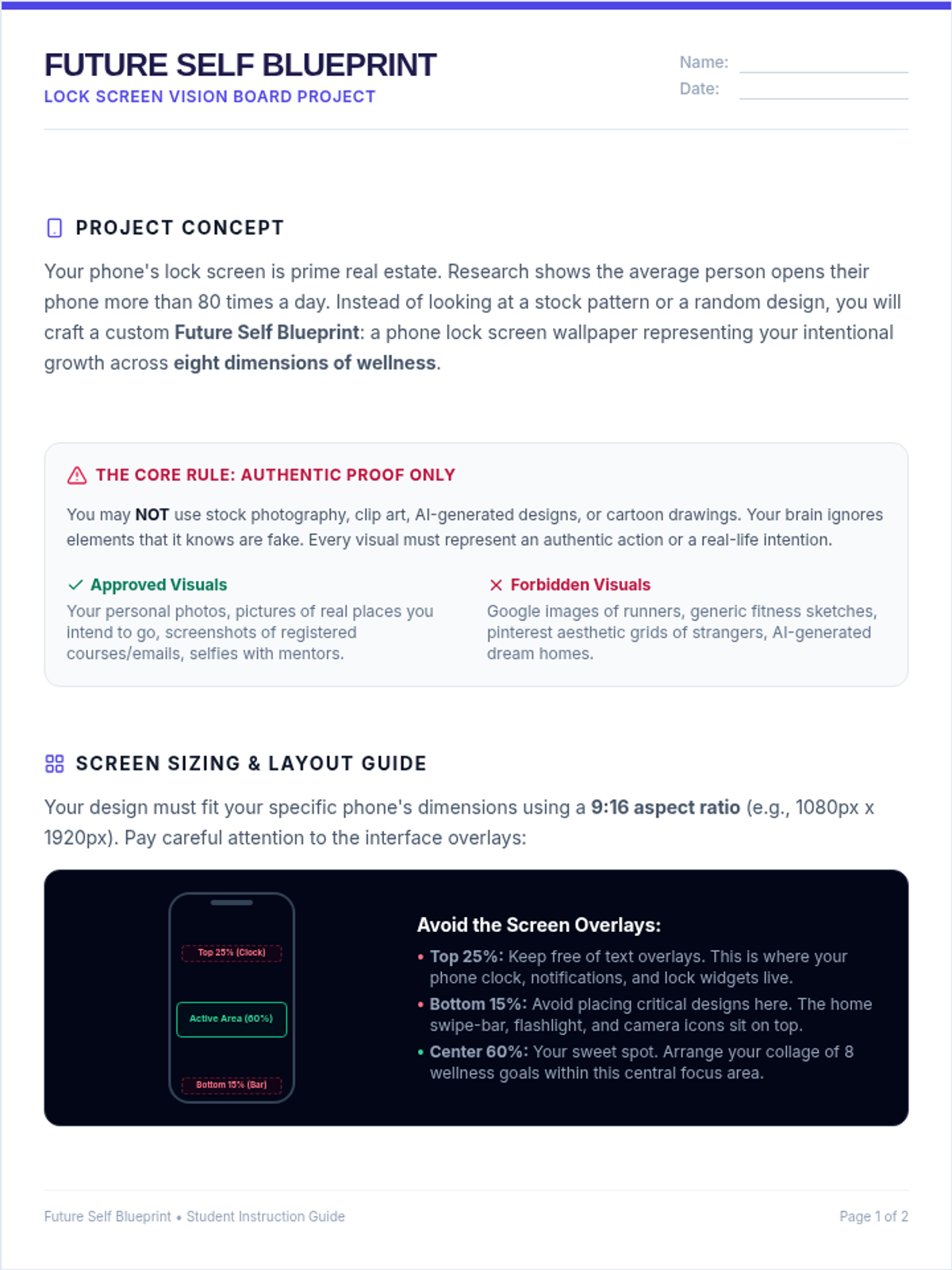
A comprehensive project guide and instruction packet for students, detailing requirements, layout blueprints, screen layout grids, and the strict photo verification checklist.
A highly engaging slide deck to introduce the Future Self Blueprint project, outlining the requirements, the 8 dimensions of wellness, and the strict 'Real-Photo' policy.
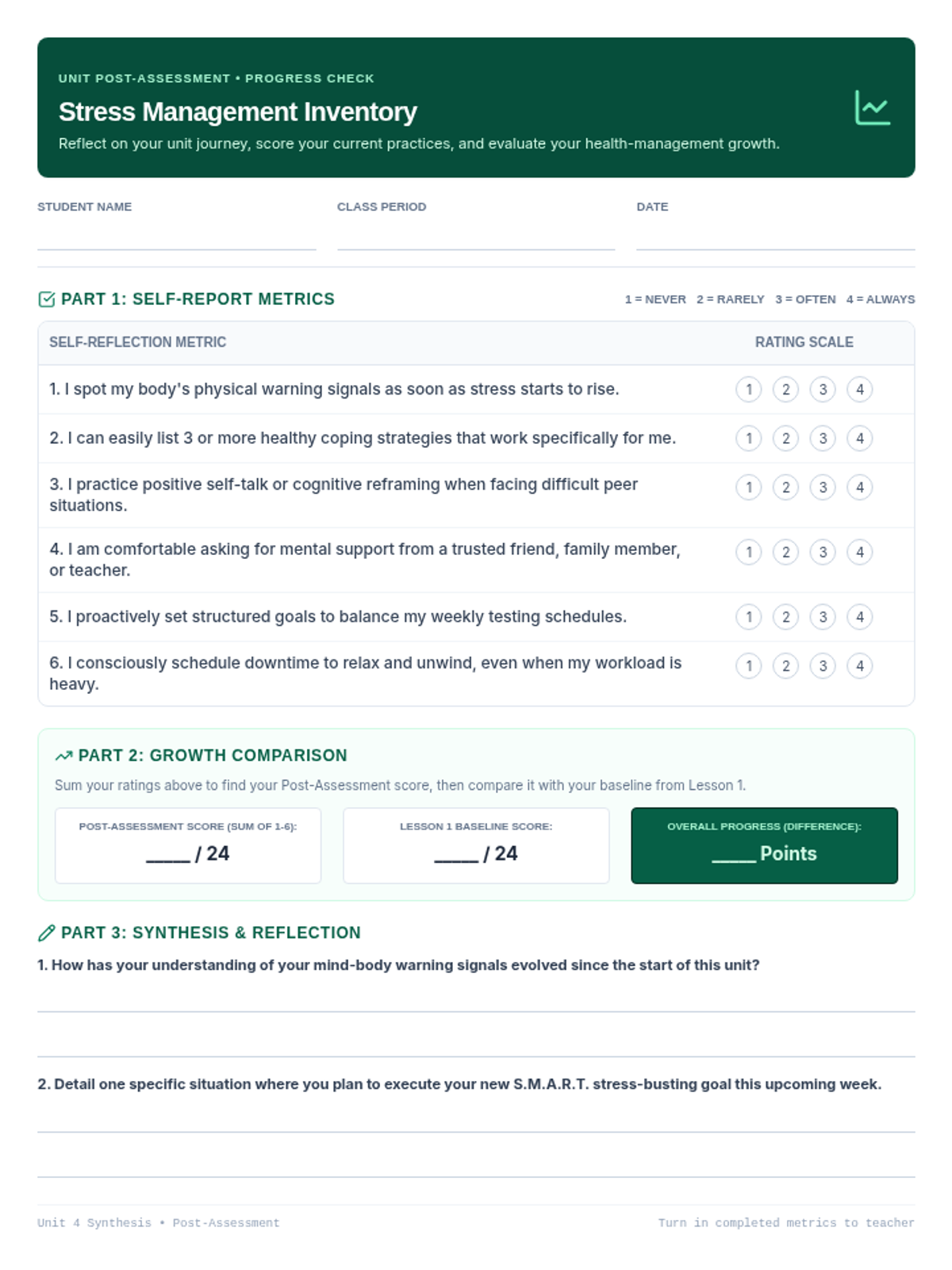
A 1-page student post-assessment featuring an 8-item self-report stress management inventory, a baseline growth comparison block, and written reflection prompts.
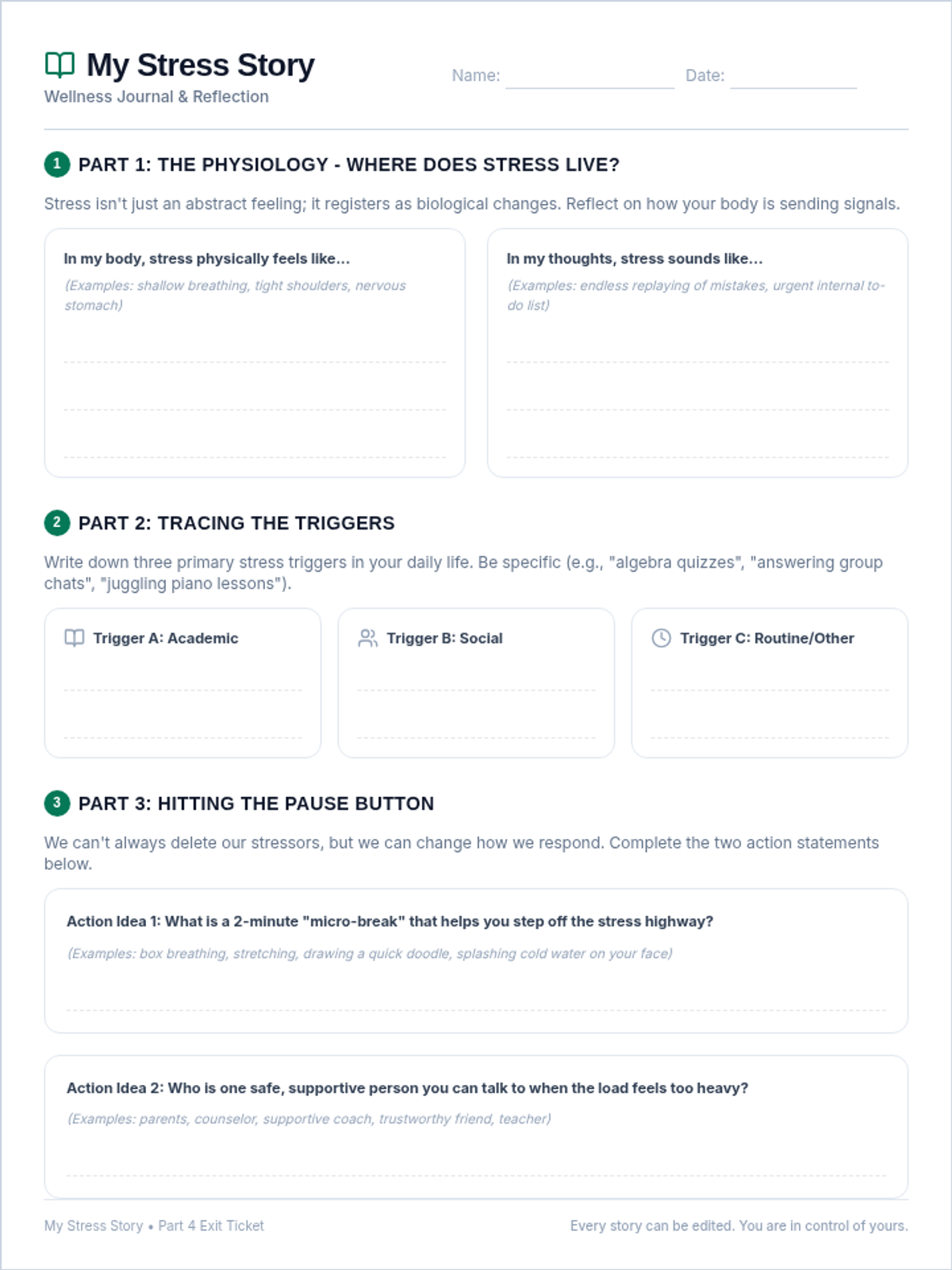
A 1-page highly reflective student wellness journal page. Features structured writing frames for analyzing personal physiological patterns, cataloging triggers, and planning micro-breaks.
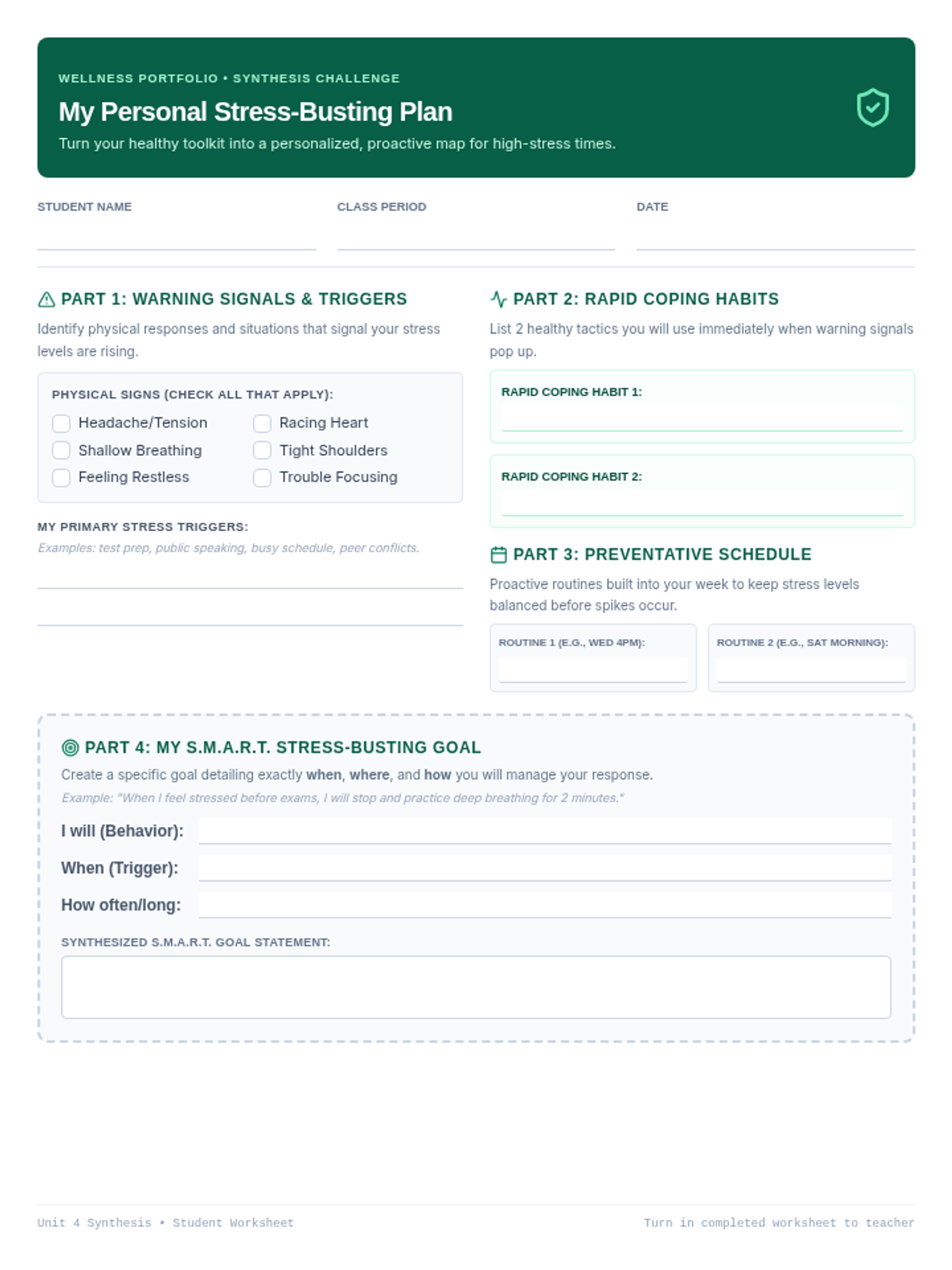
A 1-page student worksheet for constructing a personalized stress management plan, featuring warning signals, rapid coping tactics, preventative routines, and a S.M.A.R.T. goal.
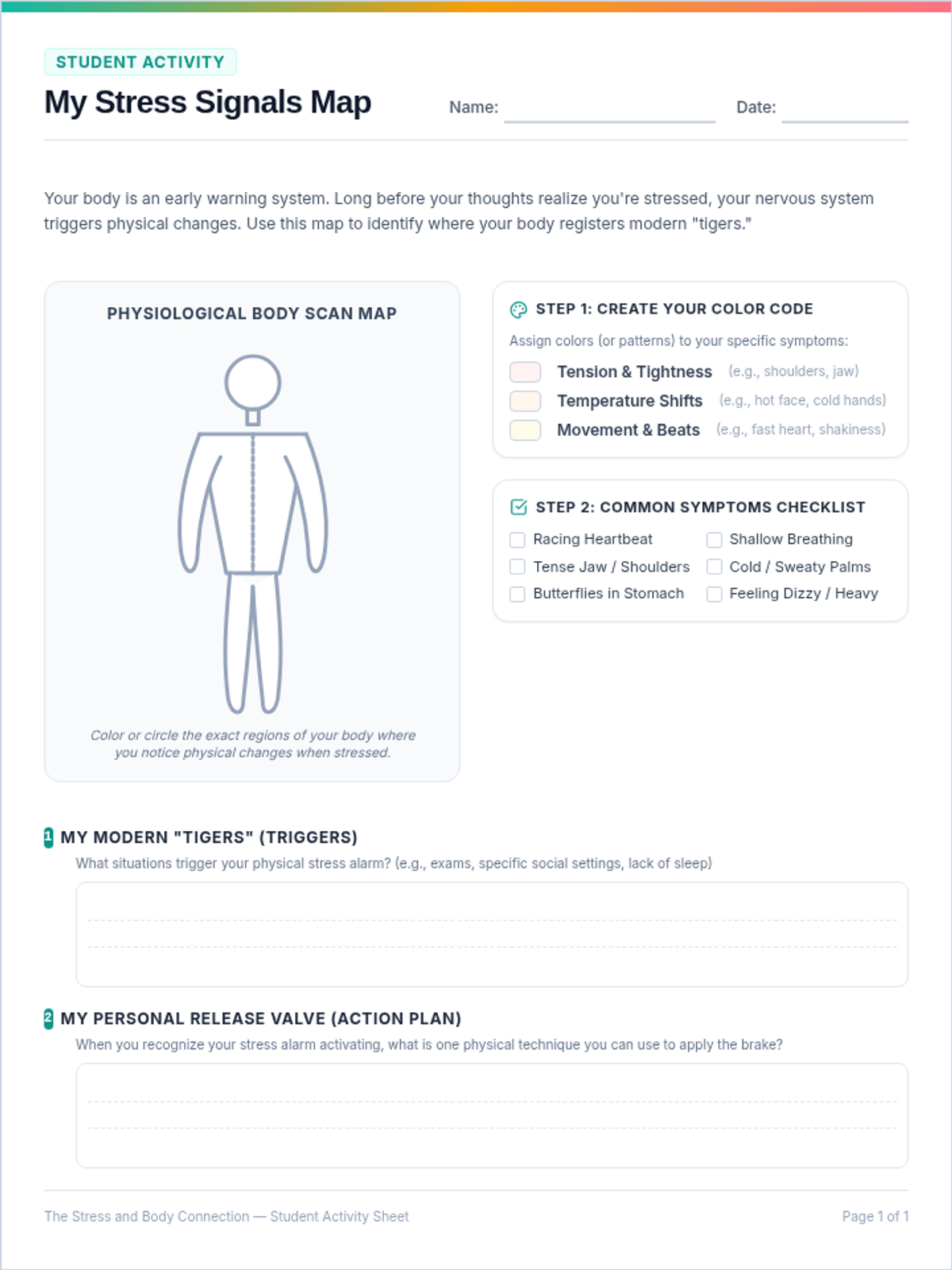
An interactive, beautifully designed 1-page student worksheet featuring a schematic human body map for highlighting personal physiological stress zones, a symptoms color key, and reflection prompts.
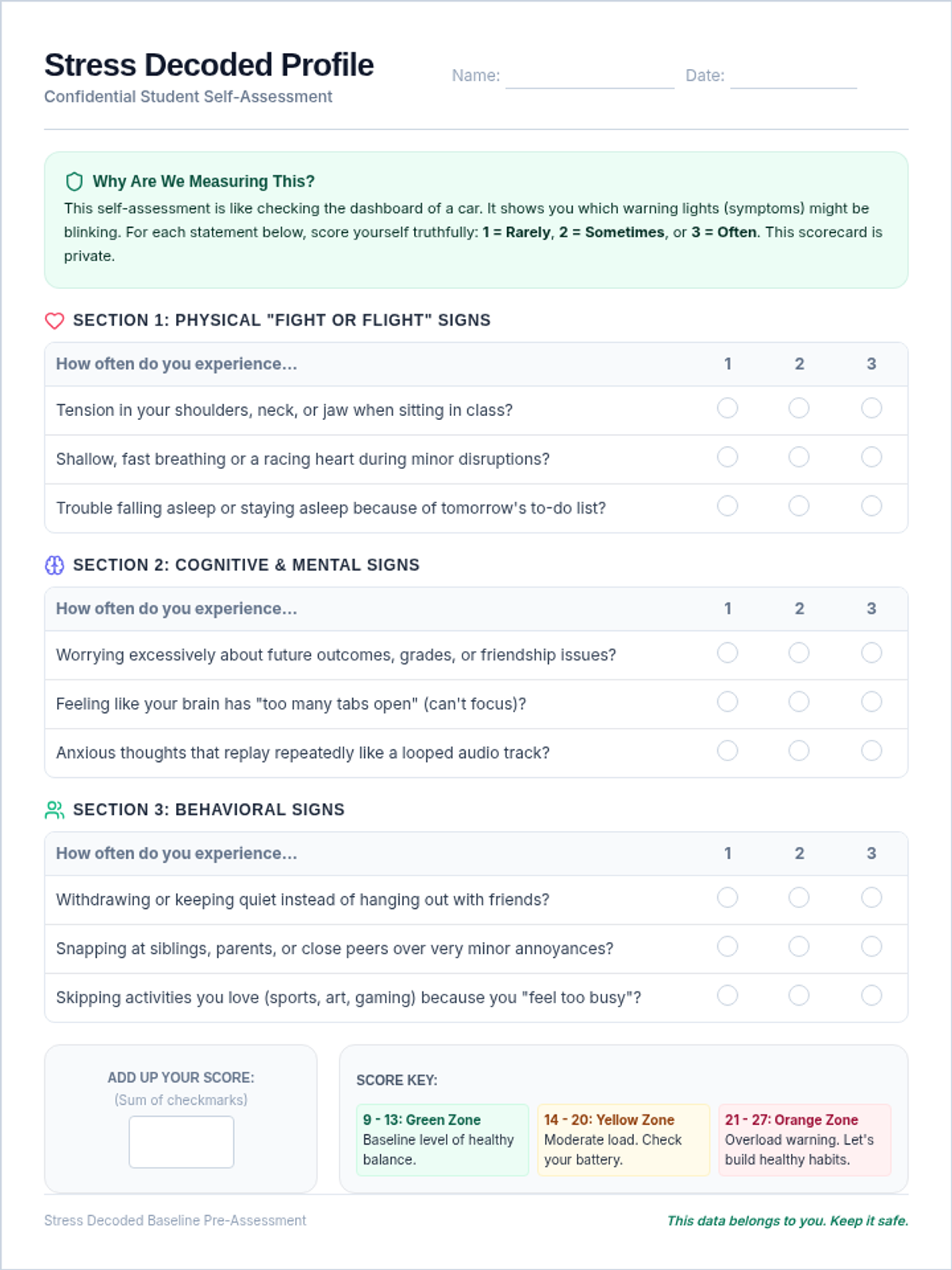
A 1-page structured, student-facing stress inventory pre-assessment. Includes physical, cognitive, and behavioral symptom checklists and a self-scoring baseline rubric.
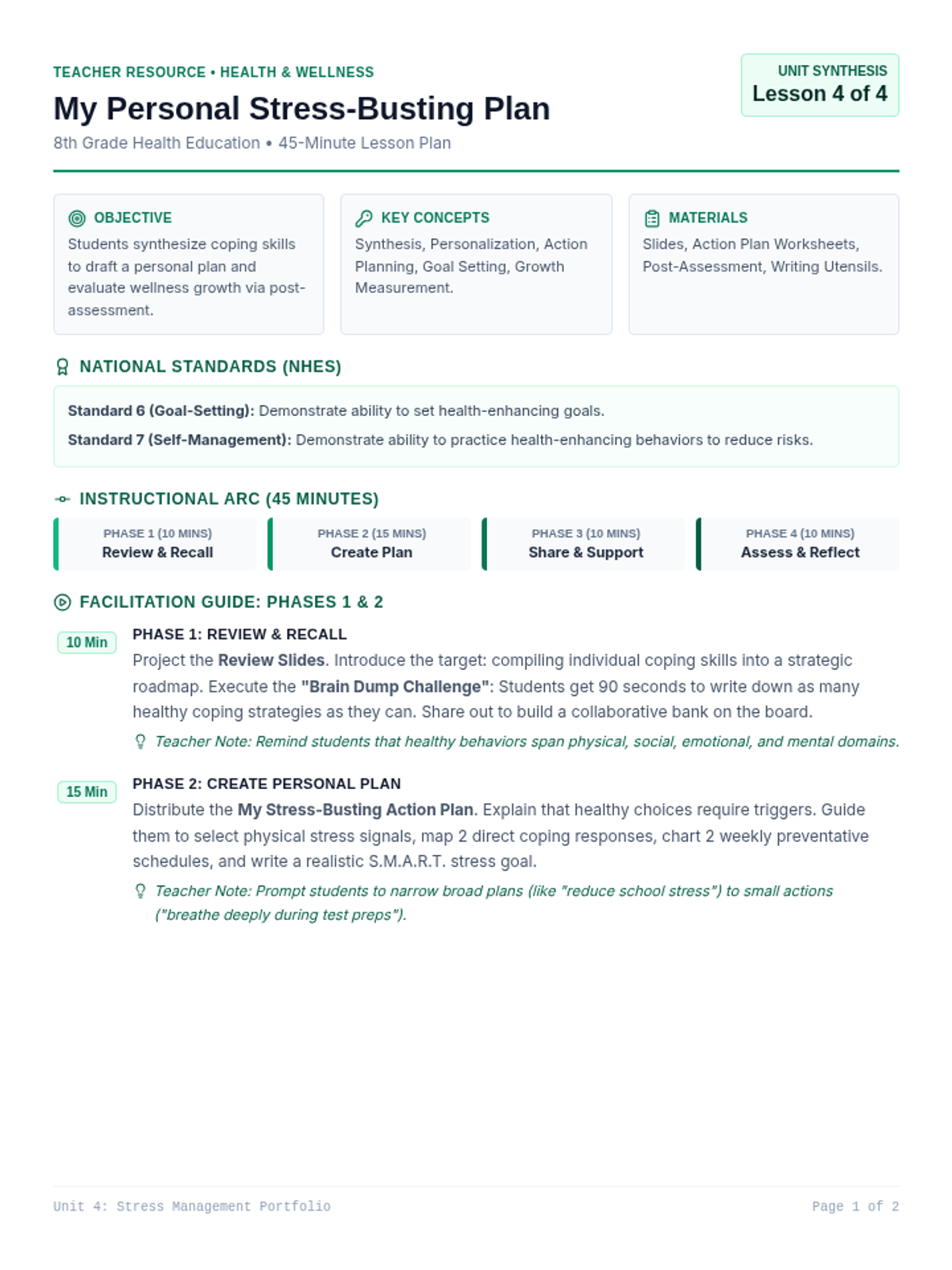
A 5-slide visual presentation to guide students through the unit synthesis, the 90-second brain dump challenge, action plan building, feedback protocols, and the growth reflection.
An engaging, highly visual 5-slide presentation designed to guide 8th-grade students through the science of stress, Eustress vs. Distress, and common stressors. Includes large, bold typography and zero text under 24px.
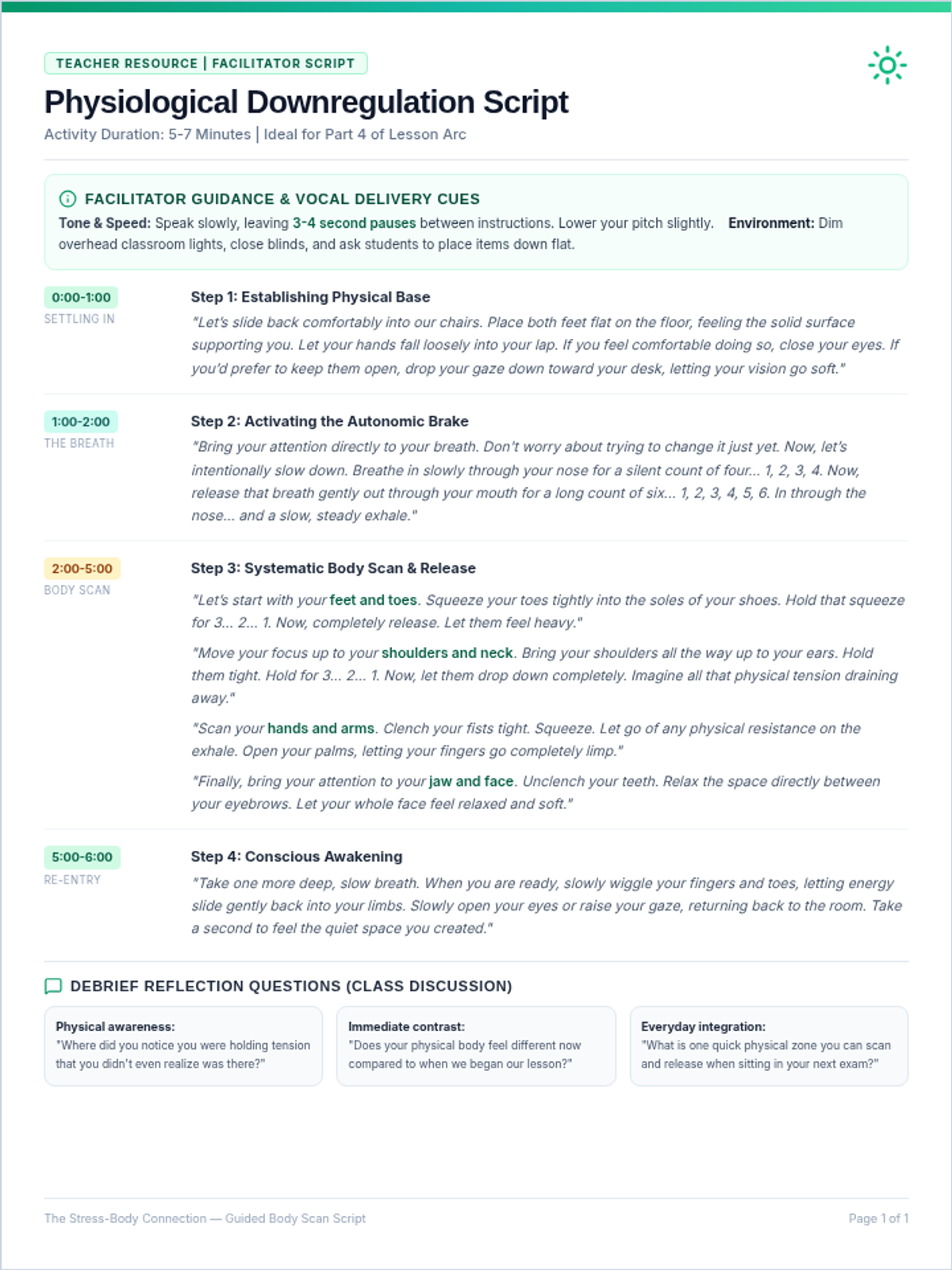
A professional 1-page script and facilitator guide for conducting a 5-7 minute mindfulness and physiological downregulation body scan with 8th graders. Includes vocal cues, visual layout markers, and debrief prompts.
An interactive and visually engaging 6-slide deck introducing students to fight-or-flight biology, physical symptoms of stress, and how the parasympathetic nervous system serves as the body's natural brake.
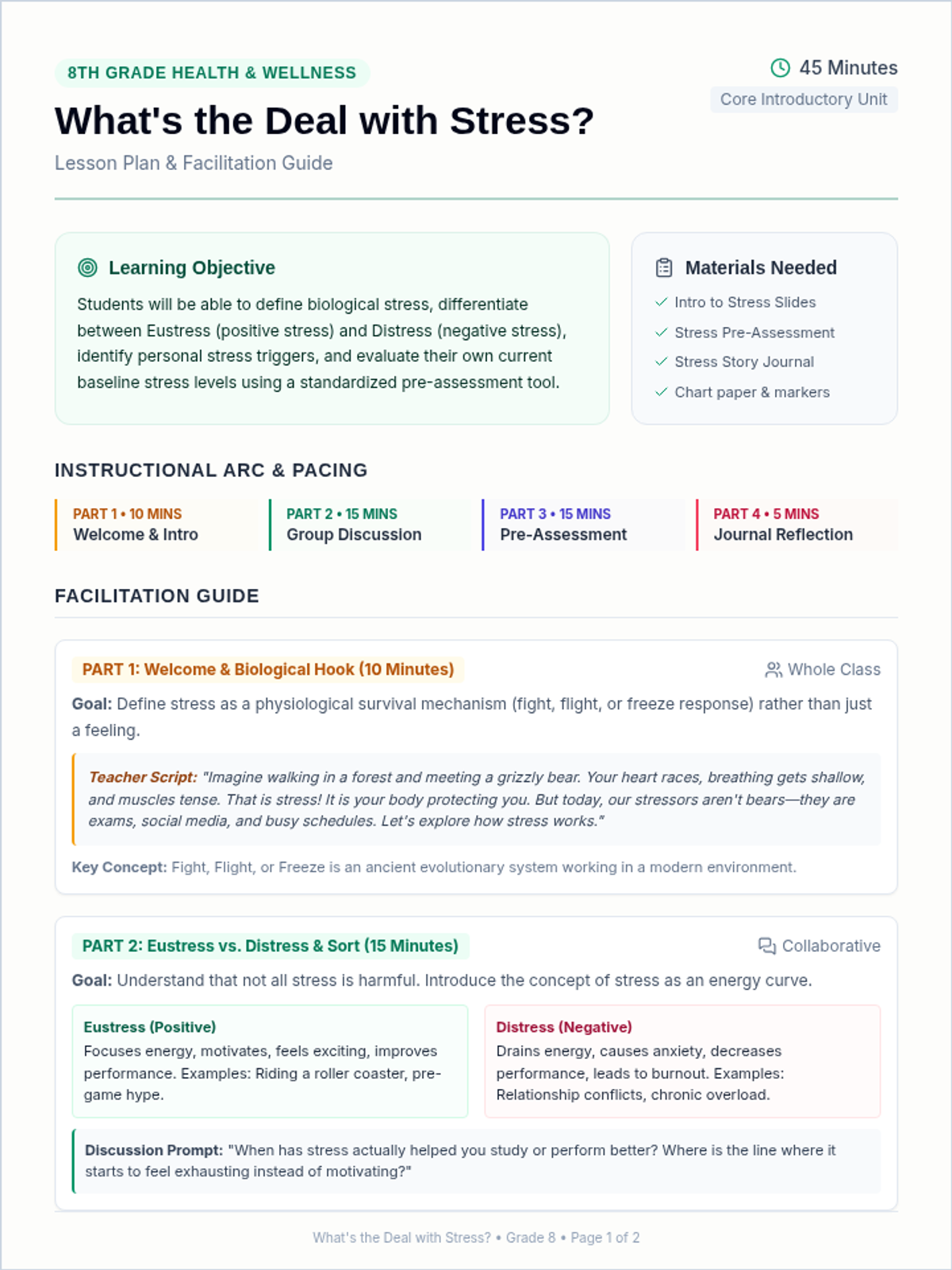
A 2-page comprehensive facilitation guide for the 8th-grade stress management lesson. Includes pacing, scripting, key discussion prompts, misconceptions, and differentiation strategies.
A 2-page teacher-facing lesson plan containing details on the lesson overview, materials, objectives, standards, step-by-step facilitation guide, and differentiation strategies.
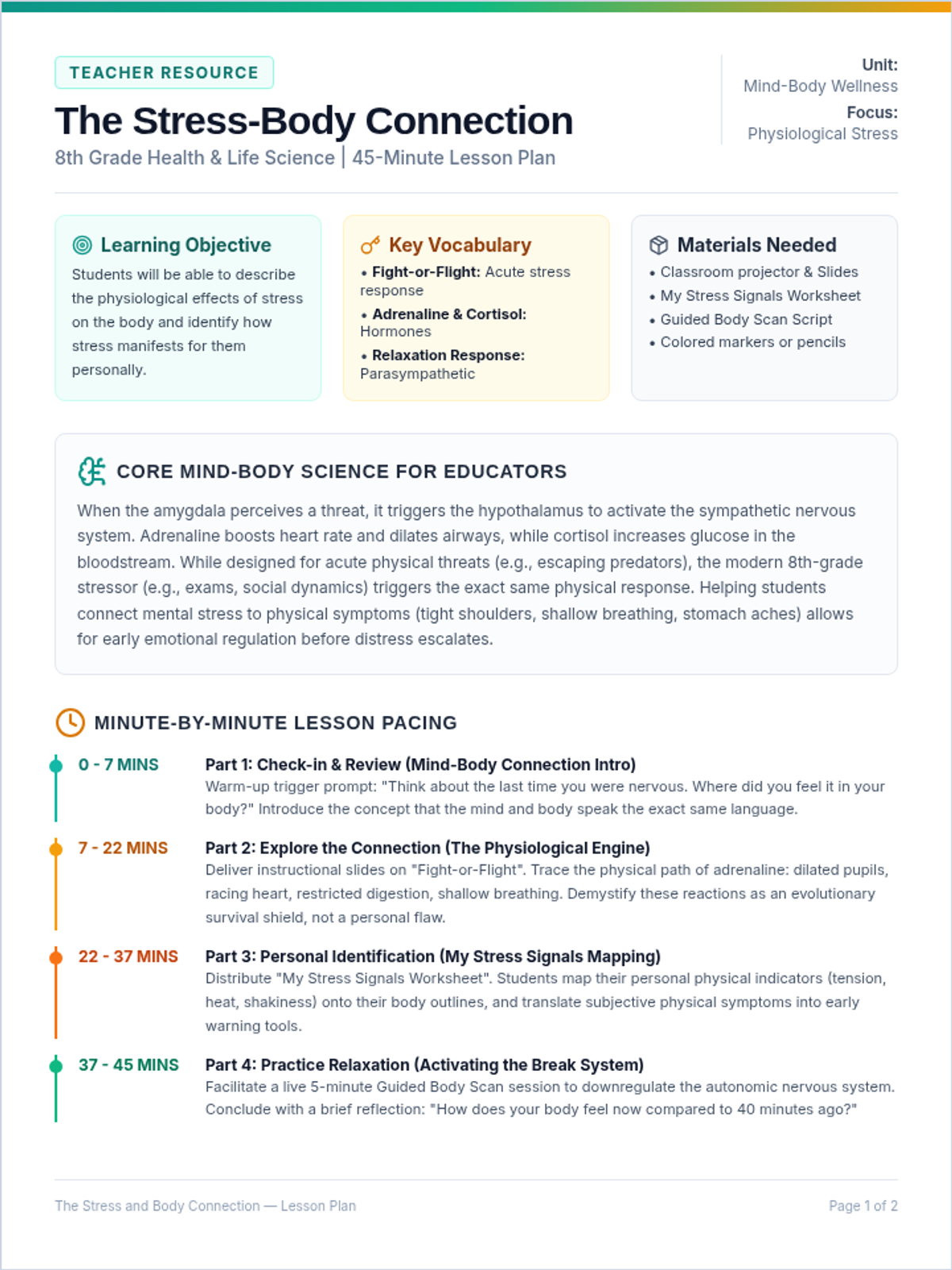
A comprehensive 2-page lesson plan for teachers, detailing objectives, core scientific concepts, a minute-by-minute pacing timeline, step-by-step facilitation instructions, discussion prompts, and differentiation strategies.
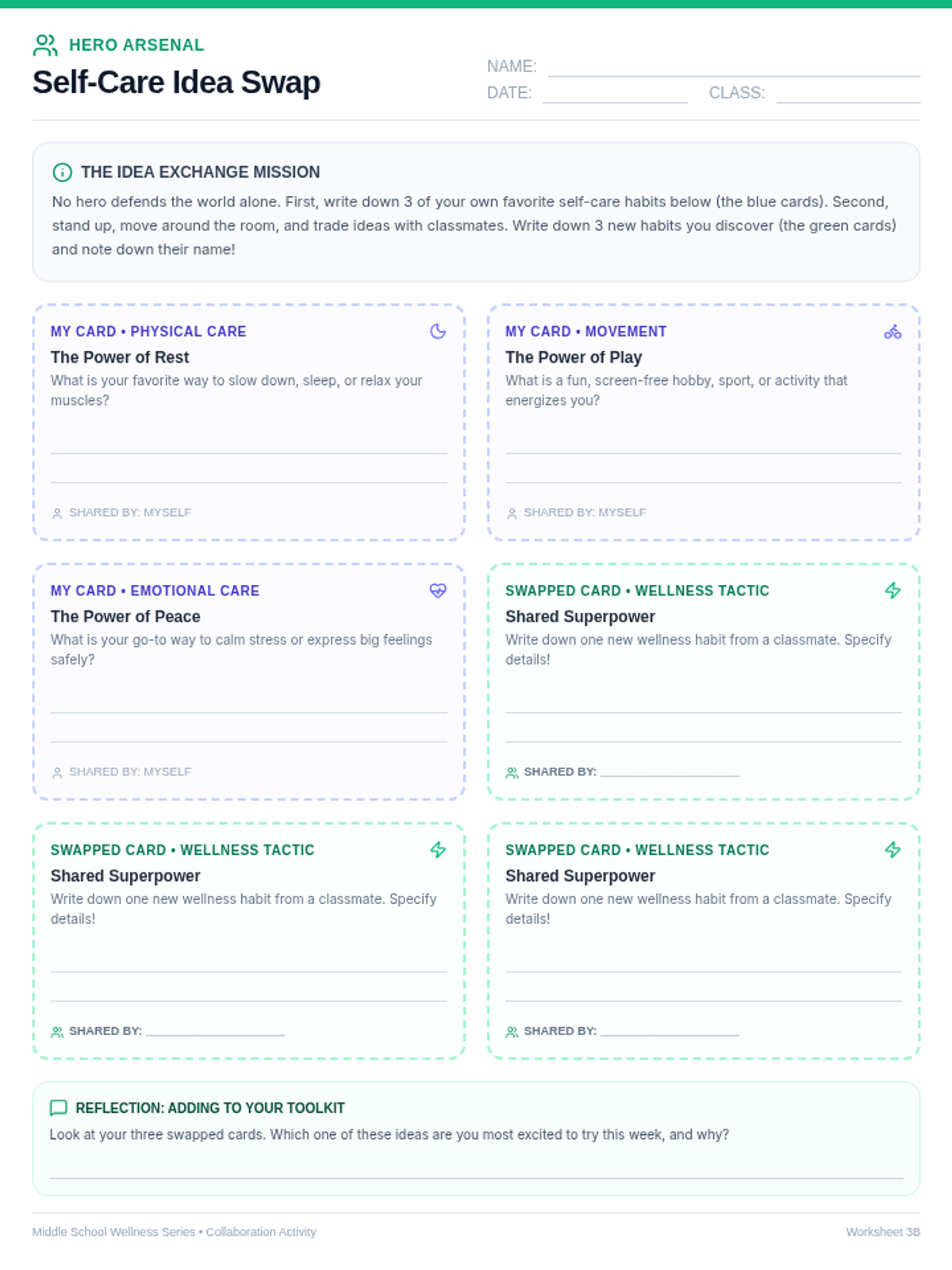
A highly engaging student-facing activity sheet for the collaborative brainstorming segment. Features six visually distinct, dash-bordered 'Power Cards' (3 personal, 3 swapped) to guide students through category brainstorming and active peer-to-peer strategy trading.
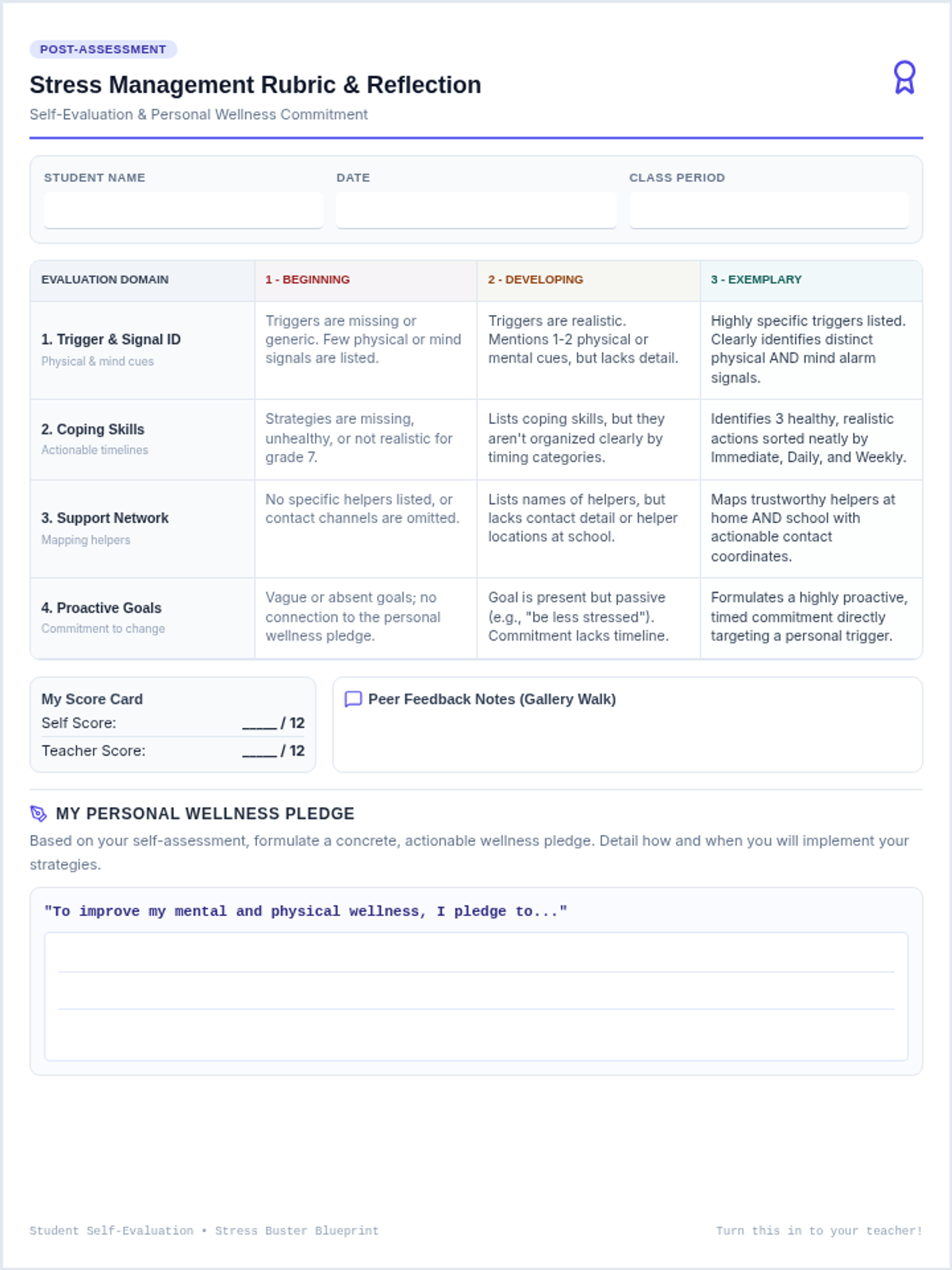
A beautifully structured single-page student assessment rubric containing 4 evaluative domains (Trigger ID, Coping Tools, Support Mapping, Proactive Goals) across 3 achievement levels, complete with an independent reflection commitment box.
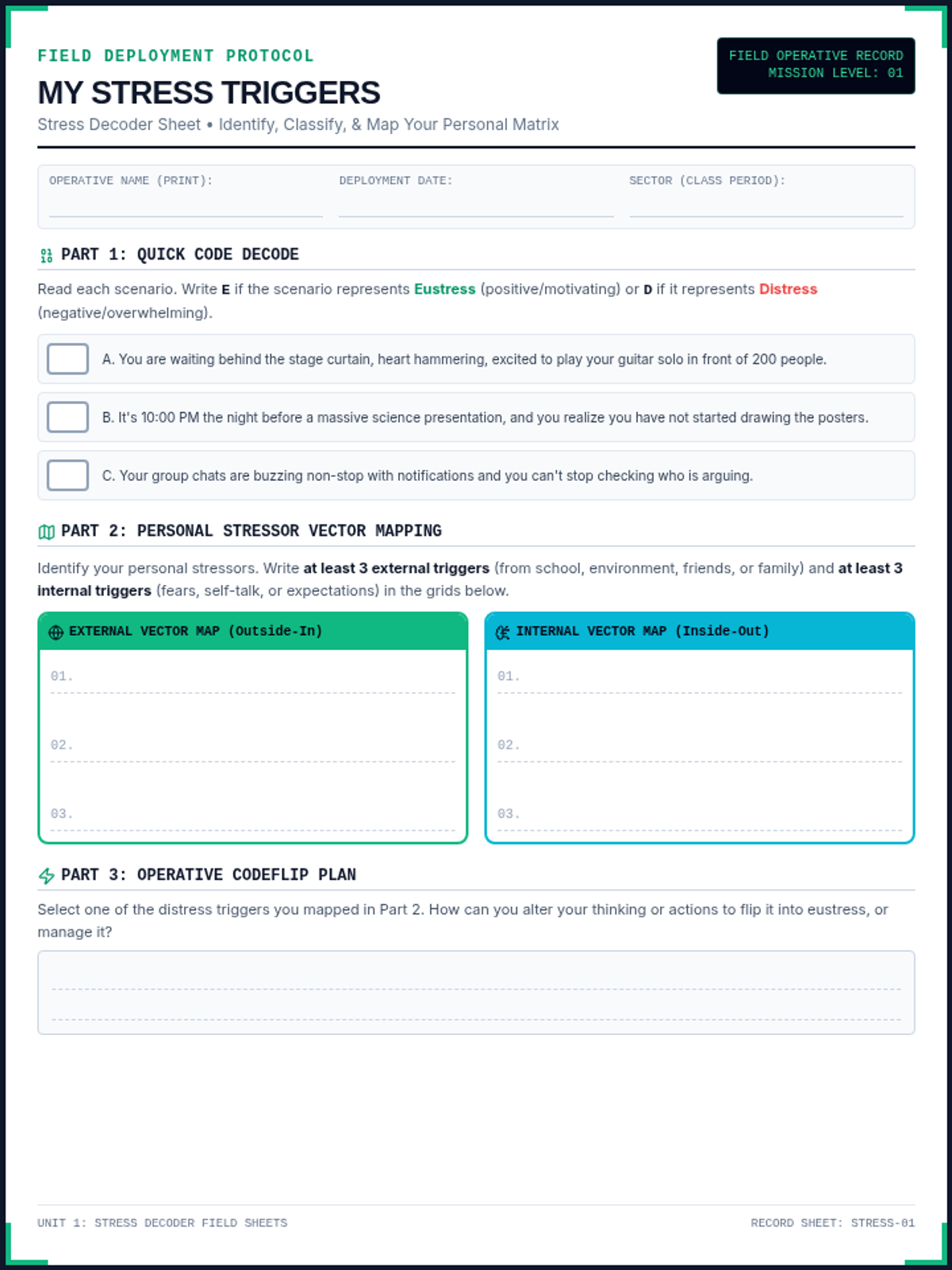
A student-facing 1-page worksheet styled as an interactive 'Stress Decoder Sheet'. Students classify stress scenarios and map their own internal and external stressors in dedicated white workspace grids.
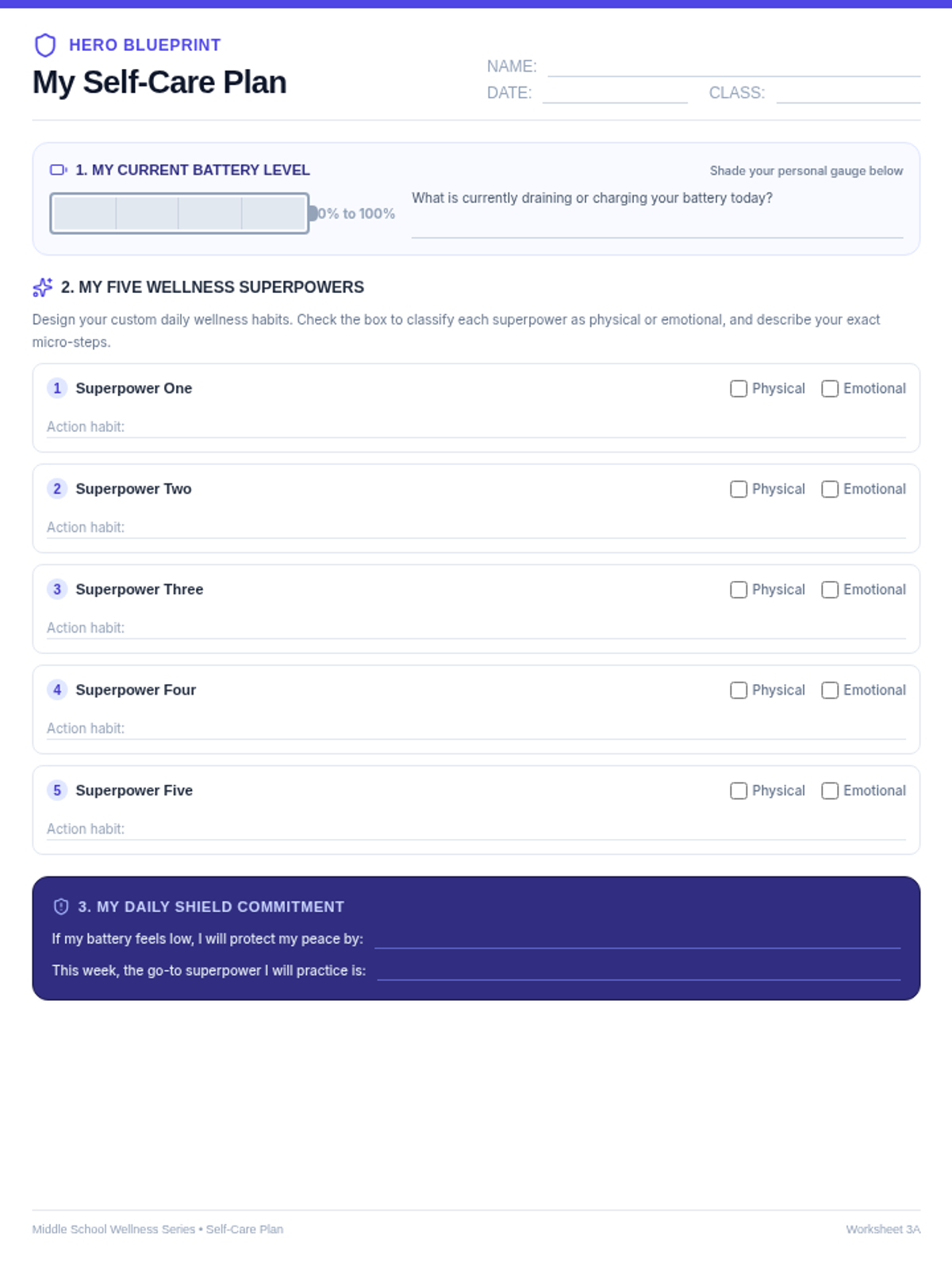
A beautifully styled, highly functional one-page student planning worksheet featuring a battery check visual gauge, structured space for designing 5 customized self-care superpowers, and a final personal wellness commitment block.
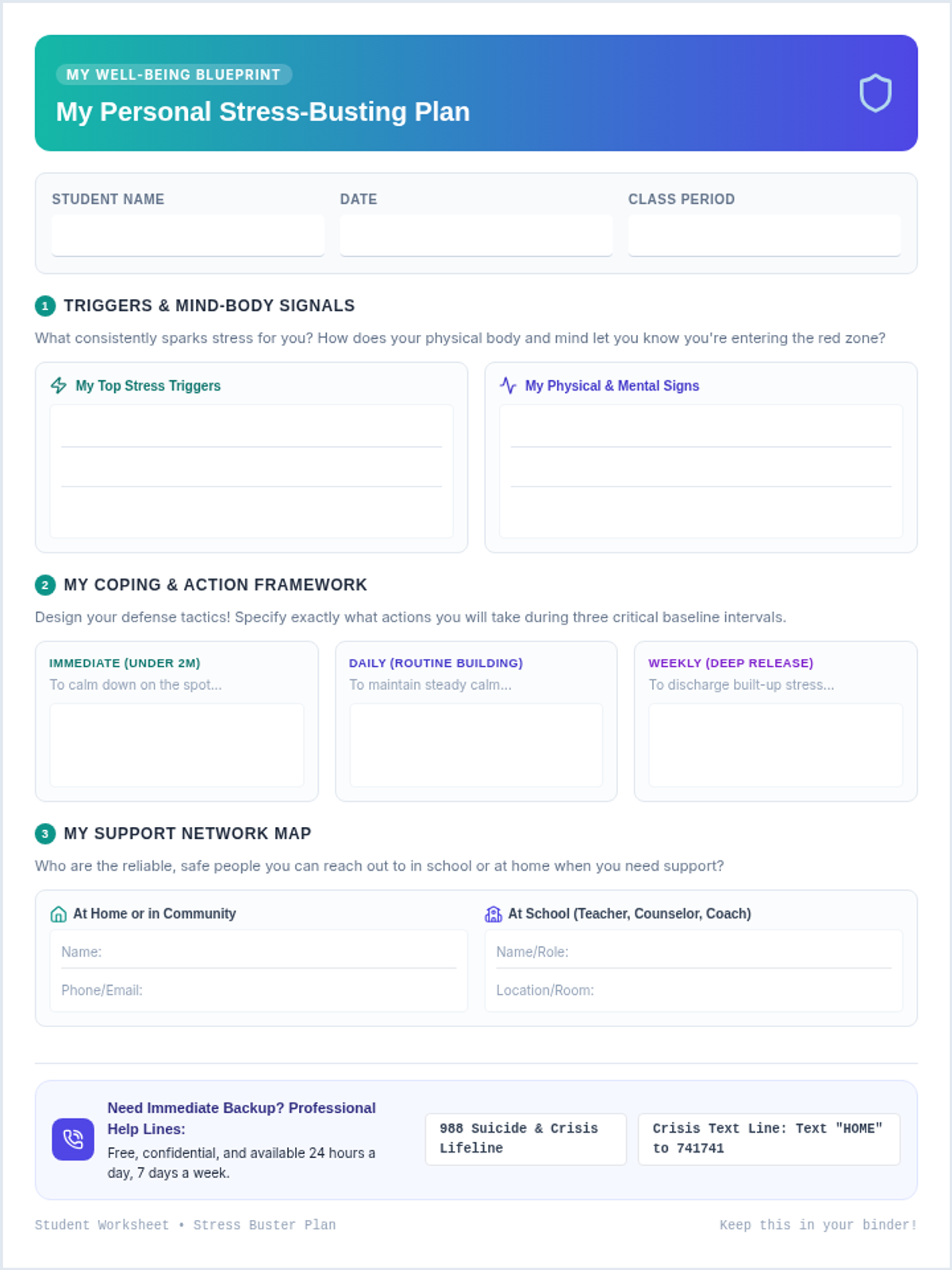
A beautifully formatted, single-page printable student worksheet where students identify their stress triggers, build immediate/daily/weekly action plans, and map out their personal help network.
A highly visual, 10-slide presentation that structures the lesson phases, reviews key stress concepts with quick-fire trivia, supports students during the coping plan creation, and guides the gallery walk feedback and rubric post-assessment.
A visually stunning, seven-slide deck designed to guide students through the 45-minute lesson, featuring high-contrast dark theme visuals, battery charge indicators, clear definitions, and active steps for the Idea Swap and personal planning.
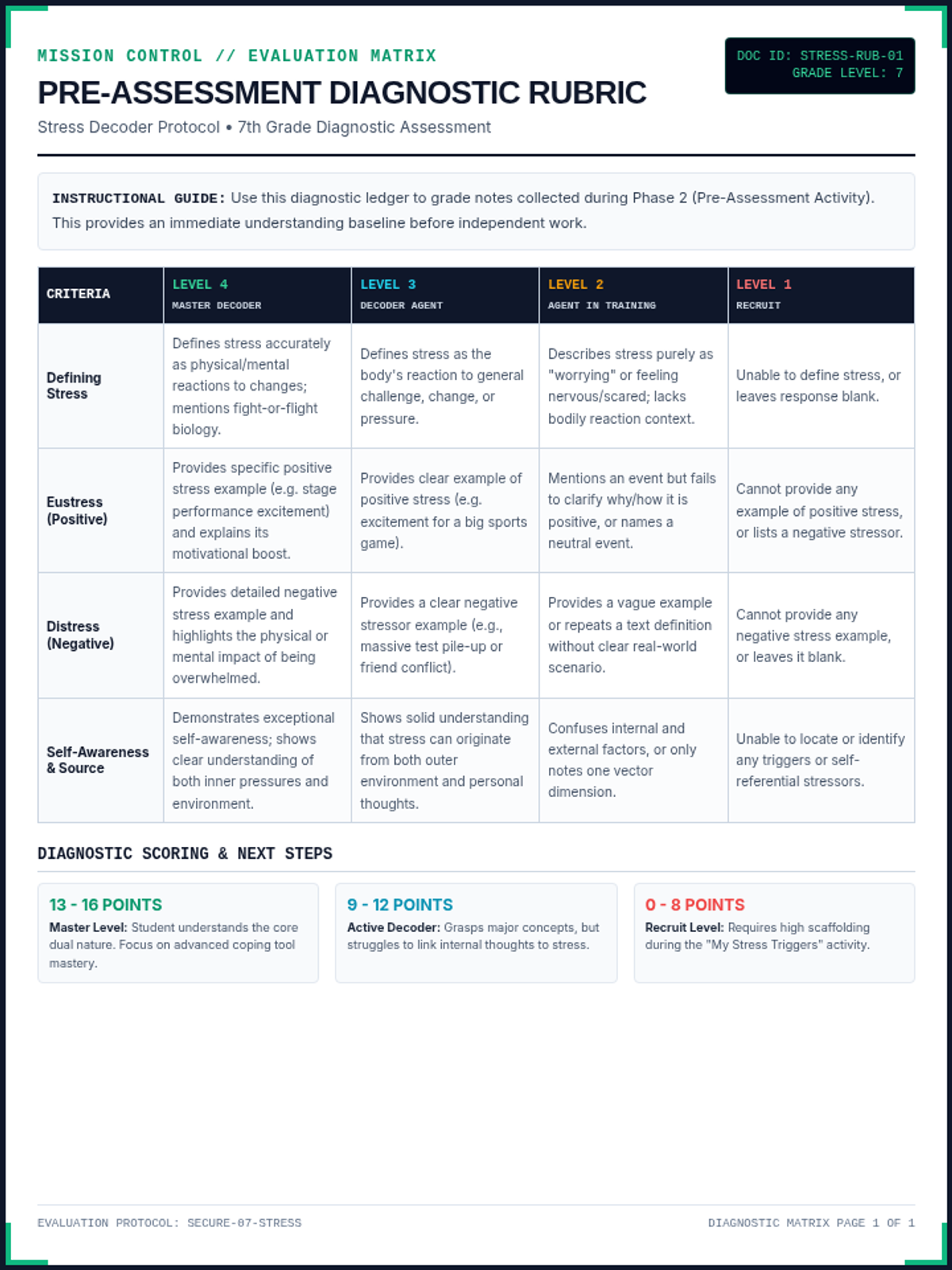
A professional 1-page teacher grading rubric for the Stress Management Pre-Assessment activity, classifying levels of student understanding from 'Recruit' to 'Master Codebreaker'.
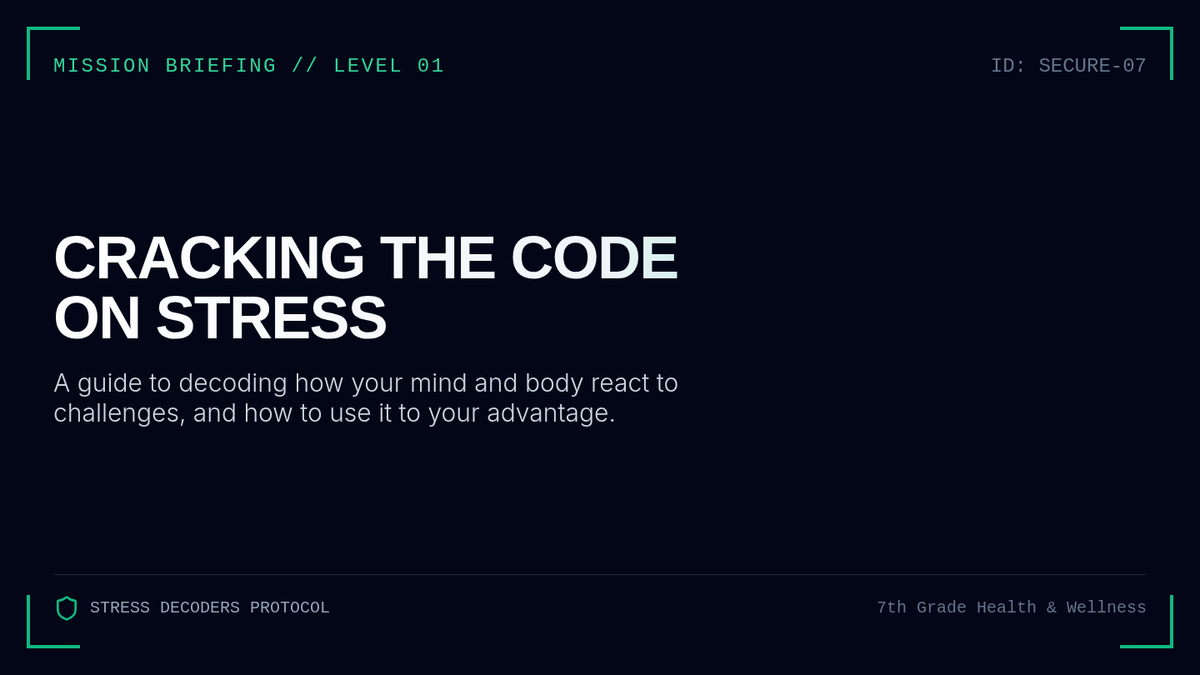
A highly engaging, visual 6-slide deck introducing students to the stress concept, the eustress vs. distress framework, and external vs. internal stressors with a secret agent/decoder aesthetic.
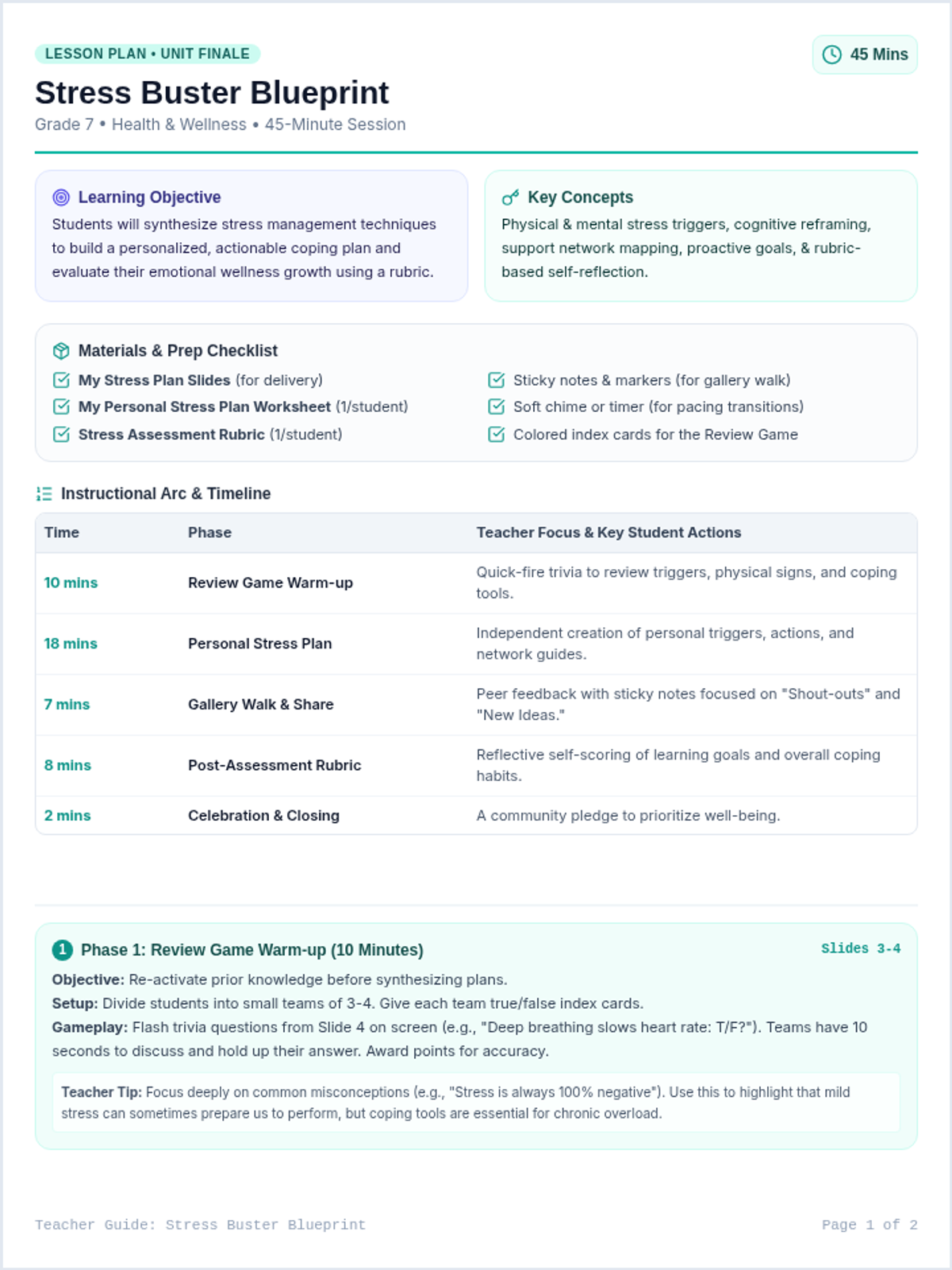
A comprehensive 2-page teacher's guide for the 45-minute lesson, outlining the instructional sequence, warm-up game, coping plan guidelines, gallery walk, and rubrics.
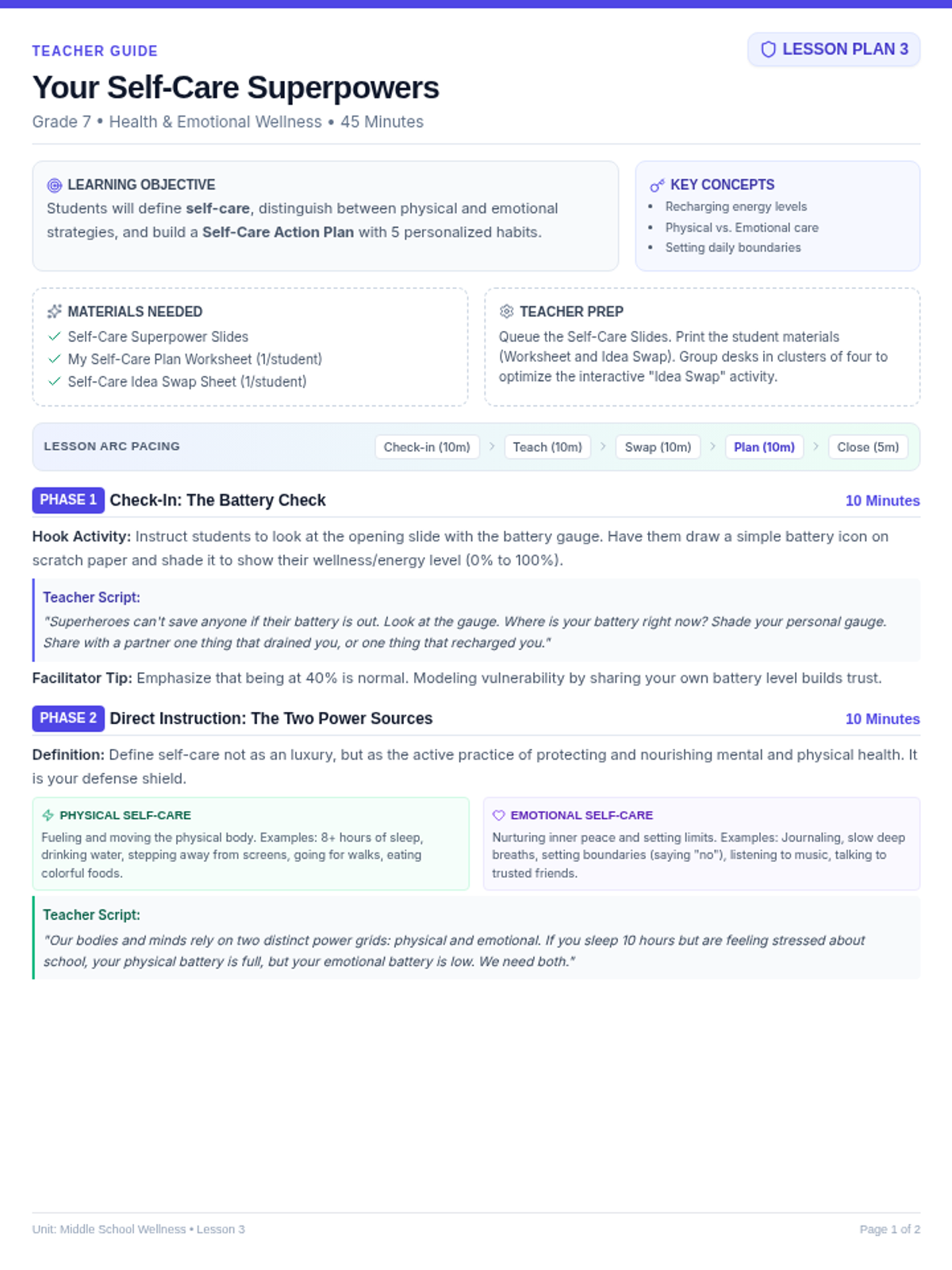
A comprehensive, two-page facilitator's guide outlining the 45-minute lesson plan, detailed timing, teacher scripts, visual cues, and implementation tips for teaching seventh graders how to harness self-care as their personal 'superpower'.
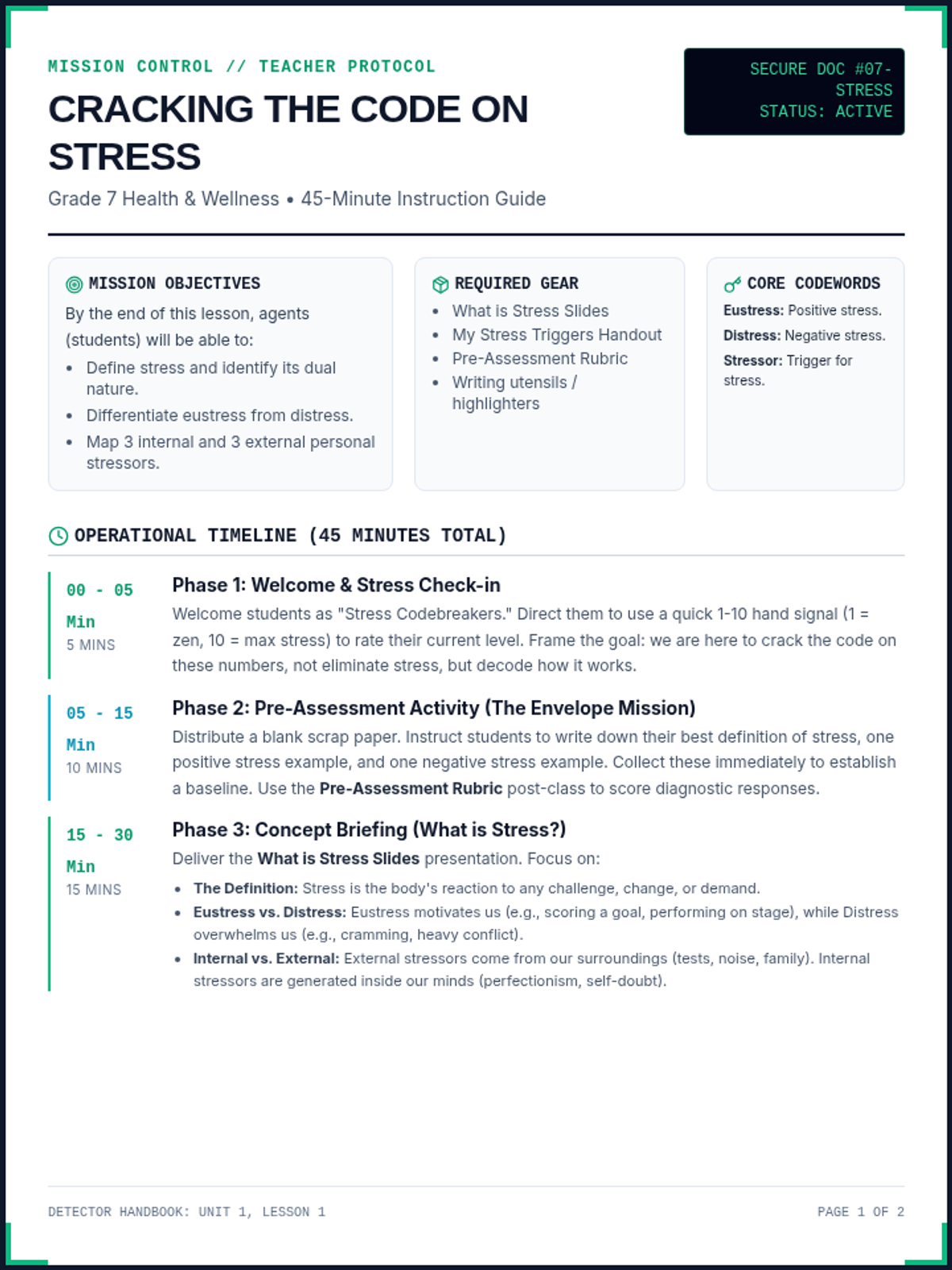
A 2-page comprehensive teacher lesson plan for 'Cracking the Code on Stress' featuring a minute-by-minute pacing guide, key definitions, and actionable teaching tips.