Stop-and-think strategies, impulse management, and SMART goal setting for personal growth. Develops internal motivation, stress reduction techniques, and resilience through proactive planning and monitoring.
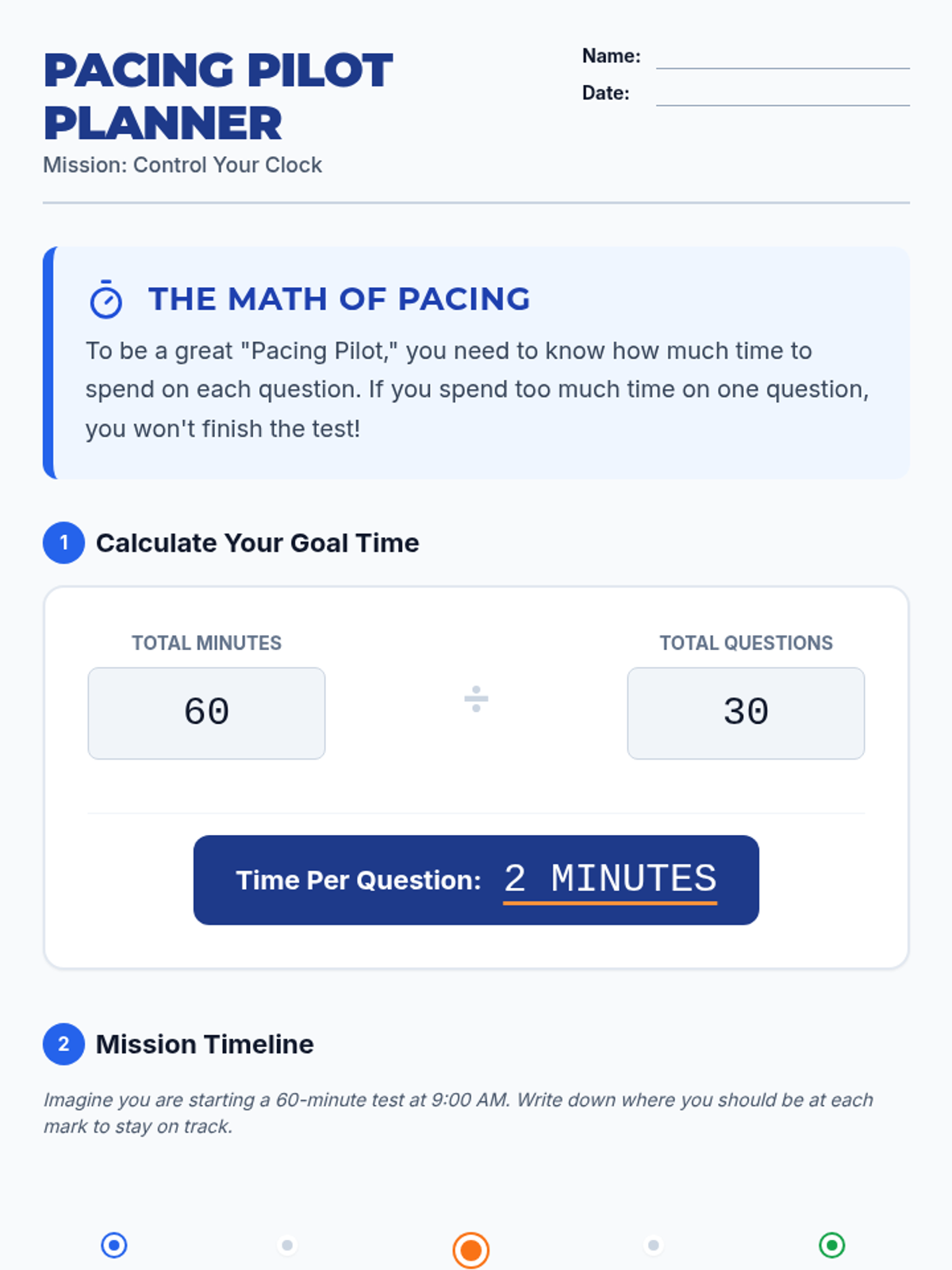
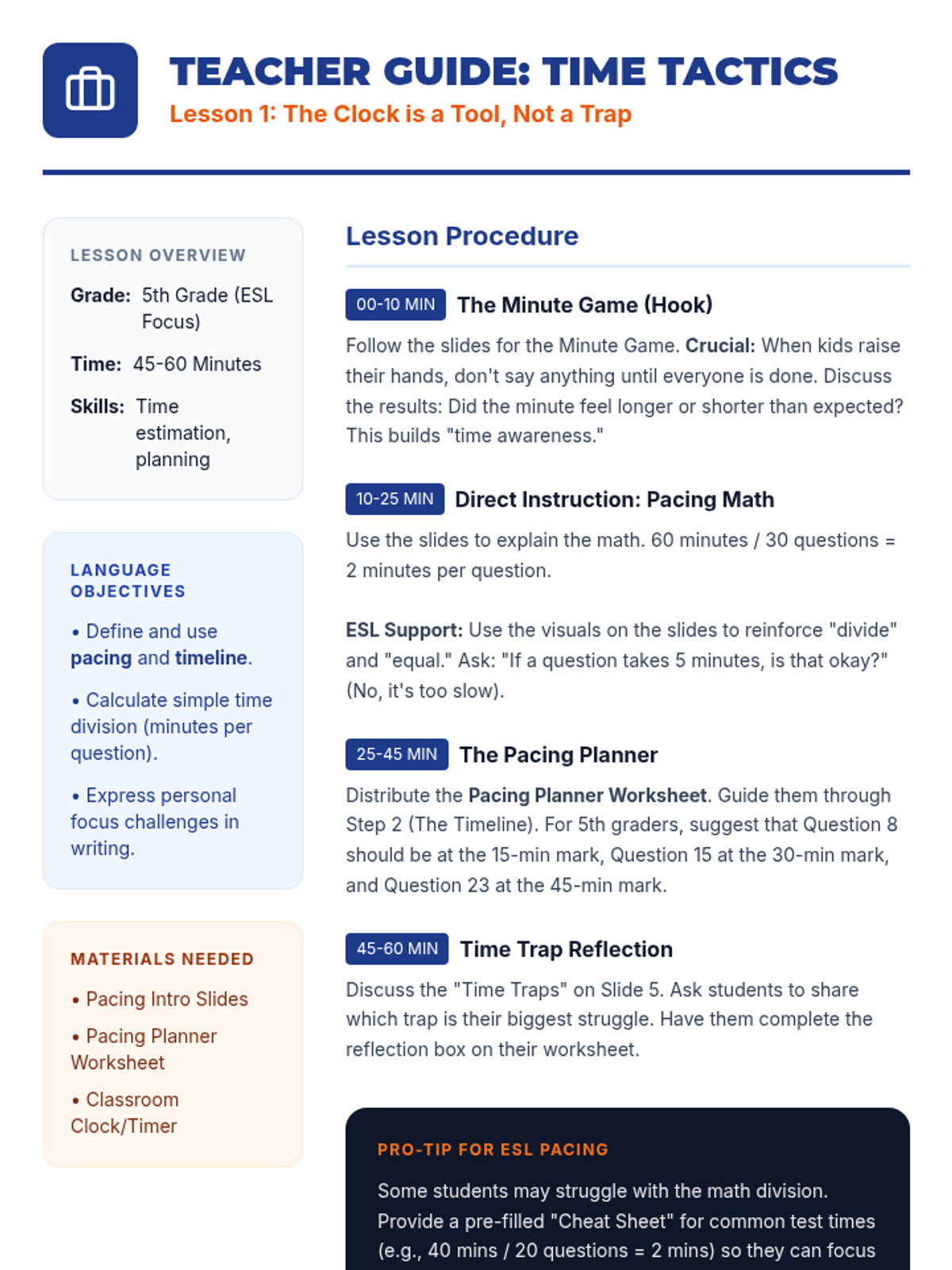
This sequence helps students master time management and prioritization during exams. Through hands-on activities and simulations, students learn to estimate pacing, use the 'skip and return' strategy, navigate long passages efficiently, and manage test anxiety.
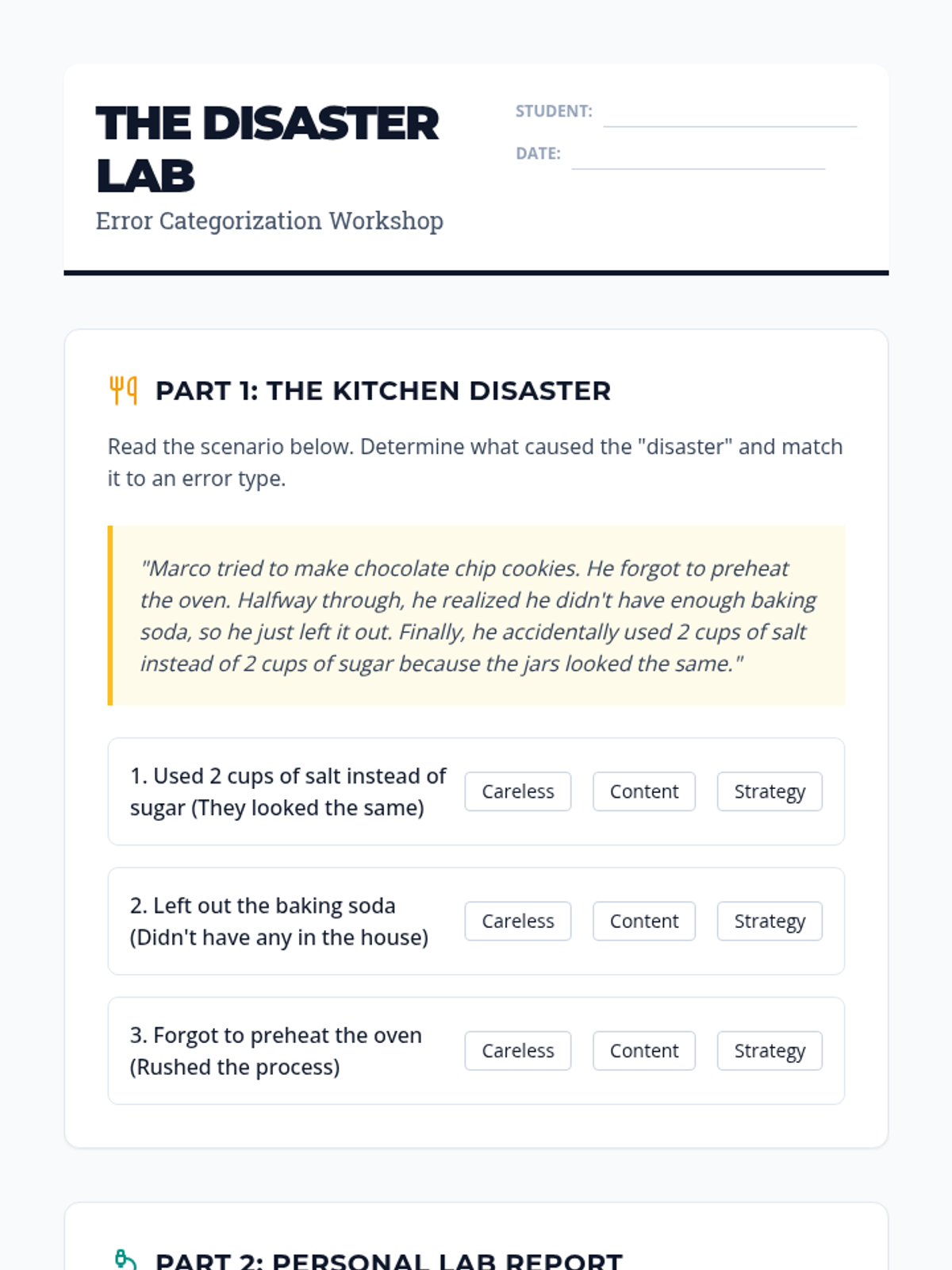
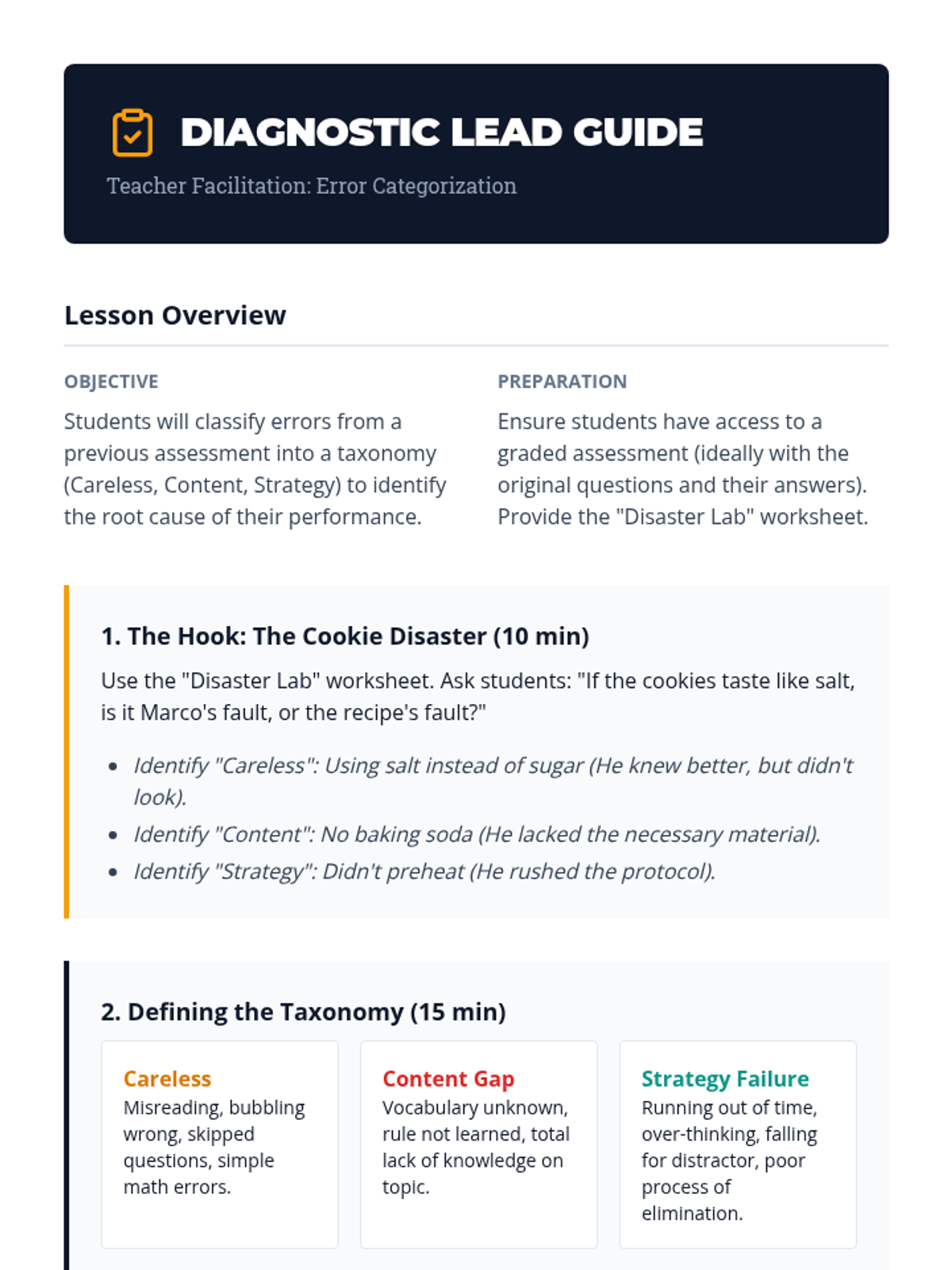
A comprehensive sequence on metacognitive error analysis, teaching students to categorize, analyze, and learn from their mistakes to improve test-taking performance. Students move from simple error classification to deep retrospective correction and personal strategy development.
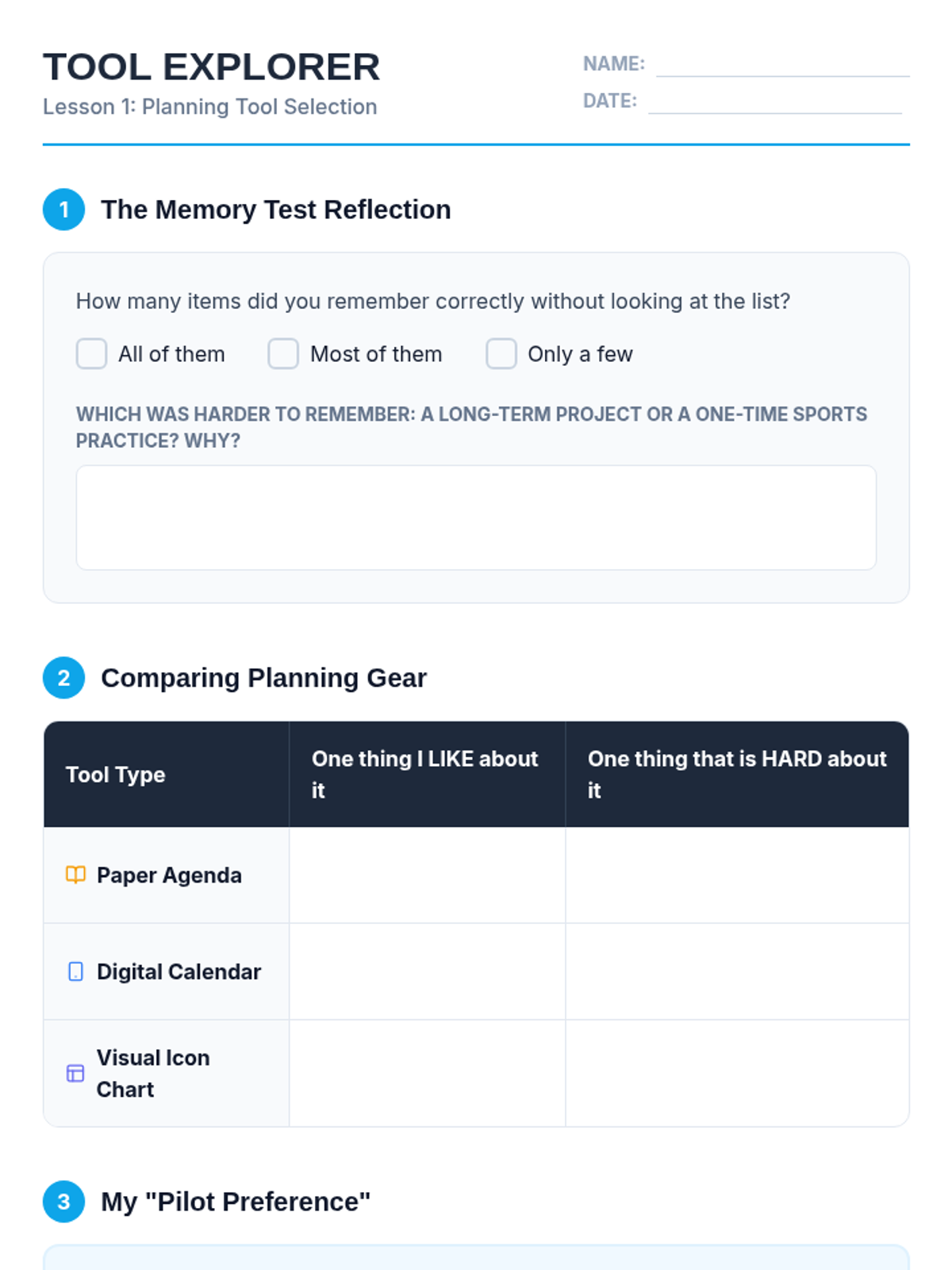
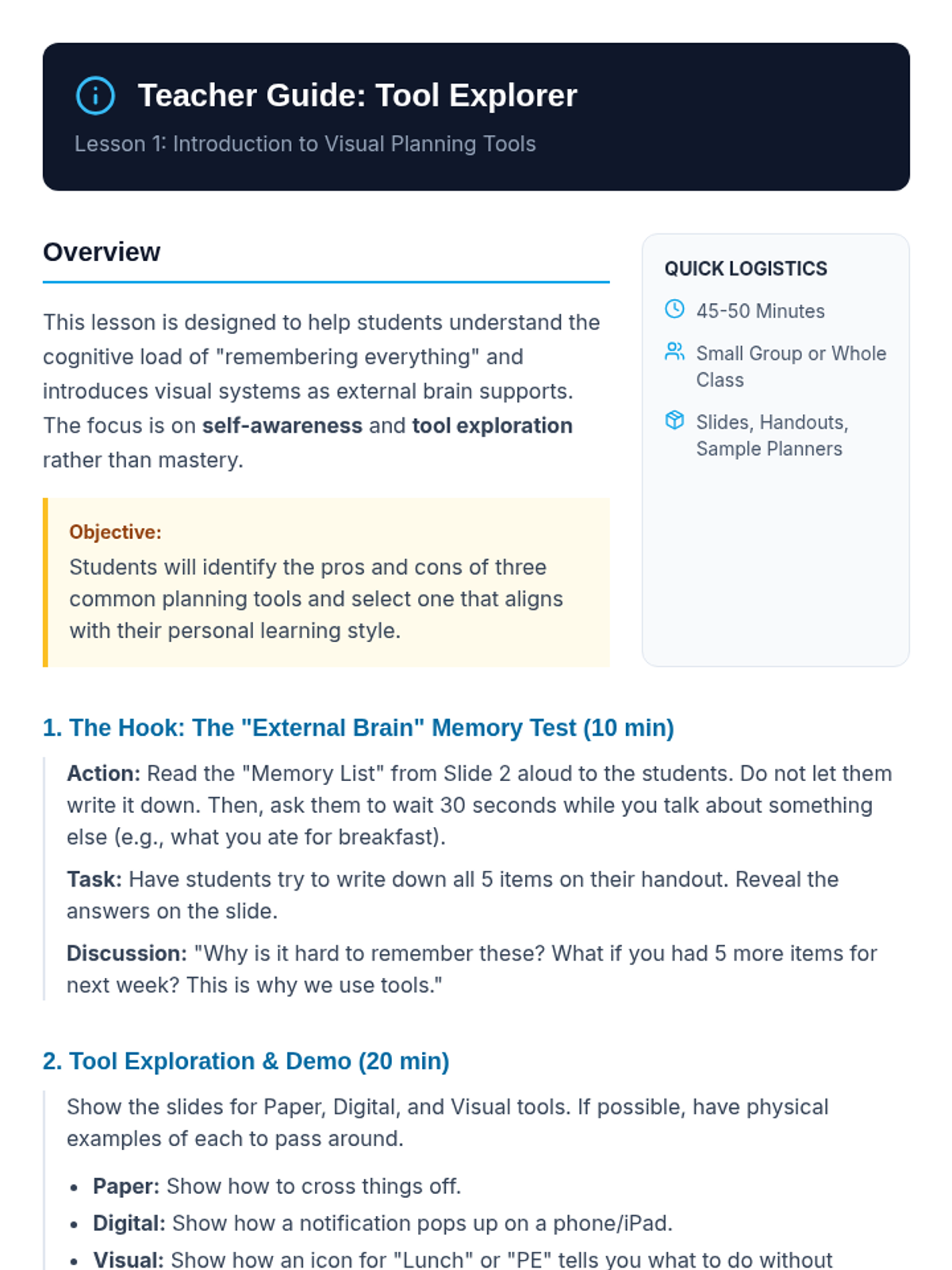
This sequence introduces 6th-grade students to visual planning and time management. Students learn to use different tools, distinguish between fixed and flexible time, and develop routines to maintain a personalized organizational system.
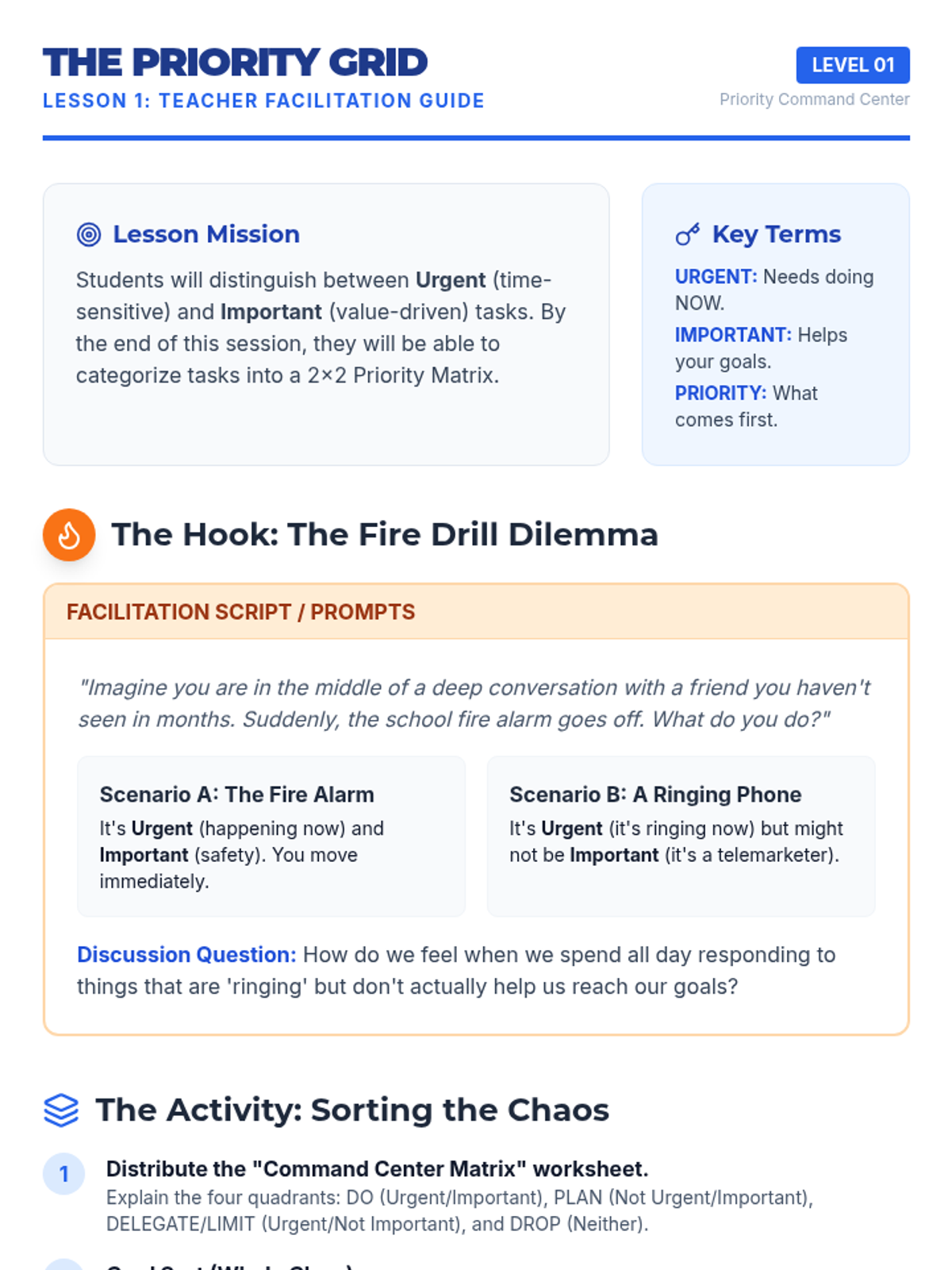
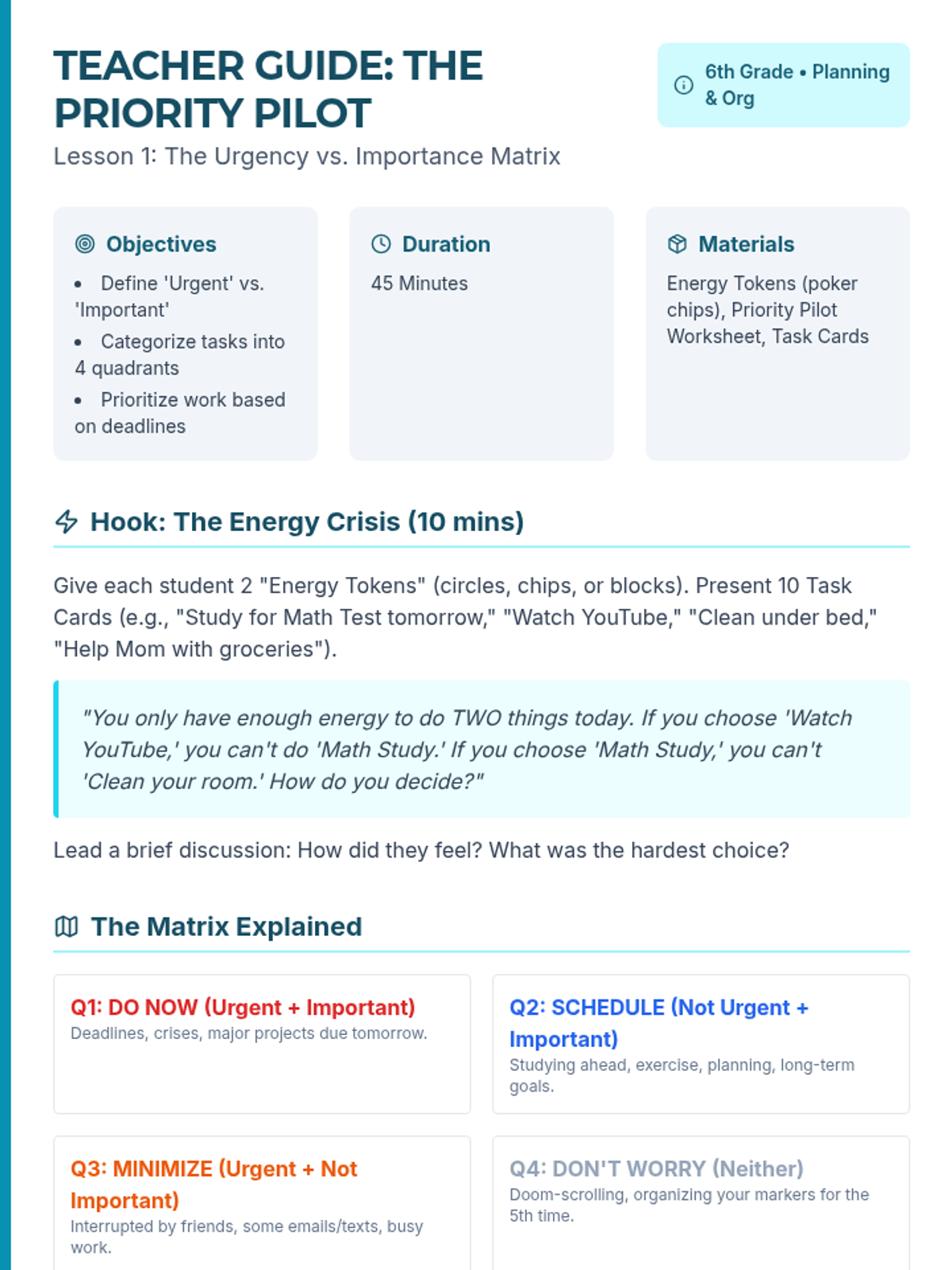
This sequence teaches 6th-grade students how to balance multiple commitments using urgency and importance frameworks. Through game-based simulations and the 'Jar of Rocks' analogy, students develop executive function skills for effective prioritization.
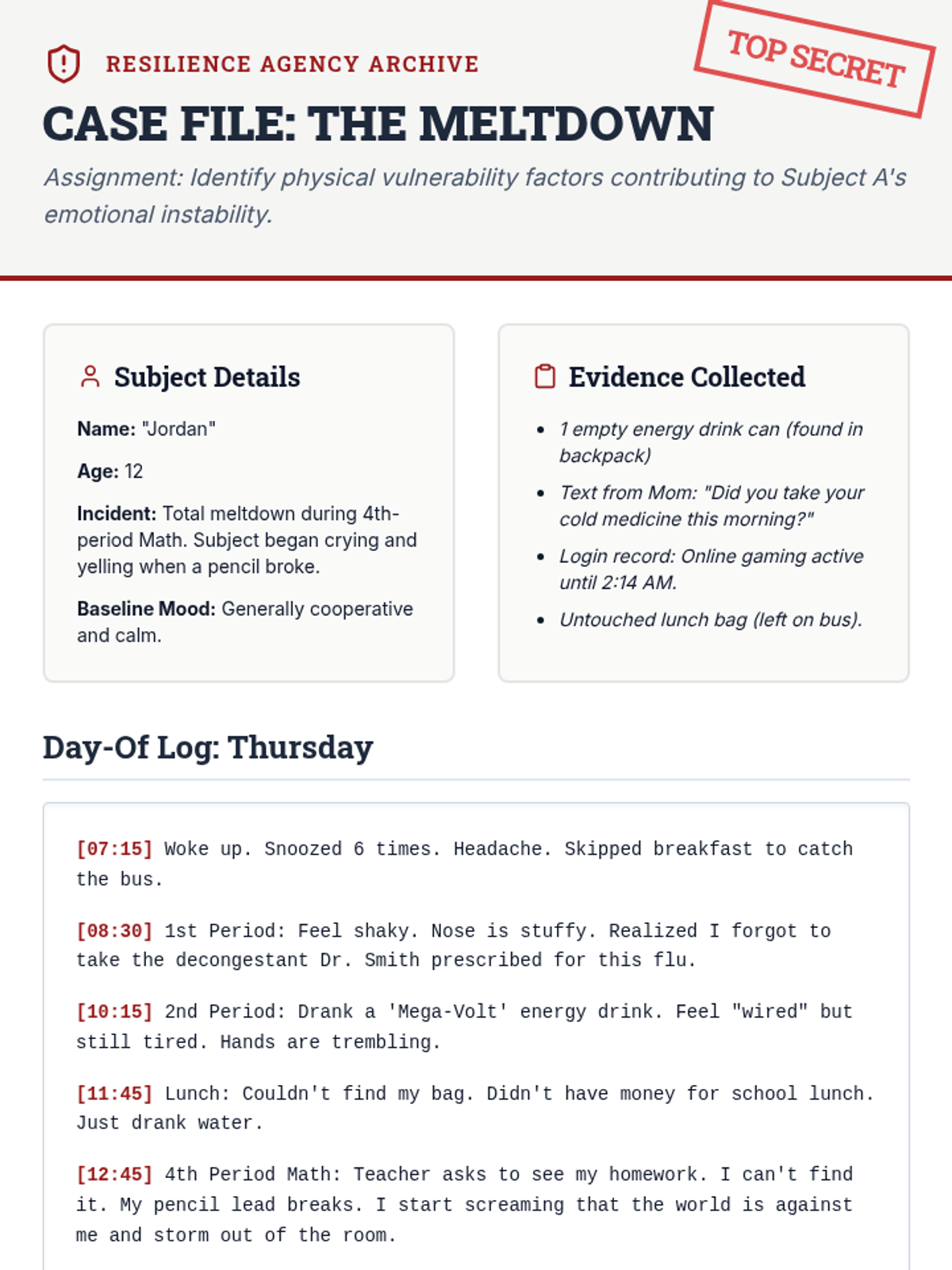
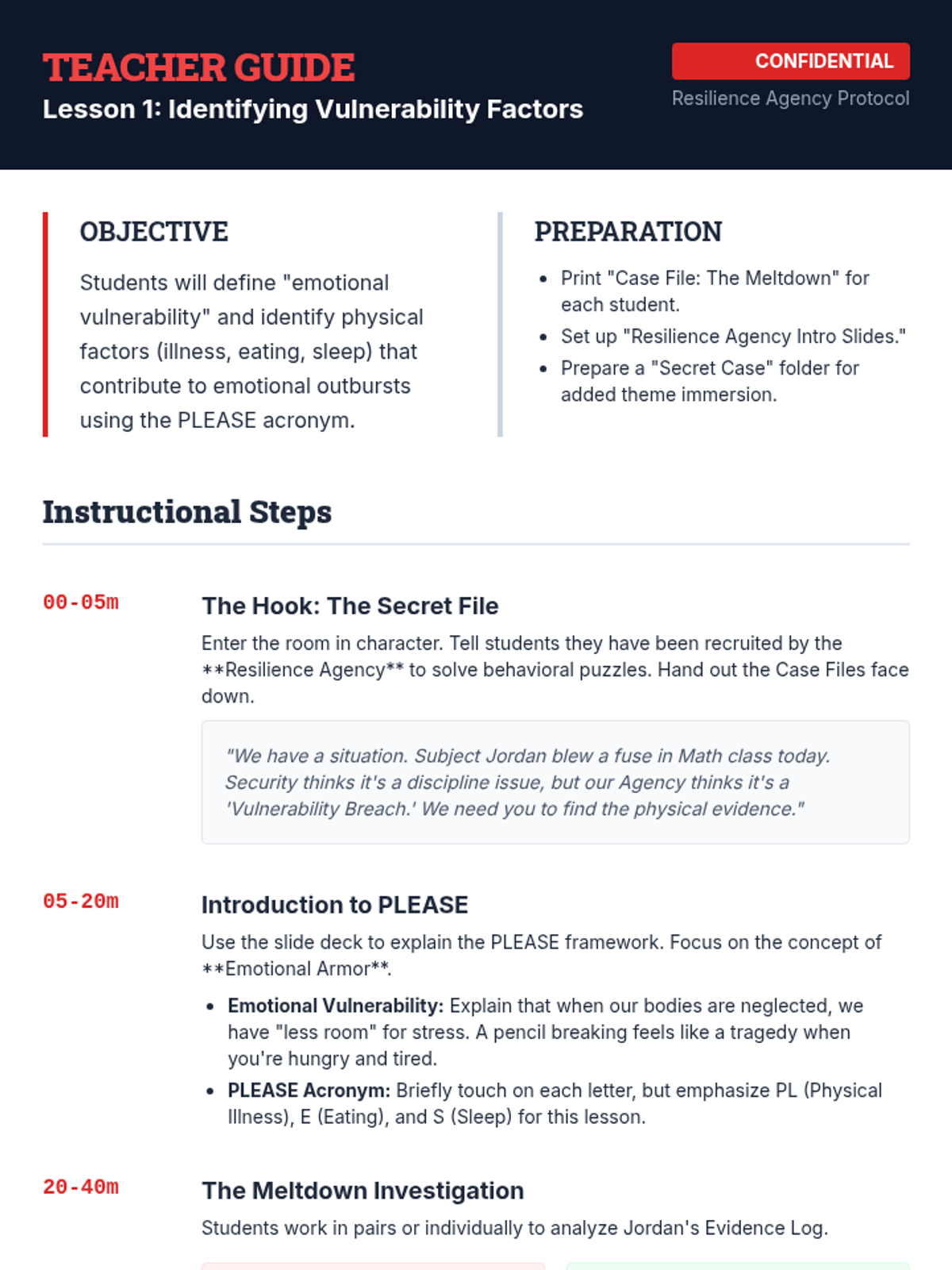
A case study-based sequence where 6th-grade students act as 'Resilience Consultants' to analyze how physical self-care (the PLEASE framework) reduces emotional vulnerability and prevents interpersonal conflict.
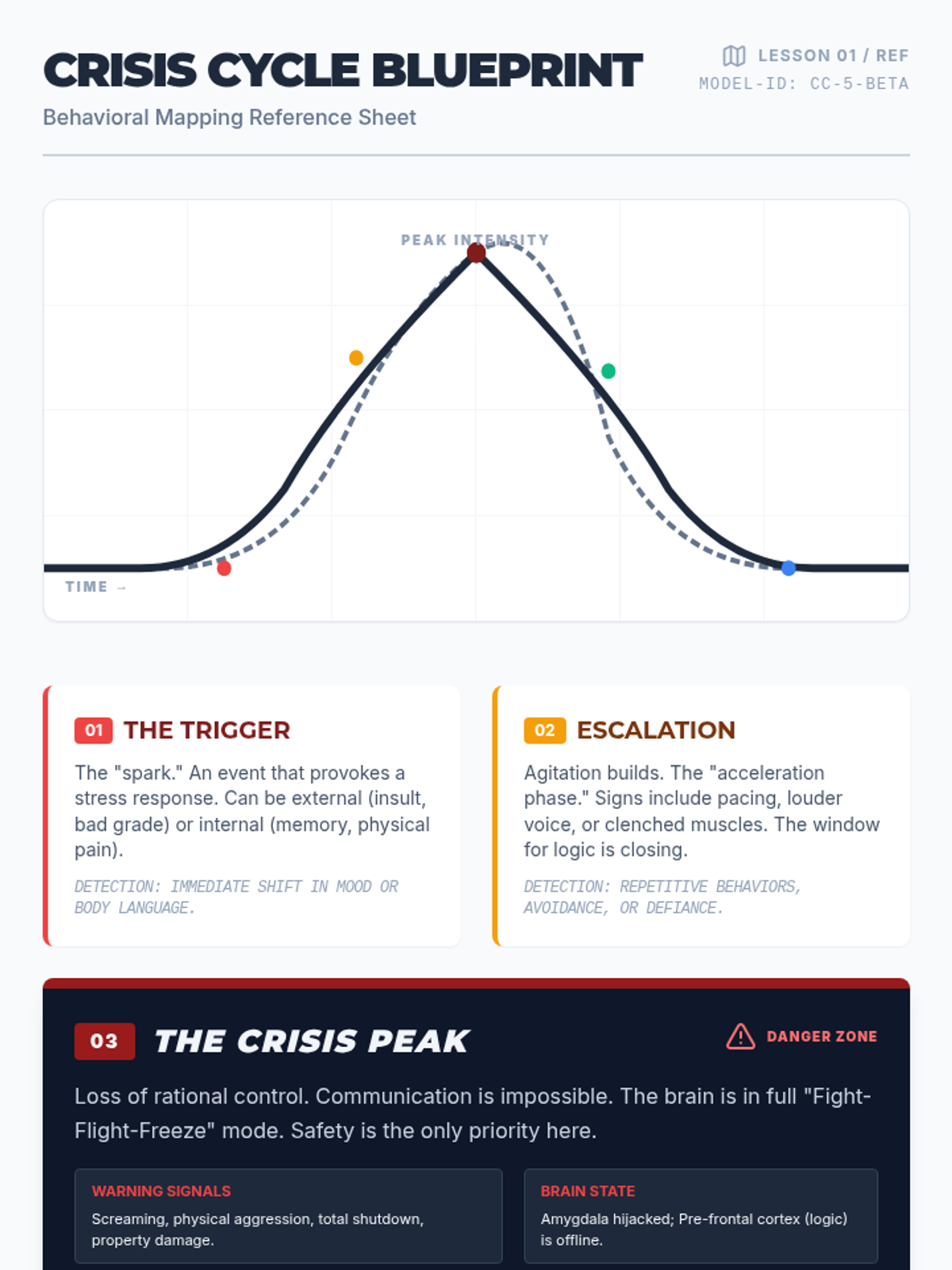
A comprehensive 5-lesson unit on the Crisis Cycle, focusing on identifying triggers, escalation stages, and intervention points through a technical mapping and simulation lens. Students move from theoretical understanding to retroactive detective work to understand behavioral patterns.
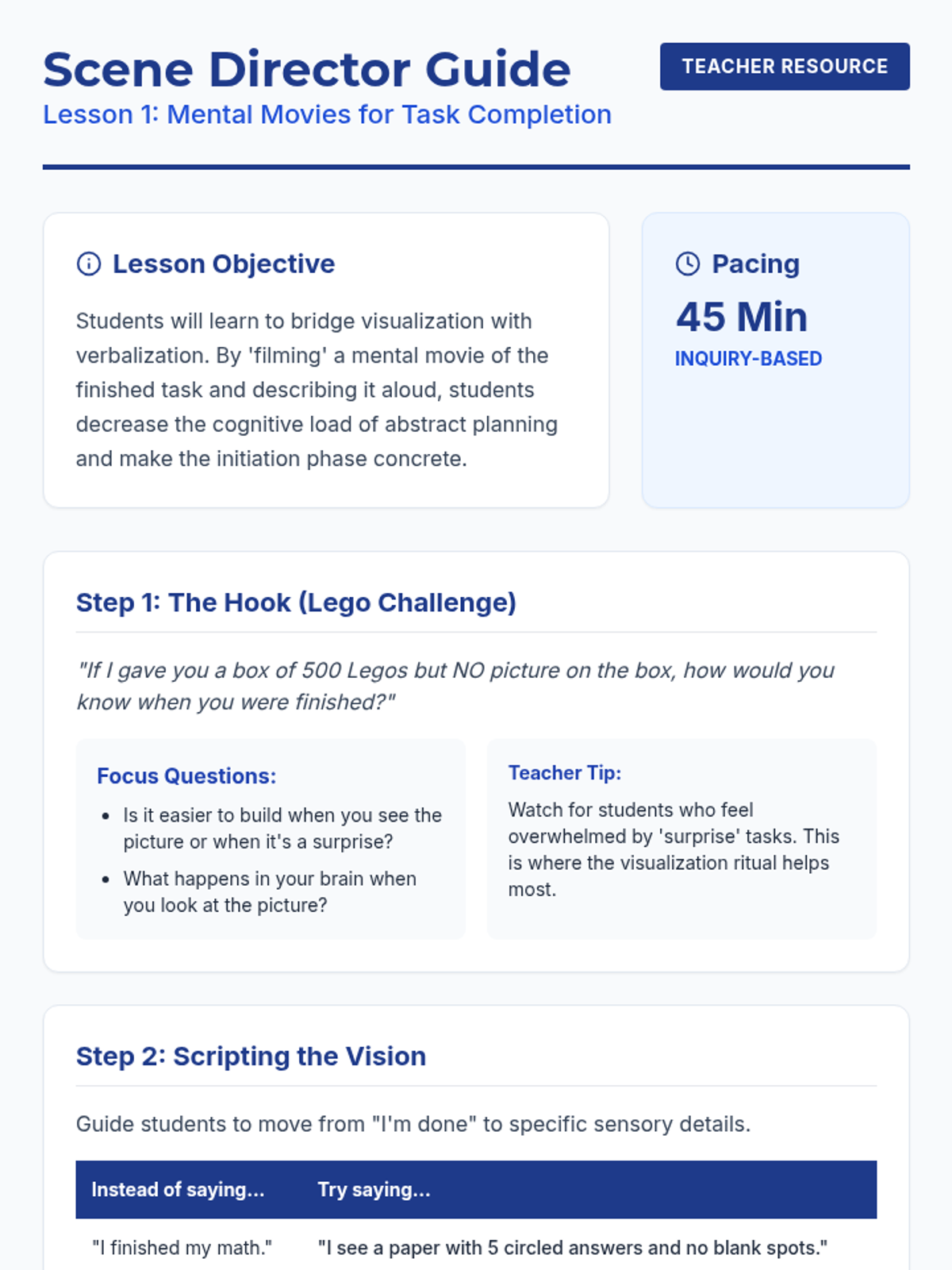
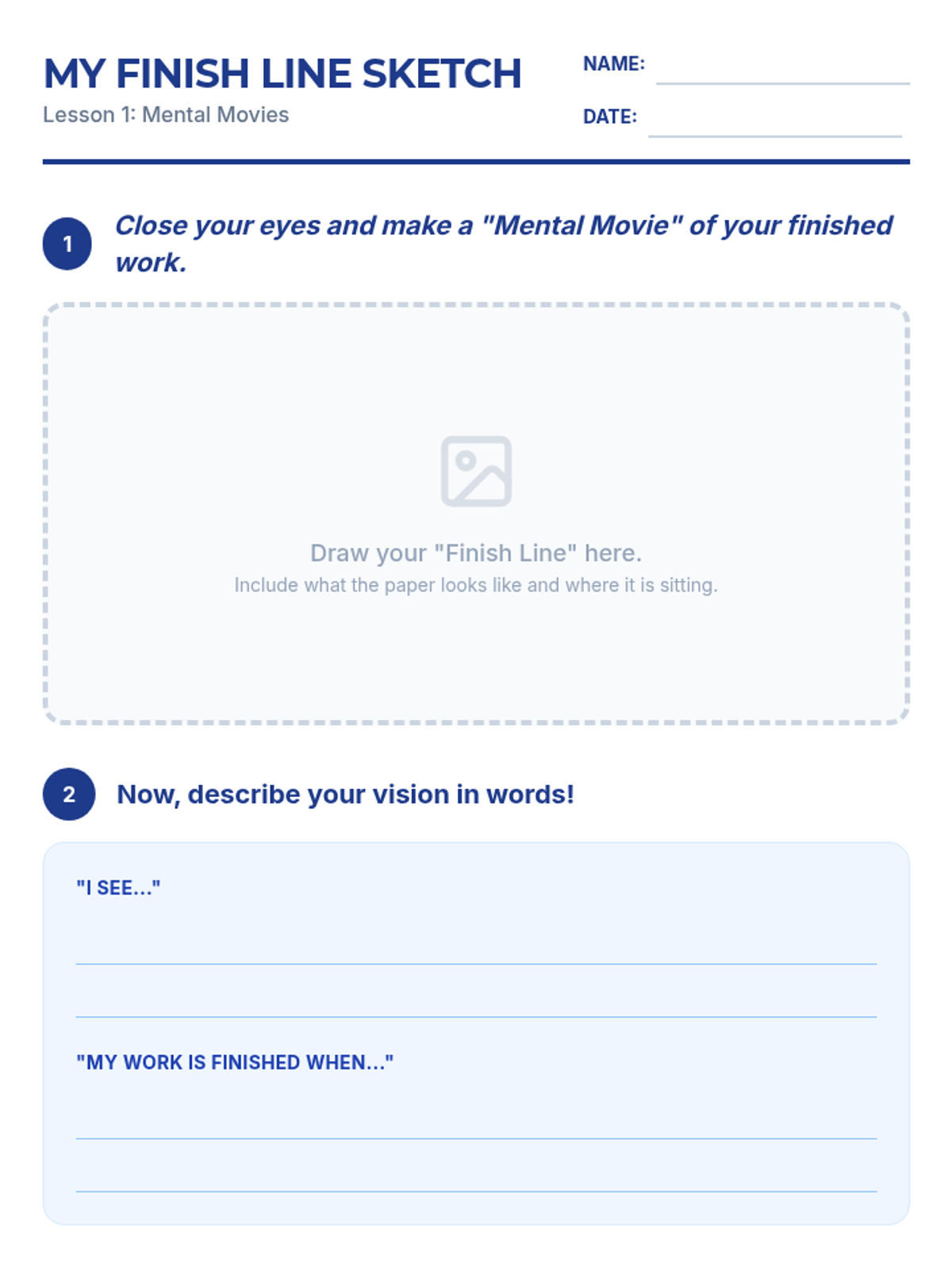
This sequence helps students overcome task initiation hurdles by combining visualization and verbal self-talk. Students learn to 'see' the finished product, reverse engineer the steps, estimate time accurately, and use micro-goals to take the first step.
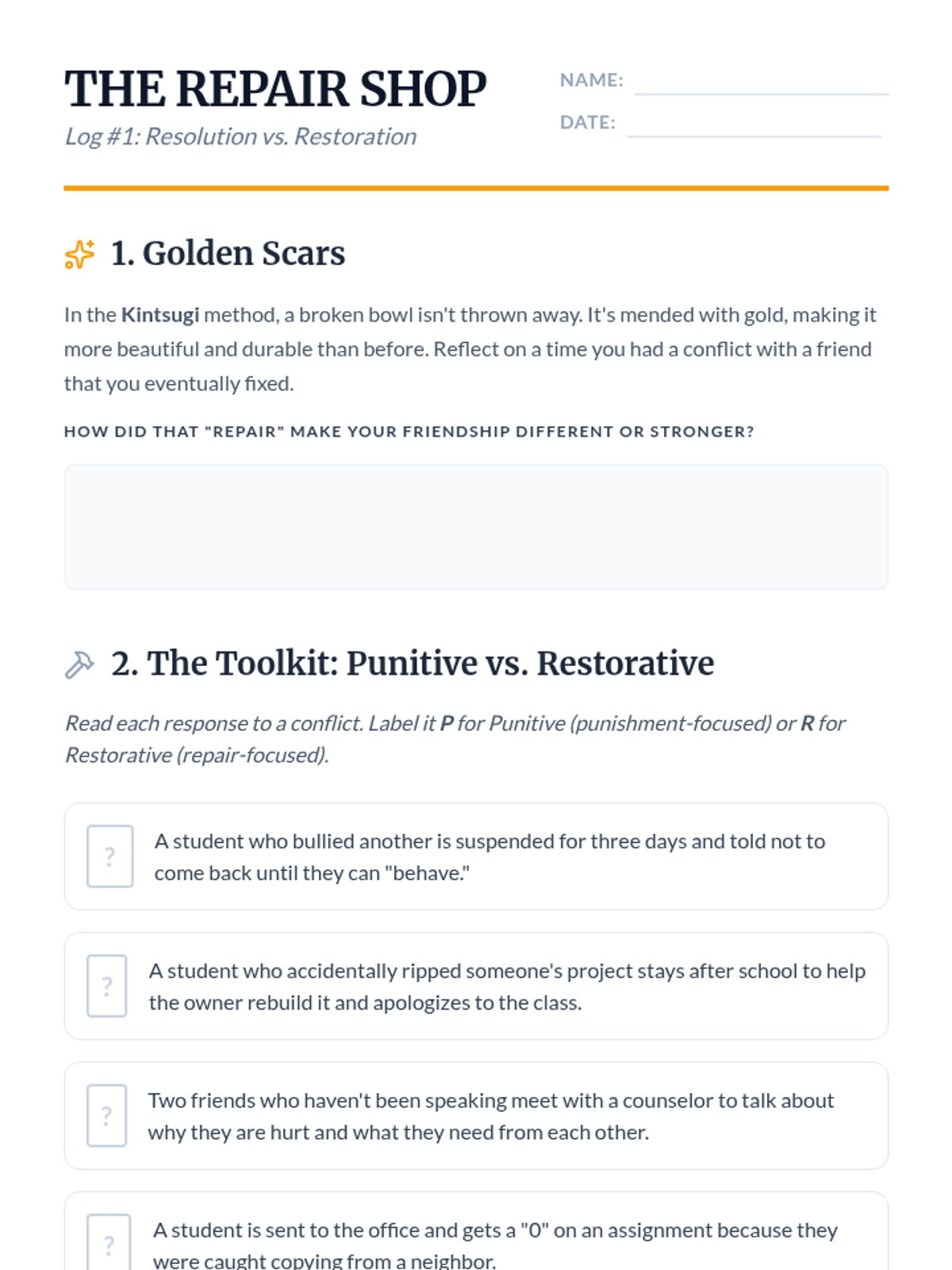
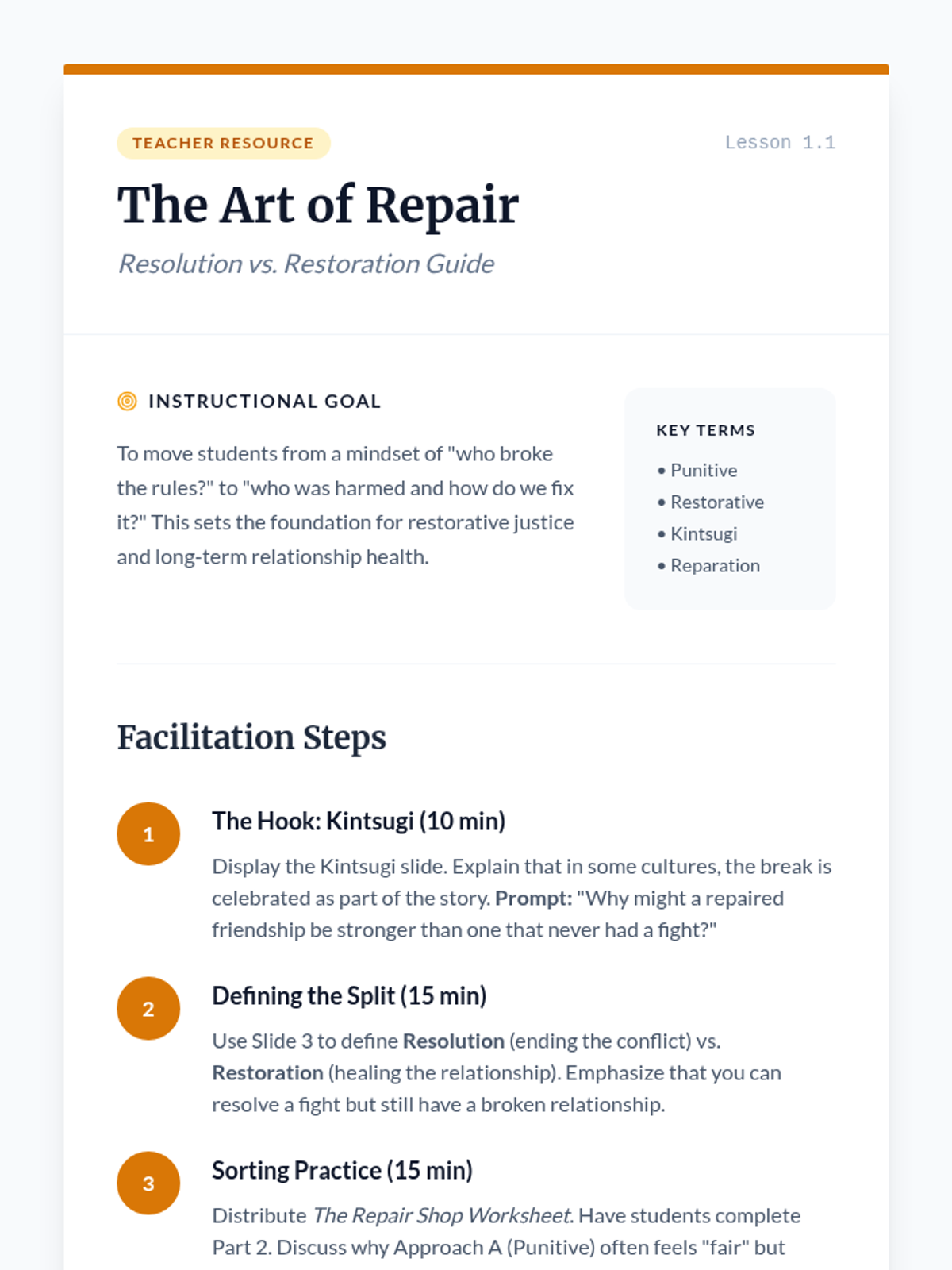
A 5-lesson sequence for 6th graders focusing on the aftermath of conflict: restoration, genuine apologies, sustainable agreements, and rebuilding trust. Students move beyond just 'stopping a fight' to actively repairing relationships and creating long-term peace.
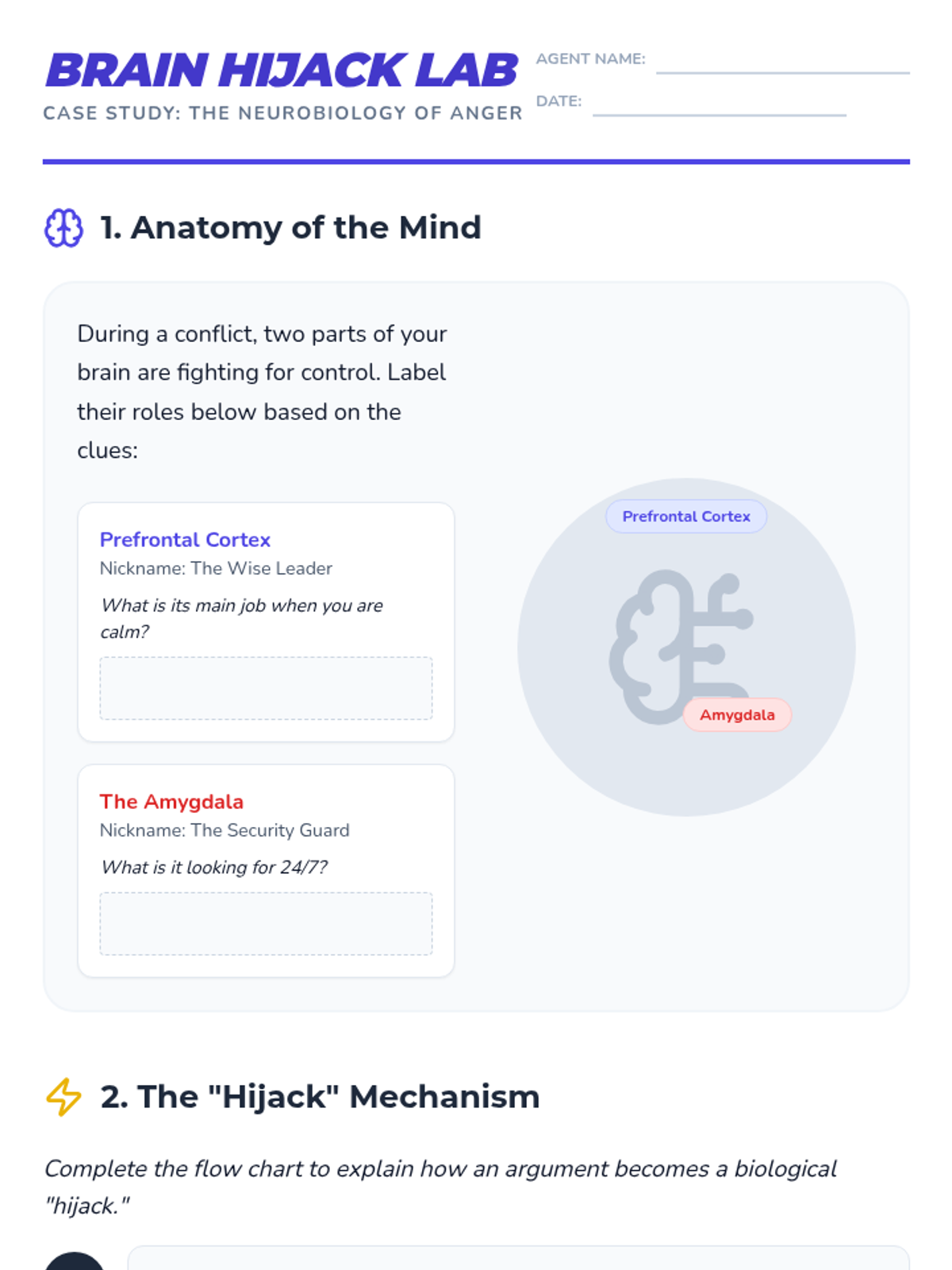
A 5-lesson sequence for 6th graders on emotional regulation and de-escalation during conflict. Students learn the science of the 'amygdala hijack', identify personal triggers, practice calming strategies, and learn to de-escalate peer conflicts.
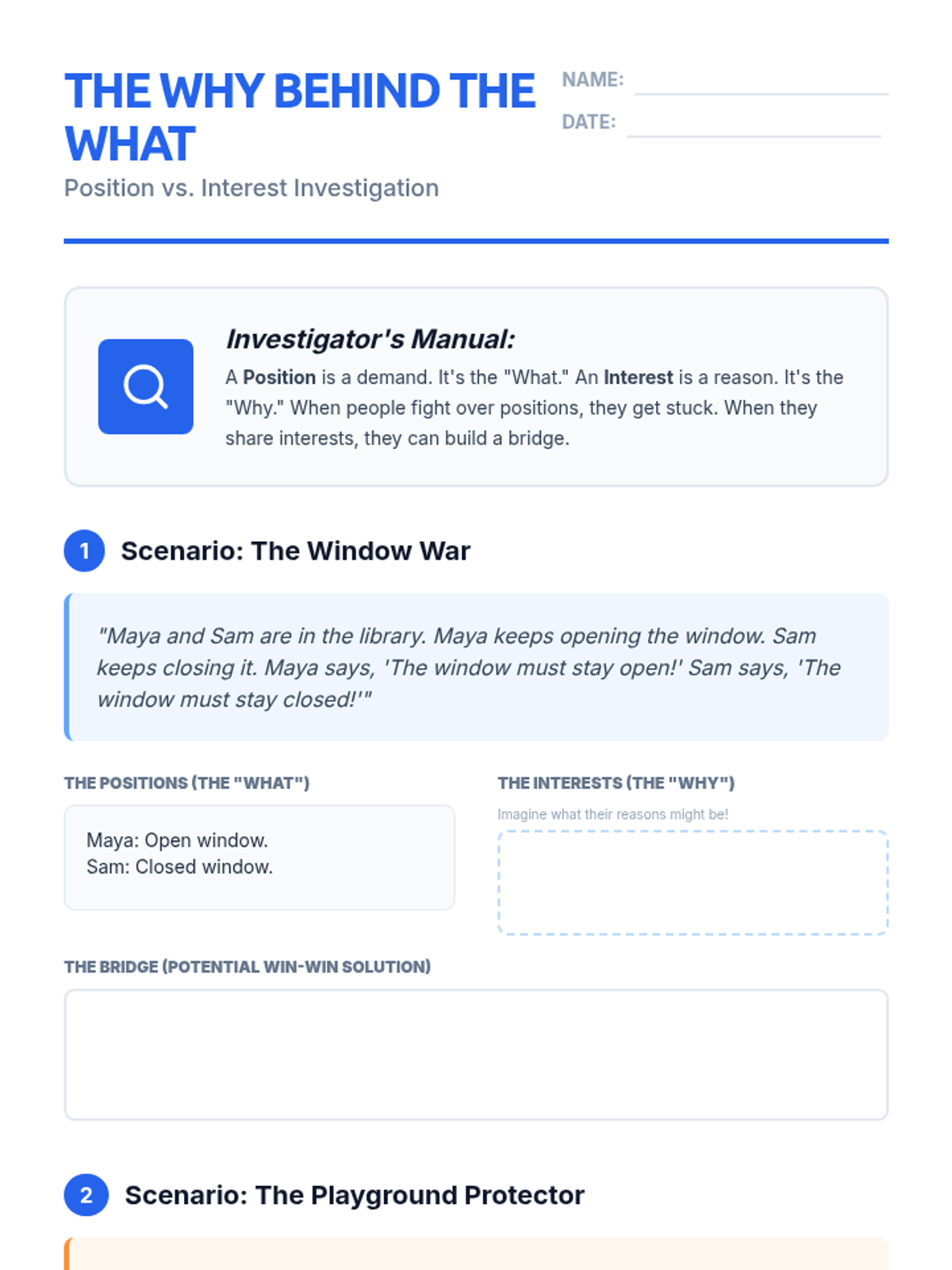
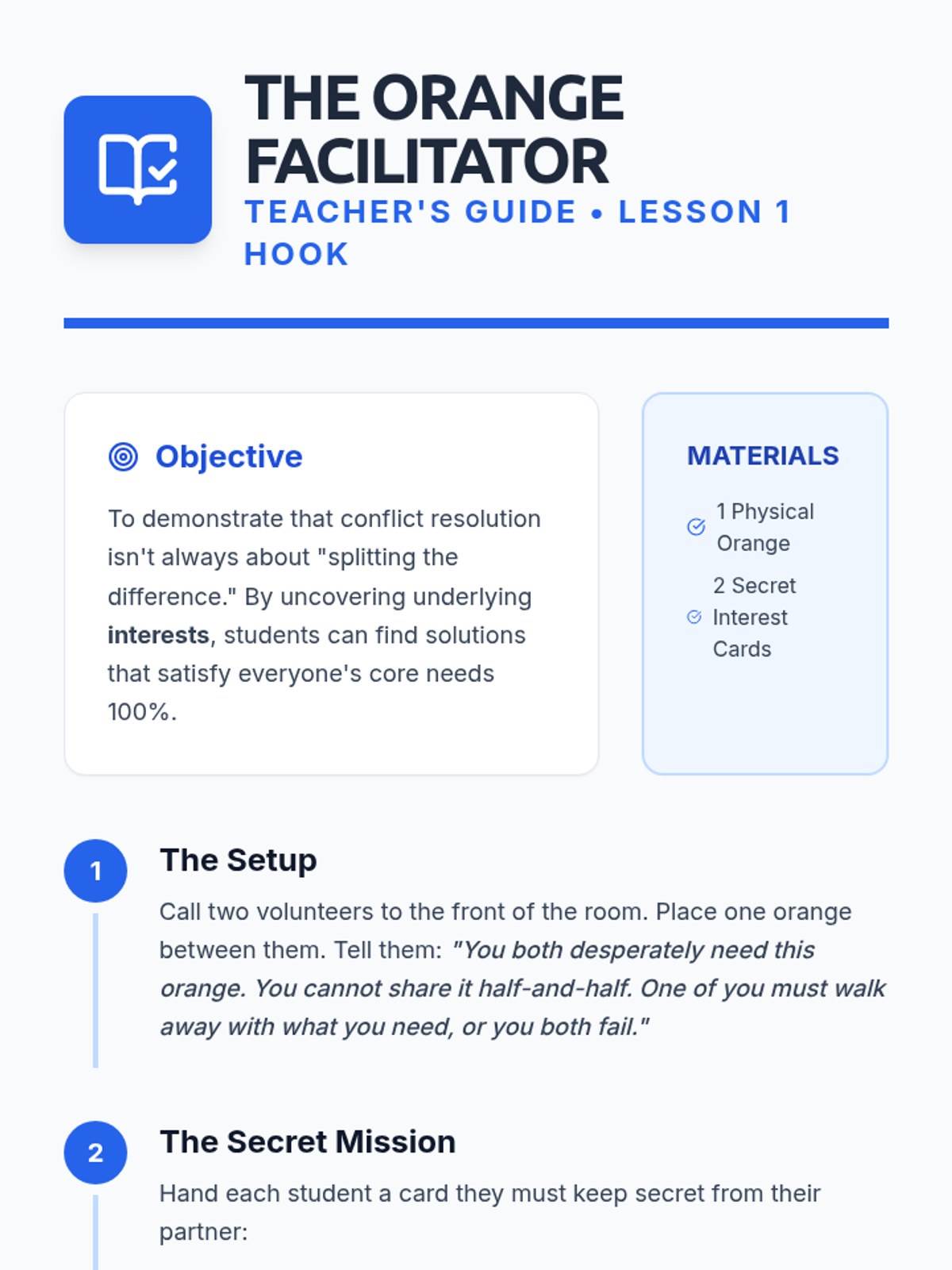
A 5-lesson sequence for 6th graders focusing on Interests-Based Negotiation. Students move from rigid positions to understanding underlying needs, brainstorming creative solutions, and evaluating fairness, culminating in a complex negotiation simulation.
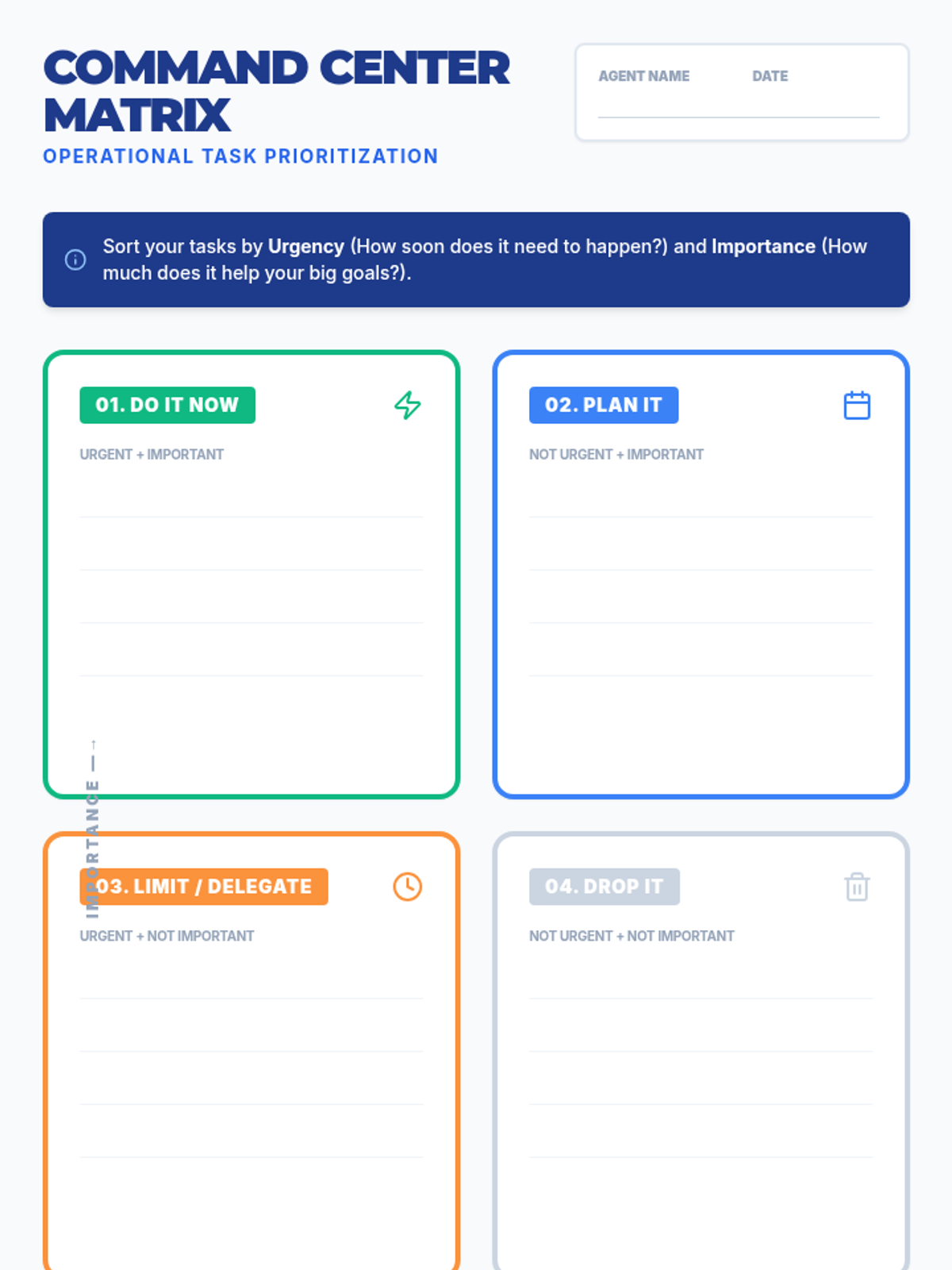
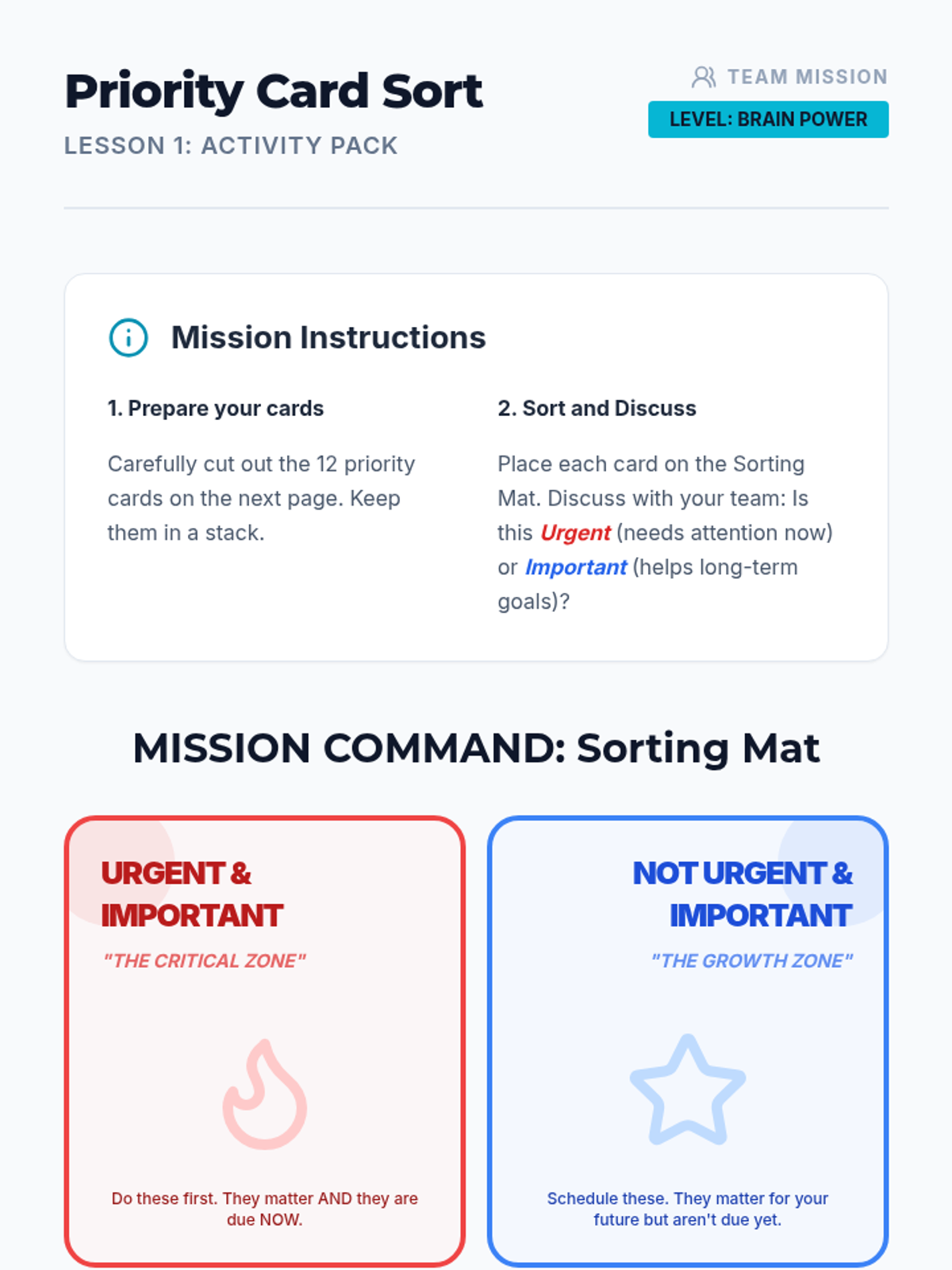
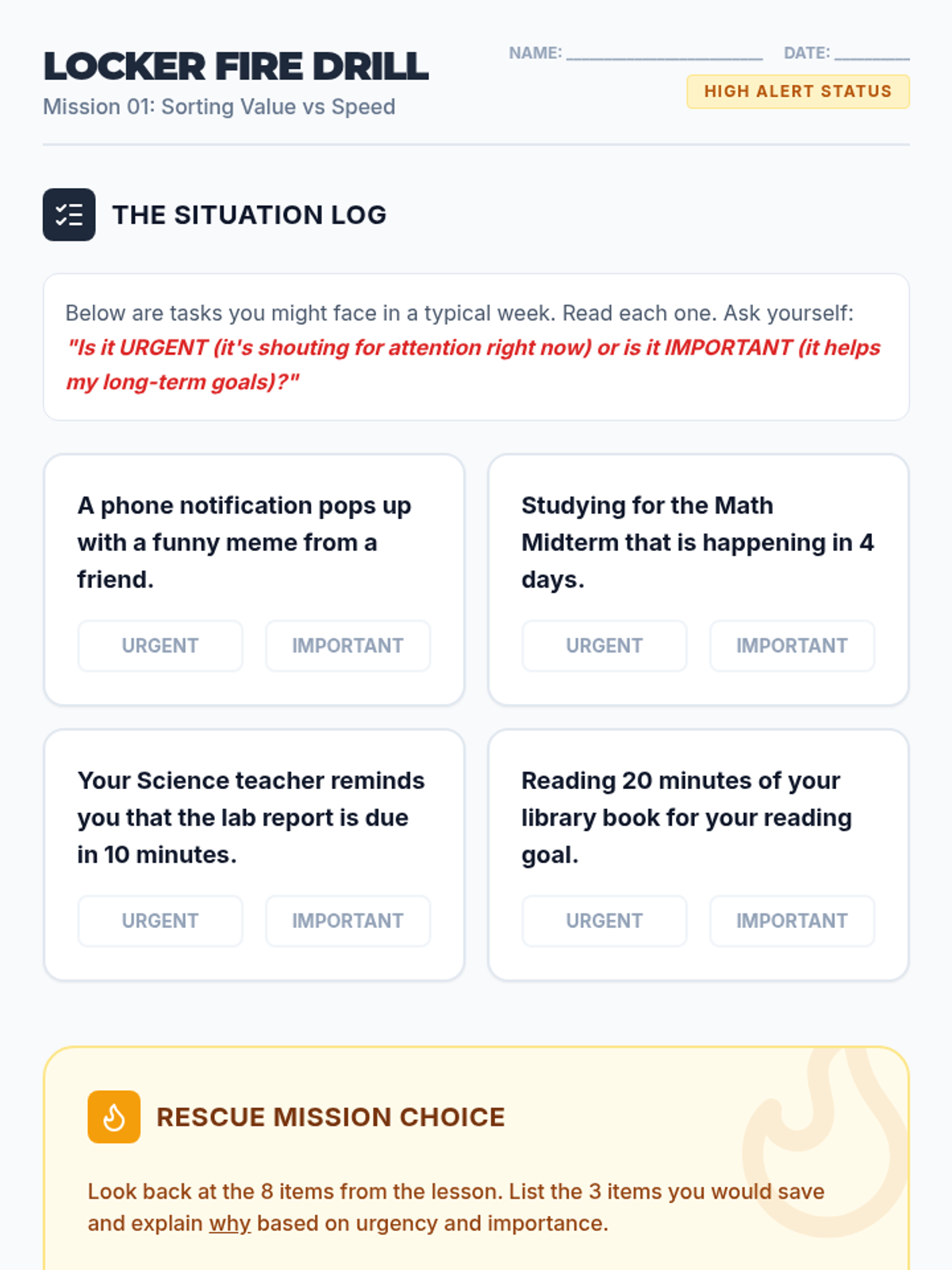
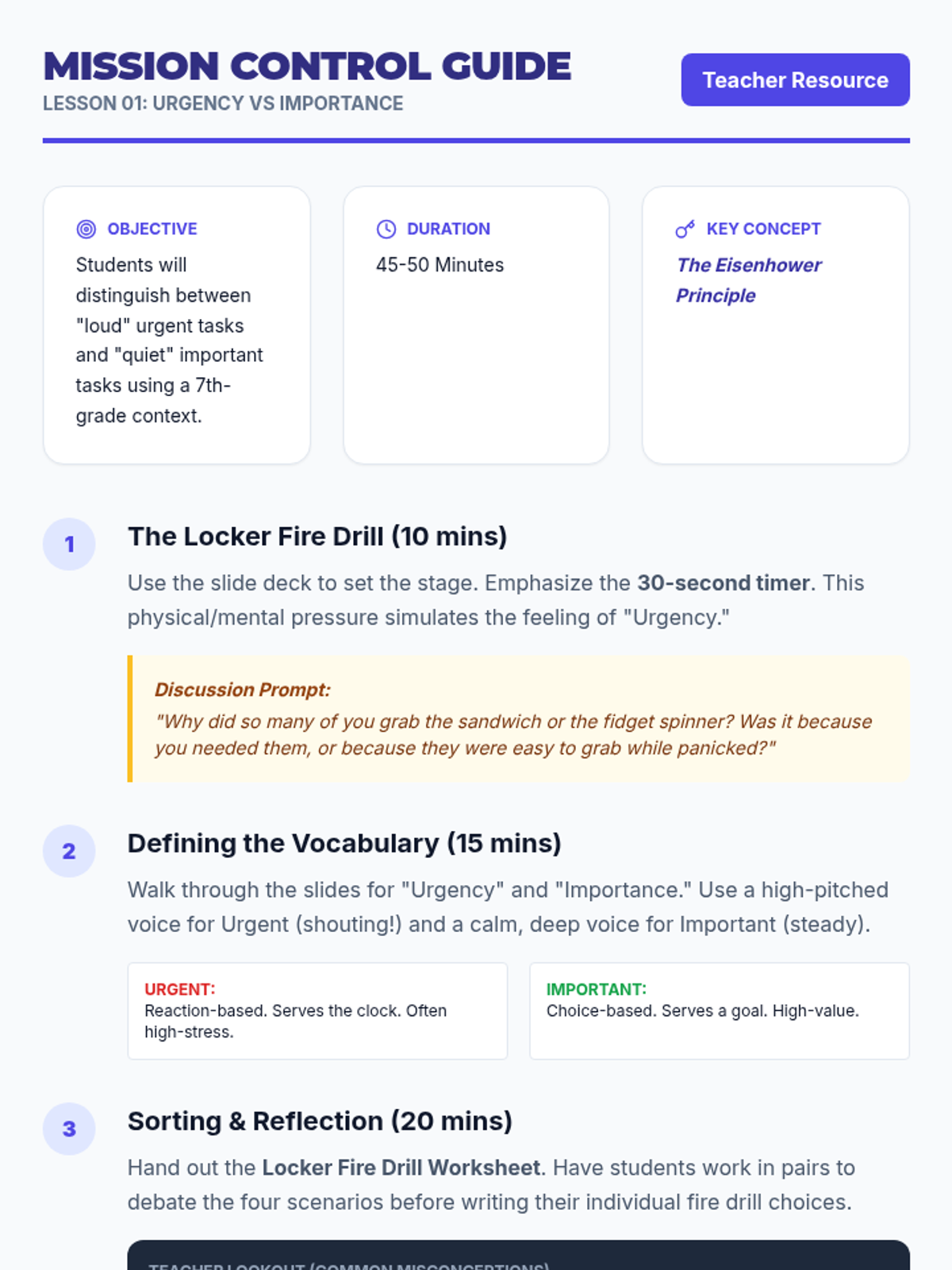
A 5-lesson unit teaching 6th-grade students how to distinguish between urgency and importance using a Decision Matrix (Eisenhower Matrix) to manage their schoolwork and personal life.
A comprehensive executive functioning unit for 7th grade students to master task prioritization using the Eisenhower Matrix. Students move from conceptual understanding to practical, daily application through simulations and personalized planning.
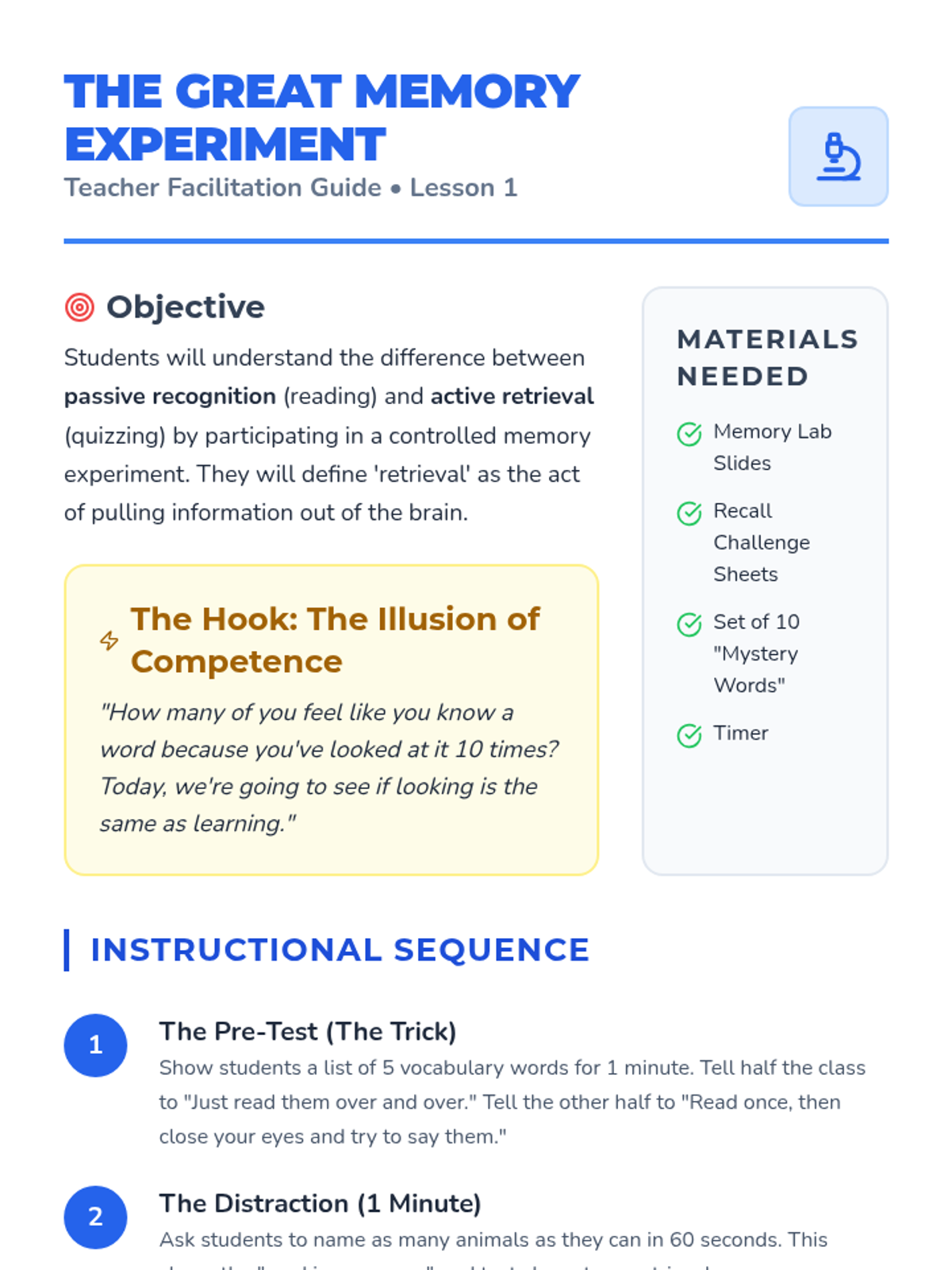
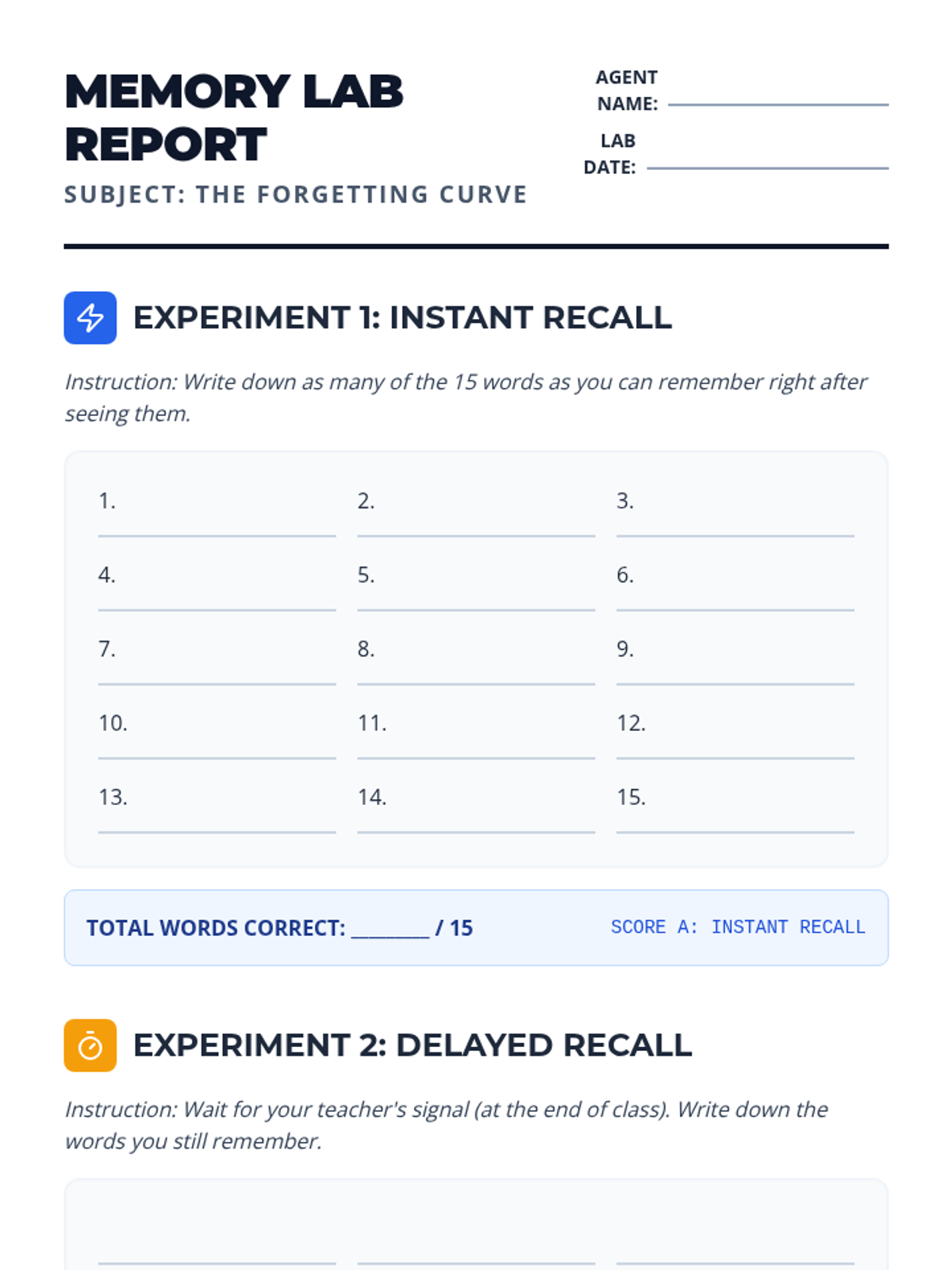
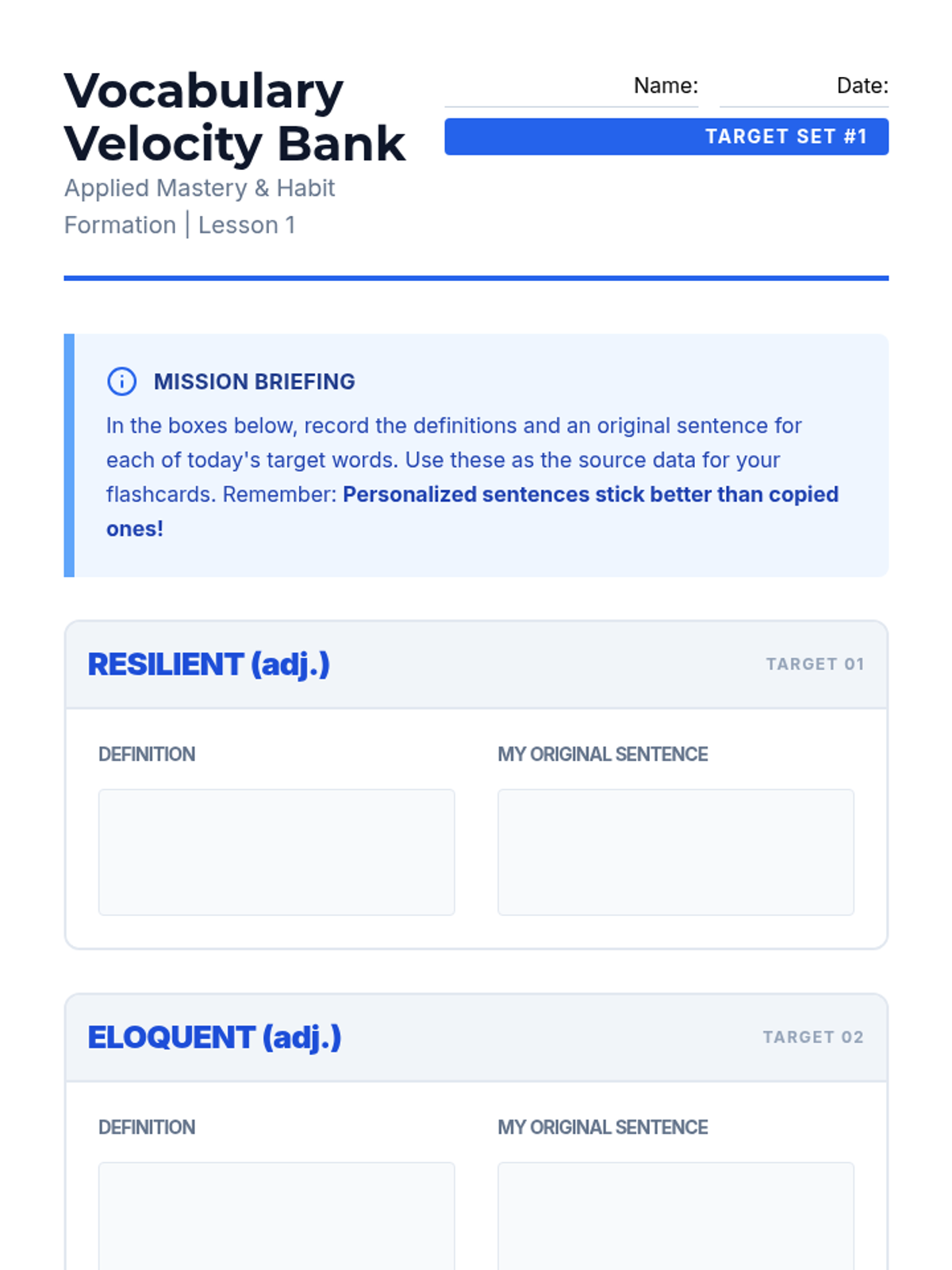
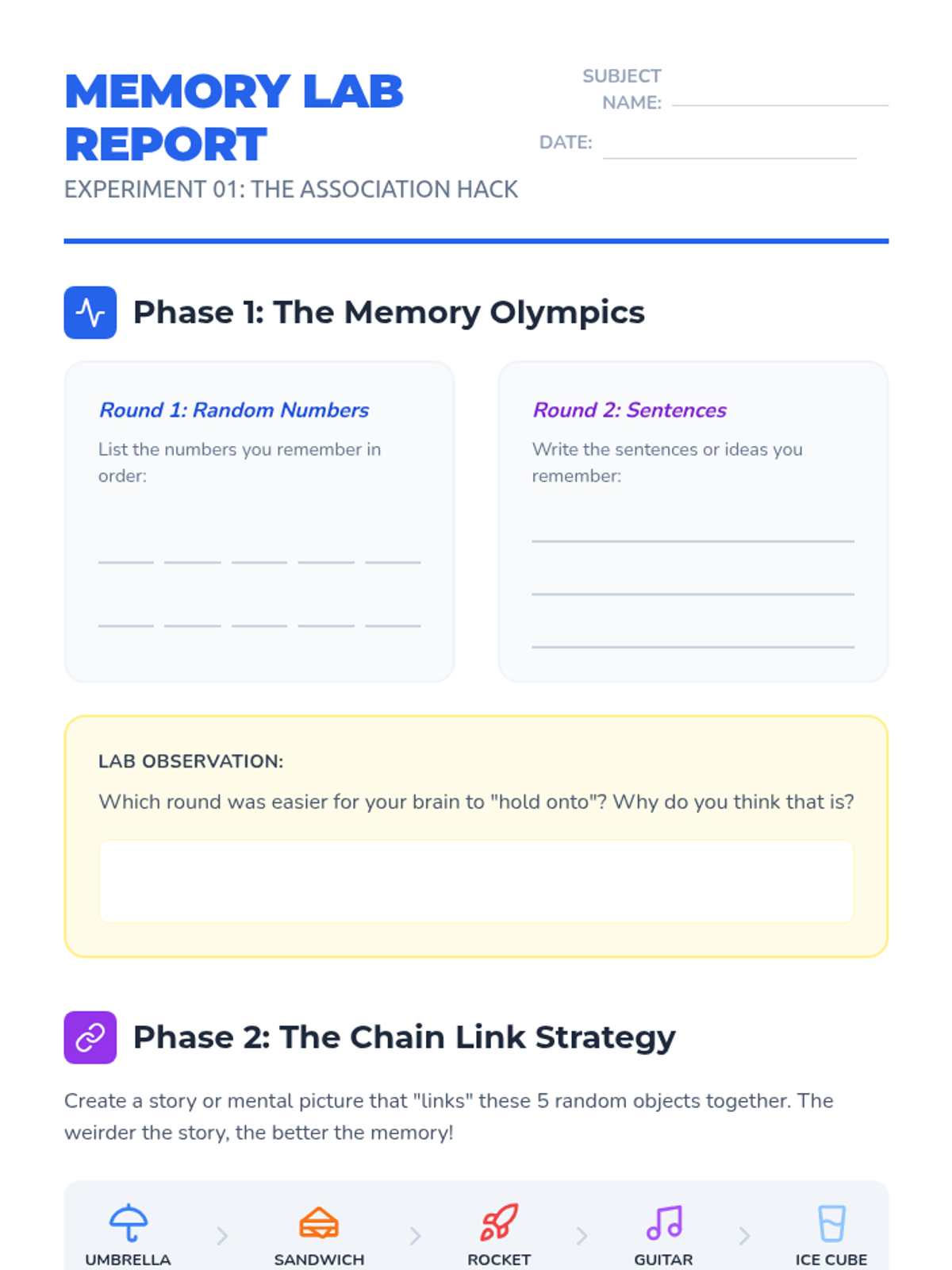
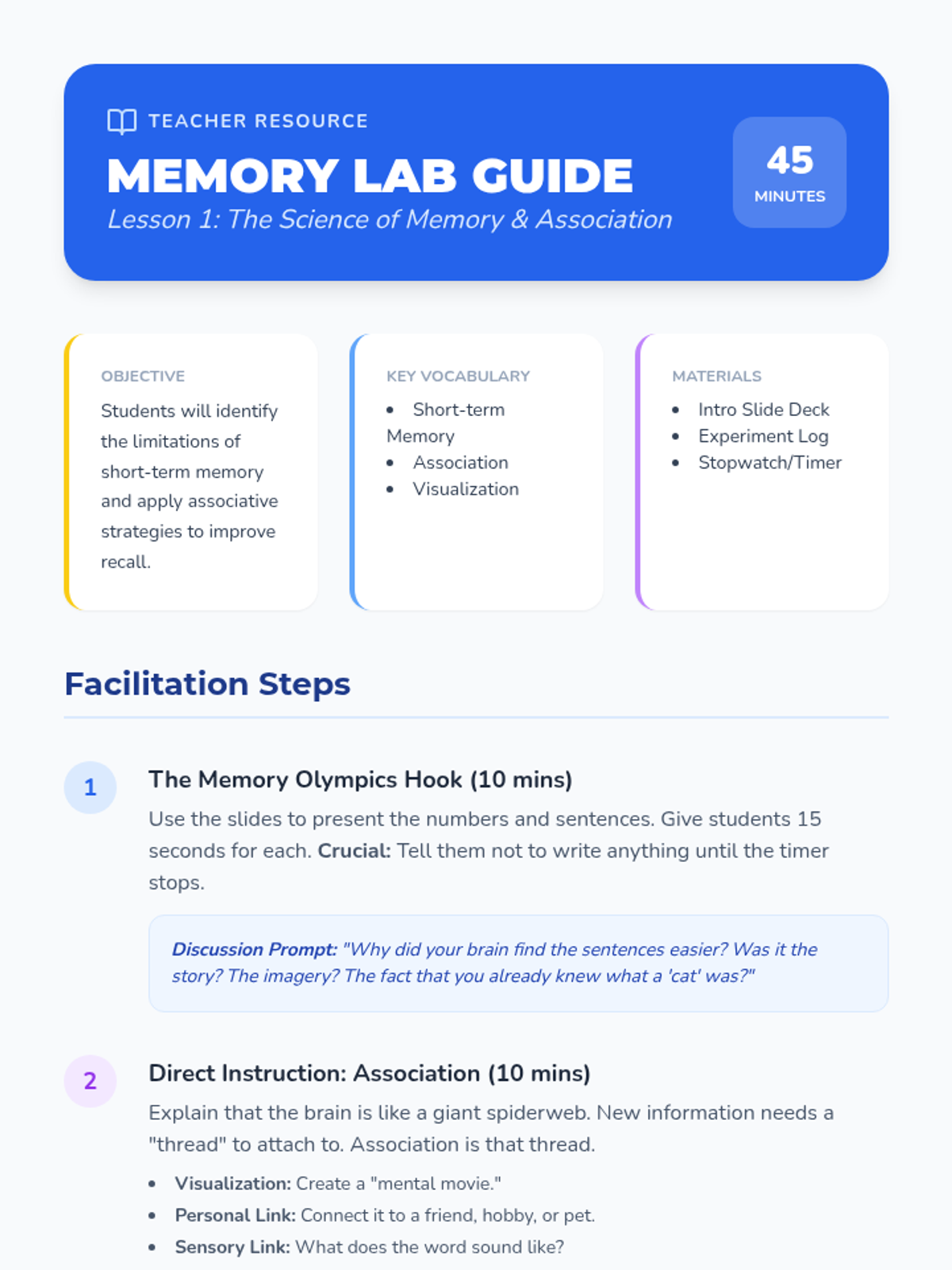
This sequence introduces 3rd-grade students to active recall and spaced repetition strategies for vocabulary. Through a 'Memory Lab' theme, students move from understanding the 'illusion of competence' to building a toolkit of retrieval practices like flashcards and the Cover-Copy-Compare method.
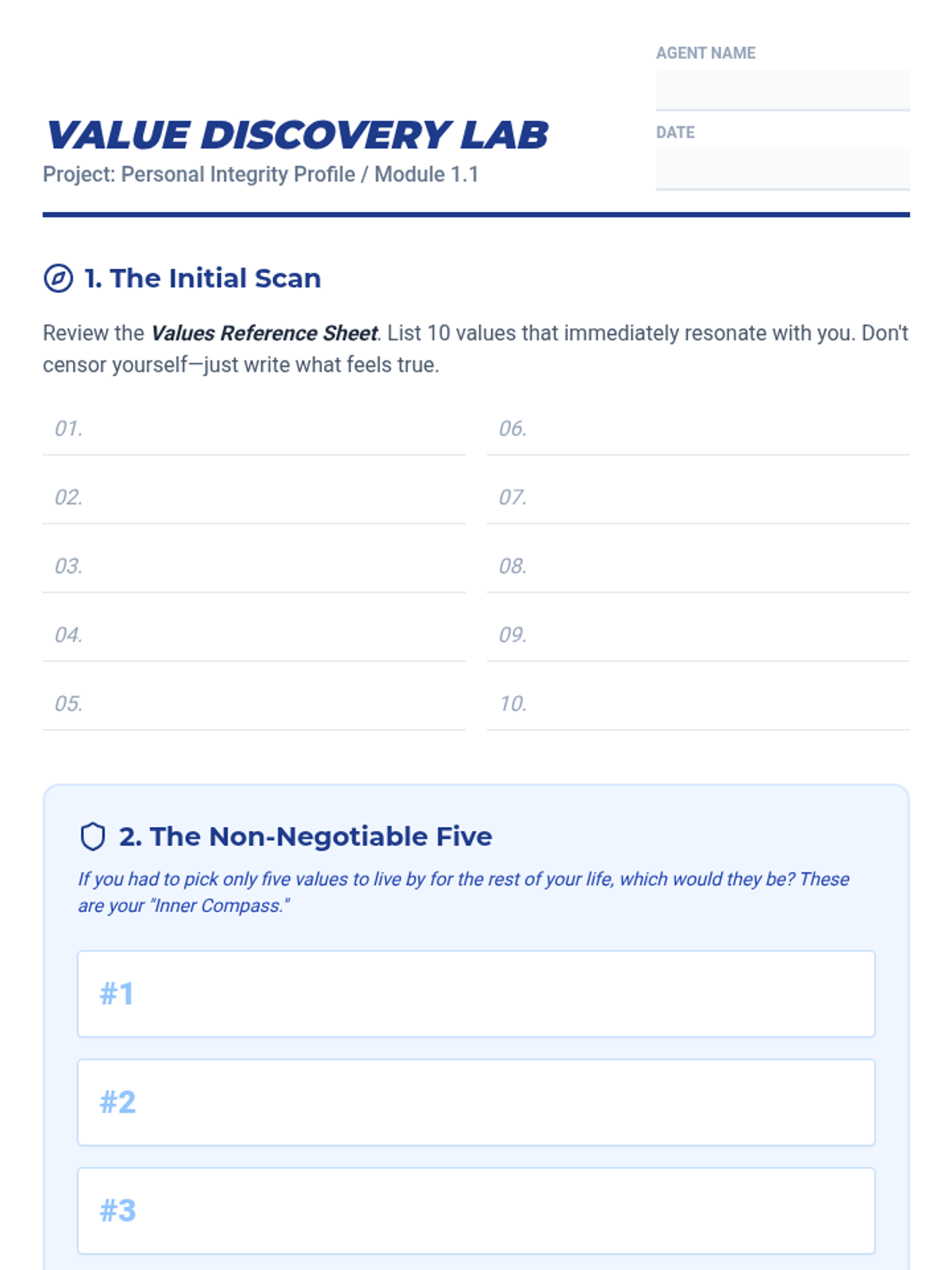
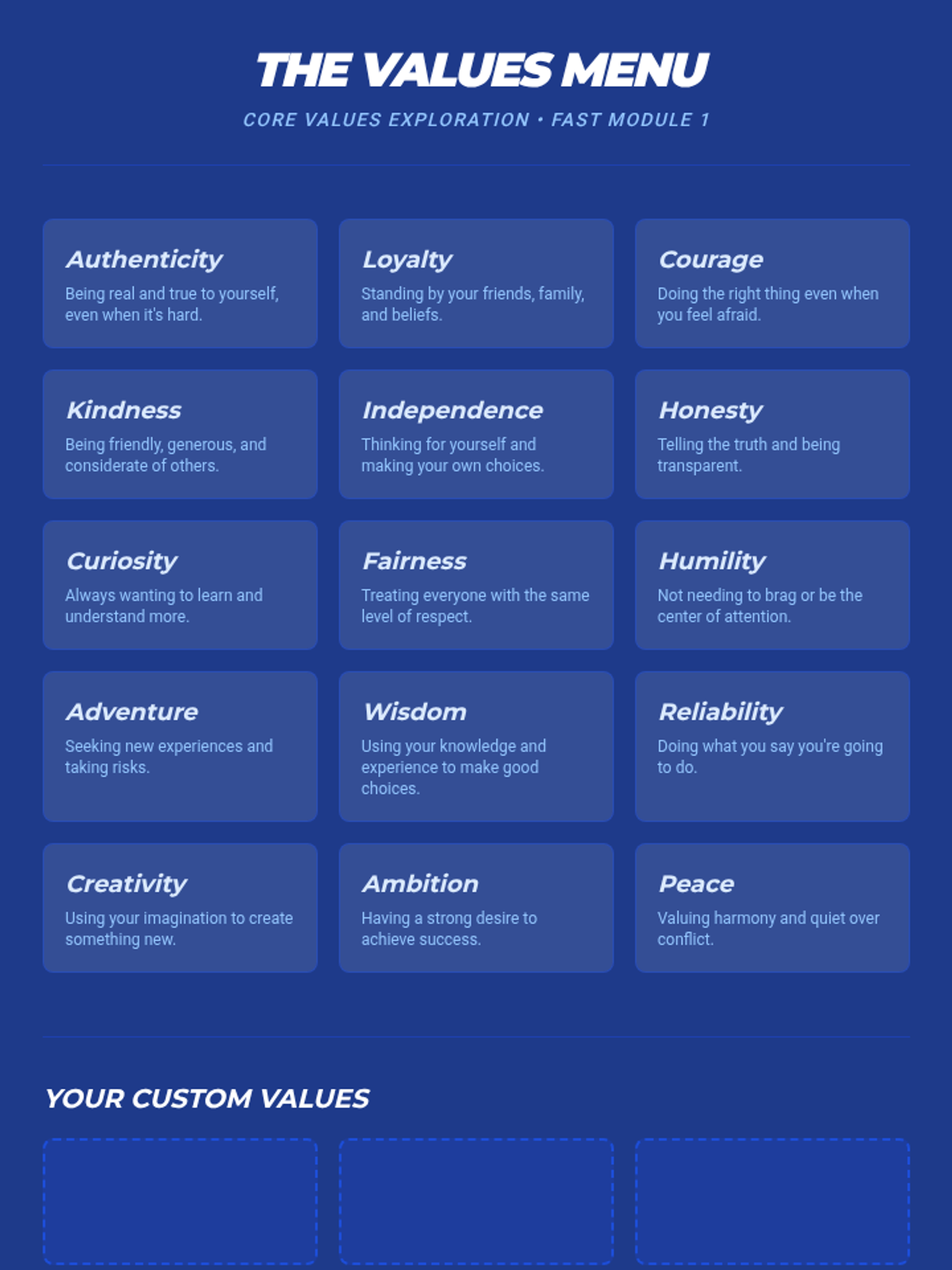
A project-based sequence for 6th graders to develop self-respect using FAST skills. Students explore personal values, digital authenticity, boundaries, and assertive communication to create a comprehensive 'Personal Code of Conduct' manifesto.
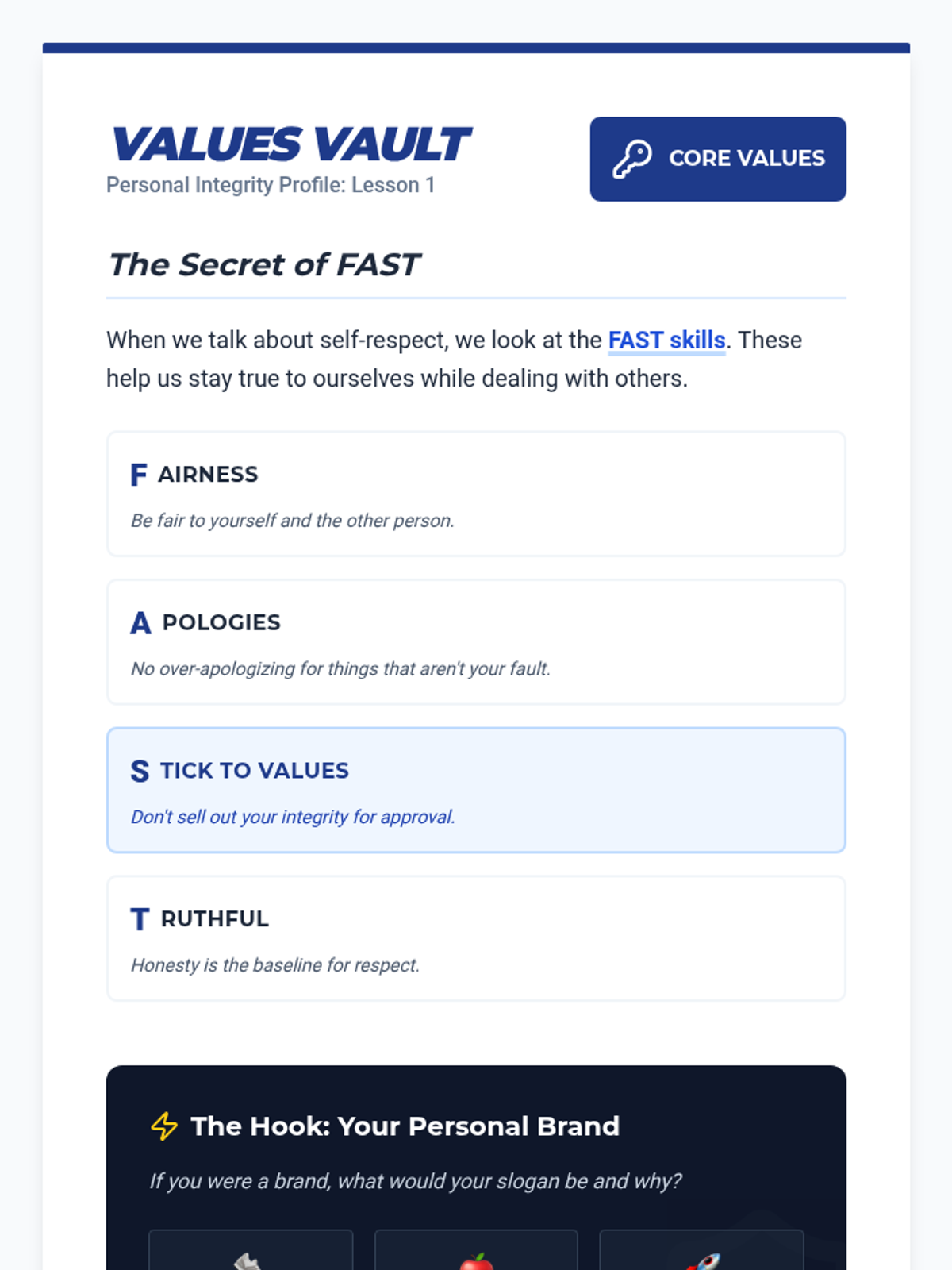
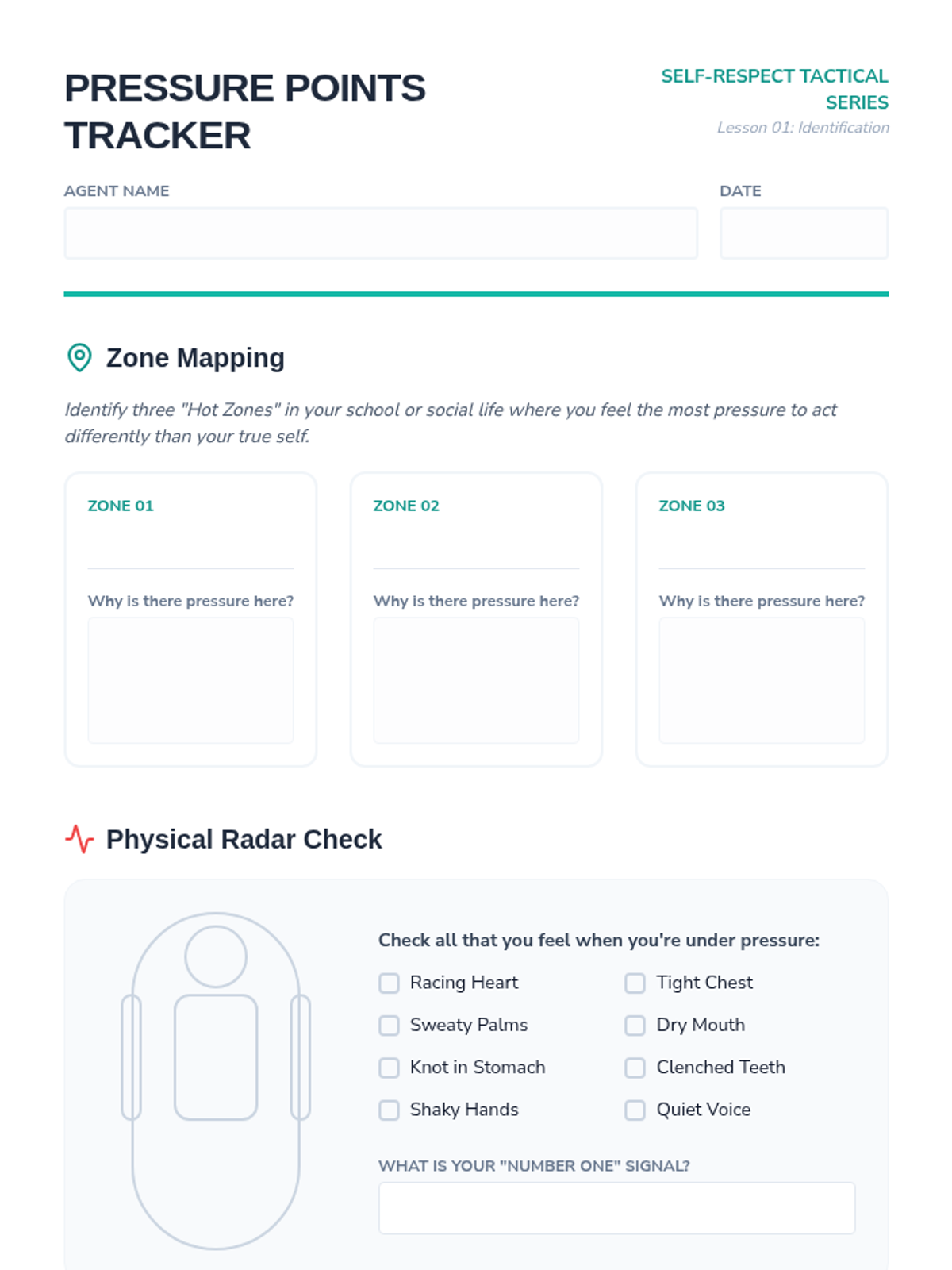
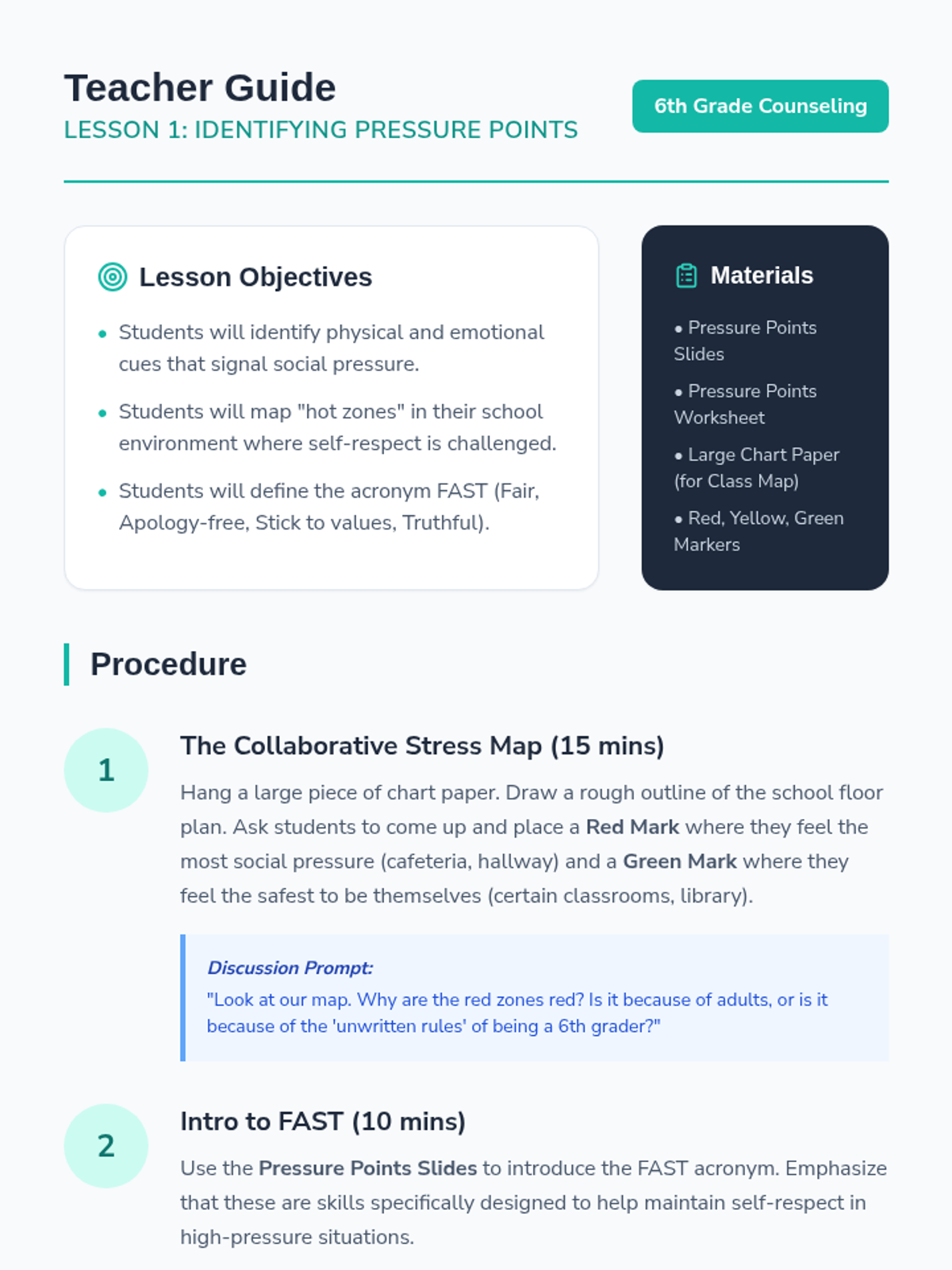
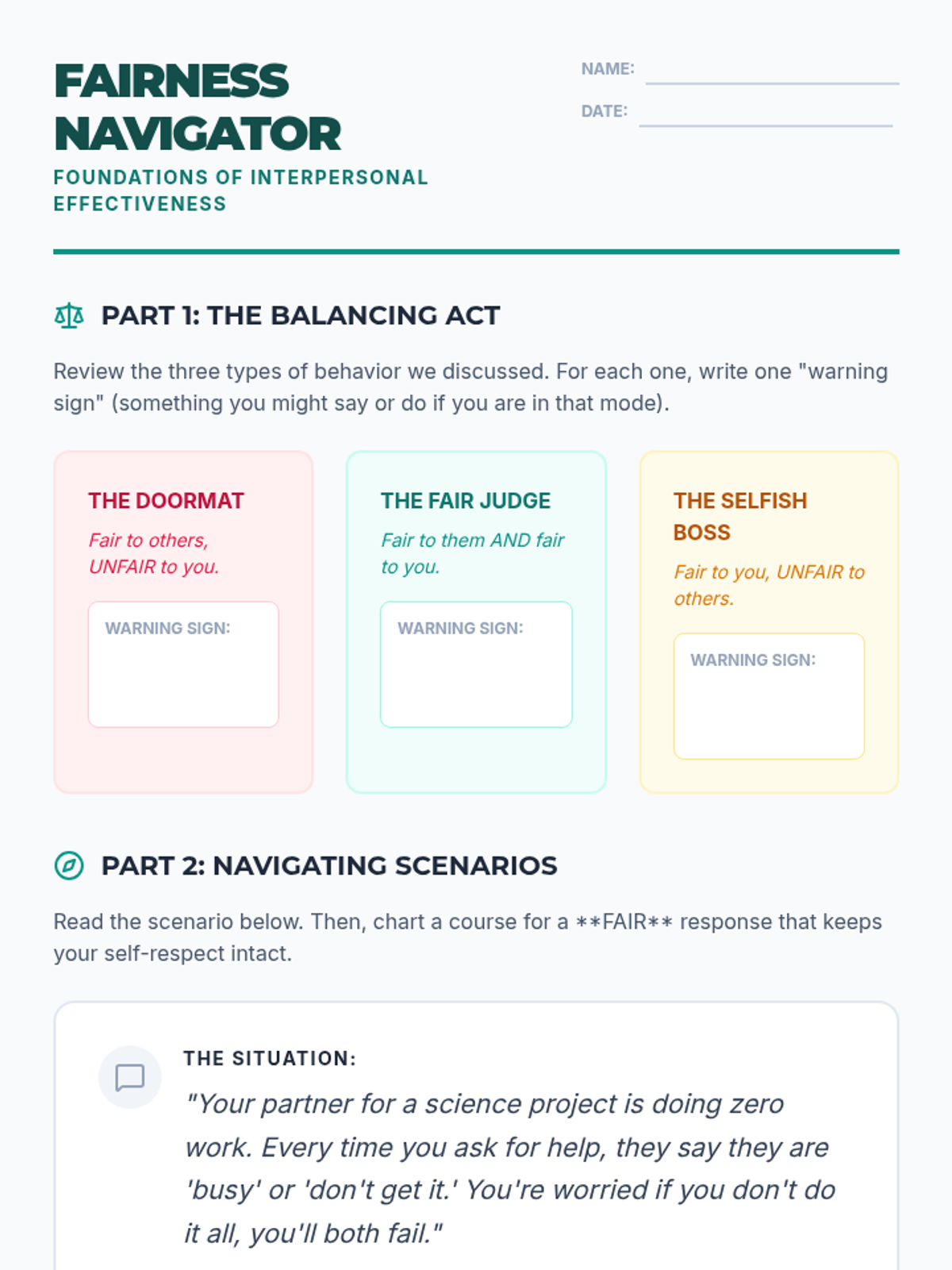
A simulation-heavy sequence teaching 6th graders to use DBT FAST skills (Fair, Apology-free, Stick to values, Truthful) to maintain self-respect during social challenges. Students engage in role-play and real-world scenarios to build integrity and refusal skills.
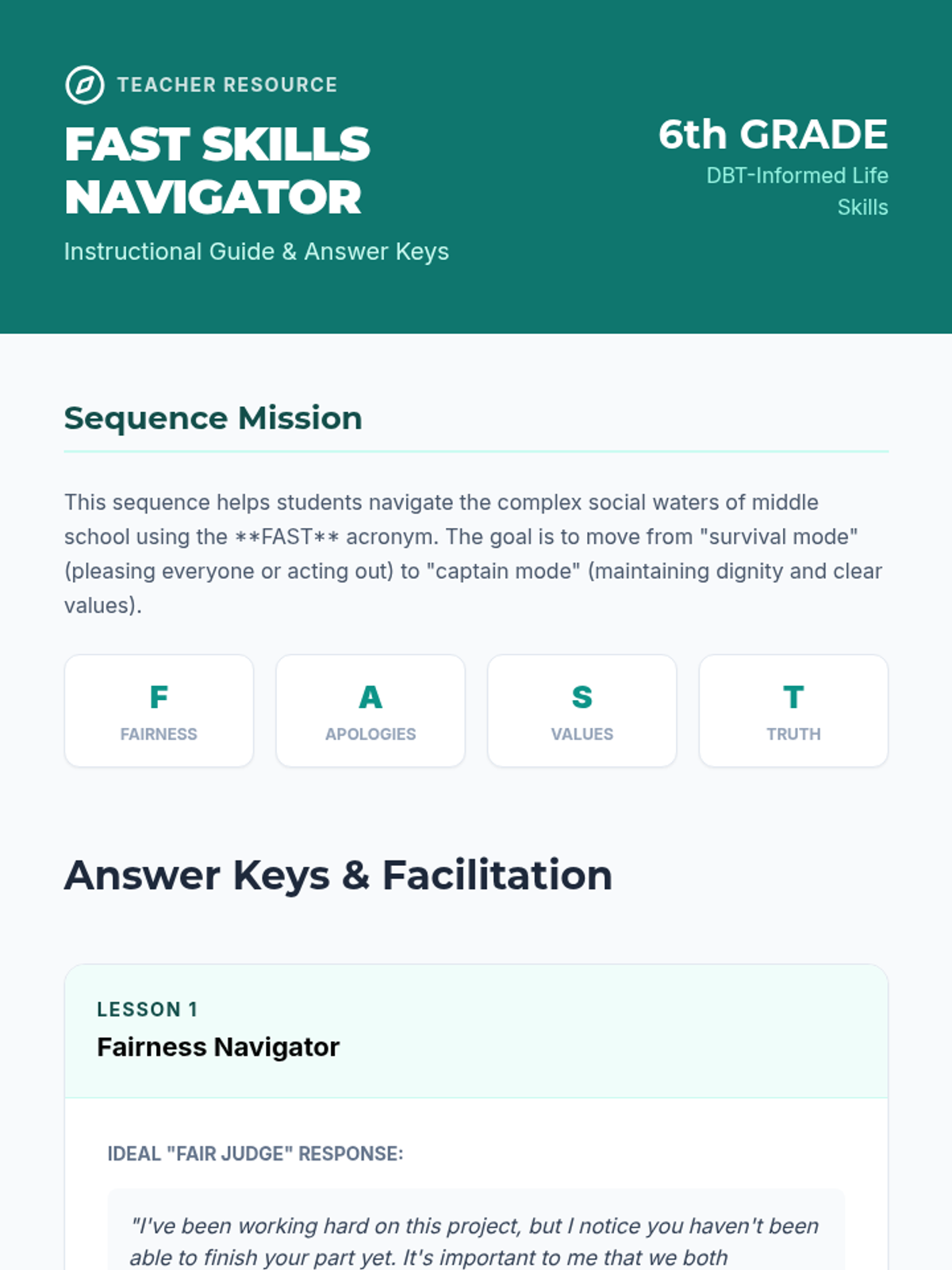
This sequence introduces 6th-grade students to the DBT FAST acronym (Fairness, Apologies, Sticking to values, and Truthfulness). Students explore how to maintain self-respect in social interactions by balancing their needs with those of others without compromising their integrity.
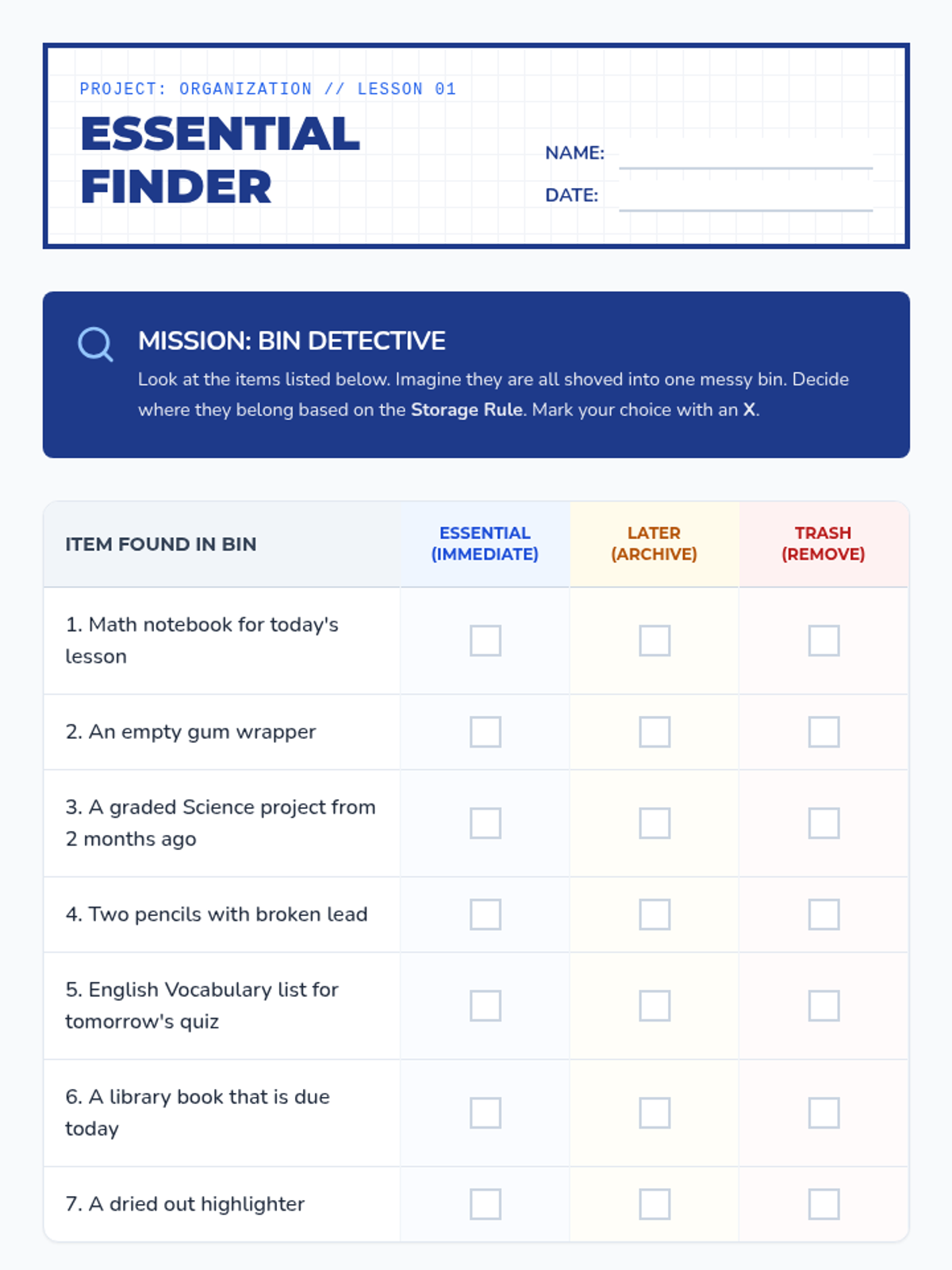
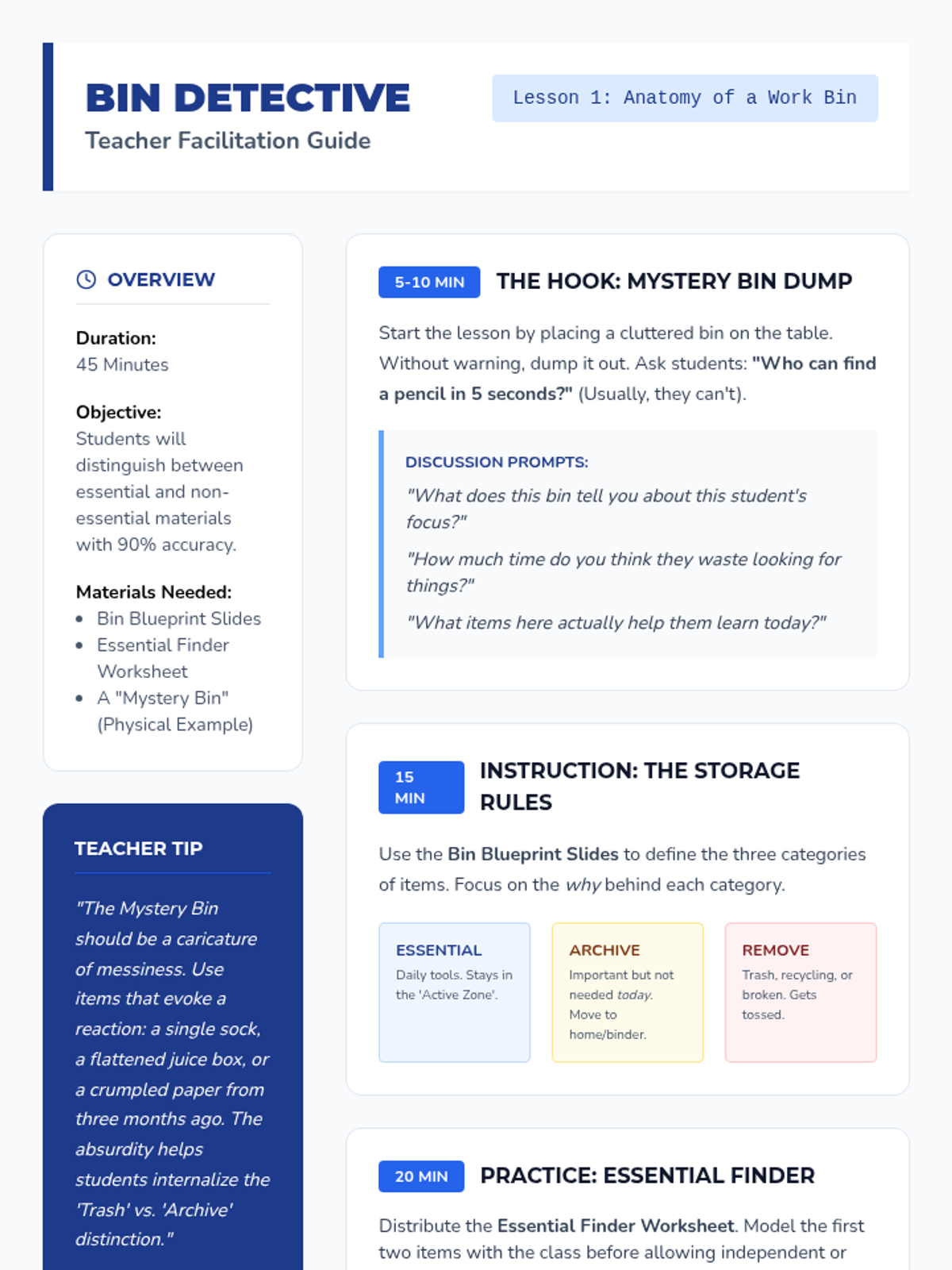
A 5-lesson sequence focused on executive functioning and physical organization for 6th-grade students. Students learn to manage work bins, sort materials, zone their workspaces, and establish maintenance routines.
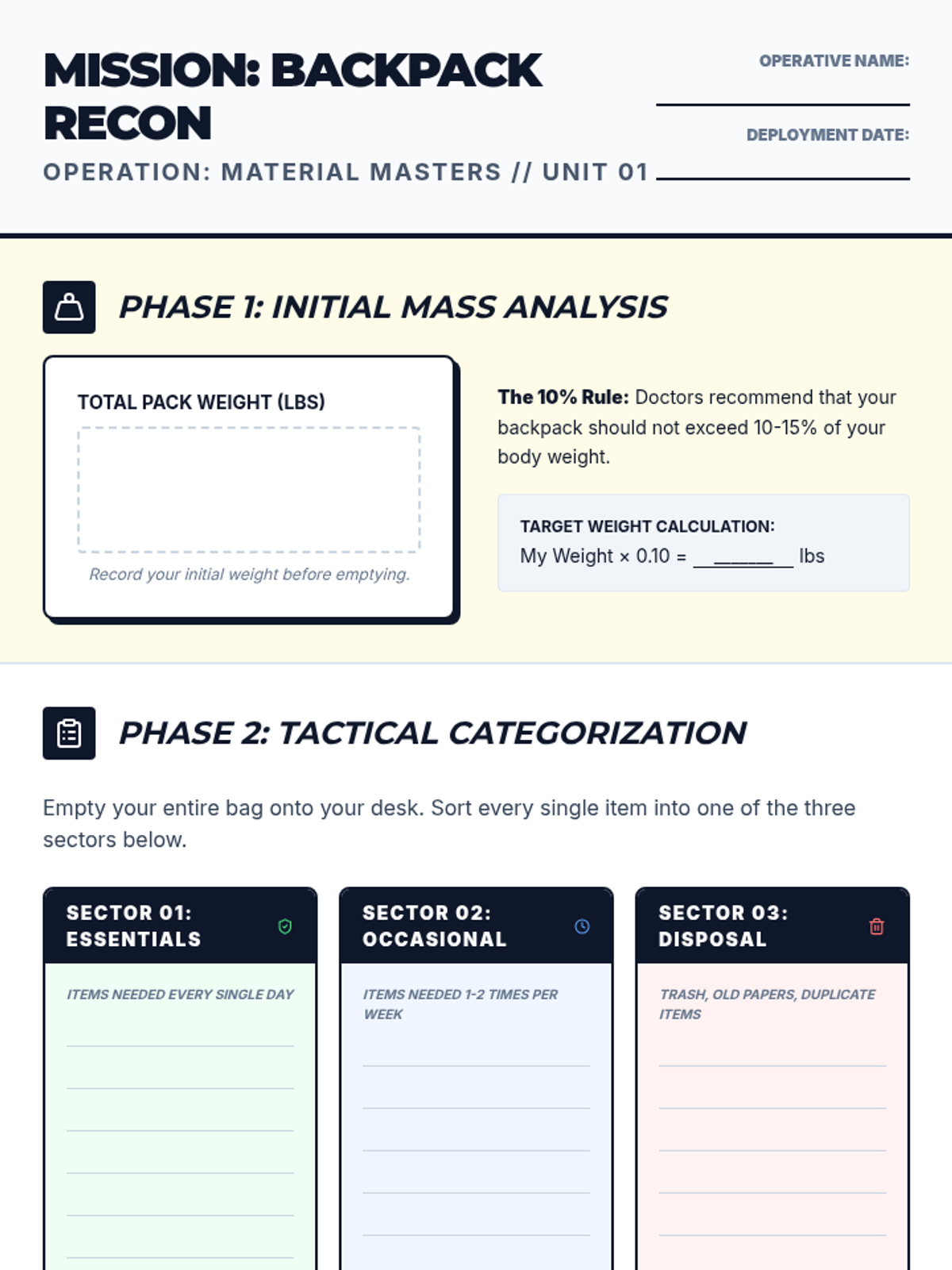
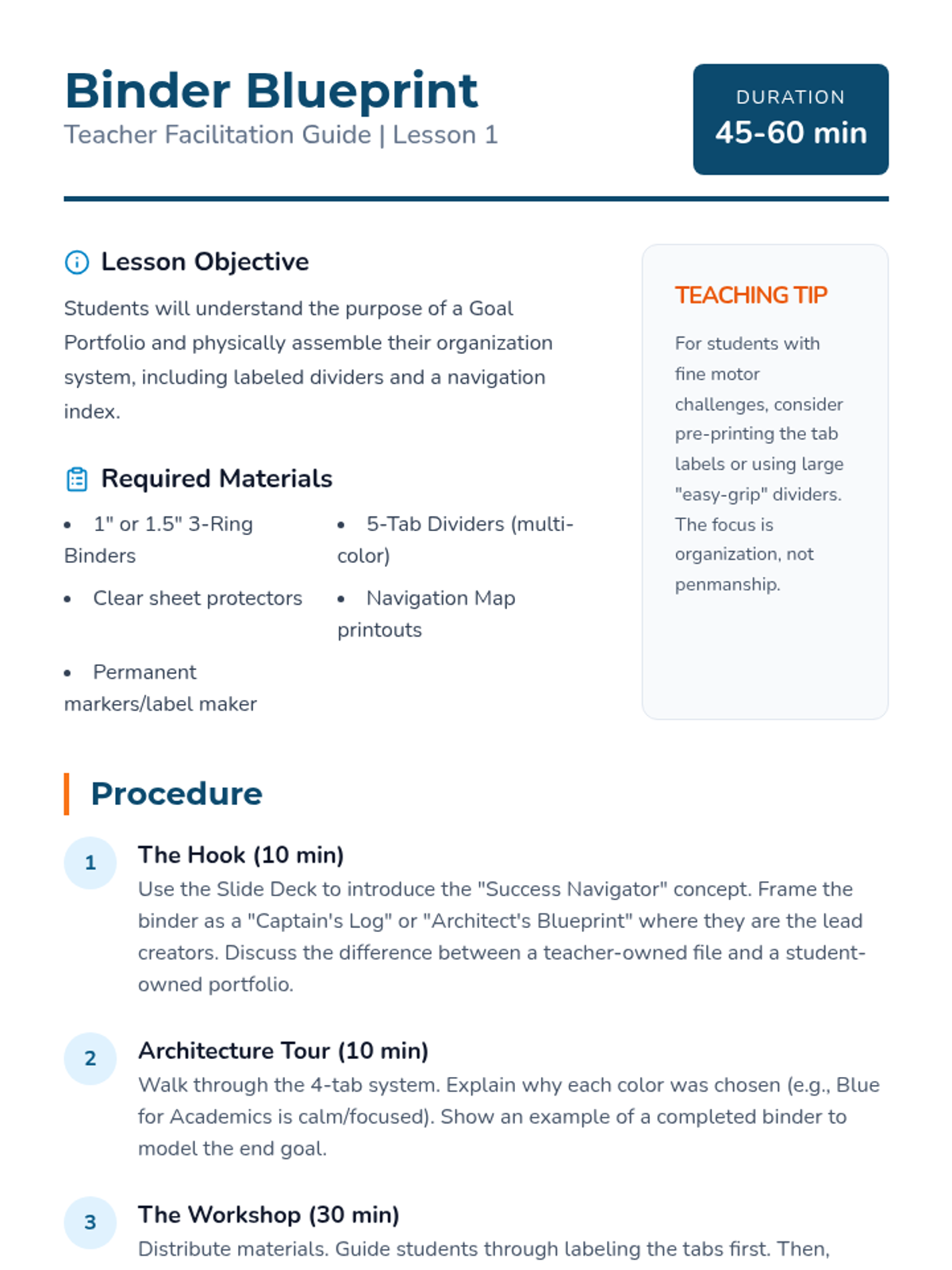
This sequence focuses on the fundamental skills of organizing personal academic materials, specifically backpacks and binder systems. Students begin by auditing their current organizational state, identifying pain points, and move through color-coding, binder architecture, labeling, and establishing daily routines.
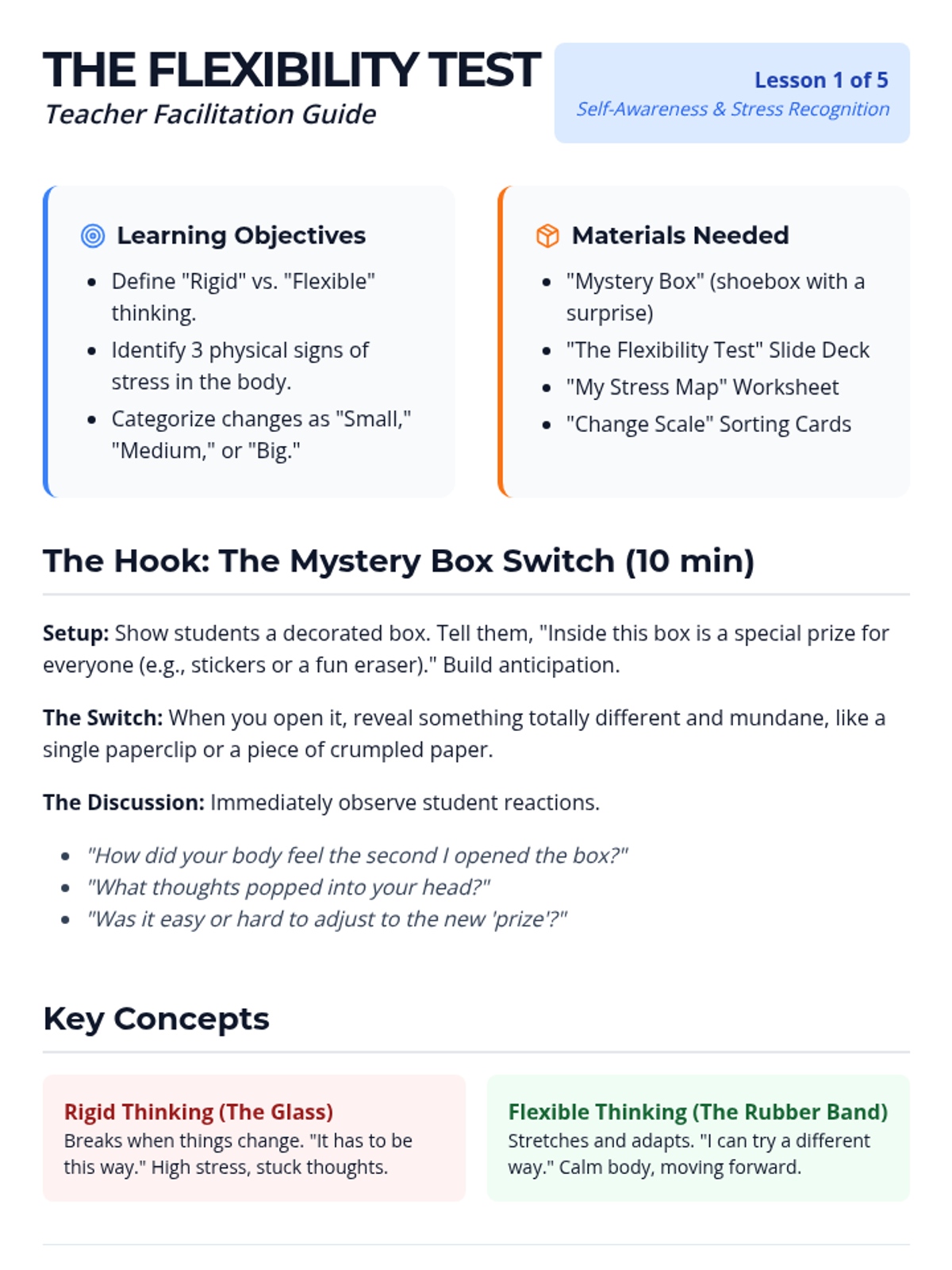
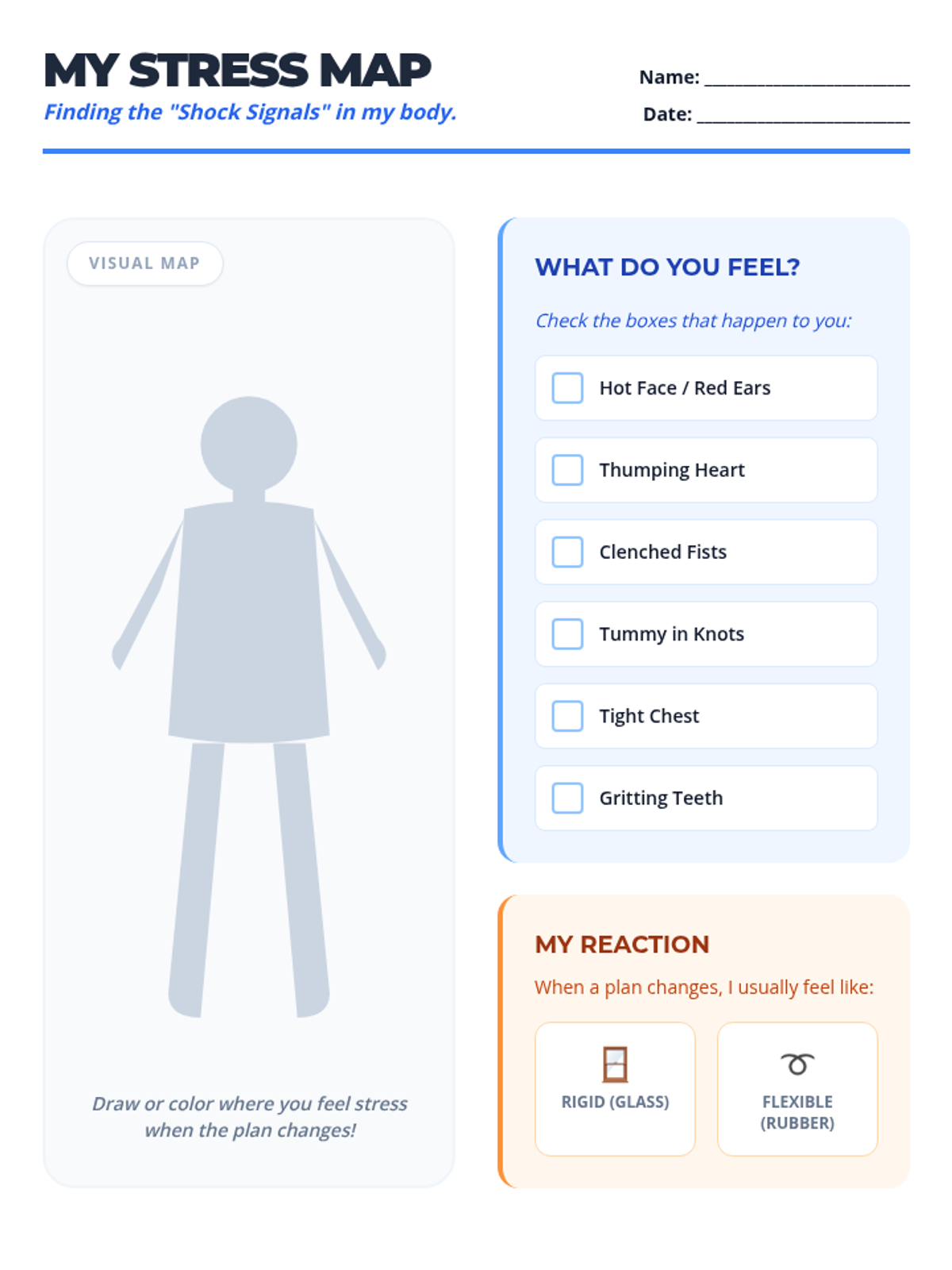
A comprehensive sequence for 6th-grade students to develop cognitive flexibility, recognize emotional triggers during schedule disruptions, and apply structured coping strategies to navigate unexpected changes independently.
This 6th-grade sequence teaches students somatic and mindfulness-based techniques for Radical Acceptance. Students explore how body posture, breathing, and observation can help them stay calm and accept difficult realities rather than fighting them.
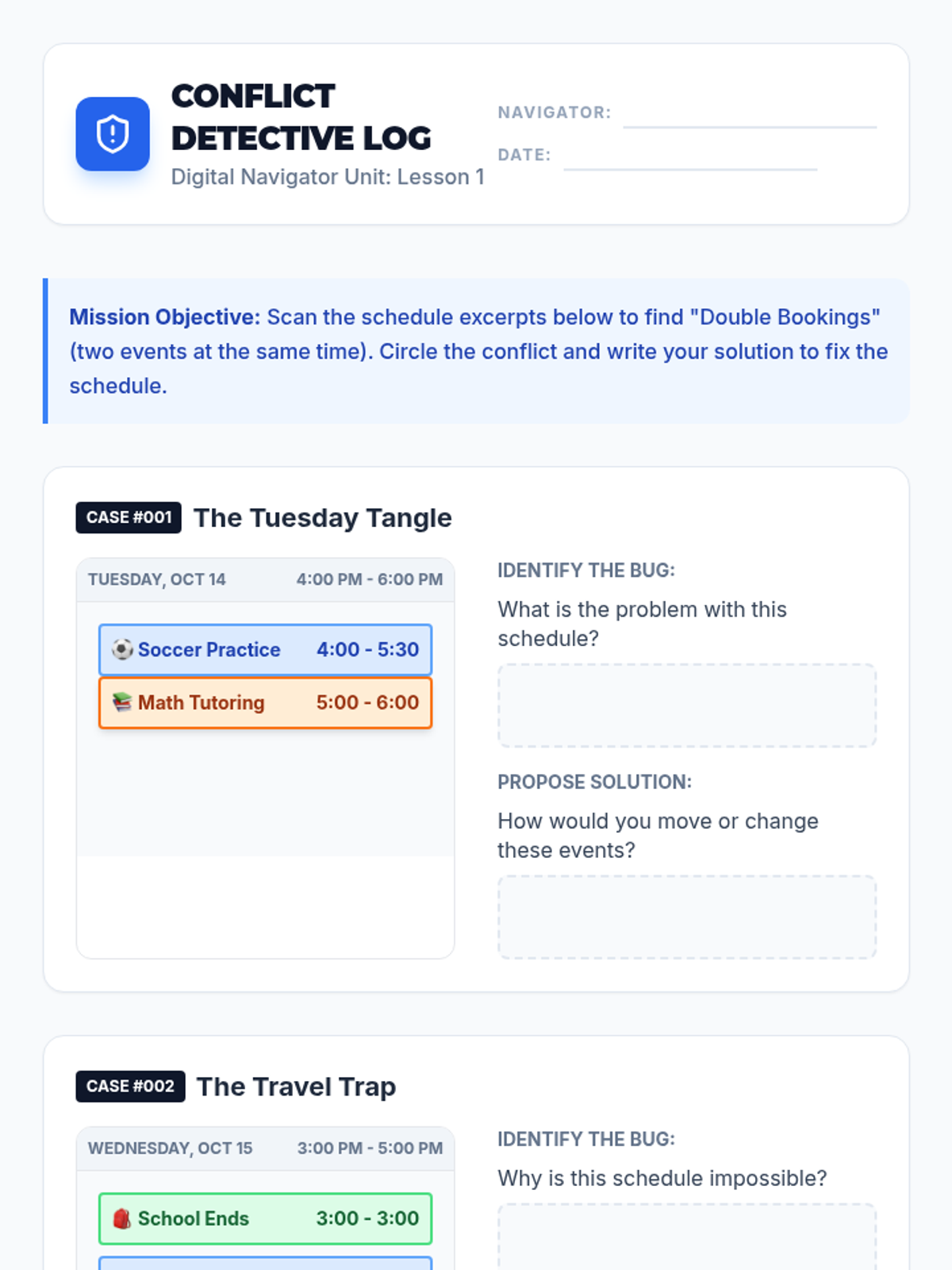
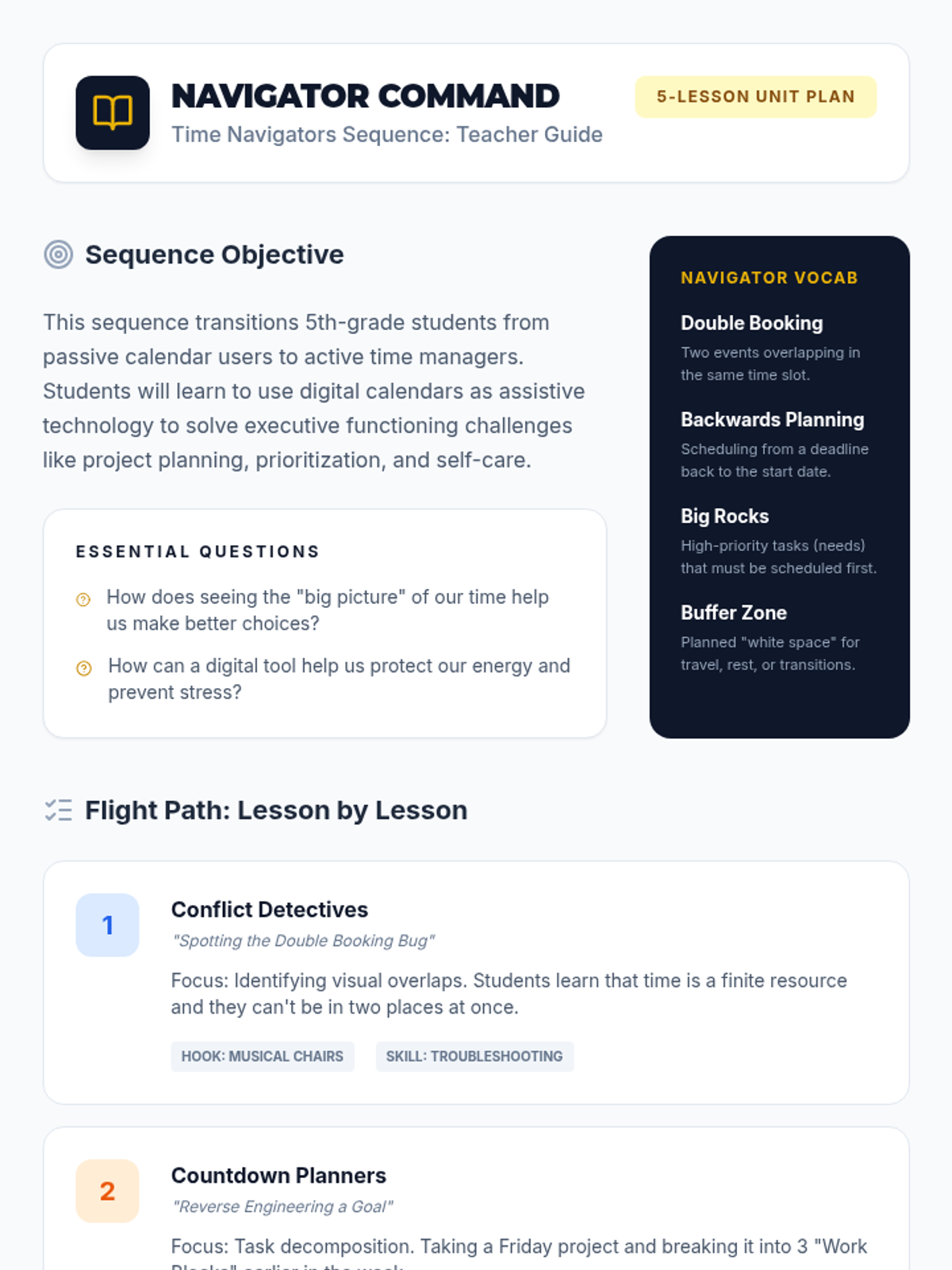
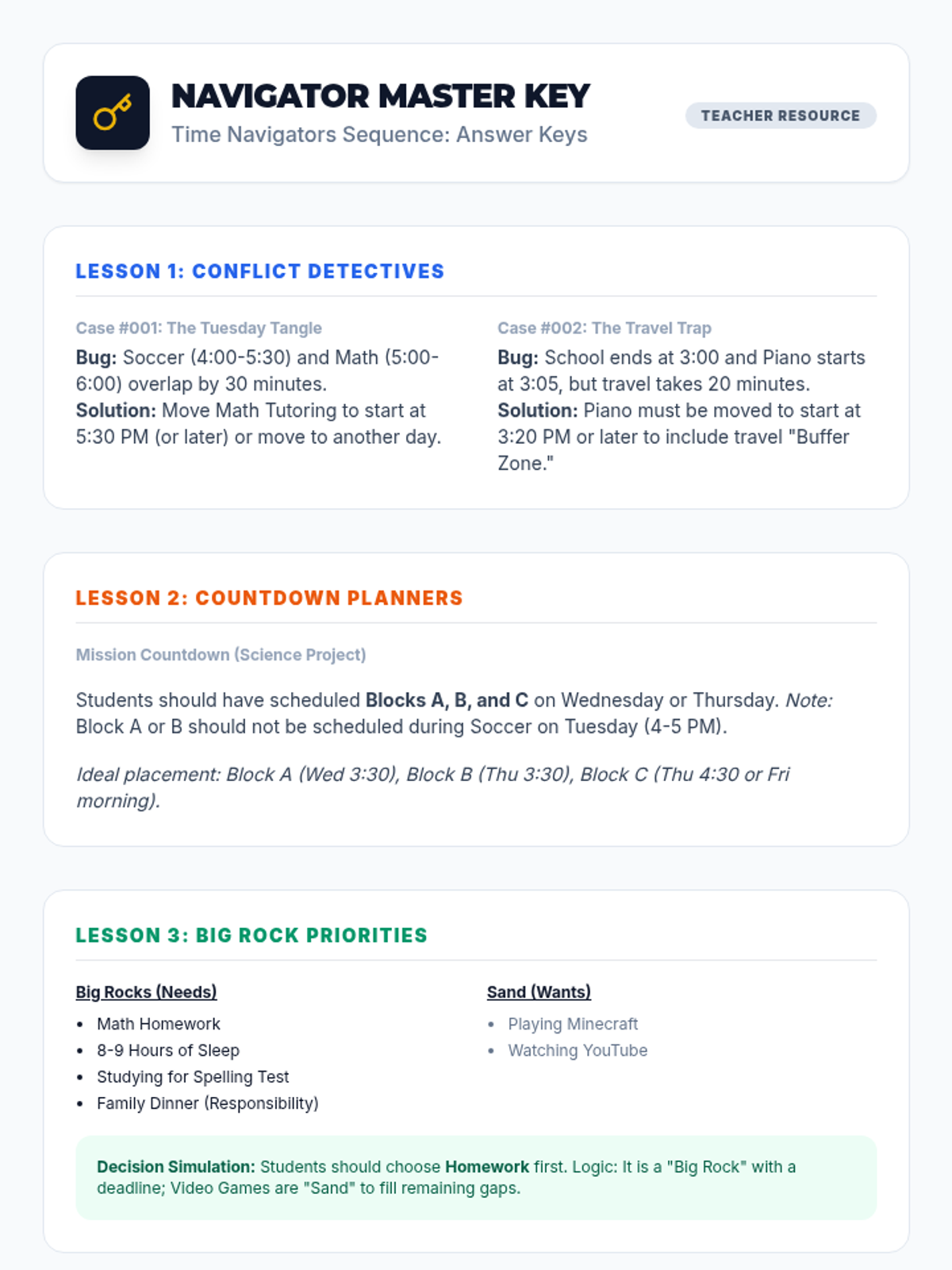
A 5th-grade sequence focusing on using digital calendars for independent planning, conflict resolution, and task prioritization. Students transition from passive scheduling to active time management, preparing them for the organizational demands of middle school.
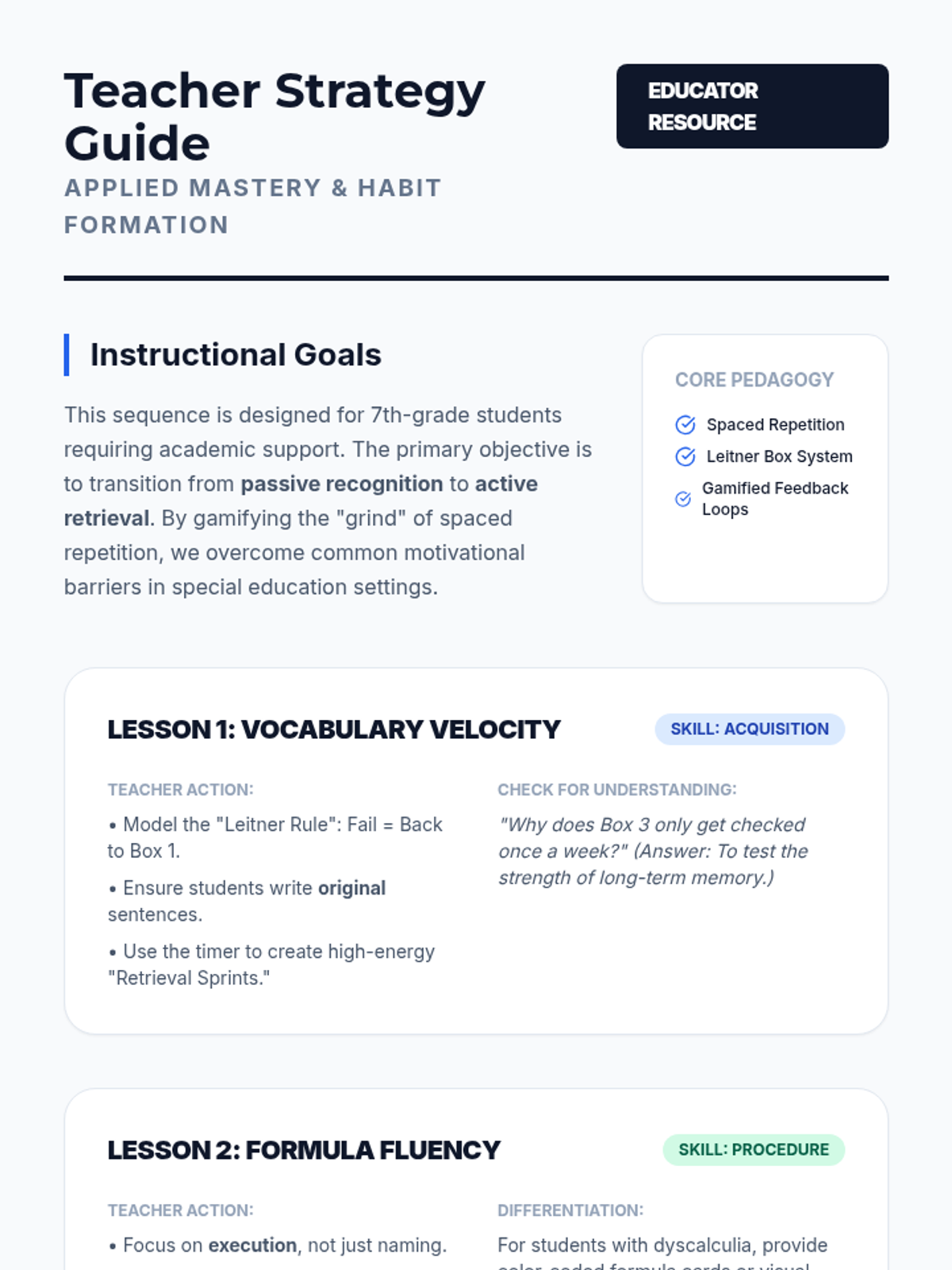
A specialized sequence designed for 6th-grade students to master long-term memory techniques. Students move from understanding why we forget to implementing advanced study systems like the Leitner Box and spaced repetition scheduling.
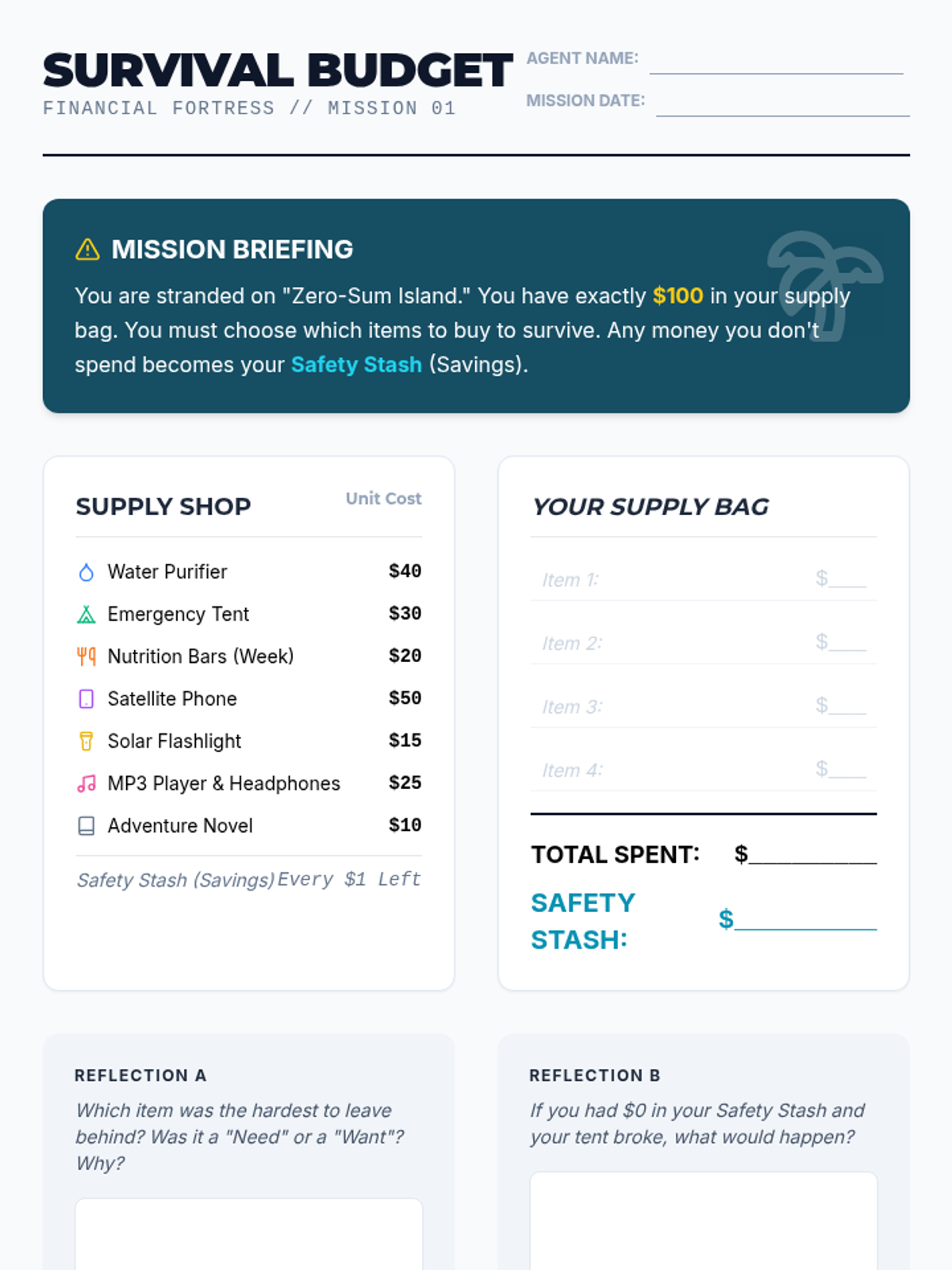
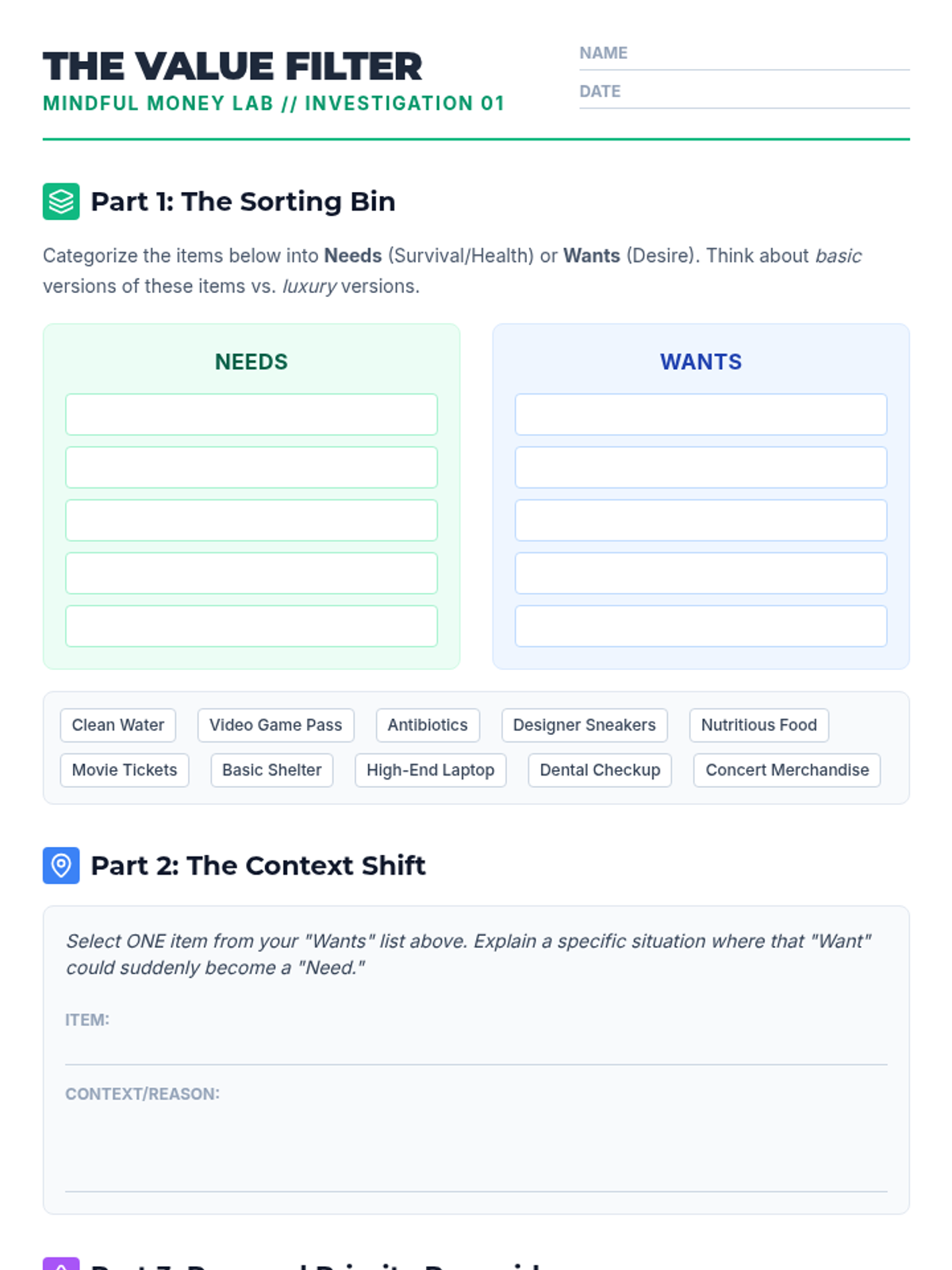
A comprehensive financial literacy sequence for 6th graders focusing on building a 'Financial Fortress' through needs/wants analysis, emergency funds, SMART goal setting, and banking basics. Students move from basic spending concepts to creating a personalized savings strategy for long-term security.
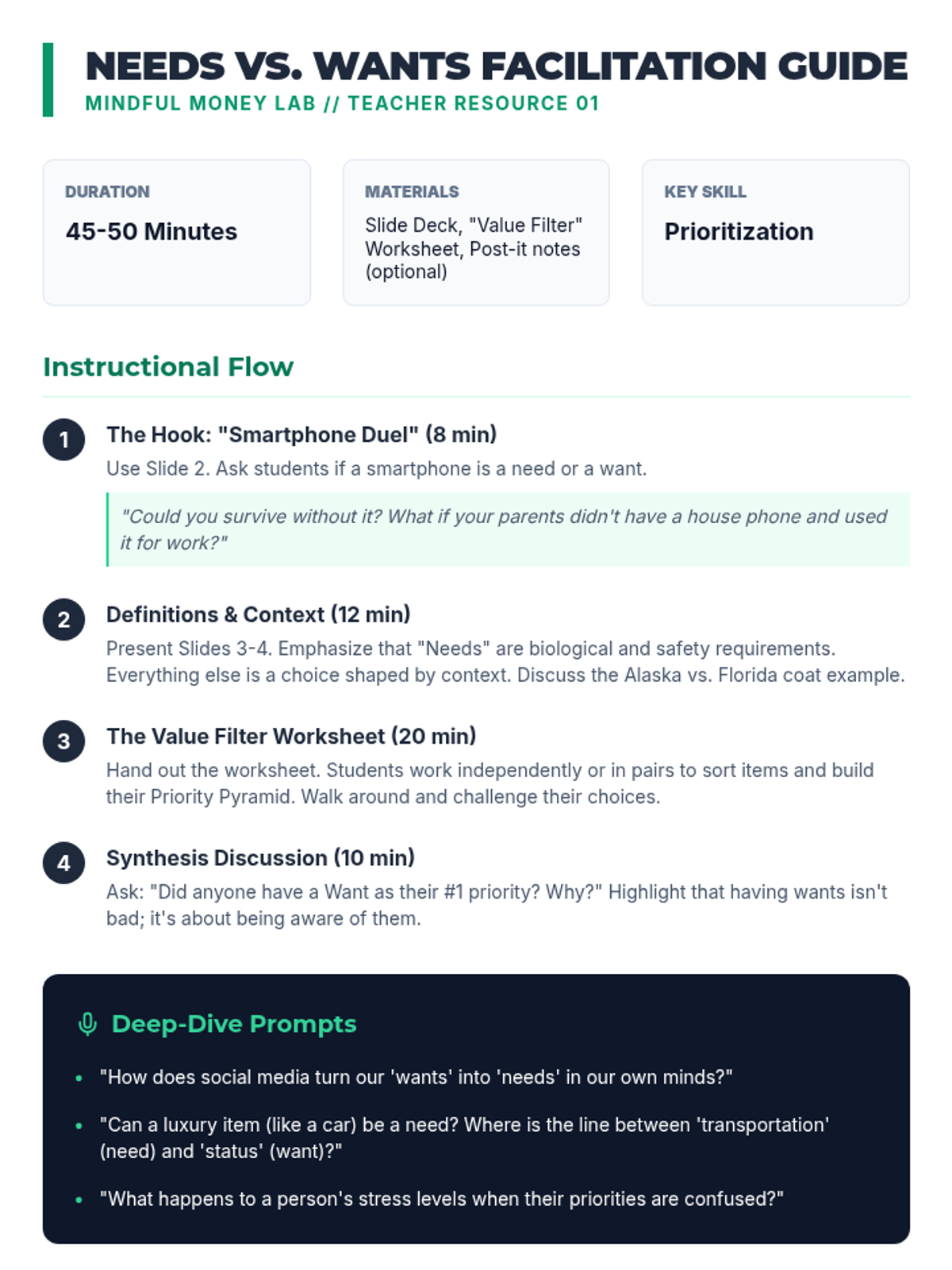
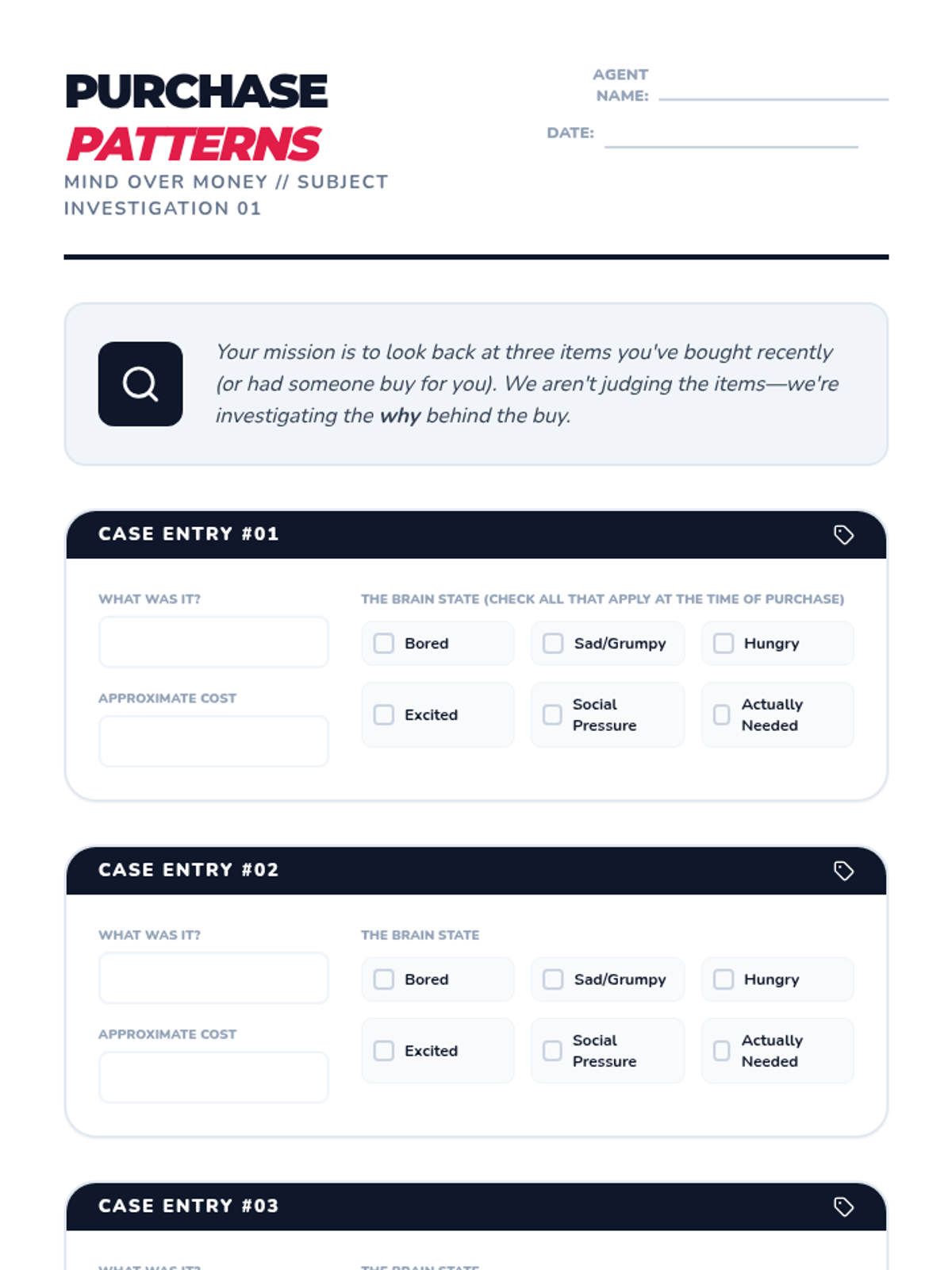
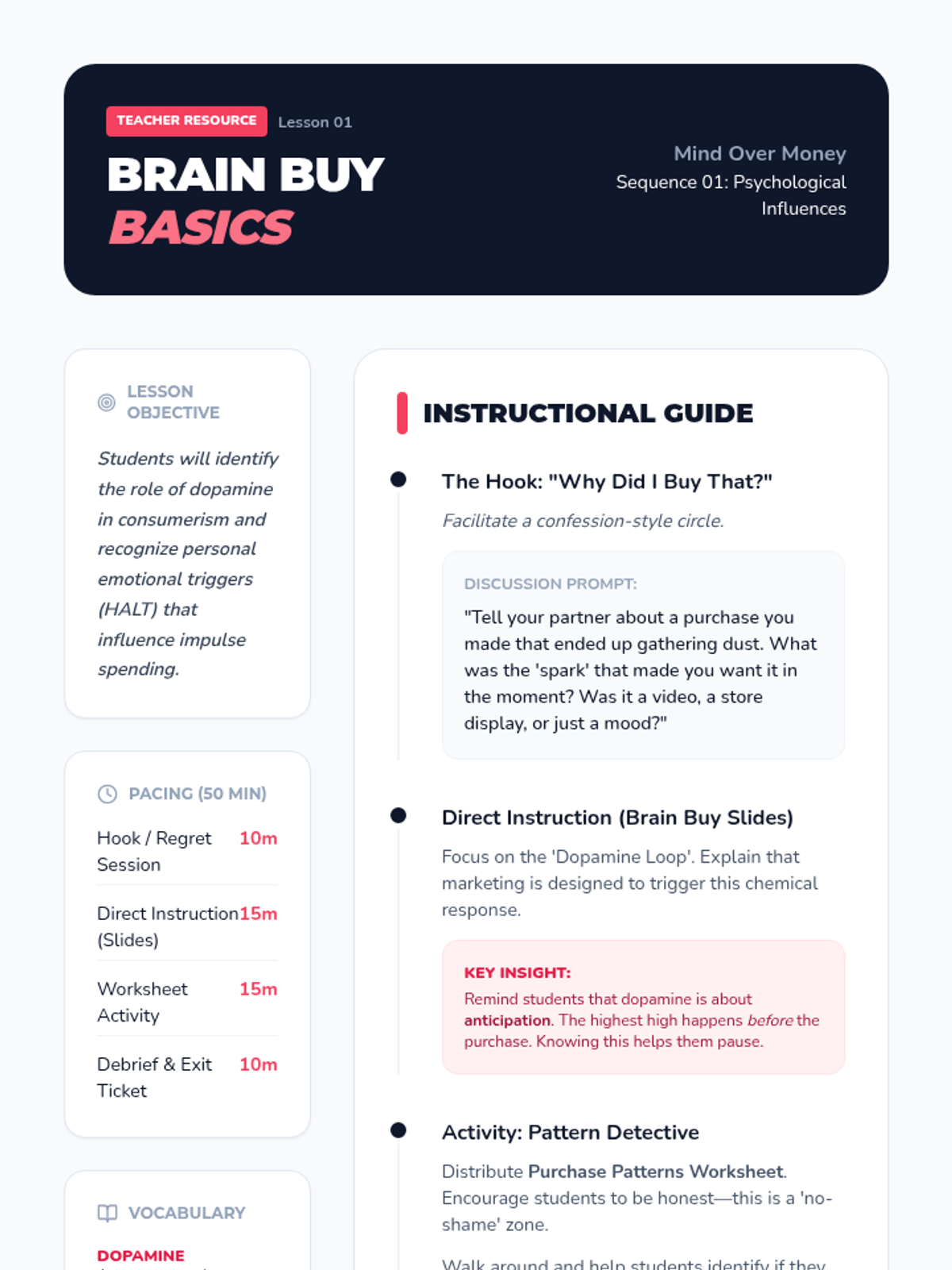
This sequence explores the psychology behind spending, focusing on impulse control, emotional triggers, and the economic concept of opportunity cost. Students move from basic needs/wants categorization to developing a personalized mindful spending plan.
A comprehensive workshop-style sequence exploring the psychology behind consumer habits, focusing on emotional triggers, peer pressure, branding, and environmental impact to help 6th graders develop healthy spending habits.
This sequence guides 6th-grade students through the psychological and practical steps of behavior change. They move from understanding SMART goals and motivation types to designing their own behavior contracts and tracking systems, emphasizing self-regulation and iterative growth.
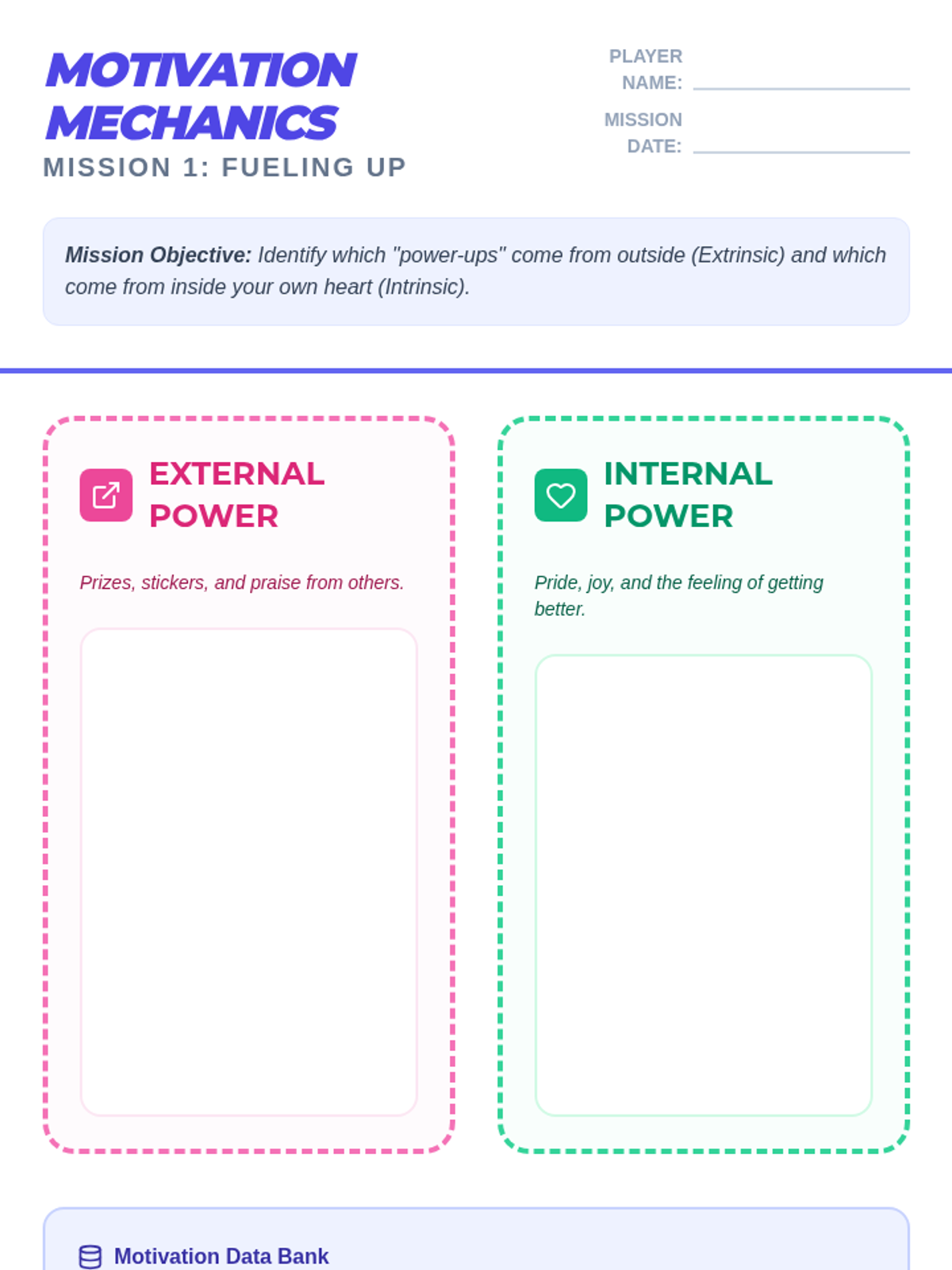
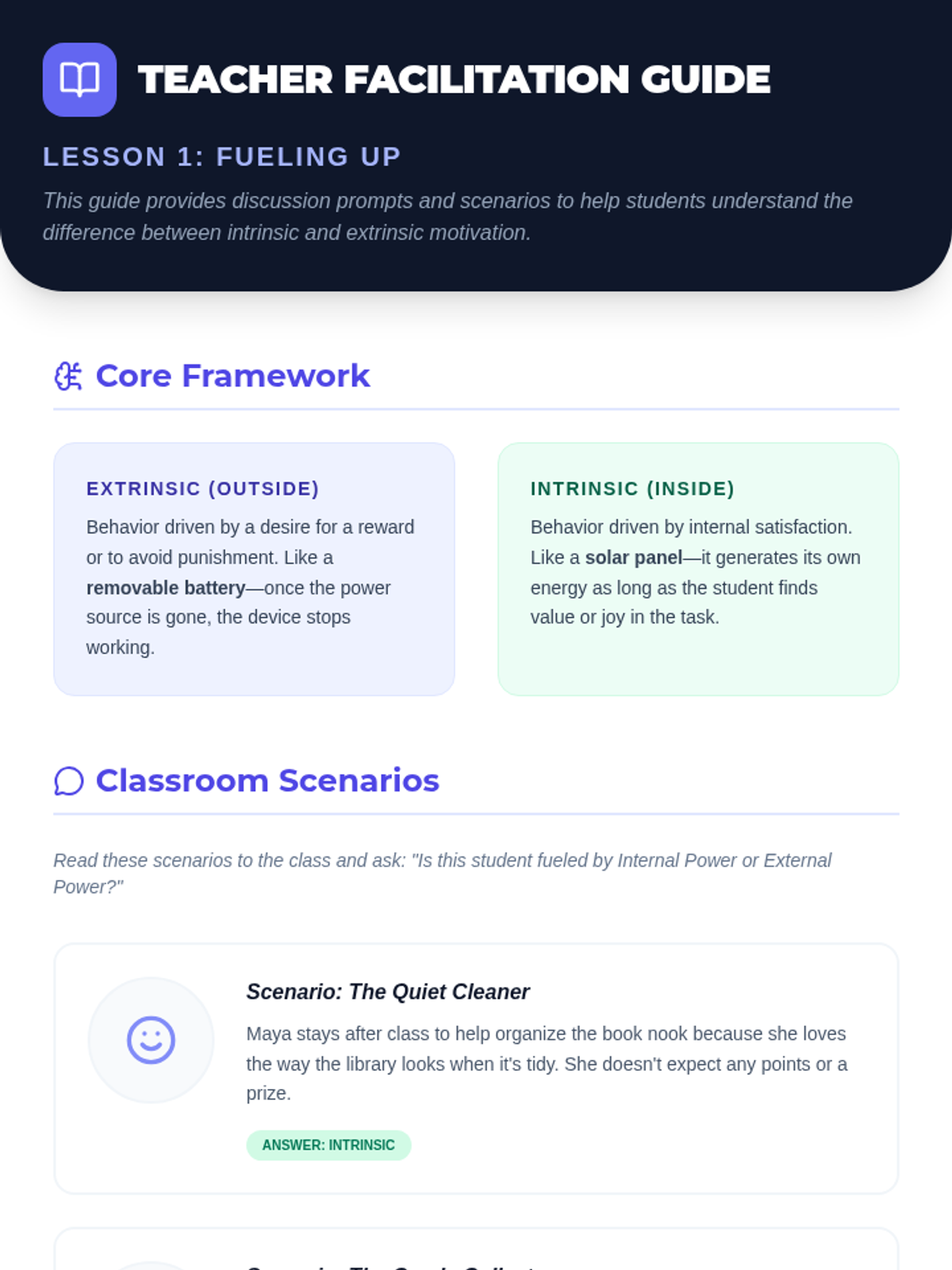
This sequence explores the psychology of motivation and reward systems. Students learn to distinguish between internal and external rewards, design meaningful reinforcement menus, and plan for long-term growth and independence.
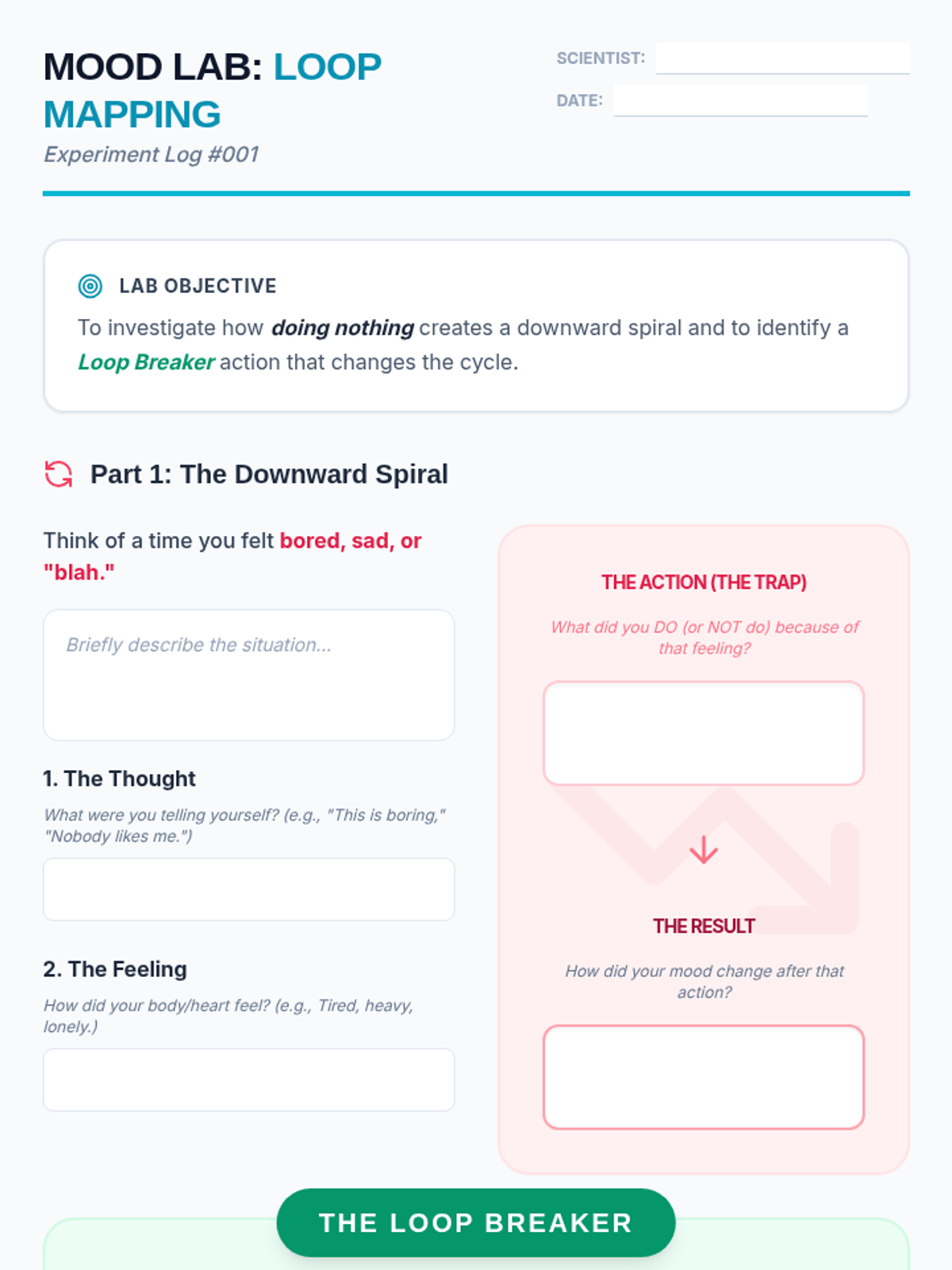
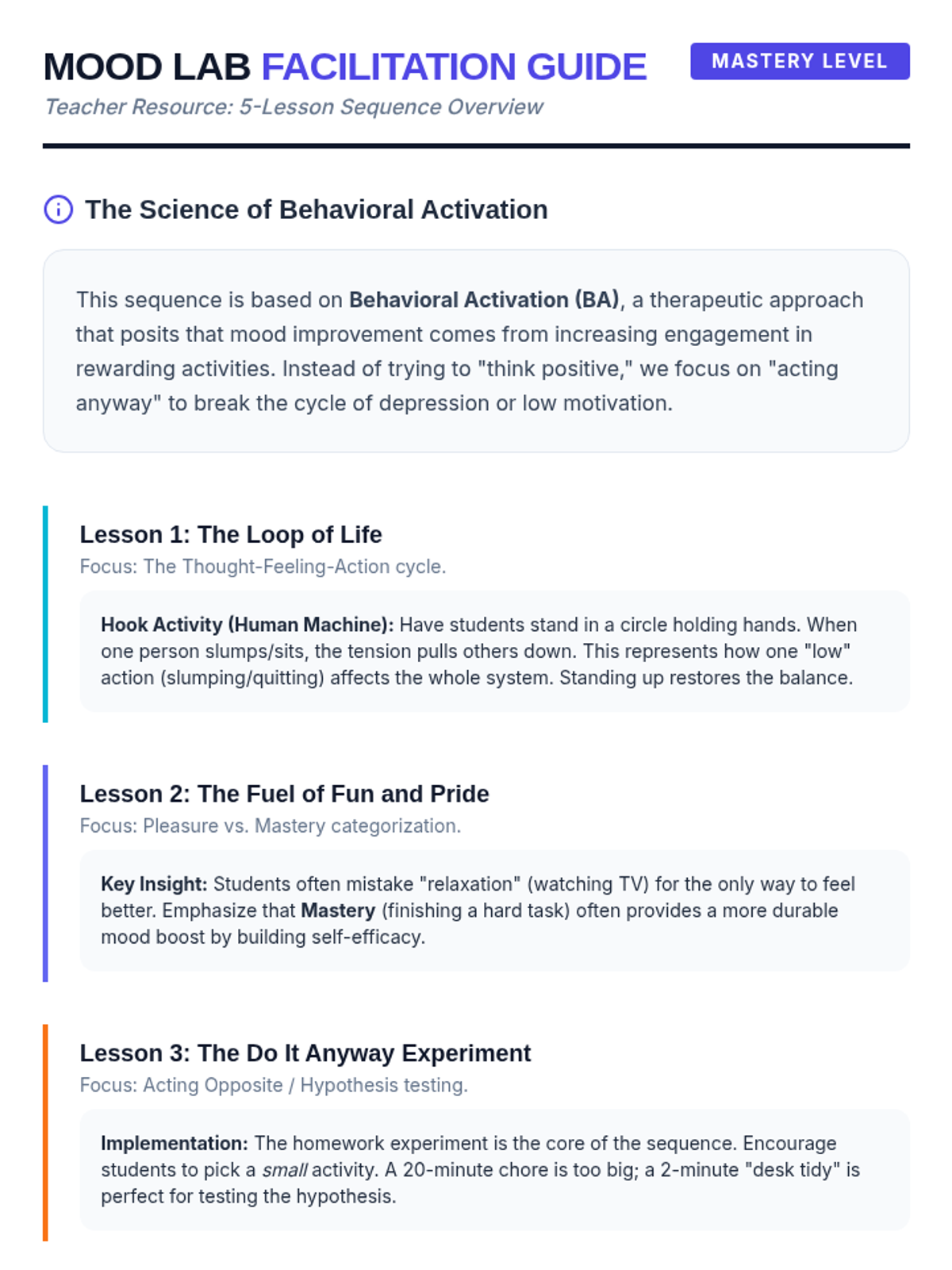
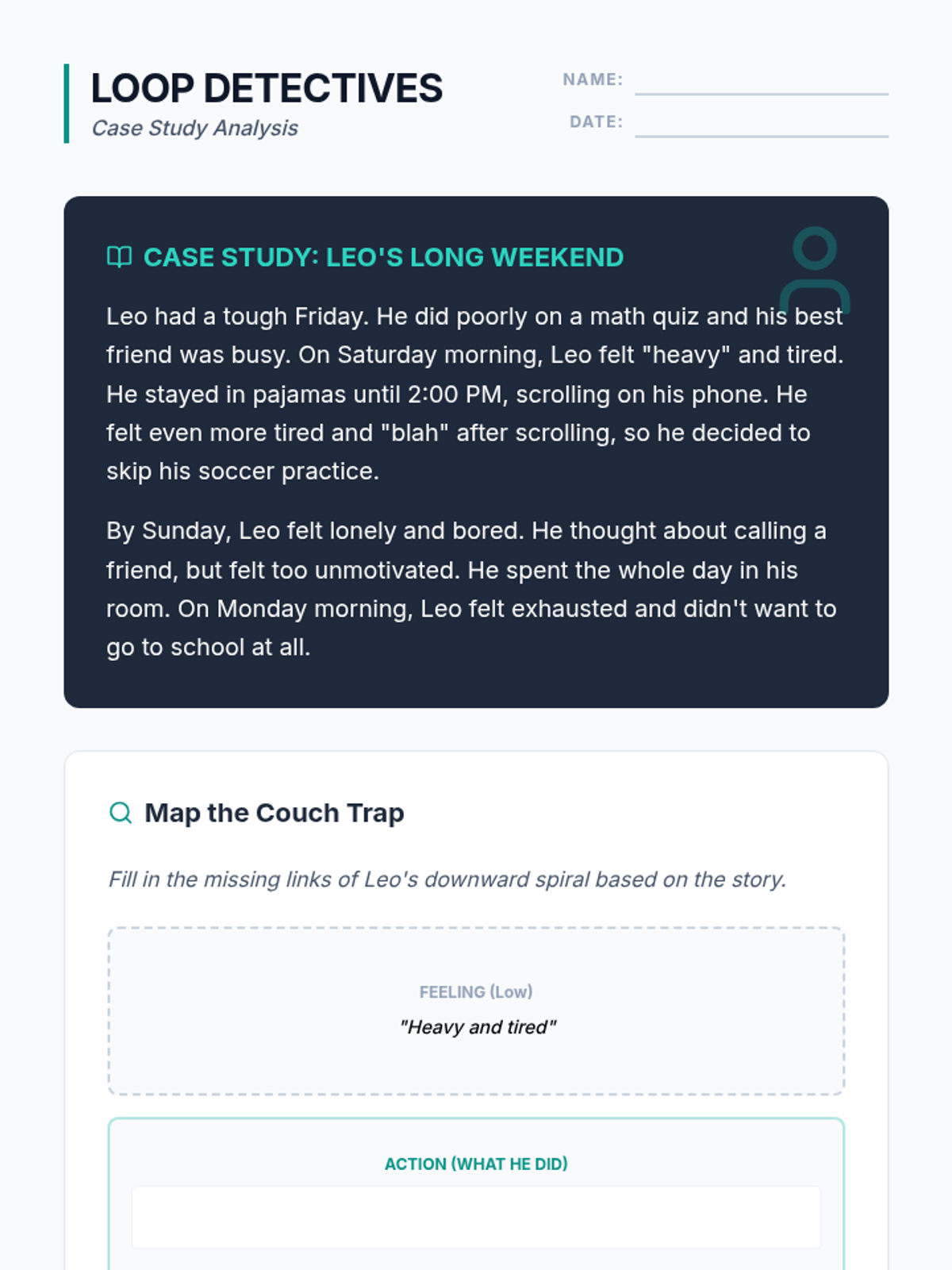
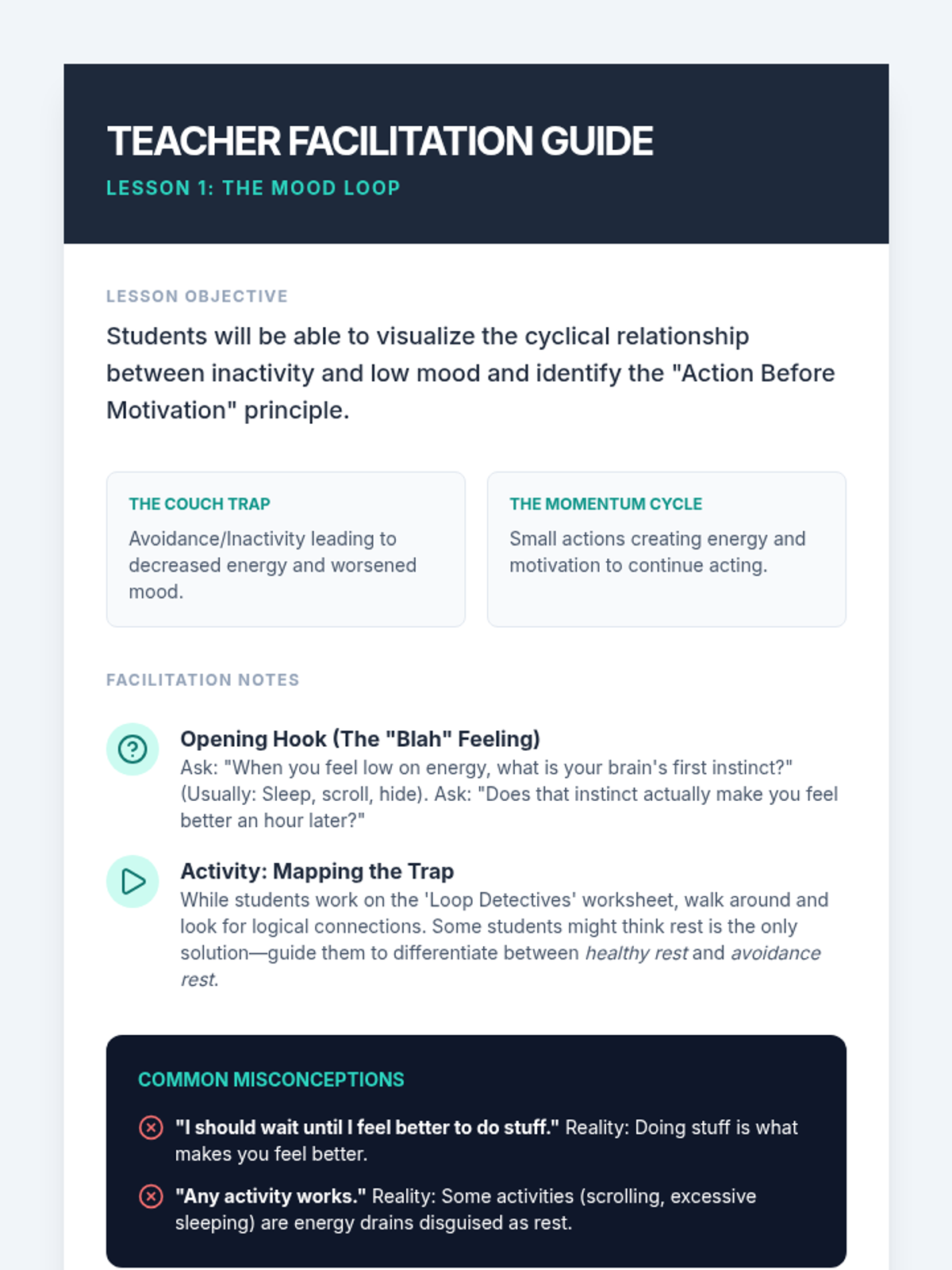
In this inquiry-driven sequence, students explore behavioral activation, investigating how their actions influence their emotions. They learn to distinguish between pleasure and mastery activities, conduct personal experiments to track mood changes, and create a personalized evidence-based plan for mood regulation.
A comprehensive sequence for 6th graders to understand and apply behavioral activation. Students learn how their actions impact their emotions, track their energy levels, brainstorm nourishing activities, and create a sustainable weekly schedule to improve their mental well-being.
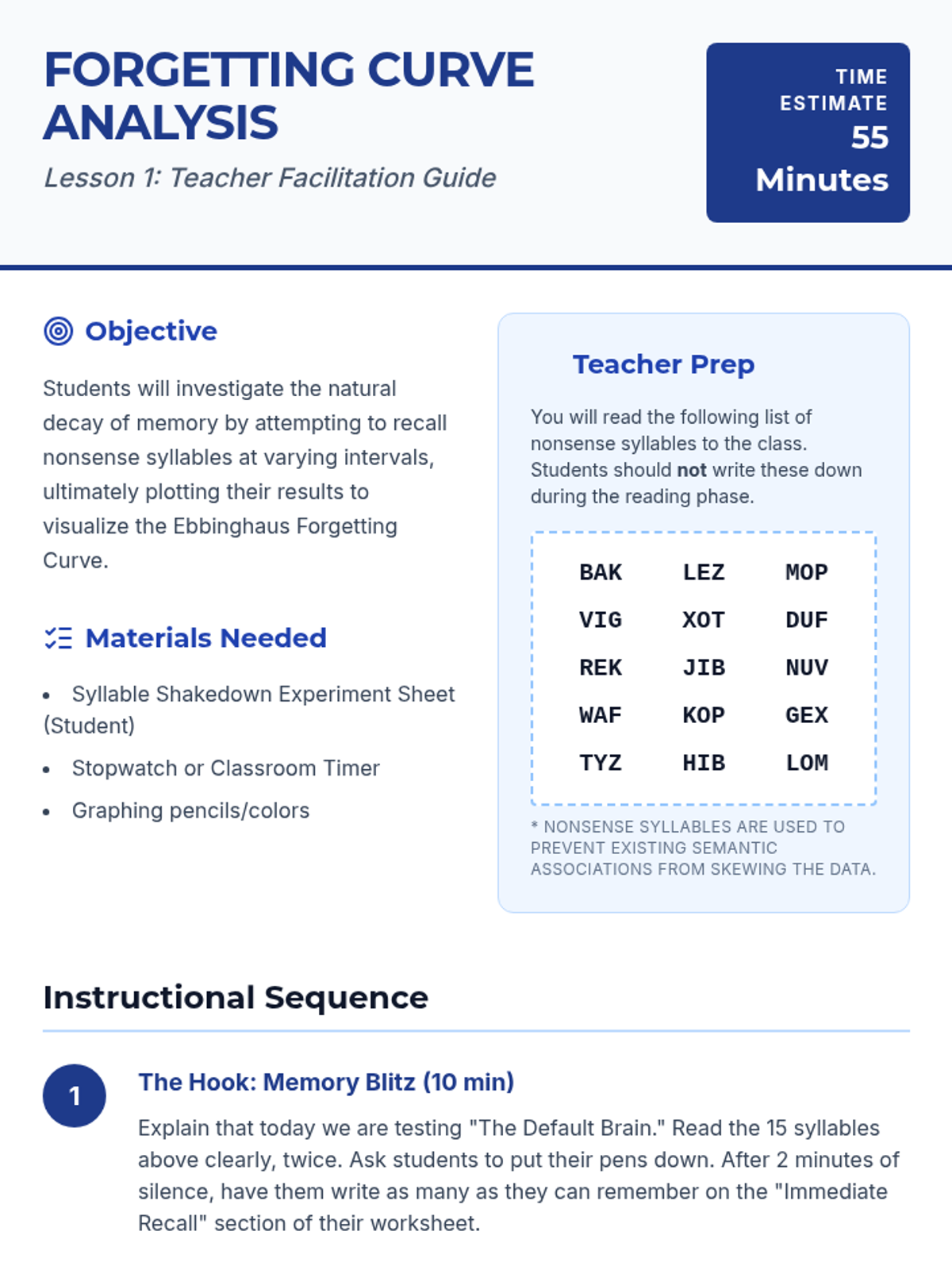
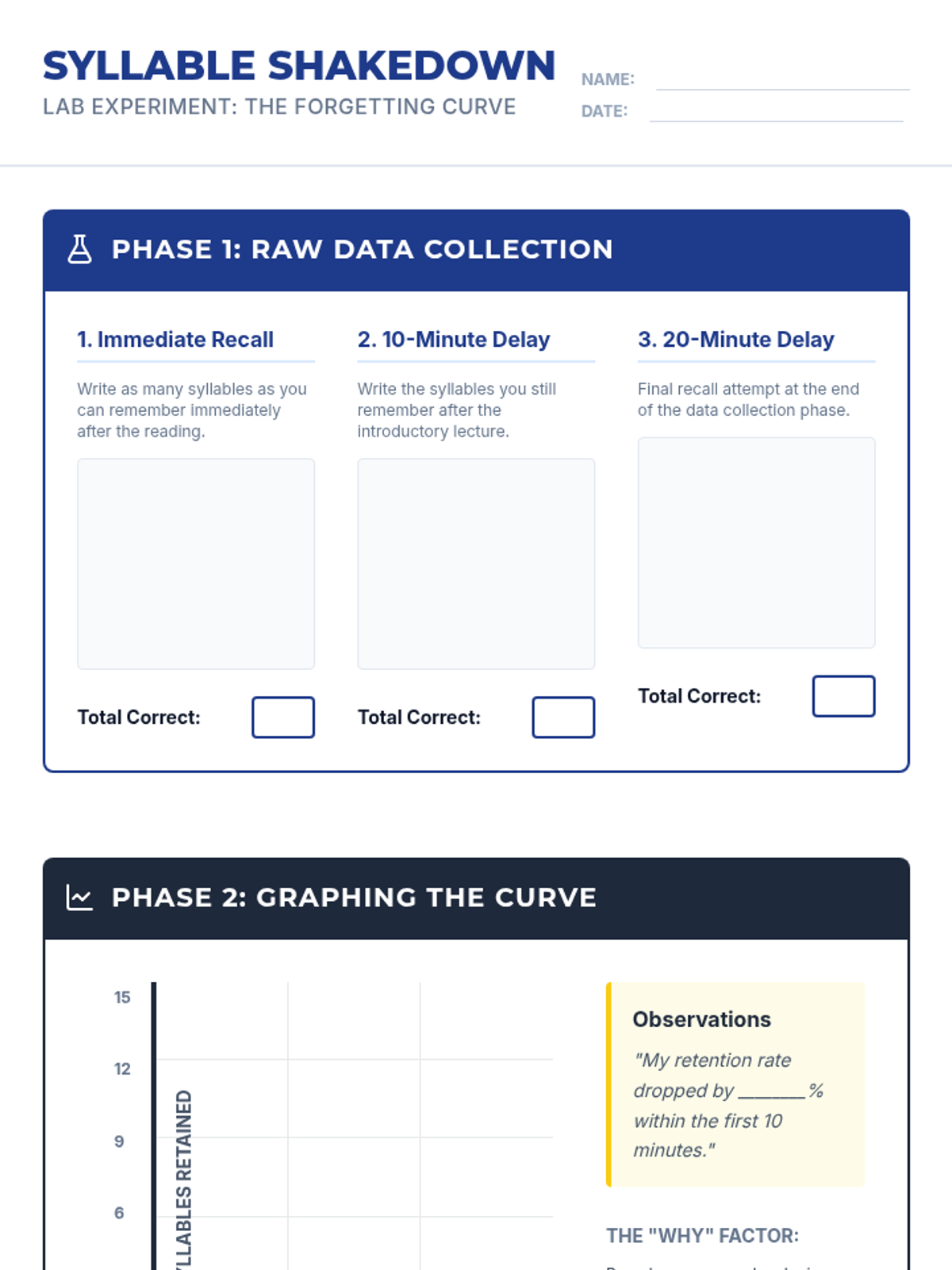
An inquiry-based exploration into the neuroscience of memory, focusing on the Forgetting Curve and how spaced repetition can 'hack' the brain for long-term retention. Students move from understanding memory decay to designing their own efficient study schedules based on biological principles.
A gamified sequence designed for 6th-grade students to master memory strategies through active recall and spaced repetition. Students participate in 'micro-reviews' and competitive challenges to build procedural memory habits.
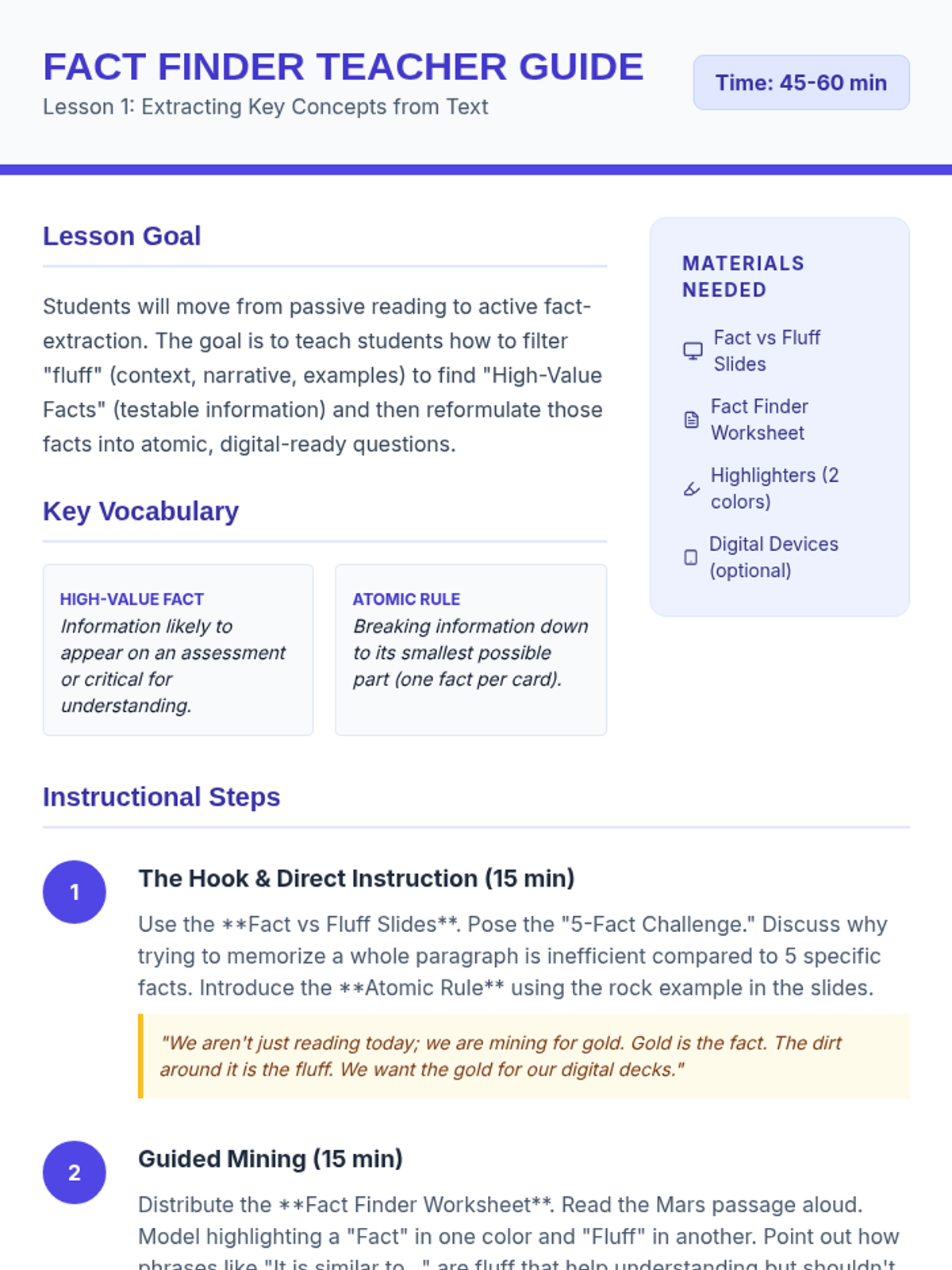
This sequence teaches 6th-grade students how to use digital spaced repetition tools to enhance memory and study efficiency. Students progress from extracting key facts to building multimedia-rich digital decks and understanding the algorithms that drive long-term retention.
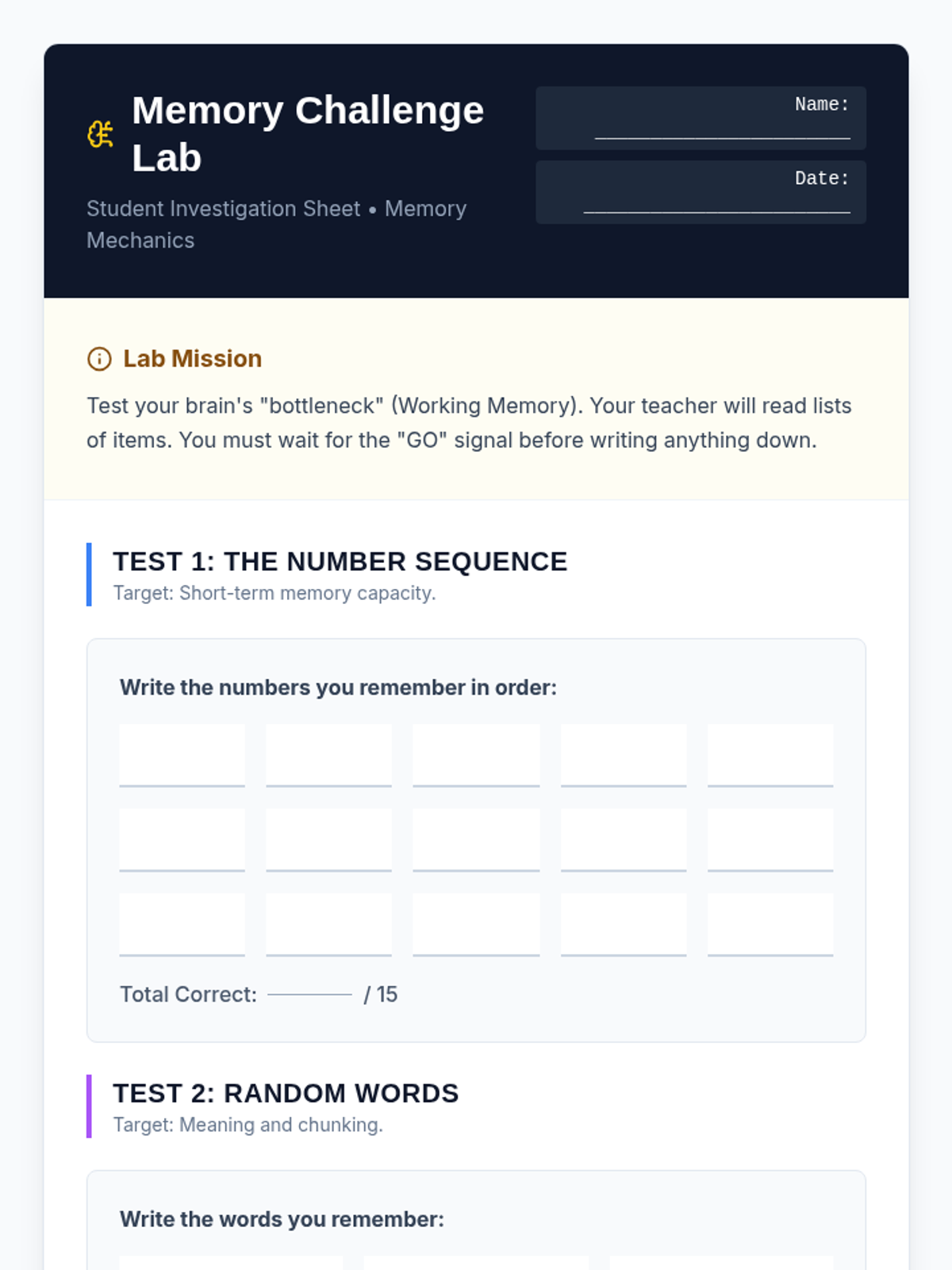
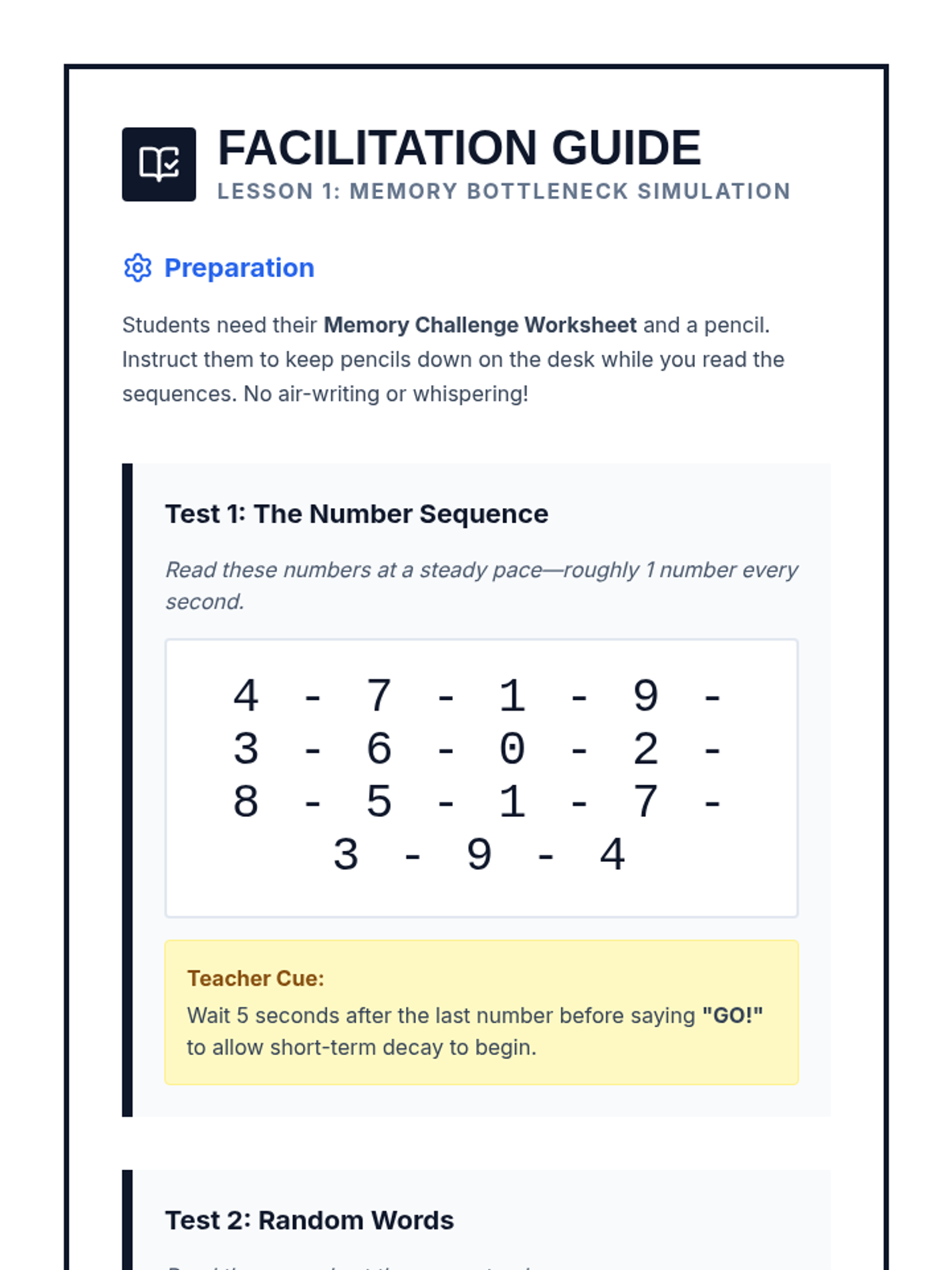
A sequence for 6th-grade students on memory mechanics, the forgetting curve, and the power of spaced repetition to improve retention. Students explore how their brains store information through hands-on simulations, data tracking, and strategic planning.
This sequence integrates spaced repetition strategies directly into current academic content, turning the practice into a habit through gamification and mastery tracking. Students apply their systems to vocabulary, math facts, and core concepts relevant to their grade level, helping them visualize their growth over time.
This sequence shifts focus from the design of the study guide to its utility, emphasizing active recall and self-testing strategies to help students distinguish between familiarity and actual mastery of material.
A sequence designed to empower 6th-grade students to take ownership of their progress through the creation and maintenance of a Goal Portfolio. Students learn physical and digital organization, data tracking, and how to present their growth to others.
A comprehensive unit for 6th-grade students focused on cognitive strategies, mnemonic devices, and gamification to enhance study habits and information retention. Students move from understanding the science of memory to creating their own interactive review games.
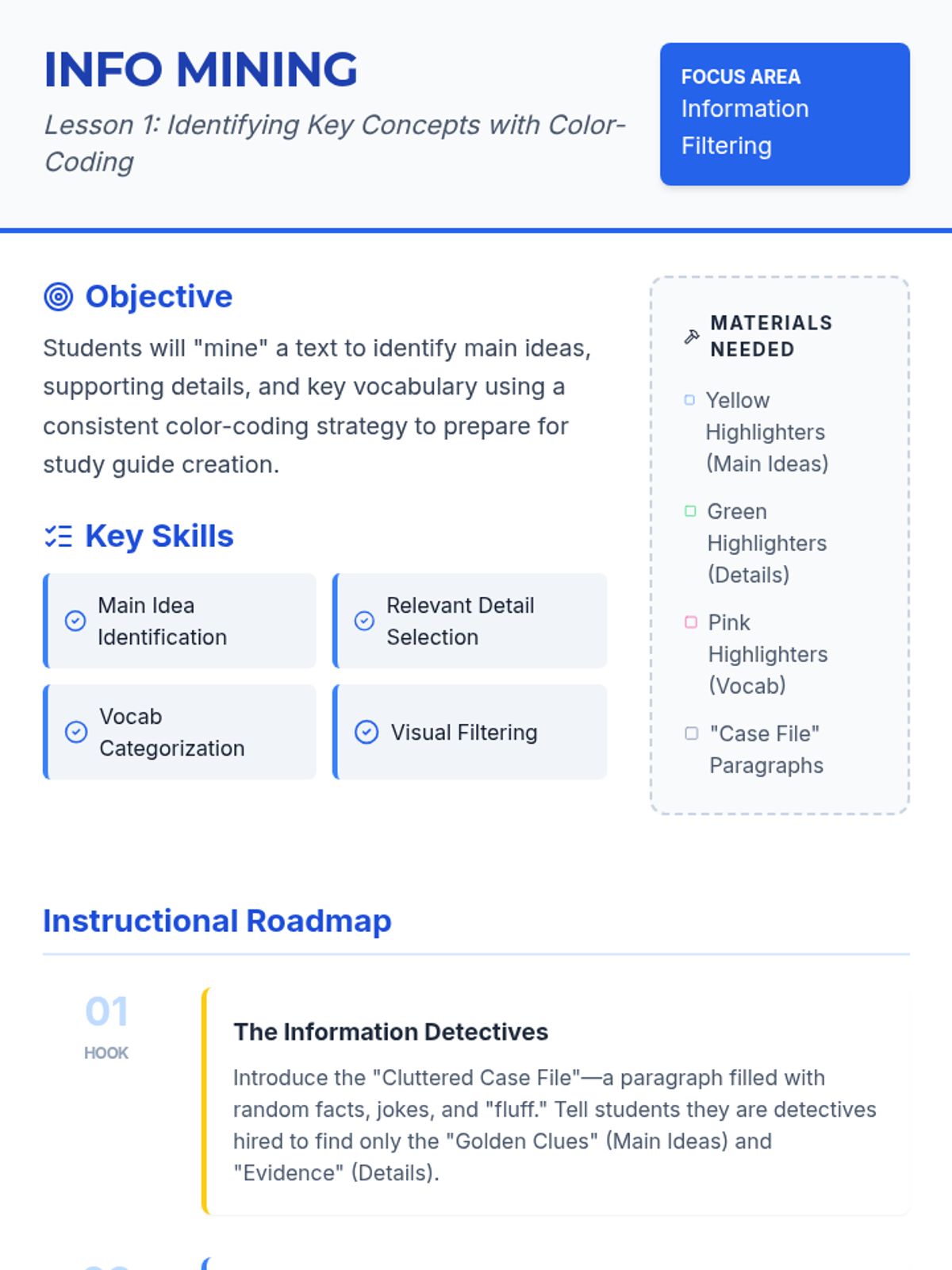
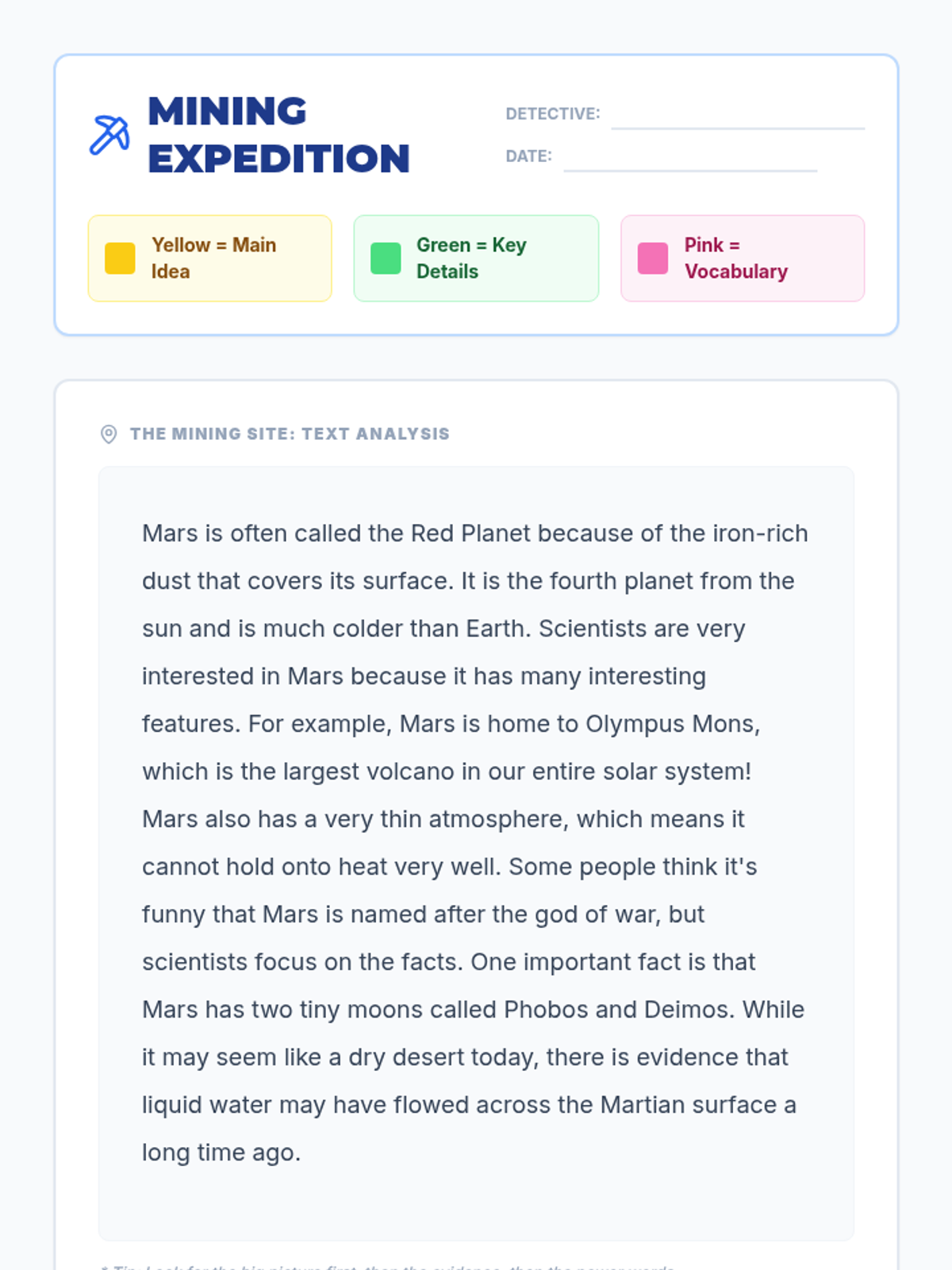
A sequence focused on helping students transform passive reading into active, visual study tools. Students learn color-coding, concept mapping, foldable creation, and comparison charting to organize and retain information.
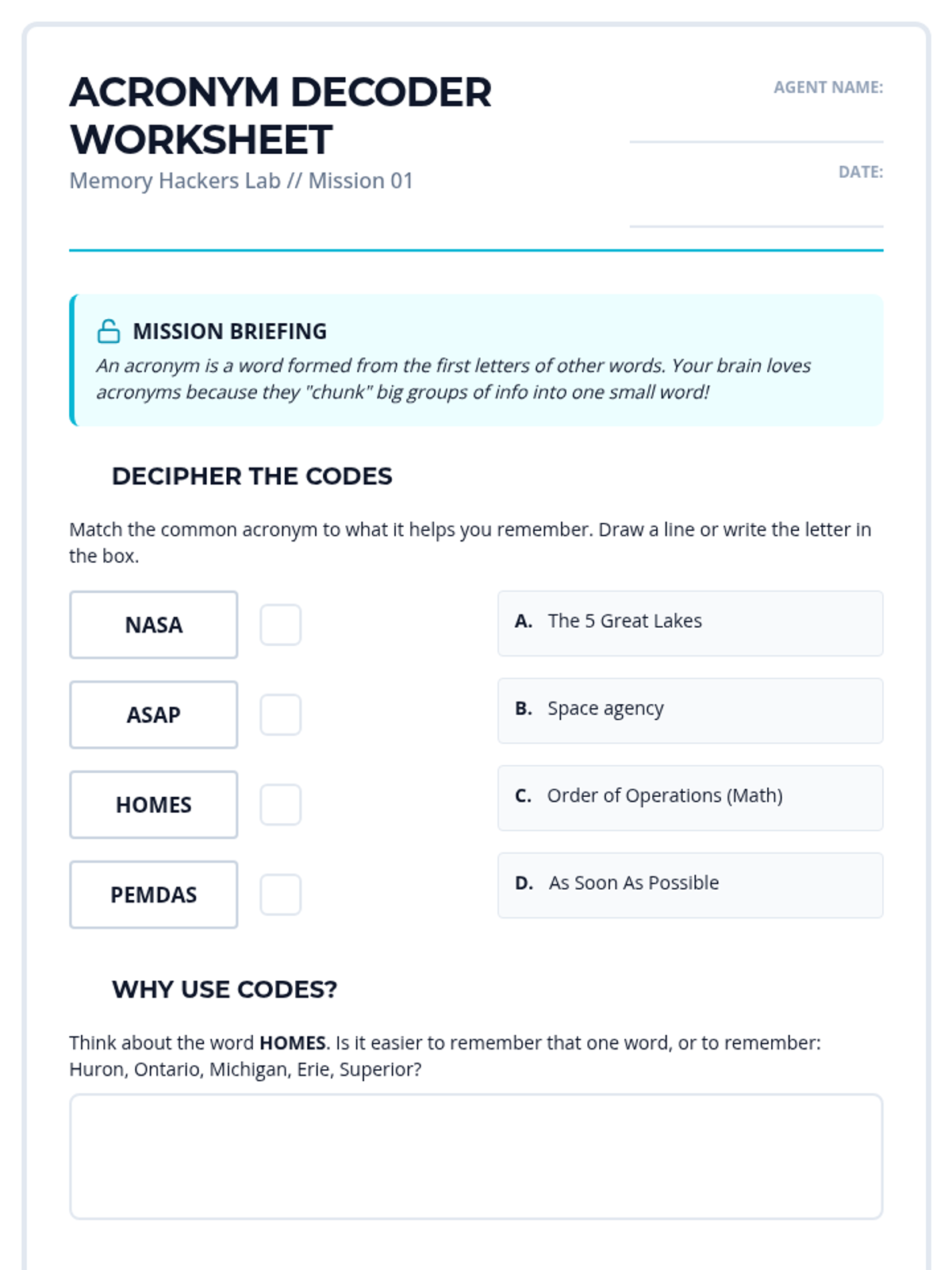
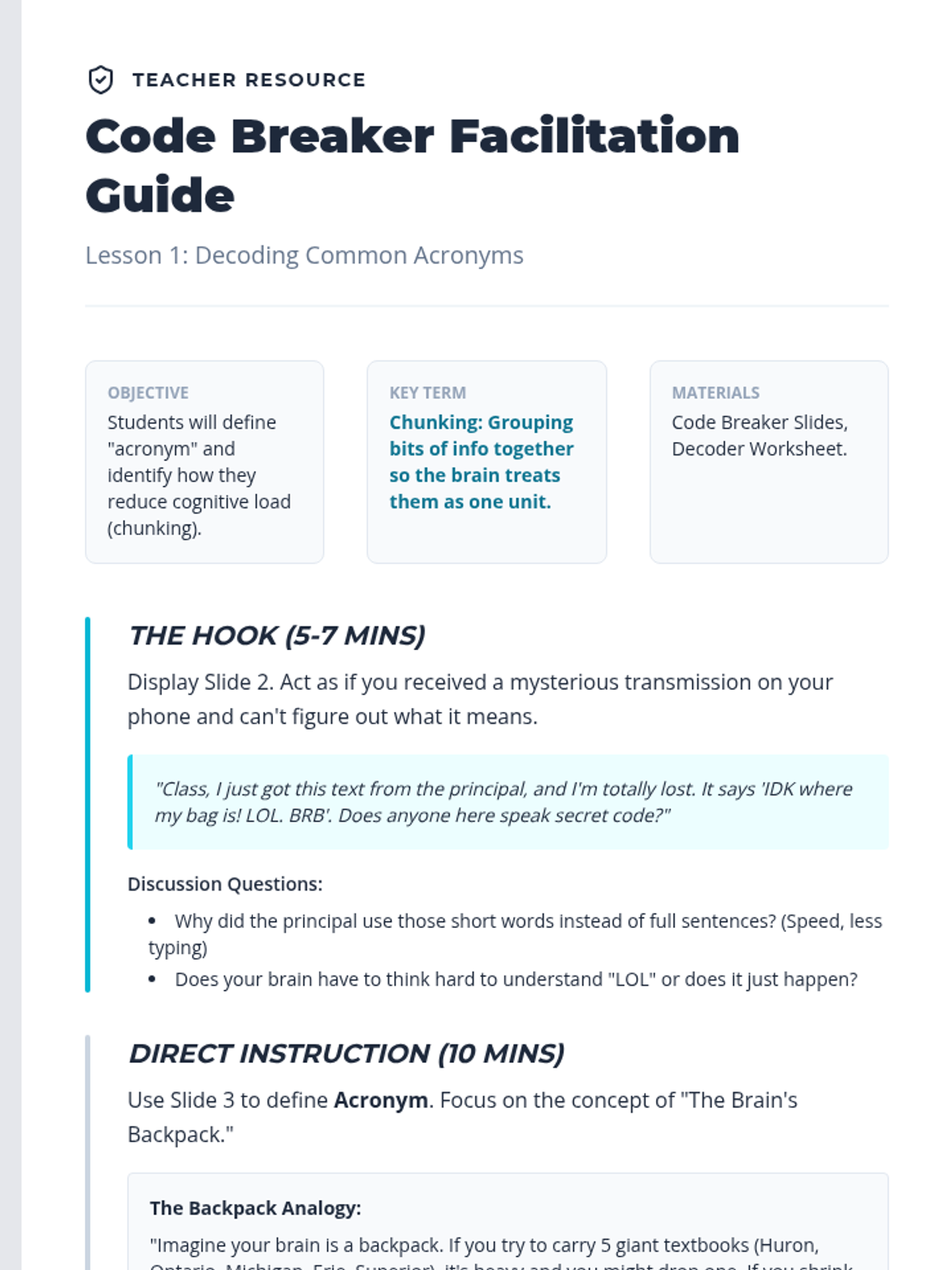
Students master the art of creating and using mnemonic acronyms to reduce cognitive load and improve concept retrieval. The sequence progresses from decoding common acronyms to engineering personal and academic ones, culminating in a mastery arcade.
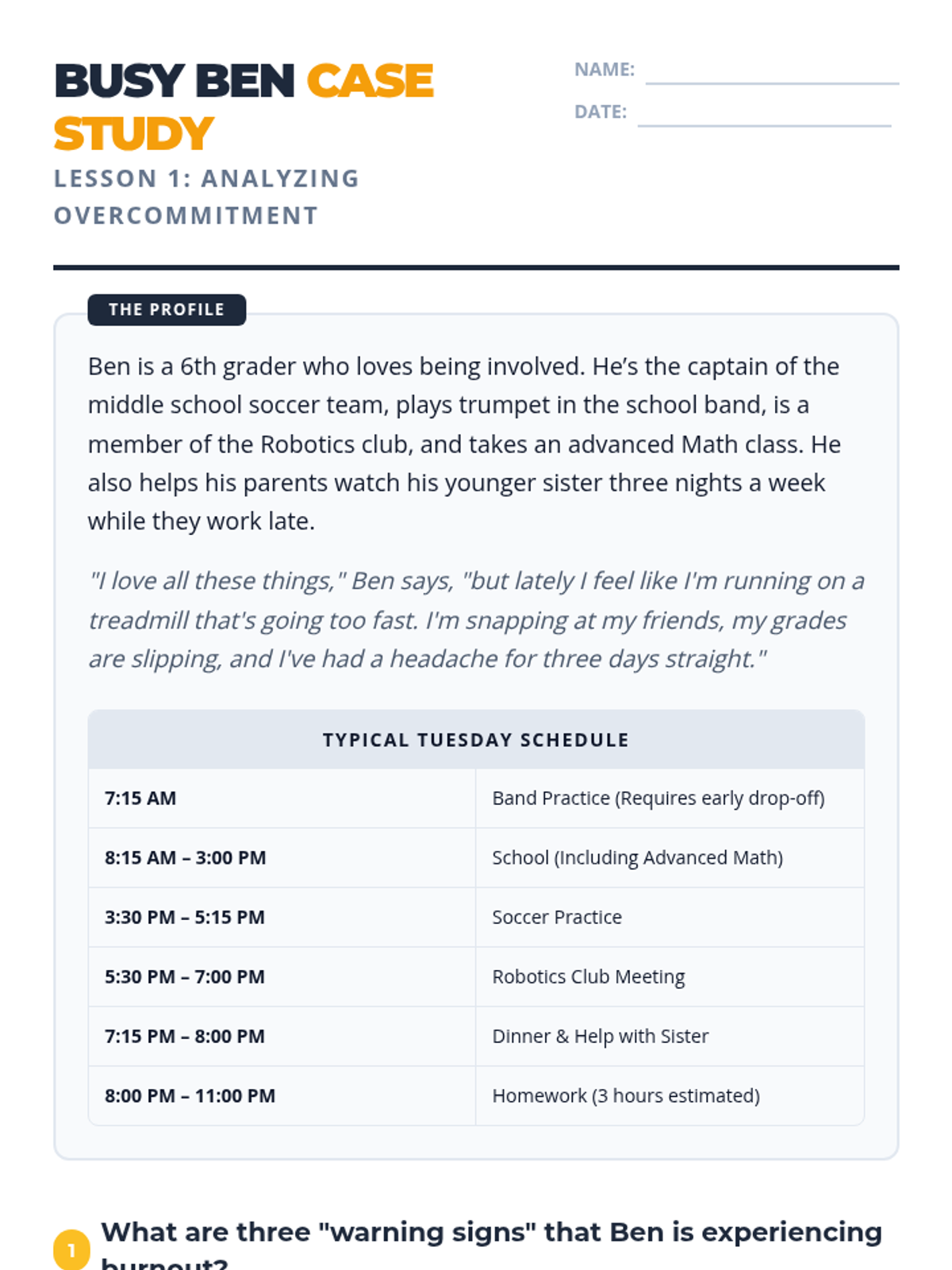
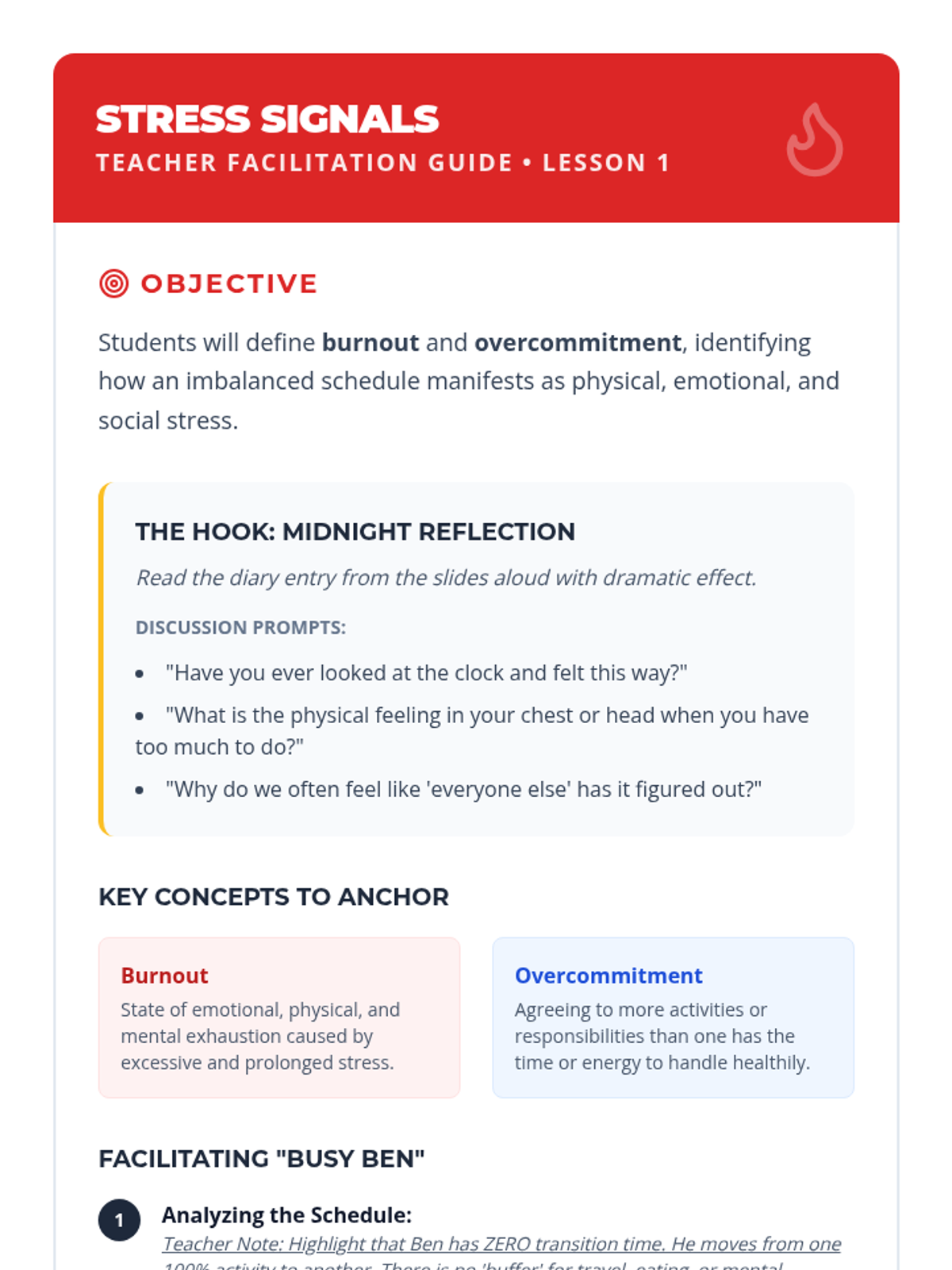
A comprehensive unit for 6th-grade students focusing on balancing academic requirements, extracurricular activities, and essential self-care. Through case studies, categorization activities, and communication practice, students learn to prevent burnout and advocate for their well-being.
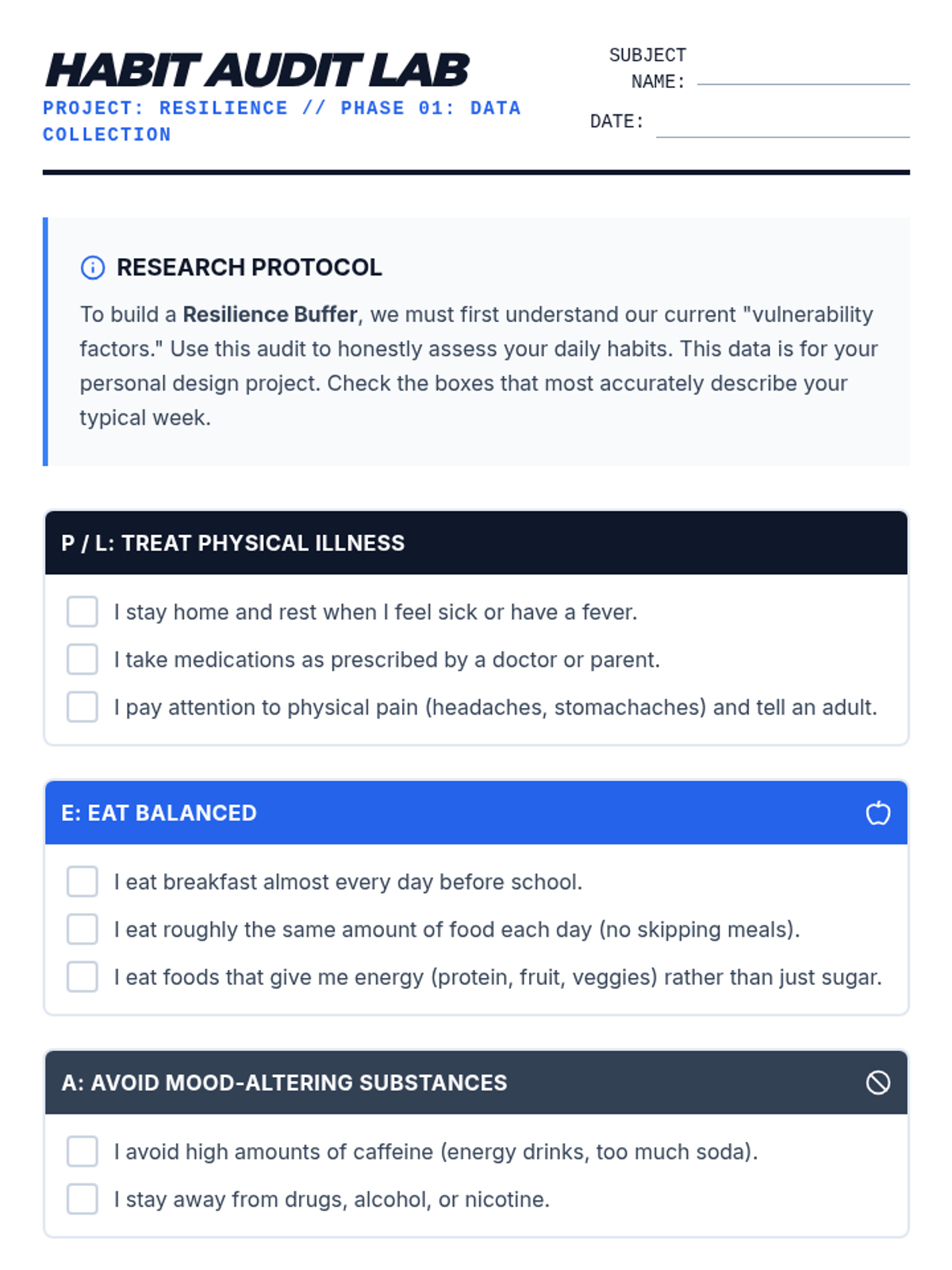
A project-based sequence where 6th-grade students treat their daily routines as a design challenge to reduce emotional vulnerability. Using the DBT PLEASE skills, students audit their habits and design a personalized 'Resilience Routine' for physical and emotional wellness.
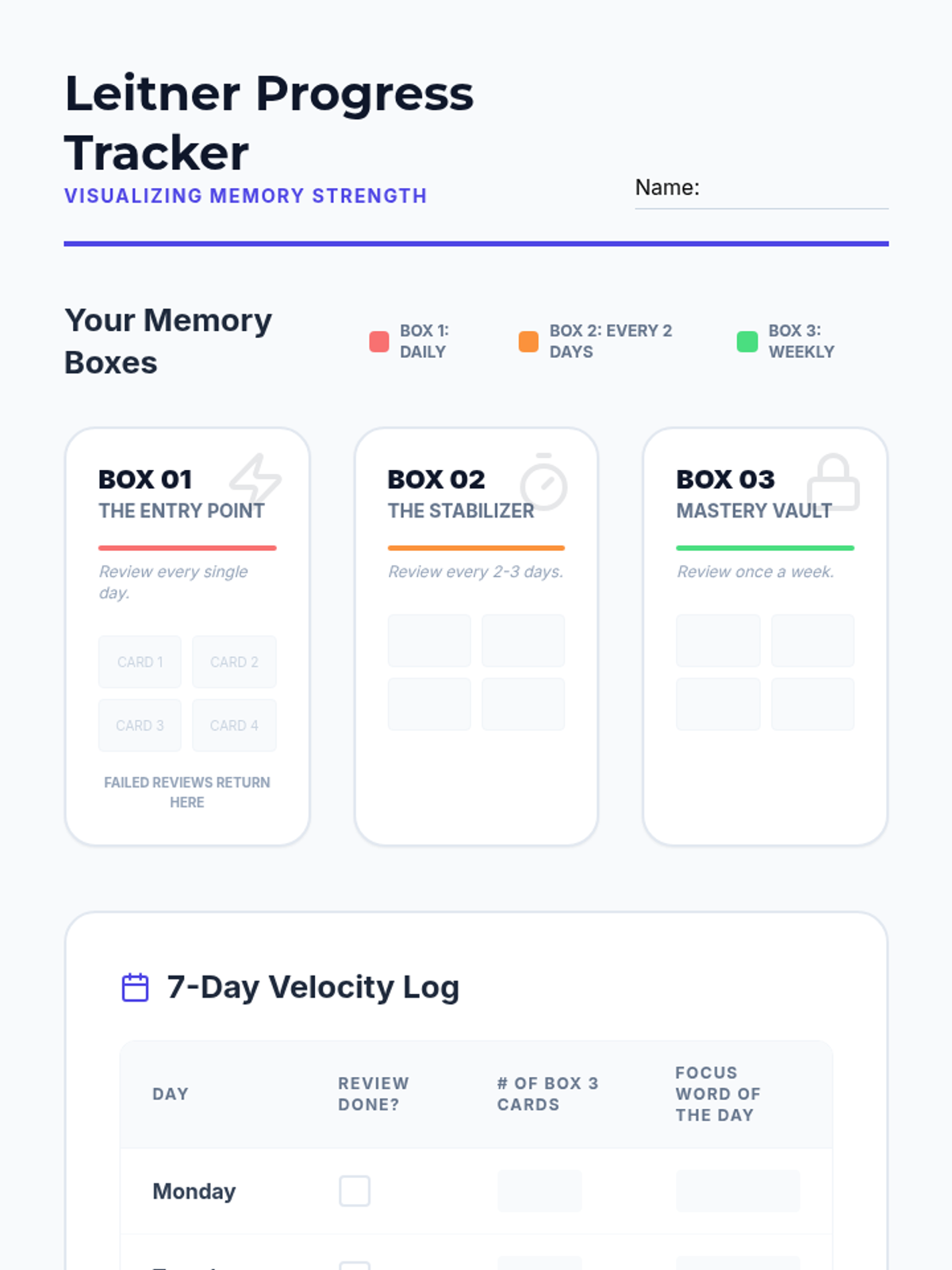
A comprehensive workshop sequence for 6th-grade students to master the Leitner System of spaced repetition. Students learn to create high-quality flashcards, set up a physical multi-box system, and implement a daily sorting routine to move information from short-term to long-term memory.
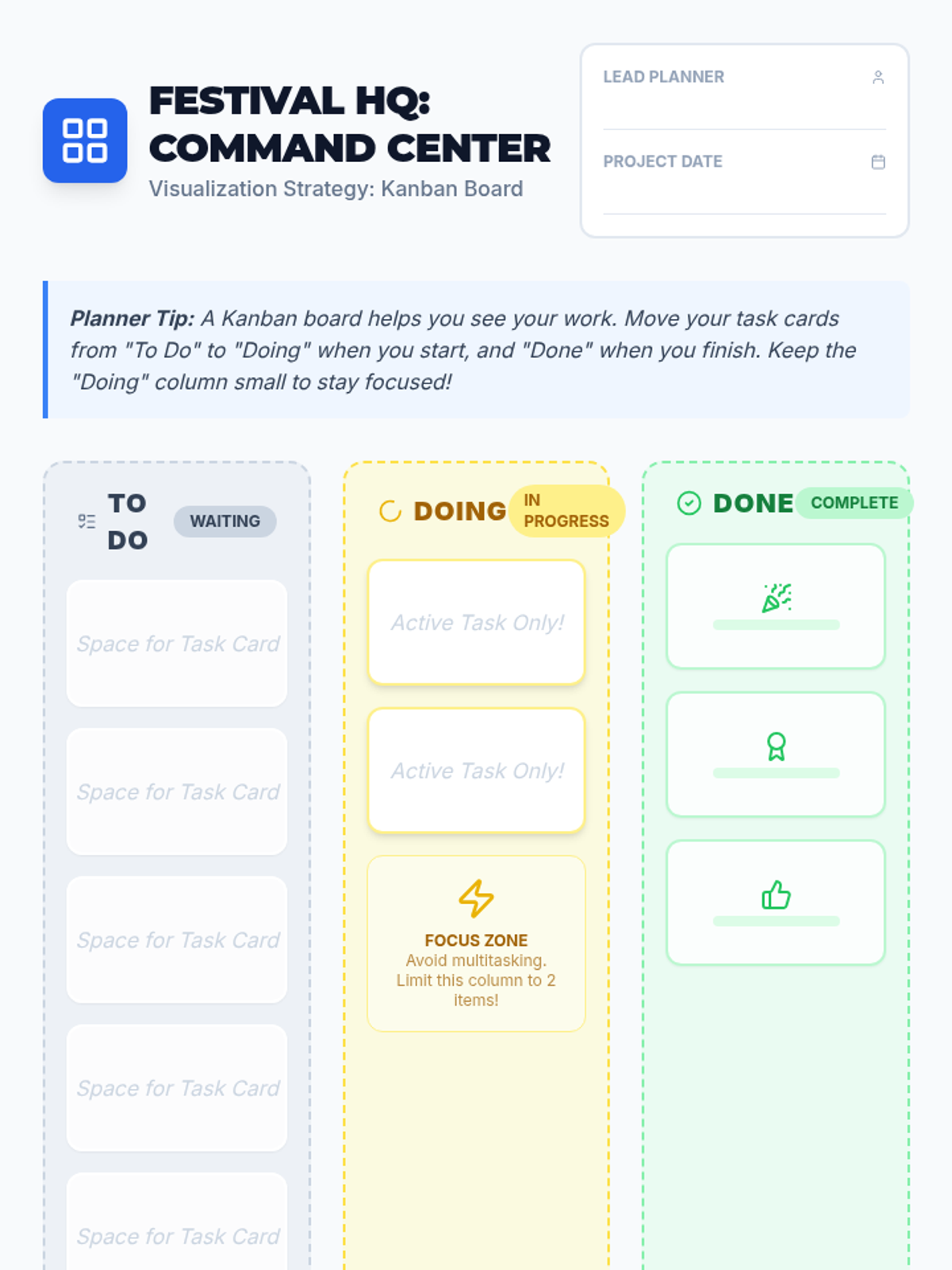
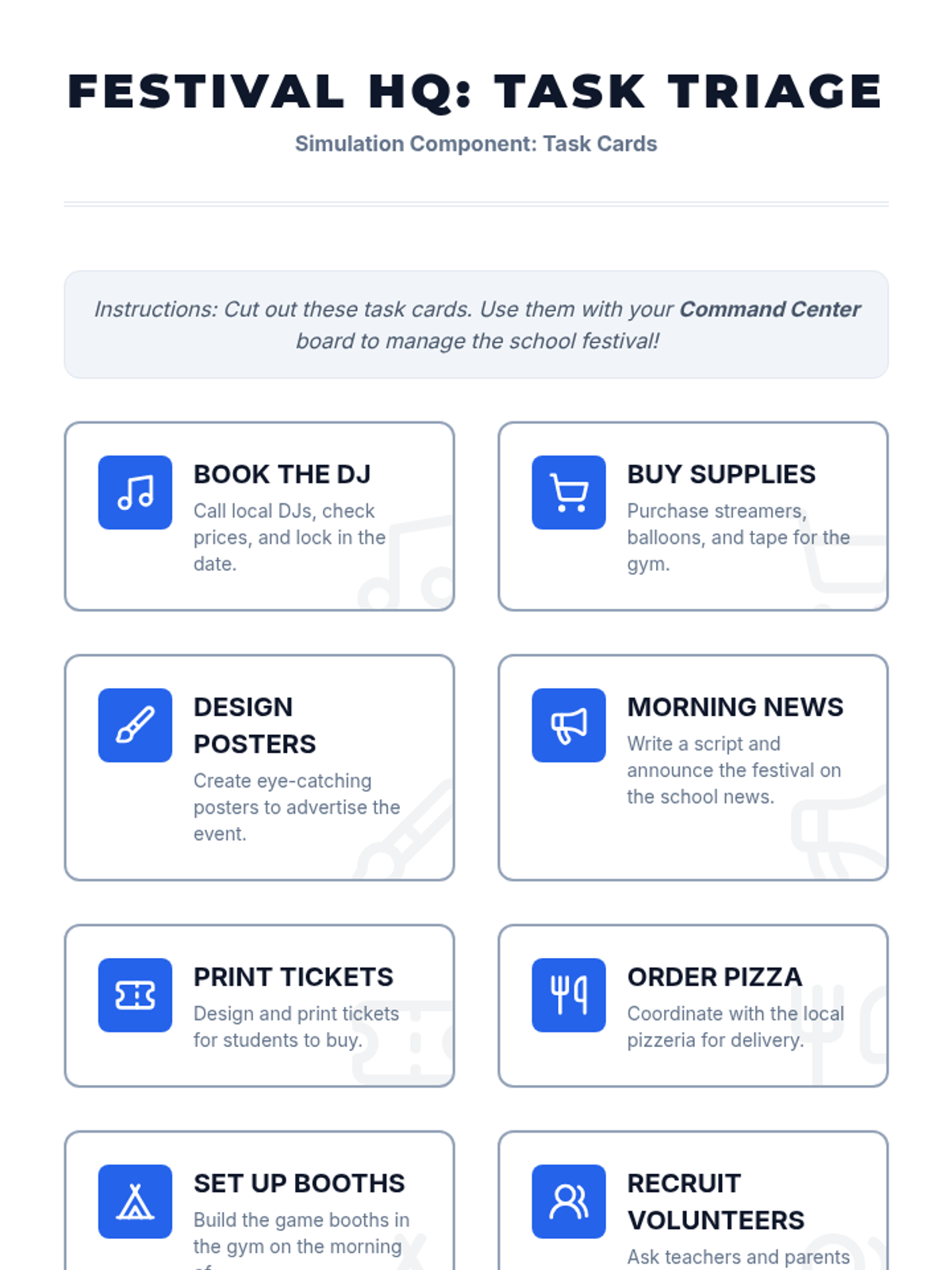
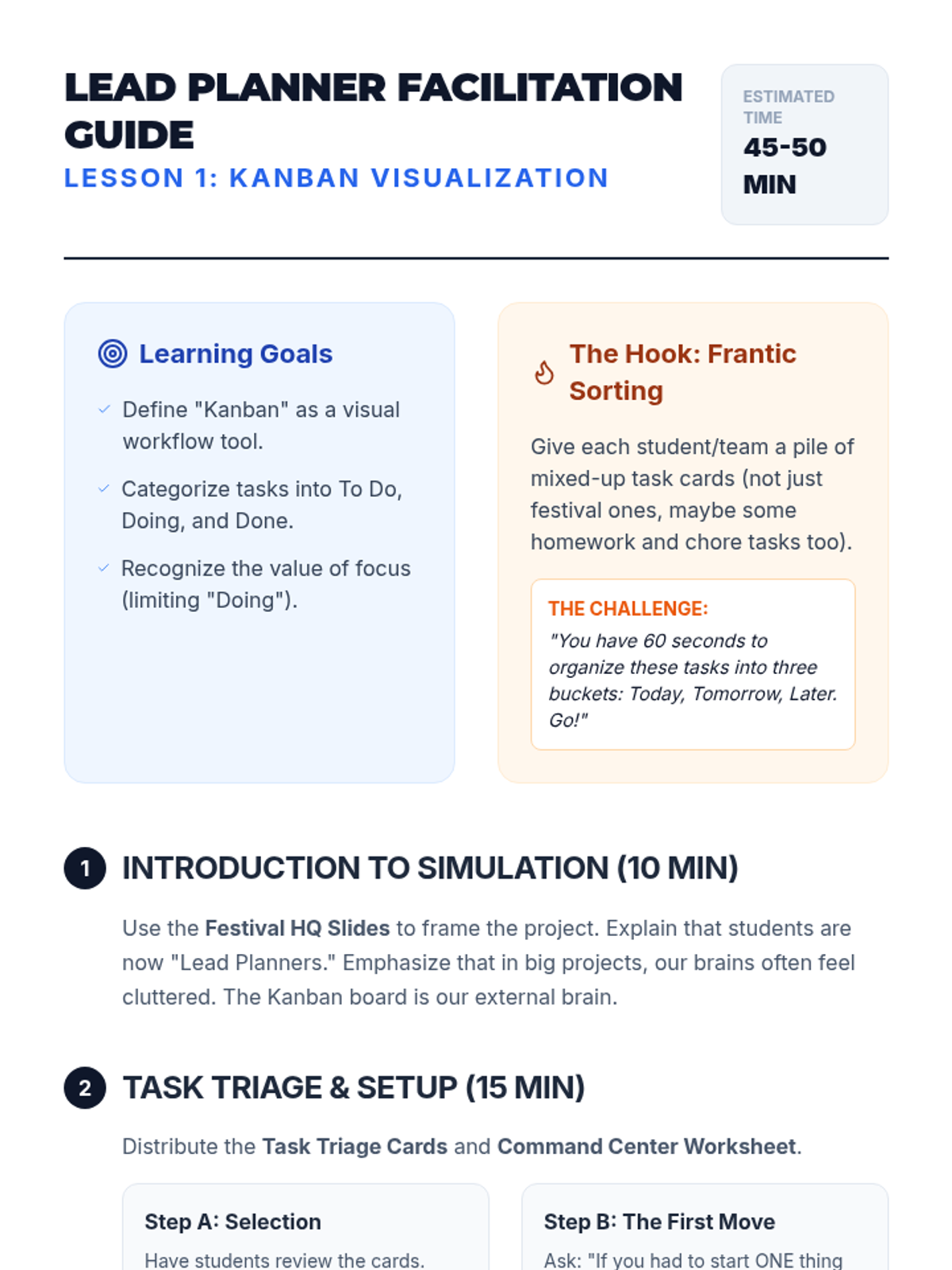
A simulation-based sequence where 6th-grade students act as Event Planners for a school festival to master multi-day project management, workflow visualization, and adaptability.
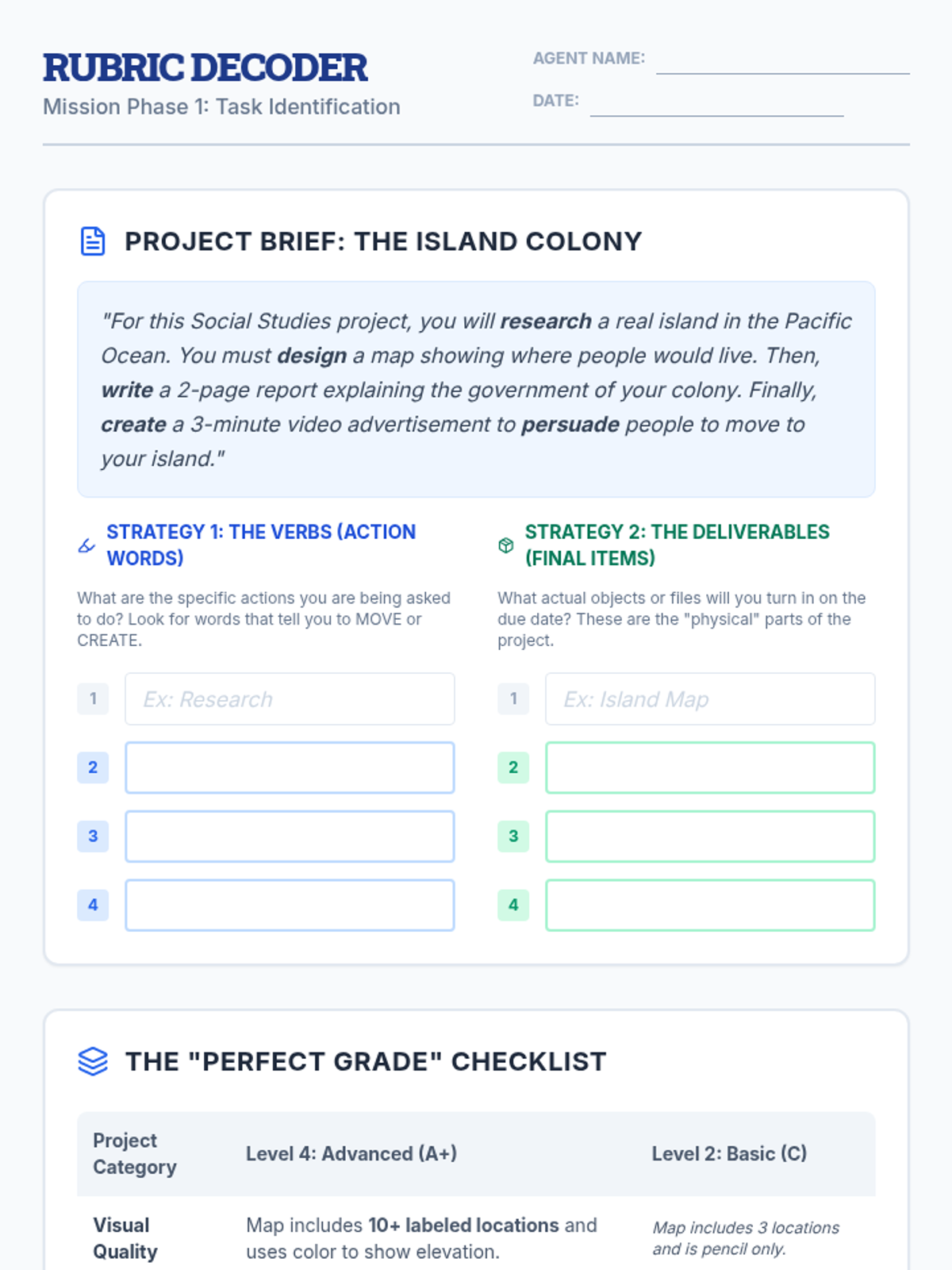
An executive function workshop for 6th-grade students focused on the mechanics of backward planning, task decomposition, and self-monitoring for long-term projects. Students learn to translate complex rubrics into actionable schedules and adapt to challenges along the way.
A 5-lesson executive function bootcamp for 7th-grade students, focusing on breaking down complex projects, backwards planning, and visual task management. Students learn to transition from reactive to proactive habits through hands-on activities and visual tracking systems.
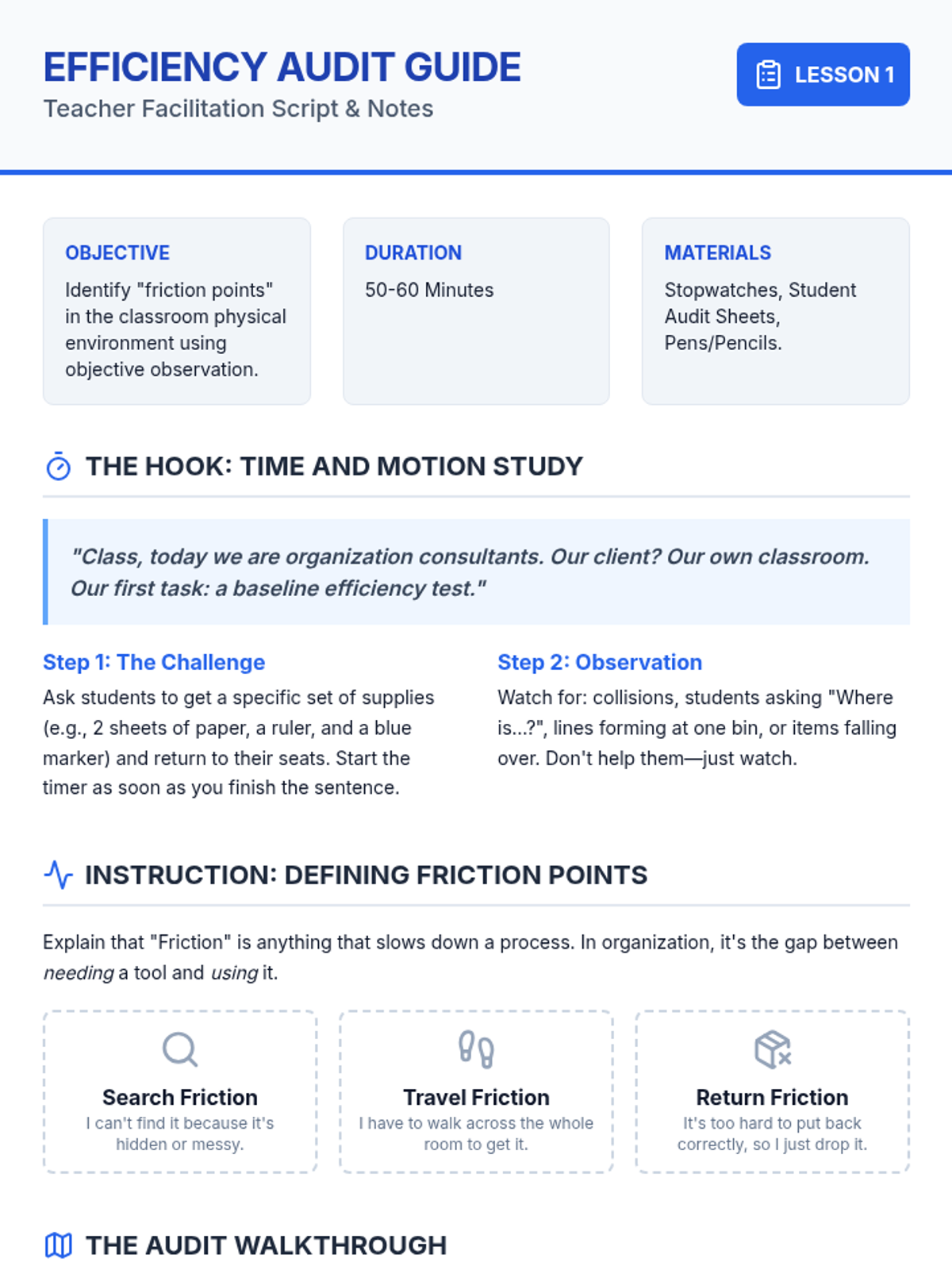
A project-based unit where students act as organization consultants to evaluate, redesign, and implement efficient physical systems in their classroom. Students learn systems thinking, visual communication, and the psychology of environmental design to create a more functional learning space.
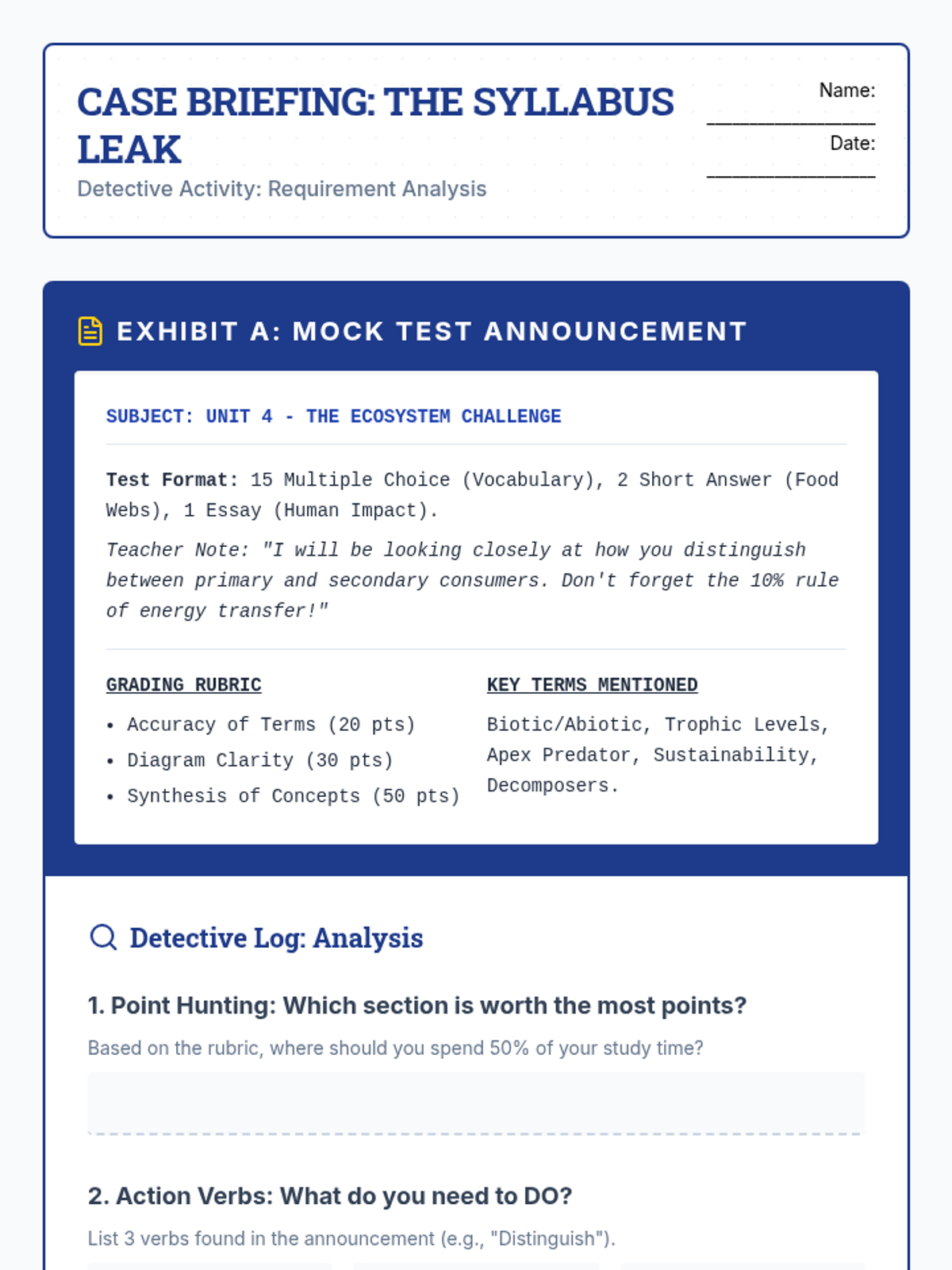
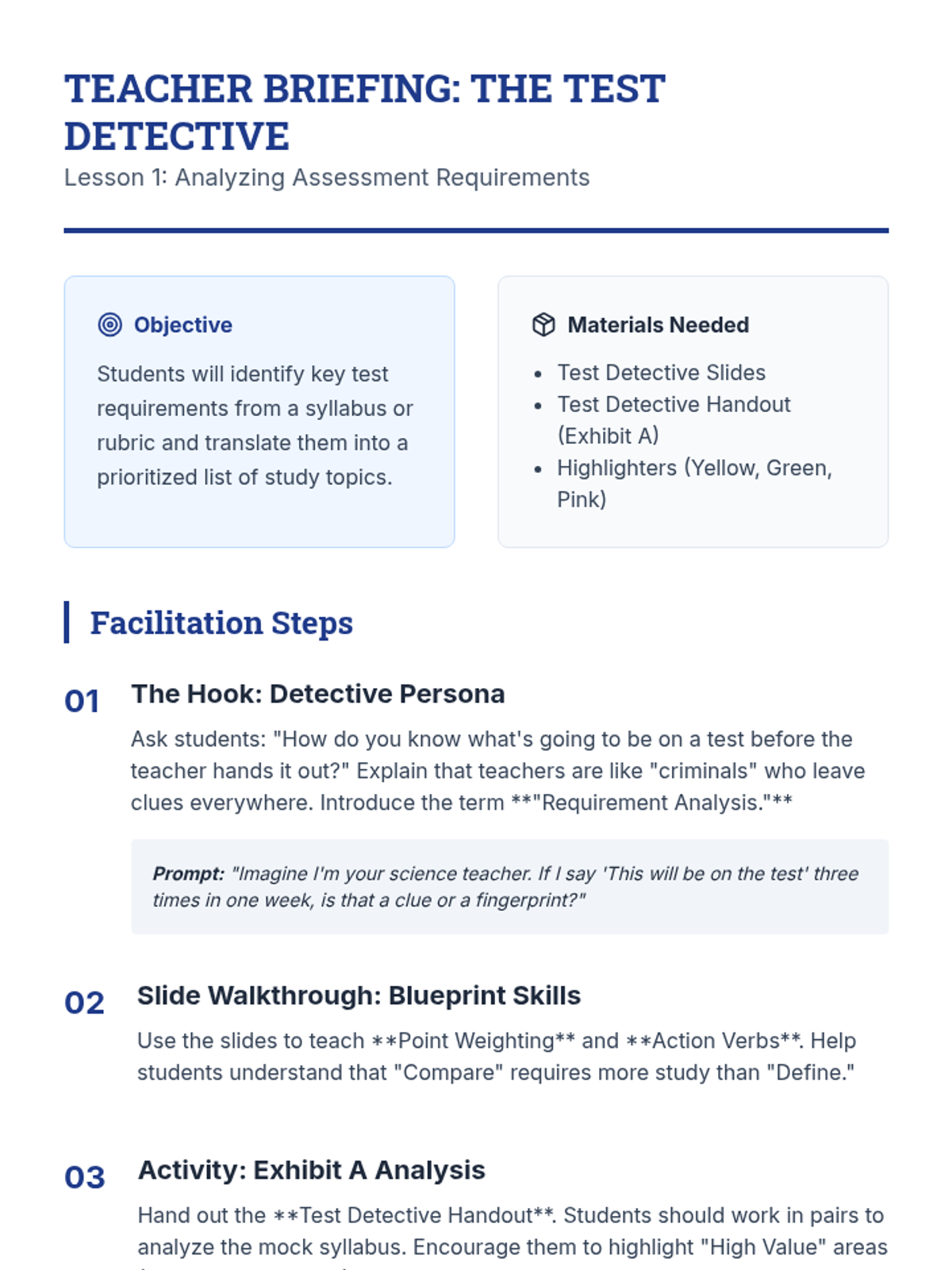
A project-based sequence for 6th graders to master the art of study guide creation. Students progress from deconstructing assessment requirements to synthesizing resources, drafting active recall questions, and physically assembling a review tool.
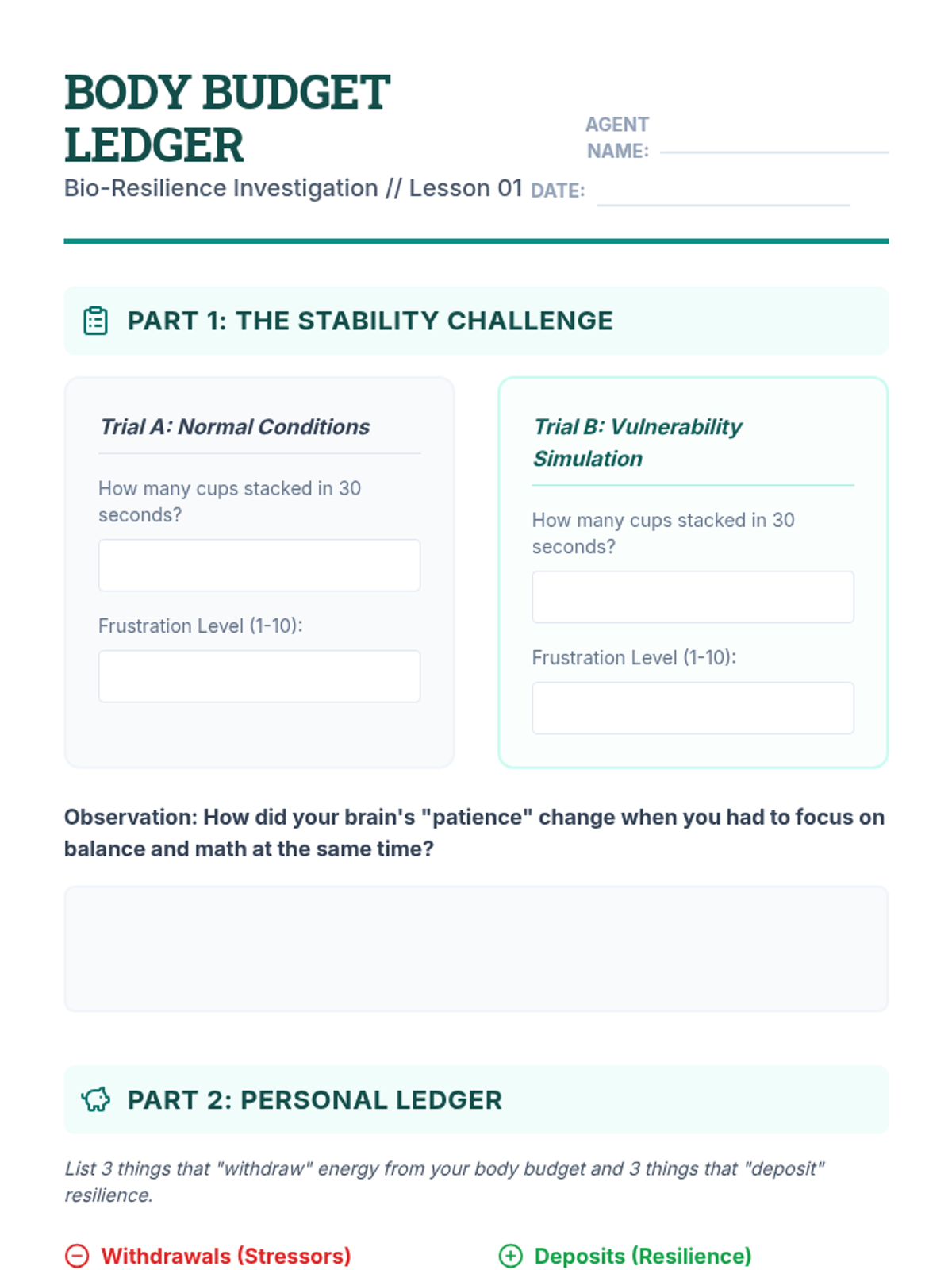
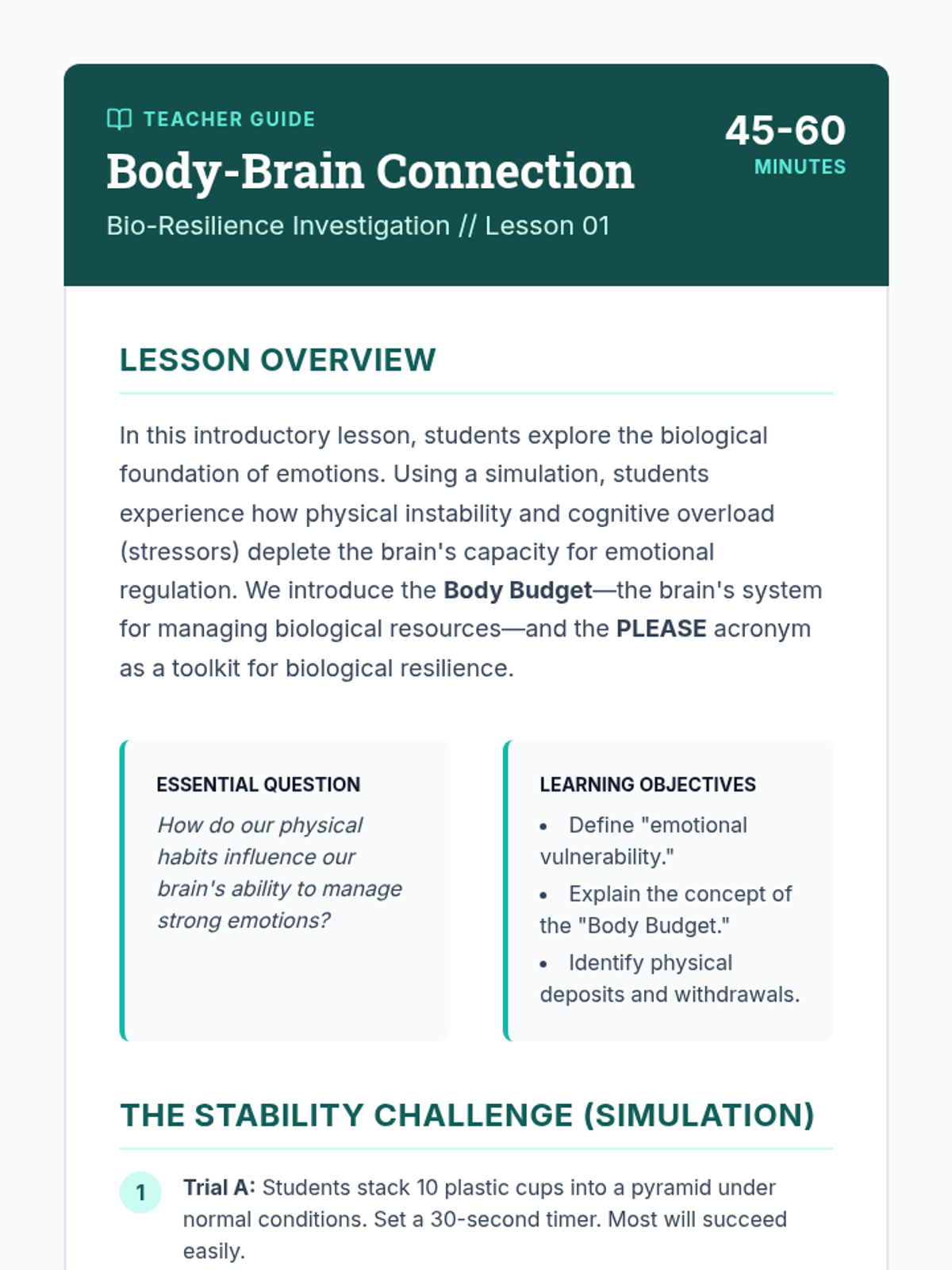
A 5-lesson inquiry into how physical health (the PLEASE skills) creates biological resilience against emotional vulnerability, designed for 6th-grade students.
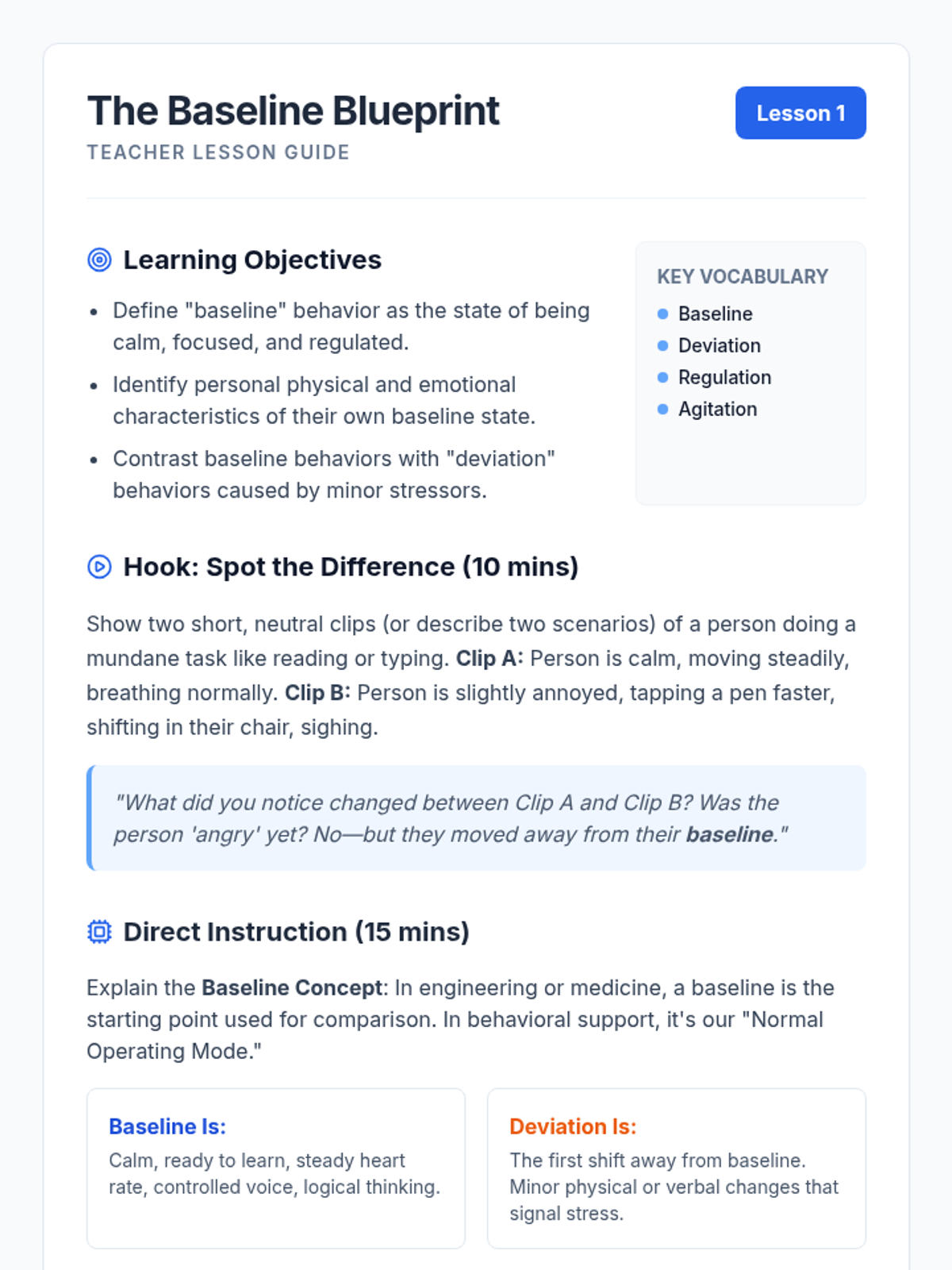
A comprehensive 5-lesson unit for 7th-grade students to identify internal and external signals of emotional escalation. Students move from establishing baseline behaviors to creating a personalized 'Escalation Map' to help them recognize when to engage coping strategies before a crisis occurs.
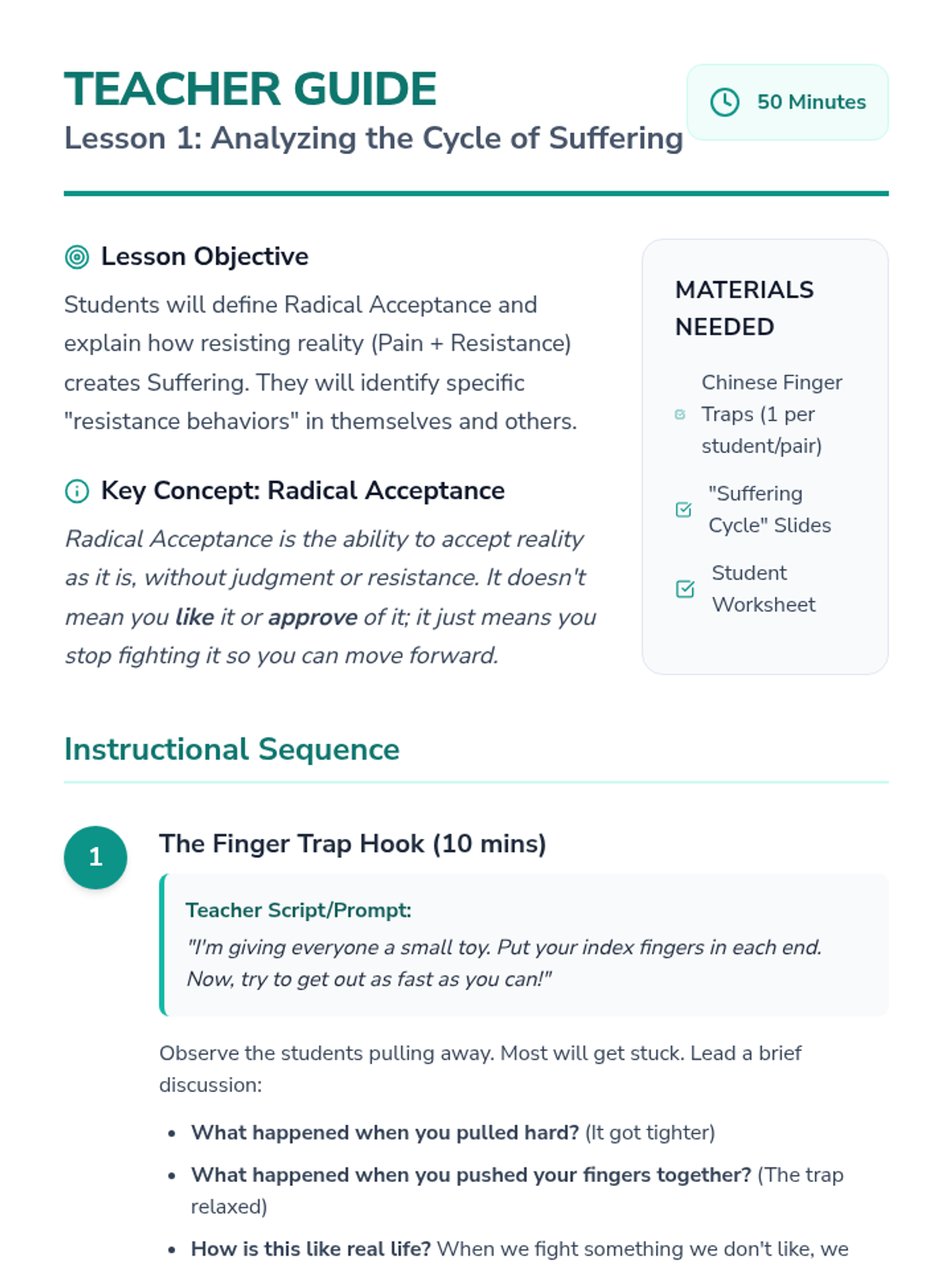
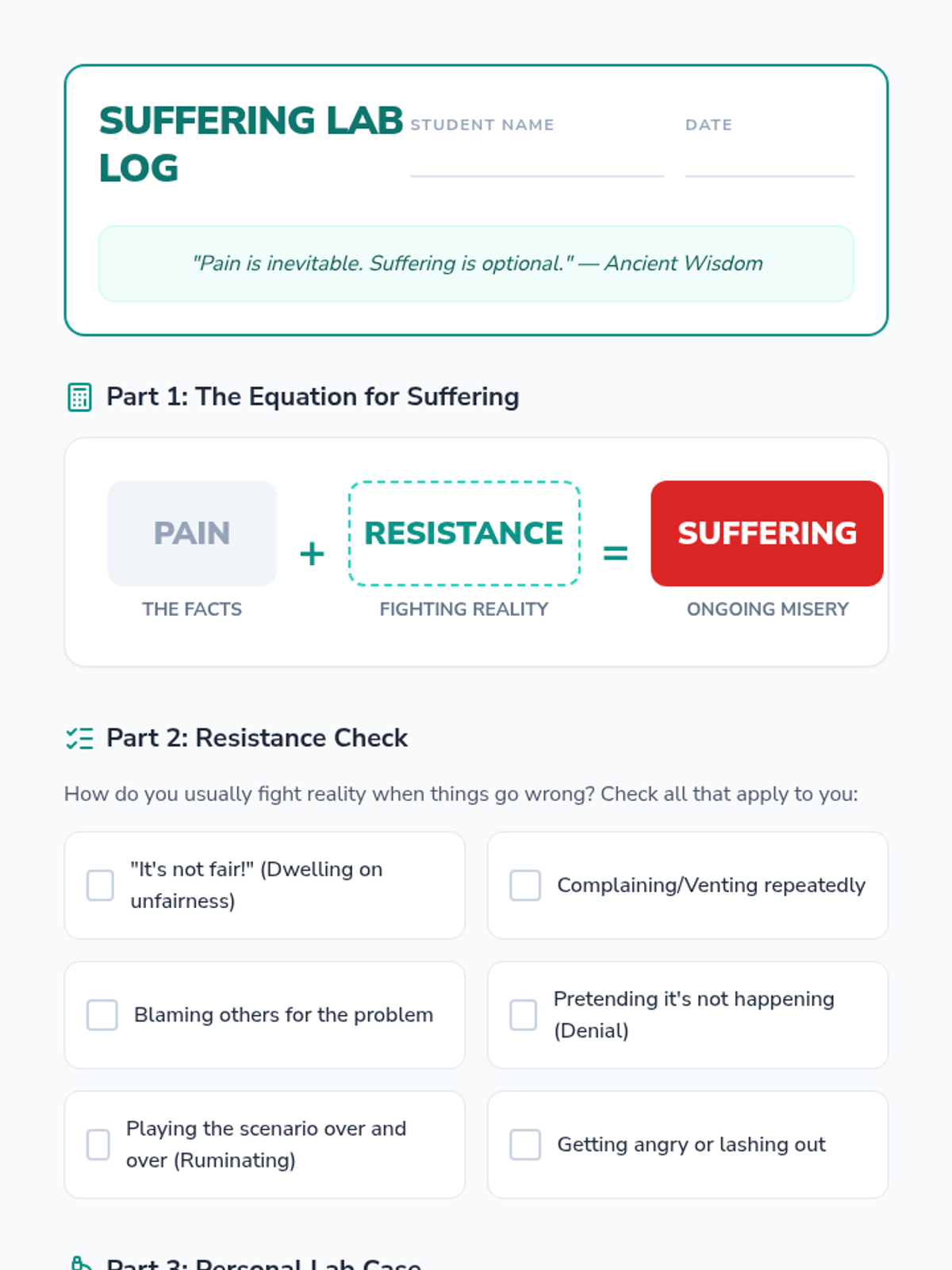
This middle school sequence focuses on building distress tolerance through Radical Acceptance. Students move from understanding the 'Cycle of Suffering' to practicing resilience in academic and social scenarios, ultimately learning to pivot from disappointment to proactive problem-solving.
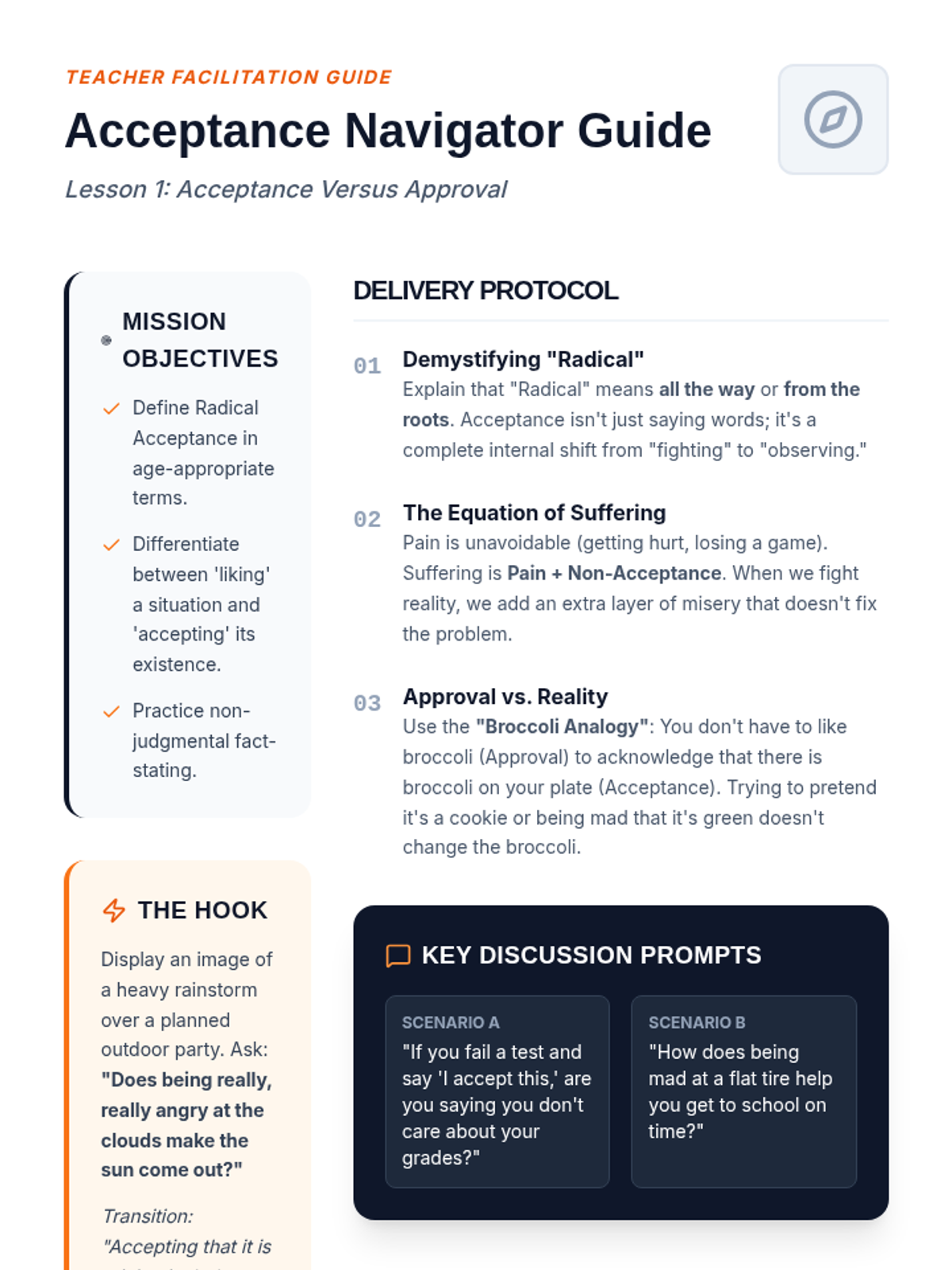
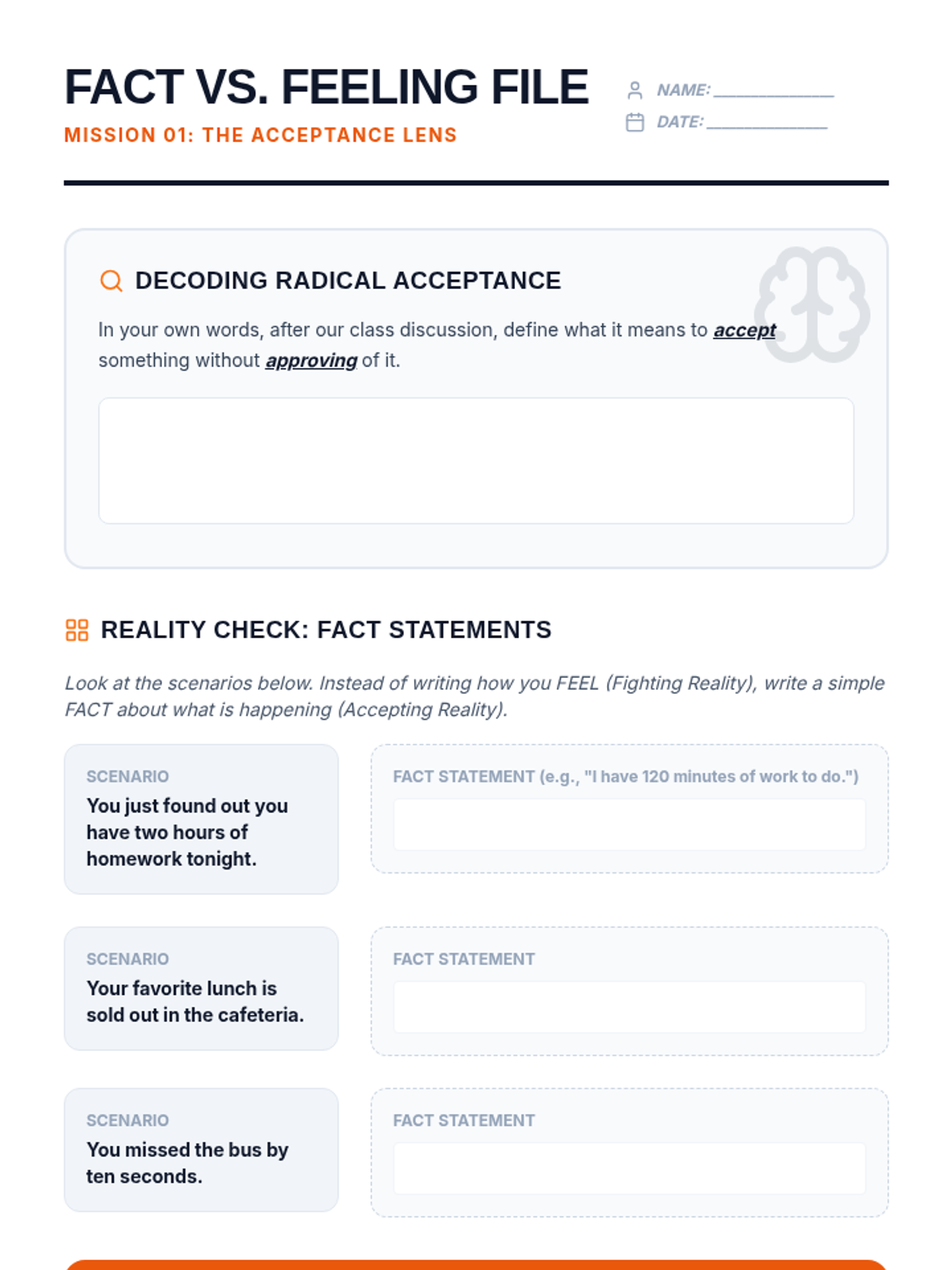
A 5-lesson sequence for 6th graders on radical acceptance, distinguishing control, and building emotional resilience through logic-based tools.
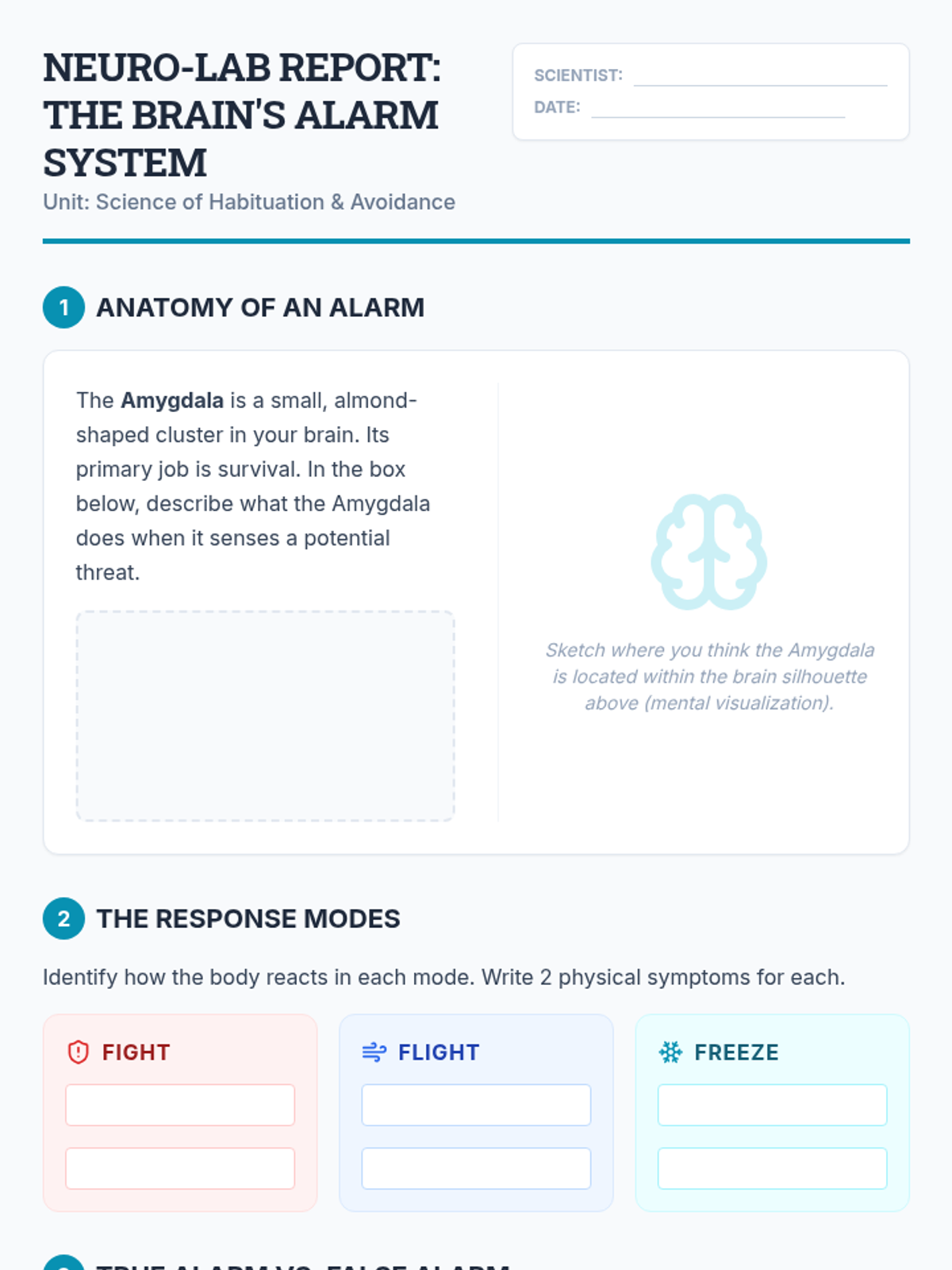
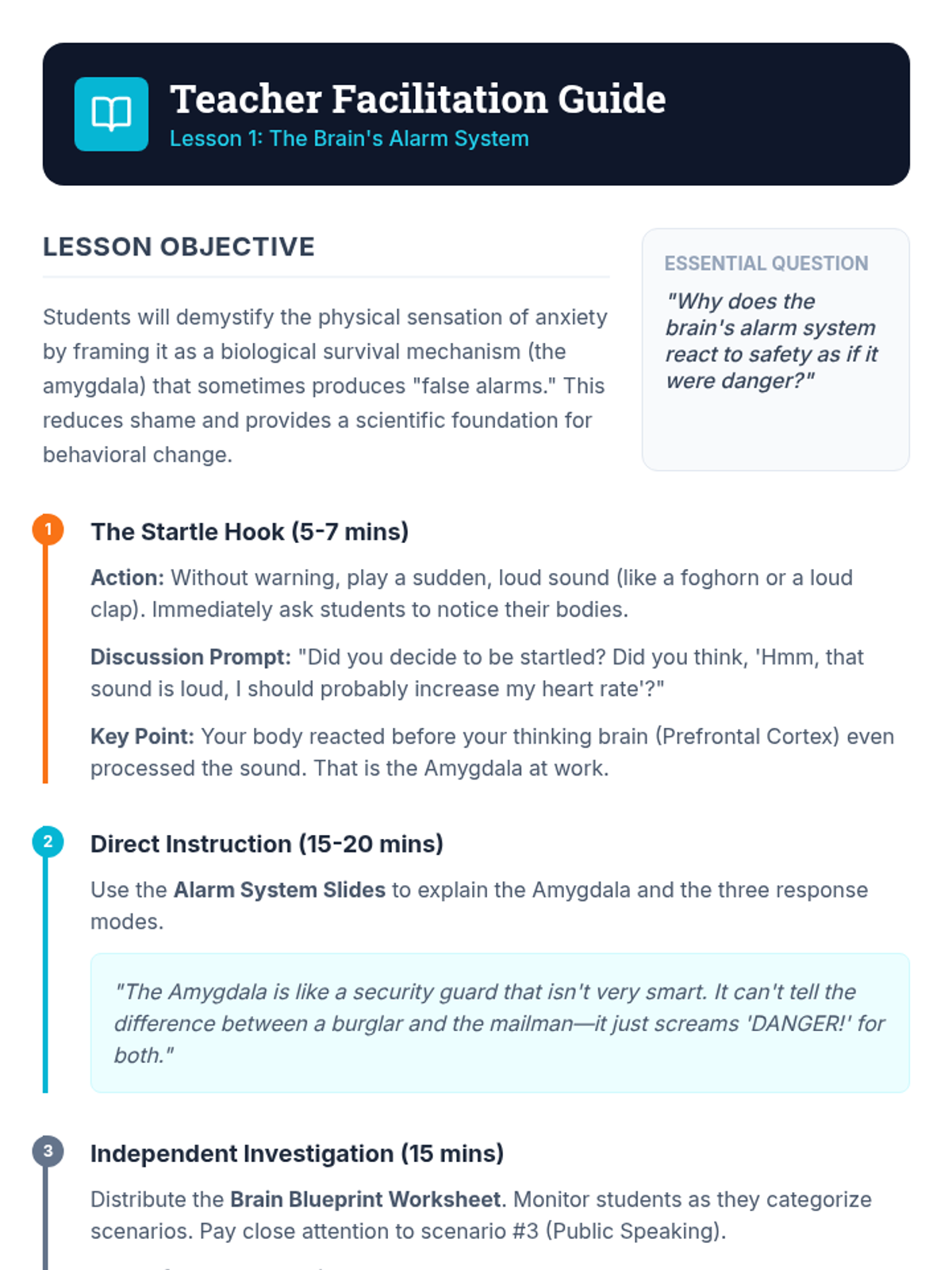
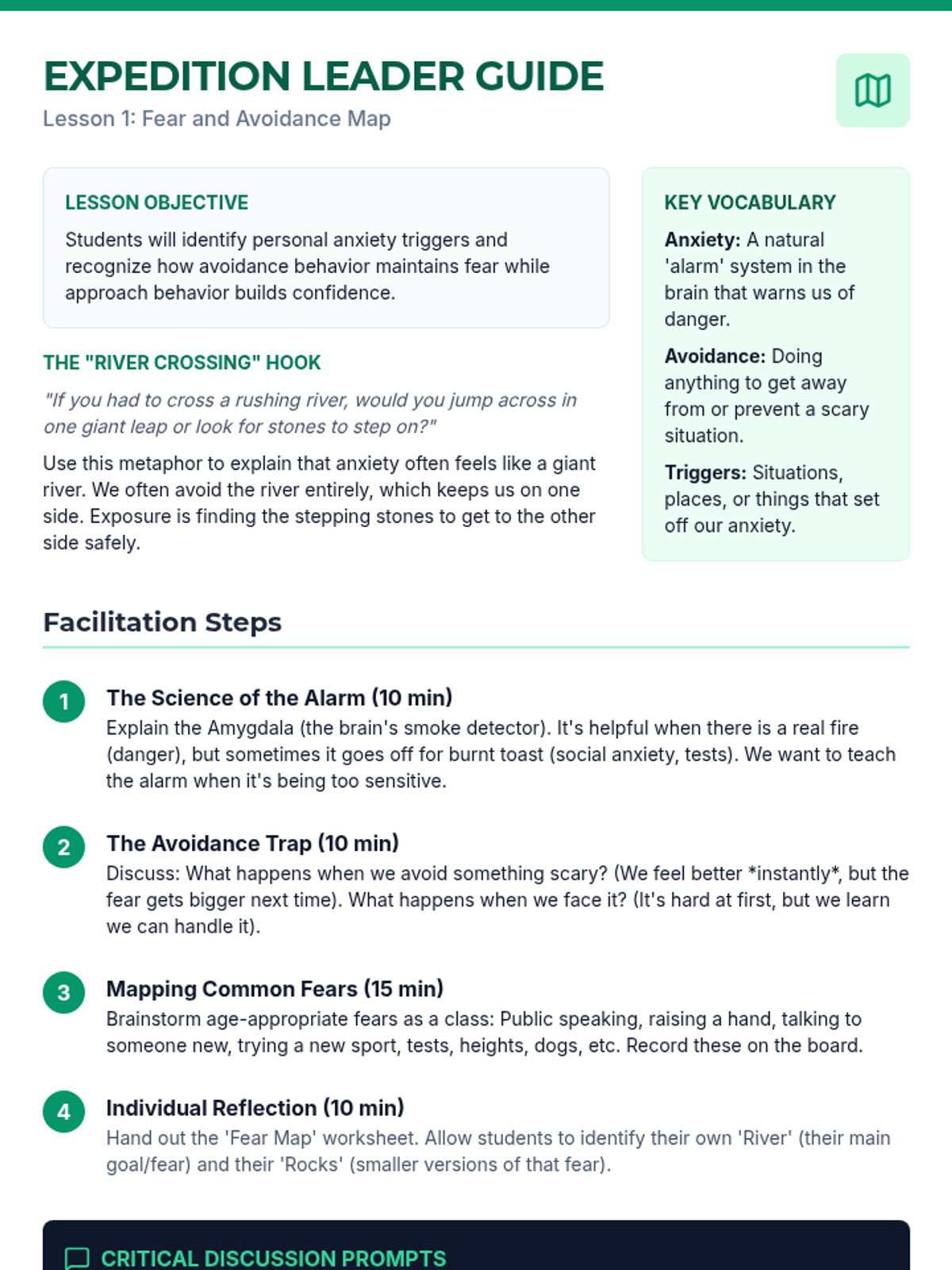
A scientific, inquiry-based exploration of anxiety, the amygdala, and habituation. Students learn how the brain's alarm system works and how to retrain it through evidence-based exposure hierarchies.
A comprehensive workshop-style sequence where 6th-grade students learn the mechanics of exposure therapy by creating personalized 'Bravery Ladders.' Students learn to measure distress using the SUDS scale, deconstruct fears into manageable steps, and apply coping strategies to build resilience.
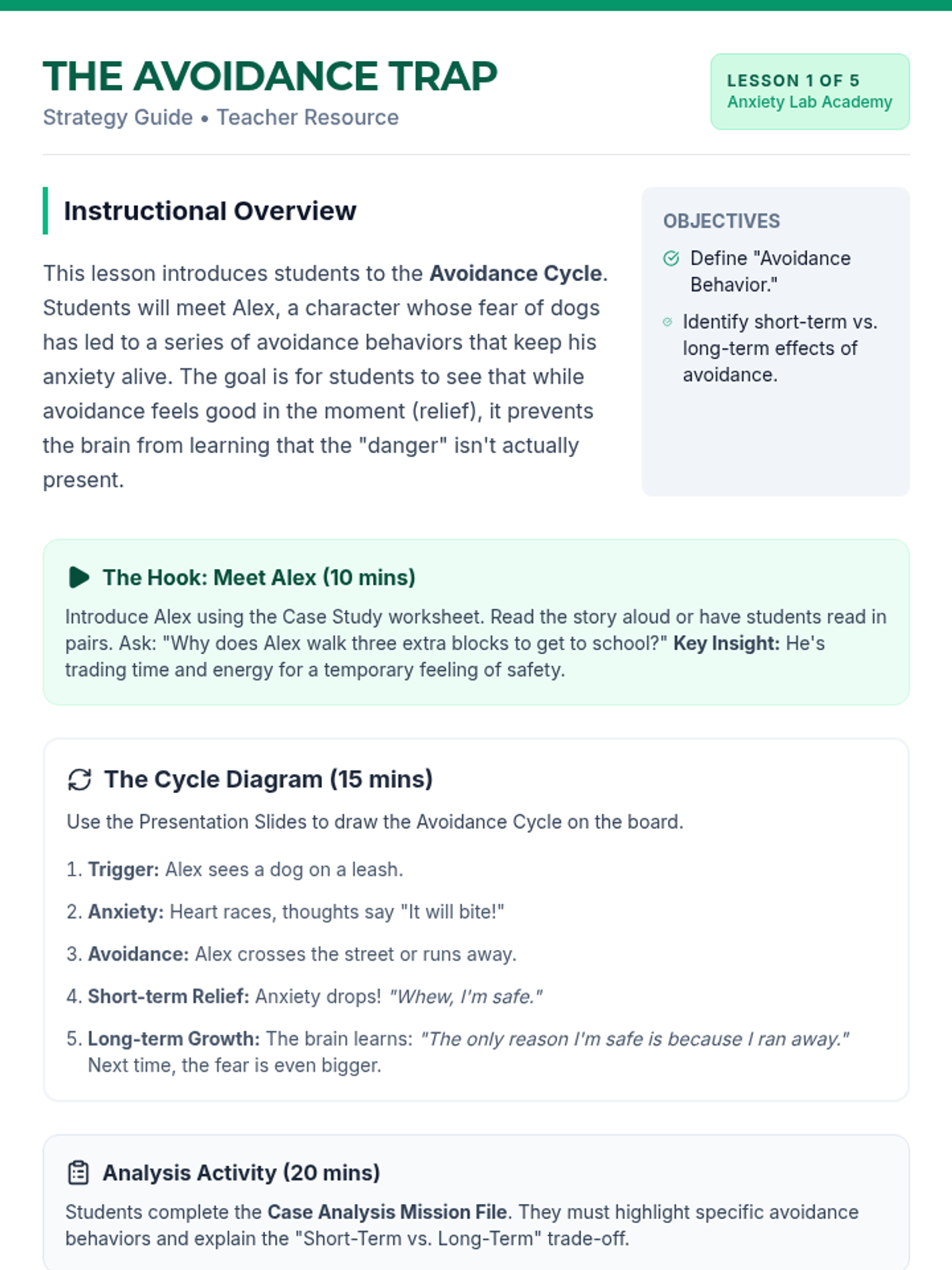
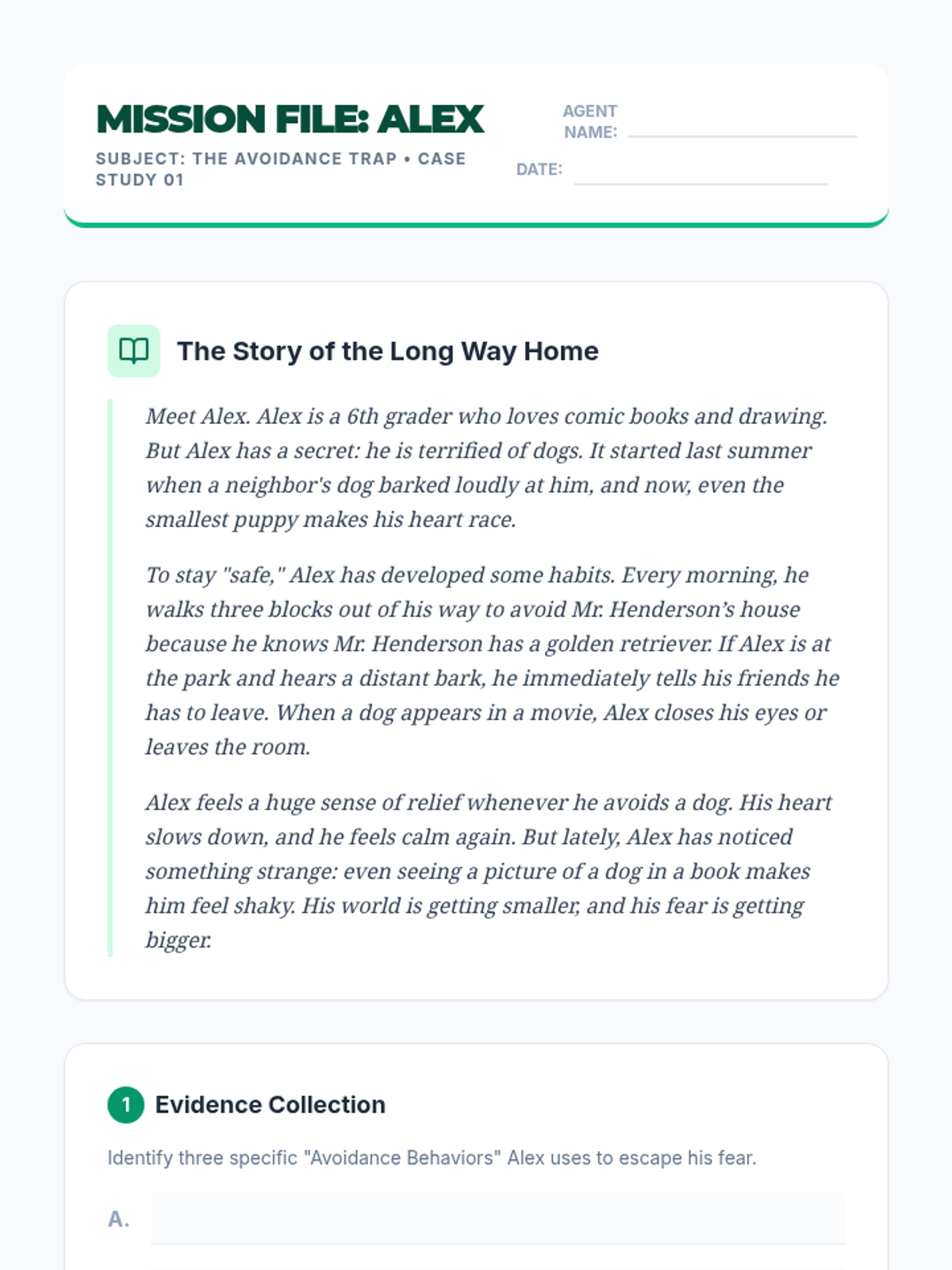
A project-based unit where 6th-grade students act as 'Anxiety Coaches' for fictional characters. They learn to identify avoidance behaviors, use the SUDS scale, and design gradual exposure hierarchies to help characters overcome fears safely.
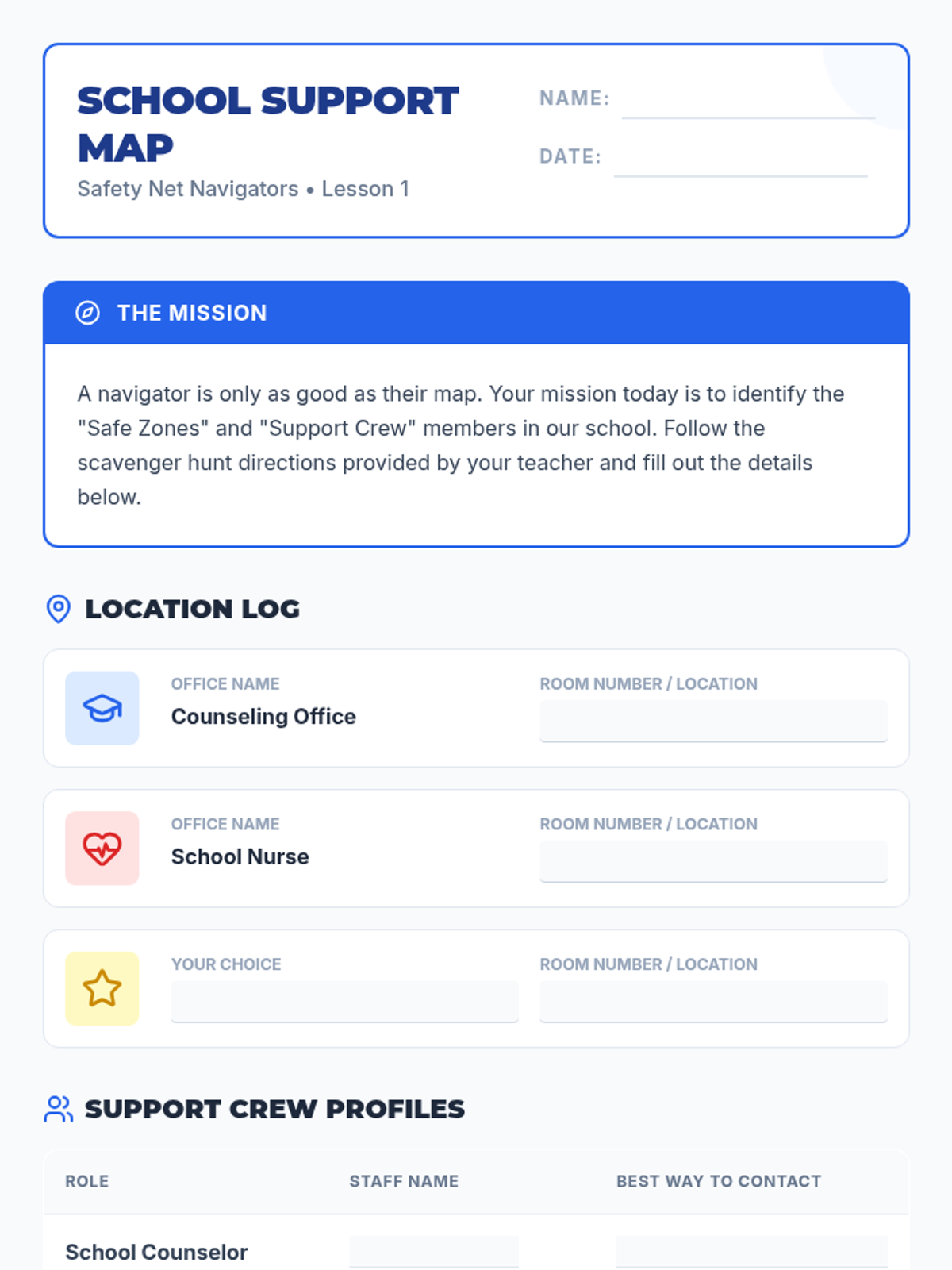
A project-based unit where 6th-grade students explore school, community, and national mental health resources. Students learn to navigate help-seeking pathways and conclude by creating resource materials for their school community.
This sequence introduces 6th-grade students to mental health literacy, focusing on distinguishing between normal emotional fluctuations and signs of distress. Students build emotional vocabulary, understand the physical signs of stress, and learn to evaluate the intensity and duration of their feelings.
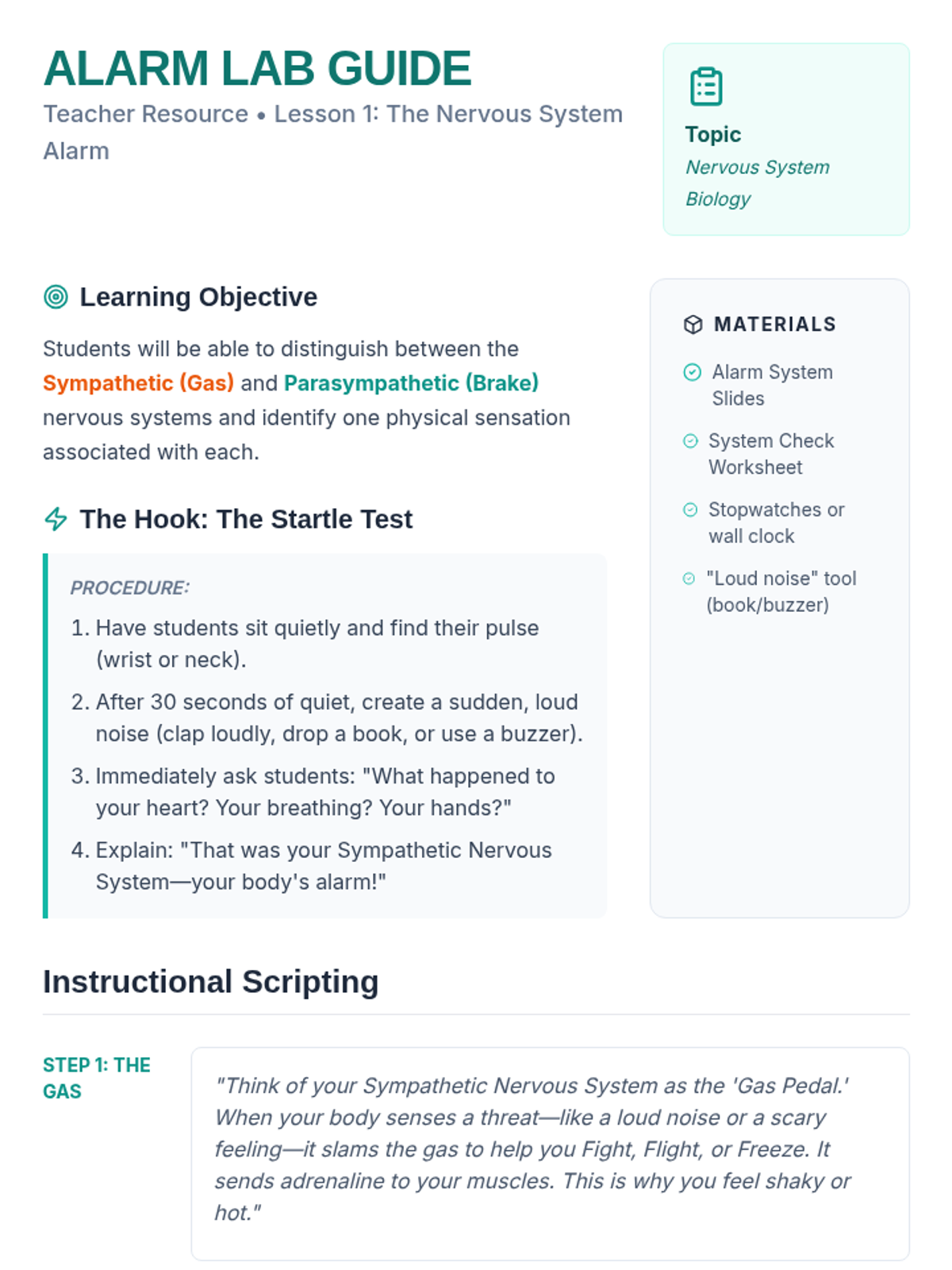
A comprehensive 5-lesson unit designed to transition 6th-grade students from teacher-directed regulation to independent sensory self-monitoring. Students explore the biology of their nervous system, experiment with diverse sensory inputs, and create personalized proactive break systems.
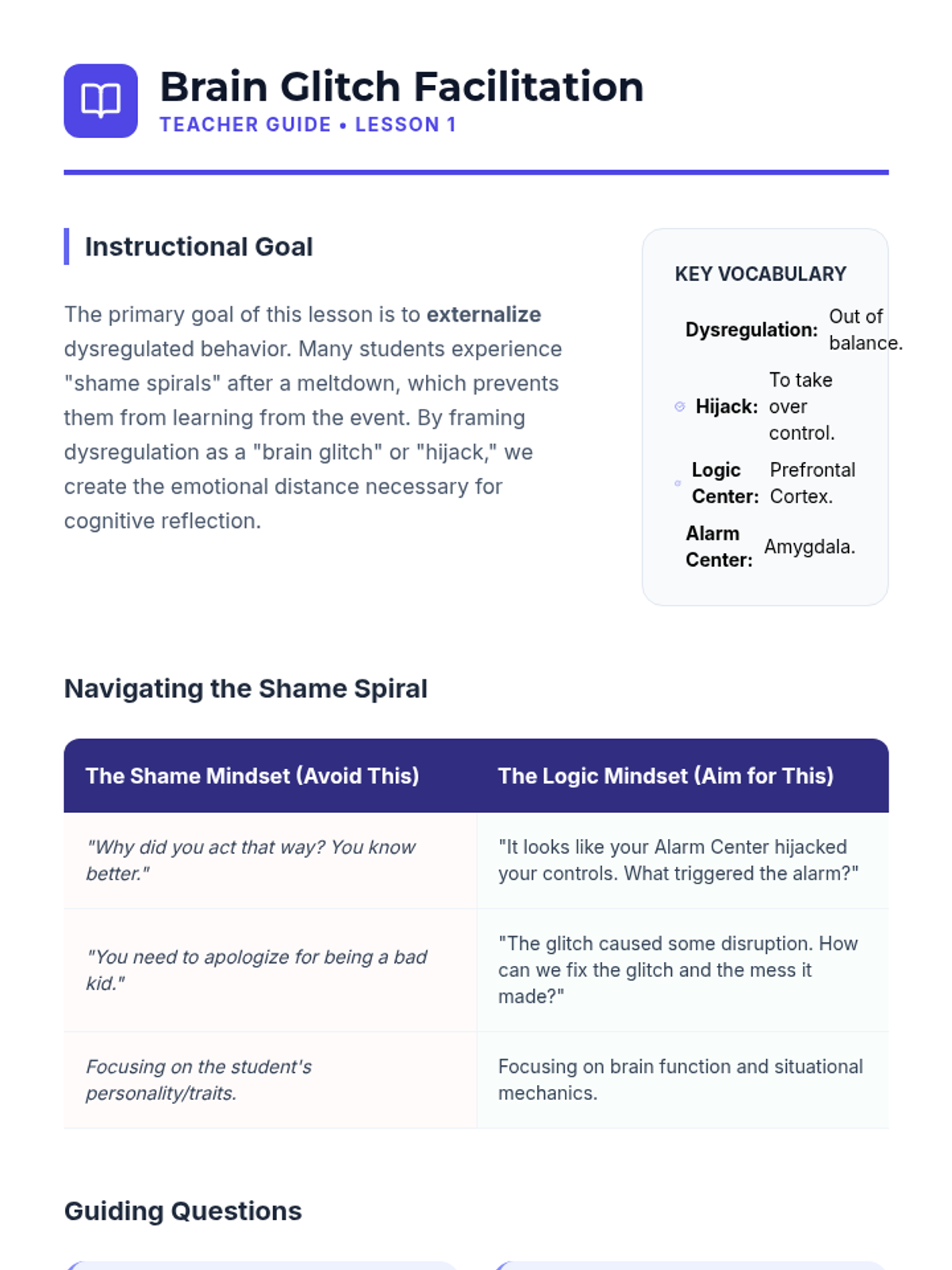
A 5-lesson sequence for 5th-grade students focused on post-dysregulation recovery. This series helps students move from shame to logic by externalizing behaviors, analyzing event timelines, practicing restorative apologies, and planning for future success.
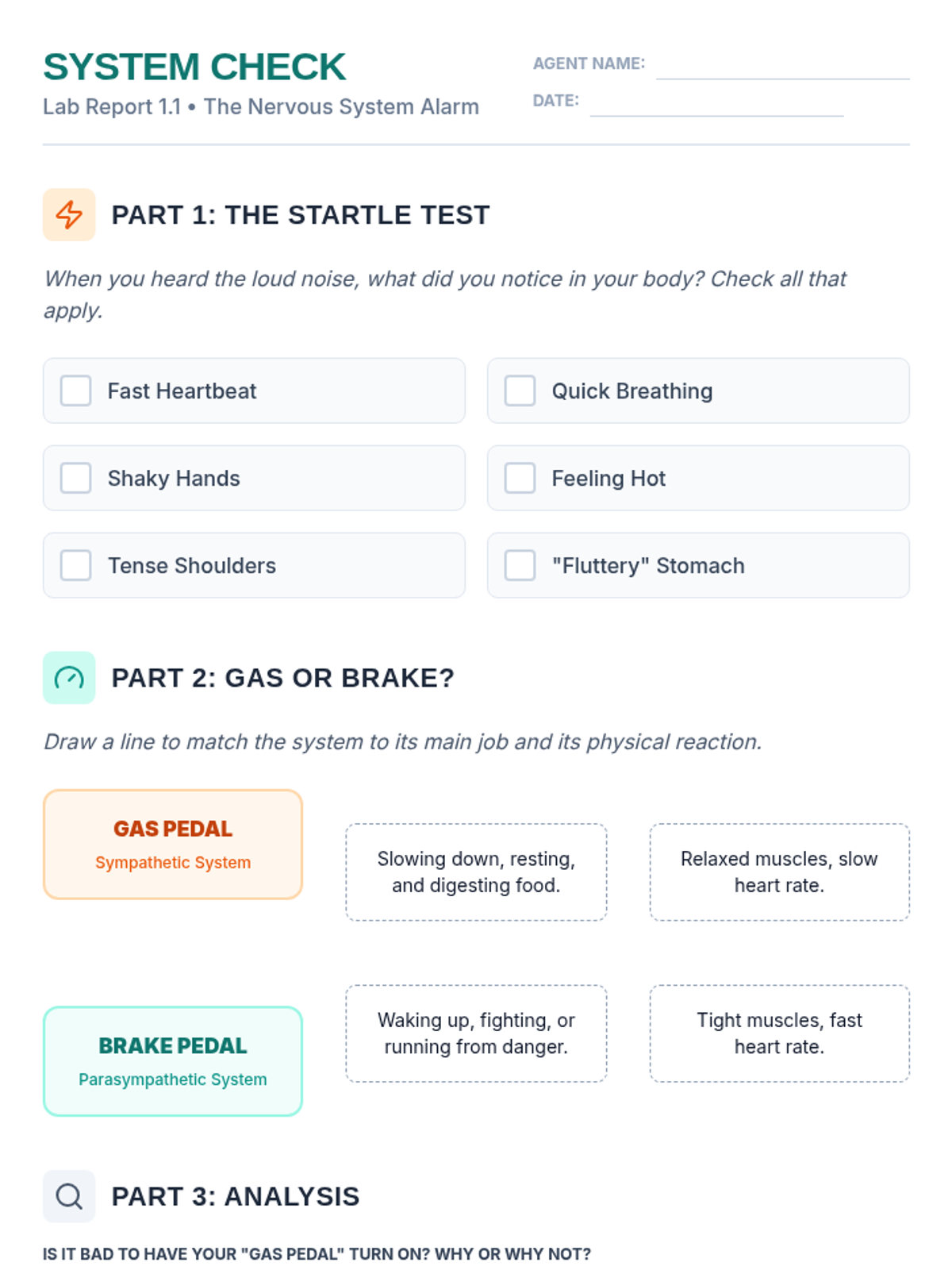
This sequence guides 6th-grade students through the biological mechanisms of stress and recovery. Students explore the autonomic nervous system to identify personal physiological indicators of escalation and de-escalation, culminating in a personalized 'Body Map' and 'Baseline Checklist' to recognize when they are ready to return to learning.
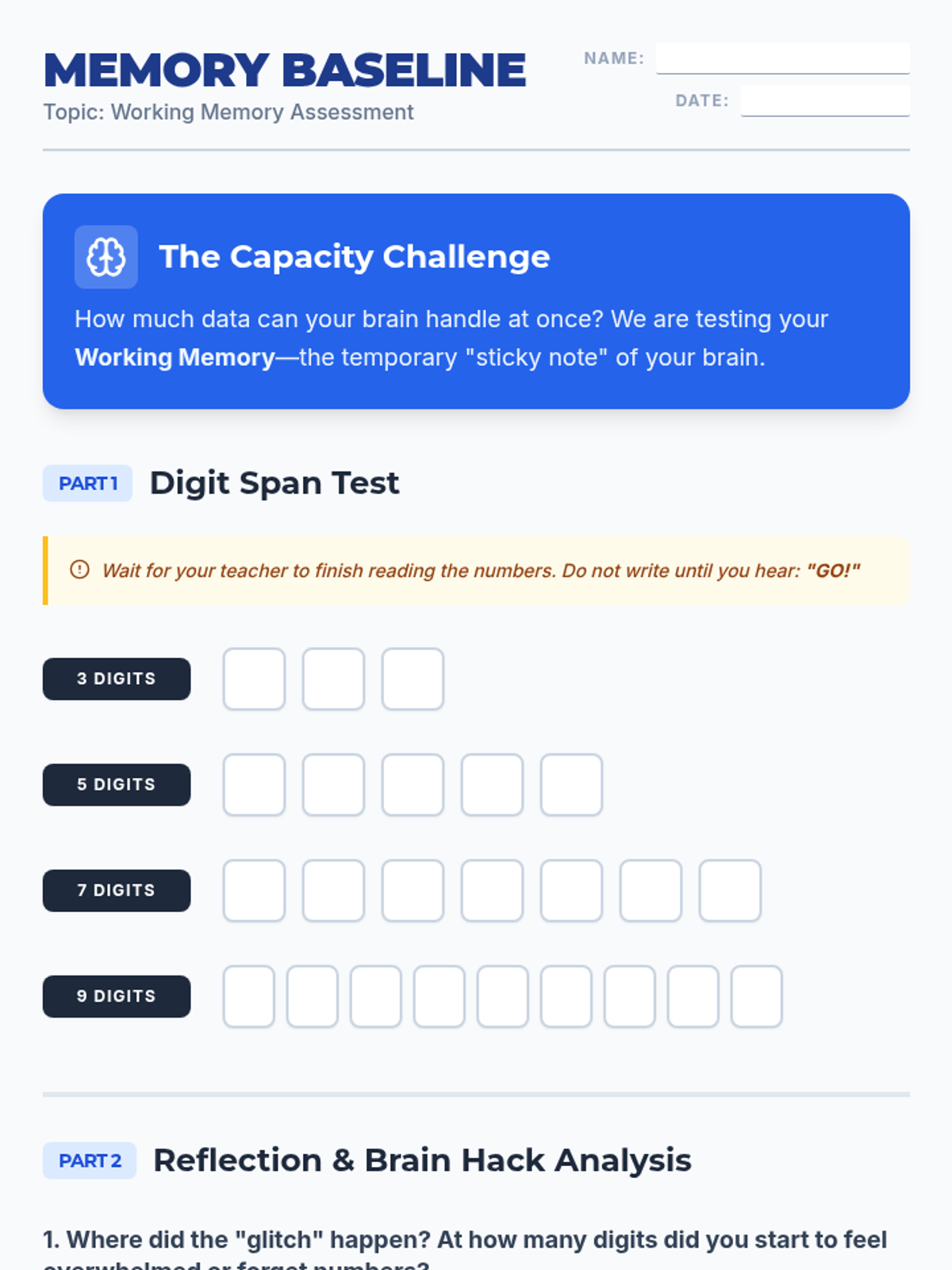
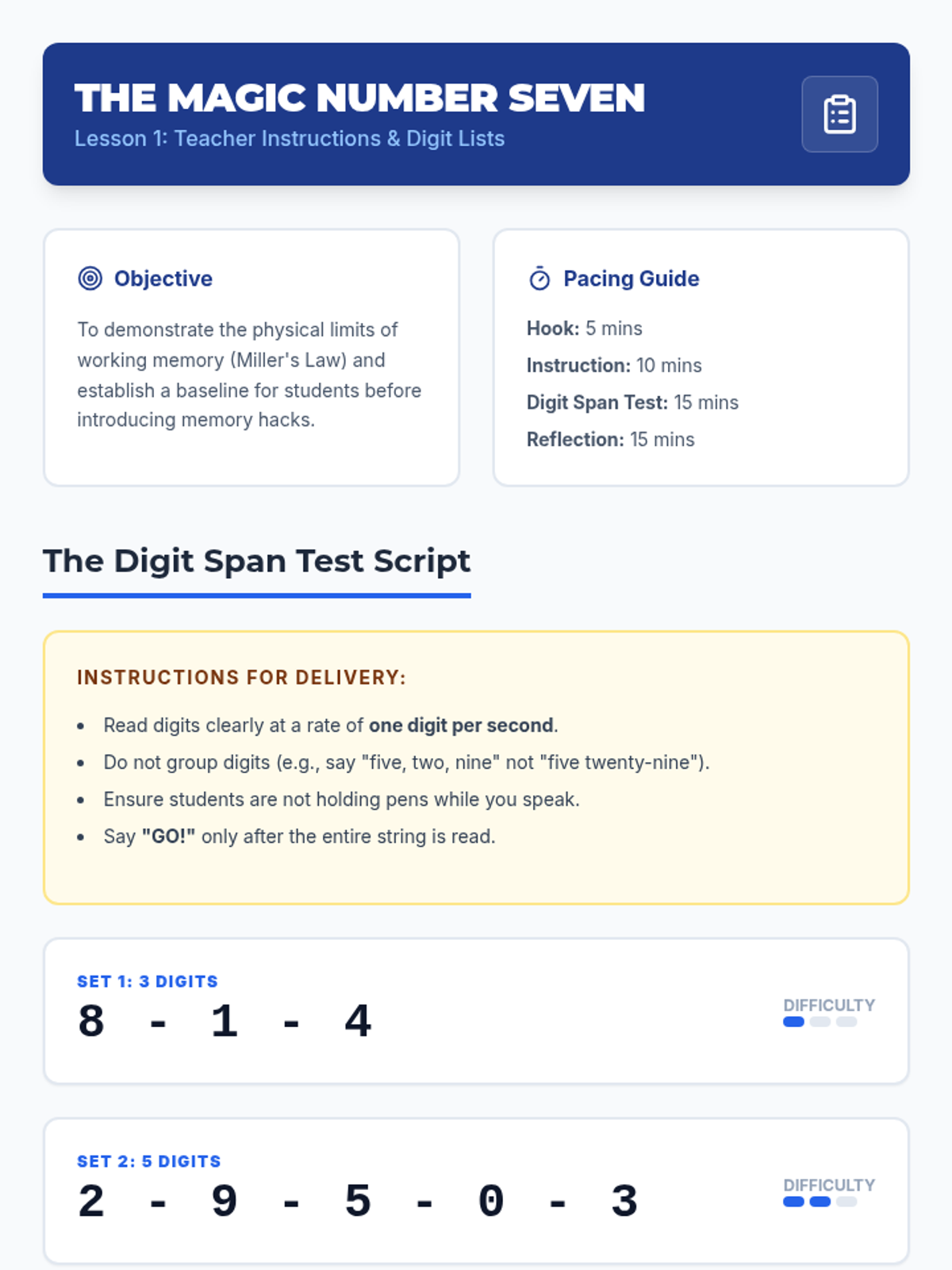
This sequence helps students understand and apply chunking and association strategies to overcome working memory limitations. Through a series of game-based lessons, students will learn to organize data into manageable patterns to increase their cognitive processing capacity.
This sequence focuses on the 'execution' phase of project planning for 6th-grade students. It teaches students how to prioritize tasks using a decision matrix, initiate difficult tasks, self-monitor their progress, and troubleshoot roadblocks to ensure project completion.
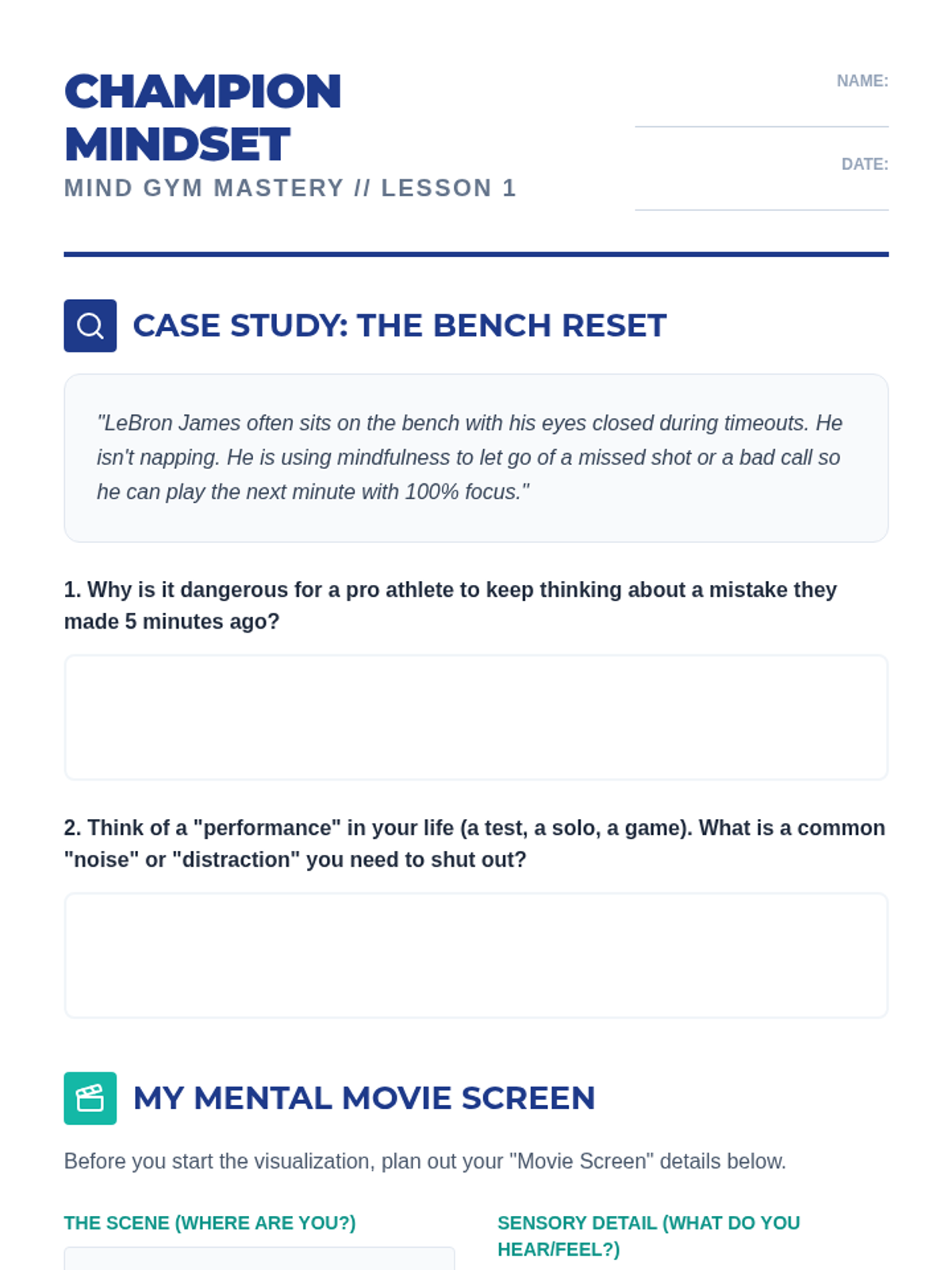
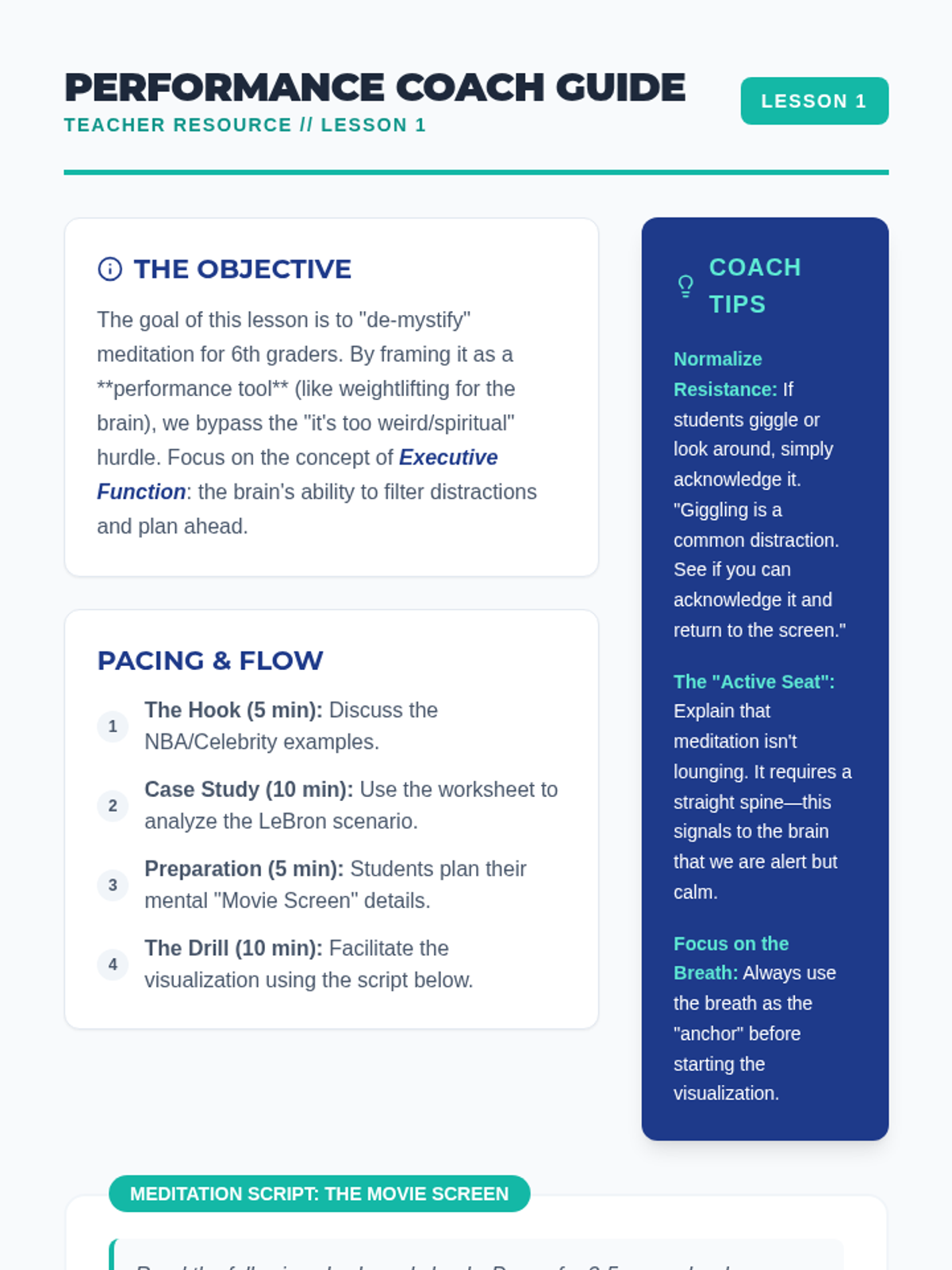
This middle school sequence reframes meditation as a 'performance tool' for academic and social success. Students explore case studies of peak performers, learn the STOP technique for impulse control, develop grounding strategies for test anxiety, and practice empathy through Loving-Kindness meditation, culminating in a real-world scenario challenge.
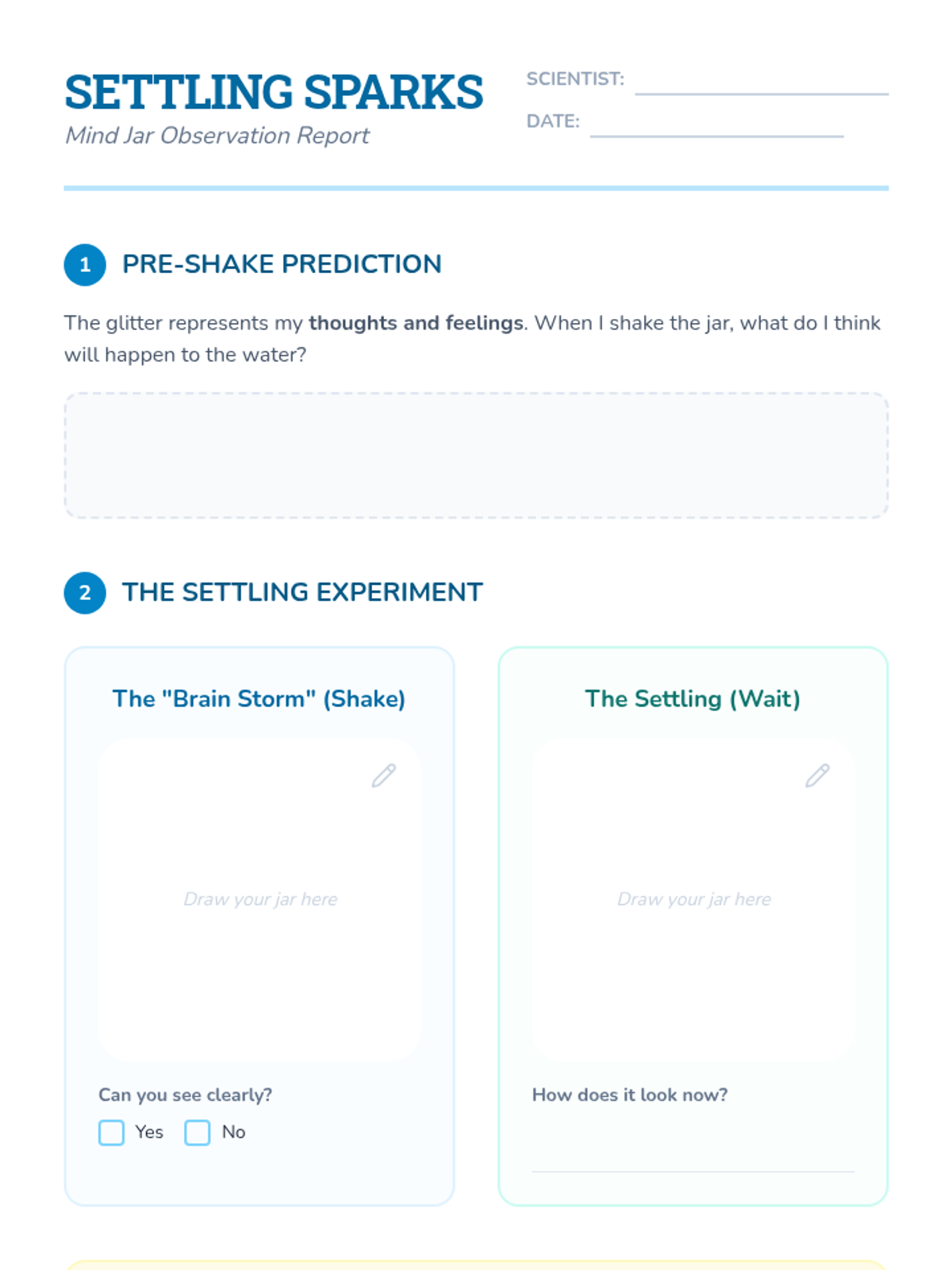
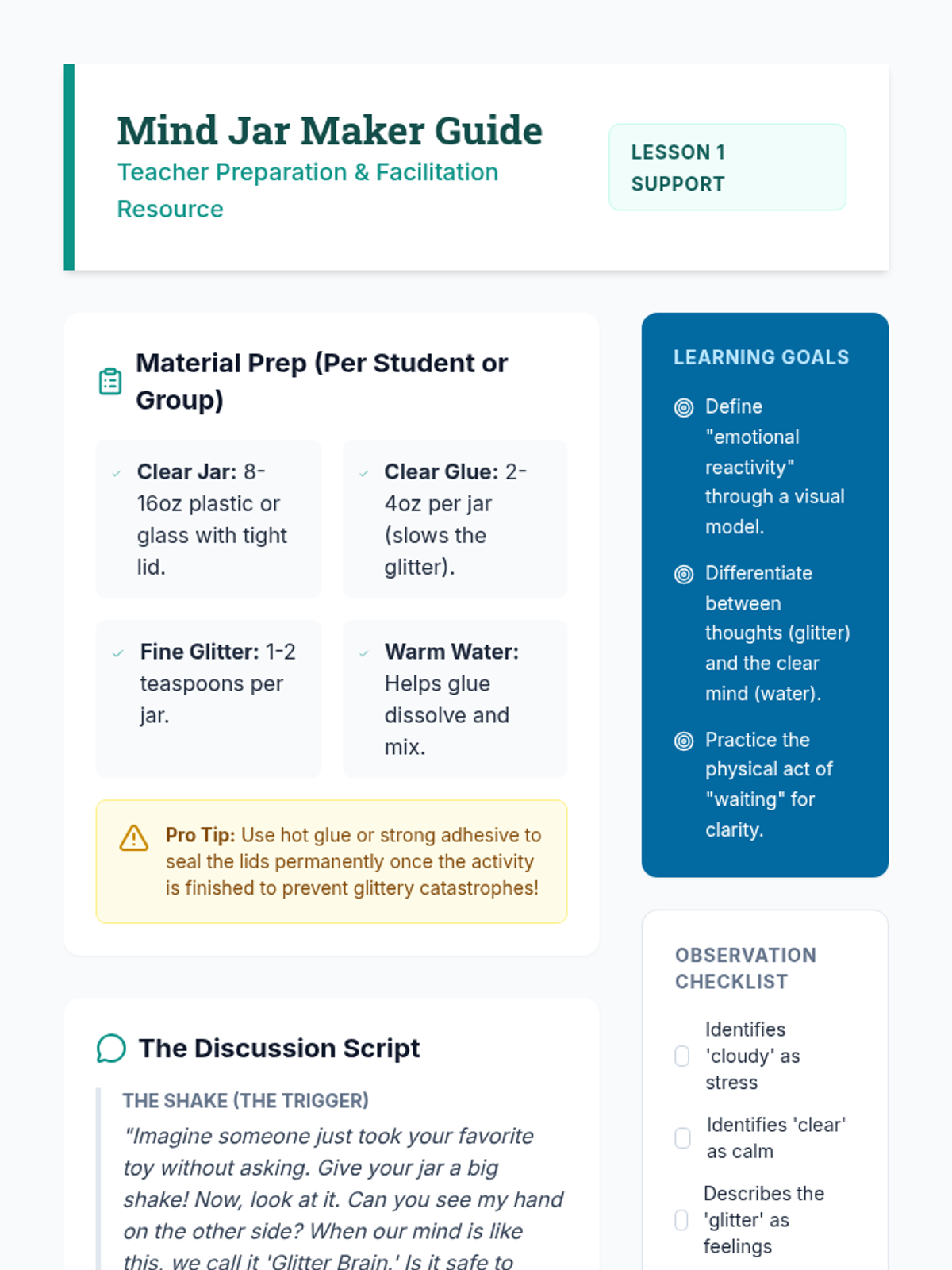
A 3rd-grade mindfulness sequence exploring emotional regulation through metaphors like mind jars, weather reporting, and visualization to help students widen the gap between triggers and reactions.
This sequence focuses on emotional intelligence and self-compassion through a case study approach. Students analyze hypothetical scenarios involving disappointment, anger, or anxiety, and apply mindfulness techniques to navigate them, shifting from reacting impulsively to responding thoughtfully.
This sequence utilizes inquiry and case studies to examine the formation of self-esteem and the impact of external feedback. Students analyze sources of self-worth, critique media messages, and develop a personal toolkit of resilience strategies.
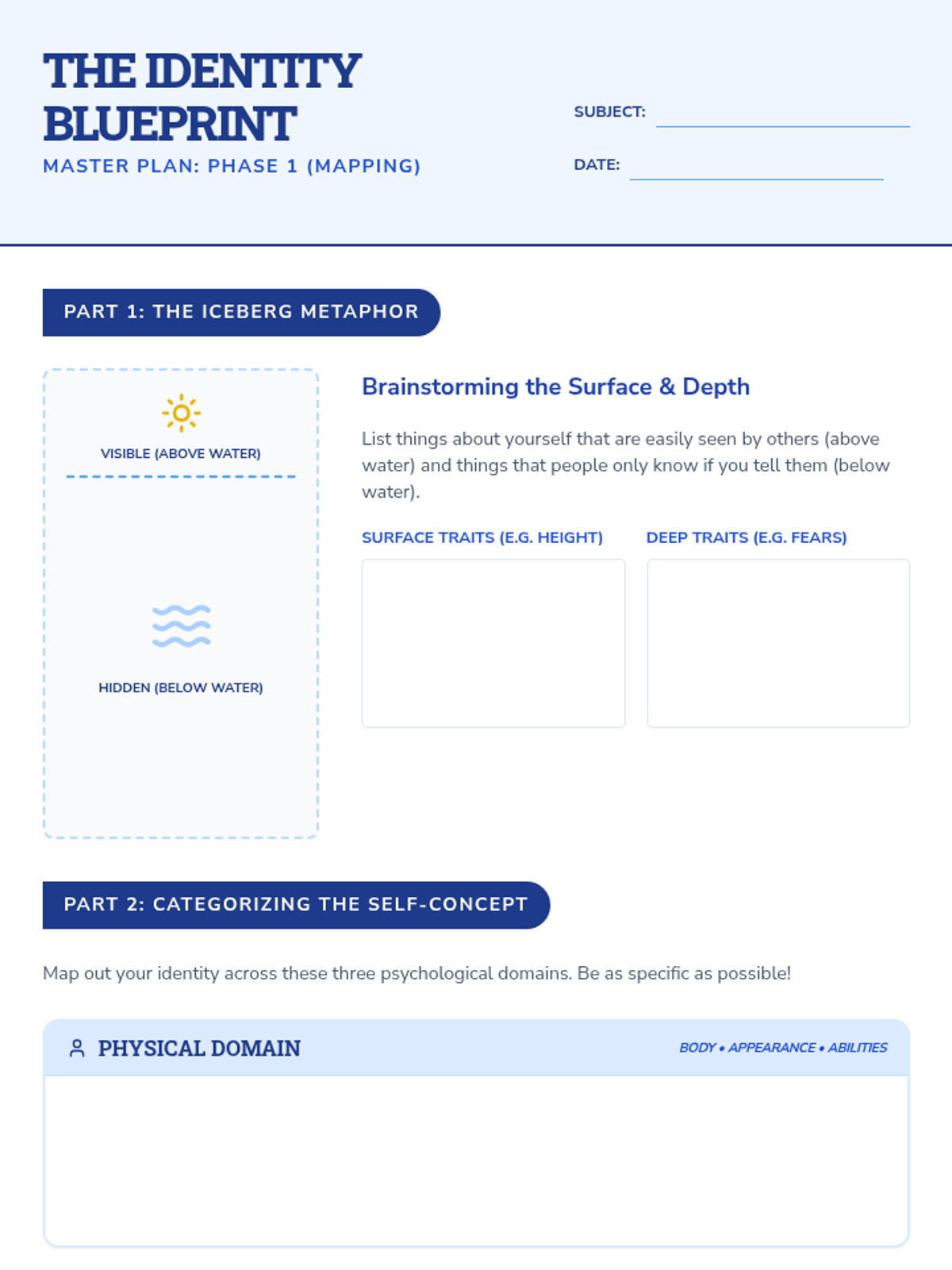
This sequence guides 6th-grade students through an exploration of self-concept, personality traits, and core values. Students move from mapping their identity to understanding mindset and synthesizing their findings into a personal narrative.
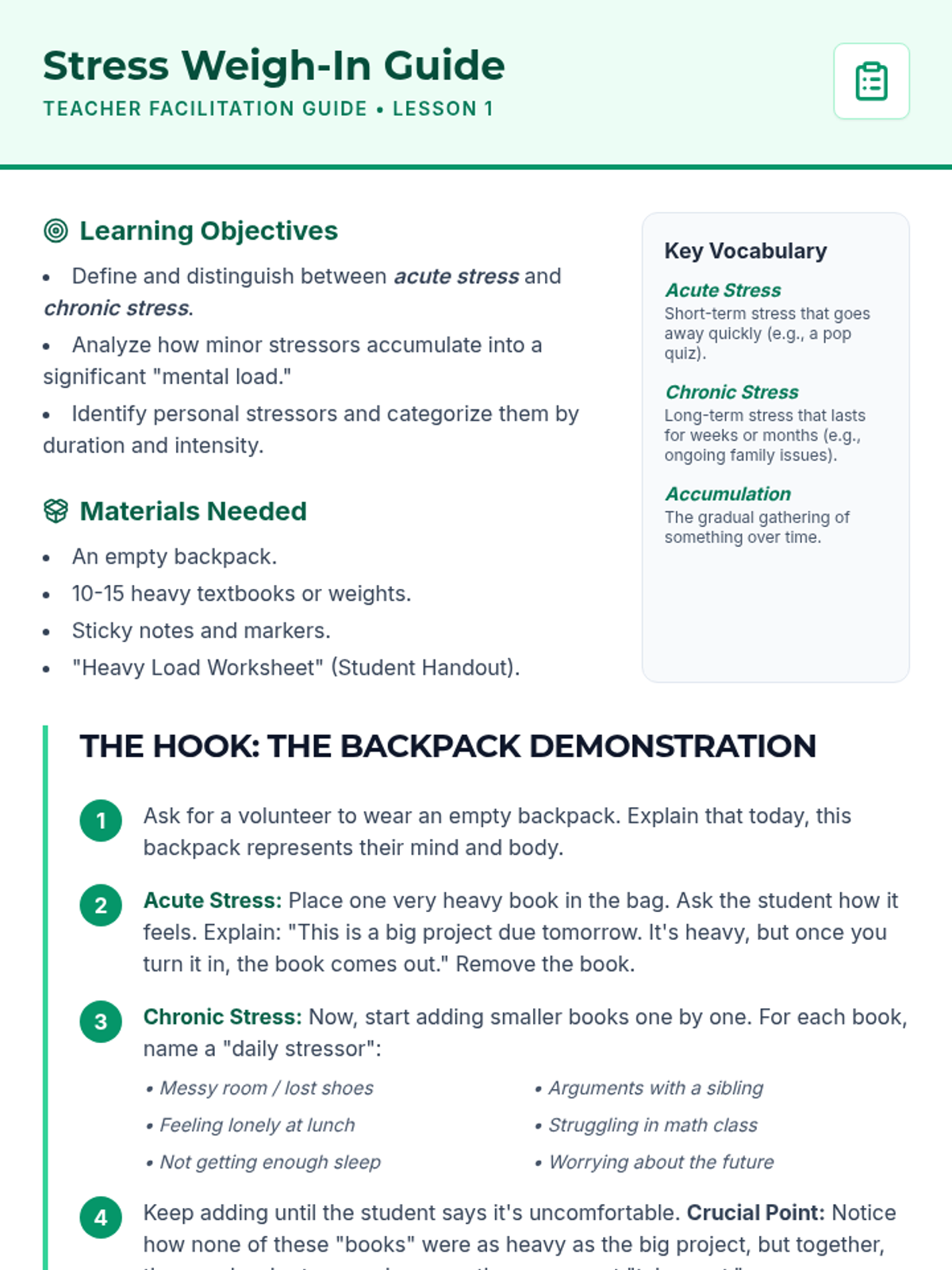
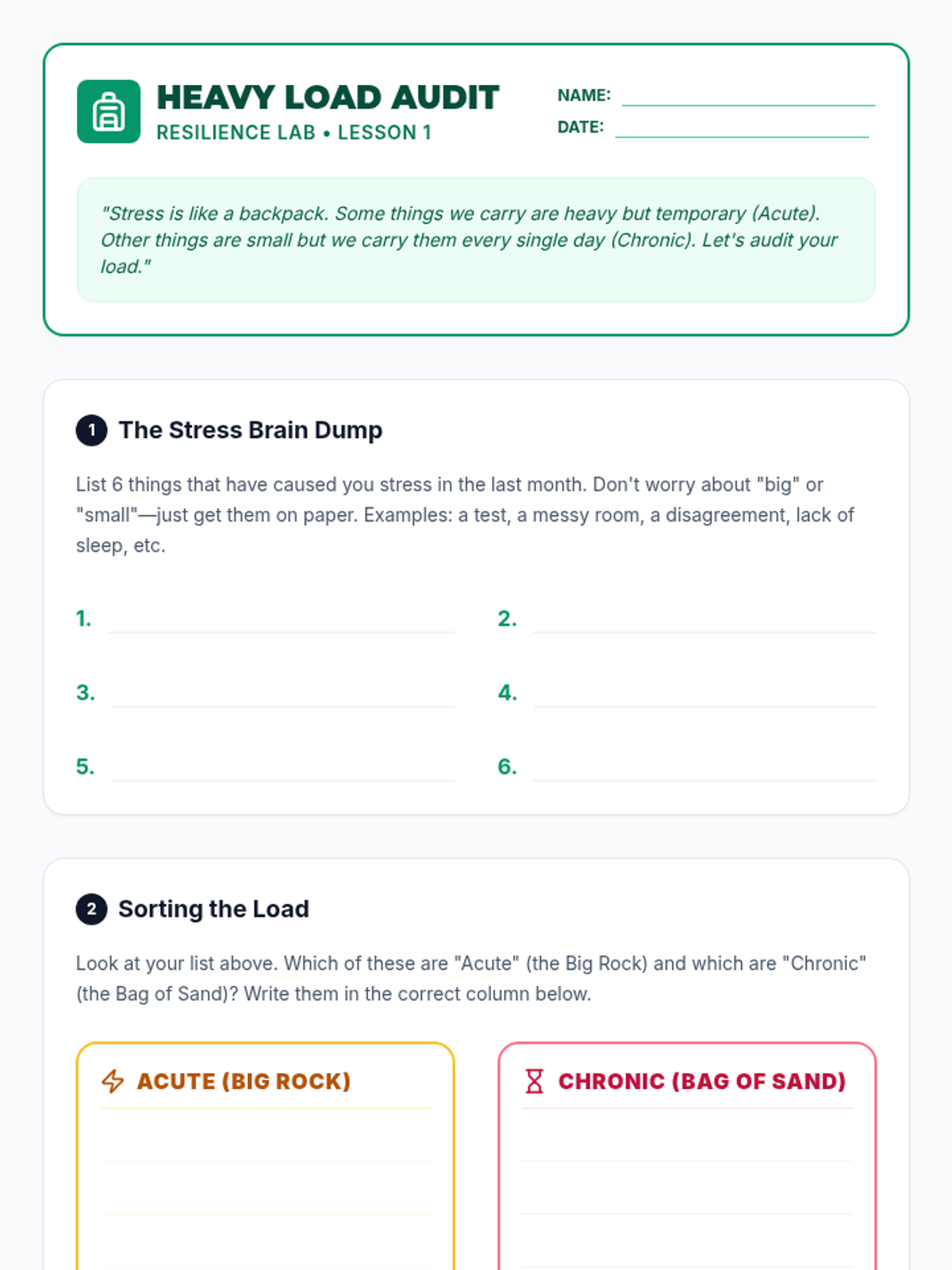
This sequence explores the differences between acute and chronic stress, examines the impact of lifestyle habits on resilience, and culminates in students designing sustainable coping strategies for a balanced life.
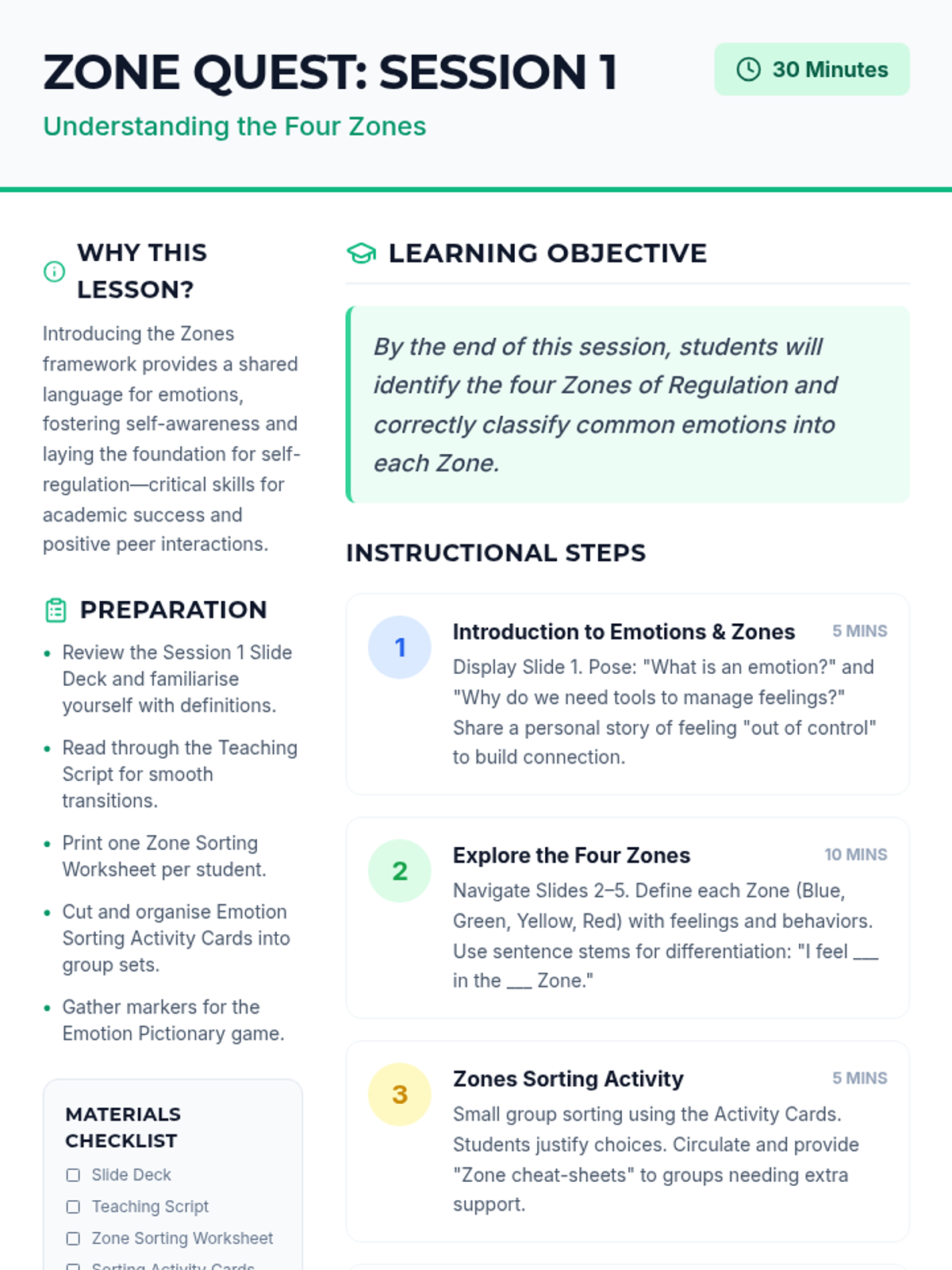
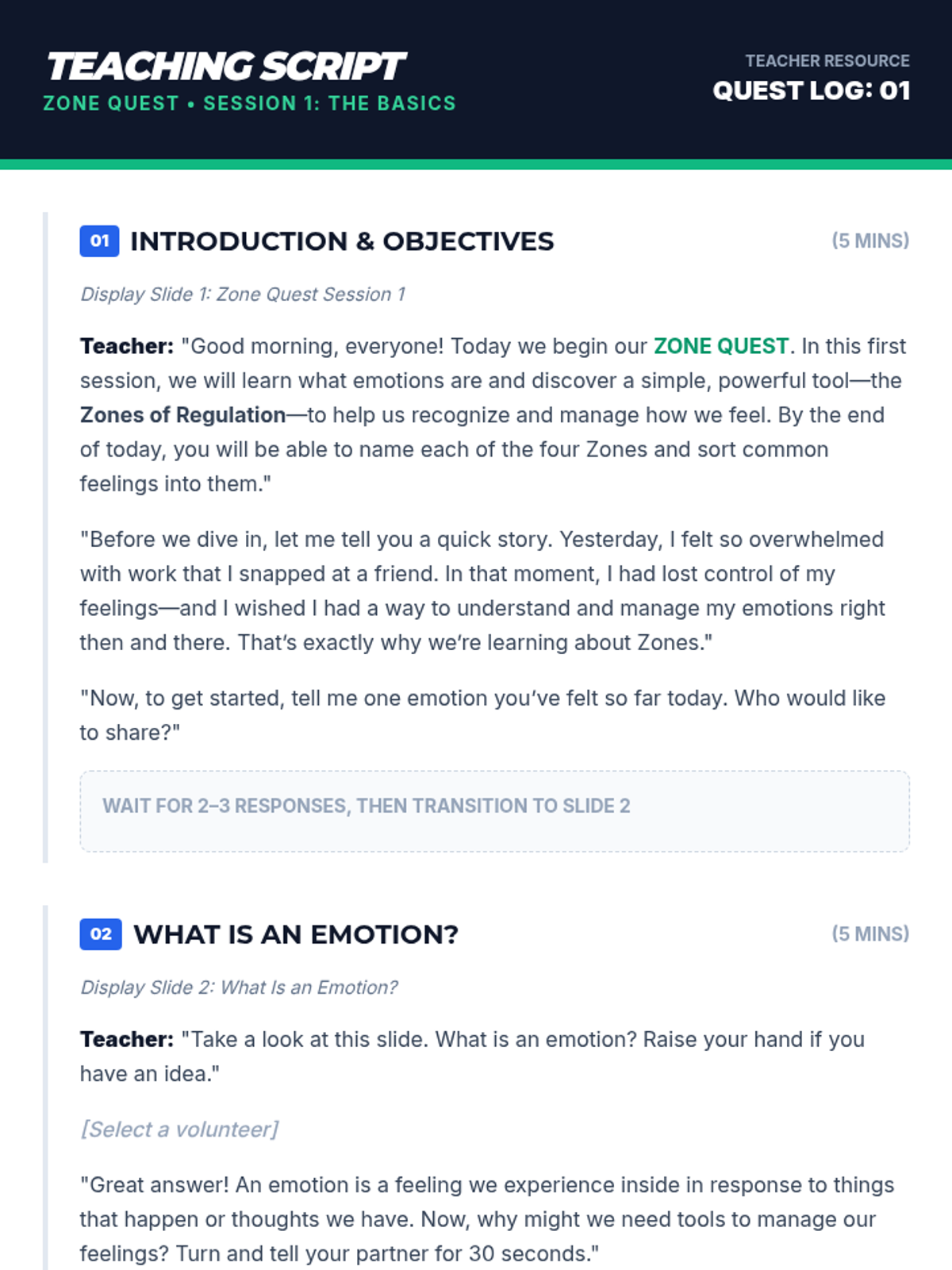
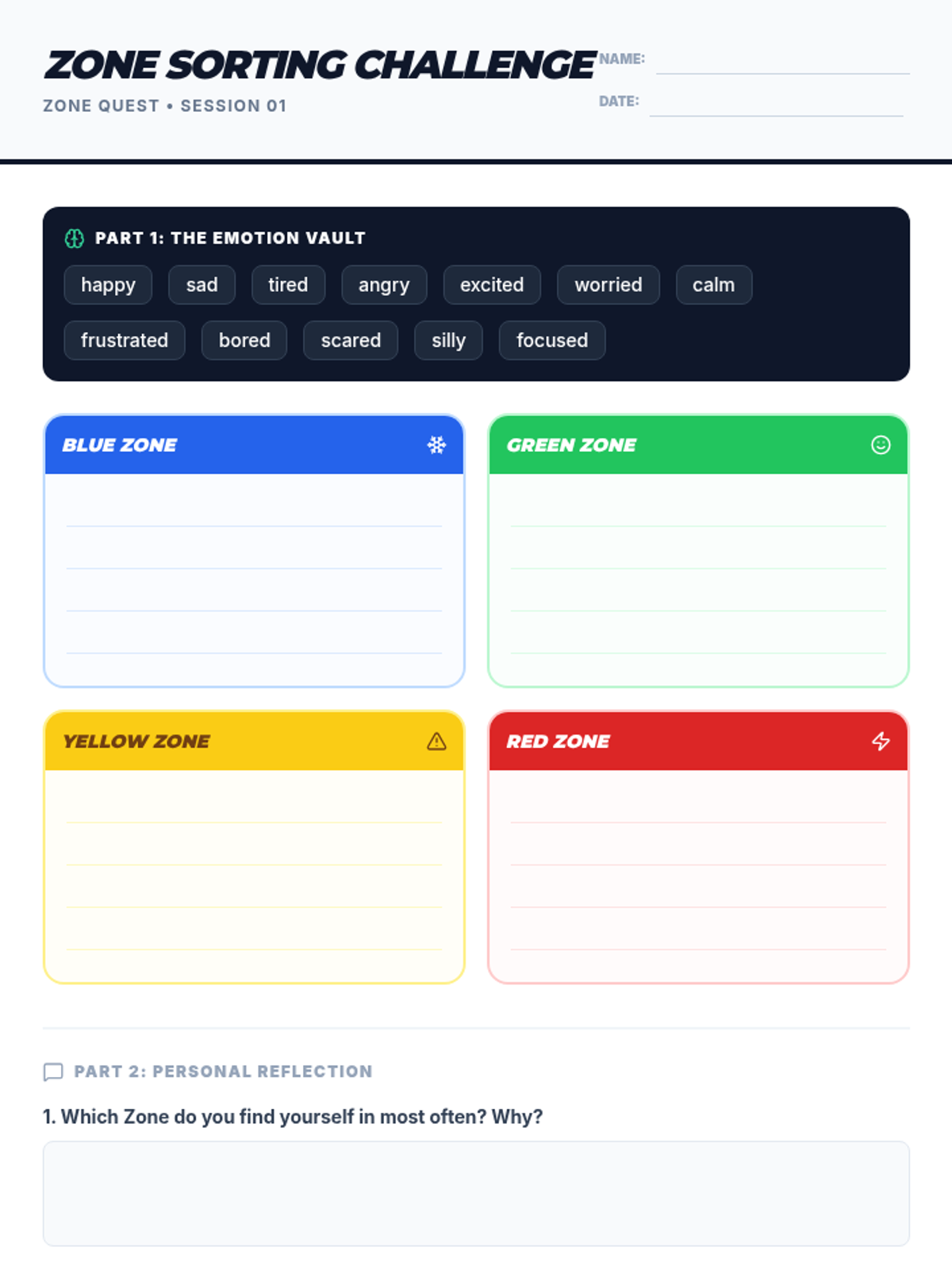
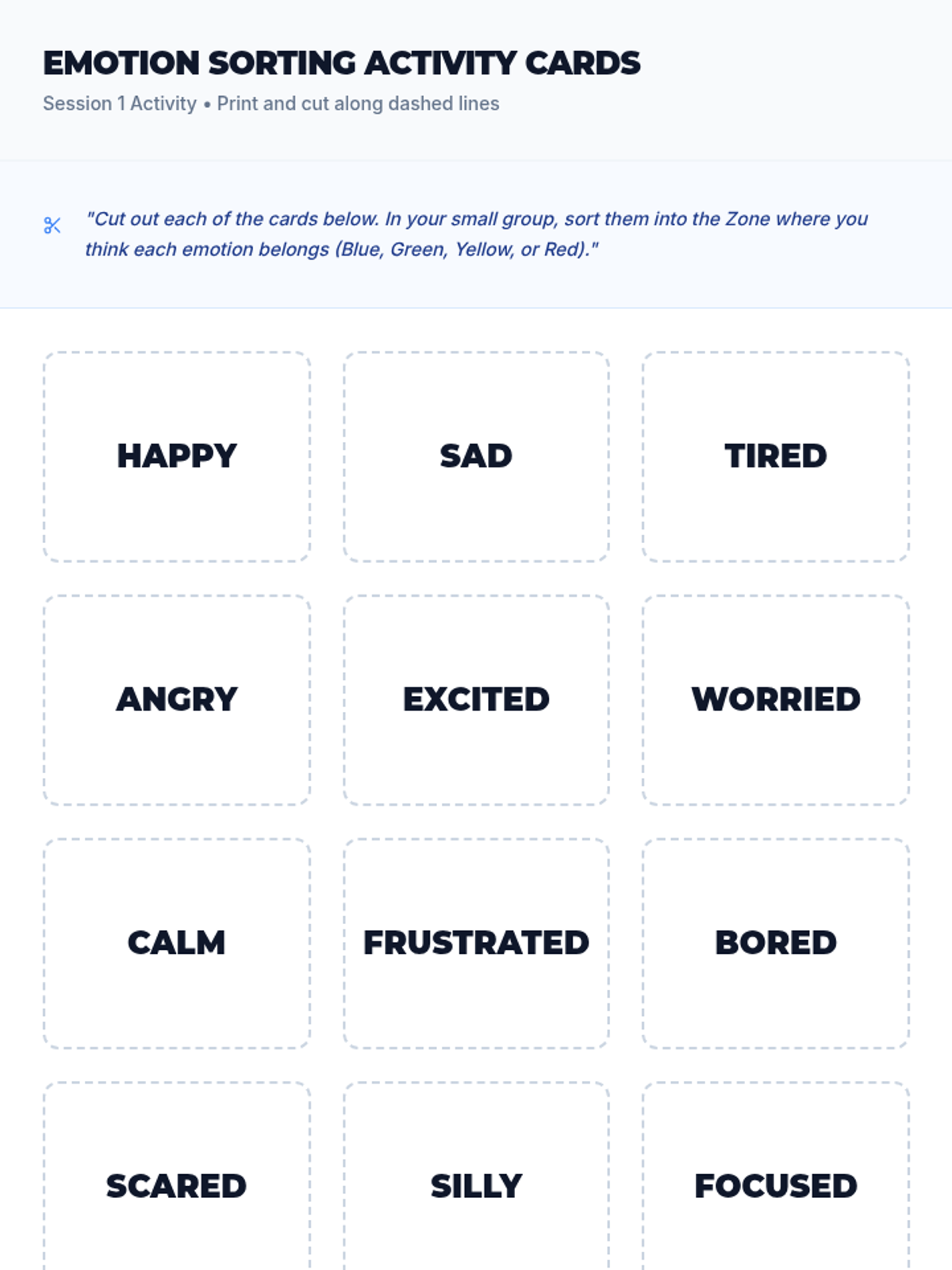
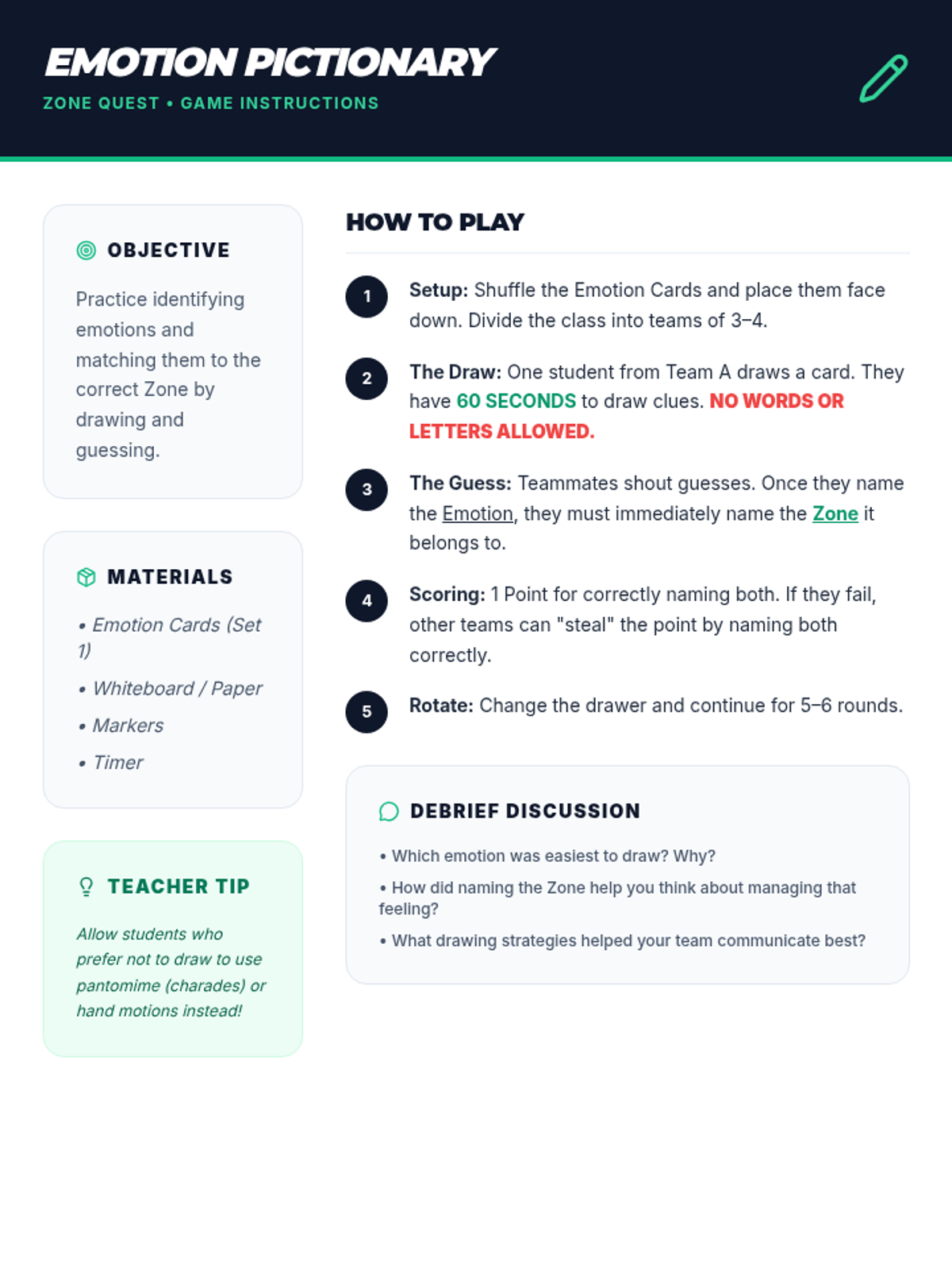
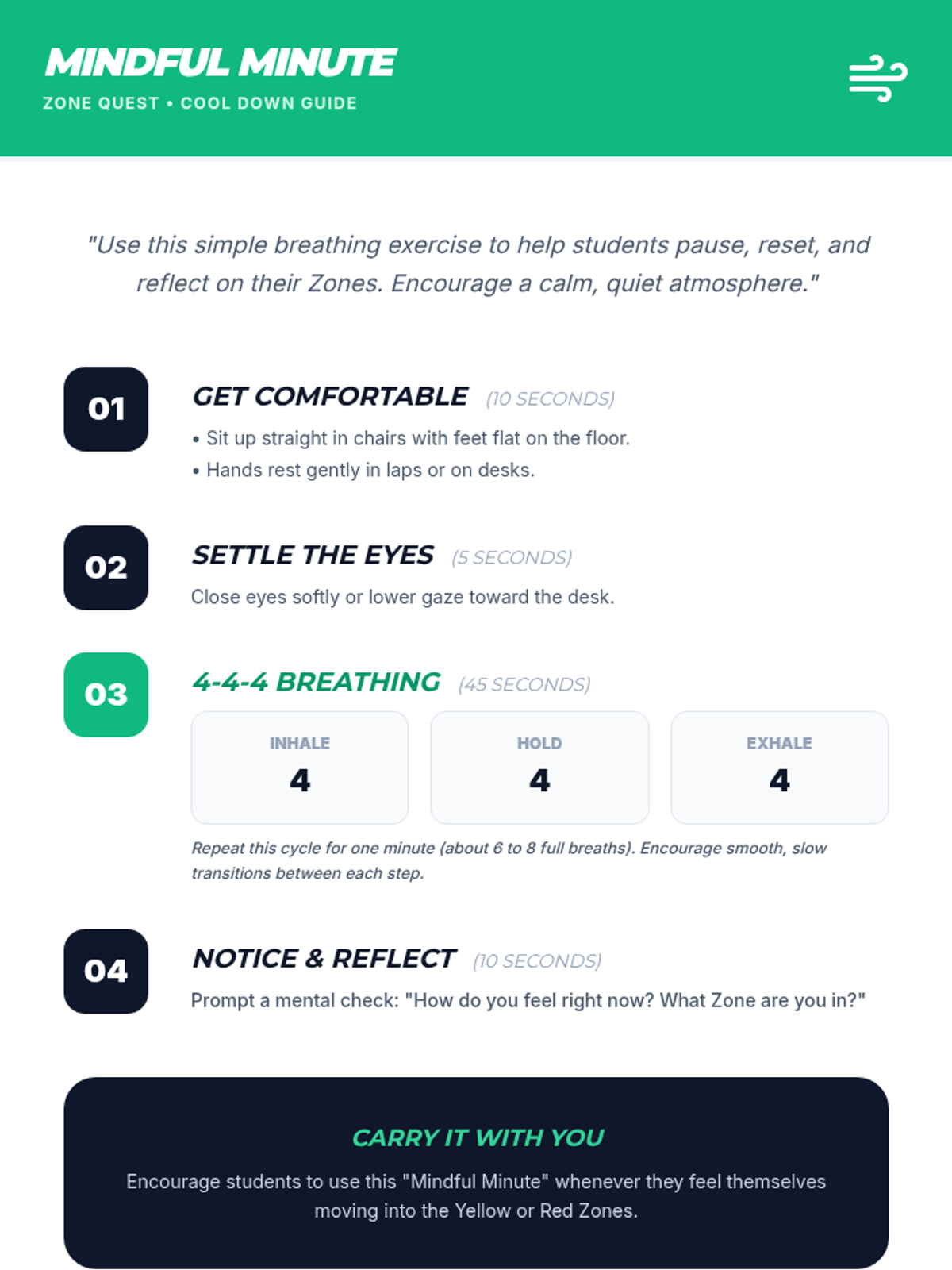
A 3-session journey for middle schoolers to understand and master the Zones of Regulation, building self-awareness and emotional management skills through interactive activities, games, and personal planning.
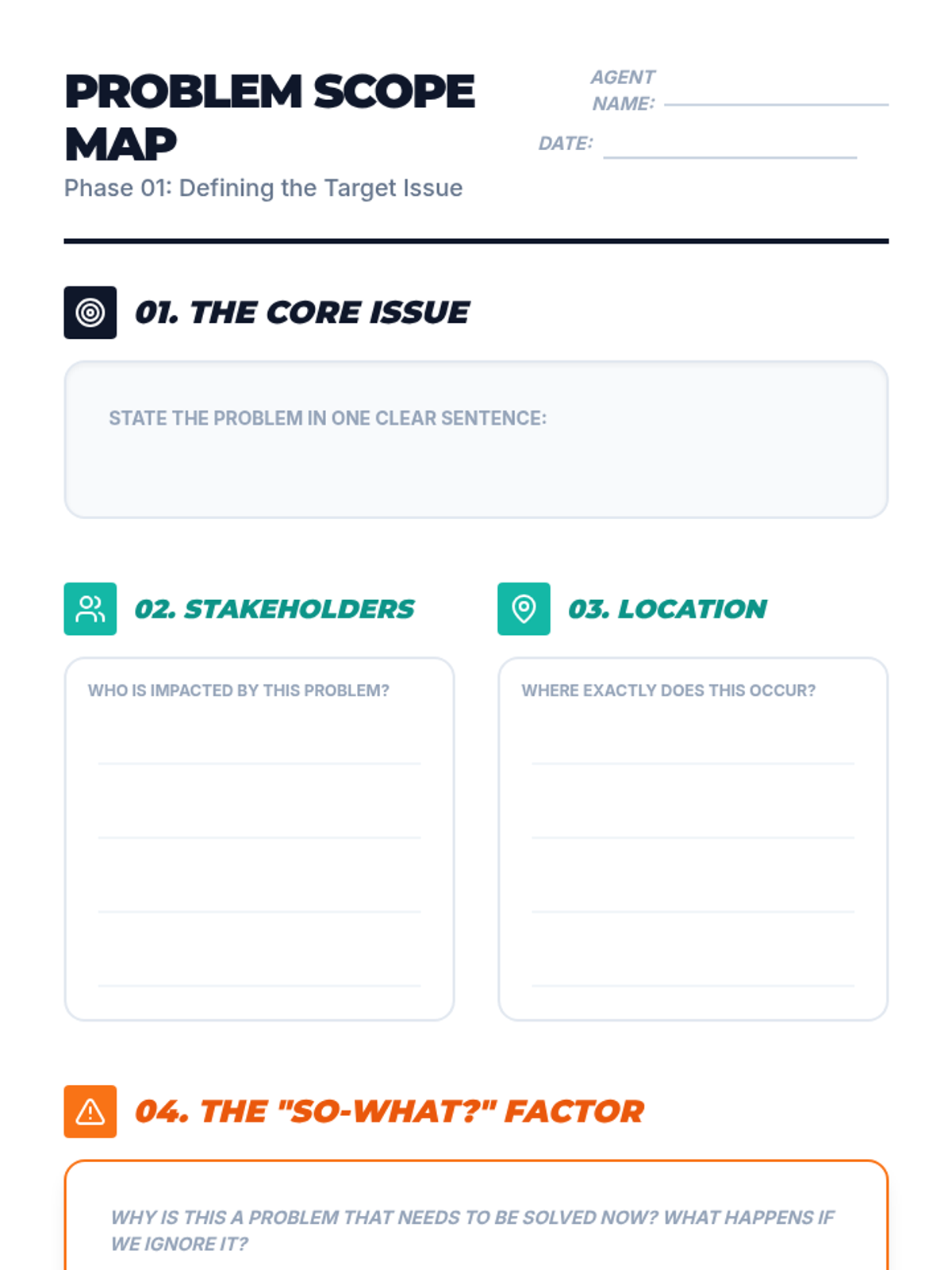
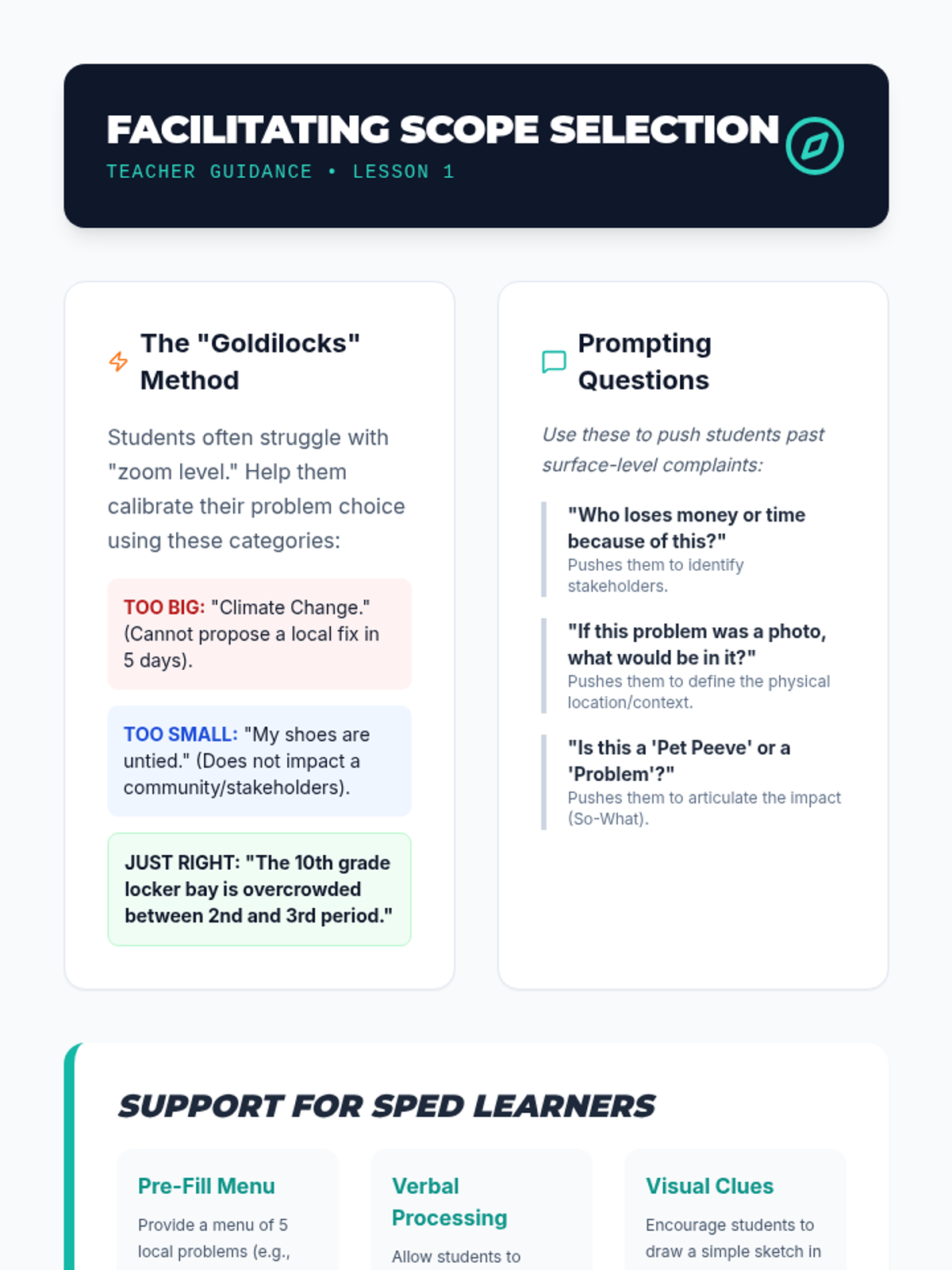
A project-based unit where students act as systems analysts, using cause-and-effect and problem-solution graphic organizers to investigate real-world community issues and propose evidence-based solutions.
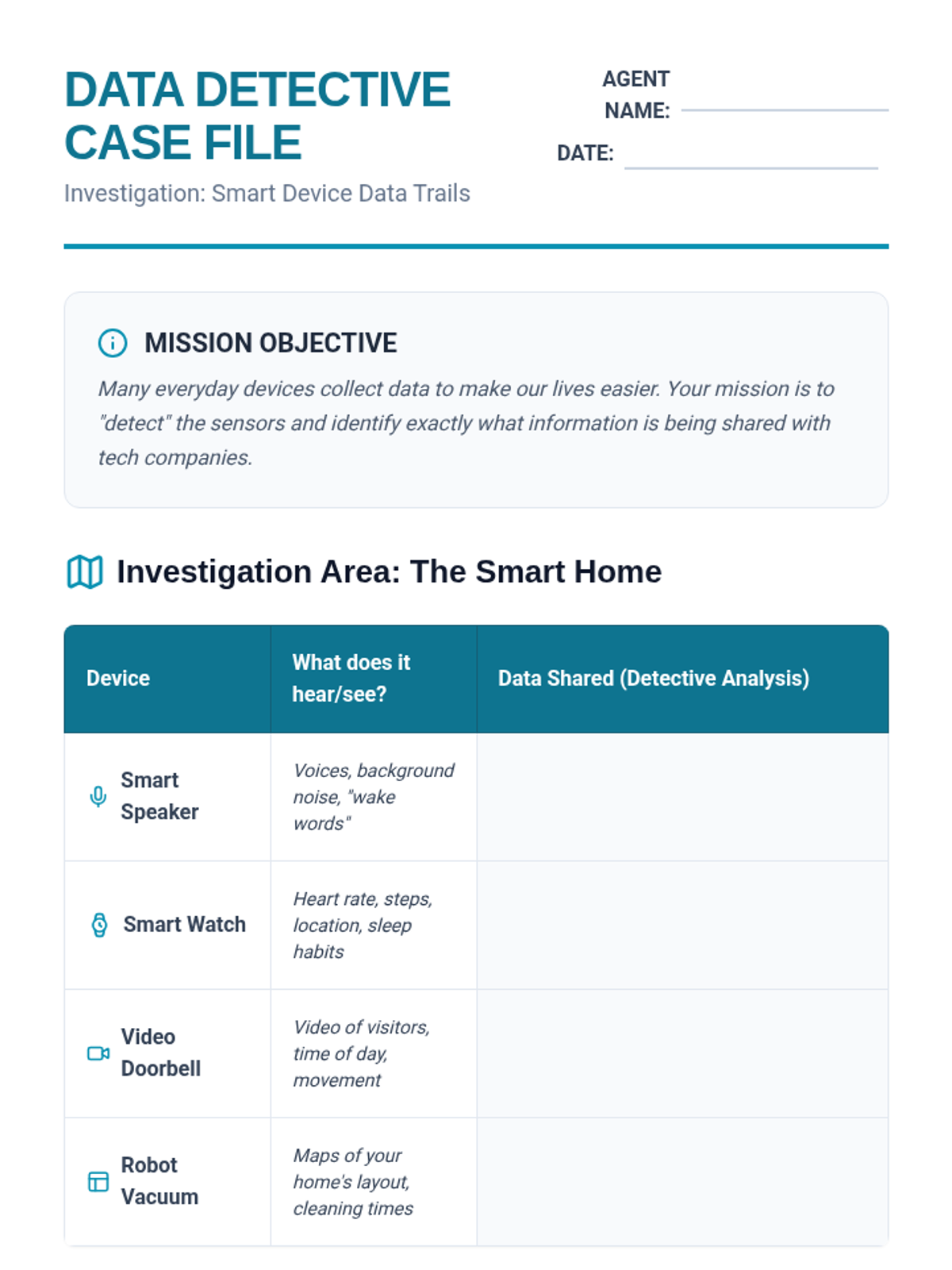
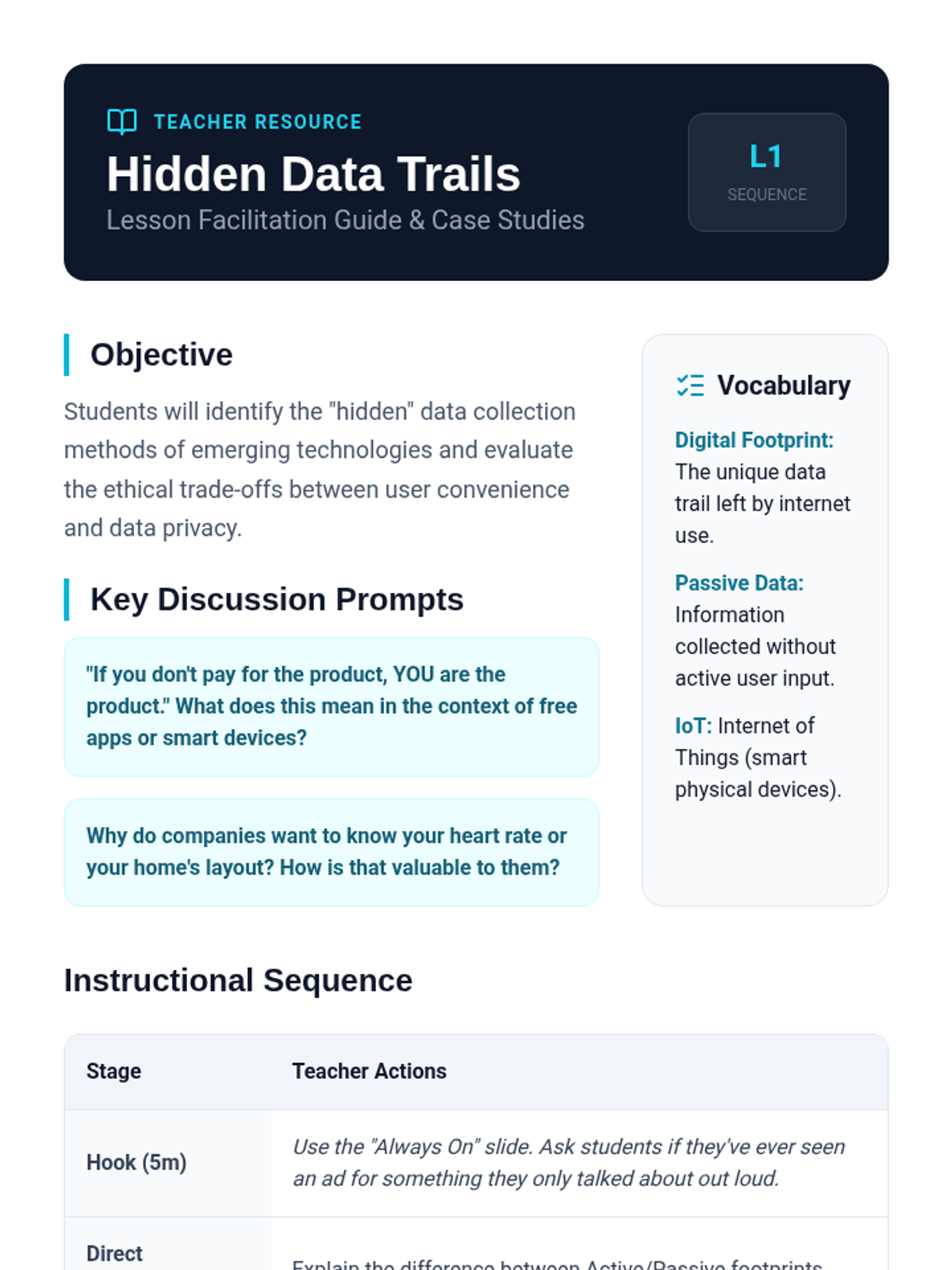
A comprehensive unit for 6th-grade students exploring the ethical, privacy, and career implications of emerging technologies like AI, deepfakes, and automation. Students move from understanding personal data footprints to creating a personal 'Future Readiness Charter' for safe and productive digital living.
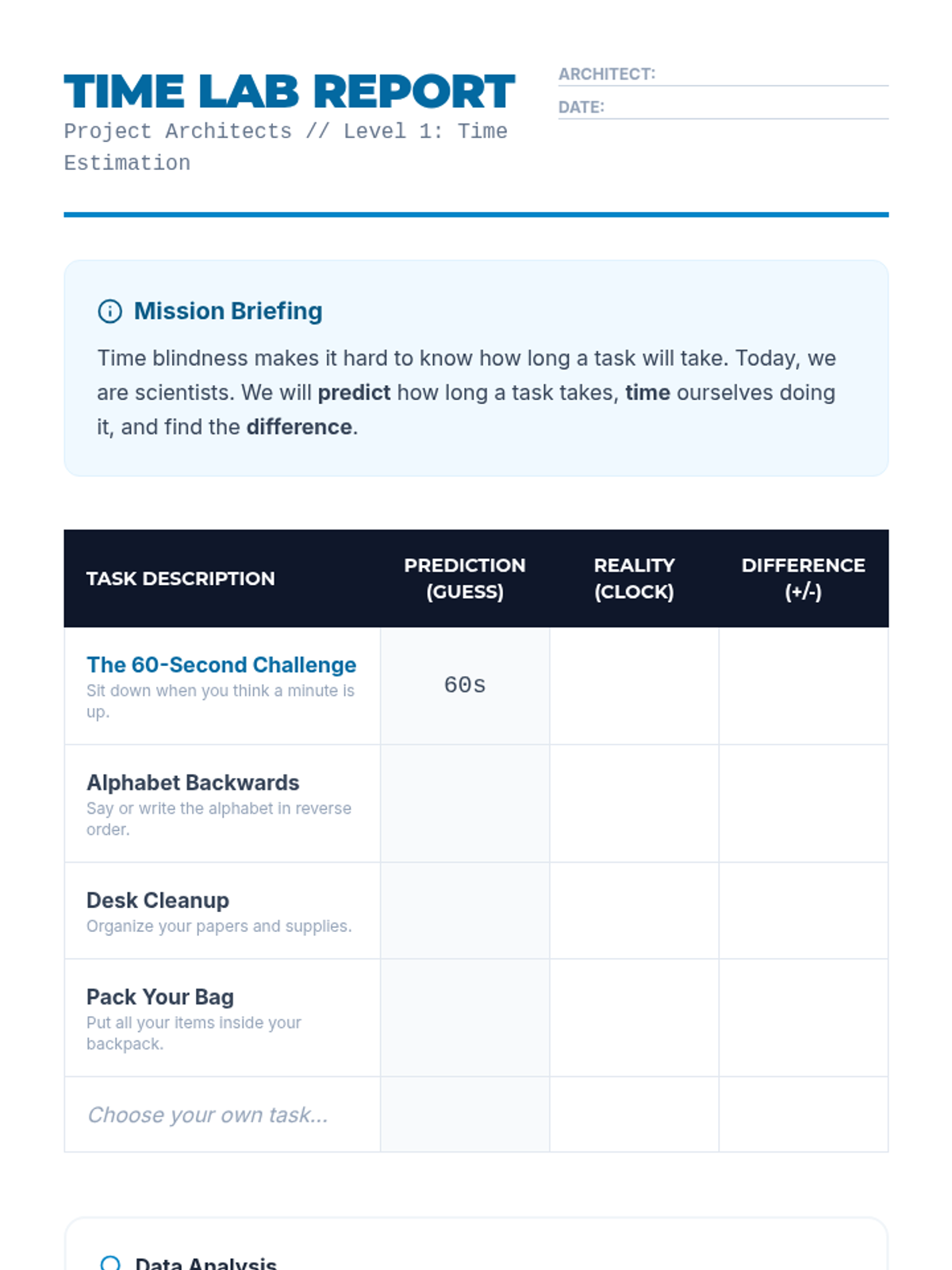
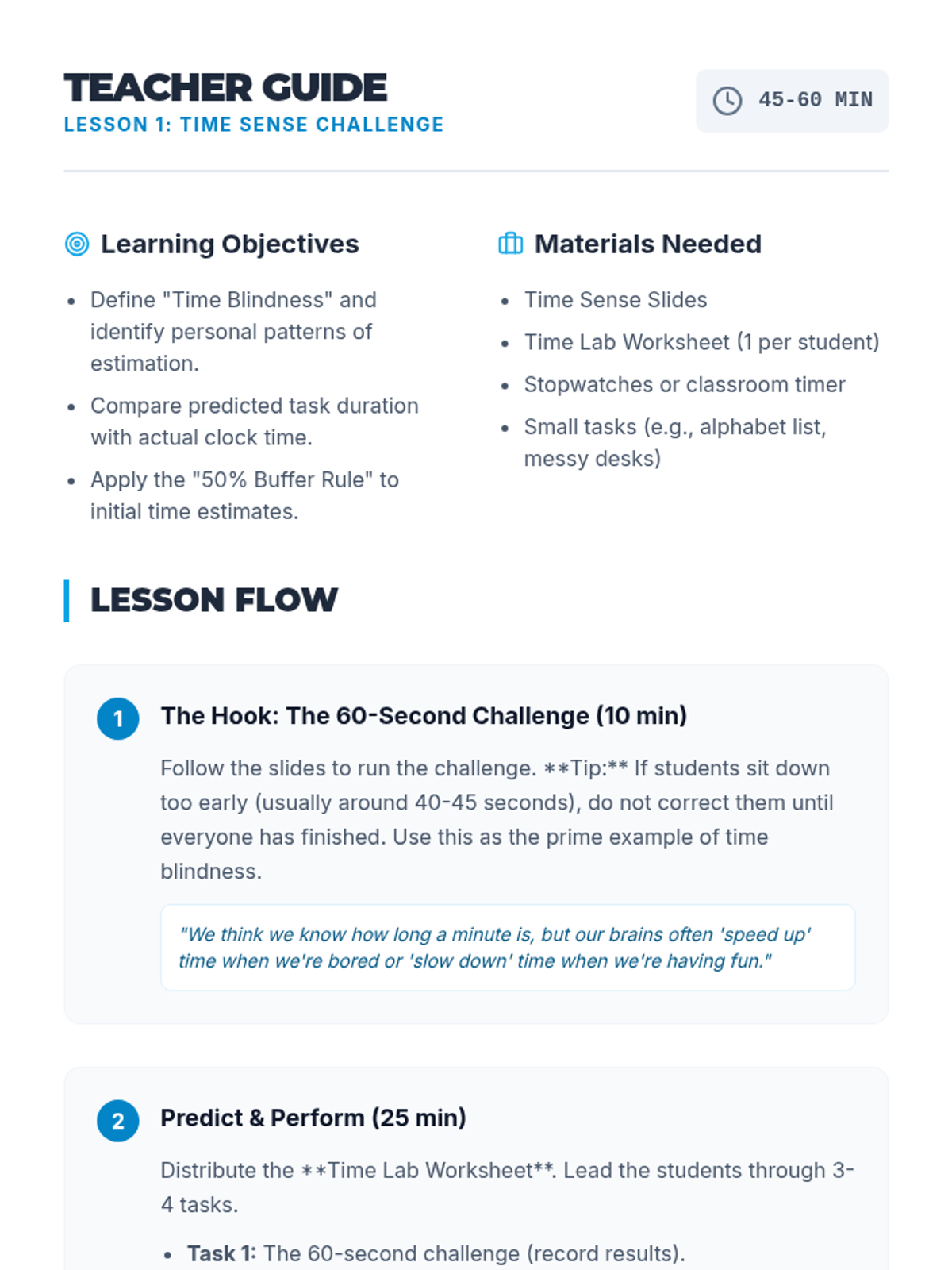
A comprehensive guide to project management for 6th graders, focusing on backward design, time estimation, and managing time blindness to reduce deadline stress.
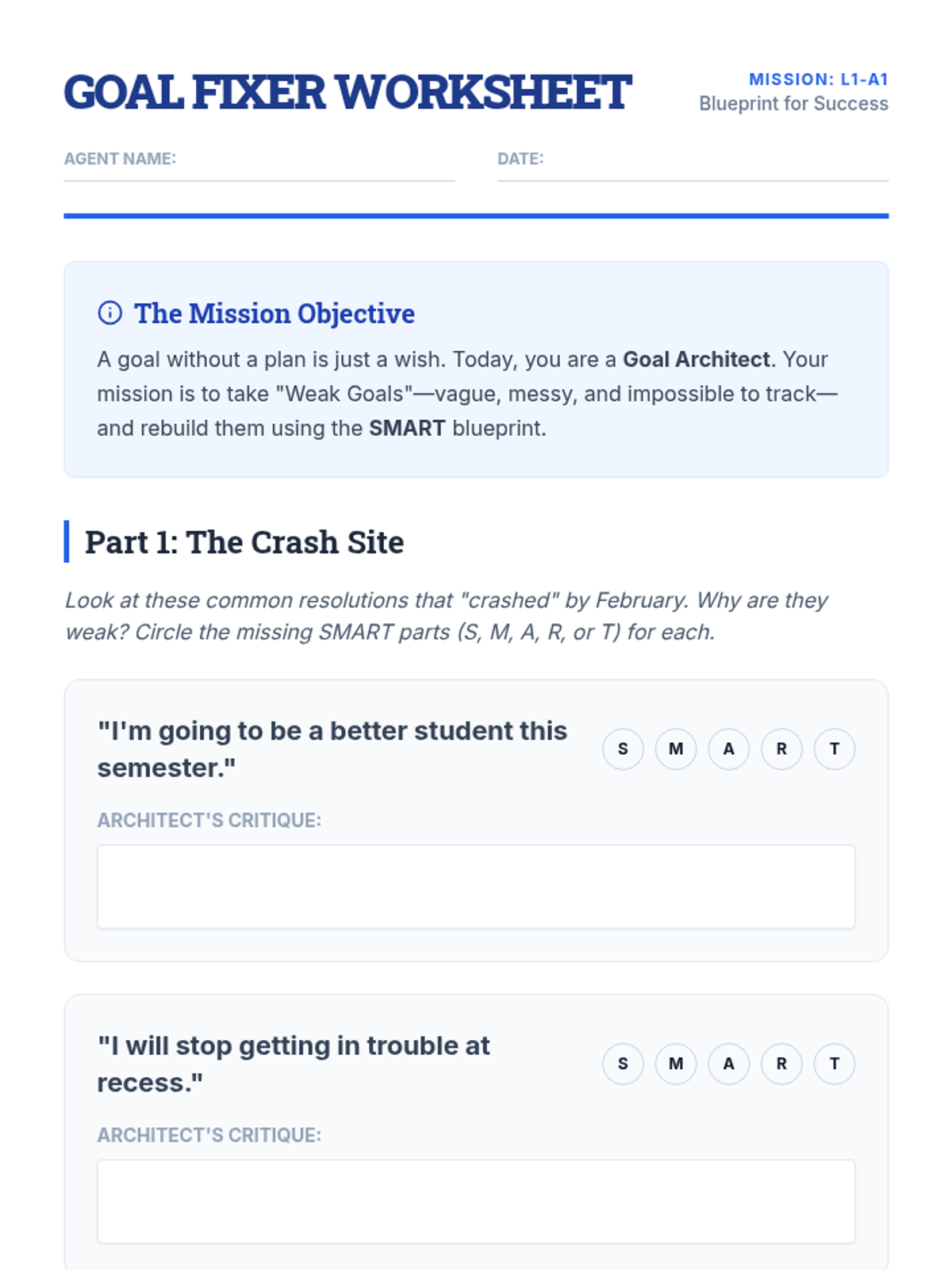
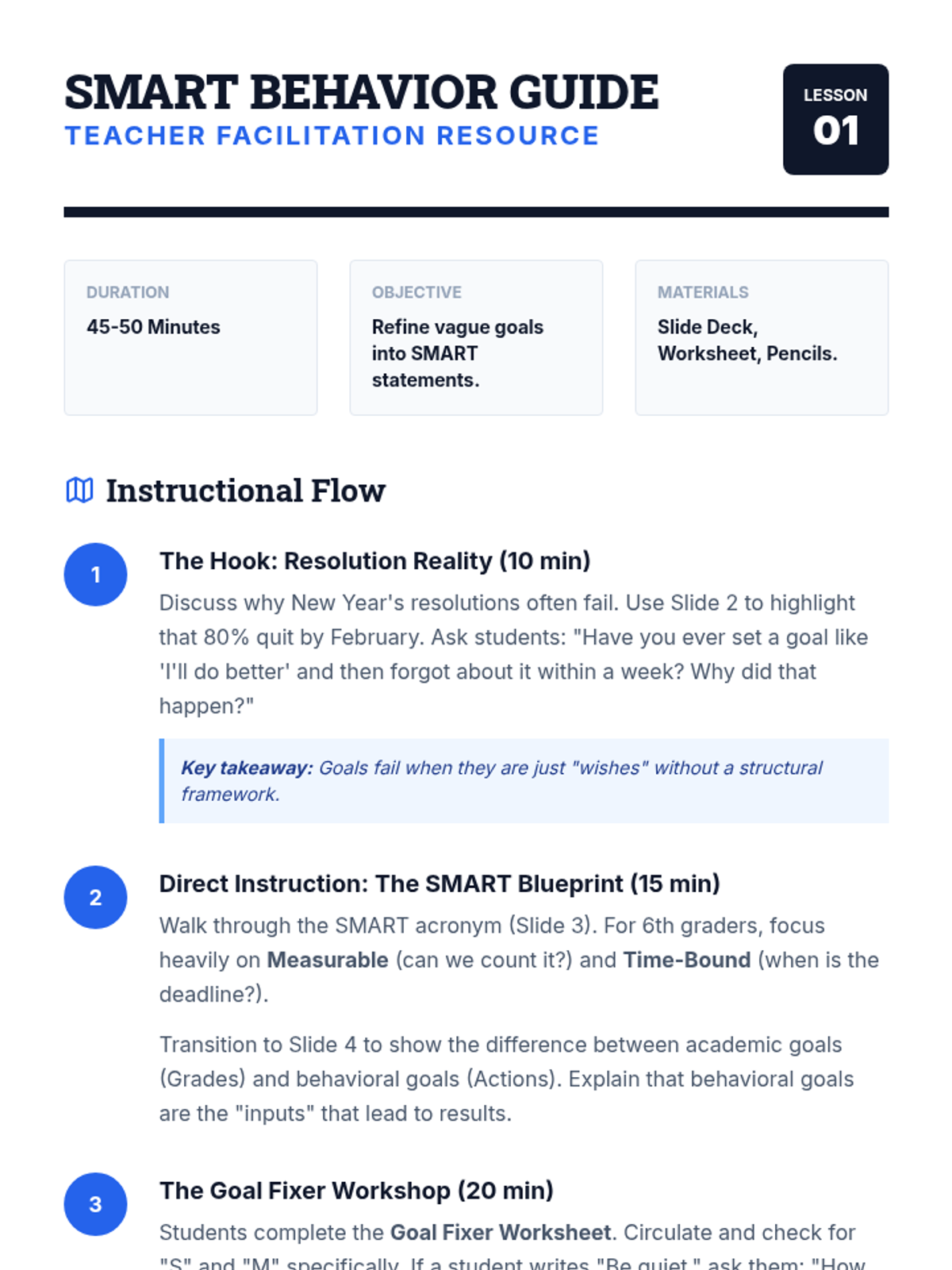
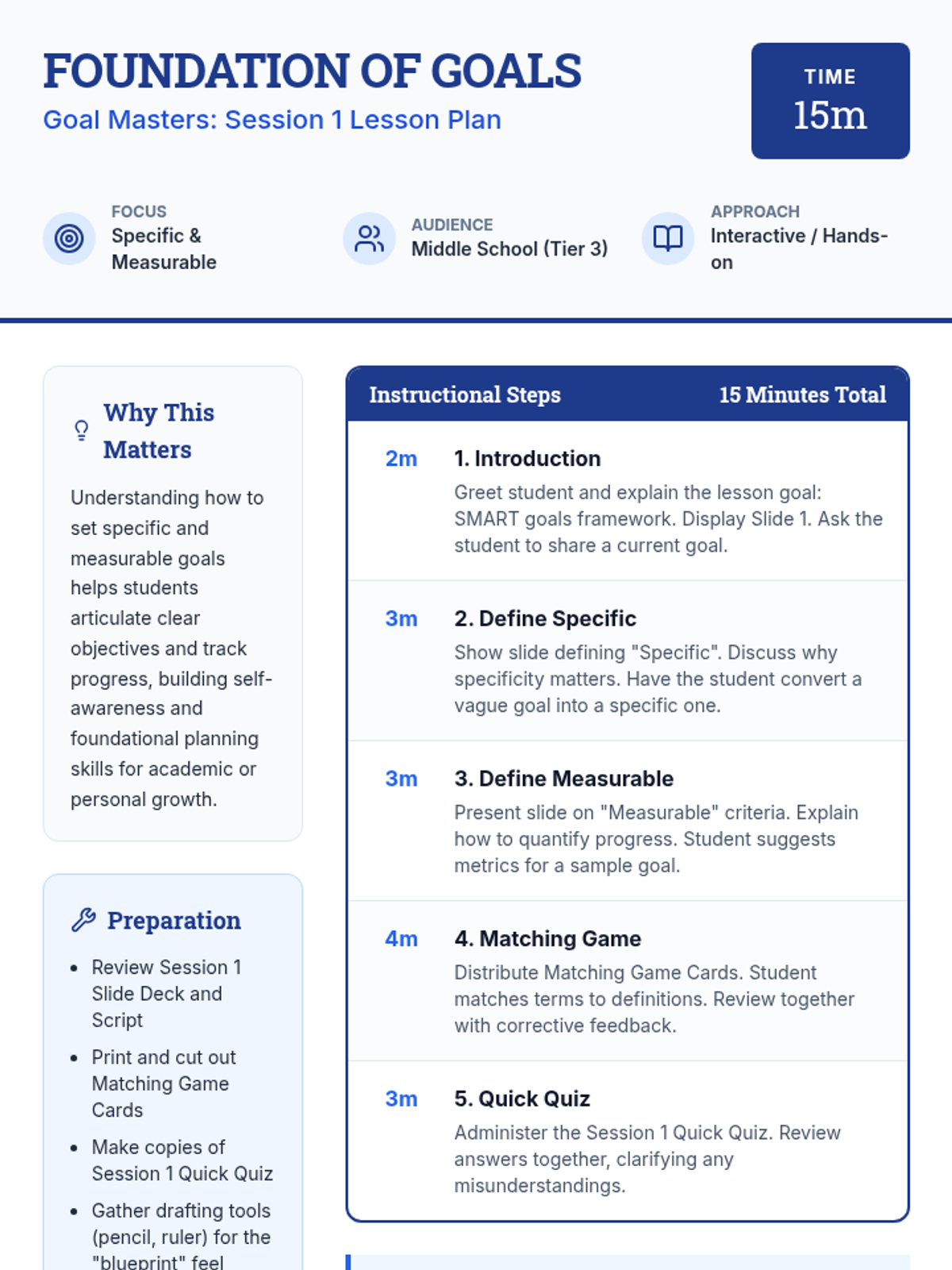
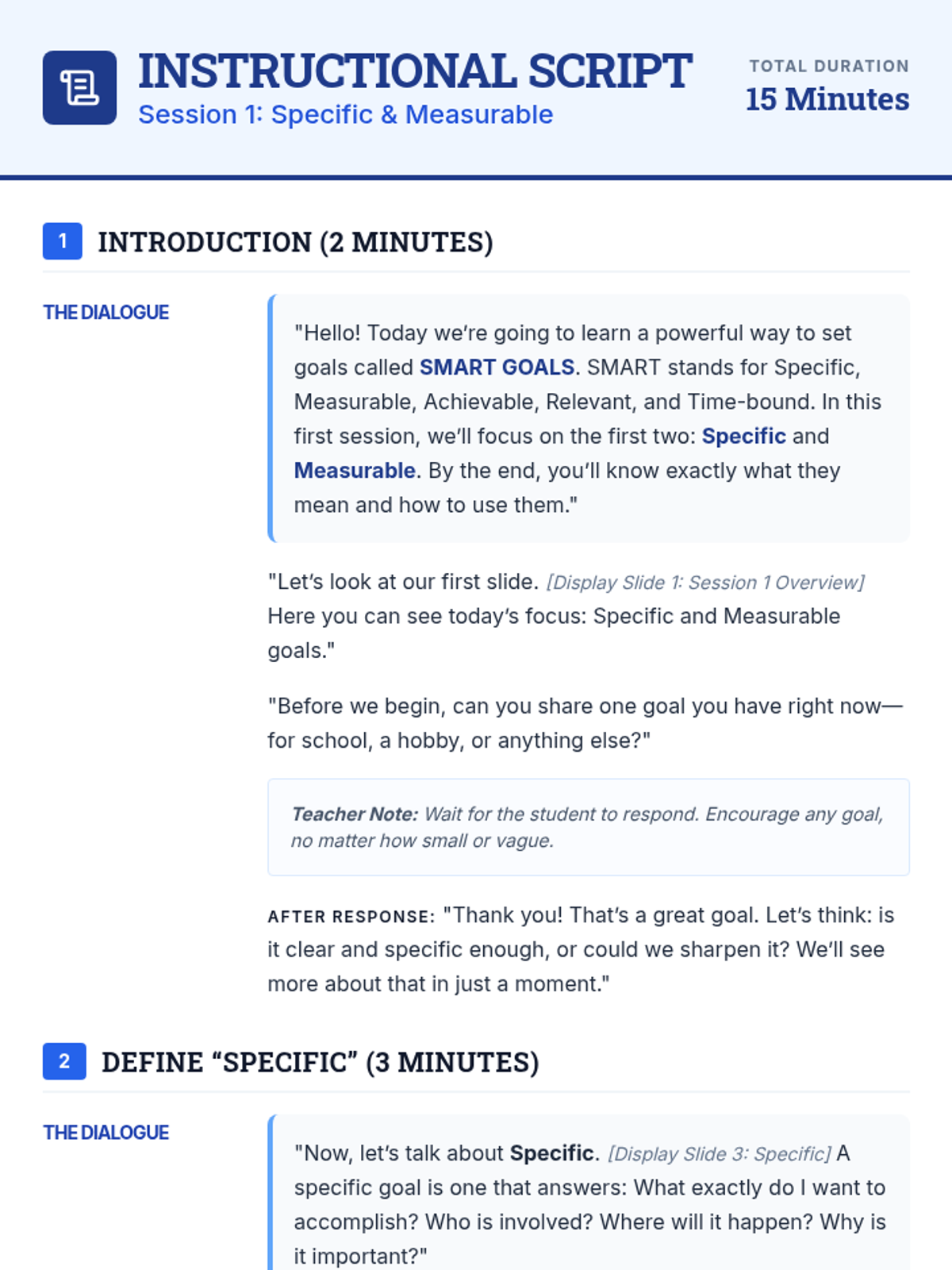
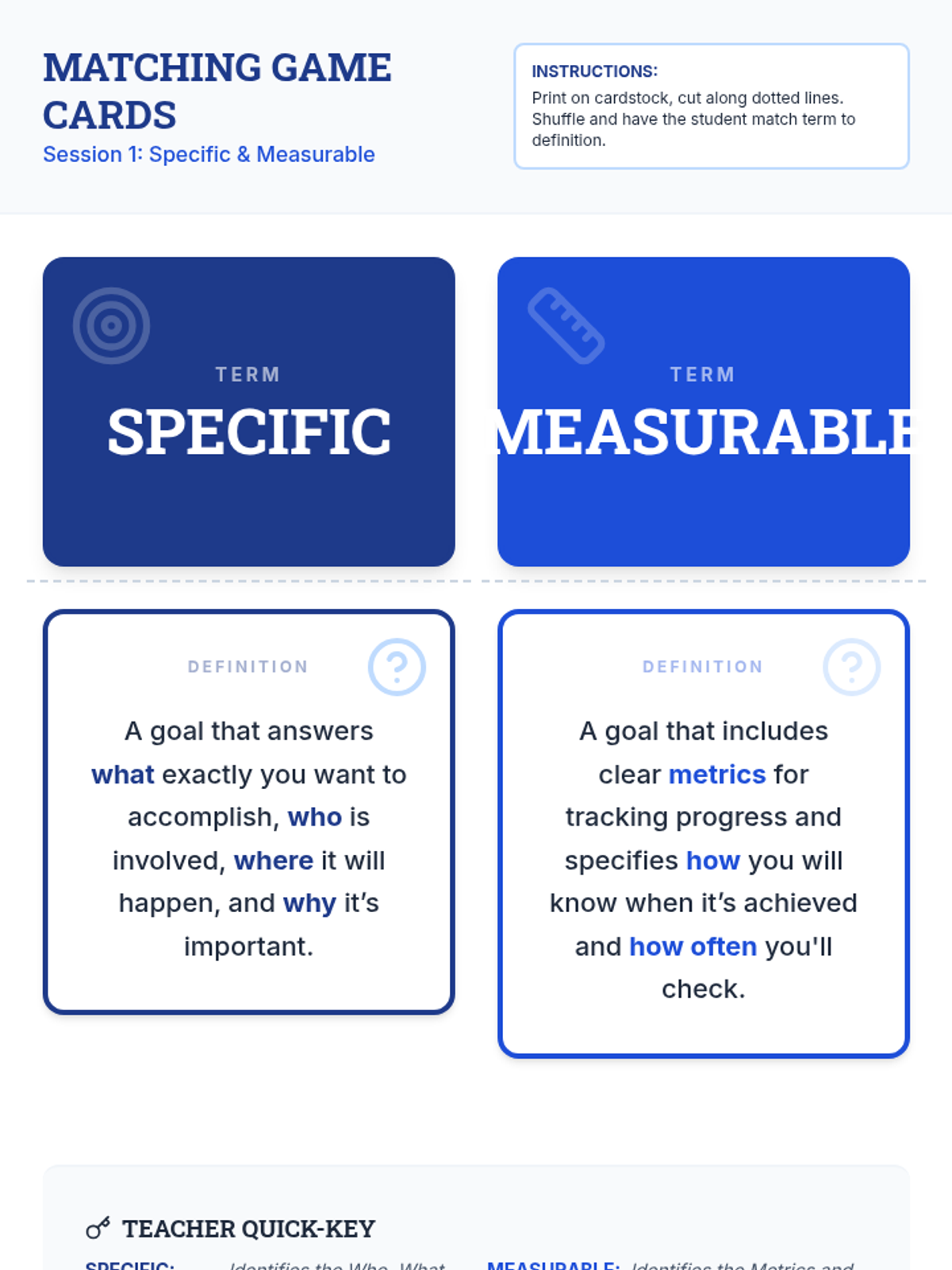
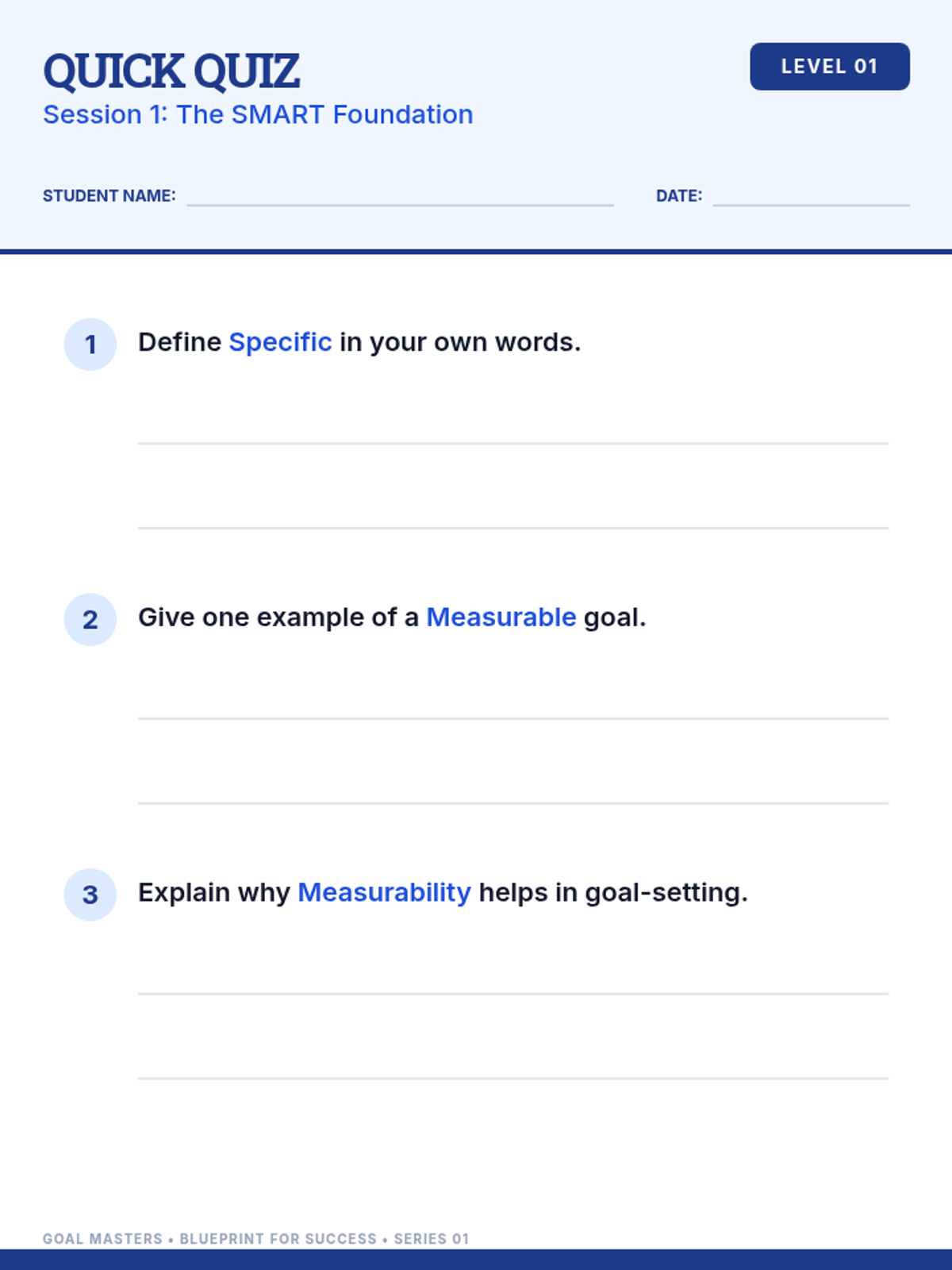
A 3-session individual Tier 3 lesson series for middle school students to master the SMART goal-setting framework. Students learn to refine vague intentions into Specific, Measurable, Achievable, Relevant, and Time-bound objectives through interactive matching games, guided scripting, and formative assessments.
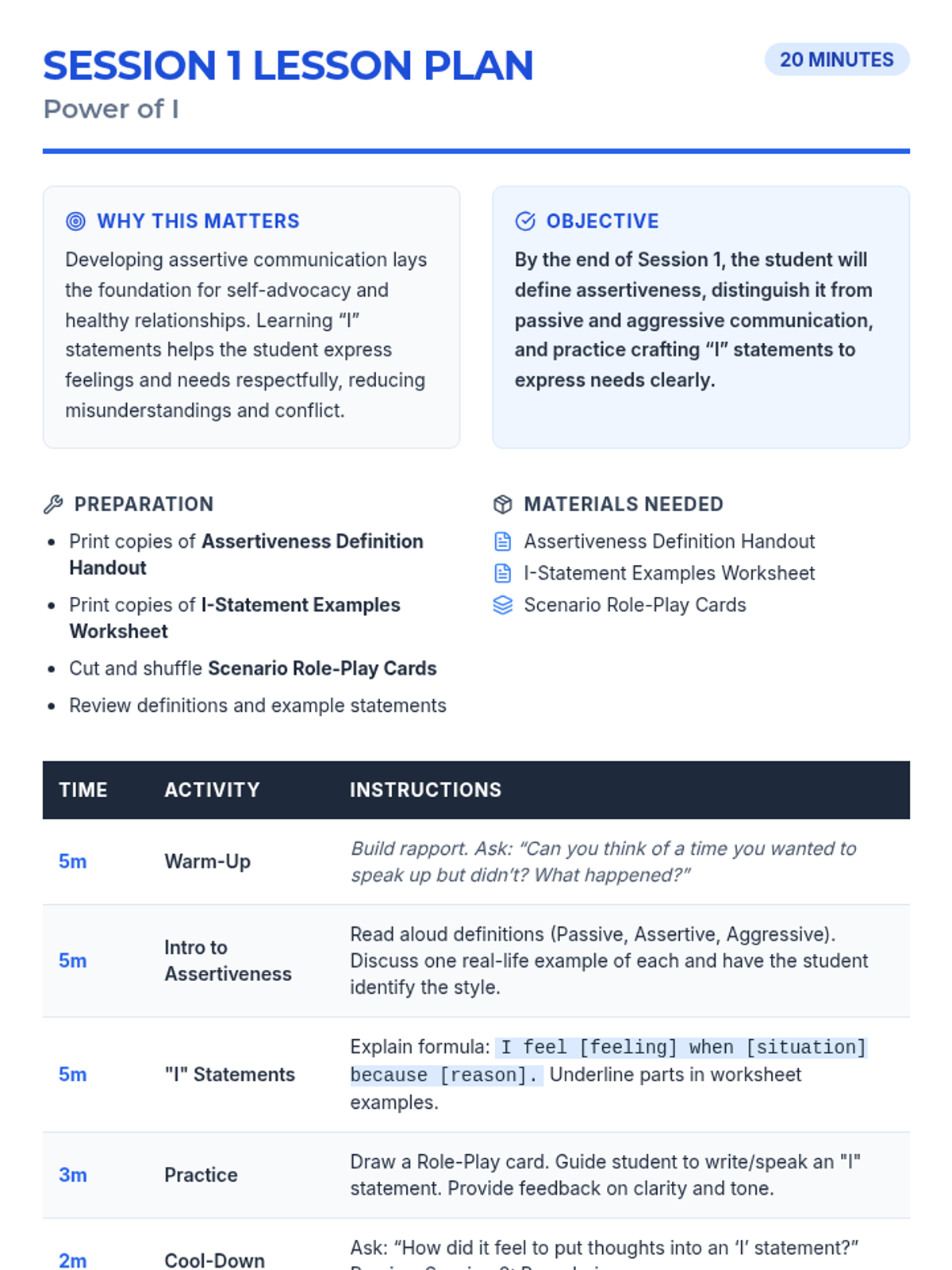
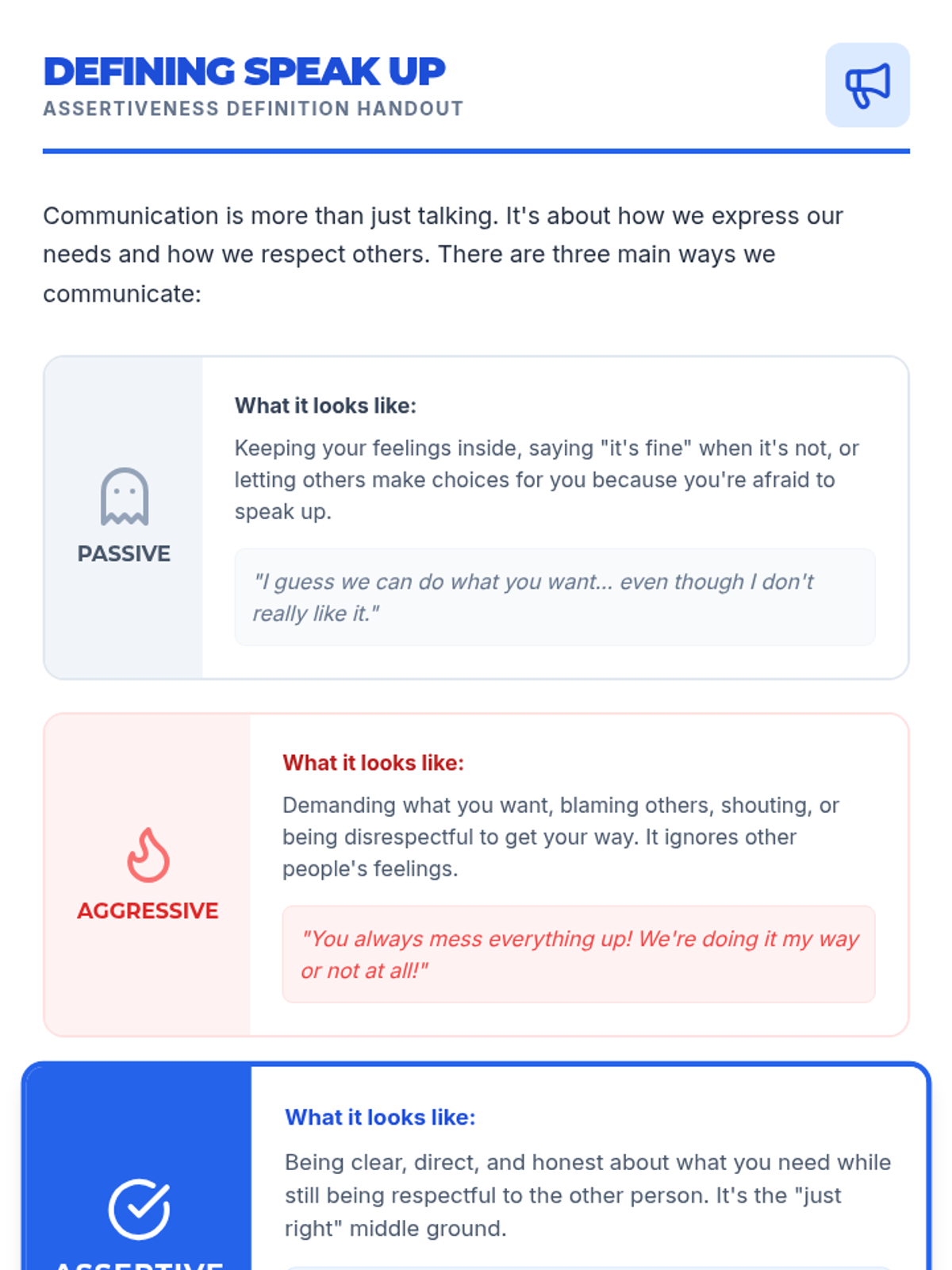
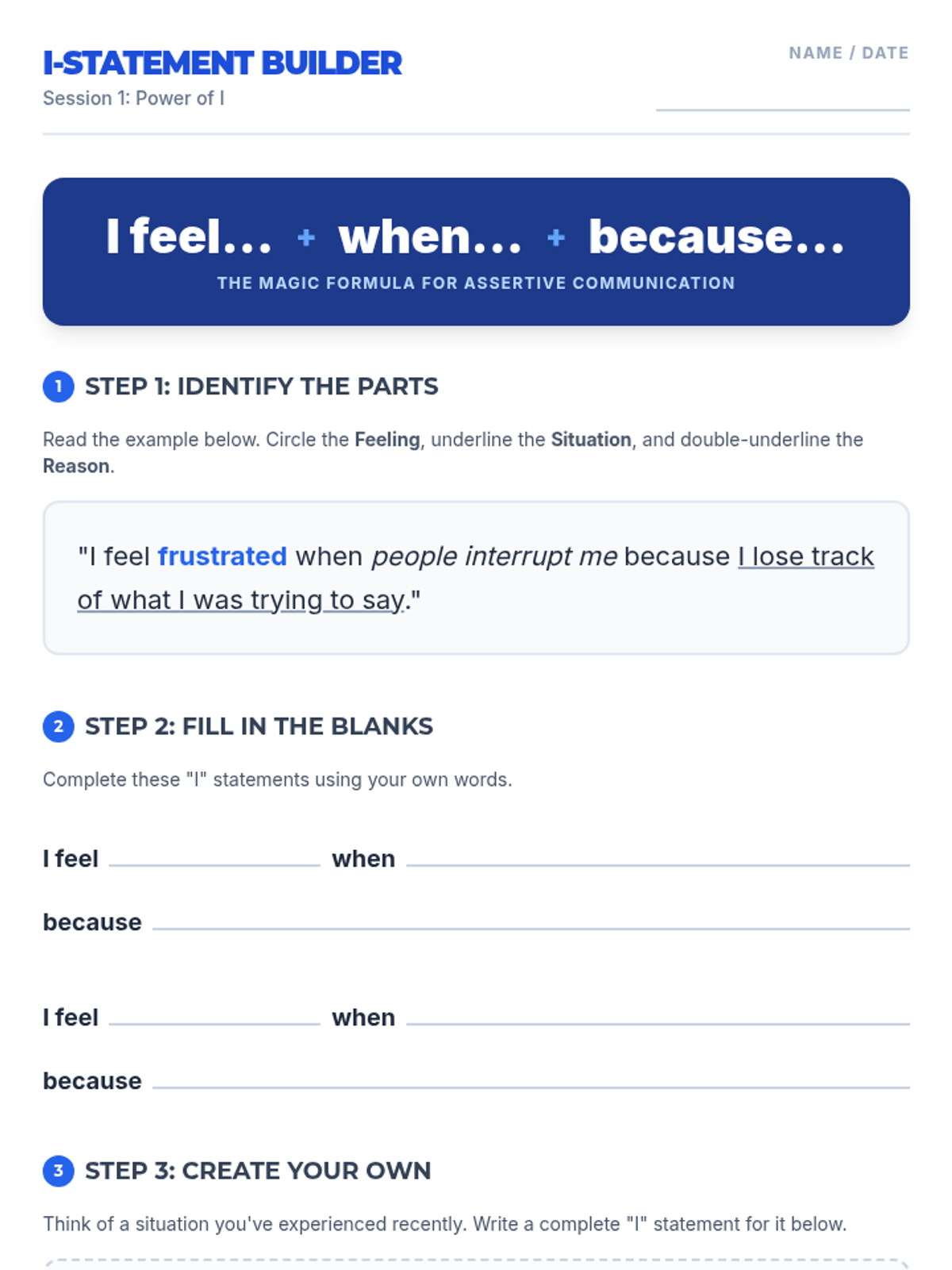
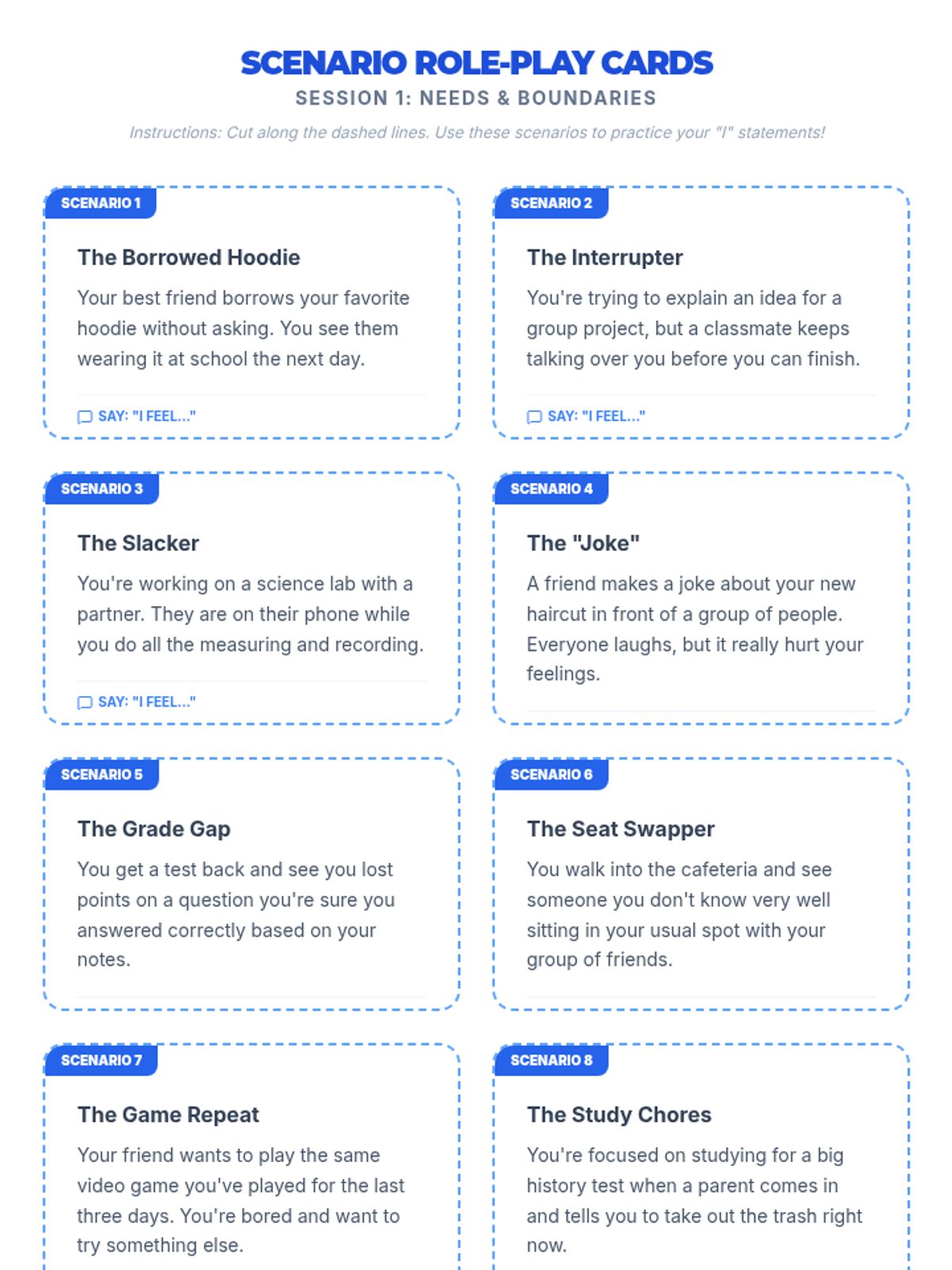
A 5-session intensive for middle school students to develop assertive communication skills, focusing on I-statements, boundaries, refusals, and long-term maintenance.
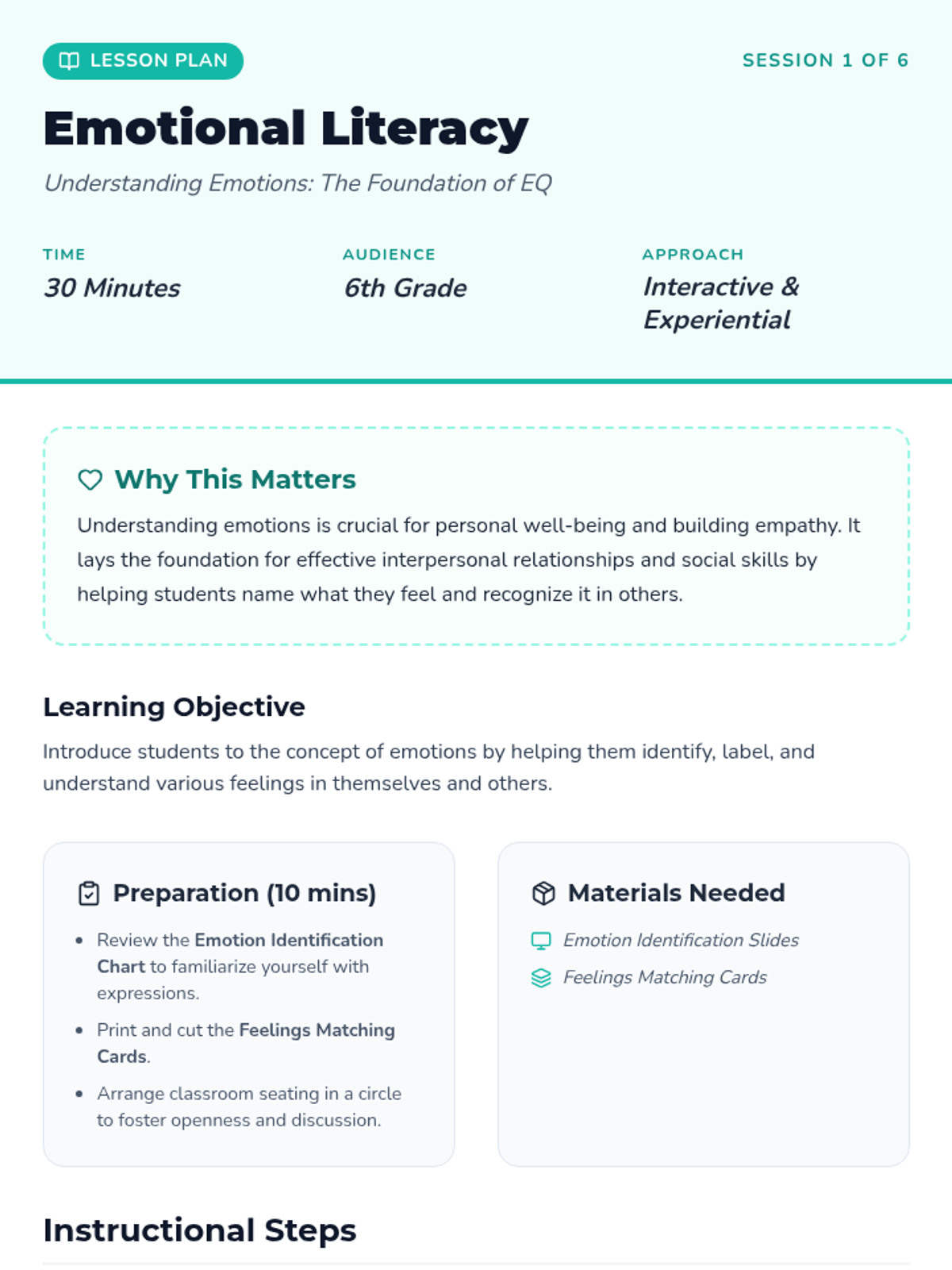
A comprehensive 6-session sequence designed for 6th graders to develop core emotional intelligence skills, including emotional literacy, communication, problem-solving, time management, resilience, and goal setting.
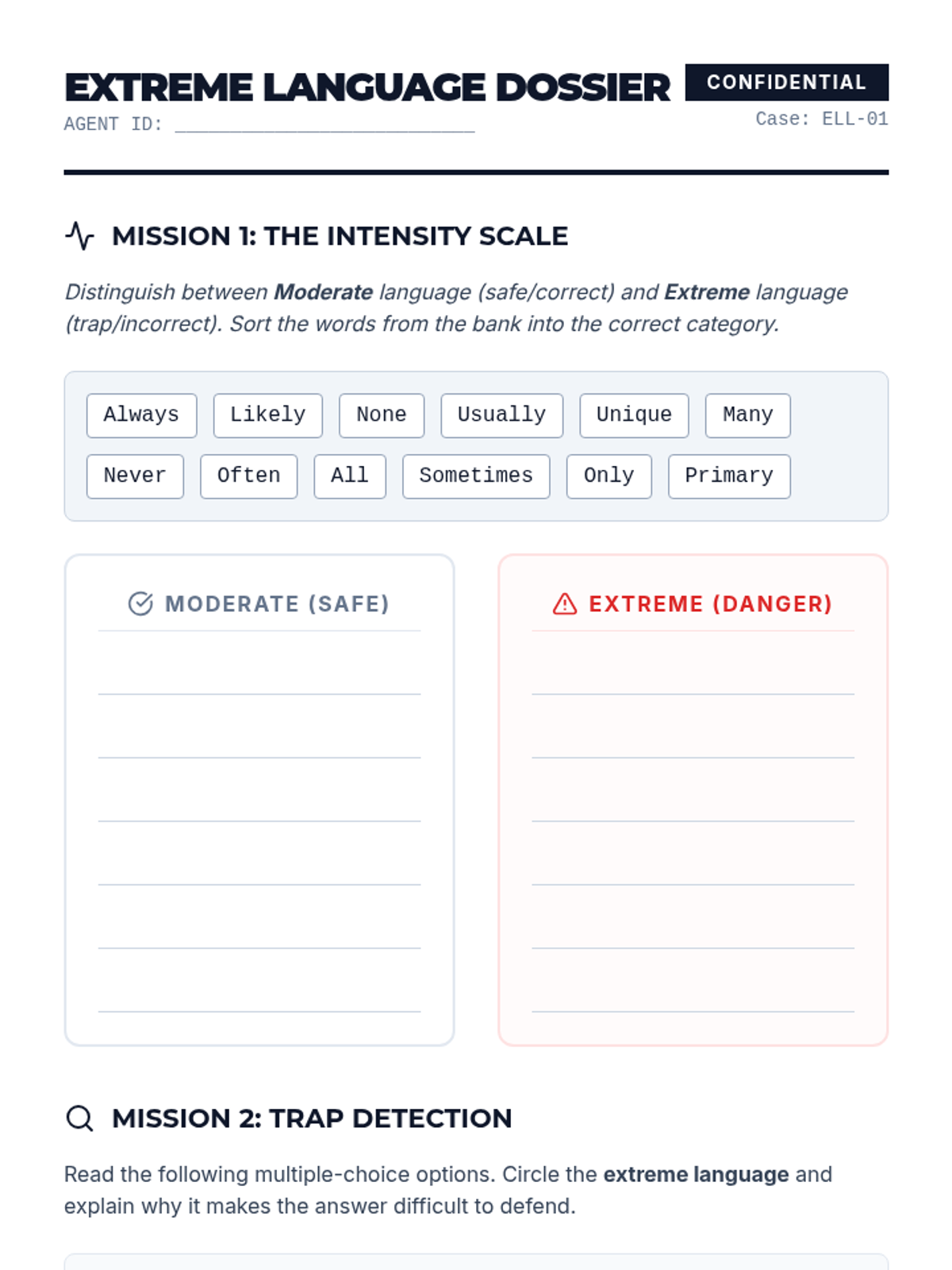
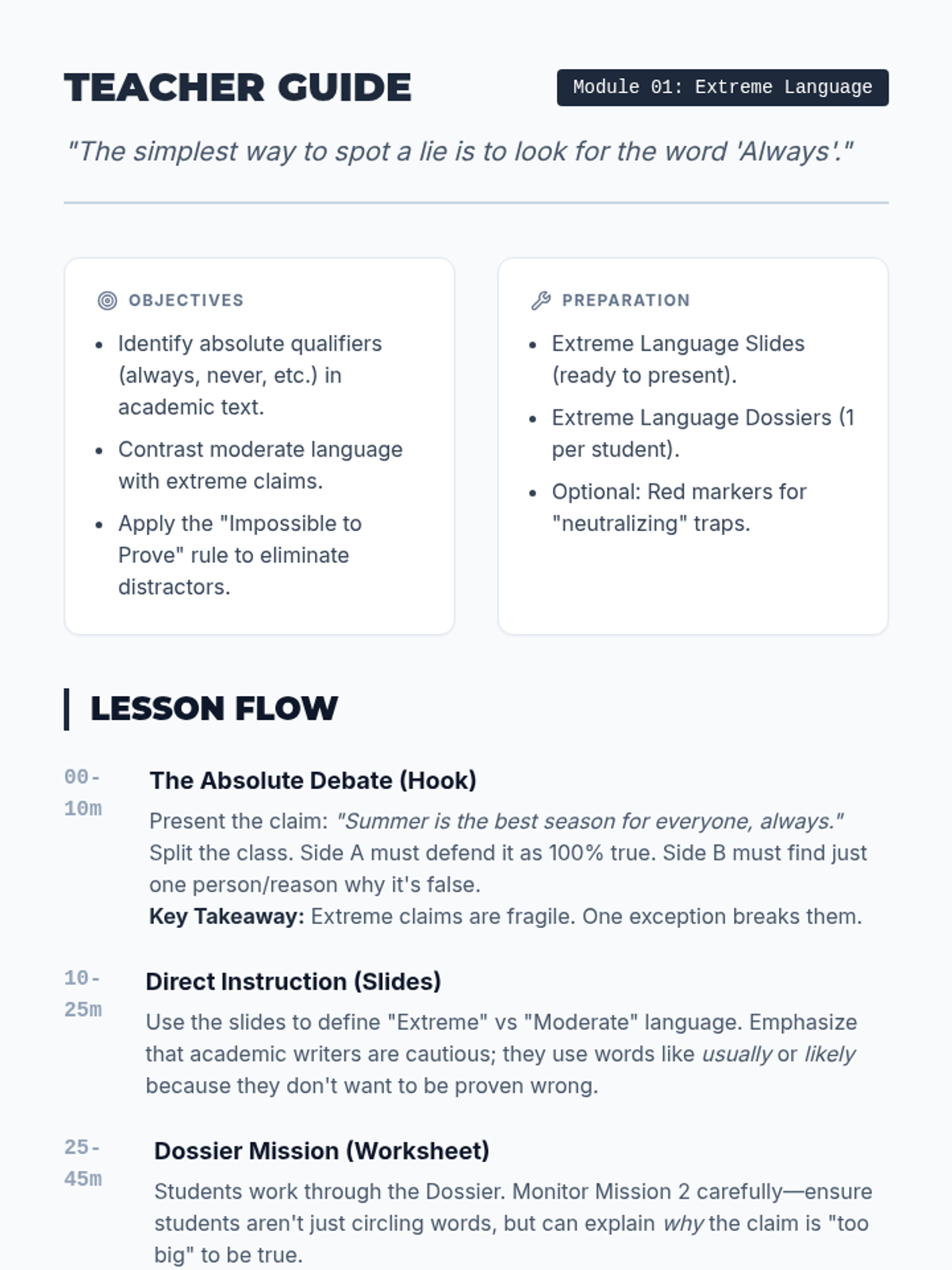
This sequence transforms students into 'Trap Detectives' who can identify and eliminate common distractors in academic tests. Students learn to spot extreme language, half-right traps, and out-of-scope answers through gamified lessons and role-reversal activities.
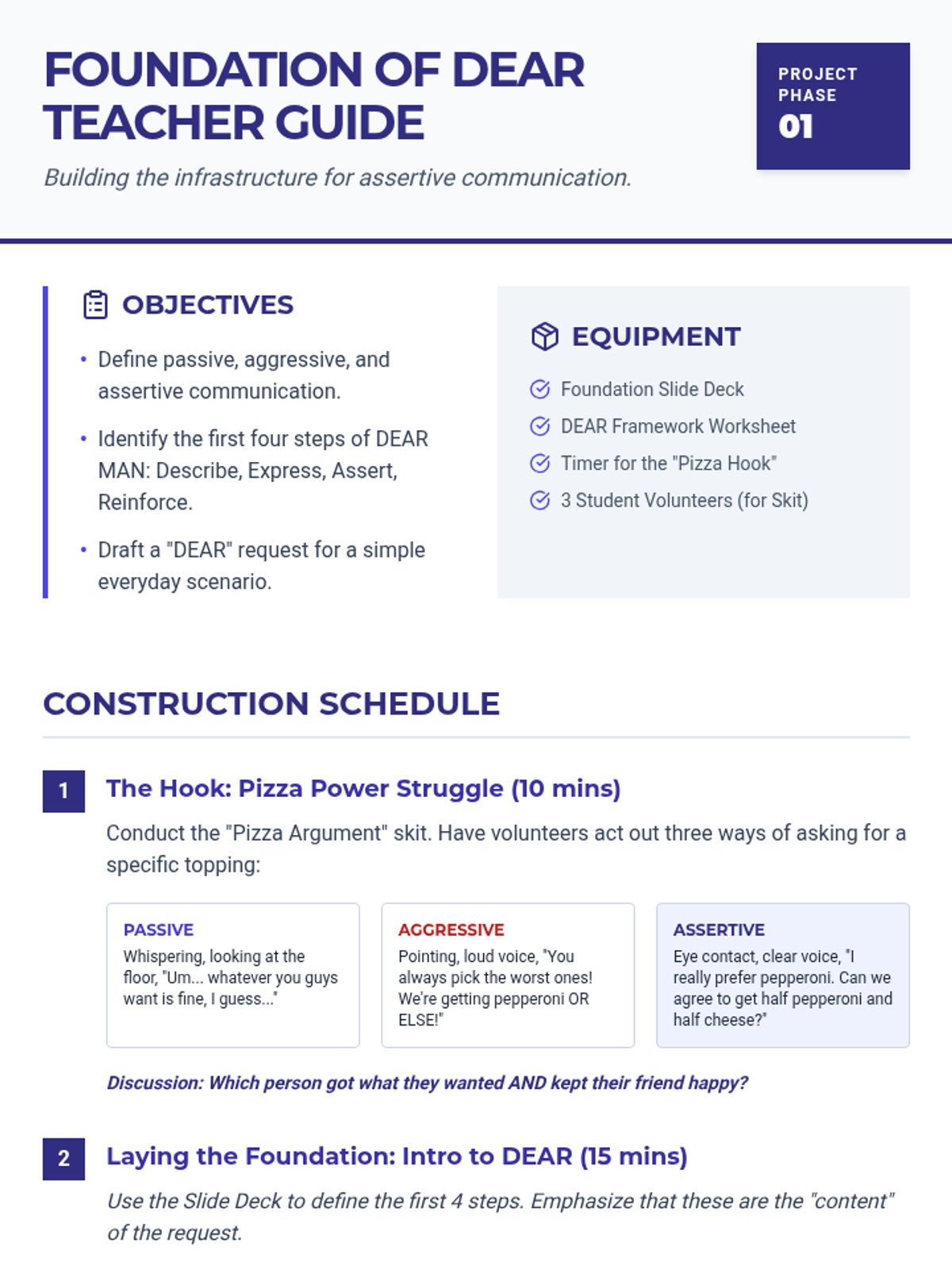
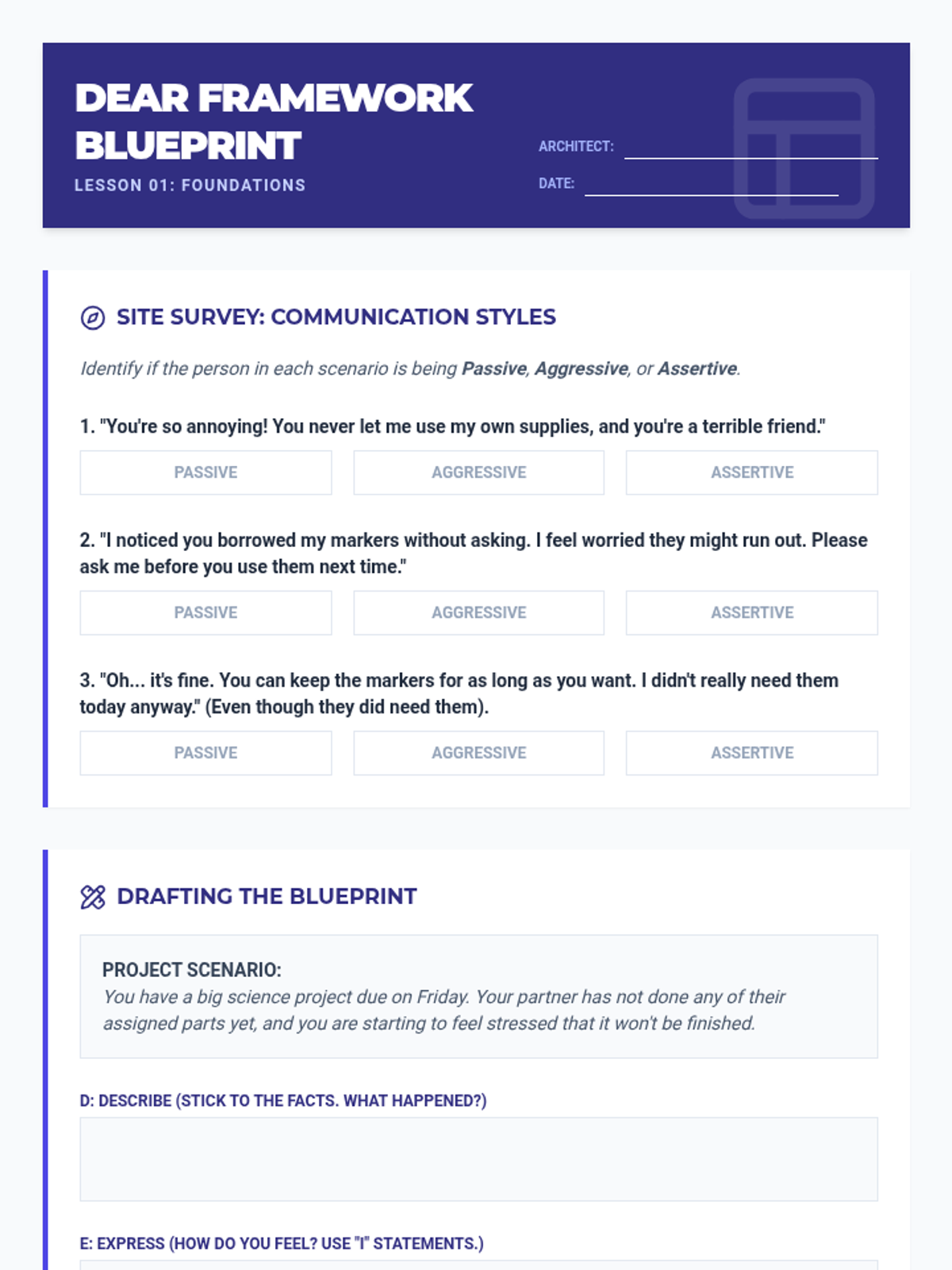
A comprehensive 5-lesson unit for 6th graders on the DBT DEAR MAN framework, teaching assertive communication, boundary setting, and negotiation skills through architectural-themed 'blueprints' for social success.
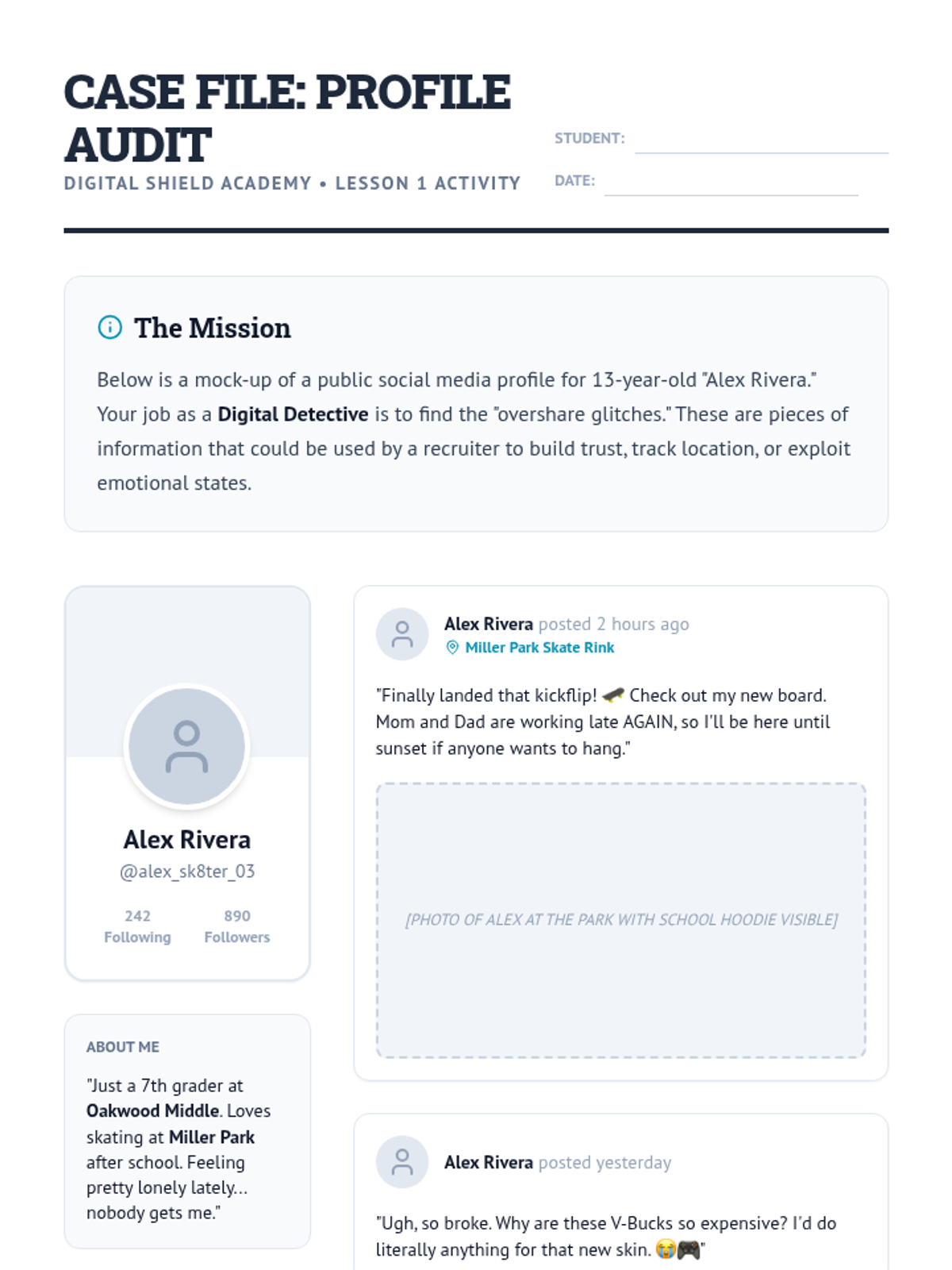
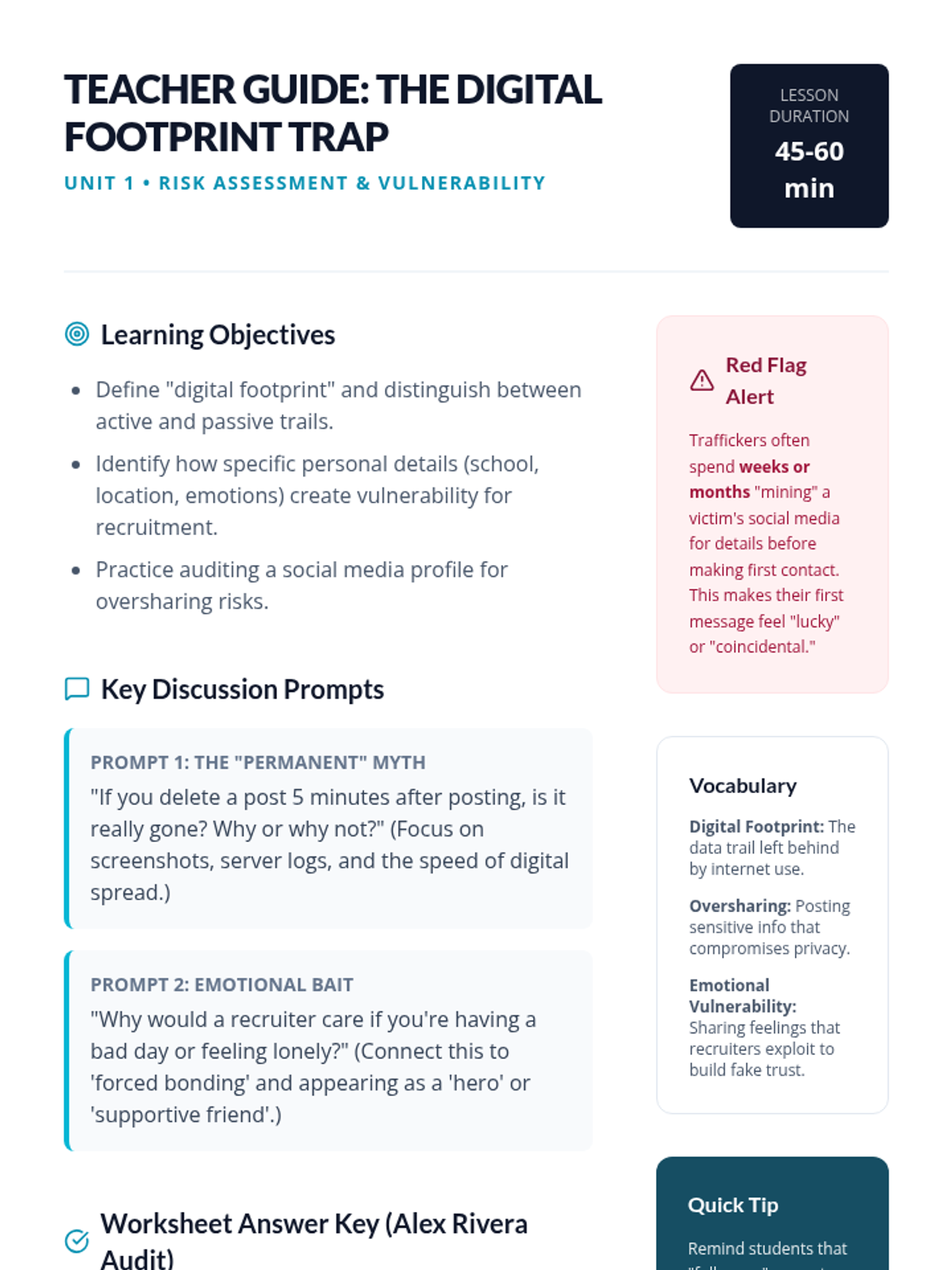
A 5-lesson sequence for 6th graders focusing on identifying online recruitment tactics, understanding digital footprints, and implementing privacy shields to prevent exploitation and trafficking.