Stop-and-think strategies, impulse management, and SMART goal setting for personal growth. Develops internal motivation, stress reduction techniques, and resilience through proactive planning and monitoring.
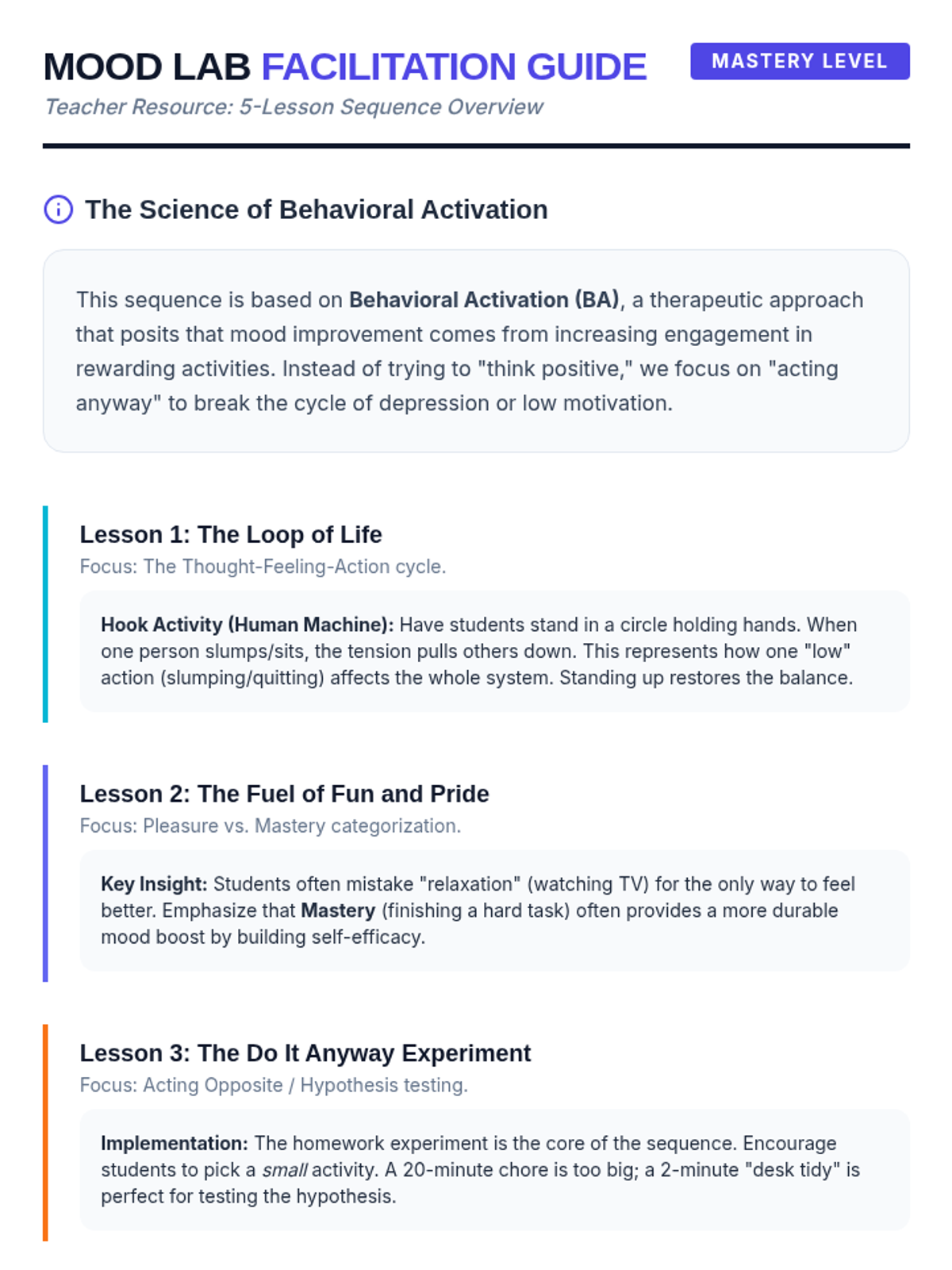
A teacher facilitation guide for the 'Mood Lab Experiment' sequence, providing therapeutic context, hook instructions, and tips for each lesson.
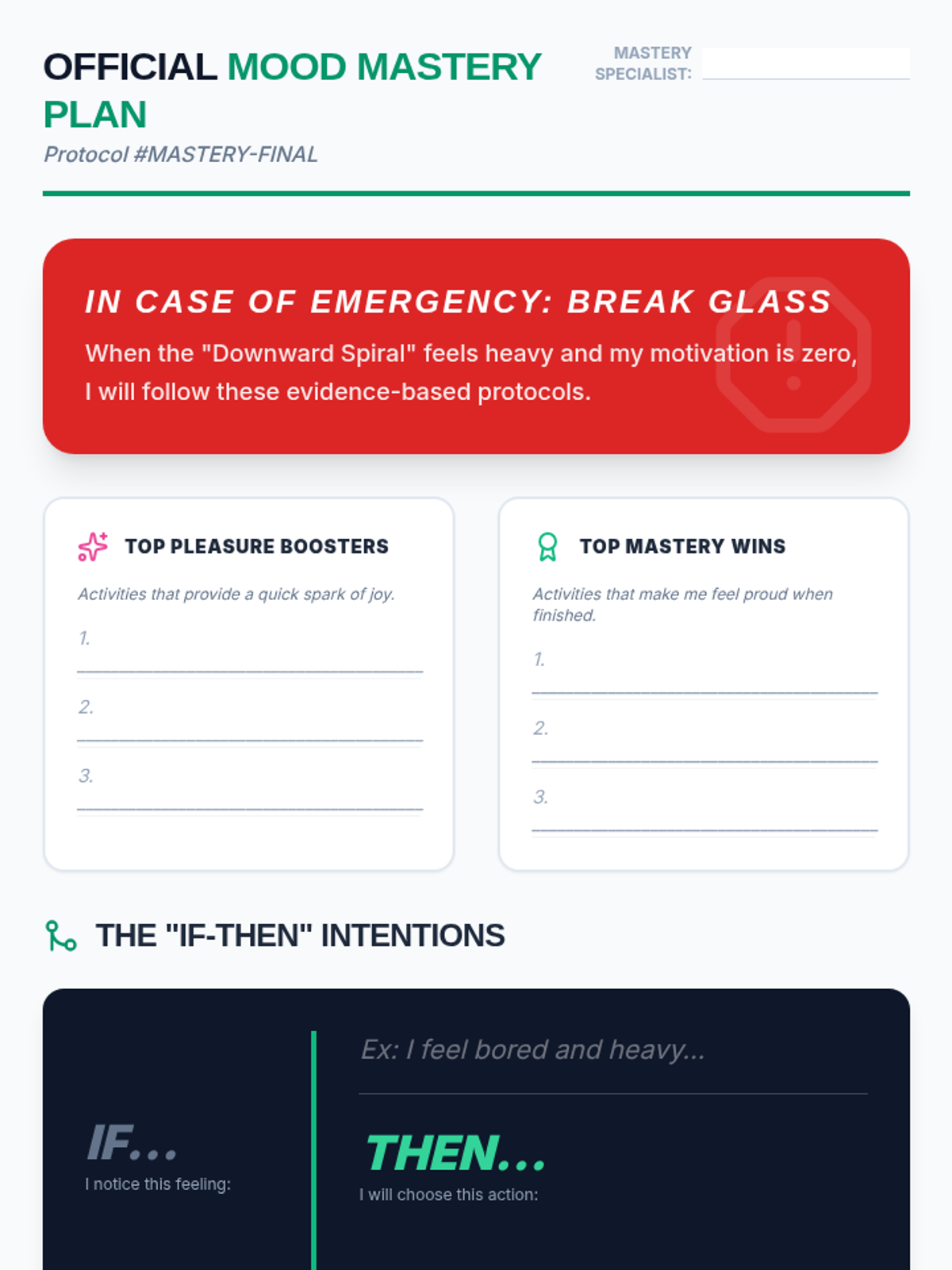
A comprehensive 'Break the Glass' emergency plan worksheet where students synthesize their findings into specific 'If-Then' implementation intentions for mood regulation.
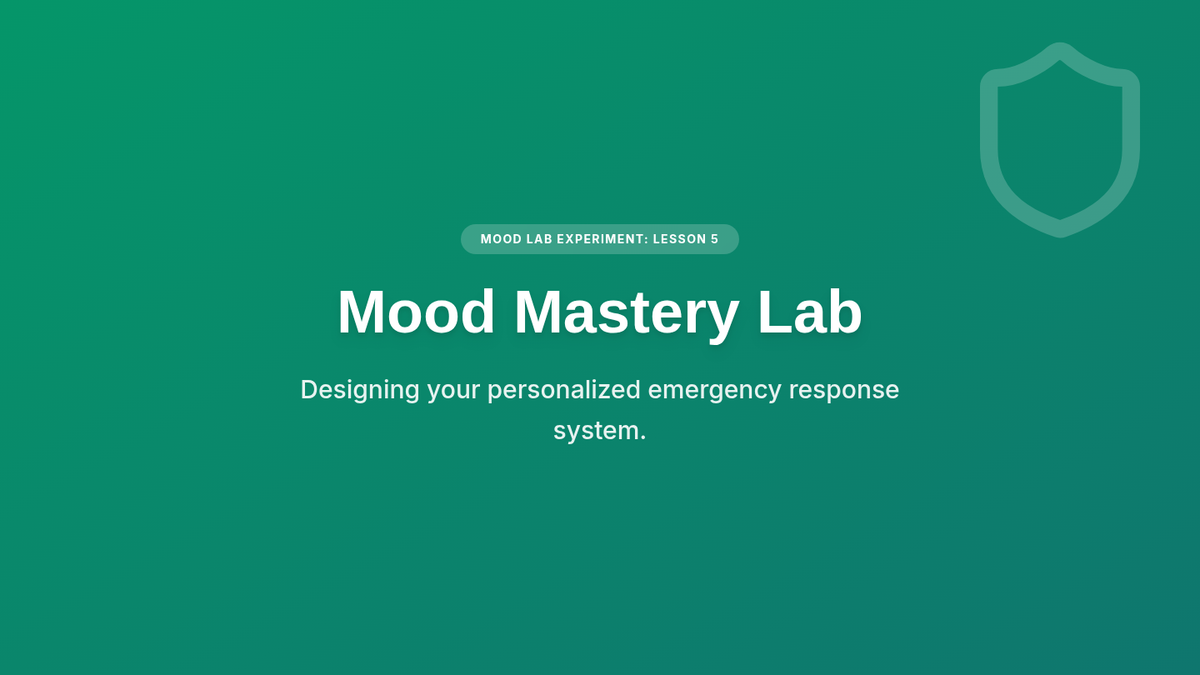
Final slide deck for the 'Mood Mastery Lab' lesson, teaching students how to create implementation intentions and synthesize their learning into an emergency activation plan.
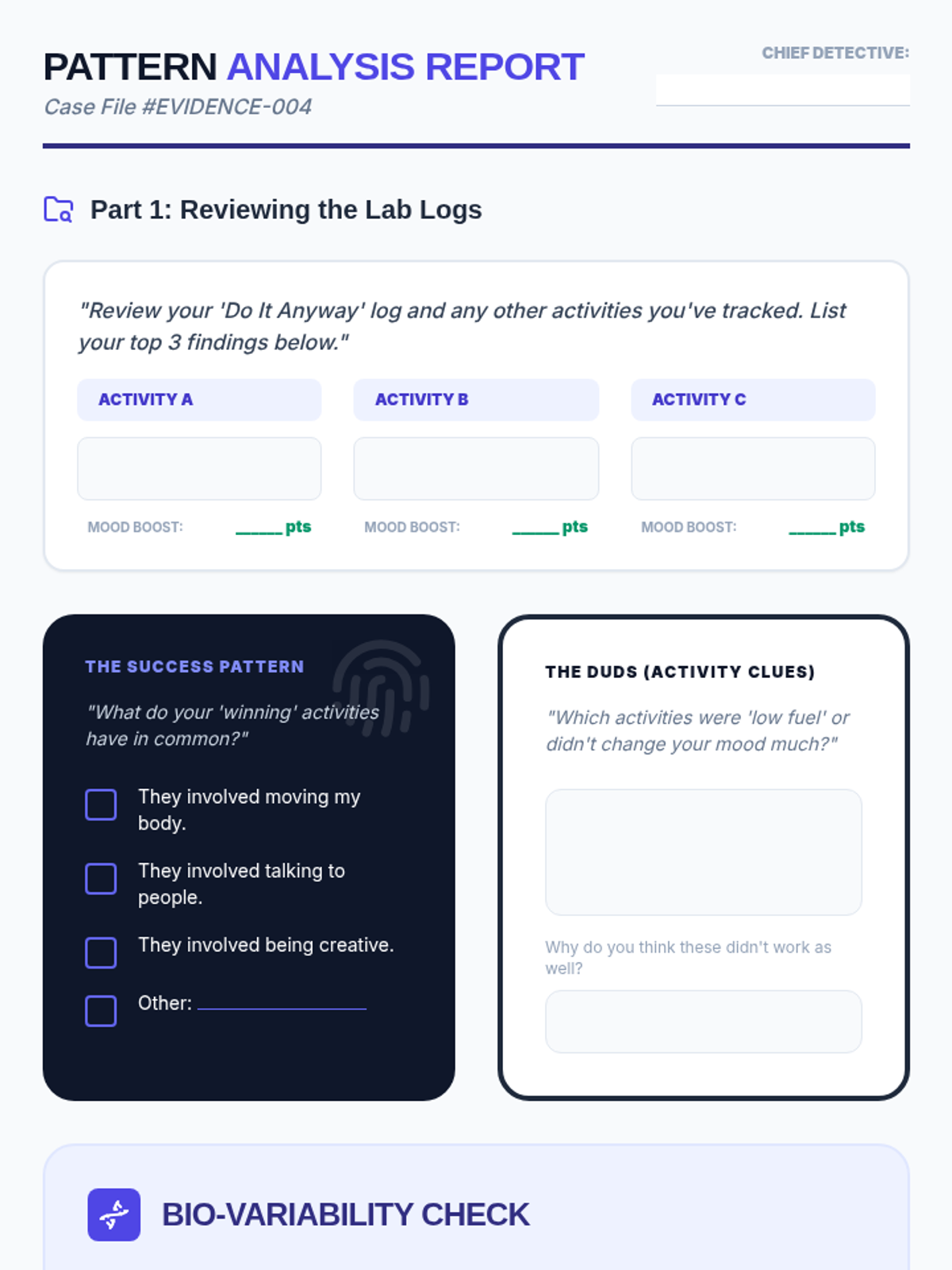
A lab report worksheet for students to analyze their experiment data, identify patterns in effective activities, and reflect on individual differences.
Introductory slides for the 'Mood Pattern Detectives' lesson, helping students analyze their data and understand the concept of individual variability in activity effectiveness.
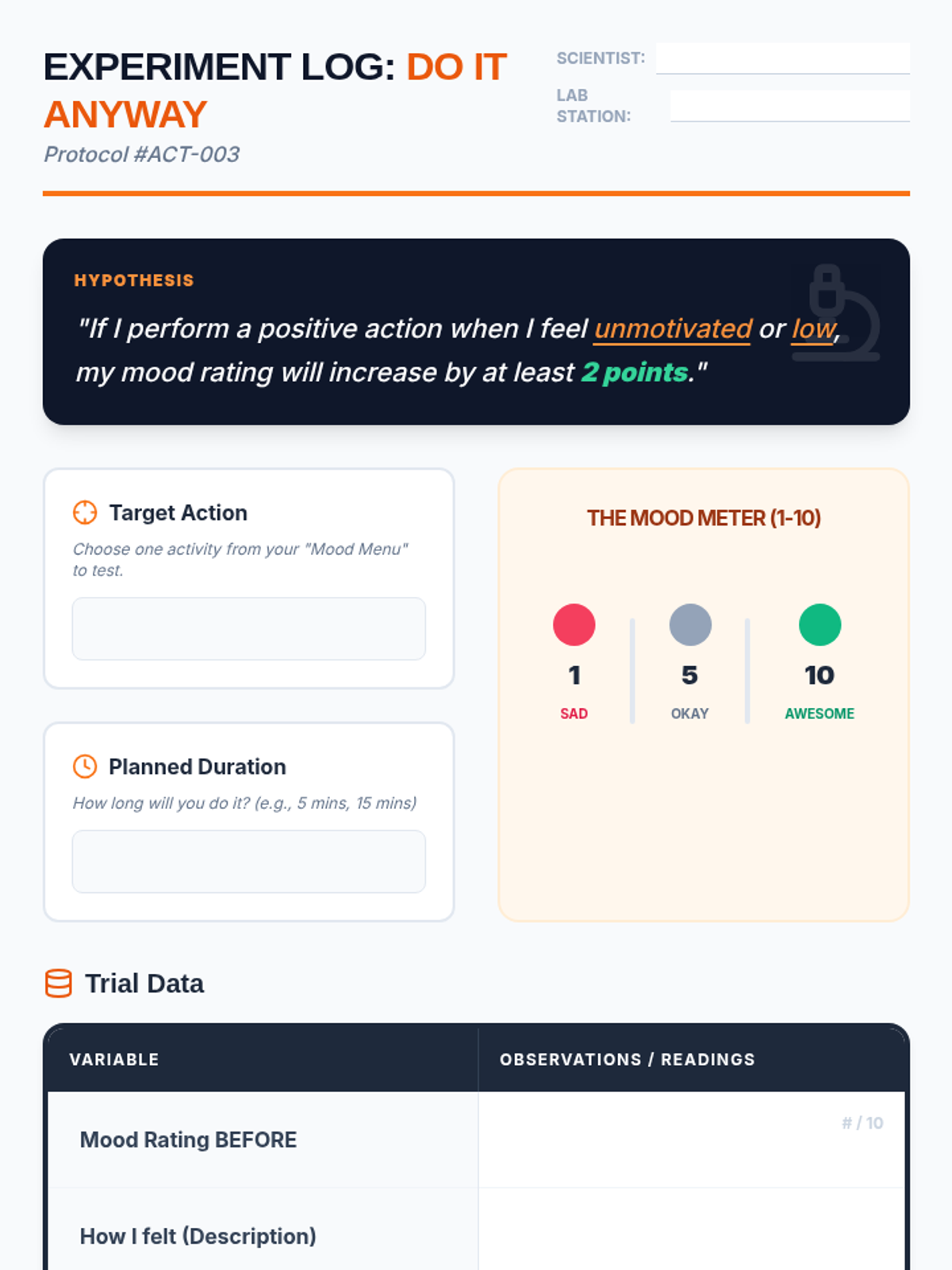
A data collection log for the 'Do It Anyway' experiment, allowing students to track their mood ratings before and after engaging in a positive action.
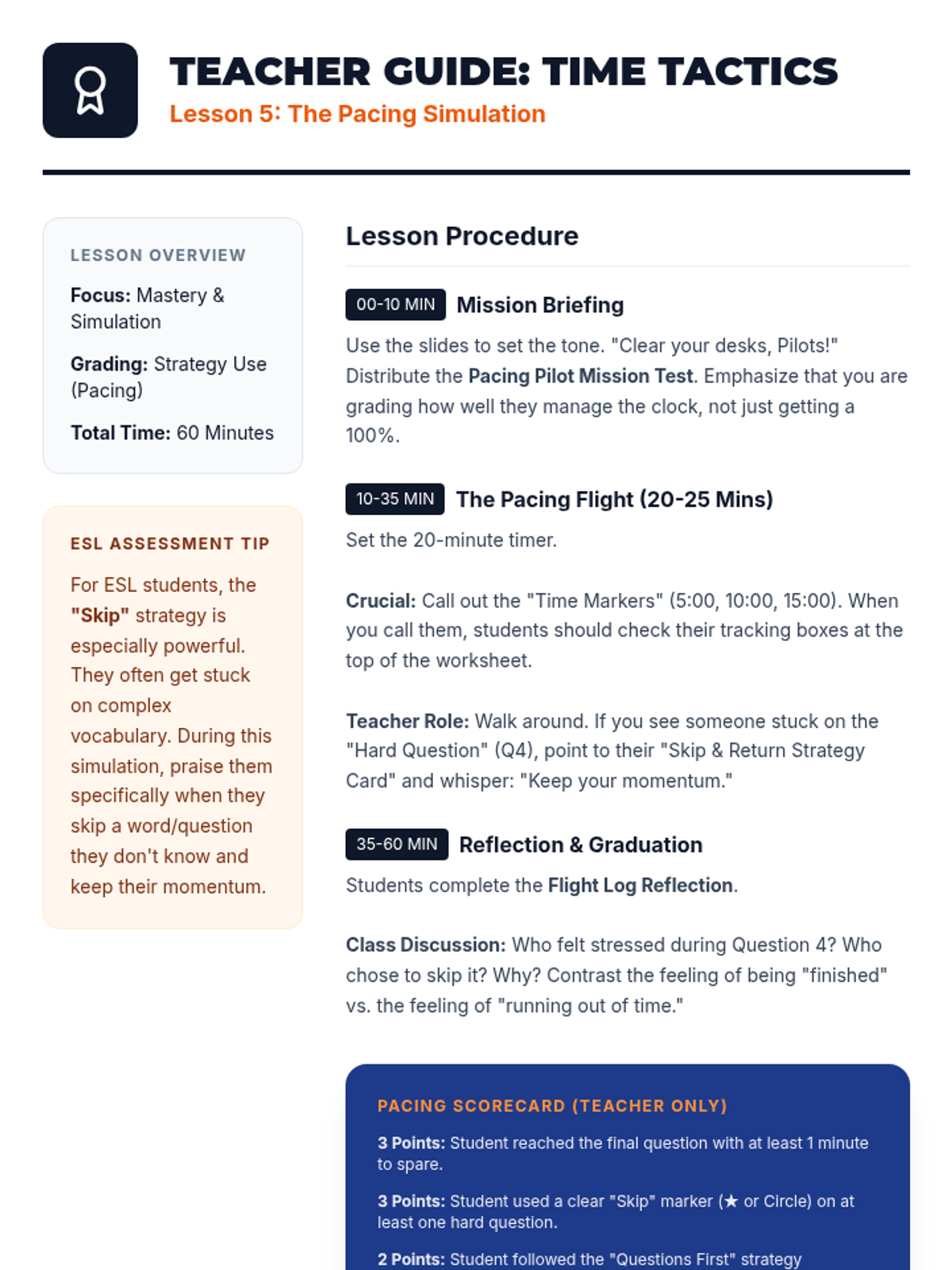
Teacher guidance for the Lesson 5 simulation, including timing calls, teacher observation tips, and a scoring rubric for student pacing behavior.
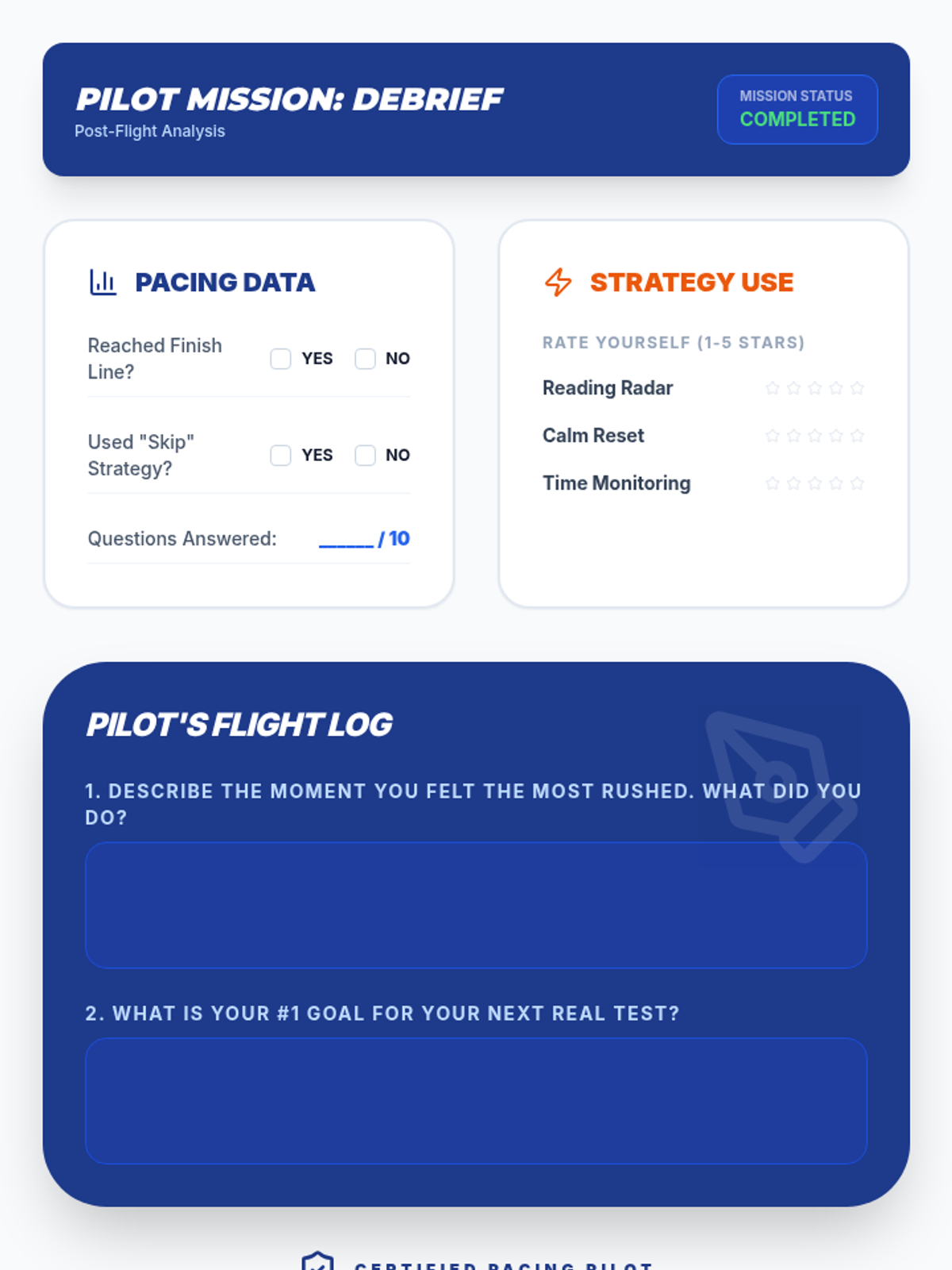
The Lesson 5 reflection and debrief worksheet where students analyze their performance during the simulation and rate their strategy use.
Introductory slides for the 'Do It Anyway' experiment, explaining the concept of 'acting opposite' and how to track mood data for a personal science experiment.
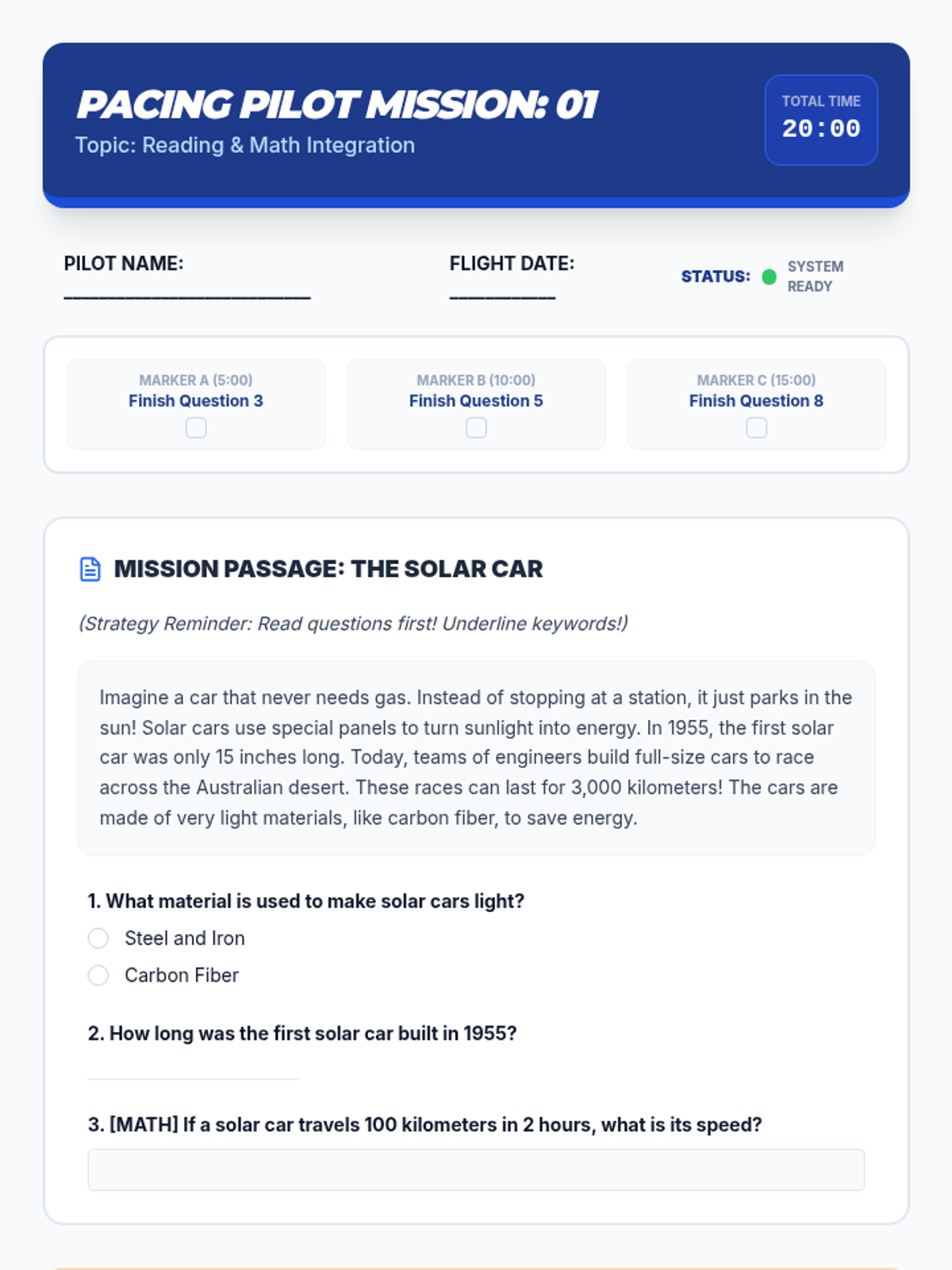
The first page of the Lesson 5 simulation test, designed to test pacing with a passage, integrated math, and a strategically 'hard' question to prompt skipping.
Final slide deck for Lesson 5, featuring the pacing simulation briefing, mission rules, and time markers for the practice test.
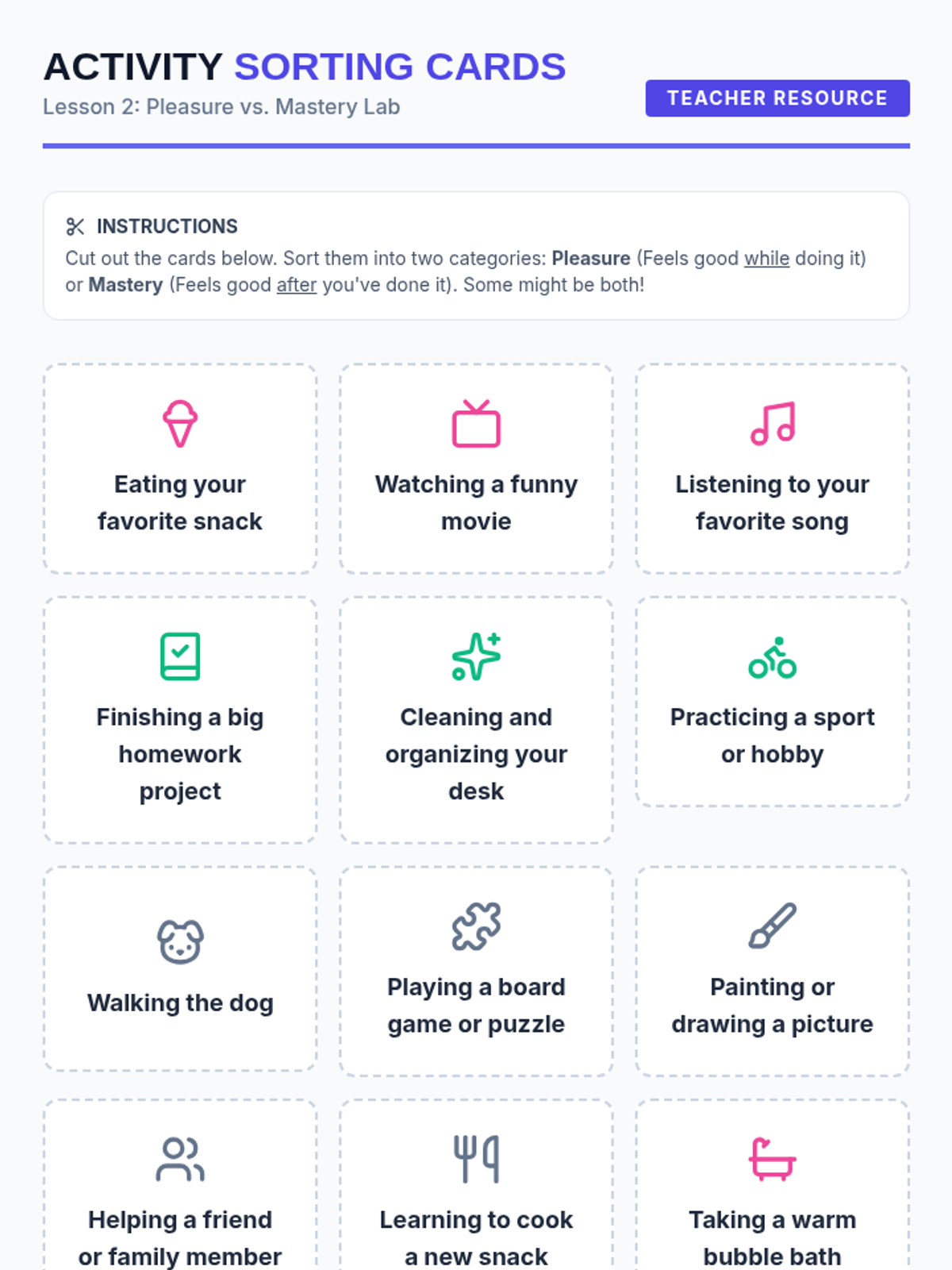
Sorting cards and a categorization t-chart for Lesson 2, helping students distinguish between pleasure-based and mastery-based activities.
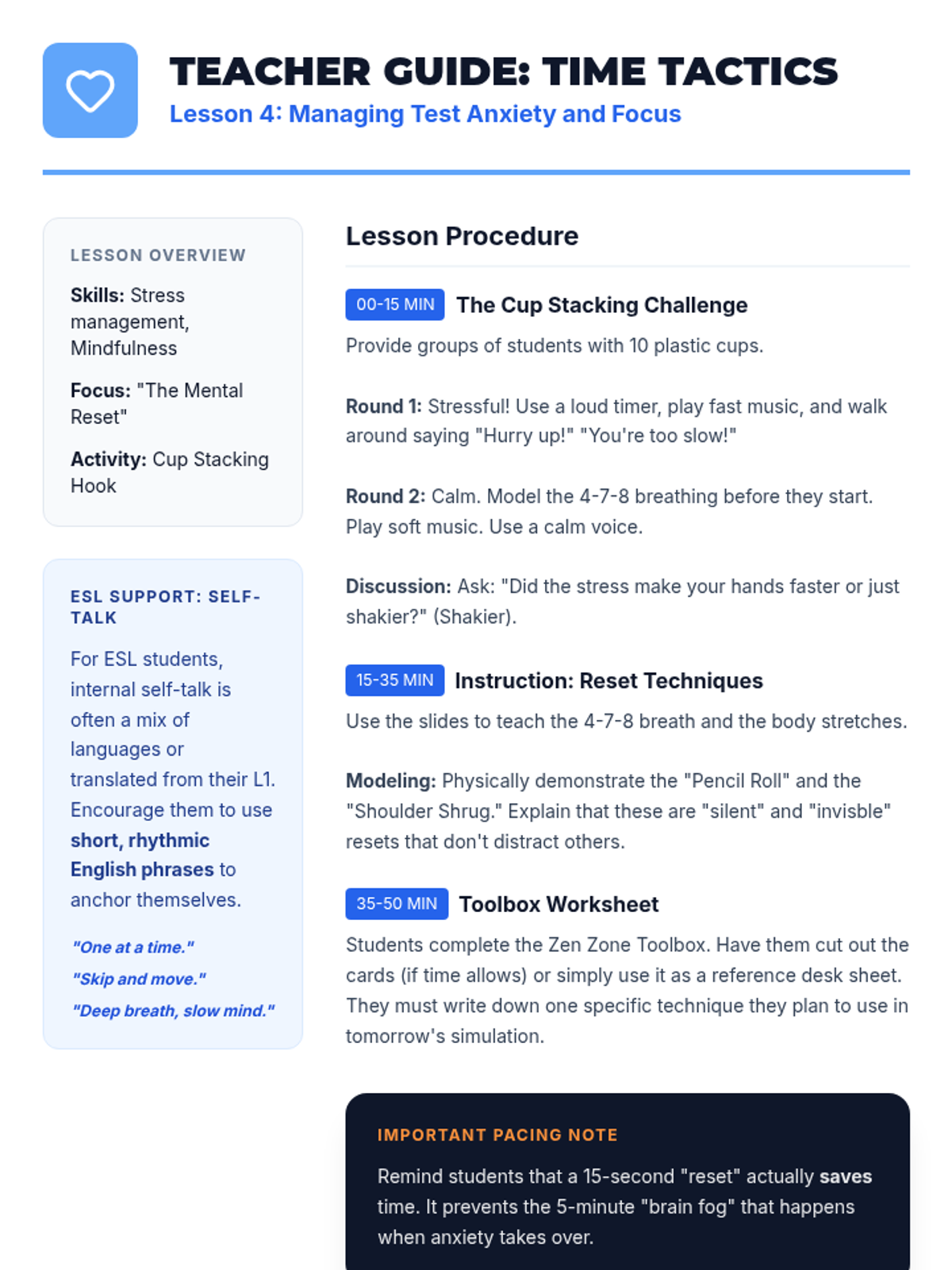
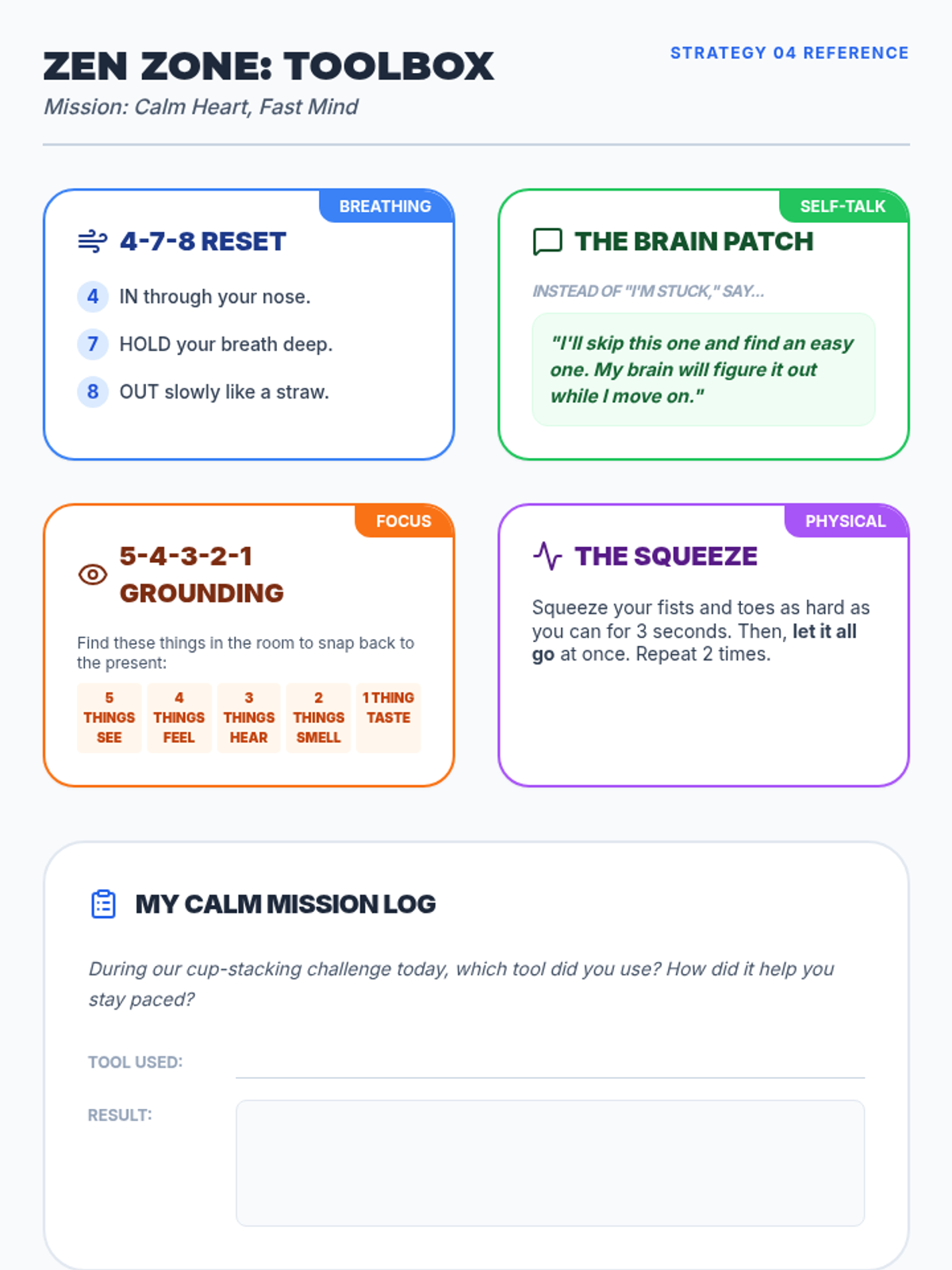
Teacher guidance for Lesson 4, including managing the cup-stacking challenge and modeling reset techniques for ESL students.
A resource sheet for Lesson 4 with 'Zen Zone' strategy cards (breathing, self-talk, grounding, physical reset) and a practice log for the cup-stacking activity.
Introductory slides for the 'Pleasure and Mastery' lesson, explaining the difference between 'Fun fuel' and 'Proud fuel' and the importance of a balanced activity diet.
Slide deck for Lesson 4 on managing test anxiety, featuring breathing techniques, positive self-talk, and in-seat physical resets.
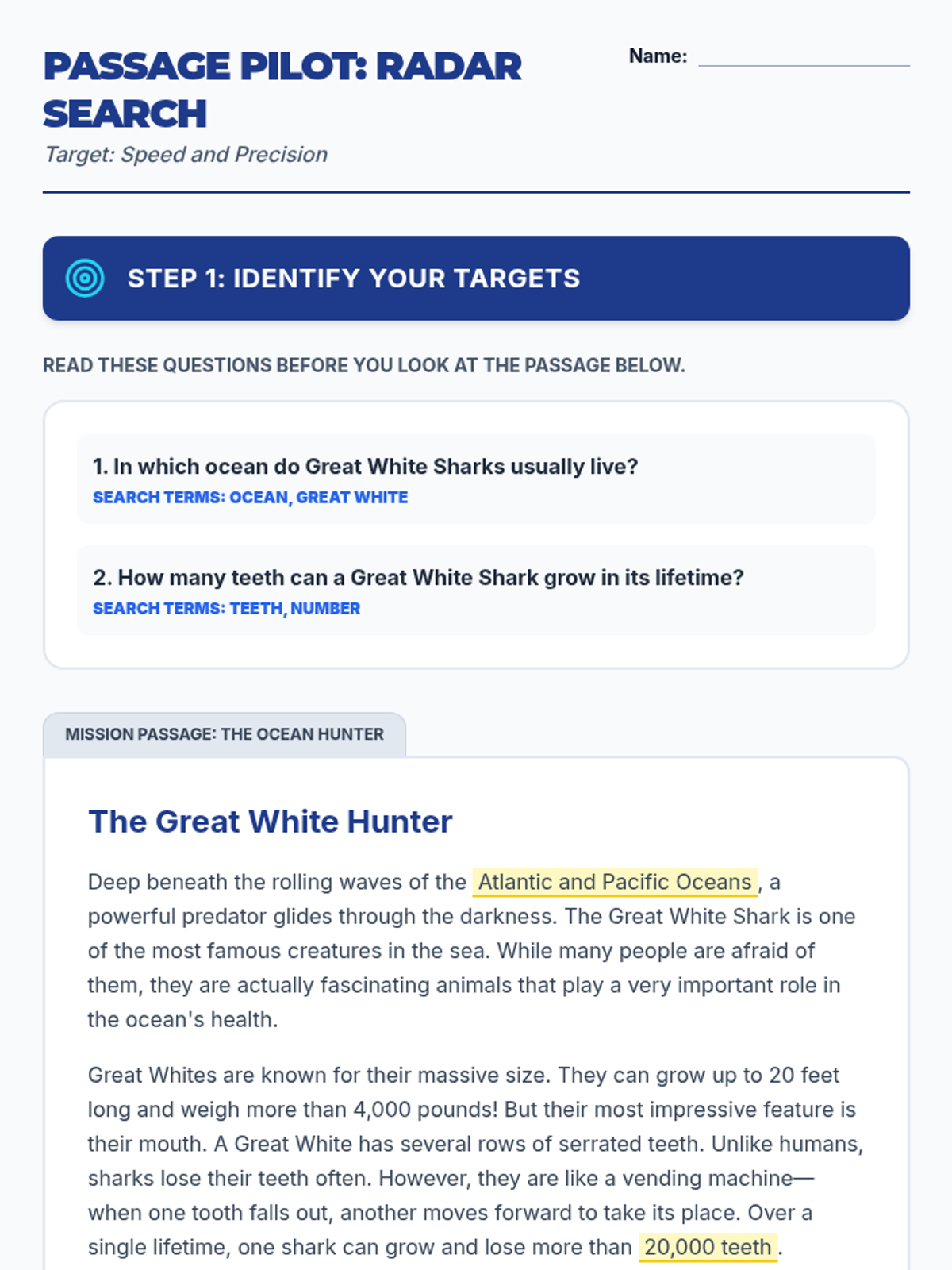
A practice worksheet for Lesson 3 that uses a short passage about sharks to help students practice the 'Questions First' and 'Keyword Search' strategies.
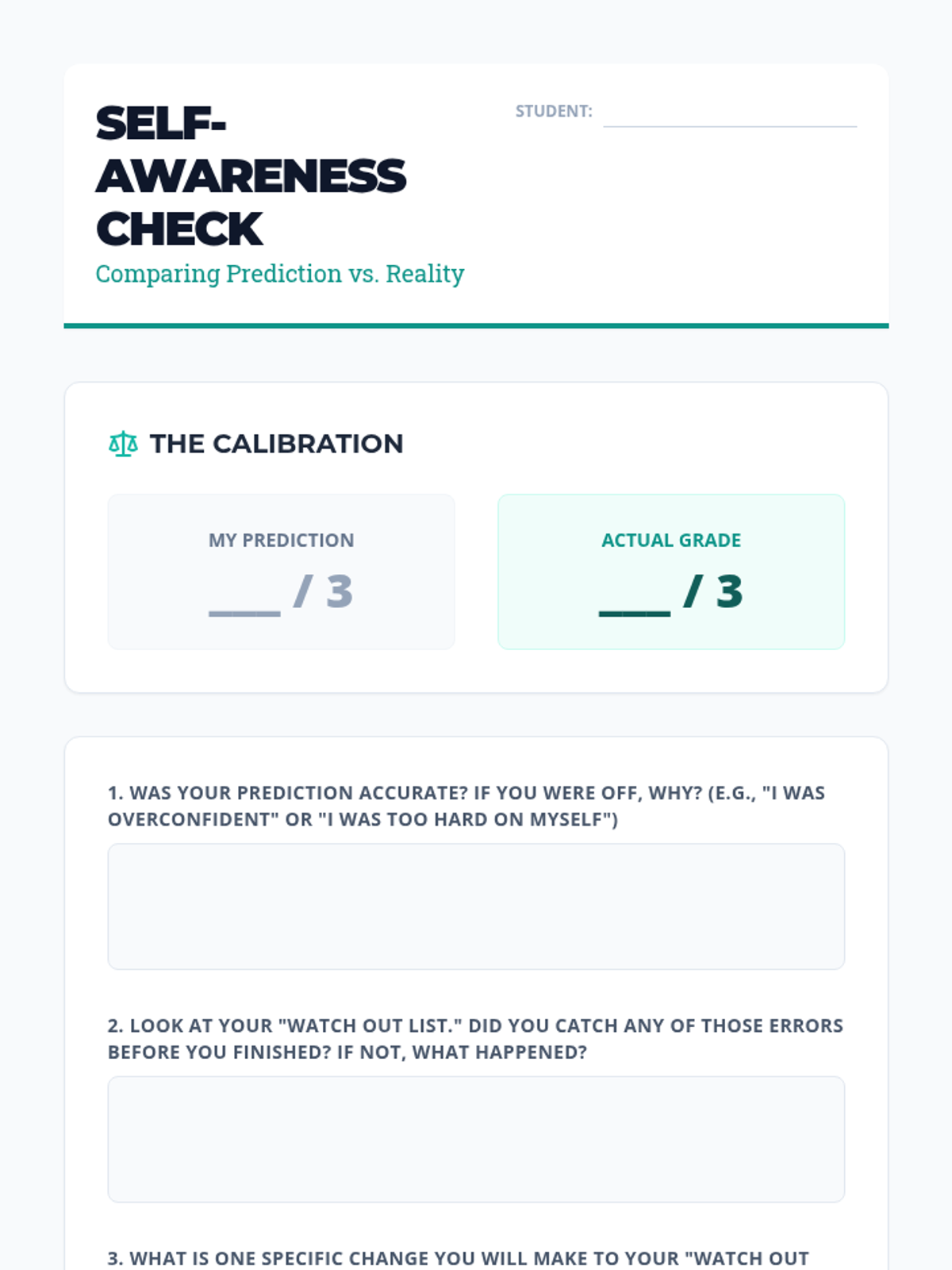
A final reflection sheet for students to compare their quiz predictions with their actual grades, evaluating the effectiveness of their metacognitive strategies.
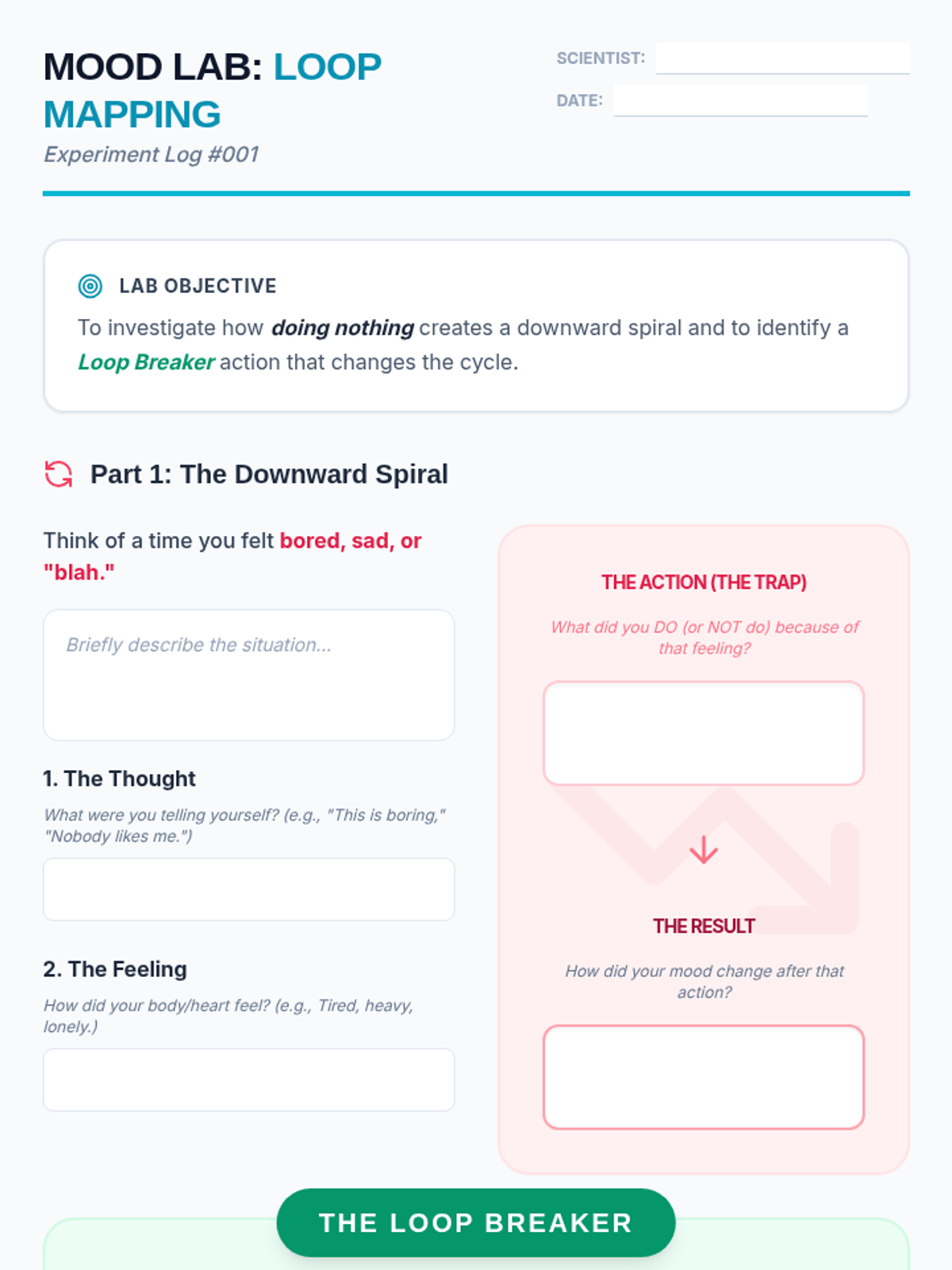
A lab notebook style worksheet for students to map out their own action-emotion loop, identifying a 'downward spiral' moment and a 'loop breaker' action.
Slide deck for Lesson 3 on handling long passages, teaching the 'Questions First' strategy and skimming techniques to save time.
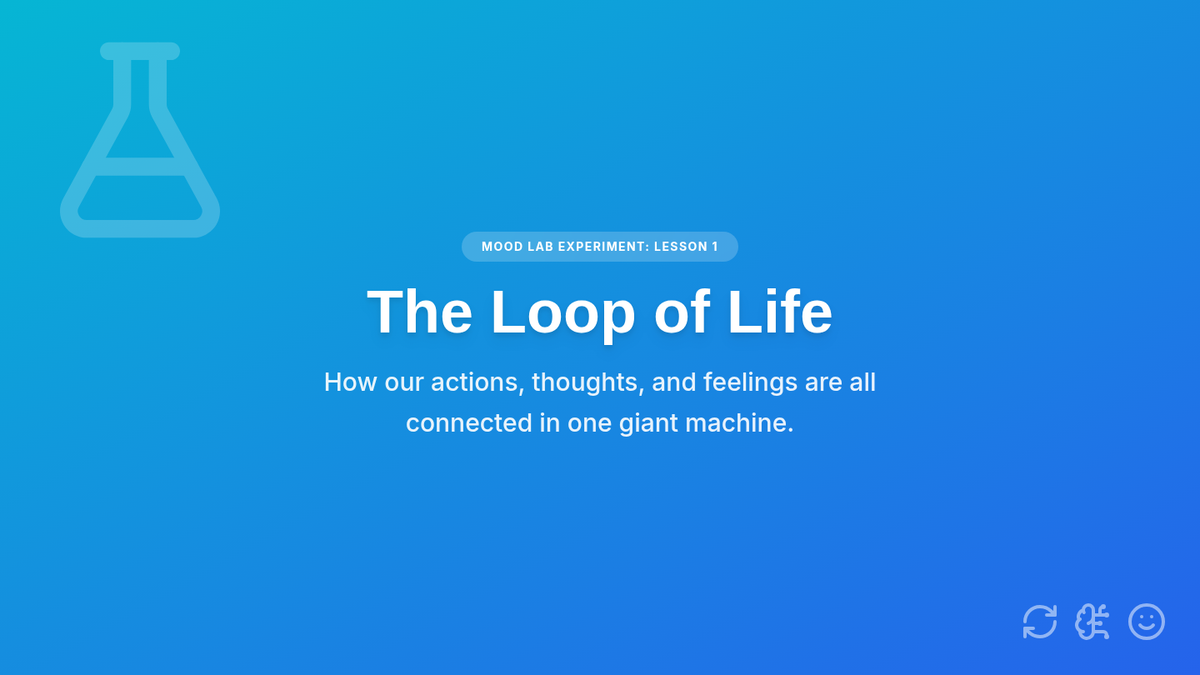
Introductory slides for the 'Loop of Life' lesson, featuring the human machine hook and visual representations of the thought-feeling-action cycle.
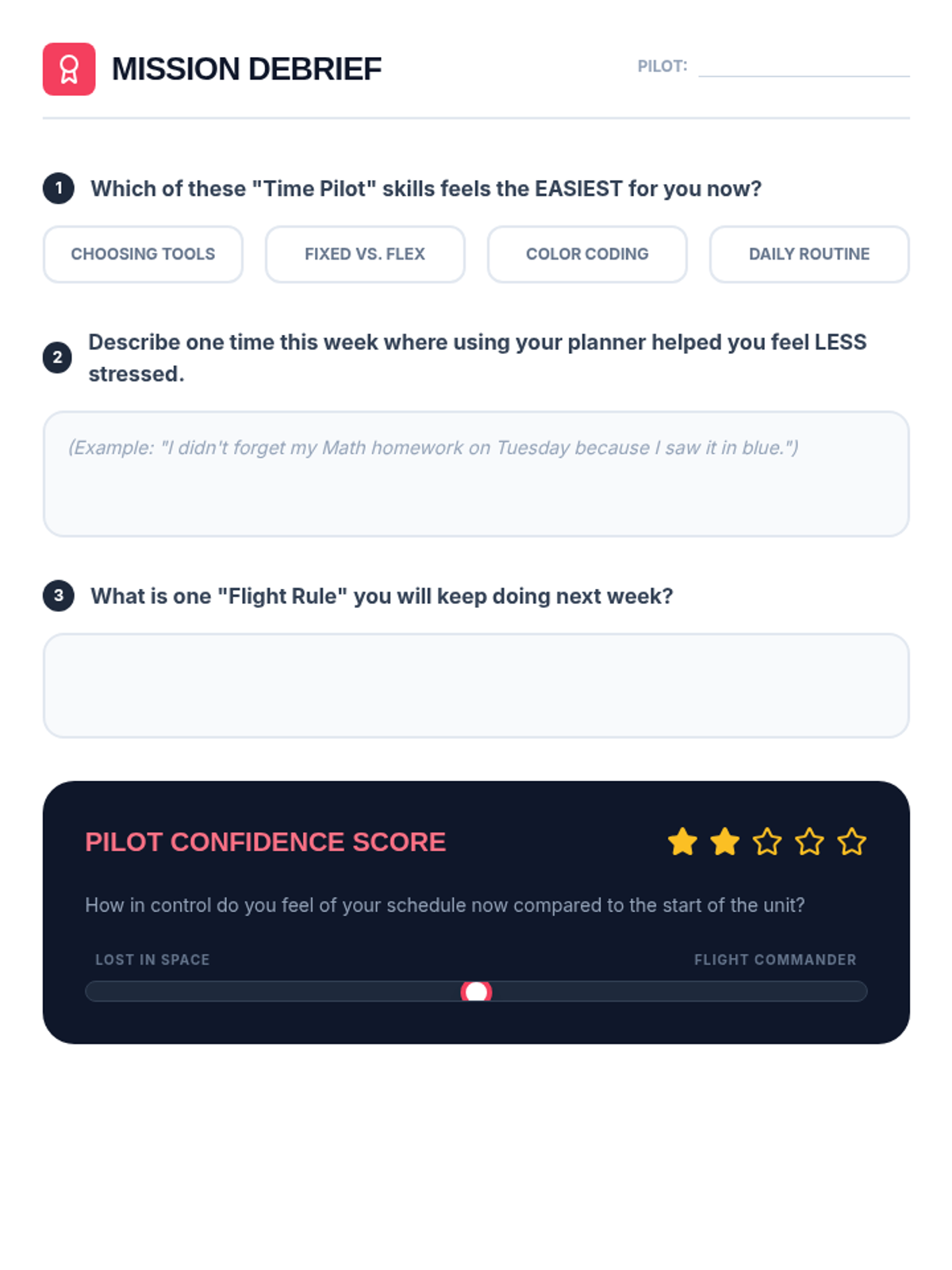
Reflection exit ticket for the end of the "Time Pilots" sequence. Students evaluate their own progress across the four key organizational skills and reflect on the impact of their new routines.
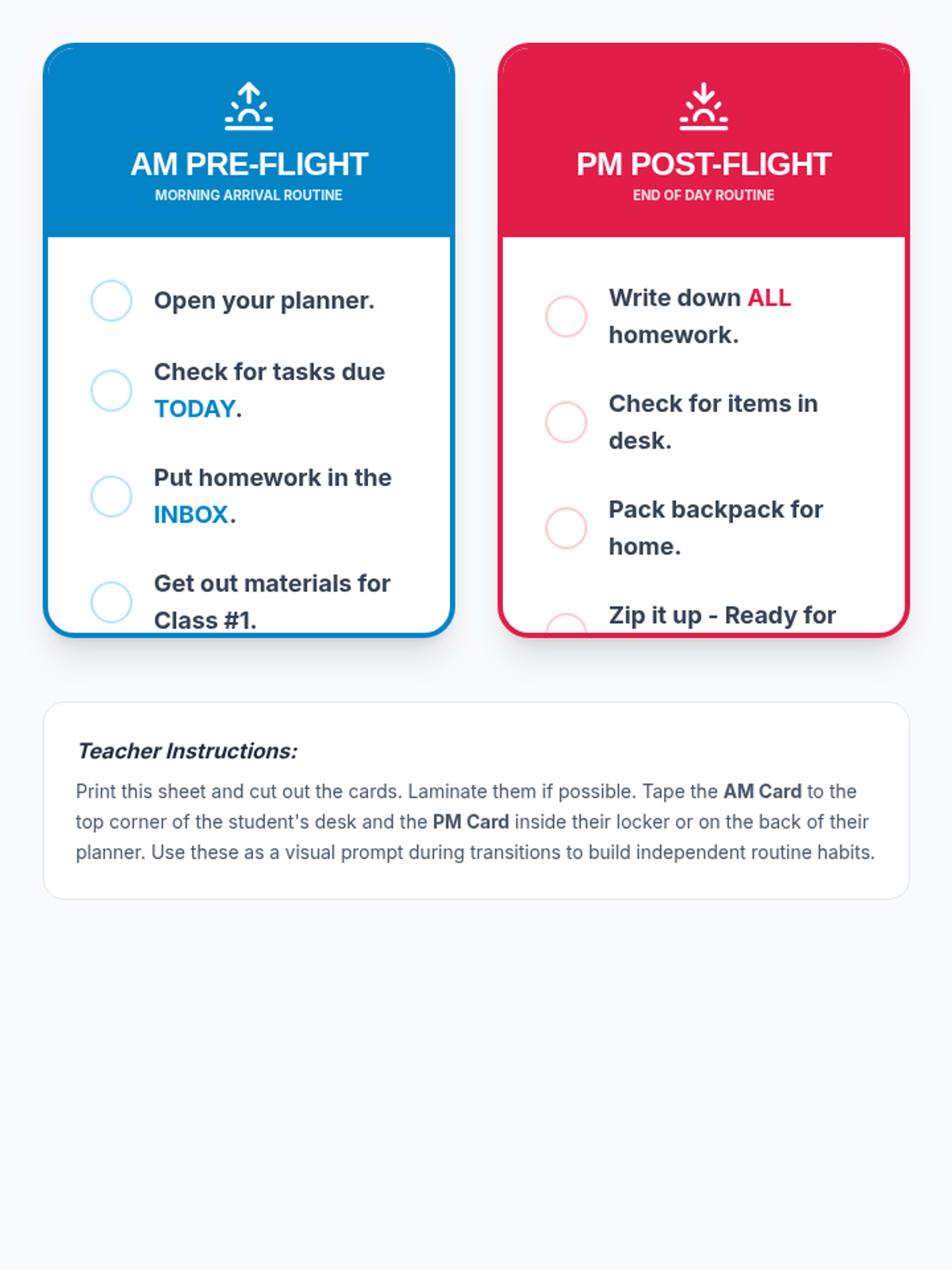
Visual checklist cards for Lesson 5. Includes a "Pre-Flight" morning routine and a "Post-Flight" evening routine to help students develop independent organizational habits.
Final slide deck for Lesson 5. Contrasts the "Guesser" vs. "Pilot" approach to preparedness and provides step-by-step Morning (Pre-Flight) and Evening (Post-Flight) routines.
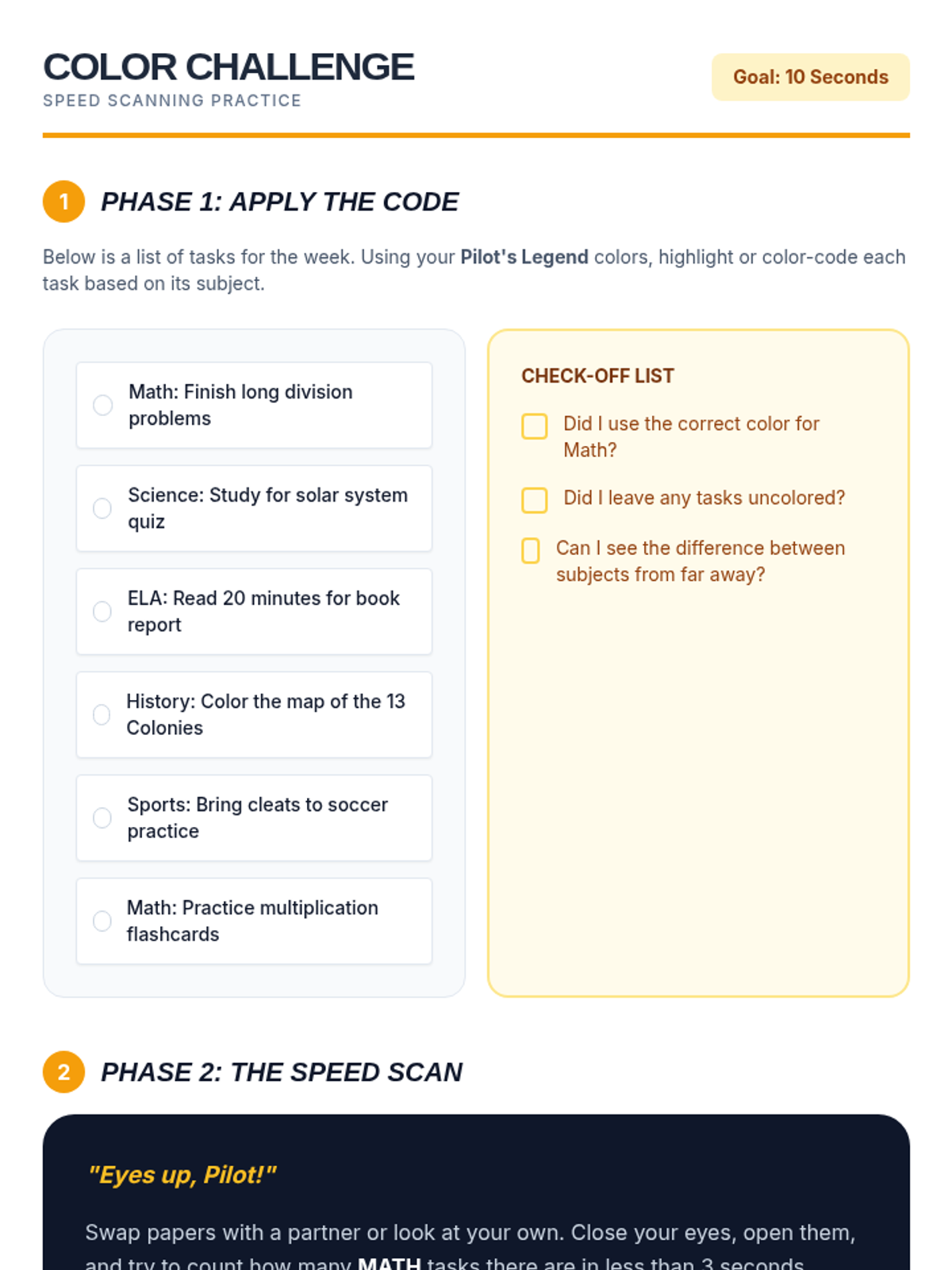
Practice worksheet for Lesson 4. Students apply their color-coding system to a list of uncoded tasks and then perform a "speed scan" to test the efficiency of their visual categorization.
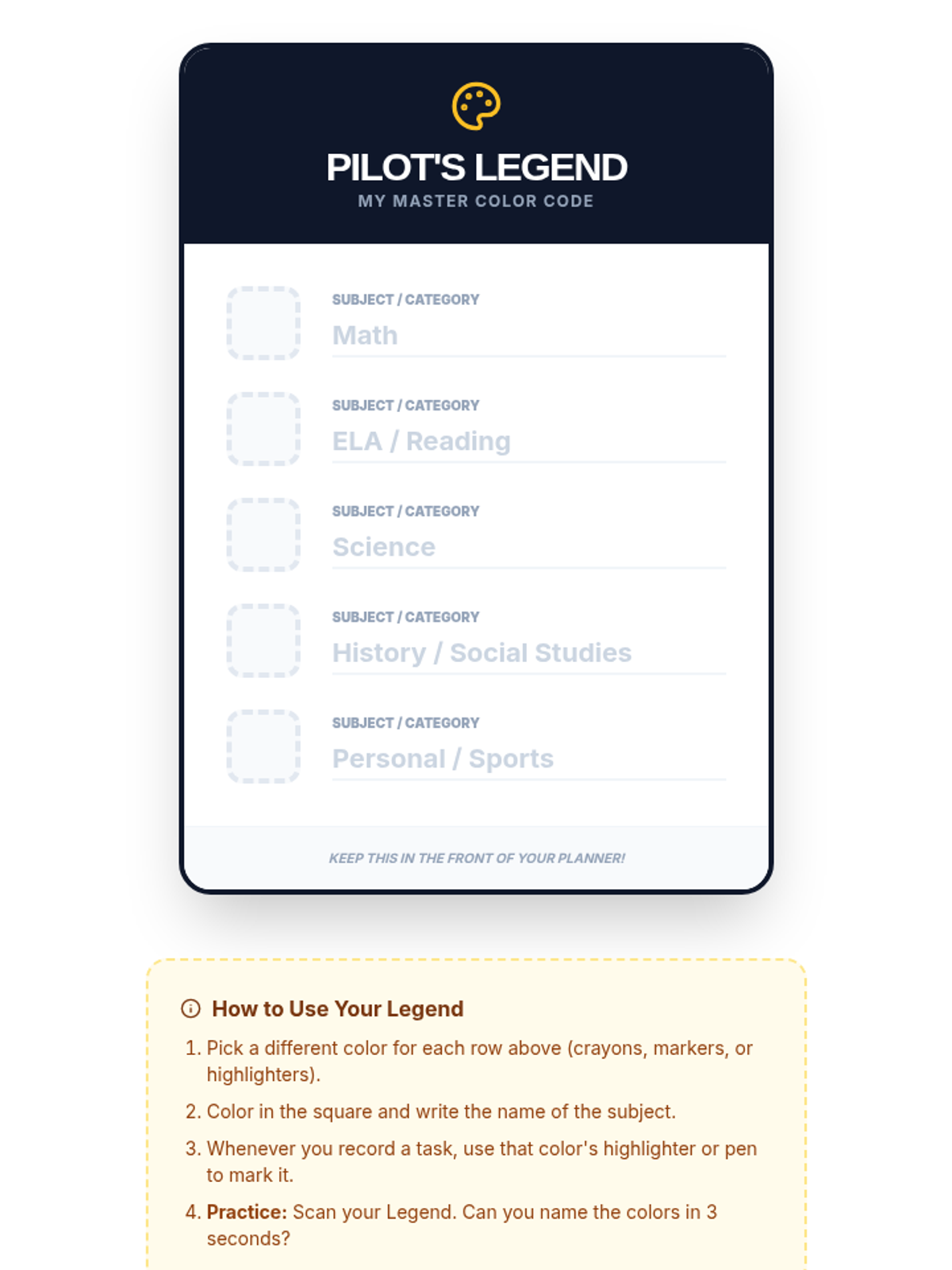
Personal reference sheet for students to create their own color-coding legend. This "Pilot's Legend" card helps them maintain consistency in their organizational system across all subjects.
Slide deck for Lesson 4. Explains the "Scan Advantage" of color-coding for faster information processing and introduces universal color categories for school subjects.
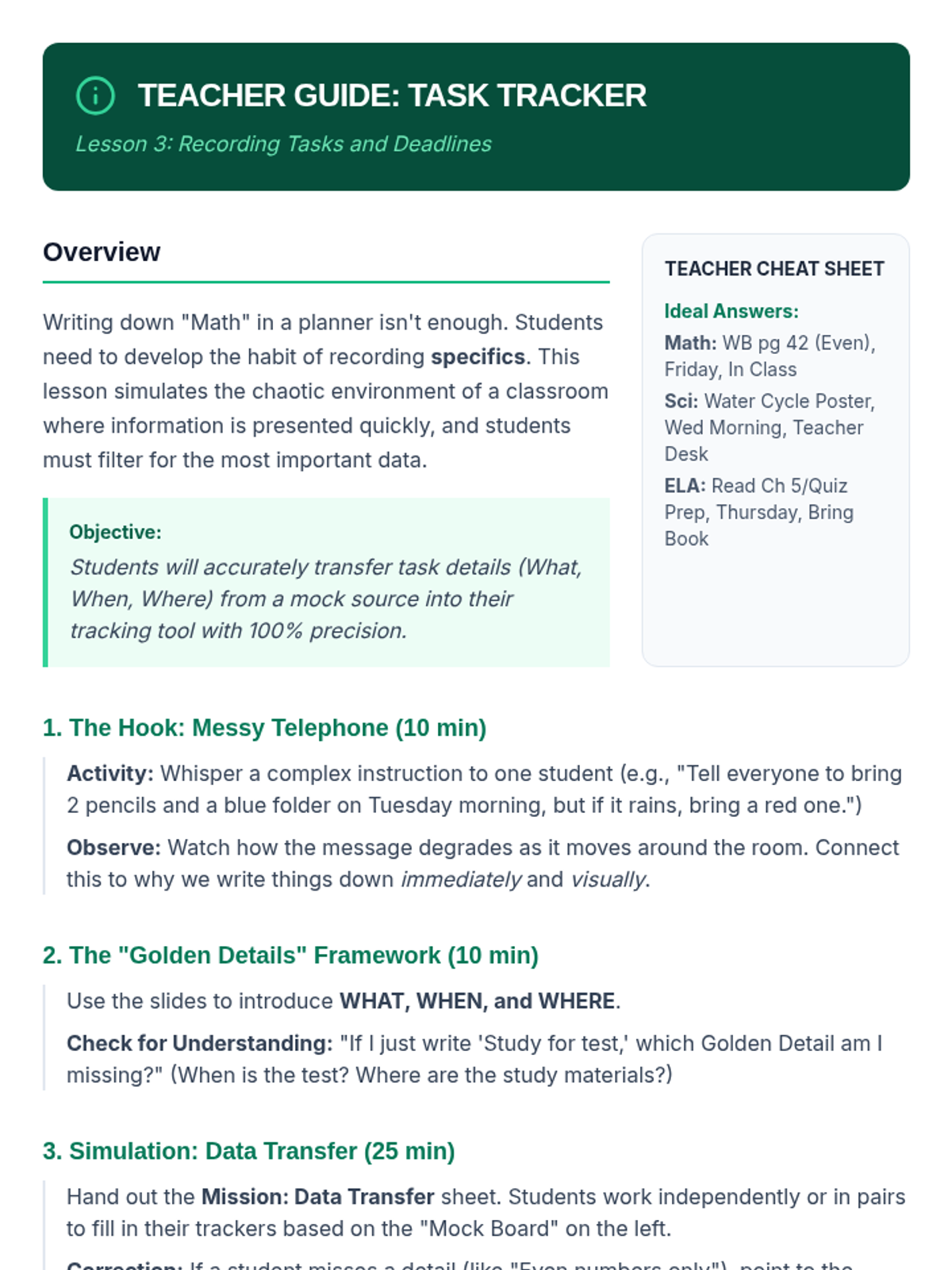
Teacher guide for Lesson 3. Provides instructions for a "Telephone" game hook, guidance on teaching the "Golden Details" framework, and tips for the data transfer simulation.
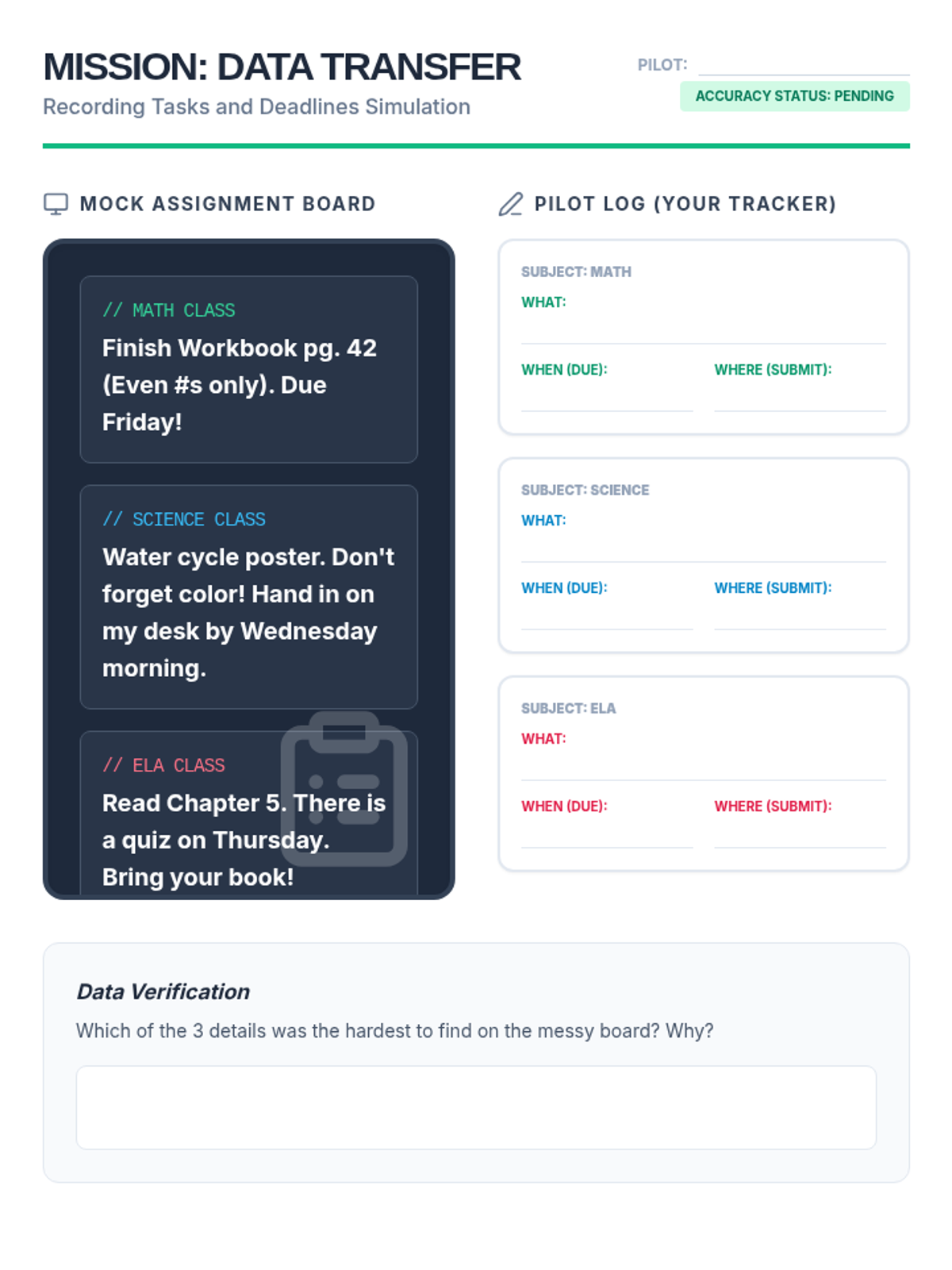
Simulation worksheet for Lesson 3. Students practice extracting "Golden Details" (What, When, Where) from a messy mock assignment board and recording them into a clean Pilot Log tracker.
Slide deck for Lesson 3. Explains the "Telephone" problem of relying on memory, introduces the "3 Golden Details" (What, When, Where), and prepares students for a task-recording simulation.
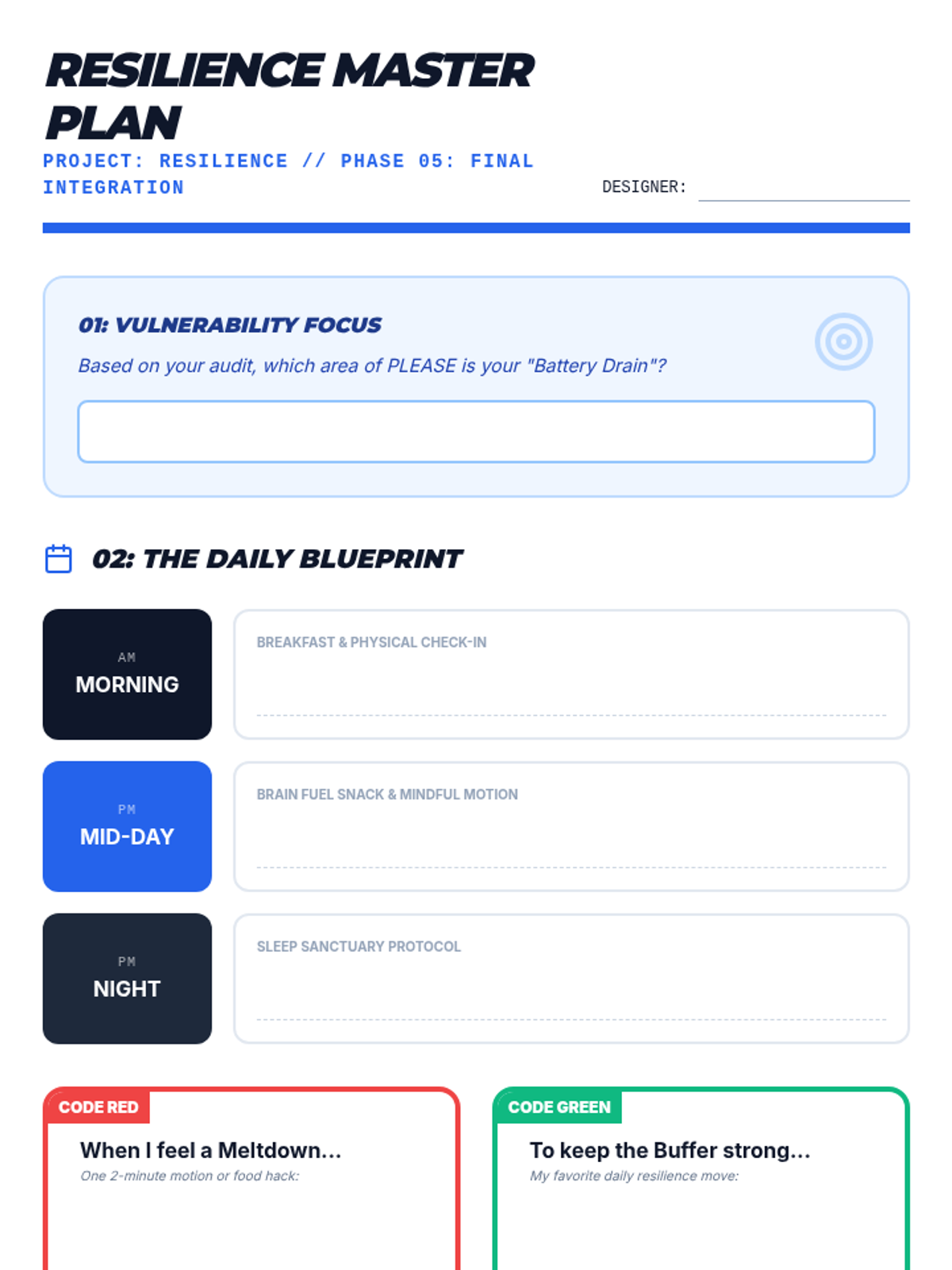
A comprehensive final project document where students synthesize their PLEASE routine, track their habits over 7 days, and write a letter of intent to their future selves.
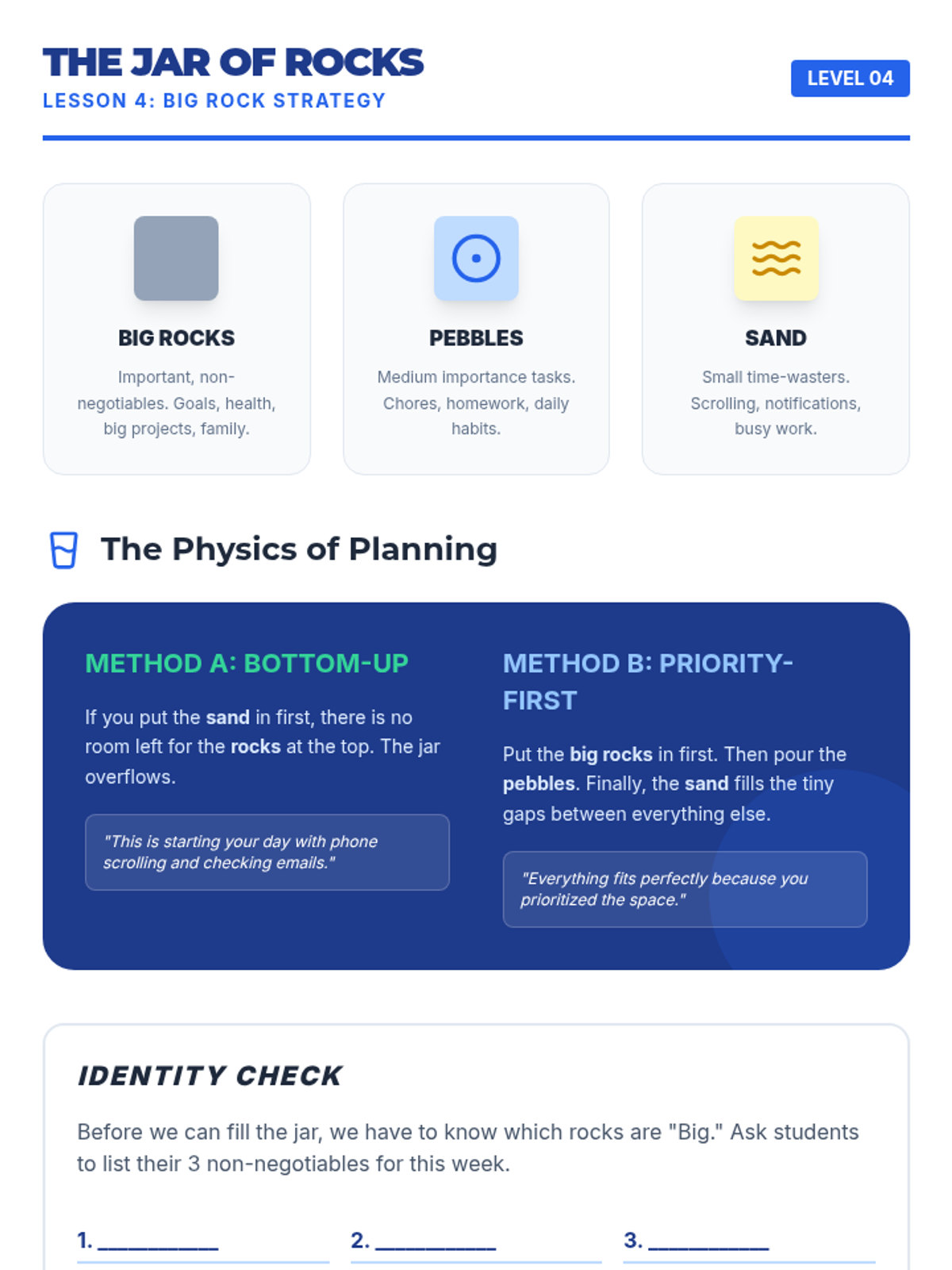
Visual slides for Lesson 4 explaining the 'Jar of Rocks' analogy and the physics of prioritization.
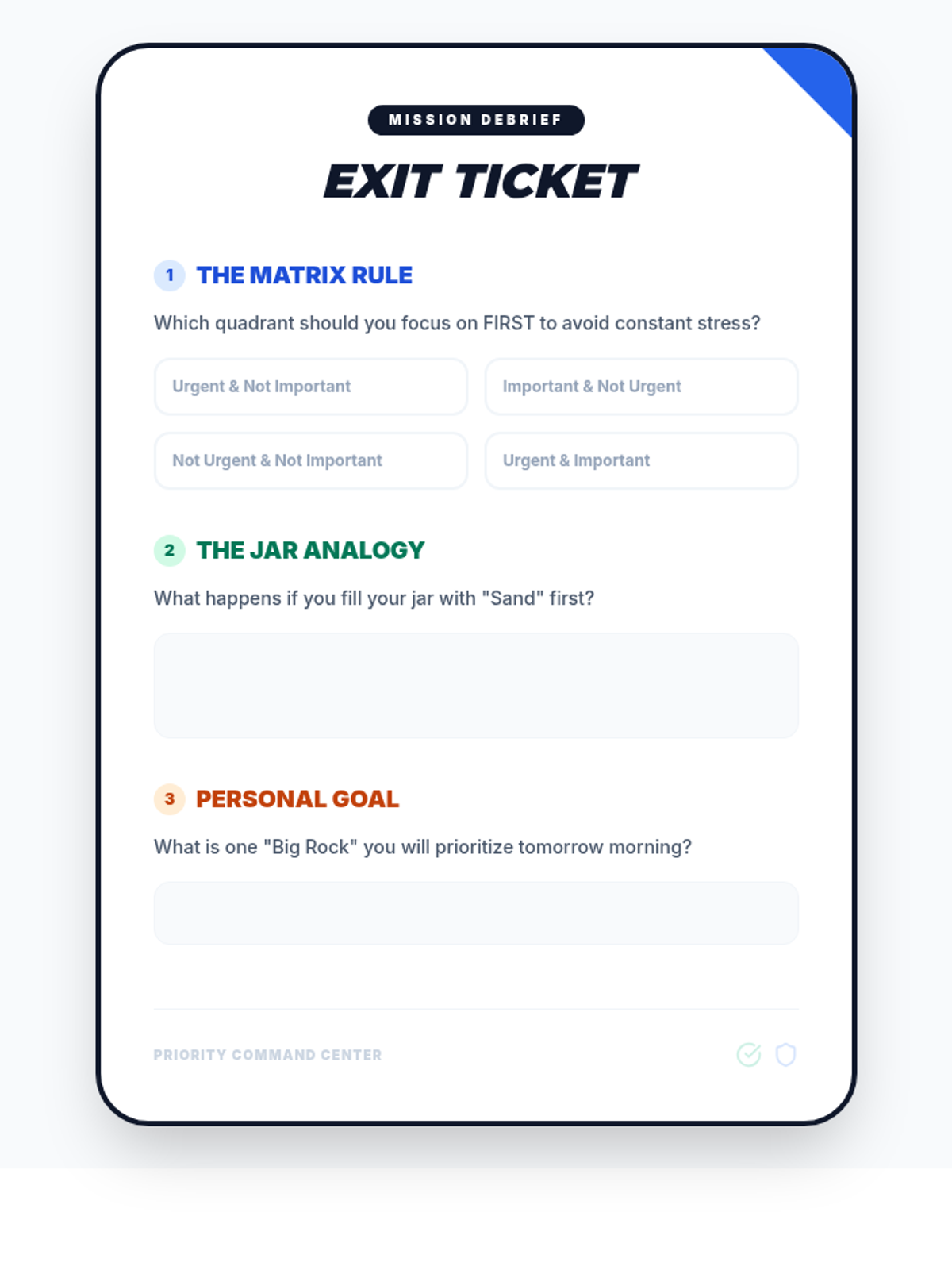
A final exit ticket to assess student understanding of the urgency/importance matrix and the 'Jar of Rocks' analogy.
A slide deck for the final lesson that synthesizes the PLEASE skills and introduces the Resilience Master Plan, Visual Tracker, and Letter to Self activities.
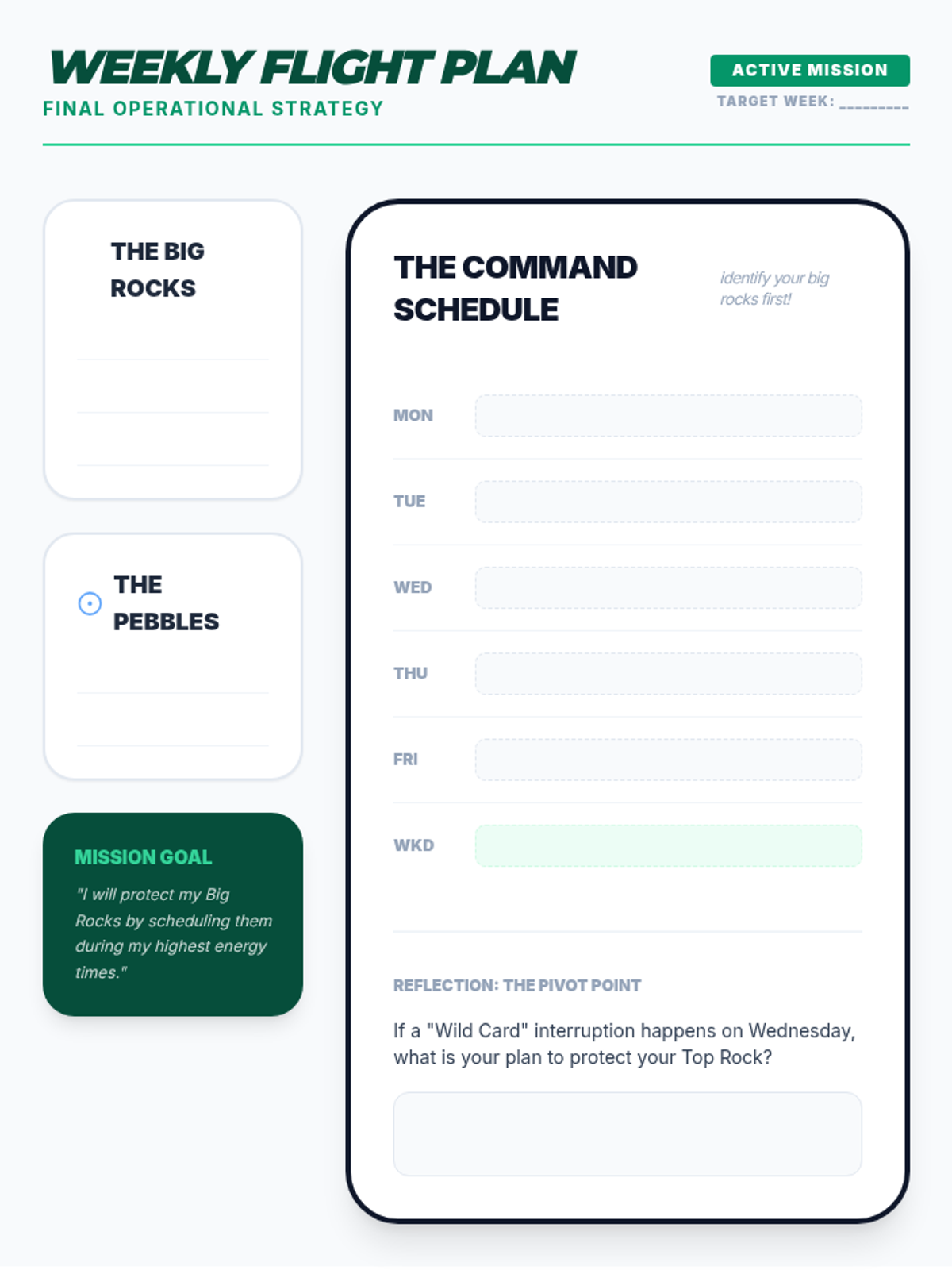
The final capstone worksheet where students list their weekly tasks and schedule their 'Big Rocks' into a structured flight plan.
Final lesson slides featuring a 'Disaster Schedule' case study and the steps for creating a personal flight plan.
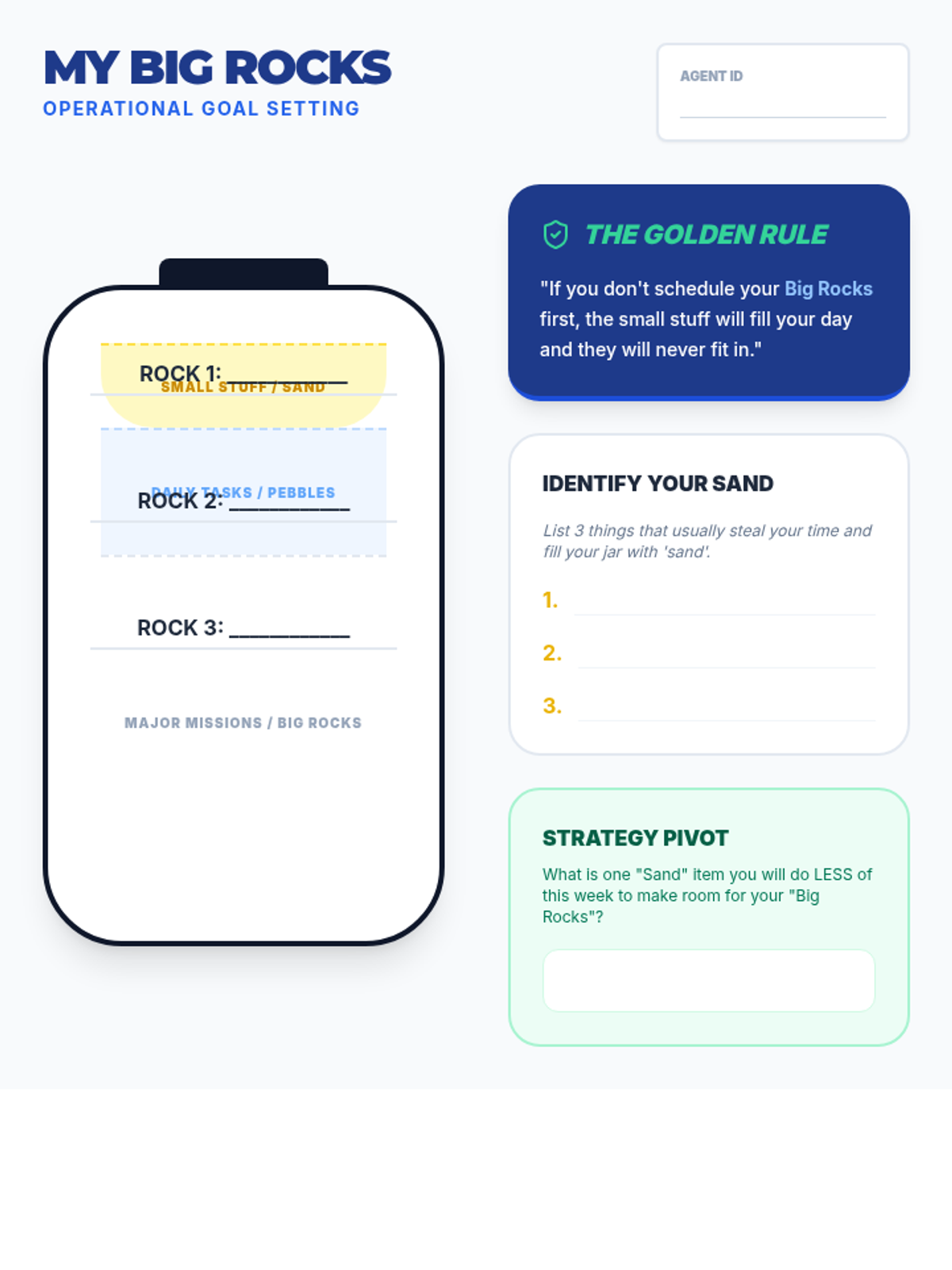
A visual worksheet for students to identify their 'Big Rocks' (major goals) and 'Sand' (time-wasters) using the jar analogy.
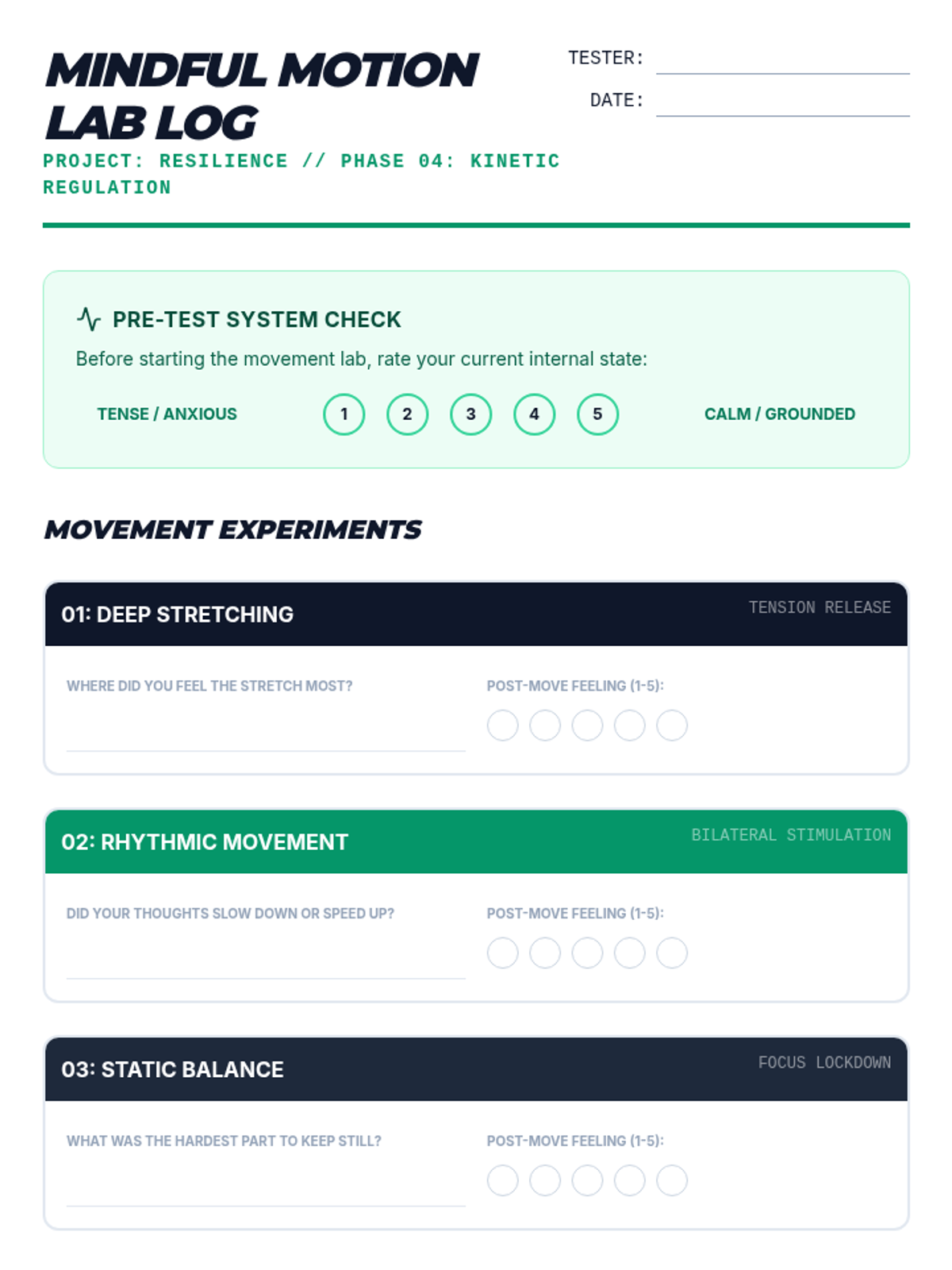
A movement log worksheet where students track their physical and emotional responses to different types of mindful motion.
Teacher guide for Lesson 4, explaining the 'Jar of Rocks' analogy and how to conduct the physical or mental demonstration.
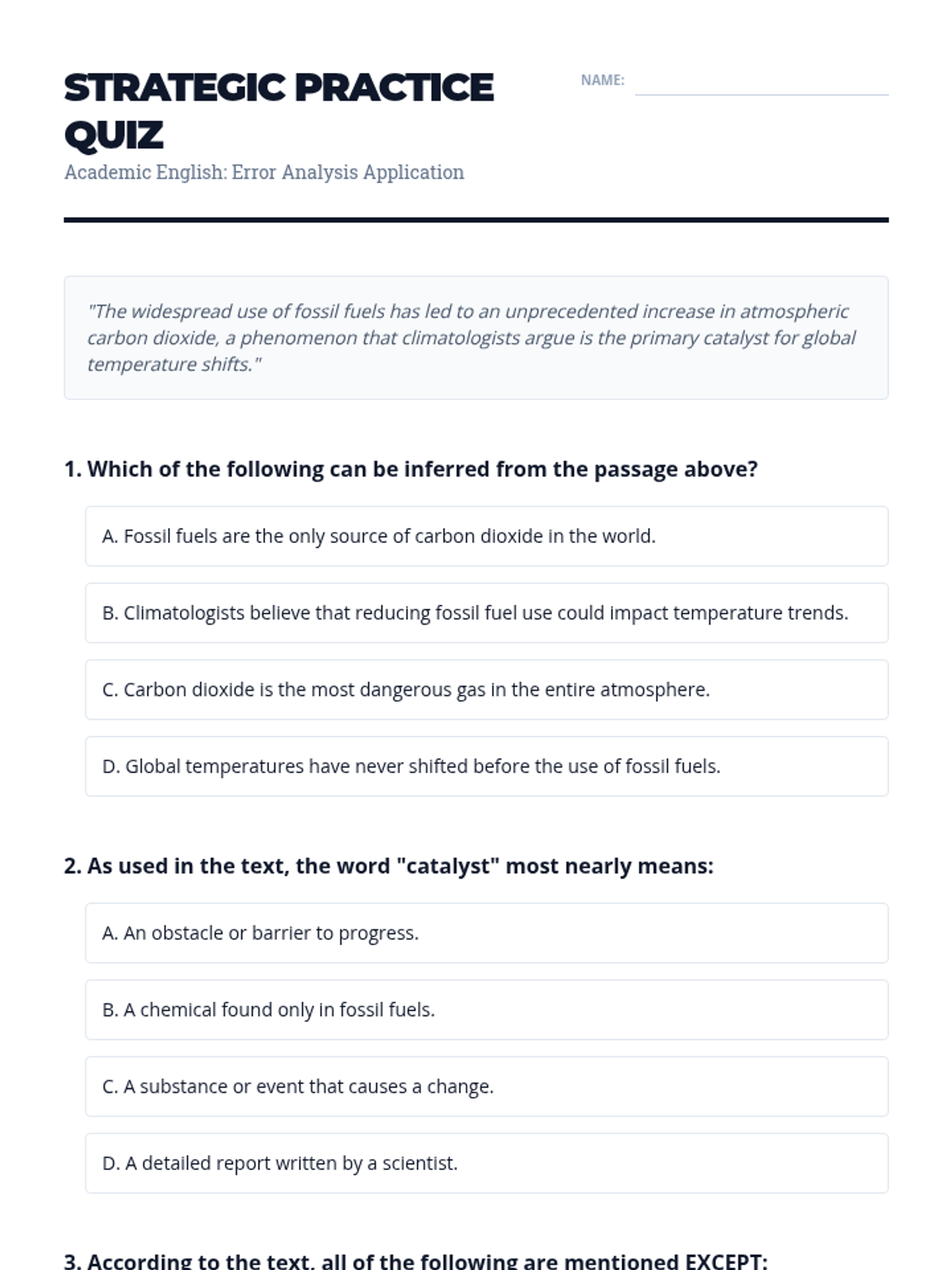
A short Academic English quiz designed to test students' application of their "Watch Out List," including a mandatory pre-grading self-reflection and score prediction section.
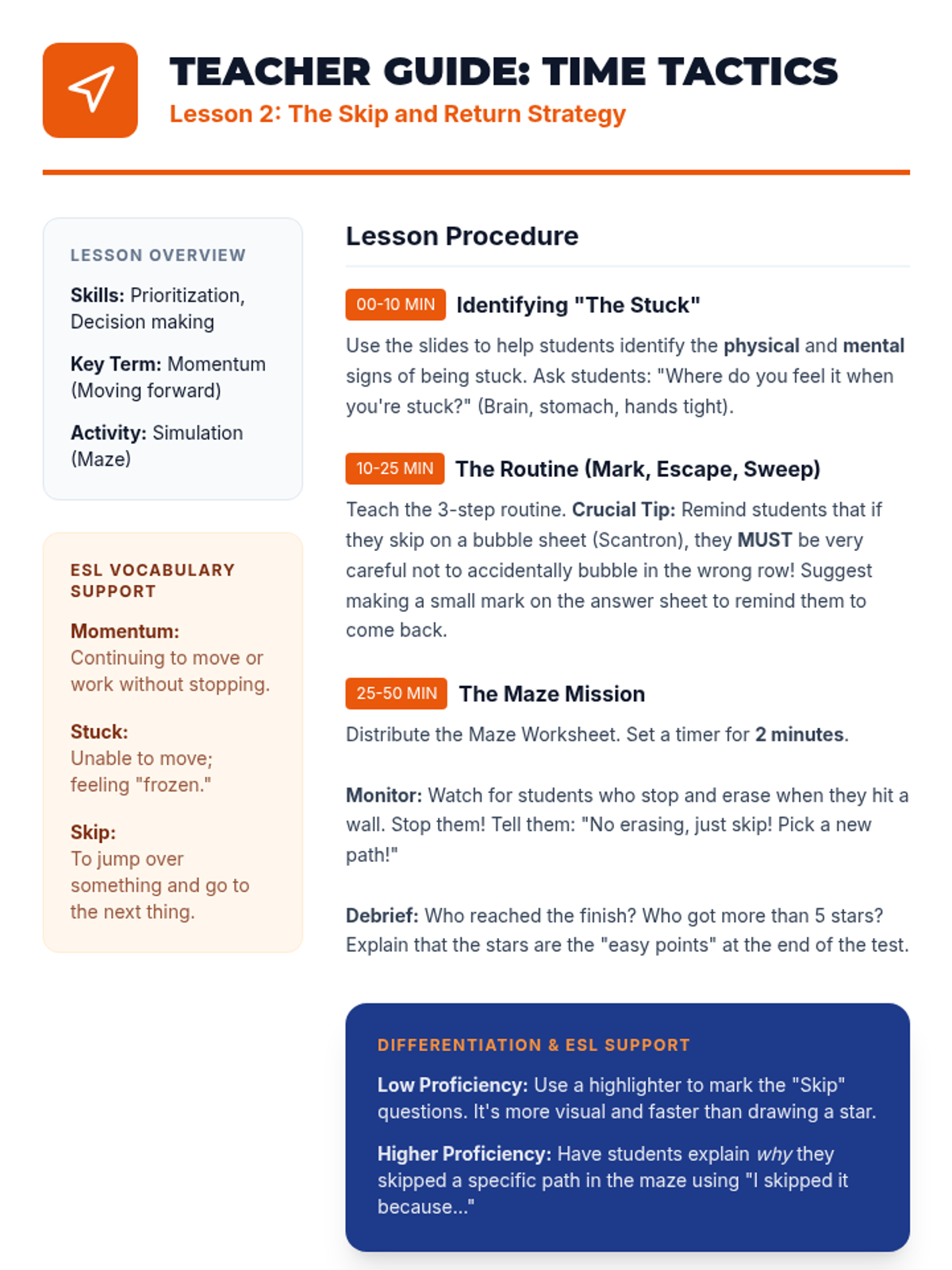
Teacher guidance for Lesson 2, including momentum concepts, ESL vocabulary support, and maze simulation management.
Final slides for the sequence focusing on the "Showtime" assessment. It introduces the score prediction challenge and real-time error analysis.
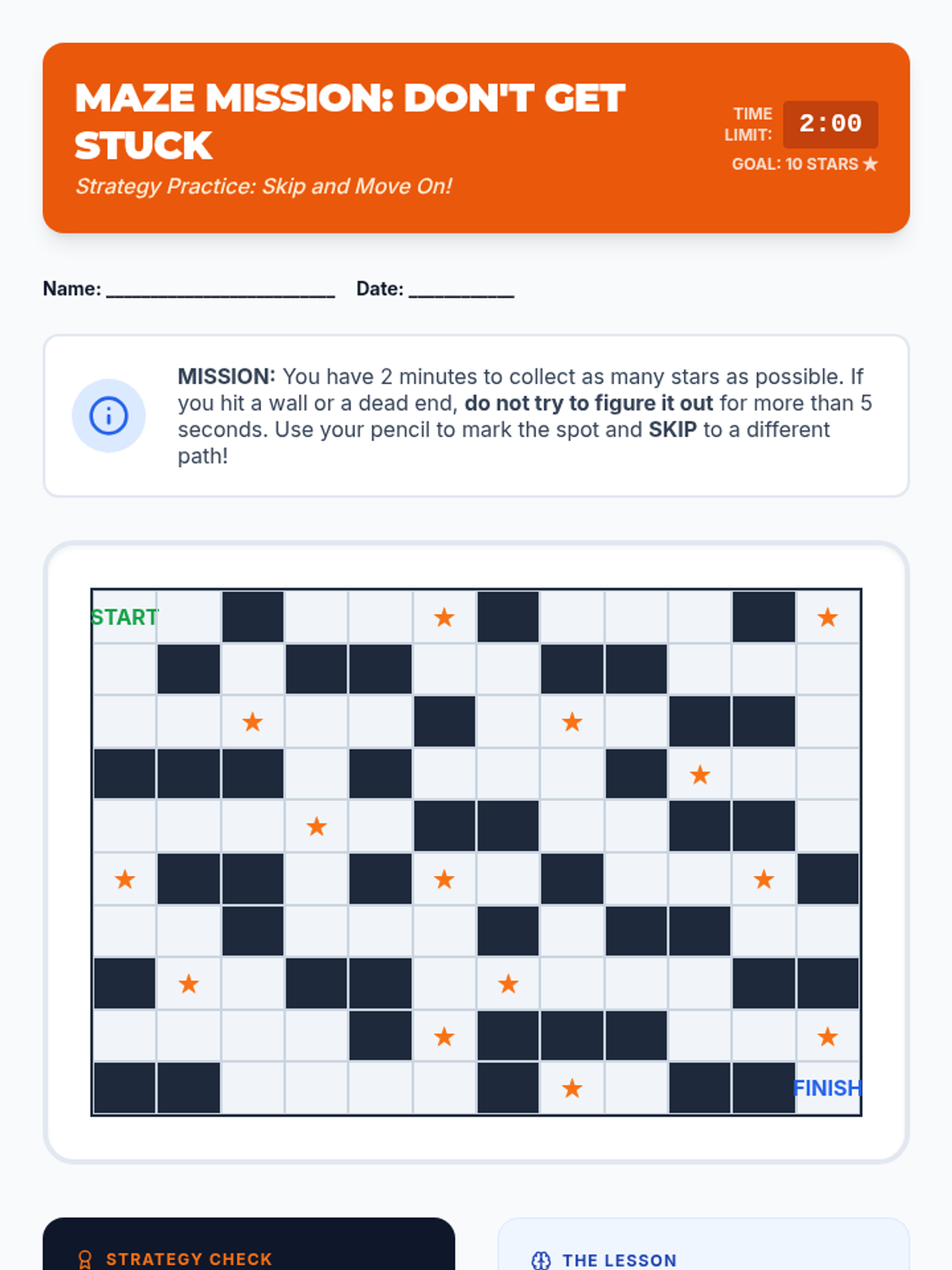
A timed maze activity for Lesson 2 that simulates the 'Skip and Return' strategy by forcing students to avoid dead ends to reach the goal.
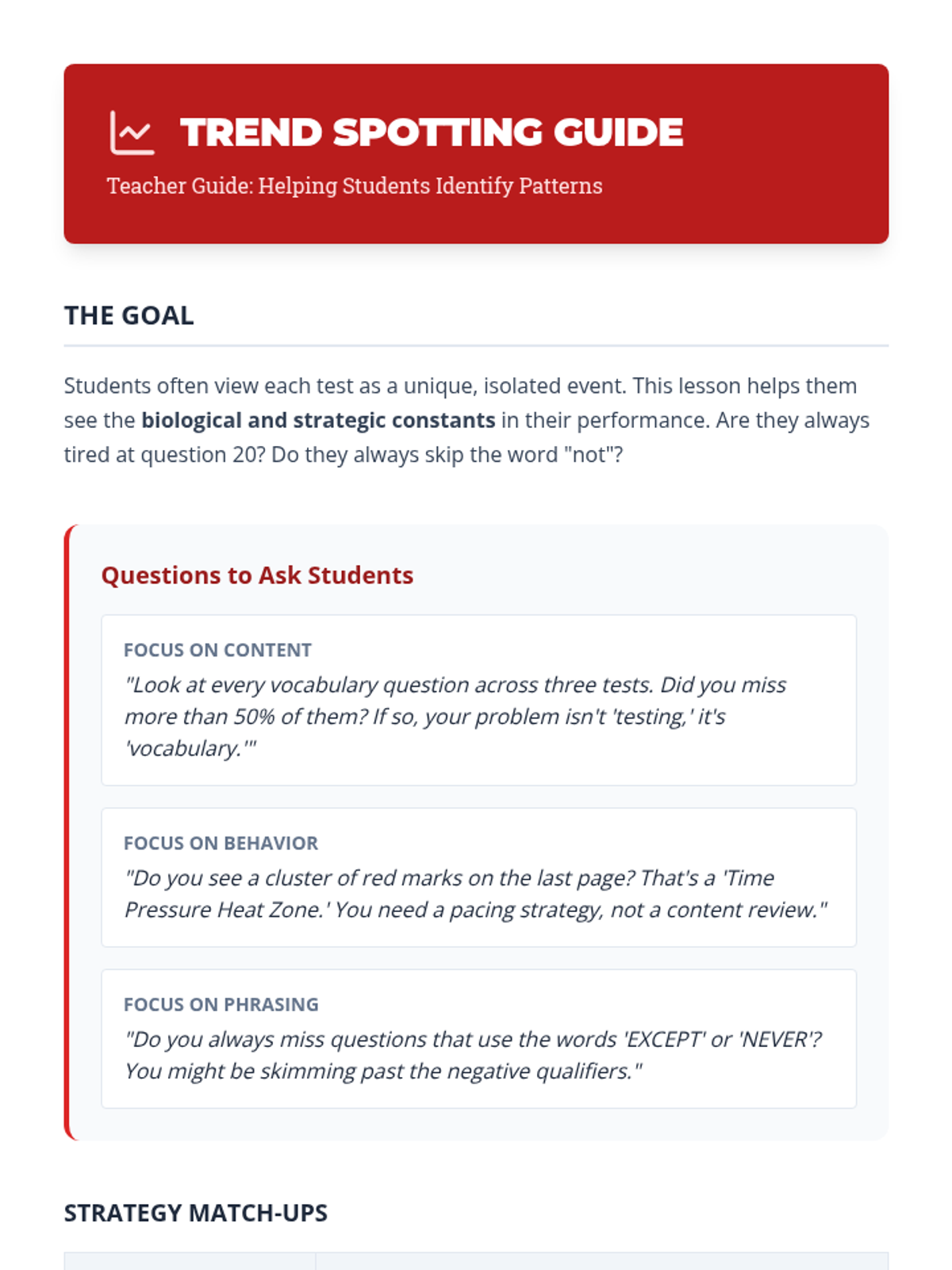
A guide for teachers to help students interpret their error data and connect patterns to specific defensive strategies.
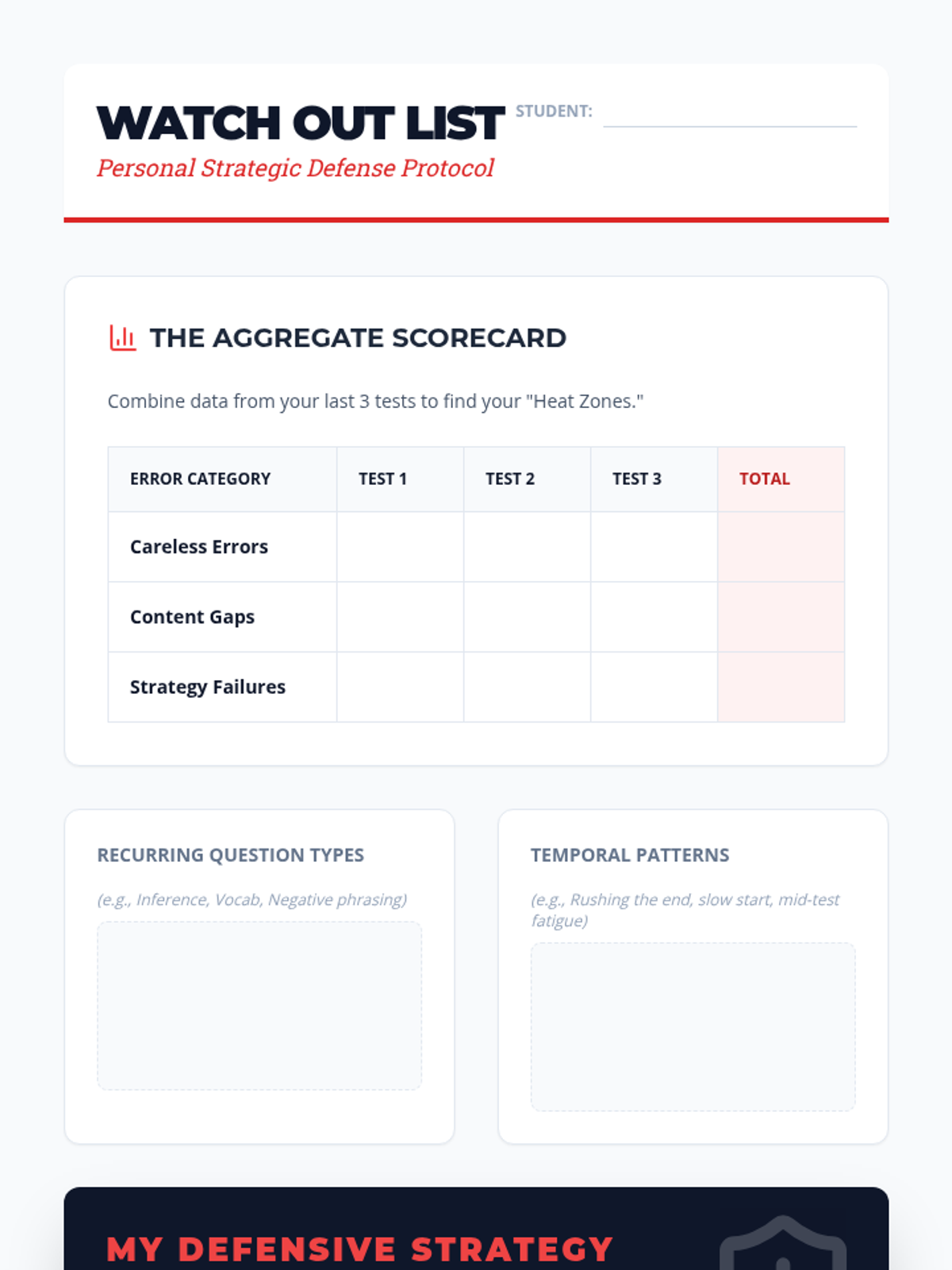
A student worksheet for aggregating error data across multiple assessments and distilling those patterns into a "Watch Out List" for future defense.
Slides for Lesson 4 that use a "Heatmap" analogy to teach students how to aggregate error data and identify recurring personal patterns.
Slide deck for Lesson 2 teaching the 'Skip and Return' strategy, focusing on recognizing when you're stuck and the benefits of skipping.
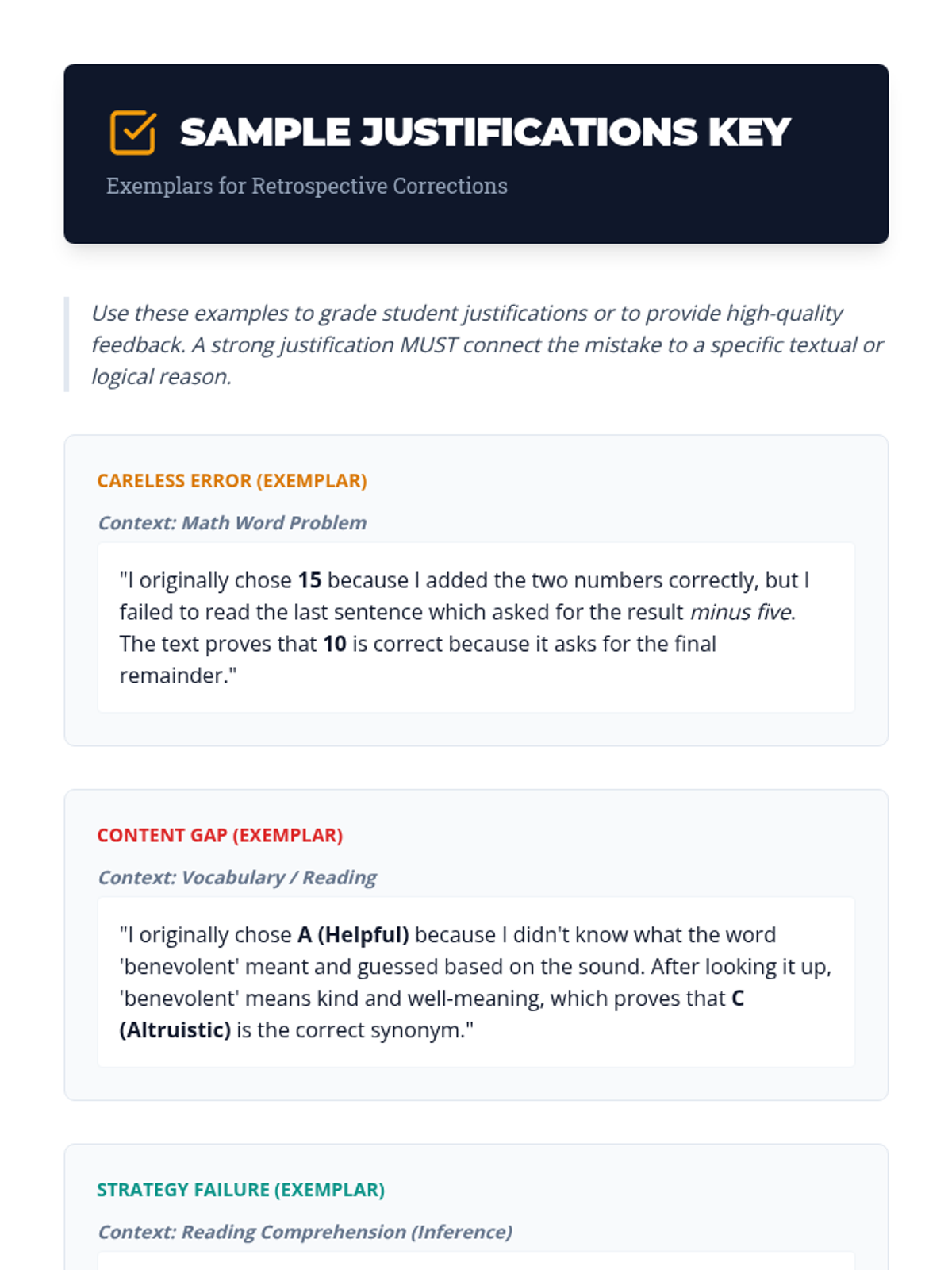
An answer key/exemplar guide for teachers to evaluate student justification statements, showing the difference between weak and mastery-level corrections.
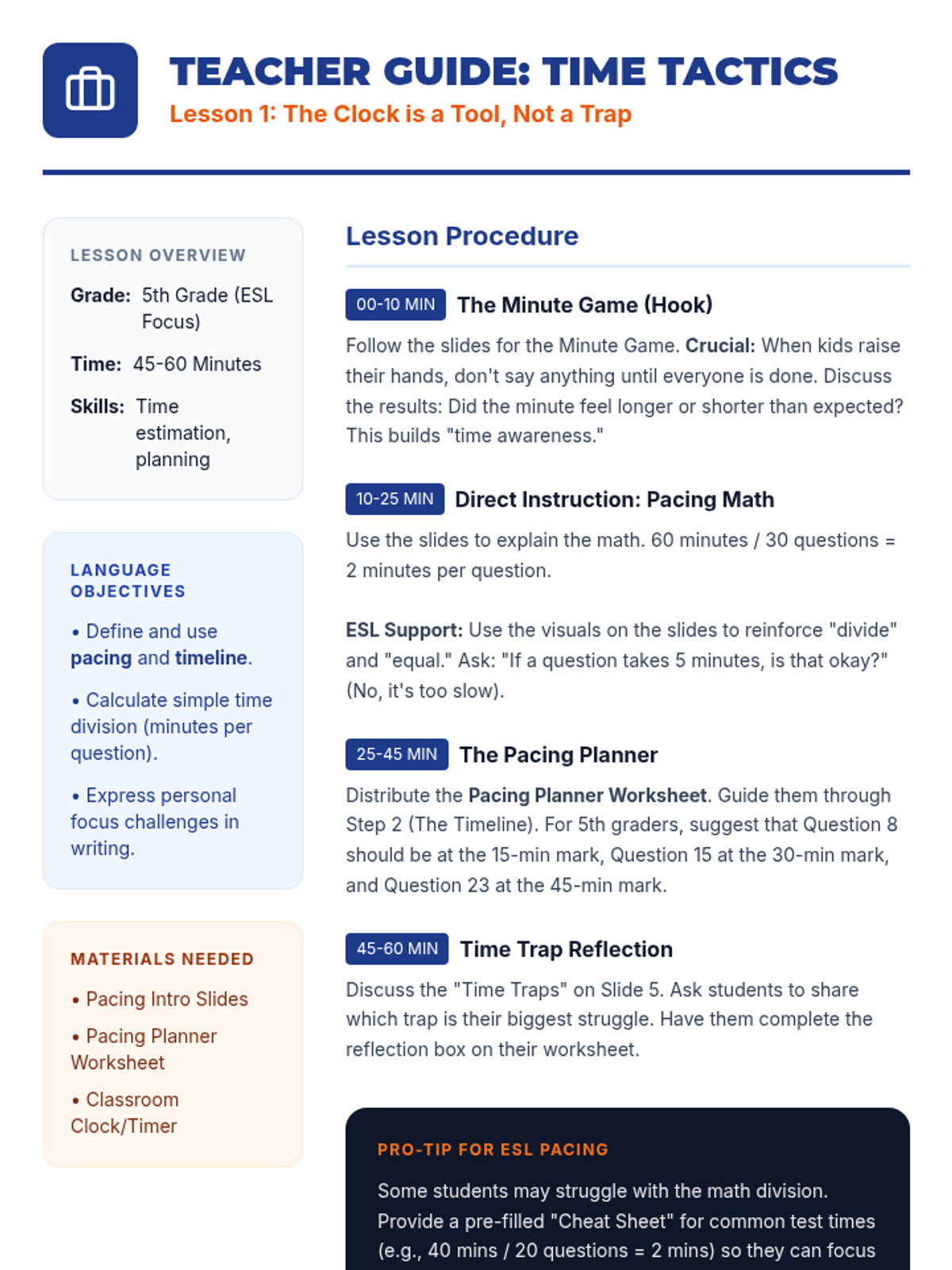
Teacher guidance for Lesson 1, including language objectives, step-by-step procedures, and ESL-specific instructional tips.
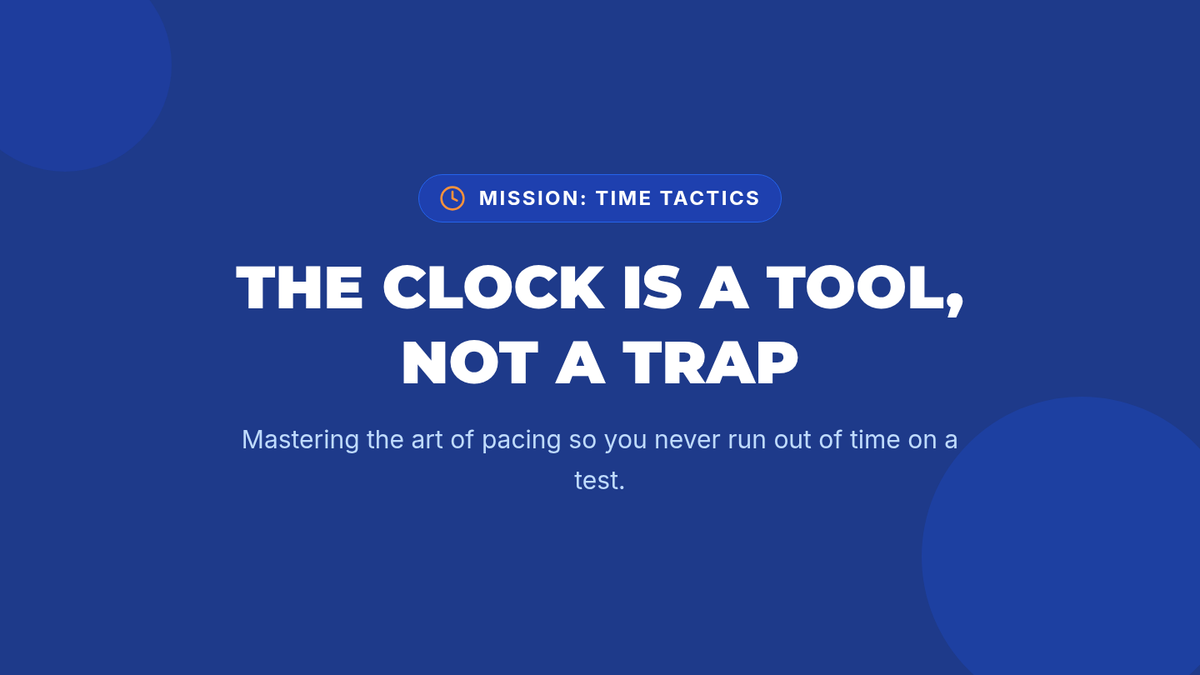
Introductory slide deck for Lesson 1 on pacing, featuring the 'Minute Game' hook, the math of pacing, and common time traps.
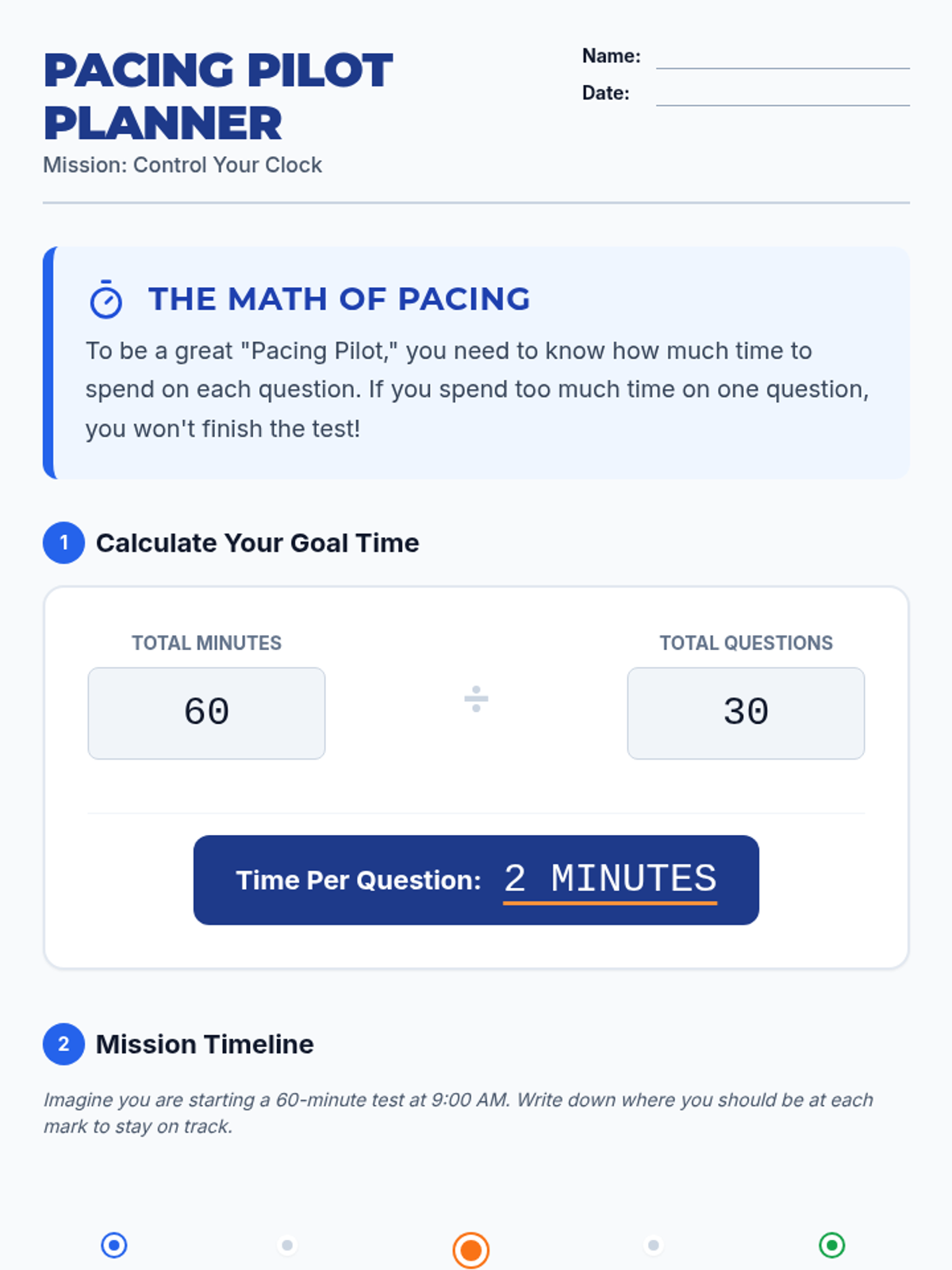
A visual pacing planner worksheet for Lesson 1, helping students calculate time per question and map out a test timeline.
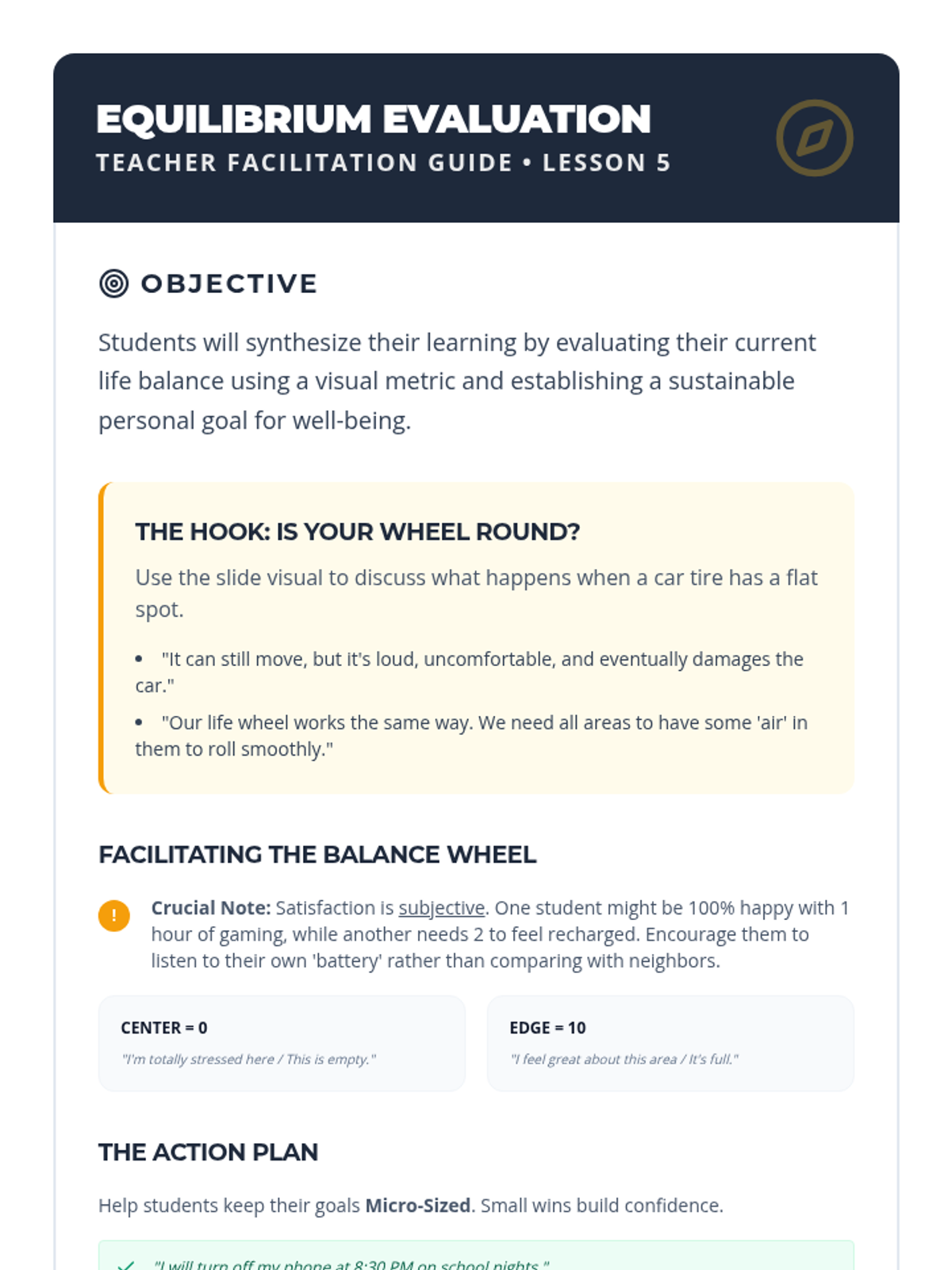
Teacher guide for Lesson 5, providing instructions for the 'Balance Wheel' workshop and strategies for effective goal-setting and student accountability.
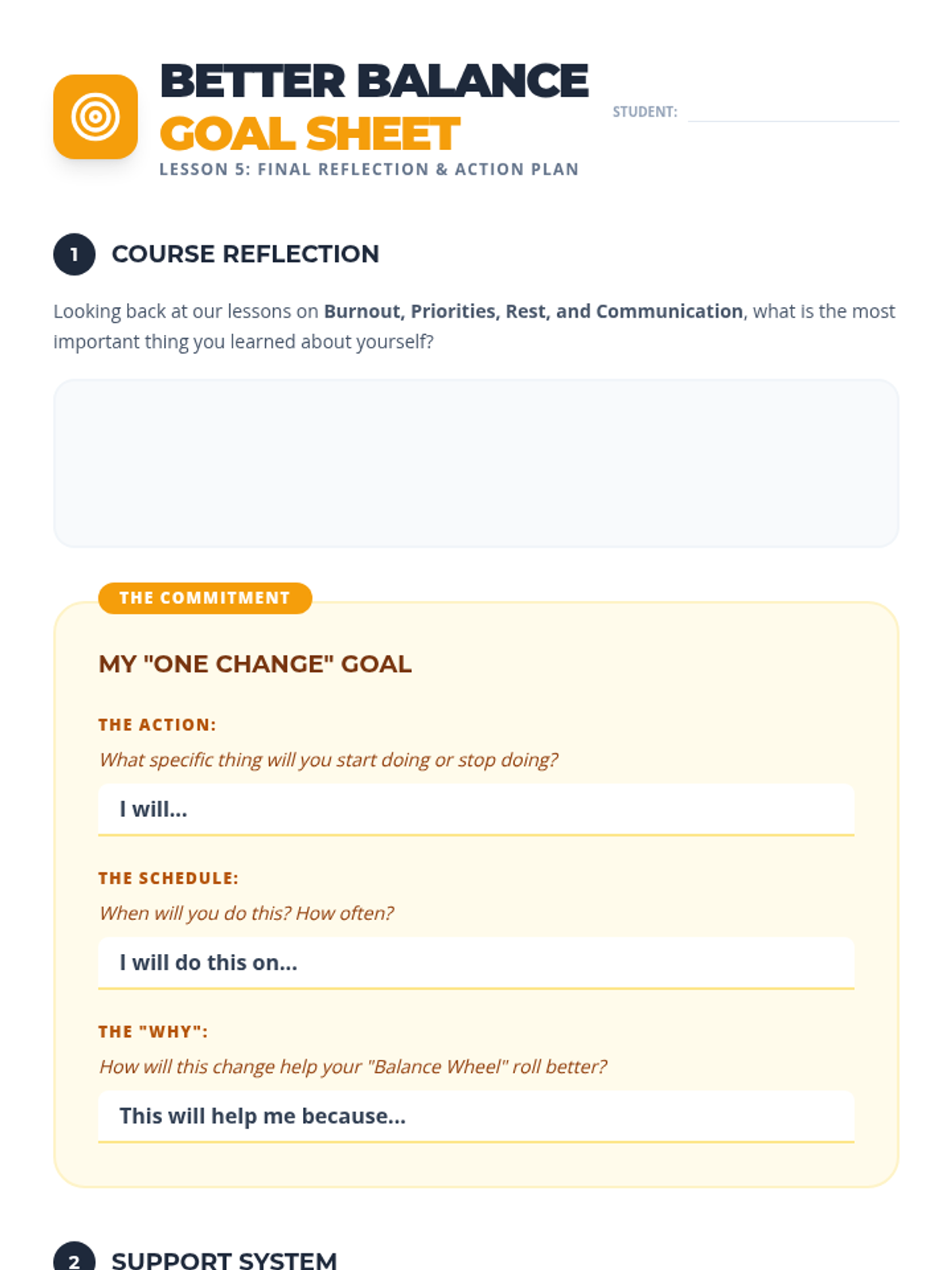
Goal setting and reflection sheet for Lesson 5, where students commit to a specific change to improve their life balance.
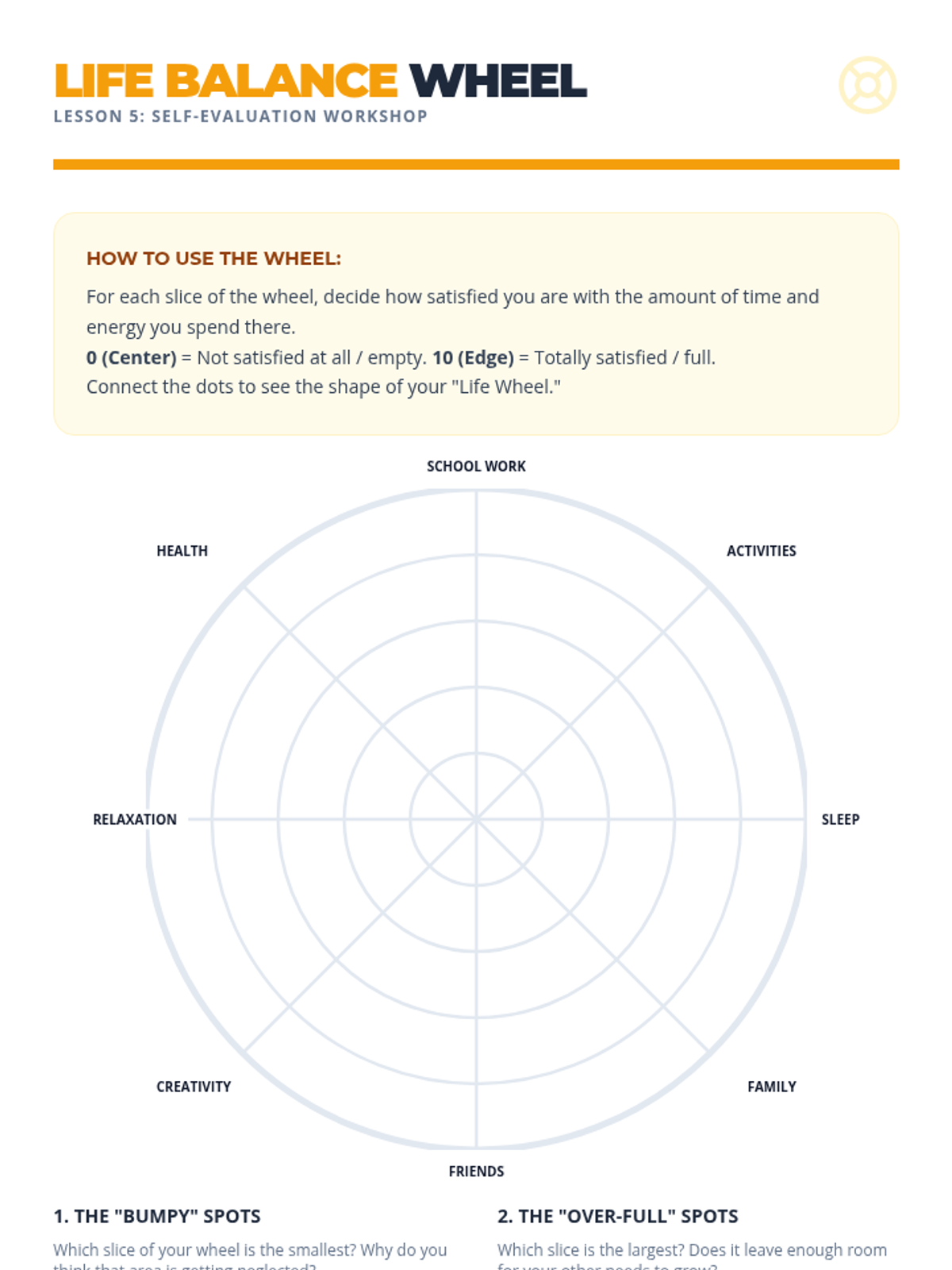
Visual reflection worksheet for Lesson 5, allowing students to map their current life balance across eight key areas.
Final slide deck for Lesson 5, introducing the 'Balance Wheel' concept and guiding students through personal reflection and goal setting.
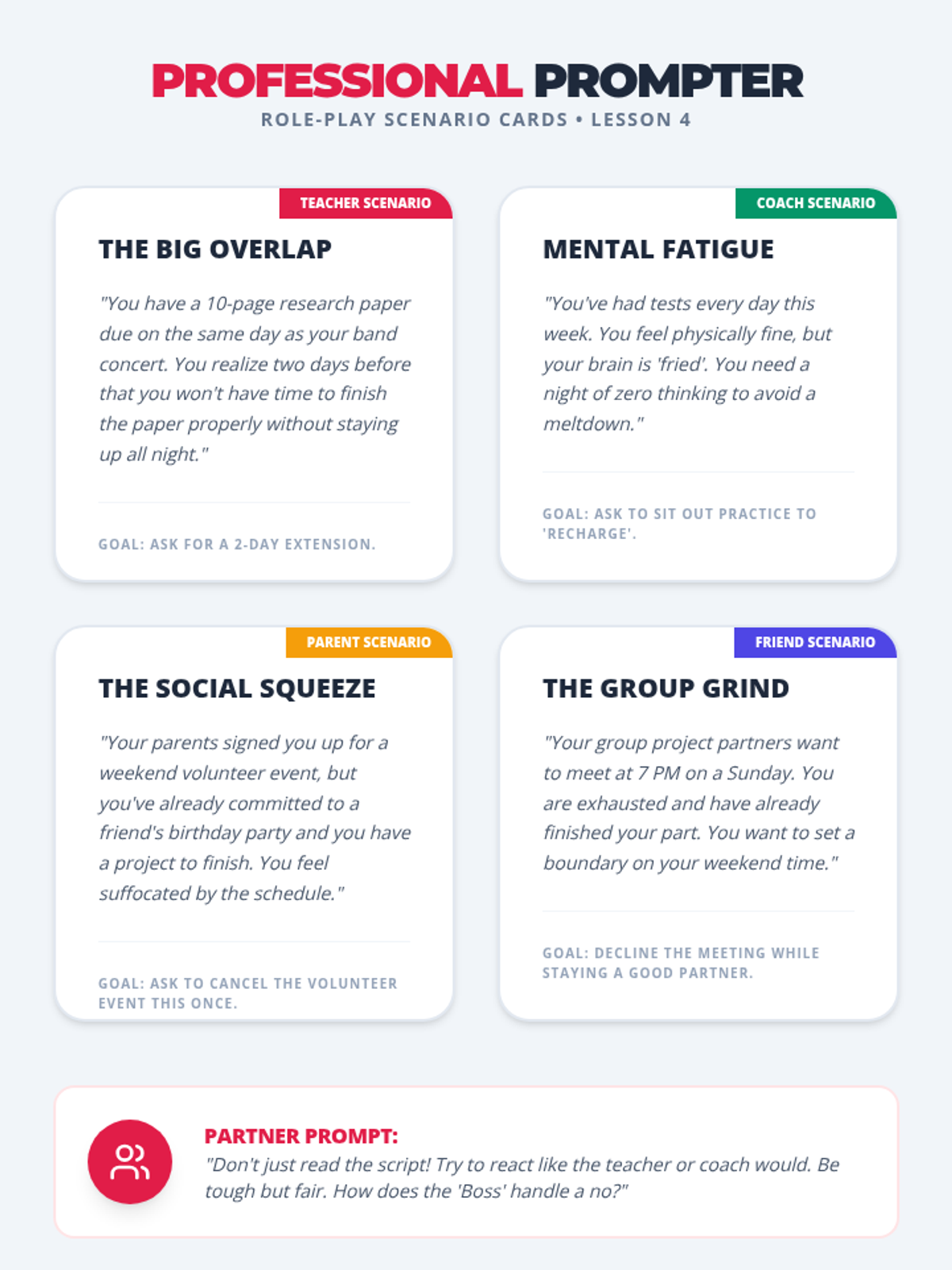
Role-play scenario cards for Lesson 4, providing students with specific situations to practice their communication and boundary-setting skills.
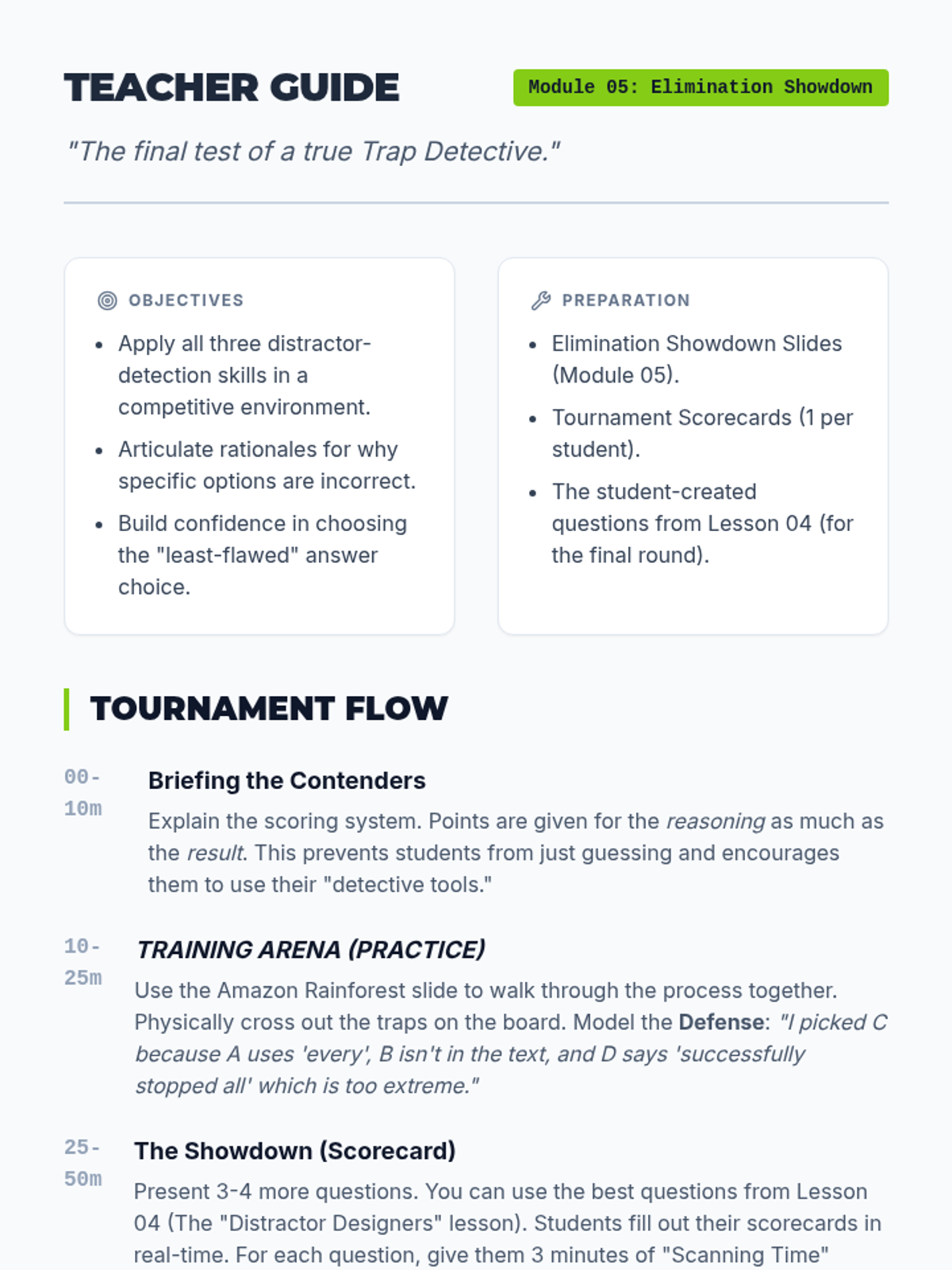
Teacher guide for 'Elimination Showdown'. Includes lesson flow, tournament scoring mechanics, and a detailed analysis of the practice question.
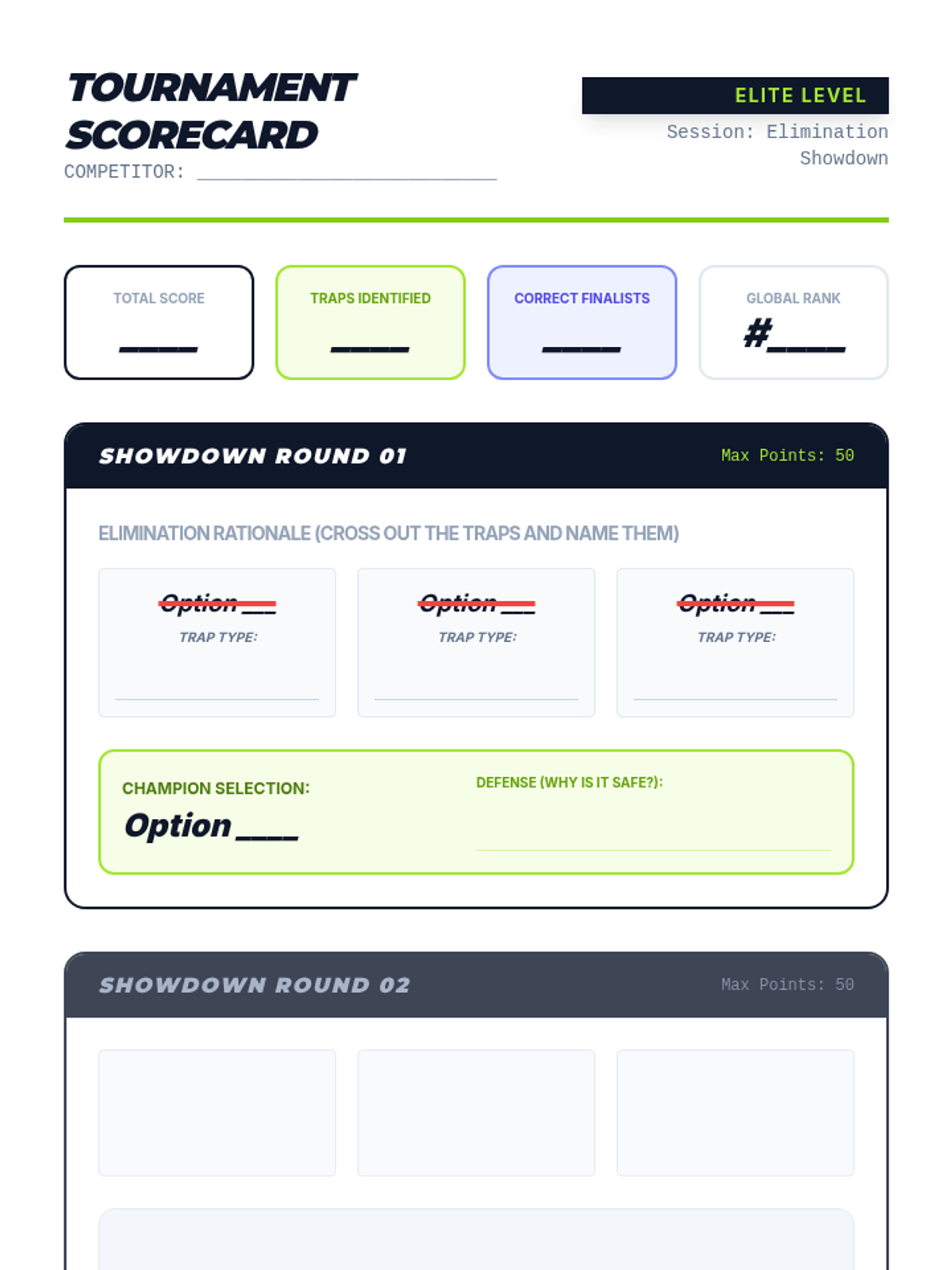
A student tournament scorecard for the final showdown. Features sections for tracking points, identifying trap types for each distractor, and selecting the 'Champion' (correct) answer with a defense.
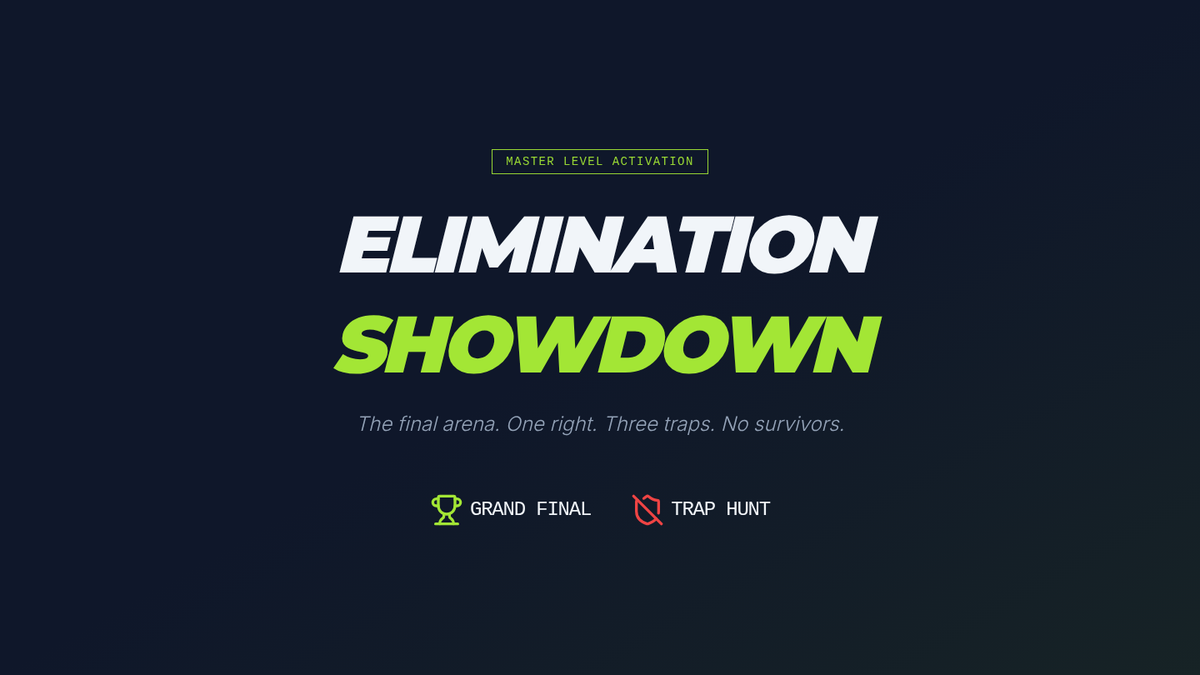
Introductory slides for 'Elimination Showdown'. Features tournament rules and a walk-through of the 'Elimination Showdown' process with a practice question.
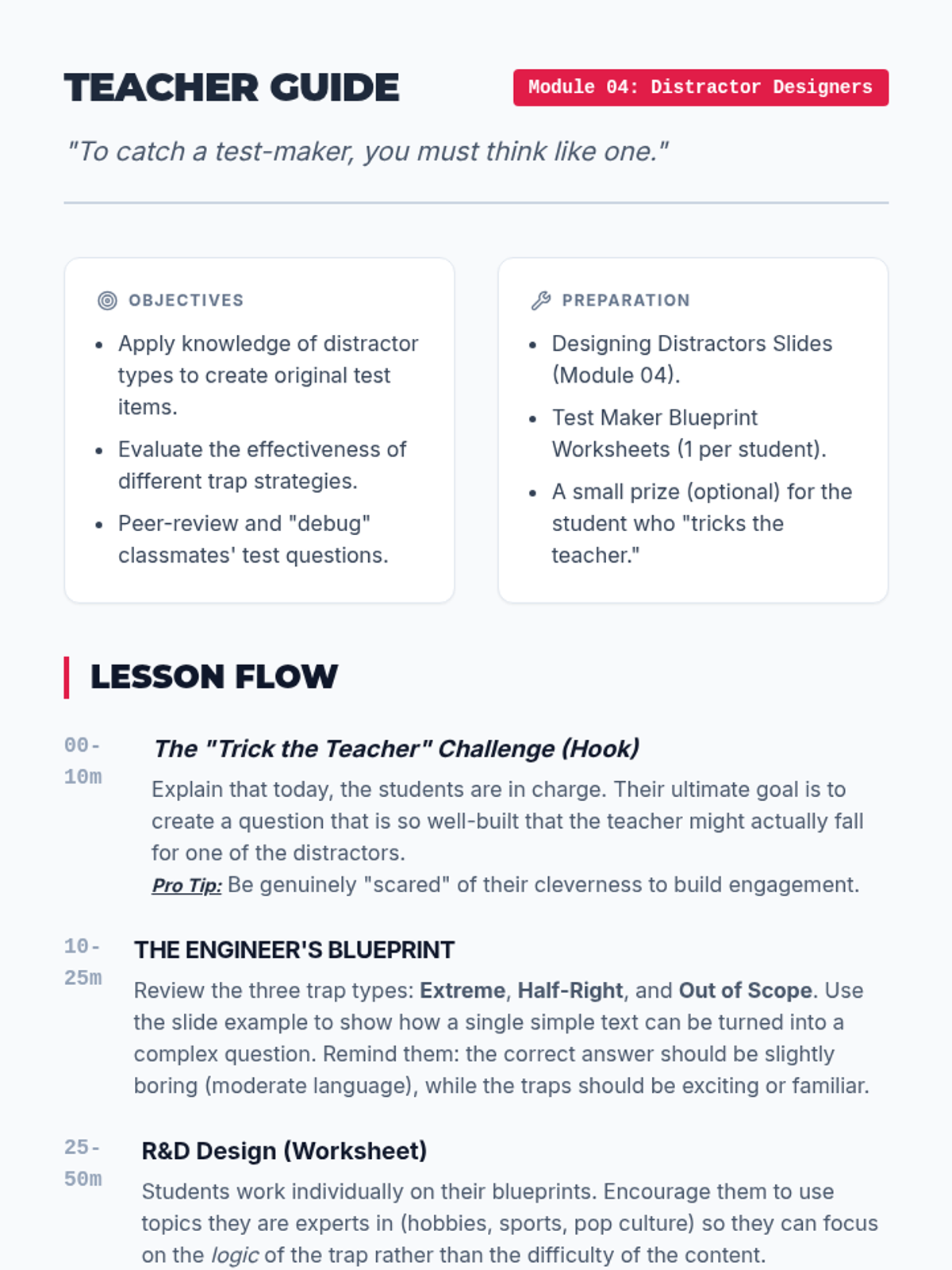
Teacher guide for 'Distractor Designers'. Includes pacing, rubric for the student worksheet, and instructions for the peer-testing phase of the lesson.
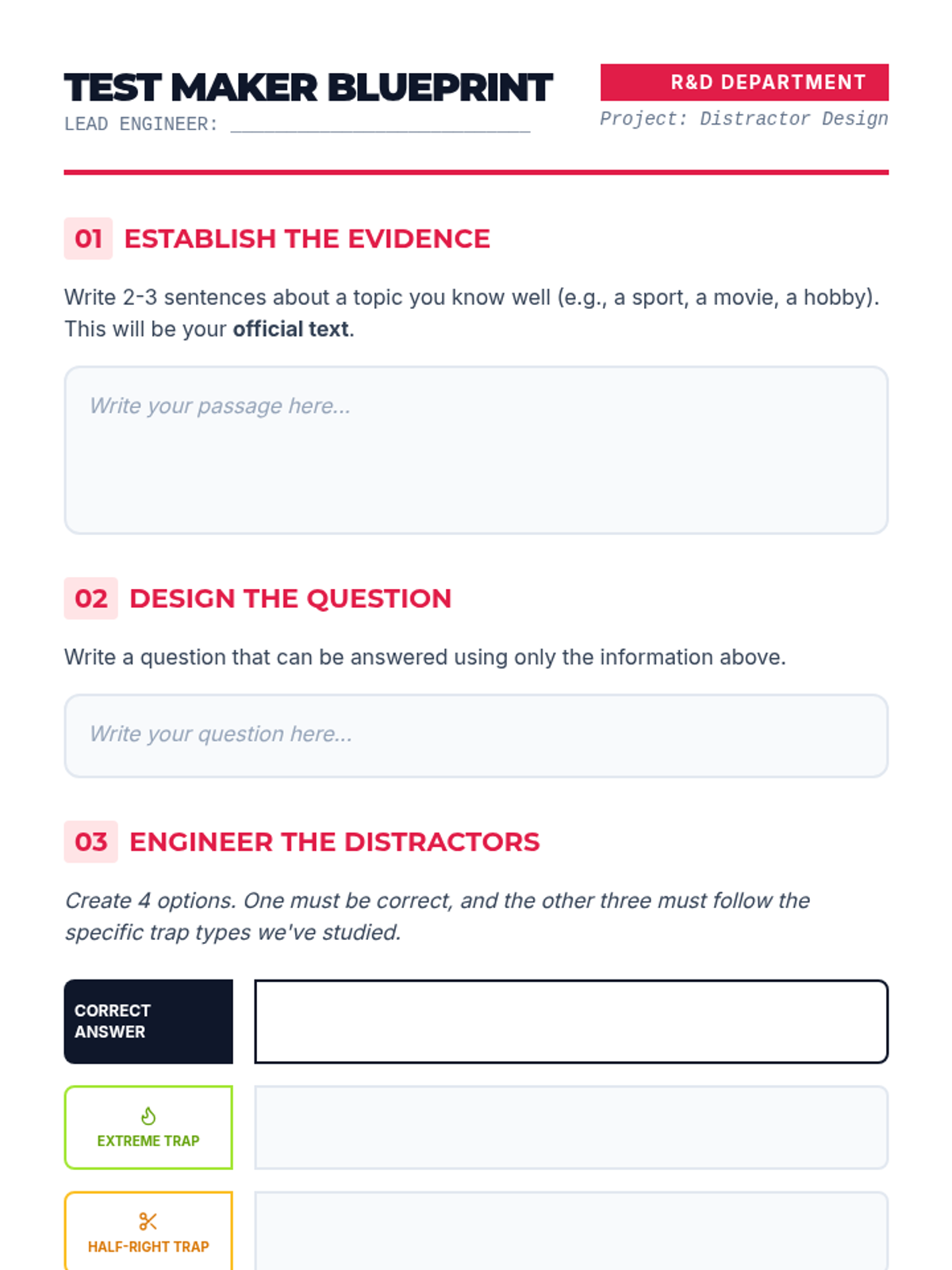
A student design sheet where they create their own multiple-choice question. Students must provide a short text and then engineer four options: one correct answer and three specific distractor types (Extreme, Half-Right, and Out of Scope).
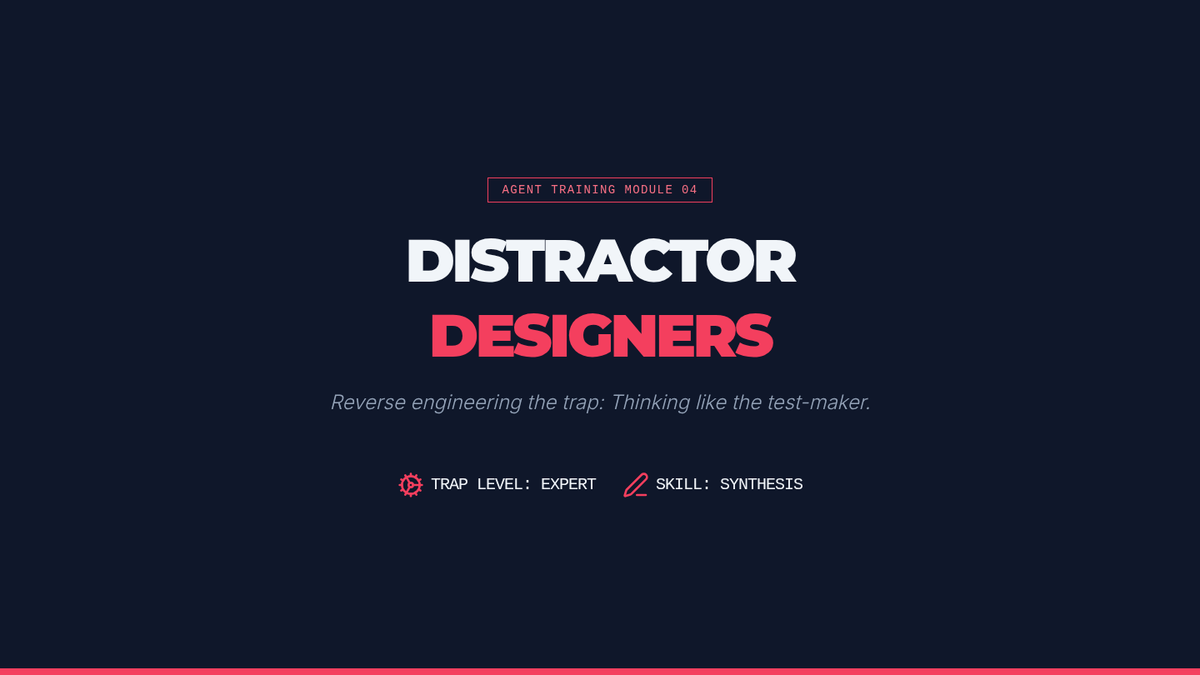
Introductory slides for 'Distractor Designers'. Explains how to create 'Extreme', 'Half-Right', and 'Out of Scope' distractors by thinking like a test-maker.
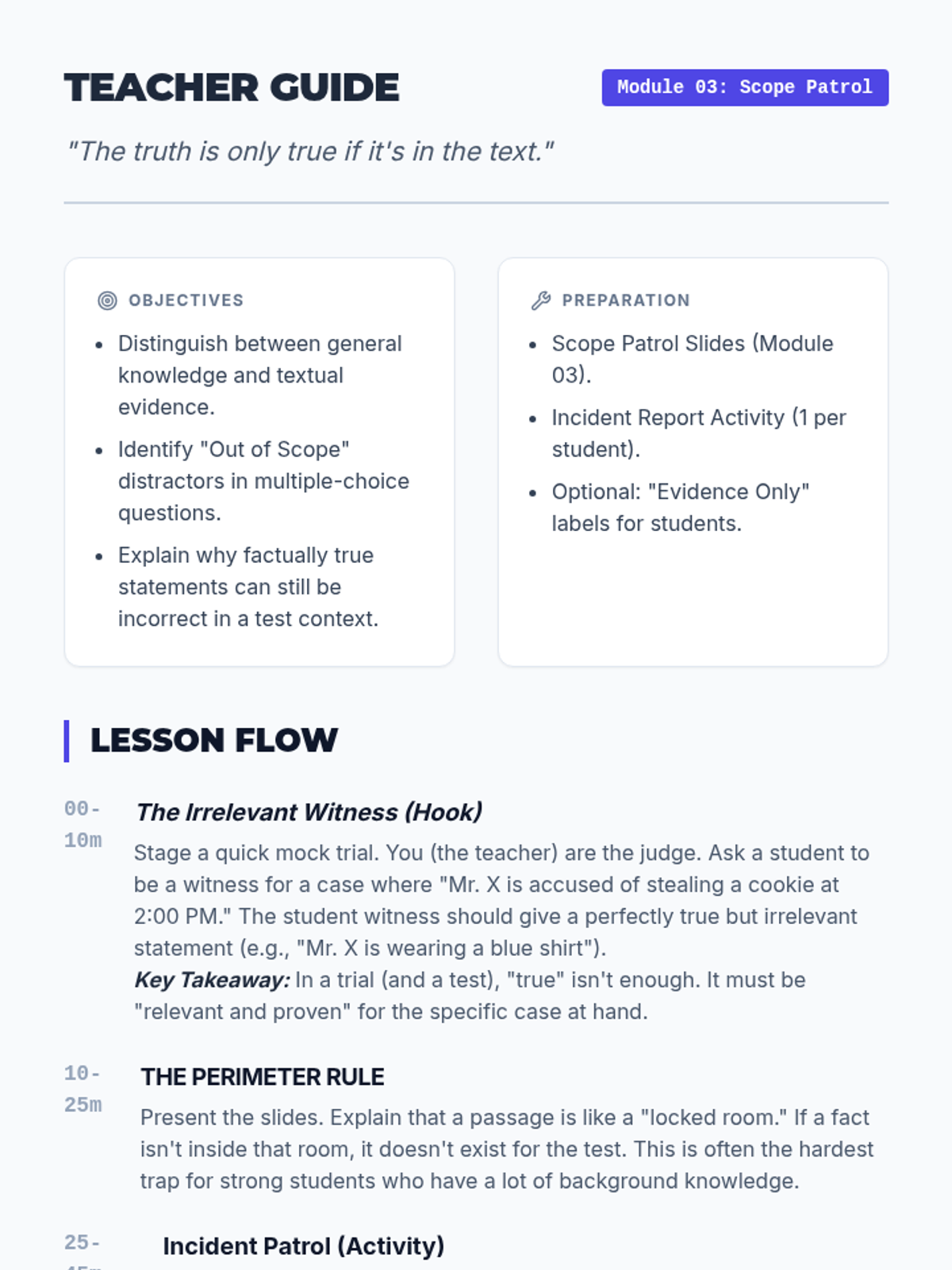
Teacher guide for 'Scope Patrol'. Includes lesson flow, mock trial hook instructions, and a detailed answer key for the Incident Report activity.
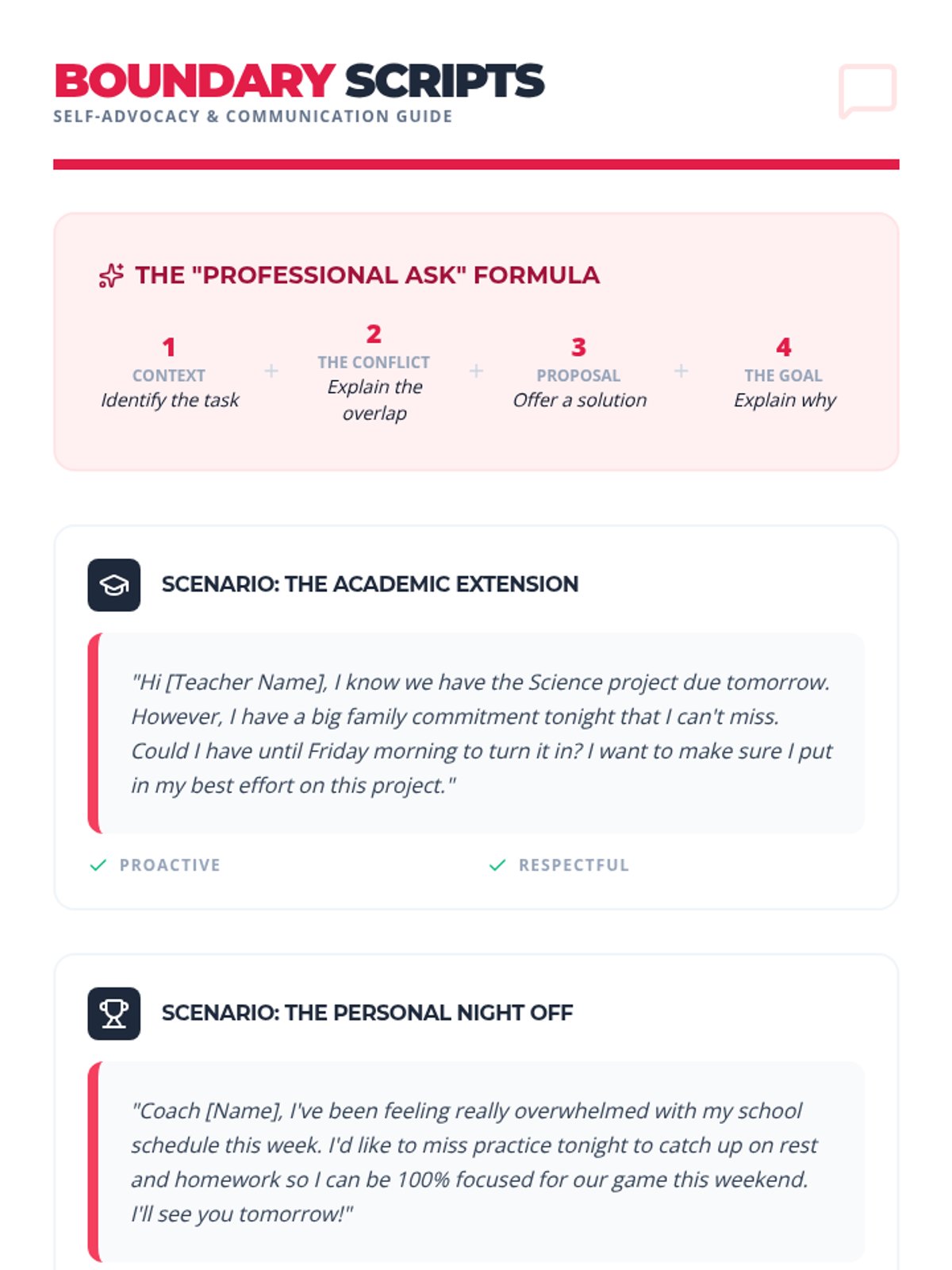
A handout containing communication scripts for students to practice setting boundaries with teachers, coaches, and parents.
Slide deck for Lesson 4, teaching students how to proactively communicate boundaries and request extensions using professional scripts.
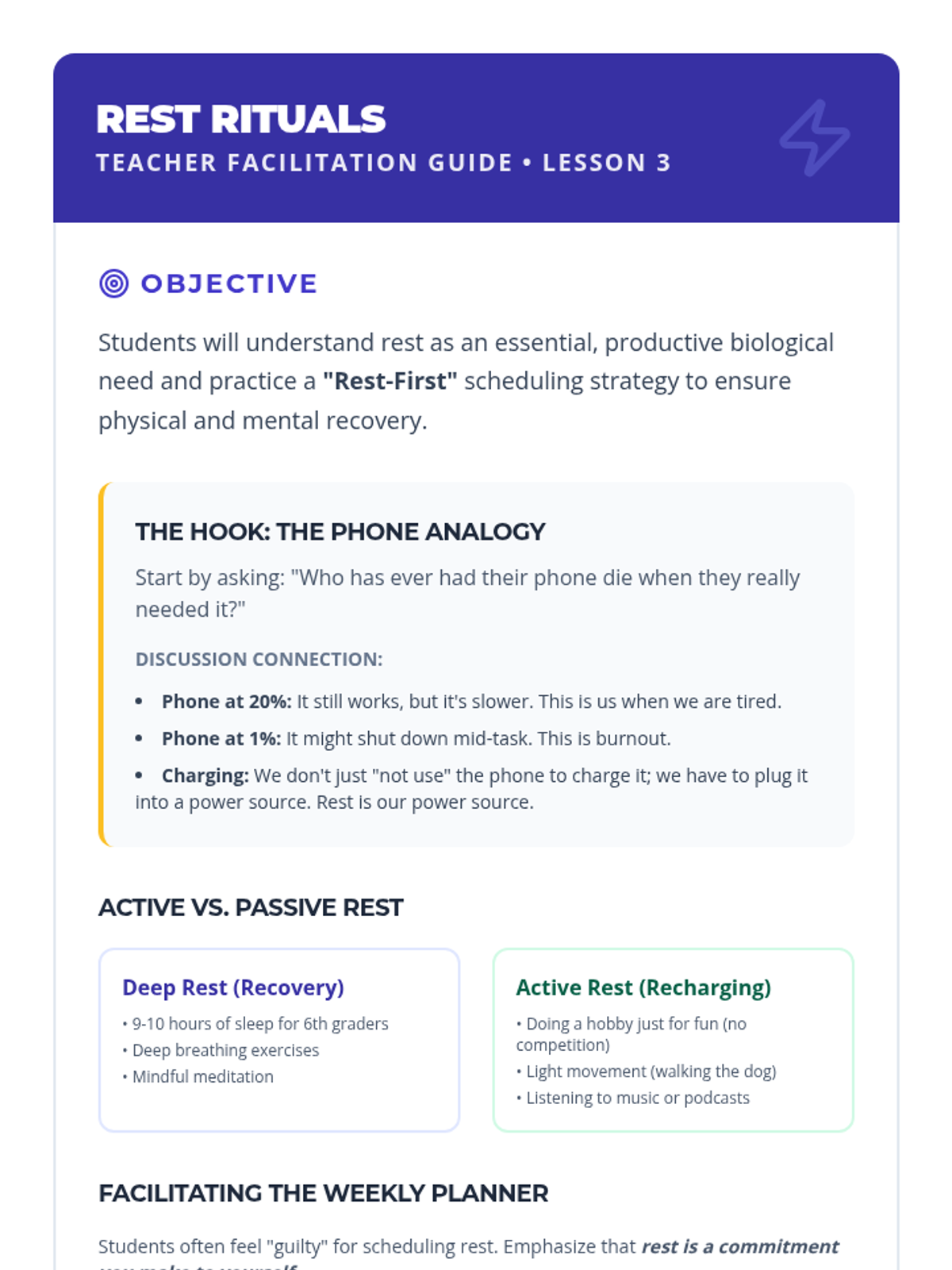
Teacher guide for Lesson 3, detailing the phone battery analogy and providing step-by-step instructions for the 'Rest-First' scheduling workshop.
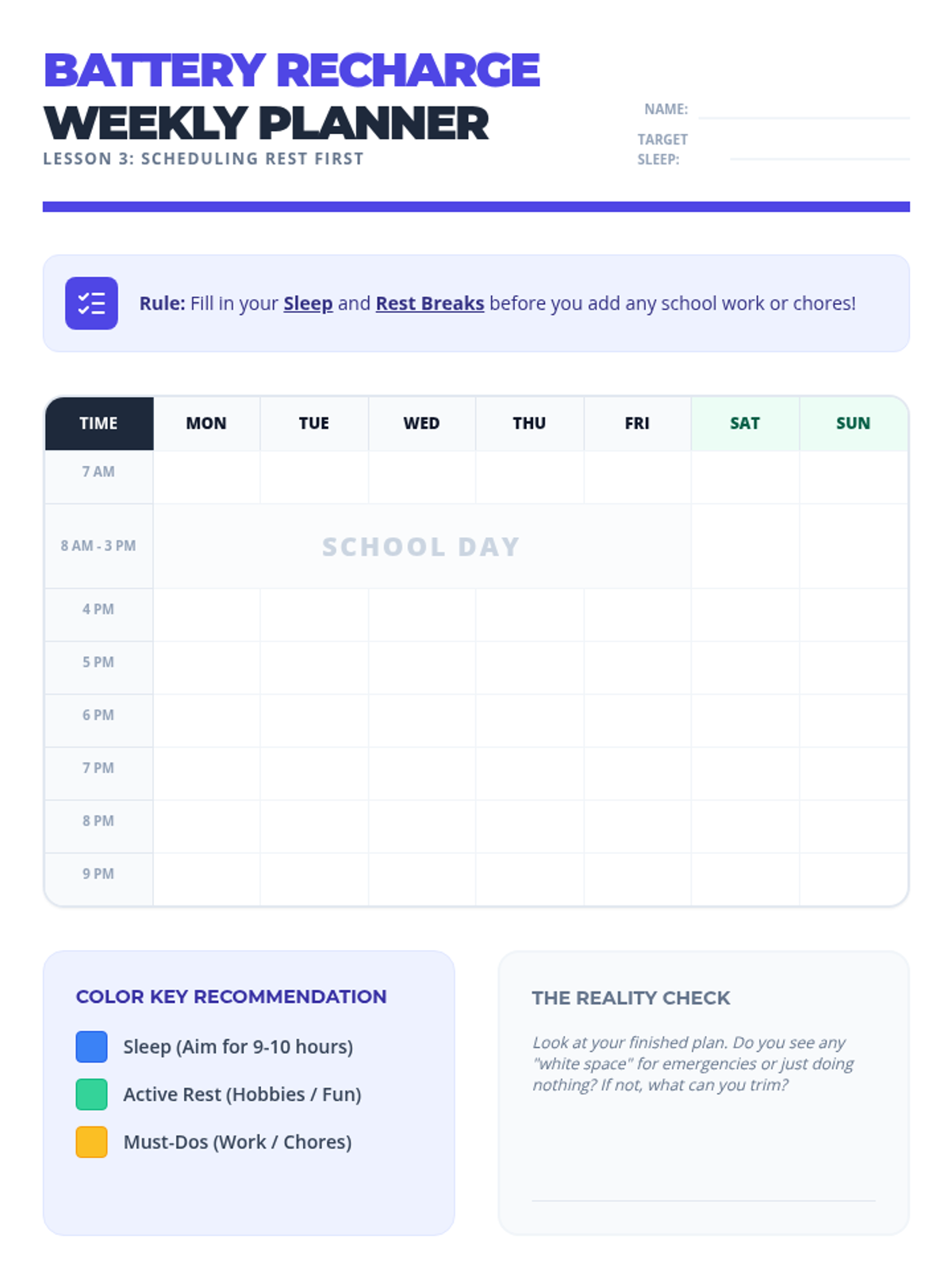
A weekly planner template designed for students to practice 'Rest-First' scheduling, prioritizing sleep and downtime before other commitments.
Slide deck for Lesson 3, focusing on the importance of rest and self-care using the phone battery analogy and the 'Rest-First' scheduling strategy.
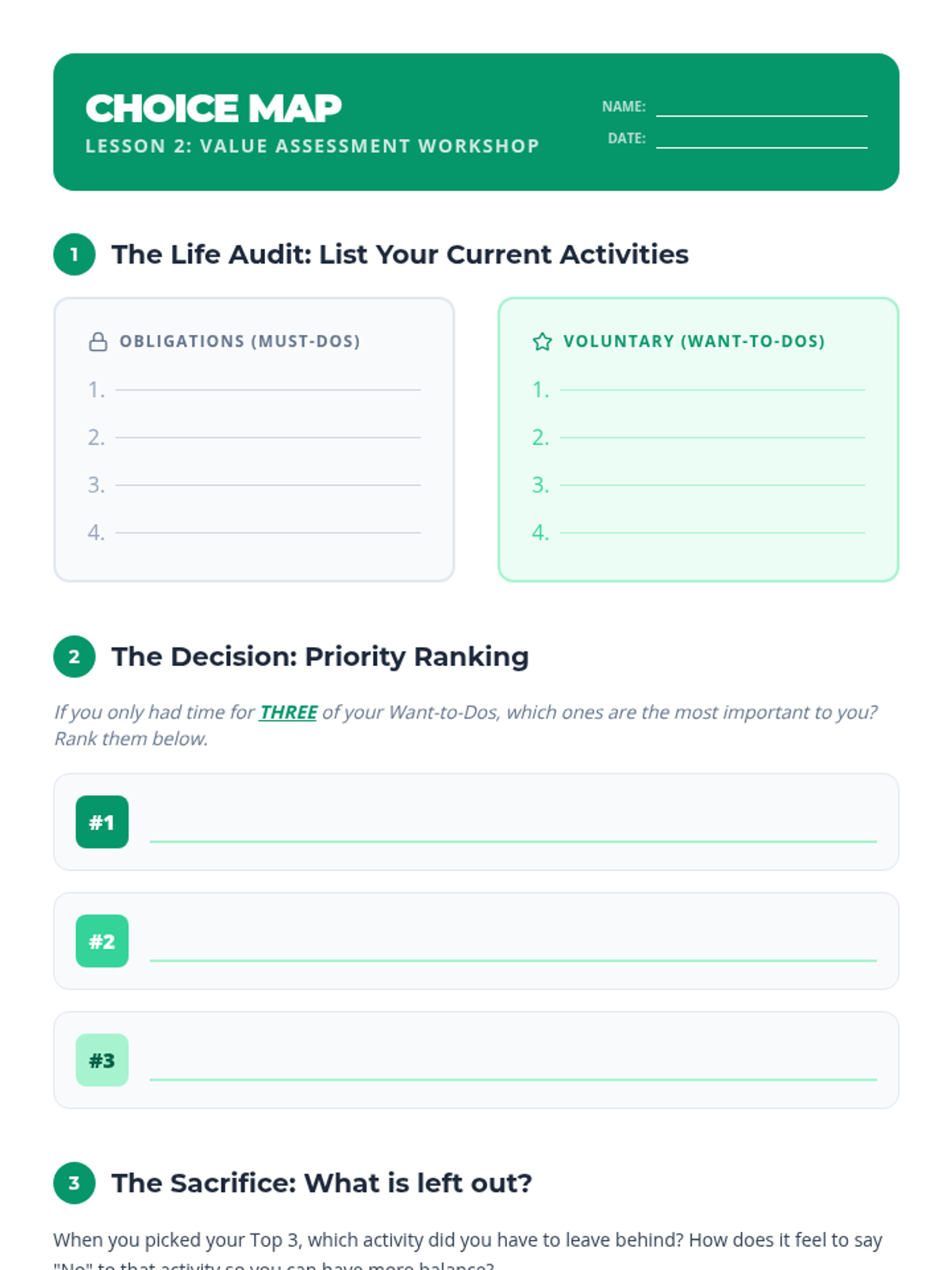
Categorization and ranking worksheet for Lesson 2, helping students map their obligations and voluntary activities.
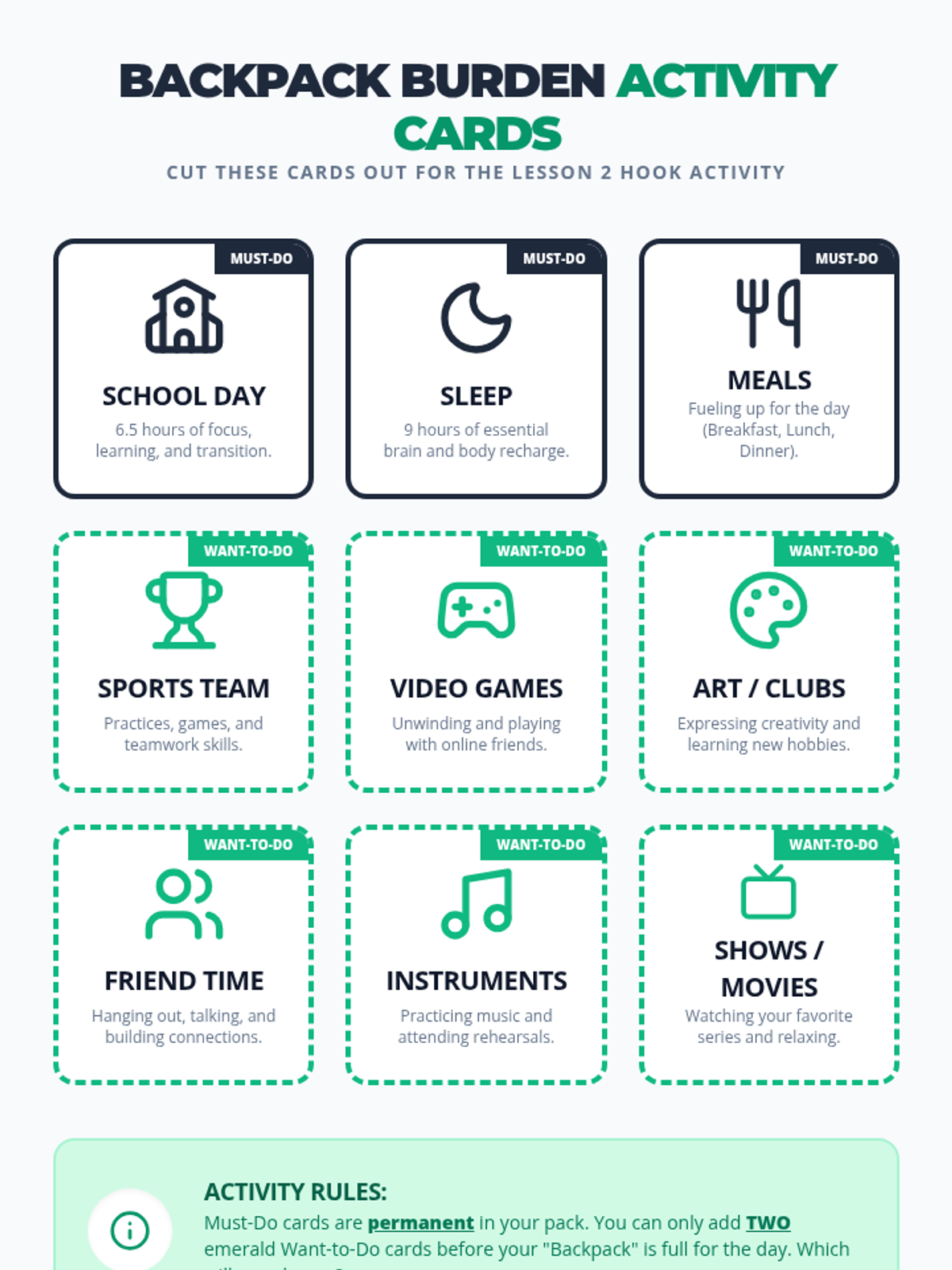
Activity cards for the 'Backpack Challenge' hook in Lesson 2, helping students visualize the physical space commitments take up in their lives.
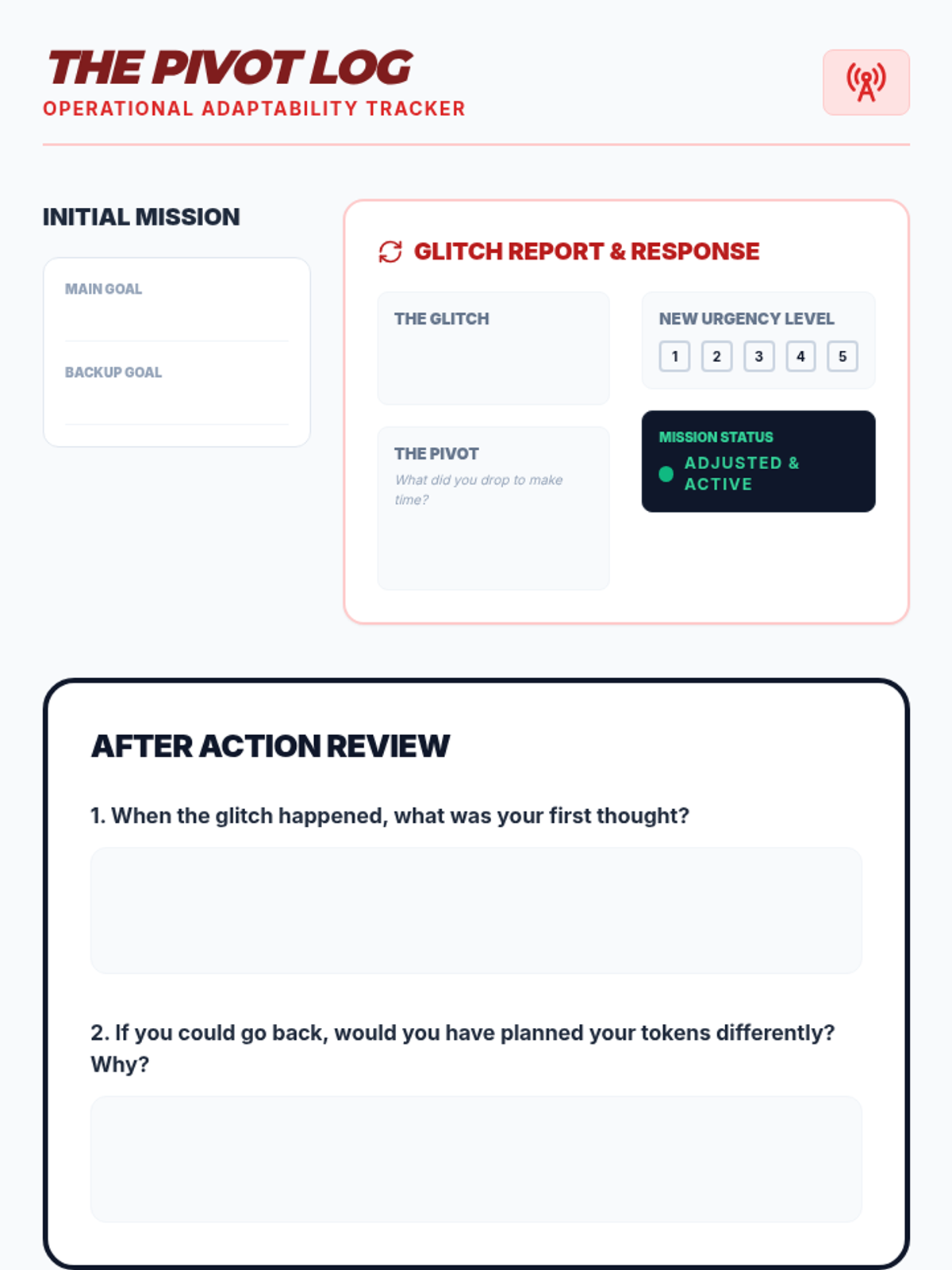
A reflection worksheet for Lesson 3 where students track how they adjusted their plans during 'Glitch' events.
Slide deck for Lesson 2, teaching students to categorize activities into obligations and voluntary choices using the 'Backpack Challenge'.
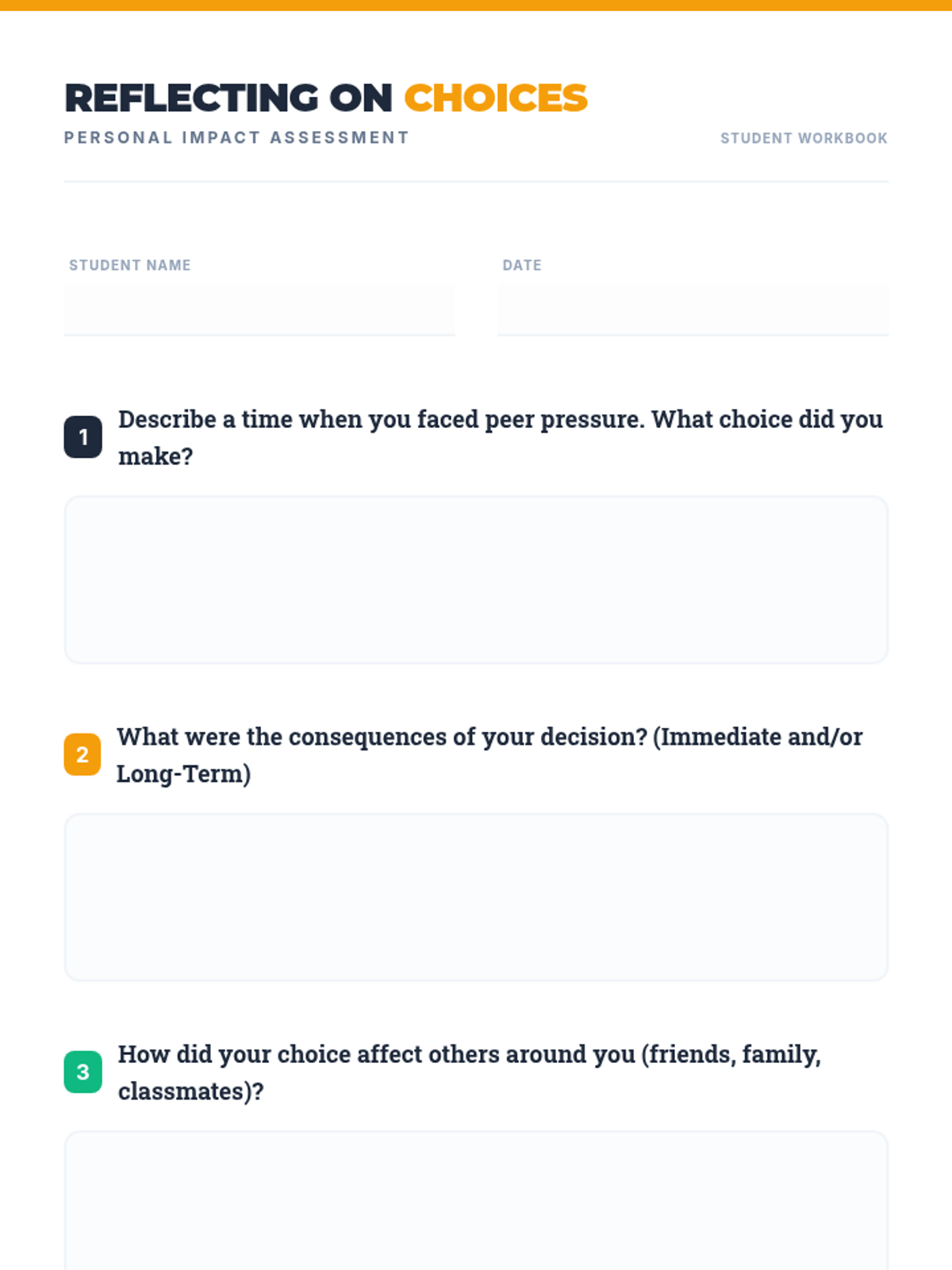
A reflection worksheet designed to help students map out their personal experiences with peer pressure and analyze the resulting consequences.
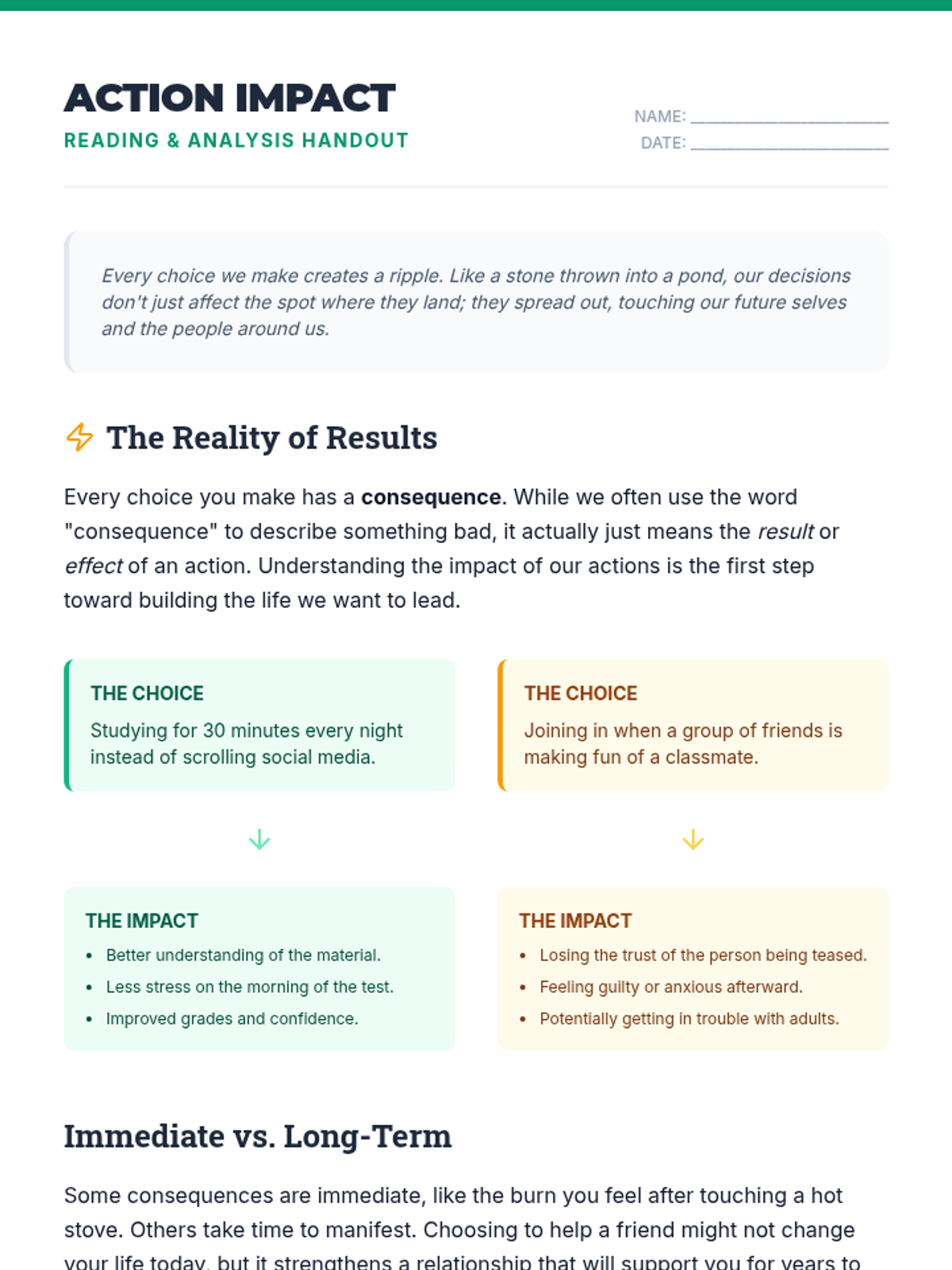
An engaging reading handout that explores the concept of consequences with concrete examples and reflection prompts.
A visual presentation to guide the 'Choices and Consequences' lesson, covering key definitions, discussion prompts, and a placeholder for the instructional video.
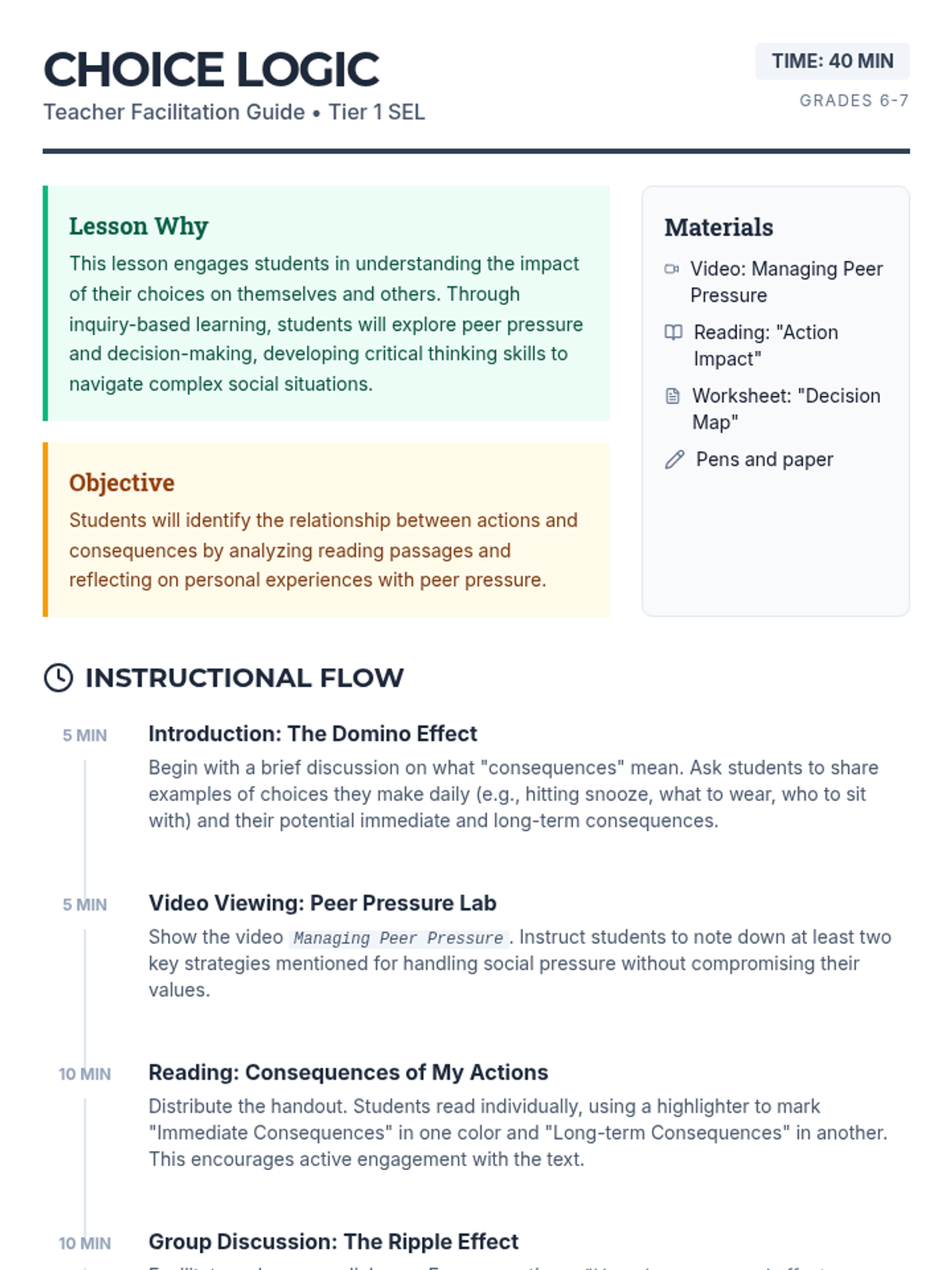
A comprehensive teacher facilitation guide for the 'Choices and Consequences' lesson, featuring a timed instructional flow and inquiry-based discussion prompts.
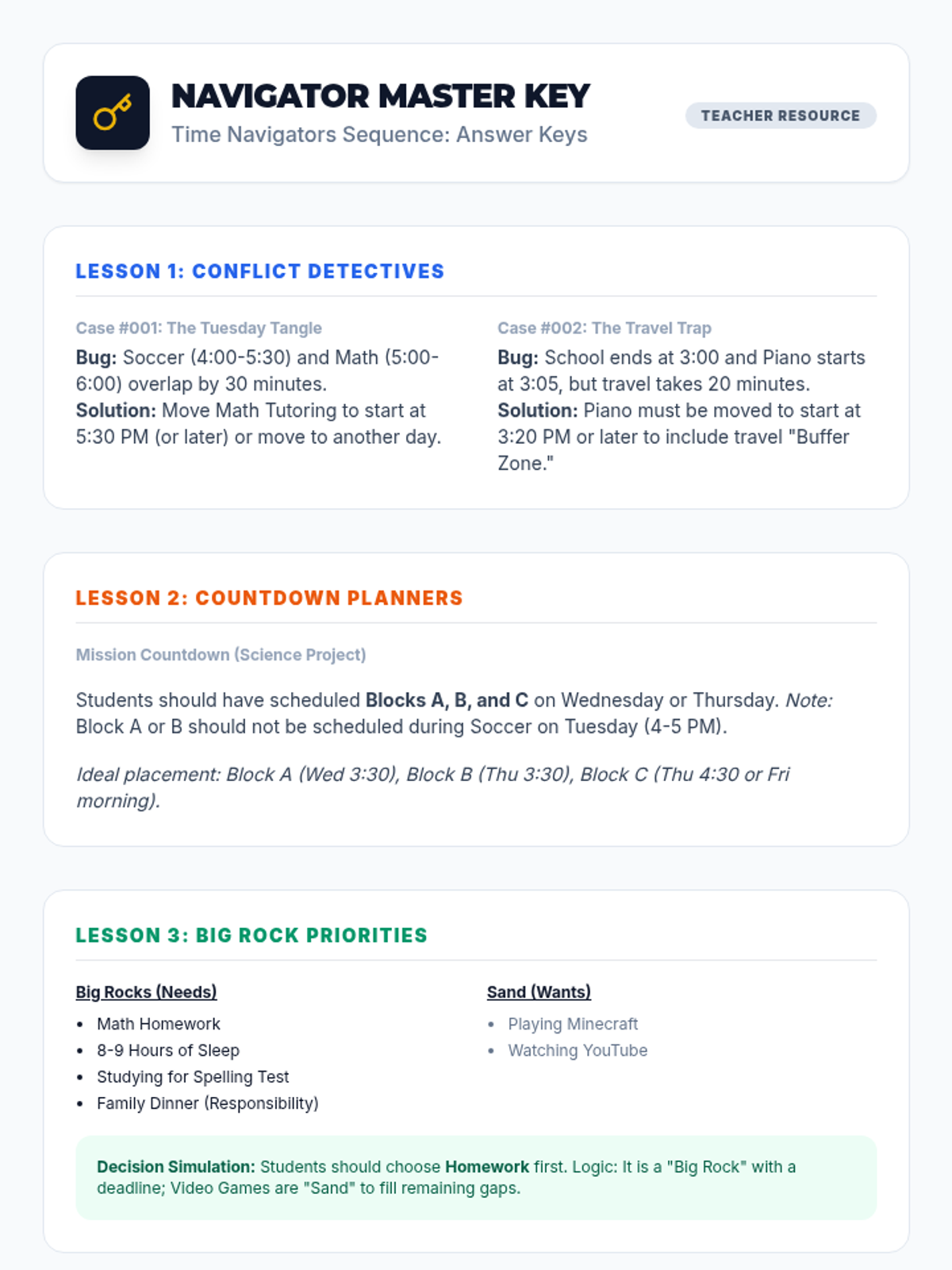
Answer key for all lesson worksheets in the Time Navigators unit, providing teachers with clear solutions for the Case Studies, Priority Sorts, and Schedule Audits.
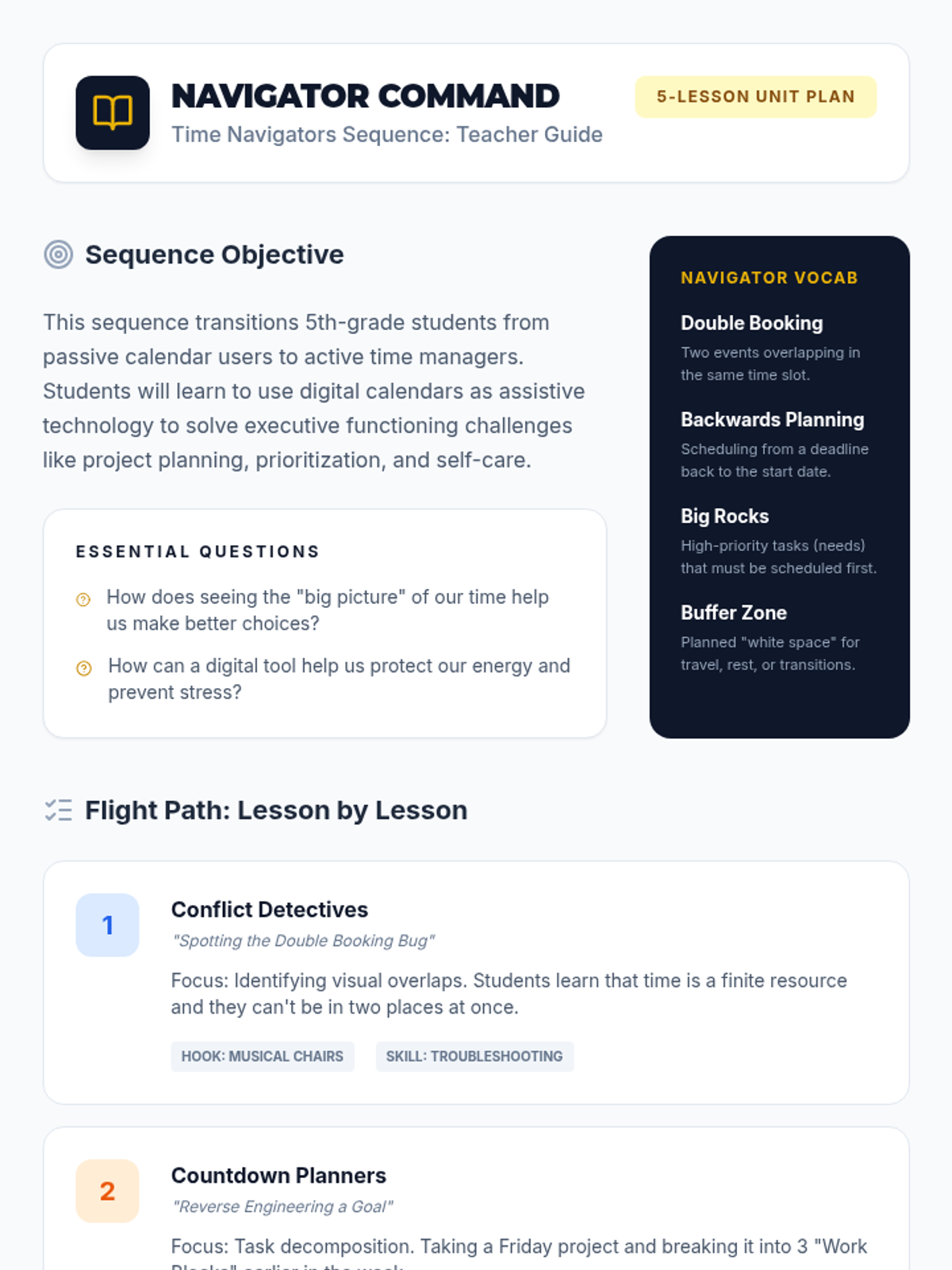
Comprehensive instructional guide for teachers, providing a sequence overview, key vocabulary, lesson breakdowns, and specific assistive technology/Special Education strategies for the unit.
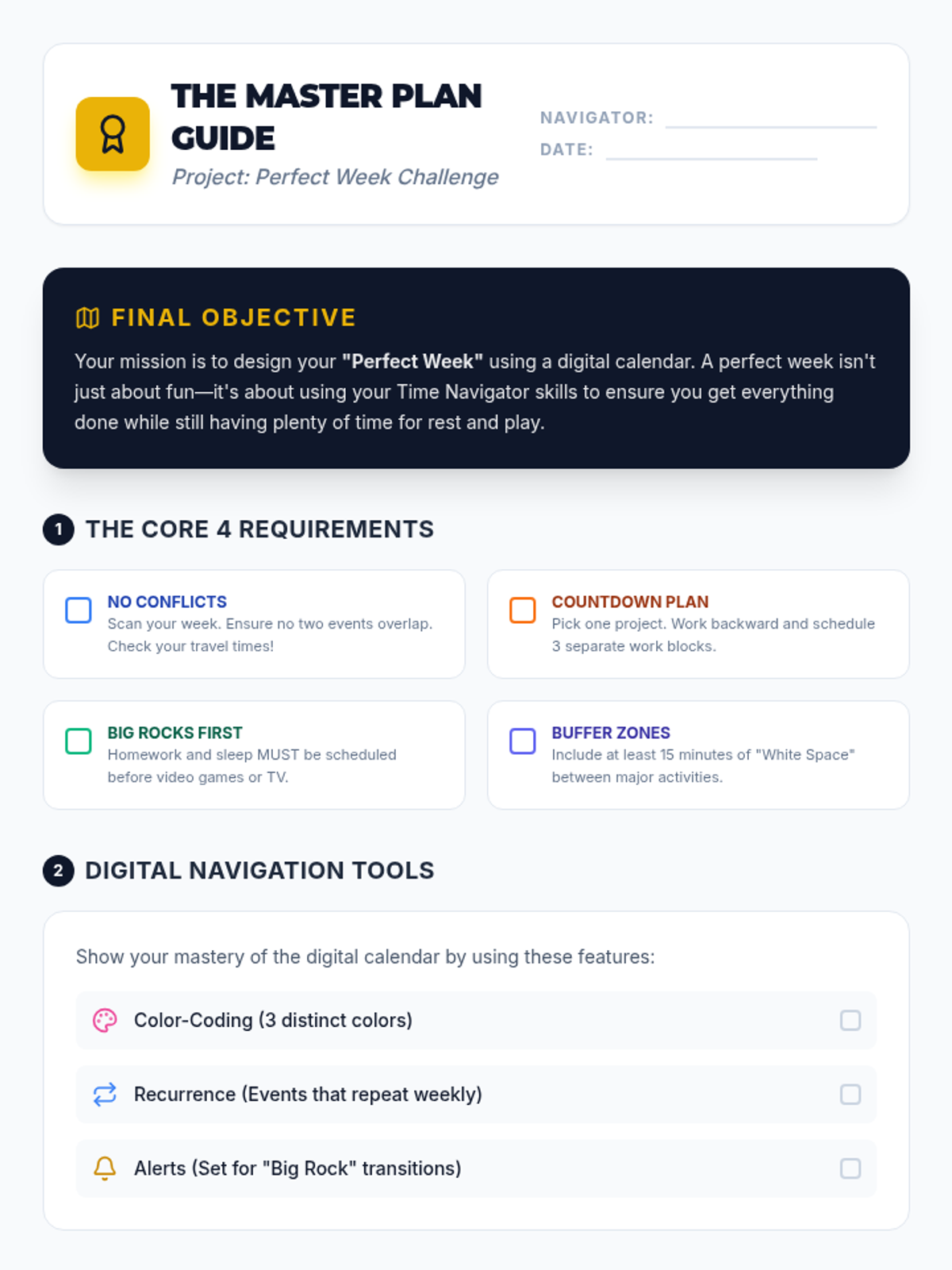
Final project guide for Lesson 5, outlining the 'Perfect Week' requirements (Conflicts, Countdown, Priorities, Buffers) and providing a comprehensive scoring rubric and self-reflection area.
Introductory presentation for the final project, summarizing the four core skills of the Time Navigators unit and outlining the 'Perfect Week' requirements and rubric.
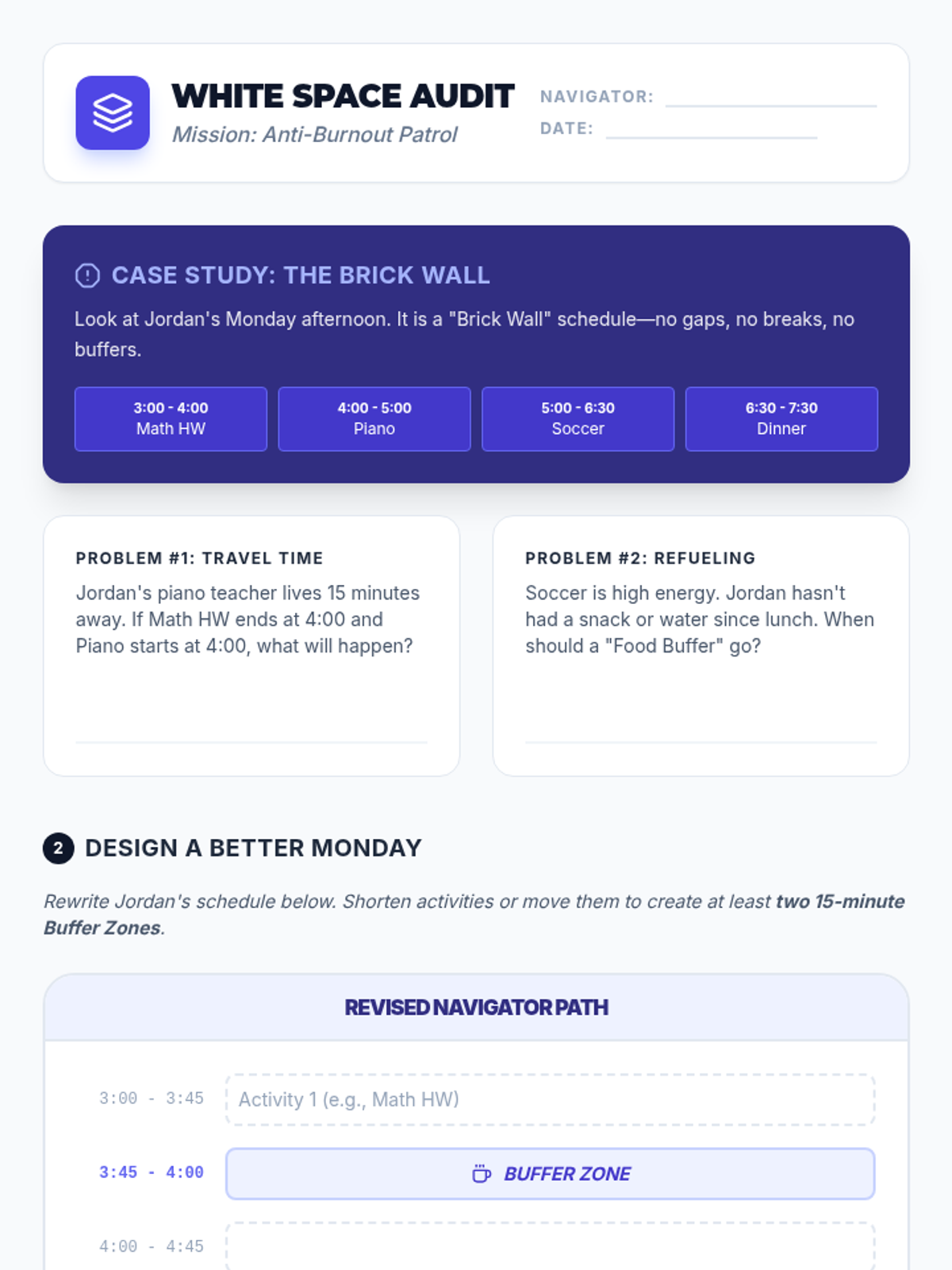
Worksheet for Lesson 4 where students audit a 'brick wall' schedule and practice inserting buffer zones to prevent burnout and account for travel time.
Slides for Lesson 4, using a 'Mission Countdown' theme to explain the concept of buffer time and self-care to prevent burnout on a digital calendar.
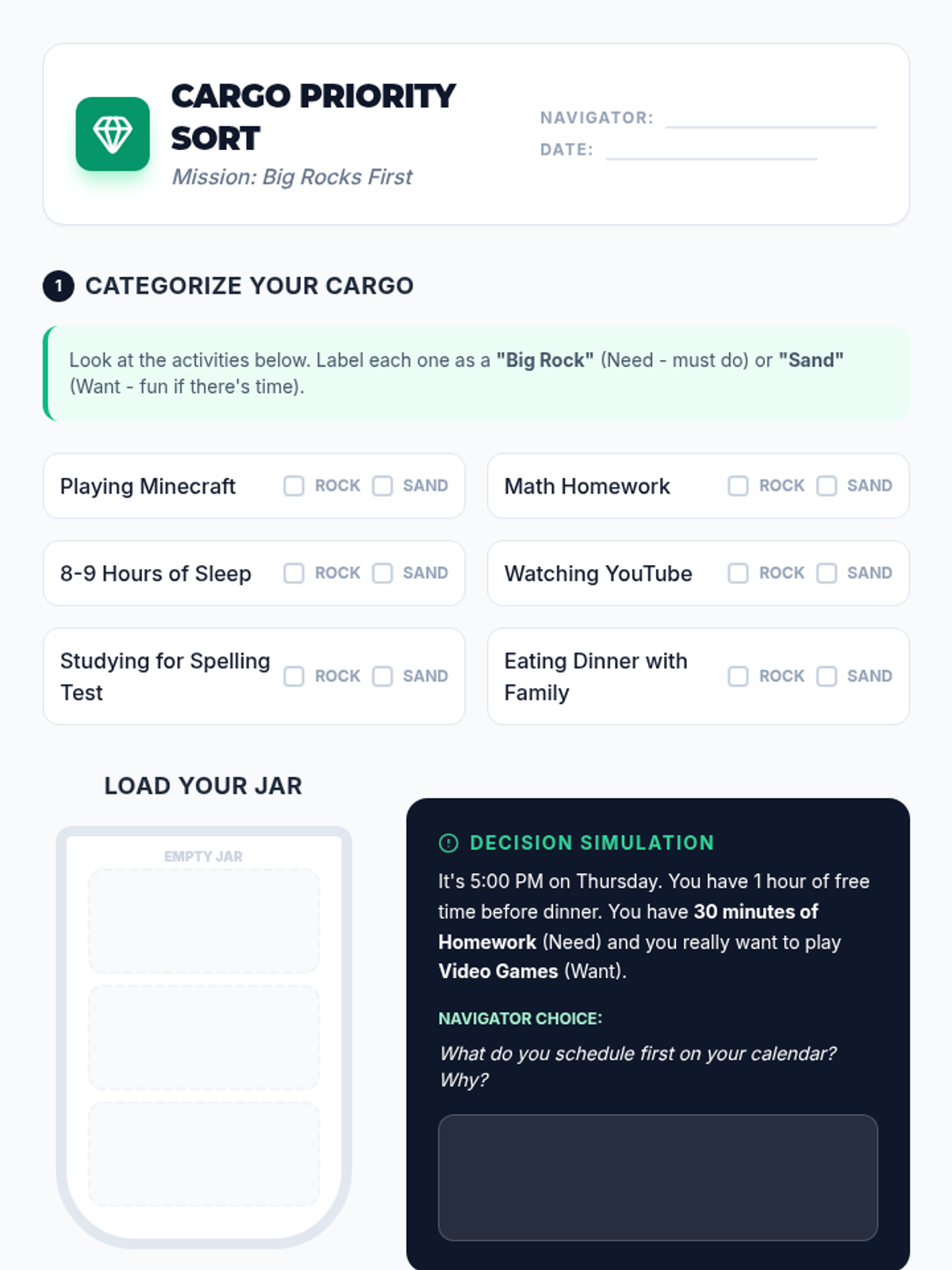
Worksheet for Lesson 3 where students practice categorizing tasks as 'Big Rocks' (needs) or 'Sand' (wants) and visualize fitting them into their daily schedule.
Slides for Lesson 3, using a 'Big Rocks' analogy to teach students how to prioritize essential tasks (needs) over non-essential activities (wants) on their digital calendars.
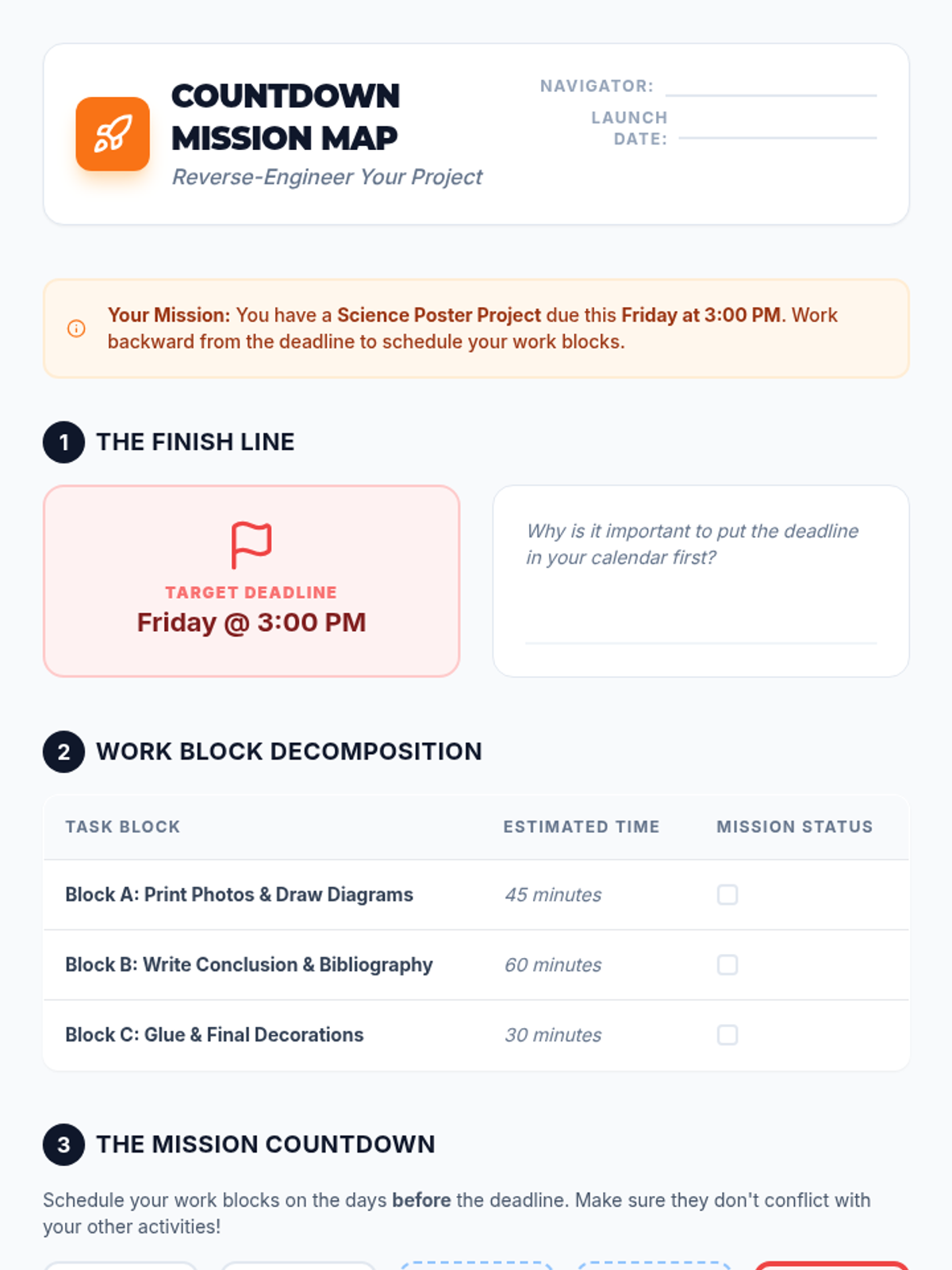
Worksheet for Lesson 2 where students practice backward planning for a Science Project, decomposing tasks and scheduling work blocks leading up to a Friday deadline.
Slides for Lesson 2, using a 'Mission Countdown' theme to explain the concept of backward planning and task decomposition using a pizza party analogy.
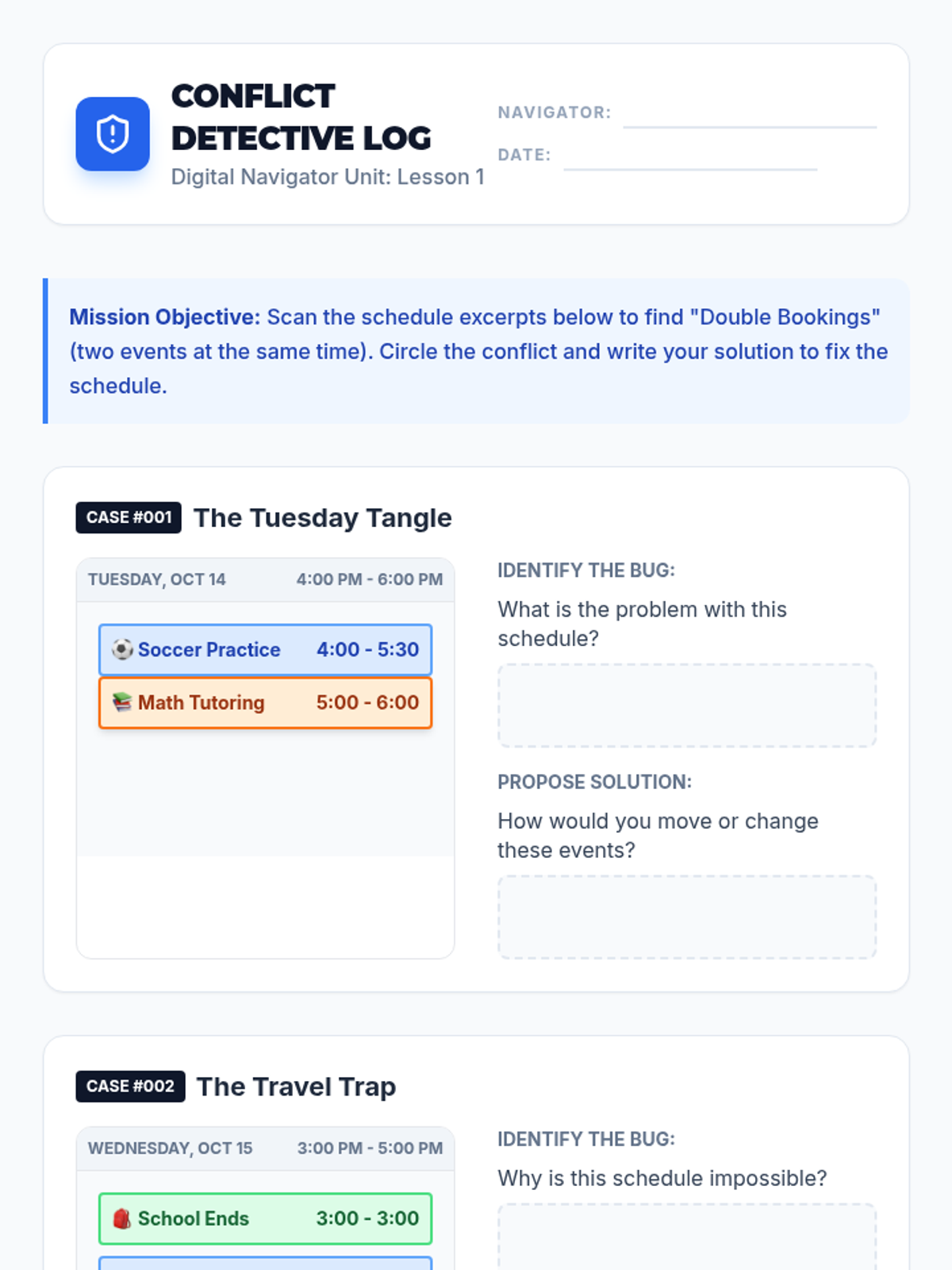
Student worksheet for Lesson 1, featuring two 'case studies' of calendar conflicts for students to identify and resolve. Includes a reflection section on checking for 'Double Bookings'.
Introductory presentation for Lesson 1, using a Mission Control theme to explain calendar conflicts and the 'double-booking' concept through visual analogies.
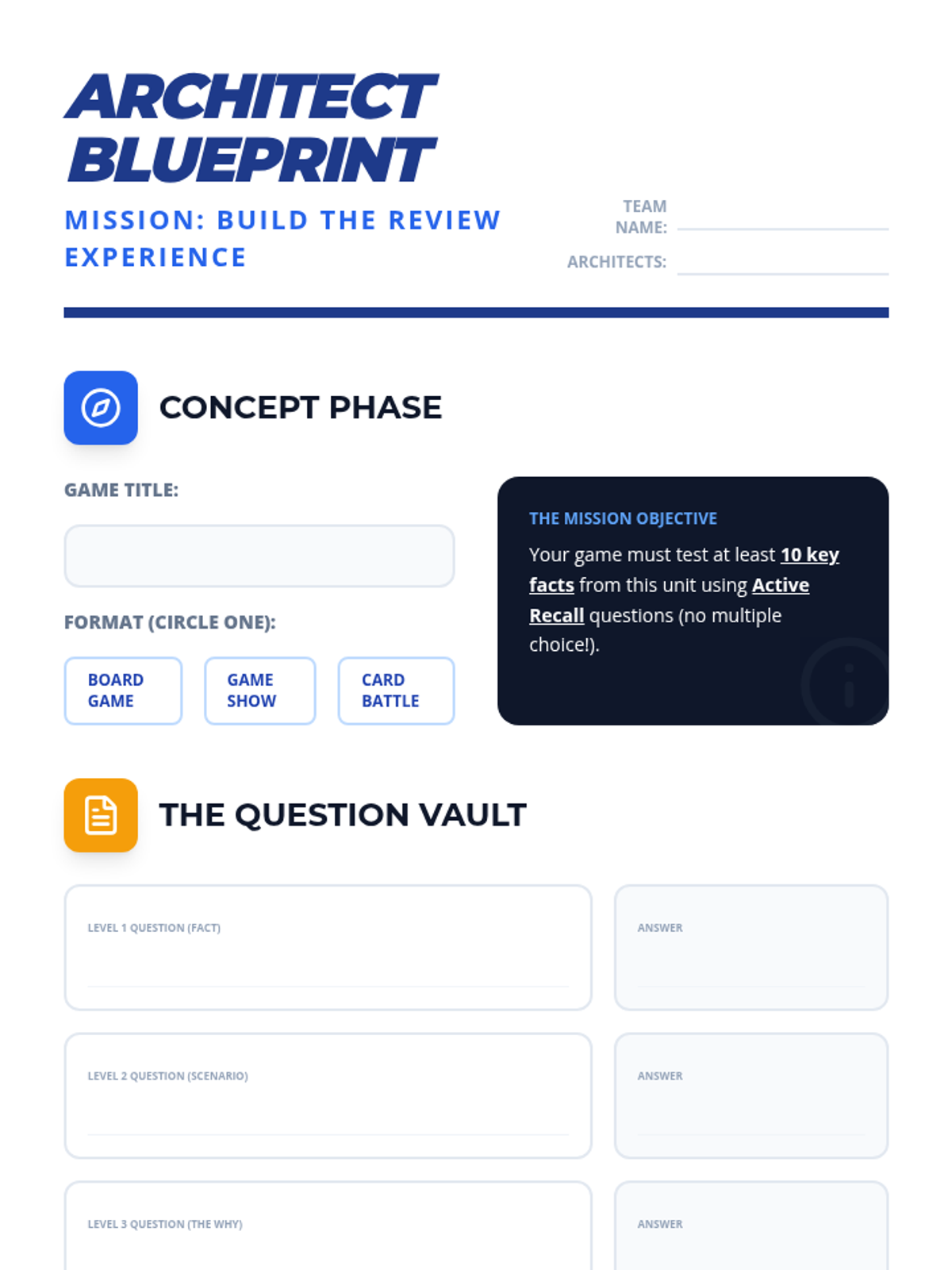
A planning guide and tracking sheet for the final project in Lesson 5, where students design their own review games and play-test them with peers.
A slide deck for Lesson 5 that guides students through the process of designing a review game, focusing on question types and game formats.
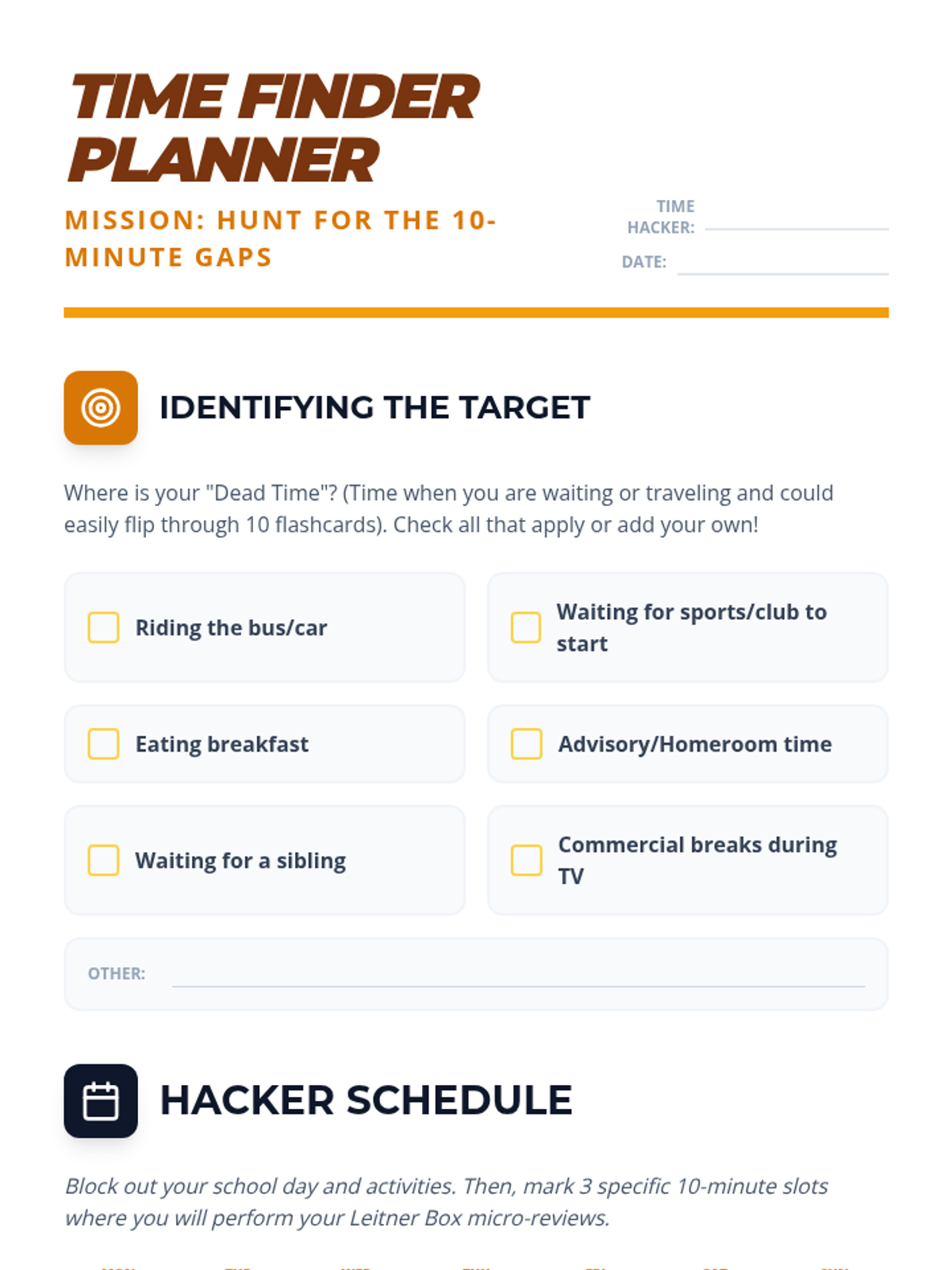
A time-management worksheet where students identify 'dead time' in their weekly schedules and commit to specific 10-minute micro-review slots.
A slide deck for Lesson 4 that introduces the concept of 'micro-reviews' and helps students identify pockets of time for spaced repetition.