Written and verbal communication standards for the workplace, including email etiquette, presentation delivery, and professional phone conduct. Develops collaborative skills for teamwork, constructive feedback, and efficient time management.
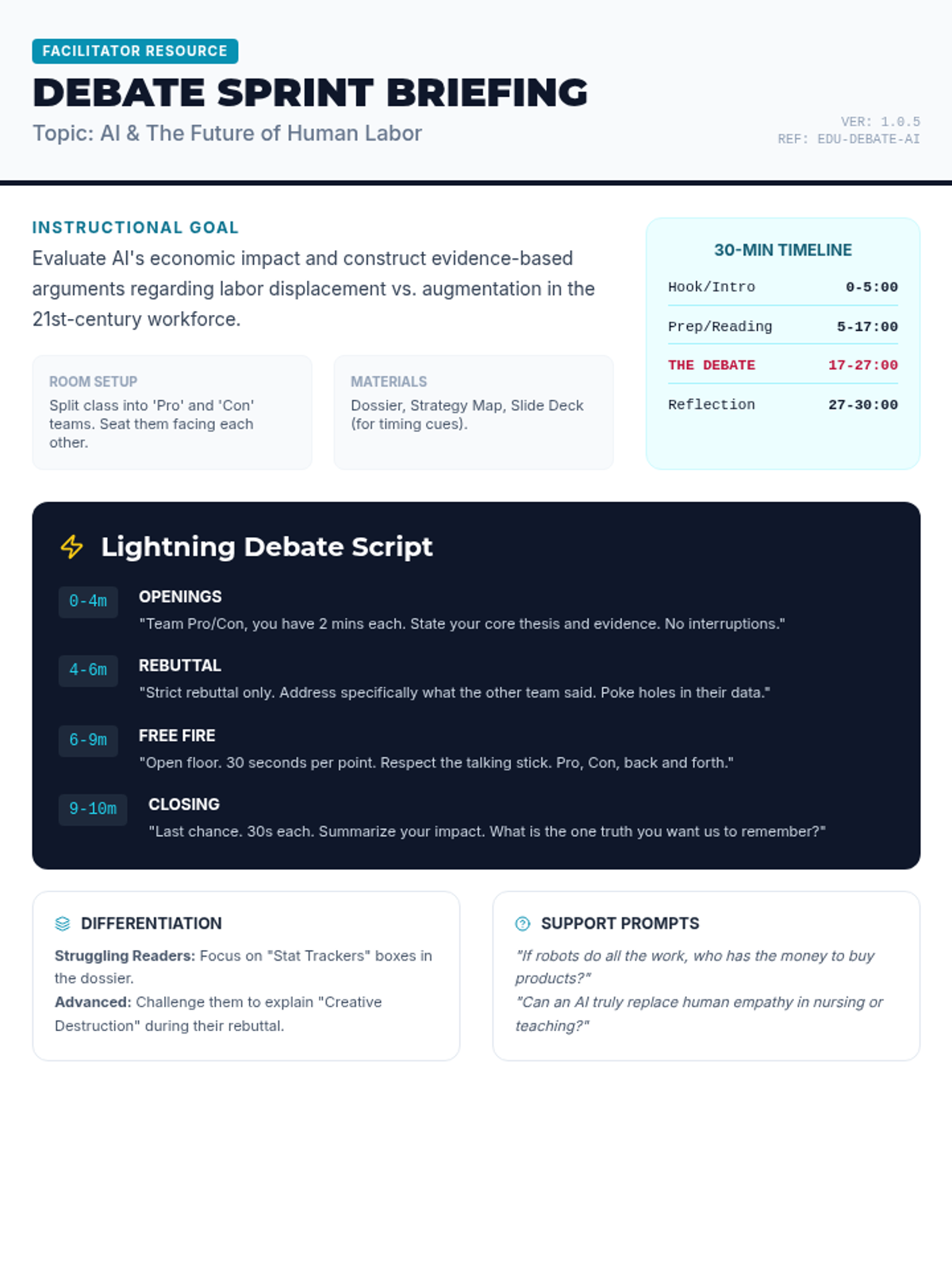
A comprehensive teacher's guide for facilitating the 30-minute 'Future Work Debate,' including a minute-by-minute script for the 'Lightning Debate' and tips for differentiation. Tightened to fit on a single page.
A 6-slide presentation deck designed to facilitate a 30-minute debate session, featuring clear timing, phases of the 'lightning' debate, and ground rules for middle school students.
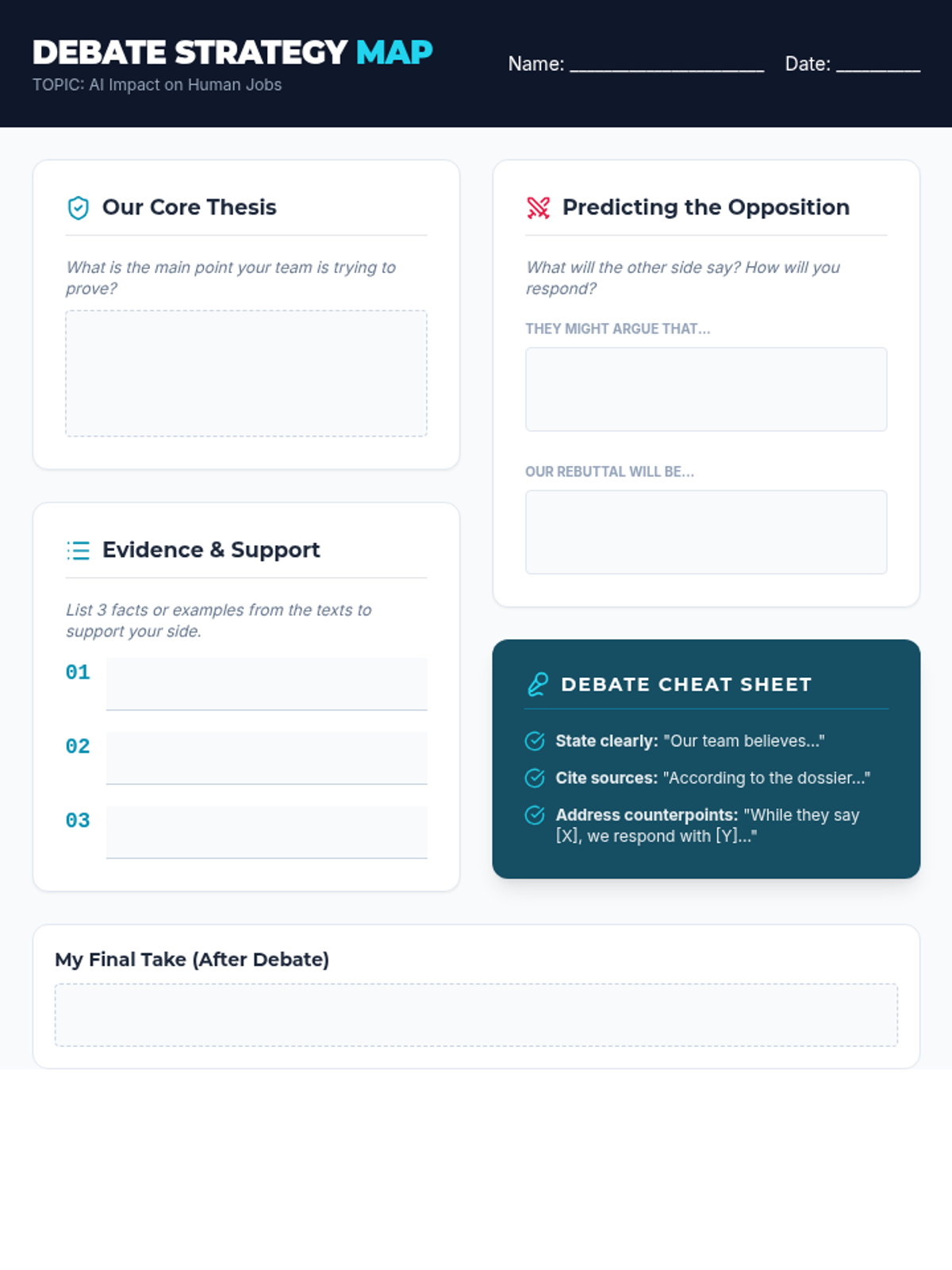
A structured graphic organizer for students to prepare their debate arguments, including sections for thesis development, evidence collection, and predicting counter-arguments.
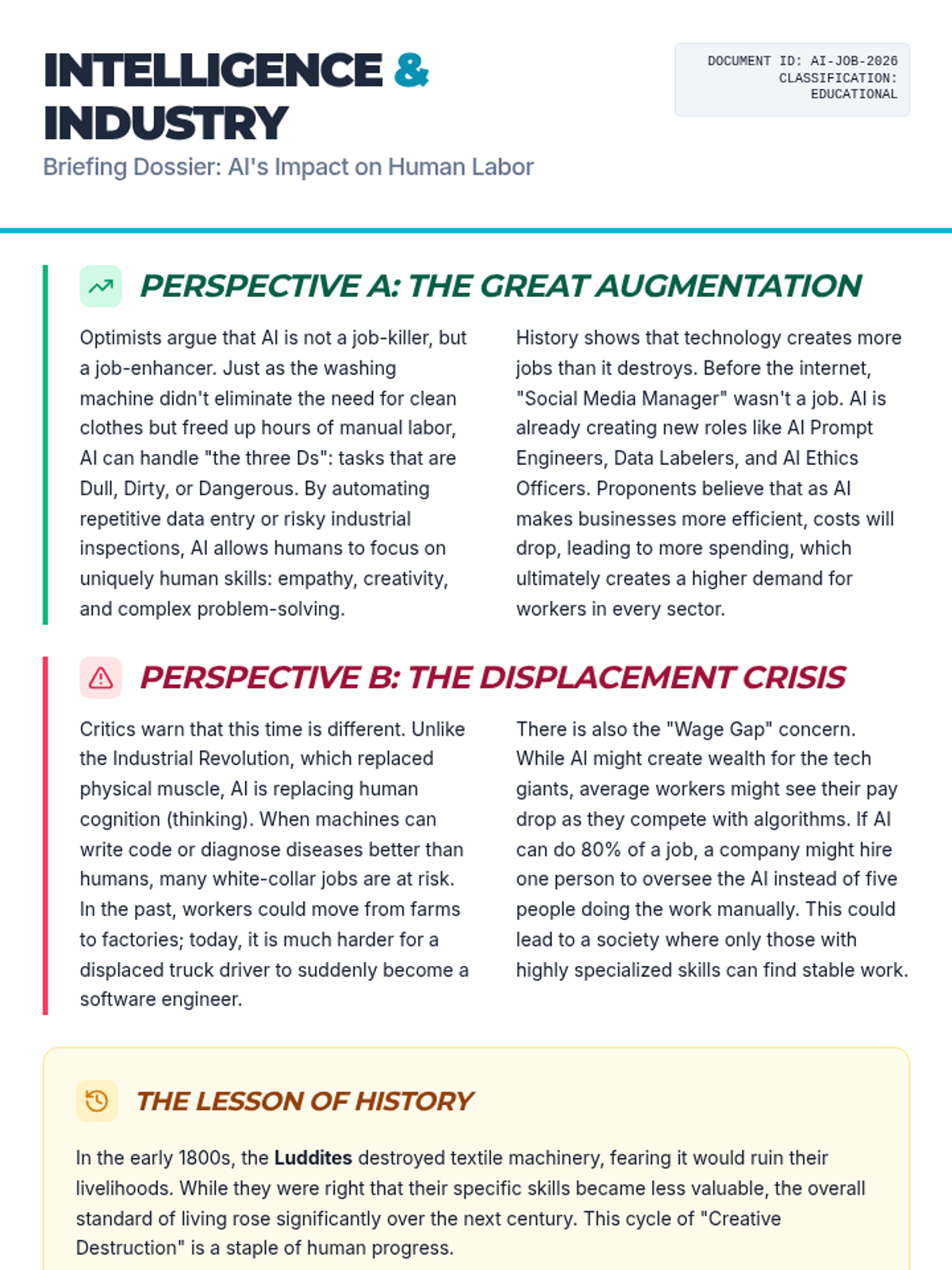
A two-page informational text dossier providing three distinct viewpoints on AI's impact on employment: the optimistic view of augmentation, the critical view of displacement, and the historical context of technological shifts.
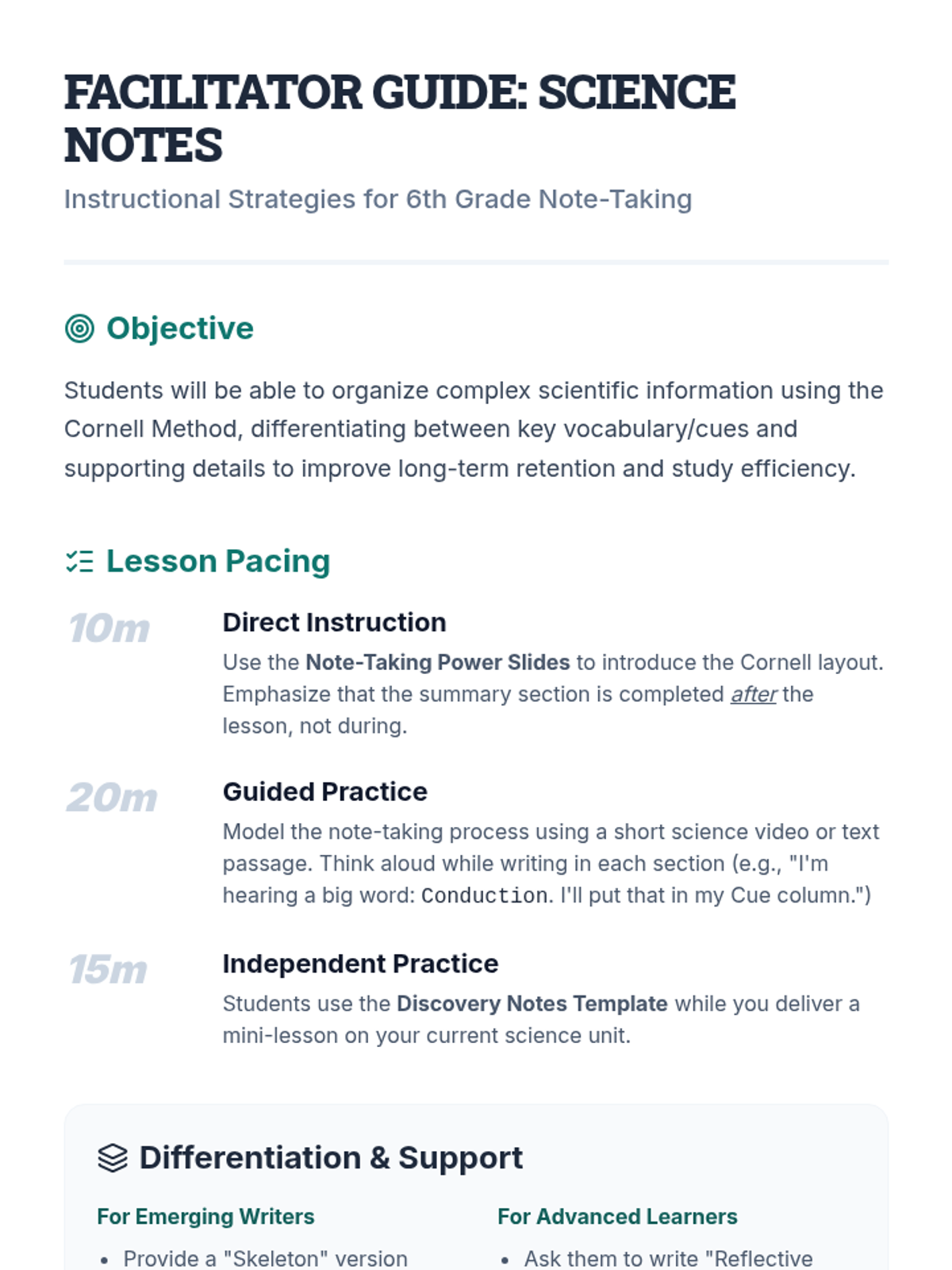
A teacher-facing facilitation guide providing instructional strategies, pacing suggestions, and differentiation tips for teaching the Cornell note-taking method in a 6th-grade science classroom.
A colorful and informative slide deck that introduces 6th-grade students to the Cornell note-taking method, updated to show the clean summary layout and Sketch Zone.
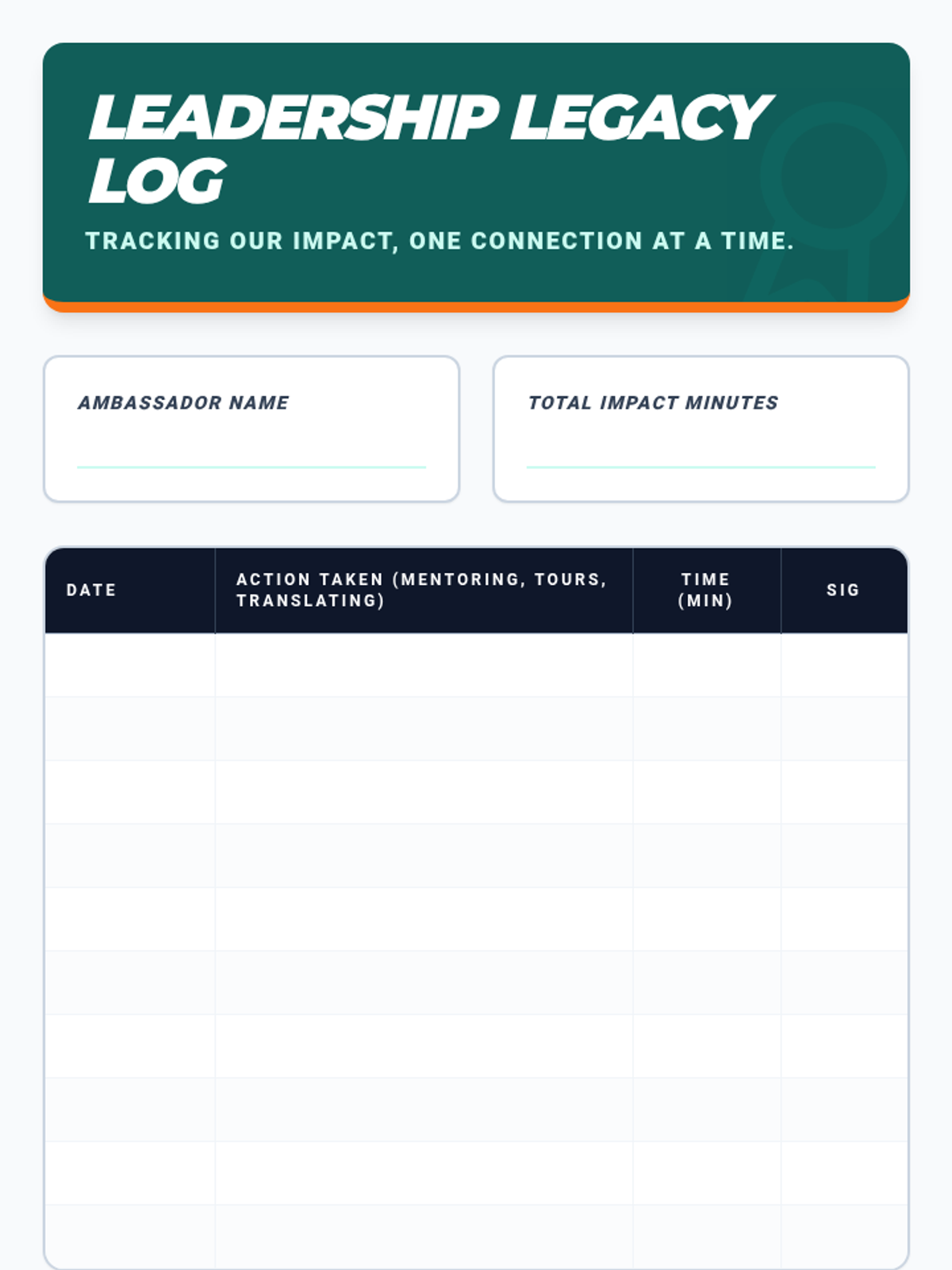
A tracking log for student ambassadors to record their leadership activities, impact hours, and monthly reflections on community growth.
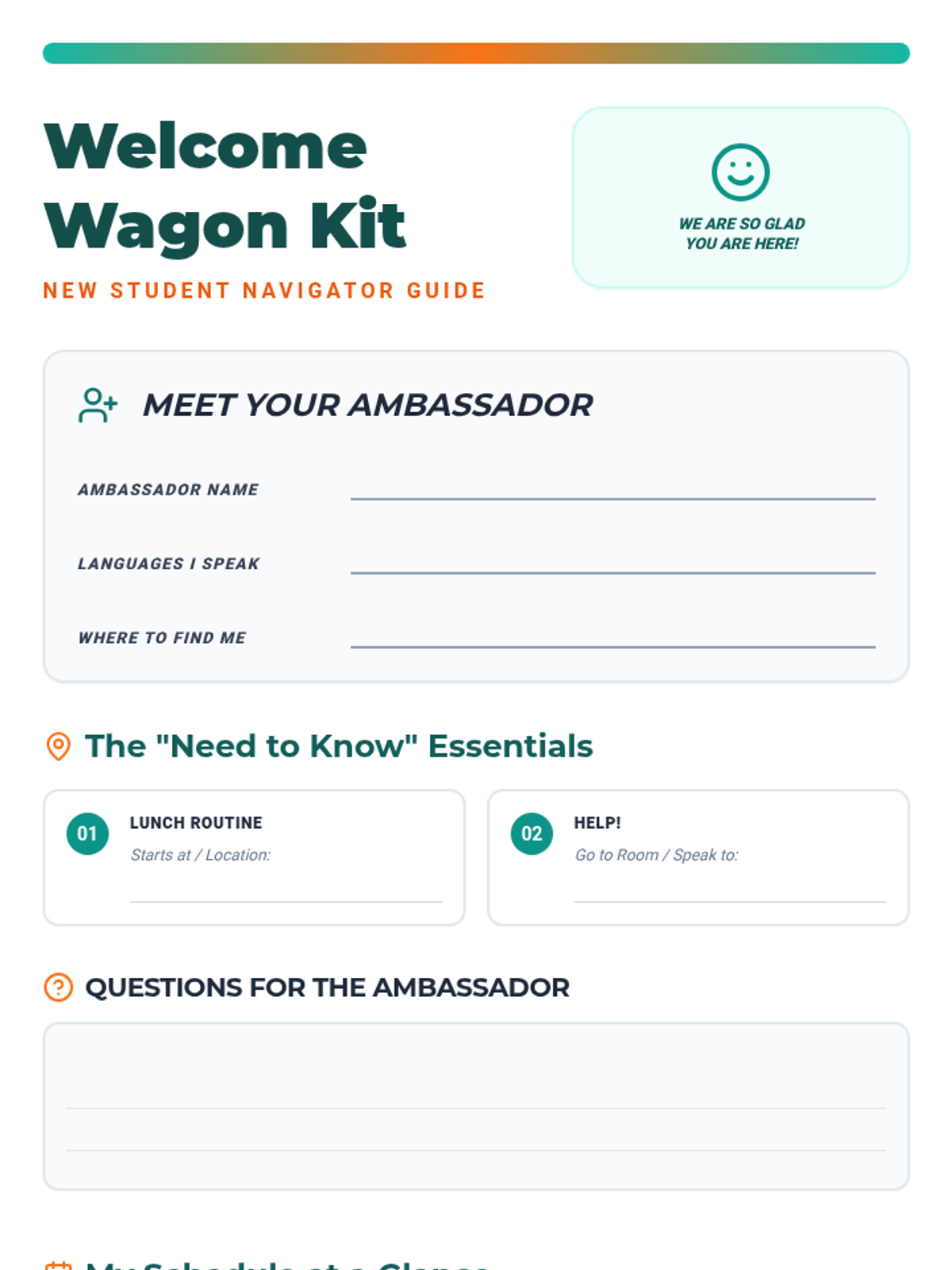
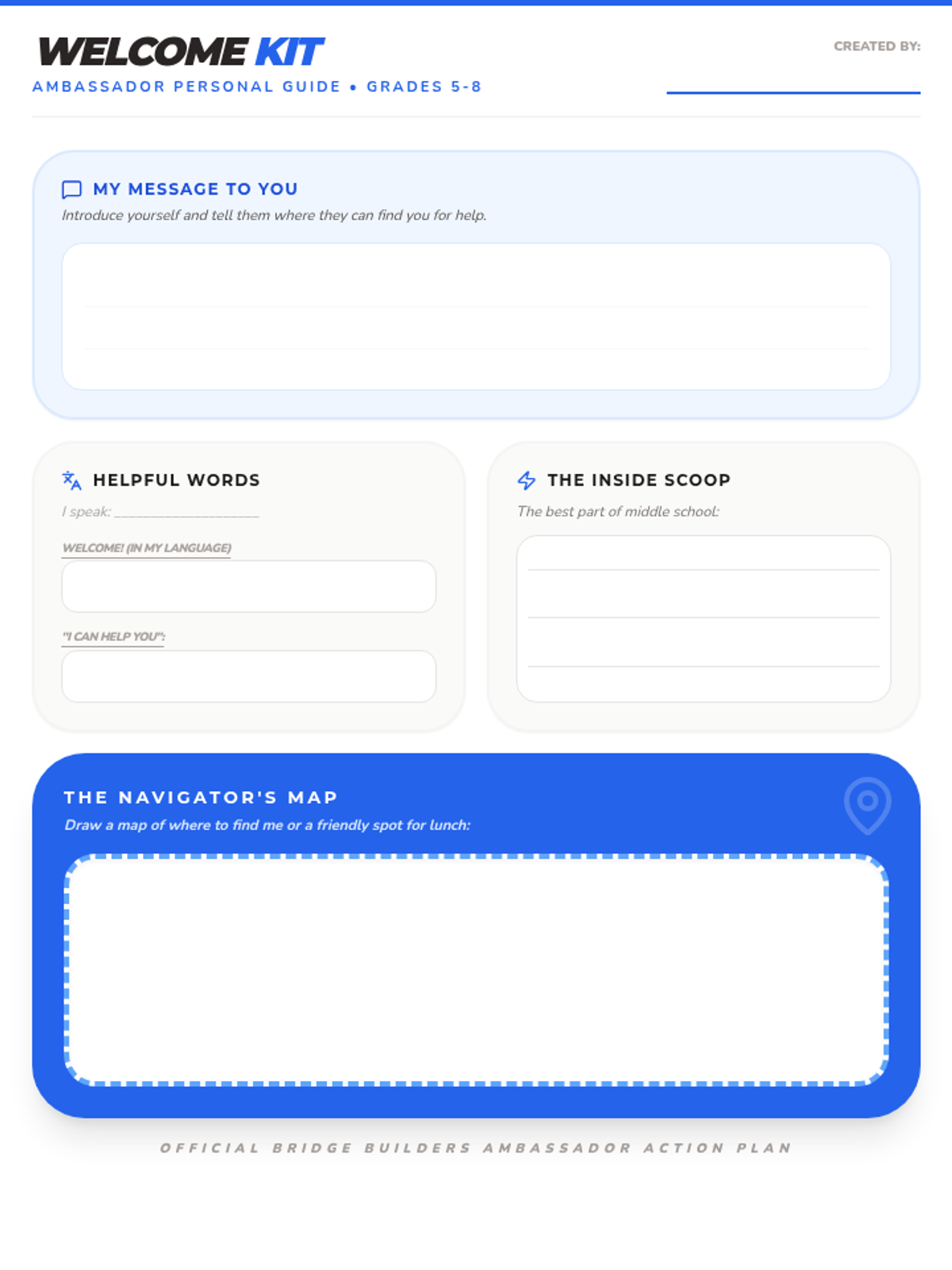
A welcoming and functional toolkit for new EL students, designed to be filled out with their student ambassador to ease the transition into school.
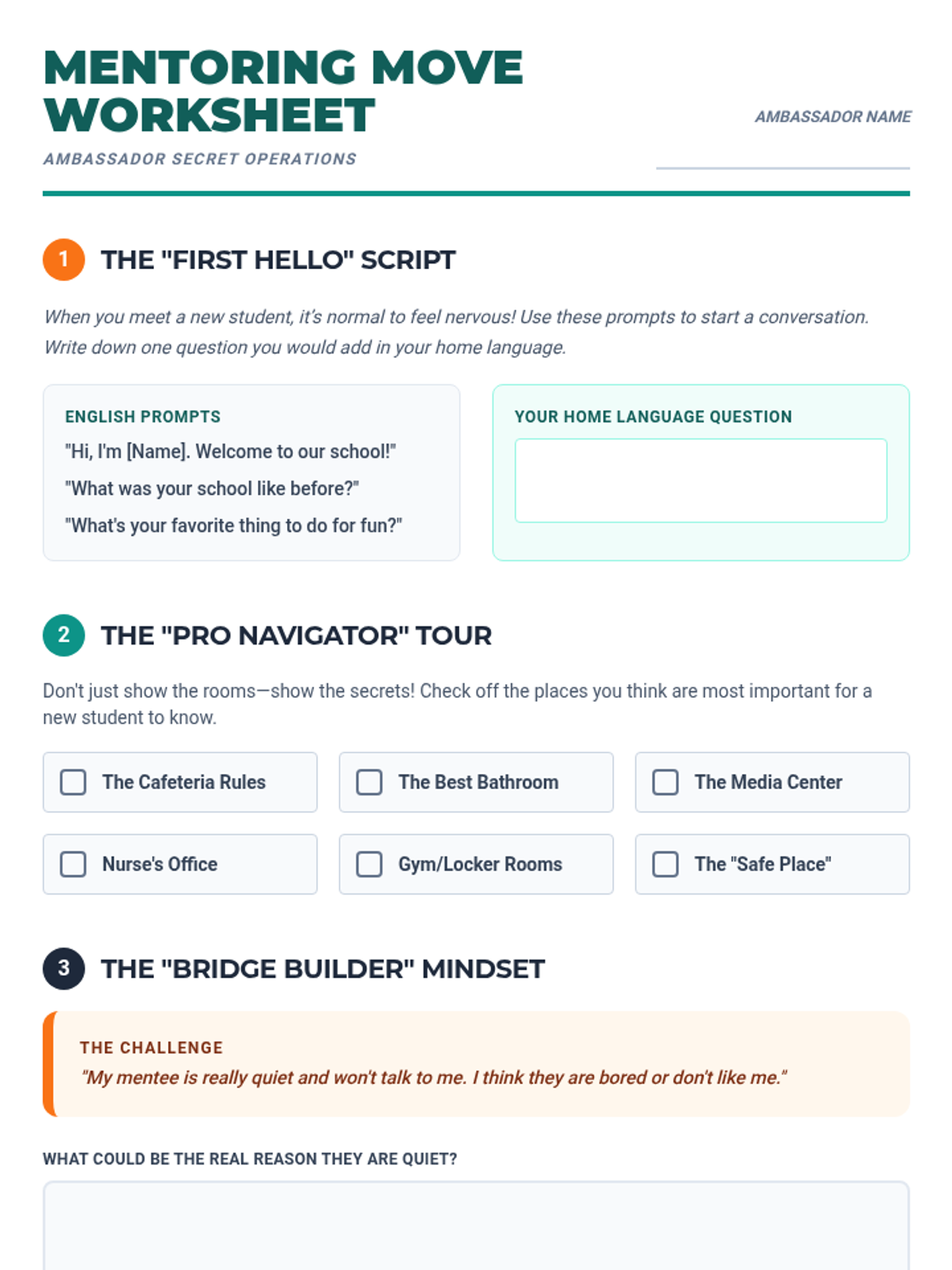
A practical worksheet for student ambassadors to plan their first interactions with mentees, including script building and problem-solving scenarios.
A high-energy slide deck for training student ambassadors on mentoring skills, school culture, and leadership scenarios.
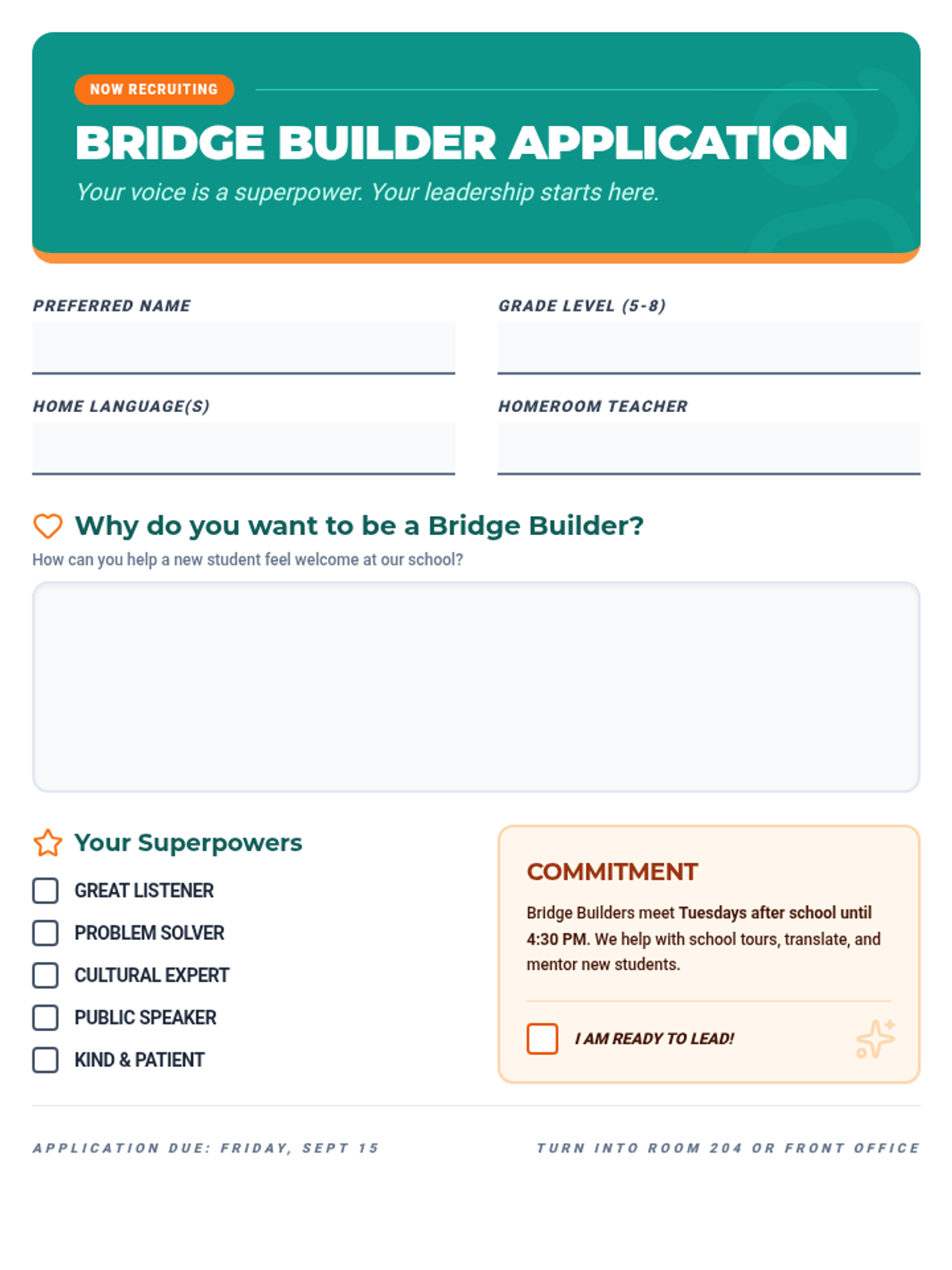
A visually engaging student application form for the Bridge Builders program, focusing on strengths and interest in peer leadership.
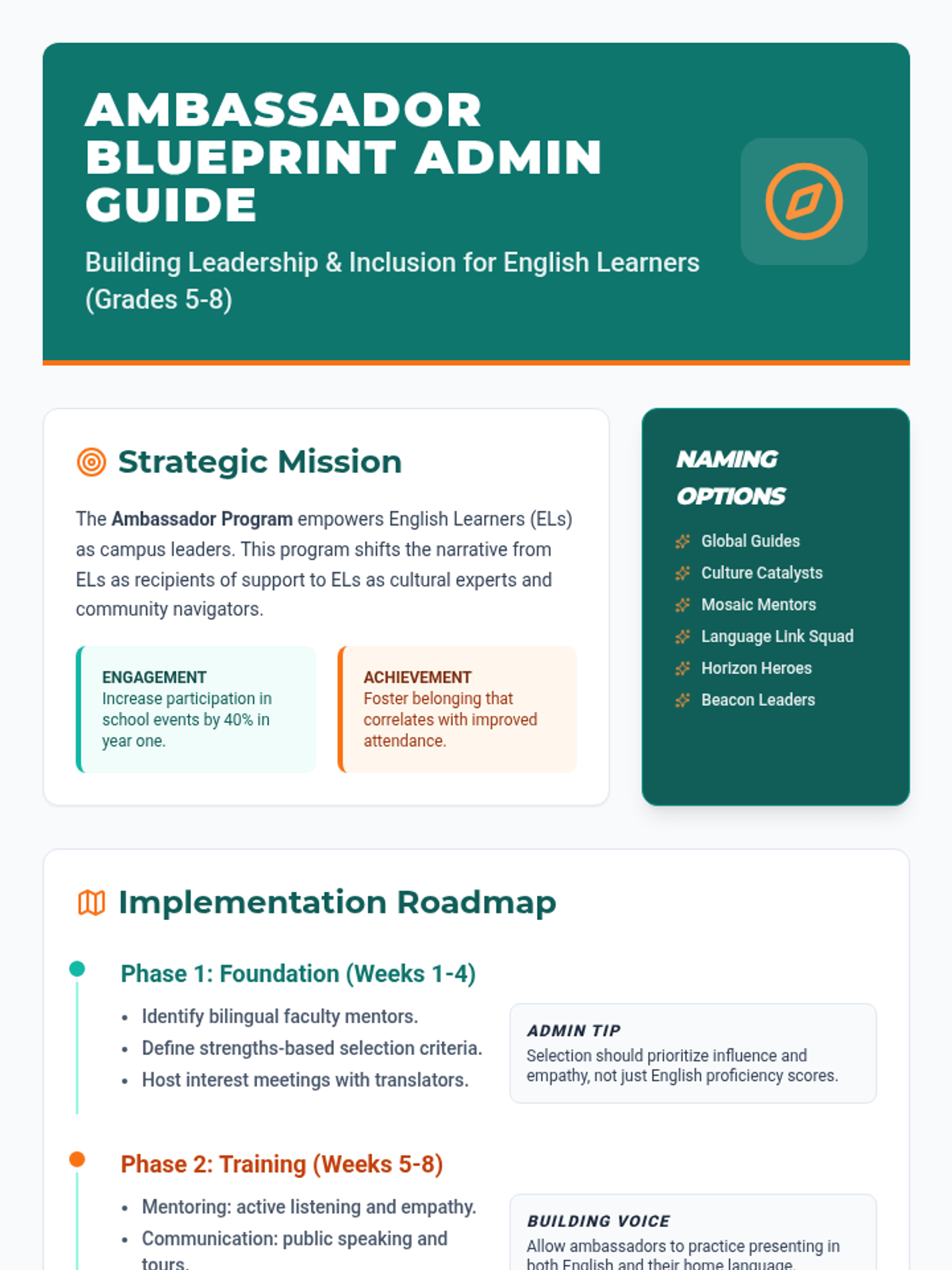
A comprehensive administrative roadmap for establishing and sustaining an EL ambassador program, including phased implementation, barrier-reduction strategies, naming options, and impact metrics.
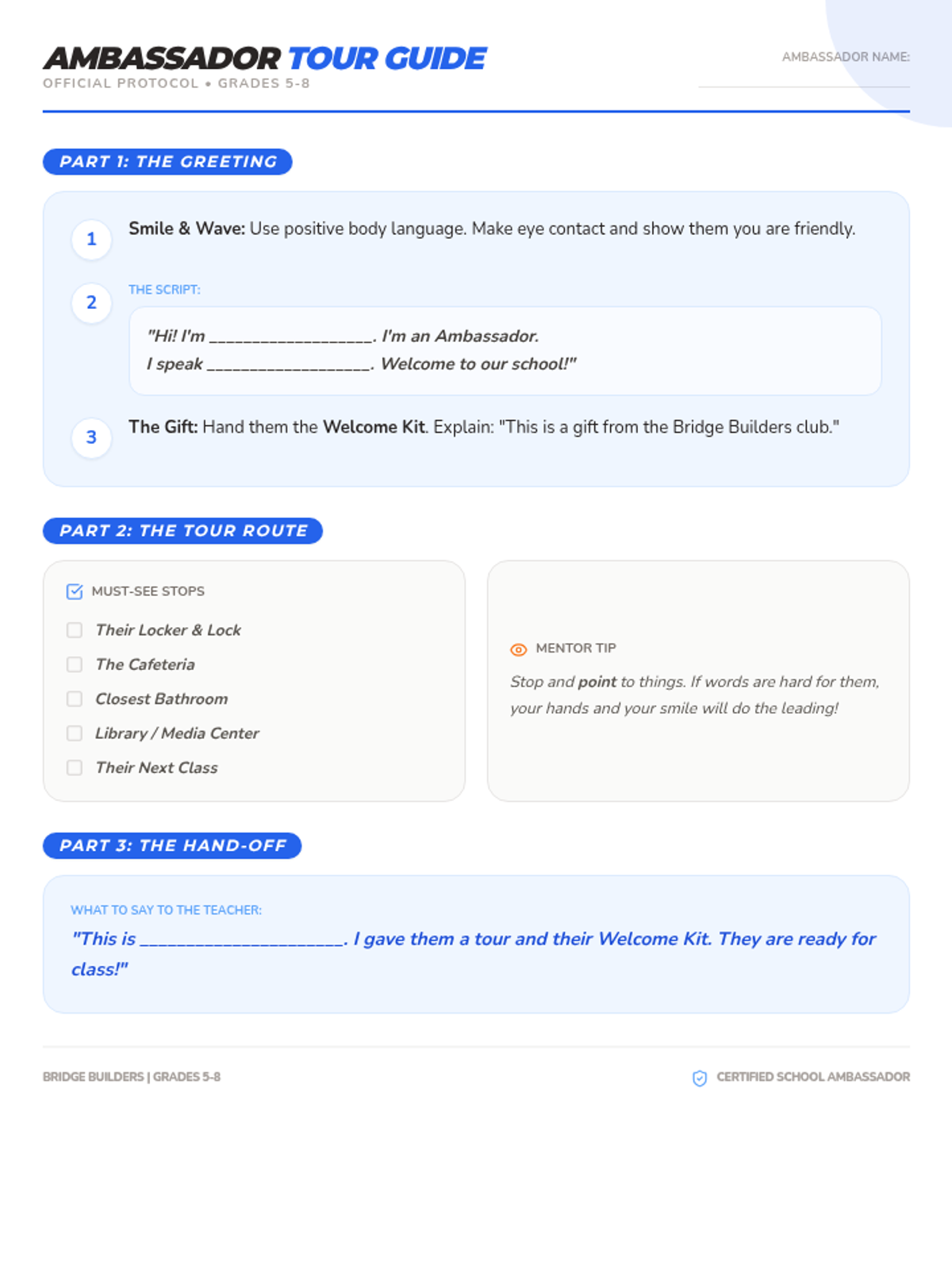
A printable script and checklist for student ambassadors to use when greeting new students and giving school tours. Geared specifically for grades 5-8 with fill-in-the-blank scripts and checkable stops.
Final celebration slides for the Bridge Builders sequence, including the launch protocol, admin matching process, and tour expectations for grades 5-8.
A project template for students to create a personalized 'Welcome Kit' to be given to new English Learners. Geared towards grades 5-8 with a focus on 'inside scoop' and tour mapping.
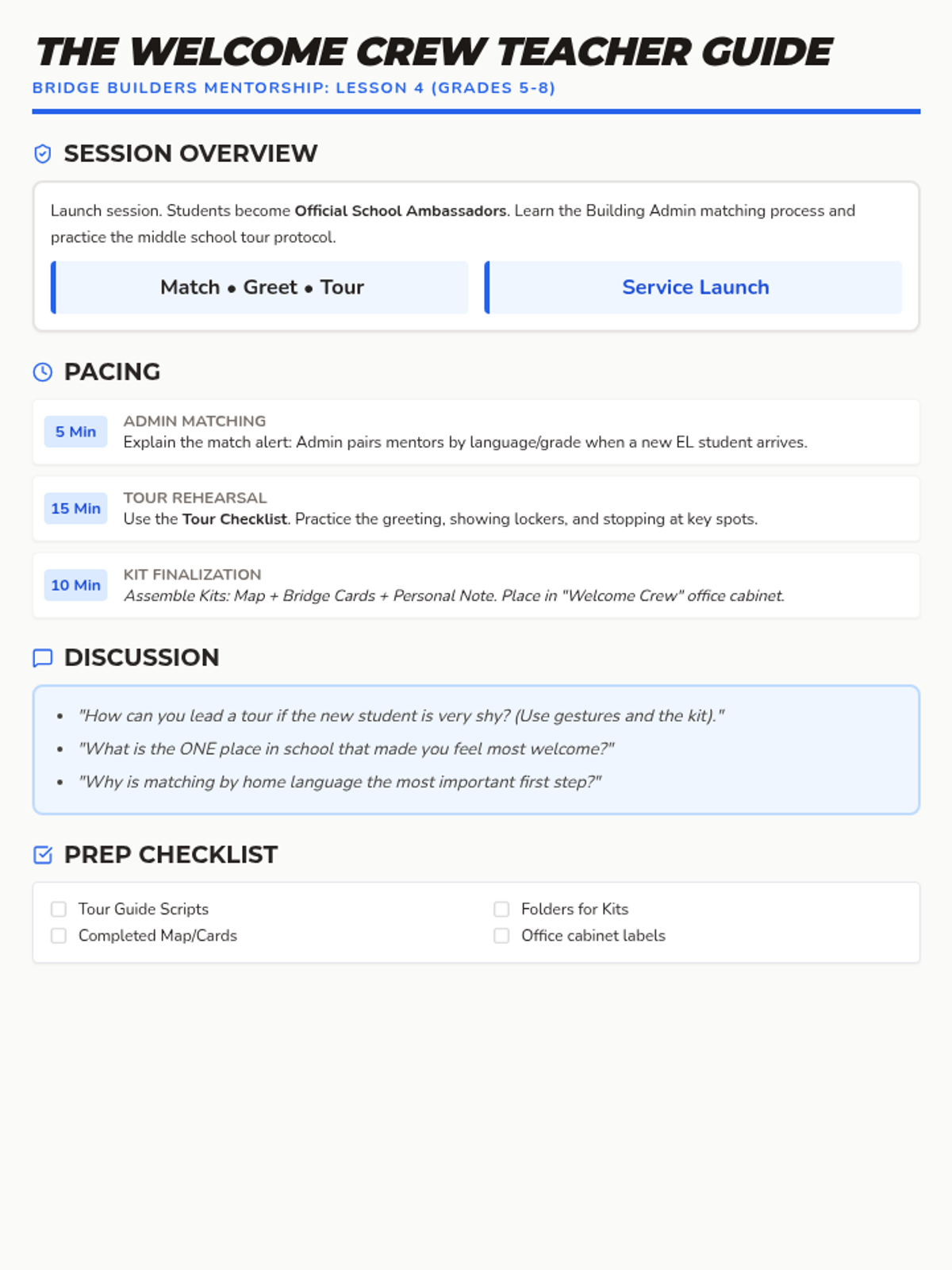
A facilitation guide for the final meeting of the Bridge Builders sequence, focusing on service launch, school-wide ambassador protocols, and tour practice for grades 5-8.
Visual presentation for the third meeting of the Bridge Builders sequence, focusing on navigating school systems and mental mapping.
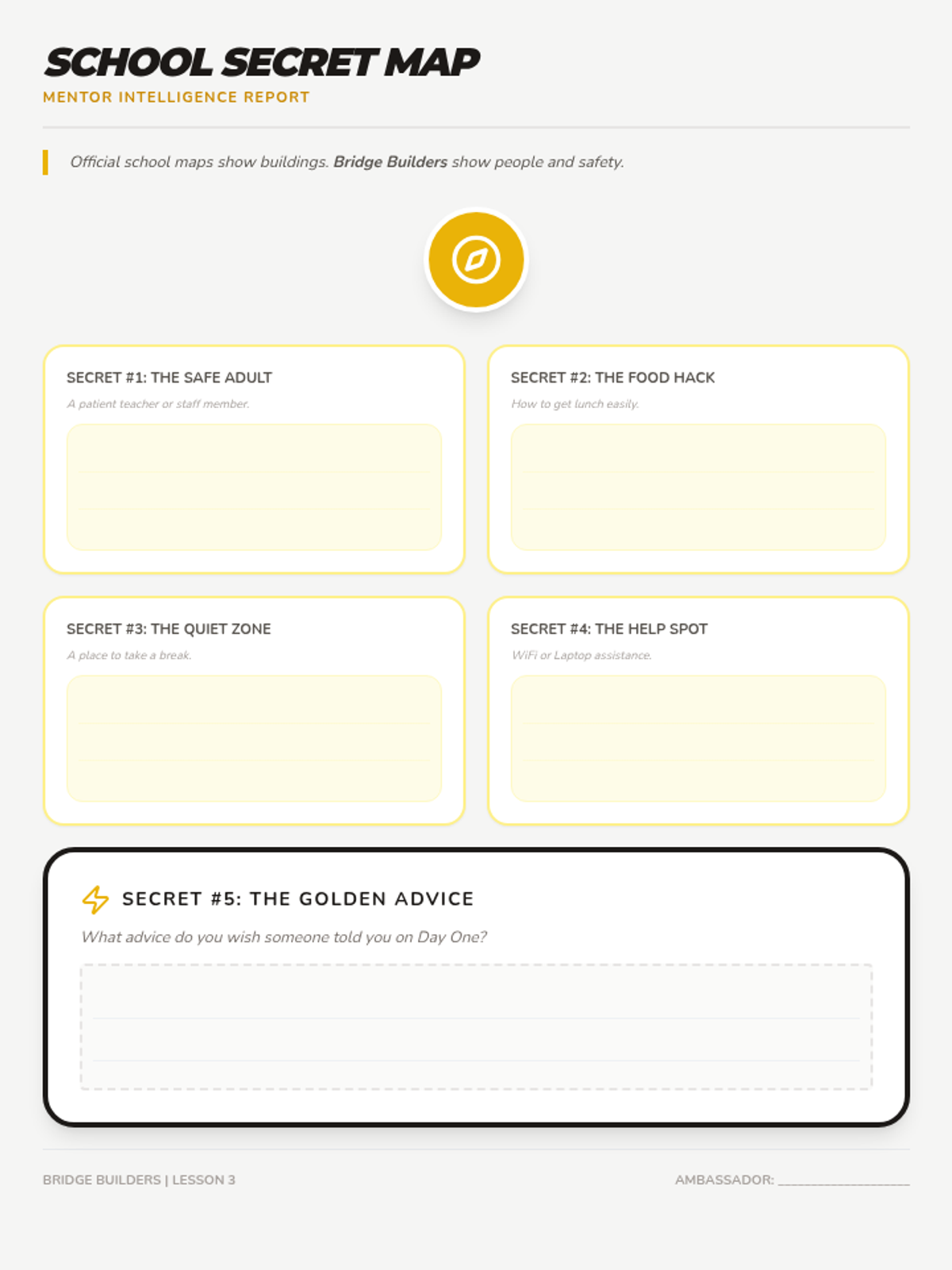
A worksheet for identifying key people, places, and advice to share with new students as part of a mentor's support toolkit.
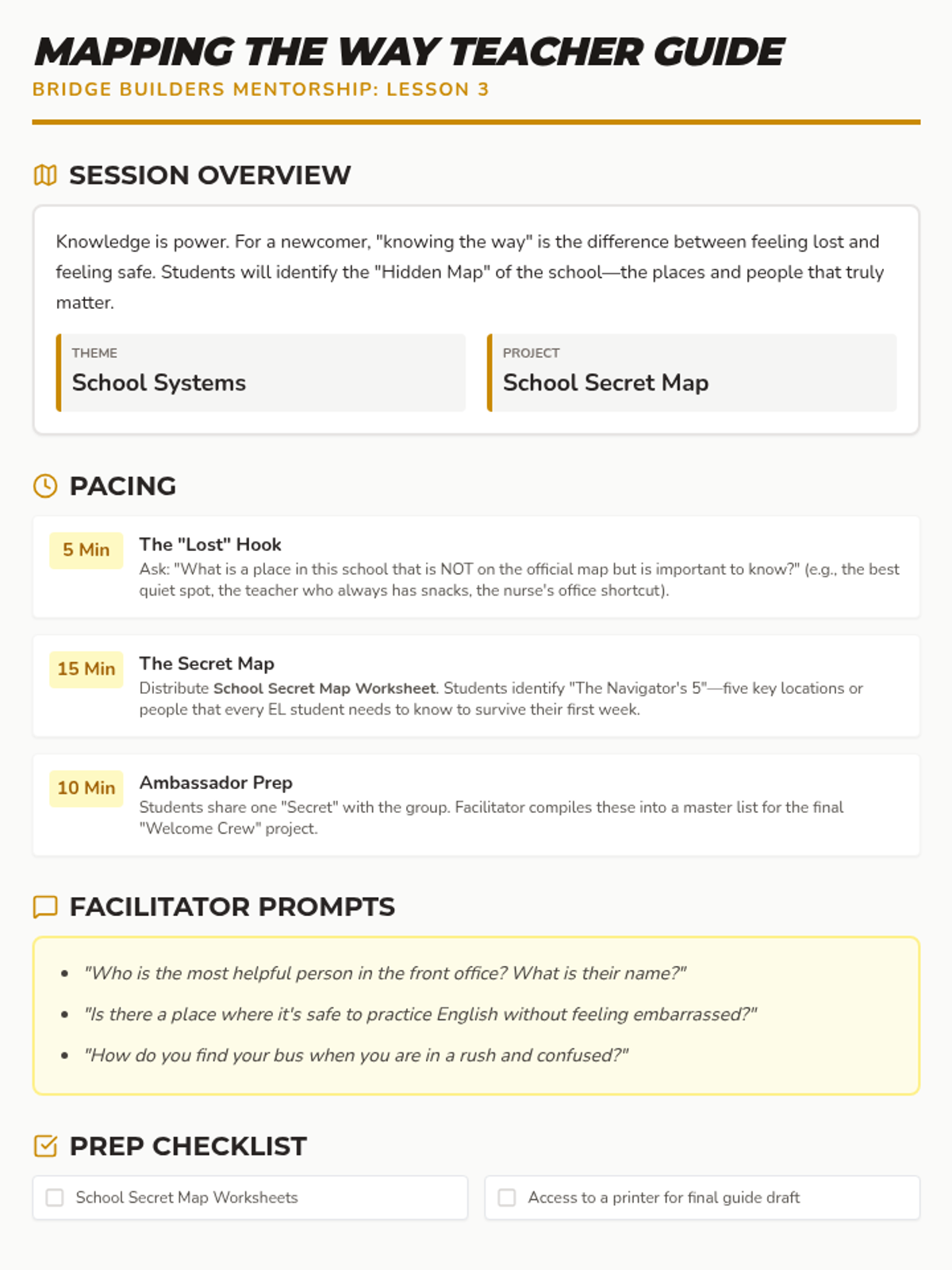
A facilitation guide for the third meeting of the Bridge Builders sequence, focusing on navigating school systems and identifying support networks.
Visual presentation for the second meeting of the Bridge Builders sequence, focusing on bilingual bridge-building and mentor scripts.
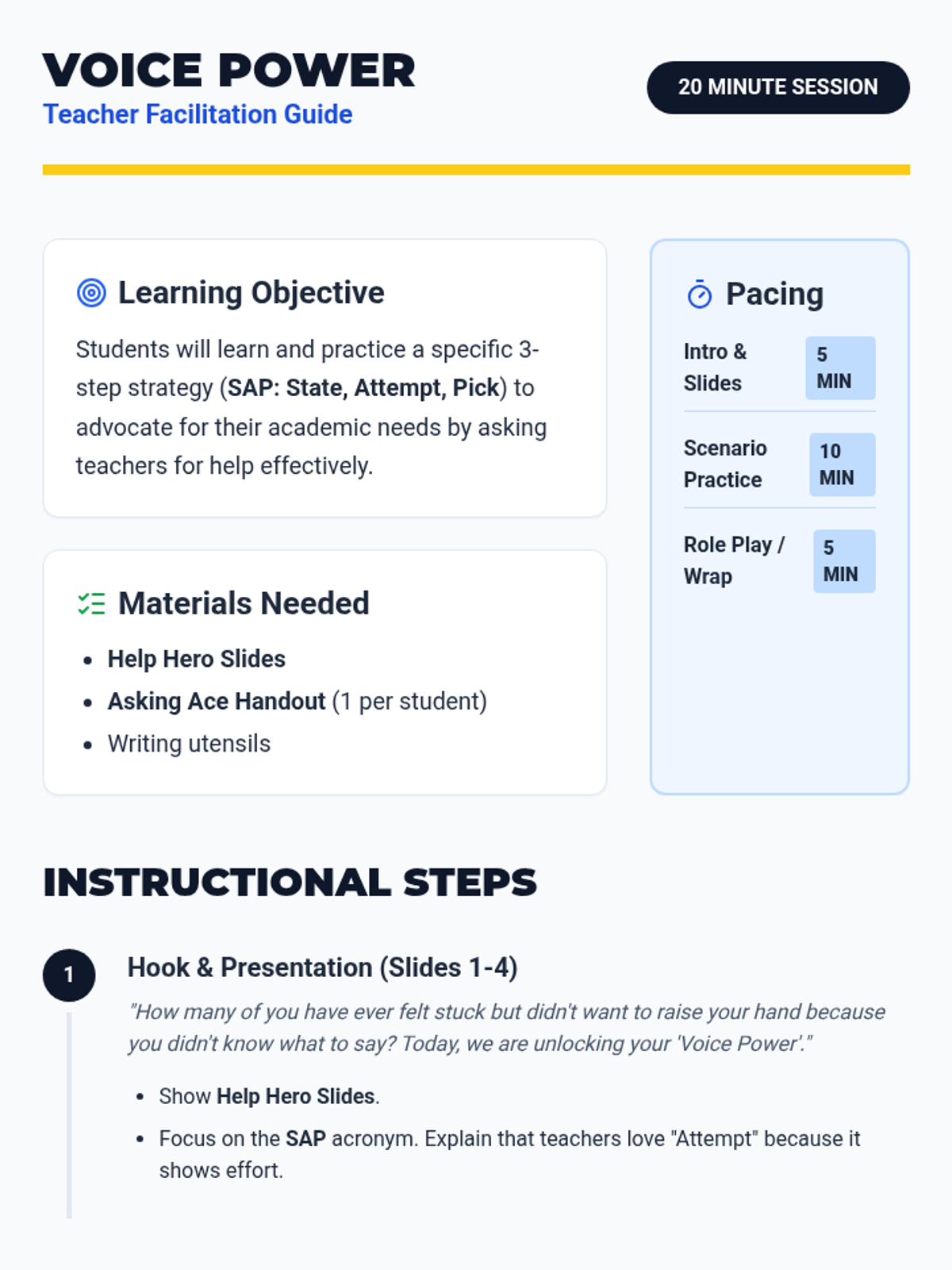
A comprehensive guide for teachers to deliver a 20-minute self-advocacy lesson, including pacing, talking points, guided practice instructions, and differentiation strategies.
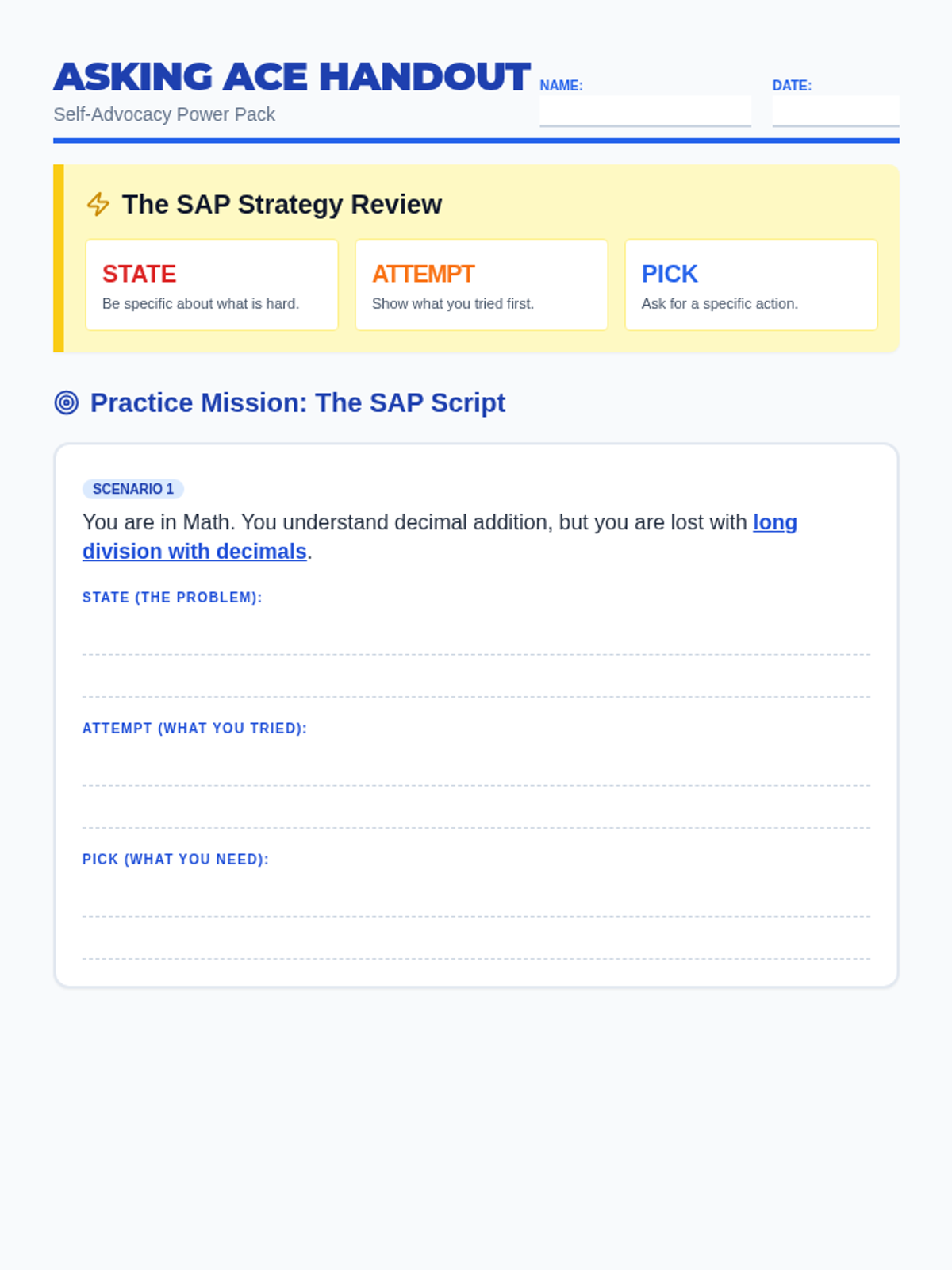
A student worksheet providing practice scenarios for applying the SAP self-advocacy strategy, including expanded writing space and a detachable pocket-sized help script.
A visual presentation introducing the 'SAP' (State, Attempt, Pick) method for self-advocacy, using a superhero theme to engage 6th-grade students. All text is at least 24px.
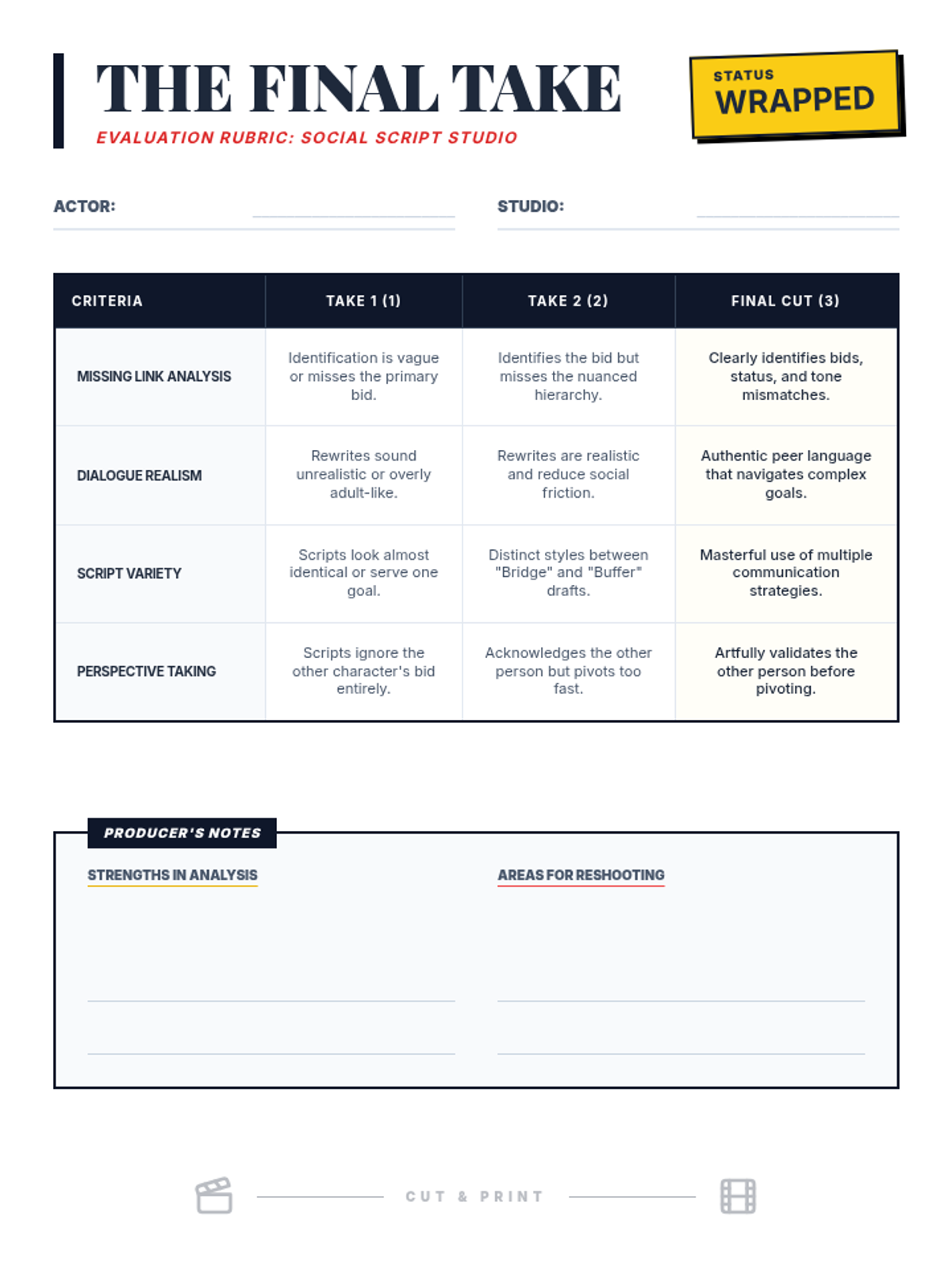
A performance evaluation rubric for the Social Script Studio lesson, assessing students on their ability to analyze communication "missing links," write realistic and effective scripts, and demonstrate flexibility in social responses.
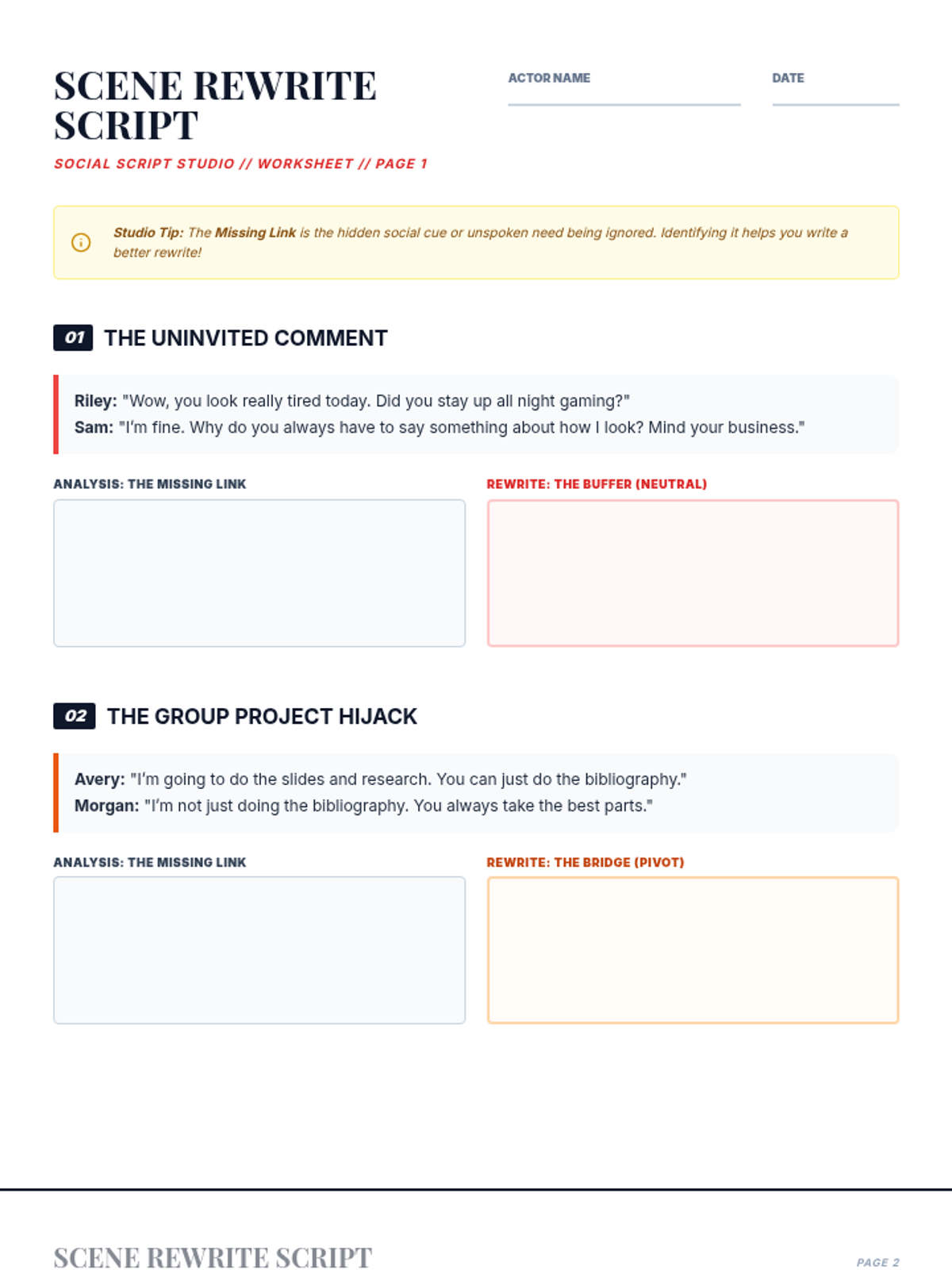
A student worksheet designed as a film script template where students analyze social friction in peer scenarios, identify the "Missing Link" in communication, and write alternative responses ("The Buffer", "The Bridge", "The Stand") to improve their pragmatic language skills. Now includes 5 expanded scenarios covering various peer conflict situations.
Instructional slides for the Social Script Studio lesson, utilizing a cinematic theme to teach students the "Friction Scale," how to identify "Missing Links" in social interactions, and strategies for scripting more effective peer communications. Now includes introductory slides explaining the "Missing Link" concept.
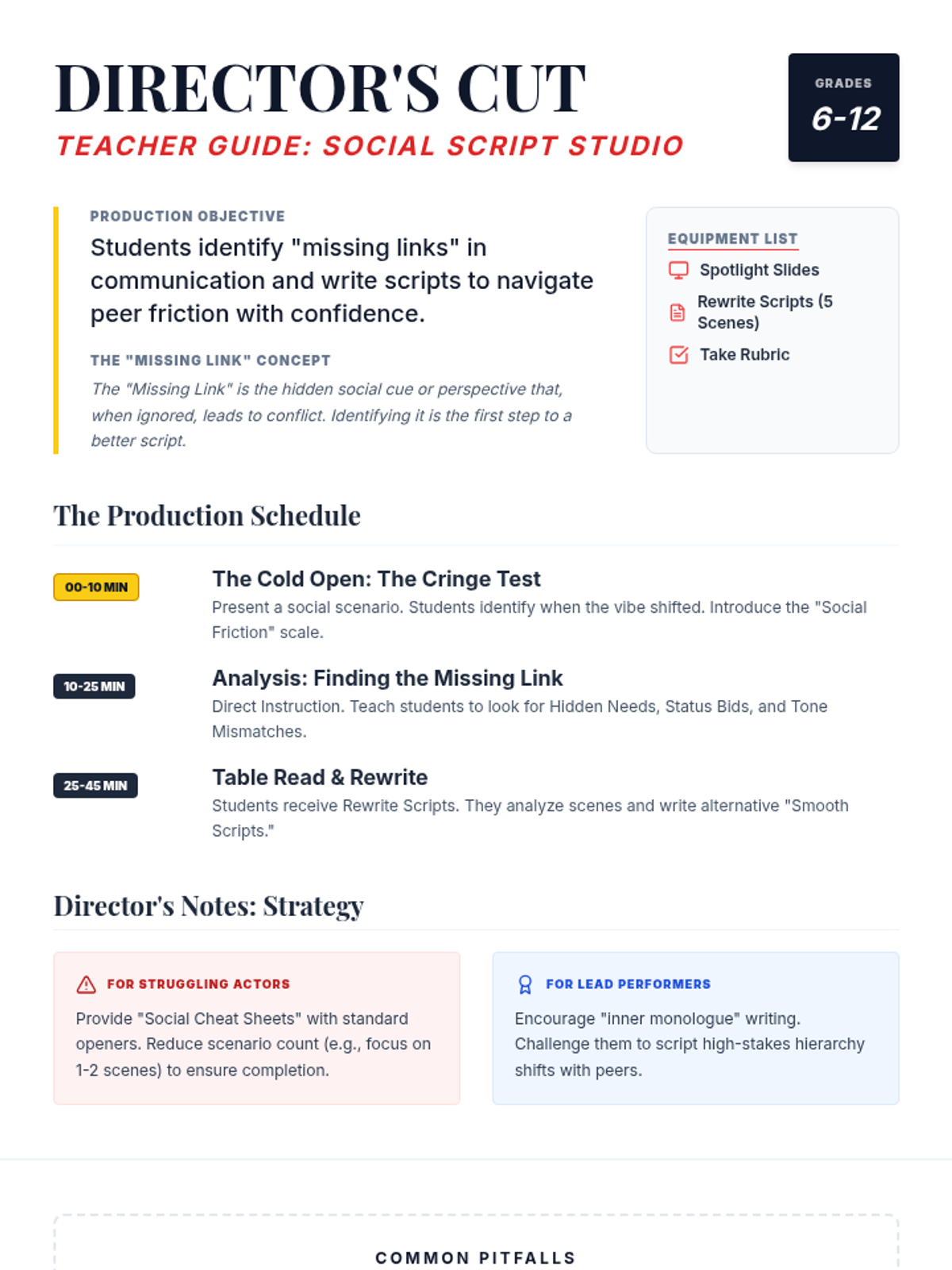
A comprehensive teacher guide for the Social Script Studio lesson, featuring a timed schedule, differentiation strategies, and tips for facilitating pragmatic language skills in grades 6-12. Now updated to include references to the expanded 5-scenario worksheet.
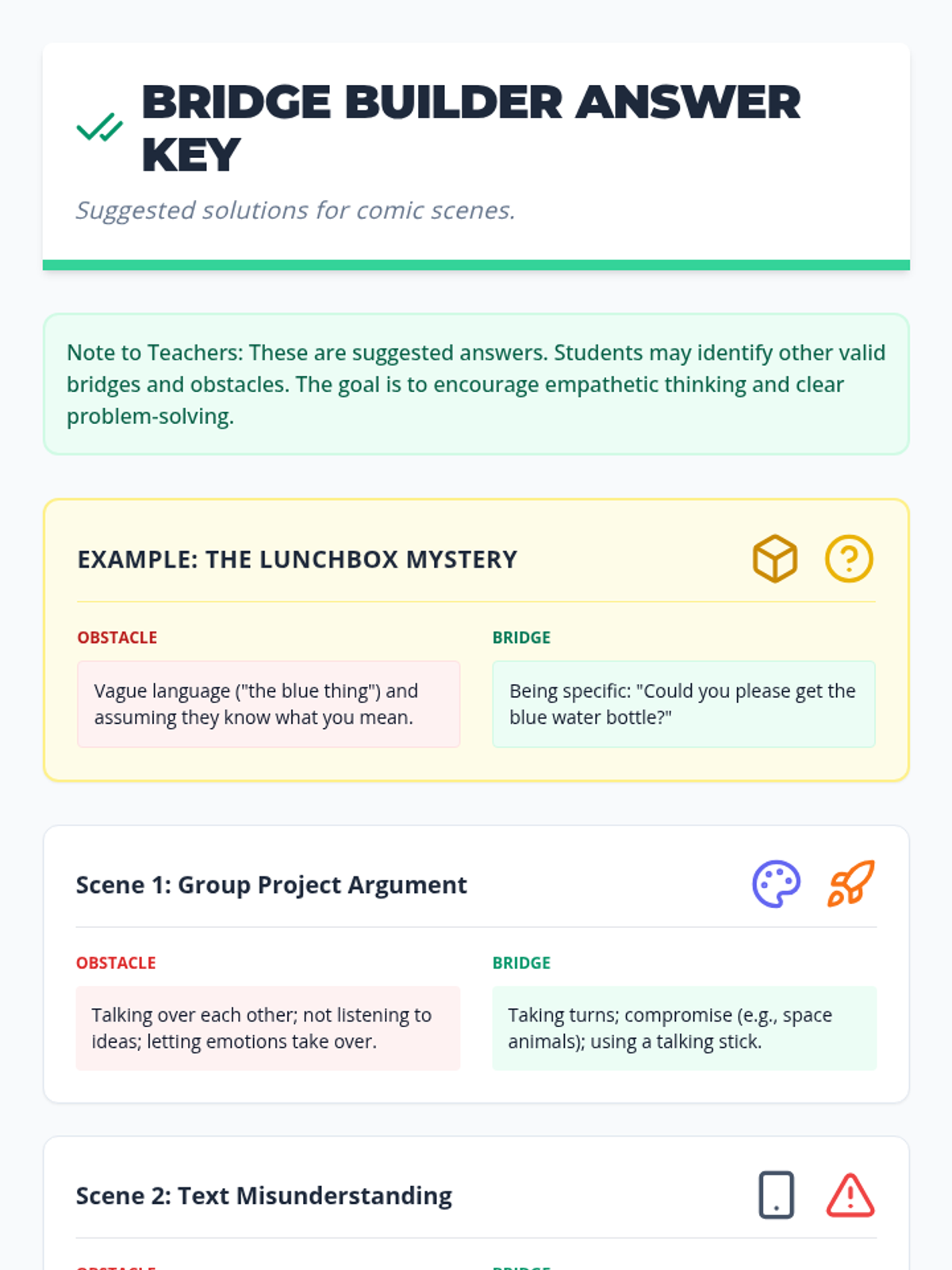
A comprehensive answer key for the Bridge Builder Worksheet, providing suggested bridges and obstacles for each scenario. Features matching large icons for easy teacher reference and updated card game scenario. Consistent Lucide icon set used throughout. Final polish for style consistency.
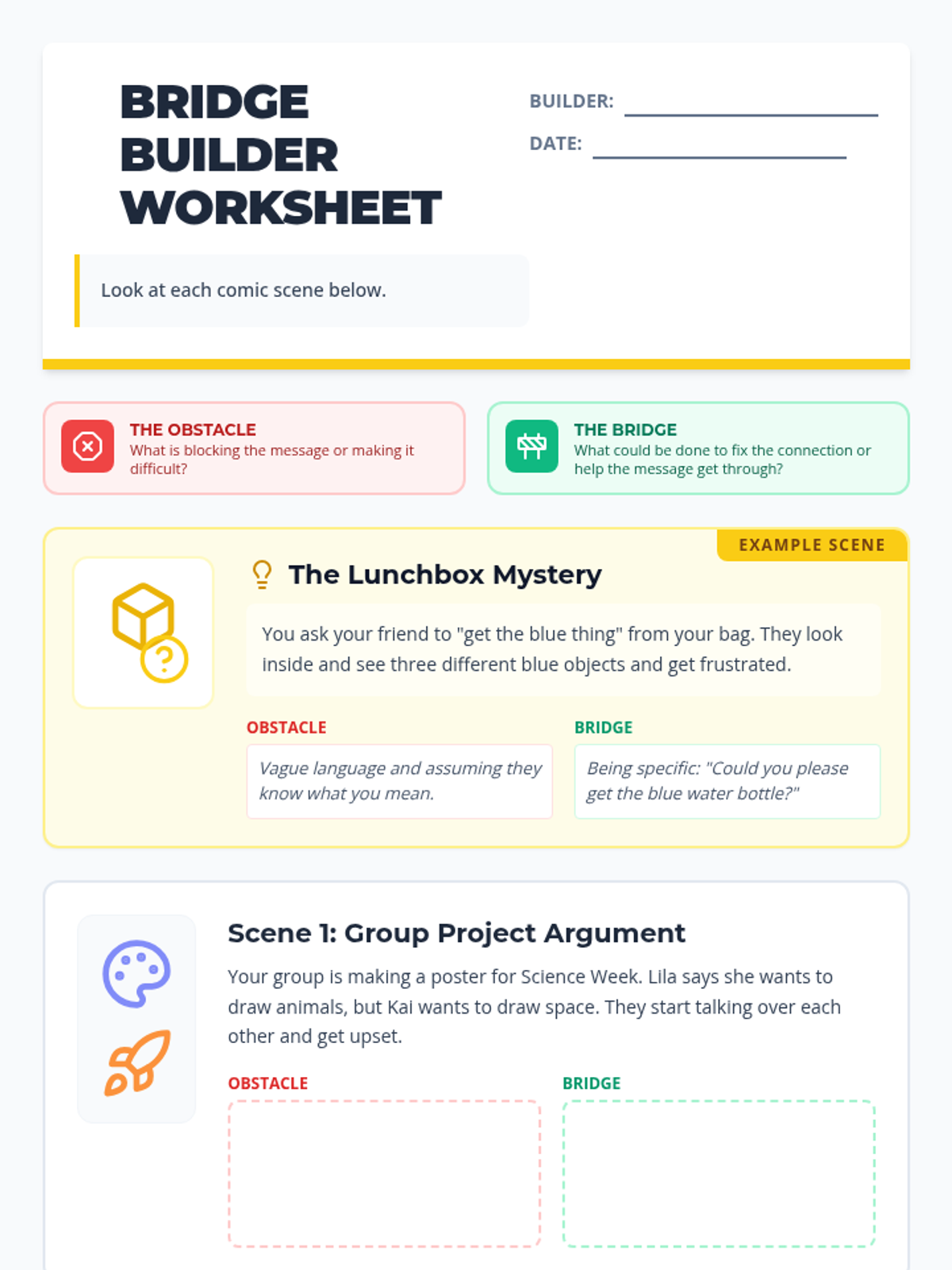
A scenario-based worksheet where students identify 'obstacles' and 'bridges' in various communication situations. Features updated instructions and legend text for clarity.
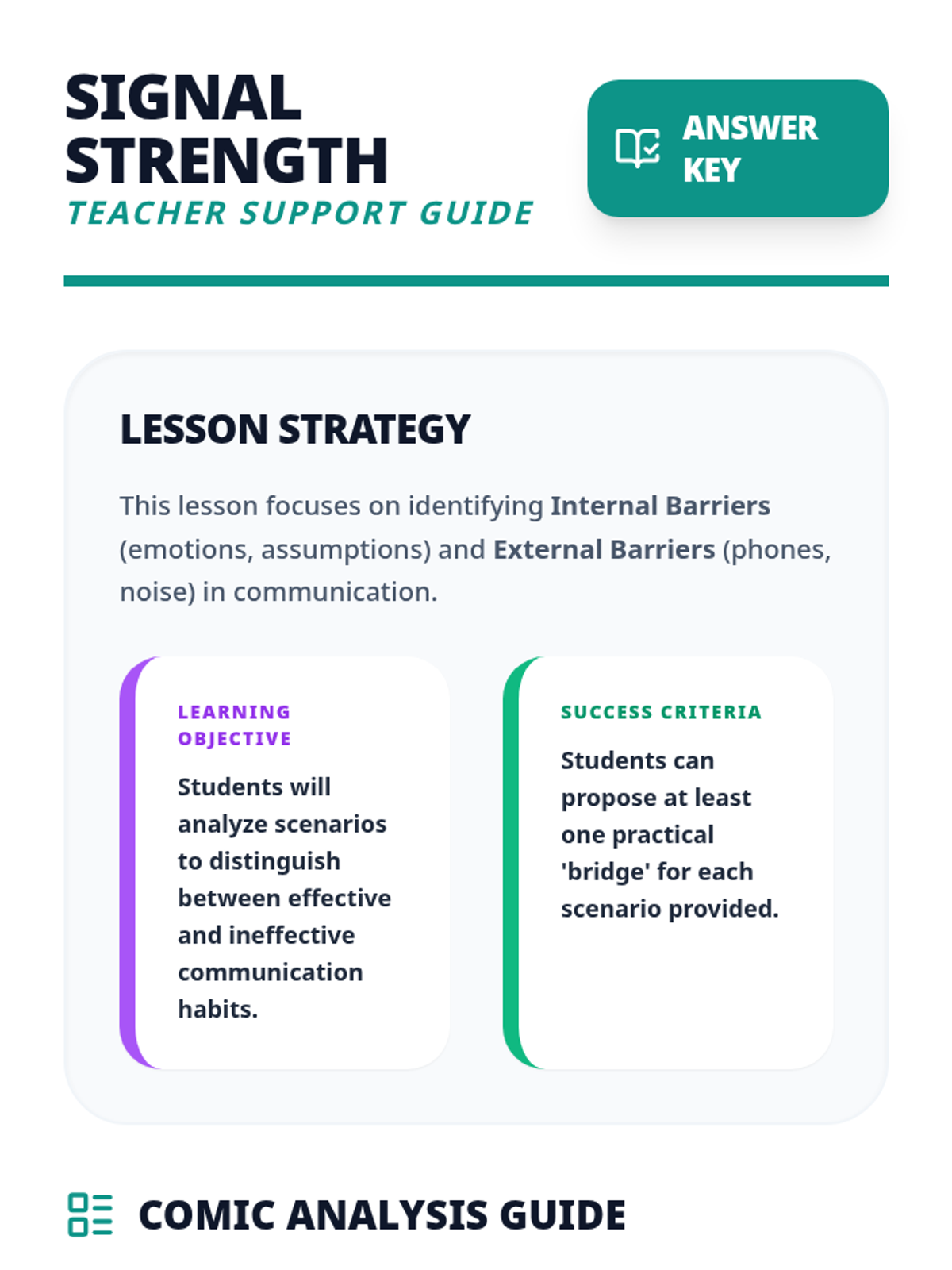
A comprehensive teacher's guide for the Signal Strength lesson. It includes an answer key for the comic strip scenarios, instructional tips, learning objectives, and extension activity suggestions to deepen student understanding.
An introductory presentation for the Signal Strength lesson. It defines communication, explores common obstacles like distractions and assumptions, and introduces 'bridges' like active listening and empathy to prepare students for the worksheet.
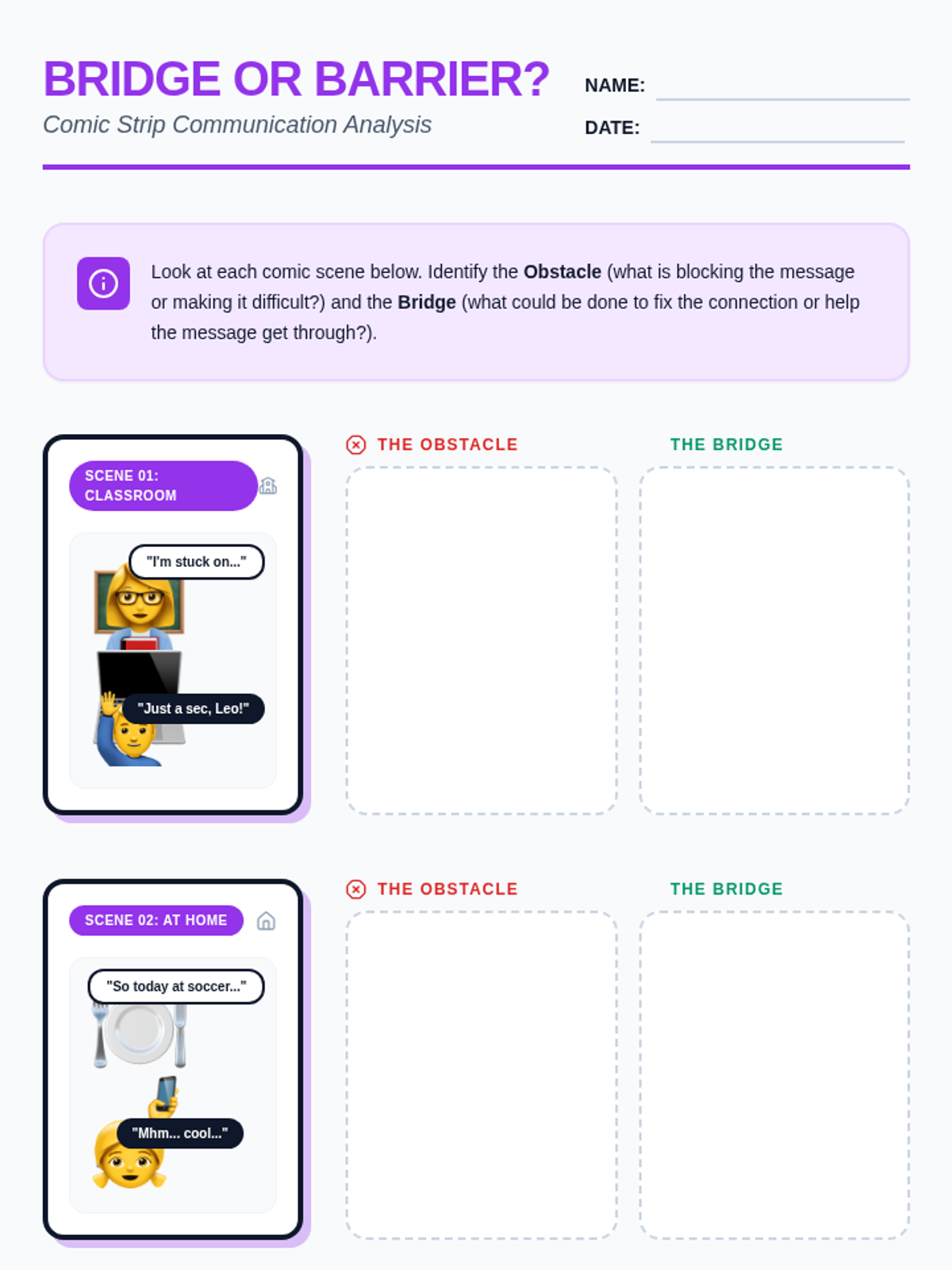
A two-page comic strip worksheet where students analyze four different communication scenarios. They must identify the communication obstacle in each scene and propose a 'bridge' to resolve the conflict and improve understanding.
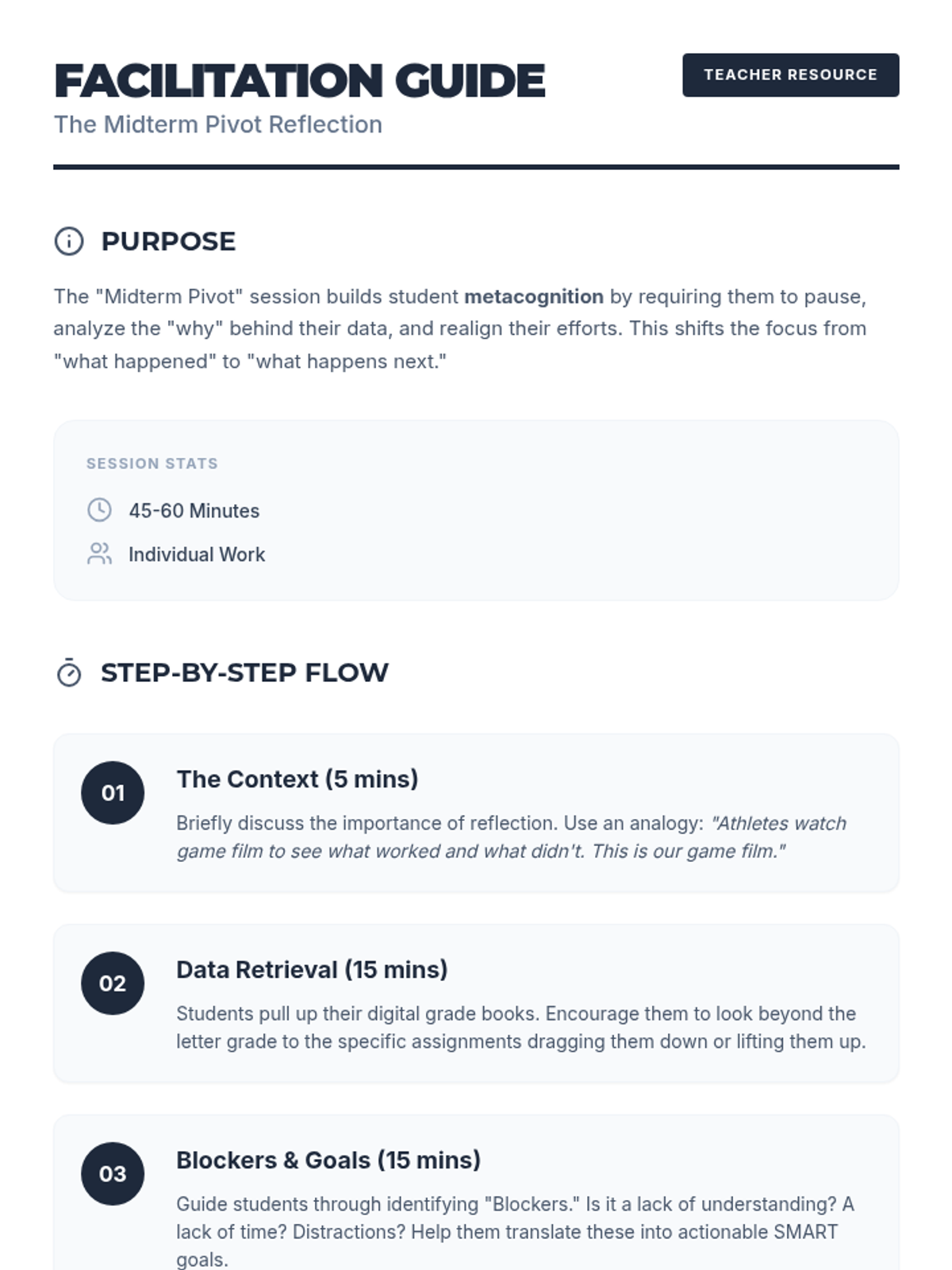
A guide for teachers on how to facilitate the Midterm Pivot reflection session, including pacing, discussion prompts, and conferencing strategies. Revised for better page layout and clarity.
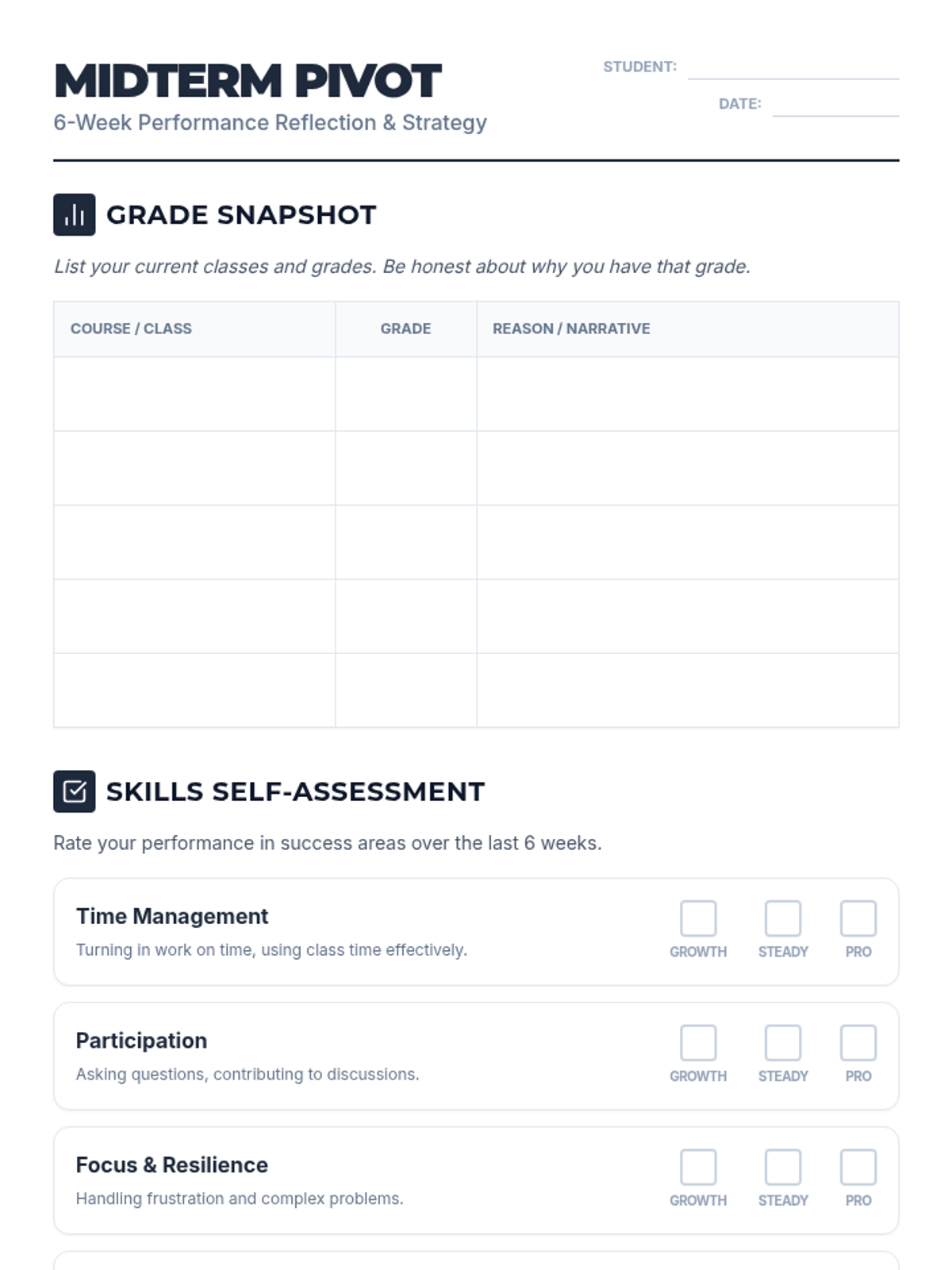
A comprehensive 6-week reflection worksheet for students to assess their grades, skills, and projects while setting SMART goals and communicating challenges to their teacher. Revised for better page breaks and writing space.
A colorful, highly visual presentation designed for K-2 students that simplifies self-advocacy into a two-step 'Magic Trick' using friendly icons and clear examples.
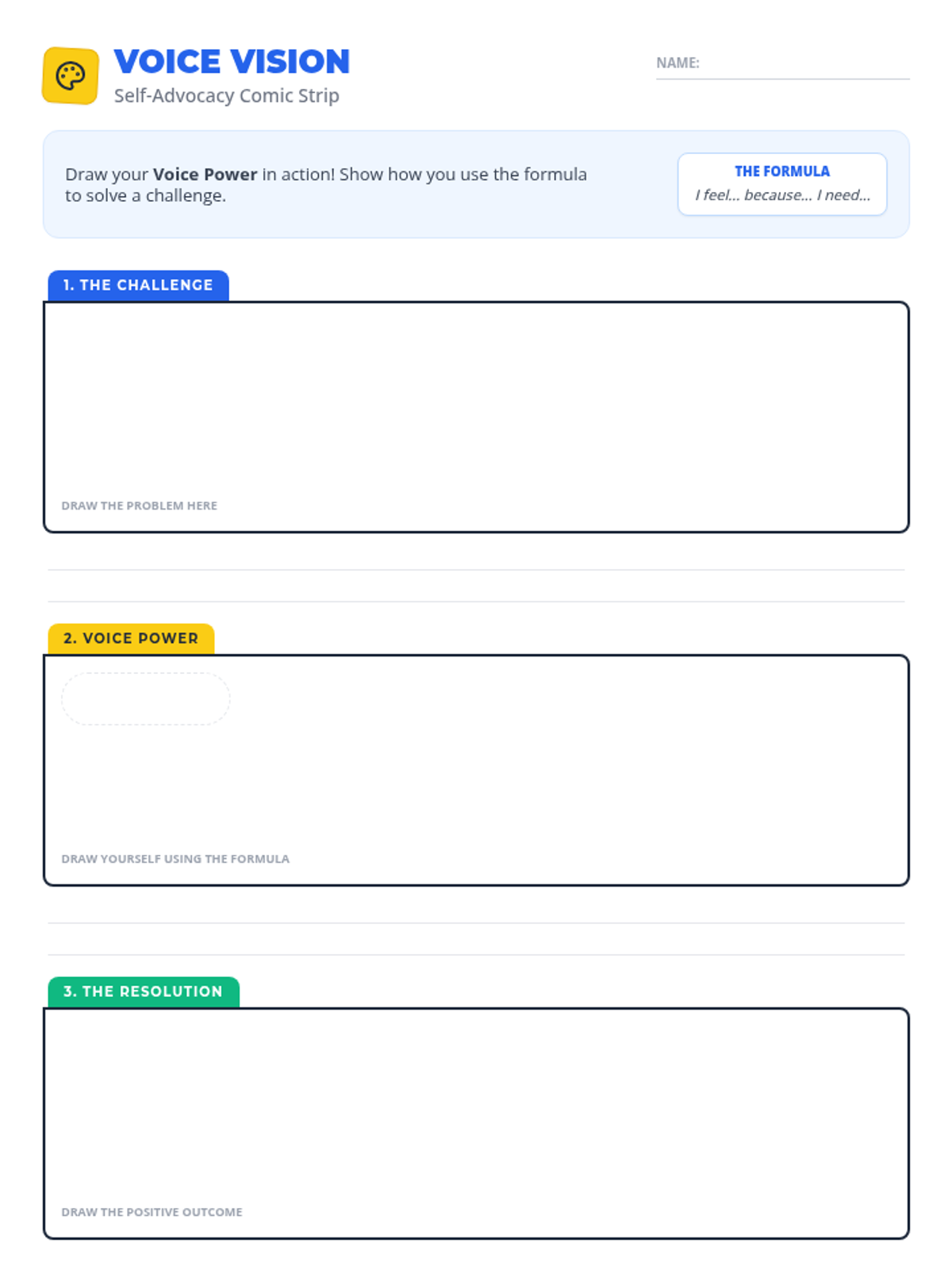
A creative drawing activity where students illustrate a self-advocacy scenario using a three-panel comic strip format to practice assertive communication visually.
A dynamic, high-contrast presentation deck that introduces the concept of self-advocacy, explores the three pillars of self-awareness, and teaches a practical communication formula.
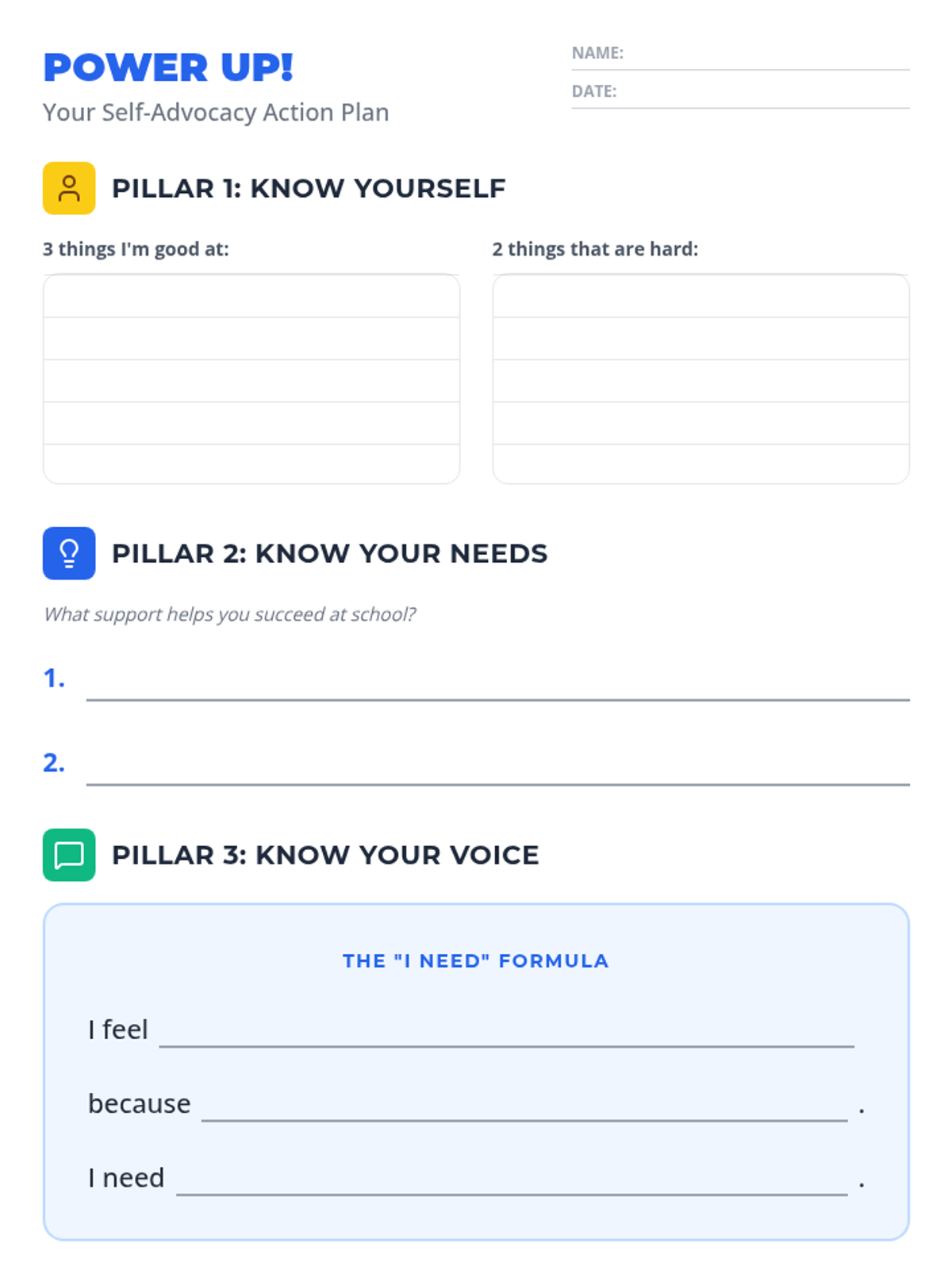
An interactive student worksheet designed to build self-advocacy skills through self-reflection and practical scenario-based exercises using a structured communication formula.
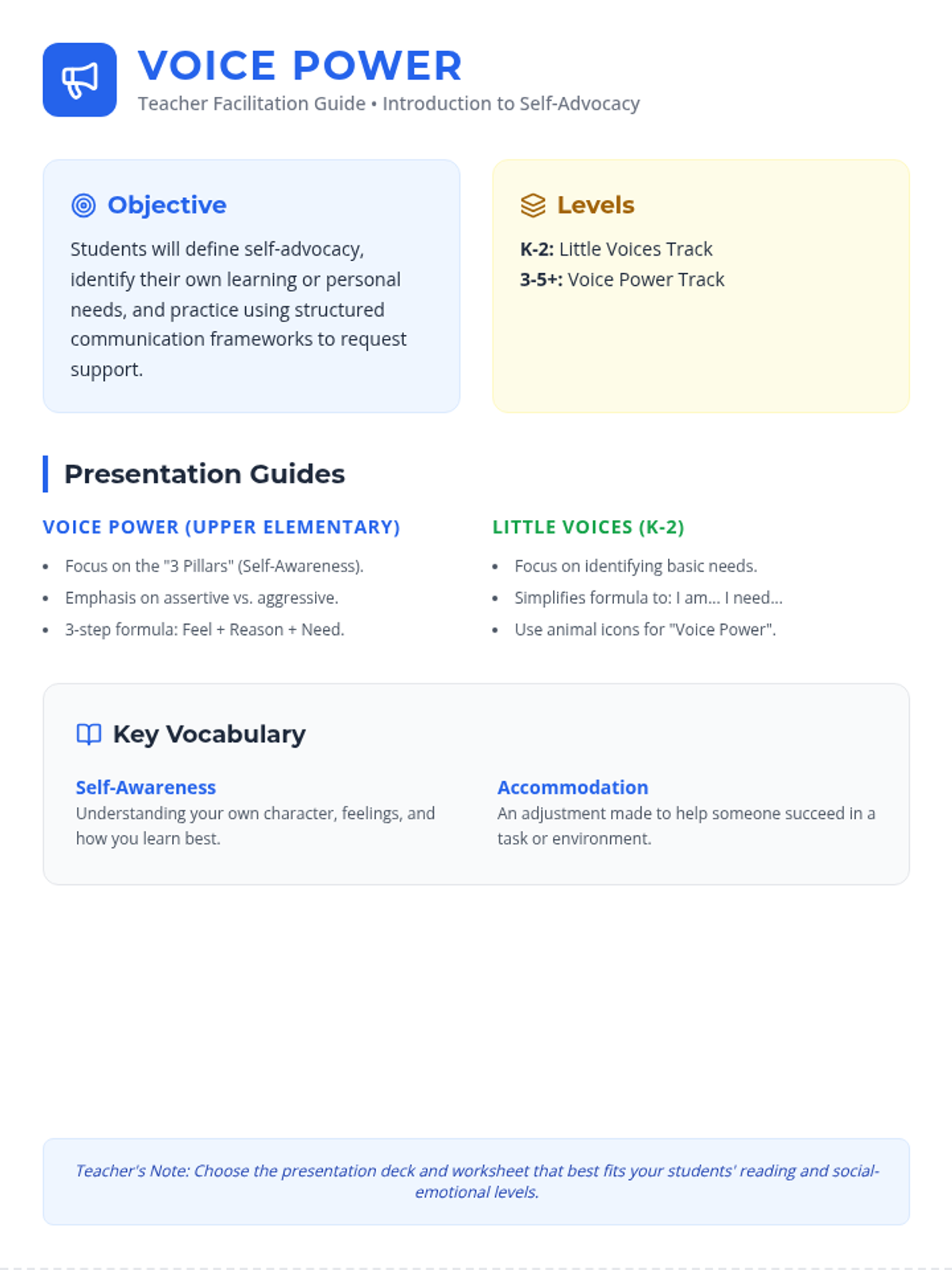
A comprehensive teacher's guide for introducing self-advocacy, featuring lesson objectives, discussion prompts, vocabulary, and an answer key for practice scenarios.
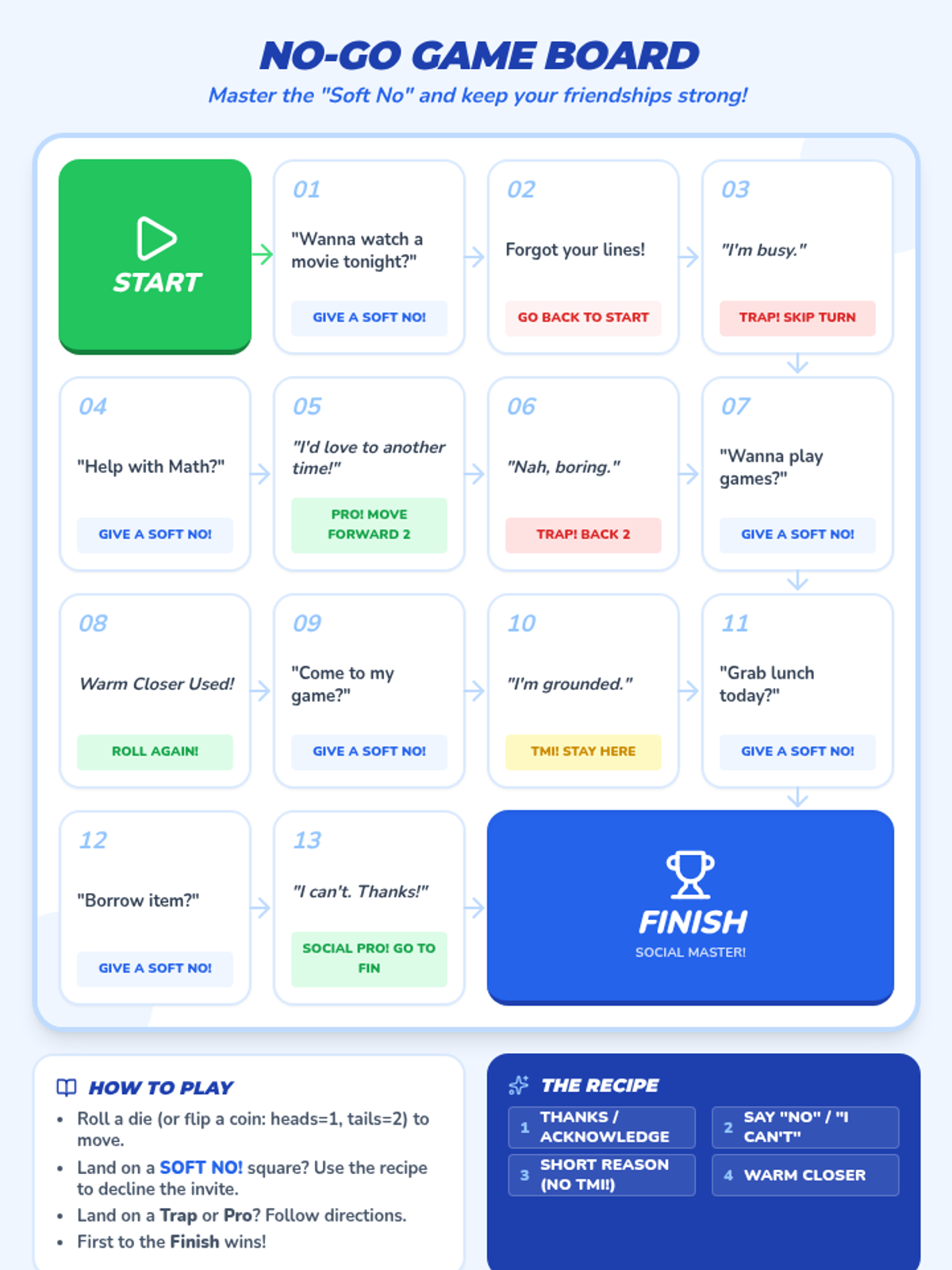
A colorful, printable board game where students navigate social scenarios. Players must practice the 'Soft No' formula to progress while avoiding 'Cold No' traps that send them backward.
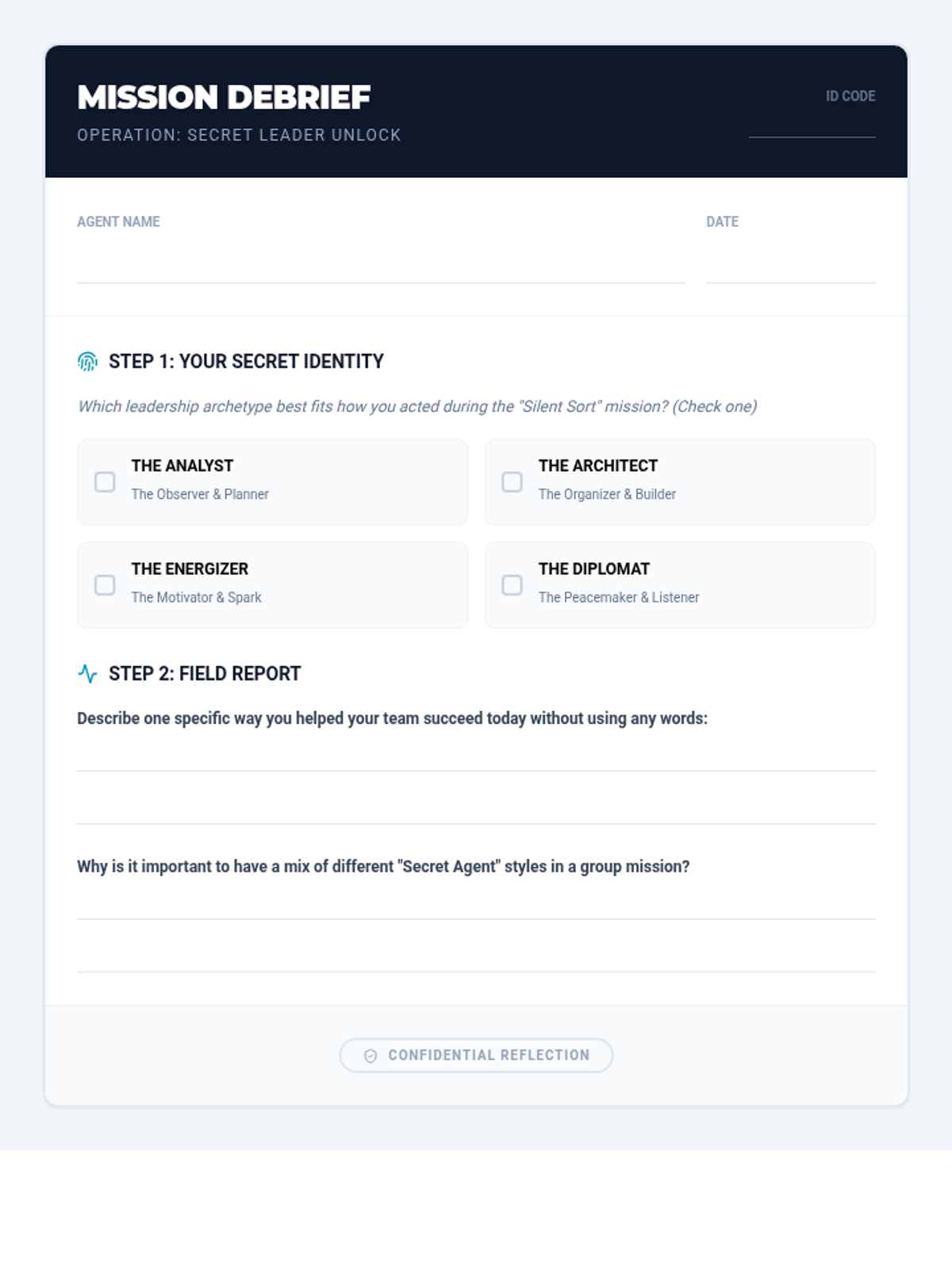
An exit ticket for the 'Secret Leader Unlock' lesson where students identify their leadership archetype and reflect on their contribution to the team challenge. Designed with a 'Mission Debrief' theme.
A visually striking presentation for middle school students on leadership styles. Features 4 leadership archetypes, a 5-minute silent challenge, and reflection prompts with a high-energy 'Secret Agent' theme.
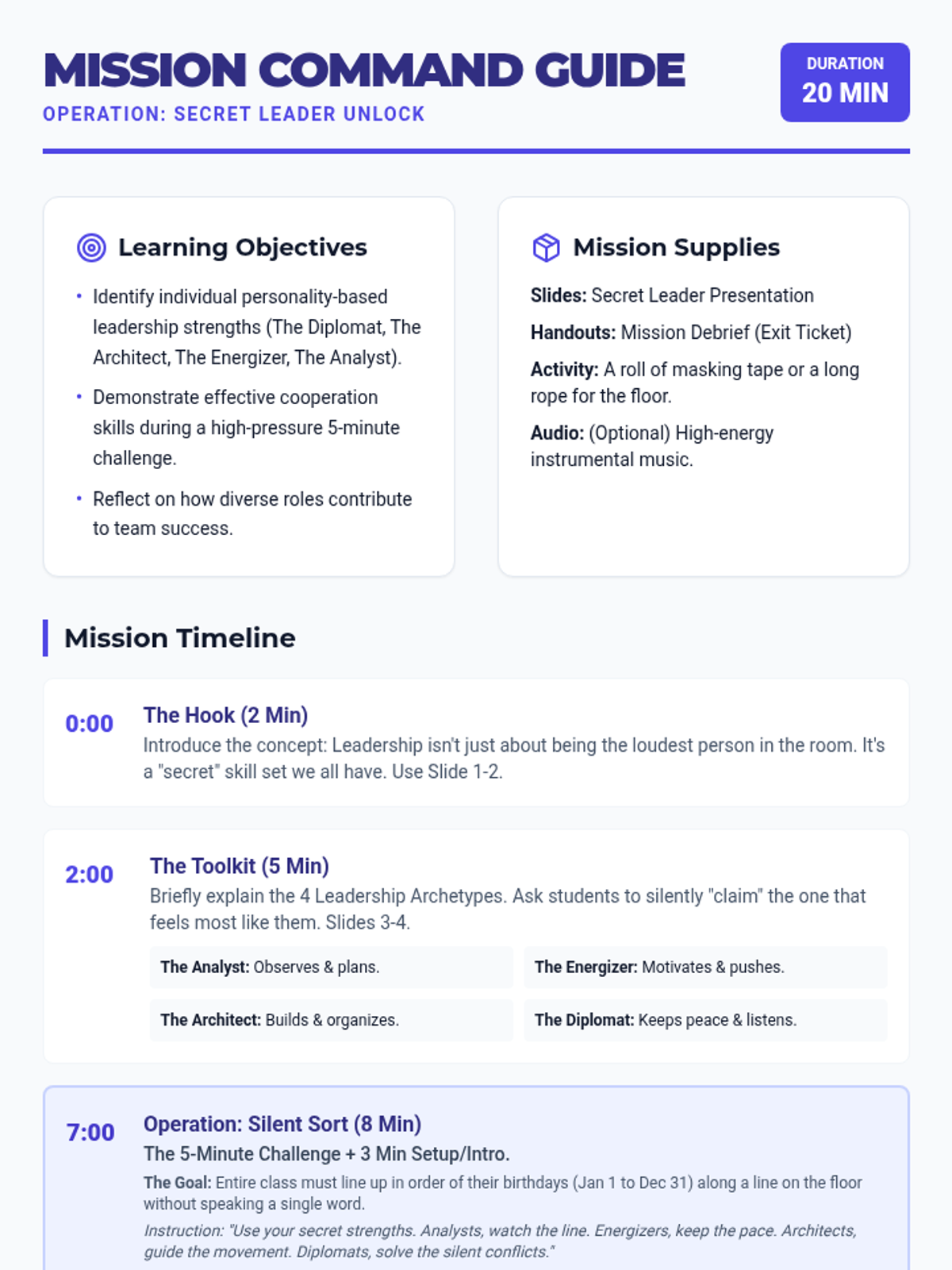
A 20-minute teacher guide for the 'Secret Leader Unlock' lesson, featuring a detailed pacing guide, learning objectives, and instructions for a 5-minute silent teamwork challenge.
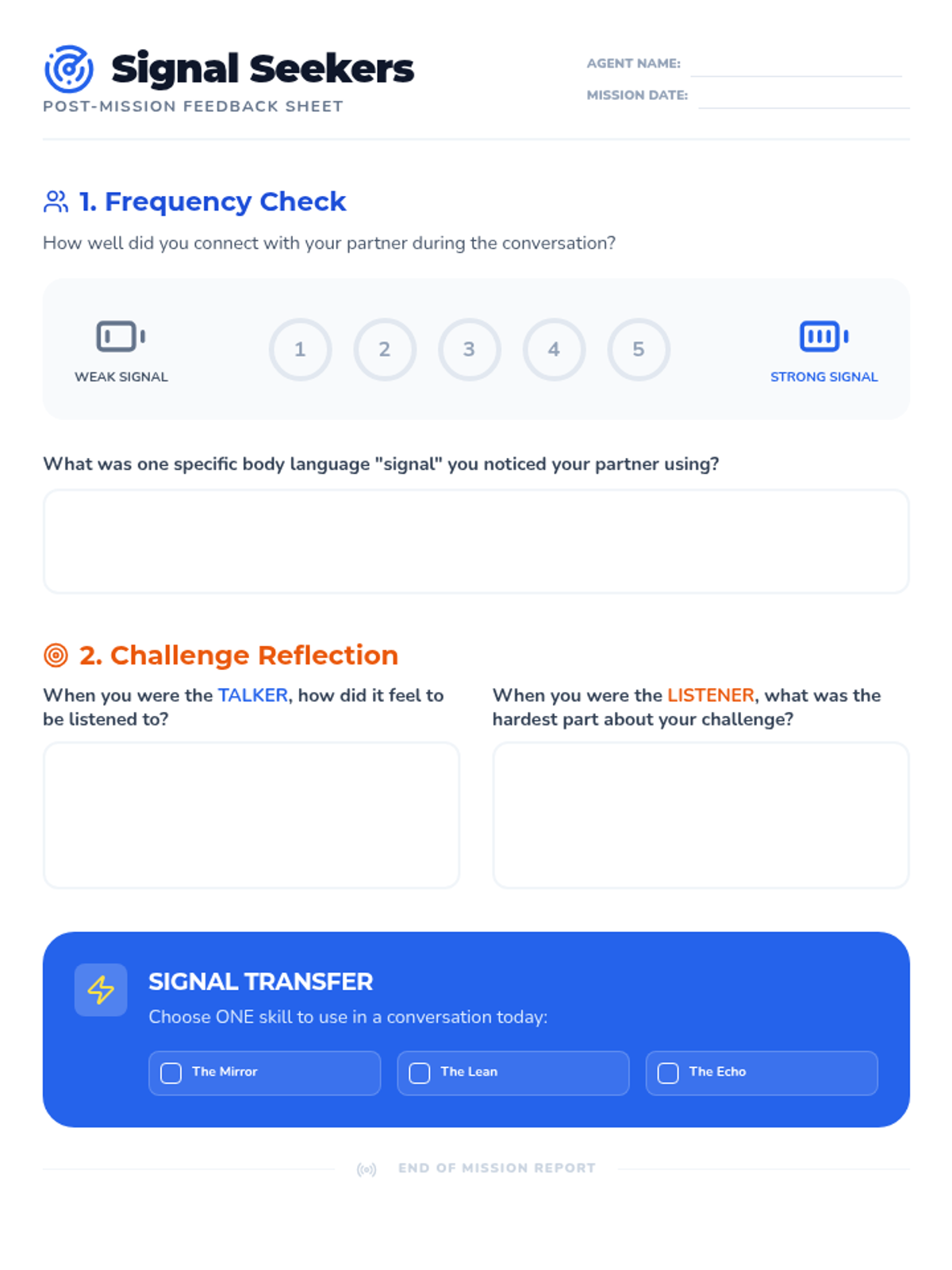
A student reflection worksheet for the Signal Seekers game. Consolidated onto a single page with corrected rating scale styling and improved readability.
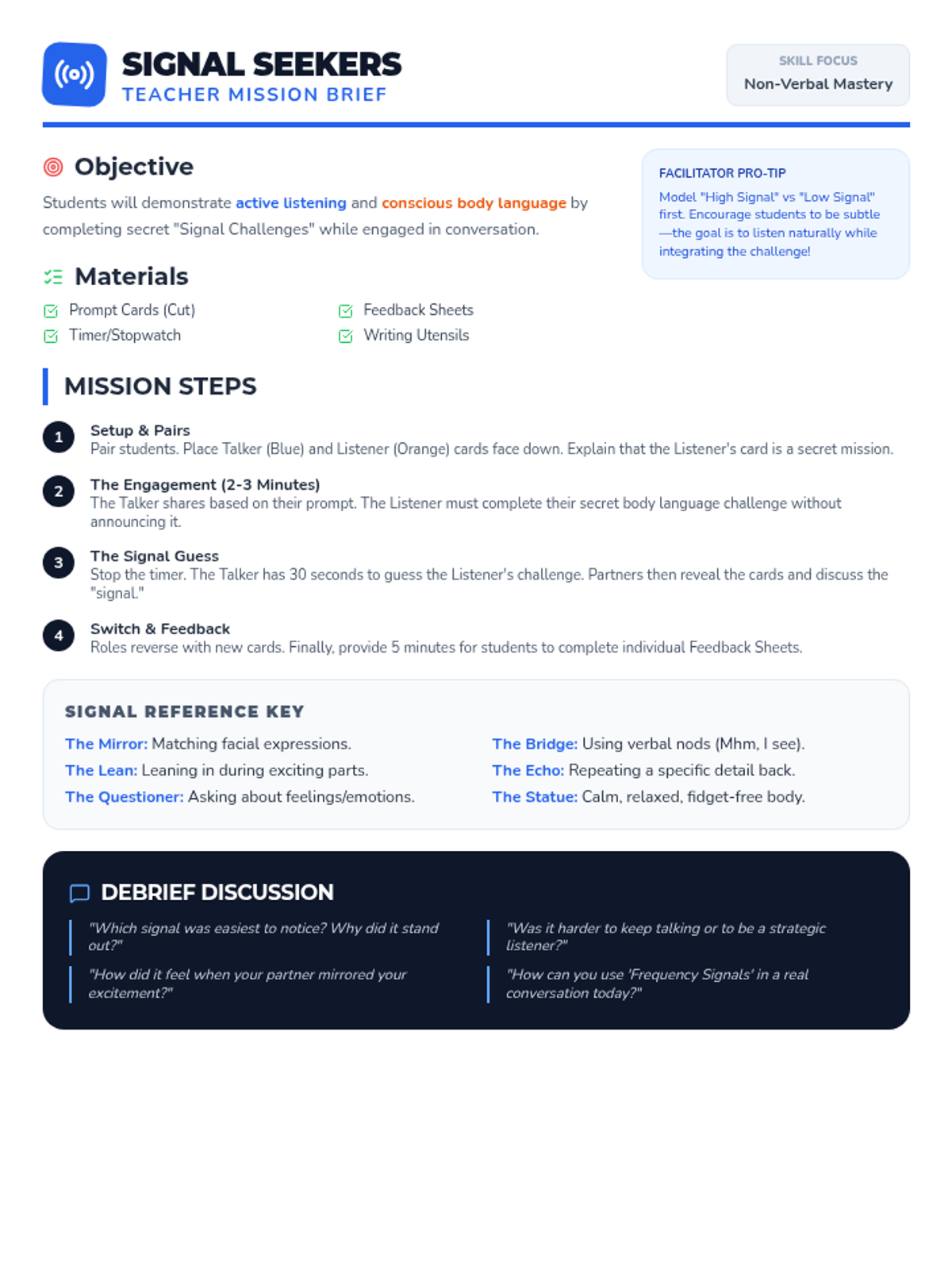
A consolidated one-page facilitator guide for the Signal Seekers game. Includes objectives, procedure, a reference key for the body language signals, and discussion prompts. Updated with improved layout to ensure single-page printing.
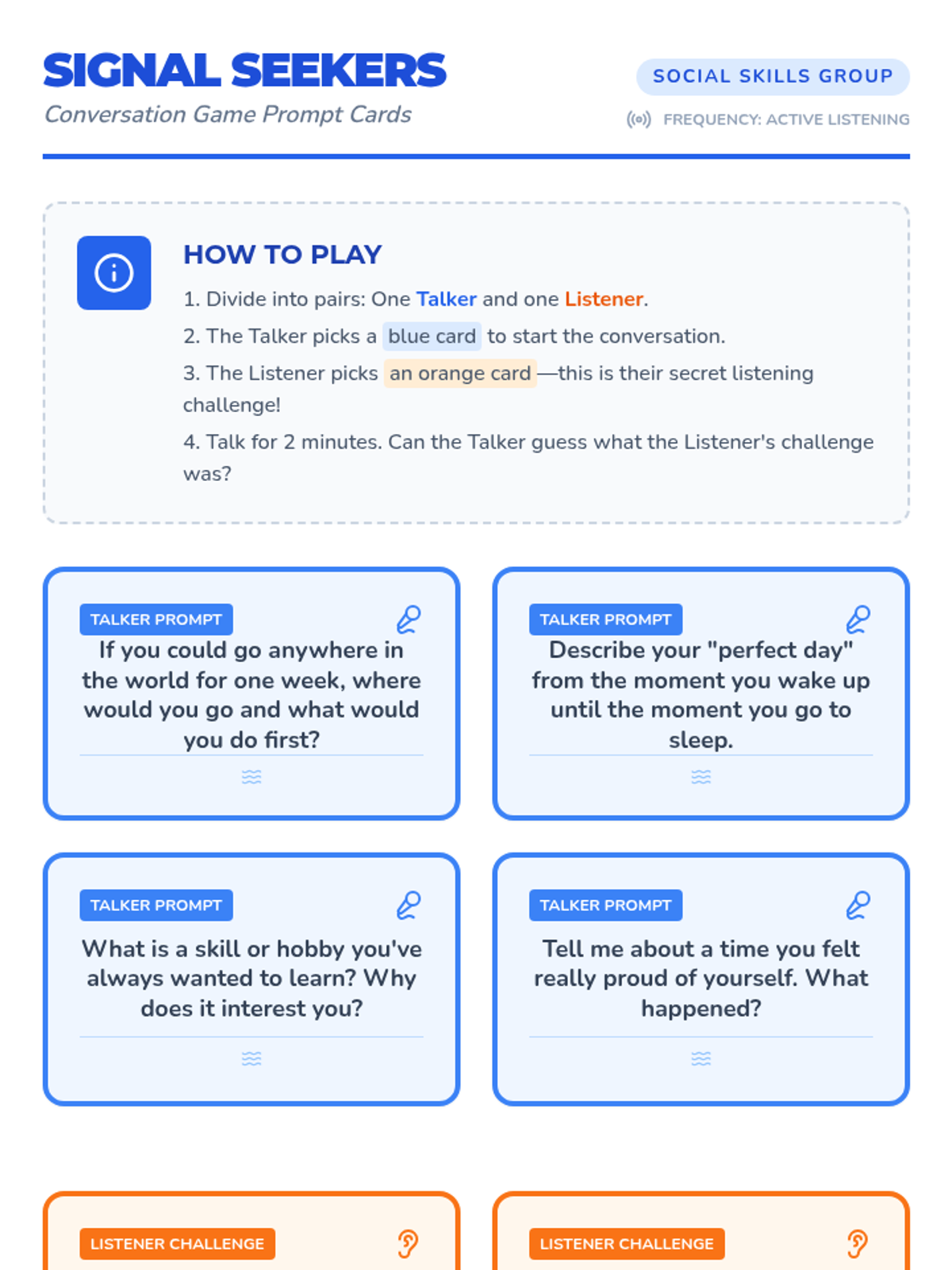
A collection of printable prompt cards for the Signal Seekers game. Includes 4 Talker prompts and 6 Listener challenges that focus on body language and active listening. Updated with corrected grammar and improved print layout.
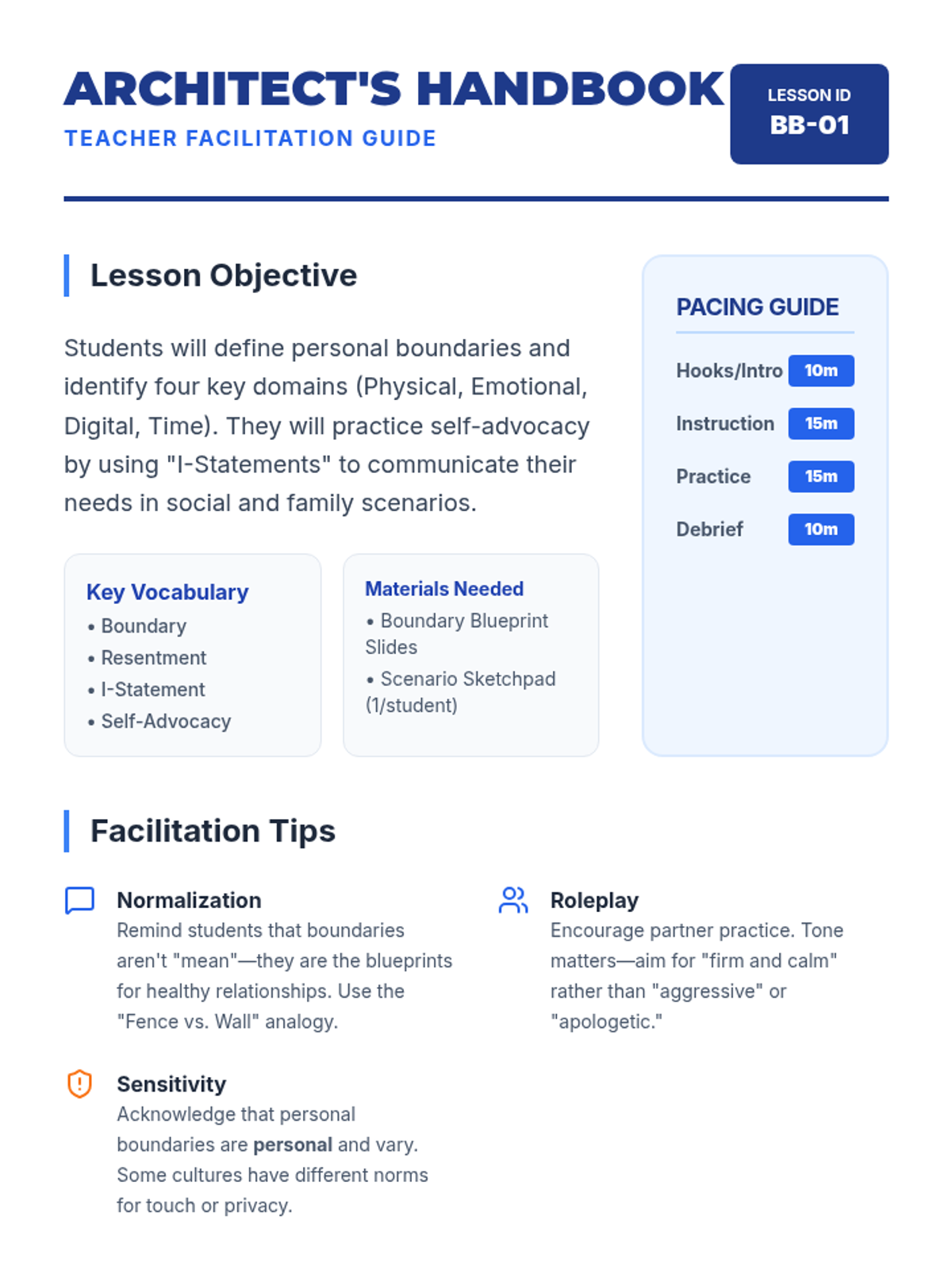
A teacher guide containing lesson objectives, pacing guides, facilitation tips, and a detailed discussion key. Improved alignment and readability.
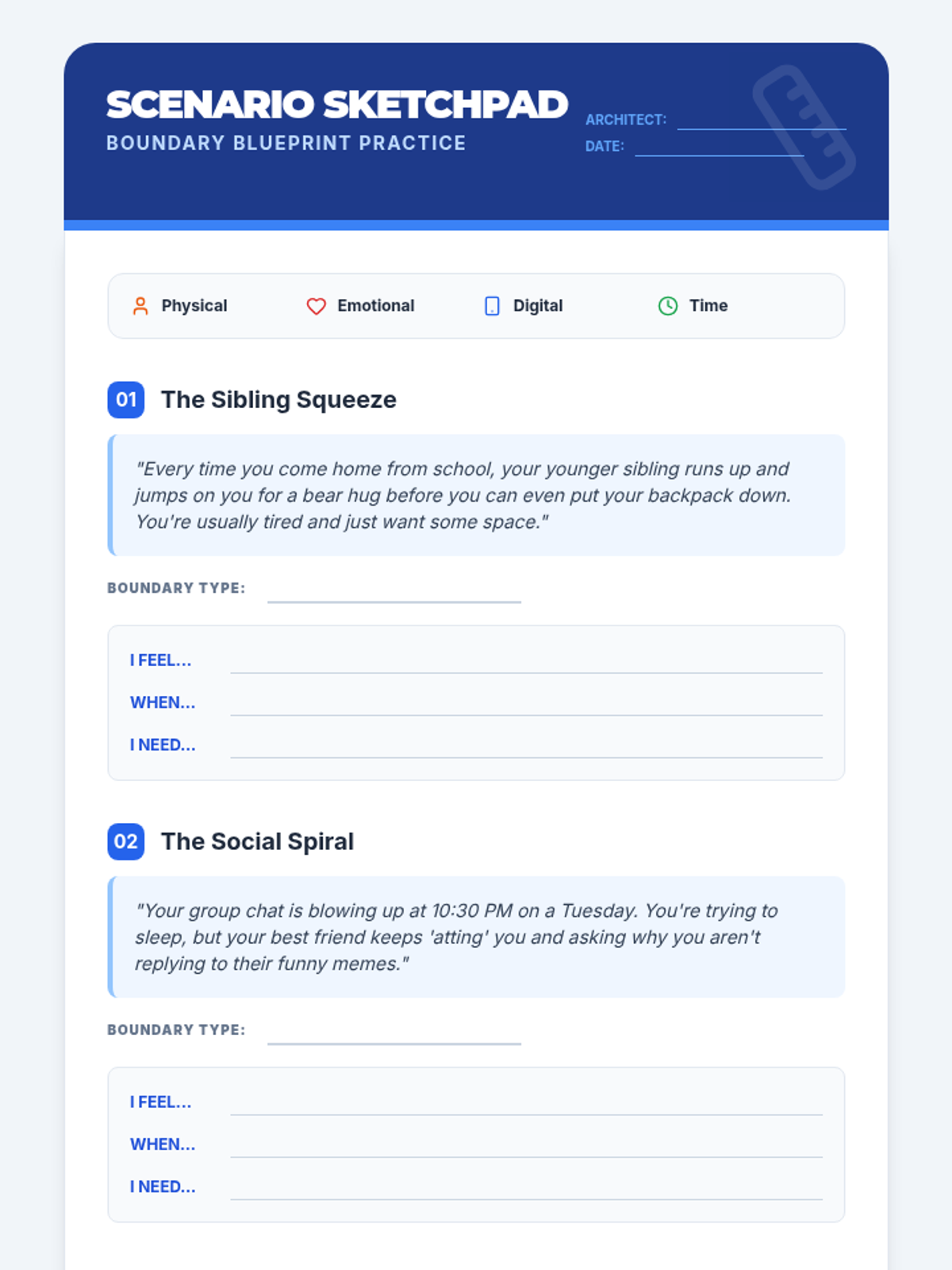
A practice worksheet with real-world scenarios for middle schoolers to identify boundary types and draft effective I-Statement responses. Corrected typo and improved layout.
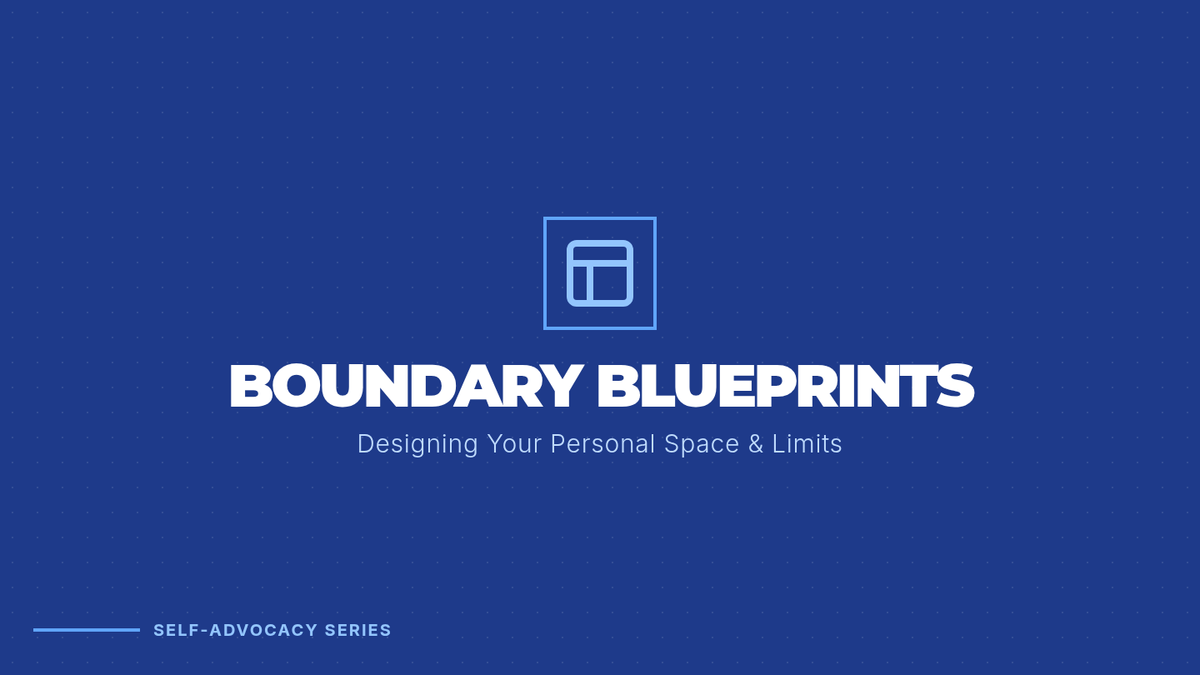
A visual slide deck introducing the concept of personal boundaries, covering types of boundaries, emotional indicators, and the 'I-Statement' communication formula.
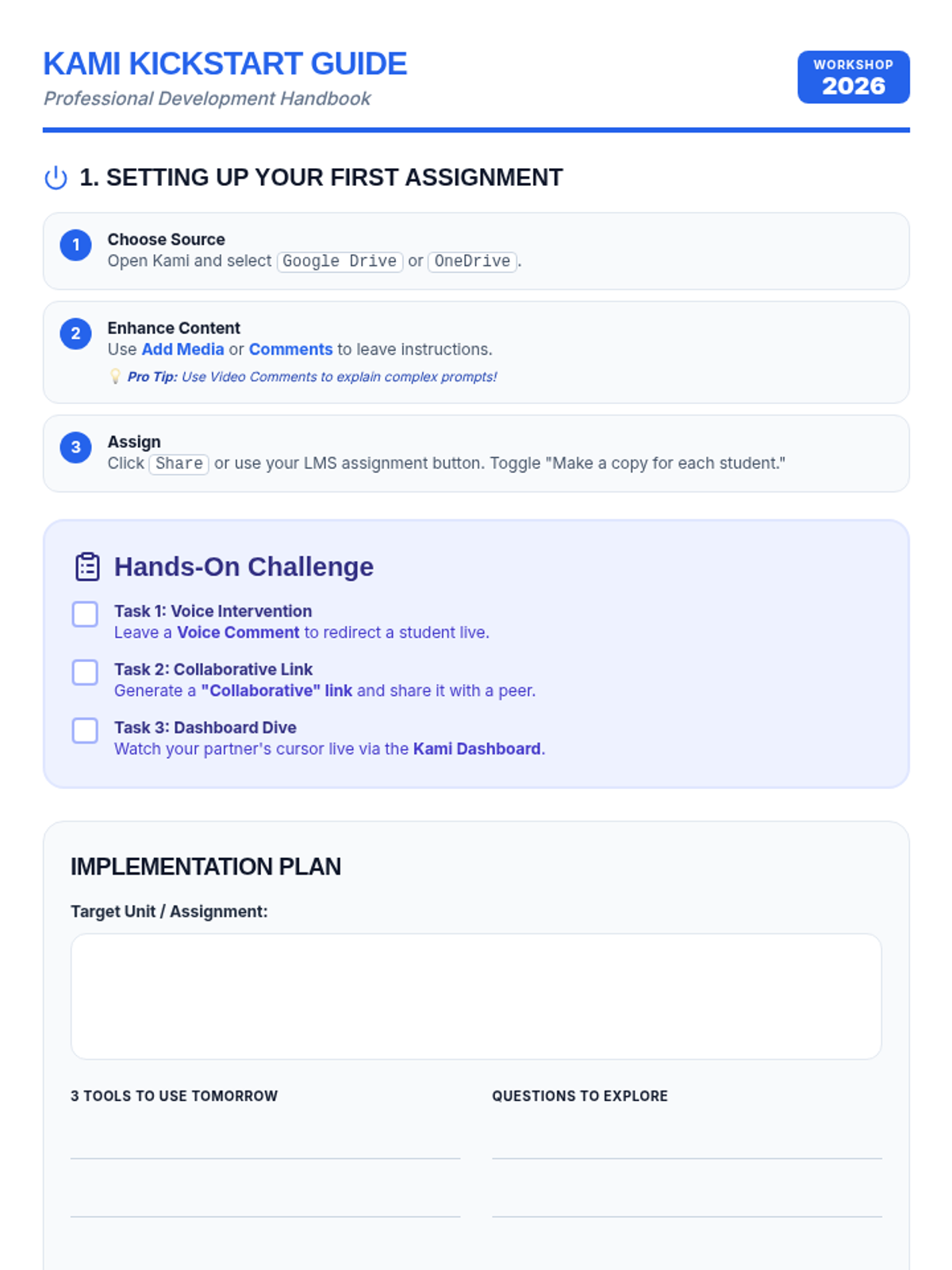
A step-by-step guide and hands-on activity worksheet for teachers during a Kami PD session, featuring setup instructions, a task checklist, and space for implementation notes.
A visual slide deck for a professional development session introducing teachers to Kami's core features like real-time monitoring, multi-modal feedback, and accessibility tools.
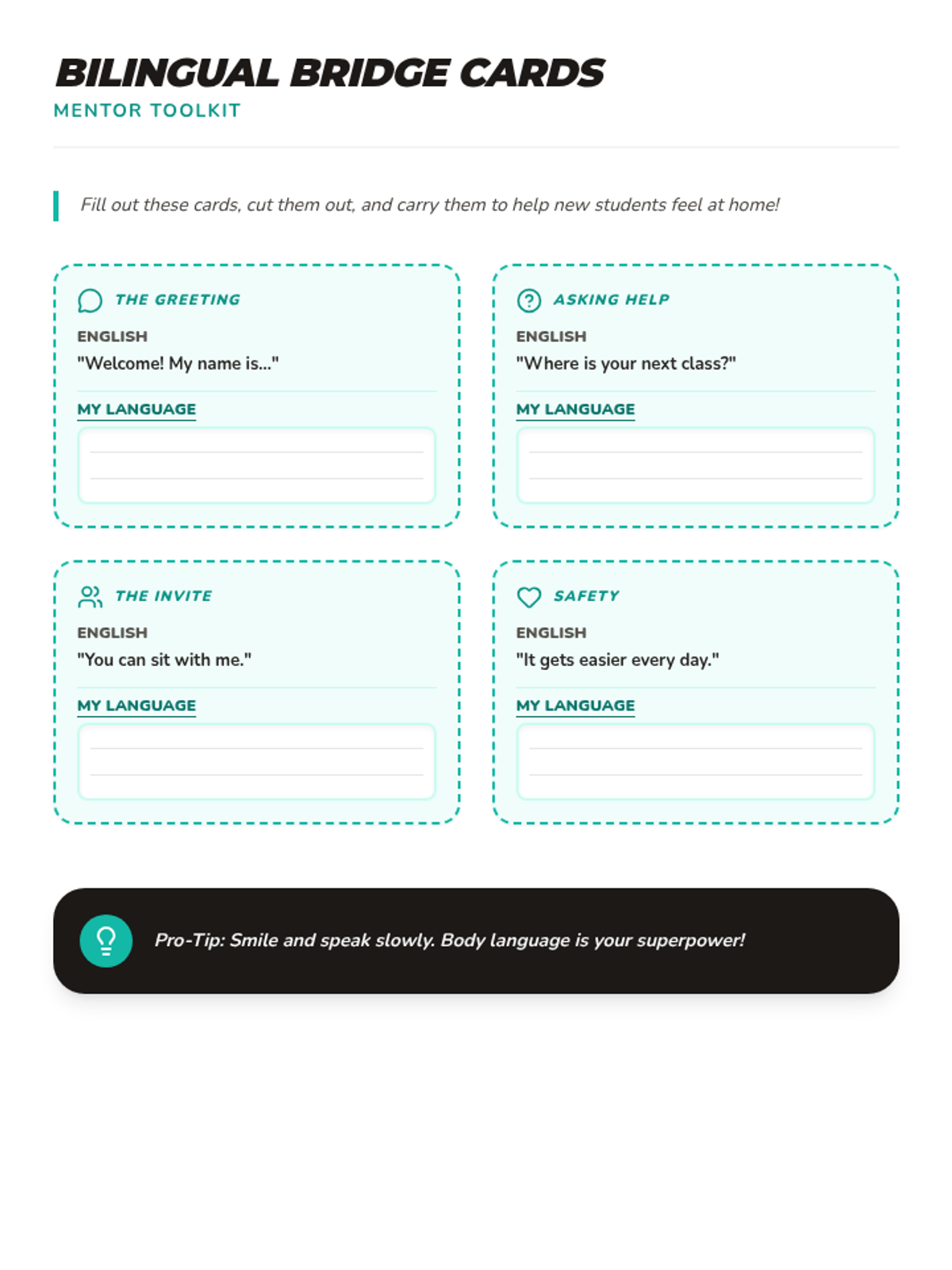
A set of bilingual cards for mentors to fill out with welcome phrases in English and their home language.
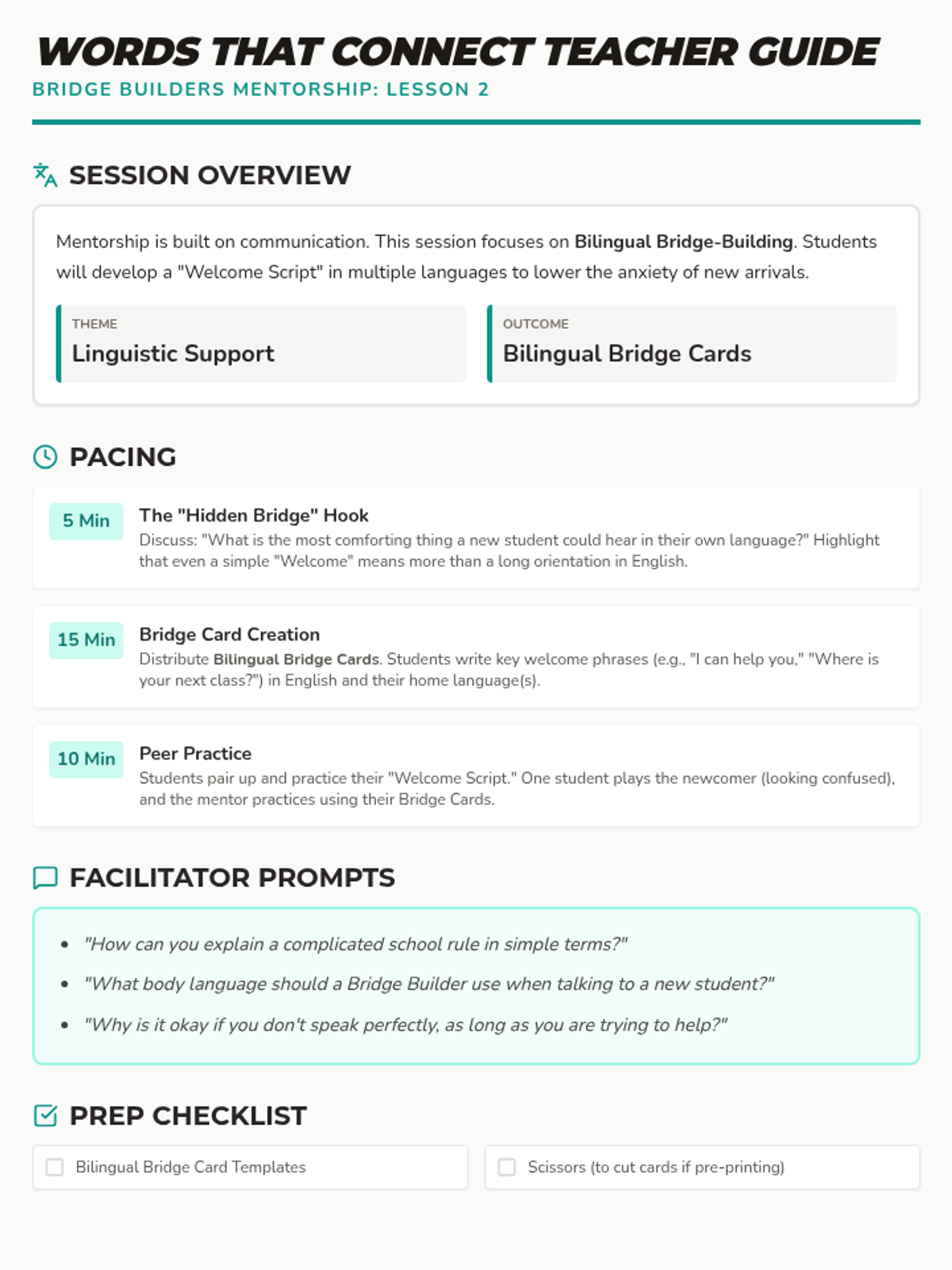
A facilitation guide for the second meeting of the Bridge Builders sequence, focusing on bilingual communication and mentor scripts.
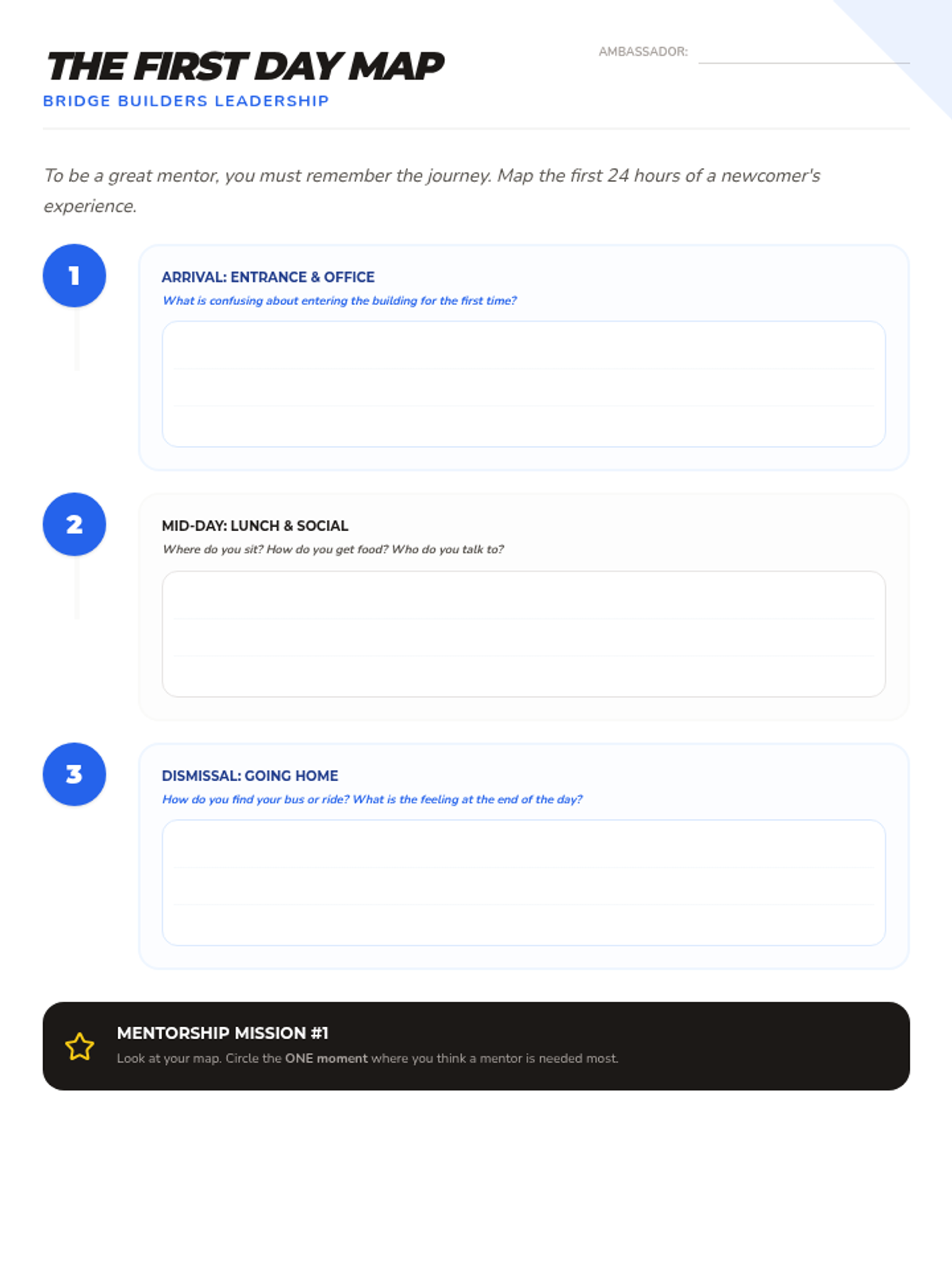
A student worksheet for mapping the emotional and logistical journey of a new student to build empathy for mentorship.
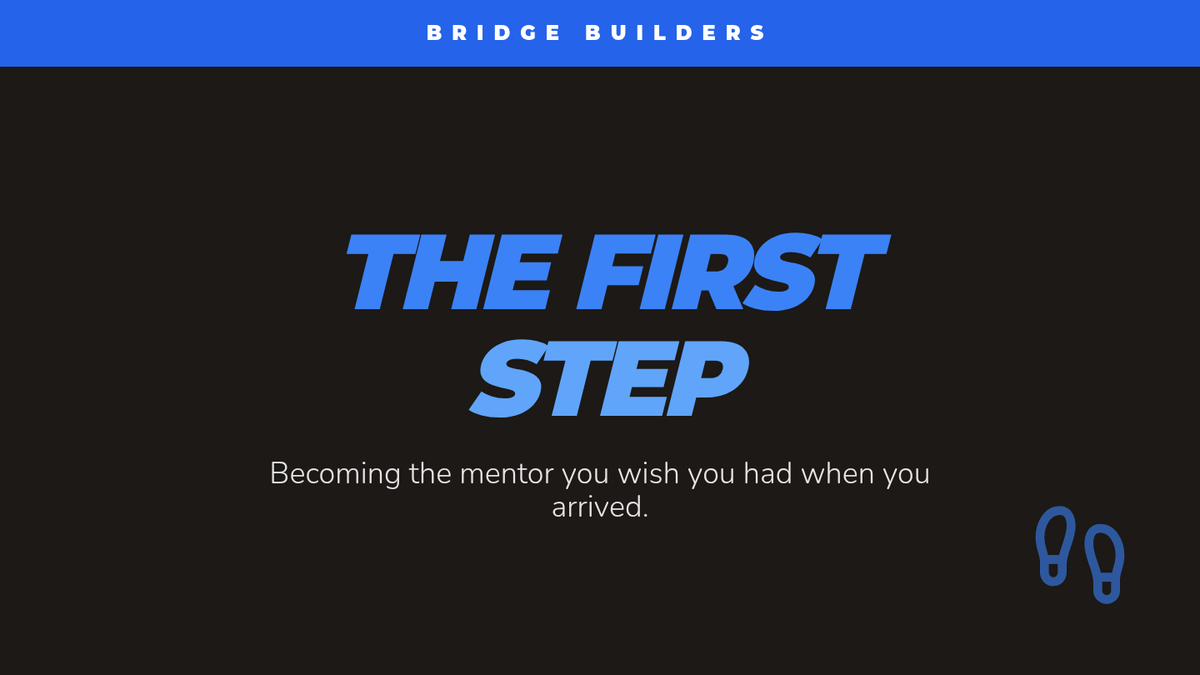
Visual presentation for the first meeting of the Bridge Builders sequence, introducing the concept of newcomer mentorship.
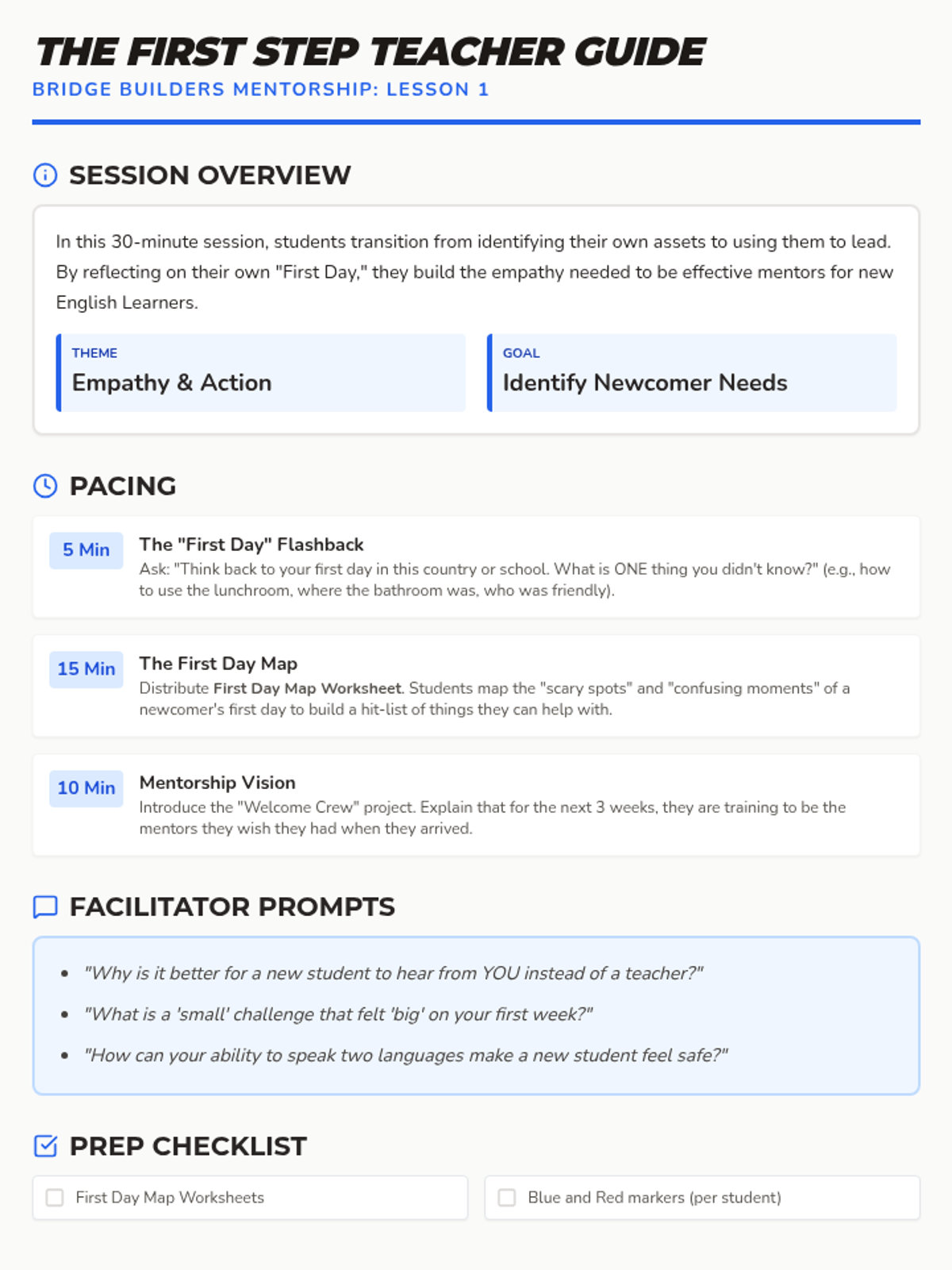
A detailed guide for club facilitators to run the first 30-minute meeting of the Bridge Builders sequence, focusing on empathy and identifying newcomer needs.
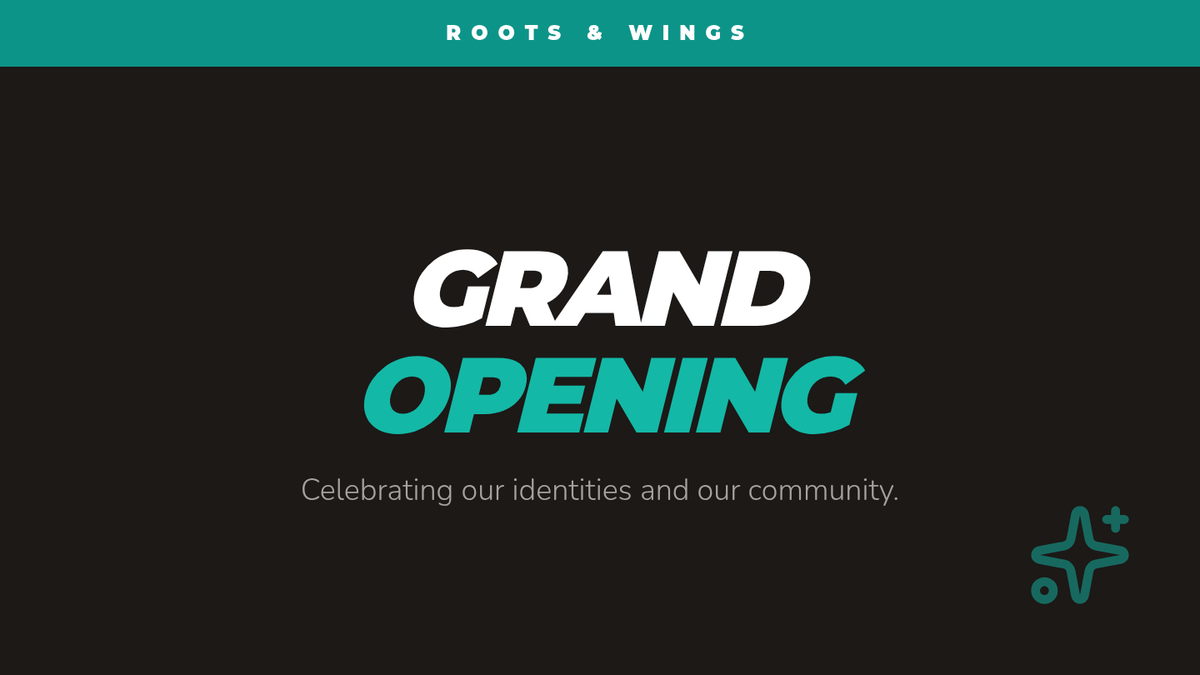
Final celebration slides for the Gallery Walk, including reflection questions and club closure.
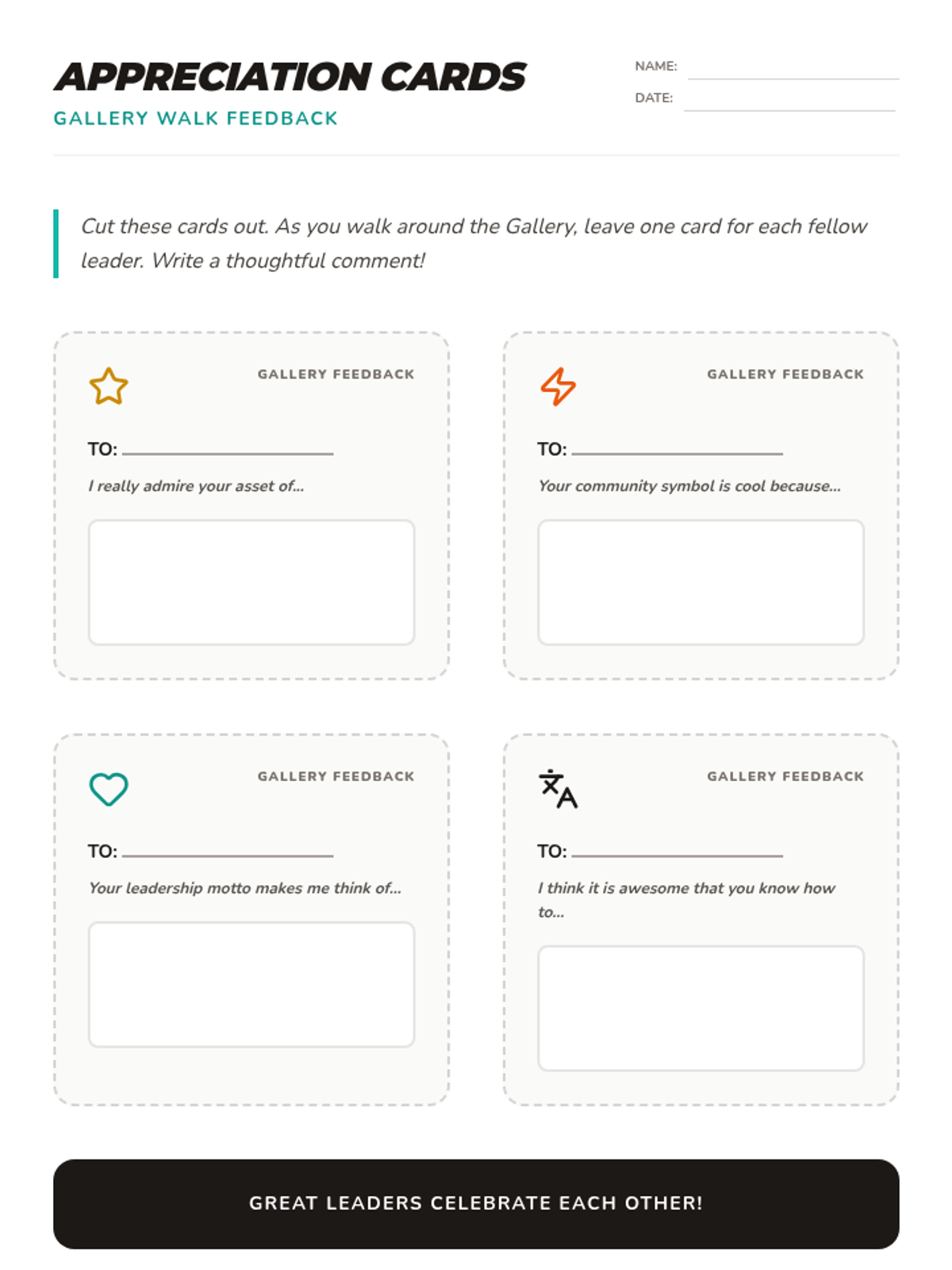
A set of printable feedback cards for students to use during the Gallery Walk to celebrate their peers' work.
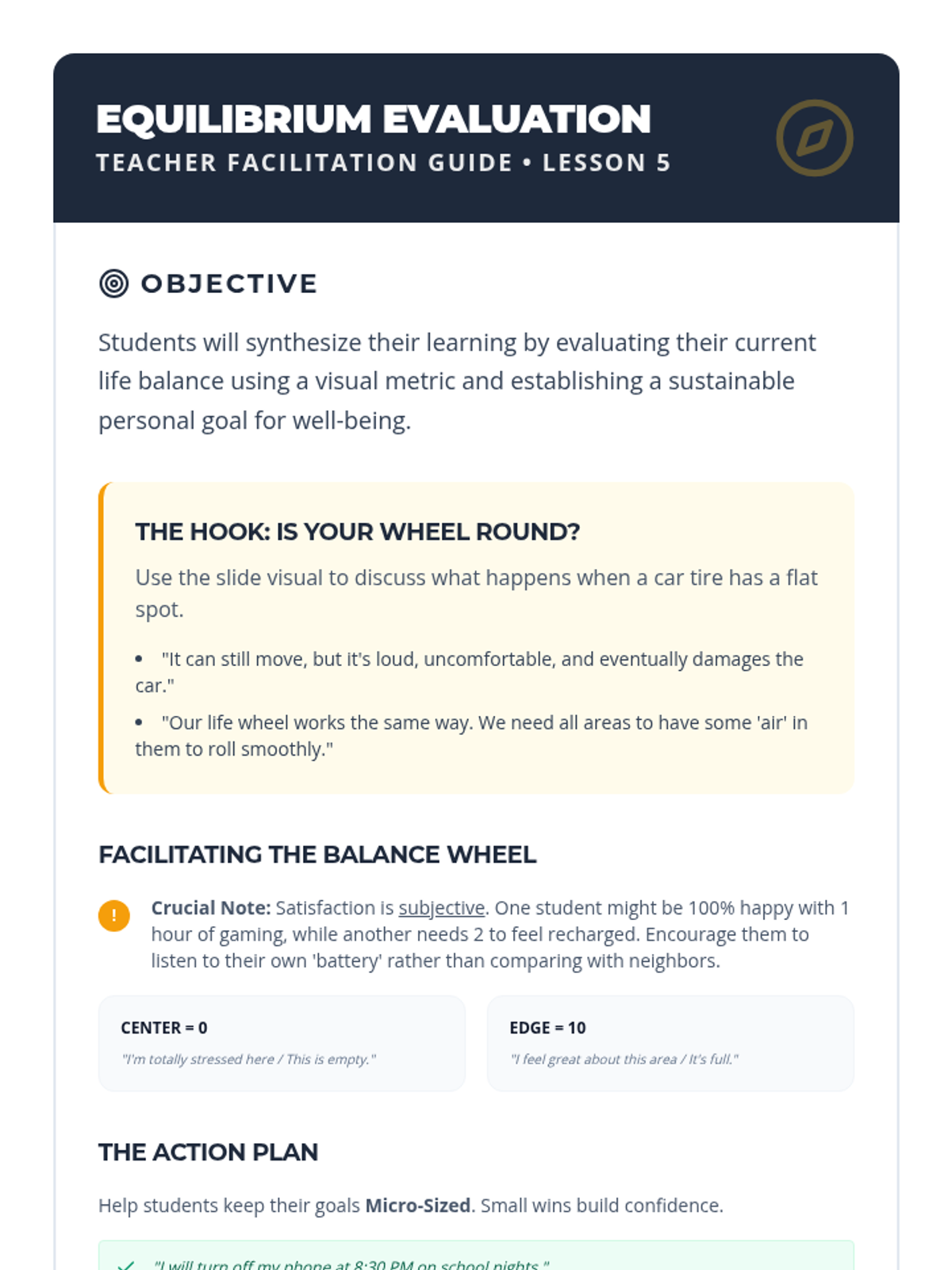
Teacher guide for Lesson 5, providing instructions for the 'Balance Wheel' workshop and strategies for effective goal-setting and student accountability.
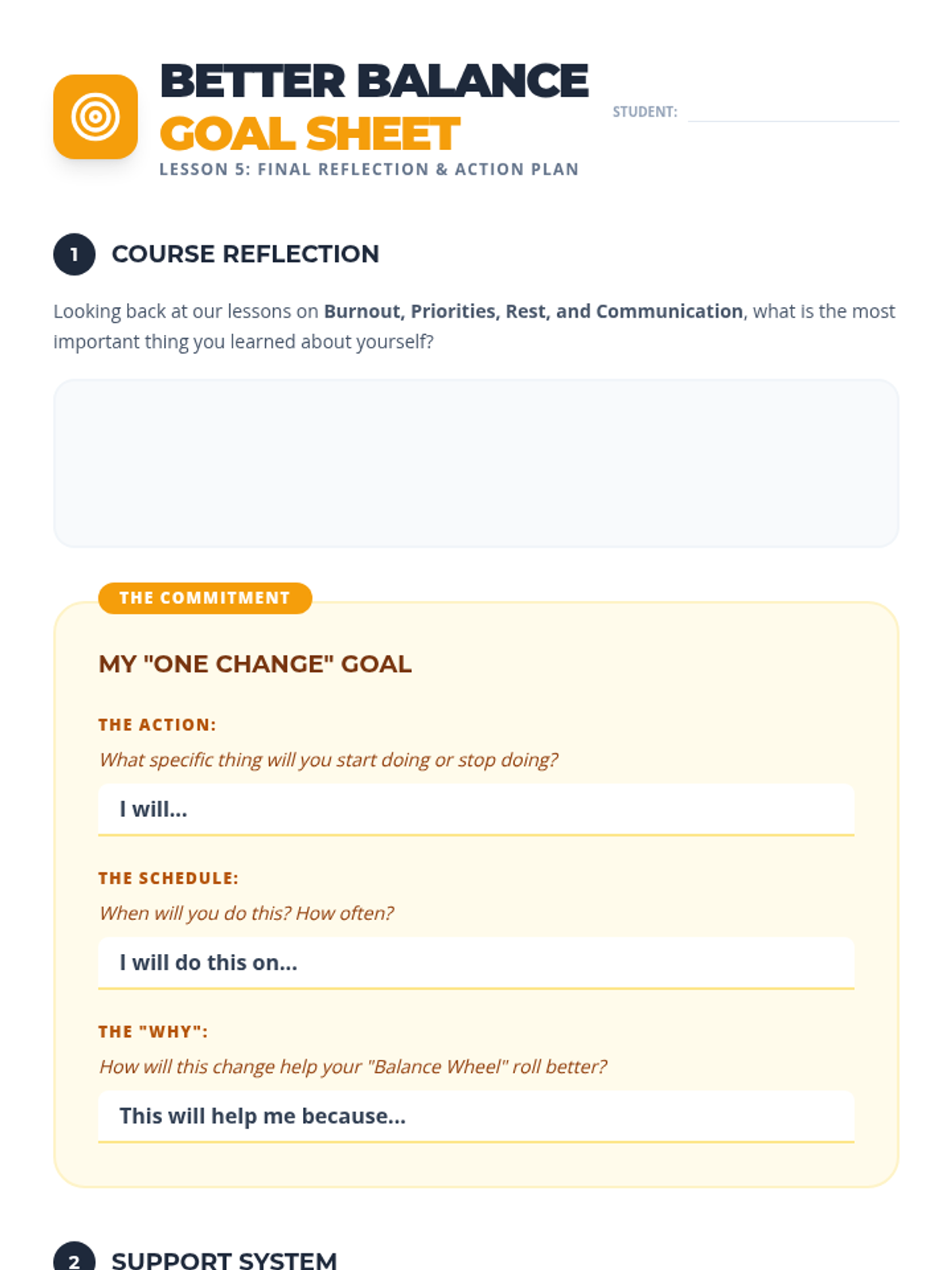
Goal setting and reflection sheet for Lesson 5, where students commit to a specific change to improve their life balance.
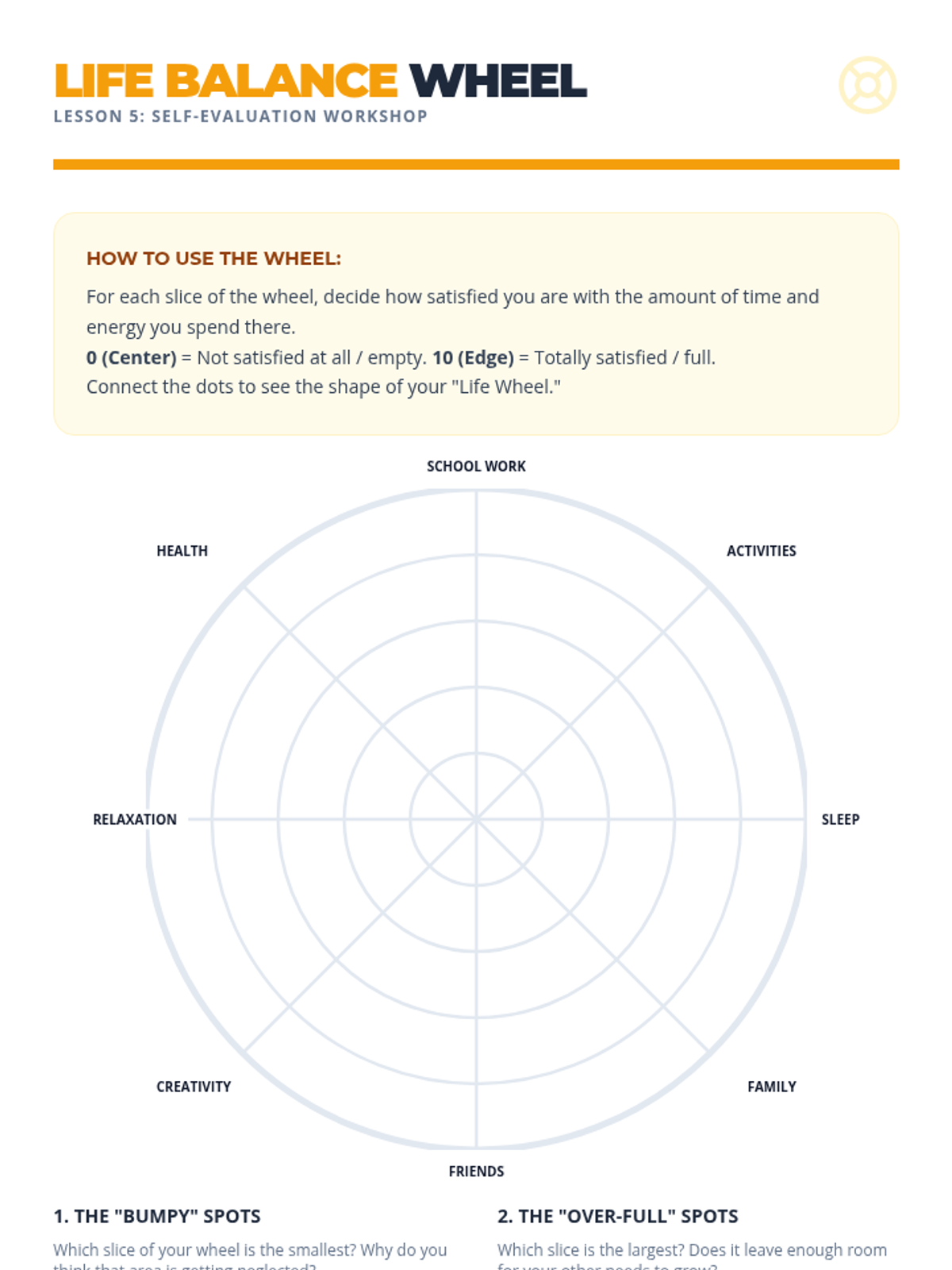
Visual reflection worksheet for Lesson 5, allowing students to map their current life balance across eight key areas.
Final slide deck for Lesson 5, introducing the 'Balance Wheel' concept and guiding students through personal reflection and goal setting.
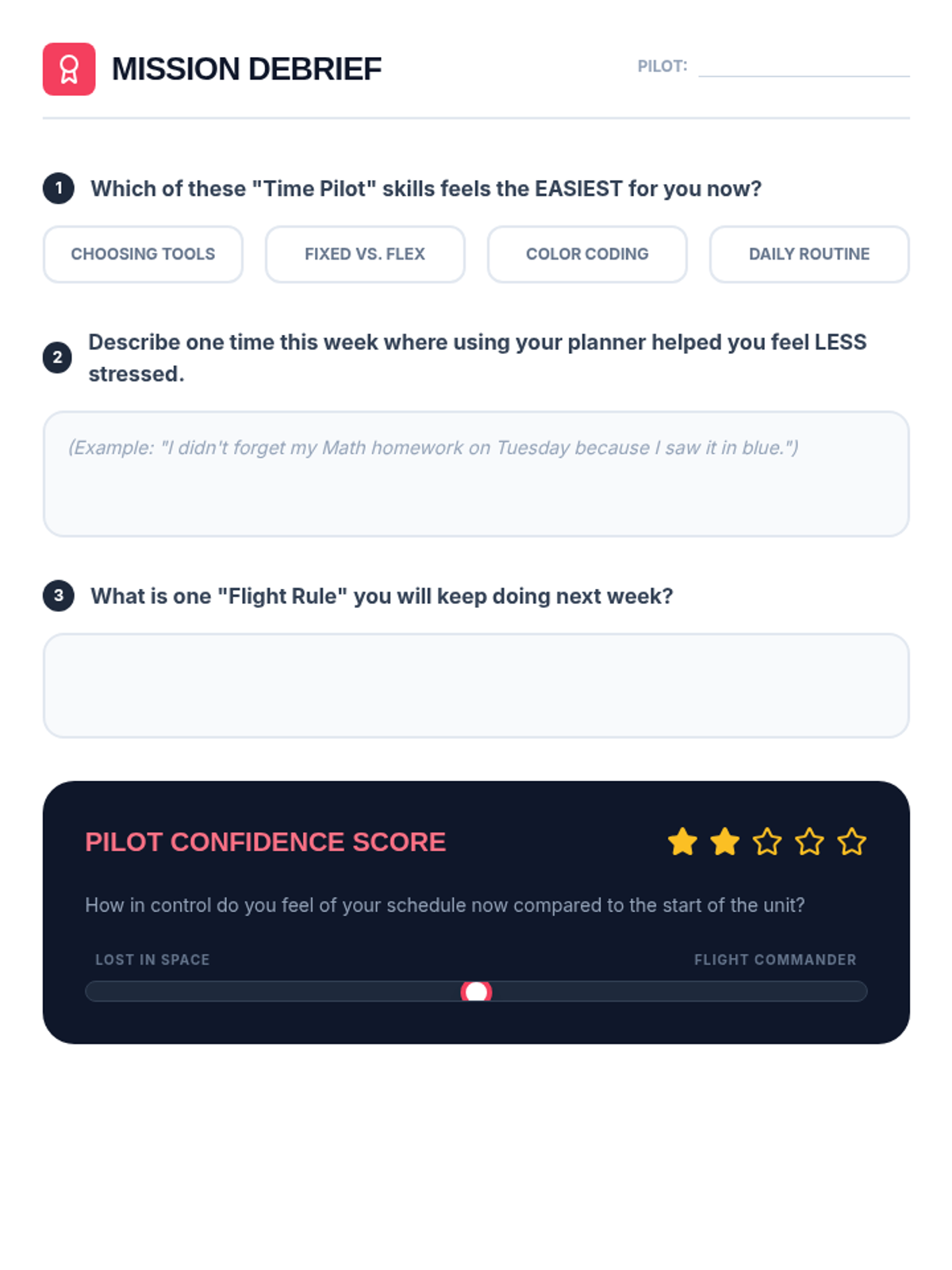
Reflection exit ticket for the end of the "Time Pilots" sequence. Students evaluate their own progress across the four key organizational skills and reflect on the impact of their new routines.
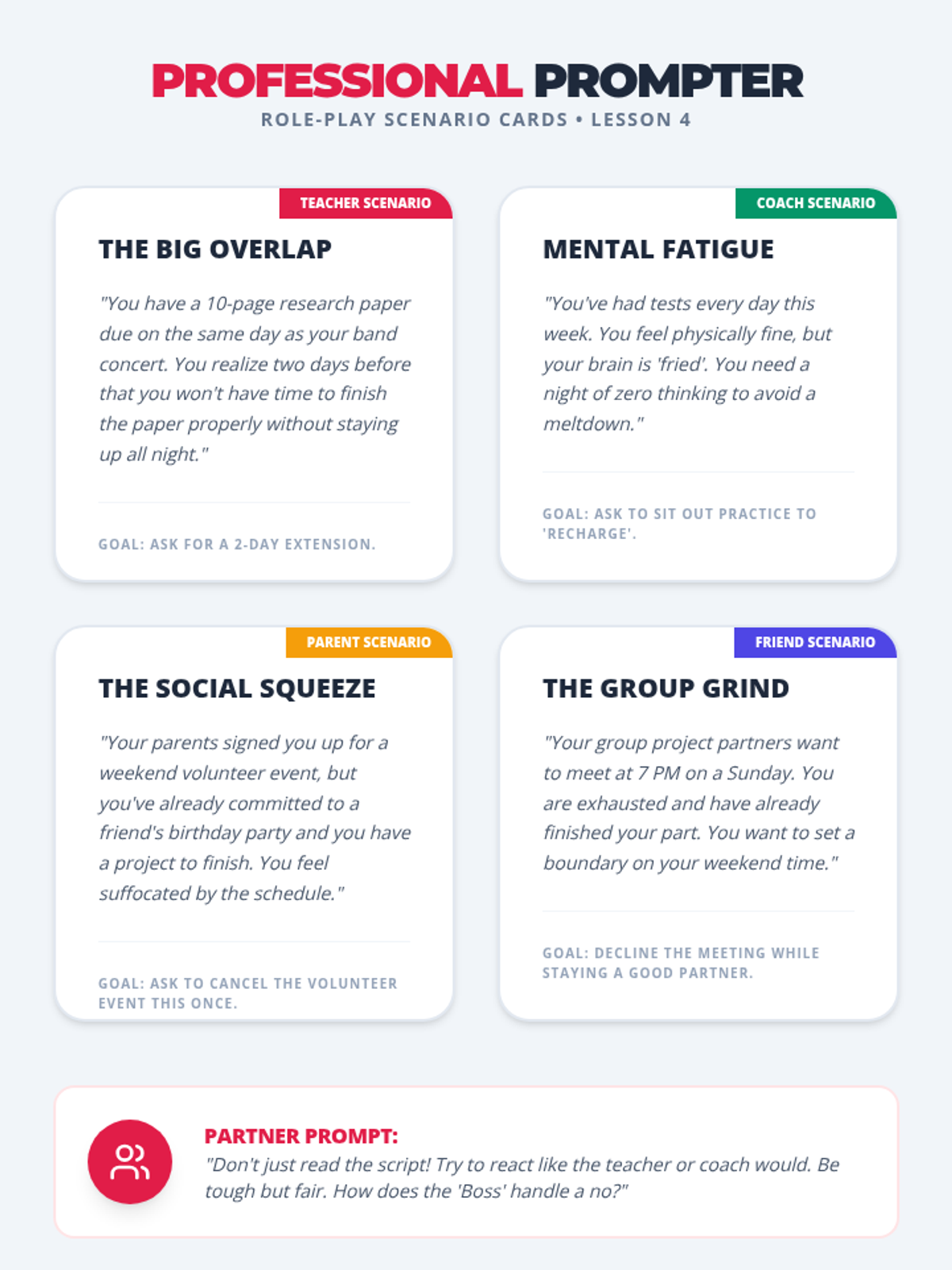
Role-play scenario cards for Lesson 4, providing students with specific situations to practice their communication and boundary-setting skills.
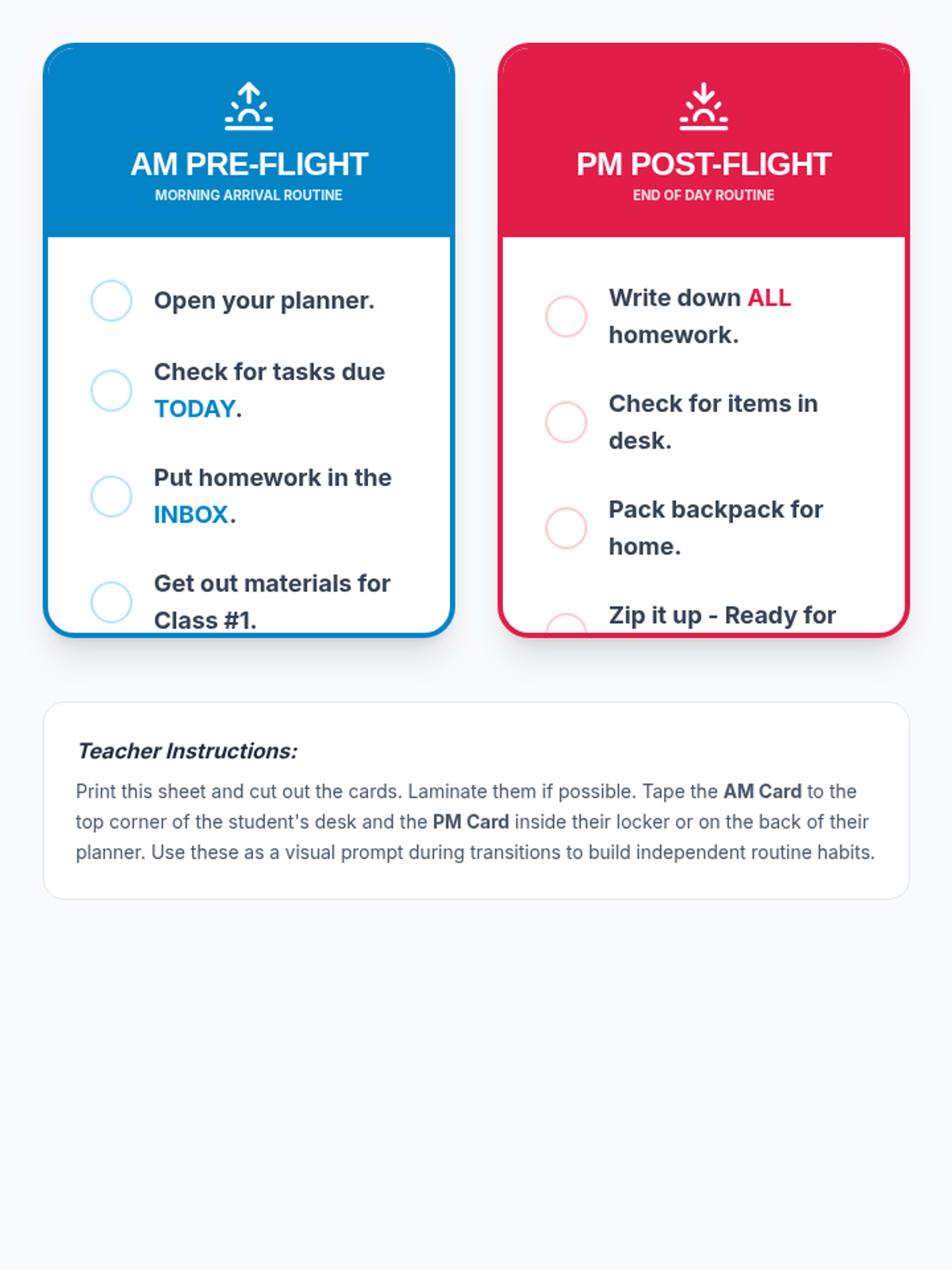
Visual checklist cards for Lesson 5. Includes a "Pre-Flight" morning routine and a "Post-Flight" evening routine to help students develop independent organizational habits.
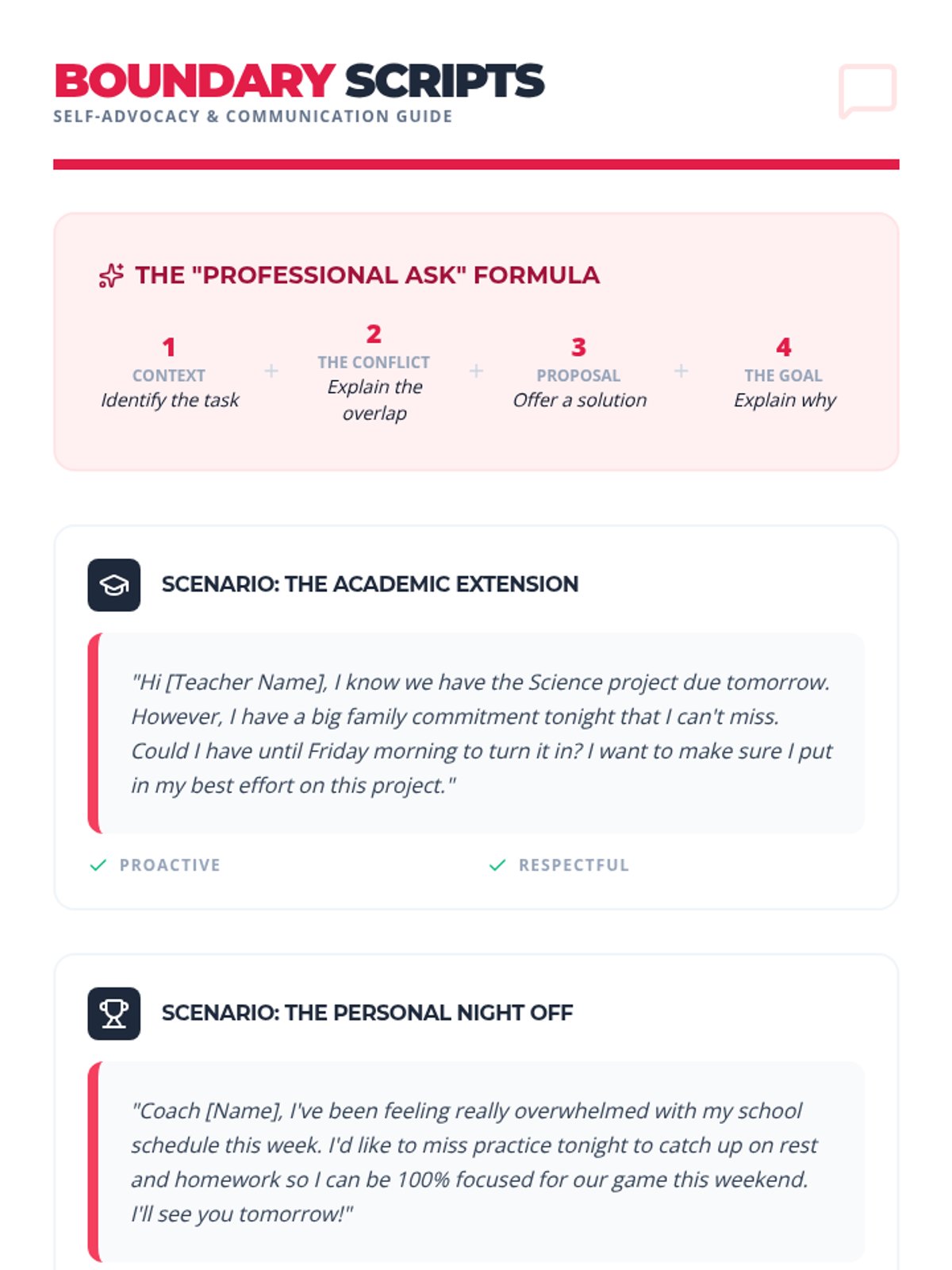
A handout containing communication scripts for students to practice setting boundaries with teachers, coaches, and parents.
Final slide deck for Lesson 5. Contrasts the "Guesser" vs. "Pilot" approach to preparedness and provides step-by-step Morning (Pre-Flight) and Evening (Post-Flight) routines.
Slide deck for Lesson 4, teaching students how to proactively communicate boundaries and request extensions using professional scripts.
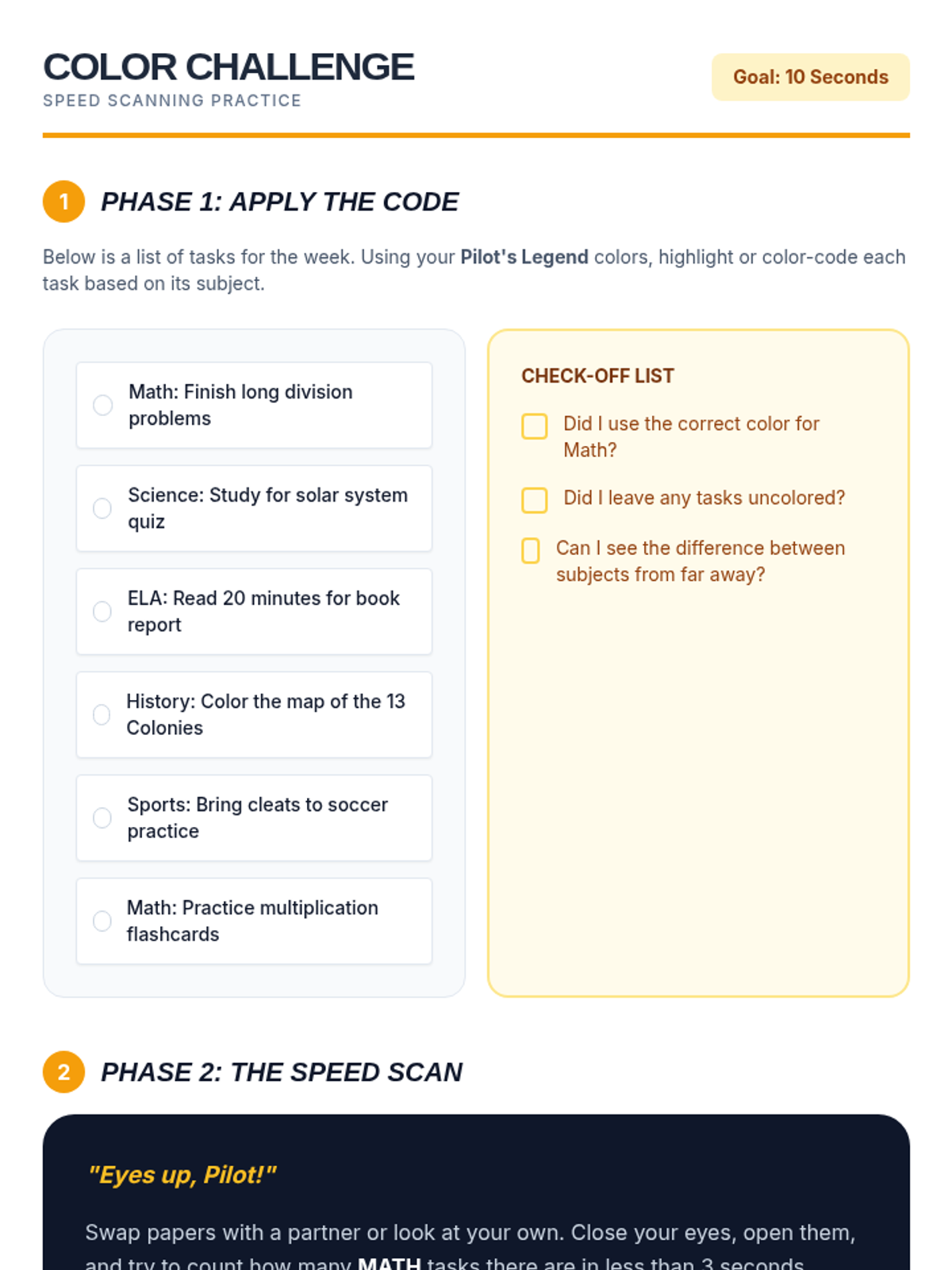
Practice worksheet for Lesson 4. Students apply their color-coding system to a list of uncoded tasks and then perform a "speed scan" to test the efficiency of their visual categorization.
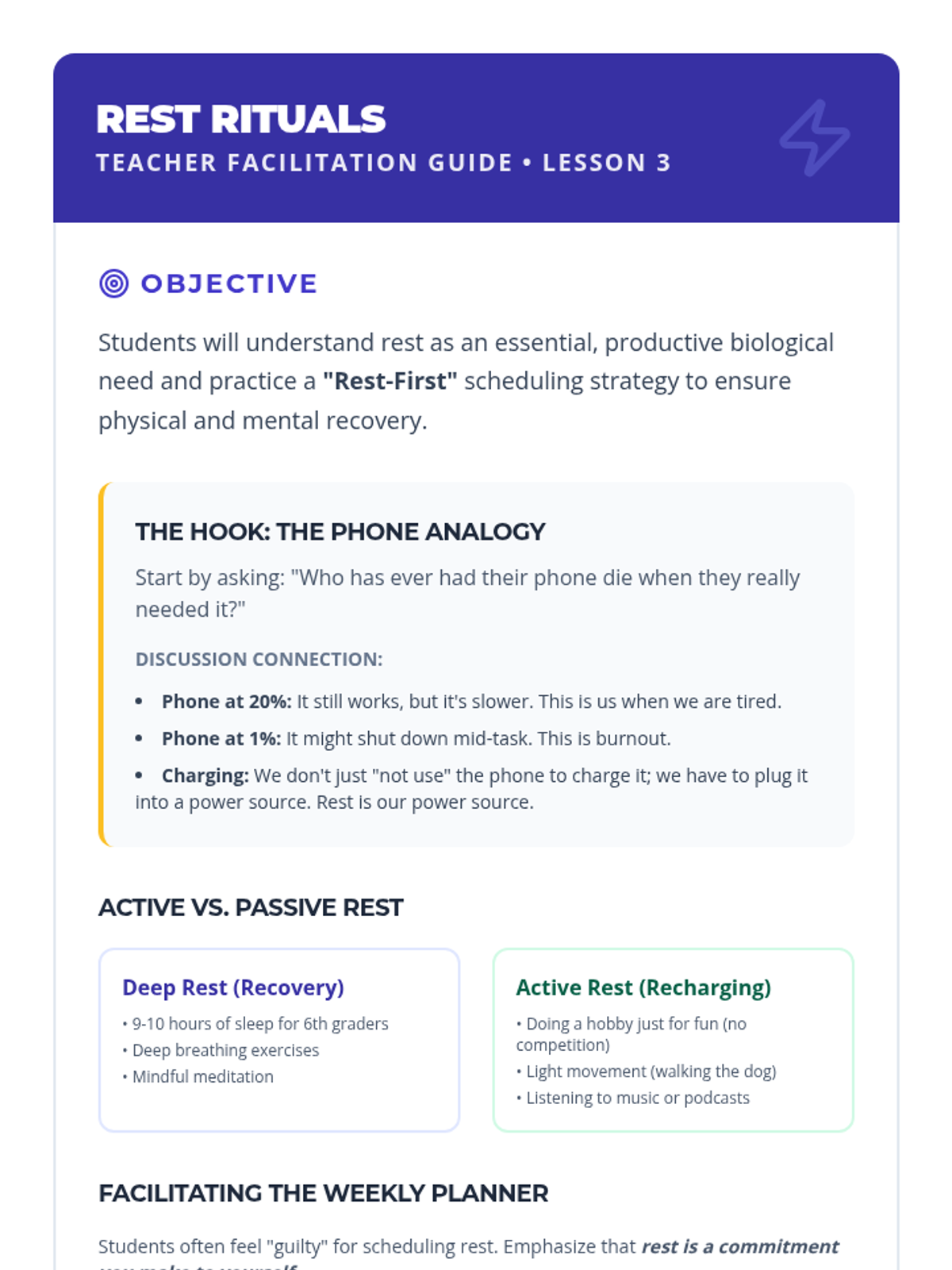
Teacher guide for Lesson 3, detailing the phone battery analogy and providing step-by-step instructions for the 'Rest-First' scheduling workshop.
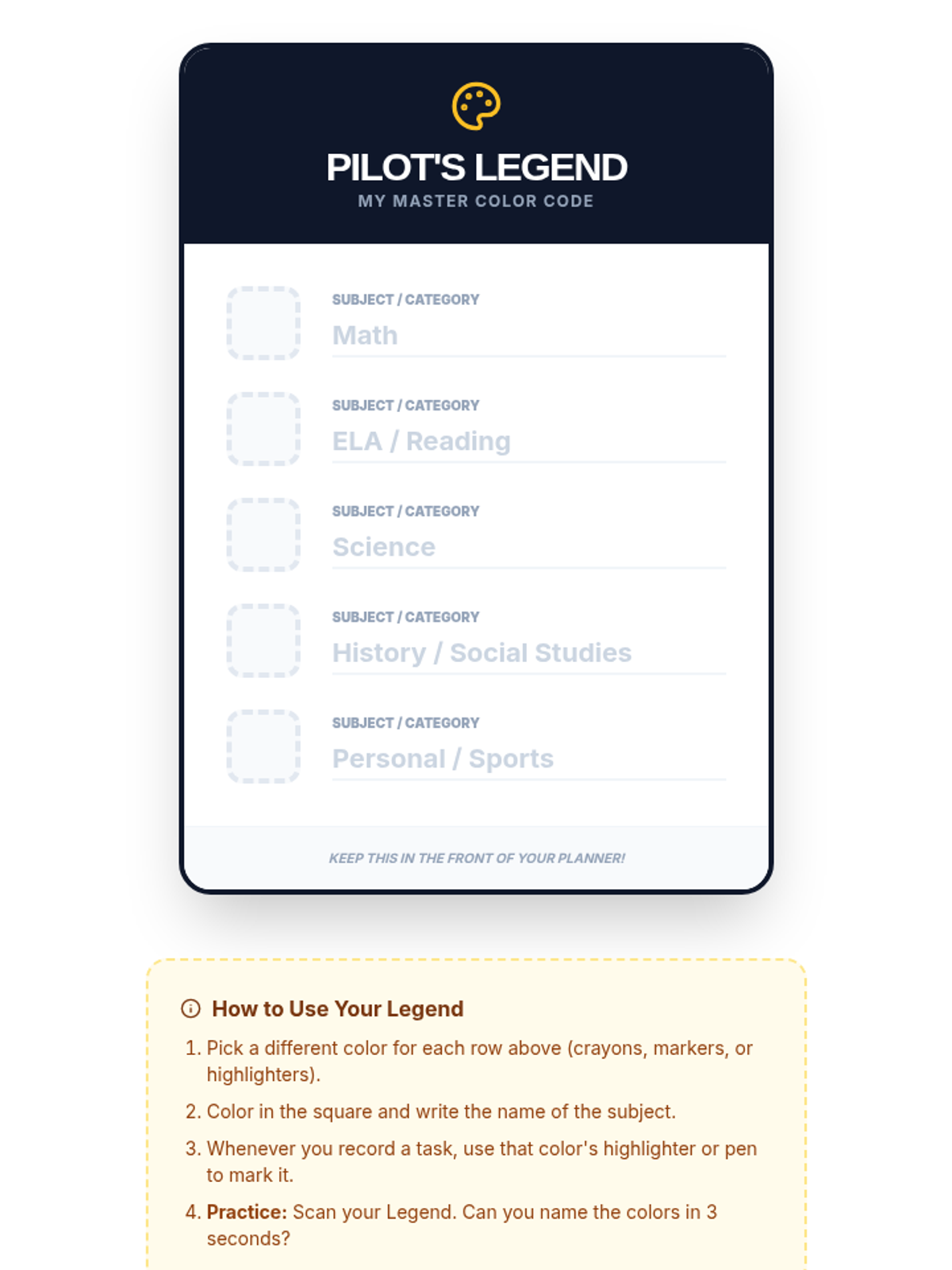
Personal reference sheet for students to create their own color-coding legend. This "Pilot's Legend" card helps them maintain consistency in their organizational system across all subjects.
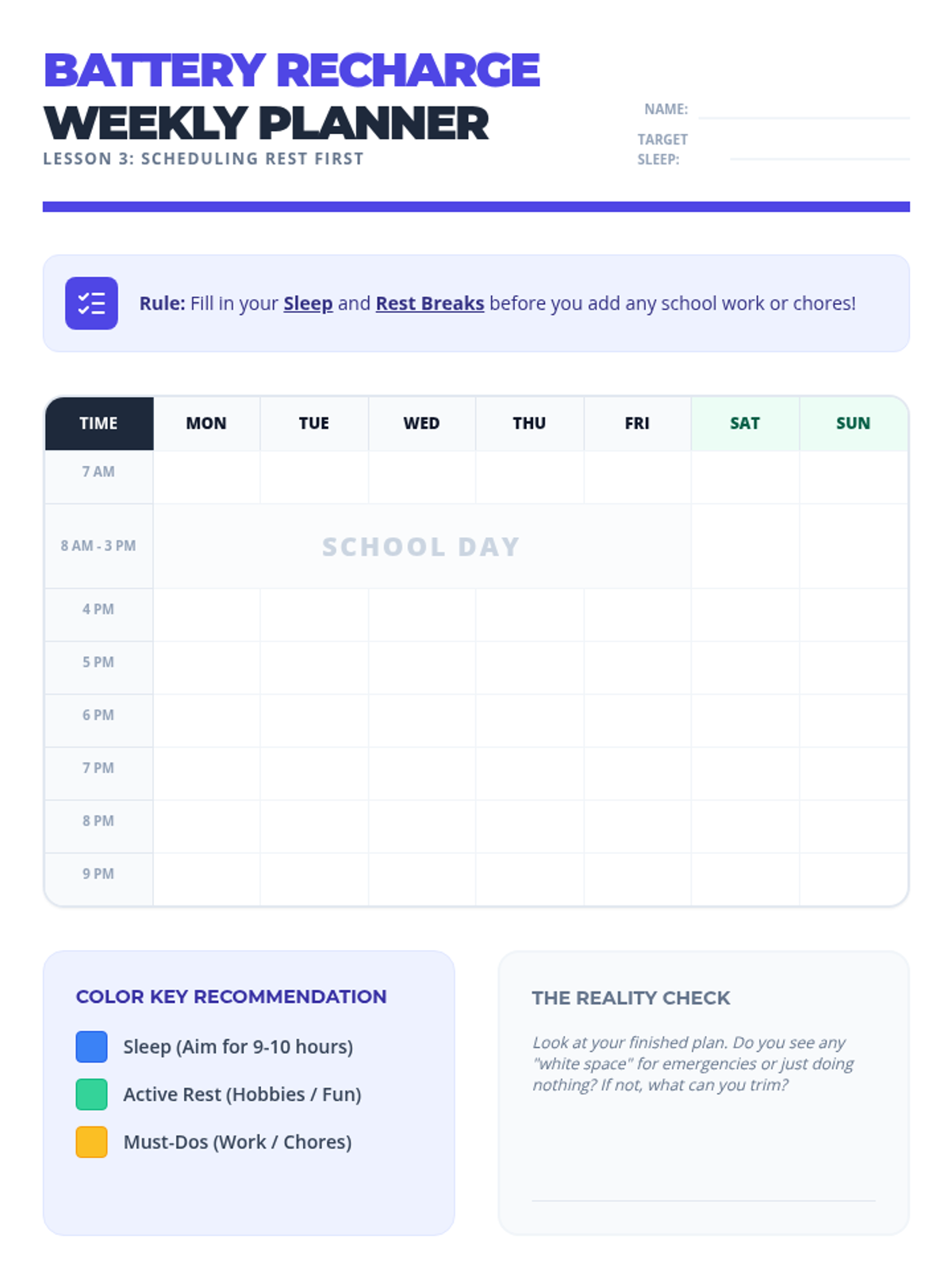
A weekly planner template designed for students to practice 'Rest-First' scheduling, prioritizing sleep and downtime before other commitments.
Slide deck for Lesson 4. Explains the "Scan Advantage" of color-coding for faster information processing and introduces universal color categories for school subjects.
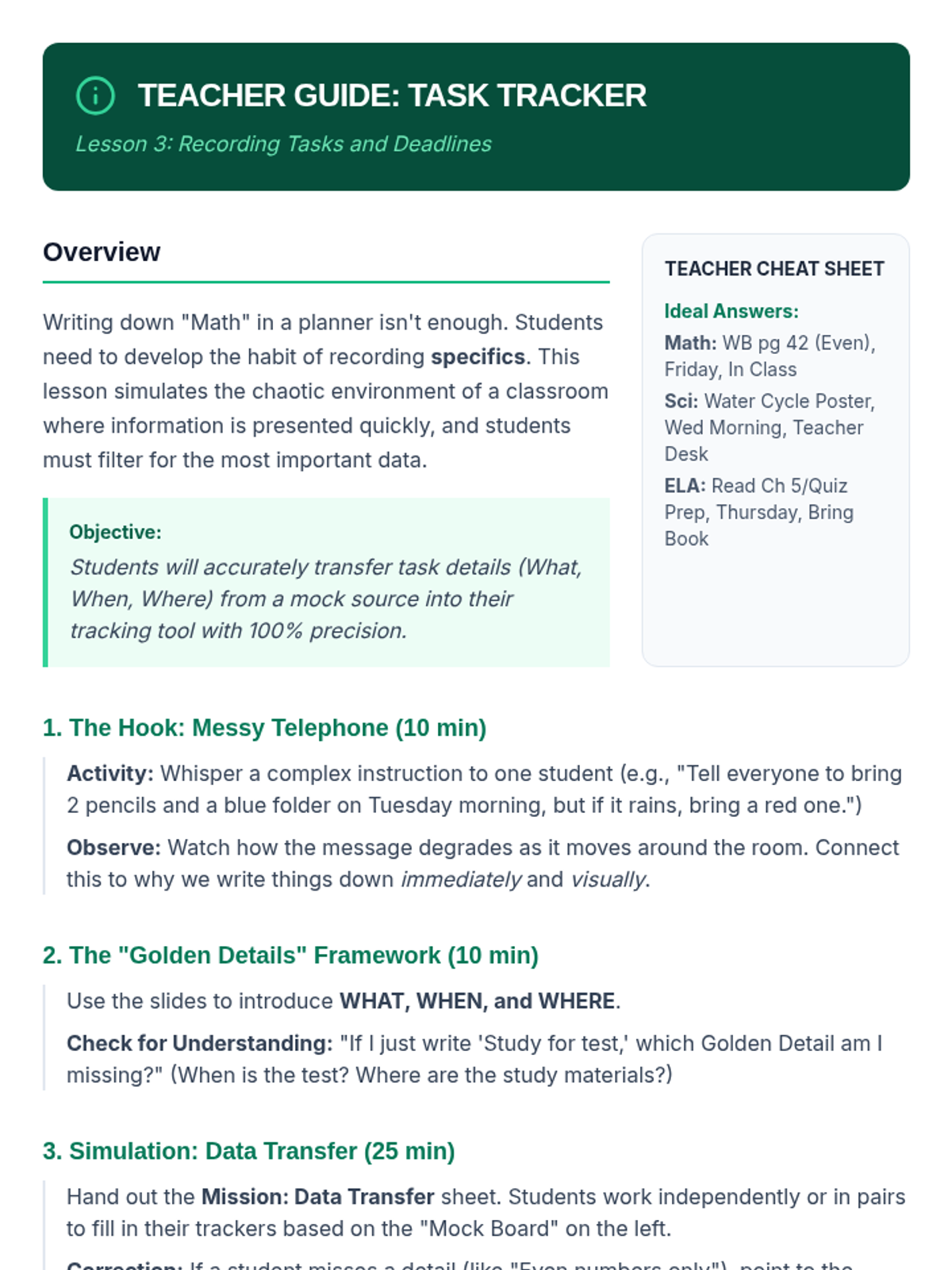
Teacher guide for Lesson 3. Provides instructions for a "Telephone" game hook, guidance on teaching the "Golden Details" framework, and tips for the data transfer simulation.
Slide deck for Lesson 3, focusing on the importance of rest and self-care using the phone battery analogy and the 'Rest-First' scheduling strategy.
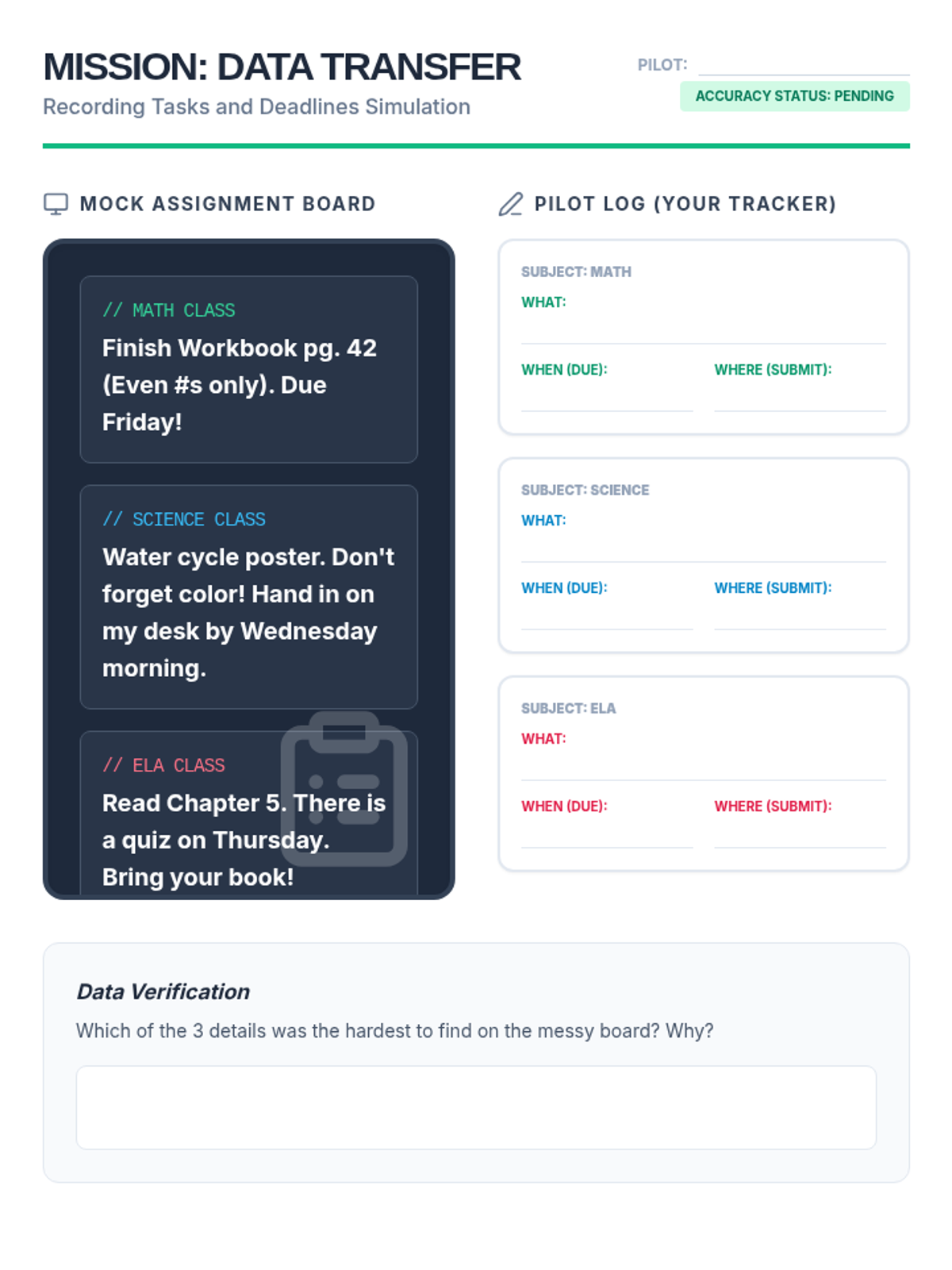
Simulation worksheet for Lesson 3. Students practice extracting "Golden Details" (What, When, Where) from a messy mock assignment board and recording them into a clean Pilot Log tracker.
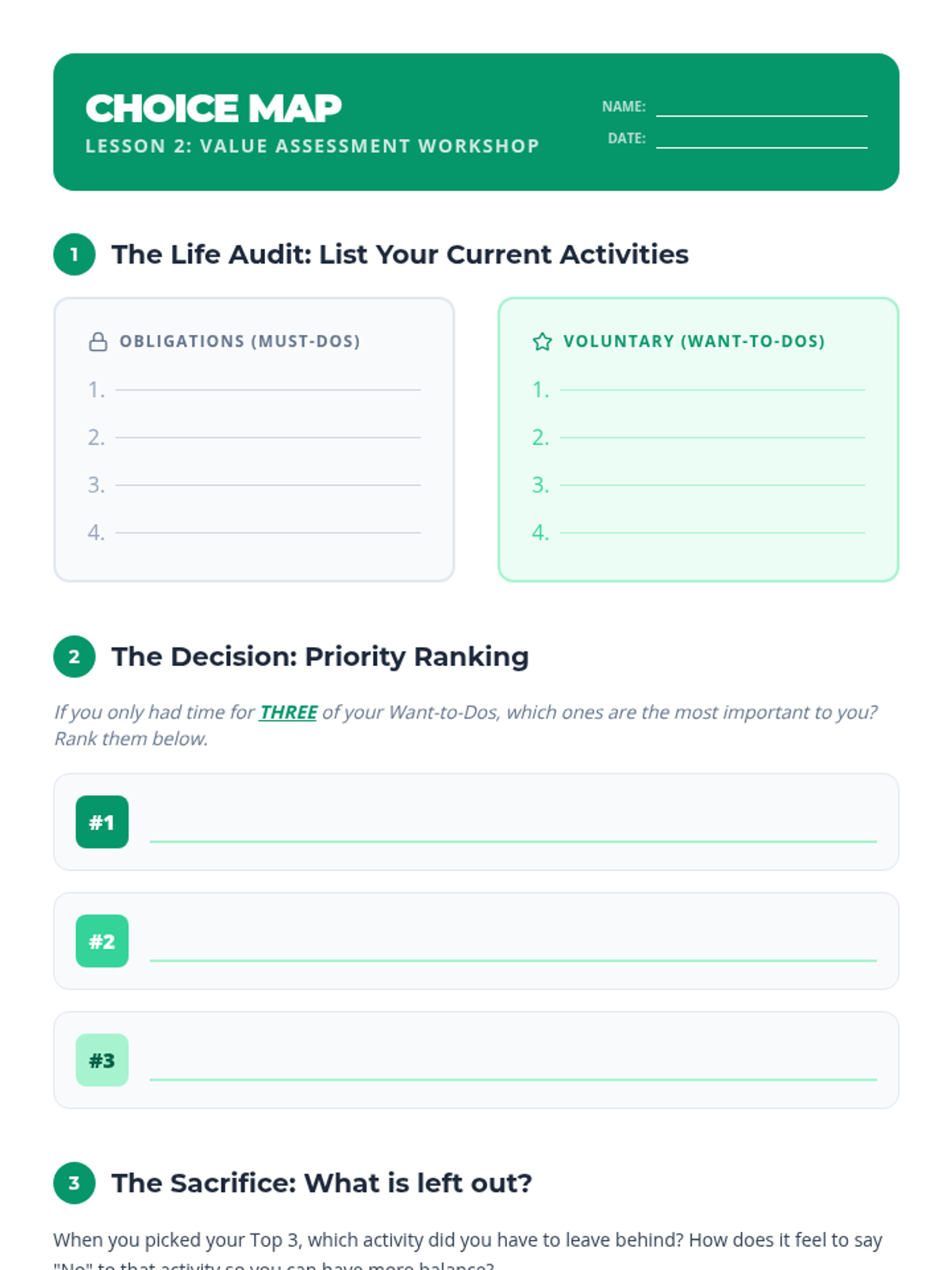
Categorization and ranking worksheet for Lesson 2, helping students map their obligations and voluntary activities.
Slide deck for Lesson 3. Explains the "Telephone" problem of relying on memory, introduces the "3 Golden Details" (What, When, Where), and prepares students for a task-recording simulation.
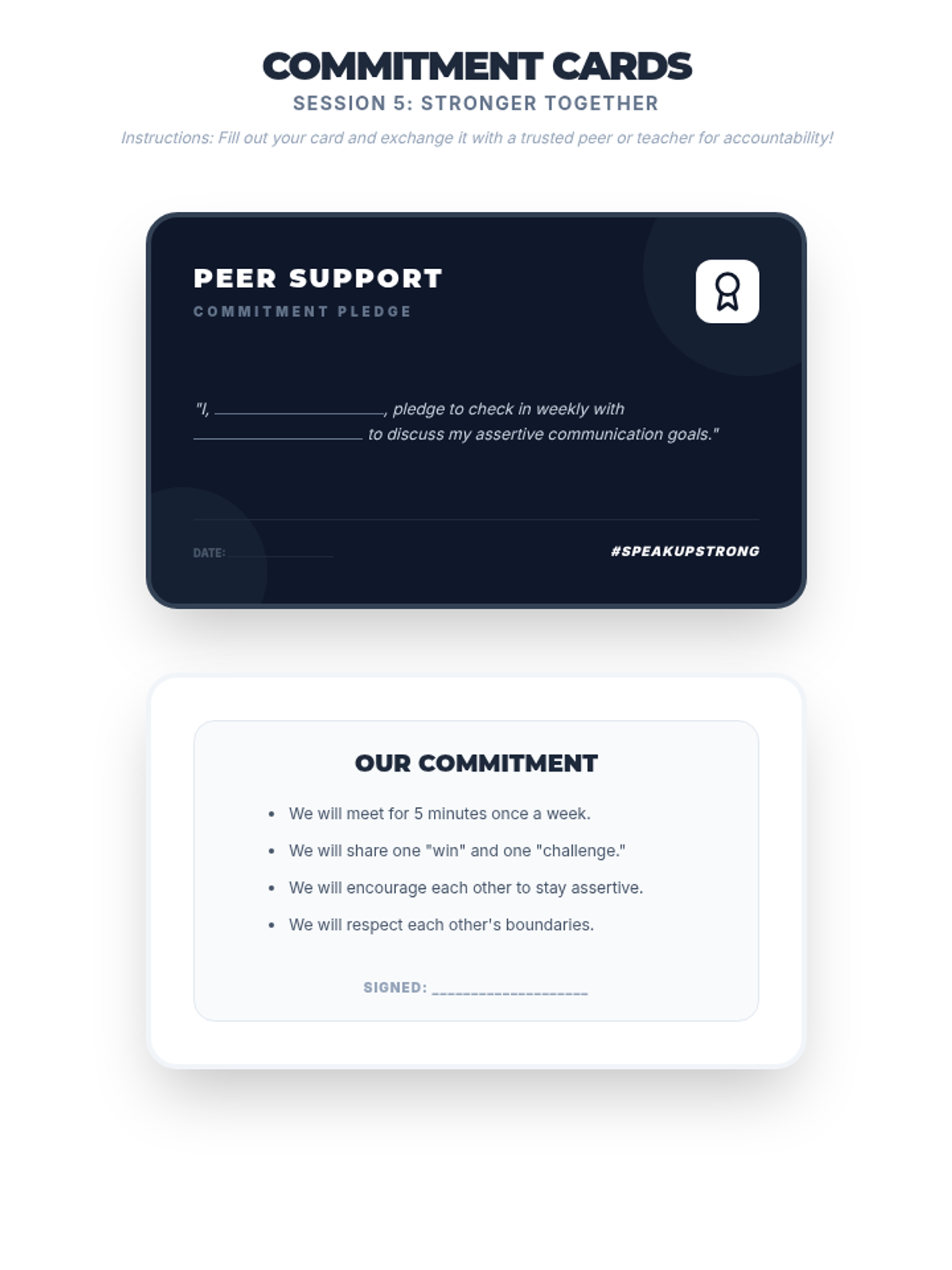
A commitment card for students to fill out and exchange with a peer or teacher to ensure long-term accountability.
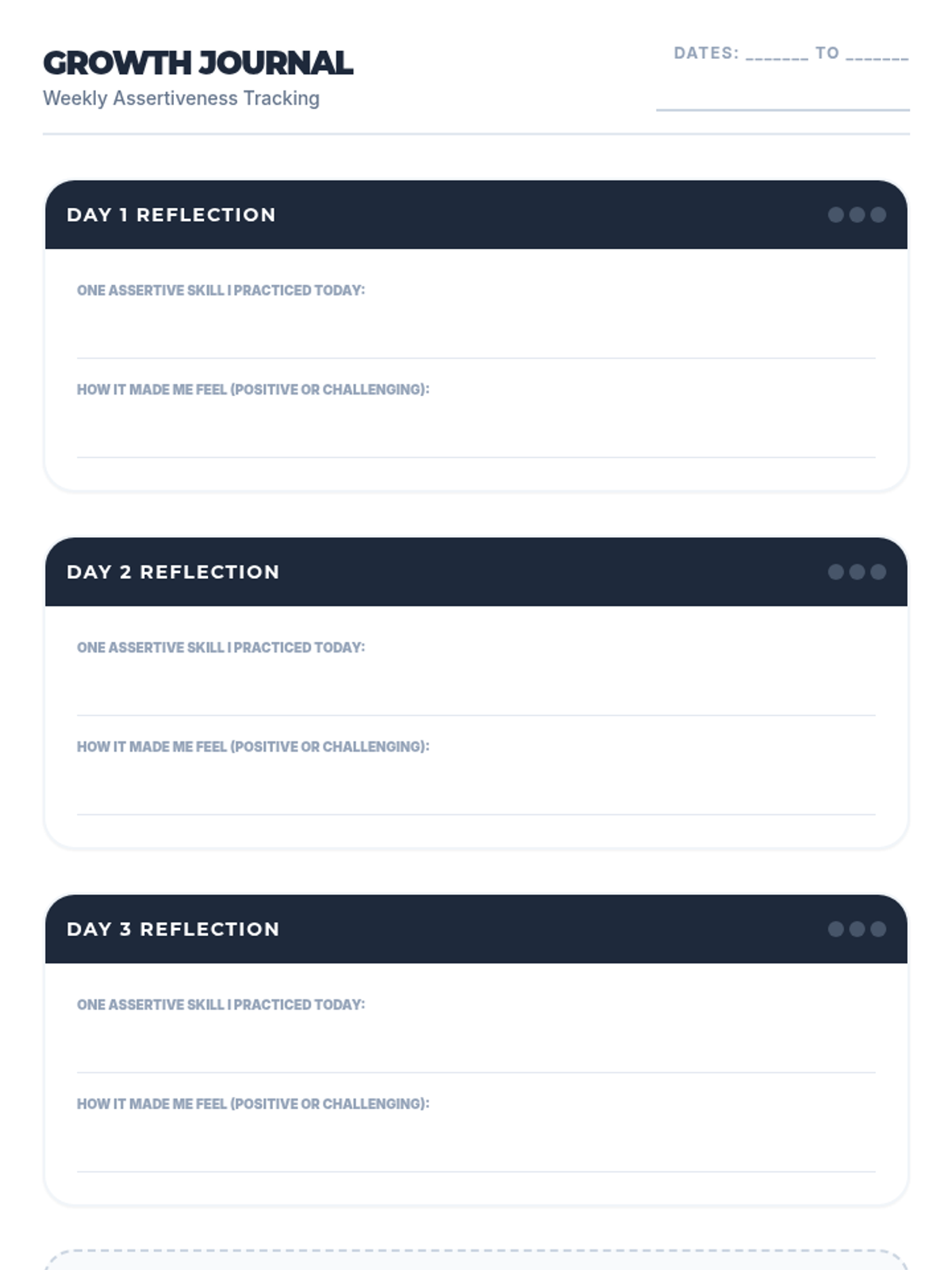
A journal template for students to track their assertive communication practice over multiple days.
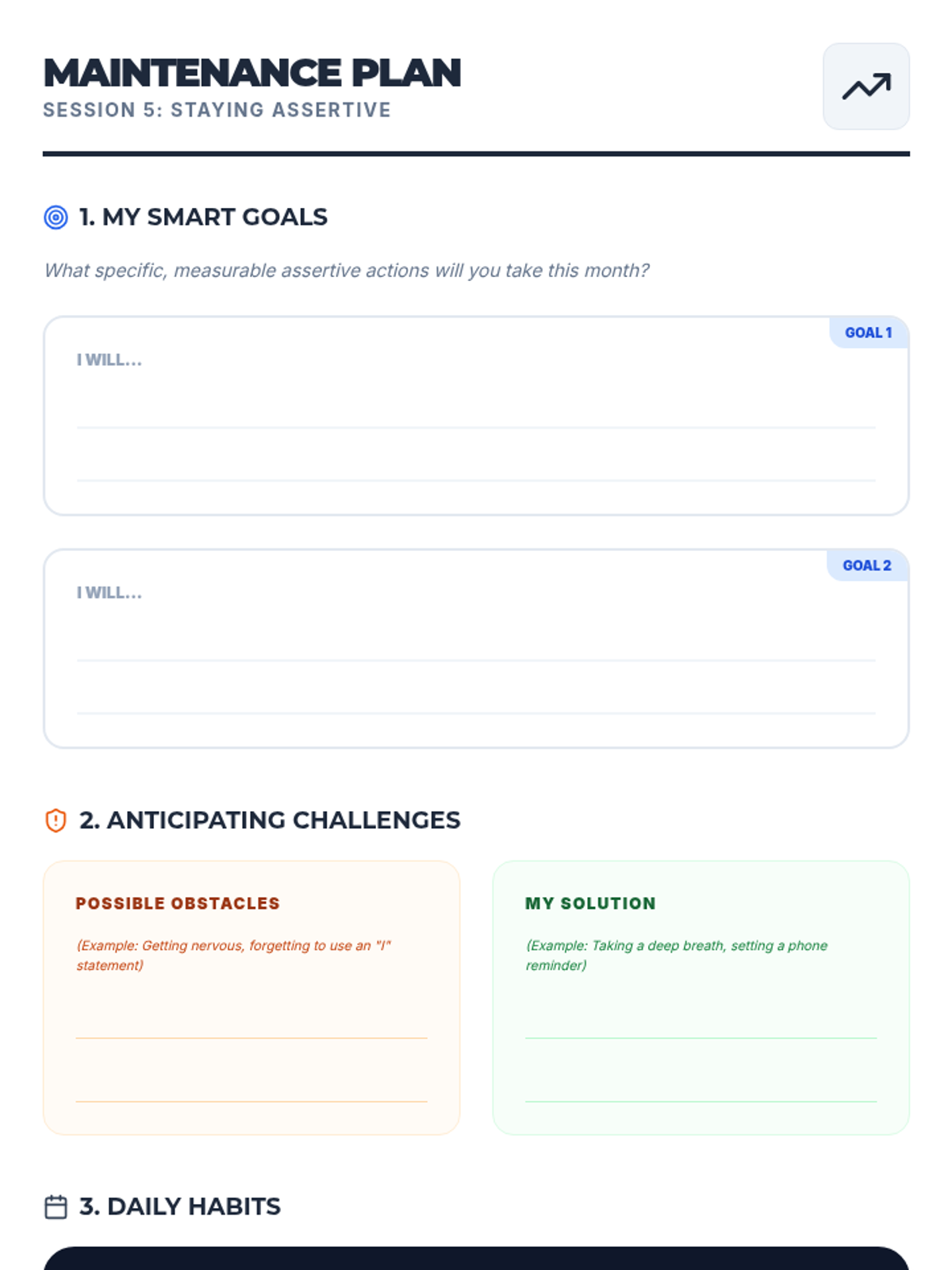
A maintenance plan handout for students to set SMART goals and identify solutions to potential assertive communication challenges.
Engaging slides for Session 5 covering long-term maintenance strategies, SMART goals, and building a support network for ongoing assertiveness.
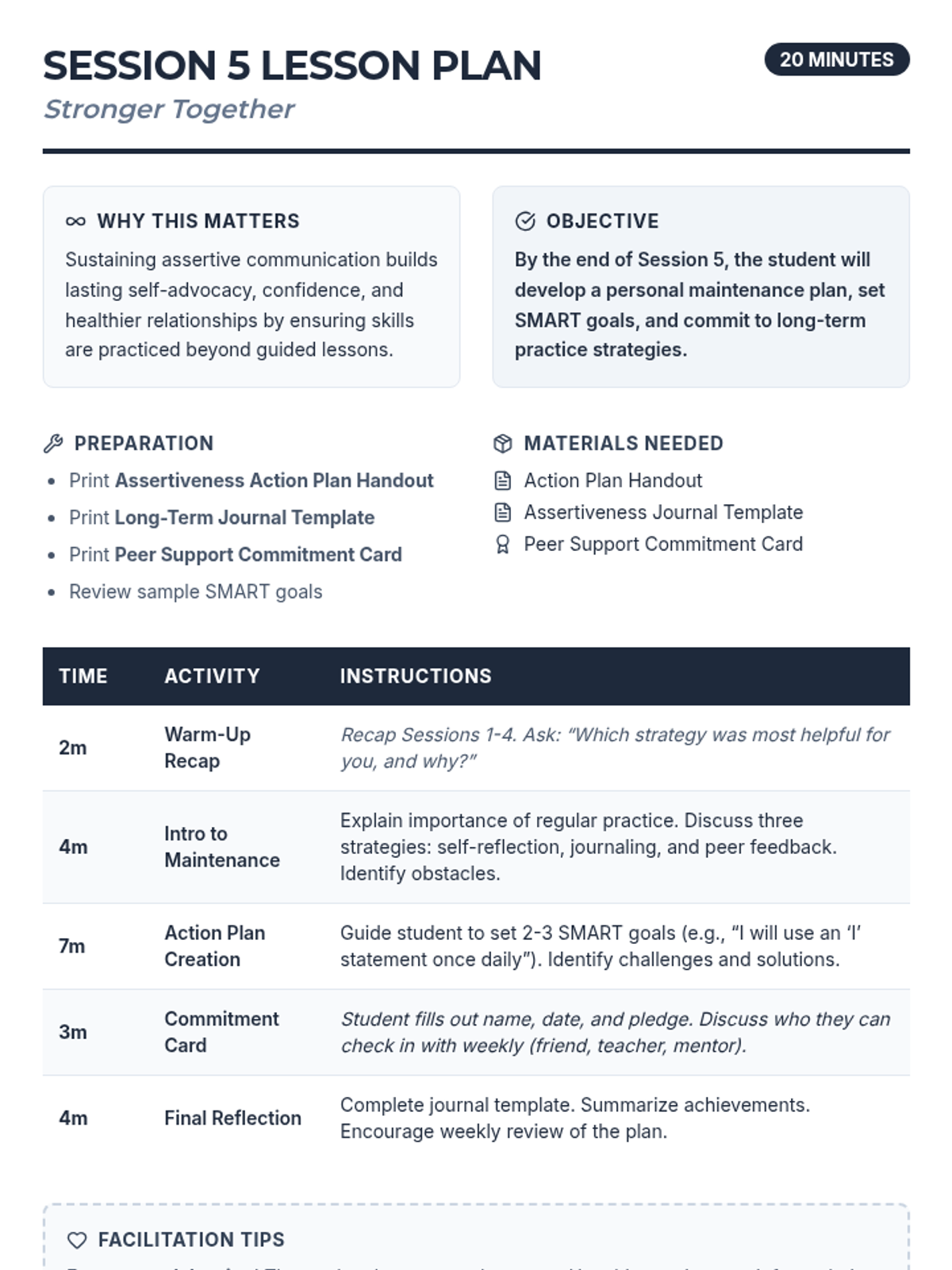
A comprehensive 20-minute lesson plan for Session 5, focusing on maintaining assertiveness over time.
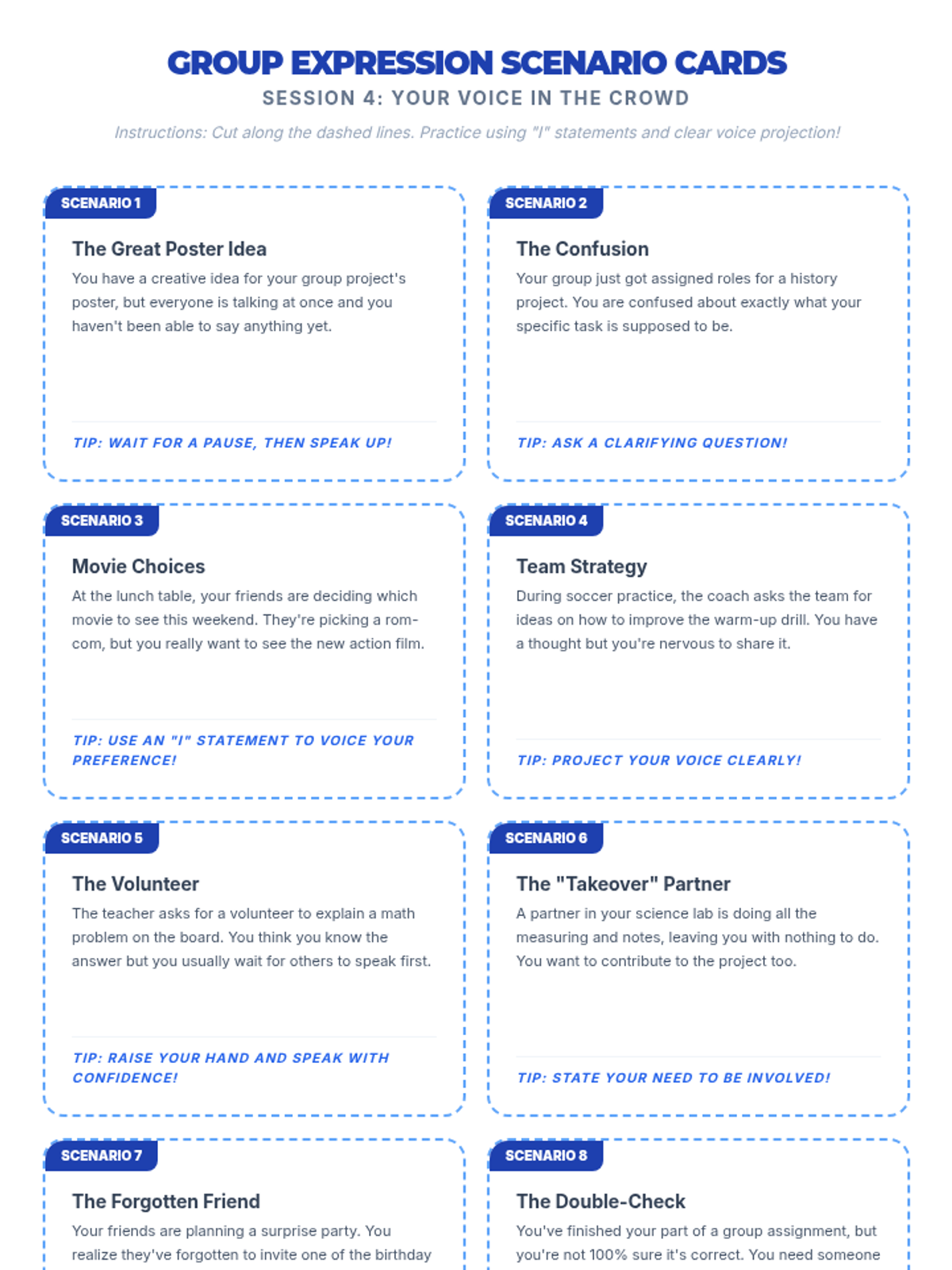
Group expression scenarios for role-play practice, focusing on group project and social circle dynamics.
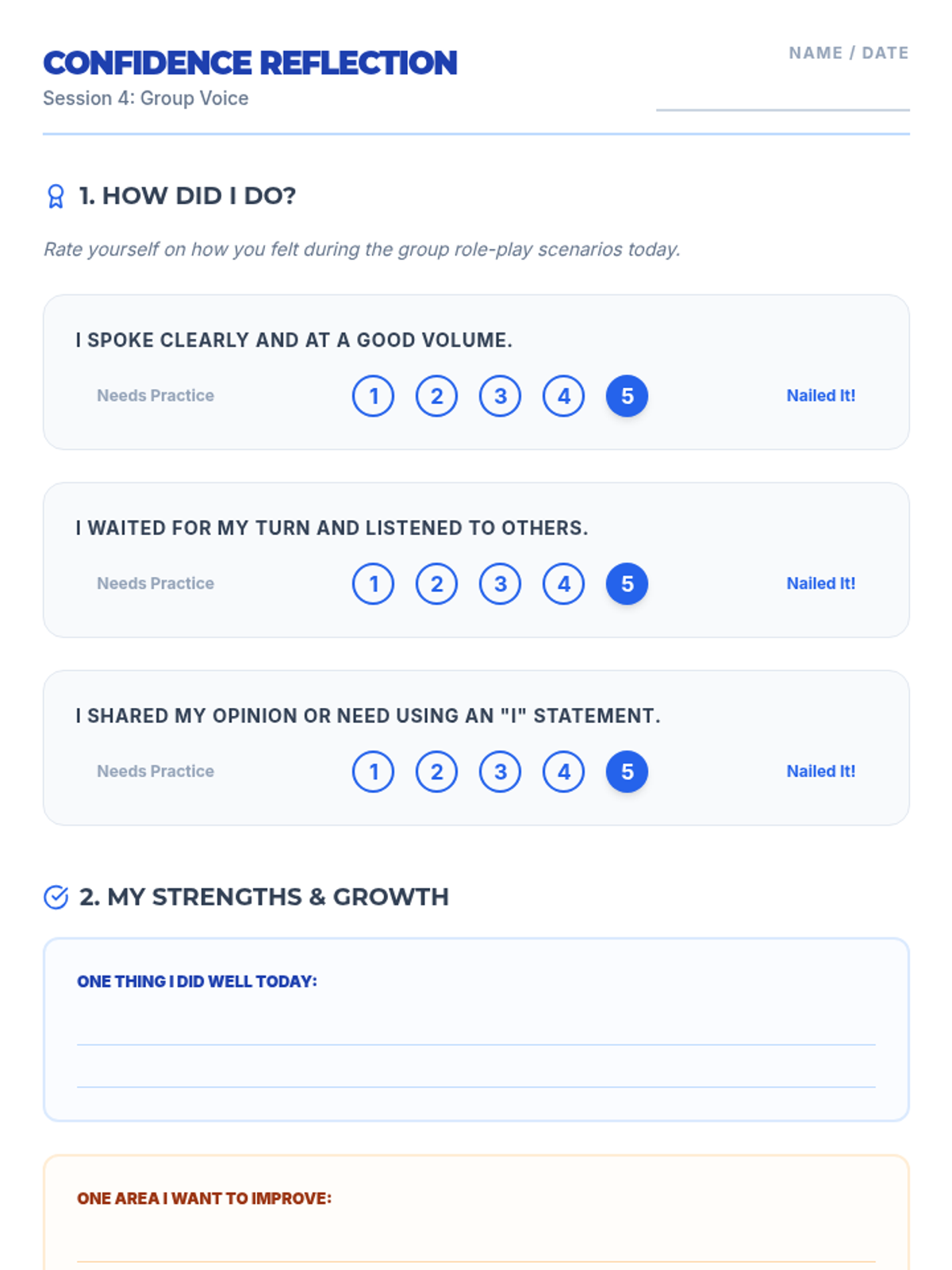
A reflection worksheet for students to record their strengths and areas for improvement in group communication.
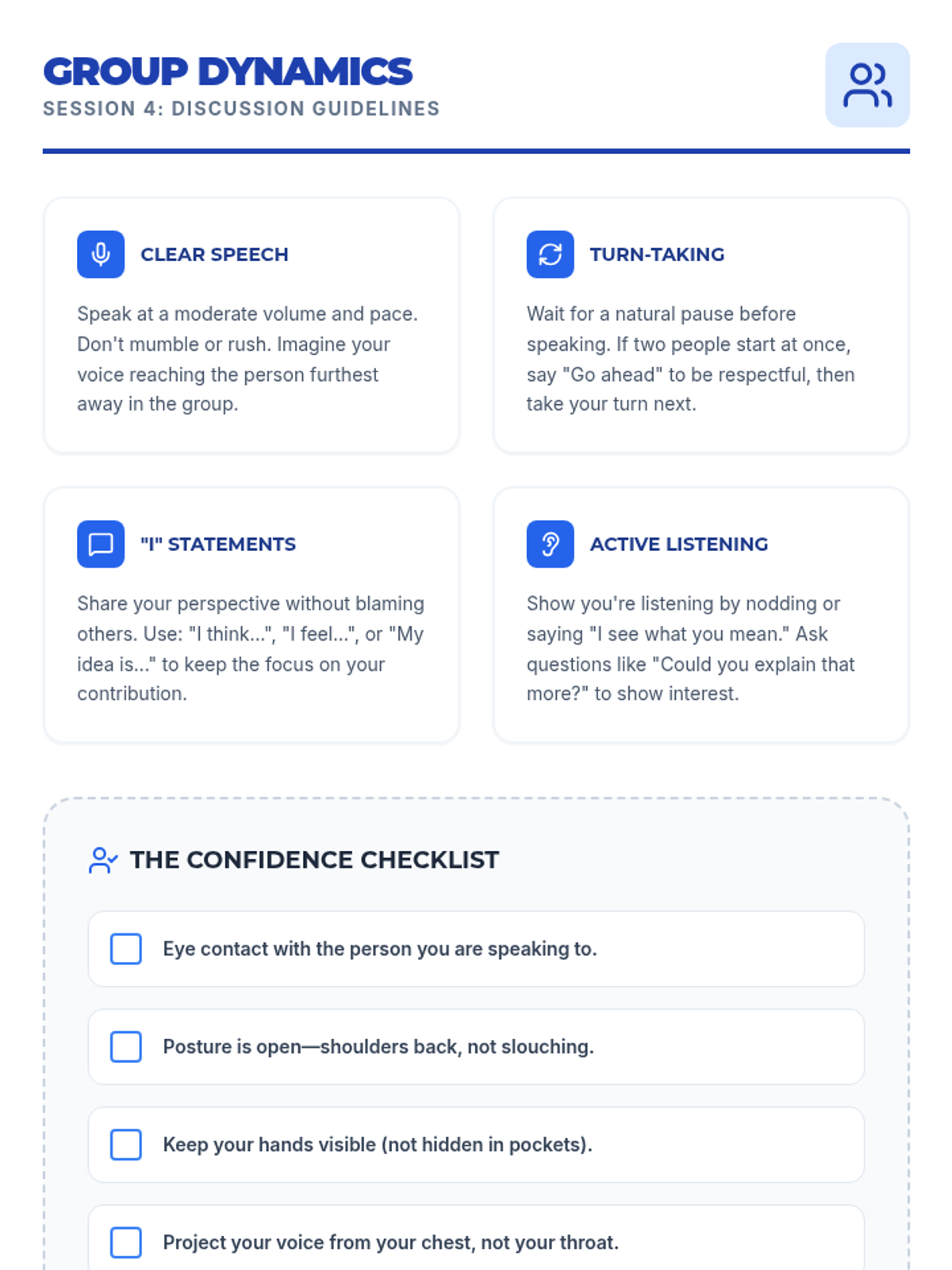
A visual handout covering key group communication guidelines like turn-taking, active listening, and voice projection.
Engaging slides for Session 4 covering key group communication guidelines, role-play practice instructions, and feedback tips for building confidence.
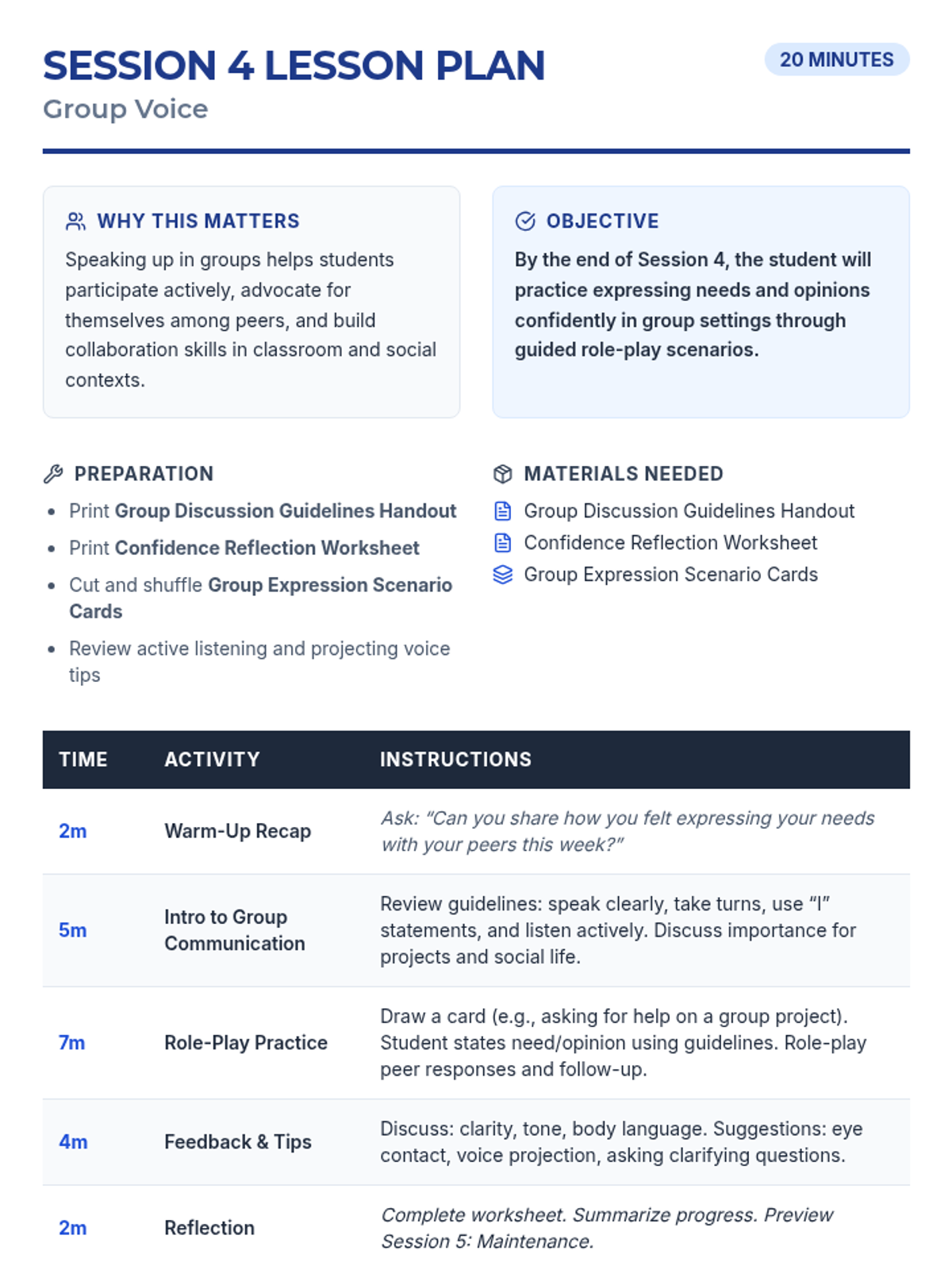
A comprehensive 20-minute lesson plan for Session 4, focusing on expressing needs confidently in group settings.
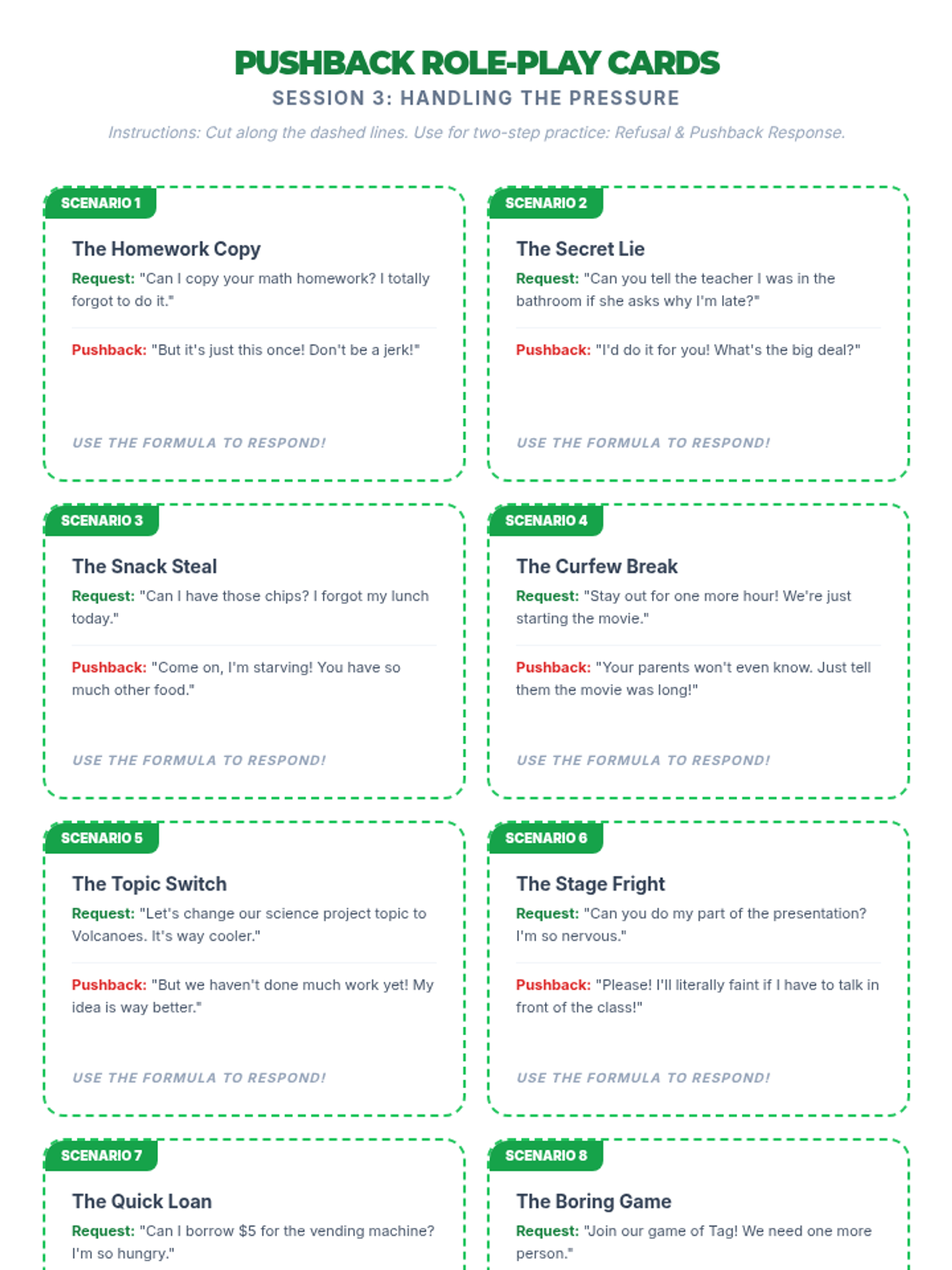
Scenario role-play cards for practicing saying "no" and handling pushback with specific requests and pressure statements.
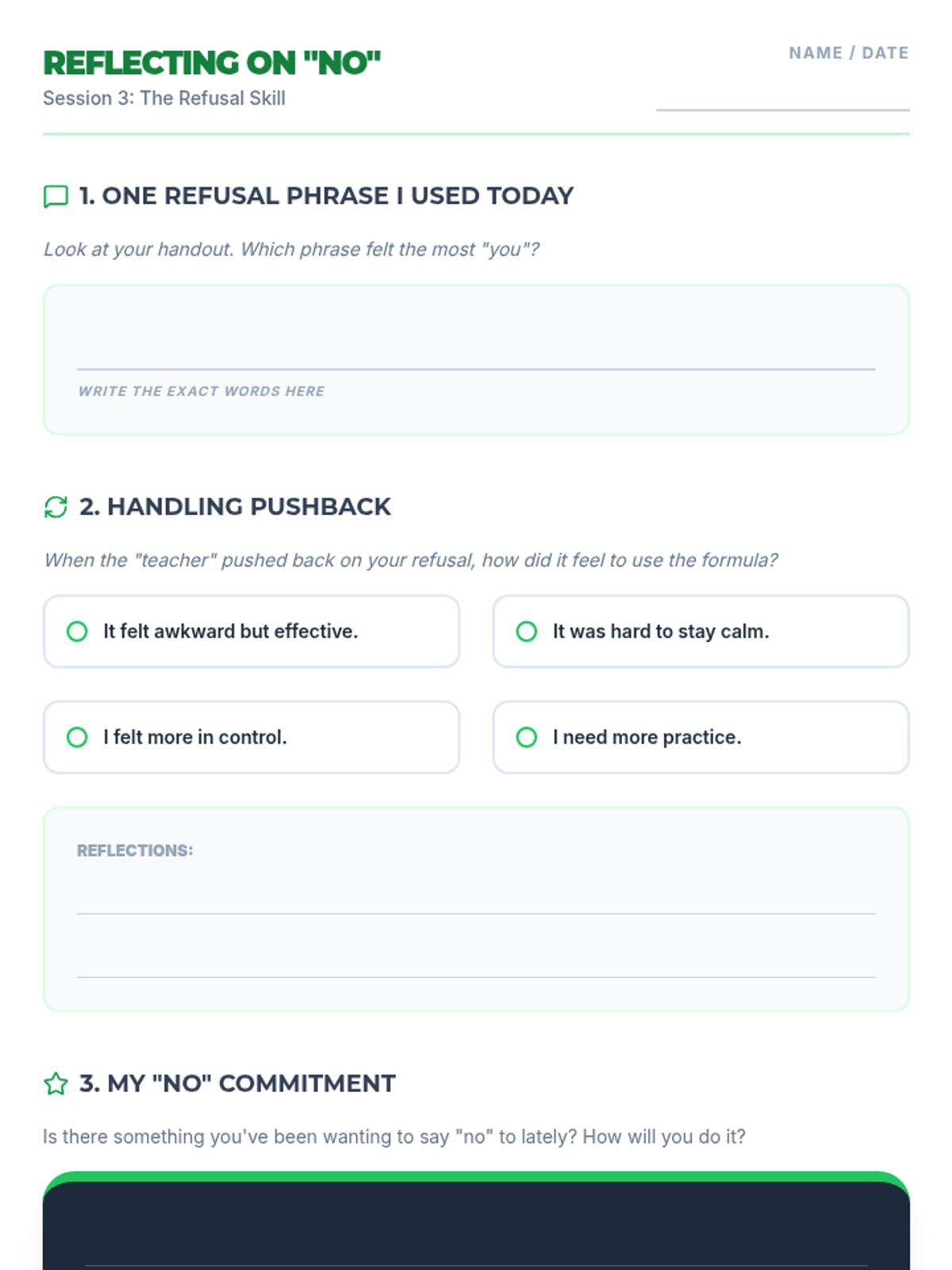
A reflection worksheet for students to record their refusal strategies and feelings after practicing saying no and handling pushback.
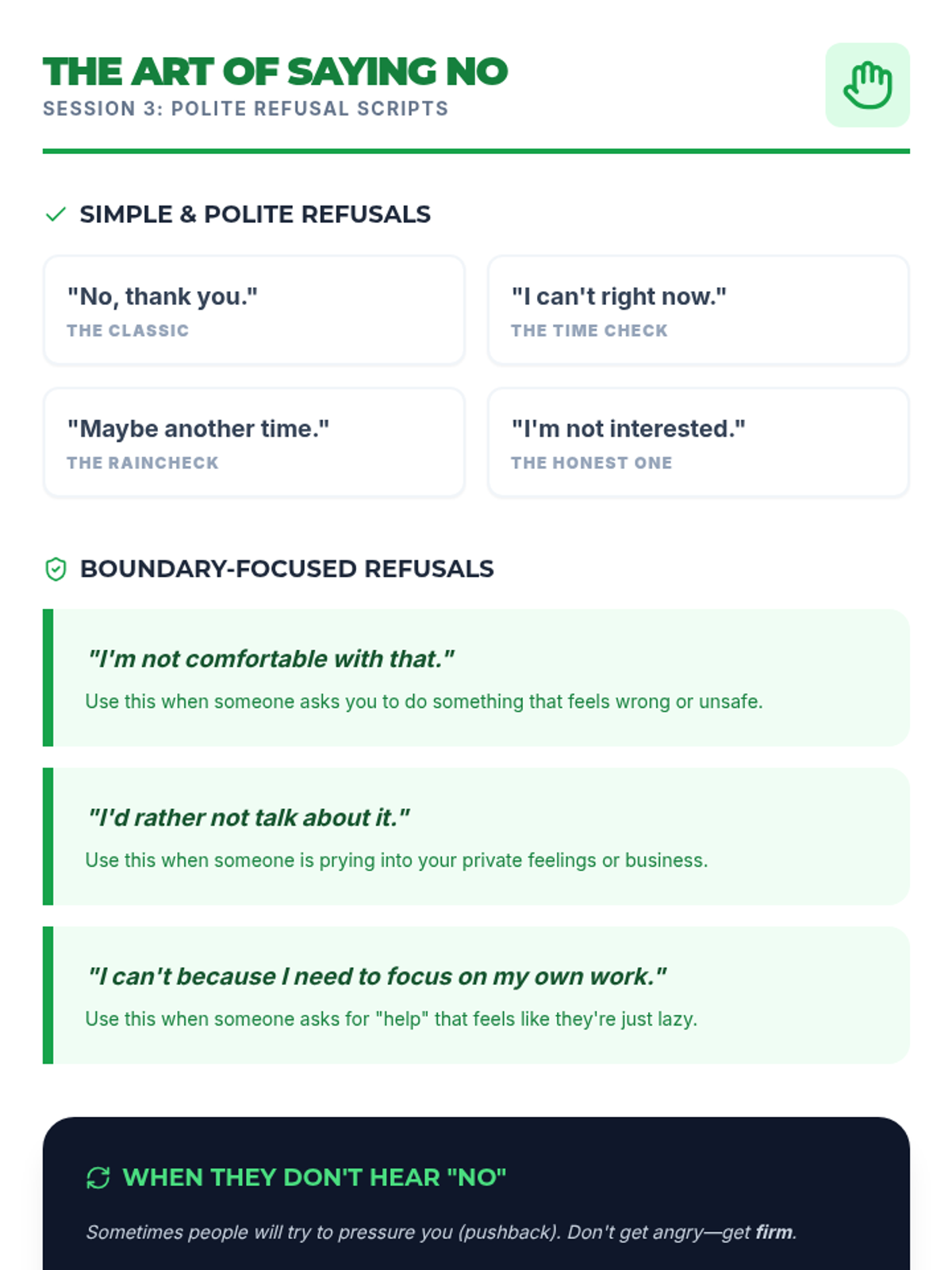
A visual handout explaining polite refusal strategies and the formula for handling pushback.
Engaging slides for Session 3 covering polite refusal strategies, practicing saying “no” assertively, and handling pushback through role-play practice.
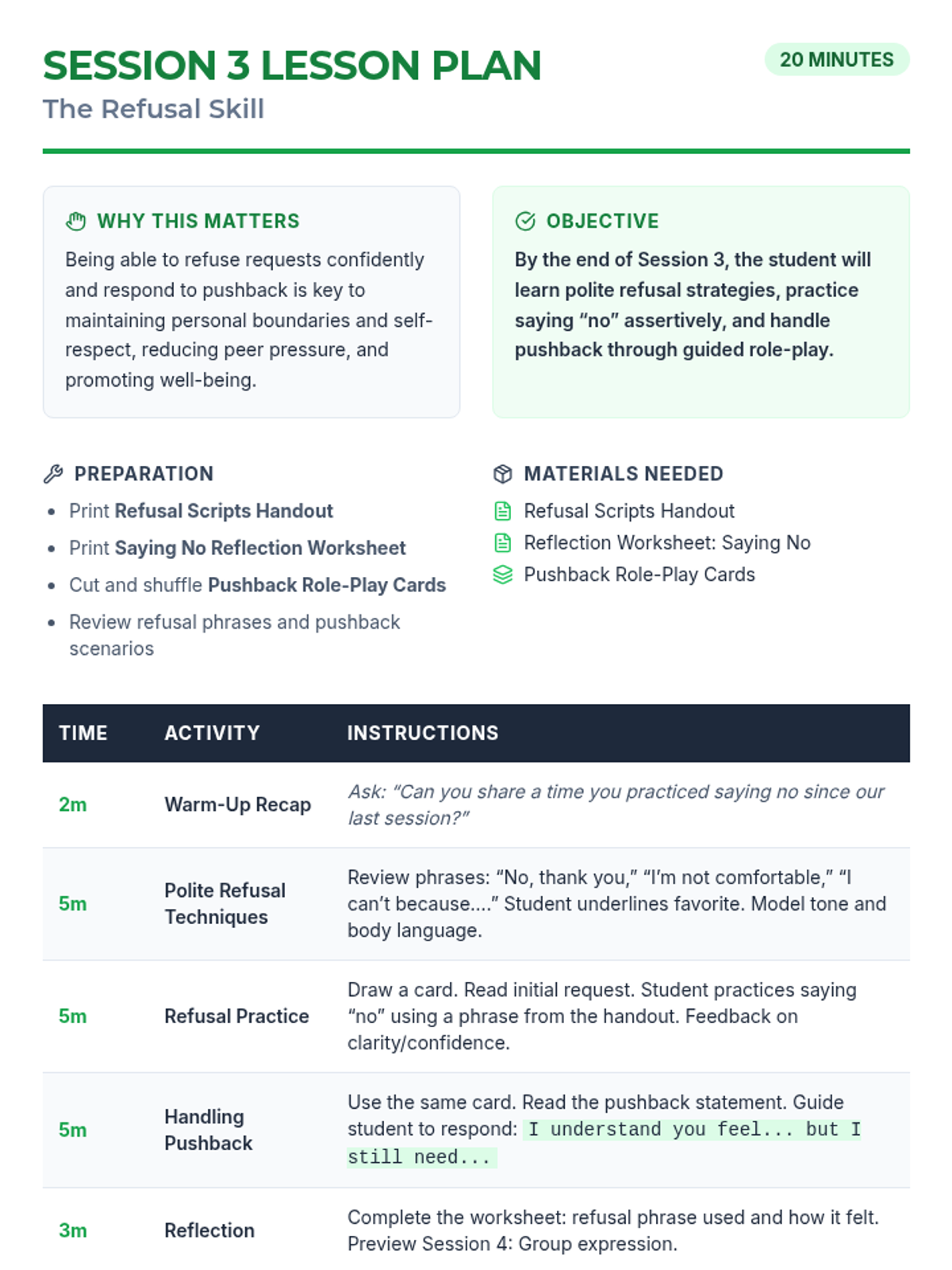
A comprehensive 20-minute lesson plan for Session 3, focusing on refuse strategies and handling pushback.
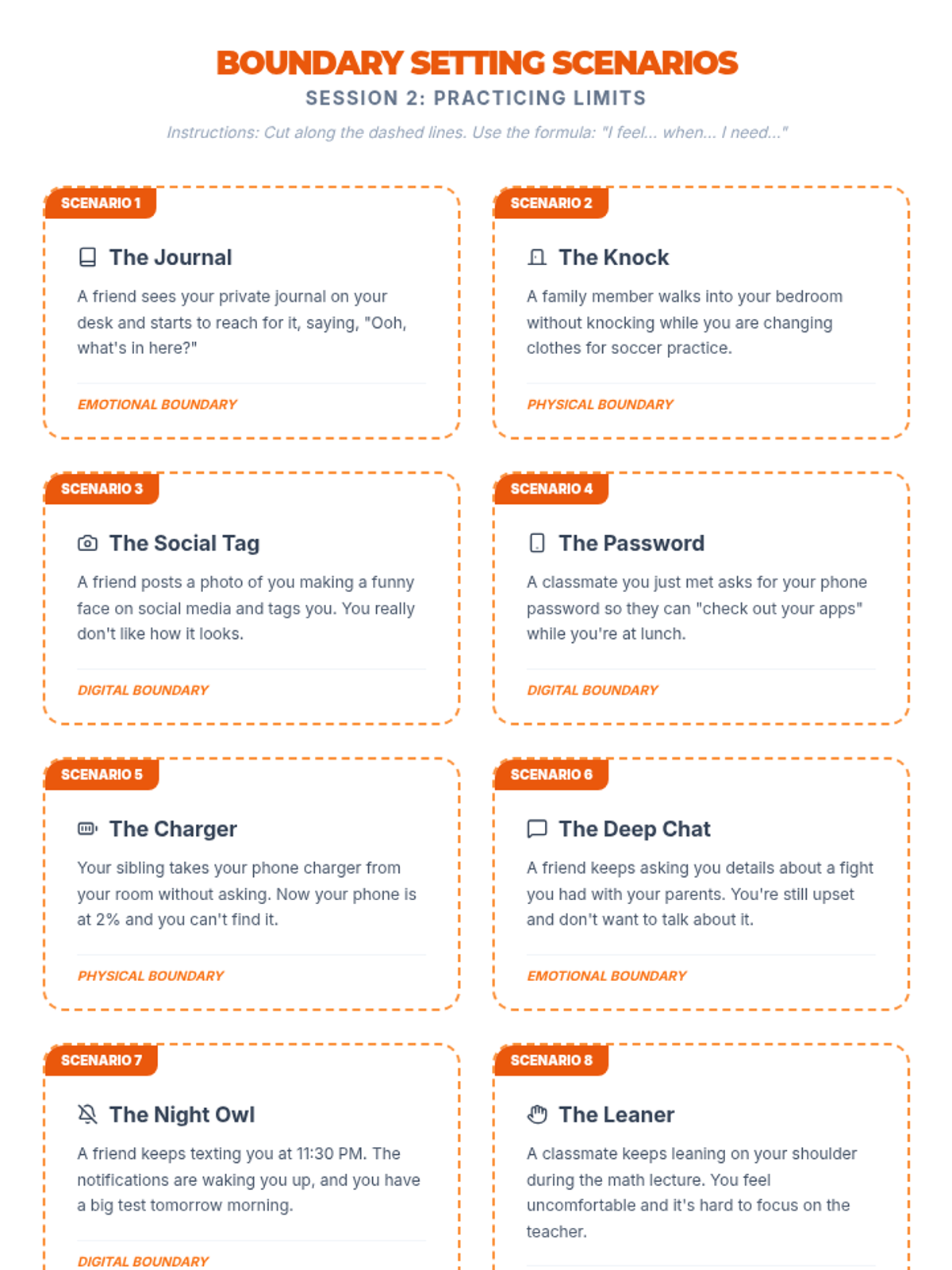
Boundary setting scenarios for role-play practice, focusing on physical, emotional, and digital limits.
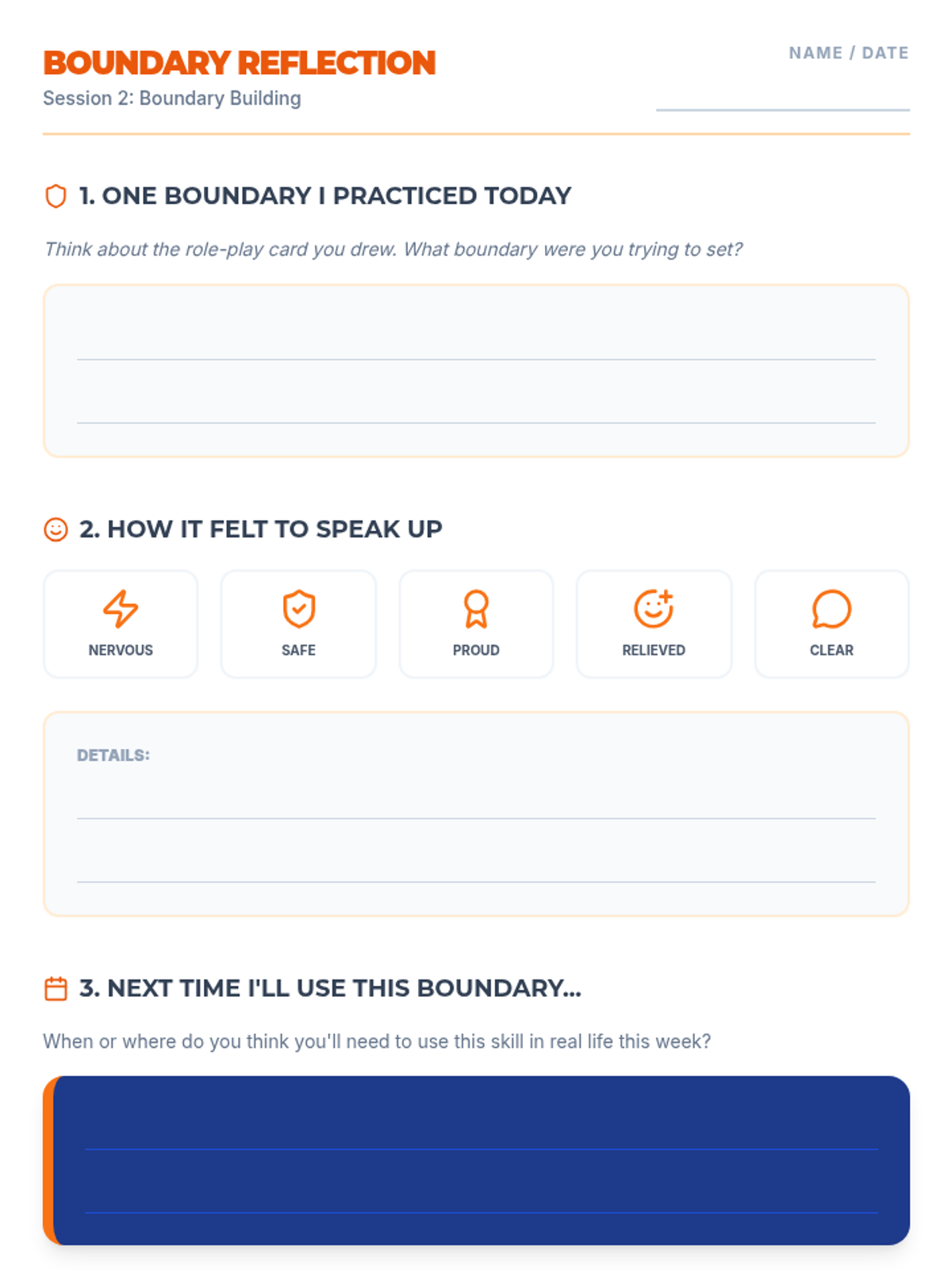
A reflection worksheet for students to identify a boundary they set and how it felt to speak up.
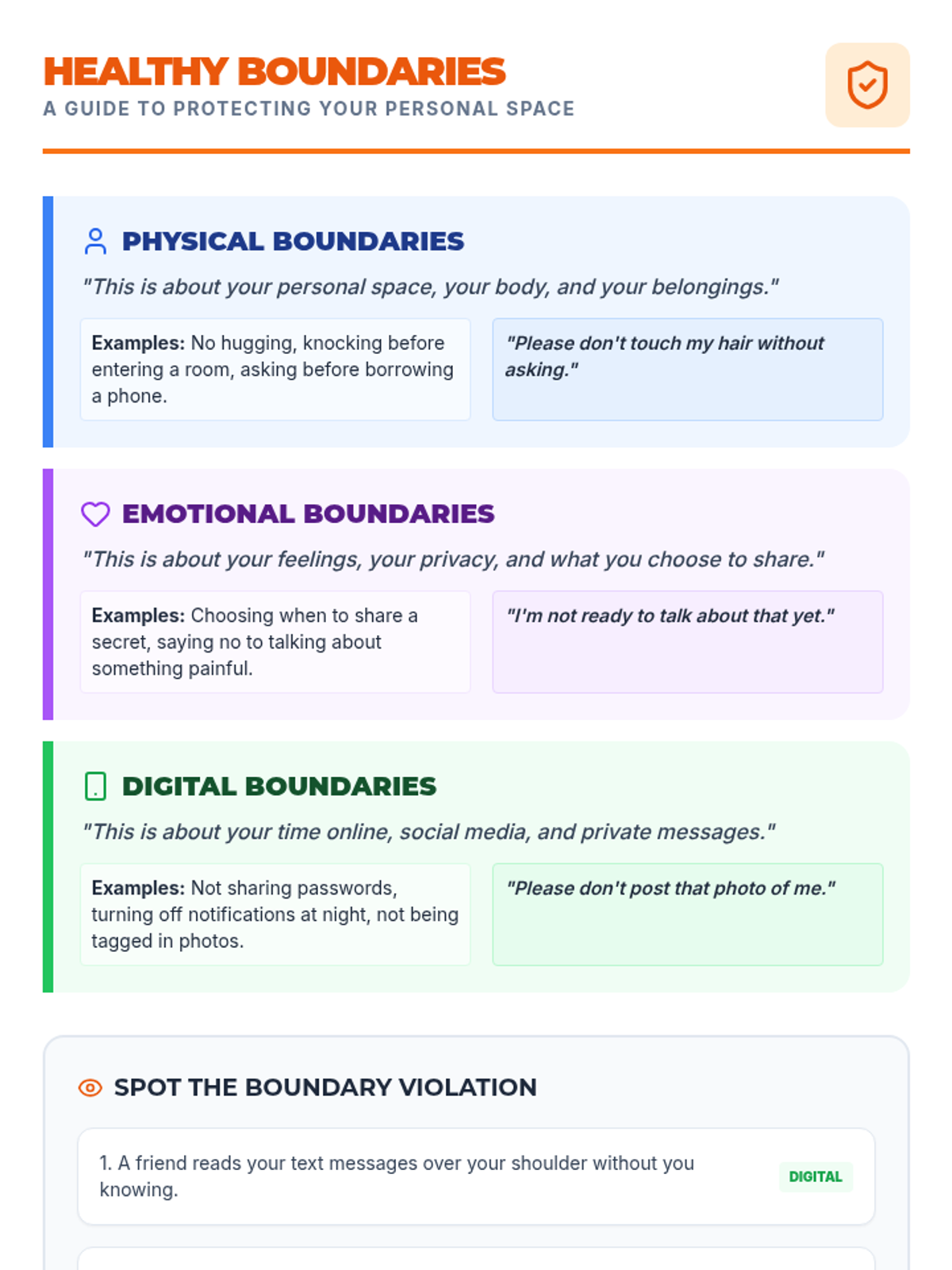
A visual handout explaining physical, emotional, and digital boundaries with real-life examples.
Engaging slides for Session 2 covering the definition of healthy boundaries, types of boundaries, and role-play practice instructions.
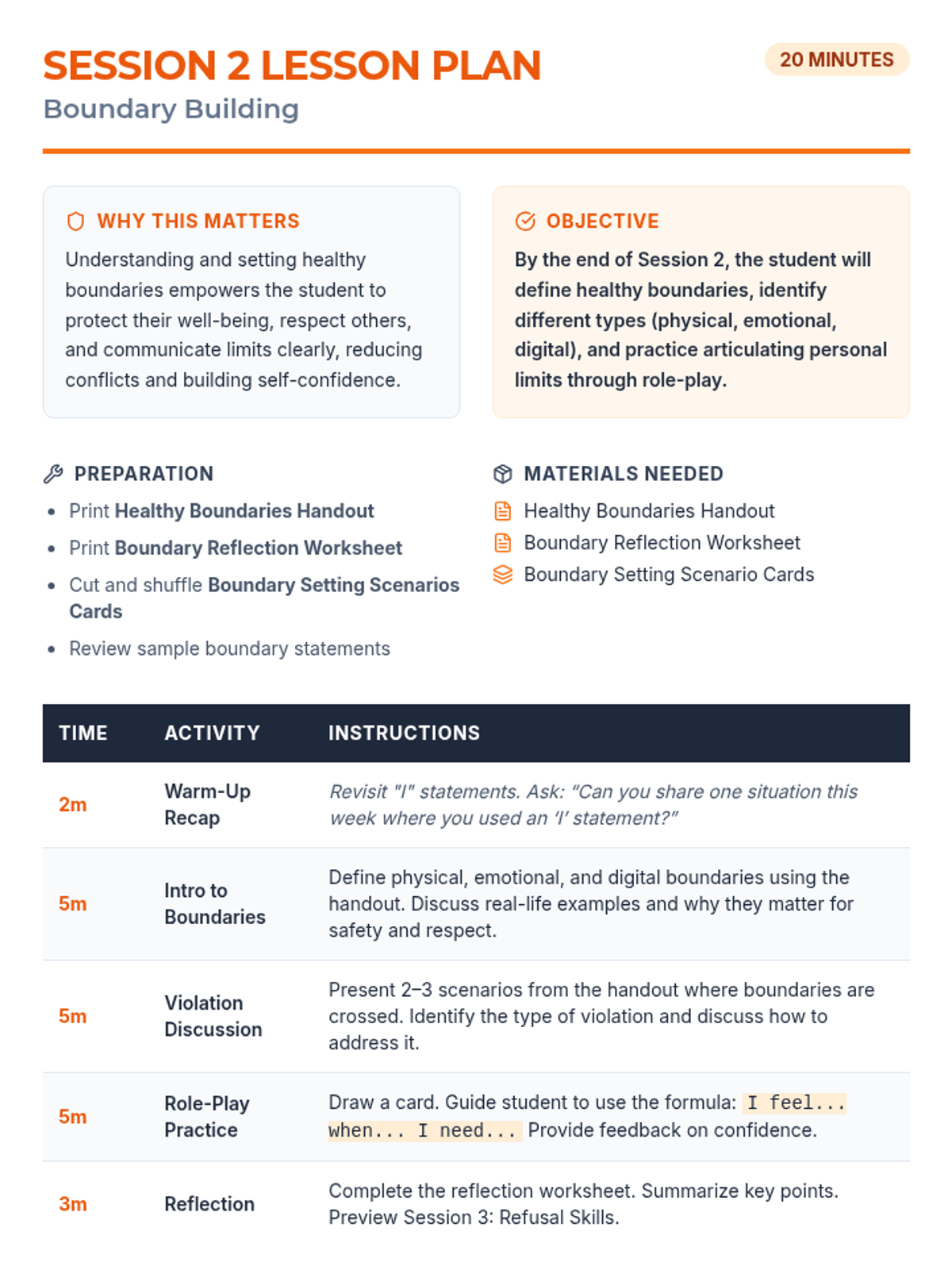
A comprehensive 20-minute lesson plan for Session 2, focusing on healthy boundaries and personal limits.