Budgeting, saving, and investment strategies alongside practical skills for managing credit, taxes, and banking. Addresses insurance needs, employment income, and major purchase decisions to support comprehensive long-term financial planning.
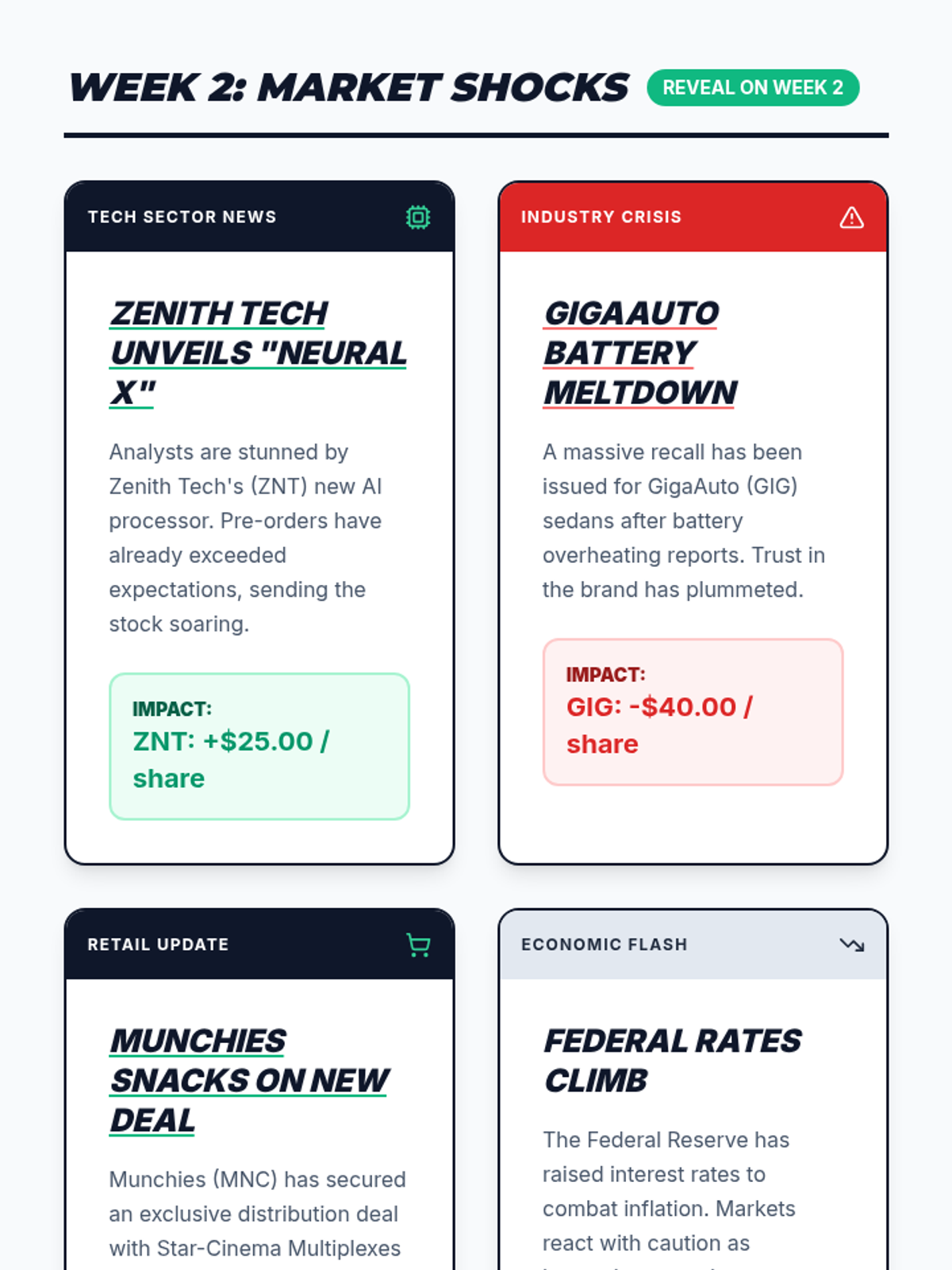
Printable news scenario cards for Weeks 2, 3, and 4 of the simulation, detailing market events and their specific impact on stock prices.
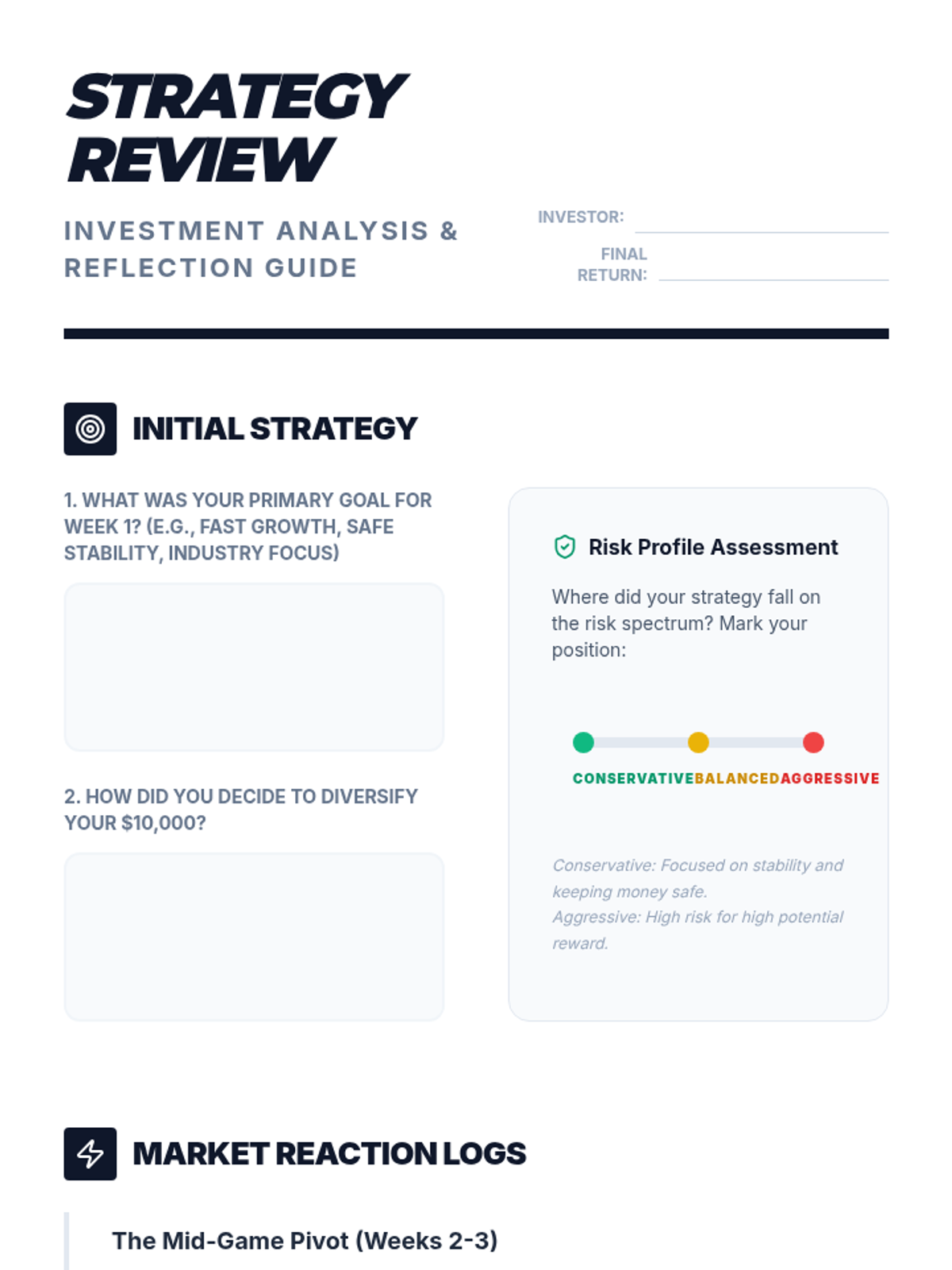
A self-assessment guide for students to analyze their investment choices, risk profile, and learning moments throughout the 4-week simulation.
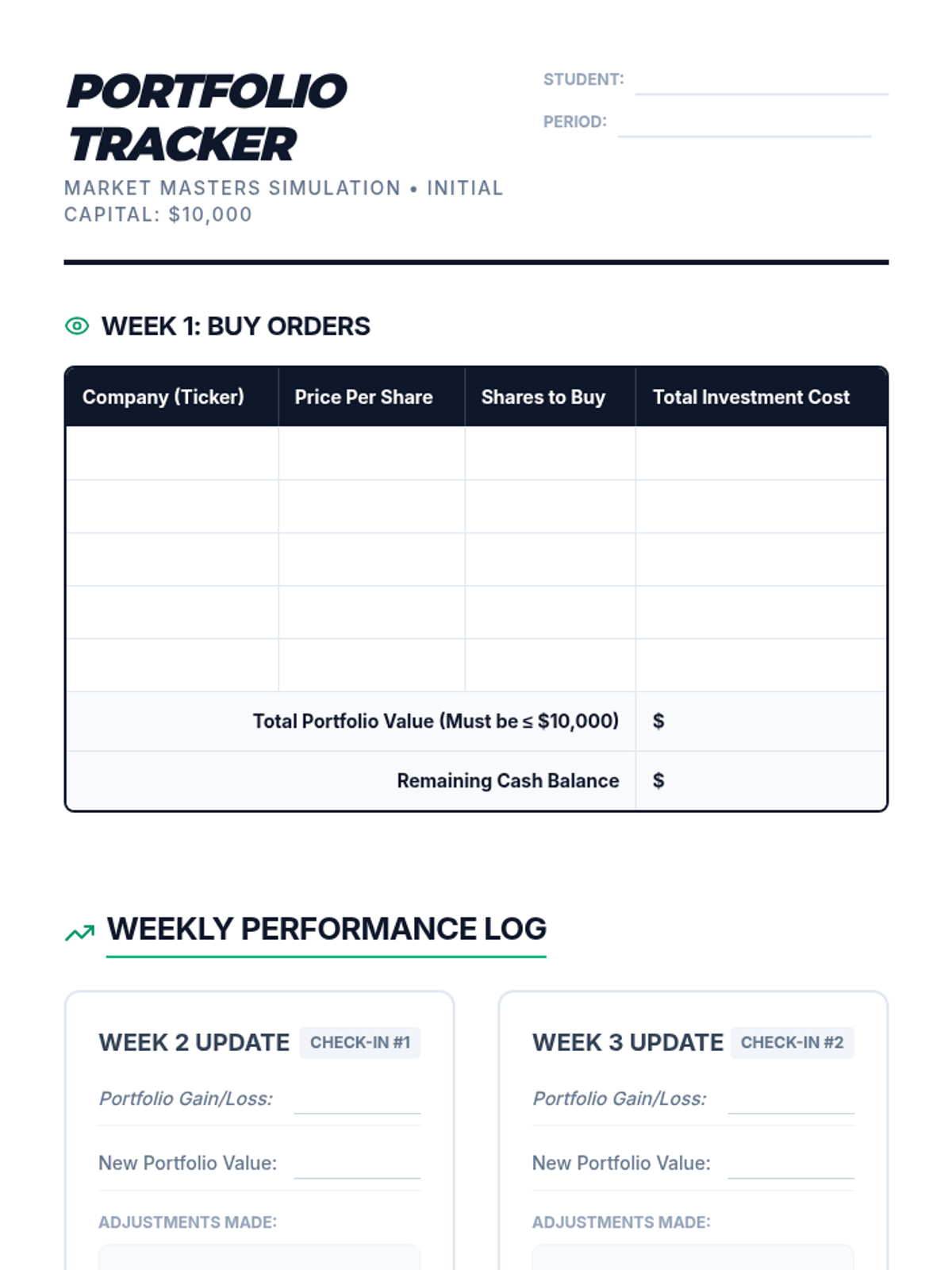
A 4-week tracking sheet for students to log their stock purchases, weekly value updates, and final profit or loss.
Introductory slide deck explaining stock basics, market mechanics, and the rules of the 4-week Market Masters simulation.
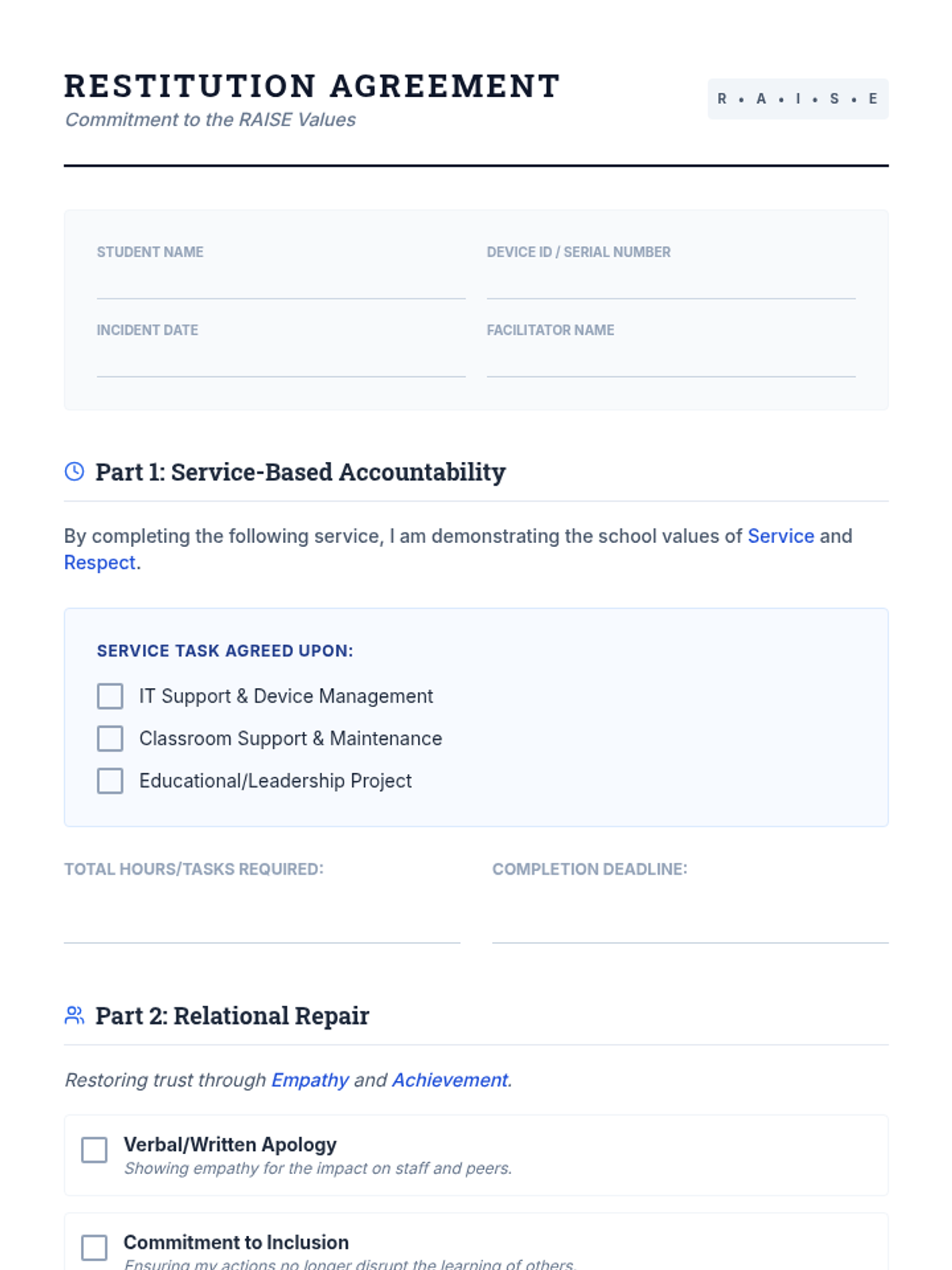
A formal restitution agreement form for school administration and students to document agreed-upon service and community repair actions. Explicitly tied to the RAISE values (Respect, Achievement, Inclusion, Service, Empathy).
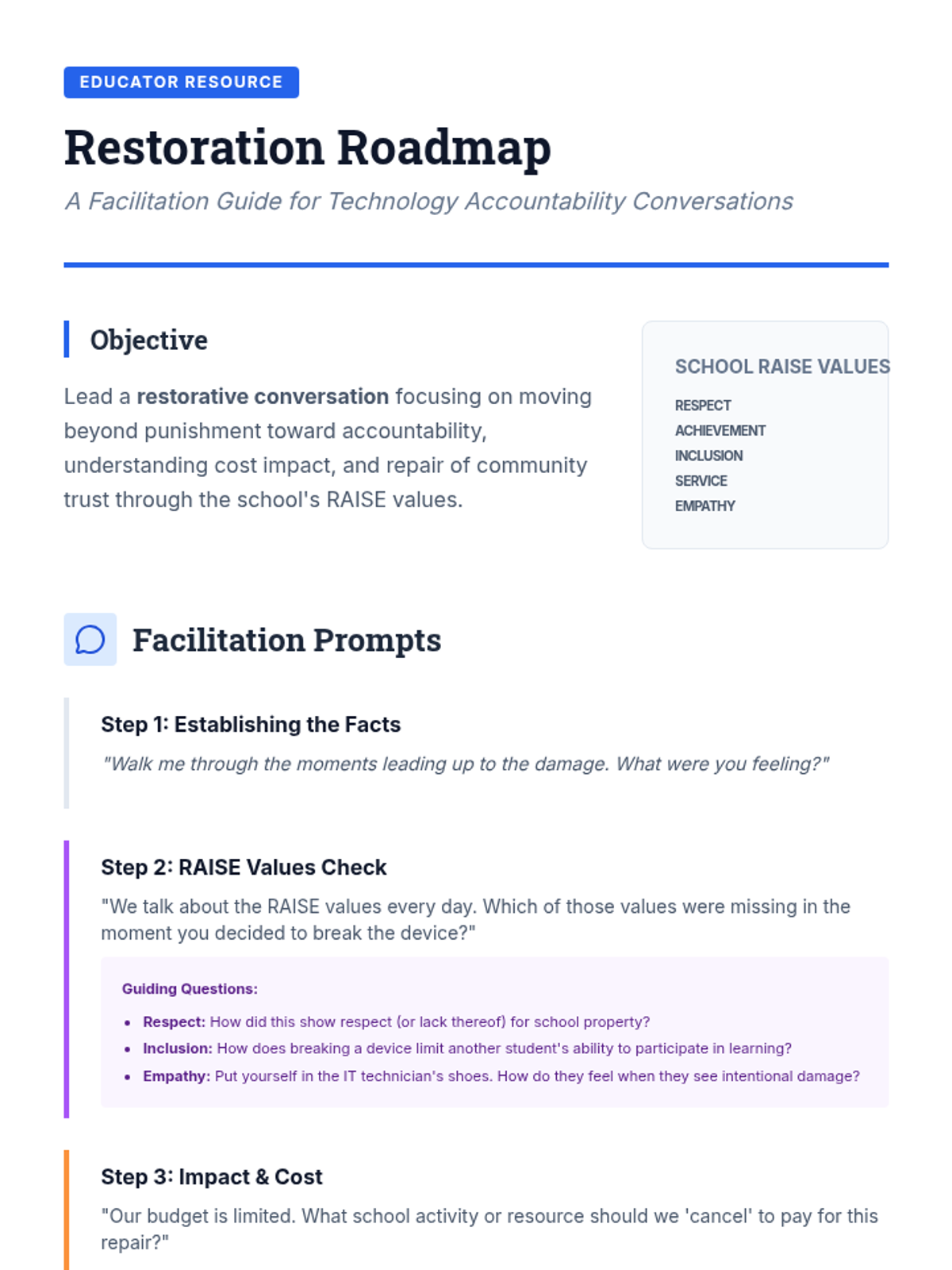
A teacher-facing guide to facilitate restorative justice conversations with students who have damaged school technology. Integrated with the school's RAISE values (Respect, Achievement, Inclusion, Service, Empathy).
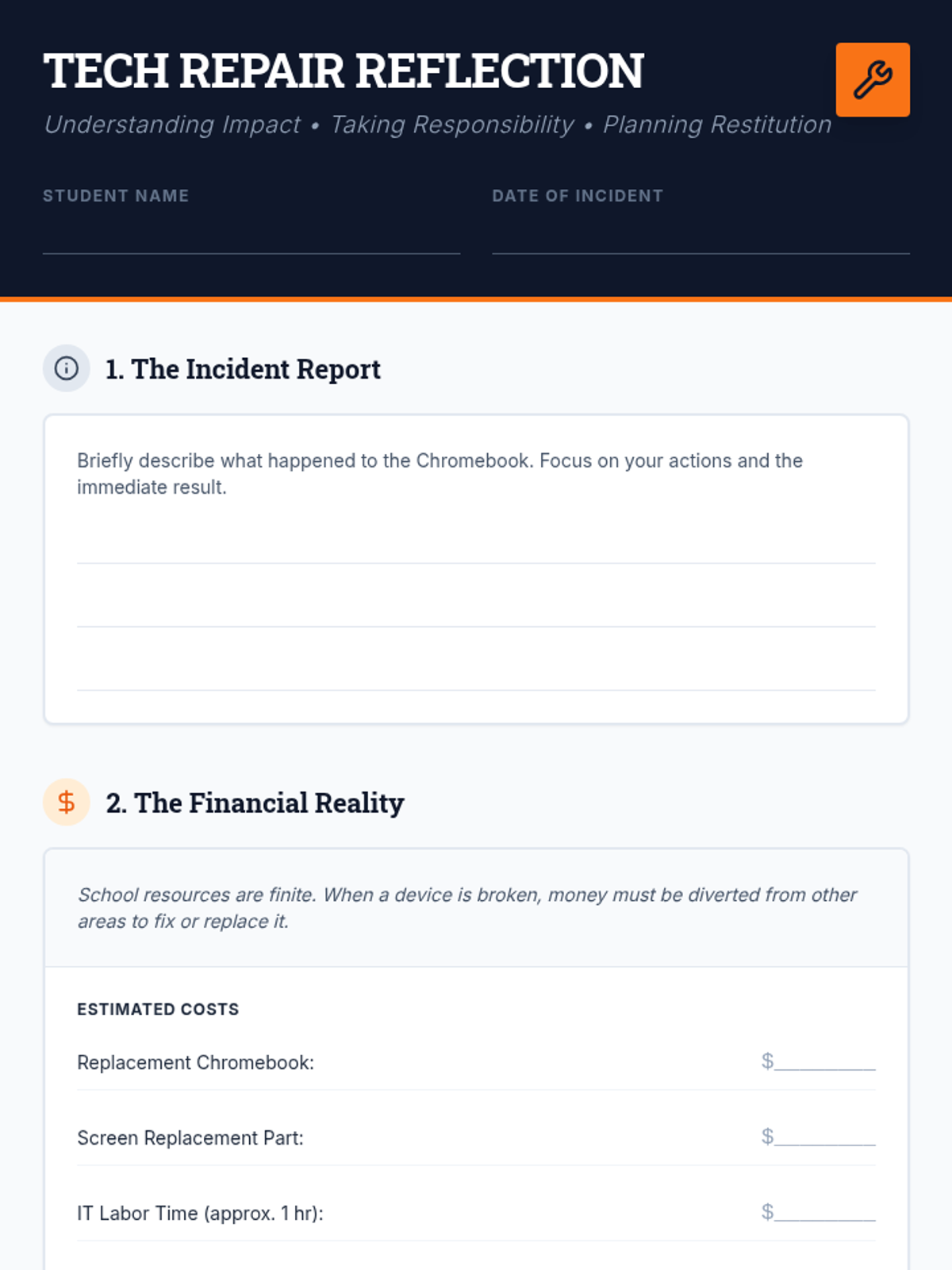
A structured reflection worksheet for students focused on the financial and community consequences of intentionally damaging school technology. Includes a section for reflecting on the school's RAISE values (Respect, Achievement, Inclusion, Service, Empathy).
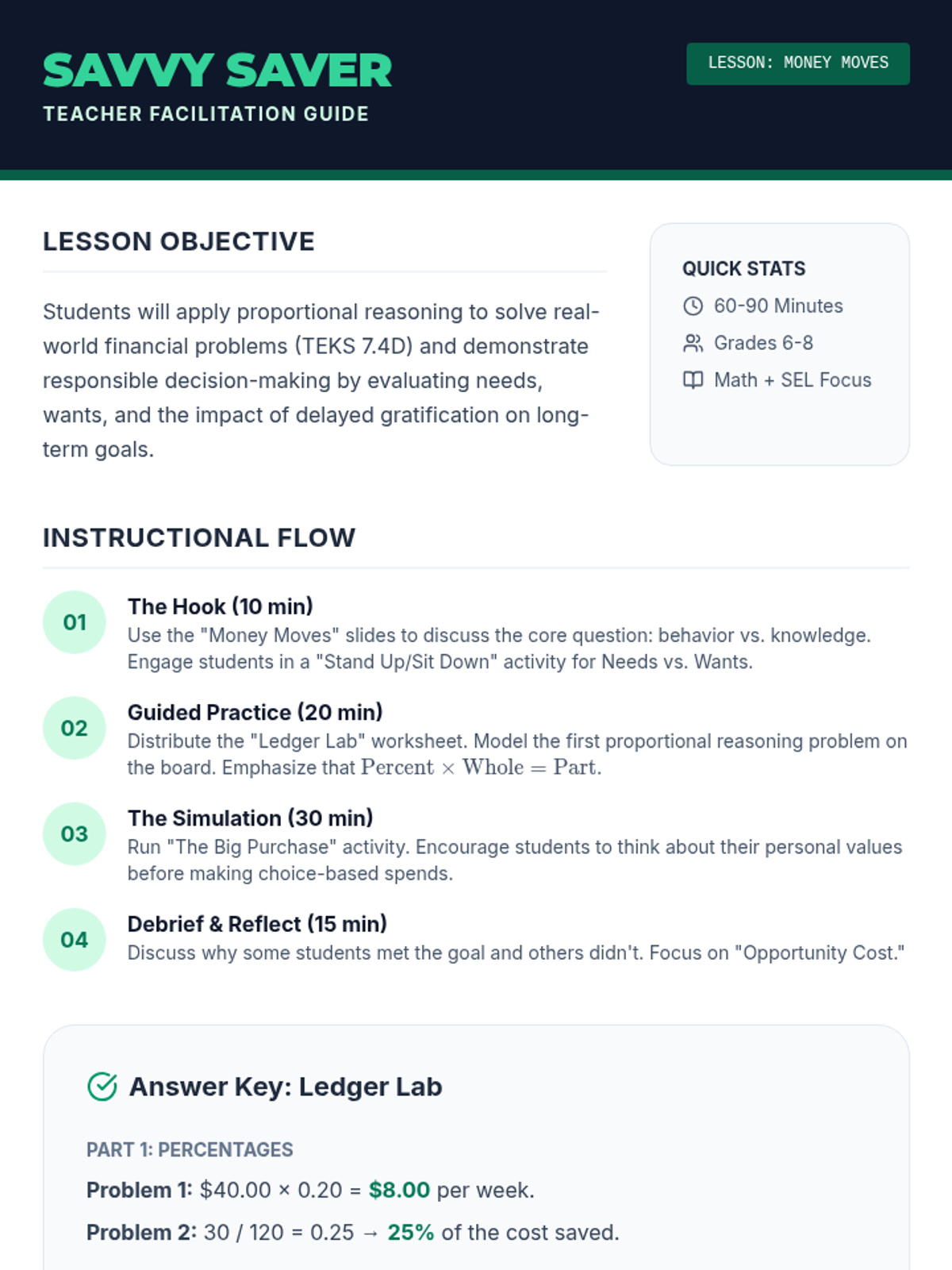
A teacher facilitation guide including lesson objectives, pacing, a complete answer key for the worksheet, and SEL discussion prompts to deepen student understanding.
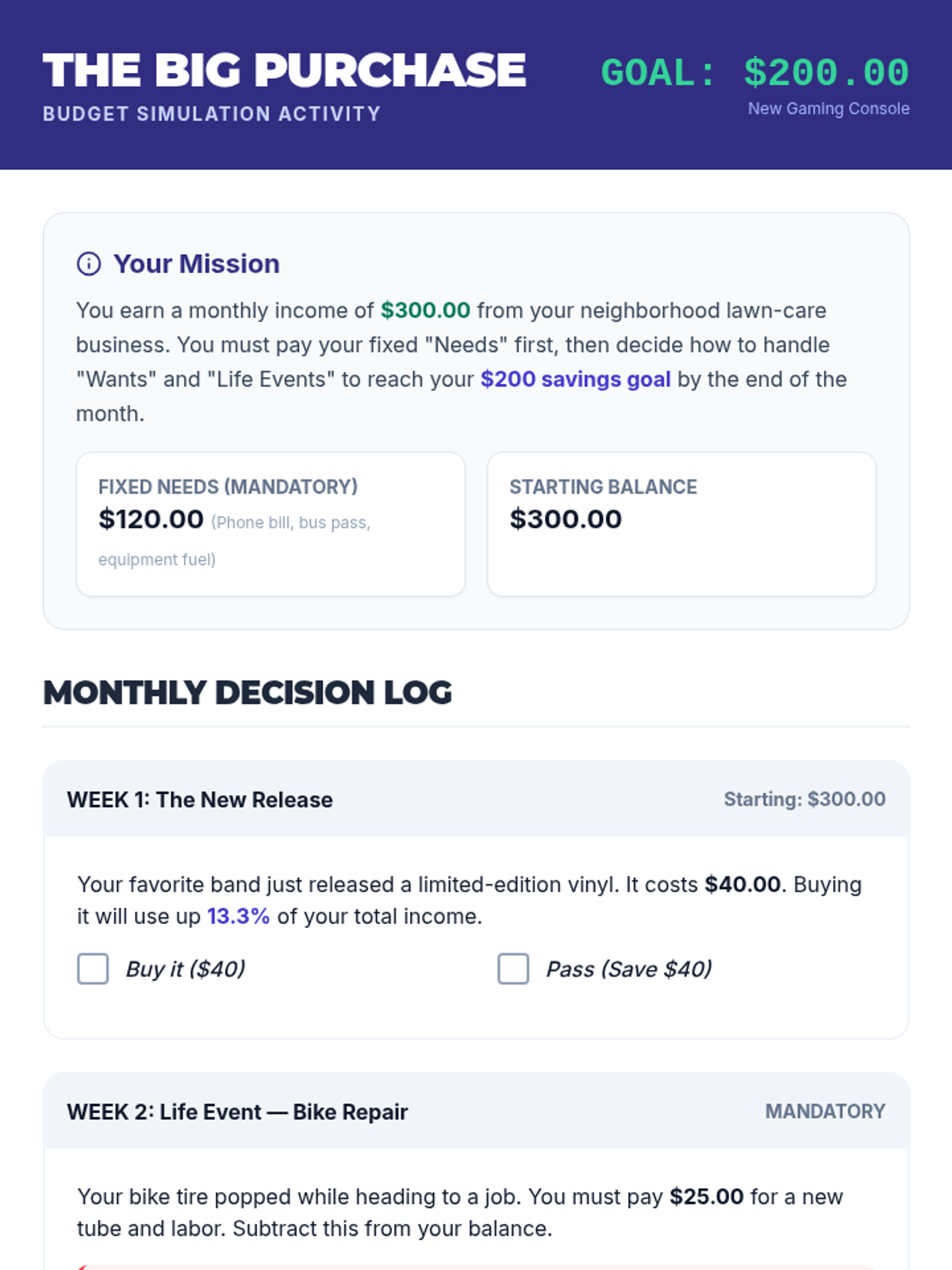
A budget simulation activity where students manage a $300 monthly income, navigate mandatory life events, and make choice-based spending decisions to reach a $200 savings goal. Includes a final tally ledger for math practice.
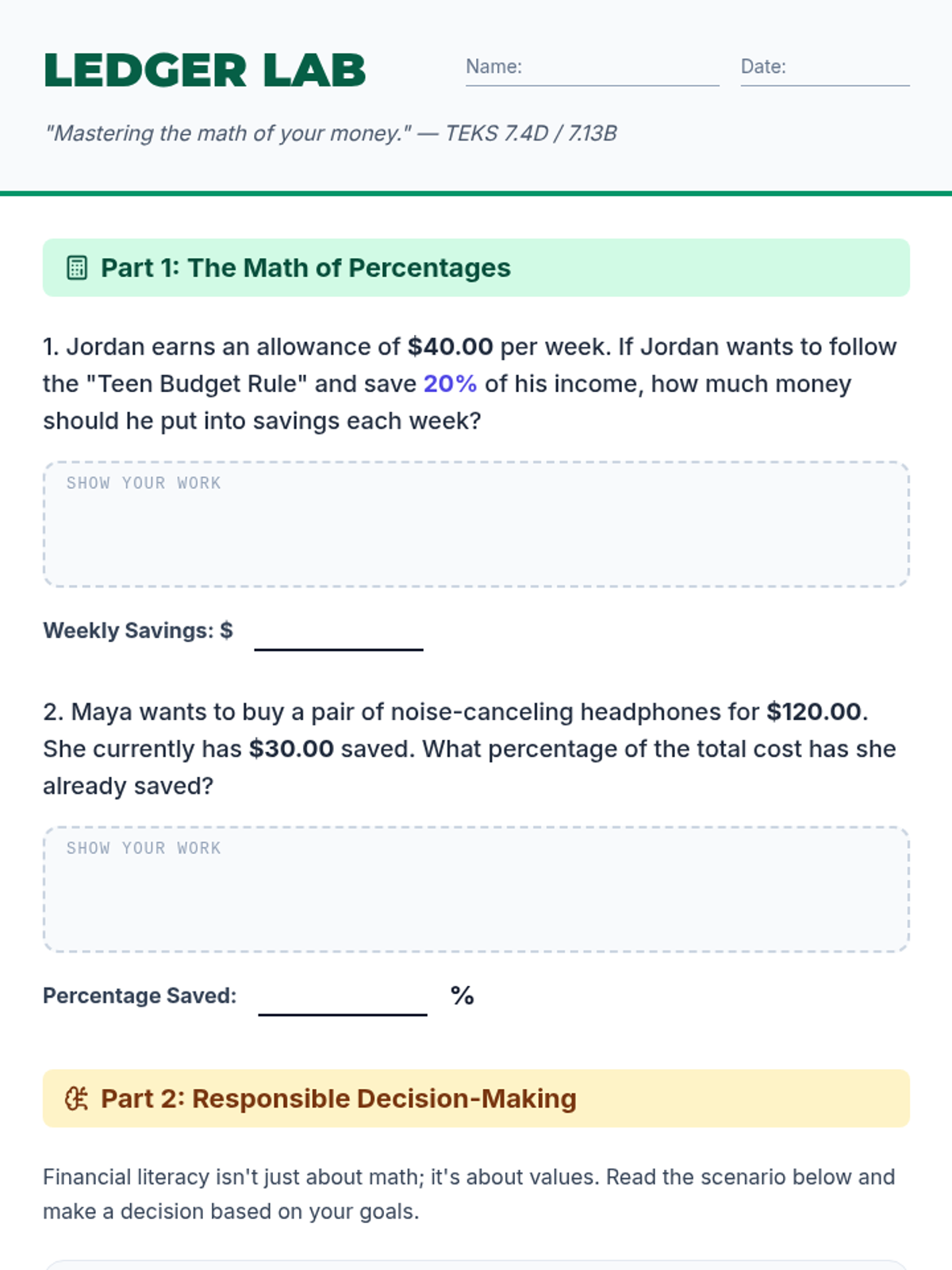
A math-focused worksheet for students to practice calculating percentages, budgeting proportions (TEKS 7.4D), and reflecting on financial decision-making (SEL). Includes space for work and a budget table.
An engaging 7-slide presentation covering needs vs. wants, the psychology of delayed gratification, and the math of proportional budgeting (TEKS 7.4D). Features a clean, professional aesthetic with high-contrast visuals and 24px+ font sizes.
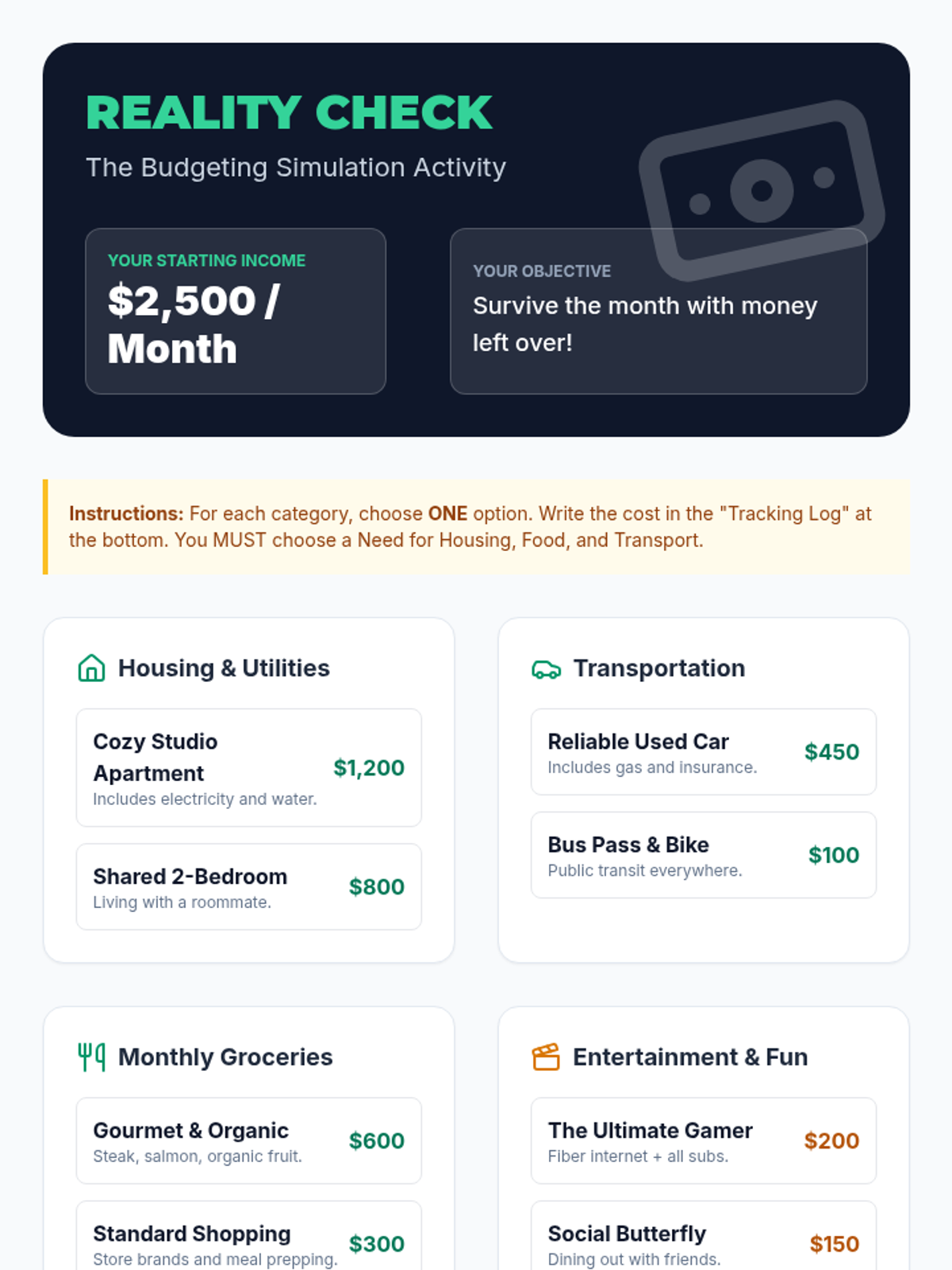
A budgeting simulation activity sheet where students make lifestyle choices based on a fixed income and track their spending to reach a savings goal.
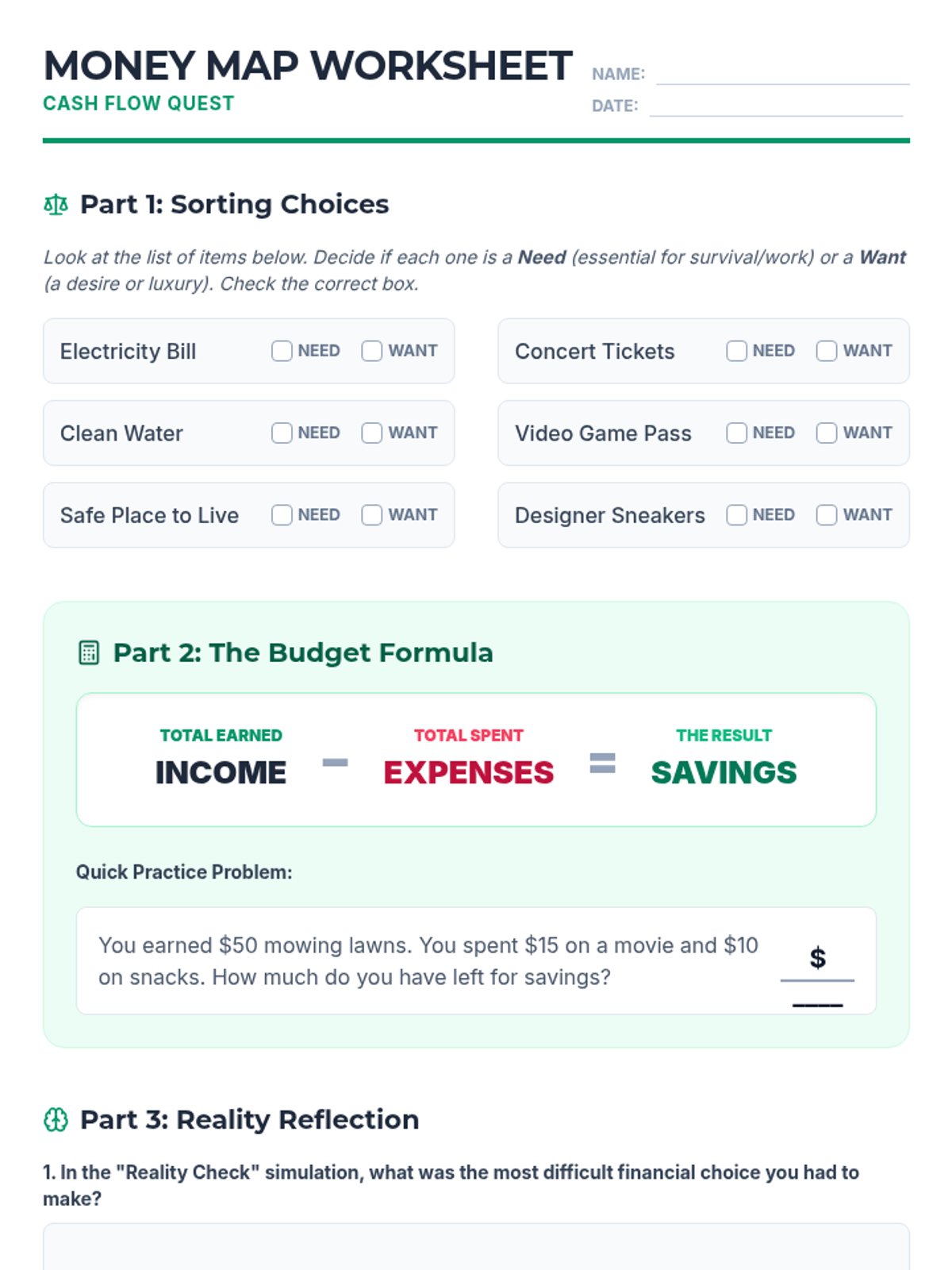
A student-facing worksheet for sorting needs vs. wants, practicing the budget equation, and reflecting on financial decision-making.
A visual presentation deck for teaching financial literacy basics to middle schoolers, featuring high-impact slides on needs vs. wants, the budget equation, and the importance of saving.
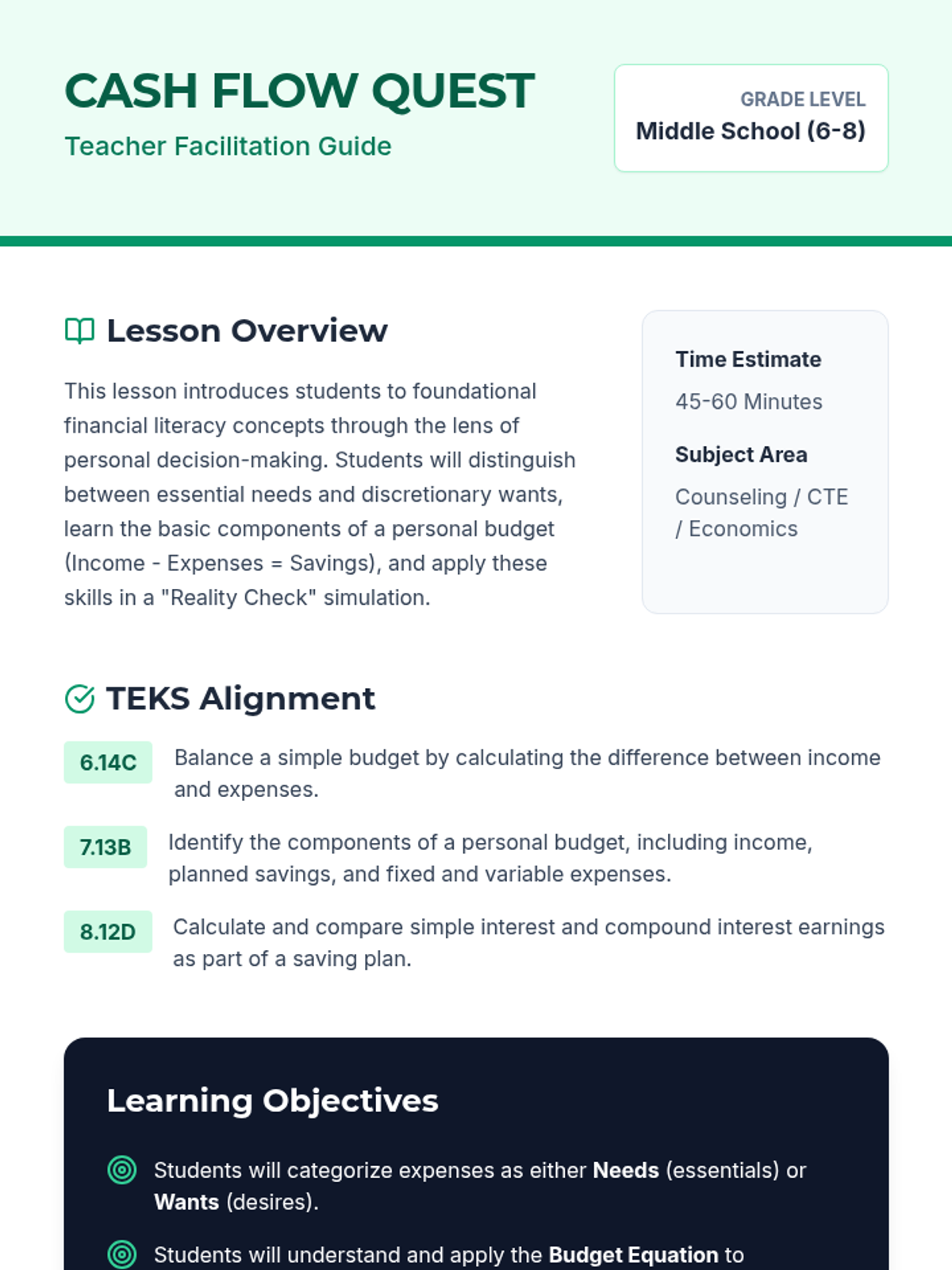
A detailed teacher facilitation guide for the Cash Flow Quest lesson, including learning objectives, TEKS alignment, step-by-step procedures, and counselor tips for navigating financial literacy topics with middle schoolers.
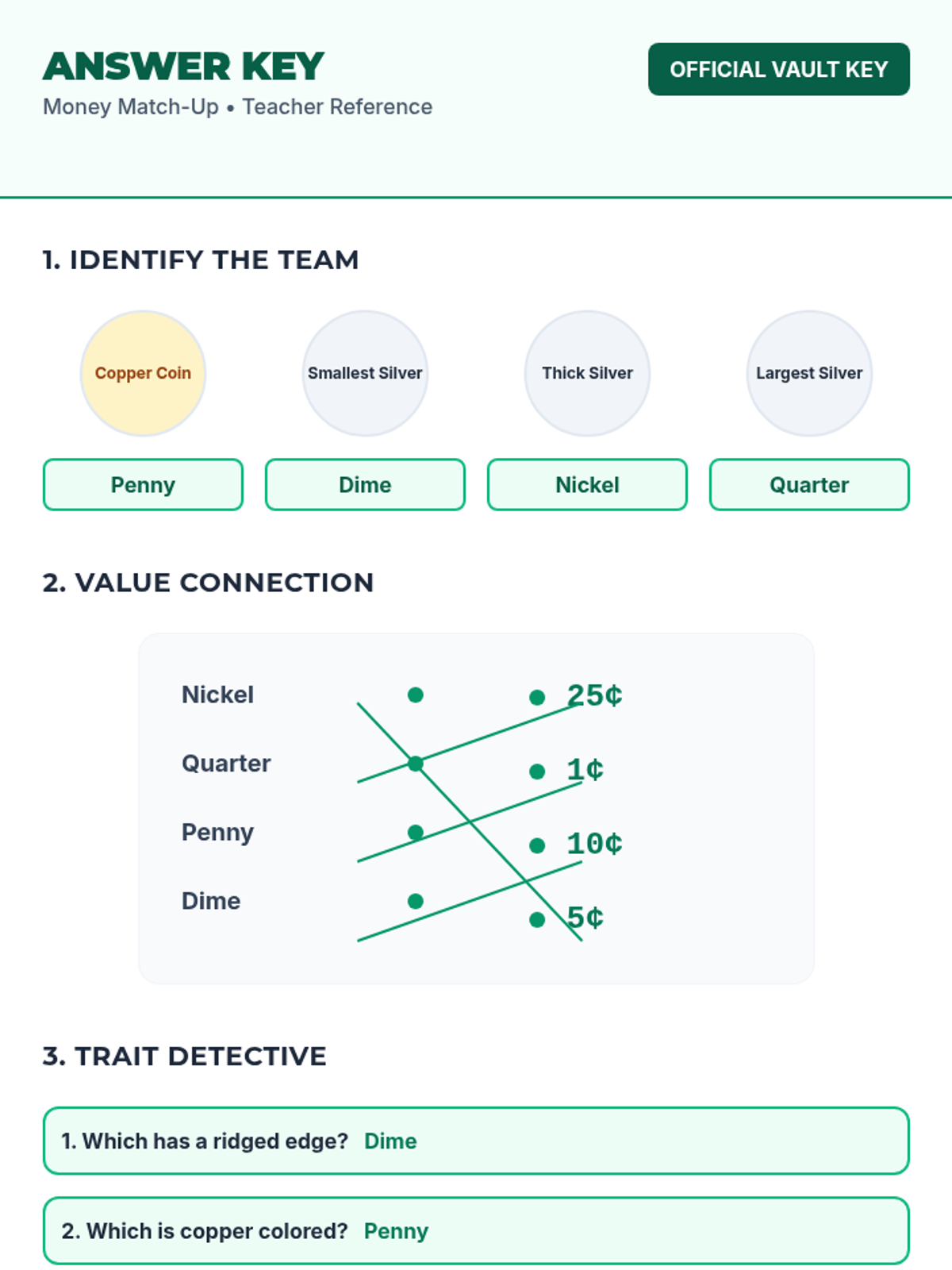
The official answer key for the Money Match-Up worksheet, provided for teacher use to ensure quick and accurate grading.
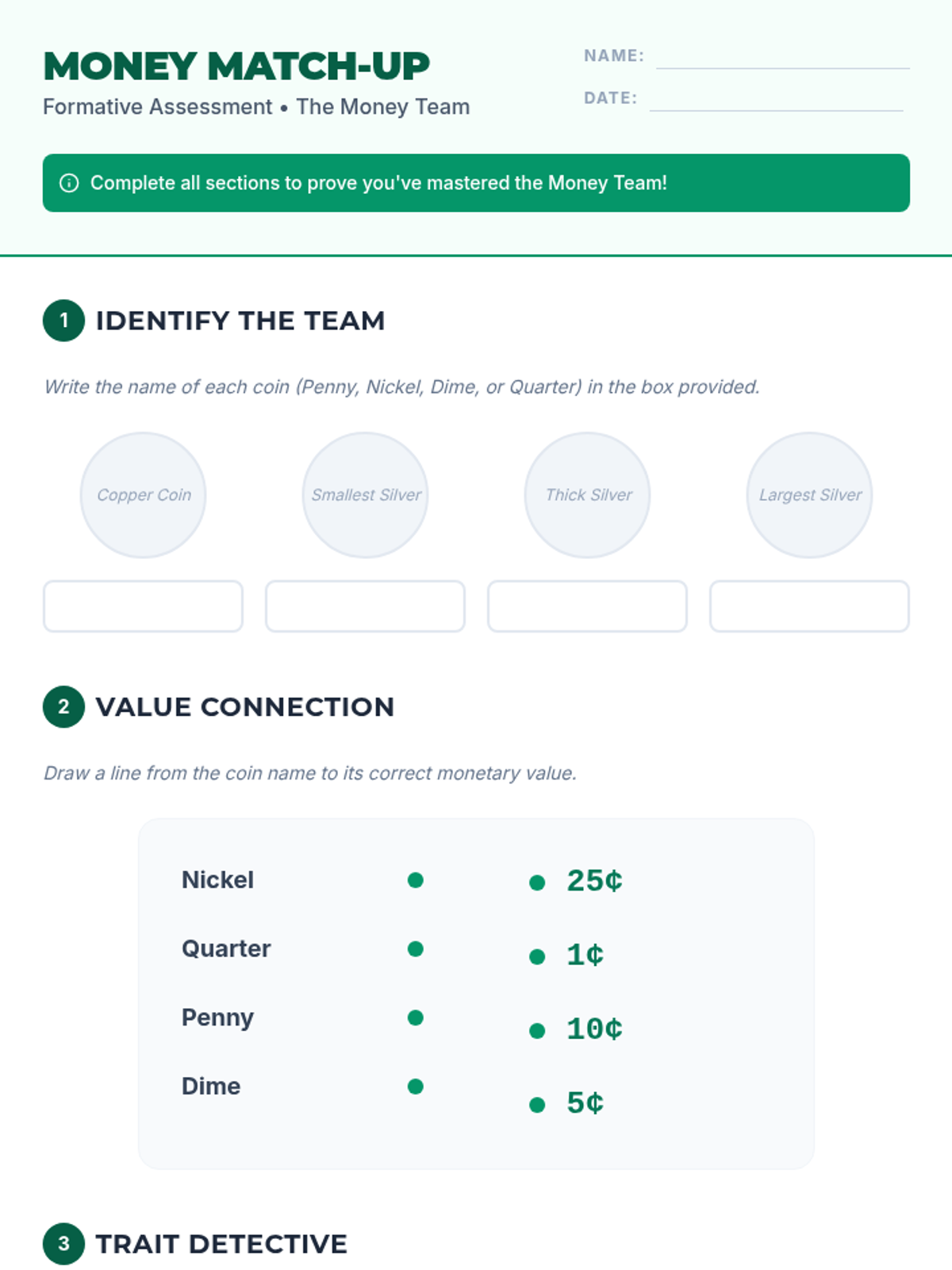
A formative assessment worksheet for students to demonstrate their ability to identify coins by name, match them to their monetary values, and recall physical characteristics.
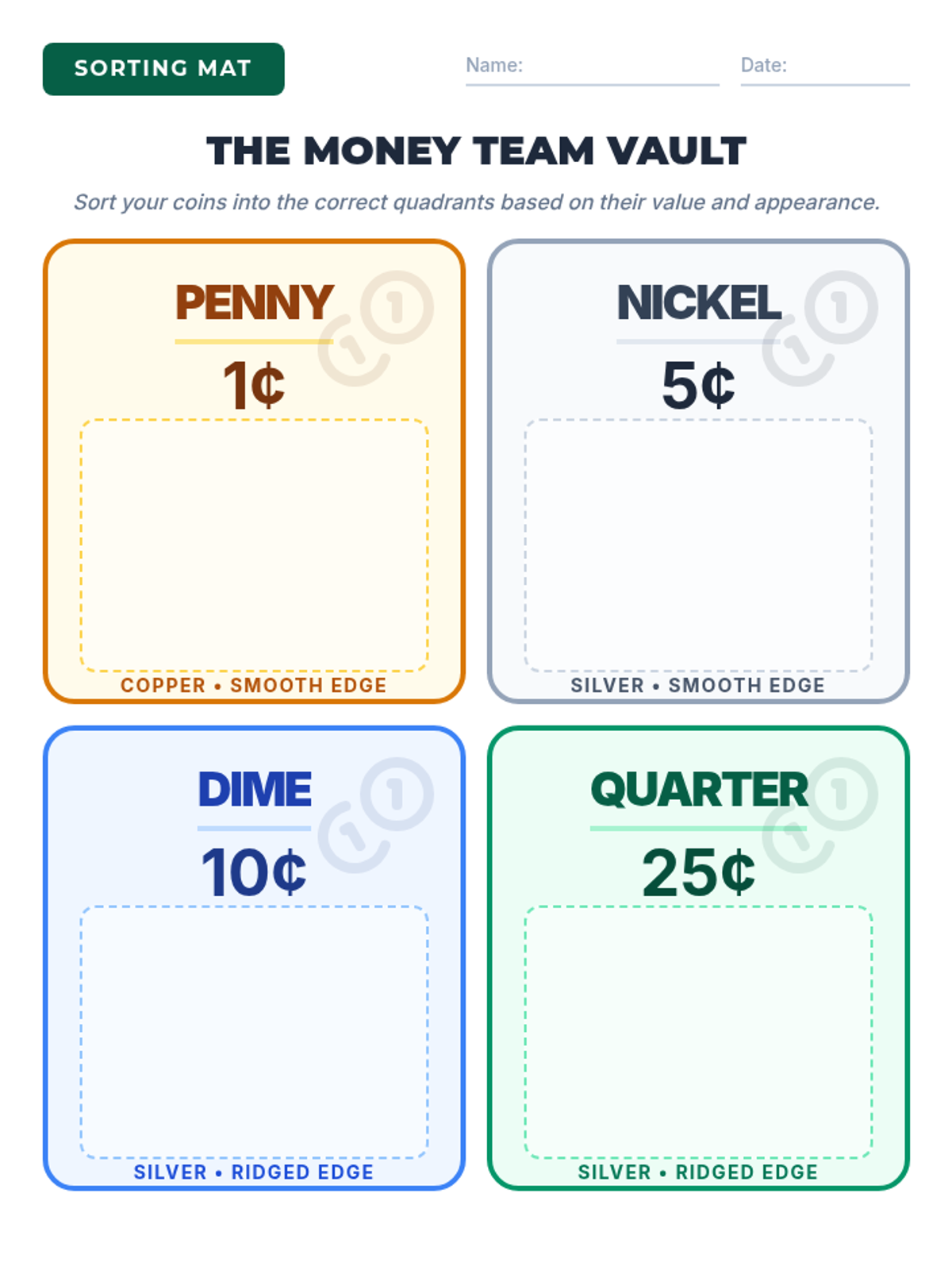
A large-format sorting mat designed for students to organize physical coins into four distinct quadrants (Penny, Nickel, Dime, Quarter) with visual aids for value and physical traits.
A visually engaging slide deck that introduces the 'Money Team'—pennies, nickels, dimes, and quarters—with clear identification traits and values.
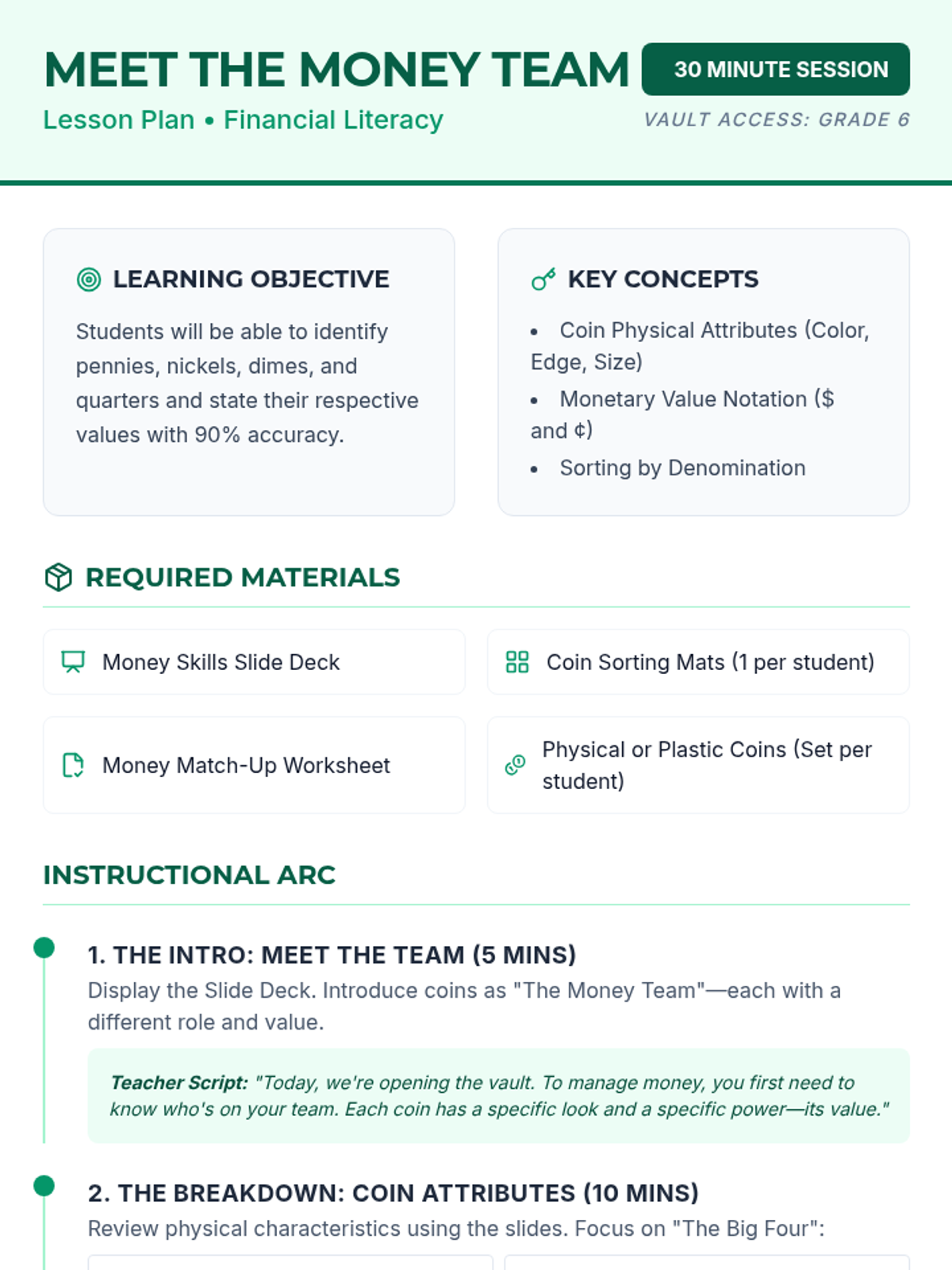
A comprehensive teacher guide for a 30-minute lesson on coin identification, featuring learning objectives, a detailed instructional arc, and differentiation strategies.
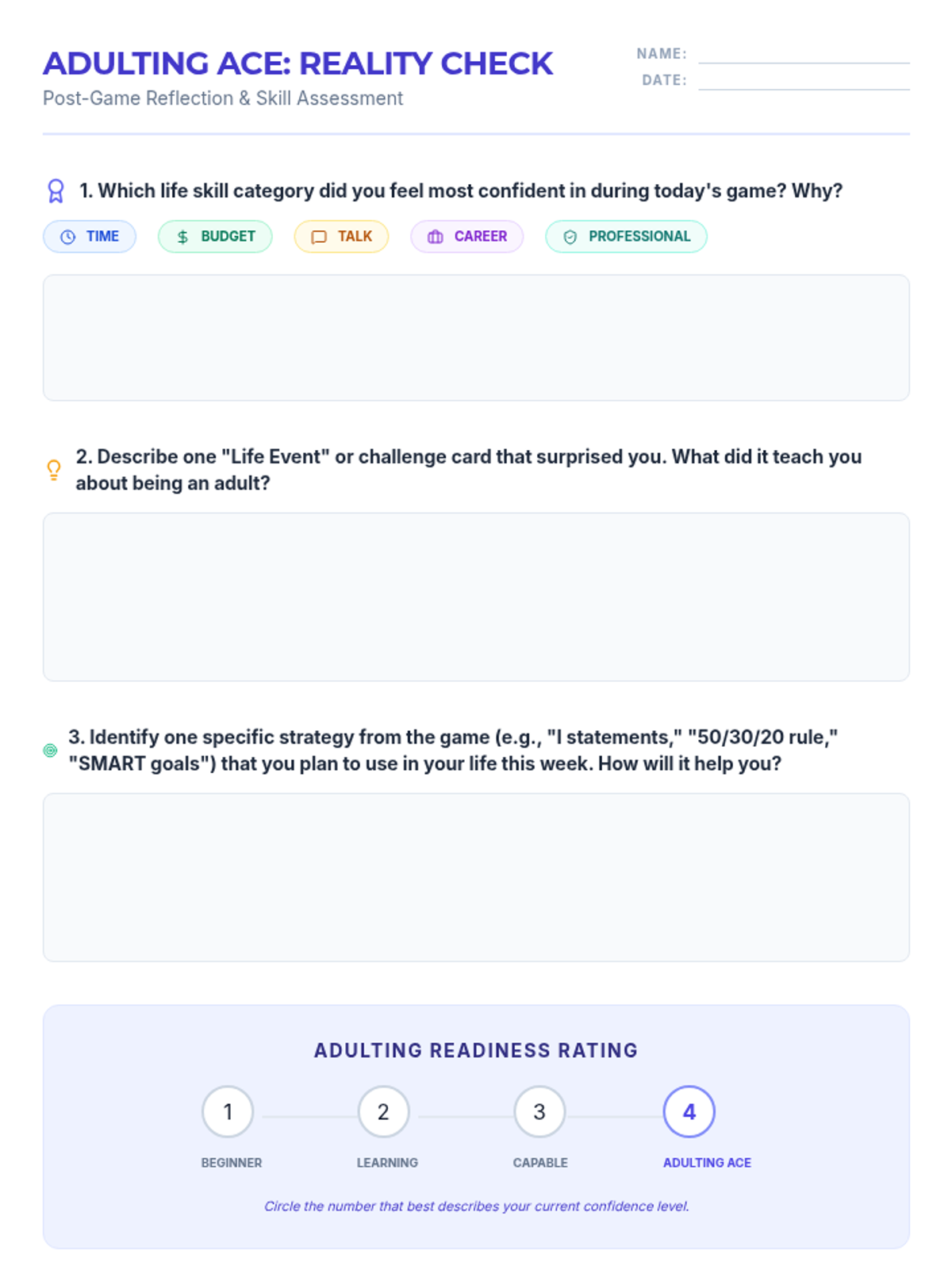
A reflection exit ticket for students to complete after playing 'Adulting Ace'. Includes self-assessment, reflection on specific life skills, and a goal-setting prompt.
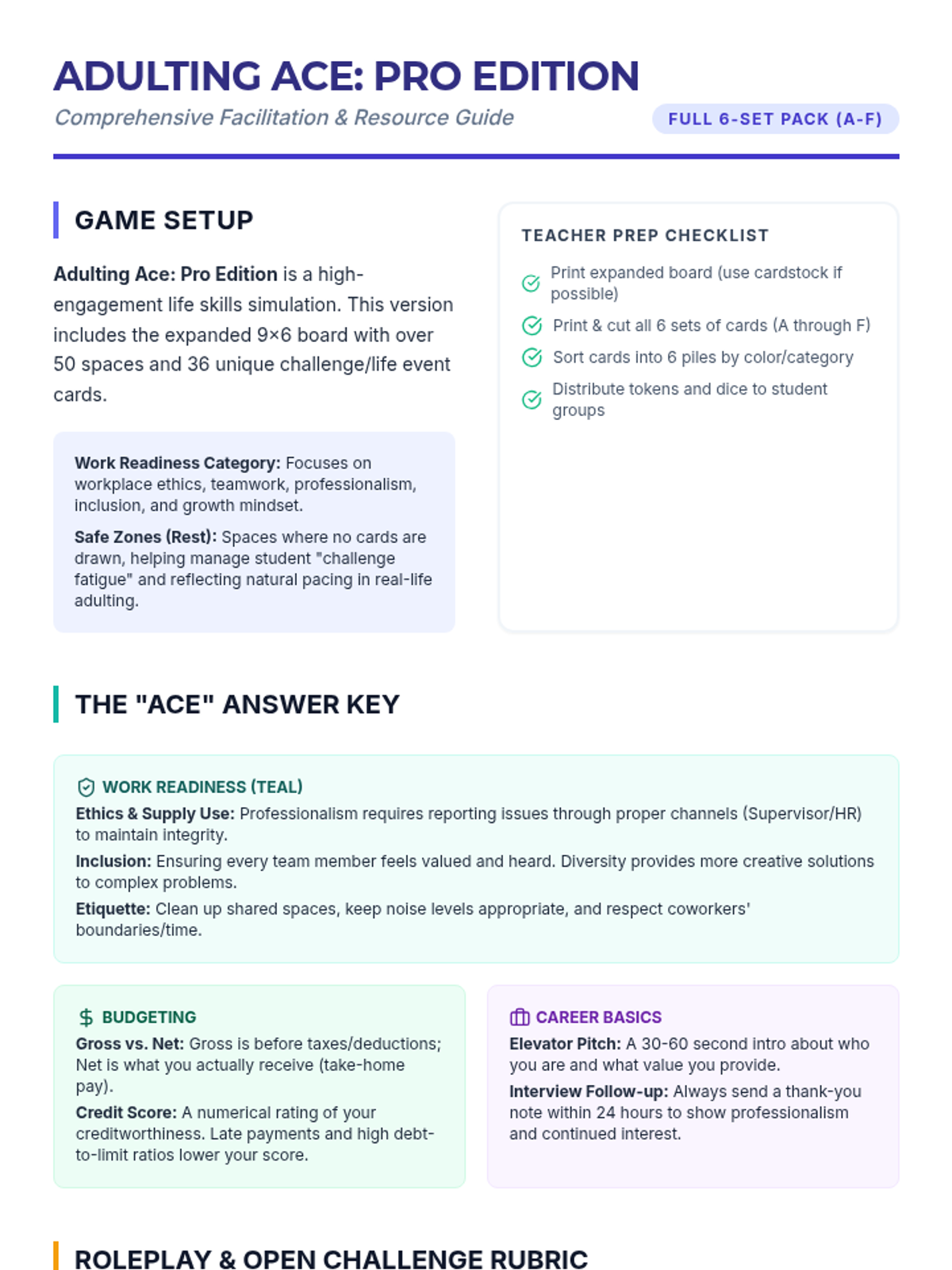
A comprehensive facilitation guide for the 'Adulting Ace' game. Includes assembly instructions, detailed rules, an answer key for all challenge cards, and post-game discussion prompts.
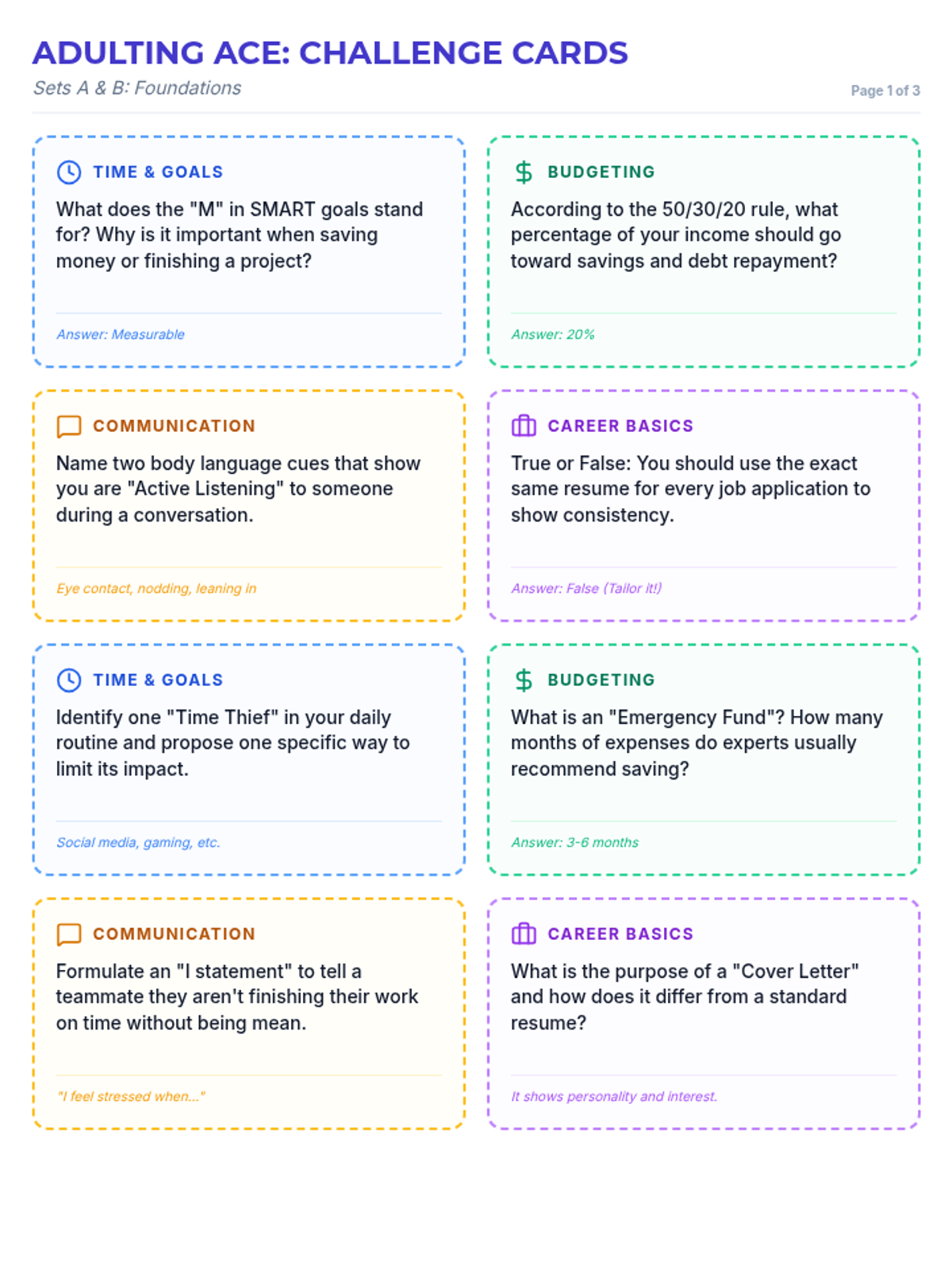
An expanded set of challenge cards for 'Adulting Ace'. Includes 24 challenge cards across 5 categories and 6 Life Event cards, organized into printable sets A-F for comprehensive gameplay.
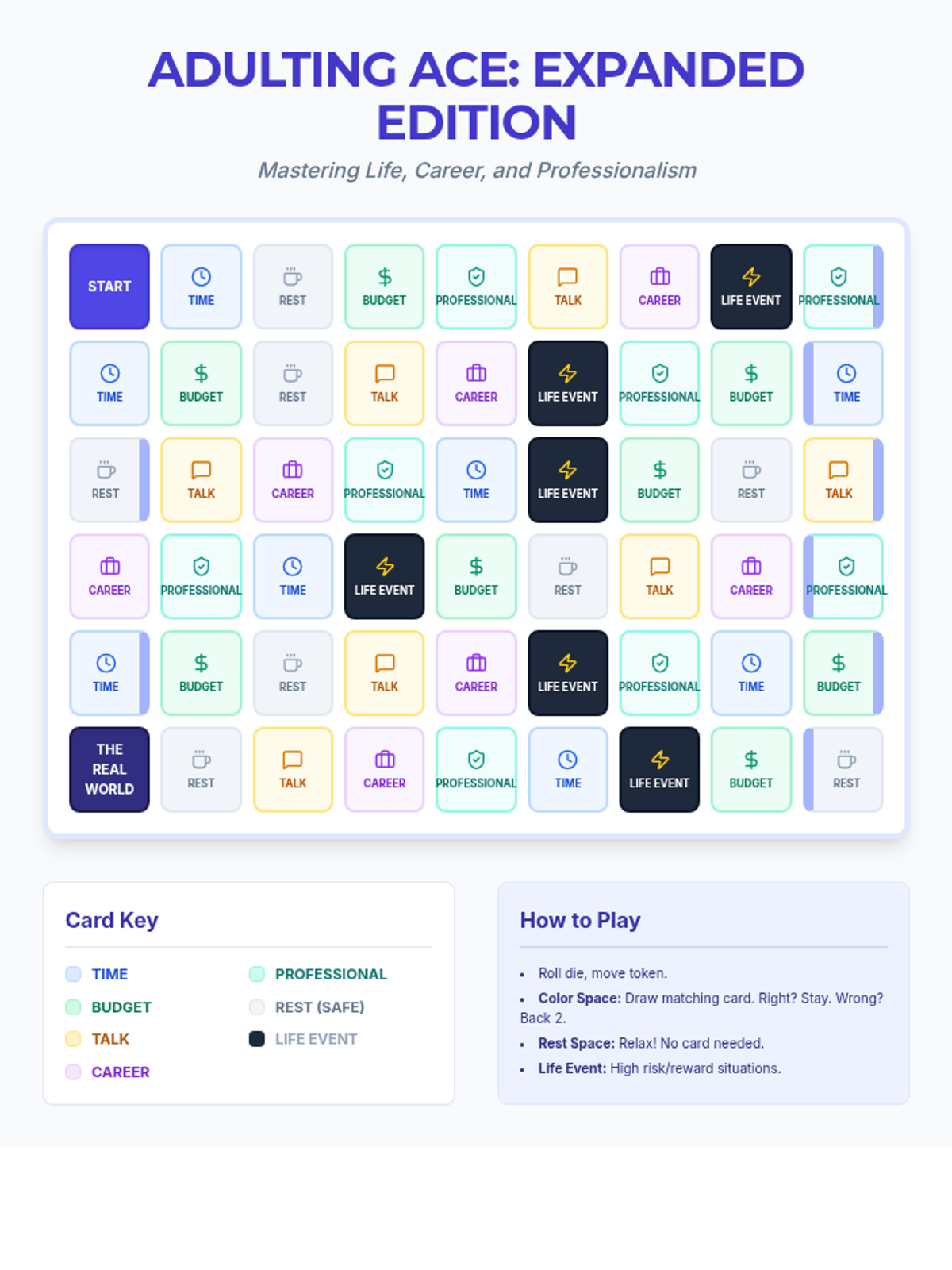
An expanded 9x6 board layout for 'Adulting Ace' featuring 50+ spaces, a new 'Work Readiness' category (Teal), and 'Rest' spaces to create pacing between challenges.
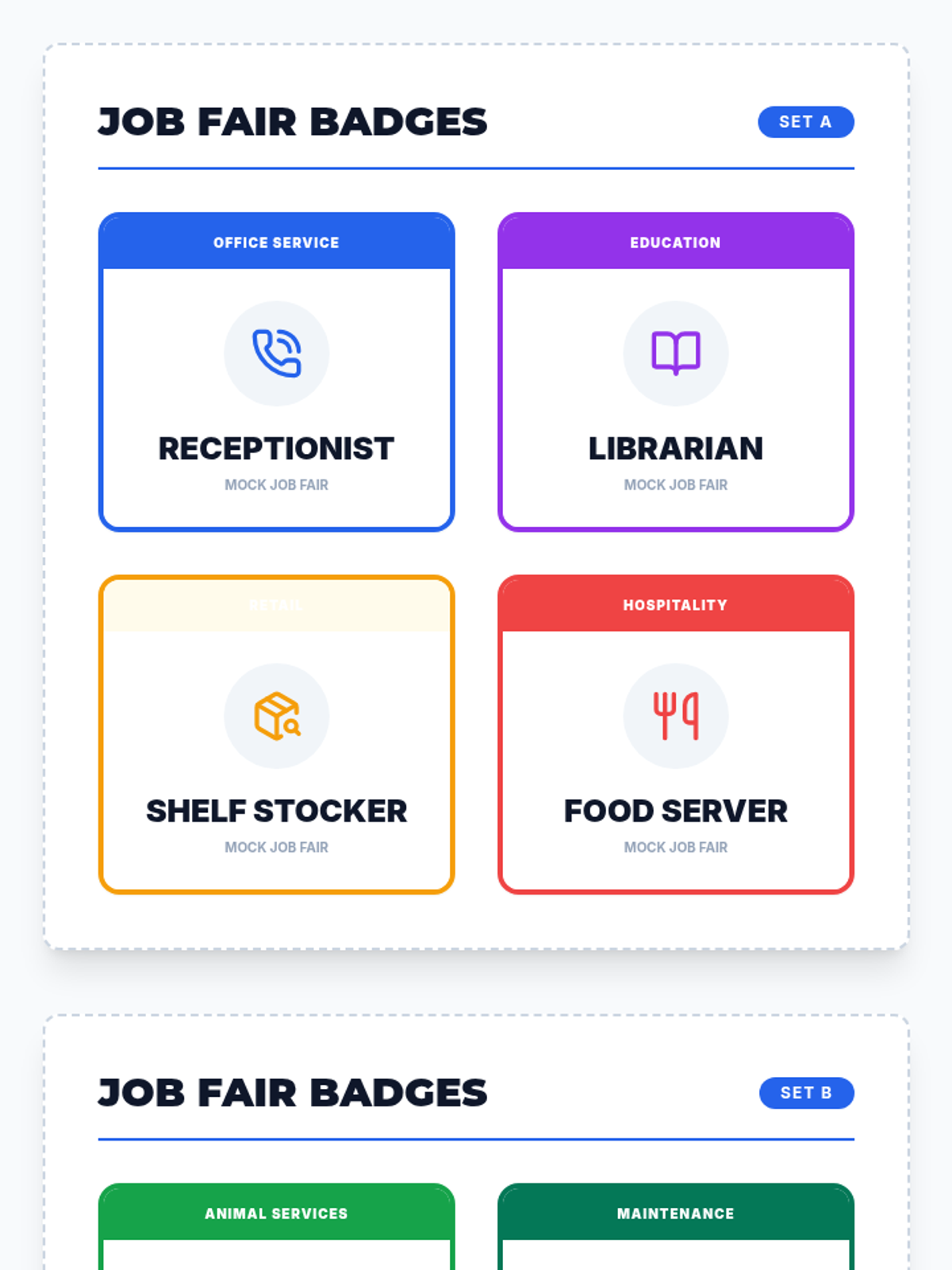
A comprehensive set of printable role badges for a Mock Job Fair simulation, now featuring 16 distinct job roles across 4 pages with icons and category headers.
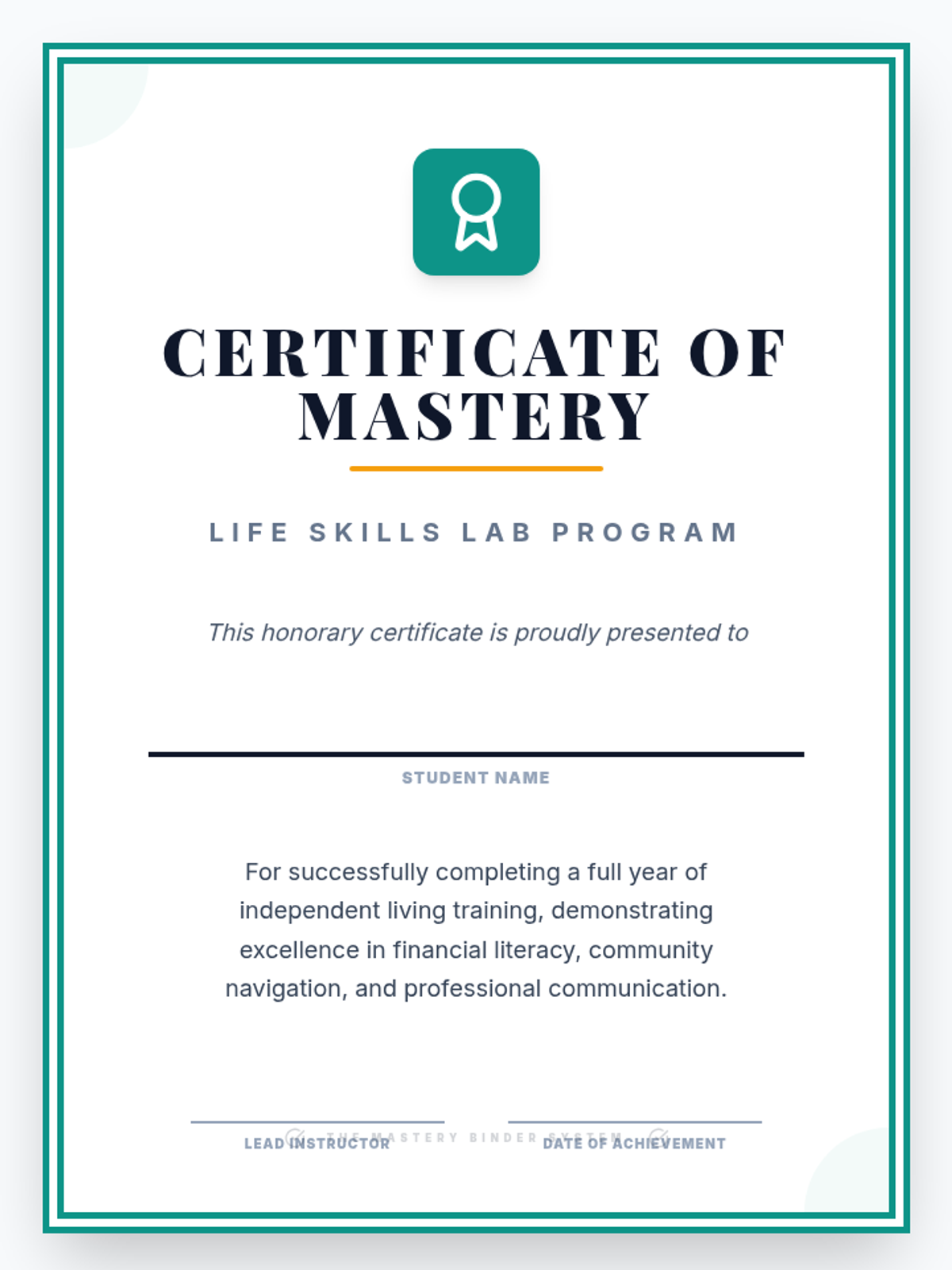
A professional graduation certificate to be awarded upon completion of the full-year Life Skills Lab curriculum.
A visual slide deck for teaching foundational employment skills, interview etiquette, and preparing for a Mock Job Fair simulation.
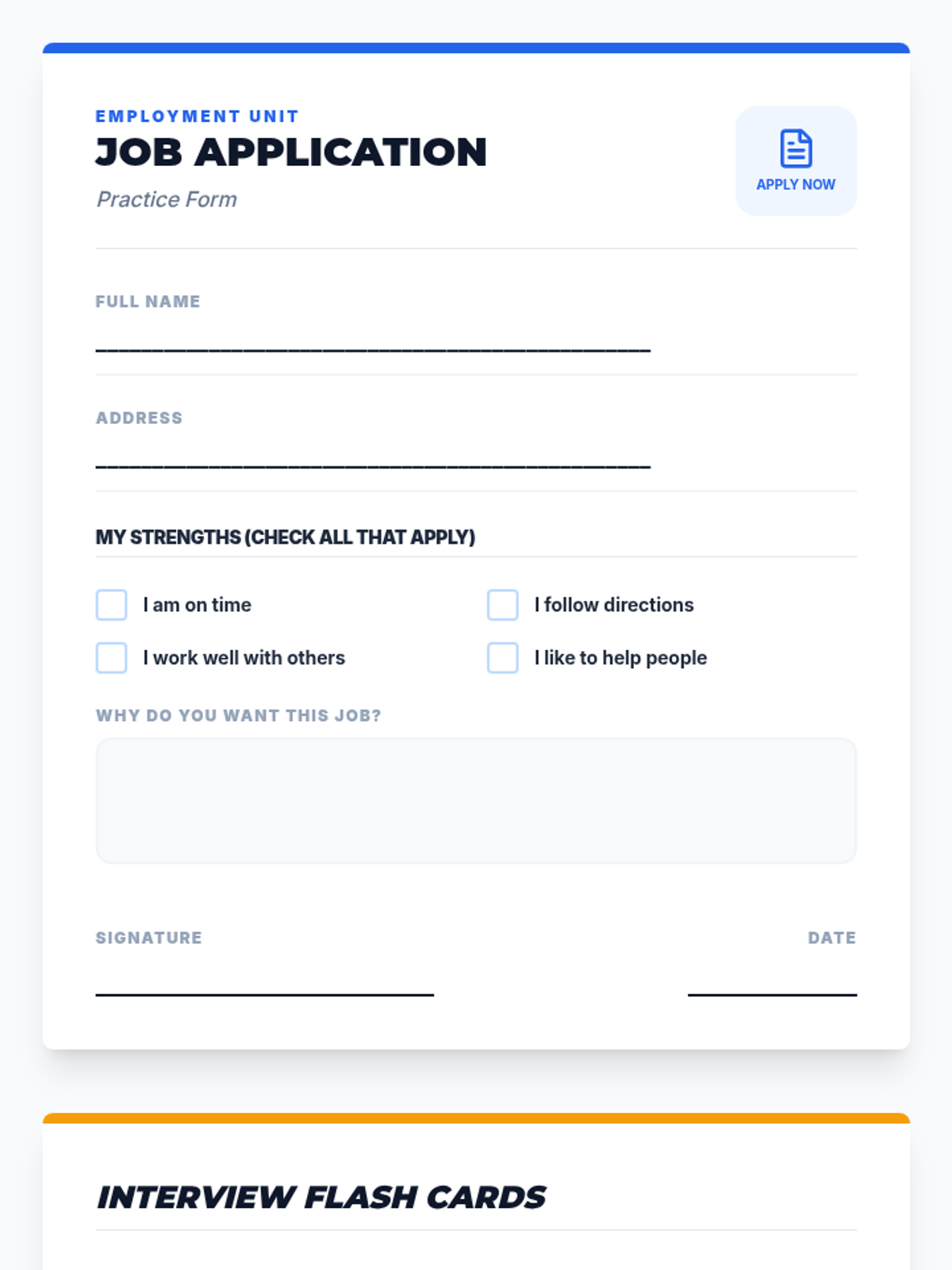
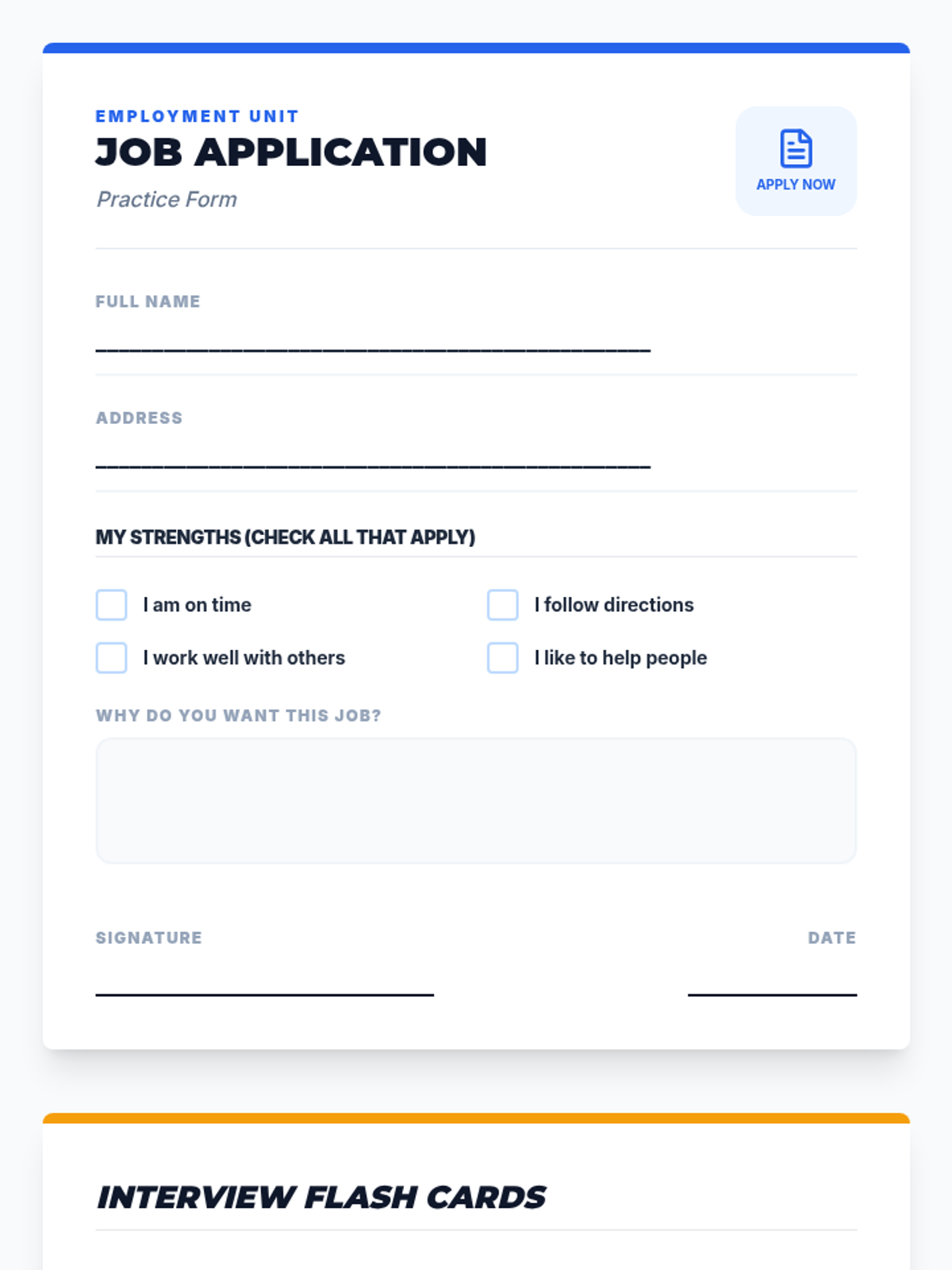
A student-facing employment kit featuring a simplified job application practice form and interview preparation cards with prompts.
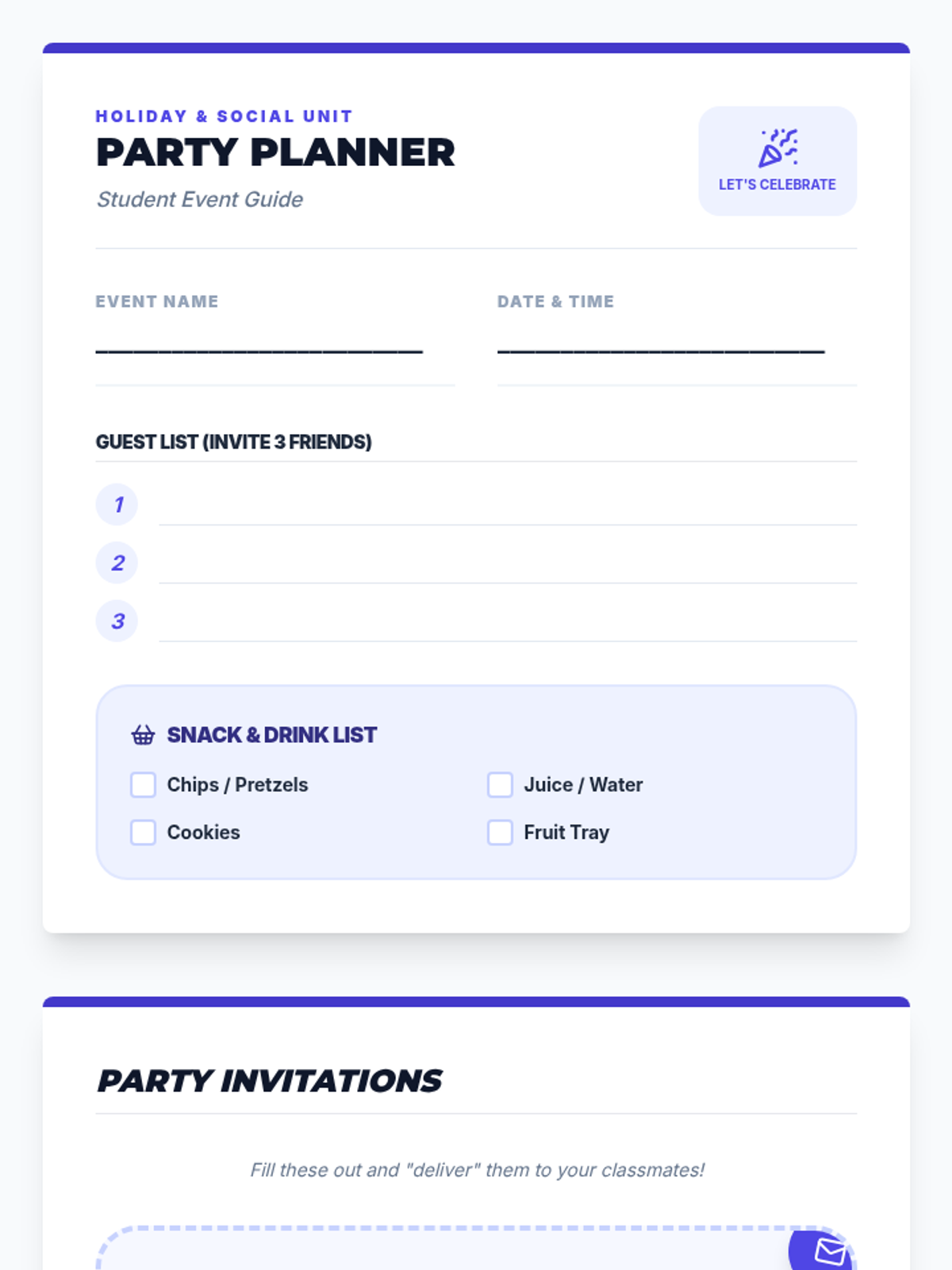
A student-facing event planning toolkit with a party checklist and printable fill-in-the-blank invitations for social simulation.
A visual slide deck for teaching event planning, hosting skills, and social etiquette for holiday gatherings.
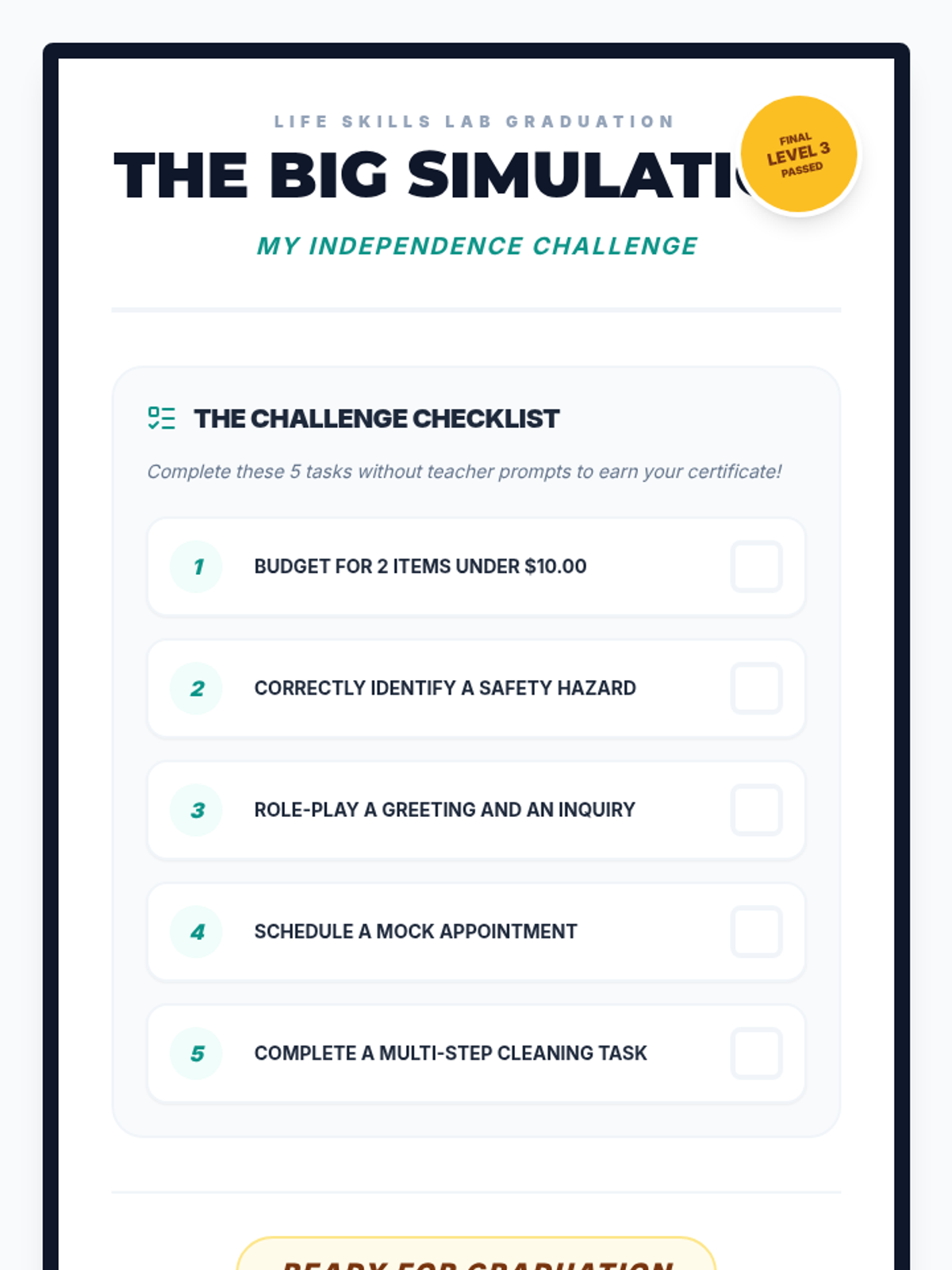
The capstone December simulation worksheet, featuring a multi-skill final challenge checklist for students to demonstrate their year-long learning.
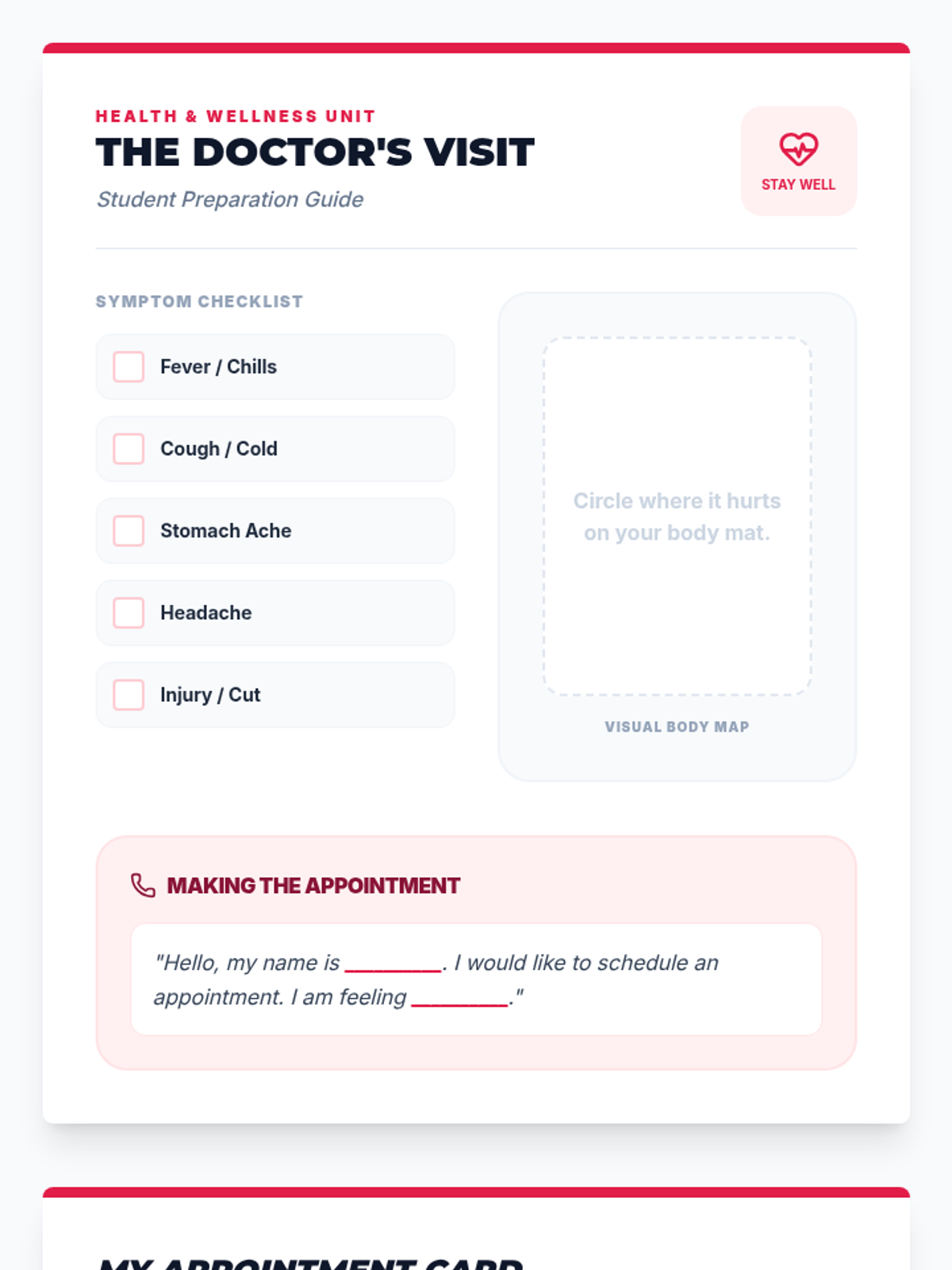
A student-facing health kit featuring a symptom checklist, body map visual, and a printable appointment reminder card.
A visual slide deck for teaching healthcare navigation, symptom identification, and medical appointment protocols.
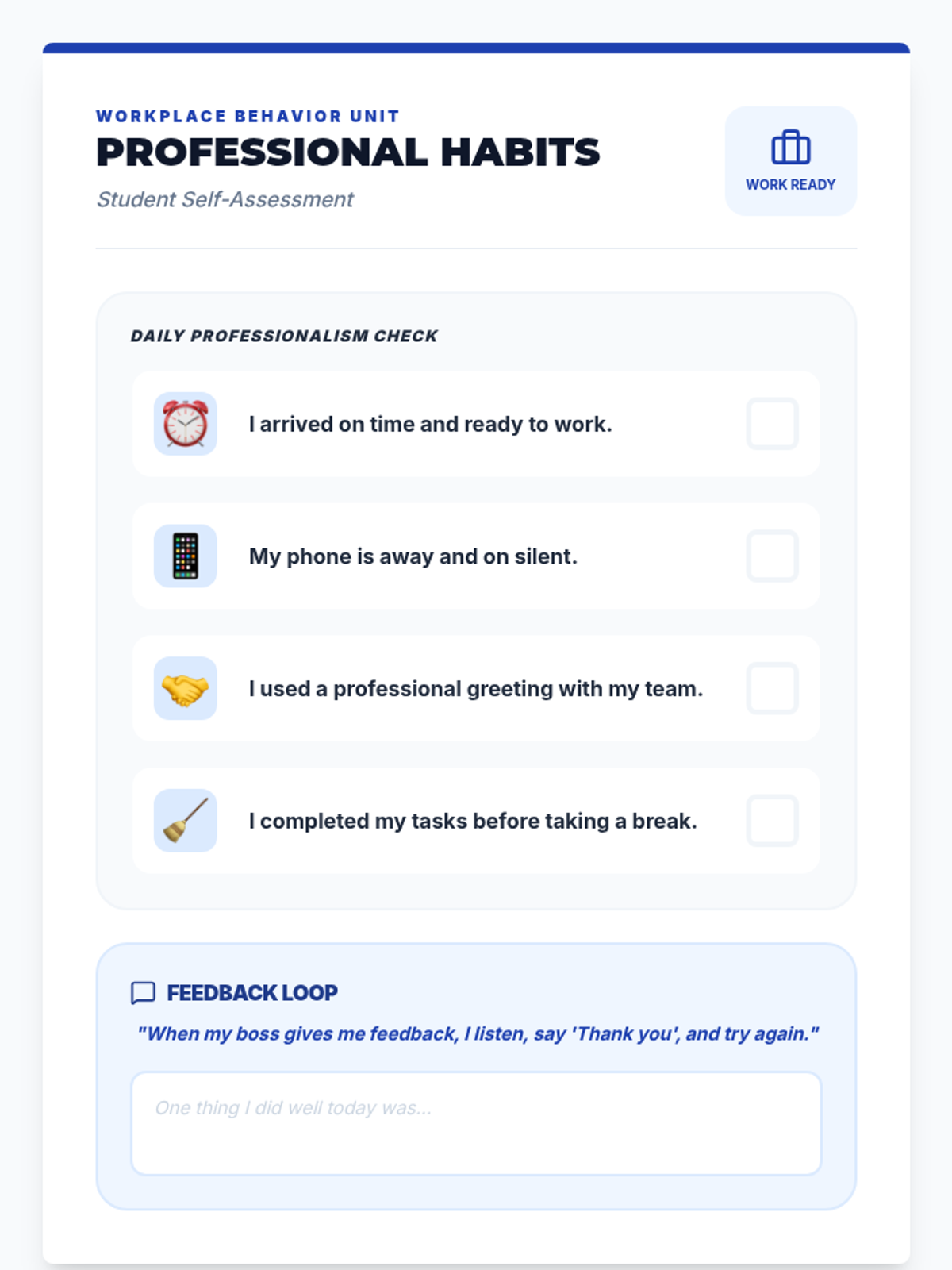
A student-facing workplace behavior kit featuring a professional habit self-assessment and social scenario practice for the breakroom.
A visual presentation for the capstone December unit, focusing on applying all learned skills and reflecting on a year of progress.
A visual slide deck for teaching workplace social cues, teamwork, and professional breakroom etiquette.
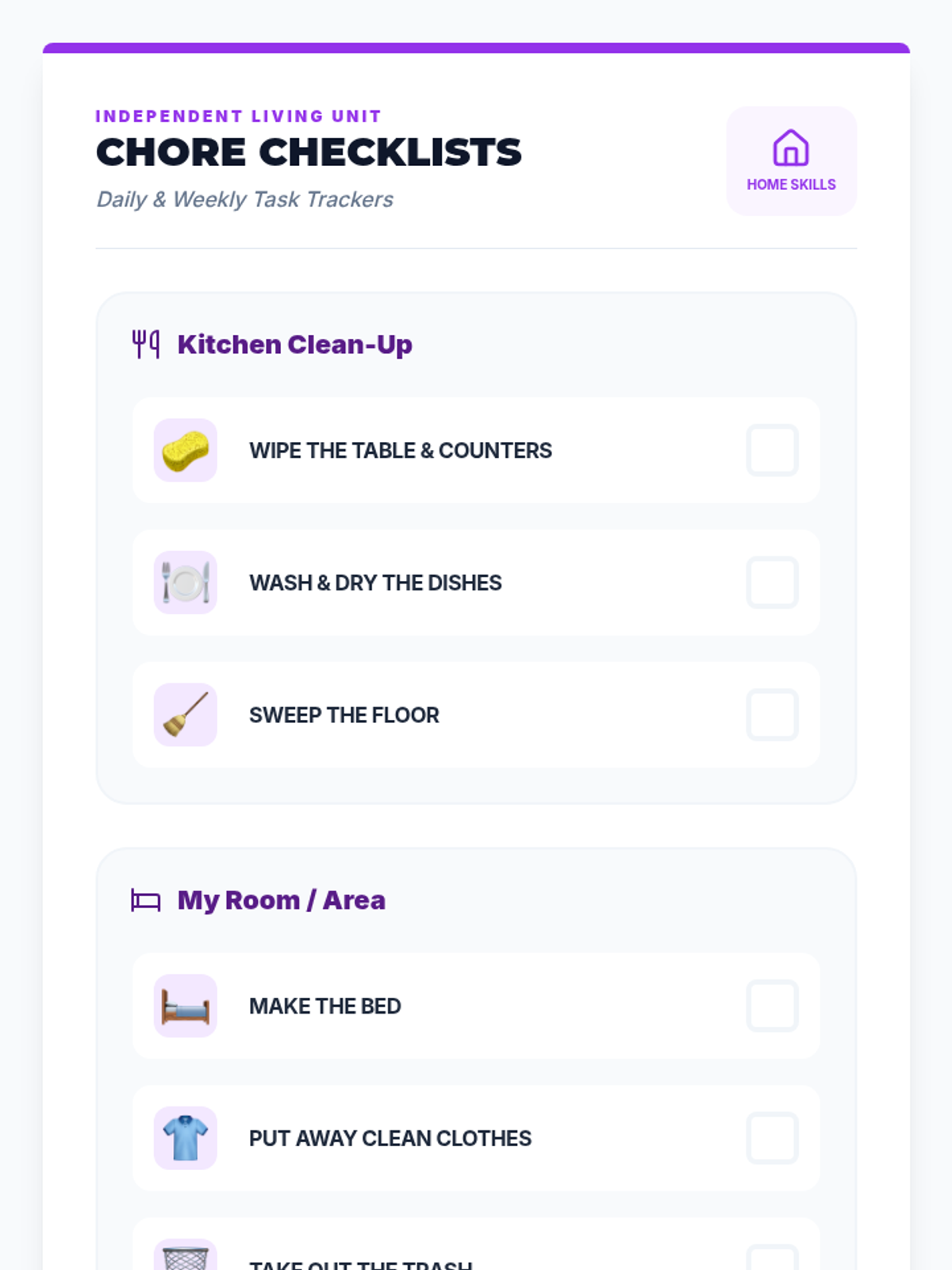
A student-facing chore tracker featuring visual checklists for kitchen cleaning, personal space maintenance, and a multi-step laundry guide.
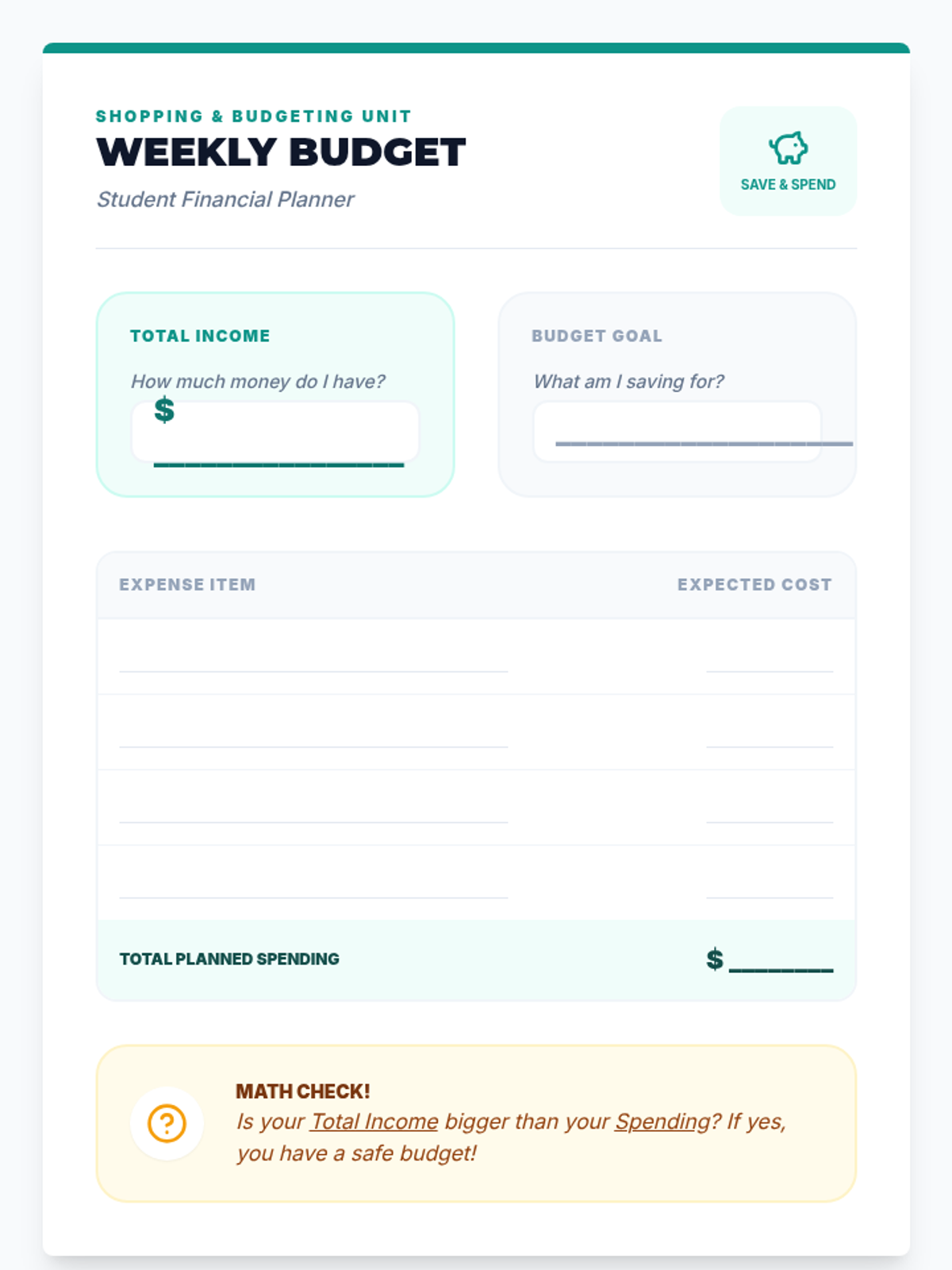
A student-facing budgeting packet featuring a weekly spending planner and price comparison simulation scenarios.
A professional-grade graduation certificate for students who complete the Life Skills Launchpad program, featuring elegant typography and a cohesive design.
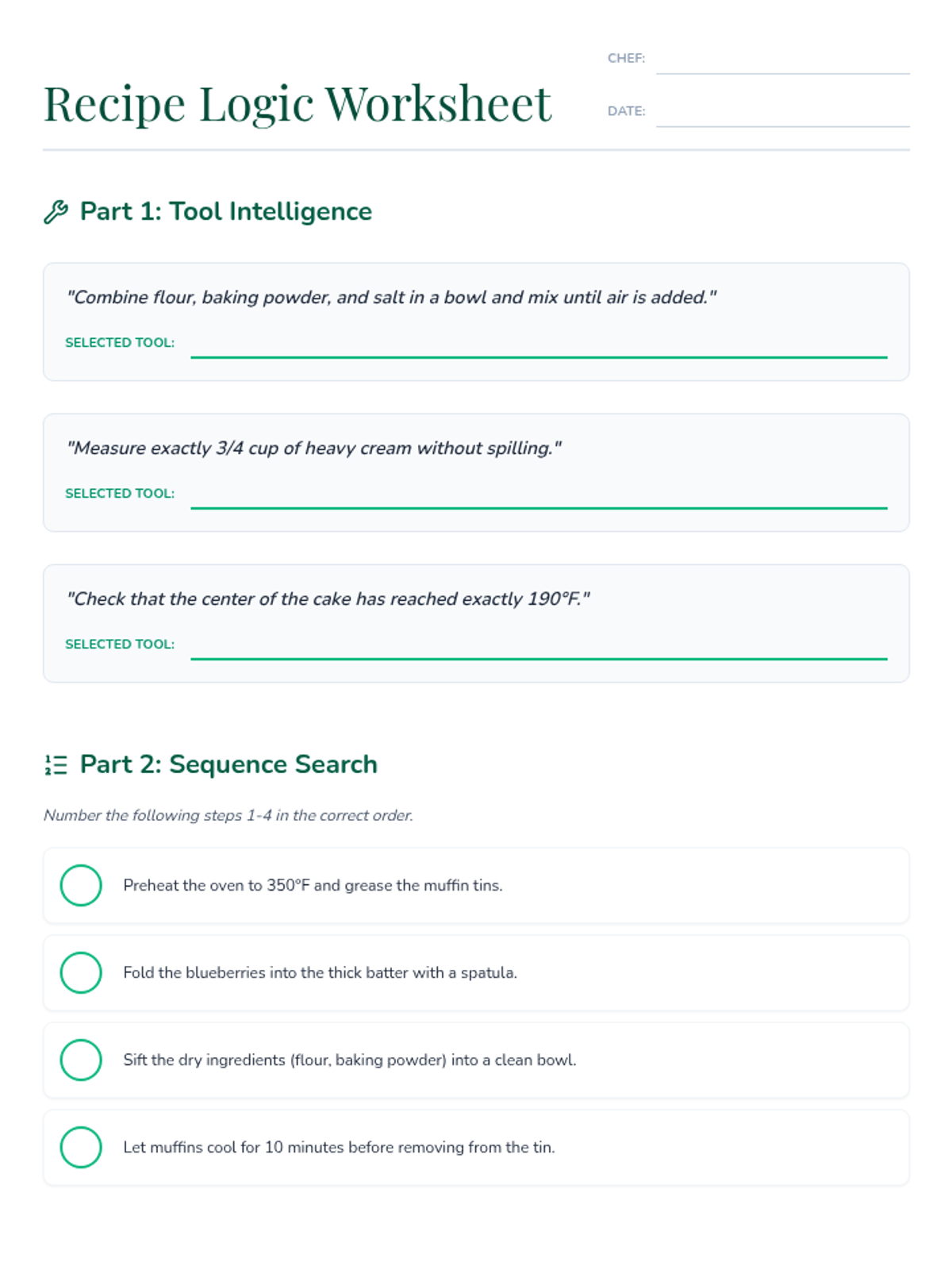
A student worksheet for practice in kitchen tool identification, fraction scaling, and recipe sequencing within the "Kitchen Code" lesson.
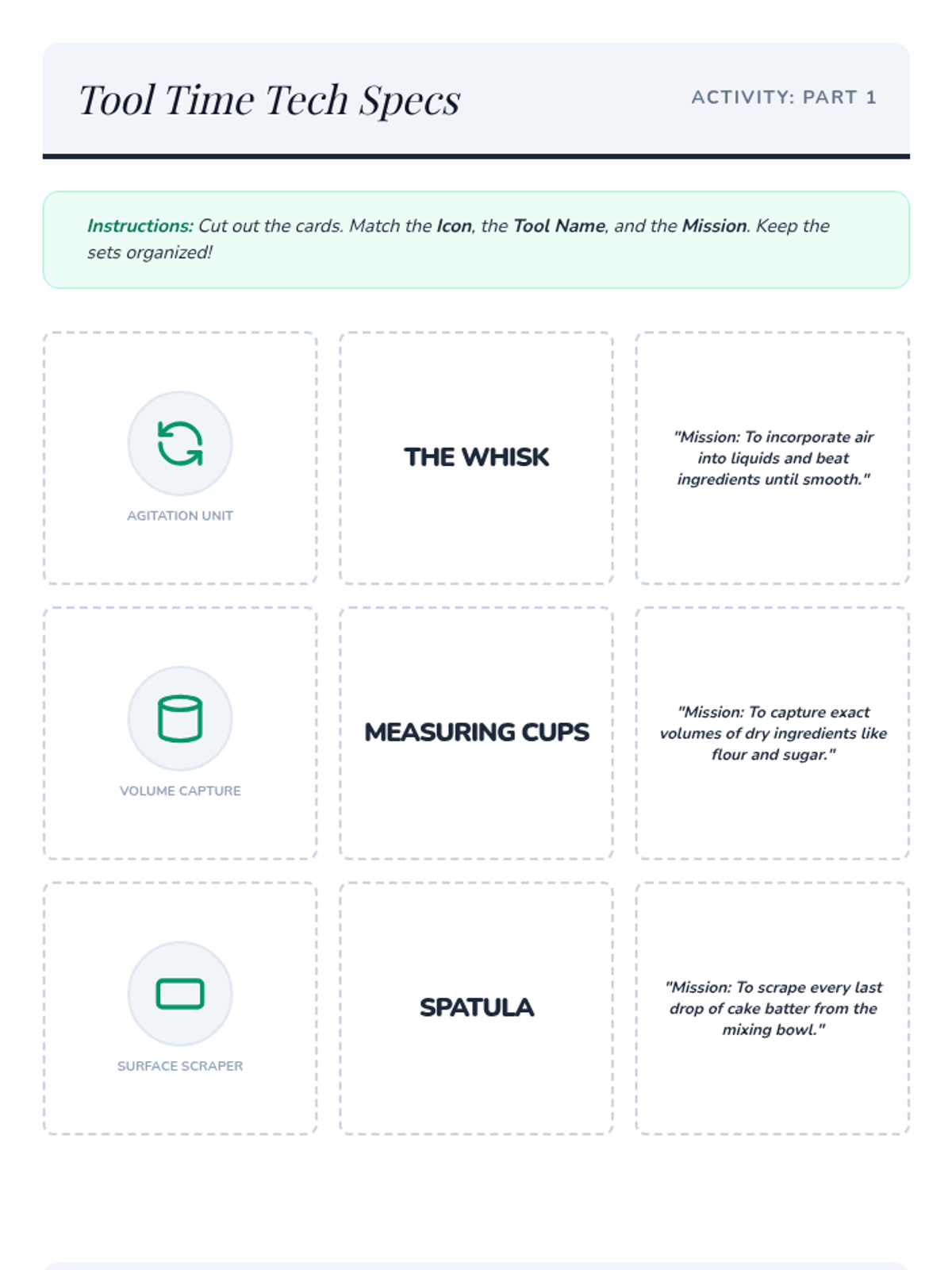
A hands-on activity where students cut out and match kitchen tools with their names and functions, including a "wildcard" card for student creativity.
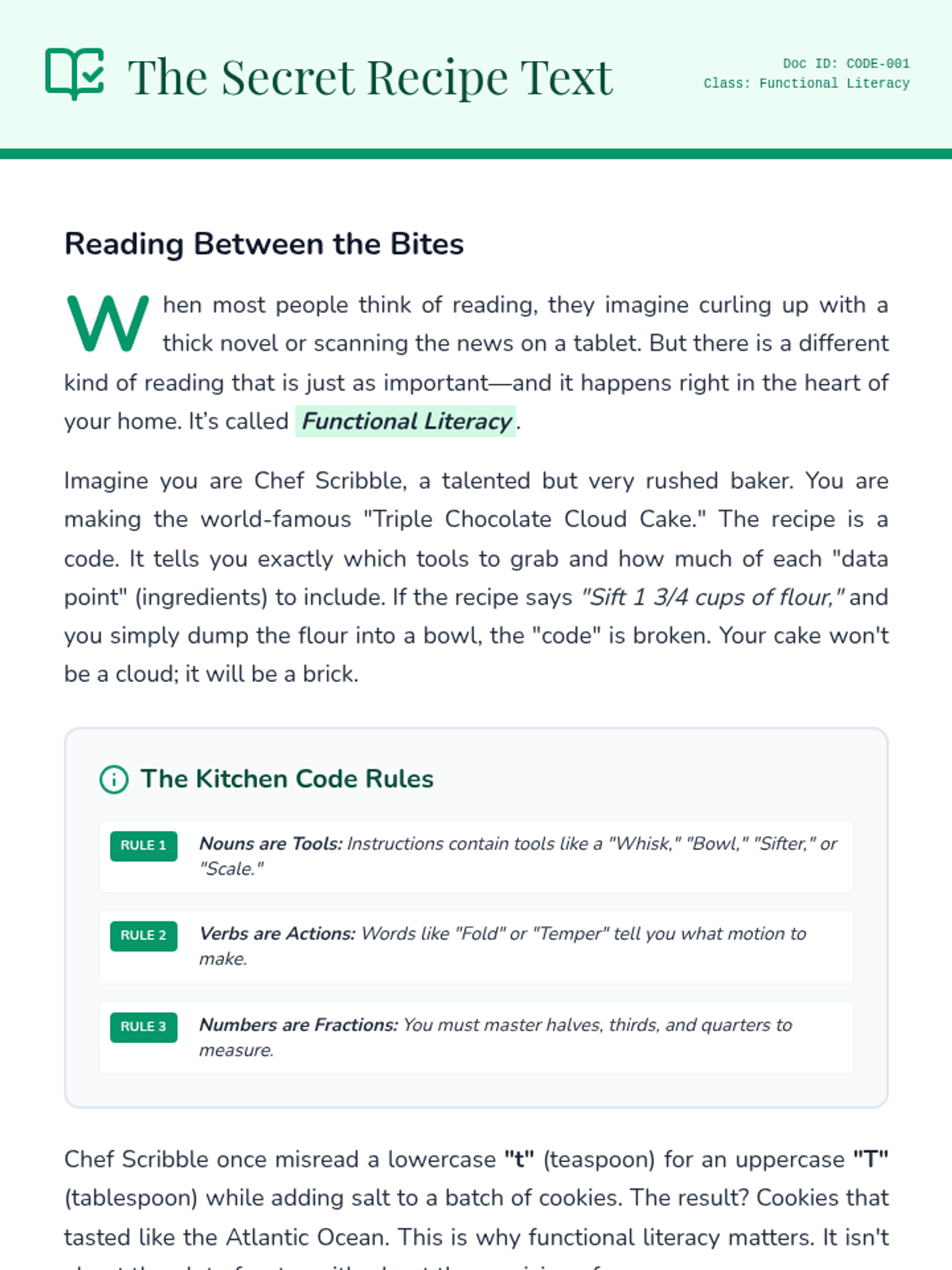
A reading passage for students that explains functional literacy through the story of "Chef Scribble," emphasizing precision in kitchen tools and fraction reading.
A high-impact slide deck for "Kitchen Code" introducing functional literacy, essential kitchen tools, and the math of fraction scaling in recipes.
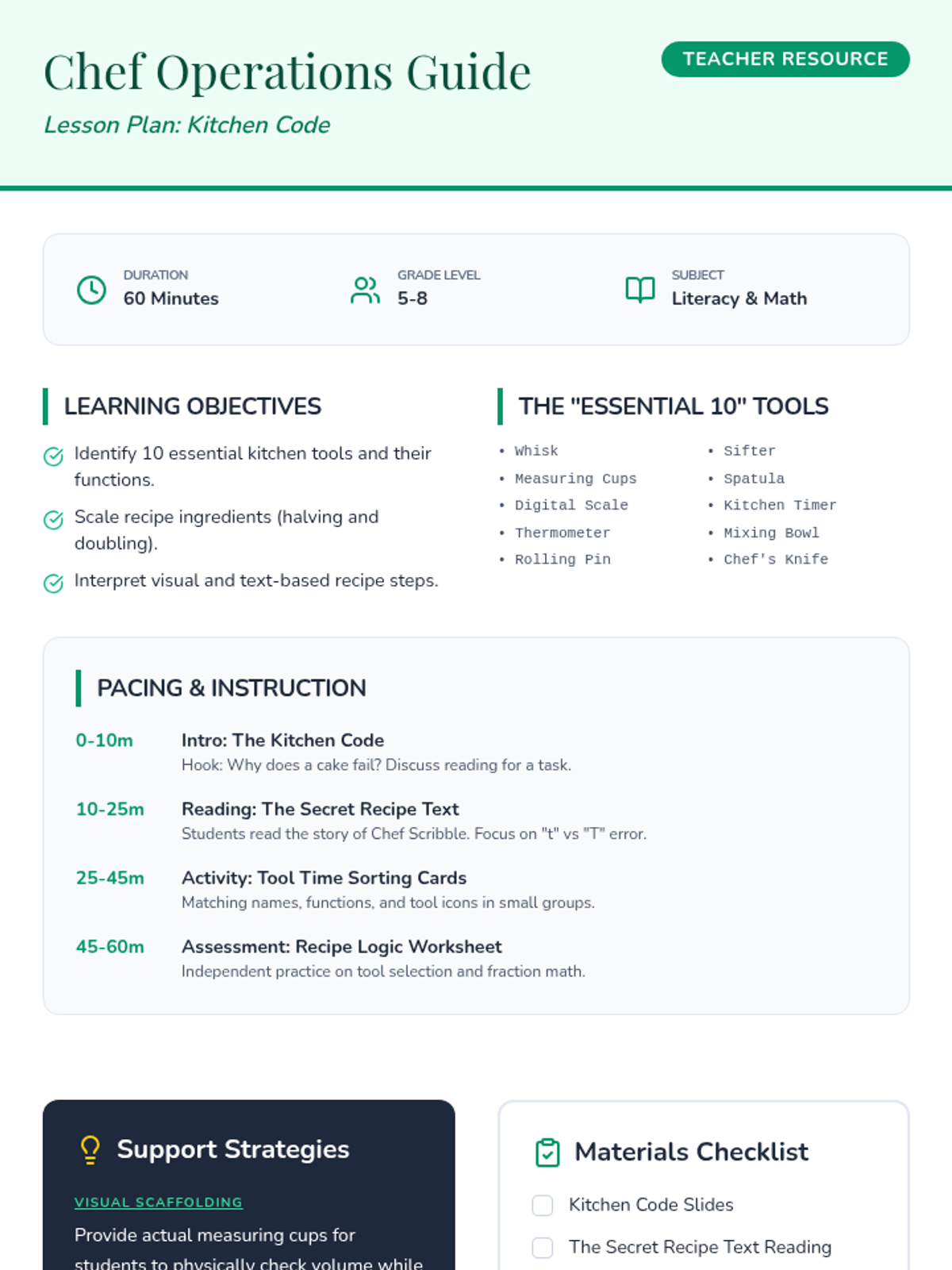
A teacher-facing lesson plan for "Kitchen Code," outlining learning objectives, vocabulary, pacing, and differentiation strategies for teaching functional literacy and culinary math.
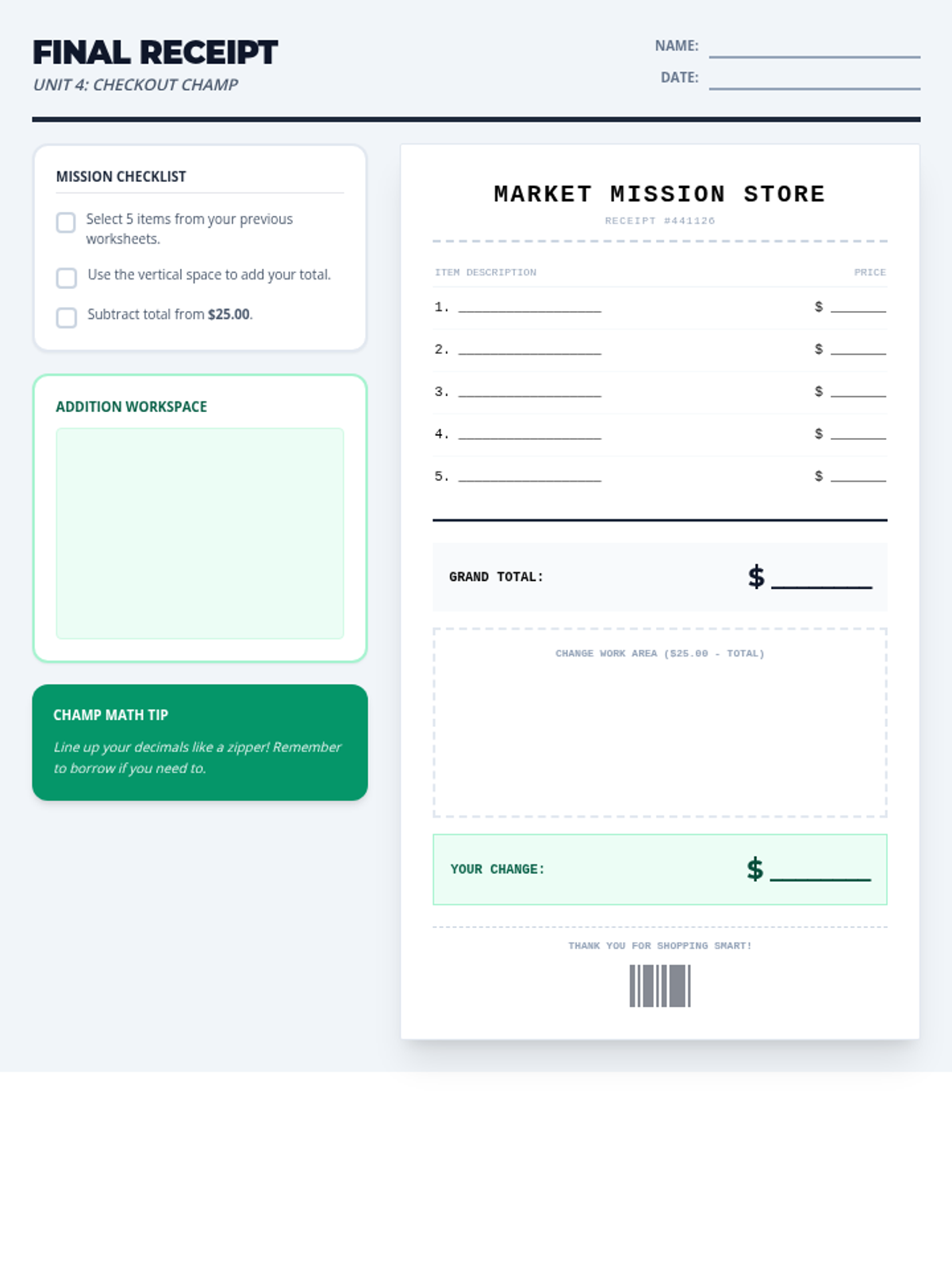
A final project worksheet for Lesson 4 that simulates a grocery receipt, where students calculate their final total and determine their remaining change from a $25 budget. Revised to fix page breaks, formatting, and added addition workspace.
Concluding slide deck for Lesson 4, guiding students through the final checkout process. Revised to fix a minor typo in the success checklist.
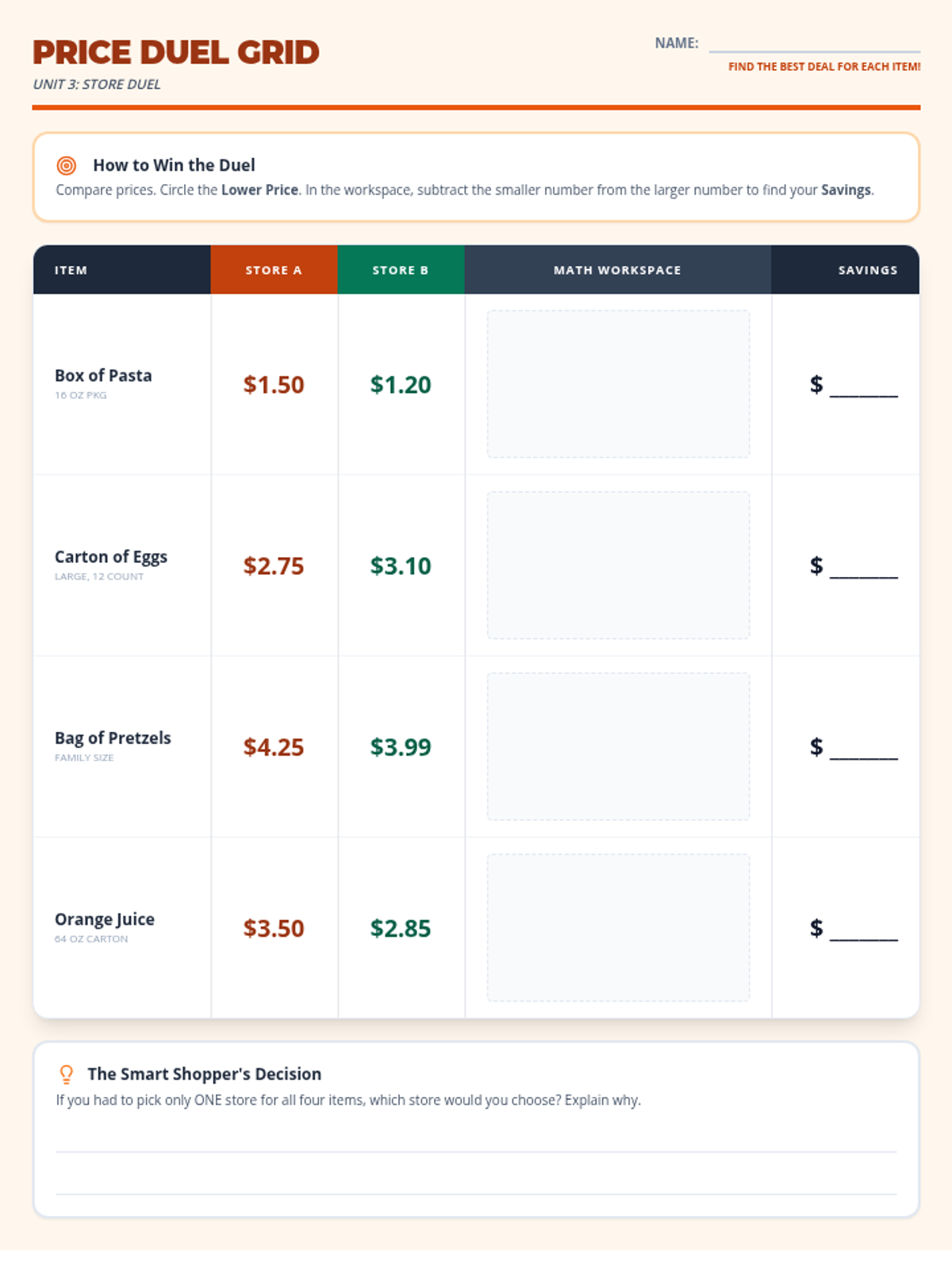
A comparison grid for Lesson 3 where students compare prices for the same items at two different stores and calculate the savings. Revised to fix layout, workspace size, and column logic.
Slide deck for Lesson 3 focusing on price comparison strategies, identifying the best deals, and reviewing decimal subtraction.
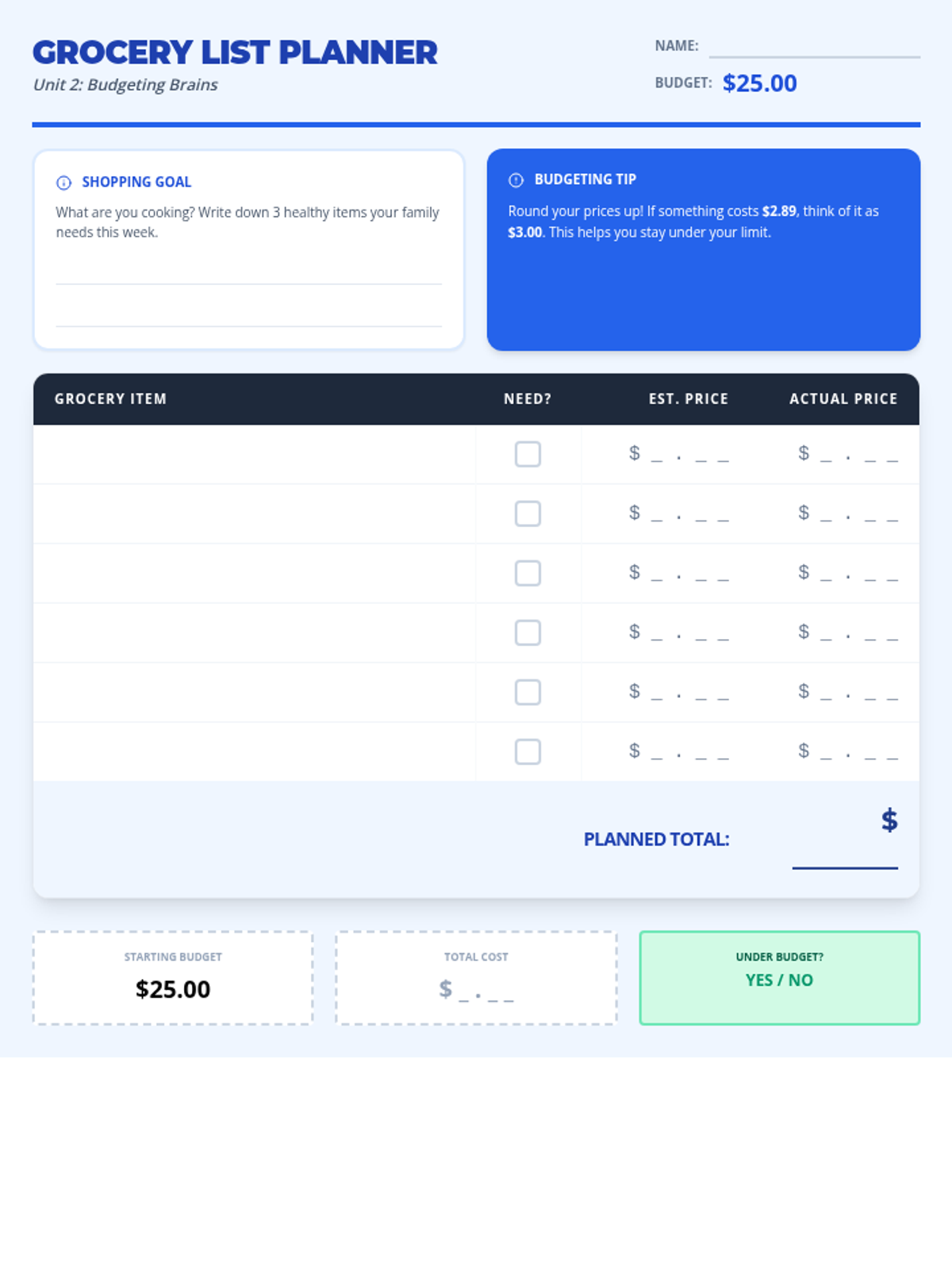
A graphic organizer for Lesson 2 that helps students plan a shopping trip, estimate costs, and track whether items are 'needs' or 'wants' while staying within a $25 budget. Revised to fix page breaks and formatting.
Slide deck for Lesson 2 focusing on budgeting basics, identifying needs vs. wants, and planning a shopping trip within a $25 limit.
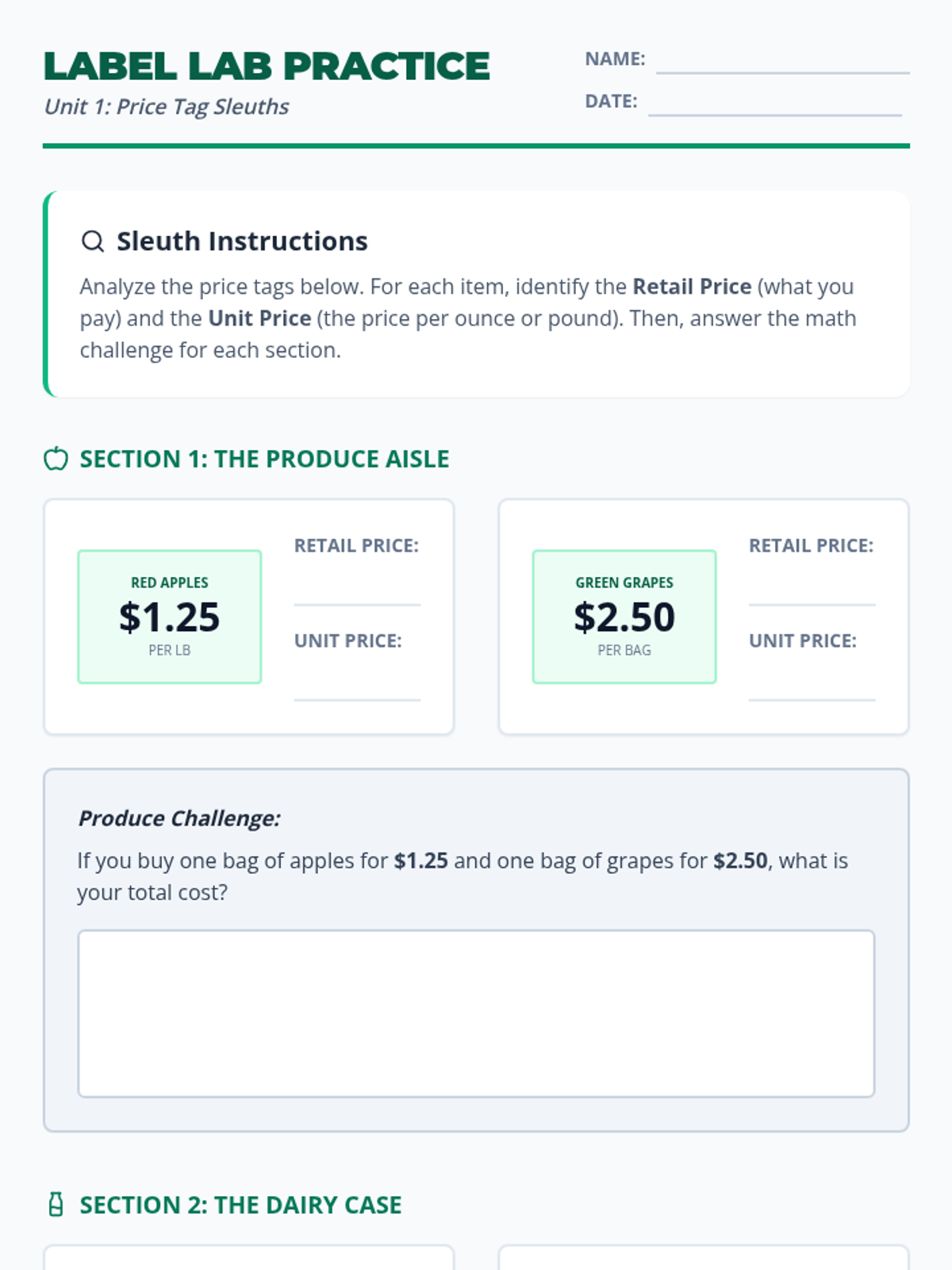
A practice worksheet for Lesson 1 where students identify retail and unit prices from visual tags and perform basic decimal addition/subtraction. Revised to fix page break and formatting issues.
An introductory slide deck for Lesson 1 that teaches students how to read grocery price labels and the basics of unit pricing.
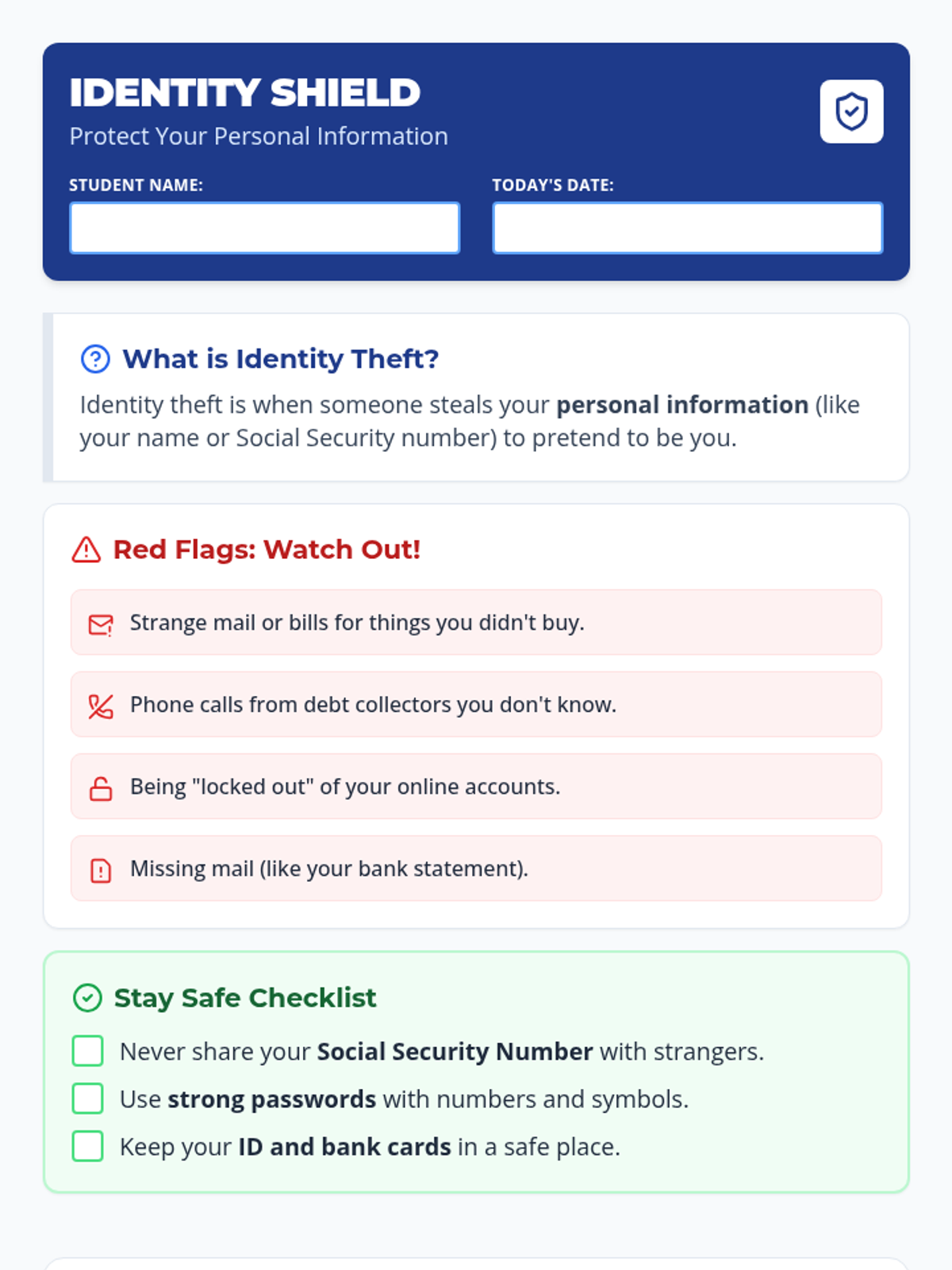
A clear, high-contrast handout for Special Education students explaining identity theft, common warning signs, and safety steps with a practical scenario-based activity.
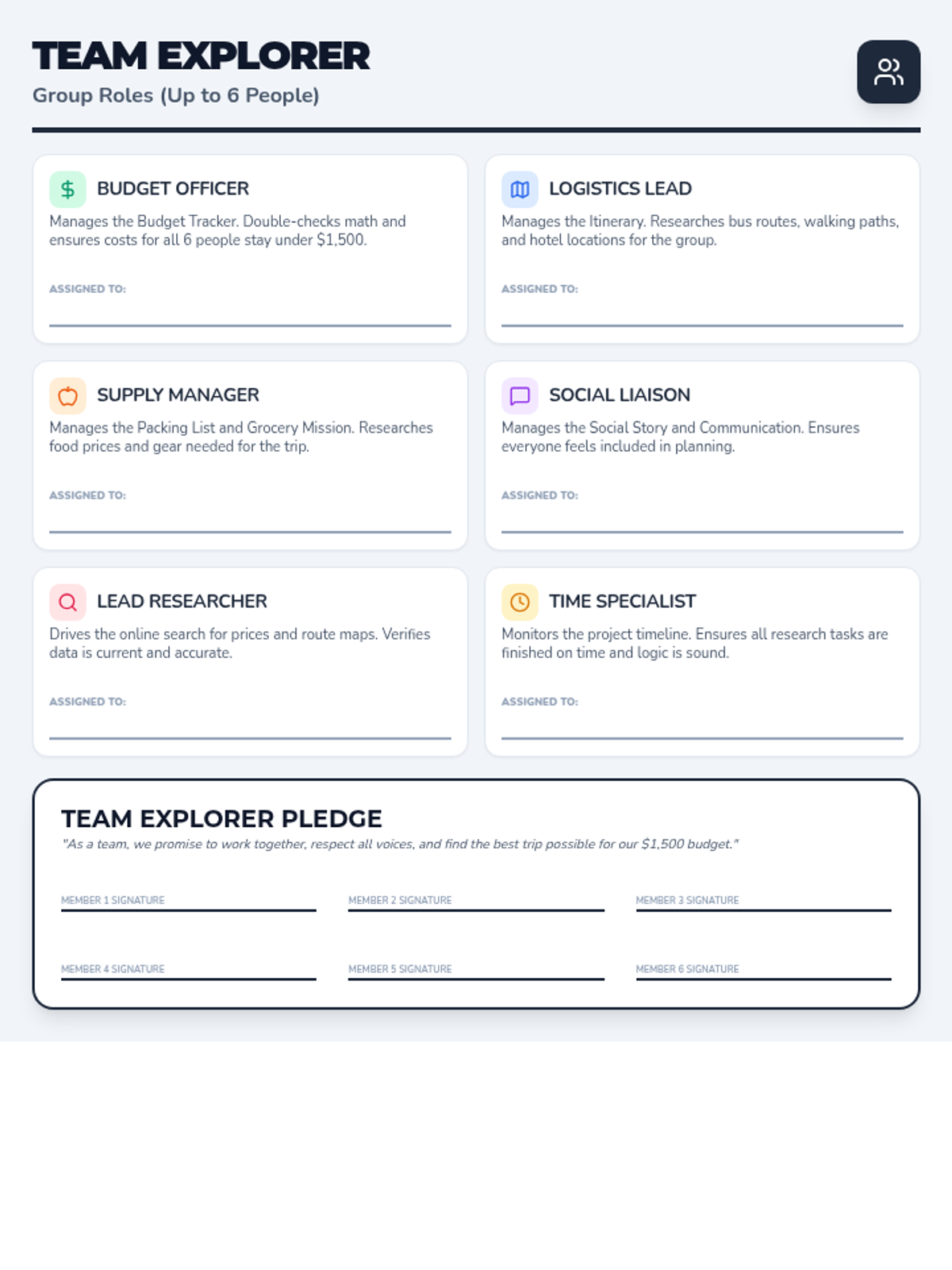
A group roles organizer for 4-6 students to assign specific responsibilities for their community trip research project. Includes 6 distinct roles and a team pledge. Fixes page break and legibility issues.
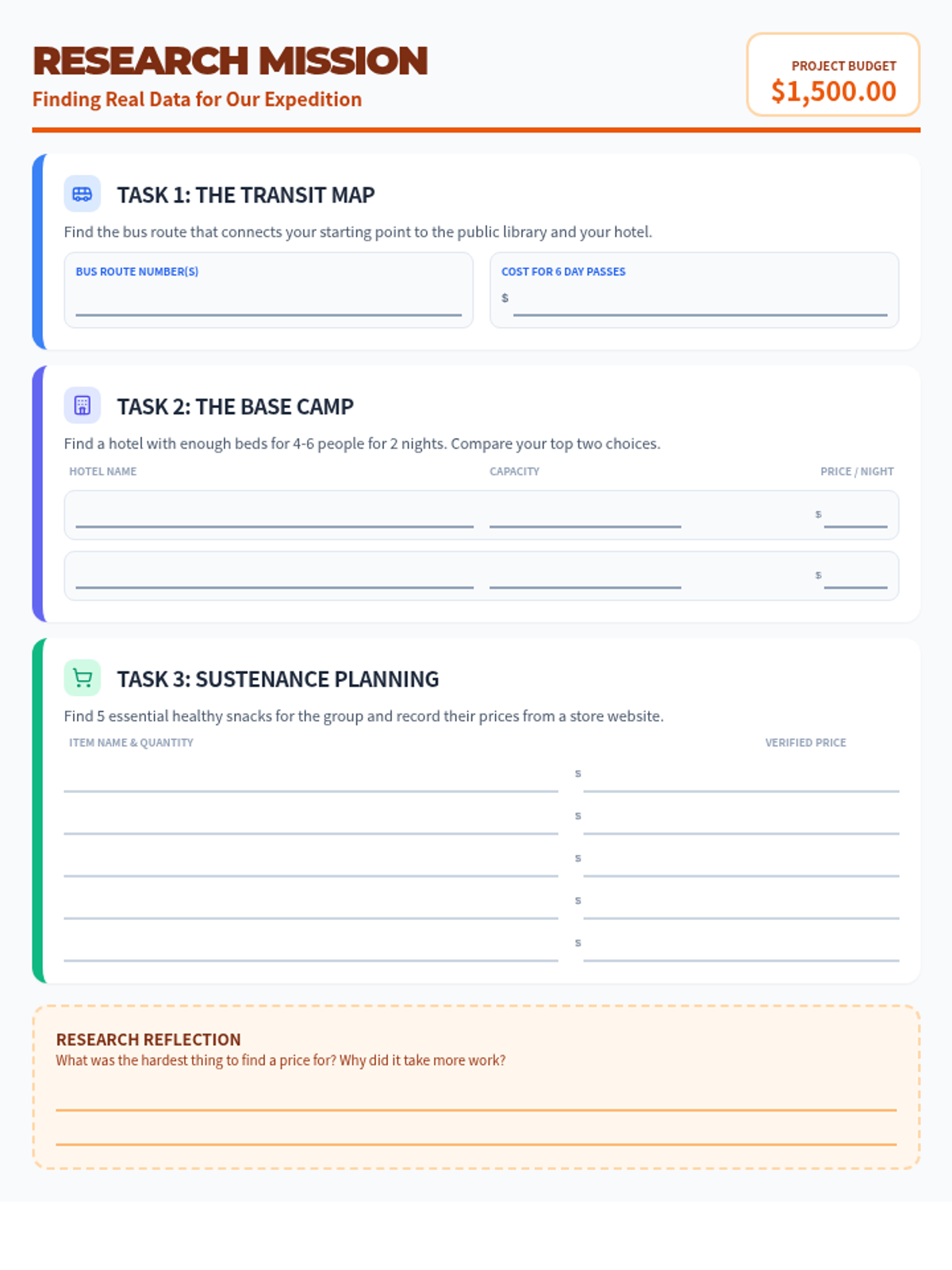
A step-by-step research guide for students to find real-world costs for transit, lodging, and groceries as part of their community trip project. Fixes layout and content completeness issues.
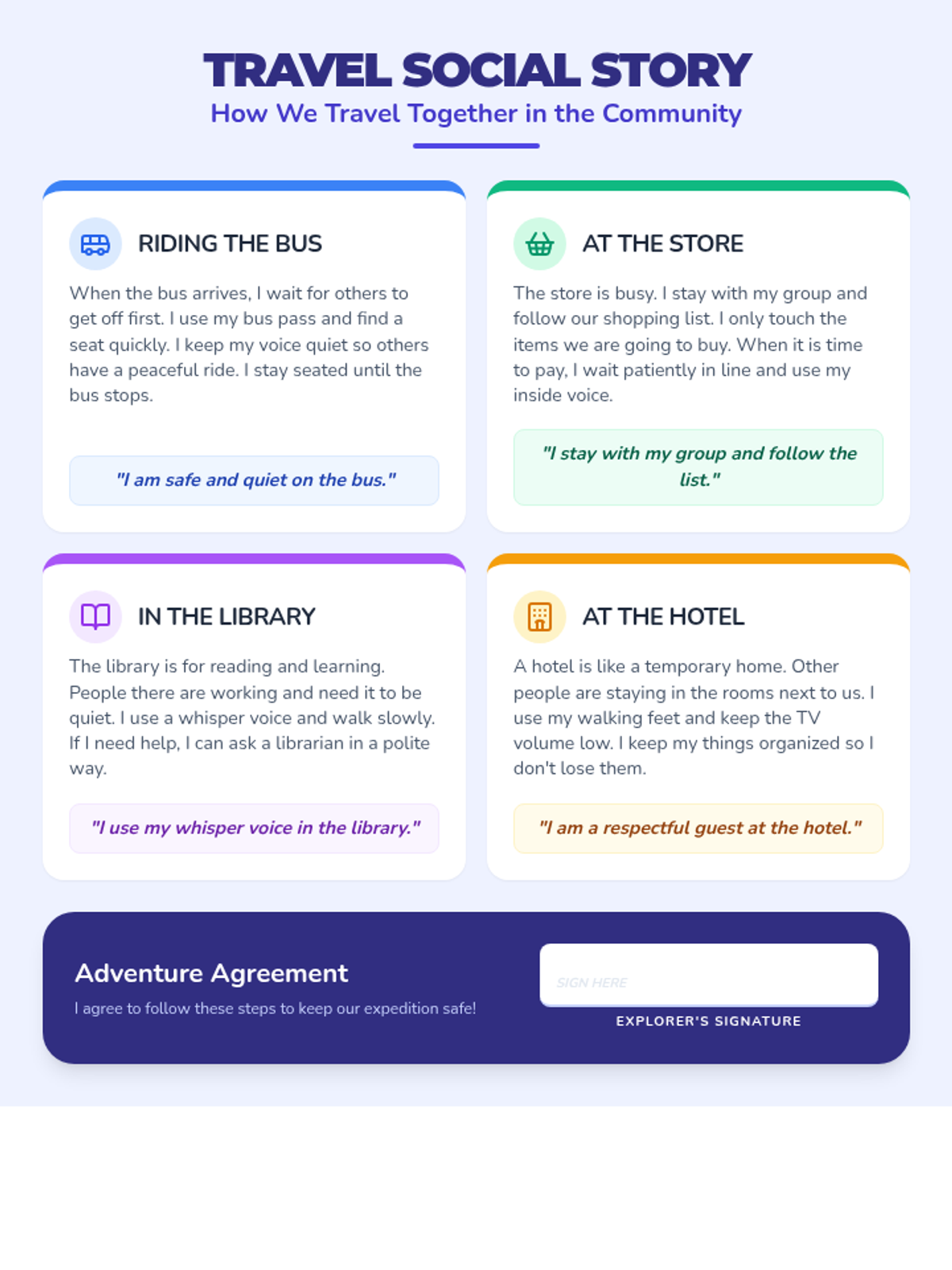
A visual social story for community travel, outlining clear social expectations and behavior protocols for buses, stores, libraries, and hotels, fitting entirely on one page.
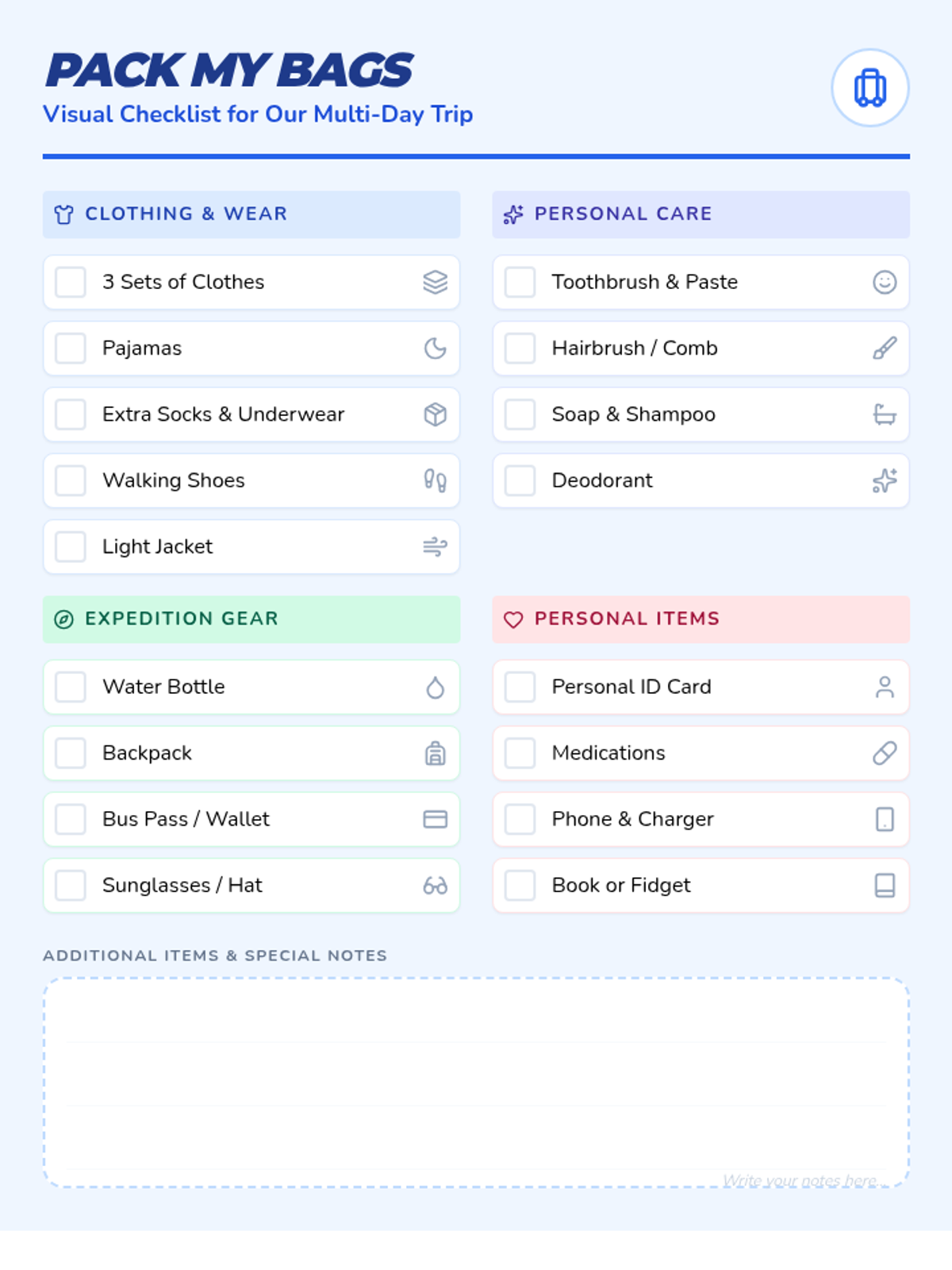
A visually-supported packing checklist designed for students, featuring categorized items with consistent Lucide icons and an expanded notes section for personal trip preparation.
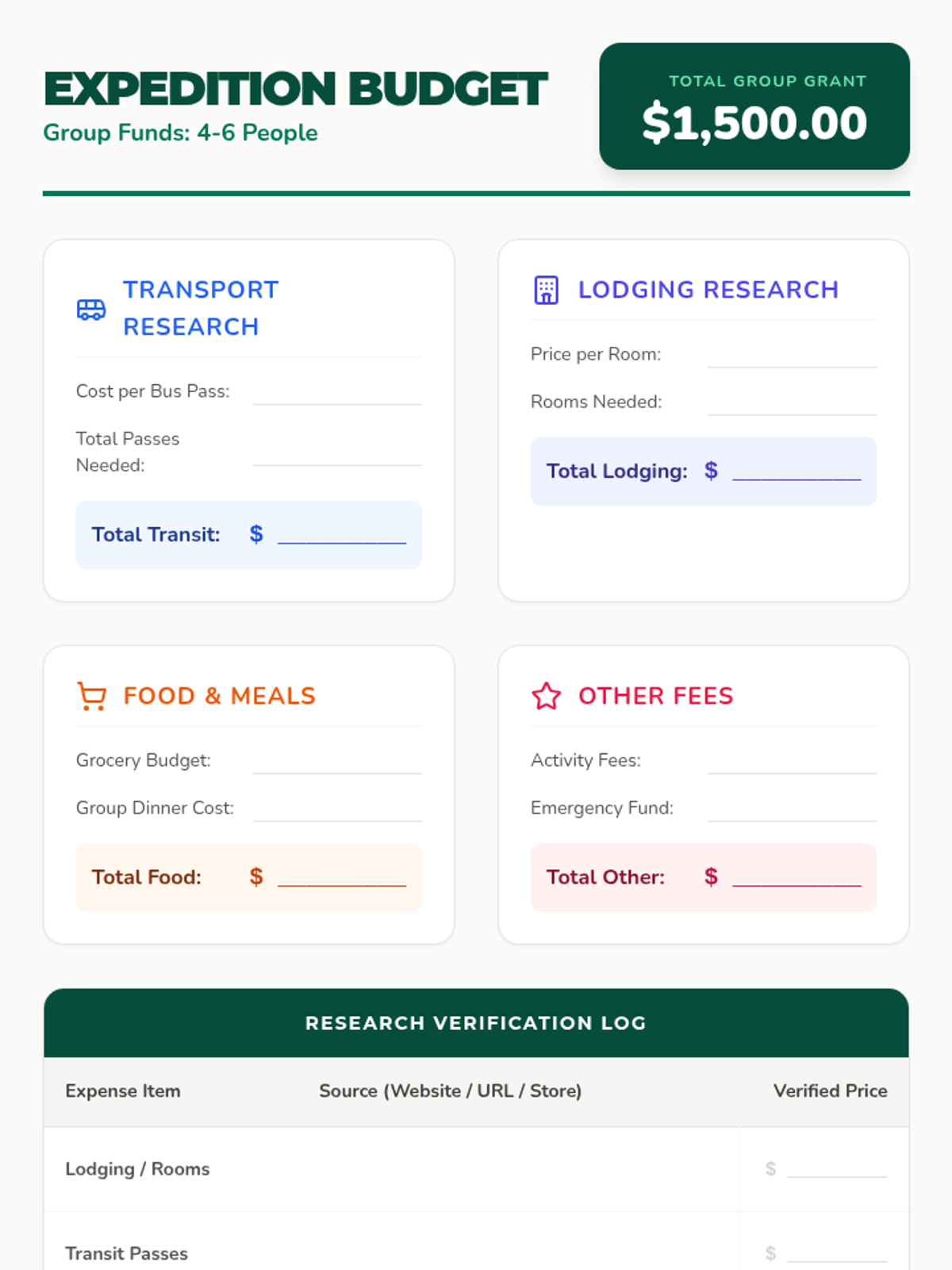
A research-based budget expense tracker for a 4-6 person community trip with a $1,500 grant, including a verification log for students to record their sources and prices. Fixes alignment and page break issues.
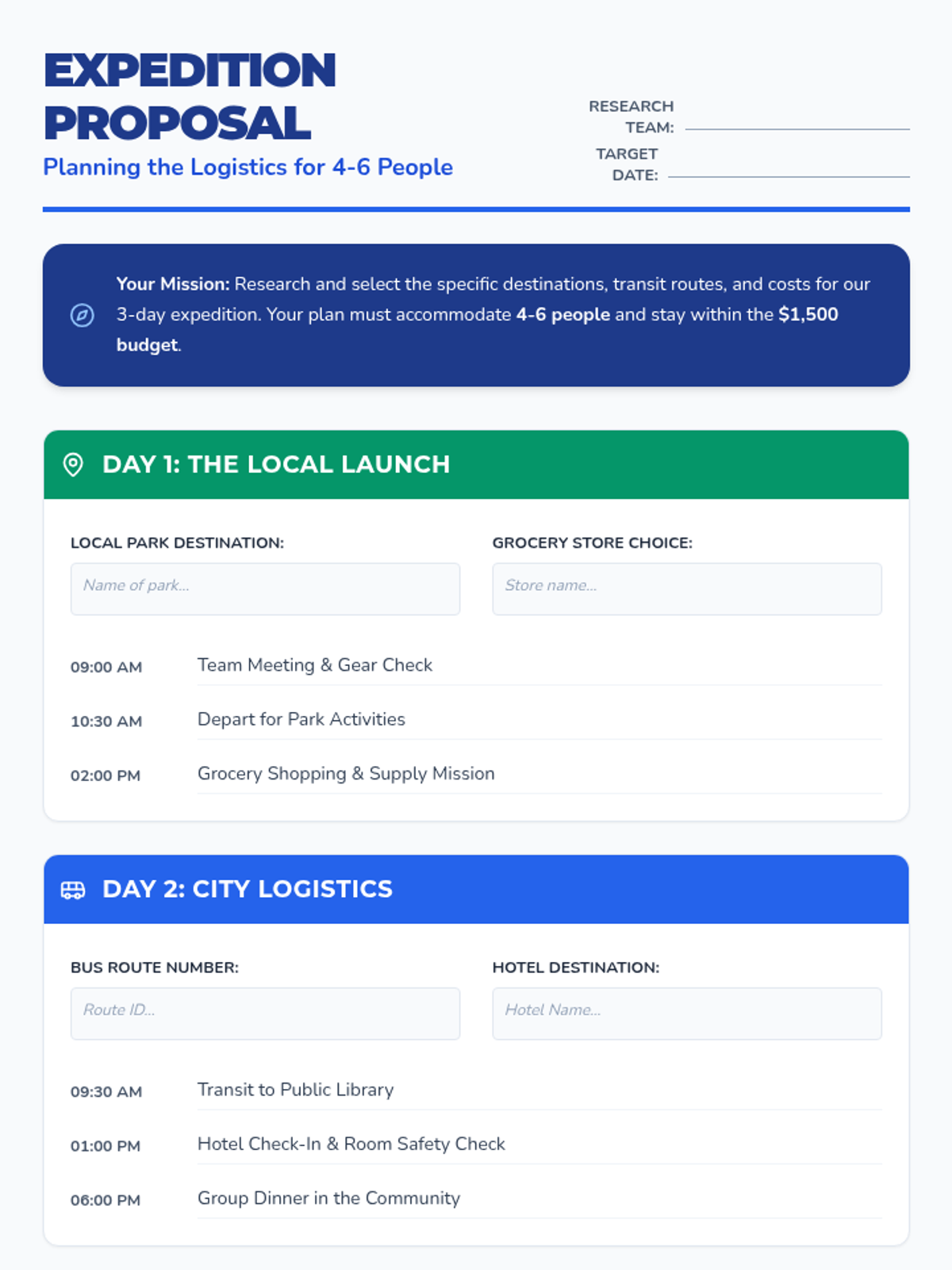
An expedition planning itinerary that requires students to research specific locations, bus routes, and hotel options for a group of 4-6 people. Includes research areas for all 3 days.
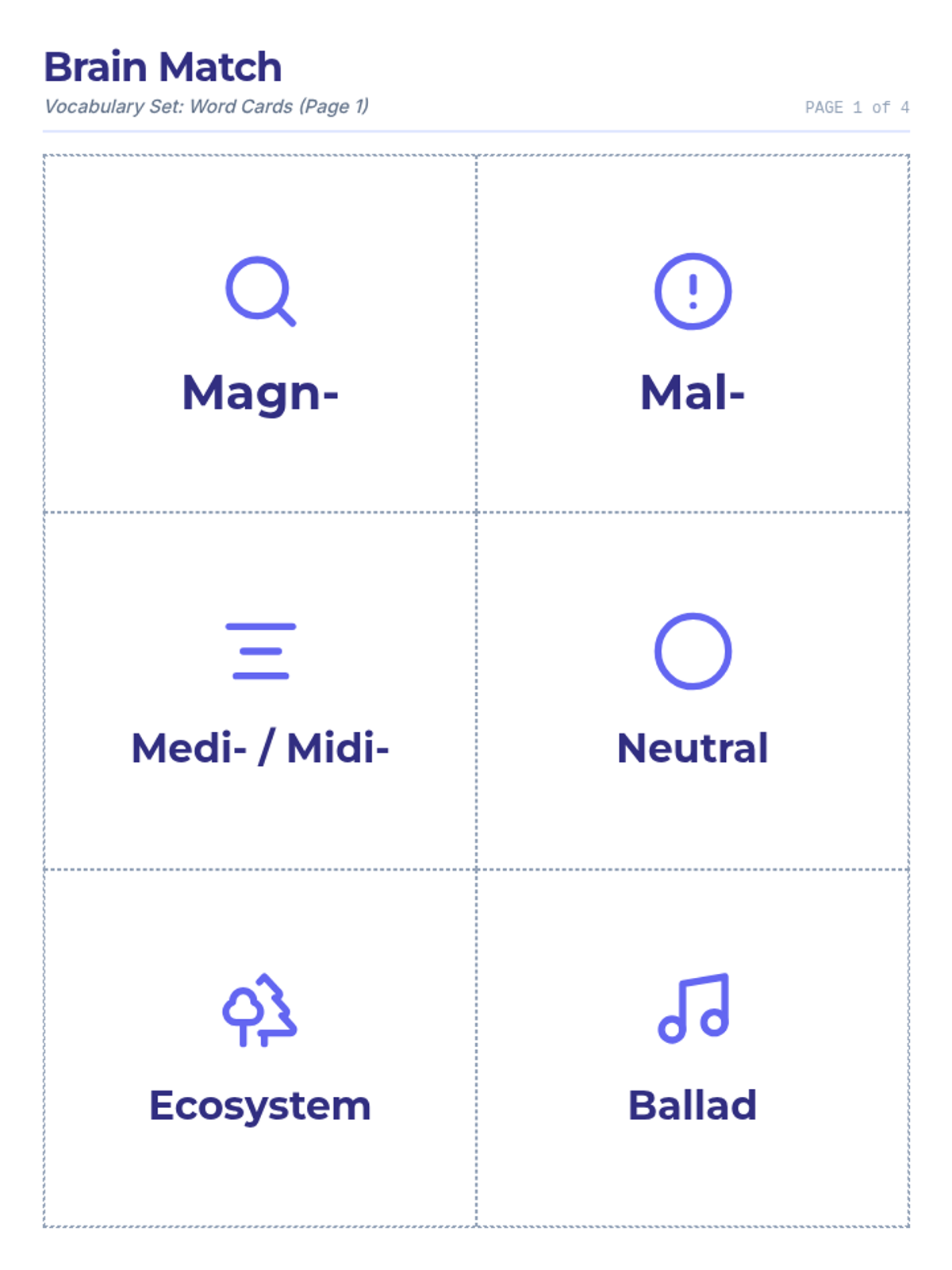
A final set of large-format vocabulary matching cards spanning 4 pages (6 cards per page). Features a unified Indigo theme, dashed cutting guides, and matching iconography. To prevent "cheating" by matching icons, definition cards use subtle grayscale versions of the icons. Card sizing is strictly controlled to ensure no page overflow.
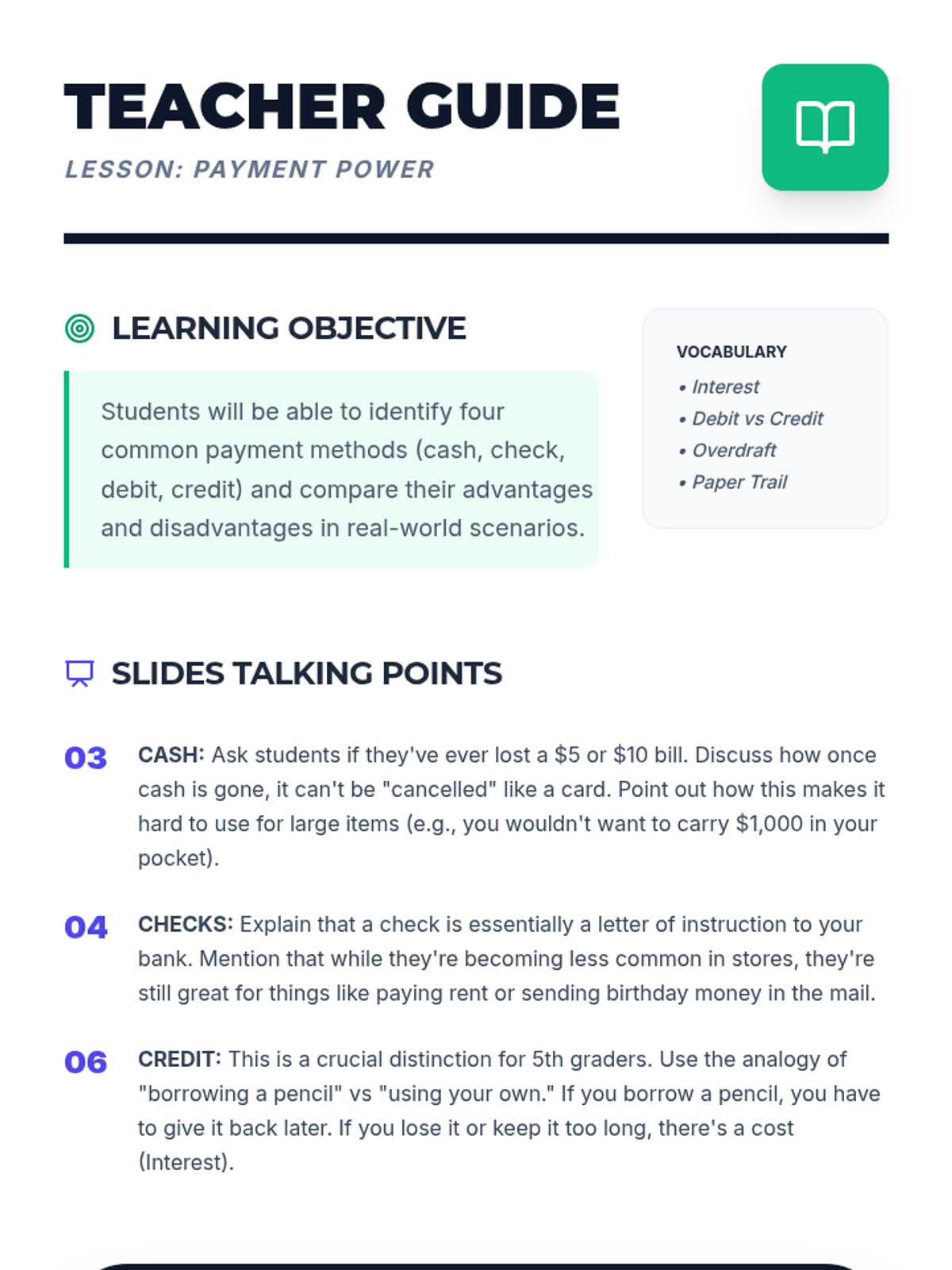
A teacher-facing resource that provides a lesson summary, learning objectives, presentation talking points, and comprehensive answer keys for both the worksheet and quiz.
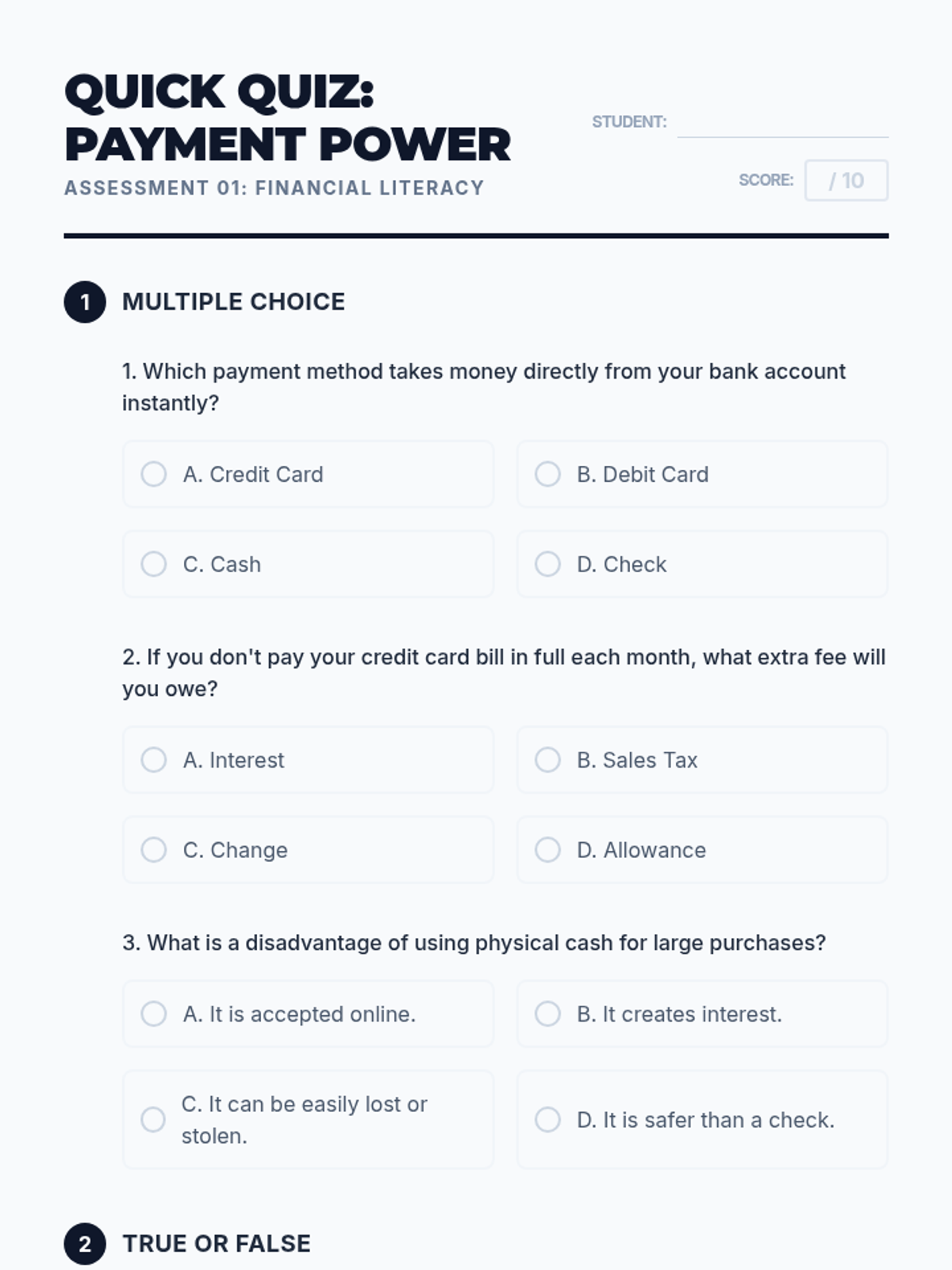
A short quiz to assess student understanding of payment methods. Features multiple-choice questions, true/false statements, and a final decision-making scenario to demonstrate mastery.
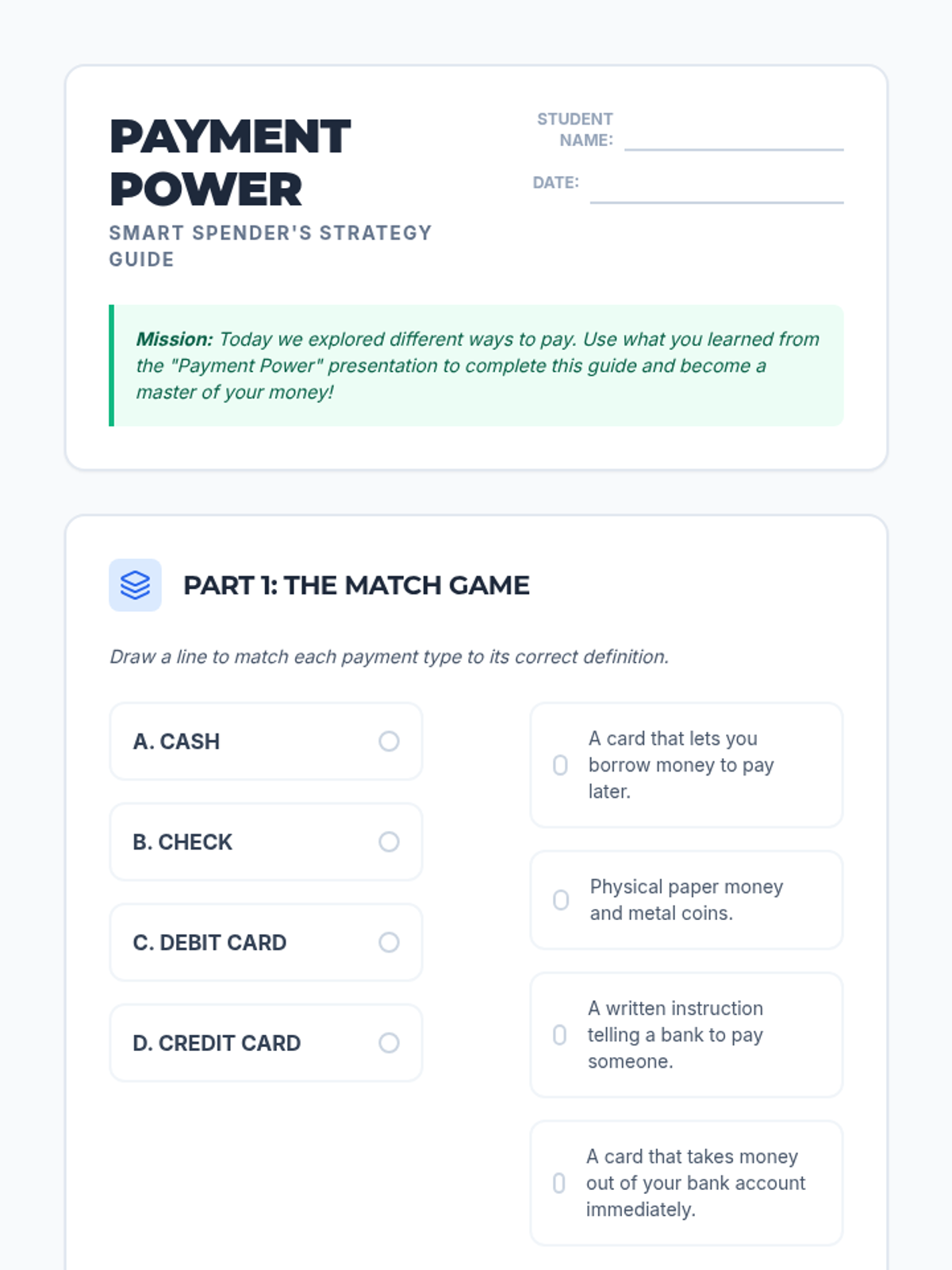
A worksheet designed for students to practice identifying and comparing different payment methods. Includes a definition matching section, a pro/con cloze activity, and scenario-based questions to apply their knowledge.
A comprehensive slide deck introducing cash, checks, credit cards, and debit cards. Each slide highlights the advantages and disadvantages of the payment method, with a final scenario to test understanding.
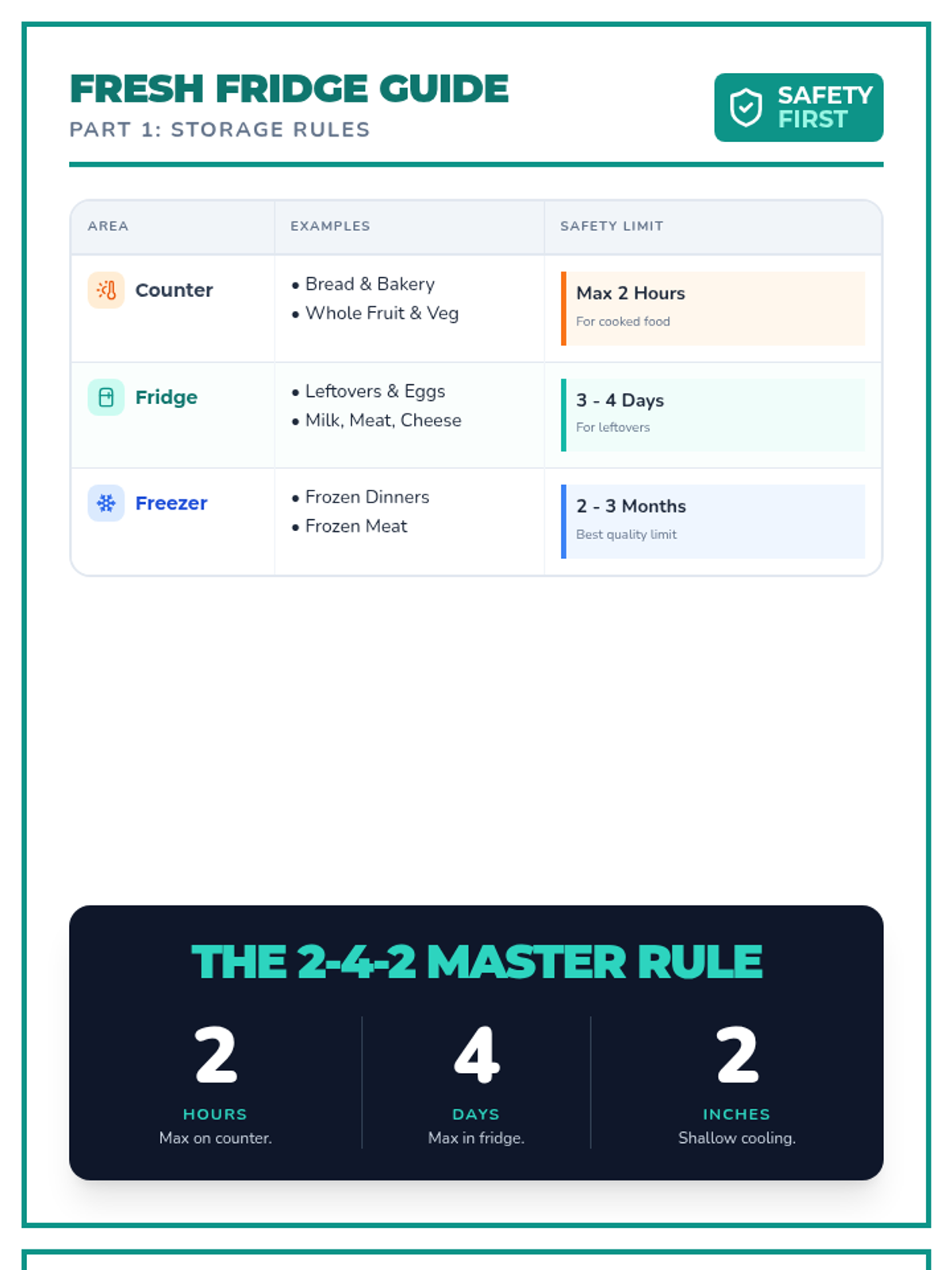
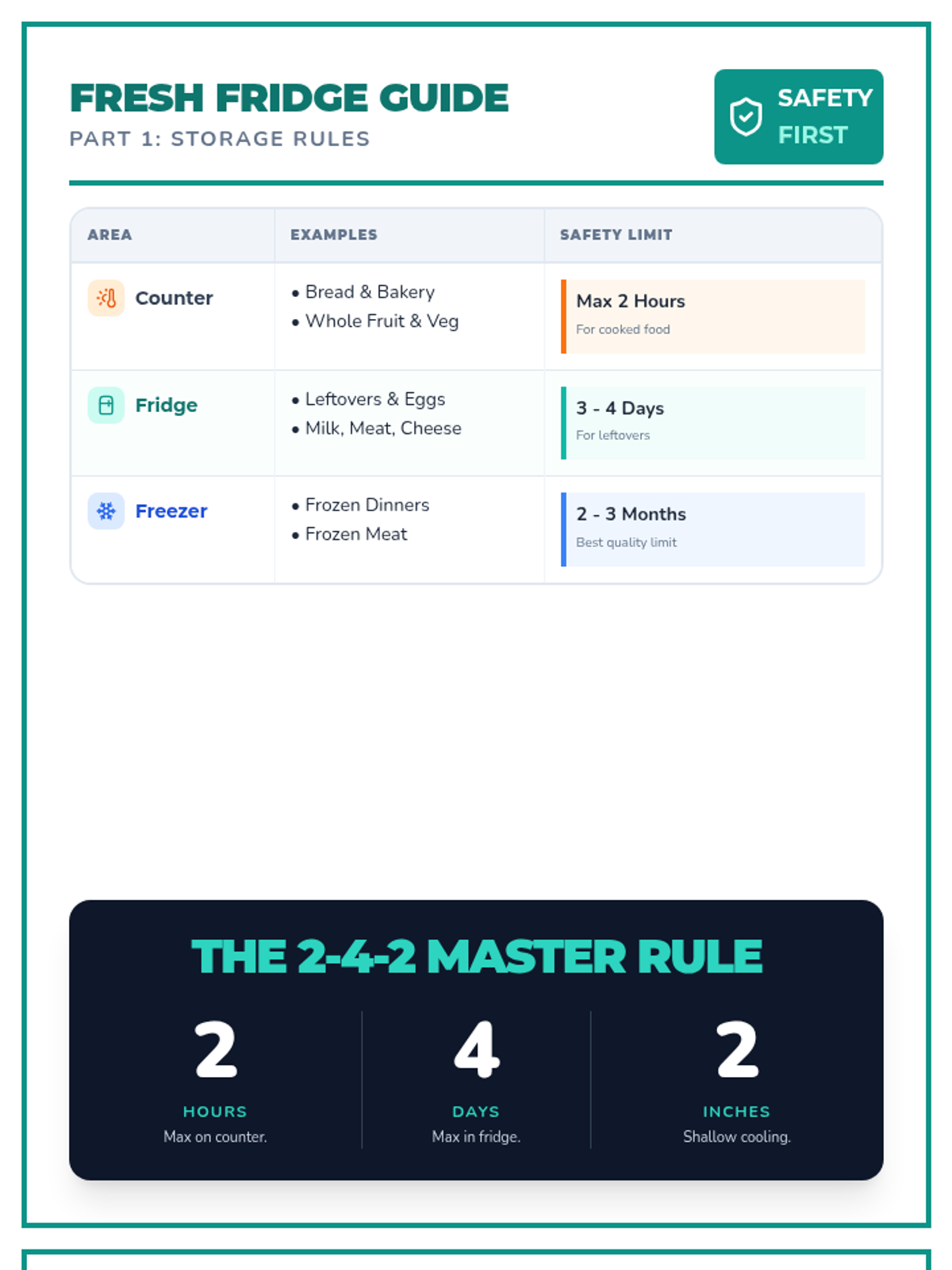
A reorganized visual guide for food storage and safety, featuring a clear tabular storage chart, the '2-4-2' rule, discard criteria, and a labeling tutorial with significantly increased font sizes for maximum readability.
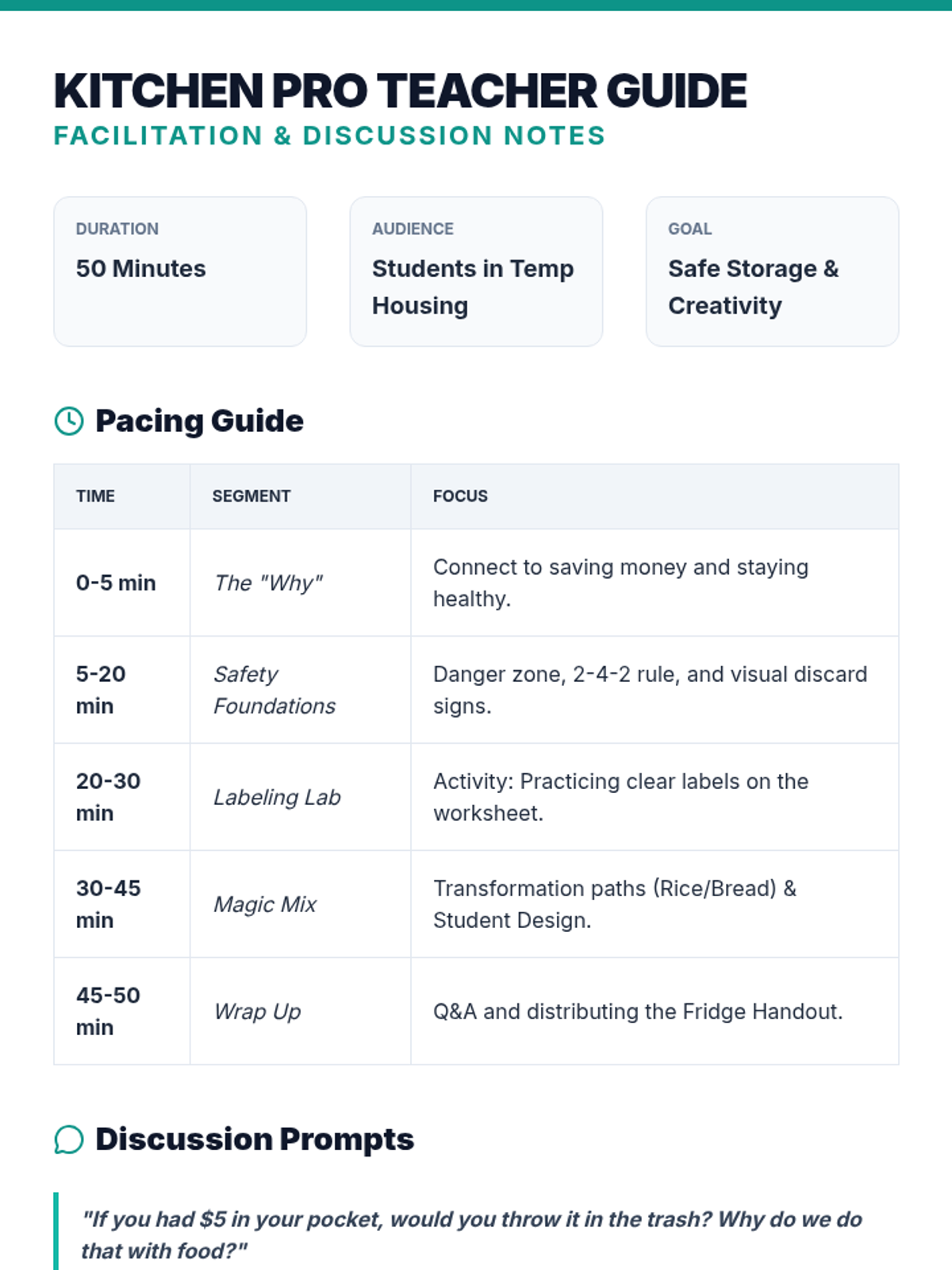
A comprehensive teacher's guide for the Kitchen Hacks lesson, including a 50-minute pacing guide, discussion prompts, and strategies for neurodiverse learners and students in temporary housing.
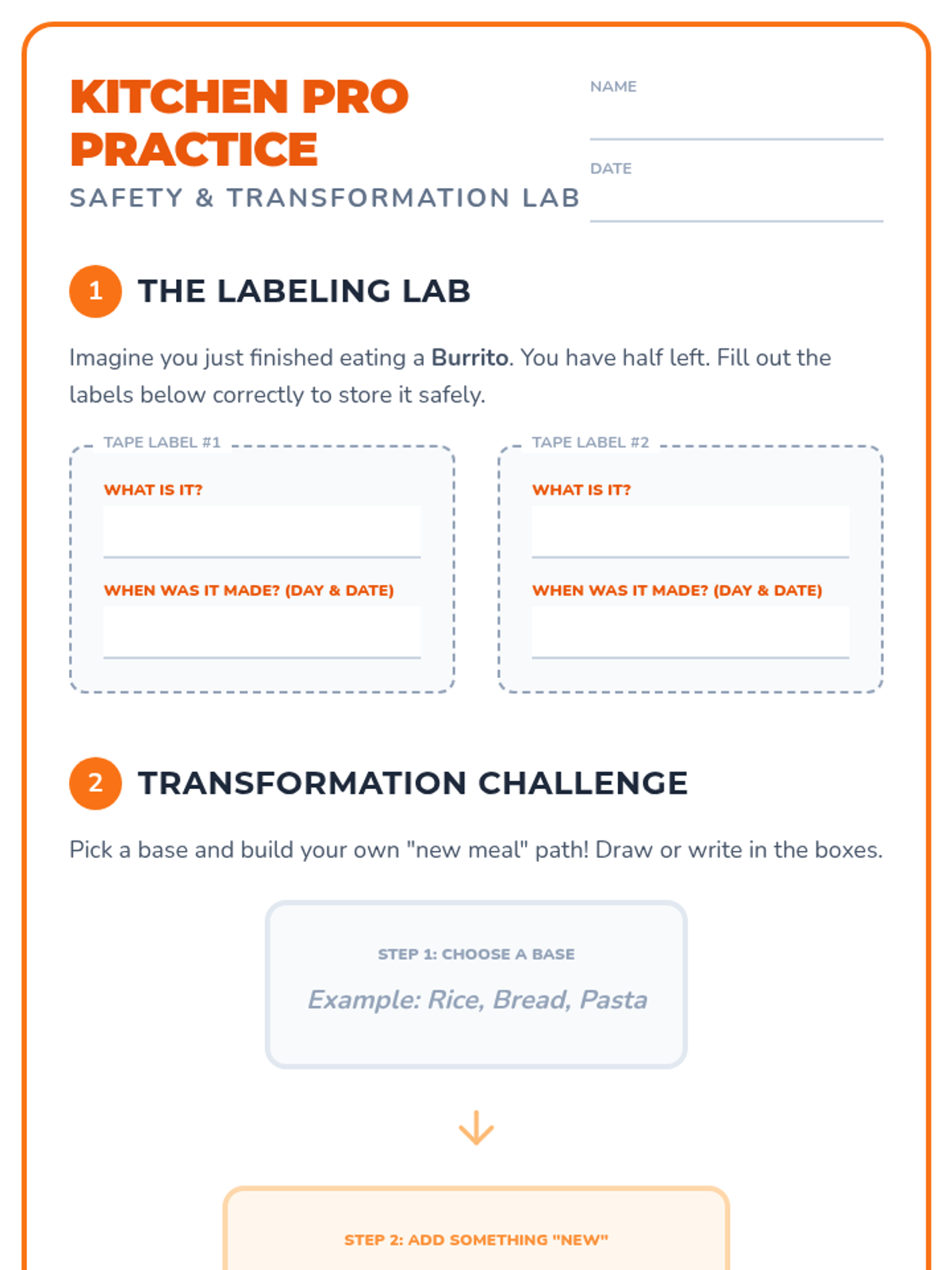
A student practice sheet for applying kitchen safety skills, including labeling exercises and a transformation flowchart activity.
A visually-driven slide deck for a 50-minute session on kitchen safety and food transformation, featuring the updated 2-4-2 rule descriptions: 'Store within 2 hours', 'Eat within 4 days', and 'Shallow pans (2" deep)'.
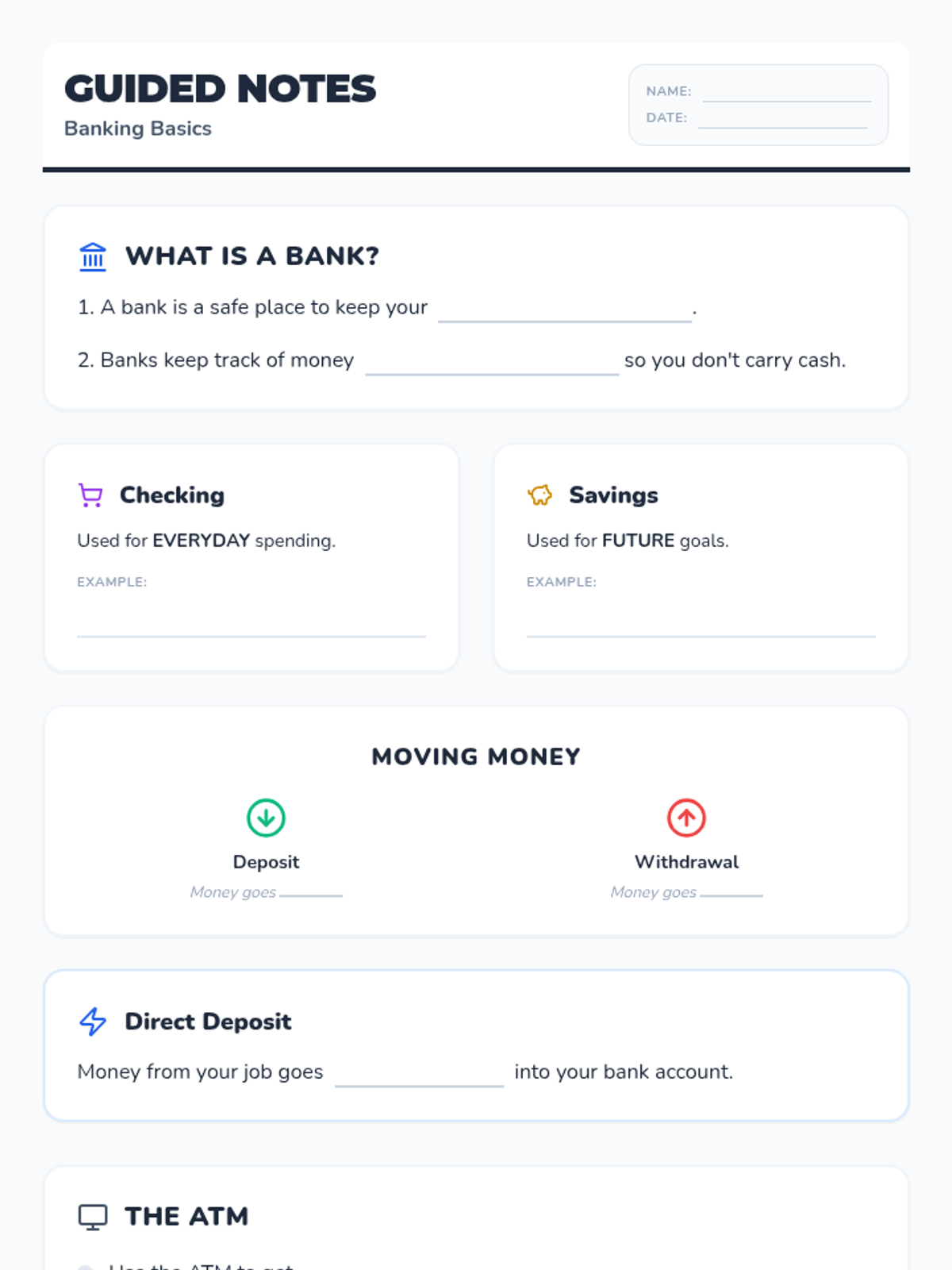
A 2-page guided notes document for students. Sized precisely for 8.5x11 printing with clear fill-in-the-blank areas and visual organizers.
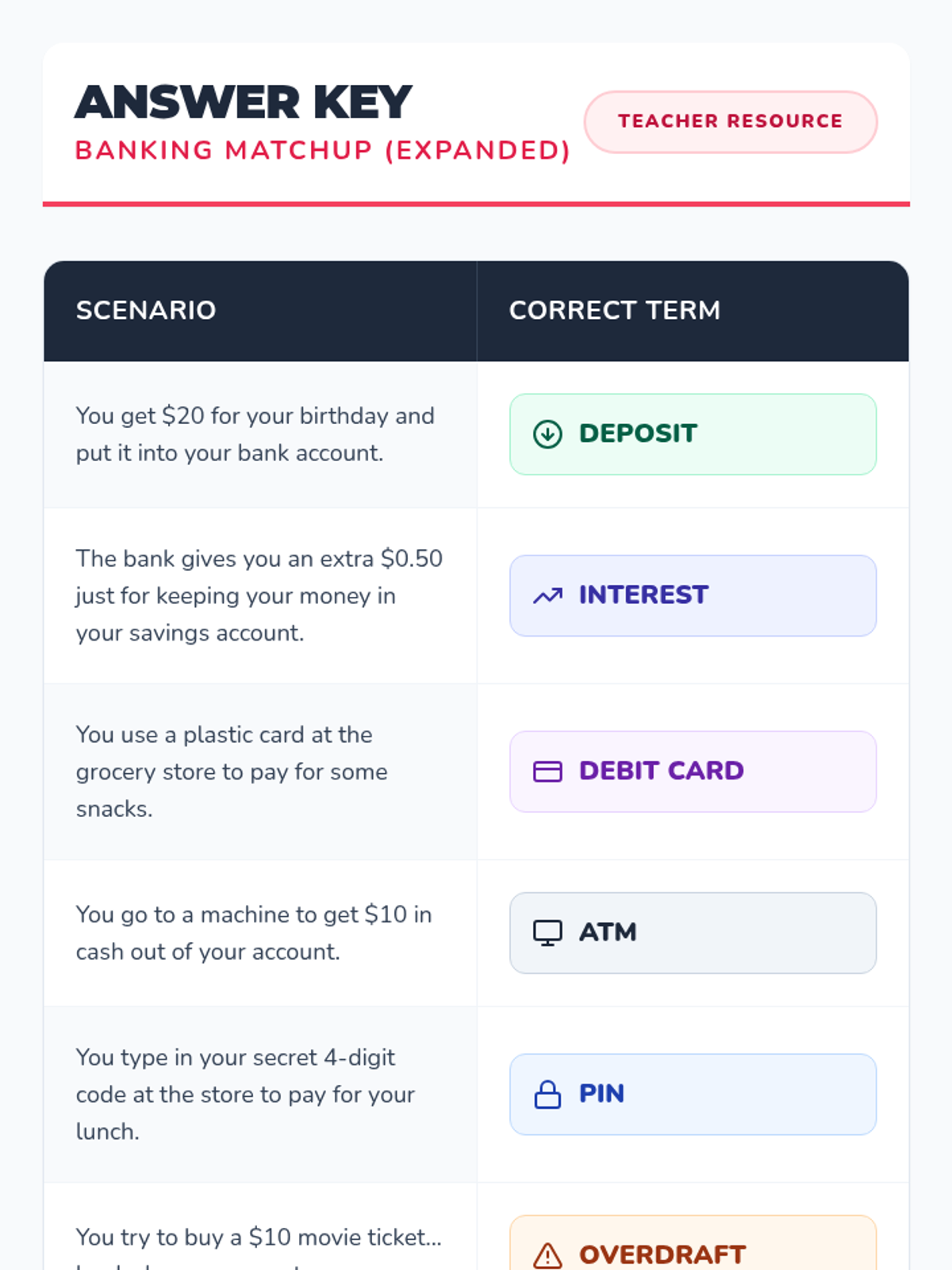
The teacher answer key for the Banking Matchup Worksheet. Provides a clear table format connecting each scenario to its correct term, including visual icons for quick reference.
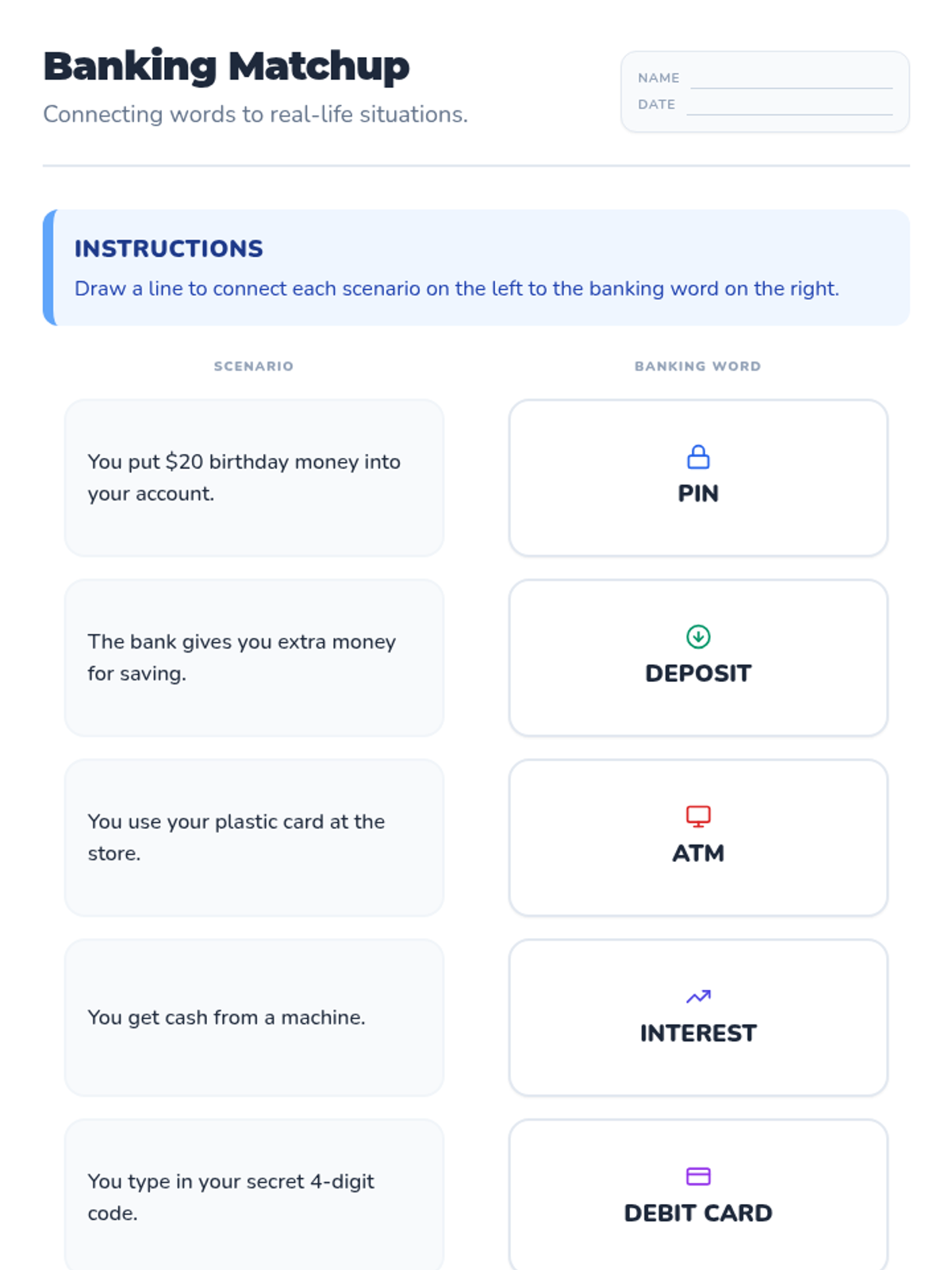
A 2-page matching activity where students connect real-world banking scenarios to terms. Sized precisely for 8.5x11 printing with clear spacing and identical styling for all choices.
Updated visual presentation for students that introduces 14 essential banking terms including checking, savings, direct deposit, ATMs, fees, and bank statements. Features large text, high contrast, and clear icons.
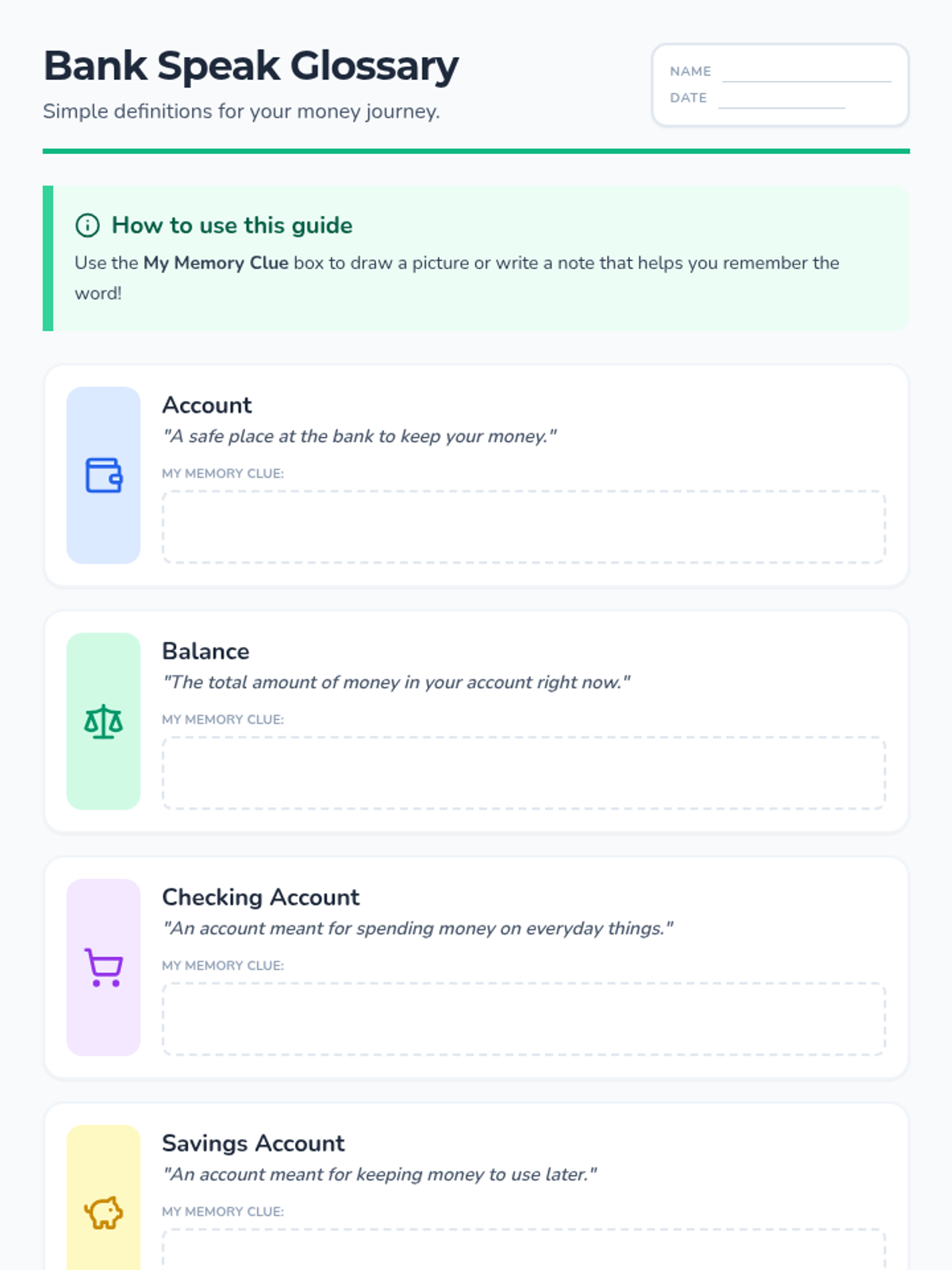
A 3-page, visually supported glossary of 14 essential banking terms. Features simplified definitions, visual icons, and "My Memory Clue" drawing boxes. Sized precisely for 8.5x11 printing.
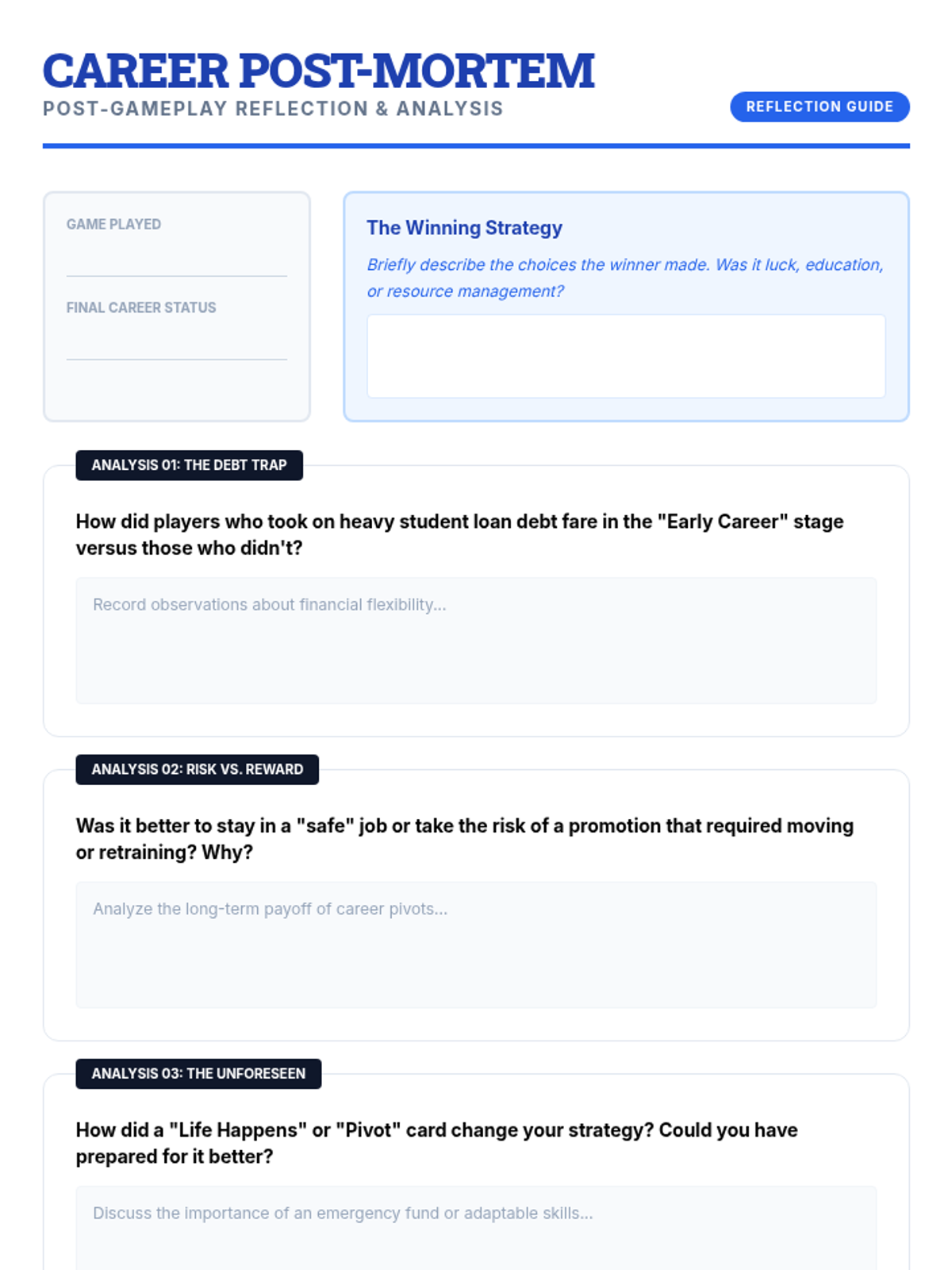
A reflection and analysis document for students to complete after playing 'Career Quest', focusing on the debt trap, risk/reward, and the impact of unforeseen events.
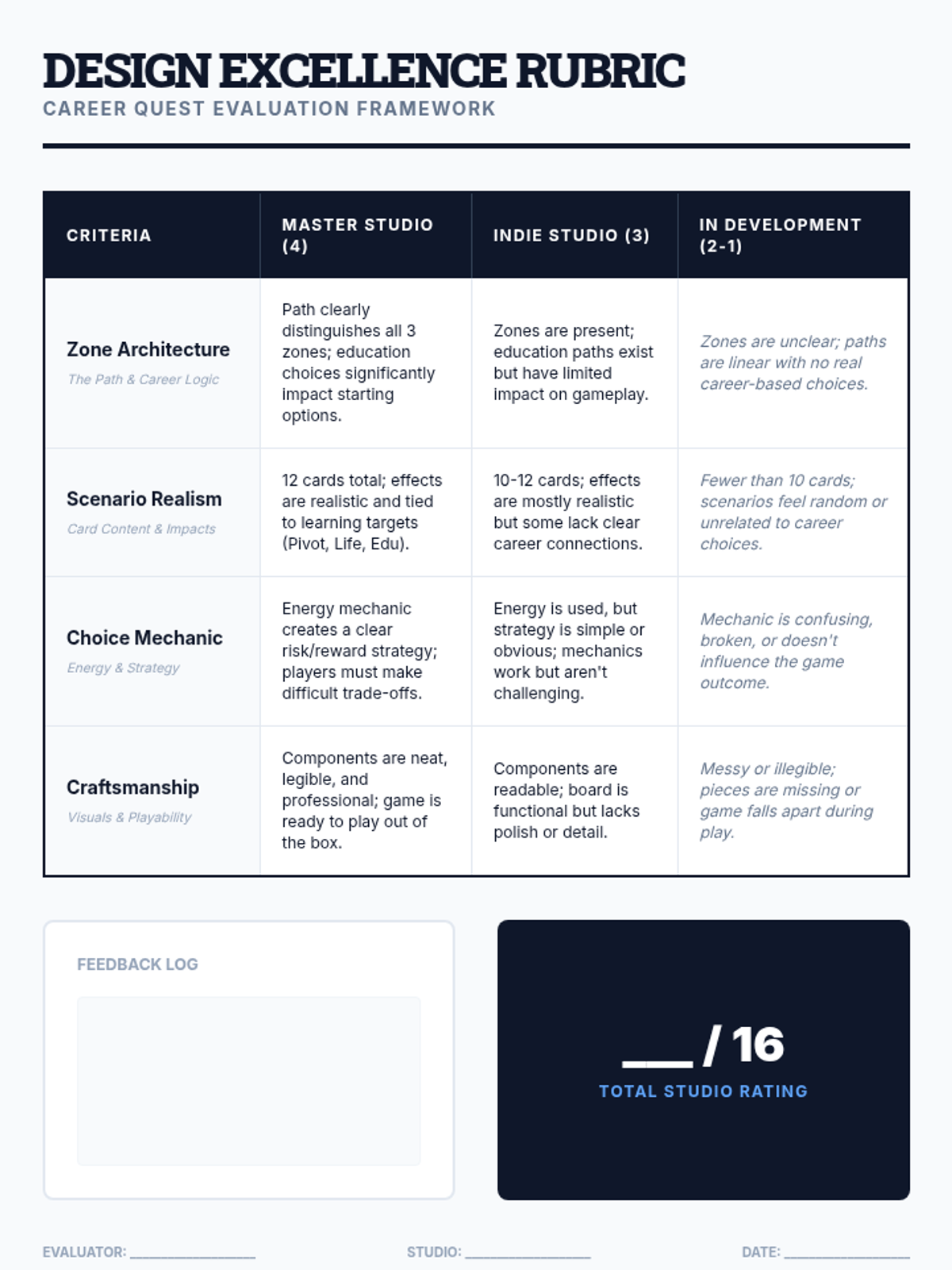
A grading rubric for the 'Career Quest' project, evaluating game zones, scenario realism, choice mechanics, and overall craftsmanship.
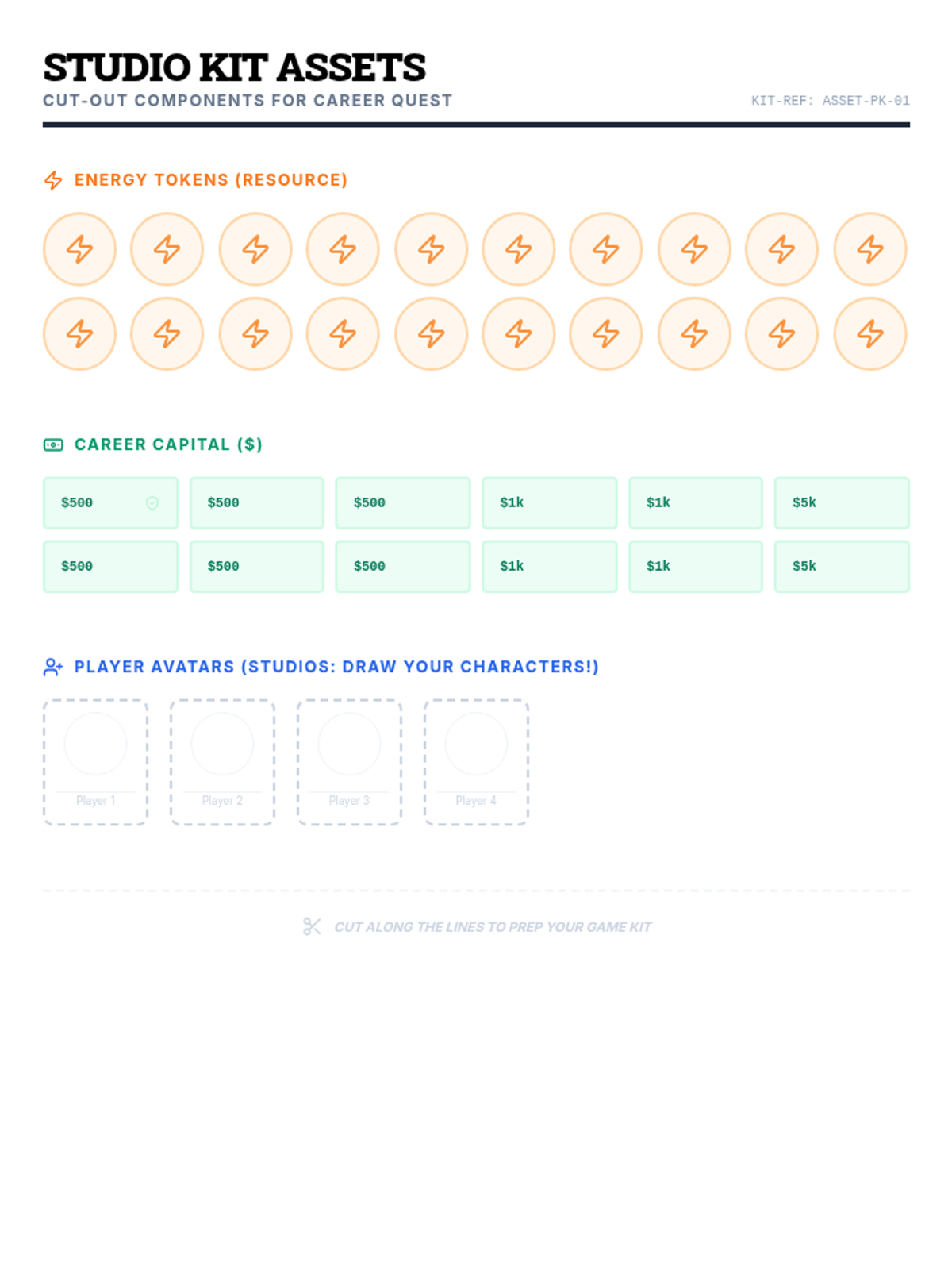
A set of cut-out templates for 'Career Quest' including energy tokens, currency units, and customizable player avatars.
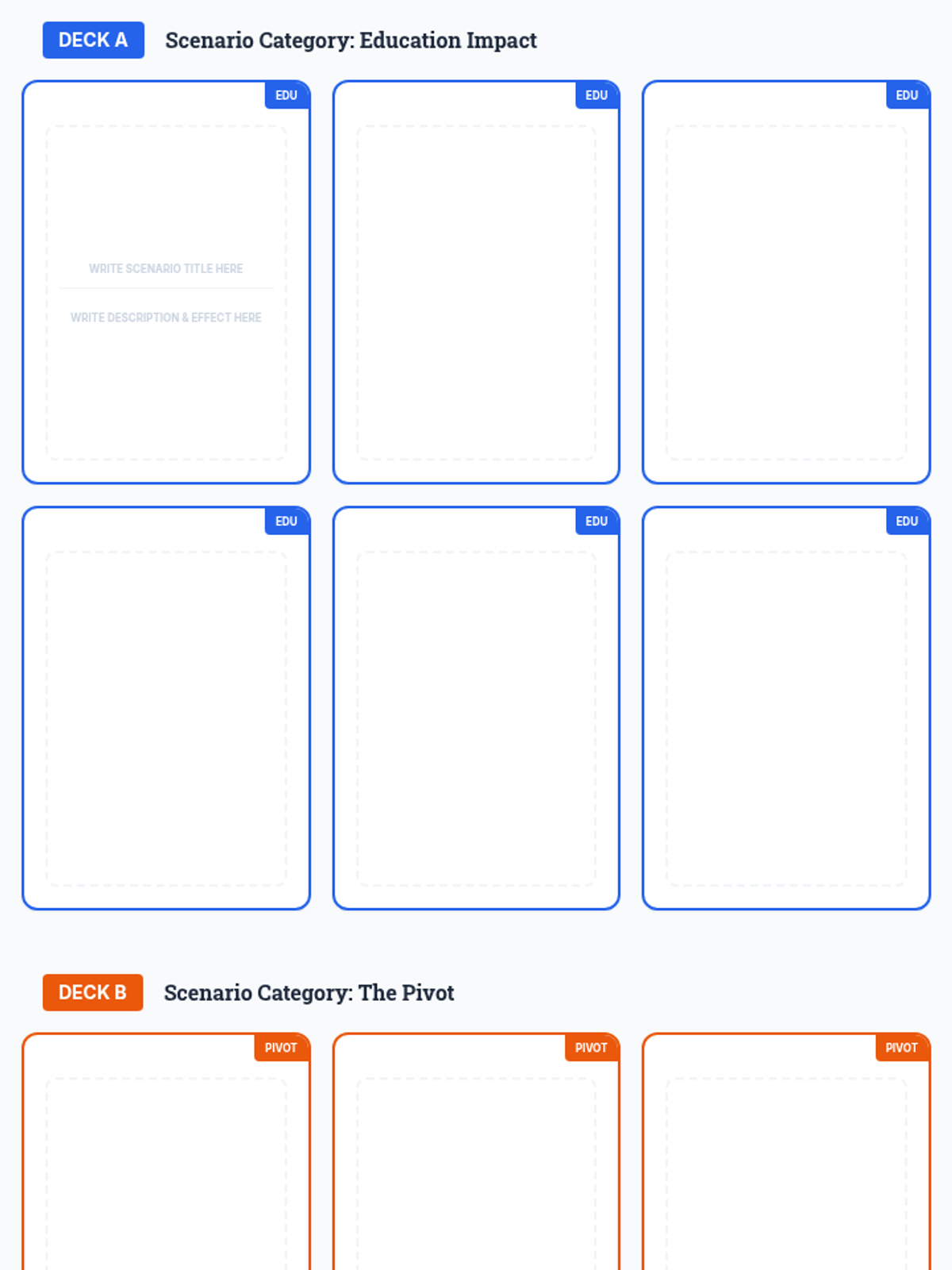
Printable templates for Education, Pivot, and Life Happens scenario cards, consolidated onto a single page with 12 cards total.
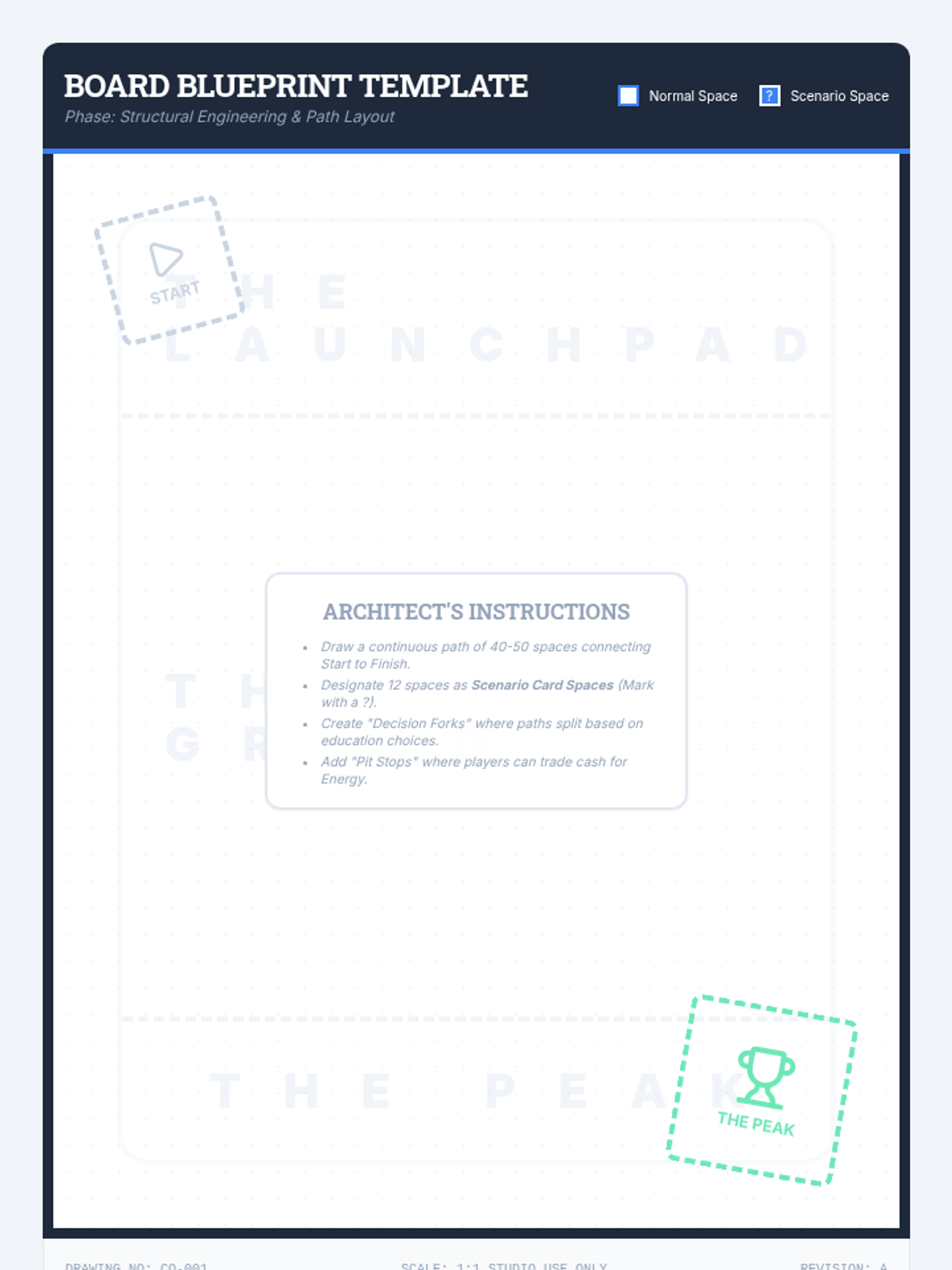
A printable game board template for 'Career Quest' featuring distinct zones for the Launchpad, the Grind, and the Peak, with space for students to draw their own custom path.
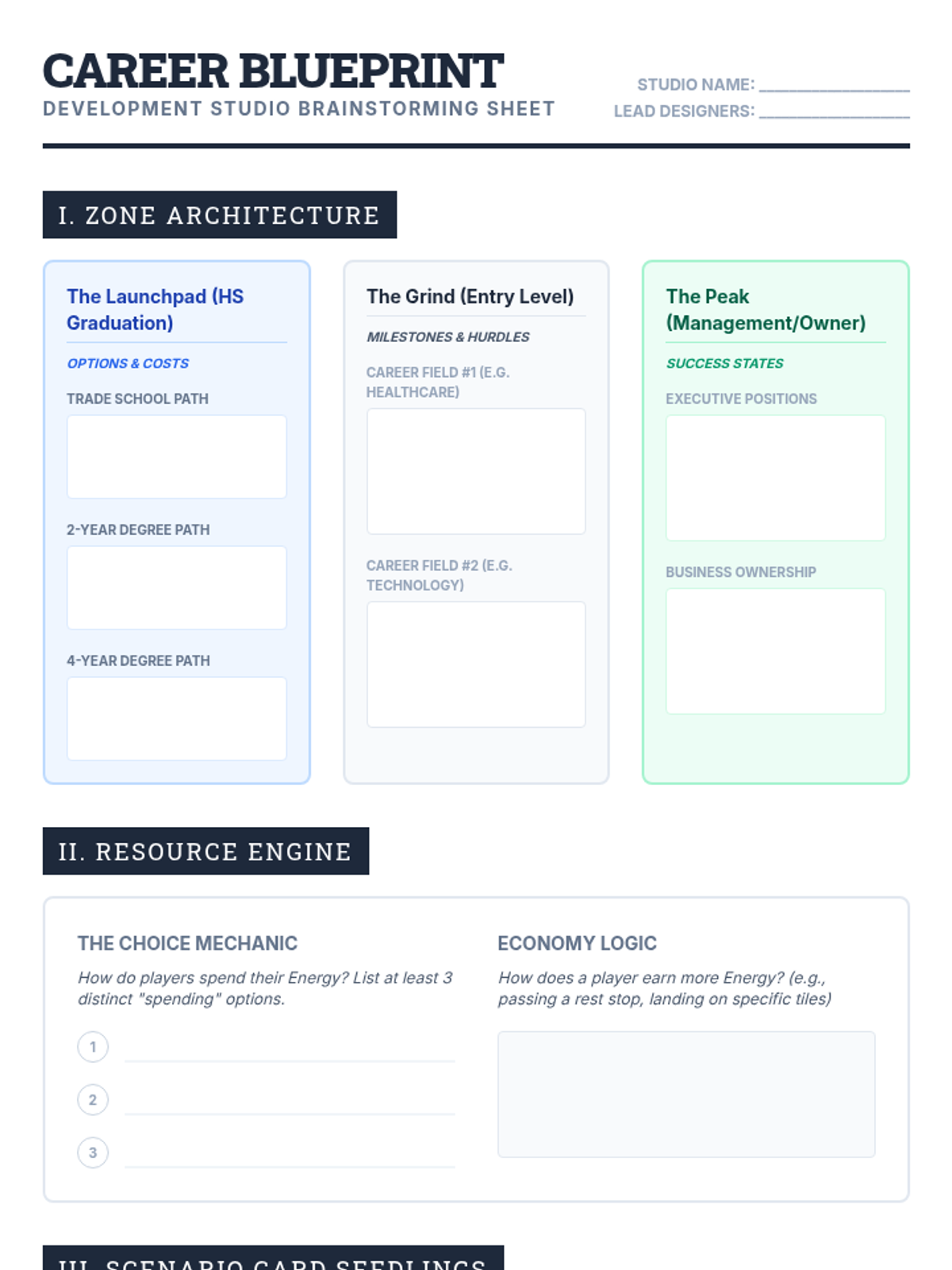
A brainstorming graphic organizer for students to map out the 'Career Quest' game board zones, resource mechanics, and scenario card ideas.
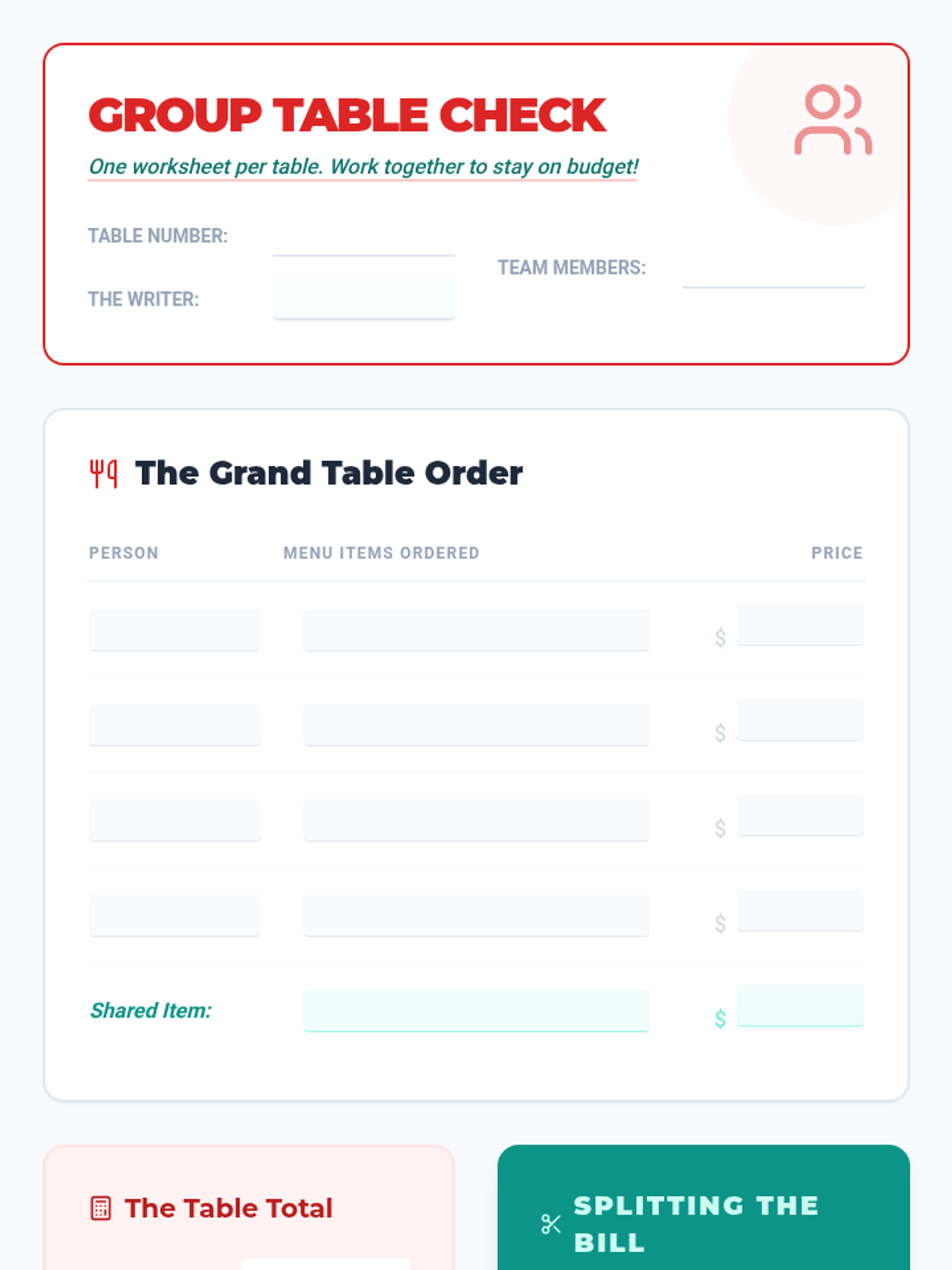
A comprehensive group worksheet that combines combined food order tracking, table total calculations (including tax and tip), group math challenges, and social etiquette reflections into a single multi-page document.
Instructional slide deck for the Budget Bites lesson, covering the 90-minute agenda, hidden costs (tax and tip), and restaurant social etiquette.
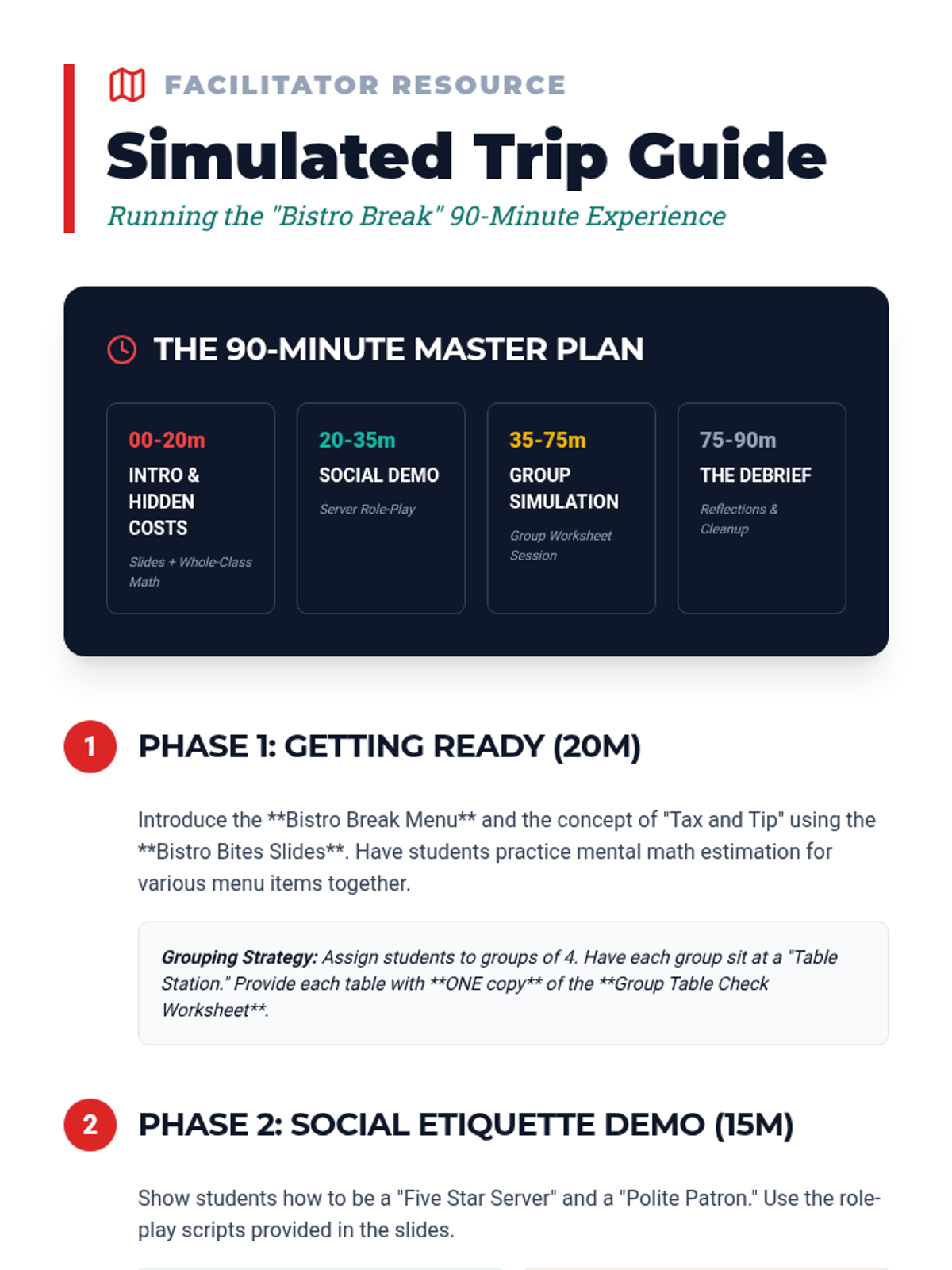
A facilitator's guide for conducting a simulated restaurant field trip in the classroom, including role-play scripts and setup instructions.
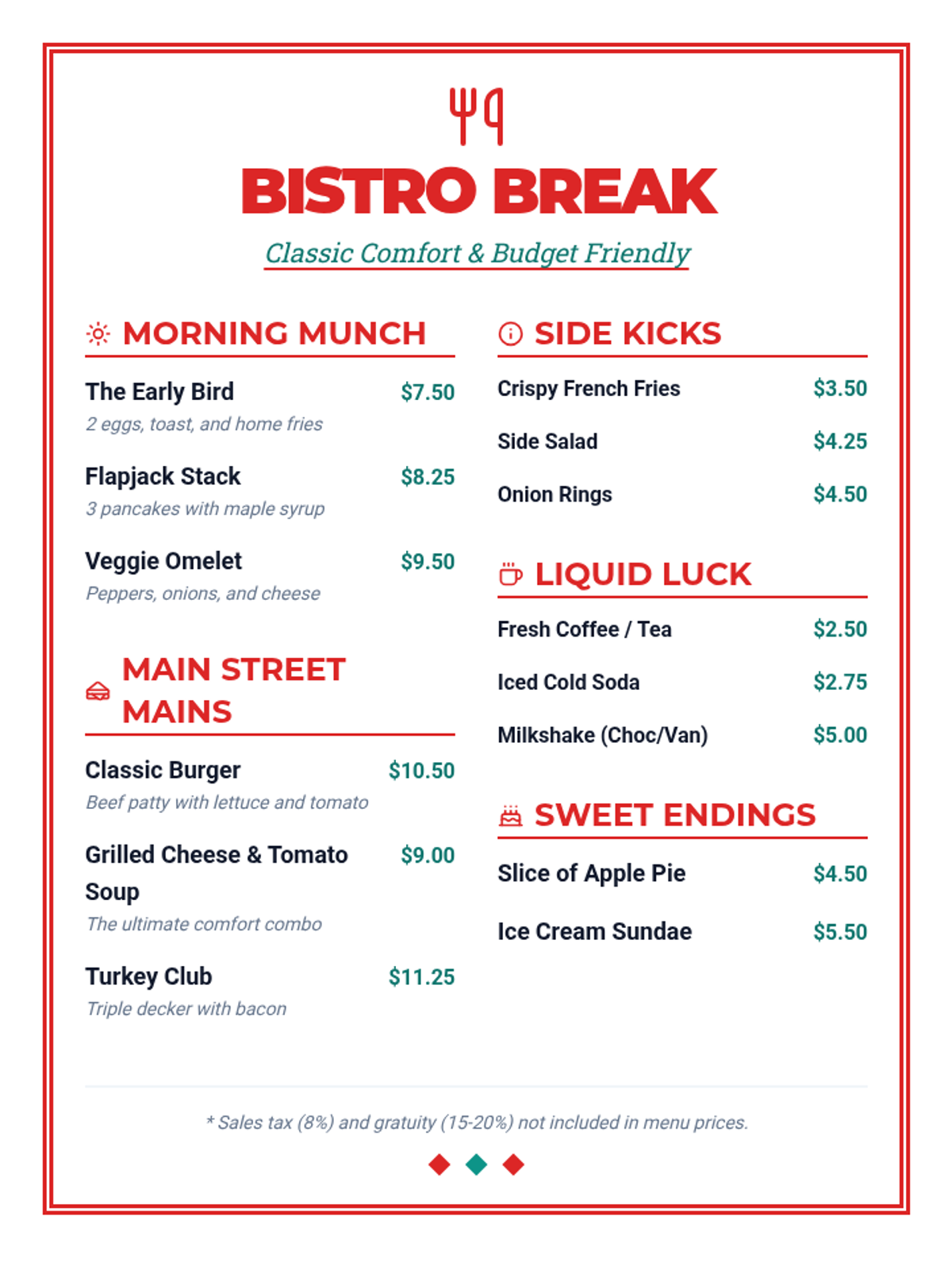
A retro-style bistro menu featuring breakfast, main courses, sides, drinks, and desserts with clear pricing for use in budget and math exercises.
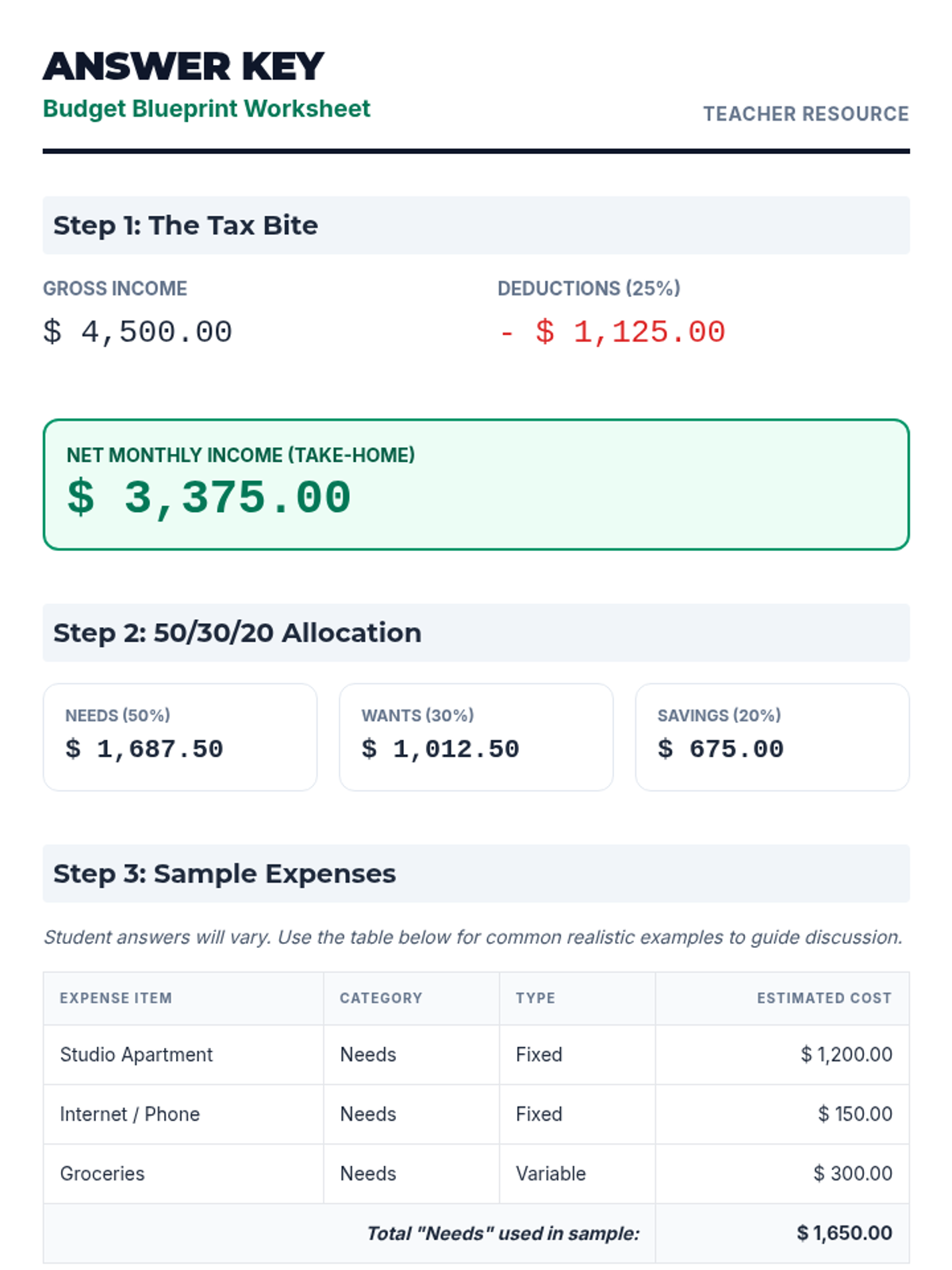
An answer key for the Budget Blueprint Worksheet, providing calculated values for net income and category allocations, plus sample expense scenarios for grading guidance.
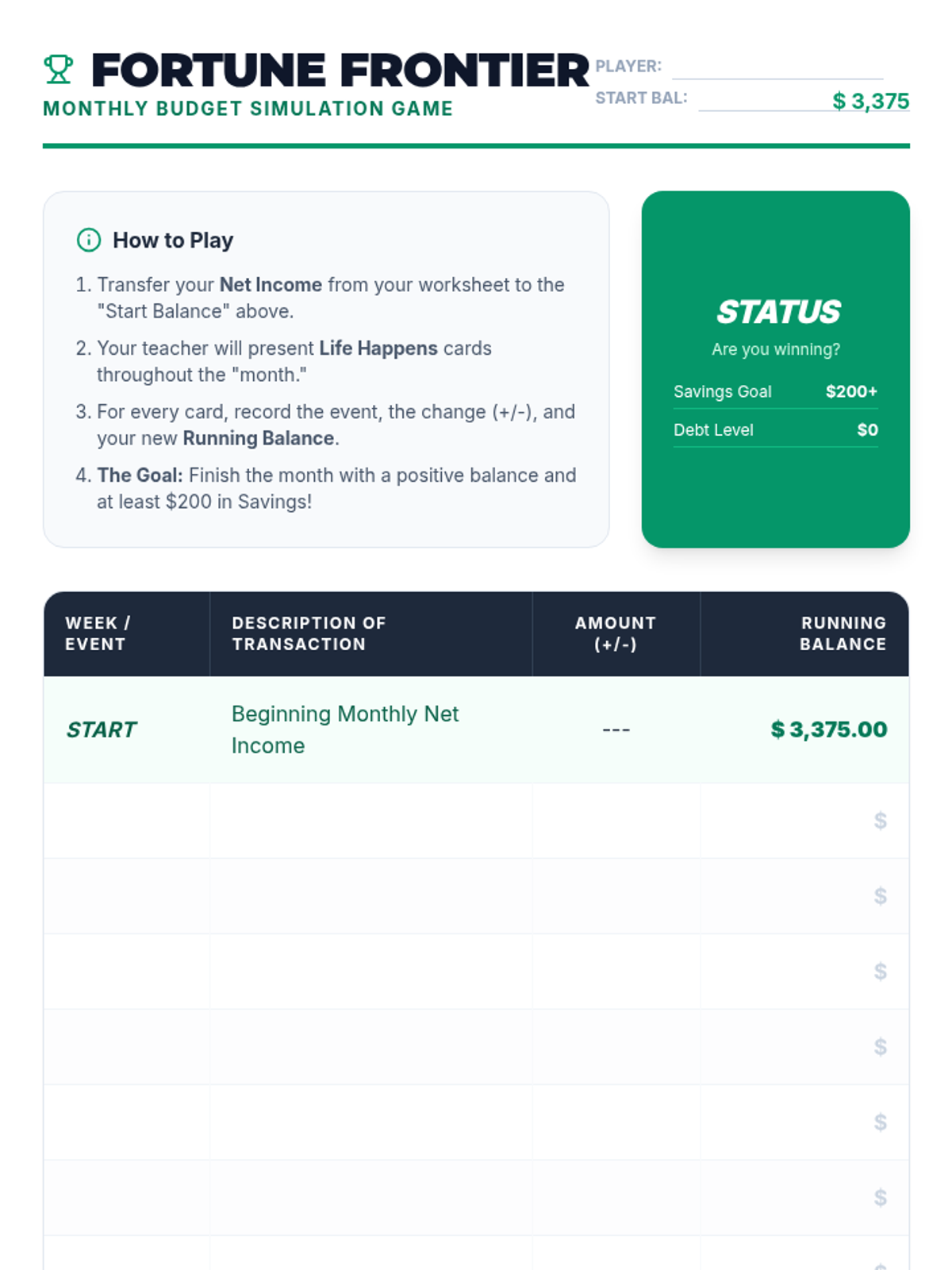
A game ledger for the 'Fortune Frontier' simulation where students track their income, expenses, and 'Life Happens' events to calculate their final monthly balance.
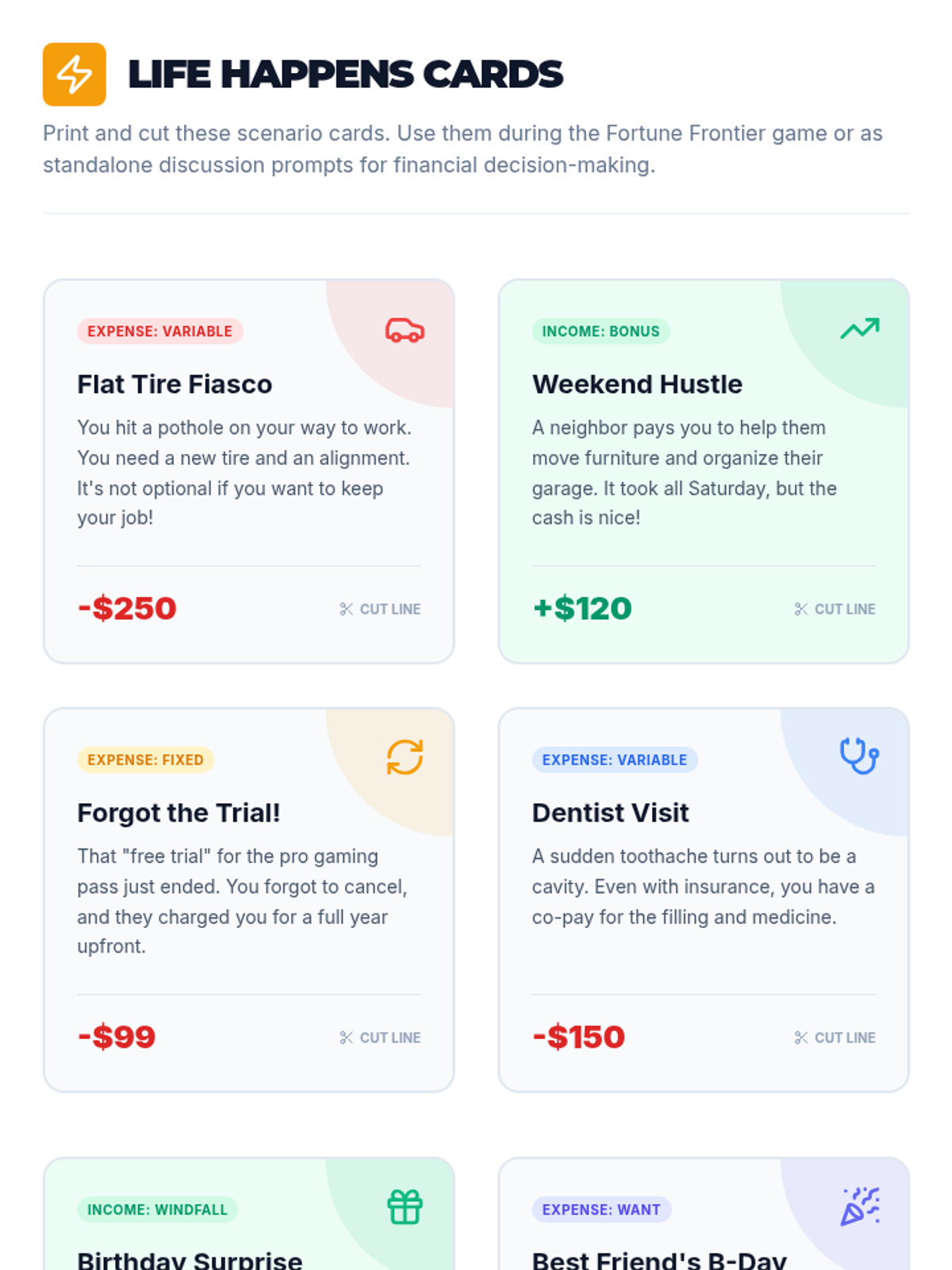
A set of printable scenario cards for a financial literacy activity, featuring "unexpected life events" that impact a student's budget with positive or negative financial consequences.
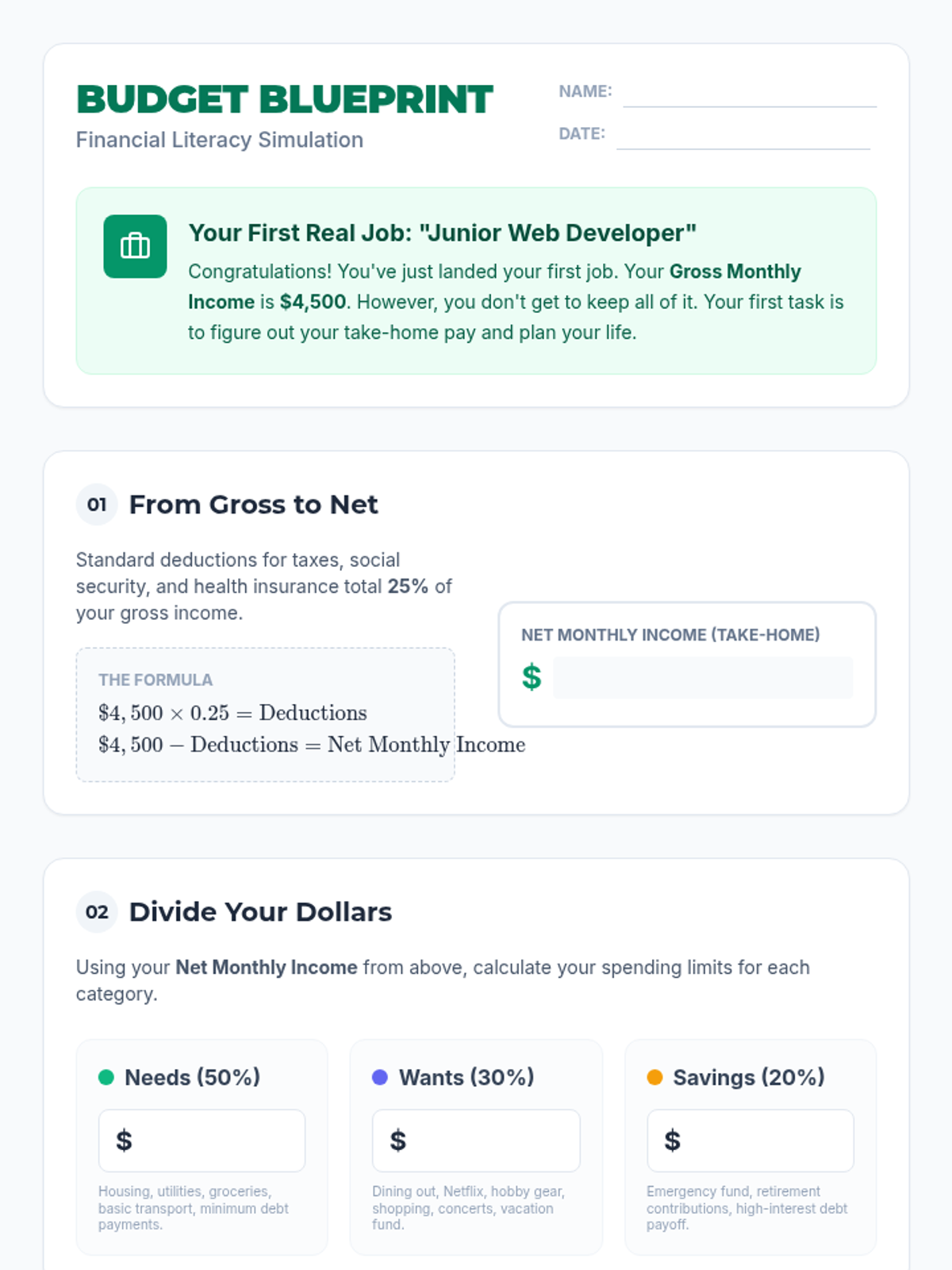
A student worksheet designed to practice budgeting by calculating net income from a gross salary and applying the 50/30/20 rule to categorize expenses.
A visually striking 7-slide presentation introducing gross/net income, fixed/variable expenses, the 50/30/20 budgeting rule, and the importance of emergency funds.
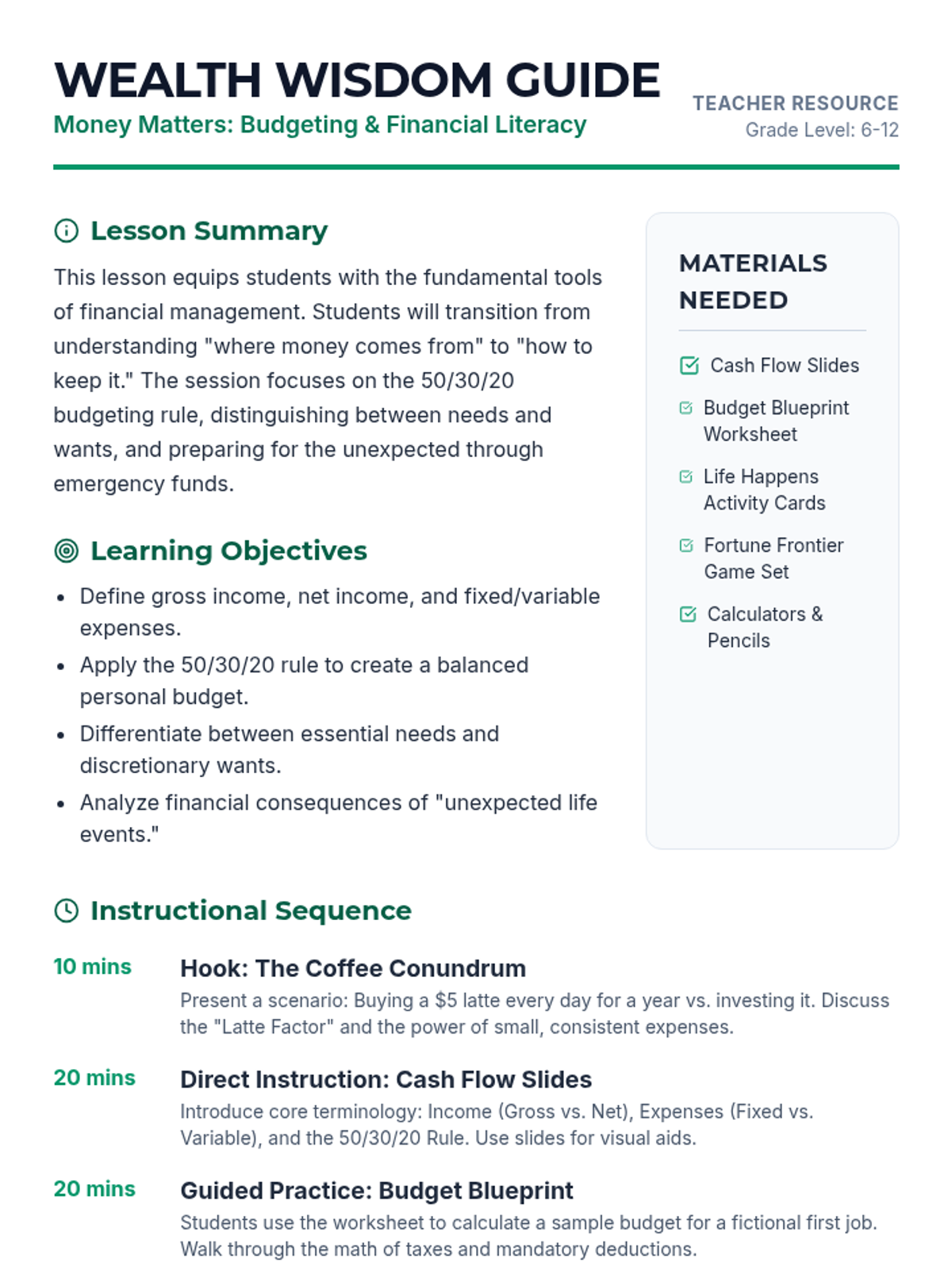
A comprehensive 2-page teacher guide for a financial literacy lesson on budgeting, featuring learning objectives, a detailed pacing guide, instructional tips, and differentiation strategies.
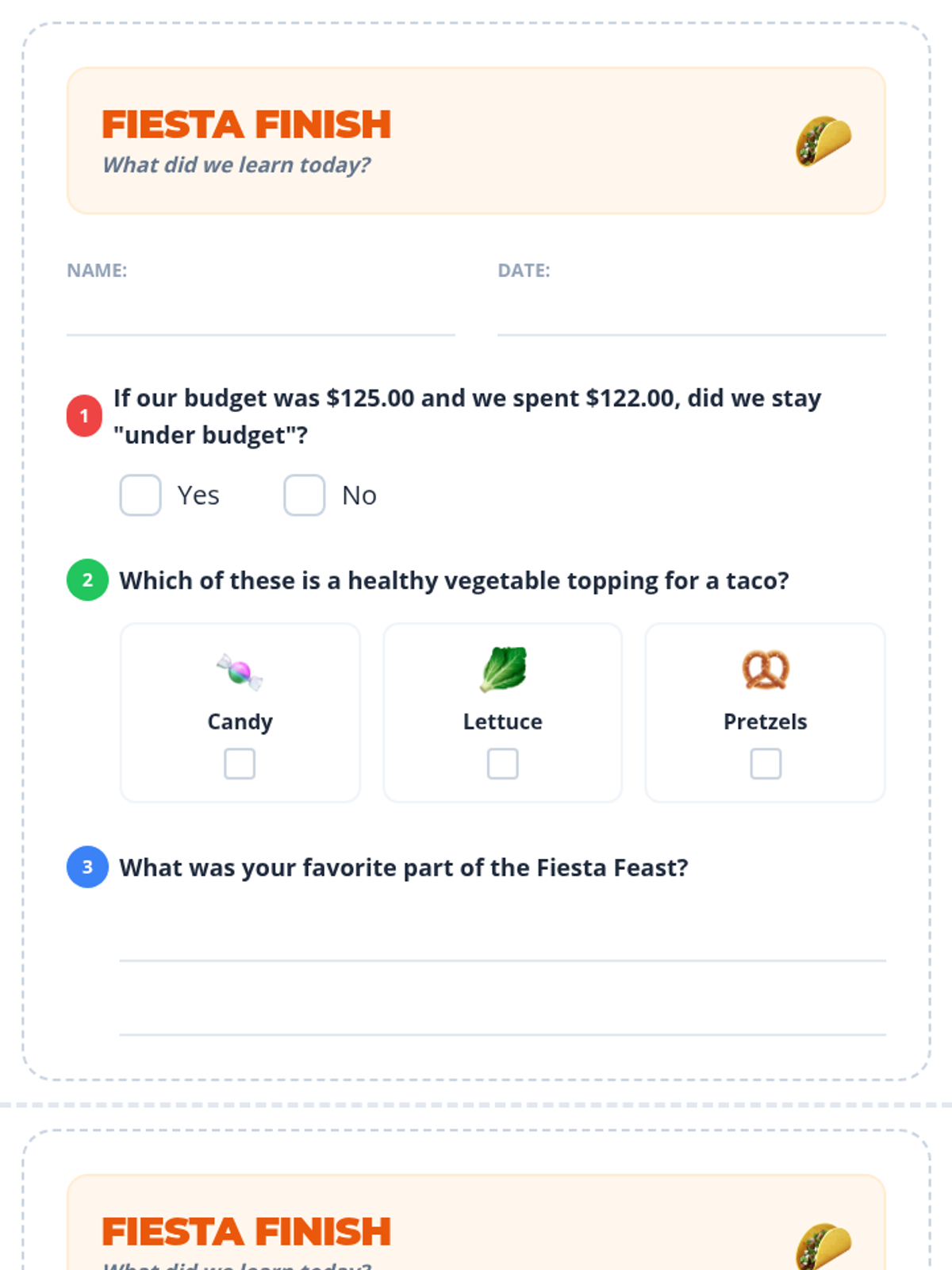
A quick exit ticket for students to reflect on the Fiesta Feast project, checking their understanding of budget concepts and healthy food choices. Includes two tickets per page for easy printing.
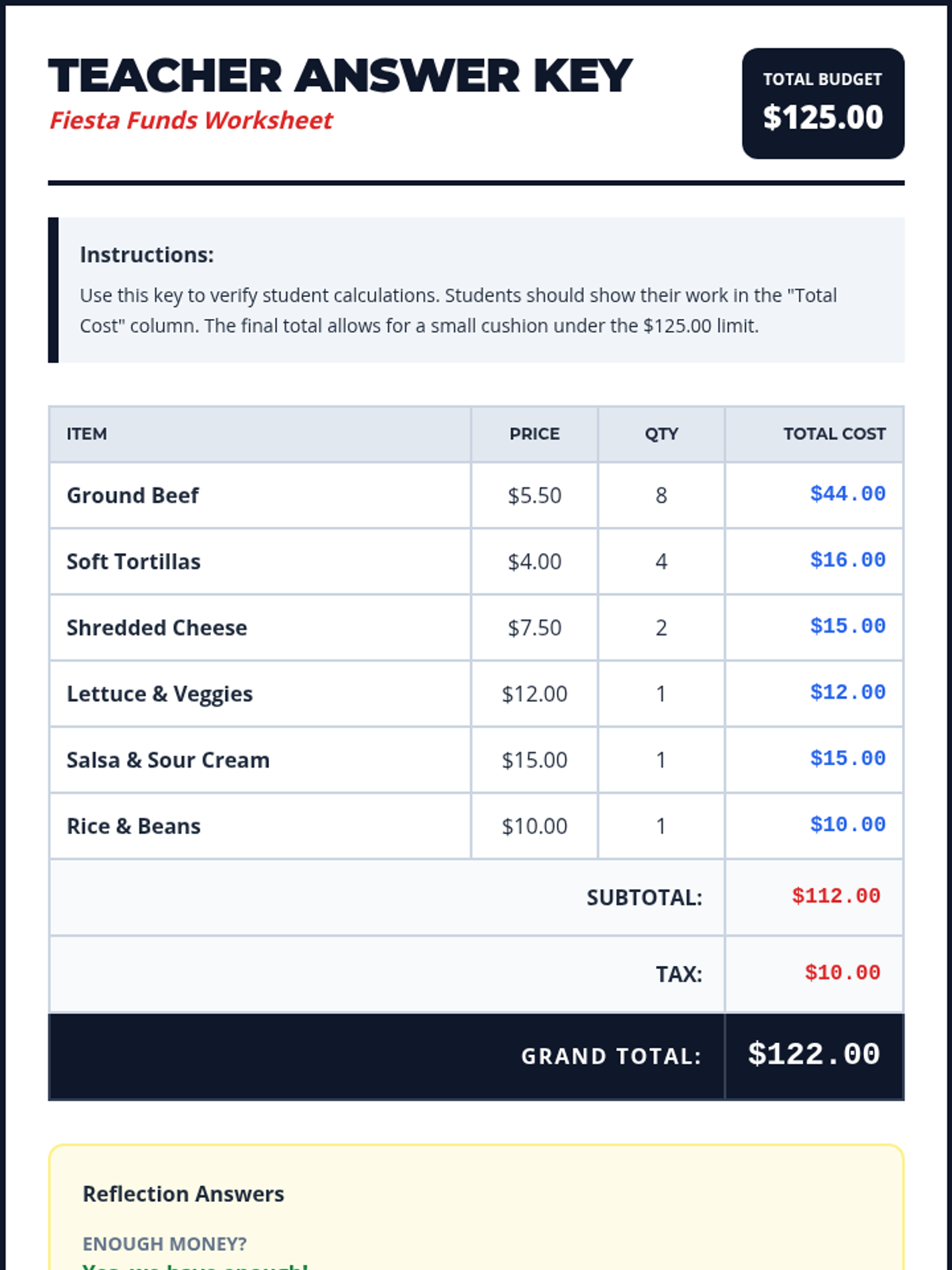
An answer key for the Fiesta Funds Worksheet, providing the correct calculations for the 30-person taco bar budget. Includes subtotal, tax, and final grand total calculations.
An introductory slide deck for the Fiesta Feast project, outlining the goals, the three-part plan (Plan, Shop, Cook), and social expectations for the community trip.
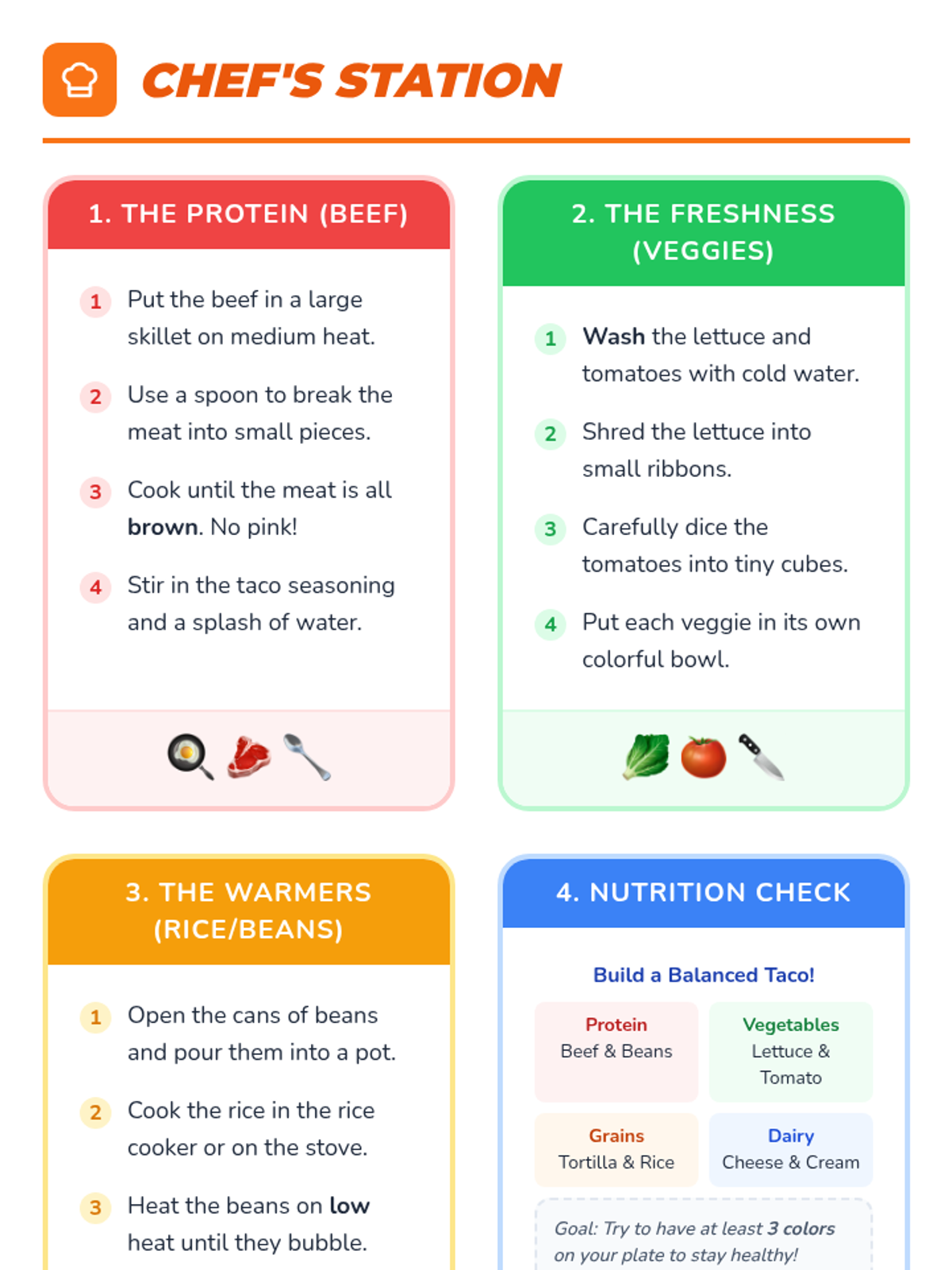
Visual step-by-step recipe cards for preparing ground beef, chopping vegetables, and heating beans. Includes a "Healthy Plate" guide to help students identify food groups.
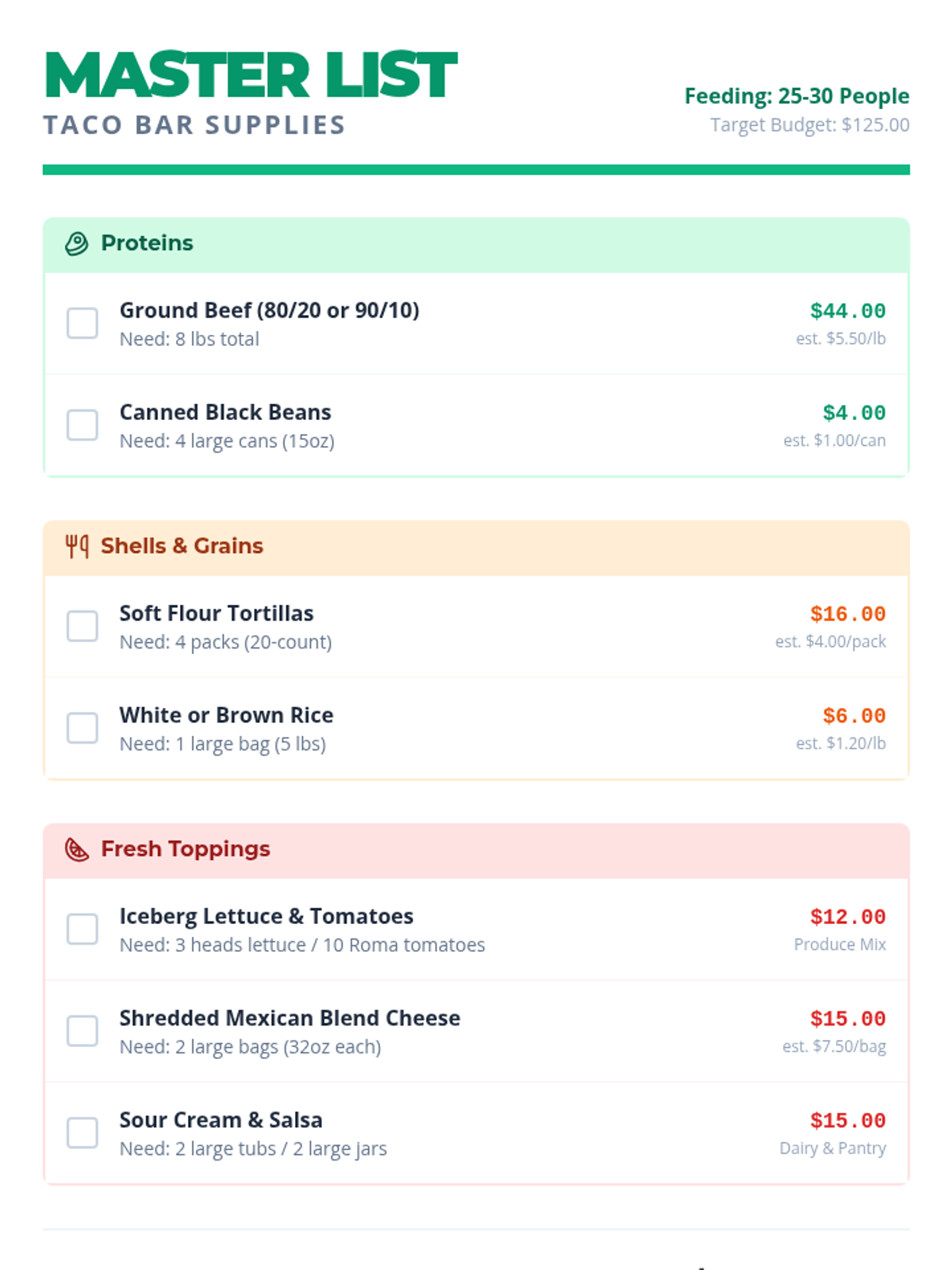
A detailed master shopping list for a 30-person taco bar, organized by grocery store category. Includes quantities and estimated prices to help students stay on budget.
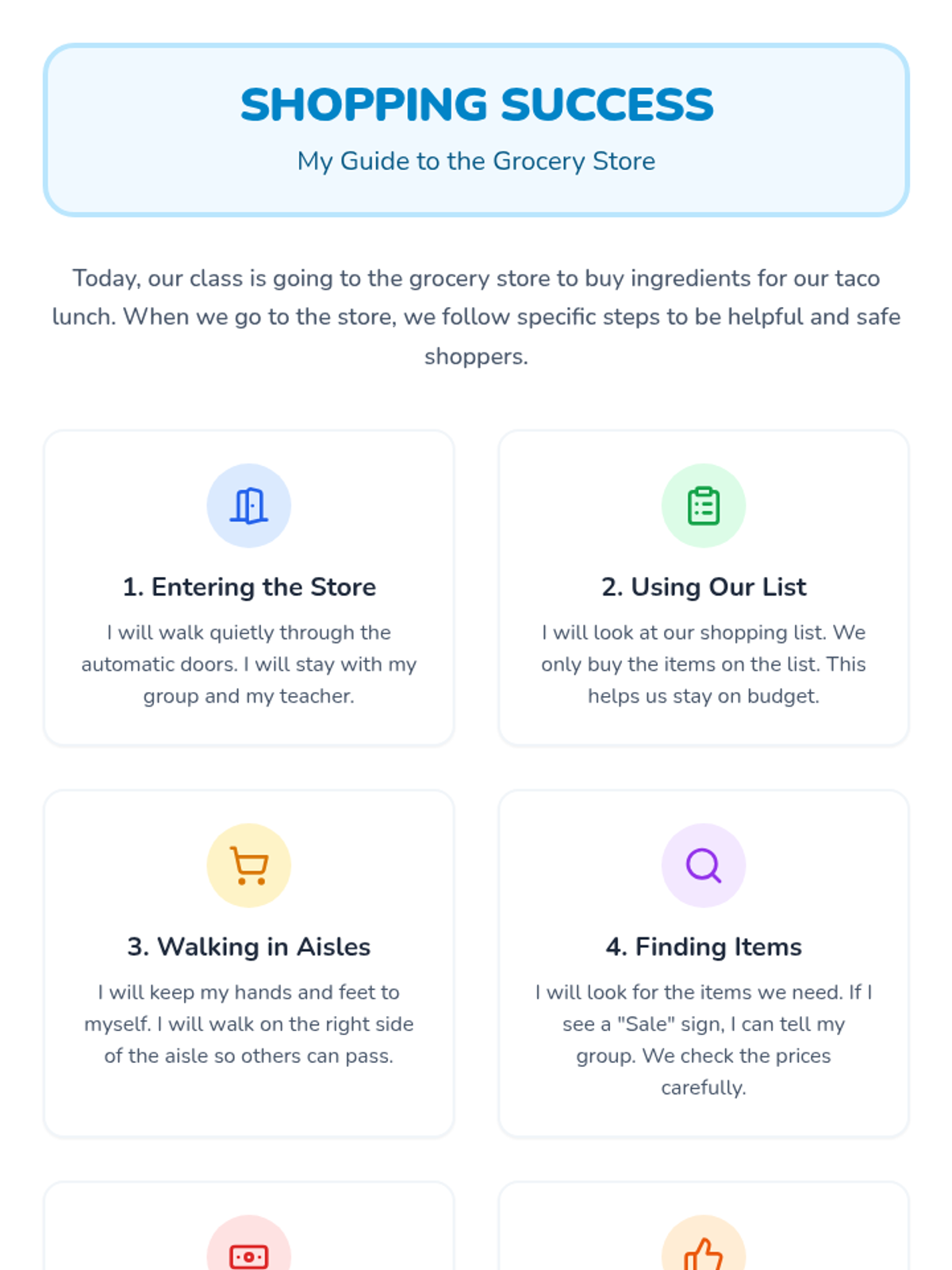
A visual social story for students explaining the steps and social expectations of visiting a grocery store as a group. Uses clear icons and simple language to guide community behavior.