Active listening, assertive expression, and boundary-setting strategies for interpersonal success. Develops proficiency in conflict mediation, cooperative teamwork, and the cultivation of healthy romantic and platonic connections.
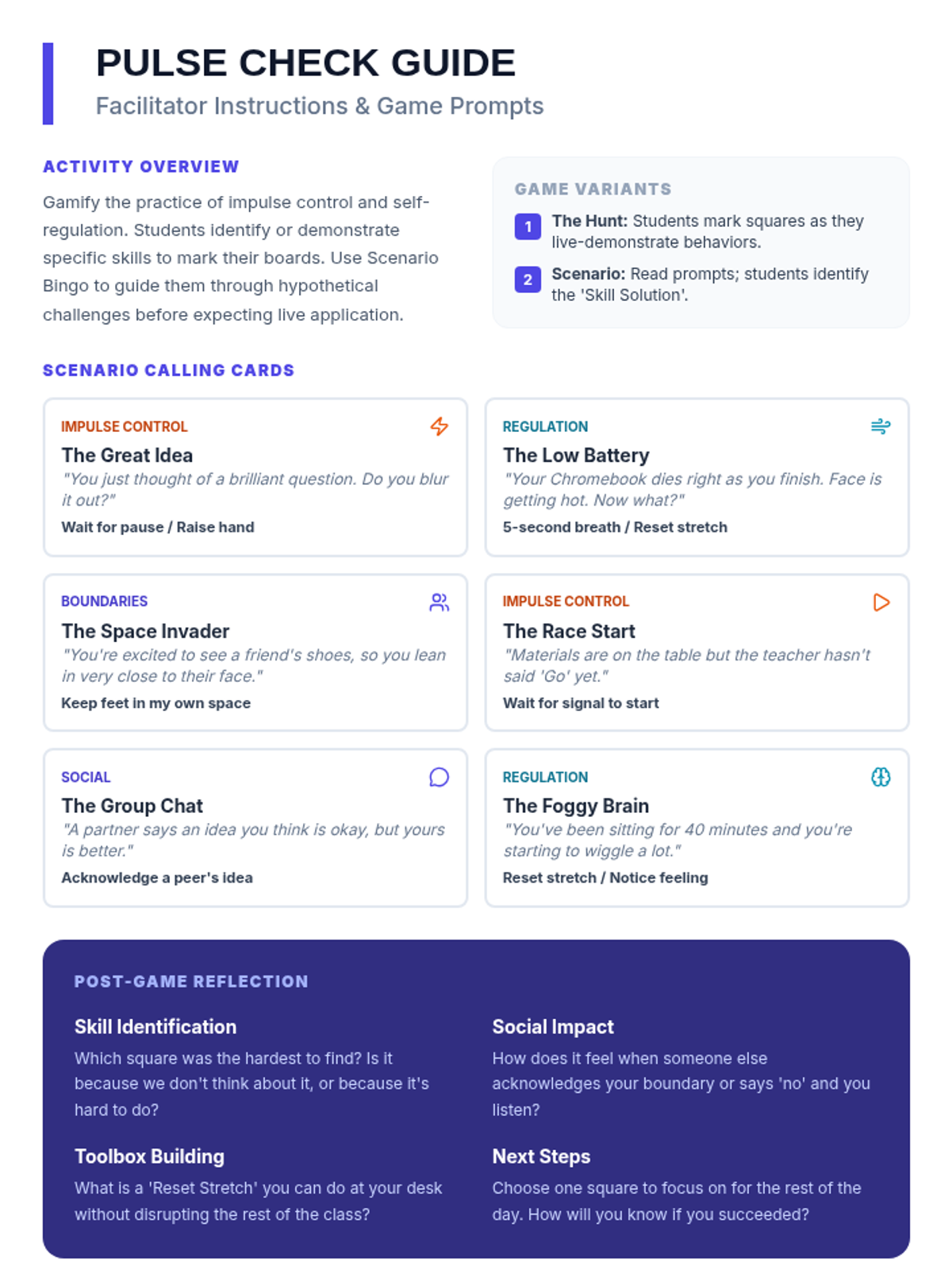
A facilitator guide for teachers or counselors, providing game instructions, scenarios, and discussion prompts for the Bingo activity.
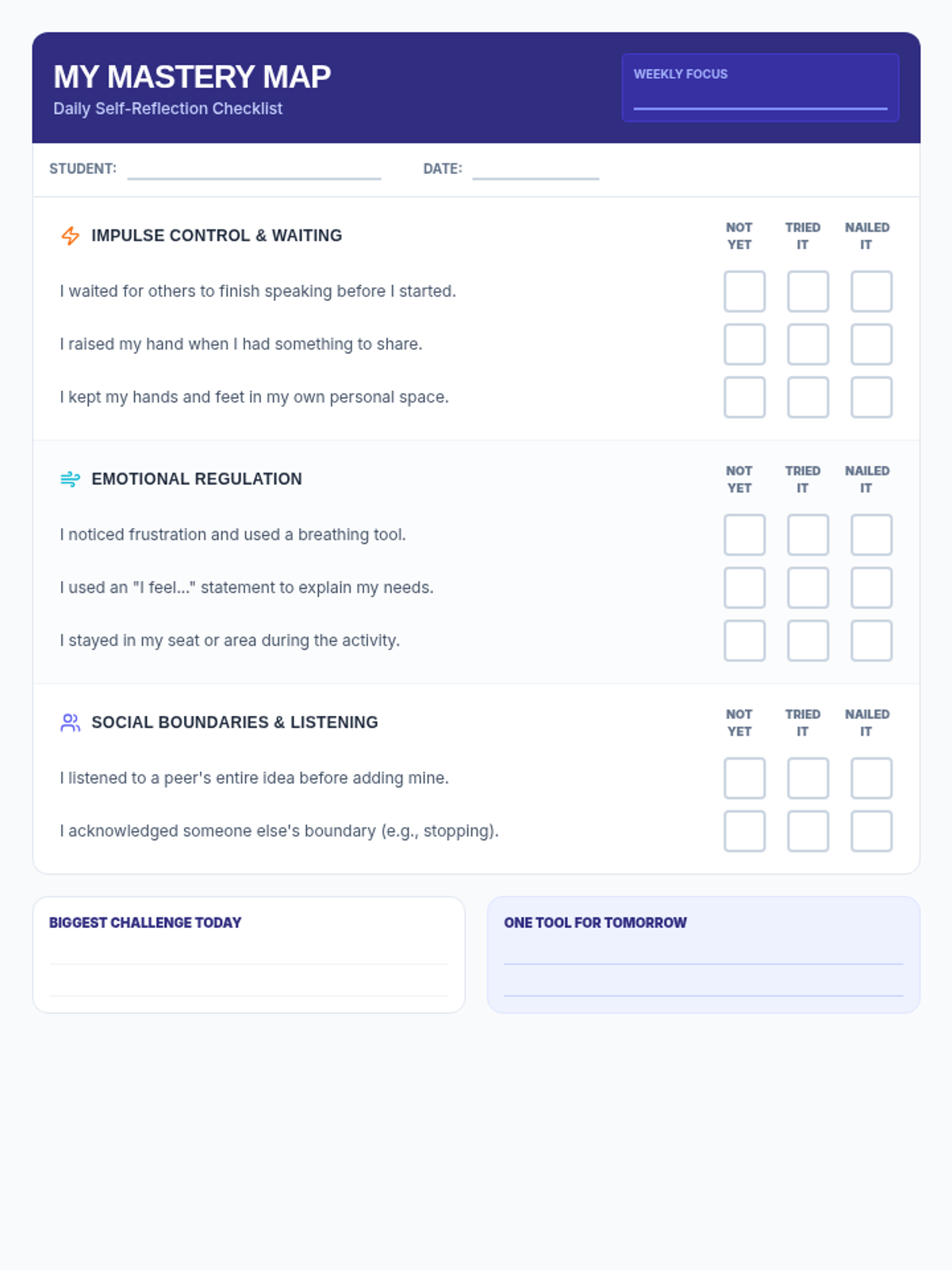
A student-facing self-reflection checklist for tracking progress in self-management and social-emotional skills.
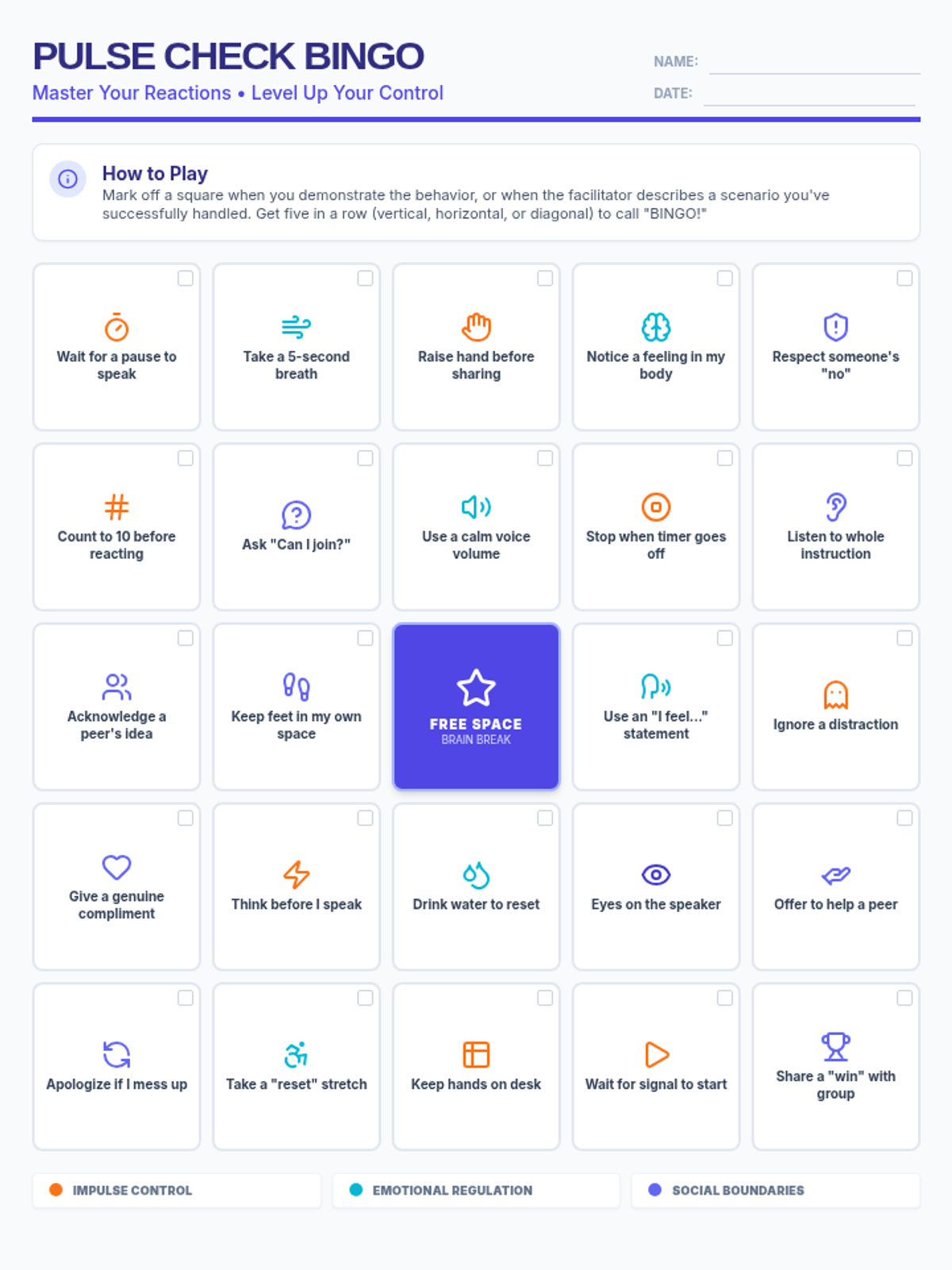
A modern bingo board for middle school students focusing on impulse control, emotional regulation, and social boundaries.
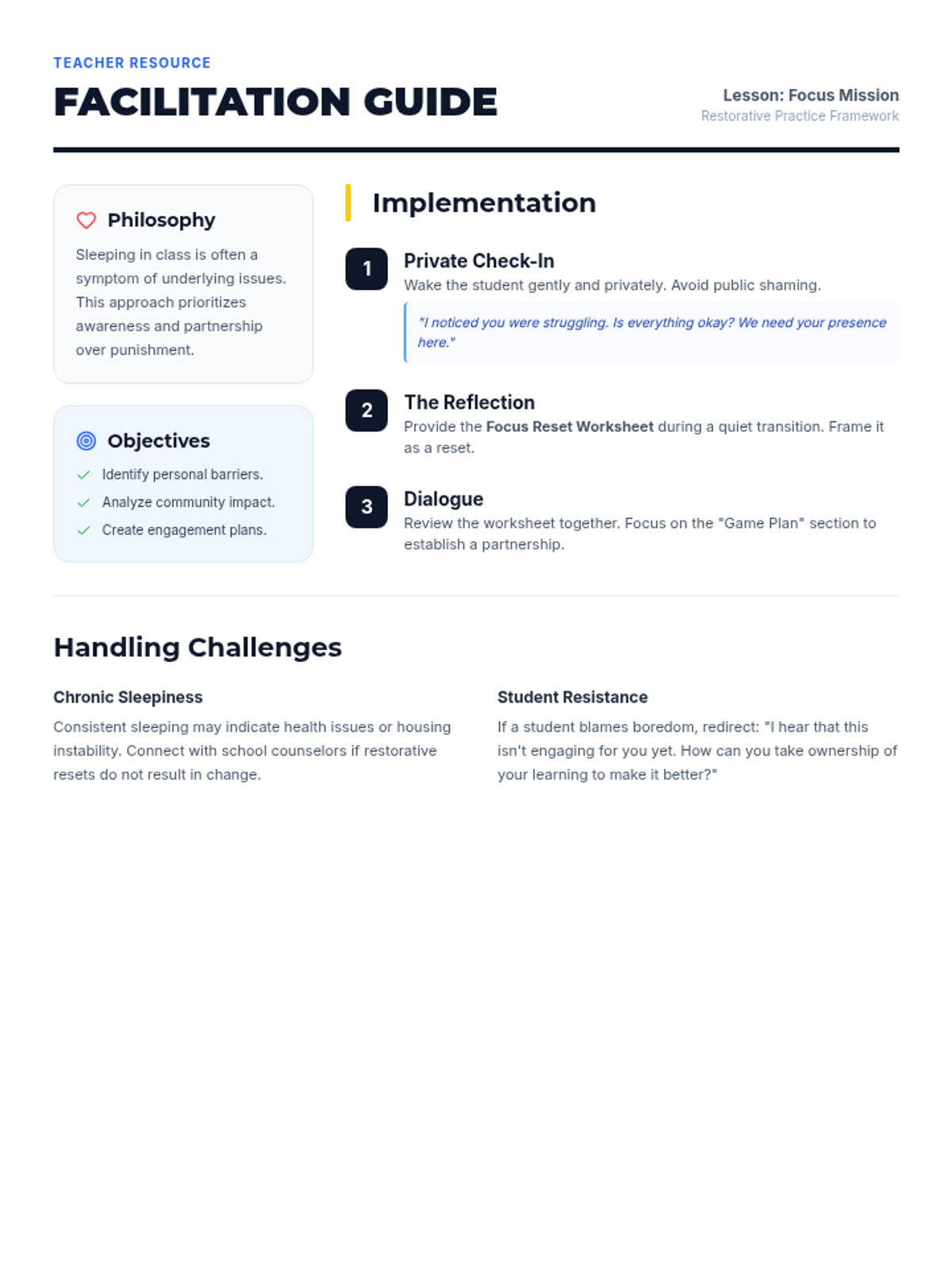
A teacher facilitation guide providing restorative strategies and instructional prompts for addressing classroom sleepiness and using the Focus Mission materials effectively.
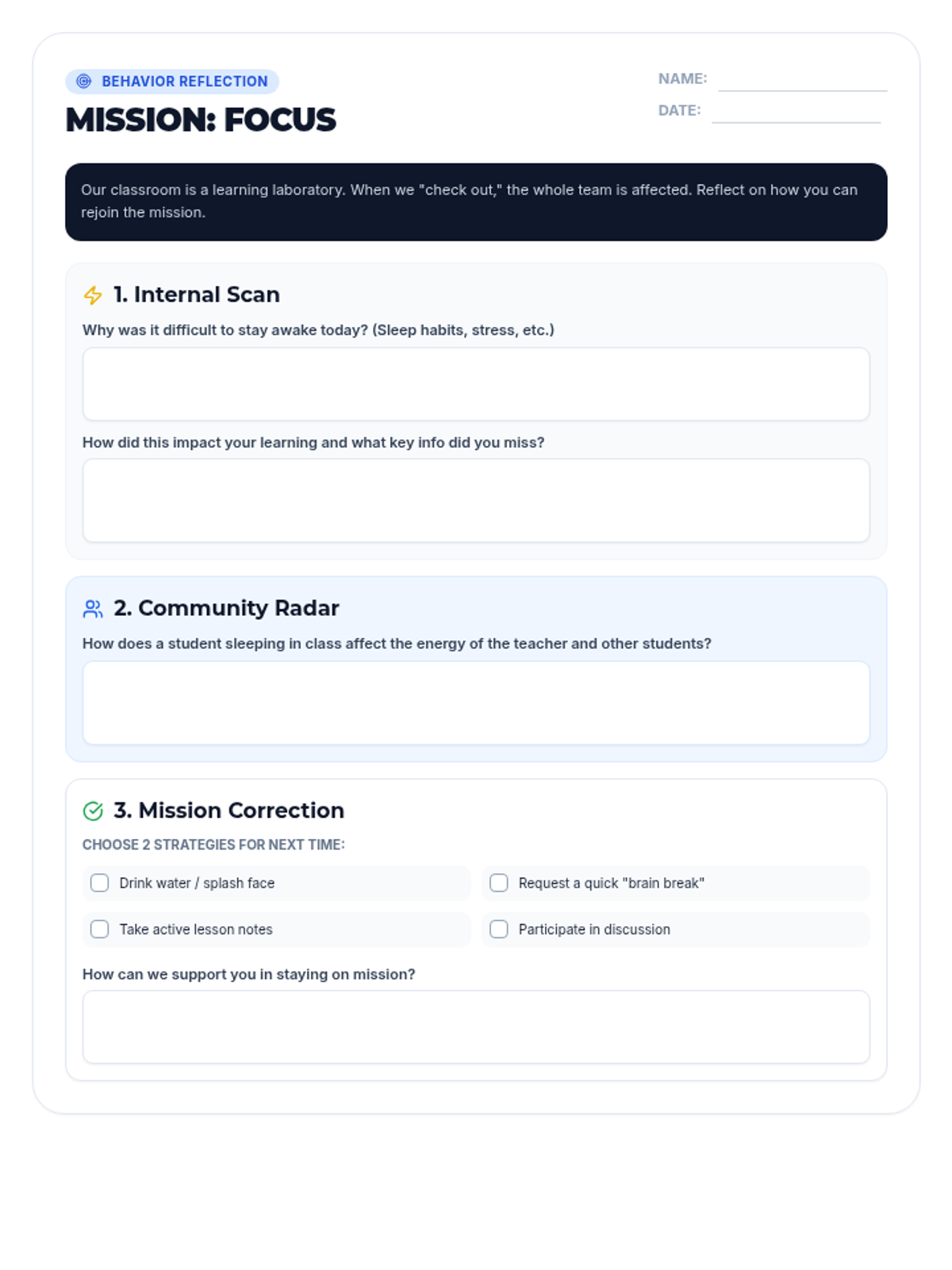
A restorative behavior reflection worksheet that encourages students to evaluate the causes of their drowsiness and understand its impact on their learning and classroom community.
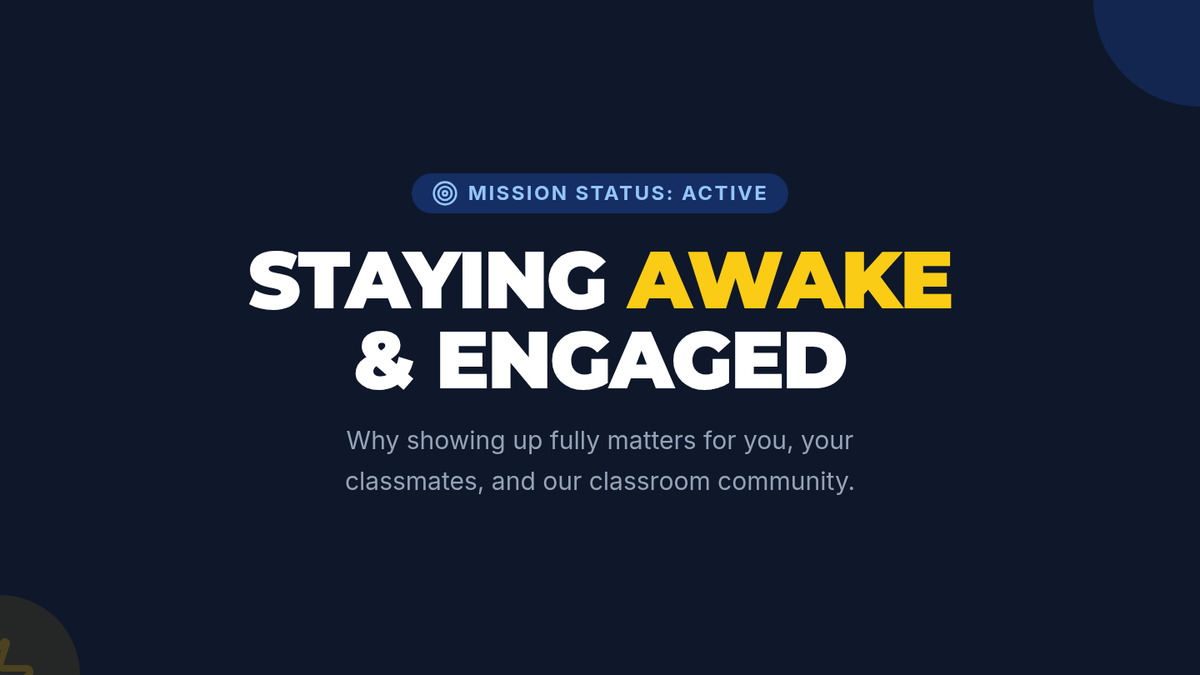
An engaging slide deck explaining the impact of sleeping in class on personal success and the classroom community, featuring restorative strategies for staying engaged.
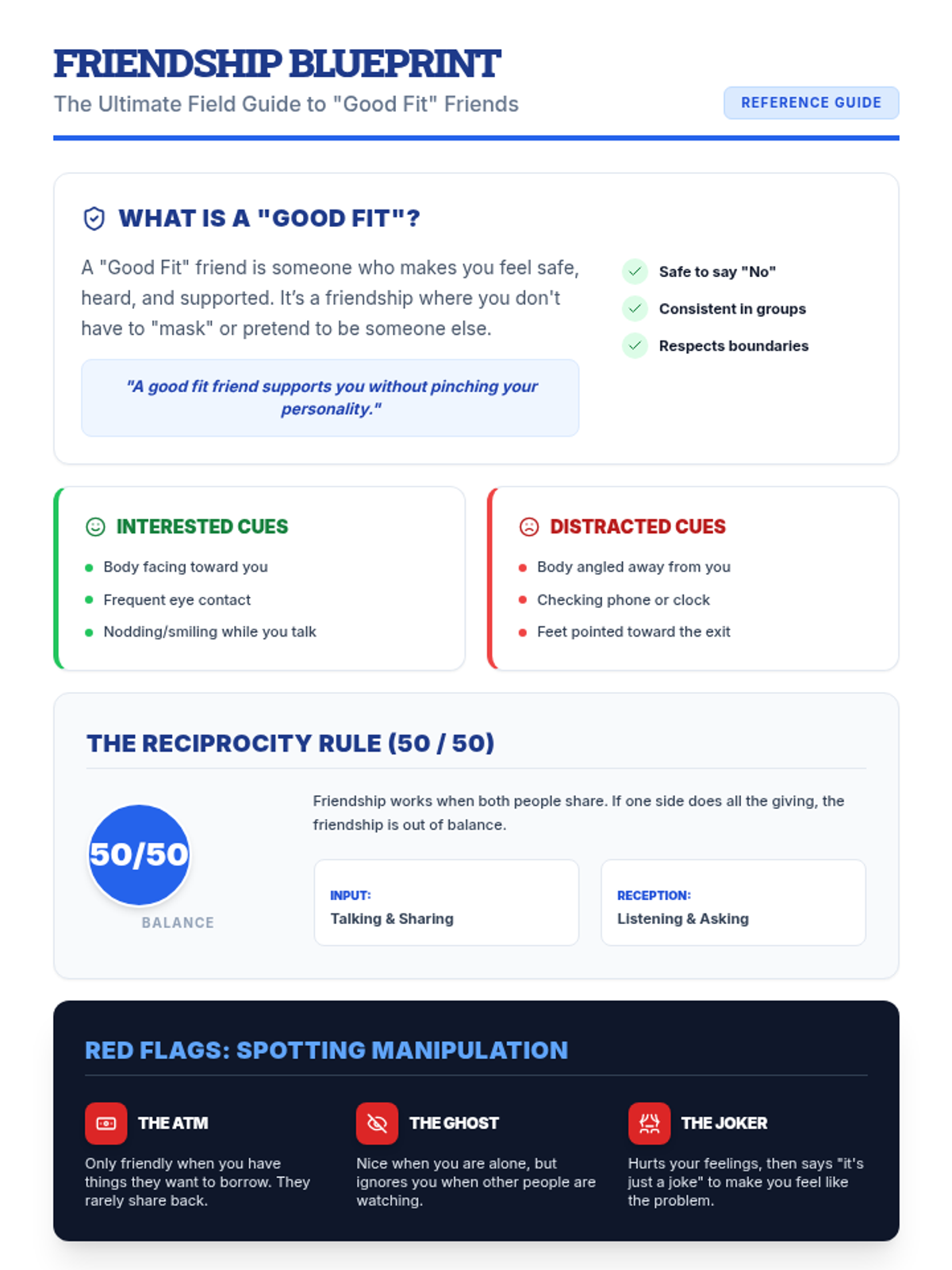
A comprehensive printable reference guide summarizing the core concepts of the Friendship Blueprint lesson, including body language cues, reciprocity, and manipulation red flags.
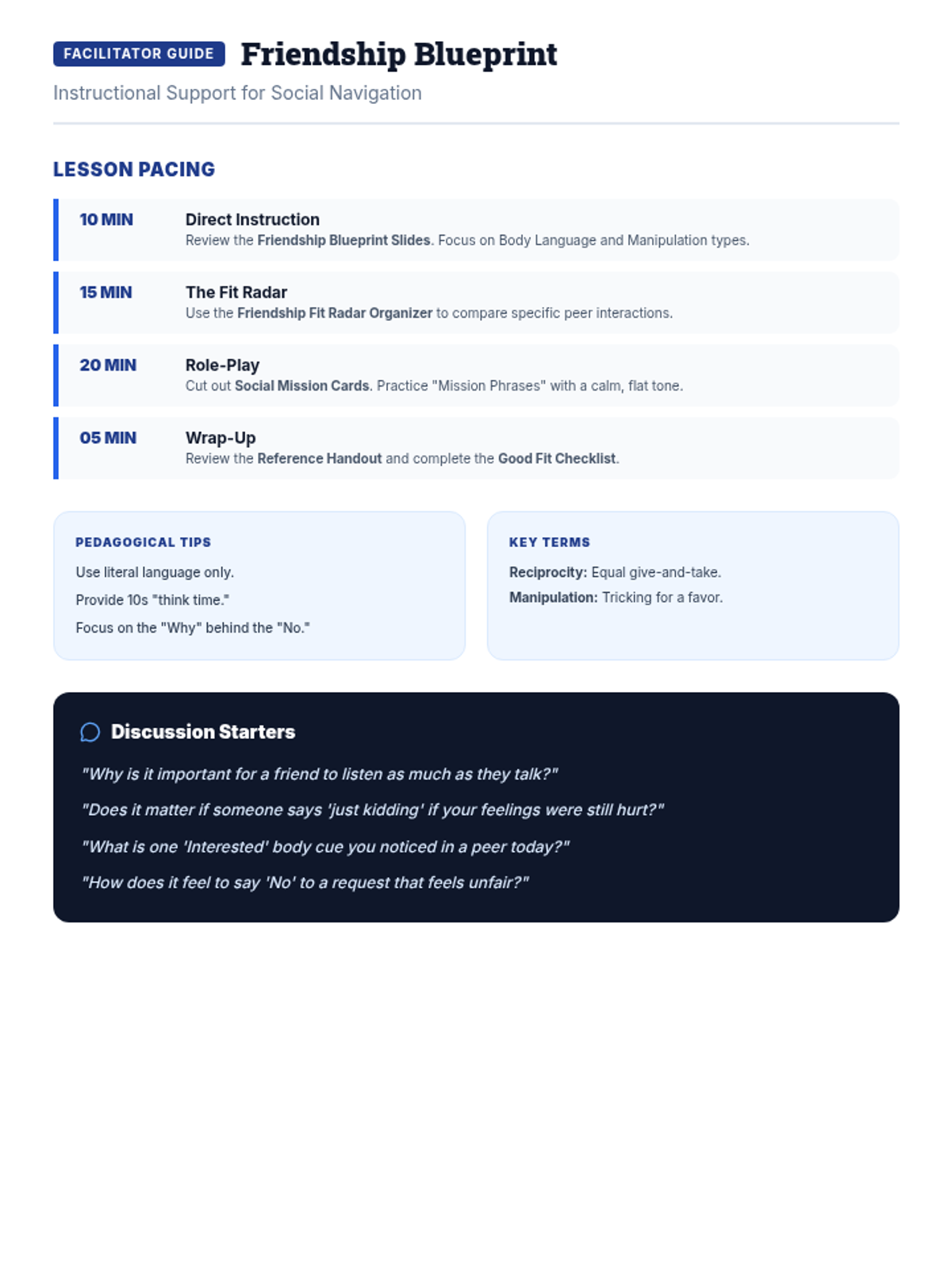
A comprehensive guide for teachers or parents to facilitate the Friendship Blueprint lesson, including pacing, vocabulary, and discussion prompts.
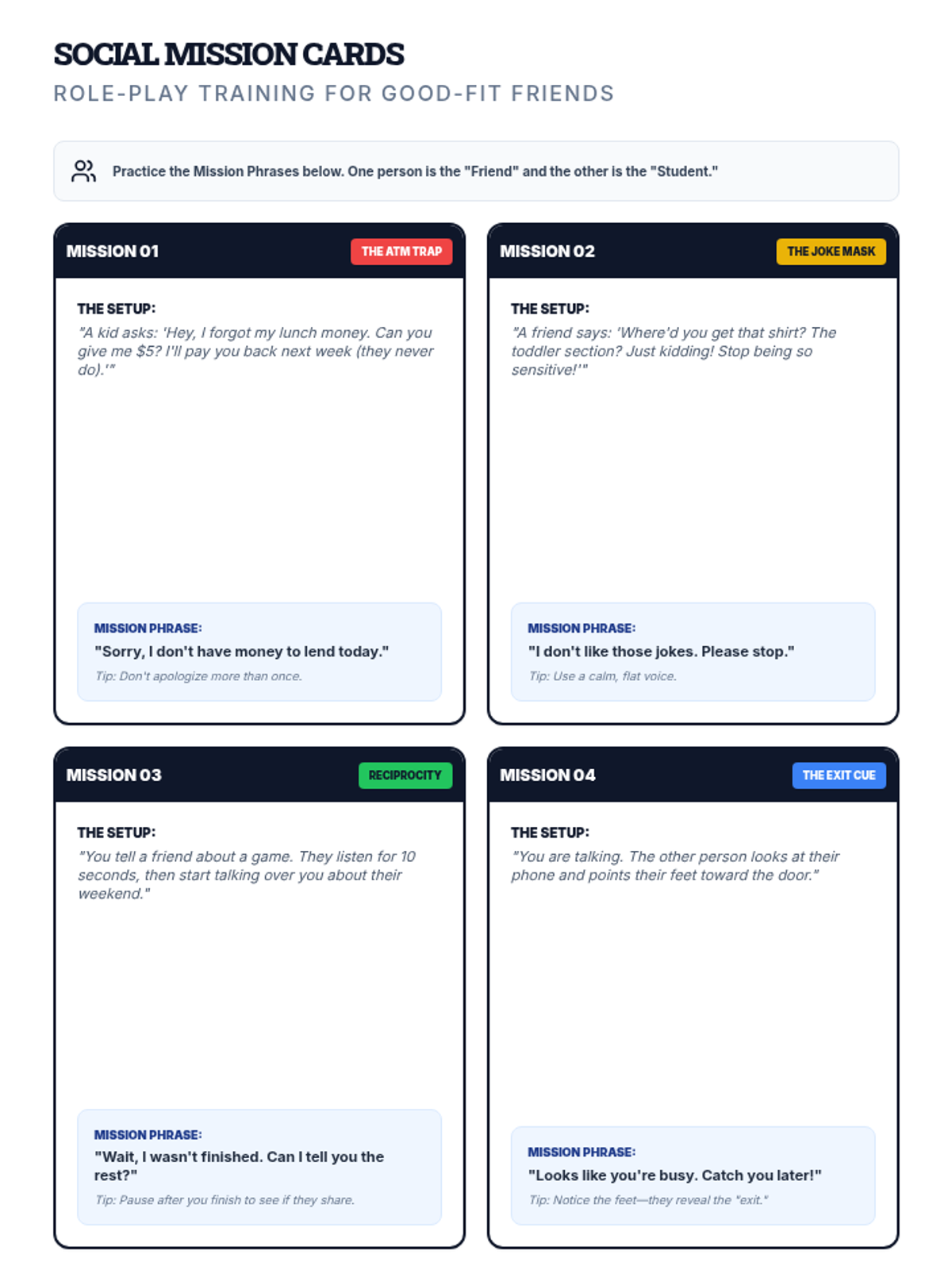
Four realistic role-play cards designed to help students practice identifying manipulation, setting boundaries, and noticing body language cues in real-time.
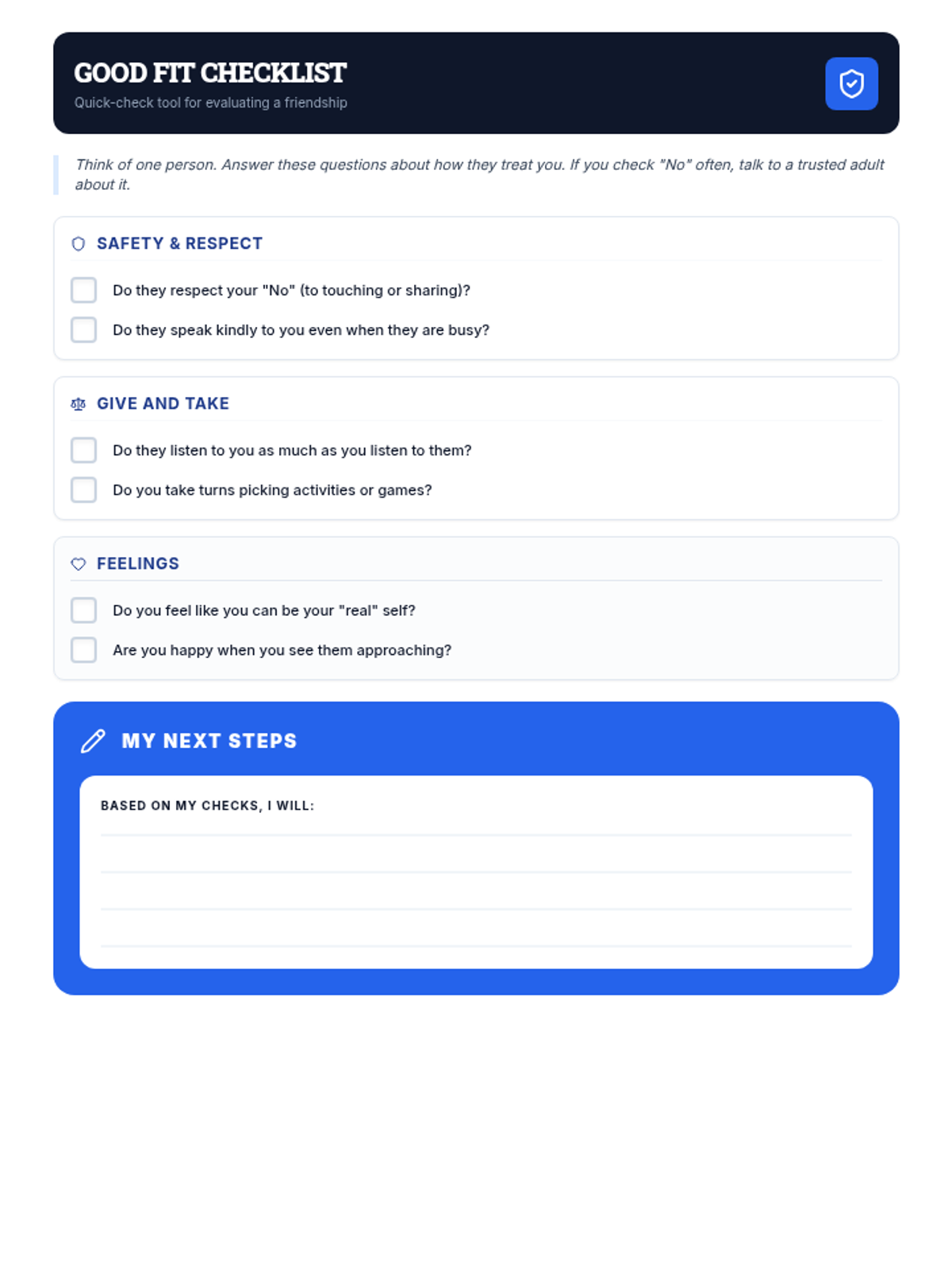
A practical step-by-step checklist for students to self-evaluate their friendships based on safety, reciprocity, and personal feelings.
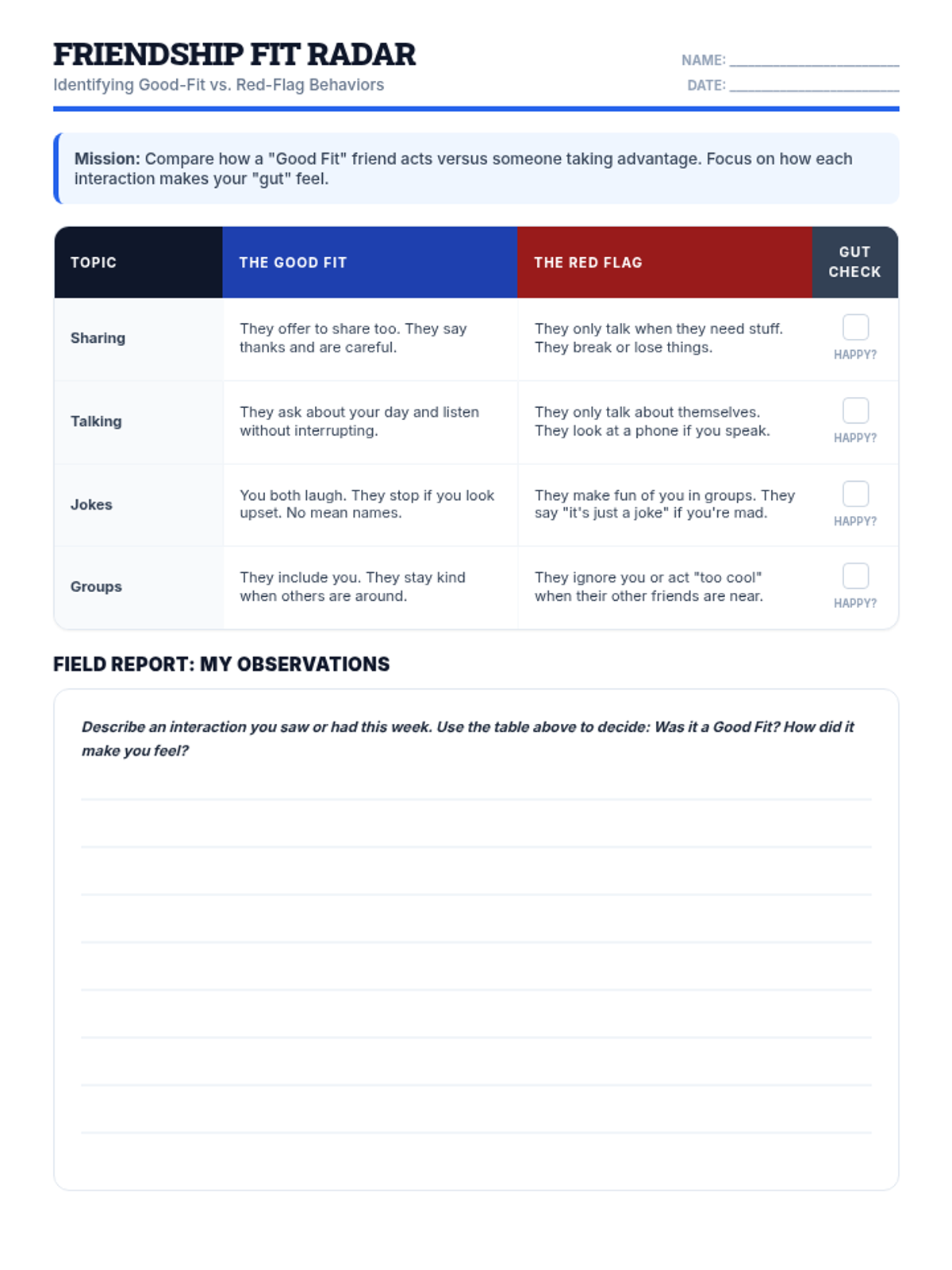
A detailed graphic organizer that helps students differentiate between healthy friendship behaviors and manipulative "red flag" behaviors.
A visually engaging presentation that teaches students how to recognize healthy friendship traits, decode body language, and spot manipulative behaviors.
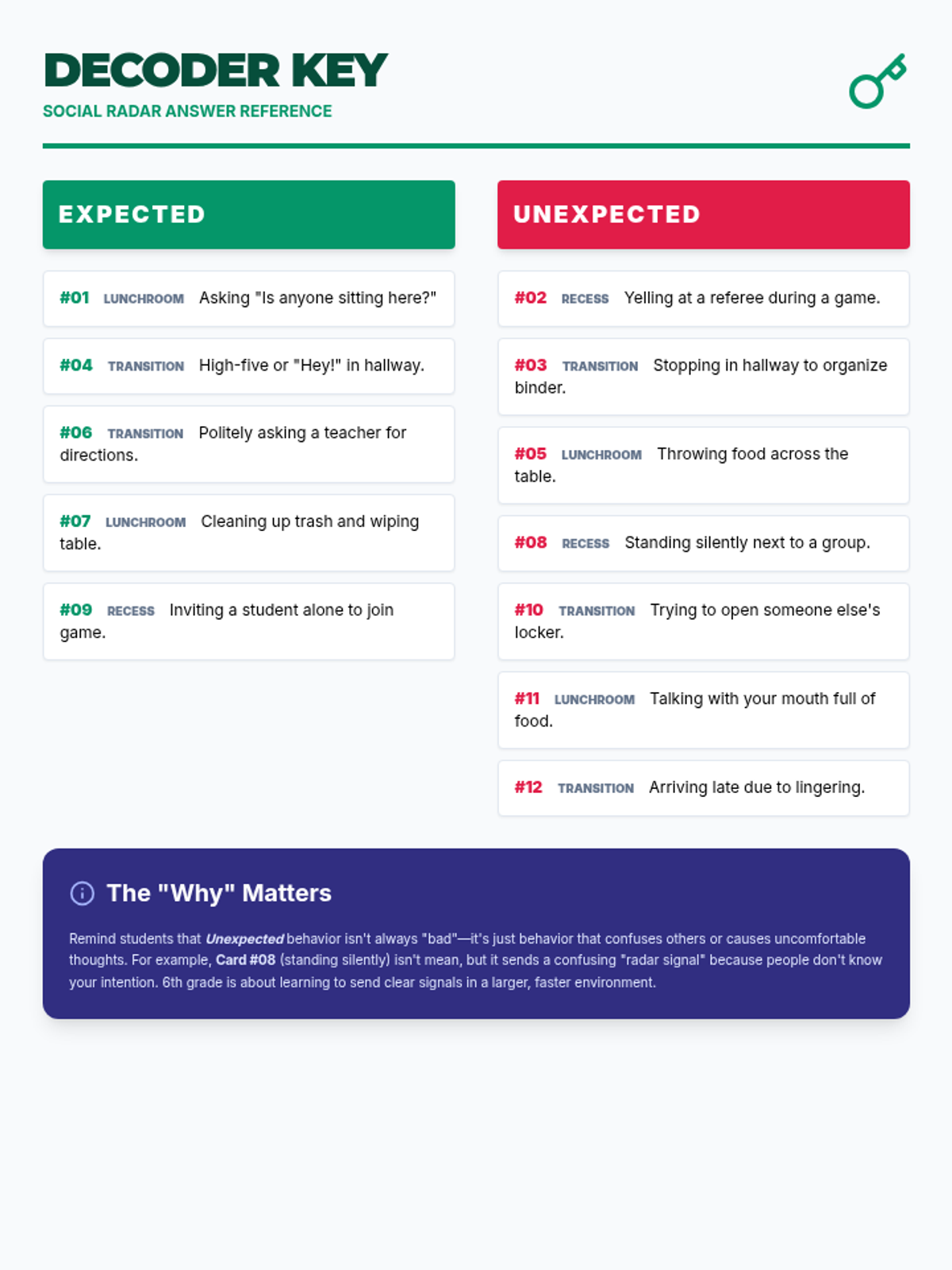
A teacher-facing answer key and discussion guide for the "Behavior Decoder" sorting activity, categorized by environment (lunchroom, recess, transition) with rationale for each classification.
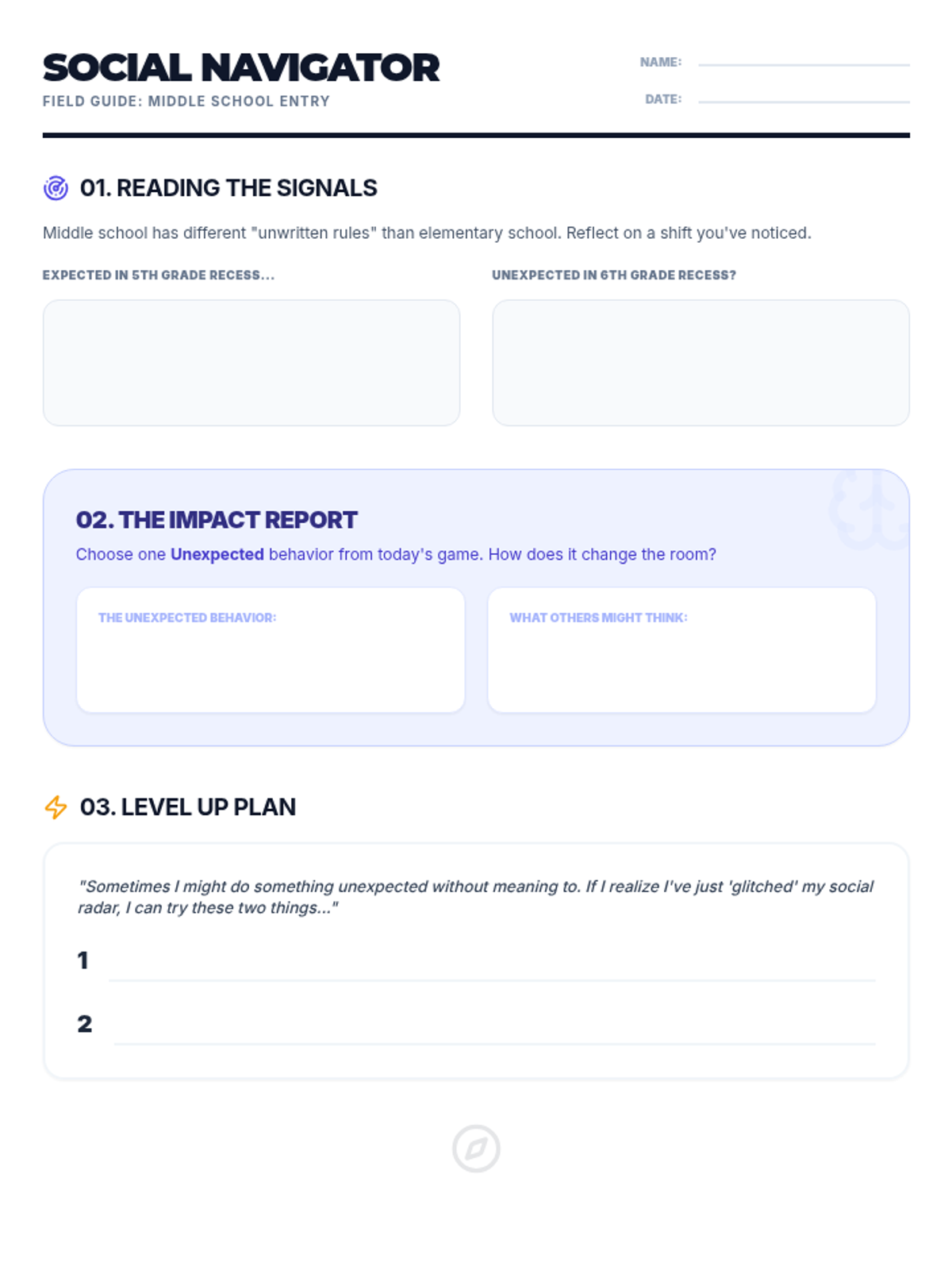
A reflection worksheet for rising 6th graders to apply "Social Radar" concepts. It includes sections for comparing elementary vs. middle school expectations, analyzing the impact of behaviors on others, and personal goal-setting for social transitions.
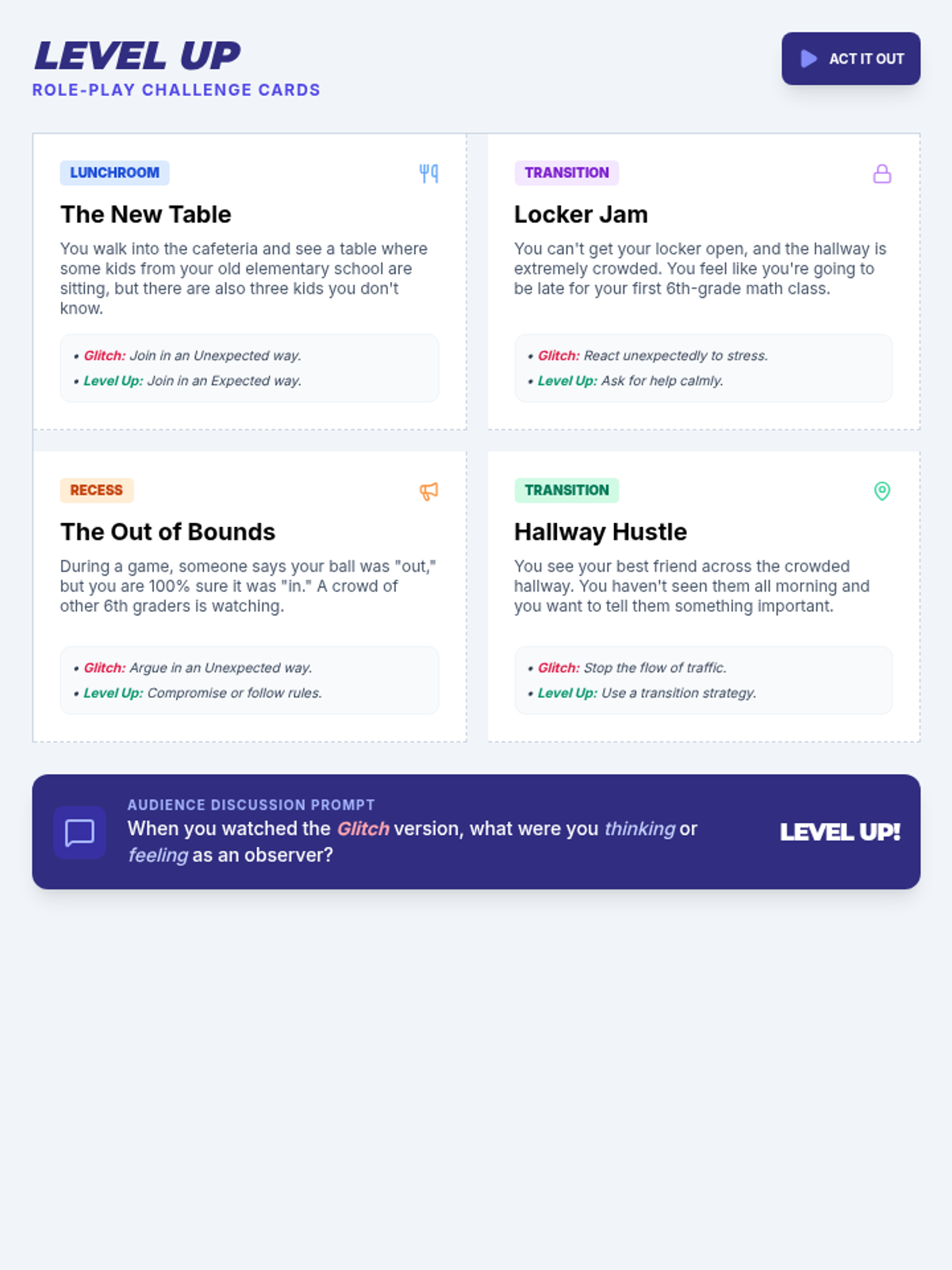
A set of four high-interest role-play prompt cards for rising 6th graders. Each card presents a middle school scenario (lunchroom, lockers, recess, hallway) and challenges students to perform both "Unexpected" and "Expected" behavioral responses.
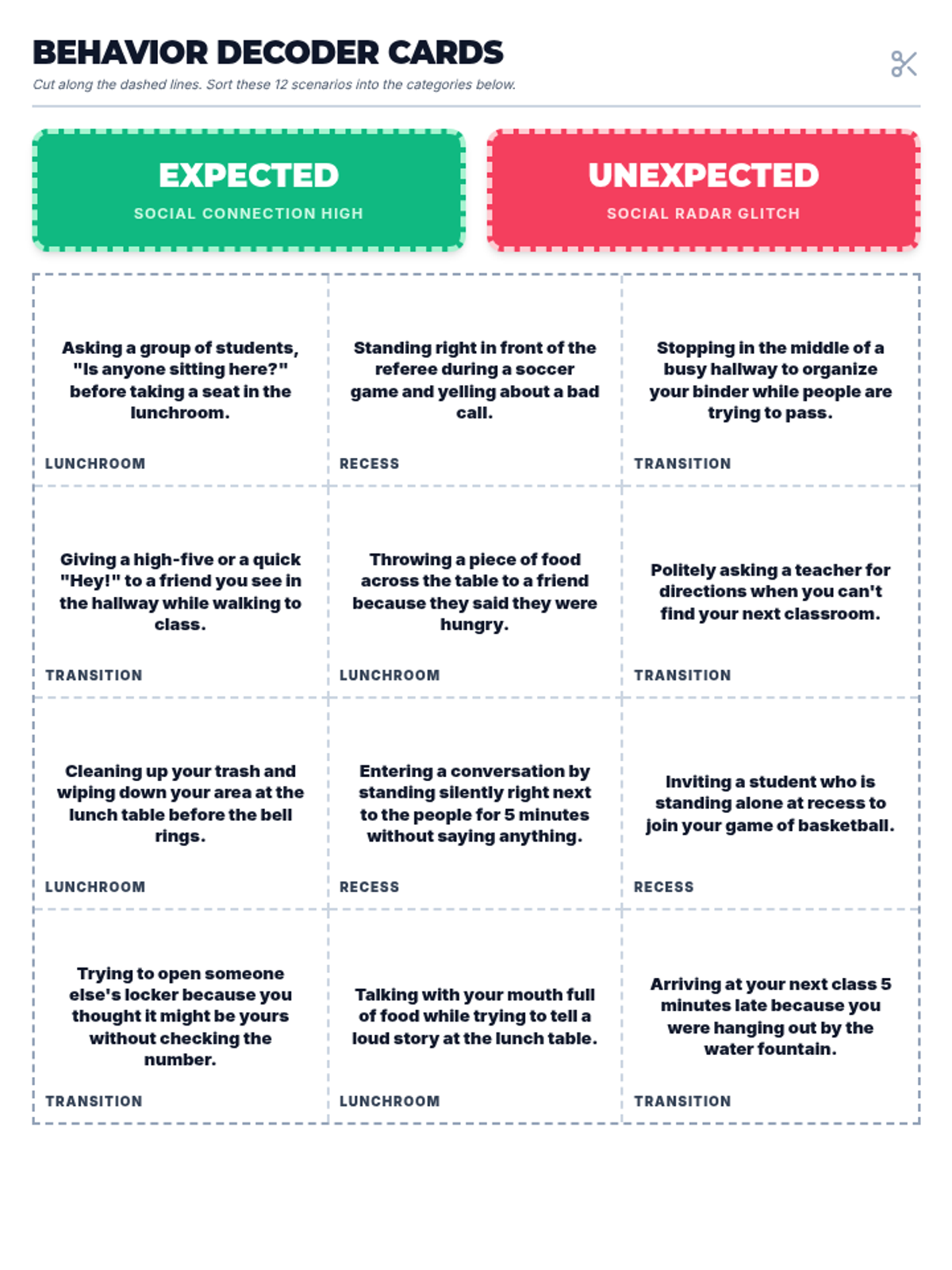
A printable sorting activity for 6th graders featuring 12 scenario cards and category headers. Scenarios cover lunchroom, recess, and middle school transition behaviors to be categorized as "Expected" or "Unexpected."
A visually engaging slide deck designed for rising 6th graders to introduce the concepts of "Social Radar," defining expected and unexpected behaviors with a focus on middle school transition environments like the lunchroom and recess.
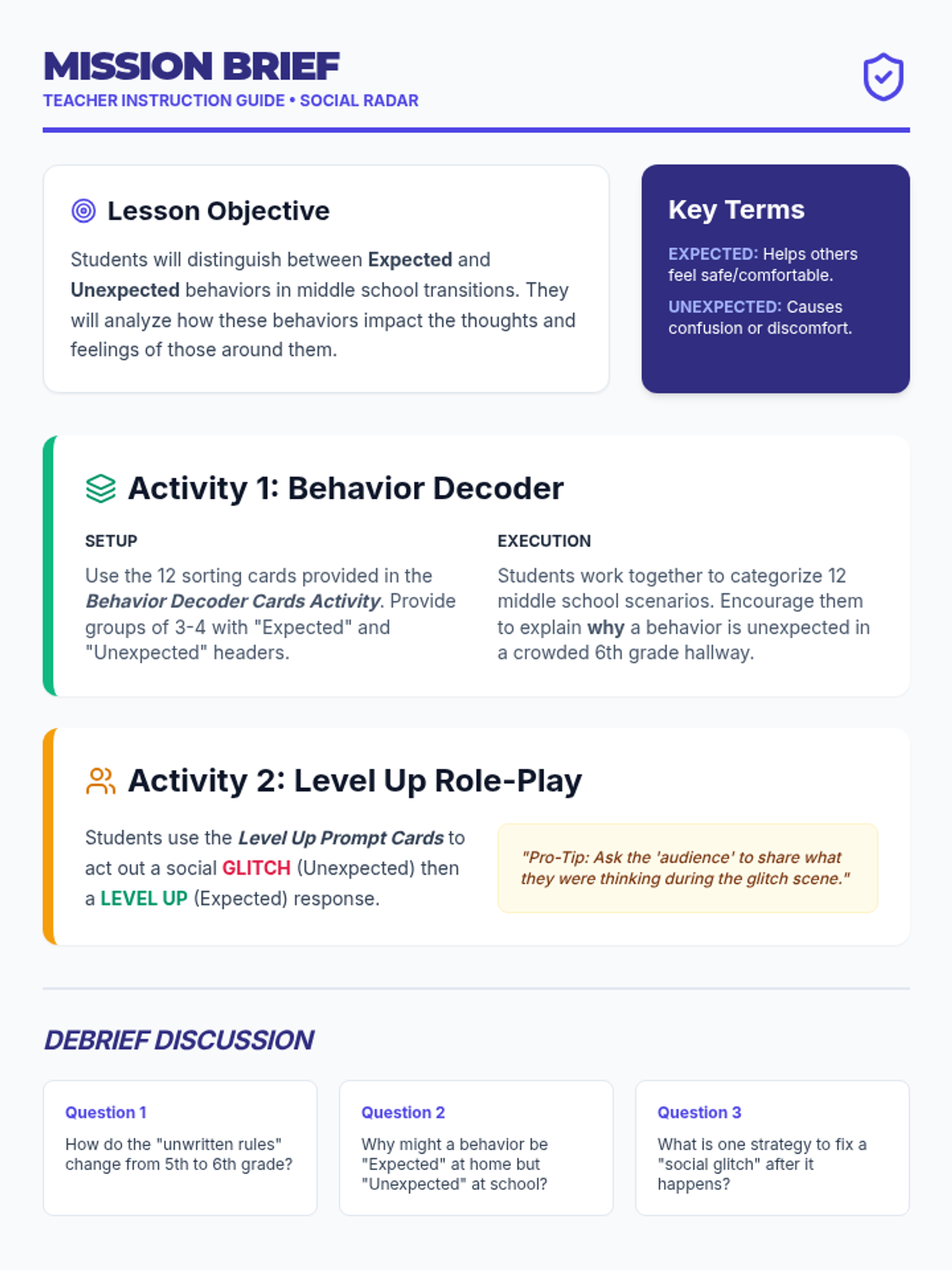
A comprehensive teacher guide for the "Social Radar" lesson, featuring objectives, key terms, activity instructions for sorting and role-play, and debriefing questions tailored for the middle school transition.
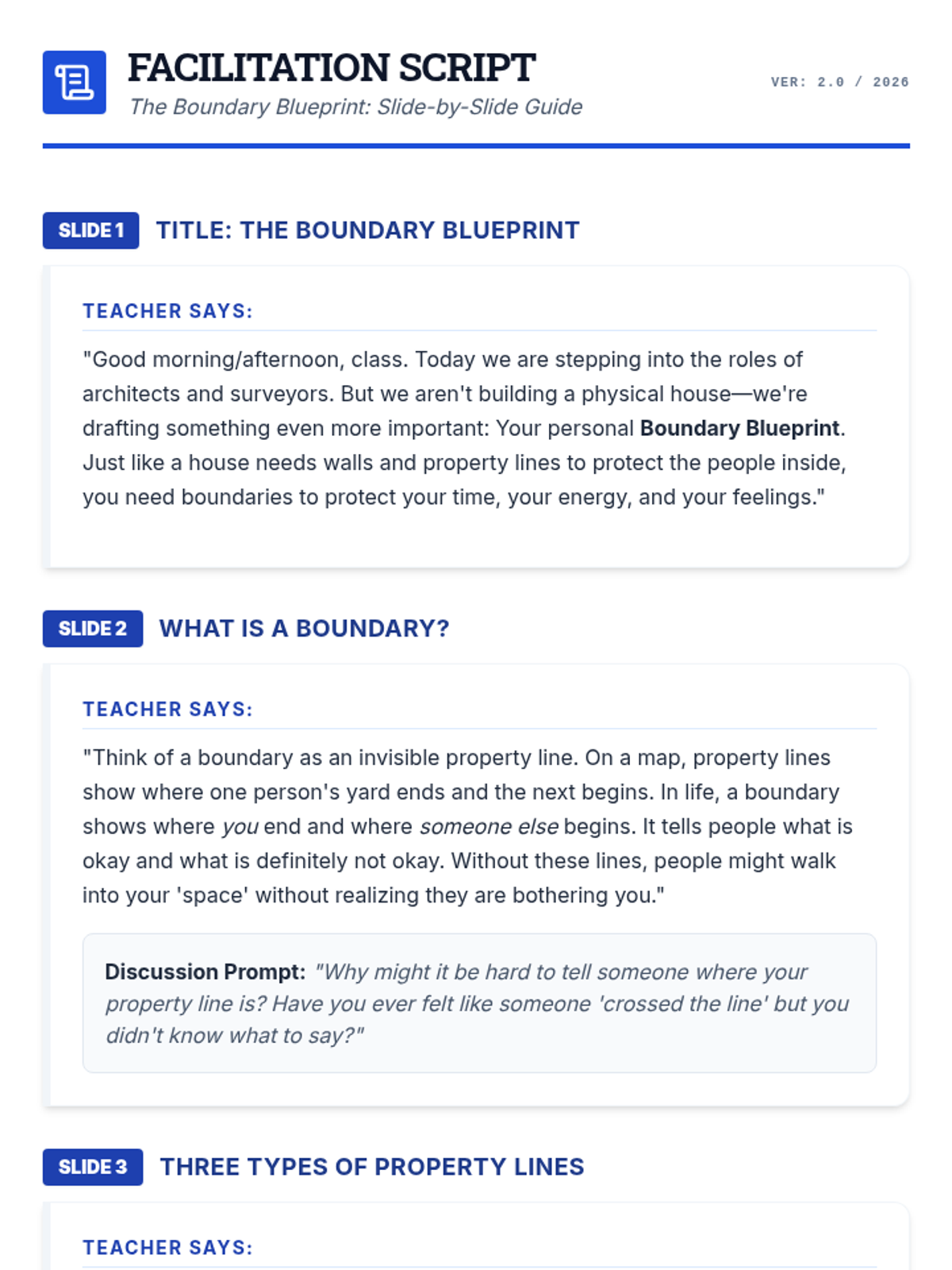
A detailed facilitation script for 'The Boundary Blueprint' slide deck. Revised to fix page breaks, improve label legibility, and add helpful teacher prompts.
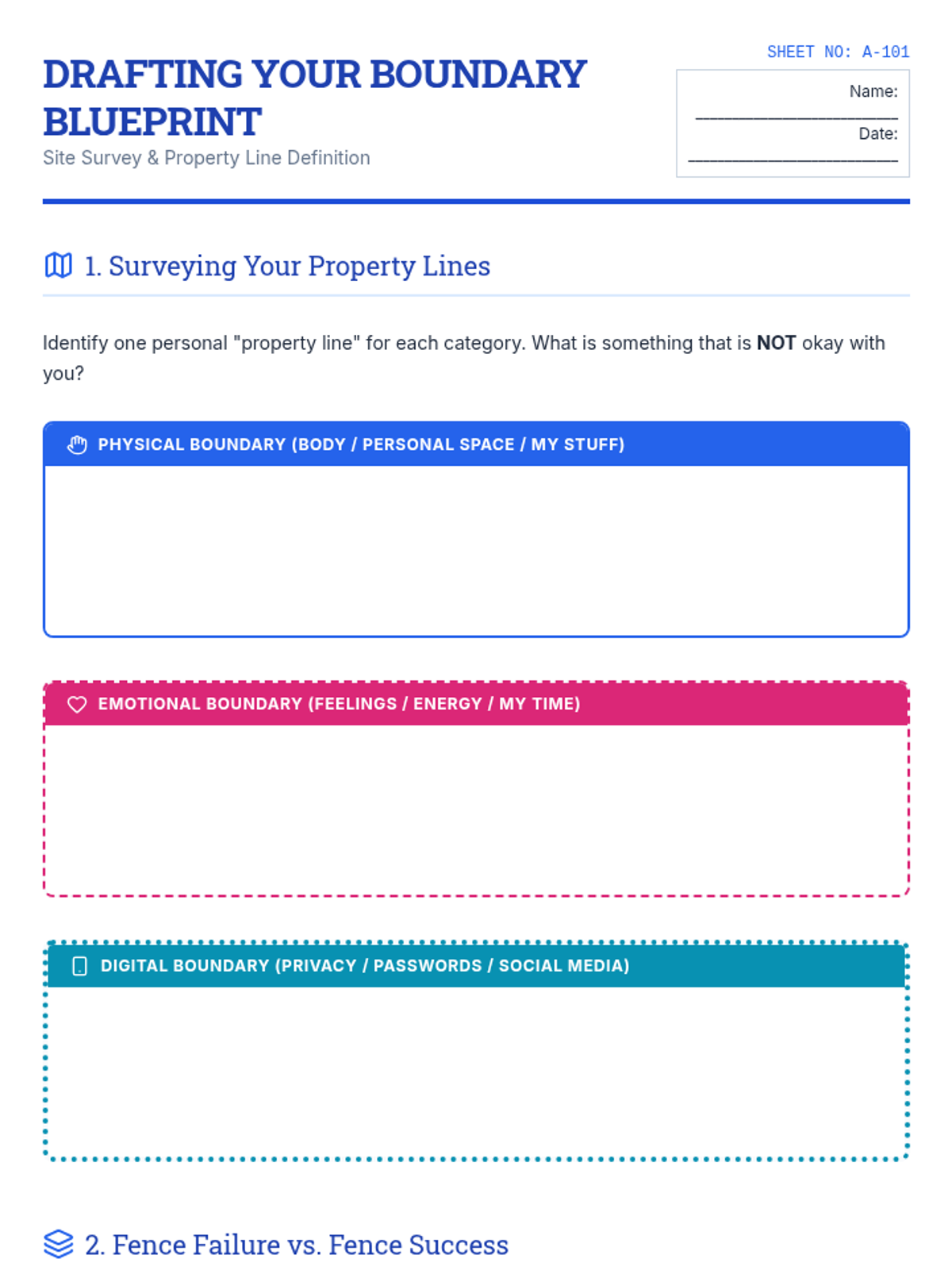
A student drafting worksheet for 'The Boundary Blueprint' lesson. Revised to increase handwriting space, fix page breaks, and improve visual hierarchy for black and white printing.
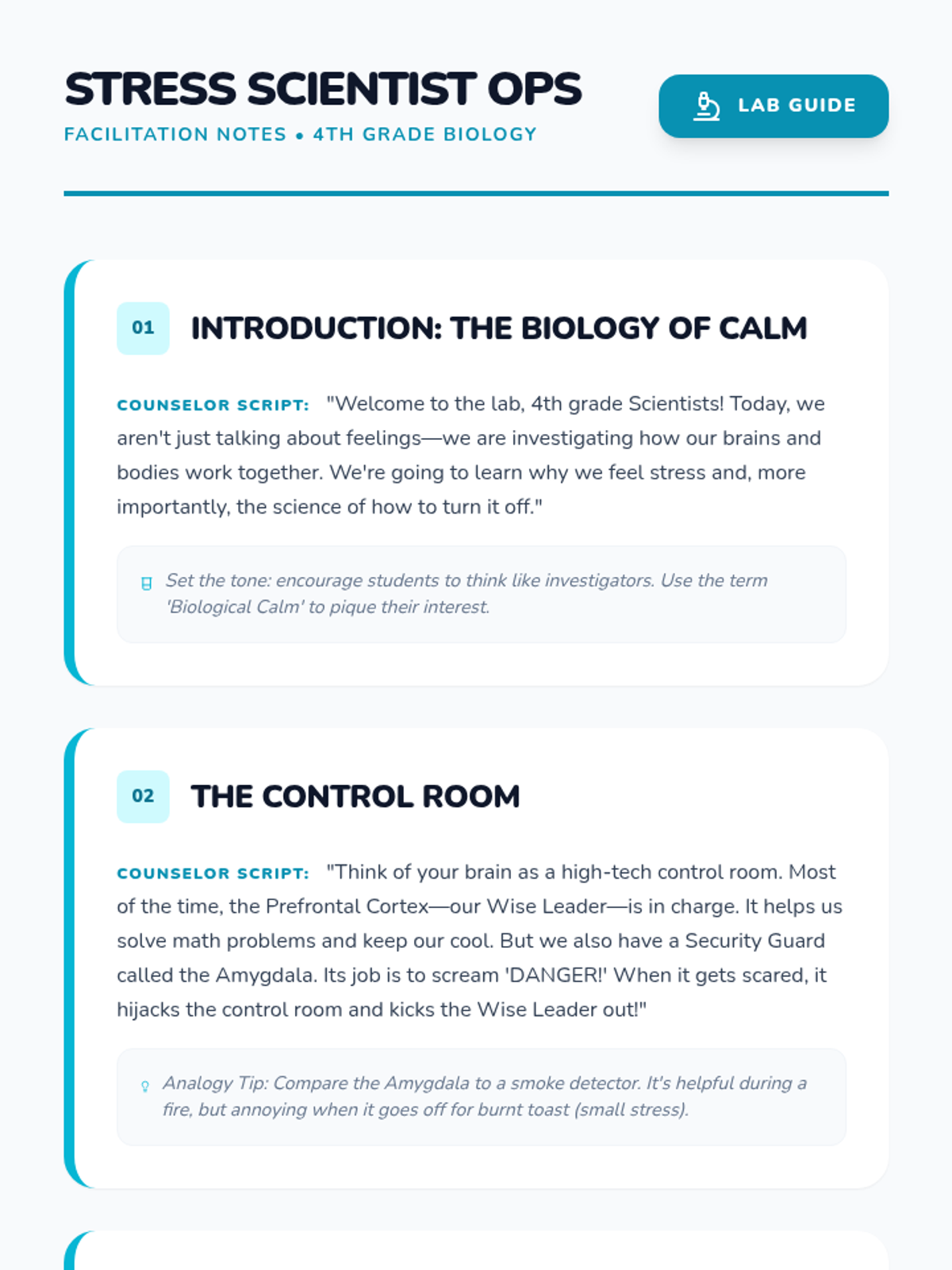
A detailed facilitation guide for the 4th grade 'Stress Scientists' lesson. Includes counselor scripts, biology-themed analogies for brain function, and interactive prompts for the 'Scientific Method' practice.
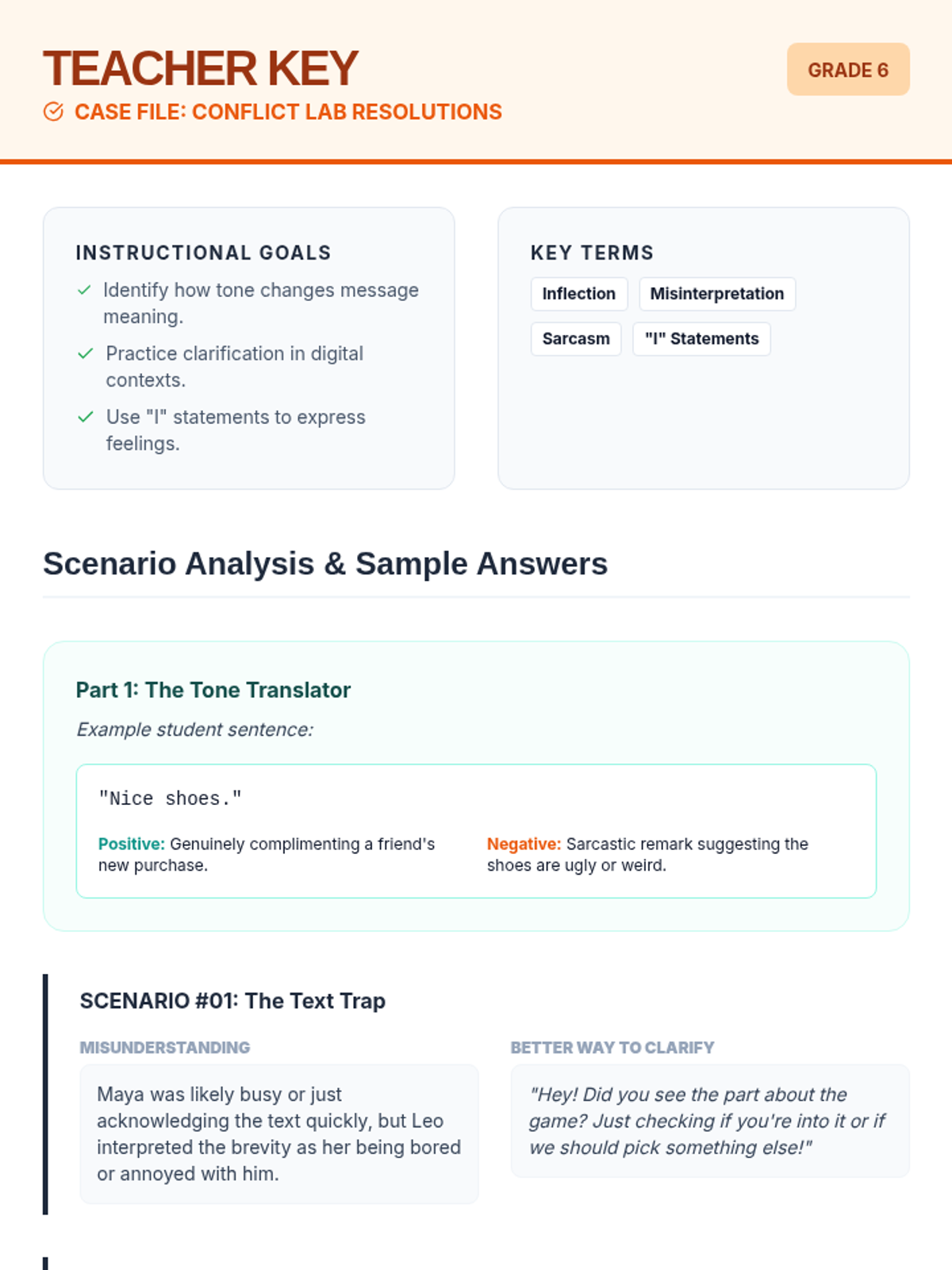
A comprehensive answer key and teacher guide for the "Conflict Lab" worksheet, including sample student responses, instructional goals, and a discussion starter for the classroom.
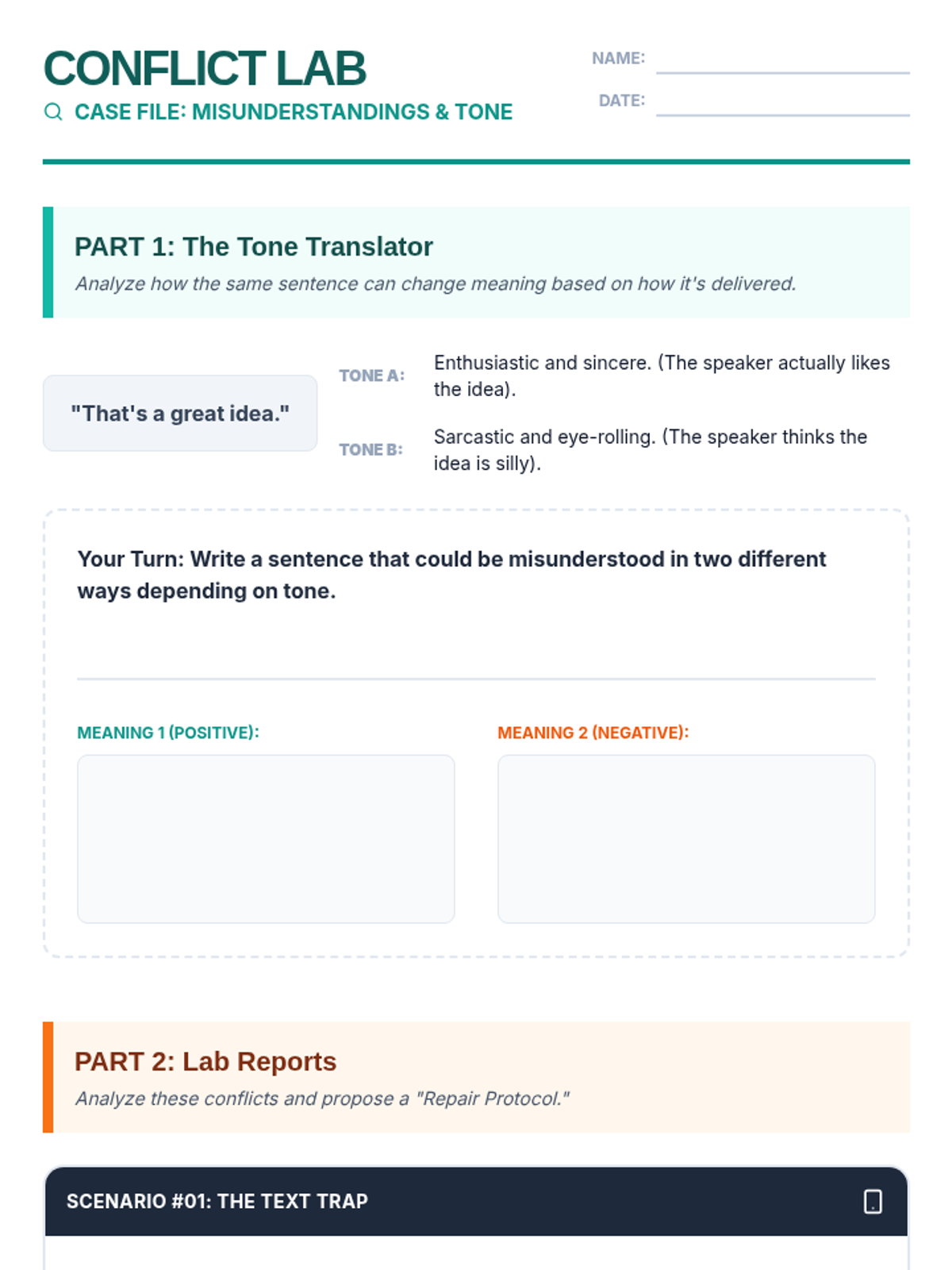
A 6th-grade worksheet featuring a "Conflict Lab" theme where students analyze tone-based misunderstandings in three distinct friendship scenarios and practice resolution strategies.
A visually engaging slide deck that introduces 6th graders to the concept of tone, how it differs between spoken and digital communication, and a 3-step protocol for checking in when misunderstandings occur.
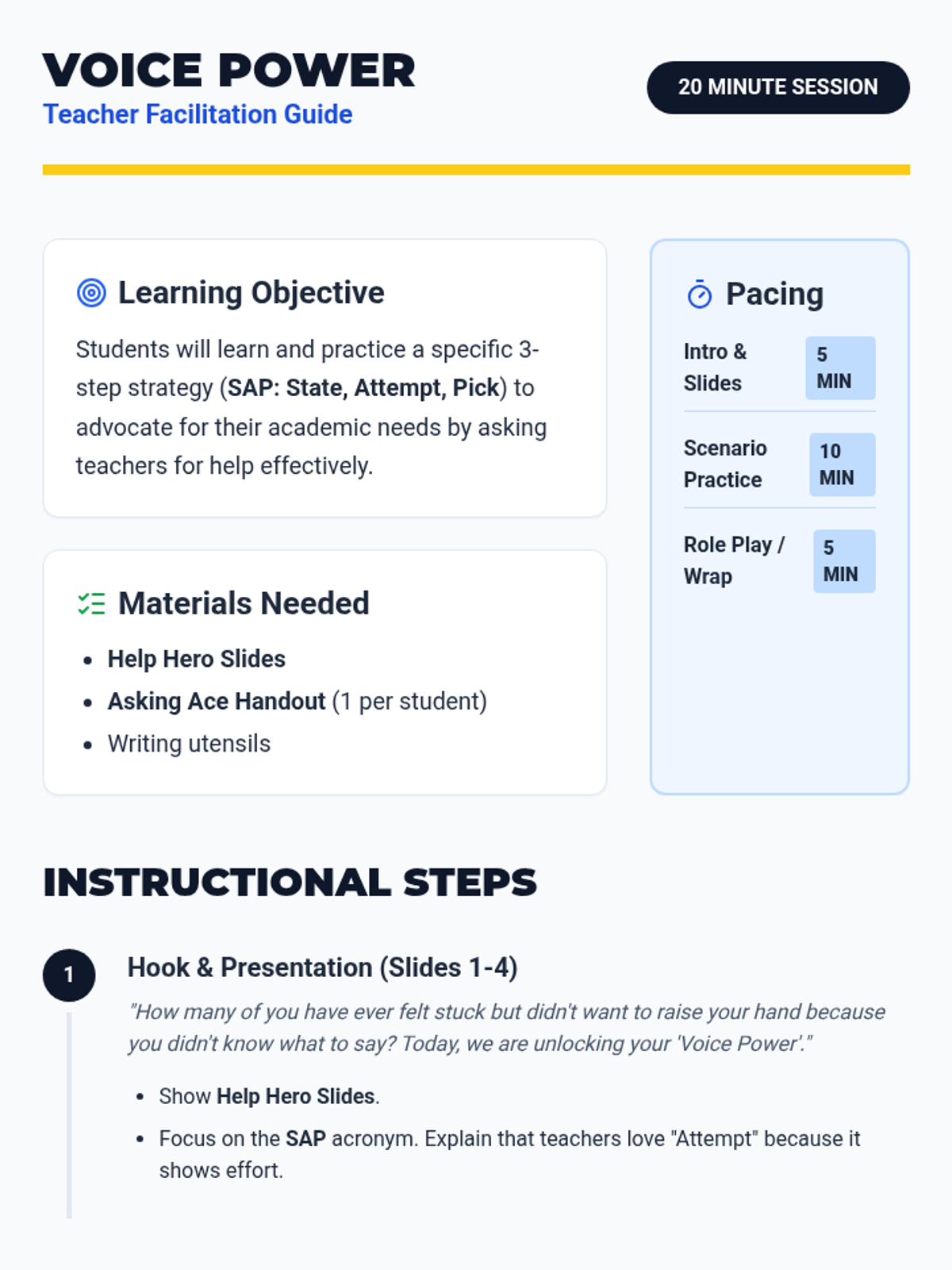
A comprehensive guide for teachers to deliver a 20-minute self-advocacy lesson, including pacing, talking points, guided practice instructions, and differentiation strategies.
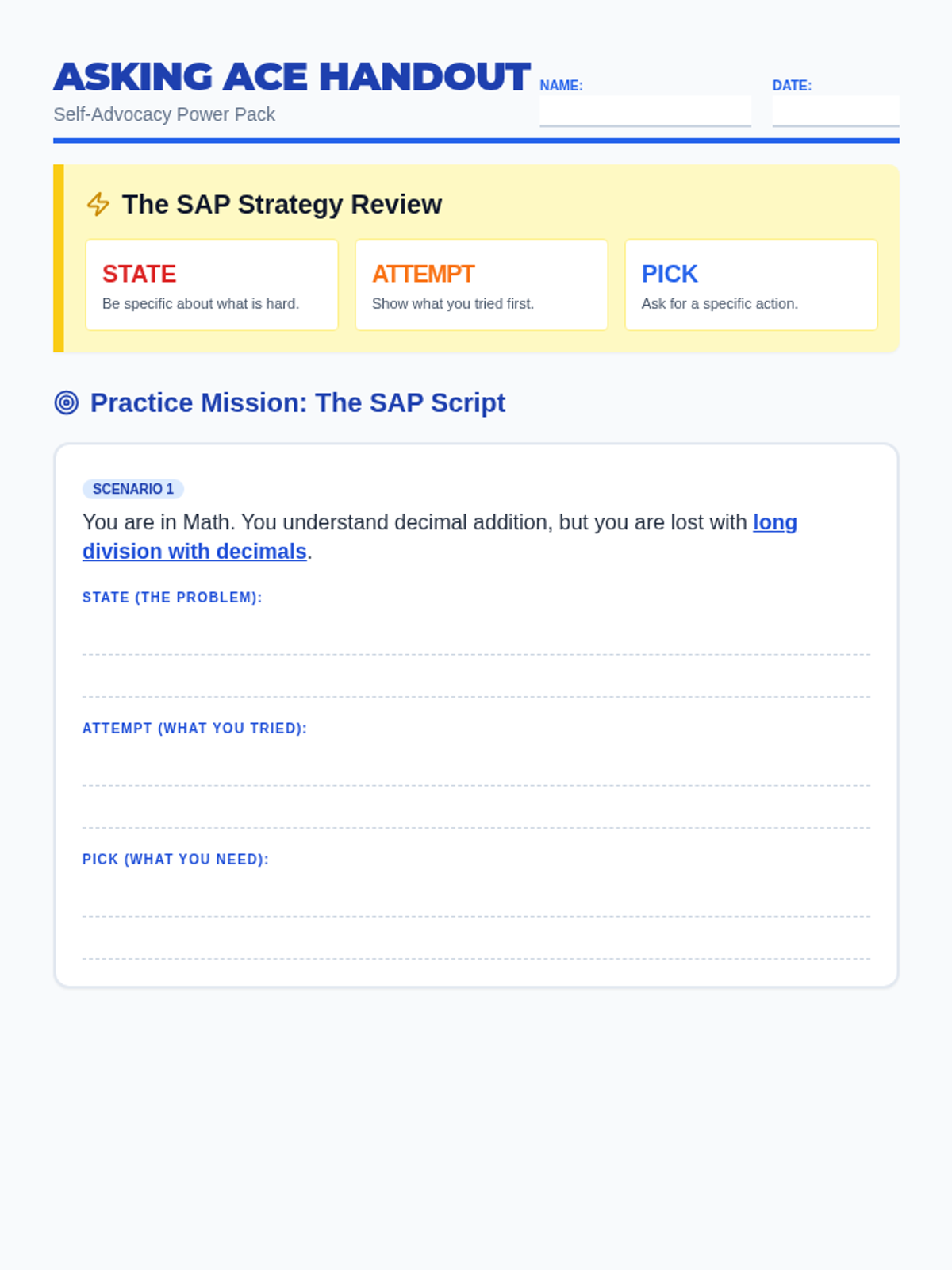
A student worksheet providing practice scenarios for applying the SAP self-advocacy strategy, including expanded writing space and a detachable pocket-sized help script.
A visual presentation introducing the 'SAP' (State, Attempt, Pick) method for self-advocacy, using a superhero theme to engage 6th-grade students. All text is at least 24px.
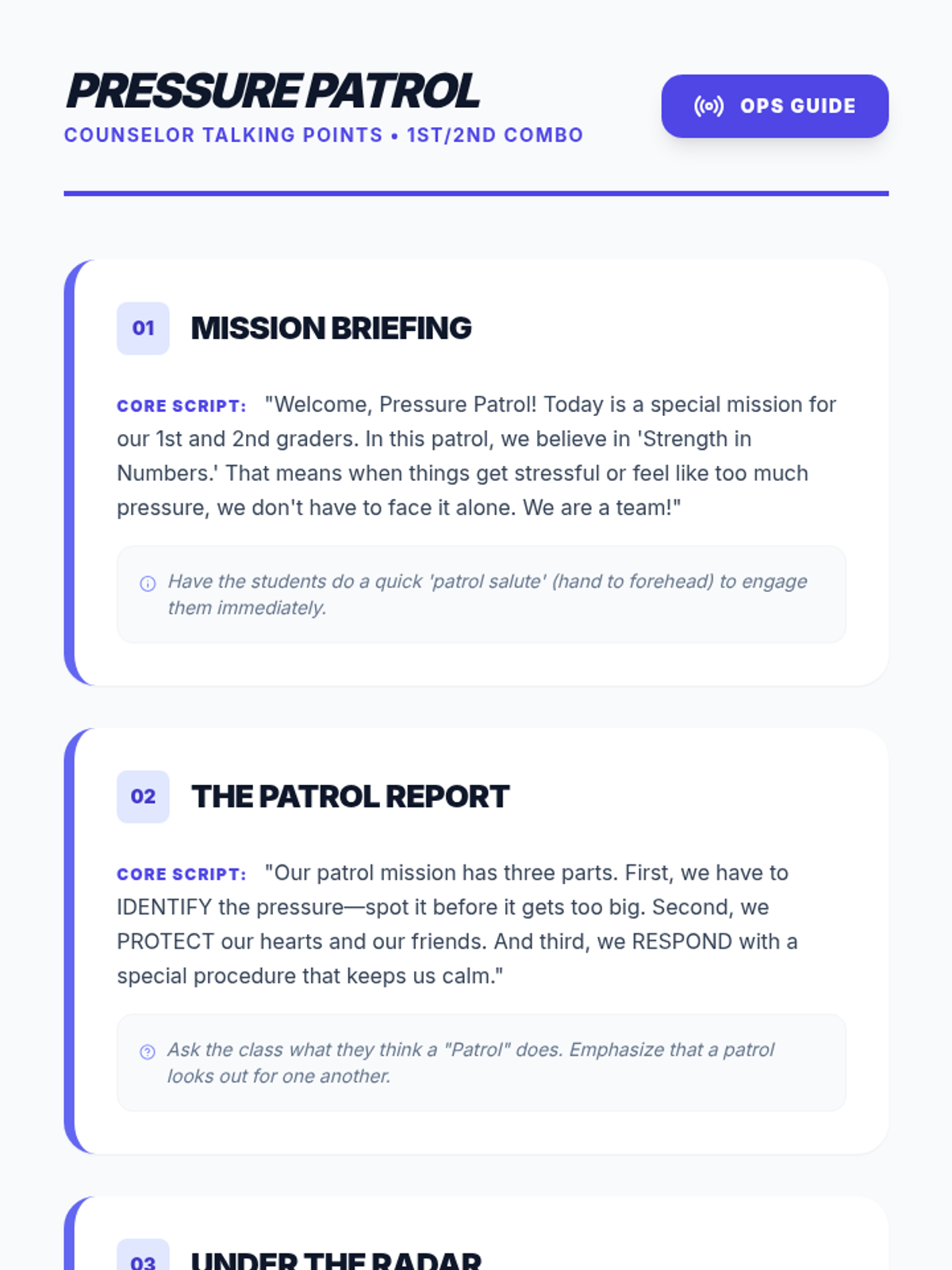
A detailed slide-by-slide facilitation guide for the 1st/2nd grade combo lesson 'Pressure Patrol'. Provides specific counselor scripts, interactive activity prompts, and pedagogical tips for each slide.
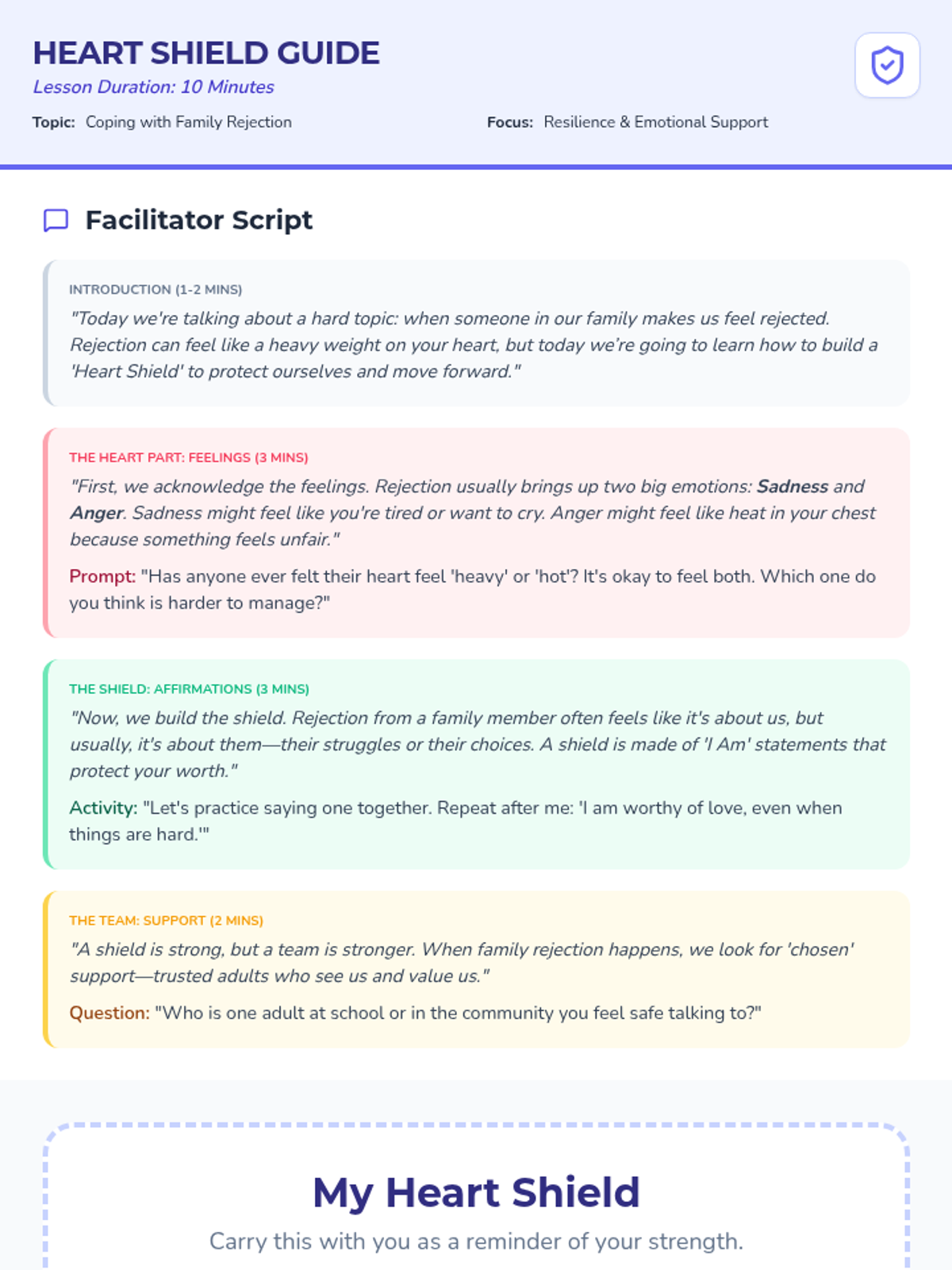
A teacher-facing instructional guide and printable student visual for the 'Heart Shield' lesson. Includes a 10-minute scripted discussion and an anchor chart poster with self-affirmations.
A 5-slide visual presentation for a 10-minute lesson on coping with family rejection. It covers emotional identification (Mad/Sad), self-affirmation strategies (The Shield), and identifying supportive adults.
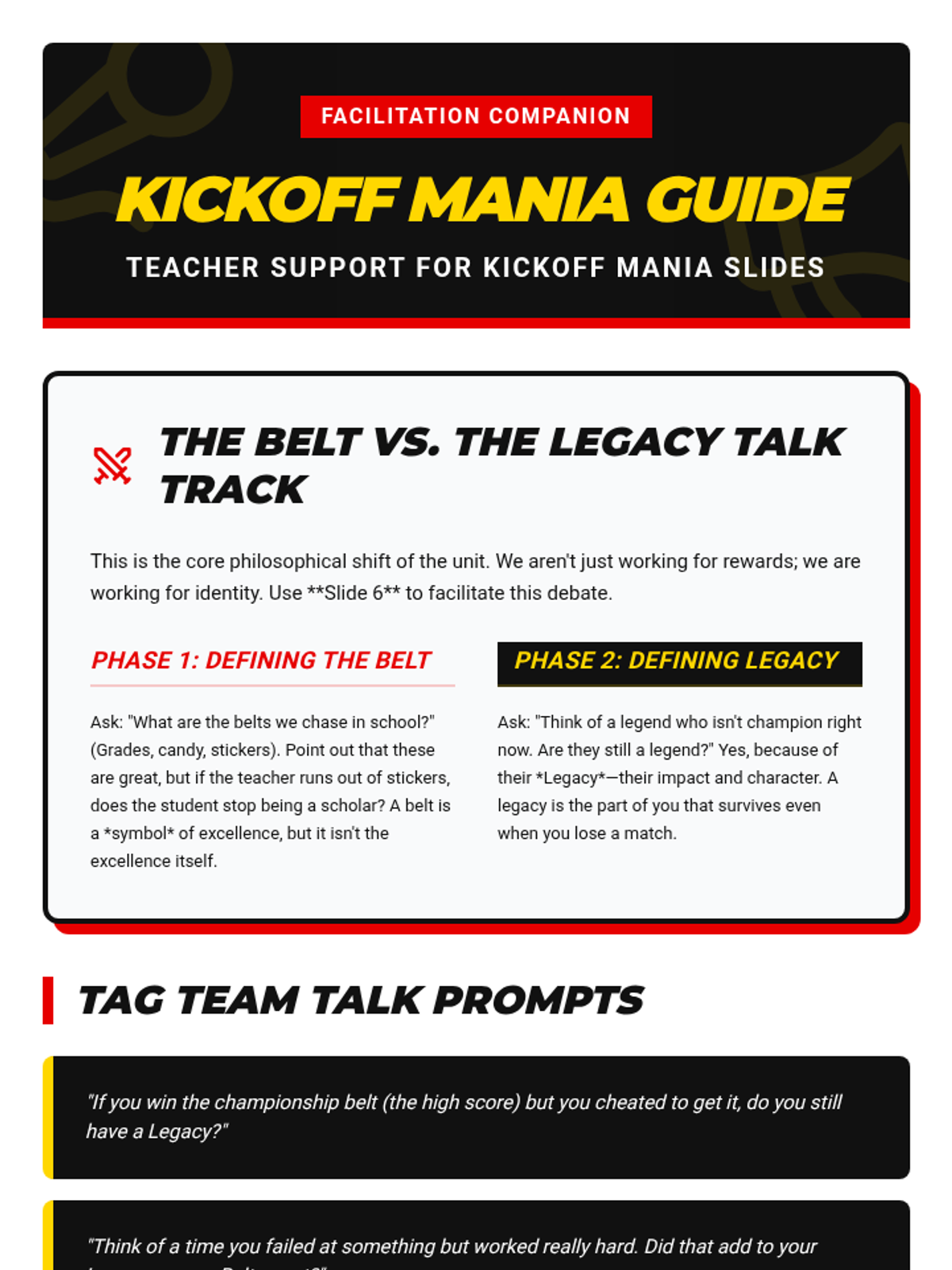
A detailed teacher facilitation companion for the Kickoff Mania slides, providing talk tracks for the 'Belt vs. Legacy' discussion, discussion prompts, and implementation steps for the Ubuntu mission.
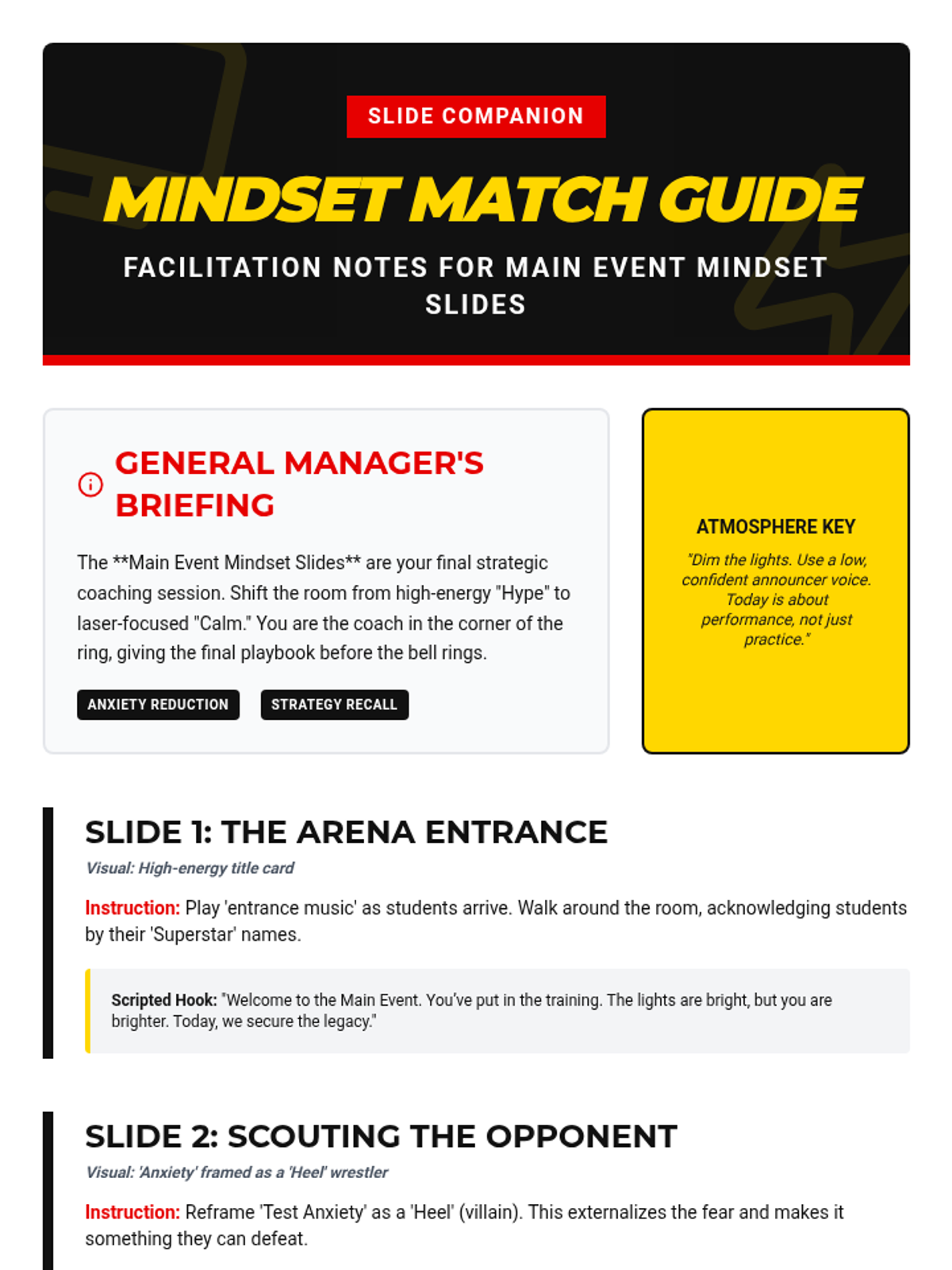
A teacher-facing companion guide for the 'Main Event Mindset' slides, providing slide-by-slide scripts, instructional instructions for managing test anxiety, and post-test decompression strategies.
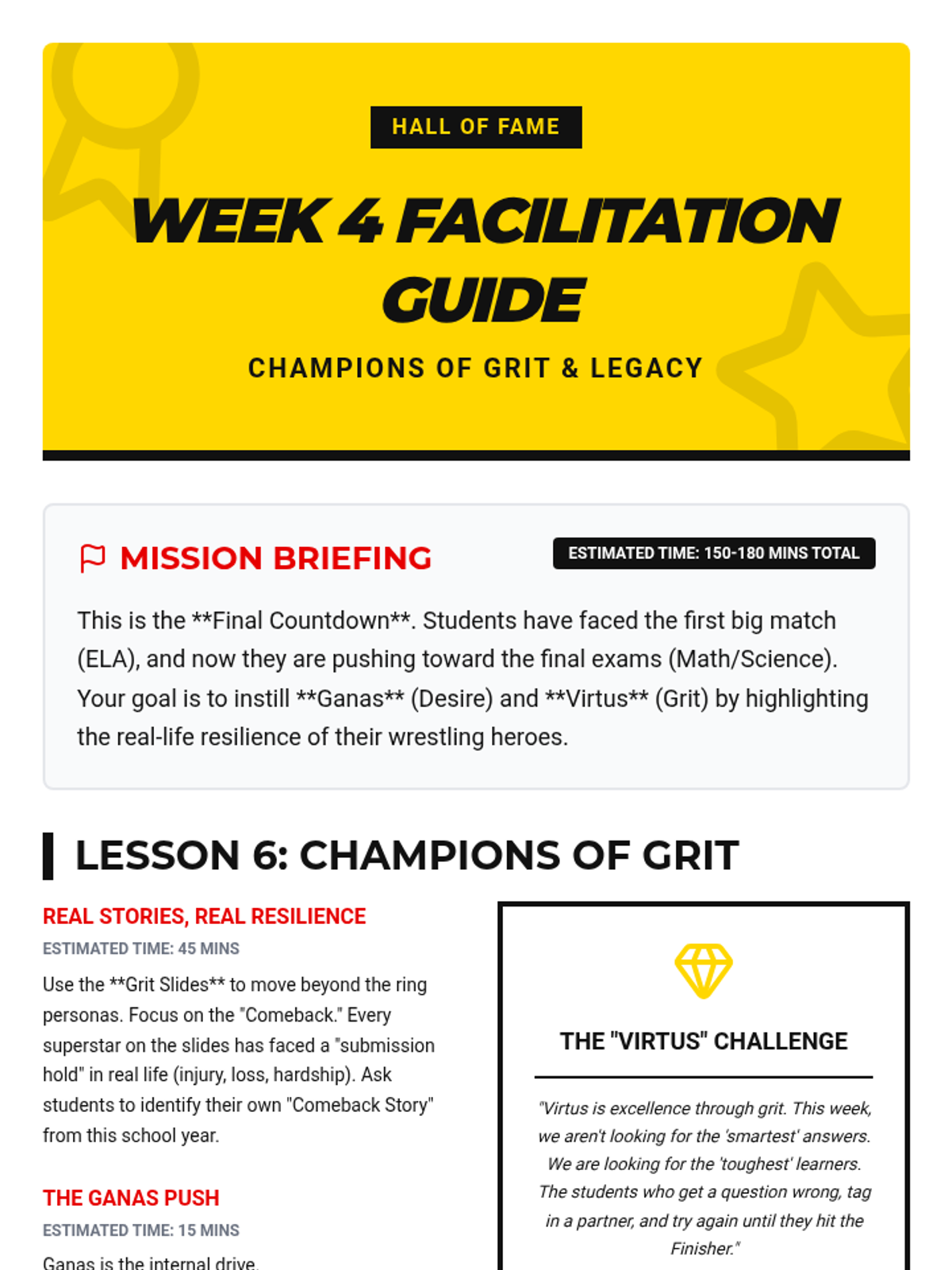
A detailed teacher facilitation guide for Week 4 of the 'Road to State Exam Mania' sequence, focusing on Ganas (drive) and Virtus (grit) for the final exam push and the 'Mania Gala' unit wrap-up.
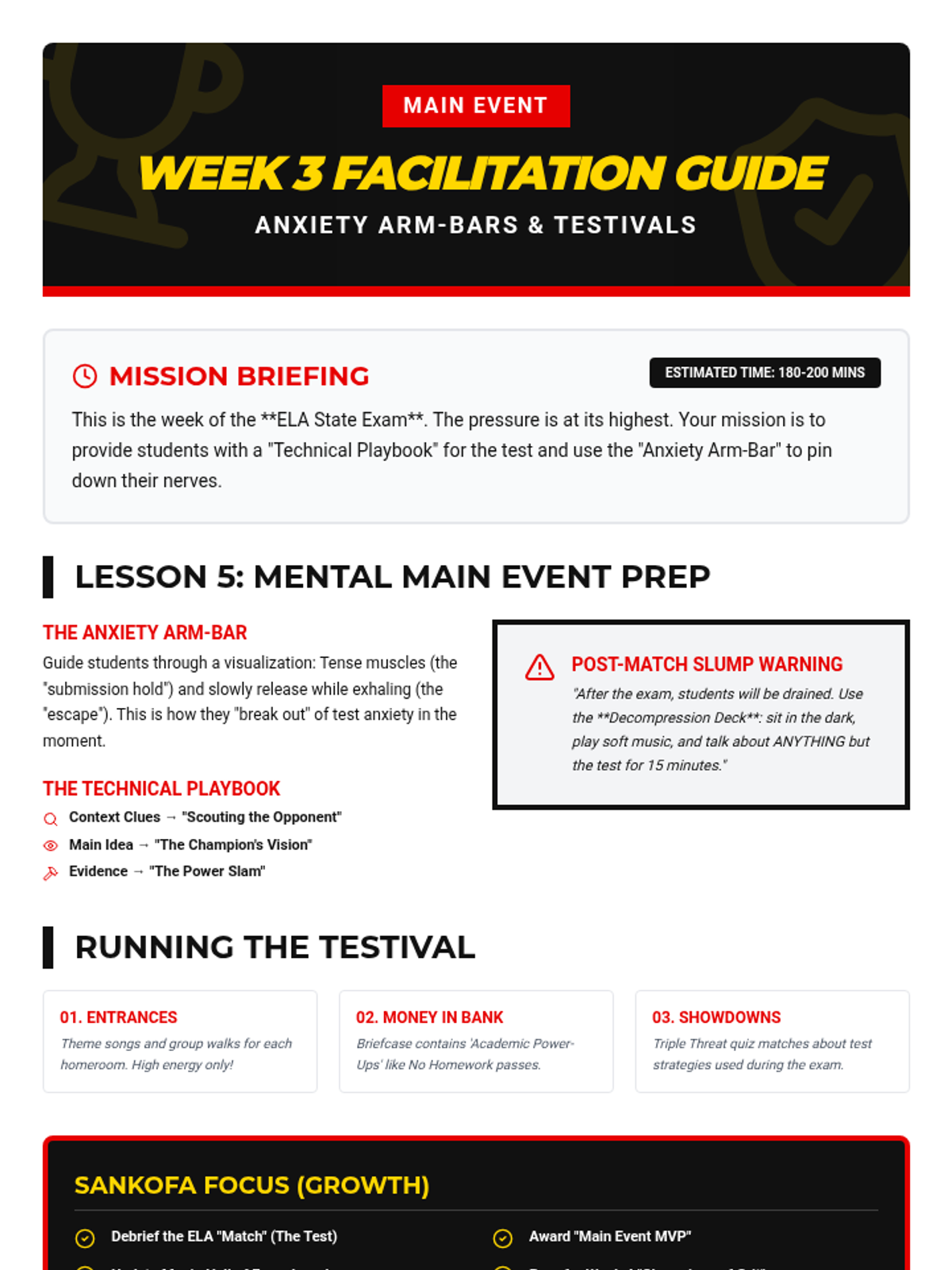
A detailed teacher facilitation guide for Week 3 of the 'Road to State Exam Mania' sequence, focusing on ELA state exam preparation and the 'Testival' pep rally.
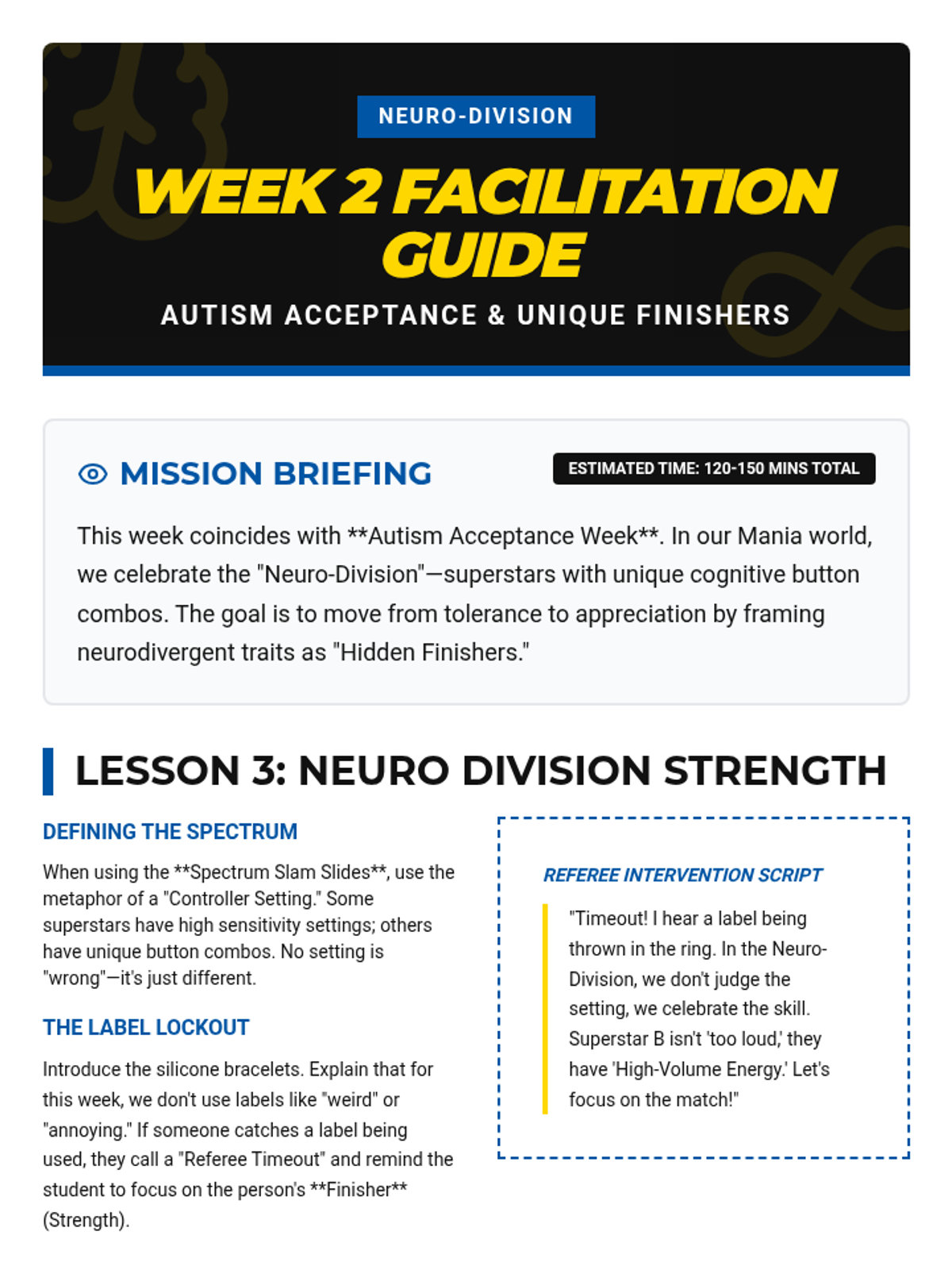
A detailed teacher facilitation guide for Week 2 of the 'Road to State Exam Mania' sequence, focusing on Autism Acceptance Week and celebrating neurodiversity.
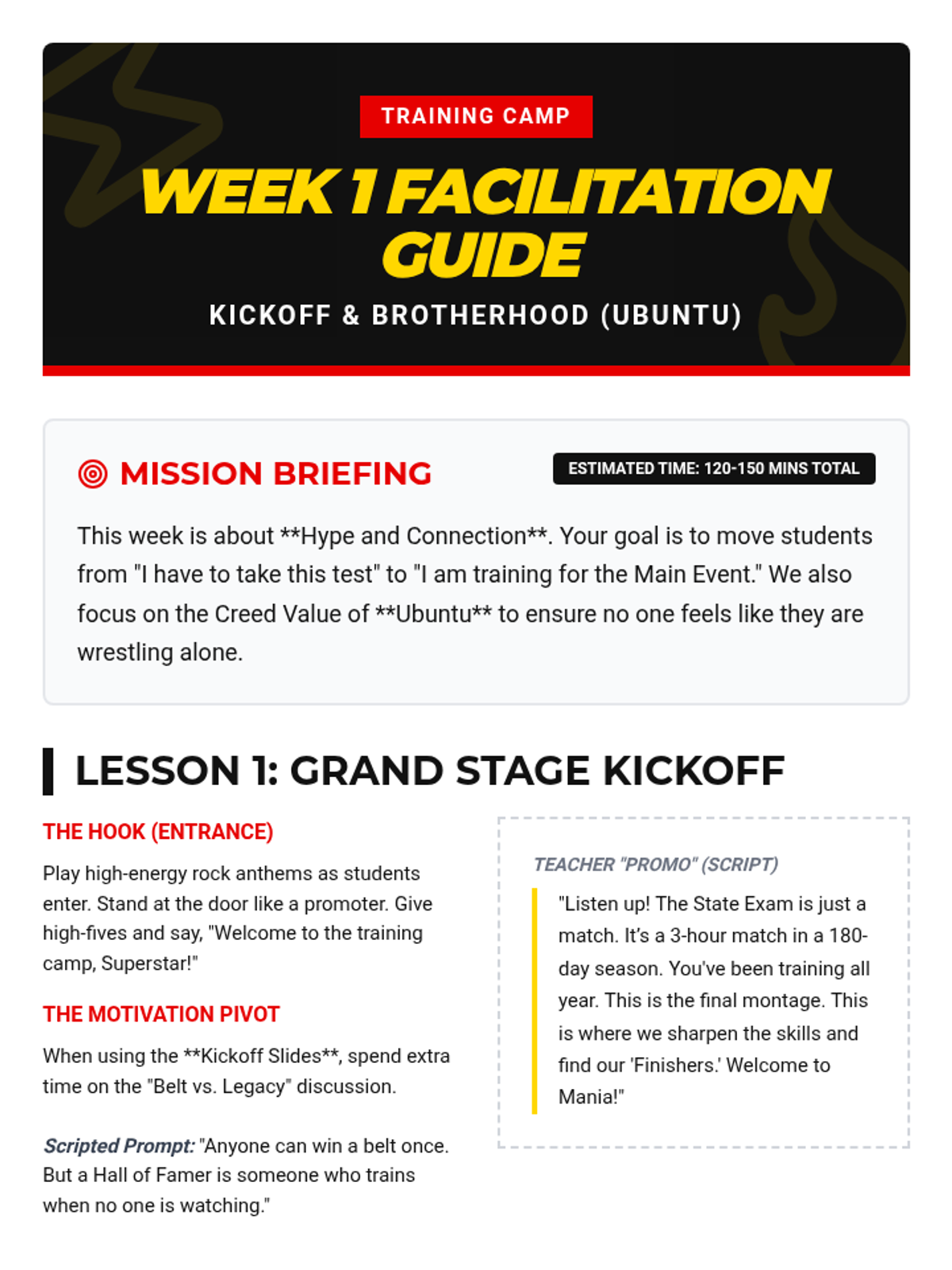
A detailed teacher facilitation guide for Week 1 of the 'Road to State Exam Mania' sequence, focusing on kickoff motivation and the Creed Value of Ubuntu.
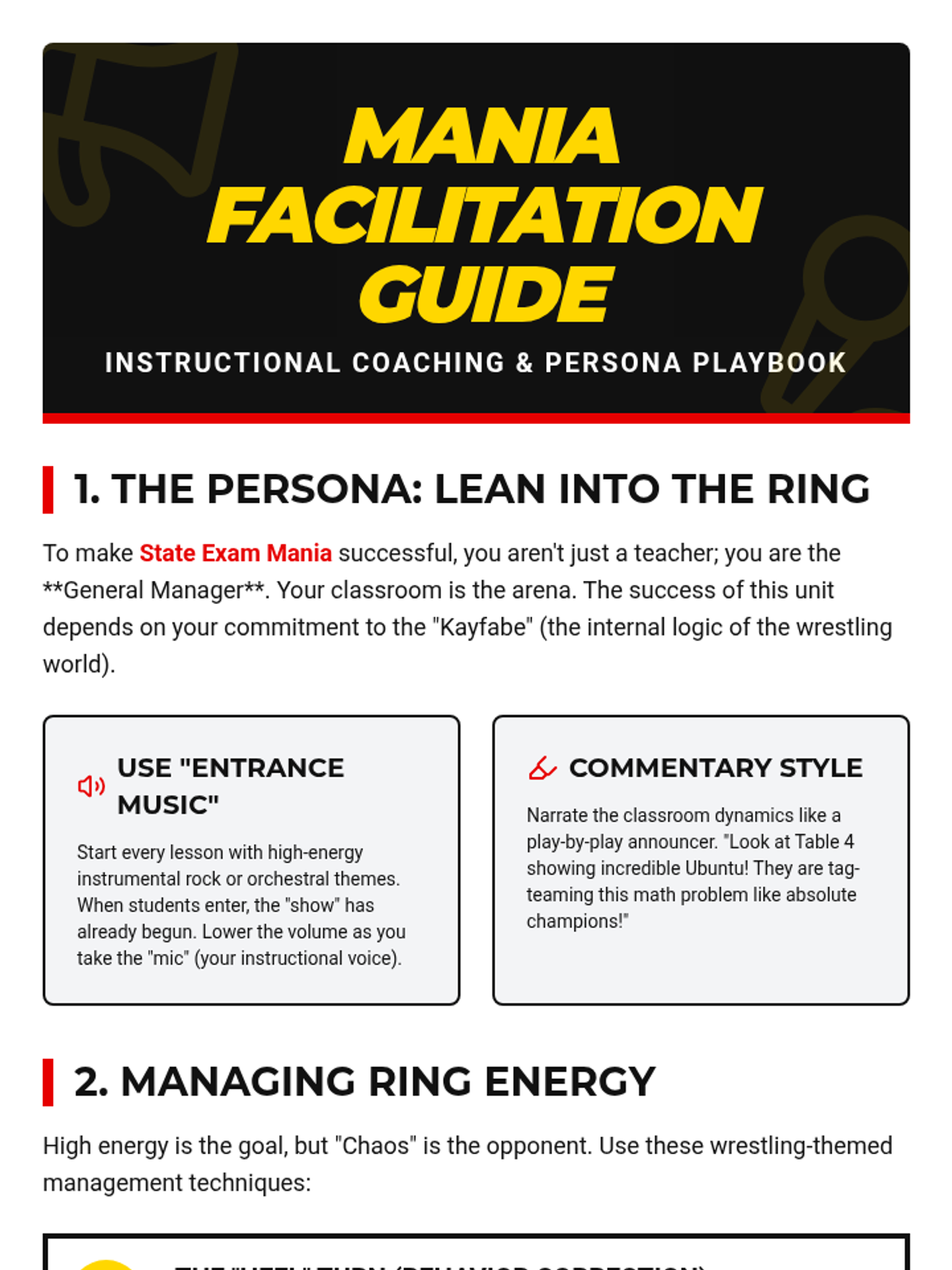
A comprehensive teacher facilitation guide for the 'Road to State Exam Mania' sequence, featuring persona coaching, behavior management strategies (using wrestling metaphors), lesson-specific tips, and a bank of discussion questions.
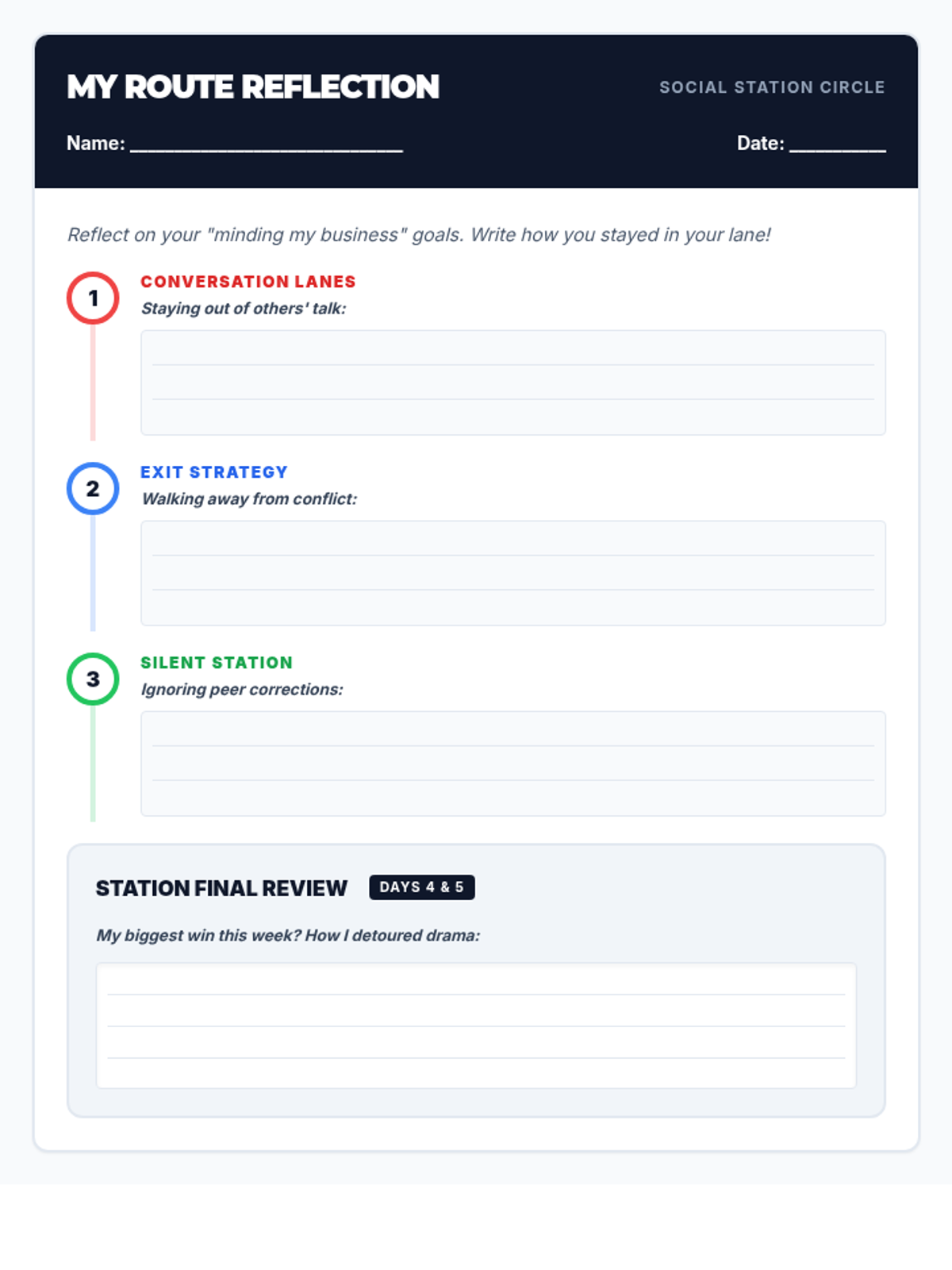
A student-facing reflection log for tracking daily progress on 'minding your business' social skills goals. Features large, readable text and guided writing lines. Fits on a single page.
Slide deck for Day 5 of community circles focusing on 'Focus Force' and avoiding distractions. Includes greeting, shout-outs, scenario practice, and Scattergories.
Slide deck for Day 4 of community circles focusing on 'Drama Detours' and avoiding rumors. Includes greeting, shout-outs, scenario practice, and Scattergories.
Slide deck for Day 3 of community circles focusing on 'The Silent Station' and ignoring peer corrections. Includes greeting, shout-outs, scenario practice, and Scattergories.
Slide deck for Day 2 of community circles focusing on 'The Exit Strategy' and walking away from conflict. Includes greeting, shout-outs, scenario practice, and Scattergories.
Slide deck for Day 1 of community circles focusing on 'Conversation Lanes' and staying out of others' talk. Includes greeting, shout-outs, scenario practice, and Scattergories.
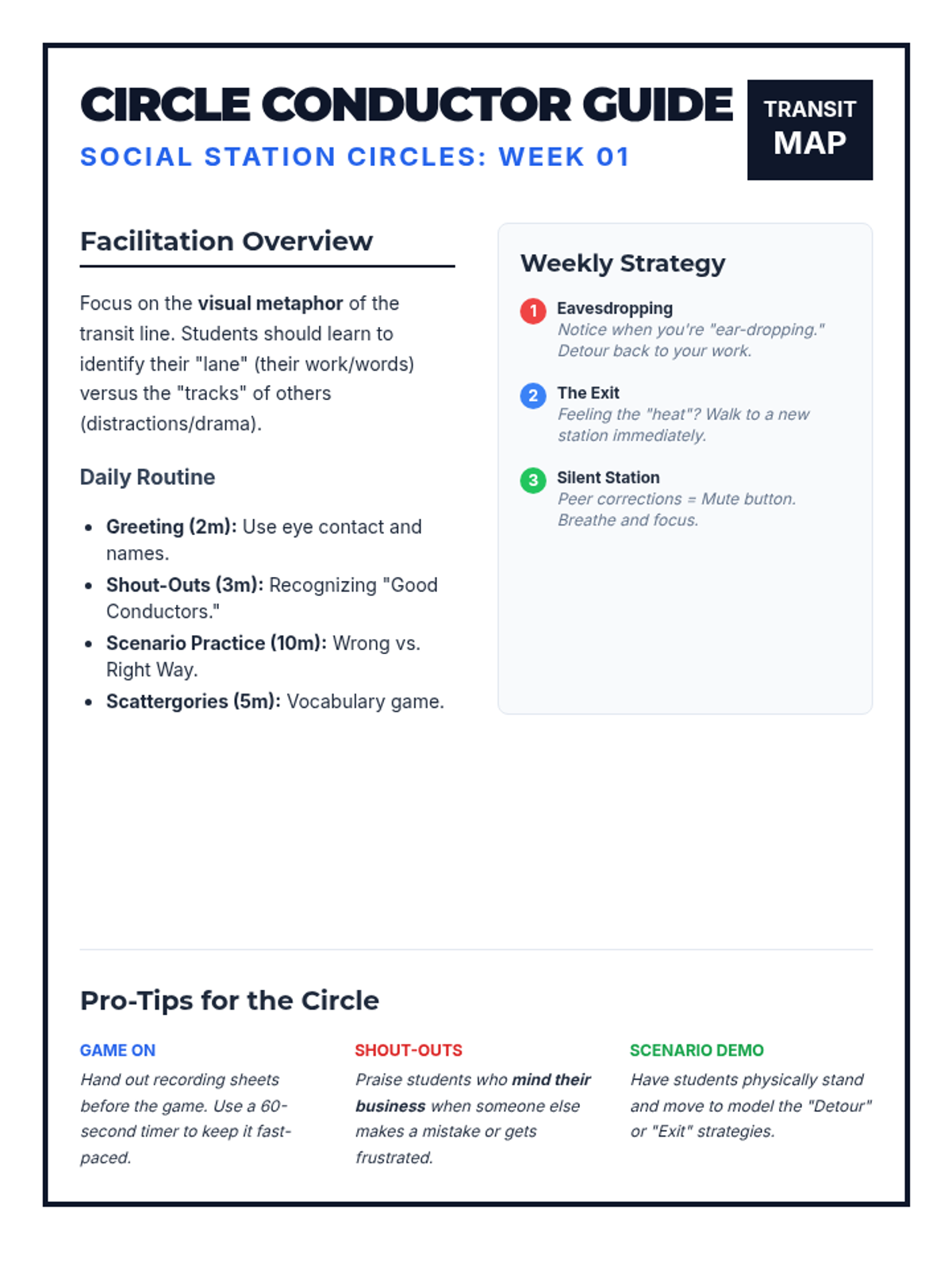
A comprehensive facilitation guide for the week of community circles, featuring instructional notes, scenario scripts for each day, and Scattergories master lists. Includes a student recording sheet.
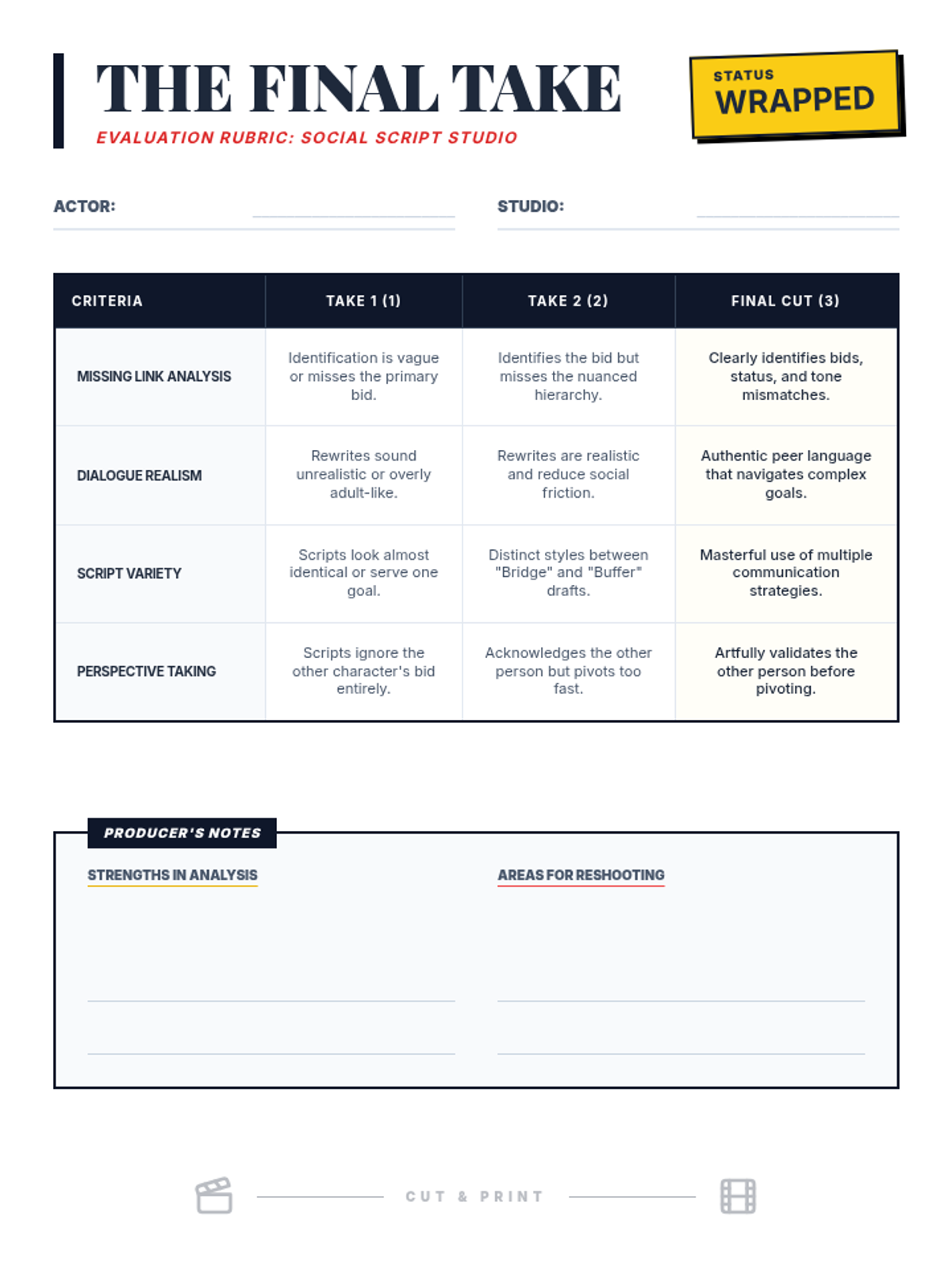
A performance evaluation rubric for the Social Script Studio lesson, assessing students on their ability to analyze communication "missing links," write realistic and effective scripts, and demonstrate flexibility in social responses.
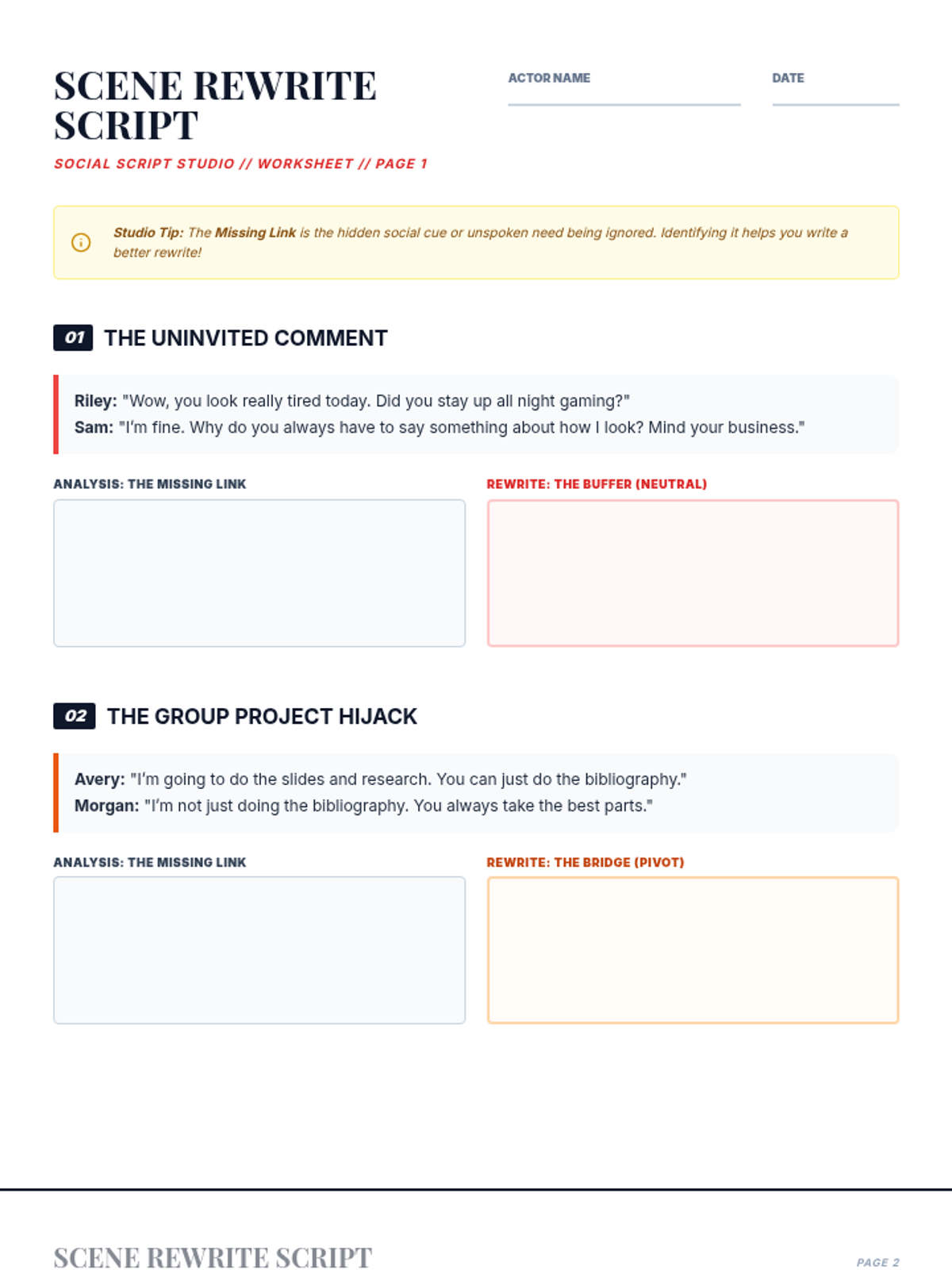
A student worksheet designed as a film script template where students analyze social friction in peer scenarios, identify the "Missing Link" in communication, and write alternative responses ("The Buffer", "The Bridge", "The Stand") to improve their pragmatic language skills. Now includes 5 expanded scenarios covering various peer conflict situations.
Instructional slides for the Social Script Studio lesson, utilizing a cinematic theme to teach students the "Friction Scale," how to identify "Missing Links" in social interactions, and strategies for scripting more effective peer communications. Now includes introductory slides explaining the "Missing Link" concept.
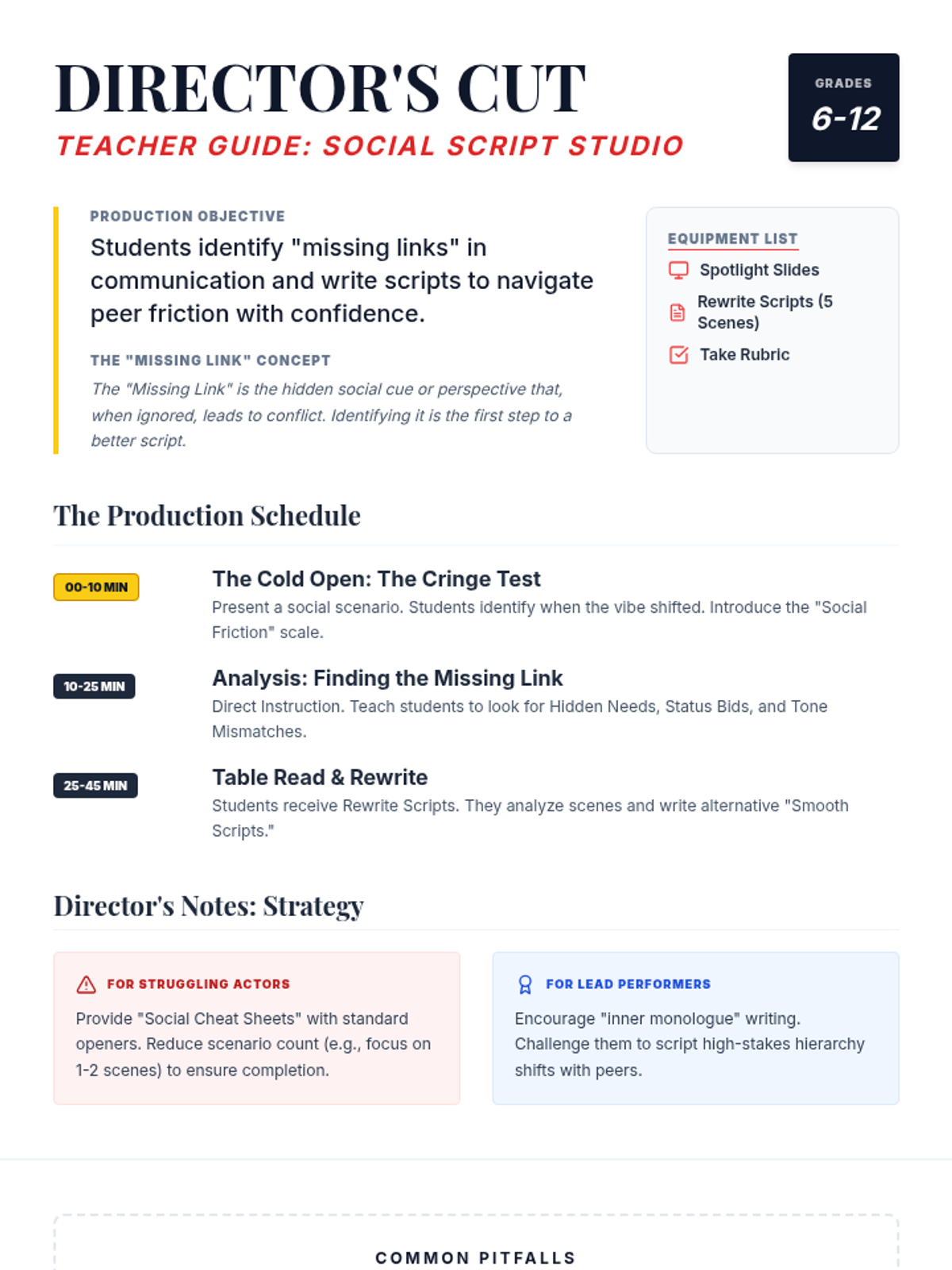
A comprehensive teacher guide for the Social Script Studio lesson, featuring a timed schedule, differentiation strategies, and tips for facilitating pragmatic language skills in grades 6-12. Now updated to include references to the expanded 5-scenario worksheet.
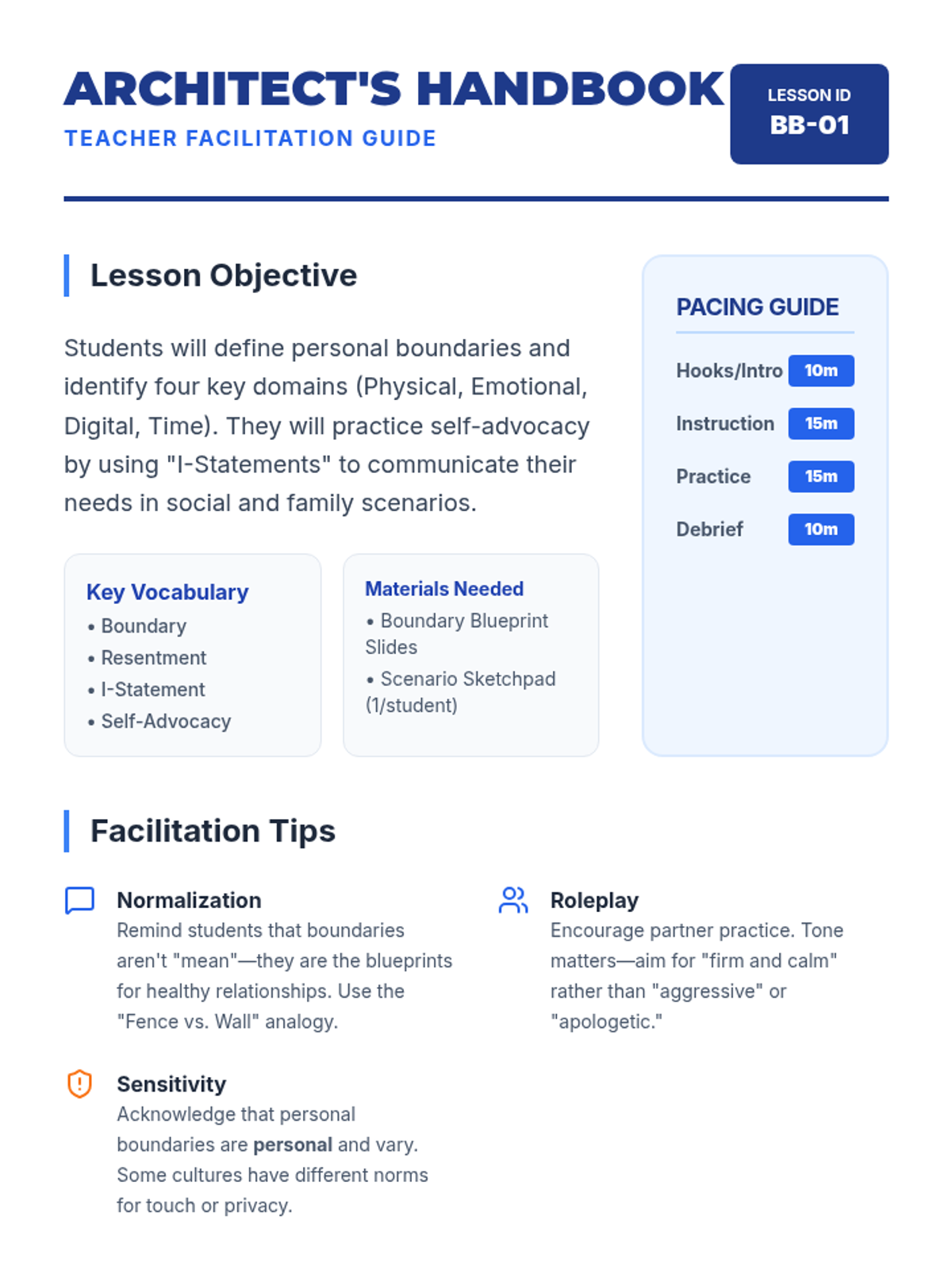
A teacher guide containing lesson objectives, pacing guides, facilitation tips, and a detailed discussion key. Improved alignment and readability.
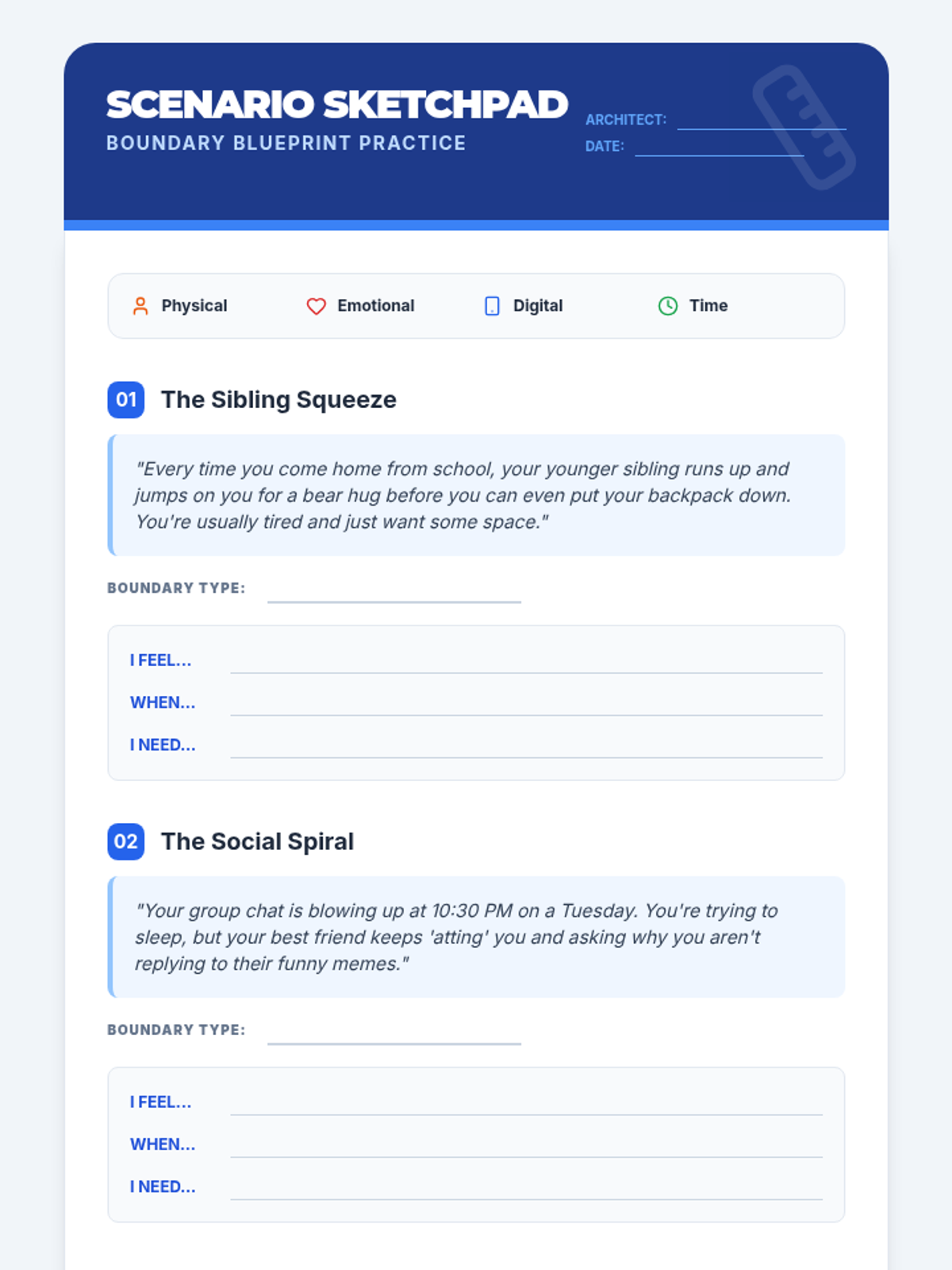
A practice worksheet with real-world scenarios for middle schoolers to identify boundary types and draft effective I-Statement responses. Corrected typo and improved layout.
A visual slide deck introducing the concept of personal boundaries, covering types of boundaries, emotional indicators, and the 'I-Statement' communication formula.
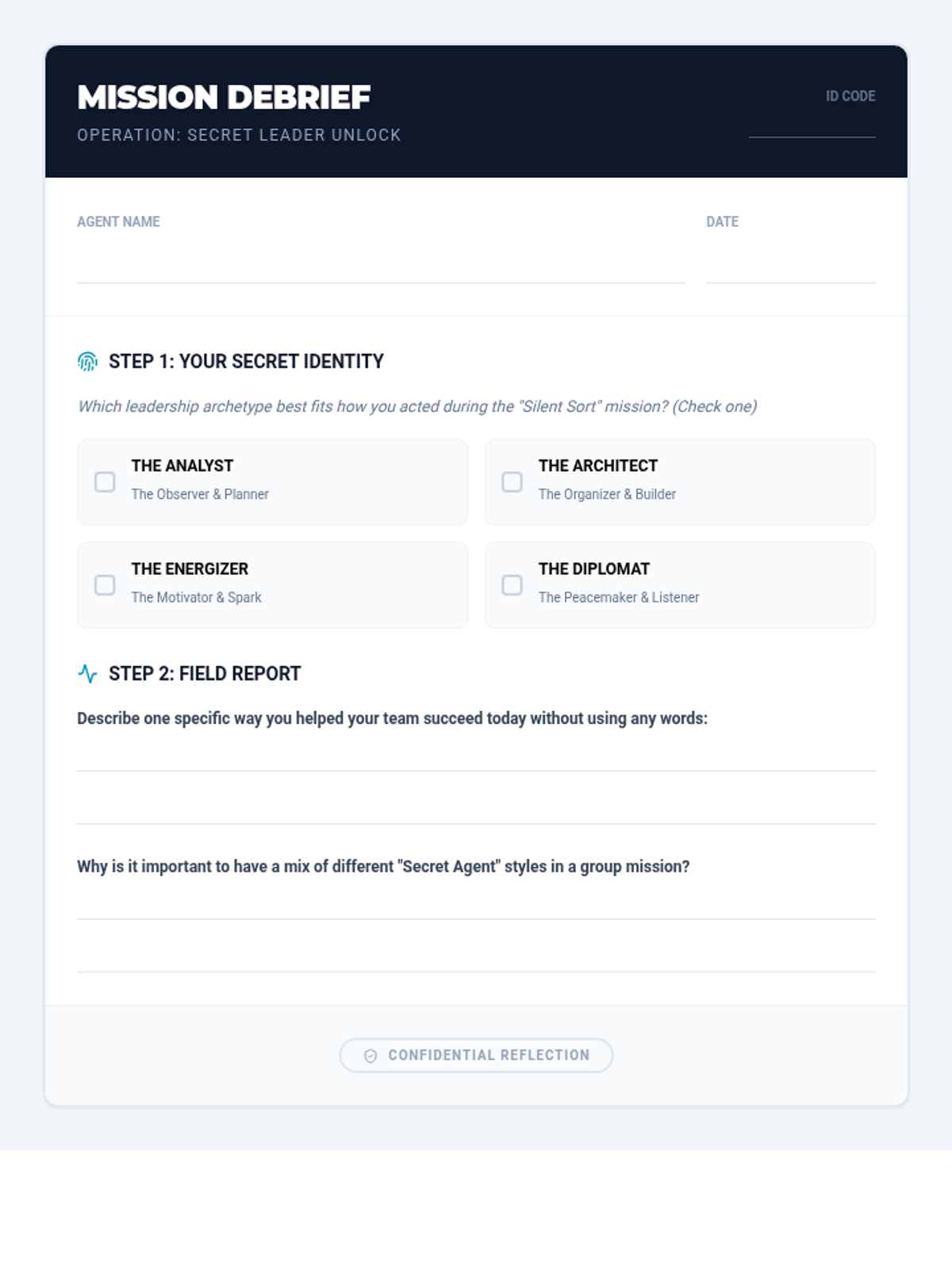
An exit ticket for the 'Secret Leader Unlock' lesson where students identify their leadership archetype and reflect on their contribution to the team challenge. Designed with a 'Mission Debrief' theme.
A visually striking presentation for middle school students on leadership styles. Features 4 leadership archetypes, a 5-minute silent challenge, and reflection prompts with a high-energy 'Secret Agent' theme.
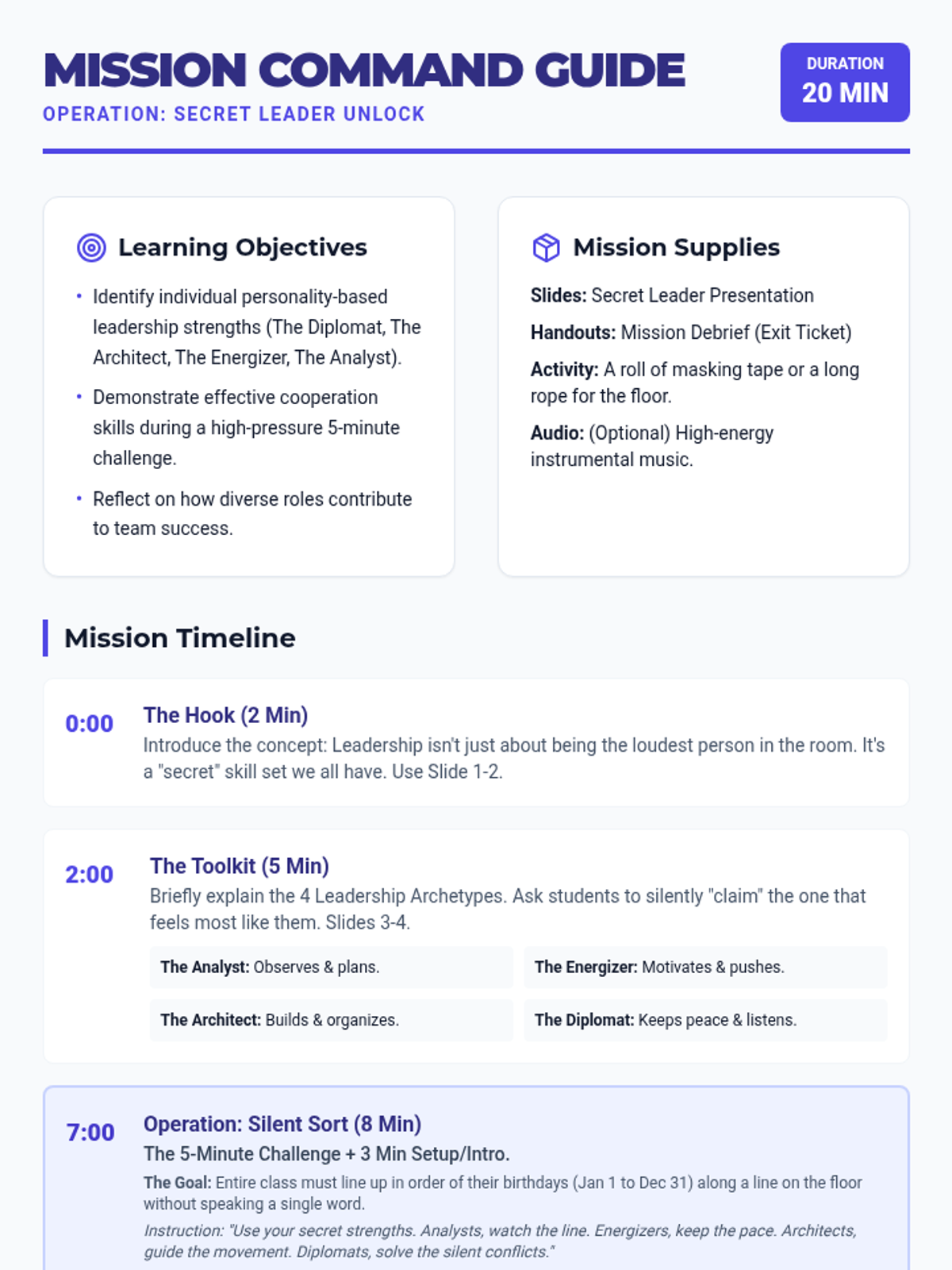
A 20-minute teacher guide for the 'Secret Leader Unlock' lesson, featuring a detailed pacing guide, learning objectives, and instructions for a 5-minute silent teamwork challenge.
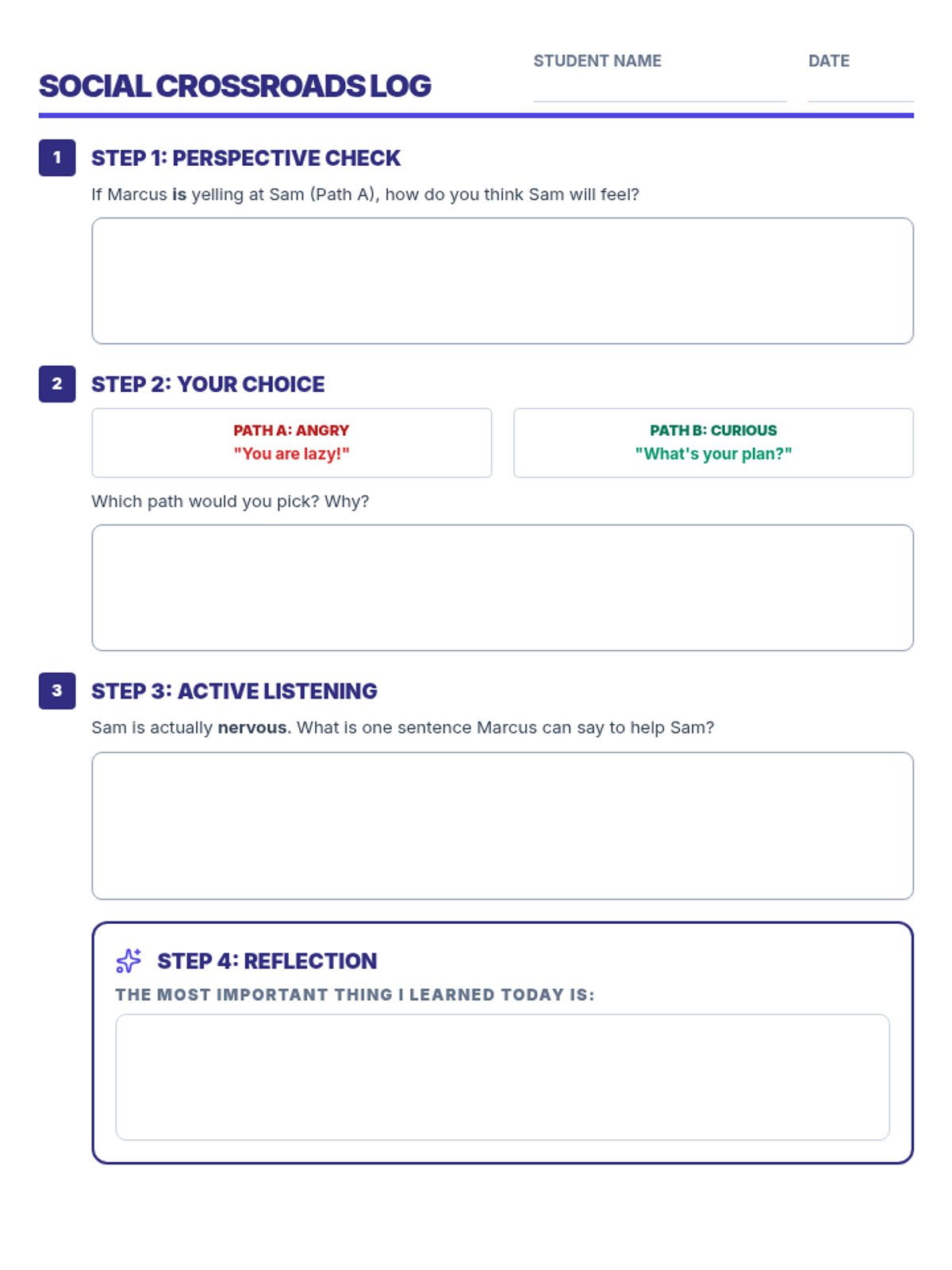
A student handout for the Social Crossroads lesson, providing space for students to record their choices, justify their decisions, and practice writing active listening responses.
An interactive slide deck presenting a social conflict scenario between two students, teaching perspective-taking and active listening through choice-based slides.
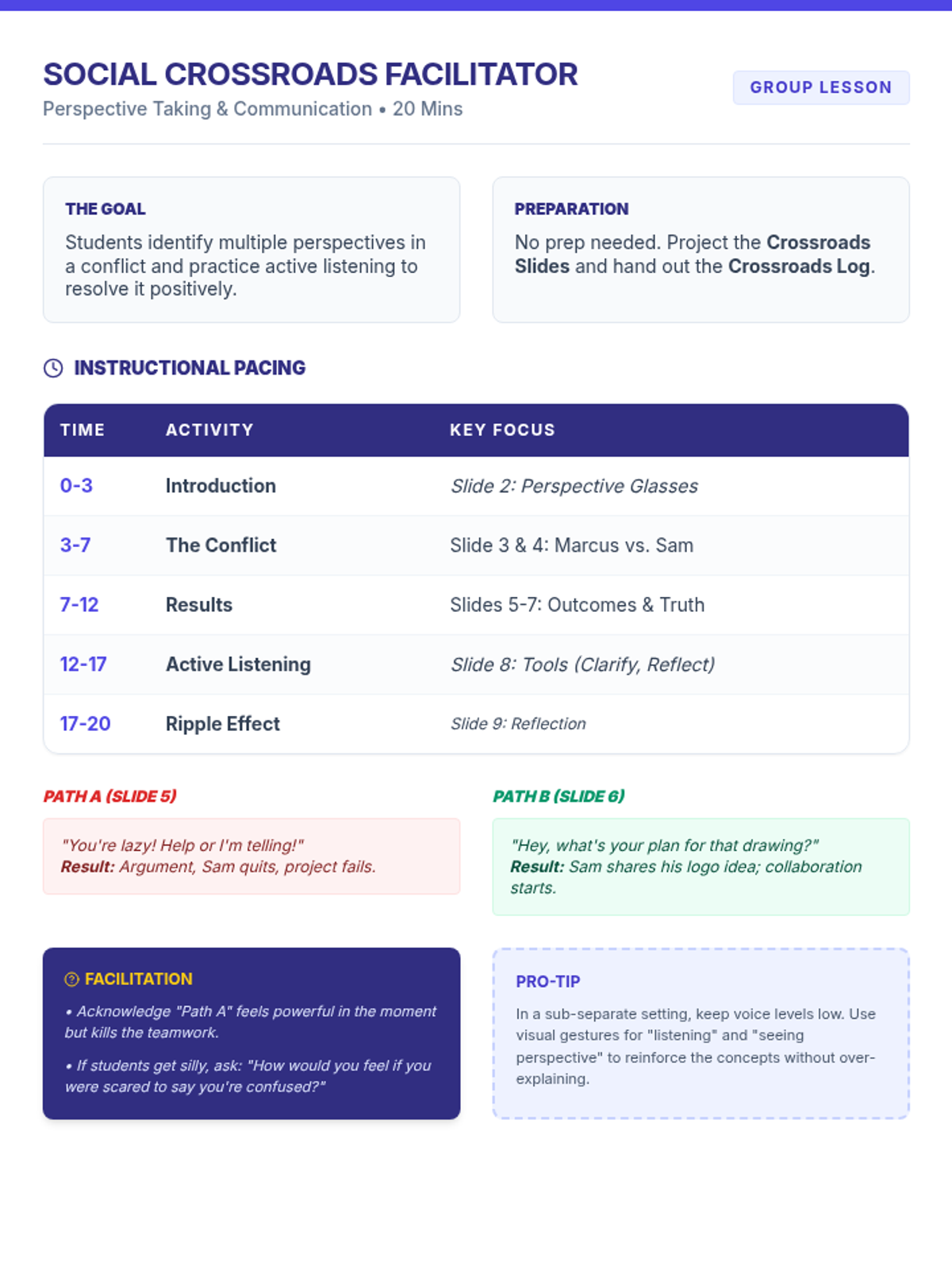
A teacher facilitation guide for the 20-minute Social Crossroads lesson, featuring a pacing guide, instructional tips for special education settings, and lesson objectives.
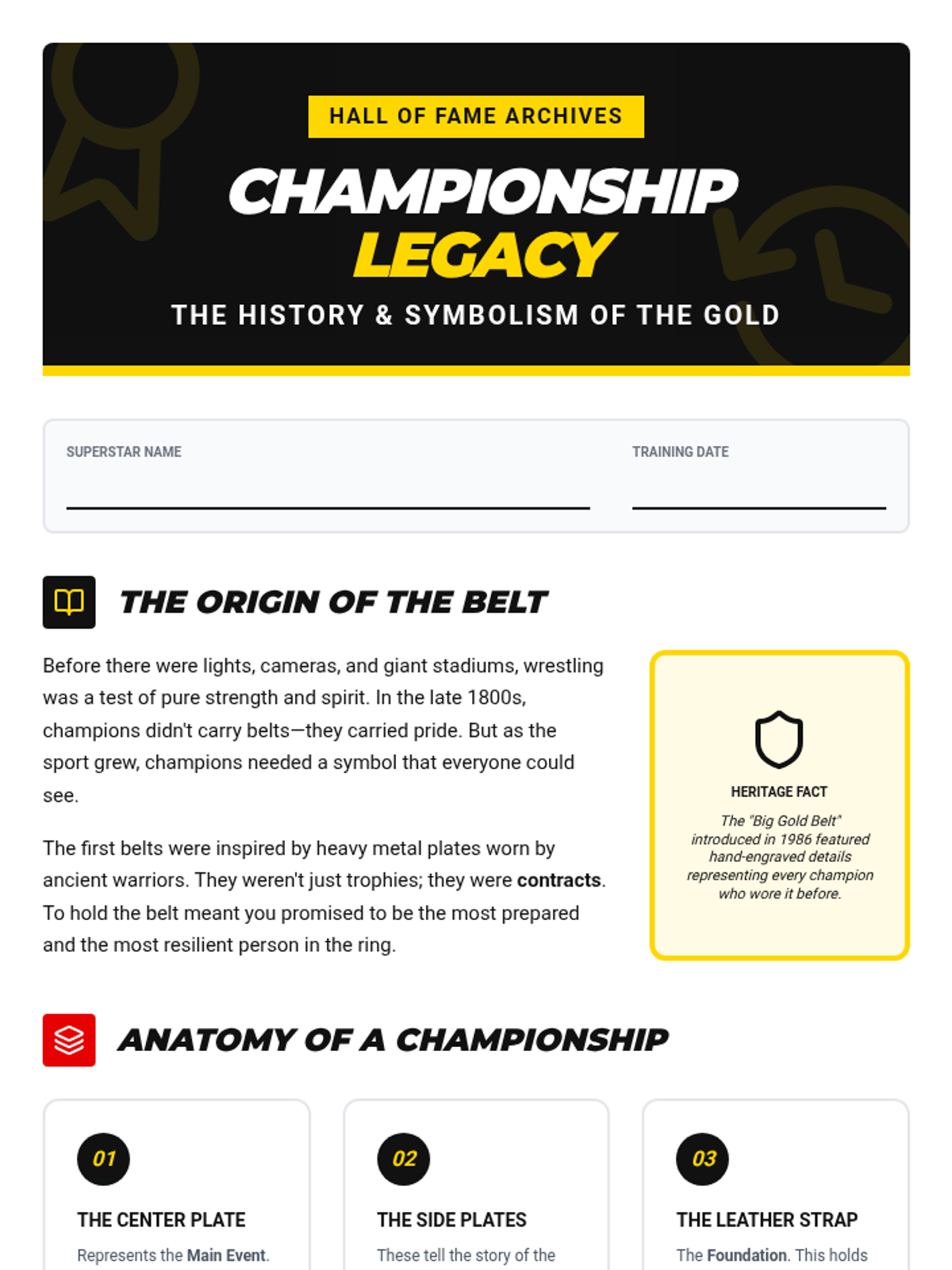
A student-facing reading and activity sheet exploring the history of wrestling championship belts, their symbolism, and how students can build their own academic legacy.
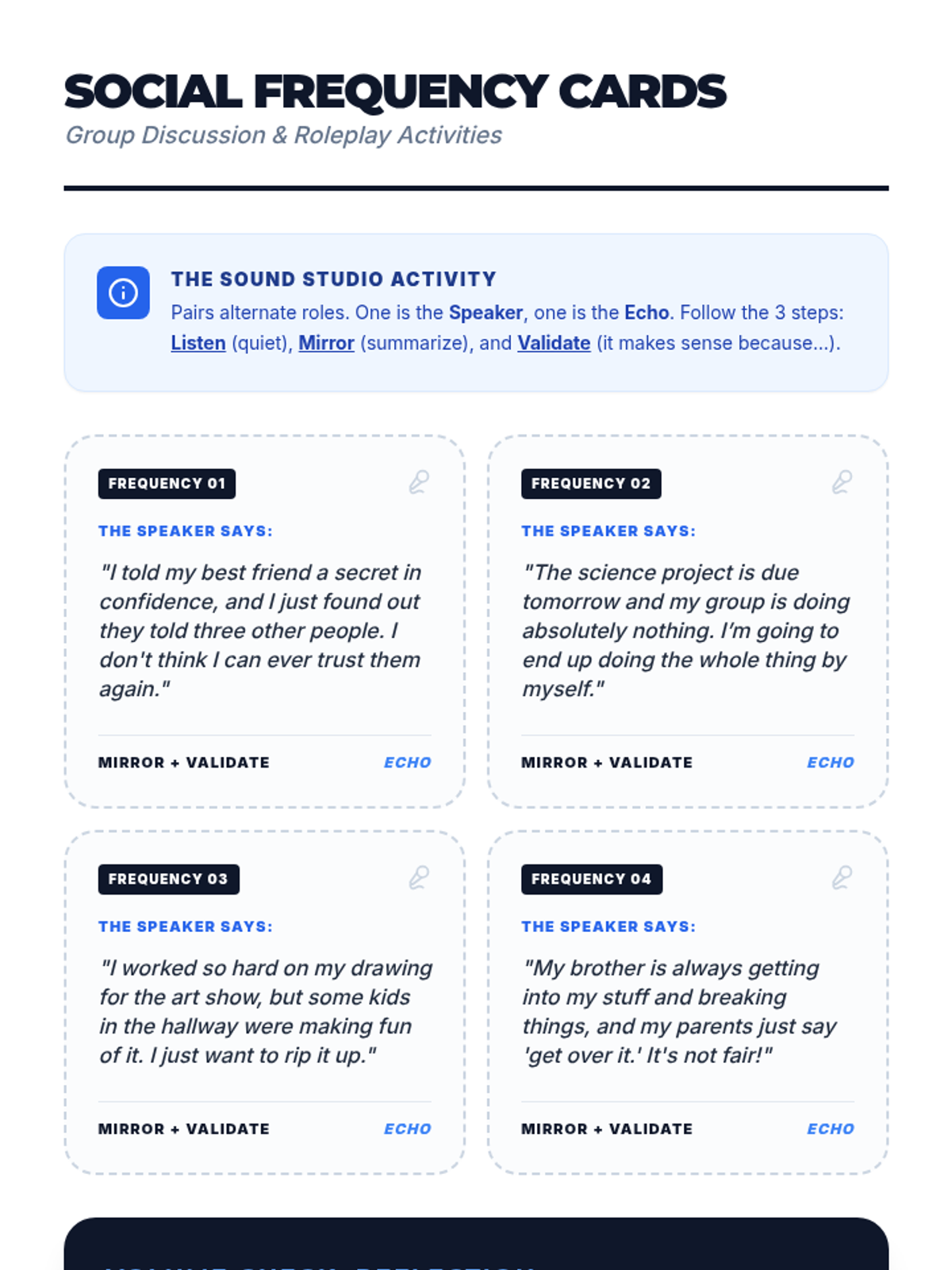
Social frequency roleplay cards for The Empathy Echo. Fixed page break issues and improved text contrast for card footers. Simplified step instructions for clarity.
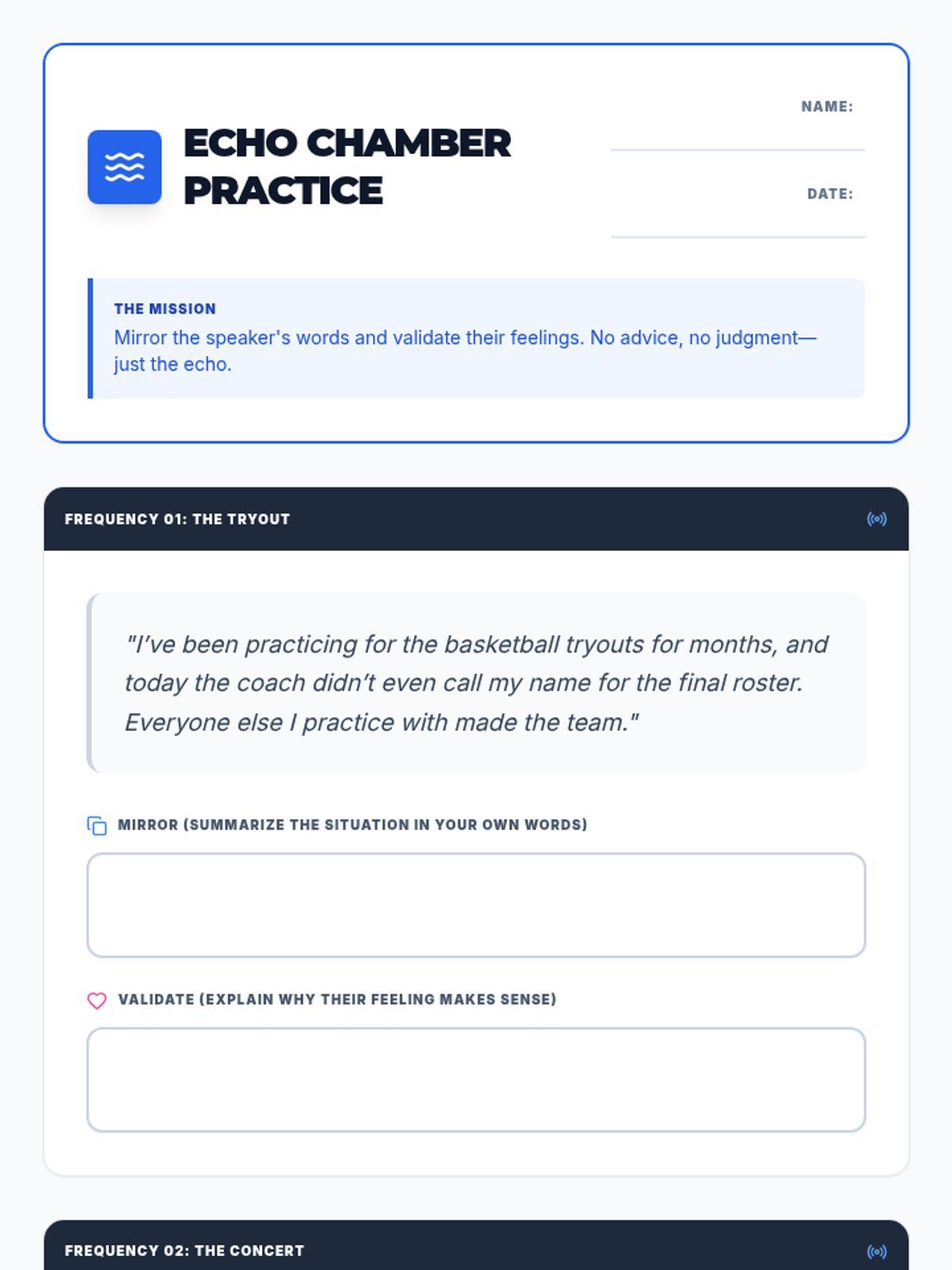
Student worksheet for The Empathy Echo. Increased writing space, improved label contrast, and lightened background for the reflection area to ensure legibility. Fixed page splits.
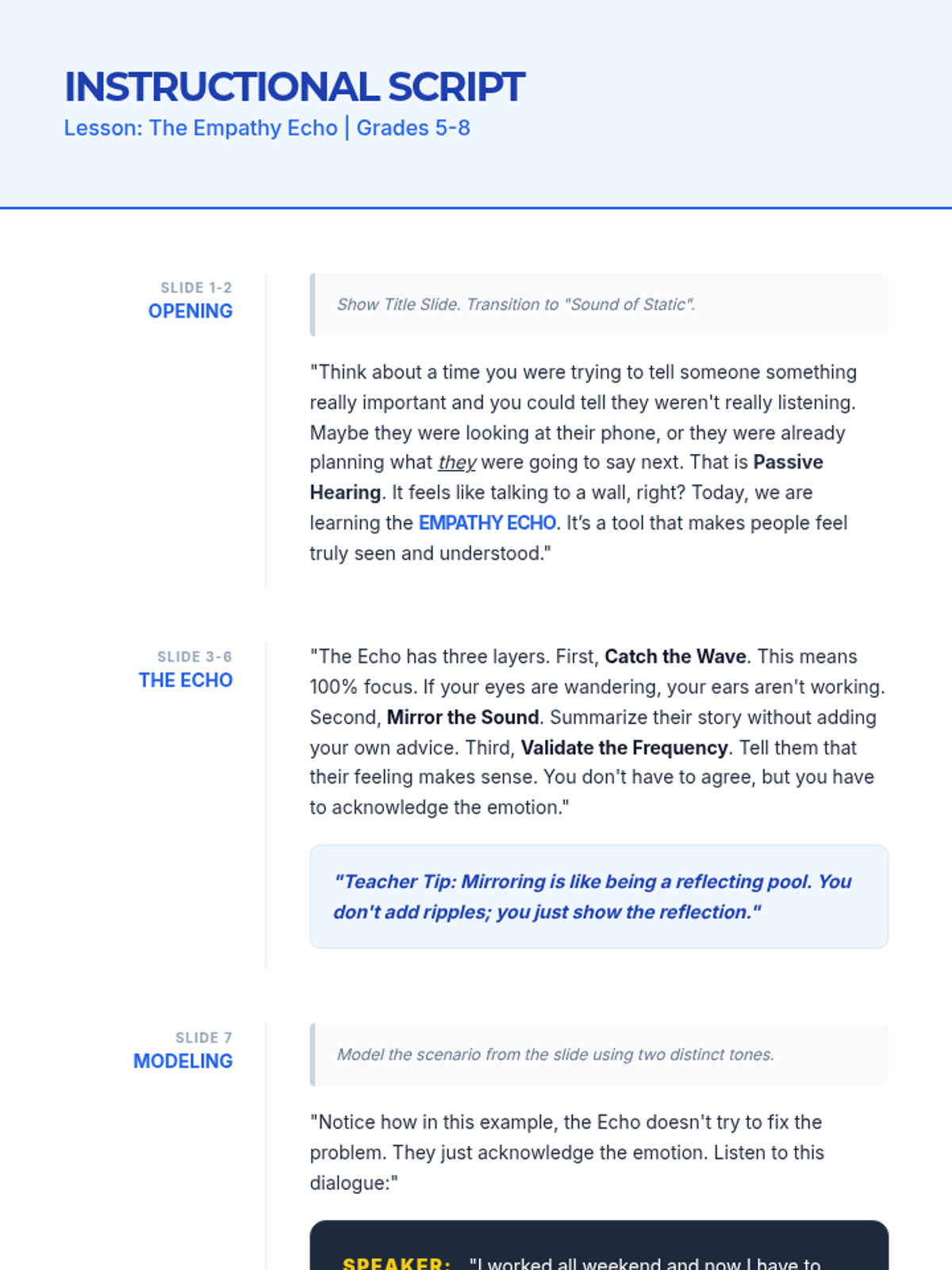
Instructional script for The Empathy Echo. Enhanced with troubleshooting tips, CFUs, and advanced extensions to provide a more comprehensive teacher guide. Fixes page-bleed issues.
A visual slide deck for teaching the Empathy Echo technique. Updated with minor kerning fixes and improved text layout.
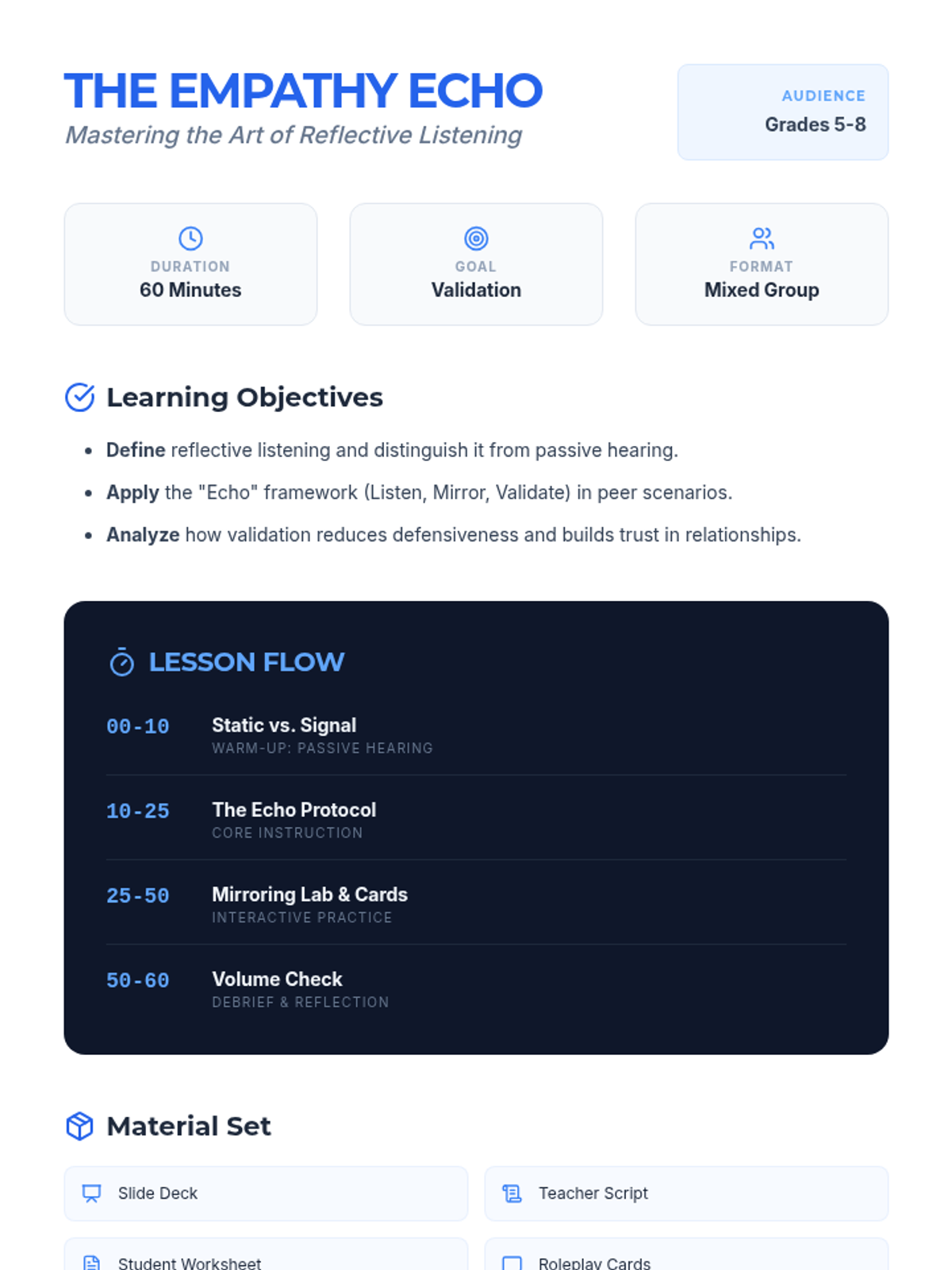
Teacher's guide and lesson plan for The Empathy Echo, focusing on reflective listening and emotional validation for middle school students. Fixes page breaks and clarifies material structure.
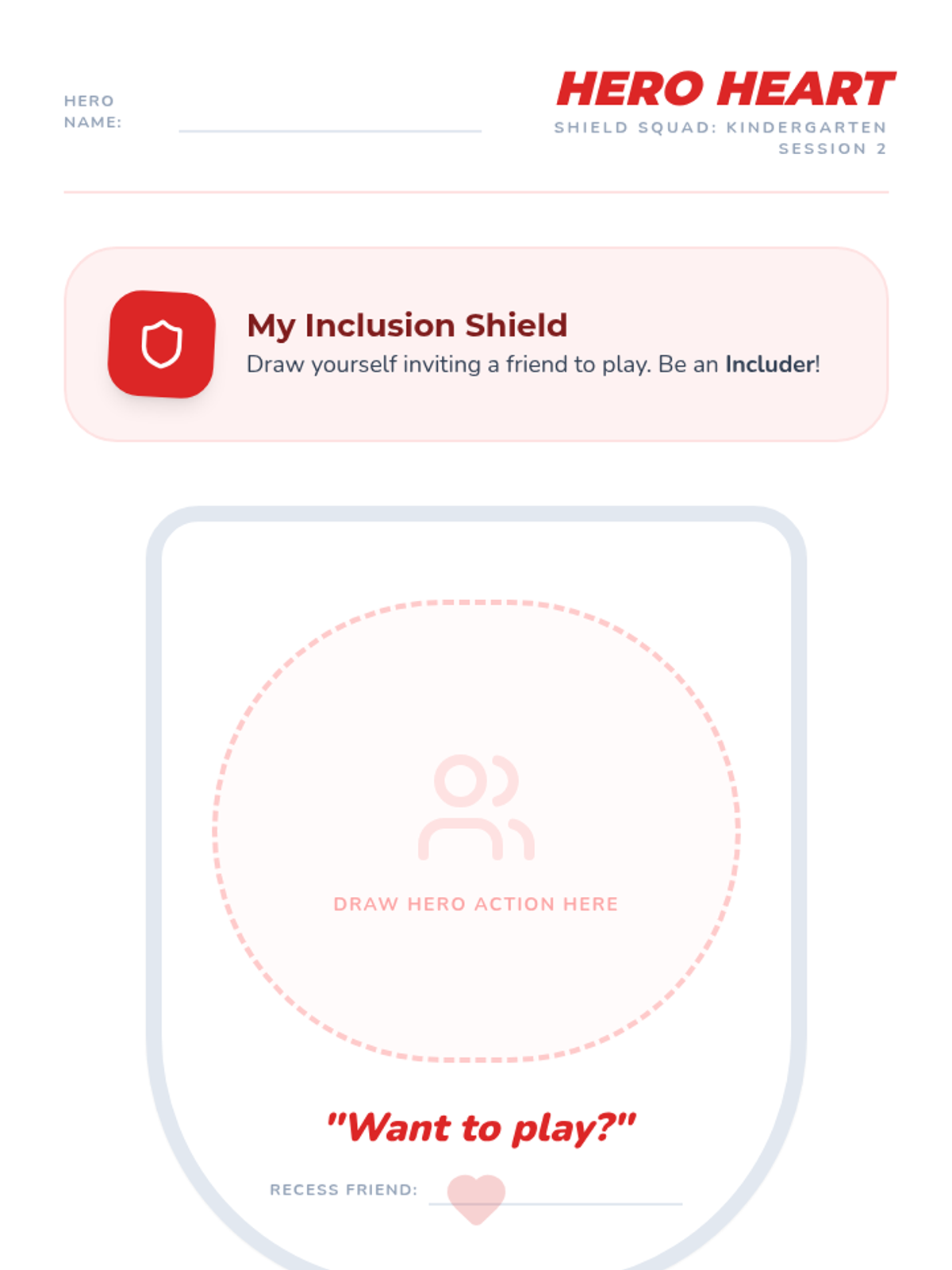
A creative drawing and strategy reinforcement worksheet for Kindergarten. Features a large shield area for students to draw inclusive actions and reminders for the Stop-Walk-Talk strategy.
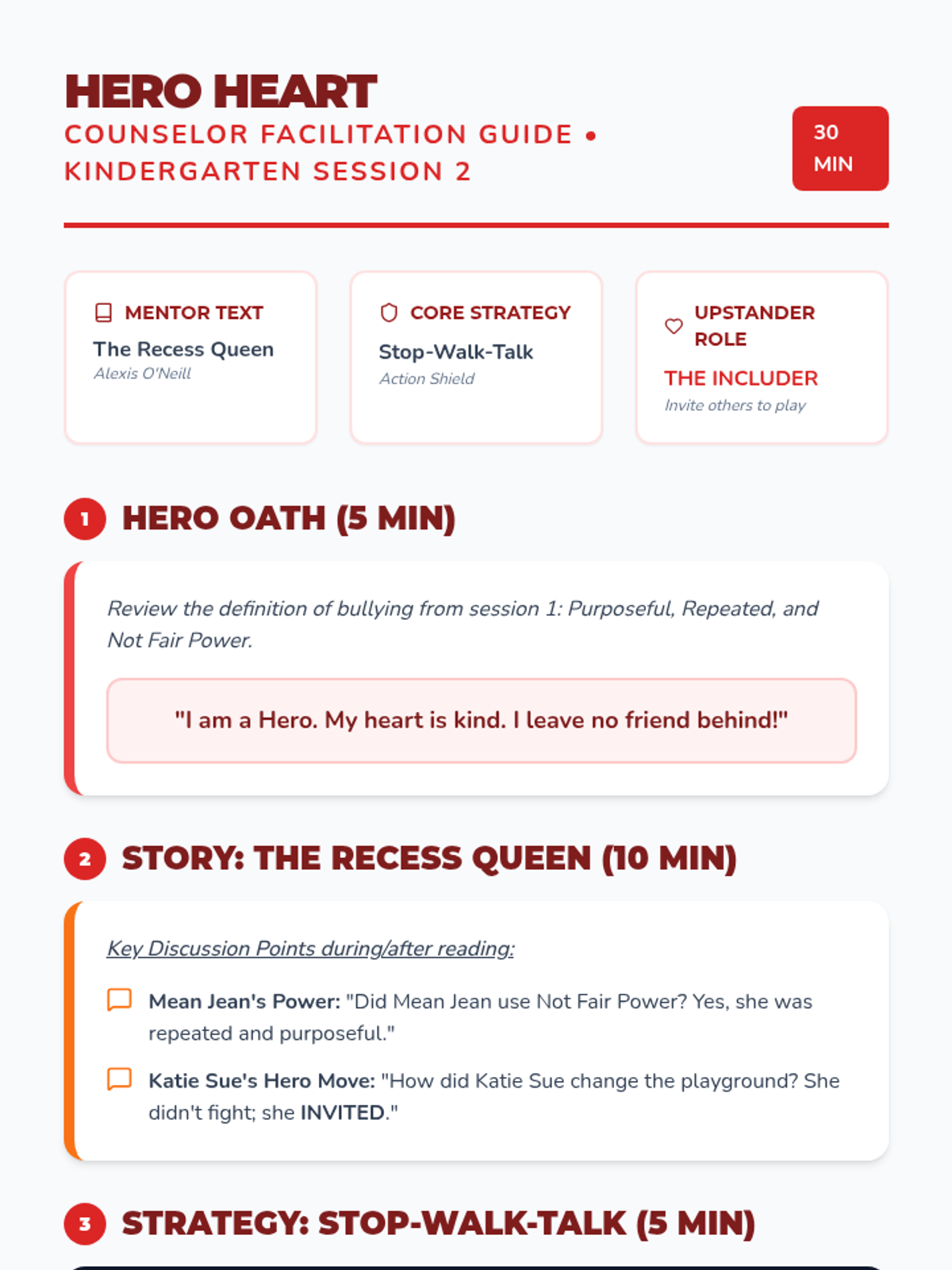
Counselor guide for Kindergarten using 'The Recess Queen' by Alexis O'Neill. Includes lesson script, Stop-Walk-Talk strategy review, and instructions for the Hero Heart Shield activity.
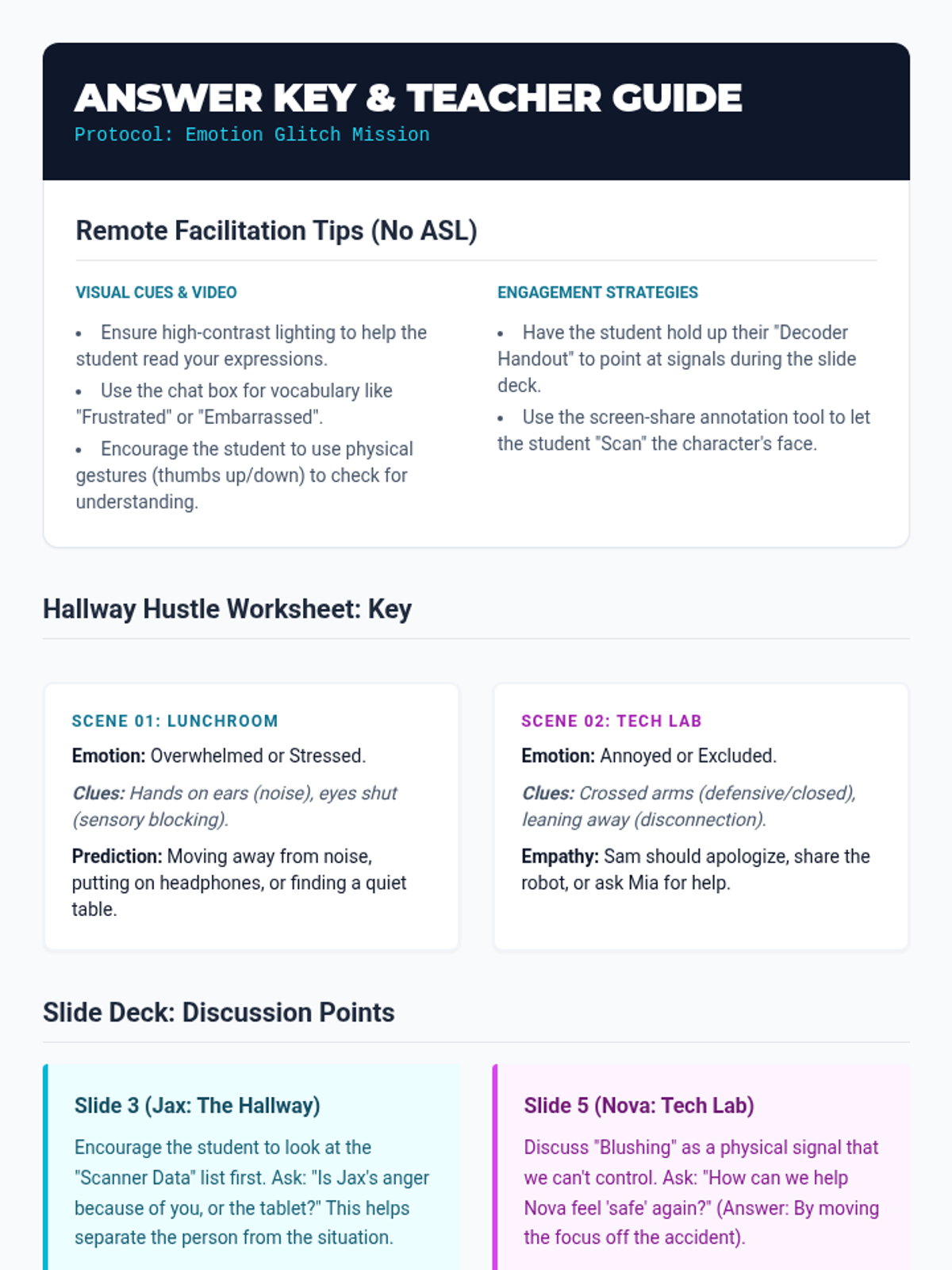
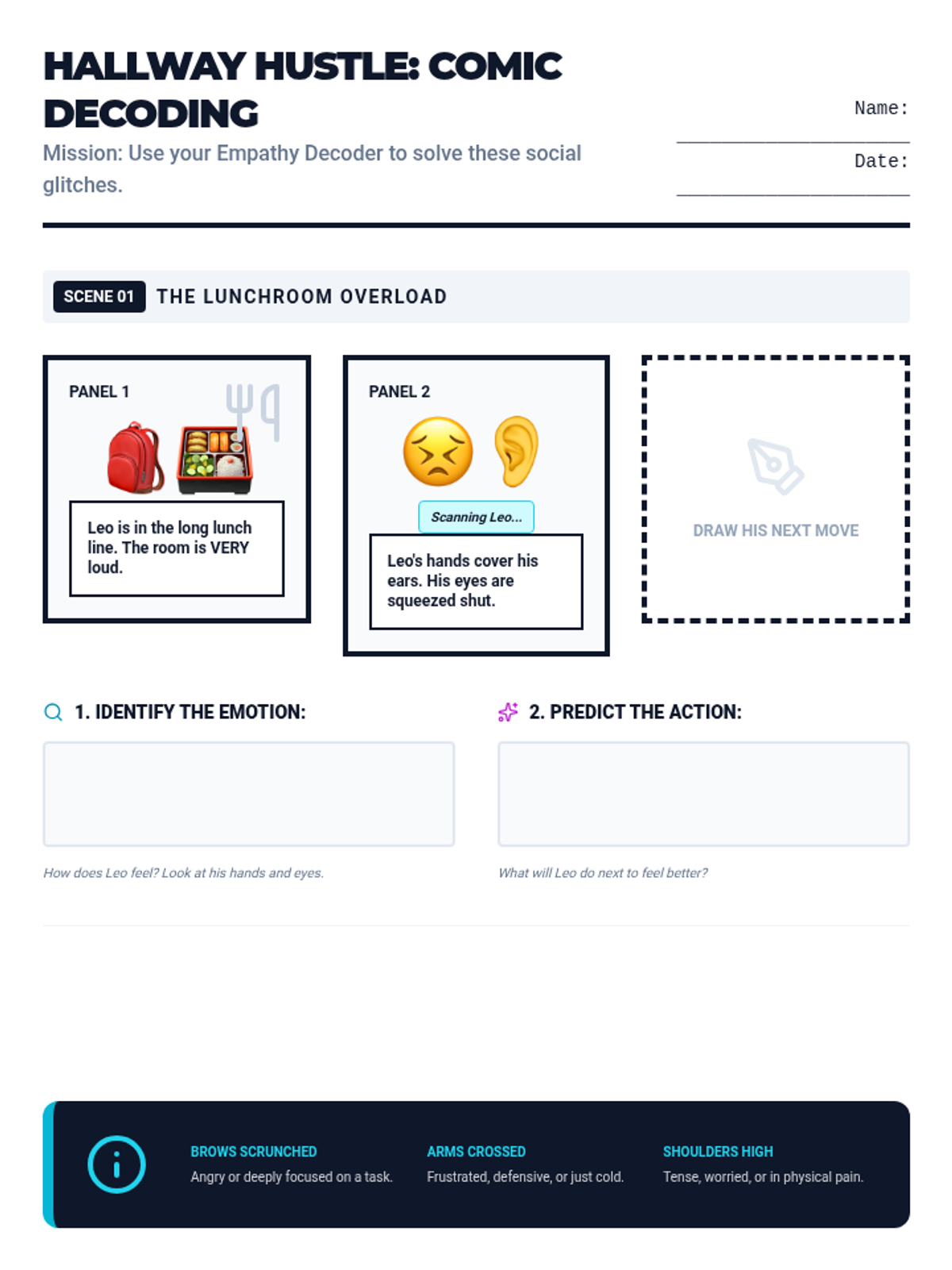
A teacher resource providing the answer key for the Hallway Hustle worksheet and specialized instructional strategies for remote teaching DHH students without the use of ASL.
A comic-style worksheet where students analyze social situations in school settings. It includes 'scannable' panels and requires students to identify emotions and predict appropriate social responses.
An interactive slide deck set in a futuristic 'cyber-school' environment. Students navigate social scenarios in a hallway and tech lab, practicing emotion recognition and empathy responses through a narrative 'Mission' framework.
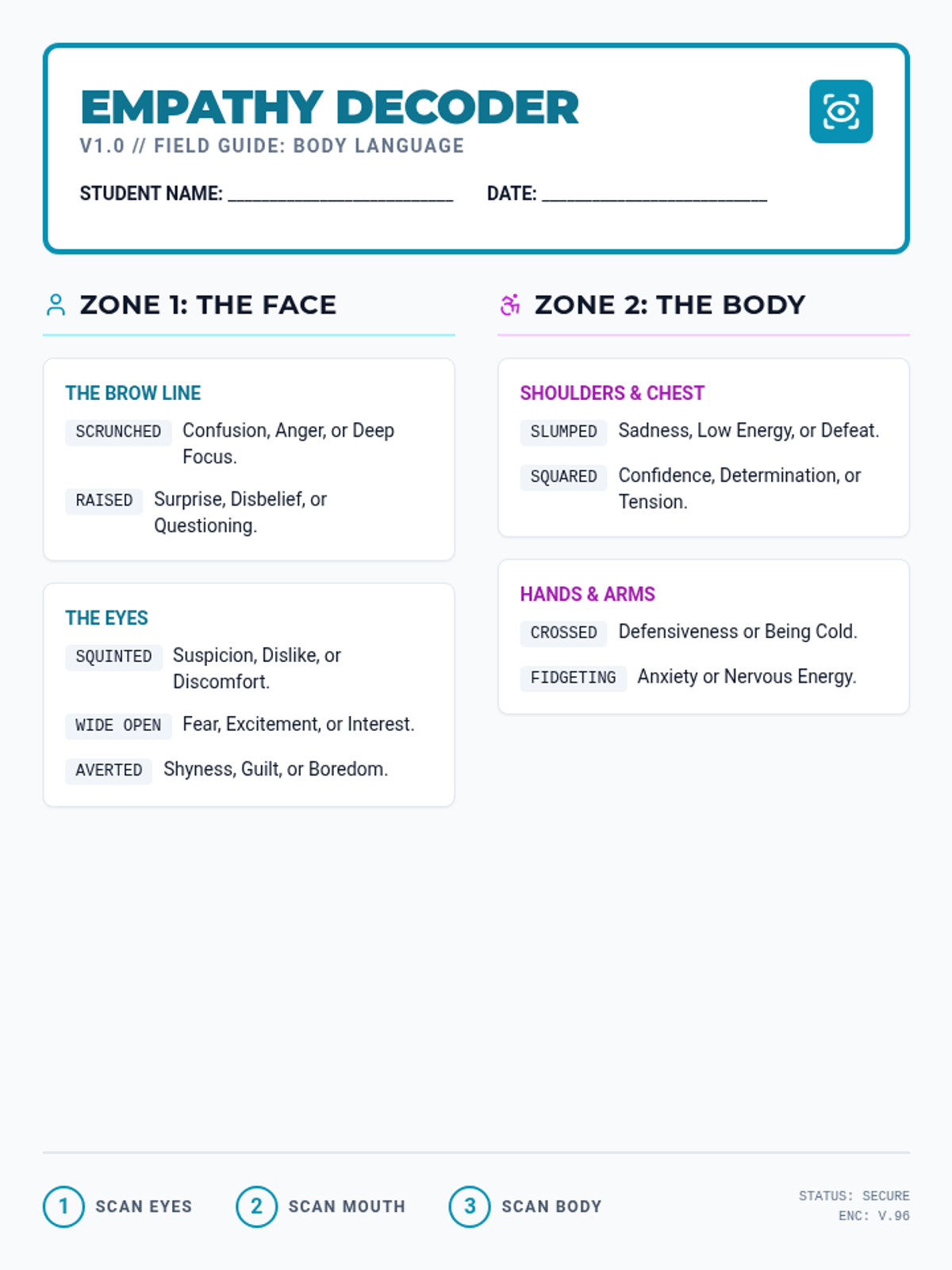
A visual cheat sheet for decoding body language and facial expressions, designed with a futuristic 'cyber-decoder' aesthetic to engage DHH students. Includes specific physical cues for the face and body.
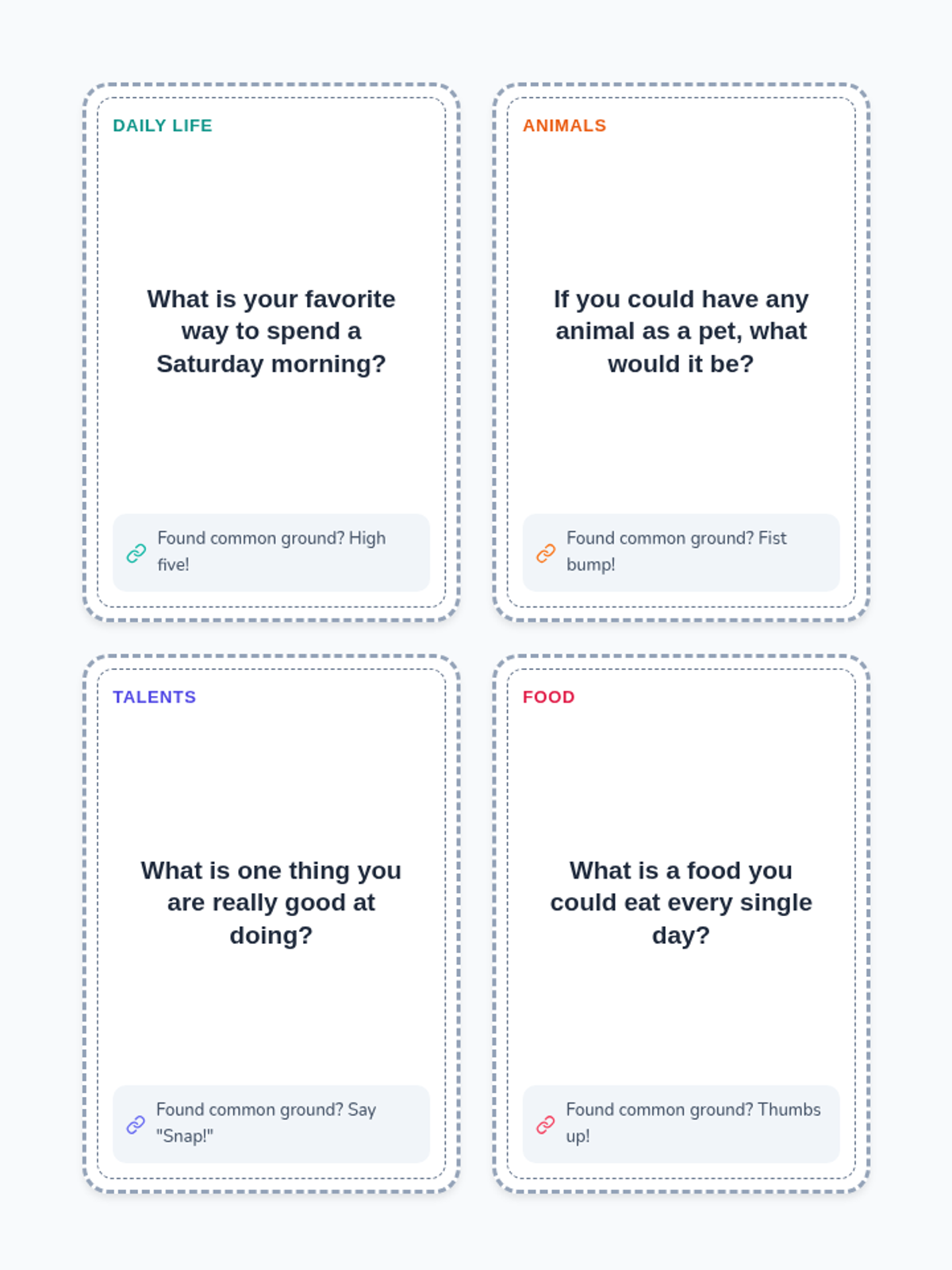
A set of 20 conversation cards designed to help students find common ground. Each card features a prompt and a connection-building activity.
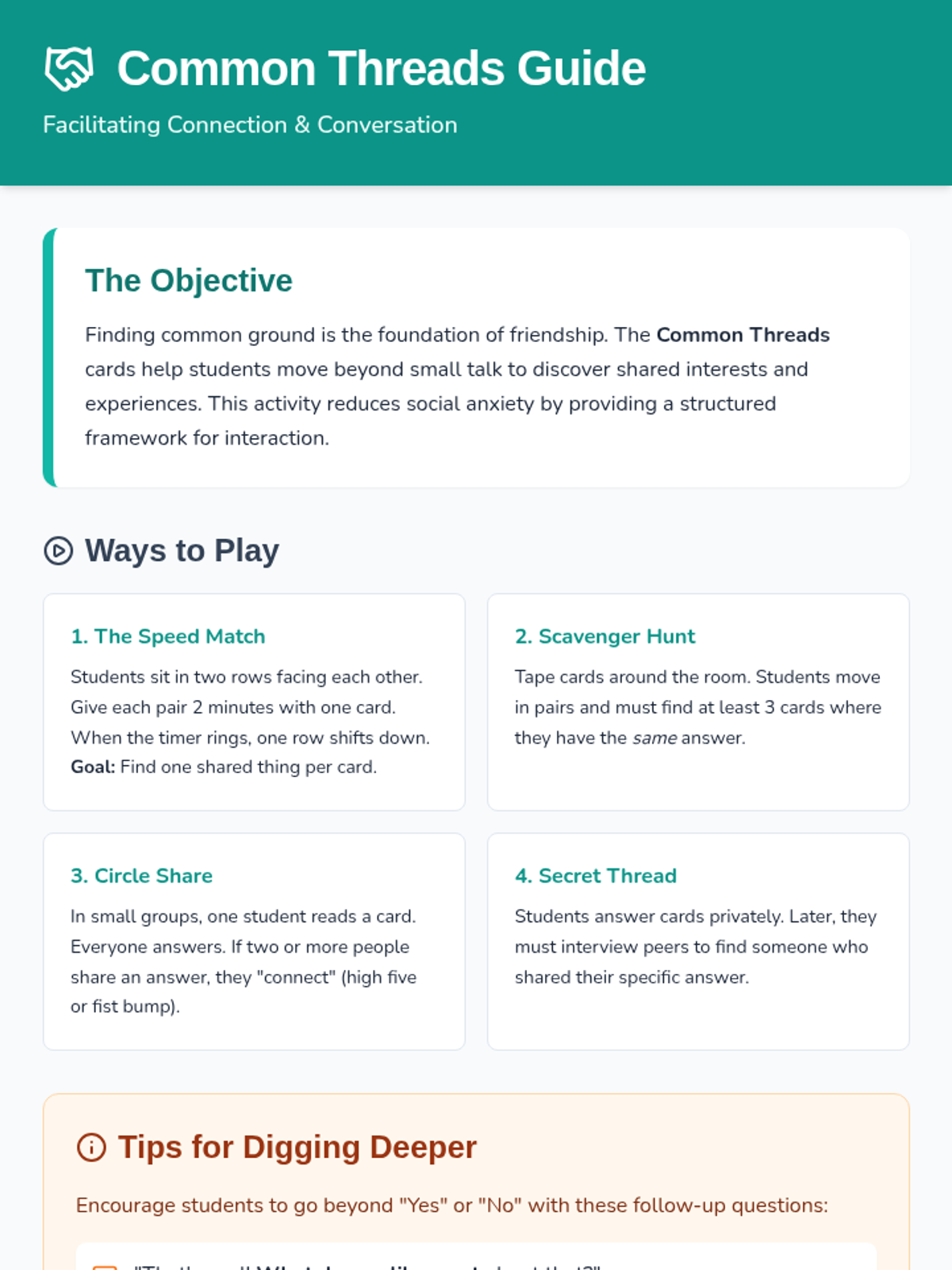
A facilitator's guide for the Common Threads conversation activity, including instructions for various gameplay modes and tips for fostering deeper connections.
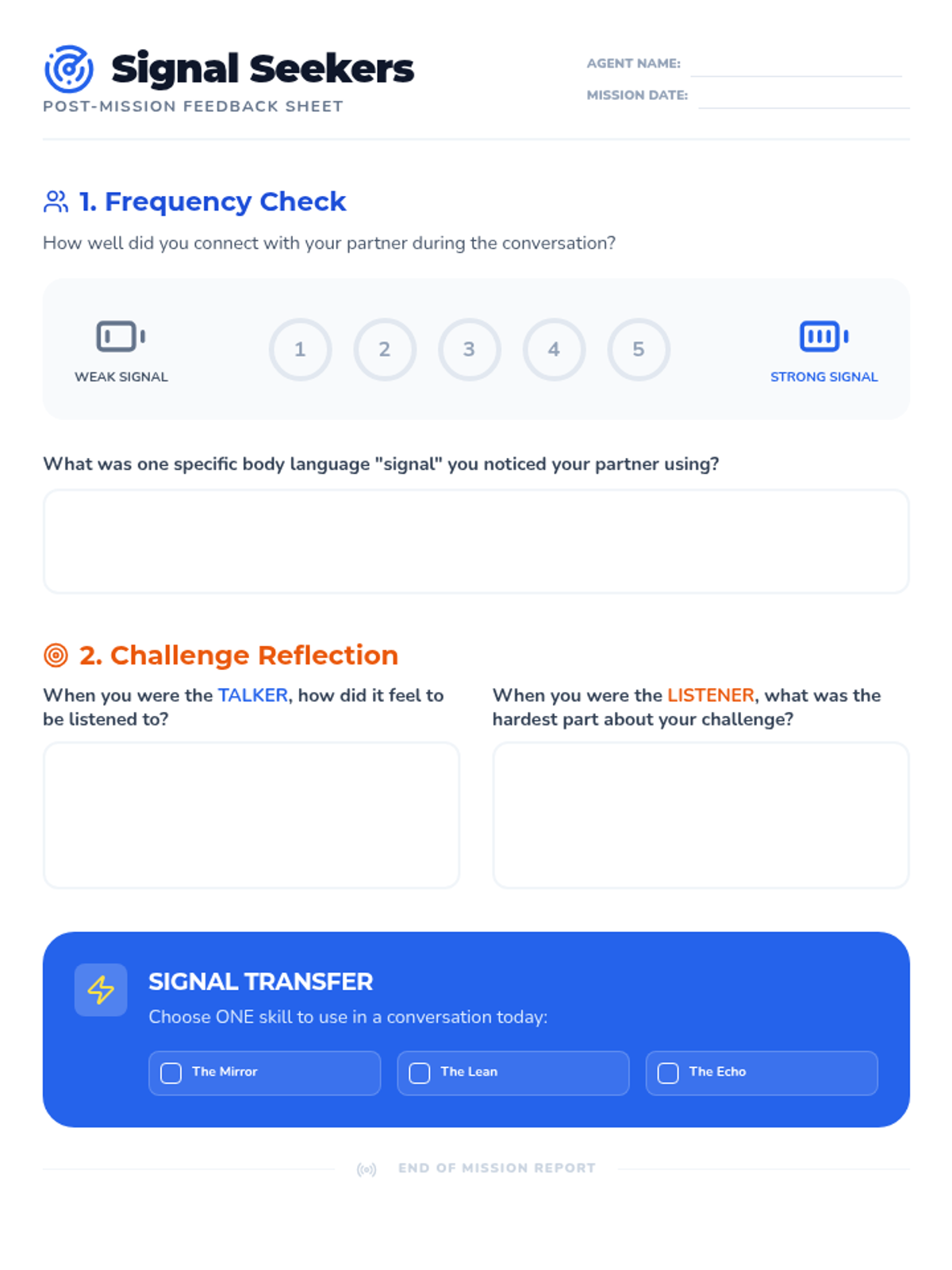
A student reflection worksheet for the Signal Seekers game. Consolidated onto a single page with corrected rating scale styling and improved readability.
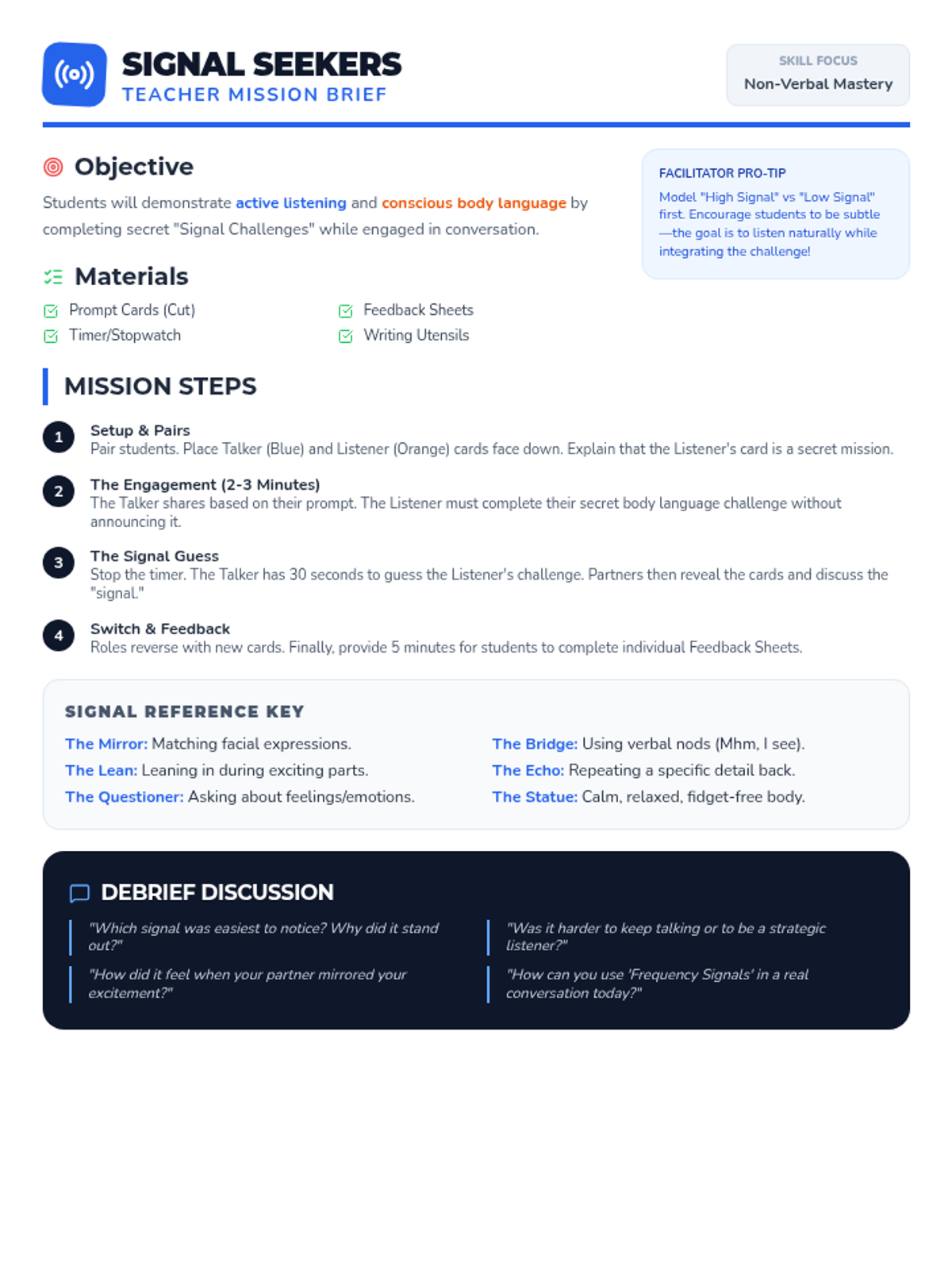
A consolidated one-page facilitator guide for the Signal Seekers game. Includes objectives, procedure, a reference key for the body language signals, and discussion prompts. Updated with improved layout to ensure single-page printing.
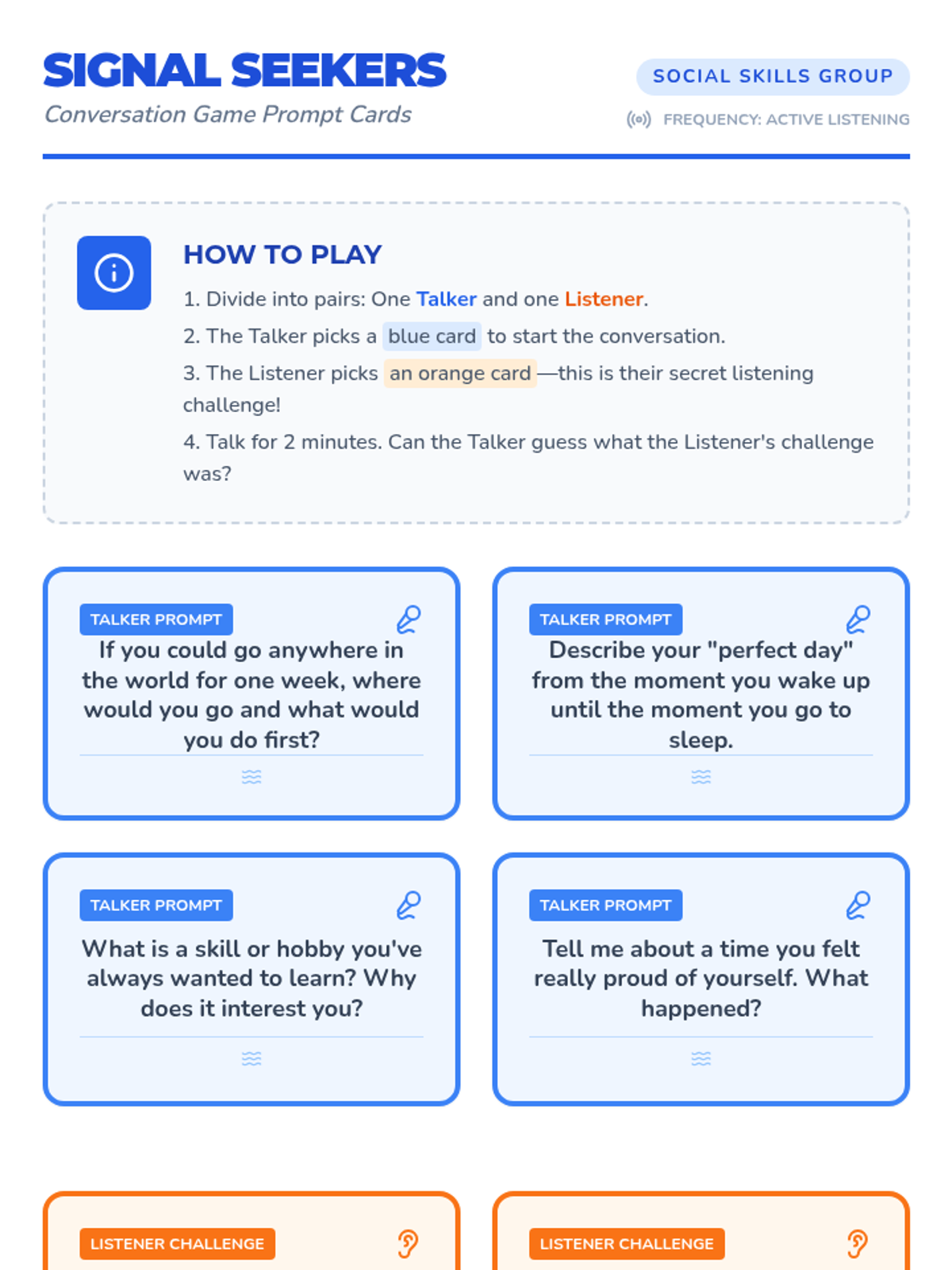
A collection of printable prompt cards for the Signal Seekers game. Includes 4 Talker prompts and 6 Listener challenges that focus on body language and active listening. Updated with corrected grammar and improved print layout.
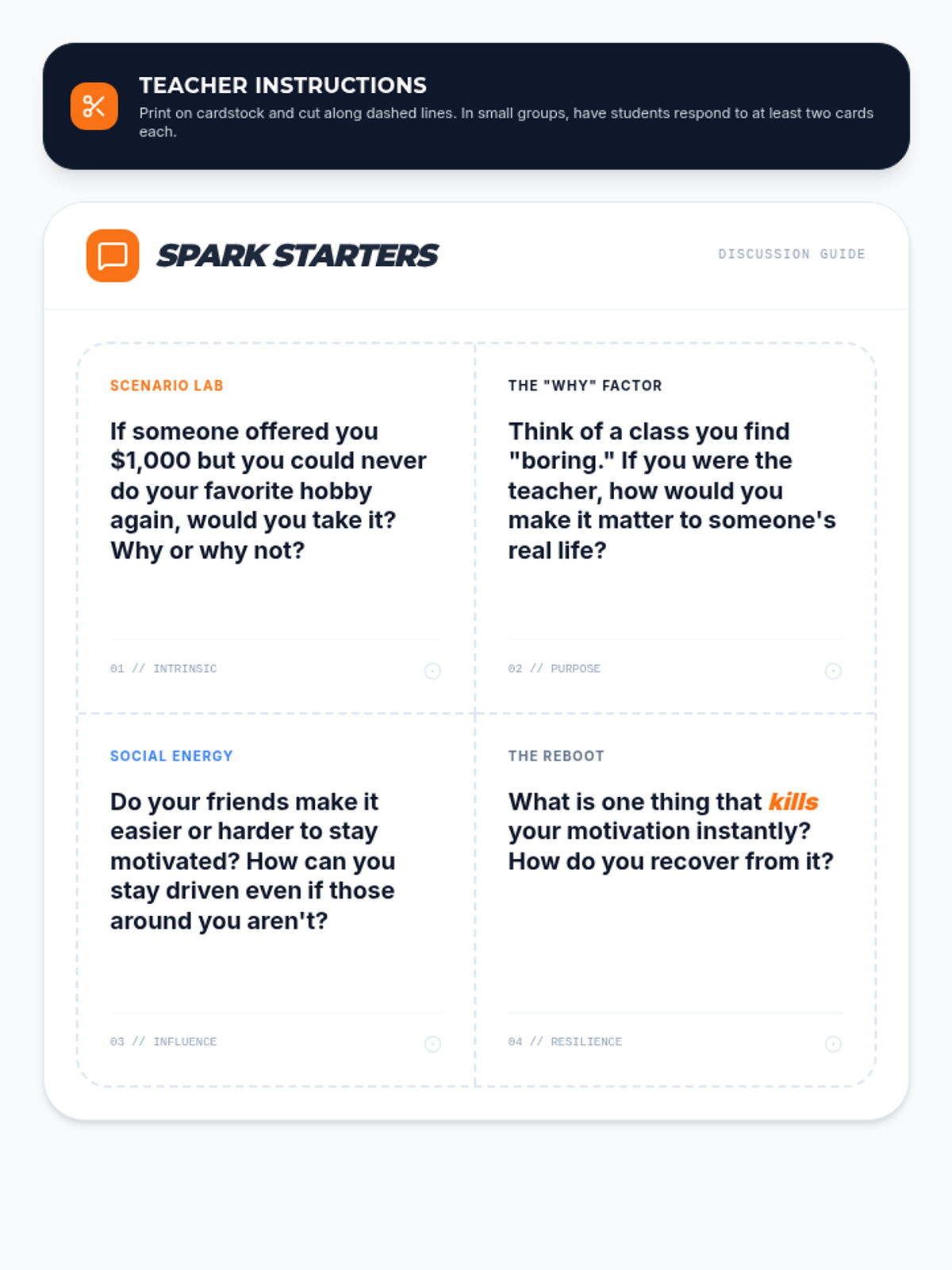
A set of four creative discussion cards for small groups, designed to facilitate conversations about internal values, social influences on motivation, and recovery from academic setbacks.
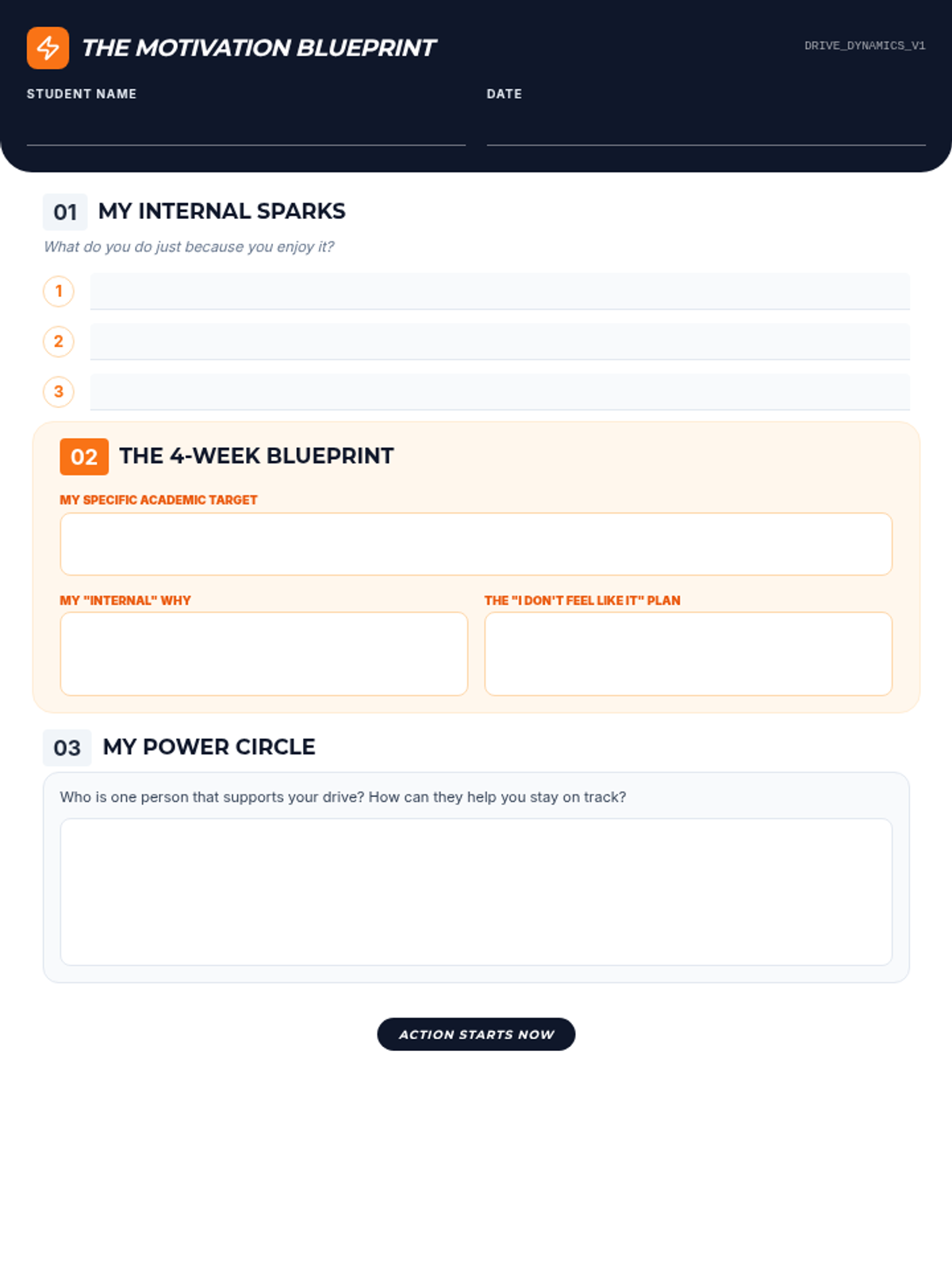
A student worksheet featuring personal motivation identification, a 4-week goal-setting blueprint, and a social support mapping section to help students internalize their academic drive.
A high-impact 5-slide presentation designed to engage students in understanding the difference between intrinsic and extrinsic motivation, while providing a framework for academic goal setting.
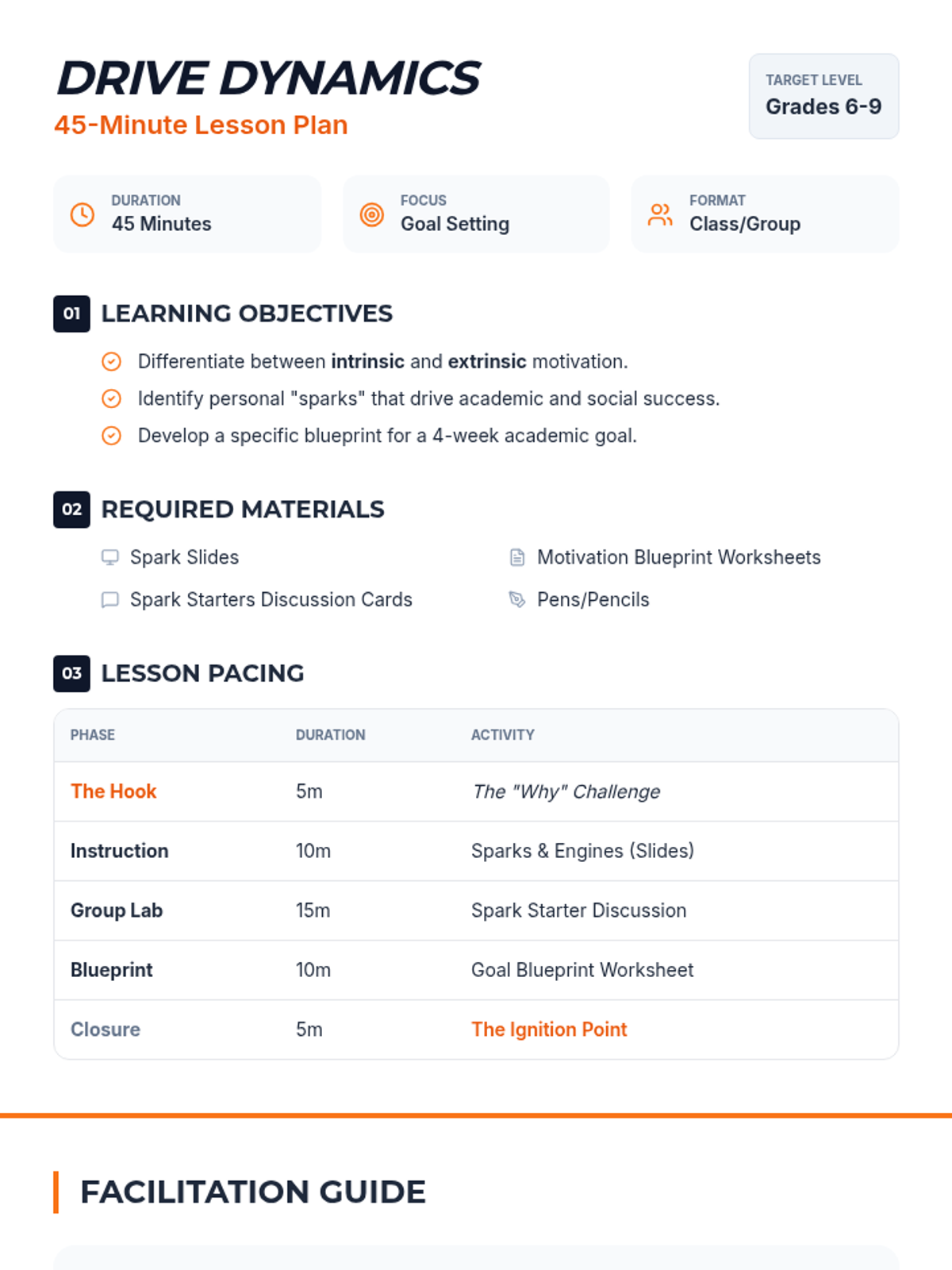
A comprehensive 45-minute lesson plan for educators focusing on social-emotional and academic motivation, including learning objectives, materials, and a step-by-step facilitation guide.
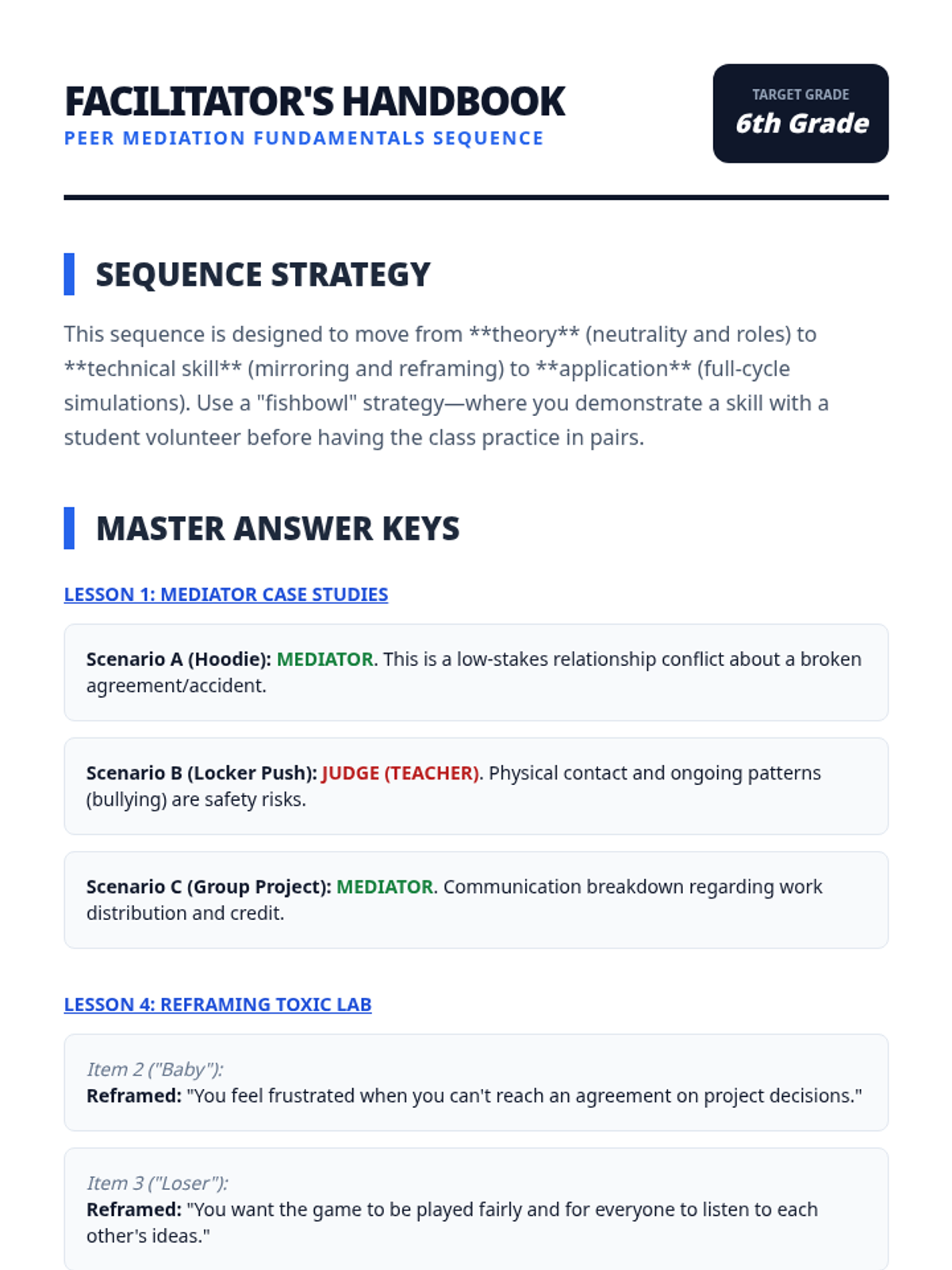
Teacher-facing facilitation guide and answer keys for the entire Peer Mediation sequence, including coaching tips for mock mediations.
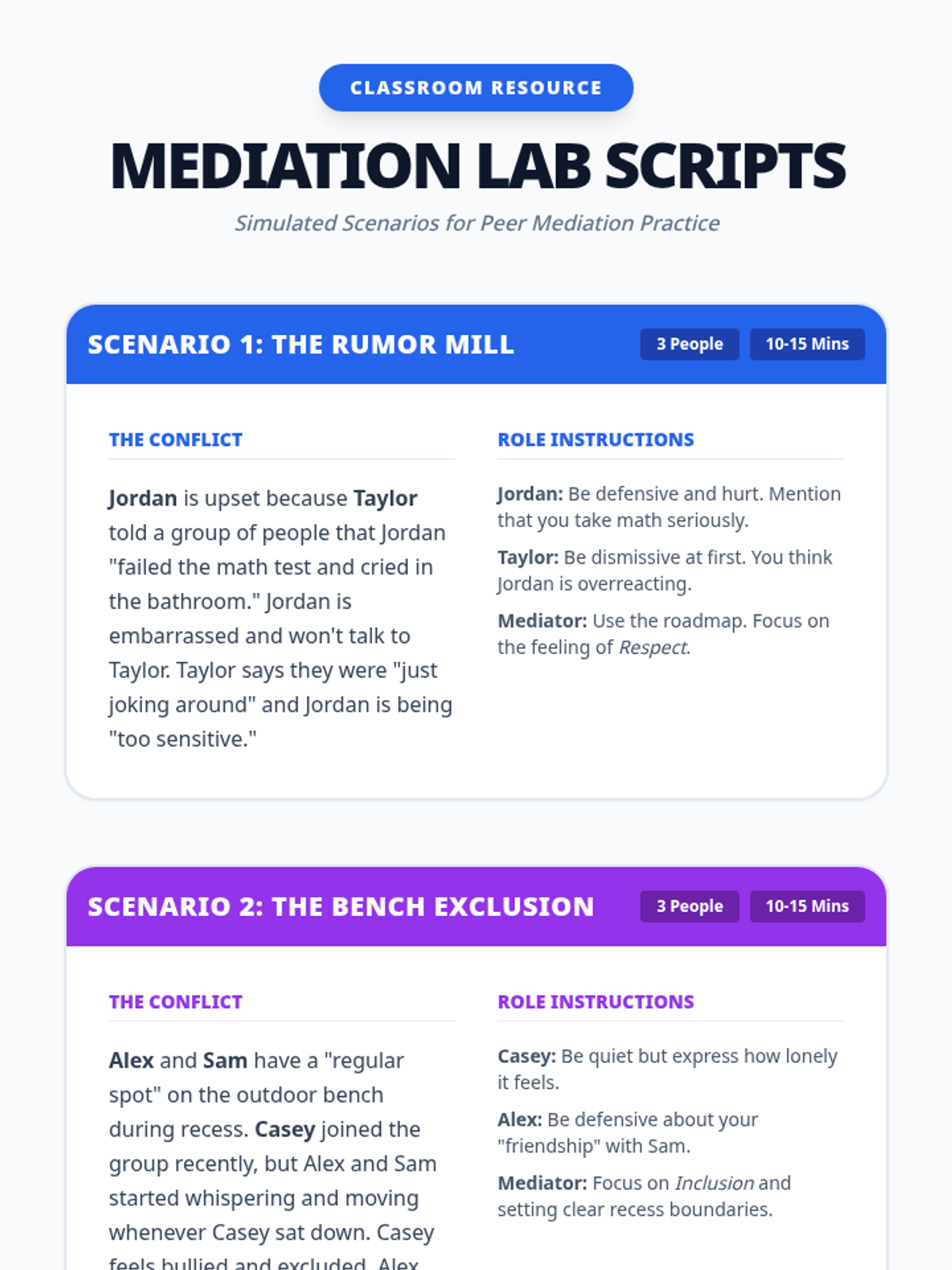
Role-play scenarios based on common middle school conflicts to be used during the Mediation Lab simulation.
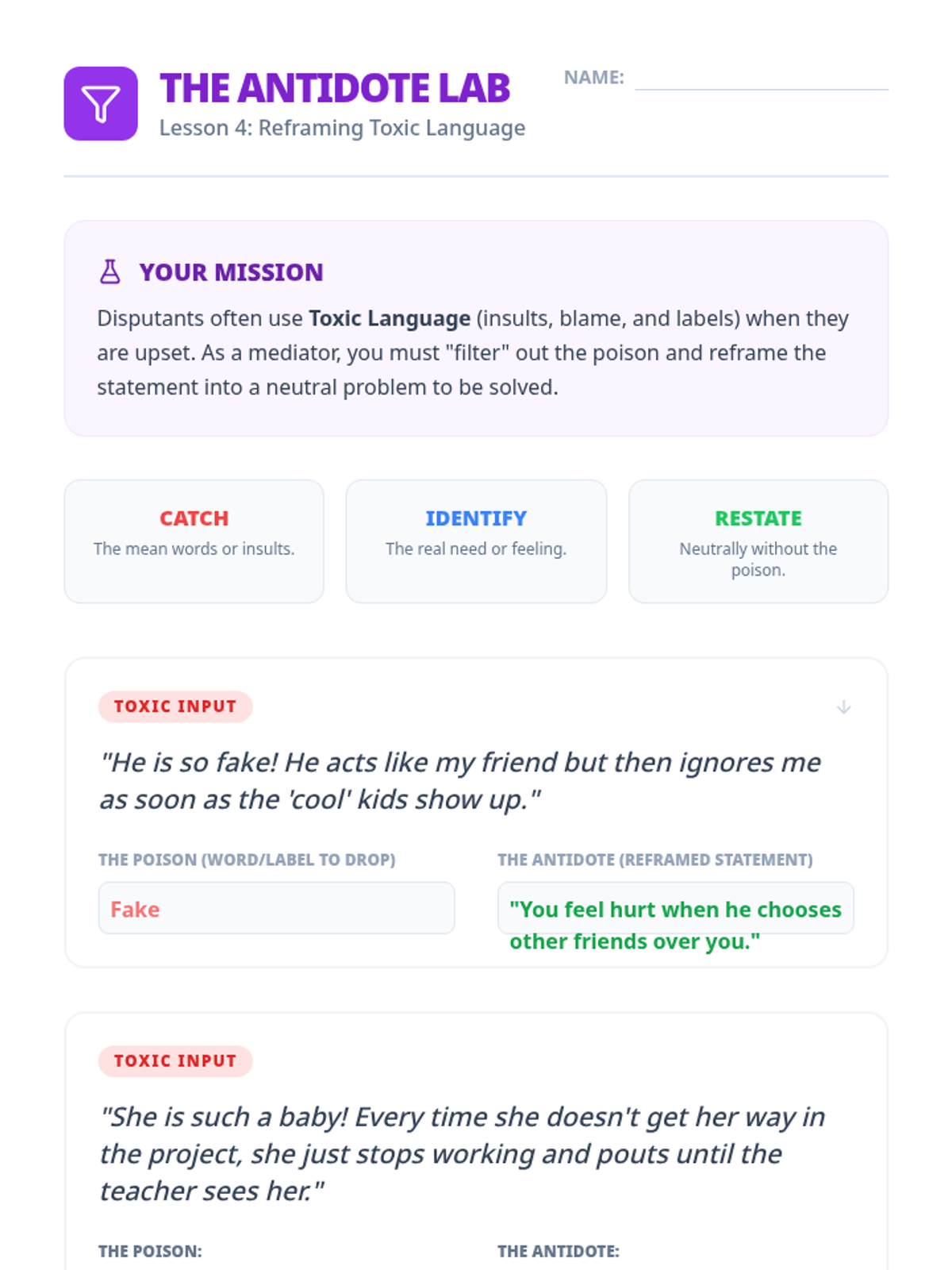
Advanced practice worksheet where students identify toxic labels and absolutes in conflict statements and reframe them into neutral needs or feelings.
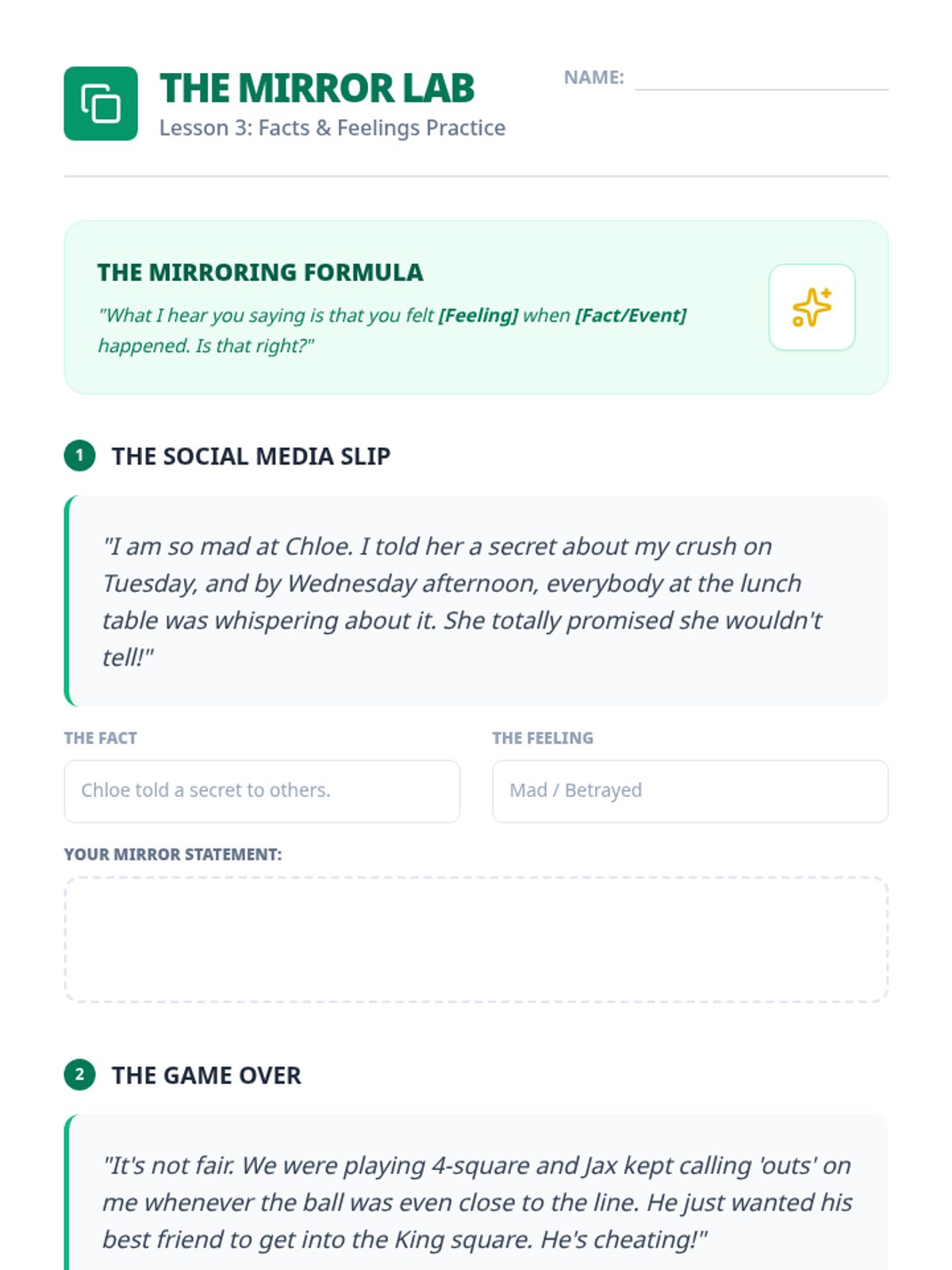
Worksheet for students to practice identifying facts and feelings in conflict statements and crafting neutral mirroring responses.
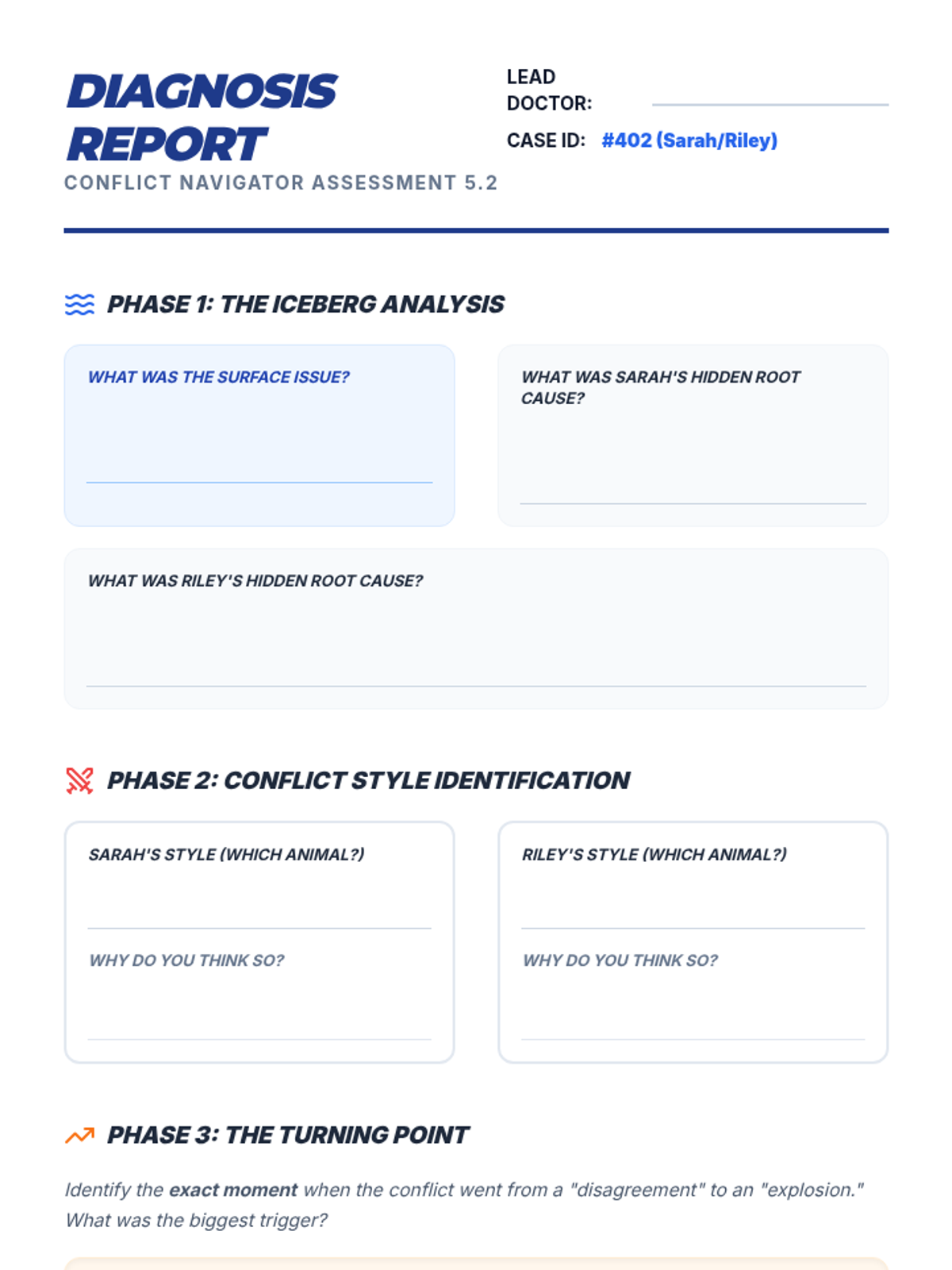
The final assessment form for students to synthesize their learning by diagnosing the Sarah/Riley case study, identifying root causes, styles, and intervention strategies.
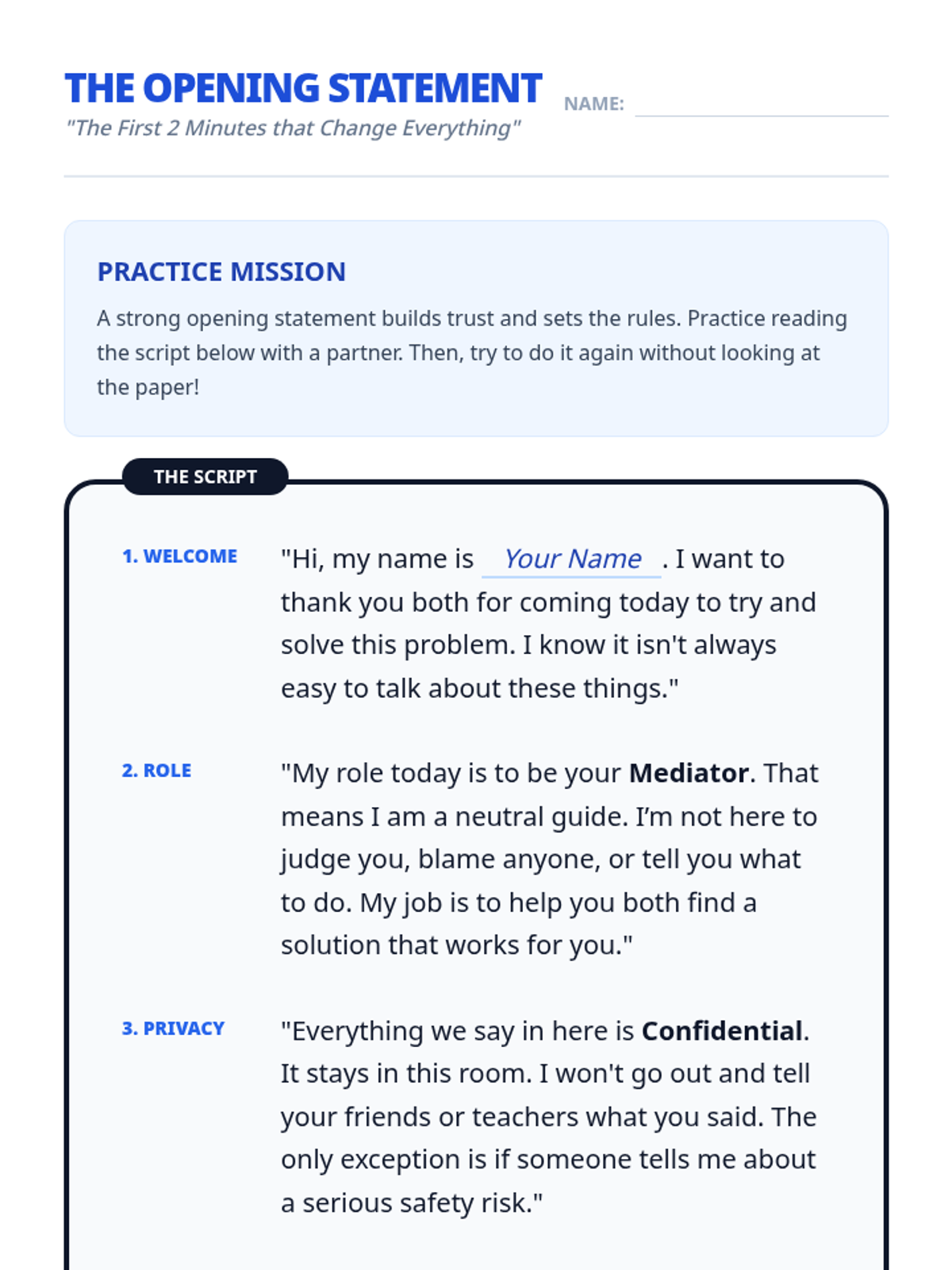
Student-facing script and practice guide for delivering a mediation opening statement, including ground rules and neutrality reminders.
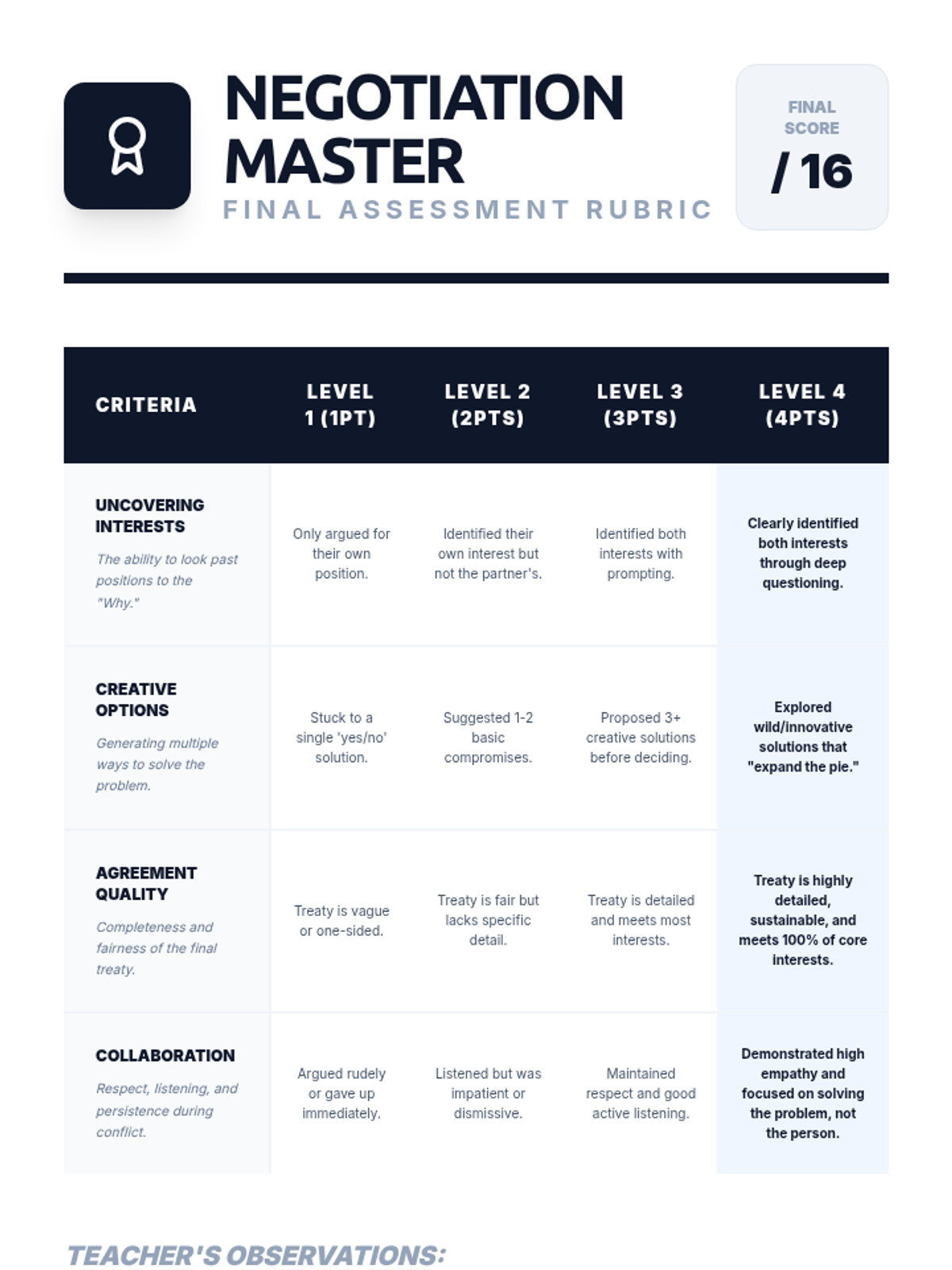
Final rubric for Lesson 5: Negotiation Showdown. Assesses students on four key competencies: Uncovering Interests, Creative Option Generation, Agreement Quality, and Collaboration/Professionalism.
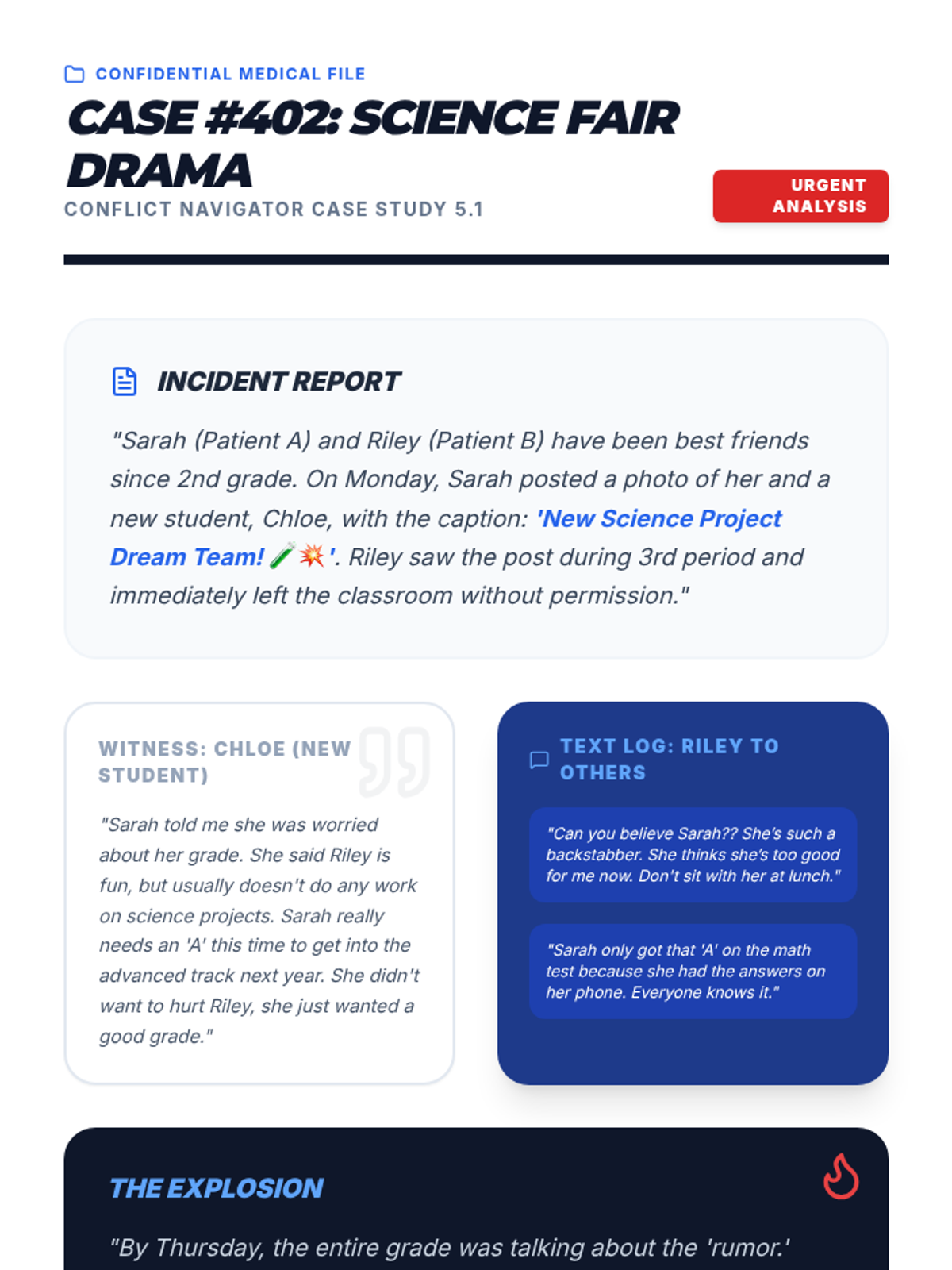
A detailed fictional case study for the final lesson, providing students with witness statements, text logs, and incident reports to analyze a complex middle school conflict.
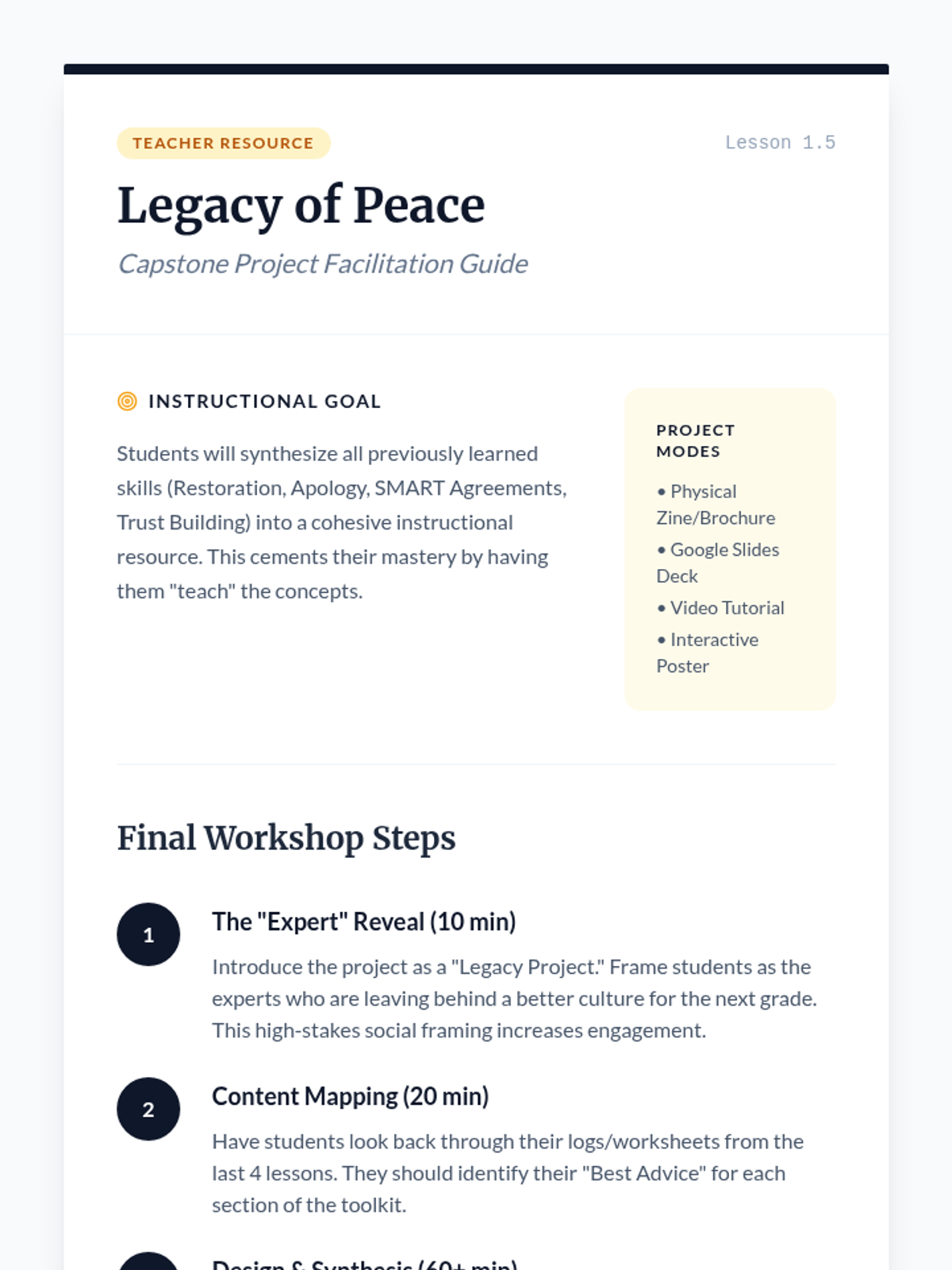
A teacher guide for the Lesson 5 capstone project, providing instructional strategies for the 'Legacy Project' and ways to share student work with a wider audience.
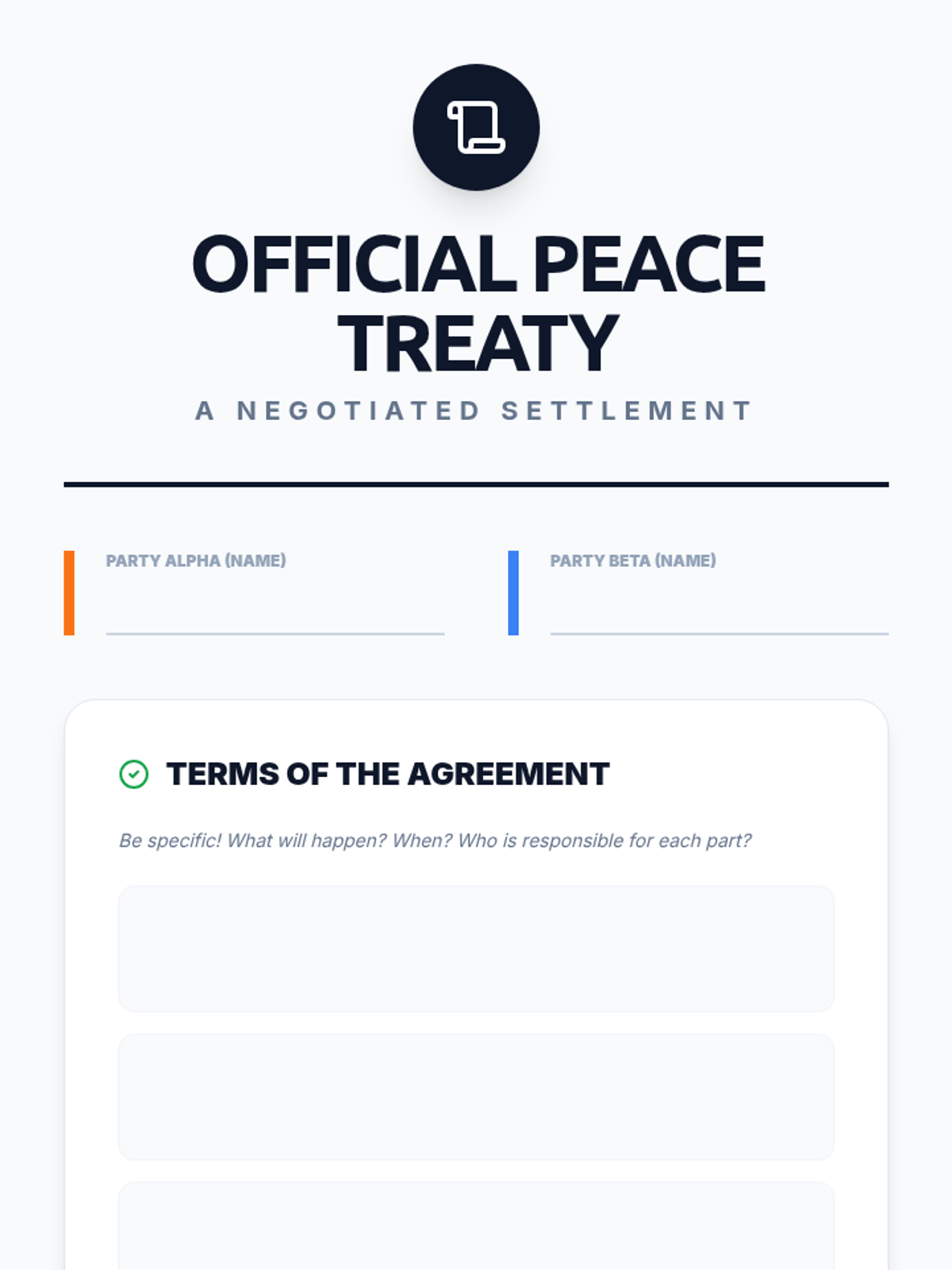
The "Official Peace Treaty" document for the Lesson 5 simulation. Pairs of students use this to formalize their negotiated agreement, detailing specific terms, verifying that both parties' interests have been met, and providing space for formal signatures.
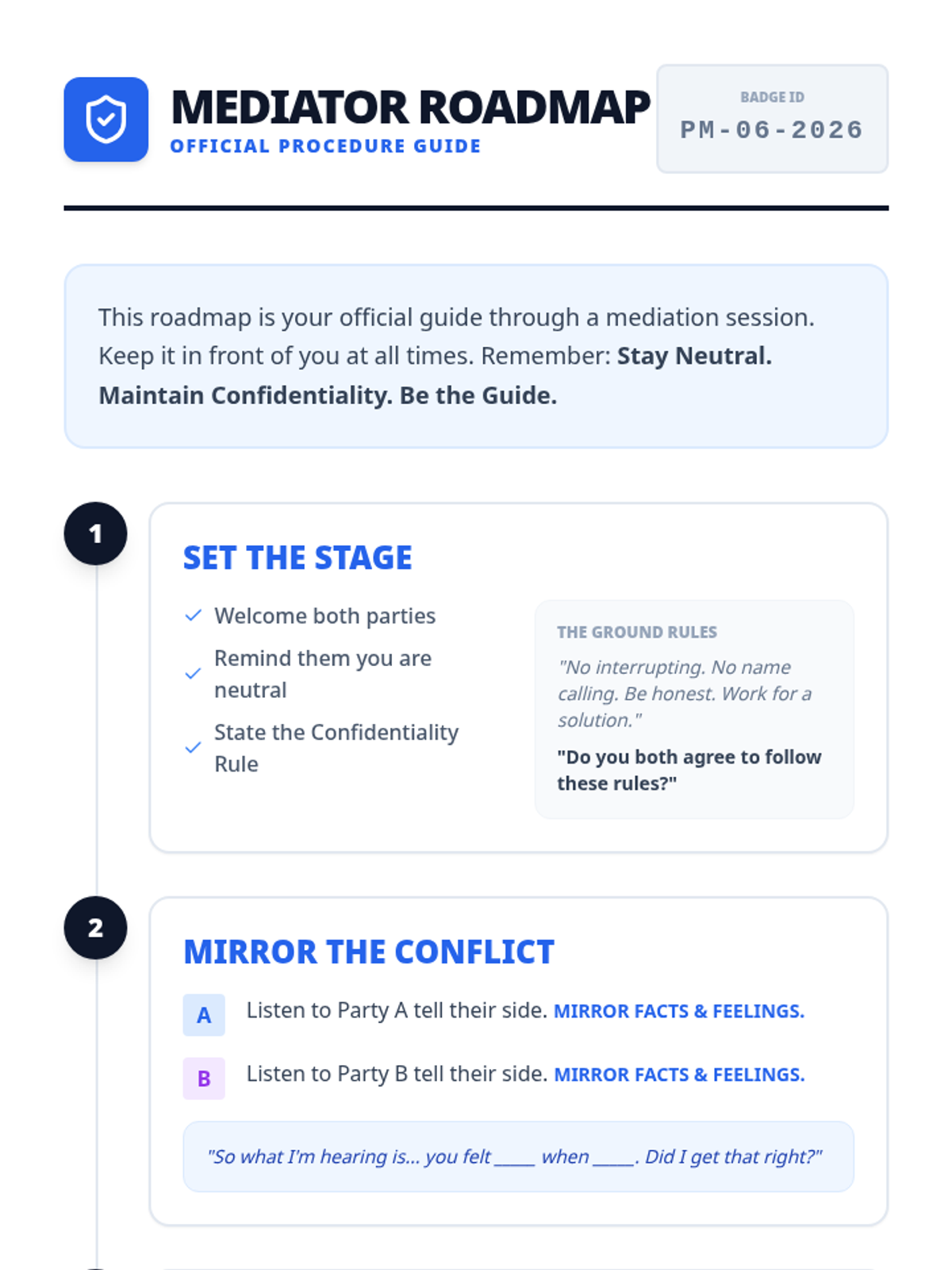
Student-facing reference sheet to guide them through the 4-step peer mediation process during simulations.
Slides for the final lesson, framing the conflict resolution synthesis activity as a "Conflict Clinic" where students act as doctors to diagnose a complex dispute.
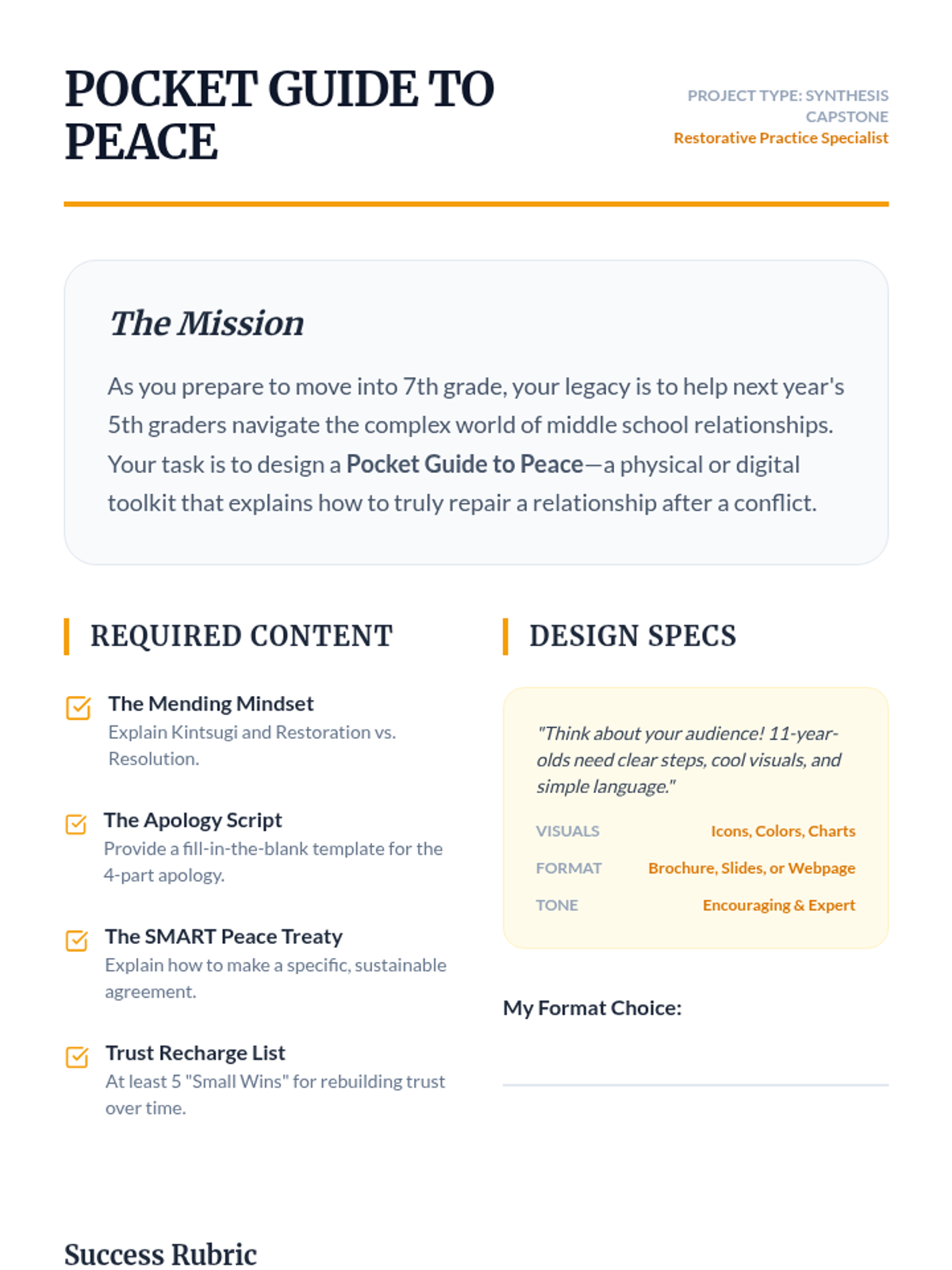
A student-facing project guide and rubric for the 'Pocket Guide to Peace' capstone project, where students synthesize their conflict resolution skills.
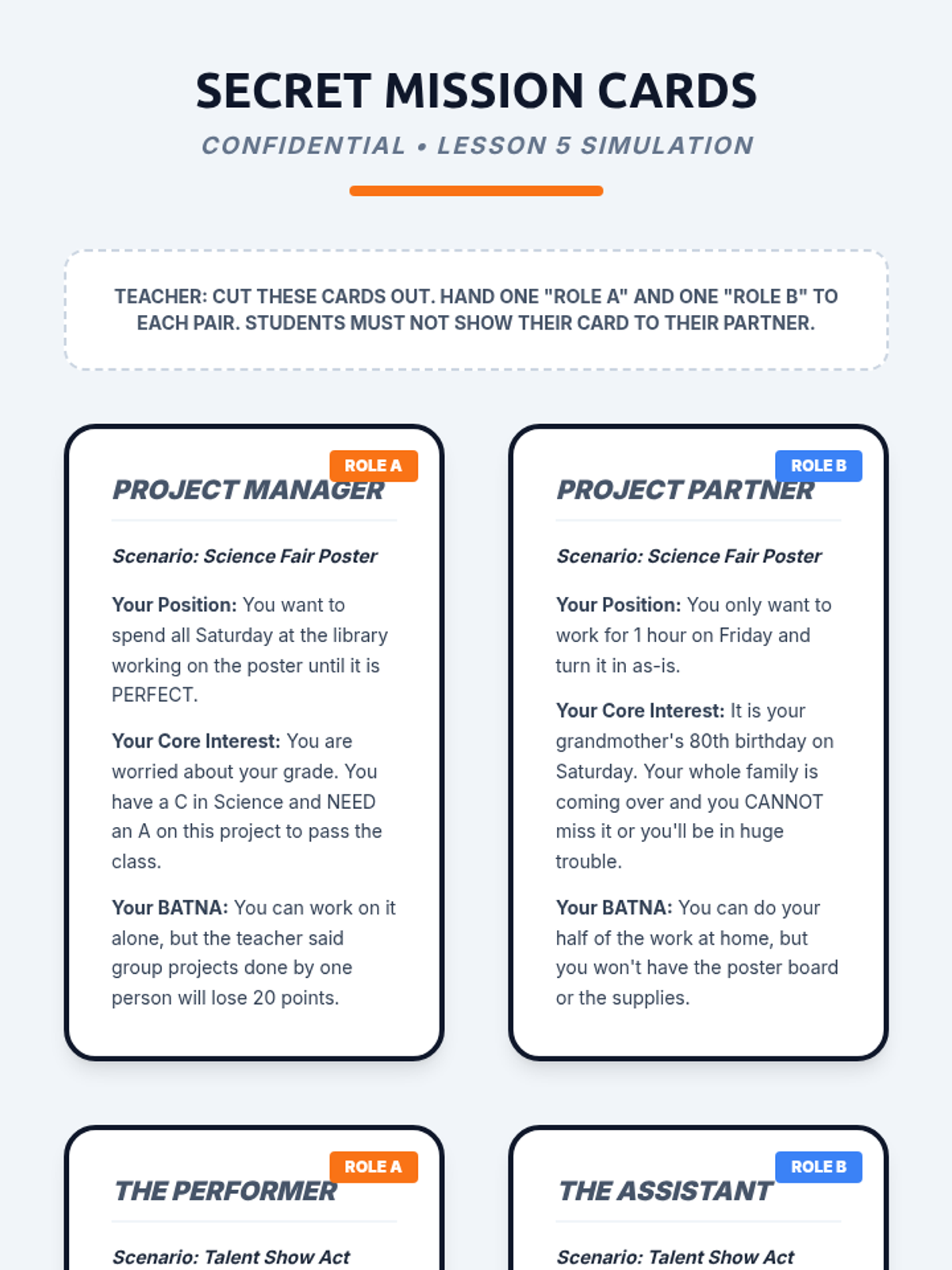
Secret Mission Cards for the Lesson 5 simulation. Provides pairs of students with conflicting positions but reconcilable underlying interests for two scenarios: a shared science project and a talent show performance.
Final slide deck for Lesson 5: Negotiation Showdown. Outlines the objectives, rules of conduct, and required elements for the final "Signed Treaty" simulation, providing the structure for the sequence's culminating activity.
Capstone project slides for Lesson 5, introducing the 'Pocket Guide to Peace' project where students synthesize their learning to create a guide for younger students.
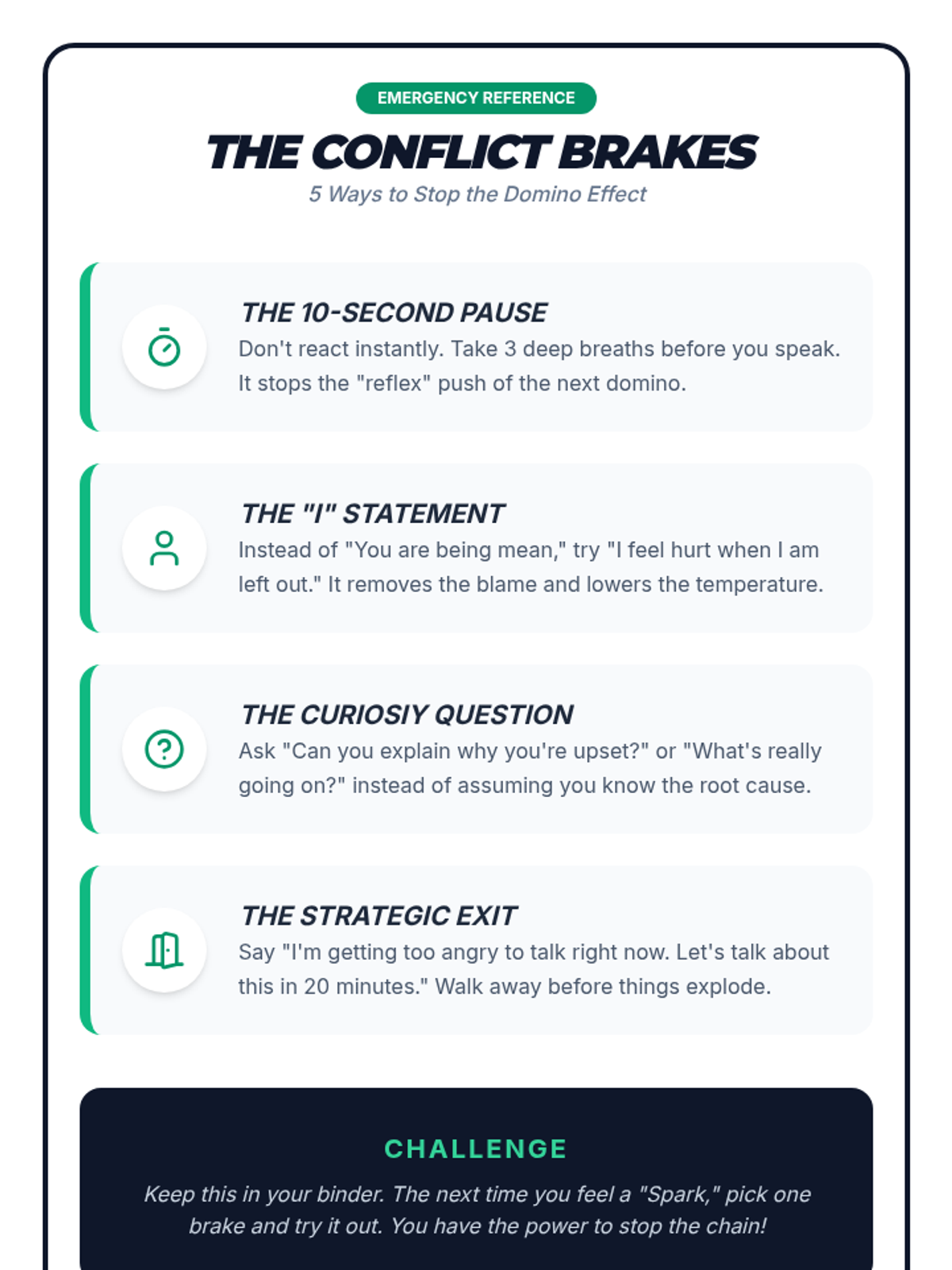
A reference handout for students listing four key de-escalation strategies (The Brakes) to use when they recognize a conflict starting to escalate.
Slide deck explaining the concept of reframing toxic language into neutral problem statements to help de-escalate conflicts and focus on solutions.
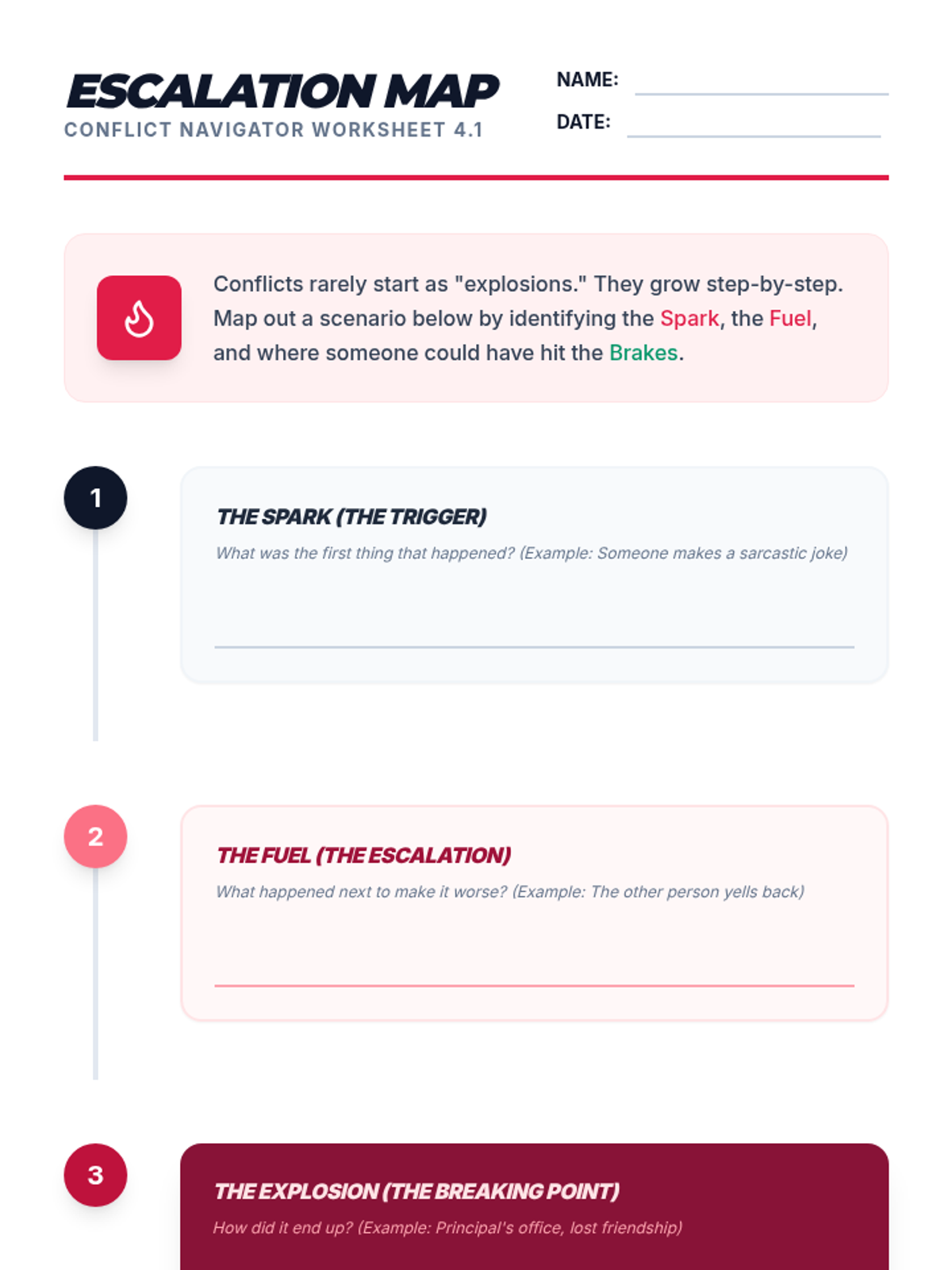
A student worksheet for Lesson 4 where learners map out a conflict scenario through the stages of Spark, Fuel, and Explosion, and then identify intervention points.
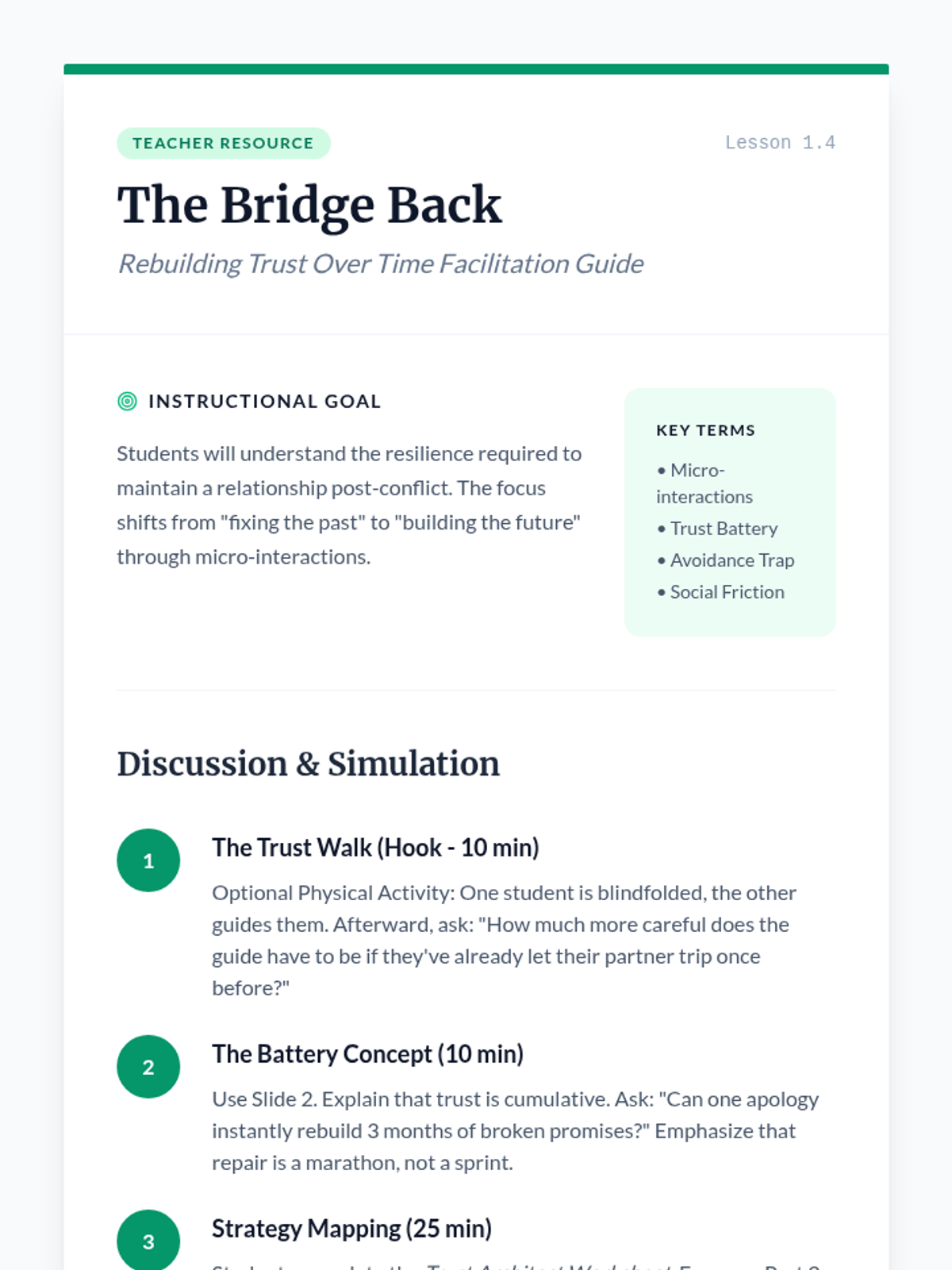
A teacher guide for Lesson 4 on facilitating trust-building activities and helping students navigate the social complexities of post-conflict resolution.
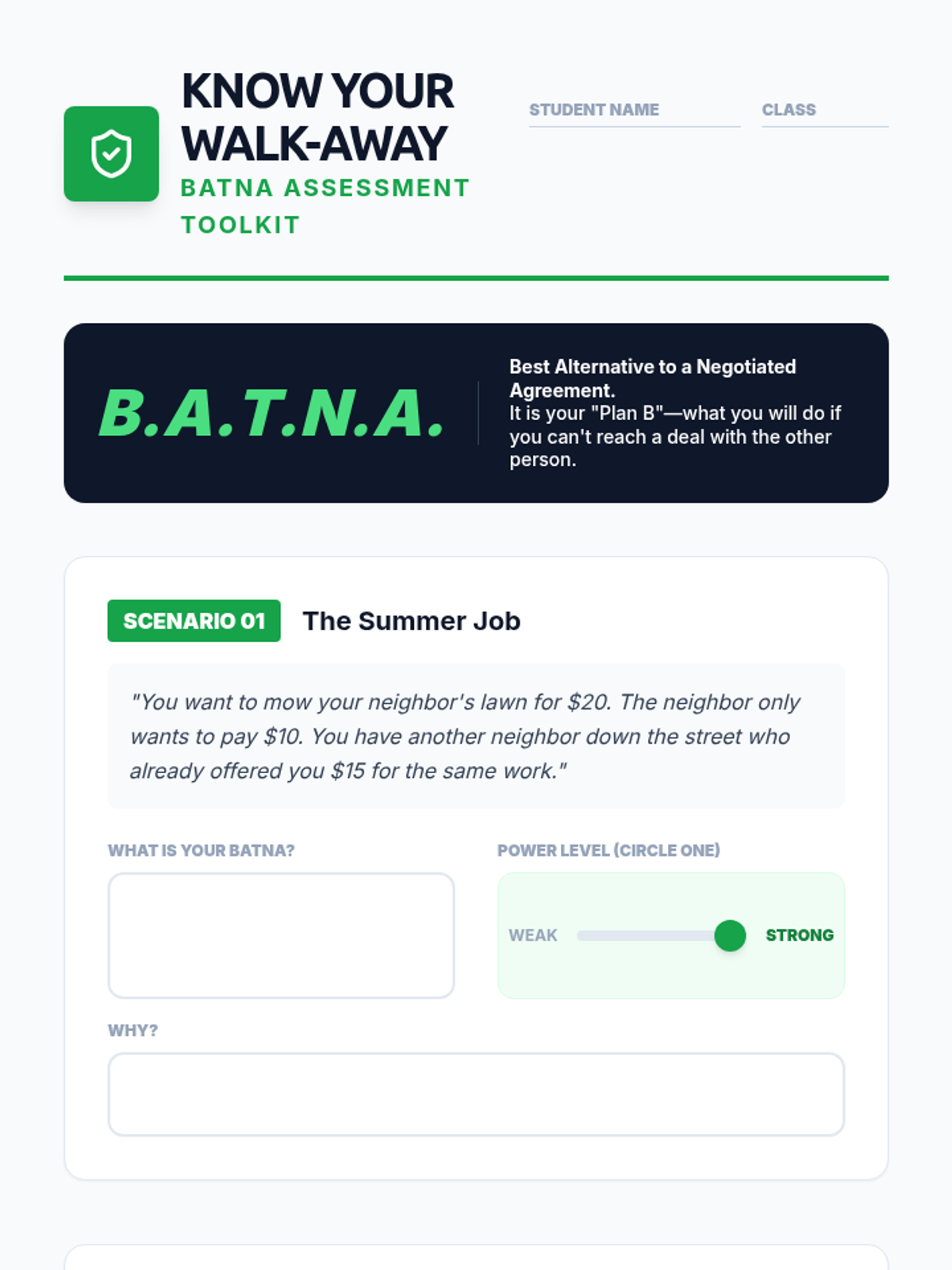
Worksheet for Lesson 4: The BATNA Concept. Students analyze two distinct scenarios (one with a strong BATNA and one with a weak one) to identify their alternatives and assess their negotiation power.
Slide deck for Lesson 4: The BATNA Concept. Explains the Best Alternative To a Negotiated Agreement using a trading card hook, defines the term, and teaches students how to assess their "walk-away" power in various situations.
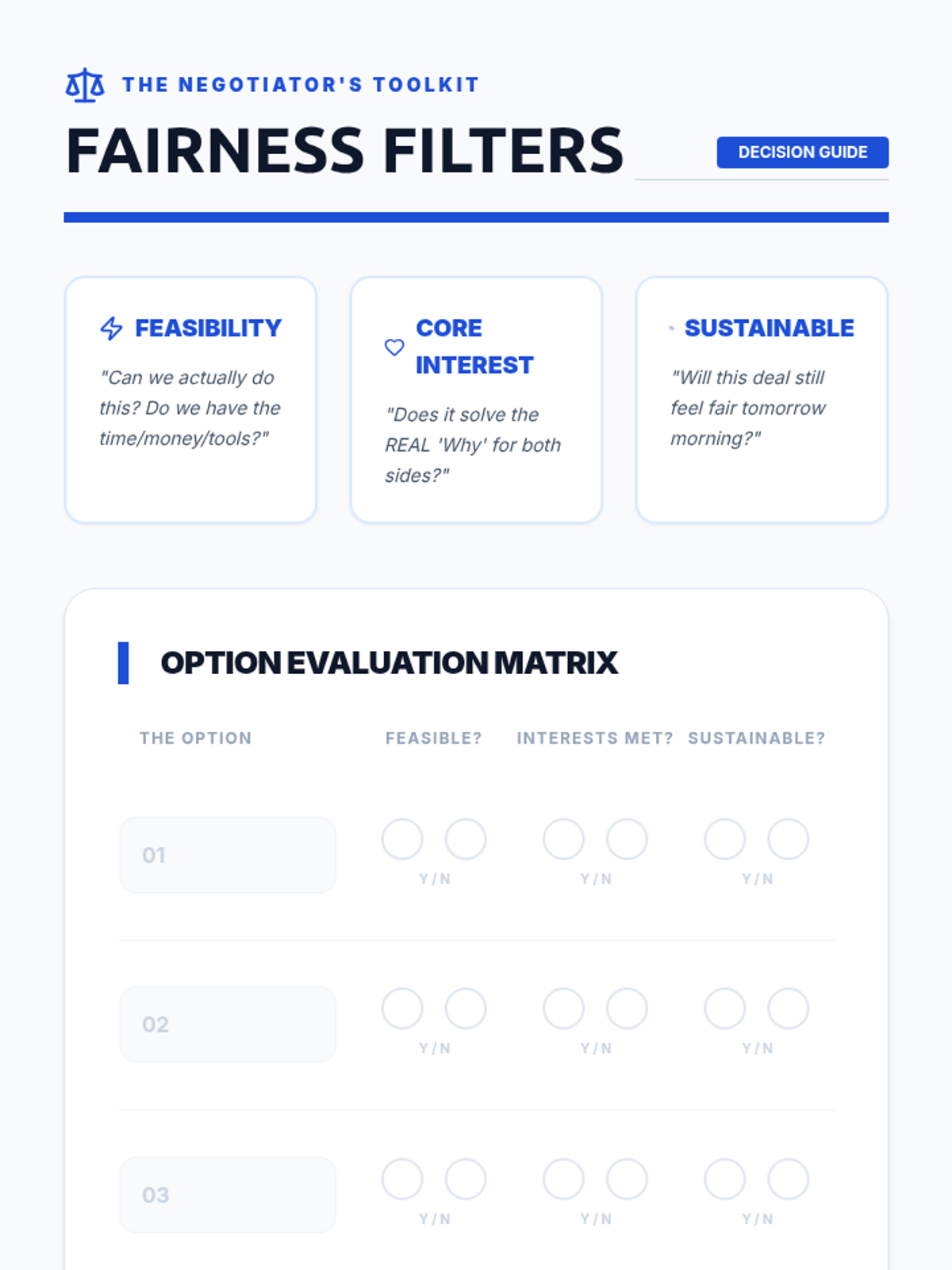
Discussion guide and matrix for Lesson 3: Evaluating Fairness. Students use this matrix to filter their brainstormed options through the three fairness criteria (Feasibility, Core Interest, and Sustainability) to determine the best solution.
Slide deck for Lesson 3: Evaluating Fairness. Explores the "Pizza Problem" hook, the difference between equality and equity, and introduces the three "Fairness Filters" (Feasibility, Core Interest, and Sustainability) for evaluating negotiation options.
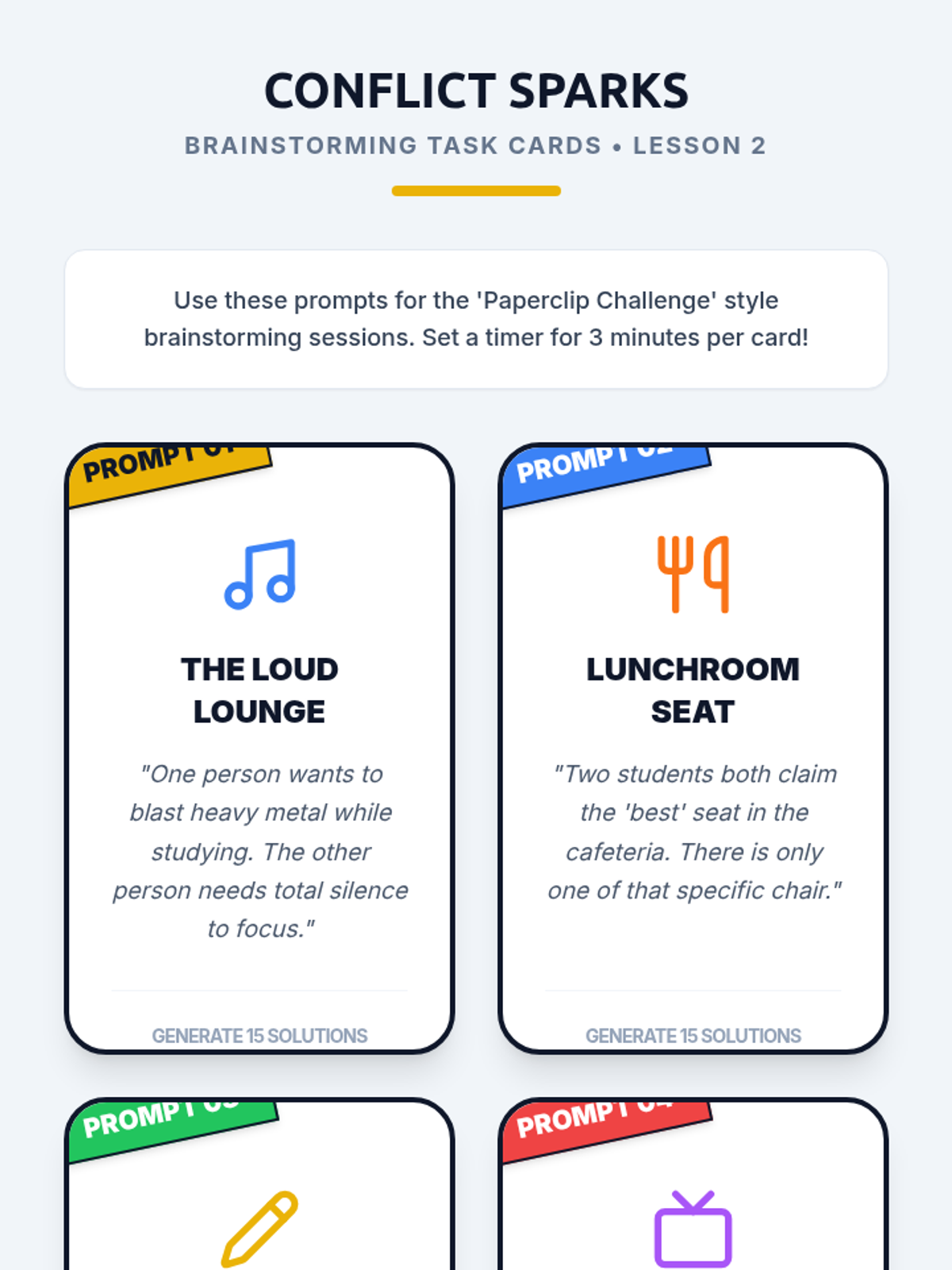
Conflict prompts for Lesson 2: Brainstorming Without Judgment. These task cards provide realistic middle-school scenarios (loud study environments, lunchroom seats, art project styles) for groups to practice high-speed brainstorming.
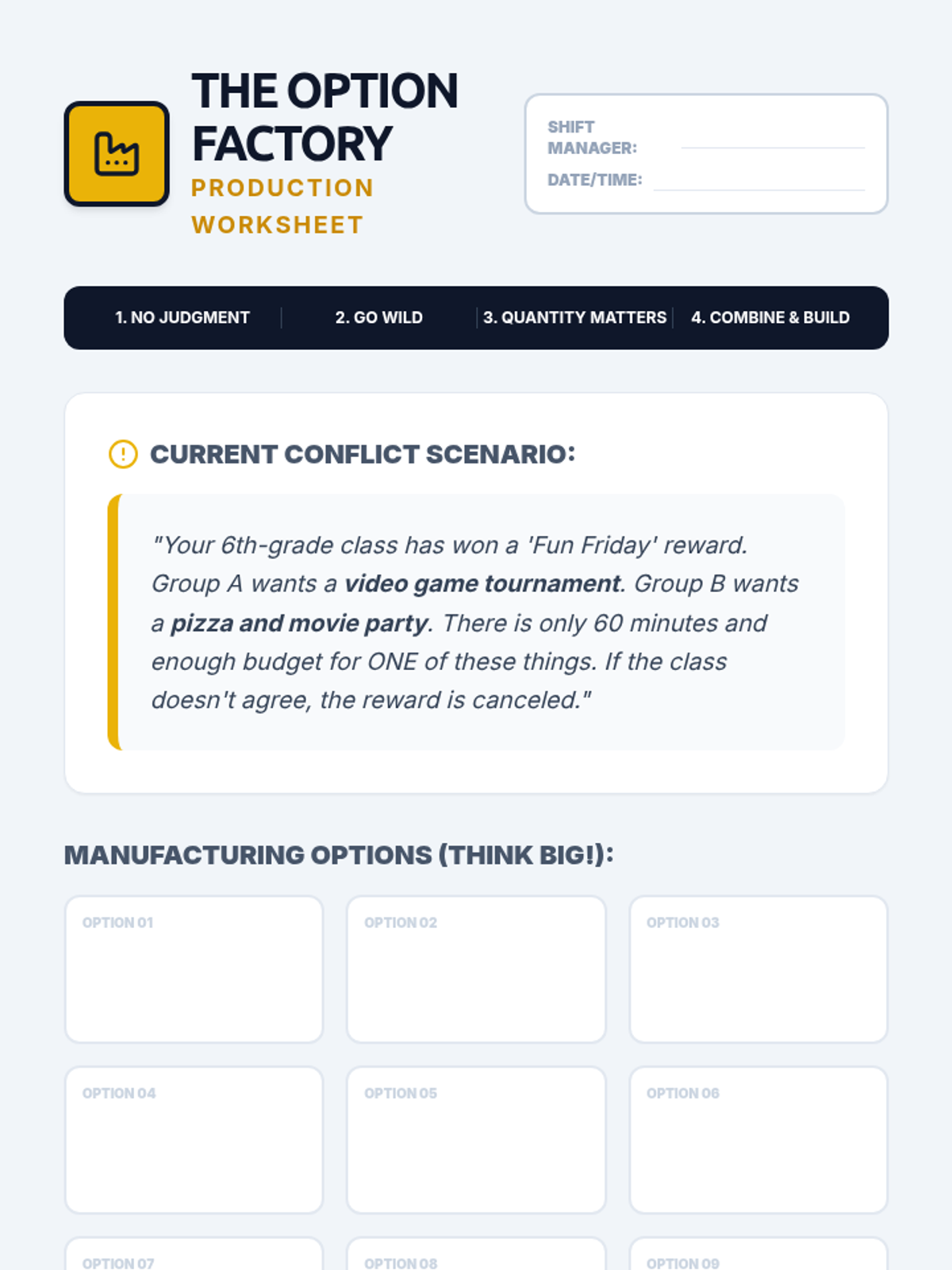
Activity sheet for Lesson 2: Brainstorming Without Judgment. Students use an "Option Factory" grid to generate at least 12 creative solutions to a class reward conflict without judging their quality.
Slide deck for Lesson 2: Brainstorming Without Judgment. Includes the "Paperclip Challenge" hook, an explanation of the "Option Factory" concept, and the 4 fundamental rules for effective brainstorming in negotiations.
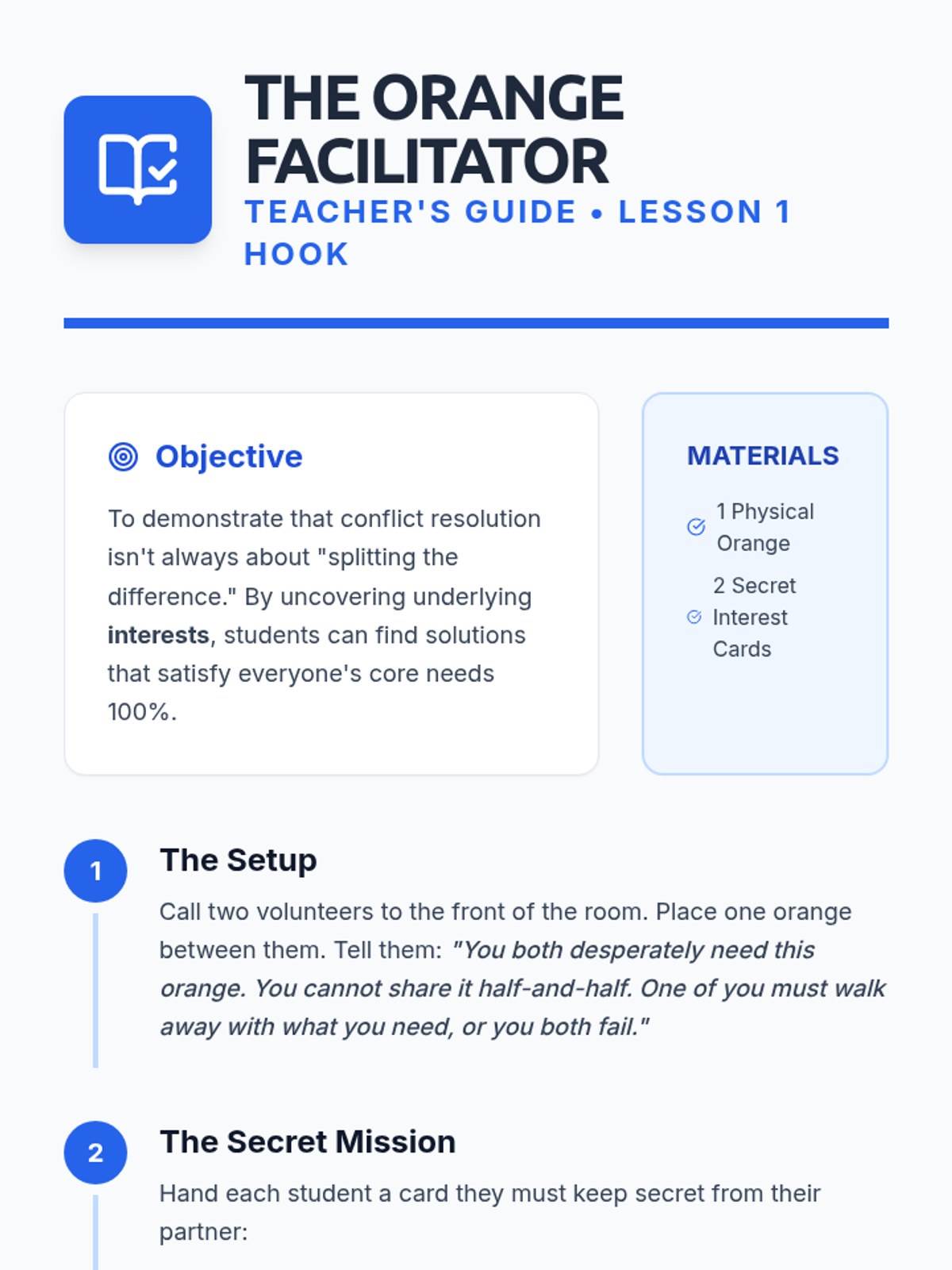
A teacher's guide for the "Orange Story" hook in Lesson 1. Includes setup instructions, secret mission cards for the volunteers, and debriefing questions to help students transition from positions to interests.
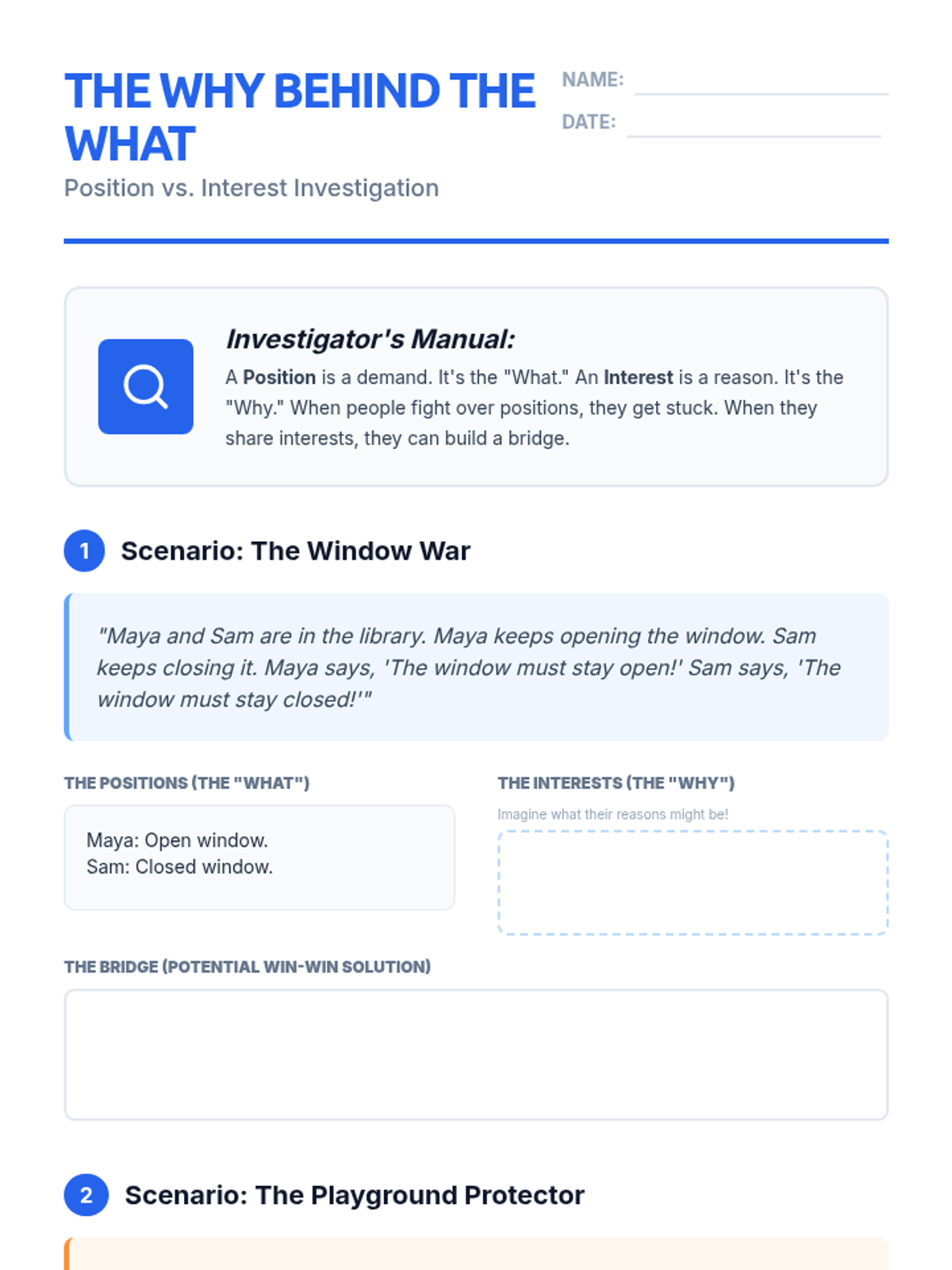
A worksheet for Lesson 1: Positions vs. Interests. Students analyze conflict scenarios to identify what people say they want (positions) versus why they want it (interests) and brainstorm "bridge" solutions.
Introductory slide deck for Lesson 1: Positions vs. Interests. Features the "Orange Story" hook, the "Conflict Iceberg" visual, and clear definitions of positions versus underlying interests.
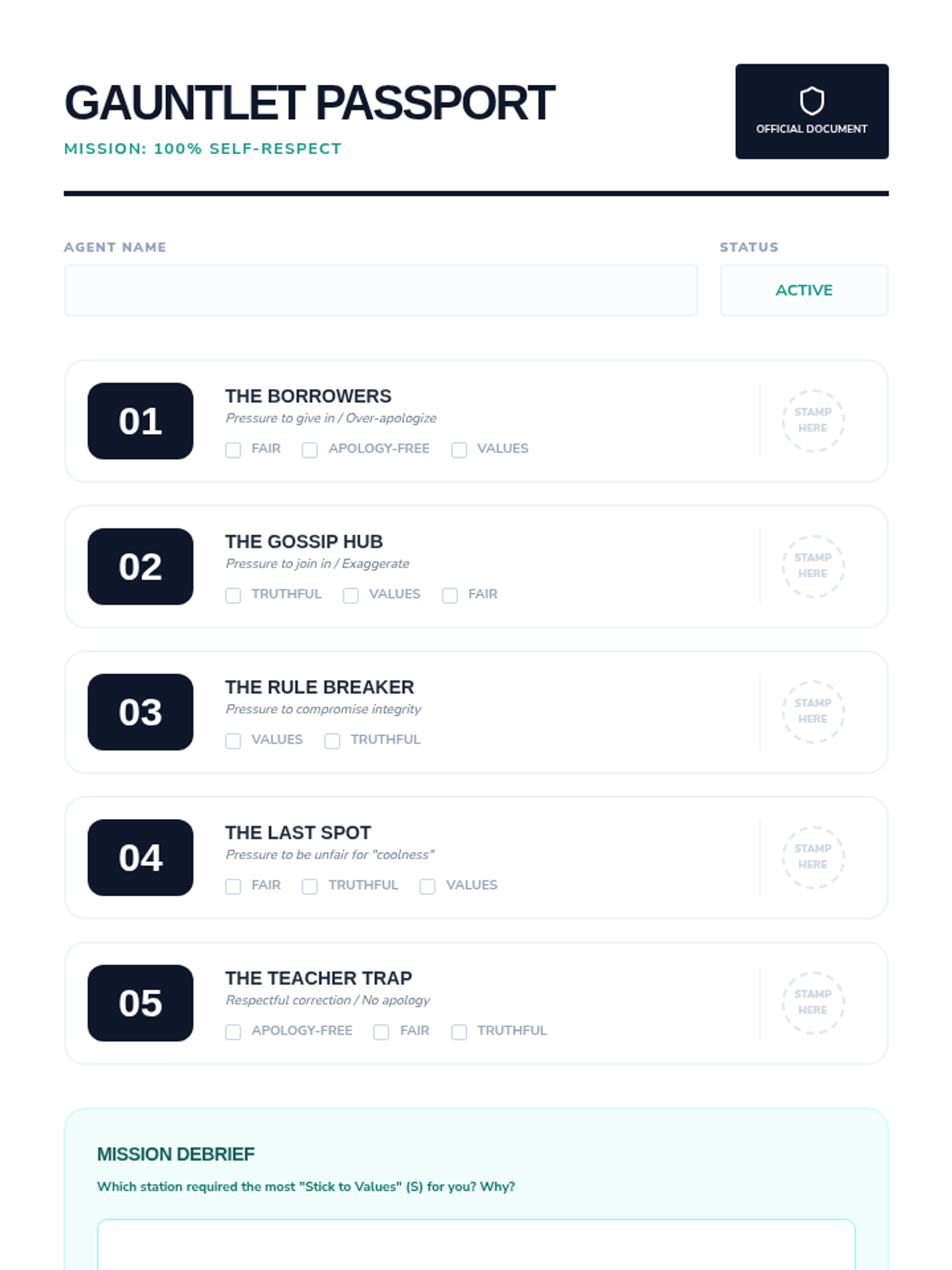
A student progress tracking document for the Gauntlet simulation. Includes space for stamps/checks at each station and a final reflection.
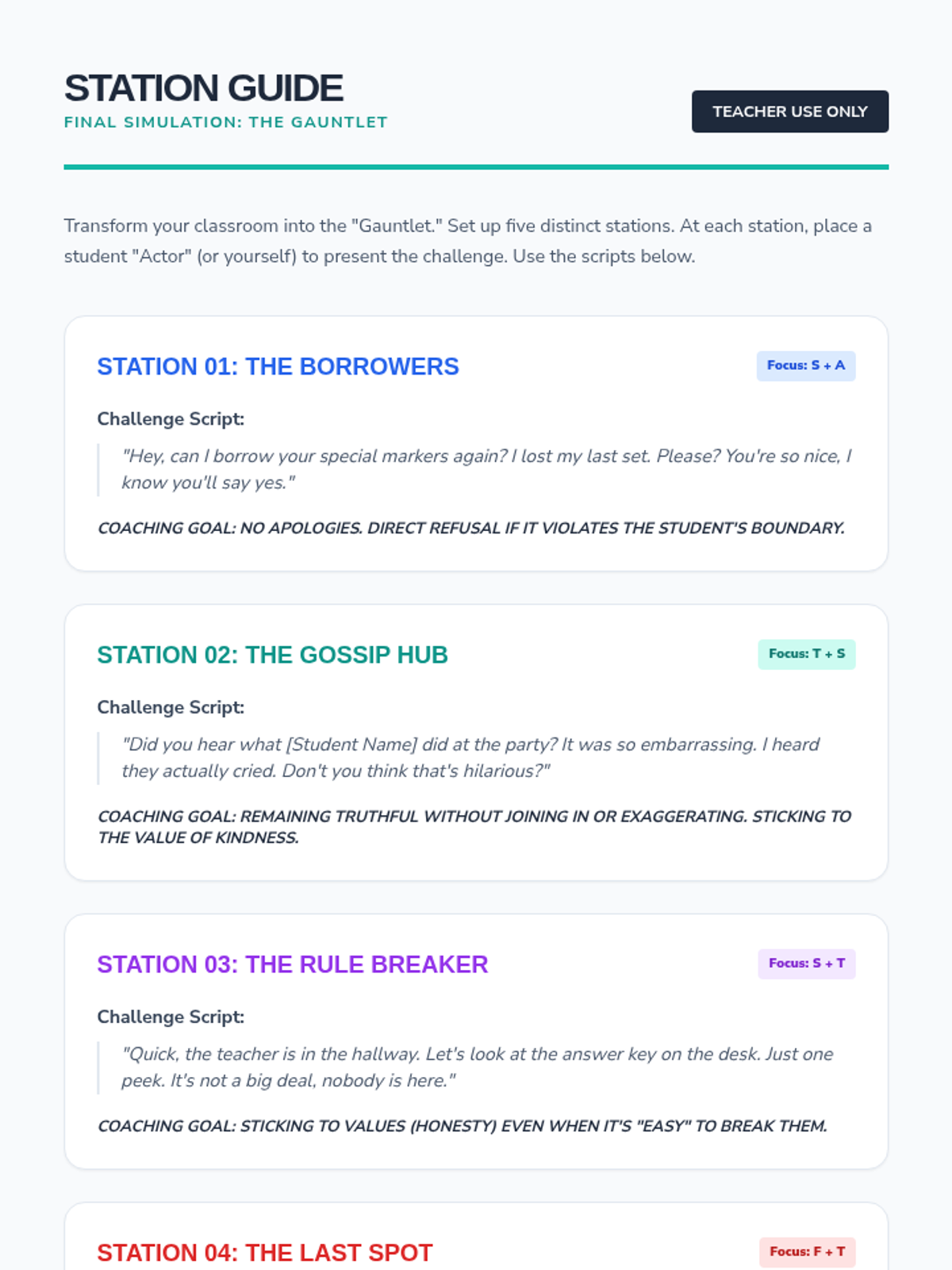
Teacher instructions and scripts for setting up the five final mastery stations for the Self-Respect Gauntlet.
Final slides for the Gauntlet lesson, outlining the rules, station previews, and reflection for the culminating simulation.
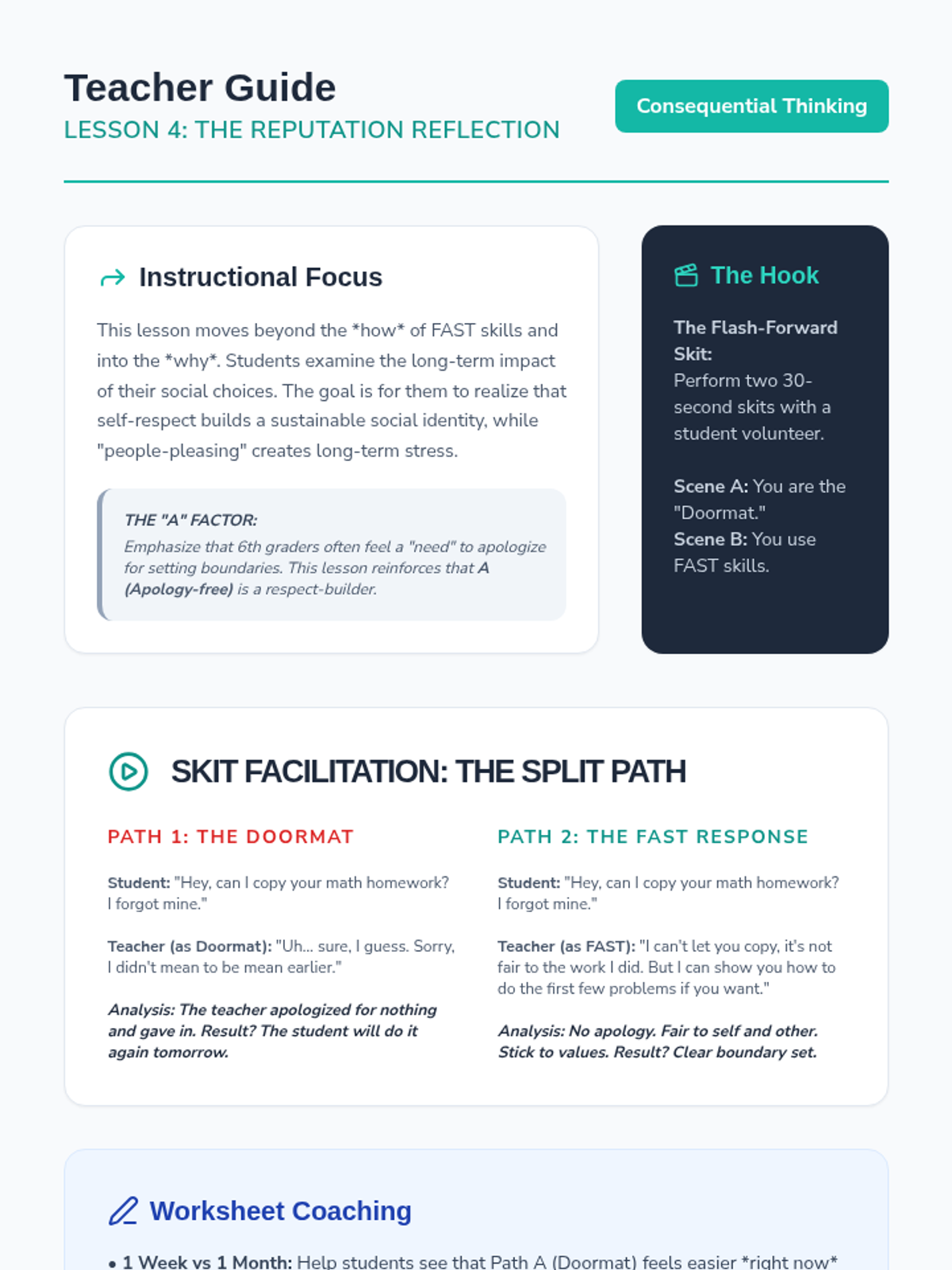
Facilitation guide for Lesson 4, including scripts for the 'Flash Forward' skit and coaching notes for the Reputation Map activity.
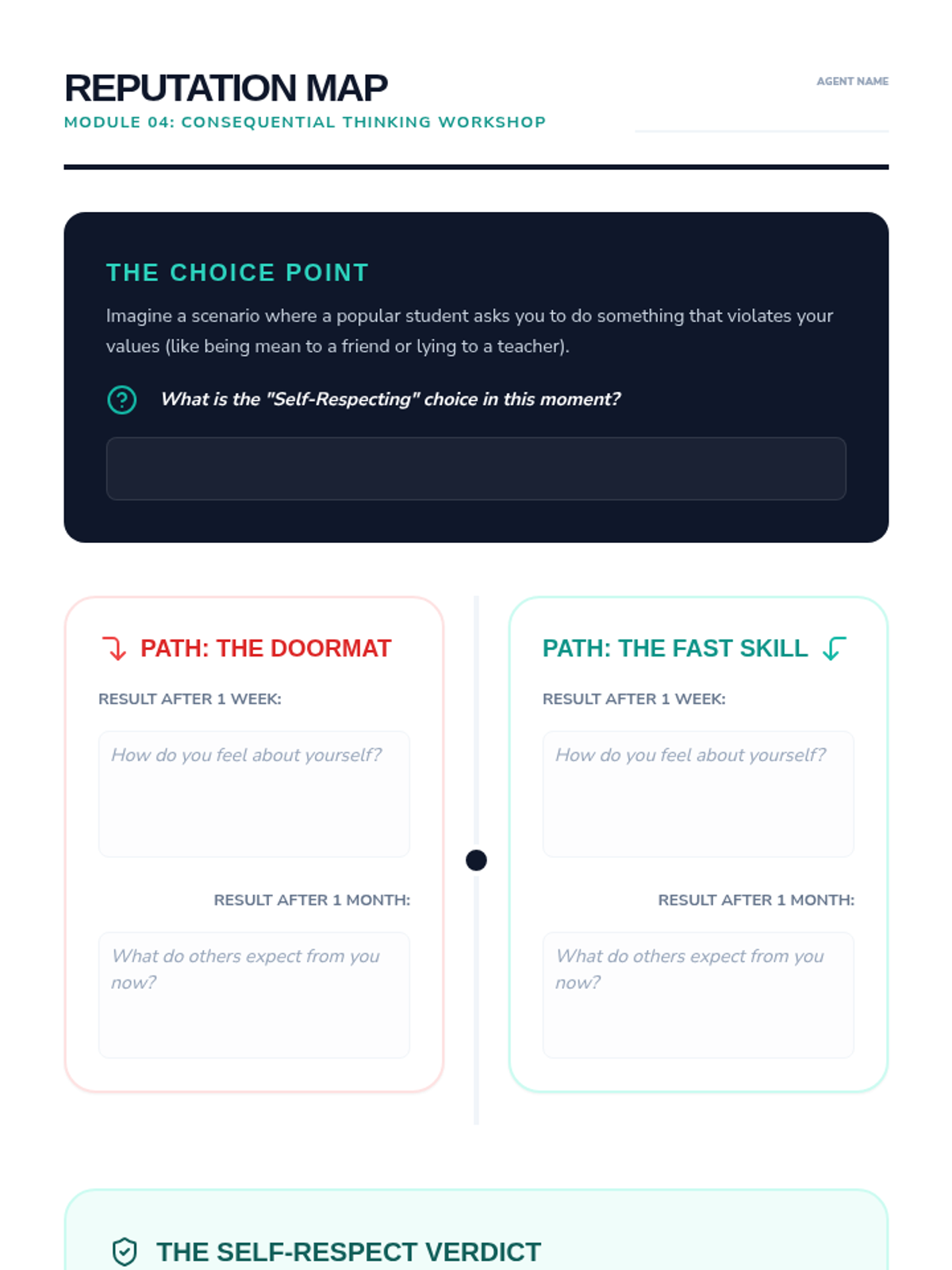
A student worksheet for mapping the long-term consequences of self-respecting choices versus passive choices.
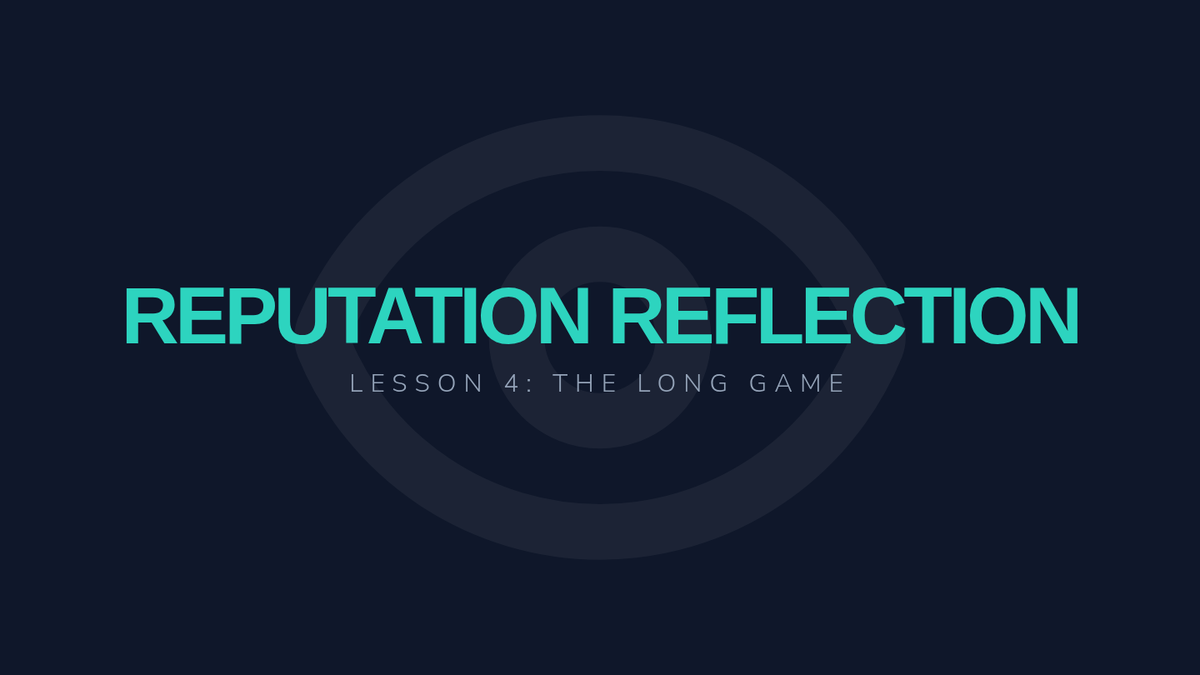
Slides for Lesson 4 focusing on 'Apology-free' skill and the long-term impact of self-respect on personal reputation.
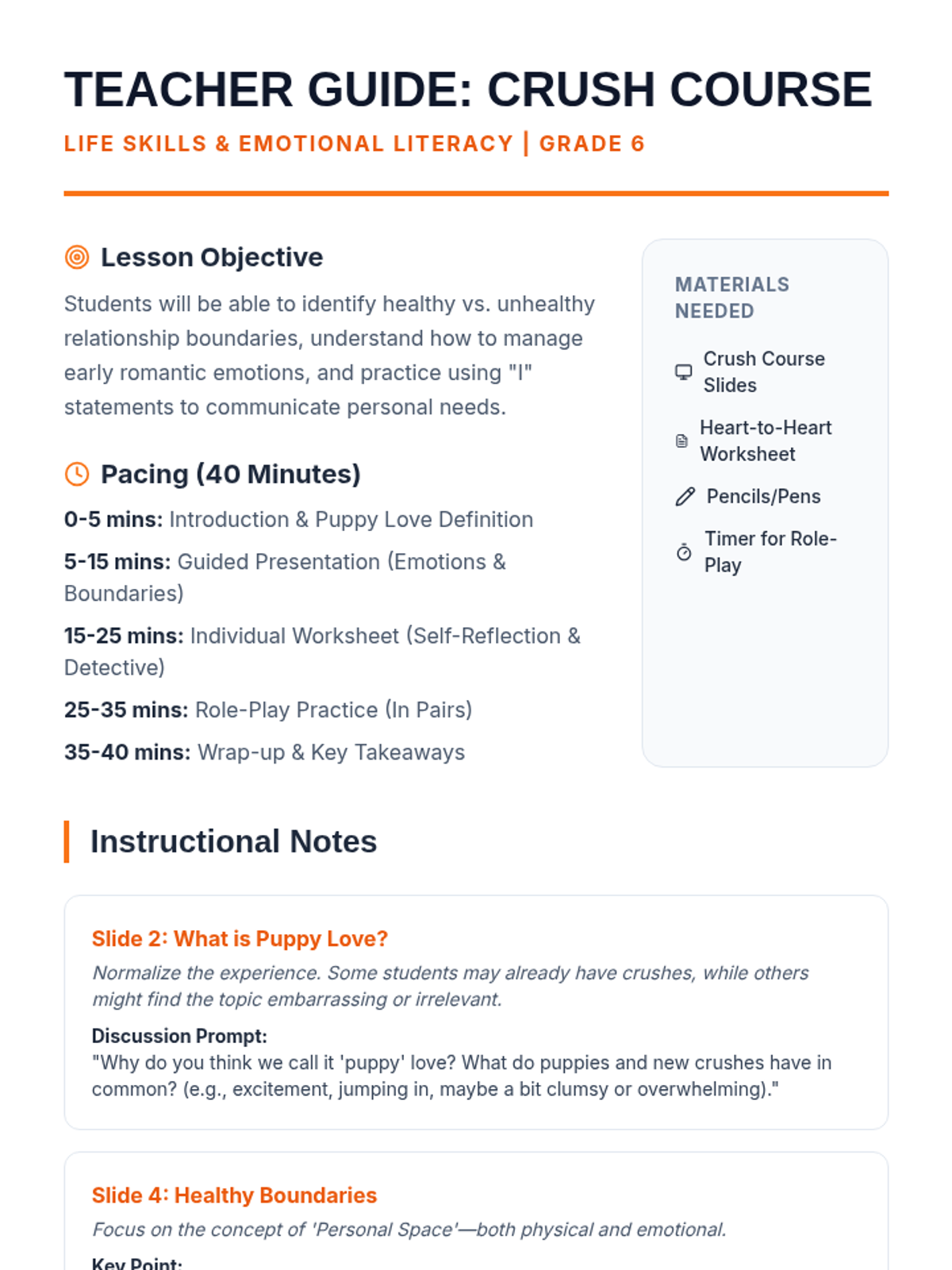
A comprehensive facilitator's guide providing a 40-minute lesson timeline, slide-by-slide teaching notes, discussion prompts, and activity guidance for teachers.
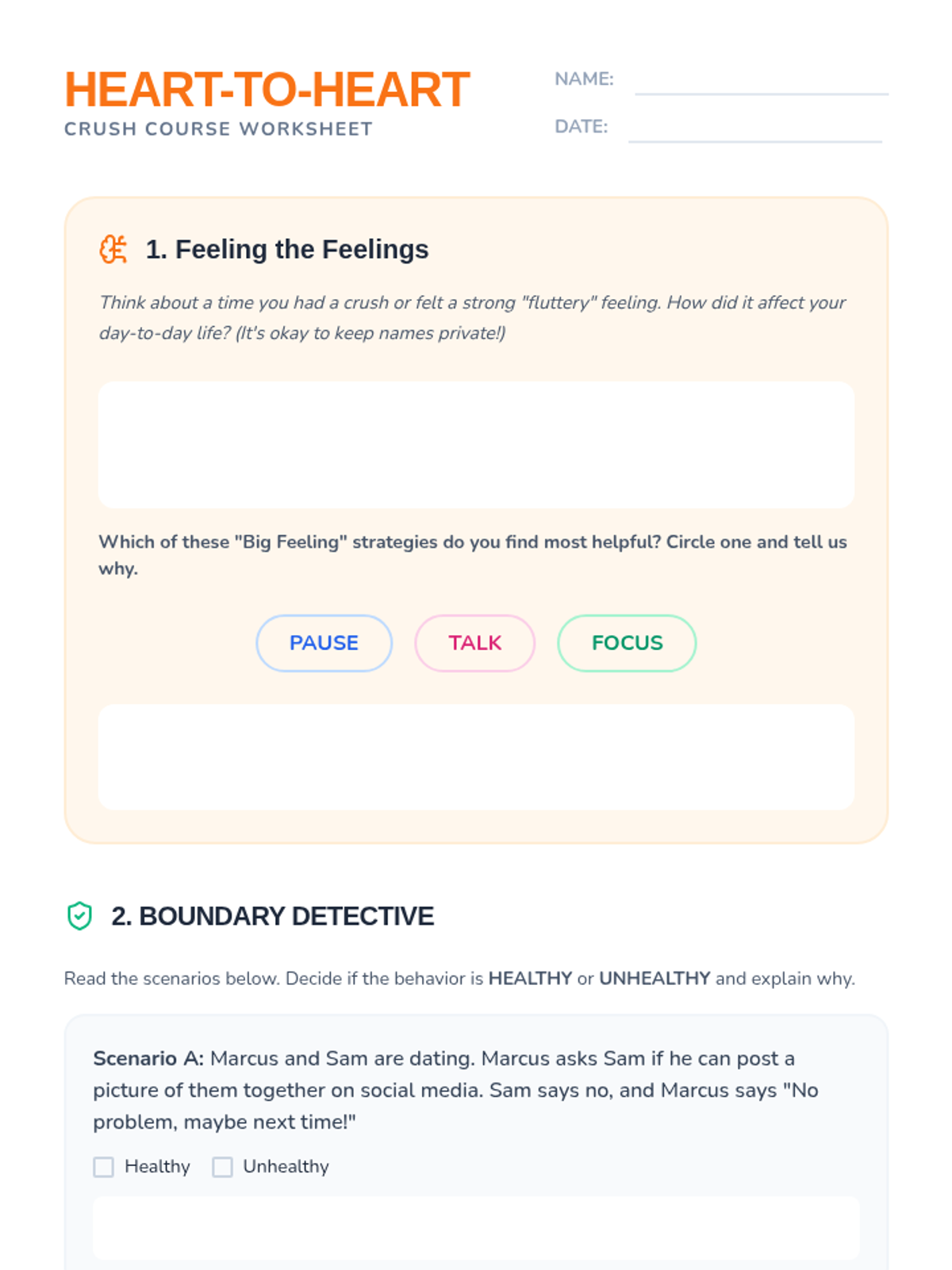
A two-page student worksheet containing self-reflection questions, boundary-detective scenarios, and role-play cards to practice communication skills and "I" statements in romantic relationship contexts.
A vibrant, student-friendly slide deck designed for 6th graders to understand early romantic feelings, healthy boundaries, and communication skills. It uses relatable analogies and visual cues to make complex social concepts accessible. All text is sized for maximum visibility in a presentation setting.
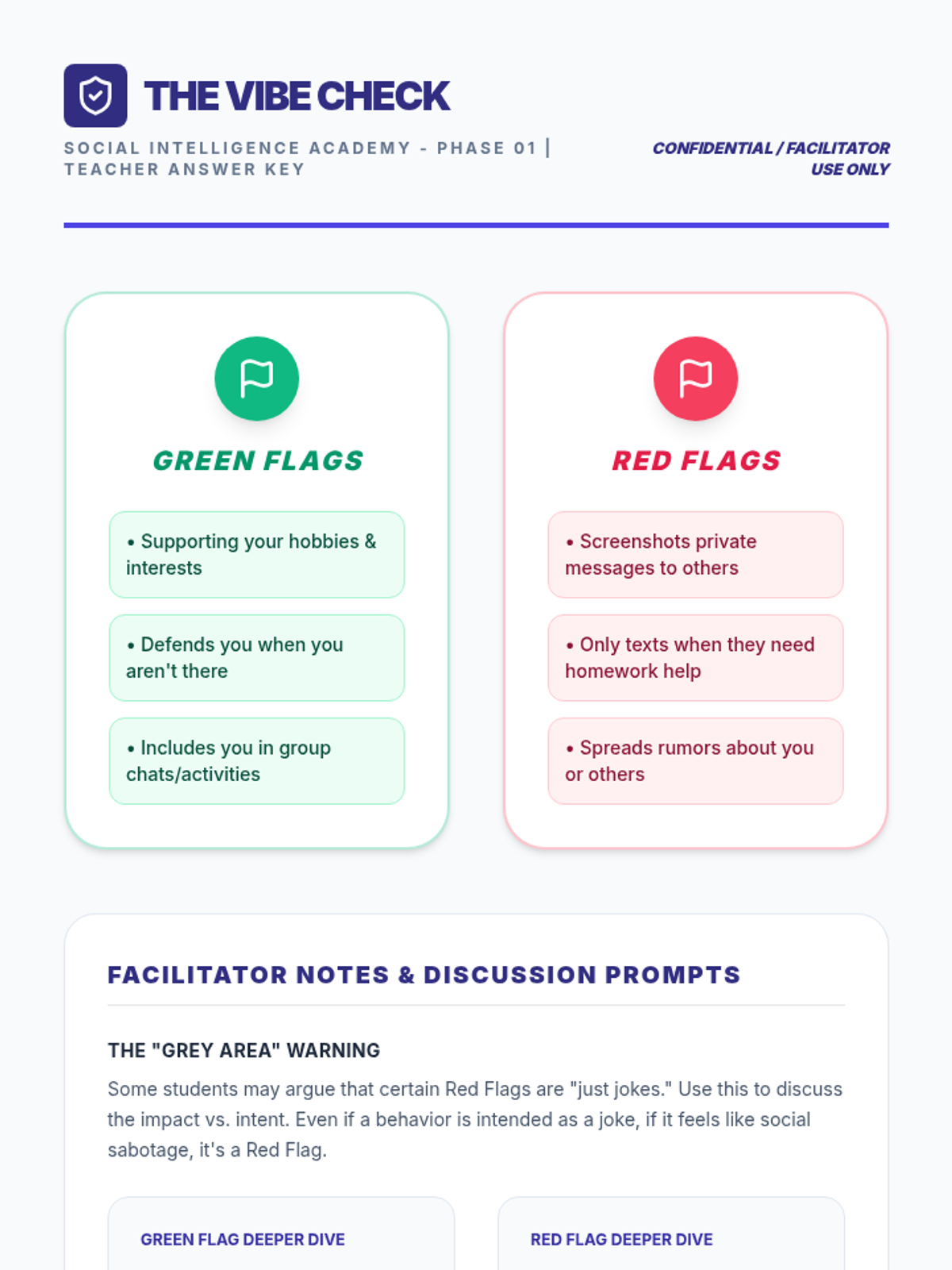
The facilitator's key for the Vibe Check worksheet, including correct categorization of behaviors and discussion prompts for a whole-class setting.
A modern, tech-inspired 9-slide presentation for Session 1 of the Social Intelligence Academy, focusing on "Vibe Checks" and healthy friendship markers for 6th graders.
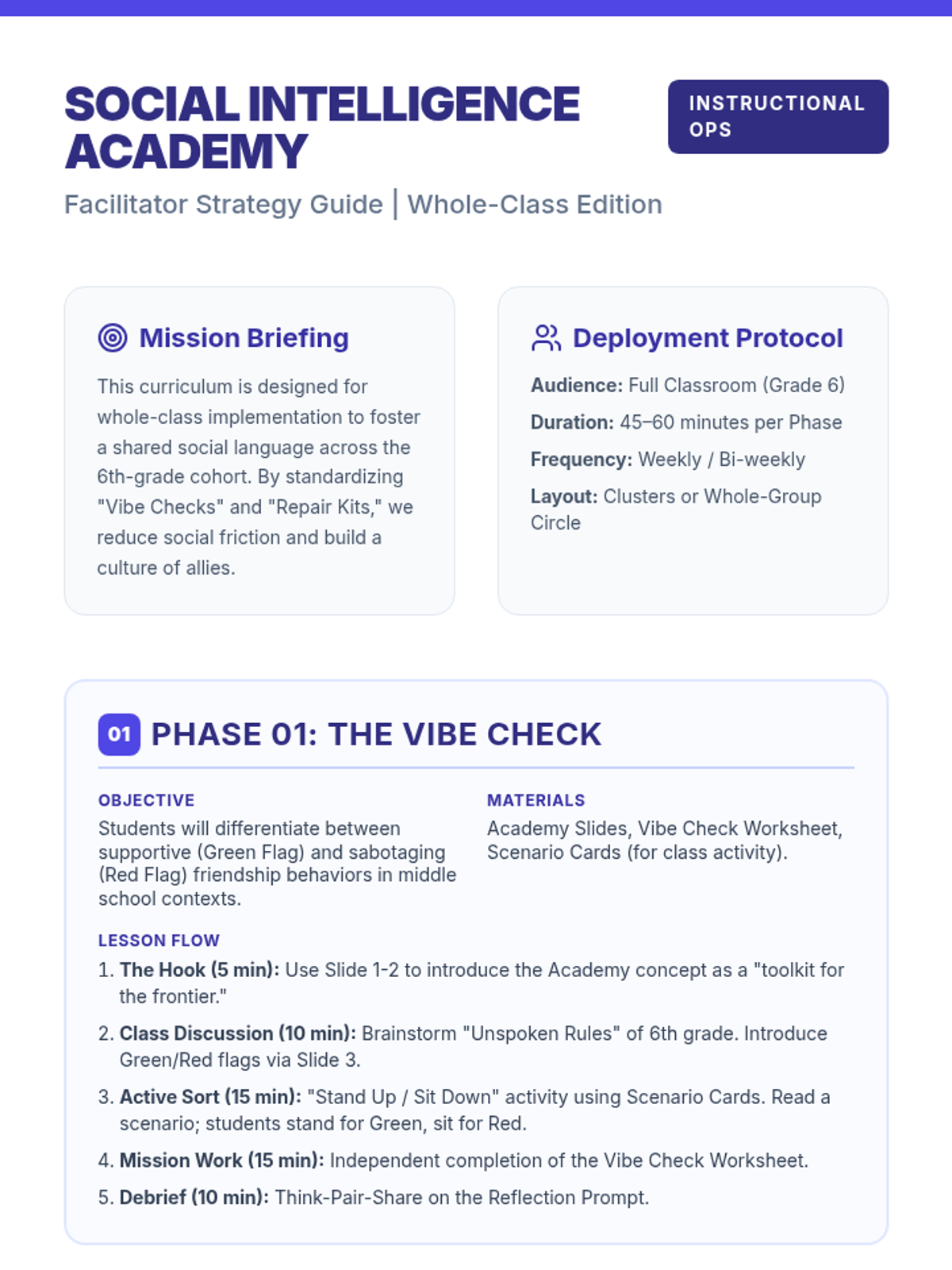
A sophisticated 3-page guide for middle school educators, adapting the Social Intelligence Academy curriculum for whole-class implementation with a focus on shared cohort culture, digital dynamics, and cohort-wide conflict resolution.
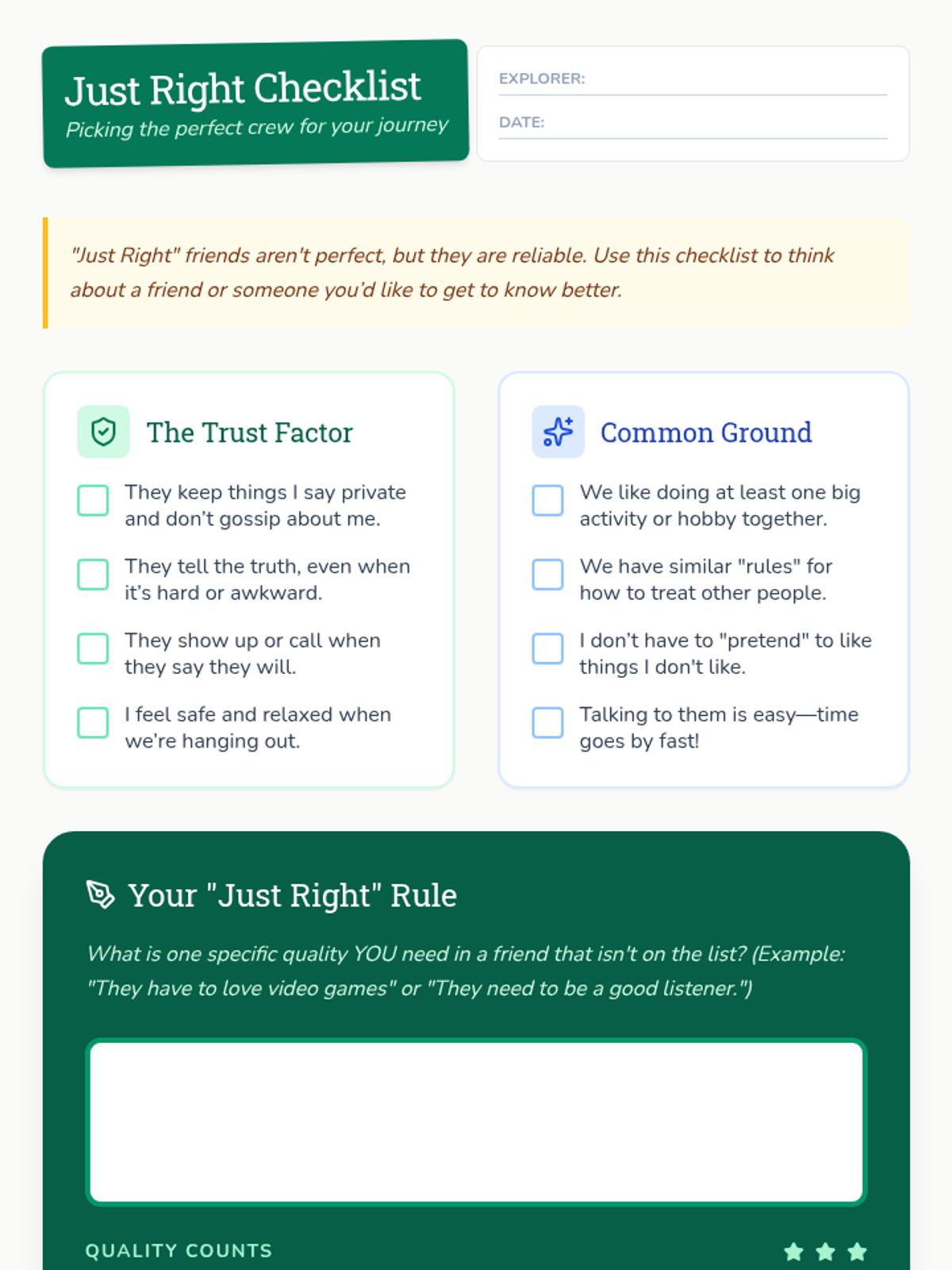
A student-friendly evaluation tool featuring clear indicators for trust and common interests, with a personalized reflection area for specific friendship needs.
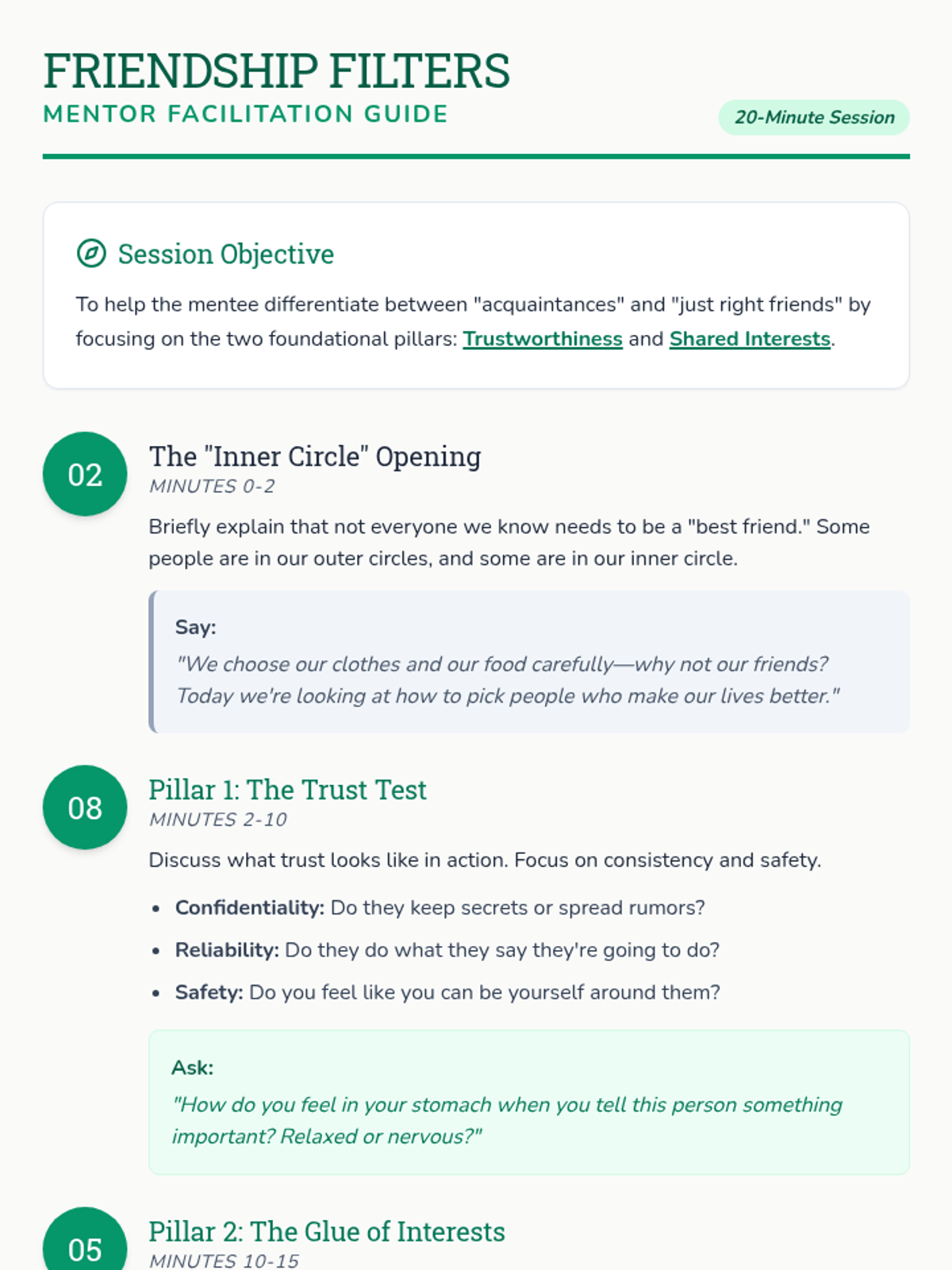
A concise 20-minute mentor facilitation guide designed to lead a focused discussion on choosing high-quality friends based on trust and common ground.
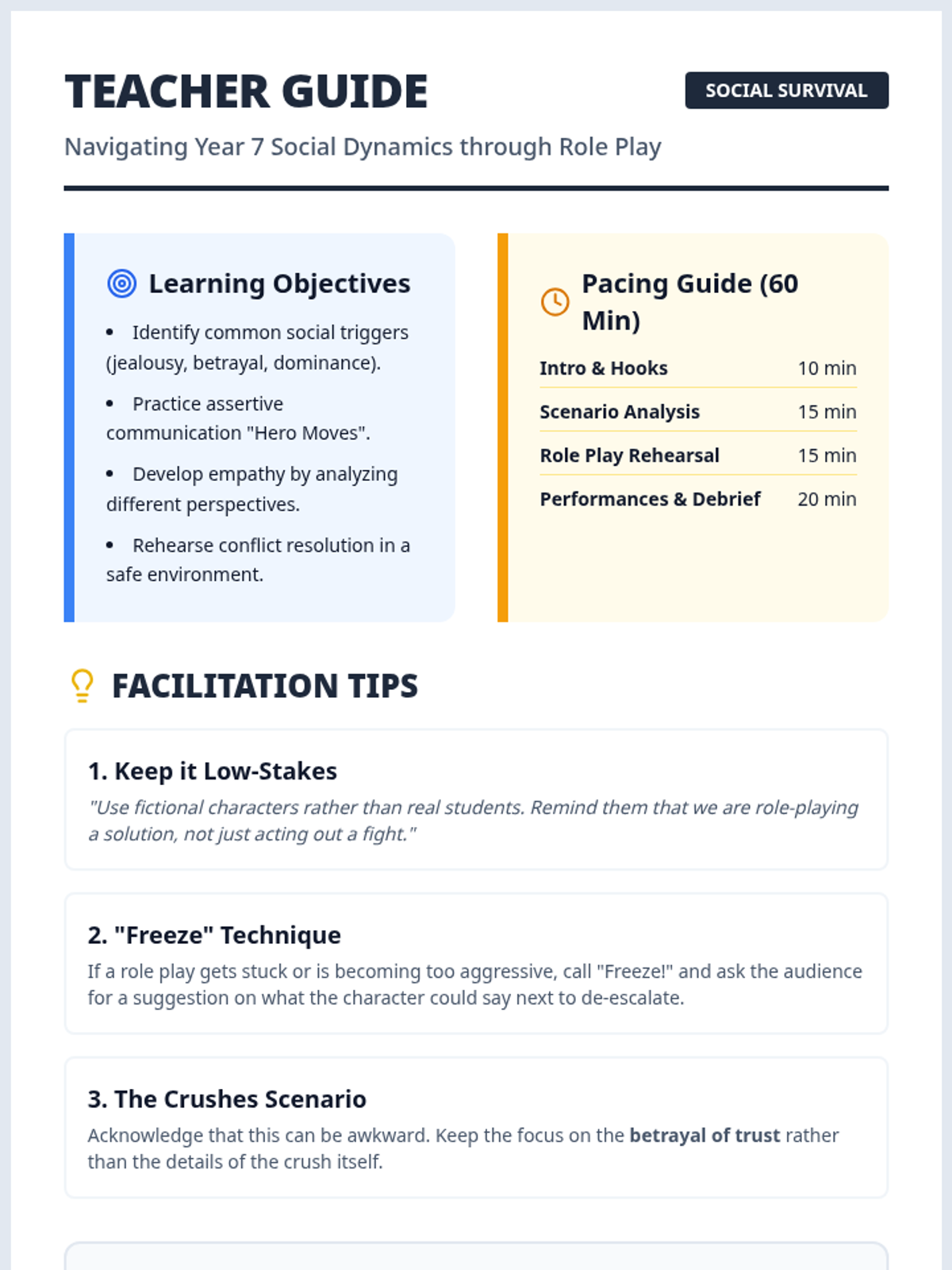
A comprehensive teacher guide for facilitating the Social Survival lesson, including pacing, learning objectives, discussion prompts, and management tips for role-play activities.
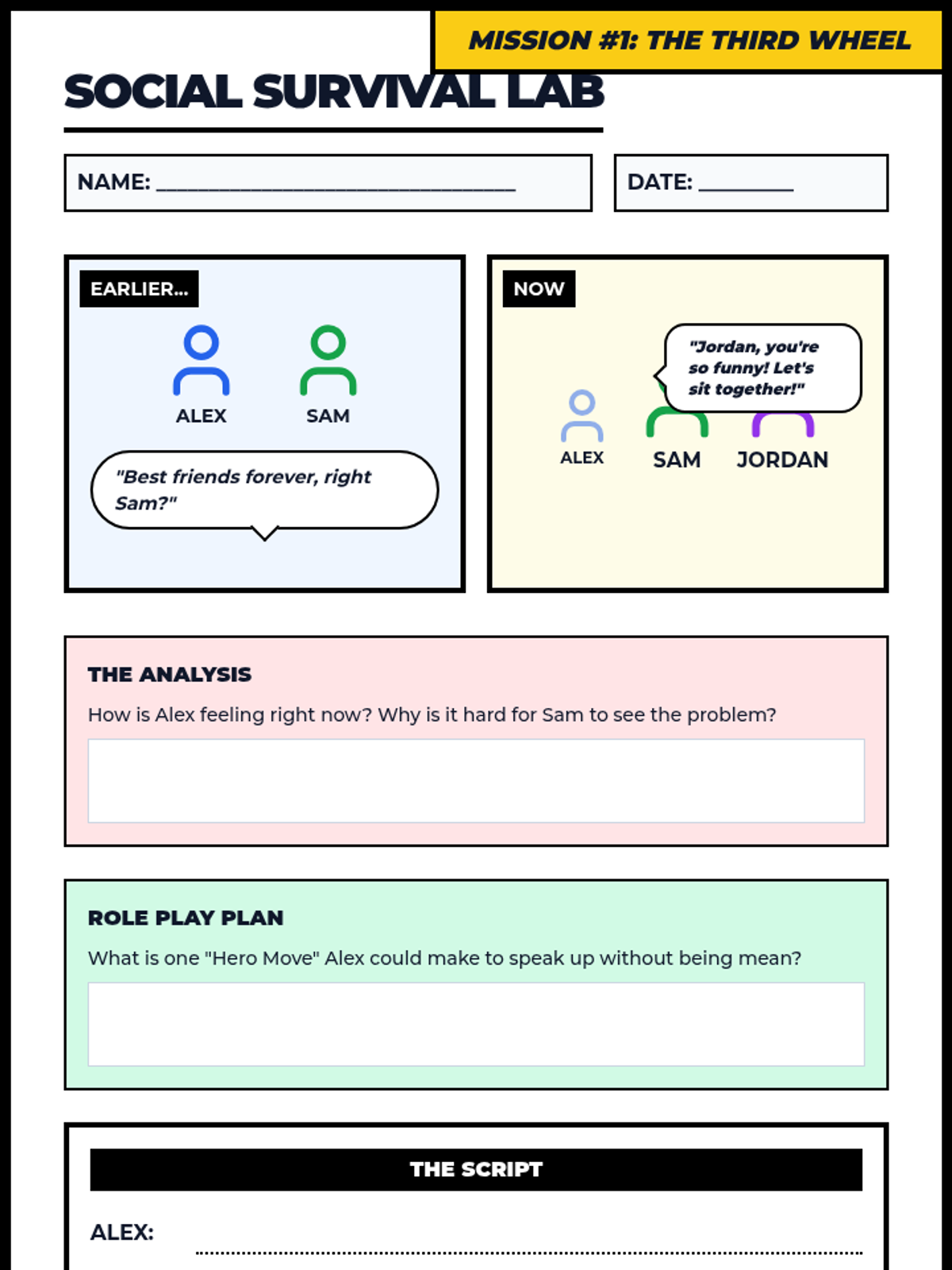
A set of three comic-strip-style role-play worksheets for Year 7 students, covering friendship jealousy, secret-sharing (crushes), and classroom group dynamics.
A vibrant, comic-book-inspired slide deck to introduce Year 7 students to common friendship challenges and the basics of role-playing resolutions.
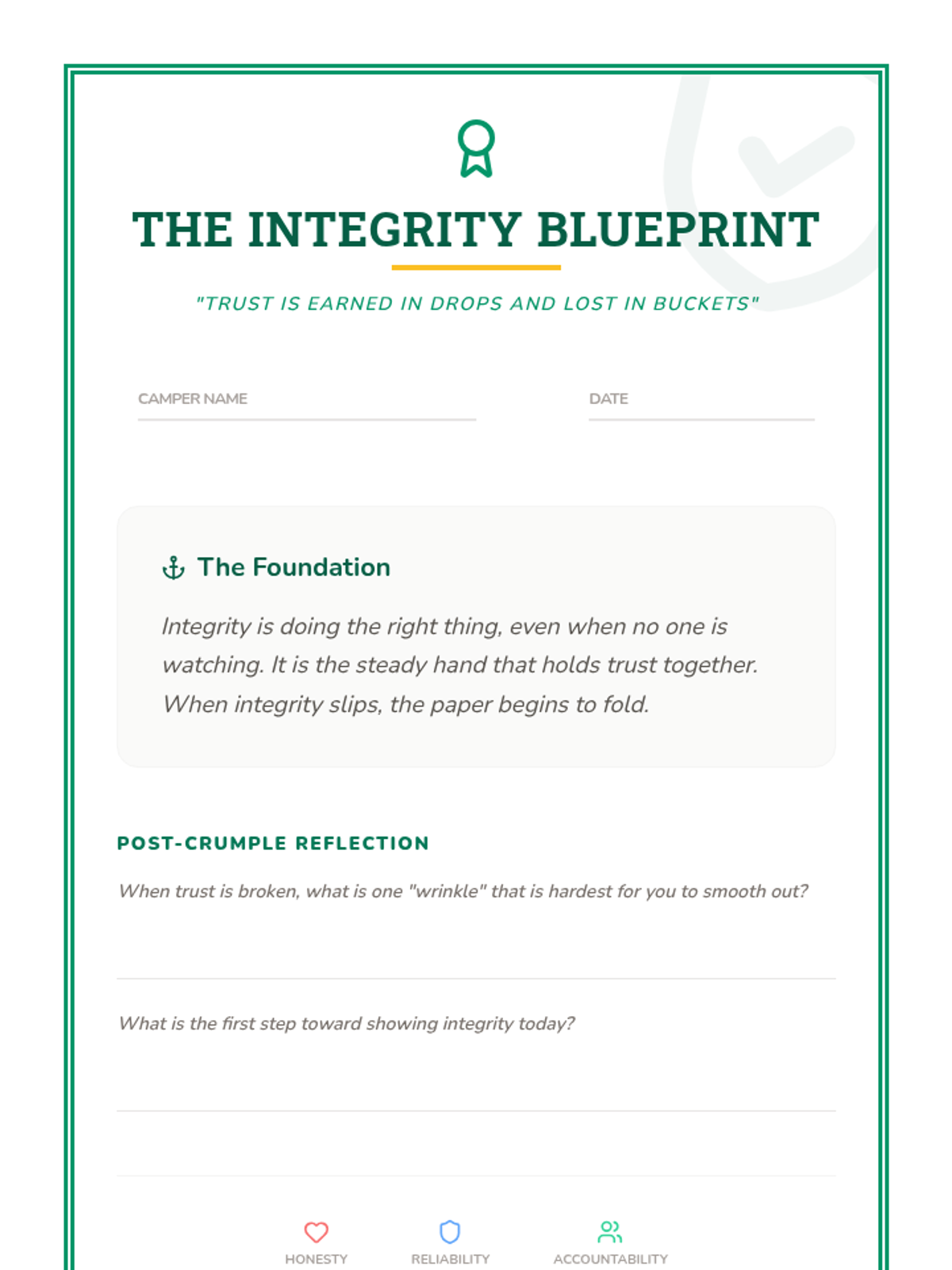
A student reflection handout designed to be 'perfectly' clean initially, then crumpled and smoothed out as part of the lesson's core metaphor.
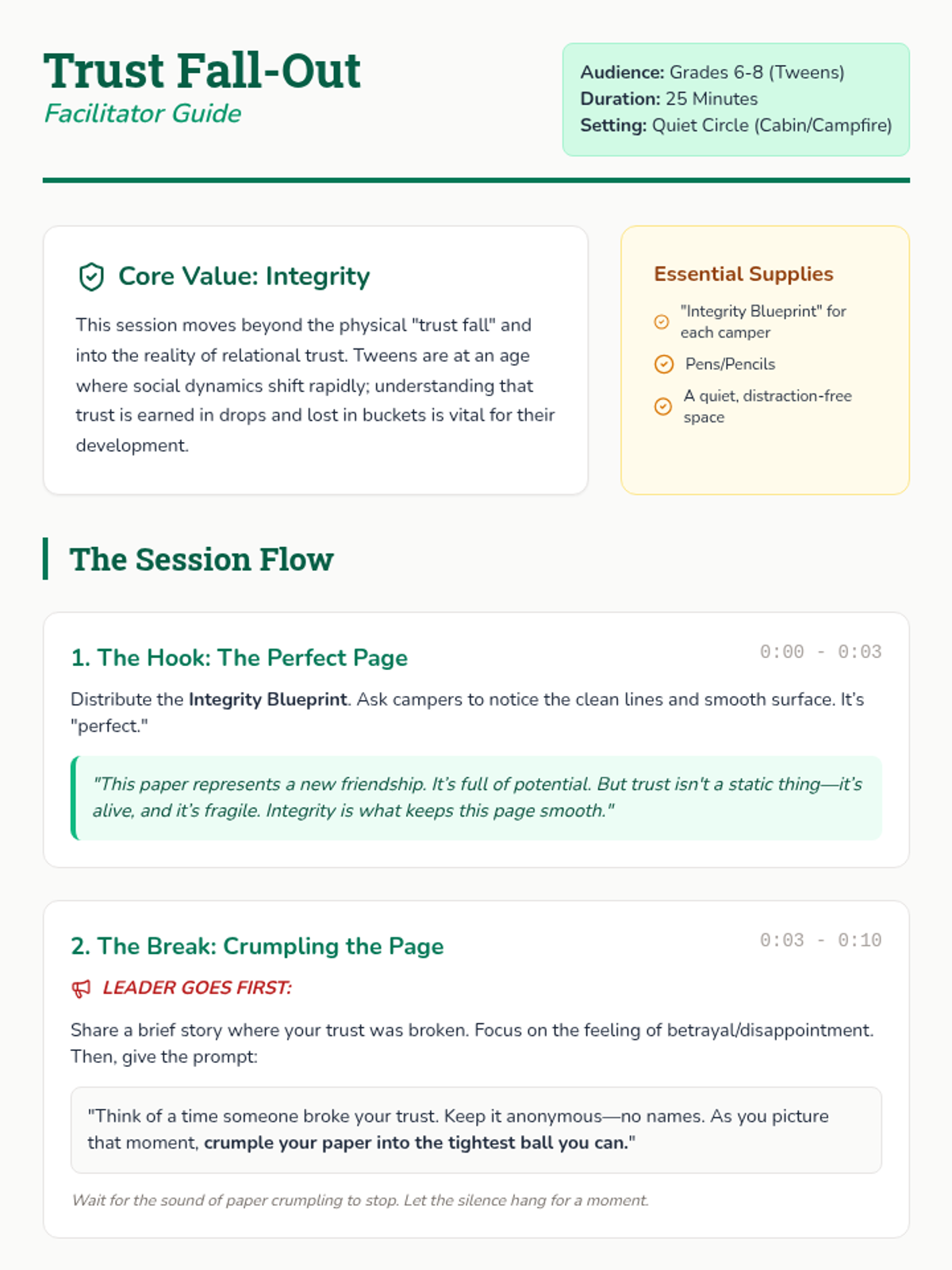
A detailed facilitator guide for camp counselors to lead a 25-minute discussion on trust, integrity, and the metaphorical 'wrinkles' caused by broken trust.
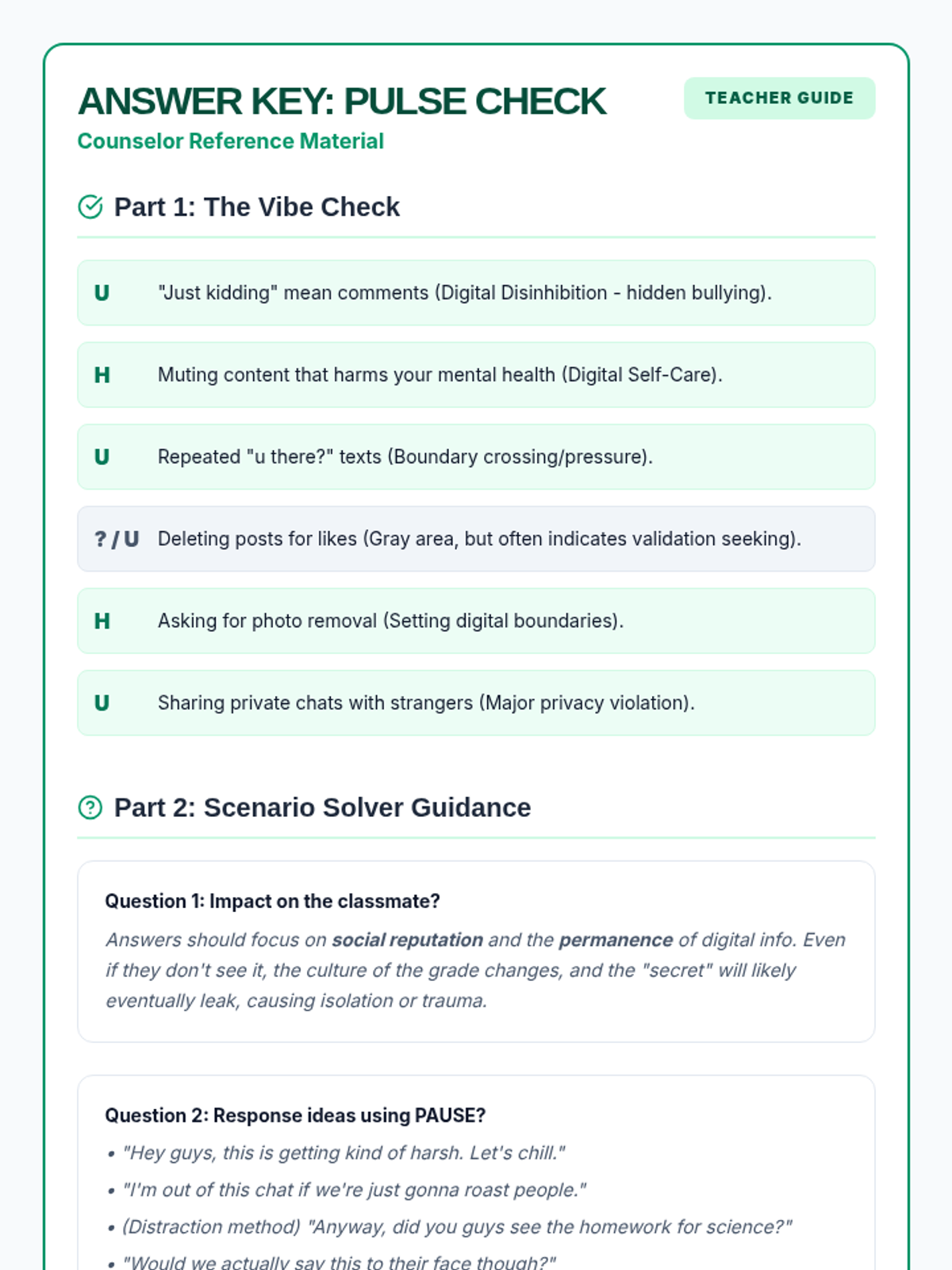
An answer key and facilitator reference for the Pulse Check activity, providing suggested responses, behavioral analysis, and teaching tips for digital citizenship discussions.
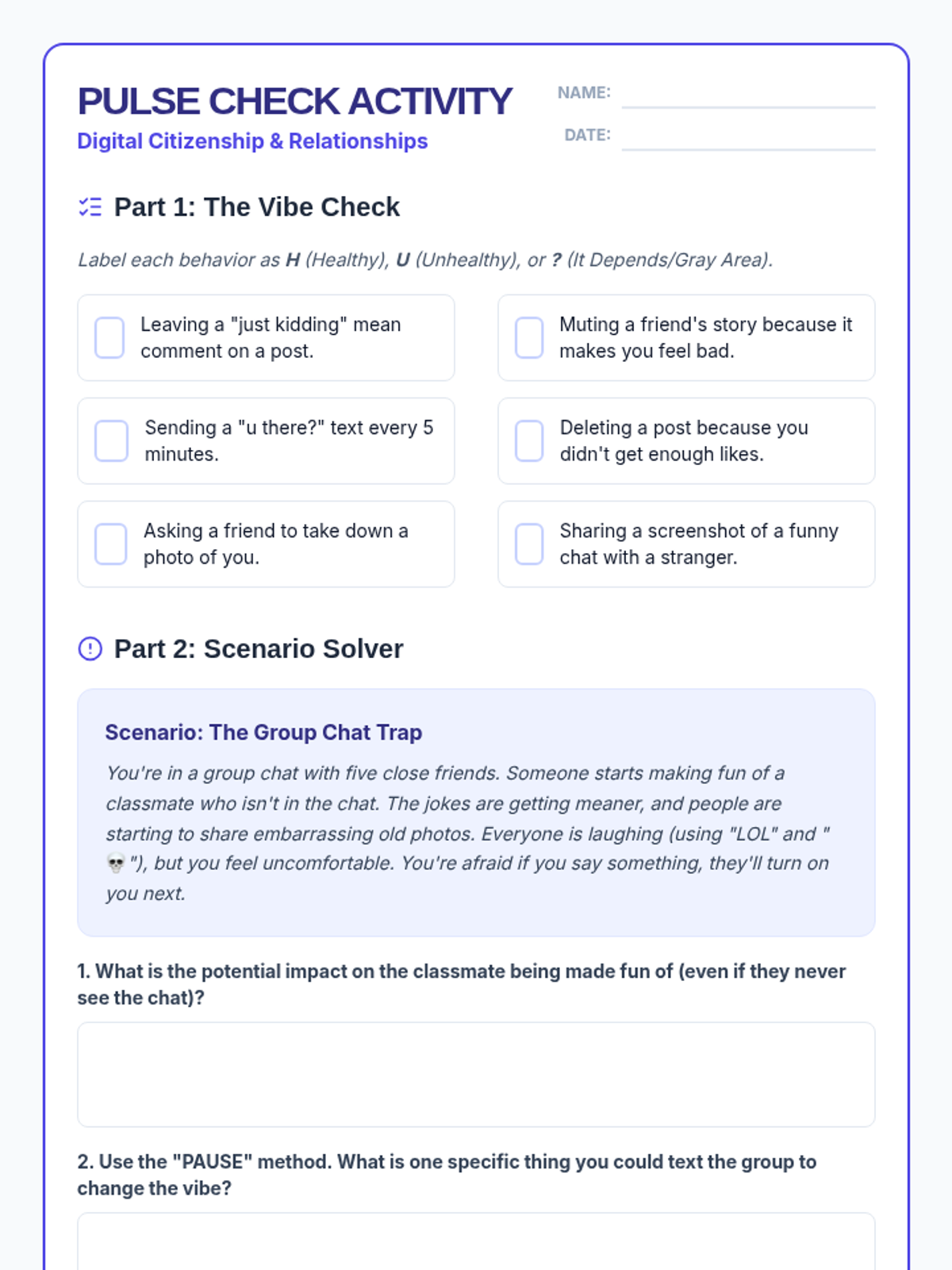
A student worksheet titled 'Pulse Check Activity' that helps middle schoolers analyze digital behaviors, solve social media scenarios using the PAUSE method, and commit to a digital wellness pledge.
An engaging slide deck for middle schoolers exploring digital citizenship, defining the 'digital heartbeat', contrasting healthy and unhealthy online behaviors, and introducing the 'PAUSE' method for digital communication.
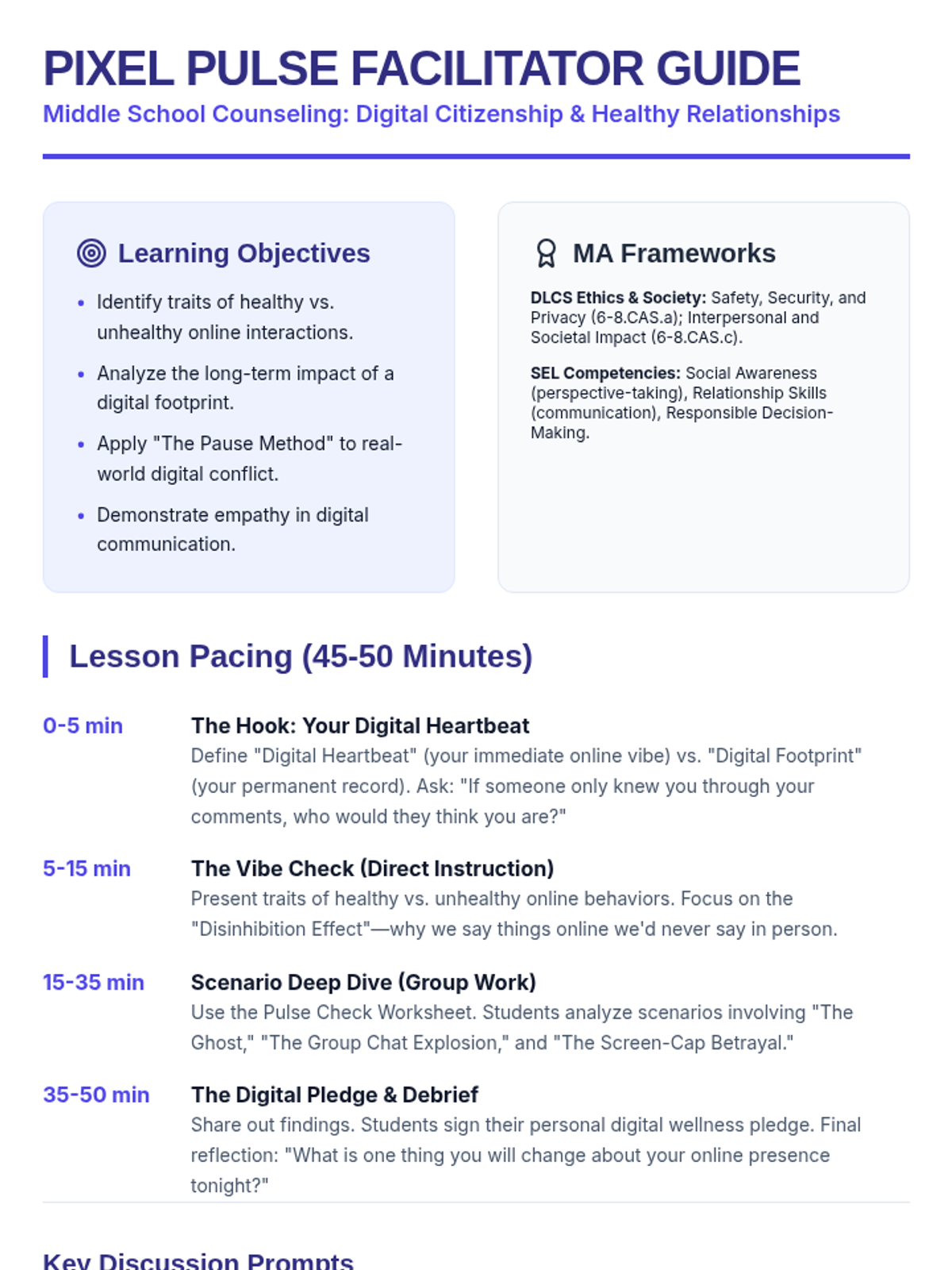
A comprehensive facilitator guide for middle school counselors, outlining lesson pacing, Massachusetts framework alignment, learning objectives, and key discussion prompts for teaching digital citizenship.
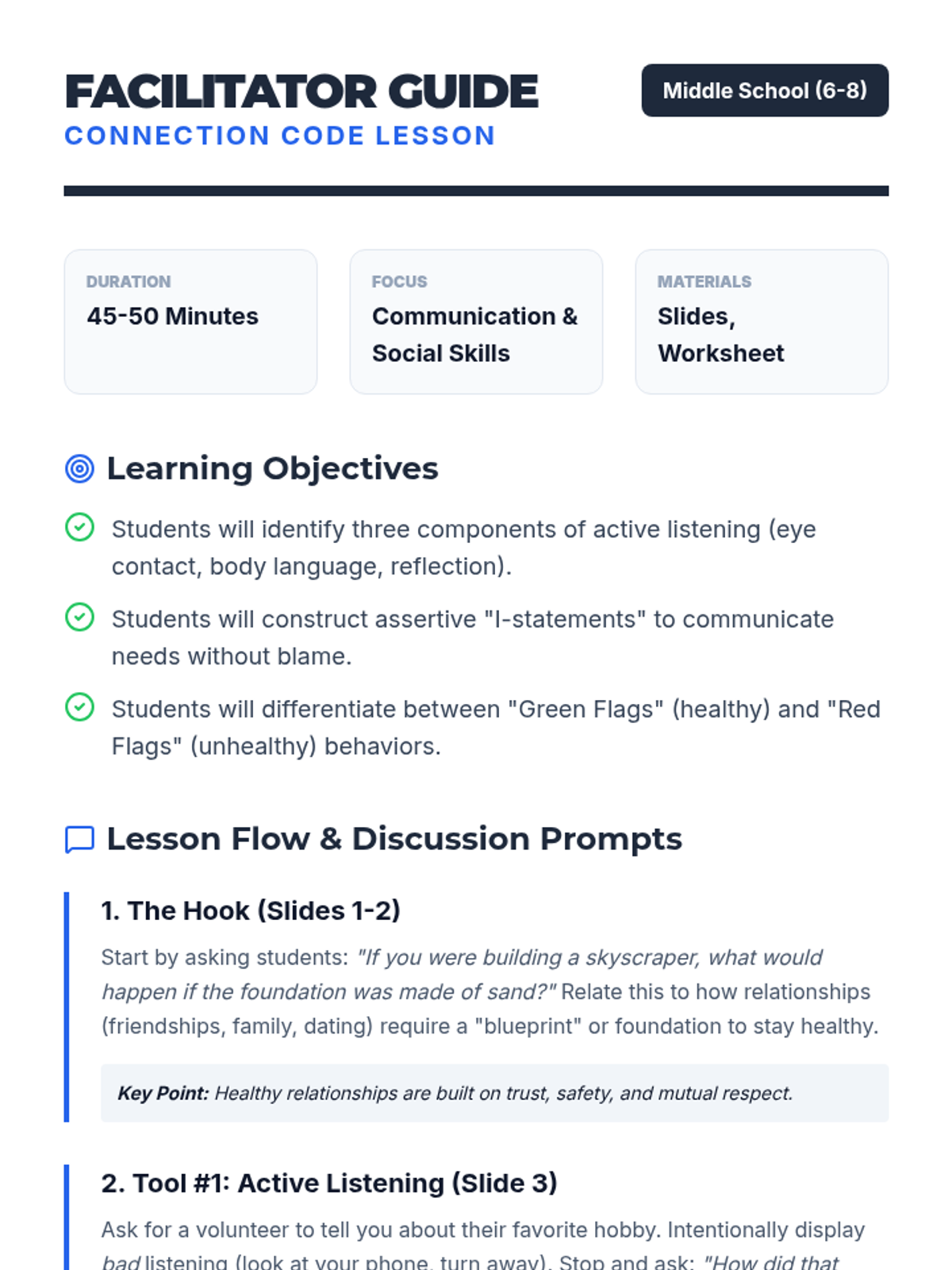
A comprehensive teacher guide for the Connection Code lesson, including learning objectives, a slide-by-slide script, discussion prompts, and an answer key for the student worksheet.
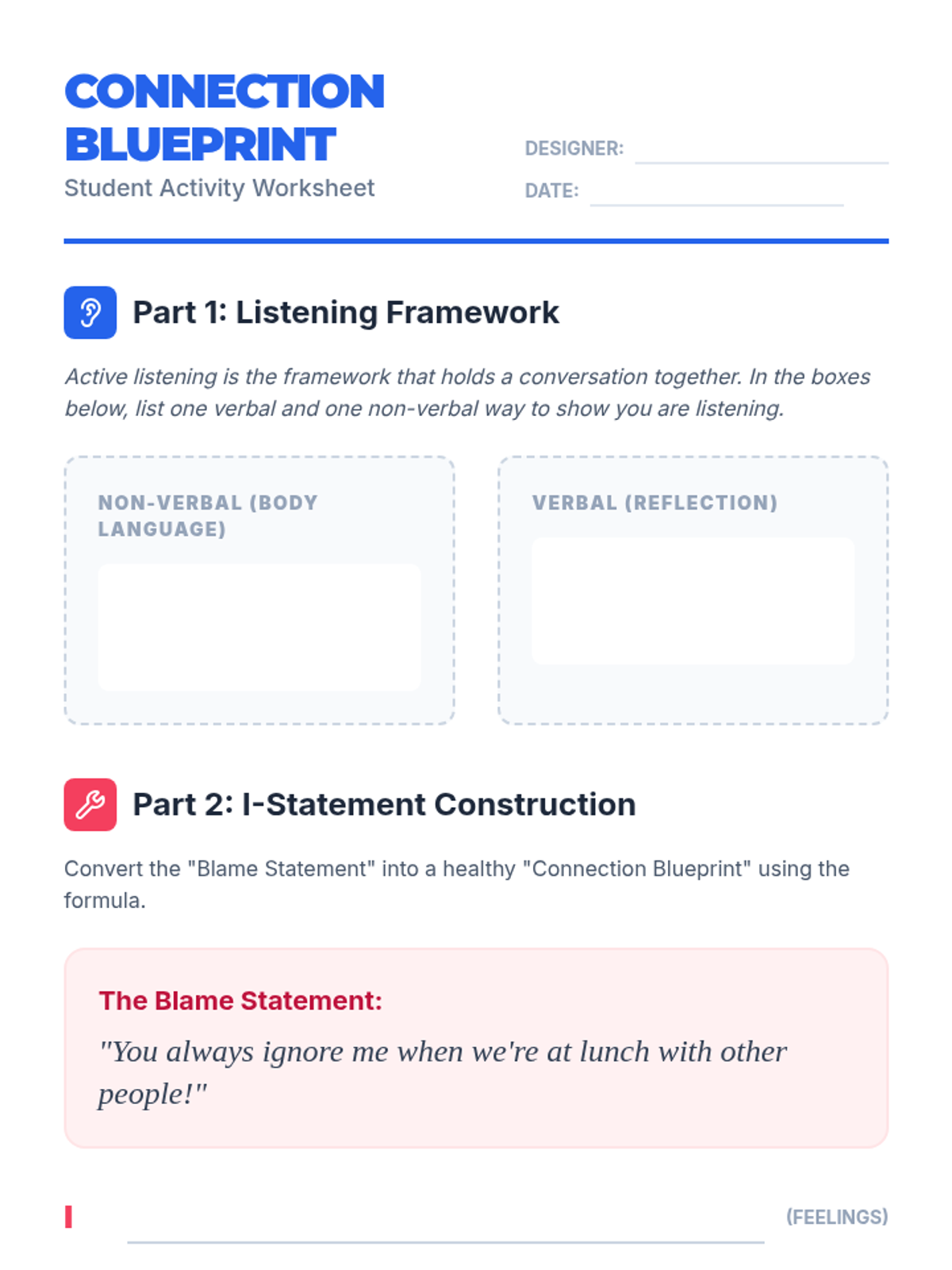
A student activity worksheet designed like an architectural blueprint for students to practice active listening, I-statements, and flag identification.
A visual slide deck introducing the "Connection Blueprint" framework for healthy relationships, active listening techniques, and the I-statement formula.
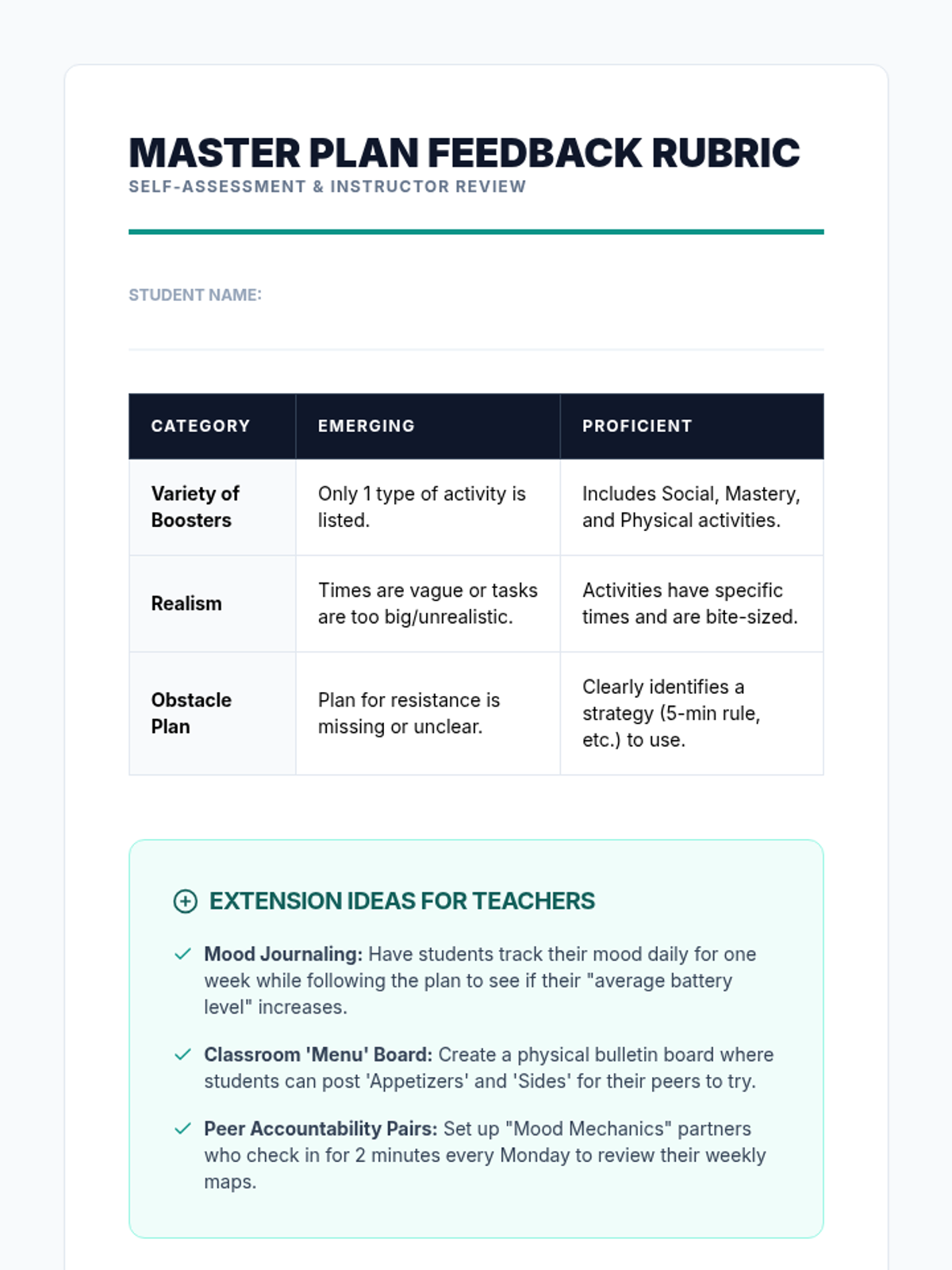
A teacher resource for Lesson 5, including a grading rubric and extension ideas for deepening the behavioral activation practice in the classroom.
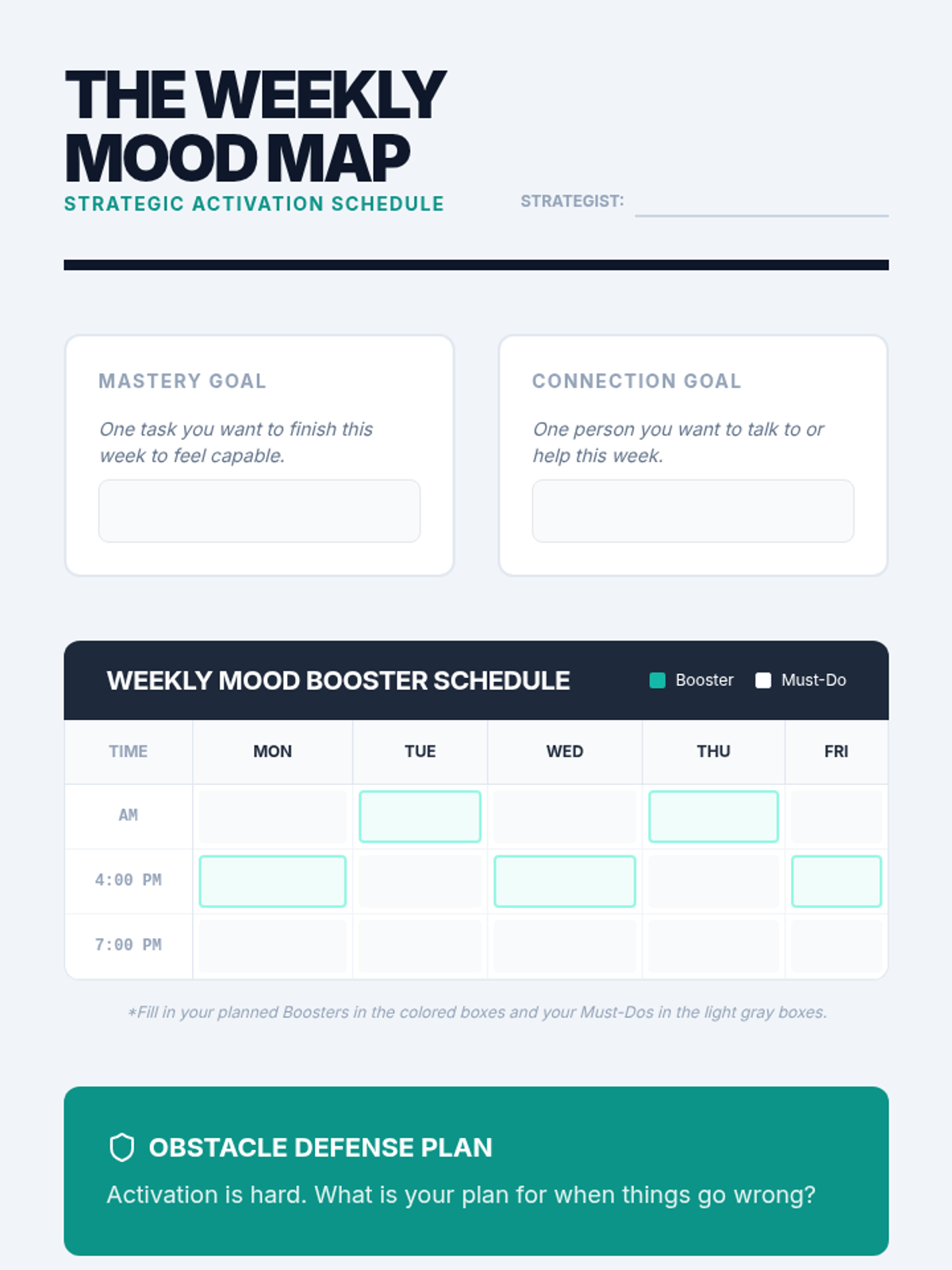
A culminating project worksheet for Lesson 5 where students design their own weekly schedule, integrating mood-boosting activities and responsibilities.
Slides for the final workshop lesson where students synthesize everything learned to create a balanced weekly schedule.
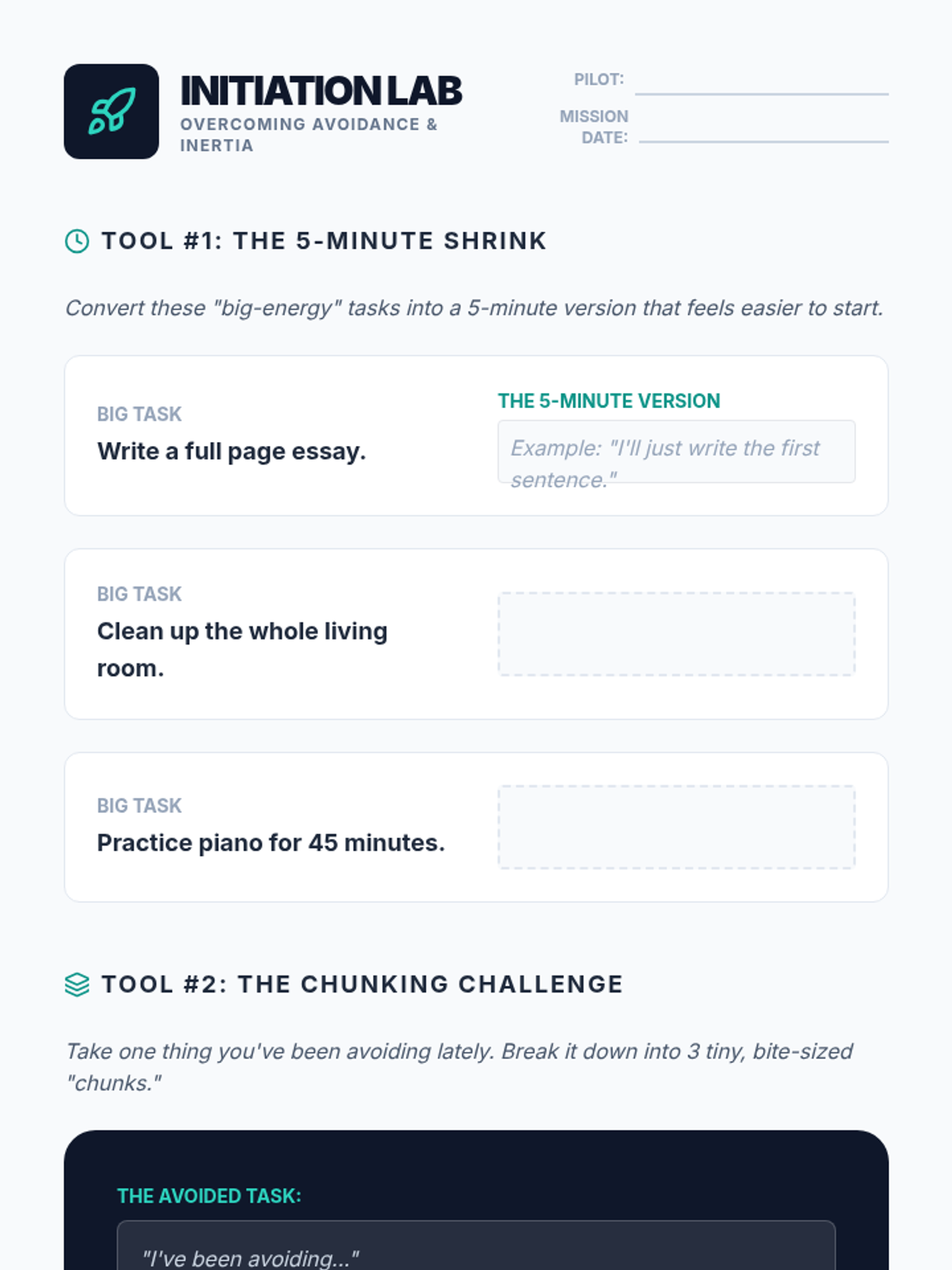
A skills practice worksheet for Lesson 4, guiding students to apply the 5-Minute Rule and Chunking to their own avoided tasks and responsibilities.
Slides for Lesson 4 using a rocket launch metaphor to teach task initiation. Strategies covered include the 5-Minute Rule and Chunking.
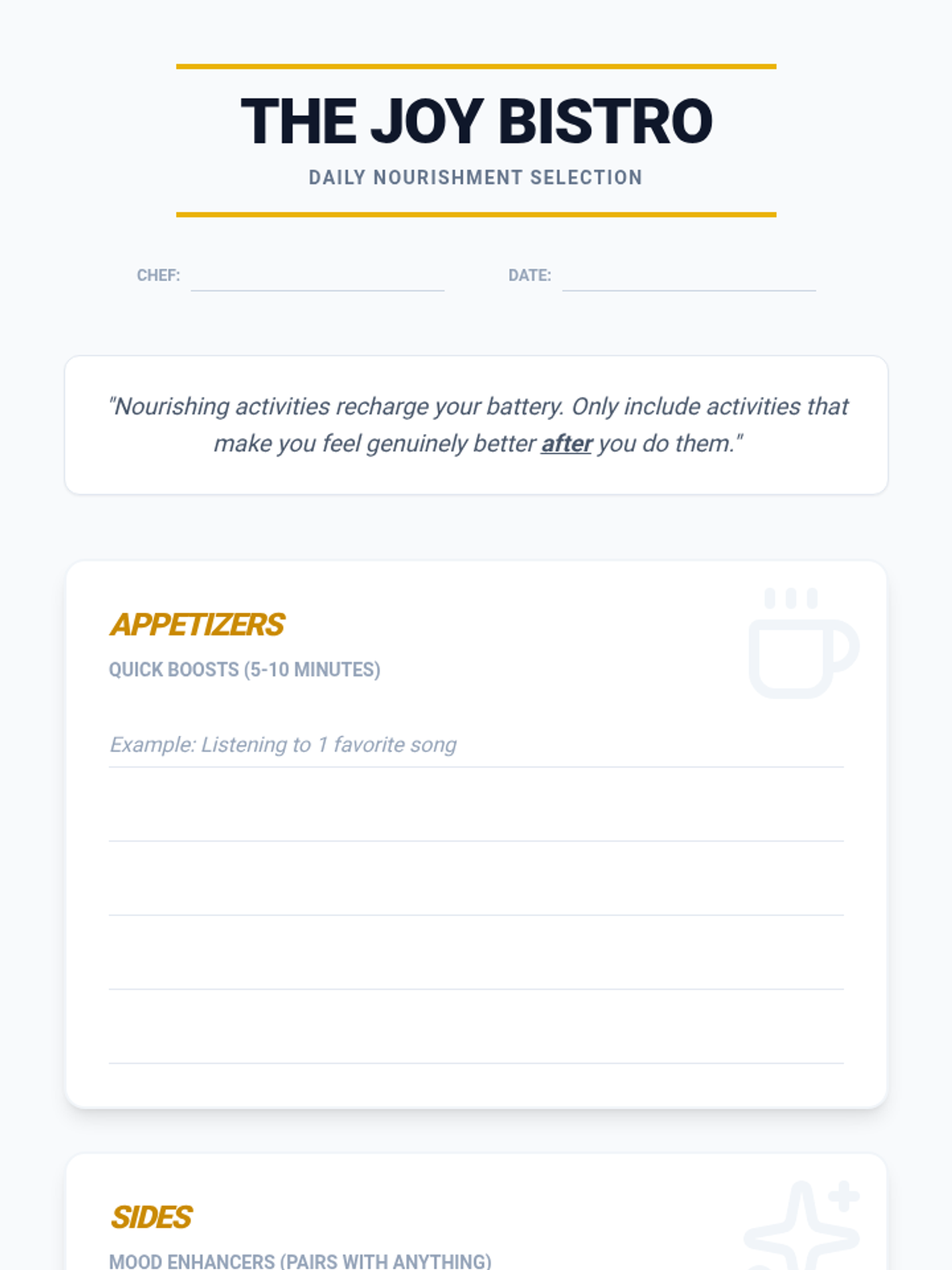
A menu-themed brainstorming worksheet for Lesson 3, where students categorize nourishing activities as Appetizers, Entrees, or Sides, and identify replacements for numbing activities.
Slides for Lesson 3 focusing on the difference between numbing and nourishing activities, and introducing the 'Appetizers, Entrees, and Sides' framework for behavioral activation.
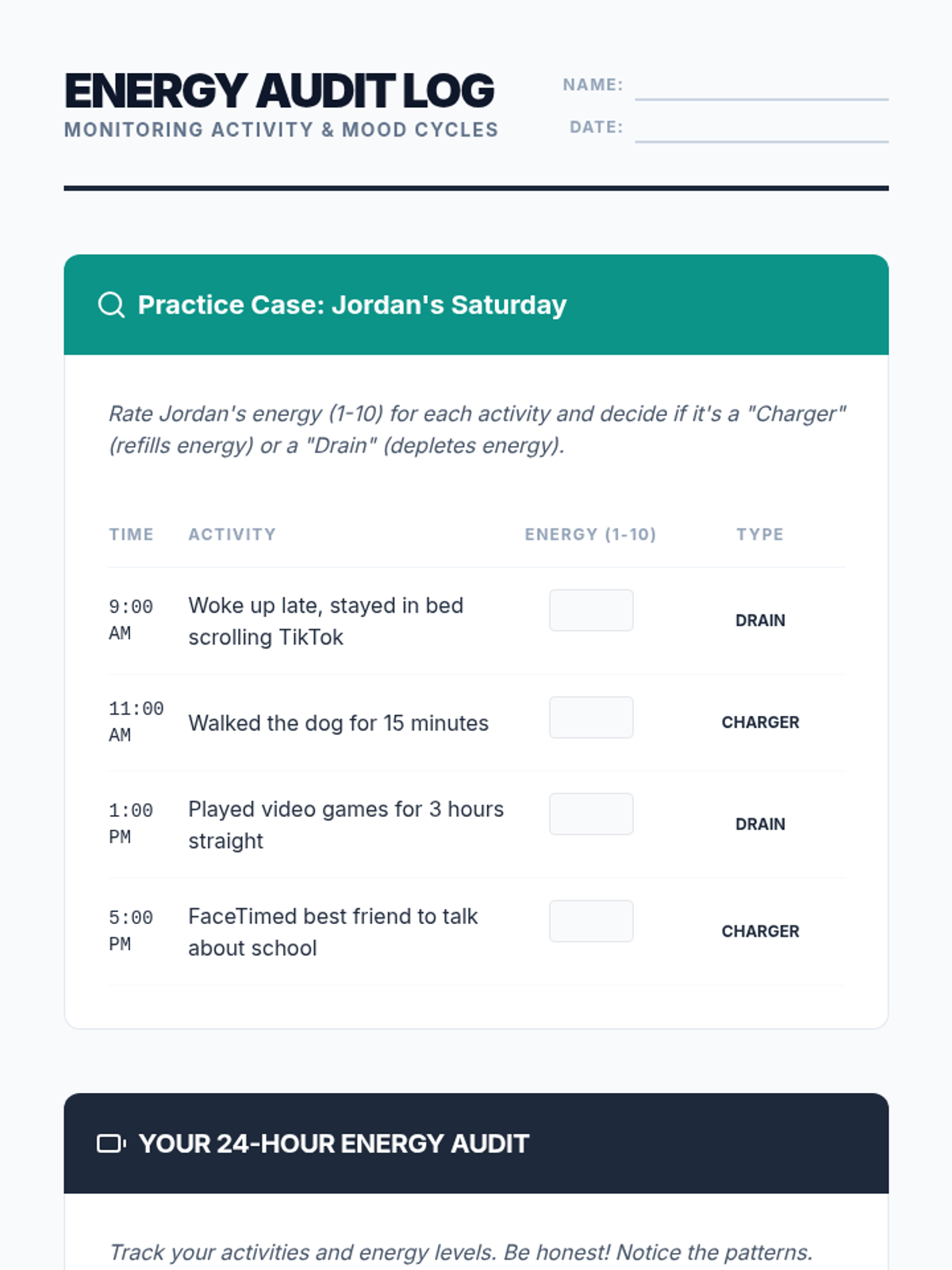
A tracking worksheet for Lesson 2, including a practice case study and a blank 24-hour log for students to audit their own energy levels.
Slides for Lesson 2 introducing the 'Human Battery' metaphor, differentiating between 'Fake Charge' and 'Active Charge', and introducing the 1-10 Energy Scale.
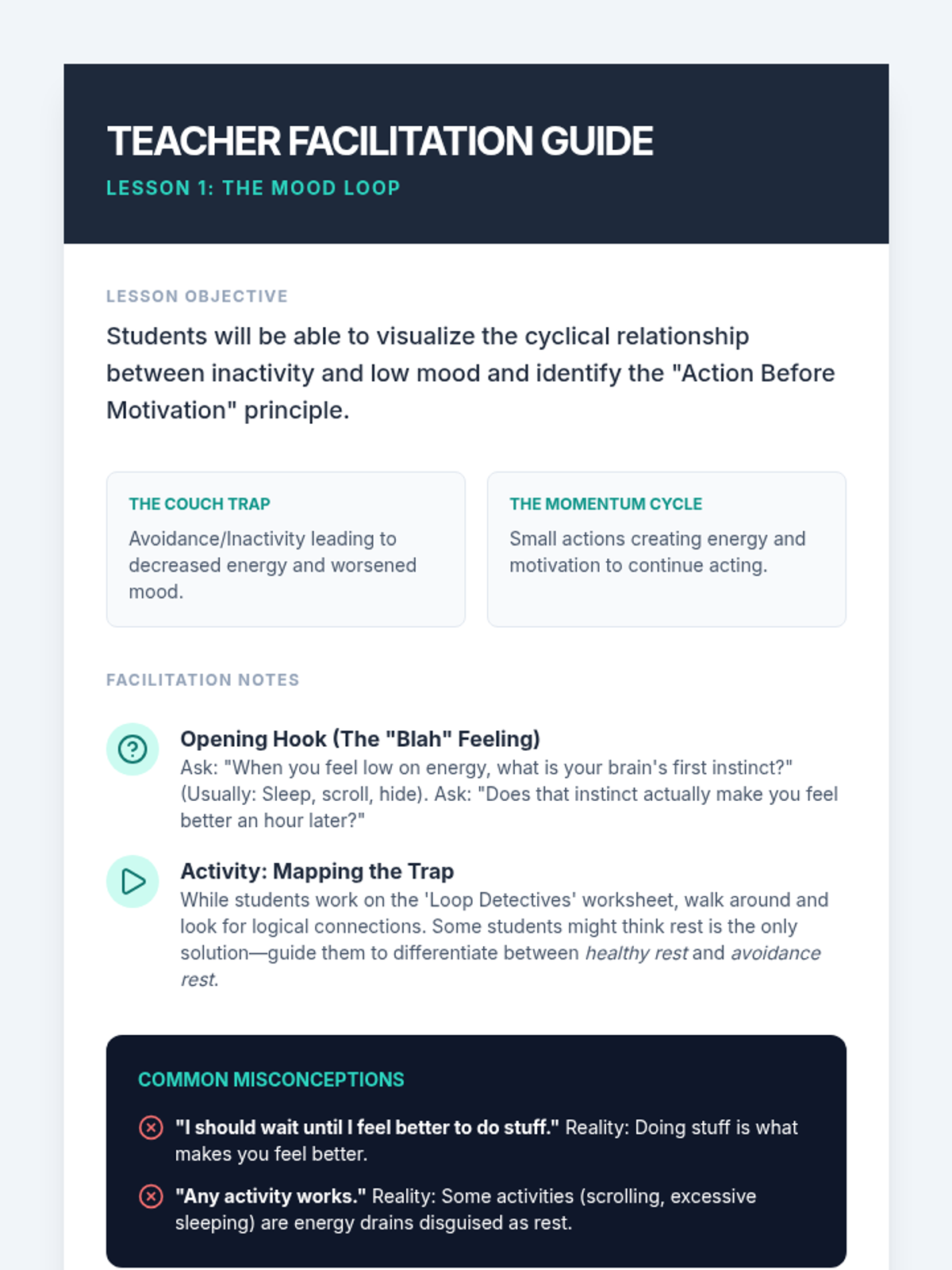
A facilitation guide for teachers to lead Lesson 1, including discussion prompts, key concepts, and common student misconceptions about mood and activity.
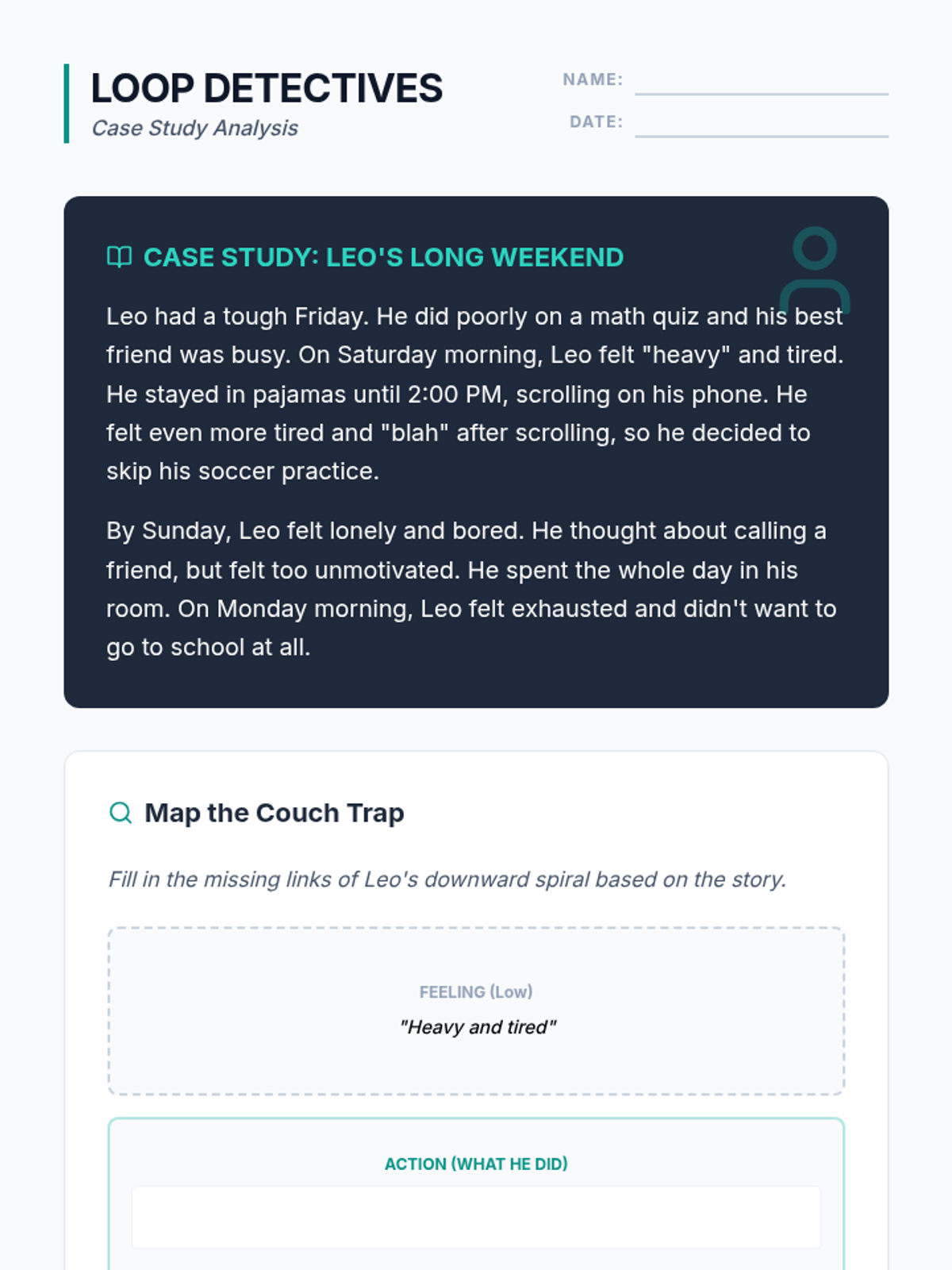
A case study analysis worksheet where students map the 'Couch Trap' and brainstorm an alternative 'Momentum Cycle' for a hypothetical student named Leo.
Introductory slides for Lesson 1, introducing the concept of the Activity-Mood Loop, the 'Couch Trap', and 'The Momentum Cycle'.
Slides for Lesson 4, exploring the cycle of conflict escalation through the "Domino Effect" analogy and teaching students to recognize triggers and turning points.
Slide deck focusing on the mediator's primary tool: mirroring. It explains the concept, provides "magic phrases" for starting reflections, and includes a practice scenario.
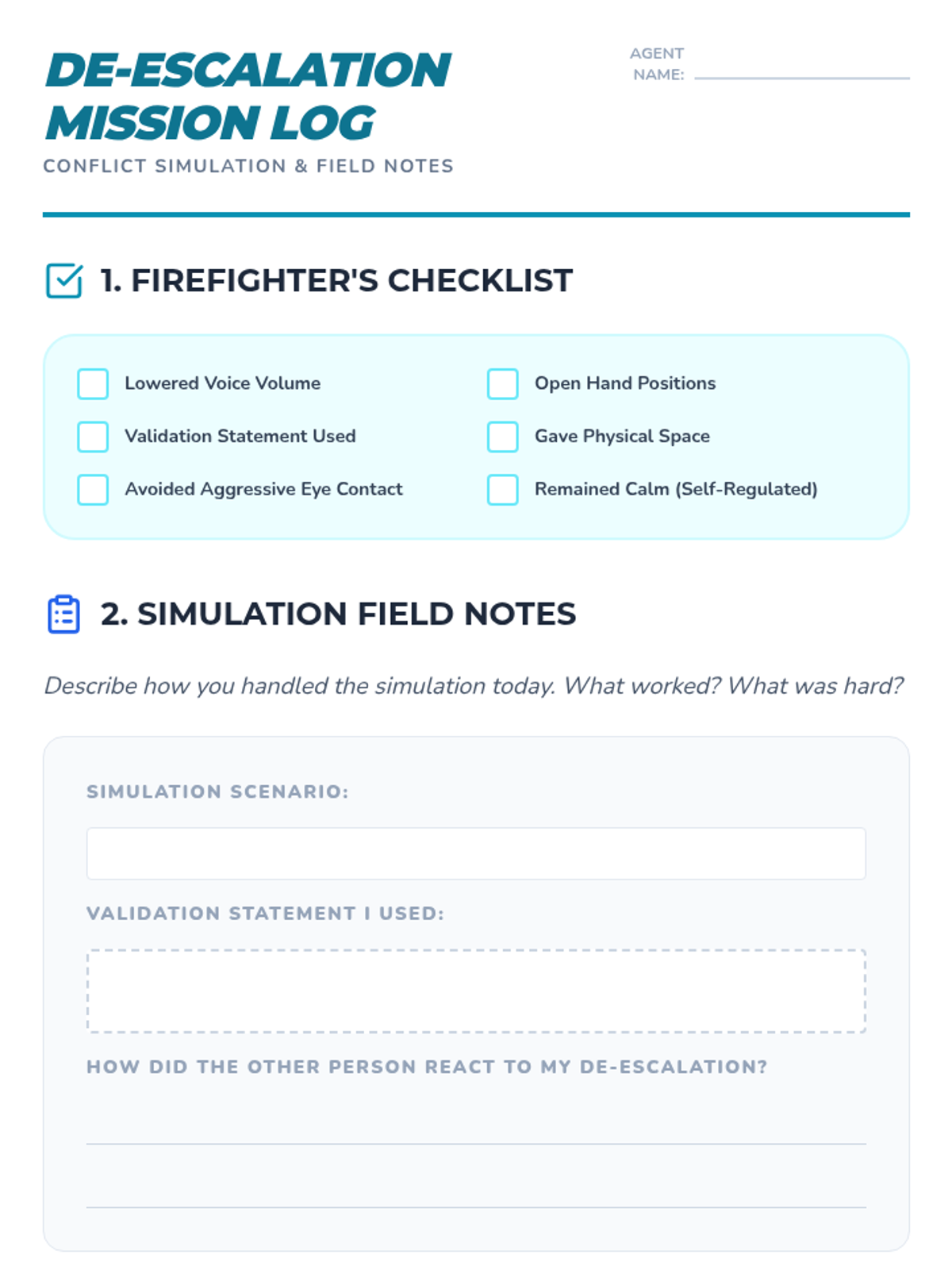
A reflection and simulation log for students to track their use of de-escalation skills during role-play exercises.
A slide deck teaching external de-escalation techniques, including the 'Echo Effect', validation scripts, and non-threatening body language.
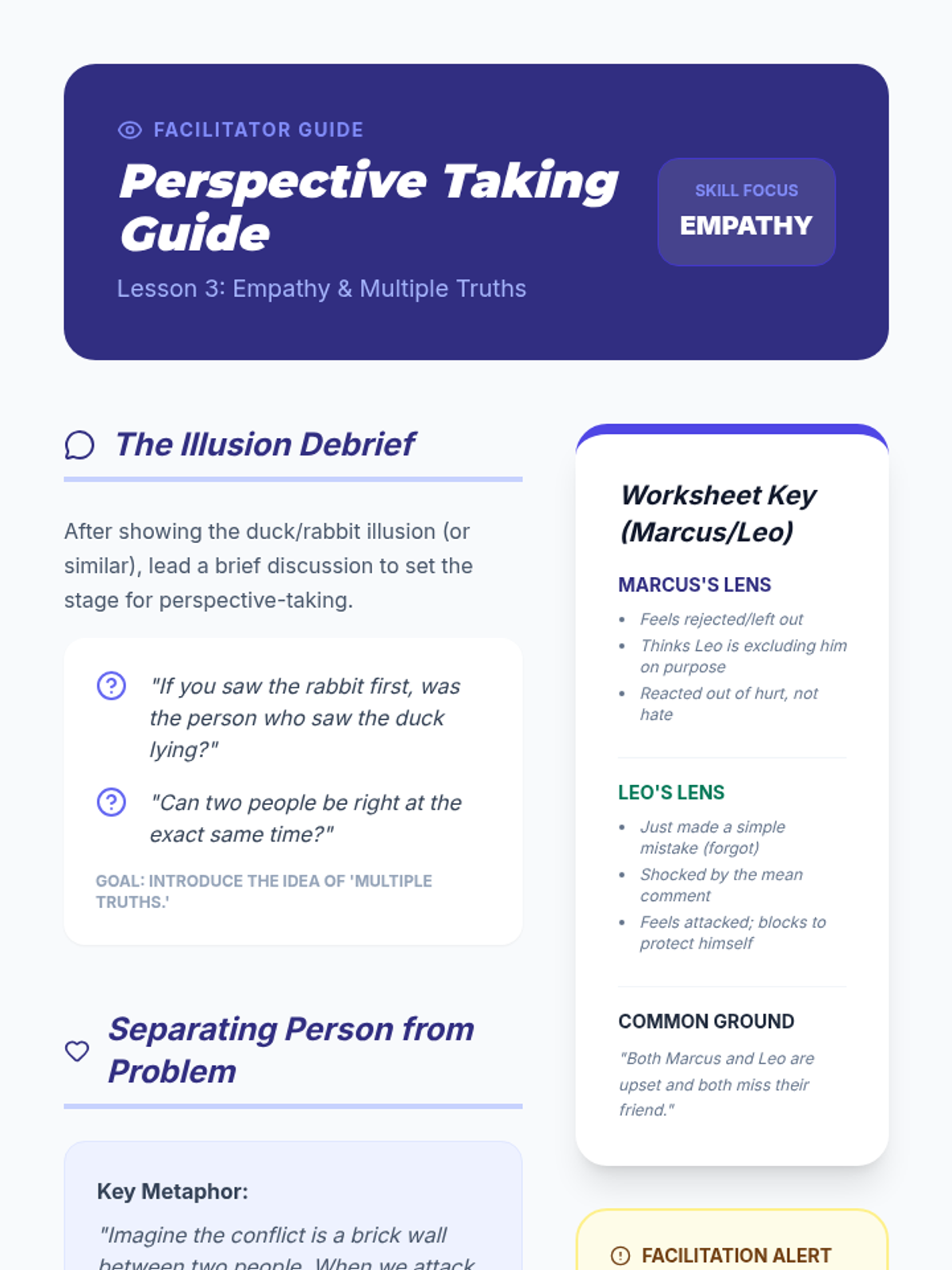
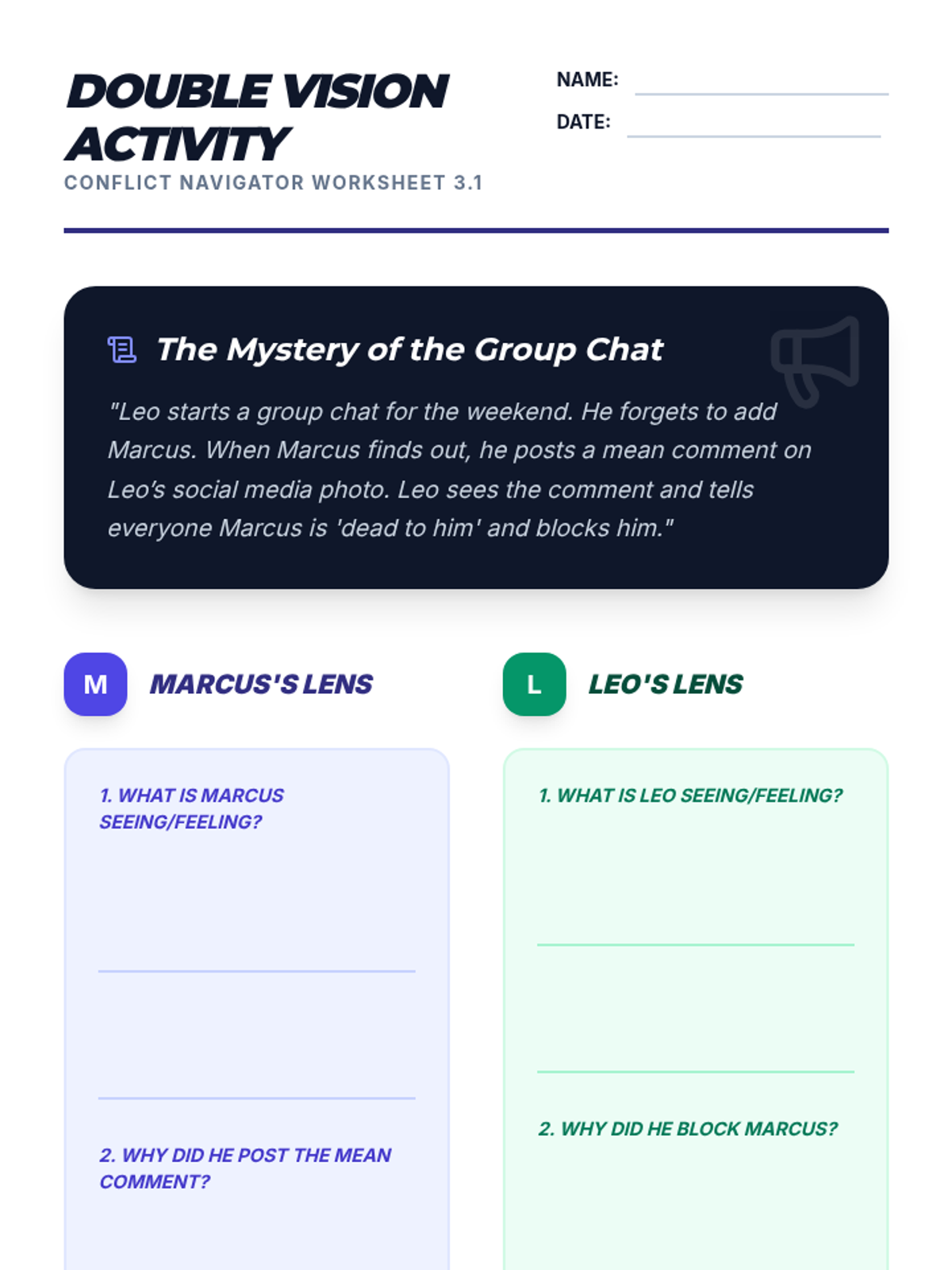
A teacher guide for Lesson 3 focused on facilitating empathy and perspective-taking discussions, including key metaphors and analysis of the Marcus/Leo scenario.
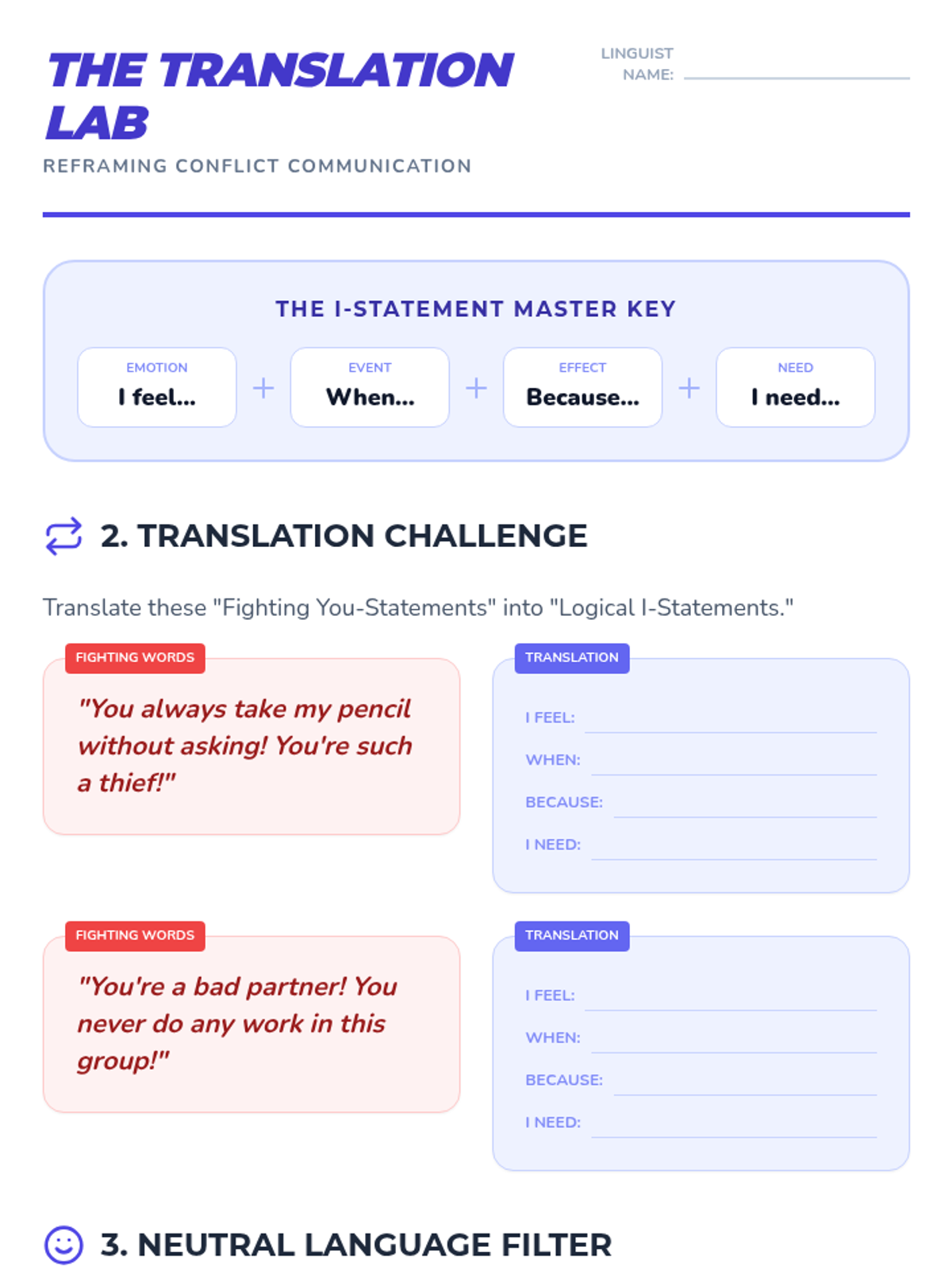
A practice worksheet for reframing 'You-Statements' into 'I-Statements' and translating 'Fighting Words' into 'Neutral Language'.
A worksheet for Lesson 3 where students analyze a conflict scenario involving two friends, practice viewing the dispute through each person's "lens," and identify common ground.
A slide deck teaching the I-Statement formula and the concept of neutral language to lower defensiveness in conflict.
Slides for Lesson 3, using optical illusions to introduce the concept of perspective-taking and the importance of separating the person from the problem.
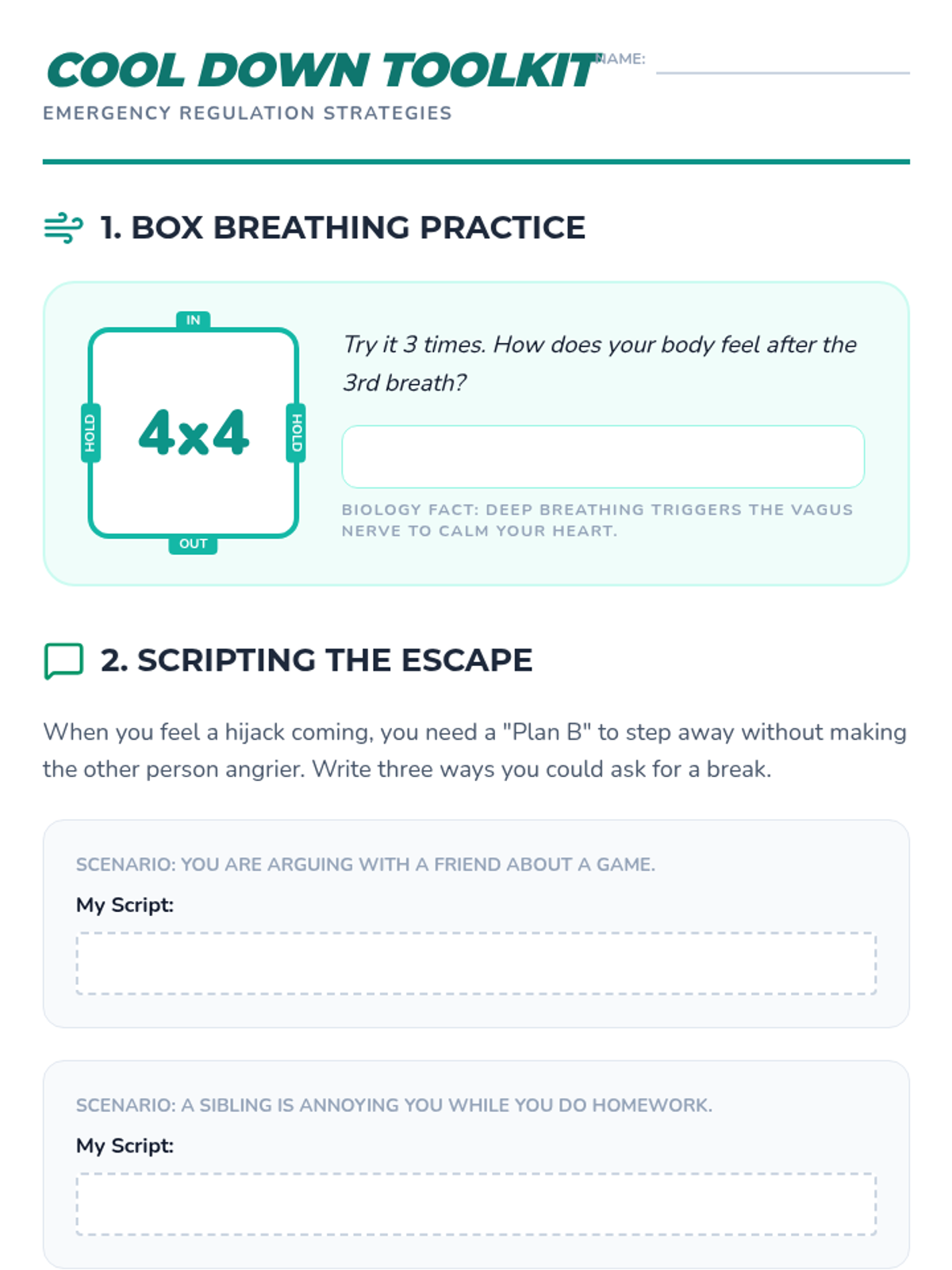
A worksheet for practicing Box Breathing and drafting personal 'scripts' for taking a break during conflict.
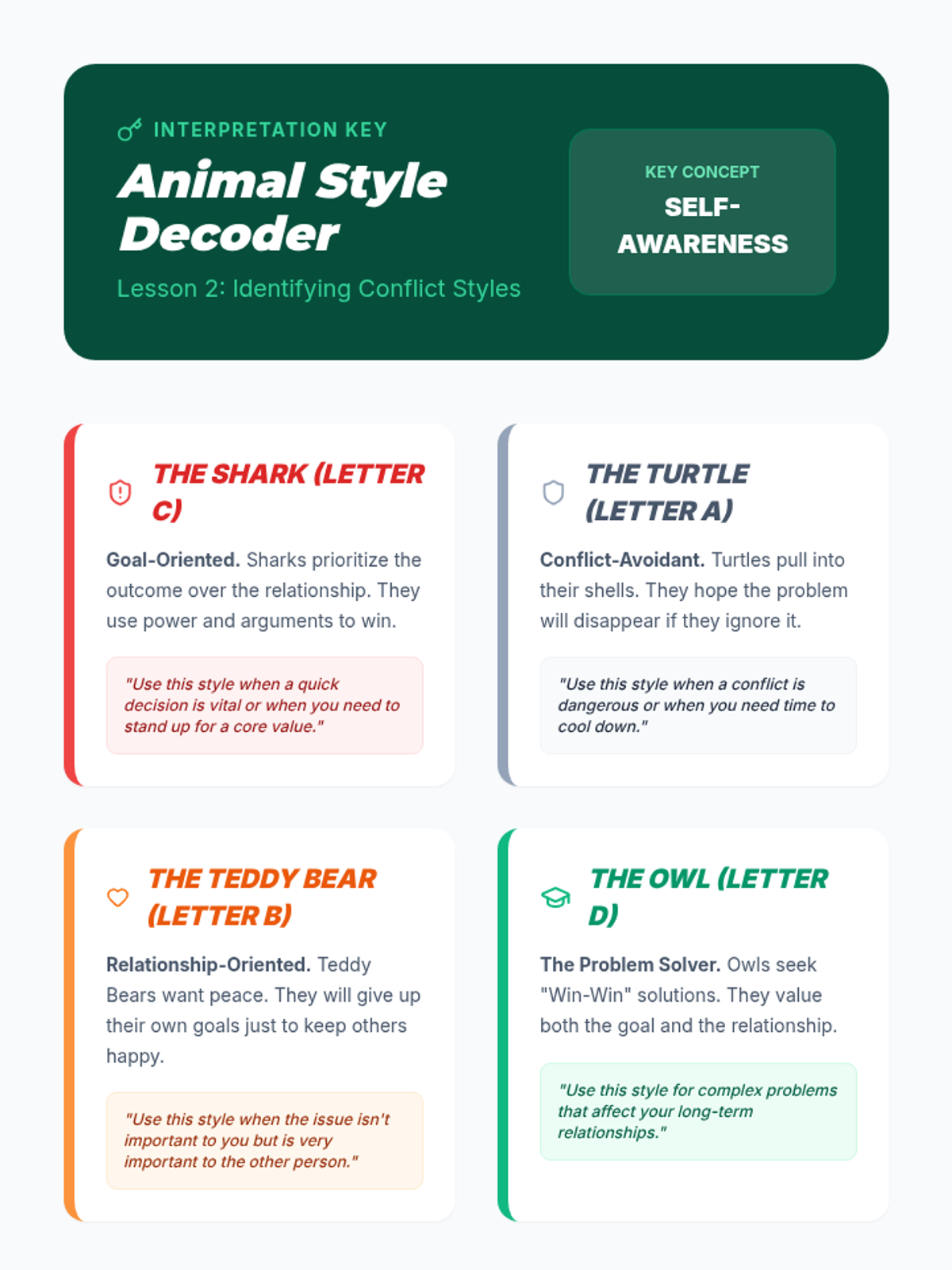
A teacher resource for Lesson 2 providing the scoring key and interpretation for the animal conflict styles assessment, along with facilitation tips for classroom discussion.
A slide deck introducing specific emotional regulation tools like Box Breathing and 'The Time-Out' to prevent escalation.
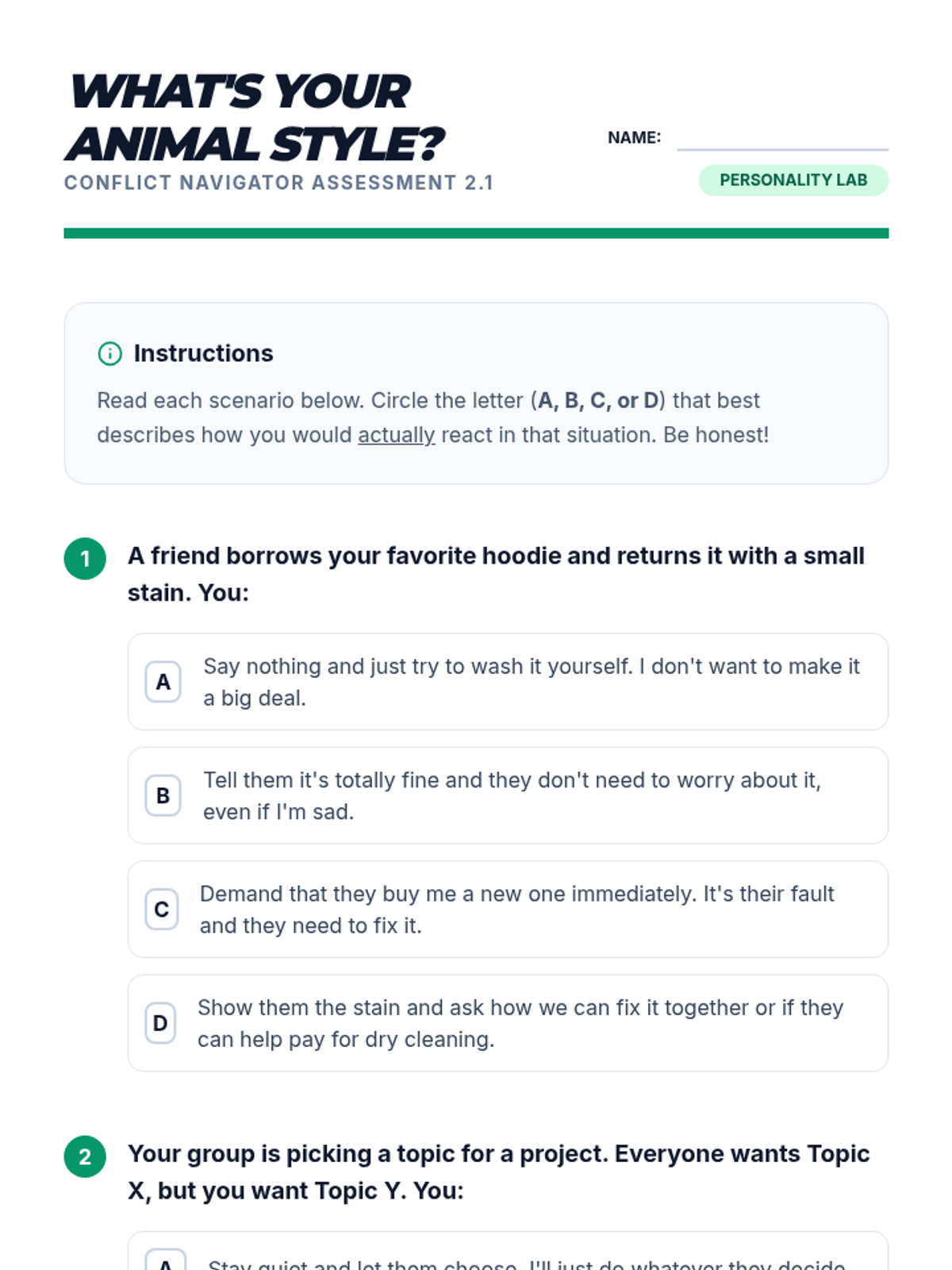
A student assessment worksheet for Lesson 2 that uses relatable scenarios to help students identify their default conflict style.
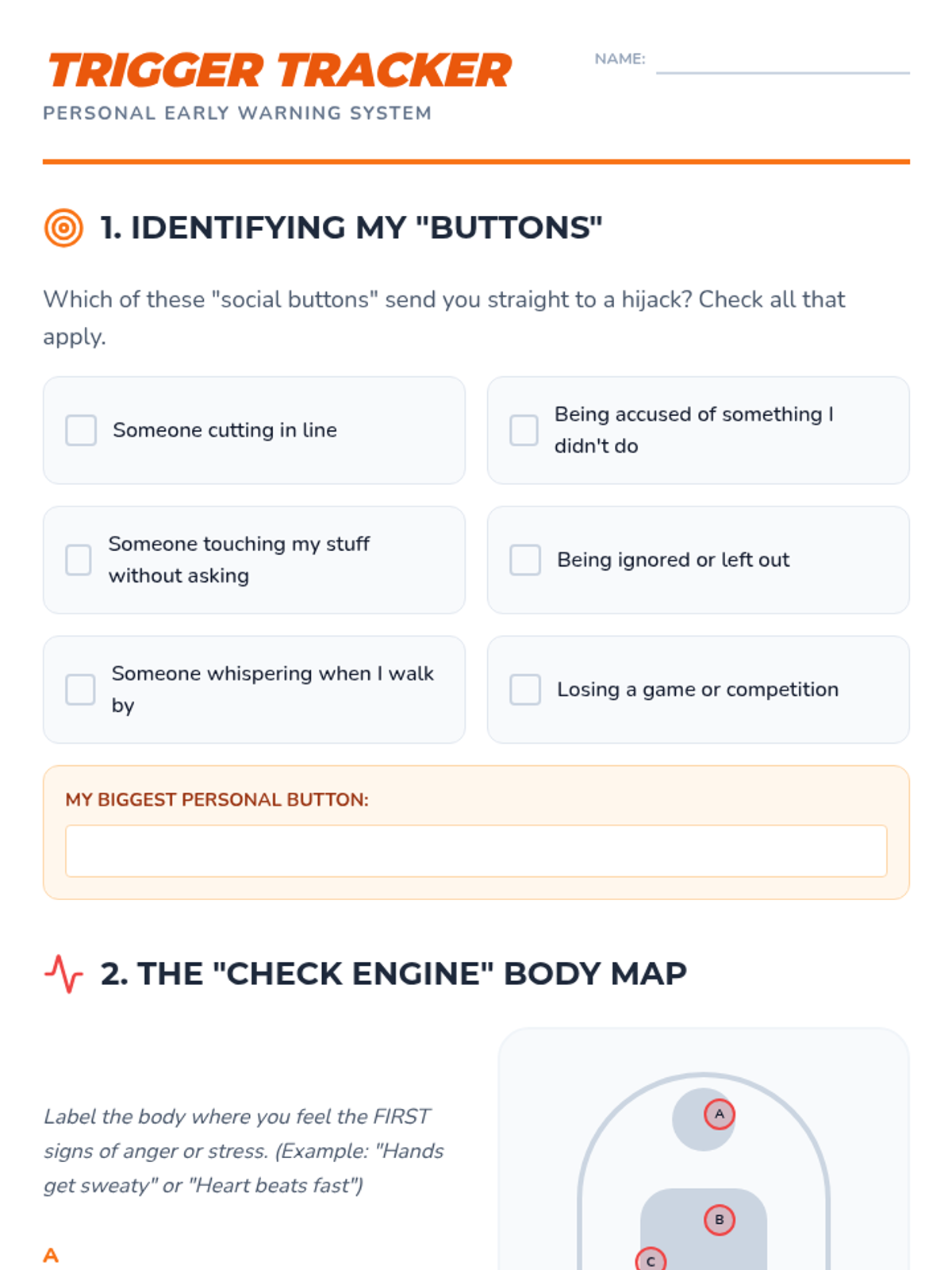
A student worksheet for identifying personal triggers and physical warning signs. Includes a 'Body Map' and a 'Yellow Zone' action plan.
Slides for Lesson 2, introducing the four core conflict styles using animal metaphors (Shark, Turtle, Teddy Bear, Owl) to help students identify their own behavioral defaults.
A slide deck focusing on identifying personal emotional triggers and the physical warning signs of an impending 'hijack'.