Functional behavior assessment, data tracking, and de-escalation strategies for managing classroom conduct. Addresses positive reinforcement, token economies, and individualized behavior contracts to support student self-regulation.
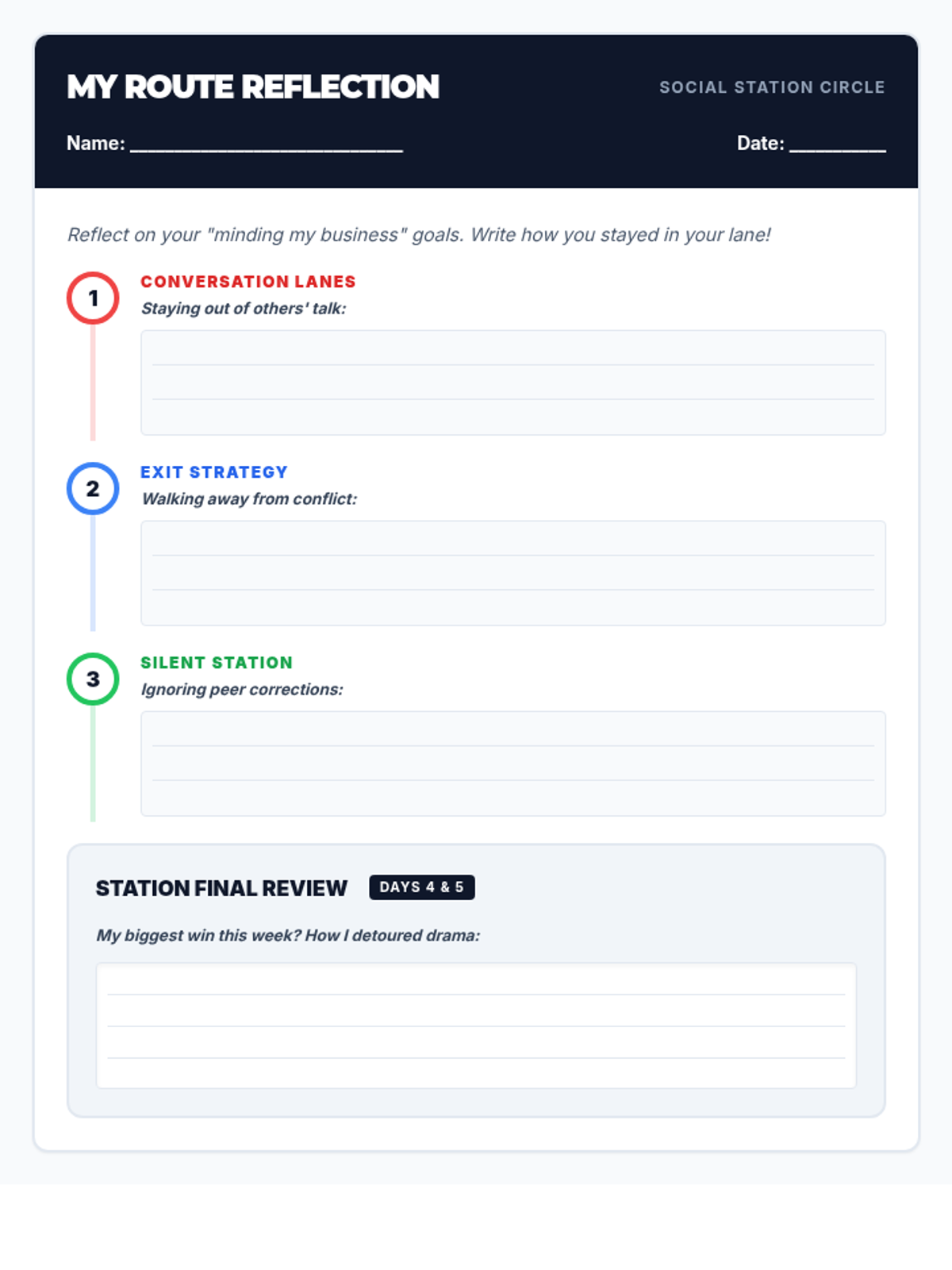
A student-facing reflection log for tracking daily progress on 'minding your business' social skills goals. Features large, readable text and guided writing lines. Fits on a single page.
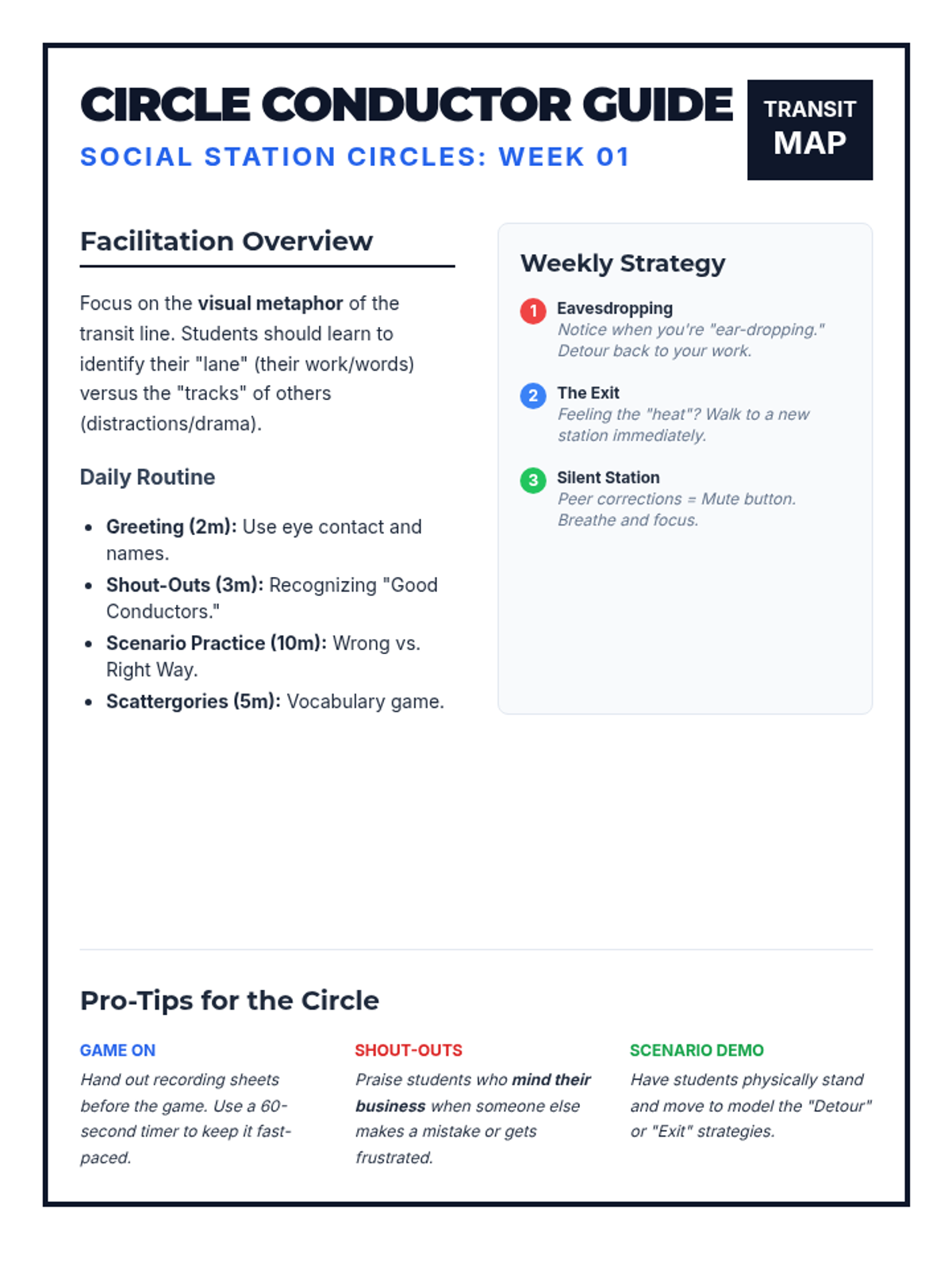
Slide deck for Day 5 of community circles focusing on 'Focus Force' and avoiding distractions. Includes greeting, shout-outs, scenario practice, and Scattergories.
Slide deck for Day 4 of community circles focusing on 'Drama Detours' and avoiding rumors. Includes greeting, shout-outs, scenario practice, and Scattergories.
Slide deck for Day 3 of community circles focusing on 'The Silent Station' and ignoring peer corrections. Includes greeting, shout-outs, scenario practice, and Scattergories.
Slide deck for Day 2 of community circles focusing on 'The Exit Strategy' and walking away from conflict. Includes greeting, shout-outs, scenario practice, and Scattergories.
Slide deck for Day 1 of community circles focusing on 'Conversation Lanes' and staying out of others' talk. Includes greeting, shout-outs, scenario practice, and Scattergories.
A comprehensive facilitation guide for the week of community circles, featuring instructional notes, scenario scripts for each day, and Scattergories master lists. Includes a student recording sheet.
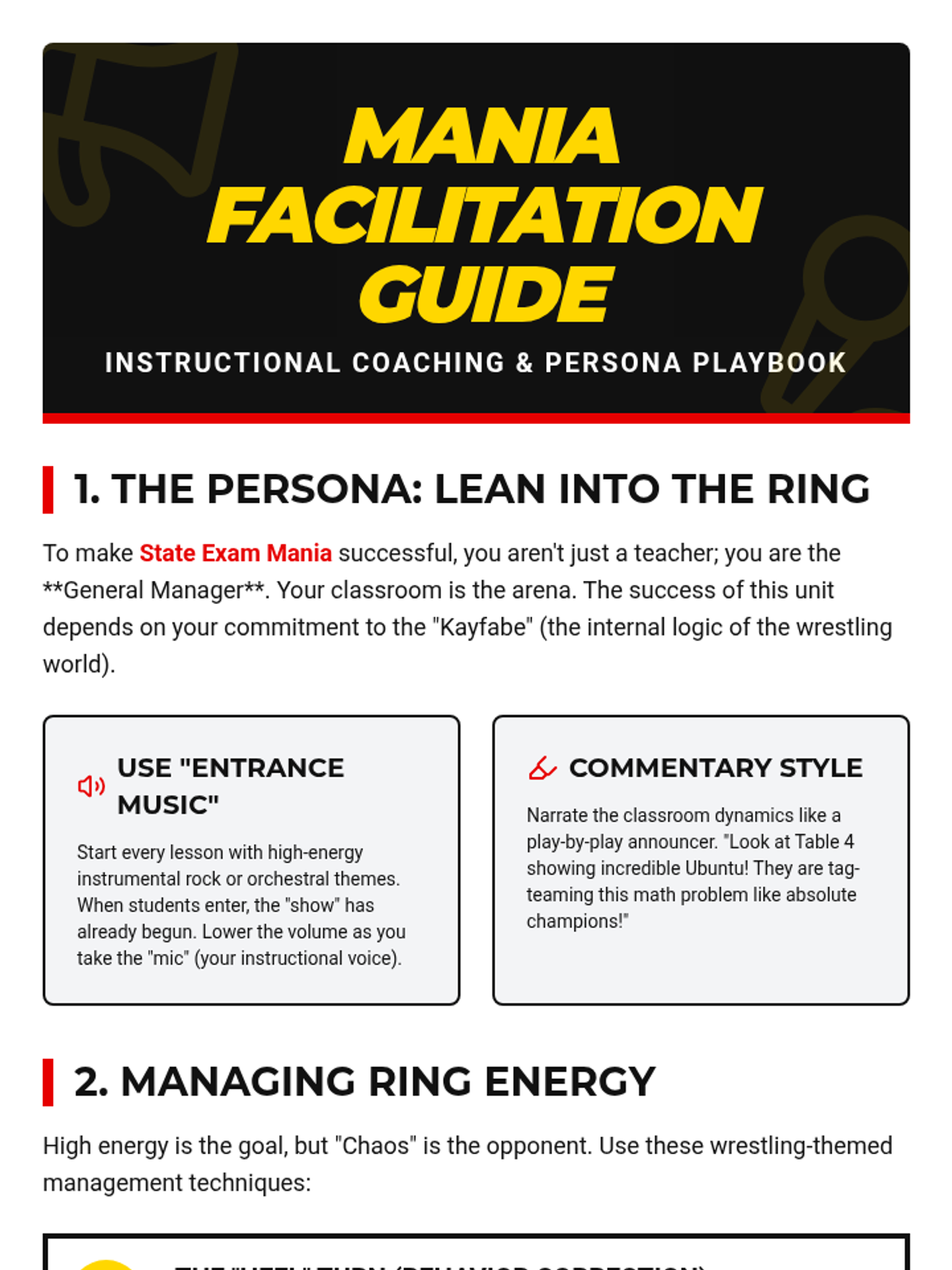
A comprehensive teacher facilitation guide for the 'Road to State Exam Mania' sequence, featuring persona coaching, behavior management strategies (using wrestling metaphors), lesson-specific tips, and a bank of discussion questions.
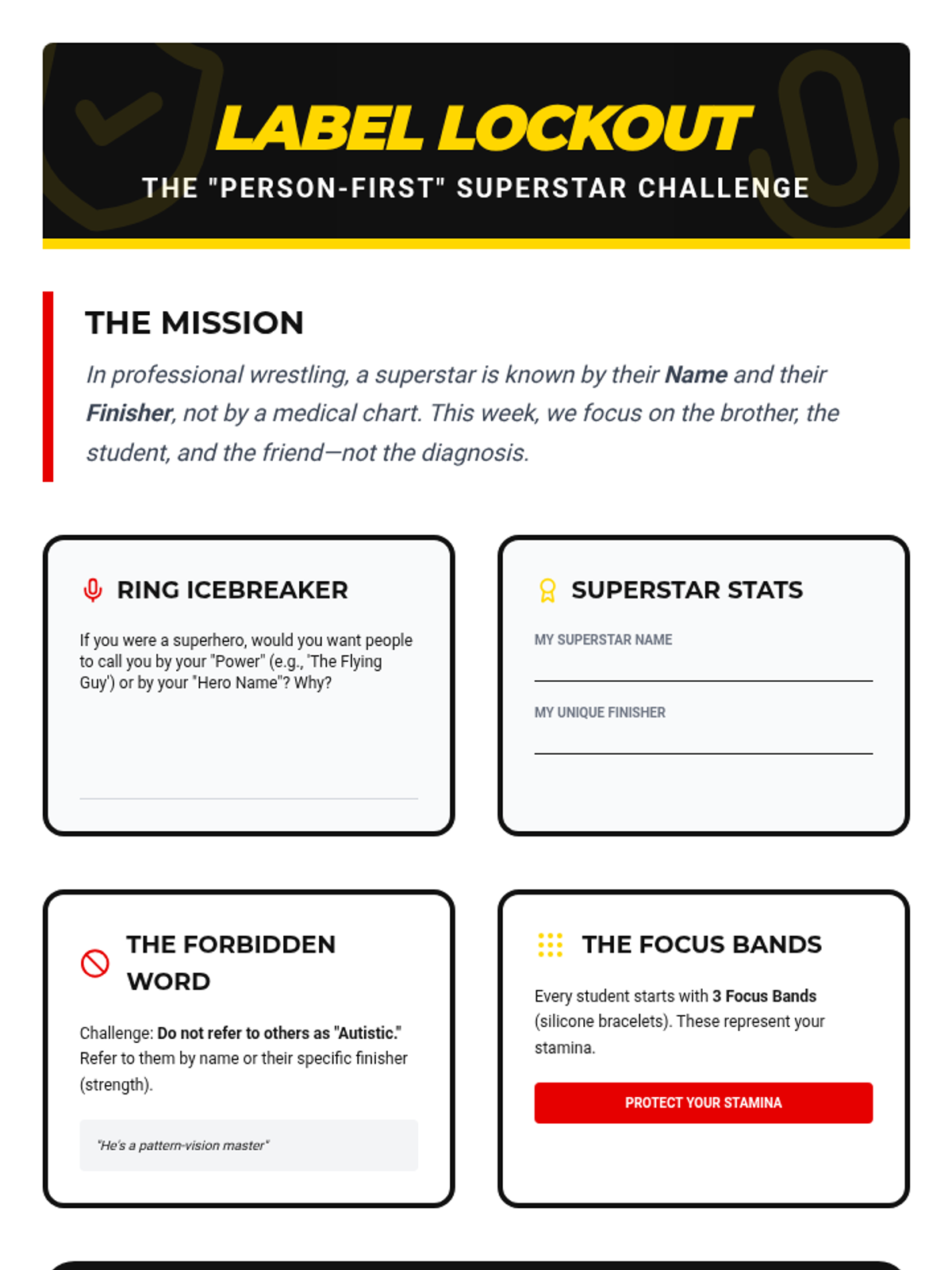
A week-long challenge guide where students avoid labels like 'autistic' to focus on individual strengths, using silicone bracelets as tokens in a 'Referee' style game.
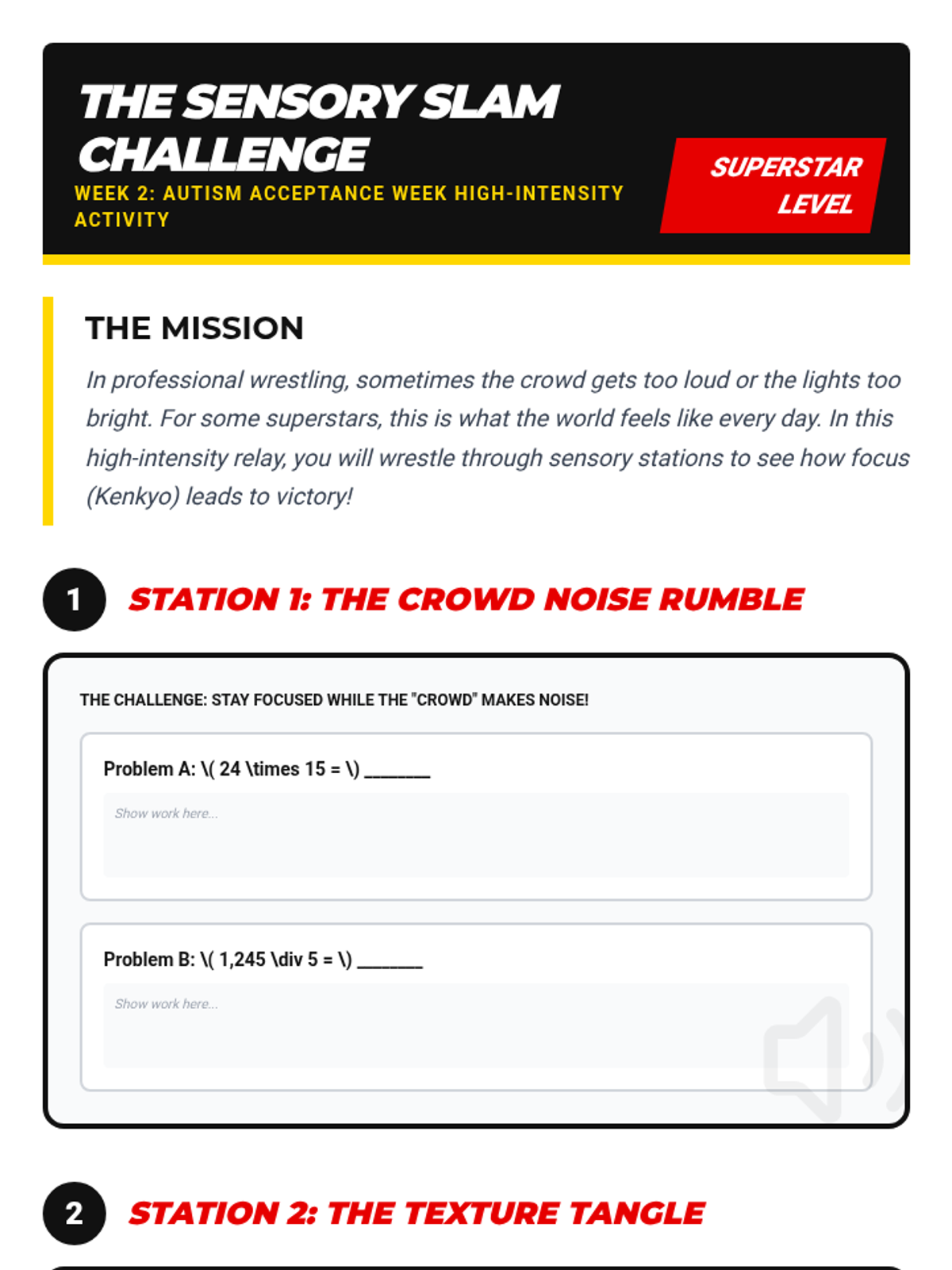
A sensory awareness activity for Autism Acceptance Week that uses high-energy challenges to simulate sensory processing differences and promote inclusive focus strategies.
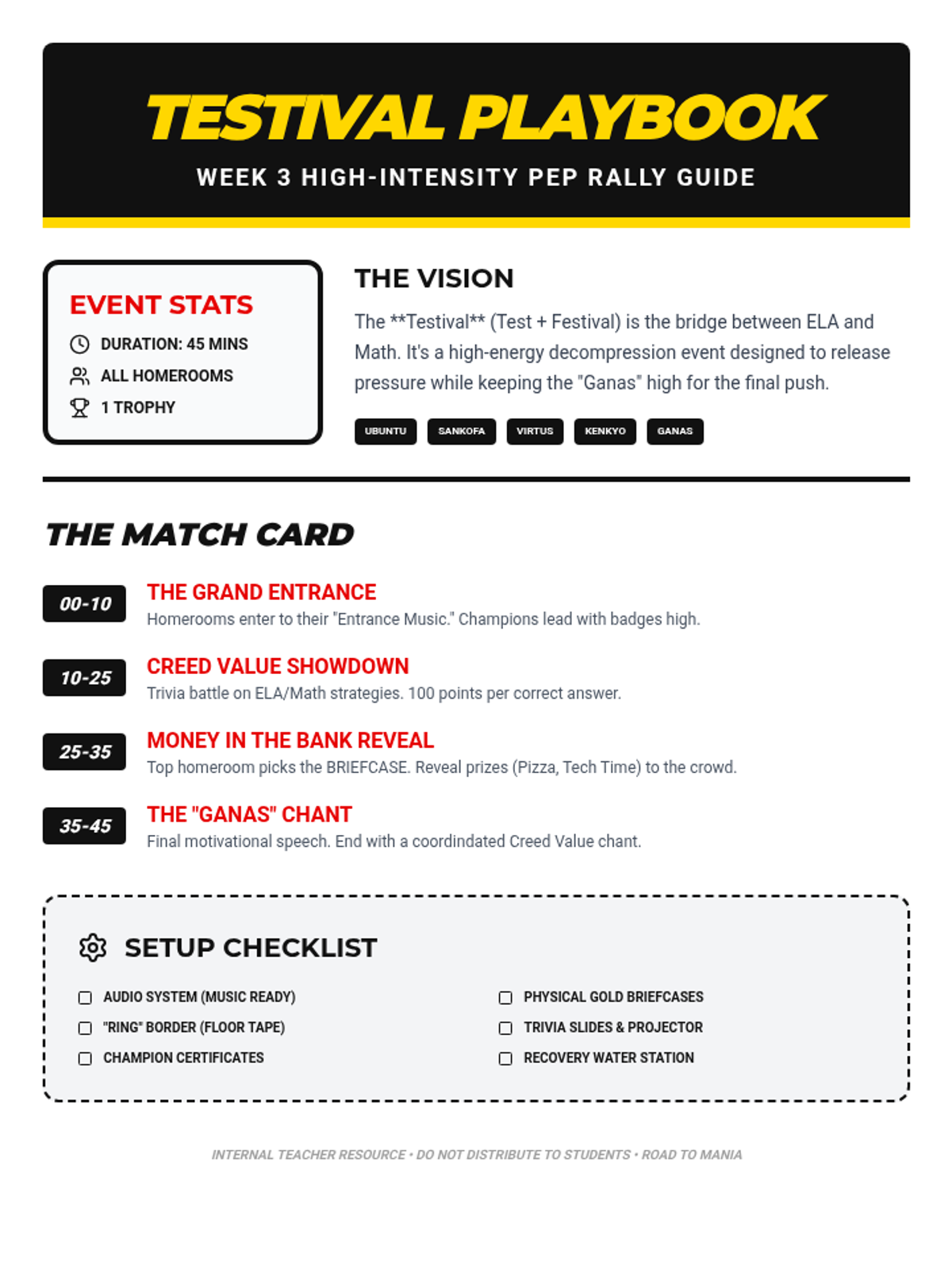
A teacher-facing resource for running a high-intensity 'Testival' (Test + Festival) pep rally, including 'Ring Entrances,' 'Creed Value Showdowns' (academic bowl style), and the 'Money in the Bank' opening.
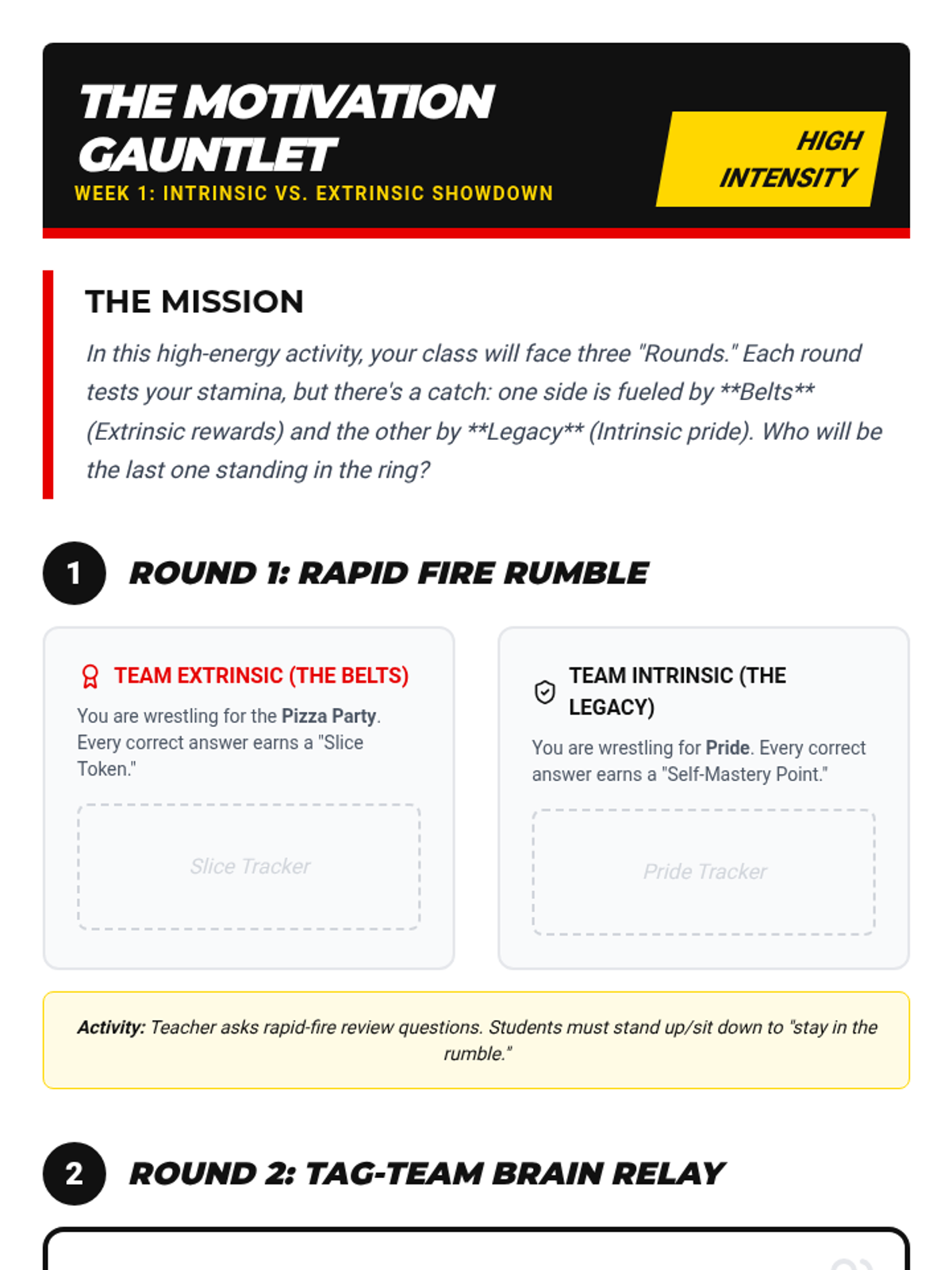
A physical and mental challenge activity where students explore intrinsic vs. extrinsic motivation through high-energy 'rounds' of review and physical exercise.
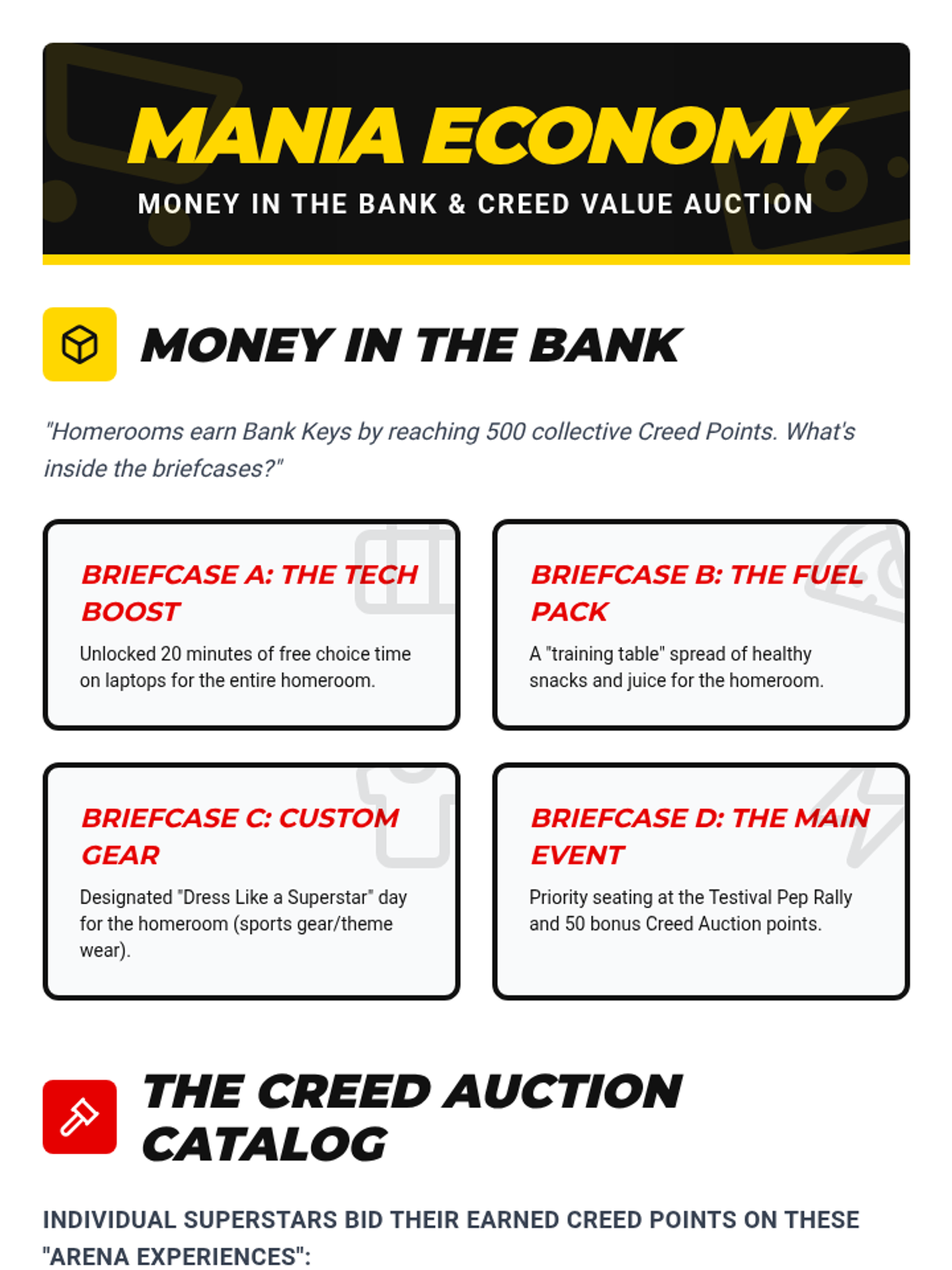
A student-facing guide to the incentive systems of the 4-week sequence, including rewards for Money in the Bank briefcases and a catalog for the Creed Value Auction.
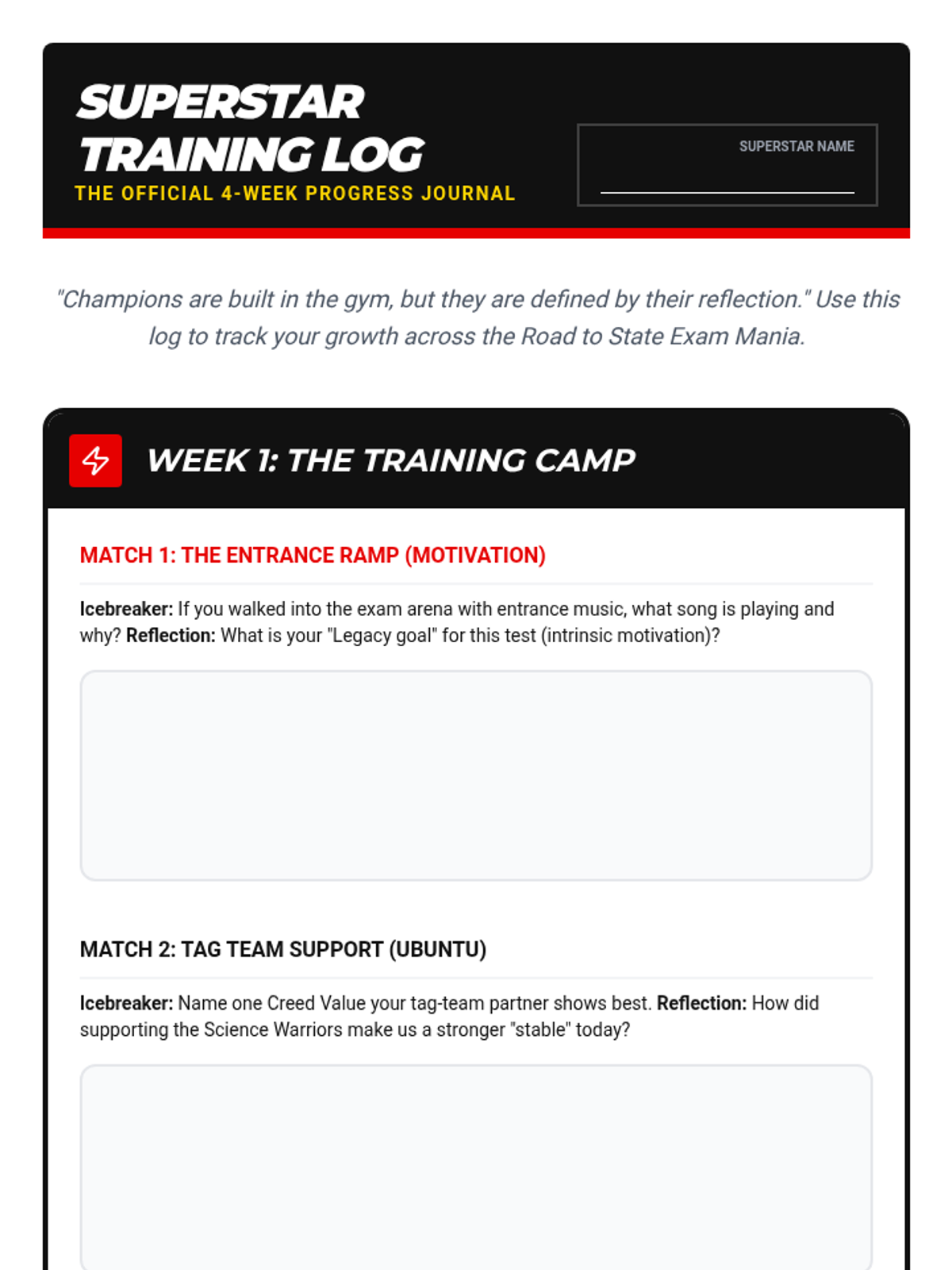
A reflection and icebreaker journal for students to use throughout the 4-week sequence, featuring themed check-ins and a pre-season scouter report for Spring Break and Q4 goals.
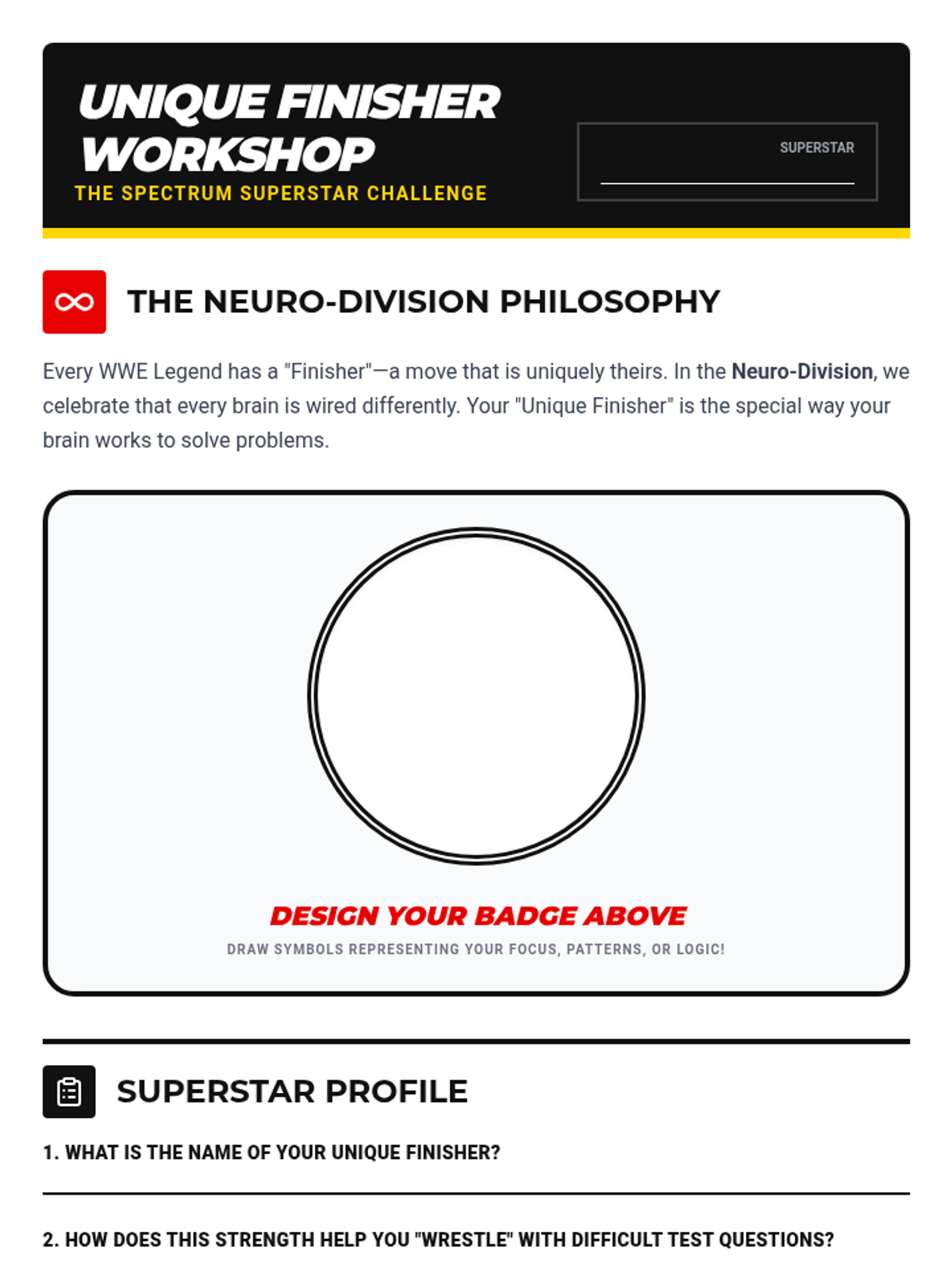
A creative student worksheet for Autism Acceptance Week where students design a 'Unique Finisher' badge representing their neurodivergent strengths and reflect on inclusive support.
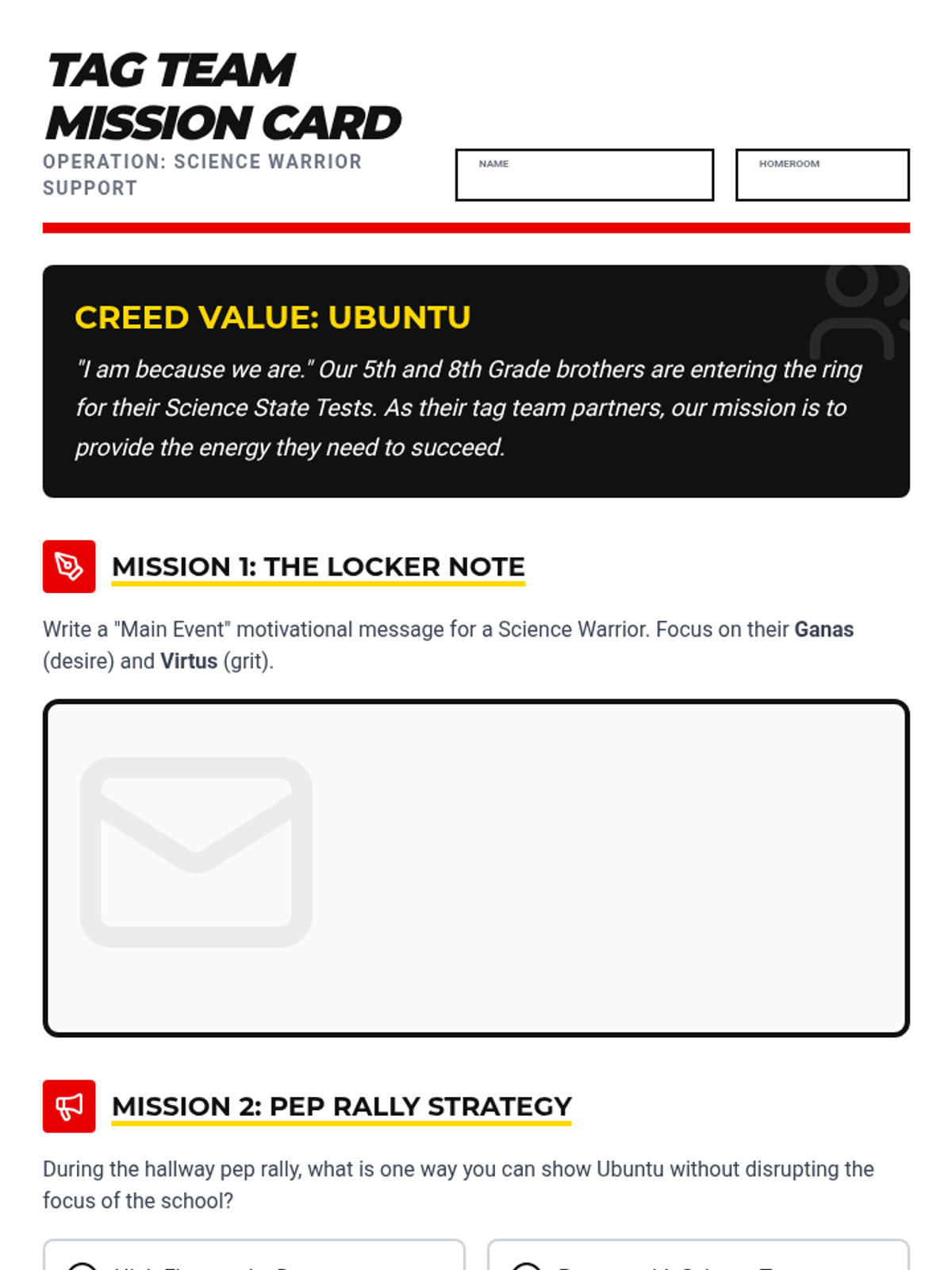
A student activity sheet focused on the Creed Value of Ubuntu, guiding students to support their peers during state science exams through motivational notes and pep rally participation.
A slide deck highlighting the real-life struggles and resilience of WWE superstars, focusing on Ganas (desire) and Virtus (grit) for the final push.
A presentation focused on test anxiety, ELA strategies, and post-test decompression using the 'Heel' and 'Technical Playbook' metaphors.
A slide deck for Autism Acceptance Week, using wrestling metaphors to celebrate neurodiversity, unique strengths (finishers), and inclusive support.
A high-energy presentation introducing the State Exam Mania theme, exploring intrinsic vs. extrinsic motivation with a side-by-side 'Belt vs. Legacy' comparison and a video placeholder.
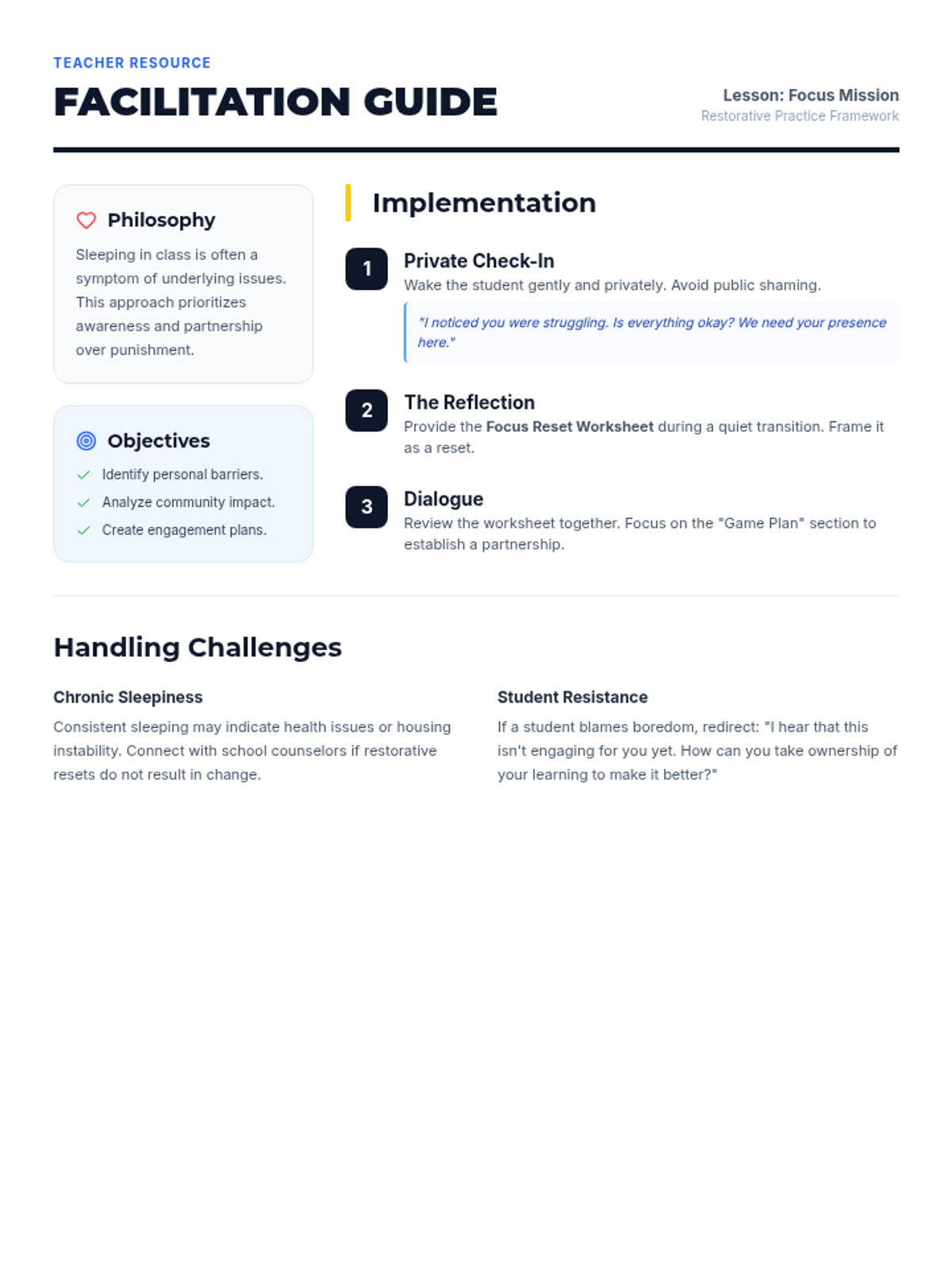
A teacher facilitation guide providing restorative strategies and instructional prompts for addressing classroom sleepiness and using the Focus Mission materials effectively.
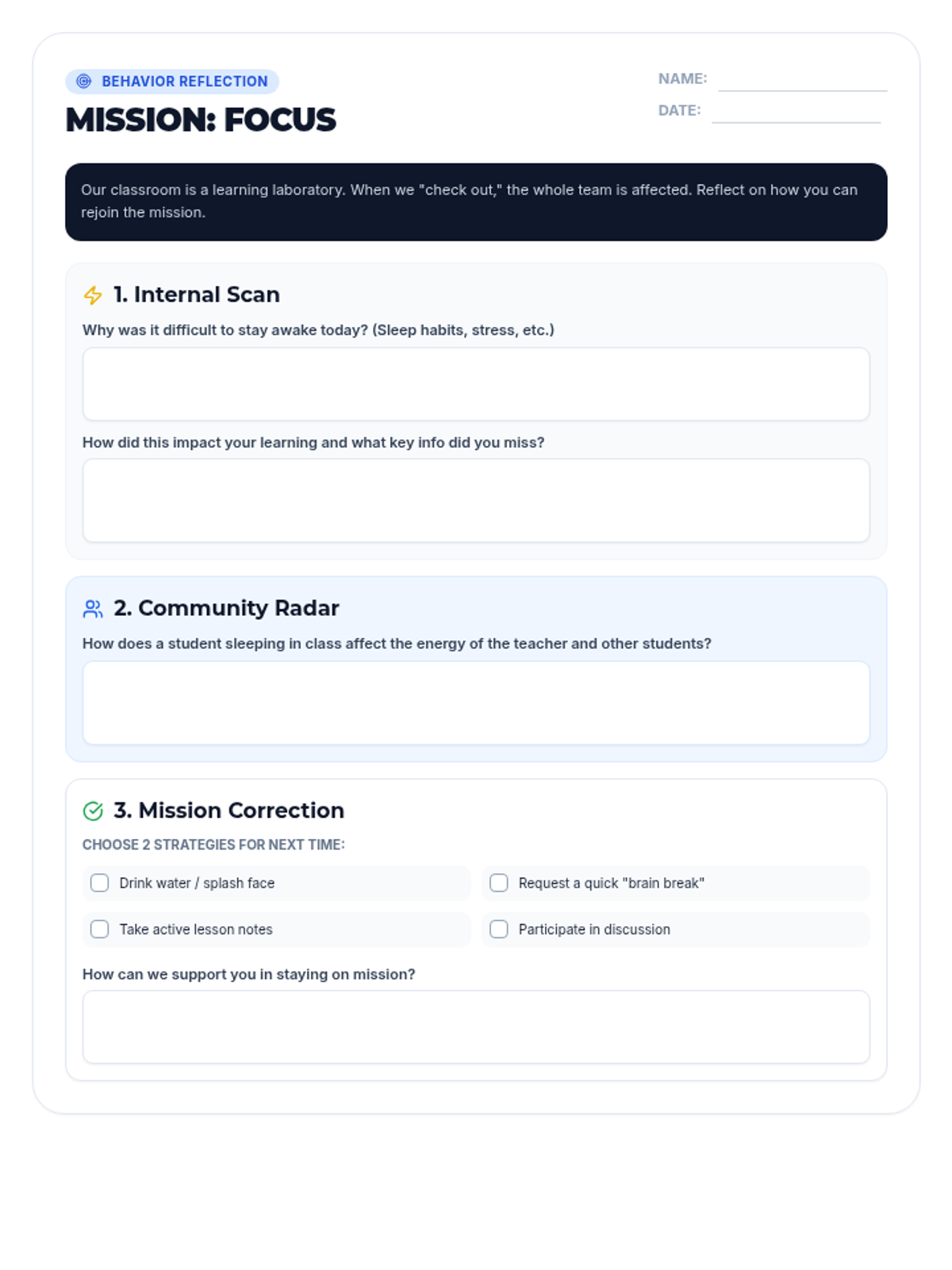
A restorative behavior reflection worksheet that encourages students to evaluate the causes of their drowsiness and understand its impact on their learning and classroom community.
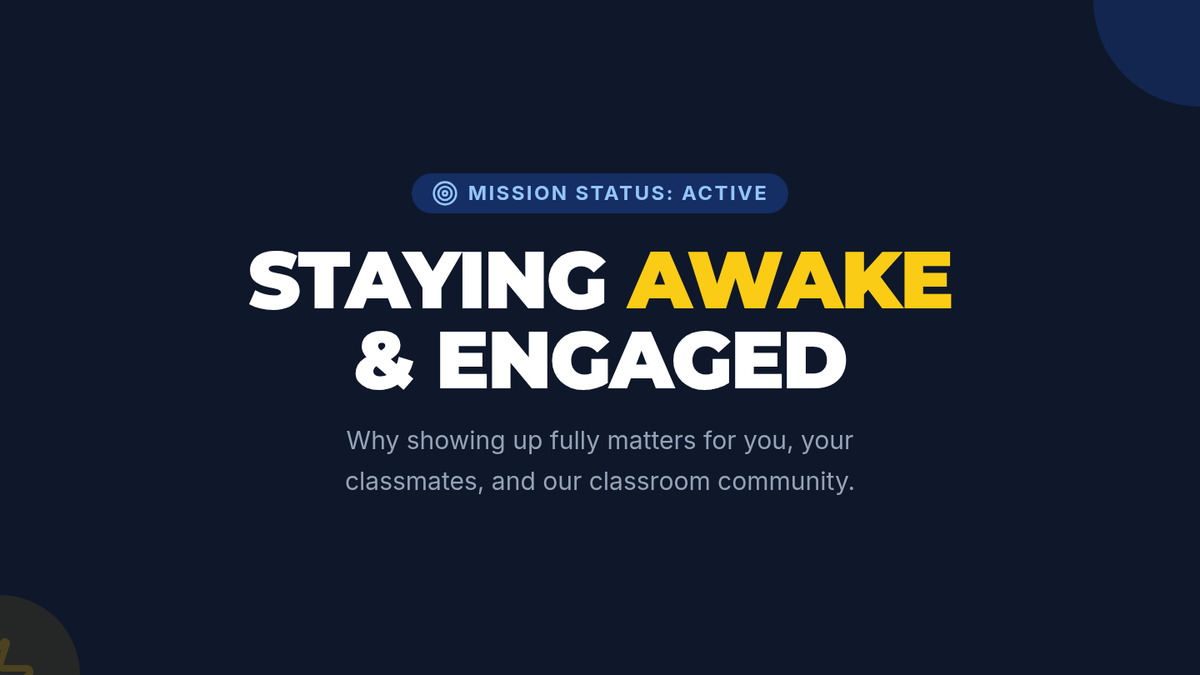
An engaging slide deck explaining the impact of sleeping in class on personal success and the classroom community, featuring restorative strategies for staying engaged.
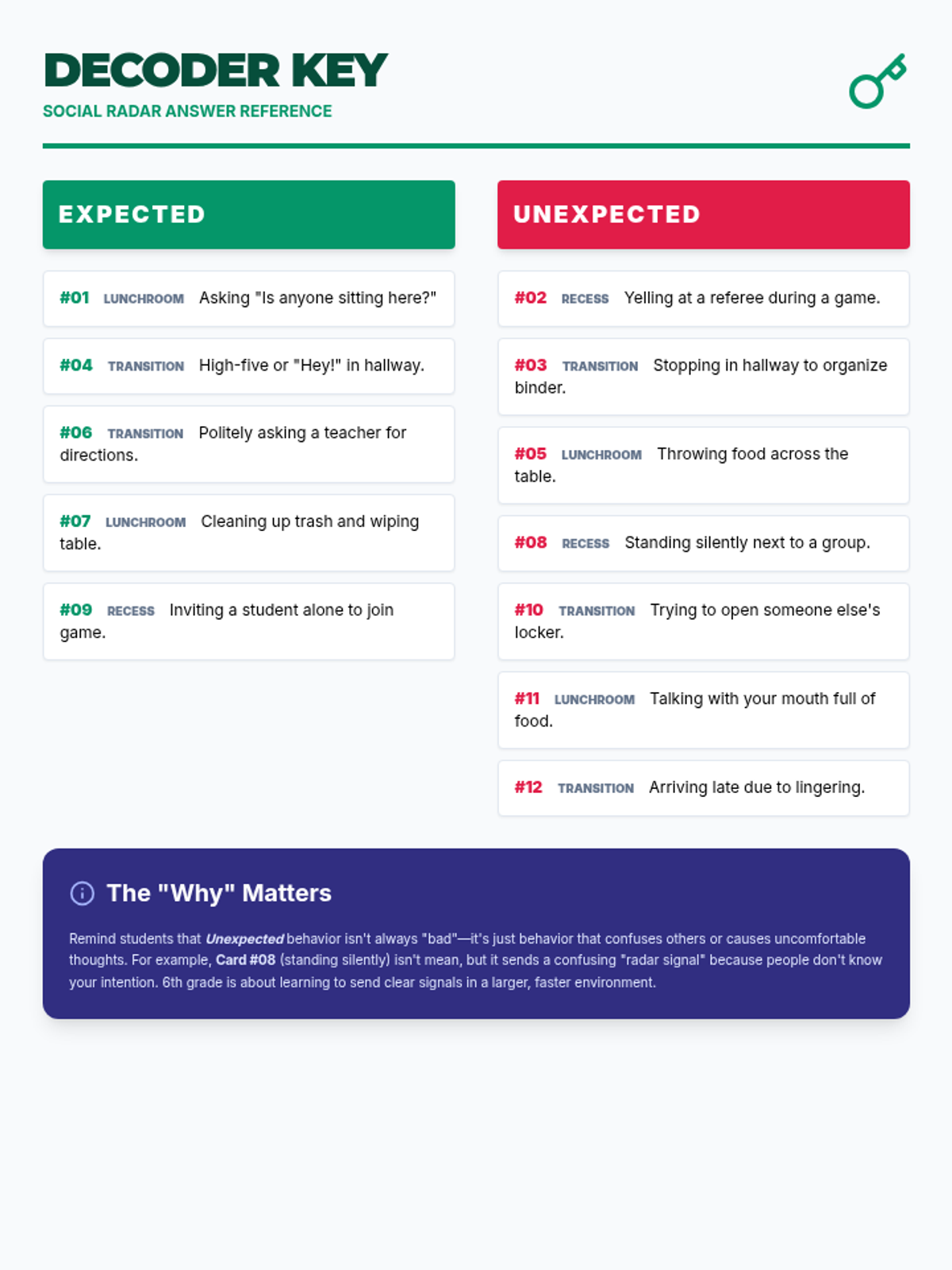
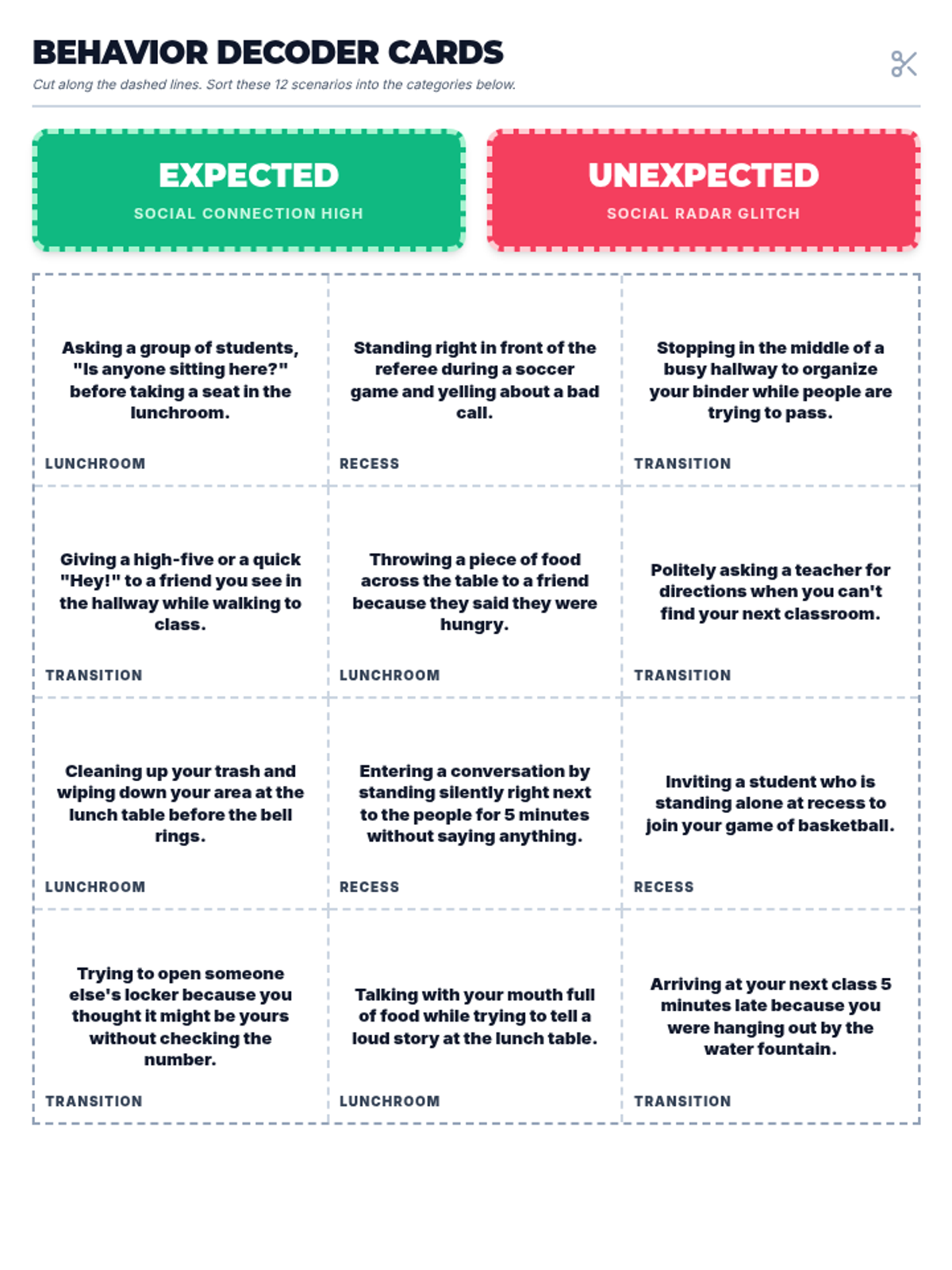
A teacher-facing answer key and discussion guide for the "Behavior Decoder" sorting activity, categorized by environment (lunchroom, recess, transition) with rationale for each classification.
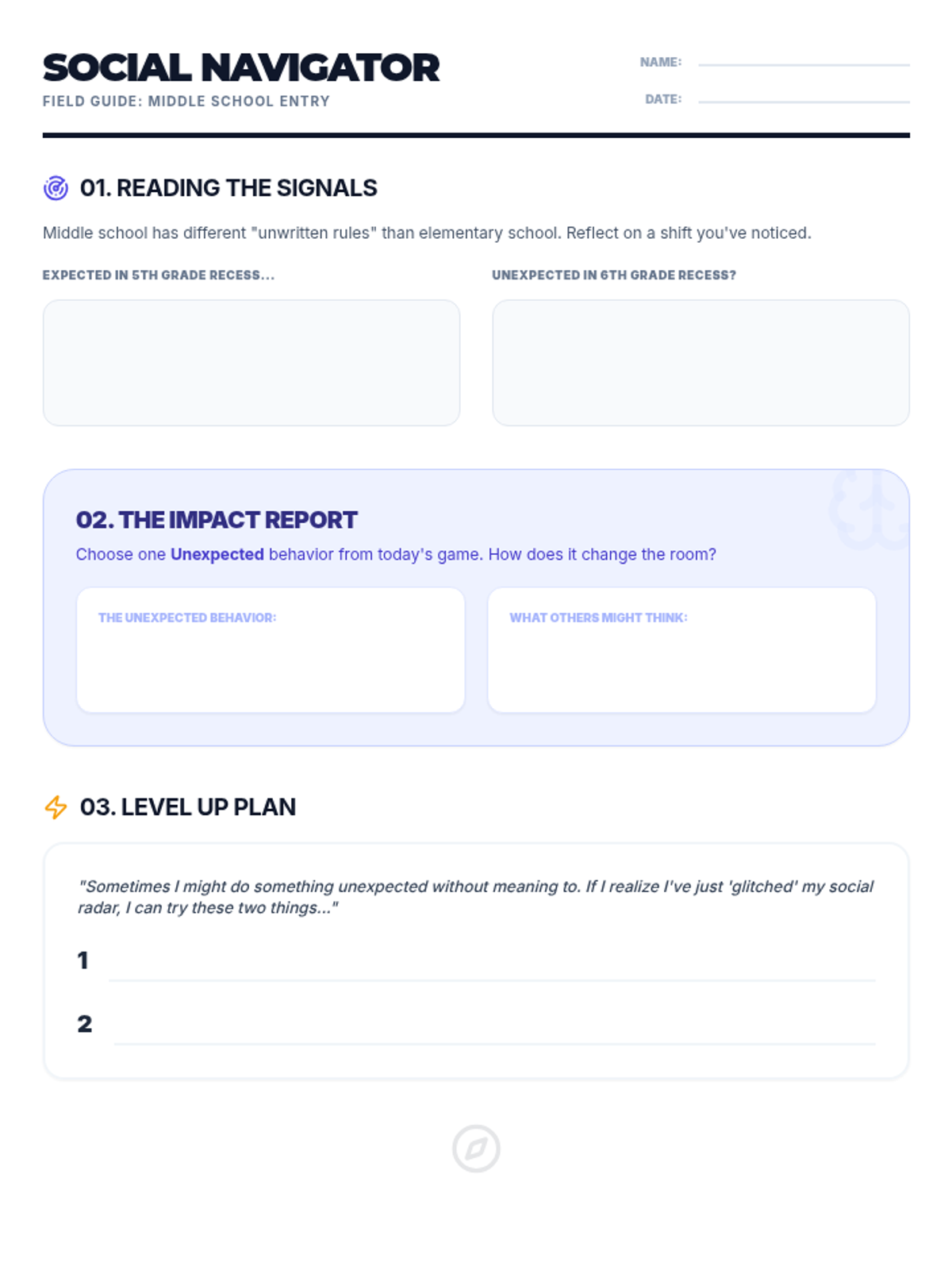
A reflection worksheet for rising 6th graders to apply "Social Radar" concepts. It includes sections for comparing elementary vs. middle school expectations, analyzing the impact of behaviors on others, and personal goal-setting for social transitions.
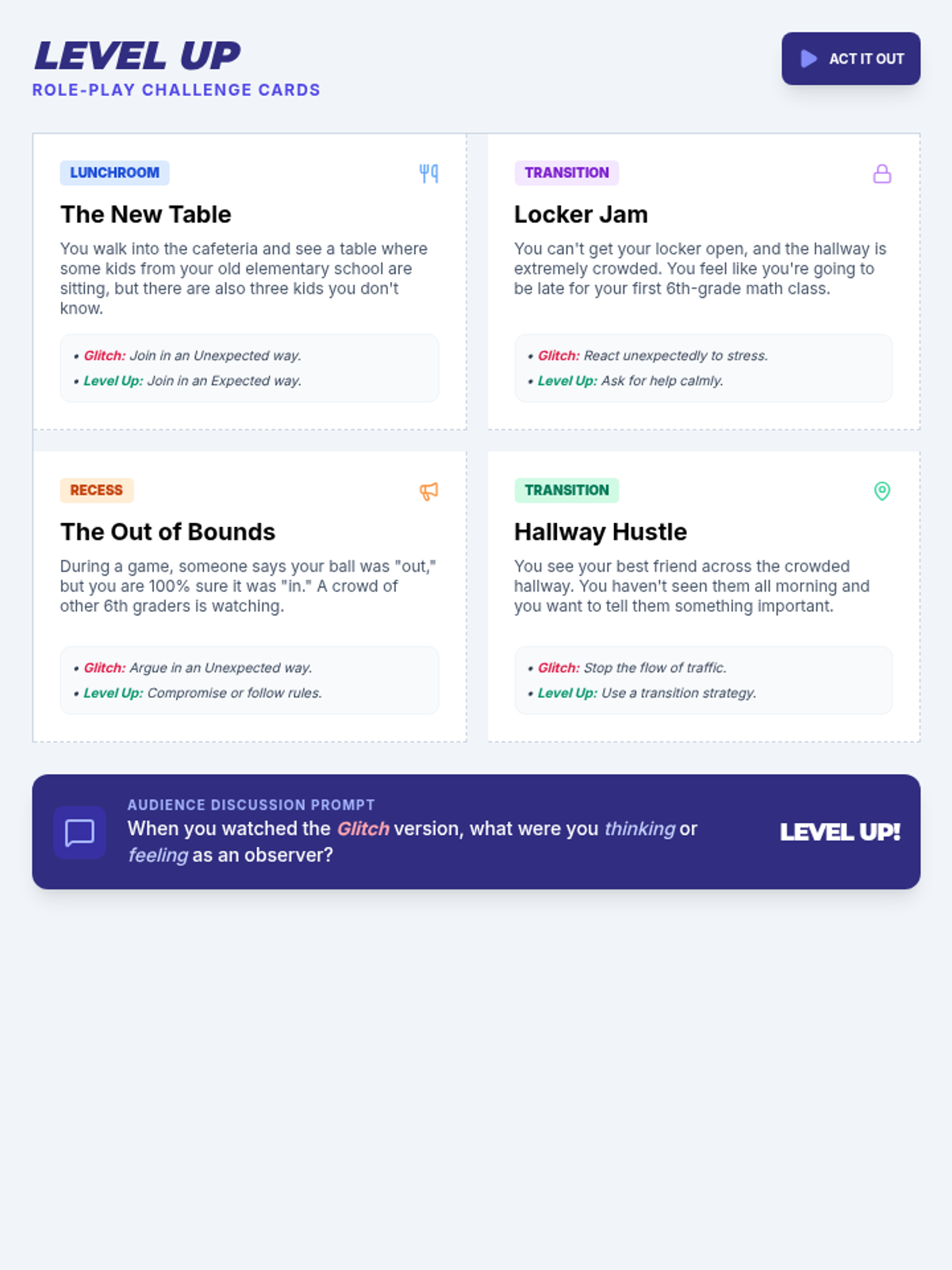
A set of four high-interest role-play prompt cards for rising 6th graders. Each card presents a middle school scenario (lunchroom, lockers, recess, hallway) and challenges students to perform both "Unexpected" and "Expected" behavioral responses.
A printable sorting activity for 6th graders featuring 12 scenario cards and category headers. Scenarios cover lunchroom, recess, and middle school transition behaviors to be categorized as "Expected" or "Unexpected."
A visually engaging slide deck designed for rising 6th graders to introduce the concepts of "Social Radar," defining expected and unexpected behaviors with a focus on middle school transition environments like the lunchroom and recess.
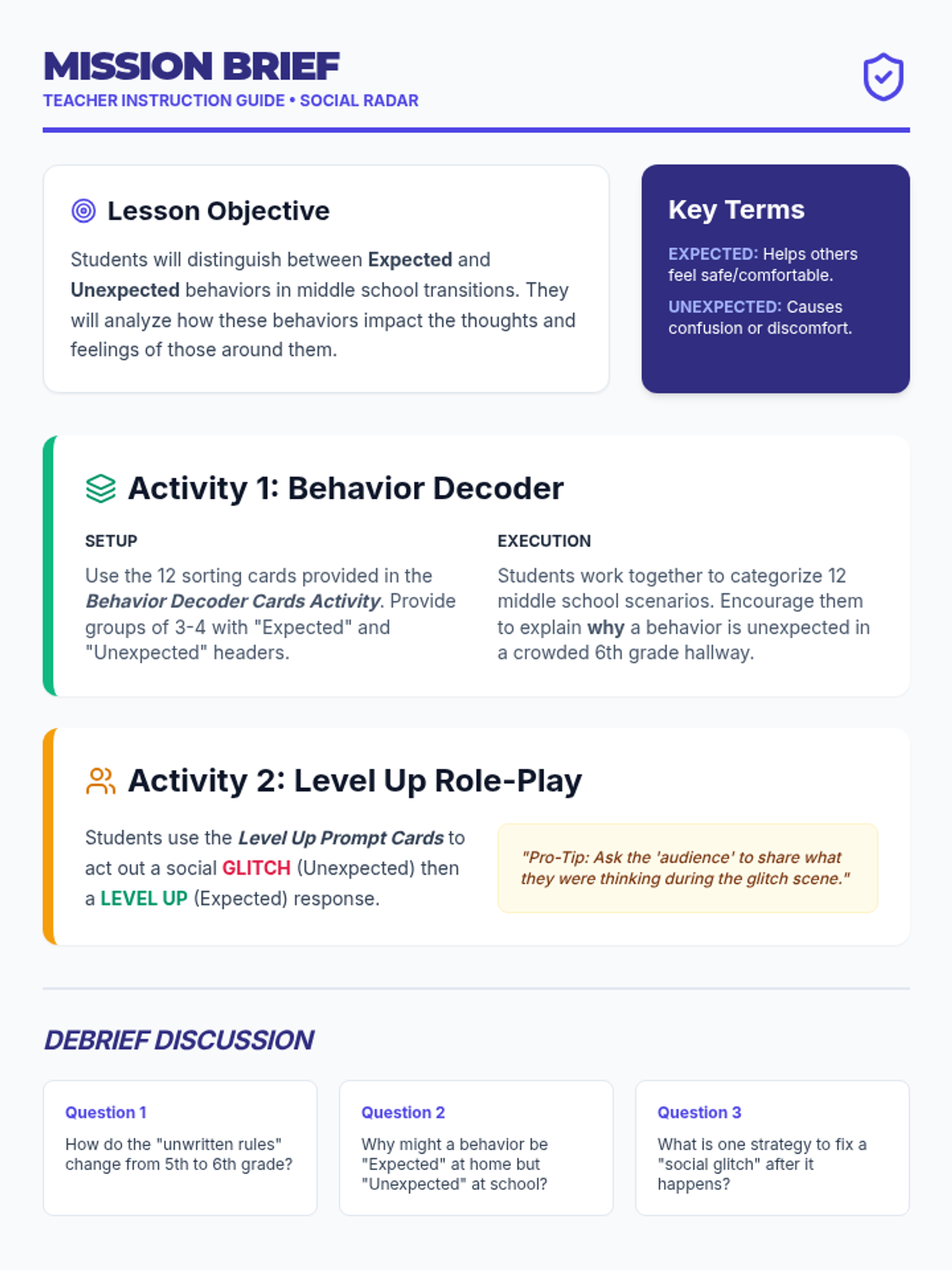
A comprehensive teacher guide for the "Social Radar" lesson, featuring objectives, key terms, activity instructions for sorting and role-play, and debriefing questions tailored for the middle school transition.
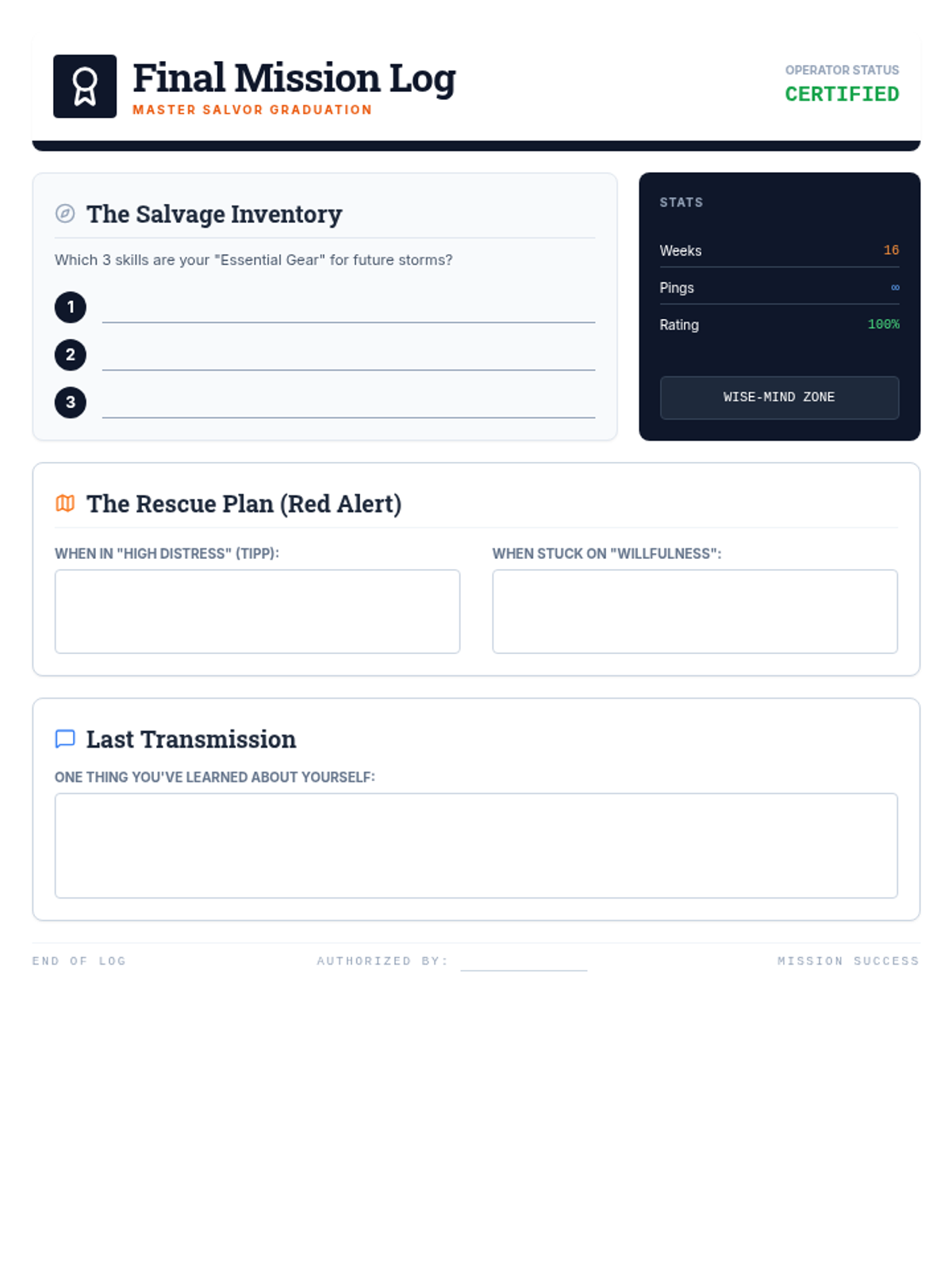
A student graduation log and review sheet for the final week of the Survival and Salvage DBT program. Includes a skill inventory, red alert planning, and a final self-reflection. Revised to fix page boundaries and line visibility.
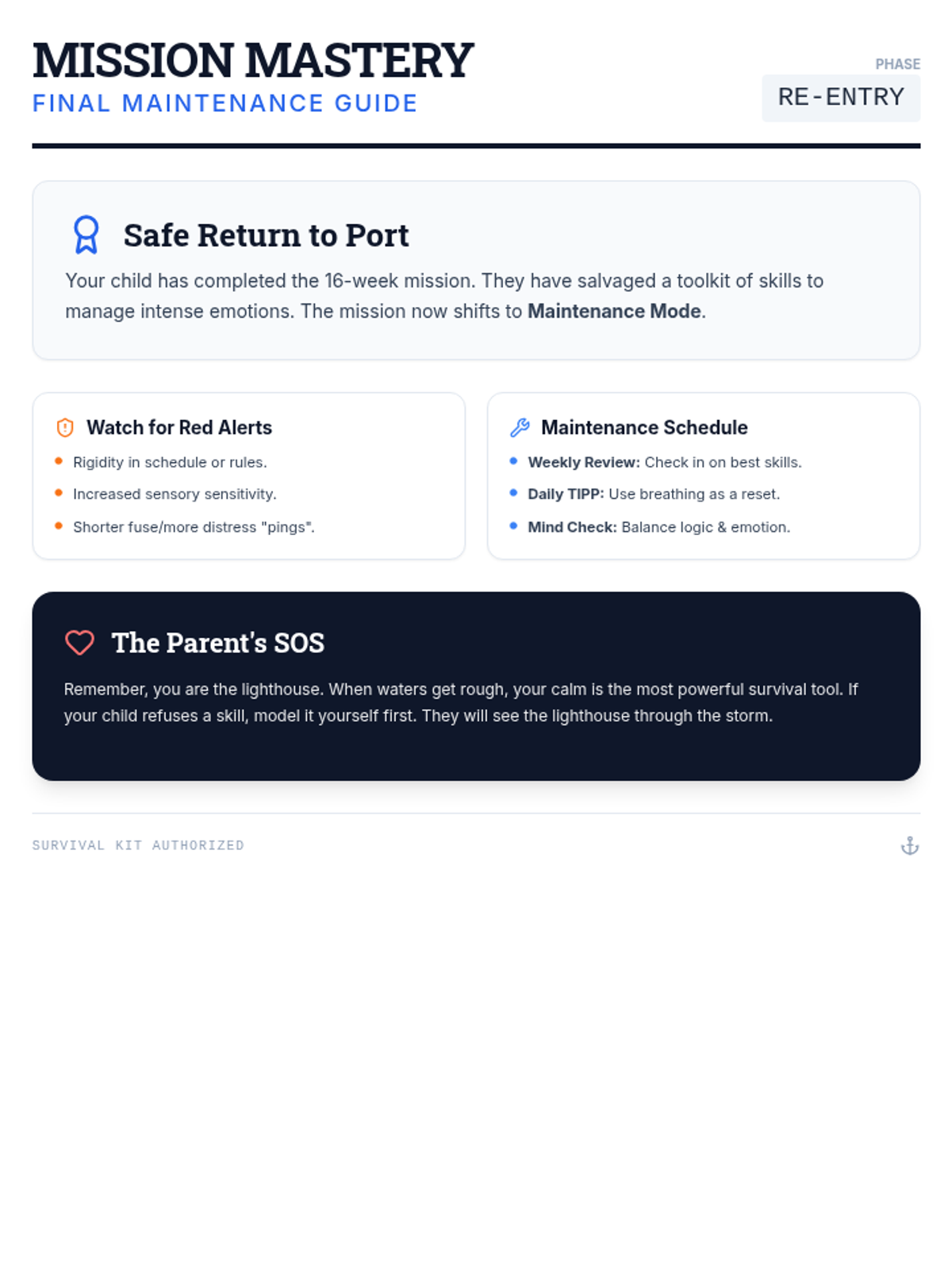
Parent guide for the final week of the Survival and Salvage DBT program, focusing on post-program maintenance and identifying early warning signs for skill reinforcement. Revised to fit a single page.
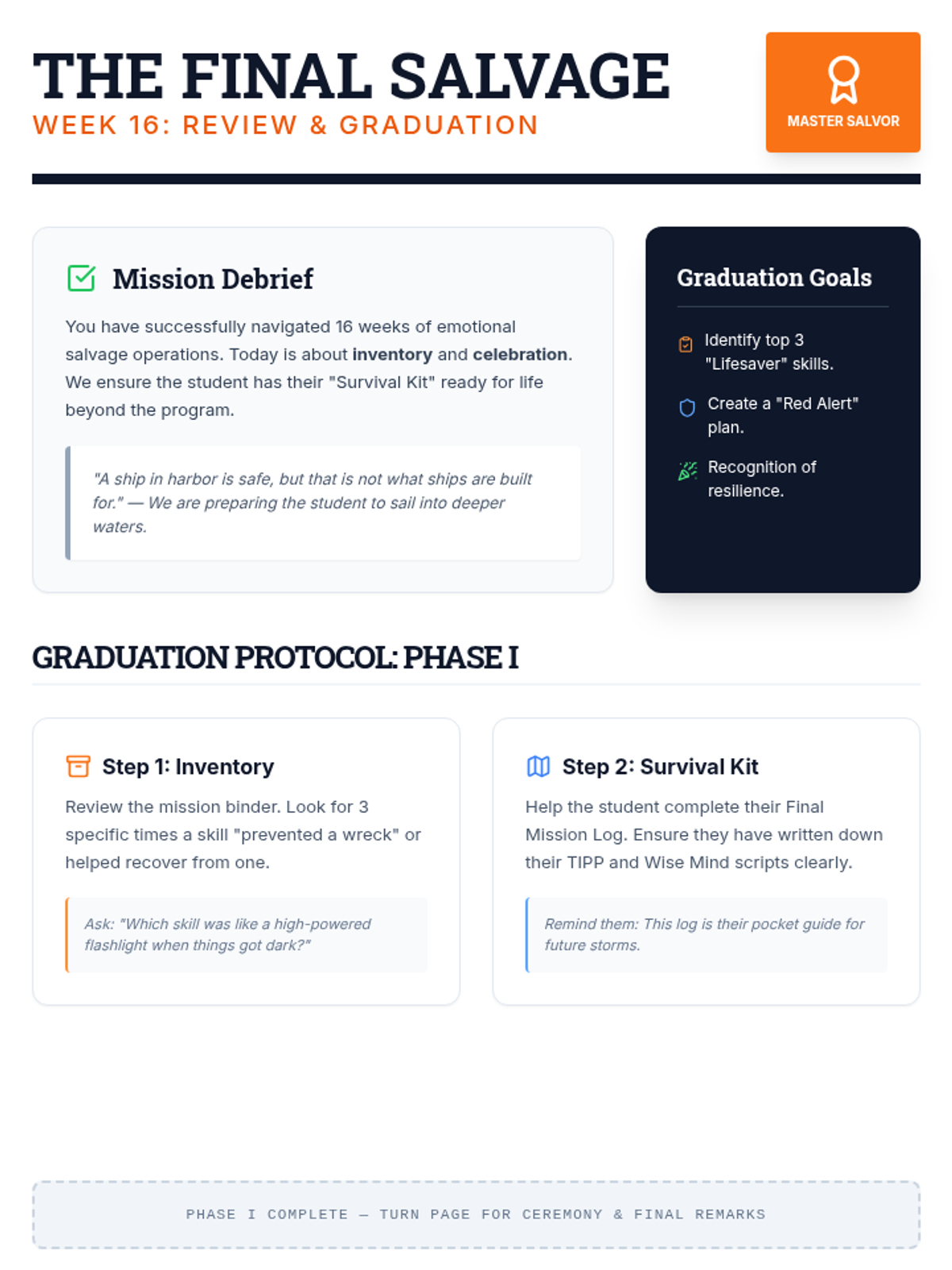
Counselor guide for the final week of the Survival and Salvage DBT program, covering the review of skills, graduation ceremony protocols, and maintenance planning. Revised to fix protocol splitting and layout issues.
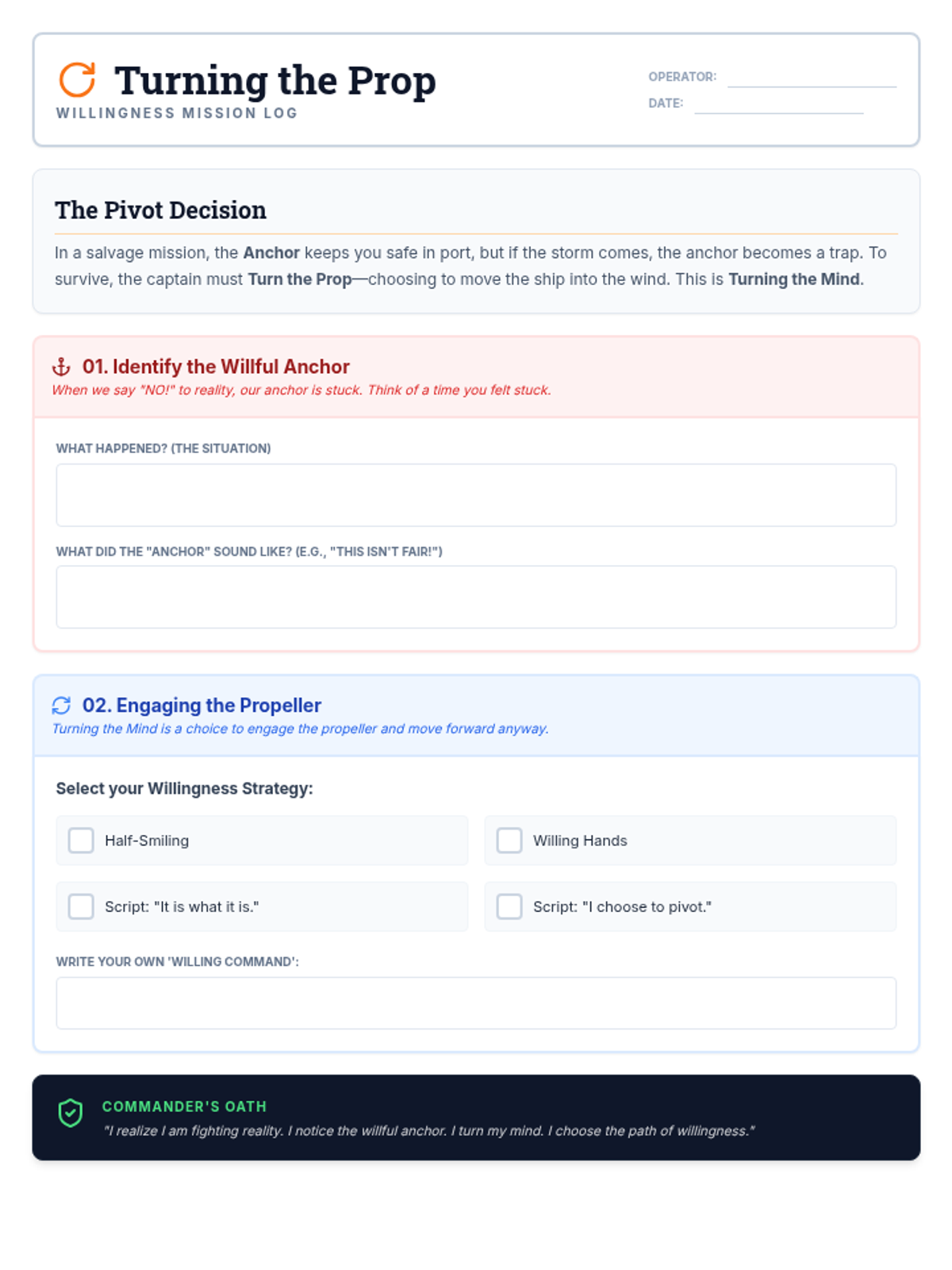
A student-facing worksheet for practicing the Turning the Mind skill using the 'Turning the Prop' metaphor. Includes identification of the 'Willful Anchor' and selection of 'Willingness Strategies'. Revised for single-page layout and white writing areas.
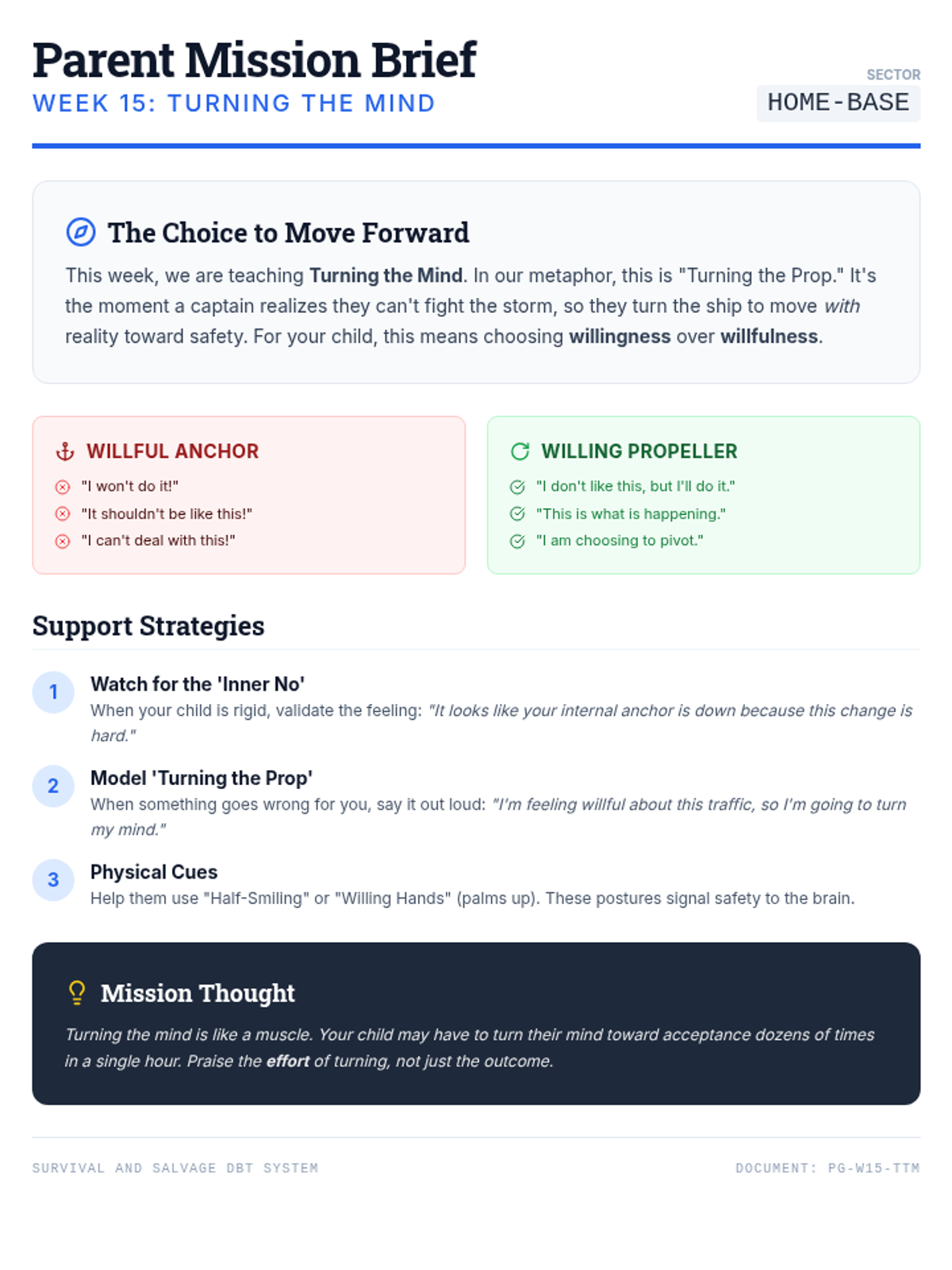
Parent guide for Week 15 of the Survival and Salvage DBT program, explaining the Turning the Mind skill using the 'Turning the Prop' metaphor for autism-friendly communication at home. Revised to fit a single page.
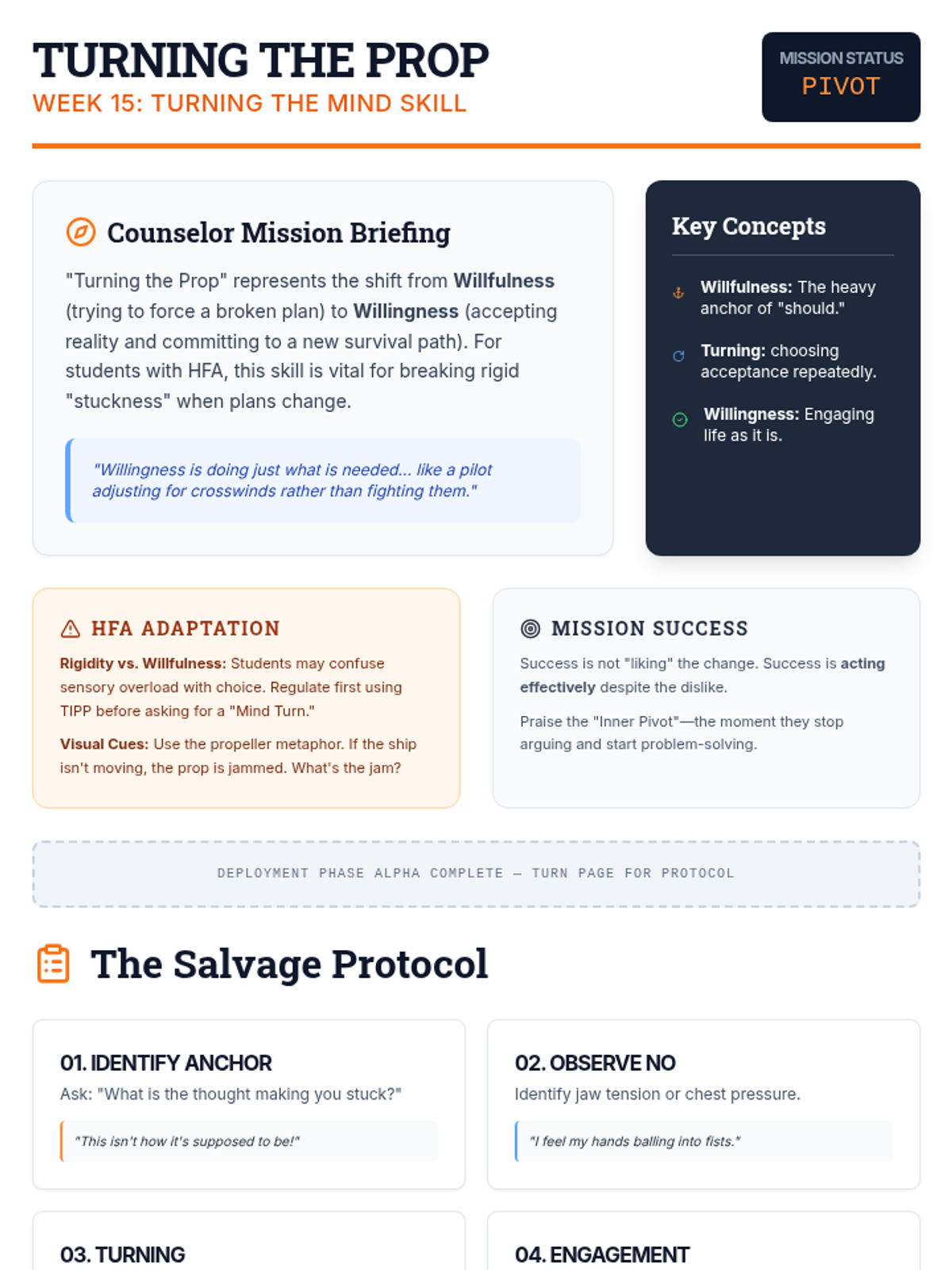
Counselor guide for Week 15 of the Survival and Salvage DBT program, focusing on the Turning the Mind skill using the 'Turning the Prop' metaphor for shifting from willfulness to willingness. Revised to fix page break issues and add notes space.
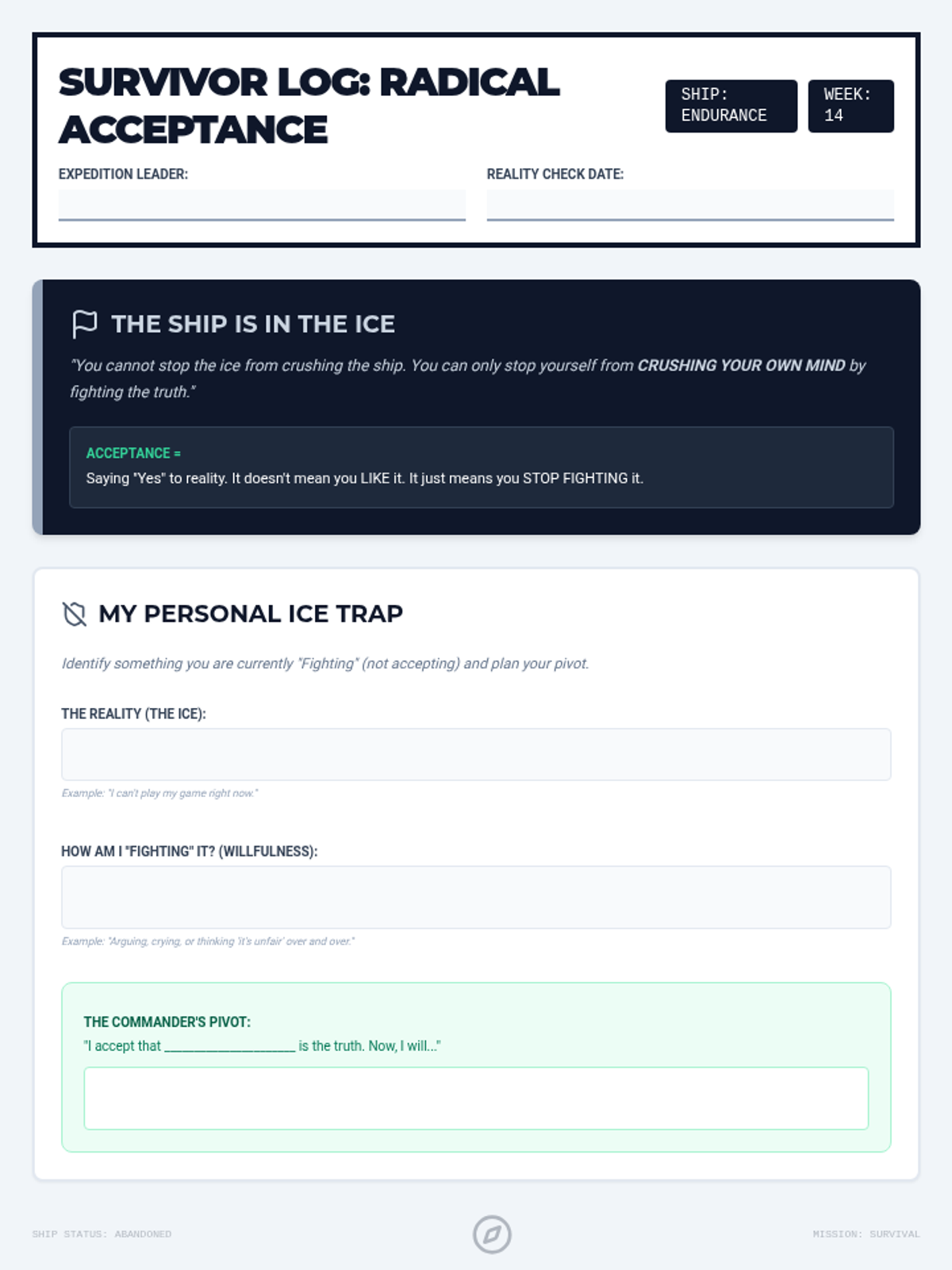
A student-facing worksheet for practicing Radical Acceptance using Shackleton's Endurance story. Includes an 'Ice Trap' analysis and a 'Commander's Pivot' for finding new solutions.
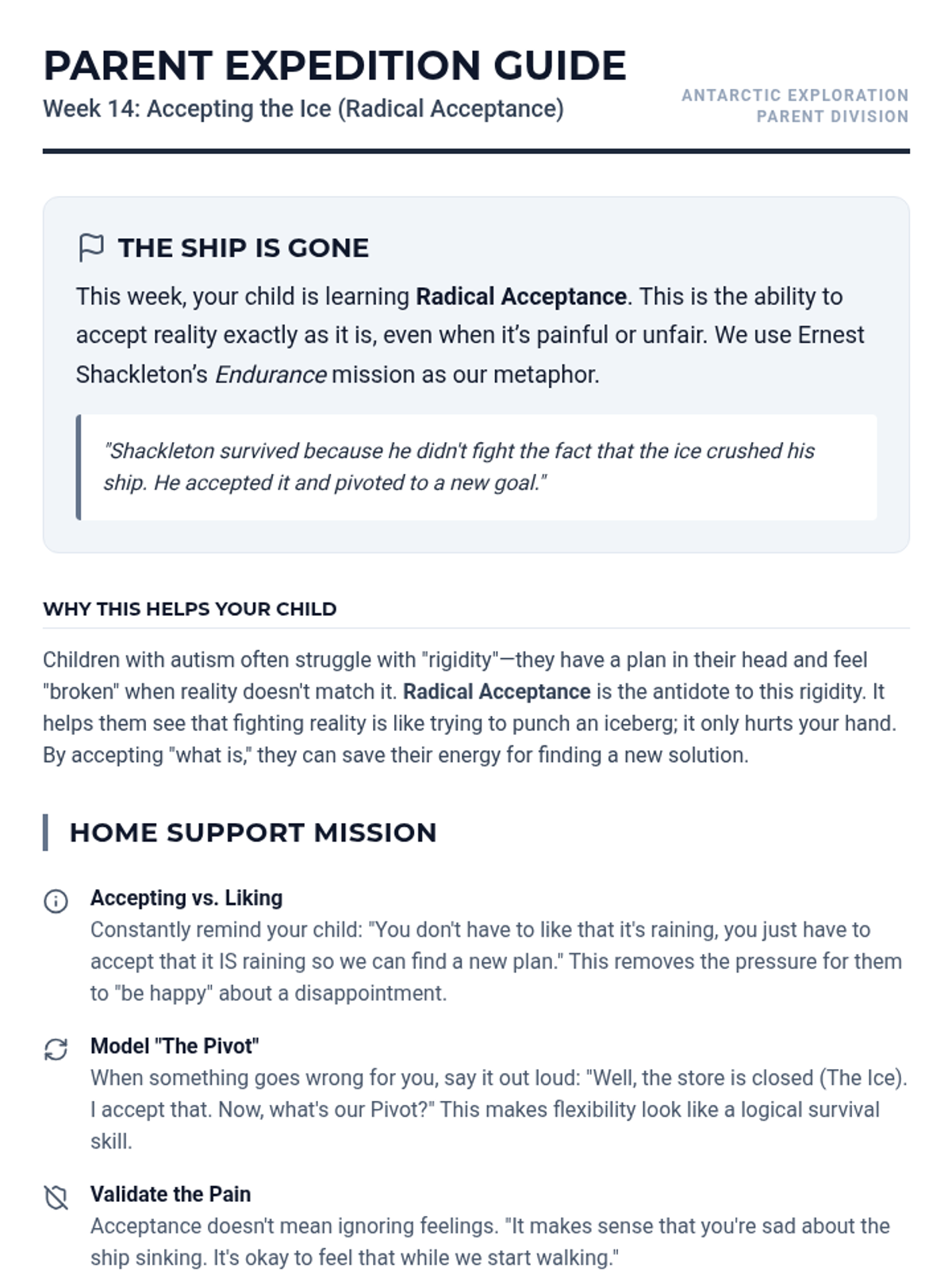
Parent guide for Week 14 of the Survival and Salvage DBT program, explaining Radical Acceptance using Shackleton's Endurance story.
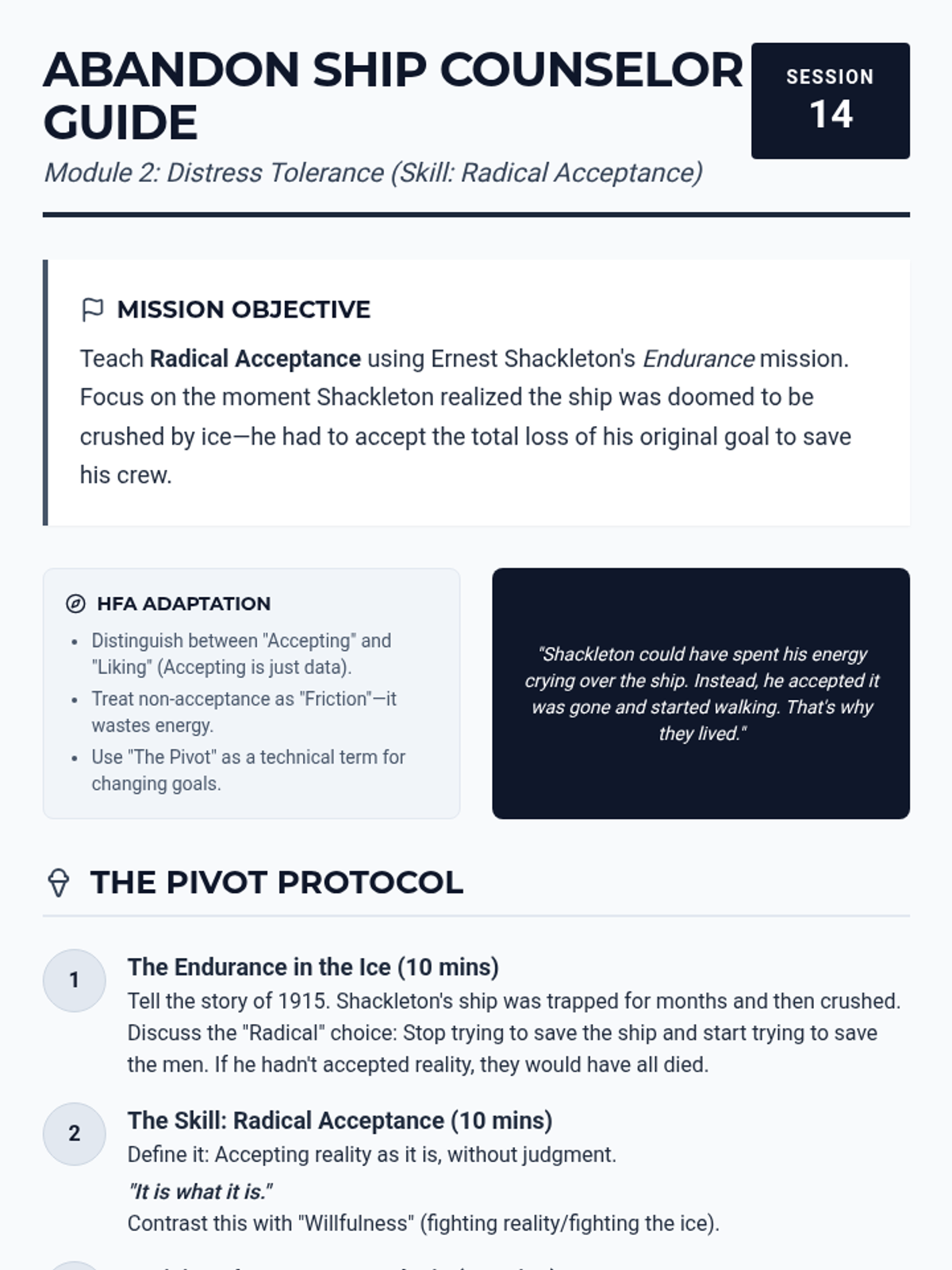
Counselor guide for Week 14 of the Survival and Salvage DBT program, focusing on Radical Acceptance using Shackleton's Endurance story.
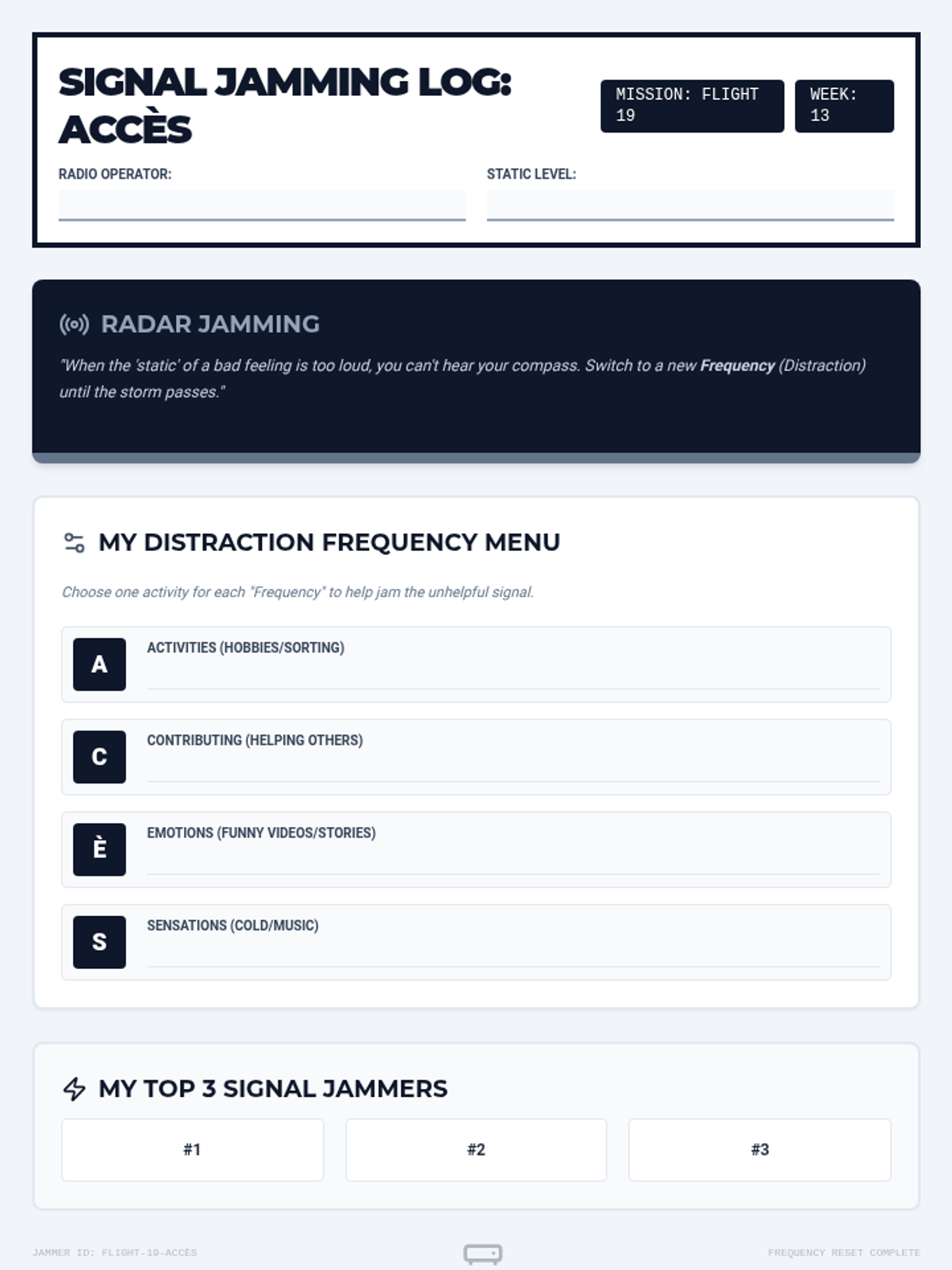
A student-facing worksheet for practicing Distract and ACCÈS skills using radar jamming metaphors. Includes a selection of activities for different distraction modes.
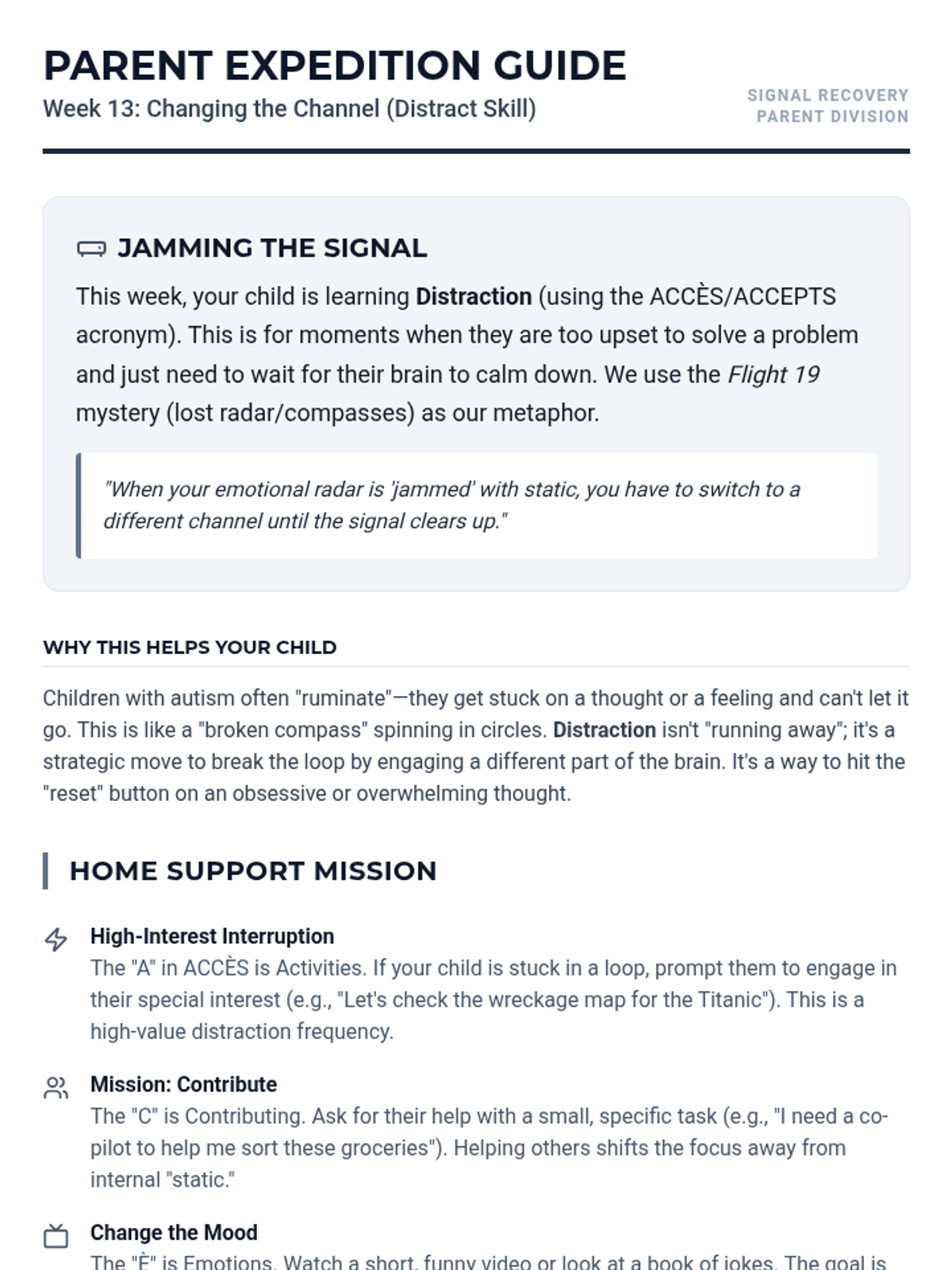
Parent guide for Week 13 of the Survival and Salvage DBT program, explaining Distraction and ACCÈS skills using radar jamming metaphors.
A slide deck summarizing the four types of emotional signals and providing instructions for the final Personal Escalation Map project.
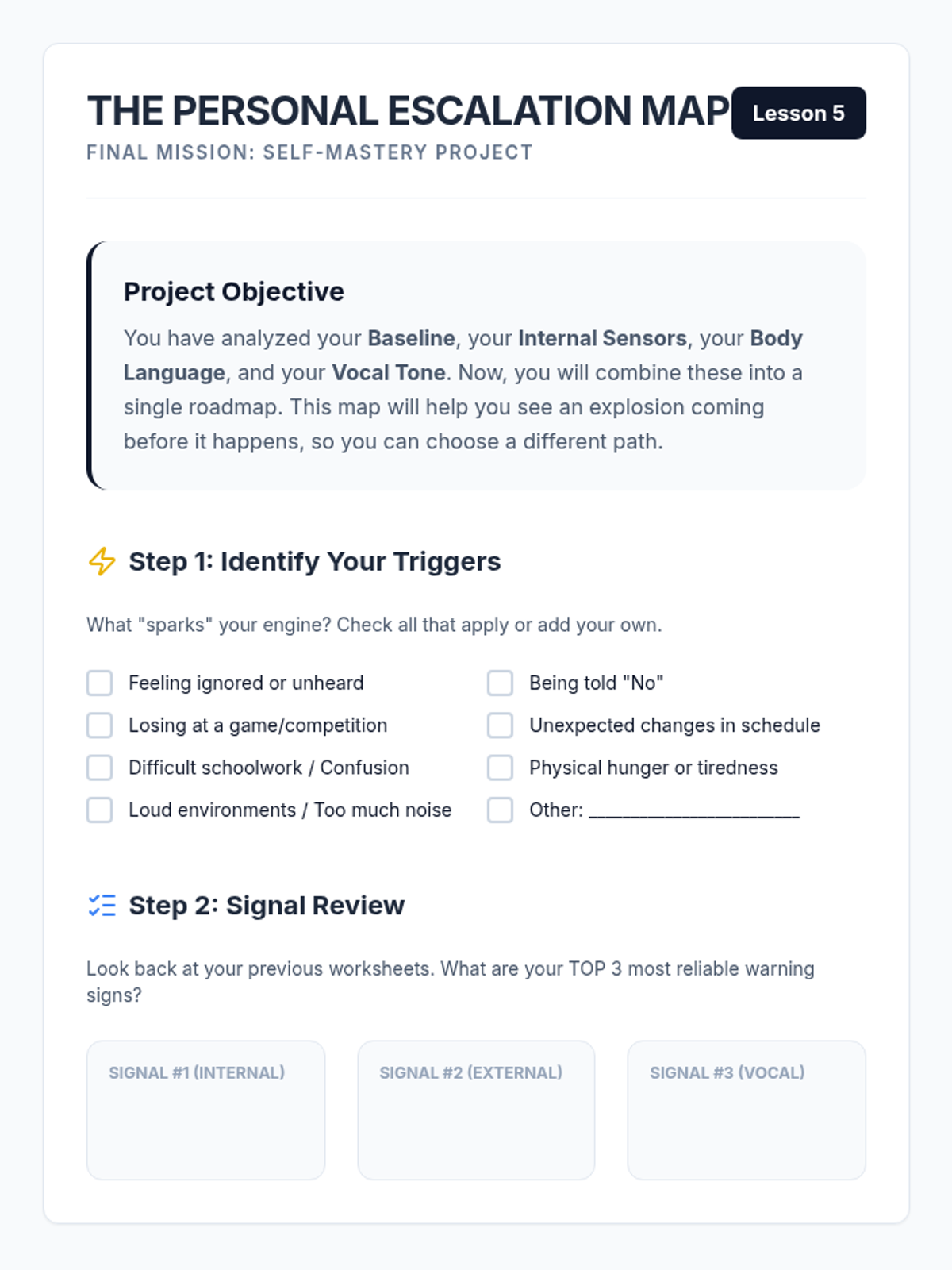
The final project for the unit where students synthesize all previous learning to create a visual 'Escalation Map' identifying their specific triggers and warning signs at different levels.
A slide deck introducing vocal indicators of emotional escalation, contrasting rational communication with emotional venting, and explaining the Tone Twister game.
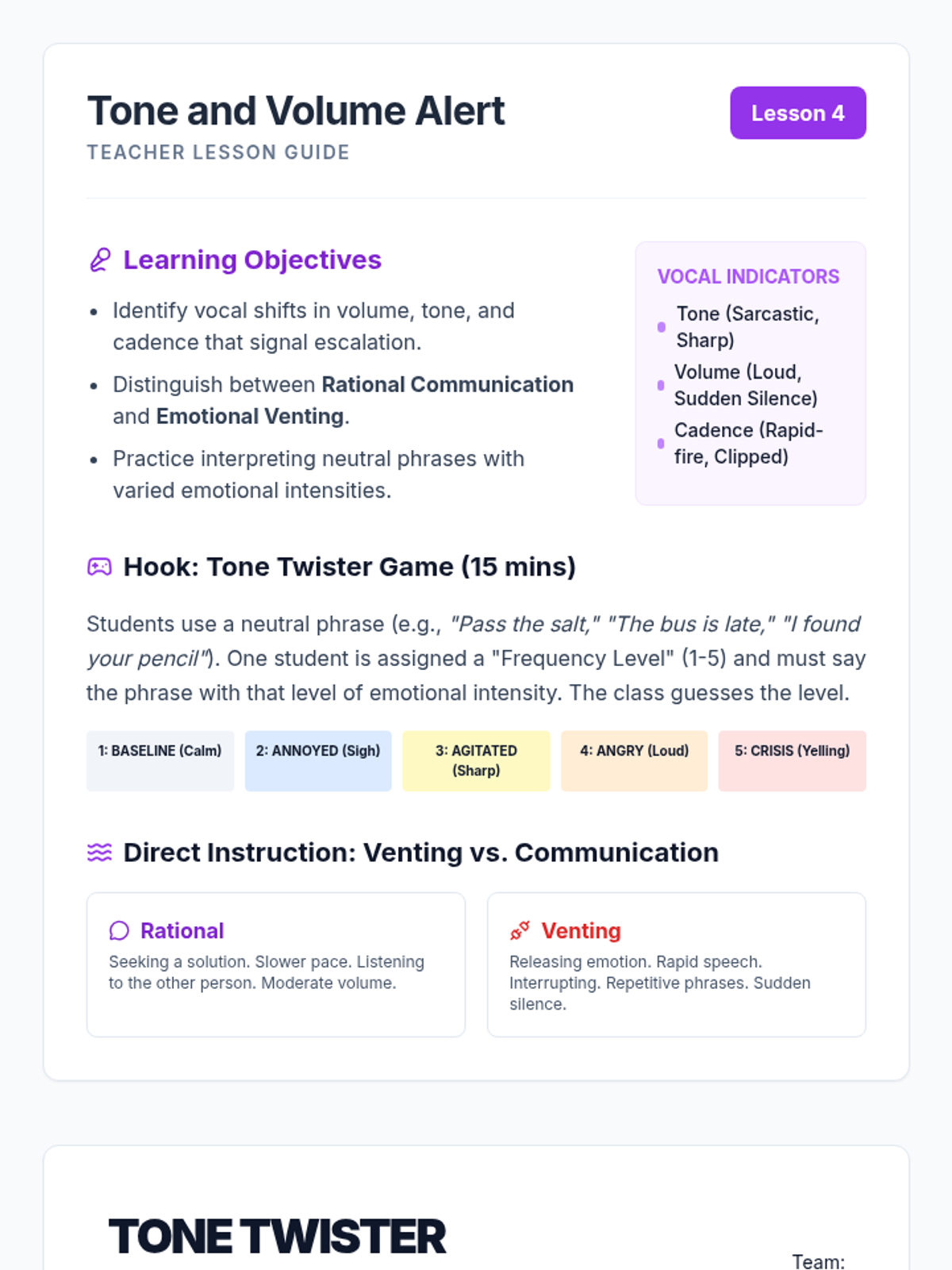
A teacher guide and student activity focused on identifying vocal shifts in tone, volume, and cadence during emotional escalation through a role-play game.
A slide deck explaining the importance of objective observation in identifying non-verbal warning signs. includes the "Silent Film" hook and definitions of signal clusters.
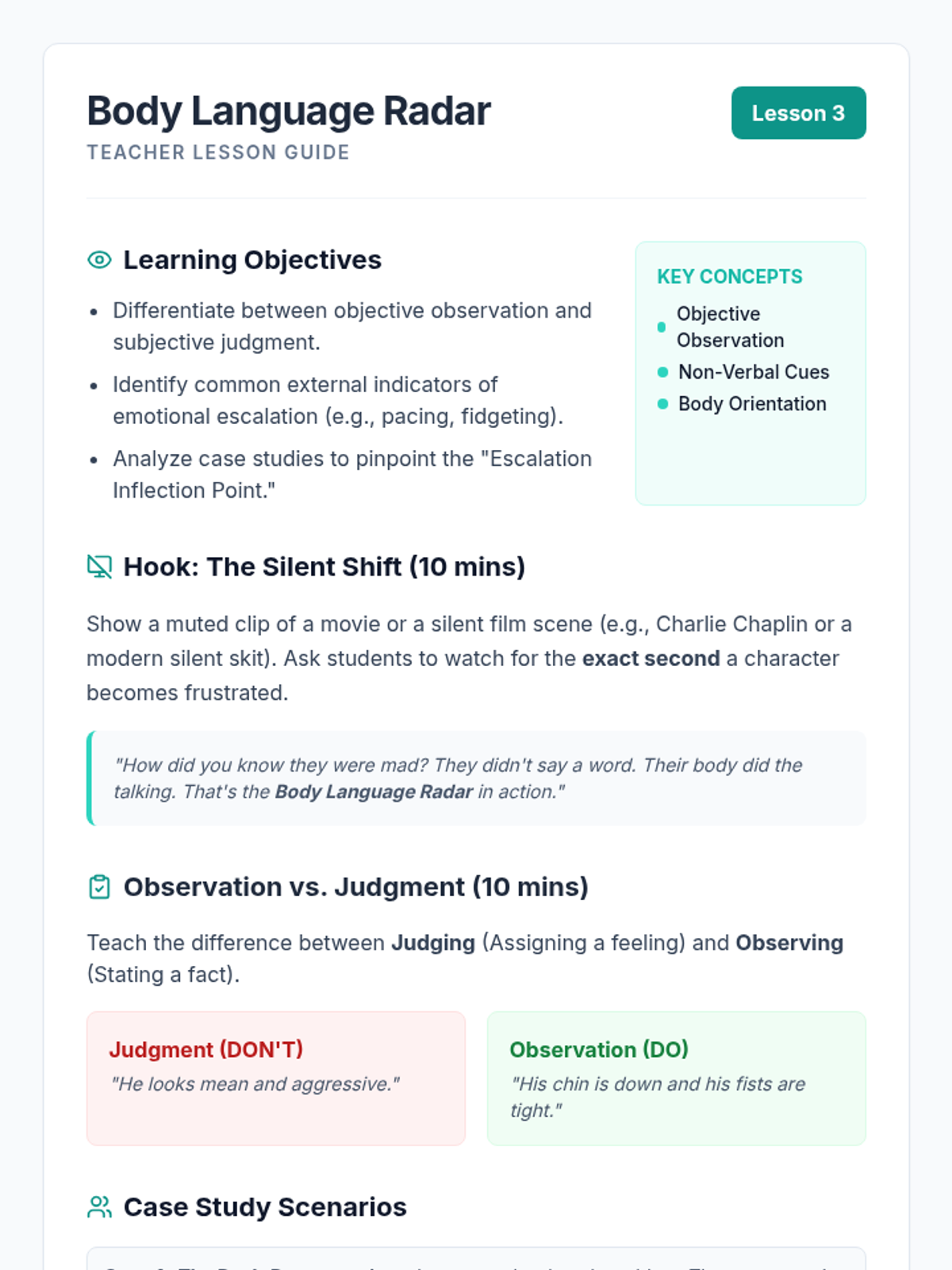
A teacher guide and student activity focused on identifying external non-verbal behavioral cues during emotional escalation through objective observation.
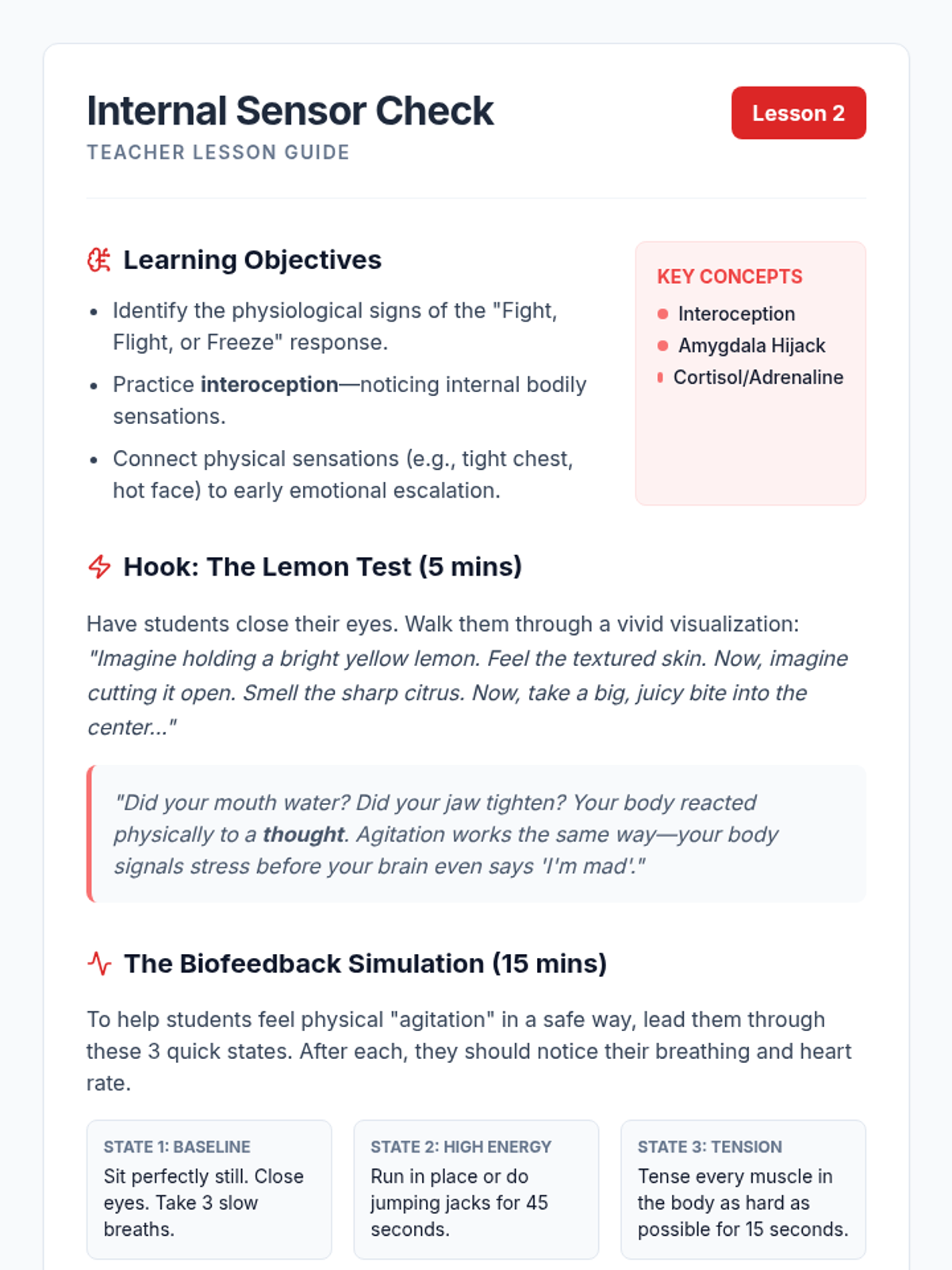
A slide deck explaining the physiological 'alarm system' of the brain (the amygdala) and how it triggers physical sensations in the body during stress. Includes the Lemon Test hook.
A teacher guide and student body-mapping worksheet focused on identifying internal physiological signals of stress and agitation.
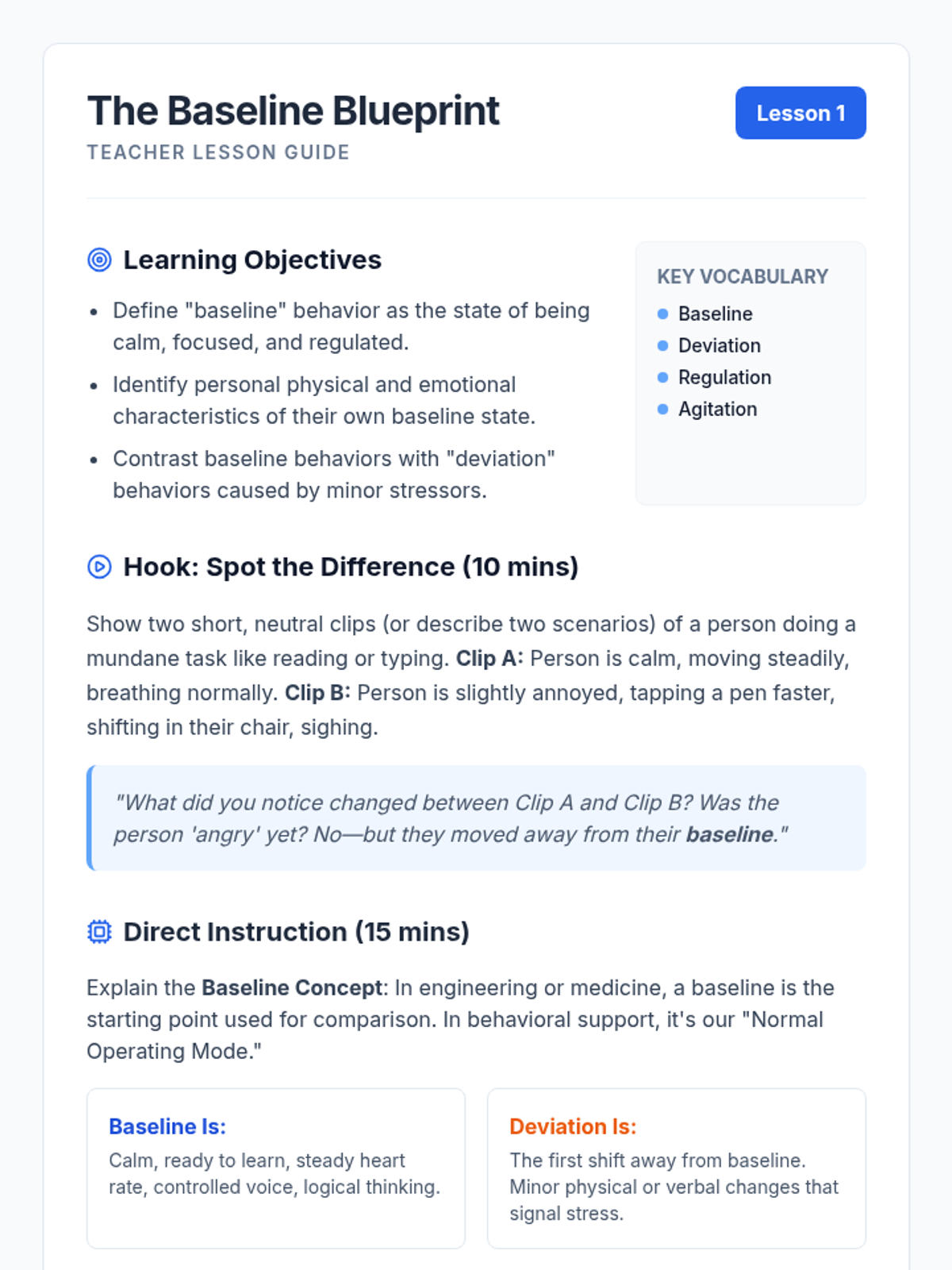
A visual presentation introducing students to the concepts of baseline behavior and emotional deviation. includes a 'spot the difference' hook and instructions for the baseline self-audit.
A teacher guide and student worksheet designed to establish the concept of 'baseline' behavior and identify personal physical/social indicators of a regulated state.
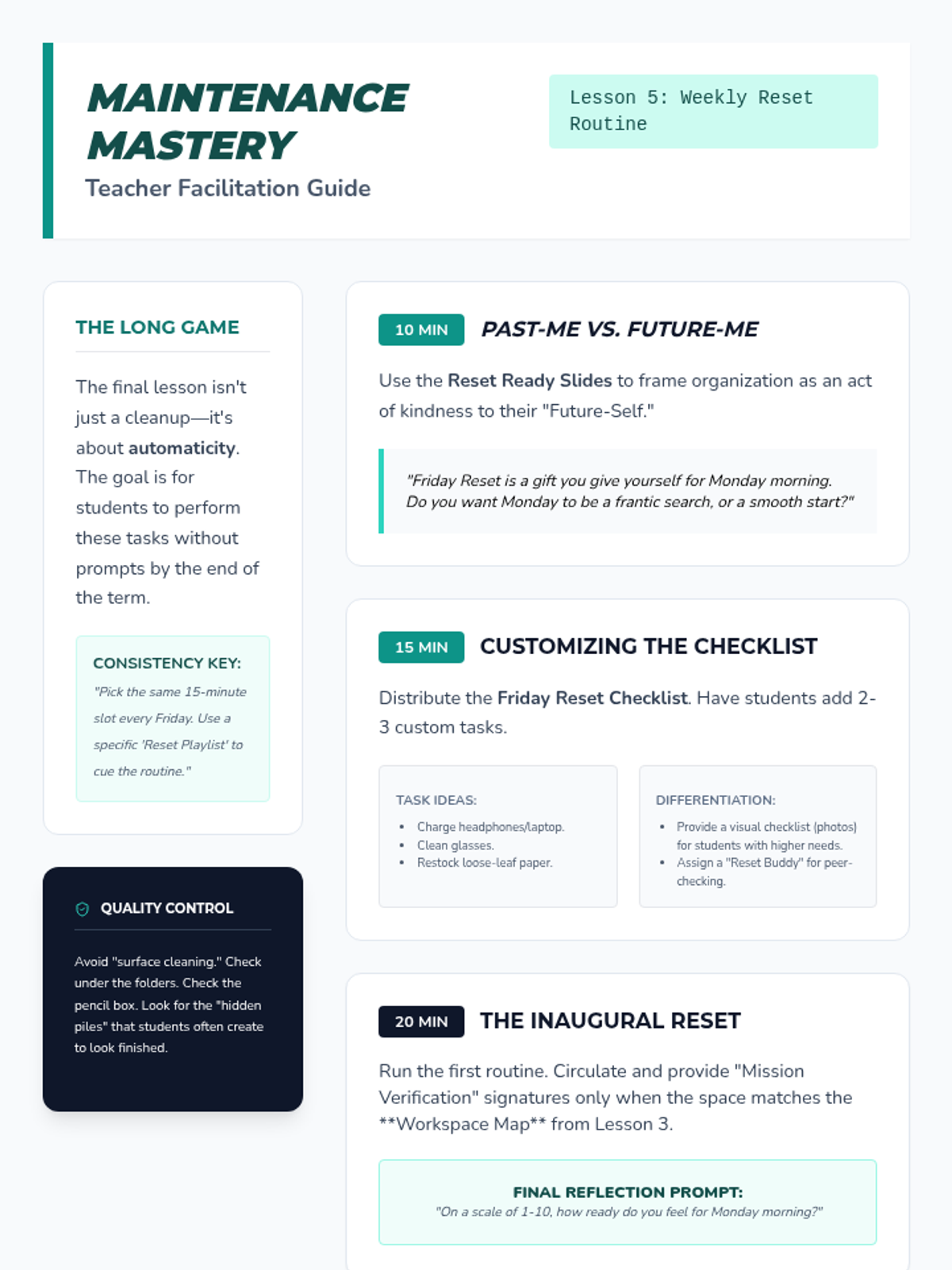
Teacher facilitation guide for Lesson 5, focusing on establishing the "Friday Reset" habit and providing long-term maintenance strategies.
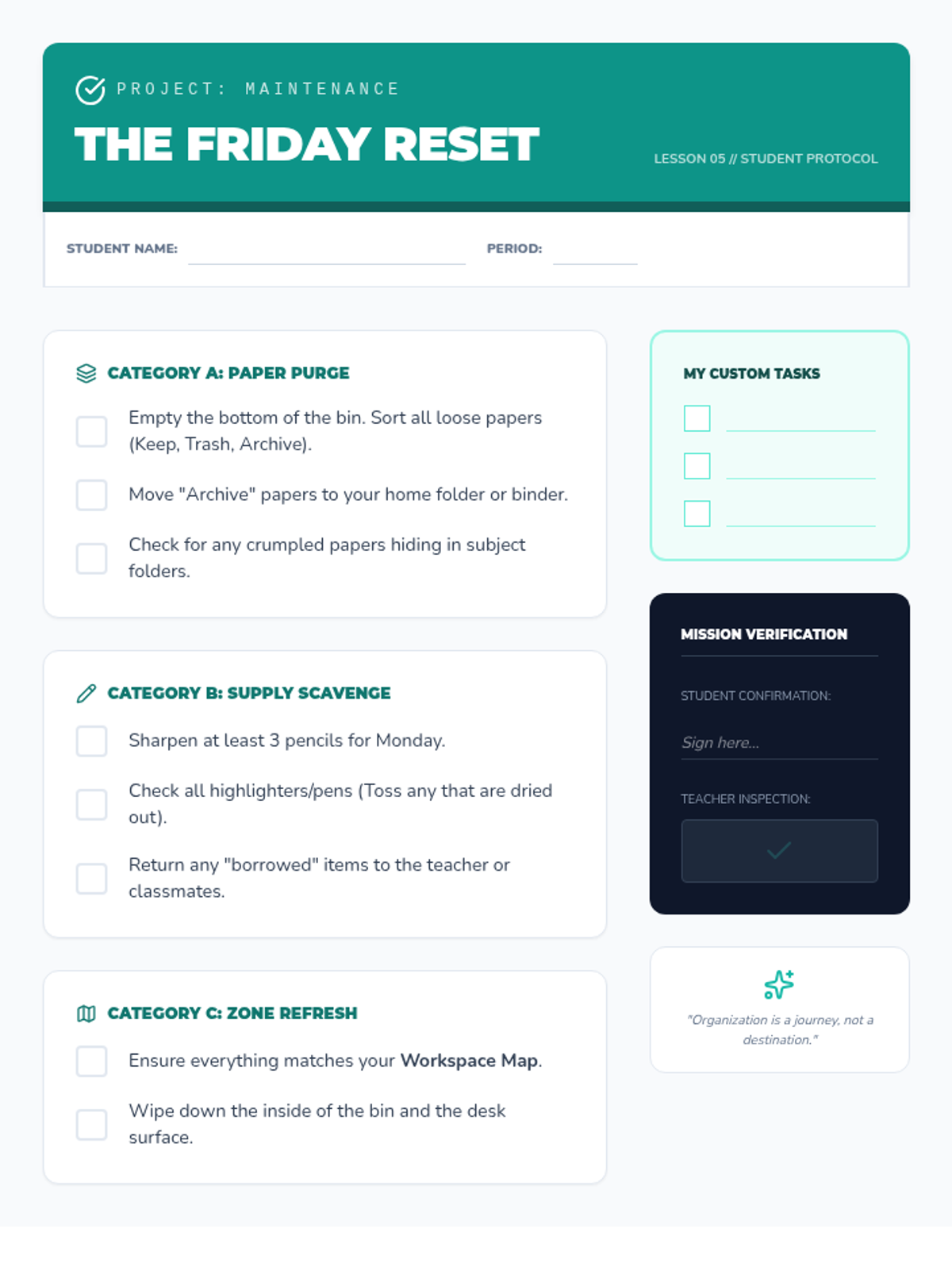
Student checklist for Friday clean-ups, featuring categories for papers, supplies, and zones.
Slides for Lesson 5, focusing on the "Friday Reset" routine and the importance of regular maintenance for organization.
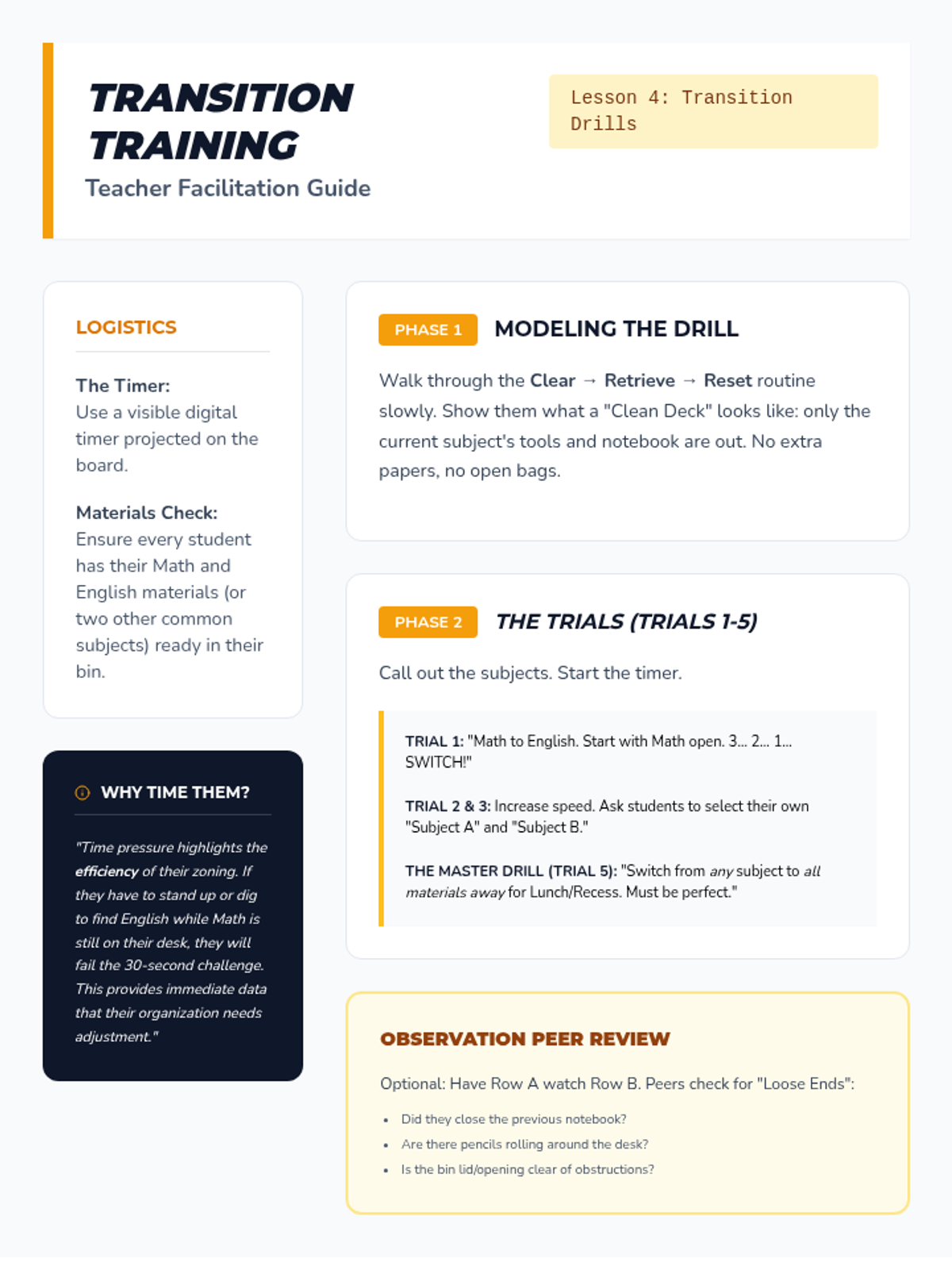
Teacher facilitation guide for Lesson 4, including the "Switch-A-Roo" drill mechanics and subject pairing suggestions.
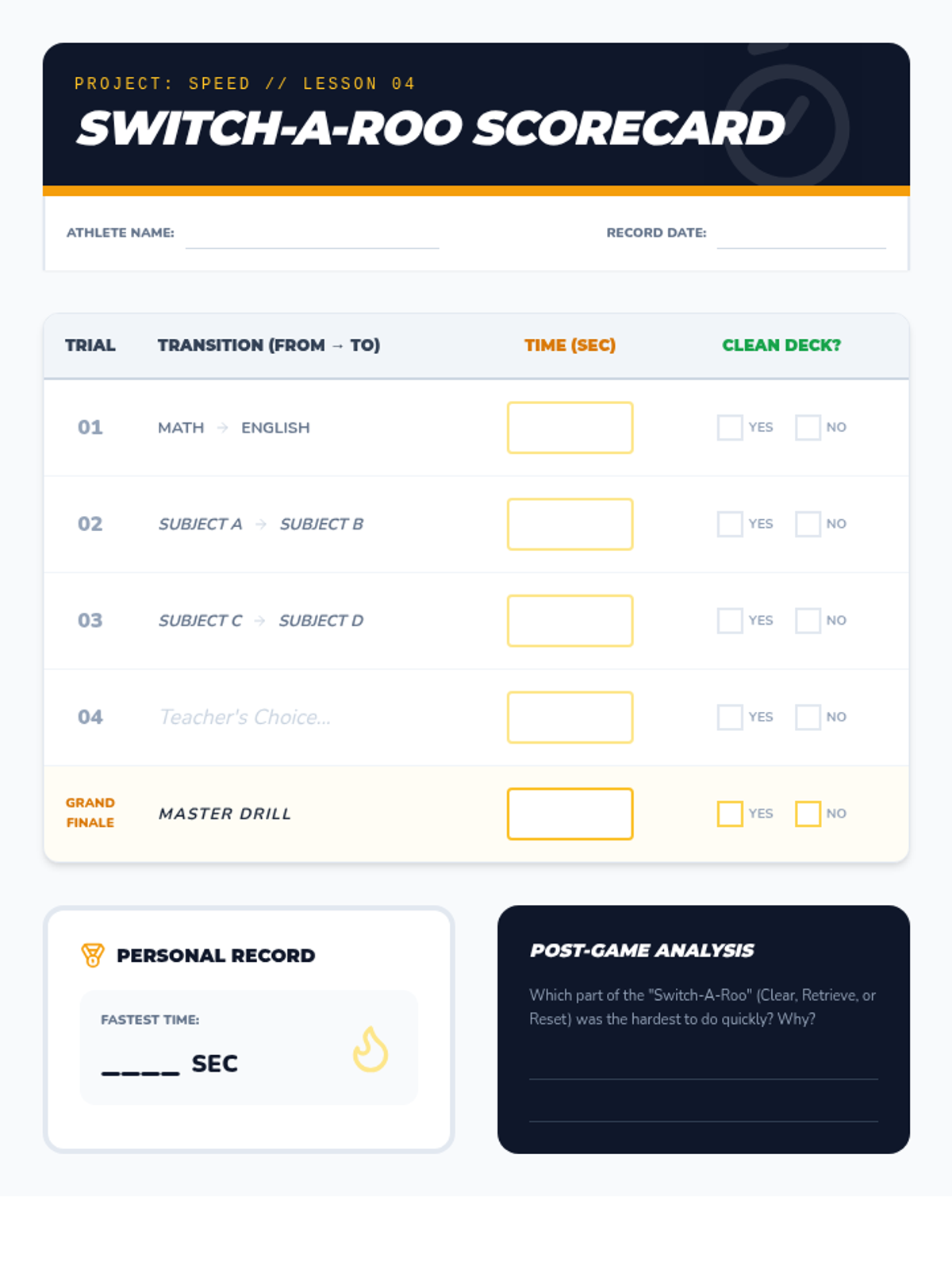
Student tracker for transition speed and accuracy during the "Switch-A-Roo" simulations.
Slides for Lesson 4, focusing on the "Switch-A-Roo" mechanics for efficient transitions between subjects.
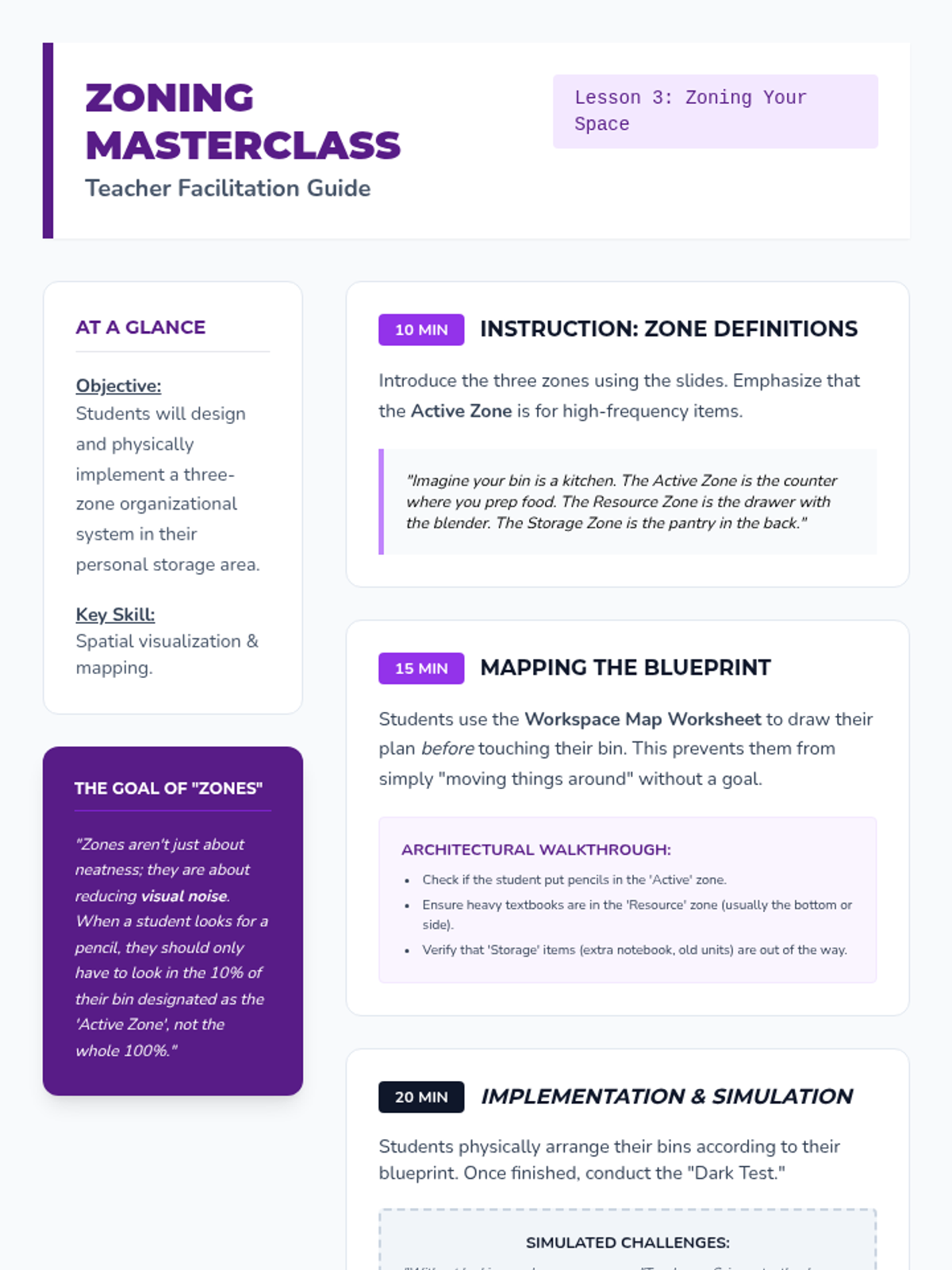
Teacher facilitation guide for Lesson 3, focusing on spatial zones and implementing the "Dark Test" simulation.
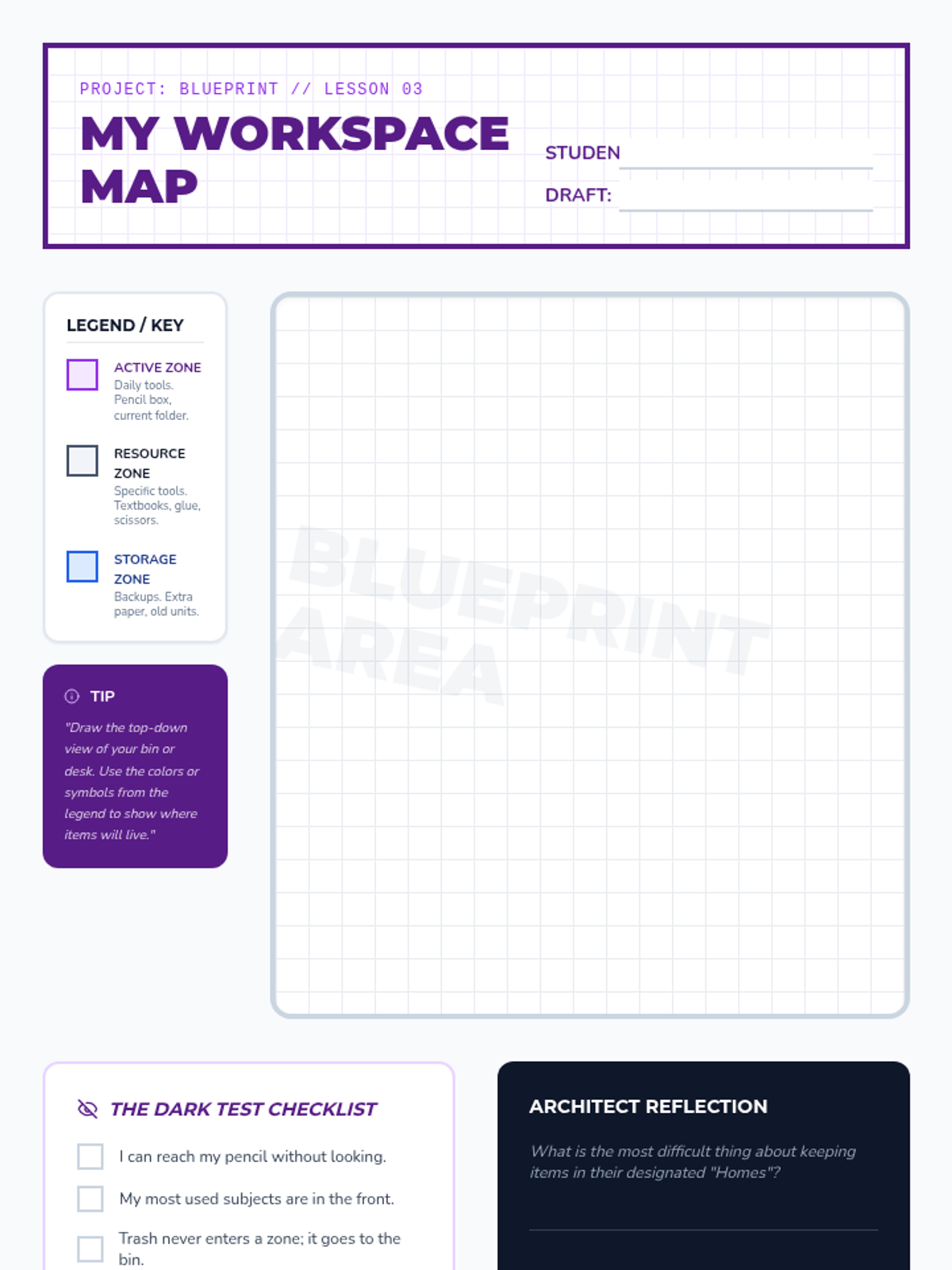
Worksheet for students to draw their personal storage zones (Active, Resource, Storage) using a blueprint-style grid.
Slides for Lesson 3, explaining spatial zones (Active, Tool, Storage) to create an intuitive and efficient workspace layout.
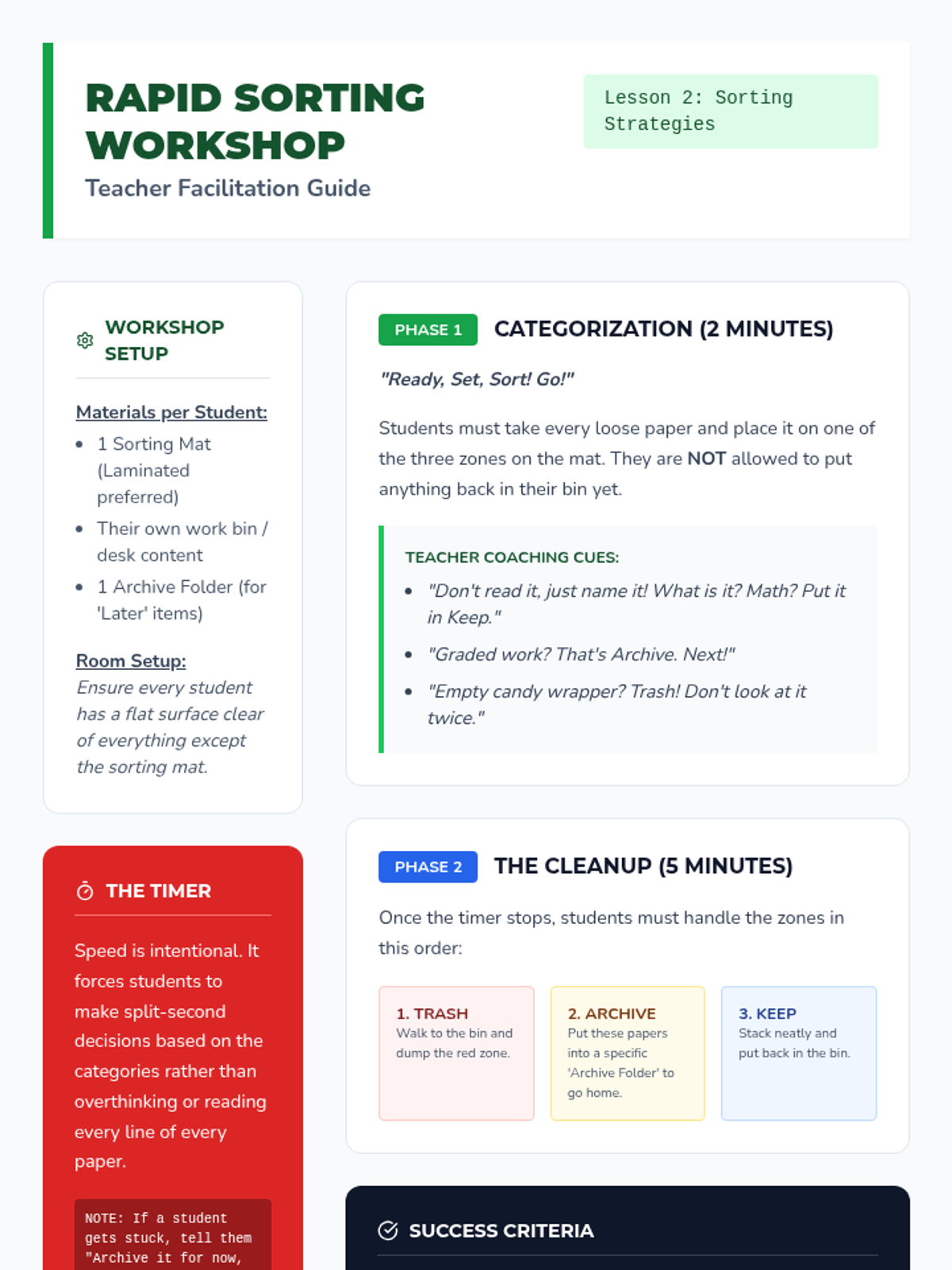
Teacher facilitation guide for Lesson 2, including the "2-Minute Challenge" script and cleanup logistics.
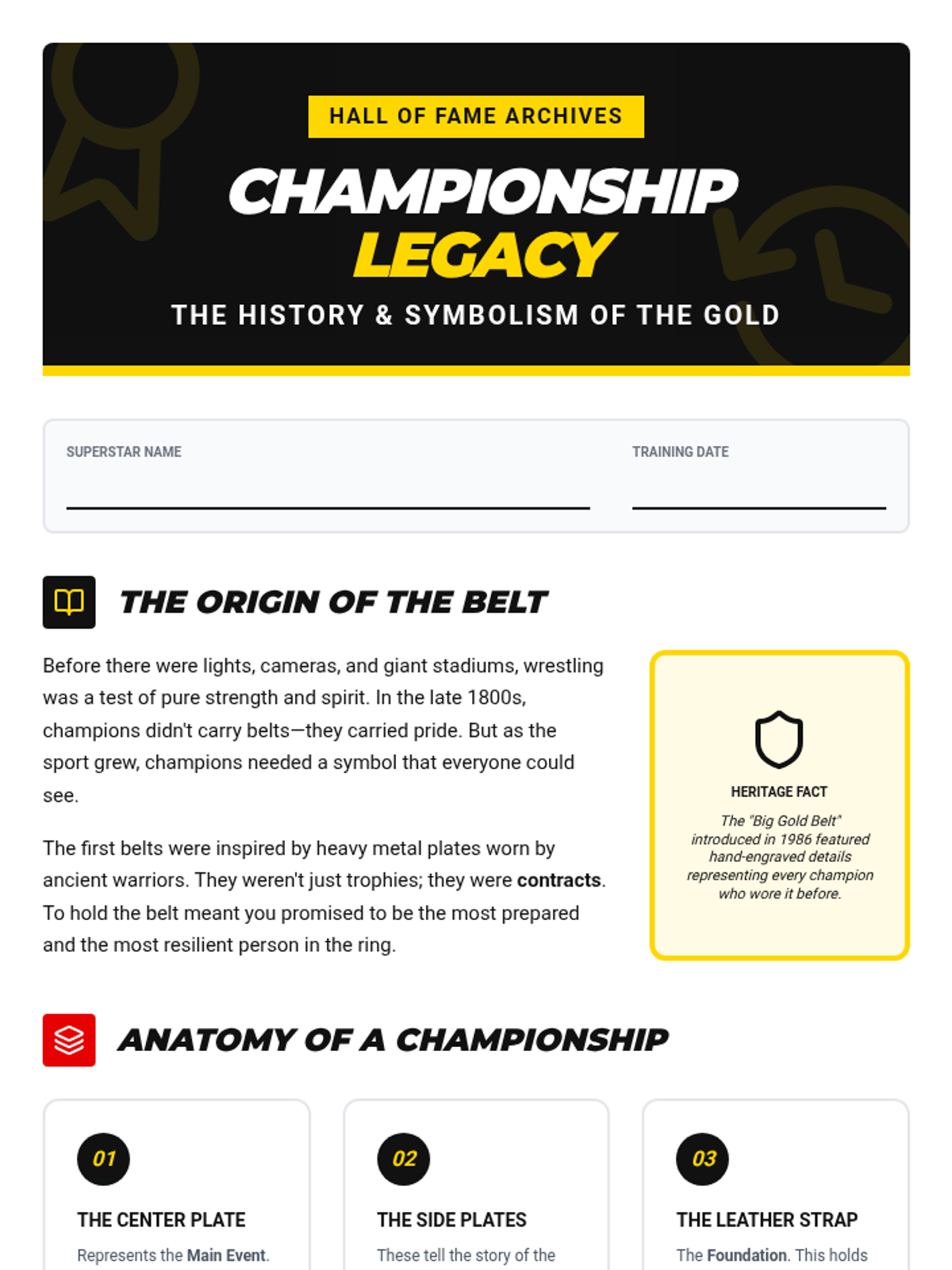
A student-facing reading and activity sheet exploring the history of wrestling championship belts, their symbolism, and how students can build their own academic legacy.
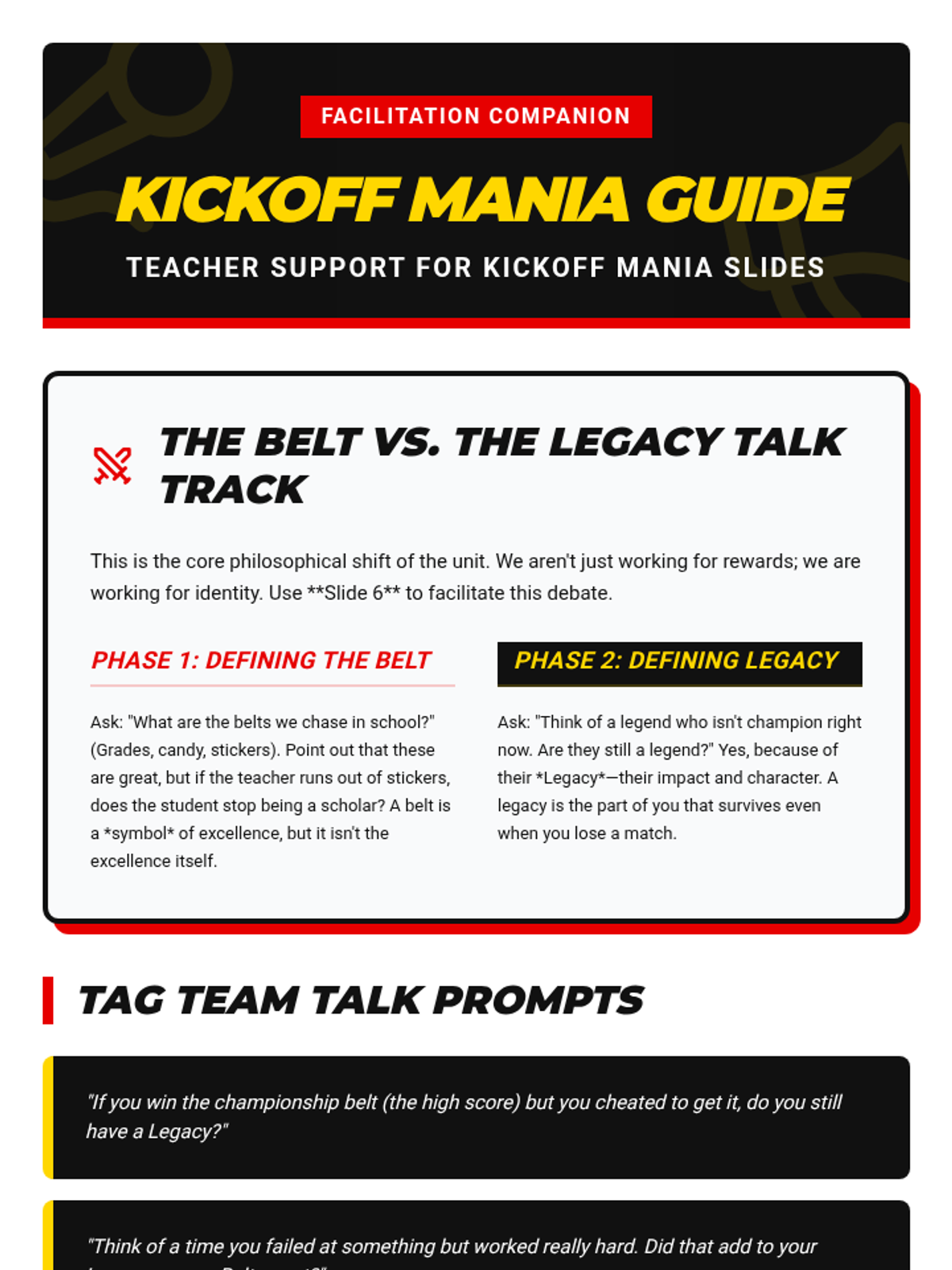
A detailed teacher facilitation companion for the Kickoff Mania slides, providing talk tracks for the 'Belt vs. Legacy' discussion, discussion prompts, and implementation steps for the Ubuntu mission.
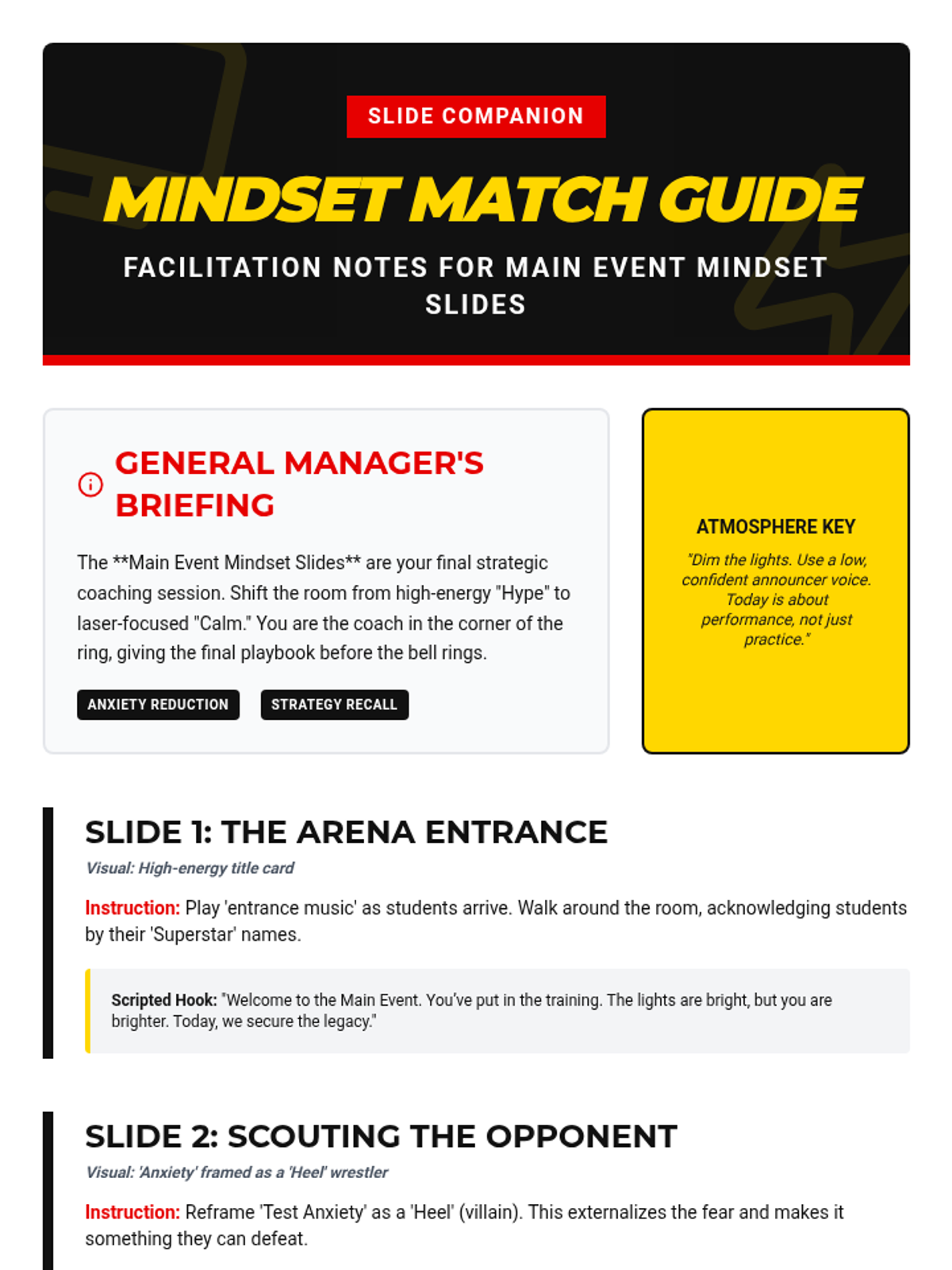
A teacher-facing companion guide for the 'Main Event Mindset' slides, providing slide-by-slide scripts, instructional instructions for managing test anxiety, and post-test decompression strategies.
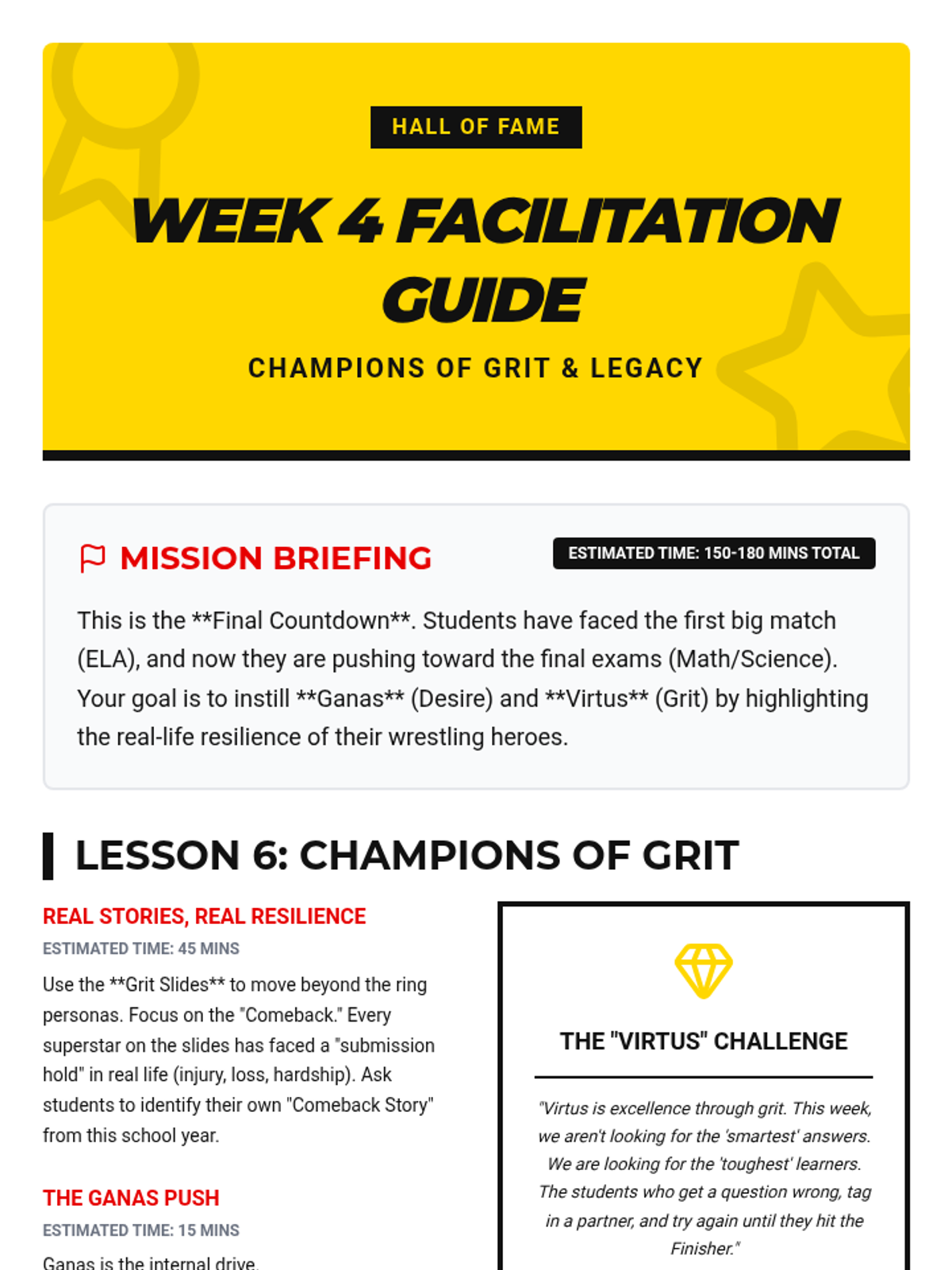
A detailed teacher facilitation guide for Week 4 of the 'Road to State Exam Mania' sequence, focusing on Ganas (drive) and Virtus (grit) for the final exam push and the 'Mania Gala' unit wrap-up.
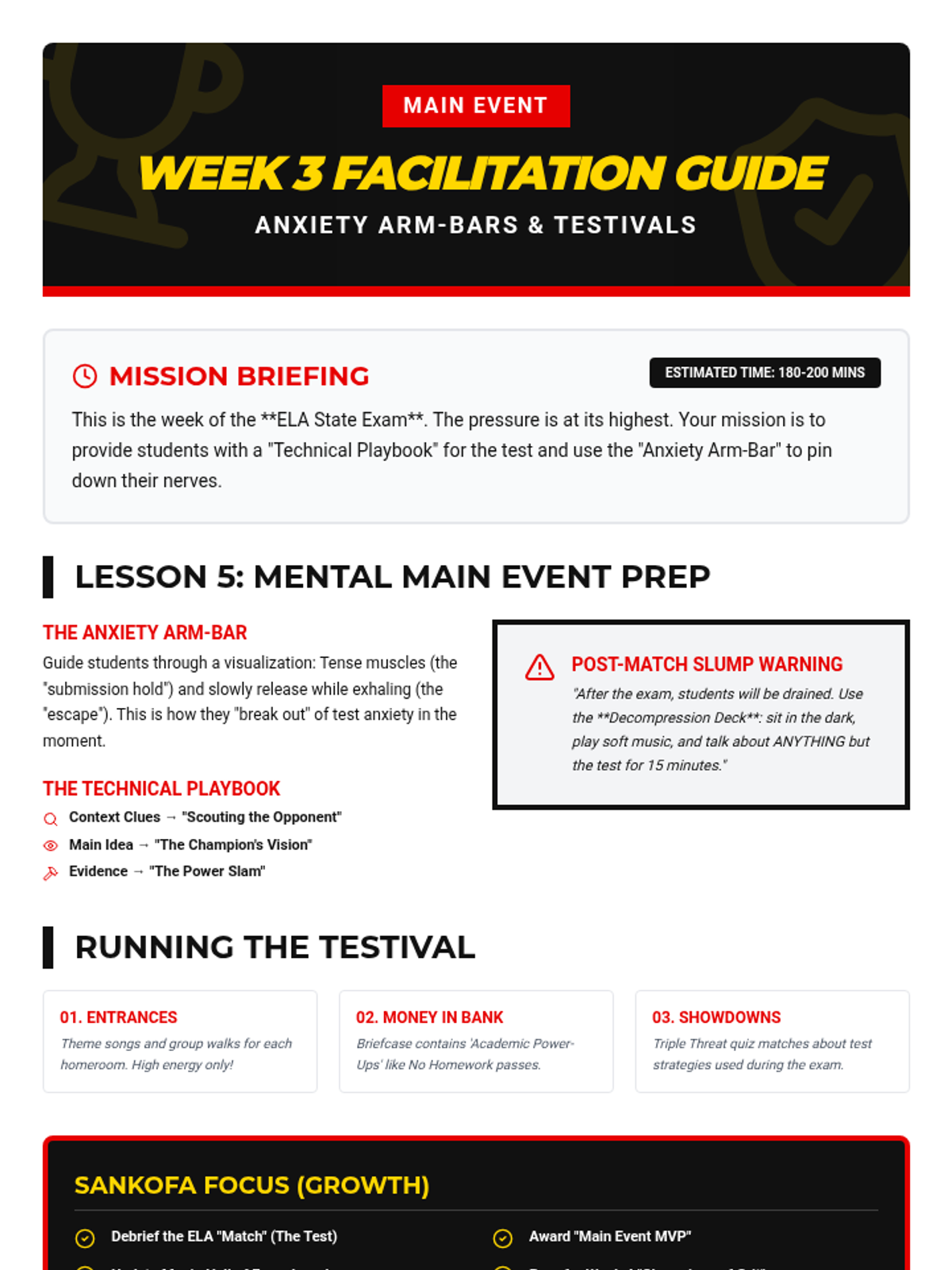
A detailed teacher facilitation guide for Week 3 of the 'Road to State Exam Mania' sequence, focusing on ELA state exam preparation and the 'Testival' pep rally.
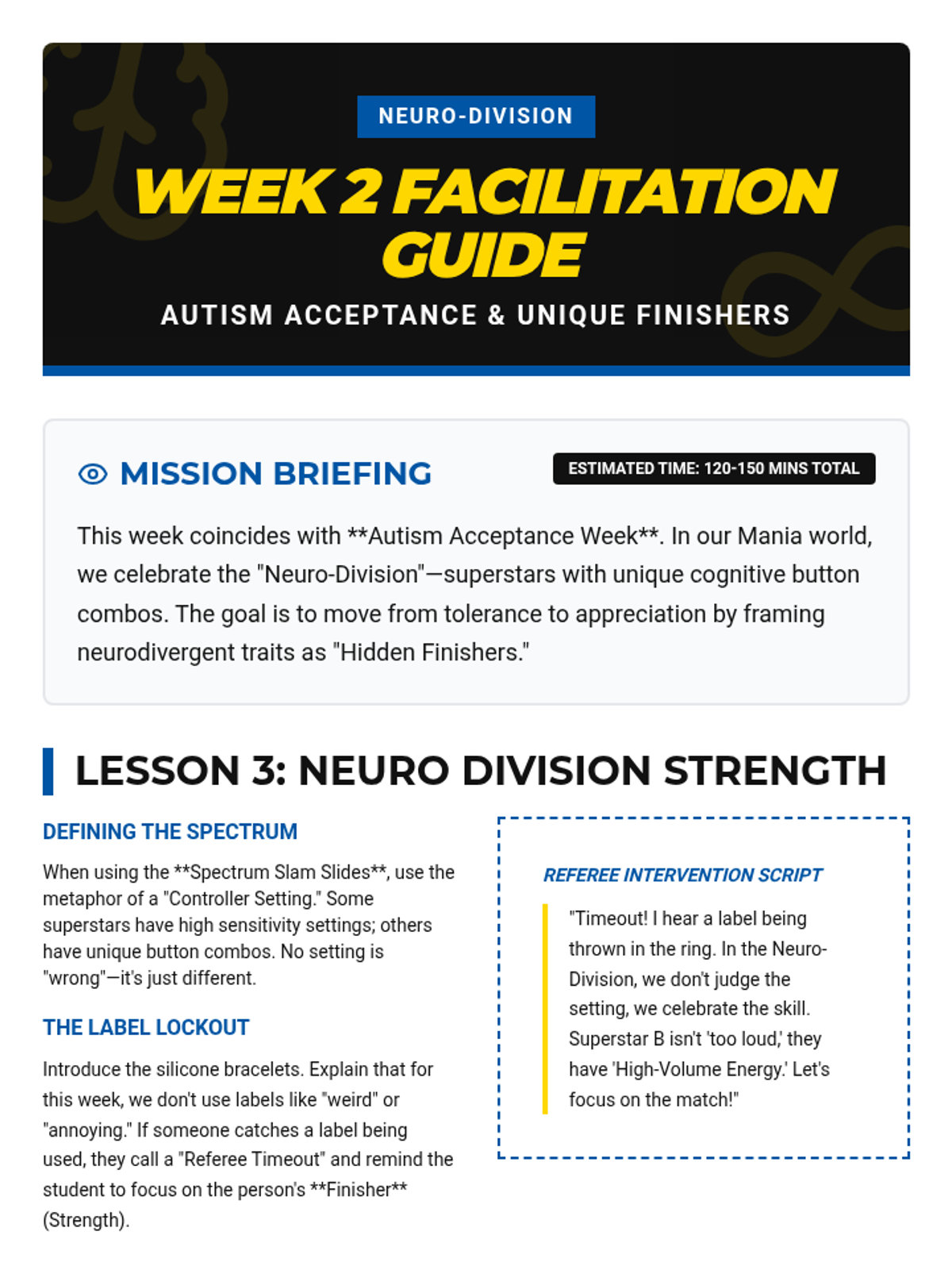
A detailed teacher facilitation guide for Week 2 of the 'Road to State Exam Mania' sequence, focusing on Autism Acceptance Week and celebrating neurodiversity.
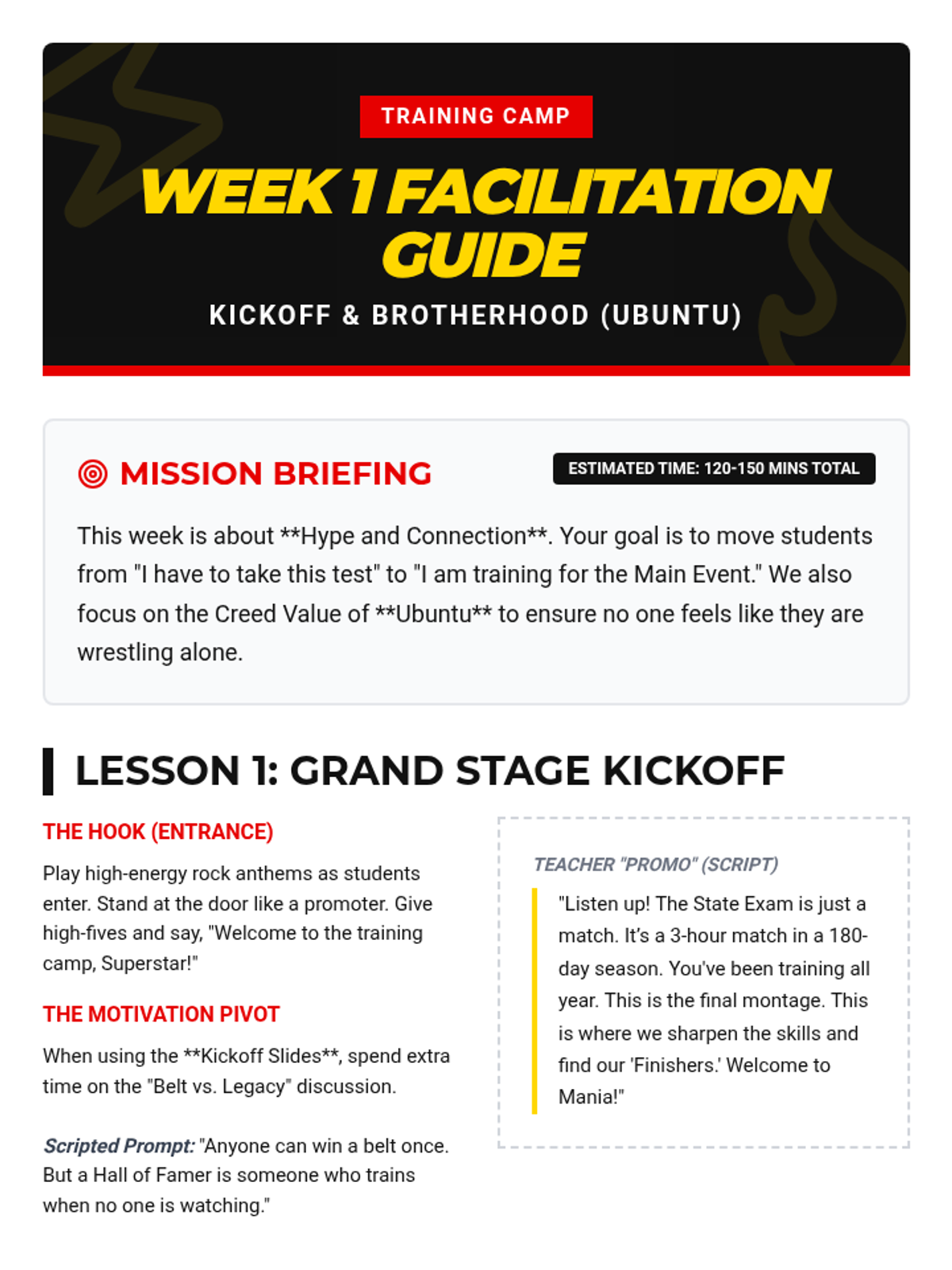
A detailed teacher facilitation guide for Week 1 of the 'Road to State Exam Mania' sequence, focusing on kickoff motivation and the Creed Value of Ubuntu.
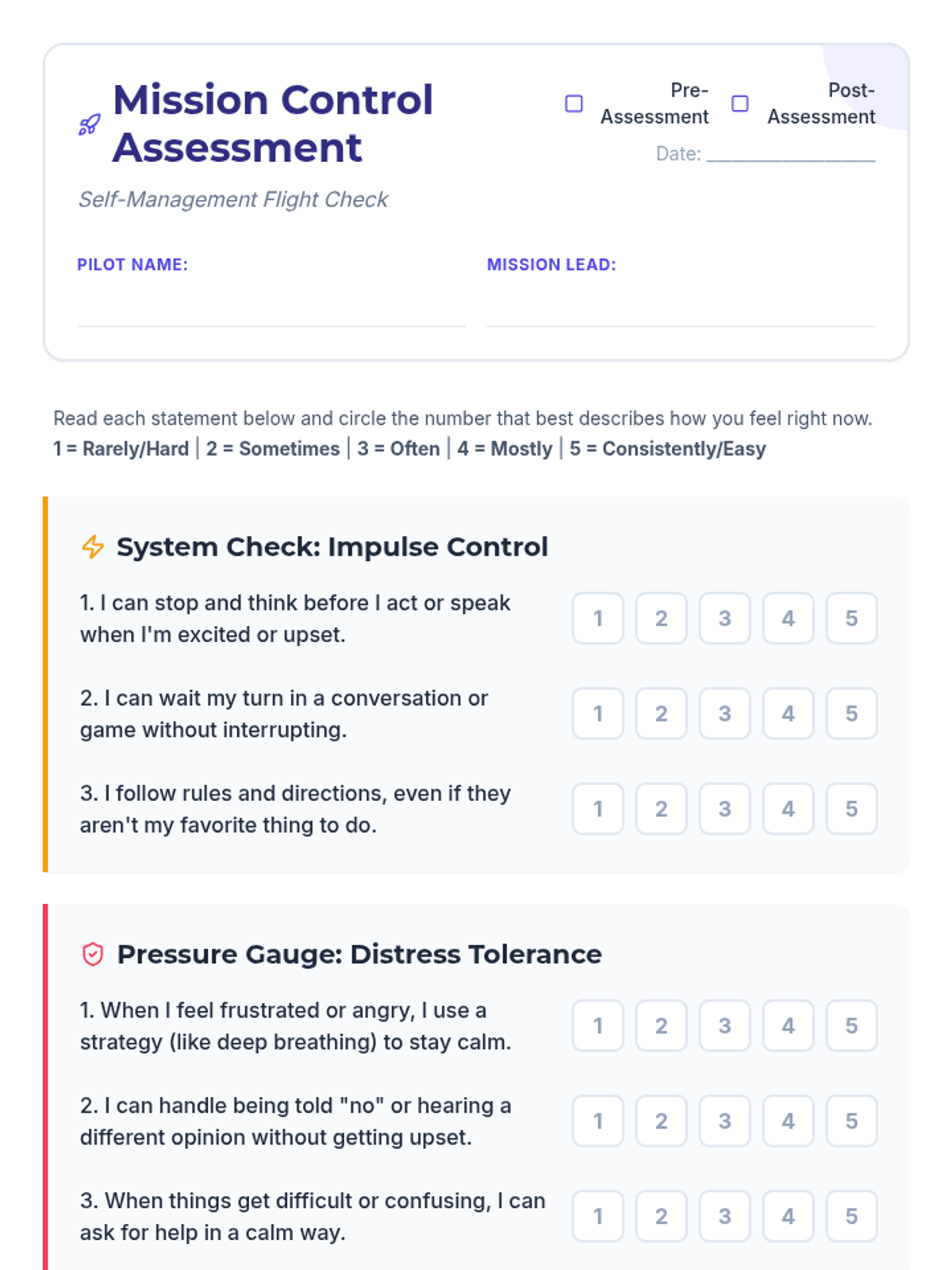
An introductory presentation deck to launch the Mission Control self-management unit. It frames the assessment process as a "flight check" to engage students and reduce anxiety around self-evaluation.
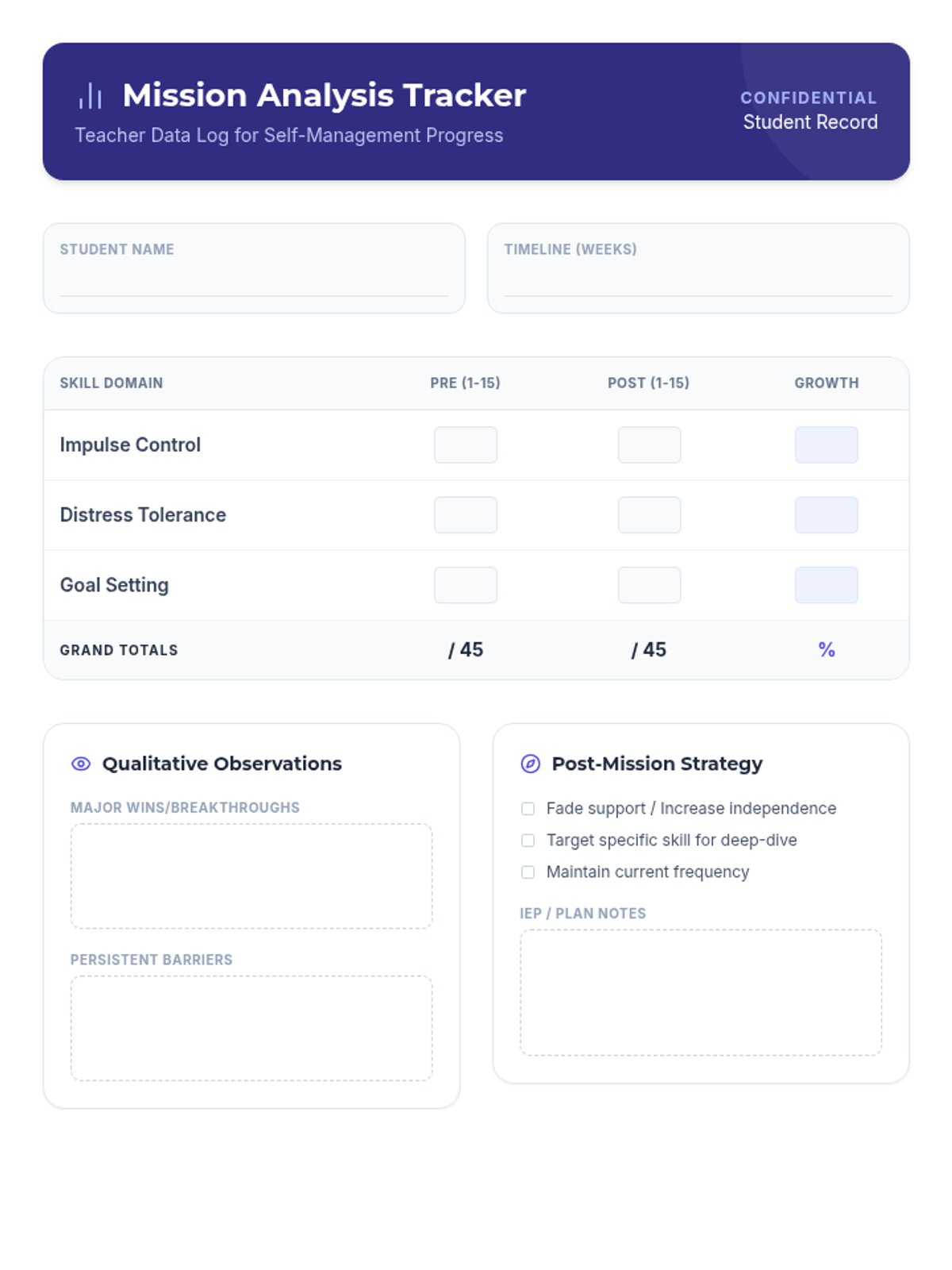
A teacher-facing data tracker to record and compare pre- and post-test results for self-management skills. Includes sections for quantitative scoring, qualitative observations, and strategy planning.
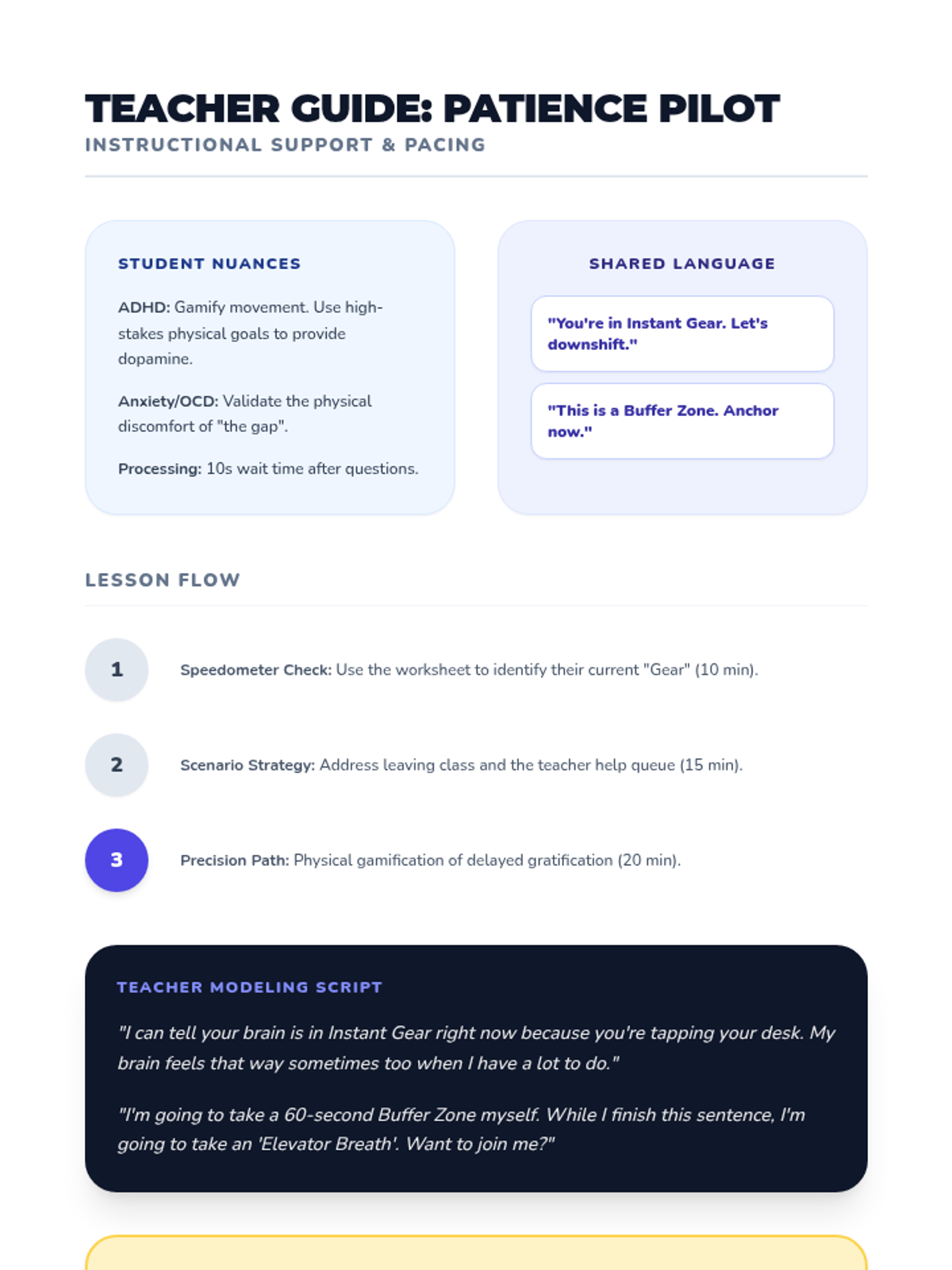
A teacher-facing guide that provides context on how to implement the Patience Pilot materials. It includes pedagogical tips for working with ADHD/OCD/Anxiety, a recommended lesson flow, and scripts for modeling patience.
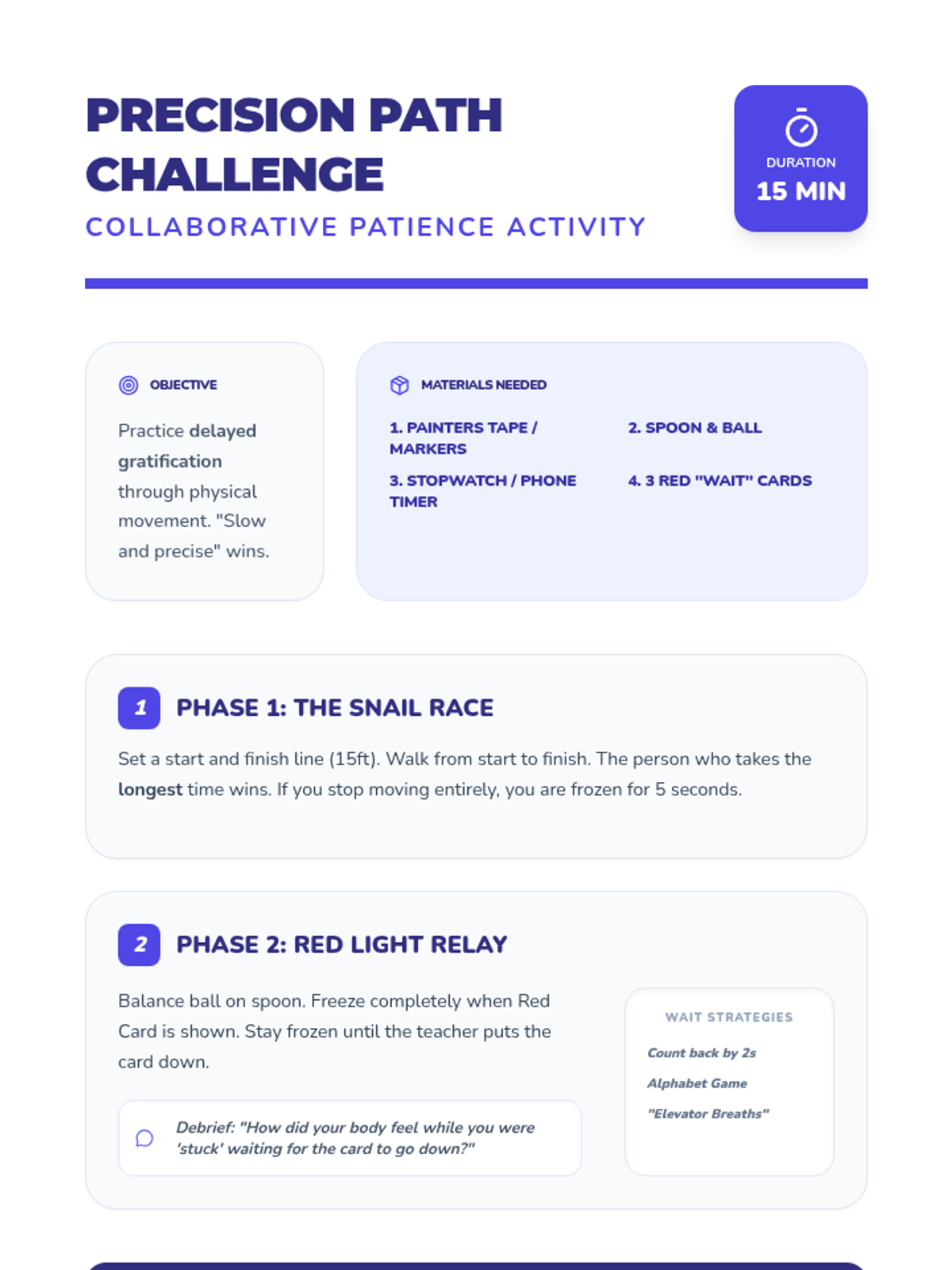
A collaborative, movement-based activity for a teacher and student. It gamifies patience through 'snail racing' and interrupted balancing tasks, specifically designed to simulate the physical tension of waiting.
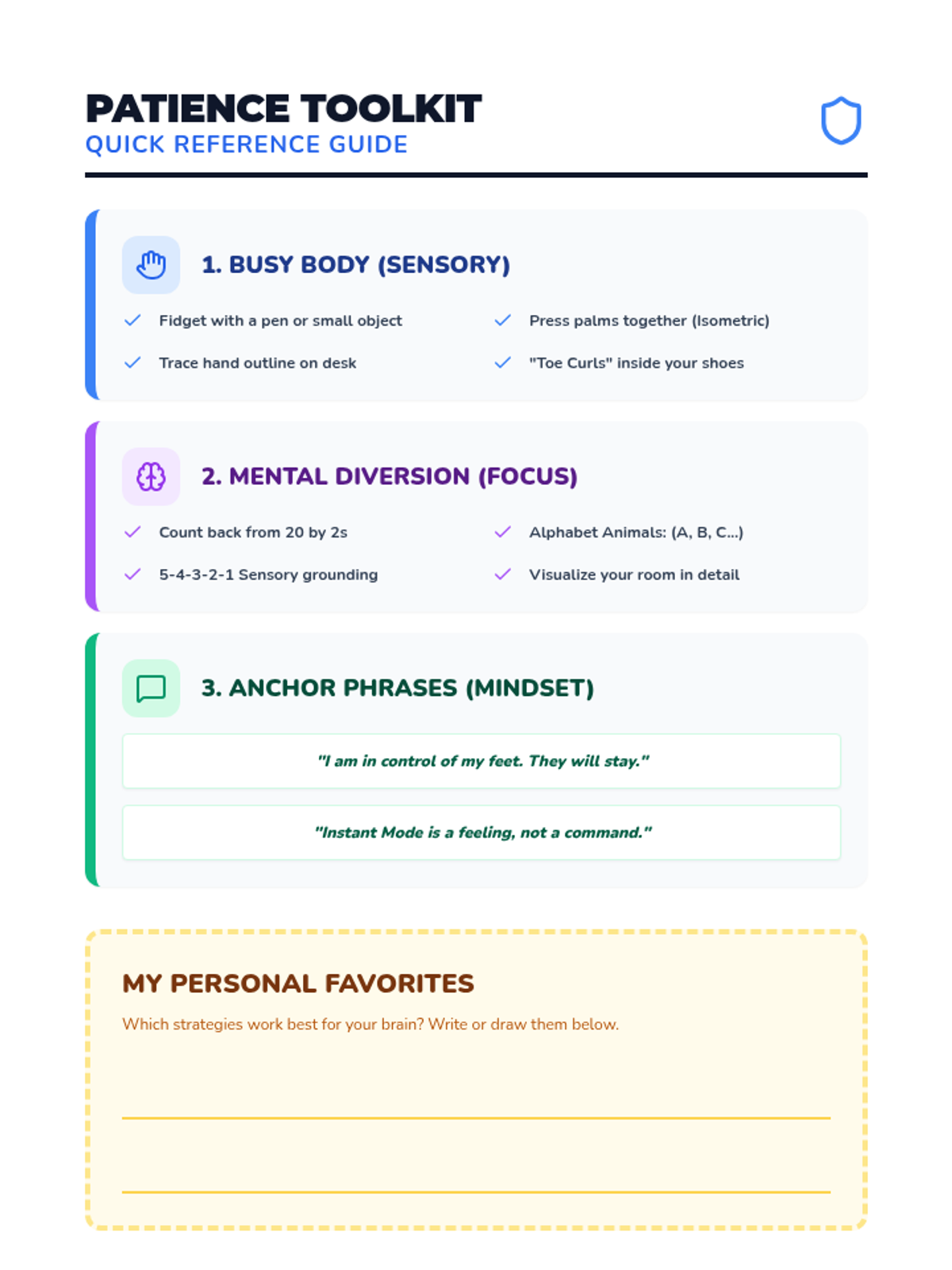
A reference sheet for the student to keep in their binder. It provides a menu of physical, mental, and verbal coping strategies to use during 'waiting gaps' to manage ADHD and anxiety-driven impulsivity.
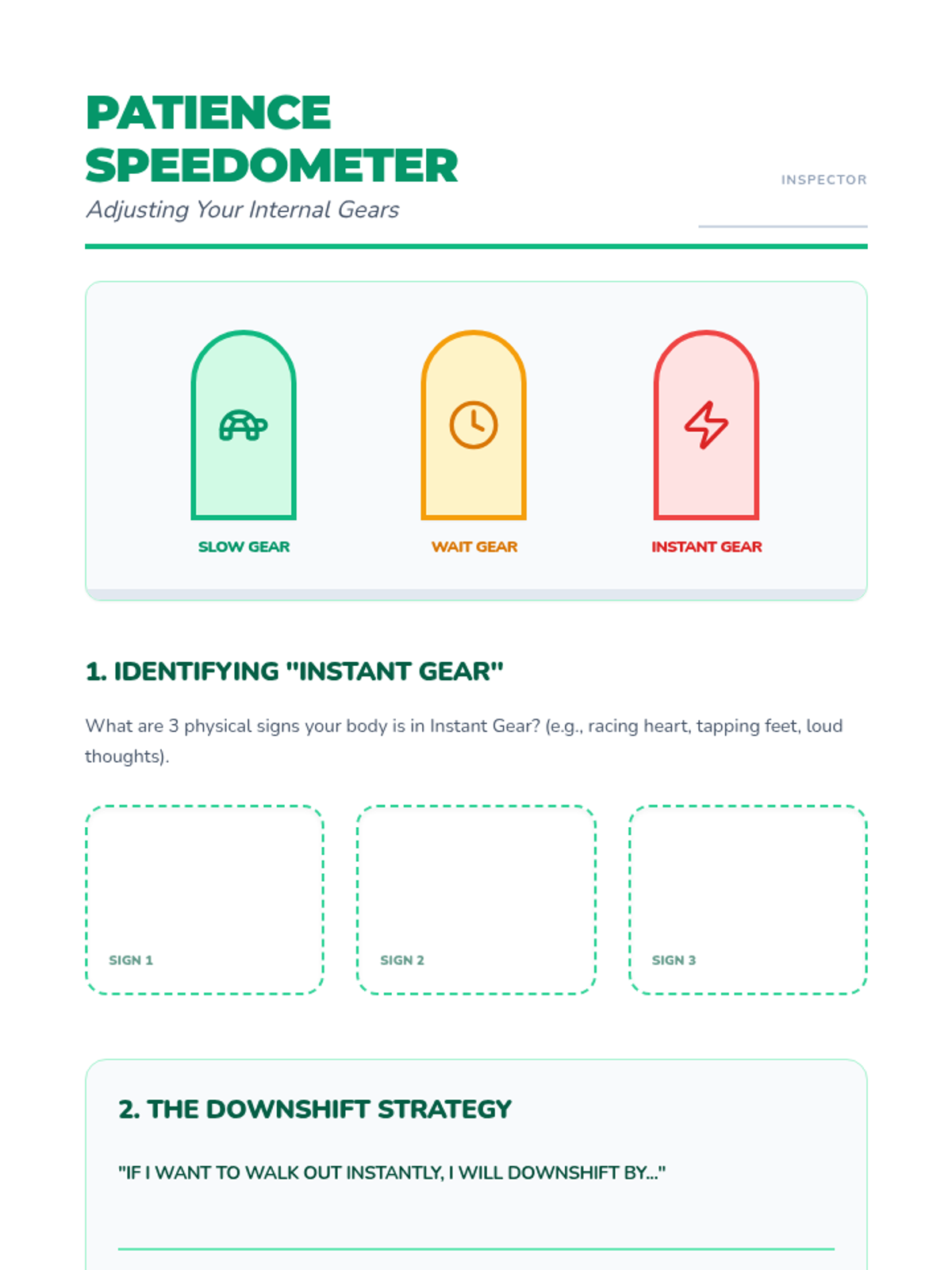
A visual self-regulation worksheet that helps the student identify their 'internal gears' (Slow, Wait, Instant). It focuses on identifying physical triggers of impulsivity and practicing 'downshifting' to a more patient state.
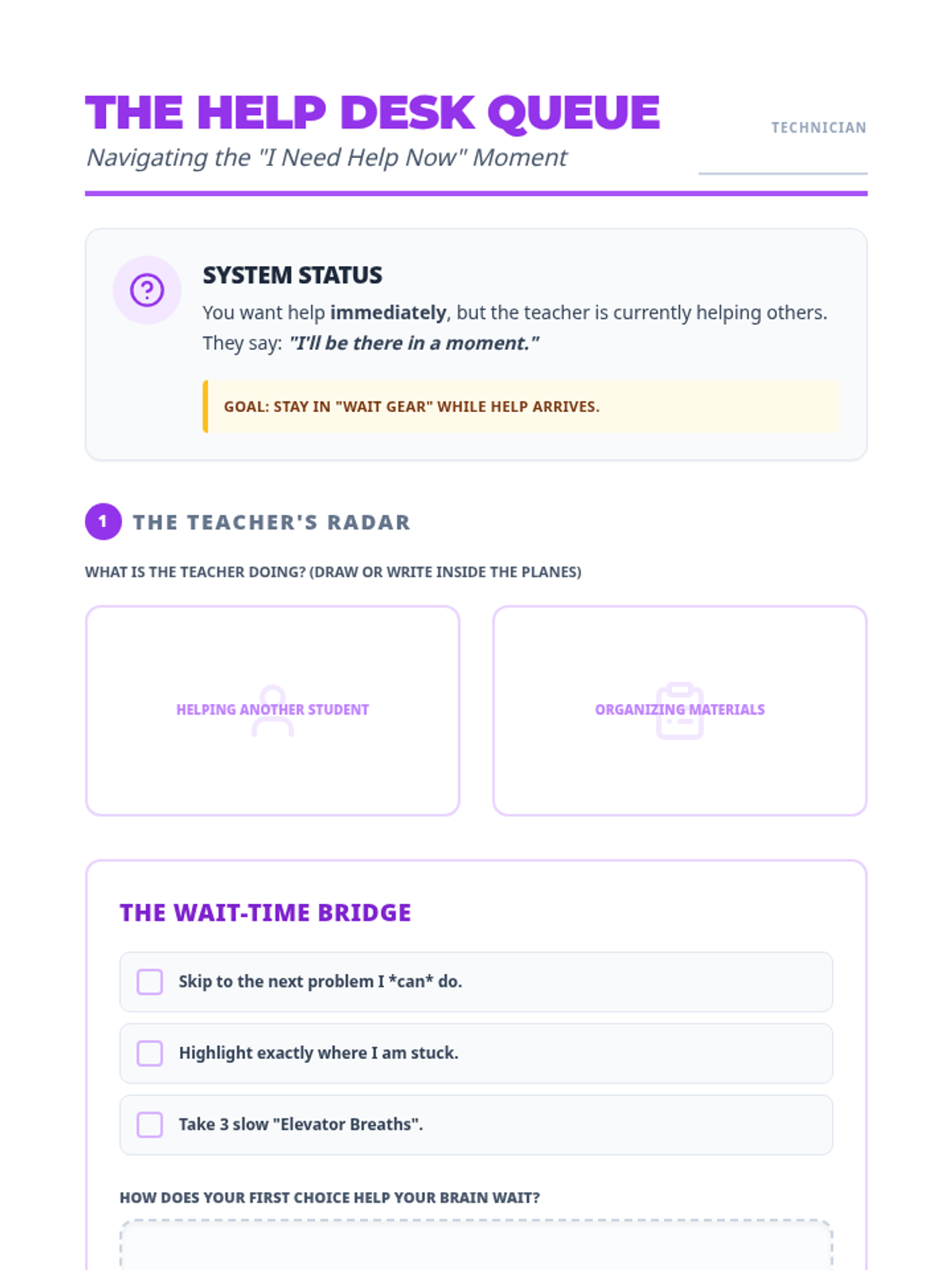
A worksheet designed to address the specific scenario of needing immediate help after previously refusing it. It uses an air traffic controller metaphor to help the student understand the teacher's perspective and provides actionable waiting strategies.
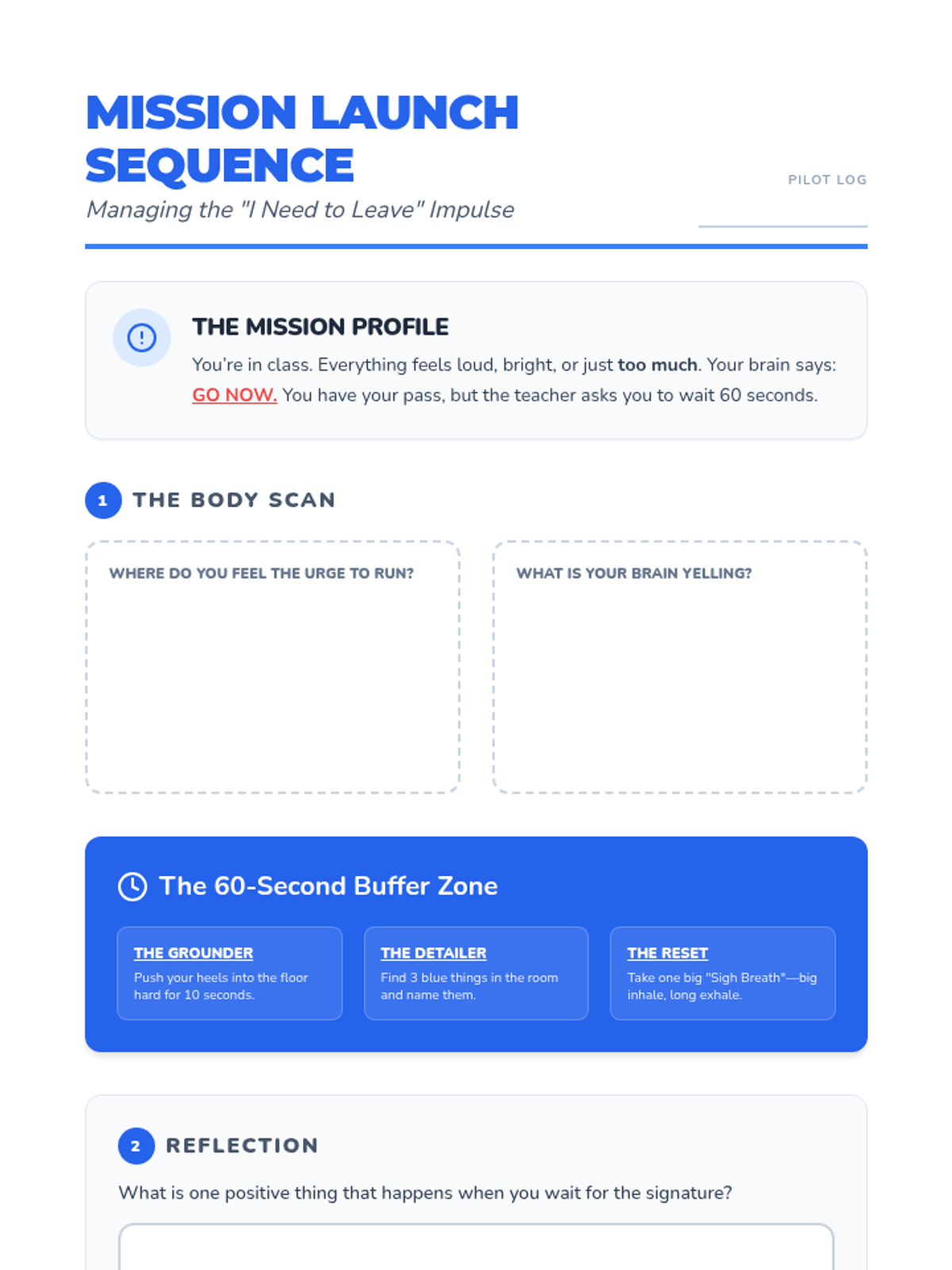
A worksheet focused on the impulsivity of leaving the classroom when overstimulated. It teaches a '60-second buffer' strategy and helps the student identify physical symptoms of anxiety.
A comprehensive self-reflection assessment for students to evaluate their impulse control, distress tolerance, and goal-setting skills. Designed to be used as both a pre- and post-test to measure growth.
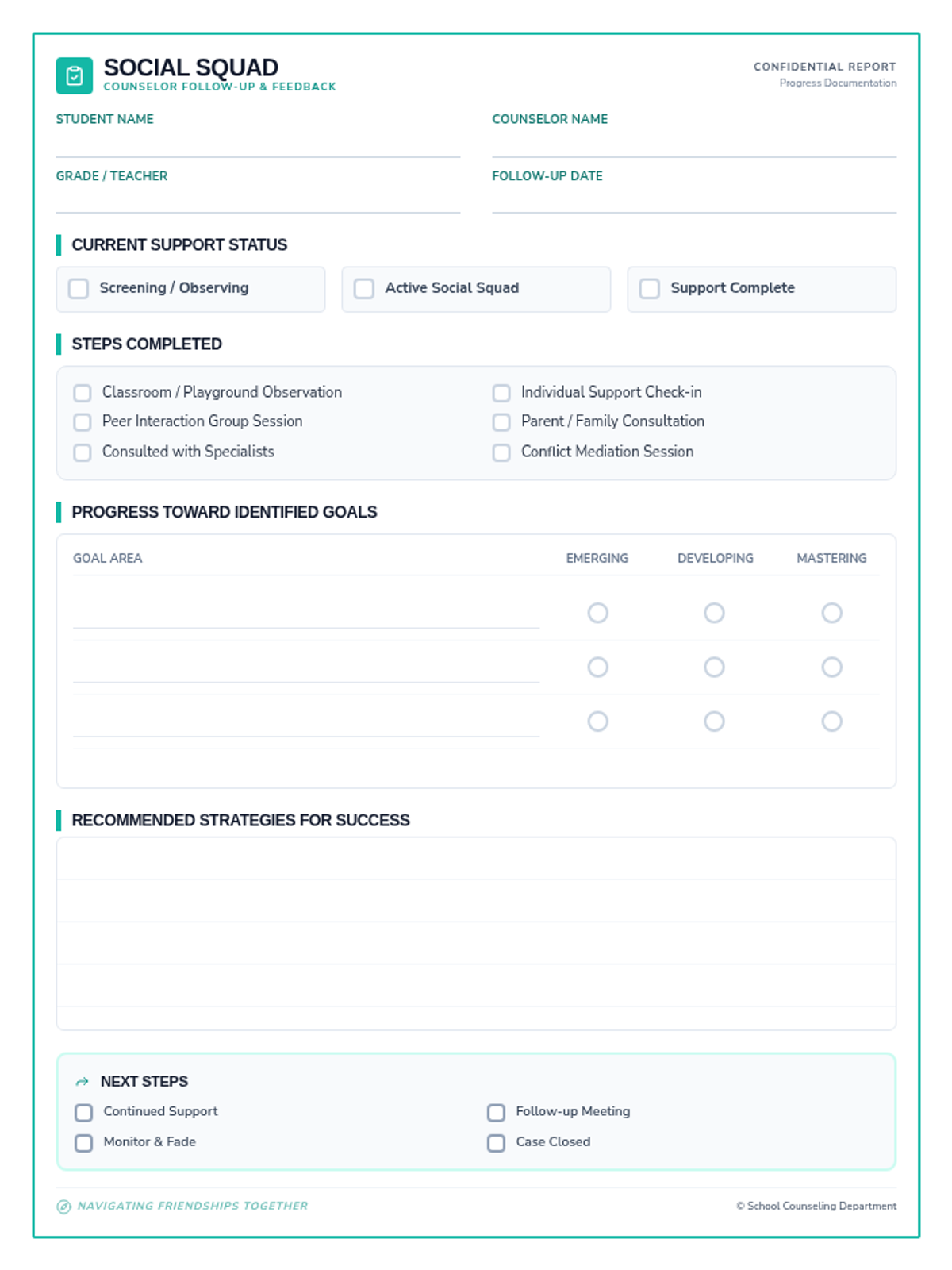
A revised school counselor follow-up and feedback form. It features a new introductory referral sentence, detailed intervention logs with dates and goals, a dedicated 'At this time' status section, and a professional closing message inviting continued collaboration. Now includes 'Outside Referral' in next steps.
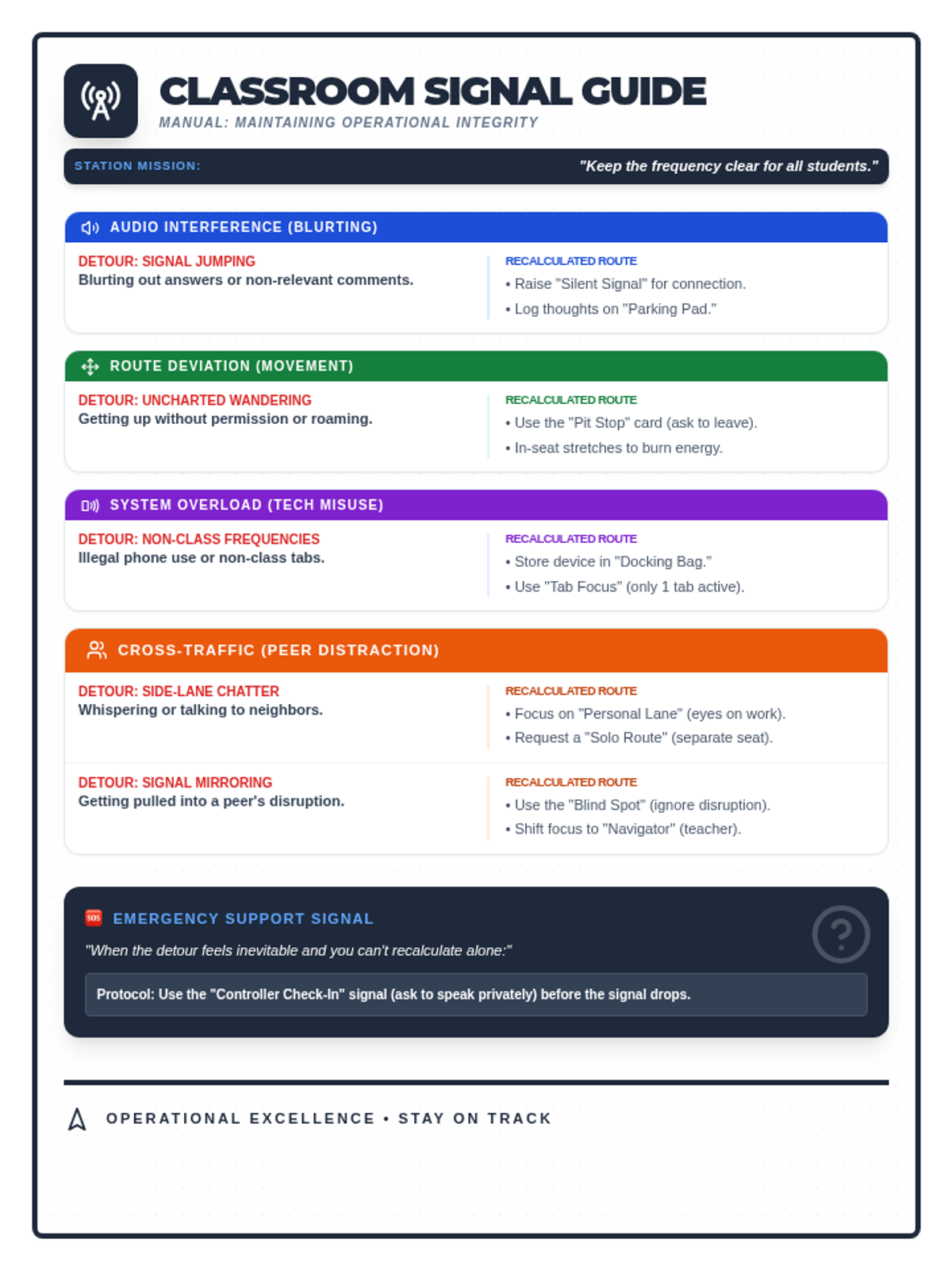
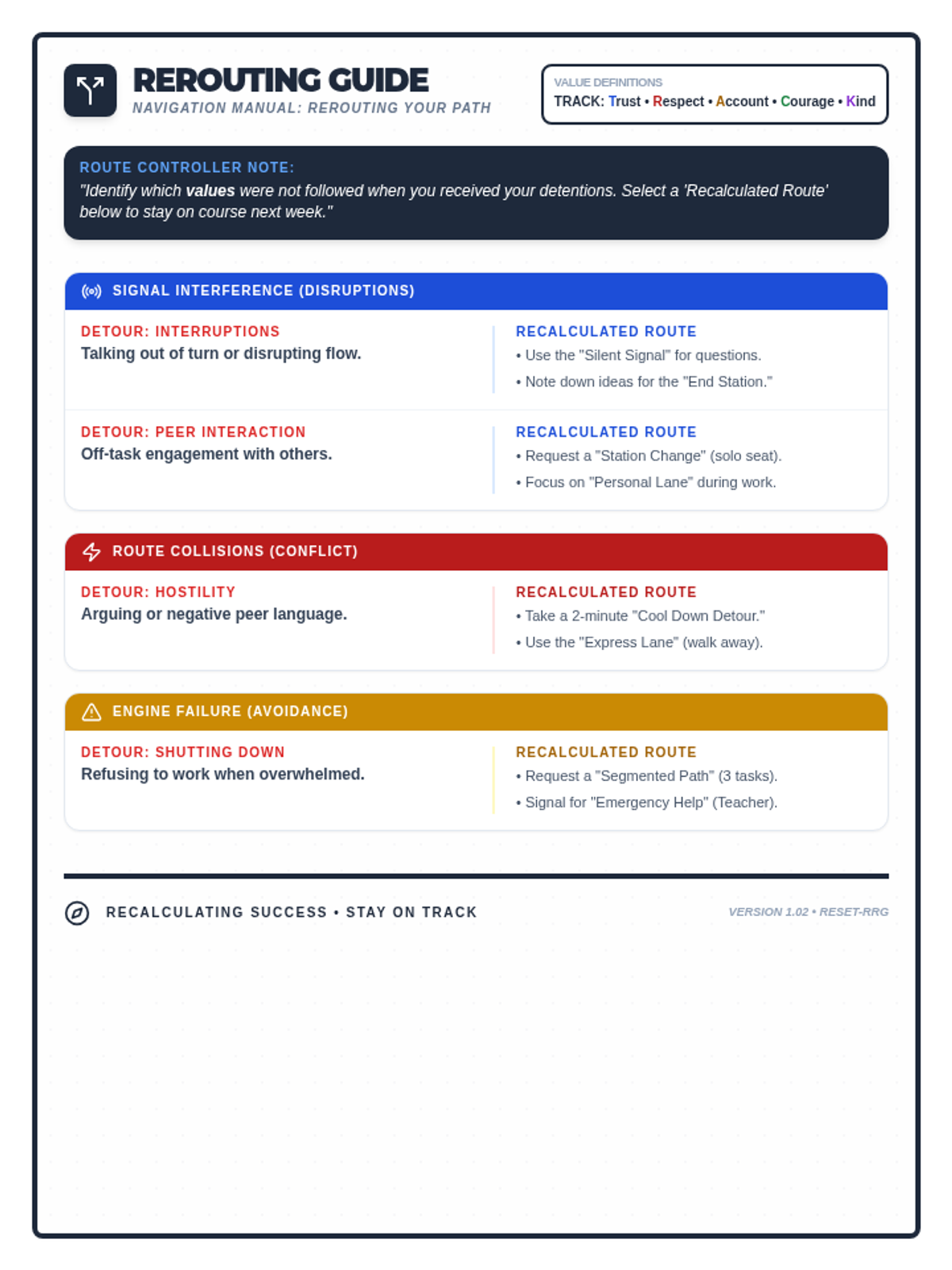
A specialized two-page rerouting guide for typical middle school classroom disruptions, providing students with concrete replacement behaviors for issues like blurting, wandering, tech misuse, and off-task talking. Includes a facilitator guide for teachers.
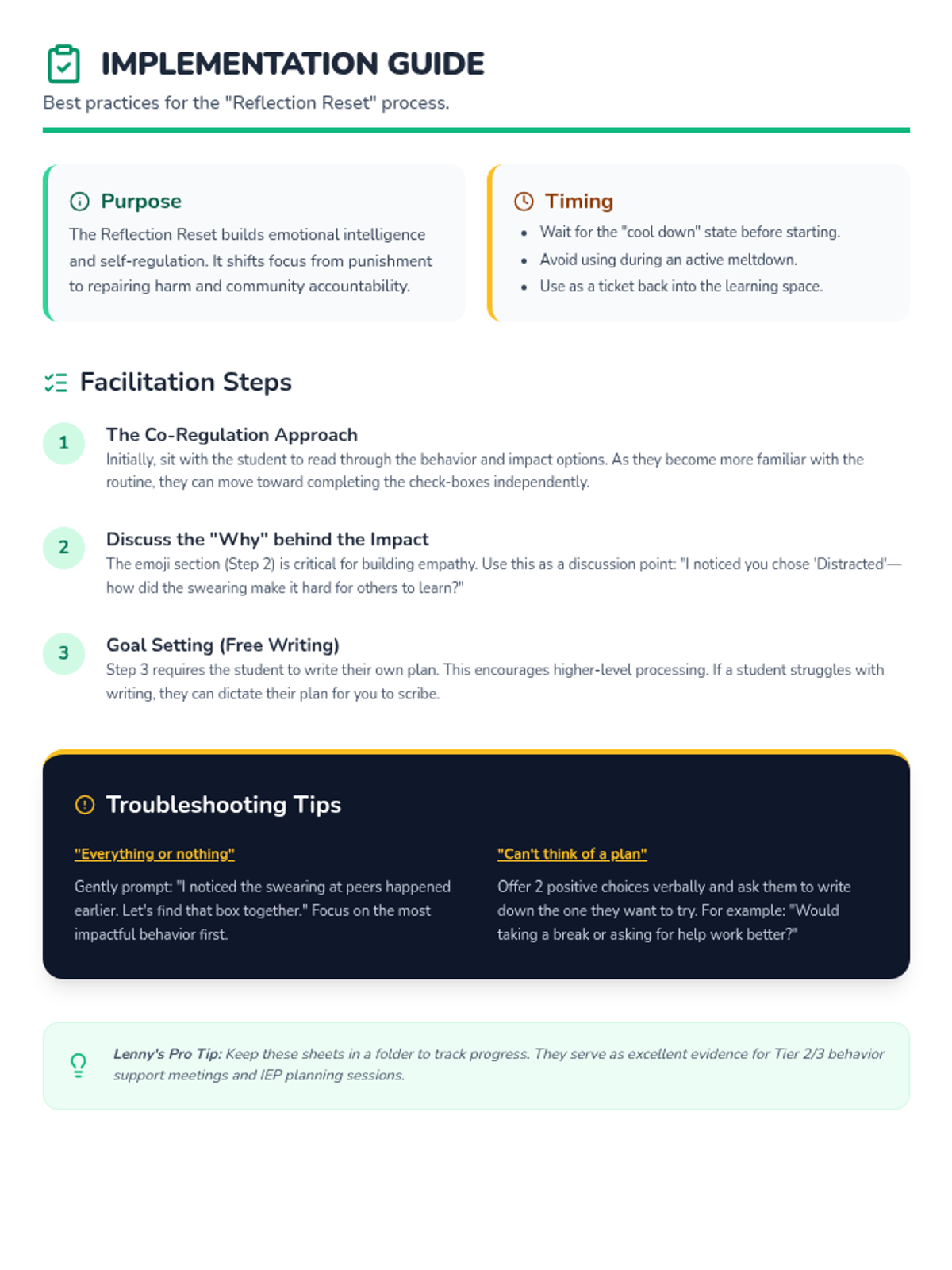
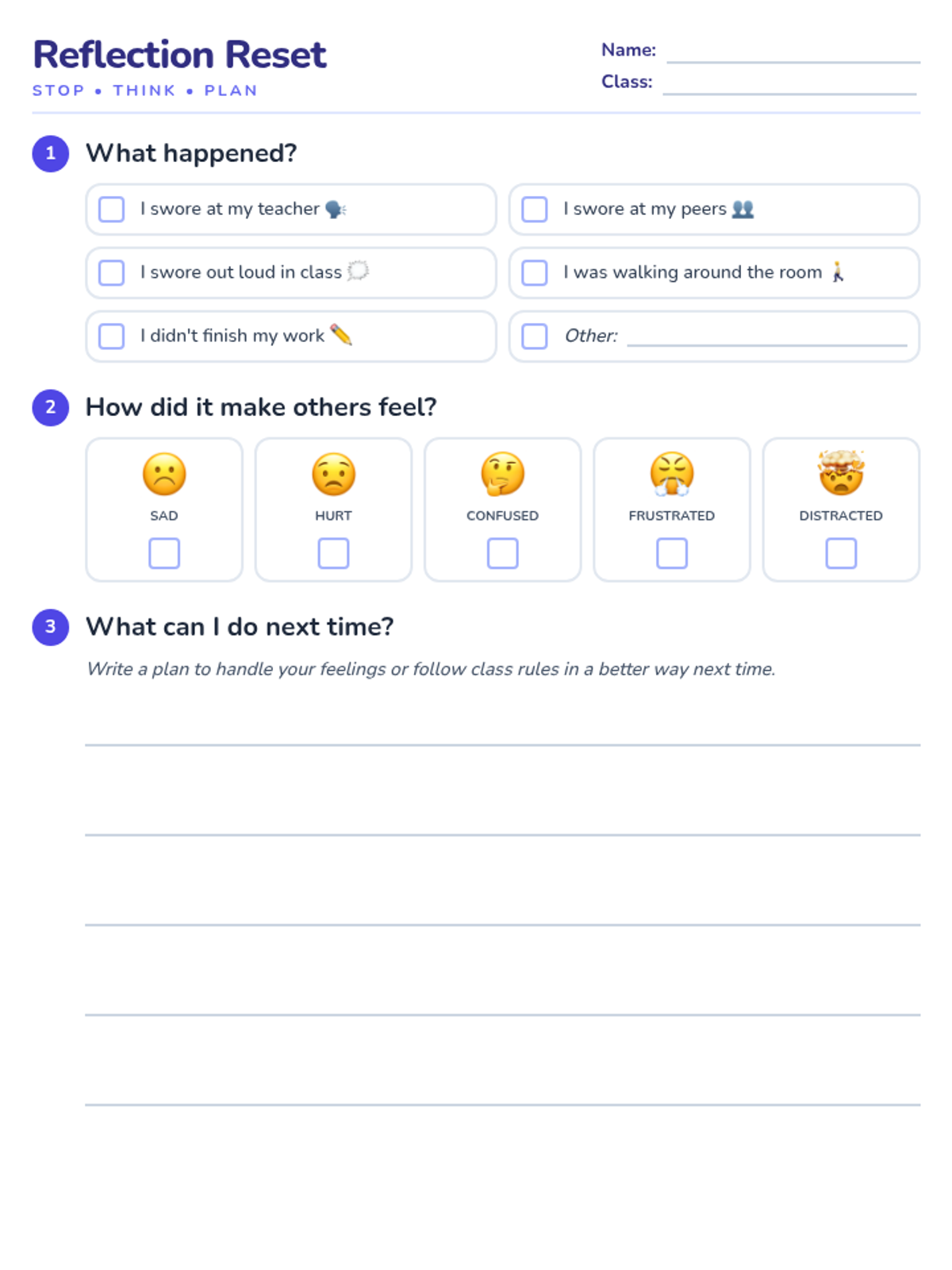
A teacher implementation guide for using the Reflection Reset sheet, revised to focus on the free-writing goal section and removing references to student signatures. Strictly 1-page design.
A graphic-organizer style behavior reflection sheet for students. Featuring sections for identifying behavior and impact with visuals, and a large writing area for the student to plan future choices. Removal of multiple choice for goals and student signature as requested. Strictly 1-page design.
A two-page resource for students and teachers providing positive replacement behaviors for common middle school behavioral challenges, framed within the navigation theme as 'recalculated routes.' Includes a teacher implementation guide.
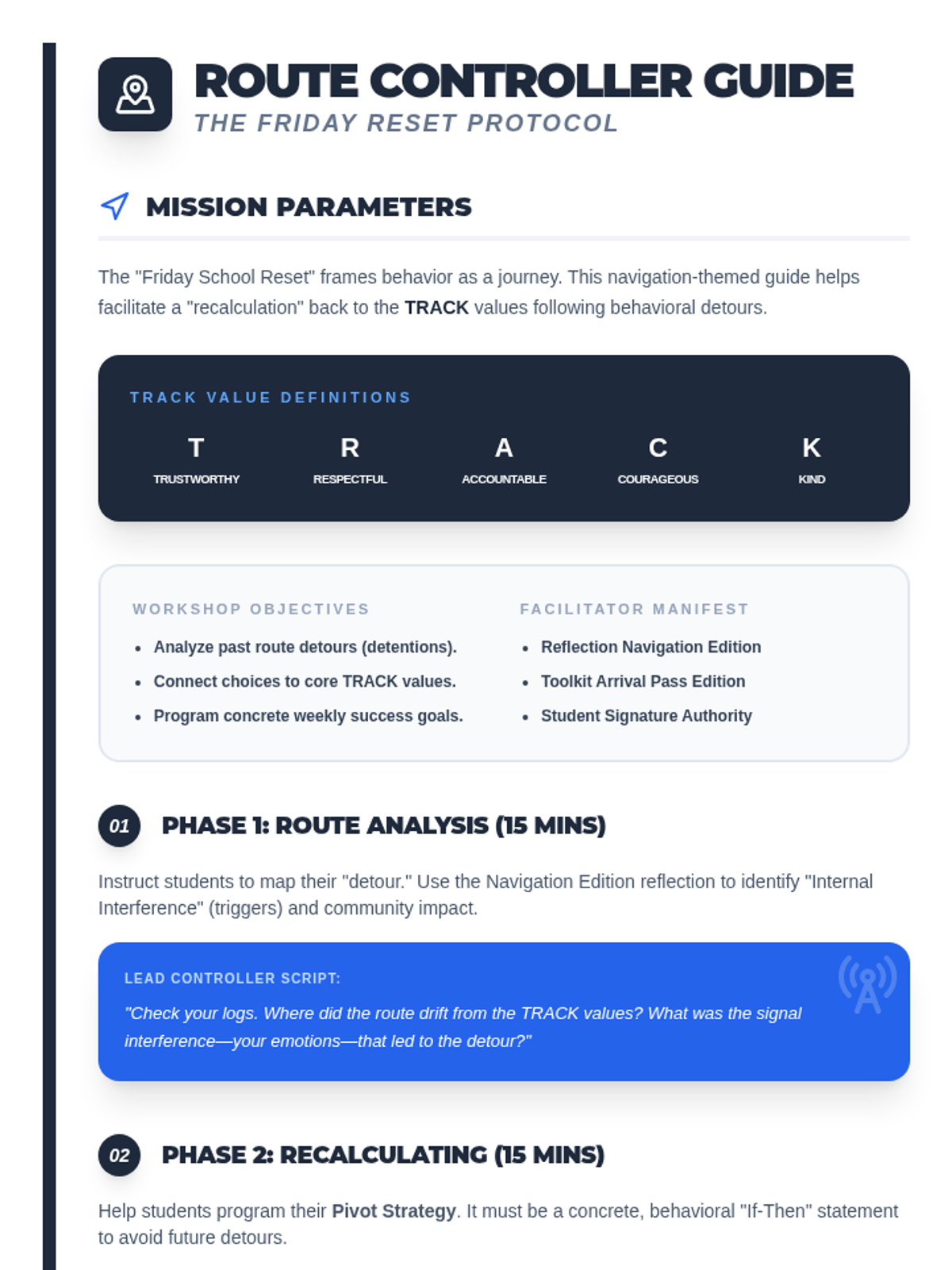
A professional facilitator's guide using a transit/navigation theme to provide instructional objectives and restorative script prompts for leading the Friday Reset workshop.
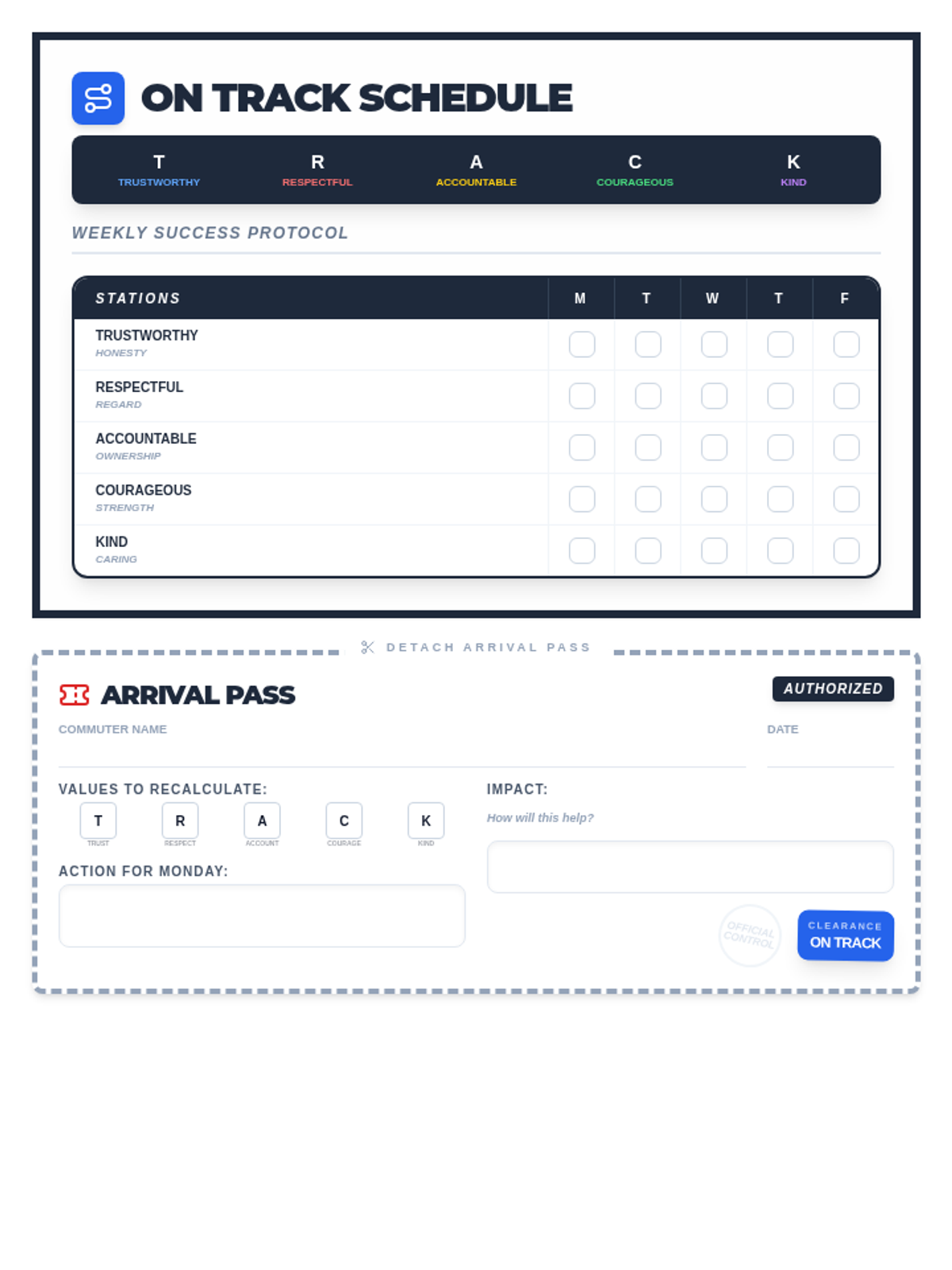
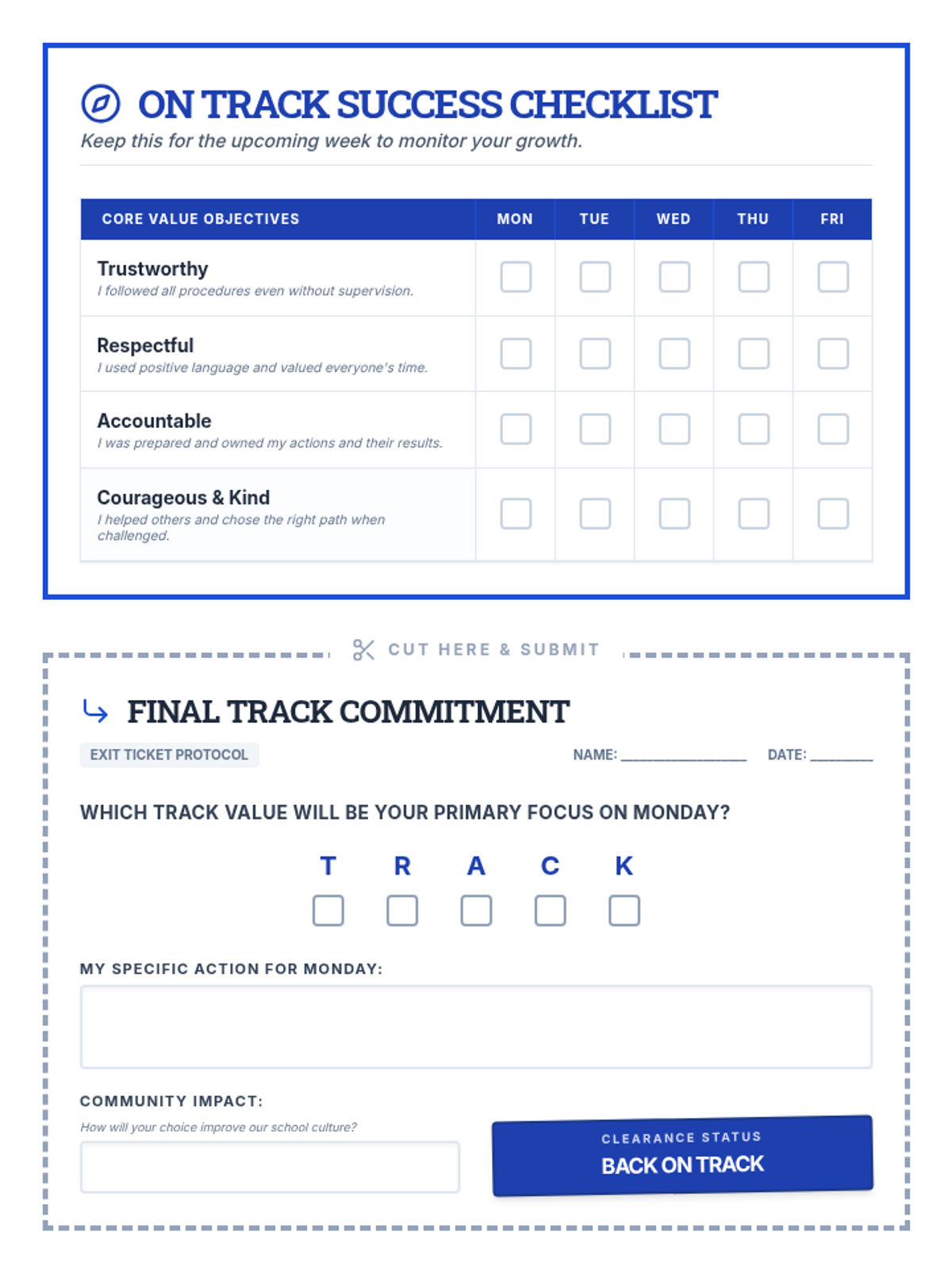
A student-facing toolkit using a transit/navigation theme, containing a weekly TRACK success checklist and a detachable arrival pass to formalize commitments before leaving detention.
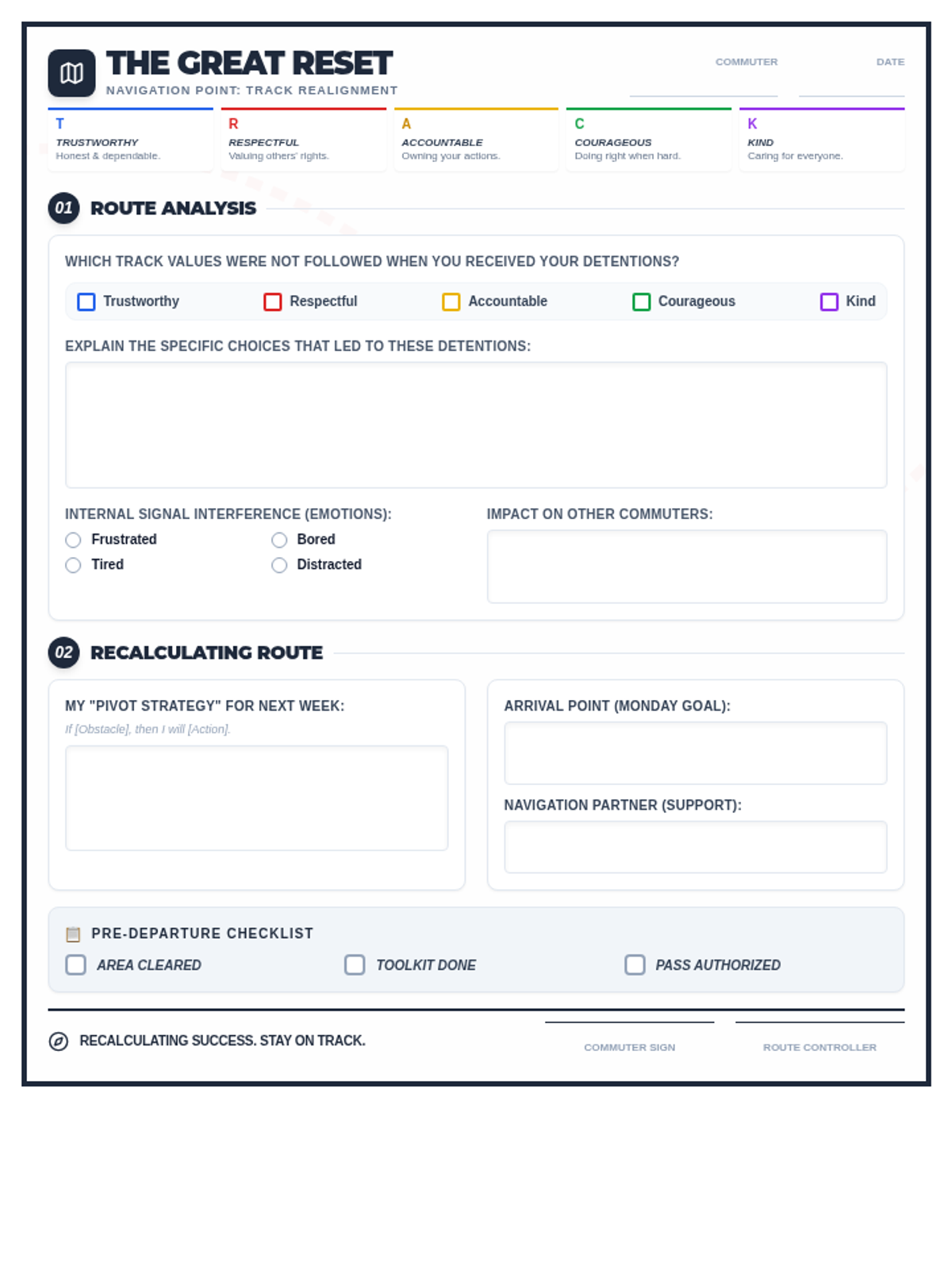
A one-page behavioral reflection sheet using a modern transit/navigation theme to help students analyze past detours, identify internal interference, and recalculate their route back to TRACK values.
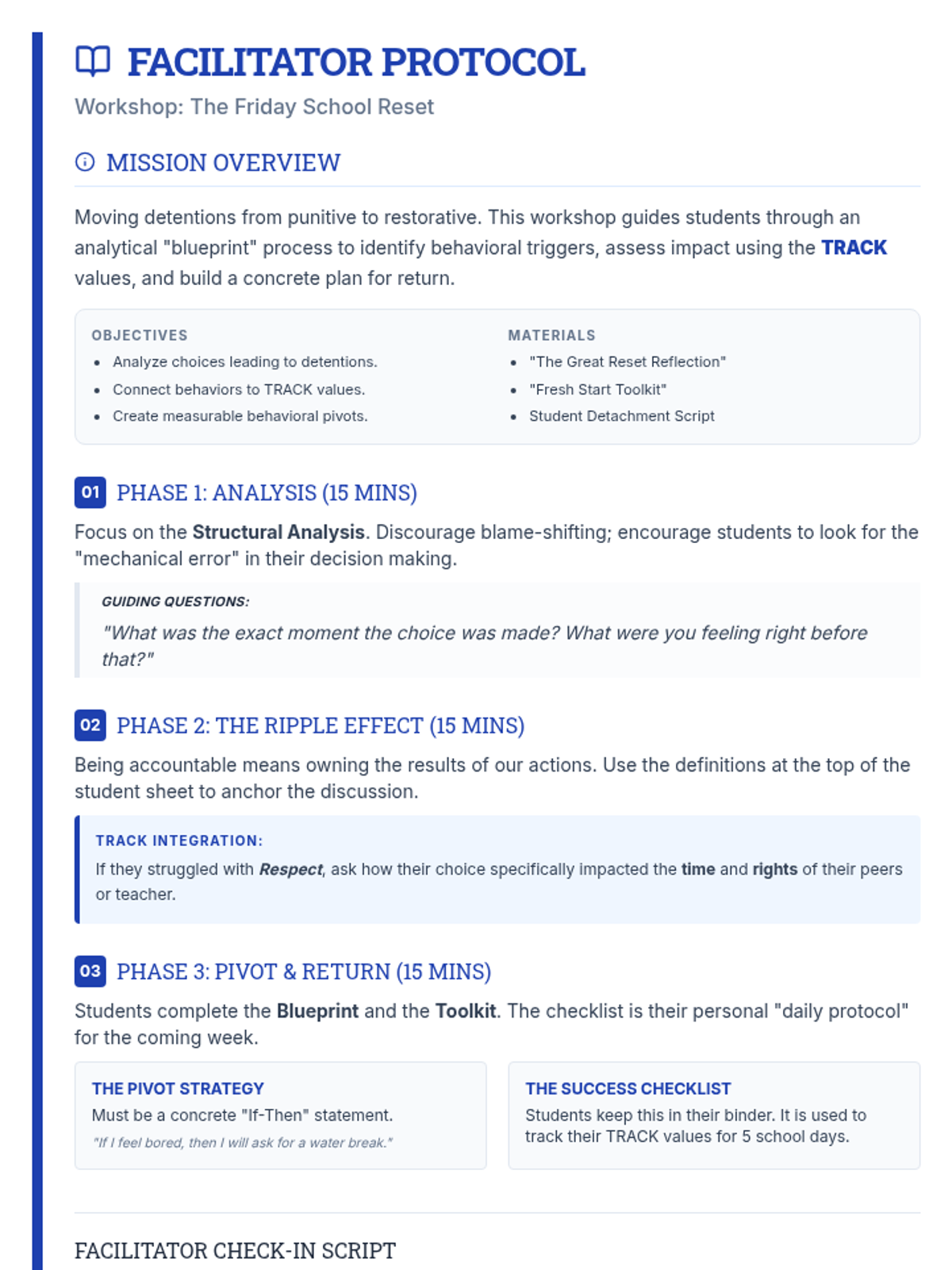
A professional facilitator's guide providing instructional objectives, phase-by-phase workshop timing, guiding questions, and restorative script prompts for leading the Friday School Reset.
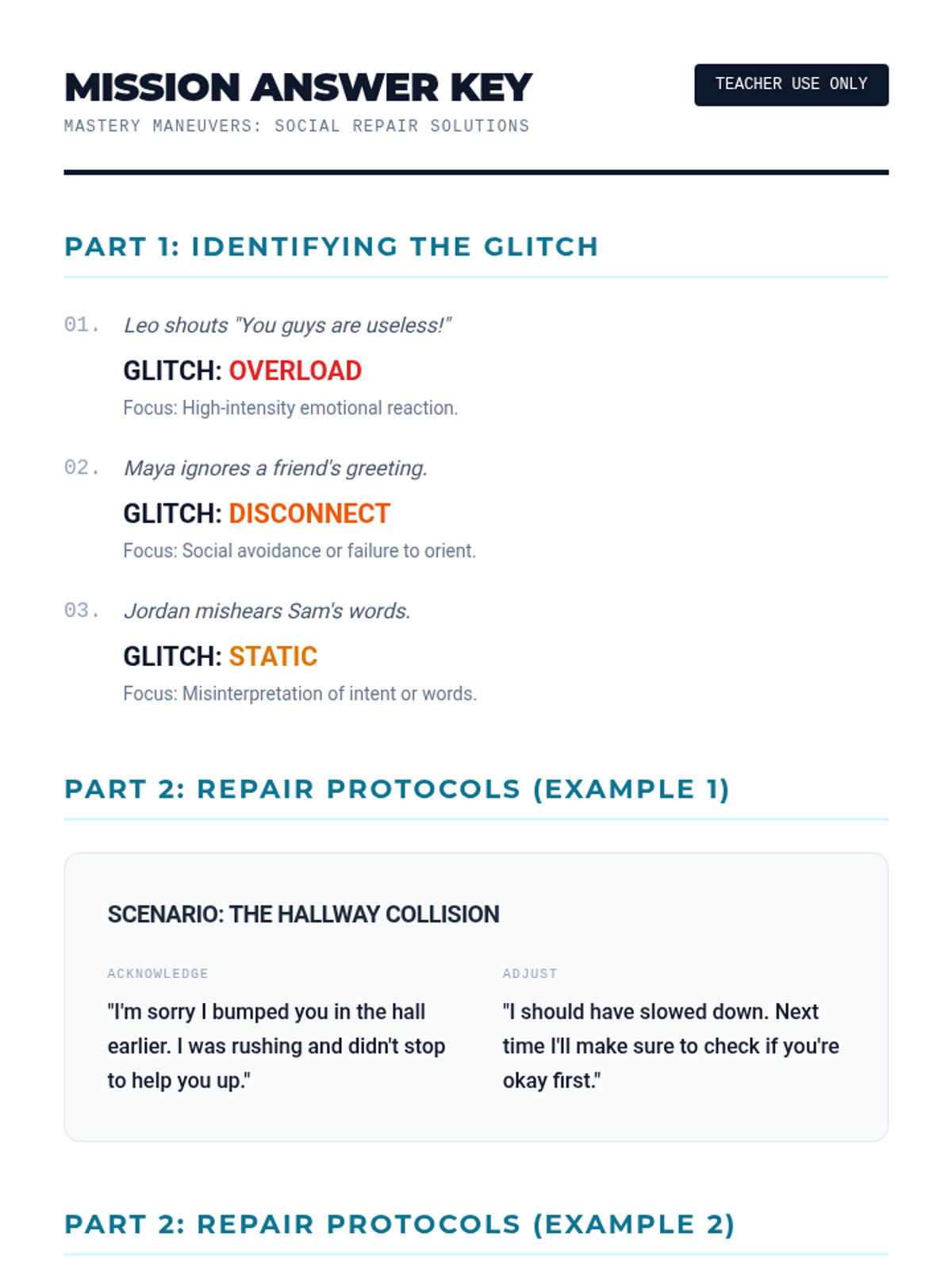
A revised Mastery Maneuvers answer key for the Commander Comms lesson, fixing page break issues in scenario blocks and resolving label overlap problems.
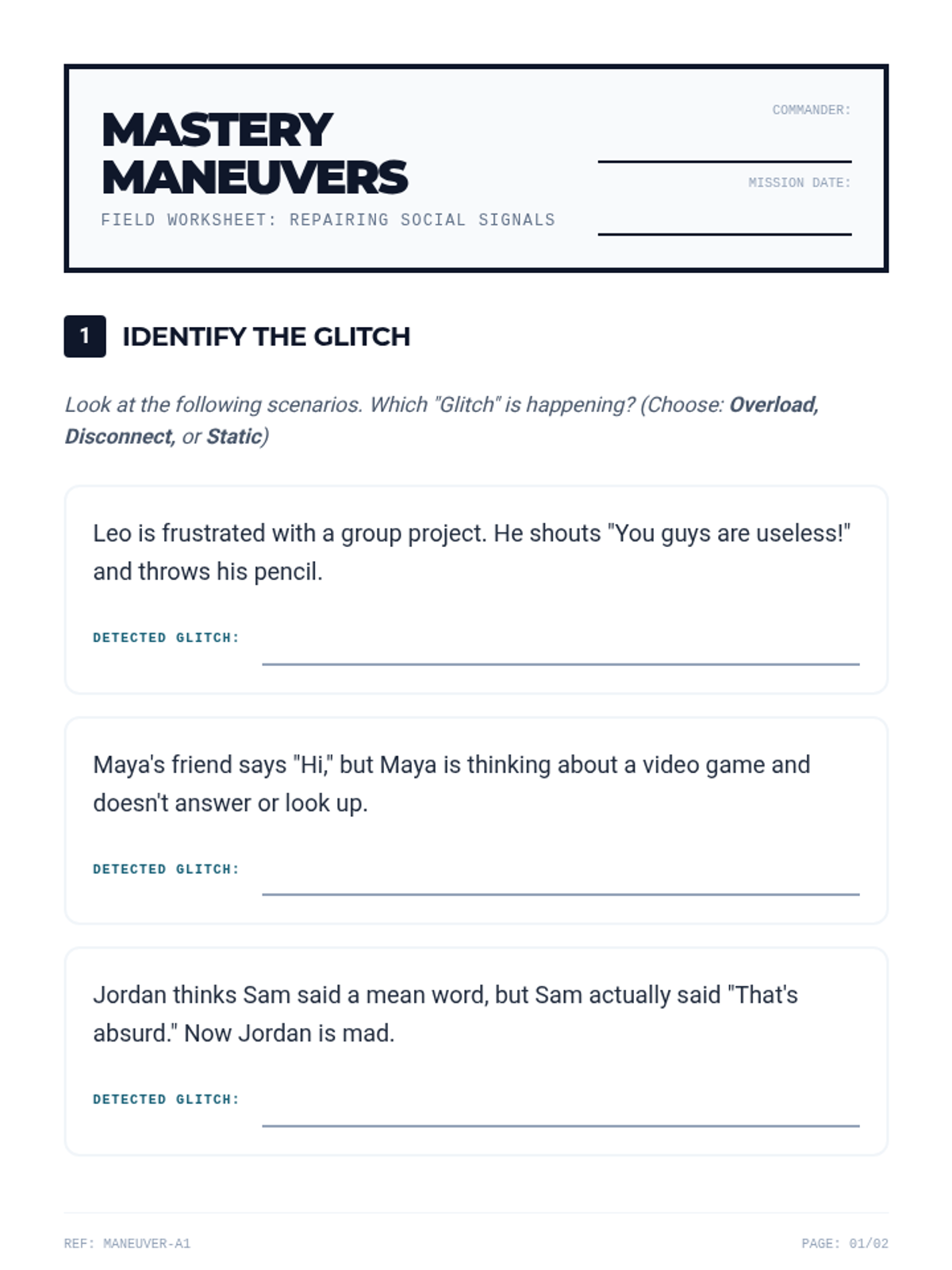
A revised Mastery Maneuvers worksheet for the Commander Comms lesson, fixing page break issues between sections, increasing answer box heights for handwriting, and adding vertical space for responses.
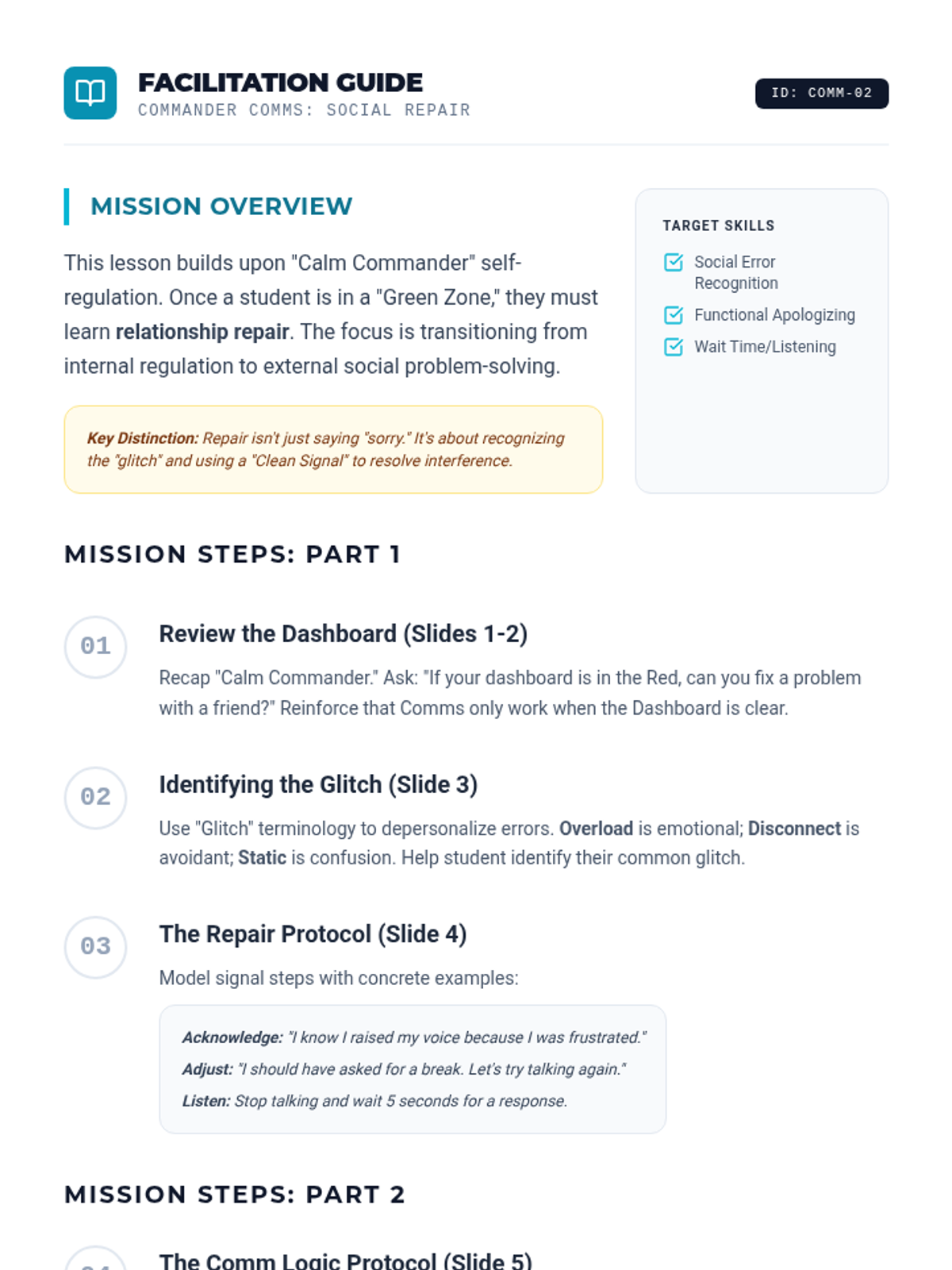
A revised facilitation guide for the Commander Comms lesson, adding a step for the new ABC model (Comm Logic Protocol) slide and ensuring all steps are correctly numbered.
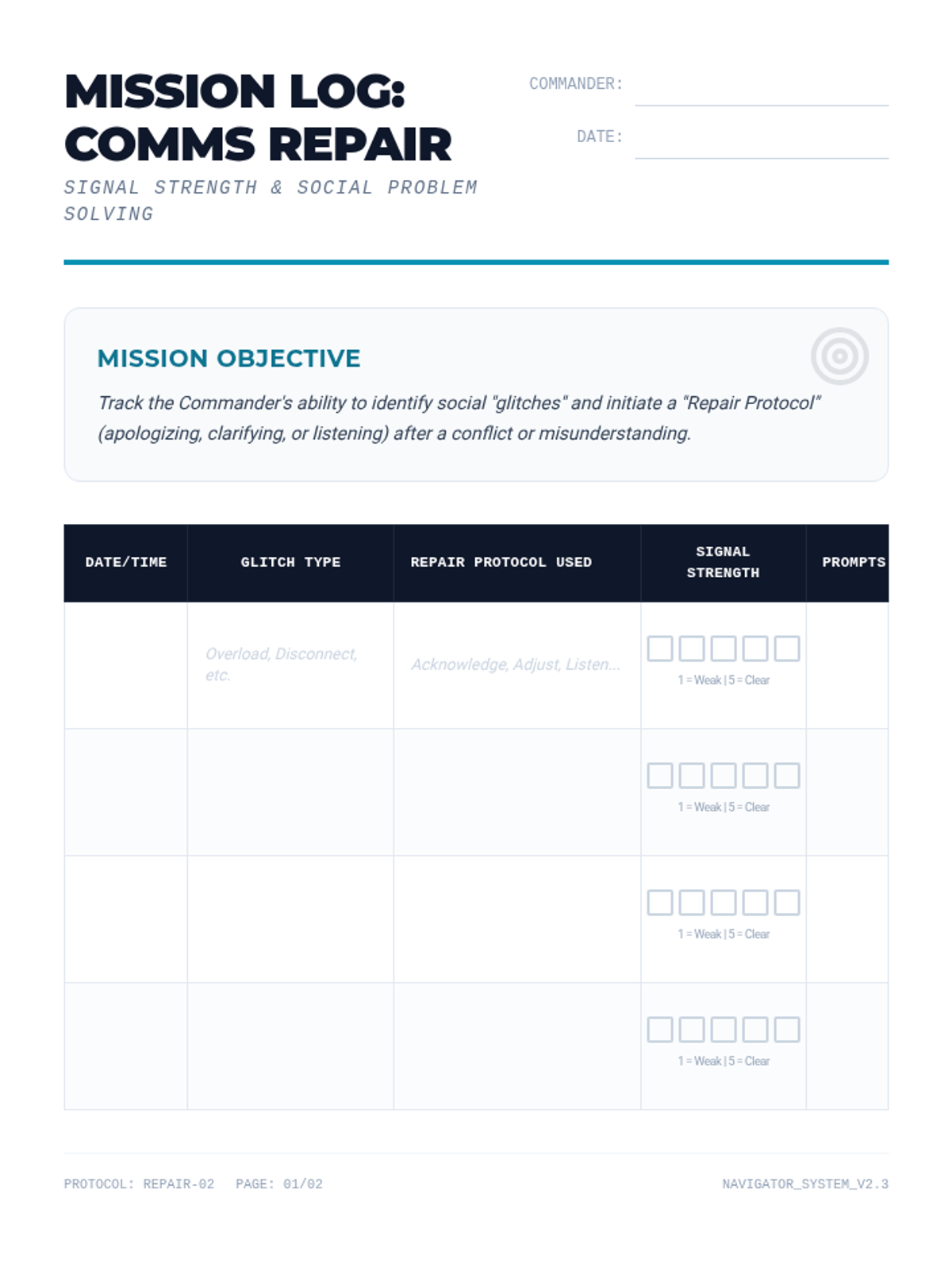
A revised IEP goal tracker for the Commander Comms lesson, fixing page break issues, adding missing signal strength indicators to all rows, and improving row height for handwriting.
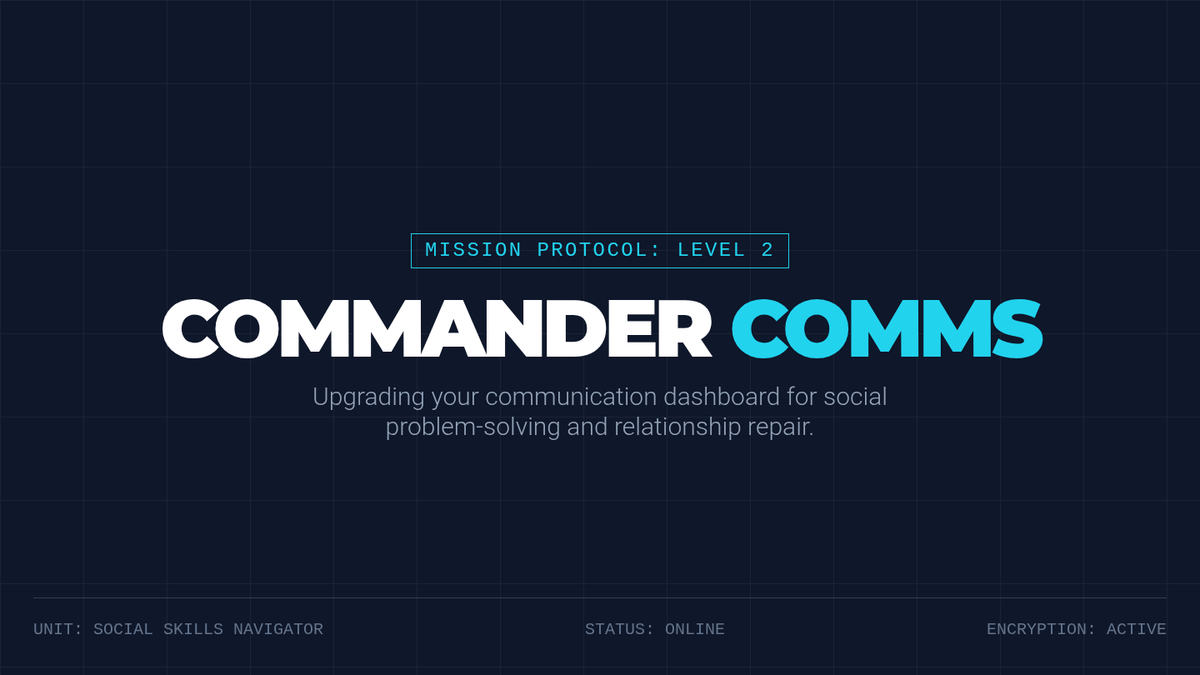
A revised 7-slide presentation for the Commander Comms lesson, replacing the video case study with a slide explaining the ABC model of REBT themed as 'The Comm Logic Protocol'.
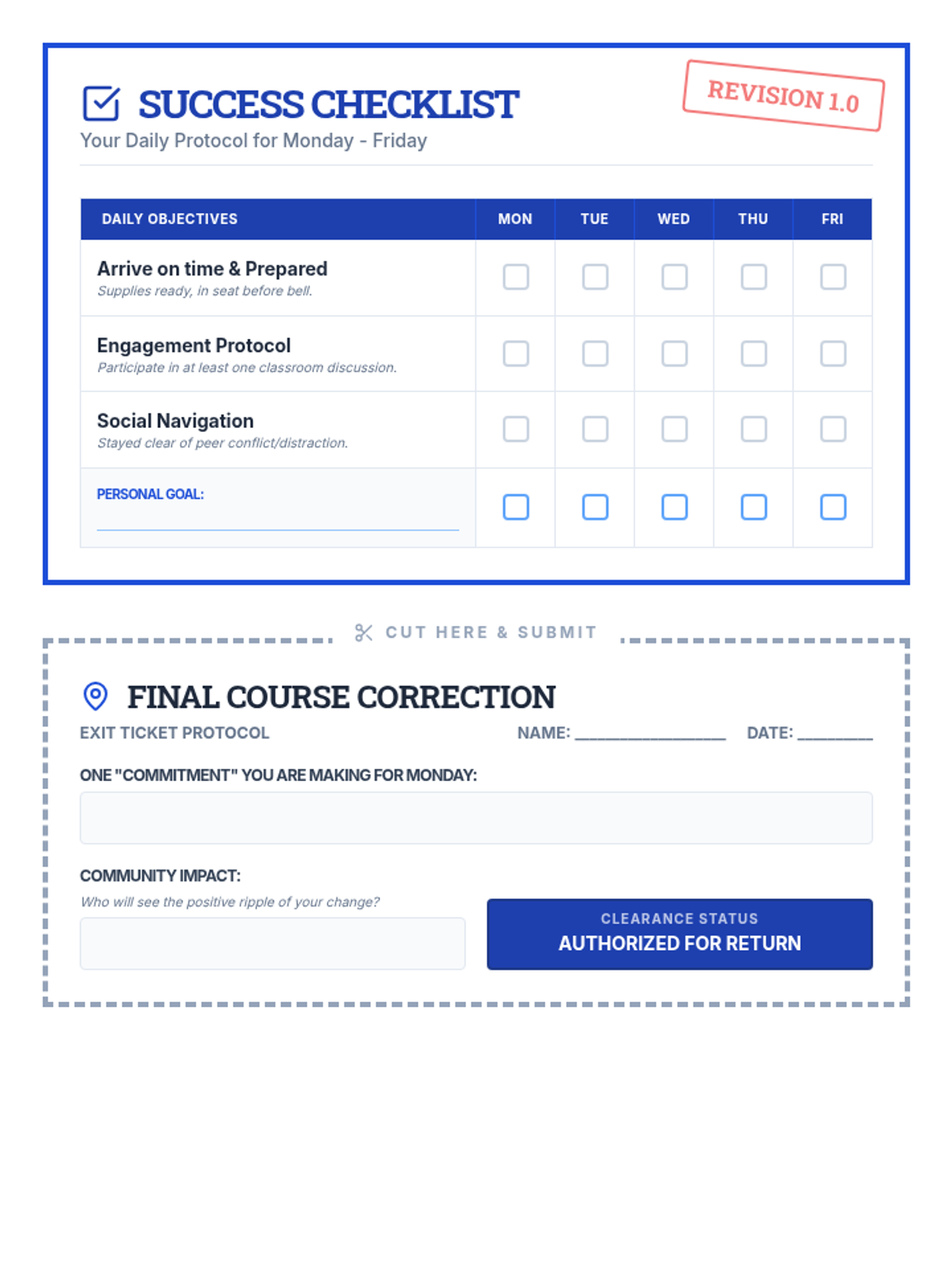
A student-facing toolkit containing a weekly TRACK behavioral success checklist and a detachable exit ticket to formalize commitments before leaving detention.
A student-facing toolkit containing a weekly behavioral success checklist and a detachable exit ticket to formalize commitments before leaving detention.
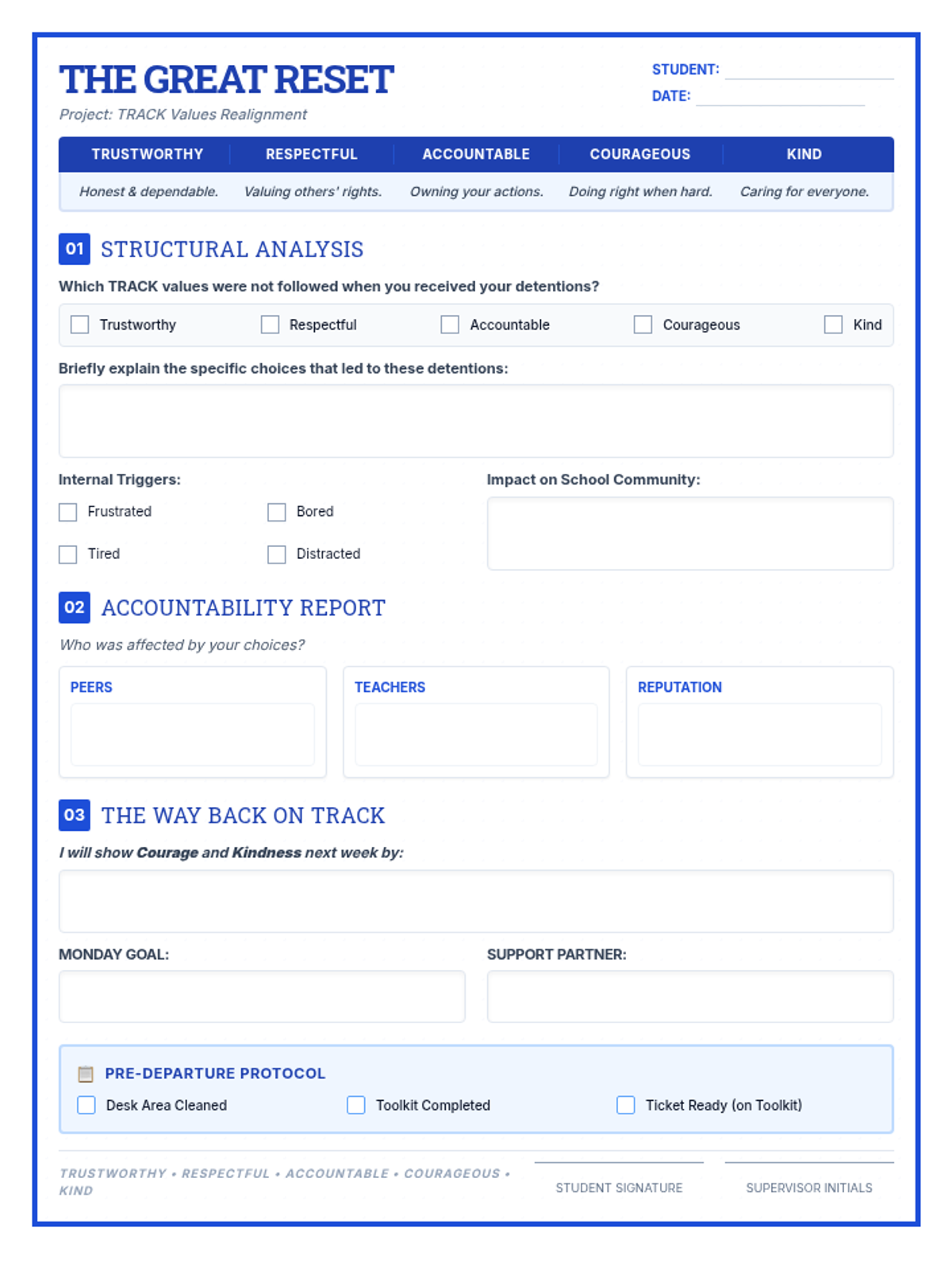
A one-page behavioral reflection sheet updated to include definitions of the TRACK values and refined prompts for students reflecting on multiple detentions.
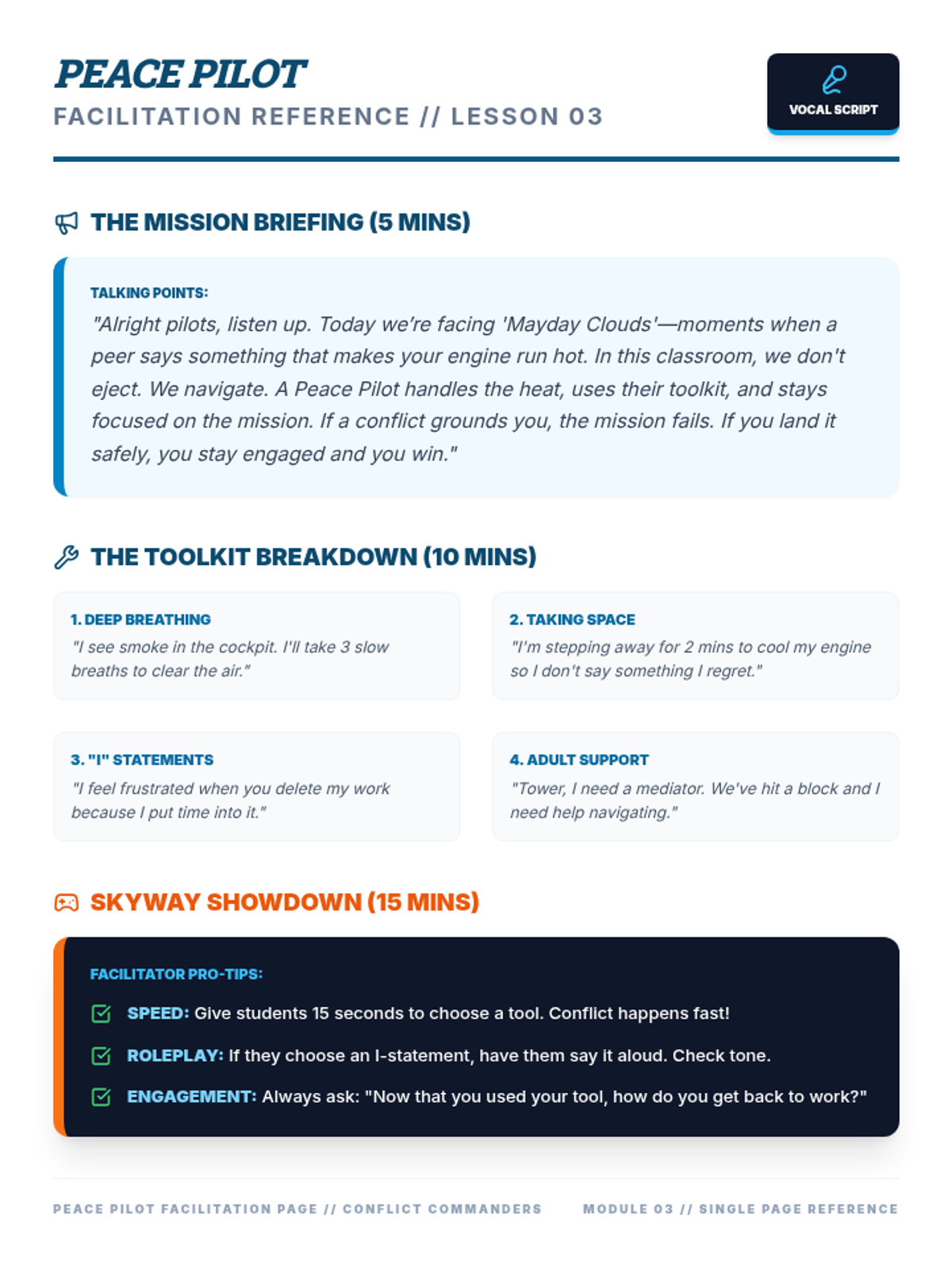
Detailed facilitation page for the 'Peace Pilot' lesson, featuring scripts, talking points, and specific tips for managing the 'Skyway Showdown' game.
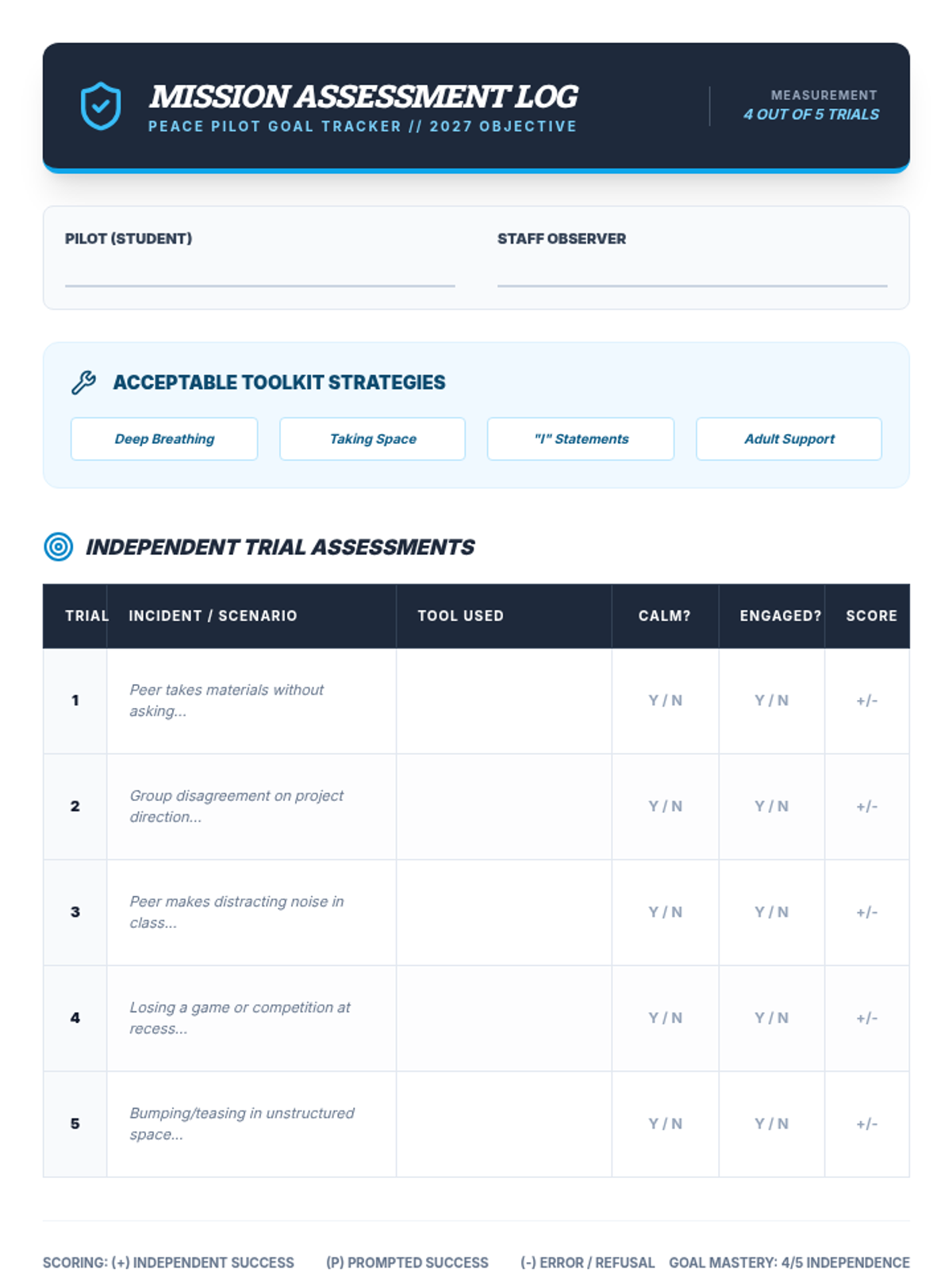
IEP Goal Tracker for the 'Peace Pilot' lesson, featuring five conflict resolution scenarios for trial assessment and an observation log for staff, excluding self-reports.
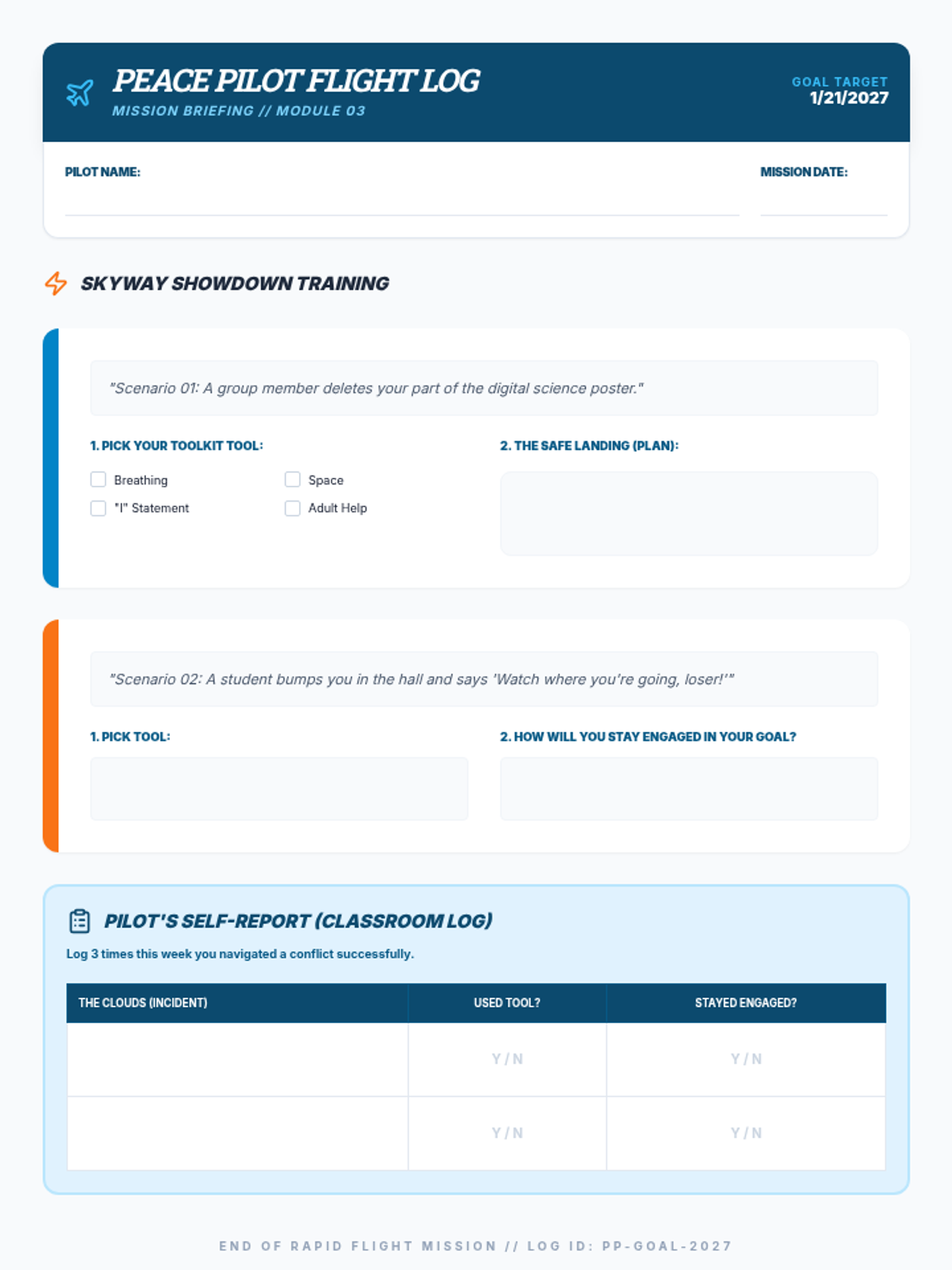
Student worksheet for the 'Peace Pilot' lesson, designed as a 'Flight Log' to practice the 4-step conflict resolution plan through peer scenarios.
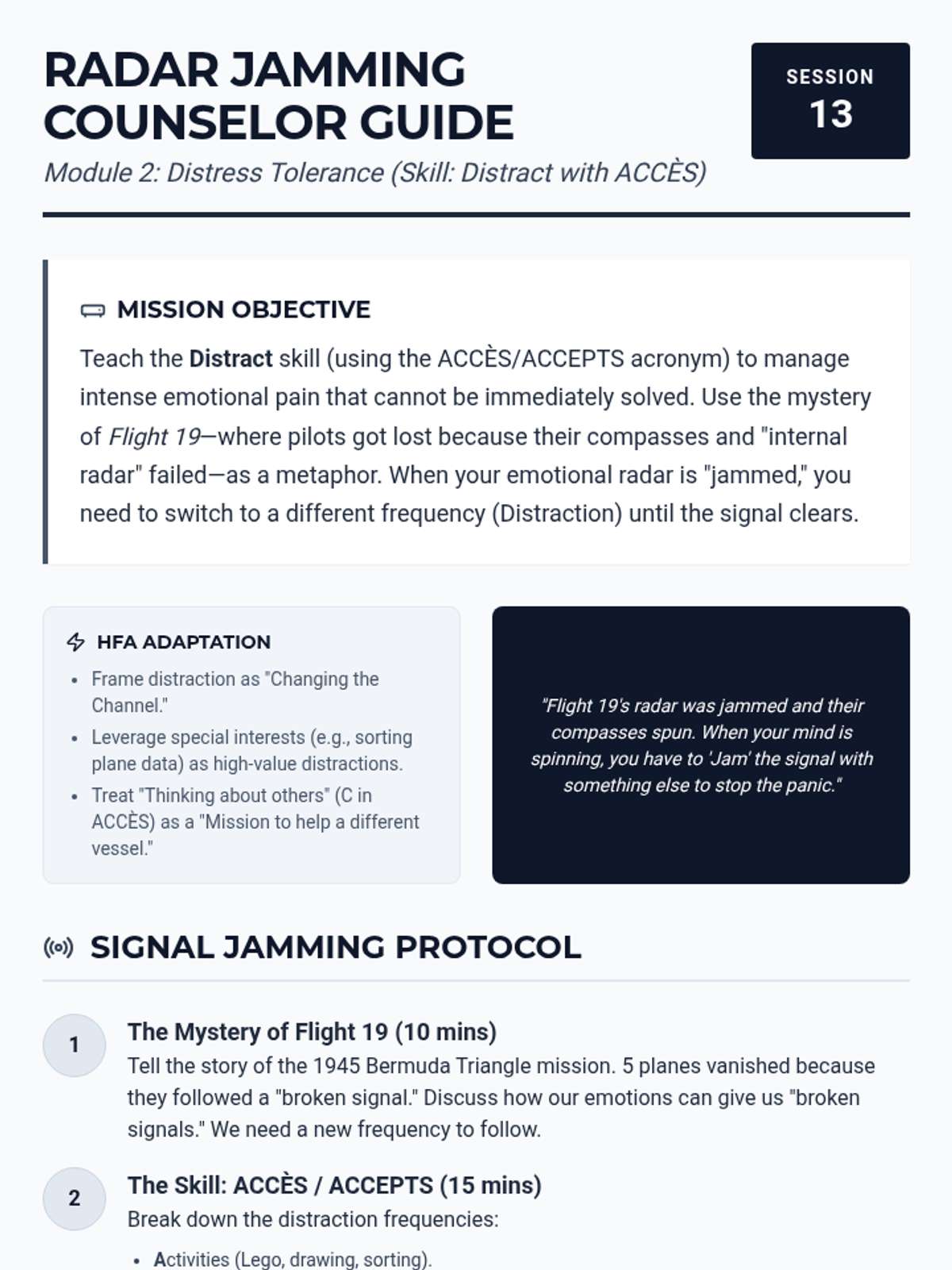
Counselor guide for Week 13 of the Survival and Salvage DBT program, focusing on Distract and ACCÈS skills using radar jamming metaphors.
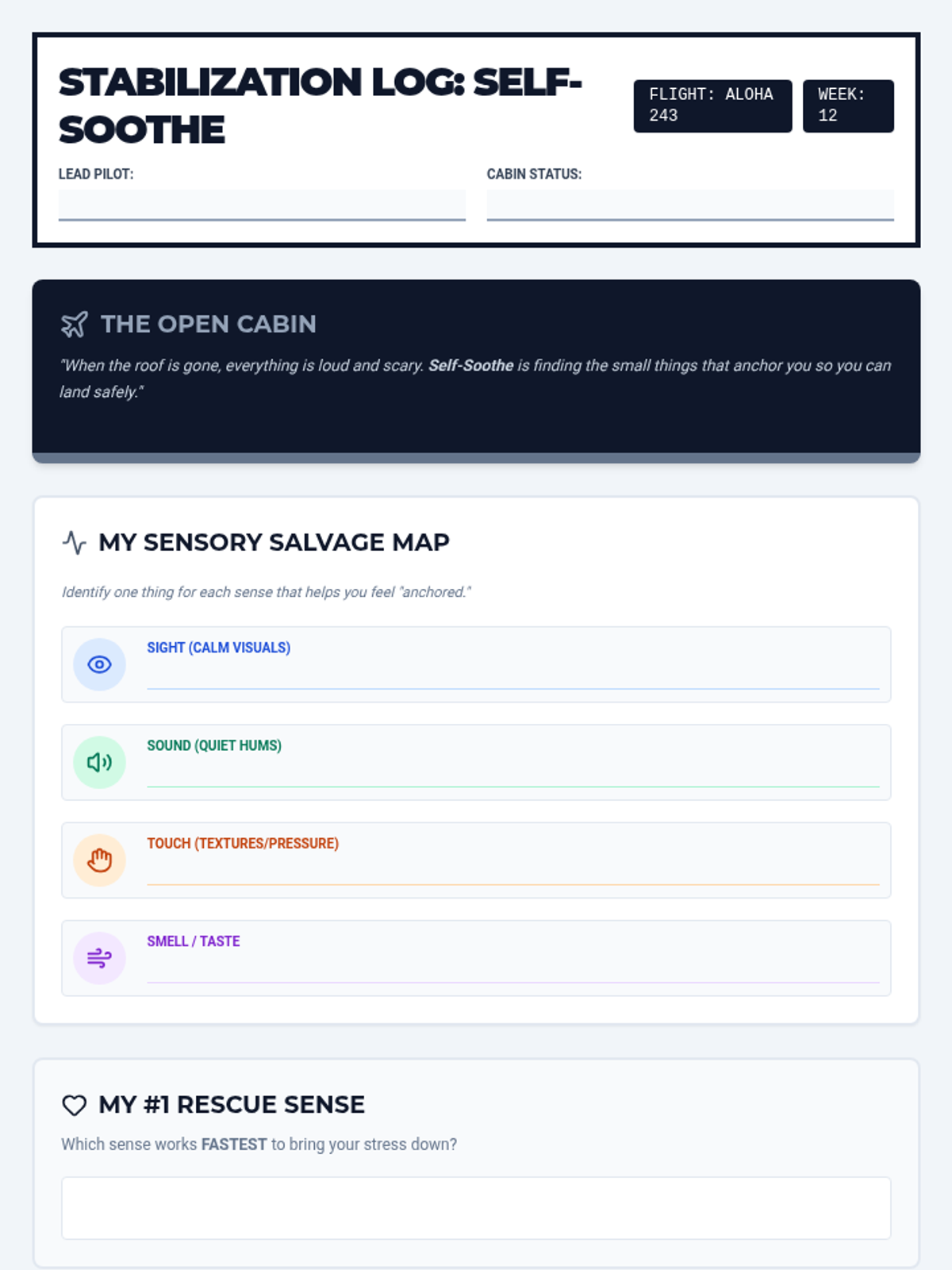
A student-facing worksheet for practicing the Self-Soothe skill using flight survival metaphors. Includes a mapping of the 5 senses and identification of a primary rescue sense.
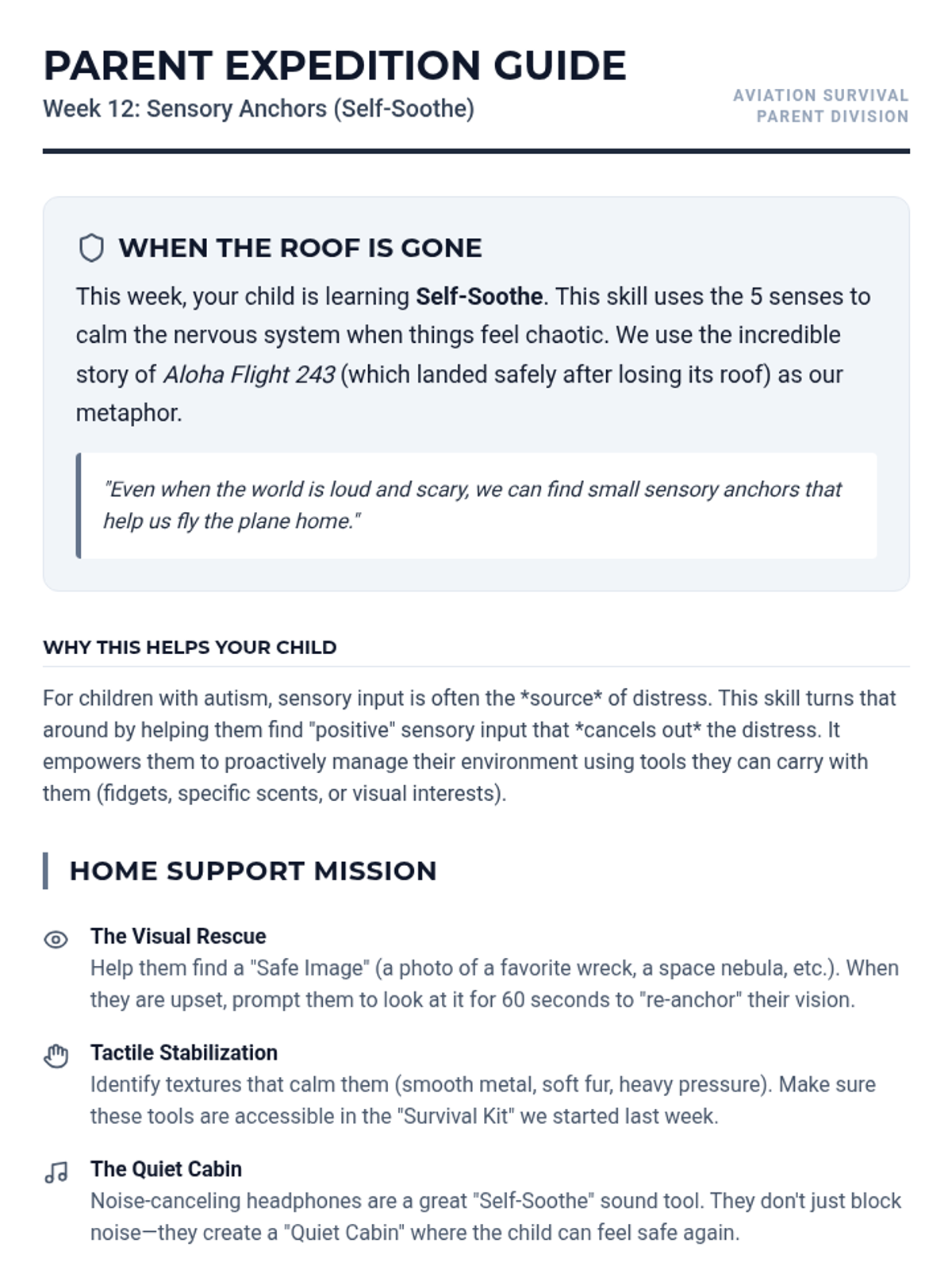
Parent guide for Week 12 of the Survival and Salvage DBT program, explaining the Self-Soothe skill using flight survival metaphors.
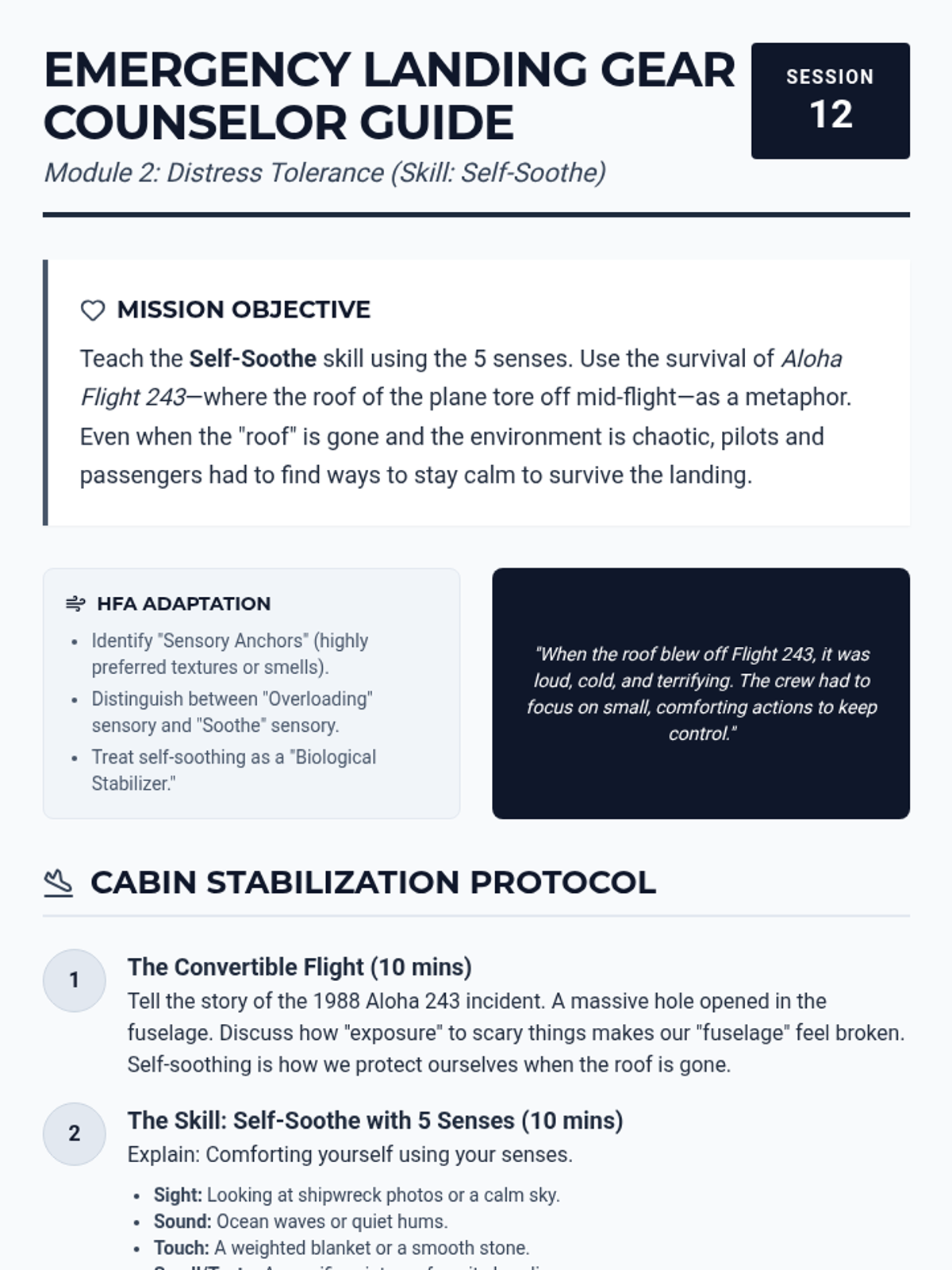
Counselor guide for Week 12 of the Survival and Salvage DBT program, focusing on the Self-Soothe skill using the Aloha Flight 243 survival story.
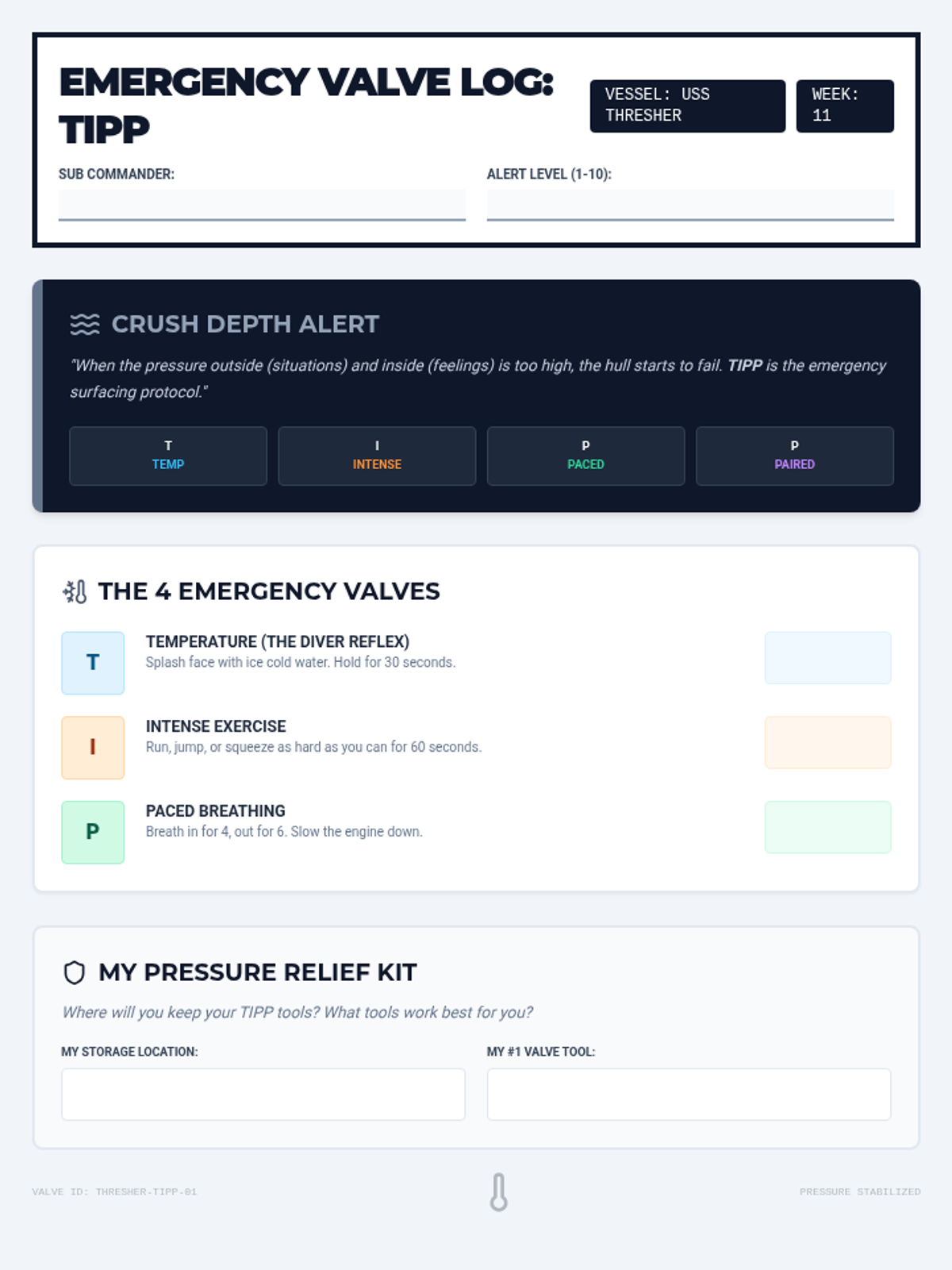
A student-facing worksheet for practicing the TIPP skill using submarine pressure metaphors. Includes a breakdown of T, I, and P (Breathing and Relaxation).
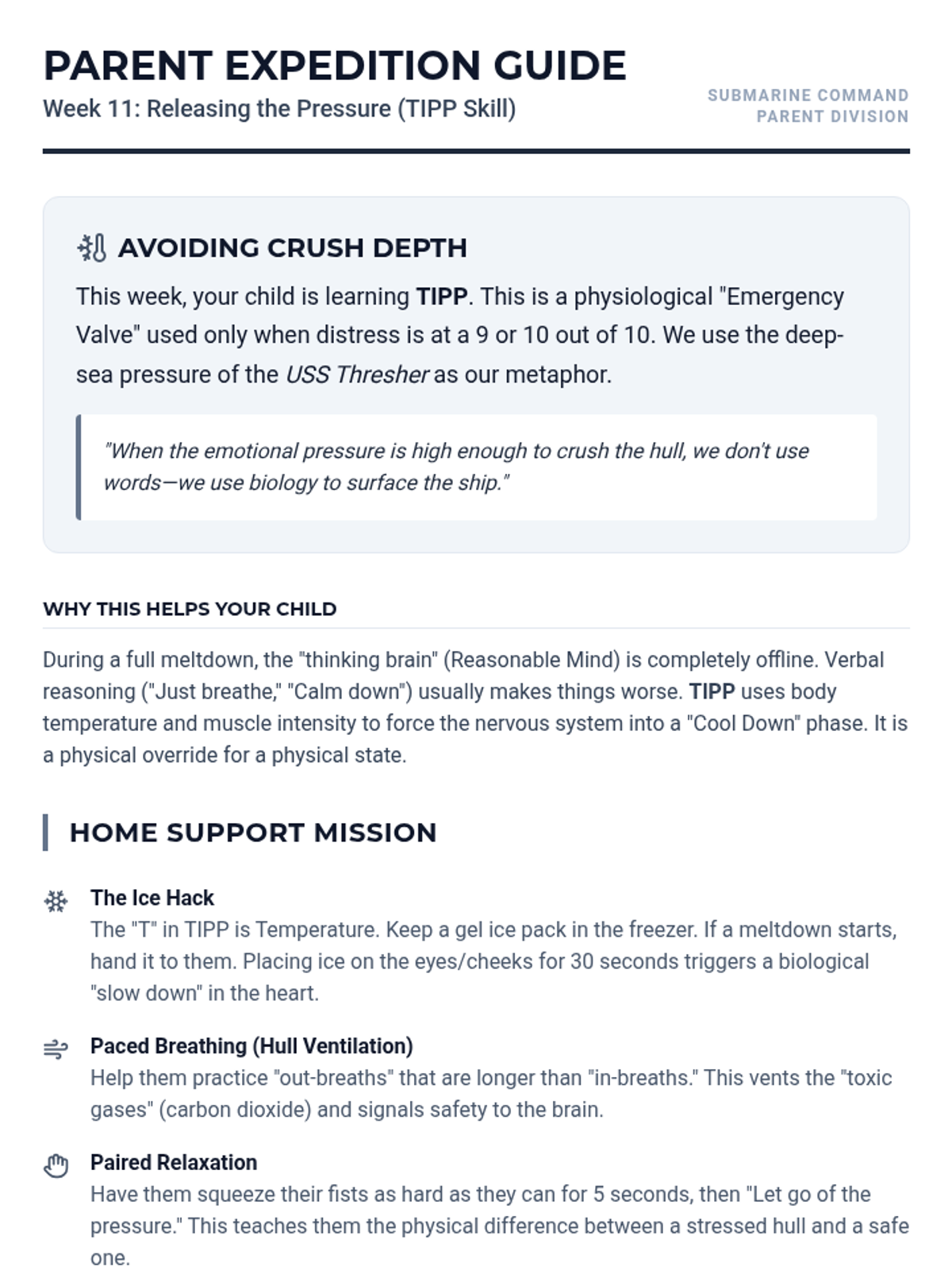
Parent guide for Week 11 of the Survival and Salvage DBT program, explaining the TIPP skill using deep-sea pressure metaphors.
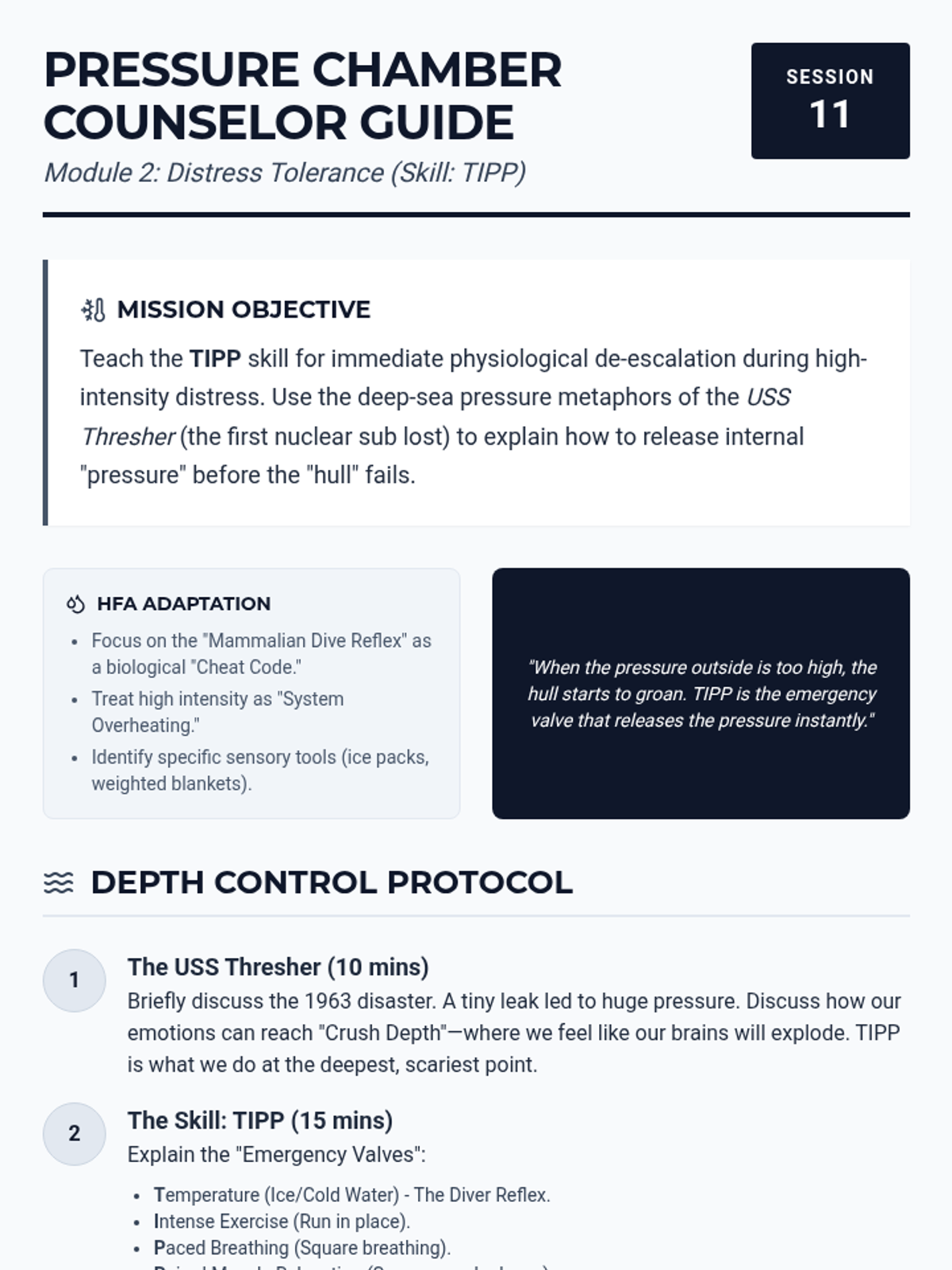
Counselor guide for Week 11 of the Survival and Salvage DBT program, focusing on the TIPP skill using submarine pressure metaphors.
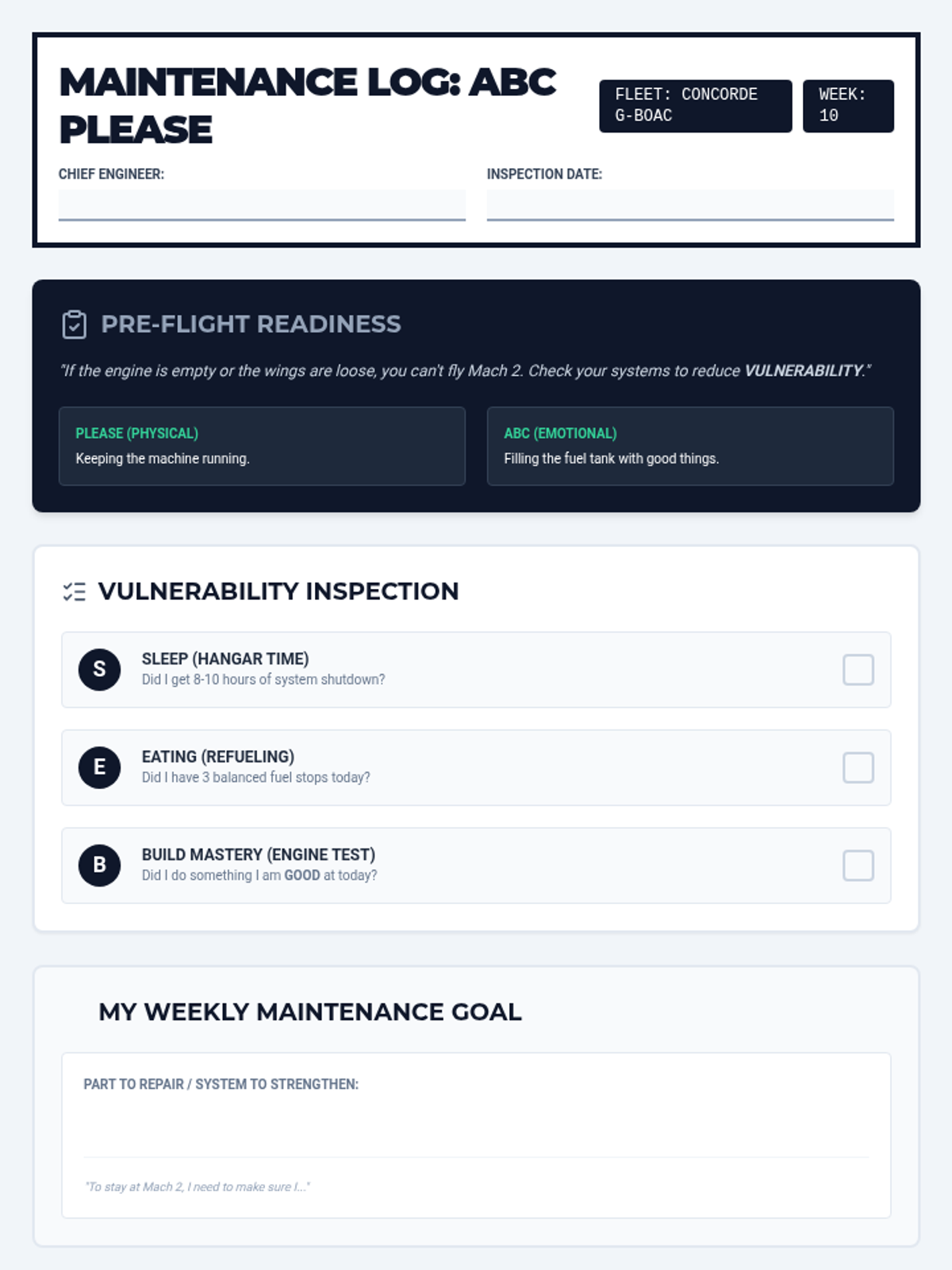
A student-facing worksheet for practicing the ABC PLEASE skill using Concorde maintenance metaphors. Includes a vulnerability checklist and ABC planning section.
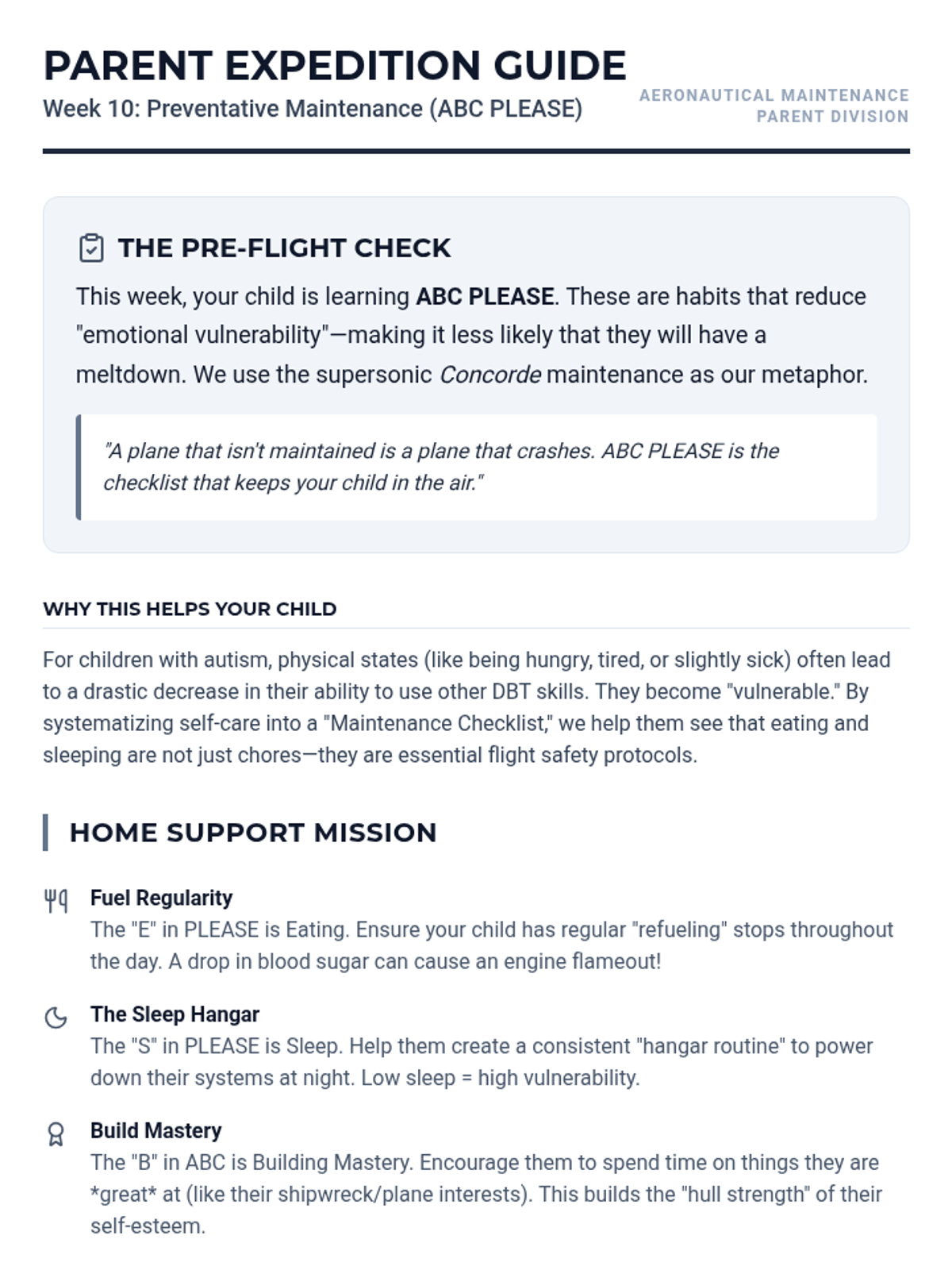
Parent guide for Week 10 of the Survival and Salvage DBT program, explaining the ABC PLEASE skill using aeronautical maintenance metaphors.
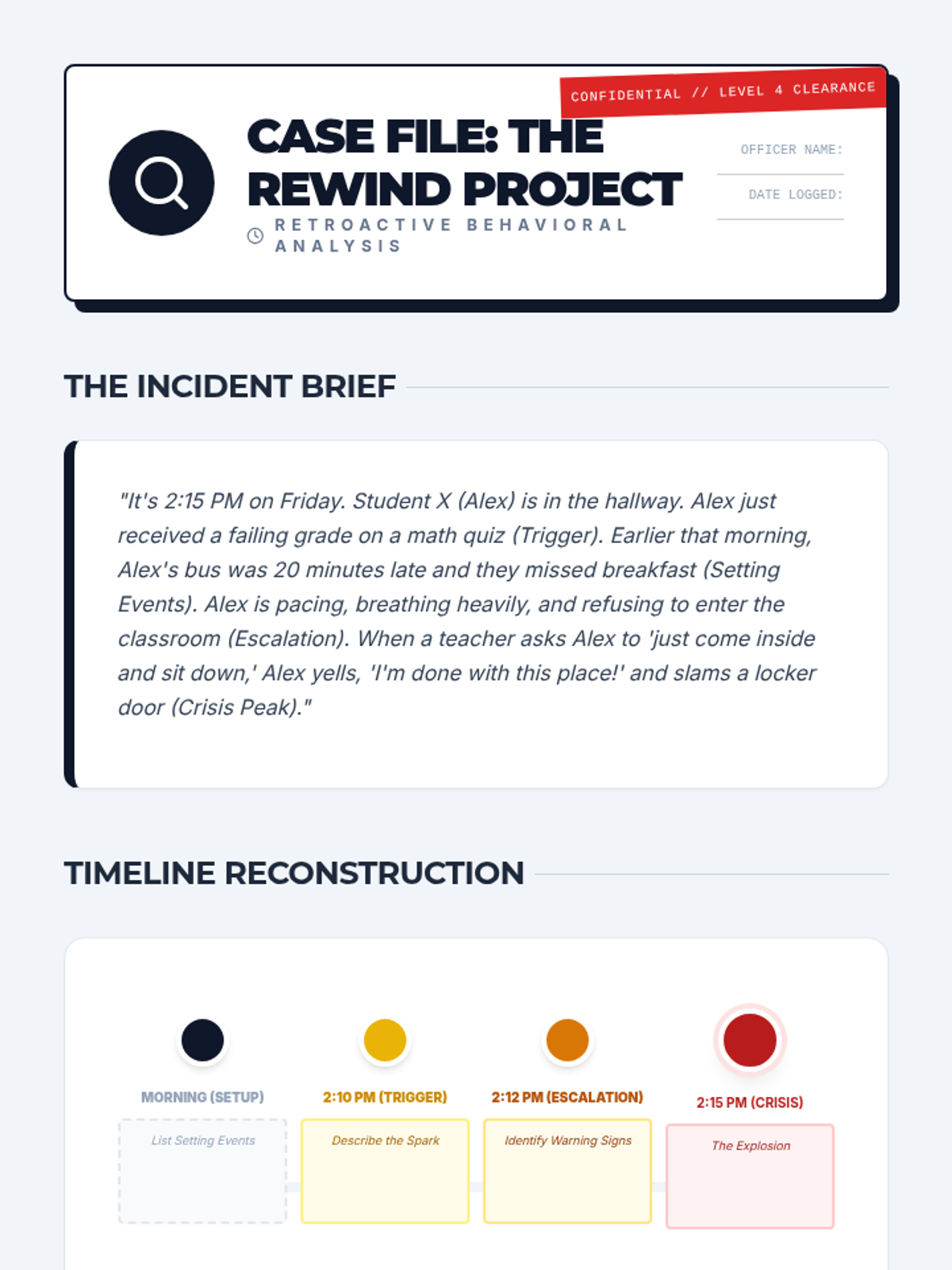
A summative project where students reconstruct a crisis event timeline to identify missed intervention 'off-ramps' and missed warning signs.
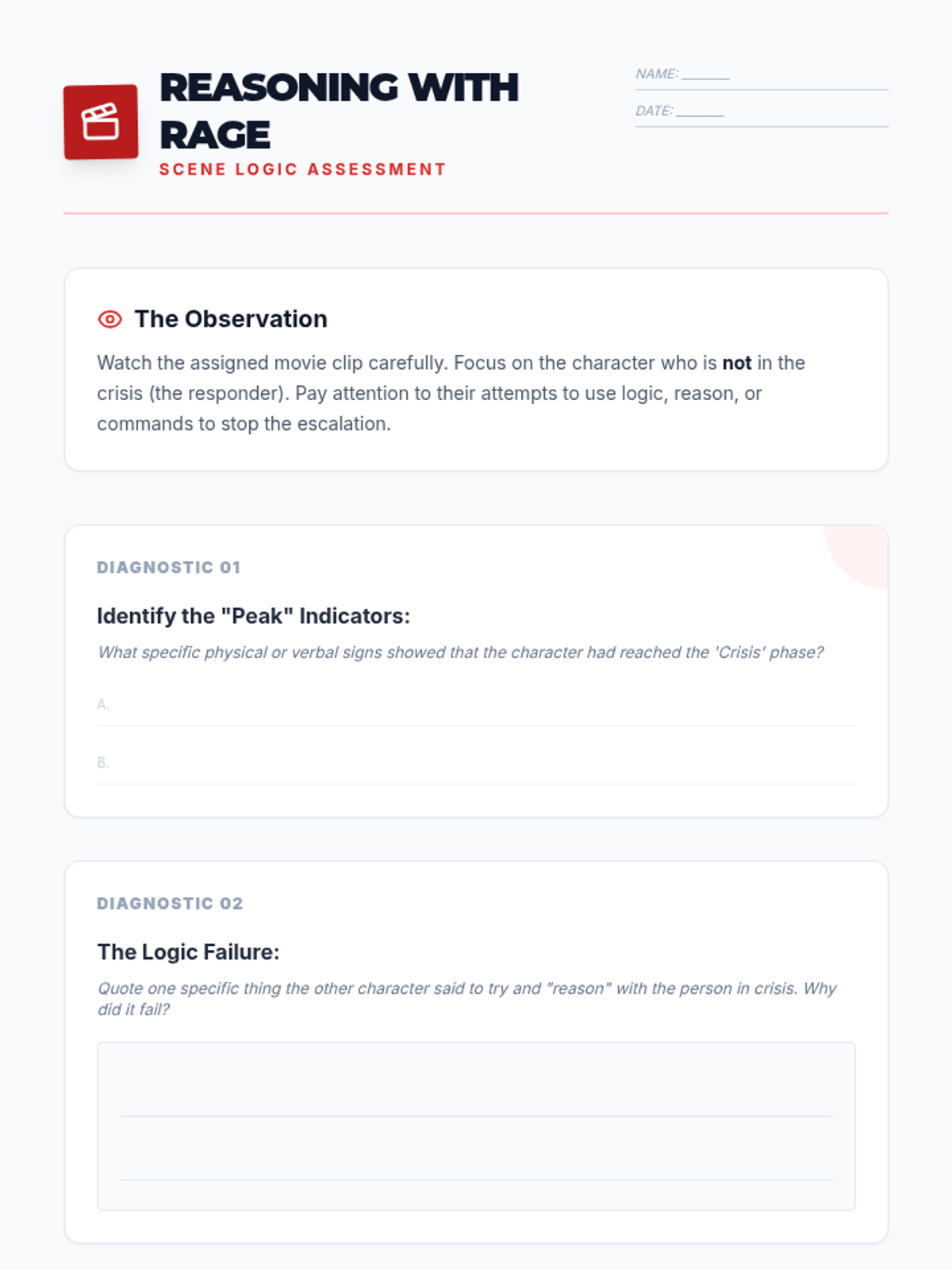
An analysis worksheet for Lesson 4 where students analyze a movie scene of a crisis to identify signs of the peak and why rational reasoning failed.
A slide deck for Lesson 4 exploring the biological 'Amygdala Hijack' and why rational communication fails during the peak of a crisis.
A slide deck for Lesson 3 focused on the cumulative nature of stress and the psychological signs of the acceleration phase.
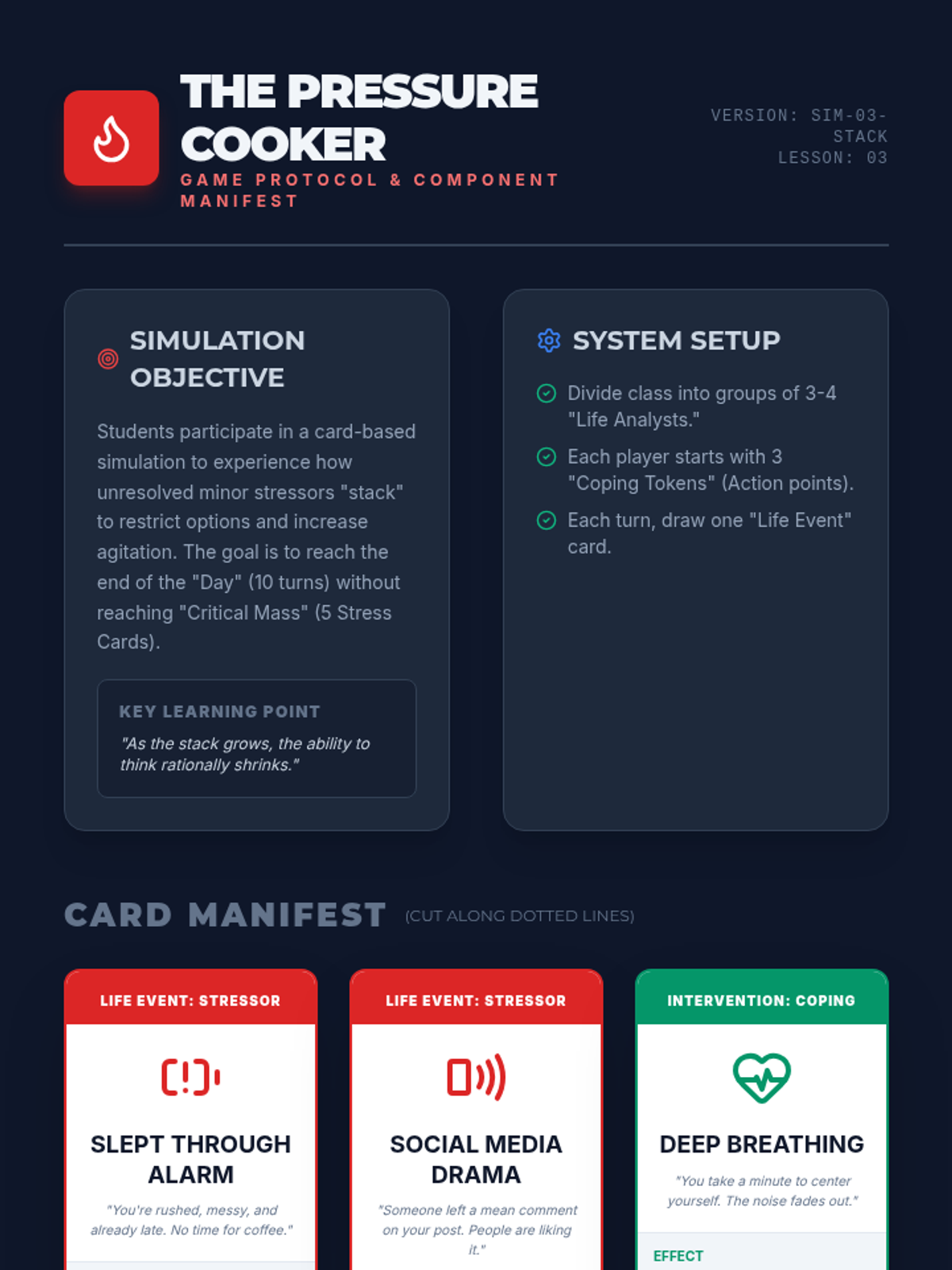
Teacher guide and card components for 'The Pressure Cooker', a game-based simulation where students experience the cumulative effects of stress on rational decision-making.
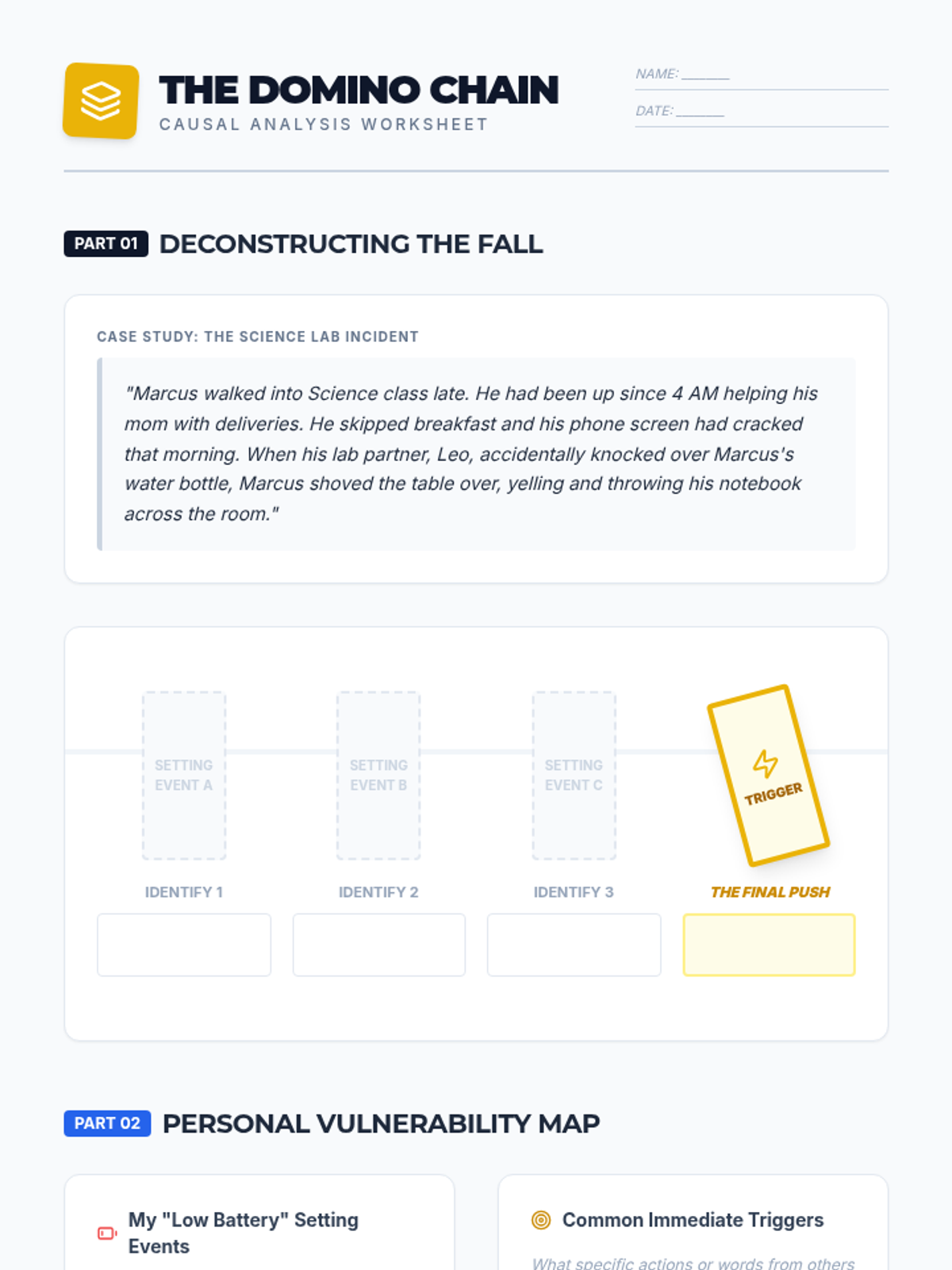
A causal analysis worksheet where students analyze setting events and triggers through a 'Domino Effect' case study and personal reflection.
A slide deck for Lesson 2 exploring the distinction between vulnerability factors (setting events) and immediate triggers.
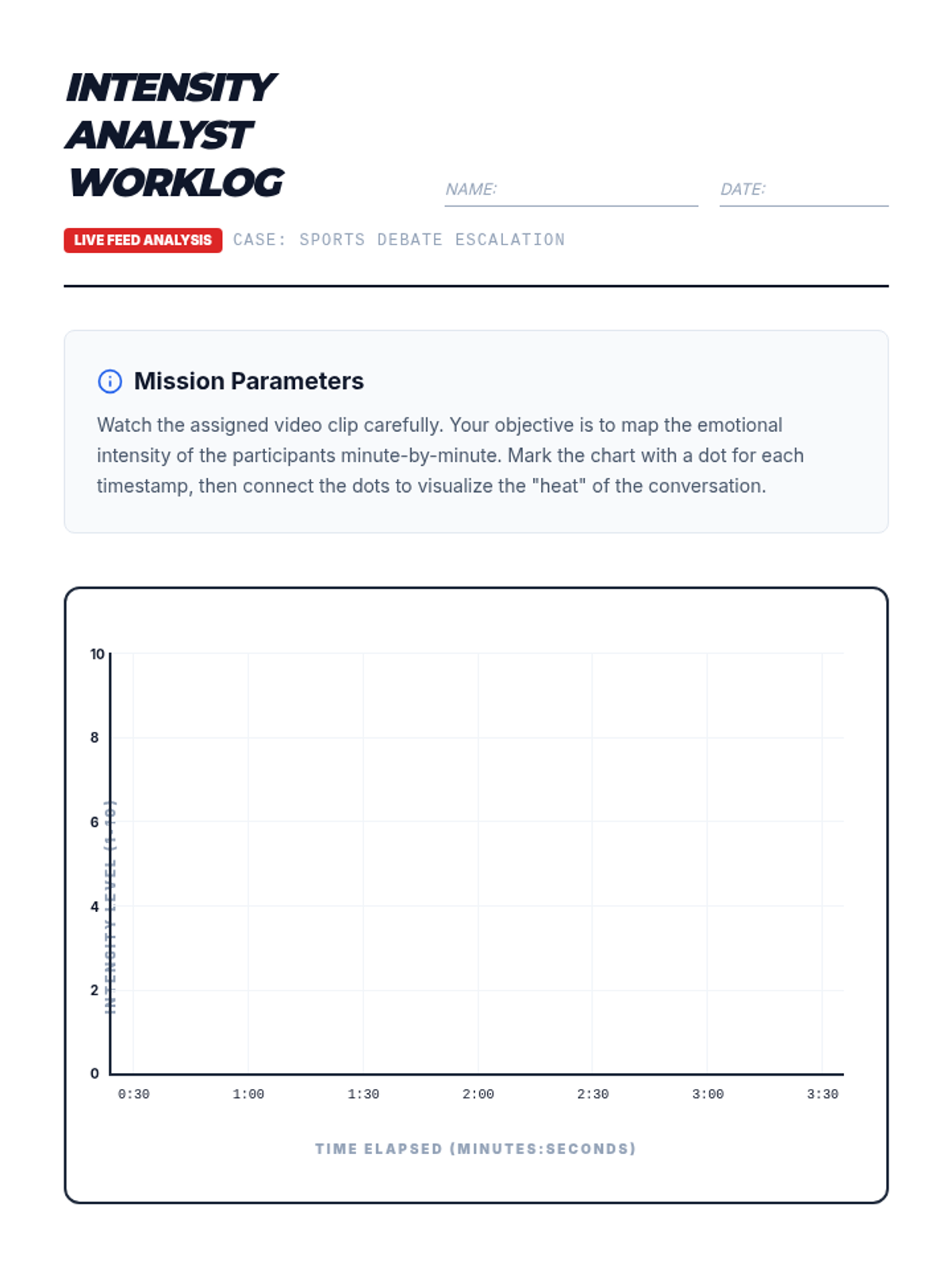
A data-analysis worksheet where students graph the emotional intensity of a sports argument video to identify stages of the Crisis Cycle.
An introductory slide deck for Lesson 1, visually explaining the five stages of the Crisis Cycle and setting up the sports argument hook activity.
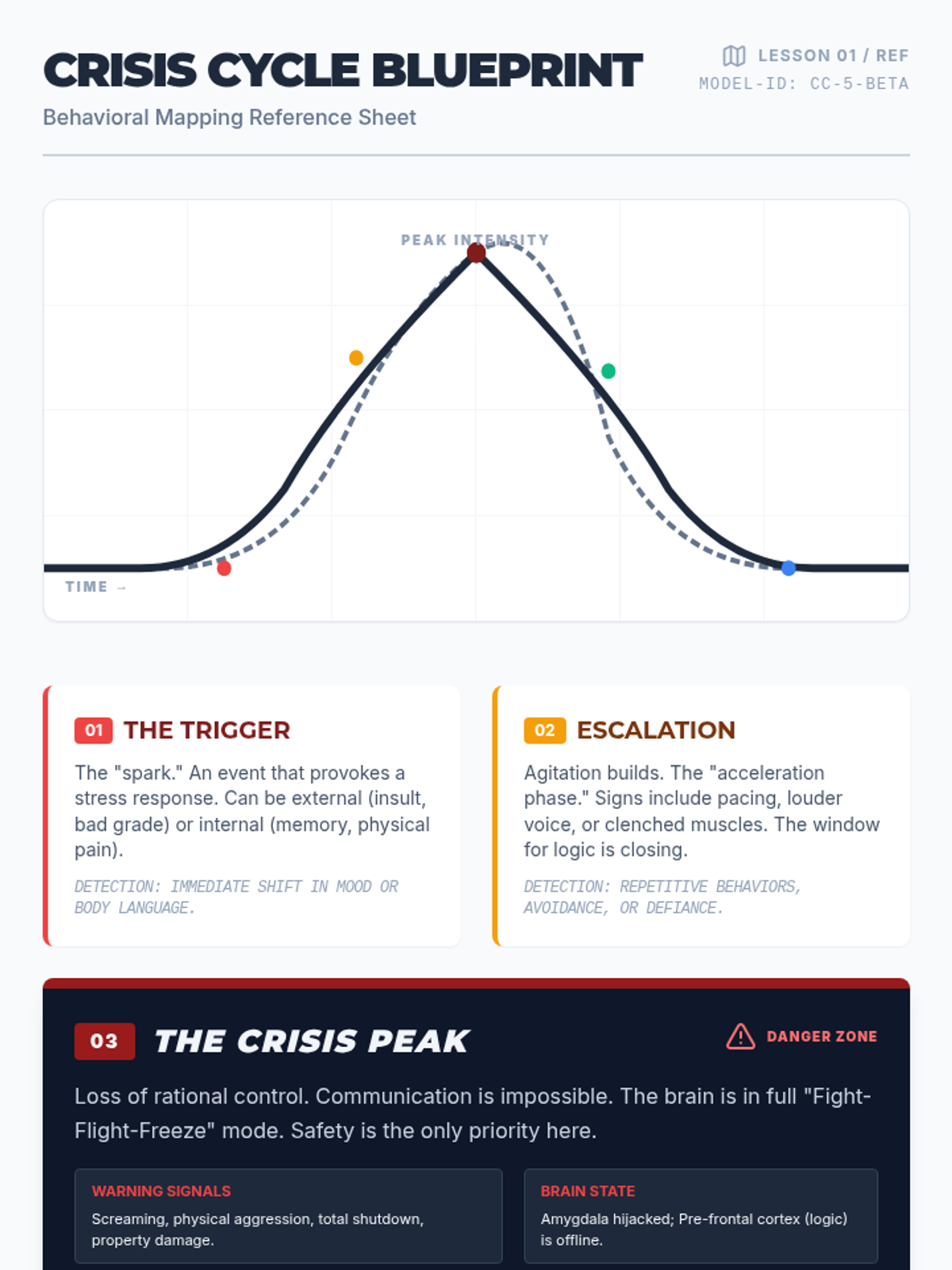
A technical reference sheet outlining the five stages of the Crisis Cycle with a visual curve and diagnostic descriptions for each phase.