Root cause analysis and brainstorming techniques for everyday problem-solving. Equips learners with ethical frameworks and risk-benefit evaluation skills to predict consequences and make informed choices.
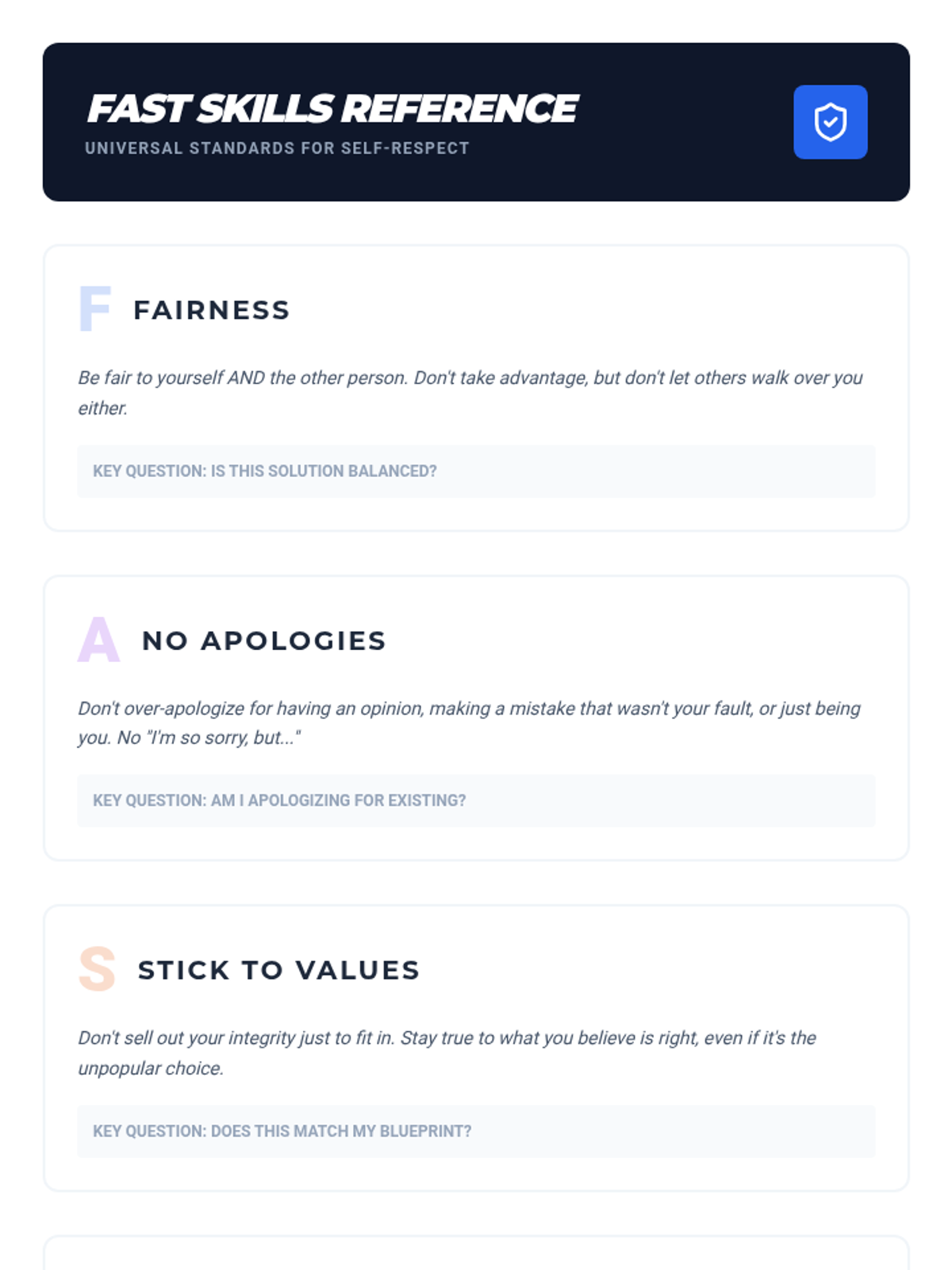
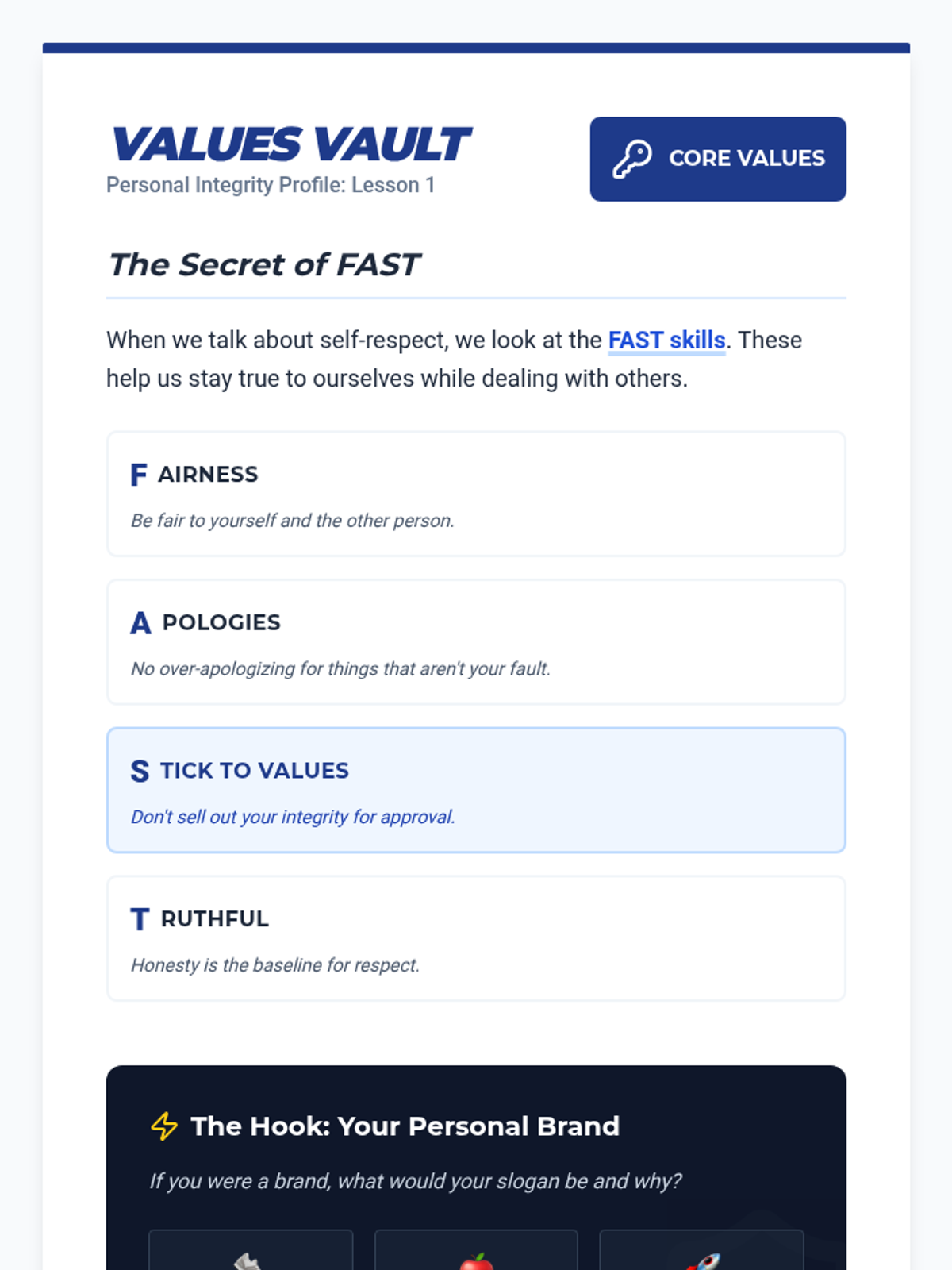
A reference sheet for students and teachers summarizing the FAST skills framework for self-respect.
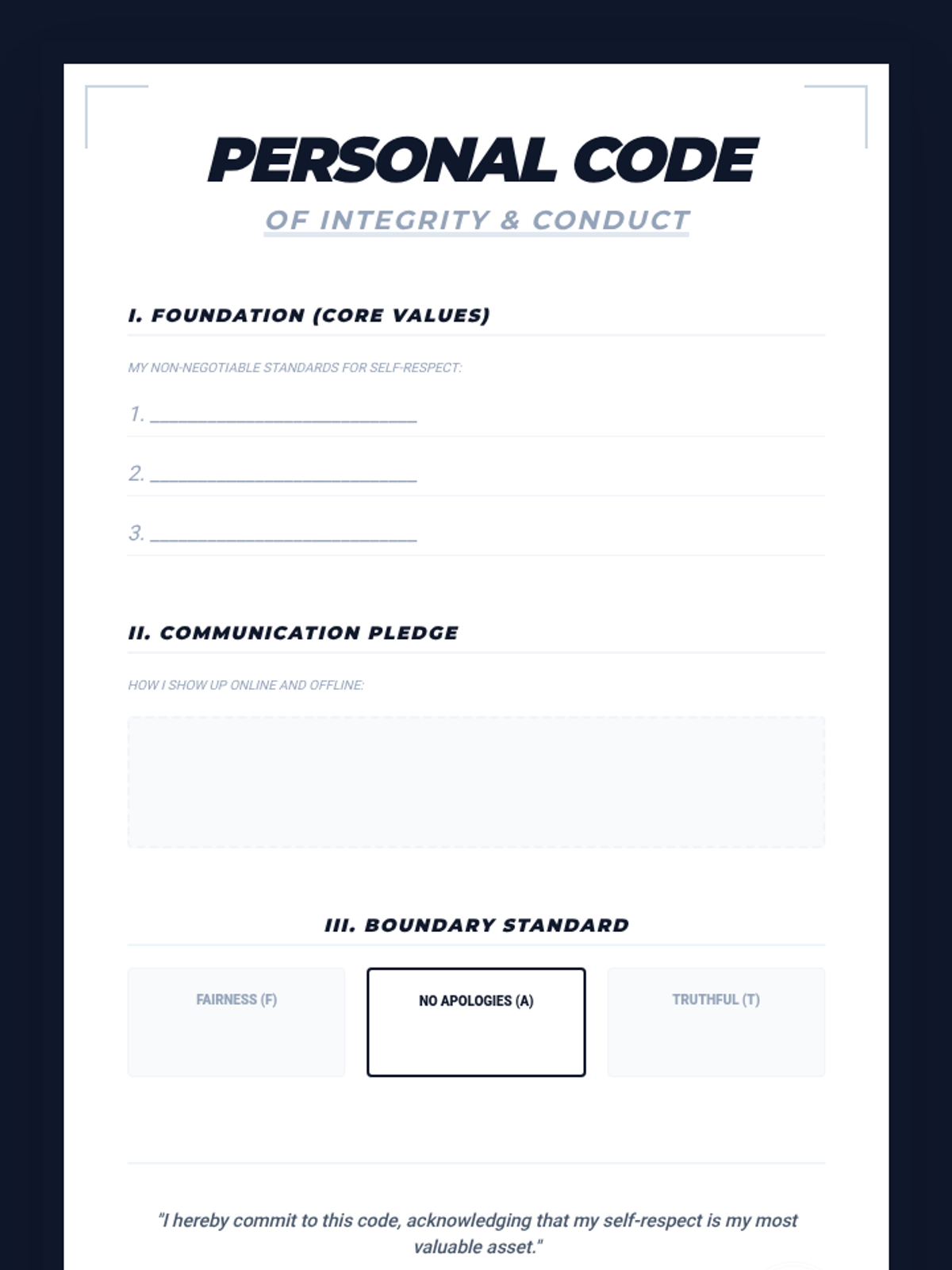
The final 'Personal Code of Conduct' manifesto template for students to summarize their integrity profile.
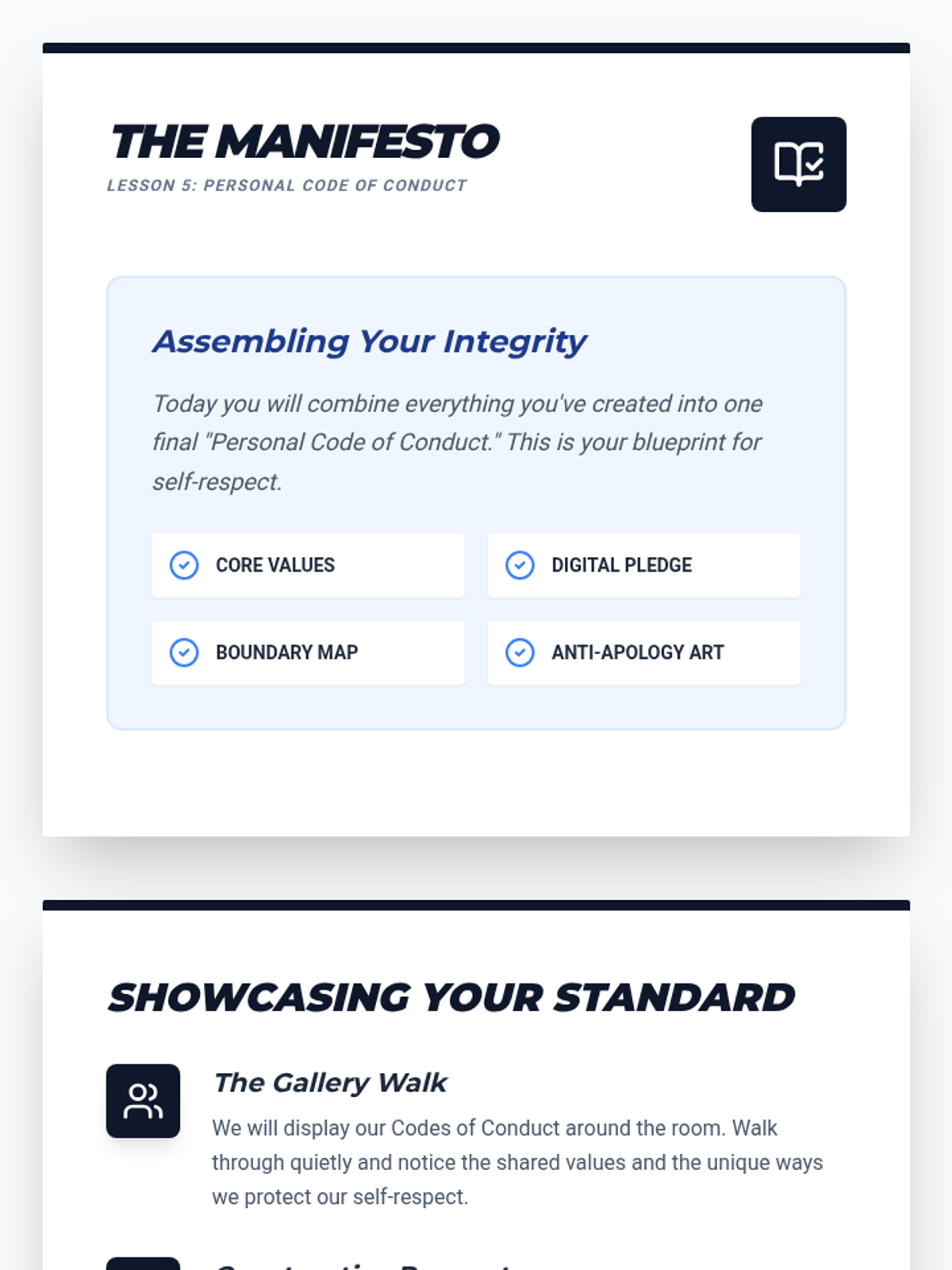
Introductory slides for Lesson 5 guiding students through the assembly and presentation of their Personal Code of Conduct.
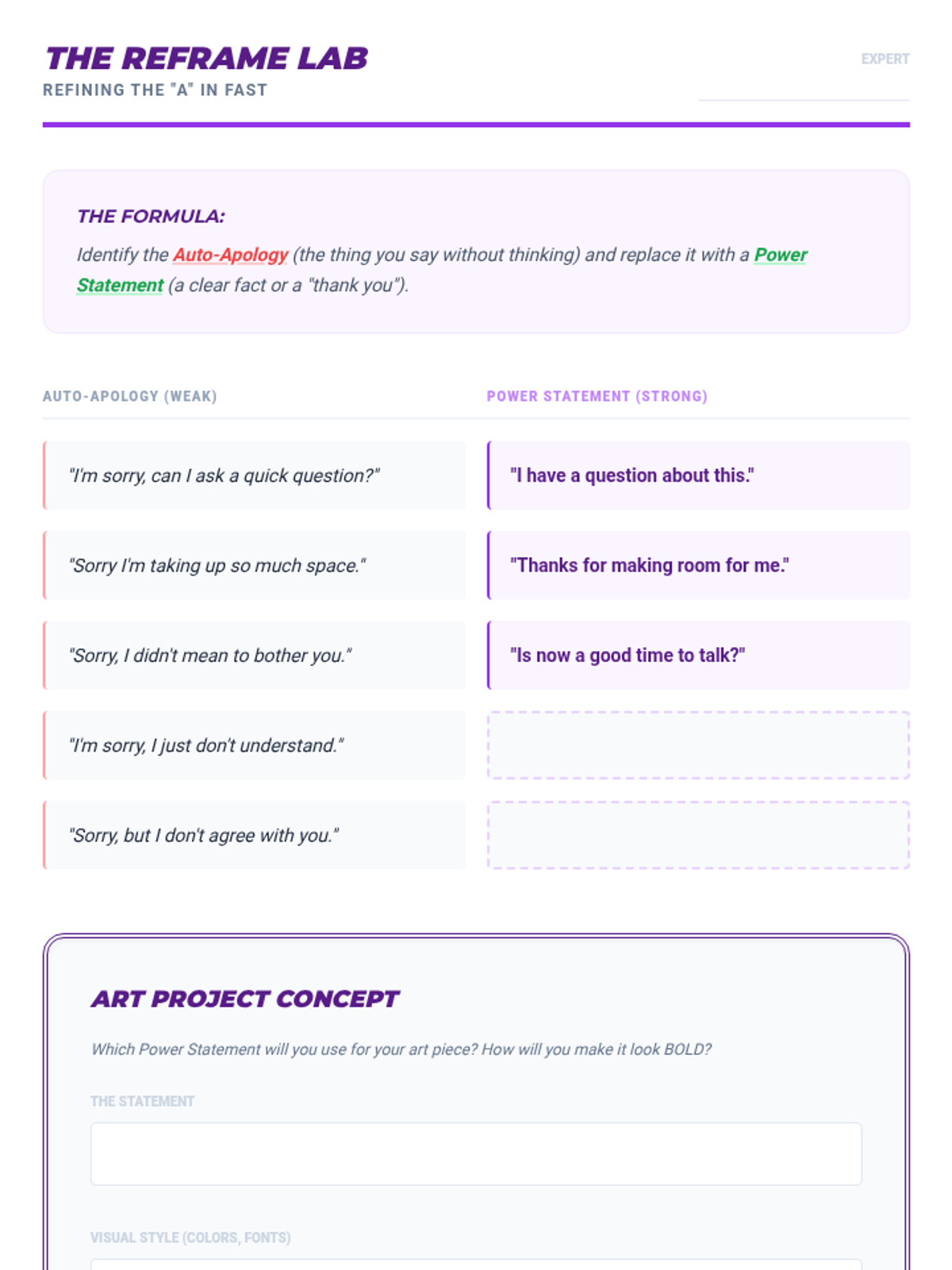
A worksheet for students to practice reframing common over-apologies into confident, assertive statements.
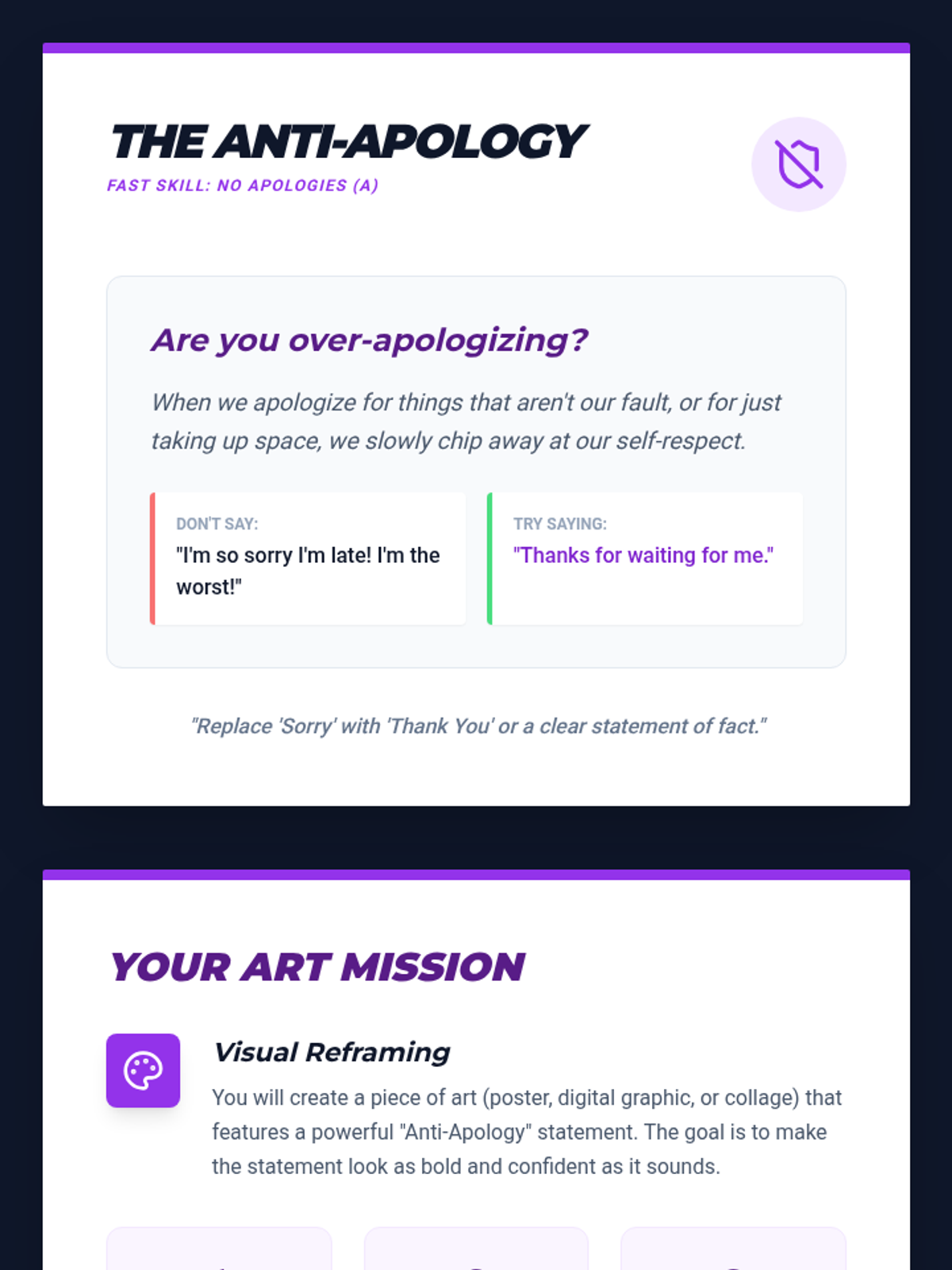
Introductory slides for Lesson 4 exploring the psychology of over-apologizing and the 'No Apologies' skill in FAST.
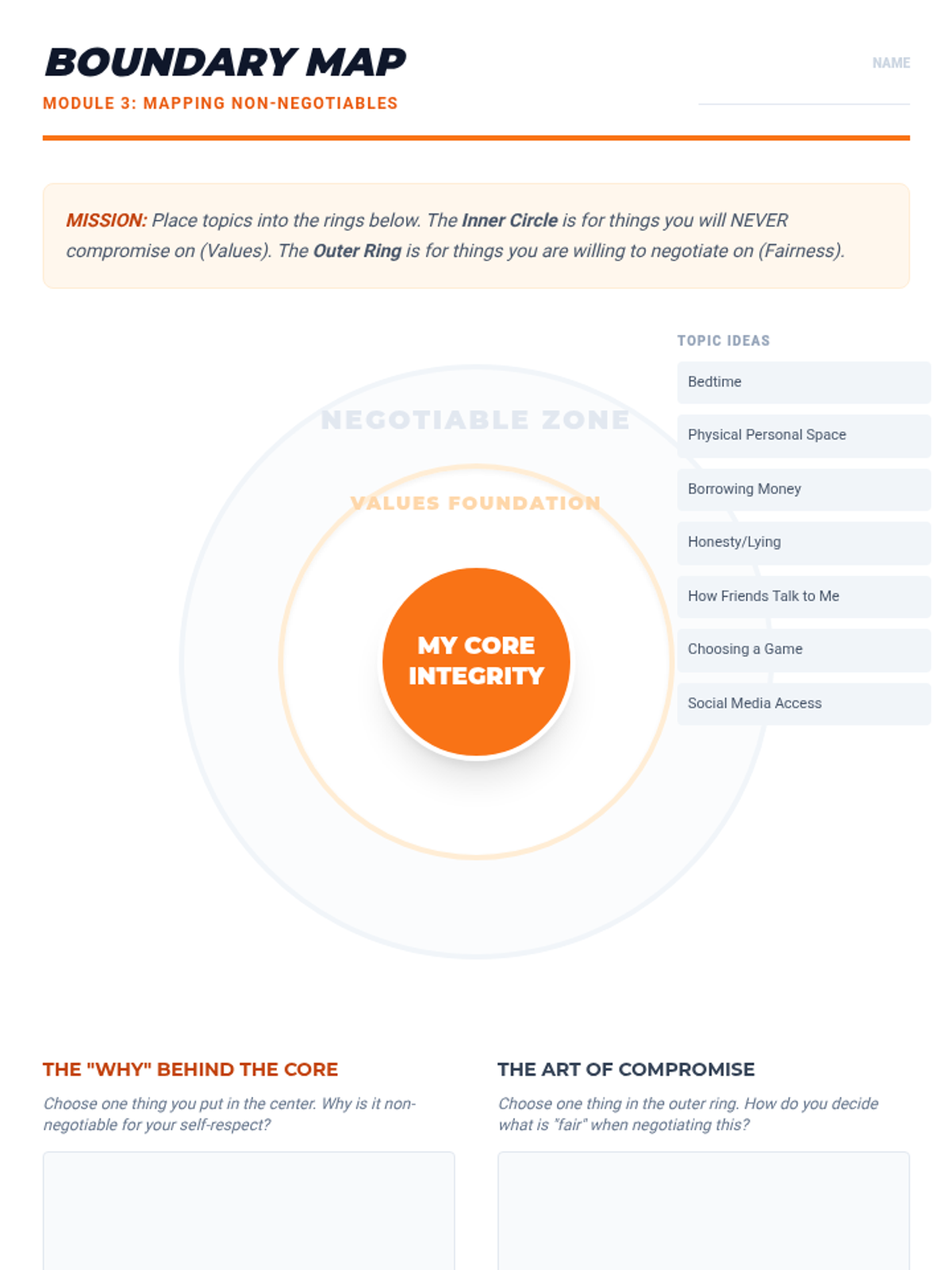
A visual 'Boundary Map' worksheet for students to categorize negotiable vs non-negotiable boundaries as part of the FAST framework.
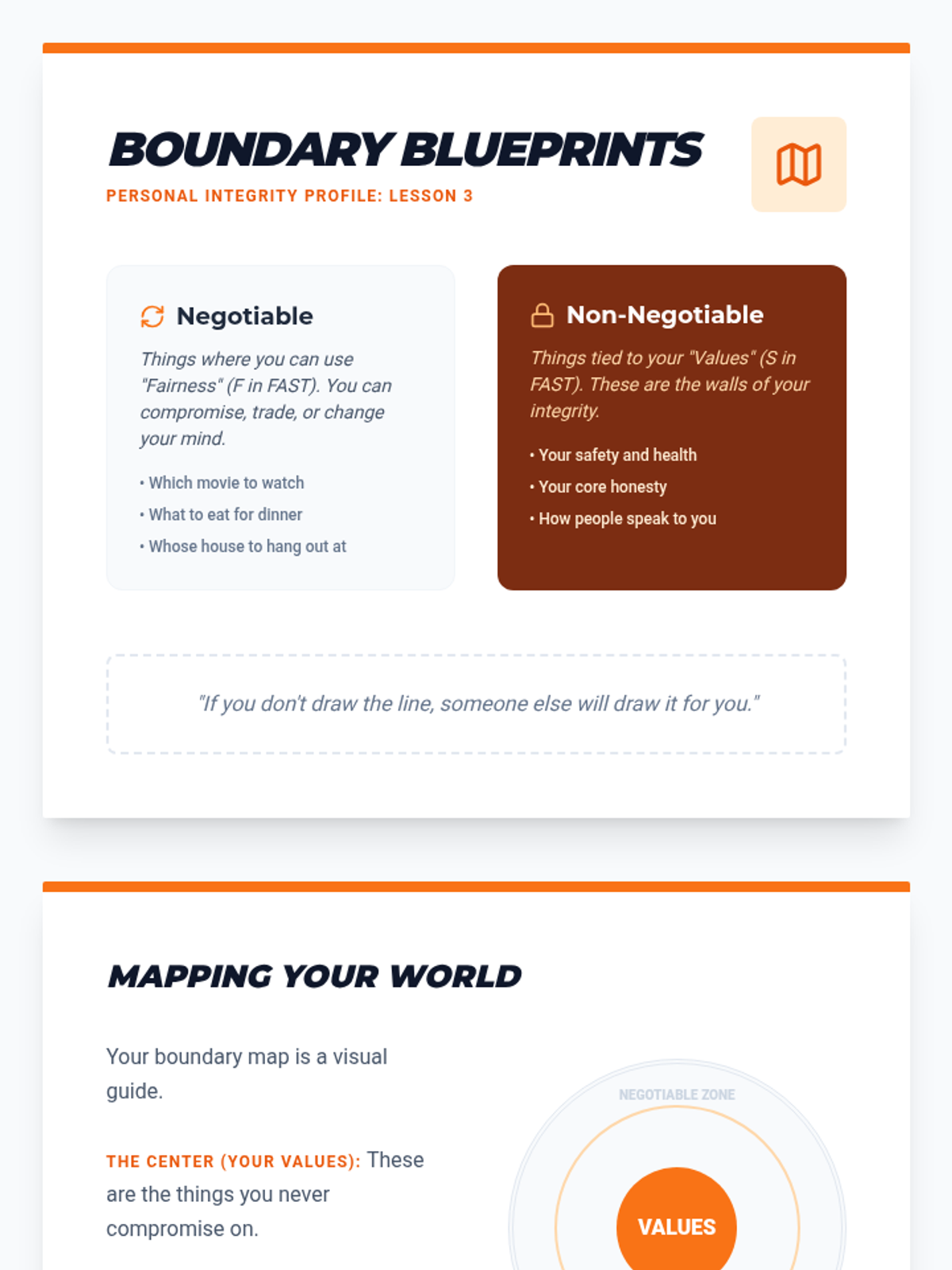
Introductory slides for Lesson 3 defining negotiable vs non-negotiable boundaries using the FAST framework.
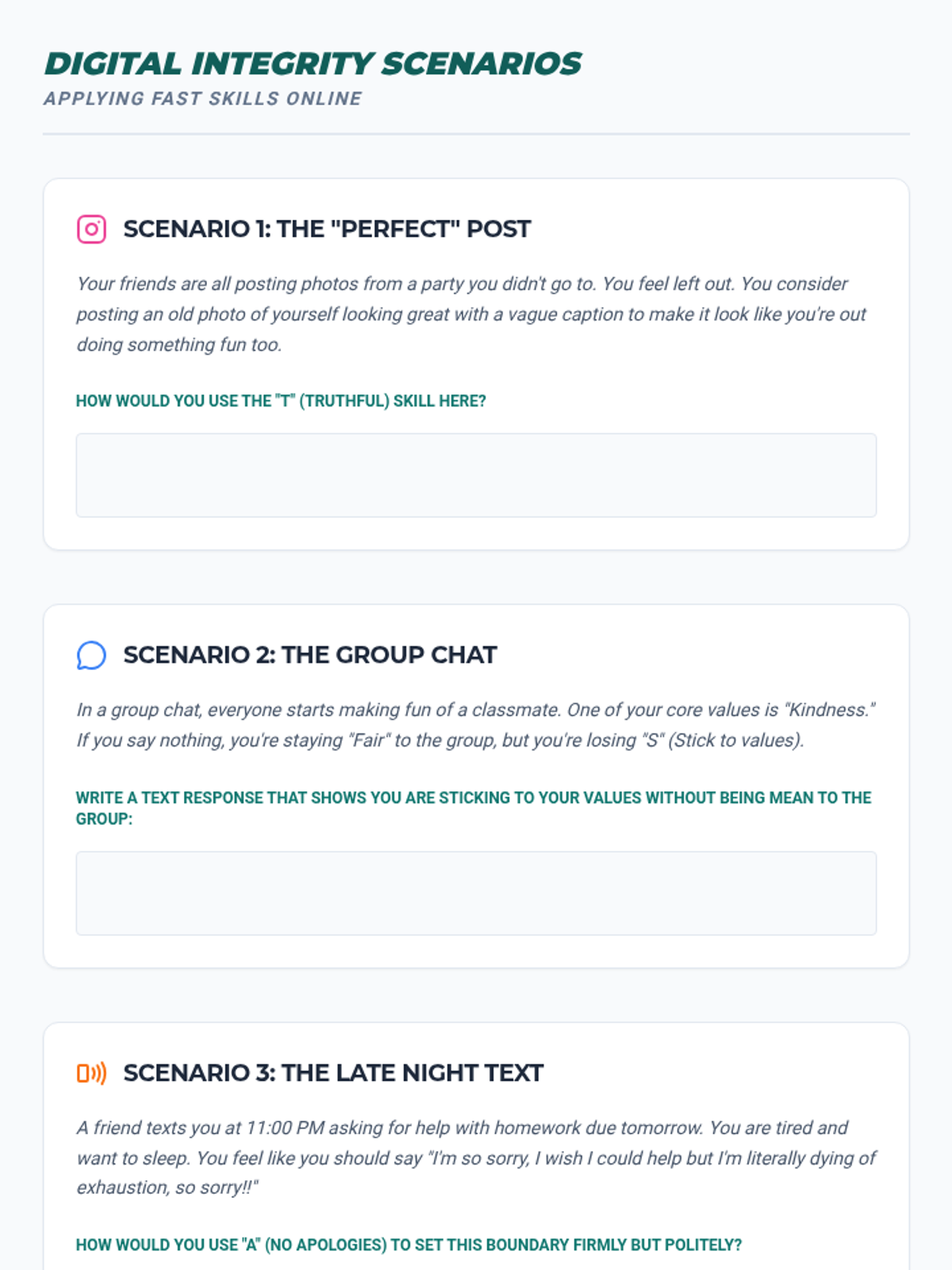
A worksheet featuring three digital communication scenarios for students to apply FAST skills (Truthfulness, Values, and No Apologies).
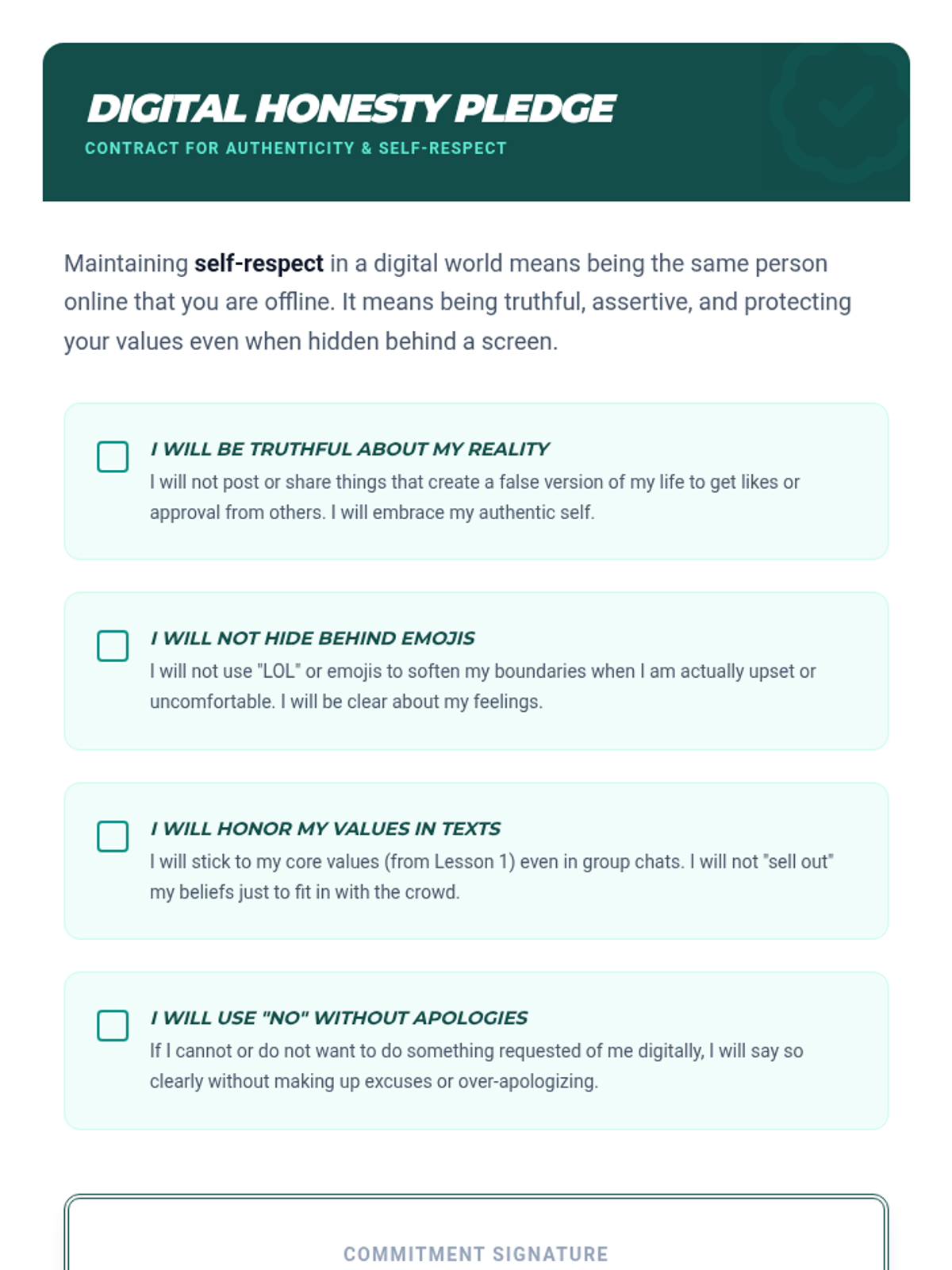
A student pledge for maintaining digital honesty, authenticity, and FAST skills in online communication.
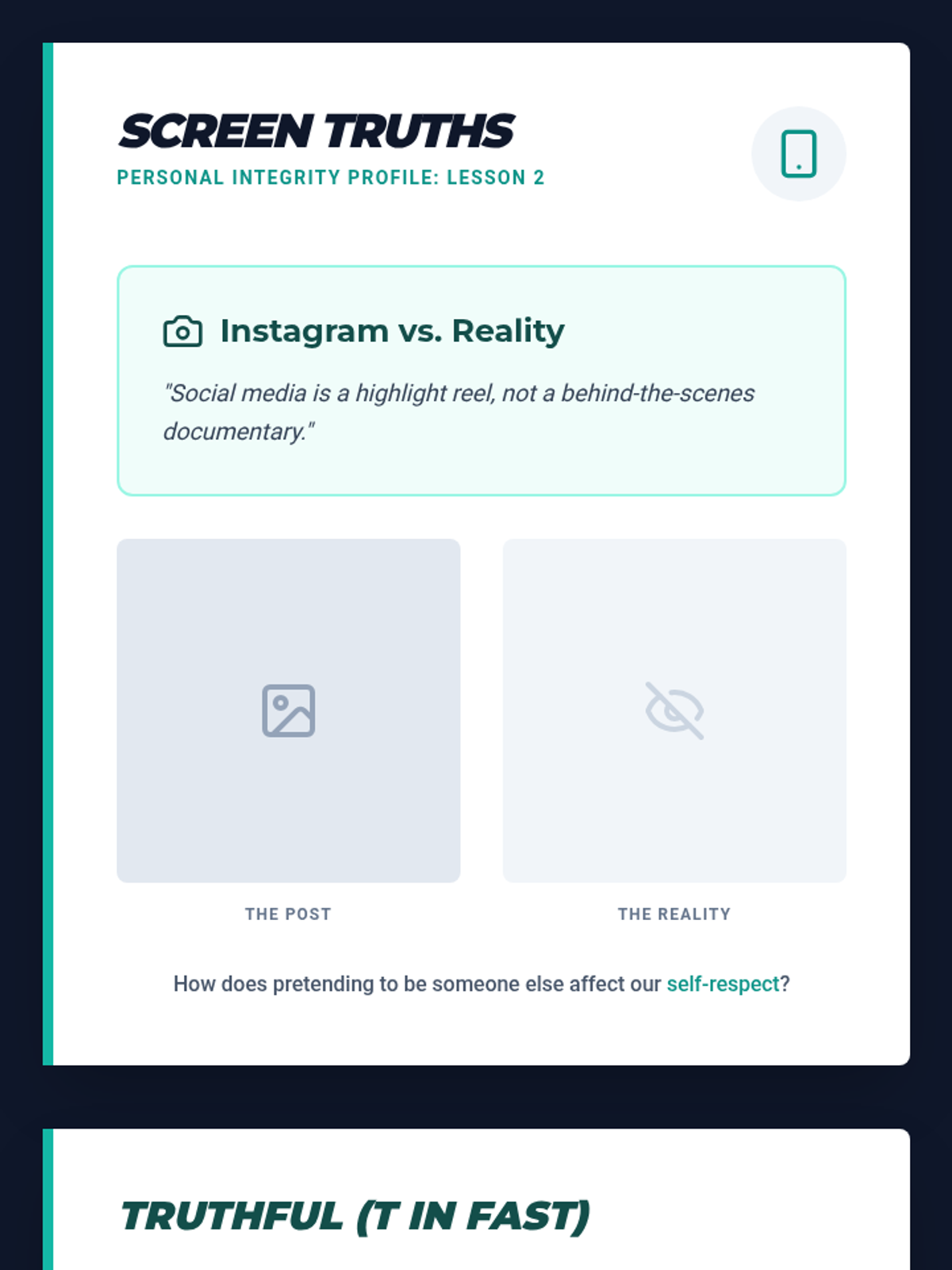
Introductory slides for Lesson 2 exploring digital truthfulness, authenticity, and the "Screen Effect" on personal integrity.
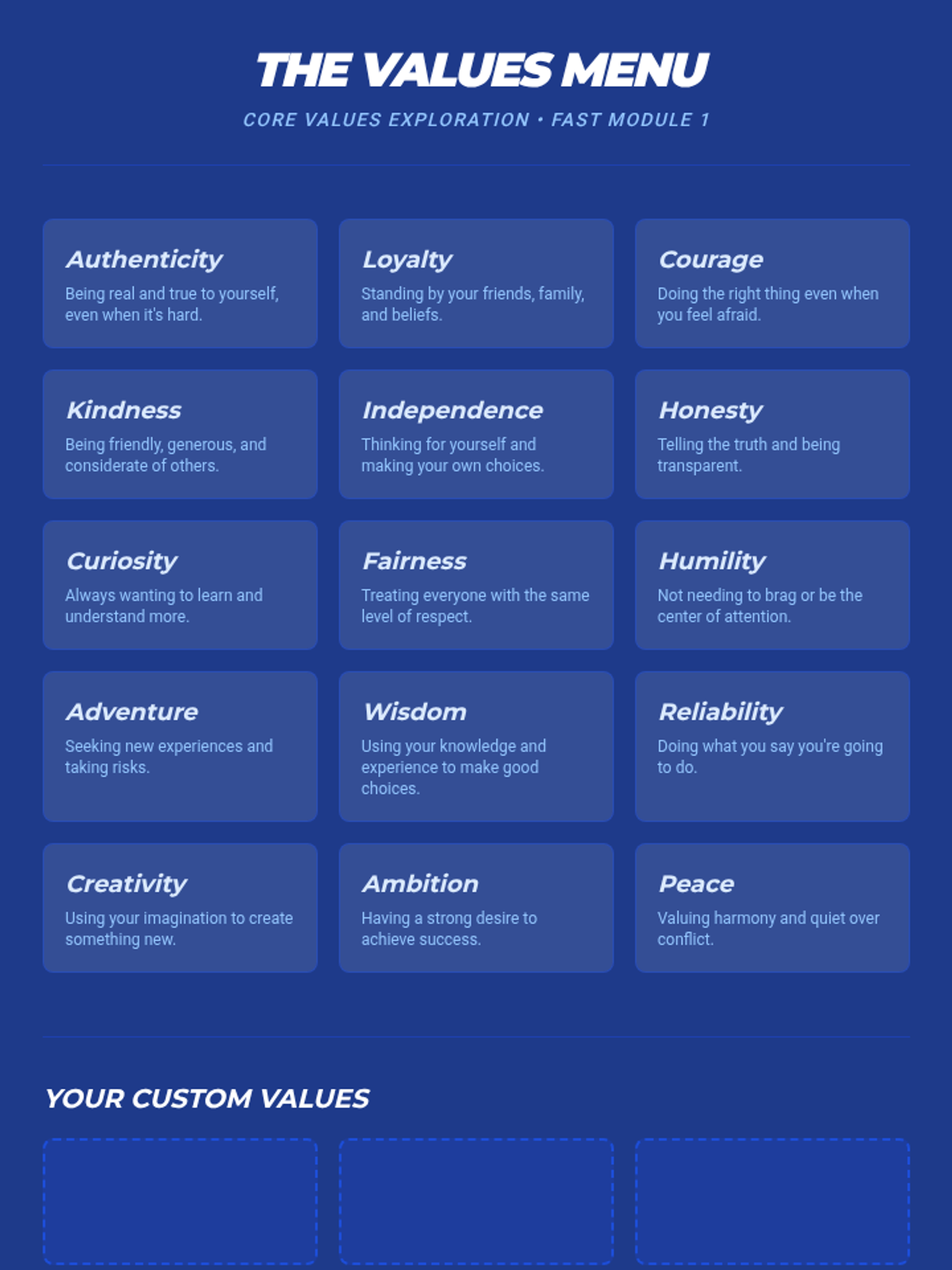
A reference sheet listing core values with simple definitions to help students identify their own non-negotiable values.
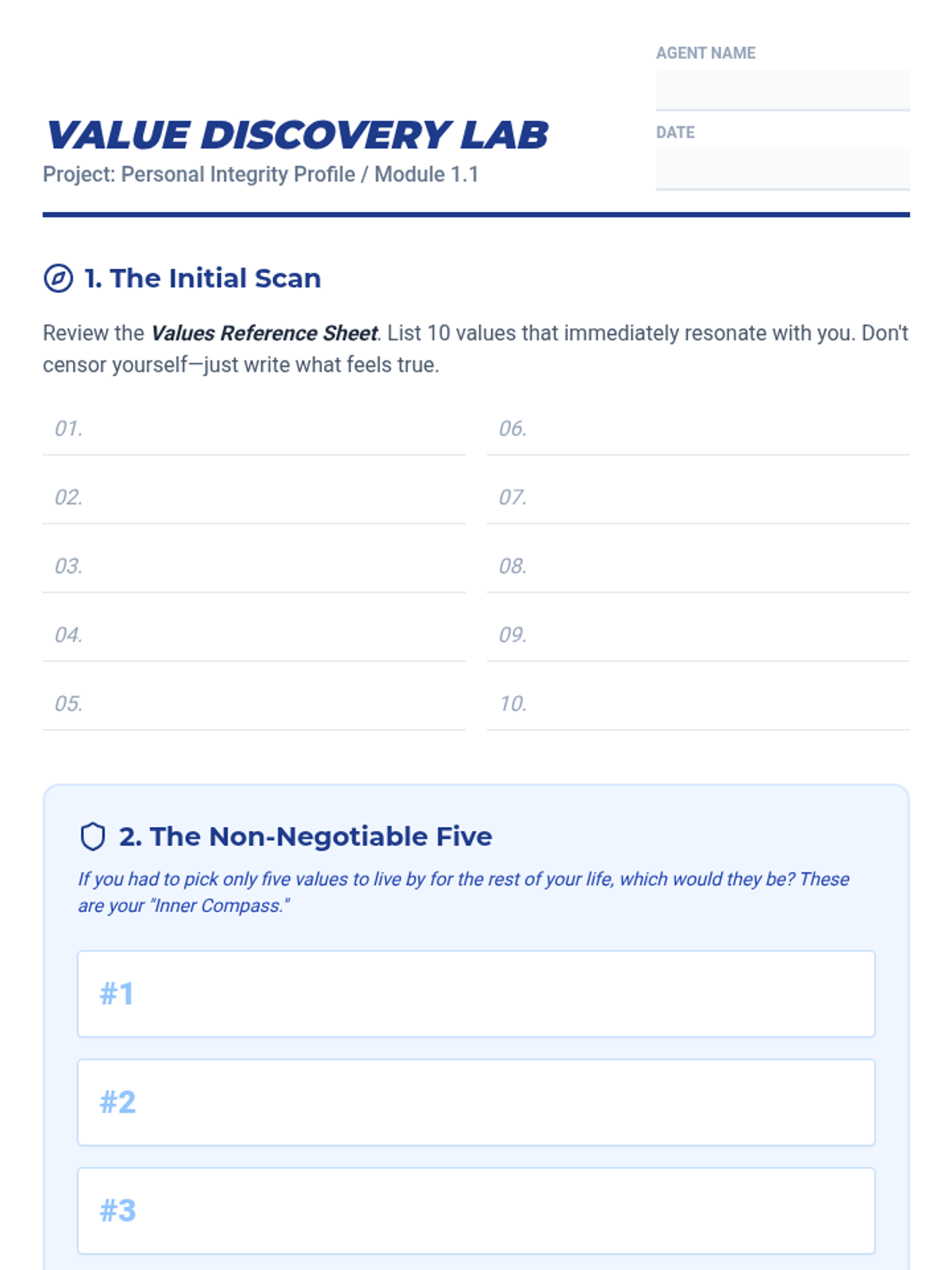
A student worksheet for identifying and narrowing down personal core values as part of the FAST skills framework.
Introductory slides for Lesson 1 defining FAST skills and the concept of personal core values for 6th-grade students.
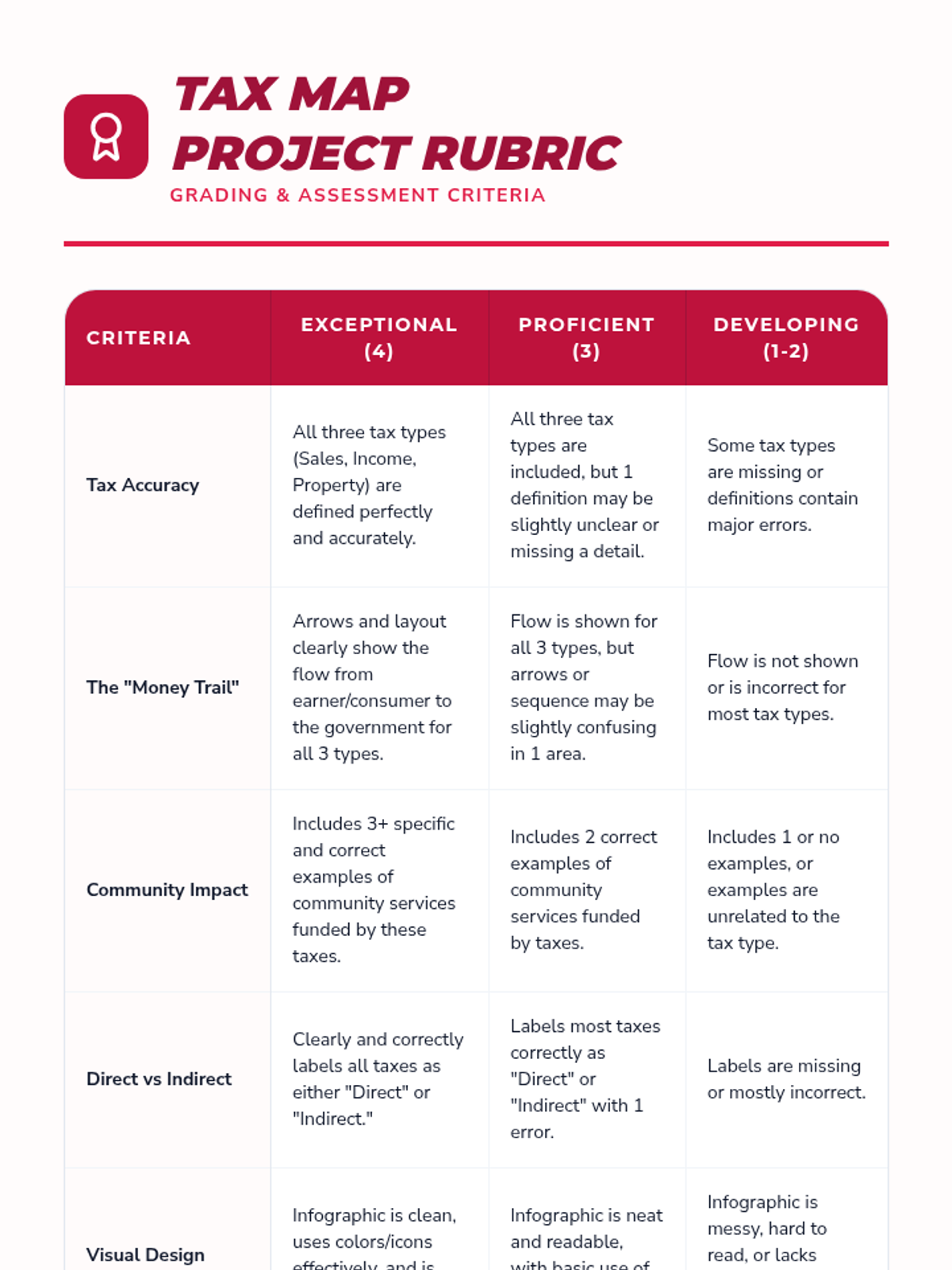
A comprehensive grading rubric for the Tax Map Infographic project, assessing accuracy, visual flow, community impact examples, and design quality.
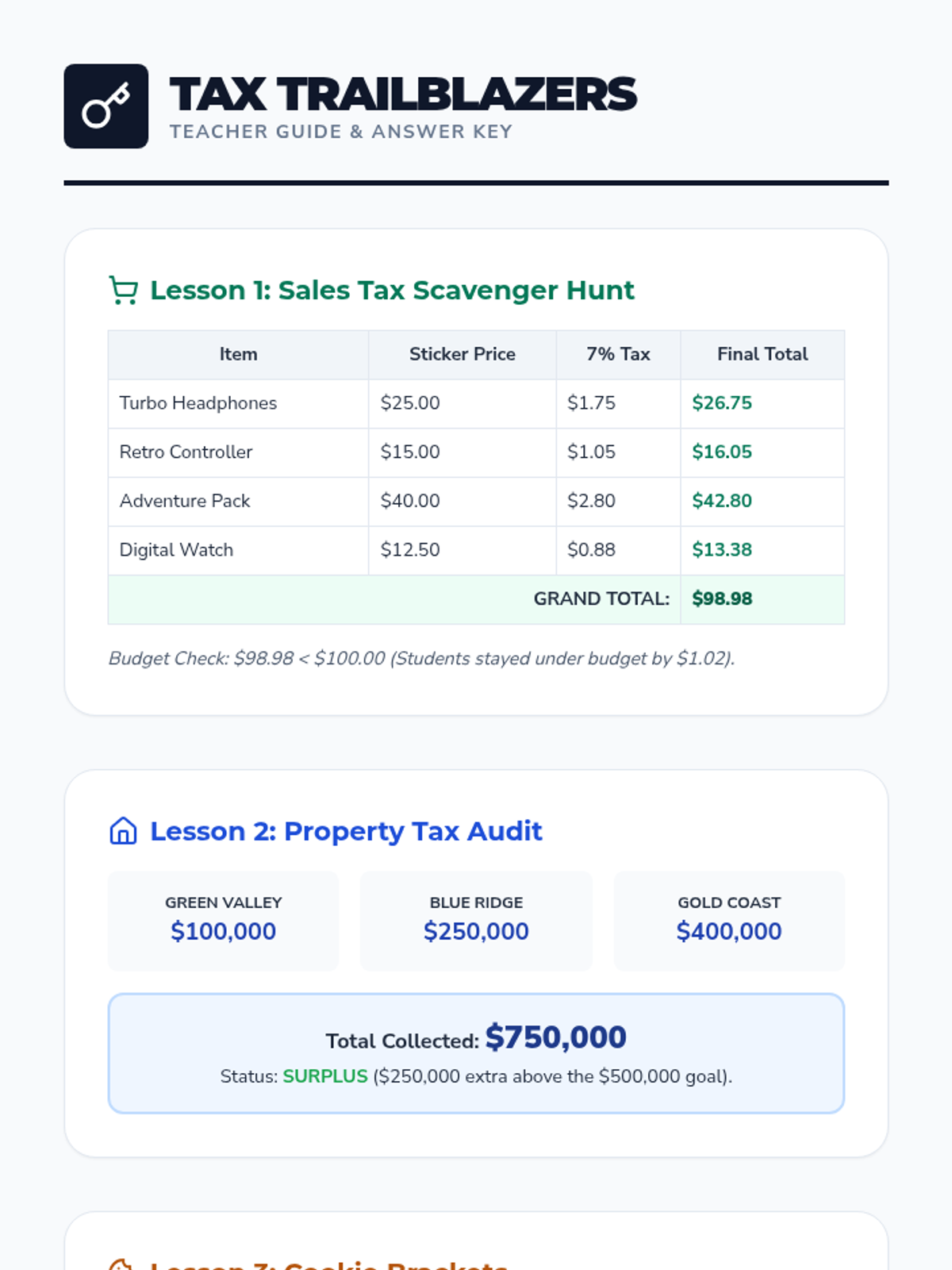
A comprehensive teacher reference document containing all calculation answers for the worksheets in the unit, as well as status check summaries for student scenarios.
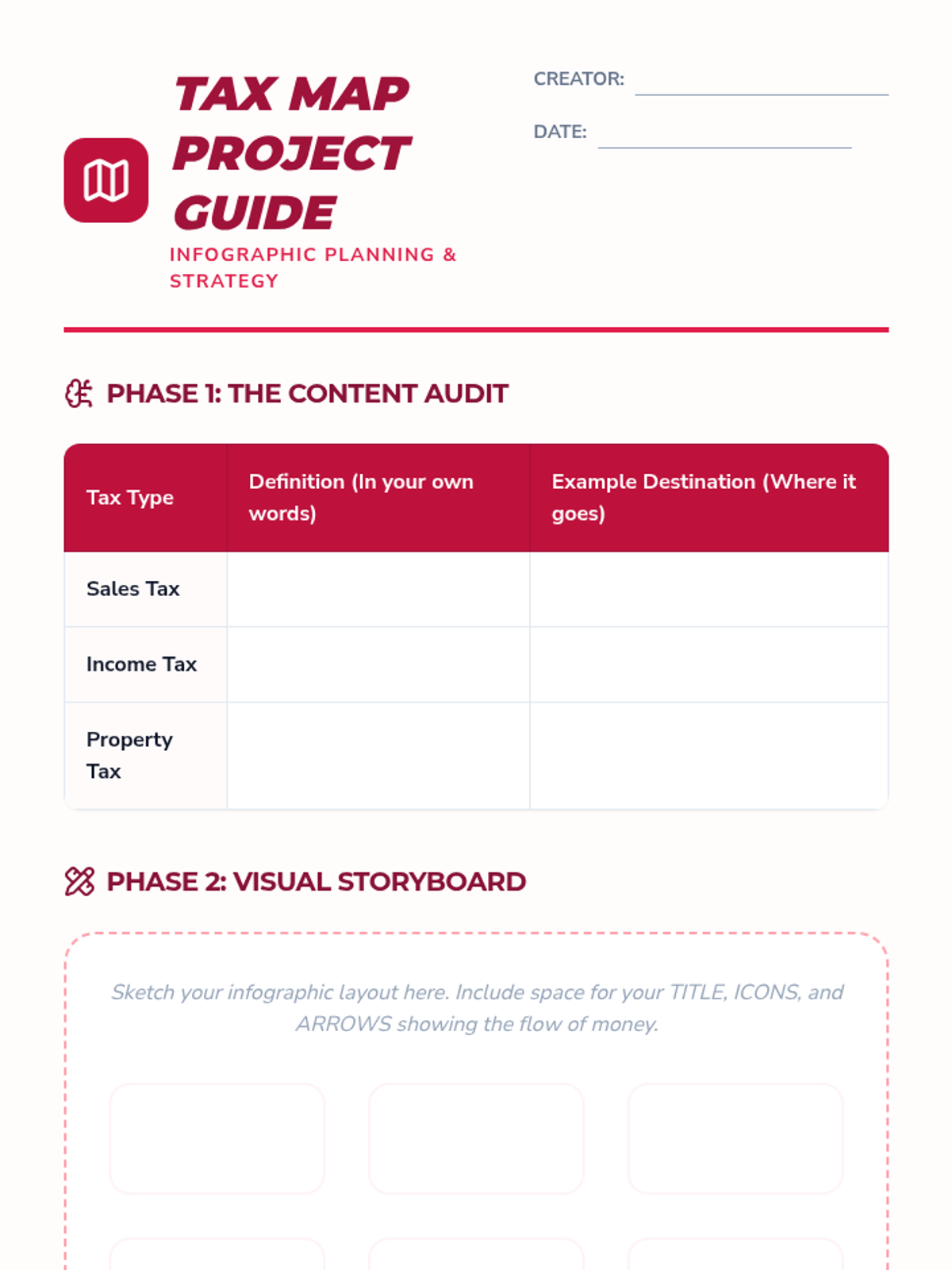
A brainstorming and planning document for students to use when designing their final Tax Map Infographic project. Includes areas for content auditing, sketching, and a final requirement checklist.
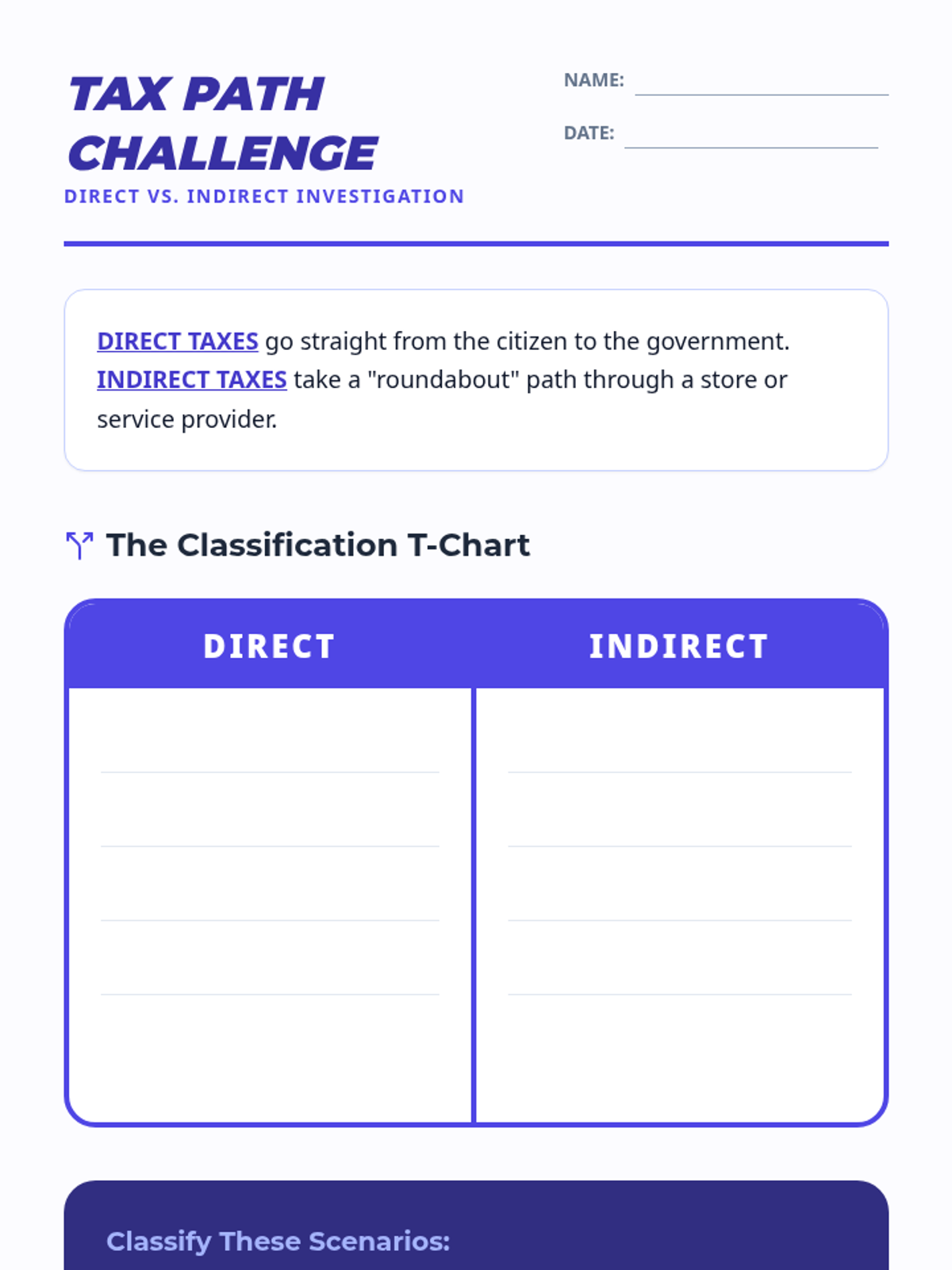
A T-chart activity where students classify various taxes as direct or indirect and analyze the visibility of different tax payment methods.
A visual presentation for Lesson 5 that introduces the Tax Map Infographic project, explains what an infographic is, and outlines the requirements and grading criteria.
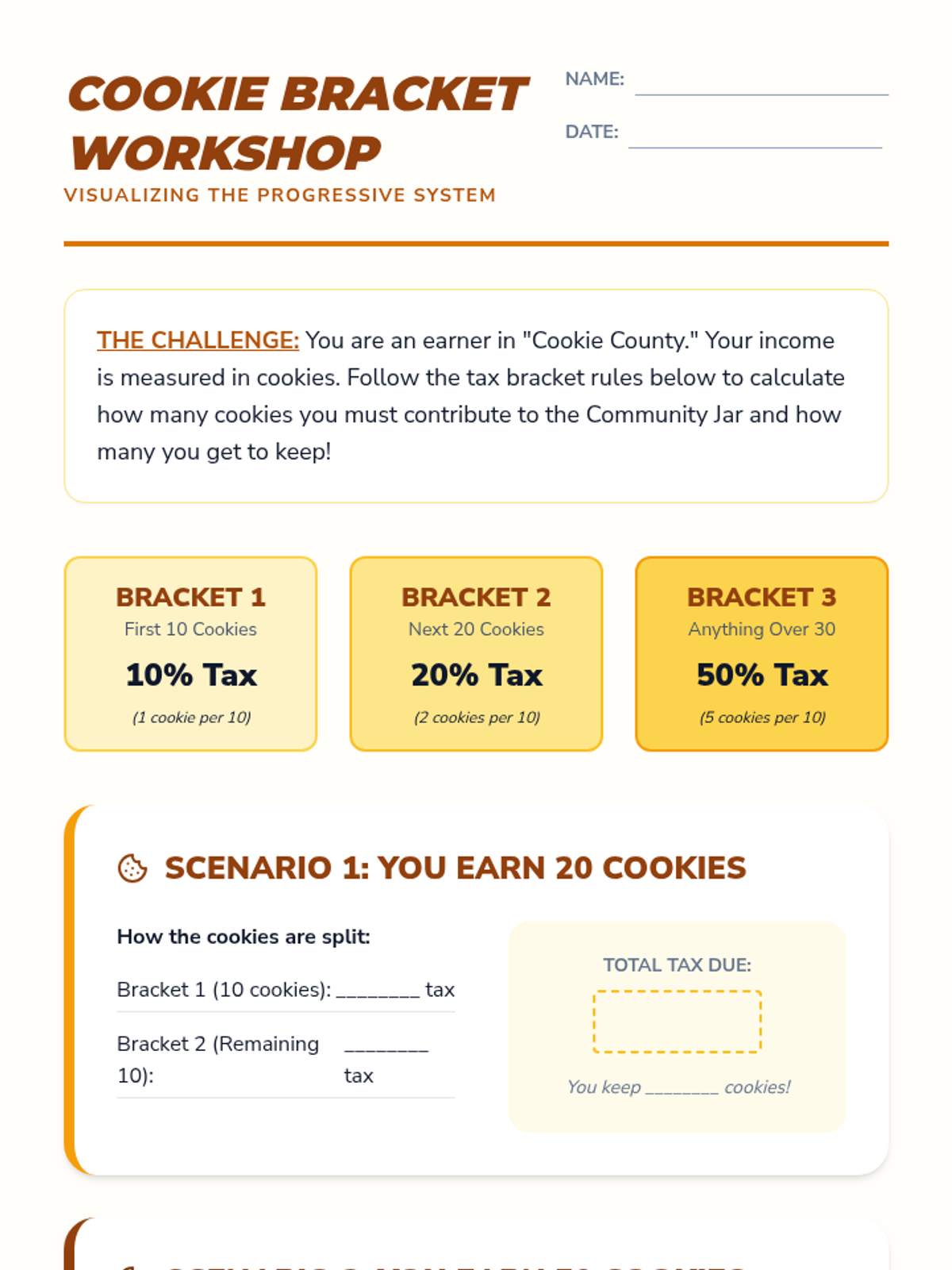
A student activity sheet for Lesson 3 where students calculate tax using cookie-based progressive tax brackets to understand how different income levels are taxed.
A visual presentation for Lesson 4 that explains the difference between direct and indirect taxes using real-world examples like soda tax and income tax.
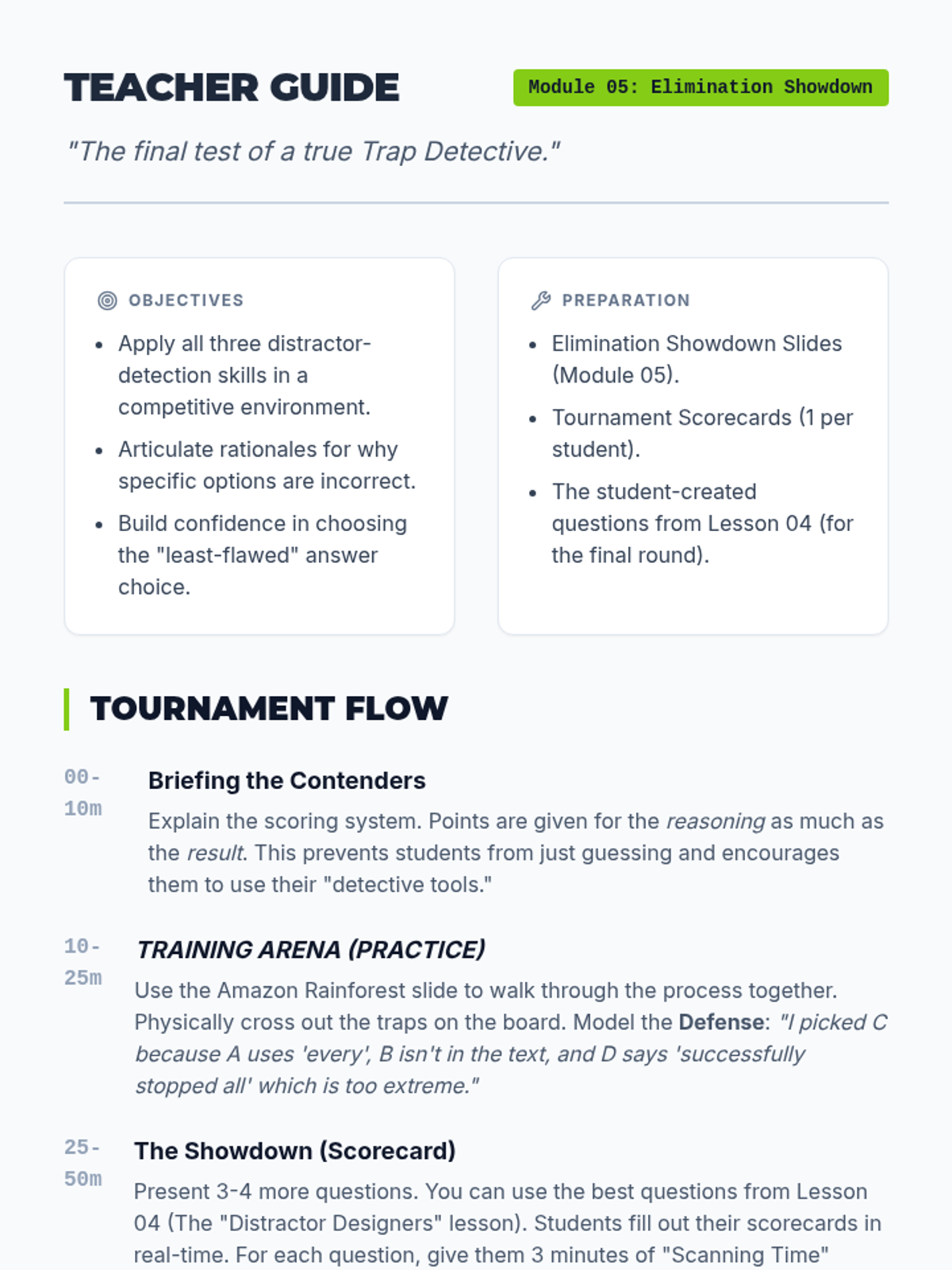
Teacher guide for 'Elimination Showdown'. Includes lesson flow, tournament scoring mechanics, and a detailed analysis of the practice question.
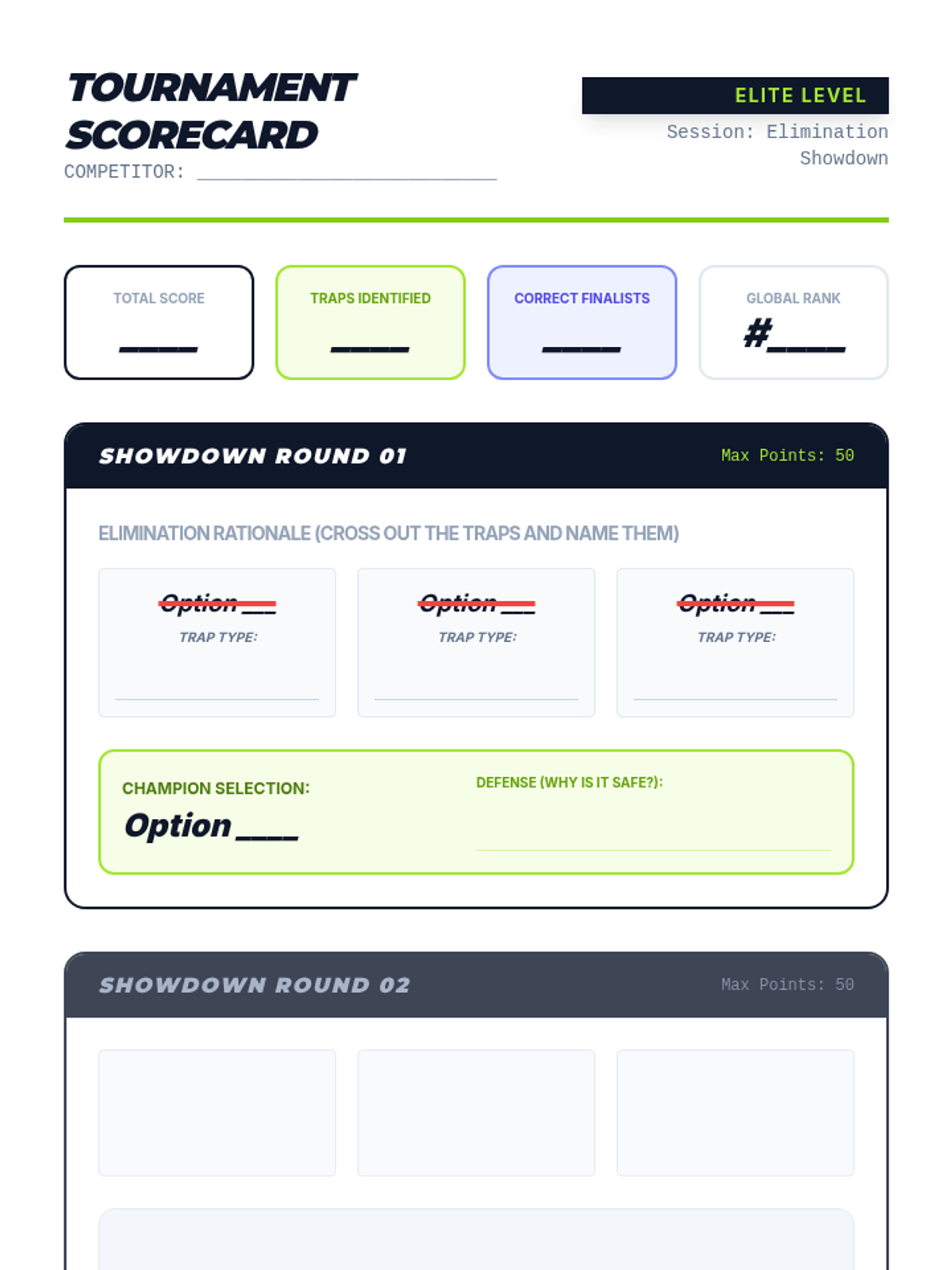
A student tournament scorecard for the final showdown. Features sections for tracking points, identifying trap types for each distractor, and selecting the 'Champion' (correct) answer with a defense.
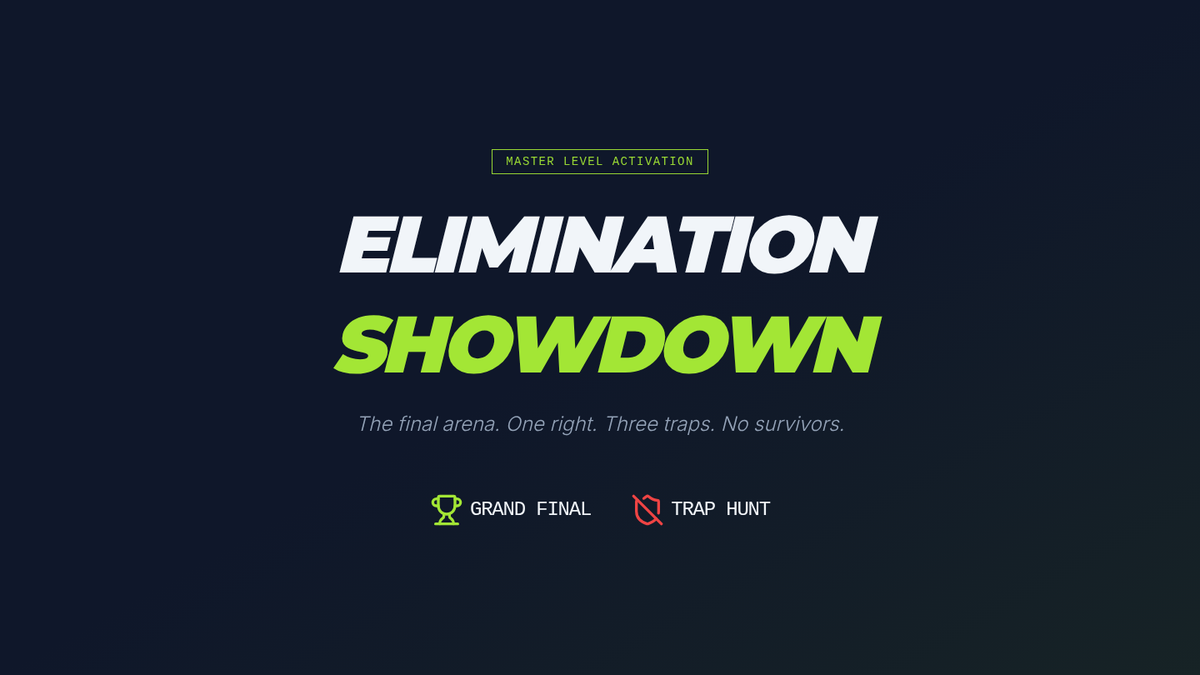
Introductory slides for 'Elimination Showdown'. Features tournament rules and a walk-through of the 'Elimination Showdown' process with a practice question.
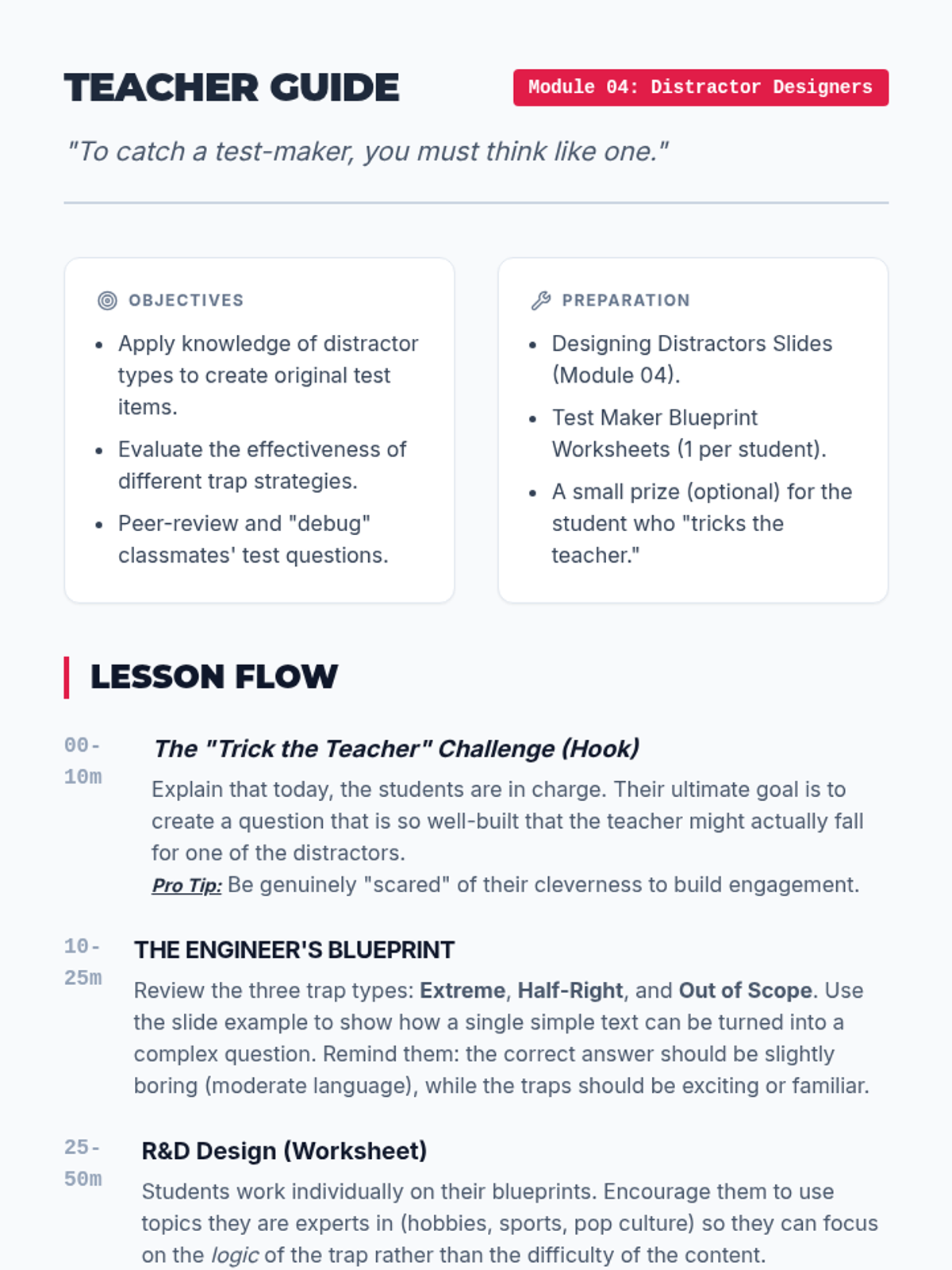
Teacher guide for 'Distractor Designers'. Includes pacing, rubric for the student worksheet, and instructions for the peer-testing phase of the lesson.
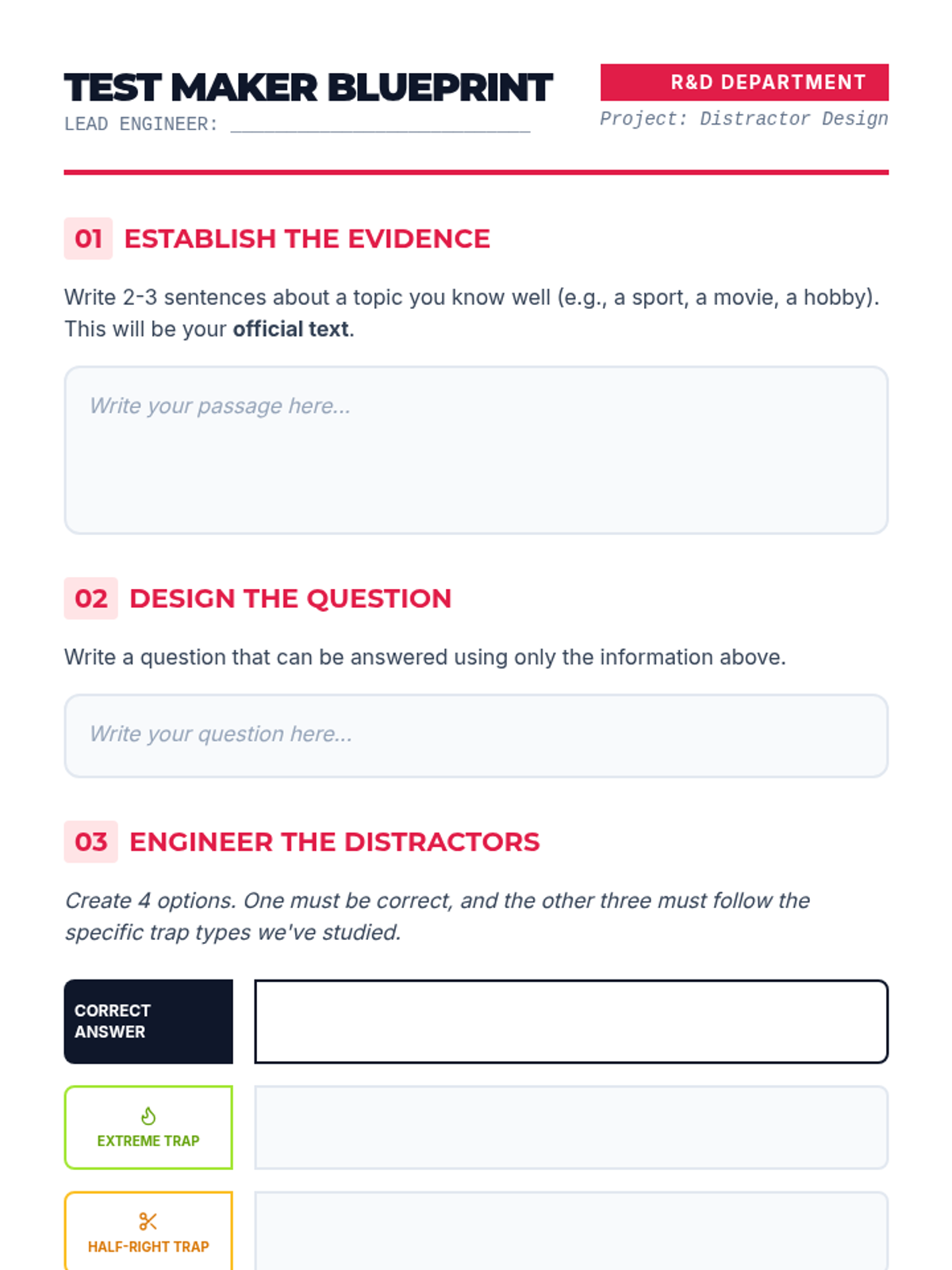
A student design sheet where they create their own multiple-choice question. Students must provide a short text and then engineer four options: one correct answer and three specific distractor types (Extreme, Half-Right, and Out of Scope).
Introductory slides for 'Distractor Designers'. Explains how to create 'Extreme', 'Half-Right', and 'Out of Scope' distractors by thinking like a test-maker.
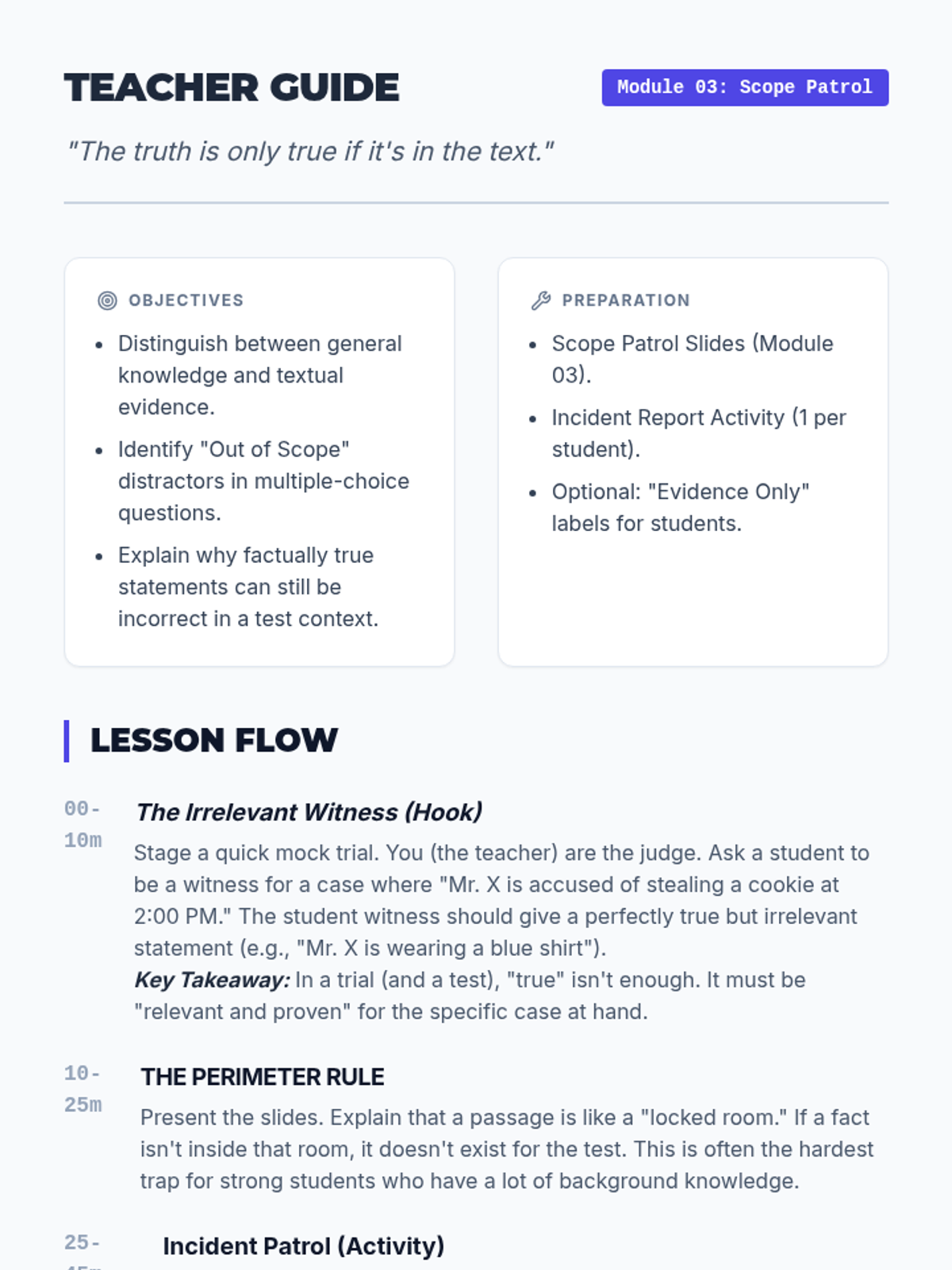
Teacher guide for 'Scope Patrol'. Includes lesson flow, mock trial hook instructions, and a detailed answer key for the Incident Report activity.
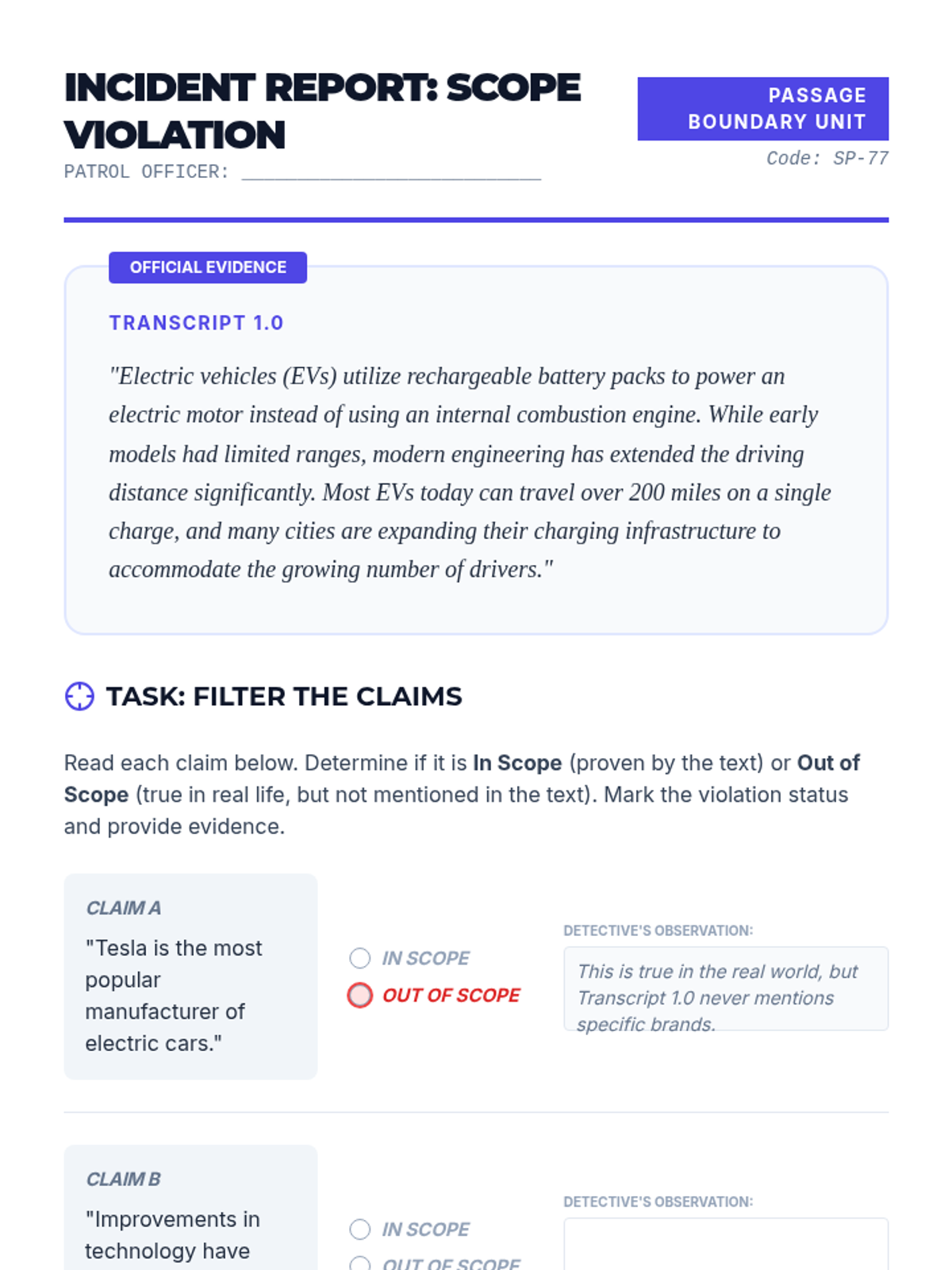
A student activity for identifying out-of-scope distractors. Features an evidence passage and a 'Incident Report' where students categorize claims as 'In Scope' or 'Out of Scope' based on textual evidence.
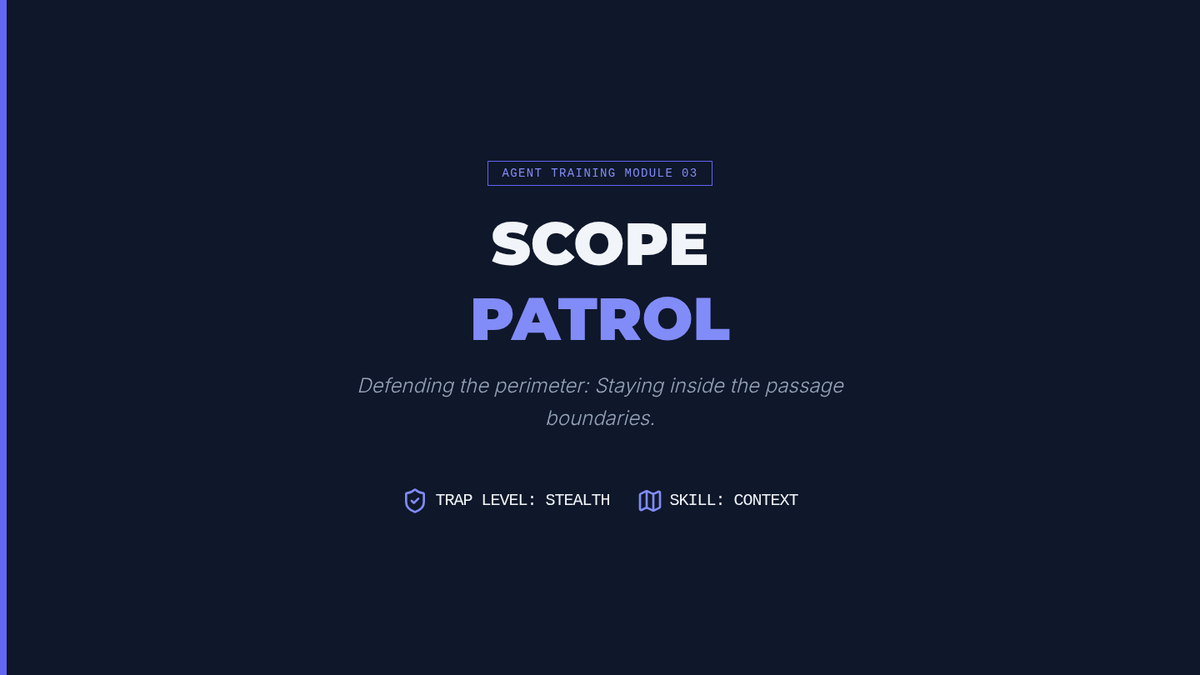
Introductory slides for 'Scope Patrol'. Explains the concept of 'Out of Scope' distractors—statements that are factually true but not supported by the specific text provided.
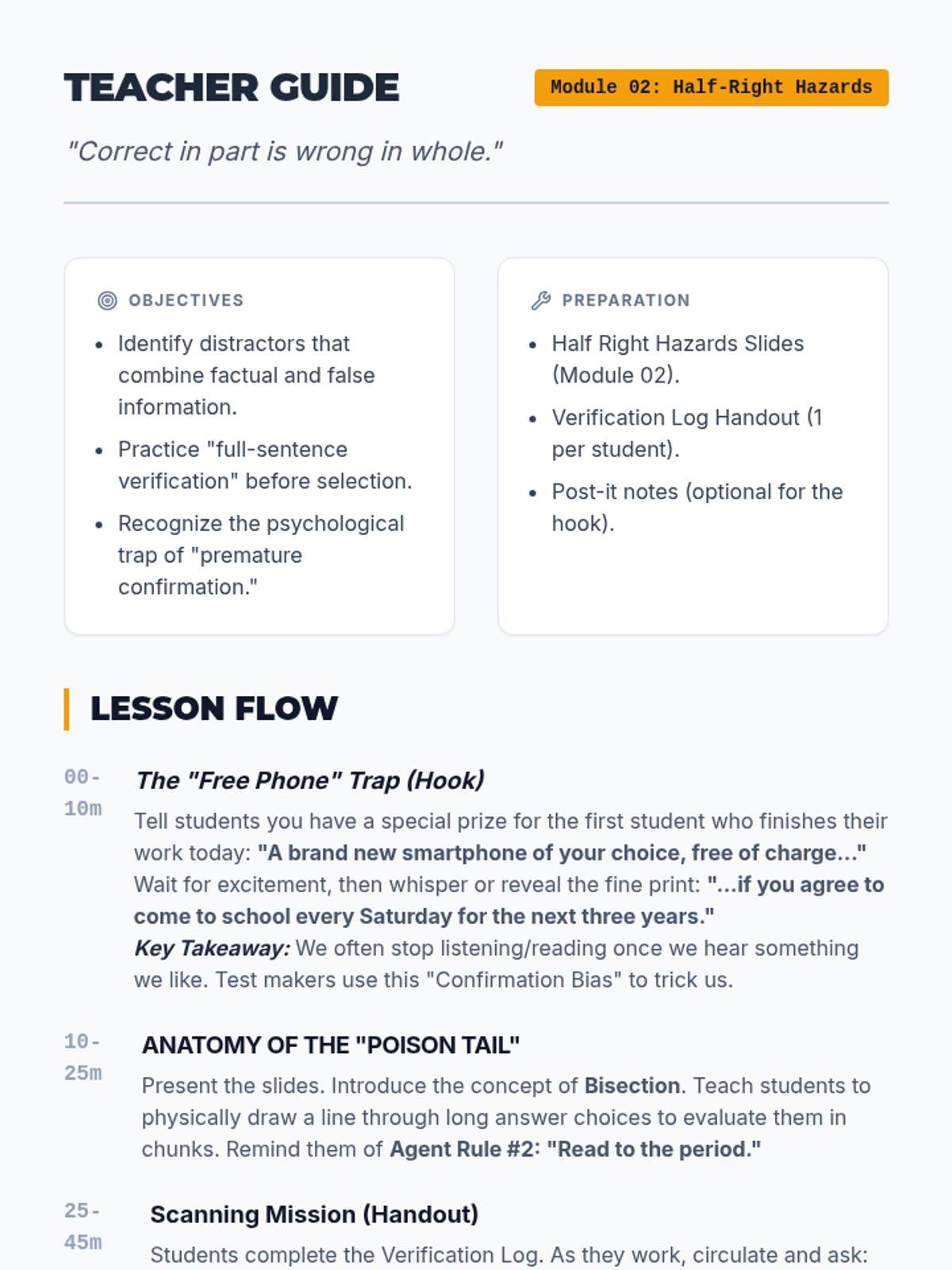
Teacher guide for 'Half Right Hazards'. Includes hook instructions (the 'Free Phone' offer), pacing guide, and detailed answer key for the Verification Log handout.
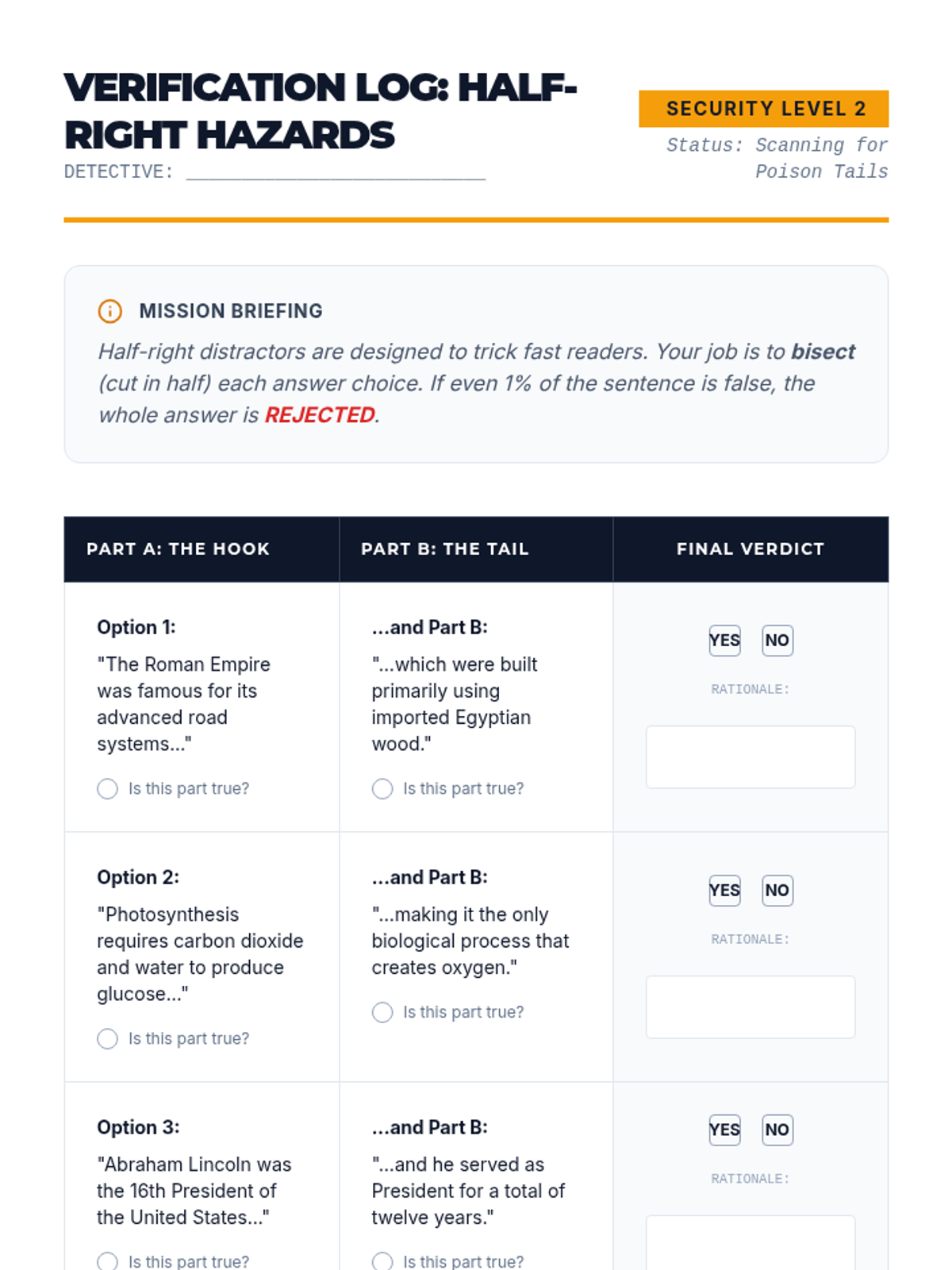
A student worksheet for identifying half-right distractors. Features a 'Verification Log' table where students dissect answer choices into two parts and evaluate the accuracy of each half.
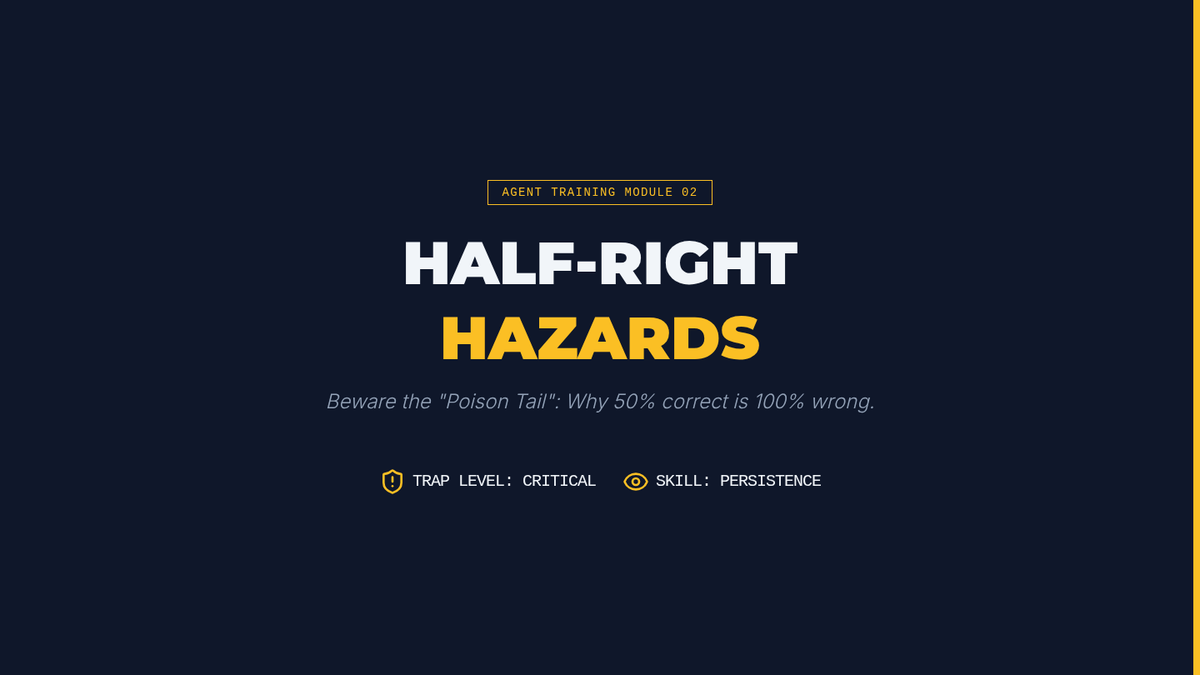
Introductory slides for 'Half Right Hazards'. Explains the 'Poison Tail' concept—where an answer choice begins correctly but ends with a false detail—and emphasizes reading to the end.
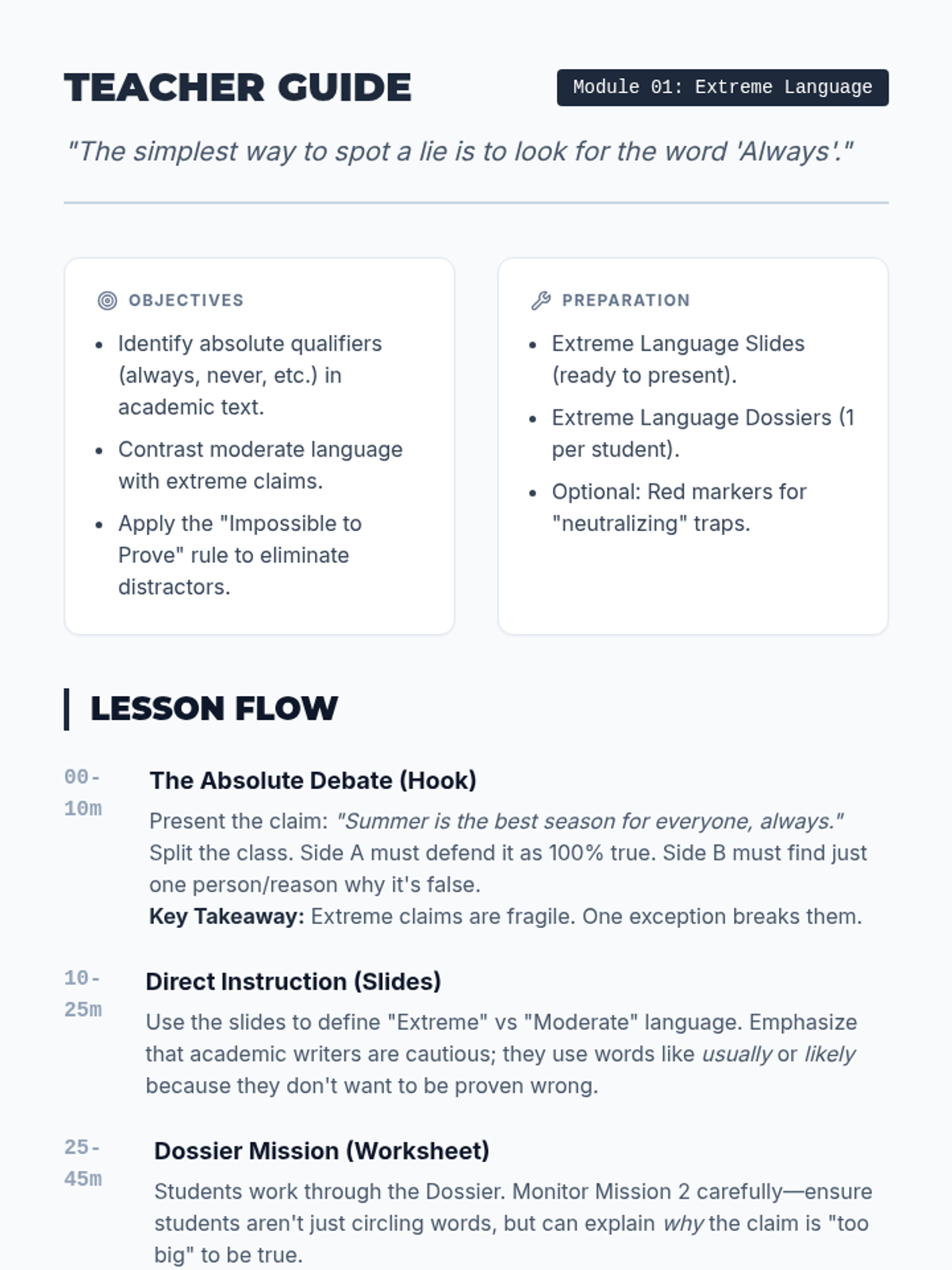
A comprehensive teacher guide for the 'Extreme Language Lab' lesson. Includes lesson objectives, a detailed pacing guide, hook instructions, and a full answer key for the student worksheet.
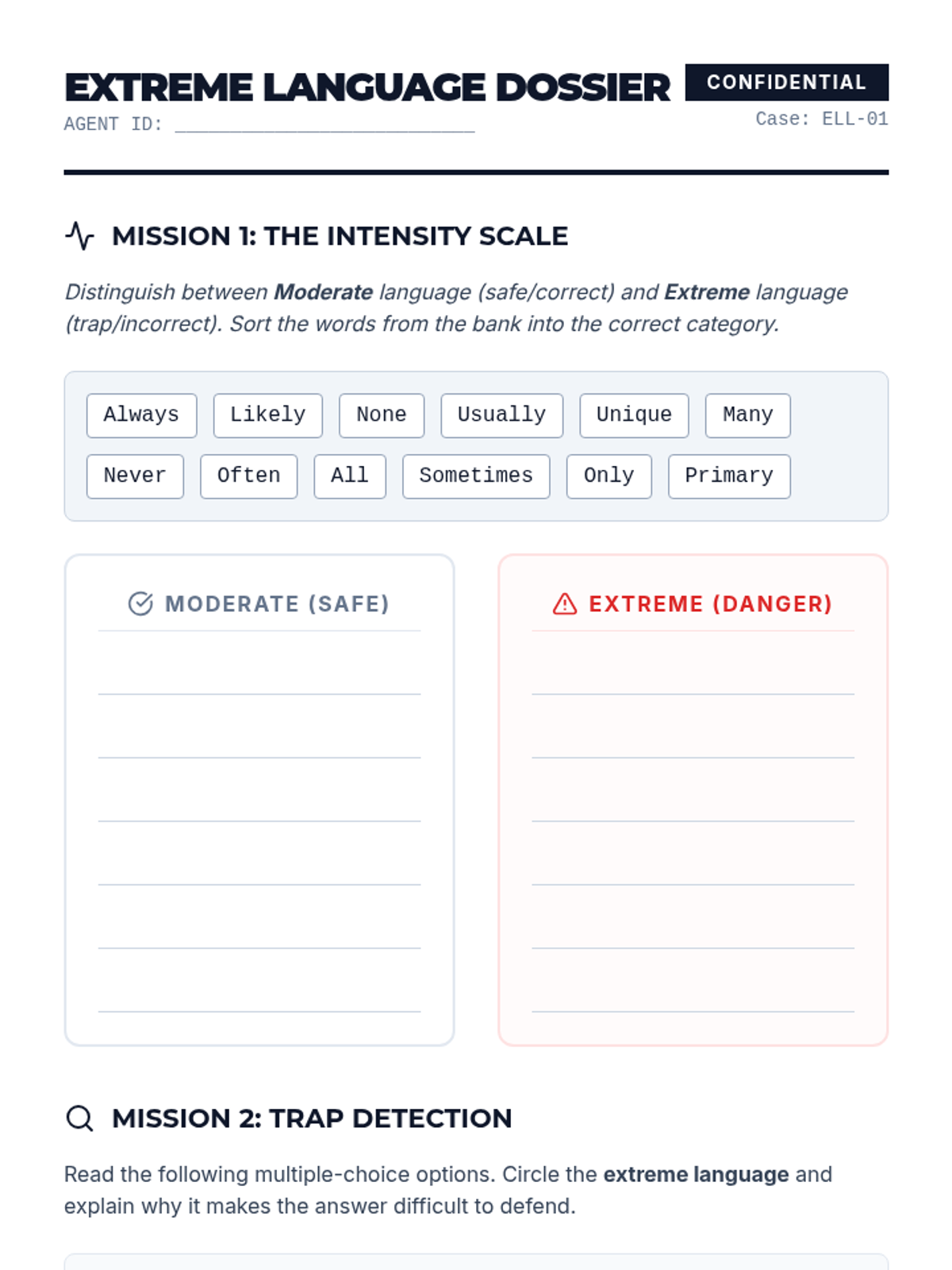
A student worksheet for identifying and neutralizing extreme language traps. Includes word sorting, rationalization exercises, and claim revision.
Introductory slides for the 'Extreme Language Lab' lesson, featuring the TSA/Trap Detector Academy theme. Covers the difference between absolute and moderate language in test questions.
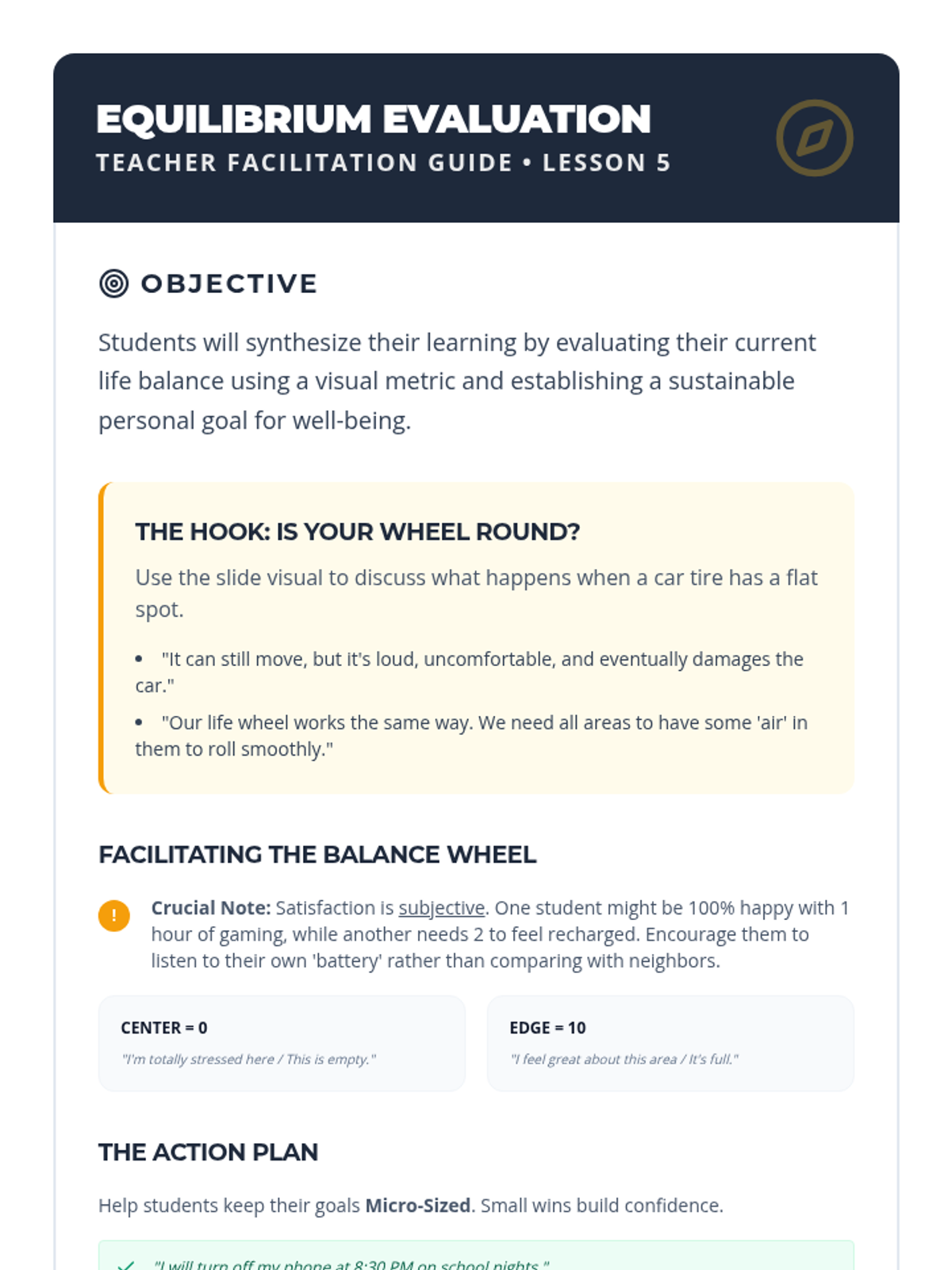
Teacher guide for Lesson 5, providing instructions for the 'Balance Wheel' workshop and strategies for effective goal-setting and student accountability.
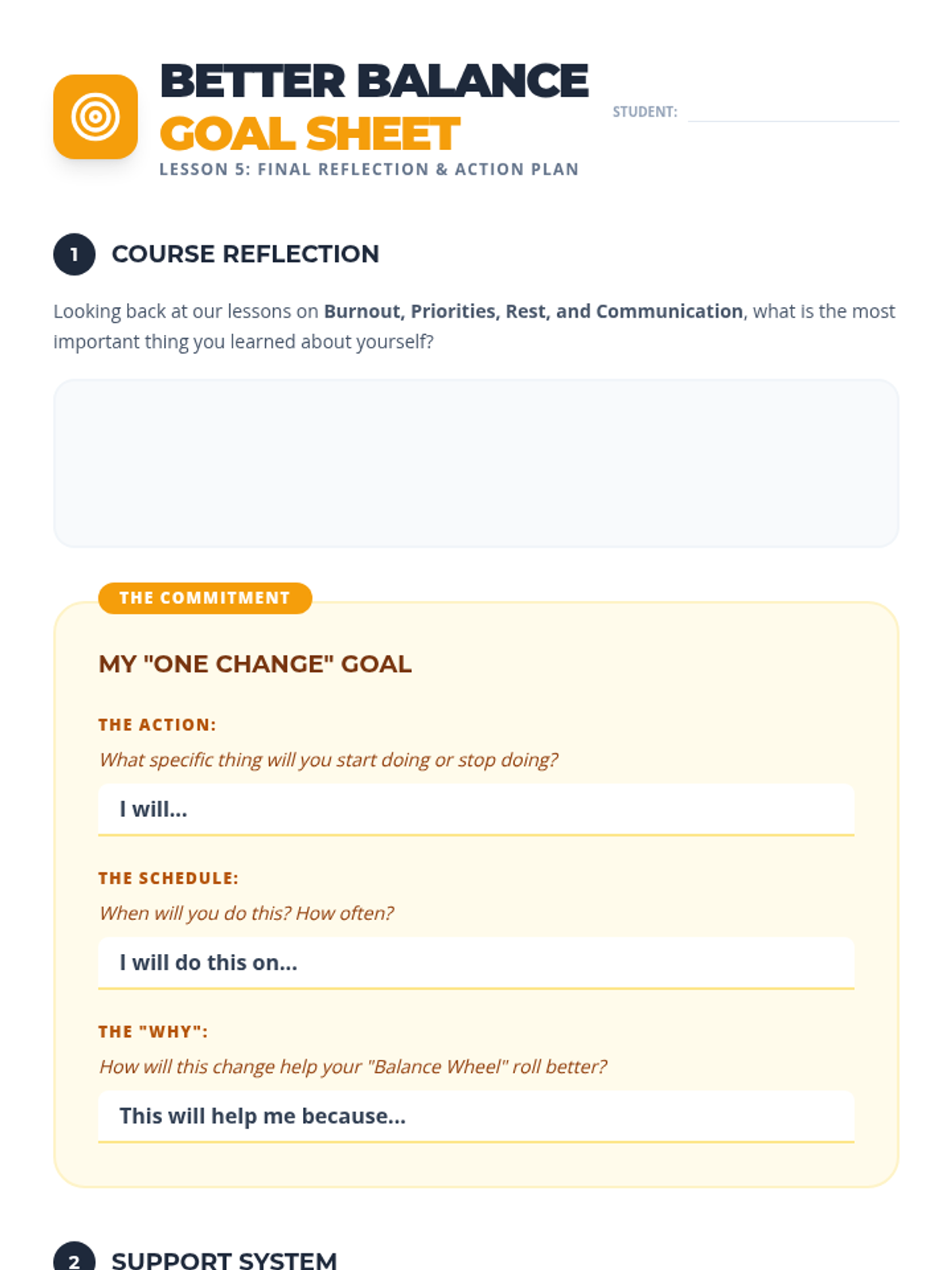
Goal setting and reflection sheet for Lesson 5, where students commit to a specific change to improve their life balance.
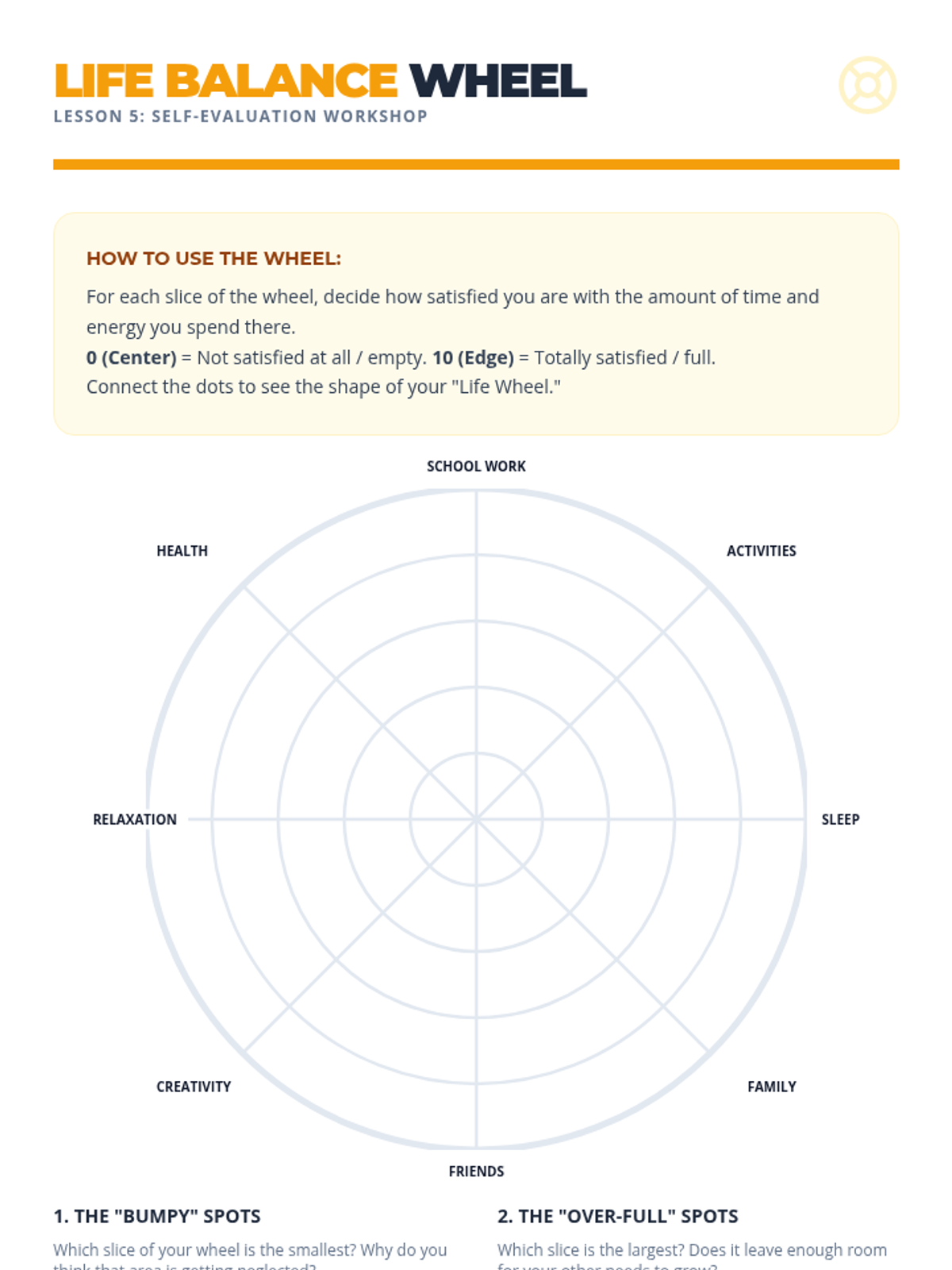
Visual reflection worksheet for Lesson 5, allowing students to map their current life balance across eight key areas.
Final slide deck for Lesson 5, introducing the 'Balance Wheel' concept and guiding students through personal reflection and goal setting.
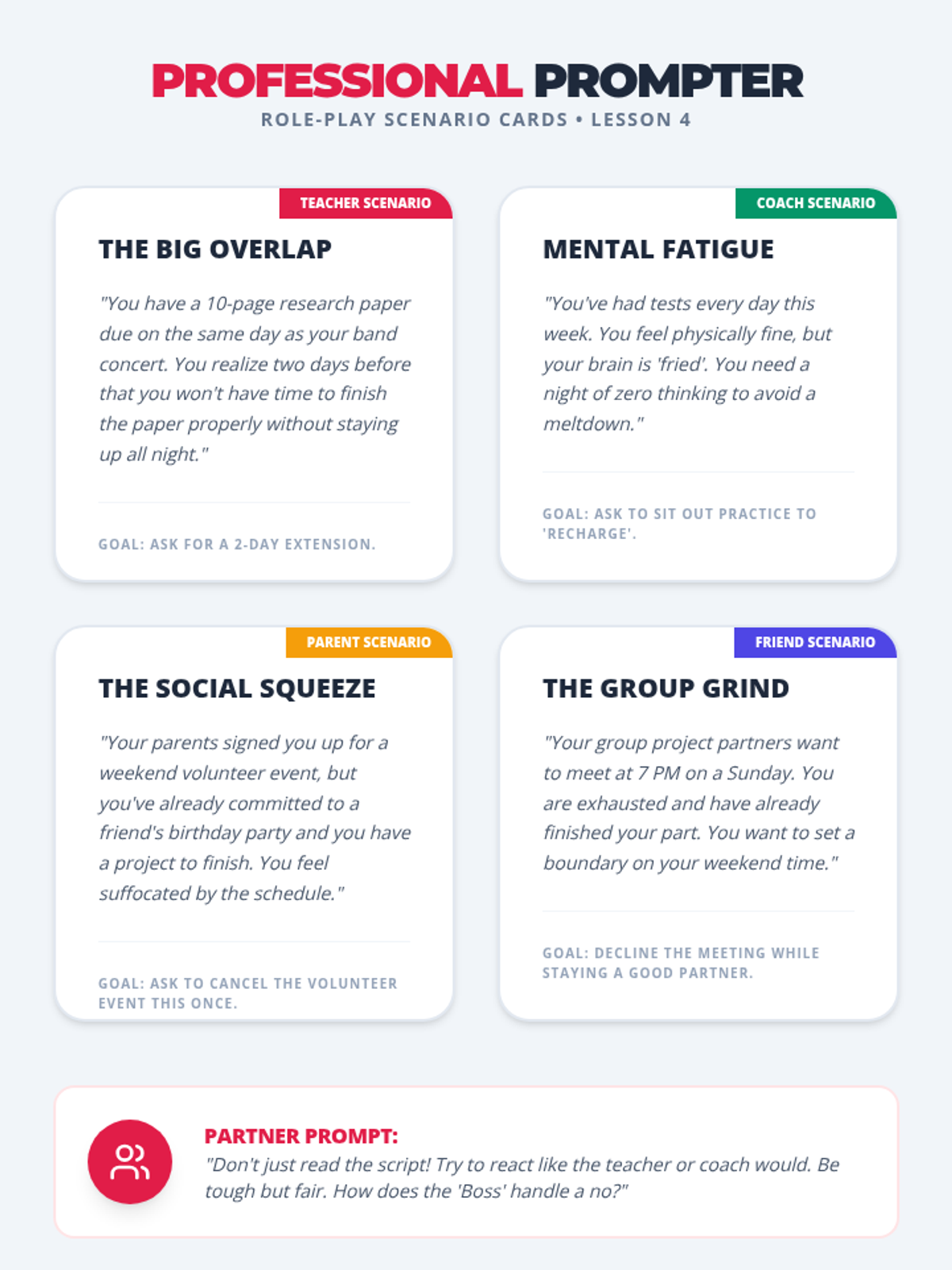
Role-play scenario cards for Lesson 4, providing students with specific situations to practice their communication and boundary-setting skills.
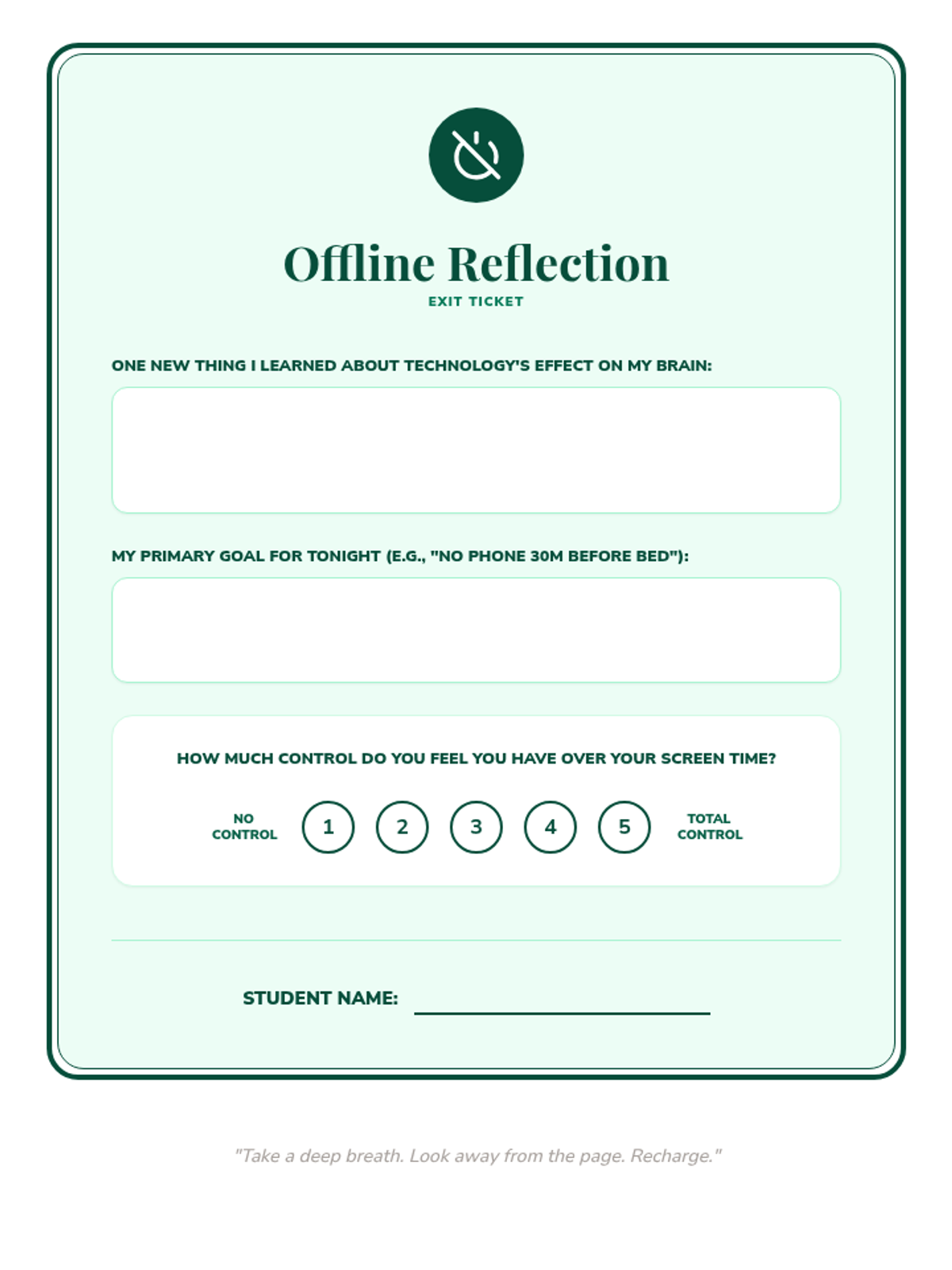
A post-lesson reflection tool for students to articulate their learning and state an immediate goal for their digital habits.
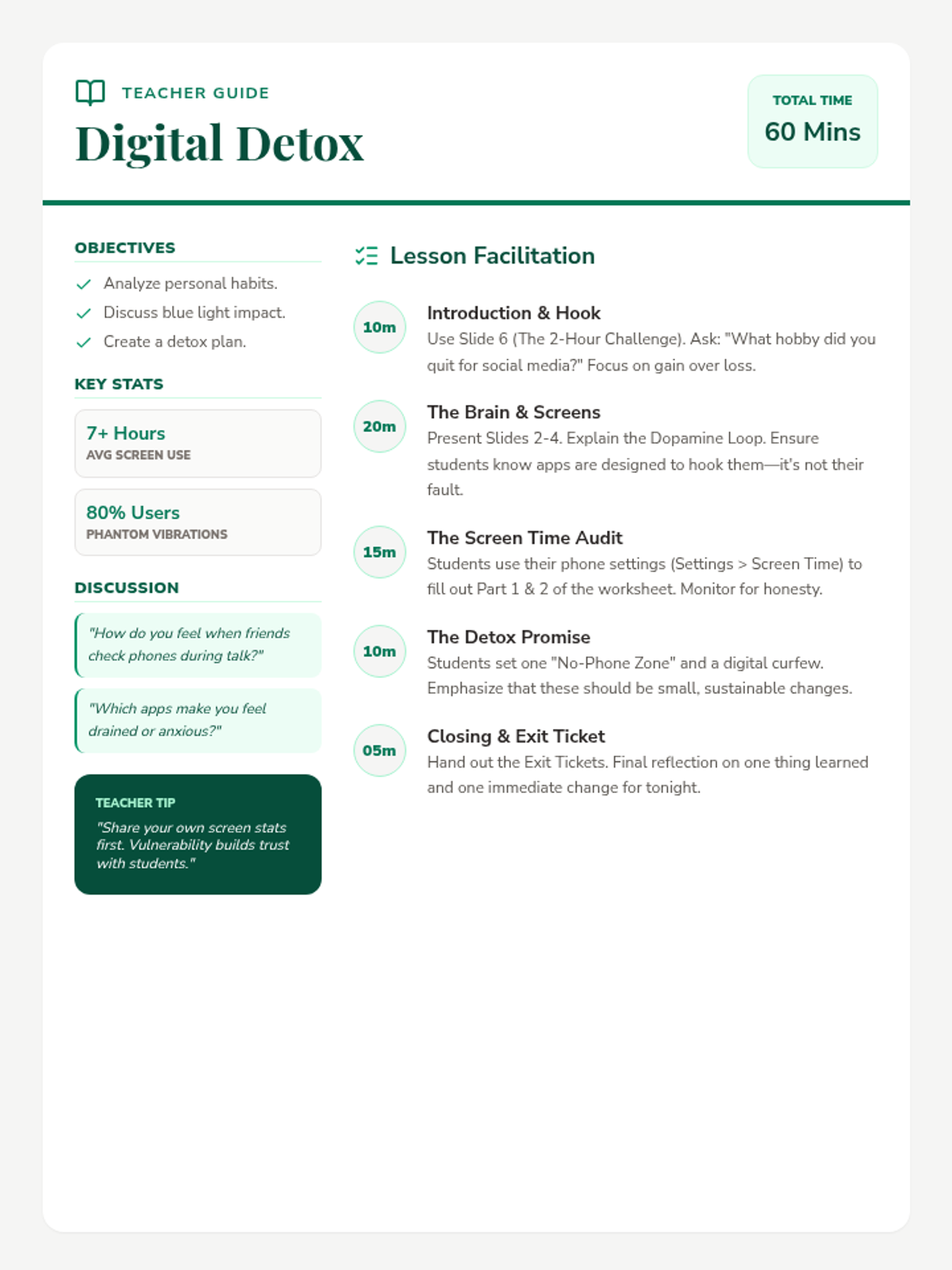
A comprehensive guide for teachers to facilitate the Digital Detox lesson, including pacing, background statistics, and discussion prompts.
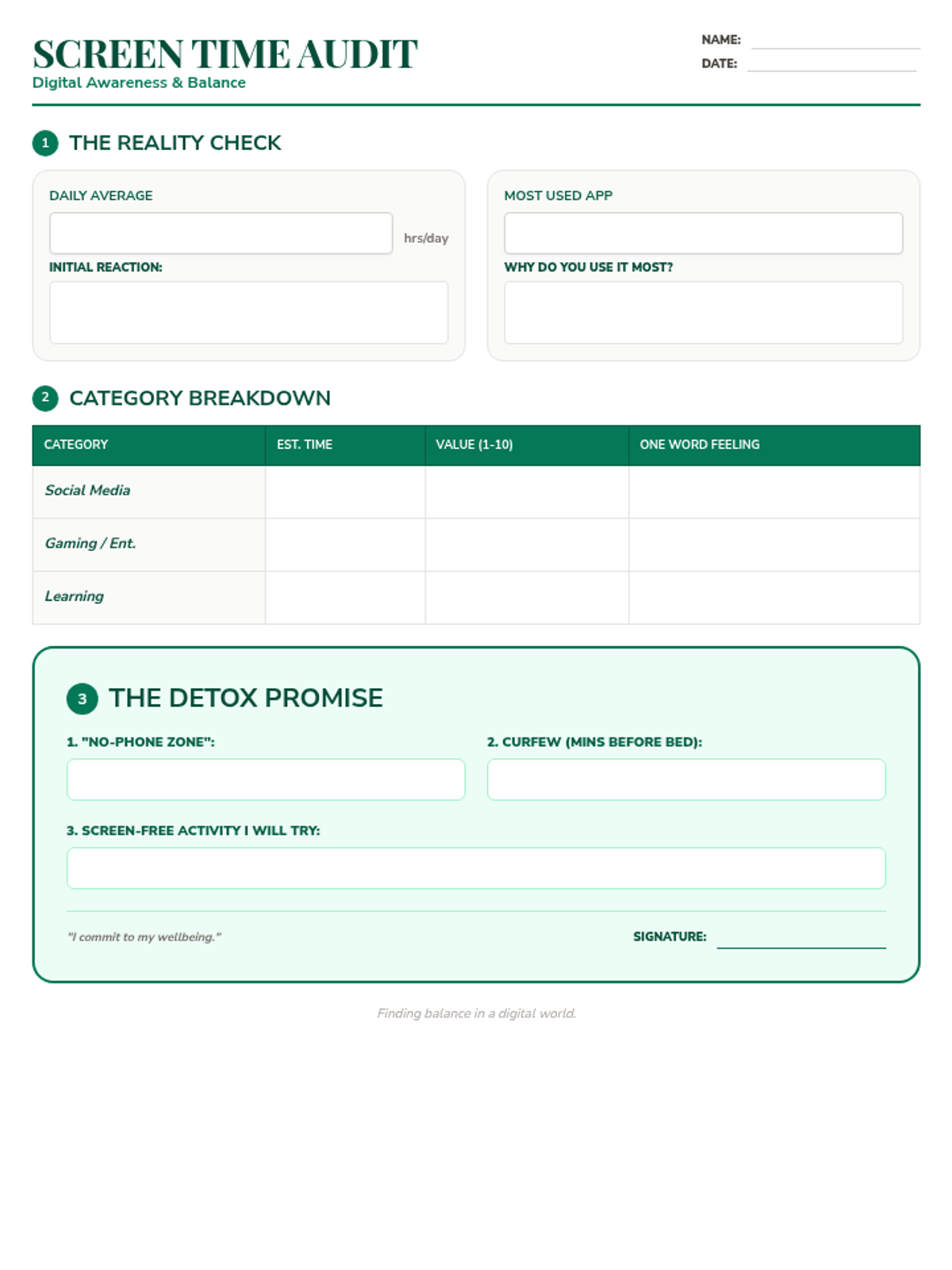
A structured worksheet for students to audit their current screen time habits and commit to specific, manageable goals for a digital detox.
A visually engaging presentation about the impact of screen time on the brain, the benefits of unplugging, and practical strategies for a digital detox.
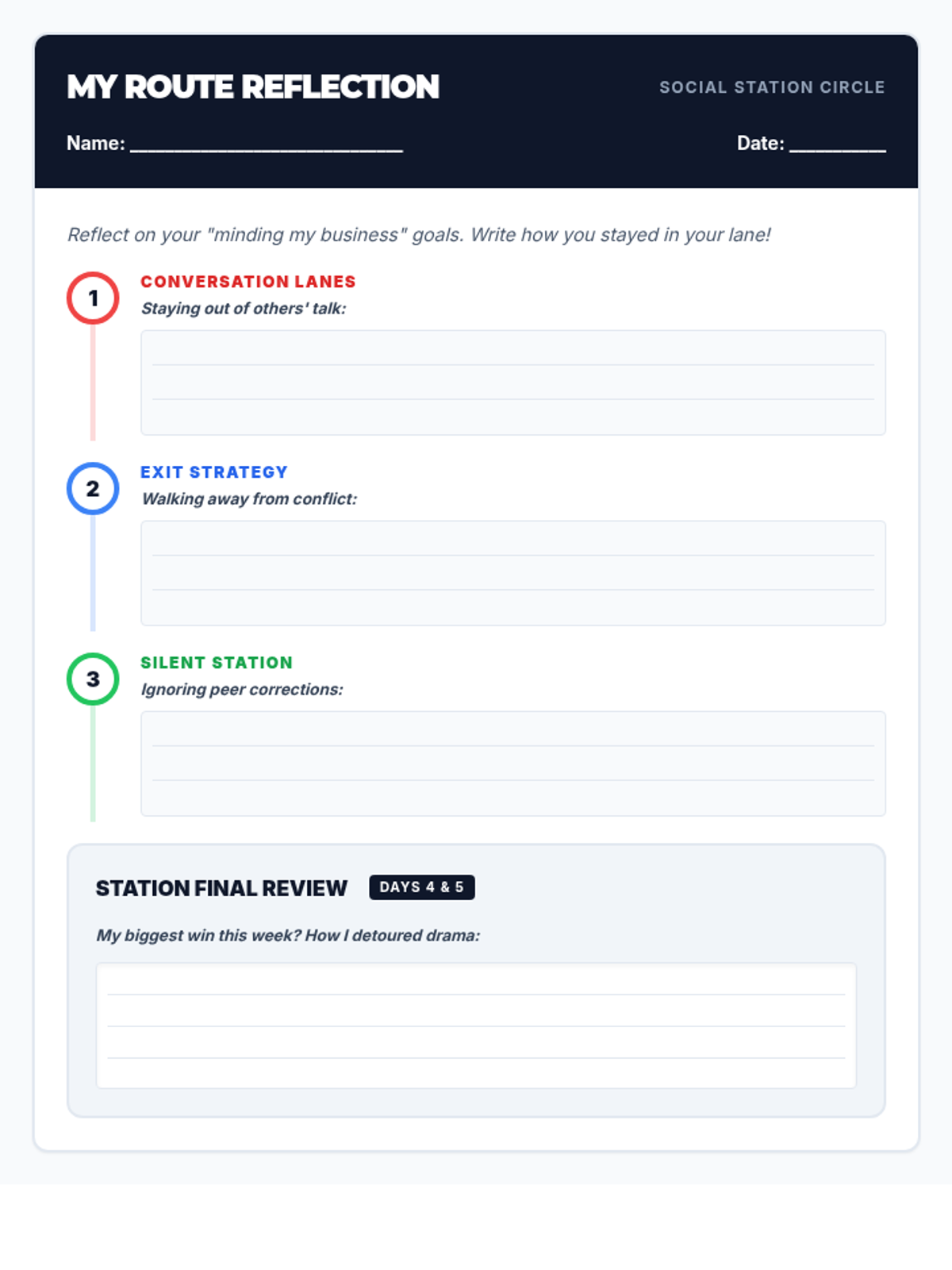
A student-facing reflection log for tracking daily progress on 'minding your business' social skills goals. Features large, readable text and guided writing lines. Fits on a single page.
Slide deck for Day 5 of community circles focusing on 'Focus Force' and avoiding distractions. Includes greeting, shout-outs, scenario practice, and Scattergories.
Slide deck for Day 4 of community circles focusing on 'Drama Detours' and avoiding rumors. Includes greeting, shout-outs, scenario practice, and Scattergories.
Slide deck for Day 3 of community circles focusing on 'The Silent Station' and ignoring peer corrections. Includes greeting, shout-outs, scenario practice, and Scattergories.
Slide deck for Day 2 of community circles focusing on 'The Exit Strategy' and walking away from conflict. Includes greeting, shout-outs, scenario practice, and Scattergories.
Slide deck for Day 1 of community circles focusing on 'Conversation Lanes' and staying out of others' talk. Includes greeting, shout-outs, scenario practice, and Scattergories.
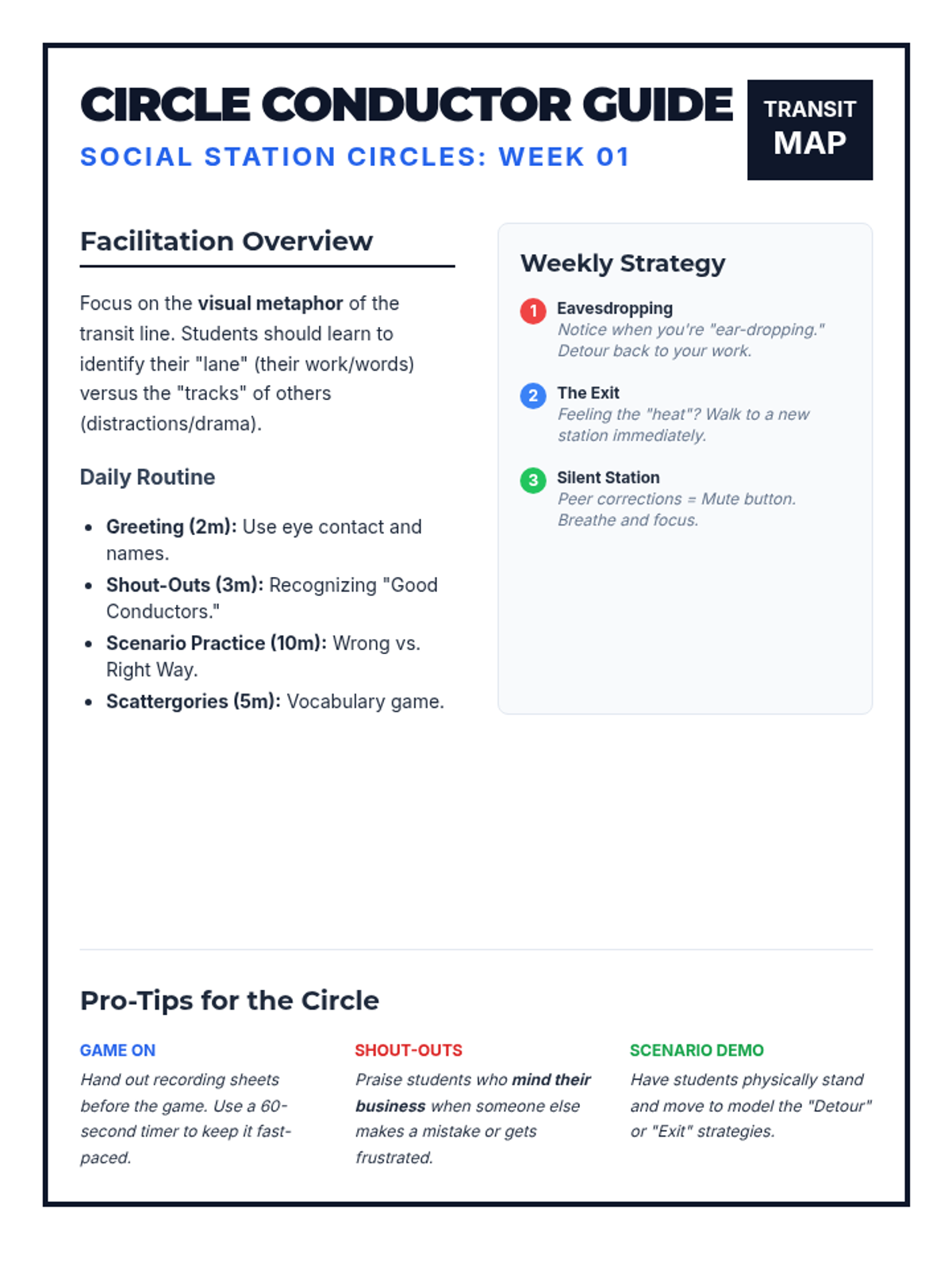
A comprehensive facilitation guide for the week of community circles, featuring instructional notes, scenario scripts for each day, and Scattergories master lists. Includes a student recording sheet.
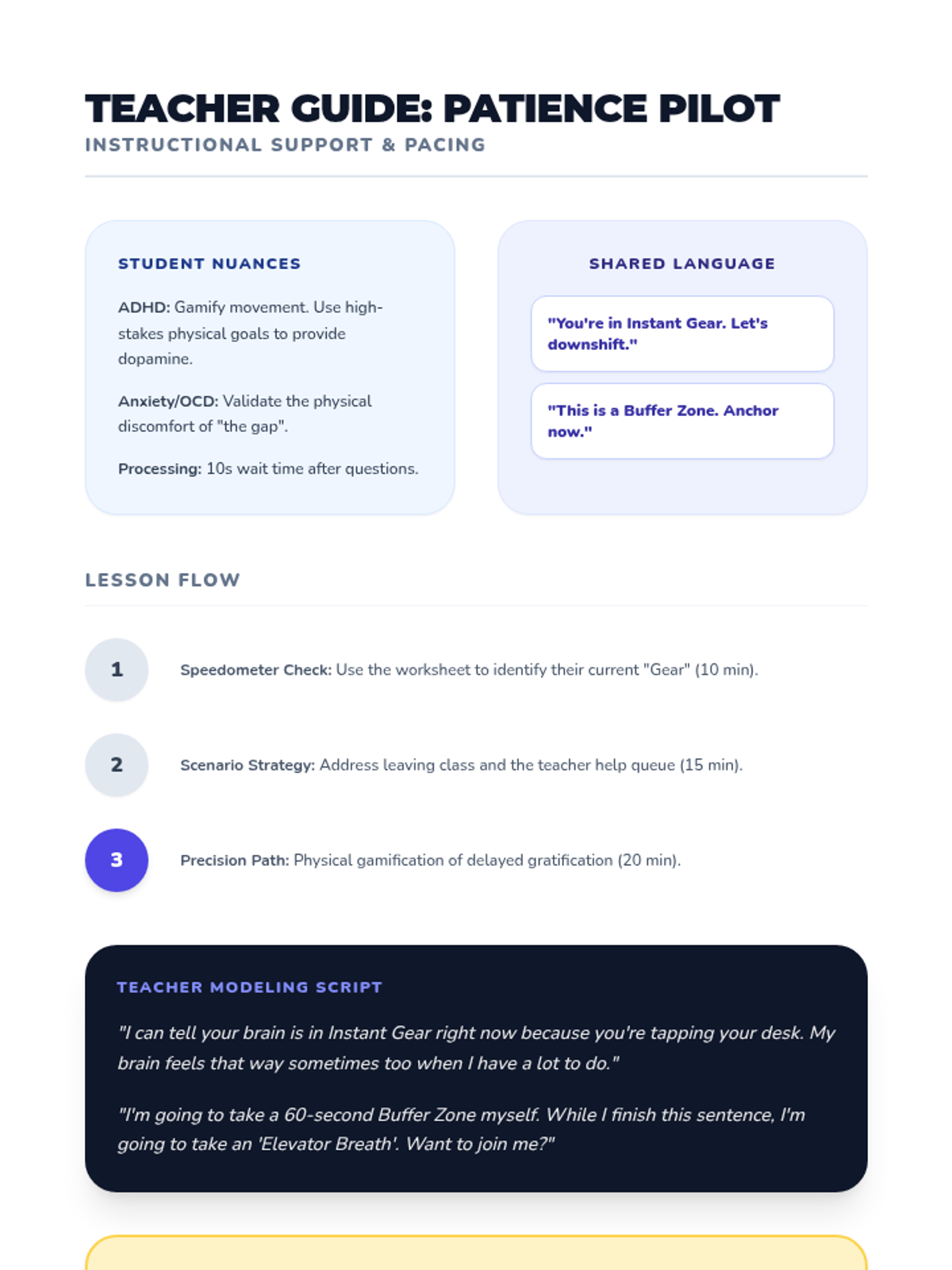
A teacher-facing guide that provides context on how to implement the Patience Pilot materials. It includes pedagogical tips for working with ADHD/OCD/Anxiety, a recommended lesson flow, and scripts for modeling patience.
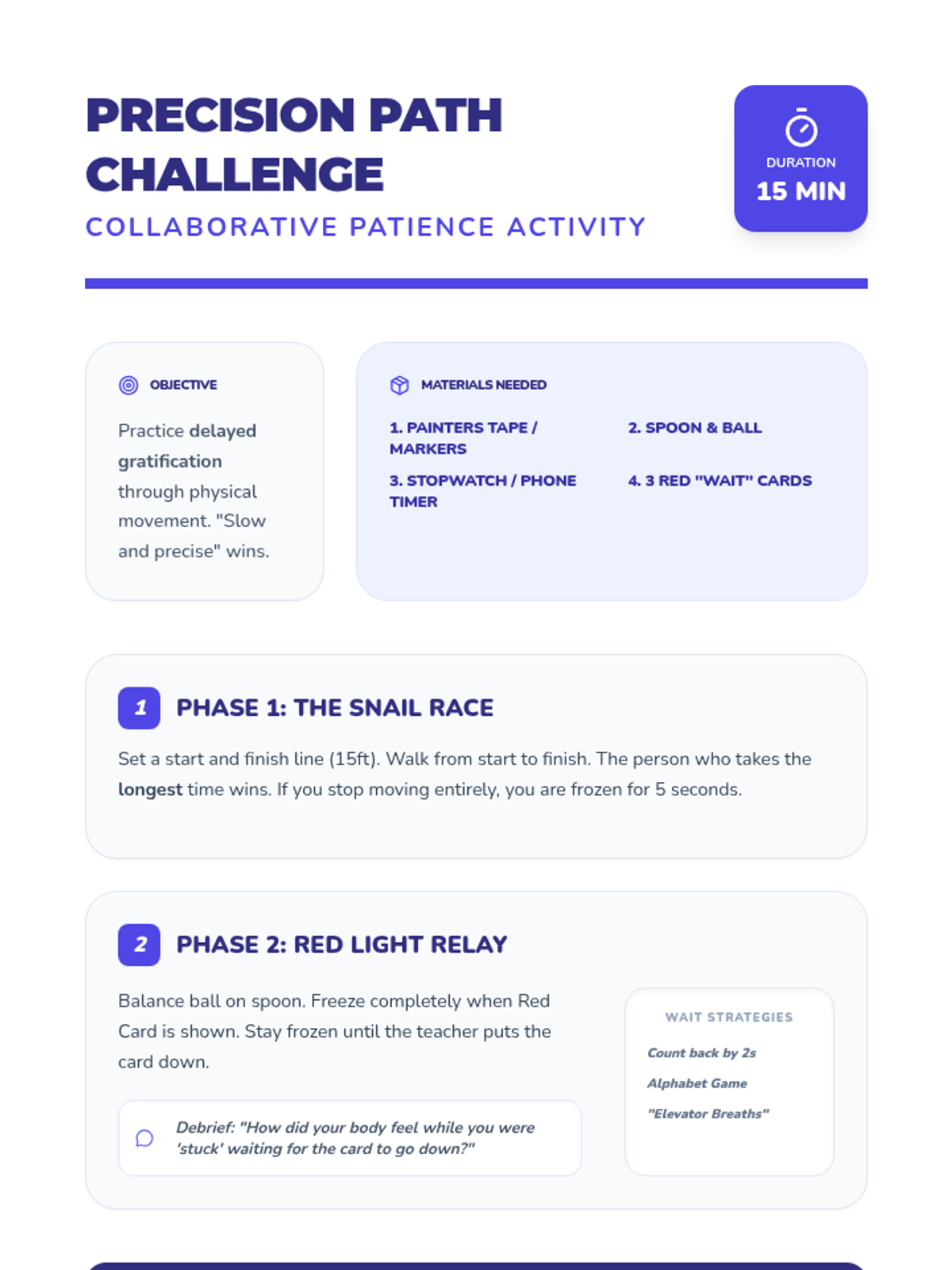
A collaborative, movement-based activity for a teacher and student. It gamifies patience through 'snail racing' and interrupted balancing tasks, specifically designed to simulate the physical tension of waiting.
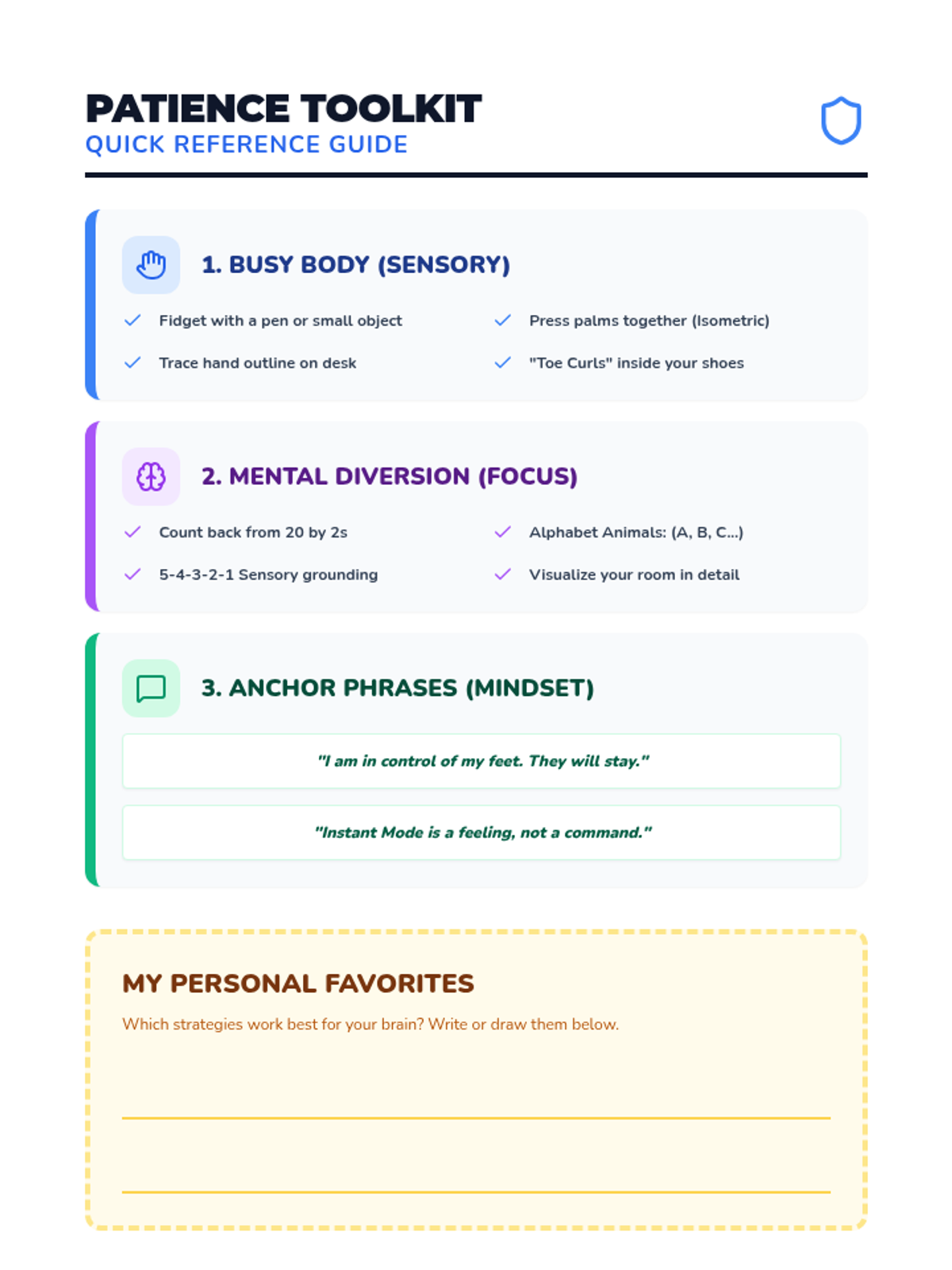
A reference sheet for the student to keep in their binder. It provides a menu of physical, mental, and verbal coping strategies to use during 'waiting gaps' to manage ADHD and anxiety-driven impulsivity.
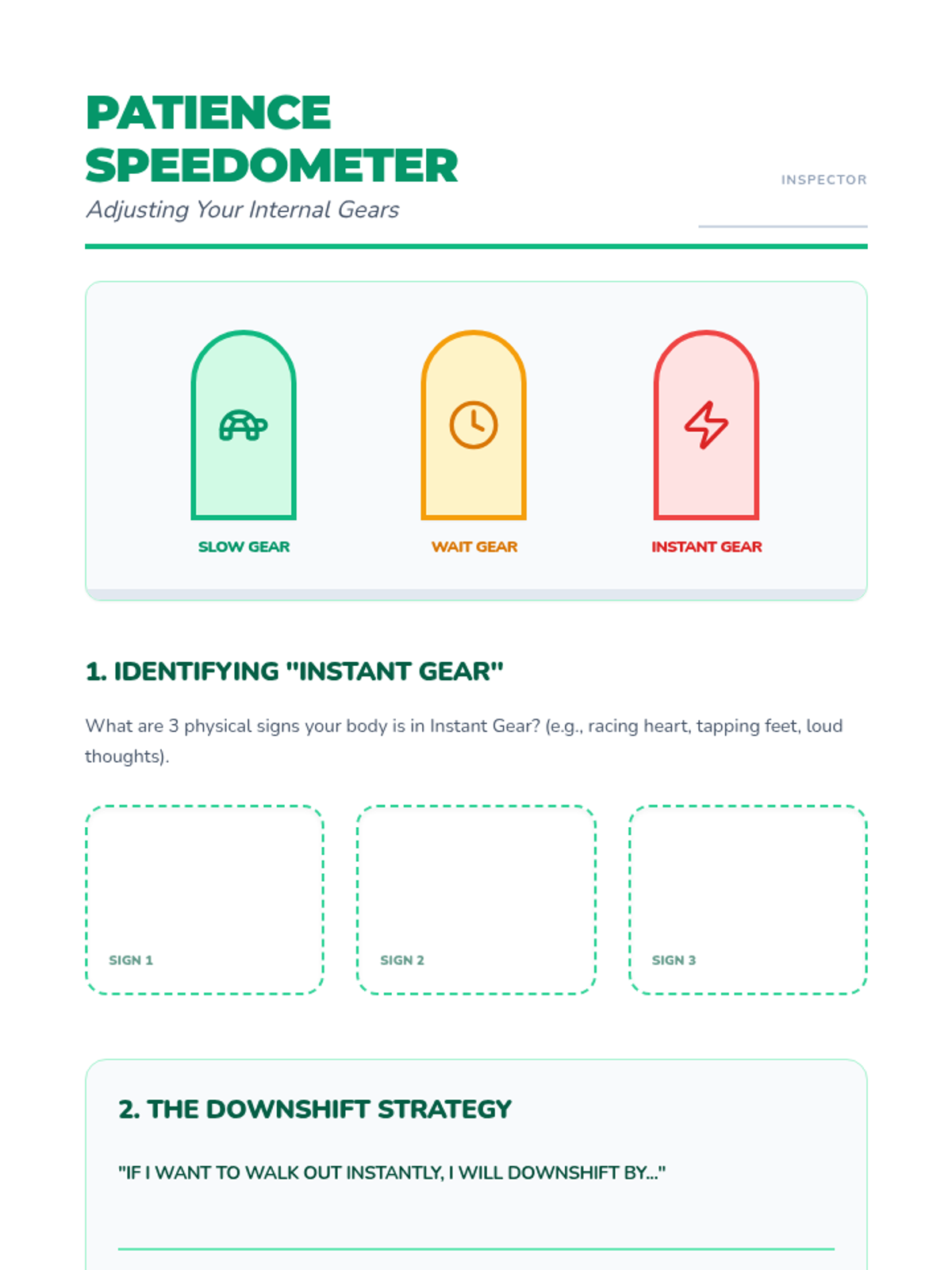
A visual self-regulation worksheet that helps the student identify their 'internal gears' (Slow, Wait, Instant). It focuses on identifying physical triggers of impulsivity and practicing 'downshifting' to a more patient state.
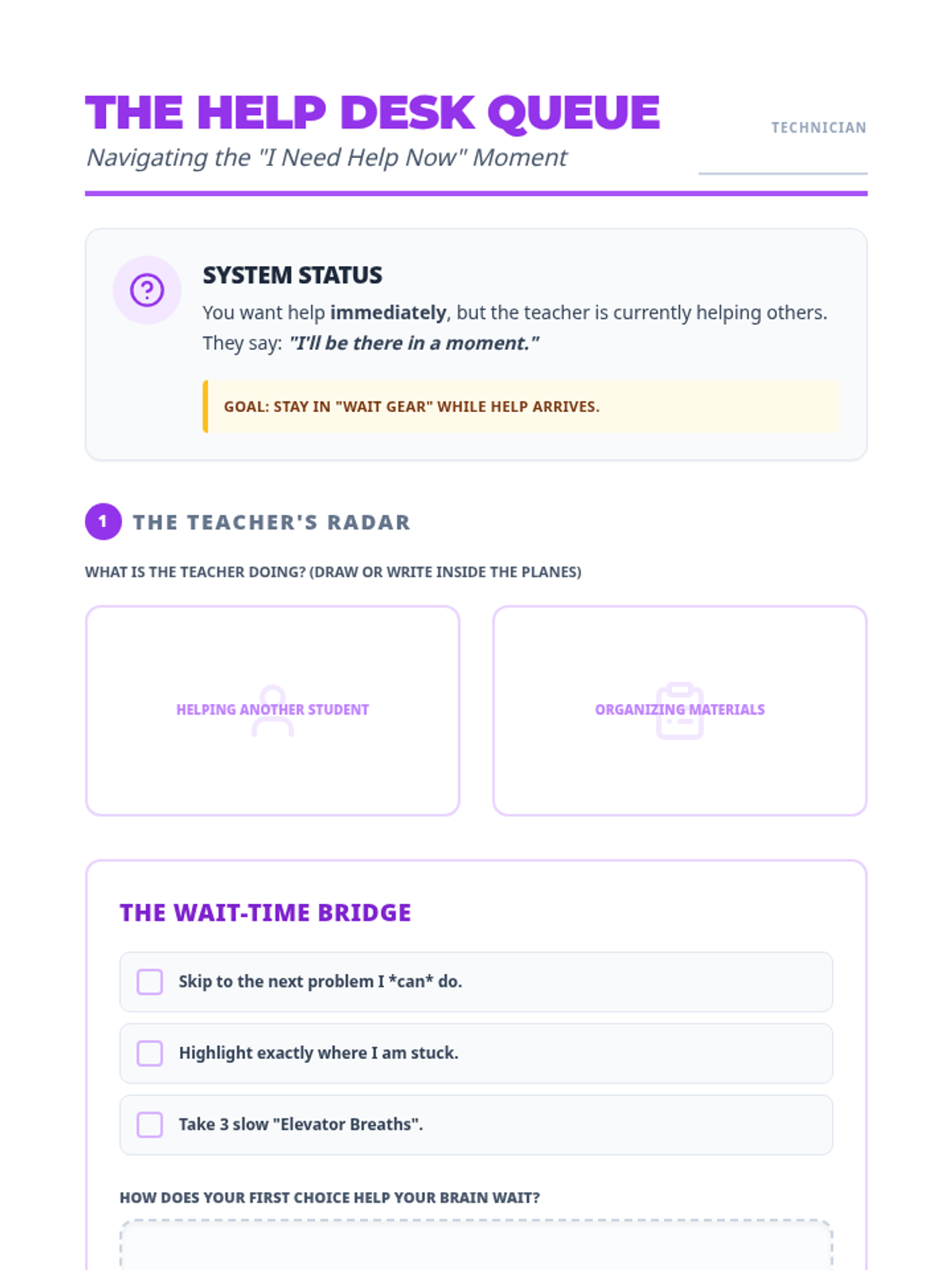
A worksheet designed to address the specific scenario of needing immediate help after previously refusing it. It uses an air traffic controller metaphor to help the student understand the teacher's perspective and provides actionable waiting strategies.
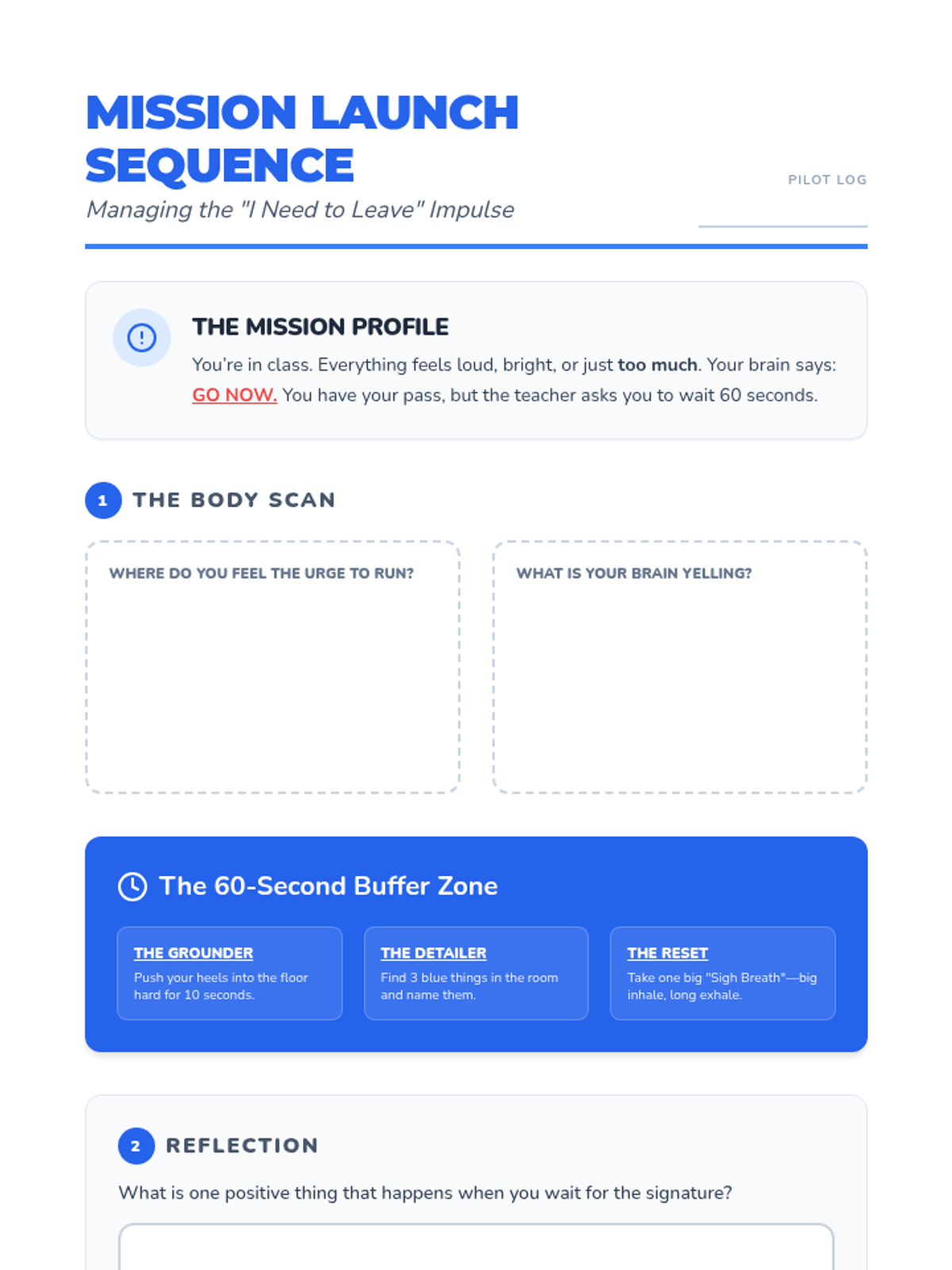
A worksheet focused on the impulsivity of leaving the classroom when overstimulated. It teaches a '60-second buffer' strategy and helps the student identify physical symptoms of anxiety.
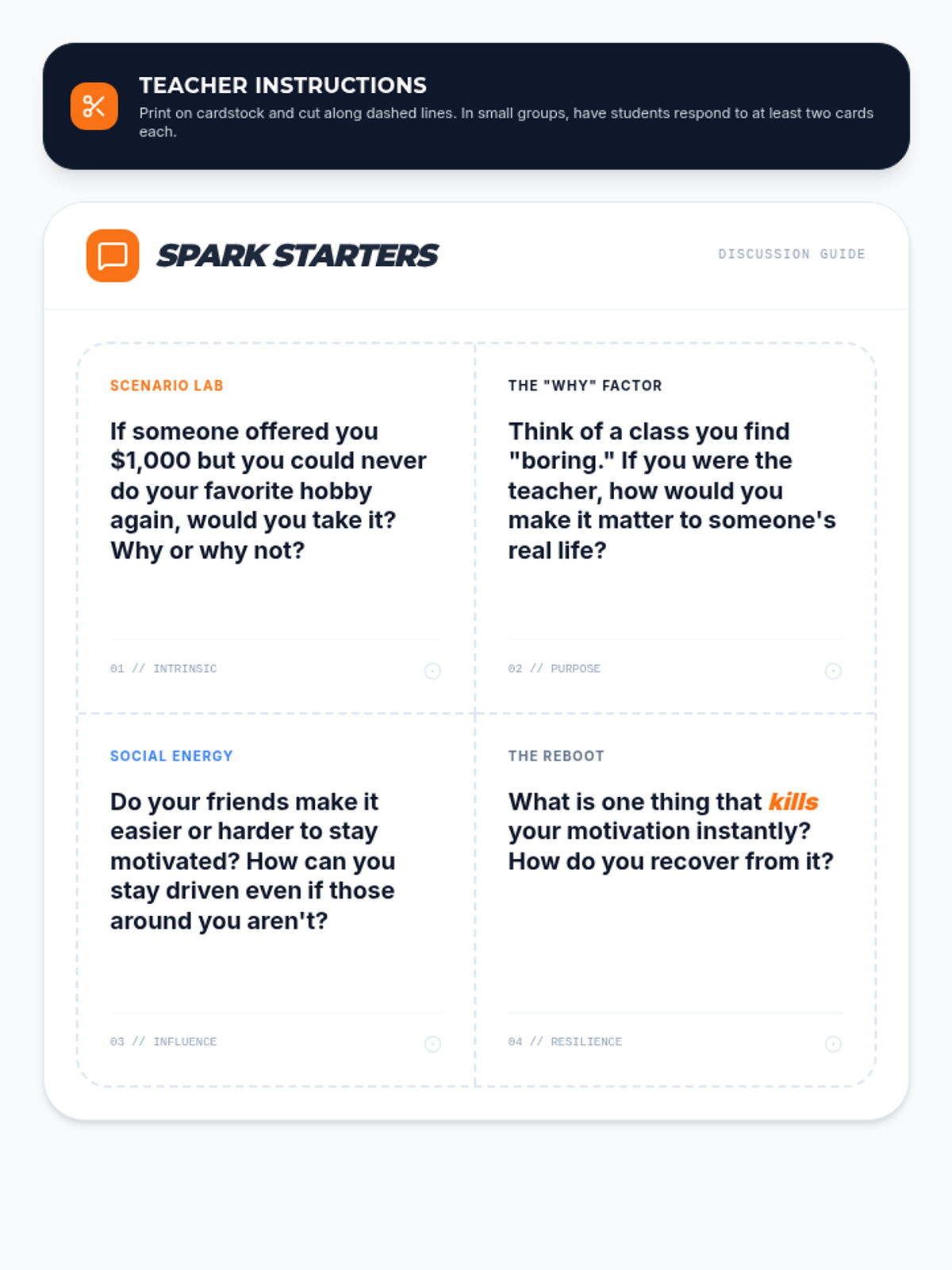
A set of four creative discussion cards for small groups, designed to facilitate conversations about internal values, social influences on motivation, and recovery from academic setbacks.
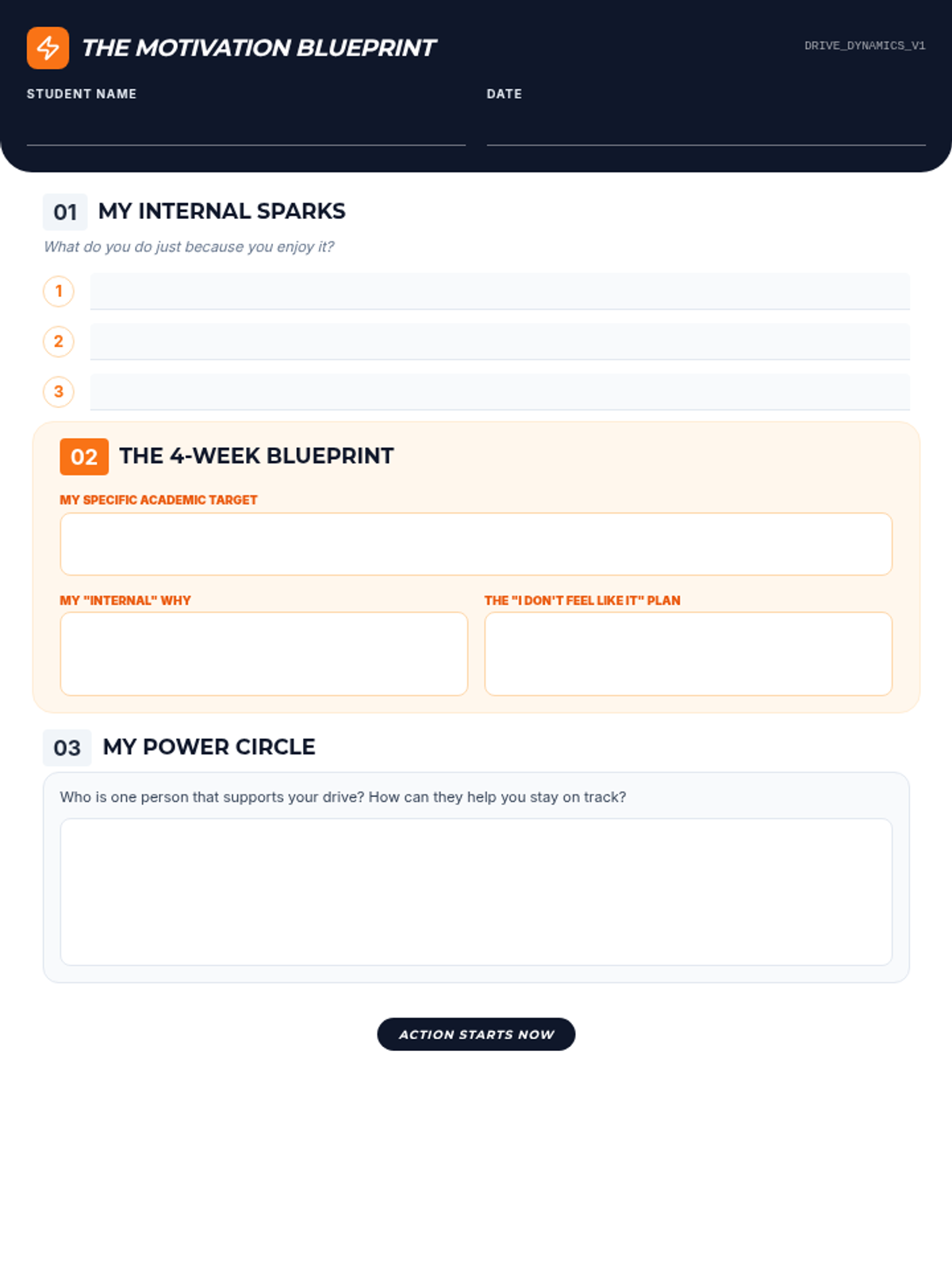
A student worksheet featuring personal motivation identification, a 4-week goal-setting blueprint, and a social support mapping section to help students internalize their academic drive.
A high-impact 5-slide presentation designed to engage students in understanding the difference between intrinsic and extrinsic motivation, while providing a framework for academic goal setting.
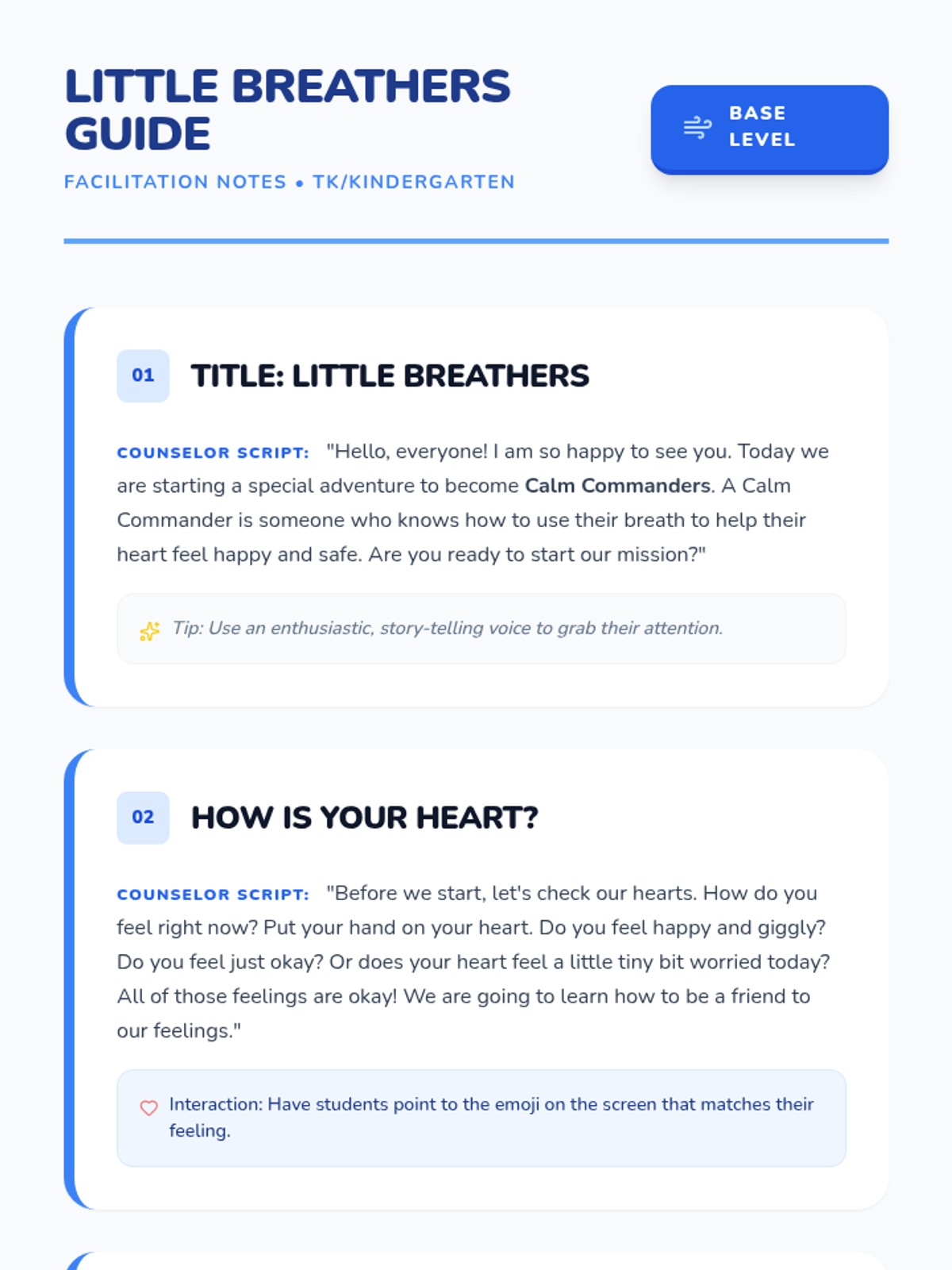
A detailed slide-by-slide facilitation guide for the TK/Kindergarten lesson 'Little Breathers'. Includes simple counselor scripts, child-friendly analogies for stress, and instructions for interactive breathing practice.
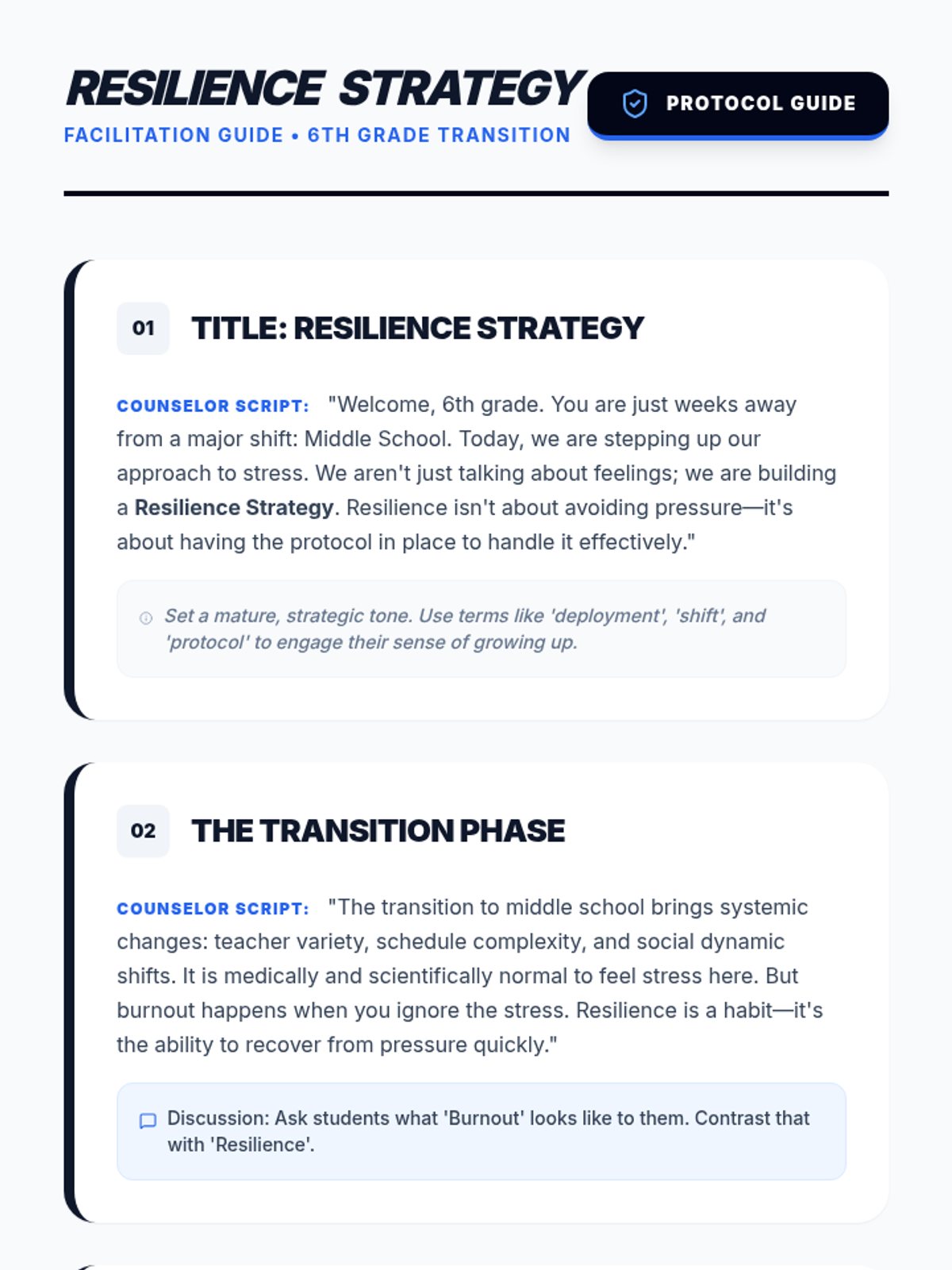
A detailed facilitation guide for the 6th grade 'Resilience Strategy' lesson. Provides scripts, mature analogies for transition stress, and instructions for practicing Box Breathing. Terminology updated for a more sophisticated 6th grade audience.
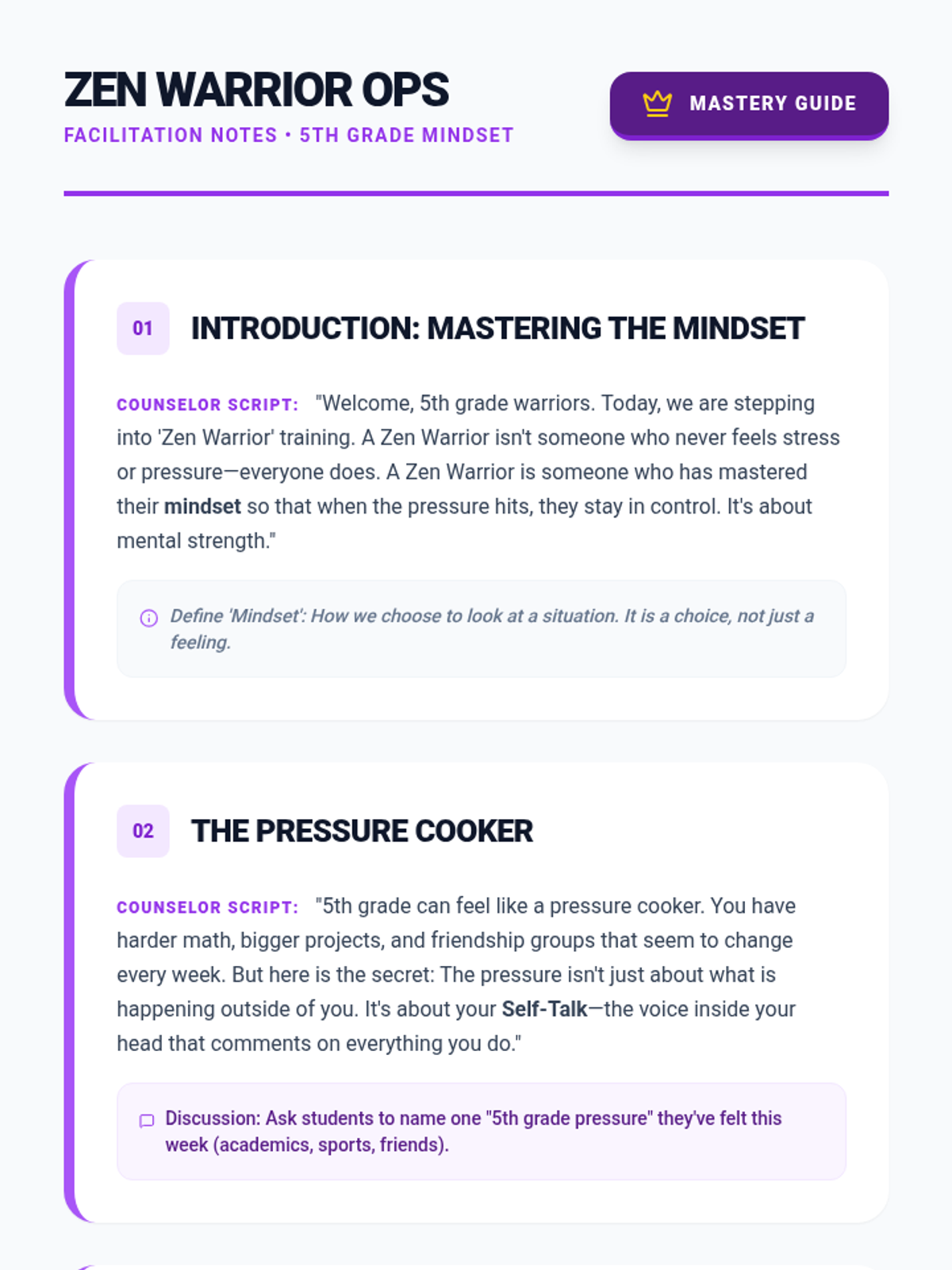
A detailed facilitation guide for the 5th grade 'Zen Warriors' lesson. Includes scripts for explaining 'Thinking Traps', 'The Flip' self-talk technique, and 'The 10-10-10 Rule' for perspective shifting.
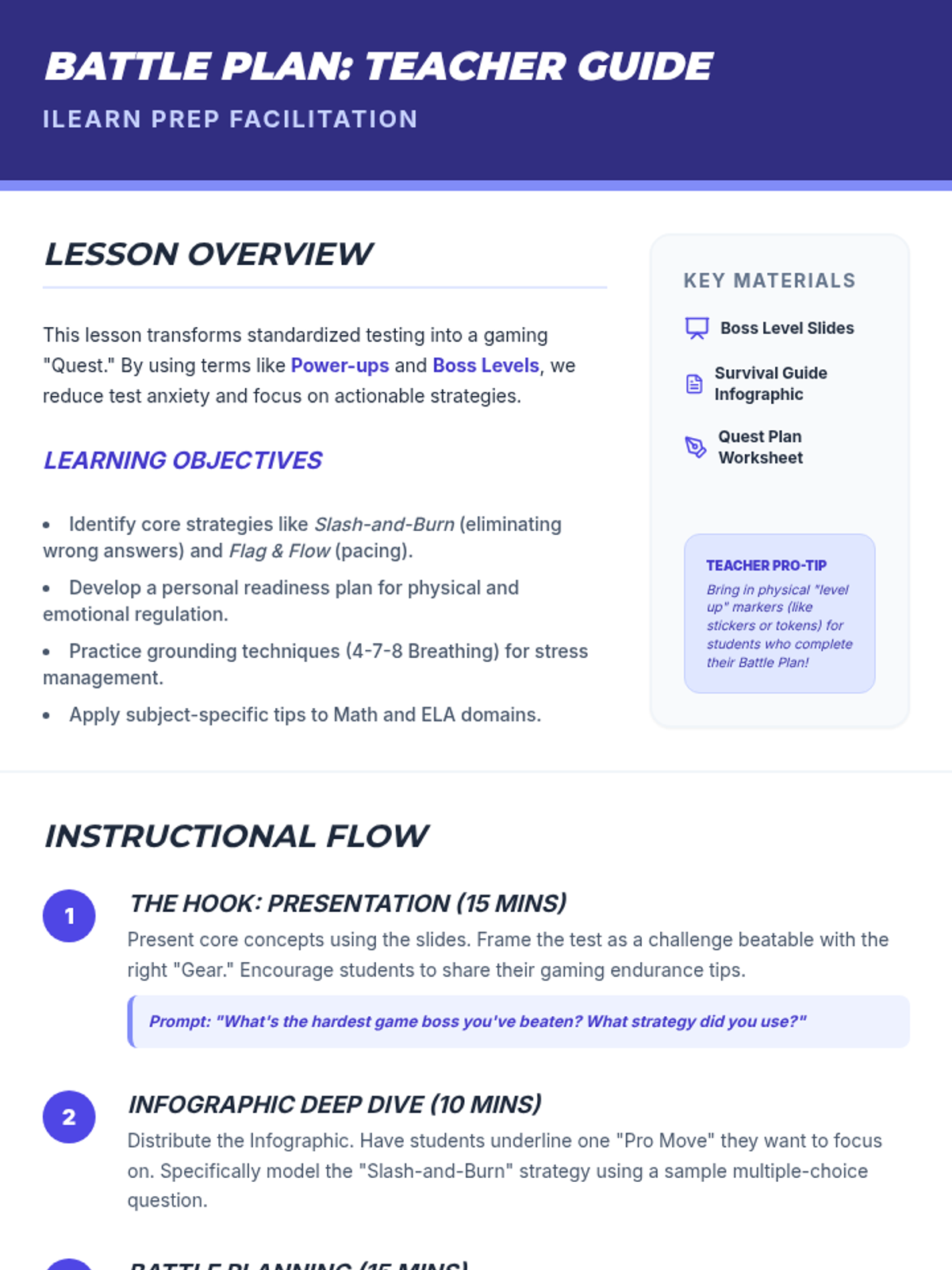
A detailed teacher's guide for facilitating the ILEARN Boss Level lesson. Revised for better page layout, grouped instructional steps, and filled space on page 2.
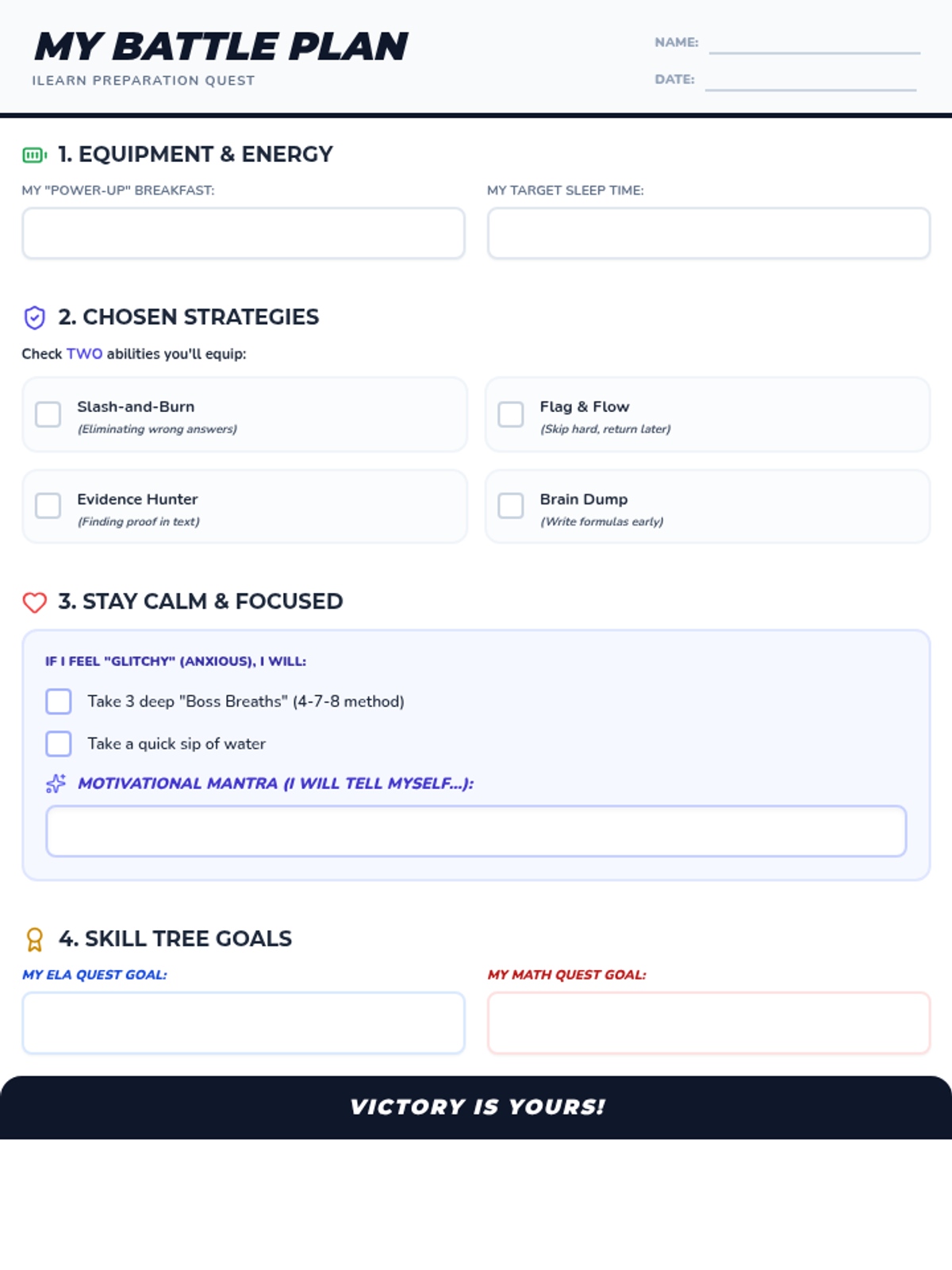
A personalized planning worksheet for students to set their own ILEARN preparation goals. Revised to fit on a single page with white input boxes for maximum legibility and improved section clarity.
A vibrant, gaming-themed slide deck designed to teach middle schoolers ILEARN testing strategies, anxiety management, and subject-specific tips for Math and ELA. Revised for better content sizing and visibility.
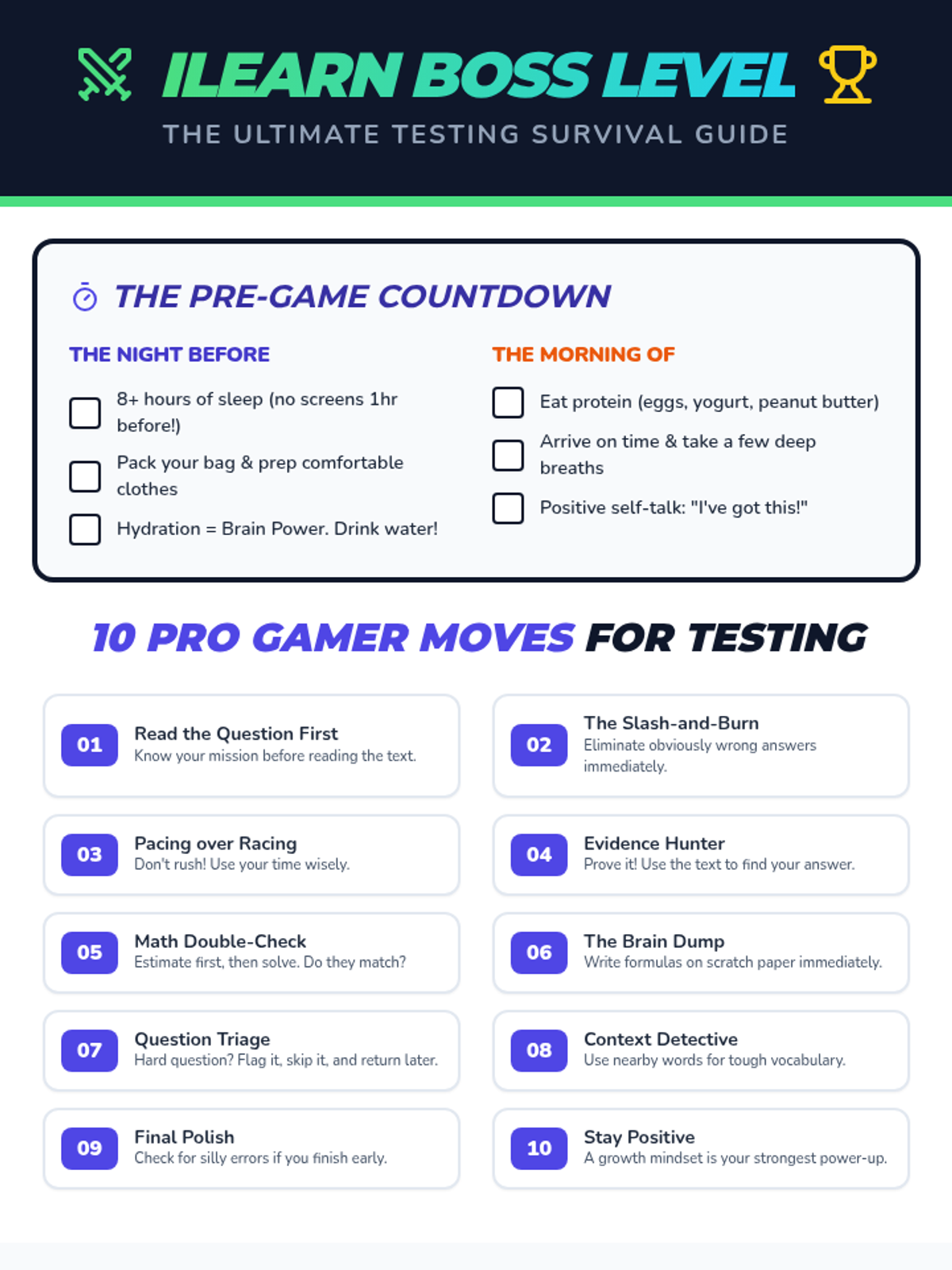
A high-energy, gaming-themed infographic document for middle school students, featuring testing strategies, physical preparation checklists, a decision flowchart for difficult questions, and subject-specific tips for ELA and Math. Revised for better page layout and readability.
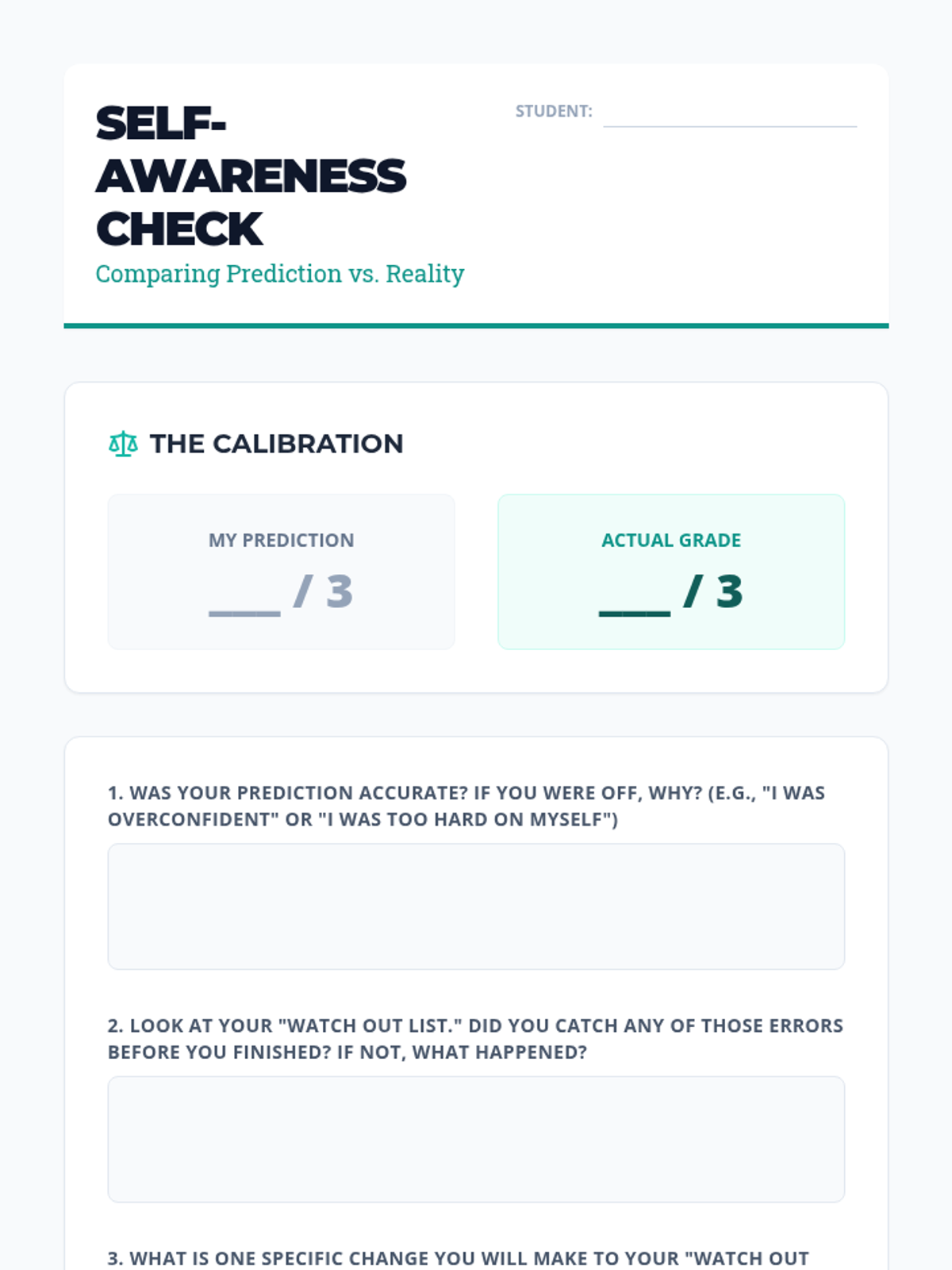
A final reflection sheet for students to compare their quiz predictions with their actual grades, evaluating the effectiveness of their metacognitive strategies.
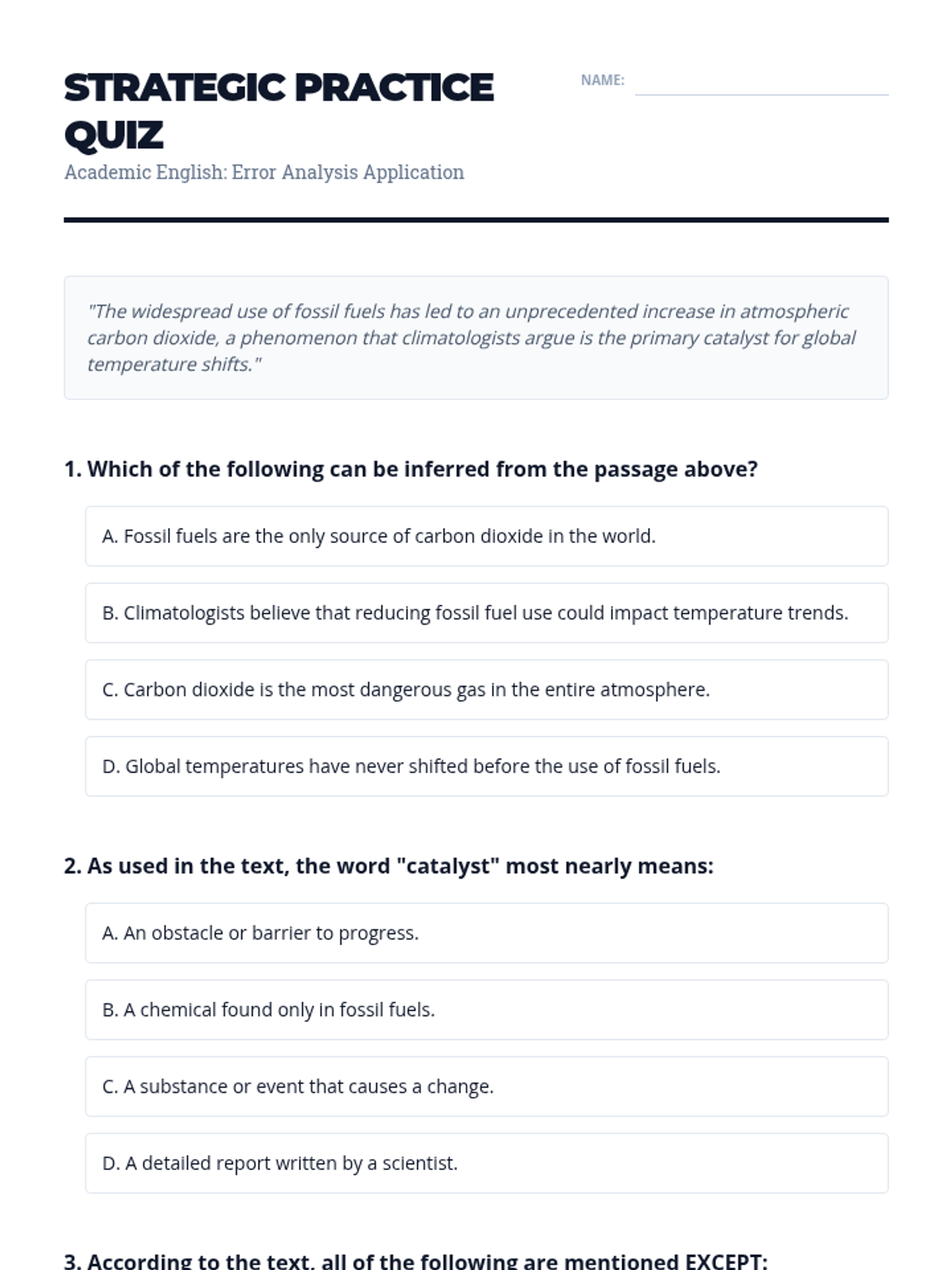
A short Academic English quiz designed to test students' application of their "Watch Out List," including a mandatory pre-grading self-reflection and score prediction section.
Final slides for the sequence focusing on the "Showtime" assessment. It introduces the score prediction challenge and real-time error analysis.
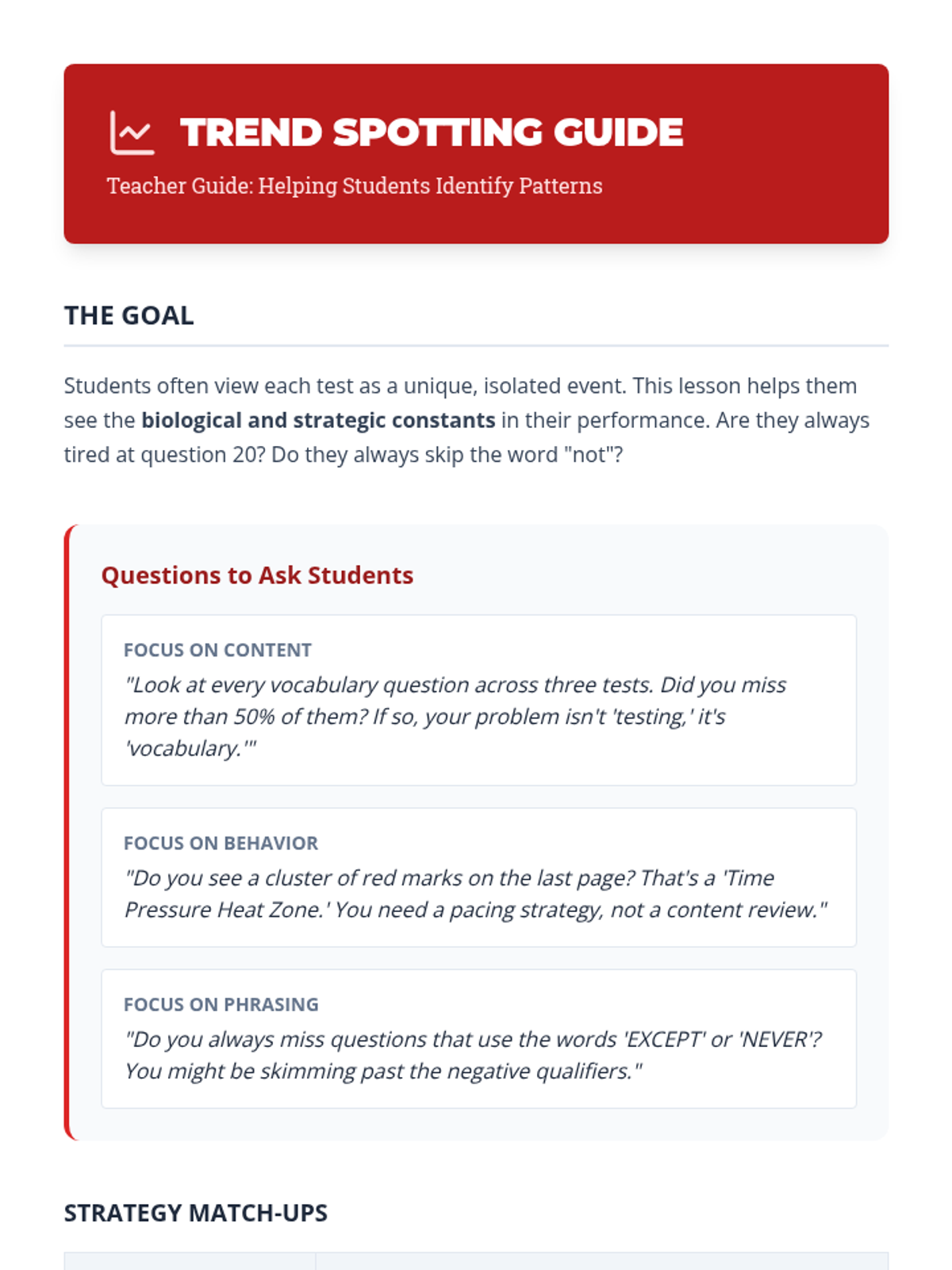
A guide for teachers to help students interpret their error data and connect patterns to specific defensive strategies.
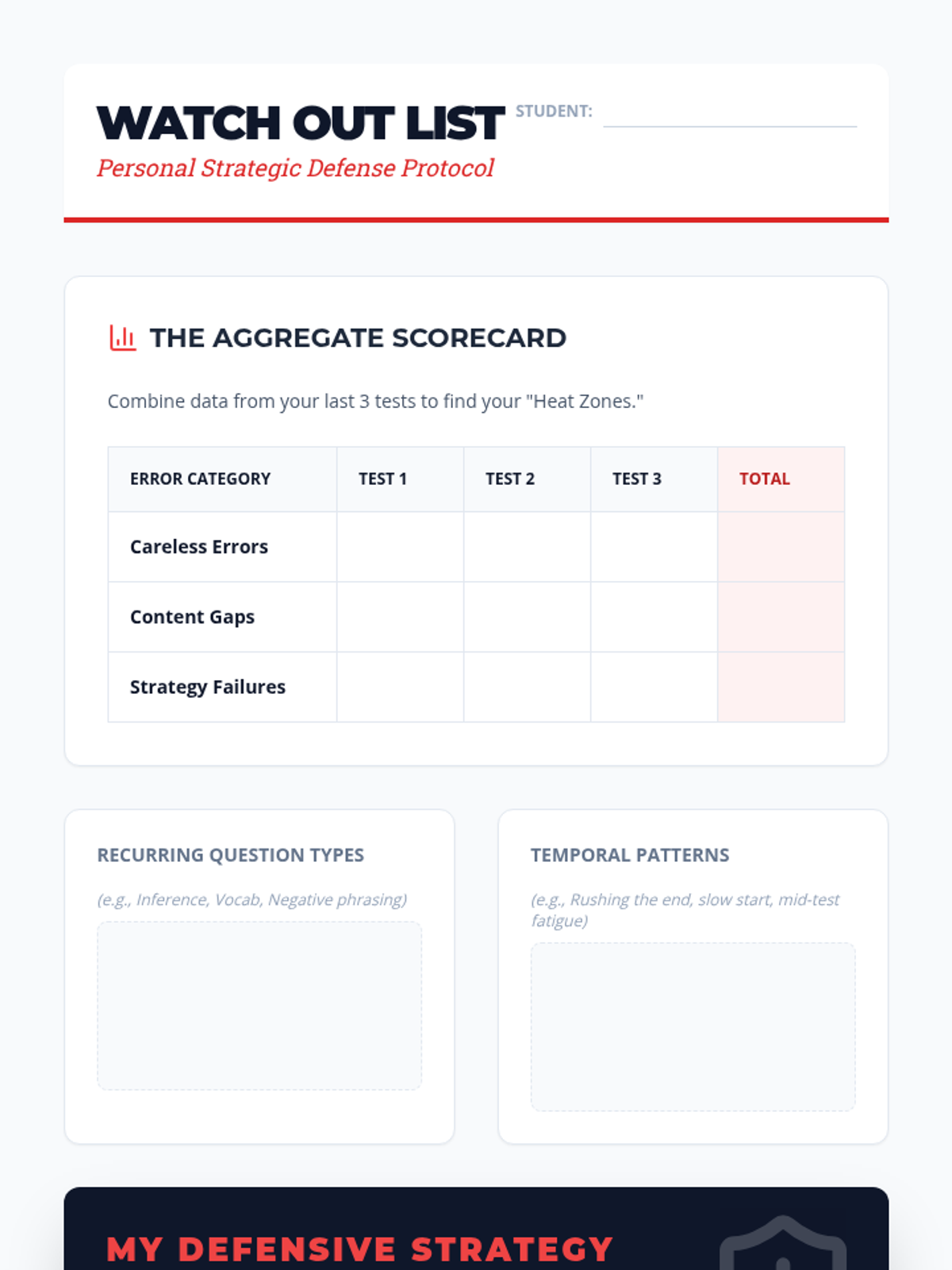
A student worksheet for aggregating error data across multiple assessments and distilling those patterns into a "Watch Out List" for future defense.
Slides for Lesson 4 that use a "Heatmap" analogy to teach students how to aggregate error data and identify recurring personal patterns.
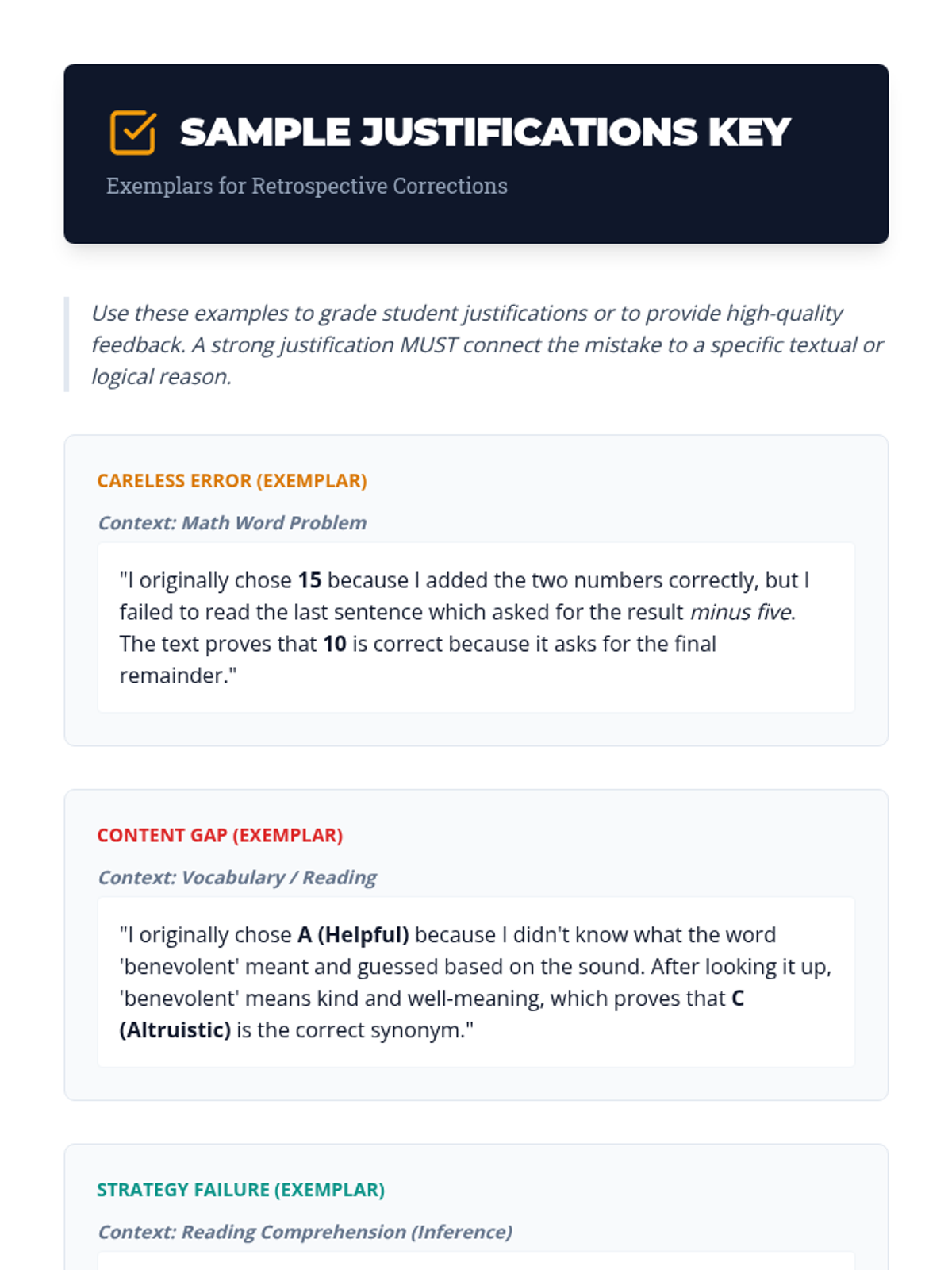
An answer key/exemplar guide for teachers to evaluate student justification statements, showing the difference between weak and mastery-level corrections.
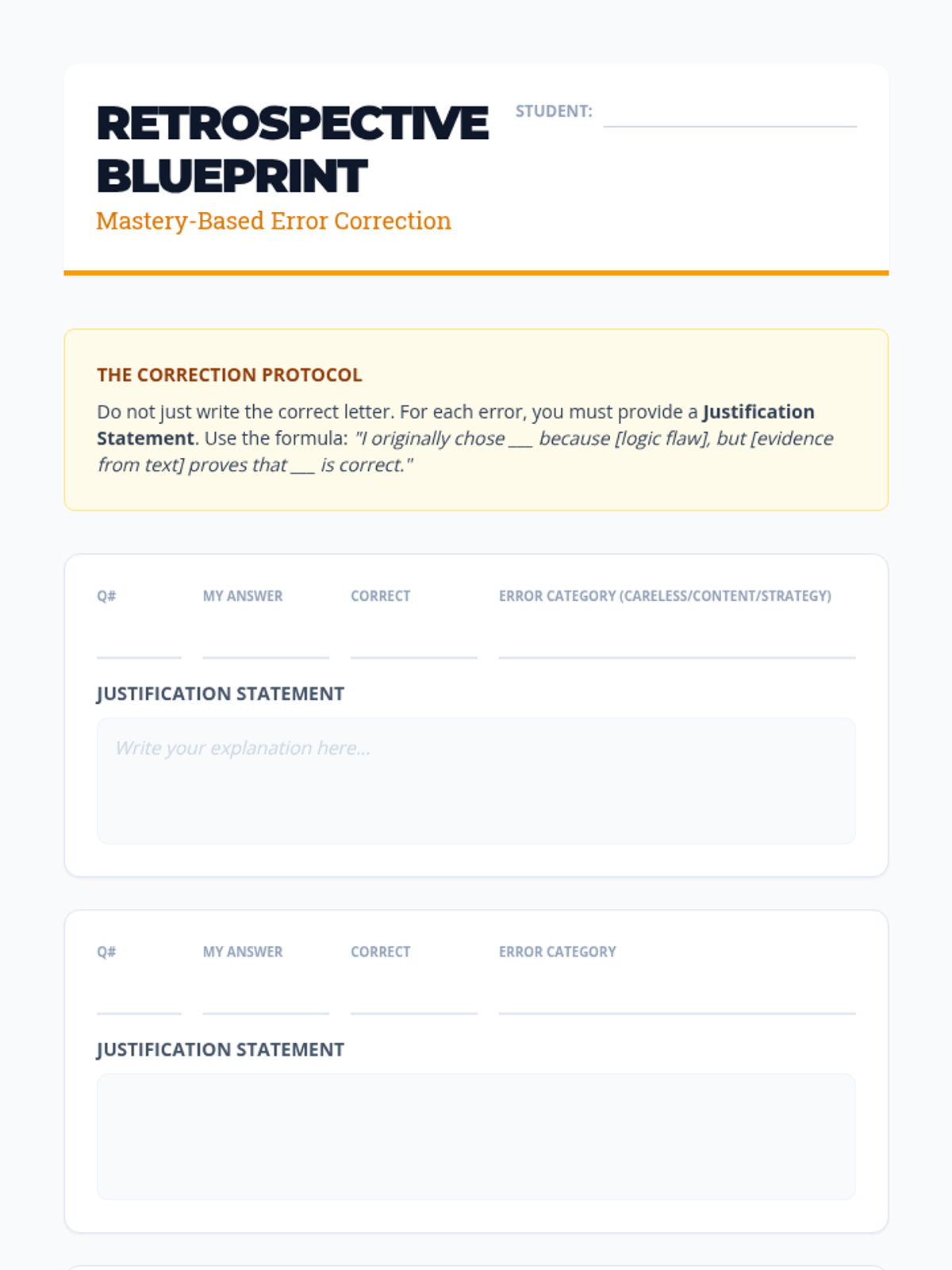
A template for students to perform deep error corrections, requiring them to write justification statements using a specific logic-based formula.
Slides for Lesson 3 introducing the "Justified Fix" method. It emphasizes that students must explain why they were wrong and why the new answer is right using evidence.
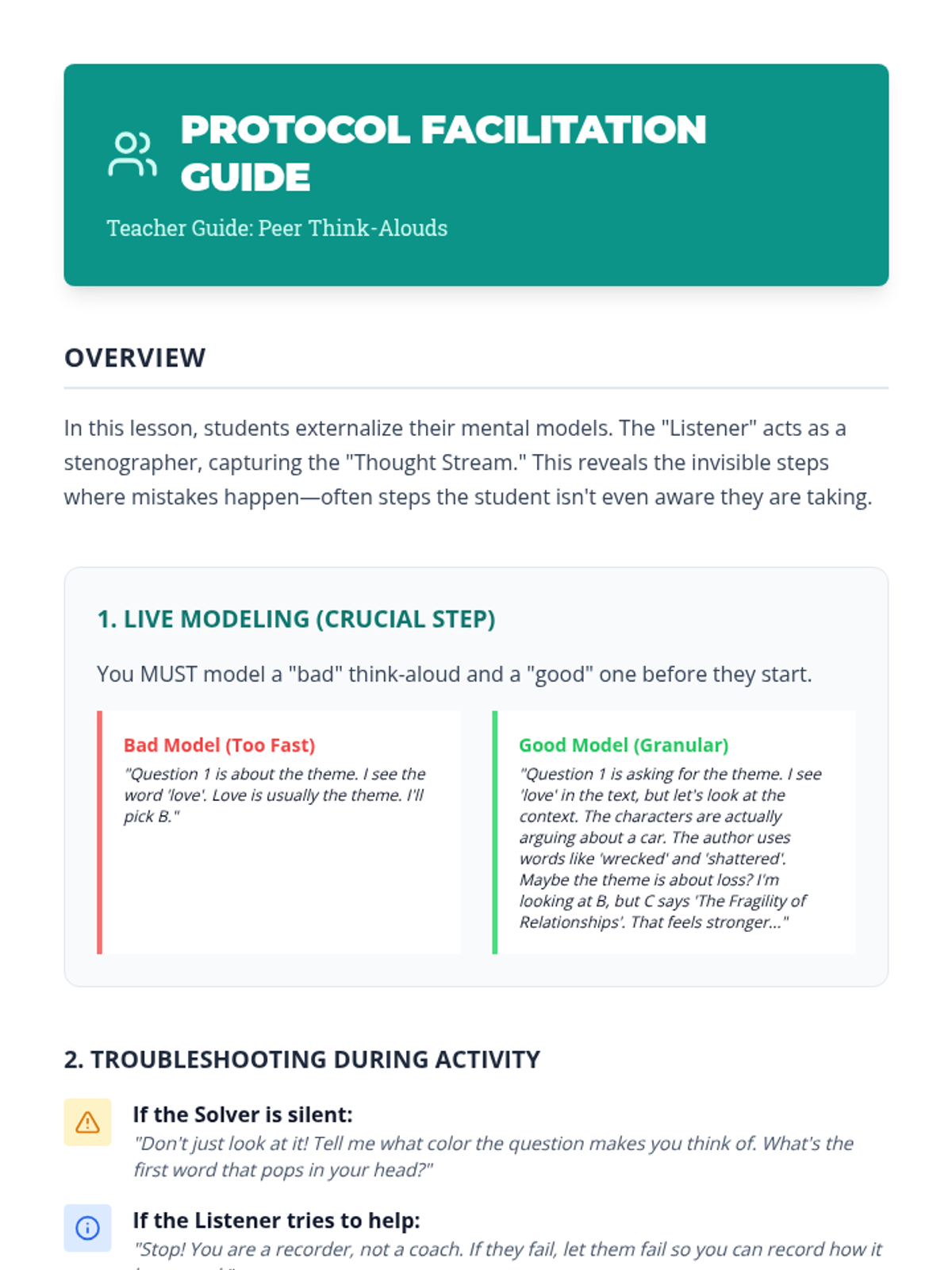
A facilitation guide for teachers to lead the "Think-Aloud" protocol, including scripts for modeling and tips for troubleshooting silent students.
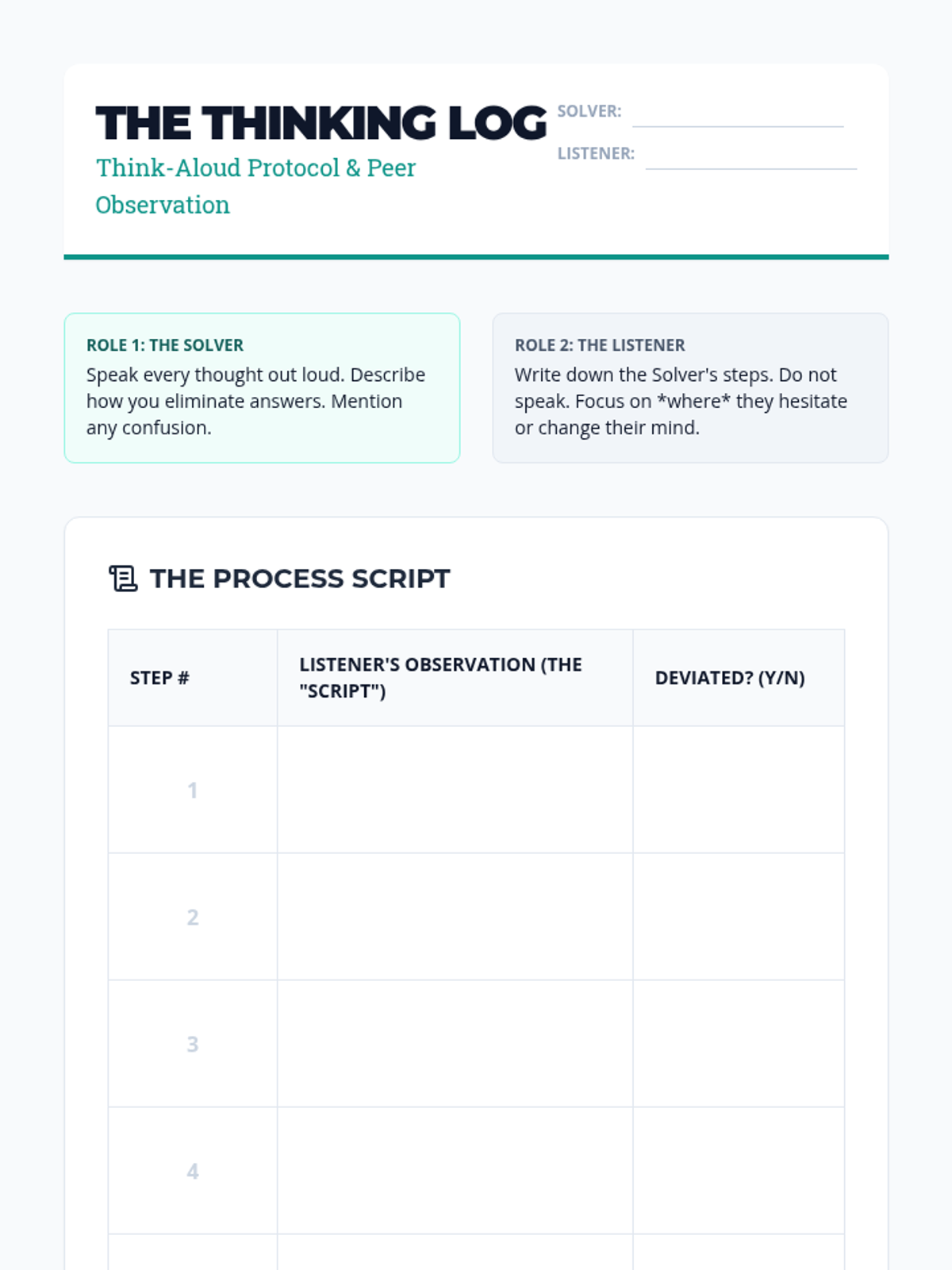
A peer-observation worksheet where students record their partner's "Think-Aloud" steps and analyze where their logic deviated from the correct path.
Slides for Lesson 2 that introduce the "Think-Aloud" protocol using a gamer commentary analogy. It outlines the roles of "The Solver" and "The Listener."
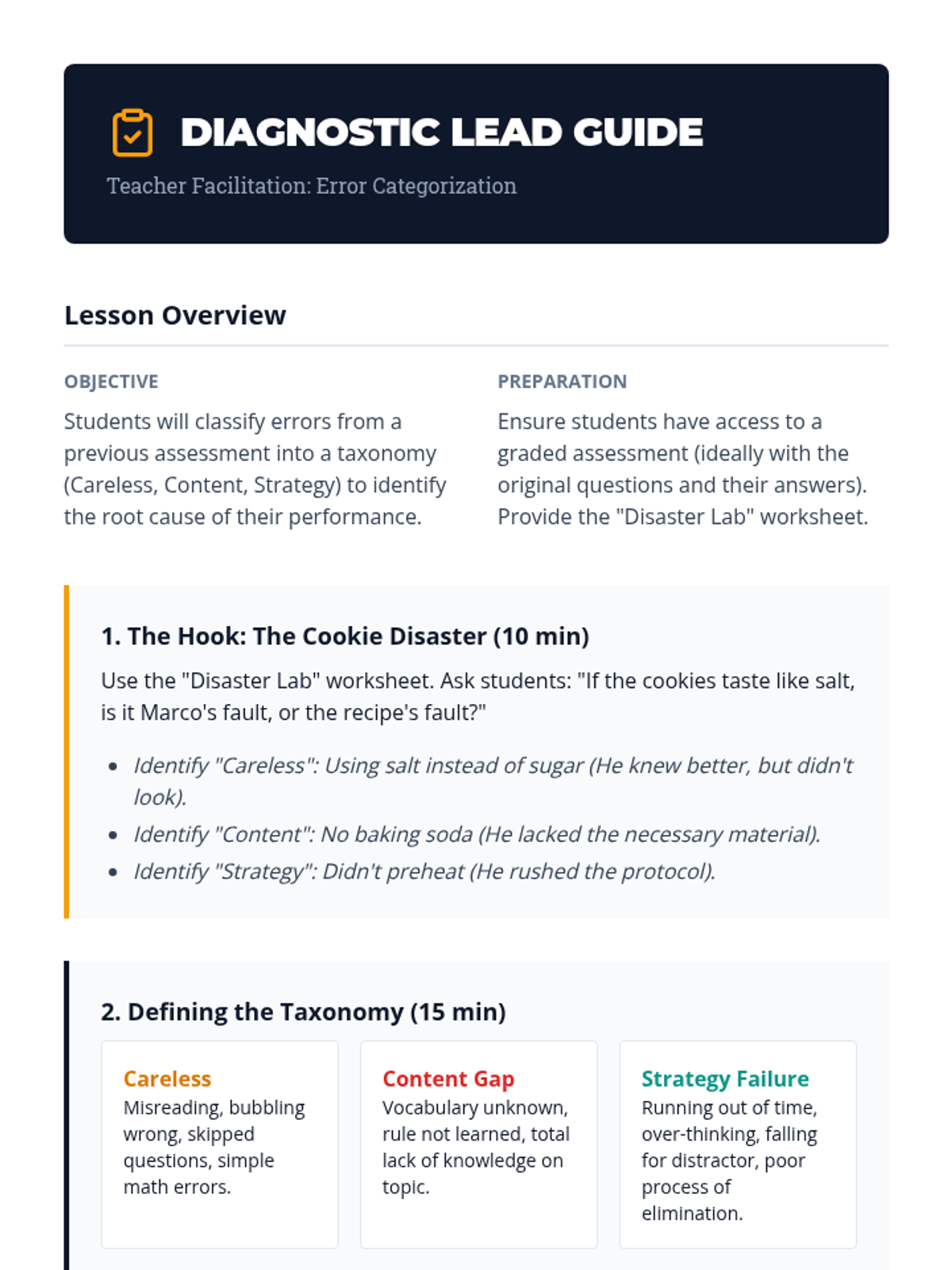
A teacher facilitation guide for Lesson 1, providing instructional prompts and definitions for error taxonomy.
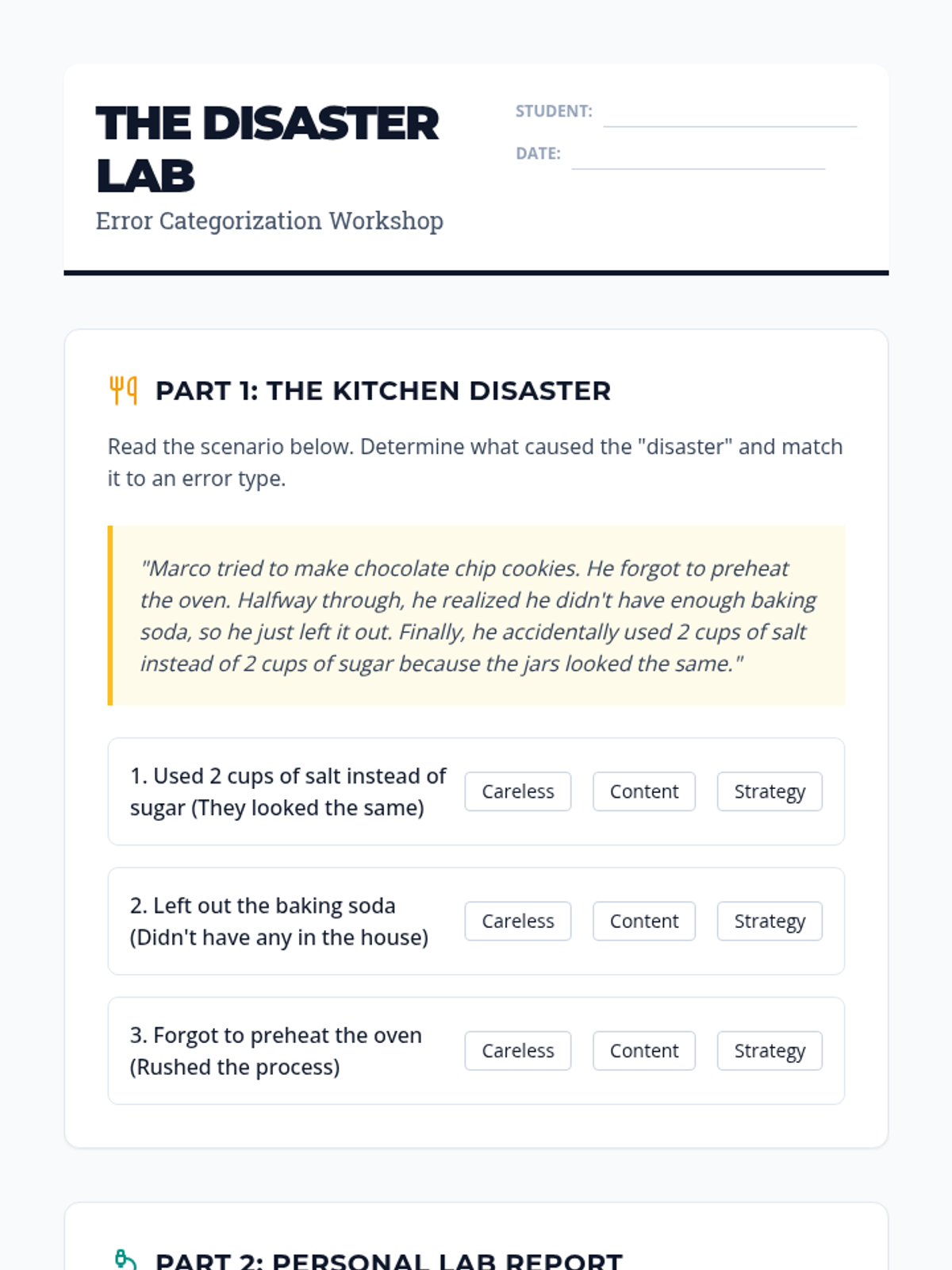
A student worksheet for the first lesson that uses a cookie recipe disaster to hook students into error categorization, followed by a table for analyzing their own test mistakes.
An introductory slide deck explaining the three main types of errors: Careless, Content Gap, and Strategy Failure, using a recipe disaster analogy.
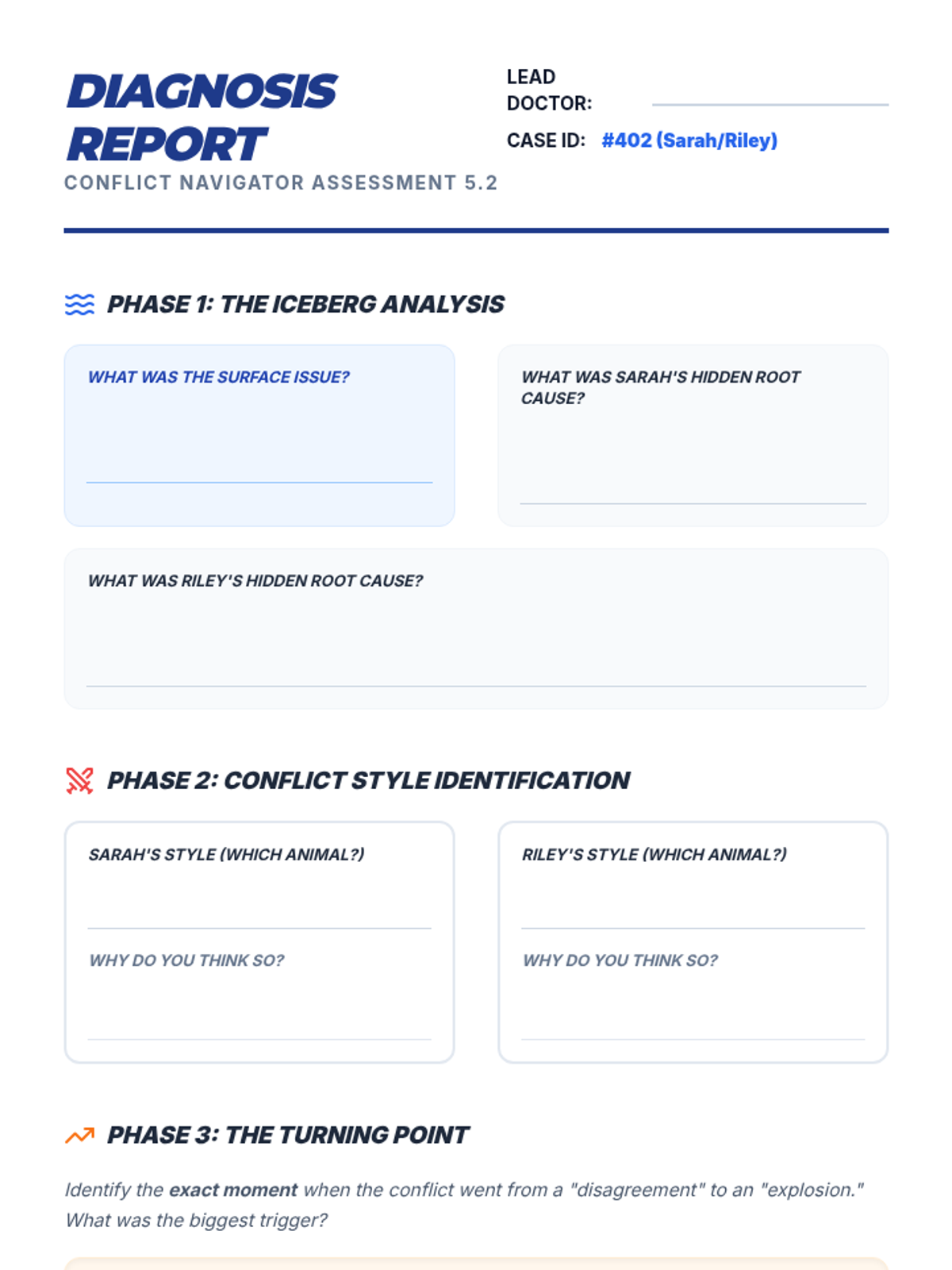
The final assessment form for students to synthesize their learning by diagnosing the Sarah/Riley case study, identifying root causes, styles, and intervention strategies.
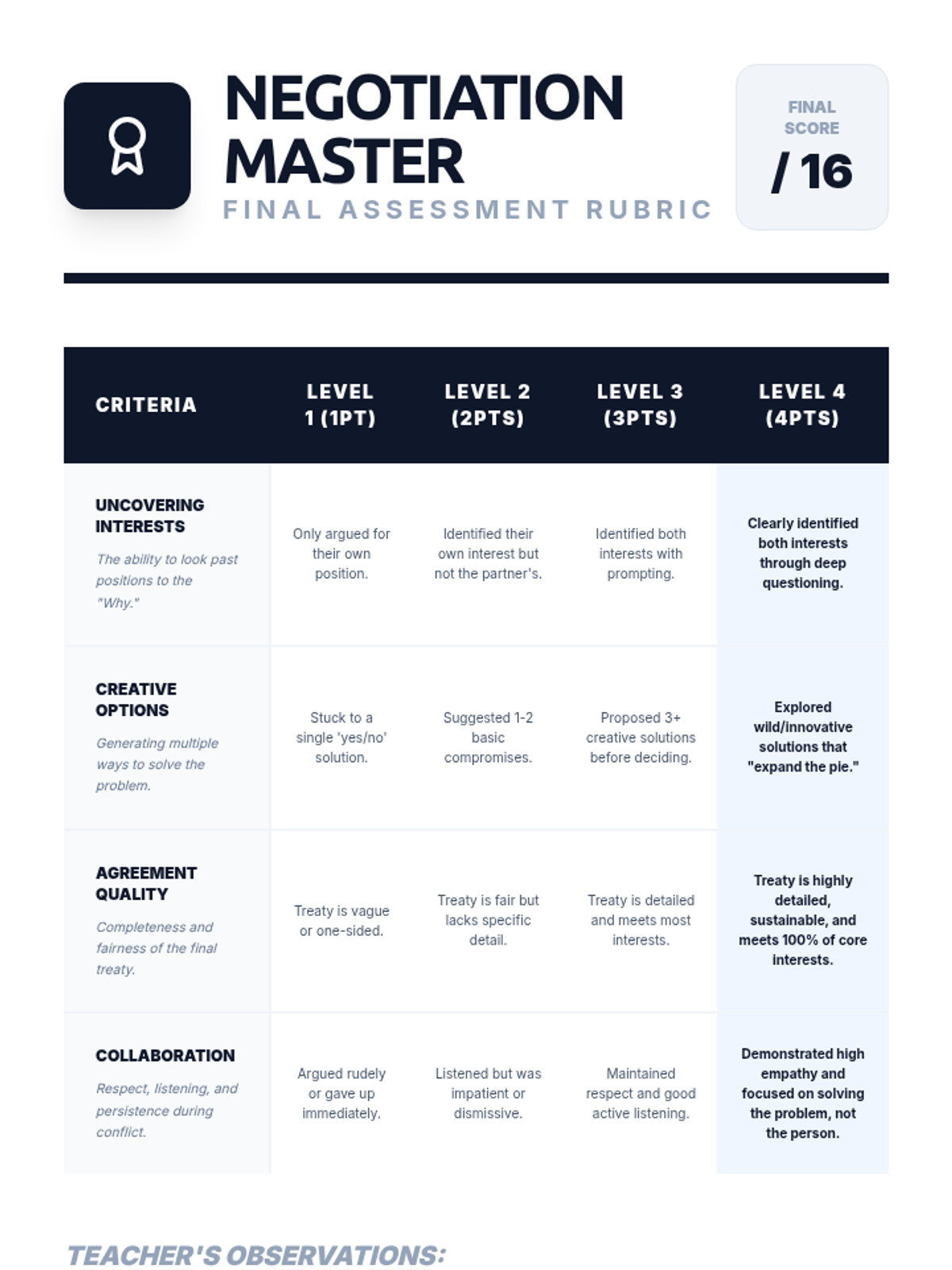
Final rubric for Lesson 5: Negotiation Showdown. Assesses students on four key competencies: Uncovering Interests, Creative Option Generation, Agreement Quality, and Collaboration/Professionalism.
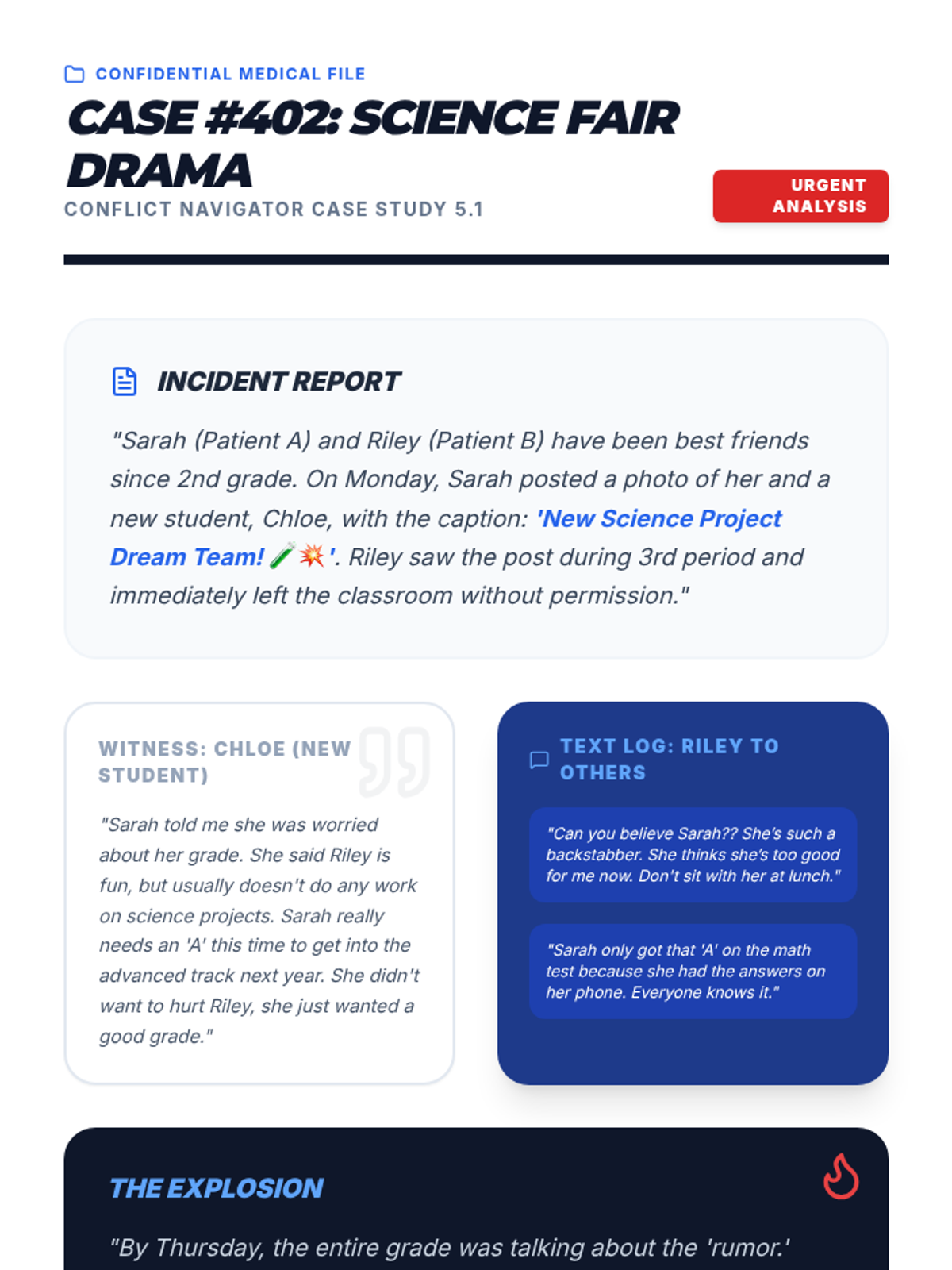
A detailed fictional case study for the final lesson, providing students with witness statements, text logs, and incident reports to analyze a complex middle school conflict.
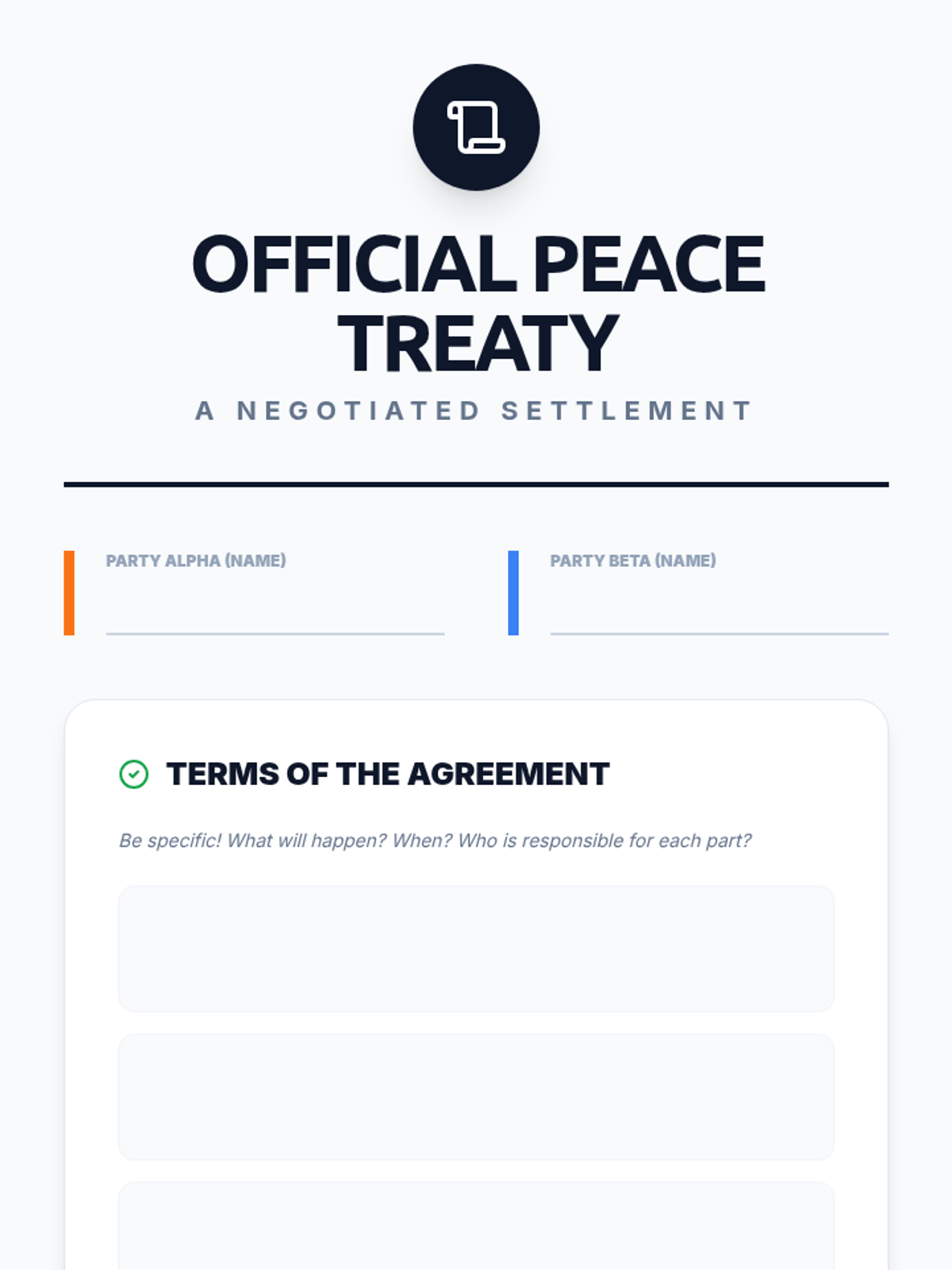
The "Official Peace Treaty" document for the Lesson 5 simulation. Pairs of students use this to formalize their negotiated agreement, detailing specific terms, verifying that both parties' interests have been met, and providing space for formal signatures.
Slides for the final lesson, framing the conflict resolution synthesis activity as a "Conflict Clinic" where students act as doctors to diagnose a complex dispute.
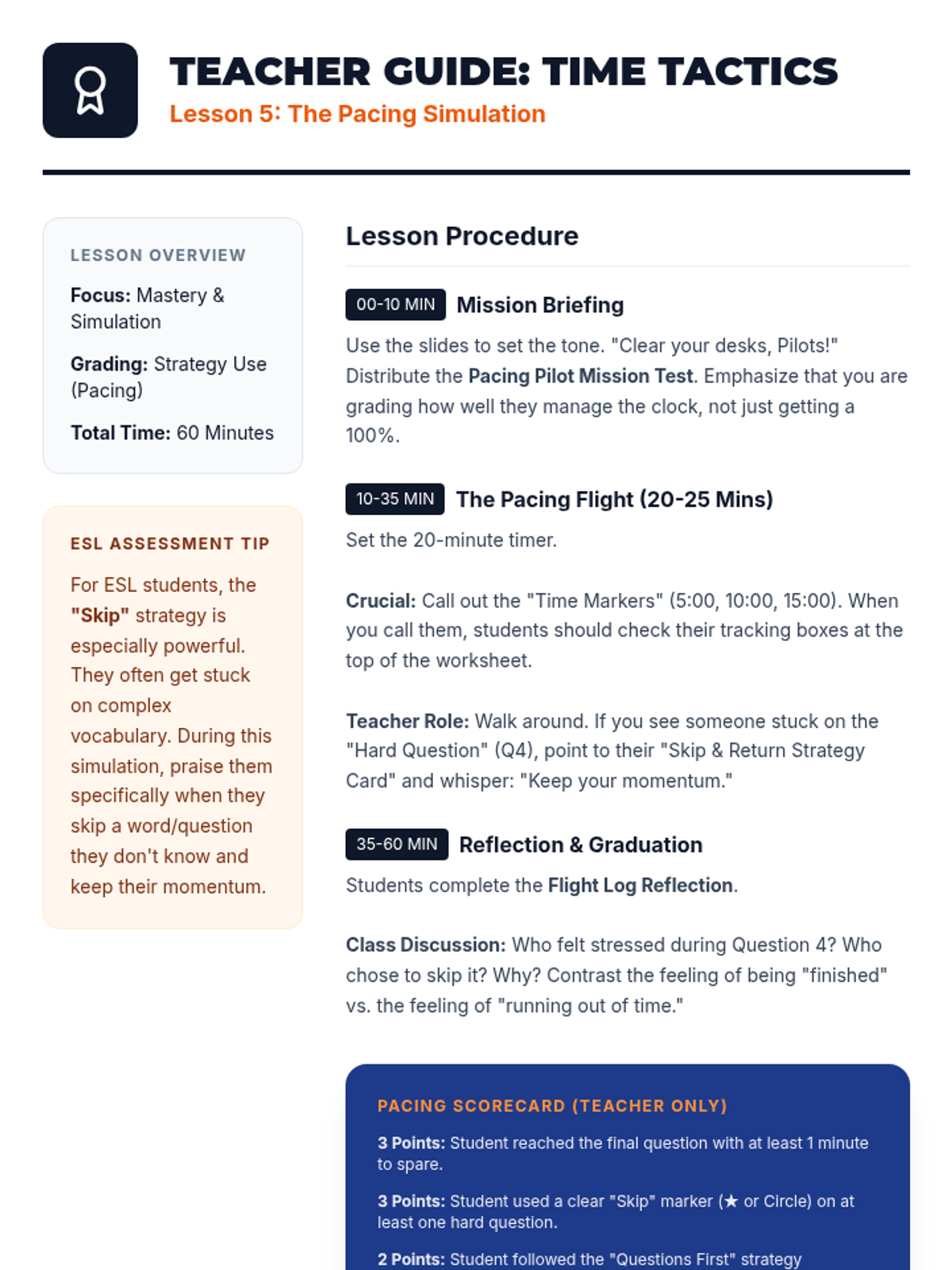
Teacher guidance for the Lesson 5 simulation, including timing calls, teacher observation tips, and a scoring rubric for student pacing behavior.
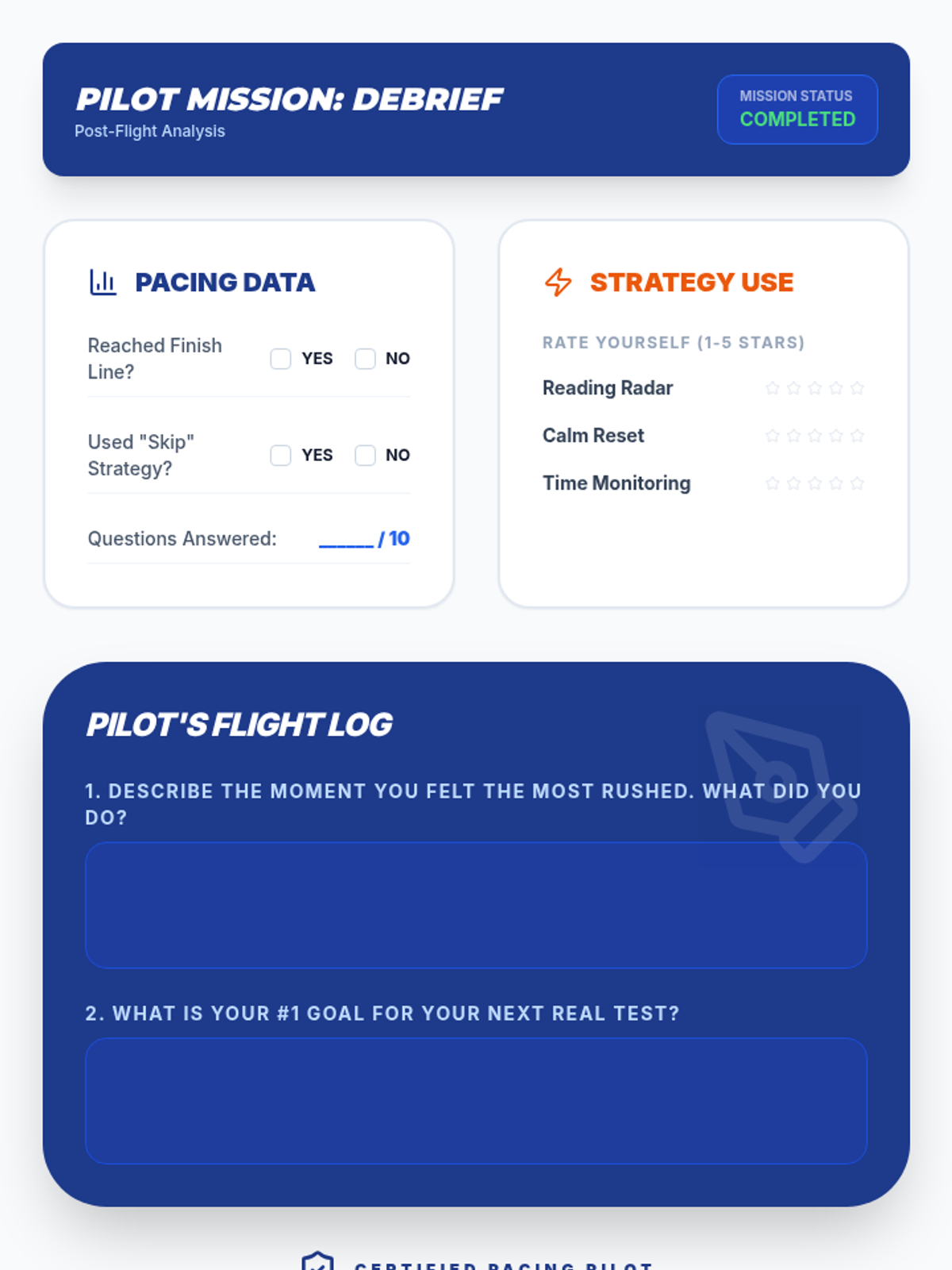
The Lesson 5 reflection and debrief worksheet where students analyze their performance during the simulation and rate their strategy use.
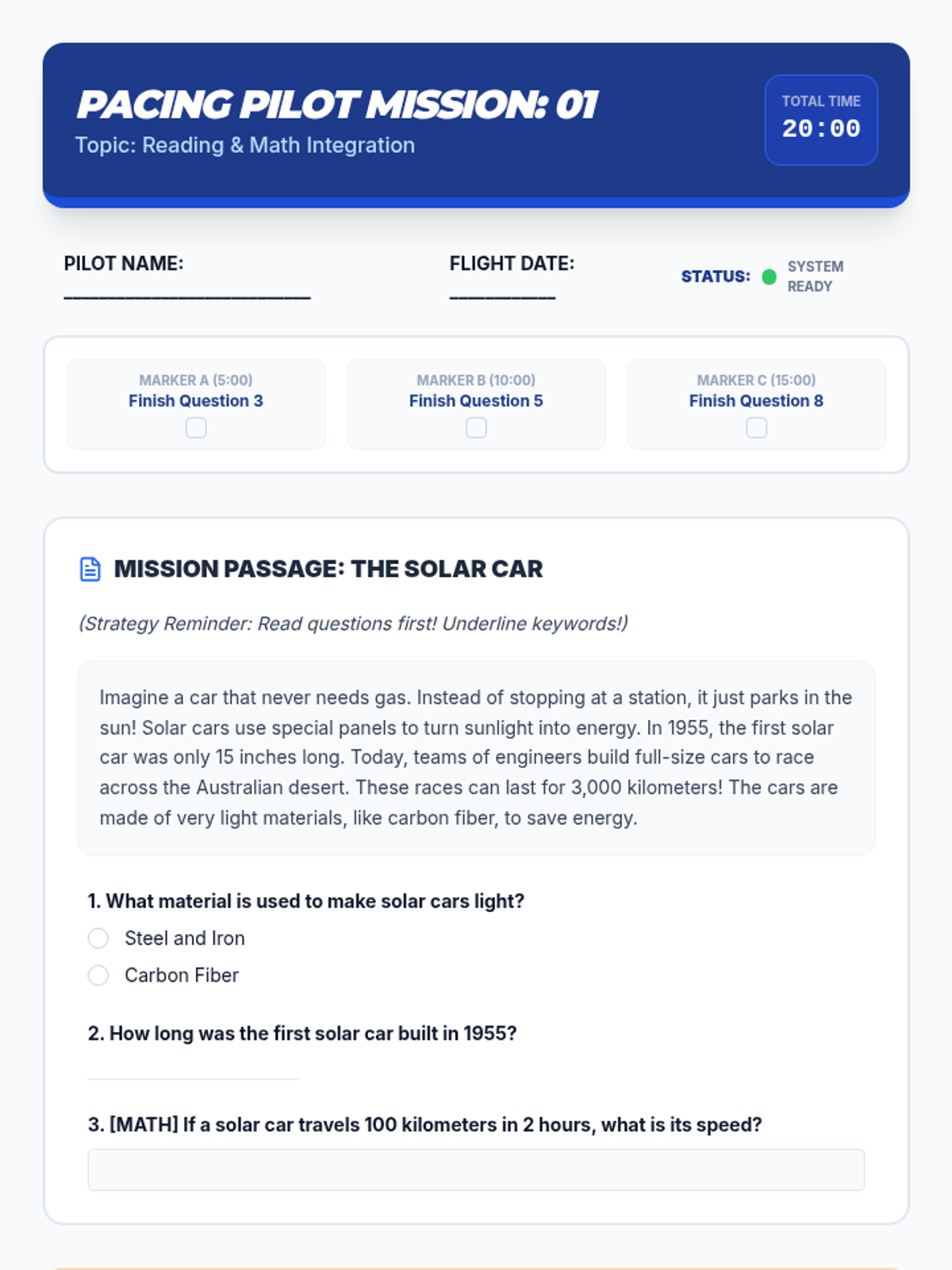
The first page of the Lesson 5 simulation test, designed to test pacing with a passage, integrated math, and a strategically 'hard' question to prompt skipping.
Final slide deck for Lesson 5, featuring the pacing simulation briefing, mission rules, and time markers for the practice test.
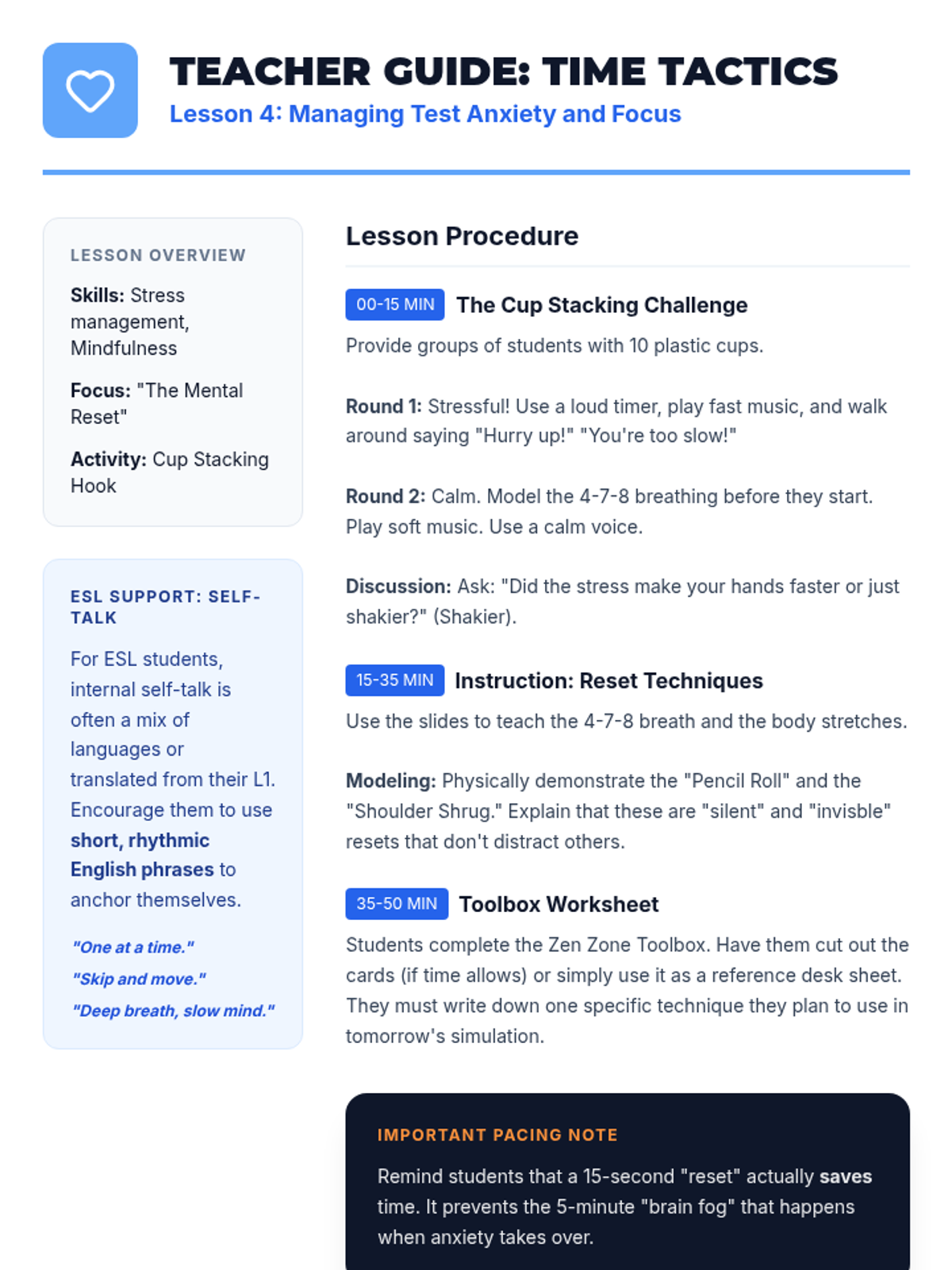
Teacher guidance for Lesson 4, including managing the cup-stacking challenge and modeling reset techniques for ESL students.
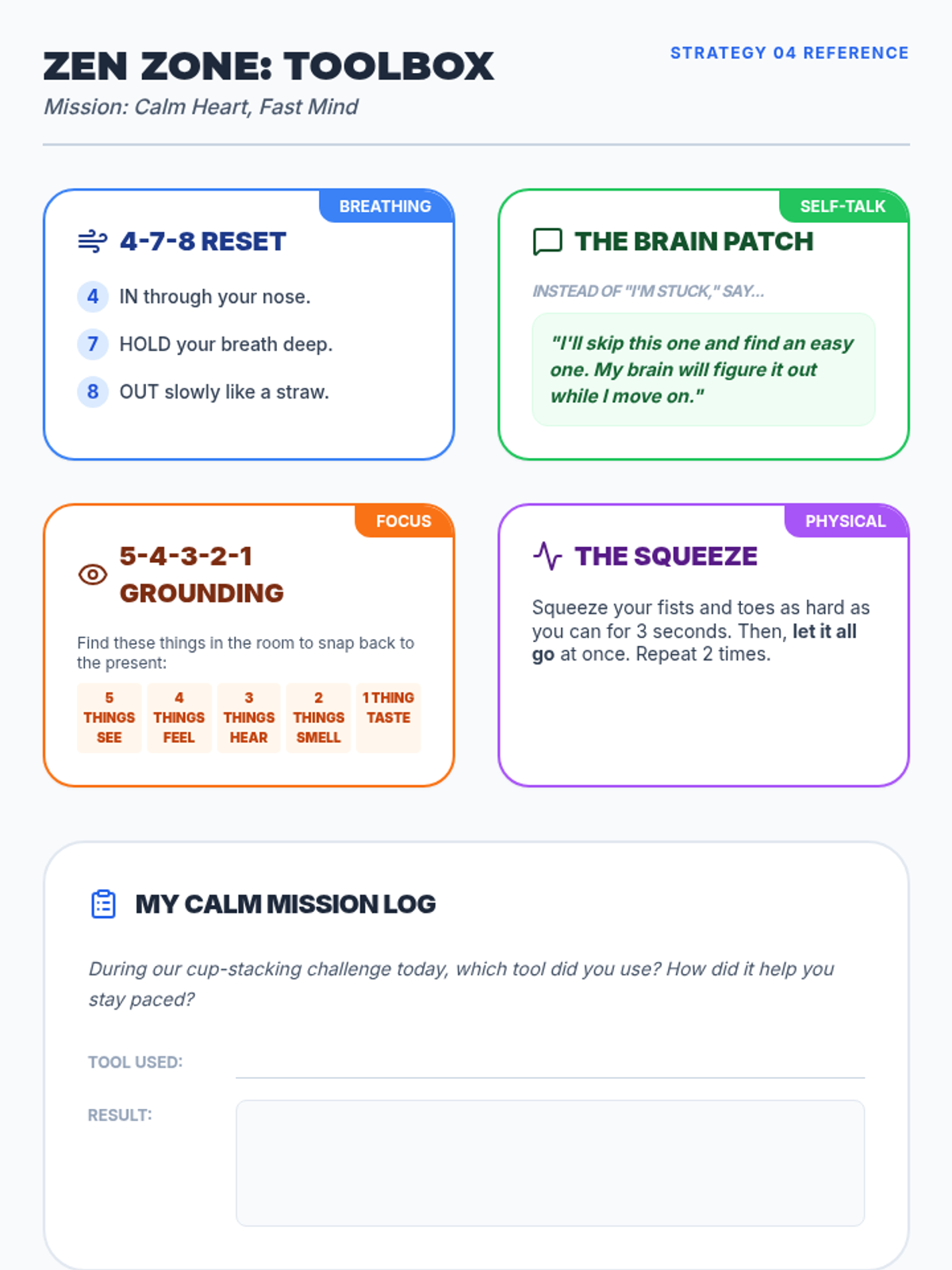
A resource sheet for Lesson 4 with 'Zen Zone' strategy cards (breathing, self-talk, grounding, physical reset) and a practice log for the cup-stacking activity.
Slide deck for Lesson 4 on managing test anxiety, featuring breathing techniques, positive self-talk, and in-seat physical resets.
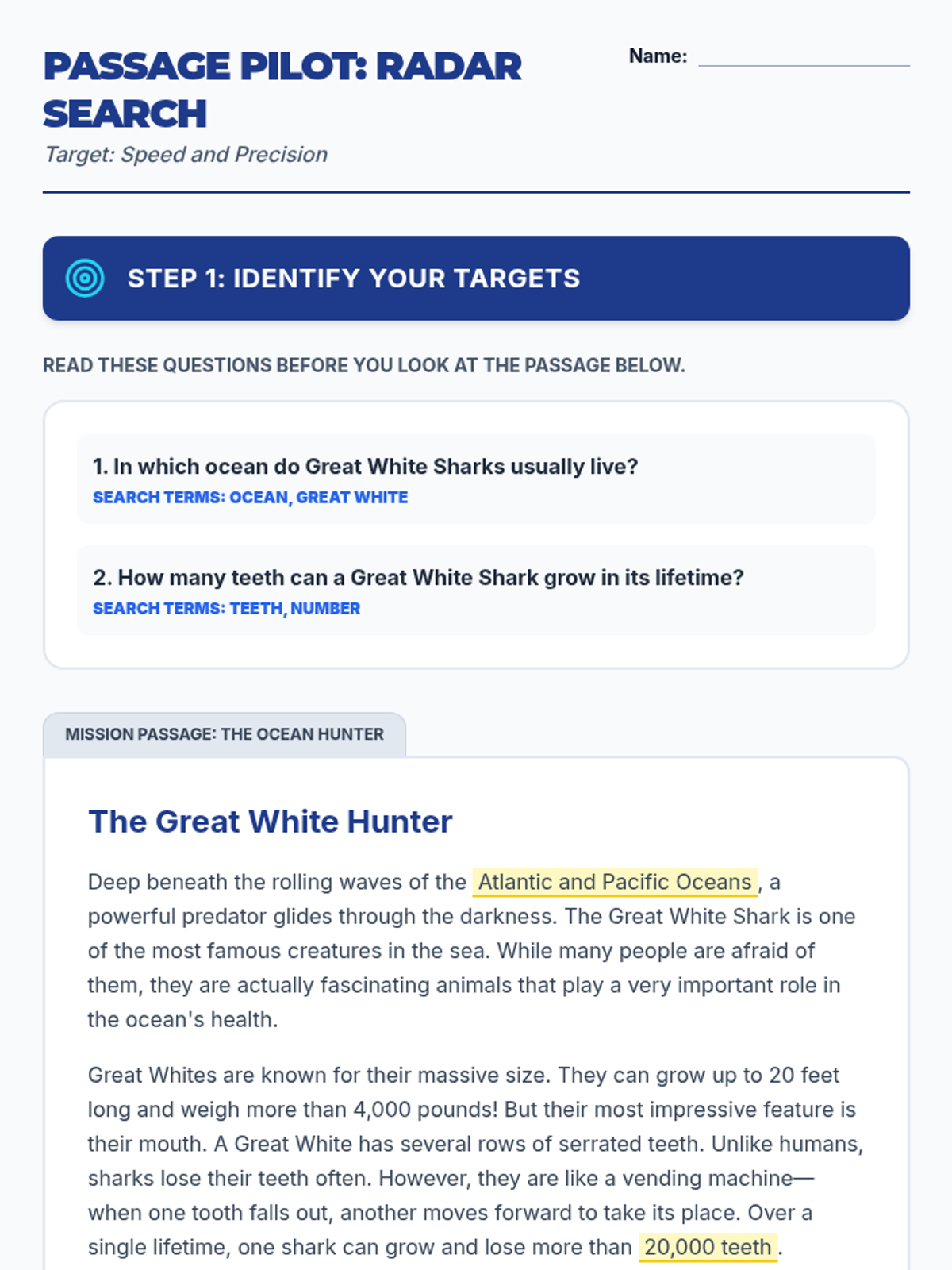
A practice worksheet for Lesson 3 that uses a short passage about sharks to help students practice the 'Questions First' and 'Keyword Search' strategies.
Slide deck for Lesson 3 on handling long passages, teaching the 'Questions First' strategy and skimming techniques to save time.
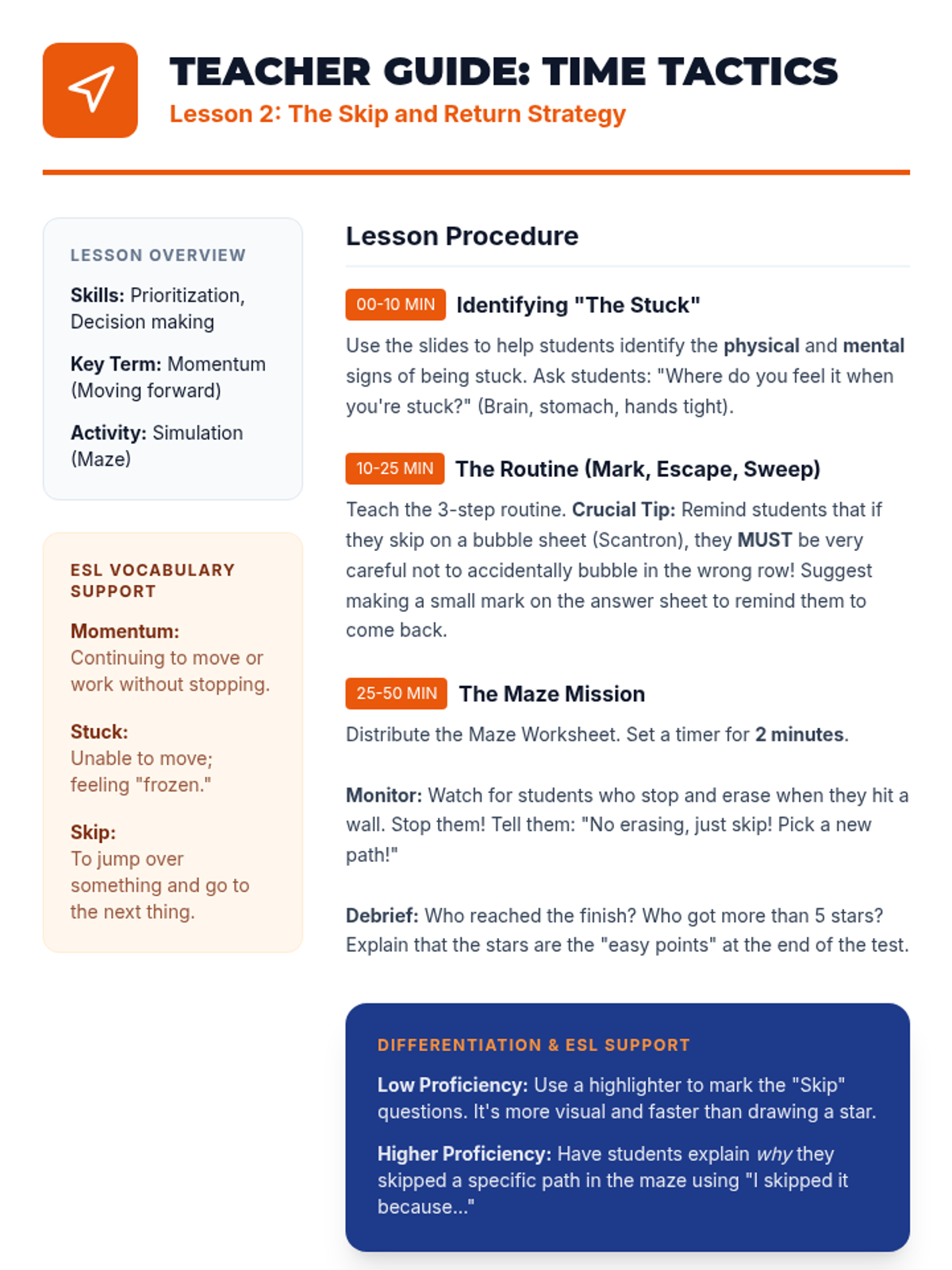
Teacher guidance for Lesson 2, including momentum concepts, ESL vocabulary support, and maze simulation management.