Empathetic skill development through emotion recognition, cultural diversity appreciation, and bias confrontation. Targets multi-perspective analysis to support respectful interactions and complex social responses.
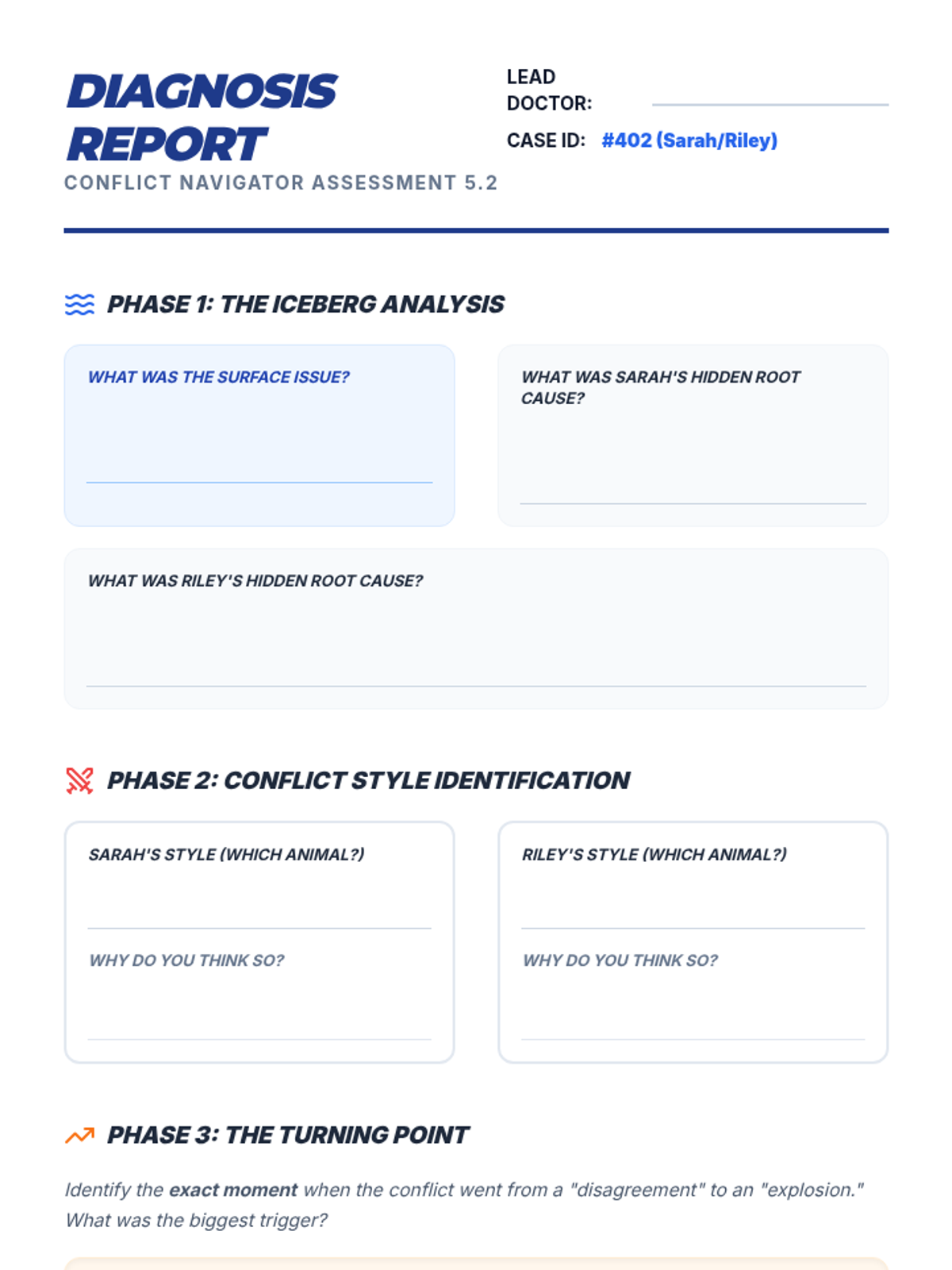
The final assessment form for students to synthesize their learning by diagnosing the Sarah/Riley case study, identifying root causes, styles, and intervention strategies.
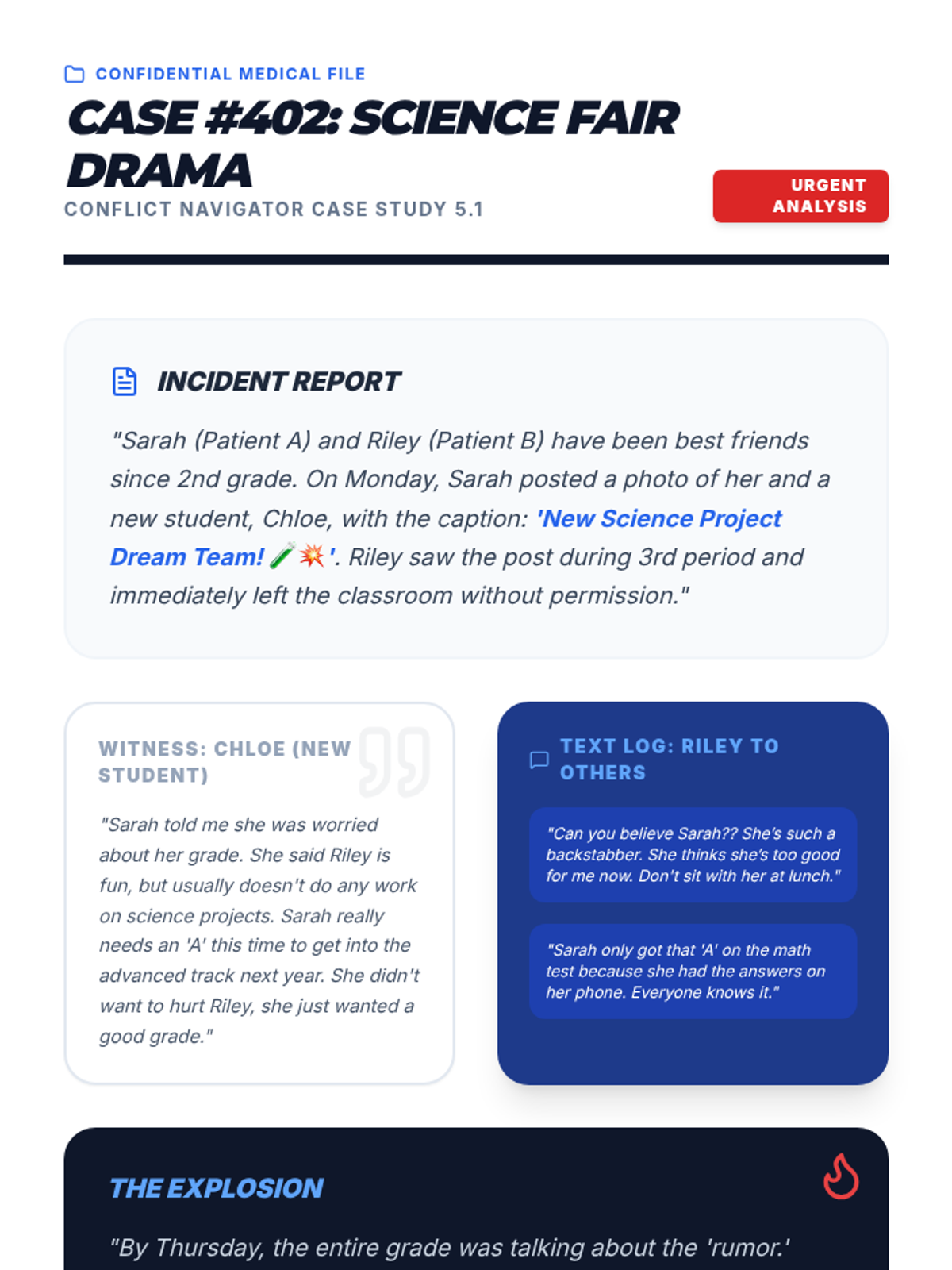
A detailed fictional case study for the final lesson, providing students with witness statements, text logs, and incident reports to analyze a complex middle school conflict.
Slides for the final lesson, framing the conflict resolution synthesis activity as a "Conflict Clinic" where students act as doctors to diagnose a complex dispute.
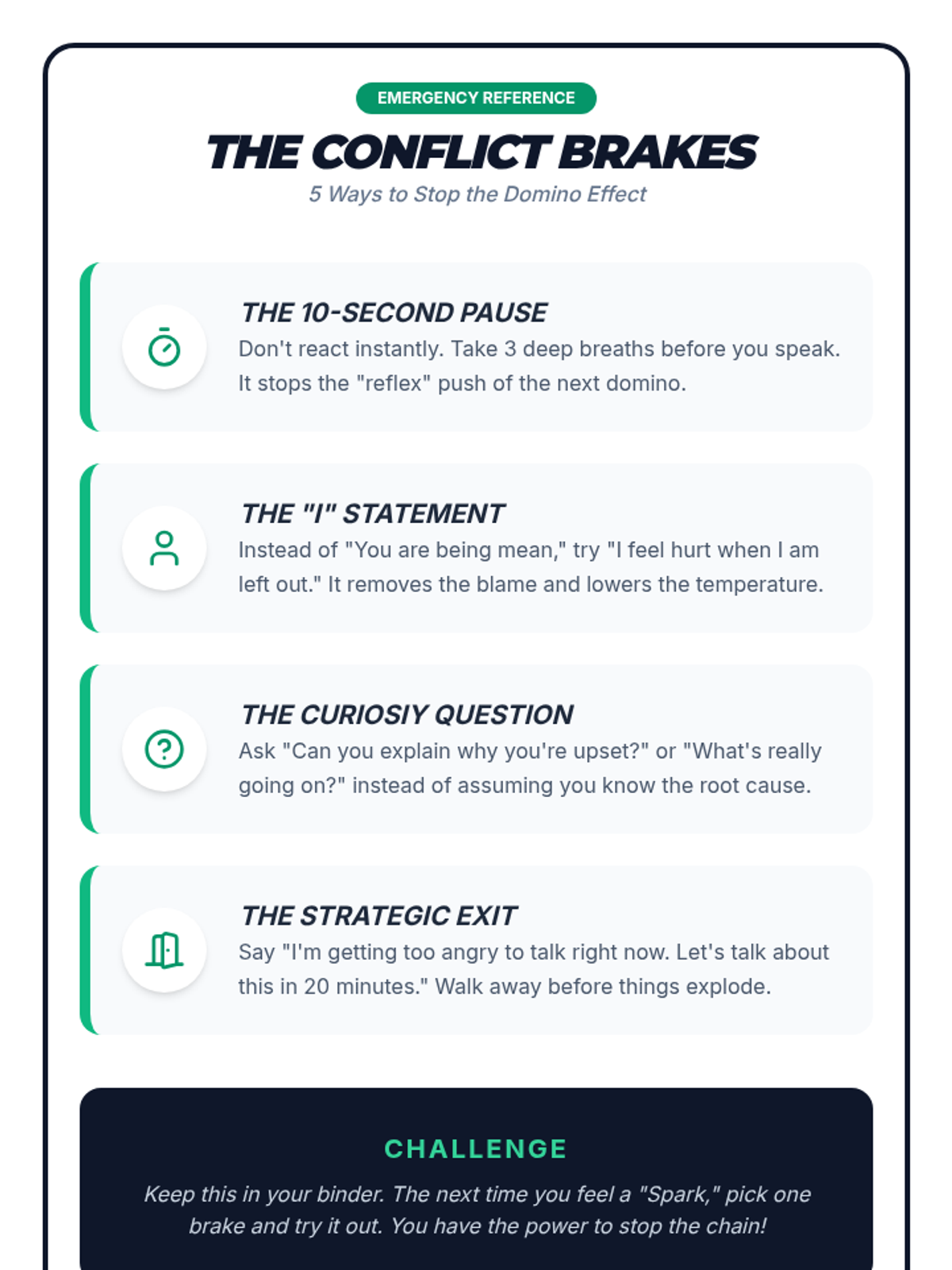
A reference handout for students listing four key de-escalation strategies (The Brakes) to use when they recognize a conflict starting to escalate.
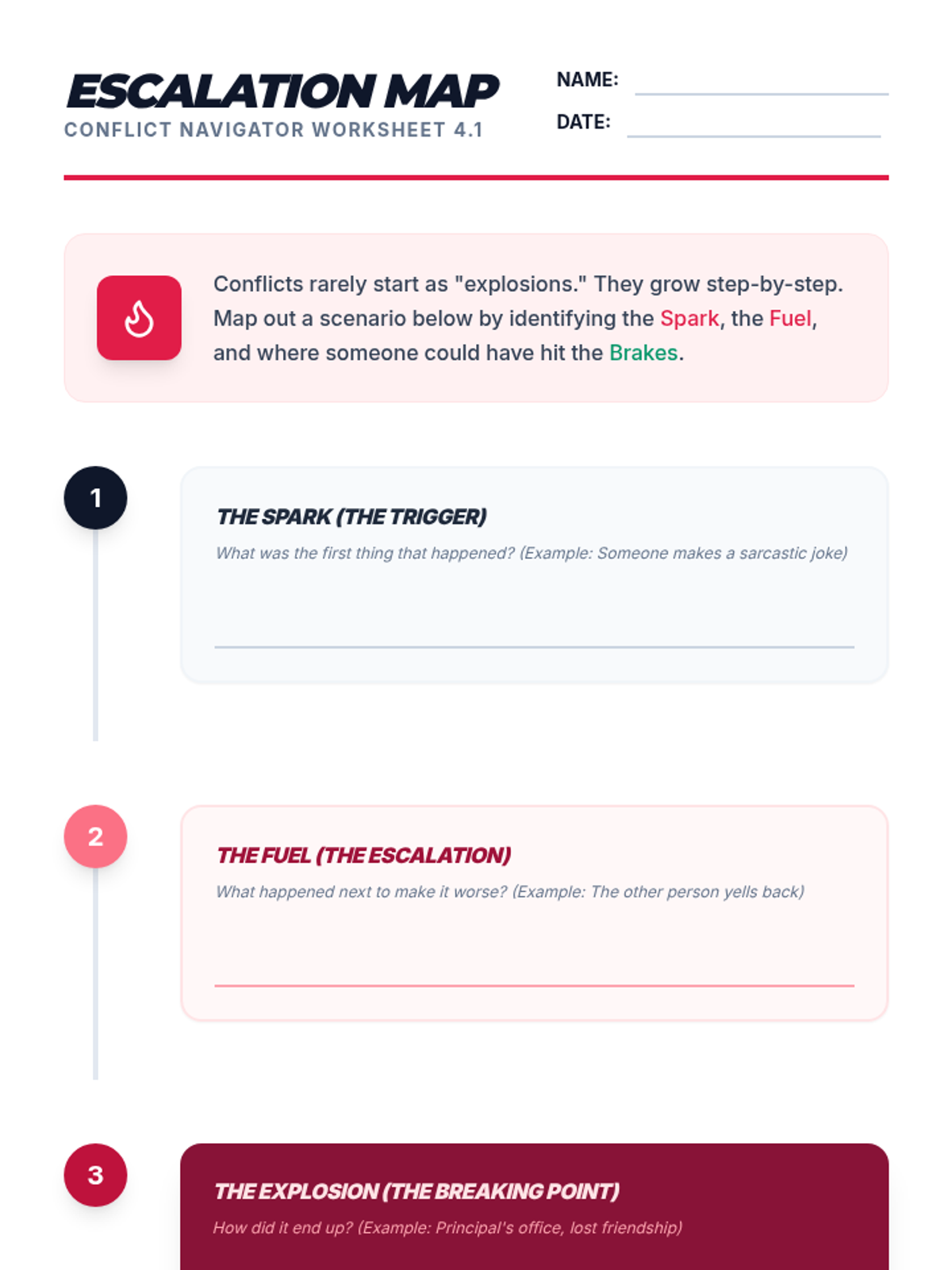
A student worksheet for Lesson 4 where learners map out a conflict scenario through the stages of Spark, Fuel, and Explosion, and then identify intervention points.
Slides for Lesson 4, exploring the cycle of conflict escalation through the "Domino Effect" analogy and teaching students to recognize triggers and turning points.
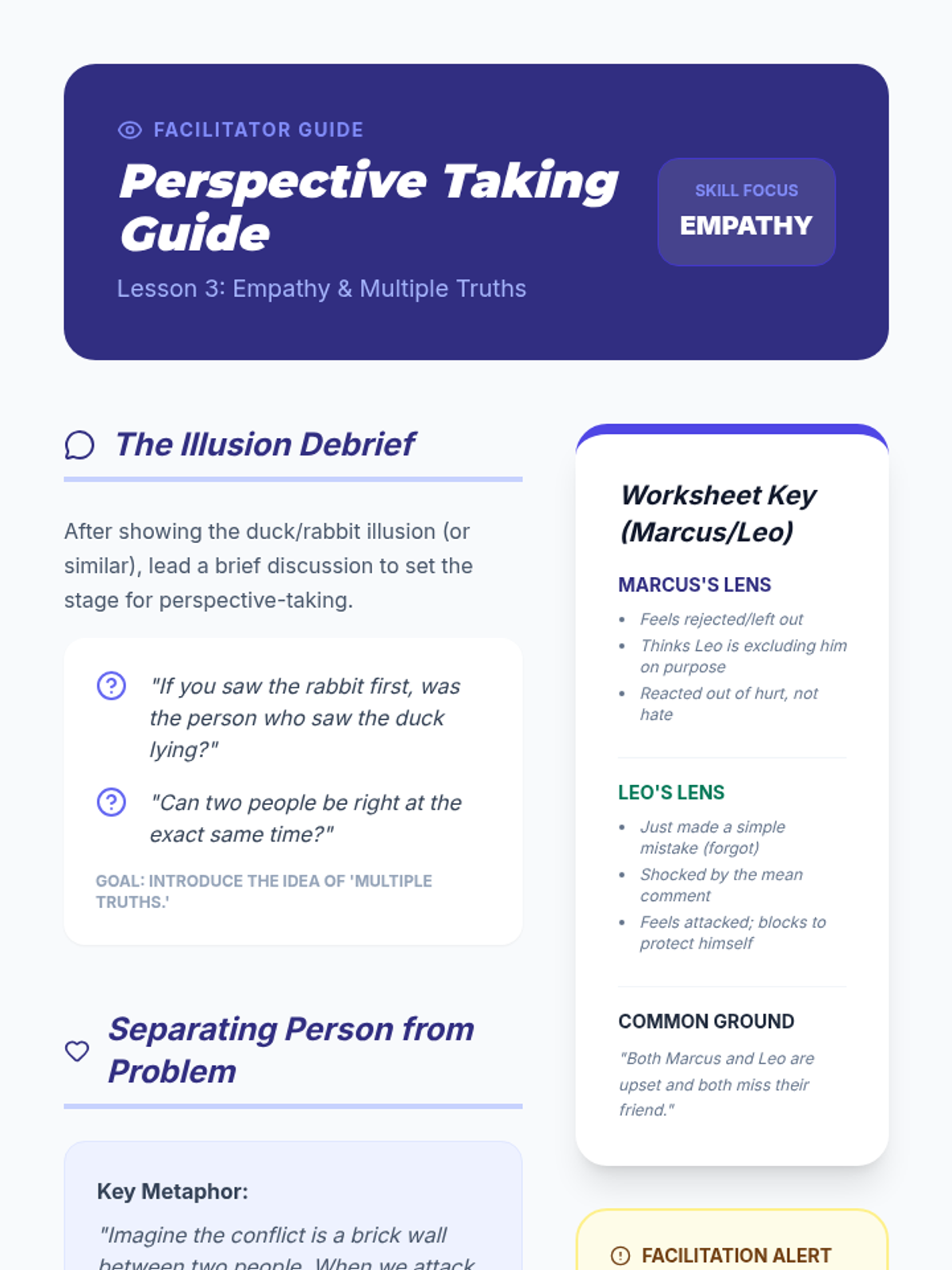
A teacher guide for Lesson 3 focused on facilitating empathy and perspective-taking discussions, including key metaphors and analysis of the Marcus/Leo scenario.
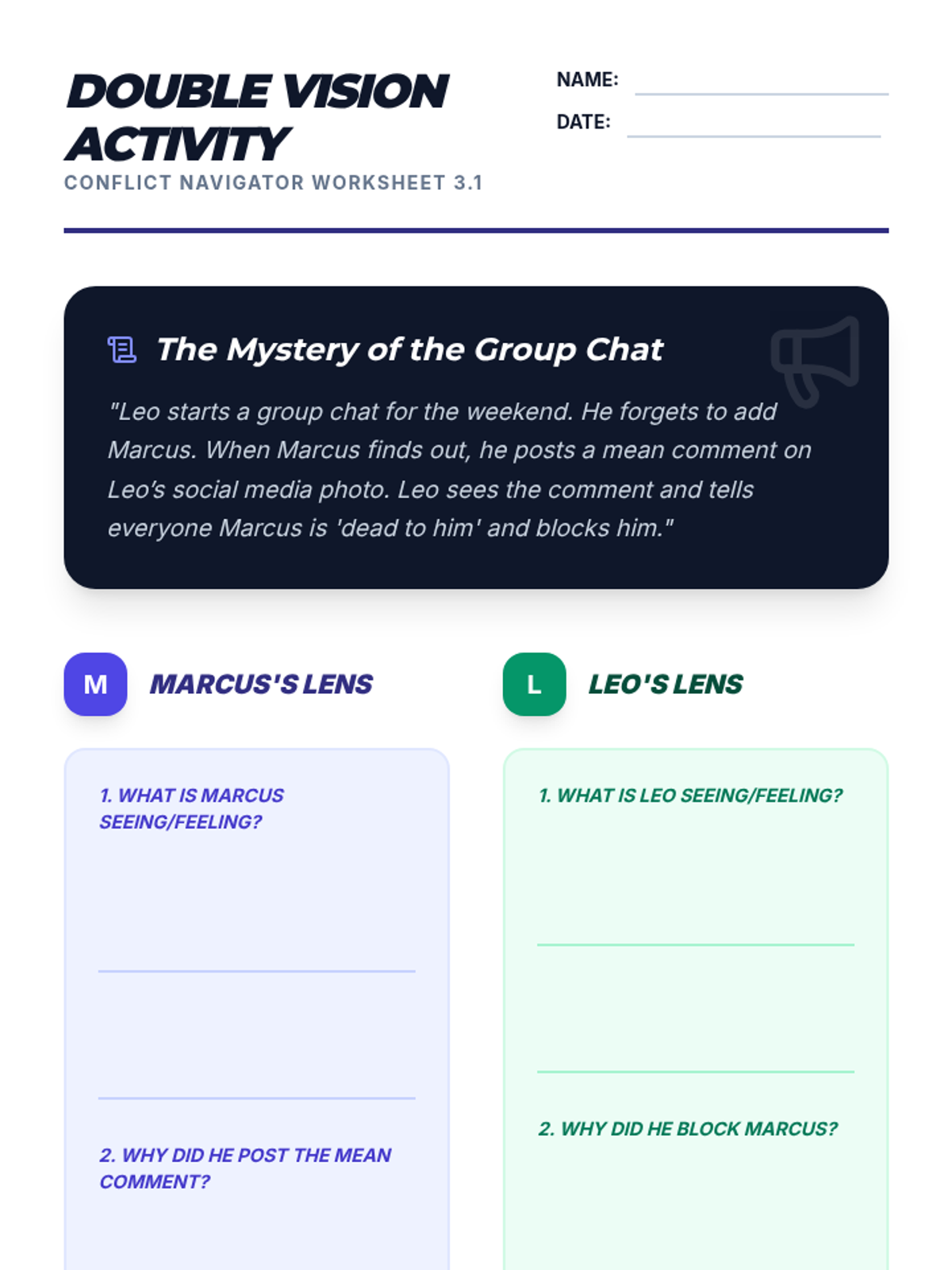
A worksheet for Lesson 3 where students analyze a conflict scenario involving two friends, practice viewing the dispute through each person's "lens," and identify common ground.
Slides for Lesson 3, using optical illusions to introduce the concept of perspective-taking and the importance of separating the person from the problem.
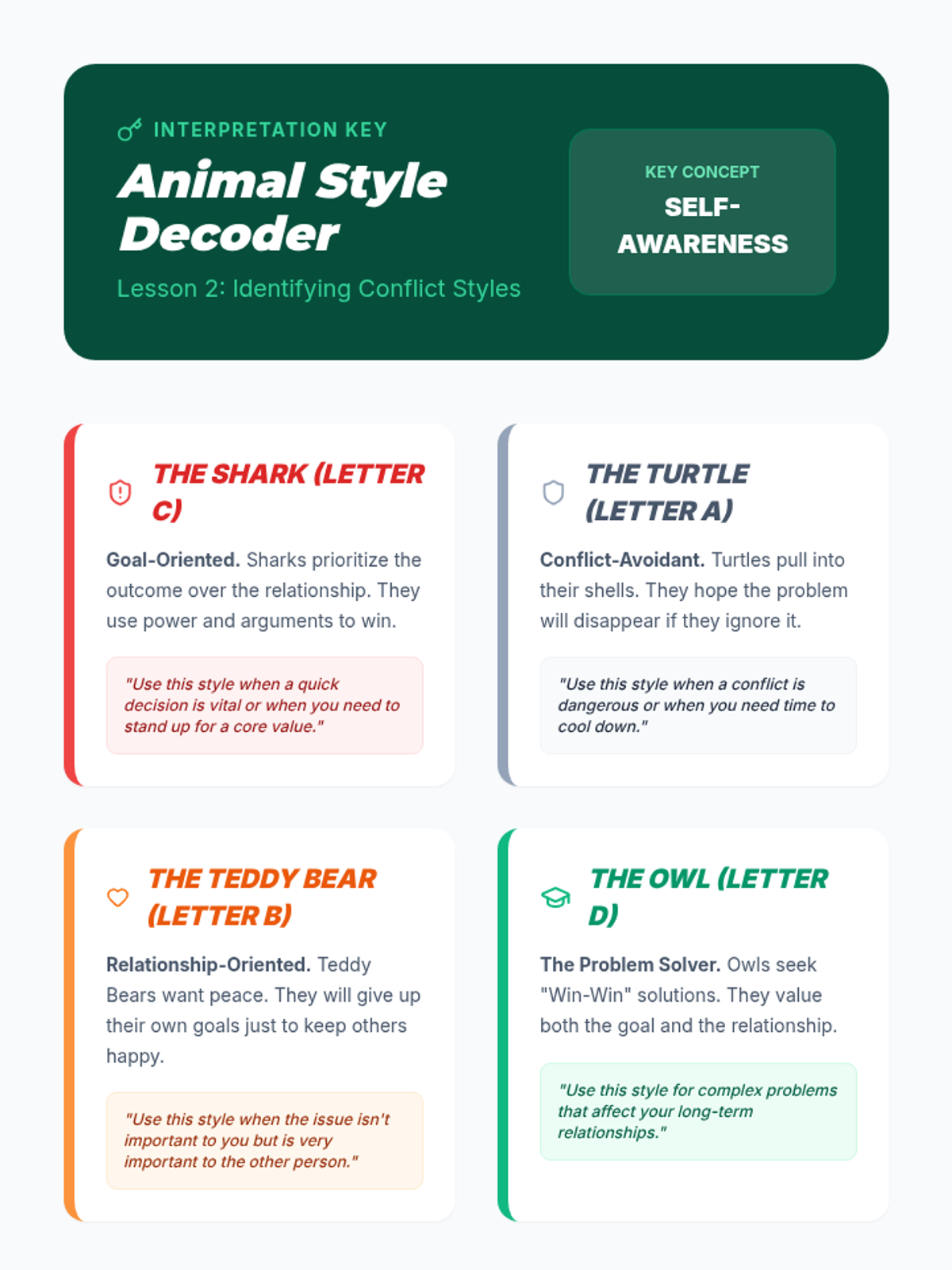
A teacher resource for Lesson 2 providing the scoring key and interpretation for the animal conflict styles assessment, along with facilitation tips for classroom discussion.
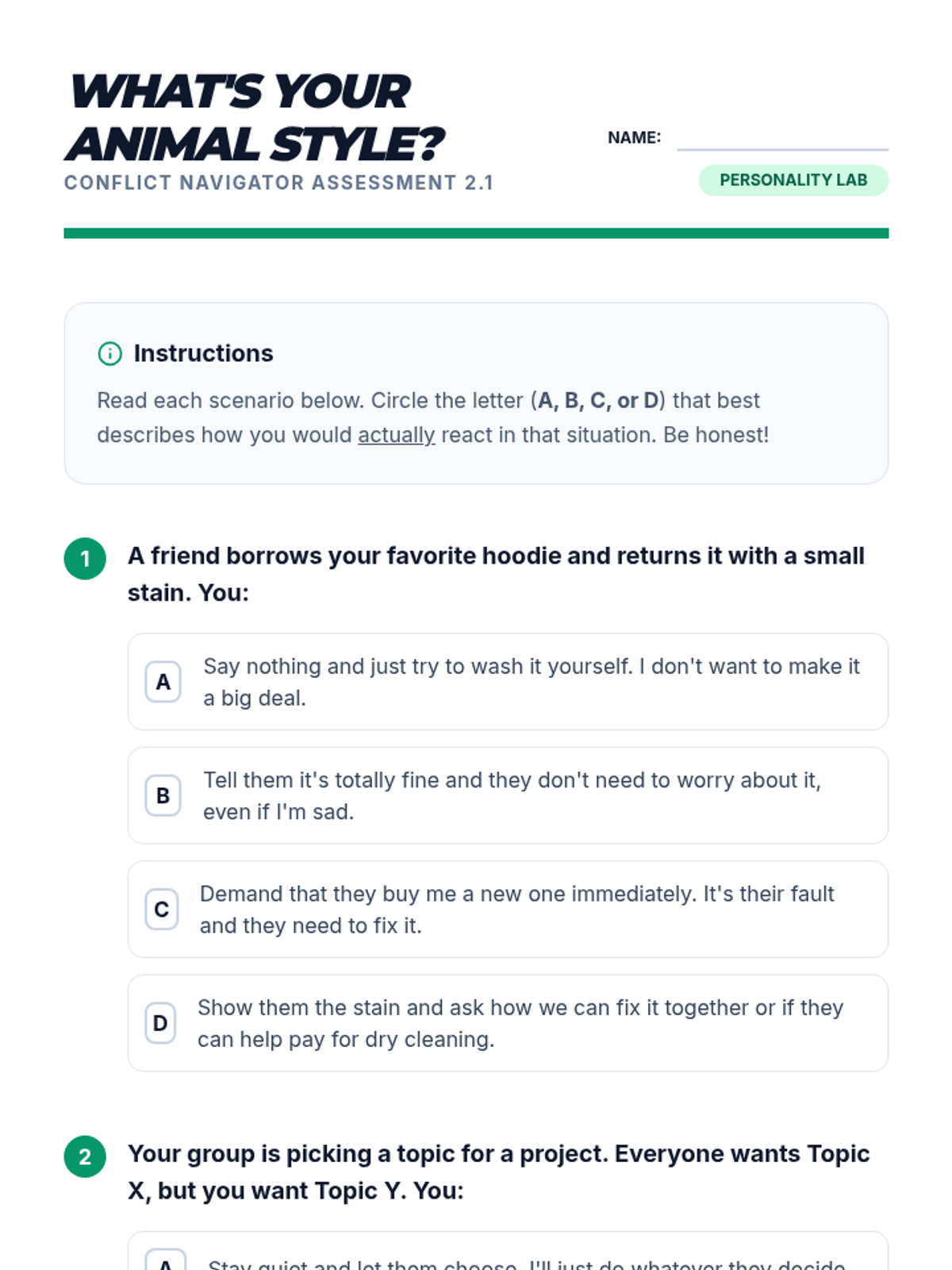
A student assessment worksheet for Lesson 2 that uses relatable scenarios to help students identify their default conflict style.
Slides for Lesson 2, introducing the four core conflict styles using animal metaphors (Shark, Turtle, Teddy Bear, Owl) to help students identify their own behavioral defaults.
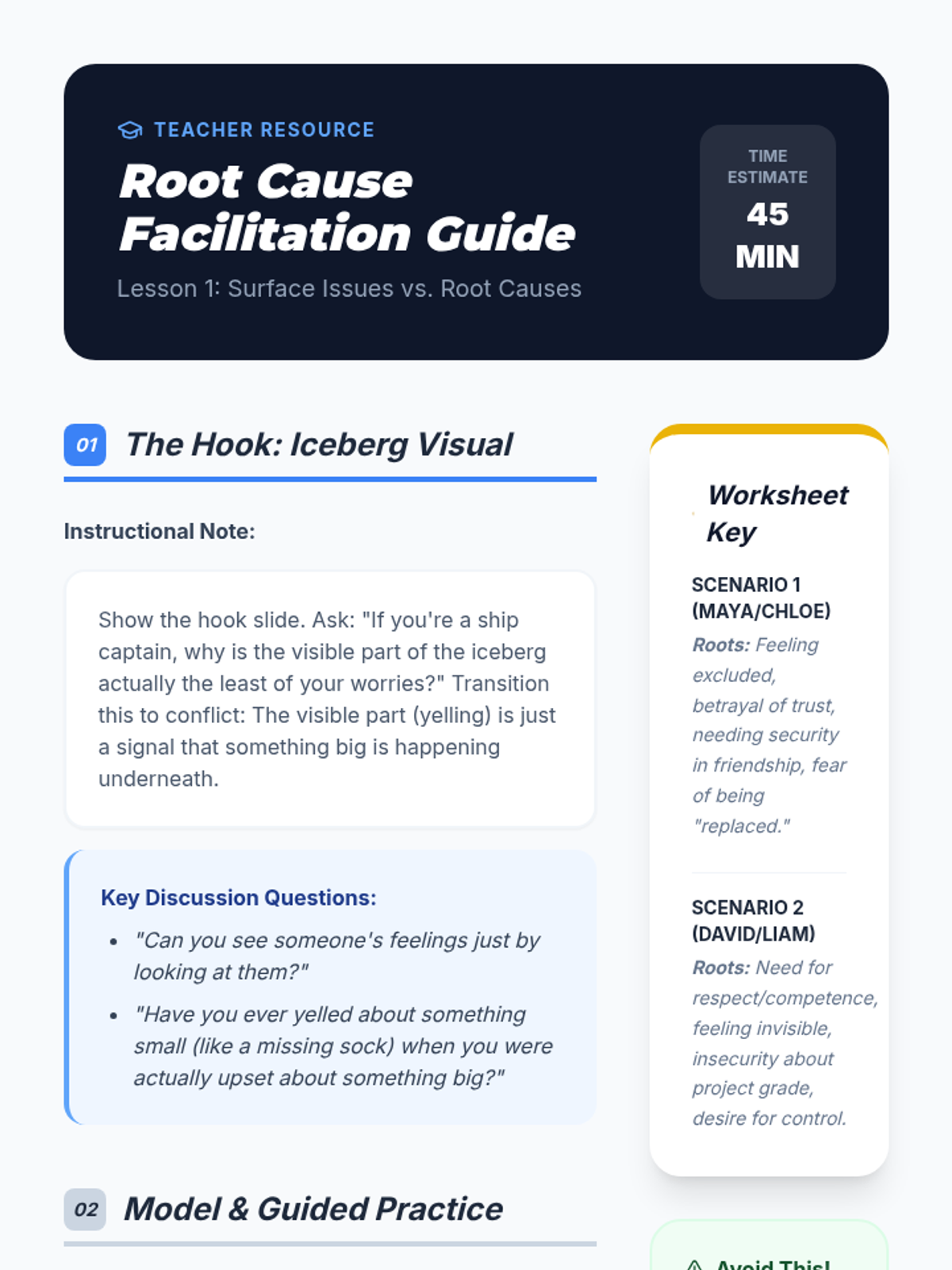
A teacher-facing facilitation guide for Lesson 1, including instructional steps, discussion prompts, and an answer key for the student worksheet.
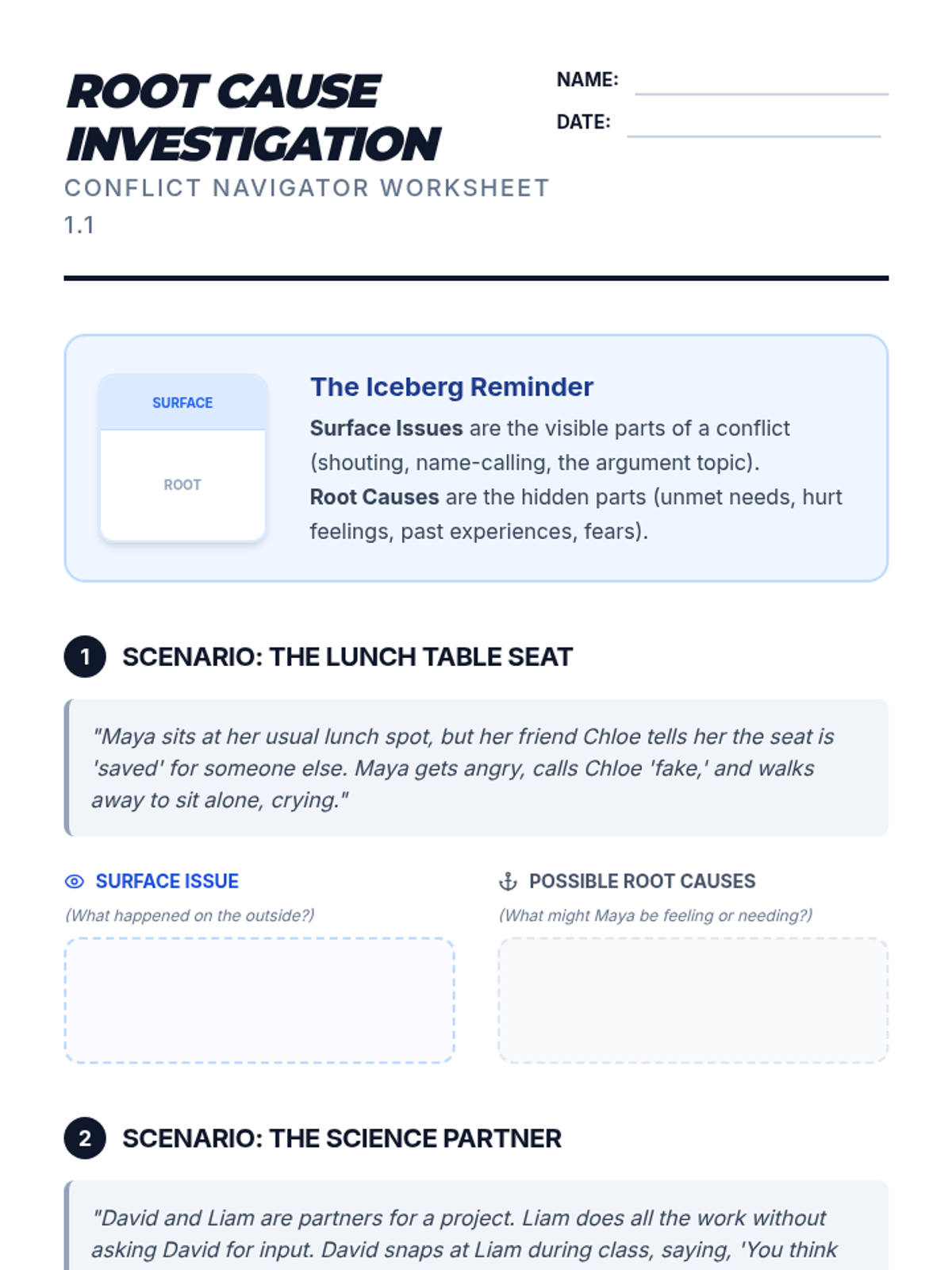
A student worksheet for Lesson 1 where learners analyze two conflict scenarios to identify surface issues and root causes using the Iceberg Model.
Introductory slides for Lesson 1, presenting the Iceberg Model of conflict through a visual hook and a real-world middle school scenario.
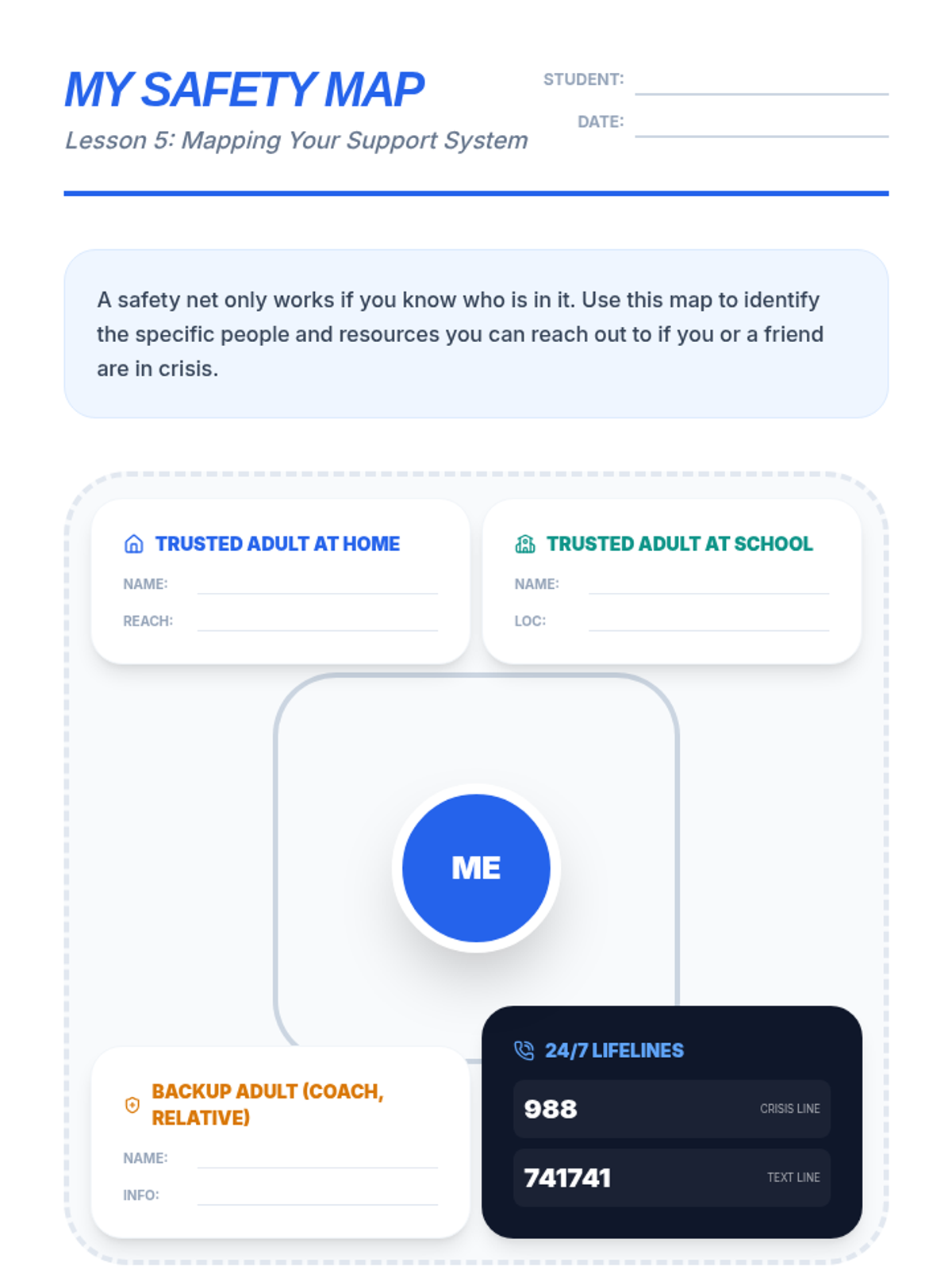
Final graphic organizer for Lesson 5 where students map out their personal and school-wide support networks, including trusted adults and crisis lifelines.
Final presentation for Lesson 5, helping students identify their personal and community support systems, including trusted adults and crisis lifelines.
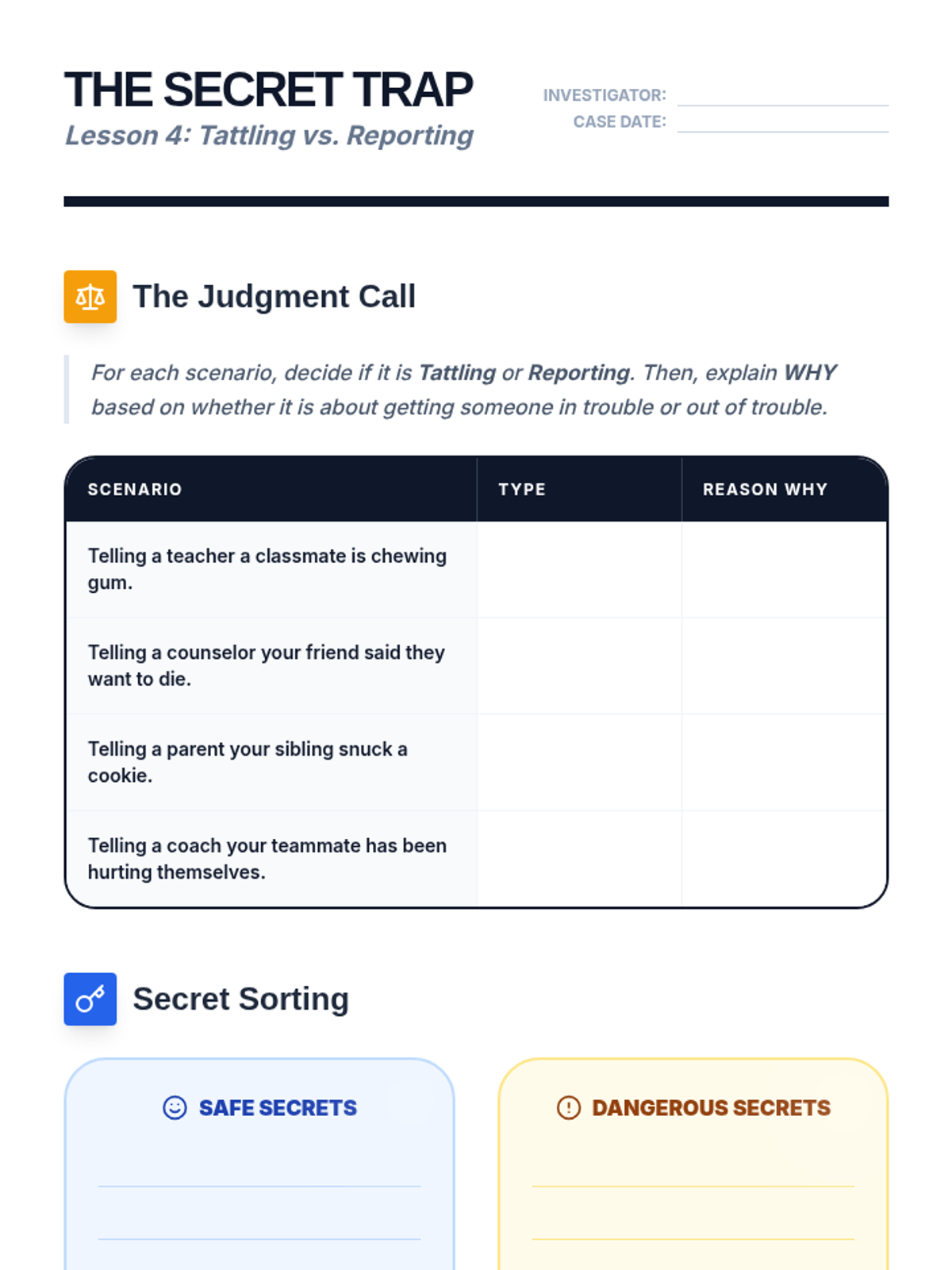
Worksheet for Lesson 4 that helps students distinguish between tattling and reporting through a scenarios table and categorize safe vs. dangerous secrets.
Introductory presentation for Lesson 4, dismantling the 'snitching' stigma by differentiating between tattling (getting someone in trouble) and reporting (getting someone out of trouble).
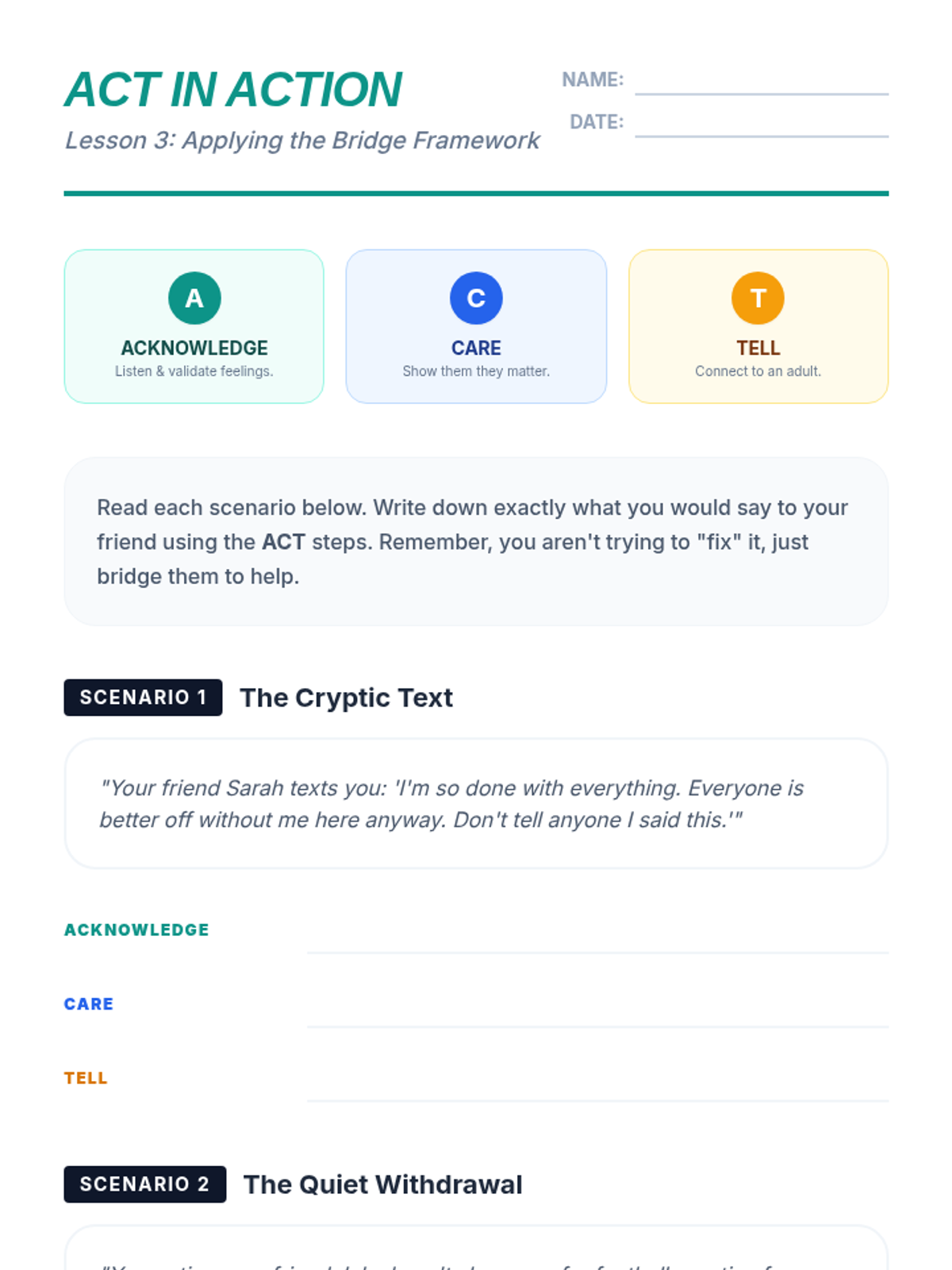
Scenario-based practice worksheet for Lesson 3, where students write out responses using the Acknowledge, Care, Tell framework for various crisis scenarios.
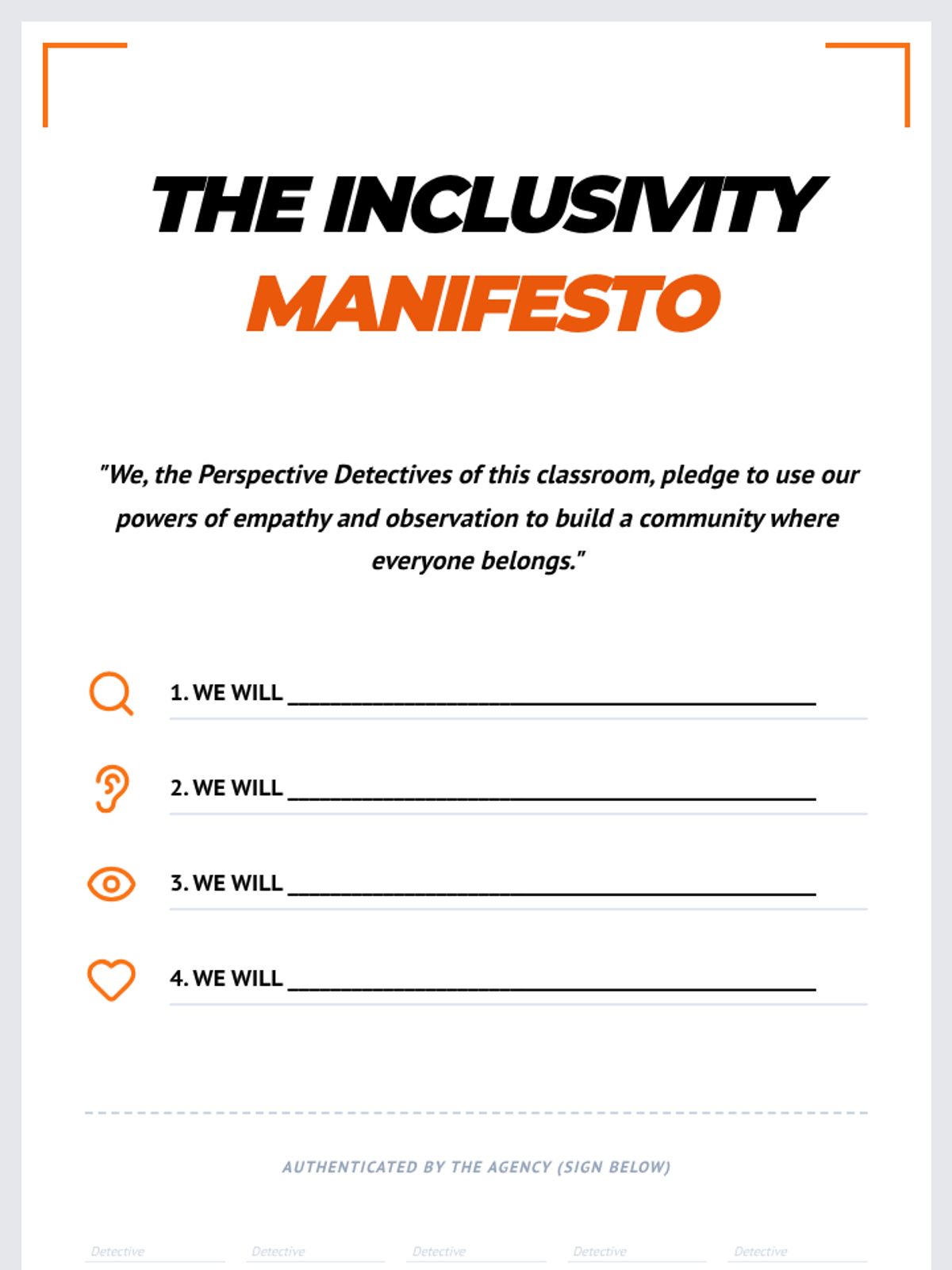
Classroom poster template for establishing shared community norms and inclusive practices after completing the Perspective Detectives sequence.
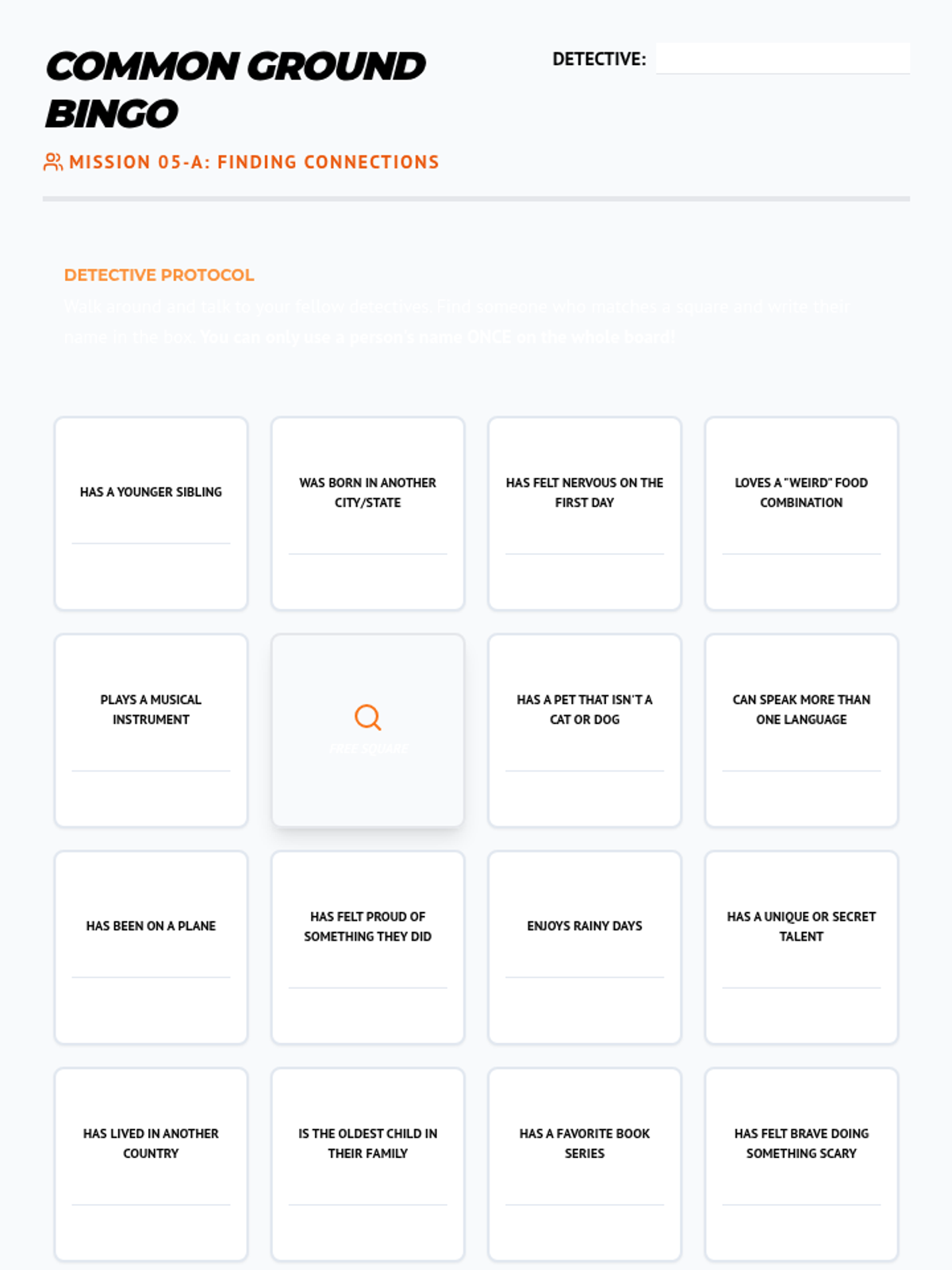
Bingo-style activity sheet where students find peers who share various experiences and traits to identify common ground.
Slides for the final lesson, focusing on finding common ground, establishing classroom norms, and celebrating the completion of the sequence.
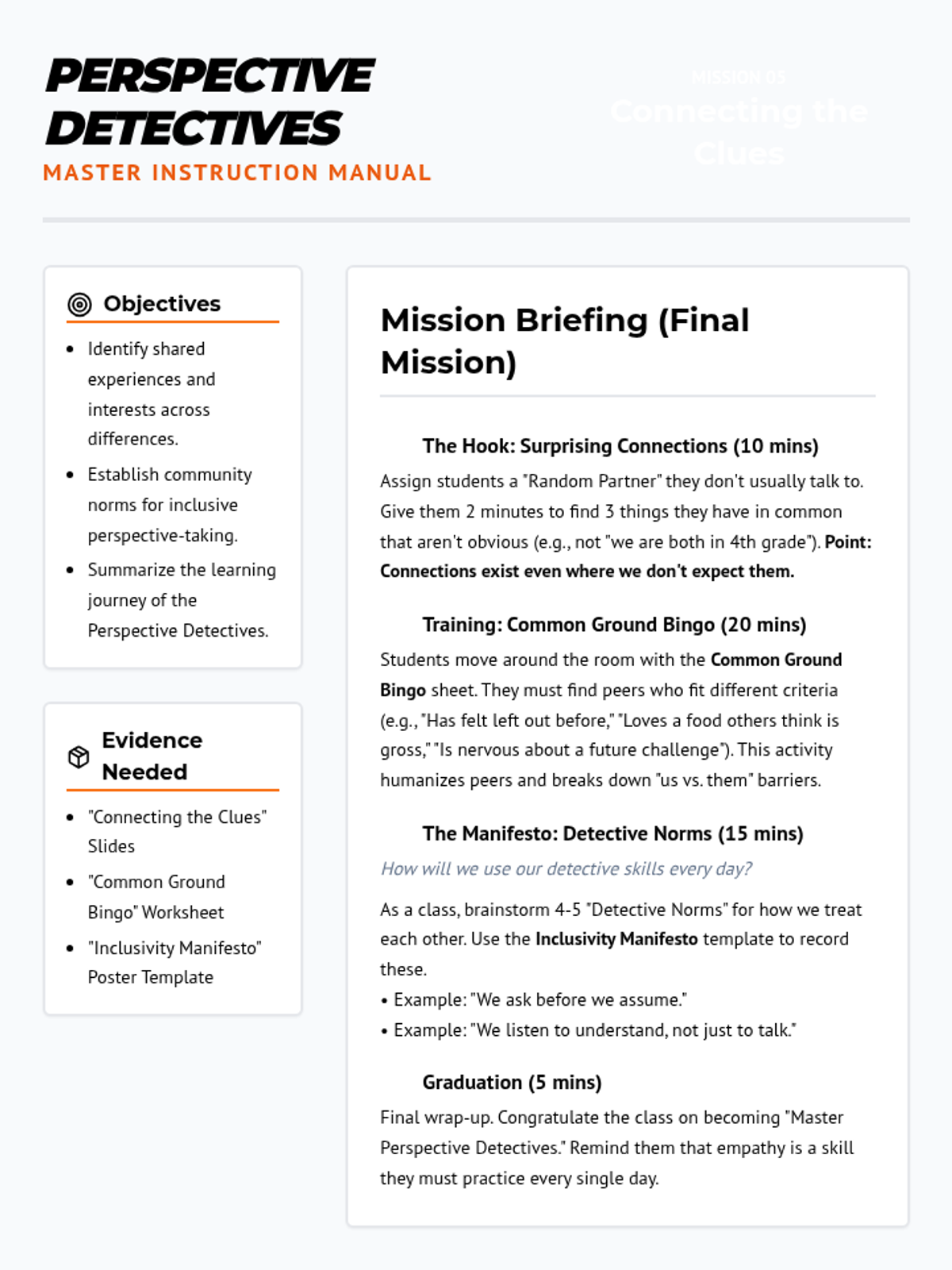
Teacher facilitation guide for the final lesson, focusing on finding common ground and establishing classroom inclusivity norms.
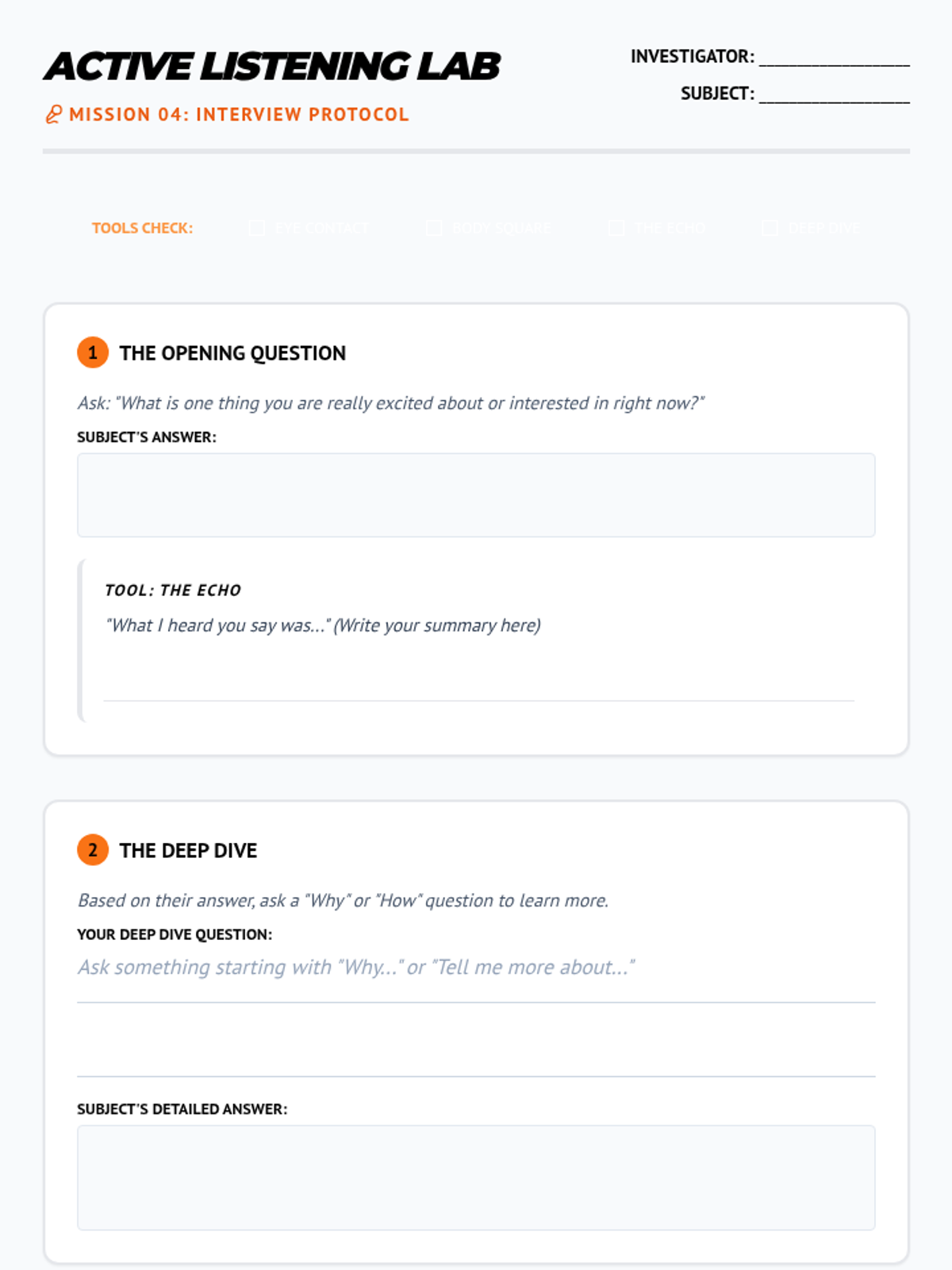
Student worksheet for Lesson 4, guiding students through a structured interview using active listening tools (Echo and Deep Dive).
Slides for Lesson 4 focusing on active listening tools, the difference between active and passive listening, and the interview challenge.
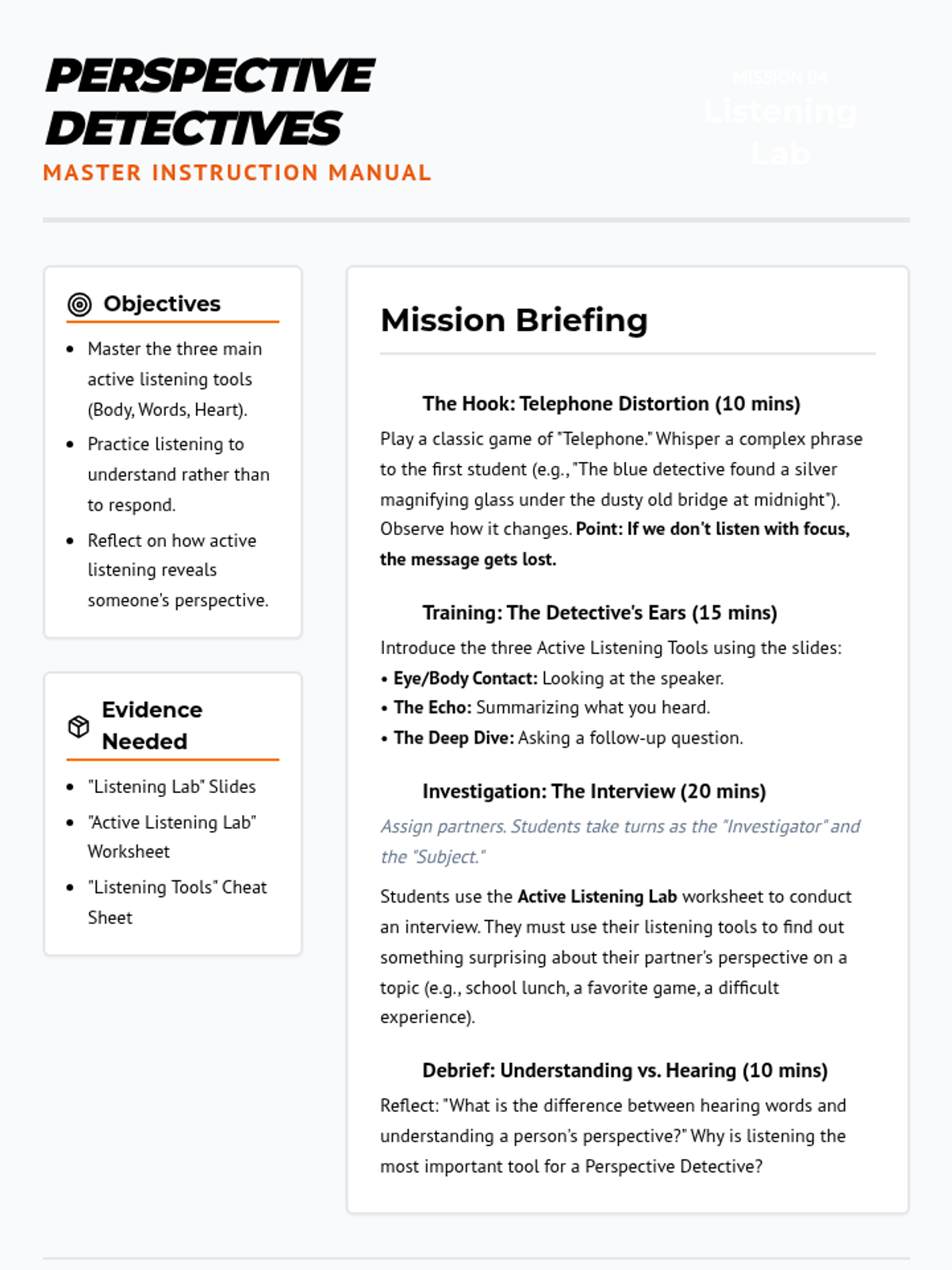
Teacher guide for Lesson 4, focusing on active listening tools and techniques to improve perspective-taking.
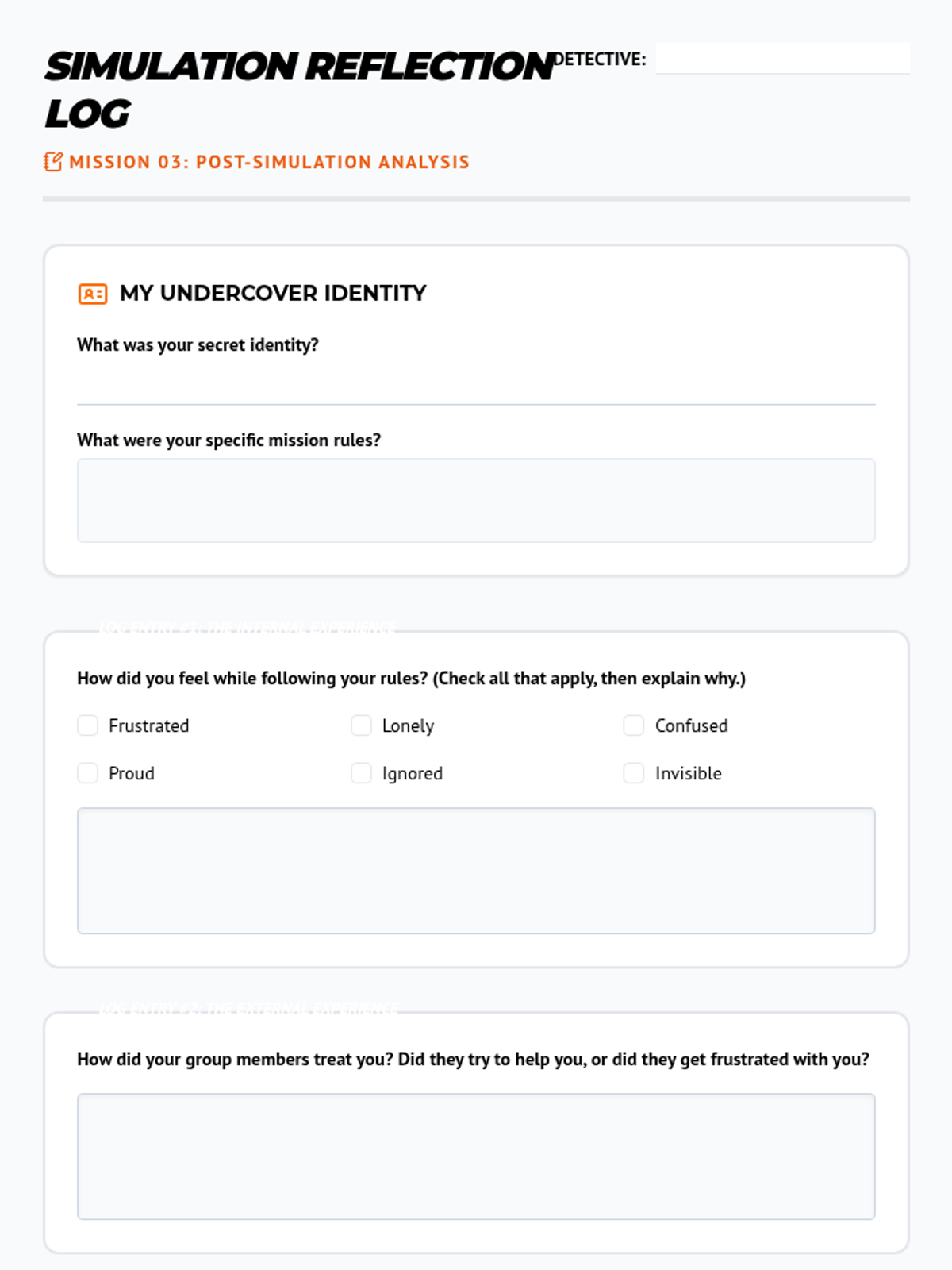
Student reflection sheet for the 'Undercover Empathy' simulation, asking students to process their feelings and insights from the activity.
Slides for Lesson 3 focusing on the Undercover Empathy simulation rules, the definition of empathy, and debriefing questions.
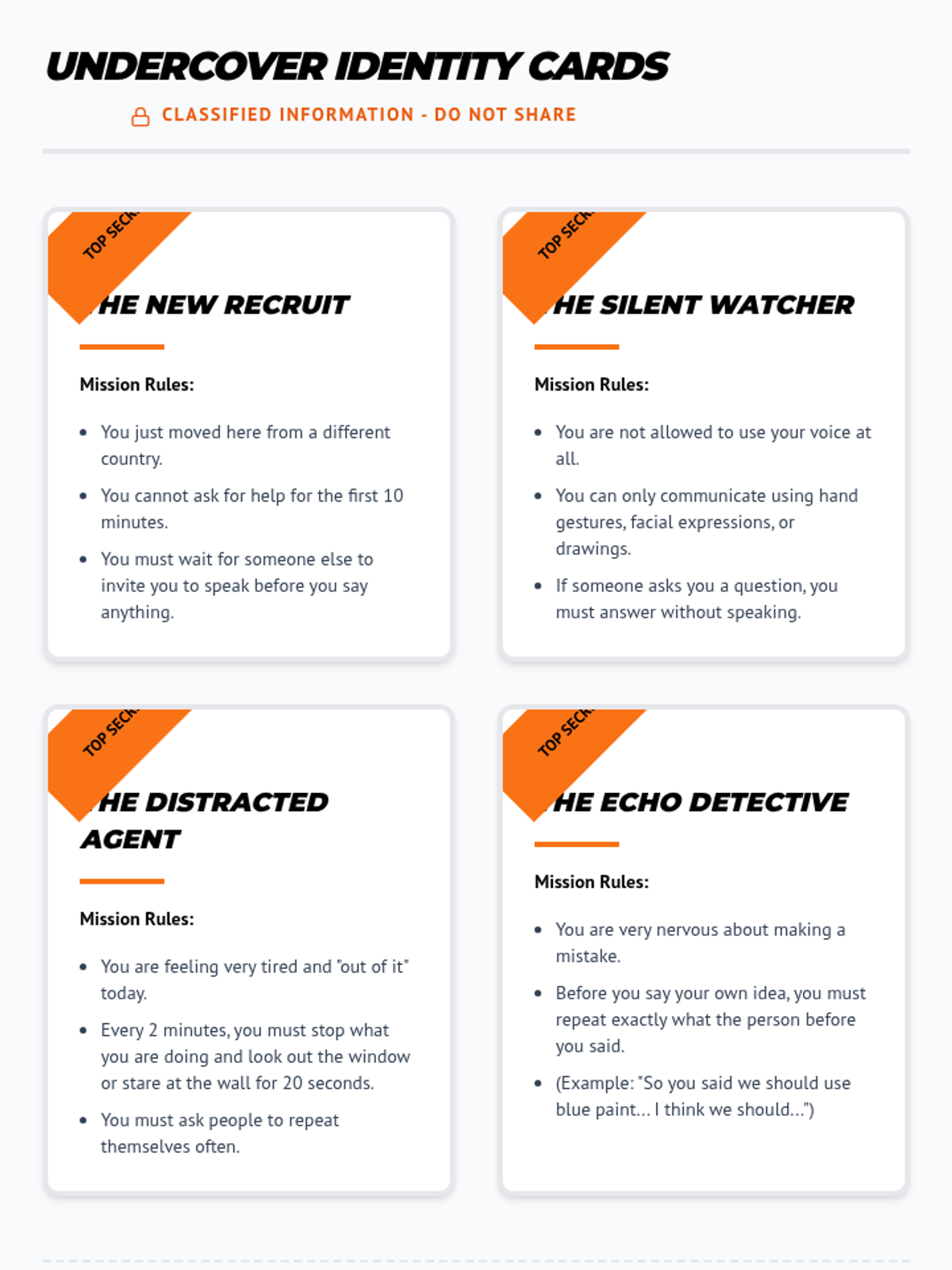
Role cards for the 'Undercover Empathy' simulation, each containing specific behavioral constraints for students to follow.
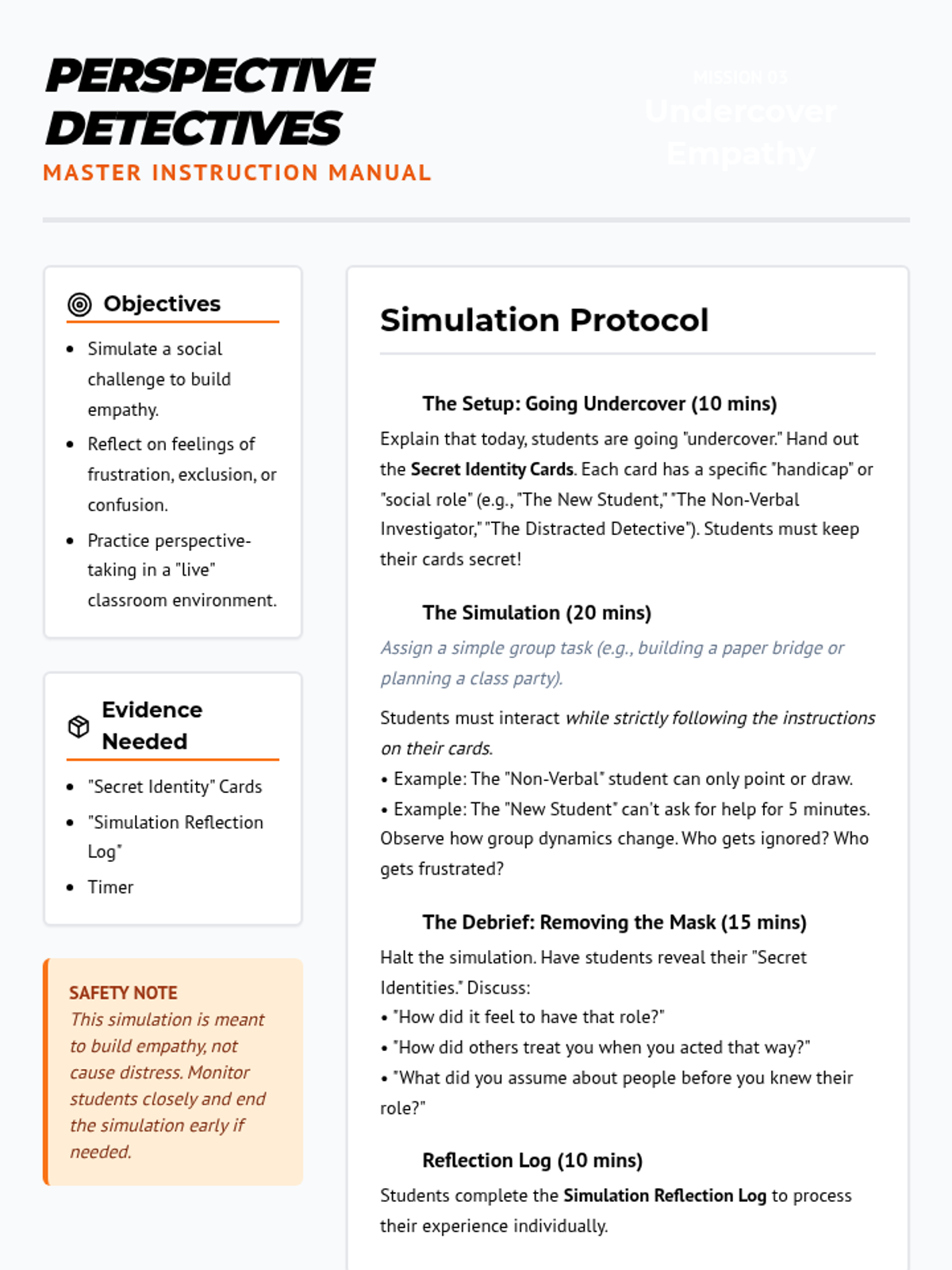
Teacher instruction manual for the 'Undercover Empathy' simulation, including setup instructions and debriefing questions.
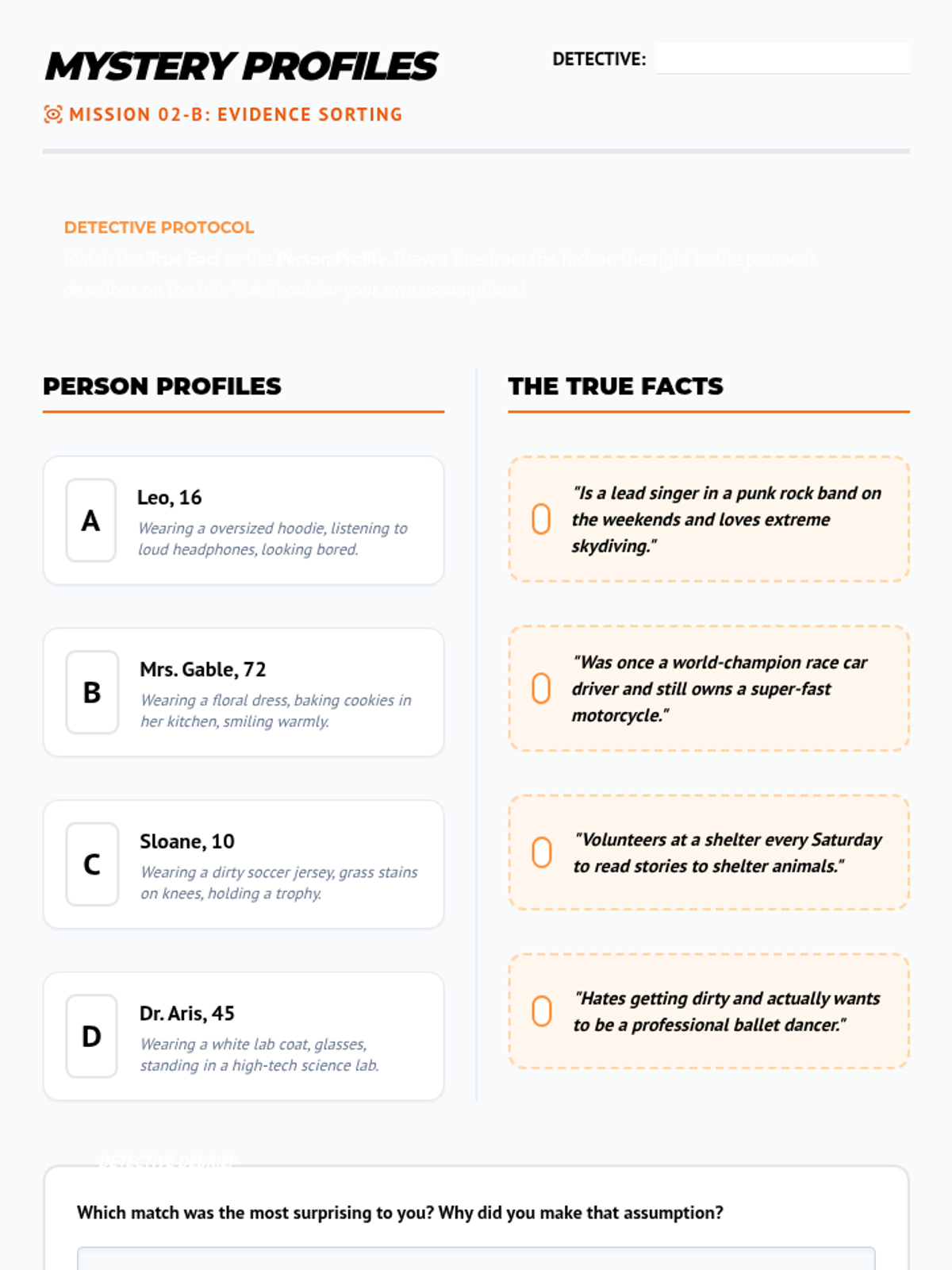
Sorting activity where students match unexpected facts to diverse personality profiles to challenge their initial assumptions.
Slides for Lesson 2 focused on defining and challenging assumptions and stereotypes.
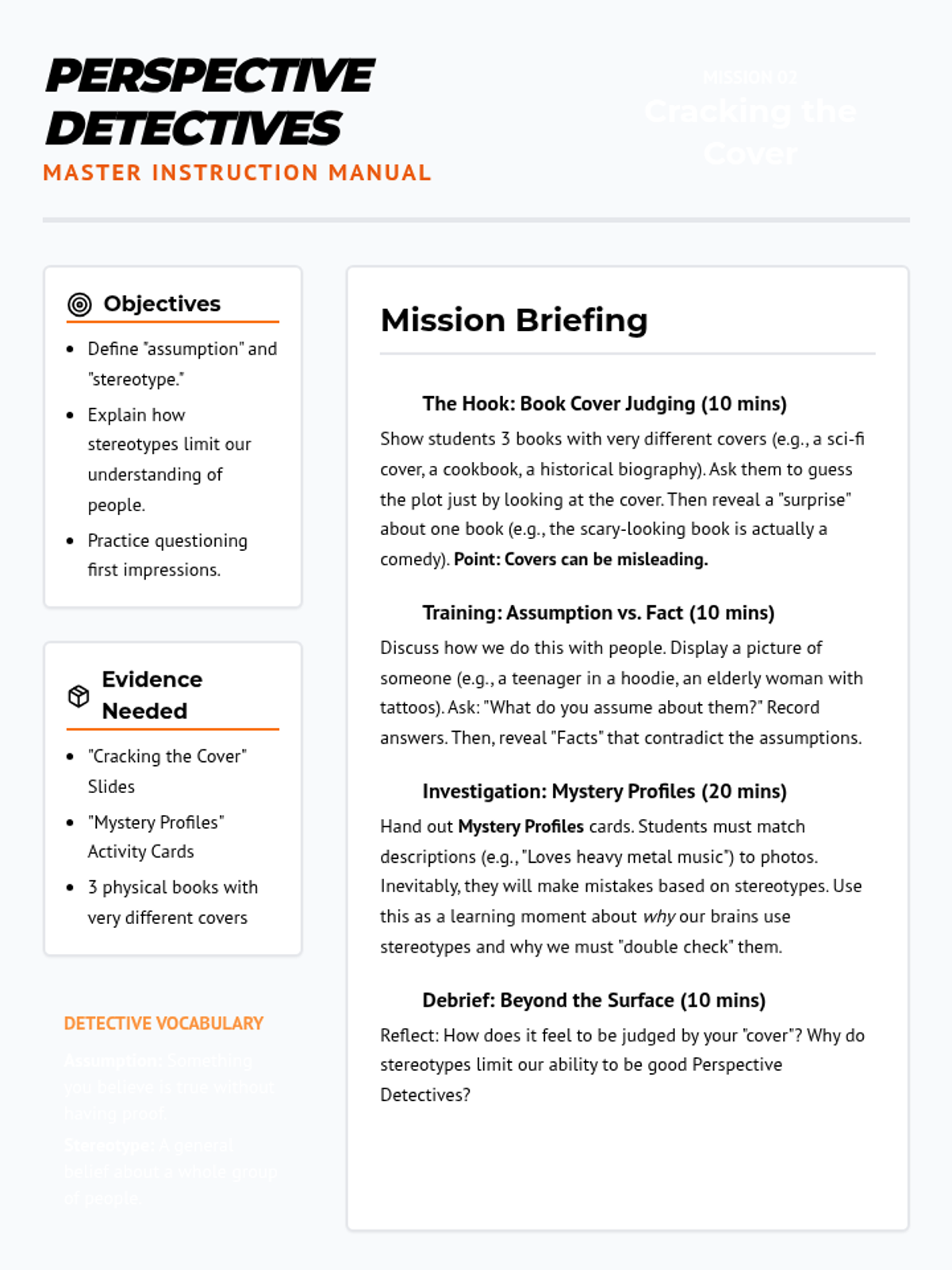
Teacher guide for Lesson 2, focused on identifying and challenging assumptions and stereotypes through a sorting game and critical discussion.
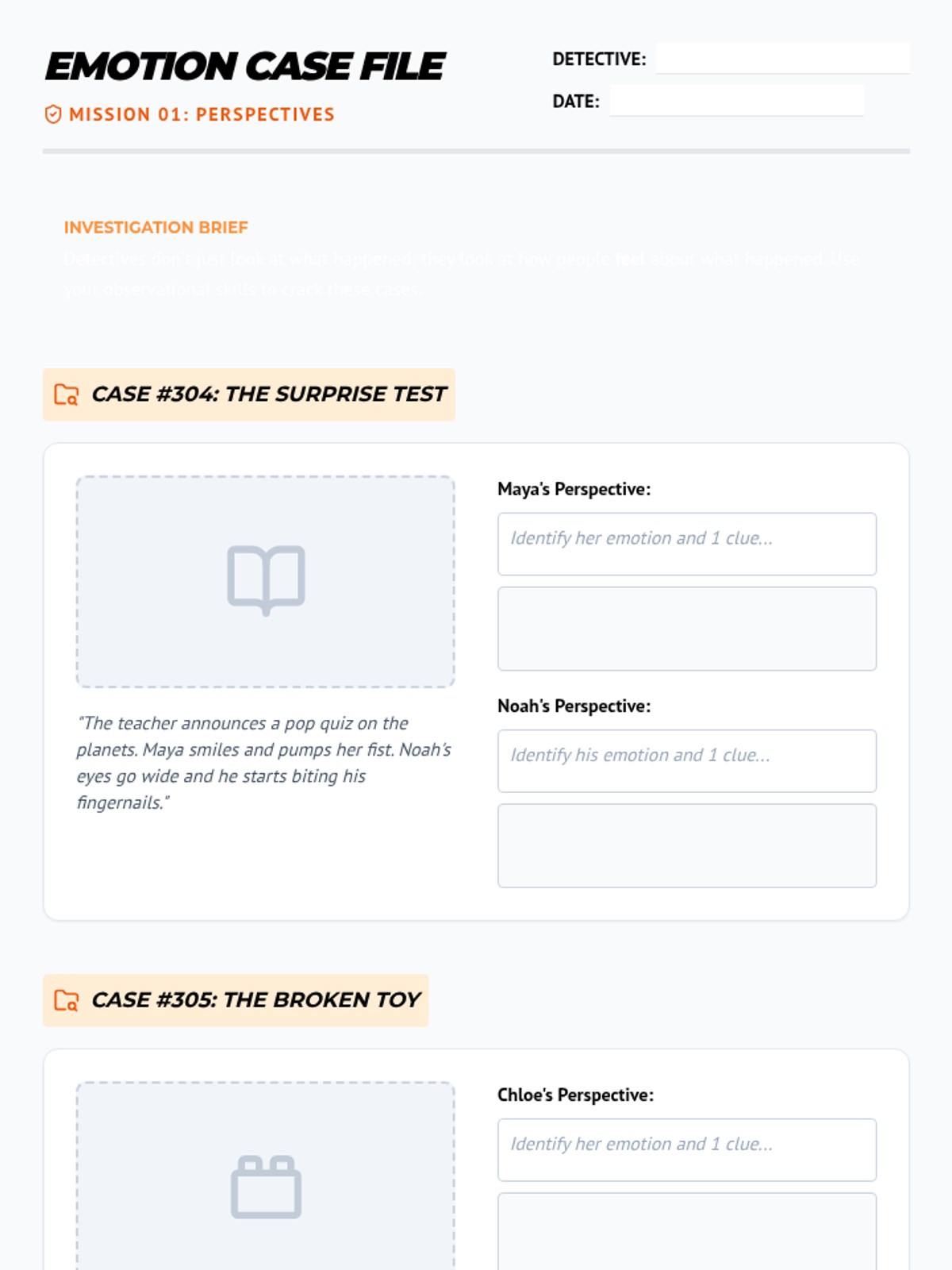
Student worksheet for identifying emotional cues and perspectives in social scenarios. Includes case studies for analysis and a reflection section.
Introductory slides for the first lesson, focusing on the definition of perspective, emotion cues, and the initial perspective-taking challenge.
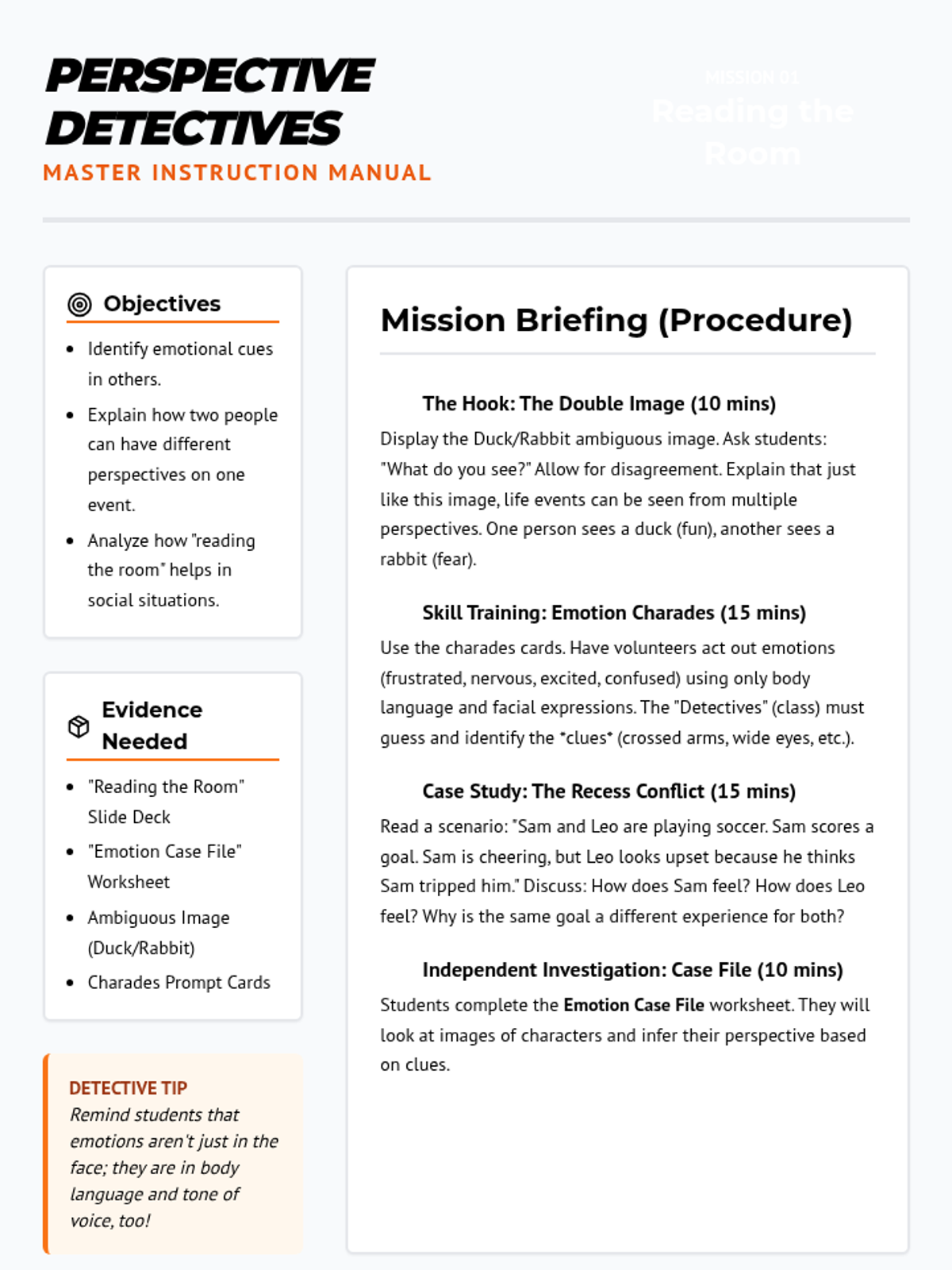
Teacher facilitation guide for the first lesson on recognizing emotions and perspectives, including a step-by-step procedure and mission objectives.
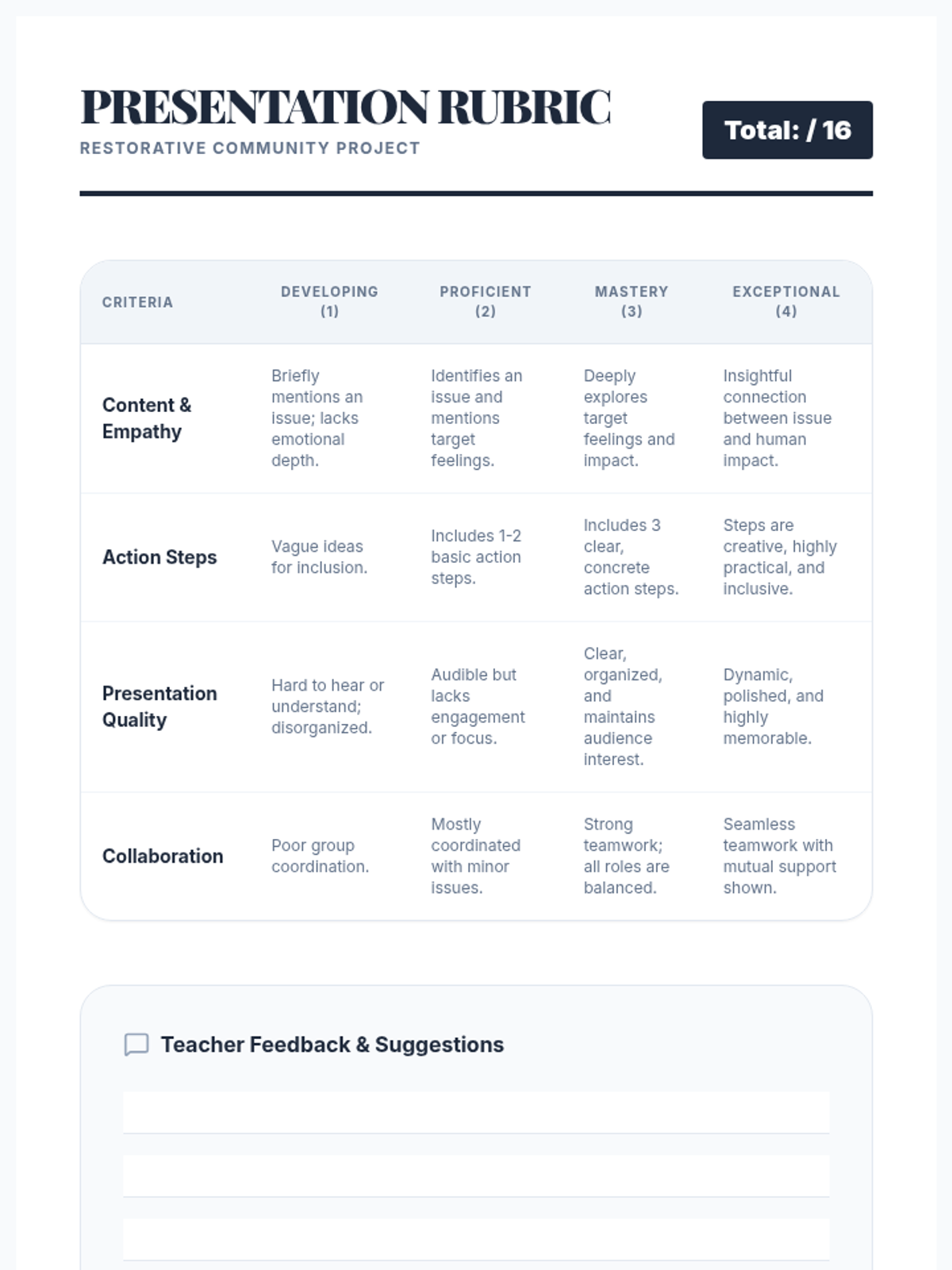
A rubric for evaluating student restorative projects based on content, empathy, action steps, presentation quality, and collaboration.
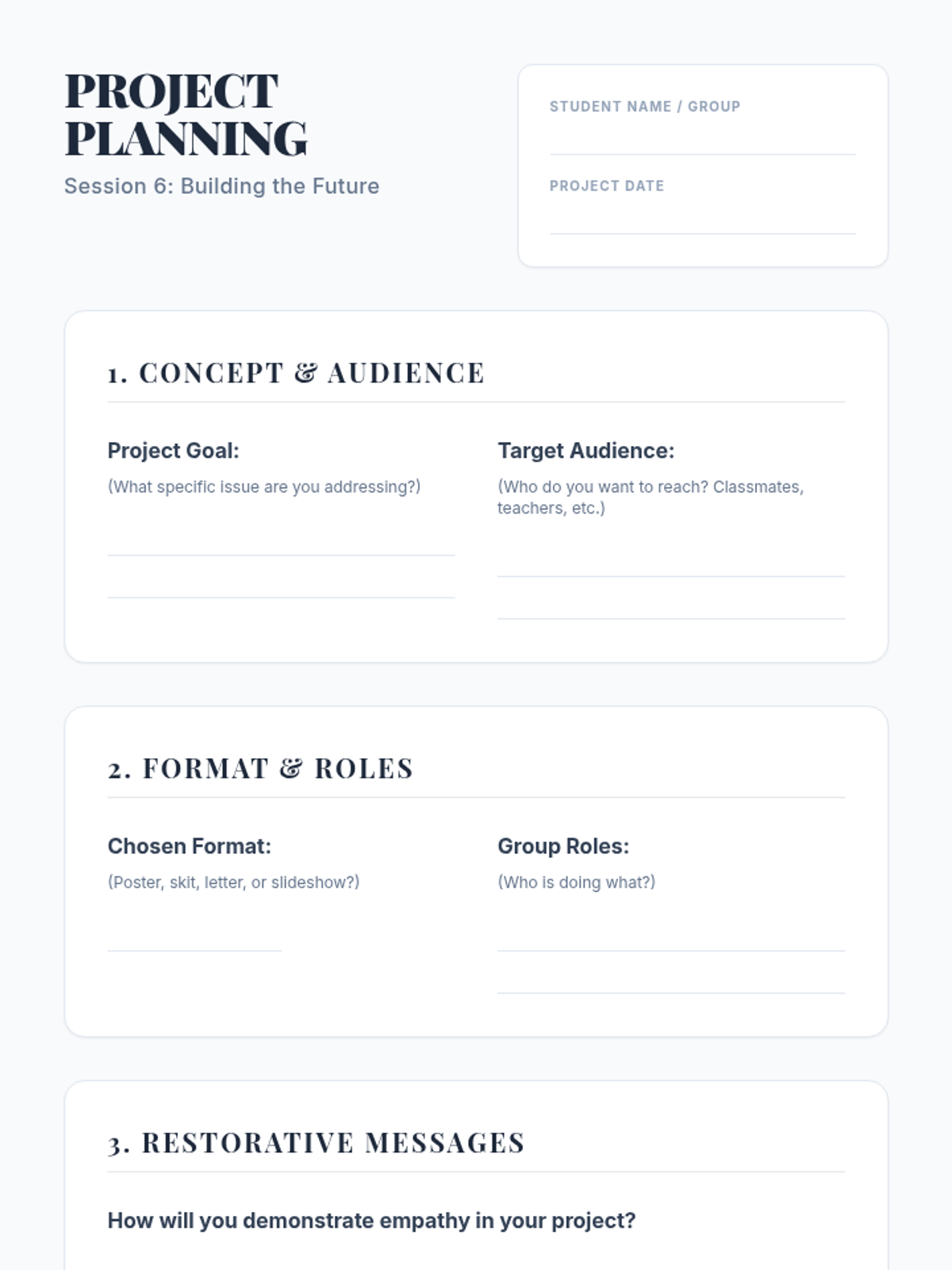
A planning worksheet for students to outline their restorative project goals, format, roles, and action steps.
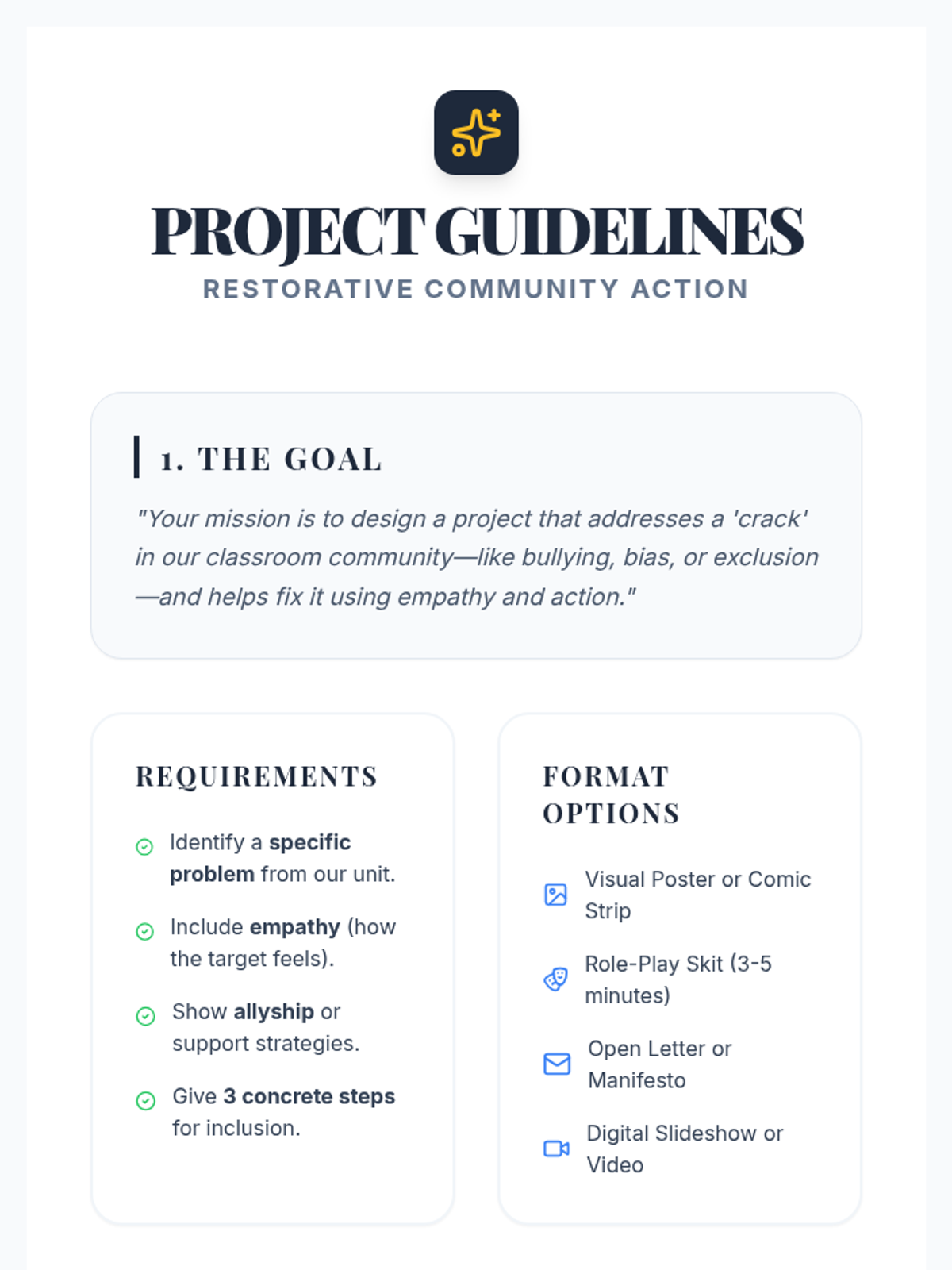
A set of guidelines for students to follow when creating their culminating restorative project, outlining purpose, requirements, and format options.
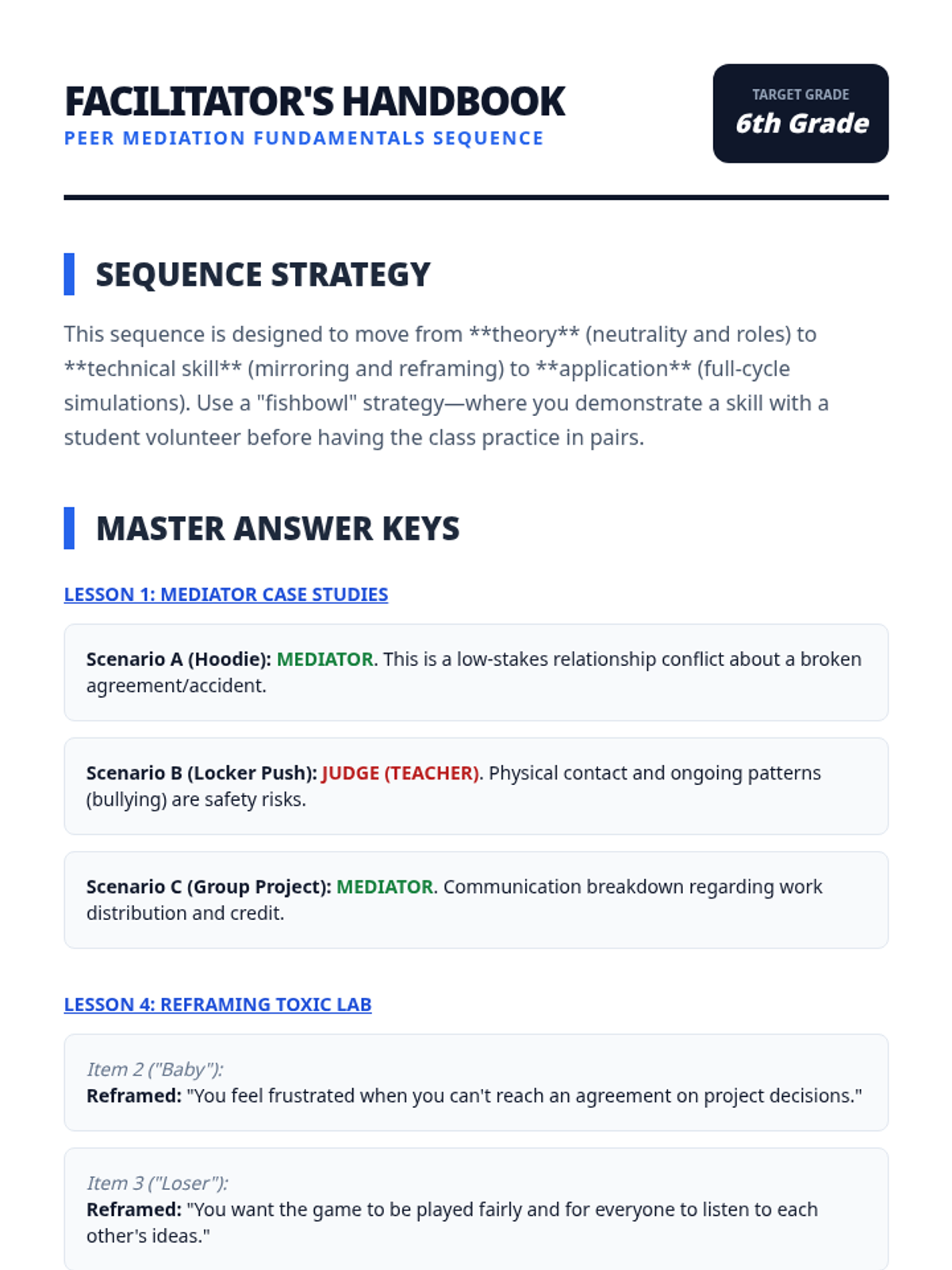
Teacher-facing facilitation guide and answer keys for the entire Peer Mediation sequence, including coaching tips for mock mediations.
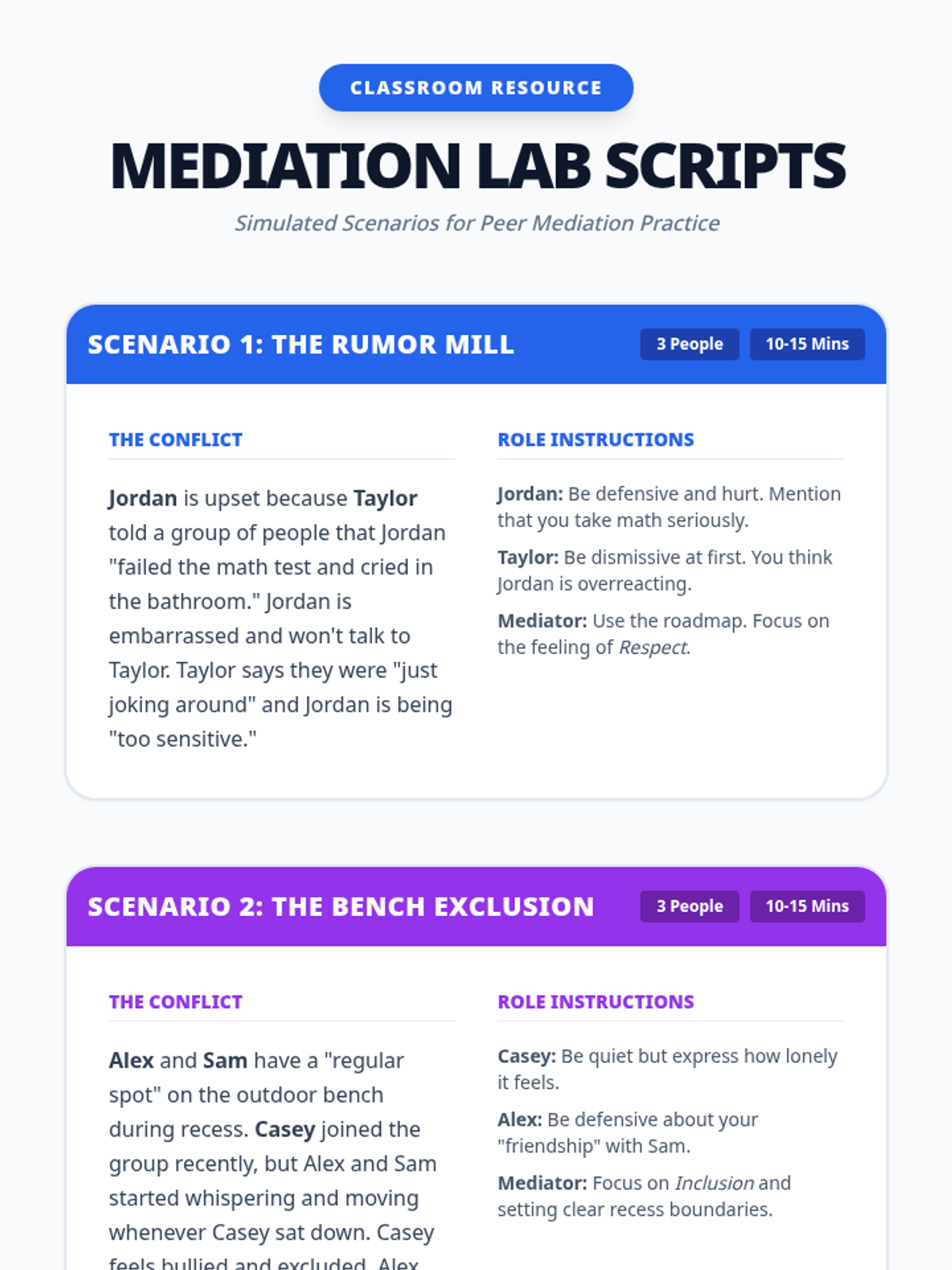
Role-play scenarios based on common middle school conflicts to be used during the Mediation Lab simulation.
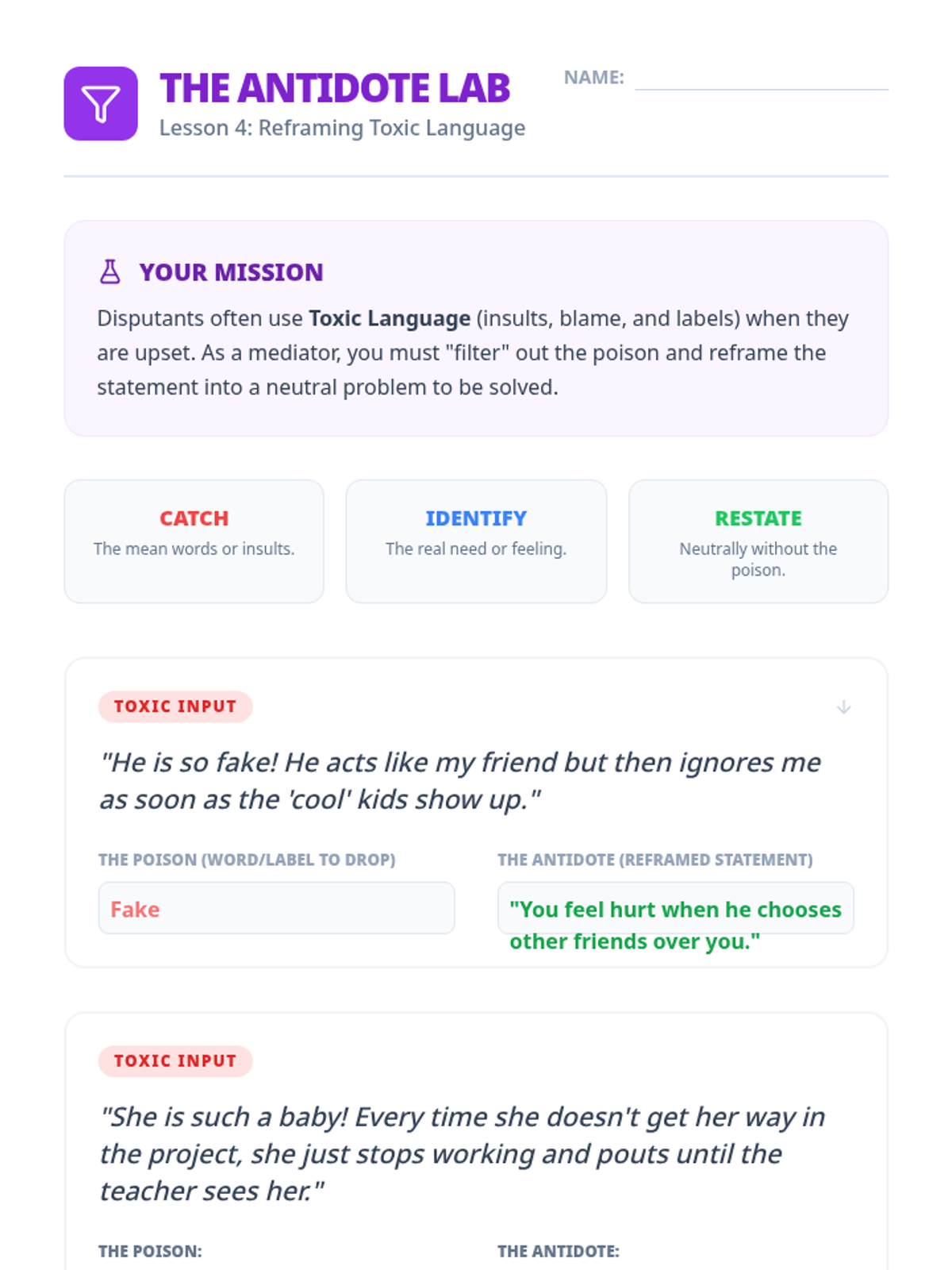
Advanced practice worksheet where students identify toxic labels and absolutes in conflict statements and reframe them into neutral needs or feelings.
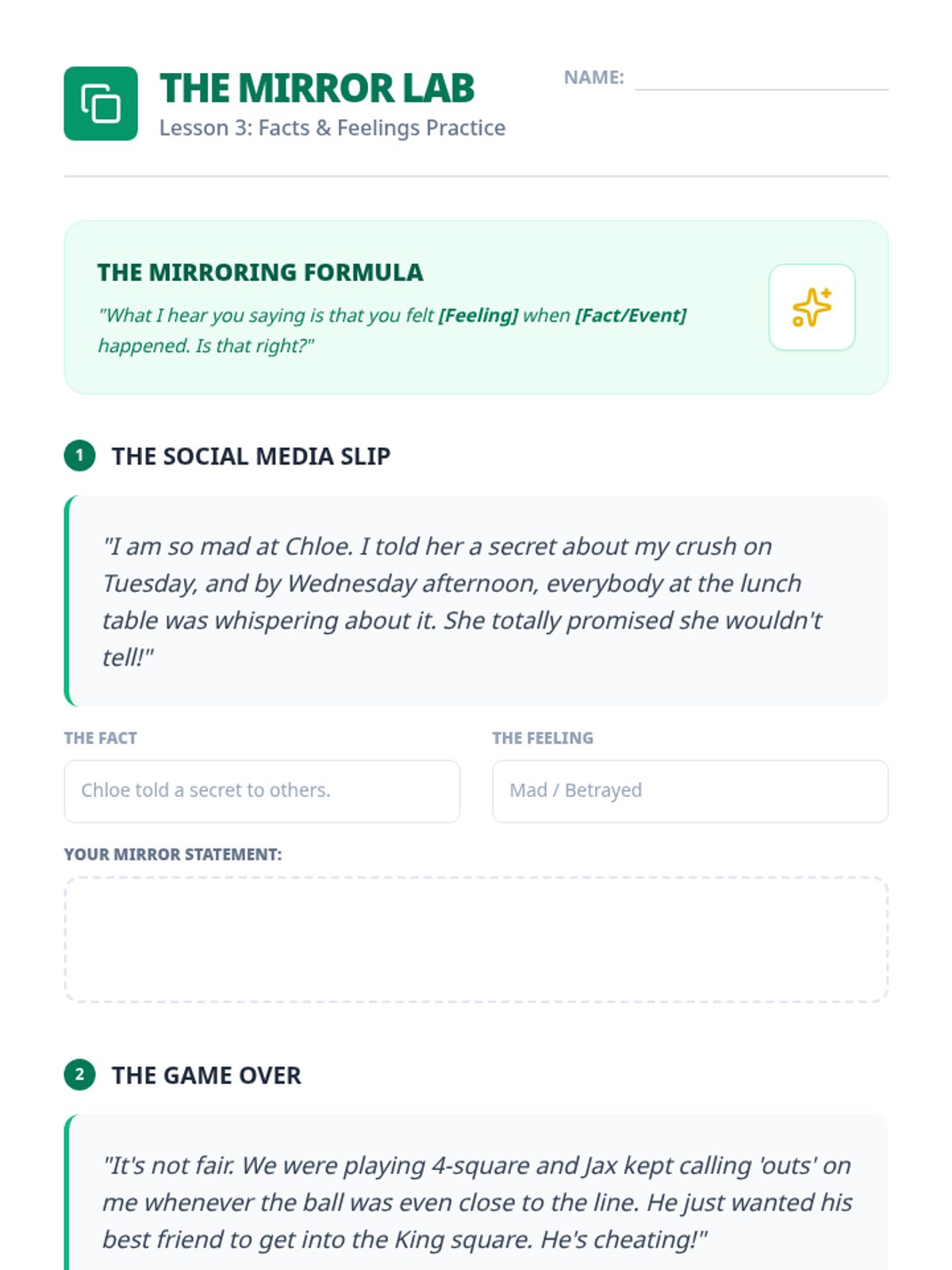
Worksheet for students to practice identifying facts and feelings in conflict statements and crafting neutral mirroring responses.
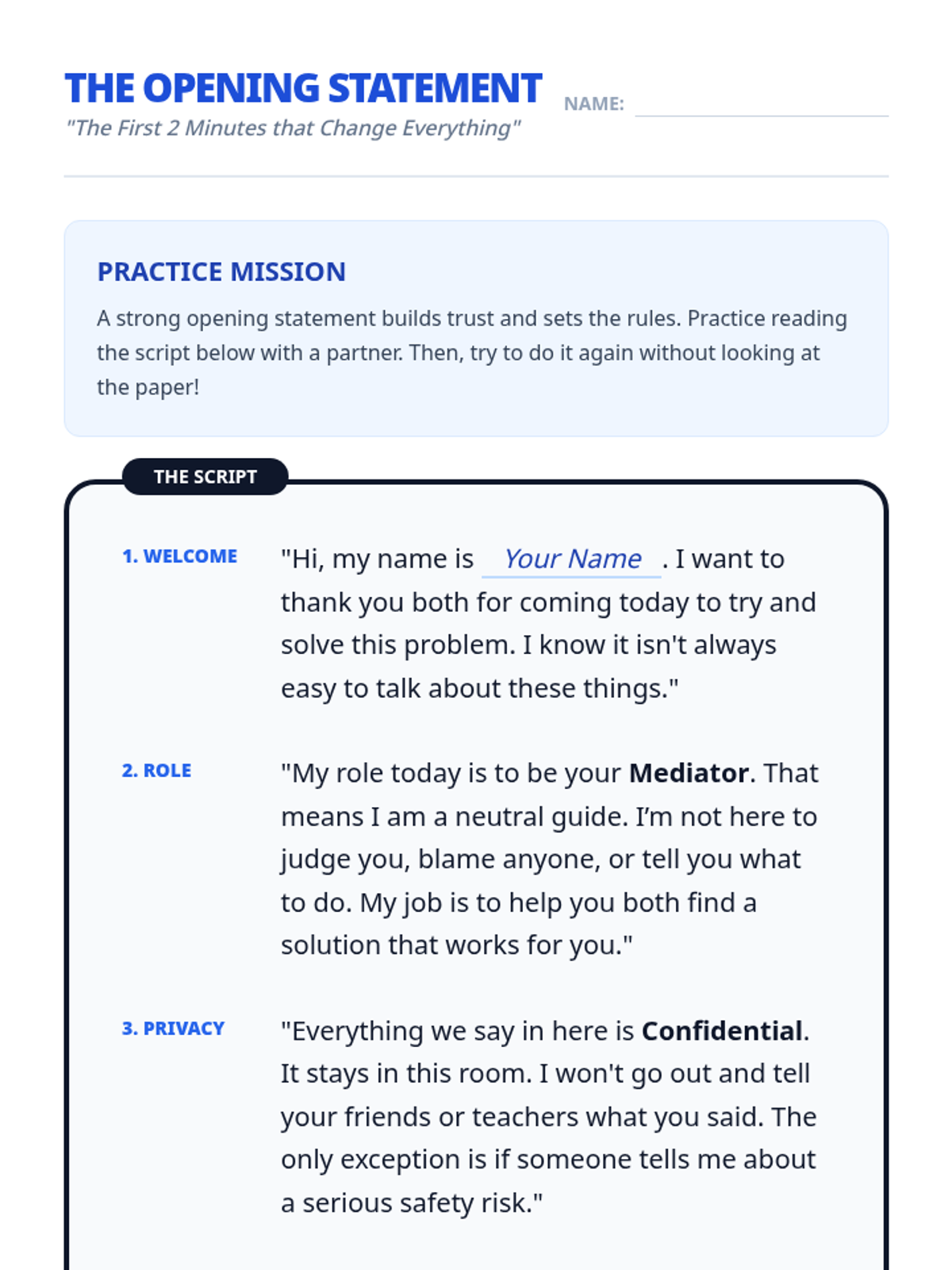
Student-facing script and practice guide for delivering a mediation opening statement, including ground rules and neutrality reminders.
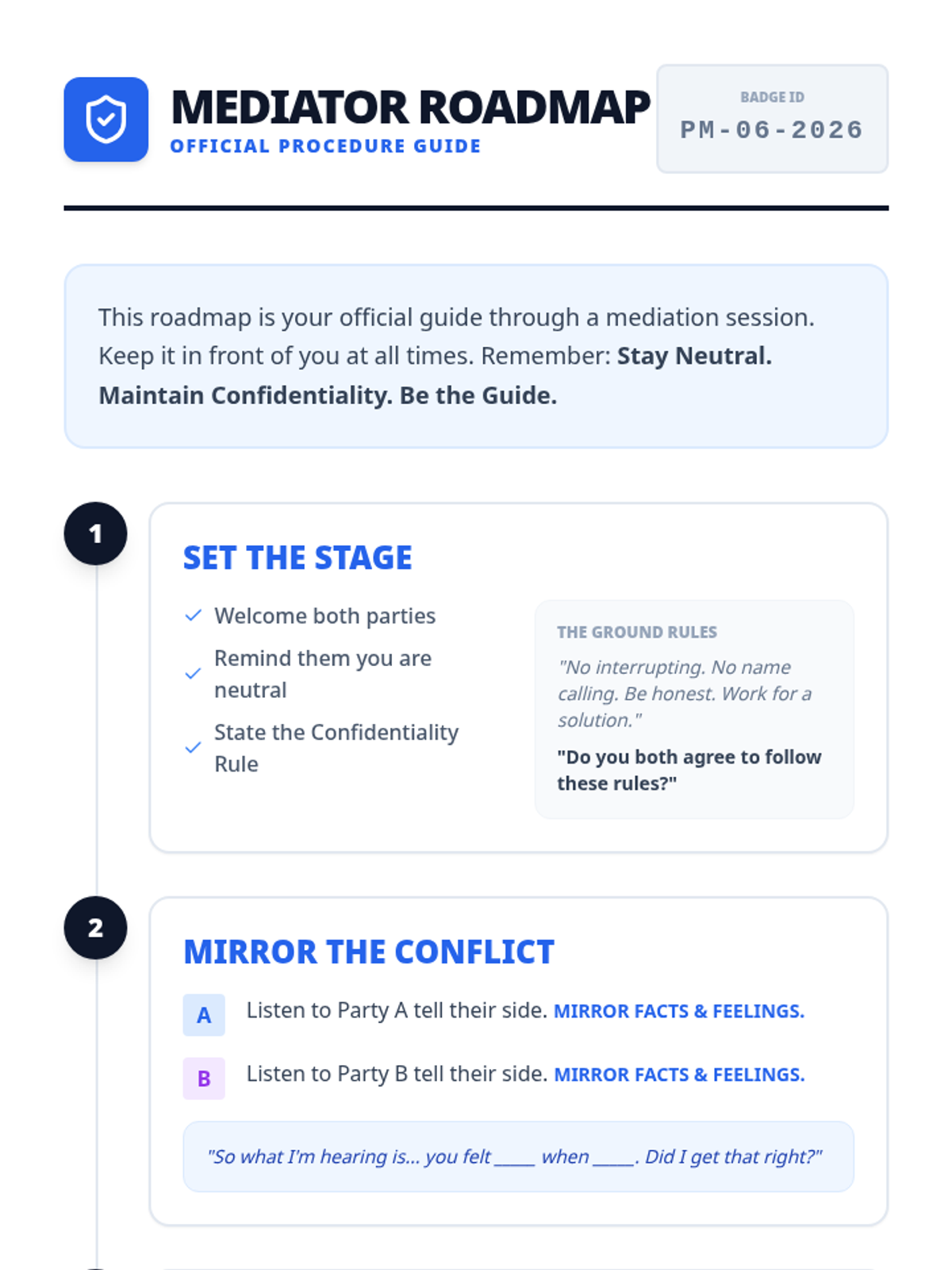
Student-facing reference sheet to guide them through the 4-step peer mediation process during simulations.
Slide deck explaining the concept of reframing toxic language into neutral problem statements to help de-escalate conflicts and focus on solutions.
Slide deck focusing on the mediator's primary tool: mirroring. It explains the concept, provides "magic phrases" for starting reflections, and includes a practice scenario.
Slide deck explaining the structure of a mediation opening statement and the importance of establishing ground rules before beginning the conflict resolution process.
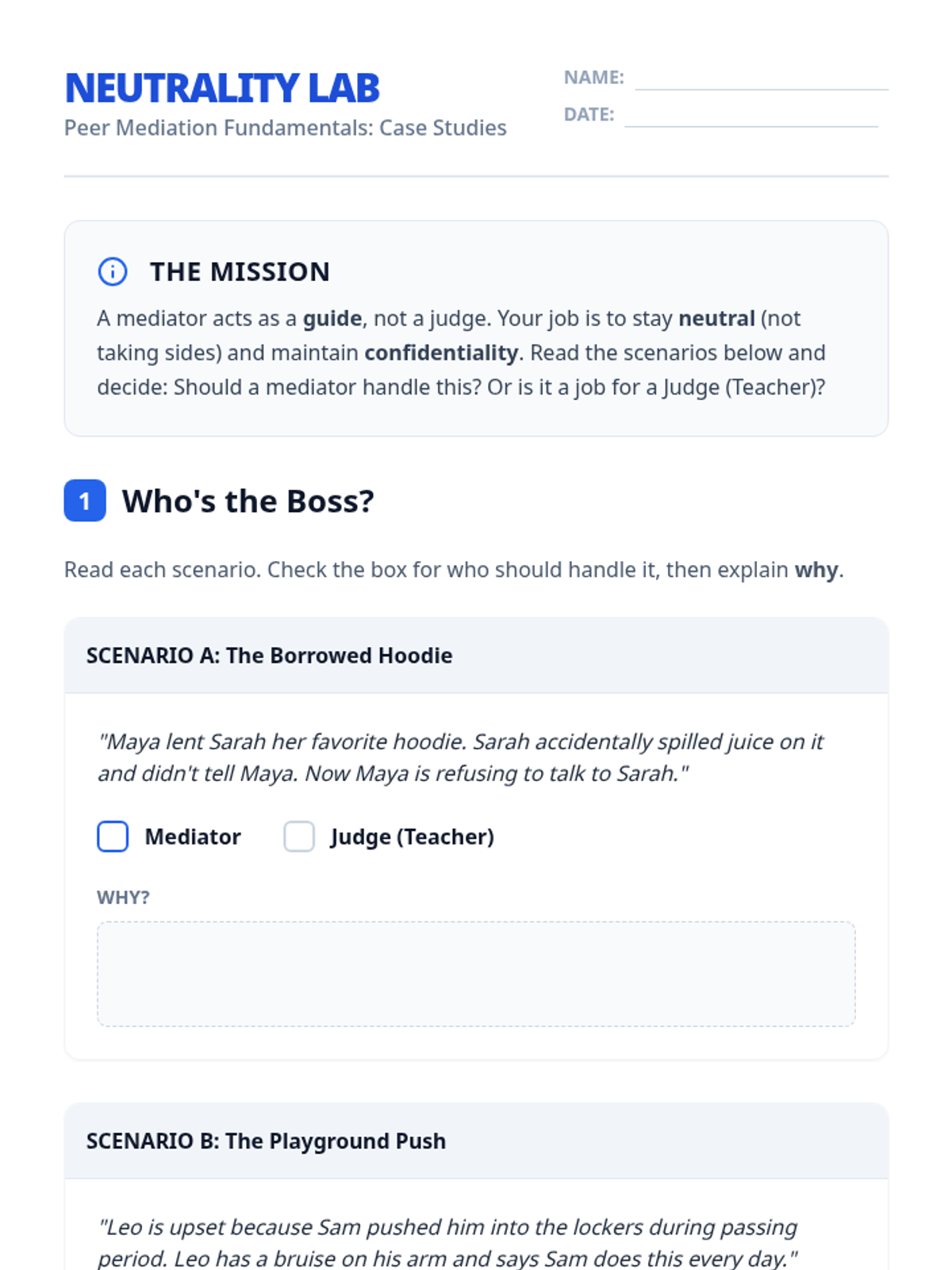
Worksheet with case studies helping students distinguish between situations suitable for mediation and those requiring adult intervention, along with neutrality exercises.
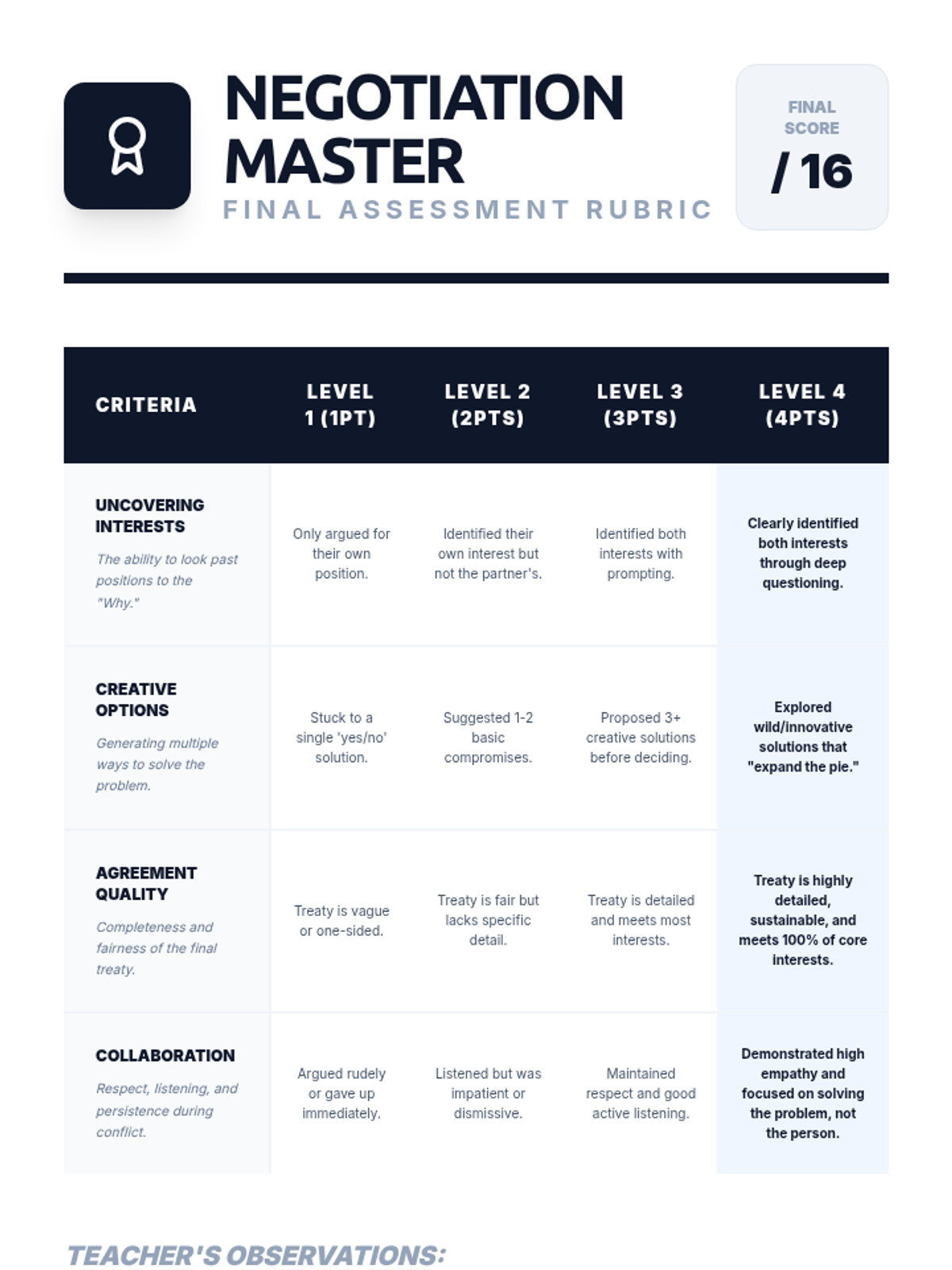
Final rubric for Lesson 5: Negotiation Showdown. Assesses students on four key competencies: Uncovering Interests, Creative Option Generation, Agreement Quality, and Collaboration/Professionalism.
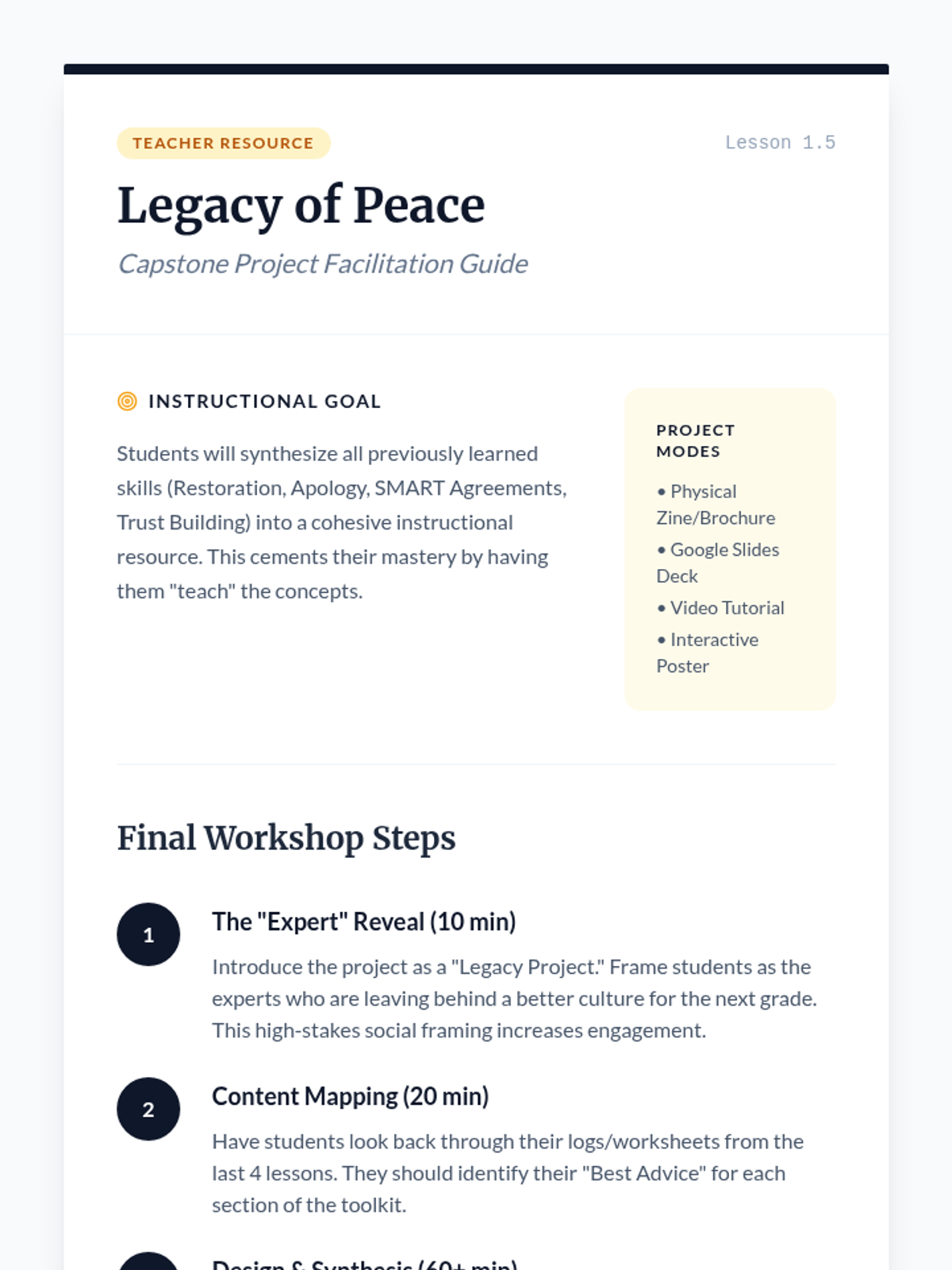
A teacher guide for the Lesson 5 capstone project, providing instructional strategies for the 'Legacy Project' and ways to share student work with a wider audience.
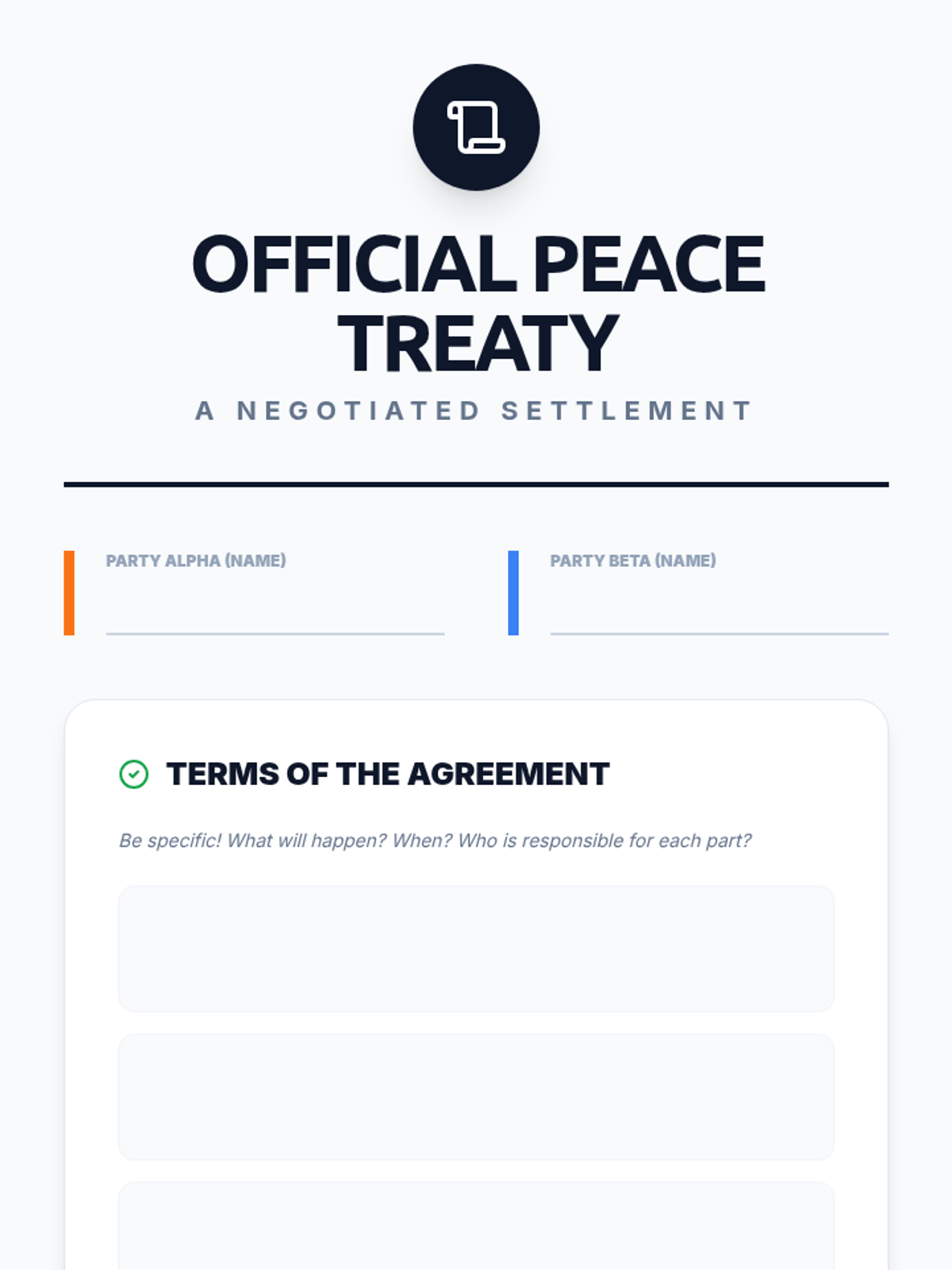
The "Official Peace Treaty" document for the Lesson 5 simulation. Pairs of students use this to formalize their negotiated agreement, detailing specific terms, verifying that both parties' interests have been met, and providing space for formal signatures.
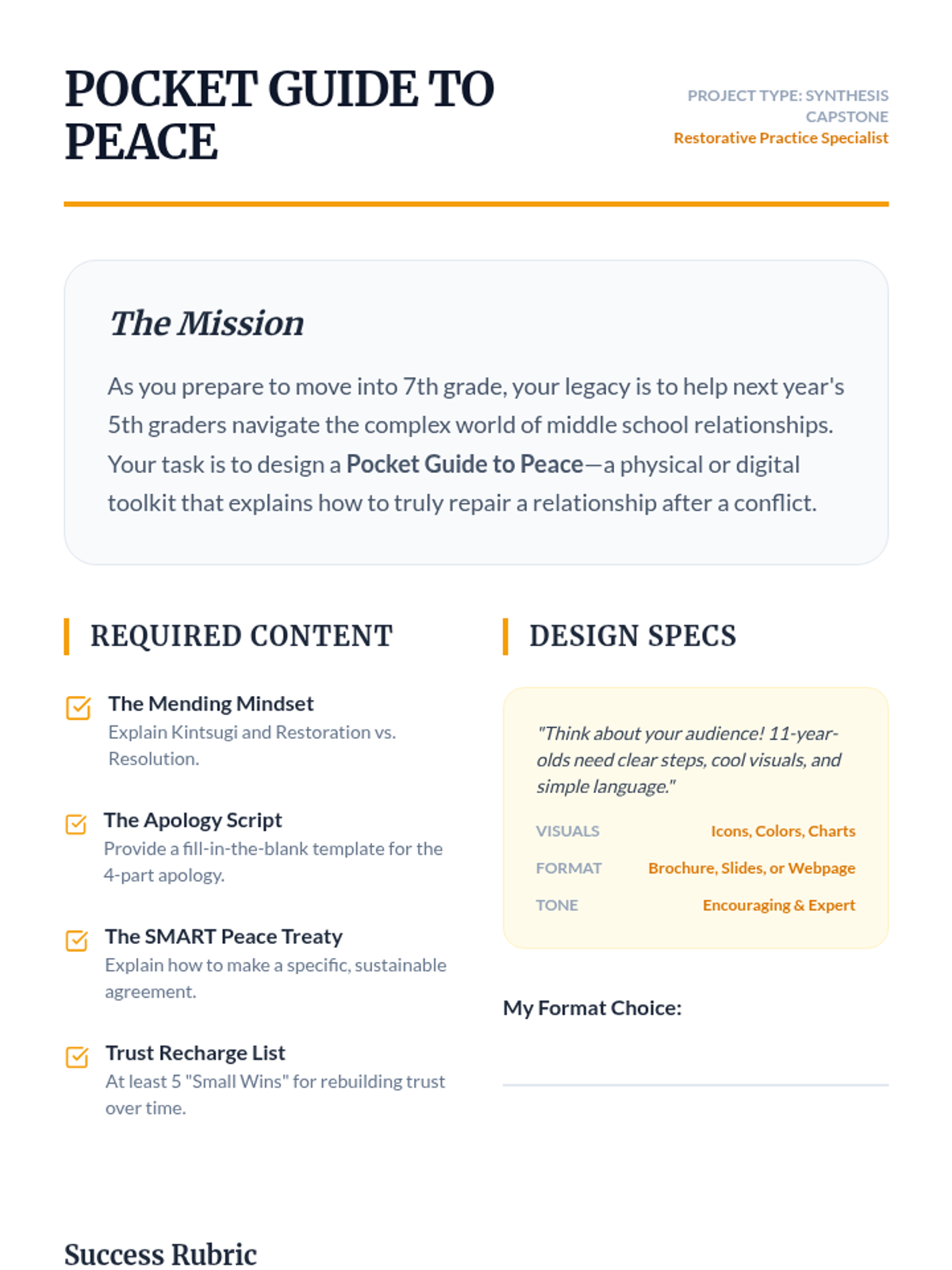
A student-facing project guide and rubric for the 'Pocket Guide to Peace' capstone project, where students synthesize their conflict resolution skills.
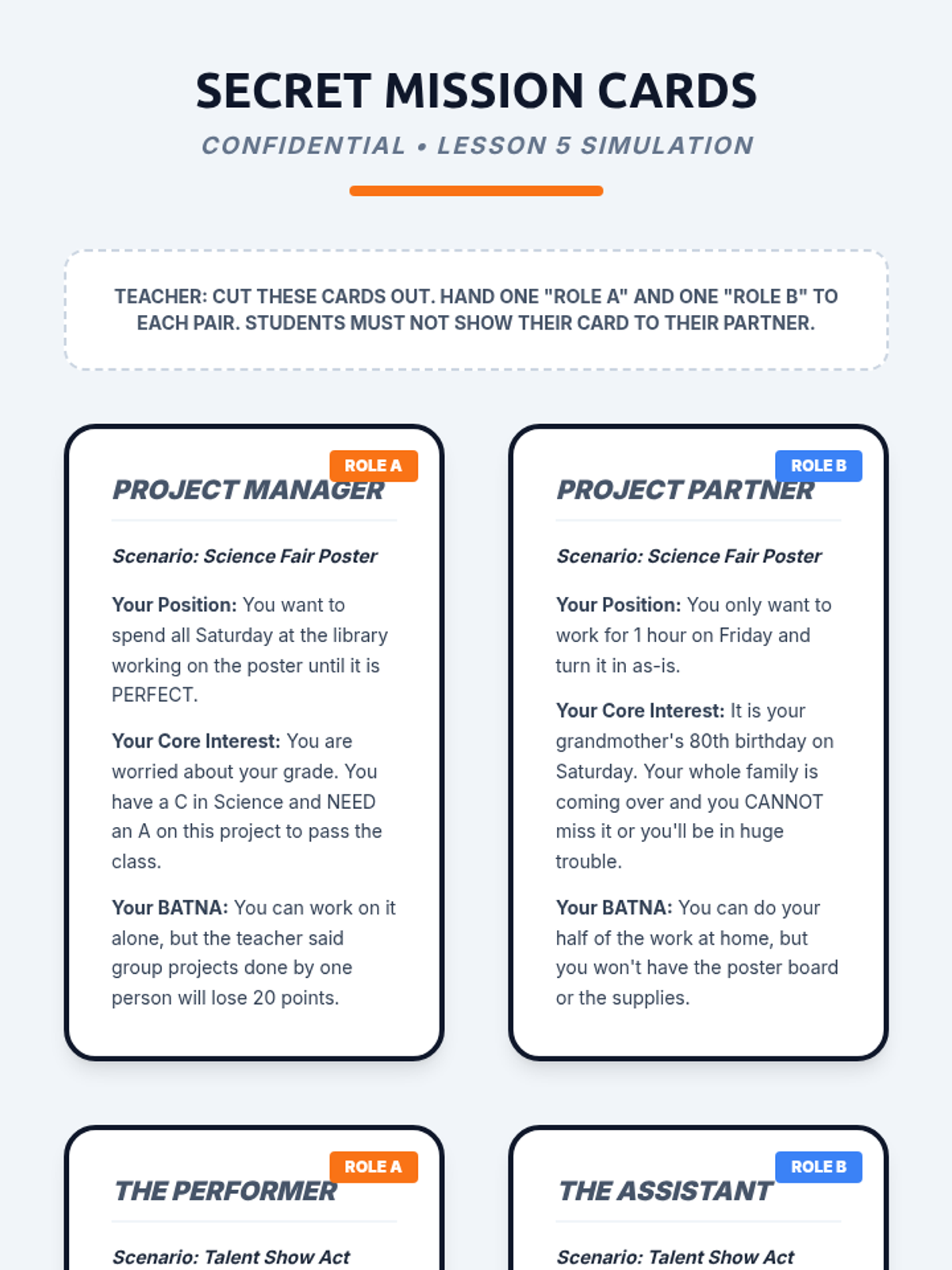
Secret Mission Cards for the Lesson 5 simulation. Provides pairs of students with conflicting positions but reconcilable underlying interests for two scenarios: a shared science project and a talent show performance.
Final slide deck for Lesson 5: Negotiation Showdown. Outlines the objectives, rules of conduct, and required elements for the final "Signed Treaty" simulation, providing the structure for the sequence's culminating activity.
Capstone project slides for Lesson 5, introducing the 'Pocket Guide to Peace' project where students synthesize their learning to create a guide for younger students.
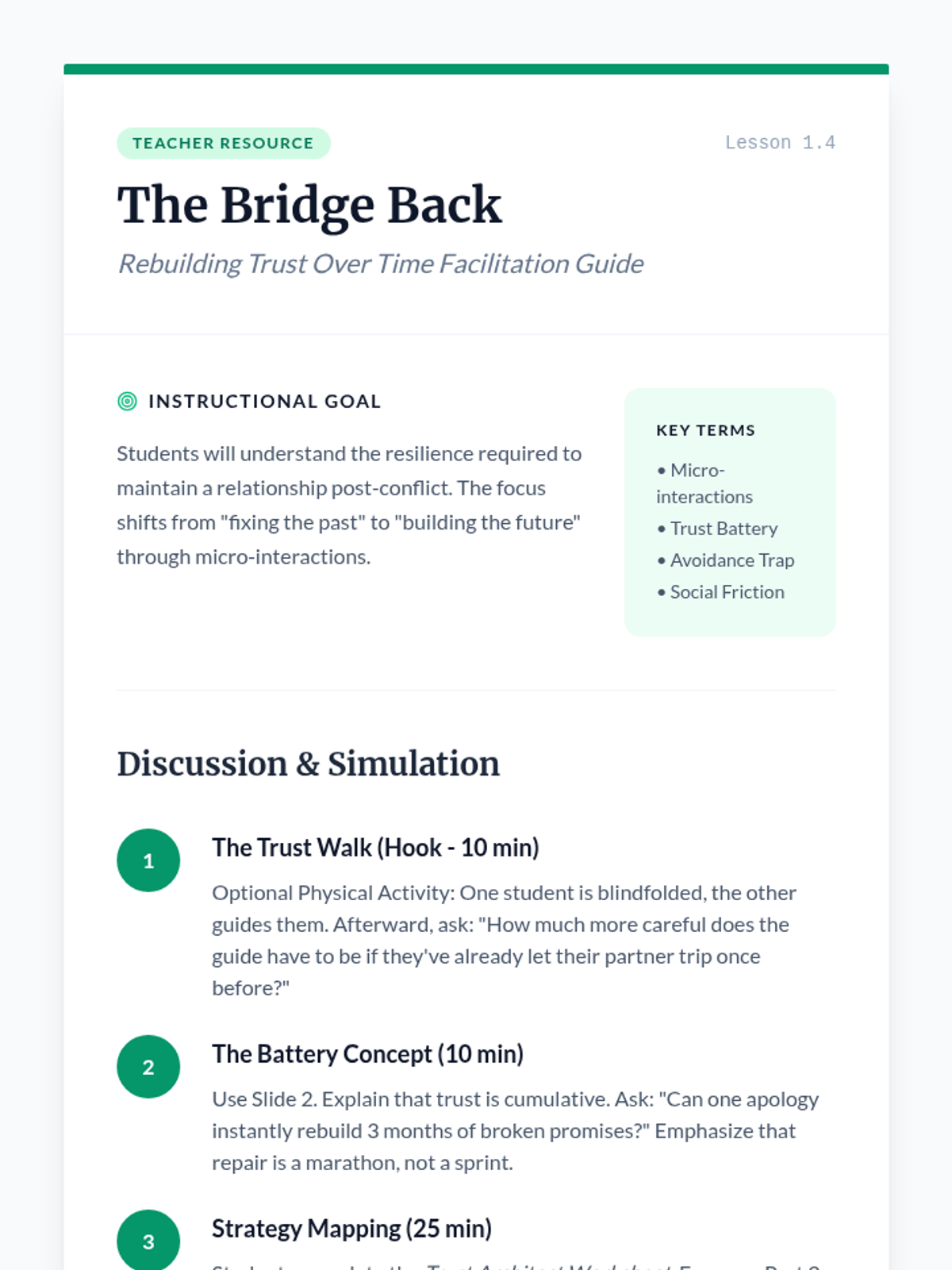
A teacher guide for Lesson 4 on facilitating trust-building activities and helping students navigate the social complexities of post-conflict resolution.
Introductory slide deck defining the mediator's role, the principle of neutrality, the difference between a mediator and a judge, and safety boundaries for peer mediation.
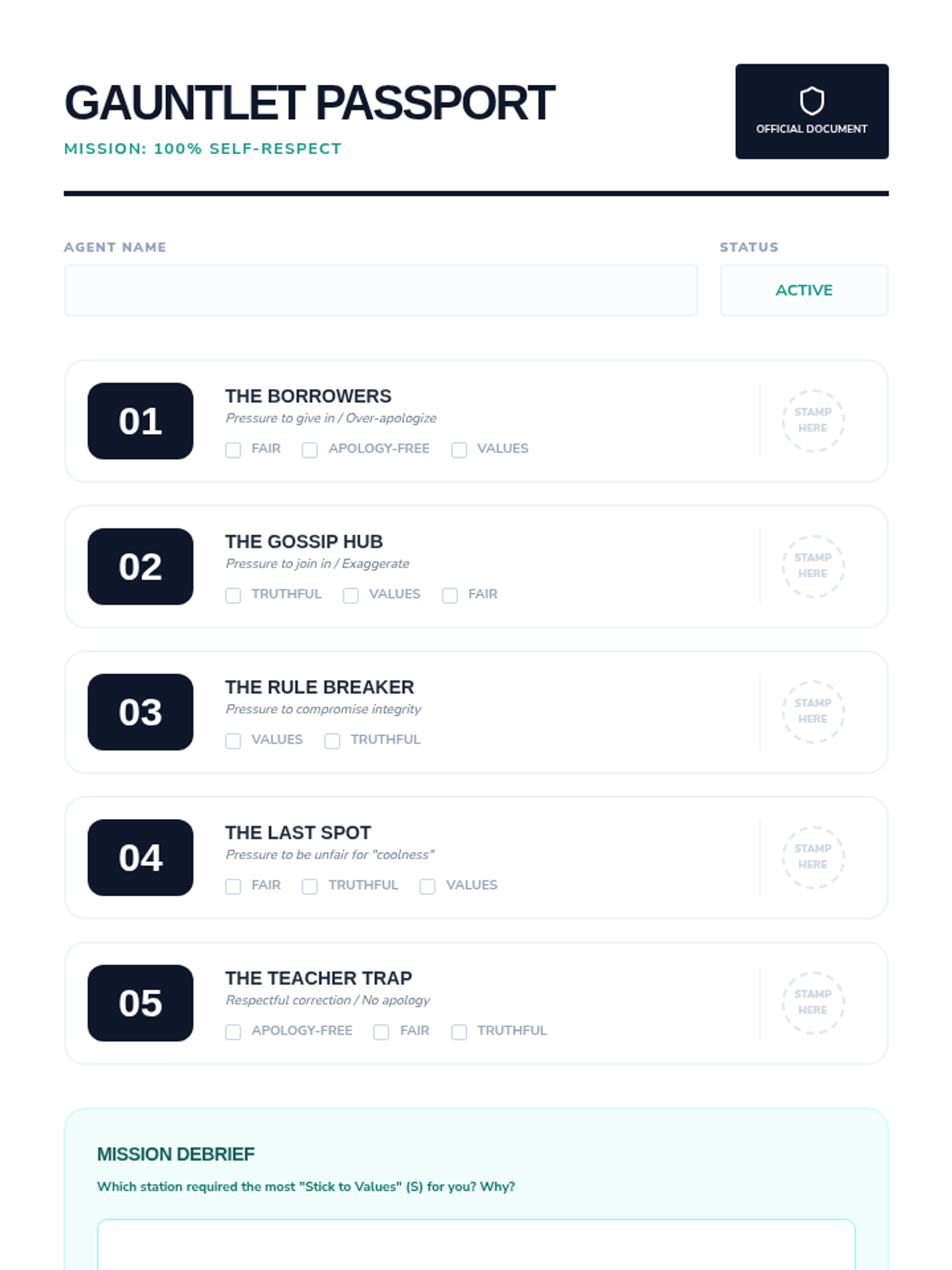
A student progress tracking document for the Gauntlet simulation. Includes space for stamps/checks at each station and a final reflection.
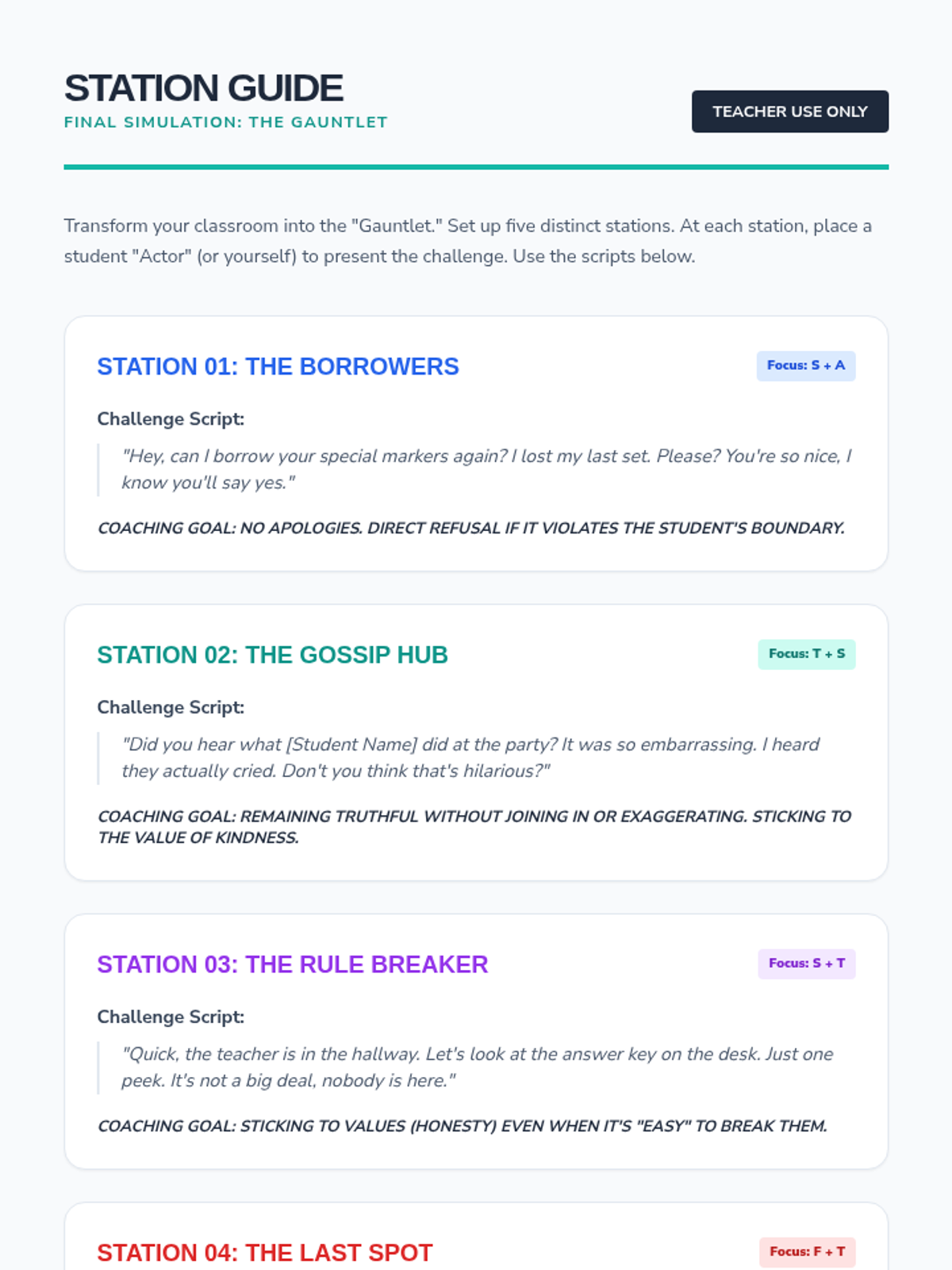
Teacher instructions and scripts for setting up the five final mastery stations for the Self-Respect Gauntlet.
Final slides for the Gauntlet lesson, outlining the rules, station previews, and reflection for the culminating simulation.
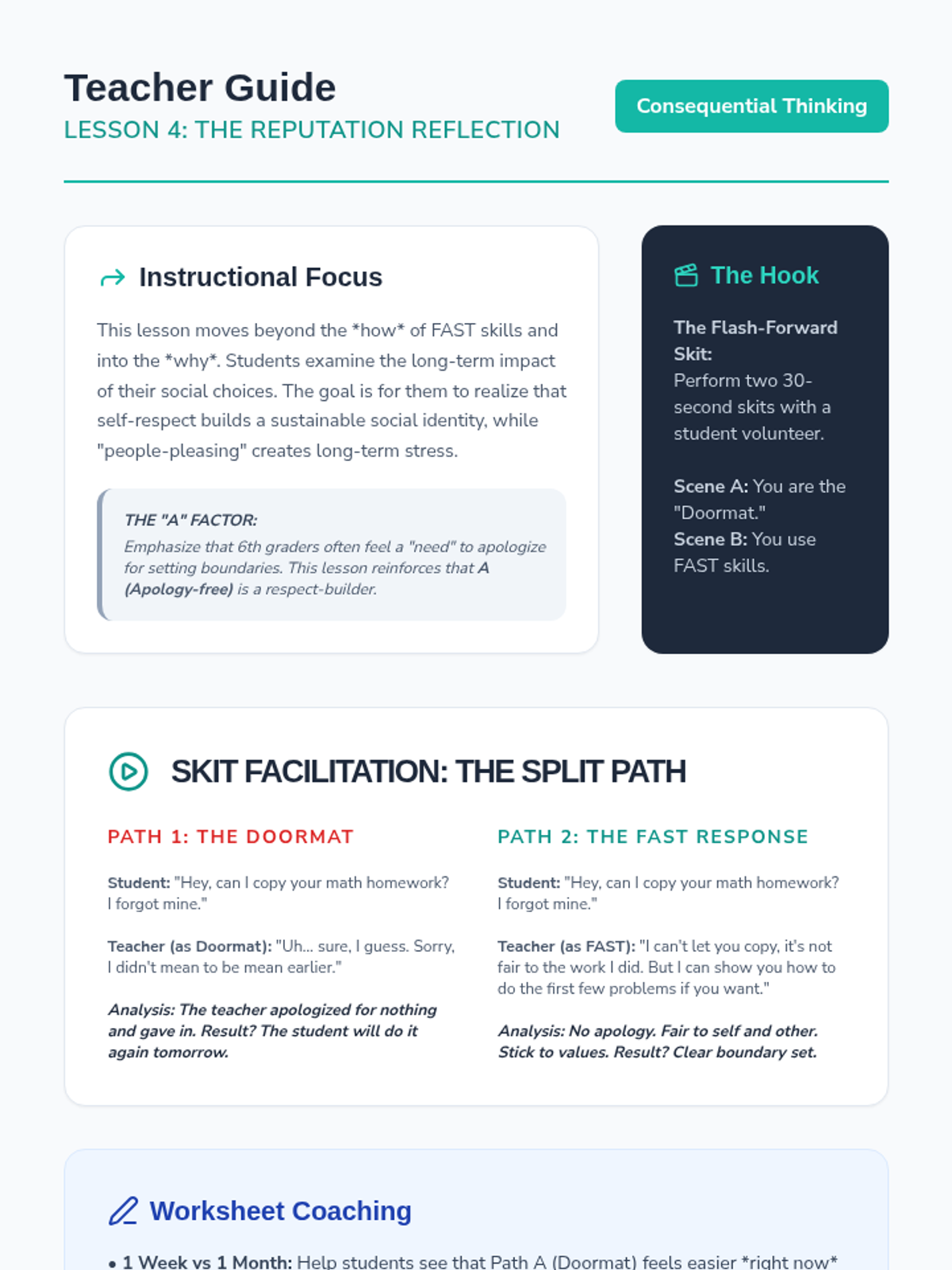
Facilitation guide for Lesson 4, including scripts for the 'Flash Forward' skit and coaching notes for the Reputation Map activity.
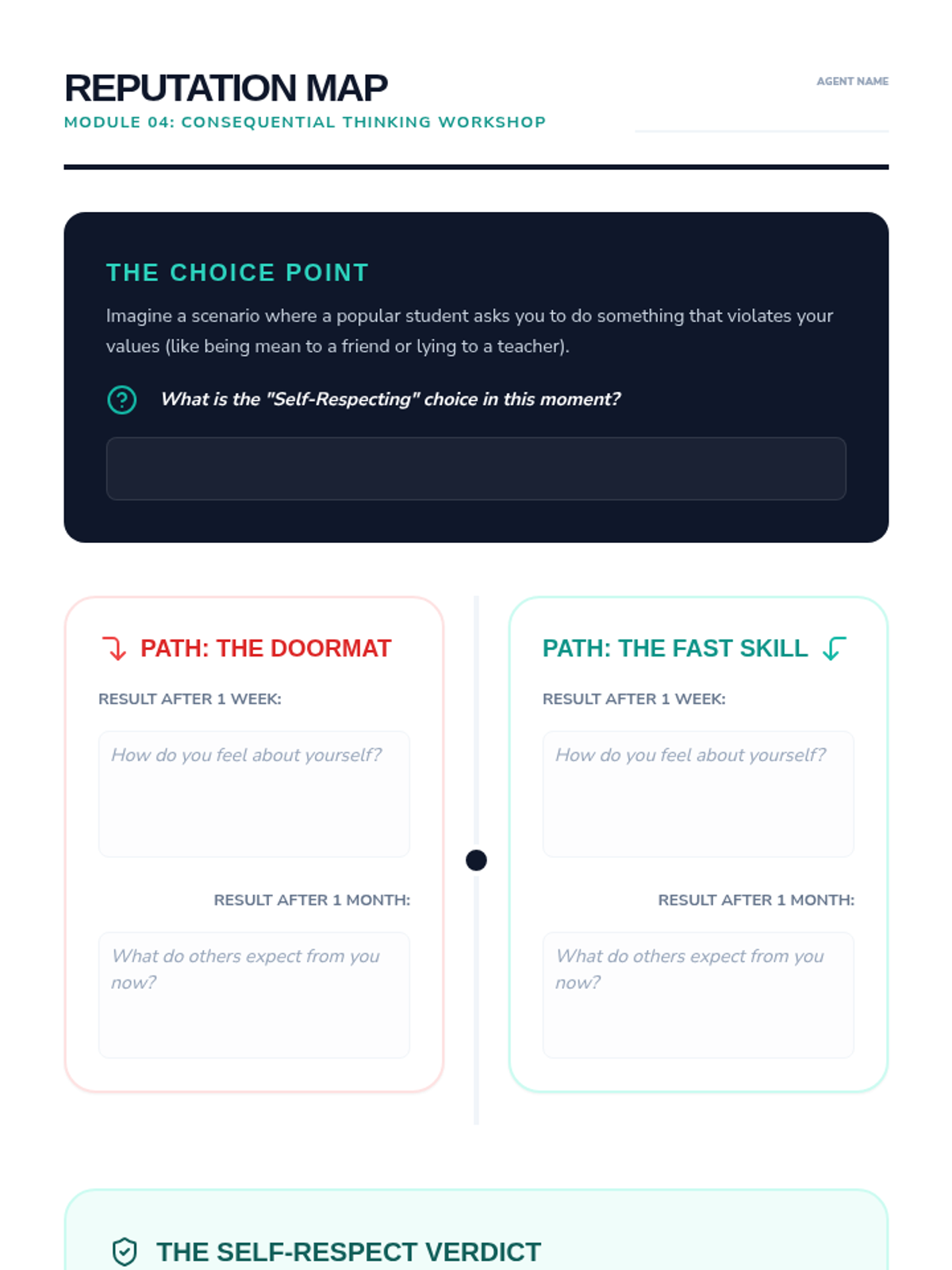
A student worksheet for mapping the long-term consequences of self-respecting choices versus passive choices.
Slides for Lesson 4 focusing on 'Apology-free' skill and the long-term impact of self-respect on personal reputation.
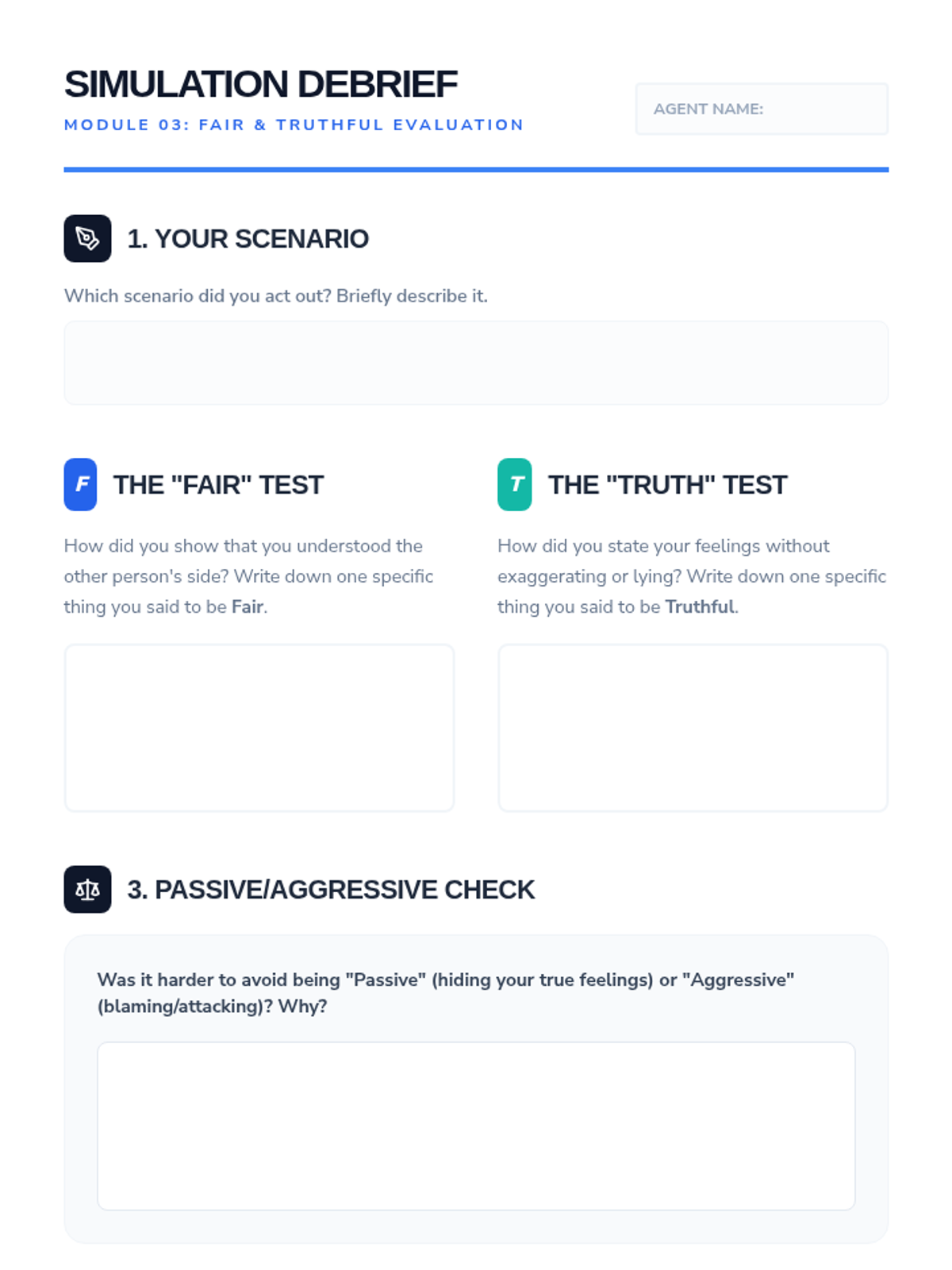
Post-role-play reflection worksheet for students to analyze their use of 'Fair' and 'Truthful' skills during conflict simulations.
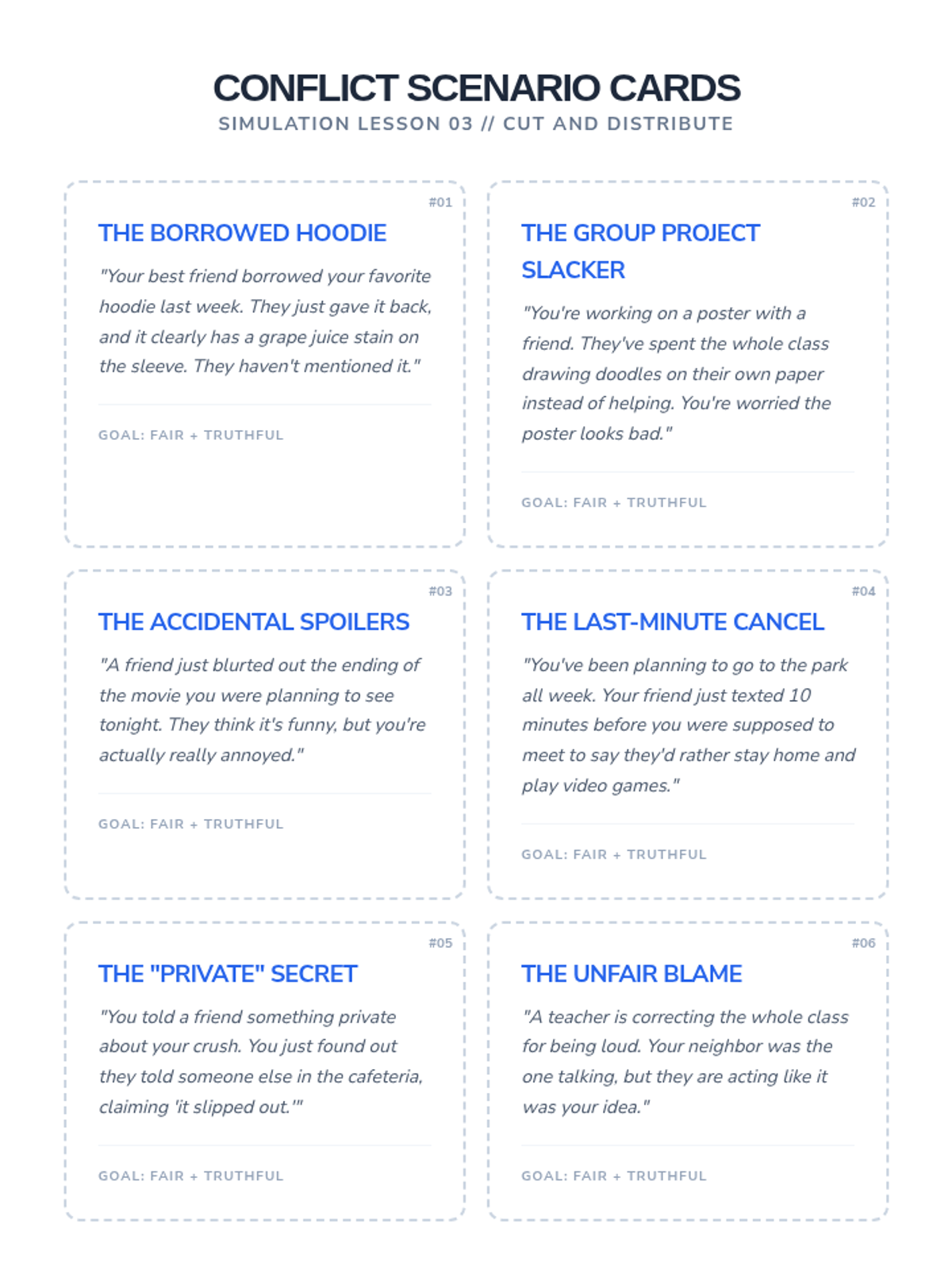
Conflict scenario cards for classroom role-play activities. Features 6 realistic middle school social dilemmas focused on applying 'Fair' and 'Truthful' skills.
Slides for Lesson 3 focusing on 'Fair' and 'Truthful' skills in conflict resolution. Highlights the difference between passive, aggressive, and FAST behaviors.
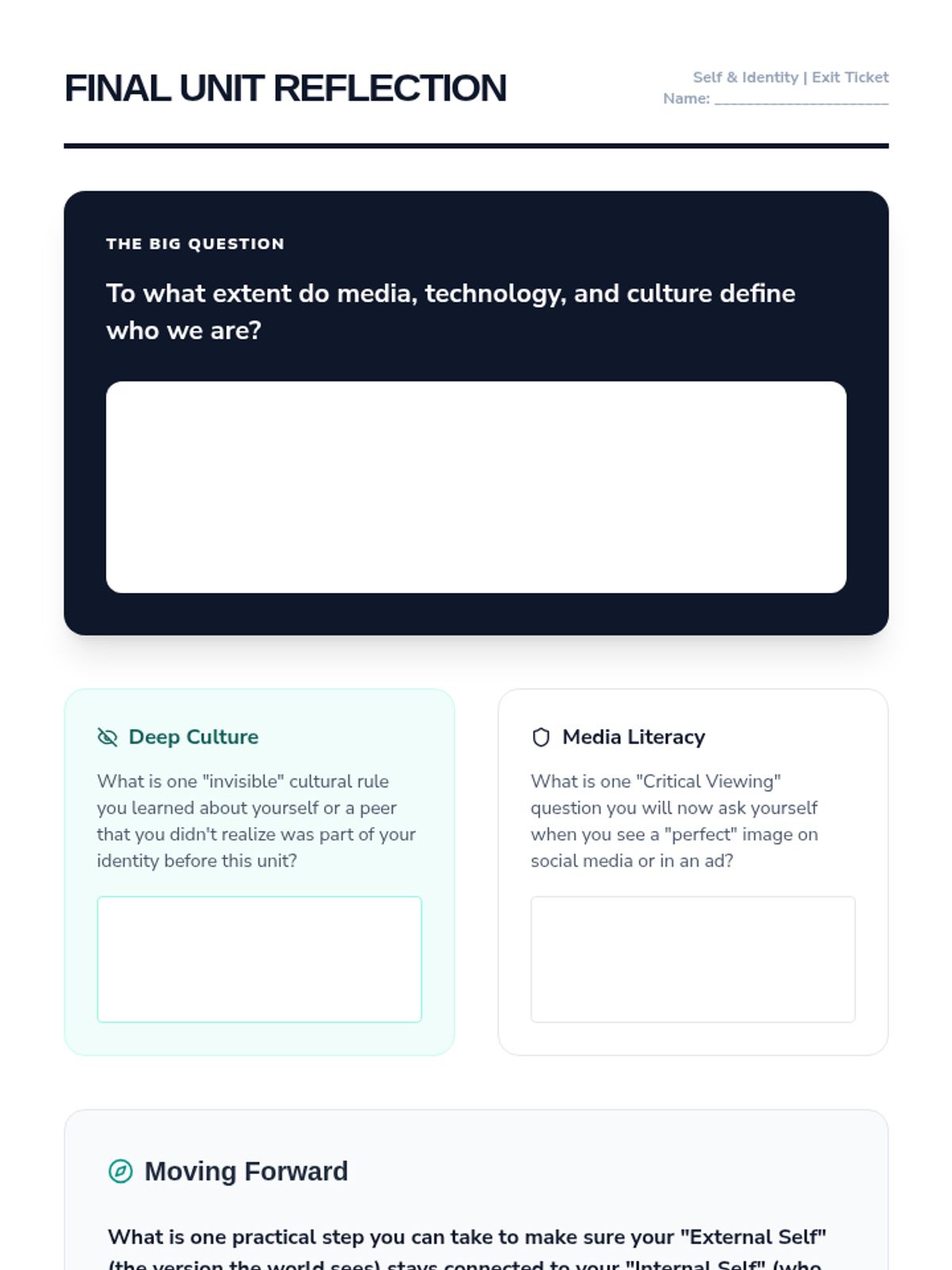
Final unit assessment for Lesson 5, asking students to synthesize their learning on media, culture, and authenticity.
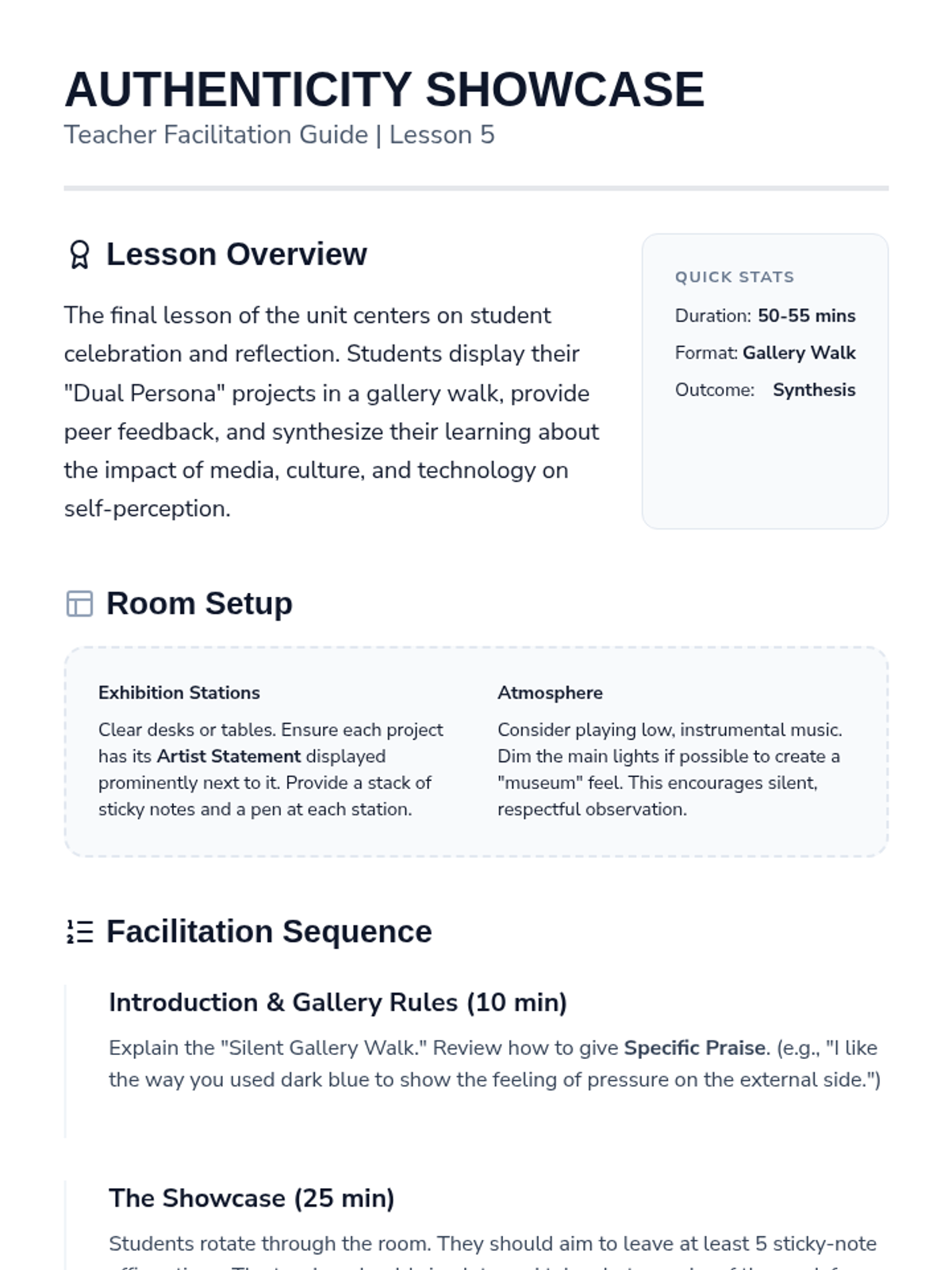
Facilitation guide for Lesson 5, outlining the gallery walk structure, debriefing questions, and unit synthesis strategies.
Lesson 5 slides for the final project presentation, gallery walk feedback session, and unit reflection.
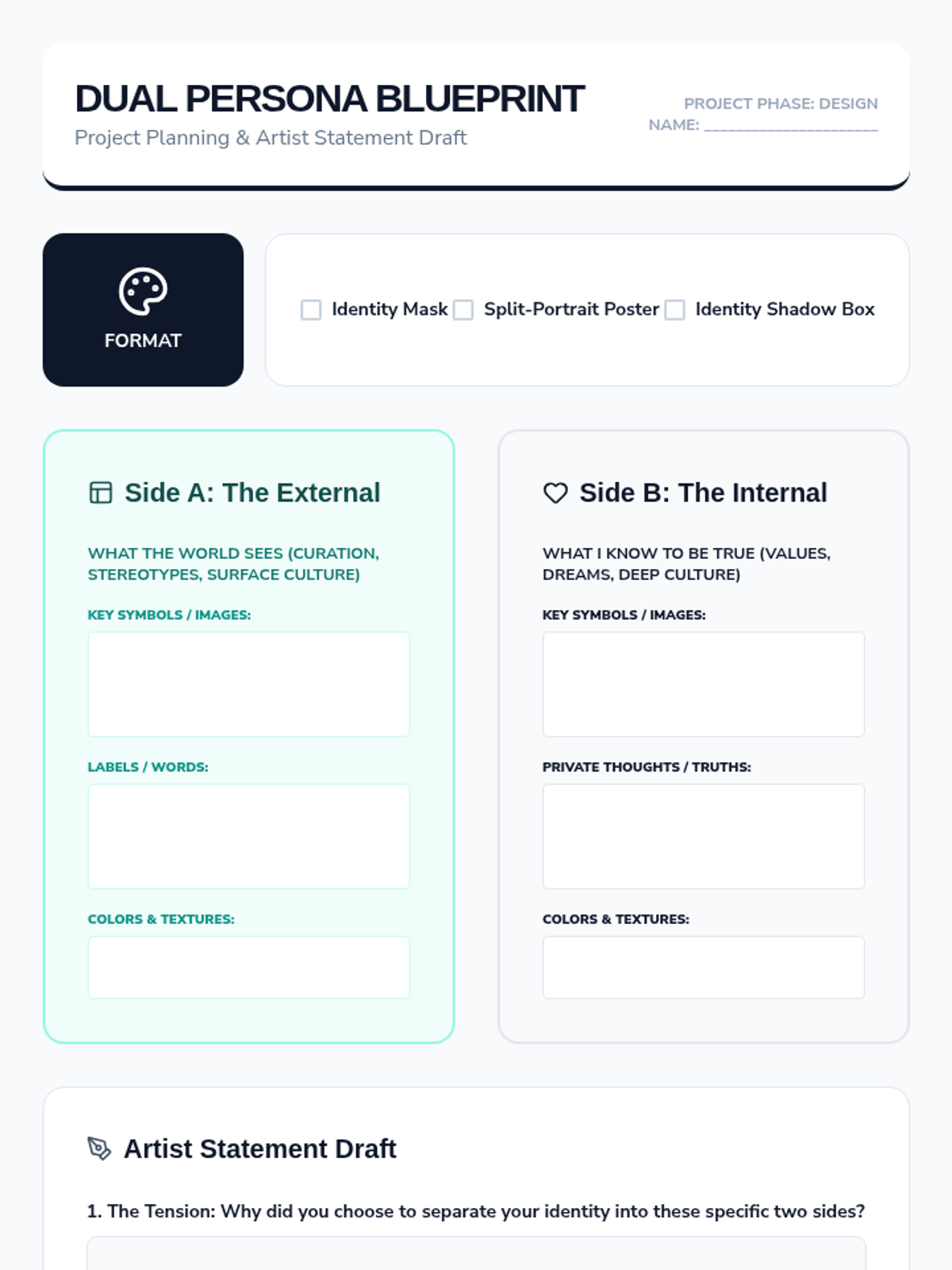
Student project planning sheet for the 'Dual Identity' project, including space for mapping external/internal traits and drafting an artist statement.
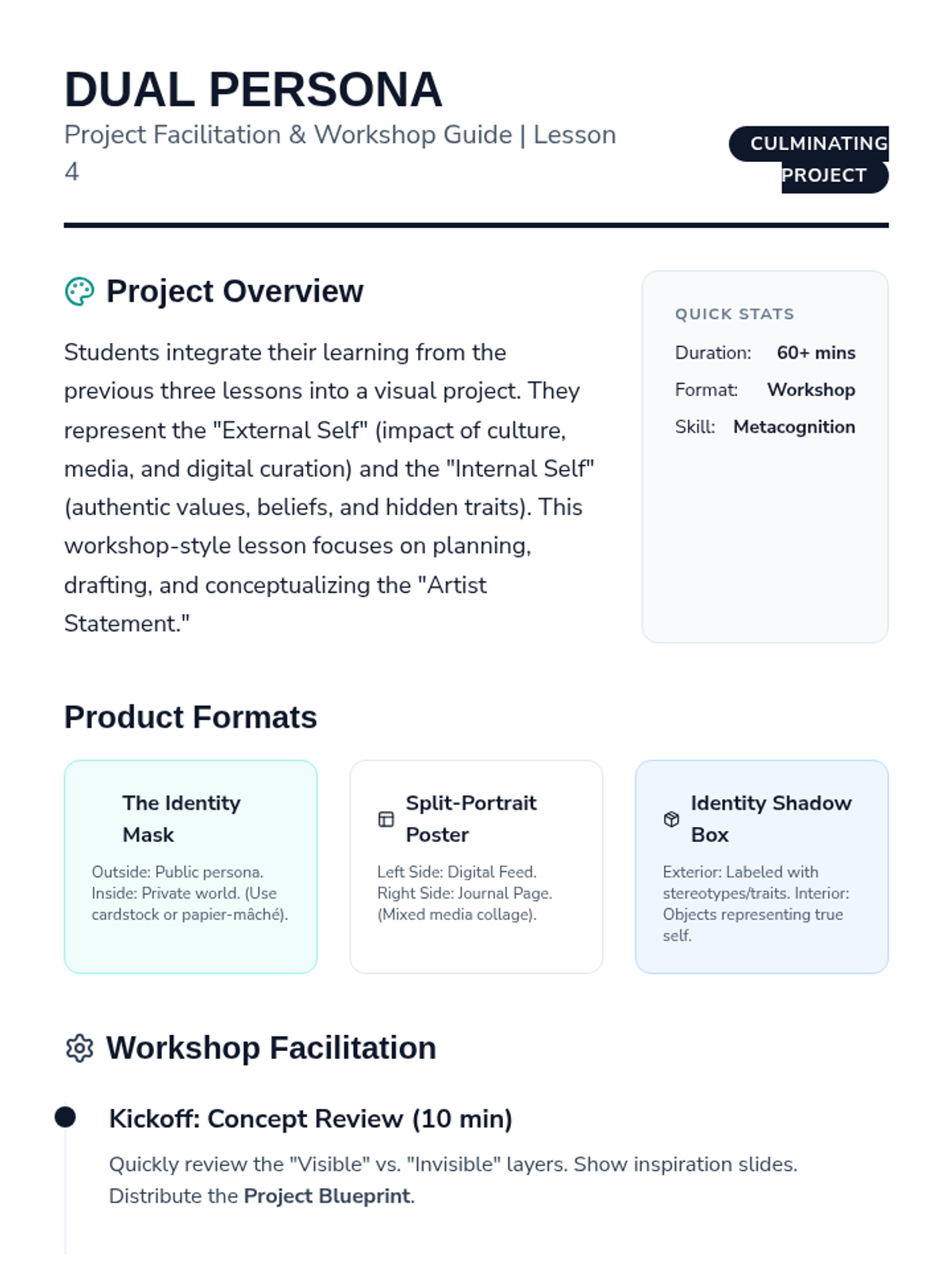
Facilitation guide for Lesson 4, outlining project options, workshop strategies, and assessment considerations for the 'Dual Identity' project.
Lesson 4 slides introducing the 'Dual Identity' culminating project, including inspiration, requirements, and the components of the artist statement.
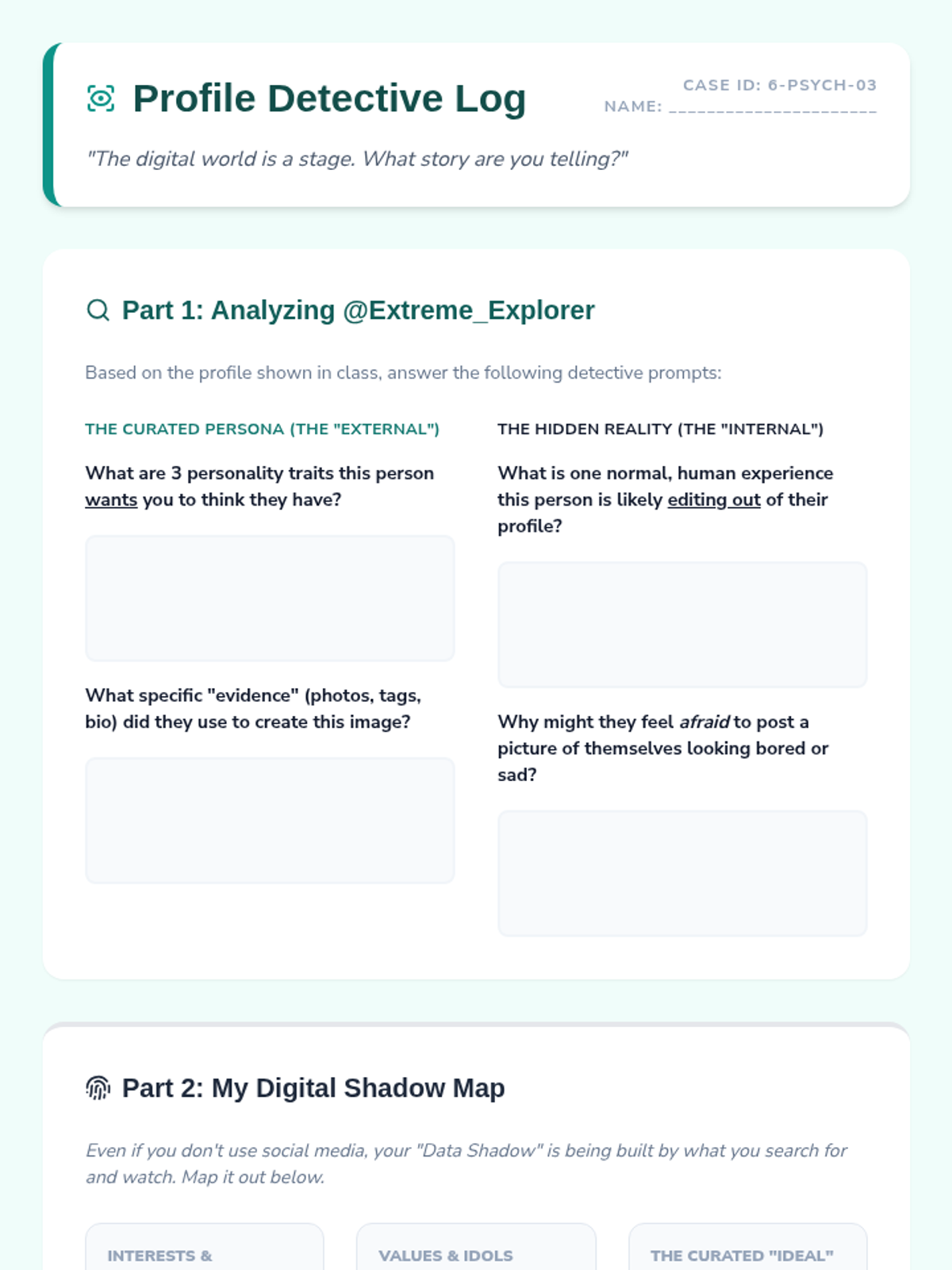
Student activity for Lesson 3, involving the analysis of a mock social media profile and mapping a personal digital footprint to explore the 'online self' vs. 'real self.'
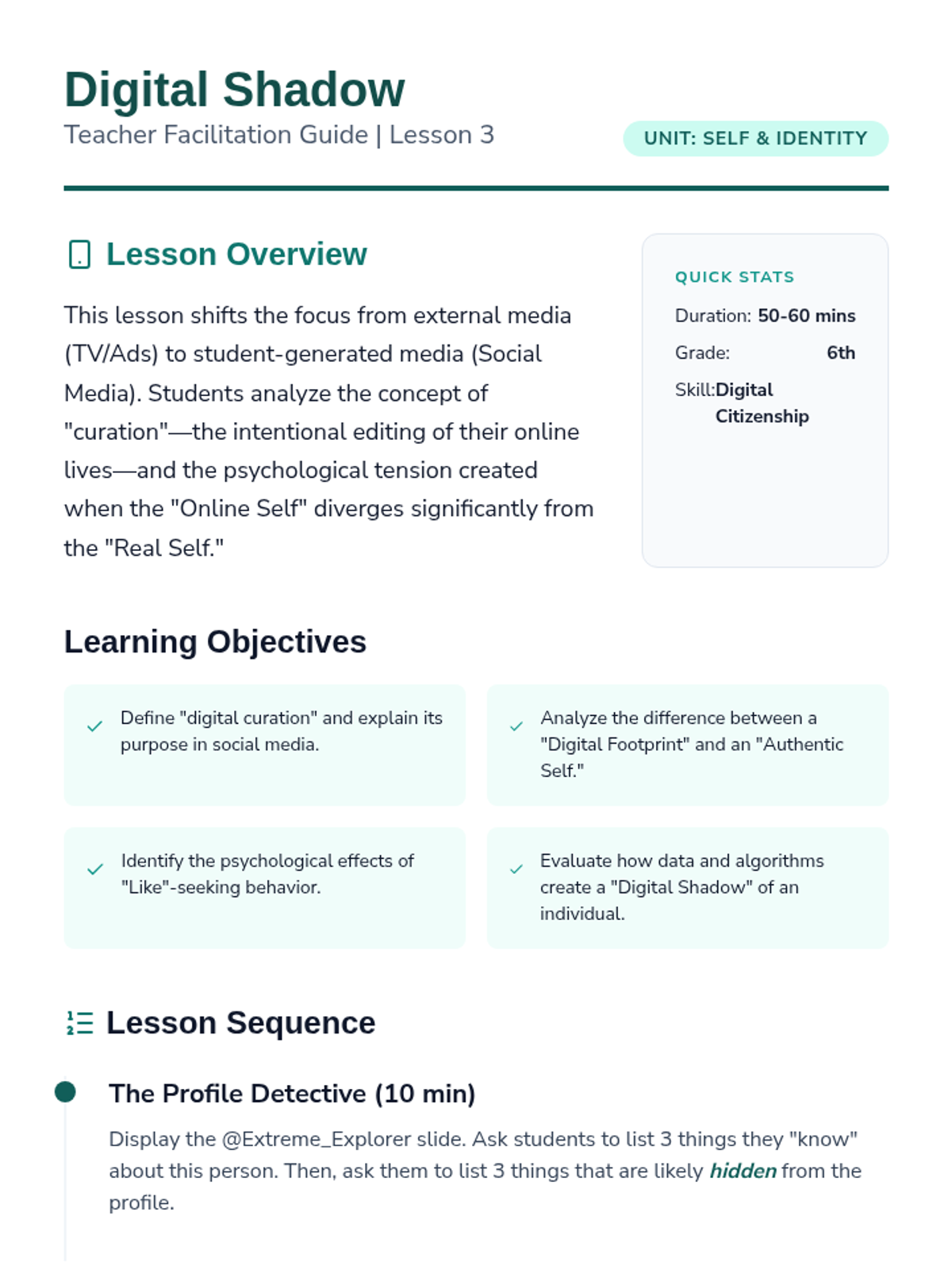
Facilitation guide for Lesson 3, outlining strategies for discussing digital identity, curation, and the psychological impact of social media.
Lesson 3 slides exploring digital curation, the 'online self' vs. 'real self,' and the psychological impact of digital footprints.
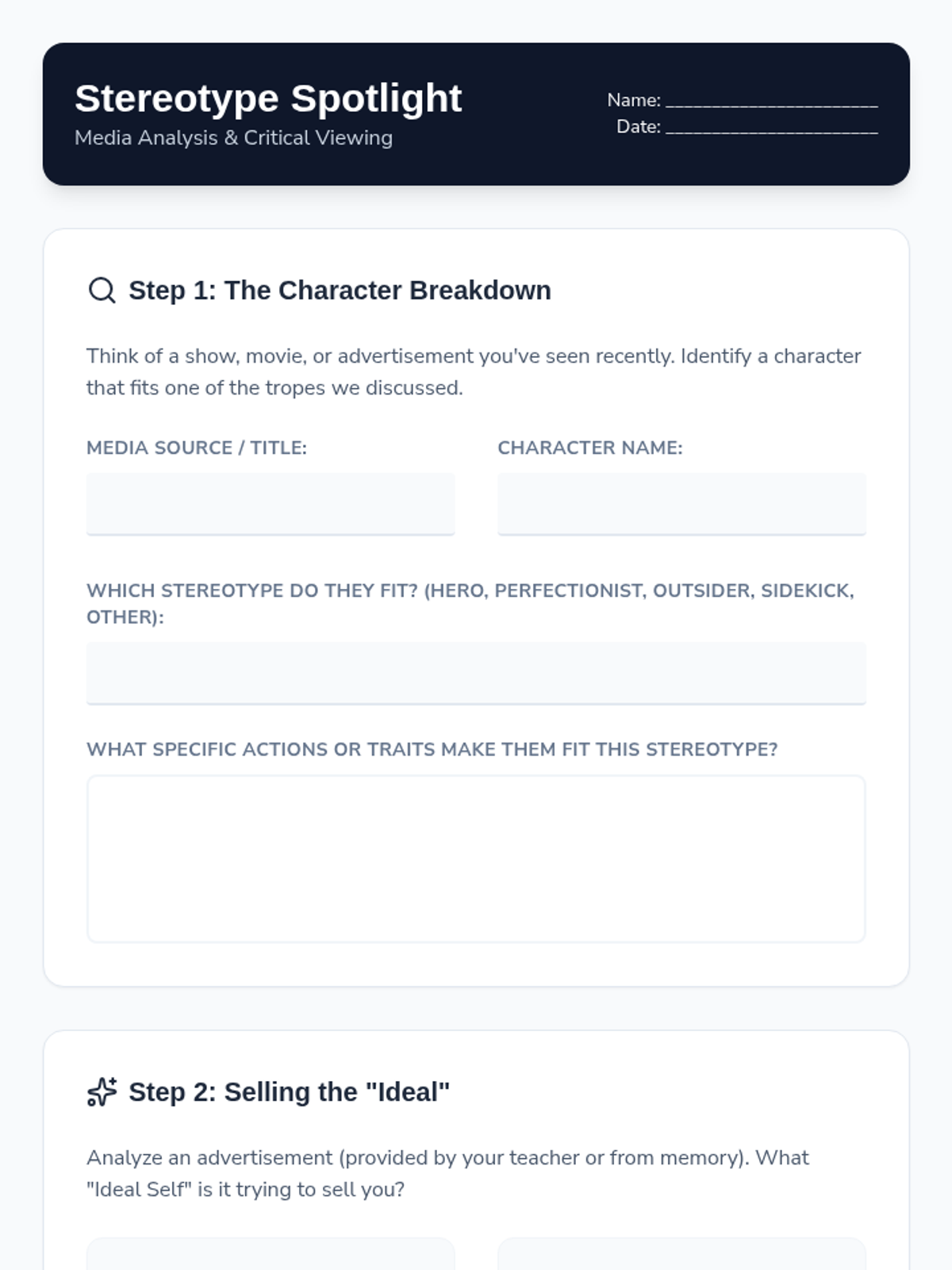
Student activity for Lesson 2, involving the analysis of character stereotypes and idealized imagery in advertisements to build media literacy skills.
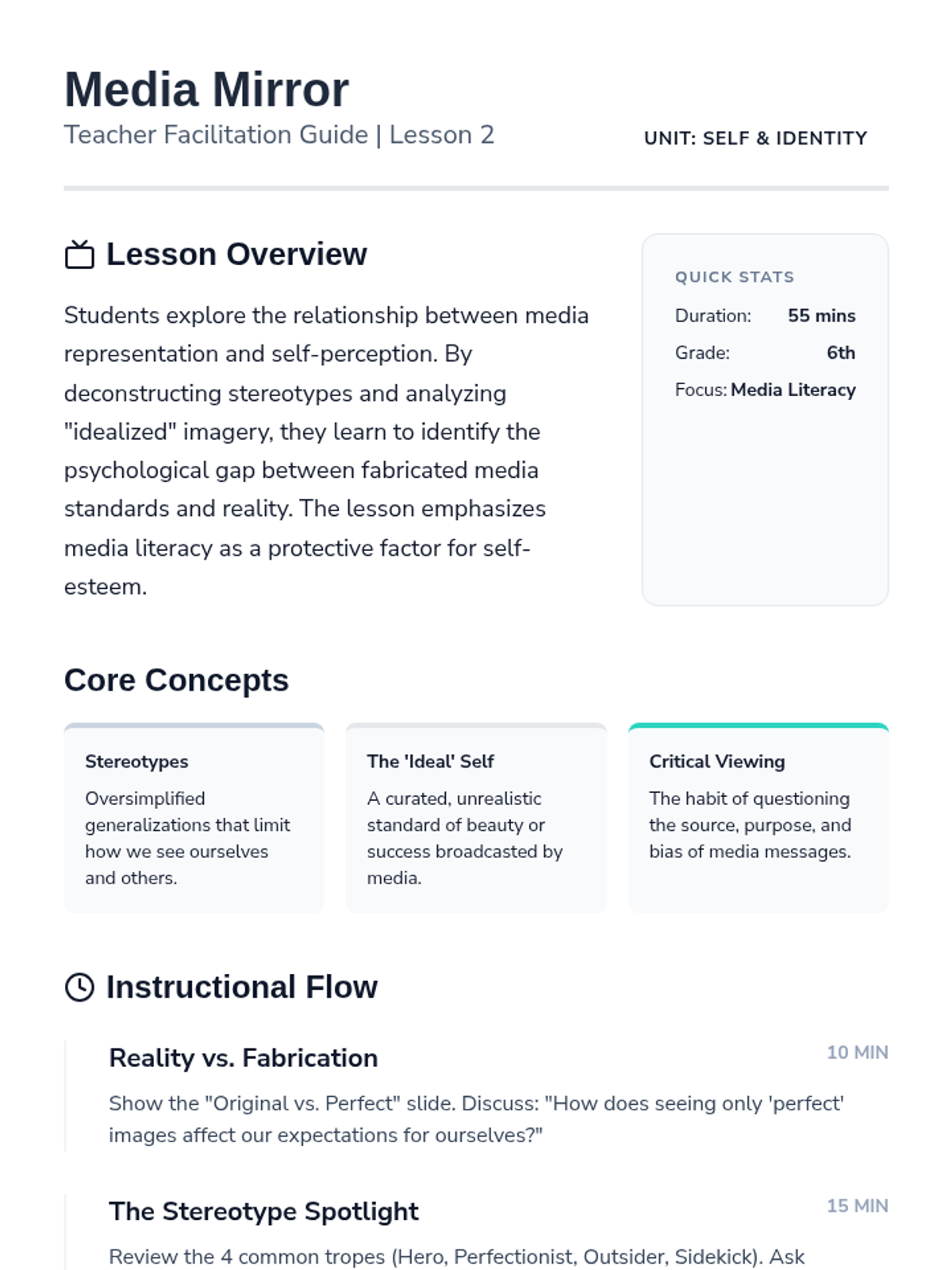
Facilitation guide for Lesson 2, outlining strategies for deconstructing media stereotypes and fostering critical viewing habits in students.
Lesson 2 slides focusing on media literacy, deconstructing stereotypes, and the psychological impact of 'ideal' images.
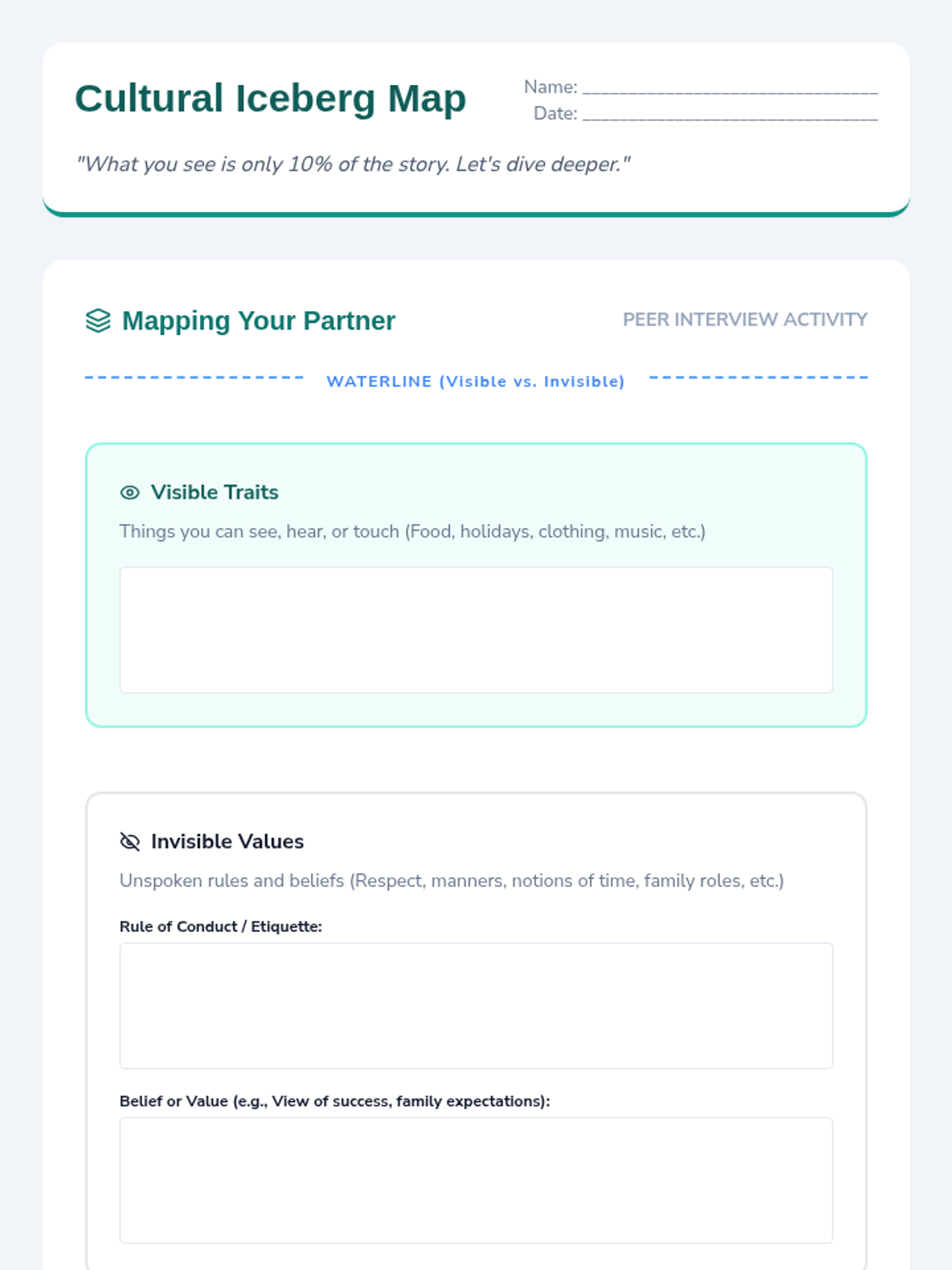
Student activity sheet for Lesson 1, using the Cultural Iceberg model to categorize visible and invisible cultural traits gathered through a peer interview.
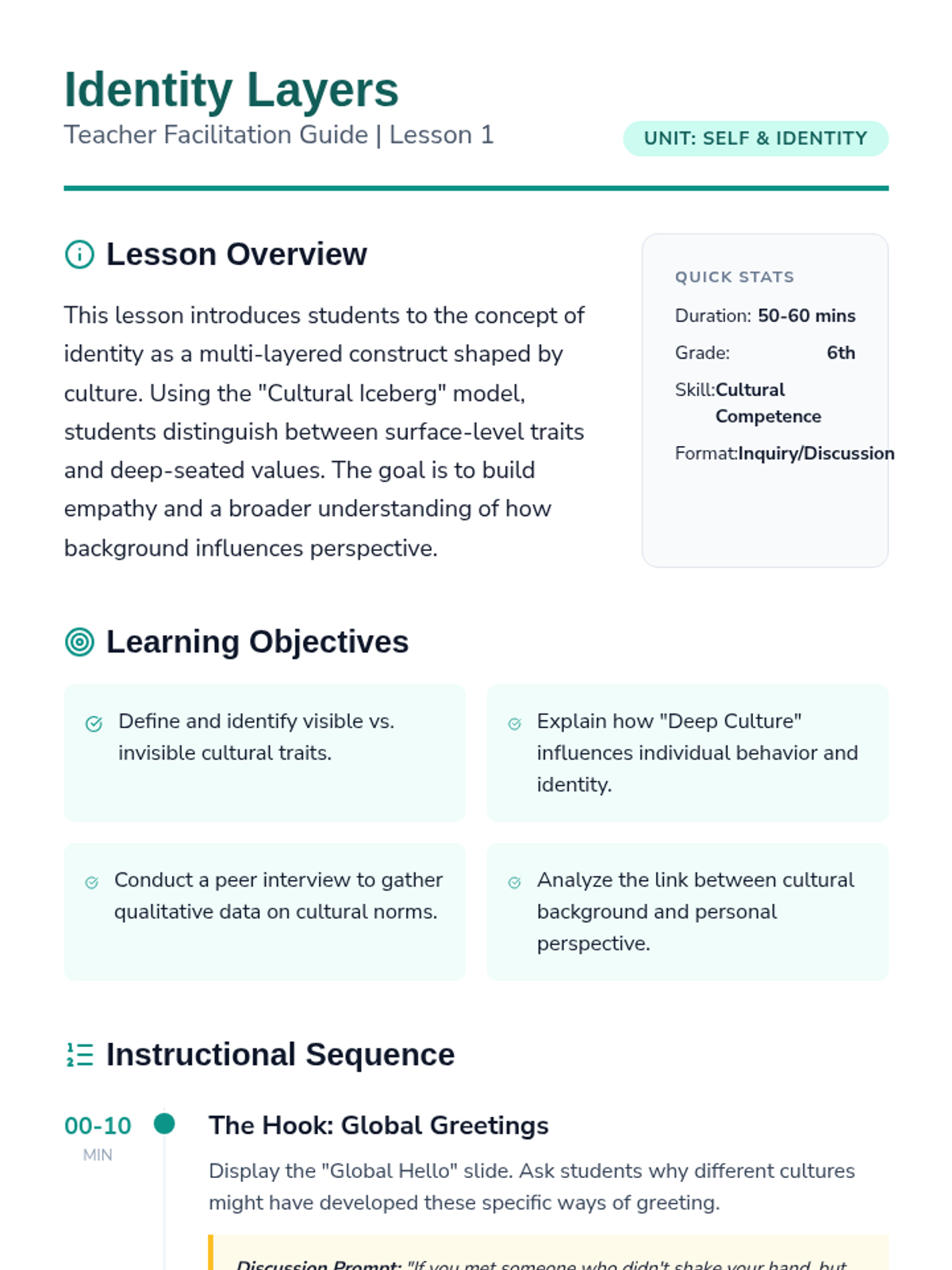
Facilitation guide for Lesson 1, providing a detailed lesson plan, timing, and instructional strategies for teaching the Cultural Iceberg model.
Introductory slide deck for Lesson 1, exploring the concept of the Cultural Iceberg and how visible and invisible cultural traits shape identity.
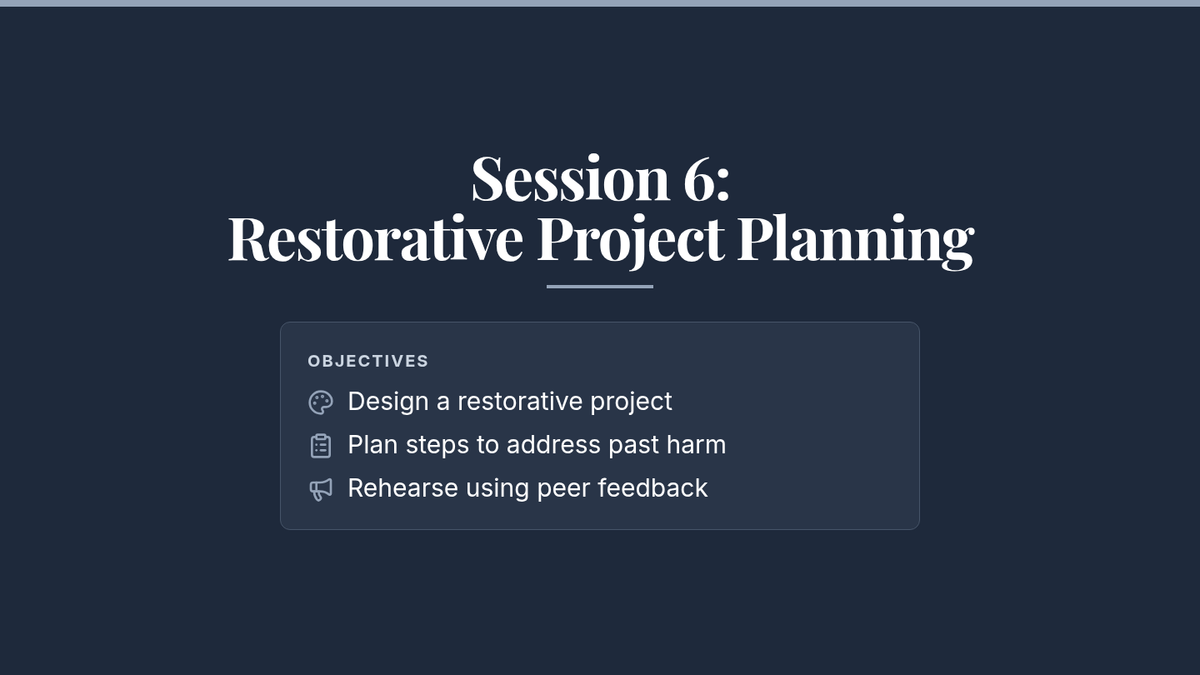
Visual presentation for Session 6, outlining project criteria and guiding groups through planning and rehearsal steps.
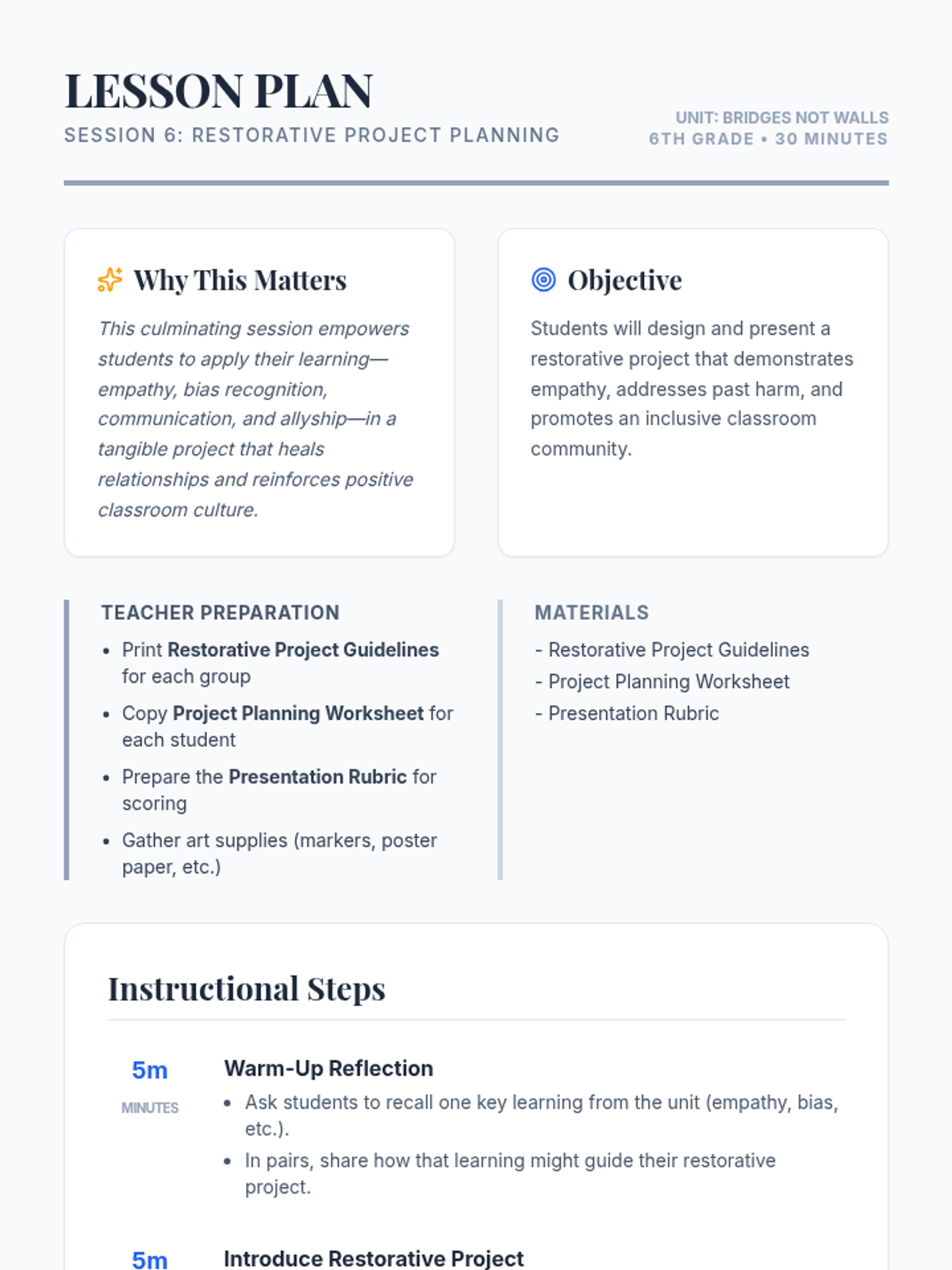
A comprehensive lesson plan for Session 6, focusing on designing a restorative project that applies unit learnings.