A fantasy-themed grammar lesson where students help restore peace to the kingdom of WeLand by mastering subject-verb agreement with indefinite pronouns and collective nouns.
A 30-minute introductory lesson where students learn to decode complex words using a list of 24 common morphemes.
Day 5 serves as a final comprehensive quick check. Students read a new passage independently and apply their analysis of character relationships and plot structure to demonstrate mastery of standards 5.8B and 5.8C.
A lesson focused on helping students master the criteria for successful argumentative writing using a student-friendly checklist based on state-aligned rubrics.
Day 4 serves as a synthesis day using a mystery genre. Students apply their knowledge of character conflict and plot resolution to solve a 'narrative puzzle' and complete a comprehensive assessment.
Day 3 integrates both character and plot (5.8B/C) using traditional literature (a fable). Students examine how a character's traits and choices create the conflict and lead to the climax.
Day 2 focuses on plot elements (5.8C), specifically identifying the rising action, climax, and resolution in an adventure-themed text. Students map the 'Plot Peak' to understand story structure.
Day 1 focuses on analyzing character relationships and conflicts (5.8B) within a realistic fiction text. Students investigate how characters interact and the specific conflicts that drive their actions.
A weekly homework routine featuring a word search challenge and deep-dive vocabulary exercises for 10 target spelling words.
A lesson focused on identifying the main idea and supporting details in nonfiction texts using a comparison of Giant Pandas and Red Pandas.
An introduction to Shakespeare's whimsical comedy for young readers, focusing on plot, characters, and the magical setting of the enchanted forest.
A lesson focused on RL.5.1, teaching students how to quote accurately from a text to support inferences. Students act as 'text detectives' to uncover hidden meanings in short narrative passages.
A set of resources designed to help parents understand and support their child's reading fluency progress at home, focusing on the balance between speed and accuracy.
A lesson focused on self-editing and peer-reviewing using a rubric-aligned checklist to improve sentence variety, grammar, and mechanics.
This lesson guides students through an analysis of Día de Muertos, focusing on the cultural significance, historical roots, and identity-affirming power of the tradition. Students will practice synthesizing information from multiple paragraphs to construct a meaningful written response about resilience and memory.
A focused practice session on identifying cause-and-effect relationships within a fictional text, modeled after EOC RLA assessment formats.
A 20-minute collaborative small group session focusing on main idea, details, vocabulary (synonyms/antonyms), and critical thinking through a short weather passage.
A high-stakes reading game where students compete as jockeys to master multi-syllabic vocabulary and fluency through a horse-racing themed challenge.
Students analyze how characters take on leadership roles and gain confidence. They compare two stories where characters move from being followers to taking active responsibility.
Students explore how characters develop resilience and persistence. They analyze two stories where characters face repeated failure before finding a new path to success.
Students focus on how characters' perspectives shift from judgment to empathy. They analyze two stories where characters overcome initial biases to form new understandings.
A focused lesson designed to prepare 4th and 5th-grade students for the IAR Prose Constructed Response (PCR). Students will analyze character development across two texts and draft a comparative essay using a provided scoring rubric.
A 6th-grade ELA lesson focused on RL.6.1, RL.6.2, and RL.6.3, where students analyze and compare two short stories through binary-choice questions.
A character analysis and creative writing lesson centered on the Straw Hat Pirates from One Piece. Students will explore character motivations, roles, and traits while developing their own unique additions to the crew.
A high-energy basketball-themed vocabulary and fluency game for 4th and 5th graders, focusing on multi-syllabic word decoding and sentence completion challenges.
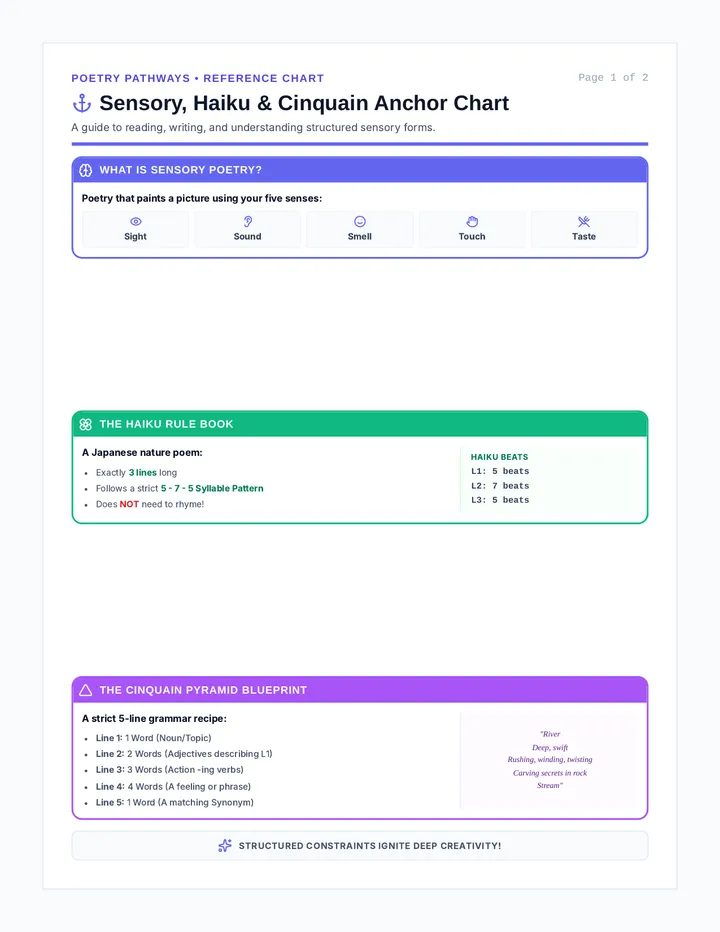
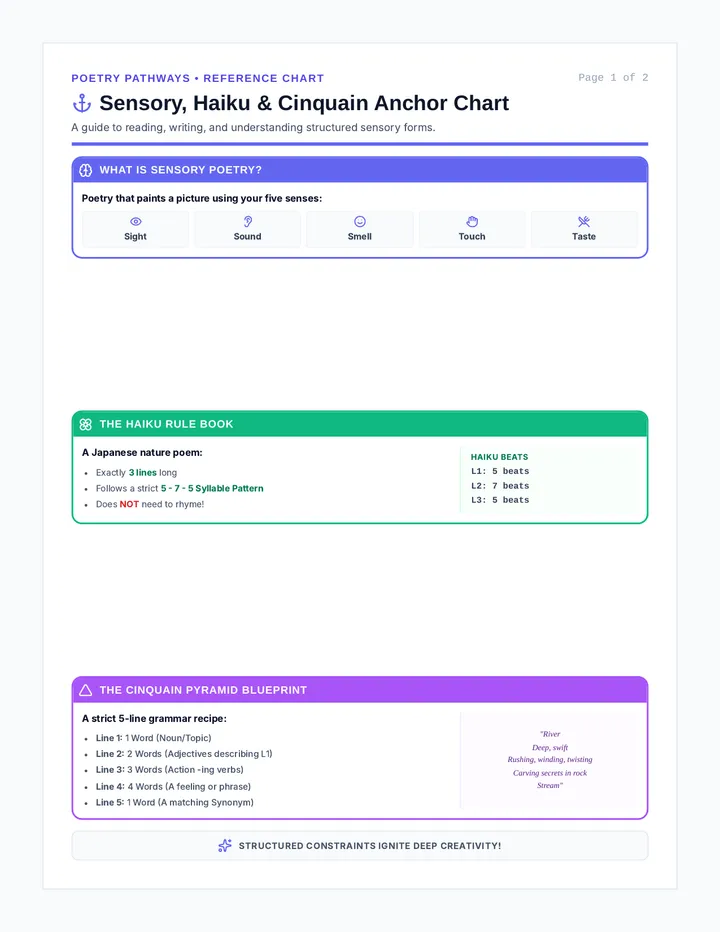
An engaging figurative language enrichment activity for students who finish assignments early, focusing on simile, metaphor, personification, alliteration, onomatopoeia, and idioms.
Students explore their unique personality traits and strengths to prepare for an 'All About Me' essay using a visual brainstorming web.
A comprehensive lesson on building strong argumentative essays, focusing on thesis construction, evidence integration, and addressing counter-arguments through the 'Debate Lab' theme.
A lesson focused on post-SSR reading comprehension through daily reflection and choice-based activities across four key skill areas.
This lesson guides students through the structural 'blueprints' of Extended Constructed Responses (ECR), covering both informational and argumentative modes with a focus on thesis development, evidence selection, and paragraph organization.
Students will learn to identify and craft effective counterclaims and rebuttals to strengthen their argumentative writing. The lesson uses a 'combat' metaphor to make the components of an argument memorable and engaging.
A focused lesson on identifying the topic, main idea, and supporting details in short informational texts, designed for 6th-grade students.
A comprehensive guide to teaching structured debate, focusing on argument construction, rebuttal strategies, and persuasive delivery for middle and high school students.
A specialized set of professional SMART goals and evaluative tools for middle school teachers focusing on Literature and Informational reading standards. Includes SLO planners, professional goal banks, and proficiency scales for data-driven instruction.
A comprehensive ELA lesson for grades 4-6 focused on identifying and mapping narrative arcs. Students use exploratory metaphors to navigate plot structures, climax, and resolution.
In this lesson, middle school students explore the power of rhetoric through the speeches and writings of historical and modern change makers. They analyze how language can spark social change and apply these strategies to craft their own persuasive messages.
Students will master the -dge spelling pattern, learning when to use it (after short vowels) and applying these words in sophisticated sentences and short narratives. This lesson is designed for 6th-grade ESE students who need high-interest, age-appropriate content.
A comprehensive phonics and comprehension lesson following the S.P.I.R.E. Level 3 framework, focusing on the 'ay' sound and analyzing character development in a decodable narrative.
In this lesson, students will master identifying and using main ideas and supporting details through the lens of investigative journalism. They will build a technical vocabulary to describe how authors construct arguments and narratives.
A lesson focusing on the trigraph -dge. Students learn the spelling rule that -dge is used to spell the /j/ sound immediately following a short vowel at the end of a word or syllable.