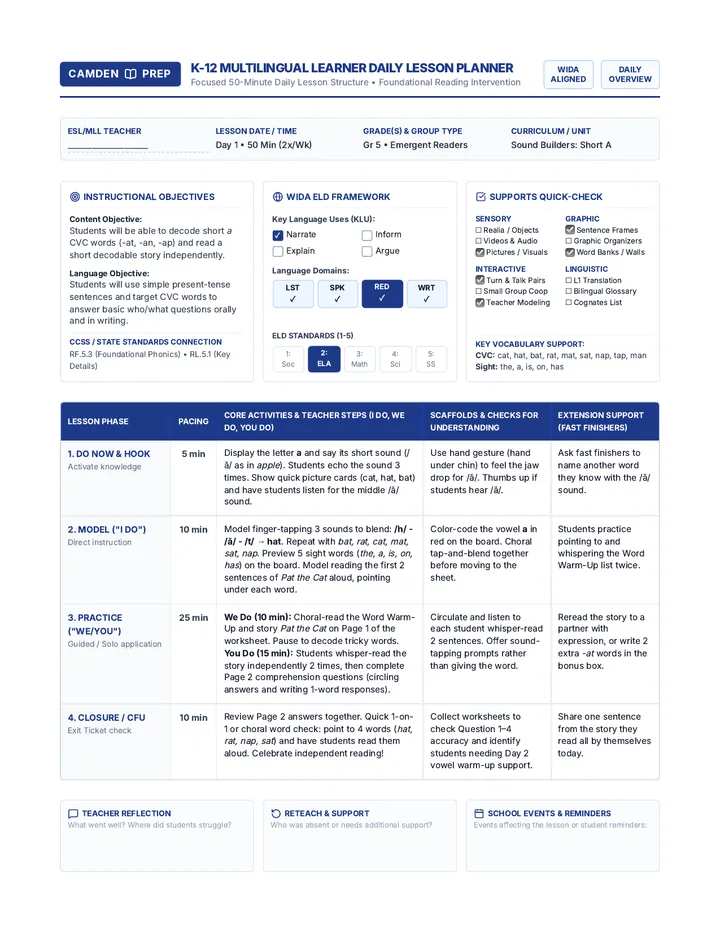
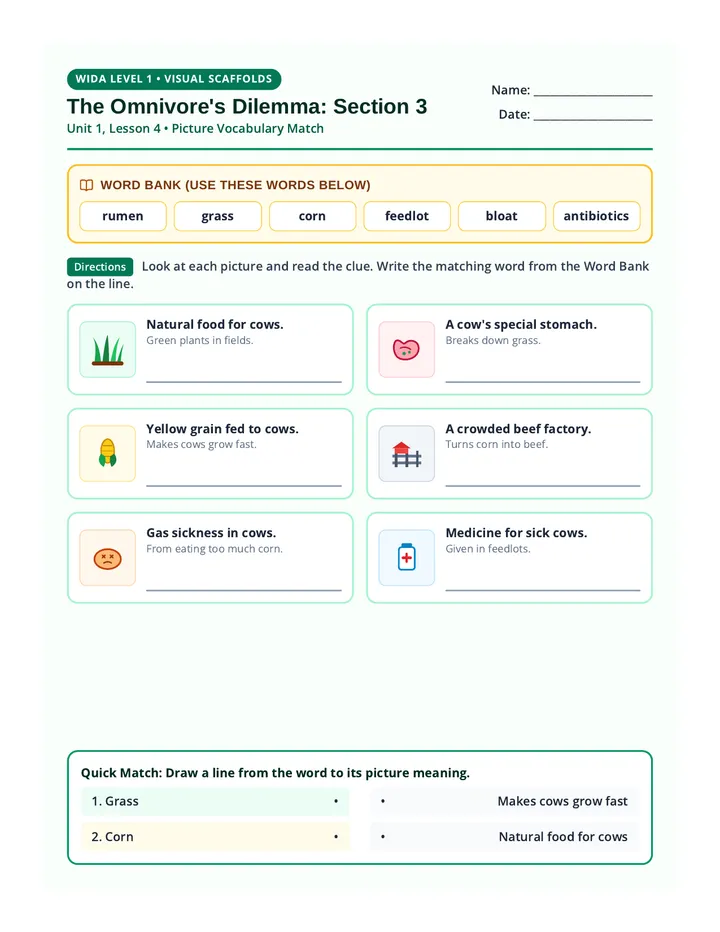
WIDA Level 1 PacketWIDA Level 1 • Visual Scaffolds The Omnivore's Dilemma: Section 3 Unit 1, Lesson 4 • Picture Vocabulary Match Name: ______________________ Date: ______________________ Word Bank (Use these words below) rumen grass corn feedlot bloat antibiotics Directions Look at each picture and read the clue. Write the matching word from the Word Bank on the line. Natural food for cows. Green plants in fields. A cow's special stomach. Breaks down grass. Yellow grain fed to cows. Makes cows grow fast. A crowded beef factory. Turns corn into beef. Gas sickness in cows. From eating too much corn. Medicine for sick cows. Given in feedlots. Quick Match: Draw a line from the word to its picture meaning. 1. Grass• 2. Corn• •Makes cows grow fast •Natural food for cows Visual Synopsis: Grass vs. Corn Pages 63–74 🌿 1. Natural Pasture Pages 63–65 ☀️ Sun + Grass: The sun helps grass grow. 🐄 Cows + Rumen: Cows have a rumen stomach to eat grass. 🌱 Healthy Cycle: Cows help new grass grow. ⏳ Slow Growth: Grass-fed cows grow slowly. 🌽 2. Industrial Feedlot Pages 69–74 🏭 Feedlots: Beef factories feed cows corn. ⚡ Fast Growth: Cows grow to 1,100 lbs in 16 months. 🤒 Sick Cows: Too much corn causes bloat and acidosis. 💊 Medicine: Feedlot cows need antibiotics. Check Your Understanding Circle YES or NO for each sentence. 🌿 1. A cow's rumen is made to digest grass. YES NO 🌽 2. Eating corn keeps feedlot cows healthy without medicine. YES NO ⚡ 3. Cows grow faster on corn than on grass. YES NO 💊 4. Most feedlot cows need antibiotics. YES NO Big Idea: Grass is natural for cows. Corn makes cows grow fast, but it makes them sick. Delineate the Argument (RI.8.8) Visual Organizer 🎯 Author's Main Claim Raising cows in feedlots on corn is bad for cows. Directions Circle the matching Supporting Point and Evidence for each box. Supporting Point 1 Why are cows made for grass, not corn? A. 🌿 Cows evolved to eat grass. B. 🌽 Cows evolved to eat corn. Circle the Evidence: A. Cows have a rumen to digest grass. B. Cows eat corn in 16 months. Supporting Point 2 What does corn do to cows in feedlots? A. 🤒 Corn makes cows sick. B. 💪 Corn makes cows stronger. Circle the Evidence: A. Cows get bloat and acidosis. B. Cows live on open prairies. Write 1 word from the Word Bank that names a cow sickness: Choices: grass • bloat • rumen Picture-Supported Check Multiple Choice Directions Look at the picture. Circle the best answer (A, B, or C). 🌽 1. Why do feedlots feed corn to cows? A. To fatten cows fast B. To help grass grow C. To keep cows cool 🤒 2. What happens when cows eat too much corn? A. They grow wings B. They get bloat C. They eat more grass 💊 3. Why do feedlot cows need antibiotics? A. To run faster B. To stay alive C. To plant seeds 🚫 4. Which sentence is NOT about cows and corn? A. Corn causes acidosis B. Vets study for years C. Cows need antibiotics How did you feel about this packet? Circle one: 😊 Easy 😐 Okay 😟 Hard
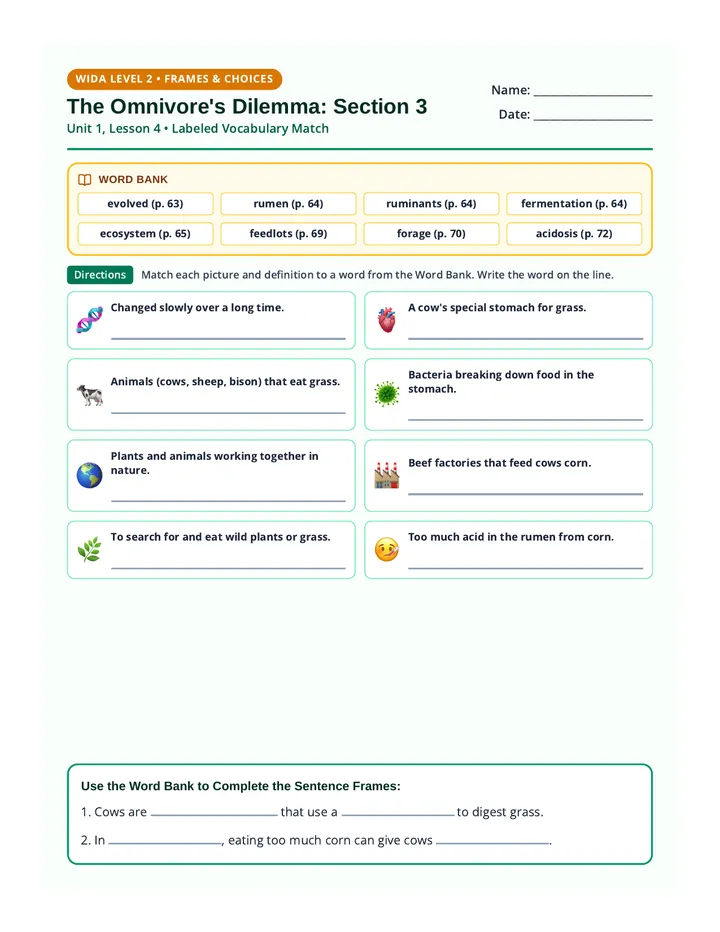
WIDA Level 2 PacketWIDA Level 2 • Frames & Choices The Omnivore's Dilemma: Section 3 Unit 1, Lesson 4 • Labeled Vocabulary Match Name: ______________________ Date: ______________________ Word Bank evolved (p. 63) rumen (p. 64) ruminants (p. 64) fermentation (p. 64) ecosystem (p. 65) feedlots (p. 69) forage (p. 70) acidosis (p. 72) Directions Match each picture and definition to a word from the Word Bank. Write the word on the line. 🧬 Changed slowly over a long time. 🫀 A cow's special stomach for grass. 🐄 Animals (cows, sheep, bison) that eat grass. 🦠 Bacteria breaking down food in the stomach. 🌎 Plants and animals working together in nature. 🏭 Beef factories that feed cows corn. 🌿 To search for and eat wild plants or grass. 🤒 Too much acid in the rumen from corn. Use the Word Bank to Complete the Sentence Frames: 1. Cows are that use a to digest grass. 2. In , eating too much corn can give cows . Synopsis & Reading Questions Pages 63–74 🌿 Pages 63–65: Natural Partnership Ecological Partnership: The sun grows grass. Cows eat grass and fertilize new grass. Rumen: Cows have a special stomach that turns grass into protein and energy. Growth Speed: A steer grows from 80 to 1,100 lbs in 16 months on corn. Grass-fed cows grow slower. 🏭 Pages 69–74: Industrial Feedlots Feedlots: Beef factories that turn corn into beef. Feed Ingredients: Some feed includes tallow and animal proteins. Sickness: Corn goes against a cow's foraging nature. Too much corn causes bloat and acidosis. Antibiotics: Most feedlot cattle need medicine to stay healthy. Reading Questions (Use the Sentence Frames) Word Bank: fast • sick • antibiotics • grass 1. (Page 65) If cattle are not good at digesting corn, why are they fed corn? Cattle are fed corn because corn makes them grow , while cows that eat take longer to grow. 2. (Page 70) Why does eating corn make cattle sick? Corn makes cattle because their stomachs evolved to eat , not corn. 3. (Page 74) What is the relationship of antibiotics to feedlot animals? Most feedlot animals need because eating corn makes them . Tip: Look back at the two Synopsis boxes above to check your answers! Delineate an Argument Organizer (RI.8.8) Framed Organizer Evidence Bank — Write the matching letter (A or B) in the organizer below: Evidence A: "Cows have a specialized stomach (rumen) that allows them to break down grasses." Evidence B: "Cows can get bloat or acidosis from eating too much corn and need antibiotics." 🎯 Purpose (RI.8.6) The author wrote this section to explain why feeding to cows in feedlots is harmful. 📢 Main Claim (RI.8.8) Raising cows in industrial on corn is a bad way to raise beef. 🌿 Supporting Point 1 A cow's body evolved to eat , not corn. Relevant Evidence 1 Matching Evidence Letter: 🤒 Supporting Point 2 Feeding corn to cattle makes them . Relevant Evidence 2 Matching Evidence Letter: ✅ Sufficient Evidence? Circle one: Yes / No The evidence is sufficient because the author gives facts about cow and sickness. Word Bank for Organizer: corn • feedlots • grass • sick • stomachs Supported Multiple Choice (RI.8.6 & RI.8.8) Assessment Check Directions Use the picture cues to help you circle the best answer (A, B, or C). 🚫 1. Which piece of evidence would be IRRELEVANT (not related) to the author's claim? A. It takes many years of training to become a large-animal vet. B. A corn diet can give cattle acidosis in the rumen. C. Feedlot cows need antibiotics so they do not get sick. 💬 2. On page 70, Pollan says corn seems "wholesome," yet it goes against nature. How does he respond to the idea that corn is wholesome? A. By explaining how industrial beef affects the environment. B. By explaining the illnesses corn-fed cattle get (like bloat and acidosis). C. By sharing research on humane treatment of animals. 🥩 3. (Page 71) Which is another supporting point for why industrial beef is bad? A. Corn-fed beef and grass-fed beef are equally healthy. B. Corn-fed beef is not as healthy for humans to eat as grass-fed beef. C. Omega-3 fatty acids should not be eaten by humans. Explain Your Choice (Question 1): I chose letter because it is not about .
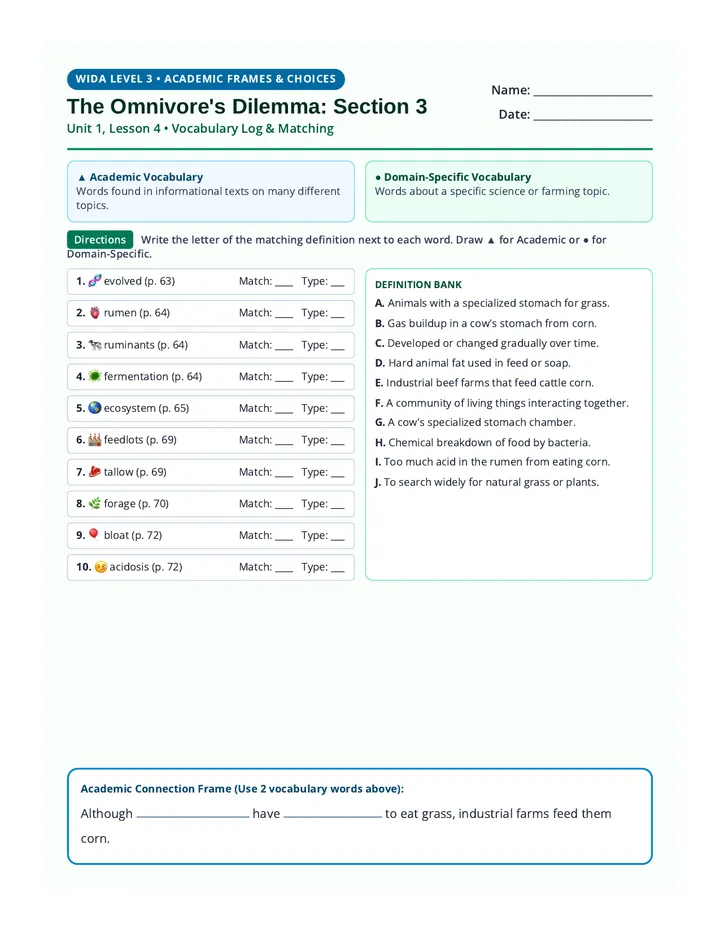
WIDA Level 3 PacketWIDA Level 3 • Academic Frames & Choices The Omnivore's Dilemma: Section 3 Unit 1, Lesson 4 • Vocabulary Log & Matching Name: ______________________ Date: ______________________ ▲ Academic Vocabulary Words found in informational texts on many different topics. ● Domain-Specific Vocabulary Words about a specific science or farming topic. Directions Write the letter of the matching definition next to each word. Draw ▲ for Academic or ● for Domain-Specific. 1. 🧬 evolved (p. 63) Match: ____ Type: ___ 2. 🫀 rumen (p. 64) Match: ____ Type: ___ 3. 🐄 ruminants (p. 64) Match: ____ Type: ___ 4. 🦠 fermentation (p. 64) Match: ____ Type: ___ 5. 🌎 ecosystem (p. 65) Match: ____ Type: ___ 6. 🏭 feedlots (p. 69) Match: ____ Type: ___ 7. 🥩 tallow (p. 69) Match: ____ Type: ___ 8. 🌿 forage (p. 70) Match: ____ Type: ___ 9. 🎈 bloat (p. 72) Match: ____ Type: ___ 10. 🤒 acidosis (p. 72) Match: ____ Type: ___ Definition Bank A. Animals with a specialized stomach for grass. B. Gas buildup in a cow's stomach from corn. C. Developed or changed gradually over time. D. Hard animal fat used in feed or soap. E. Industrial beef farms that feed cattle corn. F. A community of living things interacting together. G. A cow's specialized stomach chamber. H. Chemical breakdown of food by bacteria. I. Too much acid in the rumen from eating corn. J. To search widely for natural grass or plants. Academic Connection Frame (Use 2 vocabulary words above): Although have to eat grass, industrial farms feed them corn. Synopsis & Reading Questions Pages 63–74 🌿 Pages 63–65: Ecological Partnership Cows and grasses have a natural, sustaining partnership: plants use sun energy, and cows eat, fertilize, and plant new grasses. Cows have a specialized stomach (rumen) that breaks down grasses into proteins and carbohydrates. A steer grows from 80 to 1,100 lbs in 16 months on corn; grass-fed cows take longer to mature. 🏭 Pages 69–74: Feedlot Reality Feedlots are beef factories that turn corn into beef. Cattle feed can include animal proteins such as tallow, feather meal, and pig meal. Feeding corn goes against cattle's foraging nature, causing bloat and acidosis. Most feedlot cattle require antibiotics to stay healthy. Reading Questions (Complete using the sentence starters) 1. Pg. 65: If cattle are not good at digesting corn, why are they fed corn as their primary diet? Sentence Starter: Although cattle are not good at digesting corn, they are fed corn because... 2. Pg. 70: Why does eating corn make the cattle sick? Sentence Starter: Eating corn makes cattle sick because their rumen... 3. Pg. 74: What is the relationship of antibiotics to feedlot animals? Sentence Starter: Feedlot animals depend on antibiotics because... Language Goal: Use connector words like because, although, and as a result in your responses. Delineate an Argument (RI.8.8 & RI.8.6) Graphic Organizer Evidence Bank (Match letter A or B to Supporting Points 1 & 2): A. "Cows have a specialized stomach (rumen) that allows them to break down grasses." (p. 64) B. "Cows can get bloat or acidosis from eating too much corn and need antibiotics." (pp. 72–74) 🎯 Author's Purpose (RI.8.6) Michael Pollan's purpose is to inform readers about . 📢 Main Claim (RI.8.8) Pollan's main claim is that raising cattle on corn in feedlots is . 🌿 Supporting Point 1 First, cattle's digestive systems evolved to . Relevant Evidence 1 Evidence Letter: This proves that . 🤒 Supporting Point 2 Second, feeding corn to cattle causes . Relevant Evidence 2 Evidence Letter: This proves that . ✅ Sufficient Evidence? Yes / No — The evidence is sufficient because Pollan provides . 🧠 Sound Reasoning? Yes / No — His reasoning is sound because he connects cow biology to . Check: Did you include both supporting points and match each one to its evidence letter (A or B)? Argument & Viewpoint Check (RI.8.6 & RI.8.8) Multiple Choice Directions Read each question carefully. Circle the best answer (A, B, C, or D). 1. 🚫 Which piece of evidence, if included, would be IRRELEVANT to the author's claim? (RI.8.8) A. It takes many years of training to become a large-animal vet. B. A corn diet can give cattle acidosis, which is too much acid in the rumen. C. Industrially raised animals require antibiotics so they do not get sick. D. Many industrial farms watch out for sick animals and treat them. 2. 💬 On page 70, Pollan says: "Compared to all of the other things we feed cattle these days, corn seems positively wholesome. Yet feeding corn to cattle goes against the natural order almost as much as feeding them beef." How does Pollan respond to the conflicting viewpoint that corn is wholesome? (RI.8.6) A. By referencing research on humane treatment of cattle. B. By referencing research on industrial beef's environmental impact. C. By explaining how the industrial food chain impacts human health. D. By explaining the various illnesses corn-fed cattle may experience. 3. 🌿 After rereading pages 63–65, which is a supporting point for Pollan's claim that raising cows in feedlots is terrible? (RI.8.8) A. A cow's digestive system has evolved to eat grass, yet cows are fed corn because it fattens them quickly. B. Bison and prairie grasses lived together in a partnership for thousands of years. C. Cows have a specialized stomach called a rumen. D. Cows spread grass seed, plant it with their hooves, and fertilize it with manure. Justify Your Answer (Question 2): I selected choice because Pollan responds to the idea that corn is wholesome by showing .