Survival Mode Slides Survival Mode Origins
Understanding why your body acts like it's in a movie
Stress Science Lab: Unit 1
Spot the Difference?
Saber-Toothed Tiger
10,000 years ago, this was a REAL physical threat.
VS
Pop Math Test
Today, this is a modern challenge.
Discussion: How would your heart feel in both scenarios? Why?
The Secret Language of Survival
Stress isn't a "bad" feeling. It is actually your Evolutionary Survival System.
Purpose
To prepare your body to either fight off a threat or run away from it (flight).
Speed
It happens in milliseconds—before you even have time to think!
Same Body, Different World
Then: Survival
Predators in the grass
Running out of water
Dangerous weather
Now: Social & Mental
Speaking in front of class
Being left out of a group chat
Difficult homework assignments
"Your brain uses the same alarm system for a lion and a laptop."
Why is this a problem?
If your body prepares for a PHYSICAL fight but you are just sitting at a DESK... what happens to all that energy?
Let's find out in today's activity!
Stress Evolution Worksheet Stress Evolution Lab
Lesson 1: Survival Mode Origins
Name:
Date:
Part 1: The Alarm System
Imagine you just saw a giant predator. Your brain sends a signal to your body to get ready to move. Describe three physical things that happen in your body during this "alarm."
Symptom 1
Symptom 2
Symptom 3
Part 2: Then vs. Now
Read the list of "Stressors" below. Decide if it's an Ancient Threat (needed for survival 10,000 years ago) or a Modern Challenge (happens in school/life today). Write them in the correct column.
A hungry lion An math exam Getting lost in the woods A mean comment on social media Not having enough food Talking in front of the class
Ancient Threats
Modern Challenges
Part 3: The Big Question
Our bodies still react to an "Exam" the same way they react to a "Lion." Why might it be difficult for our brains to think clearly during a test if our body thinks it's time to fight a lion?
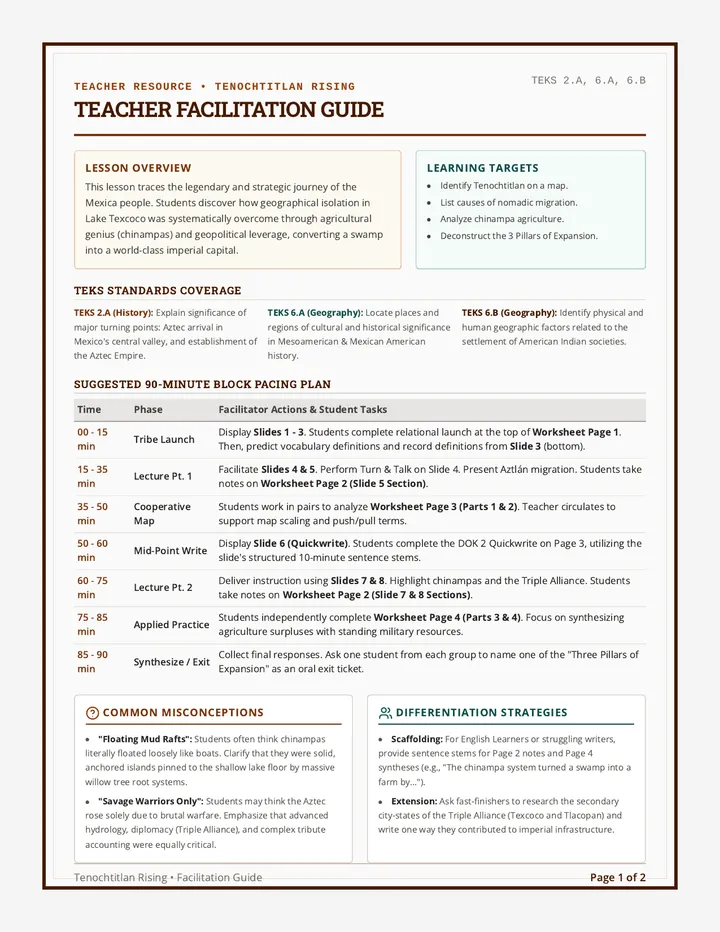
Stress Lab Teacher Guide Teacher Facilitation Guide
Sequence: Stress Science Lab (Physiology of Fight-or-Flight)
Sequence Intent
This sequence is designed to move psychology from the "abstract" to the "biological." By framing stress as a physical survival system (the Guard Dog and Wise Owl), 6th graders can detach their identity from their anxiety. They aren't "bad" or "weak" for feeling stressed; their body is simply being "too good" at its job of protecting them.
Materials Checklist
Stopwatches (for heart rate)
Needles/Thread or Decks of Cards
"Mystery Box" (Shoebox with hole)
Various tactile objects (brush, slime)
Lesson Strategies
Lesson 2: The Hand Model
Use Dr. Dan Siegel’s Hand Model of the Brain. It is the most effective way for students to visualize the amygdala hijack. Encourage students to use the physical gesture of "flipping their lid" throughout the rest of the unit to signal when they feel overwhelmed.
Lesson 3: Fine Motor Lab
Safety first! Ensure students have space for jumping jacks. The goal is to get the heart rate high enough that hands become slightly shaky. This demonstrates the evolutionary trade-off—blood leaves the fingers to power the legs and arms. Observation: Some students may not feel shaky; ask them to observe those who do.
Lesson 5: Mystery Box
Place a mundane object (like a damp sponge or a hairbrush) in a box. Build suspense. Watch their "Guard Dogs" go into high alert. After they touch it, discuss the Mismatch: Their body prepared for a scorpion, but it was just a sponge. This is the core of anxiety management—identifying false positives.
Mastery Questions
Social Connection
"How might knowing about the Guard Dog help you forgive a friend who shouted at you yesterday?"
Personal Growth
"If your Guard Dog is always barking at school, what kind of treats (strategies) can you give it to help it stay calm?"
Designed for 6th Grade Social Studies/Psychology curriculum. © Stress Science Lab 2026.
Brain Alarm Slides The Brain's Alarm System
Who's really running the show when you're stressed?
Stress Science Lab: Lesson 2
The Guard Dog: Amygdala
Job: Safety First!
It scans for danger 24/7. When it sees a threat, it barks and takes control immediately.
Super Fast (Instant)
Emotional & Reactive
Survival Expert
The Wise Owl: Prefrontal Cortex
Job: Thinking & Planning
It helps you solve problems, make good choices, and stay calm. It's the "CEO" of your brain.
Slower & Thoughtful
Logical & Rational
Language Center
The Amygdala Hijack
Normal Mode
STOP!
Hijack Mode
When the Guard Dog smells danger, it cuts the power to the Wise Owl. You can no longer think logically—you can only react!
Have you ever...
Said something mean because you were angry?
Frozen up when it was your turn to speak?
Forgotten everything you studied during a test?
That's a Hijack!
Brain Model Worksheet Brain Control Center
Lesson 2: Amygdala vs. Prefrontal Cortex
Scientist:
Date:
Part 1: The Inner Brain
Brain Diagram Area
Prefrontal Cortex
Amygdala
Prefrontal Cortex (Wise Owl)
This part is located behind your forehead. It is used for and .
Amygdala (Guard Dog)
This almond-shaped part is deep inside. Its main job is to for danger.
Part 2: The Hand Brain Model
Make a fist with your thumb tucked inside your fingers. This is your brain! Label what each part represents and what happens during a Hijack .
Fingers (Folded Over)
Which brain part is this?
Thumb (Tucked Inside)
Which brain part is this?
"Flipping the Lid"
When the fingers pop up, who is left in charge?
Part 3: Anatomy of a Hijack
Think of a time you "flipped your lid" (lost your cool, got too nervous to speak, or forgot your lines). What did the Guard Dog see as a threat? How could the Wise Owl have helped if it stayed in control?
The Threat (What happened?):
The Reaction (What did you do?):
The Owl's Advice (What would logic say?):
Body Under Pressure Slides Body Under Pressure
Mapping the physical rush of the Stress Response
Stress Science Lab: Lesson 3
What happens inside?
Heart Pumps Faster
Sending oxygen and sugar to your muscles so you can move fast.
Short, Fast Breaths
Bringing in extra oxygen for your "engine."
Sweaty Palms
Cooling down the body so you don't overheat while fighting/running.
Lab: The Motor Skill Mismatch
The Problem
When your body is in "Survival Mode," it focuses on BIG muscles (running) and ignores SMALL muscles (fine motor skills).
The Challenge
Can you perform a delicate task while your heart is racing?
1
Measure your Resting Heart Rate.
2
Perform 1 minute of jumping jacks!
3
Immediately try to stack 10 cards or thread a needle.
The Evolutionary Trade-Off
Survival > Precision
In a life-or-death situation, you don't need to write neatly or play a video game. You need to survive .
"Your body sacrifices accuracy for pure power and speed ."
The Test Connection
If you feel "shaky" or "jittery" during a presentation, that's just your body giving you POWER you don't know how to use yet.
Next: Let's record our lab data!
Physical Pressure Lab Worksheet Physical Pressure Lab
Lesson 3: Investigating the Sympathetic Nervous System
Scientist:
Partner:
The Hypothesis
"When my heart rate increases through exercise, my ability to perform fine motor tasks (like threading a needle or stacking cards) will..."
Data Collection
Phase Heart Rate (BPM) Lab Results (Stacking/Threading) Resting Post-Exercise (1 min) Observation Describe how your hands felt (Steady? Shaky? Hot?)
Analysis: Survival Mode
Why did your body react this way to exercise? (What was it preparing for?)
How is this similar to how you feel when you are nervous for a test?
Final Reflection: The Evolutionary Trade-Off
Our body sacrifices Precision to give us more Power. List one situation where losing precision might actually save your life.
Beyond Fight and Flight Slides Beyond Fight and Flight
Exploring the Freeze and Fawn survival strategies
Stress Science Lab: Lesson 4
The 4 Response F's
Fight
Flight
Freeze
"If I don't move, they won't see me."
Fawn
"If I'm extra nice, they won't hurt me."
Freeze
Your brain hits the Emergency Brake . Your heart rate might actually drop, and you feel "stuck" or "numb."
In nature: An opossum playing dead.
In school: Blanking on a question you know.
Fawn
Instead of fighting a predator, you try to make it like you so it won't attack.
Trying to "peace make" or people-please to avoid a fight.
Losing your own opinion just to fit in.
Which is your "Go-To"?
Everyone has a "favorite" survival strategy. Understanding yours helps you notice when your Guard Dog is taking over.
Freeze
"I just need to disappear for a bit."
Fawn
"Is everyone happy? Is everyone okay?"
Response Spectrum Worksheet The Response Spectrum
Lesson 4: Categorizing Survival Strategies
Researcher:
Date:
Part 1: Scenario Investigation
Read each scenario below. Decide if the person is showing a Fight , Flight , Freeze , or Fawn response. Label each one.
"Someone starts yelling at you. You immediately apologize and offer to do their chores just to make them stop being mad."
Response:
"The teacher calls on you to answer a question. Your mind goes completely blank and you can't even say 'I don't know'."
Response:
"You see a group of older kids who look like they are looking for trouble. You quickly turn the corner and walk the other way."
Response:
"A sibling takes your favorite toy without asking. You immediately start shouting and try to grab it back by force."
Response:
Part 2: Why Freeze or Fawn?
Analysis: The "Stealth" Strategy (Freeze)
Why might an animal choose to Freeze instead of Fight when a predator is nearby? How does this keep them safe?
Analysis: The "Social" Strategy (Fawn)
Why might a student Fawn (agree with everyone, apologize too much) when they feel socially unsafe or rejected?
Self-Discovery
We all use all four responses, but most of us have a "default" that we use most often. Think about a time you felt stressed recently. Which "F" did you use? Why do you think your Guard Dog chose that one?
Fight
Flight
Freeze
Fawn
Reflection...
Fact Checking Fear Slides Fact Checking Fear
Is it a Saber-Toothed Tiger or just a False Alarm?
Stress Science Lab: Lesson 5
The Body's Alarm Sensitivity
Real Danger
Something is happening RIGHT NOW that can physically hurt you.
• A fire in the building
• An aggressive animal
• A car coming towards you
False Alarm (Anxiety)
Your brain is IMAGINING a future problem or feeling socially unsafe.
• Worrying about a test
• Afraid of what someone thinks
• Nervous about an event next week
Ask the Wise Owl
When your heart starts racing, bring the Wise Owl back online by asking these 3 questions:
1
Am I in physical danger at this exact second?
2
Is my body reacting to something that hasn't happened yet?
3
Can I solve this problem with my muscles or with my words?
How to Reset
The Slow Out-Breath
Tell the Guard Dog: "It's okay, we can relax."
5-4-3-2-1 Grounding
Forces the Wise Owl to pay attention to reality.
"The Wise Owl and the Guard Dog are partners. They just need to communicate better!"
Mystery Box Lesson
Was the object inside the box as scary as what your brain imagined?
Your brain is a storytelling machine—don't believe every scary story it tells you!
Fact Check Worksheet Fear Fact-Checker
Lesson 5: Analyzing Alarms and Taking Control
Navigator:
Date:
Part 1: The Alarm Analysis
Read each situation. Is it a Real Danger (immediate physical threat) or a False Alarm (emotional or future stress)? Check the box and explain why.
Situation: A large dog is growling and snapping at you while you walk.
Danger
Alarm
Why?...
Situation: You have to present a project to the whole school tomorrow.
Danger
Alarm
Why?...
Situation: You smell smoke and hear a loud fire alarm in the building.
Danger
Alarm
Why?...
Part 2: The Fact-Check Tool
"I feel my body reacting! Let's check the facts."
1
Evidence of Danger:
Is there something right here that can physically harm me? (Yes/No)
2
The "What-If" Trap:
Am I reacting to a "What-If" story about the future? What is the story?
3
Wise Owl Strategy:
If it's a false alarm, what is one thing I can do to tell my Guard Dog to stand down? (Breath? Grounding? Reason?)
Sequence Mastery
You have learned that stress is just your body's way of trying to protect you. What is the most important thing you've learned about your brain or body in this sequence?