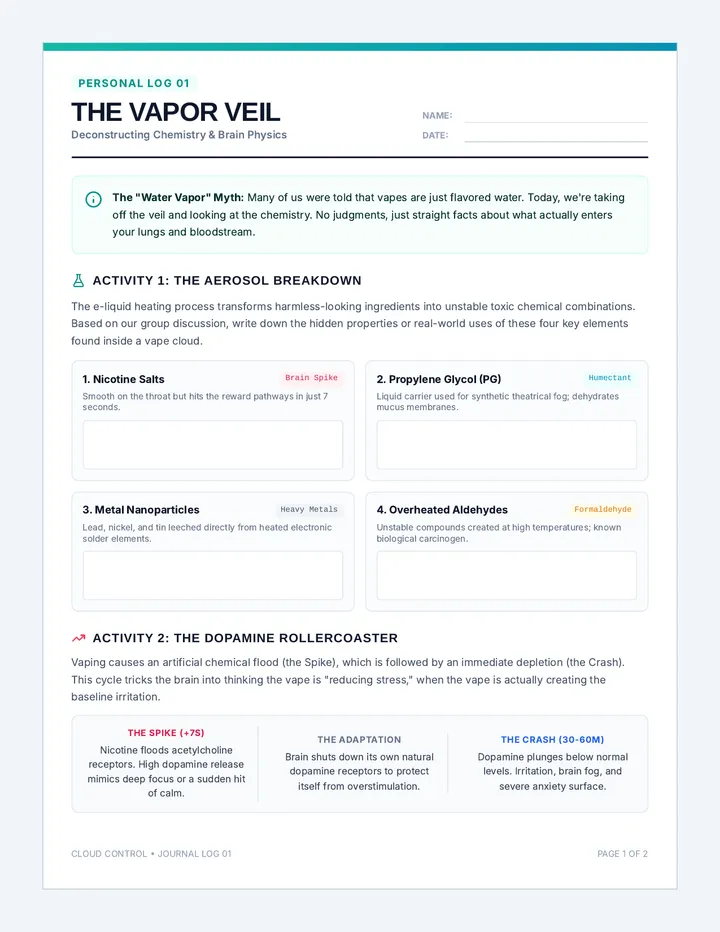
A student investigation worksheet focused on documenting the physiological impacts of drugs and alcohol on the brain and vital organs, designed with a professional lab report aesthetic.
A formal lesson plan for the Stress Toll lesson, incorporating 5 specific instructional strategies (Aggressive Monitoring, Sentence Stems, Stop and Jot, Think-Pair-Share, and Chunking) with a step-by-step procedure.
A hands-on card sort activity where students classify stressful high school scenarios as acute or chronic and match them to their physiological impacts. Now expanded with 6 scenarios and scrambled for student use.
A comprehensive teacher guide for the Stress Toll lesson, including instructional objectives, common misconceptions, discussion prompts, and a detailed answer key for the DOK-leveled worksheet. Now updated with Aggressive Monitoring protocols.
A comprehensive worksheet featuring DOK level 1, 2, and 3 questions with integrated sentence stems to scaffold student writing and analysis of chronic stress.
A visual presentation for high school students explaining the biological impact of chronic stress, now featuring Think-Pair-Share, Stop and Jot, and a Chunked instructional structure.
A highly detailed, complex coloring page featuring a "Germ Jungle" sneeze cloud with intricate pathogen specimens, scientific annotations, and hygiene facts for advanced engagement.
A polished version of the "Self Care Blueprint" worksheet with improved spacing to ensure it feels open while still fitting perfectly on one page.
A student-facing "Solo Reps Log" worksheet designed for tracking completion of 16 different individual drills. Includes categories for walkovers, handsprings, aerials, and core strength with checkbox tracking for multiple sets.
A comprehensive 1-page reference guide for students containing 12 individual drills they can perform on side-mats without a spotter. Drills are categorized by skill focus: Walkovers, Power/Handsprings, Aerials, and Core.
An expanded set of 6 visual station cards designed to be printed and placed at different areas of the gym. Includes dedicated stations for individual solo drills like handstand snap-downs and hurdle skips that don't require spotting.
An updated student-facing skills tracker for tumbling, now including a dedicated "Solo Foundations" section for tracking progress on individual drills like snap-downs, wall holds, and hurdle timing.
A revised 2-page coaching guide for the tumbling session, now featuring a management strategy for balancing spotted skills with new solo/individual drill stations. Includes updated timeline and coaching tips for solo skill acquisition.
A visual reference sheet for a pom dance routine, illustrating essential arm motions (High V, T, etc.) and jazz technical skills with clear descriptions and diagrams.
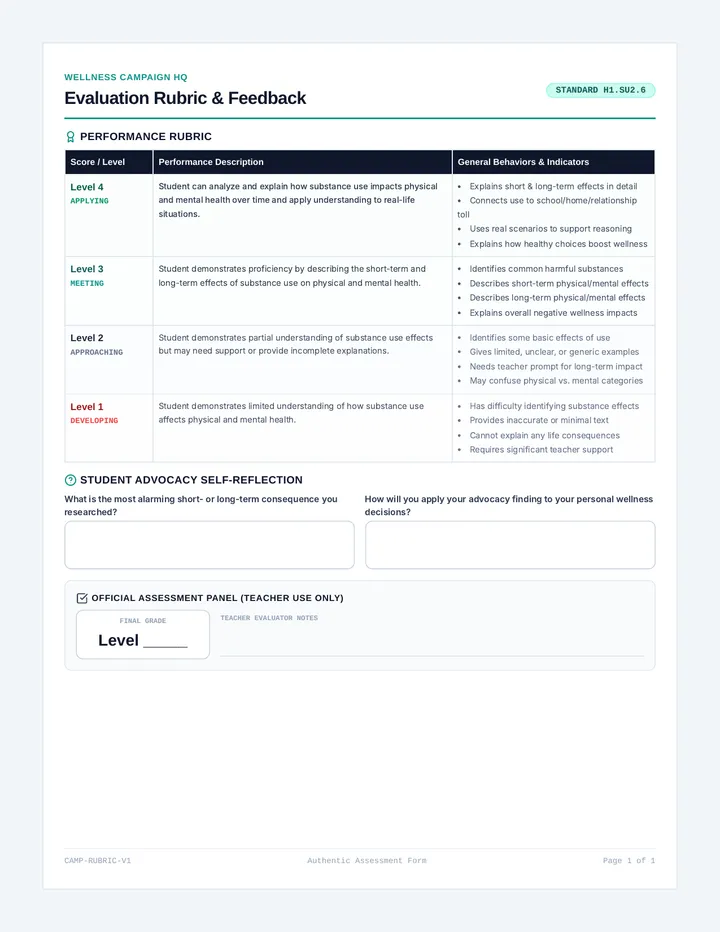
A professional assessment rubric for a pom dance routine, featuring specific criteria for precision, technique, musicality, and performance with space for teacher feedback.
A vibrant presentation for a jazzy pom dance class, highlighting routine style, essential pom positions, formation strategies, and performance energy.
A comprehensive teacher choreography guide for an intermediate jazzy pom routine to 'Under the Sea', starting at the 1:58 mark with timestamped breakdowns.
Facilitation guide for teachers, including detailed pacing, material checklists (including drawing supplies), discussion prompts with video timestamps, and a key for the student worksheet.
Visual anchor chart summarizing the gut-brain axis, identifying key organs, the role of neurotransmitters, and the contrast between premium and jamming fuels.
Student worksheet featuring spaces for warm-up reflections, video notes, a large drawing area for the 'Neurotransmitter Highway' diagram, and a mood-fuel reflection prompt.
A printable page of "Stress Audit" cards for the warm-up activity. Each card provides a space for students to anonymously write down a personal stressor, serving as a replacement for physical sticky notes.
Instructional guide for teachers to deliver "The Calm Cafe" lesson. Includes pacing, discussion prompts for video pause points, differentiation strategies, and extension ideas to encourage student engagement with self-care practices.
A 2-page student worksheet designed like a cafe menu. Page 1 allows students to list "Appetizers" (2-min), "Main Courses" (15-30 min), and "Desserts" (social) self-care strategies. Page 2 includes a 7-day challenge tracker for the extension activity.
Visual presentation for "The Calm Cafe" lesson, including the "Self-care techniques" video, warm-up instructions, guiding questions, and self-care menu activity steps. Designed for 6th-8th grade with clear, accessible text and calming visuals.
Four detailed character scenarios for students to analyze during the 'Accumulation Effect' activity. Each scenario depicts a week of emotional suppression, providing concrete examples for students to map and then rewrite using mental health techniques.
A student worksheet for 'The Accumulation Effect' activity. It includes sections for tracking suppressed feelings in a character scenario, a visual 'Accumulation Vessel' to illustrate emotional build-up, and a rewrite section to apply daily check-in techniques.
A comprehensive grading rubric for the Mood Menu project. It evaluates students on scientific accuracy regarding the gut-brain connection, integration of required nutrients, menu specificity, and scientific justification.
A teacher's answer key and grading resource for the 'Mind Over Myths' lesson, including correct video observations, suggested research facts for the poster activity, and a simple grading rubric.
A print-ready exit ticket (2-up per page) evaluating student understanding of the reinforcement cycle of phobias through the Chesapeake Bay Bridge example.
A slide deck designed for the 'Unfelt Feelings' health lesson, featuring the video embed, discussion prompts, and visual explanations of emotional suppression and transformation techniques.
A student worksheet for the Mood Menu lesson. It provides structured space for a quick write, video notes on the gut-brain axis, a creative 1-day meal planning grid, and a scientific justification section.
A student worksheet featuring a symptom comparison between GAD and Panic Disorder, a Nature vs. Nurture T-Chart for categorizing causes of anxiety, and a reflection question on conditioning.
A comprehensive teacher facilitation guide for the 'Unfelt Feelings' health lesson, including a 50-minute timeline, learning objectives, discussion anchors, and key vocabulary definitions.
A visual presentation for the Anxiety Anatomy lesson, featuring phobia ratings, embedded video, and a comparison of the learning and biological perspectives on anxiety.
A comprehensive teacher facilitation guide for the Mood Menu lesson. It includes detailed pacing, specific video pause points with discussion questions, and instructional tips for facilitating the gut-brain connection activity.
Printable exit ticket slips for the 'Mind Over Myths' lesson, featuring a reflection prompt on media influence, writing lines, and a name field (4 slips per page).
An answer key and exemplar guide for the Power Perspective worksheet and exit ticket. Provides clear definitions for the three paths of resilience, sample instrument items, and high-quality student response examples.
A teacher facilitation guide providing pacing, discussion prompts, and key conceptual takeaways for the Anxiety Anatomy lesson.
Interactive presentation slides covering the gut-brain connection, neurotransmitters, and mood-boosting food groups, including embedded video and activity prompts.
A 2-page student worksheet for the 'Mind Over Myths' lesson, featuring a word association warm-up, a video observation table for recording myths and facts, and a structured planning area for the Fact-Check poster activity.
A visual presentation for a 9th-grade health lesson on nutrition and brain health. It includes a hook, embedded video, scientific explanations of the gut-brain axis and inflammation, and clear activity instructions for the "Mood Menu" design challenge.
A comprehensive facilitator guide for teachers, providing a pacing guide, detailed instructional notes for the Stroop Test, and an answer key for the 'Brain Train' mapping activity.
An exit ticket assessment for the Brain Balance Mechanics lesson. It requires students to explain the concept of tolerance using the seesaw metaphor and identifies the biological cause of withdrawal through a multiple-choice question. Styled as a clean, professional card with clear handwriting areas.
A personal ritual-building template for student-athletes to design their own pre-performance routines, incorporating breathing, physical cues, and external focus strategies.
A comprehensive teacher guide for facilitating the "Body Image Resilience" lesson. Includes learning objectives, a detailed pacing guide, instructional strategies, discussion prompts, and differentiation tips.
A student worksheet for the Seesaw Model activity. It provides a structured three-step drawing area for students to visualize the biological process of brain adaptation: Baseline, Tolerance (adding counter-weights), and Withdrawal (the crash). Includes a short reflection question to check for understanding.
A 9-slide instructional presentation for the 'Mind Over Myths' lesson, featuring vocabulary definitions, a YouTube video embed, structured discussion prompts, and clear instructions for the Fact-Check poster activity.