A project-based lesson where students apply geometry skills to design and build a 3D miniature city, focusing on polyhedra, volume, and spatial reasoning.
Synthesizes skills through word problem solving and a final fluency check to measure progress.
Explores the Commutative and Associative properties to simplify complex multiplication and build mental math strategies.
Transitions students from visual area models to the partial products strategy for more efficient calculation.
Introduces the area model for 2-digit by 1-digit multiplication, connecting place value to the distributive property.
Focuses on the conceptual foundation of multiplication as equal groups and arrays using manipulatives and visual modeling.
An introductory lesson on creating and interpreting line plots using fractional measurements (halves, fourths, and eighths). Students become 'Data Detectives' to measure 'clues' and organize their findings on a number line.
A comprehensive lesson for 4th grade students to master plotting and identifying fractions on a number line with common denominators using a railway-themed approach.
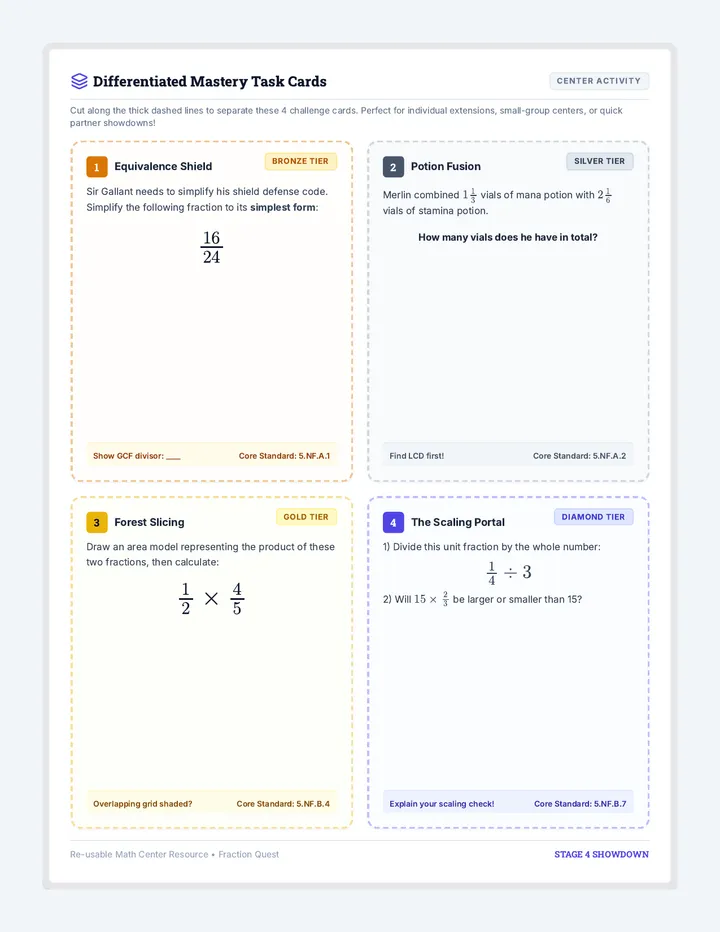
A festive, high-energy math lesson where 5th graders master multiplying and dividing fractions through visual models and a real-world 'Recipe Exchange' activity. Students scale ingredients for a fiesta and solve practical problems involving mixed numbers.
A 60-minute introductory lesson for 4th graders on creating and interpreting line plots using mixed numbers, specifically focusing on measurements to the nearest 1/8 inch.
A lesson focused on collecting plant measurement data and plotting mixed numbers on a number line to visualize growth patterns.
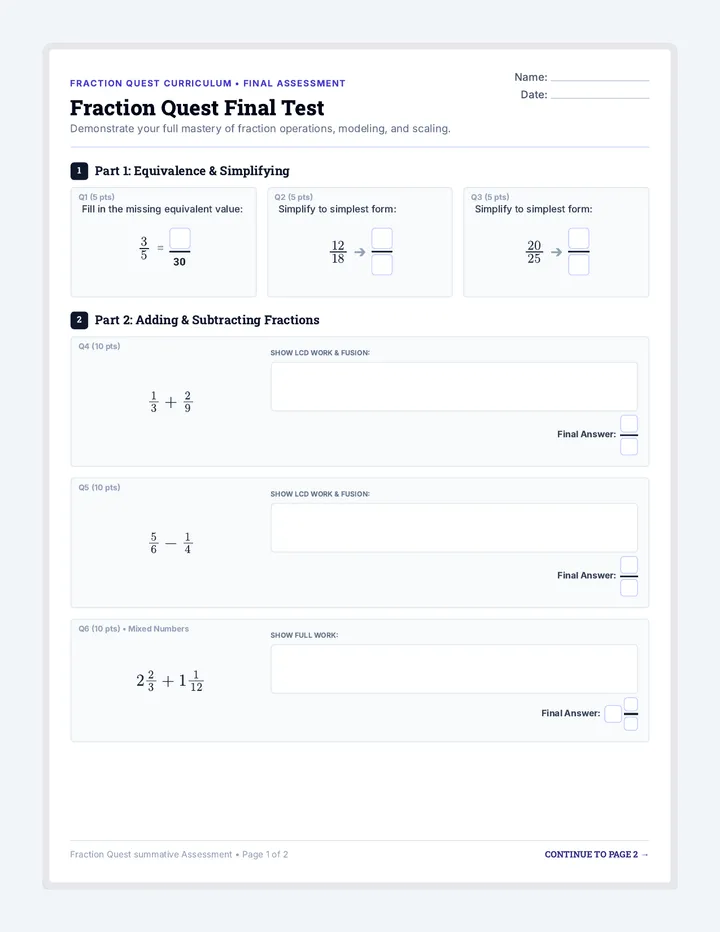
A comprehensive lesson on adding and subtracting fractions with unlike denominators, using a blueprint-themed architectural approach to 'building' common denominators.
A comprehensive lesson on the Order of Operations (PEMDAS/GEMDAS), focusing on identifying the correct sequence of operations and solving multi-step mathematical expressions with precision.
A comprehensive lesson on mastering analog clocks and calculating elapsed time, designed for middle school students with a focus on logical deduction and practical application.
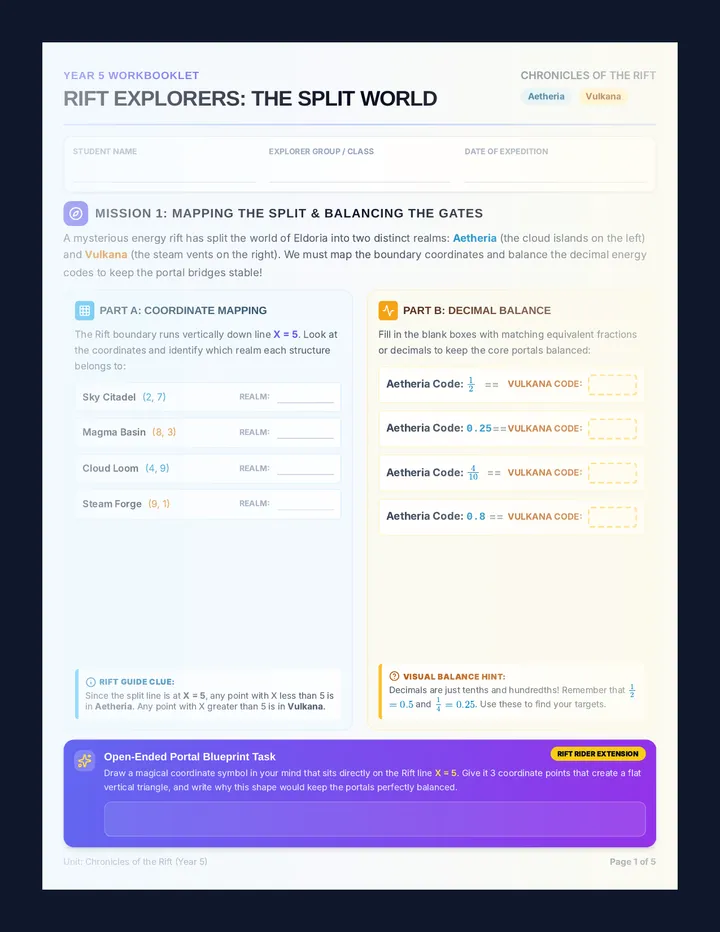
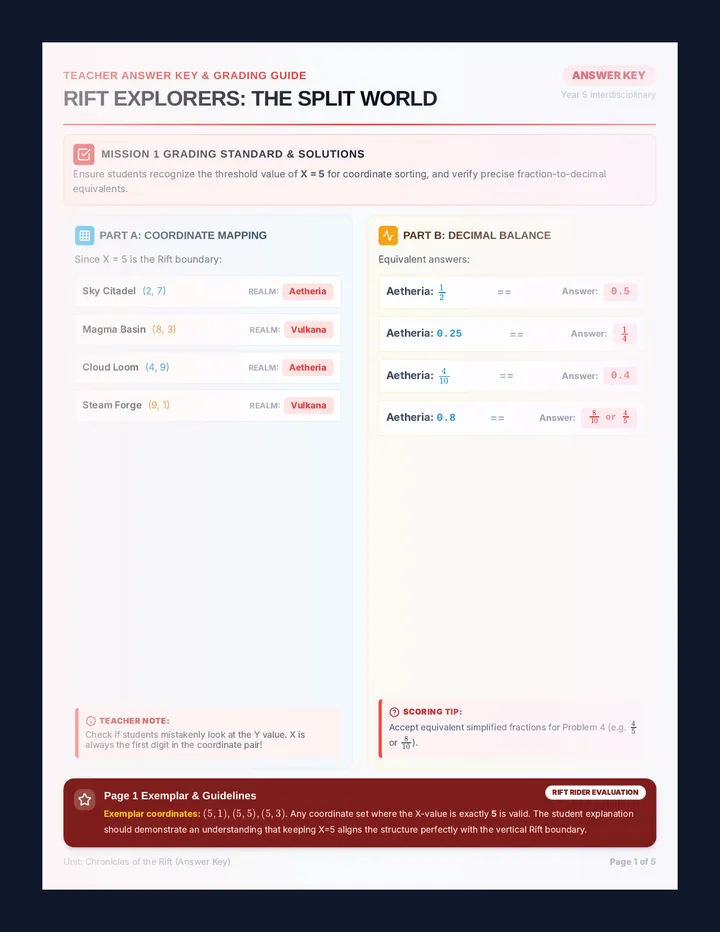
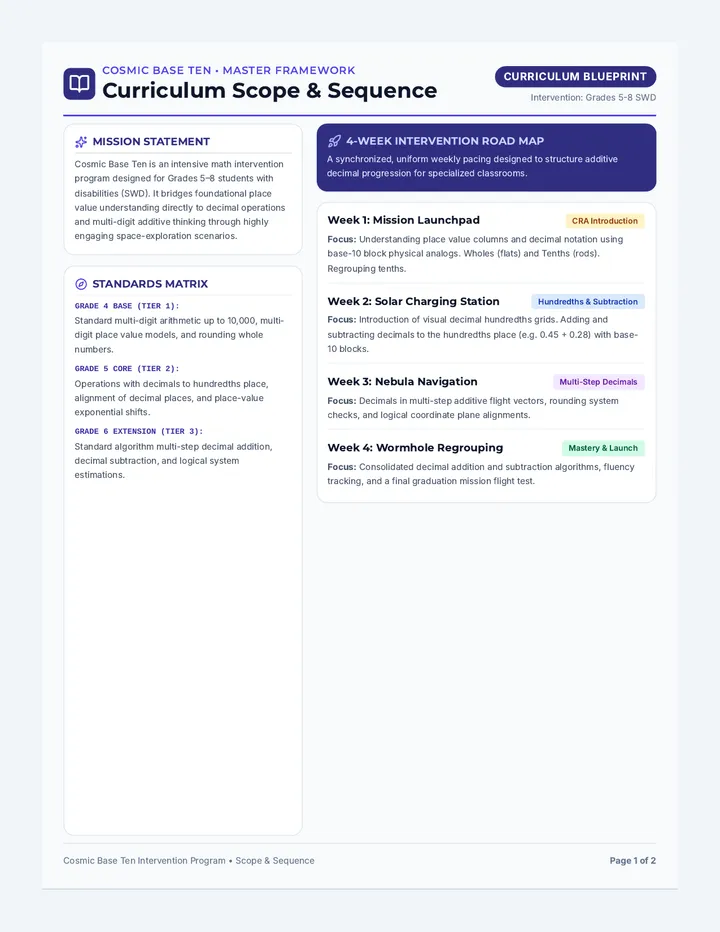
A visual-heavy lesson using a pixel-art theme to help students master converting fractions with denominators of 10 and 100 into decimals using grids and place value charts.
A visual-heavy lesson focused on converting fractions with denominators of 10 and 100 into decimals using area models and place value charts. Students act as 'Decimal Decoders' to solve math mysteries.
A 30-minute introductory lesson focusing on representing fractions and decimals using 10x10 and 10x1 grids. Students will visualize parts of a whole to build conceptual understanding.
The cumulative review and assessment where students solve mixed-theme problems independently to demonstrate 70% accuracy.
Develops flexibility and number sense by teaching efficient jumps on the number line (jumping by 2s, 5s, or 10s) within the context of all three themes.
Integrates Golden State Warriors stats and basketball gameplay to practice writing number sentences and solving subtraction up to 30.
Uses high-octane monster truck scenarios to help students identify keywords for operations (+/-) and practice solving on dirt-track number lines.
Focuses on the physical representation of addition and subtraction using LEGO bricks and building the foundation for number line jumping up to 20.
A 6th-grade math lesson where students apply fraction operations to scale recipes for a culinary challenge, fostering real-world problem-solving and collaboration.
A middle school inquiry project where students collect, analyze, and interpret local data to solve 'mysteries' in their community. Students learn to select appropriate graph types and draw evidence-based conclusions.
A high-tech exploration of Soroban abacus mechanics, framed as calibrating a powerful logic engine through complement techniques and precise multiplication chains.
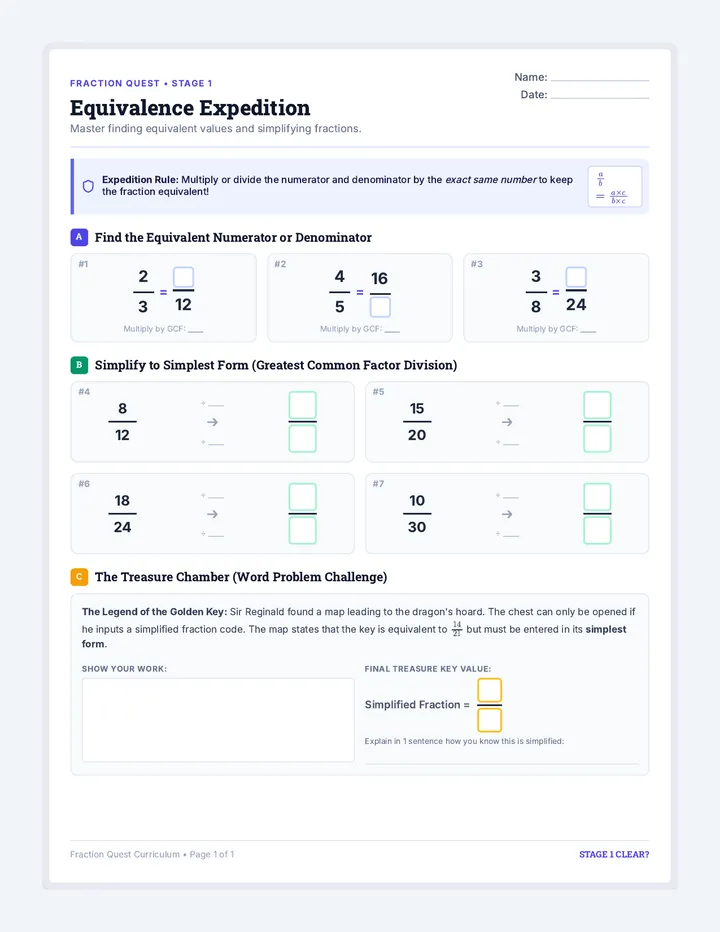
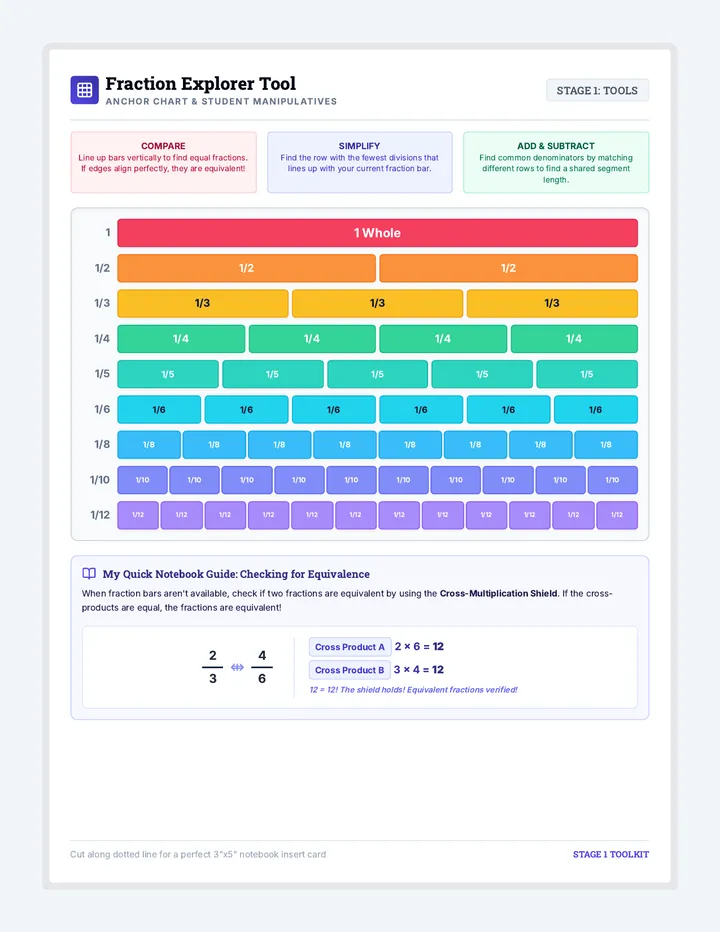
A focused lesson on identifying and creating equivalent fractions using denominators 2, 3, 4, 6, and 8 through visual models and numerical patterns.
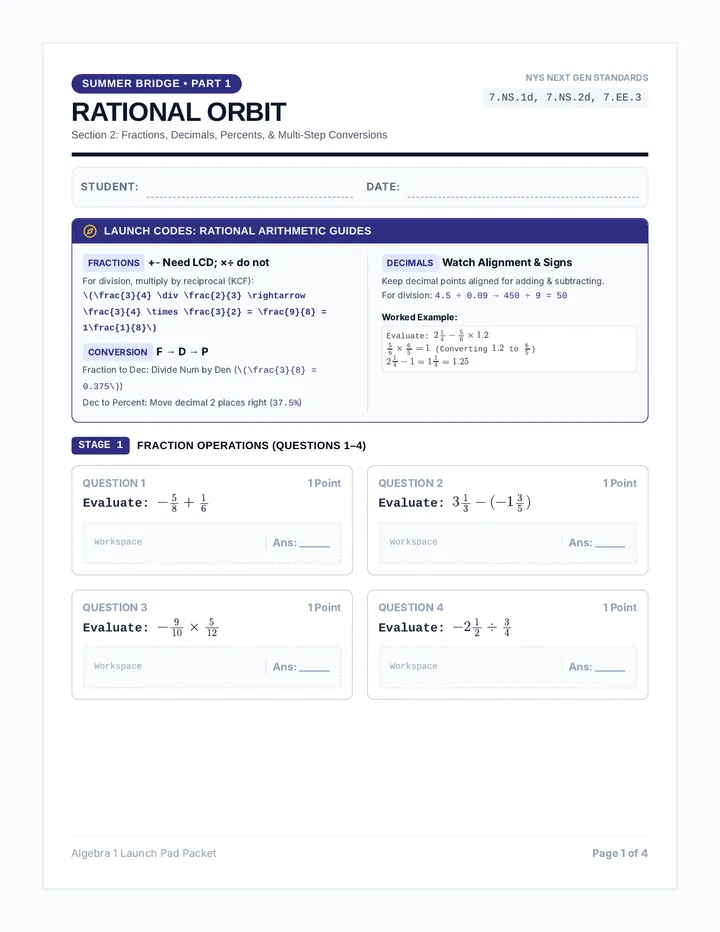
A comprehensive lesson on converting between fractions, decimals, and percents using a differentiated choice board. Students explore benchmark values and real-world applications through varied tasks tailored to different learning needs.
A cumulative review lesson where students apply their knowledge of inverse operations to solve mixed one-step equations involving addition, subtraction, multiplication, and division.
Expanding algebraic thinking to multiplication and division. Students will learn how to 'undo' multiplication by splitting into equal groups (division) and 'undo' division through multiplication, maintaining the balance of the scale.
A review and application of both strategies through a competitive classroom game.
Focused practice on the standard long division algorithm to build fluency and accuracy with multi-digit divisors.
Step-by-step introduction to the standard algorithm for long division, connecting it to the partial quotients method.
Practice with partial quotients to solve more complex multi-digit division problems, emphasizing estimation and subtraction accuracy.
Introduction to division through partial quotients, focusing on using "friendly numbers" to build confidence with large numbers.
A foundational introduction to basic algebra using the balance scale analogy, specifically designed for students working at a 3rd-grade level. Students will learn about variables and the concept of inverse operations to 'undo' addition and subtraction.
This lesson focuses on mastering three-digit subtraction with regrouping using color-coded visual supports and step-by-step procedural breakdowns. Designed with Special Education accommodations in mind, students will learn to navigate place value shifts from ones to tens and tens to hundreds.
Teaches students to identify fractions within a group of discrete objects (sets), rather than a single continuous whole.
Explores fractions that represent more than one whole, using visual models and decomposition to understand values like 6/4 and 8/6.
Focuses on identifying parts of a whole, understanding numerators and denominators, and modeling fractions by dividing shapes into equal parts.
A high-energy lesson focused on mastering double-digit addition and subtraction with regrouping through a 'Tactical Mission' theme. Students practice vertical alignment and precision in their calculations.
A Tier 2 intervention lesson for 6th grade focused on equivalent ratios using tape diagrams and visual models. Students practice through guided 'recipes' and matching activities to build conceptual understanding.
An introductory lesson on identifying and combining like terms to solve multi-step equations, designed for upper elementary students using visual models and guided practice.
Students learn to generate equivalent fractions by multiplying the numerator and denominator by the same number, using bakery-themed visual models like cake pans and bread loaves to bridge the gap between concrete and abstract math.
A Tier 2 intervention lesson for 5th grade students focused on conceptually understanding equivalent fractions and renaming them to add fractions with unlike denominators. Students will explore the 'Identity Property of 1' through visual models to see why multiplying the numerator and denominator by the same number creates an equivalent fraction.
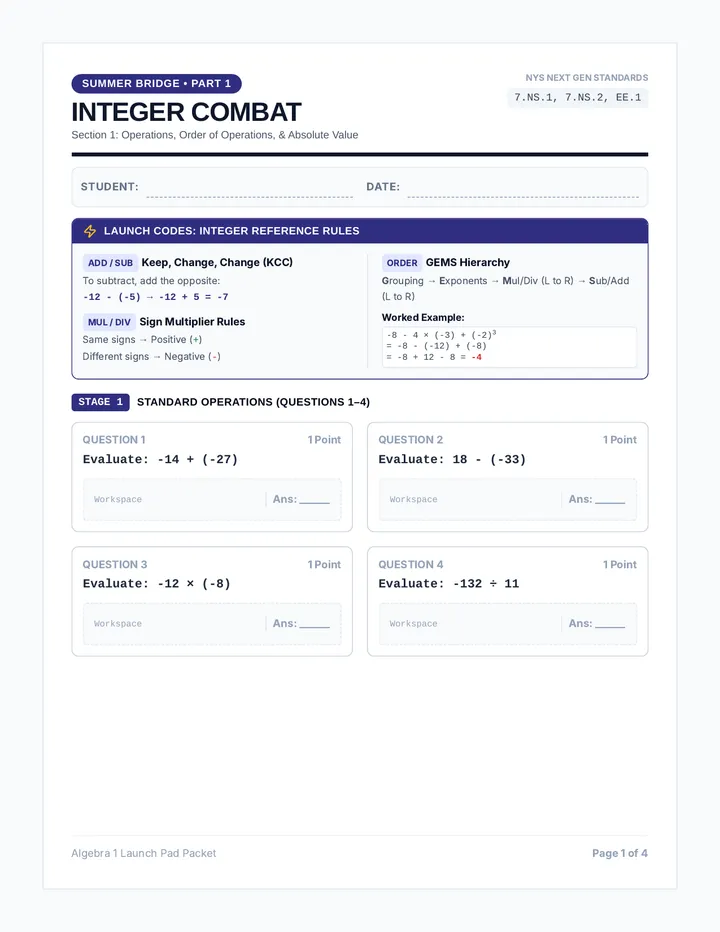
A comprehensive lesson covering addition, subtraction, multiplication, and division of integers using visual models and algorithmic rules.
A lesson focused on place value through expanded form and rounding techniques using number lines as visual aids. Students practice with four- and five-digit numbers to master precision in estimation.
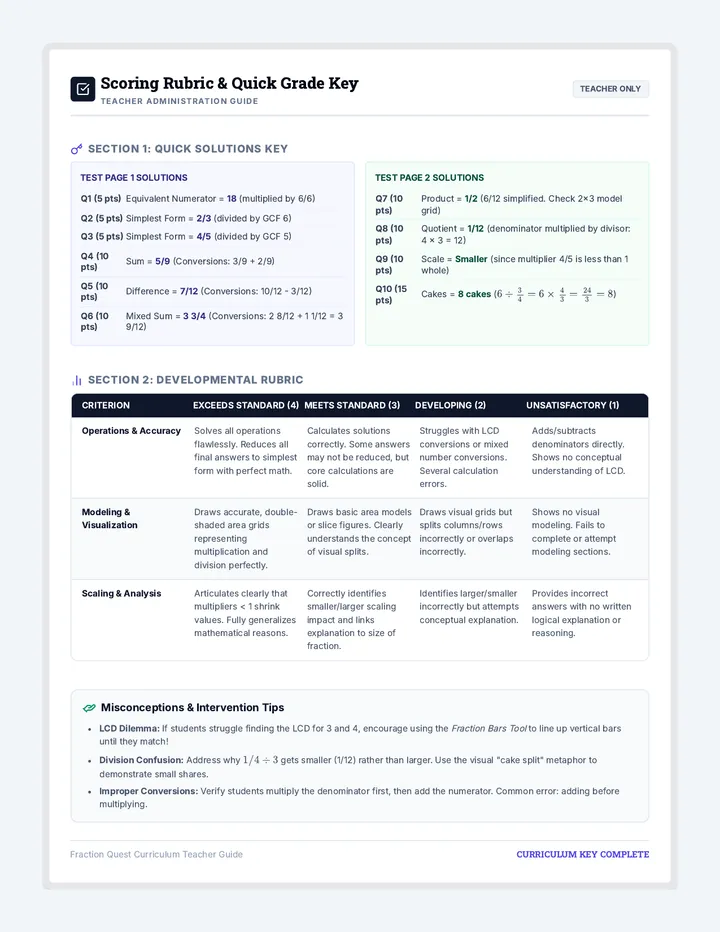
A comprehensive final assessment and review session to measure student mastery of multi-step equations and real-world problem solving.
Students learn to translate real-world scenarios into algebraic equations and solve them, focusing on rational numbers and variable definitions.
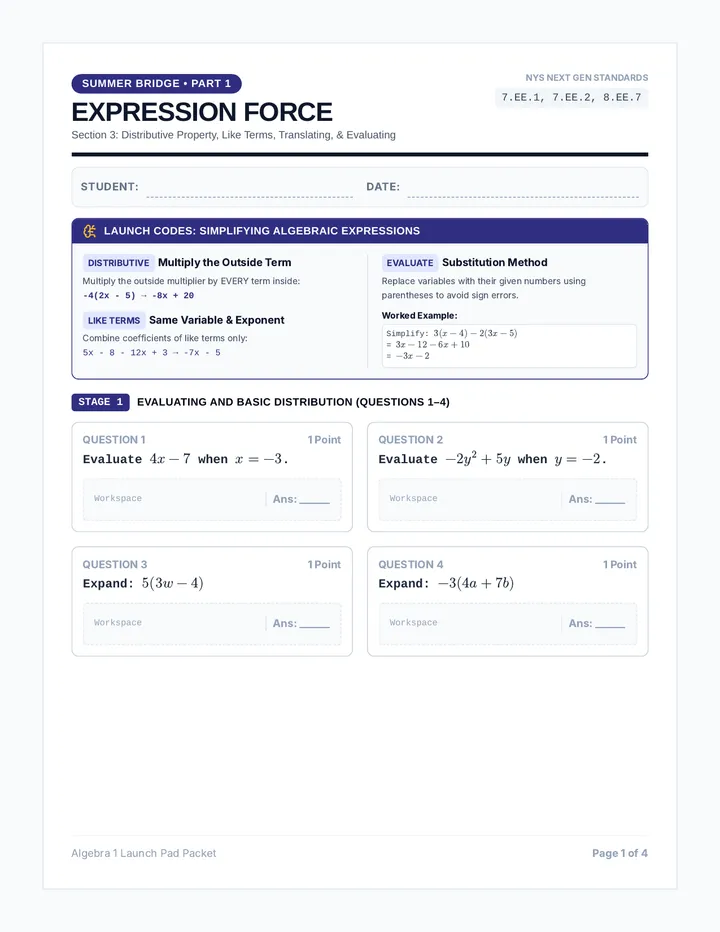
Focuses on multi-step equations involving the distributive property and combining like terms, including error analysis activities to solidify conceptual understanding.
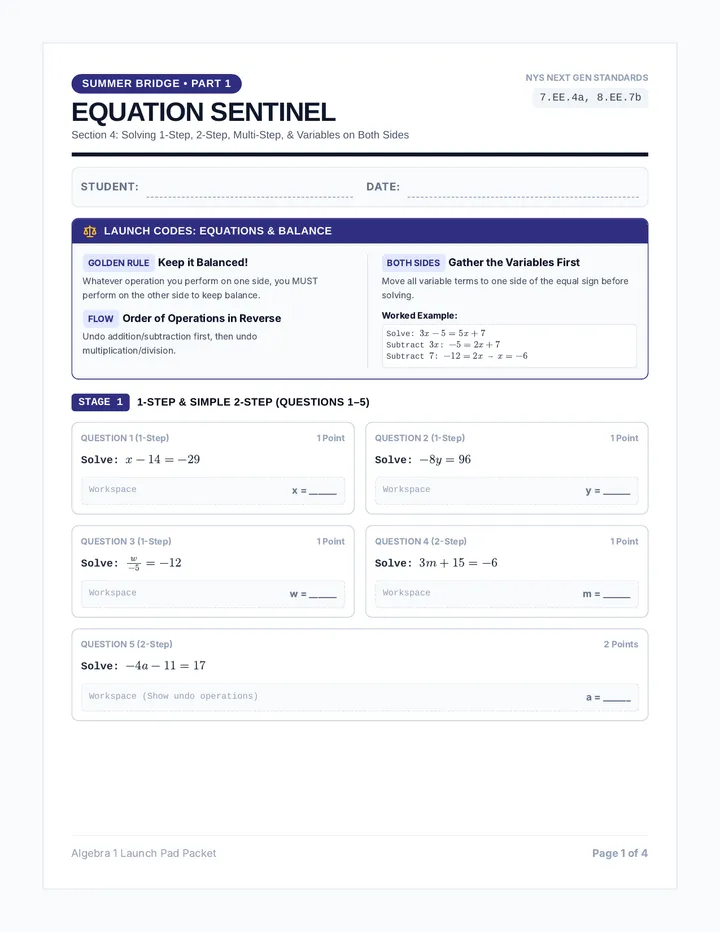
Students master one and two-step equations by utilizing balance models and algebraic methods to maintain equality while isolating the variable.
This introductory lesson focuses on identifying gaps in prerequisite skills such as inverse operations and combining like terms, providing targeted review to prepare students for multi-step equations.