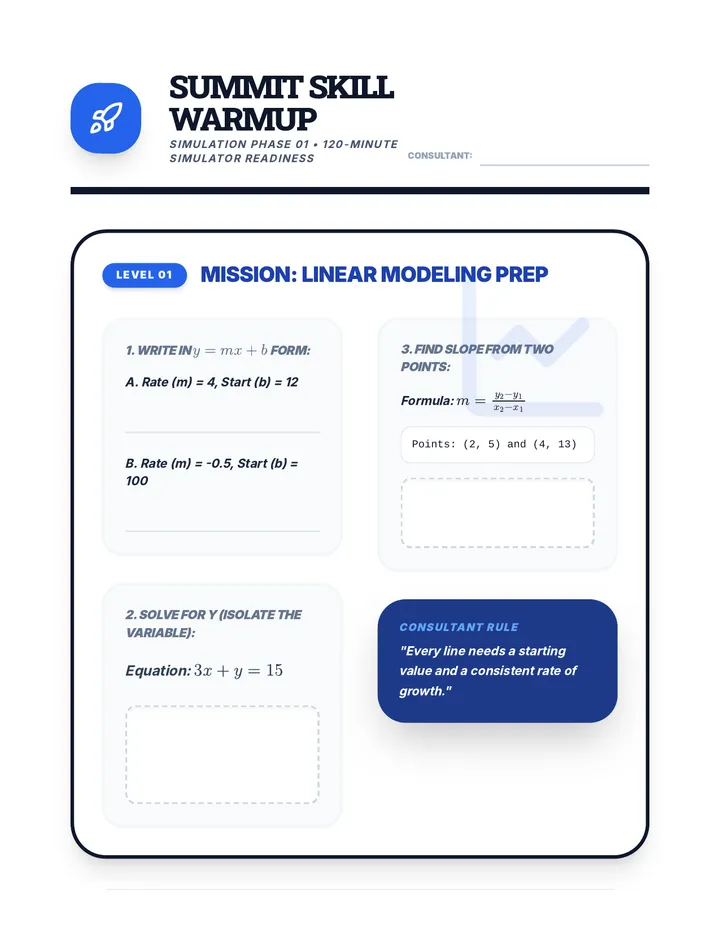
A cumulative review lesson where students apply their knowledge of inverse operations to solve mixed one-step equations involving addition, subtraction, multiplication, and division.
A delicious introduction to comparing fractions with like denominators using visual pizza models. Students will learn that when denominators are the same, the larger numerator represents a greater quantity.
Expanding algebraic thinking to multiplication and division. Students will learn how to 'undo' multiplication by splitting into equal groups (division) and 'undo' division through multiplication, maintaining the balance of the scale.

A foundational introduction to basic algebra using the balance scale analogy, specifically designed for students working at a 3rd-grade level. Students will learn about variables and the concept of inverse operations to 'undo' addition and subtraction.
This lesson focuses on mastering three-digit subtraction with regrouping using color-coded visual supports and step-by-step procedural breakdowns. Designed with Special Education accommodations in mind, students will learn to navigate place value shifts from ones to tens and tens to hundreds.
Teaches students to identify fractions within a group of discrete objects (sets), rather than a single continuous whole.
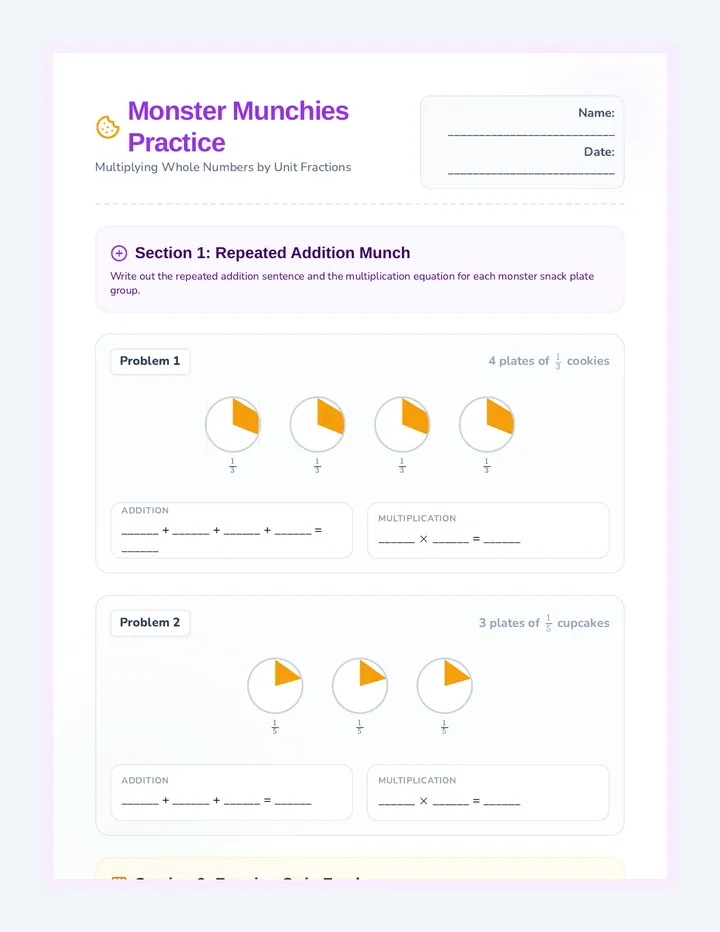
Explores fractions that represent more than one whole, using visual models and decomposition to understand values like 6/4 and 8/6.
Focuses on identifying parts of a whole, understanding numerators and denominators, and modeling fractions by dividing shapes into equal parts.
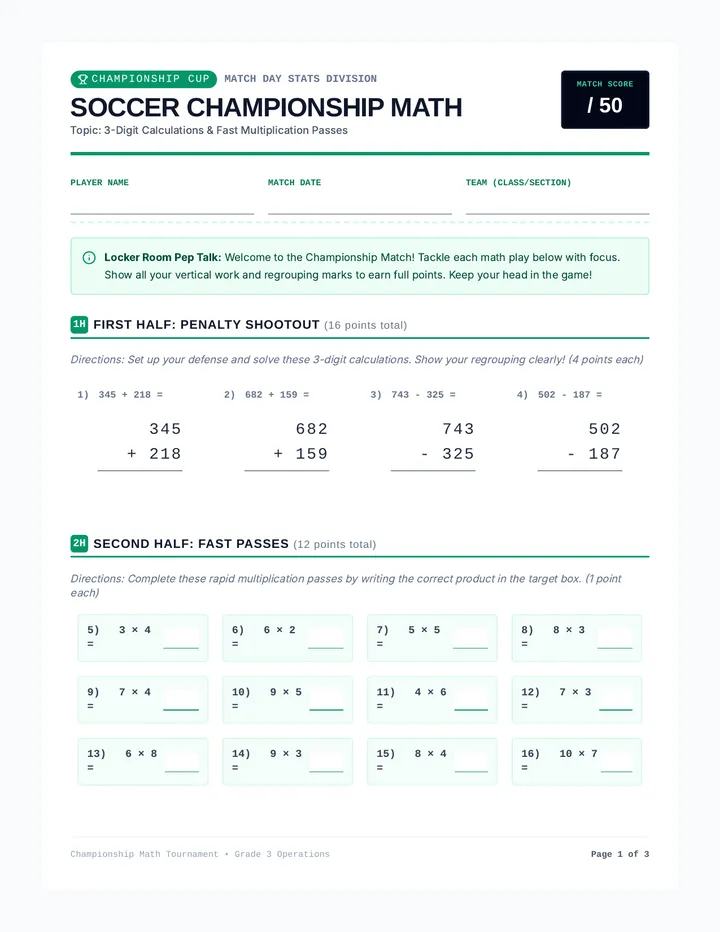
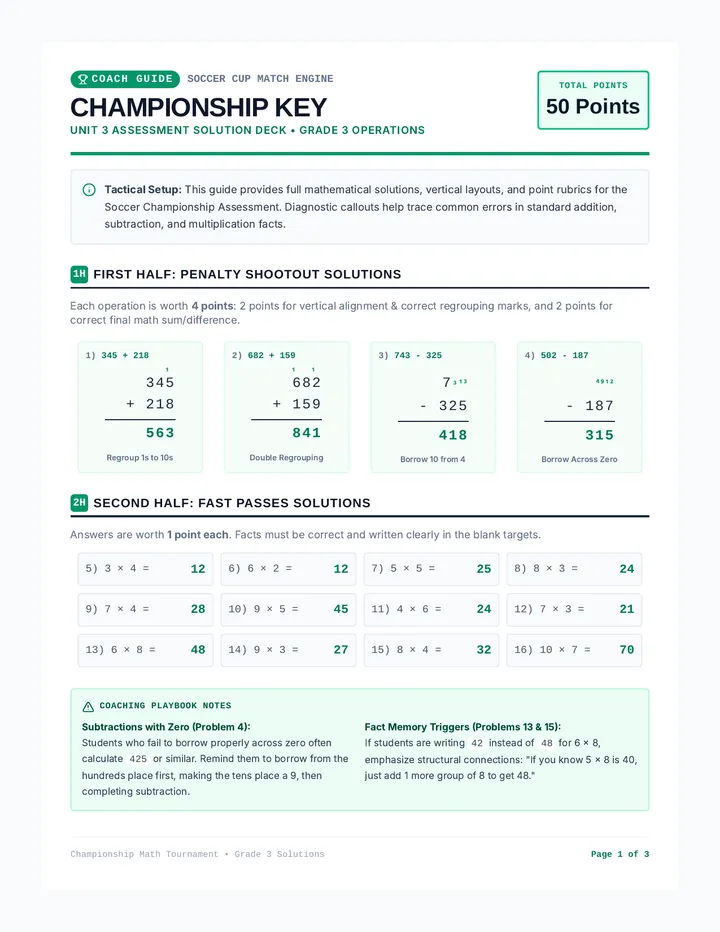
A high-energy lesson focused on mastering double-digit addition and subtraction with regrouping through a 'Tactical Mission' theme. Students practice vertical alignment and precision in their calculations.
A Tier 2 intervention lesson for 6th grade focused on equivalent ratios using tape diagrams and visual models. Students practice through guided 'recipes' and matching activities to build conceptual understanding.
An introductory lesson on identifying and combining like terms to solve multi-step equations, designed for upper elementary students using visual models and guided practice.
Students learn to generate equivalent fractions by multiplying the numerator and denominator by the same number, using bakery-themed visual models like cake pans and bread loaves to bridge the gap between concrete and abstract math.
A Tier 2 intervention lesson for 5th grade students focused on conceptually understanding equivalent fractions and renaming them to add fractions with unlike denominators. Students will explore the 'Identity Property of 1' through visual models to see why multiplying the numerator and denominator by the same number creates an equivalent fraction.