A hands-on STEAM lesson where emerging bilingual students use Ozobots to act out short scenarios, focusing on beginner-level English speaking, listening, reading, and writing skills.
An introductory lesson on the history, mechanics, and application of the Pigpen Cipher, perfect for middle school students exploring cryptography.
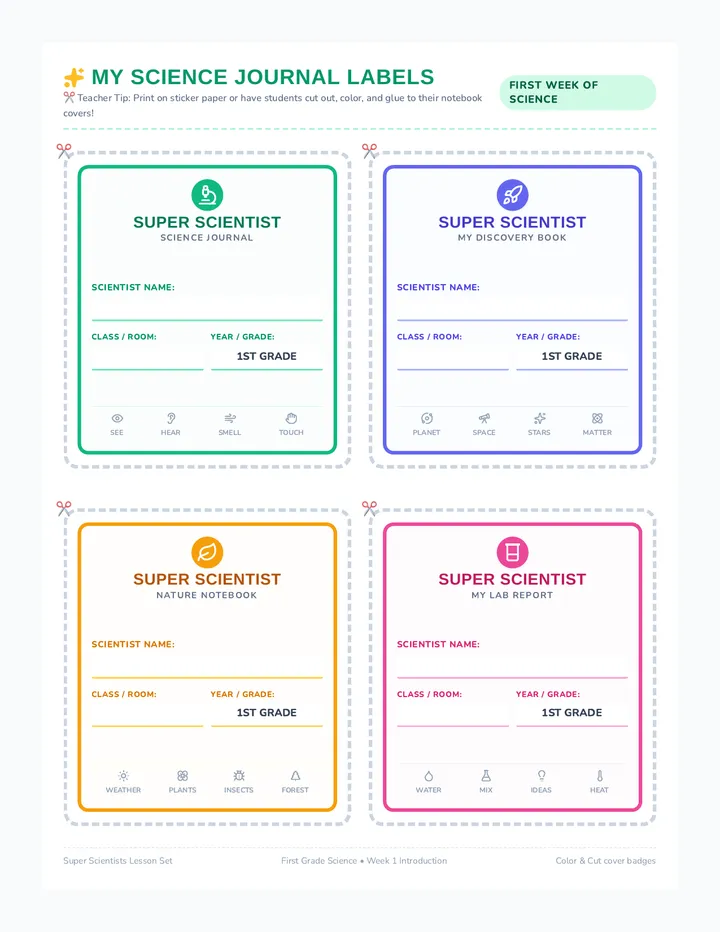
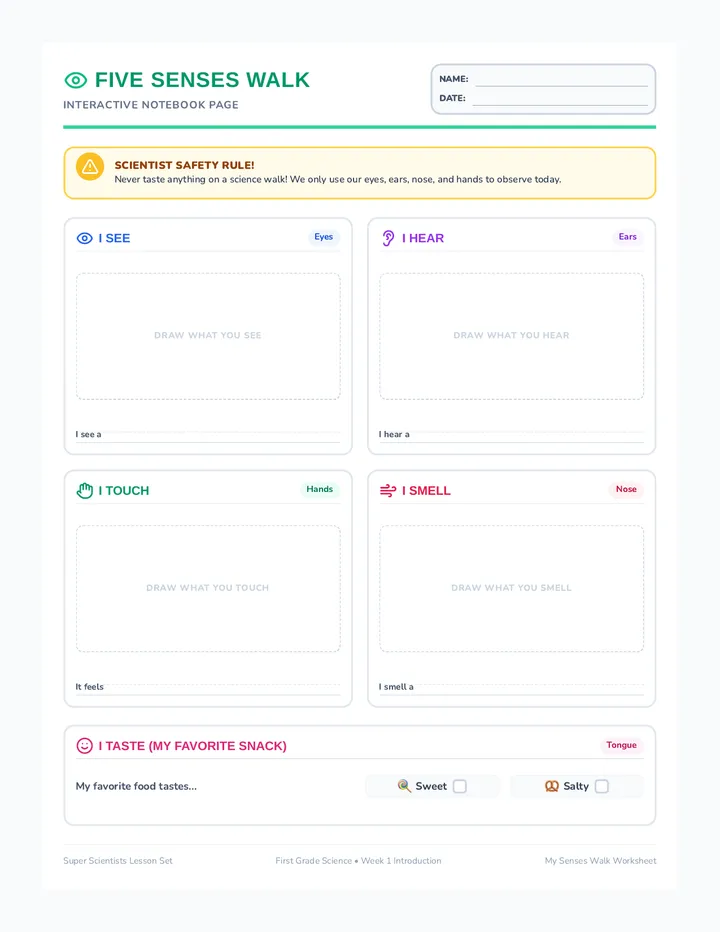
A guided project where 2nd-grade students act as scientists and engineers to report on an experiment, using key scientific vocabulary to describe matter and its properties.
A deep dive into the motivations, theories, and psychological challenges of interstellar exploration and first contact.
A visual-heavy introduction to water-related vocabulary for ESL students, focusing on the states of matter and natural water forms.
A series of hands-on, unplugged activities designed to teach Python data types and variables through tactile sorting, logic puzzles, and matching games. Focused on accessibility and clarity for students with diverse learning needs.
An introductory lesson on the fundamentals of heredity, focusing on dominant and recessive traits, and the distinction between genotype and phenotype.
A station-rotation lesson themed around animal crackers that integrates zoology and conservation vocabulary through reading, writing, speaking, and a STEM challenge. Designed for 6th-grade students to practice multimodal literacy skills while exploring animal ethics and habitat preservation.
Final assessment of the unit through a formal quiz and the final evaluation of the 3D ear model project.
Students examine the social, emotional, and practical impacts of hearing loss on daily life and reflect on their own 3D project creation.
A deep dive into hearing technology, specifically comparing the functions and surgical/non-surgical aspects of hearing aids and cochlear implants.
An introduction to the field of audiology, where students learn how hearing is measured and practice reading and plotting data on an audiogram.
Students explore the anatomy of the ear and begin their journey into the 3D ear model project, learning how sound travels through the outer, middle, and inner ear.
A comprehensive lesson exploring the four terrestrial planets of our solar system: Mercury, Venus, Earth, and Mars. Students will learn about their unique physical characteristics, atmospheres, and how they compare to one another through a mission-themed presentation and interactive activities.
A comprehensive lesson on metamorphic rocks, covering the processes of heat and pressure, regional vs. contact metamorphism, and the identification of foliated and non-foliated rocks.
A cross-curricular lesson exploring modern ecosystems and the history of environmental conservation. Designed with ADHD and Dyslexia-friendly features like high-visual support, hands-on activities, and clear, structured tasks.
A comprehensive lesson on igneous rock formation, classification, and identification, focusing on the relationship between cooling rates and crystal size.
A fast-paced, hands-on lab where students simulate the chemical and physical breakdown of food in the small intestine using common household materials to understand liquefaction and absorption.
Students apply their knowledge by creating a creative project (comic, brochure, or script) that constructs a scientific explanation of the matter and energy cycle.
Students explore the chemical equations and conceptual links between photosynthesis and cellular respiration, focusing on how energy enters as sunlight and is stored in chemical bonds.
A comprehensive review lesson focused on the mechanics of weather patterns, specifically evaporation, condensation, and the thermodynamics of rising air parcels in the troposphere. Students will engage in vocabulary practice, conceptual multiple-choice questions, and a data-driven CER response to prepare for their unit quiz.
A 3rd-grade introductory lesson on thermal energy, heat transfer, and molecular motion. Students explore how molecules behave in hot versus cold substances and how energy moves between objects of different temperatures.
A hands-on introductory lesson for 2nd grade ESL students to distinguish between insects and other backyard creatures using physical sorting and visual identification.
A hands-on introductory lesson for 2nd graders to identify insects by their physical characteristics (6 legs, 3 body parts) and sort them from other creepy-crawlies.
A lesson exploring NASA's critical role in monitoring Earth's changing climate using satellite technology and data collection. Students will practice citing textual evidence while learning about global warming.
A first-grade science unit focusing on how fossils provide clues about ancient animals and their environments. Students act as "Dino Detectives" to compare bones, study changing habitats, and analyze footprints to determine movement.
A comprehensive 5th-grade science lesson on matter, focusing on properties, states, conservation of mass, and chemical changes, specifically aligned to North Carolina Essential Standards 5.P.2.2 and 5.P.2.3 for EOG preparation.
A comprehensive lesson on Earth's systems, focusing on the water cycle, weather patterns, and global atmospheric movements specifically aligned to NC 5th Grade Science standards (5.E.1).
A comprehensive 5th-grade science lesson focused on energy flow in ecosystems, featuring food webs, chains, and organism interactions aligned with NC Standard 5.L.2.
A lesson exploring the science of bioluminescence, focusing on how and why organisms produce their own light in nature. Students will learn about chemical reactions, deep-sea adaptations, and the diverse uses of light in the animal kingdom.
A dynamic lesson where students explore biological life cycles through creative movement and expressive poses. Students will master the stages of butterflies, frogs, plants, and honeybees by physically embodying each developmental step.
A cross-curricular lesson where students transform complex scientific processes into catchy songs. Students will use graphic organizers to map out lyrics and templates with vocabulary banks to ensure scientific accuracy in their musical compositions.
A cross-curricular lesson where students combine scientific observation with artistic detail to create labeled diagrams of flowering plants and animals. Students focus on identifying key parts of organisms while developing their drawing and labeling skills.
A comprehensive exploration of the five major vertebrate groups, focusing on their evolutionary history, physical adaptations (skin, movement), and environmental niches. Students use a visual graphic organizer to map out the key traits of fish, amphibians, reptiles, birds, and mammals.
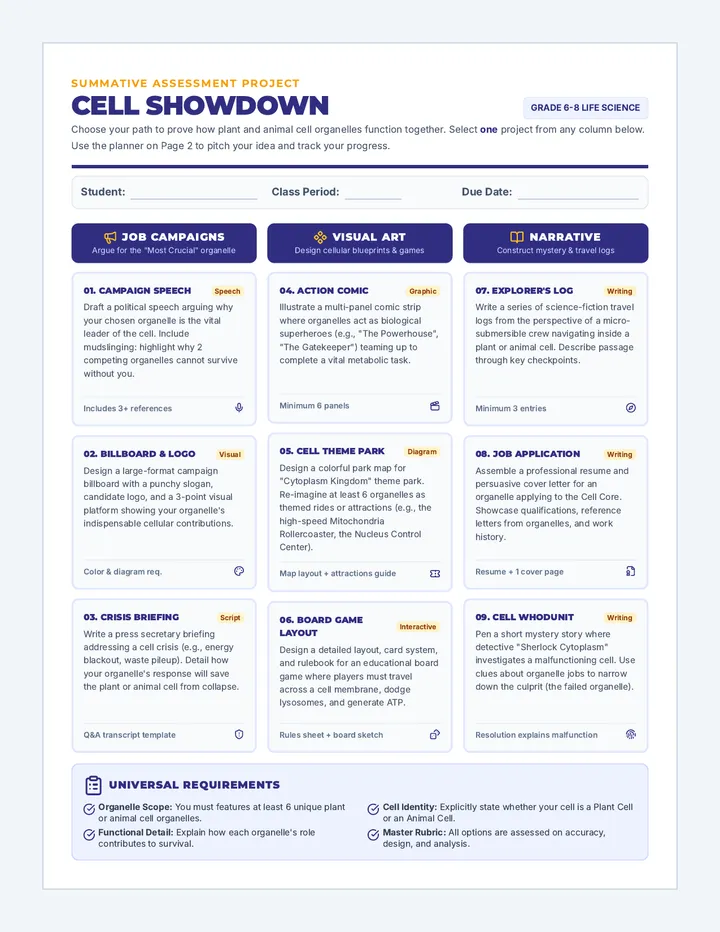
A project-based lesson where students explore the connection between the digestive system and cellular respiration, focusing on how food becomes ATP energy within the mitochondria.
A journey through the history of computing, exploring how hardware has evolved from room-sized machines to pocket-sized powerhouses. Students will compare vintage tech with modern devices and understand the rapid pace of innovation.
Explore the collision of air masses at cold and warm fronts and use weather data to predict the onset of storms and clear skies.
Identify and compare various air masses (maritime, continental, polar, tropical) and understand how air moves from high to low pressure systems.
A comprehensive lesson exploring why Earth has seasons, focusing on axial tilt, revolution, and the intensity of solar radiation. Students will model the Earth-Sun system to understand solstices, equinoxes, and hemispheric differences.
Explore how mass and net force determine how quickly a vehicle can stop. This lesson uses braking scenarios to provide evidence for Newton's laws of motion.